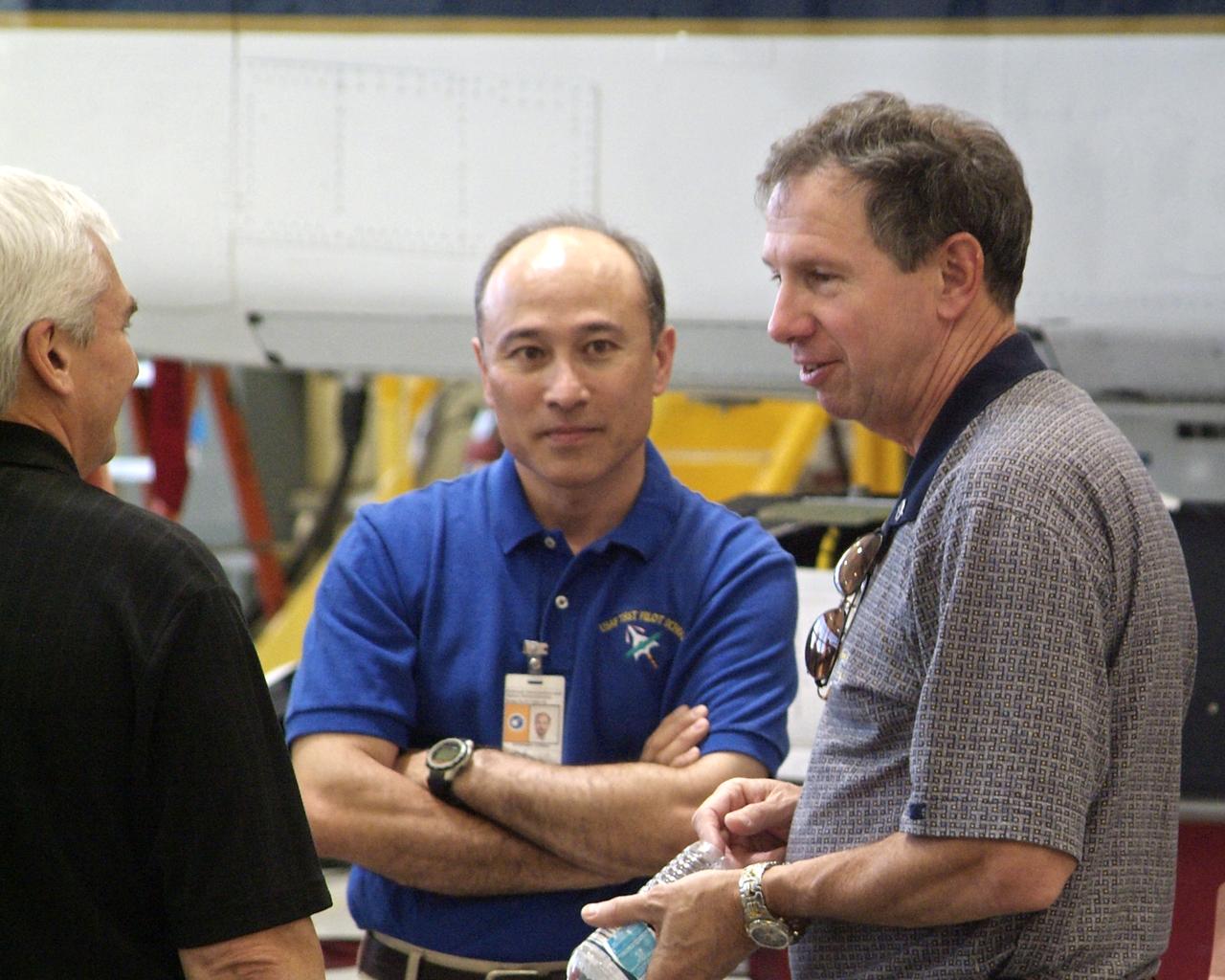
New NASA Administrator Michael Griffin (right) shares a moment with Director Kevin Petersen (left) and F-15B project manager Stephen Corda (center) during Griffin's visit to NASA Dryden Flight Research Center on Tuesday, May 24.
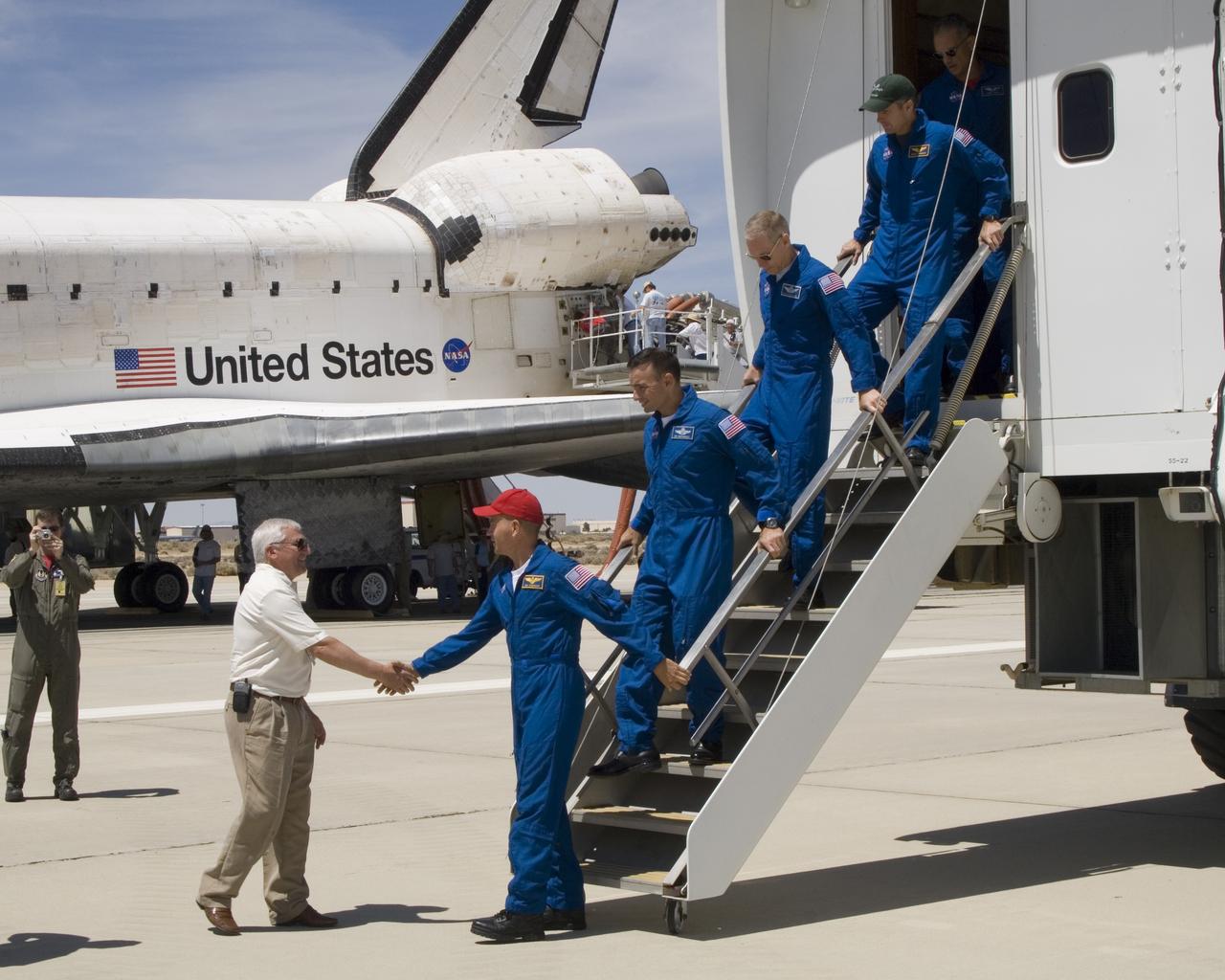
DFRC Center Director Kevin Petersen greets STS-117 Commander Frederick Sturckow and the crew of the Space Shuttle Atlantis at Edwards, AFB, Calif., on June 22, 2007. Left to right: DFRC Center Director Kevin Petersen, Commander Frederick Sturckow, Pilot Lee Archambault, and mission specialists Patrick Forrester, Steven Swanson and John D. Olivas.
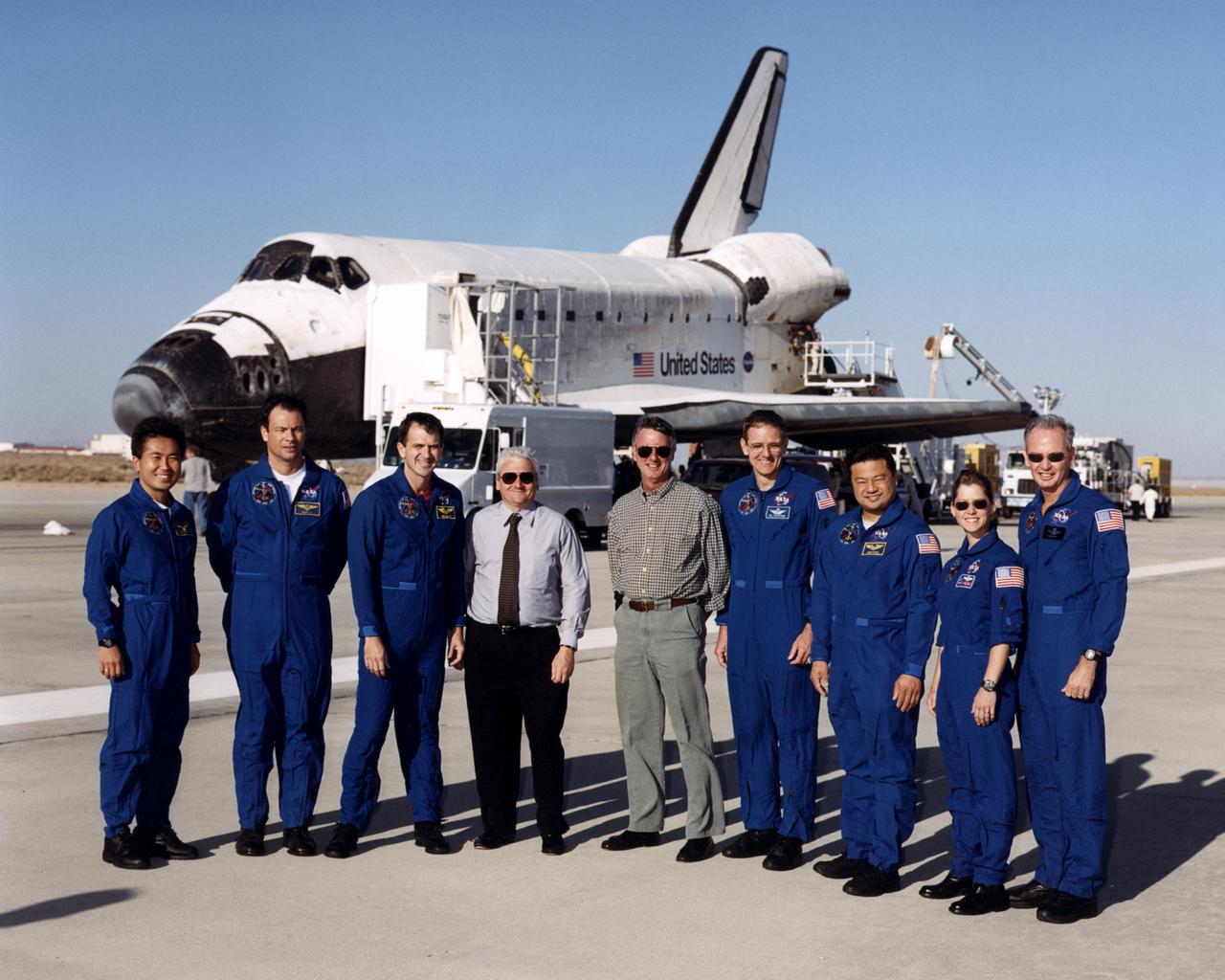
The seven-member crew of the Space Shuttle mission STS-92 gathered in front of the Shuttle Discovery shortly after landing at Edwards Air Force Base in Southern California October 24, 2000. They are seen here with NASA Dryden Fight Research Center Director Kevin Petersen and Deputy Director Wallace Sawyer. From left are mission specialists Koichi Wakata, Michael Lopez-Alegria, Jeff Wisoff, Bill McArthur and Leroy Chiao, pilot Pam Melroy and mission commander Brian Duffy. Between Jeff Wisoff and Brian McArthur are Kevin Petersen and Wally Sawyer, wearing ordinary civilian clothing.
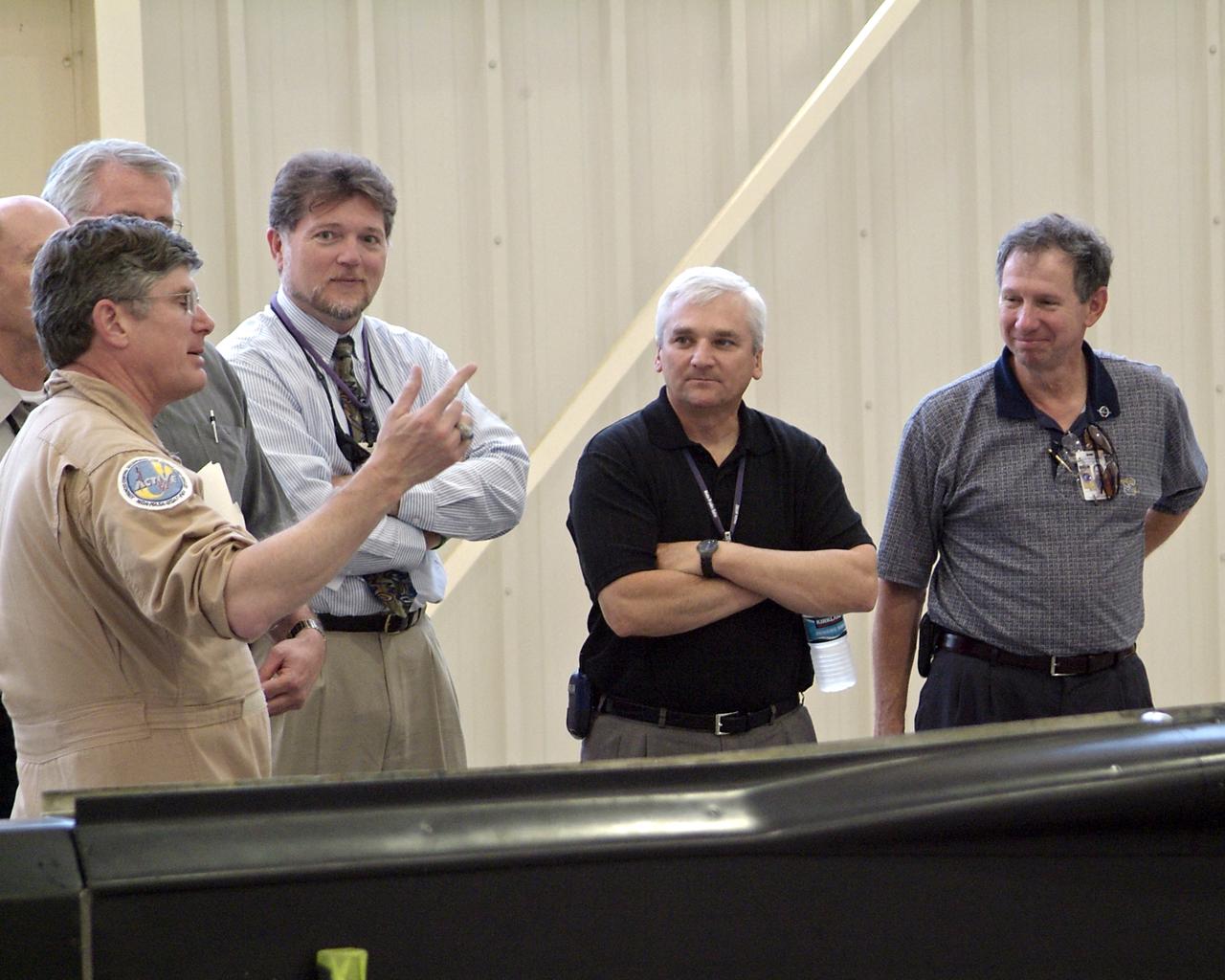
NASA Dryden research pilot Jim Smolka (left) details a recent flight experiment on a modified F-15B research aircraft to test range program manager Jerry McKee, center director Kevin Petersen and NASA Administrator Michael Griffin (right) during Griffin's initial visit to NASA's Dryden Flight Research Center on Tuesday, May 24.
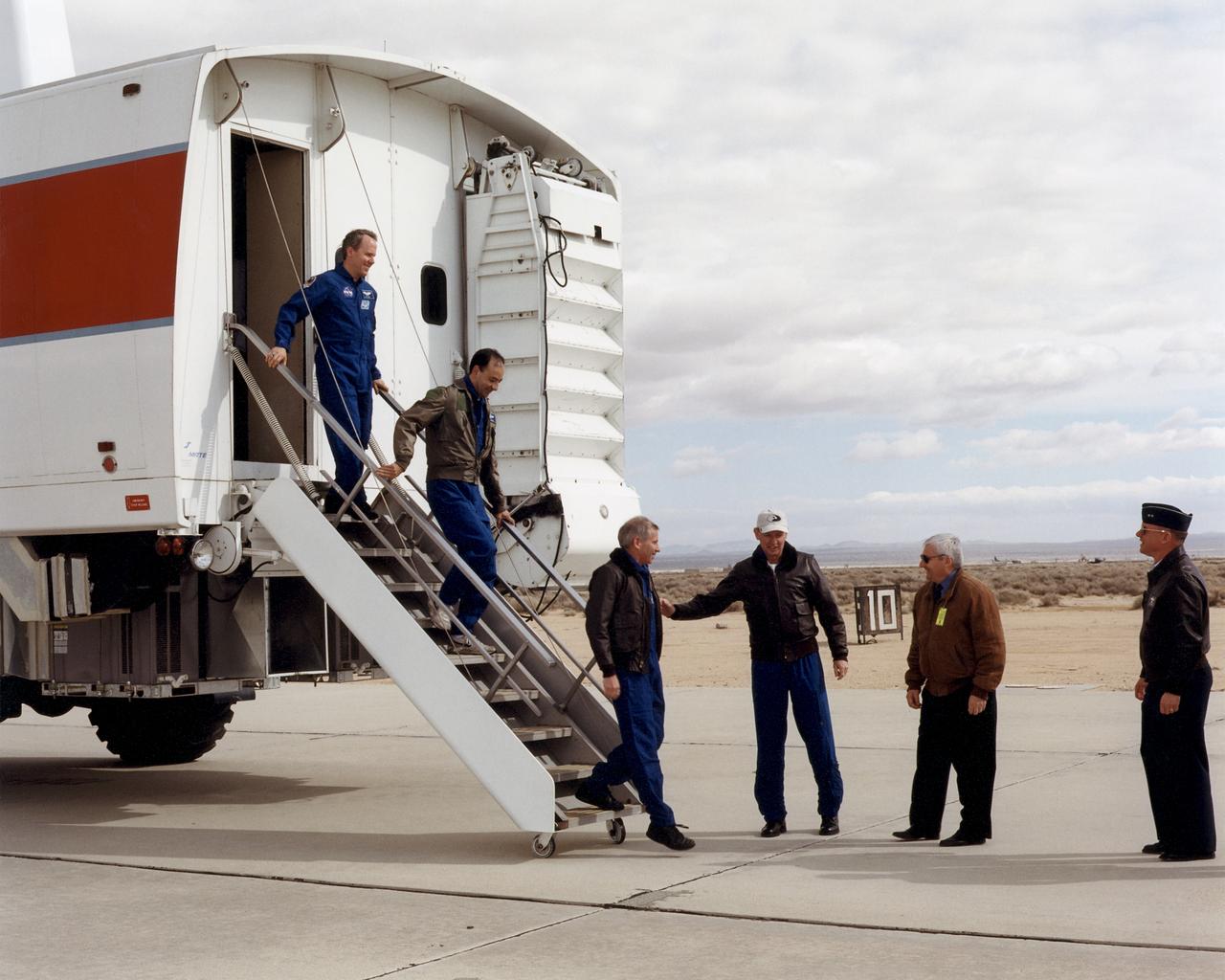
L to R: STS-98 Mission Specialist Thomas Jones, Pilot Mark Polansky, and Commander Kenneth Cockrell greet STS-92 Commander Brian Duffy, Dryden Center Director Kevin Petersen, and AFFTC Commander Major General Richard Reynolds after landing on the runway at Edwards Air Force Base, California, where NASA's Dryden Flight Research Center is located.
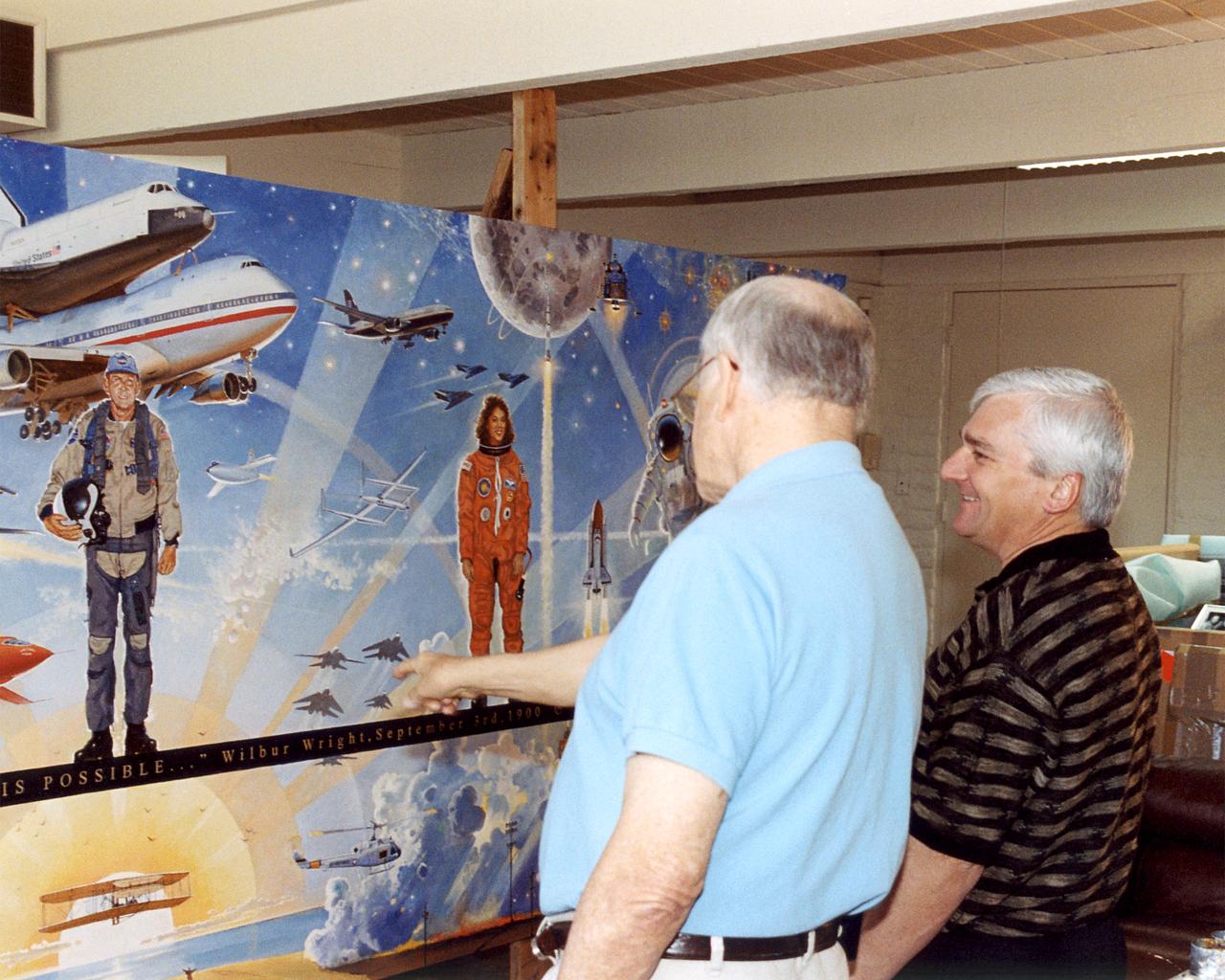
Bob Mccall and NASA Dryden Director Kevin Petersen stand by "Celebrating One Hundred Years of Powered Flight, 1903-2003", in the artist's studio in Paradise Valley, Arizona. The mural was created to celebrate the achievements of Wilbur and Orville Wright and to commemorate a century of powered flight. Many of the epic flights represented in the painting took place in the skies over NASA Dryden Flight Research Center. An equally important goal of this celebration will be to encourage the values that have characterized 100 years of aviation history: ingenuity, inventiveness, persistence, creativity and courage. These values hold true not just for pioneers of flight, but also for all pioneers of invention and innovation, and they will remain an important part of America's future. "Celebrating One Hundred Years of Powered Flight, 1903-2003", documents many significant achievements in aeronautics and space flight from the dawn of powered flight to the present. Historic aircraft and spacecraft serve as the backdrop, highlighting six figures representing the human element that made these milestones possible. These figures stand, symbolically supported by the words of Wilbur Wright, "It is my belief that flight is possible…" The quote was taken from a letter written to his father on September 3rd, 1900, announcing Wilbur's intention to make "some experiments with a flying machine" at Kitty Hawk, North Carolina. "This year, Bob is helping us commemorate the Centennial of Flight with a beautiful mural slated for placement in our Dryden Flight Research Center that documents the history of flight from the Wright Flyer to the International Space Station. We should all take note, I think, that in the grand scheme of things, one hundred years is a very short period of time. In that blink of an eye we've gone from Kitty Hawk to Tranquility Base and now look forward to our rovers traversing the surface of Mars. Despite the challenges we face, the future we envision, like the fu

NASA's Dryden Flight Research Center marked its 60th anniversary as the aerospace agency's lead center for atmospheric flight research and operations in 2006. In connection with that milestone, hundreds of the center's staff and retirees gathered in nearby Lancaster, Calif., in November 2006 to reflect on the center's challenges and celebrate its accomplishments over its six decades of advancing the state-of-the-art in aerospace technology. The center had its beginning in 1946 when a few engineers from the National Advisory Committee for Aeronautics' Langley Memorial Aeronautical Laboratory were detailed to Muroc Army Air Base (now Edwards Air Force Base) in Southern California's high desert to support the joint Army Air Force / NACA / Bell Aircraft XS-1 research airplane program. Since that inauspicious beginning, the center has been at the forefront of many of the advances in aerospace technology by validating advanced concepts through actual in-flight research and testing. Dryden is uniquely situated to take advantage of the excellent year-round flying weather, remote area, and visibility to test some of the nation�s most exciting aerospace vehicles. Today, NASA Dryden is NASA's premier flight research and test organization, continuing to push the envelope in the validation of high-risk aerospace technology and space exploration concepts, and in conducting airborne environmental and space science missions in the 21st century.
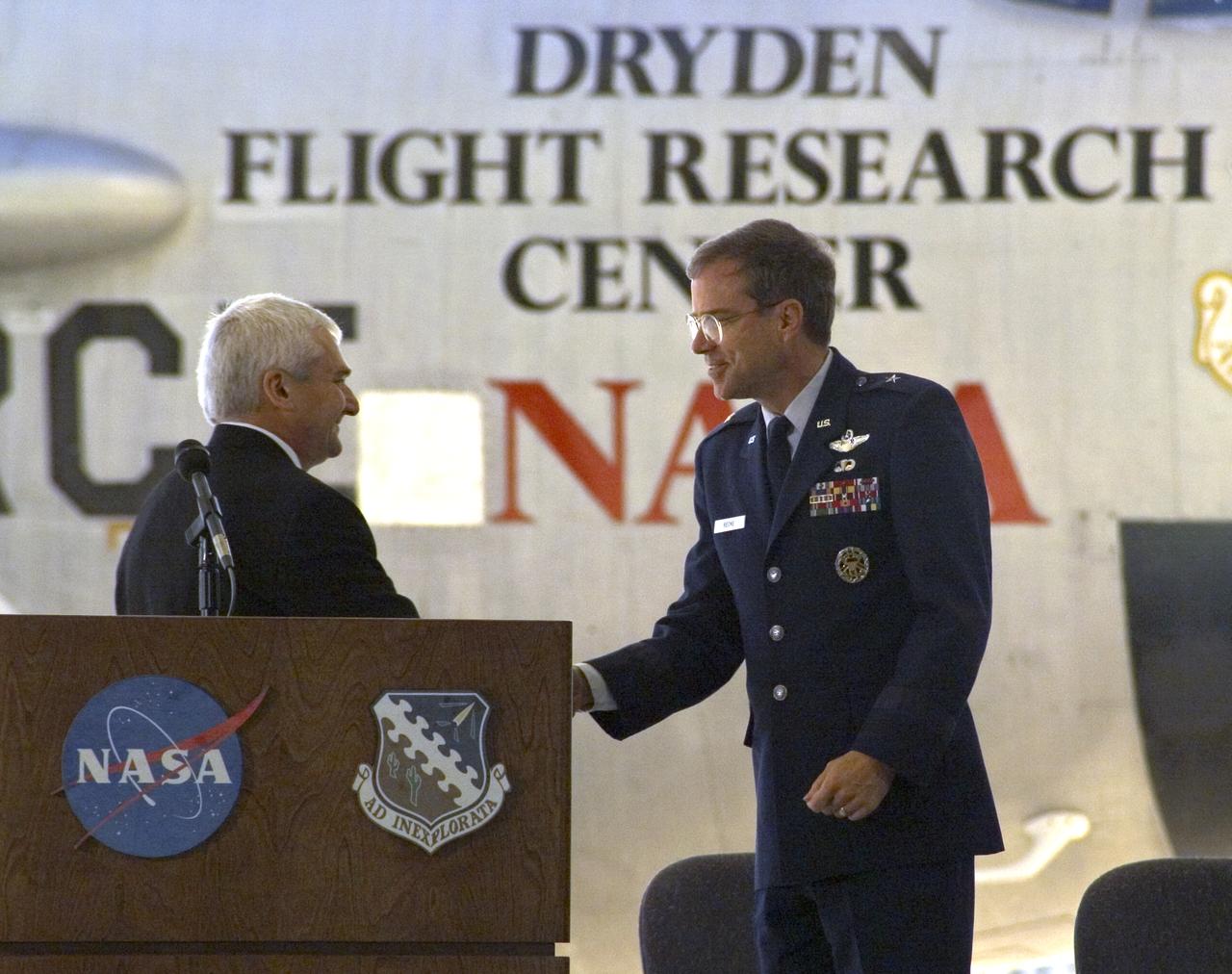
Dryden Center director Kevin Petersen shakes hands with AFFTC commander, Brig. Gen. Curtis Bedke, at the retirement ceremony for NASA's B-52B.
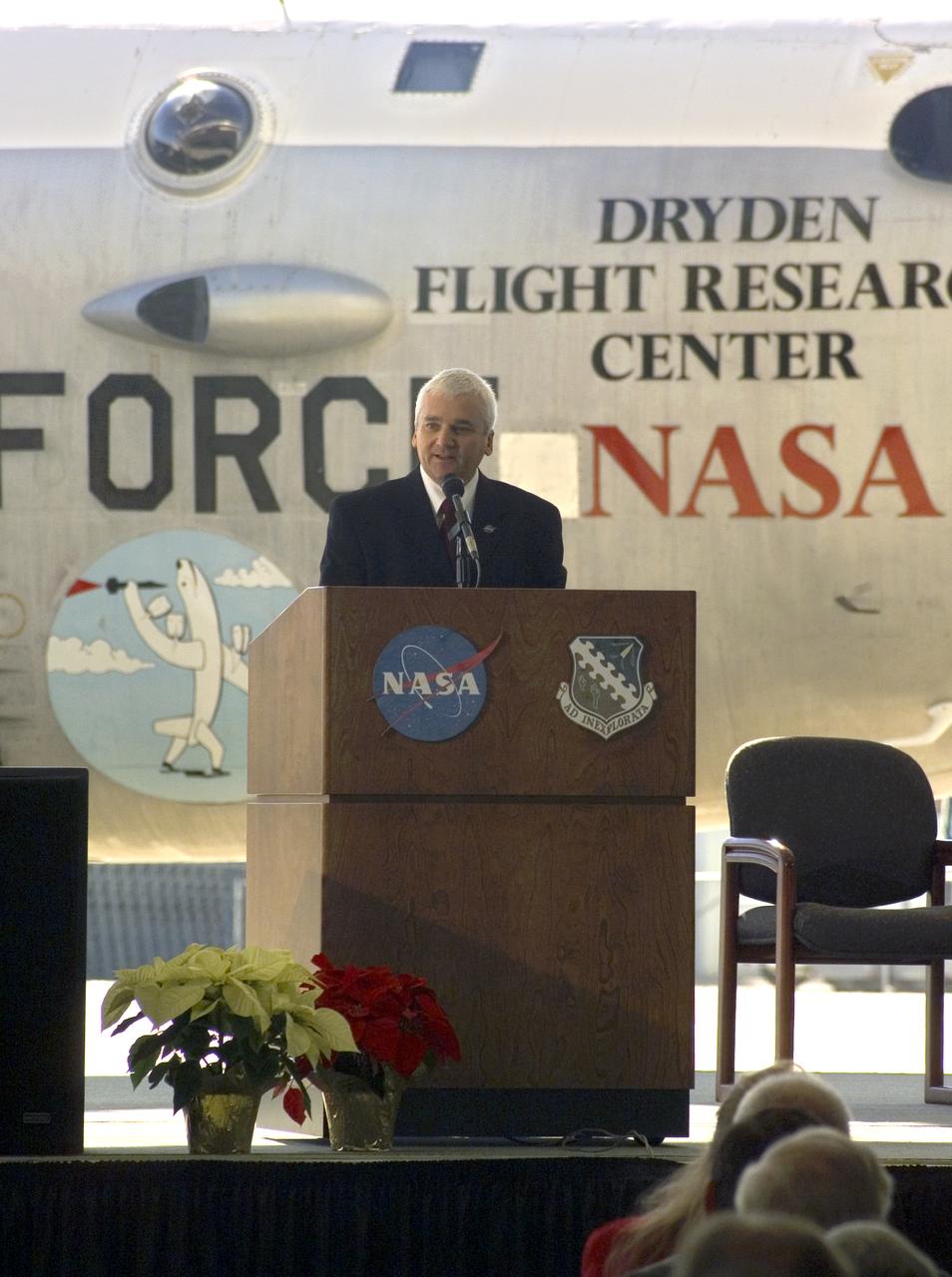
DFRC director Kevin Petersen speaks to an audience of NASA and Air Force visitors, employees and special guests at the retirement ceremony for NASA's B-52B.
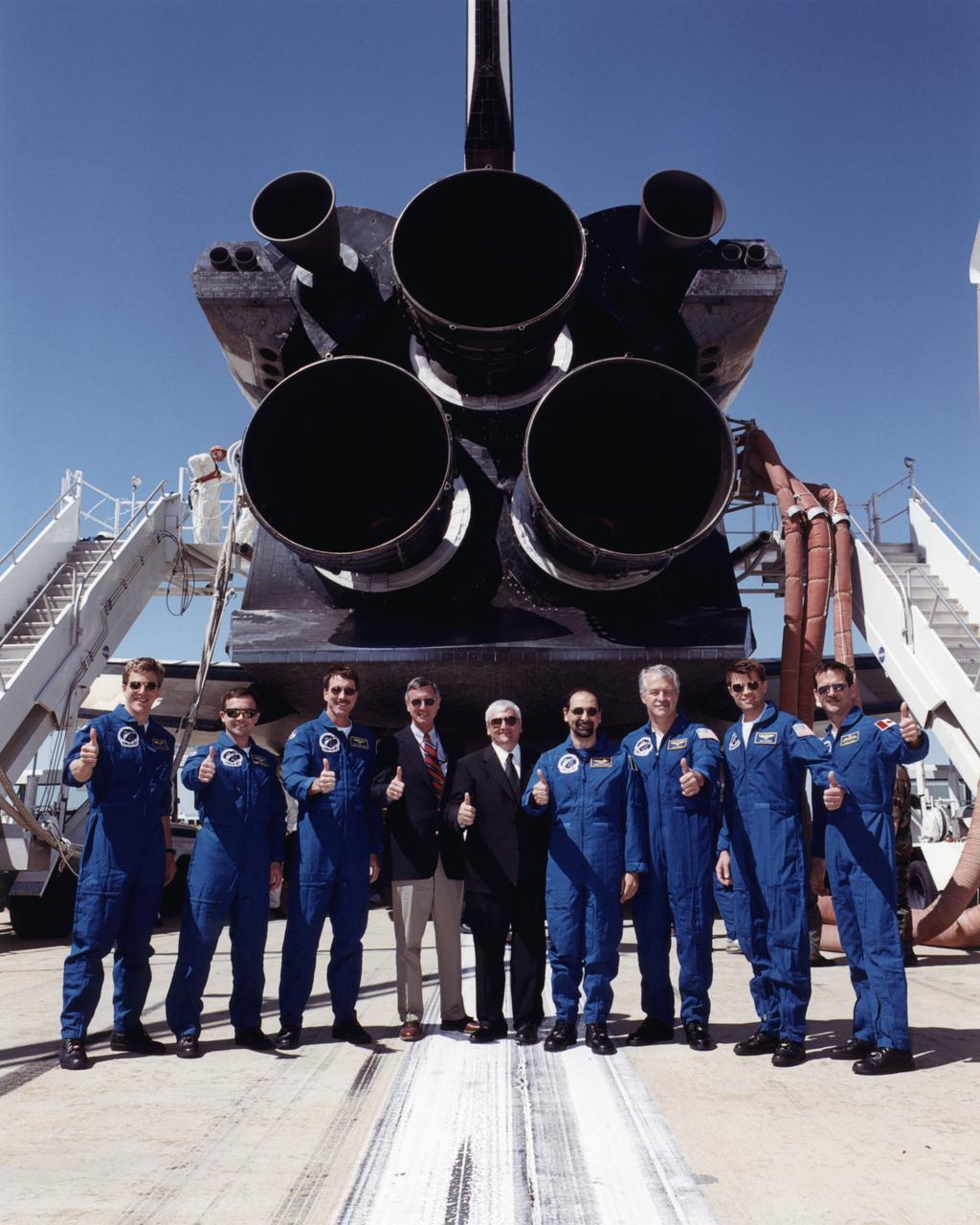
A happy "thumbs up" from the crew of the Space Shuttle Endeavour and NASA Dryden Flight Research Center officials heralded the successful completion of mission STS-100. Standing by the shuttle's rocket nozzles from left to right: Scott E. Prazynski, mission specialist (U.S.); Yuri V. Lonchakov, mission specialist (Russia); Kent V. Rominger, commander (U.S.); Wally Sawyer, NASA Dryden Flight Research Center deputy director; Kevin Petersen, NASA Dryden Flight Research Center director; Umberto Guidoni, mission specialist (European Space Agency); John L. Phillips, mission specialist (U.S.); Jeffrey S. Ashby, pilot (U.S.); and Chris A. Hadfield, mission specialist (Canadian Space Agency). The mission landed at Edwards Air Force Base, California, on May 1, 2001.
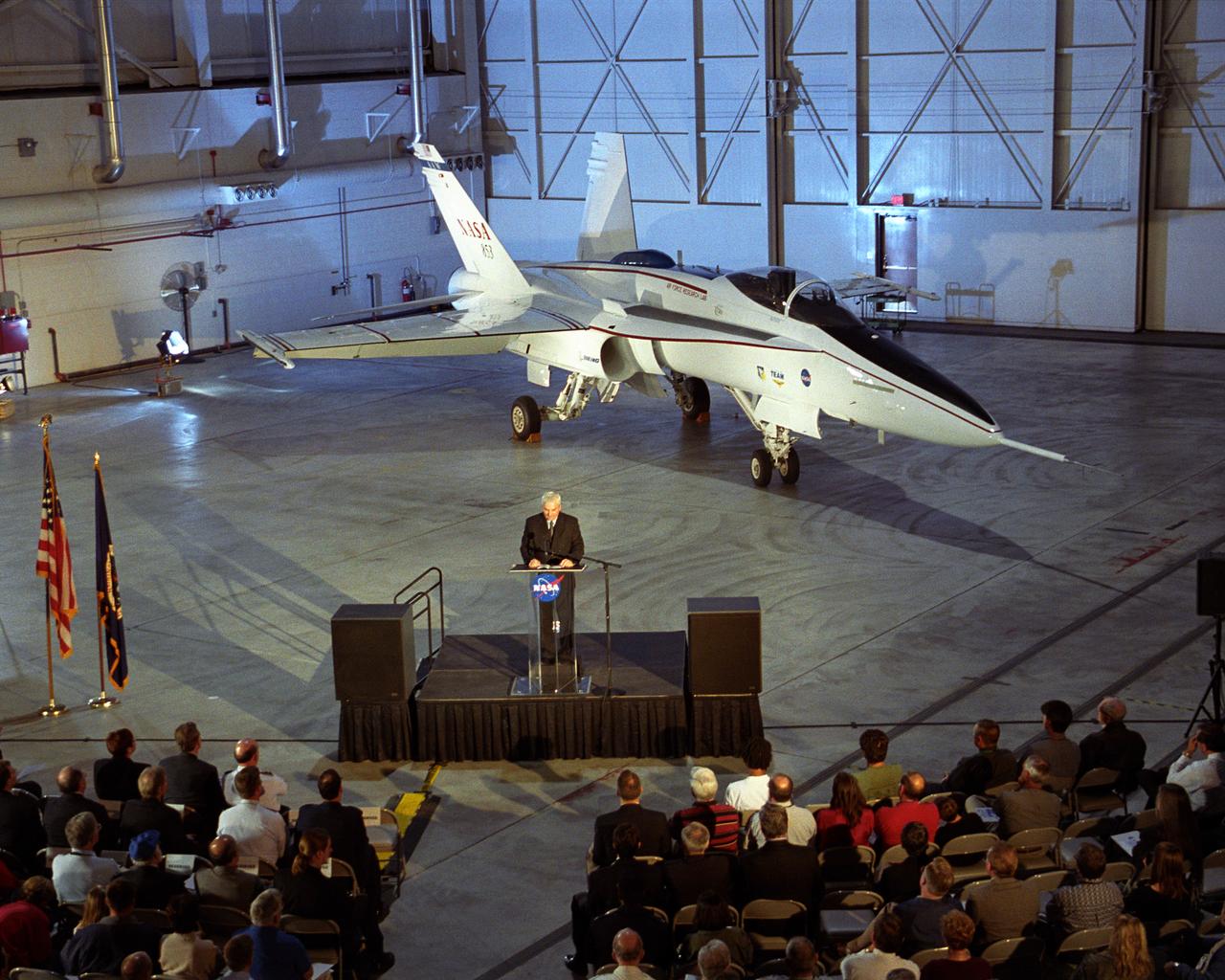
With the modified F/A-18 showcased behind him, Kevin Petersen, director of NASA Dryden Flight Research Center, addressed the audience attending the rollout ceremonies for the Active Aeroelastic Wing flight research project.
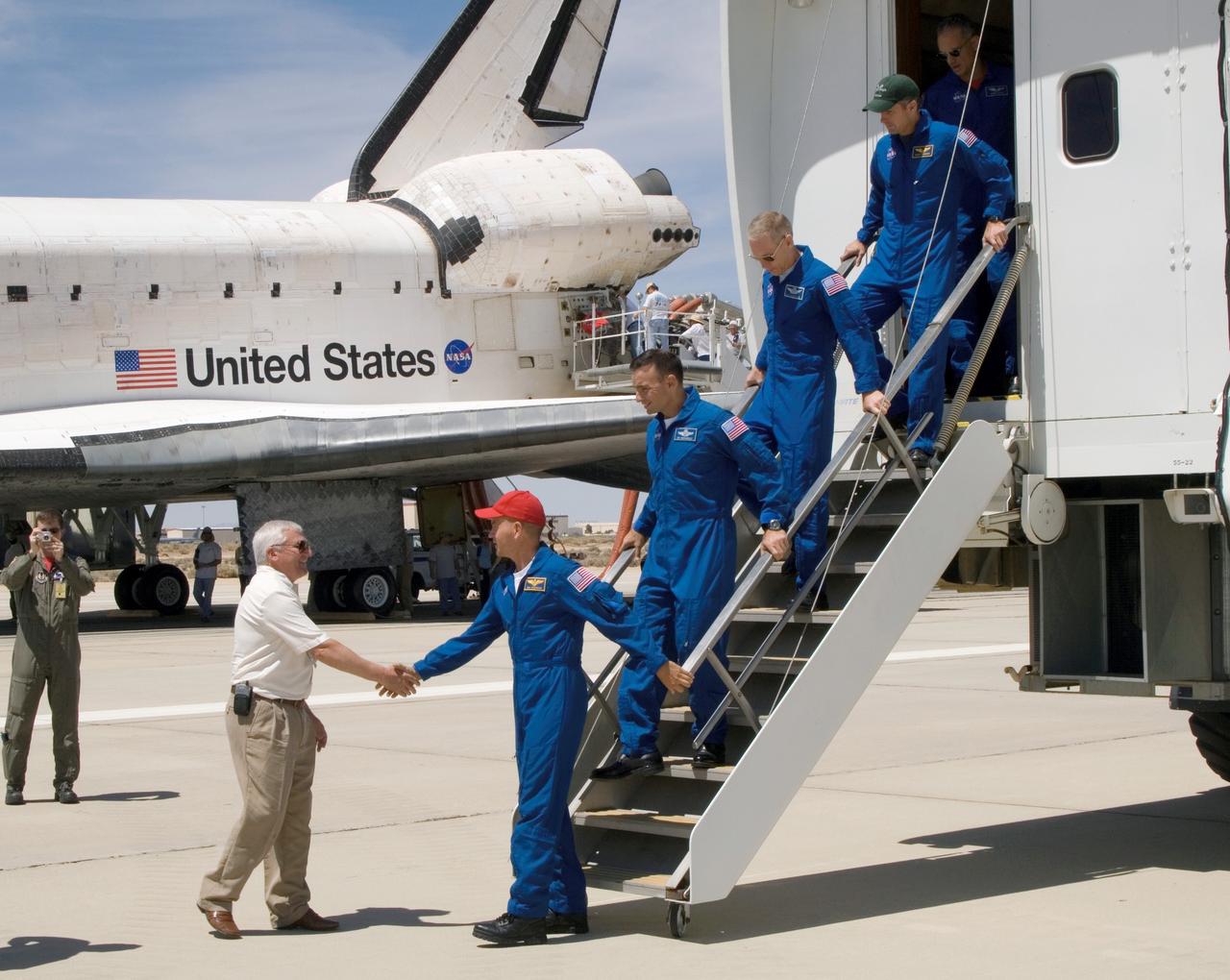
STS117-S-051 (22 June 2007) --- NASA Dryden Flight Research Center director Kevin Petersen greets astronaut Rick Sturckow, STS-117 commander, as the crewmembers exit NASA's Crew Transport Vehicle (CTV) after a successful landing at 12:49 p.m. (PDT) on June 22, 2007 at Edwards Air Force Base in California. Following behind Sturckow are astronauts Lee Archambault, pilot; Patrick Forrester, Steven Swanson and John "Danny" Olivas, all mission specialists. Not pictured is astronaut Jim Reilly, mission specialist.
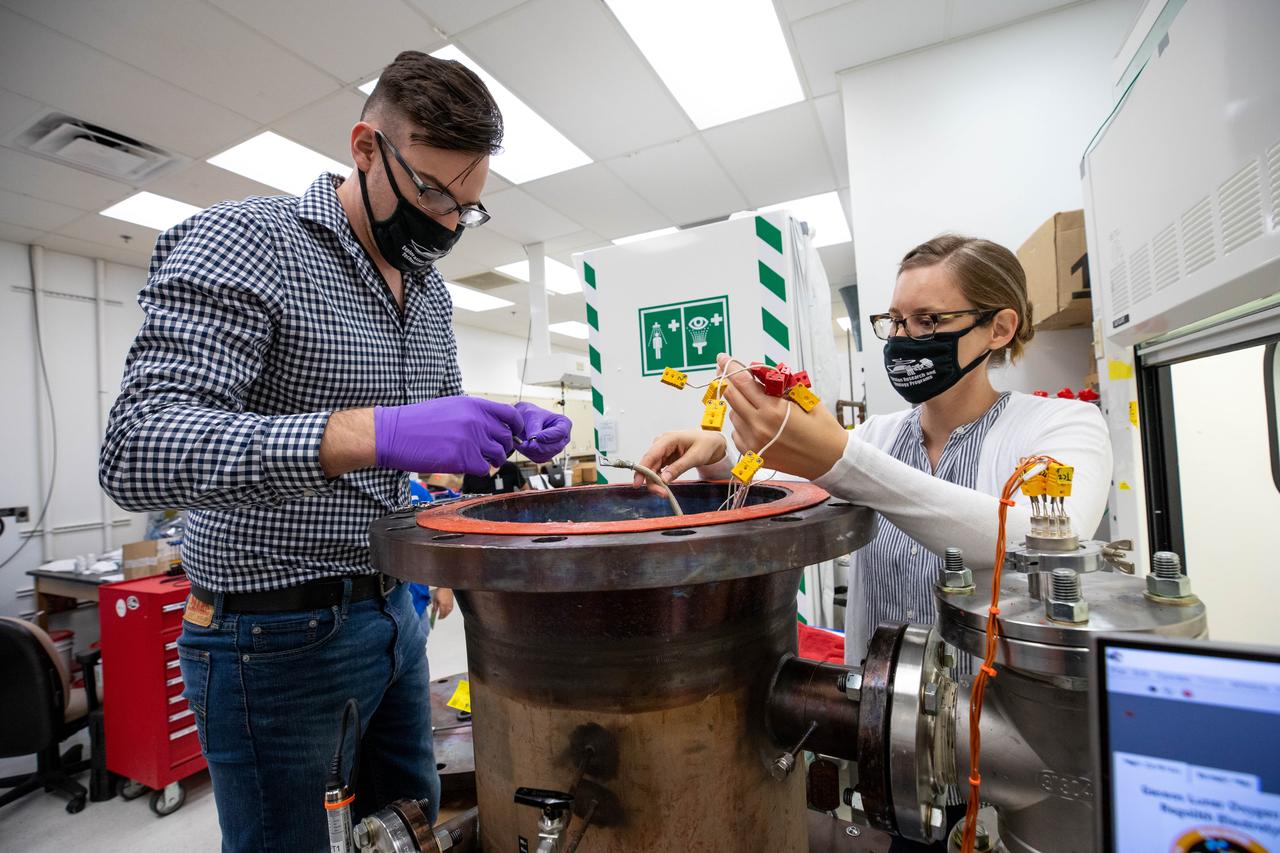
Kevin Grossman, left, principal investigator of the Gaseous Lunar Oxygen from Regolith Electrolysis (GaLORE) project, and Elspeth Petersen, a chemical engineer and member of the GaLORE team, check some of the project’s hardware that will be used to melt lunar regolith – dirt and dust on the Moon made from crushed rock – simulants during a test inside a laboratory at Kennedy’s Neil Armstrong Operations and Checkout Building on Oct. 29, 2020. GaLORE was selected as an Early Career Initiative project by the agency’s Space Technology Mission directorate, and the team was tasked with developing a device that could melt lunar regolith and turn it into oxygen. As NASA prepares to land the first woman and the next man on the Moon in 2024 as part of the Artemis program, technology such as this can assist with sustainable human lunar exploration and long-duration missions to Mars.
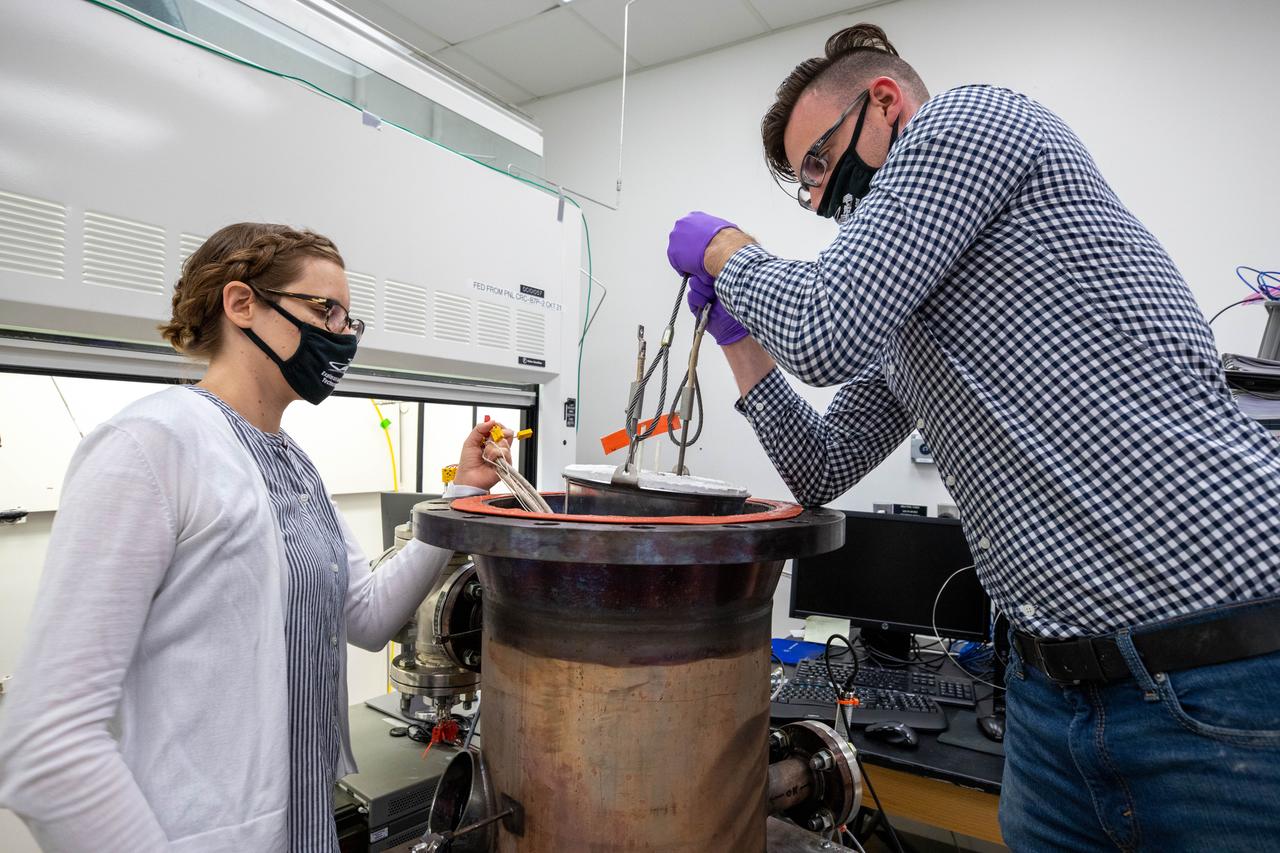
Elspeth Petersen, left, a chemical engineer and member of the Gaseous Lunar Oxygen from Regolith Electrolysis (GaLORE) project team, and Kevin Grossman, GaLORE principal investigator, inspect a reactor before a test to melt lunar regolith – dirt and dust on the Moon made from crushed rock – simulants inside a laboratory at Kennedy’s Neil Armstrong Operations and Checkout Building on Oct. 29, 2020. GaLORE was selected as an Early Career Initiative project by the agency’s Space Technology Mission directorate, and the team was tasked with developing a device that could melt lunar regolith and turn it into oxygen. As NASA prepares to land the first woman and the next man on the Moon in 2024 as part of the Artemis program, technology such as this can assist with sustainable human lunar exploration and long-duration missions to Mars.
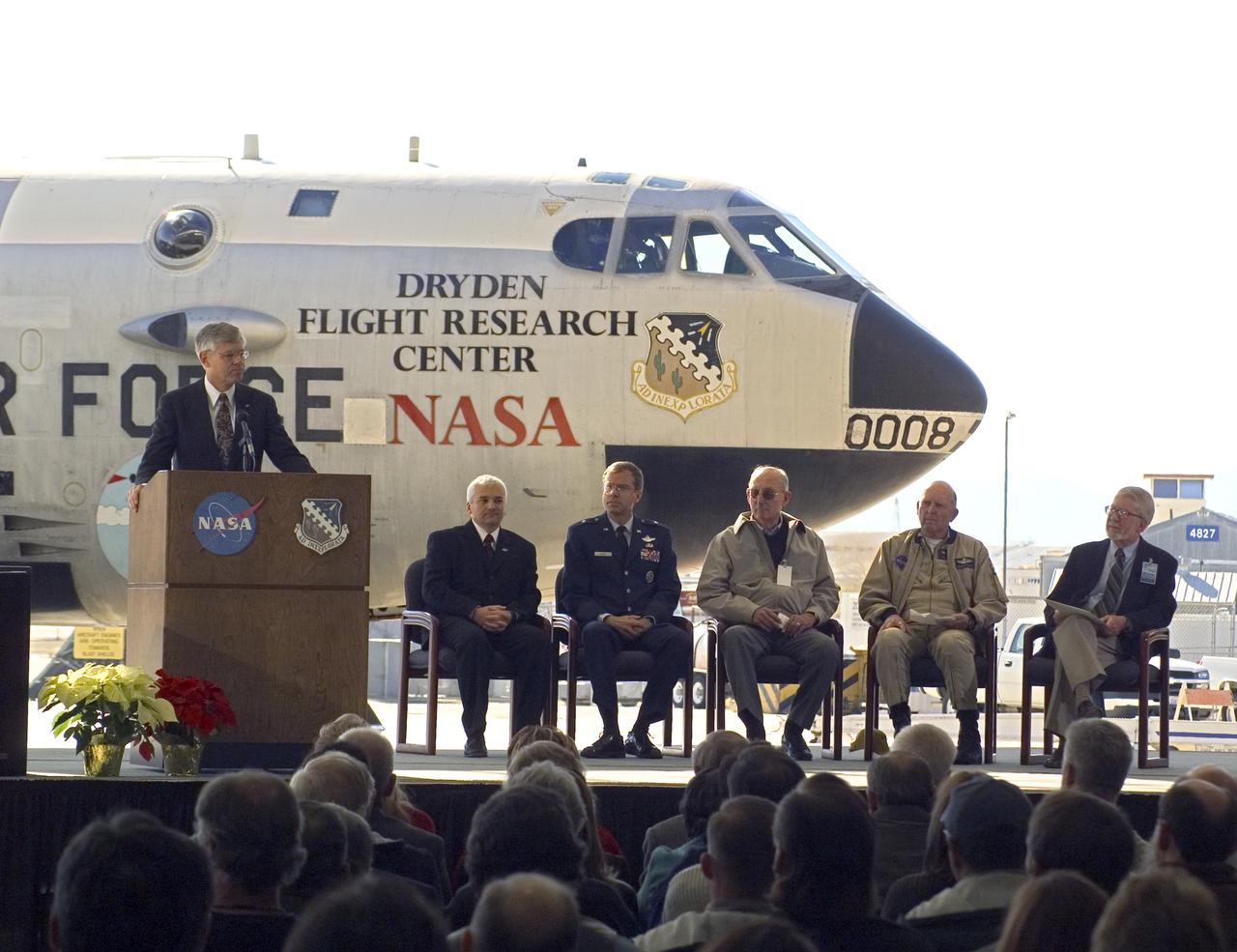
Retired NASA Dryden research pilot Ed Schneider served as master of ceremonies at the retirement ceremony for NASA's B-52B, on Dec. 17, 2004.