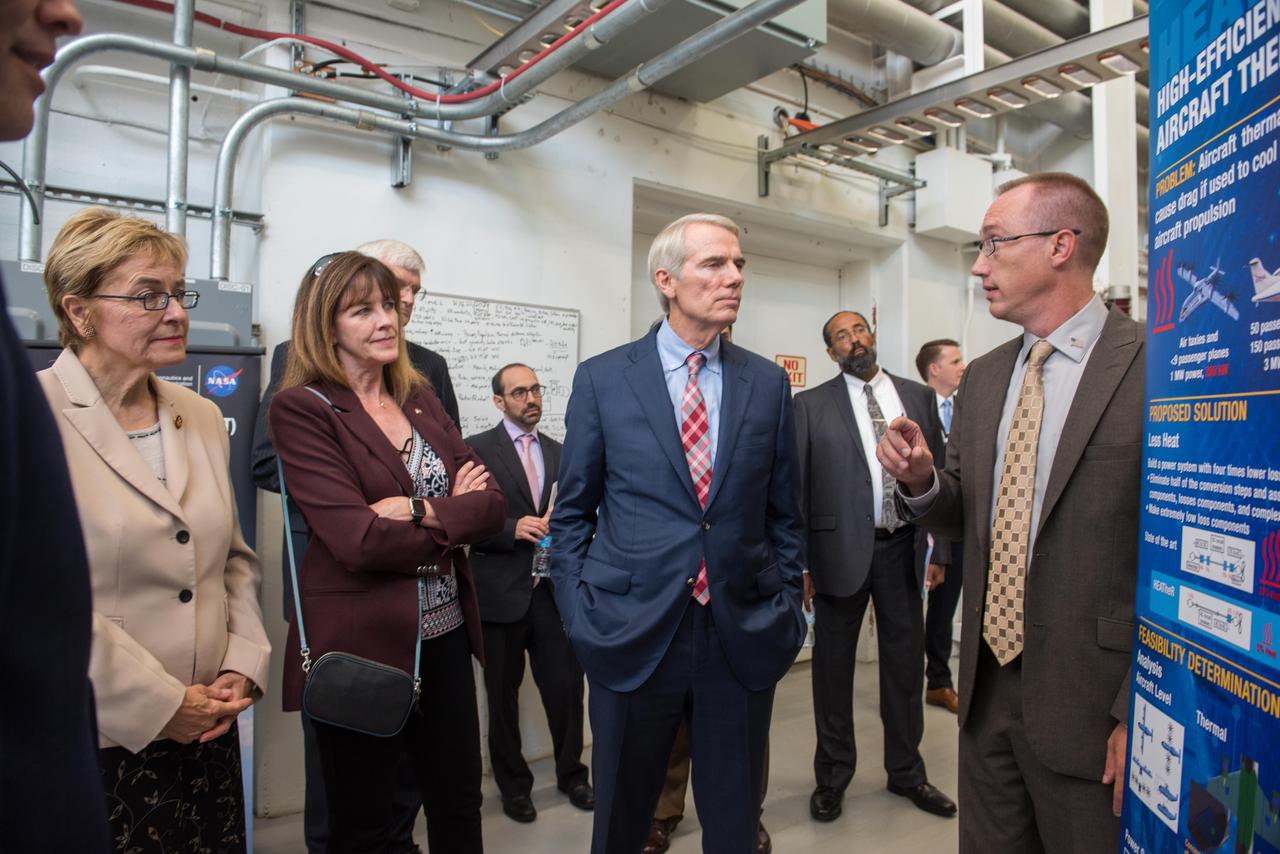
NASA Administrator Jim Bridenstine and Congressional Delegation Visit to Lewis Field and Plum Brook Station
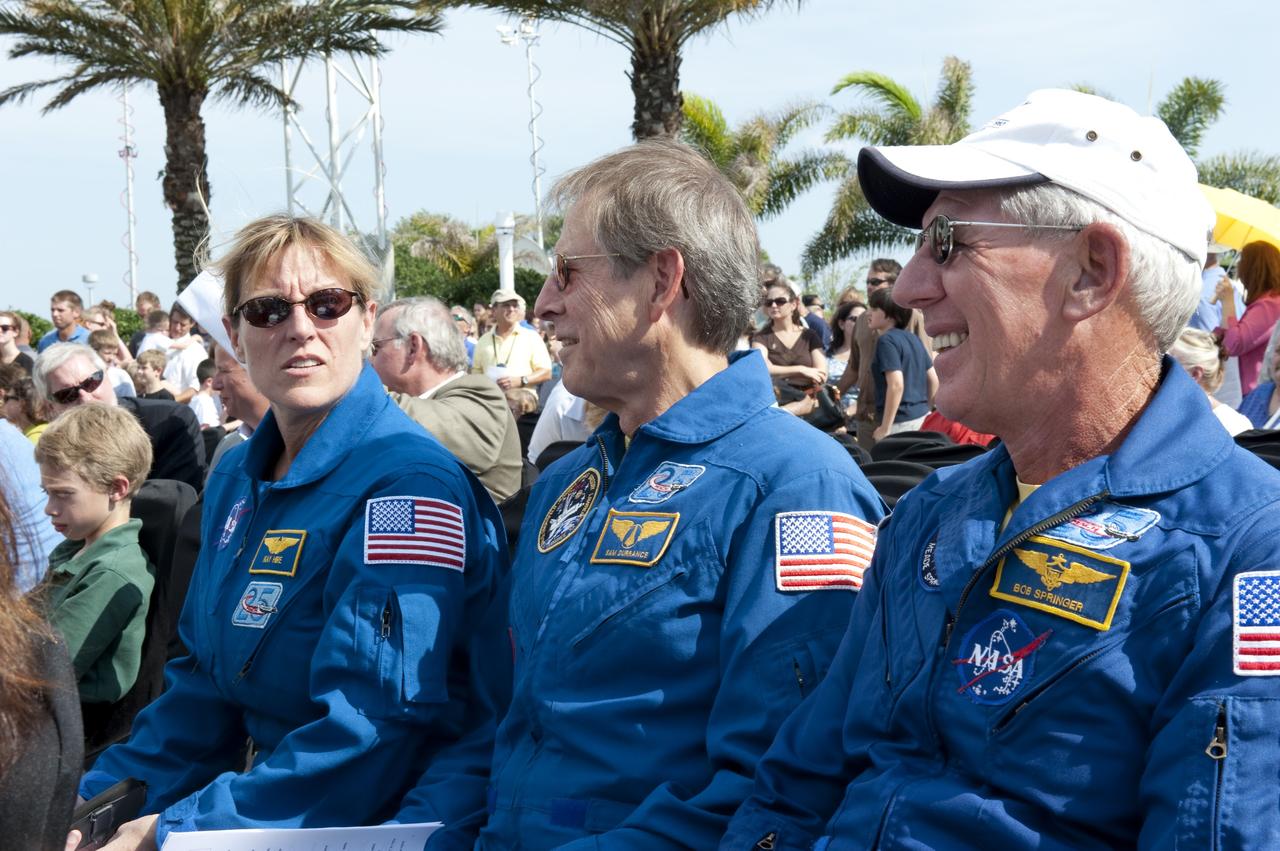
CAPE CANAVERAL, Fla. -- NASA Astronaut Kay Hire and former NASA Astronauts Sam Durrance and Bob Springer take a moment to converse on a very warm, sunny Florida afternoon while attending the 30th anniversary celebration in honor of the Space Shuttle Program's first shuttle launch. The event is being held at NASA's Kennedy Space Center Visitor Complex. The celebration followed an announcement by NASA Administrator Charles Bolden where the four orbiters will be placed for permanent display after retirement. Photo credit: NASA/Kim Shiflett
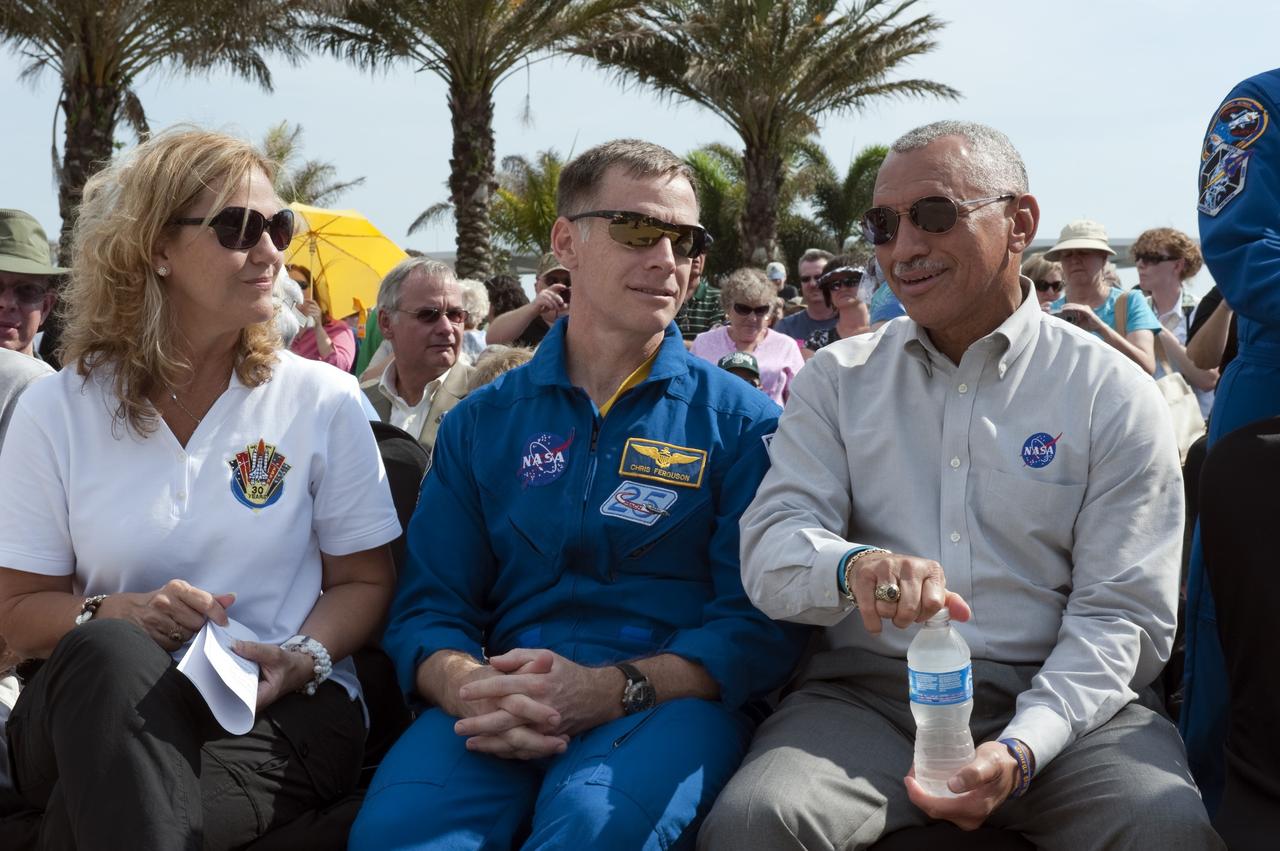
CAPE CANAVERAL, Fla. -- Patty Stratton, associate program manager for Ground Operations at United Space Alliance, NASA Astronaut and STS-135 Commander Chris Ferguson and NASA Administrator Charles Bolden take a moment to converse on a very warm, sunny Florida afternoon while attending the 30th anniversary celebration in honor of the Space Shuttle Program's first shuttle launch. The event is being held at NASA's Kennedy Space Center Visitor Complex. The celebration followed an announcement by NASA Administrator Charles Bolden where the four orbiters will be placed for permanent display after retirement. Photo credit: NASA/Kim Shiflett
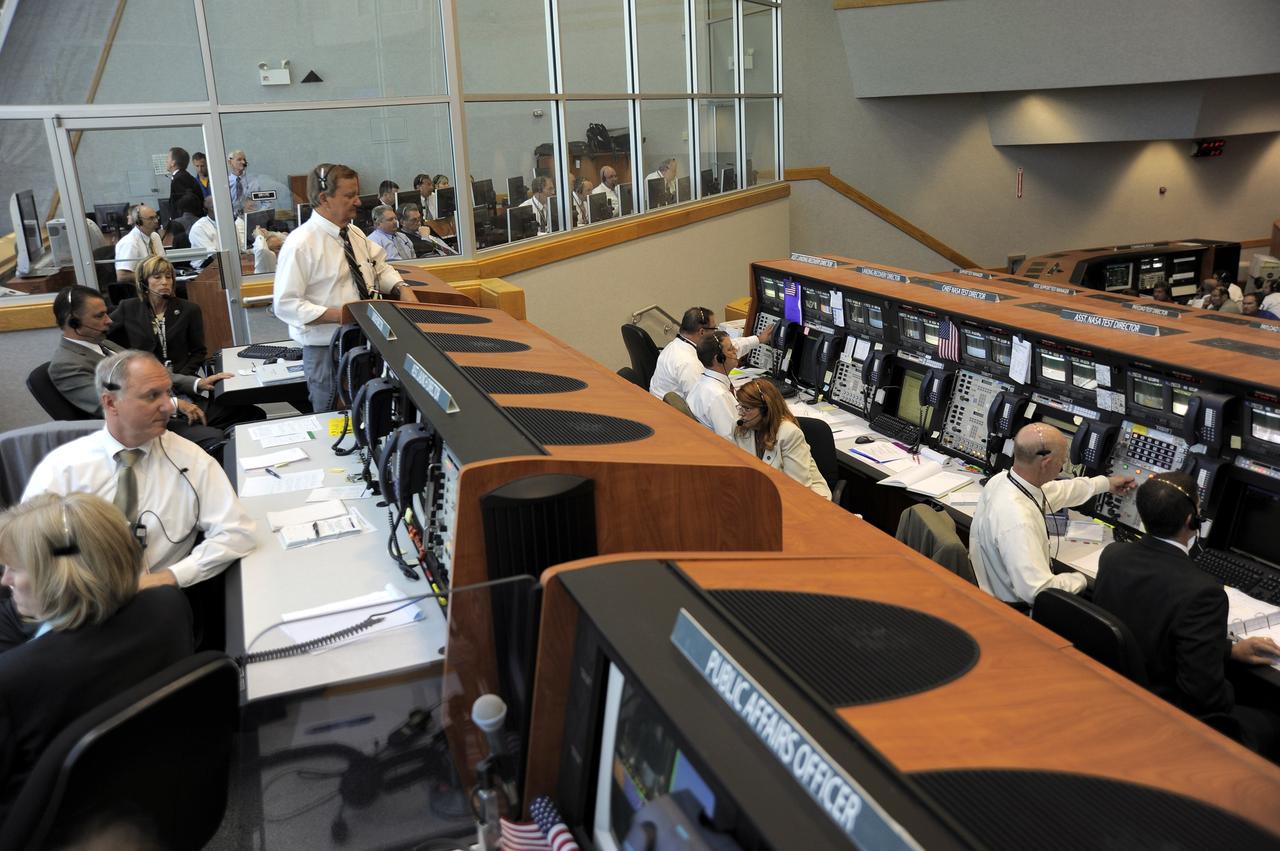
CAPE CANAVERAL, Fla. -- In Firing Room 4 of the Launch Control Center at NASA's Kennedy Space Center in Florida, launch controllers keep track of the upcoming launch of space shuttle Atlantis on its STS-132 mission to the International Space Station. The launch team worked very few issues during the countdown and picture-perfect weather led to an on-time launch at 2:20 p.m. EDT on May 14. STS-132 is the 132nd shuttle flight, the 32nd for Atlantis and the 34th shuttle mission dedicated to station assembly and maintenance. For more information on the STS-132 mission objectives, payload and crew, visit www.nasa.gov/mission_pages/shuttle/shuttlemissions/sts132/index.html. Photo credit: NASA/Kim Shiflett
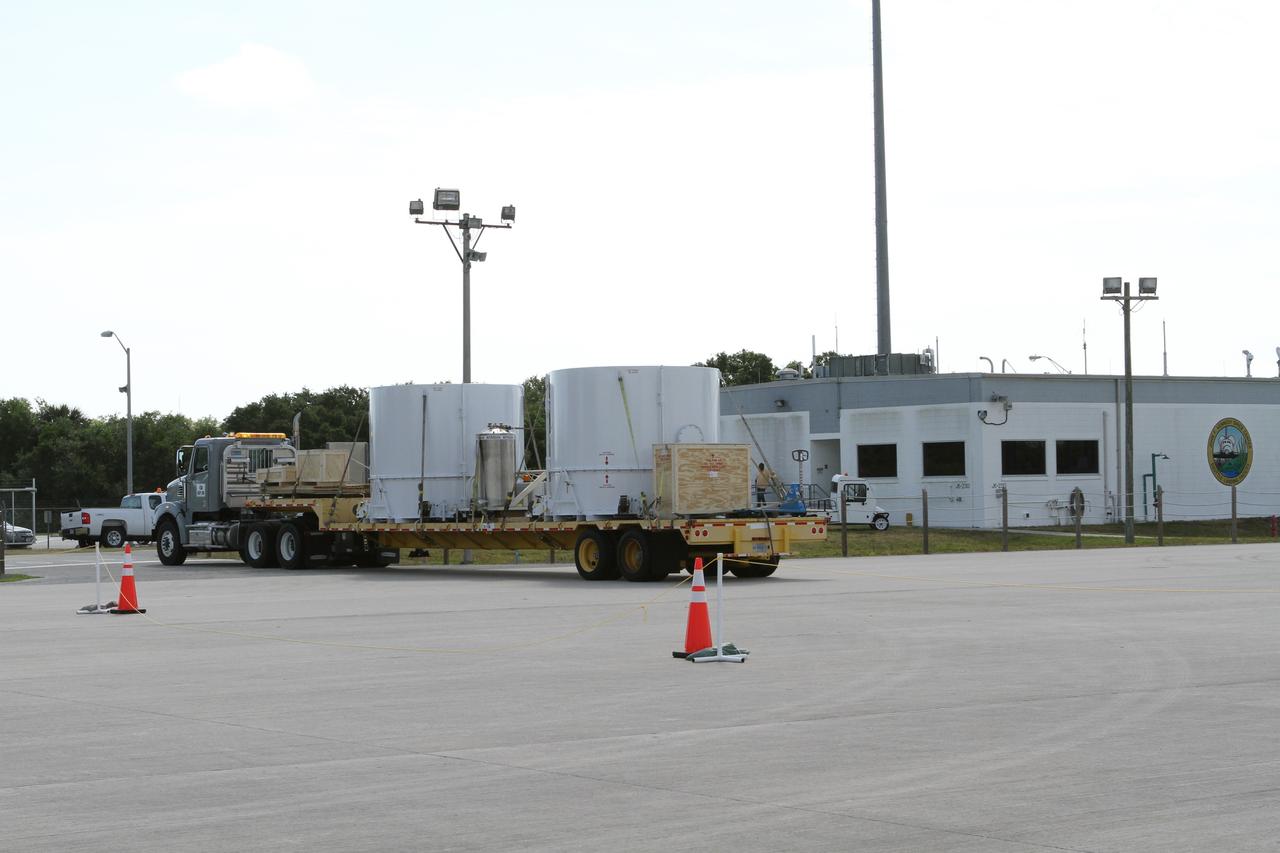
CAPE CANAVERAL, Fla. – NASA's twin Radiation Belt Storm Probes, enclosed in protective shipping containers, depart from the Shuttle Landing Facility at NASA’s Kennedy Space Center in Florida aboard a flatbed truck. The spacecraft were delivered in the cargo bay of a U.S. Air Force C-17 aircraft earlier in the day and are on their way to the Astrotech payload processing facility near Kennedy Space Center where Applied Physics Laboratory technicians will begin spacecraft testing and prelaunch preparations. The RBSP mission will help us understand the sun’s influence on Earth and near-Earth space by studying the Earth’s radiation belts on various scales of space and time. The RBSP instruments will provide the measurements needed to characterize and quantify the plasma processes that produce very energetic ions and relativistic electrons. The mission is part of NASA’s broader Living With a Star Program that was conceived to explore fundamental processes that operate throughout the solar system, and in particular those that generate hazardous space weather effects in the vicinity of Earth and phenomena that could impact solar system exploration. RBSP is scheduled to begin its mission of exploration of Earth's Van Allen Radiation Belts and the extremes of space weather after launch. Launch aboard a United Launch Alliance Atlas V rocket is scheduled for August 23. For more information, visit http://www.nasa.gov/rbsp. Photo credit: NASA/Kim Shiflett
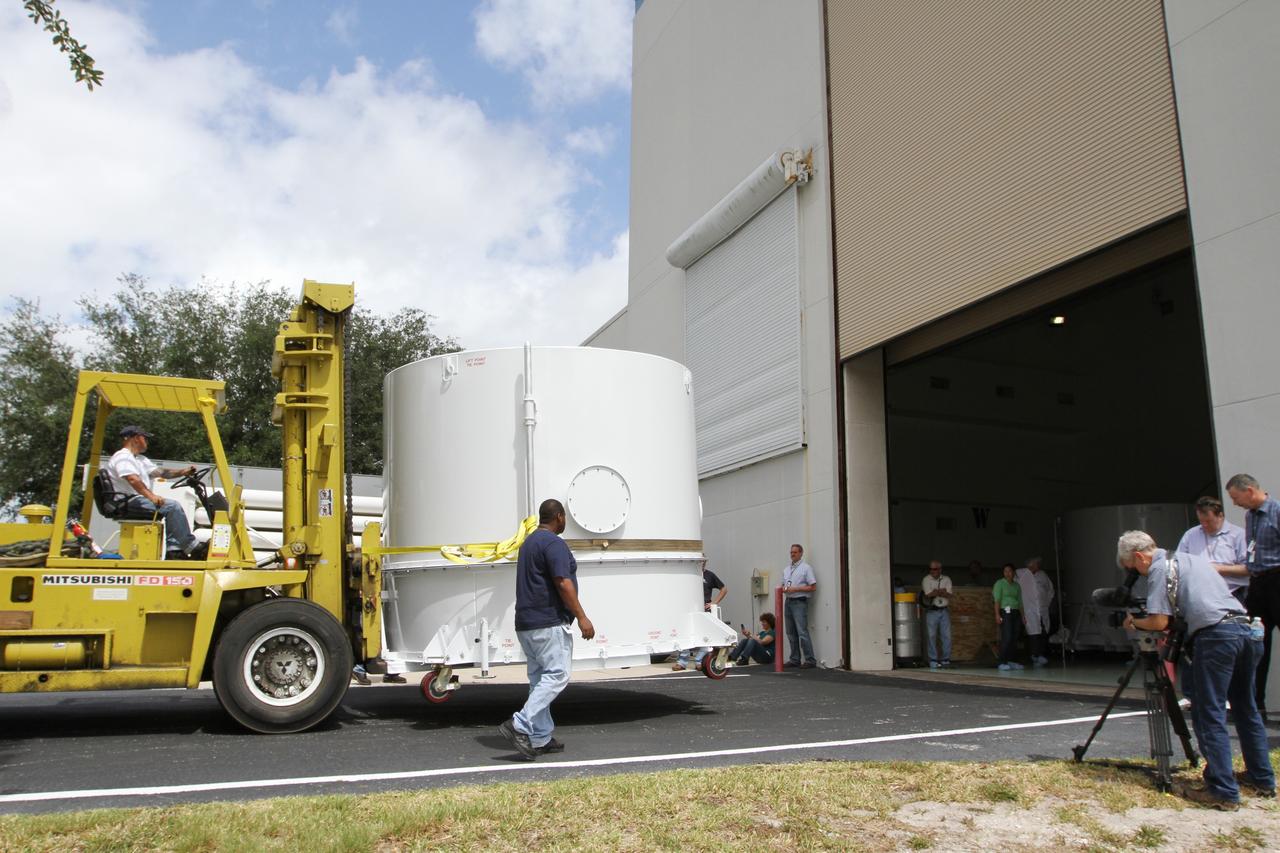
CAPE CANAVERAL, Fla. – A forklift operator moves NASA's Radiation Belt Storm Probe B, enclosed in a protective shipping container, toward the open bay door of the Astrotech payload processing facility near NASA’s Kennedy Space Center in Florida where Applied Physics Laboratory technicians will begin spacecraft testing and prelaunch preparations. The twin RBSP spacecraft arrived at Kennedy’s Shuttle Landing Facility in the cargo bay of a U.S. Air Force C-17 aircraft earlier in the day. The RBSP mission will help us understand the sun’s influence on Earth and near-Earth space by studying the Earth’s radiation belts on various scales of space and time. The RBSP instruments will provide the measurements needed to characterize and quantify the plasma processes that produce very energetic ions and relativistic electrons. The mission is part of NASA’s broader Living With a Star Program that was conceived to explore fundamental processes that operate throughout the solar system, and in particular those that generate hazardous space weather effects in the vicinity of Earth and phenomena that could impact solar system exploration. RBSP is scheduled to begin its mission of exploration of Earth's Van Allen Radiation Belts and the extremes of space weather after launch. Launch aboard a United Launch Alliance Atlas V rocket is scheduled for August 23. For more information, visit http://www.nasa.gov/rbsp. Photo credit: NASA/Kim Shiflett
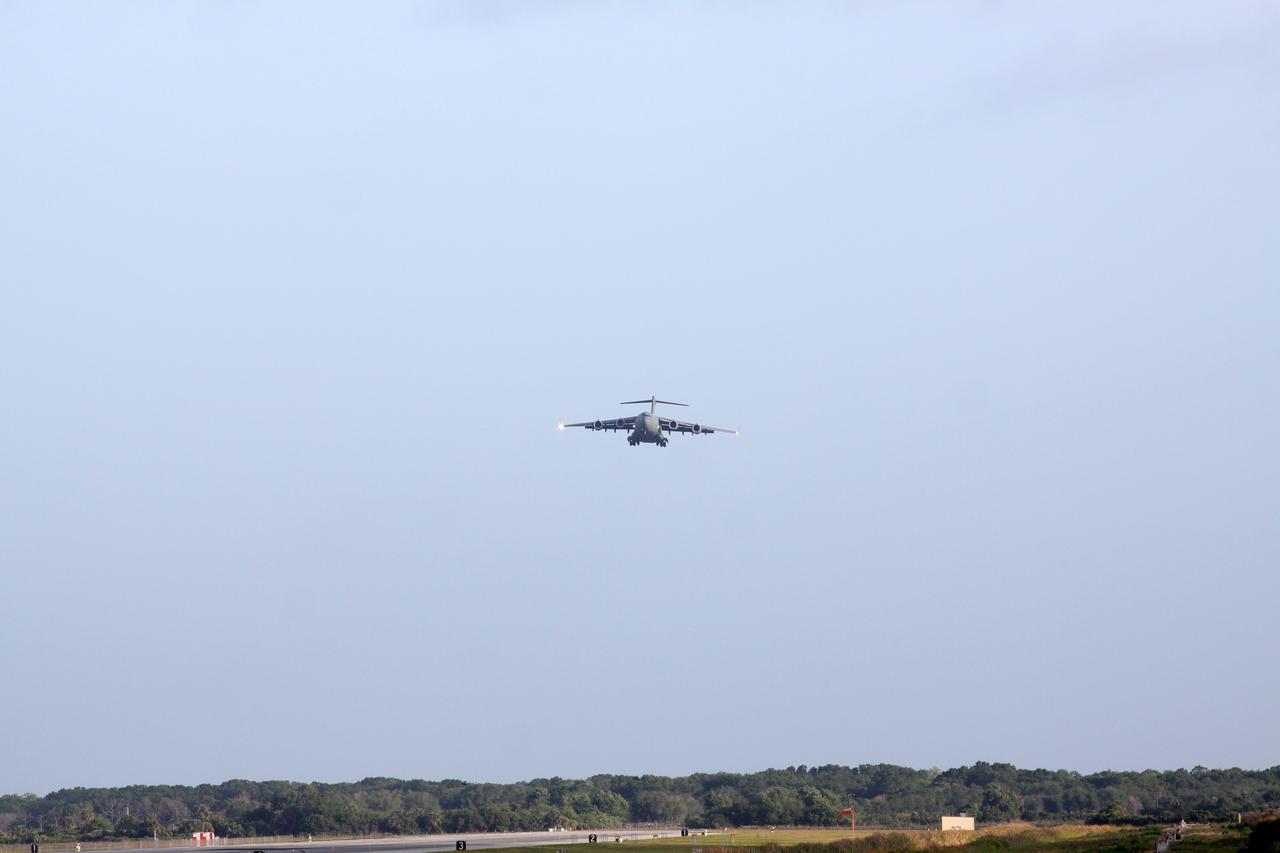
CAPE CANAVERAL, Fla. – A U.S. Air Force C-17 cargo aircraft approaches the Shuttle Landing Facility at NASA’s Kennedy Space Center in Florida. Aboard are NASA's twin Radiation Belt Storm Probes. The RBSP mission will help us understand the sun’s influence on Earth and near-Earth space by studying the Earth’s radiation belts on various scales of space and time. The RBSP instruments will provide the measurements needed to characterize and quantify the plasma processes that produce very energetic ions and relativistic electrons. The mission is part of NASA’s broader Living With a Star Program that was conceived to explore fundamental processes that operate throughout the solar system, and in particular those that generate hazardous space weather effects in the vicinity of Earth and phenomena that could impact solar system exploration. RBSP is scheduled to begin its mission of exploration of Earth's Van Allen Radiation Belts and the extremes of space weather after launch. Launch aboard a United Launch Alliance Atlas V rocket is scheduled for August 23. For more information, visit http://www.nasa.gov/rbsp. Photo credit: NASA/Kim Shiflett
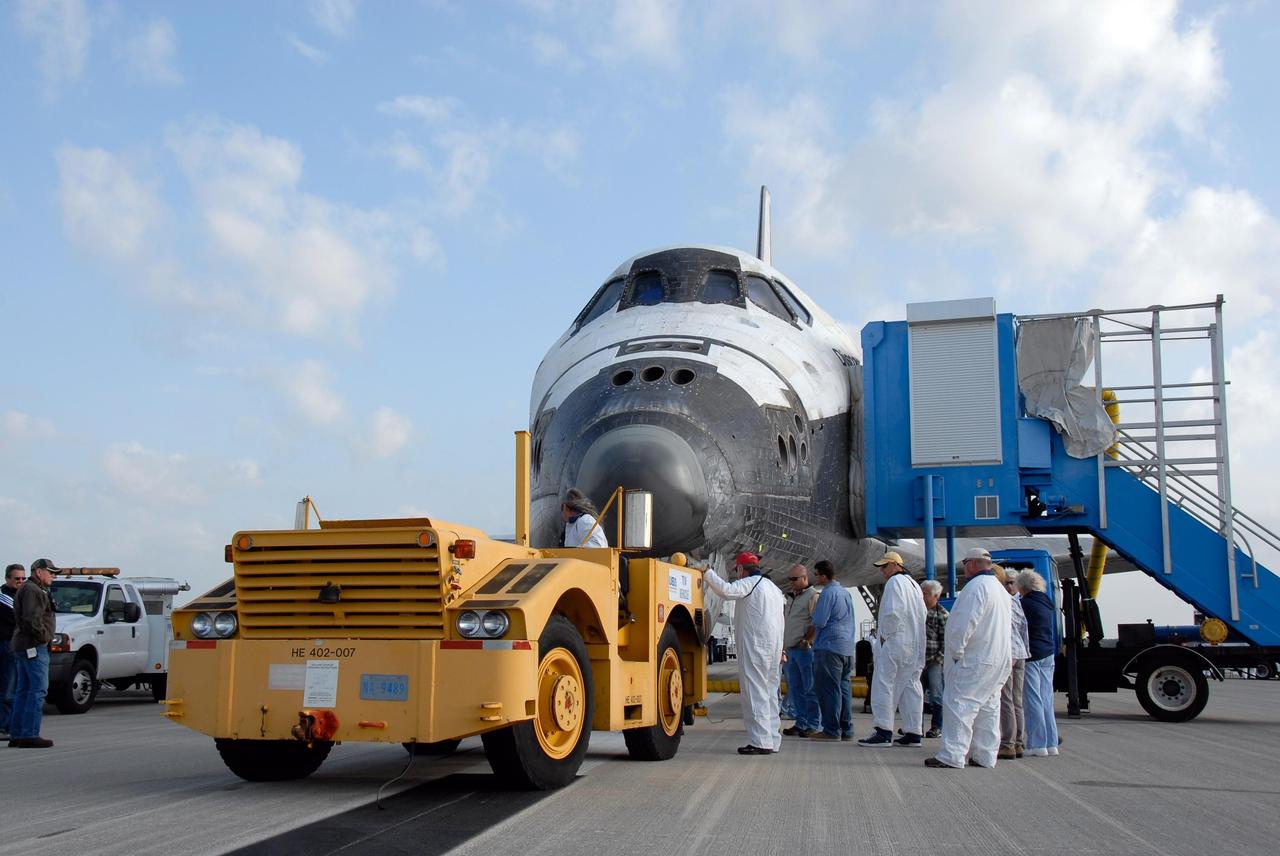
KENNEDY SPACE CENTER, FLA. -- On the Shuttle Landing Facility at NASA's Kennedy Space Center, a tractor tow vehicle is backed up to space shuttle Discovery. Towing normally begins approximately within four hours after landing and is completed within six hours unless removal of time-sensitive experiments require an additional period on the runway. Umbilicals are attached to purge the vehicle of any possible residual explosive or toxic fumes. The tractor tow vehicle will pull Discovery along a two-mile tow-way to the Orbiter Processing Facility, or OPF, where processing Discovery for another flight begins. The tow vehicle is very much like the typical towing units used for large aircraft, but it is equipped with a special towing bar designed specifically for the orbiter. In the OPF, turnaround processing procedures on Discovery will include various post-flight deservicing and maintenance functions, which are carried out in parallel with payload removal and the installation of equipment needed for the next mission. Before post-flight deservicing can continue beyond initial safing operations, certain vehicle systems must be mechanically secured and access platforms installed. Discovery completed mission STS-120 with an on-time landing at 1:01 p.m. EST. Photo credit: NASA/Kim Shiflett
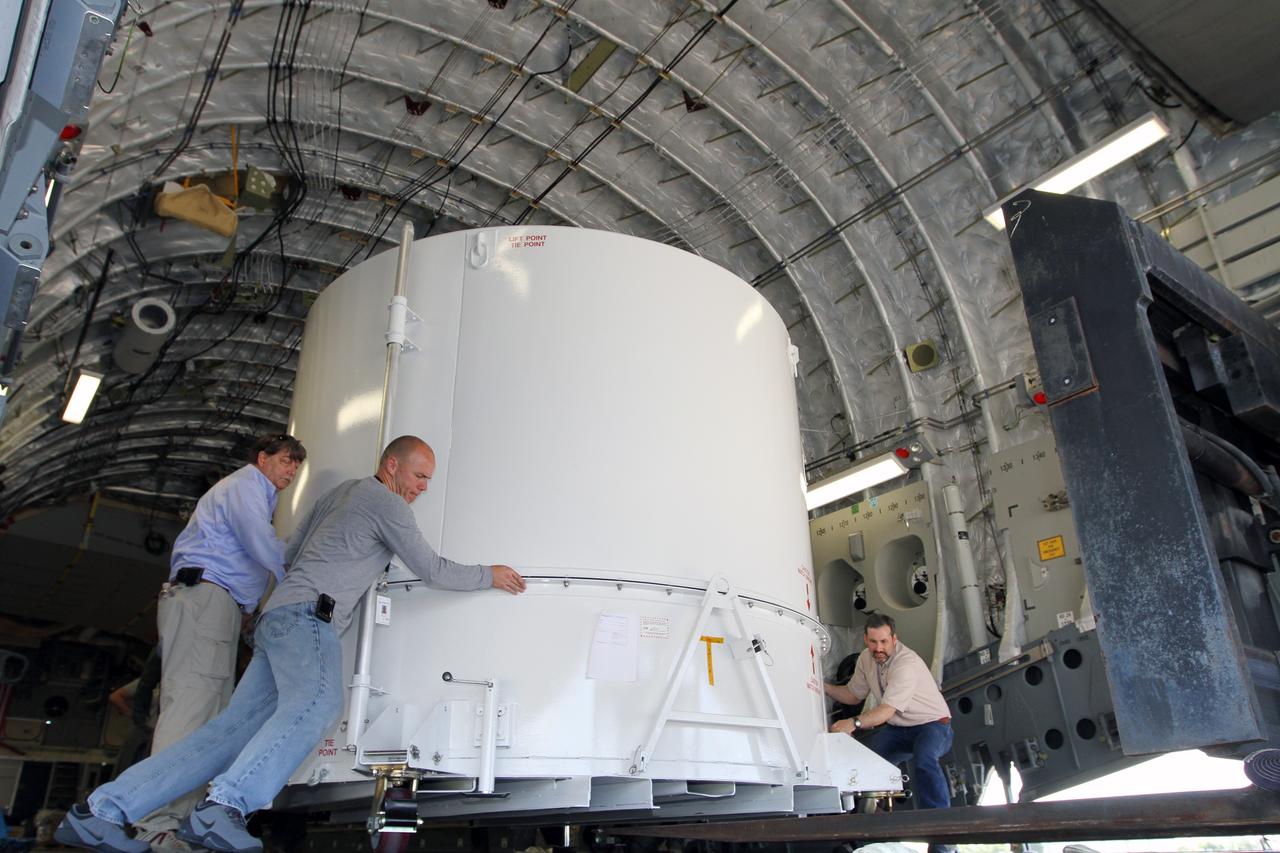
CAPE CANAVERAL, Fla. – Workers move NASA's Radiation Belt Storm Probe A, enclosed in a protective shipping container, to the end of the cargo bay of a U.S. Air Force C-17 airplane at the Shuttle Landing Facility at NASA’s Kennedy Space Center in Florida. The RBSP mission will help us understand the sun’s influence on Earth and near-Earth space by studying the Earth’s radiation belts on various scales of space and time. The RBSP instruments will provide the measurements needed to characterize and quantify the plasma processes that produce very energetic ions and relativistic electrons. The mission is part of NASA’s broader Living With a Star Program that was conceived to explore fundamental processes that operate throughout the solar system, and in particular those that generate hazardous space weather effects in the vicinity of Earth and phenomena that could impact solar system exploration. RBSP is scheduled to begin its mission of exploration of Earth's Van Allen Radiation Belts and the extremes of space weather after launch. Launch aboard a United Launch Alliance Atlas V rocket is scheduled for August 23. For more information, visit http://www.nasa.gov/rbsp. Photo credit: NASA/Kim Shiflett
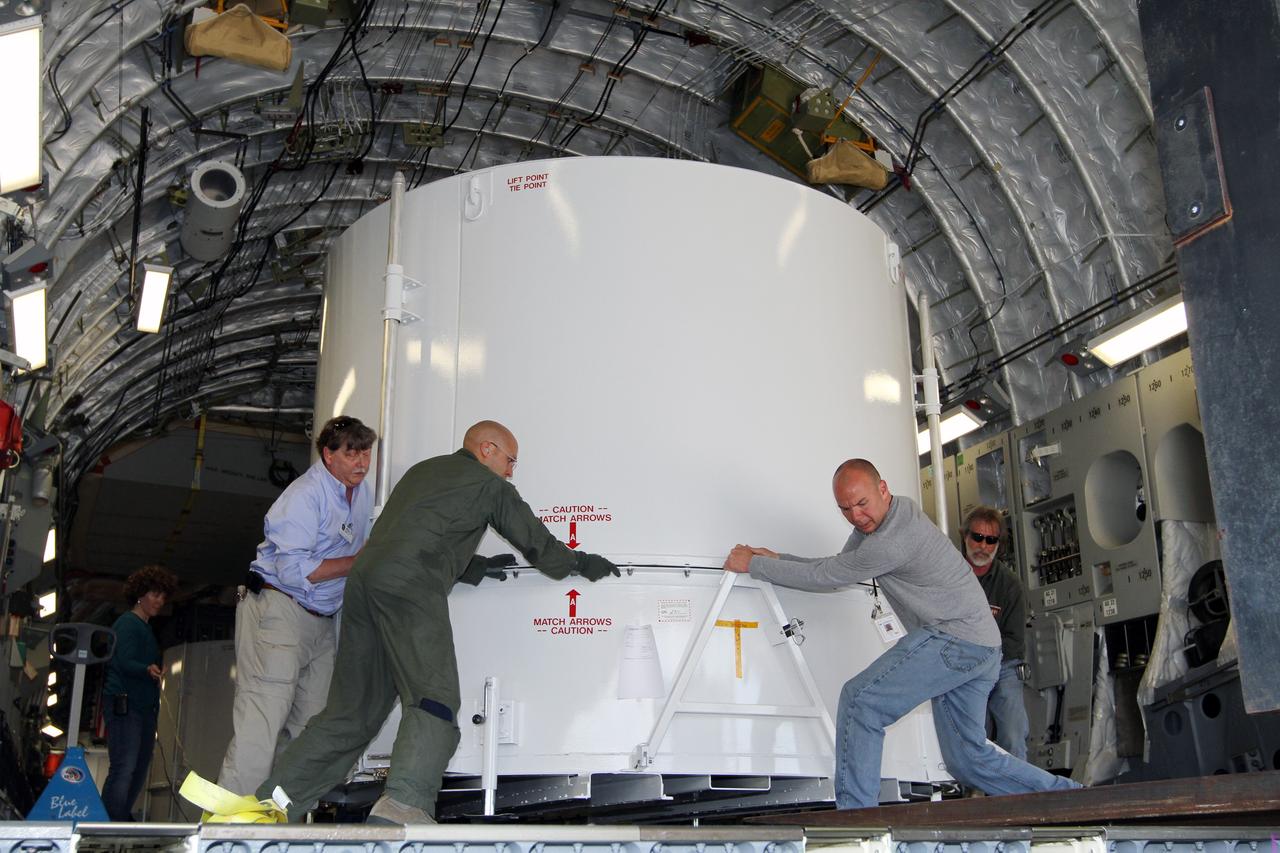
CAPE CANAVERAL, Fla. – Workers move NASA's Radiation Belt Storm Probe B, enclosed in a protective shipping container, to the end of the cargo bay of a U.S. Air Force C-17 airplane at the Shuttle Landing Facility at NASA’s Kennedy Space Center in Florida. The RBSP mission will help us understand the sun’s influence on Earth and near-Earth space by studying the Earth’s radiation belts on various scales of space and time. The RBSP instruments will provide the measurements needed to characterize and quantify the plasma processes that produce very energetic ions and relativistic electrons. The mission is part of NASA’s broader Living With a Star Program that was conceived to explore fundamental processes that operate throughout the solar system, and in particular those that generate hazardous space weather effects in the vicinity of Earth and phenomena that could impact solar system exploration. RBSP is scheduled to begin its mission of exploration of Earth's Van Allen Radiation Belts and the extremes of space weather after launch. Launch aboard a United Launch Alliance Atlas V rocket is scheduled for August 23. For more information, visit http://www.nasa.gov/rbsp. Photo credit: NASA/Kim Shiflett
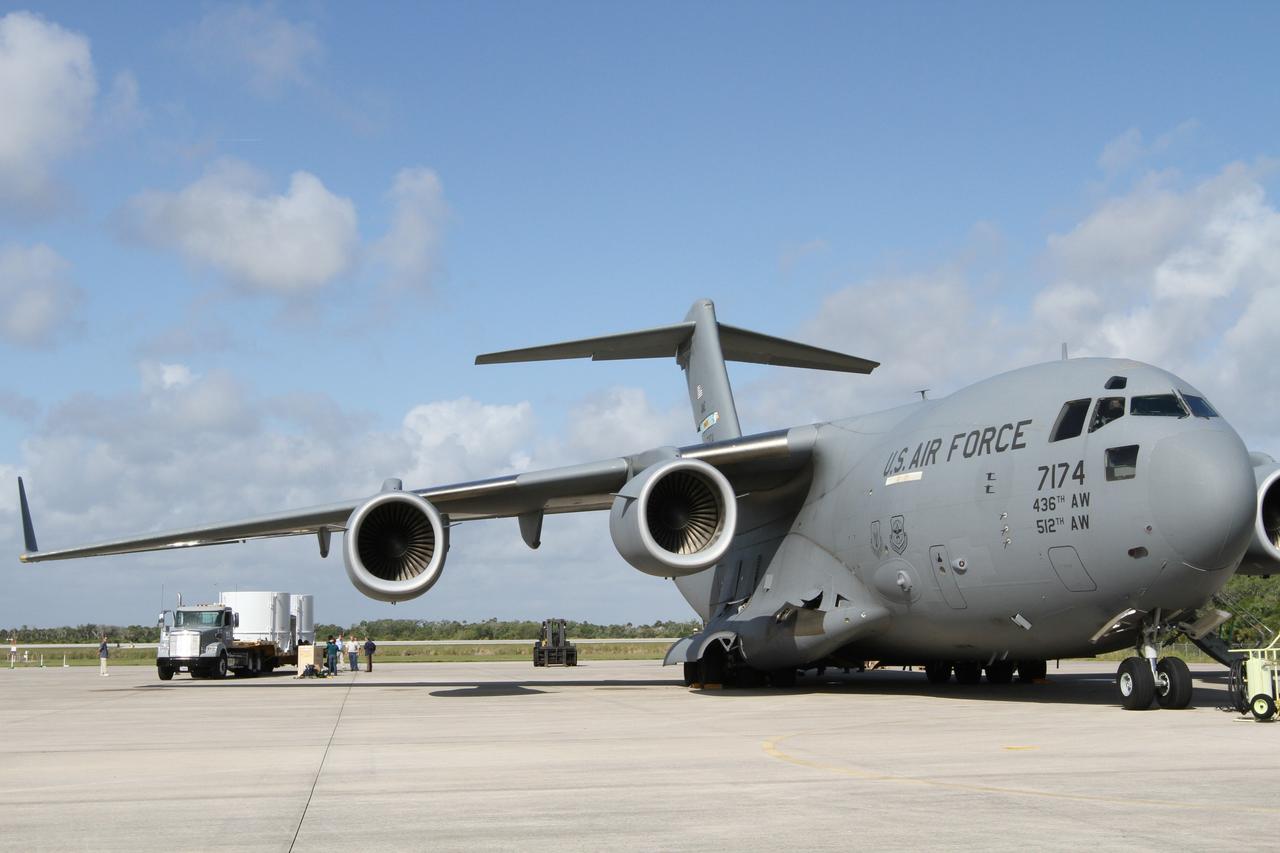
CAPE CANAVERAL, Fla. – NASA's twin Radiation Belt Storm Probes, enclosed in protective shipping containers, have been secured on a flatbed truck at the Shuttle Landing Facility at NASA’s Kennedy Space Center in Florida. The spacecraft will be transported to the Astrotech payload processing facility near Kennedy Space Center where Applied Physics Laboratory technicians will begin spacecraft testing and prelaunch preparations. The spacecraft arrived at Kennedy in the cargo bay of the U.S. Air Force C-17 airplane at right. The RBSP mission will help us understand the sun’s influence on Earth and near-Earth space by studying the Earth’s radiation belts on various scales of space and time. The RBSP instruments will provide the measurements needed to characterize and quantify the plasma processes that produce very energetic ions and relativistic electrons. The mission is part of NASA’s broader Living With a Star Program that was conceived to explore fundamental processes that operate throughout the solar system, and in particular those that generate hazardous space weather effects in the vicinity of Earth and phenomena that could impact solar system exploration. RBSP is scheduled to begin its mission of exploration of Earth's Van Allen Radiation Belts and the extremes of space weather after launch. Launch aboard a United Launch Alliance Atlas V rocket is scheduled for August 23. For more information, visit http://www.nasa.gov/rbsp. Photo credit: NASA/Kim Shiflett
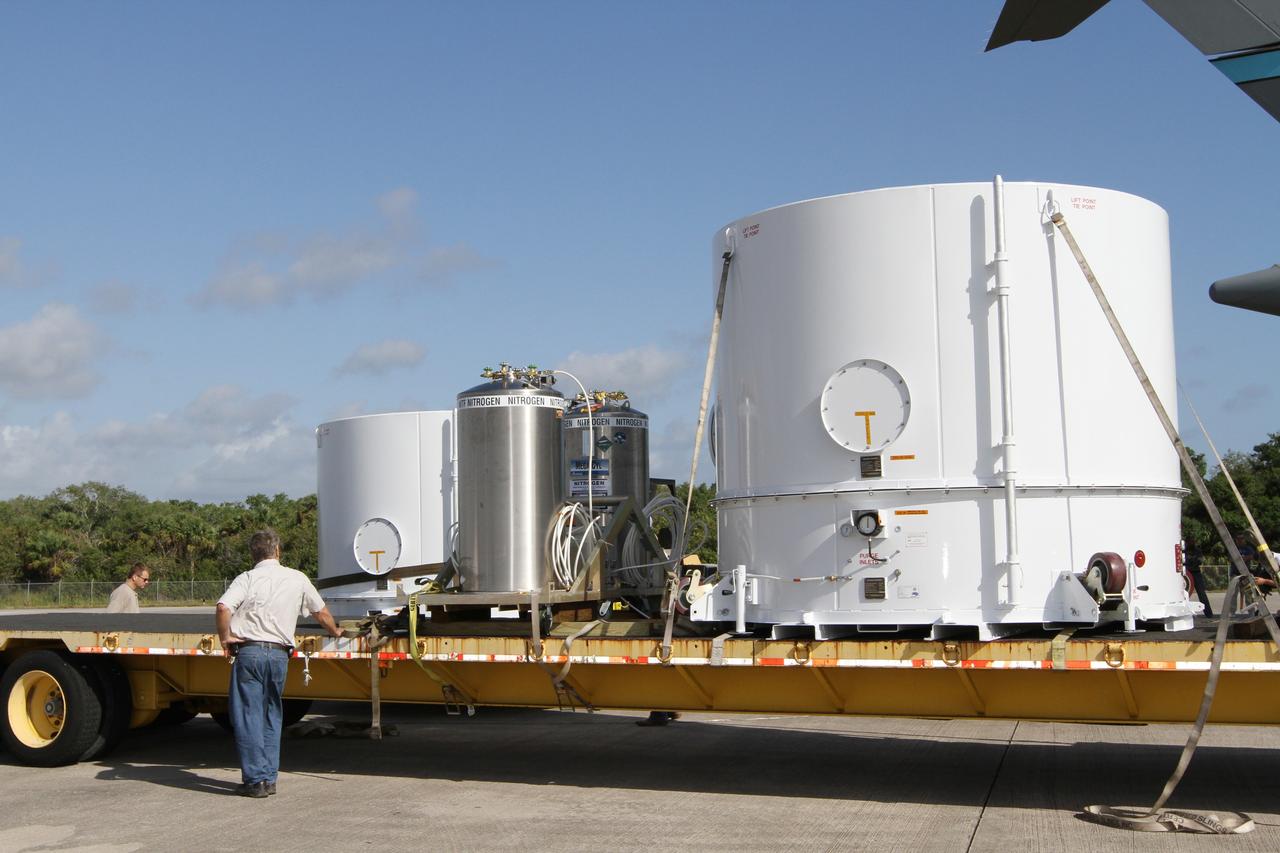
CAPE CANAVERAL, Fla. – Workers prepare to load NASA's Radiation Belt Storm Probe A, enclosed in a protective shipping container, onto a flatbed truck at the Shuttle Landing Facility at NASA’s Kennedy Space Center in Florida. The twin RBSP spacecraft will be transported to the Astrotech payload processing facility near Kennedy Space Center where Applied Physics Laboratory technicians will begin spacecraft testing and prelaunch preparations. Nitrogen will be pumped into the canisters during transport to provide the proper environmental control for the spacecraft. The RBSP mission will help us understand the sun’s influence on Earth and near-Earth space by studying the Earth’s radiation belts on various scales of space and time. The RBSP instruments will provide the measurements needed to characterize and quantify the plasma processes that produce very energetic ions and relativistic electrons. The mission is part of NASA’s broader Living With a Star Program that was conceived to explore fundamental processes that operate throughout the solar system, and in particular those that generate hazardous space weather effects in the vicinity of Earth and phenomena that could impact solar system exploration. RBSP is scheduled to begin its mission of exploration of Earth's Van Allen Radiation Belts and the extremes of space weather after launch. Launch aboard a United Launch Alliance Atlas V rocket is scheduled for August 23. For more information, visit http://www.nasa.gov/rbsp. Photo credit: NASA/Kim Shiflett
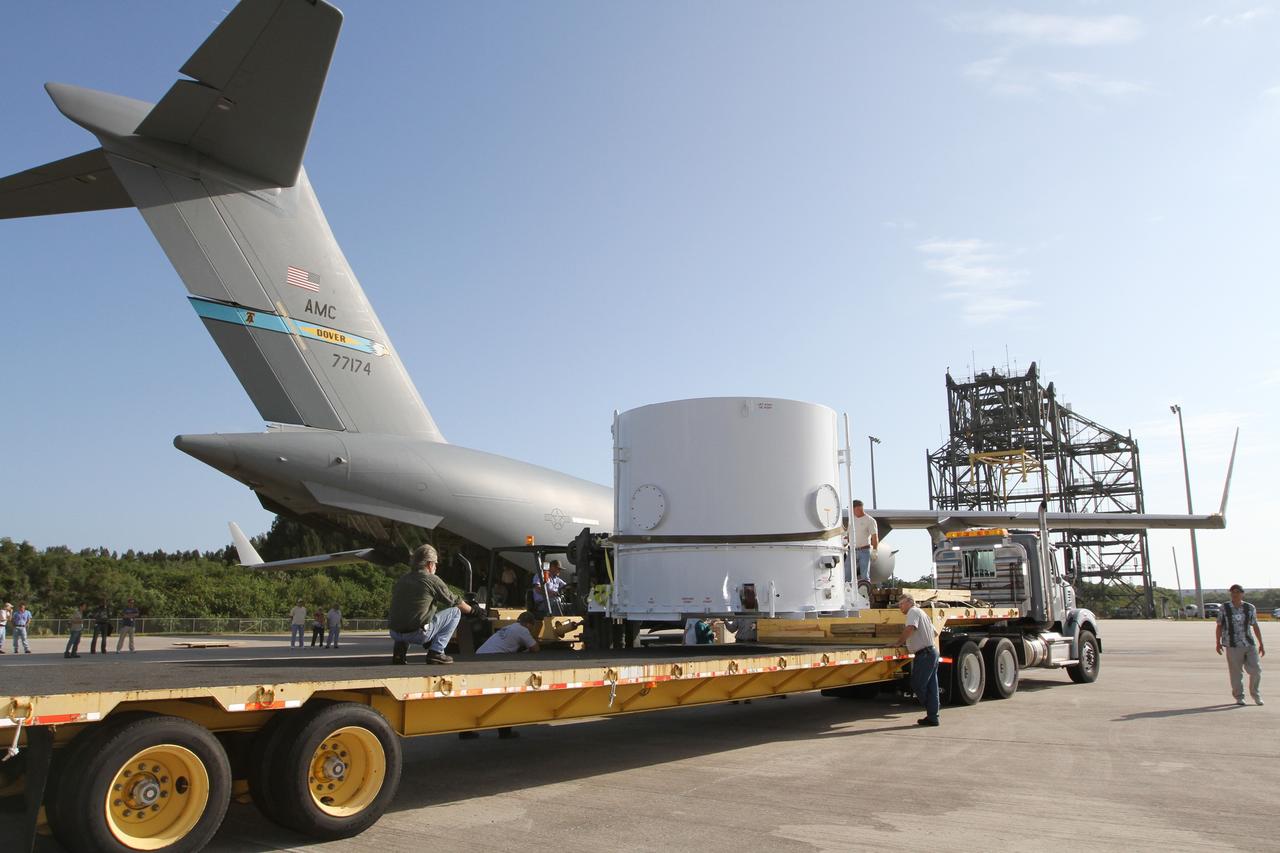
CAPE CANAVERAL, Fla. – Workers position NASA's Radiation Belt Storm Probe B, enclosed in a protective shipping container, onto a flatbed truck at the Shuttle Landing Facility at NASA’s Kennedy Space Center in Florida. The twin RBSP spacecraft will be transported to the Astrotech payload processing facility near Kennedy Space Center where Applied Physics Laboratory technicians will begin spacecraft testing and prelaunch preparations. The RBSP mission will help us understand the sun’s influence on Earth and near-Earth space by studying the Earth’s radiation belts on various scales of space and time. The RBSP instruments will provide the measurements needed to characterize and quantify the plasma processes that produce very energetic ions and relativistic electrons. The mission is part of NASA’s broader Living With a Star Program that was conceived to explore fundamental processes that operate throughout the solar system, and in particular those that generate hazardous space weather effects in the vicinity of Earth and phenomena that could impact solar system exploration. RBSP is scheduled to begin its mission of exploration of Earth's Van Allen Radiation Belts and the extremes of space weather after launch. Launch aboard a United Launch Alliance Atlas V rocket is scheduled for August 23. For more information, visit http://www.nasa.gov/rbsp. Photo credit: NASA/Kim Shiflett
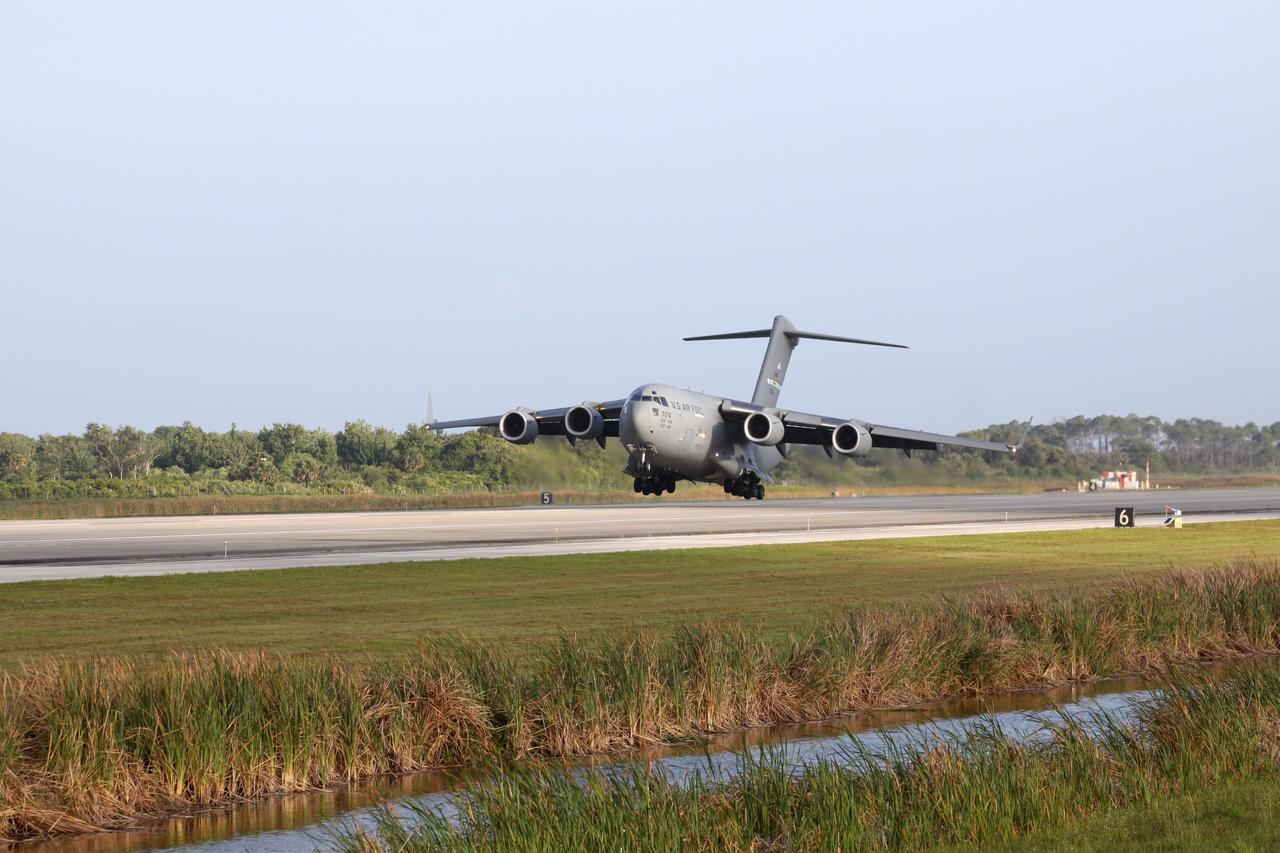
CAPE CANAVERAL, Fla. – A U.S. Air Force C-17 cargo aircraft nears landing at the Shuttle Landing Facility at NASA’s Kennedy Space Center in Florida. Aboard are NASA's twin Radiation Belt Storm Probes. The RBSP mission will help us understand the sun’s influence on Earth and near-Earth space by studying the Earth’s radiation belts on various scales of space and time. The RBSP instruments will provide the measurements needed to characterize and quantify the plasma processes that produce very energetic ions and relativistic electrons. The mission is part of NASA’s broader Living With a Star Program that was conceived to explore fundamental processes that operate throughout the solar system, and in particular those that generate hazardous space weather effects in the vicinity of Earth and phenomena that could impact solar system exploration. RBSP is scheduled to begin its mission of exploration of Earth's Van Allen Radiation Belts and the extremes of space weather after launch. Launch aboard a United Launch Alliance Atlas V rocket is scheduled for August 23. For more information, visit http://www.nasa.gov/rbsp. Photo credit: NASA/Kim Shiflett
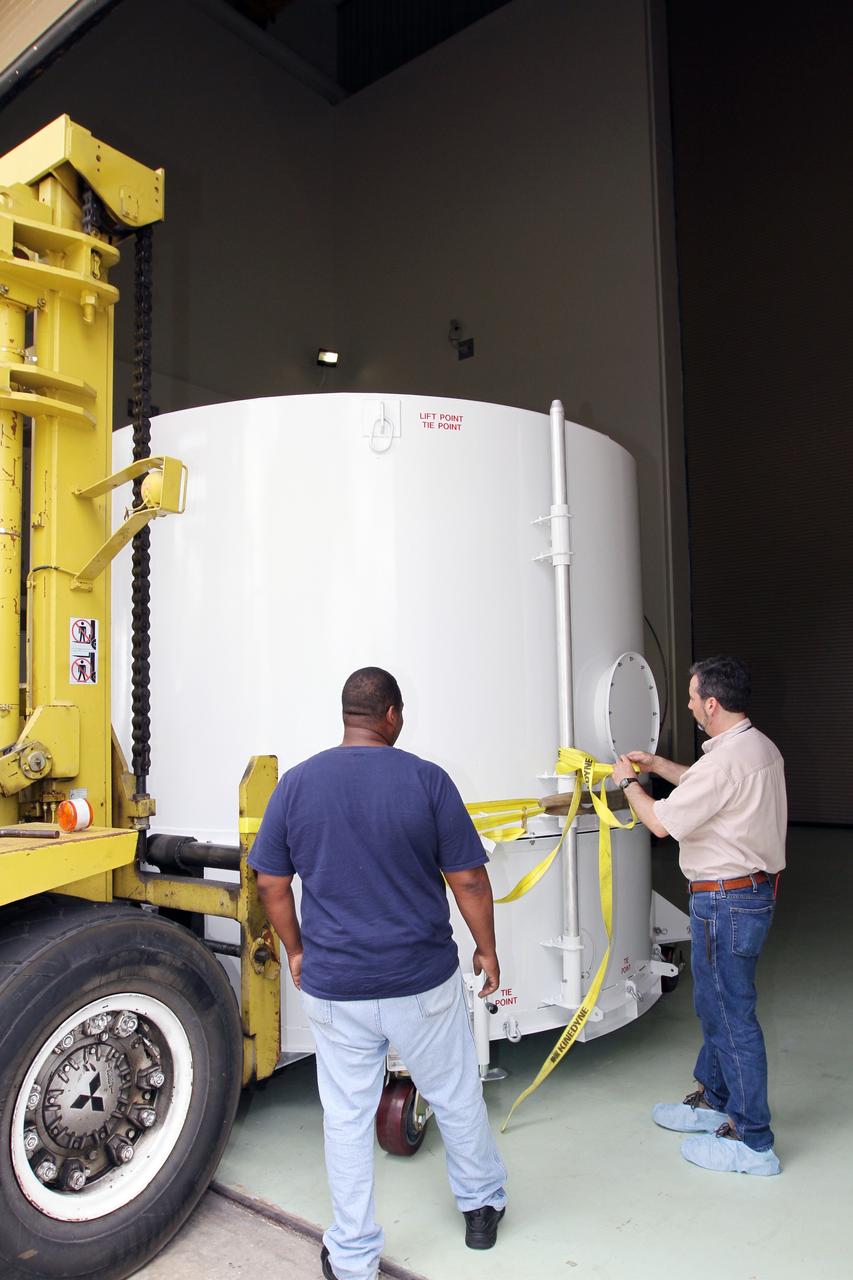
CAPE CANAVERAL, Fla. – A worker releases NASA's Radiation Belt Storm Probe B, enclosed in a protective shipping container, from the forklift that delivered it to the airlock of the Astrotech payload processing facility near NASA’s Kennedy Space Center in Florida where Applied Physics Laboratory technicians will begin spacecraft testing and prelaunch preparations. The twin RBSP spacecraft arrived at Kennedy’s Shuttle Landing Facility in the cargo bay of a U.S. Air Force C-17 aircraft earlier in the day. The RBSP mission will help us understand the sun’s influence on Earth and near-Earth space by studying the Earth’s radiation belts on various scales of space and time. The RBSP instruments will provide the measurements needed to characterize and quantify the plasma processes that produce very energetic ions and relativistic electrons. The mission is part of NASA’s broader Living With a Star Program that was conceived to explore fundamental processes that operate throughout the solar system, and in particular those that generate hazardous space weather effects in the vicinity of Earth and phenomena that could impact solar system exploration. RBSP is scheduled to begin its mission of exploration of Earth's Van Allen Radiation Belts and the extremes of space weather after launch. Launch aboard a United Launch Alliance Atlas V rocket is scheduled for August 23. For more information, visit http://www.nasa.gov/rbsp. Photo credit: NASA/Kim Shiflett
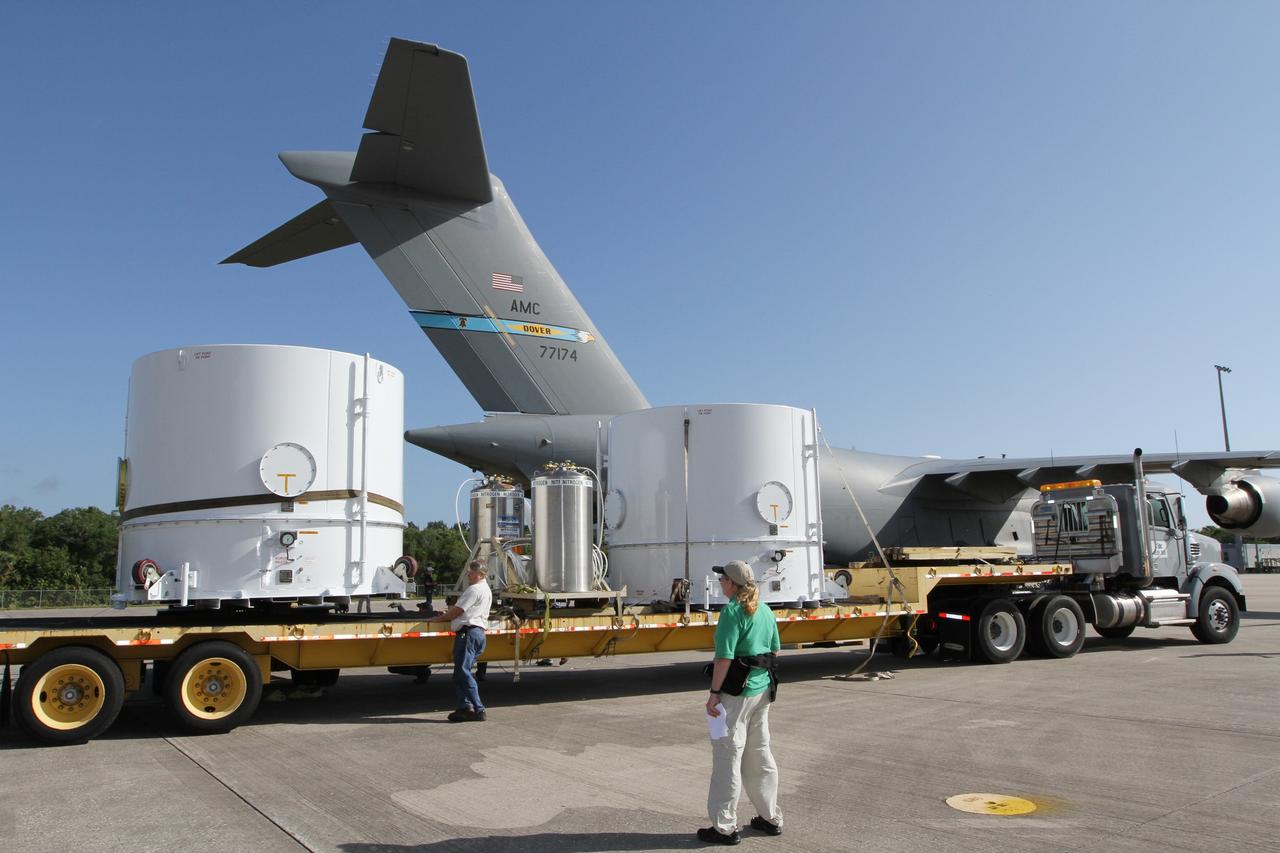
CAPE CANAVERAL, Fla. – Workers position NASA's Radiation Belt Storm Probe A, enclosed in a protective shipping container, onto a flatbed truck at the Shuttle Landing Facility at NASA’s Kennedy Space Center in Florida. The twin RBSP spacecraft will be transported to the Astrotech payload processing facility near Kennedy Space Center where Applied Physics Laboratory technicians will begin spacecraft testing and prelaunch preparations. Nitrogen will be pumped into the canisters during transport to provide the proper environmental control for the spacecraft. The RBSP mission will help us understand the sun’s influence on Earth and near-Earth space by studying the Earth’s radiation belts on various scales of space and time. The RBSP instruments will provide the measurements needed to characterize and quantify the plasma processes that produce very energetic ions and relativistic electrons. The mission is part of NASA’s broader Living With a Star Program that was conceived to explore fundamental processes that operate throughout the solar system, and in particular those that generate hazardous space weather effects in the vicinity of Earth and phenomena that could impact solar system exploration. RBSP is scheduled to begin its mission of exploration of Earth's Van Allen Radiation Belts and the extremes of space weather after launch. Launch aboard a United Launch Alliance Atlas V rocket is scheduled for August 23. For more information, visit http://www.nasa.gov/rbsp. Photo credit: NASA/Kim Shiflett
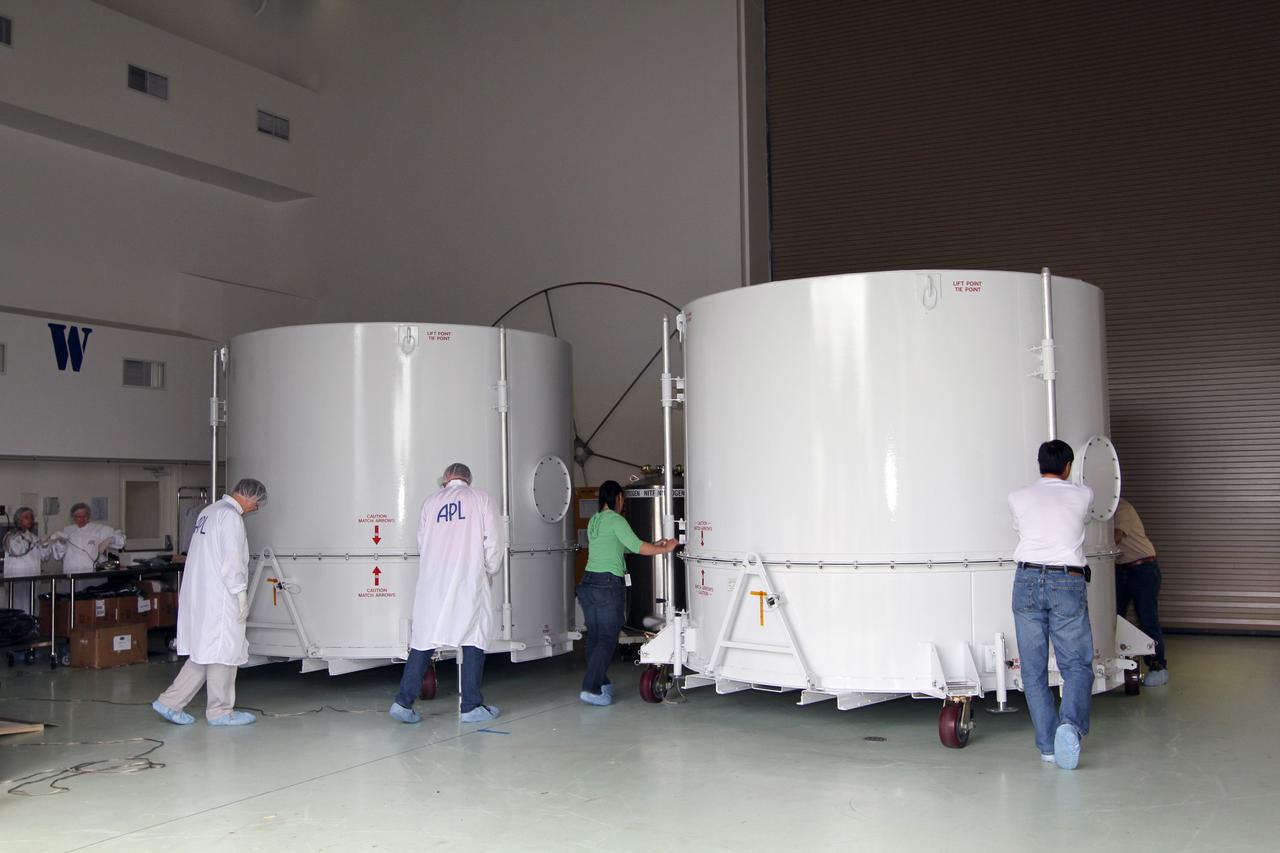
CAPE CANAVERAL, Fla. – NASA's twin Radiation Belt Storm Probes, enclosed in protective shipping containers, have arrived in the airlock of the Astrotech payload processing facility near NASA’s Kennedy Space Center in Florida where Applied Physics Laboratory technicians will begin spacecraft testing and prelaunch preparations. The spacecraft were delivered to Kennedy’s Shuttle Landing Facility in the cargo bay of a U.S. Air Force C-17 aircraft earlier in the day. The RBSP mission will help us understand the sun’s influence on Earth and near-Earth space by studying the Earth’s radiation belts on various scales of space and time. The RBSP instruments will provide the measurements needed to characterize and quantify the plasma processes that produce very energetic ions and relativistic electrons. The mission is part of NASA’s broader Living With a Star Program that was conceived to explore fundamental processes that operate throughout the solar system, and in particular those that generate hazardous space weather effects in the vicinity of Earth and phenomena that could impact solar system exploration. RBSP is scheduled to begin its mission of exploration of Earth's Van Allen Radiation Belts and the extremes of space weather after launch. Launch aboard a United Launch Alliance Atlas V rocket is scheduled for August 23. For more information, visit http://www.nasa.gov/rbsp. Photo credit: NASA/Kim Shiflett
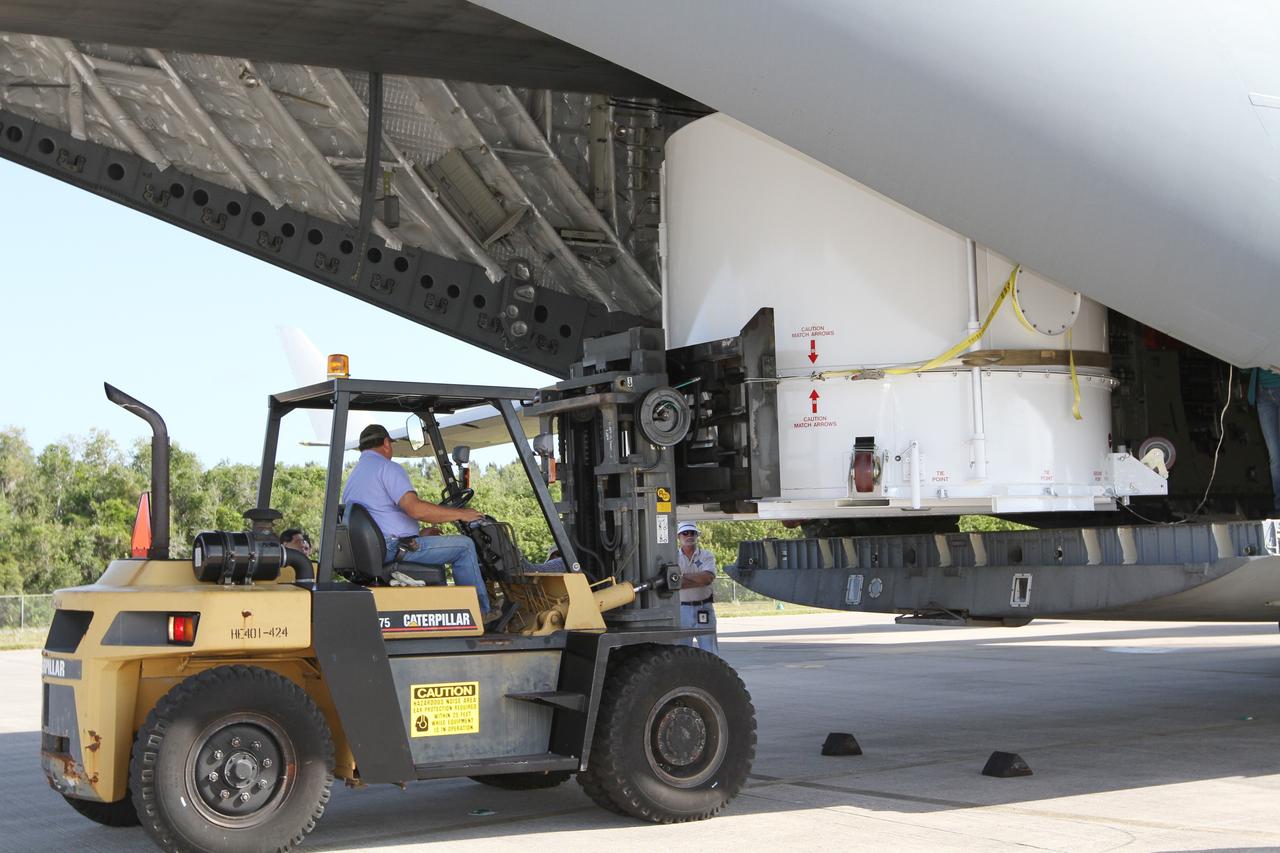
CAPE CANAVERAL, Fla. – A forklift operator lowers NASA's Radiation Belt Storm Probe A, enclosed in a protective shipping container, from the cargo bay of a U.S. Air Force C-17 airplane to the tarmac at the Shuttle Landing Facility at NASA’s Kennedy Space Center in Florida. The RBSP mission will help us understand the sun’s influence on Earth and near-Earth space by studying the Earth’s radiation belts on various scales of space and time. The RBSP instruments will provide the measurements needed to characterize and quantify the plasma processes that produce very energetic ions and relativistic electrons. The mission is part of NASA’s broader Living With a Star Program that was conceived to explore fundamental processes that operate throughout the solar system, and in particular those that generate hazardous space weather effects in the vicinity of Earth and phenomena that could impact solar system exploration. RBSP is scheduled to begin its mission of exploration of Earth's Van Allen Radiation Belts and the extremes of space weather after launch. Launch aboard a United Launch Alliance Atlas V rocket is scheduled for August 23. For more information, visit http://www.nasa.gov/rbsp. Photo credit: NASA/Kim Shiflett
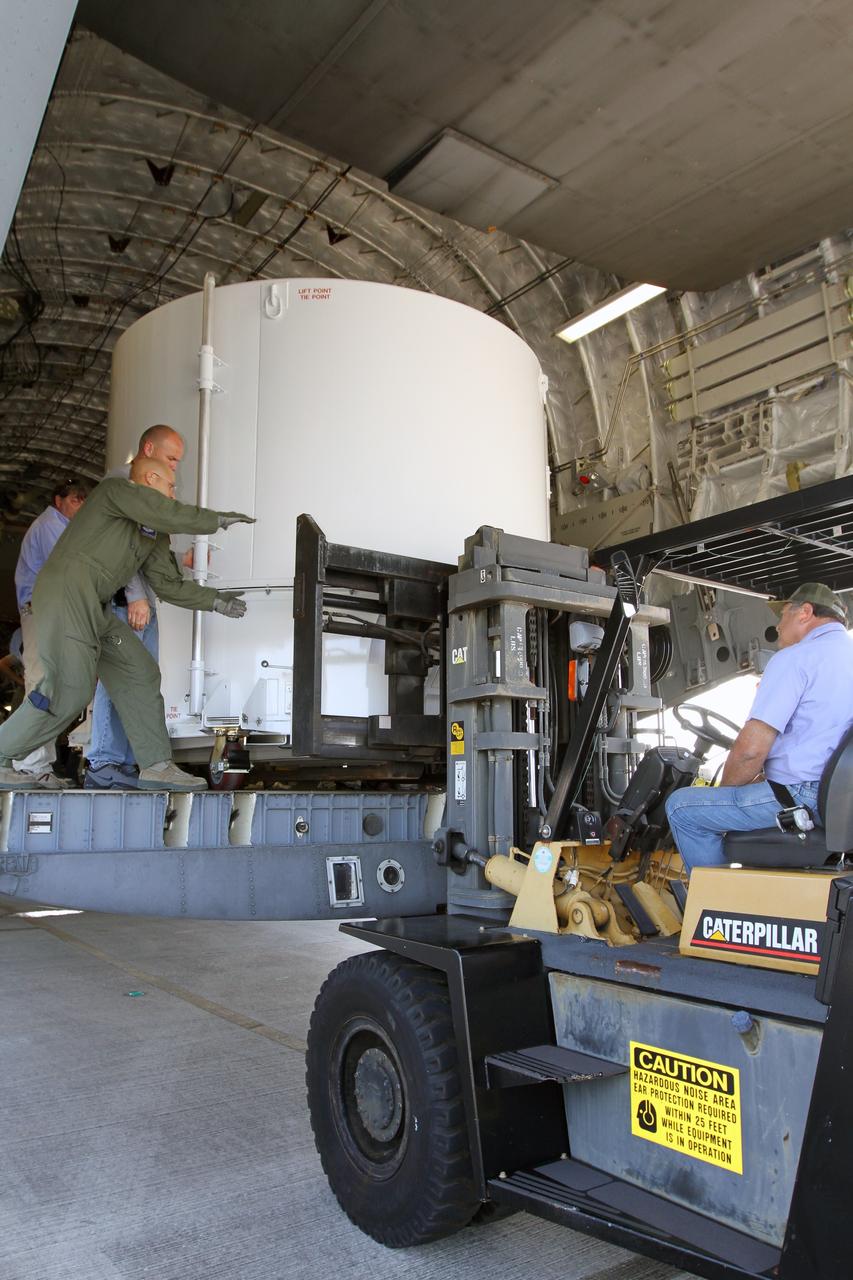
CAPE CANAVERAL, Fla. – NASA's Radiation Belt Storm Probe A, enclosed in a protective shipping container, is positioned at the end of the cargo bay of a U.S. Air Force C-17 airplane to be offloaded at the Shuttle Landing Facility at NASA’s Kennedy Space Center in Florida. The RBSP mission will help us understand the sun’s influence on Earth and near-Earth space by studying the Earth’s radiation belts on various scales of space and time. The RBSP instruments will provide the measurements needed to characterize and quantify the plasma processes that produce very energetic ions and relativistic electrons. The mission is part of NASA’s broader Living With a Star Program that was conceived to explore fundamental processes that operate throughout the solar system, and in particular those that generate hazardous space weather effects in the vicinity of Earth and phenomena that could impact solar system exploration. RBSP is scheduled to begin its mission of exploration of Earth's Van Allen Radiation Belts and the extremes of space weather after launch. Launch aboard a United Launch Alliance Atlas V rocket is scheduled for August 23. For more information, visit http://www.nasa.gov/rbsp. Photo credit: NASA/Kim Shiflett
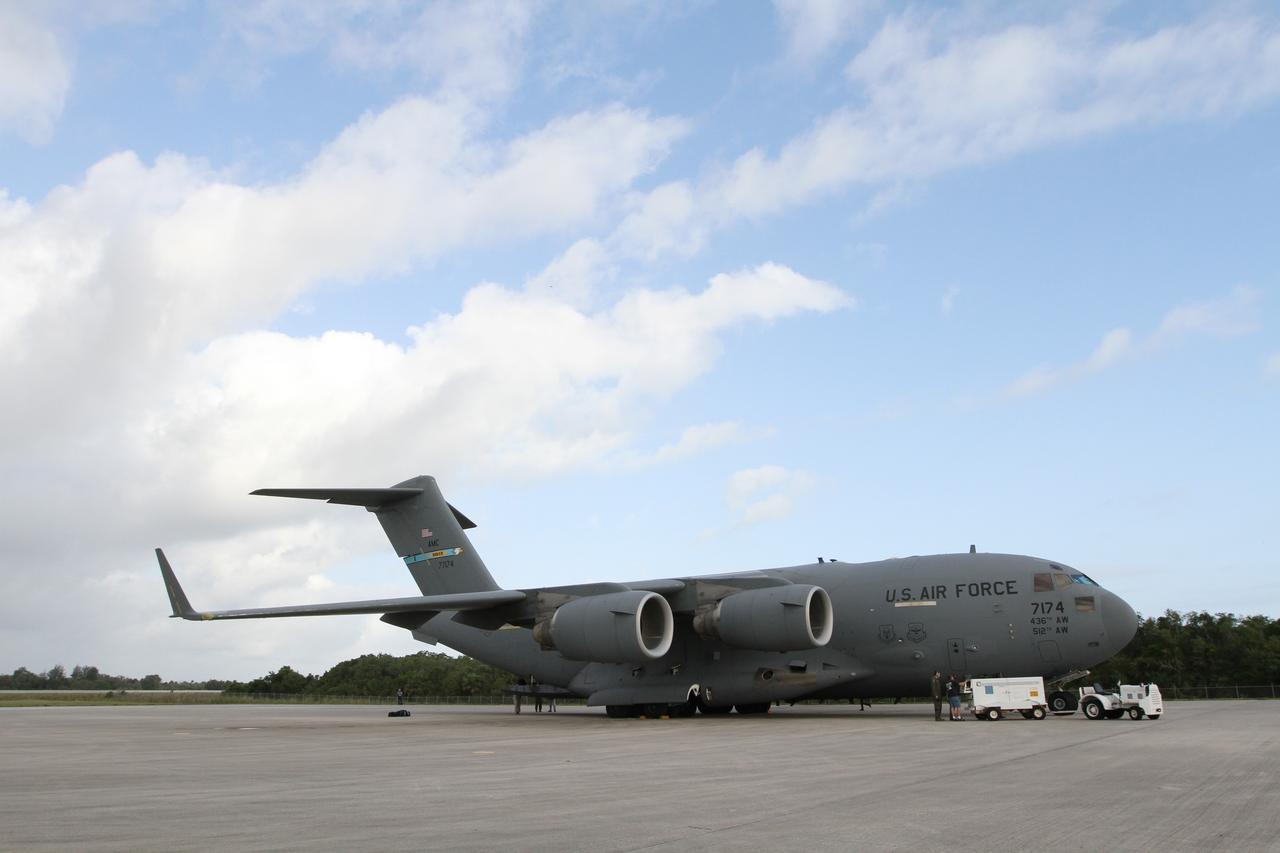
CAPE CANAVERAL, Fla. – Preparations are under way to offload NASA's twin Radiation Belt Storm Probes from a U.S. Air Force C-17 cargo airplane at the Shuttle Landing Facility at NASA’s Kennedy Space Center in Florida. The RBSP mission will help us understand the sun’s influence on Earth and near-Earth space by studying the Earth’s radiation belts on various scales of space and time. The RBSP instruments will provide the measurements needed to characterize and quantify the plasma processes that produce very energetic ions and relativistic electrons. The mission is part of NASA’s broader Living With a Star Program that was conceived to explore fundamental processes that operate throughout the solar system, and in particular those that generate hazardous space weather effects in the vicinity of Earth and phenomena that could impact solar system exploration. RBSP is scheduled to begin its mission of exploration of Earth's Van Allen Radiation Belts and the extremes of space weather after launch. Launch aboard a United Launch Alliance Atlas V rocket is scheduled for August 23. For more information, visit http://www.nasa.gov/rbsp. Photo credit: NASA/Kim Shiflett
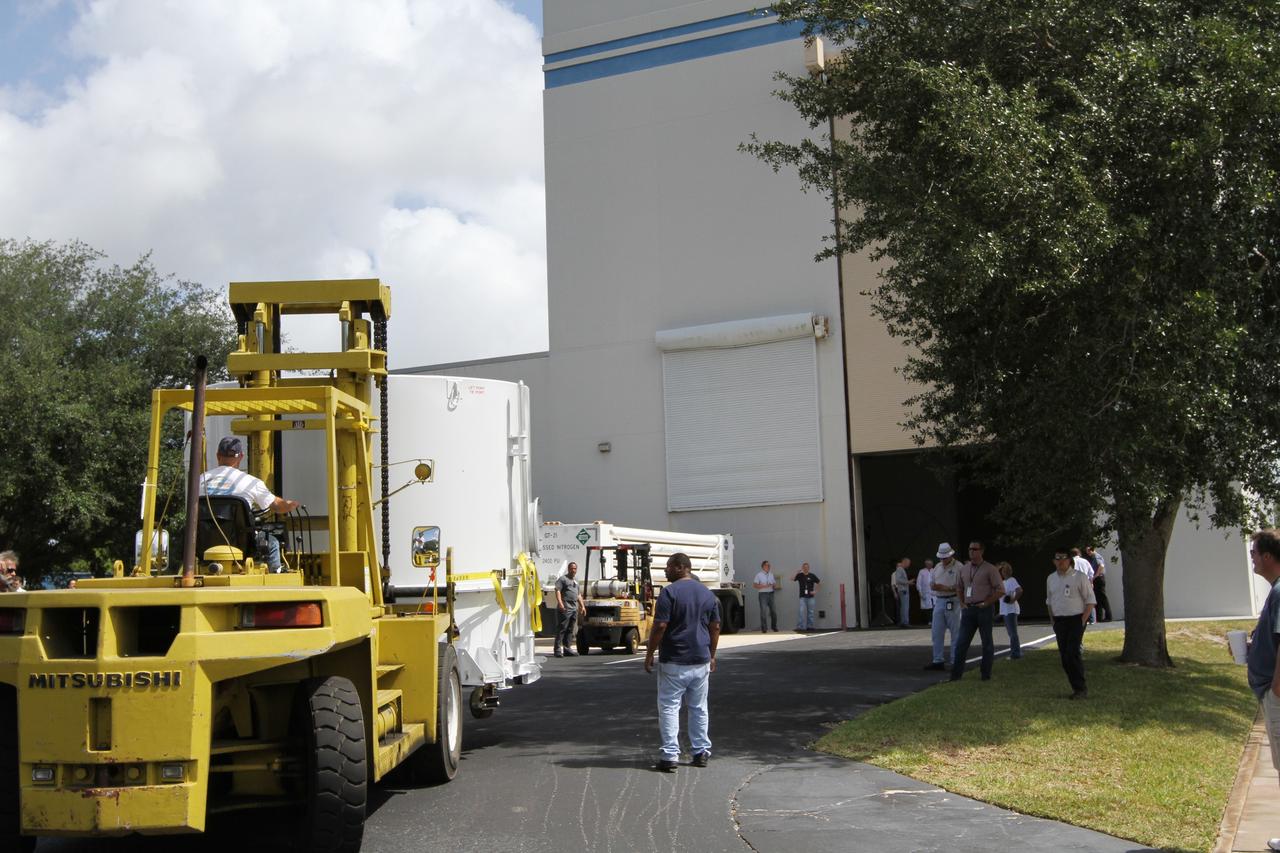
CAPE CANAVERAL, Fla. – A forklift operator moves NASA's Radiation Belt Storm Probe A, enclosed in a protective shipping container, toward the open bay door of the Astrotech payload processing facility near NASA’s Kennedy Space Center in Florida where Applied Physics Laboratory technicians will begin spacecraft testing and prelaunch preparations. The twin RBSP spacecraft arrived at Kennedy’s Shuttle Landing Facility in the cargo bay of a U.S. Air Force C-17 aircraft earlier in the day. The RBSP mission will help us understand the sun’s influence on Earth and near-Earth space by studying the Earth’s radiation belts on various scales of space and time. The RBSP instruments will provide the measurements needed to characterize and quantify the plasma processes that produce very energetic ions and relativistic electrons. The mission is part of NASA’s broader Living With a Star Program that was conceived to explore fundamental processes that operate throughout the solar system, and in particular those that generate hazardous space weather effects in the vicinity of Earth and phenomena that could impact solar system exploration. RBSP is scheduled to begin its mission of exploration of Earth's Van Allen Radiation Belts and the extremes of space weather after launch. Launch aboard a United Launch Alliance Atlas V rocket is scheduled for August 23. For more information, visit http://www.nasa.gov/rbsp. Photo credit: NASA/Kim Shiflett
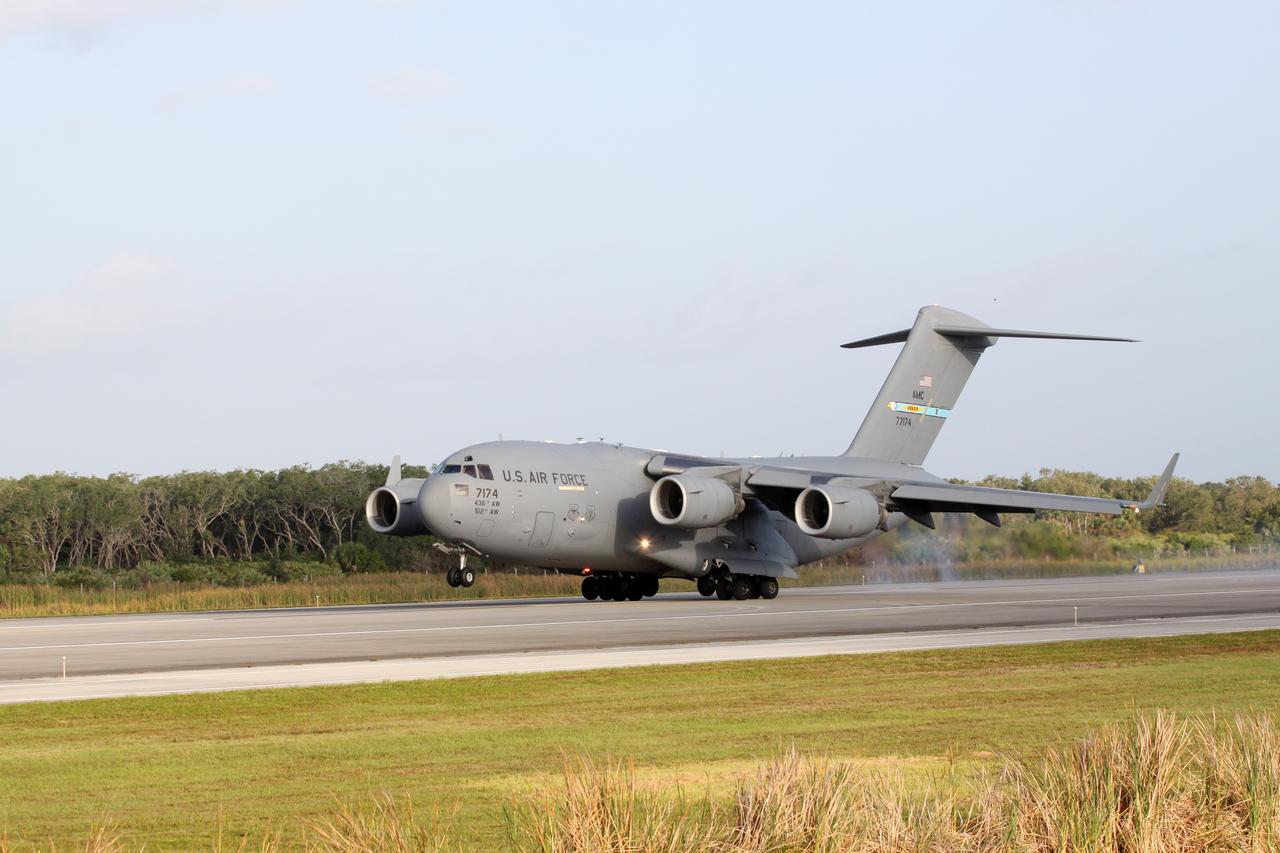
CAPE CANAVERAL, Fla. – A U.S. Air Force C-17 cargo aircraft touches down at the Shuttle Landing Facility at NASA’s Kennedy Space Center in Florida. Aboard are NASA's twin Radiation Belt Storm Probes. The RBSP mission will help us understand the sun’s influence on Earth and near-Earth space by studying the Earth’s radiation belts on various scales of space and time. The RBSP instruments will provide the measurements needed to characterize and quantify the plasma processes that produce very energetic ions and relativistic electrons. The mission is part of NASA’s broader Living With a Star Program that was conceived to explore fundamental processes that operate throughout the solar system, and in particular those that generate hazardous space weather effects in the vicinity of Earth and phenomena that could impact solar system exploration. RBSP is scheduled to begin its mission of exploration of Earth's Van Allen Radiation Belts and the extremes of space weather after launch. Launch aboard a United Launch Alliance Atlas V rocket is scheduled for August 23. For more information, visit http://www.nasa.gov/rbsp. Photo credit: NASA/Kim Shiflett
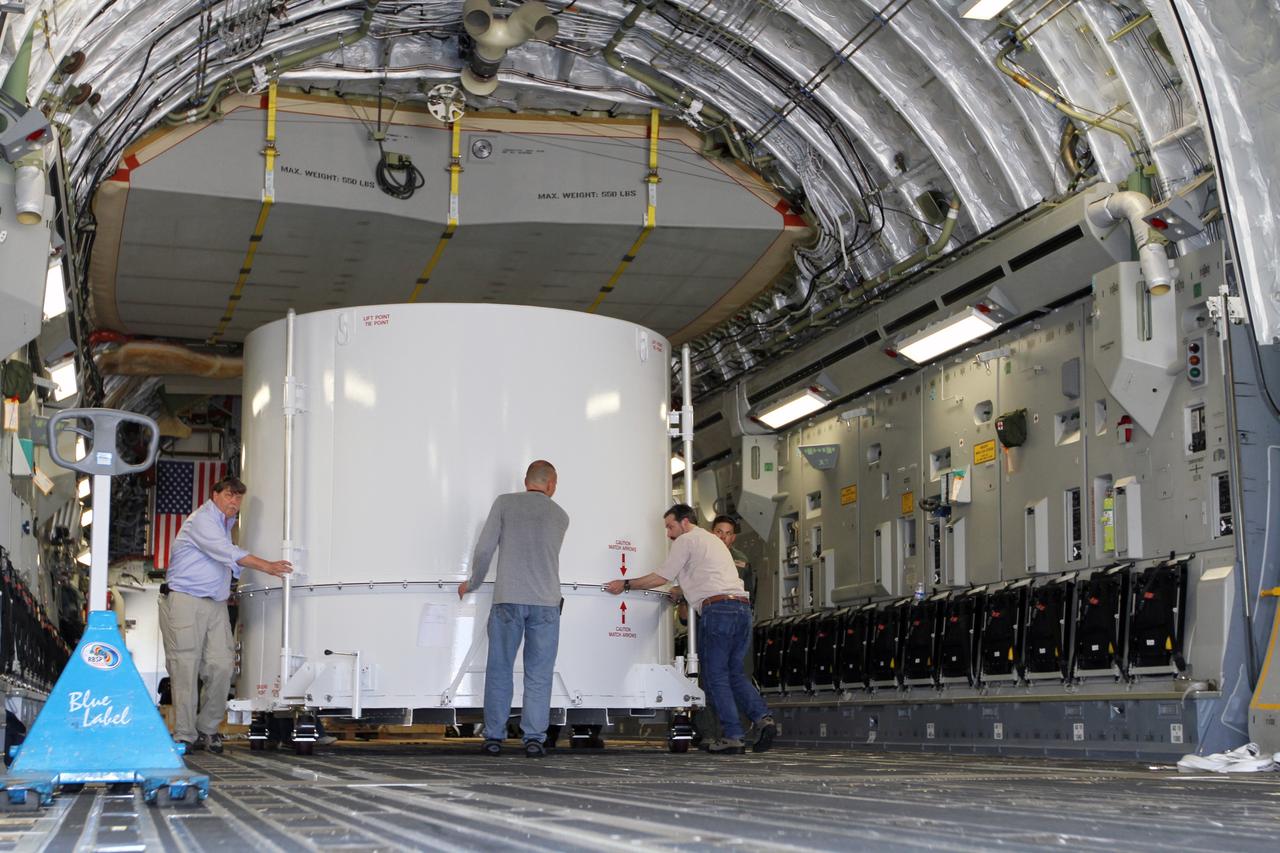
CAPE CANAVERAL, Fla. – Workers prepare to offload NASA's Radiation Belt Storm Probe A, enclosed in a protective shipping container, from a U.S. Air Force C-17 cargo airplane at the Shuttle Landing Facility at NASA’s Kennedy Space Center in Florida. The RBSP mission will help us understand the sun’s influence on Earth and near-Earth space by studying the Earth’s radiation belts on various scales of space and time. The RBSP instruments will provide the measurements needed to characterize and quantify the plasma processes that produce very energetic ions and relativistic electrons. The mission is part of NASA’s broader Living With a Star Program that was conceived to explore fundamental processes that operate throughout the solar system, and in particular those that generate hazardous space weather effects in the vicinity of Earth and phenomena that could impact solar system exploration. RBSP is scheduled to begin its mission of exploration of Earth's Van Allen Radiation Belts and the extremes of space weather after launch. Launch aboard a United Launch Alliance Atlas V rocket is scheduled for August 23. For more information, visit http://www.nasa.gov/rbsp. Photo credit: NASA/Kim Shiflett
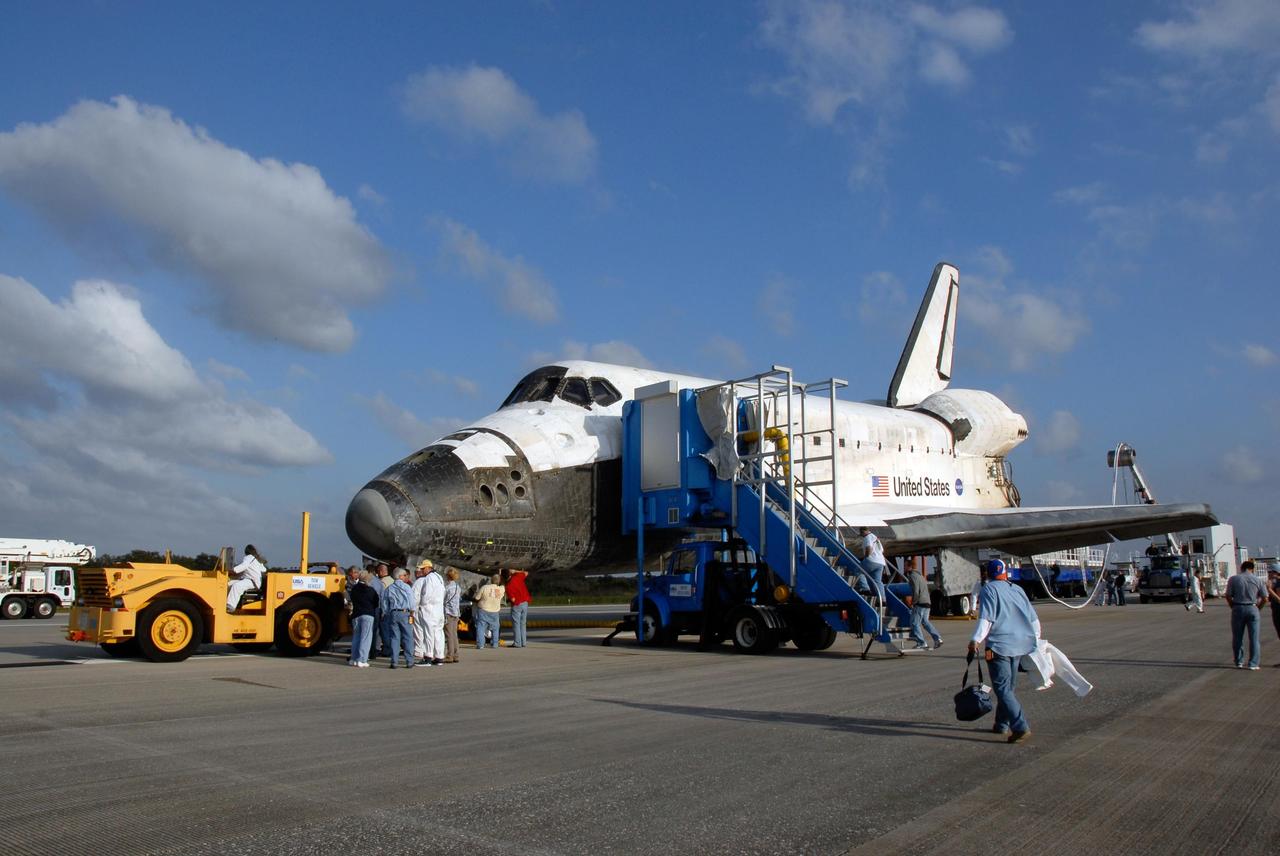
KENNEDY SPACE CENTER, FLA. -- On the Shuttle Landing Facility at NASA's Kennedy Space Center, a tractor tow vehicle is backed up to space shuttle Discovery. Towing normally begins approximately within four hours after landing and is completed within six hours unless removal of time-sensitive experiments require an additional period on the runway. Umbilicals are attached to purge the vehicle of any possible residual explosive or toxic fumes. The tractor tow vehicle will pull Discovery along a two-mile tow-way to the Orbiter Processing Facility, or OPF, where processing Discovery for another flight begins. The tow vehicle is very much like the typical towing units used for large aircraft, but it is equipped with a special towing bar designed specifically for the orbiter. In the OPF, turnaround processing procedures on Discovery will include various post-flight deservicing and maintenance functions, which are carried out in parallel with payload removal and the installation of equipment needed for the next mission. Before post-flight deservicing can continue beyond initial safing operations, certain vehicle systems must be mechanically secured and access platforms installed. Discovery completed mission STS-120 with an on-time landing at 1:01 p.m. EST. Photo credit: NASA/Kim Shiflett
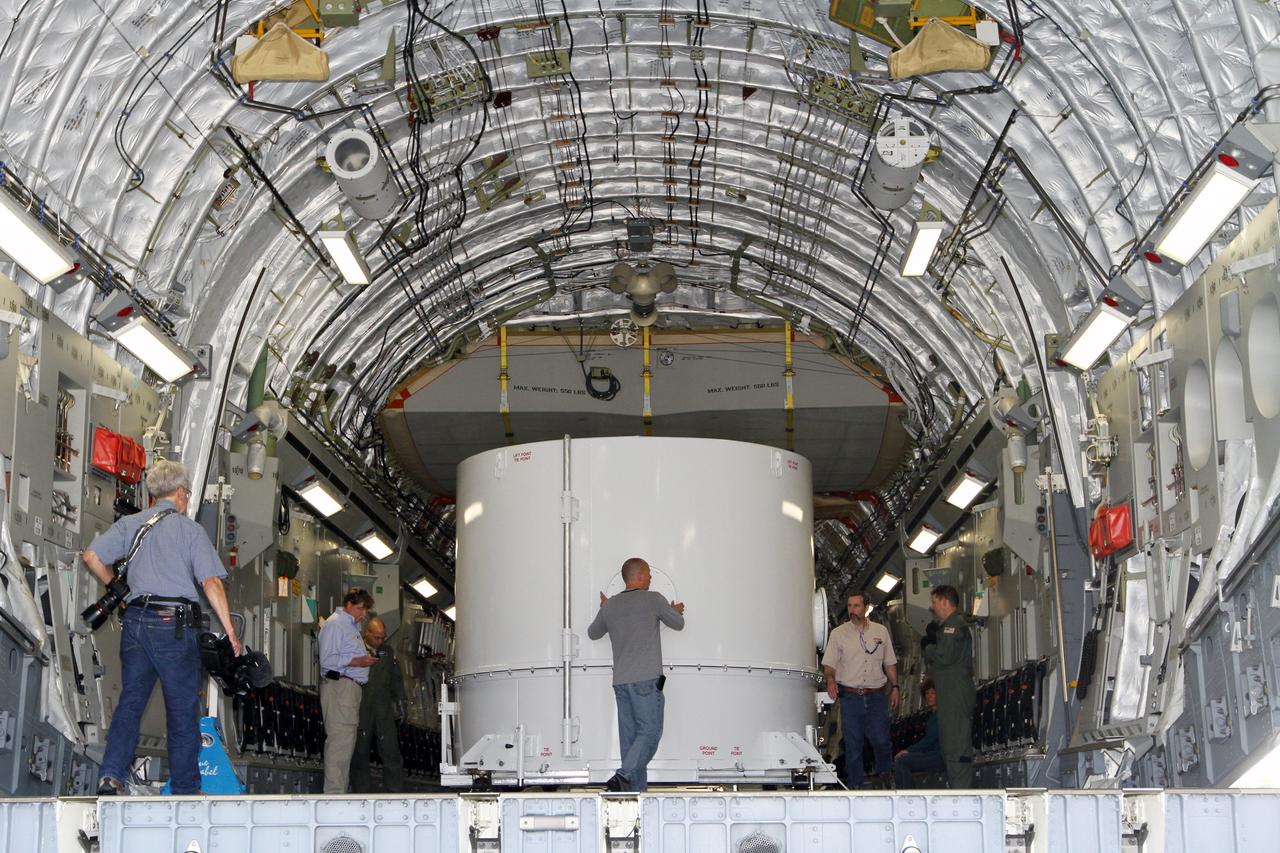
CAPE CANAVERAL, Fla. – Workers prepare to offload NASA's Radiation Belt Storm Probe B, enclosed in a protective shipping container, from a U.S. Air Force C-17 cargo airplane at the Shuttle Landing Facility at NASA’s Kennedy Space Center in Florida. The RBSP mission will help us understand the sun’s influence on Earth and near-Earth space by studying the Earth’s radiation belts on various scales of space and time. The RBSP instruments will provide the measurements needed to characterize and quantify the plasma processes that produce very energetic ions and relativistic electrons. The mission is part of NASA’s broader Living With a Star Program that was conceived to explore fundamental processes that operate throughout the solar system, and in particular those that generate hazardous space weather effects in the vicinity of Earth and phenomena that could impact solar system exploration. RBSP is scheduled to begin its mission of exploration of Earth's Van Allen Radiation Belts and the extremes of space weather after launch. Launch aboard a United Launch Alliance Atlas V rocket is scheduled for August 23. For more information, visit http://www.nasa.gov/rbsp. Photo credit: NASA/Kim Shiflett
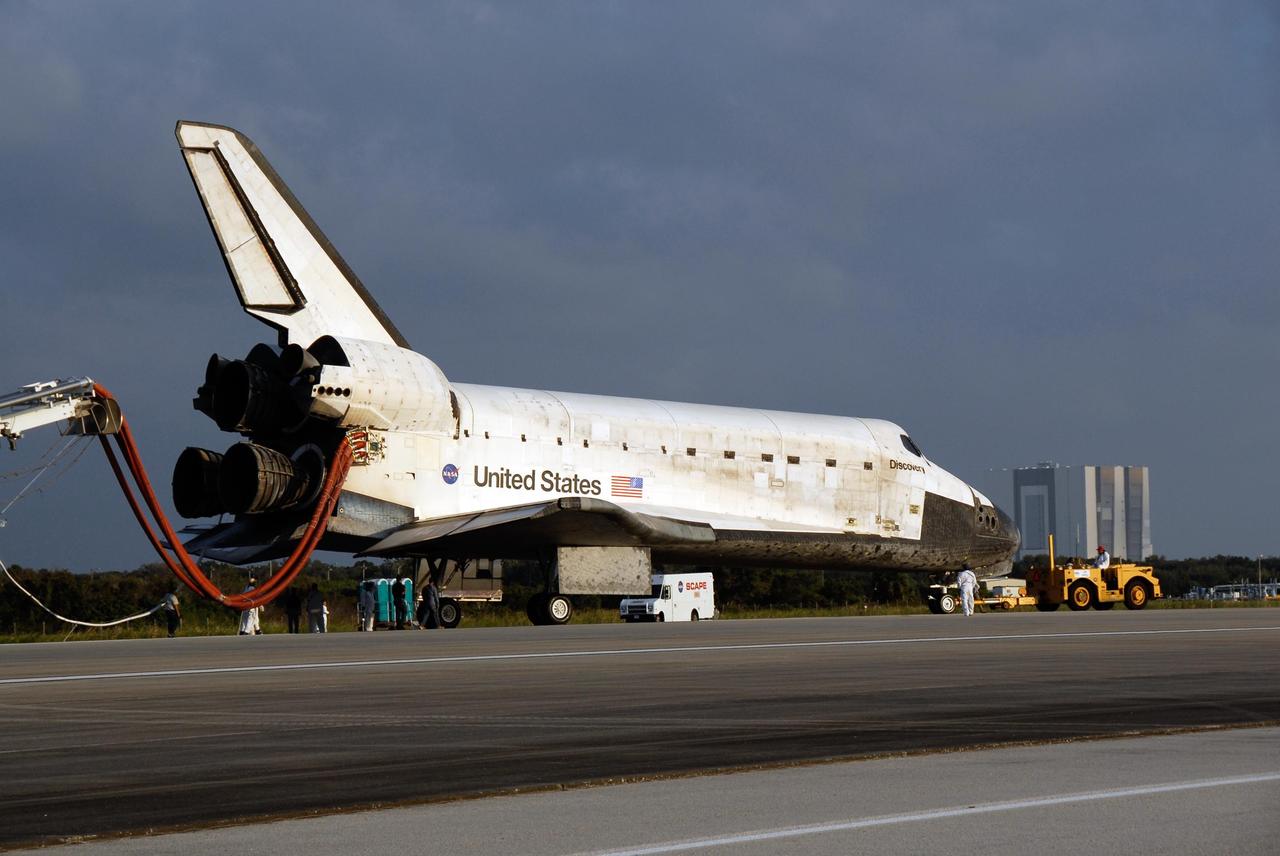
KENNEDY SPACE CENTER, FLA. -- On the Shuttle Landing Facility at NASA's Kennedy Space Center, space shuttle Discovery is towed to the Orbiter Processing Facility, or OPF. Towing normally begins approximately within four hours after landing and is completed within six hours unless removal of time-sensitive experiments requires an additional period on the runway. Umbilicals are attached to purge the vehicle of any possible residual explosive or toxic fumes. The tractor tow vehicle will pull Discovery along a two-mile tow-way to the OPF, where processing Discovery for another flight begins. The tow vehicle is very much like the typical towing units used for large aircraft, but it is equipped with a special towing bar designed specifically for the orbiter. In the OPF, turnaround processing procedures on Discovery will include various post-flight deservicing and maintenance functions, which are carried out in parallel with payload removal and the installation of equipment needed for the next mission. Before post-flight deservicing can continue beyond initial safing operations, certain vehicle systems must be mechanically secured and access platforms installed. Discovery completed mission STS-120 with an on-time landing at 1:01 p.m. EST. Photo credit: NASA/Kim Shiflett
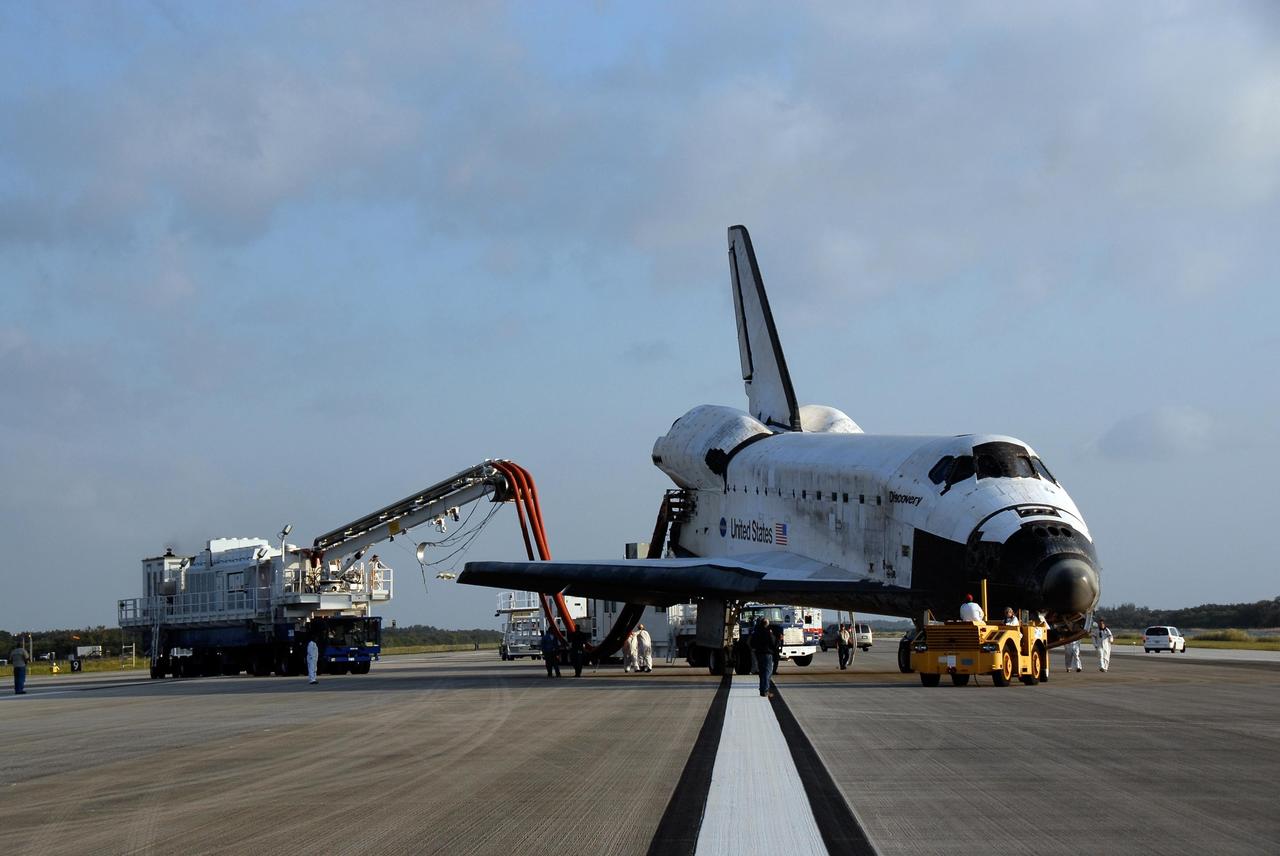
KENNEDY SPACE CENTER, FLA. -- On the Shuttle Landing Facility at NASA's Kennedy Space Center, space shuttle Discovery is ready for towing to the Orbiter Processing Facility, or OPF. Towing normally begins approximately within four hours after landing and is completed within six hours unless removal of time-sensitive experiments require an additional period on the runway. Umbilicals are attached to purge the vehicle of any possible residual explosive or toxic fumes. The tractor tow vehicle will pull Discovery along a two-mile tow-way to the OPF, where processing Discovery for another flight begins. The tow vehicle is very much like the typical towing units used for large aircraft, but it is equipped with a special towing bar designed specifically for the orbiter. In the OPF, turnaround processing procedures on Discovery will include various post-flight deservicing and maintenance functions, which are carried out in parallel with payload removal and the installation of equipment needed for the next mission. Before post-flight deservicing can continue beyond initial safing operations, certain vehicle systems must be mechanically secured and access platforms installed. Discovery completed mission STS-120 with an on-time landing at 1:01 p.m. EST. Photo credit: NASA/Kim Shiflett
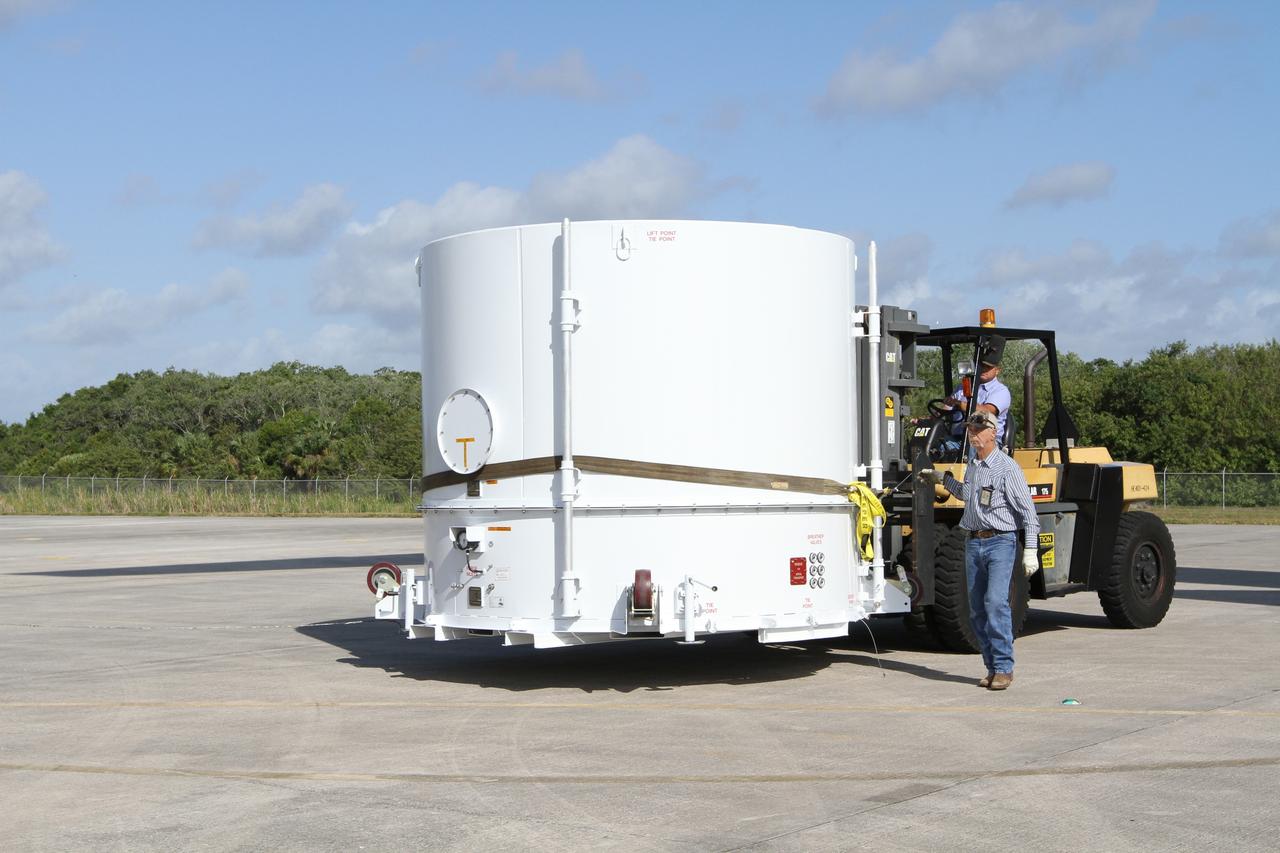
CAPE CANAVERAL, Fla. – A forklift operator NASA's Radiation Belt Storm Probe A, enclosed in a protective shipping container, toward a flatbed truck at the Shuttle Landing Facility at NASA’s Kennedy Space Center in Florida. The twin RBSP spacecraft will be transported to the Astrotech payload processing facility near Kennedy Space Center where Applied Physics Laboratory technicians will begin spacecraft testing and prelaunch preparations. The RBSP mission will help us understand the sun’s influence on Earth and near-Earth space by studying the Earth’s radiation belts on various scales of space and time. The RBSP instruments will provide the measurements needed to characterize and quantify the plasma processes that produce very energetic ions and relativistic electrons. The mission is part of NASA’s broader Living With a Star Program that was conceived to explore fundamental processes that operate throughout the solar system, and in particular those that generate hazardous space weather effects in the vicinity of Earth and phenomena that could impact solar system exploration. RBSP is scheduled to begin its mission of exploration of Earth's Van Allen Radiation Belts and the extremes of space weather after launch. Launch aboard a United Launch Alliance Atlas V rocket is scheduled for August 23. For more information, visit http://www.nasa.gov/rbsp. Photo credit: NASA/Kim Shiflett
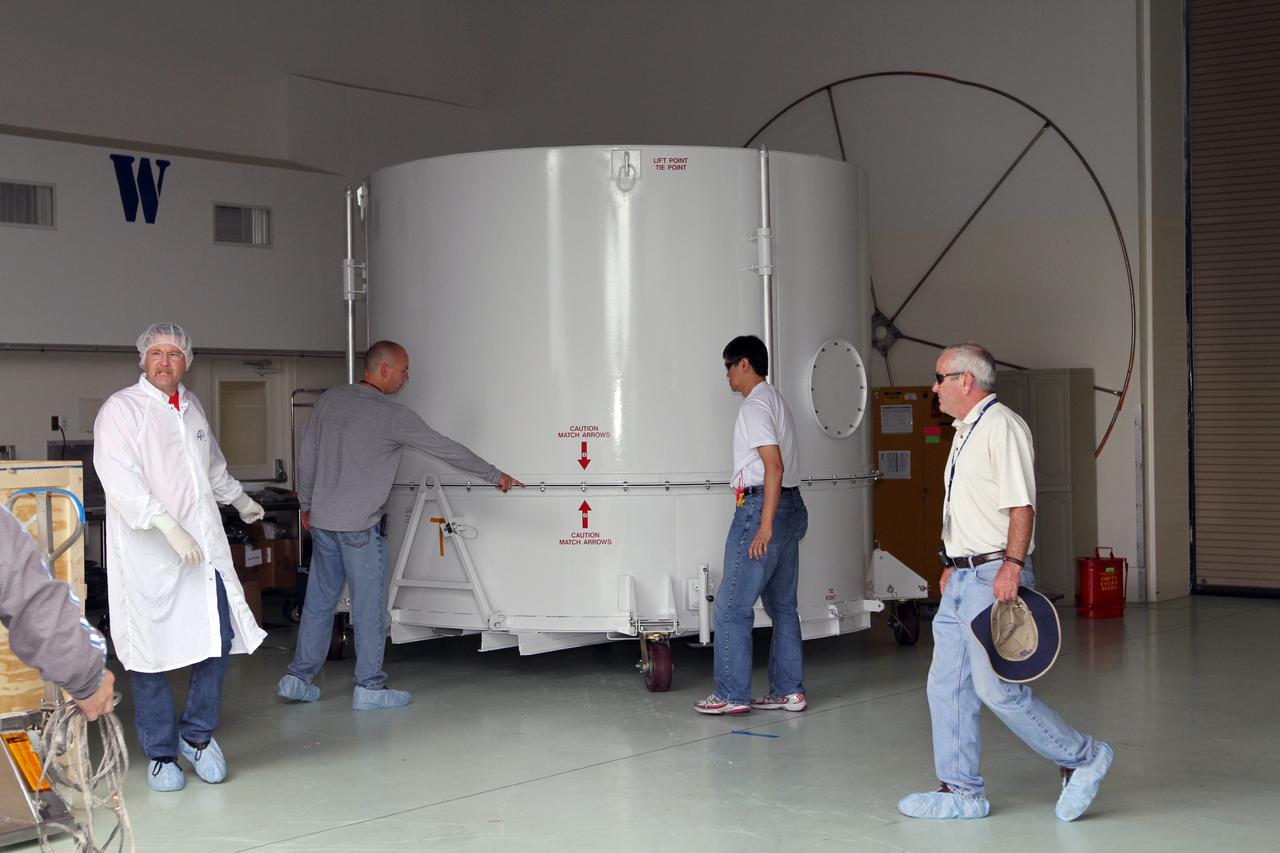
CAPE CANAVERAL, Fla. – NASA's Radiation Belt Storm Probe A, enclosed in a protective shipping container, is positioned into the airlock of the Astrotech payload processing facility near NASA’s Kennedy Space Center in Florida where Applied Physics Laboratory technicians will begin spacecraft testing and prelaunch preparations. The twin RBSP spacecraft arrived at Kennedy’s Shuttle Landing Facility in the cargo bay of a U.S. Air Force C-17 aircraft earlier in the day. The RBSP mission will help us understand the sun’s influence on Earth and near-Earth space by studying the Earth’s radiation belts on various scales of space and time. The RBSP instruments will provide the measurements needed to characterize and quantify the plasma processes that produce very energetic ions and relativistic electrons. The mission is part of NASA’s broader Living With a Star Program that was conceived to explore fundamental processes that operate throughout the solar system, and in particular those that generate hazardous space weather effects in the vicinity of Earth and phenomena that could impact solar system exploration. RBSP is scheduled to begin its mission of exploration of Earth's Van Allen Radiation Belts and the extremes of space weather after launch. Launch aboard a United Launch Alliance Atlas V rocket is scheduled for August 23. For more information, visit http://www.nasa.gov/rbsp. Photo credit: NASA/Kim Shiflett
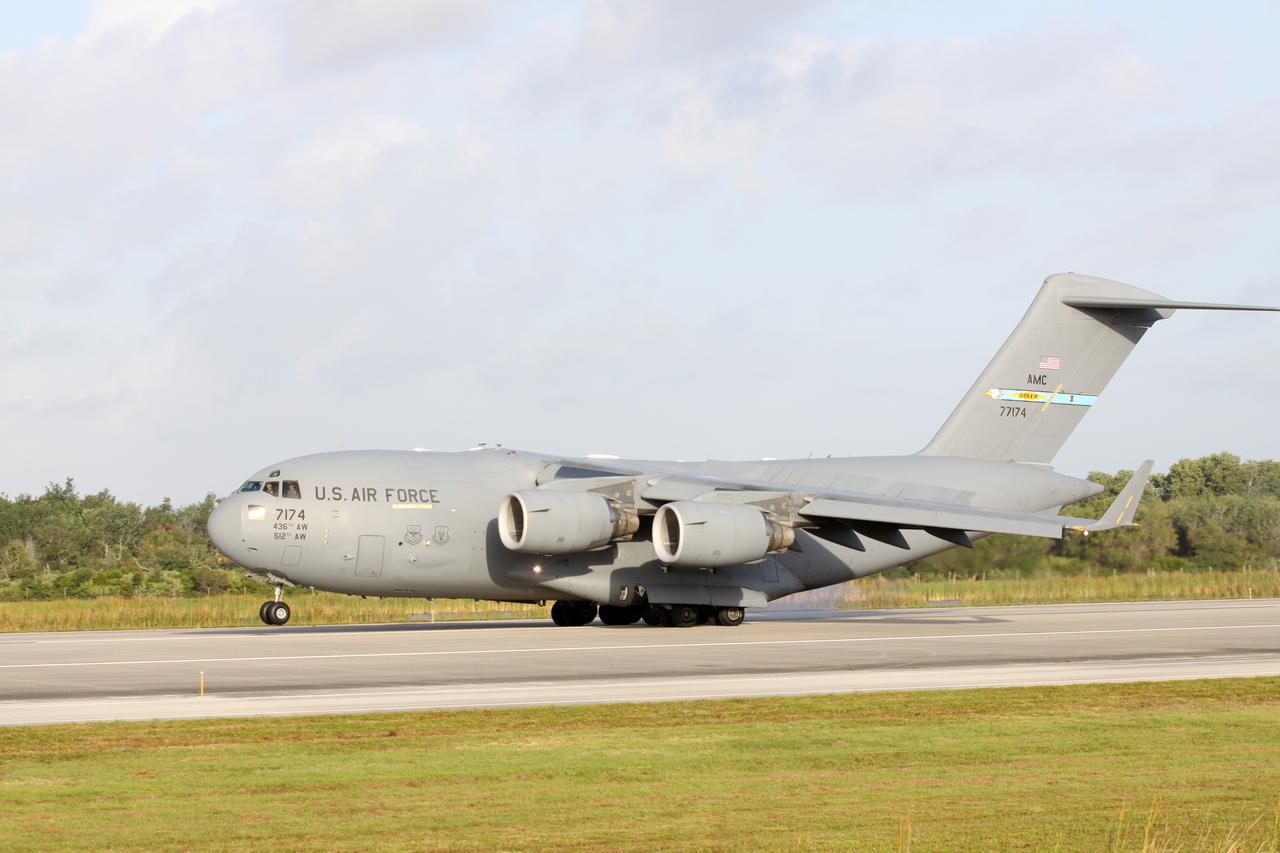
CAPE CANAVERAL, Fla. – A U.S. Air Force C-17 cargo aircraft lands at the Shuttle Landing Facility at NASA’s Kennedy Space Center in Florida. Aboard are NASA's twin Radiation Belt Storm Probes. The RBSP mission will help us understand the sun’s influence on Earth and near-Earth space by studying the Earth’s radiation belts on various scales of space and time. The RBSP instruments will provide the measurements needed to characterize and quantify the plasma processes that produce very energetic ions and relativistic electrons. The mission is part of NASA’s broader Living With a Star Program that was conceived to explore fundamental processes that operate throughout the solar system, and in particular those that generate hazardous space weather effects in the vicinity of Earth and phenomena that could impact solar system exploration. RBSP is scheduled to begin its mission of exploration of Earth's Van Allen Radiation Belts and the extremes of space weather after launch. Launch aboard a United Launch Alliance Atlas V rocket is scheduled for August 23. For more information, visit http://www.nasa.gov/rbsp. Photo credit: NASA/Kim Shiflett
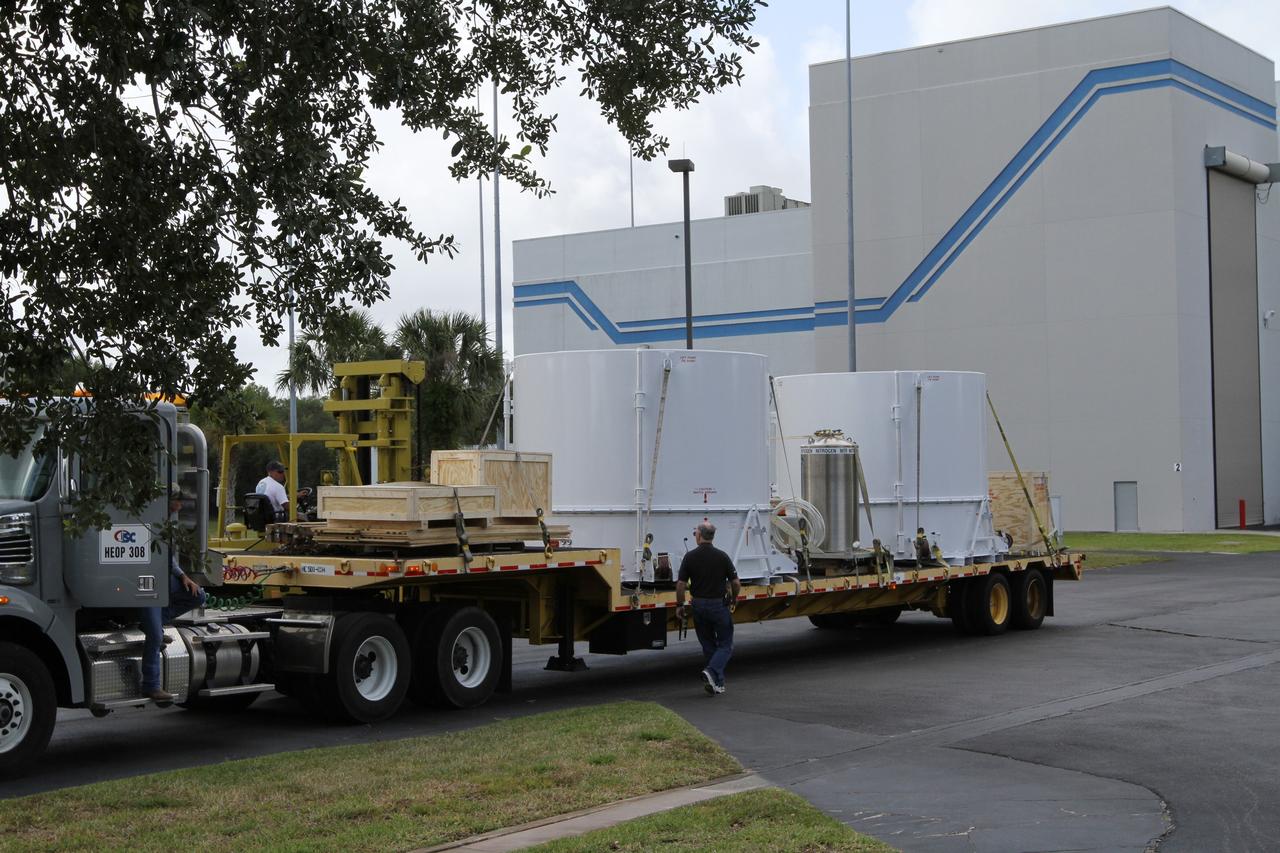
CAPE CANAVERAL, Fla. – NASA's twin Radiation Belt Storm Probes, enclosed in protective shipping containers, arrive at the Astrotech payload processing facility near NASA’s Kennedy Space Center in Florida where Applied Physics Laboratory technicians will begin spacecraft testing and prelaunch preparations. The spacecraft were delivered to Kennedy’s Shuttle Landing Facility in the cargo bay of a U.S. Air Force C-17 aircraft earlier in the day. The RBSP mission will help us understand the sun’s influence on Earth and near-Earth space by studying the Earth’s radiation belts on various scales of space and time. The RBSP instruments will provide the measurements needed to characterize and quantify the plasma processes that produce very energetic ions and relativistic electrons. The mission is part of NASA’s broader Living With a Star Program that was conceived to explore fundamental processes that operate throughout the solar system, and in particular those that generate hazardous space weather effects in the vicinity of Earth and phenomena that could impact solar system exploration. RBSP is scheduled to begin its mission of exploration of Earth's Van Allen Radiation Belts and the extremes of space weather after launch. Launch aboard a United Launch Alliance Atlas V rocket is scheduled for August 23. For more information, visit http://www.nasa.gov/rbsp. Photo credit: NASA/Kim Shiflett
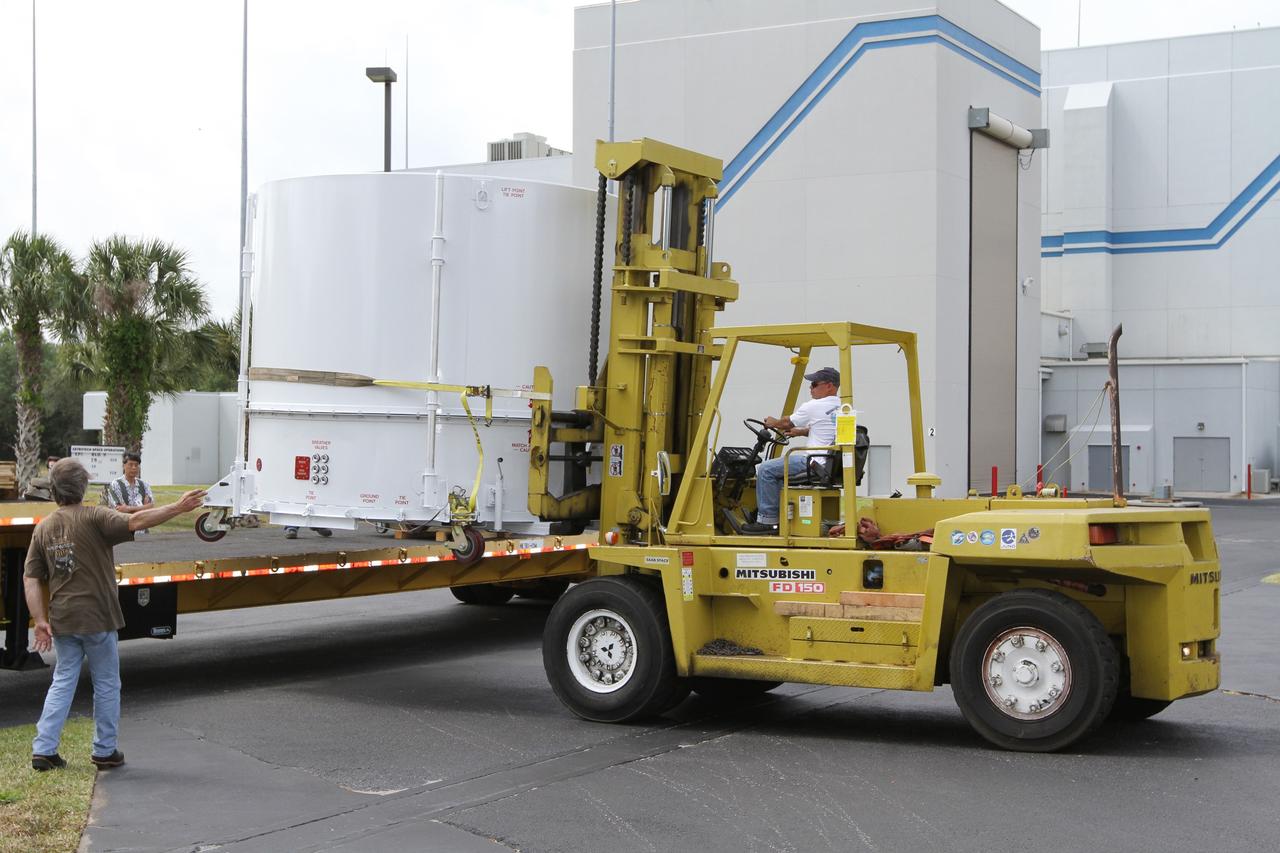
CAPE CANAVERAL, Fla. – A forklift operator offloads NASA's Radiation Belt Storm Probe B, enclosed in a protective shipping container, from a flatbed truck at the Astrotech payload processing facility near NASA’s Kennedy Space Center in Florida where Applied Physics Laboratory technicians will begin spacecraft testing and prelaunch preparations. The twin RBSP spacecraft arrived at Kennedy’s Shuttle Landing Facility in the cargo bay of a U.S. Air Force C-17 aircraft earlier in the day. The RBSP mission will help us understand the sun’s influence on Earth and near-Earth space by studying the Earth’s radiation belts on various scales of space and time. The RBSP instruments will provide the measurements needed to characterize and quantify the plasma processes that produce very energetic ions and relativistic electrons. The mission is part of NASA’s broader Living With a Star Program that was conceived to explore fundamental processes that operate throughout the solar system, and in particular those that generate hazardous space weather effects in the vicinity of Earth and phenomena that could impact solar system exploration. RBSP is scheduled to begin its mission of exploration of Earth's Van Allen Radiation Belts and the extremes of space weather after launch. Launch aboard a United Launch Alliance Atlas V rocket is scheduled for August 23. For more information, visit http://www.nasa.gov/rbsp. Photo credit: NASA/Kim Shiflett
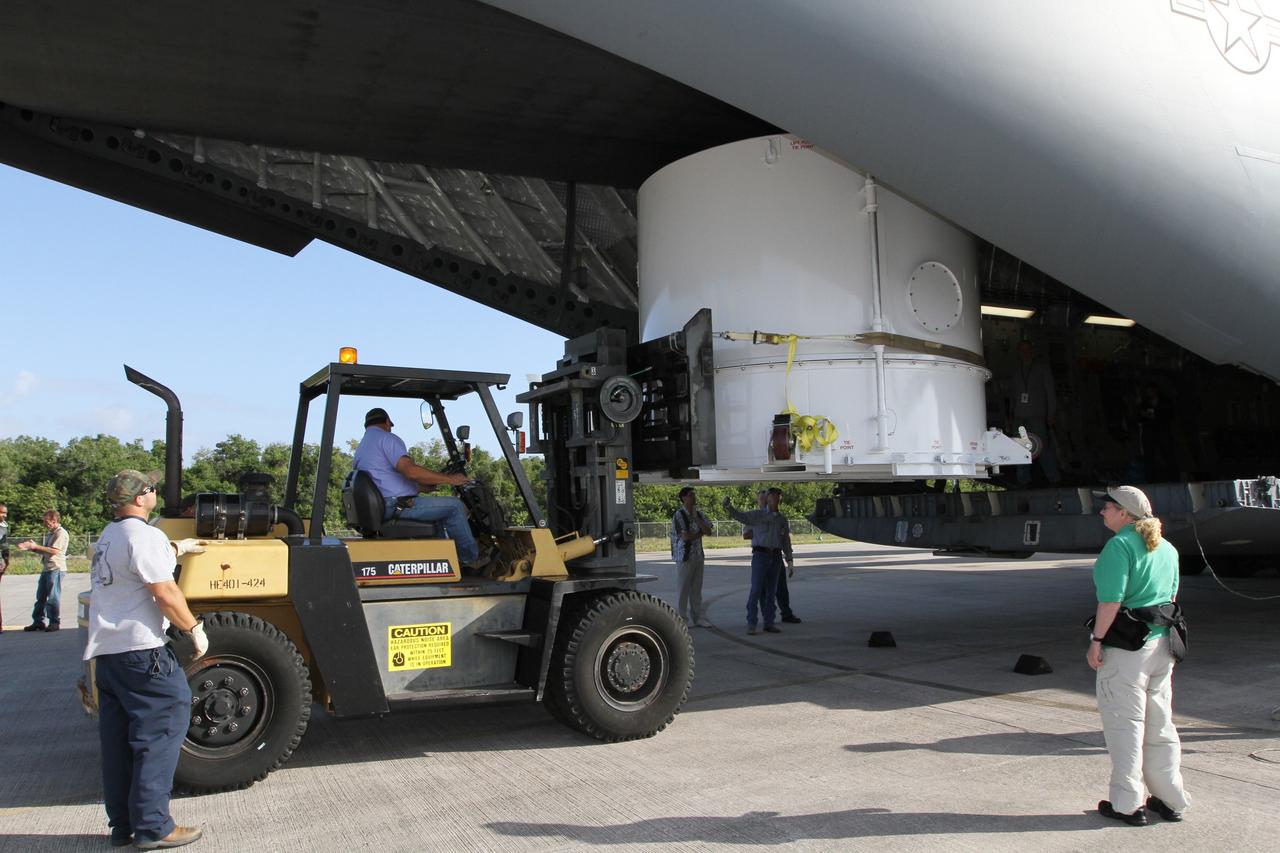
CAPE CANAVERAL, Fla. – A forklift is enlisted to lower NASA's Radiation Belt Storm Probe B, enclosed in a protective shipping container, from the cargo bay of a U.S. Air Force C-17 airplane to the tarmac at the Shuttle Landing Facility at NASA’s Kennedy Space Center in Florida. The RBSP mission will help us understand the sun’s influence on Earth and near-Earth space by studying the Earth’s radiation belts on various scales of space and time. The RBSP instruments will provide the measurements needed to characterize and quantify the plasma processes that produce very energetic ions and relativistic electrons. The mission is part of NASA’s broader Living With a Star Program that was conceived to explore fundamental processes that operate throughout the solar system, and in particular those that generate hazardous space weather effects in the vicinity of Earth and phenomena that could impact solar system exploration. RBSP is scheduled to begin its mission of exploration of Earth's Van Allen Radiation Belts and the extremes of space weather after launch. Launch aboard a United Launch Alliance Atlas V rocket is scheduled for August 23. For more information, visit http://www.nasa.gov/rbsp. Photo credit: NASA/Kim Shiflett
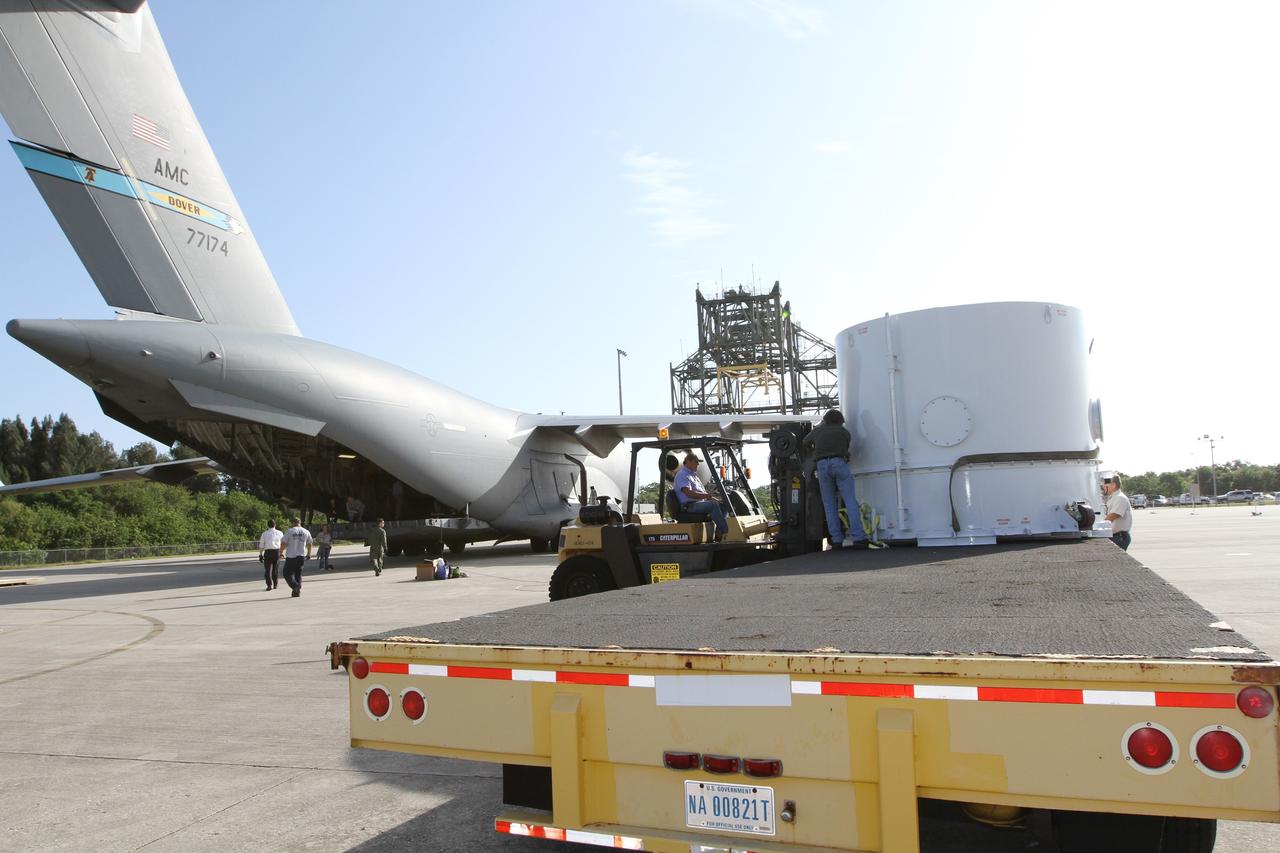
CAPE CANAVERAL, Fla. – Workers secure NASA's Radiation Belt Storm Probe B, enclosed in a protective shipping container, onto a flatbed truck at the Shuttle Landing Facility at NASA’s Kennedy Space Center in Florida. The twin RBSP spacecraft will be transported to the Astrotech payload processing facility near Kennedy Space Center where Applied Physics Laboratory technicians will begin spacecraft testing and prelaunch preparations. The RBSP mission will help us understand the sun’s influence on Earth and near-Earth space by studying the Earth’s radiation belts on various scales of space and time. The RBSP instruments will provide the measurements needed to characterize and quantify the plasma processes that produce very energetic ions and relativistic electrons. The mission is part of NASA’s broader Living With a Star Program that was conceived to explore fundamental processes that operate throughout the solar system, and in particular those that generate hazardous space weather effects in the vicinity of Earth and phenomena that could impact solar system exploration. RBSP is scheduled to begin its mission of exploration of Earth's Van Allen Radiation Belts and the extremes of space weather after launch. Launch aboard a United Launch Alliance Atlas V rocket is scheduled for August 23. For more information, visit http://www.nasa.gov/rbsp. Photo credit: NASA/Kim Shiflett
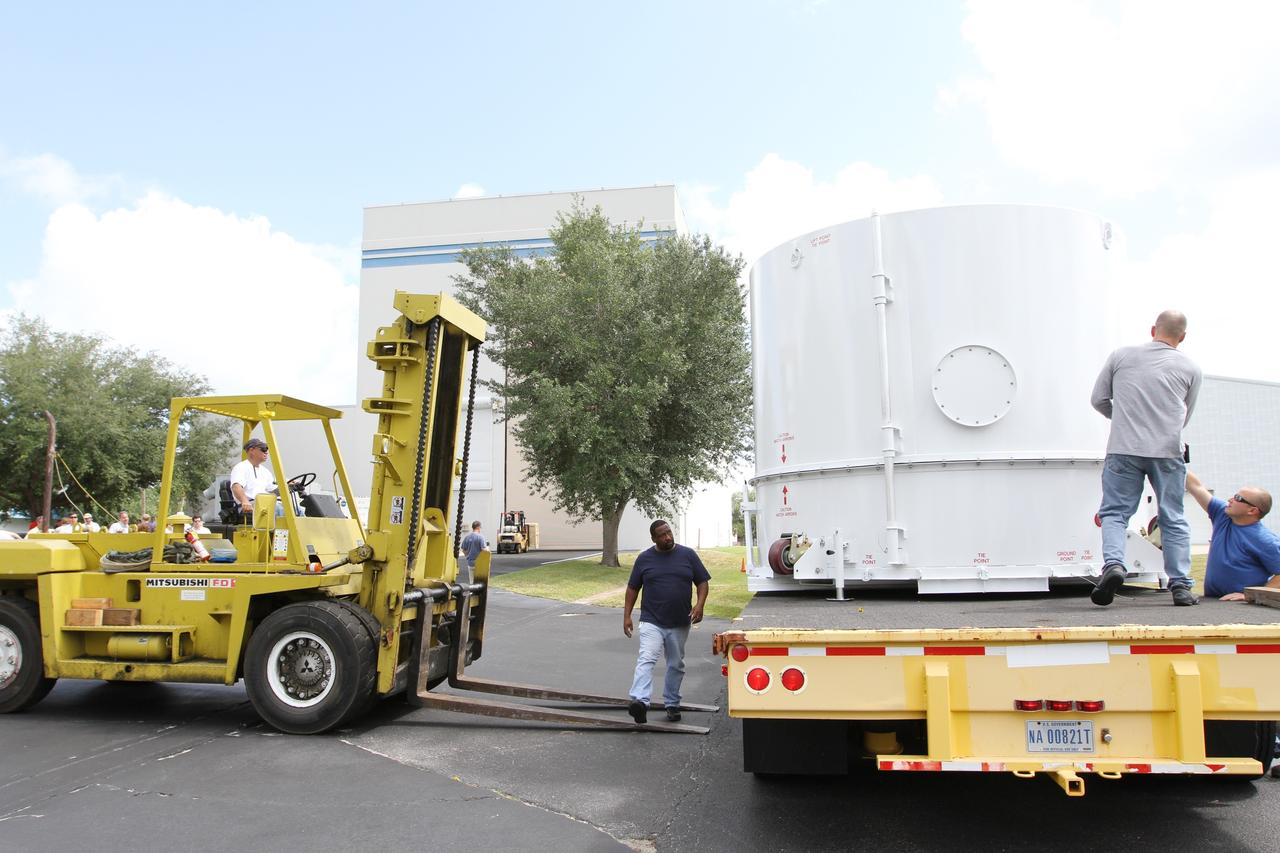
CAPE CANAVERAL, Fla. – Preparations are under way to offload NASA's twin Radiation Belt Storm Probes, enclosed in protective shipping containers, into the Astrotech payload processing facility near NASA’s Kennedy Space Center in Florida where Applied Physics Laboratory technicians will begin spacecraft testing and prelaunch preparations. The spacecraft arrived at Kennedy’s Shuttle Landing Facility in the cargo bay of a U.S. Air Force C-17 aircraft earlier in the day. The RBSP mission will help us understand the sun’s influence on Earth and near-Earth space by studying the Earth’s radiation belts on various scales of space and time. The RBSP instruments will provide the measurements needed to characterize and quantify the plasma processes that produce very energetic ions and relativistic electrons. The mission is part of NASA’s broader Living With a Star Program that was conceived to explore fundamental processes that operate throughout the solar system, and in particular those that generate hazardous space weather effects in the vicinity of Earth and phenomena that could impact solar system exploration. RBSP is scheduled to begin its mission of exploration of Earth's Van Allen Radiation Belts and the extremes of space weather after launch. Launch aboard a United Launch Alliance Atlas V rocket is scheduled for August 23. For more information, visit http://www.nasa.gov/rbsp. Photo credit: NASA/Kim Shiflett
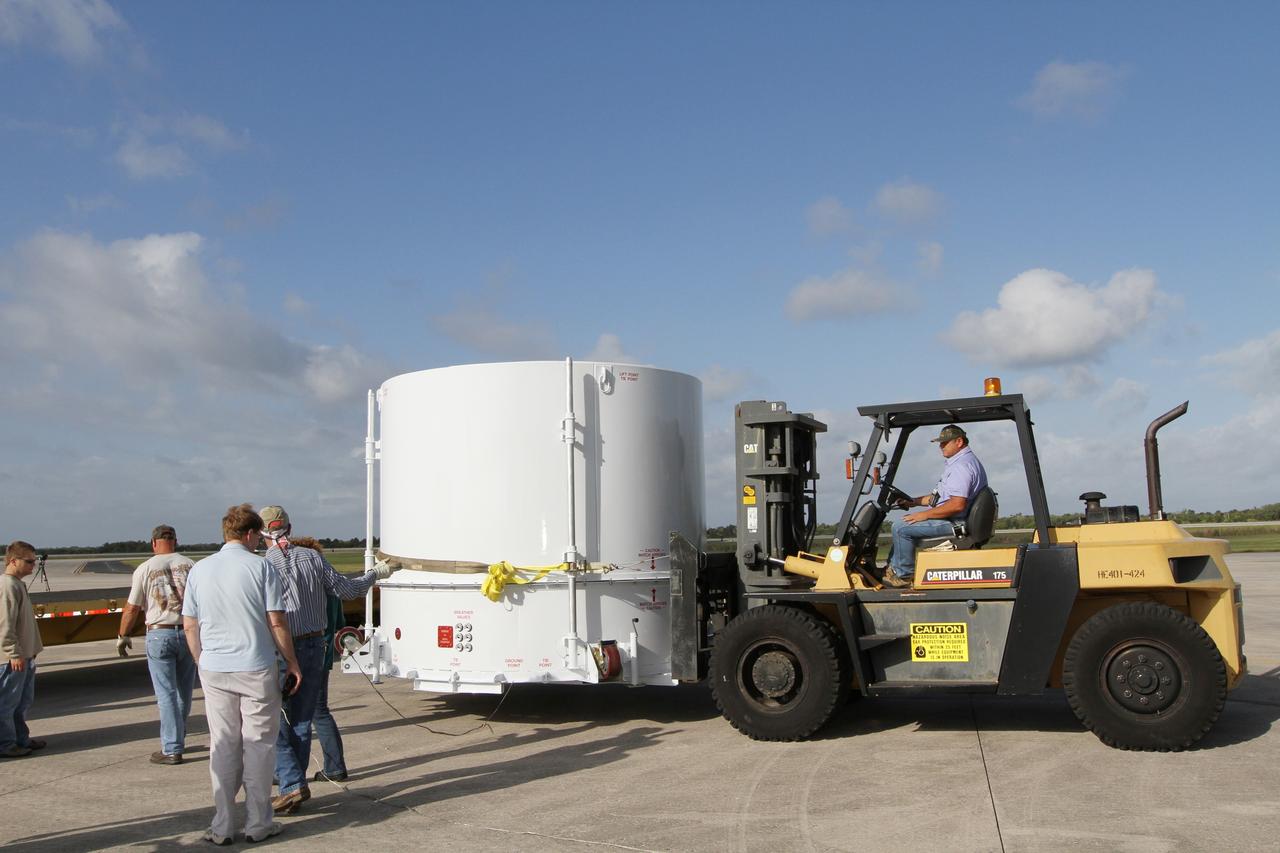
CAPE CANAVERAL, Fla. – A forklift operator moves NASA's Radiation Belt Storm Probe B, enclosed in a protective shipping container, toward a flatbed truck at the Shuttle Landing Facility at NASA’s Kennedy Space Center in Florida. The twin RBSP spacecraft will be transported to the Astrotech payload processing facility near Kennedy Space Center where Applied Physics Laboratory technicians will begin spacecraft testing and prelaunch preparations. The RBSP mission will help us understand the sun’s influence on Earth and near-Earth space by studying the Earth’s radiation belts on various scales of space and time. The RBSP instruments will provide the measurements needed to characterize and quantify the plasma processes that produce very energetic ions and relativistic electrons. The mission is part of NASA’s broader Living With a Star Program that was conceived to explore fundamental processes that operate throughout the solar system, and in particular those that generate hazardous space weather effects in the vicinity of Earth and phenomena that could impact solar system exploration. RBSP is scheduled to begin its mission of exploration of Earth's Van Allen Radiation Belts and the extremes of space weather after launch. Launch aboard a United Launch Alliance Atlas V rocket is scheduled for August 23. For more information, visit http://www.nasa.gov/rbsp. Photo credit: NASA/Kim Shiflett
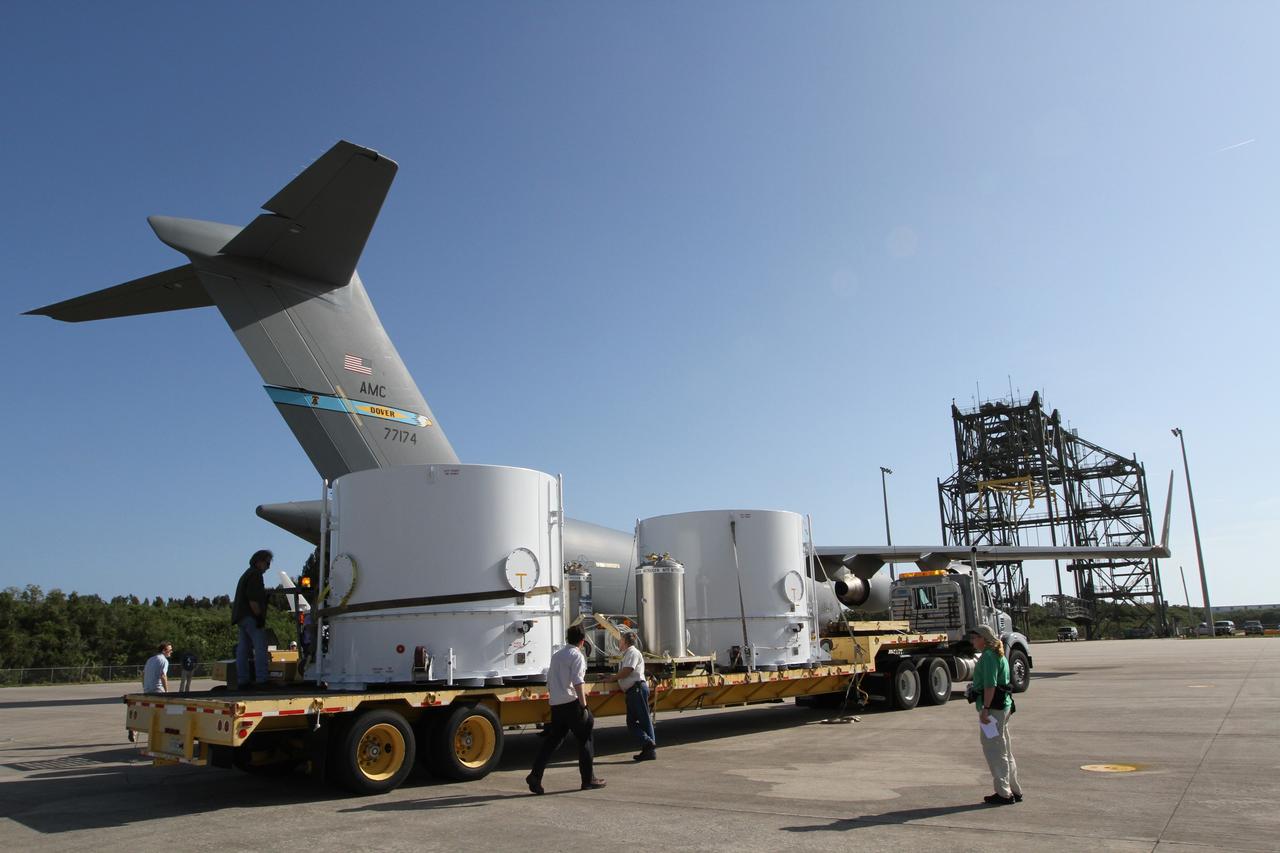
CAPE CANAVERAL, Fla. – Workers secure NASA's Radiation Belt Storm Probe A, enclosed in a protective shipping container, onto a flatbed truck at the Shuttle Landing Facility at NASA’s Kennedy Space Center in Florida. The twin RBSP spacecraft will be transported to the Astrotech payload processing facility near Kennedy Space Center where Applied Physics Laboratory technicians will begin spacecraft testing and prelaunch preparations. Nitrogen will be pumped into the canisters during transport to provide the proper environmental control for the spacecraft. The RBSP mission will help us understand the sun’s influence on Earth and near-Earth space by studying the Earth’s radiation belts on various scales of space and time. The RBSP instruments will provide the measurements needed to characterize and quantify the plasma processes that produce very energetic ions and relativistic electrons. The mission is part of NASA’s broader Living With a Star Program that was conceived to explore fundamental processes that operate throughout the solar system, and in particular those that generate hazardous space weather effects in the vicinity of Earth and phenomena that could impact solar system exploration. RBSP is scheduled to begin its mission of exploration of Earth's Van Allen Radiation Belts and the extremes of space weather after launch. Launch aboard a United Launch Alliance Atlas V rocket is scheduled for August 23. For more information, visit http://www.nasa.gov/rbsp. Photo credit: NASA/Kim Shiflett
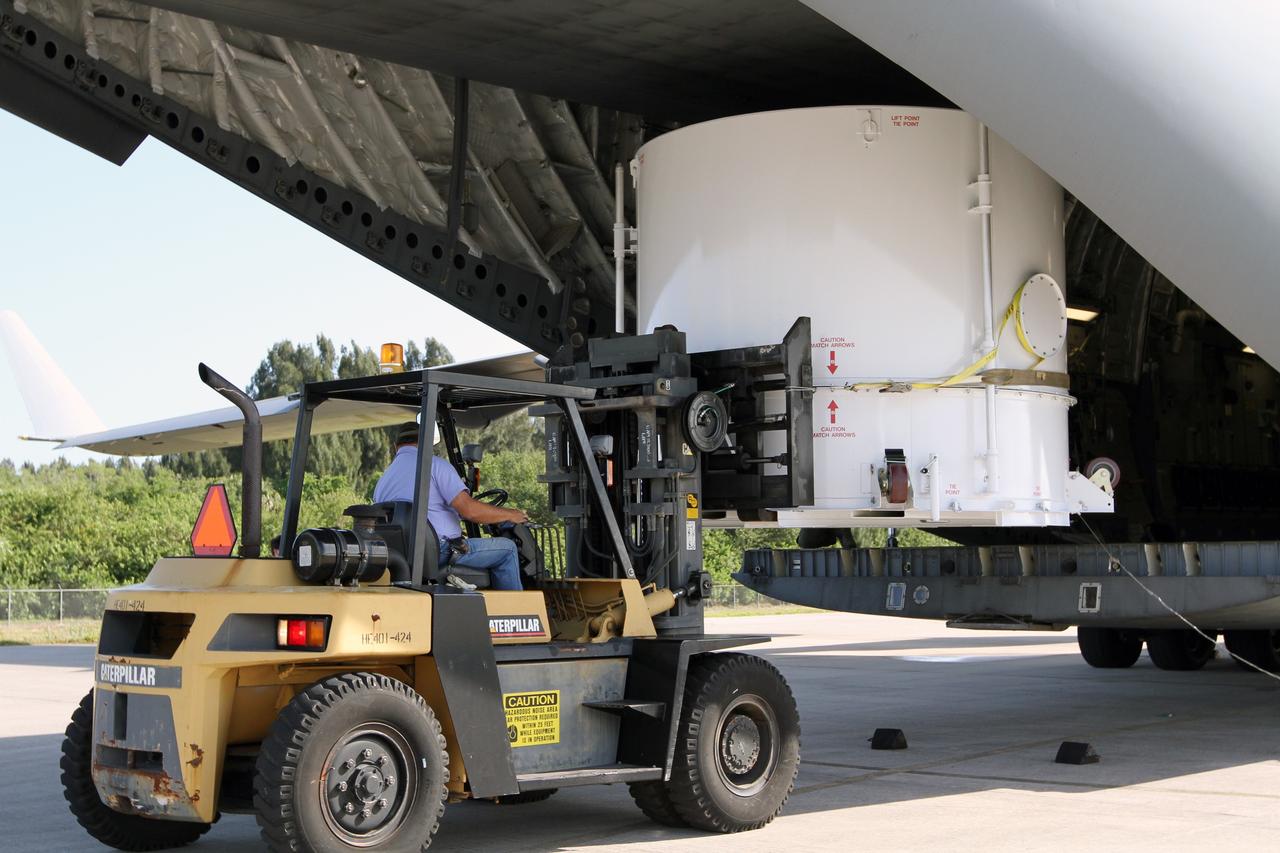
CAPE CANAVERAL, Fla. – A forklift operator lowers NASA's Radiation Belt Storm Probe A, enclosed in a protective shipping container, from the cargo bay of a U.S. Air Force C-17 airplane to the tarmac at the Shuttle Landing Facility at NASA’s Kennedy Space Center in Florida. The RBSP mission will help us understand the sun’s influence on Earth and near-Earth space by studying the Earth’s radiation belts on various scales of space and time. The RBSP instruments will provide the measurements needed to characterize and quantify the plasma processes that produce very energetic ions and relativistic electrons. The mission is part of NASA’s broader Living With a Star Program that was conceived to explore fundamental processes that operate throughout the solar system, and in particular those that generate hazardous space weather effects in the vicinity of Earth and phenomena that could impact solar system exploration. RBSP is scheduled to begin its mission of exploration of Earth's Van Allen Radiation Belts and the extremes of space weather after launch. Launch aboard a United Launch Alliance Atlas V rocket is scheduled for August 23. For more information, visit http://www.nasa.gov/rbsp. Photo credit: NASA/Kim Shiflett

KENNEDY SPACE CENTER, FLA. -- On the Shuttle Landing Facility at NASA's Kennedy Space Center, a tractor tow vehicle is backed up to space shuttle Discovery. Towing normally begins approximately within four hours after landing and is completed within six hours unless removal of time-sensitive experiments require an additional period on the runway. Umbilicals are attached to purge the vehicle of any possible residual explosive or toxic fumes. The tractor tow vehicle will pull Discovery along a two-mile tow-way to the Orbiter Processing Facility, or OPF, where processing Discovery for another flight begins. The tow vehicle is very much like the typical towing units used for large aircraft, but it is equipped with a special towing bar designed specifically for the orbiter. In the OPF, turnaround processing procedures on Discovery will include various post-flight deservicing and maintenance functions, which are carried out in parallel with payload removal and the installation of equipment needed for the next mission. Before post-flight deservicing can continue beyond initial safing operations, certain vehicle systems must be mechanically secured and access platforms installed. Discovery completed mission STS-120 with an on-time landing at 1:01 p.m. EST. Photo credit: NASA/Kim Shiflett