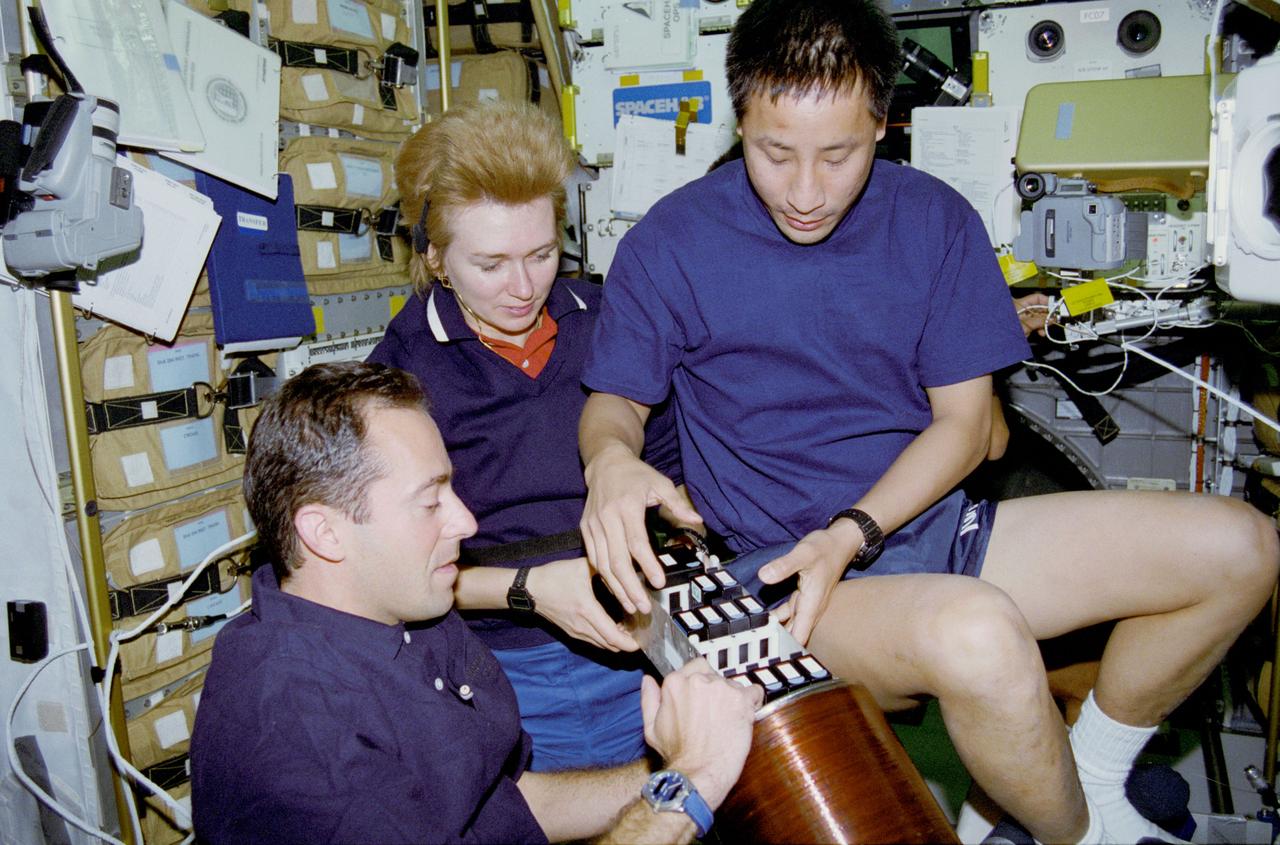
STS084-311-033 (15-24 May 1997) --- Biorack operations on Spacehab, aboard the Space Shuttle Atlantis, draw the collective attention of (from the left) Jean-Francois Clervoy, STS-84 payload commander; and Elena V. Kondakova and Edward T. Lu, both mission specialists.
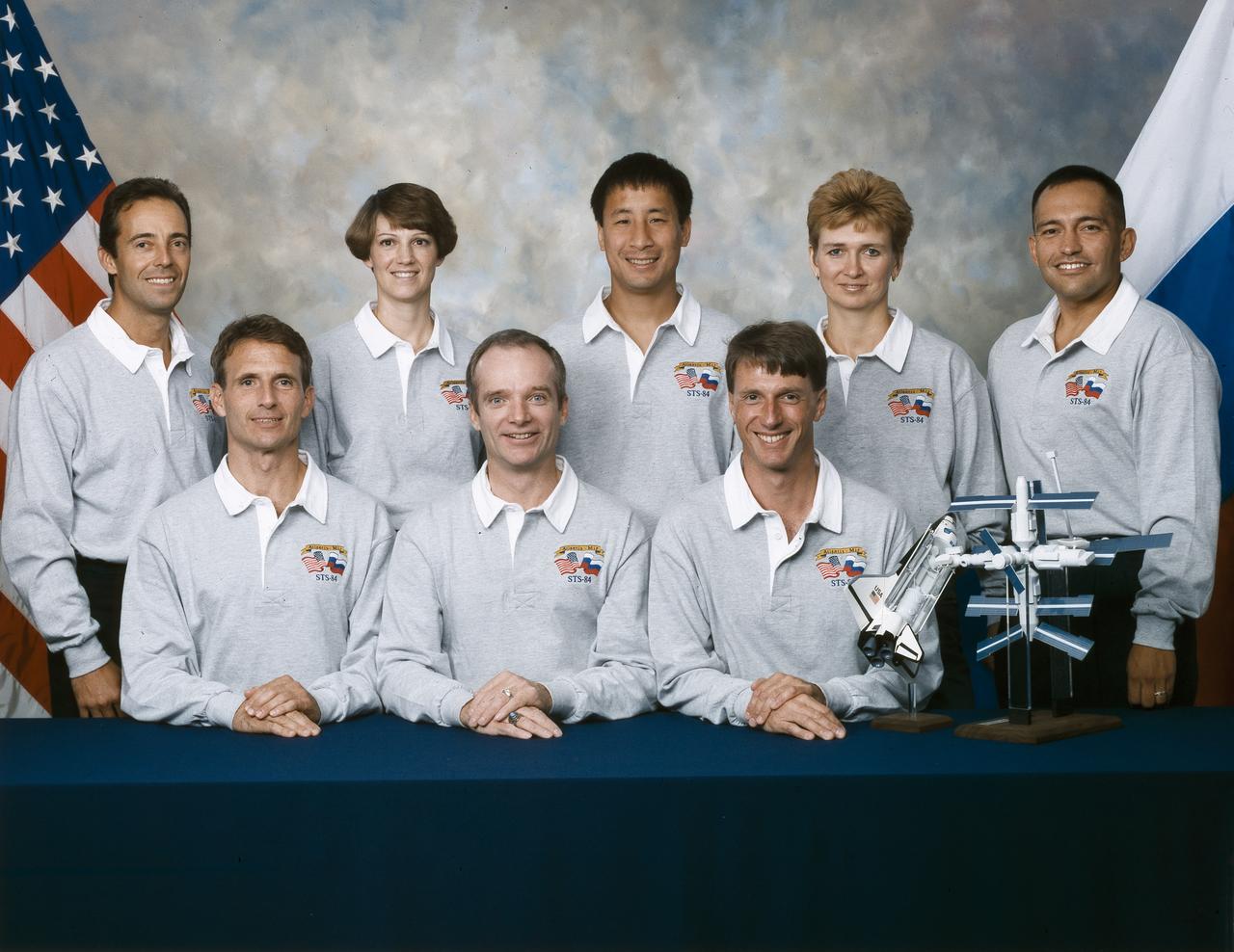
The crew assigned to the STS-84 mission included (seated front left to right) Jerry M Linenger, mission specialist; Charles J. Precourt, commander; and C. Michael Foale, mission specialist. On the back row (left to right) are Jean-Francois Clervoy (ESA), mission specialist; Eileen M. Collins, pilot; Edward T. Lu, mission specialist; Elena V. Kondakova (RSA), mission specialist; and Carlos I. Noriega, mission specialist. Launched aboard the Space Shuttle Atlantis on May 15, 1997 at 4:07:48 am (EDT), the STS-84 mission served as the sixth U.S. Space Shuttle-Russian Space Station Mir docking.
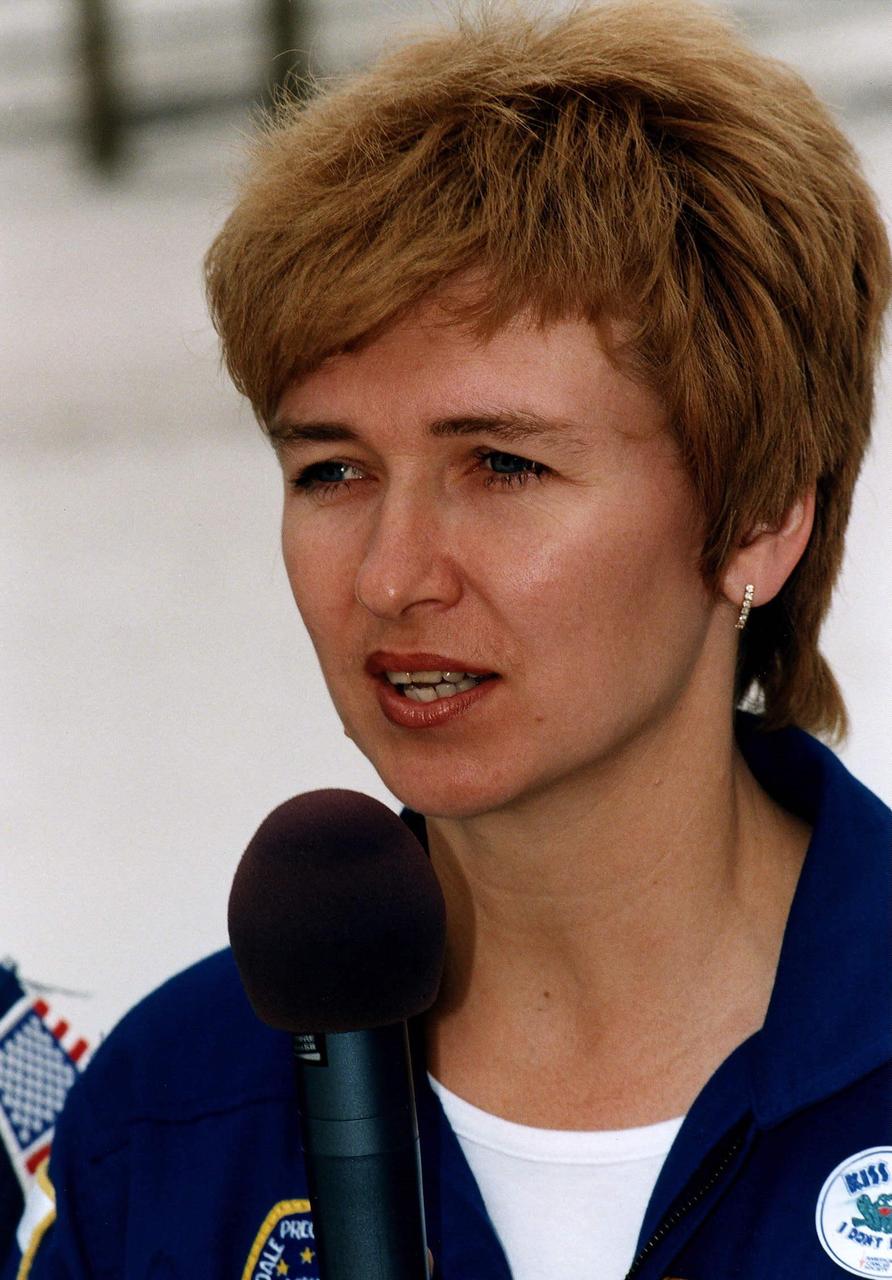
STS-84 Mission Specialist Elena V. Kondakova, a cosmonaut with the Russian Space Agency, talks to news media representatives and other onlookers during Terminal Countdown Demonstration Test (TCDT) activities at Launch Pad 39A. Kondakova will be one of seven crew members on the sixth docking of the Space Shuttle with the Russian Space Station Mir. Another of the crew members, C. Michael Foale, will transfer to the space station and become a member of the Mir 23 crew, replacing U.S. astronaut Jerry M. Linenger, who will return to Earth aboard Atlantis. Foale will live and work on Mir until mid-September when his replacement is expected to arrive on the STS-86 mission. Kondakova previously lived on the Russian space station as the flight engineer of the 17th main mission on Mir from Oct. 4, 1994, to March 9, 1995. STS-84 is targeted for a May 15 liftoff
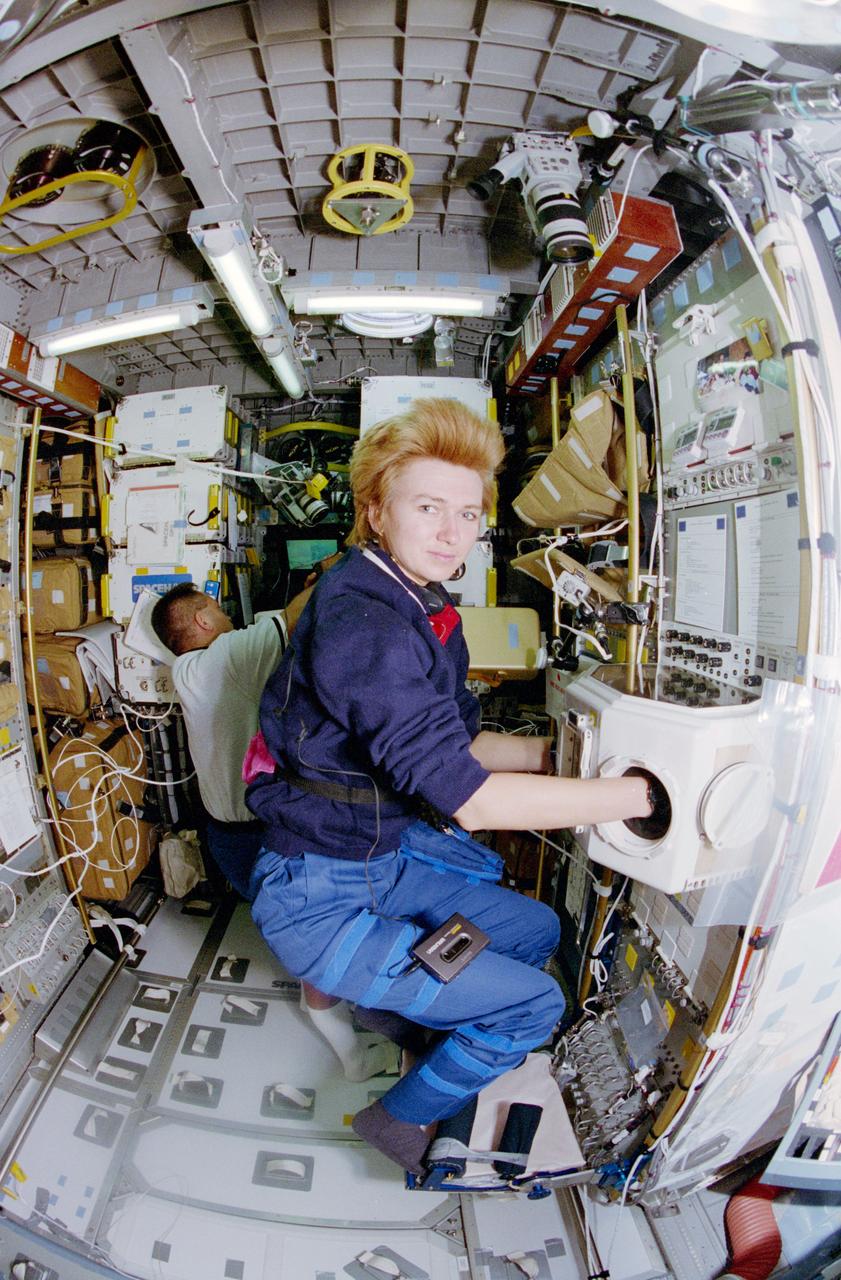
STS084-317-020 (15-24 May 1997) --- Elena V. Kondakova works in the Spacehab glovebox, aboard the Space Shuttle Atlantis, as Carlos I. Noriega, a fellow mission specialist, checks on an experiment in the background.
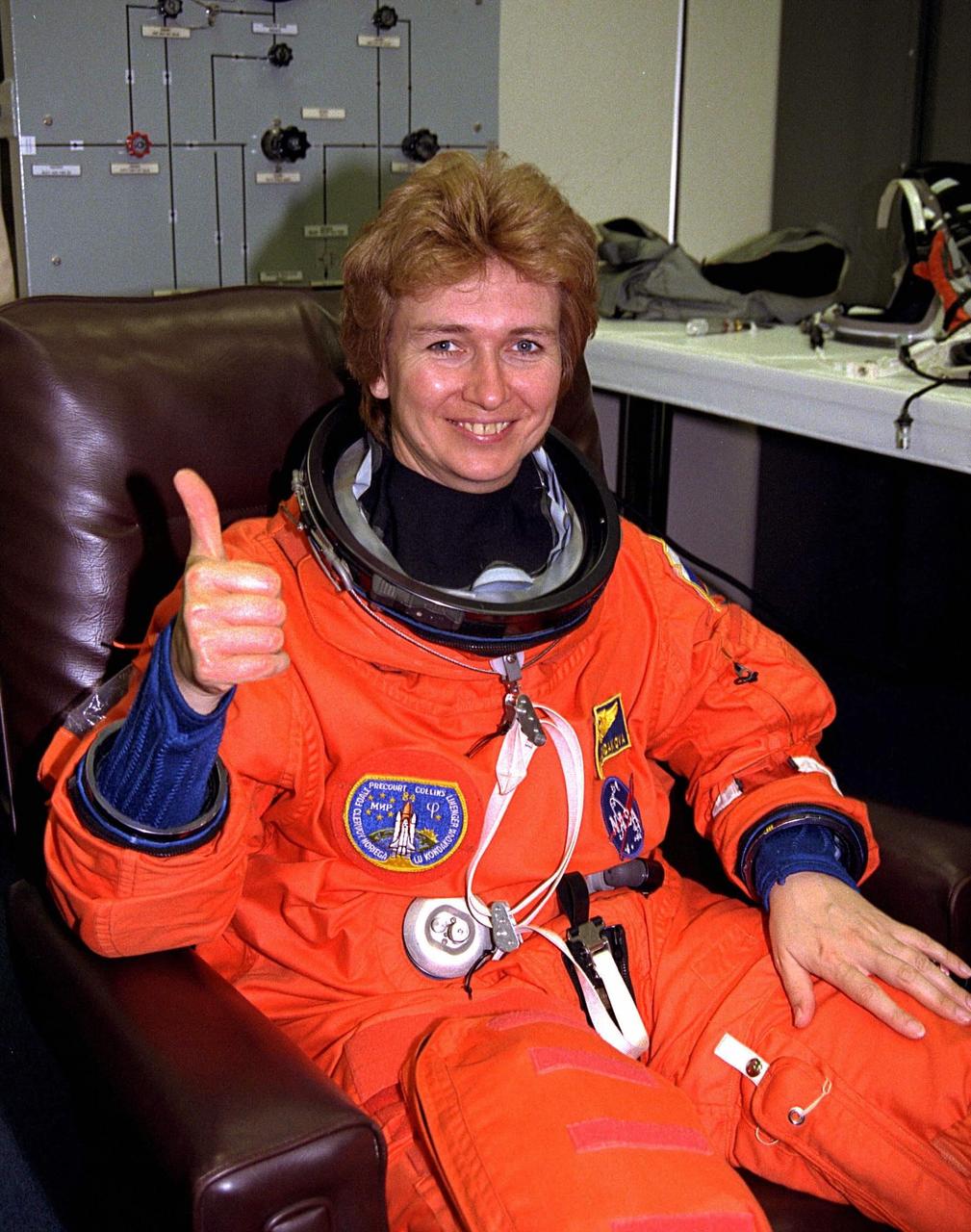
STS-84 Mission Specialist Elena V. Kondakova gives a "thumbs up" as she dons her launch and entry suit during final prelaunch preparations in the Operations and Checkout Building. Kondakova is a cosmonaut with the Russian Space Agency. This is her second trip into space, but her first on the Space Shuttle. She spent 169 days in space as flight engineer of the 17th main mission on the Russian Space Station Mir from Oct. 4, 1994, to March 9, 1995. STS-84 aboard Atlantis will be the sixth docking of the Space Shuttle with the Mir
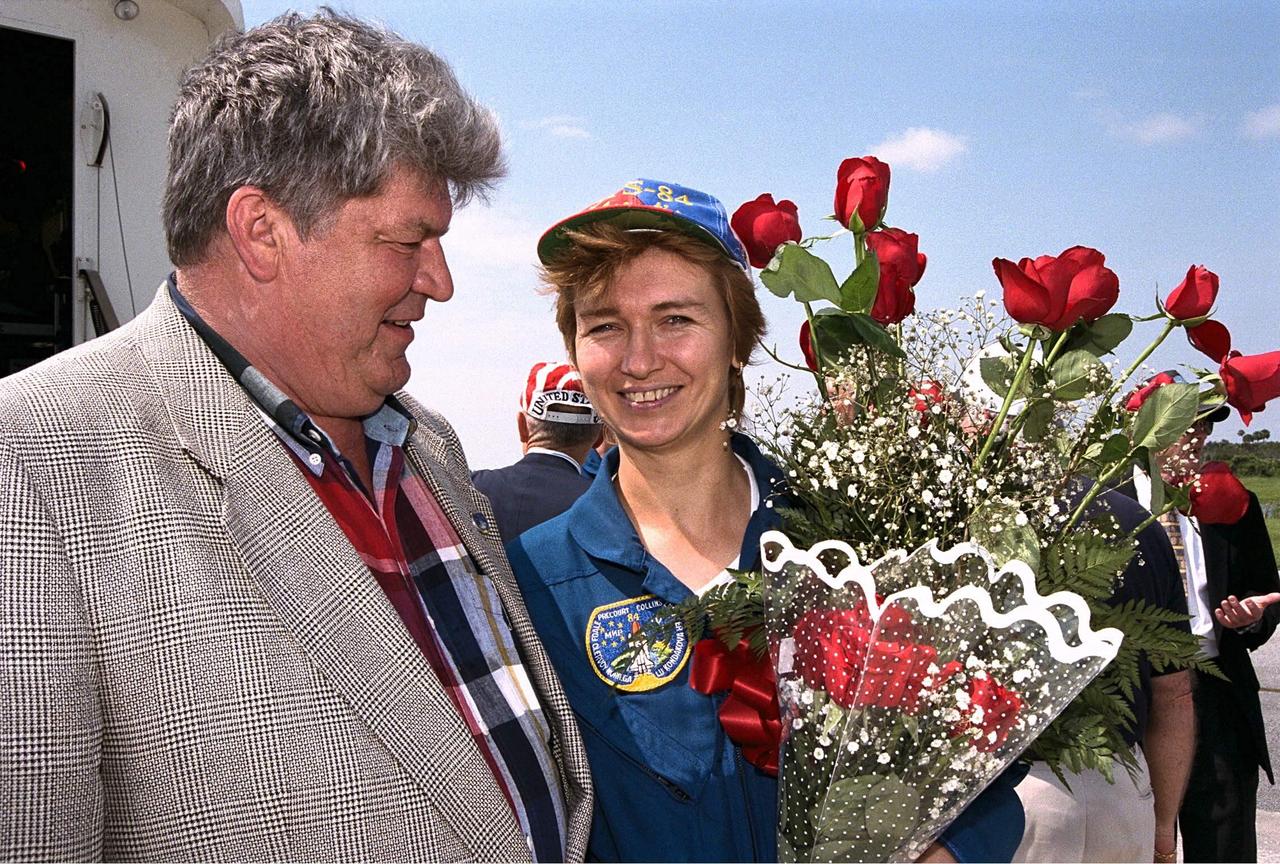
Veteran cosmonaut Valery Ryumin greets his wife, STS-84 Mission Specialist Elena V. Kondakova, with some flowers after the Space Shuttle orbiter Atlantis lands on KSC’s Runway 33. STS-84 was the sixth docking of the Space Shuttle with the Russian Space Station Mir. The nine-day STS-84 mission was Kondakova’s second space flight, but her first on the Space Shuttle. She spent 169 days in space as flight engineer of the 17th main mission on Mir from October 1994 to March 1995. Her husband is now director of the Mir-Shuttle program for Russia
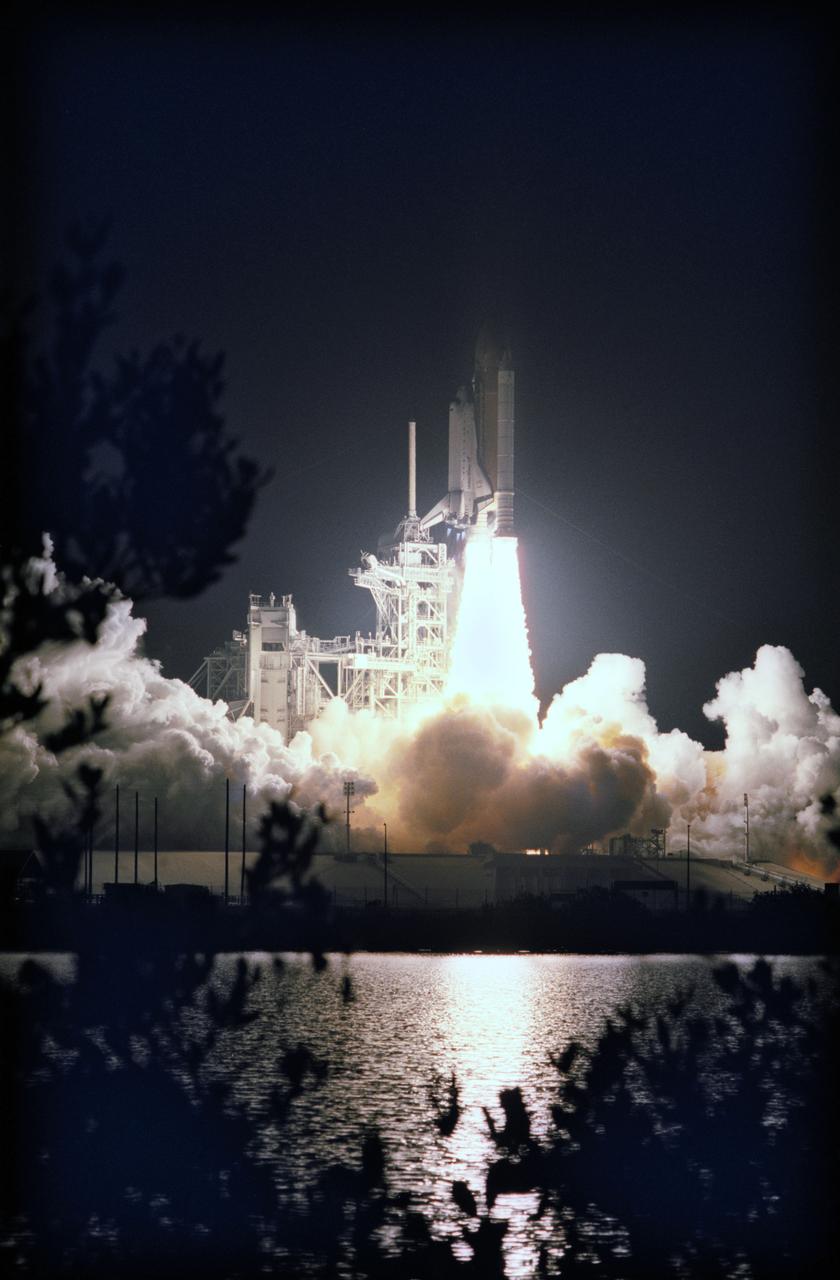
STS084-S-009 (15 May 1997) --- The Space Shuttle Atlantis brightens up the early morning sky at Kennedy Space Center's (KSC) Launch Complex 39 as it lifts off from Pad A at 4:07:48 a.m. (EDT), May 15, 1997. Onboard were astronauts Charles J. Precourt, Eileen M. Collins, Jean-Fran?ois Clervoy, C. Michael Foale, Carlos I. Noriega, Edward T. Lu and cosmonaut Elena V. Kondakova. Clervoy represents the European Space Agency (ESA) and Kondakova is with the Russian Space Agency (RSA).
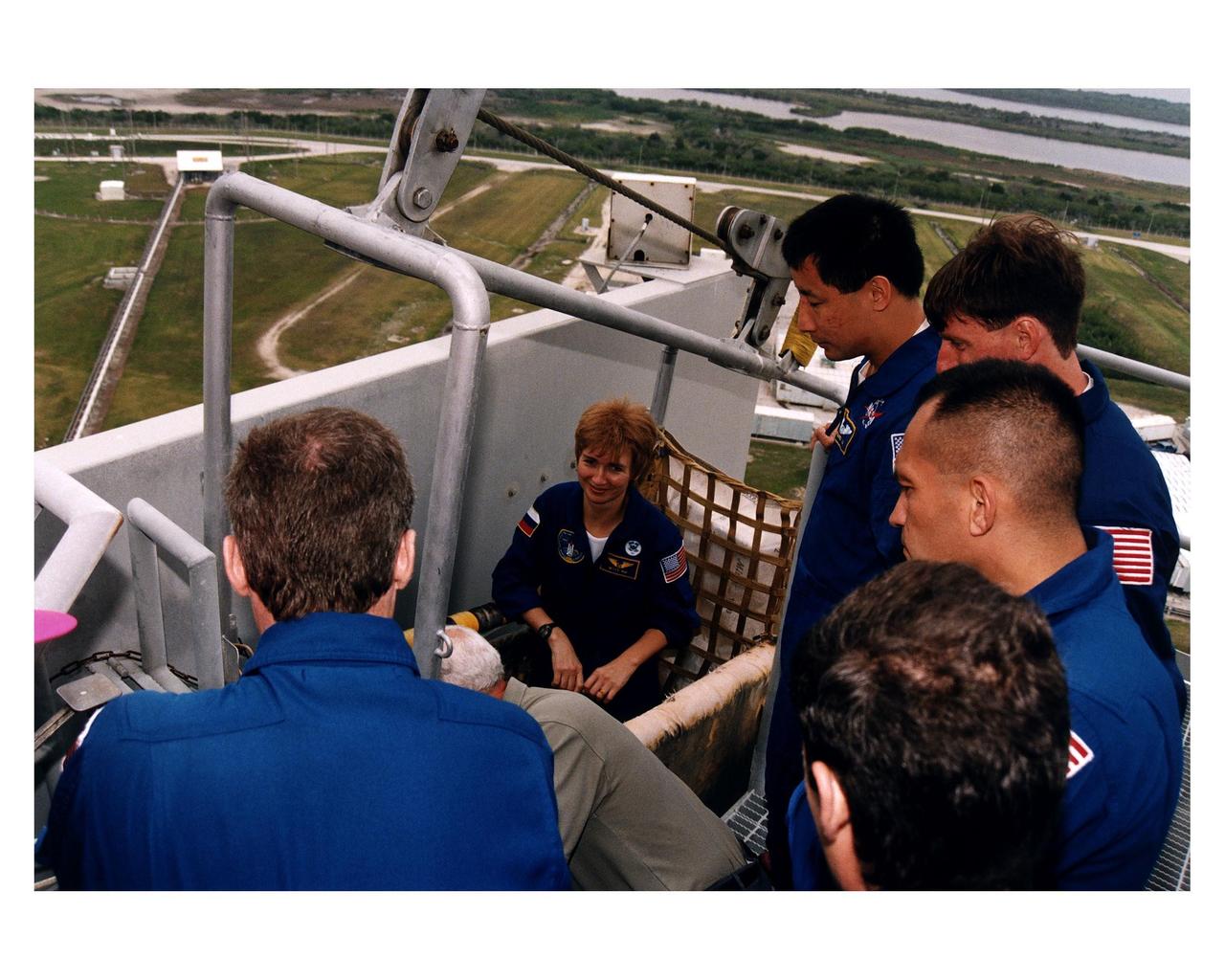
With several of her fellow crew members watching, STS-84 Mission Specialist Elena V. Kondakova, seated at center, gets instructions on using the slidewire baskets, part of the emergency egress system at Launch Pad 39A. Familiarization with pad procedures and systems is part of the Terminal Countdown Demonstration Test (TCDT) activities for the crew. Kondakova, a cosmonaut with the Russian space agency, is one of the seven STS-84 crew members for the sixth docking of the Space Shuttle with the Russian Space Station Mir. Another member, C. Michael Foale, will transfer to the space station and become a member of the Mir 23 crew, replacing U.S. astronaut Jerry M. Linenger, who will return to Earth aboard Atlantis. Foale will live and work on Mir until mid-September when his replacement is expected to arrive on the STS-86 mission. Kondakova previously lived on the Russian space station as the flight engineer of the 17th main mission on Mir from Oct. 4, 1994, to March 9, 1995. STS-84 is targeted for a May 15 liftoff
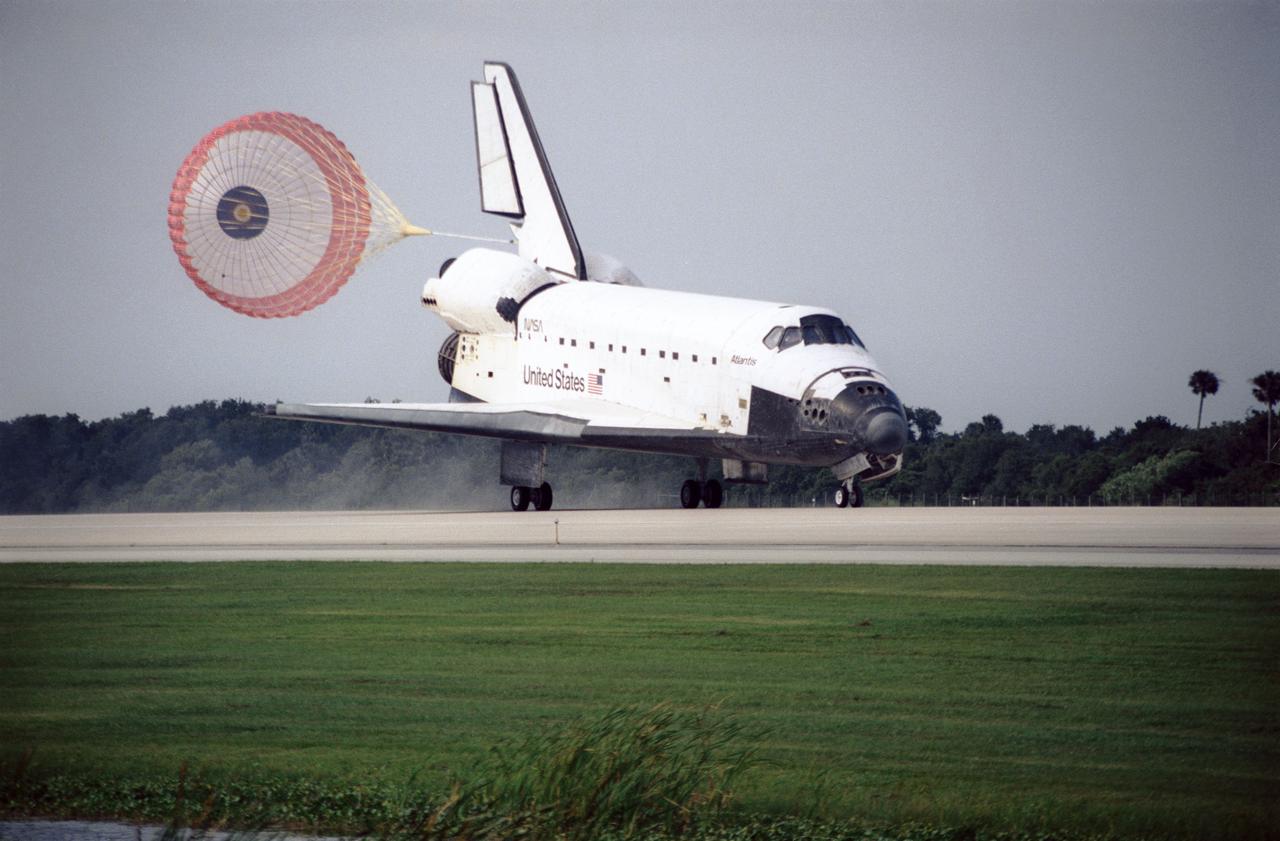
STS084-S-010 (24 May 1997) --- The drag chute on the Space Shuttle Atlantis is deployed as the Space Shuttle touches down on Runway 33 of the Kennedy Space Center (KSC) Shuttle Landing Facility (SLF). The landing, at 9:27:44 a.m. (EDT), May 24, 1997, brought to a completion the nine-day mission. This touchdown marked the 37th landing at KSC in the 16-year history of the Space Transportation System (STS) and it also marked the return of astronaut Jerry M. Linenger to Earth following almost four months aboard Russia's Mir Space Station. Onboard for the landing were astronauts Charles J. Precourt, Eileen M. Collins, Jean-Fran?ois Clervoy, Carlos I. Noriega, Edward T. Lu, Linenger and Elena V. Kondakova. Clervoy is with the European Space Agency (ESA) and Kondakova represents the Russian Space Agency (RSA).
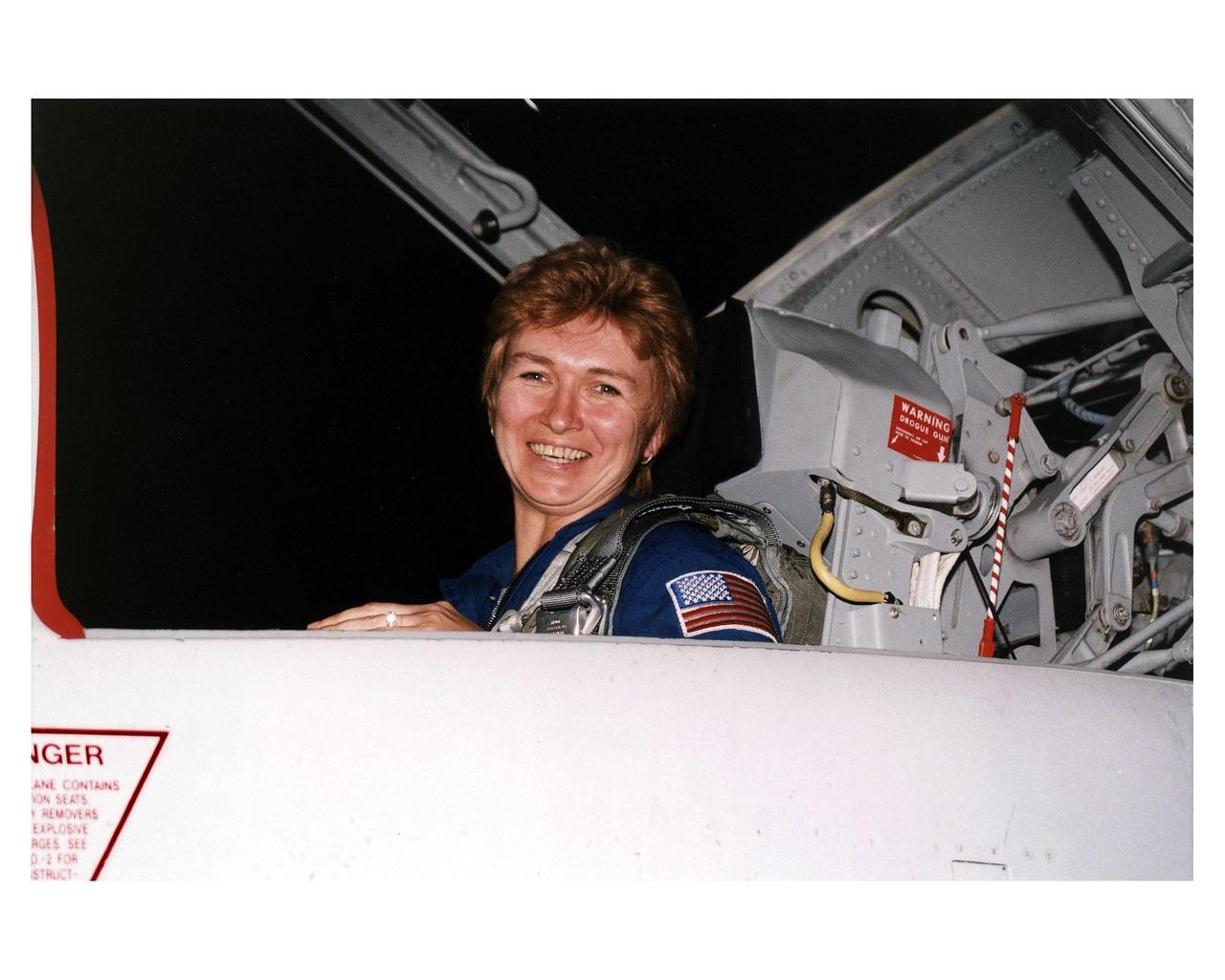
STS-84 Mission Specialist Elena V. Kondakova, a cosmonaut with the Russian Space Agency, arrives at KSC’s Shuttle Landing Facility. This will be Kondakova’s first flight on a U.S. Space Shuttle, but her second trip into space. She spent 169 days in space as flight engineer of the 17th main mission on the Russian Space Station Mir from October 1994 to March 1995. STS-84 will be the sixth docking of the Space Shuttle with the Mir. During the STS-84 docking, Mission Specialist C. Michael Foale will transfer to the Russian space station to become a member of the Mir 23 crew, replacing U.S. astronaut Jerry M. Linenger, who will return to Earth on Atlantis. Foale is scheduled to remain on Mir about four months until his replacement arrives on STS-86 in September
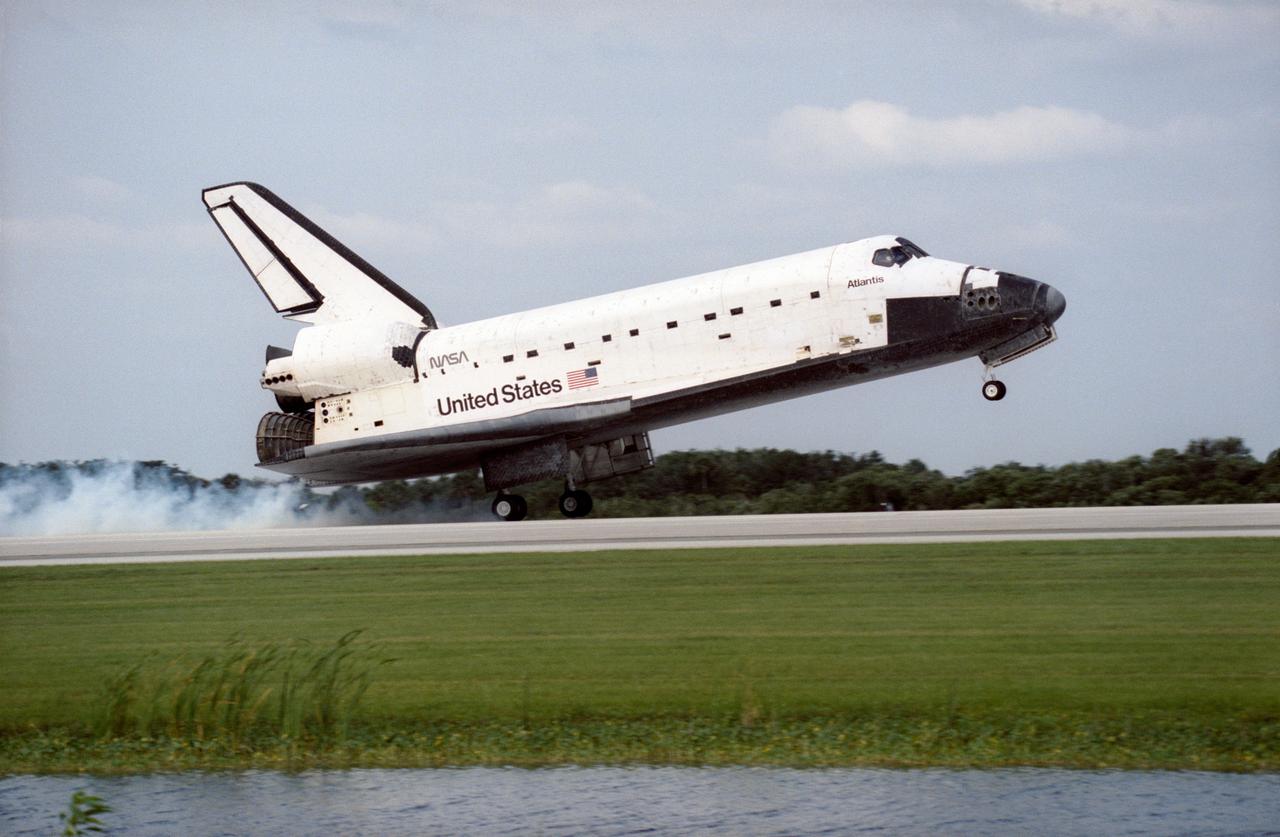
STS084-S-012 (24 May 1997) --- The Space Shuttle Atlantis touches down on Runway 33 of the Kennedy Space Center (KSC) Shuttle Landing Facility (SLF), bringing to a completion the nine-day mission. Main gear touchdown was at 9:27:44 a.m. (EDT), May 24, 1997. This touchdown marked the 37th landing at KSC in the 16-year history of the Space Transportation System (STS) and it also marked the return of astronaut Jerry M. Linenger to Earth following almost four months aboard Russia's Mir Space Station. Onboard for the landing were astronauts Charles J. Precourt, Eileen M. Collins, Jean-Fran?ois Clervoy, Carlos I. Noriega, Edward T. Lu, Linenger and Elena V. Kondakova. Clervoy is with the European Space Agency (ESA) and Kondakova represents the Russian Space Agency (RSA).
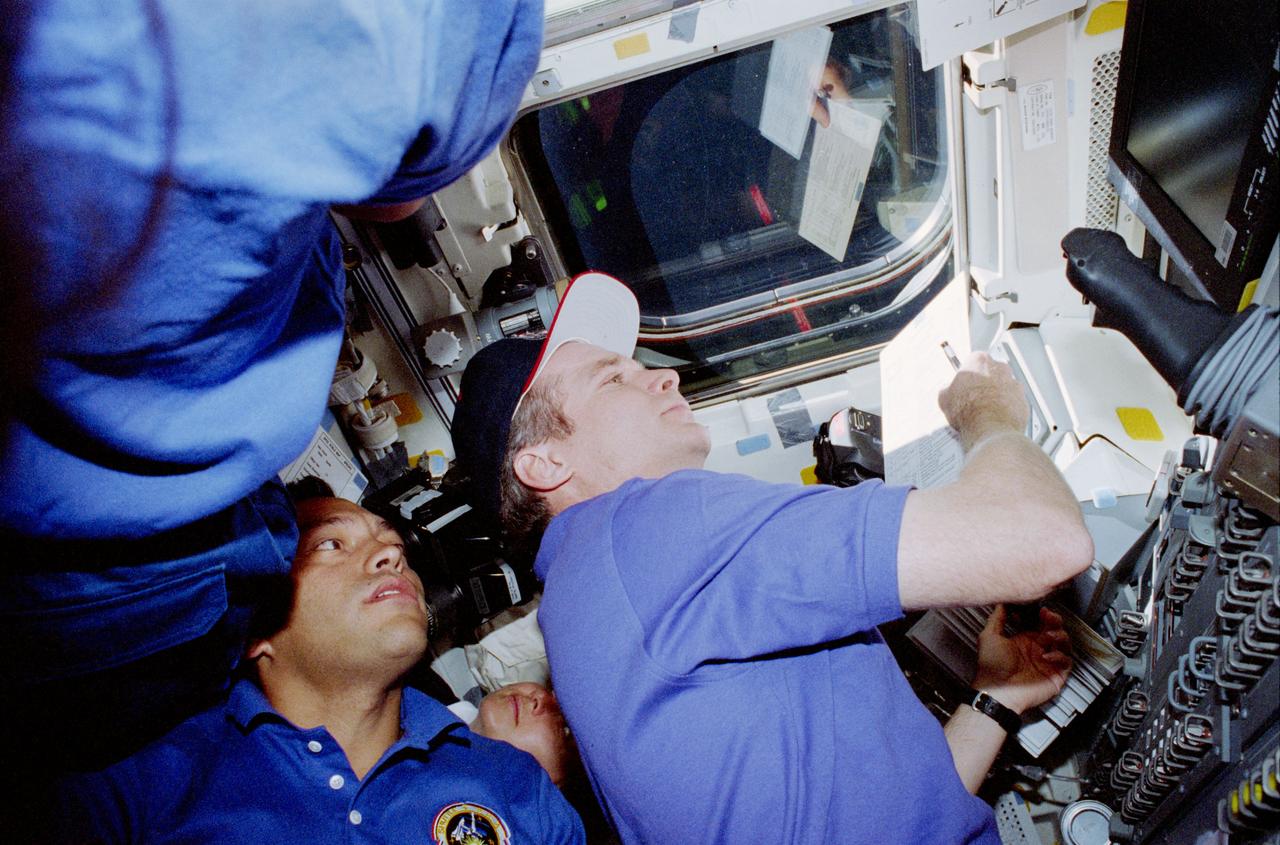
STS084-357-015 (15-24 May 1997) --- Astronaut Charles J. Precourt (right), STS-84 commander, controls the rate of the Space Shuttle Atlantis' approach to Russia's Mir Space Station during rendezvous operations. Carlos I. Noriega (left), Elena V. Kondakova (bottom center) and an unidentified crew member (far left) crowd into the scene -- typical of the busy rendezvous in-cabin scenarios on all Mir-Atlantis missions.
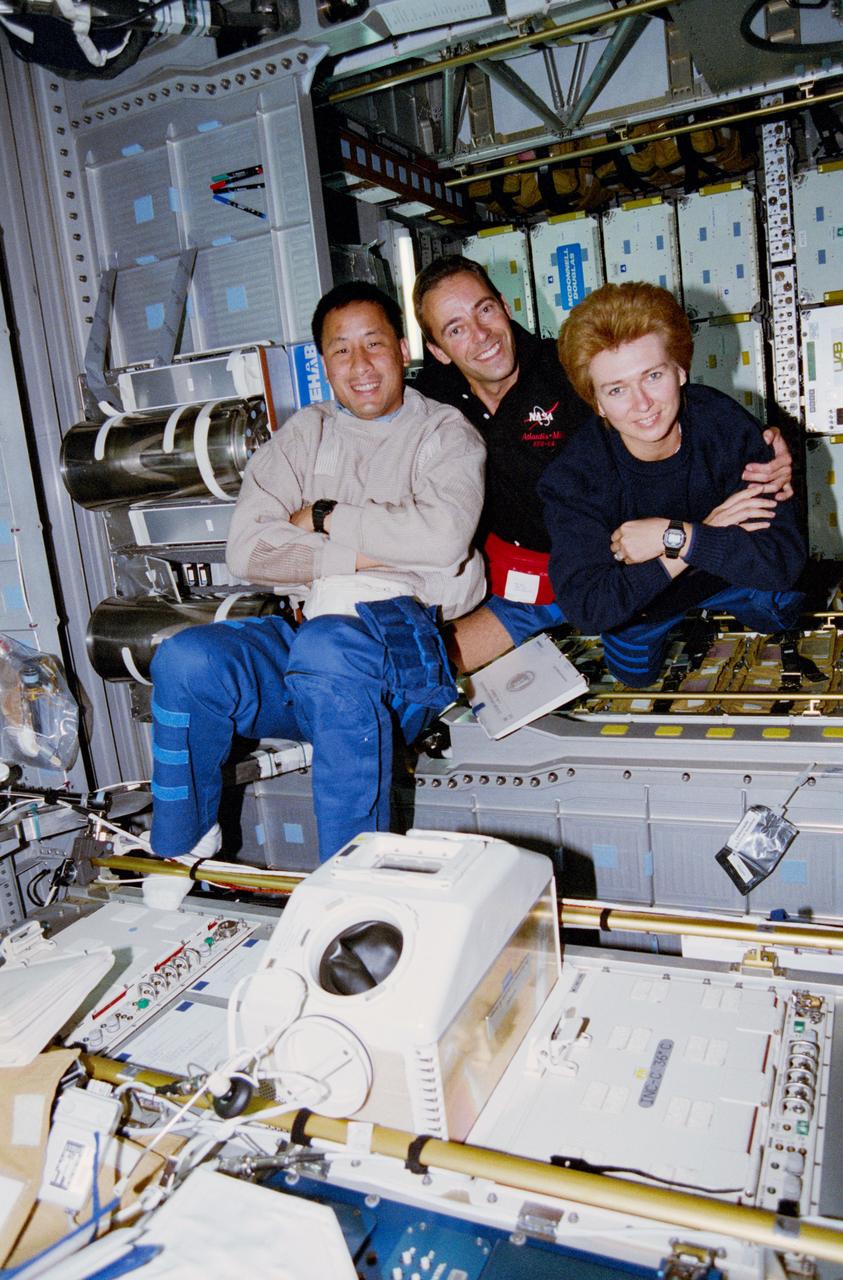
STS084-301-014 (15-24 May 1997) --- Zero-gravity adds a flavor of confusion to this 35mm frame, photographed onboard the Spacehab Double Module during a break in transfer operations of supplies for the STS-84 mission. For orientation purposes, the picture should be held with the glovebox positioned vertically on the right side of the frame. The crew members pictured, from top to bottom, are Elena V. Kondakova, Jean-Francois Clervoy and Edward T. Lu.
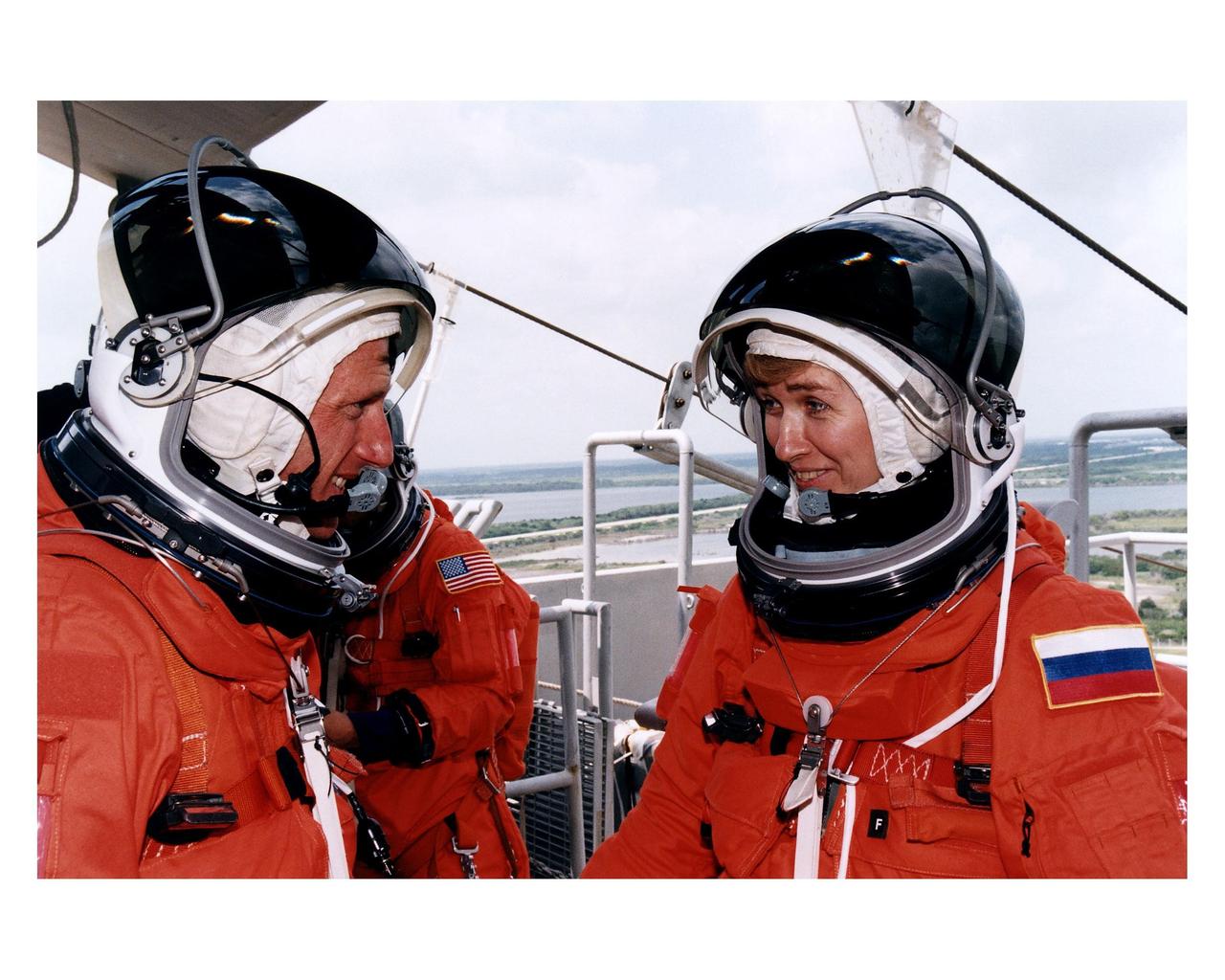
STS-84 Mission Specialists C. Michael Foale, at left, and Elena V. Kondakova, of the Russian Space Agency, find a moment to communicate one-on-one, perhaps about upcoming and past experiences living on the Russian Space Station Mir, during a busy training session at Launch Pad 39A. They and the other five crew members are participating in the Terminal Countdown Demonstration Test (TCDT), a dress rehearsal for launch. STS-84 aboard Atlantis will be the sixth docking of the Space Shuttle with the Mir. Kondakova spent 169 days in space as the cosmonaut flight engineer of the 17th main mission to Mir from Oct. 4, 1994, to March 9, 1995. After Atlantis docks with Mir on STS-84, Foale will transfer to the space station and become a member of the Mir 23 crew, replacing U.S. astronaut Jerry M. Linenger, who will return to Earth aboard Atlantis. Foale will live and work on Mir until mid-September when his replacement is expected to arrive on the STS-86 mission. STS-84 is targeted for a May 15 liftoff.
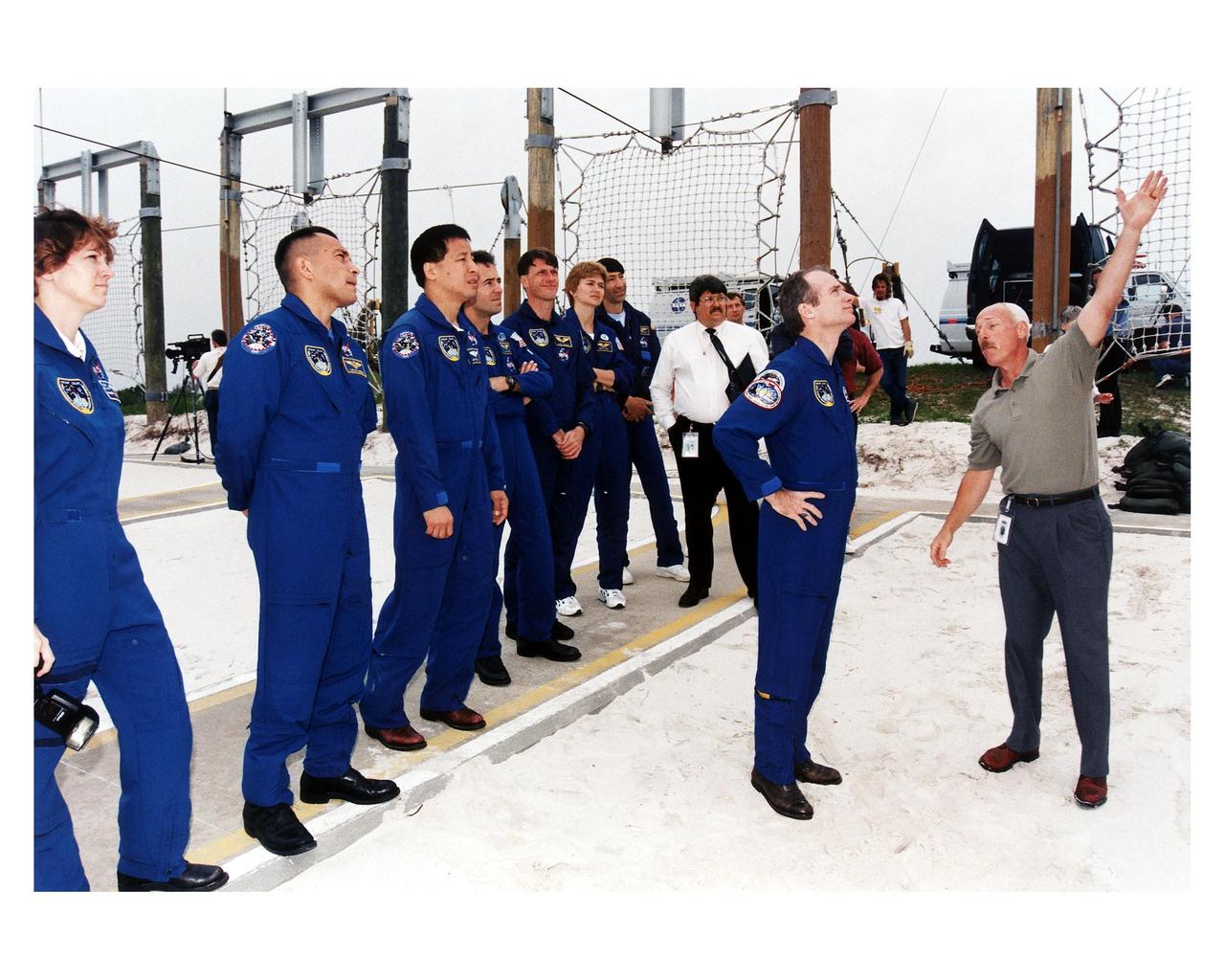
The STS-84 crew, with Commander Charles J. Precourt in front, gets instruction in Launch Pad 39A’s emergency egress system from Ken Clark, at right, a training instructor with United Space Alliance (USA). The sevenmember crew is participating in Terminal Countdown Demonstration Test (TCDT) activities. From left, are Pilot Eileen Marie Collins, and Mission Specialists Carlos I. Noriega, Edward Tsang Lu, Jean-Francois Clervoy of the European Space Agency, C. Michael Foale and Elena V. Kondakova of the Russian Space Agency. NASA astronaut Mario Runco Jr., next to Kondakova in a blue flight suit, is assisting the crew during TCDT. STS-84 will be the sixth docking of the Space Shuttle with the Russian Space Station Mir. After docking, Foale will transfer to the space station and become a member of the Mir 23 crew, replacing U.S. astronaut Jerry M. Linenger, who will return to Earth aboard Atlantis. Foale will live and work on Mir until mid-September when his replacement is expected to arrive on the STS-86 mission. STS-84 is targeted for a May 15 liftoff
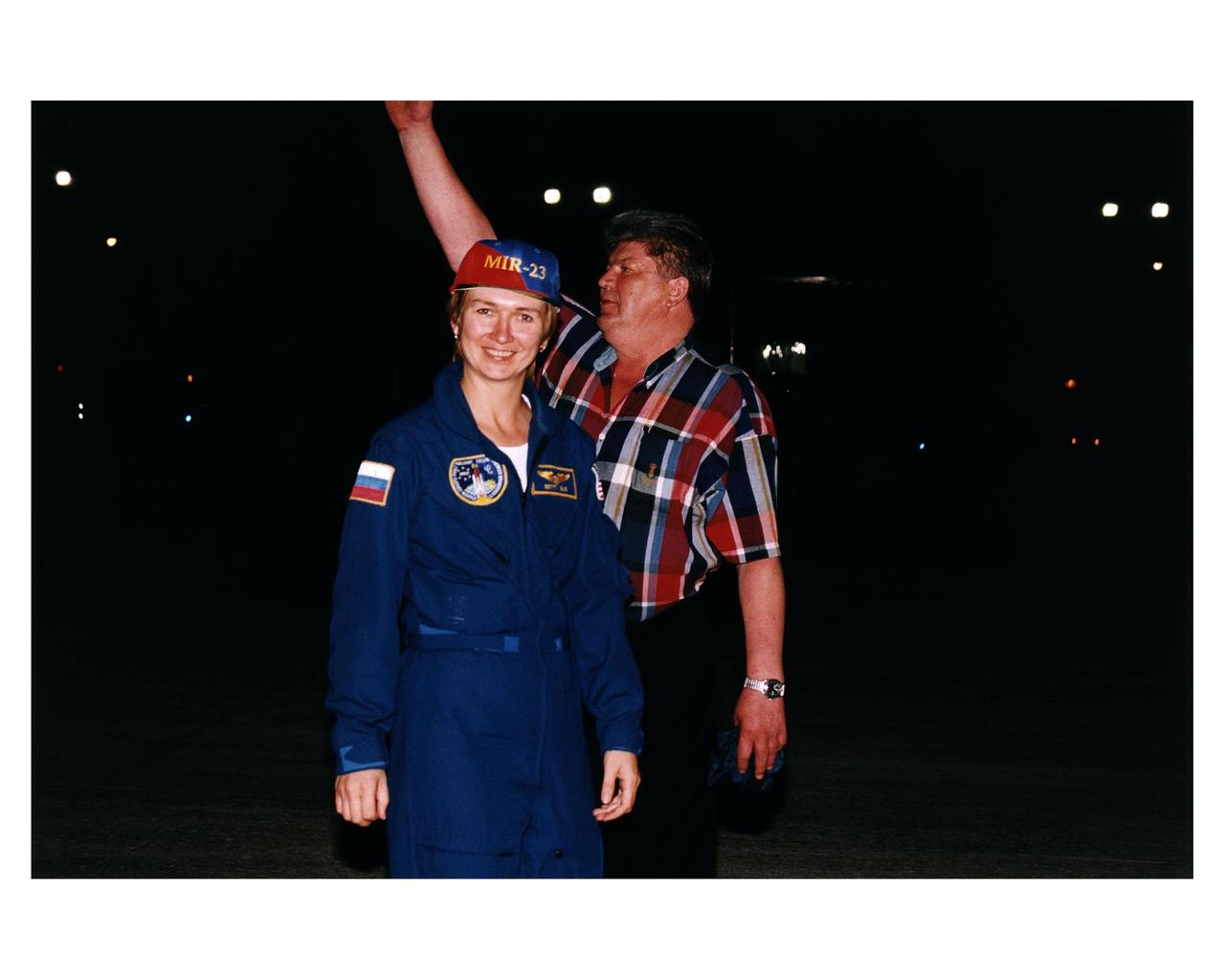
STS-84 Mission Specialist Elena V. Kondakova, a cosmonaut with the Russian Space Agency, and her husband, Valery Ryumin, greet press represenatives and other well wishers after her arrival at KSC’s Shuttle Landing Facility. Ryumin is director of the Mir-Shuttle program for RSC Energia in Russia. This will be Kondakova’s first flight on a U.S. Space Shuttle, but her second trip into space. She spent 169 days in space as flight engineer of the 17th main mission on Mir from October 1994 to March 1995. STS-84 will be the sixth docking of the Space Shuttle with the Russian Space Station Mir. During the docking, STS-84 Mission Specialist C. Michael Foale will transfer to the Russian space station to become a member of the Mir 23 crew, replacing U.S. astronaut Jerry M. Linenger, who will return to Earth on Atlantis. Foale is scheduled to remain on Mir about four months until his replacement arrives on STS-86 in September
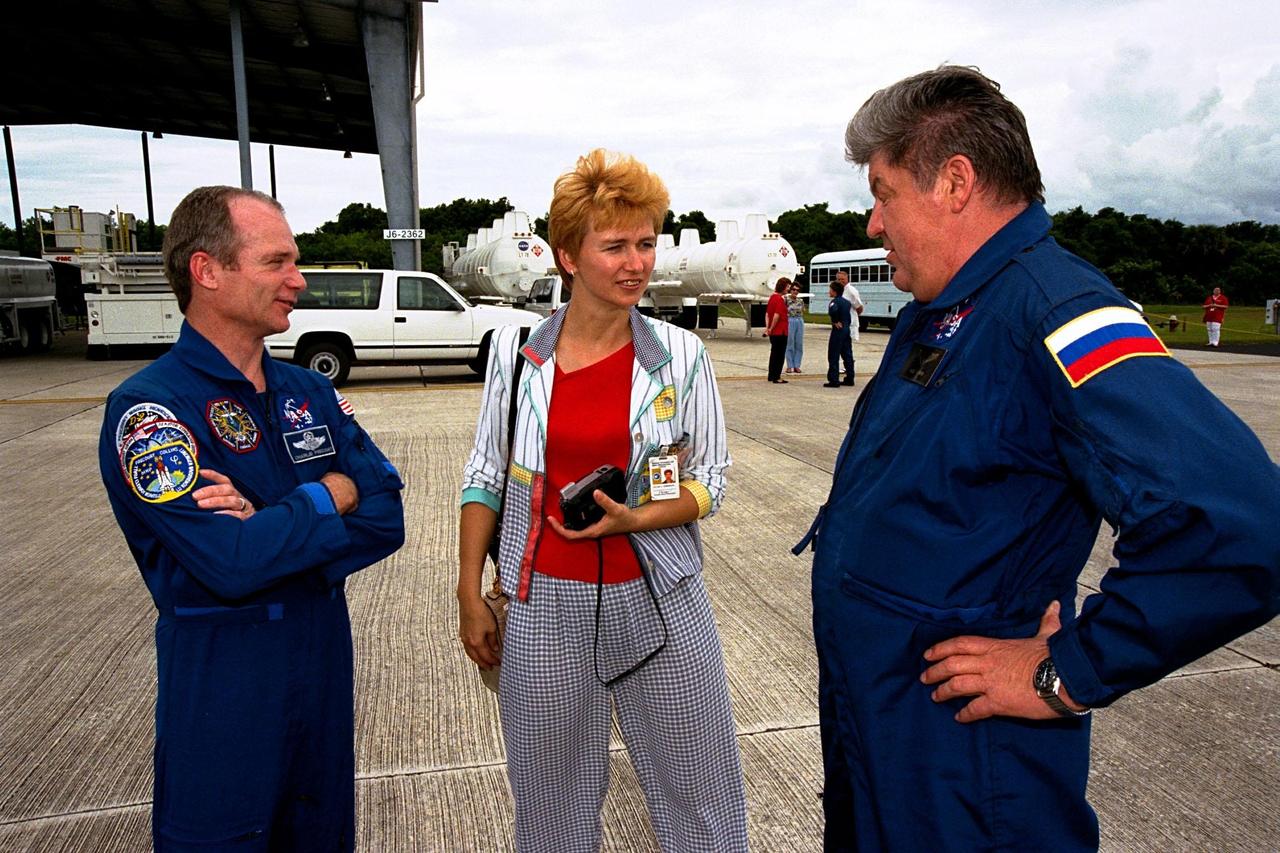
STS-91 Mission Commander Charles Precourt (left) talks to Elena V. Kondakova and her husband, Valery Ryumin, a cosmonaut with the Russian Space Agency (RSA) and STS-91 mission specialist, at Kennedy Space Center's Shuttle Landing Facility (SLF). The STS-91 crew had just arrived at the SLF aboard T-38 jets in preparation for launch. Kondakova, also a cosmonaut with the RSA, flew with Commander Precourt as a mission specialist on STS-84 which launched on May 15, 1997. STS-91 is scheduled to be launched on June 2 on Space Shuttle Discovery with a launch window opening around 6:10 p.m. EDT. The mission will feature the ninth Shuttle docking with the Russian Space Station Mir, the first Mir docking for Discovery, the conclusion of Phase I of the joint U.S.-Russian International Space Station Program, and the first flight of the new Space Shuttle super lightweight external tank. The STS-91 flight crew also includes Pilot Dominic Gorie and Mission Specialists Wendy B. Lawrence; Franklin Chang-Diaz, Ph.D.; and Janet Kavandi, Ph.D. Andrew Thomas, Ph.D., will be returning to Earth with the crew after living more than four months aboard Mir
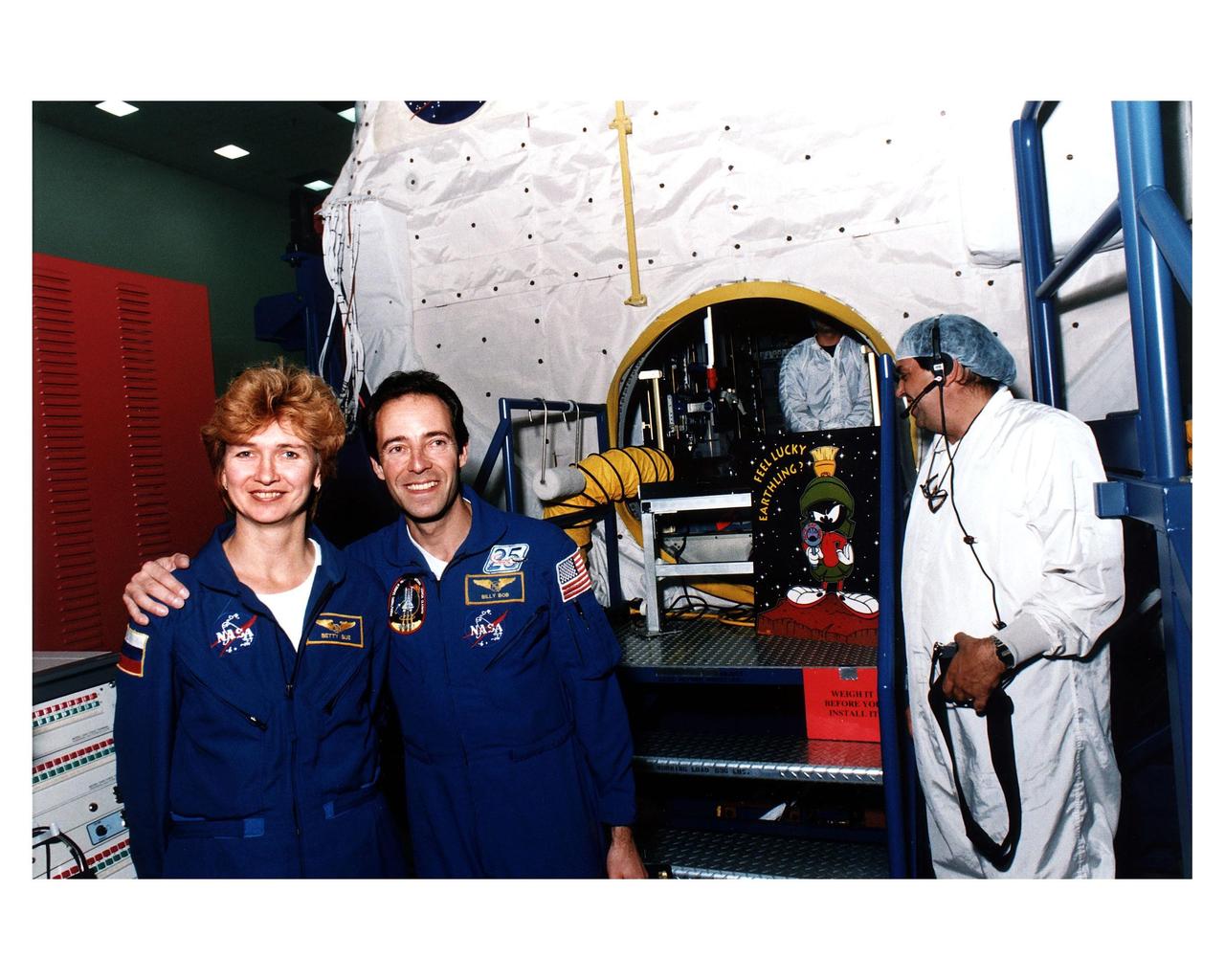
STS-84 Mission Specialists Elena V. Kondakova, at left, and Jean-Francois Clervoy pose for photos outside the SPACEHAB Double Module, which will carry more than 6,000 pounds of scientific experiments and logistics to the Russian Space Station Mir. Kondakova, a cosmonaut with the Russian Space Agency, has the nickname of Betty Sue for this mission. Clervoy, an astronaut with the European Space Agency, is wearing a name tag with his mission nickname, Billie Bob. They are participating in the Crew Equipment Integration Test (CEIT) at the SPACEHAB Payload Processing Facility in Cape Canaveral. STS-84 will be the sixth docking of the Space Shuttle with Mir. It also will be the third consecutive crew member exchange of U.S. astronauts aboard Mir. STS-84 Mission Specialist C. Michael Foale will replace astronaut Jerry M. Linenger on Mir. Linenger has been on Mir since the STS-81 mission in January. Foale is scheduled to remain on Mir about four months. STS-84 is targeted for a May 15 liftoff
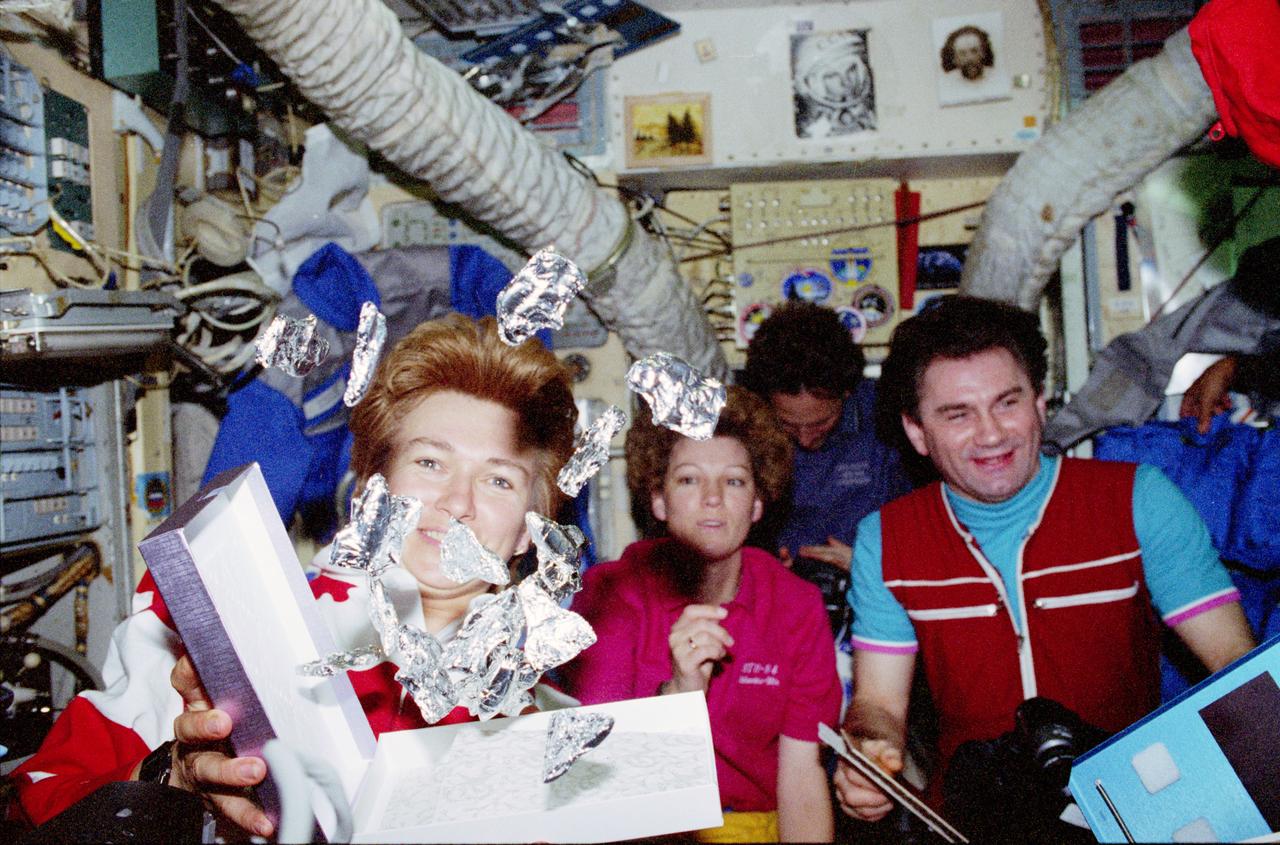
STS084-377-026 (15-24 May 1997) --- Cosmonaut Elena V. Kondakova opens a gift box and a number of tiny chocolate Space Shuttles free-float in Russia's Mir Space Station's Base Block. The STS-84 mission specialist and her crew mates had earlier presented the gift to the Mir-23 crew members, including Vasili Tsibliyev (right), mission commander. In the background are astronauts Eileen M. Collins, STS-84 pilot, and Jerry M. Linenger, mission specialist. Linenger was in his last days aboard Mir prior to returning to Earth with the STS-84 crew aboard the Space Shuttle Atlantis.
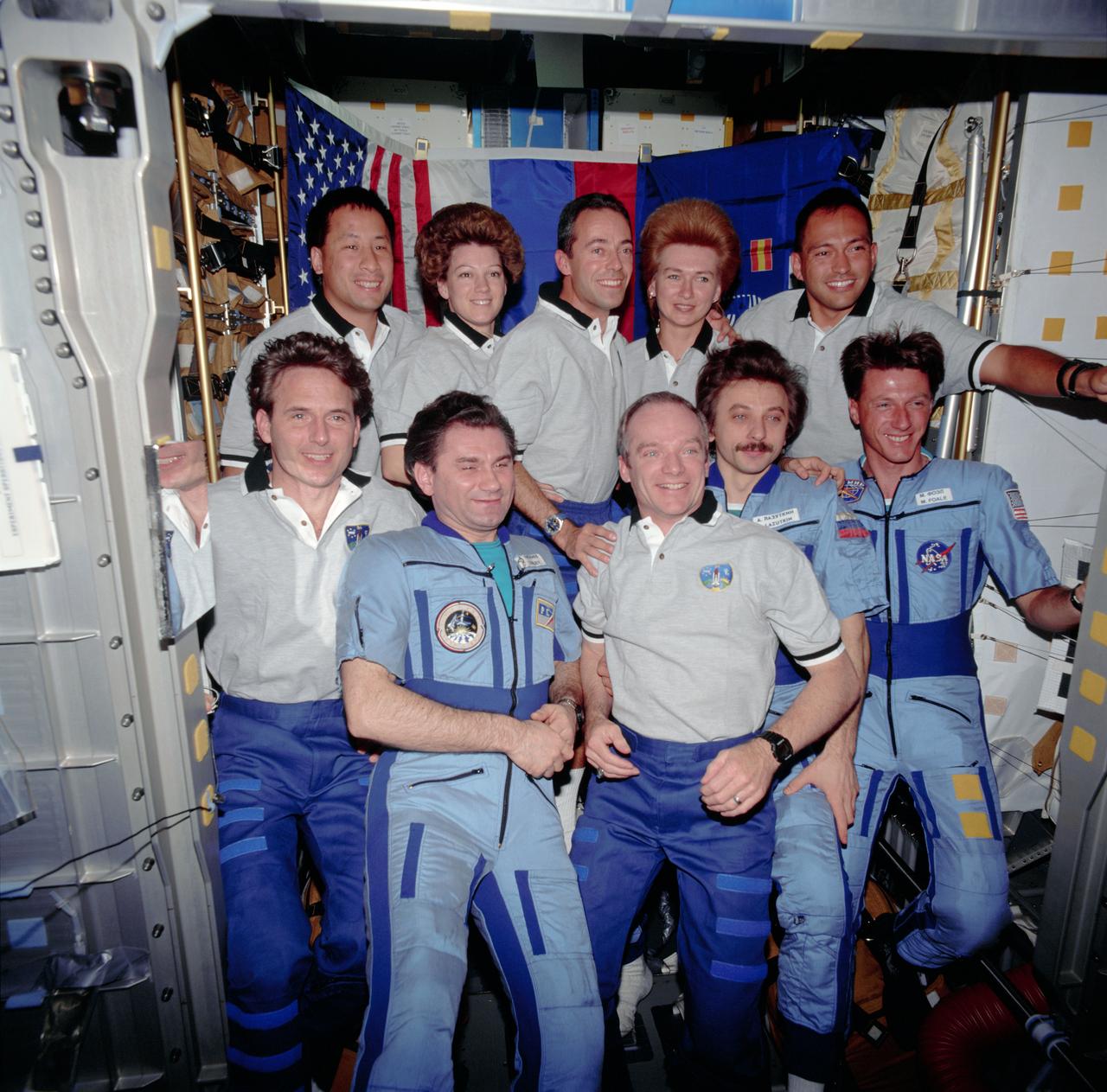
STS084-704-015 (15-24 May 1997) --- Crewmembers from Mir-23 and STS-84 assemble for a group portrait onboard the Spacehab Double Module, as they tie a record (ten) for number of persons aboard a single orbiting spacecraft at one time. They are (from the left, front) Jerry M. Linenger, Vasili V. Tsibliyev, Charles J. Precourt, Aleksandr I. Lazutkin and C. Michael Foale. On the back row, from the left, are Edward T. Lu, Eileen M. Collins, Jean-Francois Clervoy, Elena V. Kondakova and Carlos I. Noriega.
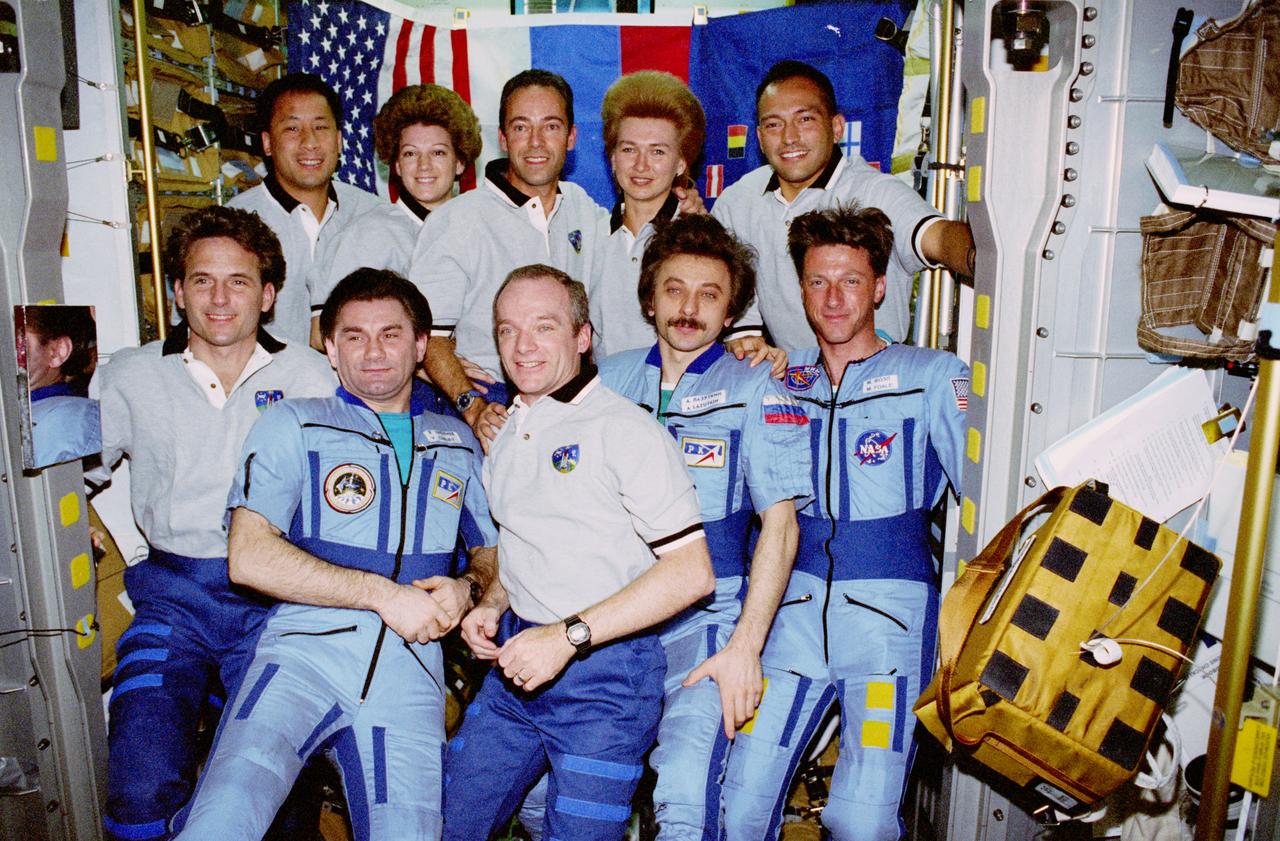
STS084-366-015 (15-24 May 1997) --- Crewmembers from Mir-23 and STS-84 assemble for a group portrait onboard the Spacehab Double Module, as they tie a record (ten) for number of persons aboard a single orbiting spacecraft at one time. They are (from the left, front) Jerry M. Linenger, Vasili V. Tsibliyev, Charles J. Precourt, Aleksandr I. Lazutkin and C. Michael Foale. On the back row, from the left, are Edward T. Lu, Eileen M. Collins, Jean-Francois Clervoy, Elena V. Kondakova and Carlos I. Noriega.
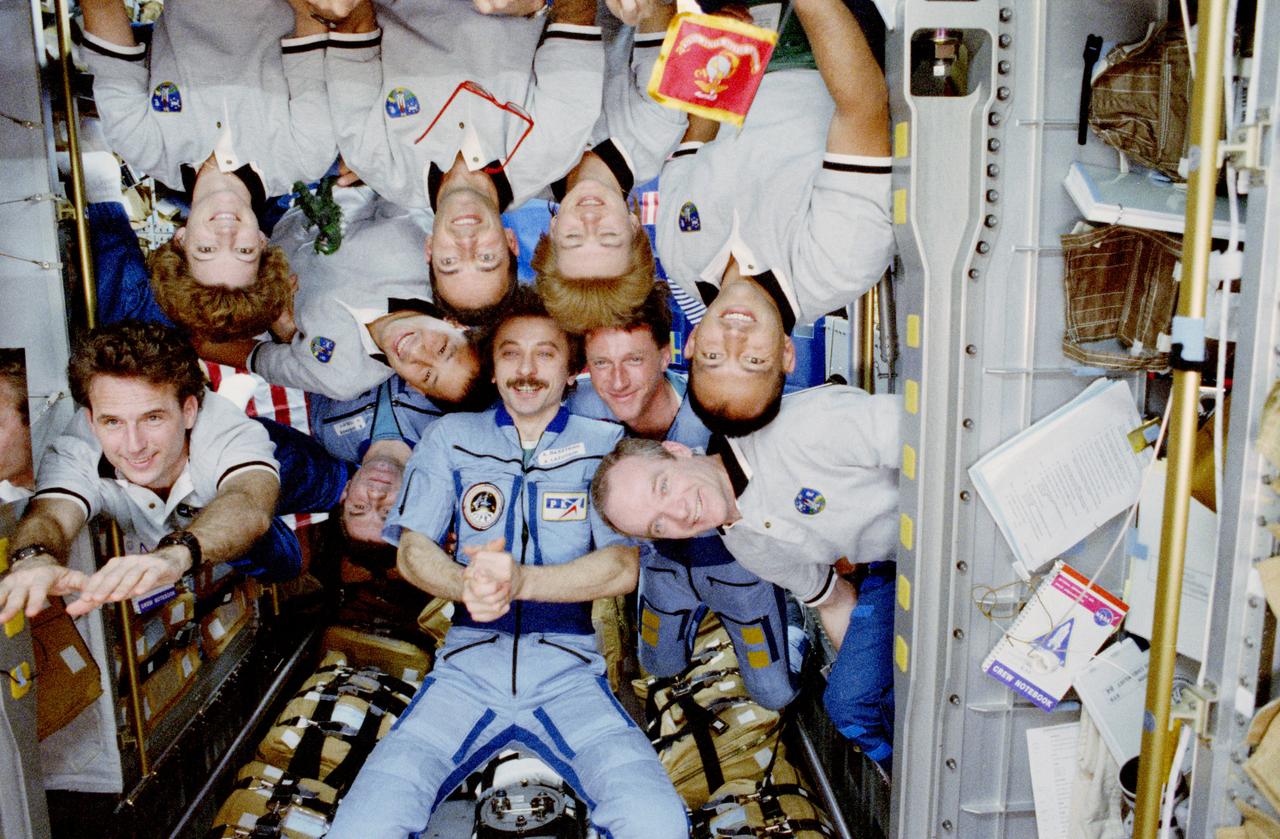
STS084-380-019 (15-24 May 1997) --- In the last minutes of joint activity between the STS-84 and Russian Space Agency (RSA) Mir-23 crews, ten astronauts and cosmonauts pose for an in-space portrait in the Space Shuttle Atlantis Spacehab Double Module (DM). For orientation purposes, photo should be held with clasped hands of Aleksandr I. Lazutkin (wearing Mir-23 suit) just below center. The flight engineer is flanked by similarly attired crew mates Vasili Tsibliyev, Mir-23 commander, on the left, and C. Michael Foale, cosmonaut guest researcher, on the right. The STS-84 crew members are, clockwise from the left, Jerry M. Linenger, mission specialist; Eileen M. Collins, pilot; Edward T. Lu, mission specialist; Jean-Fran?ois Clervoy, payload commander; Elena V. Kondakova and Carlos I. Noriega, both mission specialists, along with Charles J. Precourt, mission commander.
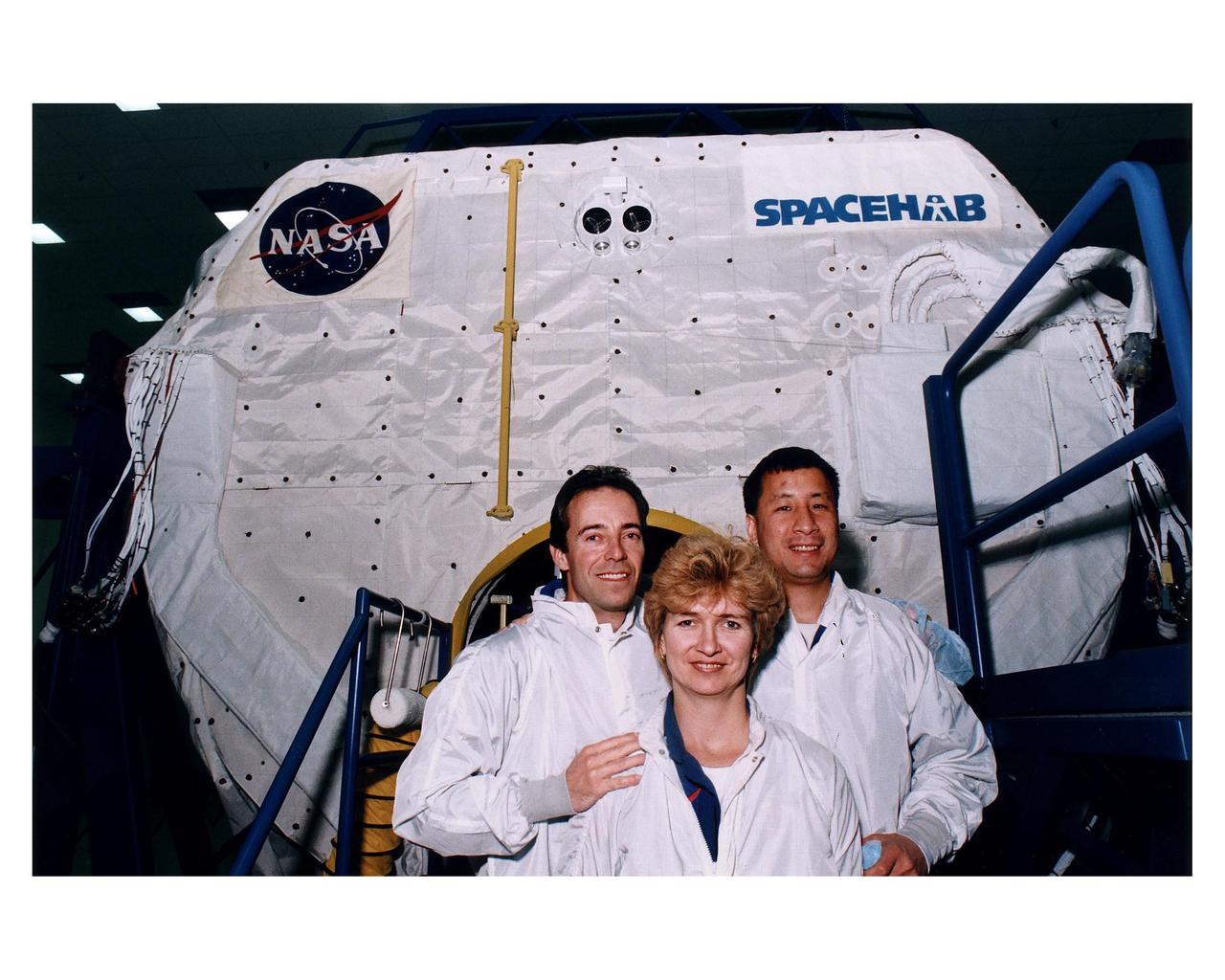
STS-84 crew members pose outside the SPACEHAB Double Module, which will carry more than 6,000 pounds of scientific experiments and logistics to the Russian Space Station Mir. From left, are Mission Specialists Jean-Francois Clervoy of the European Space Agency, Elena V. Kondakova of the Russian Space Agency, and Edward Tsang Lu of NASA. They are participating in the Crew Equipment Integration Test (CEIT) at the SPACEHAB Payload Processing Facility in Cape Canaveral. STS-84 will be the sixth docking of the Space Shuttle with Mir. It also will be the third consecutive crew member exchange of U.S. astronauts aboard Mir. STS-84 Mission Specialist C. Michael Foale will replace astronaut Jerry M. Linenger on Mir. Linenger has been on Mir since the STS-81 mission in January. Foale is scheduled to remain on Mir about four months. STS-84 is targeted for a May 15 liftoff
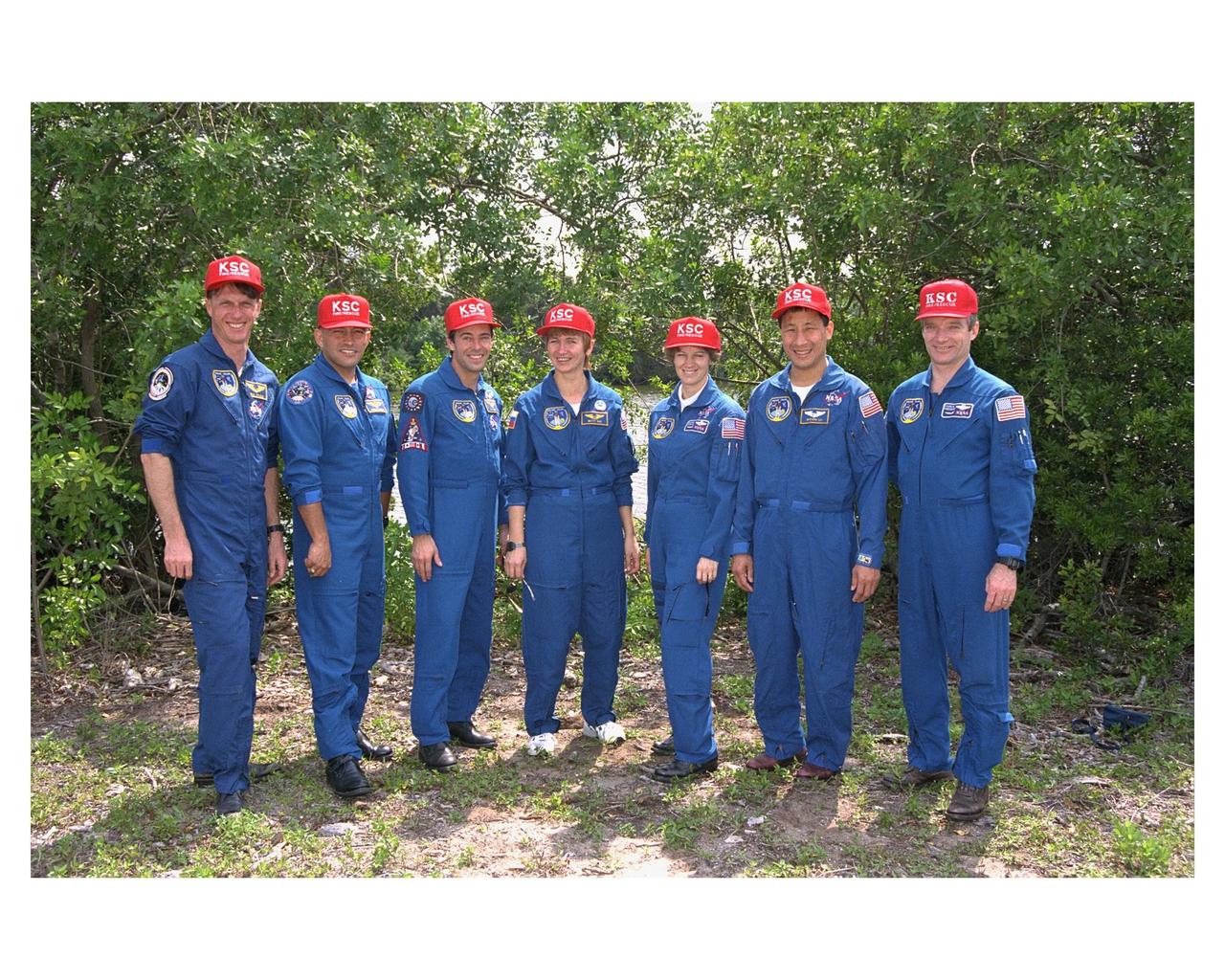
Proudly wearing red KSC Fire/Rescue hats, members of the STS-84 crew pause for a moment for a group photograph while participating in Terminal Countdown Demonstration Test (TCDT) activities. From left, are Mission Specialists C. Michael Foale, Carlos I. Noriega, Jean-Francois Clervoy of the European Space Agency and Elena V. Kondakova of the Russian Space Agency; and Pilot Eileen Marie Collins, Mission Specialist Edward Tsang Lu and Commander Charles J. Precourt. STS-84 aboard Atlantis will be the sixth docking of the Space Shuttle with the Russian Space Station Mir. After docking, Foale will transfer to the space station and become a member of the Mir 23 crew, replacing U.S. astronaut Jerry M. Linenger, who will return to Earth aboard Atlantis. Foale will live and work on Mir until mid-September when his replacement is expected to arrive on the STS-86 mission. STS-84 is targeted for a May 15 liftoff

STS-84 mission specialists and SPACEHAB workers participate in the Crew Equipment Integration Test (CEIT) inside the SPACEHAB Double Module, which will carry more than 6,000 pounds of scientific experiments and logistics to the Russian Space Station Mir. Standing at left is JeanFrancois Clervoy of the European Space Agency. Sitting on the floor, from left, are Edward Tsang Lu of NASA and Elena V. Kondakova of the Russian Space Agency. The test is being conducted at the SPACEHAB Payload Processing Facility in Cape Canaveral. STS-84 will be the sixth docking of the Space Shuttle with Mir. It also will be the third consecutive crew member exchange of U.S. astronauts aboard Mir. STS-84 Mission Specialist C. Michael Foale will replace astronaut Jerry M. Linenger on Mir. Linenger has been on Mir since the STS-81 mission in January. Foale is scheduled to remain on Mir about four months. STS-84 is targeted for a May 15 liftoff

STS-84 Commander Charles J. Precourt, in right foreground, talks to fellow crew members, Mission Specialist Elena V. Kondakova, in left foreground, of the Russian Space Agency, and Pilot Eileen Marie Collins during Terminal Countdown Demonstration Test (TCDT) activities at Launch Pad 39A. In the background are NASA suit technician Al Rochford, at left, and astronaut Mario Runco Jr., who is assisting the STS-84 crew. STS-84 will be the sixth docking of the Space Shuttle with the Russian Space Station Mir. After docking, STS-84 Mission Specialist Michael C. Foale will transfer to the space station and become a member of the Mir 23 crew, replacing U.S. astronaut Jerry M. Linenger, who will return to Earth aboard Atlantis. Foale will live and work on Mir until mid-September when his replacement is expected to arrive on the STS-86 mission. STS-84 is targeted for a May 15 liftoff
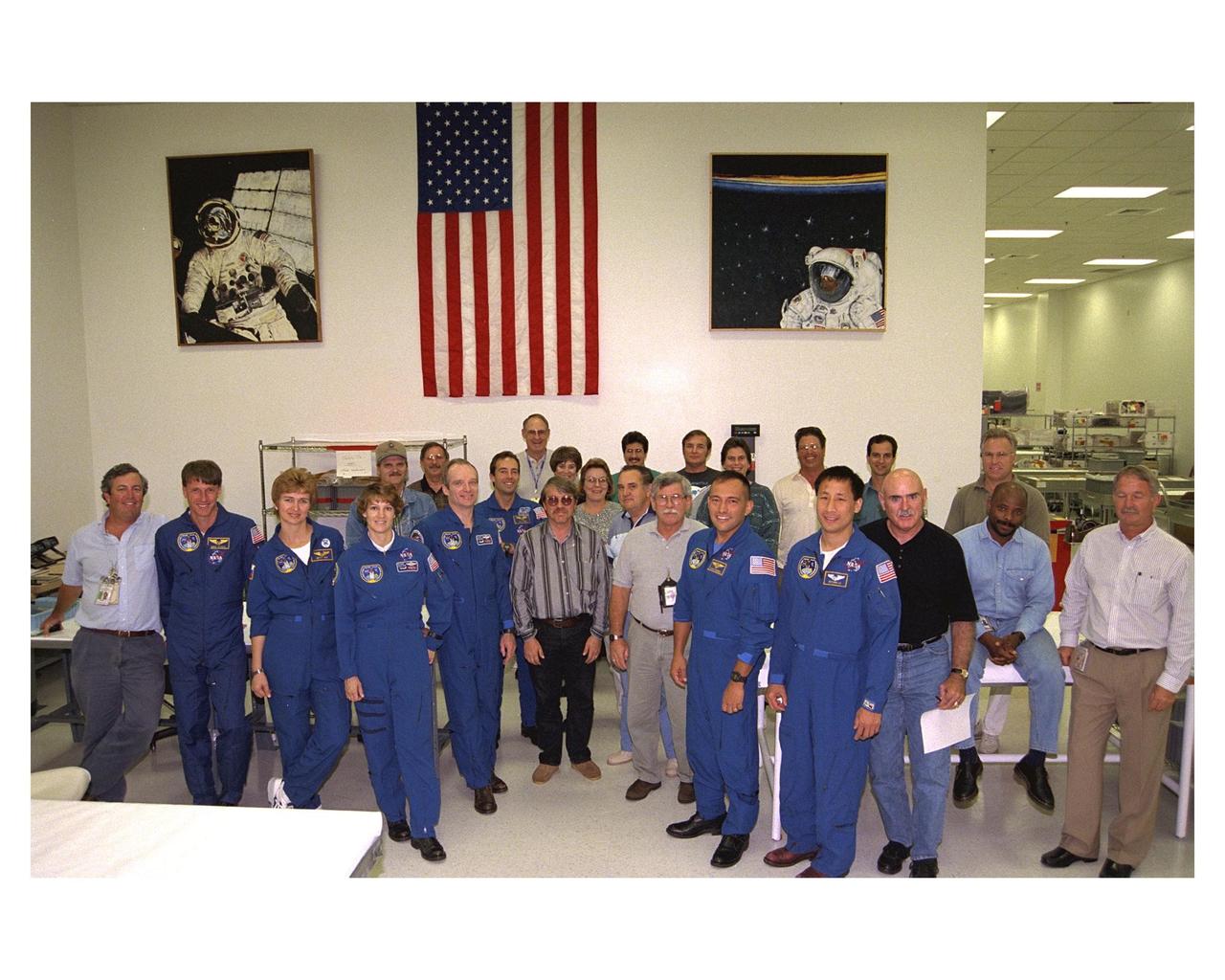
The STS-84 crew pose for a photograph with members of the mission payload team in the Space Station Processing Facility. Dressed in their blue flight suits, from left, are Mission Specialist C. Michael Foale, Elena V. Kondakova of the Russian Space Agency, Pilot Eileen Marie Collins, Commander Charles J. Precourt, Mission Specialist Jean-Francois Clervoy of the European Space Agency, Mission Specialist Carlos I. Noriega and Mission Specialist Edward Tsang Lu. STS-84 aboard the Space Shuttle Atlantis will be the sixth docking of the Space Shuttle with the Russian Space Station Mir. After docking, Foale will transfer to the space station and become a member of the Mir 23 crew, replacing U.S. astronaut Jerry M. Linenger, who will return to Earth aboard Atlantis. Foale will live and work on Mir until mid-September when his replacement is expected to arrive on the STS-86 mission. STS-84 is targeted for a May 15 liftoff
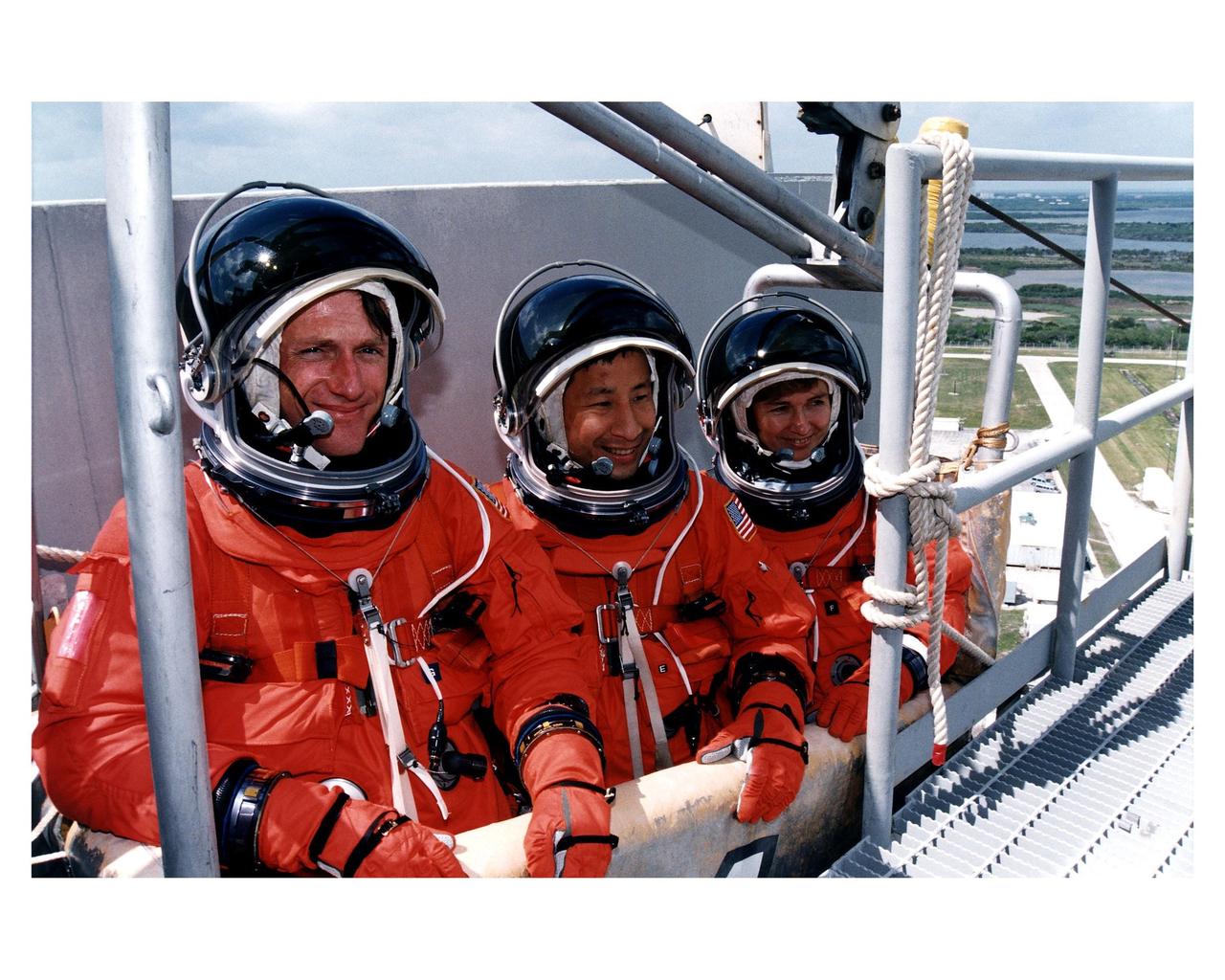
STS-84 Mission Specialists, from left, C. Michael Foale, Edward Tsang Lu and Elena V. Kondakova practice emergency egress procedures in a slidewire basket at Launch Pad 39A. They and the other four members of the STS-84 crew are participating in the Terminal Countdown Demonstration Test (TCDT), a dress rehearsal for launch. STS-84 aboard Atlantis will be the sixth docking of the Space Shuttle with the Russian Space Station Mir. After docking, Foale will transfer to the space station and become a member of the Mir 23 crew, replacing U.S. astronaut Jerry M. Linenger, who will return to Earth aboard Atlantis. Foale will live and work on Mir until mid-September when his replacement is expected to arrive on the STS-86 mission. STS-84 is targeted for a May 15 liftoff
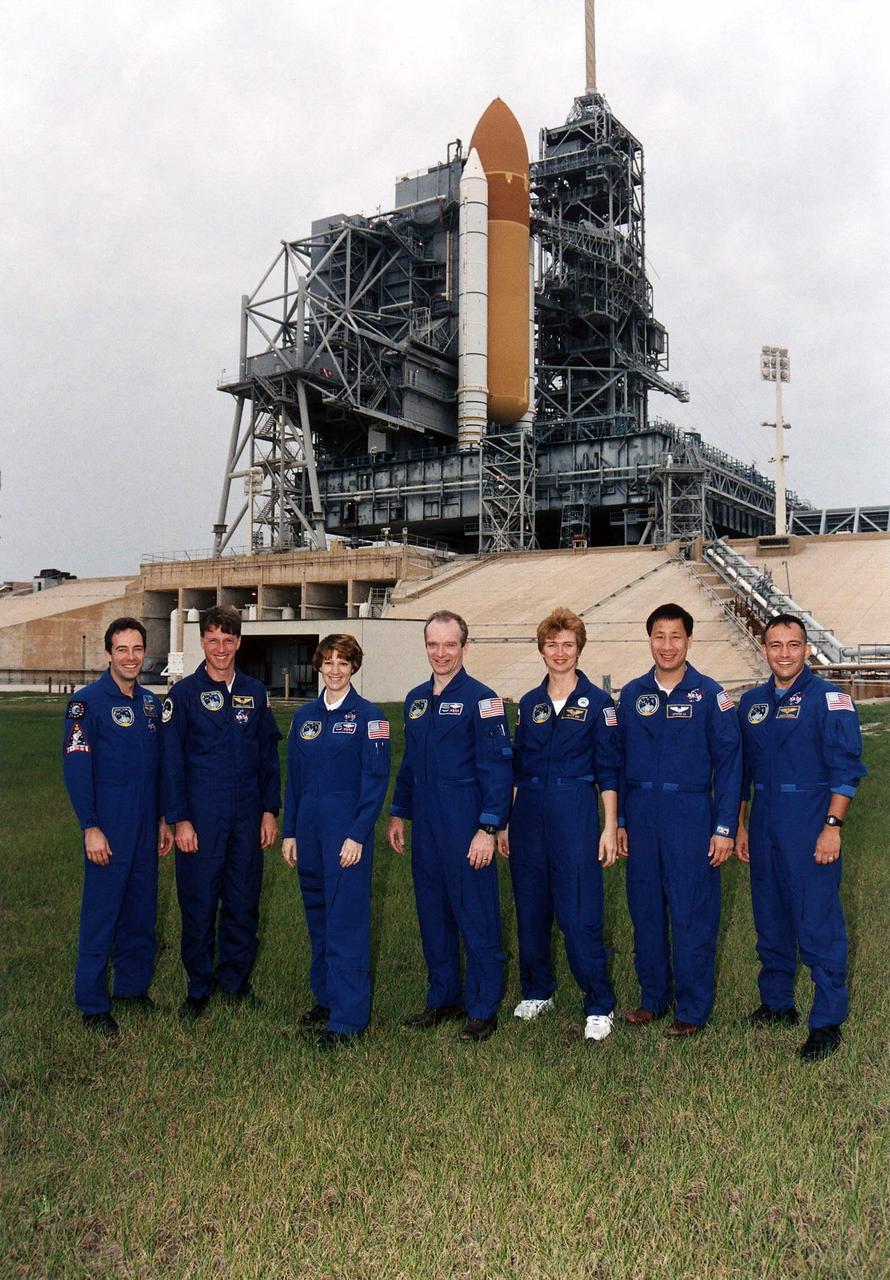
STS-84 crew members pose for a group photograph at Launch Pad 39A, where the Space Shuttle Atlantis is poised for liftoff on the sixth Shuttle-Mir docking mission. From left, are Mission Specialist Jean-Francois Clervoy of the European Space Agency, Mission Specialist C. Michael Foale, Pilot Eileen Marie Collins, Commander Charles J. Precourt, Mission Specialist Elena V. Kondakova of the Russian Space Agency, and Mission Specialists Edward Tsang Lu and Carlos I. Noriega. They are at KSC to participate in the Terminal Countdown Demonstration Test (TCDT), a dress rehearsal for launch. After the docking, Foale will transfer to the Russian Space Station Mir, becoming a member of the Mir 23 crew. He will replace Jerry M. Linenger, who will return to Earth on Atlantis. Liftoff of STS-84 is targeted for May 15
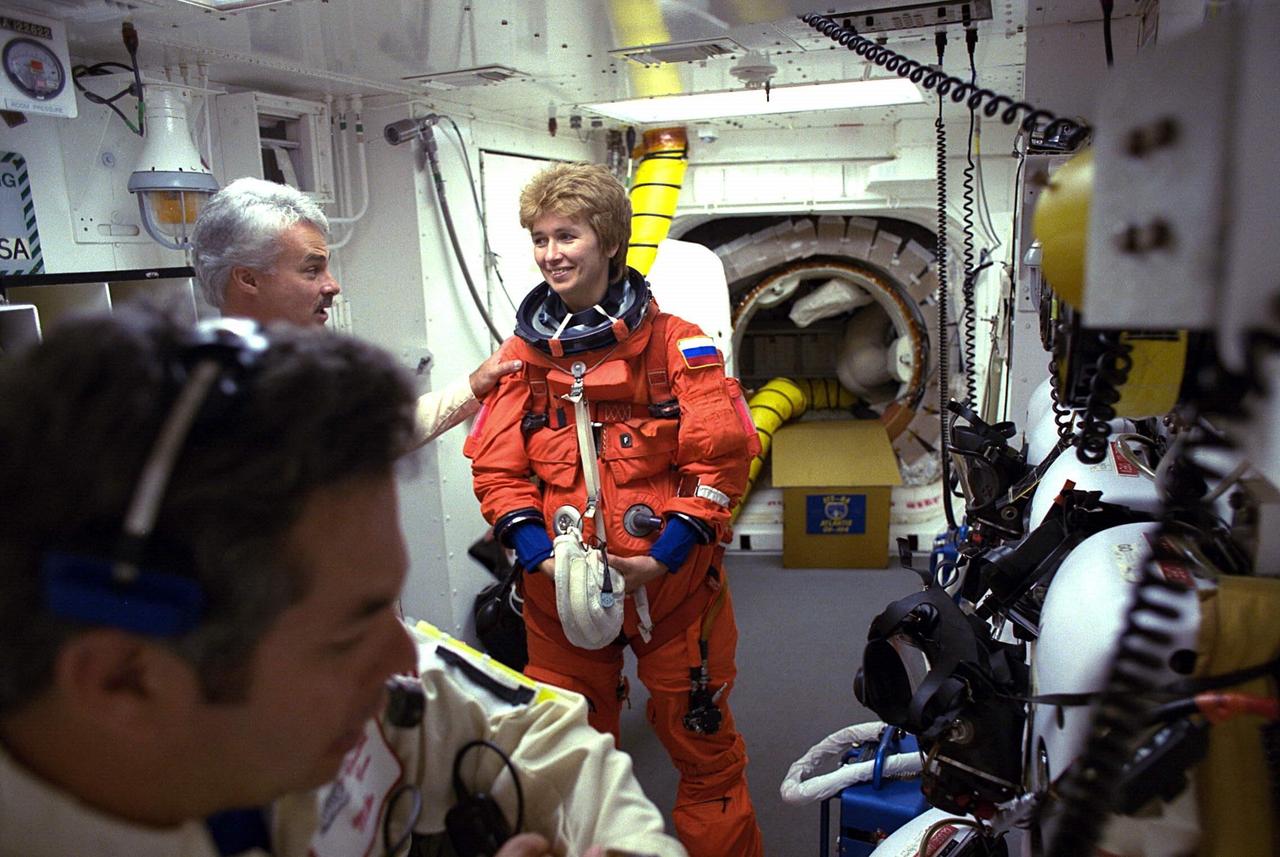
STS-84 Mission Specialist Elena V. Kondakova prepares to enter the Space Shuttle Atlantis at Launch Pad 39A with help from white room closeout crew members. The fourth Shuttle mission of 1997 will be the sixth docking of the Space Shuttle with the Russian Space Station Mir. The commander is Charles J. Precourt. The pilot is Eileen Marie Collins. The five mission specialists are C. Michael Foale, Carlos I. Noriega, Edward Tsang Lu, Jean-Francois Clervoy of the European Space Agency and Elena V. Kondakova of the Russian Space Agency. The planned nine-day mission will include the exchange of Foale for U.S. astronaut and Mir 23 crew member Jerry M. Linenger, who has been on Mir since Jan. 15. Linenger transferred to Mir during the last docking mission, STS-81; he will return to Earth on Atlantis. Foale is slated to remain on Mir for about four months until he is replaced in September by STS-86 Mission Specialist Wendy B. Lawrence. During the five days Atlantis is scheduled to be docked with the Mir, the STS-84 crew and the Mir 23 crew, including two Russian cosmonauts, Commander Vasily Tsibliev and Flight Engineer Alexander Lazutkin, will participate in joint experiments. The STS-84 mission also will involve the transfer of more than 7,300 pounds of water, logistics and science equipment to and from the Mir. Atlantis is carrying a nearly 300-pound oxygen generator to replace one of two Mir units which have experienced malfunctions. The oxygen it generates is used for breathing by the Mir crew
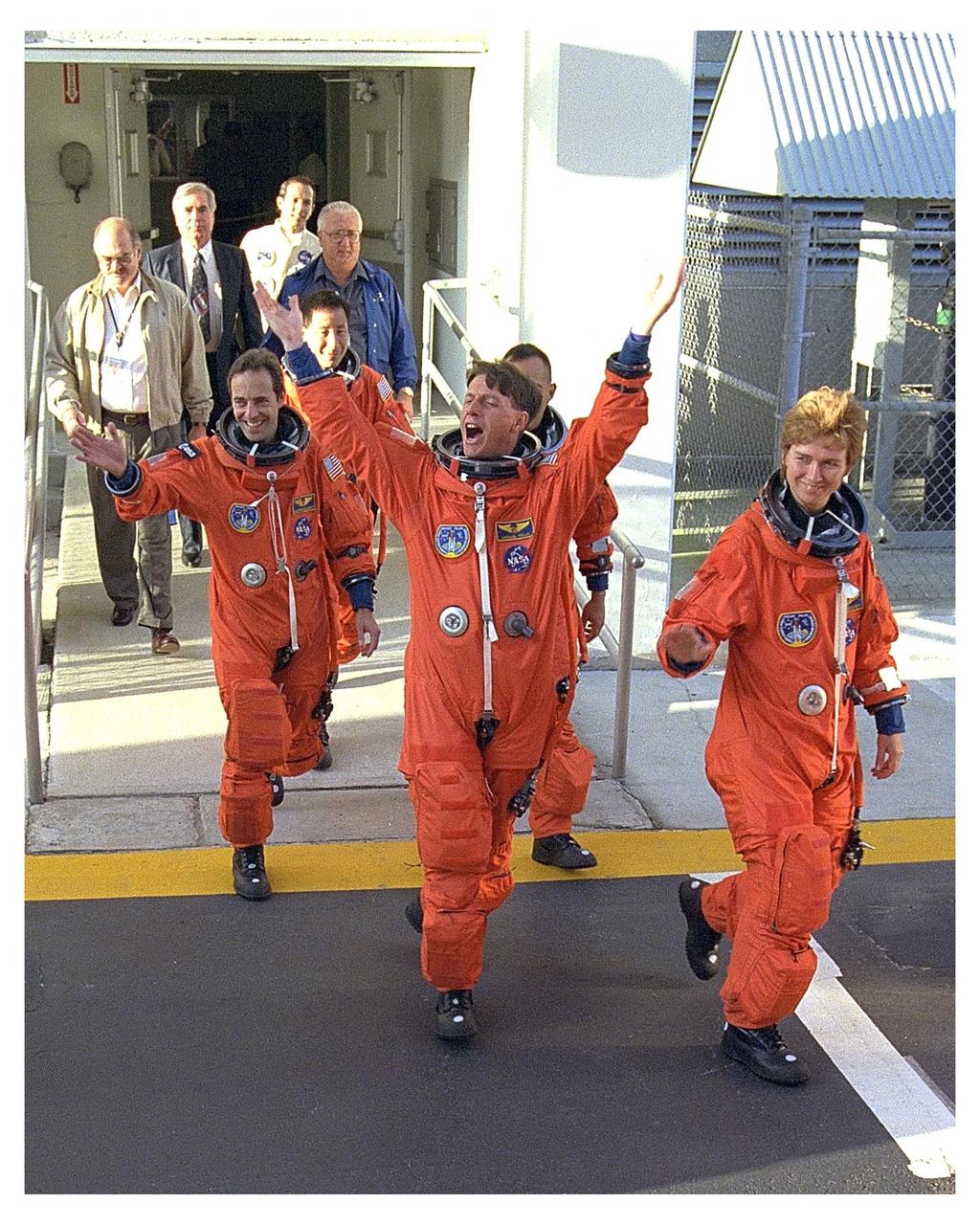
STS-84 Mission Specialist C. Michael Foale, at center, exhibits great enthusiasm for the upcoming Space Shuttle mission to onlookers during the dress rehearsal of the crew’s walkout from the Operations and Checkout Building. He and the other six STS-84 crew members are participating in an abbreviated practice countdown to launch called the Terminal Countdown Demonstration Test (TCDT). In front of Foale is Mission Specialist Elena V. Kondakova, a Russian cosmonaut. Behind Foale, from left, are Mission Specialist Jean-Francois Clervoy, an astronaut with the European Space Agency; and U.S. astronauts and STS-84 Mission Specialists Edward Tsang Lu and Carlos I. Noriega. Already out of camera view are Pilot Eileen Marie Collins and Commander Charles J. Precourt. During the sixth ShuttleMir docking, Foale will take his place aboard the Russian Space Station Mir as a member of the Mir 23 crew, replacing U.S. astronaut Jerry M. Linenger, who will return to Earth on Atlantis. Launch of STS-84 is targeted for May 15
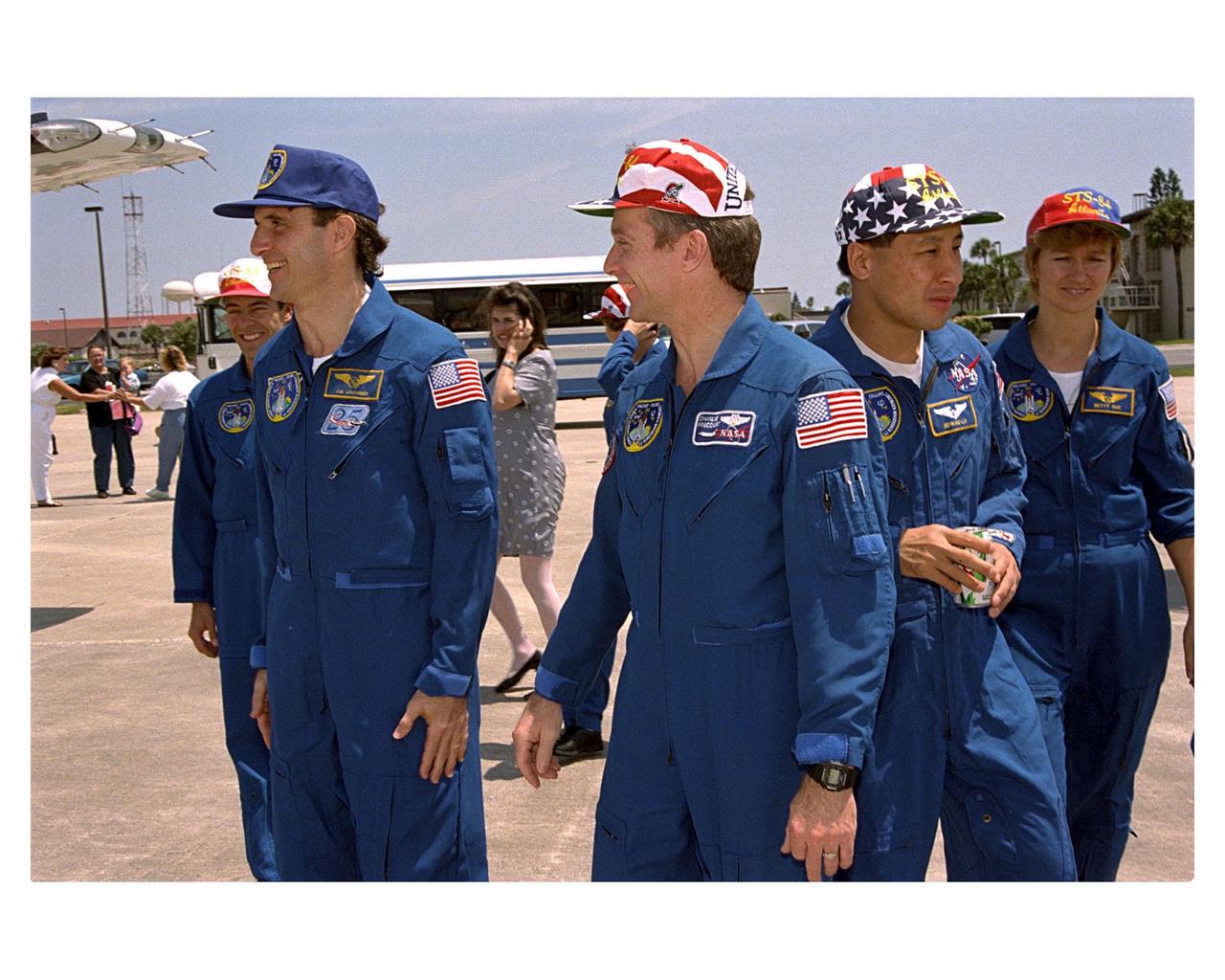
KENNEDY SPACE CENTER, FLA. - Members of the STS-84 crew pause at Patrick Air force Base just prior to their departure for Johnson Space Center in Houston, Texas. They are (from left) Mission Specialist Jean-Francois Clervoy; returning astronaut and Mir 23 crew member Jerry M. Linenger; Mission Commander Charles J. Precourt; Mission Specialist Edward Tsang Lu; and Mission Specialist Elena V. Kondakova. The seven-member crew returned aboard the Space Shuttle Orbiter Atlantis May 24 on KSC's Runway 33 after the completion of a successful nine-day mission. STS-84 was the sixth docking of the Space Shuttle with the Russian Space Station MIr. Atlantis was docked with the Mir for five days. STS-84 Mission Specialist C. Michael Foale replaced Linenger, who had been on the Russian space station since Jan. 15. Besides the docking and crew exchange, STS-84 included the transfer of more than 7,300 pounds of water, logistics and science experiments and hardware to and from the Mir. Scientific experiments conducted during the STS-84 mission, and scheduled for Foale's stay on the Mir, are in the fields of advanced technology, Earth sciences, fundamental biology, human life sciences, International Space Station risk mitigation, microgravity sciences and space sciences.
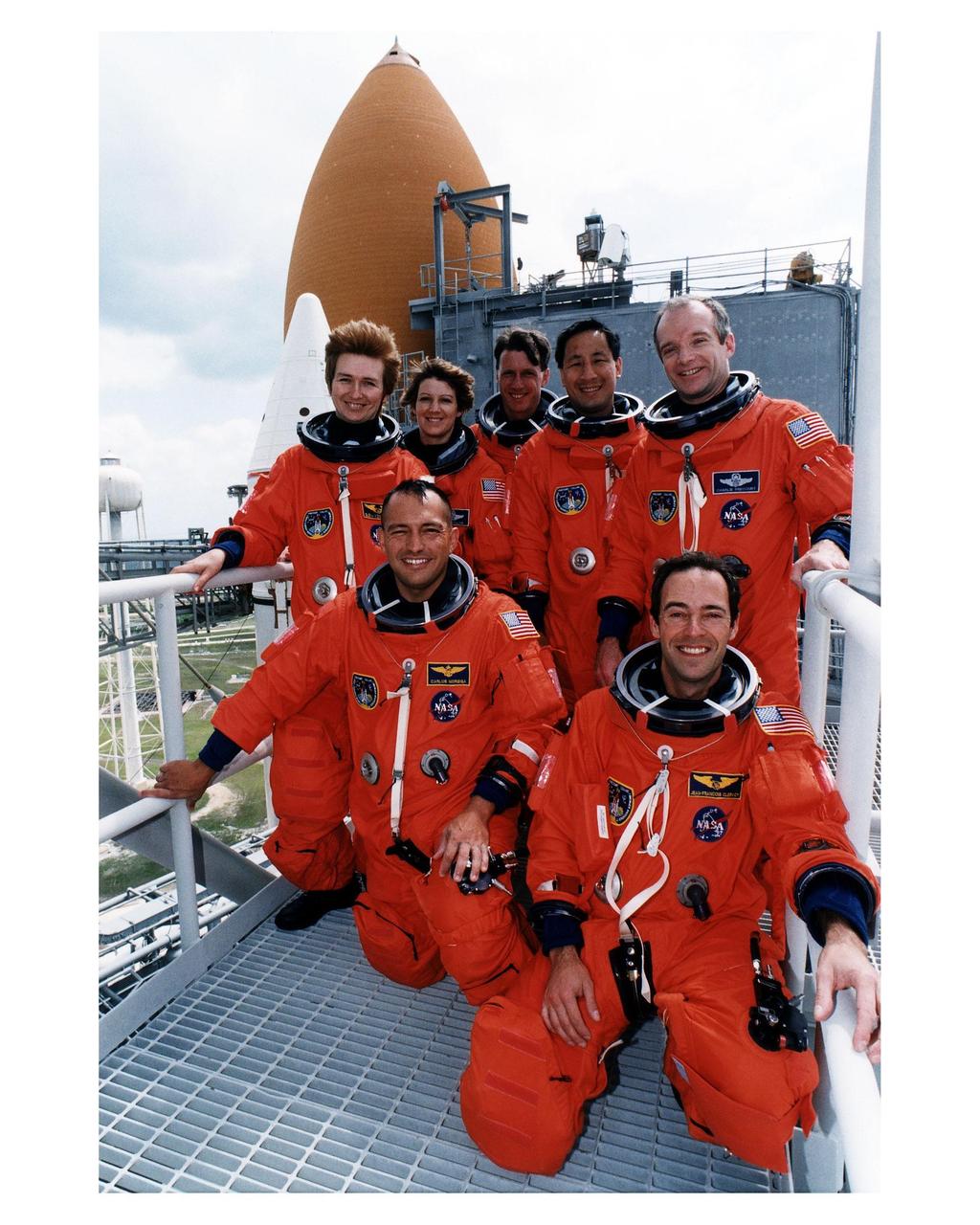
Wearing their orange launch and entry spacesuits, members of the STS-84 crew are all smiles as they pose for a group photograph at Launch Pad 39A with the Space Shuttle Atlantis in the background. Kneeling in front are Mission Specialists Jean-Francois Clervoy, at right, of the European Space Agency, and Carlos I. Noriega. Standing, from left, are Mission Specialist Elena V. Kondakova of the Russian Space Agency, Pilot Eileen Marie Collins, Mission Specialists C. Michael Foale and Edward Tsang Lu, and Commander Charles J. Precourt. STS-84 aboard Atlantis will be the sixth docking of the Space Shuttle with the Russian Space Station Mir. After docking, Foale will transfer to the space station and become a member of the Mir 23 crew, replacing U.S. astronaut Jerry M. Linenger, who will return to Earth aboard Atlantis. Foale will live and work on Mir until mid-September when his replacement is expected to arrive on the STS-86 mission. STS-84 is targeted for a May 15 liftoff
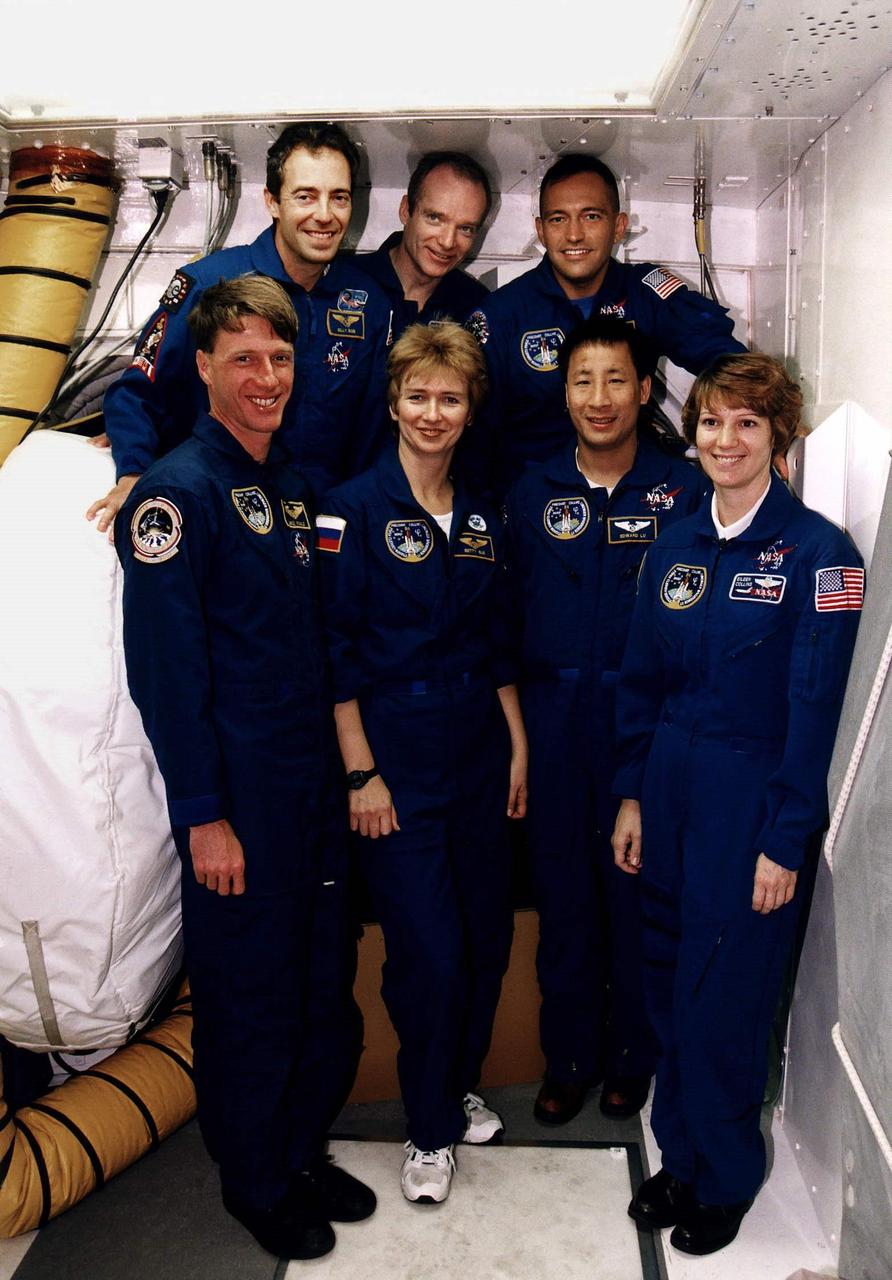
The STS-84 crew pose for a group photograph in front of the crew hatch of the Space Shuttle Atlantis at Launch Pad 39A. In the front row, from left, are Mission Specialists C. Michael Foale, Elena V. Kondakova of the Russian Space Agency, and Edward Tsang Lu; and Pilot Eileen Marie Collins. In the back row, from left, are Mission Specialist Jean-Francois Clervoy of the European Space Agency, Commander Charles J. Precourt and Mission Specialist Carlos I. Noriega. They are at KSC to participate in the Terminal Countdown Demonstration Test (TCDT), a dress rehearsal for launch. STS-84 will be the sixth docking of the Space Shuttle with the Russian Space Station Mir. After docking, Foale will transfer to the space station and become a member of the Mir 23 crew, replacing U.S. astronaut Jerry M. Linenger, who will return to Earth aboard Atlantis. Foale will live and work on Mir until mid-September when his replacement is expected to arrive on the STS-86 mission. STS-84 is targeted for a May 15 liftoff
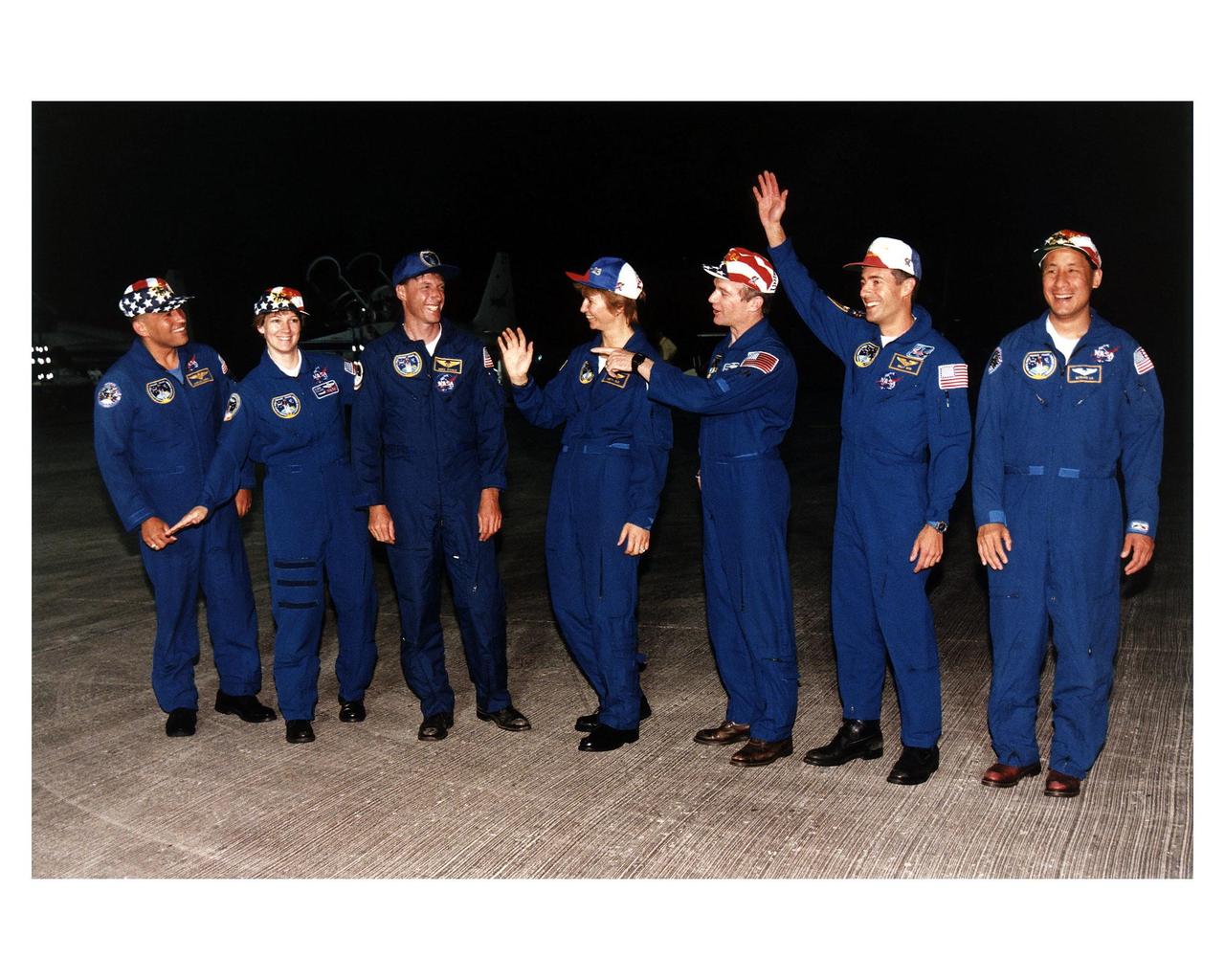
STS-84 crew members greet press representatives and other onlookers after their arrival at KSC’s Shuttle Landing Facility Sunday evening (May 12, 1997), about an hour before the countdown clock will begin ticking toward the scheduled May 15 launch of the Space Shuttle Atlantis on Mission STS-84. From left, are Mission Specialist Carlos I. Noriega, Pilot Eileen Marie Collins, Mission Specialist C. Michael Foale, Mission Specialist Elena V. Kondakova of the Russian Space Agency, Commander Charles J. Precourt, Mission Specialist Jean-Francois Clervoy of the European Space Agency, and Mission Specialist Edward Tsang Lu. STS-84 will be the sixth docking of the Space Shuttle with the Russian Space Station Mir. During the docking, Foale will transfer to the Russian space station to become a member of the Mir 23 crew, replacing U.S. astronaut Jerry M. Linenger, who will return to Earth on Atlantis. Foale is scheduled to remain on Mir about four months until his replacement arrives on STS-86 in September

STS-84 crew members are all smiles for the dress rehearsal of their walkout from the Operations and Checkout Building to board the astronaut van which will take them to Launch Pad 39A. They are participating in an abbreviated practice countdown to launch called the Terminal Countdown Demonstration Test (TCDT). Leading the way, from left, are Pilot Eileen Marie Collins and Commander Charles J. Precourt. In the second row are Mission Specialists C. Michael Foale and Elena V. Kondakova, a Russian cosmonaut. Behind them, from left, are Mission Specialist Jean-Francois Clervoy, an astronaut with the European Space Agency; and U.S. astronauts and STS-84 Mission Specialists Edward Tsang Lu and Carlos I. Noriega. During the sixth Shuttle-Mir docking, Foale will take his place aboard the Russian Space Station Mir as a member of the Mir 23 crew, replacing U.S. astronaut Jerry M. Linenger, who will return to Earth on Atlantis. Launch of STS-84 is targeted for May 15

STS-84 crew members pose for a group photograph in the Launch Complex 39 area with Launch Pad A in the background. The seven crew members are scheduled to lift off next month from Pad A aboard the Space Shuttle Atlantis on a scheduled nine-day mission. From left, are Mission Specialist Carlos I. Noriega, Commander Charles J. Precourt, Pilot Eileen Marie Collins, Russian cosmonaut and STS-84 Mission Specialist Elena V. Kondakova, Mission Specialist Edward Tsang Lu, European Space Agency astronaut and STS-84 Mission Specialist Jean-Francois Clervoy, and Mission Specialist C. Michael Foale. They are at KSC to participate in the Terminal Countdown Demonstration Test (TCDT), a dress rehearsal for launch. Foale will be dropped off on Mir to become a member of the Mir 23 crew, replacing U.S. astronaut Jerry M. Linenger, who will return to Earth on Atlantis after about four months on the orbiting station. STS-84 will be the sixth Shuttle-Mir docking. Liftoff is targeted for May 15
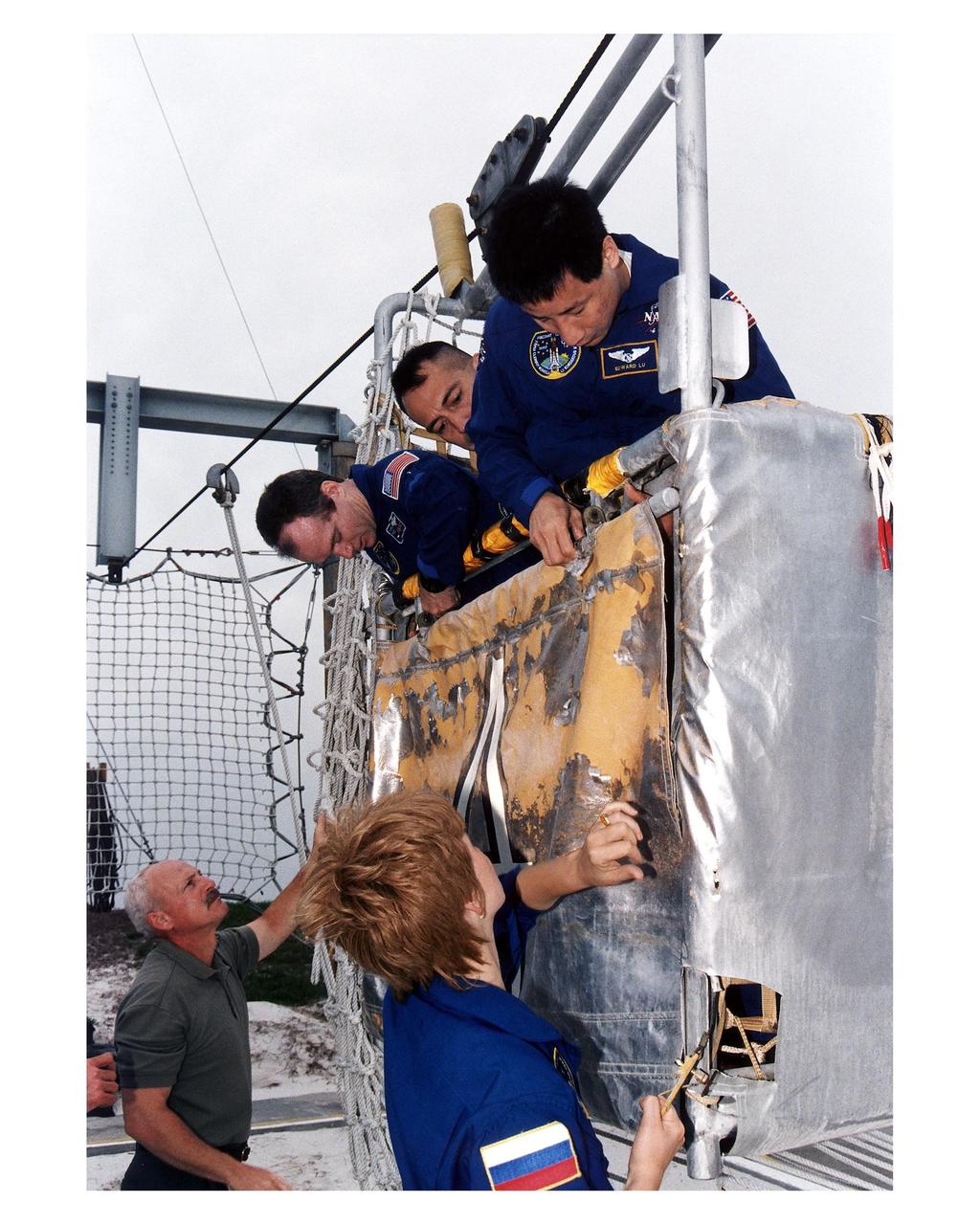
STS-84 crew members examine part of the emergency egress system at Launch Pad 39A, during Terminal Countdown Demonstration Test (TCDT) activities. Dressed in their blue flight suits are Mission Specialist Elena V. Kondakova, standing in foreground; and, in basket from right, Mission Specialists Edward Tsang Lu and Carlos I. Noriega and Commander Charles J. Precourt. Ken Clark, a training instructor with United Space Alliance (USA), is standing at lower left. STS-84 will be the sixth docking of the Space Shuttle with the Russian Space Station Mir. After docking, STS-84 Mission Specialist Michael C. Foale will transfer to the space station and become a member of the Mir 23 crew, replacing U.S. astronaut Jerry M. Linenger, who will return to Earth aboard Atlantis. Foale will live and work on Mir until mid-September when his replacement is expected to arrive on the STS-86 mission. STS-84 is targeted for a May 15 liftoff
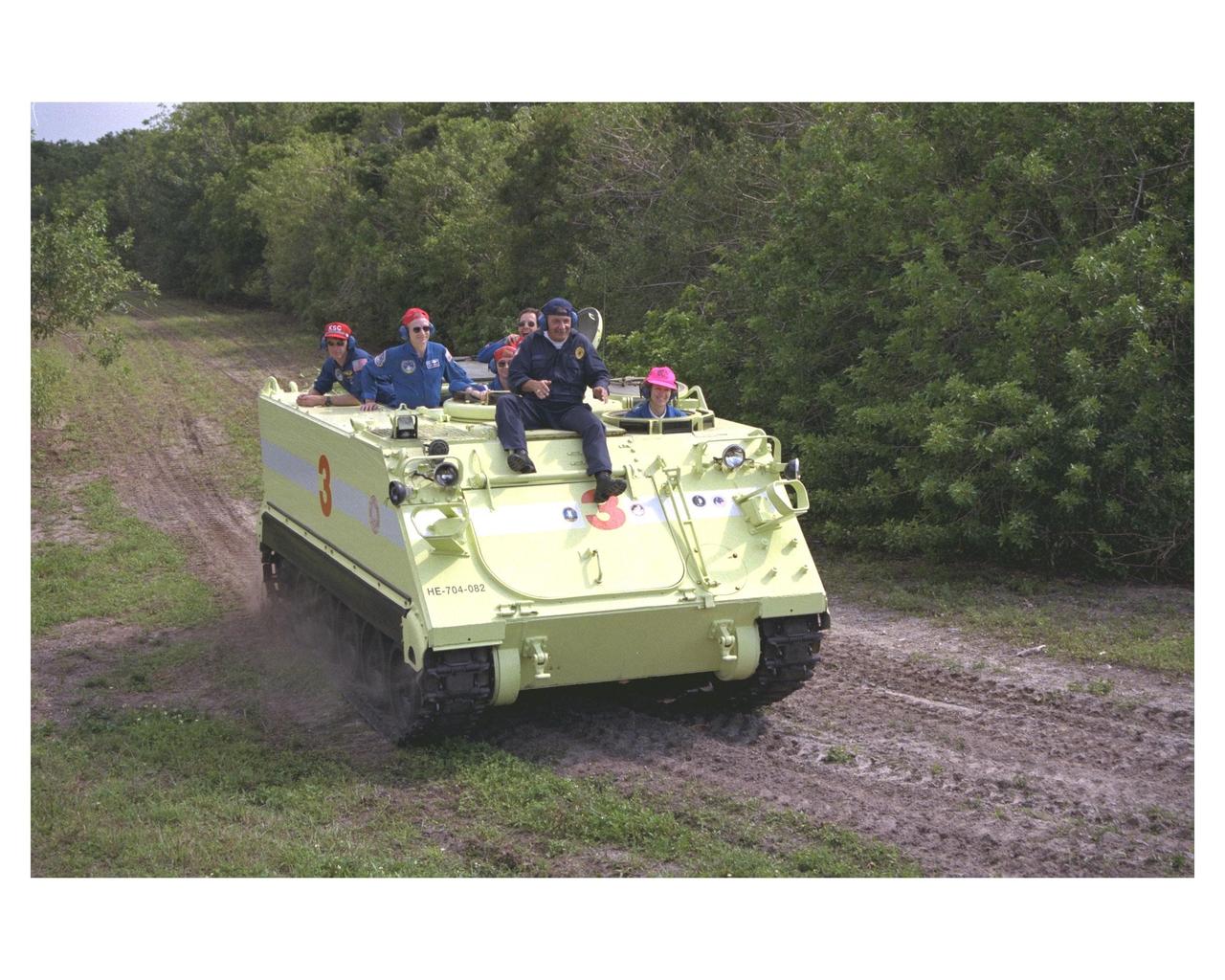
STS-84 crew members ride in and learn how to operate an M-113 armored personnel carrier as part of the Terminal Countdown Demonstration Test (TCDT) activities. In the front seat is Pilot Eileen Marie Collins. George Hoggard, a training officer with KSC Fire Services, sits beside her on top of the personnel carrier. Directly behind Hoggard, from left, are Commander Charles J. Precourt and Mission Specialist Elena V. Kondakova (sitting) of the Russian Space Agency. At the rear, from left, are Mission Specialist C. Michael Foale and Mission Specialist Jean-Francois Clervoy of the European Space Agency. STS-84 aboard the Space Shuttle Atlantis will be the sixth docking of the Space Shuttle with the Russian Space Station Mir. After docking, Foale will transfer to the space station and become a member of the Mir 23 crew, replacing U.S. astronaut Jerry M. Linenger, who will return to Earth aboard Atlantis. Foale will live and work on Mir until mid-September when his replacement is expected to arrive on the STS-86 mission. STS-84 is targeted for a May 15 liftoff
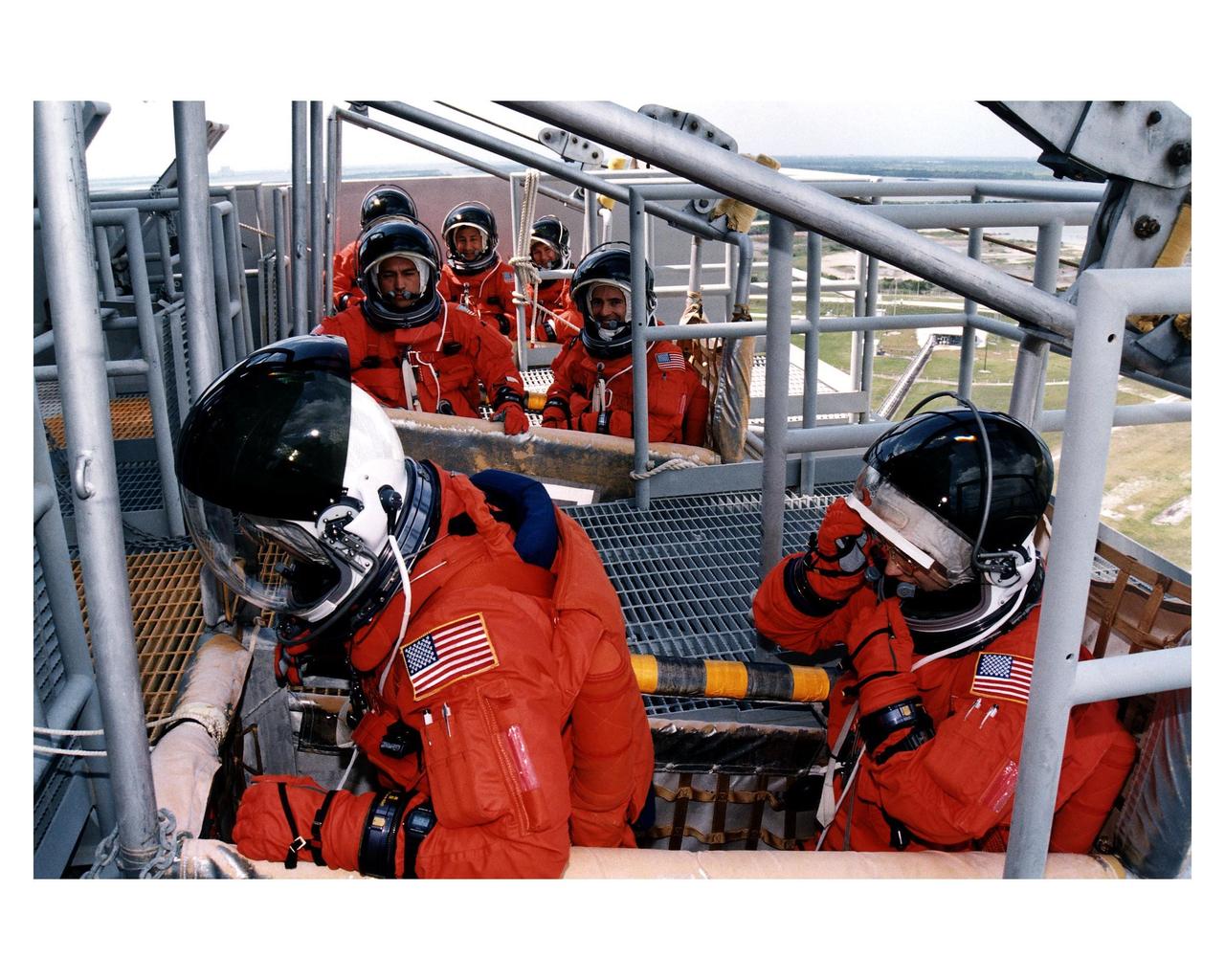
STS-84 crew members practice emergency egress procedures in slidewire baskets at Launch Pad 39A. They are participating in the Terminal Countdown Demonstration Test (TCDT), a dress rehearsal for launch. In the foreground are Commander Charles J. Precourt, at left, and Pilot Eileen Marie Collins. In the middle basket are Mission Specialists Carlos I. Noriega, at left, and Jean-Francois Clervoy of the European Space Agency. In the last slidewire basket at rear, from left, are Mission Specialists C. Michael Foale, Edward Tsang Lu and Elena V. Kondakova of the Russian Space Agency. STS-84 aboard Atlantis will be the sixth docking of the Space Shuttle with the Russian Space Station Mir. After docking, Foale will transfer to the space station and become a member of the Mir 23 crew, replacing U.S. astronaut Jerry M. Linenger, who will return to Earth aboard Atlantis. Foale will live and work on Mir until mid-September when his replacement is expected to arrive on the STS-86 mission. STS-84 is targeted for a May 15 liftoff
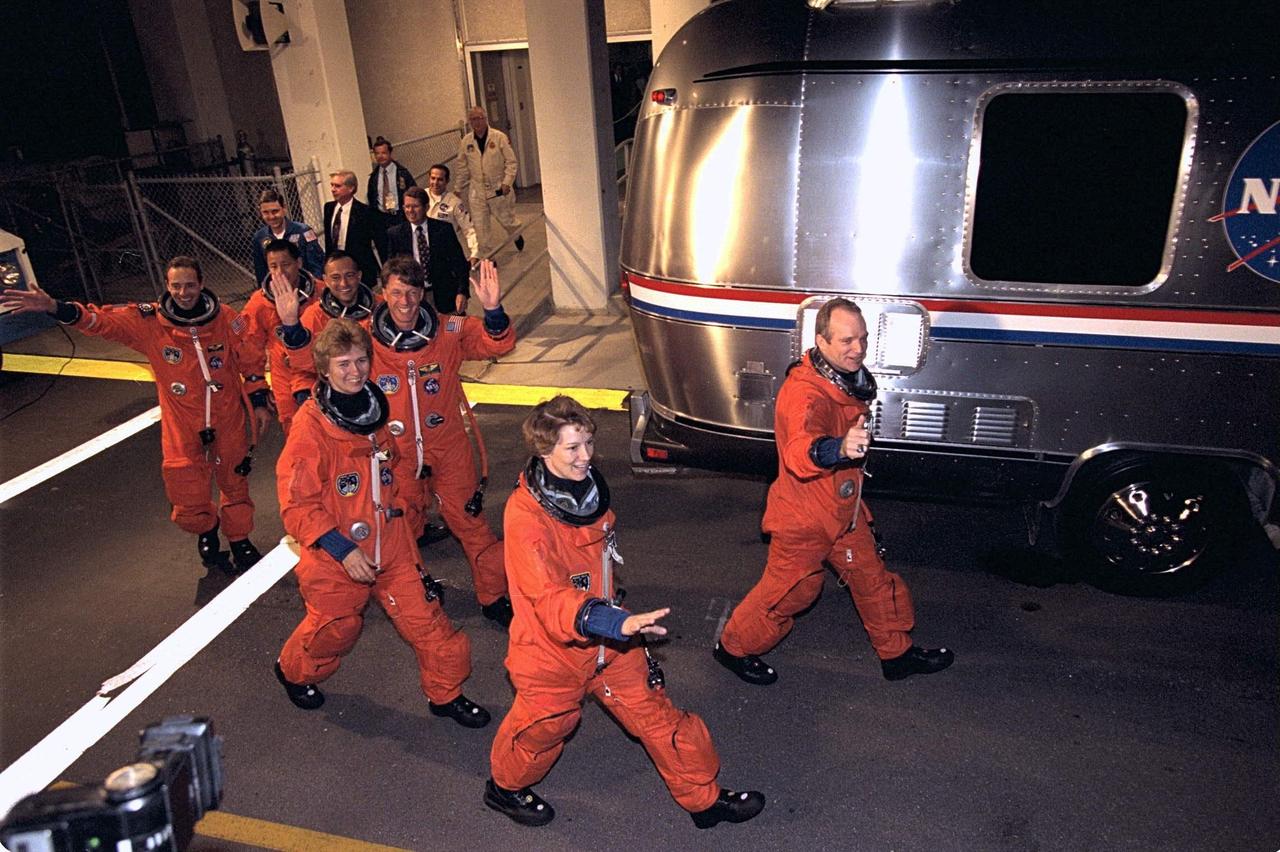
The crew of Mission STS-84 departs from the Operations and Checkout Building en route to Launch Pad 39A, where the Space Shuttle Atlantis awaits liftoff on the sixth docking of the Space Shuttle with the Russian Space Station Mir. Leading the way, from left, are Pilot Eileen Marie Collins and Commander Charles J. Precourt. Mission Specialist Elena V. Kondakova, a cosmonaut with the Russian Space Agency, walks behind Collins, and is followed by Mission Specialist C. Michael Foale, with hands upraised. At rear, from left, are Mission Specialist Jean-Francois Clervoy of the European Space Agency, Mission Specialist Edward Tsang Lu and Mission Specialist Carlos I. Noriega. The Space Shuttle Atlantis and its crew of seven are scheduled to lift off during an approximate 7-minute launch window which opens about 4:08 a.m. The exact liftoff time will be determined about 90 minutes prior to launch, based on Mir’s current location. The planned nine-day mission also will include the exchange of Foale for U.S. astronaut and Mir 23 crew member Jerry M. Linenger, who has been on Mir since Jan. 15. Linenger will return to Earth on Atlantis, and Foale will remain on Mir for about four months
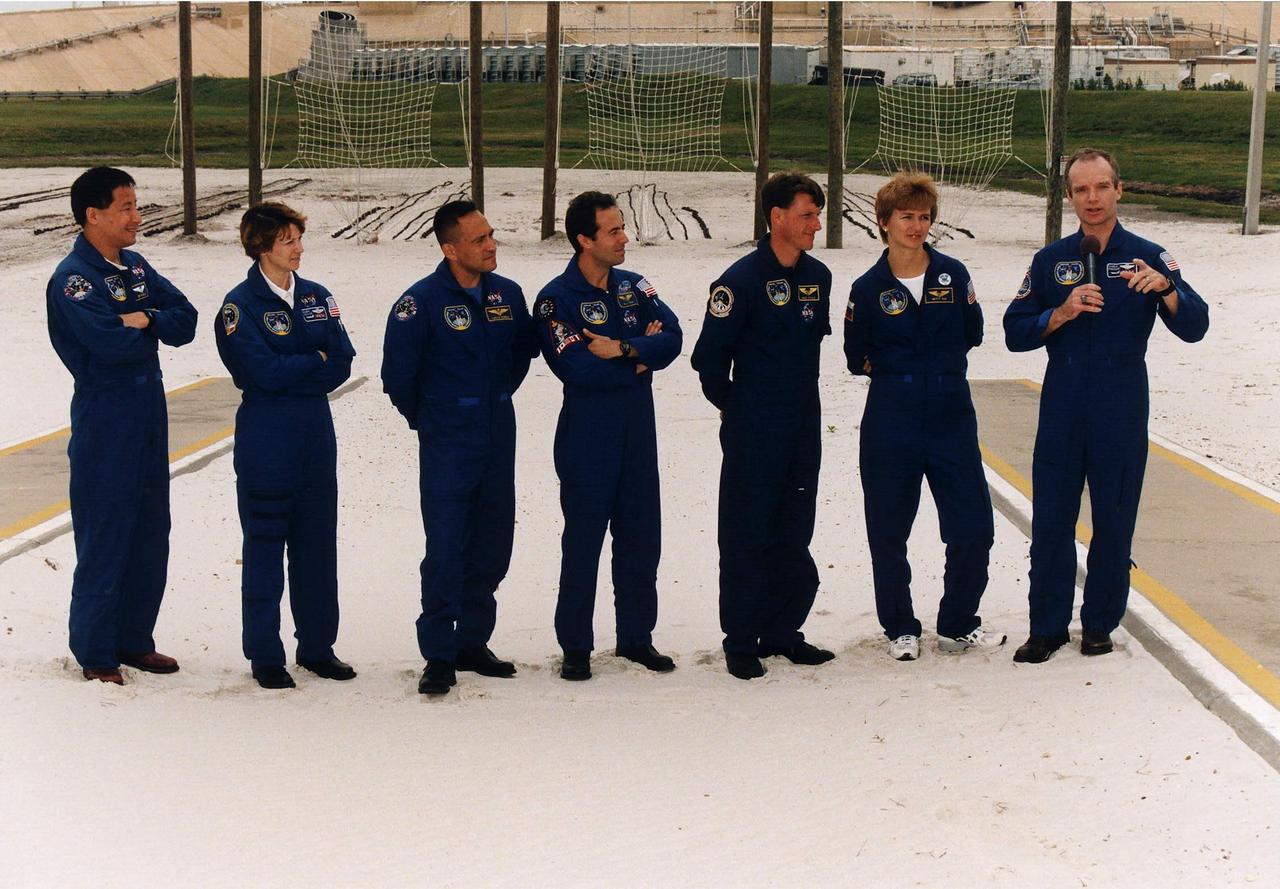
STS-84 crew members listen intently to Commander Charles J. Precourt, at far right, as he talks to news media representatives and other onlookers at Launch Pad 39A during the Terminal Countdown Demonstration Test (TCDT). Other crew members, from left, are Mission Specialist Edward Tsang Lu, Pilot Eileen Marie Collins, and Mission Specialists Carlos I. Noriega, Jean-Francois Clervoy of the European Space Agency, C. Michael Foale, and Elena V. Kondakova of the Russian Space Agency. STS-84 will be the sixth docking of the Space Shuttle with the Russian Space Station Mir. After docking, Foale will transfer to the space station and become a member of the Mir 23 crew, replacing U.S. astronaut Jerry M. Linenger, who will return to Earth aboard Atlantis. Foale will live and work on Mir until mid-September when his replacement is expected to arrive on the STS-86 mission. STS-84 is targeted for a May 15 liftoff
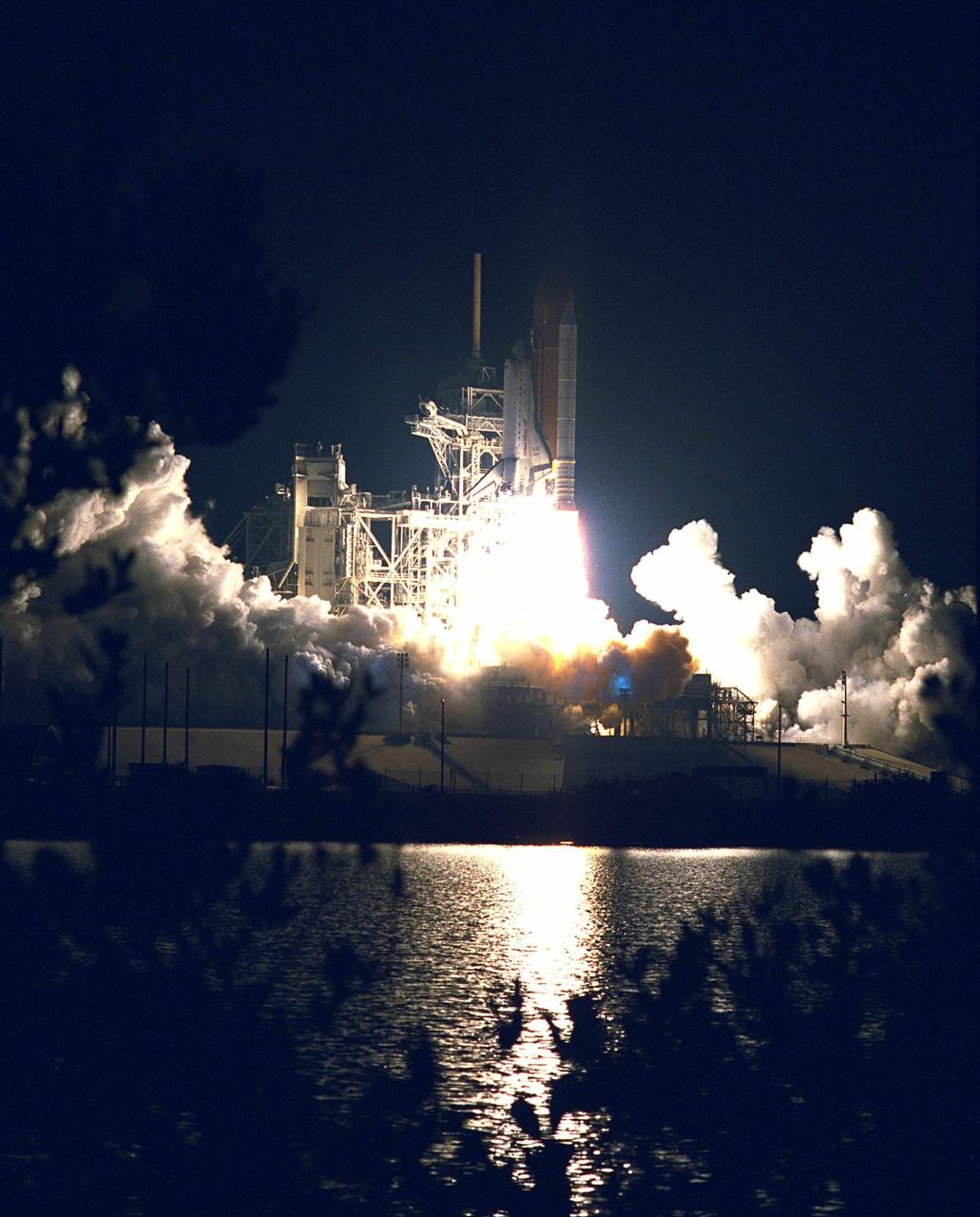
The Space Shuttle Atlantis turns night into day for a few moments as it lifts off on May 15 at 4:07:48 a.m. EDT from Launch Pad 39A on the STS-84 mission. The fourth Shuttle mission of 1997 will be the sixth docking of the Space Shuttle with the Russian Space Station Mir. The commander is Charles J. Precourt. The pilot is Eileen Marie Collins. The five mission specialists are C. Michael Foale, Carlos I. Noriega, Edward Tsang Lu, Jean-Francois Clervoy of the European Space Agency and Elena V. Kondakova of the Russian Space Agency. The planned nine-day mission will include the exchange of Foale for U.S. astronaut and Mir 23 crew member Jerry M. Linenger, who has been on Mir since Jan. 15. Linenger transferred to Mir during the last docking mission, STS-81; he will return to Earth on Atlantis. Foale is slated to remain on Mir for about four months until he is replaced in September by STS-86 Mission Specialist Wendy B. Lawrence. During the five days Atlantis is scheduled to be docked with the Mir, the STS-84 crew and the Mir 23 crew, including two Russian cosmonauts, Commander Vasily Tsibliev and Flight Engineer Alexander Lazutkin, will participate in joint experiments. The STS-84 mission also will involve the transfer of more than 7,300 pounds of water, logistics and science equipment to and from the Mir. Atlantis is carrying a nearly 300-pound oxygen generator to replace one of two Mir units which have experienced malfunctions. The oxygen it generates is used for breathing by the Mir crew
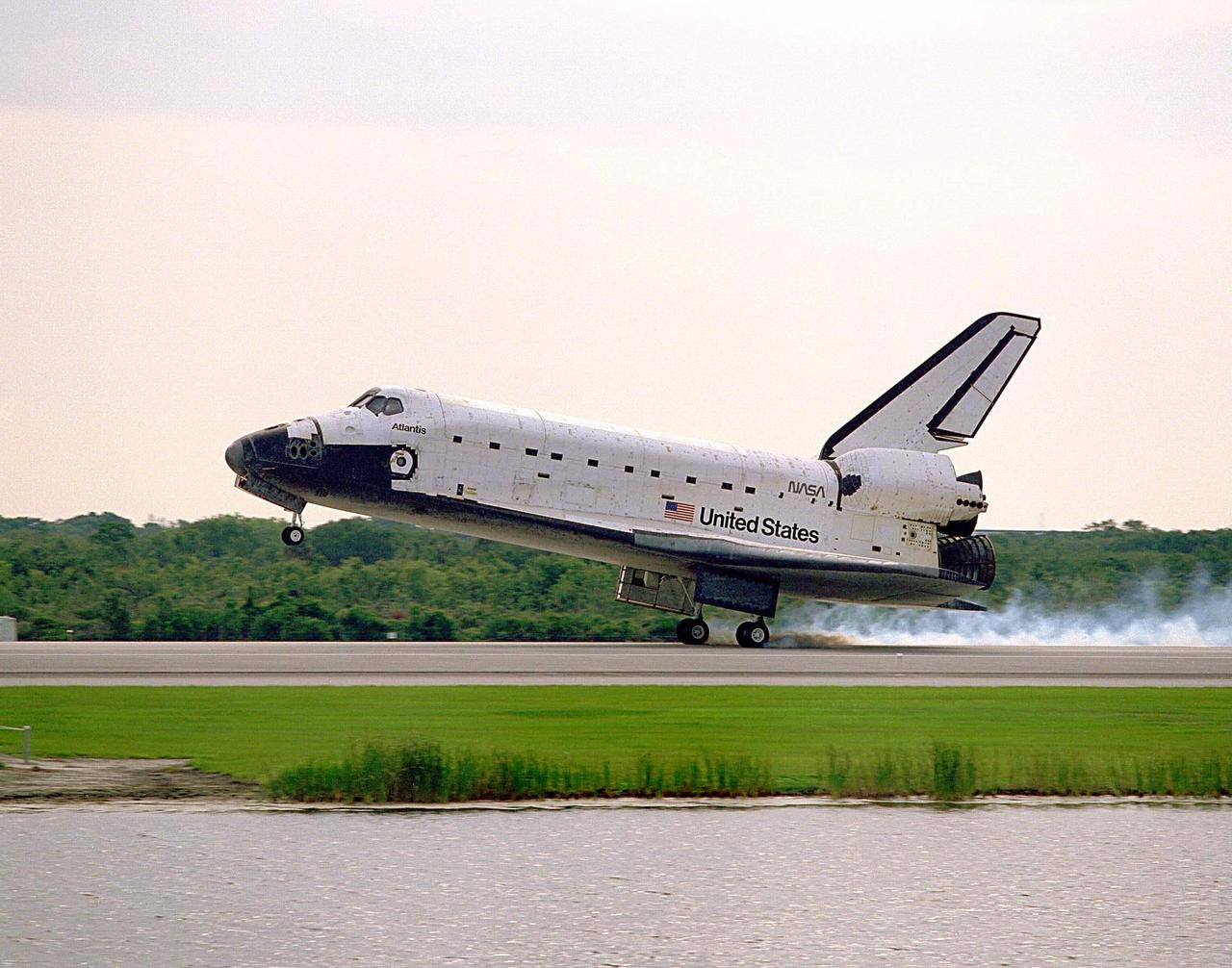
The Space Shuttle orbiter Atlantis touches down on Runway 33 of the KSC Shuttle Landing Facility, bringing to an end the nine-day STS-84 mission. Main gear touchdown was at 9:27:44 EDT on May 24, 1997. The first landing opportunity was waved off because of low cloud cover. It was the 37th landing at KSC since the Shuttle program began in 1981, and the eighth consecutive landing at KSC. STS-84 was the sixth of nine planned dockings of the Space Shuttle with the Russian Space Station Mir. Atlantis was docked with the Mir for five days. STS-84 Mission Specialist C. Michael Foale replaced astronaut and Mir 23 crew member Jerry M. Linenger, who has been on the Russian space station since Jan. 15. Linenger returned to Earth on Atlantis with the rest of the STS-84 crew, Mission Commander Charles J. Precourt, Pilot Eileen Marie Collins, and Mission Specialists Carlos I. Noriega, Edward Tsang Lu, Elena V. Kondakova of the Russian Space Agency and JeanFrancois Clervoy of the European Space Agency. Foale is scheduled to remain on the Mir for approximately four months, until he is replaced by STS-86 crew member Wendy B. Lawrence in September. Besides the docking and crew exchange, STS-84 included the transfer of more than 7,300 pounds of water, logistics and science experiments and hardware to and from the Mir. Scientific experiments conducted during the STS-84 mission, and scheduled for Foale’s stay on the Mir, are in the fields of advanced technology, Earth sciences, fundamental biology, human life sciences, International Space Station risk mitigation, microgravity sciences and space sciences
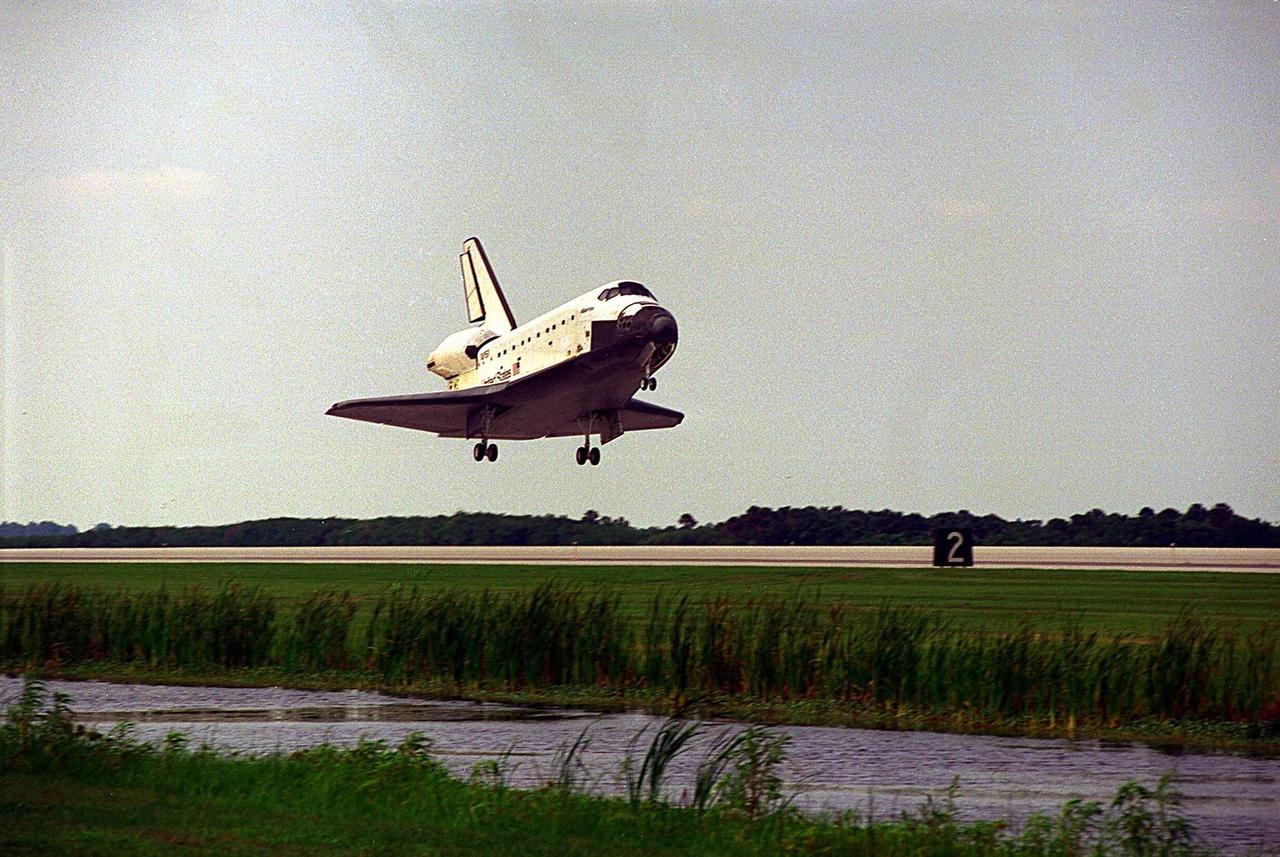
The Space Shuttle orbiter Atlantis glides in for a landing on Runway 33 at KSC’s Shuttle Landing Facility at the conclusion of the nine-day STS-84 mission. It will be the 37th landing at KSC since the Shuttle program began in 1981, and the eighth consecutive landing at KSC. STS-84 was the sixth of nine planned dockings of the Space Shuttle with the Russian Space Station Mir. Atlantis was docked with the Mir for five days. STS-84 Mission Specialist C. Michael Foale replaced astronaut and Mir 23 crew member Jerry M. Linenger, who has been on the Russian space station since Jan. 15. Linenger returned to Earth on Atlantis with the rest of the STS-84 crew, Mission Commander Charles J. Precourt, Pilot Eileen Marie Collins, and Mission Specialists Carlos I. Noriega, Edward Tsang Lu, Elena V. Kondakova of the Russian Space Agency and Jean-Francois Clervoy of the European Space Agency. Foale is scheduled to remain on the Mir for approximately four months, until he is replaced by STS-86 crew member Wendy B. Lawrence in September. Besides the docking and crew exchange, STS-84 included the transfer of more than 7,300 pounds of water, logistics and science experiments and hardware to and from the Mir. Scientific experiments conducted during the STS-84 mission, and scheduled for Foale’s stay on the Mir, are in the fields of advanced technology, Earth sciences, fundamental biology, human life sciences, International Space Station risk mitigation, microgravity sciences and space sciences
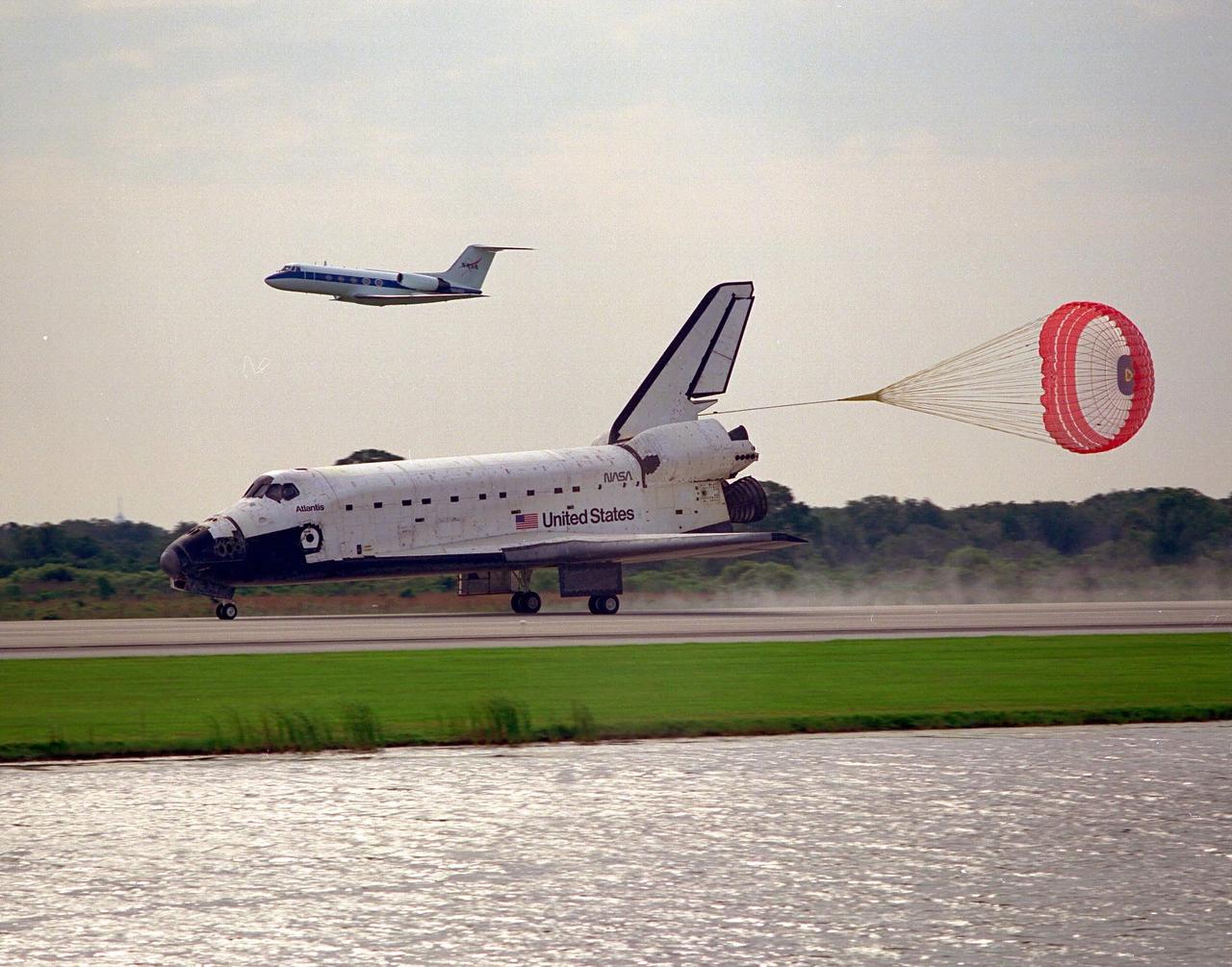
The Space Shuttle orbiter Atlantis, with its drag chute deployed, rolls out on Runway 33 of KSC’s Shuttle Landing Facility at the conclusion of the nine-day STS-84 mission. The Shuttle Training Aircraft piloted by astronaut Kenneth D. Cockrell, acting deputy chief of the Astronaut Office, is flying above Atlantis. Main gear touchdown was at 9:27:44 EDT on May 24, 1997. The first landing opportunity was waved off because of low cloud cover. It was the 37th landing at KSC since the Shuttle program began in 1981, and the eighth consecutive landing at KSC. STS-84 was the sixth of nine planned dockings of the Space Shuttle with the Russian Space Station Mir. Atlantis was docked with the Mir for five days. STS-84 Mission Specialist C. Michael Foale replaced astronaut and Mir 23 crew member Jerry M. Linenger, who has been on the Russian space station since Jan. 15. Linenger returned to Earth on Atlantis with the rest of the STS-84 crew, Mission Commander Charles J. Precourt, Pilot Eileen Marie Collins, and Mission Specialists Carlos I. Noriega, Edward Tsang Lu, Elena V. Kondakova of the Russian Space Agency and JeanFrancois Clervoy of the European Space Agency. Foale is scheduled to remain on the Mir for approximately four months, until he is replaced by STS-86 crew member Wendy B. Lawrence in September. Besides the docking and crew exchange, STS-84 included the transfer of more than 7,300 pounds of water, logistics and science experiments and hardware to and from the Mir. Scientific experiments conducted during the STS-84 mission, and scheduled for Foale’s stay on the Mir, are in the fields of advanced technology, Earth sciences, fundamental biology, human life sciences, International Space Station risk mitigation, microgravity sciences and space sciences
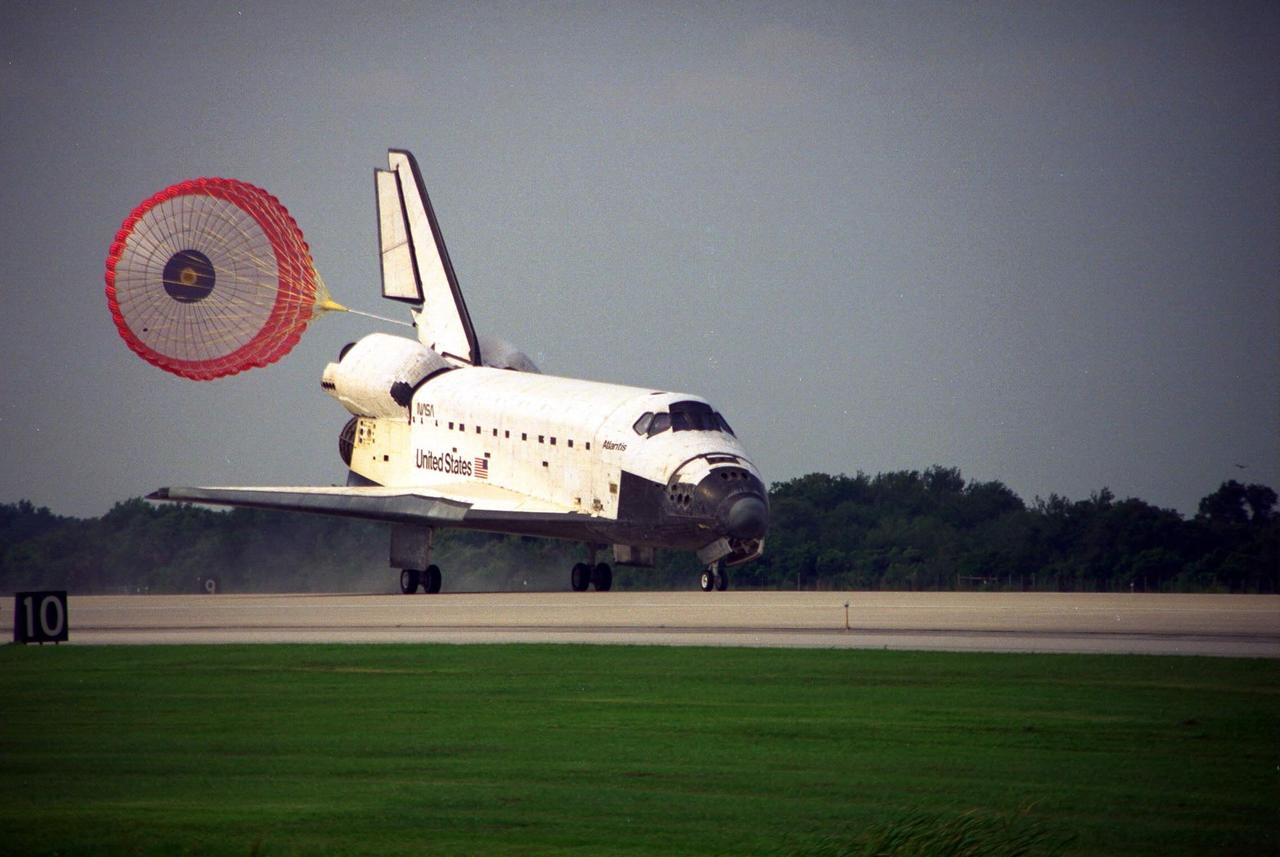
The orbiter drag chute deploys after Atlantis touches down on Runway 33 of KSC’s Shuttle Landing Facility at the conclusion of the nine-day STS-84 mission. Main gear touchdown was at 9:27:44 EDT on May 24, 1997. The first landing opportunity was waved off because of low cloud cover. It was the 37th landing at KSC since the Shuttle program began in 1981, and the eighth consecutive landing at KSC. STS-84 was the sixth of nine planned dockings of the Space Shuttle with the Russian Space Station Mir. Atlantis was docked with the Mir for five days. STS-84 Mission Specialist C. Michael Foale replaced astronaut and Mir 23 crew member Jerry M. Linenger, who has been on the Russian space station since Jan. 15. Linenger returned to Earth on Atlantis with the rest of the STS-84 crew, Mission Commander Charles J. Precourt, Pilot Eileen Marie Collins, and Mission Specialists Carlos I. Noriega, Edward Tsang Lu, Elena V. Kondakova of the Russian Space Agency and JeanFrancois Clervoy of the European Space Agency. Foale is scheduled to remain on the Mir for approximately four months, until he is replaced by STS-86 crew member Wendy B. Lawrence in September. Besides the docking and crew exchange, STS-84 included the transfer of more than 7,300 pounds of water, logistics and science experiments and hardware to and from the Mir. Scientific experiments conducted during the STS-84 mission, and scheduled for Foale’s stay on the Mir, are in the fields of advanced technology, Earth sciences, fundamental biology, human life sciences, International Space Station risk mitigation, microgravity sciences and space sciences
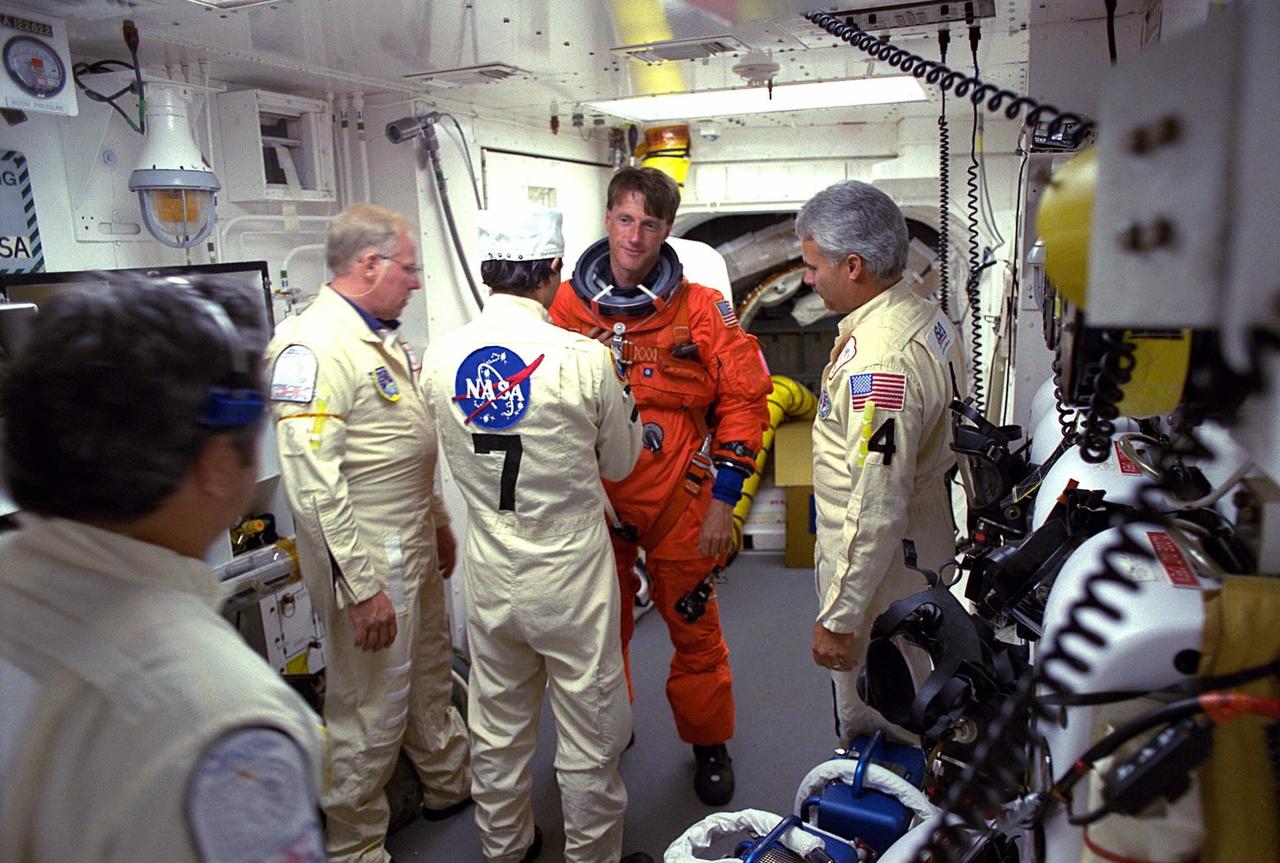
STS-84 Mission Specialist C. Michael Foale prepares to enter the Space Shuttle Atlantis at Launch Pad 39A with help from white room closeout crew members. The fourth Shuttle mission of 1997 will be the sixth docking of the Space Shuttle with the Russian Space Station Mir. The commander is Charles J. Precourt. The pilot is Eileen Marie Collins. The five mission specialists are C. Michael Foale, Carlos I. Noriega, Edward Tsang Lu, Jean-Francois Clervoy of the European Space Agency and Elena V. Kondakova of the Russian Space Agency. The planned nine-day mission will include the exchange of Foale for U.S. astronaut and Mir 23 crew member Jerry M. Linenger, who has been on Mir since Jan. 15. Linenger transferred to Mir during the last docking mission, STS-81; he will return to Earth on Atlantis. Foale is slated to remain on Mir for about four months until he is replaced in September by STS-86 Mission Specialist Wendy B. Lawrence. During the five days Atlantis is scheduled to be docked with the Mir, the STS-84 crew and the Mir 23 crew, including two Russian cosmonauts, Commander Vasily Tsibliev and Flight Engineer Alexander Lazutkin, will participate in joint experiments. The STS-84 mission also will involve the transfer of more than 7,300 pounds of water, logistics and science equipment to and from the Mir. Atlantis is carrying a nearly 300-pound oxygen generator to replace one of two Mir units which have experienced malfunctions. The oxygen it generates is used for breathing by the Mir crew
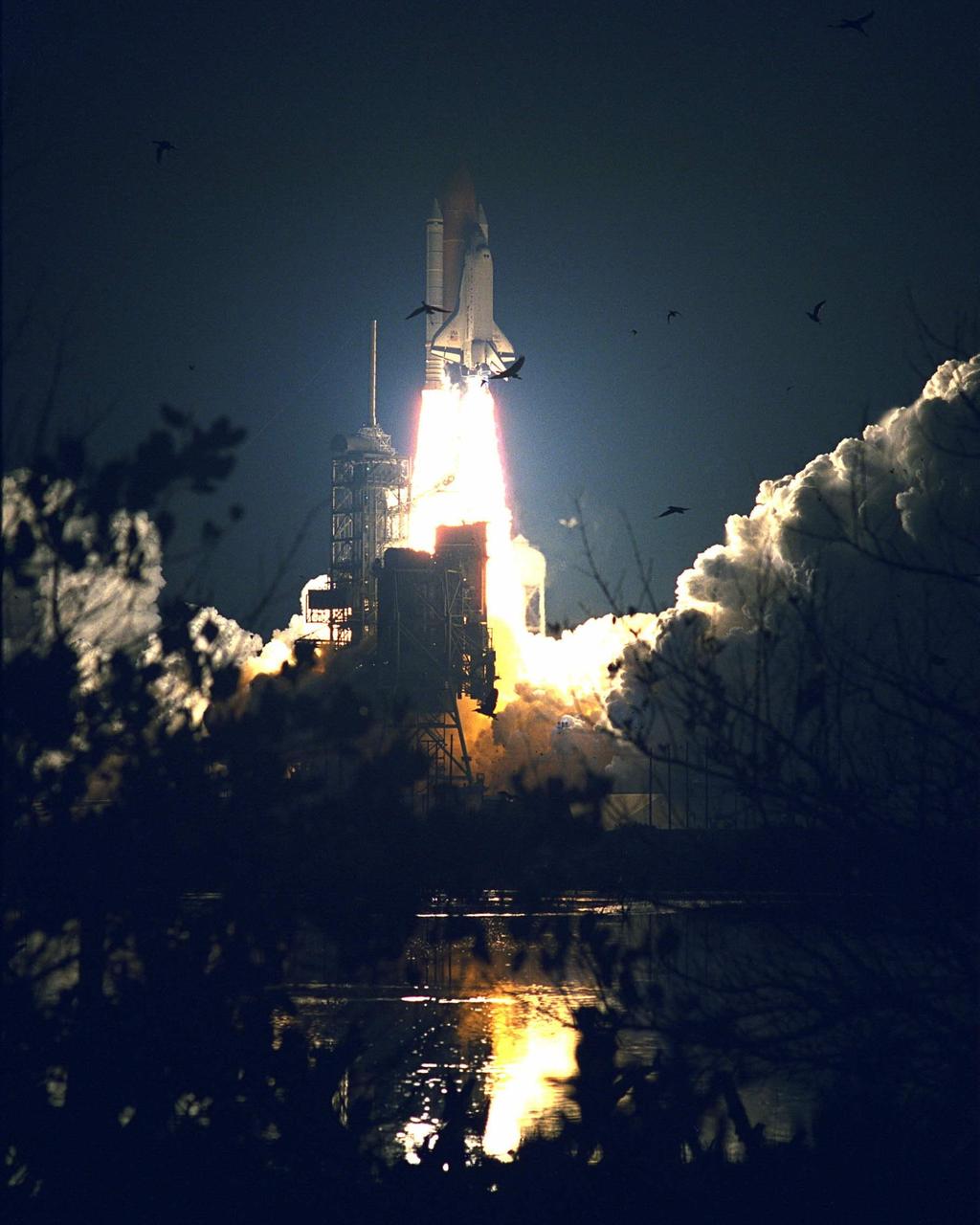
The Space Shuttle Atlantis turns night into day for a few moments as it lifts off on May 15 at 4:07:48 a.m. EDT from Launch Pad 39A on the STS-84 mission. The fourth Shuttle mission of 1997 will be the sixth docking of the Space Shuttle with the Russian Space Station Mir. The commander is Charles J. Precourt. The pilot is Eileen Marie Collins. The five mission specialists are C. Michael Foale, Carlos I. Noriega, Edward Tsang Lu, Jean-Francois Clervoy of the European Space Agency and Elena V. Kondakova of the Russian Space Agency. The planned nine-day mission will include the exchange of Foale for U.S. astronaut and Mir 23 crew member Jerry M. Linenger, who has been on Mir since Jan. 15. Linenger transferred to Mir during the last docking mission, STS-81; he will return to Earth on Atlantis. Foale is slated to remain on Mir for about four months until he is replaced in September by STS-86 Mission Specialist Wendy B. Lawrence. During the five days Atlantis is scheduled to be docked with the Mir, the STS-84 crew and the Mir 23 crew, including two Russian cosmonauts, Commander Vasily Tsibliev and Flight Engineer Alexander Lazutkin, will participate in joint experiments. The STS-84 mission also will involve the transfer of more than 7,300 pounds of water, logistics and science equipment to and from the Mir. Atlantis is carrying a nearly 300-pound oxygen generator to replace one of two Mir units which have experienced malfunctions. The oxygen it generates is used for breathing by the Mir crew
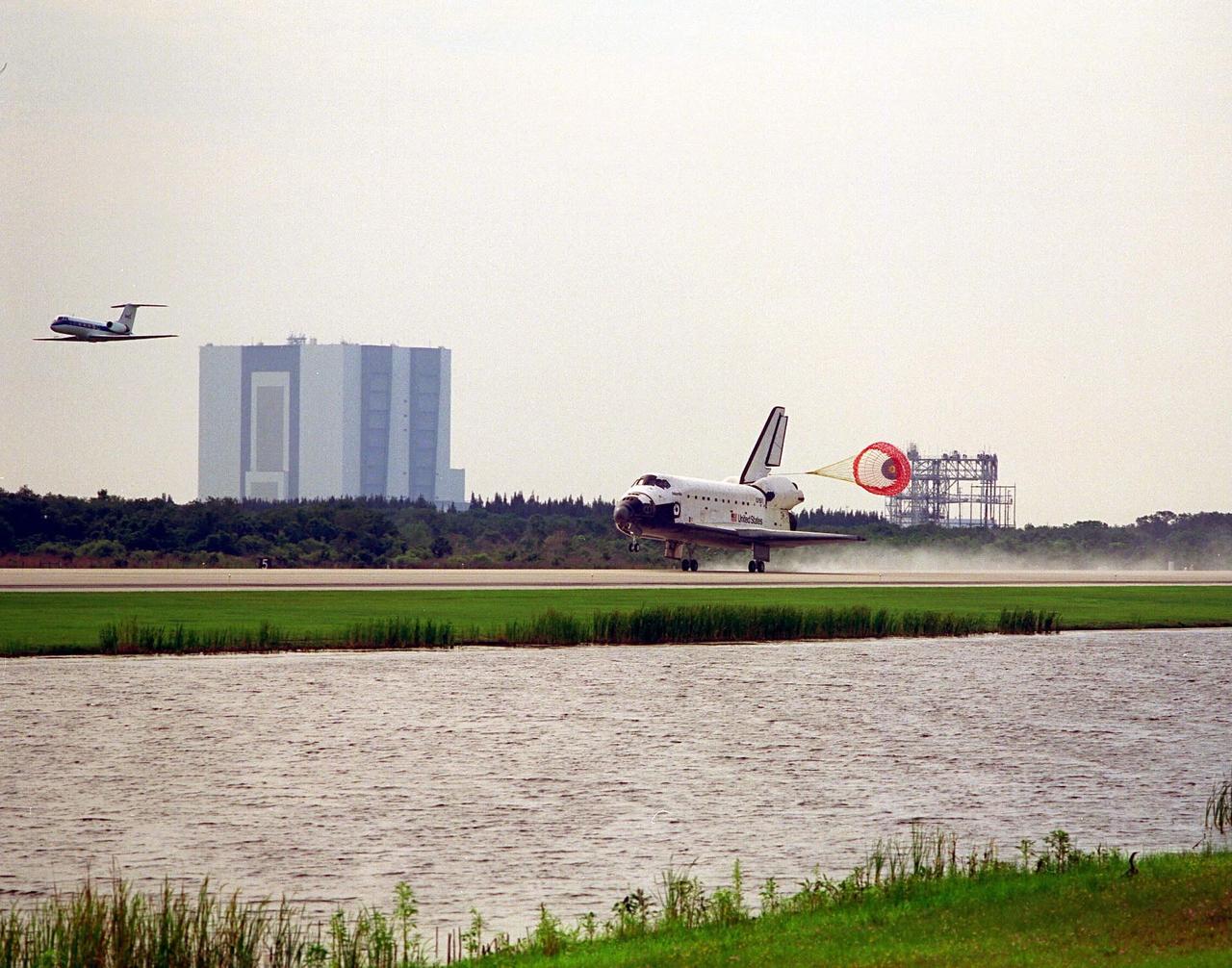
Framed by the Vehicle Assembly Building in the distance, at left, and the Mate-Demate Device, the Space Shuttle Atlantis with its drag chute deployed touches down on KSC’s Runway 33 at the conclusion of the STS-84 mission. The Shuttle Training Aircraft with astronaut Kenneth D. Cockrell at the controls is flying in front of Atlantis. Cockrell is acting deputy chief of the Astronaut Office. Main gear touchdown was at 9:27:44 EDT on May 24, 1997. The first landing opportunity was waved off because of low cloud cover. It was the 37th landing at KSC since the Shuttle program began in 1981, and the eighth consecutive landing at KSC. STS-84 was the sixth of nine planned dockings of the Space Shuttle with the Russian Space Station Mir. Atlantis was docked with the Mir for five days. STS-84 Mission Specialist C. Michael Foale replaced astronaut and Mir 23 crew member Jerry M. Linenger, who has been on the Russian space station since Jan. 15. Linenger returned to Earth on Atlantis with the rest of the STS-84 crew, Mission Commander Charles J. Precourt, Pilot Eileen Marie Collins, and Mission Specialists Carlos I. Noriega, Edward Tsang Lu, Elena V. Kondakova of the Russian Space Agency and Jean-Francois Clervoy of the European Space Agency. Foale is scheduled to remain on the Mir for approximately four months, until he is replaced by STS-86 crew member Wendy B. Lawrence in September. Besides the docking and crew exchange, STS-84 included the transfer of more than 7,300 pounds of water, logistics and science experiments and hardware to and from the Mir. Scientific experiments conducted during the STS-84 mission, and scheduled for Foale’s stay on the Mir, are in the fields of advanced technology, Earth sciences, fundamental biology, human life sciences, International Space Station risk mitigation, microgravity sciences and space sciences
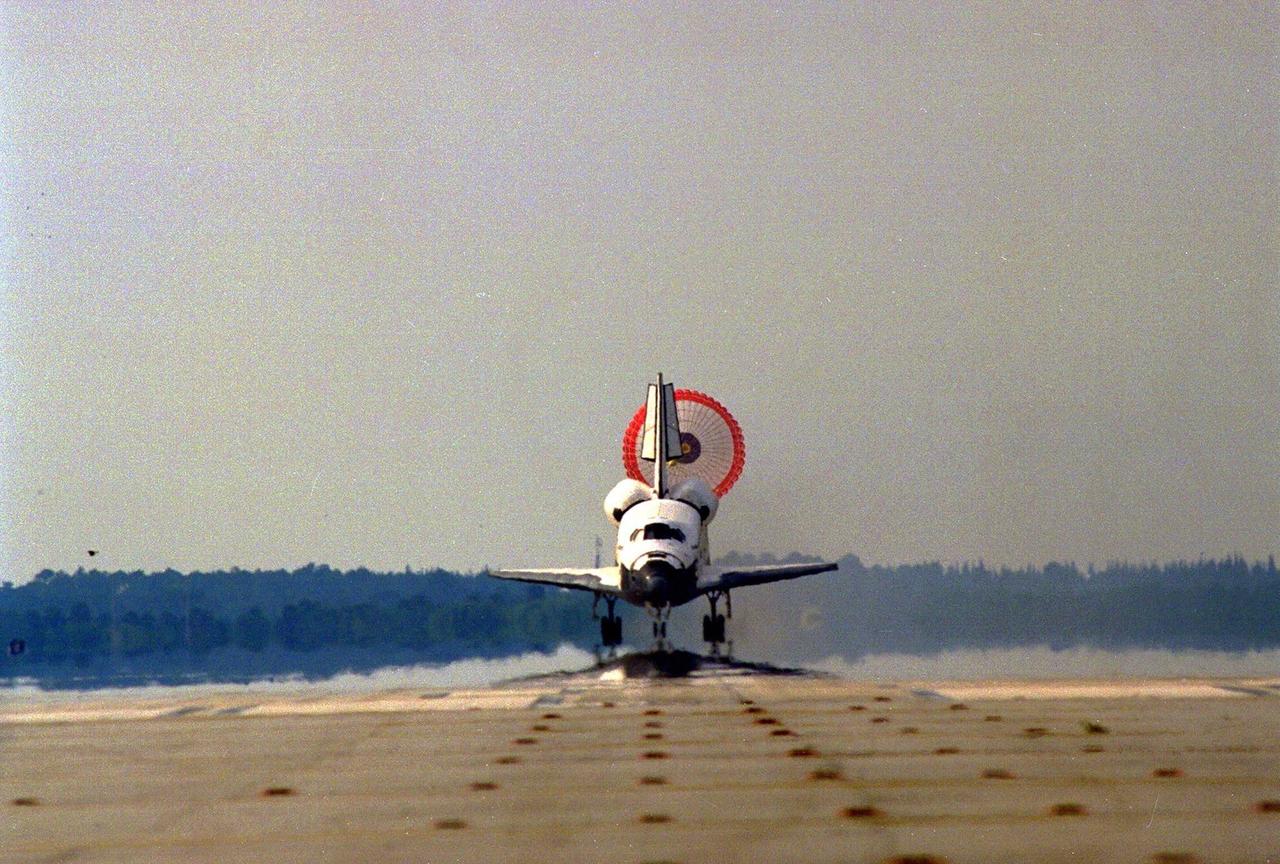
The orbiter drag chute deploys after Atlantis touches down on Runway 33 of KSC’s Shuttle Landing Facility at the conclusion of the nine-day STS-84 mission. Main gear touchdown was at 9:27:44 EDT on May 24, 1997. The first landing opportunity was waved off because of low cloud cover. It was the 37th landing at KSC since the Shuttle program began in 1981, and the eighth consecutive landing at KSC. STS-84 was the sixth of nine planned dockings of the Space Shuttle with the Russian Space Station Mir. Atlantis was docked with the Mir for five days. STS-84 Mission Specialist C. Michael Foale replaced astronaut and Mir 23 crew member Jerry M. Linenger, who has been on the Russian space station since Jan. 15. Linenger returned to Earth on Atlantis with the rest of the STS-84 crew, Mission Commander Charles J. Precourt, Pilot Eileen Marie Collins, and Mission Specialists Carlos I. Noriega, Edward Tsang Lu, Elena V. Kondakova of the Russian Space Agency and JeanFrancois Clervoy of the European Space Agency. Foale is scheduled to remain on the Mir for approximately four months, until he is replaced by STS-86 crew member Wendy B. Lawrence in September. Besides the docking and crew exchange, STS-84 included the transfer of more than 7,300 pounds of water, logistics and science experiments and hardware to and from the Mir. Scientific experiments conducted during the STS-84 mission, and scheduled for Foale’s stay on the Mir, are in the fields of advanced technology, Earth sciences, fundamental biology, human life sciences, International Space Station risk mitigation, microgravity sciences and space sciences
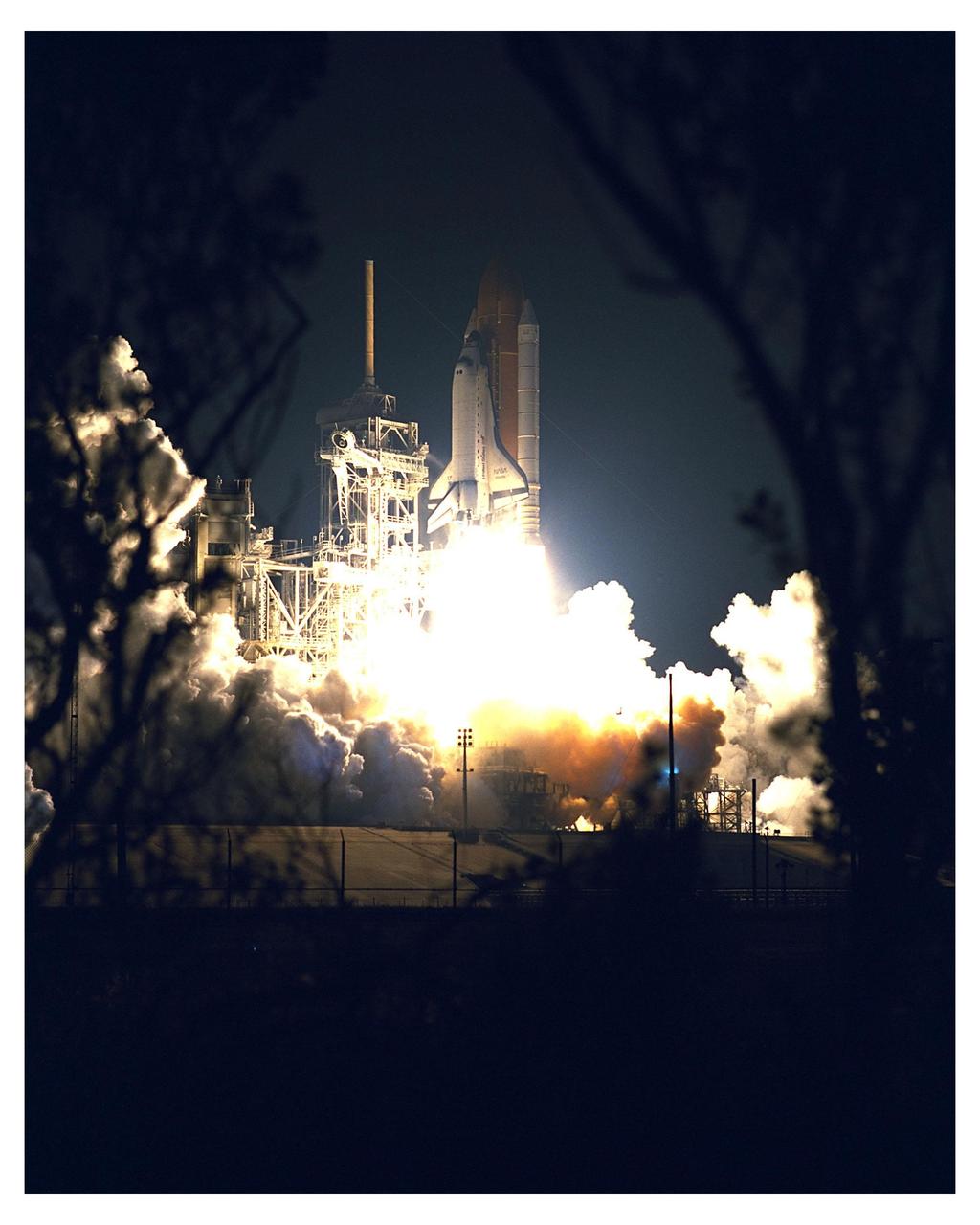
The Space Shuttle Atlantis turns night into day for a few moments as it lifts off on May 15 at 4:07:48 a.m. EDT from Launch Pad 39A on the STS-84 mission. The fourth Shuttle mission of 1997 will be the sixth docking of the Space Shuttle with the Russian Space Station Mir. The commander is Charles J. Precourt. The pilot is Eileen Marie Collins. The five mission specialists are C. Michael Foale, Carlos I. Noriega, Edward Tsang Lu, Jean-Francois Clervoy of the European Space Agency and Elena V. Kondakova of the Russian Space Agency. The planned nine-day mission will include the exchange of Foale for U.S. astronaut and Mir 23 crew member Jerry M. Linenger, who has been on Mir since Jan. 15. Linenger transferred to Mir during the last docking mission, STS-81; he will return to Earth on Atlantis. Foale is slated to remain on Mir for about four months until he is replaced in September by STS-86 Mission Specialist Wendy B. Lawrence. During the five days Atlantis is scheduled to be docked with the Mir, the STS-84 crew and the Mir 23 crew, including two Russian cosmonauts, Commander Vasily Tsibliev and Flight Engineer Alexander Lazutkin, will participate in joint experiments. The STS-84 mission also will involve the transfer of more than 7,300 pounds of water, logistics and science equipment to and from the Mir. Atlantis is carrying a nearly 300-pound oxygen generator to replace one of two Mir units which have experienced malfunctions. The oxygen it generates is used for breathing by the Mir crew
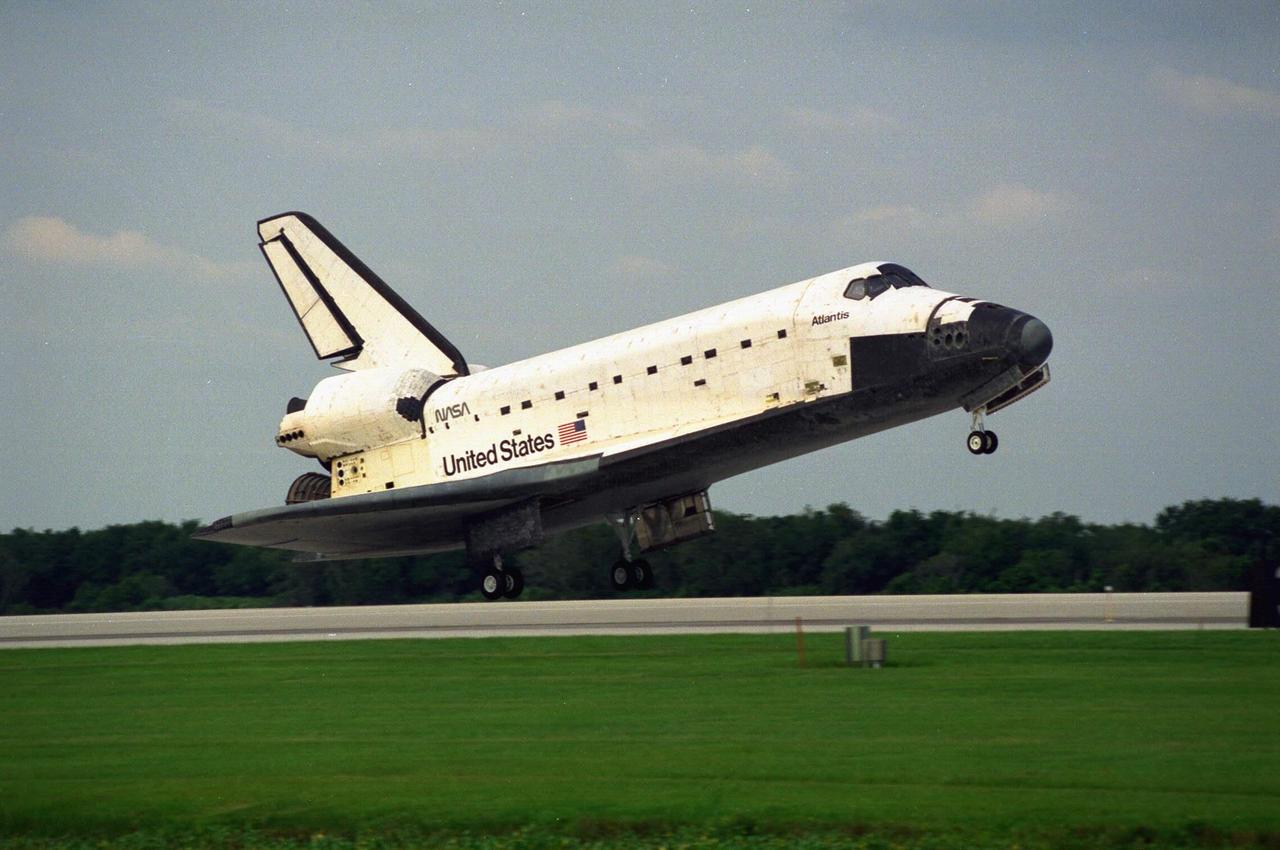
The Space Shuttle orbiter Atlantis touches down on Runway 33 of the KSC Shuttle Landing Facility, bringing to an end the nine-day STS-84 mission. Main gear touchdown was at 9:27:44 EDT on May 24, 1997. The first landing opportunity was waved off because of low cloud cover. It was the 37th landing at KSC since the Shuttle program began in 1981, and the eighth consecutive landing at KSC. STS-84 was the sixth of nine planned dockings of the Space Shuttle with the Russian Space Station Mir. Atlantis was docked with the Mir for five days. STS-84 Mission Specialist C. Michael Foale replaced astronaut and Mir 23 crew member Jerry M. Linenger, who has been on the Russian space station since Jan. 15. Linenger returned to Earth on Atlantis with the rest of the STS-84 crew, Mission Commander Charles J. Precourt, Pilot Eileen Marie Collins, and Mission Specialists Carlos I. Noriega, Edward Tsang Lu, Elena V. Kondakova of the Russian Space Agency and JeanFrancois Clervoy of the European Space Agency. Foale is scheduled to remain on the Mir for approximately four months, until he is replaced by STS-86 crew member Wendy B. Lawrence in September. Besides the docking and crew exchange, STS-84 included the transfer of more than 7,300 pounds of water, logistics and science experiments and hardware to and from the Mir. Scientific experiments conducted during the STS-84 mission, and scheduled for Foale’s stay on the Mir, are in the fields of advanced technology, Earth sciences, fundamental biology, human life sciences, International Space Station risk mitigation, microgravity sciences and space sciences
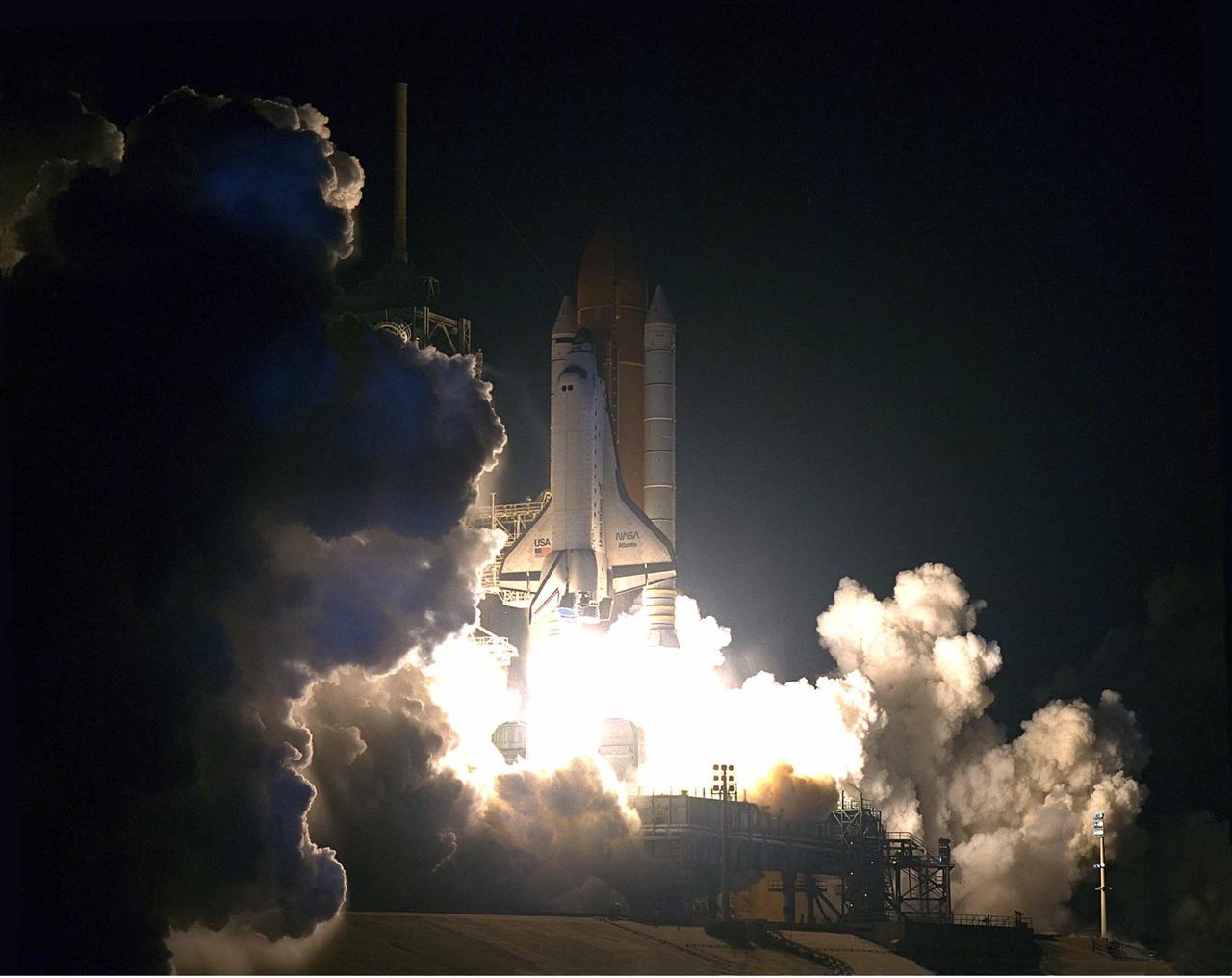
The Space Shuttle Atlantis turns night into day for a few moments as it lifts off on May 15 at 4:07:48 a.m. EDT from Launch Pad 39A on the STS-84 mission. The fourth Shuttle mission of 1997 will be the sixth docking of the Space Shuttle with the Russian Space Station Mir. The commander is Charles J. Precourt. The pilot is Eileen Marie Collins. The five mission specialists are C. Michael Foale, Carlos I. Noriega, Edward Tsang Lu, Jean-Francois Clervoy of the European Space Agency and Elena V. Kondakova of the Russian Space Agency. The planned nine-day mission will include the exchange of Foale for U.S. astronaut and Mir 23 crew member Jerry M. Linenger, who has been on Mir since Jan. 15. Linenger transferred to Mir during the last docking mission, STS-81; he will return to Earth on Atlantis. Foale is slated to remain on Mir for about four months until he is replaced in September by STS-86 Mission Specialist Wendy B. Lawrence. During the five days Atlantis is scheduled to be docked with the Mir, the STS-84 crew and the Mir 23 crew, including two Russian cosmonauts, Commander Vasily Tsibliev and Flight Engineer Alexander Lazutkin, will participate in joint experiments. The STS-84 mission also will involve the transfer of more than 7,300 pounds of water, logistics and science equipment to and from the Mir. Atlantis is carrying a nearly 300-pound oxygen generator to replace one of two Mir units which have experienced malfunctions. The oxygen it generates is used for breathing by the Mir crew
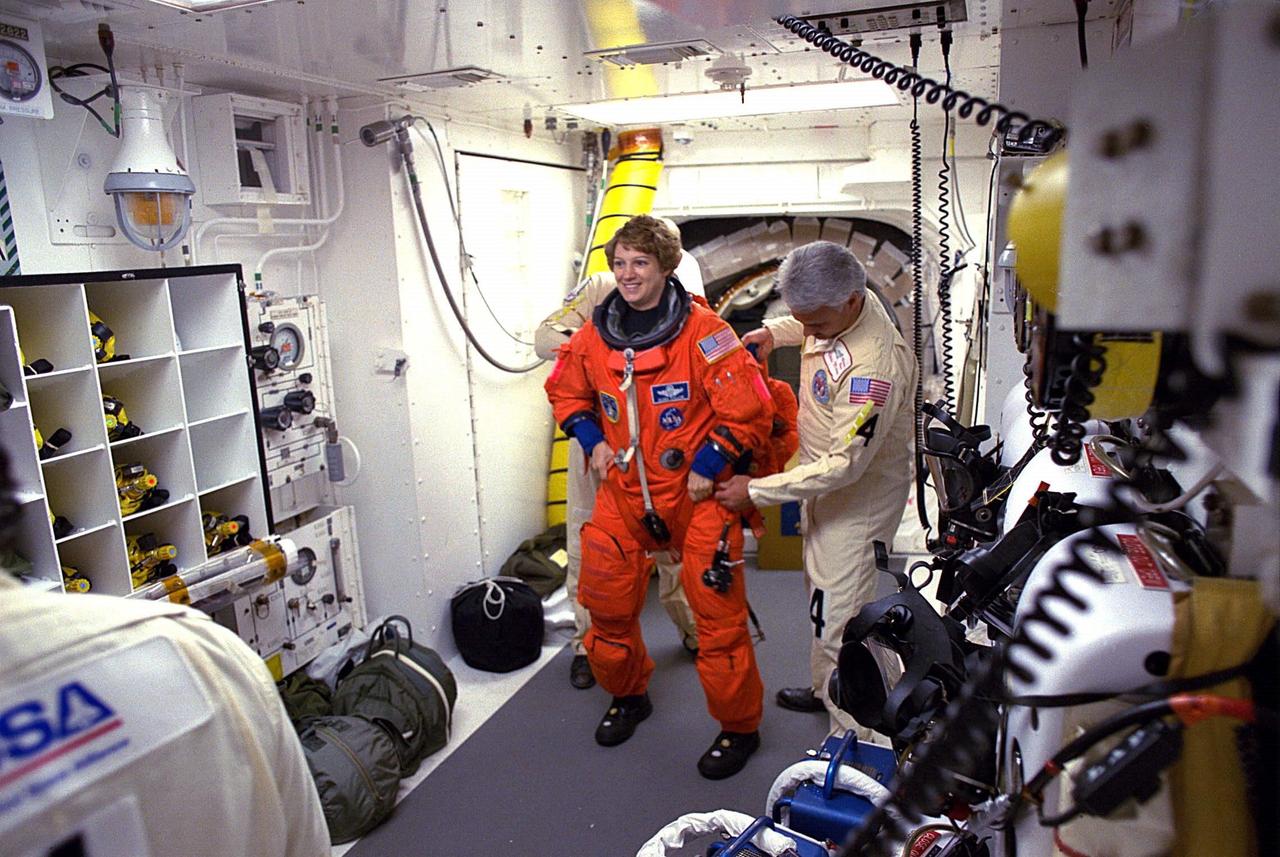
STS-84 Pilot Eileen M. Collins prepares to enter the Space Shuttle Atlantis at Launch Pad 39A with help from white room closeout crew members. The fourth Shuttle mission of 1997 will be the sixth docking of the Space Shuttle with the Russian Space Station Mir. The commander is Charles J. Precourt. The pilot is Eileen Marie Collins. The five mission specialists are C. Michael Foale, Carlos I. Noriega, Edward Tsang Lu, Jean-Francois Clervoy of the European Space Agency and Elena V. Kondakova of the Russian Space Agency. The planned nine-day mission will include the exchange of Foale for U.S. astronaut and Mir 23 crew member Jerry M. Linenger, who has been on Mir since Jan. 15. Linenger transferred to Mir during the last docking mission, STS-81; he will return to Earth on Atlantis. Foale is slated to remain on Mir for about four months until he is replaced in September by STS-86 Mission Specialist Wendy B. Lawrence. During the five days Atlantis is scheduled to be docked with the Mir, the STS-84 crew and the Mir 23 crew, including two Russian cosmonauts, Commander Vasily Tsibliev and Flight Engineer Alexander Lazutkin, will participate in joint experiments. The STS-84 mission also will involve the transfer of more than 7,300 pounds of water, logistics and science equipment to and from the Mir. Atlantis is carrying a nearly 300-pound oxygen generator to replace one of two Mir units which have experienced malfunctions. The oxygen it generates is used for breathing by the Mir crew
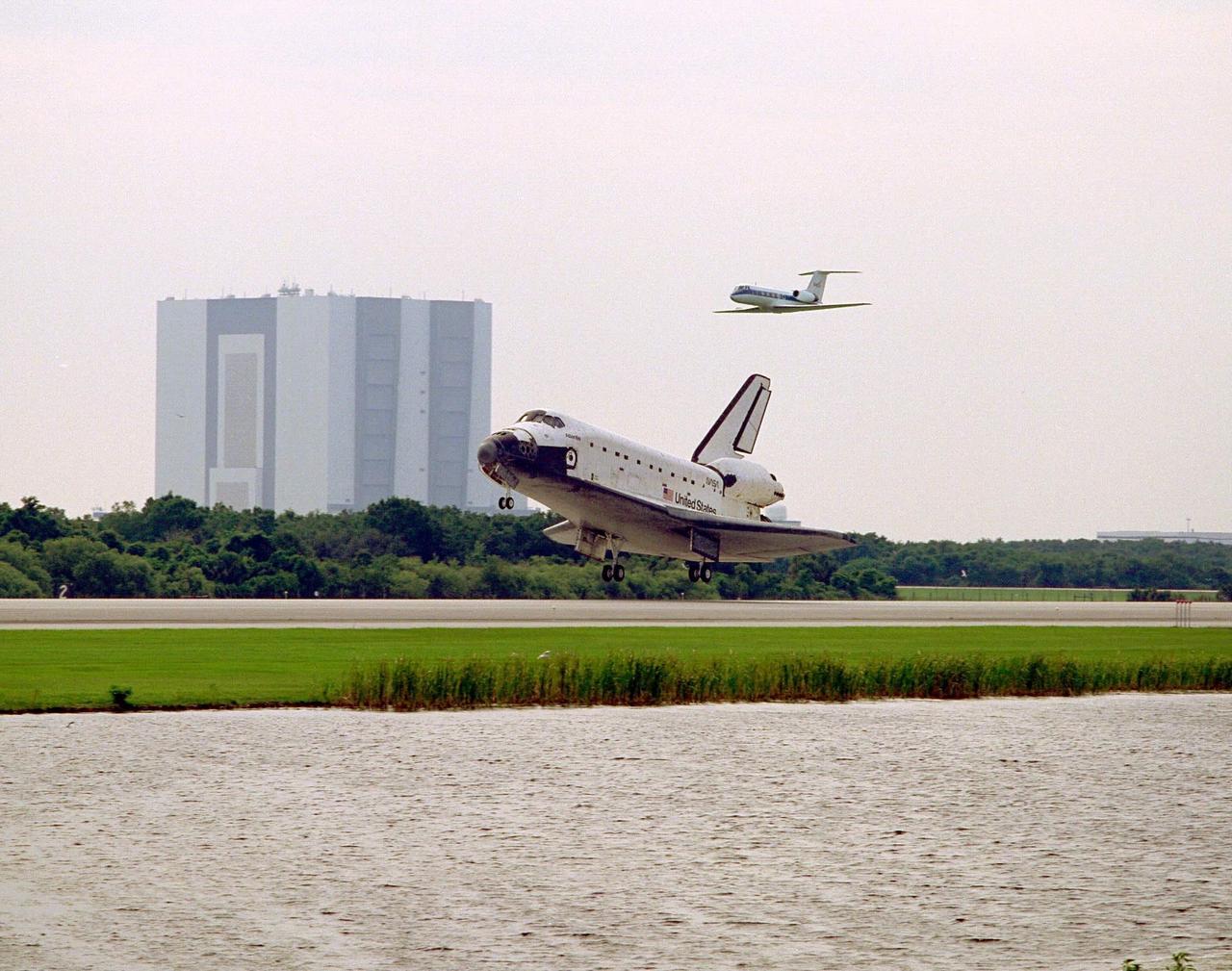
The Space Shuttle orbiter Atlantis rolls out on Runway 33 of KSC’s Shuttle Landing Facility at the conclusion of the nine-day STS-84 mission. The Shuttle Training Aircraft piloted by astronaut Kenneth D. Cockrell, acting deputy chief of the Astronaut Office, is flying above Atlantis. The Vehicle Assembly Building is at left. Main gear touchdown was at 9:27:44 EDT on May 24, 1997. The first landing opportunity was waved off because of low cloud cover. It was the 37th landing at KSC since the Shuttle program began in 1981, and the eighth consecutive landing at KSC. STS-84 was the sixth of nine planned dockings of the Space Shuttle with the Russian Space Station Mir. Atlantis was docked with the Mir for five days. STS-84 Mission Specialist C. Michael Foale replaced astronaut and Mir 23 crew member Jerry M. Linenger, who has been on the Russian space station since Jan. 15. Linenger returned to Earth on Atlantis with the rest of the STS-84 crew, Mission Commander Charles J. Precourt, Pilot Eileen Marie Collins, and Mission Specialists Carlos I. Noriega, Edward Tsang Lu, Elena V. Kondakova of the Russian Space Agency and JeanFrancois Clervoy of the European Space Agency. Foale is scheduled to remain on the Mir for approximately four months, until he is replaced by STS-86 crew member Wendy B. Lawrence in September. Besides the docking and crew exchange, STS-84 included the transfer of more than 7,300 pounds of water, logistics and science experiments and hardware to and from the Mir. Scientific experiments conducted during the STS-84 mission, and scheduled for Foale’s stay on the Mir, are in the fields of advanced technology, Earth sciences, fundamental biology, human life sciences, International Space Station risk mitigation, microgravity sciences and space sciences
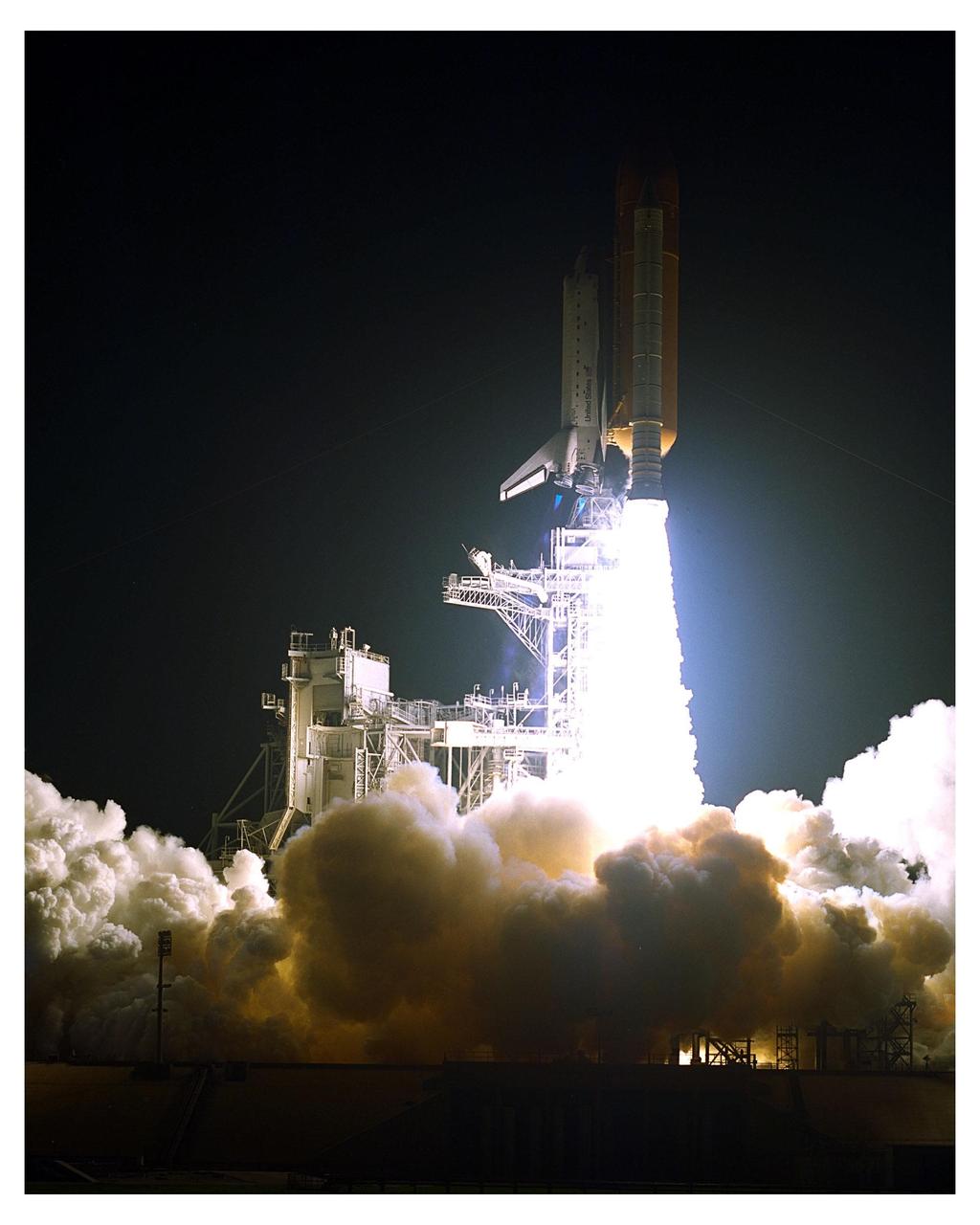
The Space Shuttle Atlantis turns night into day for a few moments as it lifts off on May 15 at 4:07:48 a.m. EDT from Launch Pad 39A on the STS-84 mission. The fourth Shuttle mission of 1997 will be the sixth docking of the Space Shuttle with the Russian Space Station Mir. The commander is Charles J. Precourt. The pilot is Eileen Marie Collins. The five mission specialists are C. Michael Foale, Carlos I. Noriega, Edward Tsang Lu, Jean-Francois Clervoy of the European Space Agency and Elena V. Kondakova of the Russian Space Agency. The planned nine-day mission will include the exchange of Foale for U.S. astronaut and Mir 23 crew member Jerry M. Linenger, who has been on Mir since Jan. 15. Linenger transferred to Mir during the last docking mission, STS-81; he will return to Earth on Atlantis. Foale is slated to remain on Mir for about four months until he is replaced in September by STS-86 Mission Specialist Wendy B. Lawrence. During the five days Atlantis is scheduled to be docked with the Mir, the STS-84 crew and the Mir 23 crew, including two Russian cosmonauts, Commander Vasily Tsibliev and Flight Engineer Alexander Lazutkin, will participate in joint experiments. The STS-84 mission also will involve the transfer of more than 7,300 pounds of water, logistics and science equipment to and from the Mir. Atlantis is carrying a nearly 300-pound oxygen generator to replace one of two Mir units which have experienced malfunctions. The oxygen it generates is used for breathing by the Mir crew
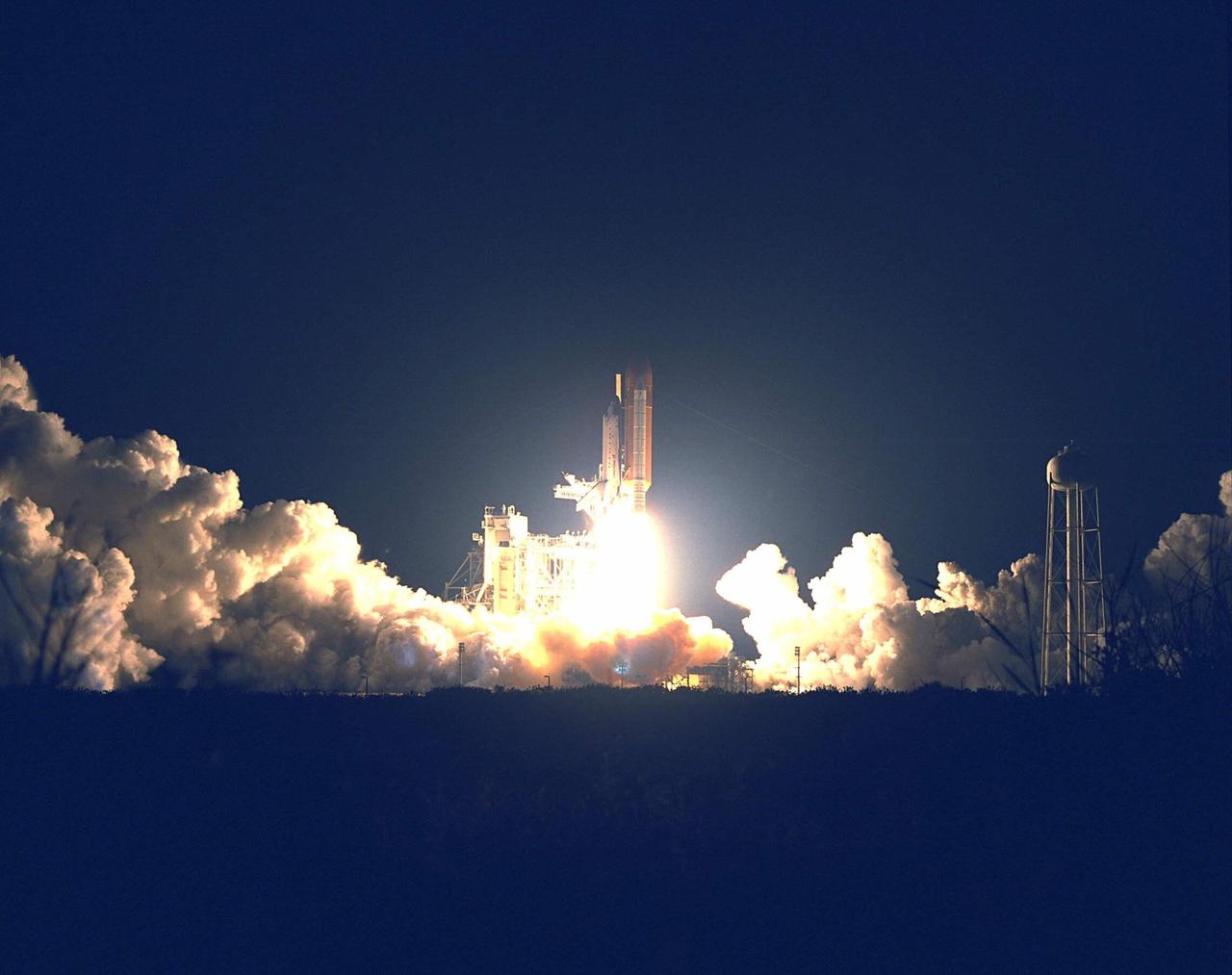
The Space Shuttle Atlantis turns night into day for a few moments as it lifts off on May 15 at 4:07:48 a.m. EDT from Launch Pad 39A on the STS-84 mission. The fourth Shuttle mission of 1997 will be the sixth docking of the Space Shuttle with the Russian Space Station Mir. The commander is Charles J. Precourt. The pilot is Eileen Marie Collins. The five mission specialists are C. Michael Foale, Carlos I. Noriega, Edward Tsang Lu, Jean-Francois Clervoy of the European Space Agency and Elena V. Kondakova of the Russian Space Agency. The planned nine-day mission will include the exchange of Foale for U.S. astronaut and Mir 23 crew member Jerry M. Linenger, who has been on Mir since Jan. 15. Linenger transferred to Mir during the last docking mission, STS-81; he will return to Earth on Atlantis. Foale is slated to remain on Mir for about four months until he is replaced in September by STS-86 Mission Specialist Wendy B. Lawrence. During the five days Atlantis is scheduled to be docked with the Mir, the STS-84 crew and the Mir 23 crew, including two Russian cosmonauts, Commander Vasily Tsibliev and Flight Engineer Alexander Lazutkin, will participate in joint experiments. The STS-84 mission also will involve the transfer of more than 7,300 pounds of water, logistics and science equipment to and from the Mir. Atlantis is carrying a nearly 300-pound oxygen generator to replace one of two Mir units which have experienced malfunctions. The oxygen it generates is used for breathing by the Mir crew

STS-84 crew members give a "thumbs up" to press representatives and other onlookers on KSC’s Runway 33 after landing of the successful nine-day mission. From left, are Mission Specialist Jean-Francois Clervoy of the European Space Agency, Pilot Eileen Marie Collins, Commander Charles J. Precourt, Mission Specialist Elene V. Kondakova of the Russian Space Agency, and Mission Specialist Carlos I. Noriega. Not shown are Mission Specialist Edward Tsang Lu and returning astronaut and Mir 23 crew member Jerry M. Linenger. STS-84 was the sixth docking of the Space Shuttle with the Russian Space Station Mir. The Space Shuttle orbiter Atlantis was docked with the Mir for five days. STS-84 Mission Specialist C. Michael Foale replaced Linenger, who has been on the Russian space station since Jan. 15. Foale is scheduled to remain on the Mir for approximately four months, until he is replaced by STS-86 crew member Wendy B. Lawrence in September. Besides the docking and crew exchange, STS-84 included the transfer of more than 7,300 pounds of water, logistics and science experiments and hardware to and from the Mir. Scientific experiments conducted during the STS-84 mission, and scheduled for Foale’s stay on the Mir, are in the fields of advanced technology, Earth sciences, fundamental biology, human life sciences, International Space Station risk mitigation, microgravity sciences and space sciences
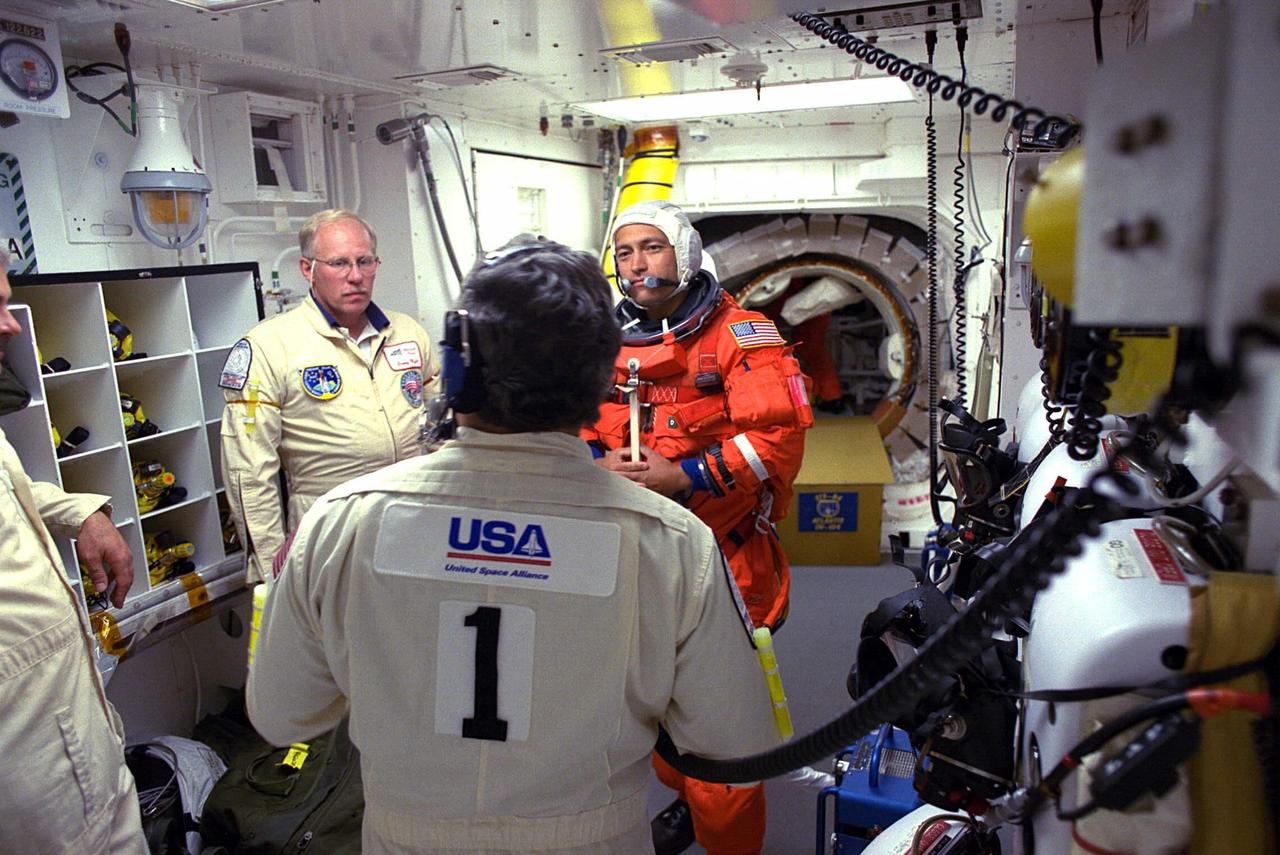
STS-84 Mission Specialist Carlos I. Noriega prepares to enter the Space Shuttle Atlantis at Launch Pad 39A with help from white room closeout crew members. The fourth Shuttle mission of 1997 will be the sixth docking of the Space Shuttle with the Russian Space Station Mir. The commander is Charles J. Precourt. The pilot is Eileen Marie Collins. The five mission specialists are C. Michael Foale, Carlos I. Noriega, Edward Tsang Lu, Jean-Francois Clervoy of the European Space Agency and Elena V. Kondakova of the Russian Space Agency. The planned nine-day mission will include the exchange of Foale for U.S. astronaut and Mir 23 crew member Jerry M. Linenger, who has been on Mir since Jan. 15. Linenger transferred to Mir during the last docking mission, STS-81; he will return to Earth on Atlantis. Foale is slated to remain on Mir for about four months until he is replaced in September by STS-86 Mission Specialist Wendy B. Lawrence. During the five days Atlantis is scheduled to be docked with the Mir, the STS-84 crew and the Mir 23 crew, including two Russian cosmonauts, Commander Vasily Tsibliev and Flight Engineer Alexander Lazutkin, will participate in joint experiments. The STS-84 mission also will involve the transfer of more than 7,300 pounds of water, logistics and science equipment to and from the Mir. Atlantis is carrying a nearly 300-pound oxygen generator to replace one of two Mir units which have experienced malfunctions. The oxygen it generates is used for breathing by the Mir crew
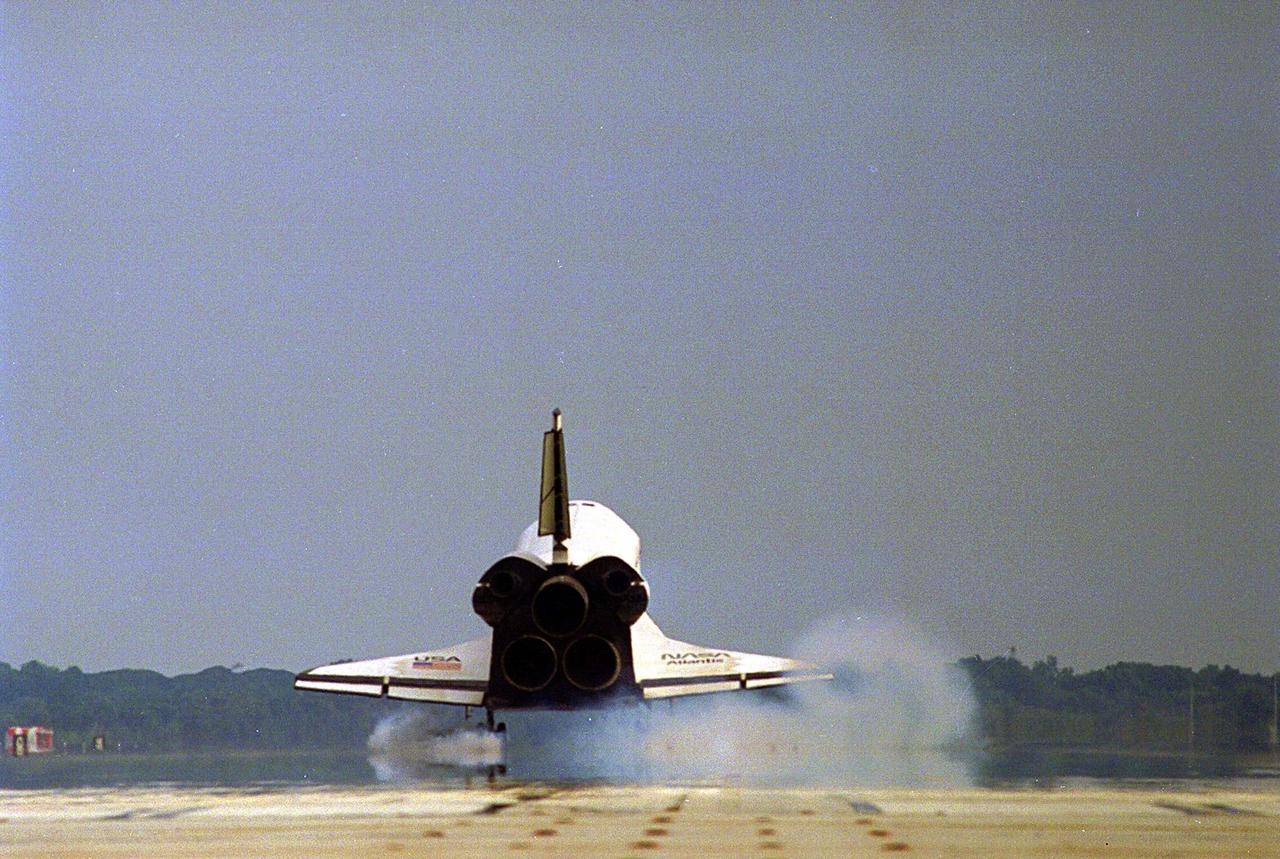
The Space Shuttle orbiter Atlantis touches down on Runway 33 of the KSC Shuttle Landing Facility, bringing to an end the nine-day STS-84 mission. Main gear touchdown was at 9:27:44 EDT on May 24, 1997. The first landing opportunity was waved off because of low cloud cover. It was the 37th landing at KSC since the Shuttle program began in 1981, and the eighth consecutive landing at KSC. STS-84 was the sixth of nine planned dockings of the Space Shuttle with the Russian Space Station Mir. Atlantis was docked with the Mir for five days. STS-84 Mission Specialist C. Michael Foale replaced astronaut and Mir 23 crew member Jerry M. Linenger, who has been on the Russian space station since Jan. 15. Linenger returned to Earth on Atlantis with the rest of the STS-84 crew, Mission Commander Charles J. Precourt, Pilot Eileen Marie Collins, and Mission Specialists Carlos I. Noriega, Edward Tsang Lu, Elena V. Kondakova of the Russian Space Agency and JeanFrancois Clervoy of the European Space Agency. Foale is scheduled to remain on the Mir for approximately four months, until he is replaced by STS-86 crew member Wendy B. Lawrence in September. Besides the docking and crew exchange, STS-84 included the transfer of more than 7,300 pounds of water, logistics and science experiments and hardware to and from the Mir. Scientific experiments conducted during the STS-84 mission, and scheduled for Foale’s stay on the Mir, are in the fields of advanced technology, Earth sciences, fundamental biology, human life sciences, International Space Station risk mitigation, microgravity sciences and space sciences
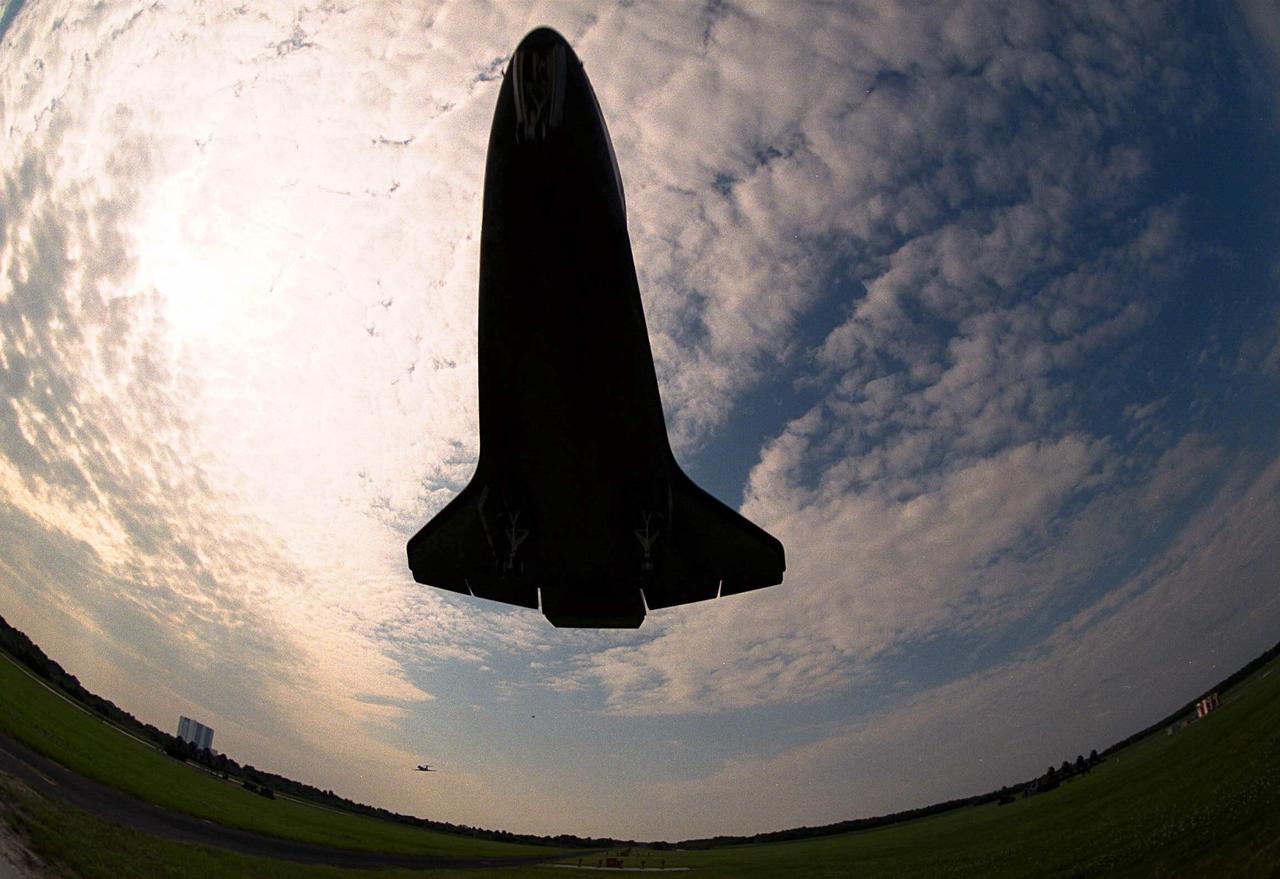
This unusual view of the underside of the Space Shuttle orbiter Atlantis shortly before landing was taken by a fish-eye camera lens from KSC’s Shuttle Landing Facility. The Vehicle Assembly Building is in the background at left. The Shuttle Training Aircraft can be seen in the distance, at center. Atlantis is wrapping up its nine-day STS-84 mission, which was the sixth docking of the Space Shuttle with the Russian Space Station Mir. Atlantis was docked with the Mir for five days. STS-84 Mission Specialist C. Michael Foale replaced astronaut and Mir 23 crew member Jerry M. Linenger, who has been on the Russian space station since Jan. 15. Linenger is returning to Earth on Atlantis with the rest of the STS-84 crew, Mission Commander Charles J. Precourt, Pilot Eileen Marie Collins, and Mission Specialists Carlos I. Noriega, Edward Tsang Lu, Elena V. Kondakova of the Russian Space Agency and Jean-Francois Clervoy of the European Space Agency. Foale is scheduled to remain on the Mir for approximately four months, until he is replaced by STS-86 crew member Wendy B. Lawrence in September. Besides the docking and crew exchange, STS-84 included the transfer of more than 7,300 pounds of water, logistics and science experiments and hardware to and from the Mir. Scientific experiments conducted during the STS-84 mission, and scheduled for Foale’s stay on the Mir, are in the fields of advanced technology, Earth sciences, fundamental biology, human life sciences, International Space Station risk mitigation, microgravity sciences and space sciences
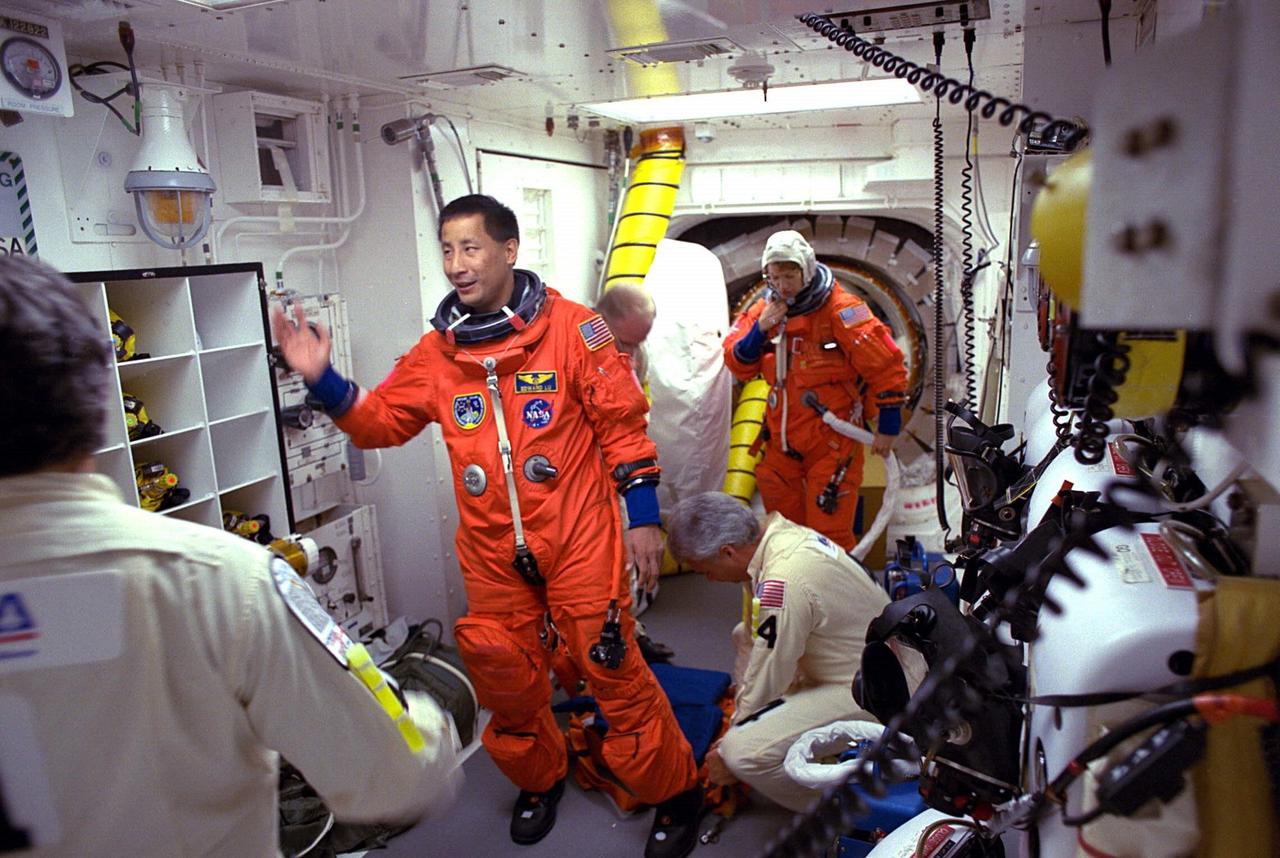
STS-84 Mission Specialist Edward T. Lu prepares to enter the Space Shuttle Atlantis at Launch Pad 39A with help from white room closeout crew members. The fourth Shuttle mission of 1997 will be the sixth docking of the Space Shuttle with the Russian Space Station Mir. The commander is Charles J. Precourt. The pilot is Eileen Marie Collins. The five mission specialists are C. Michael Foale, Carlos I. Noriega, Edward Tsang Lu, Jean-Francois Clervoy of the European Space Agency and Elena V. Kondakova of the Russian Space Agency. The planned nine-day mission will include the exchange of Foale for U.S. astronaut and Mir 23 crew member Jerry M. Linenger, who has been on Mir since Jan. 15. Linenger transferred to Mir during the last docking mission, STS-81; he will return to Earth on Atlantis. Foale is slated to remain on Mir for about four months until he is replaced in September by STS-86 Mission Specialist Wendy B. Lawrence. During the five days Atlantis is scheduled to be docked with the Mir, the STS-84 crew and the Mir 23 crew, including two Russian cosmonauts, Commander Vasily Tsibliev and Flight Engineer Alexander Lazutkin, will participate in joint experiments. The STS-84 mission also will involve the transfer of more than 7,300 pounds of water, logistics and science equipment to and from the Mir. Atlantis is carrying a nearly 300-pound oxygen generator to replace one of two Mir units which have experienced malfunctions. The oxygen it generates is used for breathing by the Mir crew
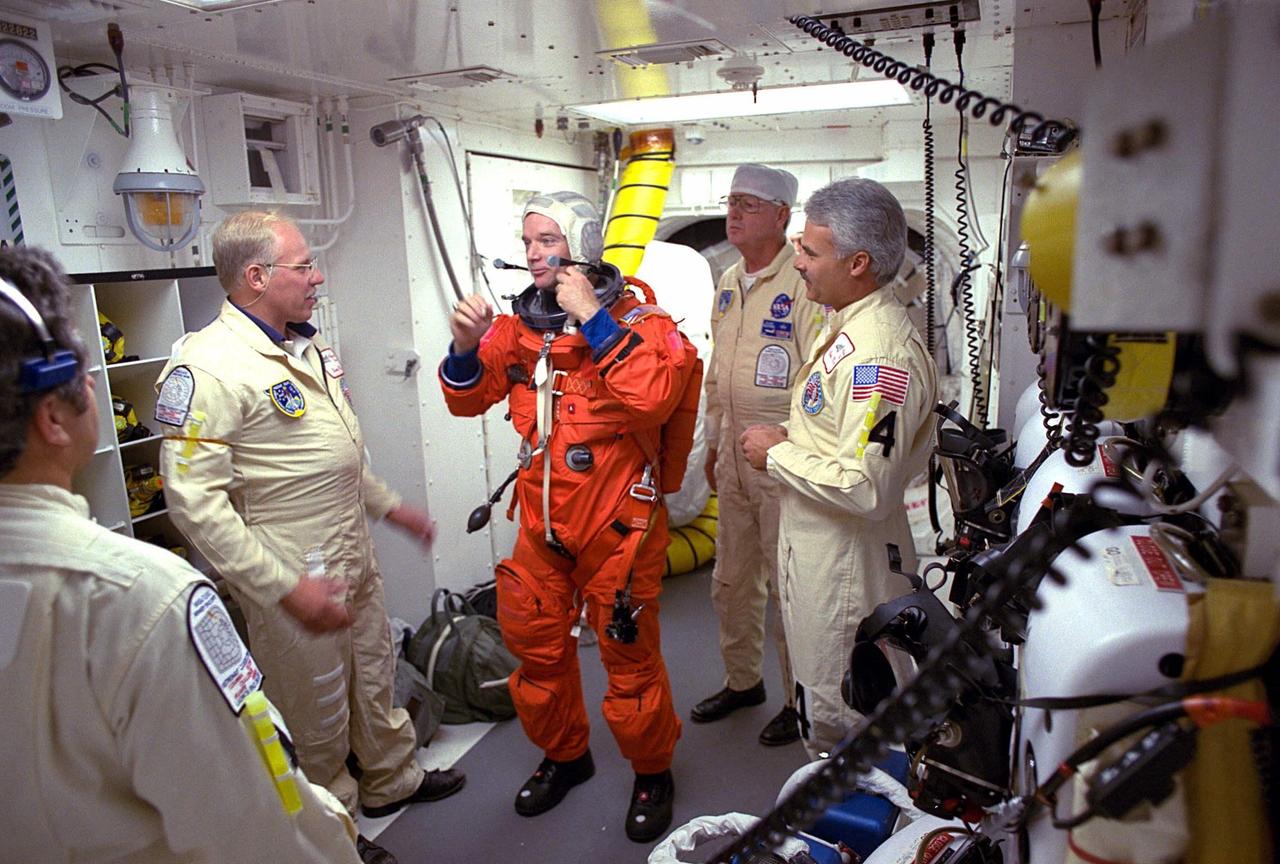
STS-84 Commander Charles J. Precourt prepares to enter the Space Shuttle Atlantis at Launch Pad 39A with help from white room closeout crew members. The fourth Shuttle mission of 1997 will be the sixth docking of the Space Shuttle with the Russian Space Station Mir. The commander is Charles J. Precourt. The pilot is Eileen Marie Collins. The five mission specialists are C. Michael Foale, Carlos I. Noriega, Edward Tsang Lu, Jean-Francois Clervoy of the European Space Agency and Elena V. Kondakova of the Russian Space Agency. The planned nine-day mission will include the exchange of Foale for U.S. astronaut and Mir 23 crew member Jerry M. Linenger, who has been on Mir since Jan. 15. Linenger transferred to Mir during the last docking mission, STS-81; he will return to Earth on Atlantis. Foale is slated to remain on Mir for about four months until he is replaced in September by STS-86 Mission Specialist Wendy B. Lawrence. During the five days Atlantis is scheduled to be docked with the Mir, the STS-84 crew and the Mir 23 crew, including two Russian cosmonauts, Commander Vasily Tsibliev and Flight Engineer Alexander Lazutkin, will participate in joint experiments. The STS-84 mission also will involve the transfer of more than 7,300 pounds of water, logistics and science equipment to and from the Mir. Atlantis is carrying a nearly 300-pound oxygen generator to replace one of two Mir units which have experienced malfunctions. The oxygen it generates is used for breathing by the Mir crew
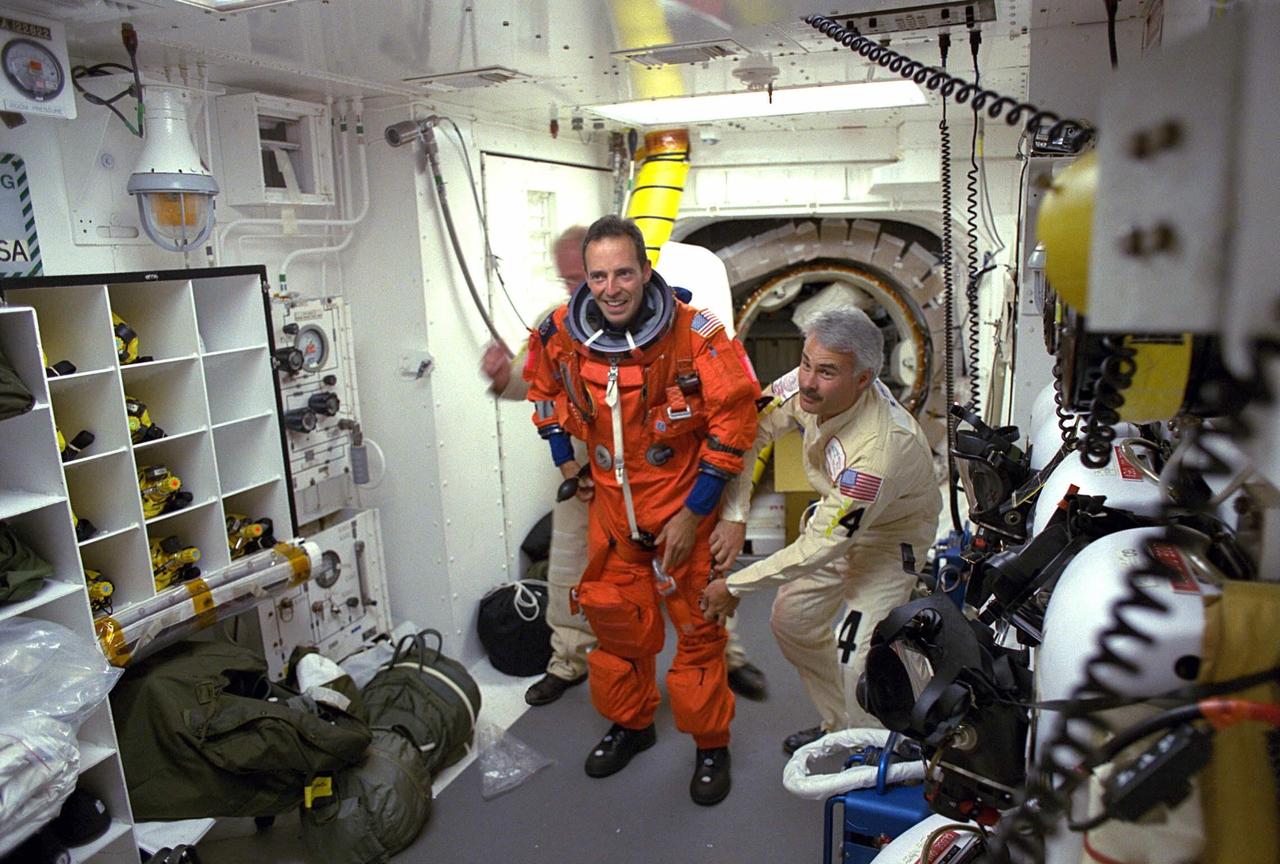
STS-84 Mission Specialist Jean-Francois Clervoy prepares to enter the Space Shuttle Atlantis at Launch Pad 39A with help from white room closeout crew members. The fourth Shuttle mission of 1997 will be the sixth docking of the Space Shuttle with the Russian Space Station Mir. The commander is Charles J. Precourt. The pilot is Eileen Marie Collins. The five mission specialists are C. Michael Foale, Carlos I. Noriega, Edward Tsang Lu, Jean-Francois Clervoy of the European Space Agency and Elena V. Kondakova of the Russian Space Agency. The planned nine-day mission will include the exchange of Foale for U.S. astronaut and Mir 23 crew member Jerry M. Linenger, who has been on Mir since Jan. 15. Linenger transferred to Mir during the last docking mission, STS-81; he will return to Earth on Atlantis. Foale is slated to remain on Mir for about four months until he is replaced in September by STS-86 Mission Specialist Wendy B. Lawrence. During the five days Atlantis is scheduled to be docked with the Mir, the STS-84 crew and the Mir 23 crew, including two Russian cosmonauts, Commander Vasily Tsibliev and Flight Engineer Alexander Lazutkin, will participate in joint experiments. The STS-84 mission also will involve the transfer of more than 7,300 pounds of water, logistics and science equipment to and from the Mir. Atlantis is carrying a nearly 300-pound oxygen generator to replace one of two Mir units which have experienced malfunctions. The oxygen it generates is used for breathing by the Mir crew
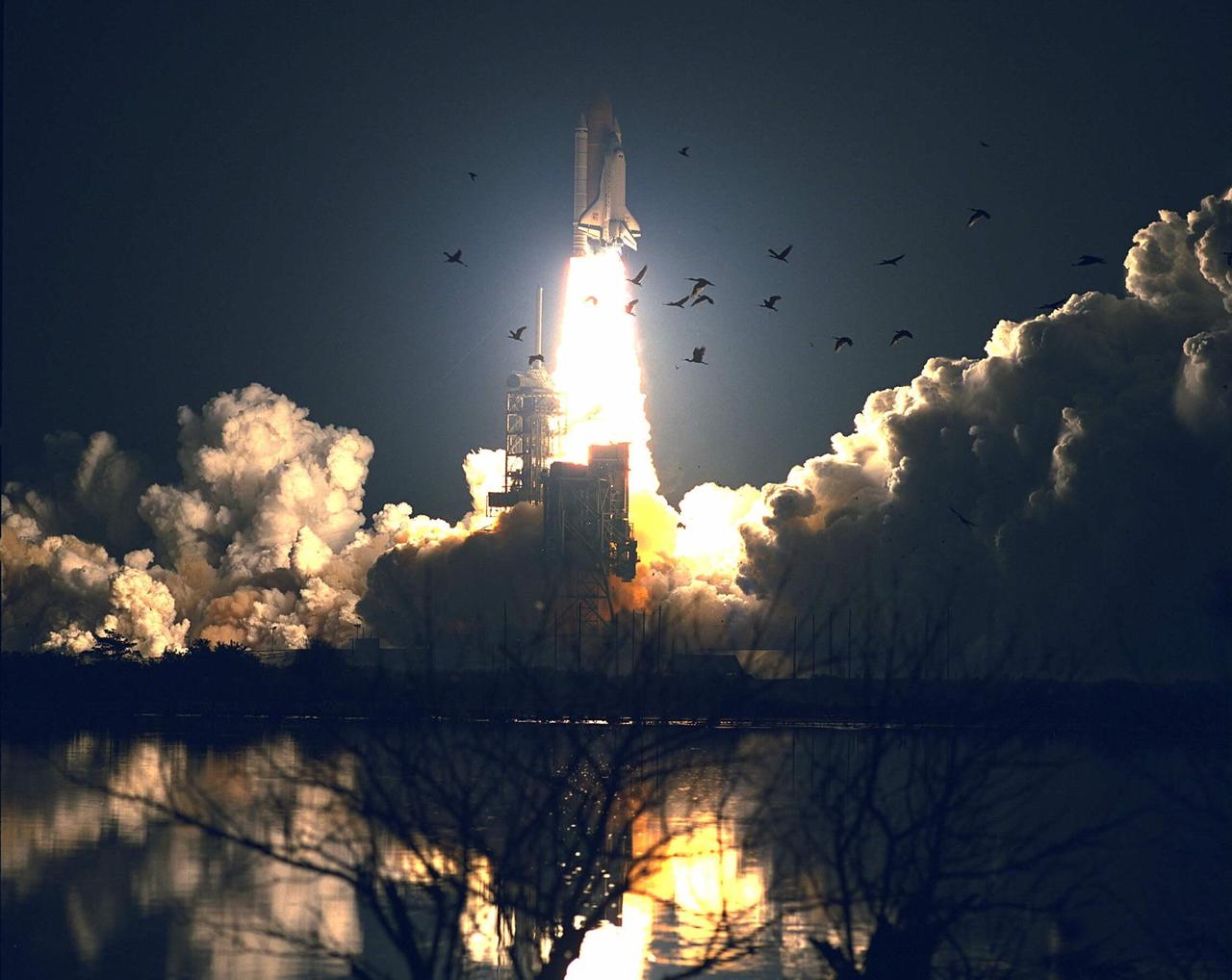
The Space Shuttle Atlantis turns night into day for a few moments as it lifts off on May 15 at 4:07:48 a.m. EDT from Launch Pad 39A on the STS-84 mission. The fourth Shuttle mission of 1997 will be the sixth docking of the Space Shuttle with the Russian Space Station Mir. The commander is Charles J. Precourt. The pilot is Eileen Marie Collins. The five mission specialists are C. Michael Foale, Carlos I. Noriega, Edward Tsang Lu, Jean-Francois Clervoy of the European Space Agency and Elena V. Kondakova of the Russian Space Agency. The planned nine-day mission will include the exchange of Foale for U.S. astronaut and Mir 23 crew member Jerry M. Linenger, who has been on Mir since Jan. 15. Linenger transferred to Mir during the last docking mission, STS-81; he will return to Earth on Atlantis. Foale is slated to remain on Mir for about four months until he is replaced in September by STS-86 Mission Specialist Wendy B. Lawrence. During the five days Atlantis is scheduled to be docked with the Mir, the STS-84 crew and the Mir 23 crew, including two Russian cosmonauts, Commander Vasily Tsibliev and Flight Engineer Alexander Lazutkin, will participate in joint experiments. The STS-84 mission also will involve the transfer of more than 7,300 pounds of water, logistics and science equipment to and from the Mir. Atlantis is carrying a nearly 300-pound oxygen generator to replace one of two Mir units which have experienced malfunctions. The oxygen it generates is used for breathing by the Mir crew
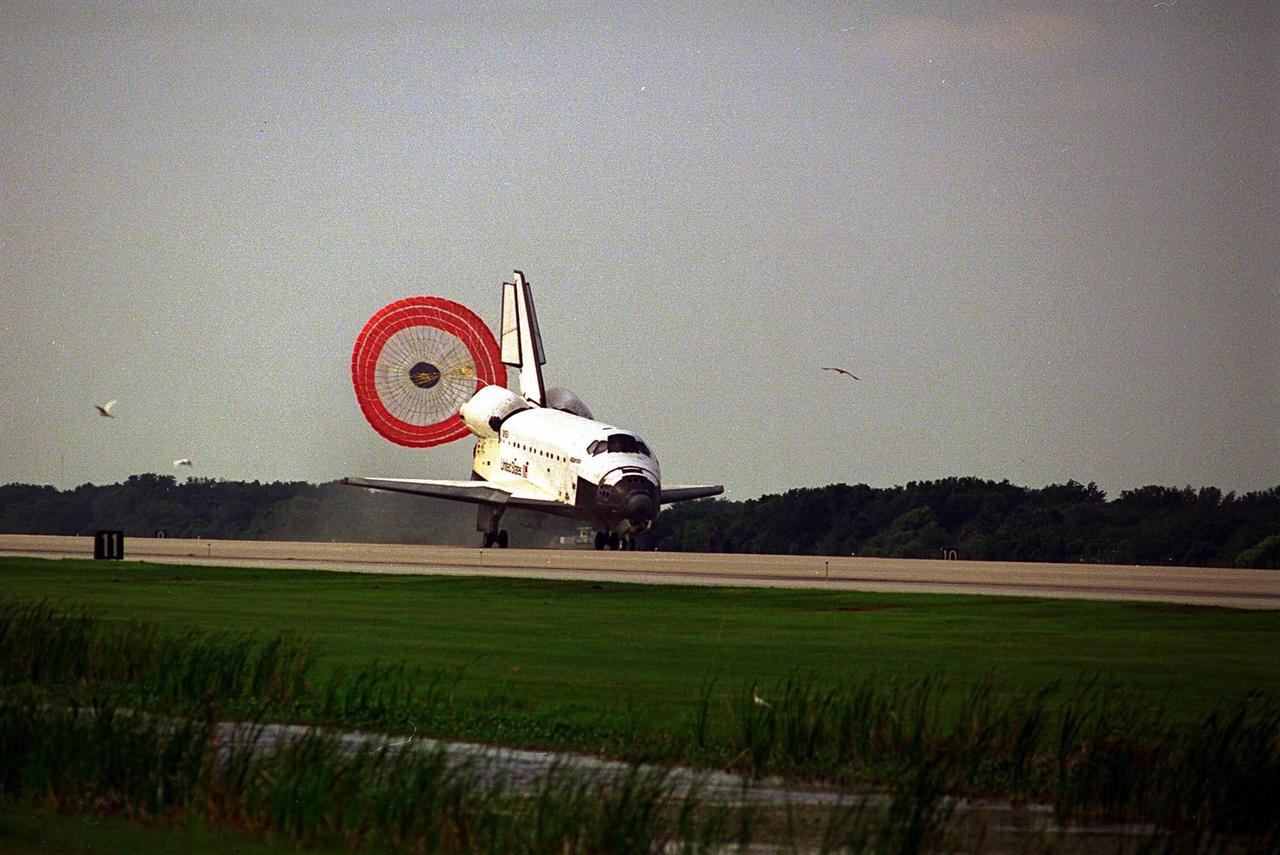
The orbiter drag chute deploys after Atlantis touches down on Runway 33 of KSC’s Shuttle Landing Facility at the conclusion of the nine-day STS-84 mission. Main gear touchdown was at 9:27:44 EDT on May 24, 1997. The first landing opportunity was waved off because of low cloud cover. It was the 37th landing at KSC since the Shuttle program began in 1981, and the eighth consecutive landing at KSC. STS-84 was the sixth of nine planned dockings of the Space Shuttle with the Russian Space Station Mir. Atlantis was docked with the Mir for five days. STS-84 Mission Specialist C. Michael Foale replaced astronaut and Mir 23 crew member Jerry M. Linenger, who has been on the Russian space station since Jan. 15. Linenger returned to Earth on Atlantis with the rest of the STS-84 crew, Mission Commander Charles J. Precourt, Pilot Eileen Marie Collins, and Mission Specialists Carlos I. Noriega, Edward Tsang Lu, Elena V. Kondakova of the Russian Space Agency and JeanFrancois Clervoy of the European Space Agency. Foale is scheduled to remain on the Mir for approximately four months, until he is replaced by STS-86 crew member Wendy B. Lawrence in September. Besides the docking and crew exchange, STS-84 included the transfer of more than 7,300 pounds of water, logistics and science experiments and hardware to and from the Mir. Scientific experiments conducted during the STS-84 mission, and scheduled for Foale’s stay on the Mir, are in the fields of advanced technology, Earth sciences, fundamental biology, human life sciences, International Space Station risk mitigation, microgravity sciences and space sciences
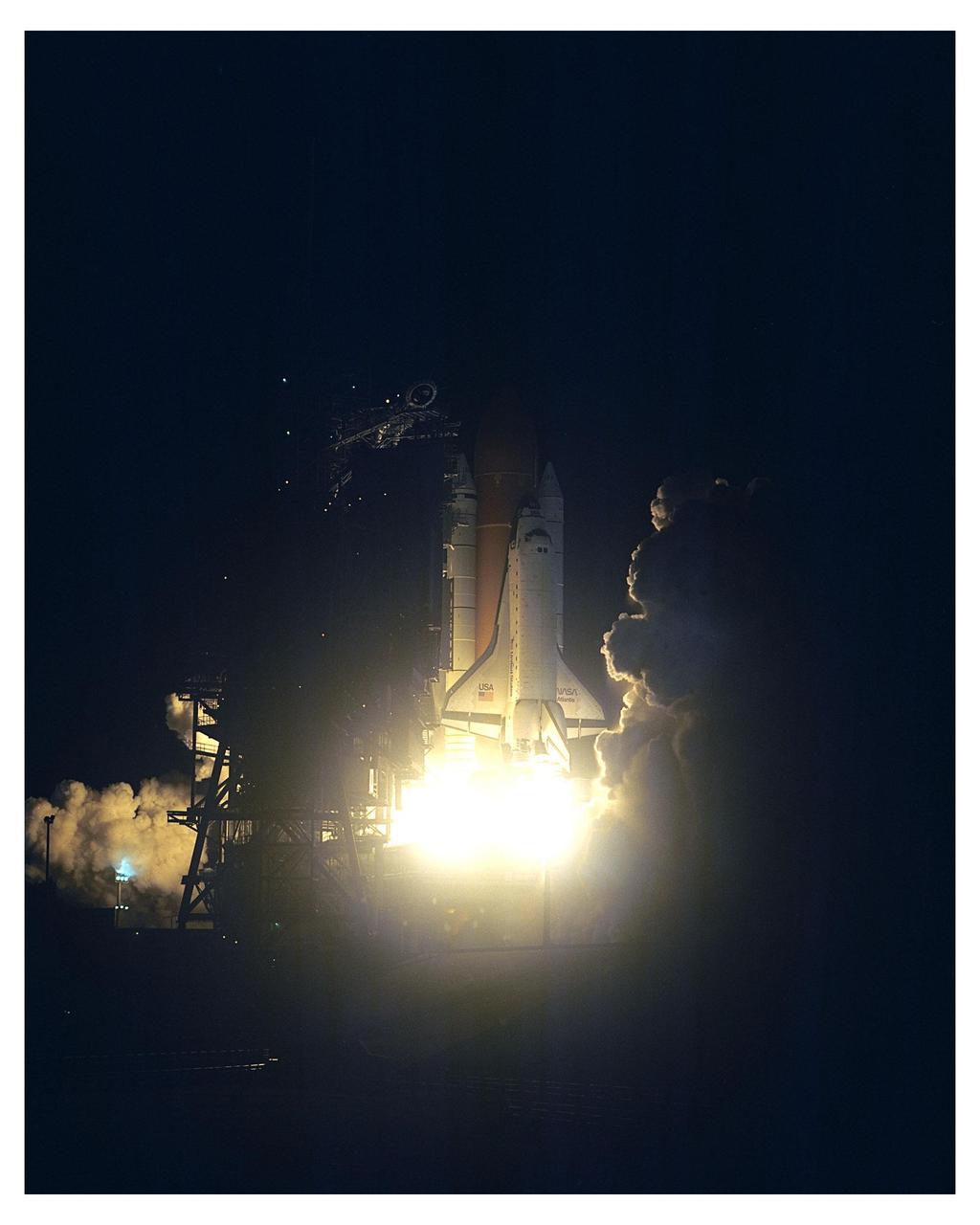
The Space Shuttle Atlantis turns night into day for a few moments as it lifts off on May 15 at 4:07:48 a.m. EDT from Launch Pad 39A on the STS-84 mission. The fourth Shuttle mission of 1997 will be the sixth docking of the Space Shuttle with the Russian Space Station Mir. The commander is Charles J. Precourt. The pilot is Eileen Marie Collins. The five mission specialists are C. Michael Foale, Carlos I. Noriega, Edward Tsang Lu, Jean-Francois Clervoy of the European Space Agency and Elena V. Kondakova of the Russian Space Agency. The planned nine-day mission will include the exchange of Foale for U.S. astronaut and Mir 23 crew member Jerry M. Linenger, who has been on Mir since Jan. 15. Linenger transferred to Mir during the last docking mission, STS-81; he will return to Earth on Atlantis. Foale is slated to remain on Mir for about four months until he is replaced in September by STS-86 Mission Specialist Wendy B. Lawrence. During the five days Atlantis is scheduled to be docked with the Mir, the STS-84 crew and the Mir 23 crew, including two Russian cosmonauts, Commander Vasily Tsibliev and Flight Engineer Alexander Lazutkin, will participate in joint experiments. The STS-84 mission also will involve the transfer of more than 7,300 pounds of water, logistics and science equipment to and from the Mir. Atlantis is carrying a nearly 300-pound oxygen generator to replace one of two Mir units which have experienced malfunctions. The oxygen it generates is used for breathing by the Mir crew
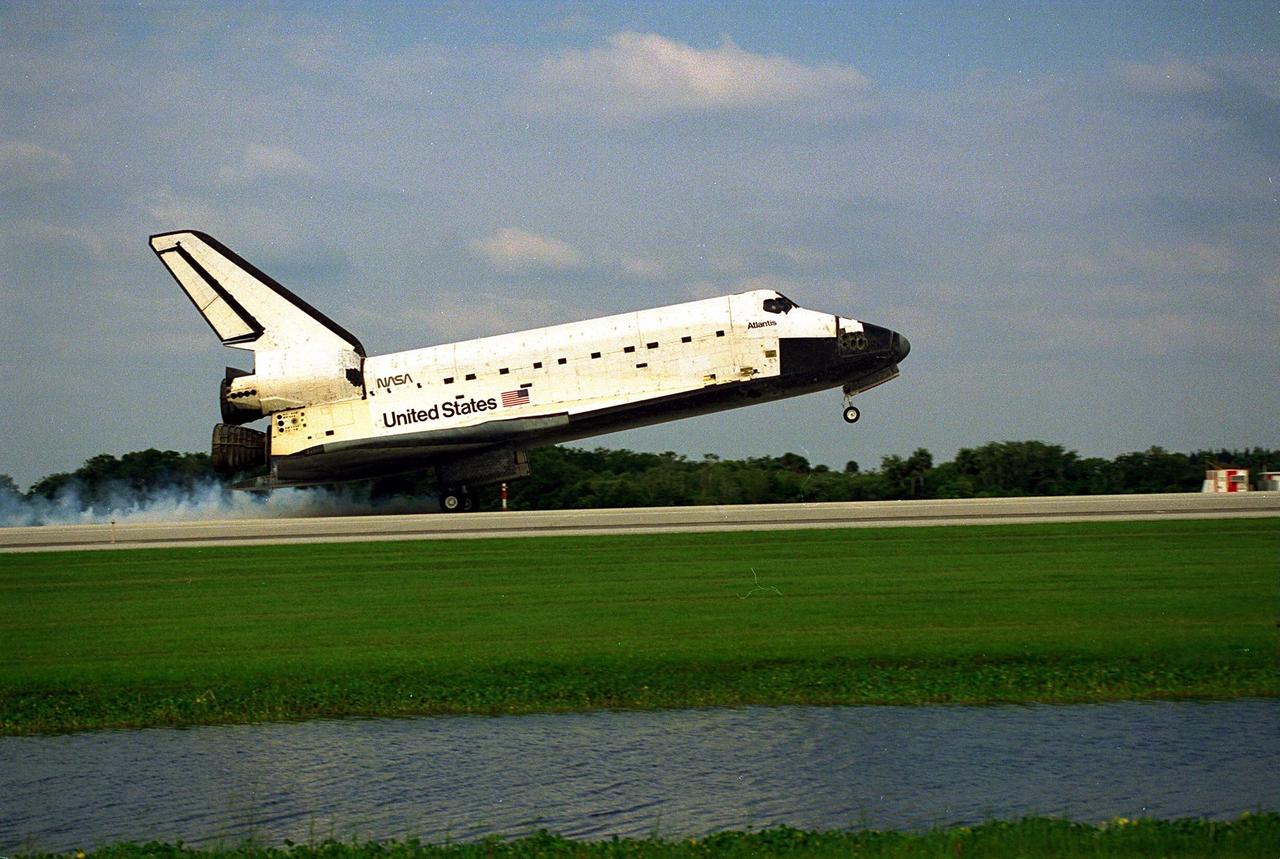
The Space Shuttle orbiter Atlantis touches down on Runway 33 of the KSC Shuttle Landing Facility, bringing to an end the nine-day STS-84 mission. Main gear touchdown was at 9:27:44 EDT on May 24, 1997. The first landing opportunity was waved off because of low cloud cover. It was the 37th landing at KSC since the Shuttle program began in 1981, and the eighth consecutive landing at KSC. STS-84 was the sixth of nine planned dockings of the Space Shuttle with the Russian Space Station Mir. Atlantis was docked with the Mir for five days. STS-84 Mission Specialist C. Michael Foale replaced astronaut and Mir 23 crew member Jerry M. Linenger, who has been on the Russian space station since Jan. 15. Linenger returned to Earth on Atlantis with the rest of the STS-84 crew, Mission Commander Charles J. Precourt, Pilot Eileen Marie Collins, and Mission Specialists Carlos I. Noriega, Edward Tsang Lu, Elena V. Kondakova of the Russian Space Agency and JeanFrancois Clervoy of the European Space Agency. Foale is scheduled to remain on the Mir for approximately four months, until he is replaced by STS-86 crew member Wendy B. Lawrence in September. Besides the docking and crew exchange, STS-84 included the transfer of more than 7,300 pounds of water, logistics and science experiments and hardware to and from the Mir. Scientific experiments conducted during the STS-84 mission, and scheduled for Foale’s stay on the Mir, are in the fields of advanced technology, Earth sciences, fundamental biology, human life sciences, International Space Station risk mitigation, microgravity sciences and space sciences