
From left; U.S. Department of State, Deputy Assistant Secretary for India, Nancy Jackson, NASA Administrator Bill Nelson, Indian Ambassador Taranjit Sandhu, and Indian Space Research Organization, Space Counsellor, Krunal Joshi, talk after the signing of the Artemis Accords, Wednesday, June 21, 2023, at the Willard InterContinental Hotel in Washington. India is the 27th country to sign the Artemis Accords, which establish a practical set of principles to guide space exploration cooperation among nations participating in NASA’s Artemis program. Photo Credit: (NASA/Bill Ingalls)

From left; U.S. Department of State, Deputy Assistant Secretary for India, Nancy Jackson, NASA Administrator Bill Nelson, Indian Ambassador Taranjit Sandhu, and Indian Space Research Organization, Space Counsellor, Krunal Joshi, talk after the signing of the Artemis Accords, Wednesday, June 21, 2023, at the Willard InterContinental Hotel in Washington. India is the 27th country to sign the Artemis Accords, which establish a practical set of principles to guide space exploration cooperation among nations participating in NASA’s Artemis program. Photo Credit: (NASA/Bill Ingalls)

NASA Administrator Bill Nelson, 2nd from left, and Indian Ambassador Taranjit Sandhu, 3rd from left, shake hands after the signing of the Artemis Accords, as U.S. Department of State, Deputy Assistant Secretary for India, Nancy Jackson, left, and Indian Space Research Organization, Space Counsellor, Krunal Joshi, right, look on, Wednesday, June 21, 2023, at the Willard InterContinental Hotel in Washington. India is the 27th country to sign the Artemis Accords, which establish a practical set of principles to guide space exploration cooperation among nations participating in NASA’s Artemis program. Photo Credit: (NASA/Bill Ingalls)
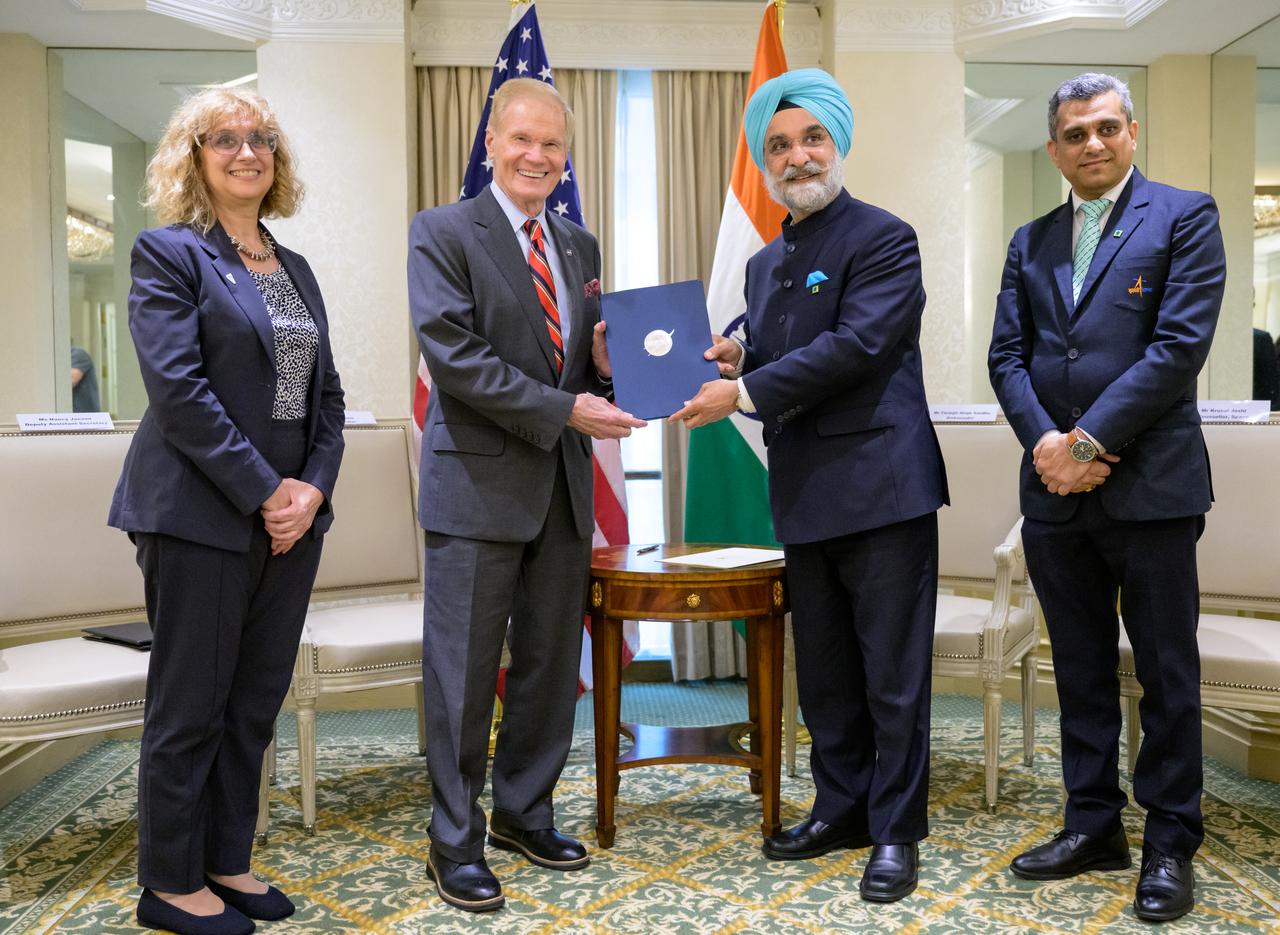
NASA Administrator Bill Nelson, 2nd from left, and Indian Ambassador Taranjit Sandhu, 3rd from left, hold the signed Artemis Accords, as U.S. Department of State, Deputy Assistant Secretary for India, Nancy Jackson, left, and Indian Space Research Organization, Space Counsellor, Krunal Joshi, right, join for the group photograph, Wednesday, June 21, 2023, at the Willard InterContinental Hotel in Washington. India is the 27th country to sign the Artemis Accords, which establish a practical set of principles to guide space exploration cooperation among nations participating in NASA’s Artemis program. Photo Credit: (NASA/Bill Ingalls)
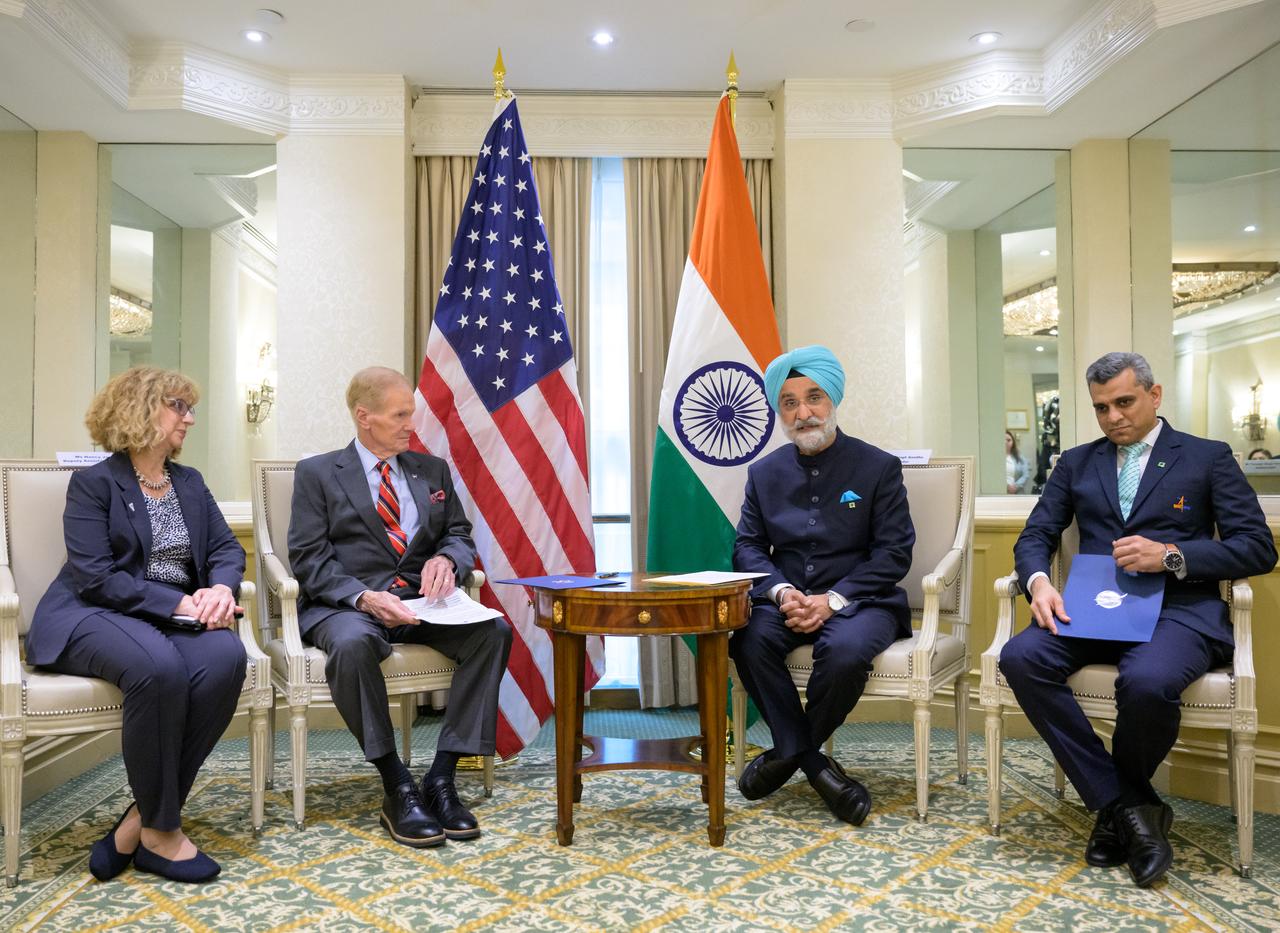
From left; U.S. Department of State, Deputy Assistant Secretary for India, Nancy Jackson, NASA Administrator Bill Nelson, Indian Ambassador Taranjit Sandhu, and Indian Space Research Organization, Space Counsellor, Krunal Joshi, talk after the signing of the Artemis Accords, Wednesday, June 21, 2023, at the Willard InterContinental Hotel in Washington. India is the 27th country to sign the Artemis Accords, which establish a practical set of principles to guide space exploration cooperation among nations participating in NASA’s Artemis program. Photo Credit: (NASA/Bill Ingalls)

Indian Ambassador Taranjit Sandhu, signs the Artemis Accords, as U.S. Department of State, Deputy Assistant Secretary for India, Nancy Jackson, left, NASA Administrator Bill Nelson, and Indian Space Research Organization, Space Counsellor, Krunal Joshi, right, look on, Wednesday, June 21, 2023, at the Willard InterContinental Hotel in Washington. India is the 27th country to sign the Artemis Accords, which establish a practical set of principles to guide space exploration cooperation among nations participating in NASA’s Artemis program. Photo Credit: (NASA/Bill Ingalls)
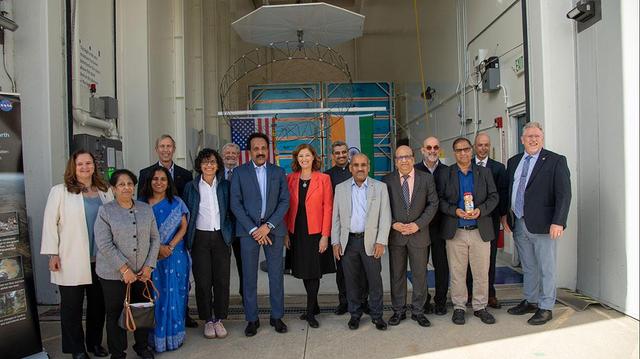
Officials from NASA, the Indian Space Research Organization (ISRO), and the Embassy of India hold a send-off ceremony for the NASA-ISRO Synthetic Aperture Radar (NISAR) science instrument payload on Feb. 3, 2023, outside a clean room at NASA's Jet Propulsion Laboratory in Southern California. The payload is scheduled to be shipped to India in March. Pictured left to right: Karen St. Germain, director, Earth Science Division, NASA; Mitra Dutta, NISAR program executive, NASA; Sripriya Ranganathan, ambassador and deputy chief of mission, Indian Embassy; Larry James, deputy director, JPL; Bhavya Lal, associate administrator for technology, policy, and strategy, NASA; Jim Graf, director, Earth Science and Technology Directorate, JPL; S. Somanath, chairman, ISRO; Laurie Leshin, director, JPL; Krunal Joshi, counselor, space and ISRO technical liaison officer, Indian Embassy; M. Sankaran, director, U R Rao Satellite Centre, ISRO; Shantanu Bhatawdekar, scientific secretary, ISRO; Paul Rosen, NISAR project scientist, JPL; CV Shrikant, NISAR project director, ISRO; Phil Barela, NISAR project manager, JPL; and Gerald Bawden, NISAR program scientist, NASA. NISAR – a joint effort between NASA and ISRO – will measure changes to Earth's land ice surfaces down to fractions of an inch. Data collected by this satellite will help researchers monitor a wide range of changes critical to life on Earth in unprecedented detail. This includes spotting warning signs of imminent volcanic eruptions, helping to monitor groundwater supplies, tracking the melt rate of ice sheets tied to sea level rise, and observing shifts in the distribution of vegetation around the world. The data will inform humanity's responses to urgent challenges posed by natural disasters and climate change, and help communities prepare for and manage hazards. There are two instruments on the satellite that will send and receive radar signals to and from Earth's surface to make the mission's measurements. An L-band synthetic aperture radar (SAR), which uses a signal wavelength of around 9 inches (24 centimeters), and an S-band SAR with a signal wavelength of nearly 5 inches (12 centimeters). Both will bounce their microwave signal off of the planet's surface and record how long it takes the signal to make one roundtrip, as well as the strength of that return signal. This enables the researchers to calculate the distance from the spacecraft to Earth's surface and thereby determine how the land or ice is changing. An antenna reflector nearly 40 feet (12 meters) in diameter, supported by a deployable boom, will focus the microwave signals sent and received by the SARs. JPL, which is managed for NASA by Caltech in Pasadena, leads the U.S. component of NISAR and is providing the mission's L-band SAR instrument. NASA is also providing the radar reflector antenna, the deployable boom, a high-rate communication subsystem for science data, GPS receivers, a solid-state recorder, and payload data subsystem. ISRO is providing the spacecraft bus, the S-band SAR, the launch vehicle, and associated launch services and satellite mission operations. https://photojournal.jpl.nasa.gov/catalog/PIA25600