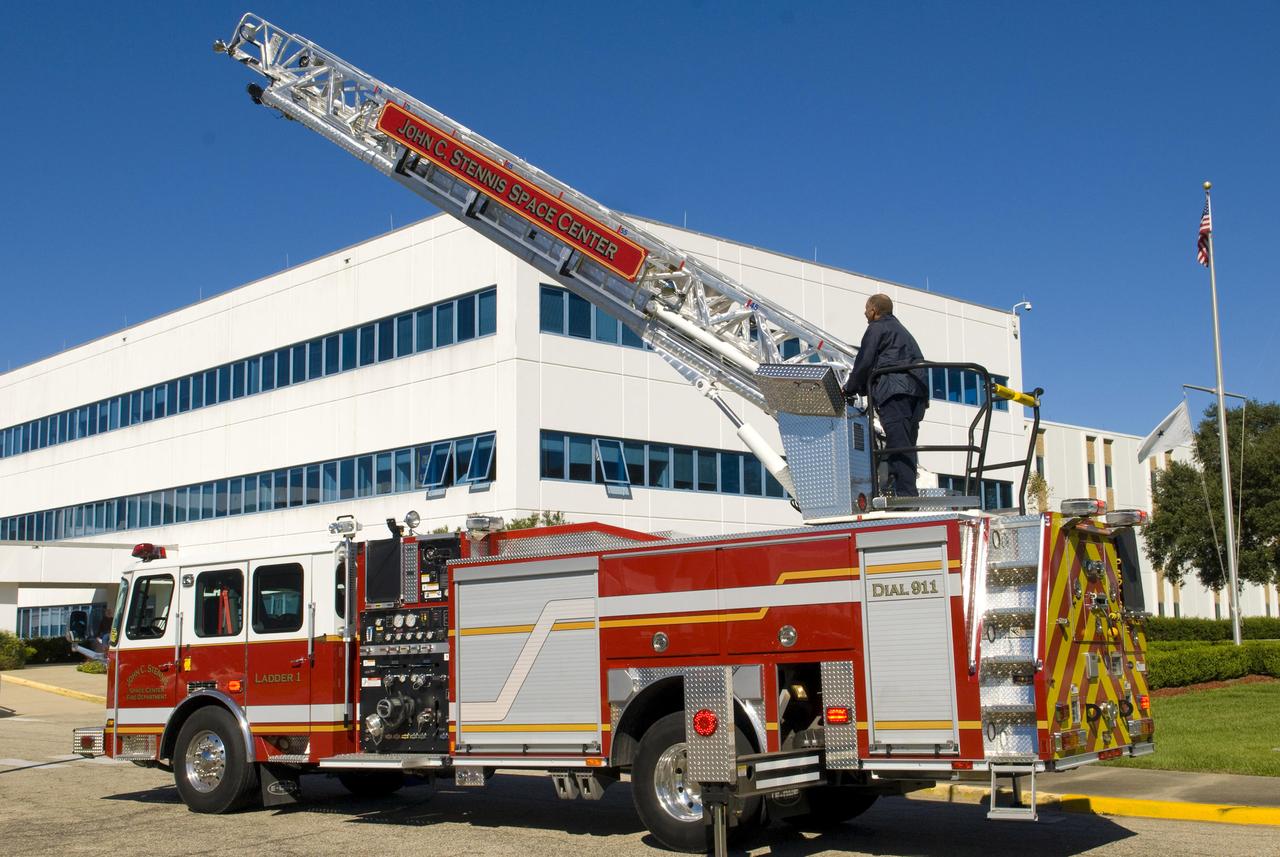
The Stennis Space Center Fire Department added to its fire-fighting capabilities with acquisition of a new emergency response vehicle, Ladder-1, for use on-site. The E-One HP78 Aerial Truck is a combination aerial ladder and fire suppression unit and is designed with the latest safety technology. Featuring a 78-foot ladder and a pumping capability of 1,500 gallons per minute, the new truck provides firefighters with a tremendous rescue and fire suppression tool, Stennis Fire Chief Clark Smith said.
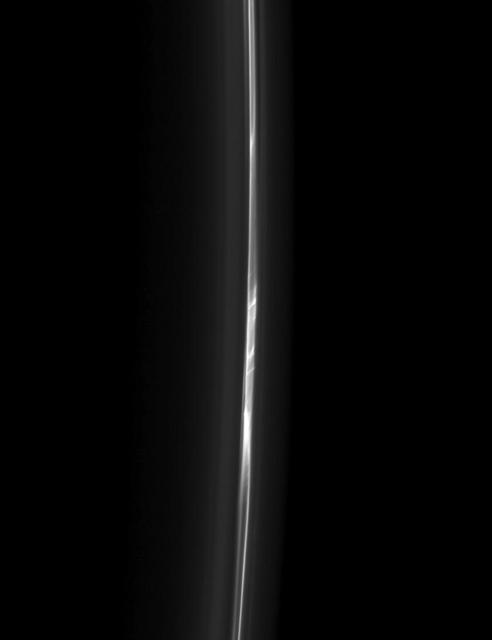
Forever changing, the F ring takes on a ladder-like appearance in this recent image from NASA Cassini spacecraft. Scientists believe that interactions between the F ring and the moons Prometheus and Pandora cause the dynamic structure of the ring.
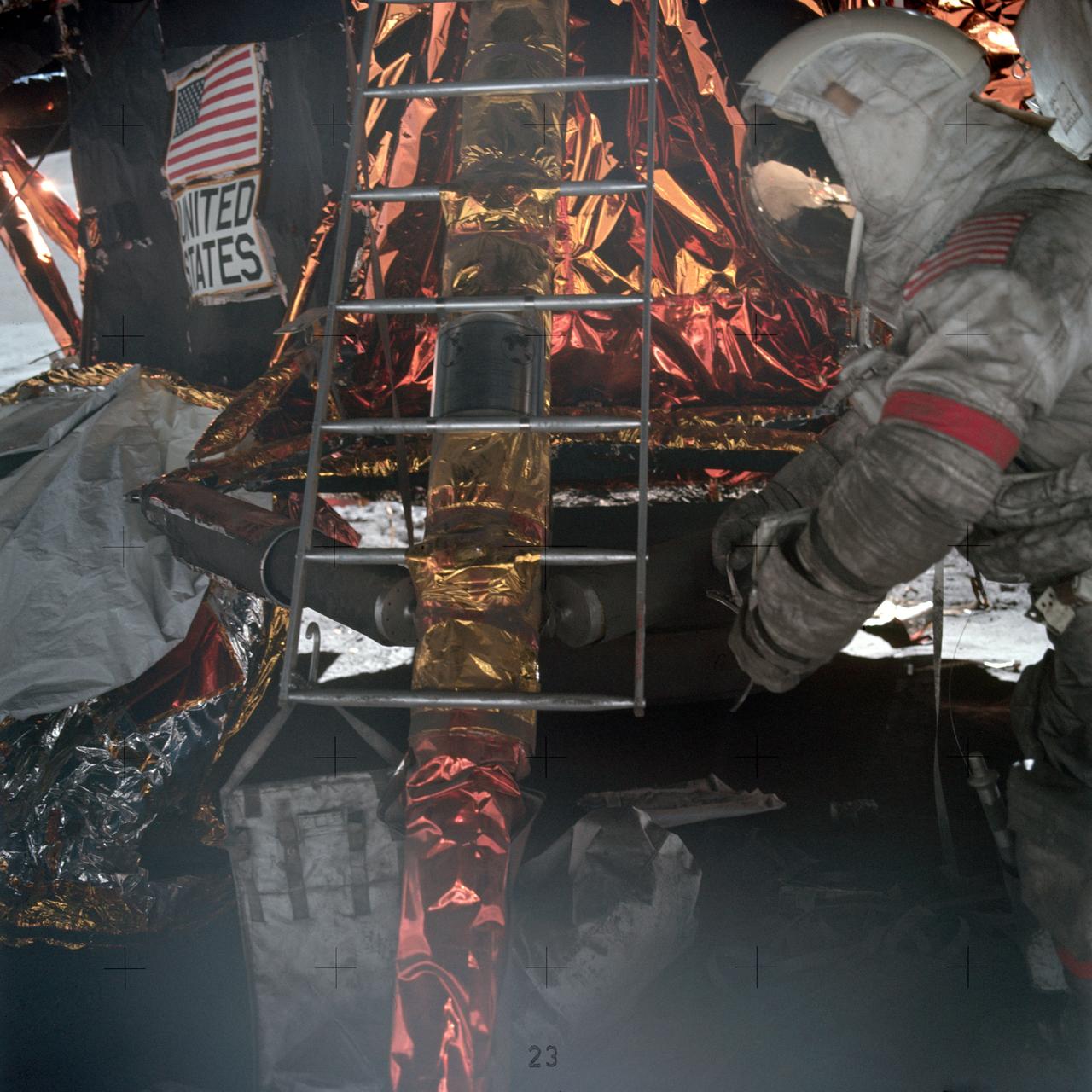
Astronaut Eugene A. Cernan, Apollo 17 commander, prepares to mount ladder to lunar module ascent stage. Note the plaque attached to the ladder which will be left with the descent stage when the mission lifts off from the lunar surface.

AS11-40-5868 (20 July 1969) --- Astronaut Edwin E. Aldrin Jr., lunar module pilot, descends the steps of the Lunar Module (LM) ladder as he prepares to walk on the moon. He had just egressed the LM. This photograph was taken by astronaut Neil A. Armstrong, commander, with a 70mm lunar surface camera during the Apollo 11 extravehicular activity (EVA). While Armstrong and Aldrin descended in the LM "Eagle" to explore the moon, astronaut Michael Collins, command module pilot, remained with the Command and Service Modules (CSM) in lunar orbit.
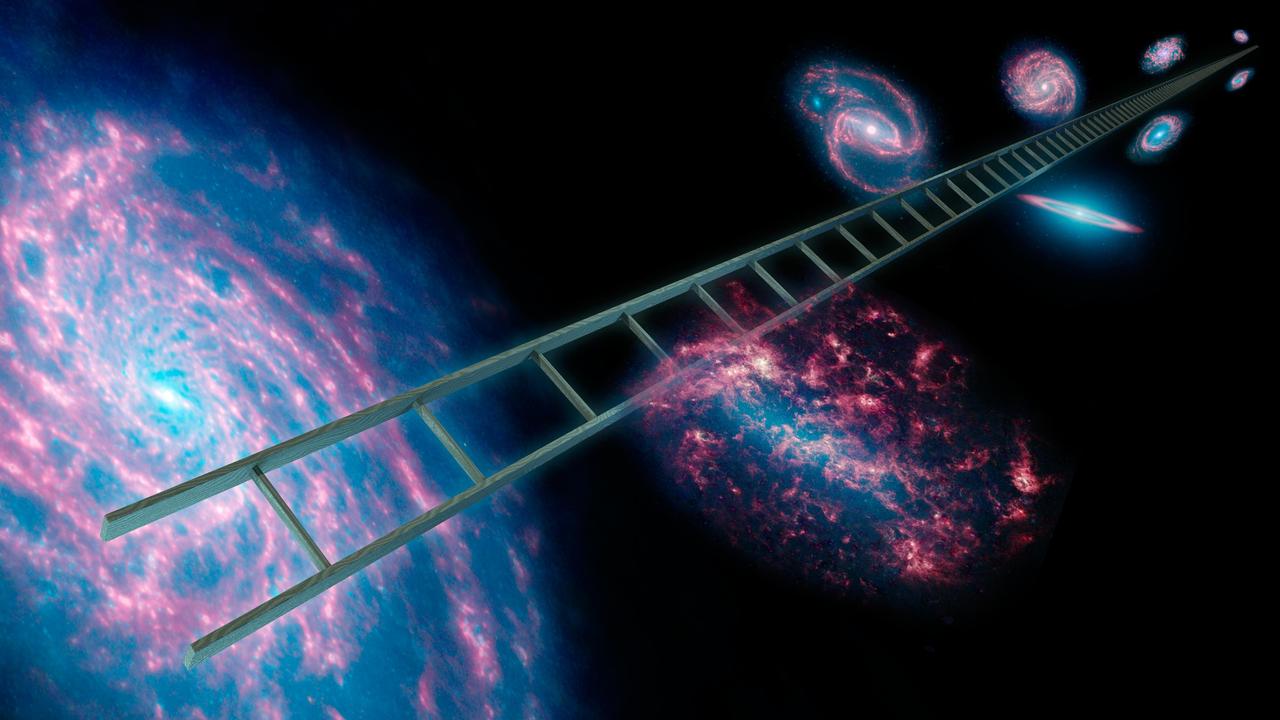
Astronomers using NASA Spitzer Space Telescope have greatly improved the cosmic distance ladder used to measure the expansion rate of the universe, its size and age. This artist concept symbolically shows a series of stars that have known distances.
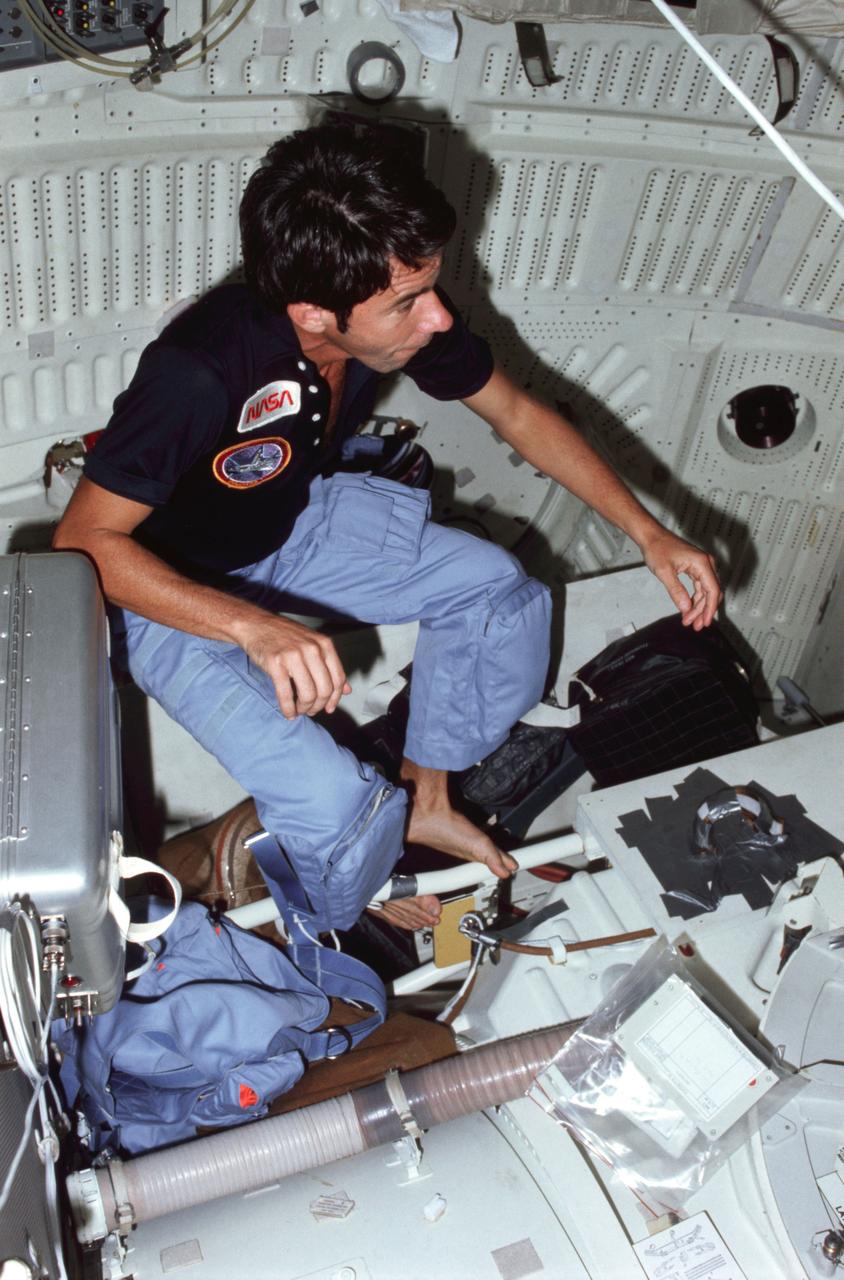
STS005-15-591 (11-16 Nov. 1982) --- Astronaut William B. Lenoir, STS-5 mission specialist, observes middeck activities from access ladder. Carry-on food warmer appears in foreground and the wet trash stowage container and side hatch in the background. Photo credit: NASA
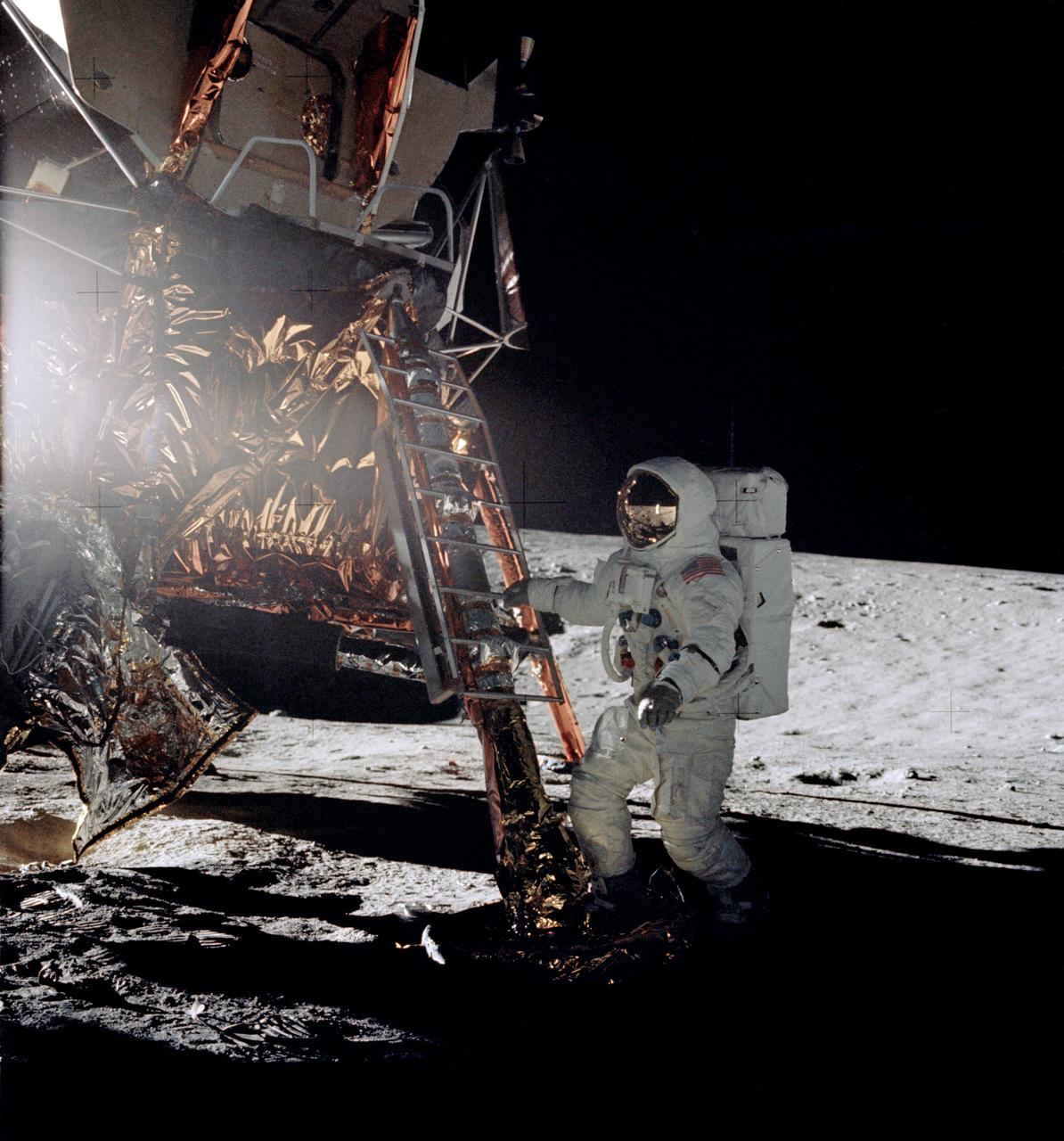
AS12-46-6729 (19 Nov. 1969) --- Astronaut Alan L. Bean, lunar module pilot for the Apollo 12 lunar landing mission, steps from the ladder of the Lunar Module to join astronaut Charles Conrad Jr., commander, in extravehicular activity on Nov. 19, 1969. Astronaut Richard F. Gordon Jr., command module pilot, remained with the Command and Service Modules in lunar orbit.
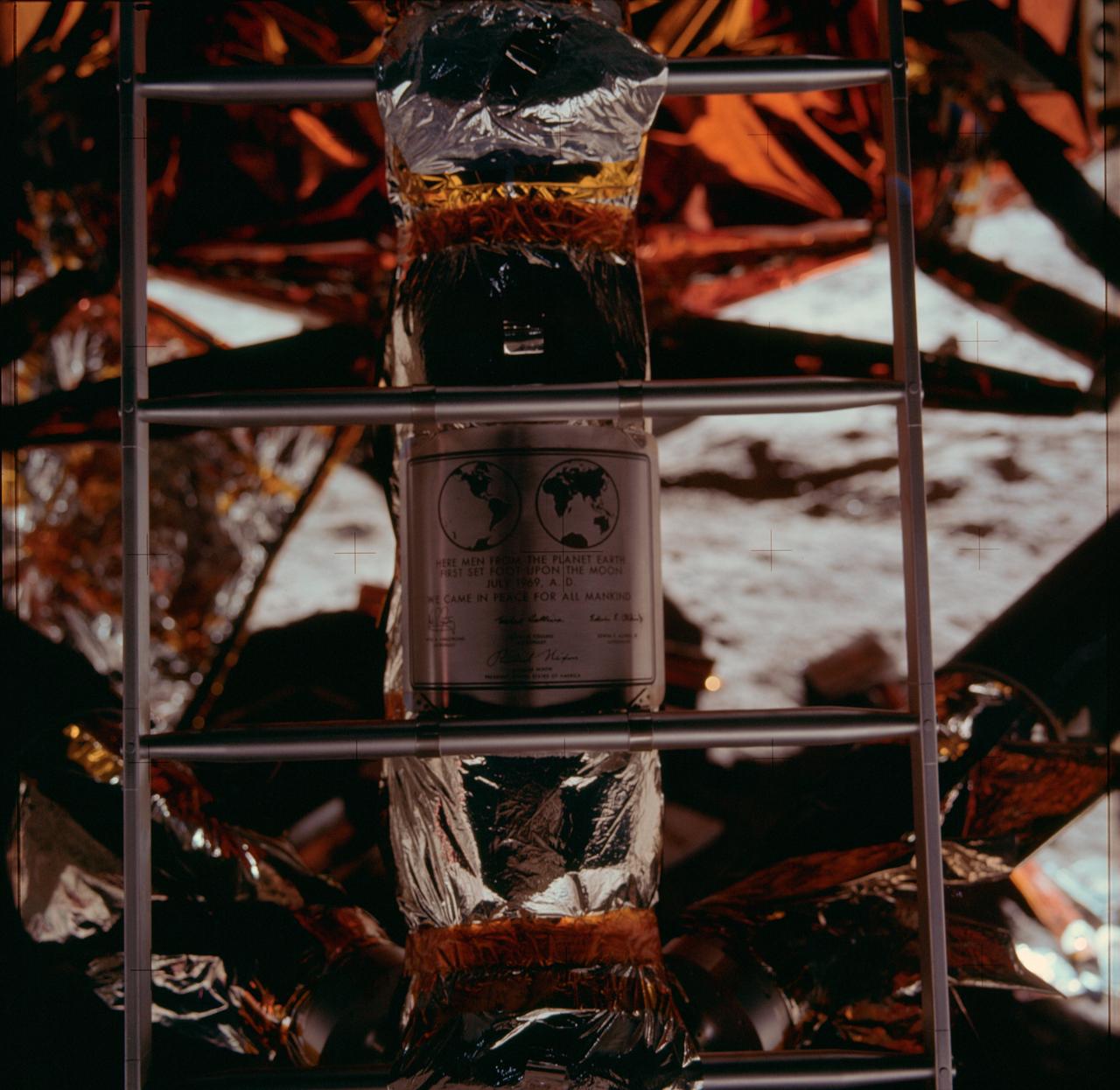
AS11-40-5899 (20 July 1969) --- Close-up view of the plaque which the Apollo 11 astronauts left on the moon in commemoration of the historic lunar landing mission. The plaque was attached to the ladder on the landing gear strut on the descent stage of the Apollo 11 Lunar Module (LM). The plaque was covered with a thin sheet of stainless steel during flight. Astronaut Michael Collins, command module pilot, remained with the Command and Service Modules (CSM) in lunar orbit while astronauts Neil A. Armstrong, commander, and Edwin E. Aldrin Jr., lunar module pilot, explored the moon.
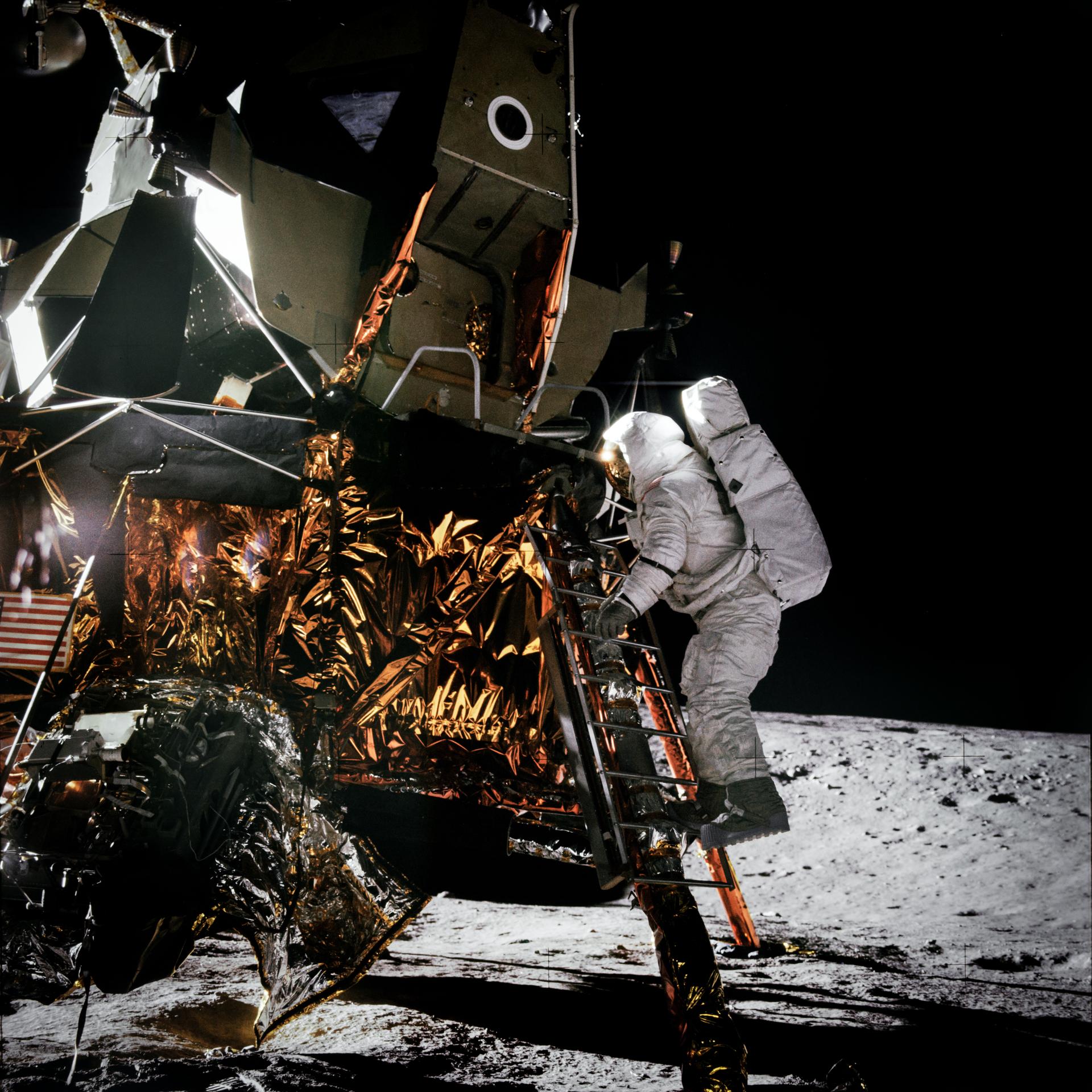
AS12-46-6728 (19 Nov. 1969) --- Astronaut Alan L. Bean, lunar module pilot for the Apollo 12 mission, is about to step off the ladder of the Lunar Module to join astronaut Charles Conrad Jr., mission commander, in extravehicular activity (EVA). Conrad and Bean descended in the Apollo 12 LM to explore the moon while astronaut Richard F. Gordon Jr., command module pilot, remained with the Command and Service Modules in lunar orbit.
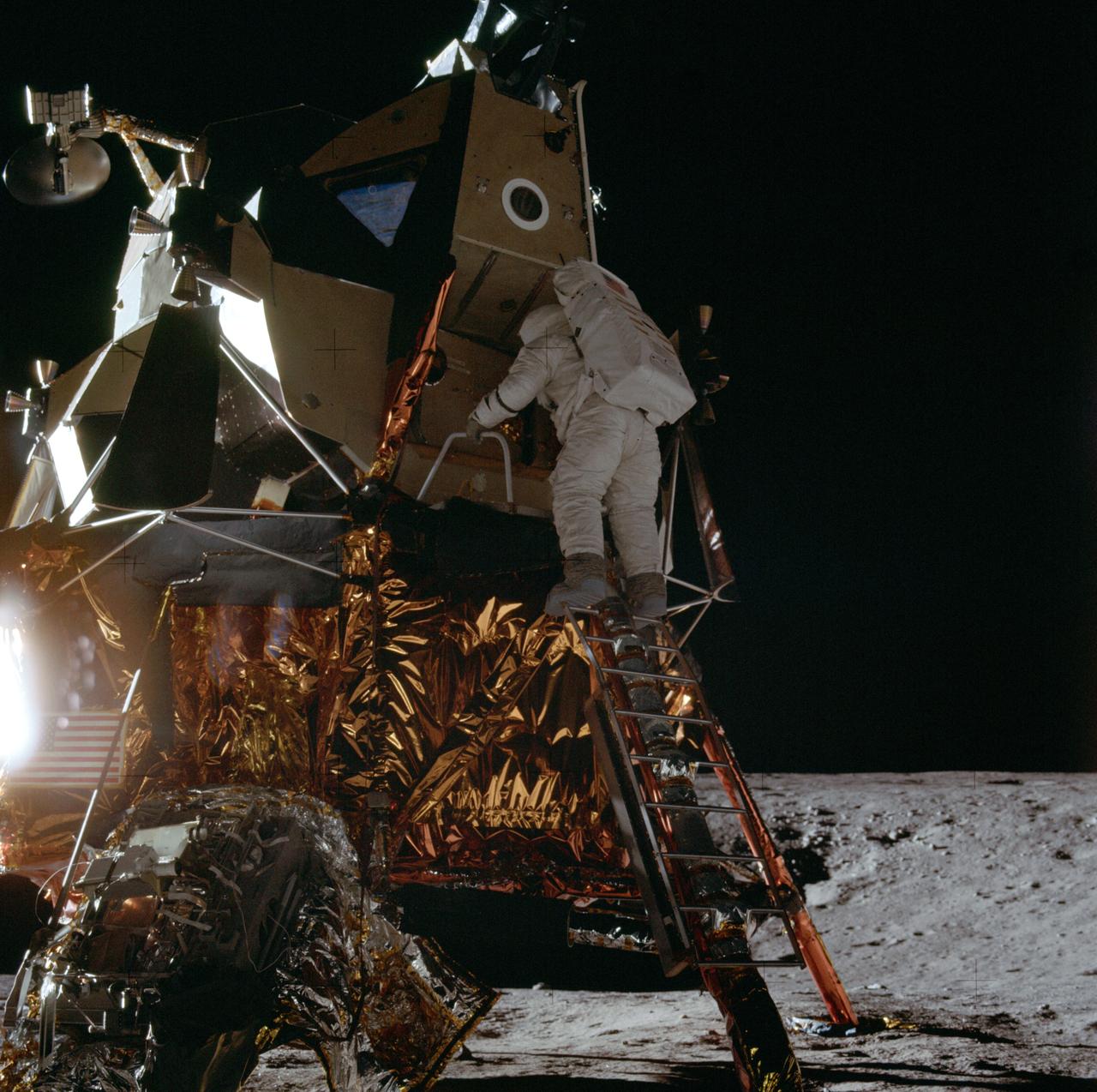
AS12-46-6726 (19 Nov. 1969) --- Astronaut Alan L. Bean, lunar module pilot for the Apollo 12 mission, starts down the ladder of the Lunar Module (LM) to join astronaut Charles Conrad Jr., mission commander, in extravehicular activity (EVA). While astronauts Conrad and Bean descended in the LM "Intrepid" to explore the Ocean of Storms region of the moon, astronaut Richard F. Gordon Jr., command module pilot, remained with the Command and Service Modules (CSM) "Yankee Clipper" in lunar orbit.
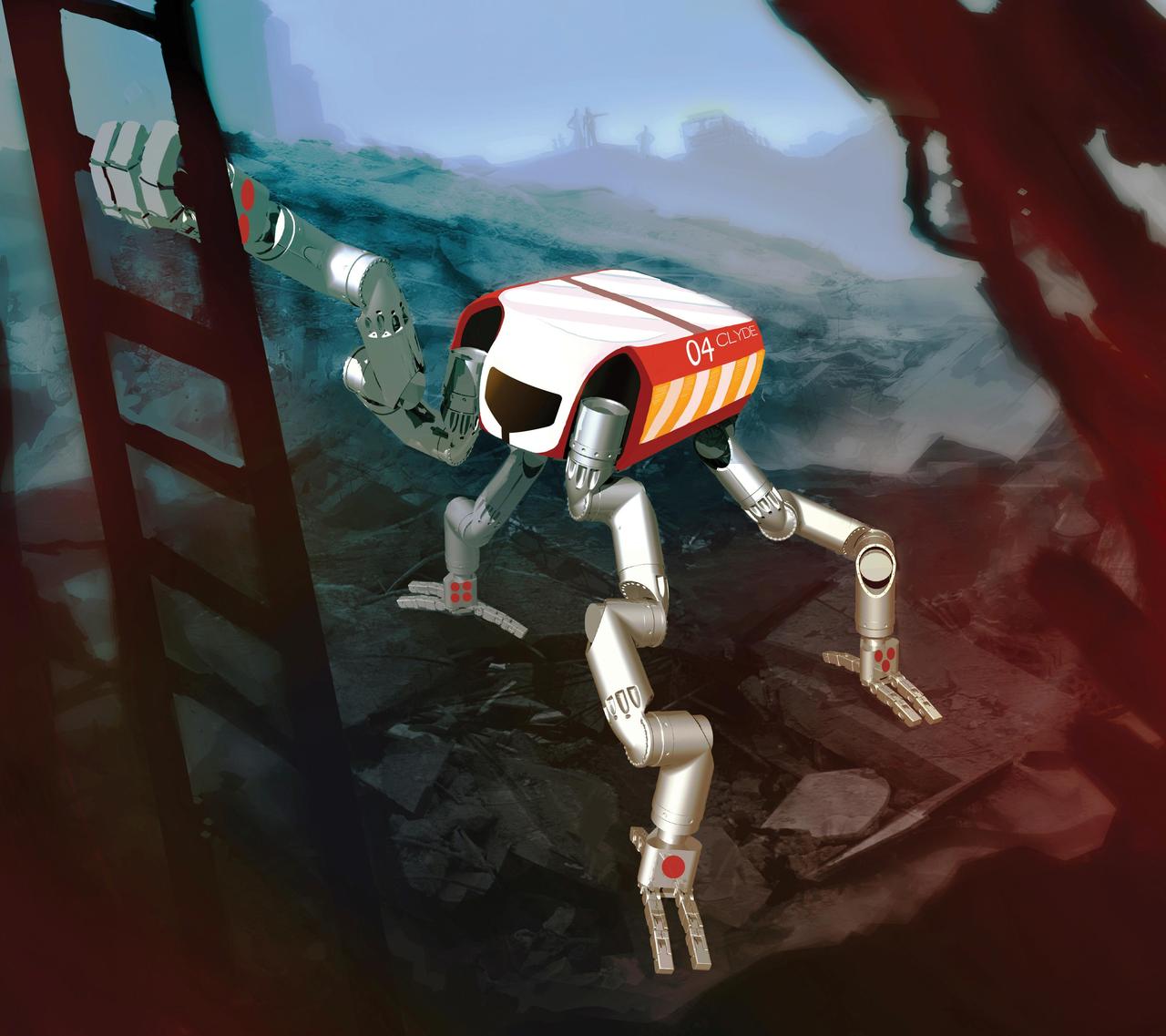
This artist concept depicts RoboSimian, a disaster-relief and -mitigation robot, grasping the rung of a ladder. RoboSimian is an ape-like robot designed and built at NASA Jet Propulsion Laboratory, Pasadena, Calif.
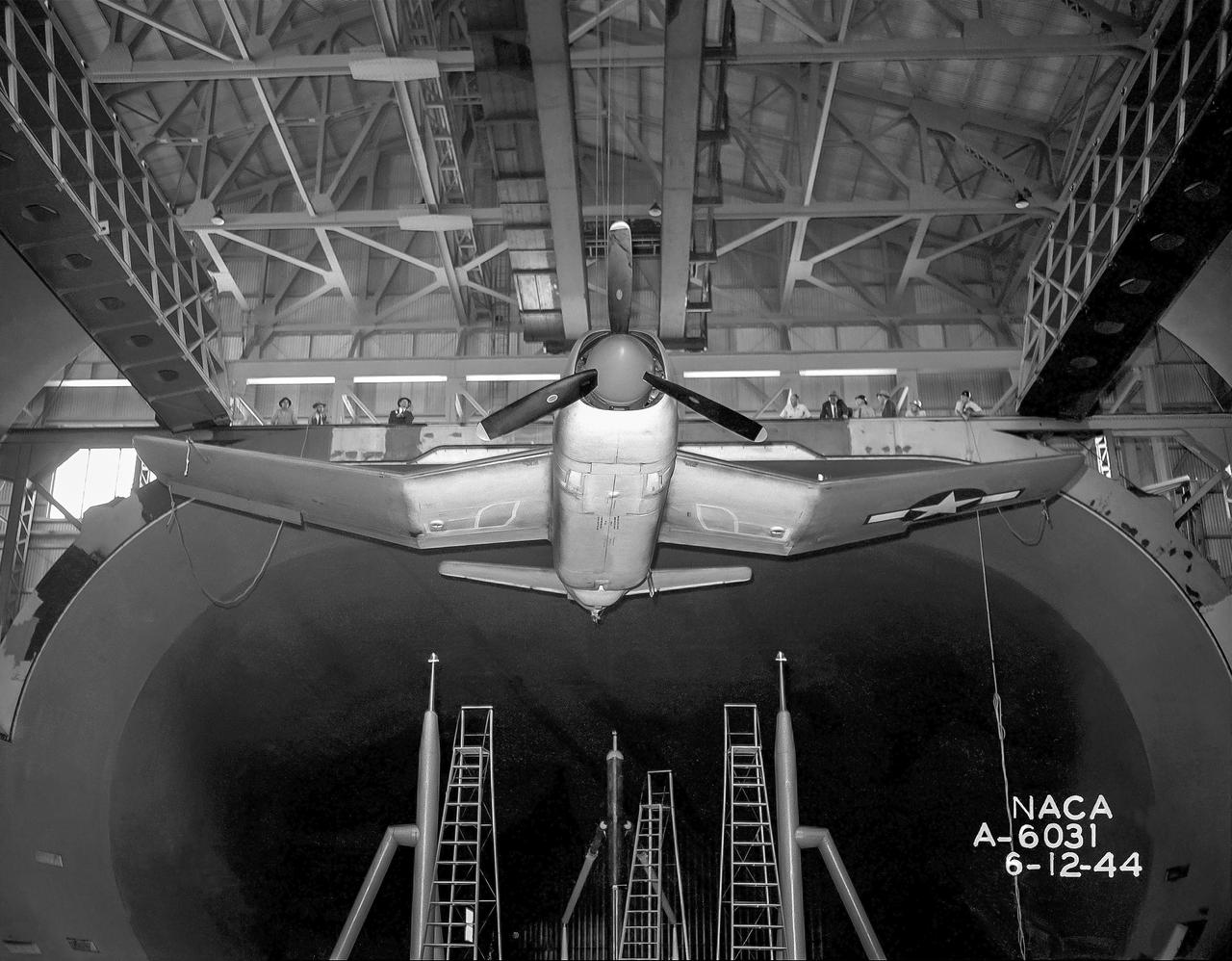
XSB2D-1 First test (no number) Aerodynamic test to forecast the take off distance. George Cooper was the A1:H73 pilot. Orchard ladders were used to access the ball socket attachments on the struts.
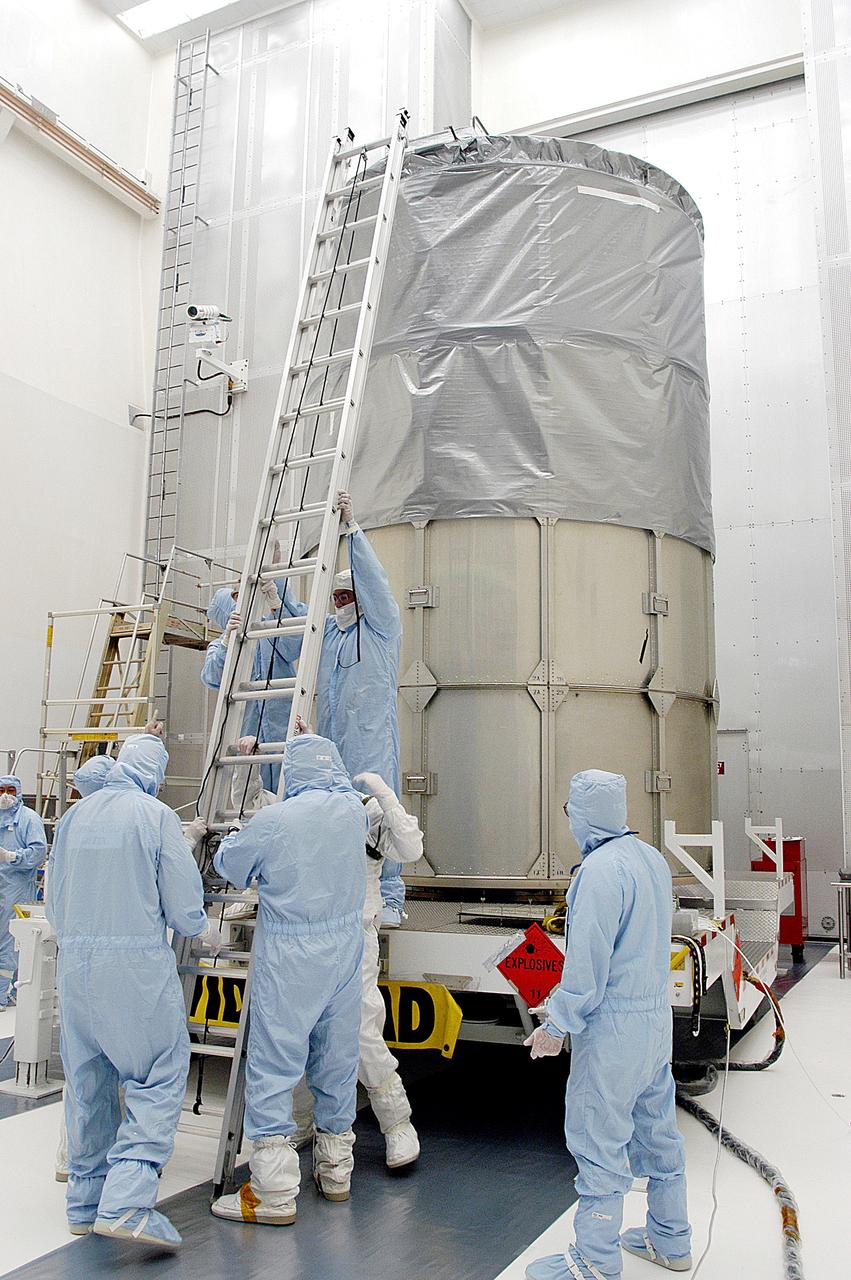
KENNEDY SPACE CENTER, FLA. - Workers in NASA Spacecraft Hangar AE erect a ladder to reach the top of the Space Infrared Telescope Facility (SIRTF), which has been returned to the hangar from the launch pad. SIRTF will remain in the clean room until it returns to the pad in early August. One of NASA's largest infrared telescopes to be launched, SIRTF will obtain images and spectra by detecting the infrared energy, or heat, radiated by objects in space.
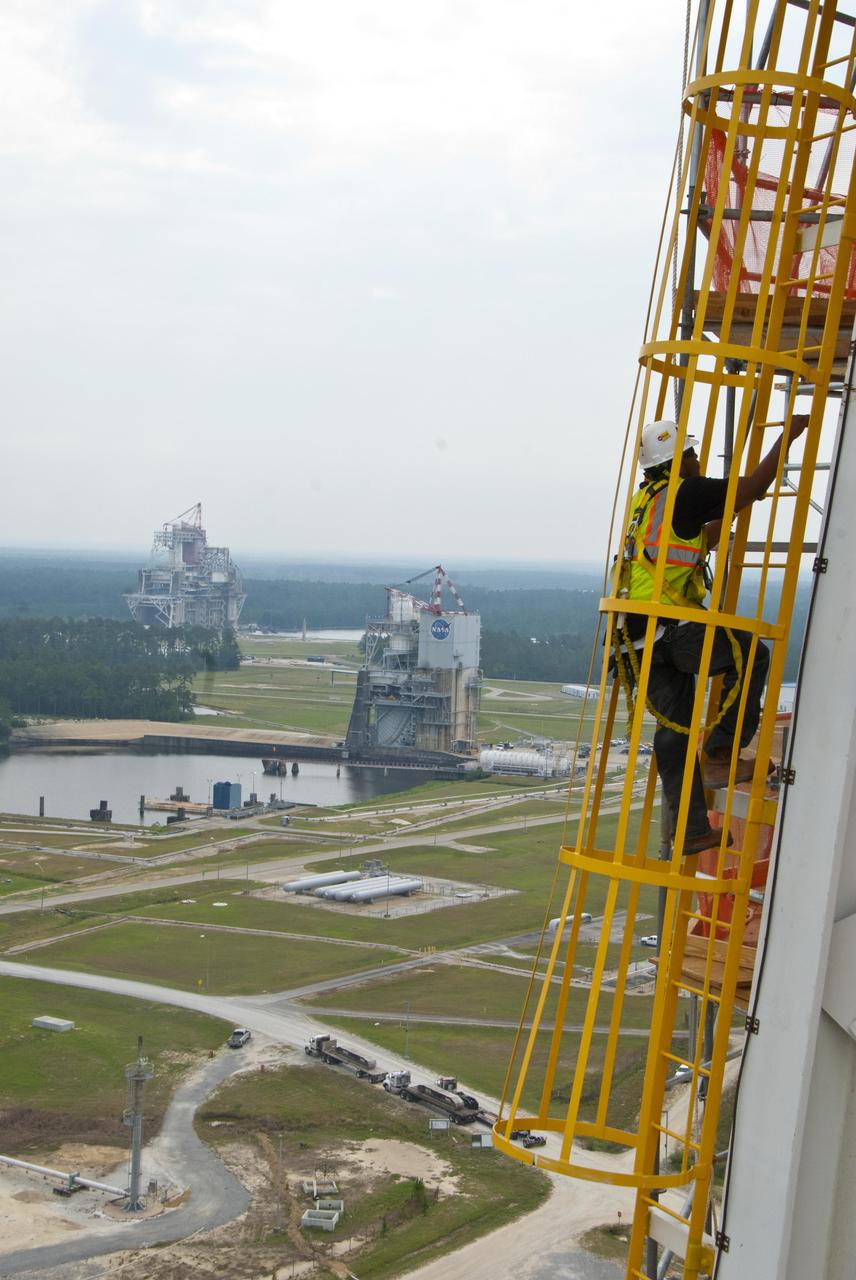
A tethered Stennis Space Center employee climbs an A-3 Test Stand ladder June 8, 2012, against the backdrop of the A-2 and B-1/B-2 stands. The new A-3 Test Stand will enable simulated high-altitude testing of next-generation rocket engines.
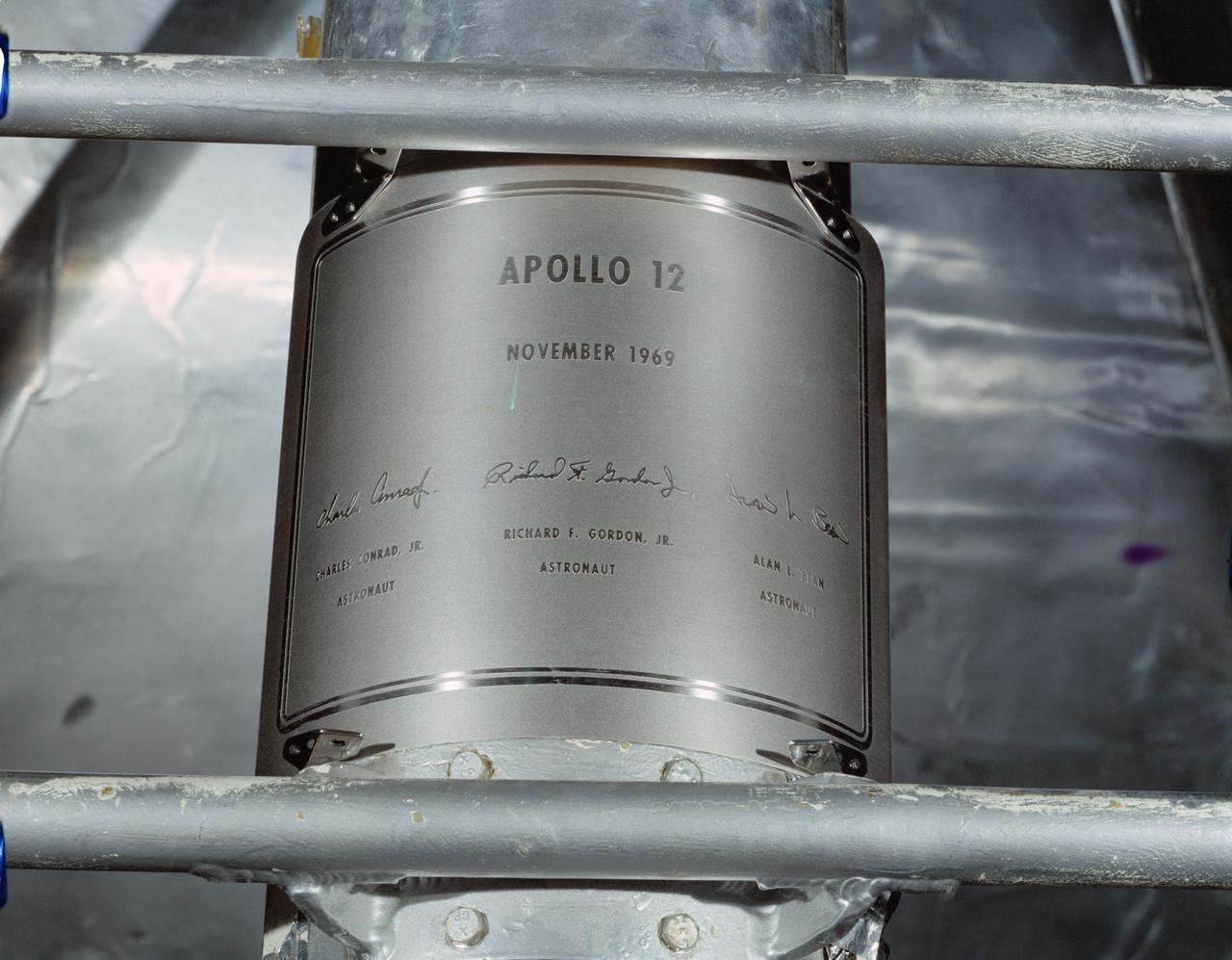
S69-53326 (November 1969) --- Close-up view of a replica of the plaque which the Apollo 12 astronauts will leave on the moon in commemoration of their flight. The plaque will be attached to the ladder on the landing gear strut on the descent stage of the Apollo 12 Lunar Module (LM). Apollo 12 will be the United States' second lunar landing mission.
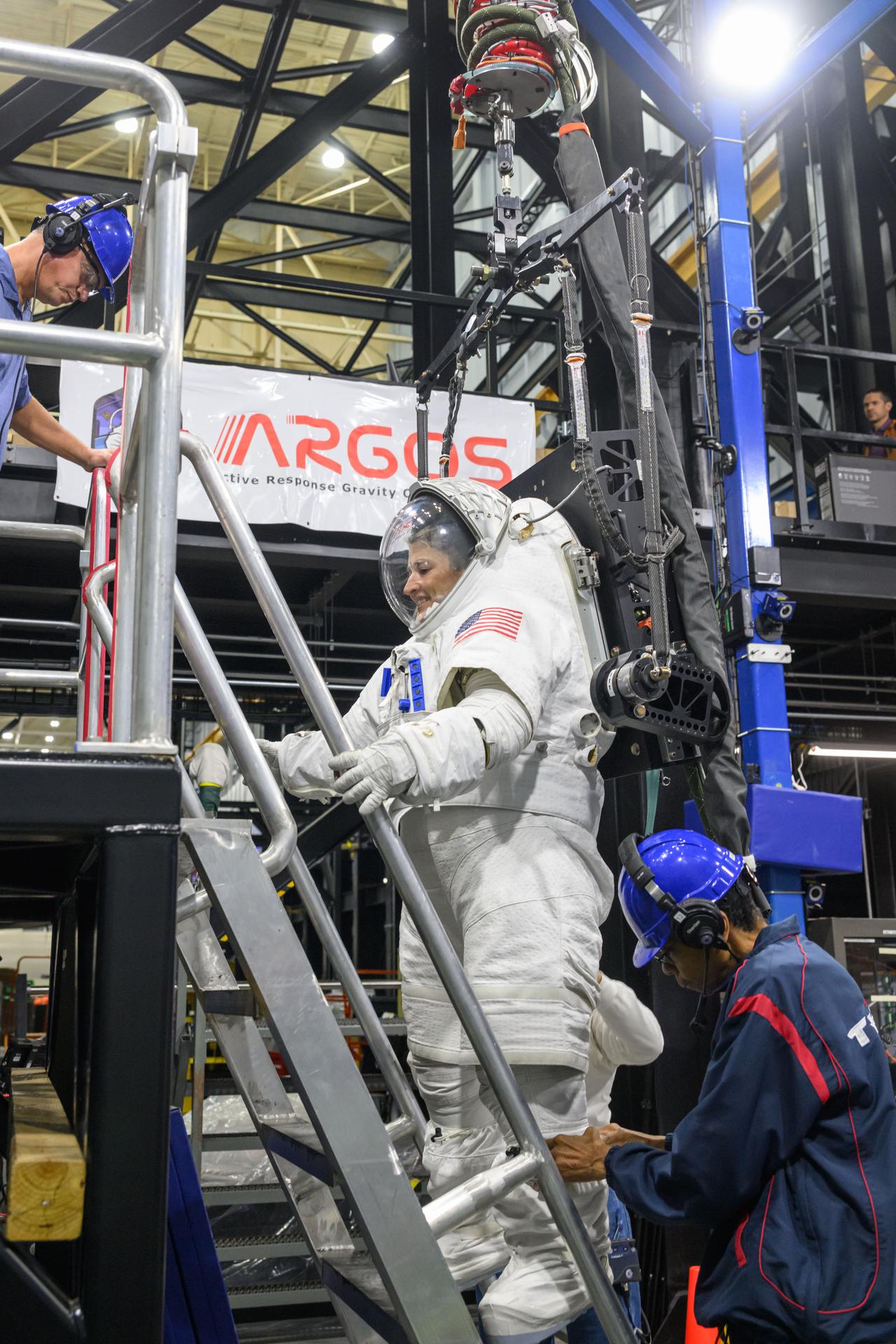
Artemis II astronaut Christina Koch climbs down the ladder of a mockup lander while wearing the xEMU spacesuit during the Artemis Spaceflight Standard Measures Test at NASA’s Johnson Space Center on Dec. 12, 2025. (NASA/Helen Arase Vargas)
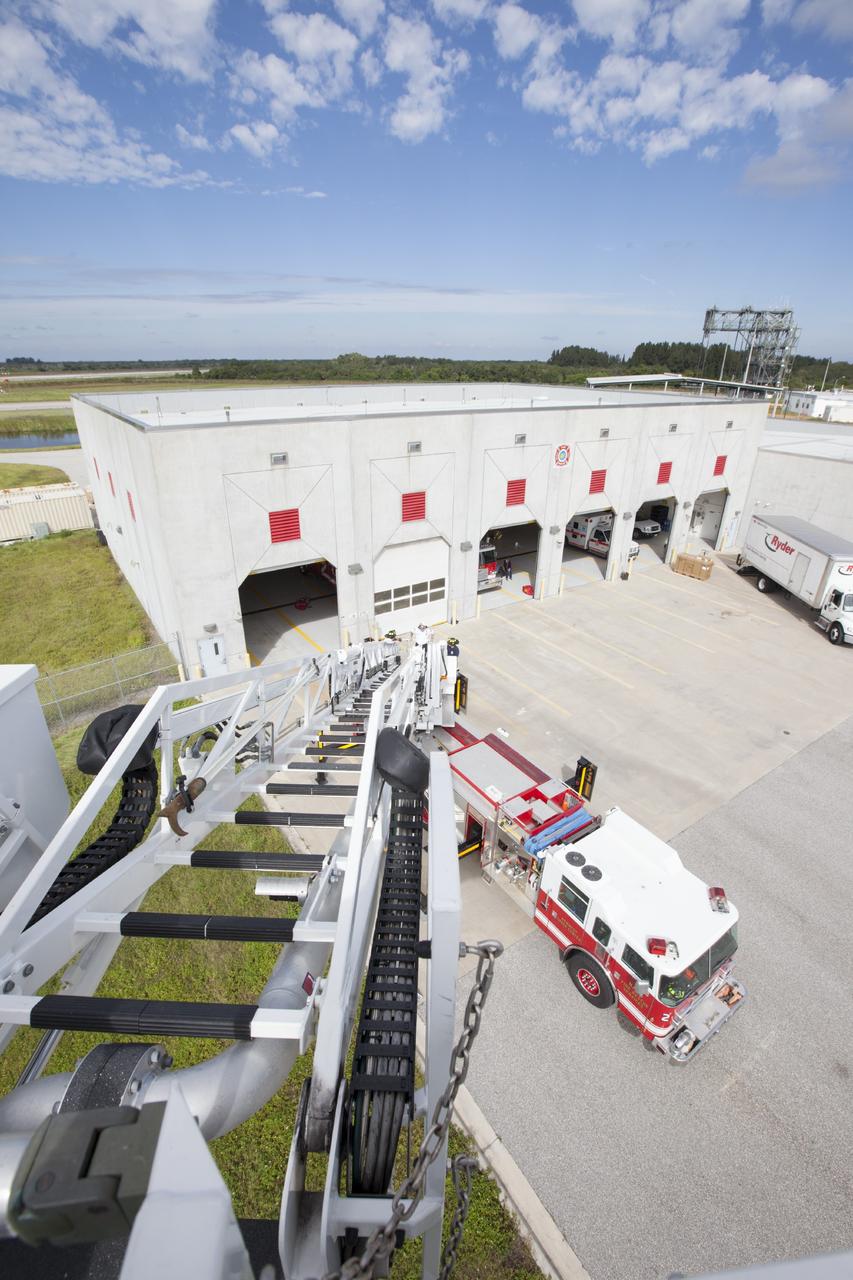
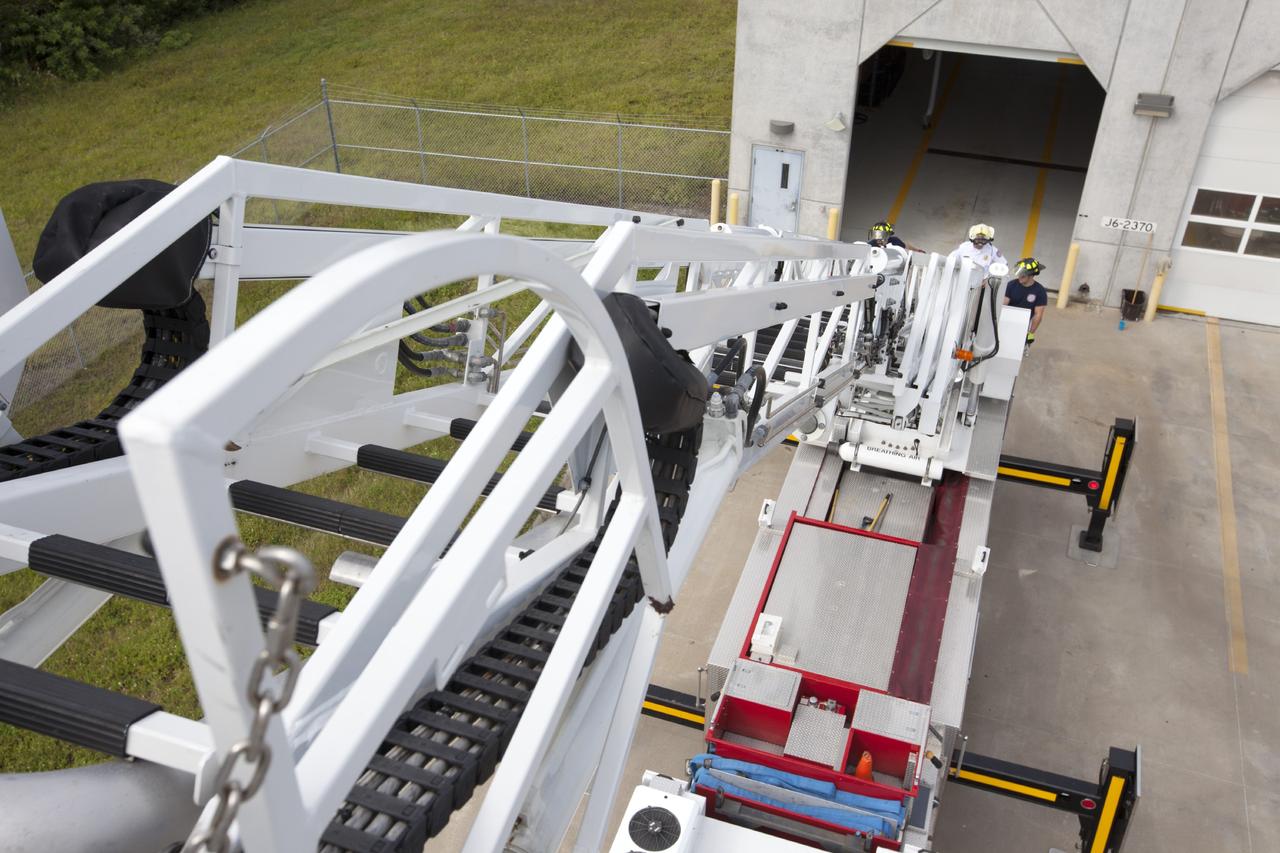
CAPE CANAVERAL, Fla. – At Fire Station No. 2 near the Shuttle Landing Facility at NASA’s Kennedy Space Center in Florida, a bird’s eye view reveals the ladder has been extended on the aerial fire truck during a training exercise. The center’s Fire Rescue Services recently achieved Pro Board Certification in aerial fire truck operations. Pro Board Certification is a globally recognized certification that puts on multiple courses that all fire departments throughout the world recognize and use to train their personnel. The unique aerial truck contains a 100-foot extendable ladder with a bucket at the end of it that can be used for rescues from taller buildings or aircraft rescue firefighting. Photo credit: NASA/Kim Shiflett
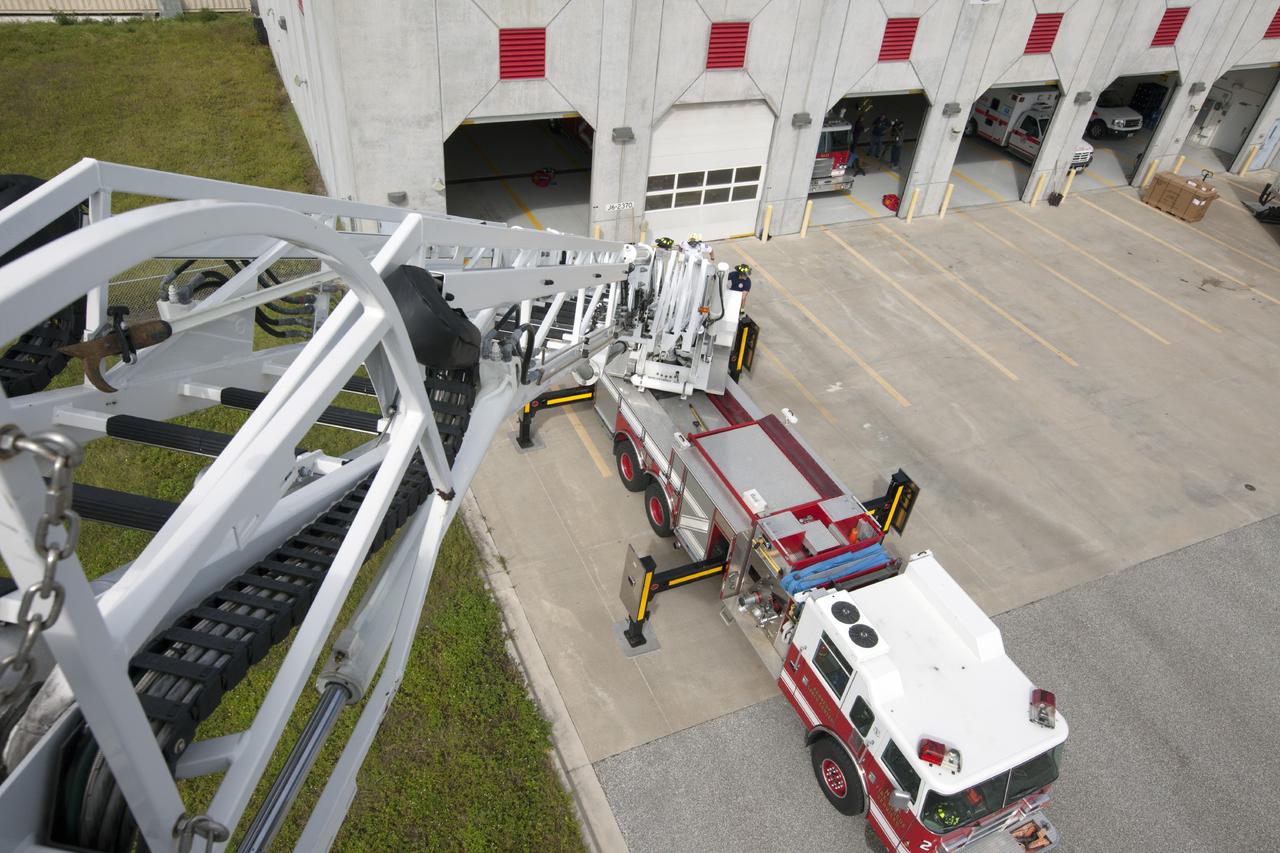
CAPE CANAVERAL, Fla. – At Fire Station No. 2 near the Shuttle Landing Facility at NASA’s Kennedy Space Center in Florida, a bird’s eye view reveals the ladder has been extended on the aerial fire truck during a training exercise. The center’s Fire Rescue Services recently achieved Pro Board Certification in aerial fire truck operations. Pro Board Certification is a globally recognized certification that puts on multiple courses that all fire departments throughout the world recognize and use to train their personnel. The unique aerial truck contains a 100-foot extendable ladder with a bucket at the end of it that can be used for rescues from taller buildings or aircraft rescue firefighting. Photo credit: NASA/Kim Shiflett
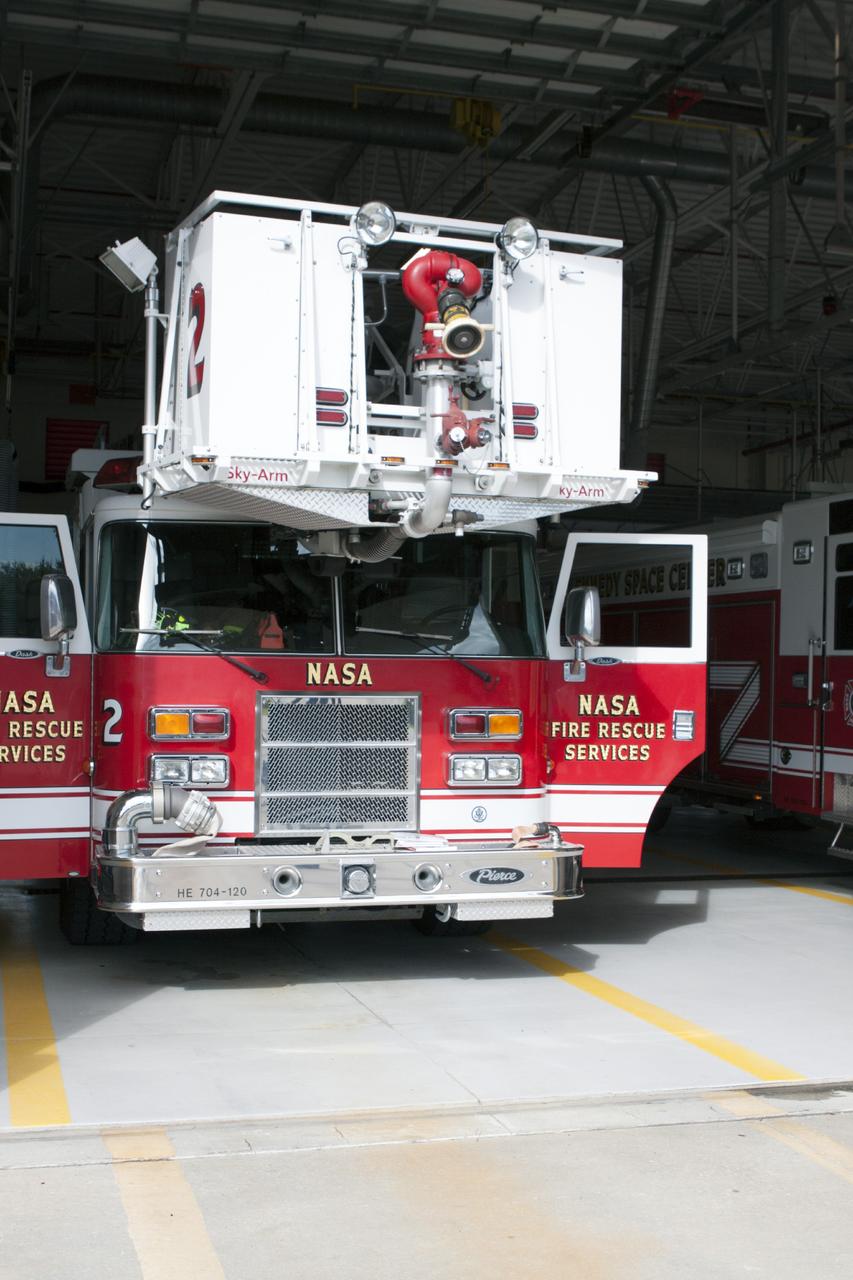
CAPE CANAVERAL, Fla. – At Fire Station No. 2 near the Shuttle Landing Facility at NASA’s Kennedy Space Center in Florida, the aerial fire truck sits in a bay as Fire Rescue Services personnel prepare to drive the fire truck out of the bay and then operate the extendable ladder during training in order to be certified in the operation and use of the vehicle. The center’s Fire Rescue Services recently achieved Pro Board Certification in aerial fire truck operations. Pro Board Certification is a globally recognized certification that puts on multiple courses that all fire departments throughout the world recognize and use to train their personnel. The unique aerial truck contains a 100-foot extendable ladder with a bucket at the end of it that can be used for rescues from taller buildings or aircraft rescue firefighting. Photo credit: NASA/Kim Shiflett
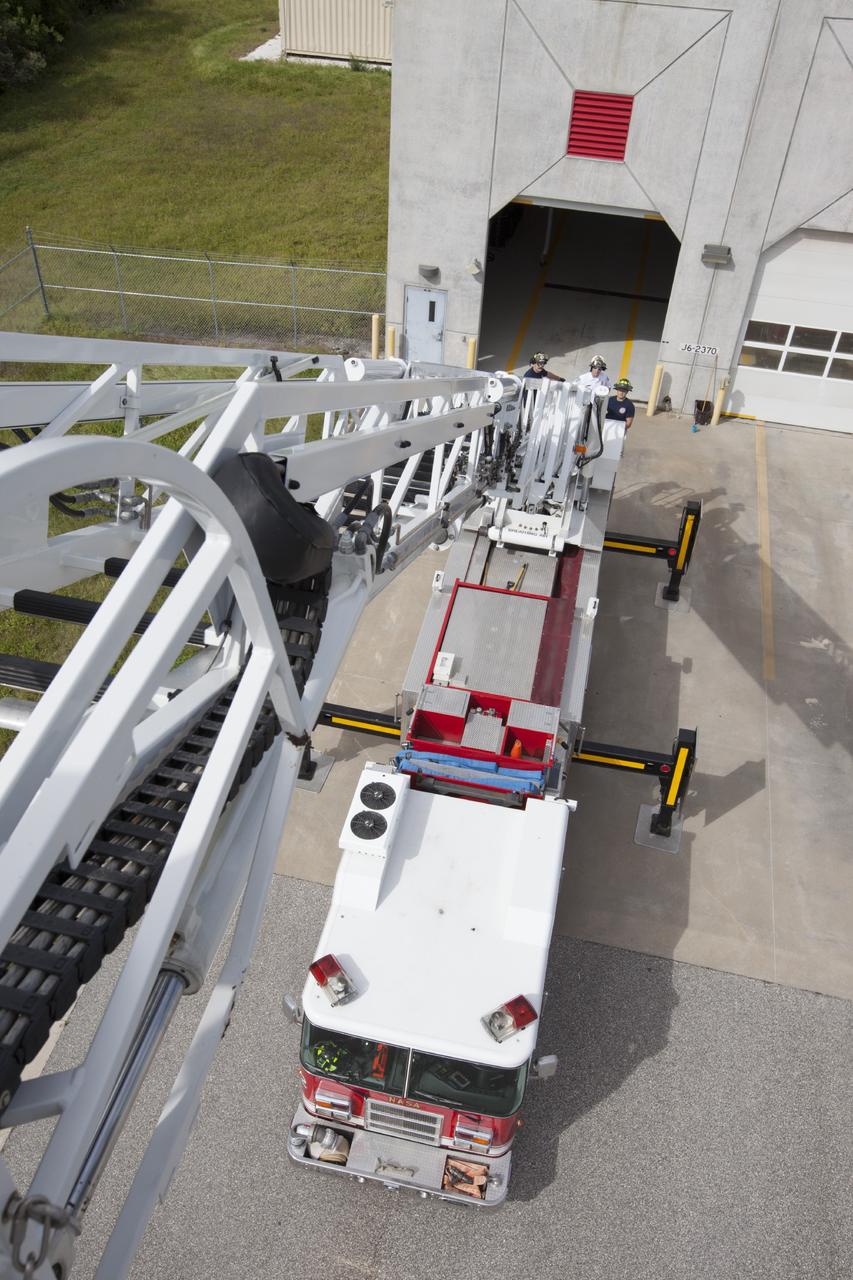
CAPE CANAVERAL, Fla. – At Fire Station No. 2 near the Shuttle Landing Facility at NASA’s Kennedy Space Center in Florida, a bird’s eye view reveals the ladder has been extended on the aerial fire truck during a training exercise. The stabilizers have been deployed on either side of the fire truck. The center’s Fire Rescue Services recently achieved Pro Board Certification in aerial fire truck operations. Pro Board Certification is a globally recognized certification that puts on multiple courses that all fire departments throughout the world recognize and use to train their personnel. The unique aerial truck contains a 100-foot extendable ladder with a bucket at the end of it that can be used for rescues from taller buildings or aircraft rescue firefighting. Photo credit: NASA/Kim Shiflett
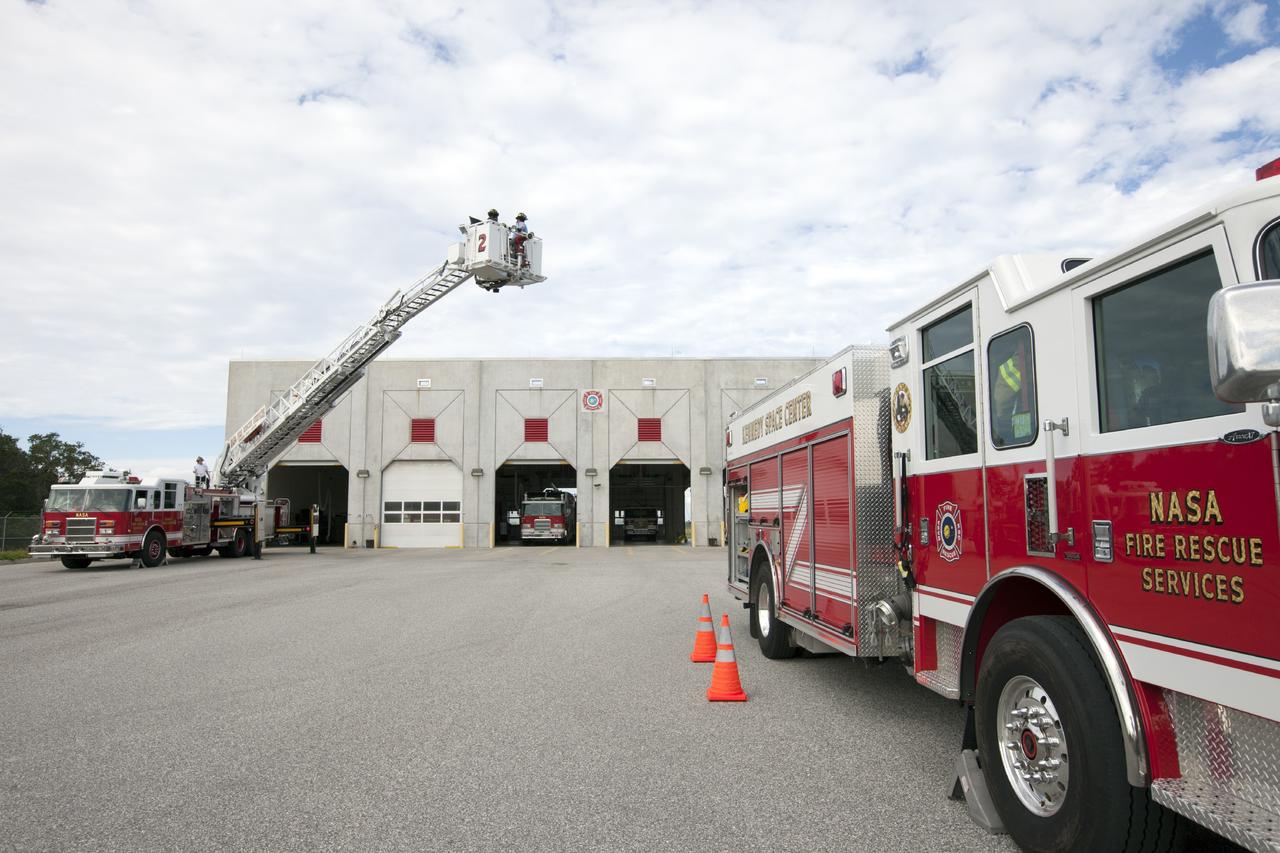
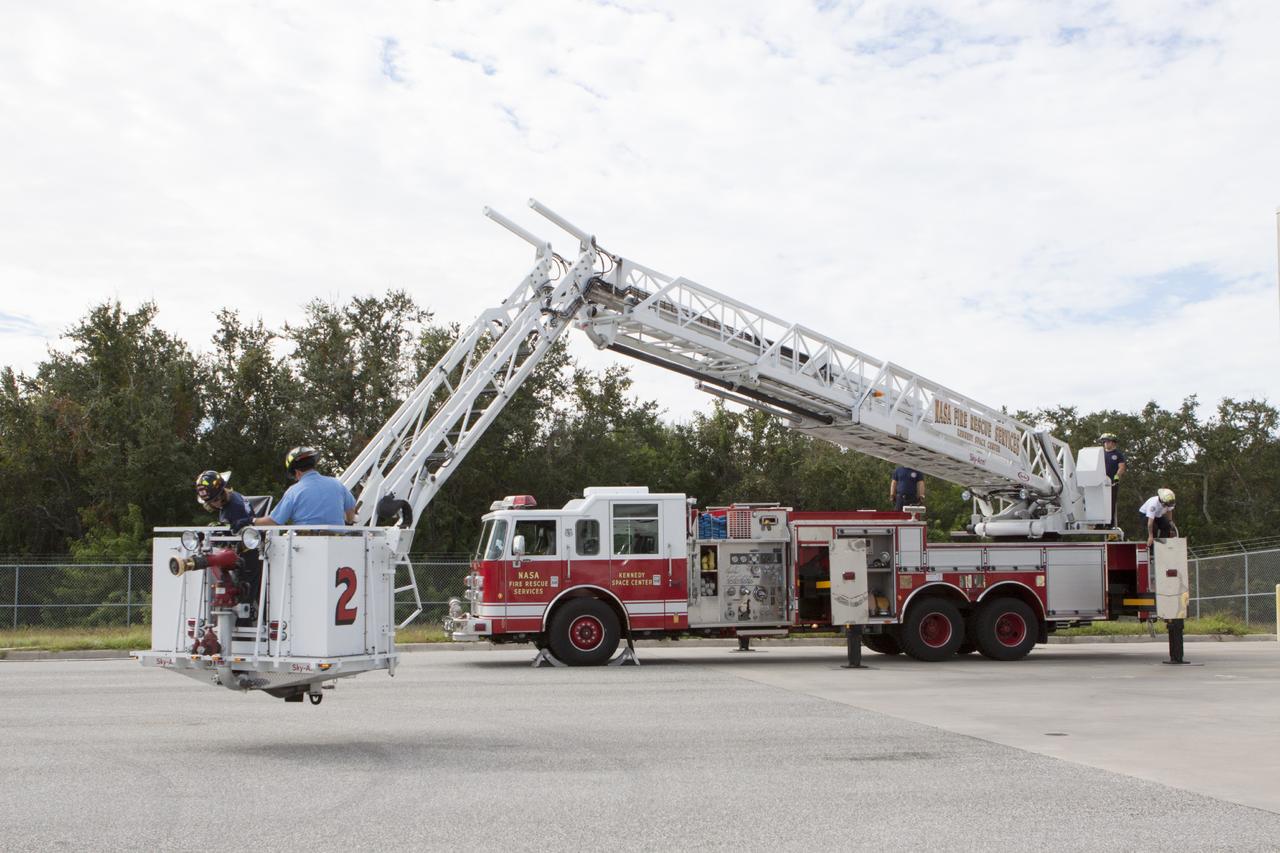
CAPE CANAVERAL, Fla. – At Fire Station No. 2 near the Shuttle Landing Facility at NASA’s Kennedy Space Center in Florida, Fire Rescue Services personnel have deployed and extended the ladder on the aerial fire truck during training in order to be certified in the operation and use of the vehicle. Two fire rescue workers are in the bucket practicing harness procedures. The center’s Fire Rescue Services recently achieved Pro Board Certification in aerial fire truck operations. Pro Board Certification is a globally recognized certification that puts on multiple courses that all fire departments throughout the world recognize and use to train their personnel. The unique aerial truck contains a 100-foot extendable ladder with a bucket at the end of it that can be used for rescues from taller buildings or aircraft rescue firefighting. Photo credit: NASA/Kim Shiflett
CAPE CANAVERAL, Fla. – At Fire Station No. 2 near the Shuttle Landing Facility at NASA’s Kennedy Space Center in Florida, Fire Rescue Services personnel have deployed and extended the ladder on the aerial fire truck during training in order to be certified in the operation and use of the vehicle. The stabilizers have been deployed on either side of the fire truck. The center’s Fire Rescue Services recently achieved Pro Board Certification in aerial fire truck operations. Pro Board Certification is a globally recognized certification that puts on multiple courses that all fire departments throughout the world recognize and use to train their personnel. The unique aerial truck contains a 100-foot extendable ladder with a bucket at the end of it that can be used for rescues from taller buildings or aircraft rescue firefighting. Photo credit: NASA/Kim Shiflett
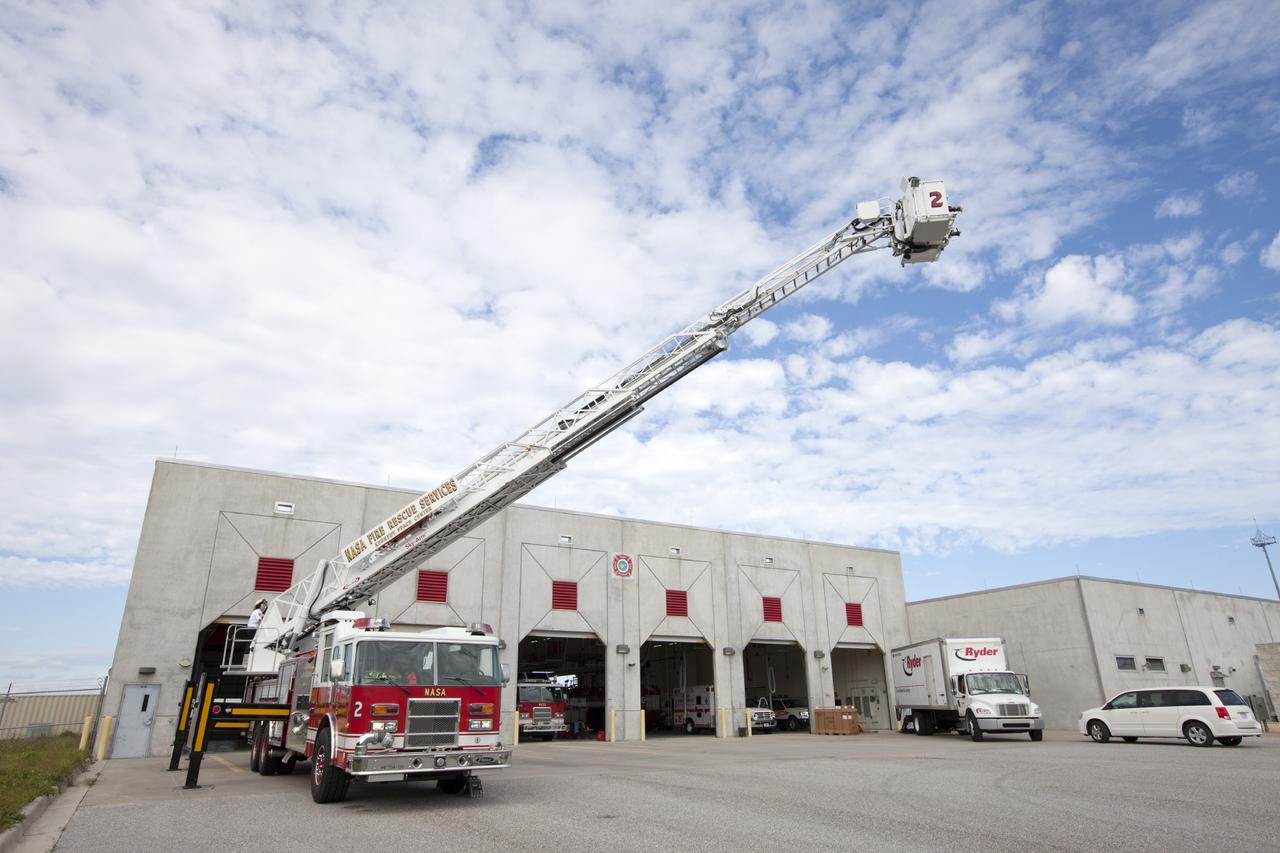
CAPE CANAVERAL, Fla. – At Fire Station No. 2 near the Shuttle Landing Facility at NASA’s Kennedy Space Center in Florida, Fire Rescue Services personnel have deployed and extended the ladder on the aerial fire truck during training in order to be certified in the operation and use of the vehicle. The center’s Fire Rescue Services recently achieved Pro Board Certification in aerial fire truck operations. Pro Board Certification is a globally recognized certification that puts on multiple courses that all fire departments throughout the world recognize and use to train their personnel. The unique aerial truck contains a 100-foot extendable ladder with a bucket at the end of it that can be used for rescues from taller buildings or aircraft rescue firefighting. Photo credit: NASA/Kim Shiflett
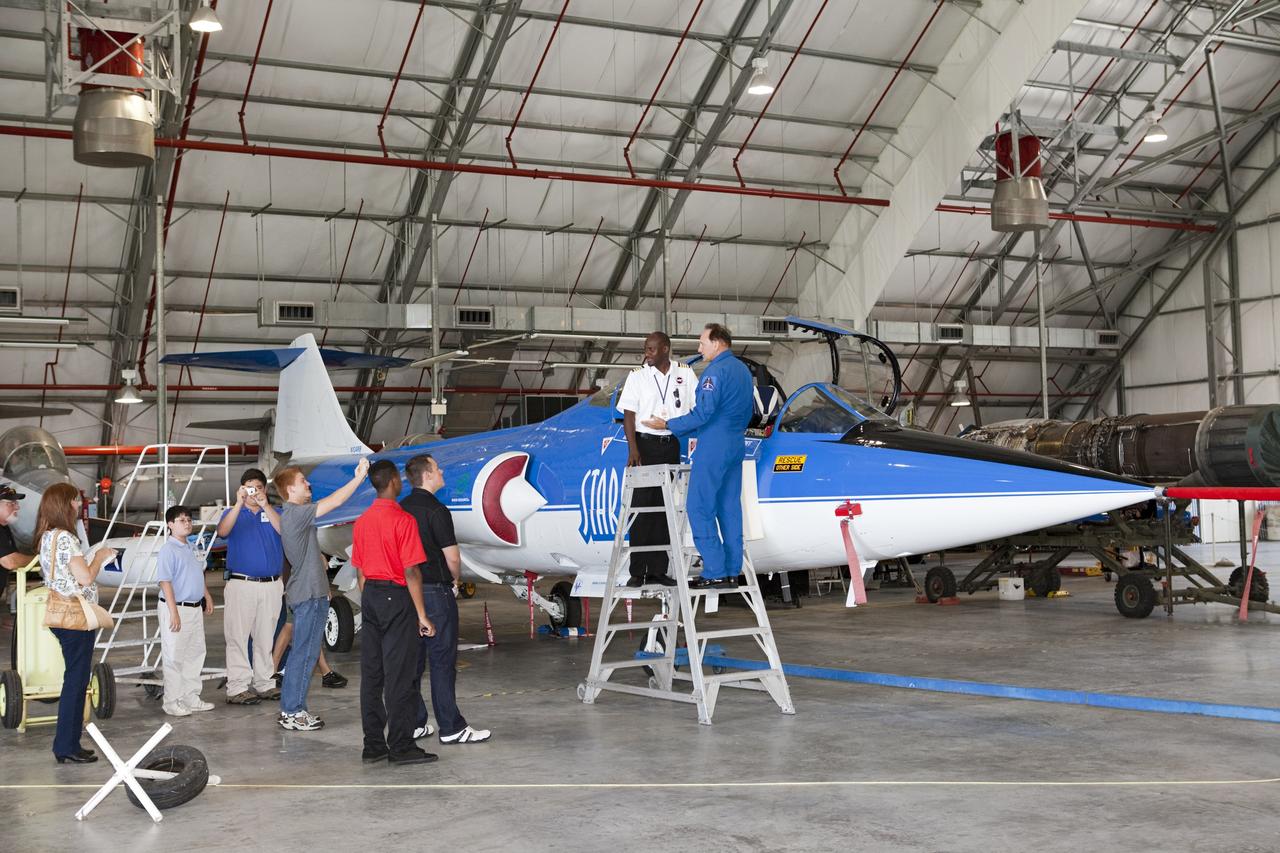
CAPE CANAVERAL, Fla. – Inside the RLV Hangar near NASA Kennedy Space Center’s Shuttle Landing Facility, or SLF, in Florida, Florida Tech, or FIT, Aviation Program Supervisor Tennesse Garvey, at left on the ladder, and several students view an F104 Starfighter. At right, on the ladder is Starfighter Director Rick Svetkoff. The FIT aviation instructors and their students arrived at the SLF in Cherokee Warrior and Cessna 172S lightweight aircraft. The middle and high school students are participating in FIT’s Av/Aero summer camp experience. They and their flight instructors toured the SLF midfield control tower, viewed F104 Starfighters and NASA Huey helicopters in the RLV Hangar, viewed the runway plaques marking wheels stop for each of the three space shuttles, and toured the Vehicle Assembly Building where space shuttle Atlantis currently is stored. Photo credit: NASA/Kim Shiflett
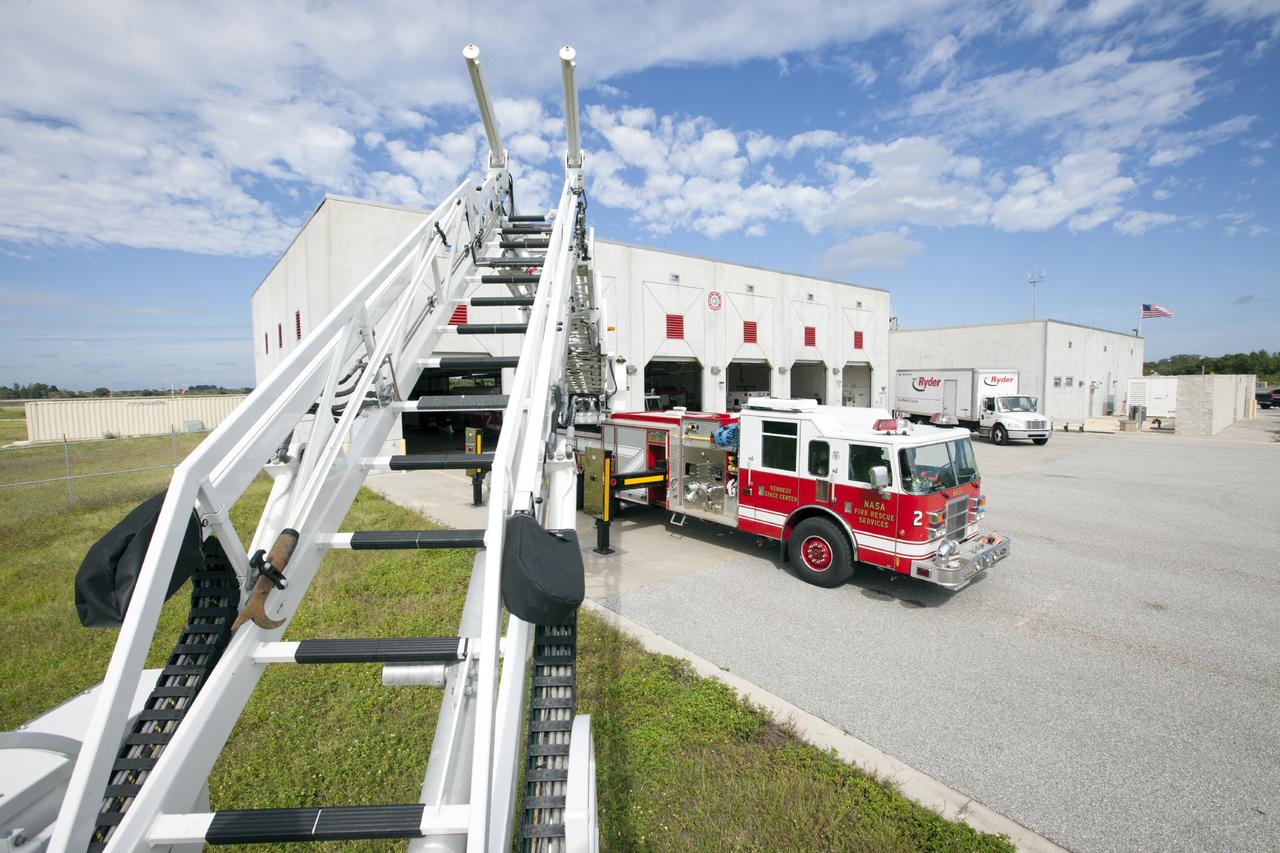
CAPE CANAVERAL, Fla. – At Fire Station No. 2 near the Shuttle Landing Facility at NASA’s Kennedy Space Center in Florida, Fire Rescue Services personnel have deployed and extended the ladder on the aerial fire truck during training in order to be certified in the operation and use of the vehicle. The stabilizers have been deployed on either side of the fire truck. The center’s Fire Rescue Services recently achieved Pro Board Certification in aerial fire truck operations. Pro Board Certification is a globally recognized certification that puts on multiple courses that all fire departments throughout the world recognize and use to train their personnel. The unique aerial truck contains a 100-foot extendable ladder with a bucket at the end of it that can be used for rescues from taller buildings or aircraft rescue firefighting. Photo credit: NASA/Kim Shiflett
CAPE CANAVERAL, Fla. – At Fire Station No. 2 near the Shuttle Landing Facility at NASA’s Kennedy Space Center in Florida, Fire Rescue Services personnel lower the extendable ladder so that two fire rescue workers can exit the bucket during training to be certified in the operation and use of the vehicle. The center’s Fire Rescue Services recently achieved Pro Board Certification in aerial fire truck operations. Pro Board Certification is a globally recognized certification that puts on multiple courses that all fire departments throughout the world recognize and use to train their personnel. The unique aerial truck contains a 100-foot extendable ladder with a bucket at the end of it that can be used for rescues from taller buildings or aircraft rescue firefighting. Photo credit: NASA/Kim Shiflett
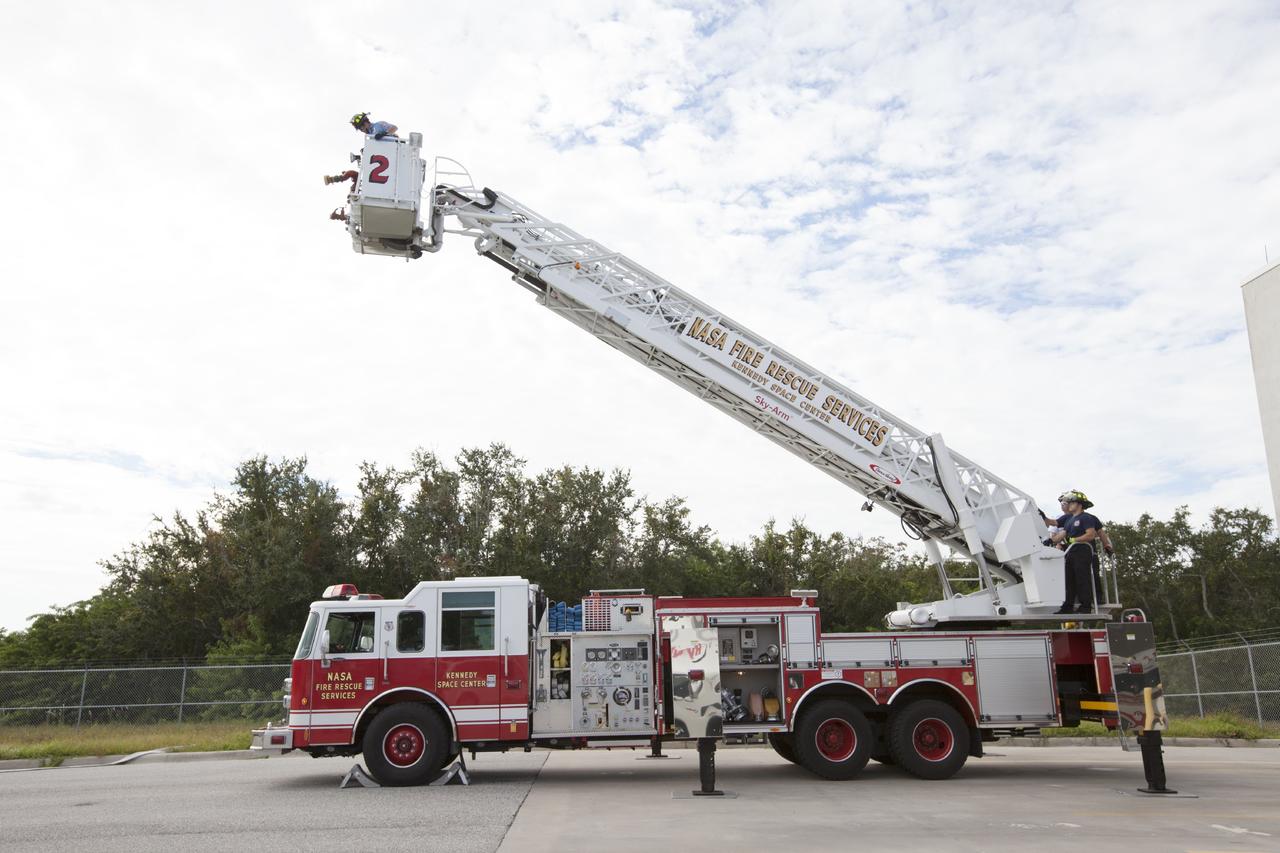
CAPE CANAVERAL, Fla. – At Fire Station No. 2 near the Shuttle Landing Facility at NASA’s Kennedy Space Center in Florida, Fire Rescue Services personnel have deployed the ladder on the aerial fire truck during training in order to be certified in the operation and use of the vehicle. The center’s Fire Rescue Services recently achieved Pro Board Certification in aerial fire truck operations. Pro Board Certification is a globally recognized certification that puts on multiple courses that all fire departments throughout the world recognize and use to train their personnel. The unique aerial truck contains a 100-foot extendable ladder with a bucket at the end of it that can be used for rescues from taller buildings or aircraft rescue firefighting. Photo credit: NASA/Kim Shiflett
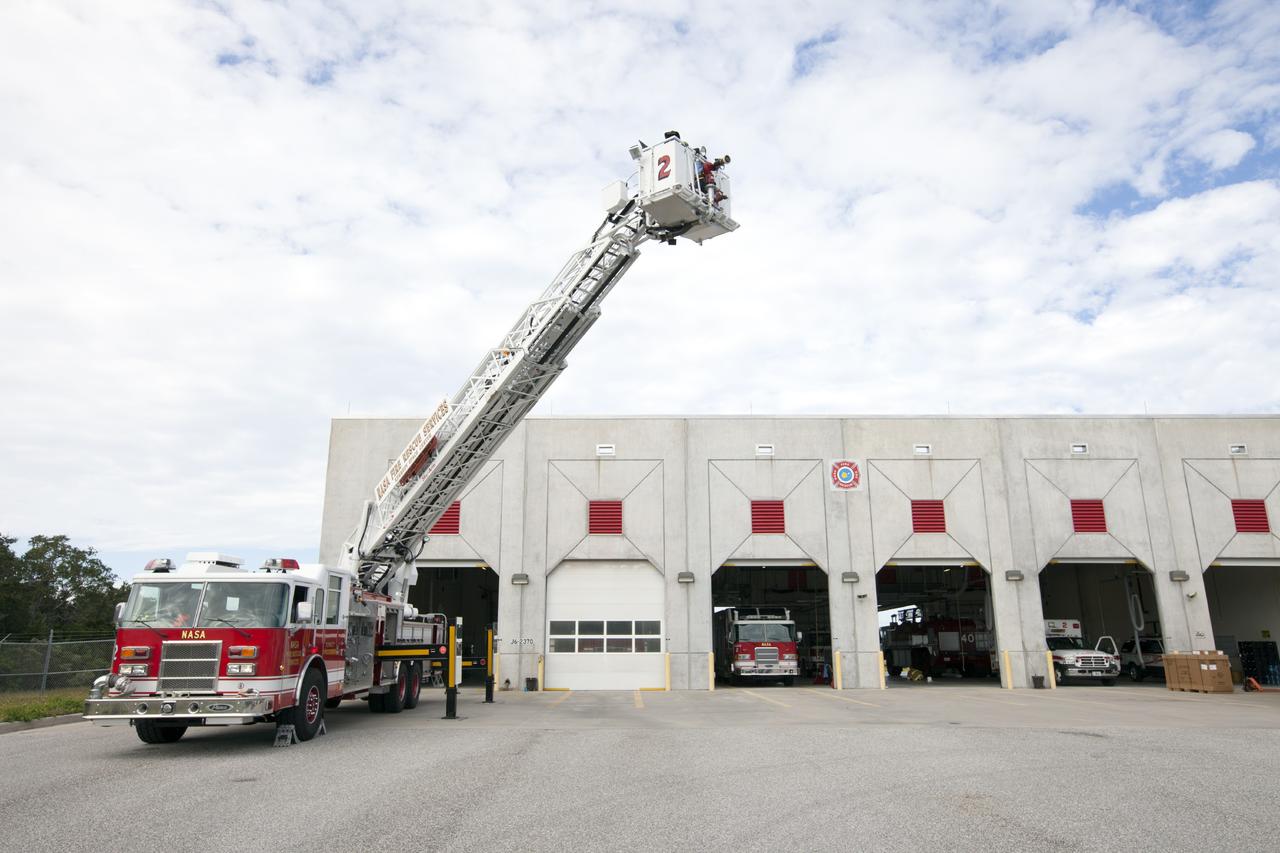
CAPE CANAVERAL, Fla. – At Fire Station No. 2 near the Shuttle Landing Facility at NASA’s Kennedy Space Center in Florida, Fire Rescue Services personnel have deployed the ladder on the aerial fire truck during training in order to be certified in the operation and use of the vehicle. The center’s Fire Rescue Services recently achieved Pro Board Certification in aerial fire truck operations. Pro Board Certification is a globally recognized certification that puts on multiple courses that all fire departments throughout the world recognize and use to train their personnel. The unique aerial truck contains a 100-foot extendable ladder with a bucket at the end of it that can be used for rescues from taller buildings or aircraft rescue firefighting. Photo credit: NASA/Kim Shiflett
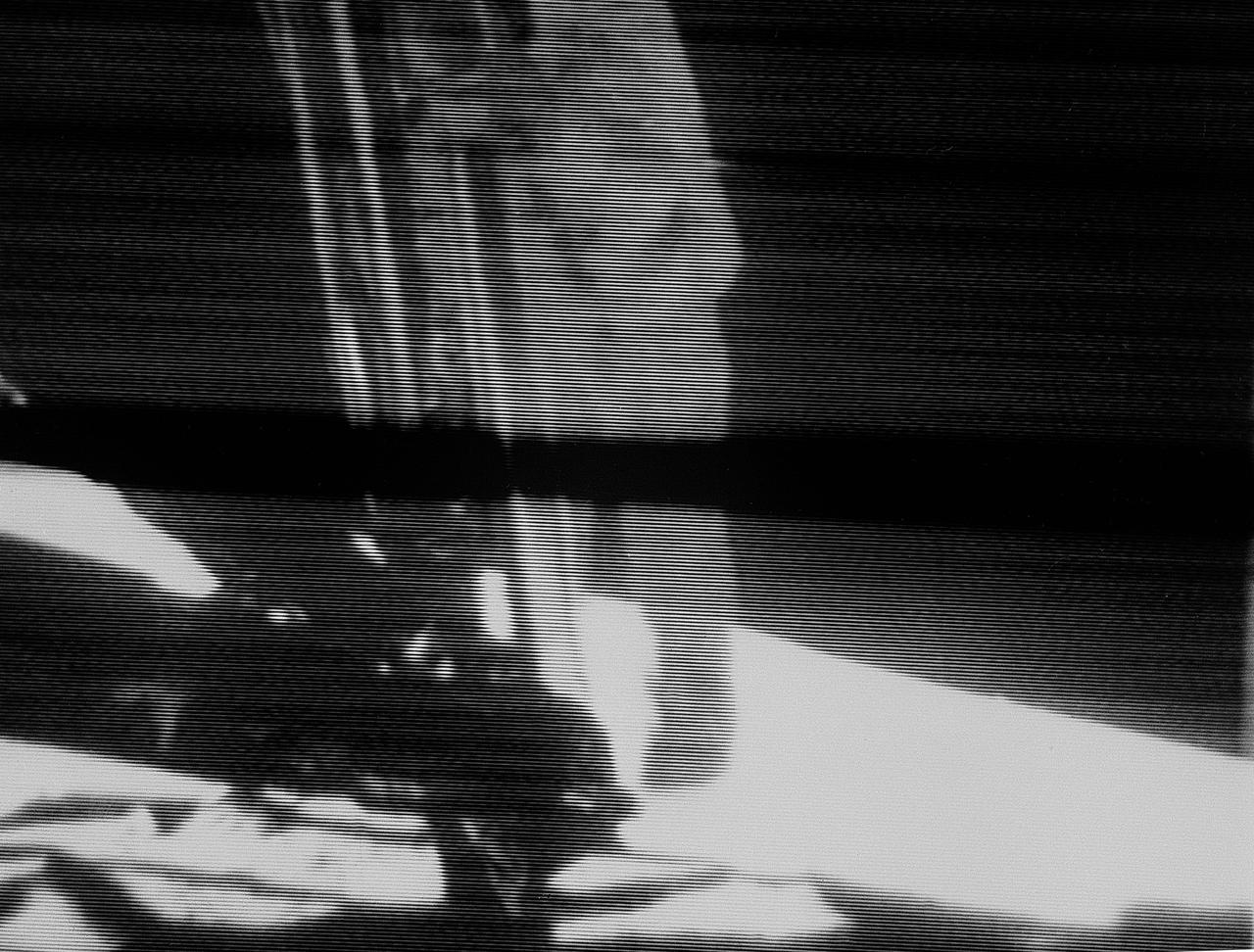
S69-42583 (20 July 1969) --- Astronaut Neil A. Armstrong, Apollo 11 commander, descends the ladder of the Apollo 11 Lunar Module (LM) prior to making the first step by man on another celestial body. This view is a black and white reproduction taken from a telecast by the Apollo 11 lunar surface camera during extravehicular activity (EVA). The black bar running through the center of the picture is an anomaly in the television ground data system at the Goldstone Tracking Station.
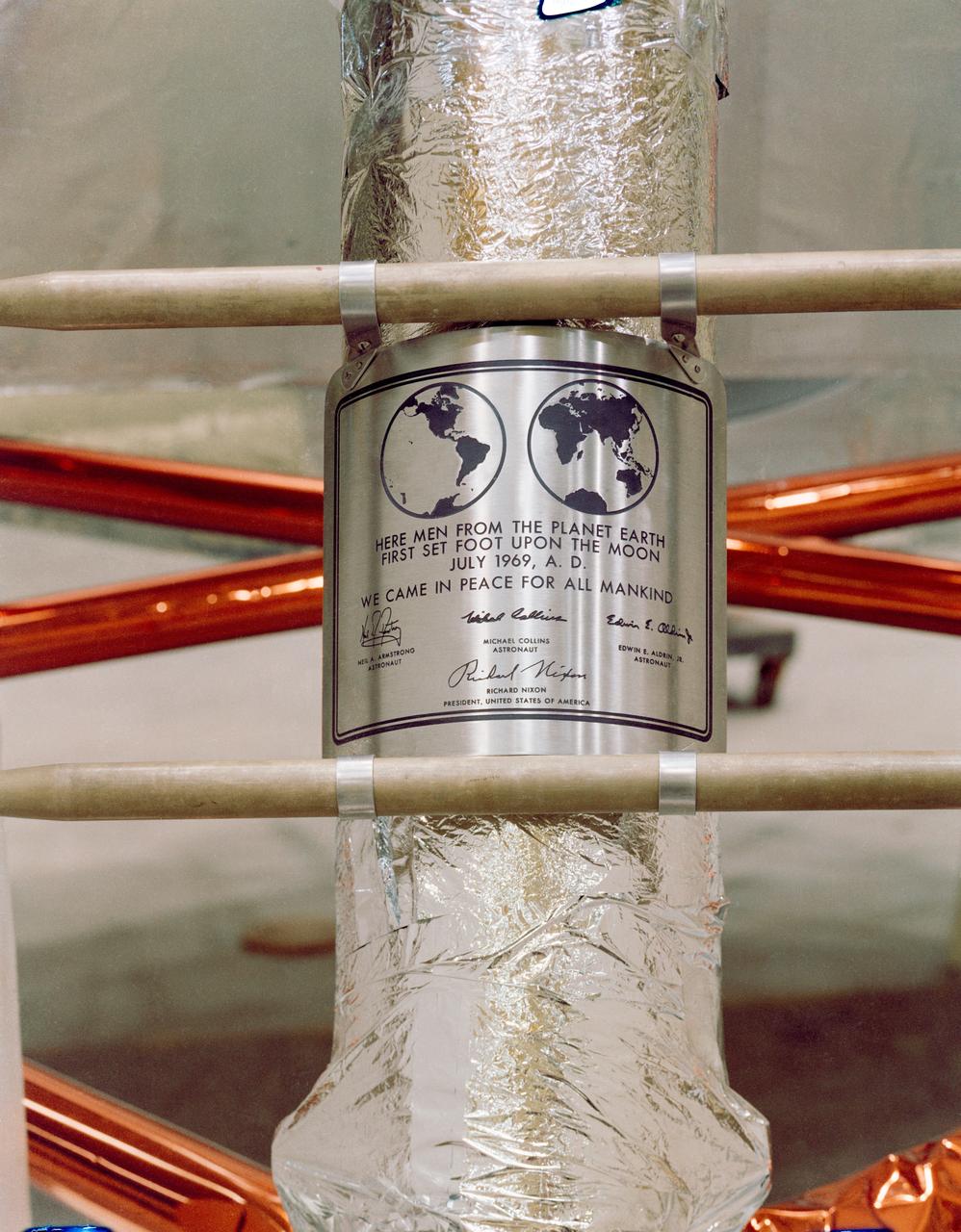
S69-38749 (July 1969) --- Close-up view of the plaque which the Apollo 11 astronauts will leave behind on the moon in commemoration of the historic event. The plaque is made of stainless steel measuring nine by seven and five-eighths inches, and one-sixteenth inch thick. The plaque will be attached to the ladder on the landing gear strut on the descent stage of the Apollo 11 Lunar Module (LM). Covering the plaque during flight will be a thin sheet of stainless steel which will be removed on the lunar surface.
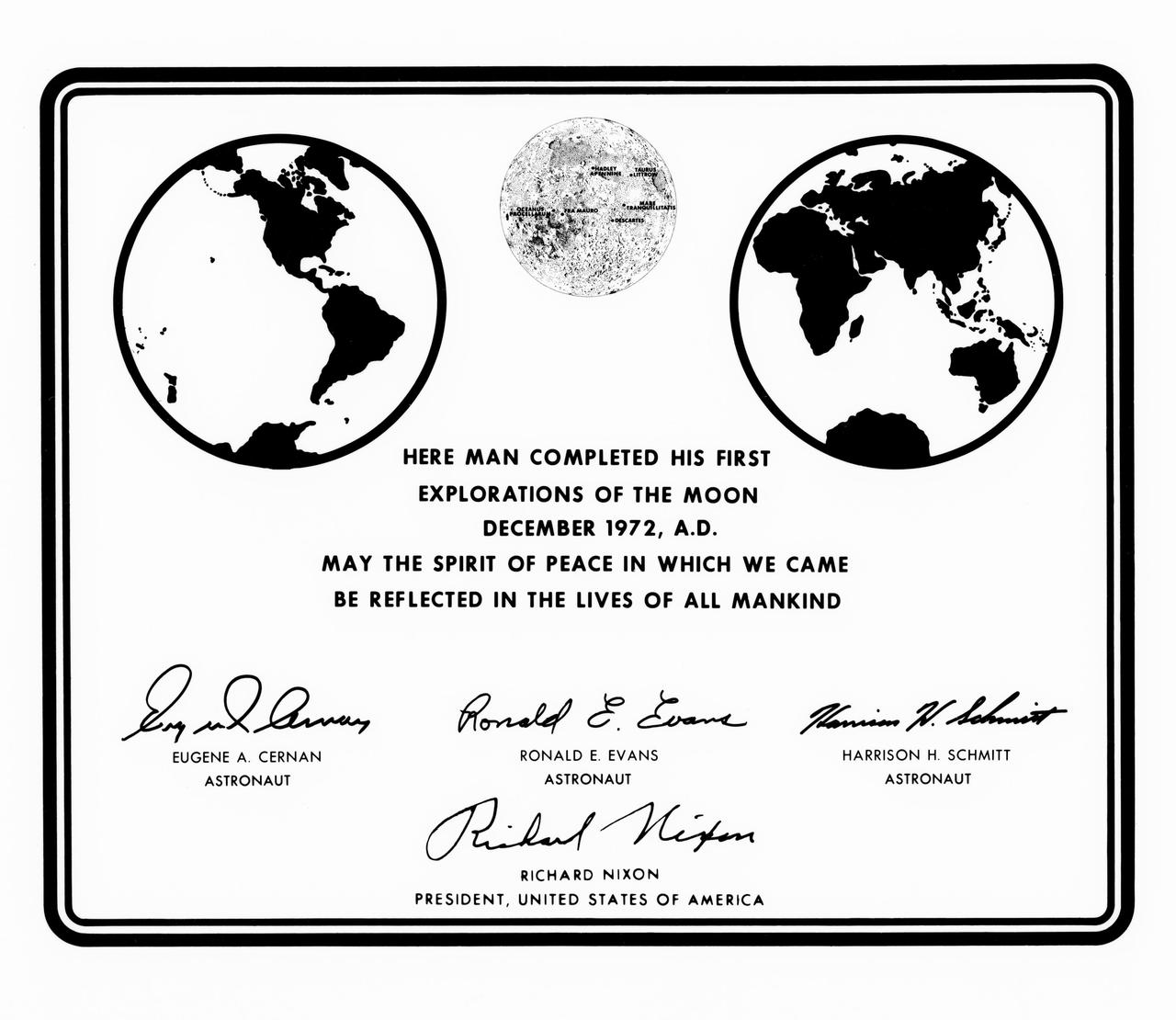
S72-55169 (14 Dec. 1972) --- A photographic replica of the plaque which the Apollo 17 astronauts left behind at the Taurus-Littrow landing site. Apollo 17 is the final lunar landing mission in NASA's Apollo program. The commemorative plaque was unveiled at the close of the third extravehicular activity (EVA). The plaque is made of stainless steel measuring nine by seven and five-eighths inches, and one-sixteenth inch thick. It is attached to the ladder on the landing gear strut on the descent stage of Apollo 17 Lunar Module (LM) "Challenger".
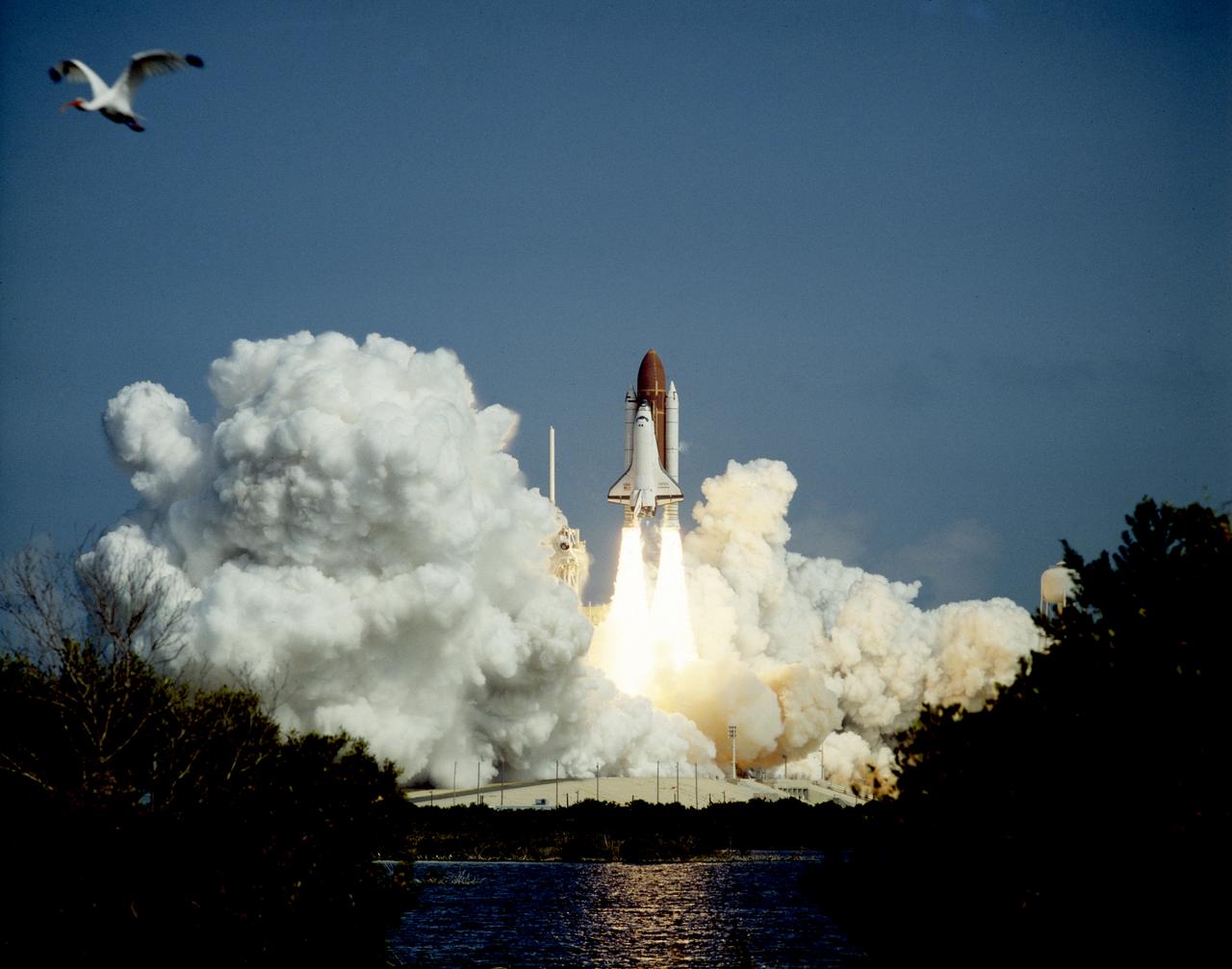
A smooth countdown culminated in a picture-perfect launch as the Space Shuttle Endeavour (STS-47) climbed skyward atop a ladder of billowing smoke. Primary payload for the plarned seven-day flight was Spacelab-J science laboratory. The second flight of Endeavour marks a number of historic firsts: the first space flight of an African-American woman, the first Japanese citizen to fly on a Space Shuttle, and the first married couple to fly in space.
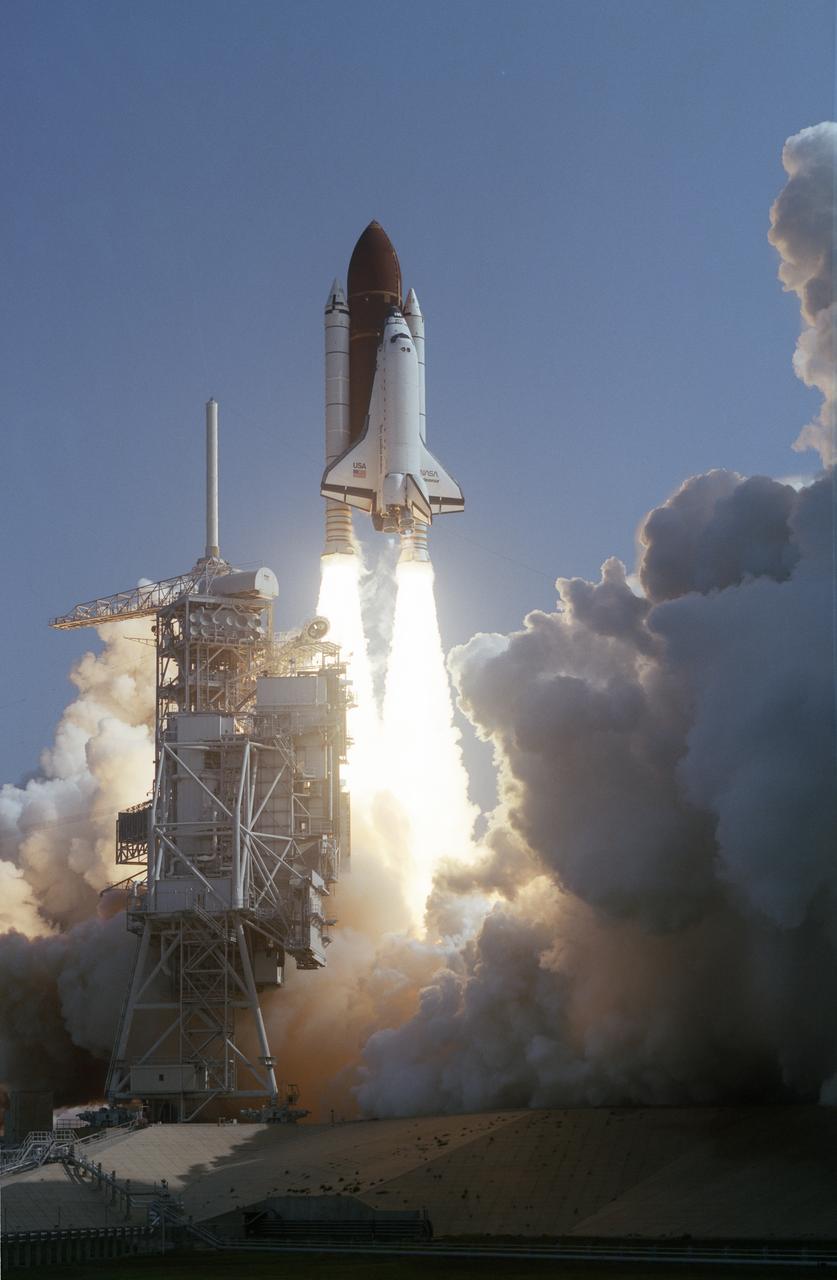
A smooth countdown culminated in a picture-perfect launch as the Space Shuttle Orbiter Endeavour (STS-47) climbed skyward atop a ladder of billowing smoke on September 12, 1992. The primary payload for the plarned seven-day flight was the Spacelab-J science laboratory. The second flight of Endeavour marks a number of historic firsts: the first space flight of an African-American woman, the first Japanese citizen to fly on a Space Shuttle, and the first married couple to fly in space.
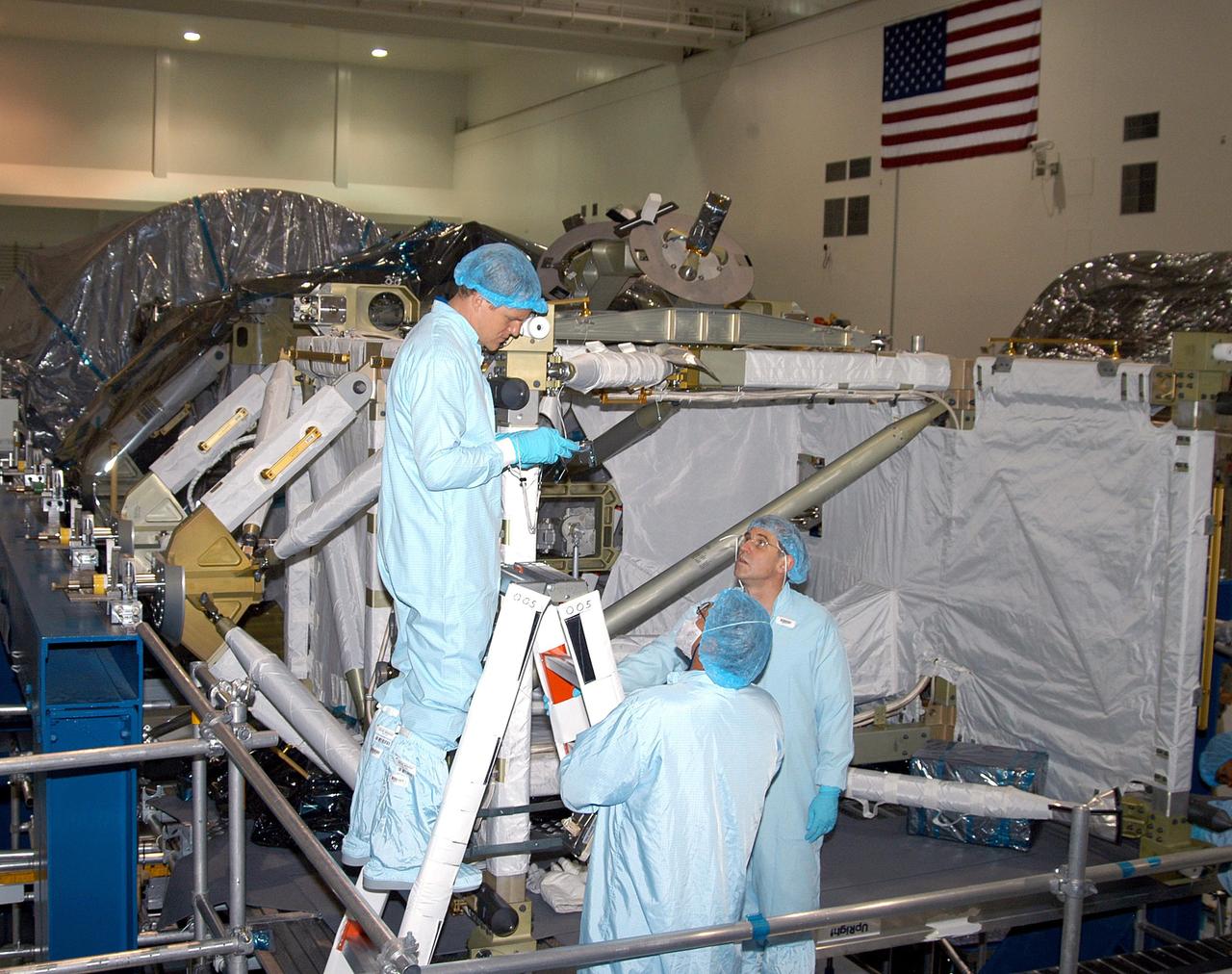
KENNEDY SPACE CENTER, FLA. - In the Space Station Processing Facility, STS-118 crew members practice using equipment for the mission. At left, on the ladder, is Mission Specialist Scott Parazynski; on the right, looking up, is Mission Specialist Dafydd Williams (Canadian Space Agency). The STS-118 mission will be delivering and installing the third starboard truss segment, the ITS S5, to the International Space Station, and carry a SPACEHAB Single Cargo Module with supplies and equipment. Launch date is under review.
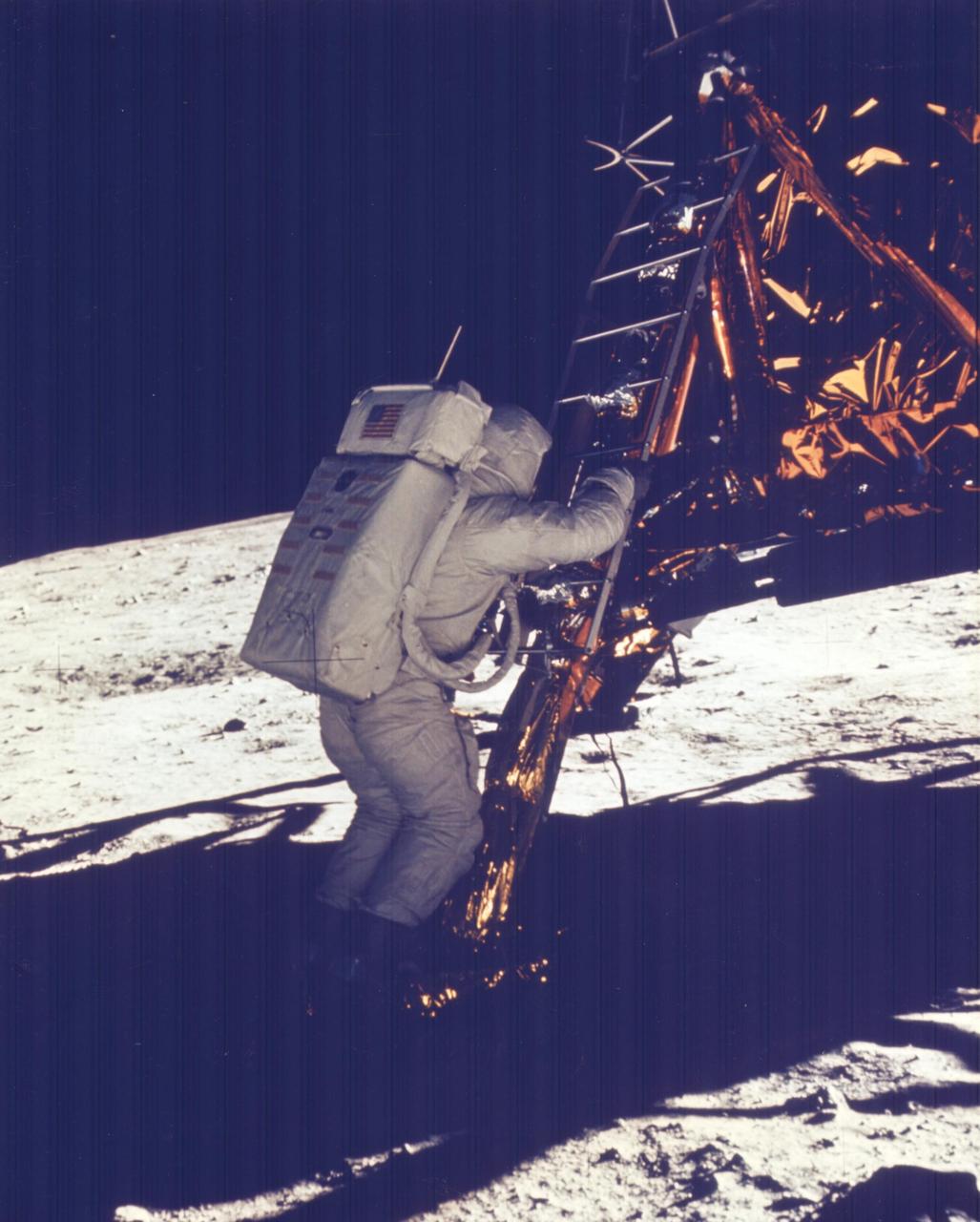
JOHNSON SPACE CENTER, HOUSTON, TEXAS - Apollo 11 Onboard Film -- Astronaut Edwin E. Aldrin Jr., Lunar Module (LM) pilot, descends the steps of the Lunar module ladder as he prepares to walk on the Moon. He had just egressed the LM. This picture was taken by astronaut Neil A. Armstrong, commander, with a 70-mm lunar surface camera during the Apollo 11 extravehicular activity.
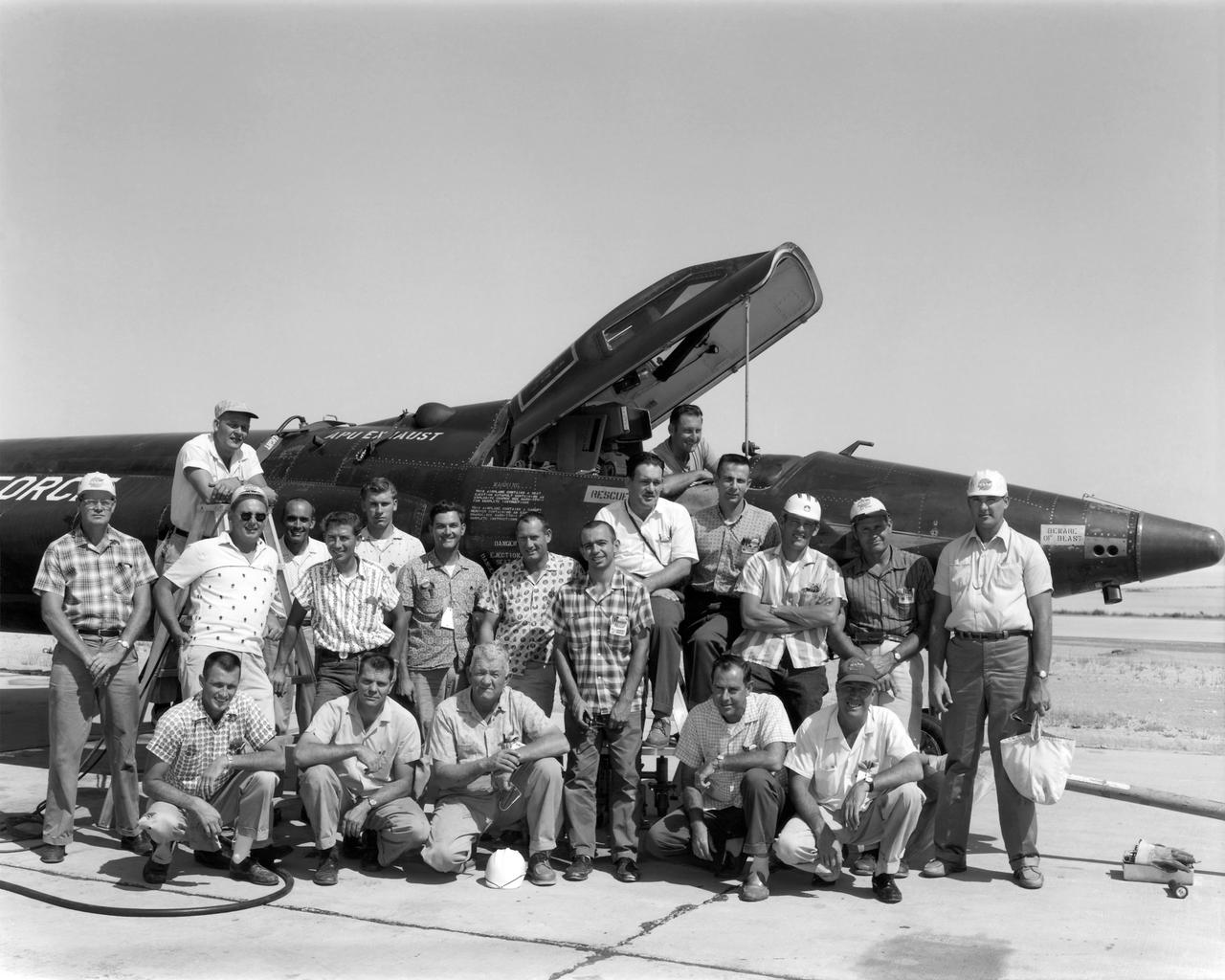
X-15 personnel July 1962 Cockpit: Edward "Ed" Nice Ladder: Thomas "Tom" McAlister Back Row, left to right: William Clark, Edward "Ed" Sabo, Donald "Don" Hall, Billy Furr, Allen Dustin, Raymond "Ray" White, George E. Trott, Alfred "Al" Grieshaber, Merle Curtis, LeRoy "Lee" Adelsbach, Allen Lowe, Jay L. King, Lorenzo "Larry" Barnett. Kneeling, left to right: Byron Gibbs, Price "Bob" Workman, Ira Cupp, unidentified, John Gordon.
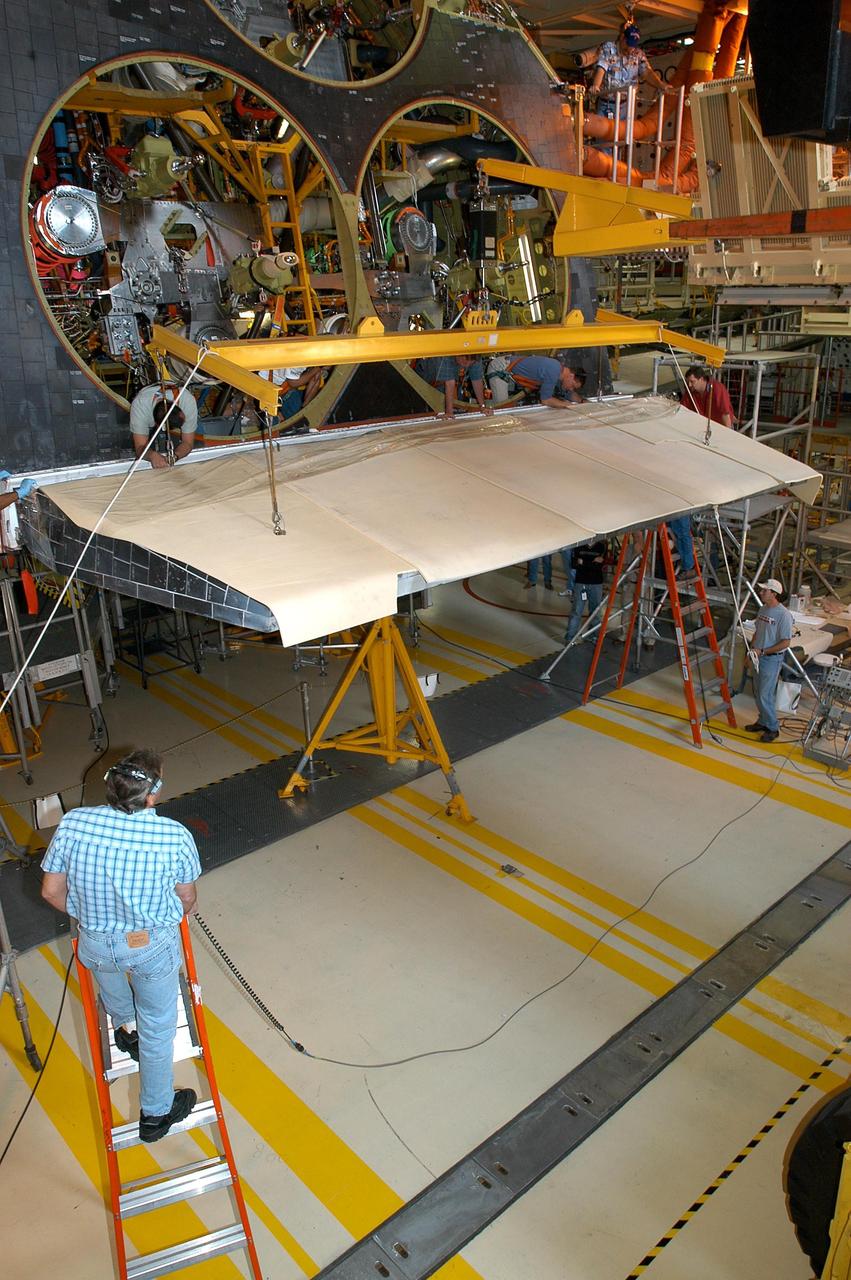
KENNEDY SPACE CENTER, FLA. - A worker on a ladder (lower left) observes installation of the body flap onto the orbiter Discovery. The body flap is an aluminum structure consisting of ribs, spars, skin panels and a trailing edge assembly. It thermally shields the three main engines during entry and provides pitch control trim during landing approach. Discovery is being processed for launch on the first Return to Flight mission, STS-114.
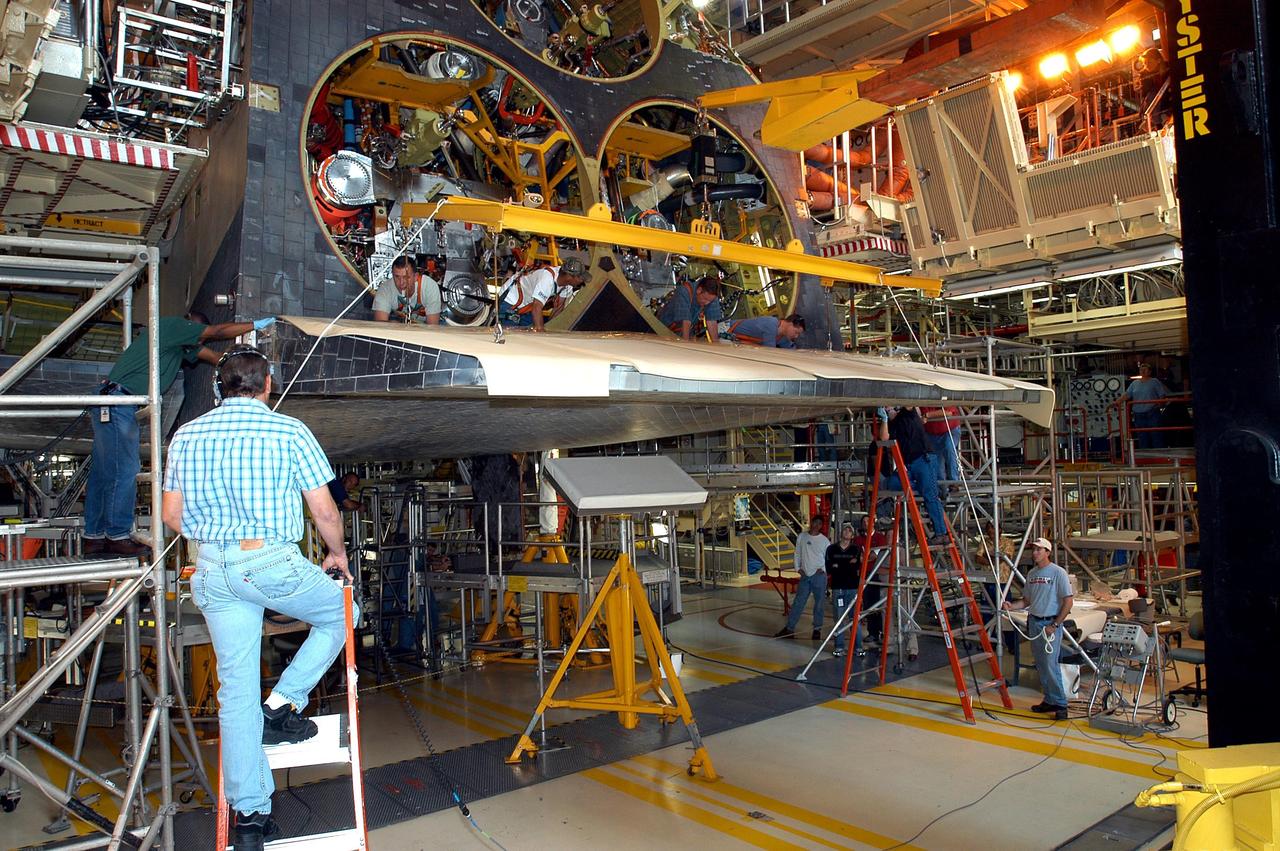
KENNEDY SPACE CENTER, FLA. - Workers on ladders (left and right) check installation of the body flap onto the orbiter Discovery. The body flap is an aluminum structure consisting of ribs, spars, skin panels and a trailing edge assembly. It thermally shields the three main engines during entry and provides pitch control trim during landing approach. Discovery is being processed for launch on the first Return to Flight mission, STS-114.
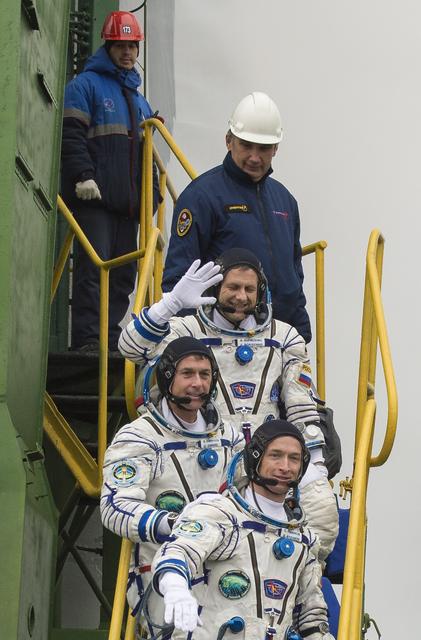
Expedition 49 flight engineer Andrey Borisenko of Roscosmos, top, flight engineer Shane Kimbrough of NASA, middle, and Soyuz commander Sergey Ryzhikov of Roscosmos, bottom, climb the ladder to the elevator as they prepare to board the Soyuz MS-02 rocket for launch, Wednesday, Oct. 19, 2016 at the Baikonur Cosmodrome in Kazakhstan. Kimbrough, Borisenko, and Ryzhikov will spend the next four months living and working aboard the International Space Station. Photo Credit: (NASA/Joel Kowsky)
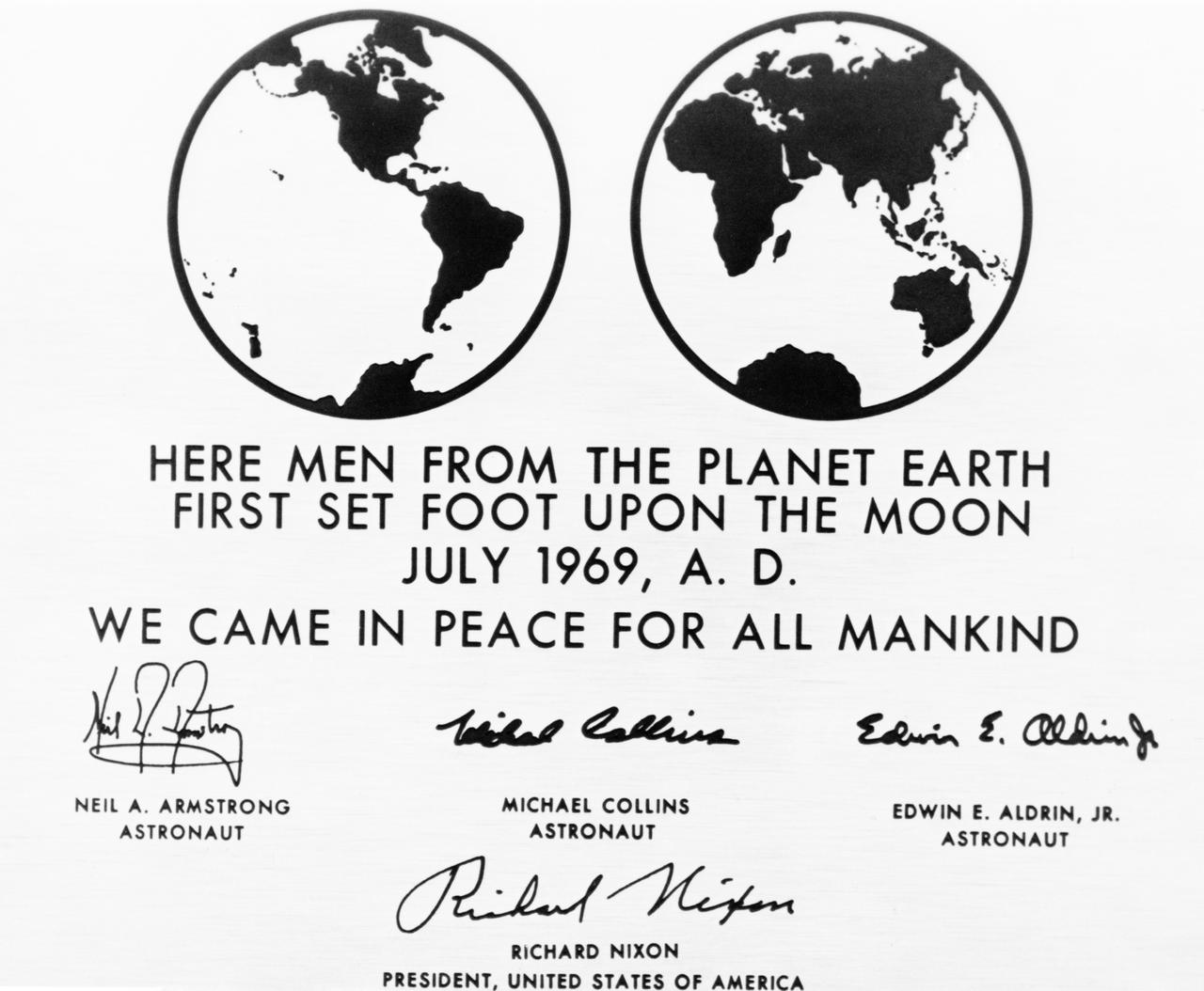
S69-39334 (July 1969) --- This is a replica of the plaque which the Apollo 11 astronauts will leave behind on the moon in commemoration of the historic event. The plaque is made of stainless steel, measuring nine by seven and five-eighths inches, and one-sixteenth inch thick. The plaque will be attached to the ladder on the landing gear strut on the descent stage of the Apollo 11 Lunar Module (LM). Covering the plaque during the flight will be a thin sheet of stainless steel which will be removed on the lunar surface.
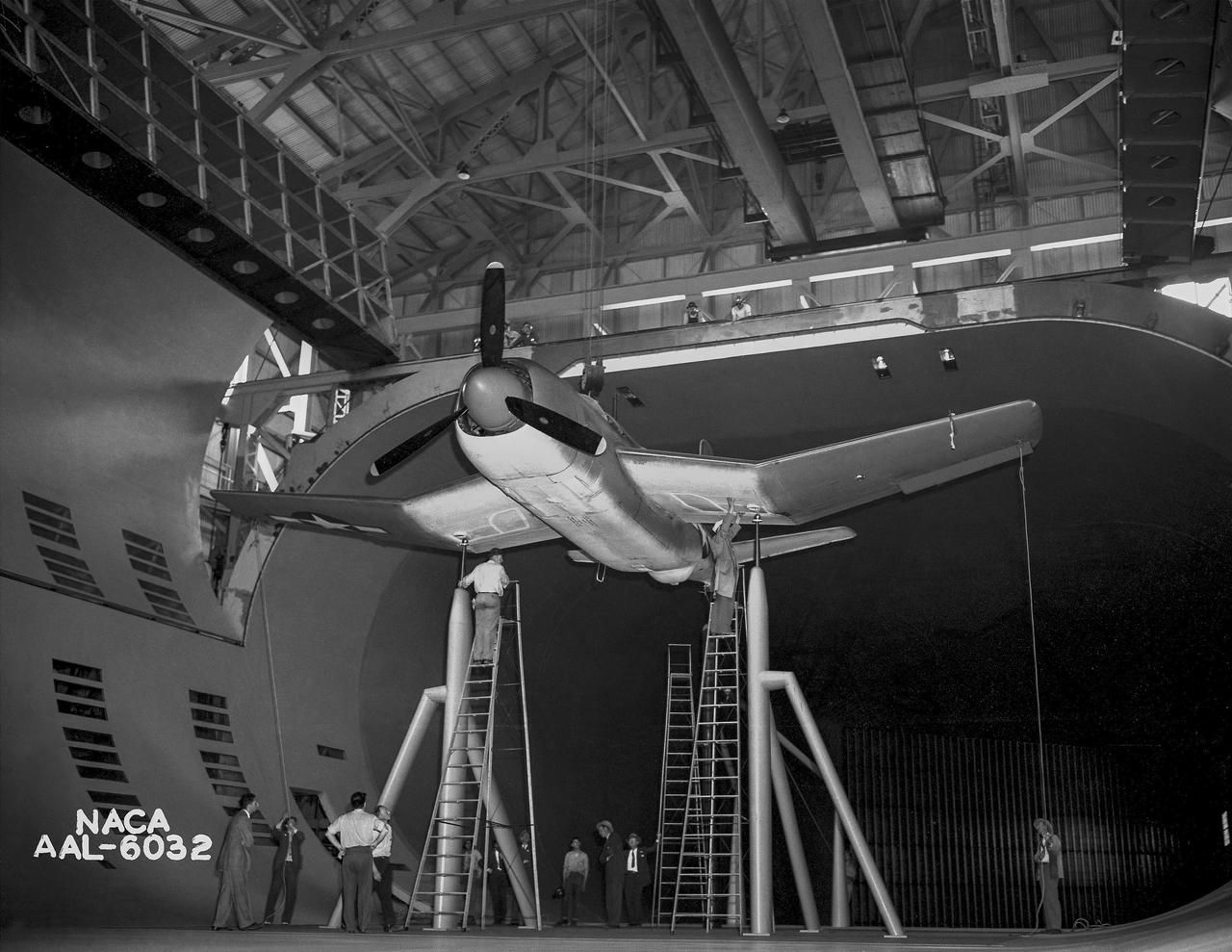
Test section of the Ames 40 x 80 foot wind tunnel with the overhead doors open. XSB2D-1 airplane being lowered onto the struts by the overhead crane. Mechanics and engineers on orchard ladders aligning the model with ball sockets on the struts. The Douglas BTD Destroyer was an American dive/ torpedo bomber developed for the United States Navy during World War II.
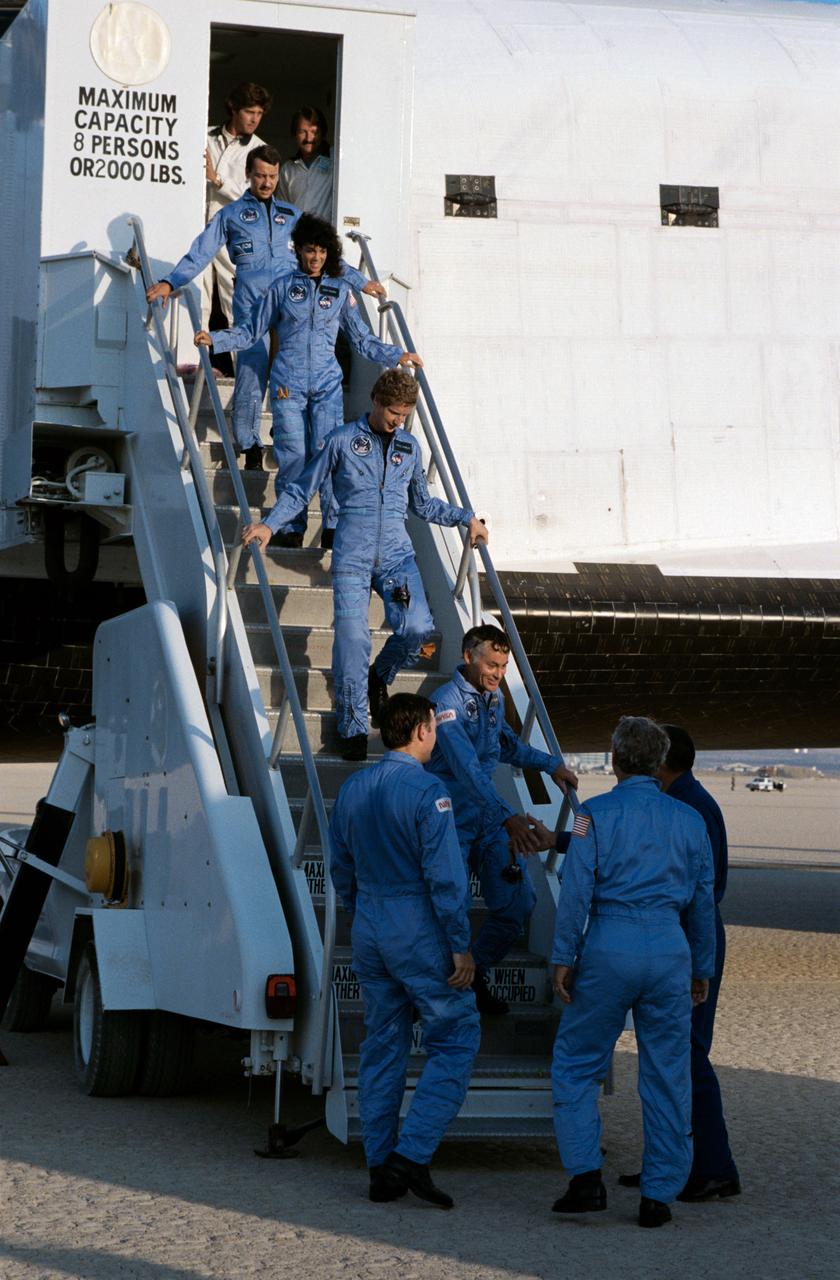
The crew of the STS 41-D mission exit the orbiter after landing at Edwards Air Force Base in California. Starting at the top of the ladder is Astronaut Charles D. Walker, payload specialist; Judith A. Resnik, mission specialist; Steven A. Hawley, mission specialist; and Richard M. Mike Mullane, mission specialist. Waiting at the bottom of the ramp are Astronaut Mike Coats (left), pilot and Henry W. Hartsfield, Jr. (center), crew commander.
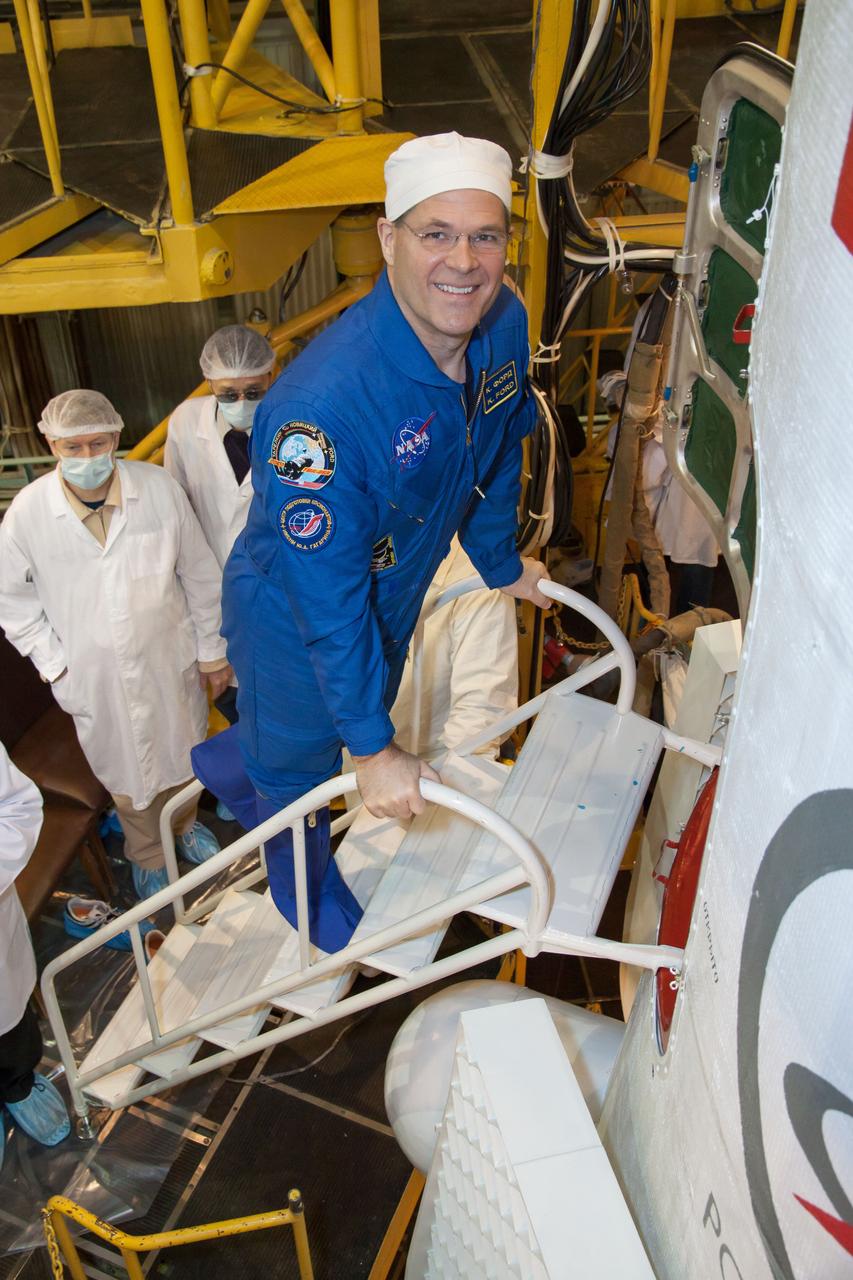
All smiles, Expedition 33/34 Flight Engineer Kevin Ford of NASA climbs the ladder to the Soyuz TMA-06M spacecraft in the Integration Facility at the Baikonur Cosmodrome in Kazakhstan October 18, 2012 during the completion of the final “fit check” dress rehearsal prior to his launch. Ford, Soyuz Commander Oleg Novitskiy and Flight Engineer Evgeny Tarelkin will be launched from the Baikonur Cosmodrome October 23 for a five-month mission on the International Space Station. NASA/Victor Zelentsov
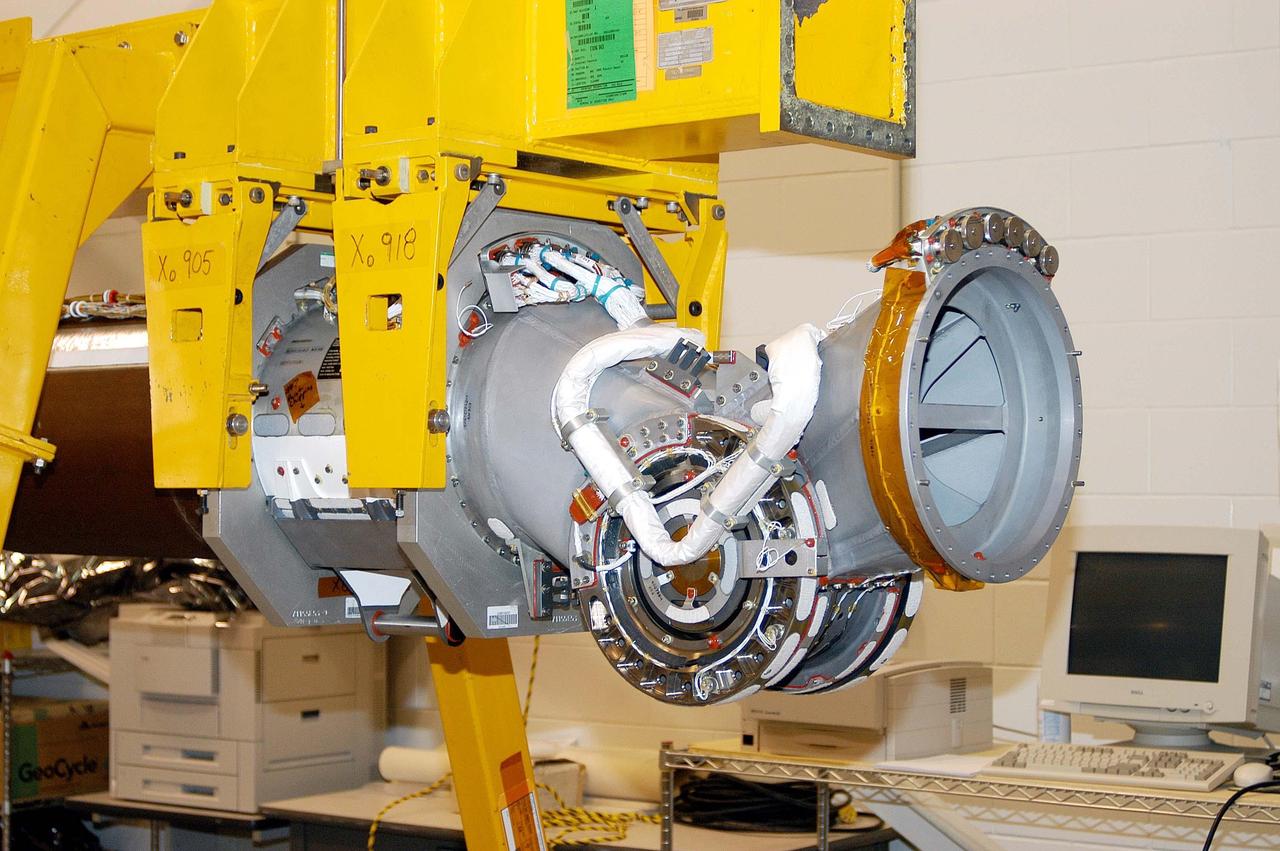
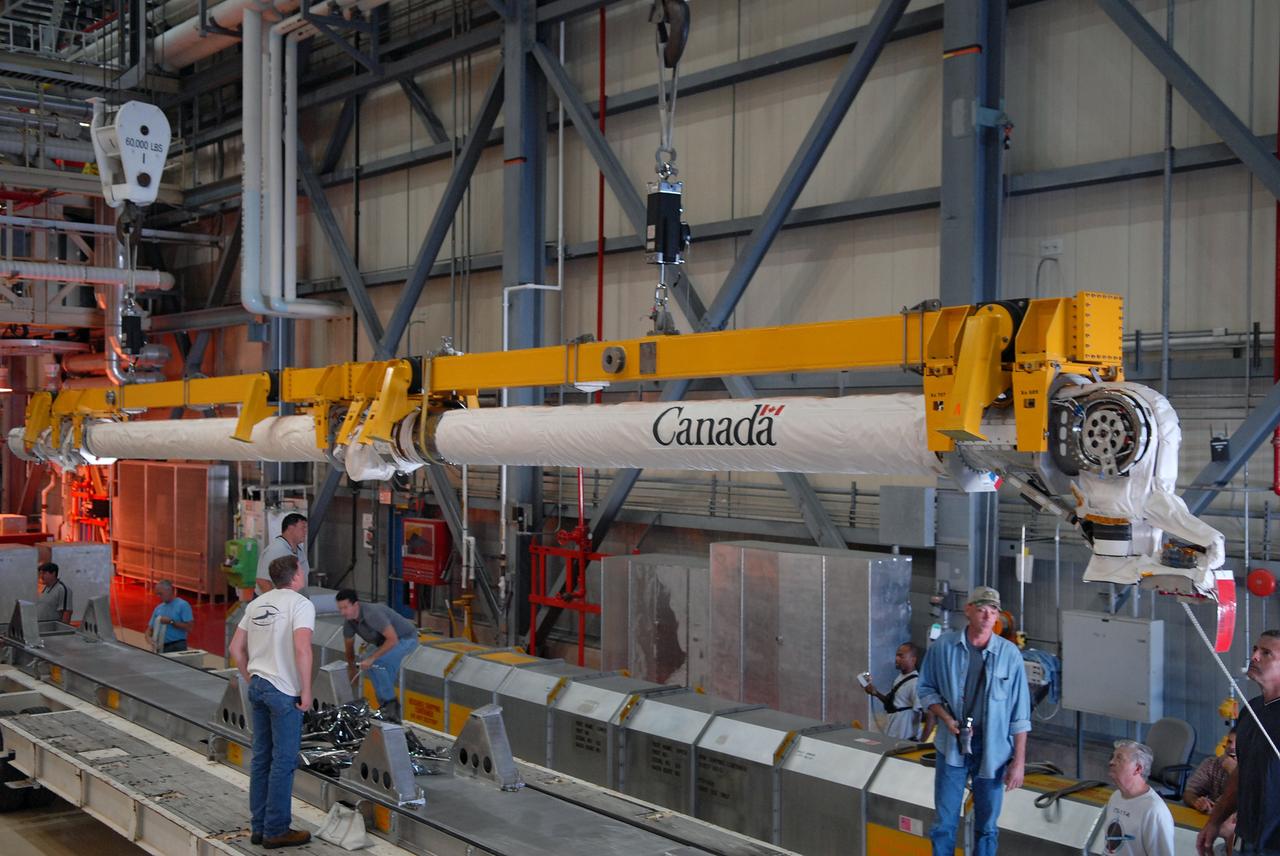
KENNEDY SPACE CENTER, FLA. - The Remote Manipulator System (RMS), also known as the Canadian robotic arm, for the orbiter Discovery has arrived at KSC’s Vehicle Assembly Building Lab. The part seen on the end is one of the joints that allow the basic structure of the arm to maneuver similar to a human arm. The RMS is used to deploy and retrieve payloads, provide a mobile extension ladder or foot restraints for crew members during extravehicular activities; and to aid the flight crew members in viewing surfaces of the orbiter or payloads through a television camera on the RMS. The arm The RMS is used to deploy and retrieve payloads, provide a mobile extension ladder or foot restraints for crew members during extravehicular activities; and to aid the flight crew members in viewing surfaces of the orbiter or payloads through a television camera on the RMS. The arm is also serving as the base for the new Orbiter Boom Sensor System (OBSS), one of the safety measures for Return to Flight, equipping the Shuttle with cameras and laser systems to inspect the Shuttle’s Thermal Protection System while in space. Discovery is scheduled for a launch planning window of March 2005 on mission STS-114.
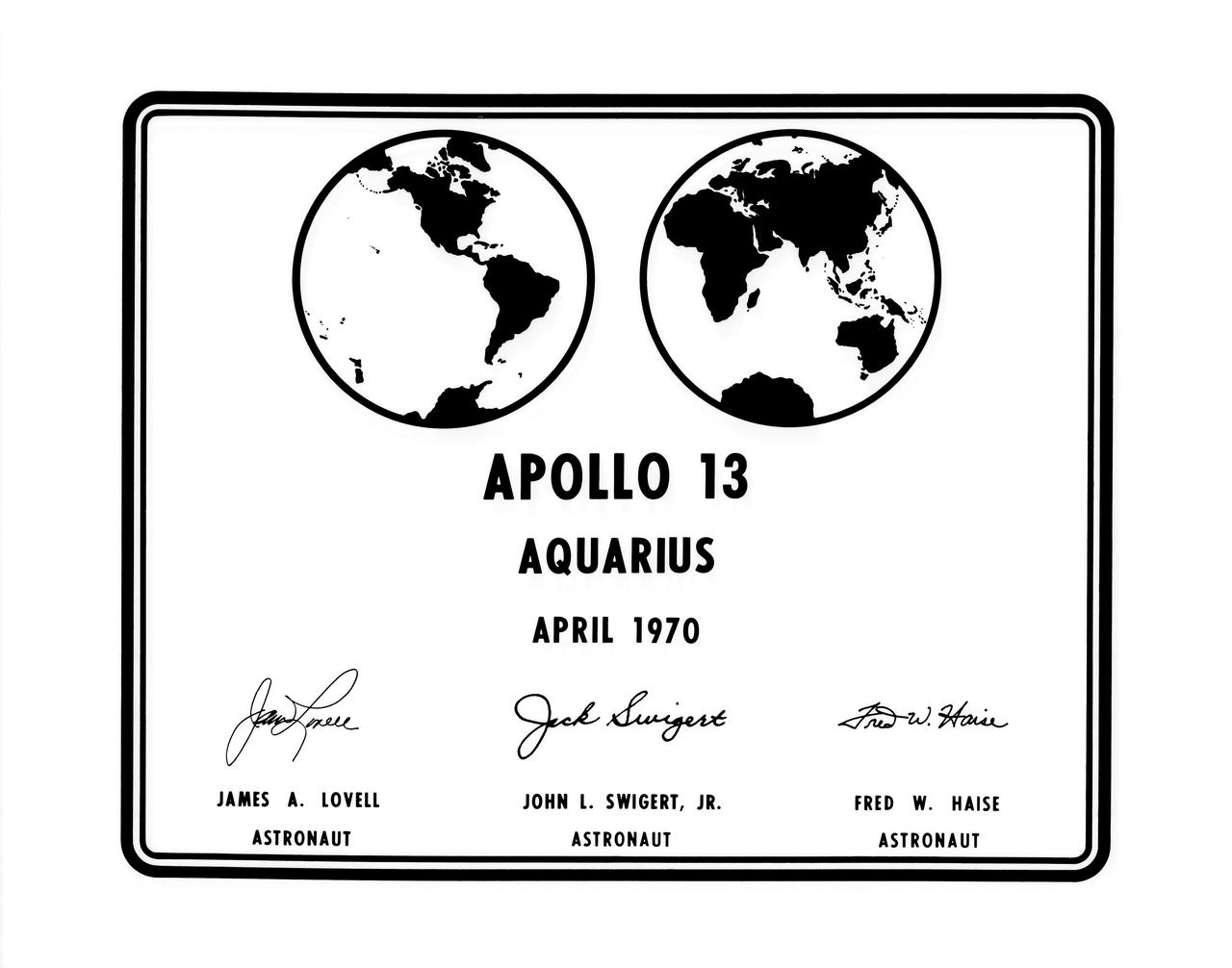
S70-34685 (April 1970) --- A photographic replica of the plaque which the Apollo 13 astronauts will leave behind on the moon during their lunar landing mission. Astronauts James A. Lovell Jr., commander; and Fred W. Haise Jr., lunar module pilot, will descend to the lunar surface in the Lunar Module (LM) "Aquarius". Astronaut John L. Swigert Jr., command module pilot, will remain with the Command and Service Modules (CSM) in lunar orbit. The plaque will be attached to the ladder of the landing gear strut on the LM?s descent stage. Commemorative plaques were also left on the moon by the Apollo 11 and Apollo 12 astronauts.
CAPE CANAVERAL, Fla. – In Orbiter Processing Facility bay 3 at NASA's Kennedy Space Center in Florida, the remote manipulator system, or RMS, removed from space shuttle Discovery is lowered toward a storage platform. The RMS is used to grab, or grapple, the payload as well as retrieve, repair and deploy satellites; provide a mobile extension ladder for spacewalking crewmembers; and be used as an inspection aid to allow flight crew members to view the orbiter’s or payload’s surfaces through a TV camera on the arm. Discovery is targeted to launch Aug. 6 on the STS-128 mission. Photo credit: NASA/Jack Pfaller
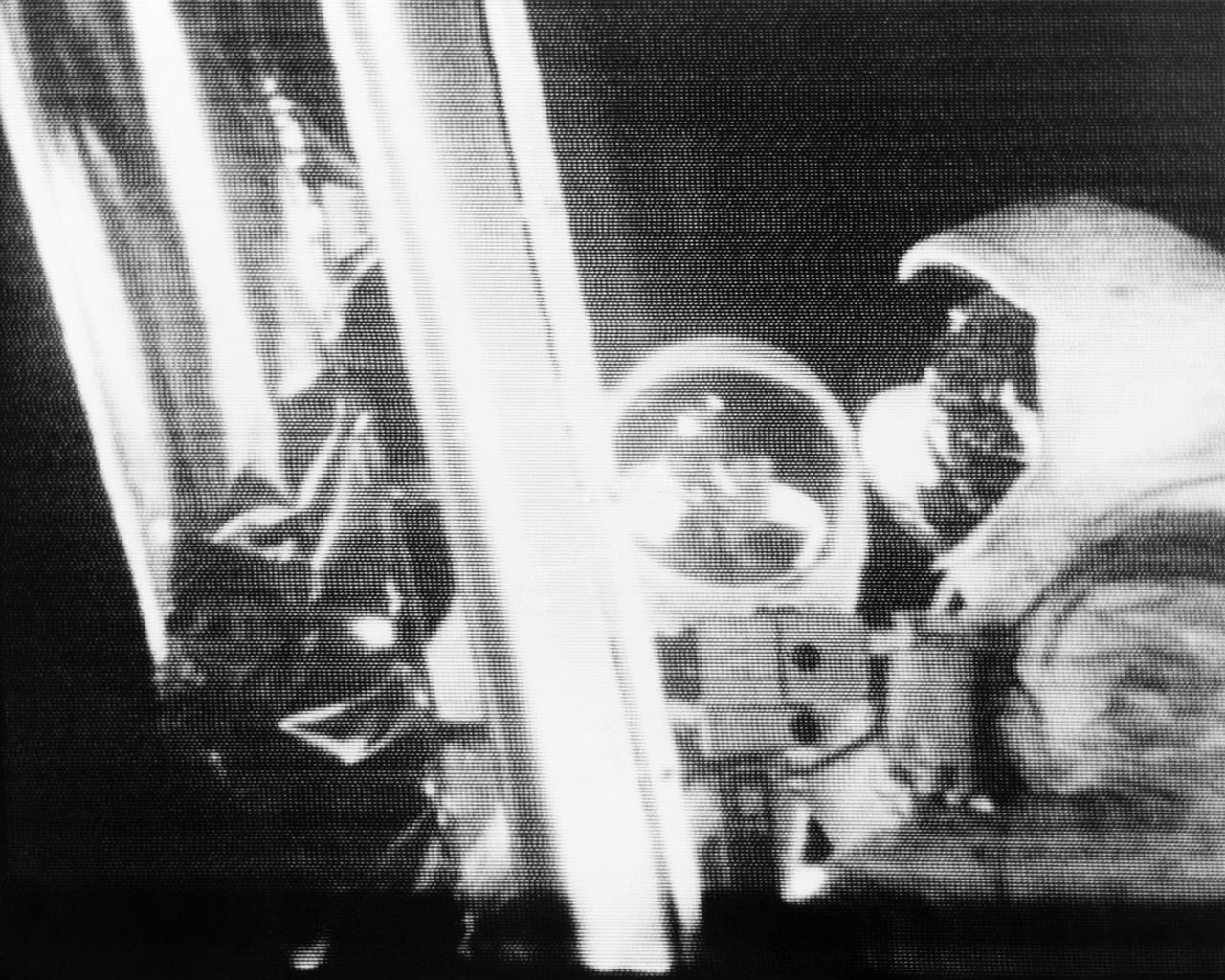
S69-39563 (20 July 1969) --- Astronauts Neil A. Armstrong (left), commander, and Edwin E. Aldrin Jr., lunar module pilot, are seen standing by the Lunar Module (LM) "Eagle" ladder in this black and white reproduction taken from a telecast by the Apollo 11 lunar surface television camera during the Apollo 11 extravehicular activity (EVA). This picture was made from a televised image received at the Deep Space Network (DSN) tracking station at Goldstone, California. While astronauts Armstrong and Aldrin descended in the "Eagle" to explore the Sea of Tranquility region of the moon, astronaut Michael Collins, command module pilot, remained with the Command and Service Modules (CSM) "Columbia" in lunar orbit.
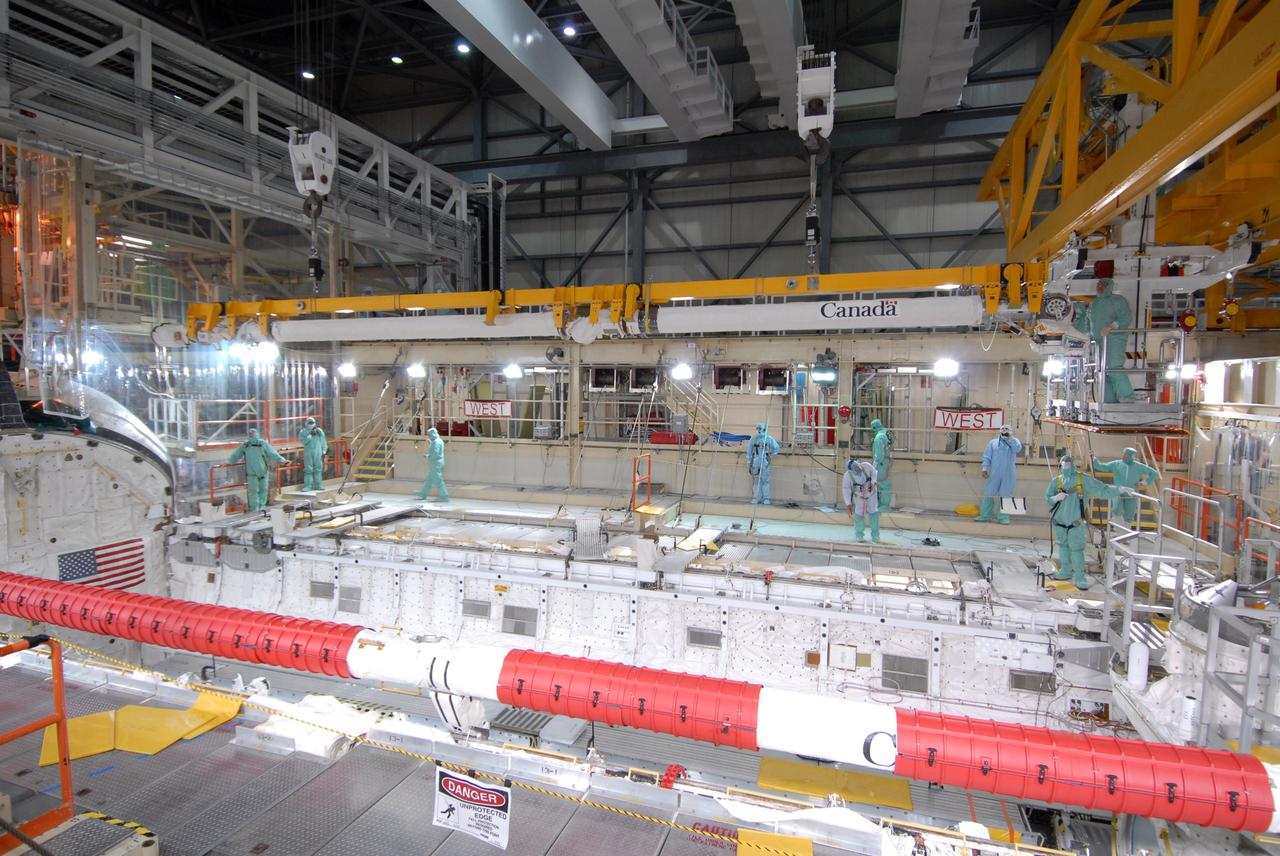
CAPE CANAVERAL, Fla. – In Orbiter Processing Facility bay 3 at NASA's Kennedy Space Center in Florida, the remote manipulator system, or RMS, arm is lifted away from the payload bay of space shuttle Discovery. The RMS is used to grab, or grapple, the payload as well as retrieve, repair and deploy satellites; provide a mobile extension ladder for spacewalking crewmembers; and be used as an inspection aid to allow flight crew members to view the orbiter’s or payload’s surfaces through a TV camera on the arm. Discovery is targeted to launch Aug. 6 on the STS-128 mission. Photo credit: NASA/Jack Pfaller
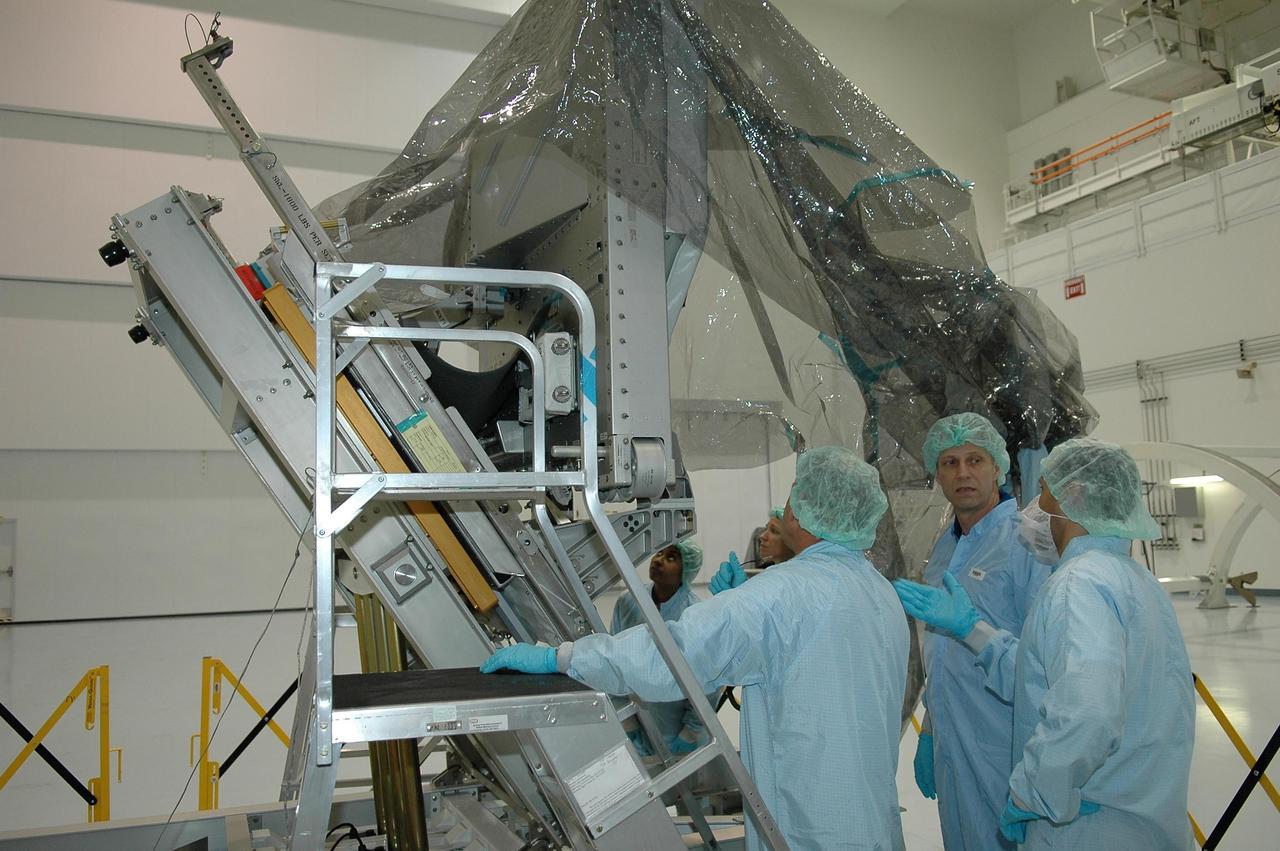
KENNEDY SPACE CENTER, FLA. - The crew for mission STS-121 is taking part in a Crew Equipment Interface Test (CEIT) inside the Space Station Processing Facility at NASA's Kennedy Space Center. Looking at the trailing umbilical system reel assembly that will be installed on the International Space Station are Mission Specialists Michael Fossum (on ladder), Lisa Nowak and Stephanie Wilson (below Fossum on floor). A CEIT provides hands-on experiences with equipment used on-orbit. Mission STS-121 is the second in the Return to Flight sequence and will carry on improvements that debuted during last year's STS-114 mission and build upon those tests. Launch is scheduled in July. Photo credit: NASA/Kim Shiflett
CAPE CANAVERAL, Fla. – In Orbiter Processing Facility bay 3 at NASA's Kennedy Space Center in Florida, the remote manipulator system, or RMS, arm is lifted out of space shuttle Discovery's payload bay. The RMS is used to grab, or grapple, the payload as well as retrieve, repair and deploy satellites; provide a mobile extension ladder for spacewalking crewmembers; and be used as an inspection aid to allow flight crew members to view the orbiter’s or payload’s surfaces through a TV camera on the arm. Discovery is targeted to launch Aug. 6 on the STS-128 mission. Photo credit: NASA/Jack Pfaller
CAPE CANAVERAL, Fla. – In Orbiter Processing Facility bay 3 at NASA's Kennedy Space Center in Florida, technicians prepare to remove the remote manipulator system, or RMS, arm in the payload bay of space shuttle Discovery. The RMS is used to grab, or grapple, the payload as well as retrieve, repair and deploy satellites; provide a mobile extension ladder for spacewalking crewmembers; and be used as an inspection aid to allow flight crew members to view the orbiter’s or payload’s surfaces through a TV camera on the arm. Discovery is targeted to launch Aug. 6 on the STS-128 mission. Photo credit: NASA/Jack Pfaller

AS11-40-5866 (20 July 1969) --- Astronaut Edwin E. Aldrin Jr., lunar module pilot, egresses the Lunar Module (LM) "Eagle" and begins to descend the steps of the LM ladder as he prepares to walk on the moon. This photograph was taken by astronaut Neil A. Armstrong, commander, with a 70mm lunar surface camera during the Apollo 11 extravehicular activity (EVA). While astronauts Armstrong and Aldrin descended in the LM "Eagle" to explore the moon, astronaut Michael Collins, command module pilot, remained with the Command and Service Modules (CSM) "Columbia" in lunar orbit. Photo credit: NASA
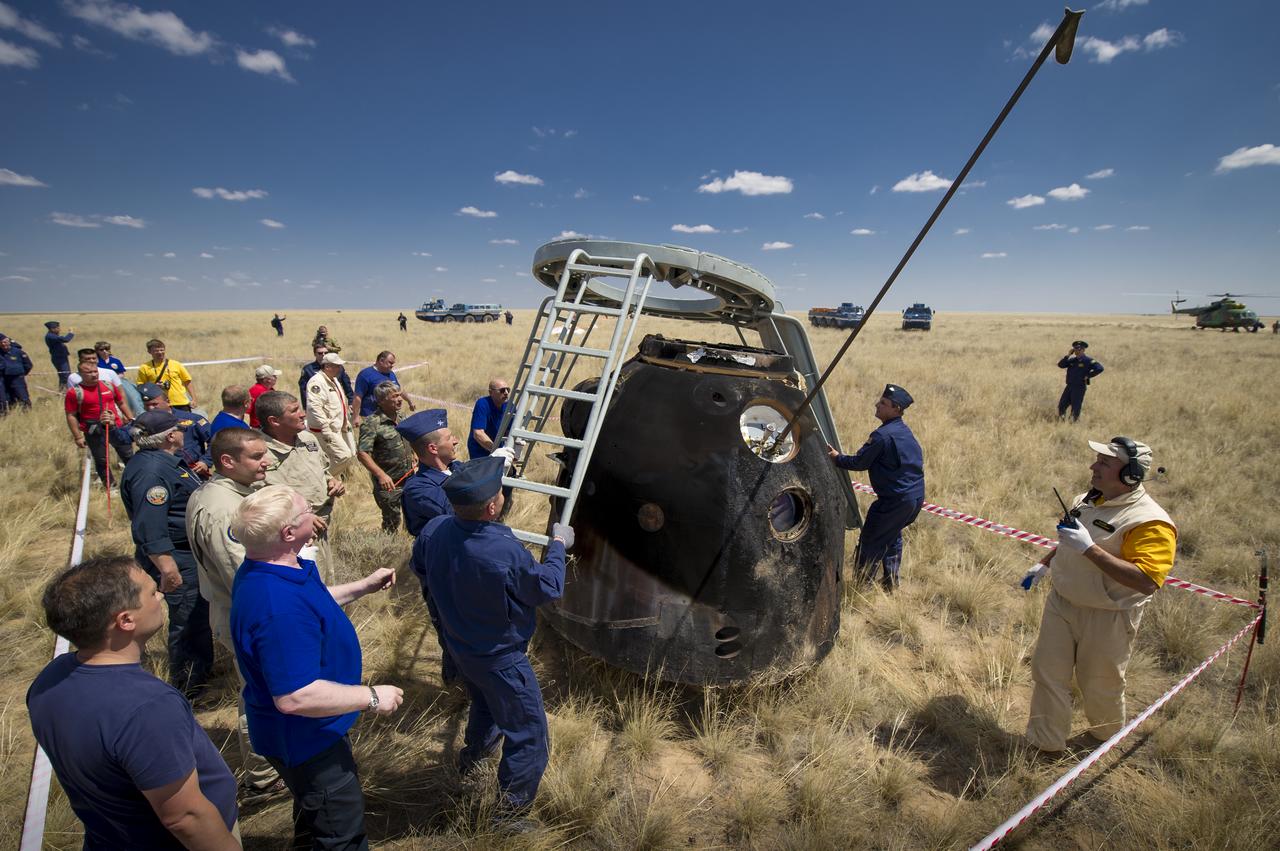
Russian Search and Rescue crews attach ladders and a slide for access to the Soyuz TMA-03M capsule shortly after it landed with Expedition 31 Commander Oleg Kononenko of Russia and Flight Engineers Don Pettit of NASA and Andre Kuipers of the European Space Agency in a remote area near the town of Zhezkazgan, Kazakhstan, on Sunday, July 1, 2012. Pettit, Kononenko and Kuipers returned from more than six months onboard the International Space Station where they served as members of the Expedition 30 and 31 crews. Photo Credit: (NASA/Bill Ingalls)
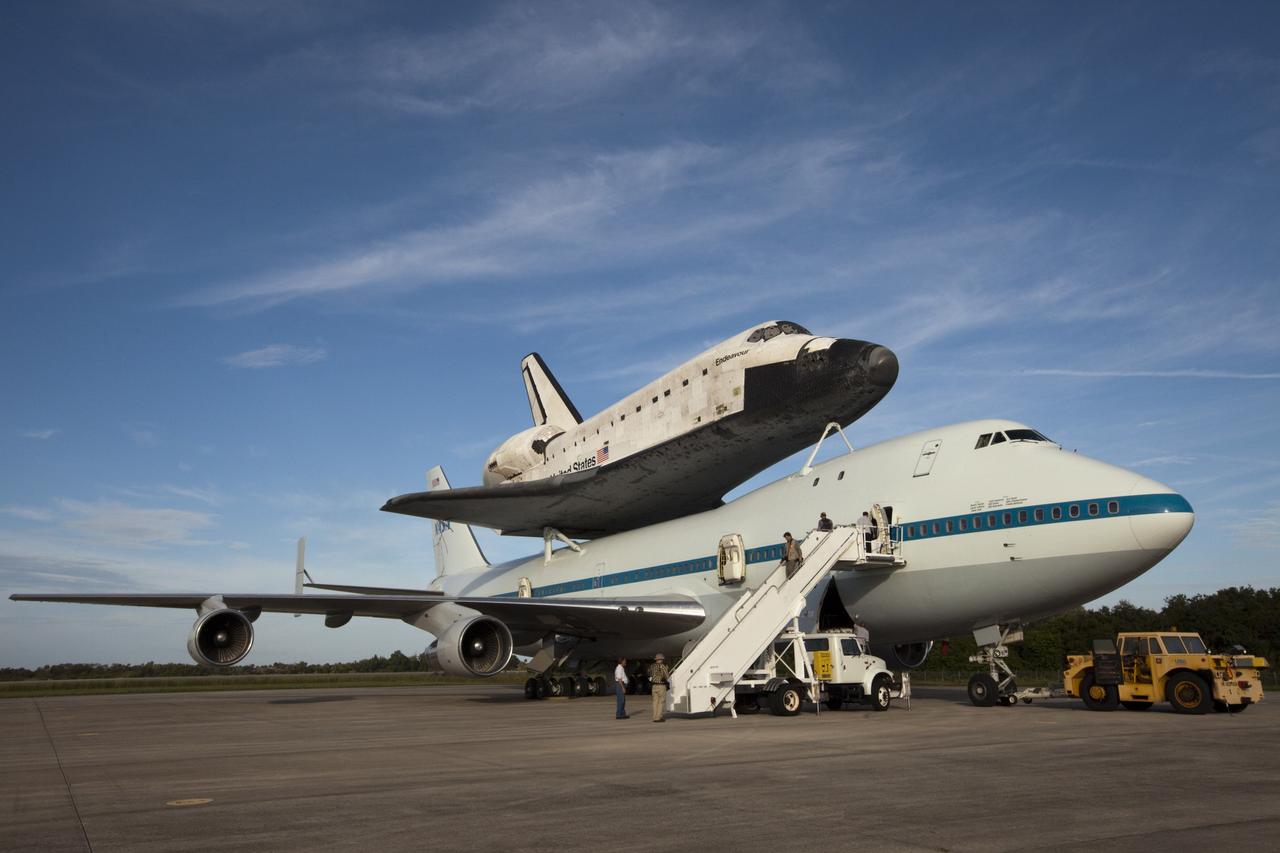
CAPE CANAVERAL, Fla. – At the Shuttle Landing Facility at NASA's Kennedy Space Center in Florida, the space shuttle Endeavour, mounted atop NASA's Shuttle Carrier Aircraft, or SCA, has been rolled back from the mate-demate device and an access ladder has been moved into position. The SCA, a modified 747 jetliner, will fly Endeavour to Los Angeles where it will be placed on public display at the California Science Center. This is the final ferry flight scheduled in the Space Shuttle Program era. For more information on the shuttles' transition and retirement, visit http://www.nasa.gov/transition. Photo credit: NASA/ Kim Shiflett
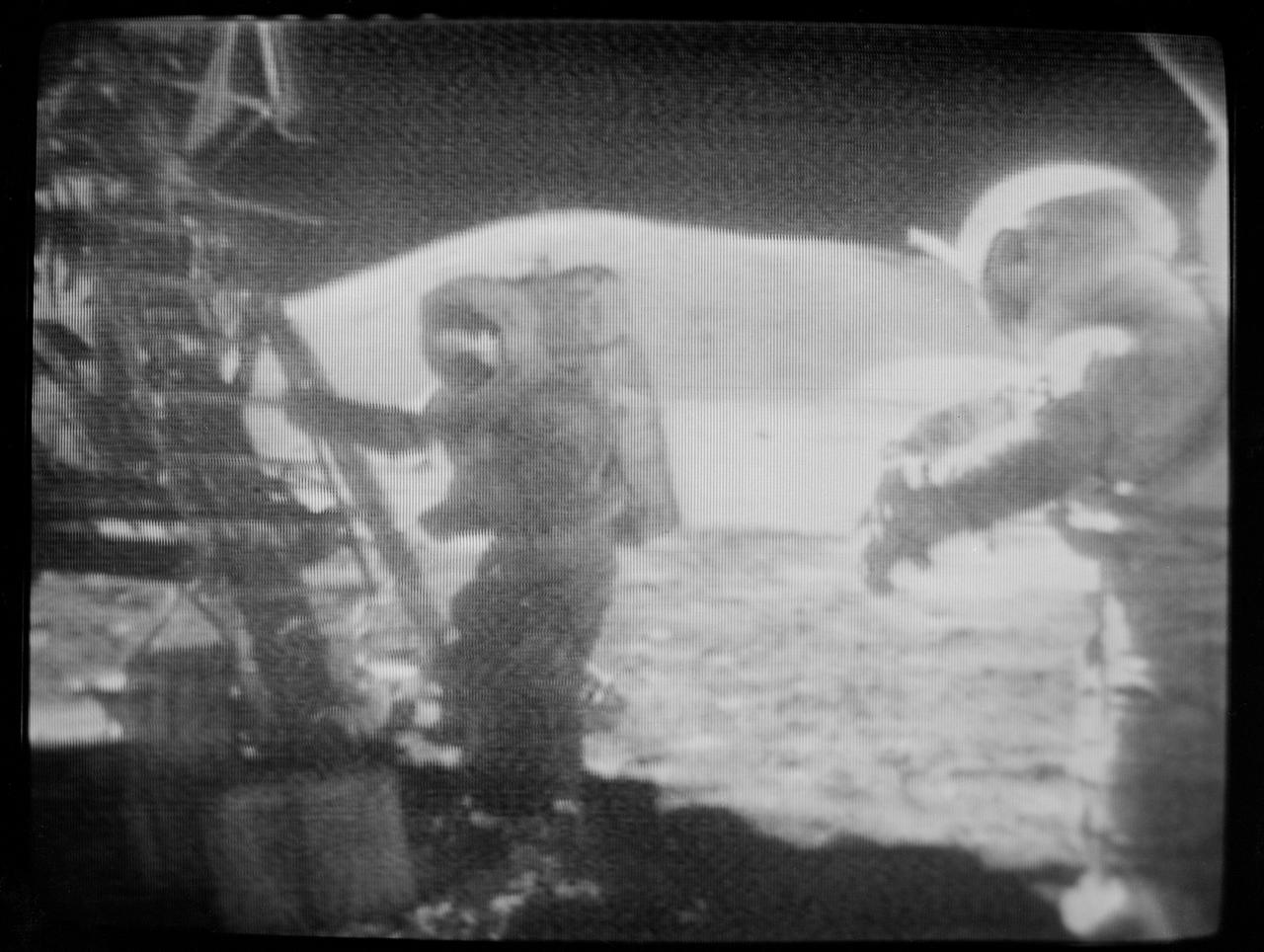
S72-55299 (13 Dec. 1972) --- Scientist-astronaut Harrison H. Schmitt, Apollo 17 lunar module pilot, starts back up the ladder of the Lunar Module "Challenger" at the close of the third extravehicular activity (EVA) at the Taurus-Littrow landing site, in this black and white reproduction taken from a color television transmission made by the color RCA TV camera mounted on the Lunar Roving Vehicle. On the right is astronaut Eugene A. Cernan, commander, who ingressed the LM a few minutes later. Astronaut Ronald E. Evans, command module pilot, remained with the Apollo 17 Command and Service Modules in lunar orbit.
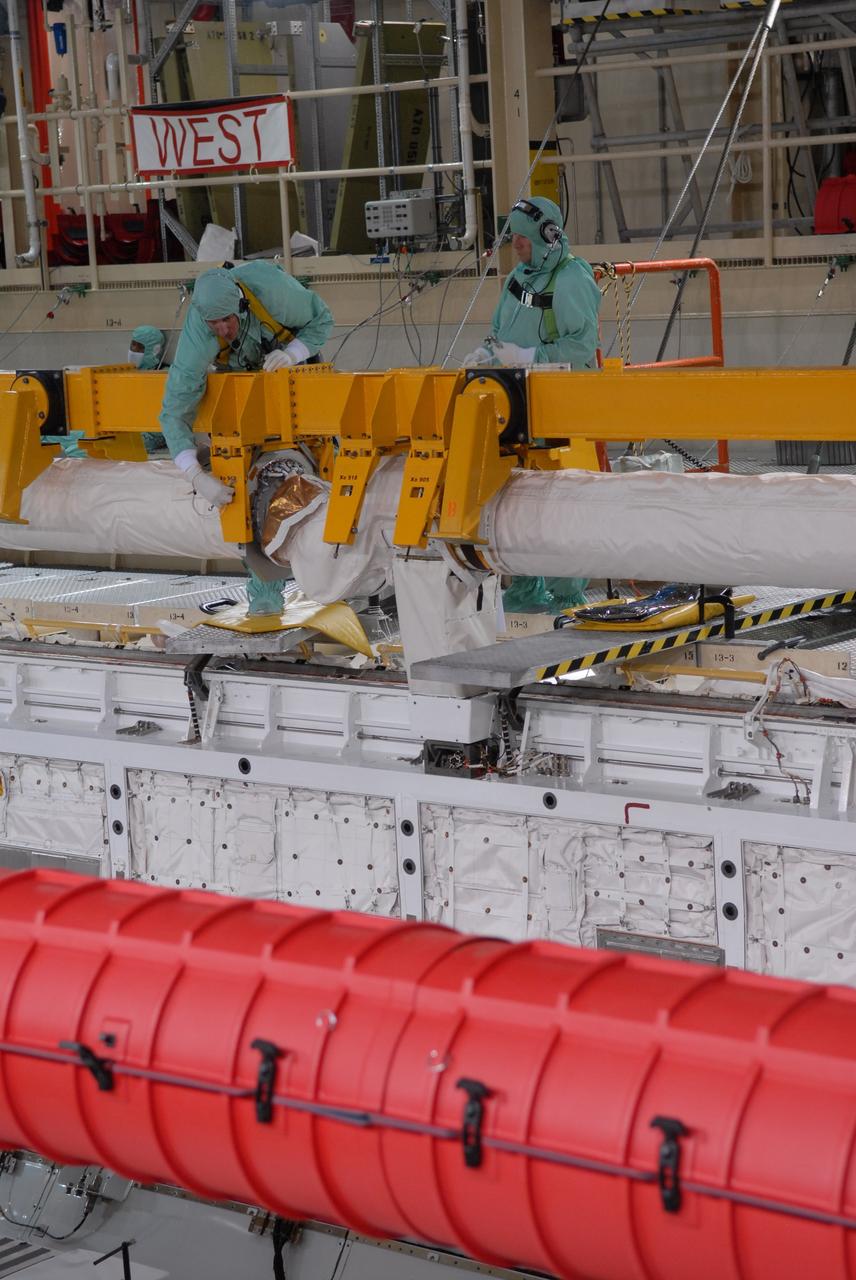
CAPE CANAVERAL, Fla. – In Orbiter Processing Facility bay 3 at NASA's Kennedy Space Center in Florida, technicians prepare to remove remote manipulator system, or RMS, arm in the payload bay of space shuttle Discovery. The RMS is used to grab, or grapple, the payload as well as retrieve, repair and deploy satellites; provide a mobile extension ladder for spacewalking crewmembers; and be used as an inspection aid to allow flight crew members to view the orbiter’s or payload’s surfaces through a TV camera on the arm. Discovery is targeted to launch Aug. 6 on the STS-128 mission. Photo credit: NASA/Jack Pfaller
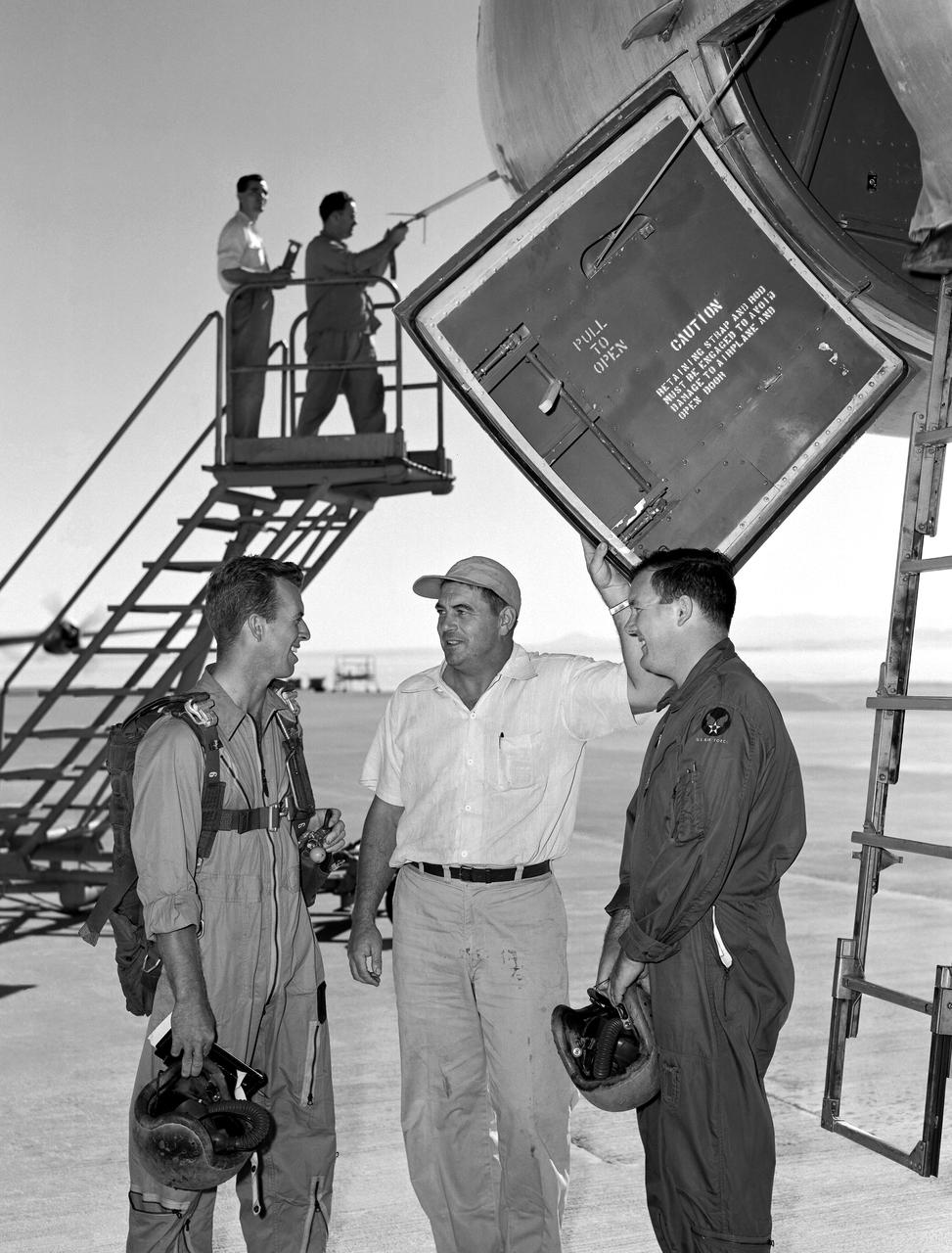
B-47A Stratojet on ramp with pilots and crew. In 1954 after a research flight in the Boeing B-47A Stratojet Crew Chief Wilbur McClenaghan (center) asks of the pilots if there are any "squawks" that should be taken care of before the next flight. Pilots are Joe Walker on the viewer's left and Stanley Butchart on the right. Data system technician Merle Curtis, in coveralls, is busy checking the airdata head mounted on the nose boom with the help of Instrumentation Crew Chief Raymond Langley. The door to the cockpit area is open showing a view of the ladder that folds down to be used by the pilots to enter and leave the area.
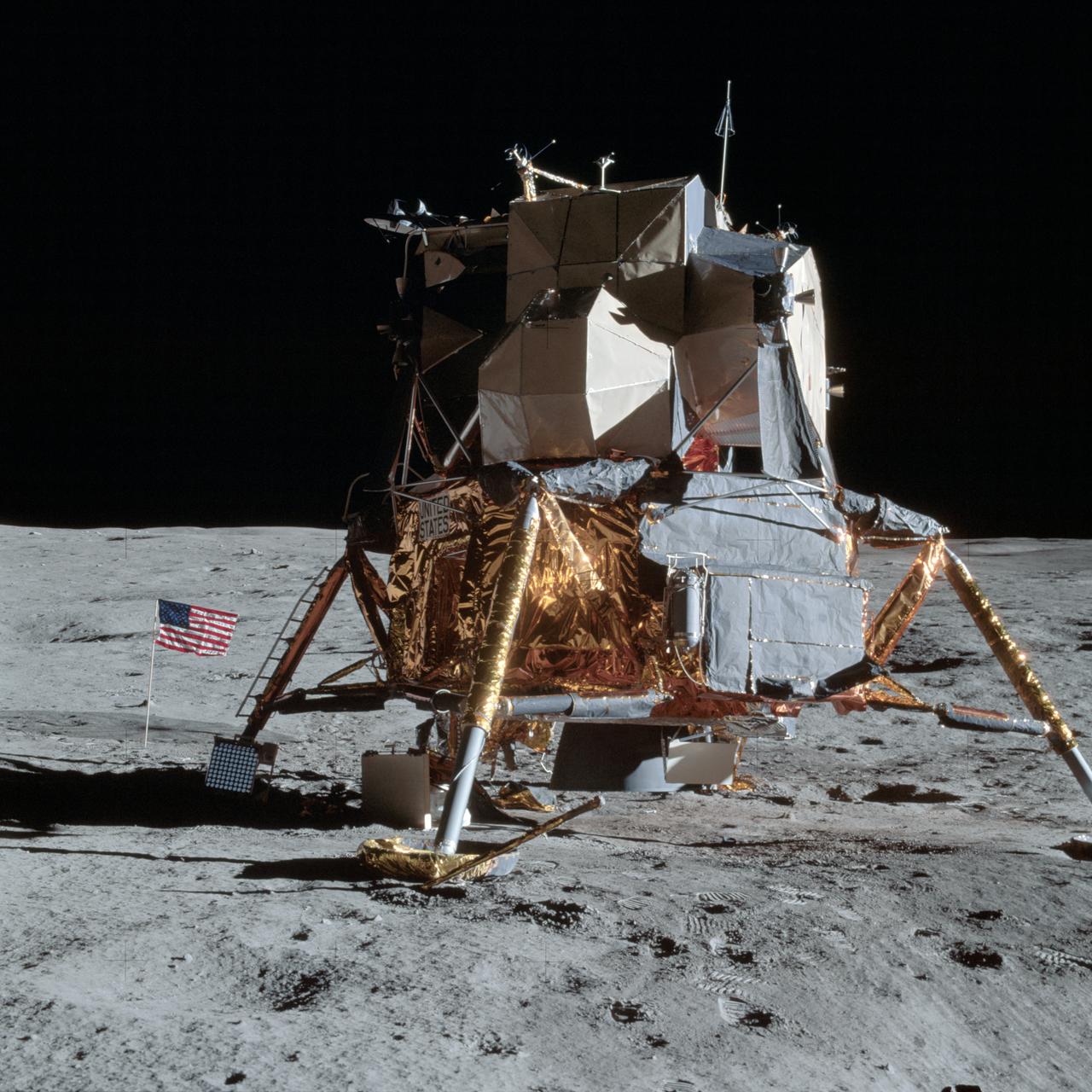
AS14-66-9277 (5 Feb. 1971) --- An excellent view of the Apollo 14 Lunar Module (LM) on the moon, as photographed during the first Apollo 14 extravehicular activity (EVA) on the lunar surface. The astronauts have already deployed the U.S. flag. Note the laser ranging retro reflector (LR-3) at the foot of the LM ladder. The LR-3 was deployed later. While astronauts Alan B. Shepard Jr., commander, and Edgar D. Mitchell, lunar module pilot, descended in the LM to explore the moon, astronaut Stuart A. Roosa, command module pilot, remained with the Command and Service Modules (CSM) in lunar orbit.
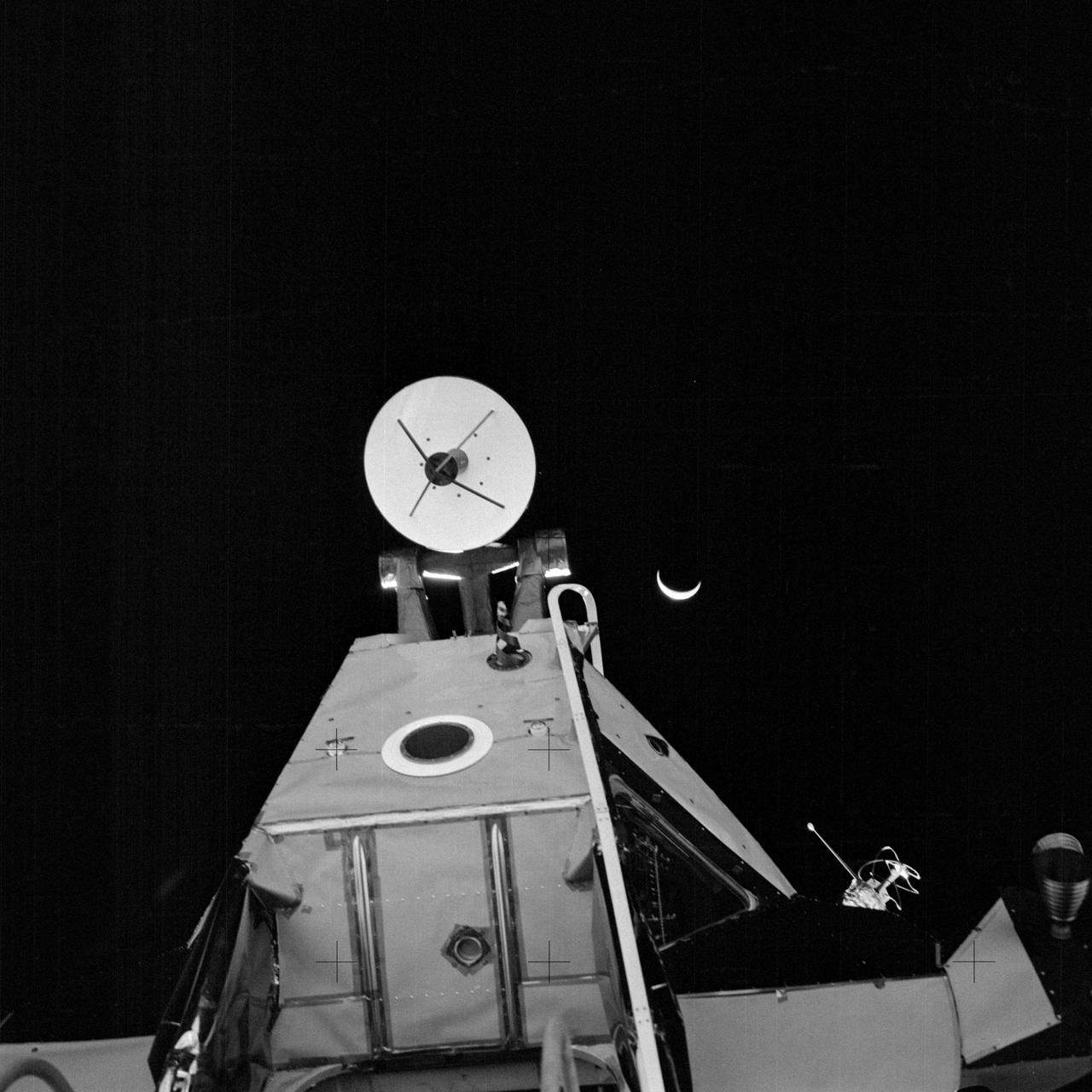
AS14-64-9193 (5 Feb. 1971) --- A close-up view of the forward section of the Apollo 14 Lunar Module (LM) ascent stage, looking upward from the LM ladder. This photograph was taken by one of the Apollo 14 astronauts at the close of their first extravehicular activity (EVA). The LM's ingress/egress hatch is just out of view at the bottom, near center. At the top center is the rendezvous radar antenna. An RCS thruster is visible at the far right. One of the two VHF antennas is on the right. The LM's optical alignment telescope is located at the black circle which has a wide, white ring around it. The crescent Earth can be seen in the far distant background.
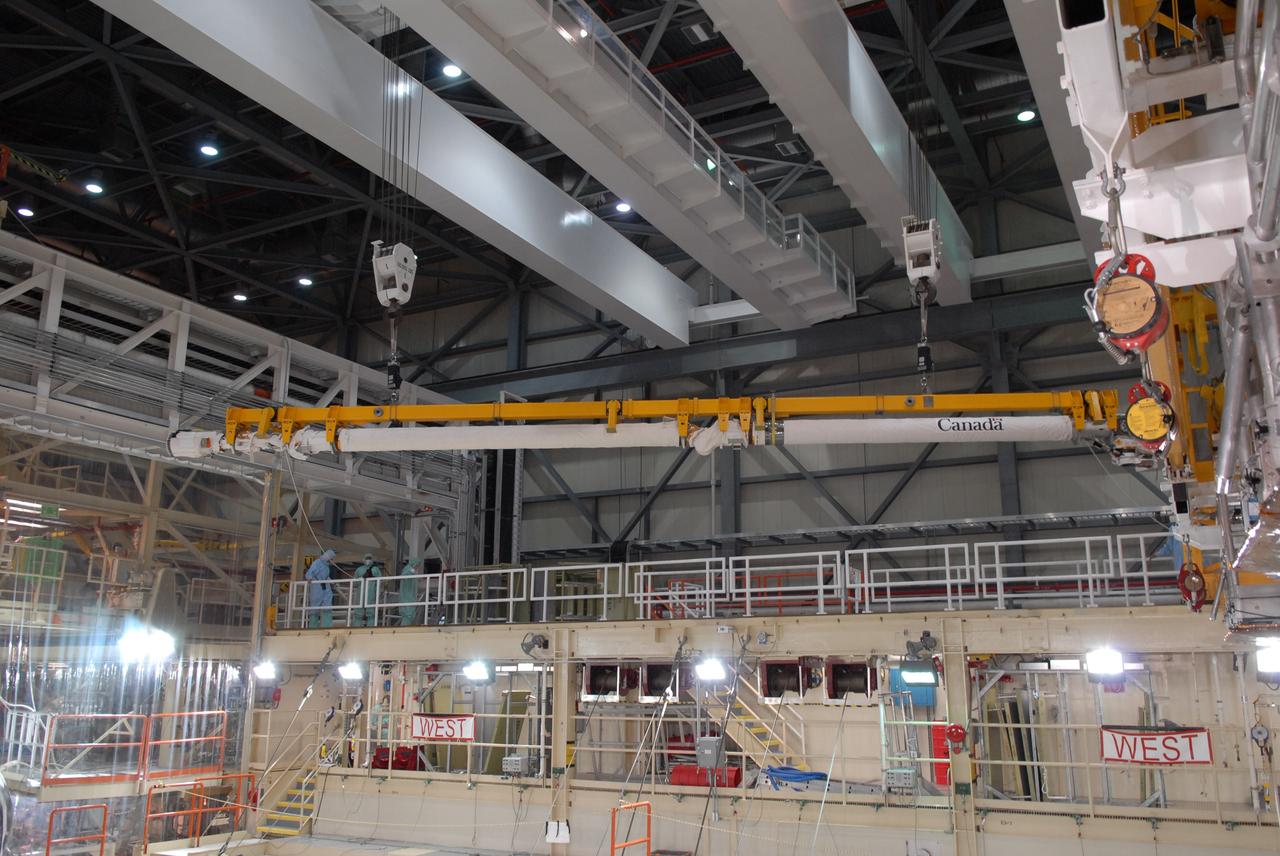
CAPE CANAVERAL, Fla. – In Orbiter Processing Facility bay 3 at NASA's Kennedy Space Center in Florida, the remote manipulator system, or RMS, arm is lifted away from space shuttle Discovery's payload bay. The RMS is used to grab, or grapple, the payload as well as retrieve, repair and deploy satellites; provide a mobile extension ladder for spacewalking crewmembers; and be used as an inspection aid to allow flight crew members to view the orbiter’s or payload’s surfaces through a TV camera on the arm. Discovery is targeted to launch Aug. 6 on the STS-128 mission. Photo credit: NASA/Jack Pfaller
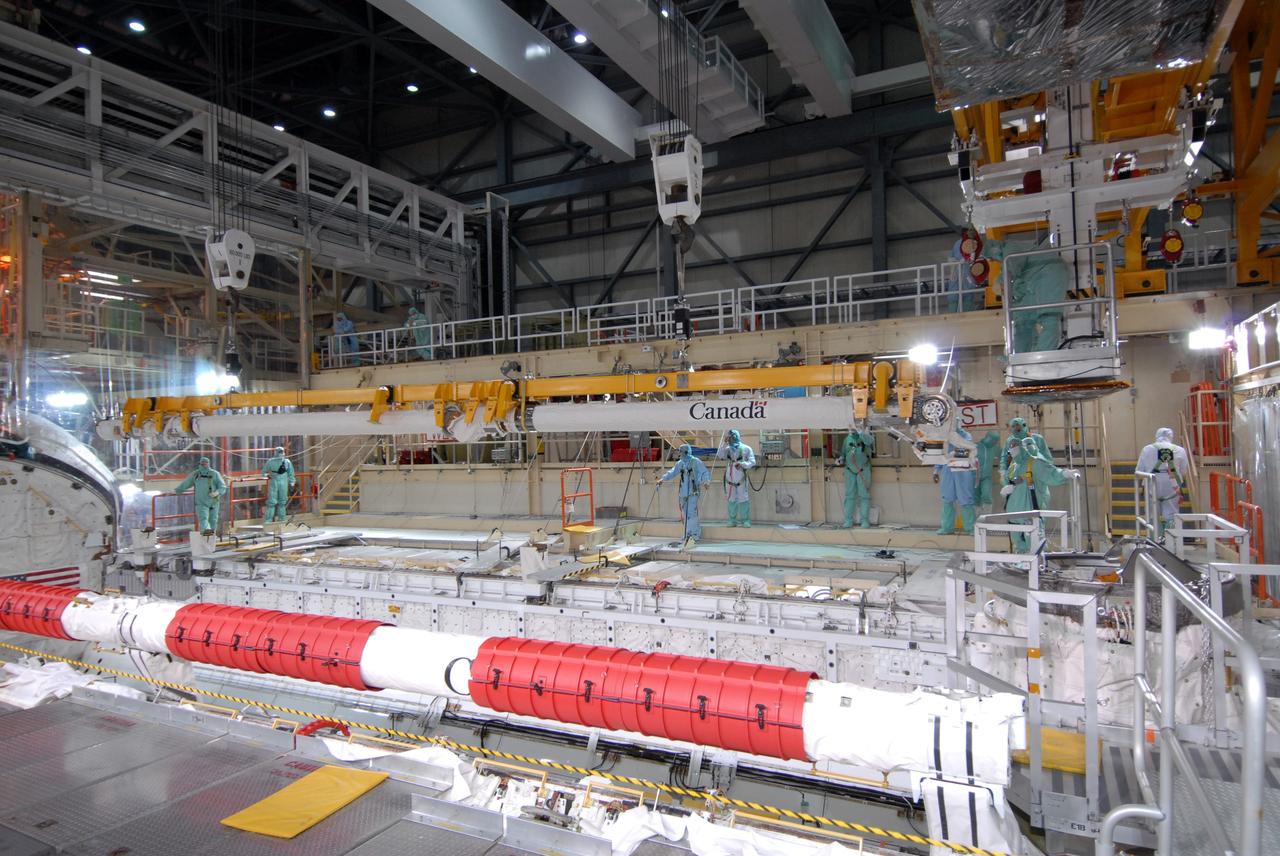
CAPE CANAVERAL, Fla. – In Orbiter Processing Facility bay 3 at NASA's Kennedy Space Center in Florida, the remote manipulator system, or RMS, arm is moved out of the payload bay of space shuttle Discovery. The RMS is used to grab, or grapple, the payload as well as retrieve, repair and deploy satellites; provide a mobile extension ladder for spacewalking crewmembers; and be used as an inspection aid to allow flight crew members to view the orbiter’s or payload’s surfaces through a TV camera on the arm. Discovery is targeted to launch Aug. 6 on the STS-128 mission. Photo credit: NASA/Jack Pfaller
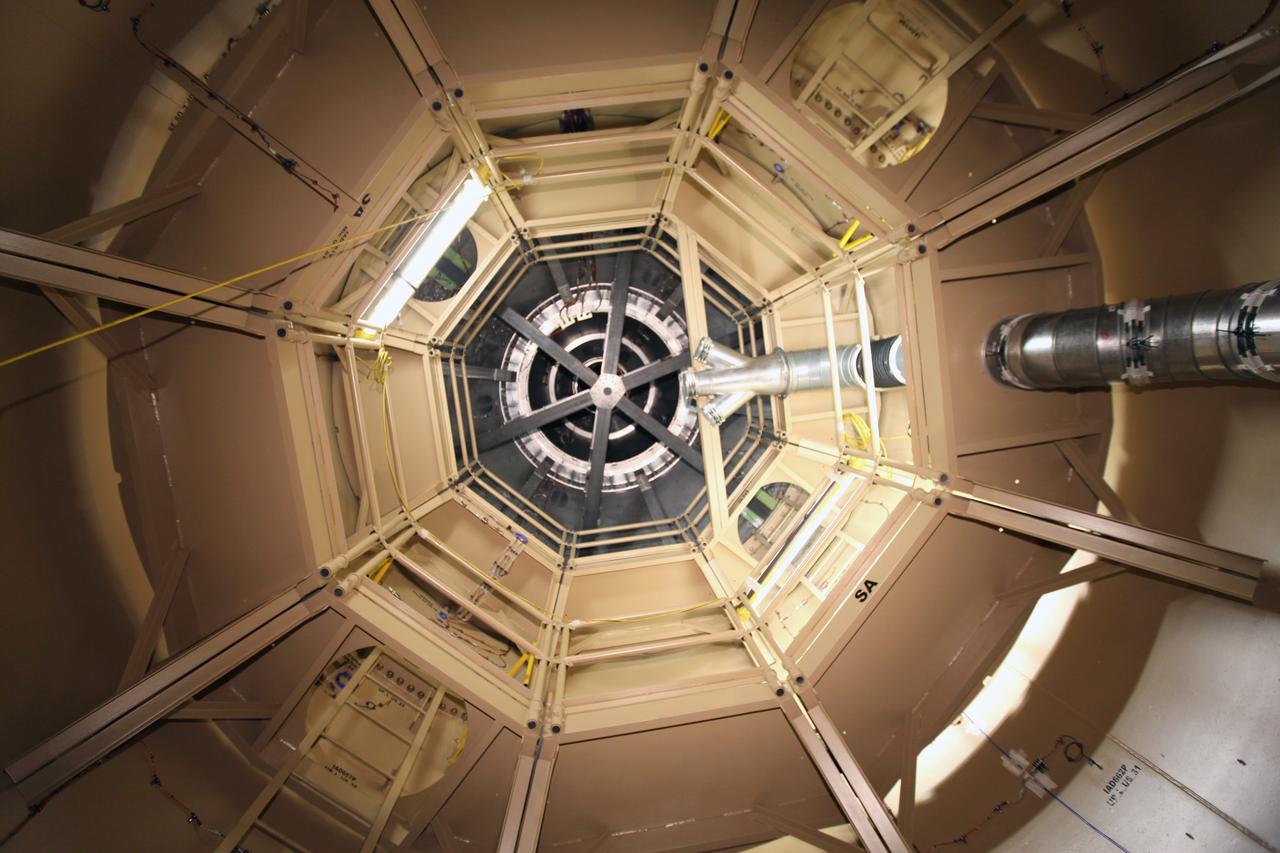
CAPE CANAVERAL, Fla. – Steep ladders mounted to opposing sides of the interior wall of the upper stage simulator of the Ares I-X rocket provide the only access inside the vehicle for the installation of instruments and equipment. Part of the Constellation Program, the Ares I-X is the test vehicle for the Ares I, which is the essential core of a space transportation system designed to carry crewed missions back to the moon, on to Mars and out into the solar system. The Ares I-X flight test is targeted for Oct. 27. For information on the Ares I-X vehicle and flight test, visit http://www.nasa.gov/mission_pages/constellation/ares/flighttests/aresIx/index.html. Photo credit: NASA/Glenn Benson
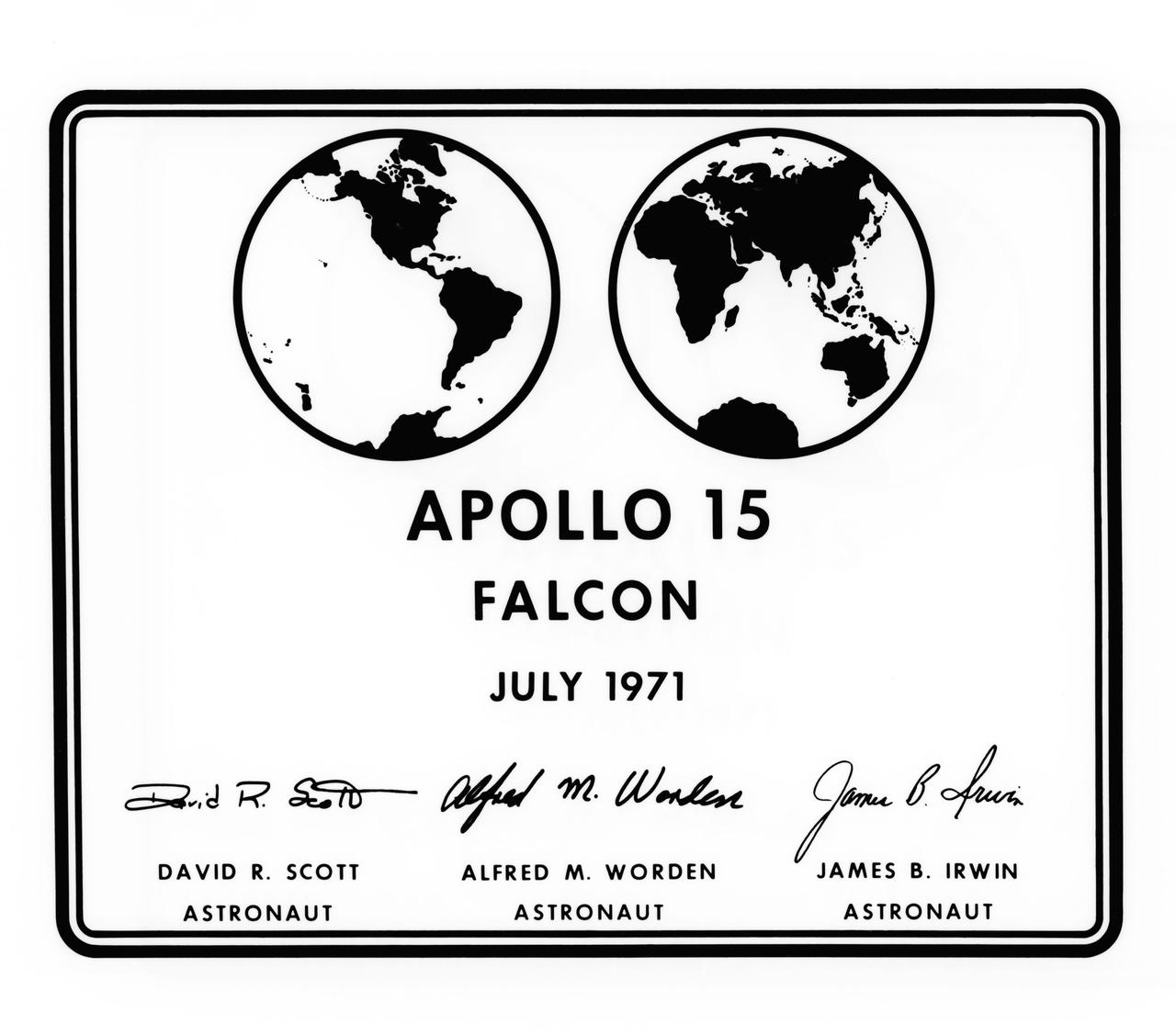
S71-39357 (July 1971) --- A photographic replica of the plaque which the Apollo 15 astronauts will leave behind on the moon during their lunar landing mission. Astronauts David R. Scott, commander; and James B. Irwin, lunar module pilot; will descend to the lunar surface in the Lunar Module (LM) "Falcon". Astronaut Alfred M. Worden, command module pilot, will remain with the Command and Service Modules (CSM) in lunar orbit. The seven by nine inch stainless steel plaque will be attached to the ladder on the landing gear strut on the LM's descent stage. Commemorative plaques were also left on the moon by the Apollo 11, Apollo 12 and Apollo 14 astronauts.
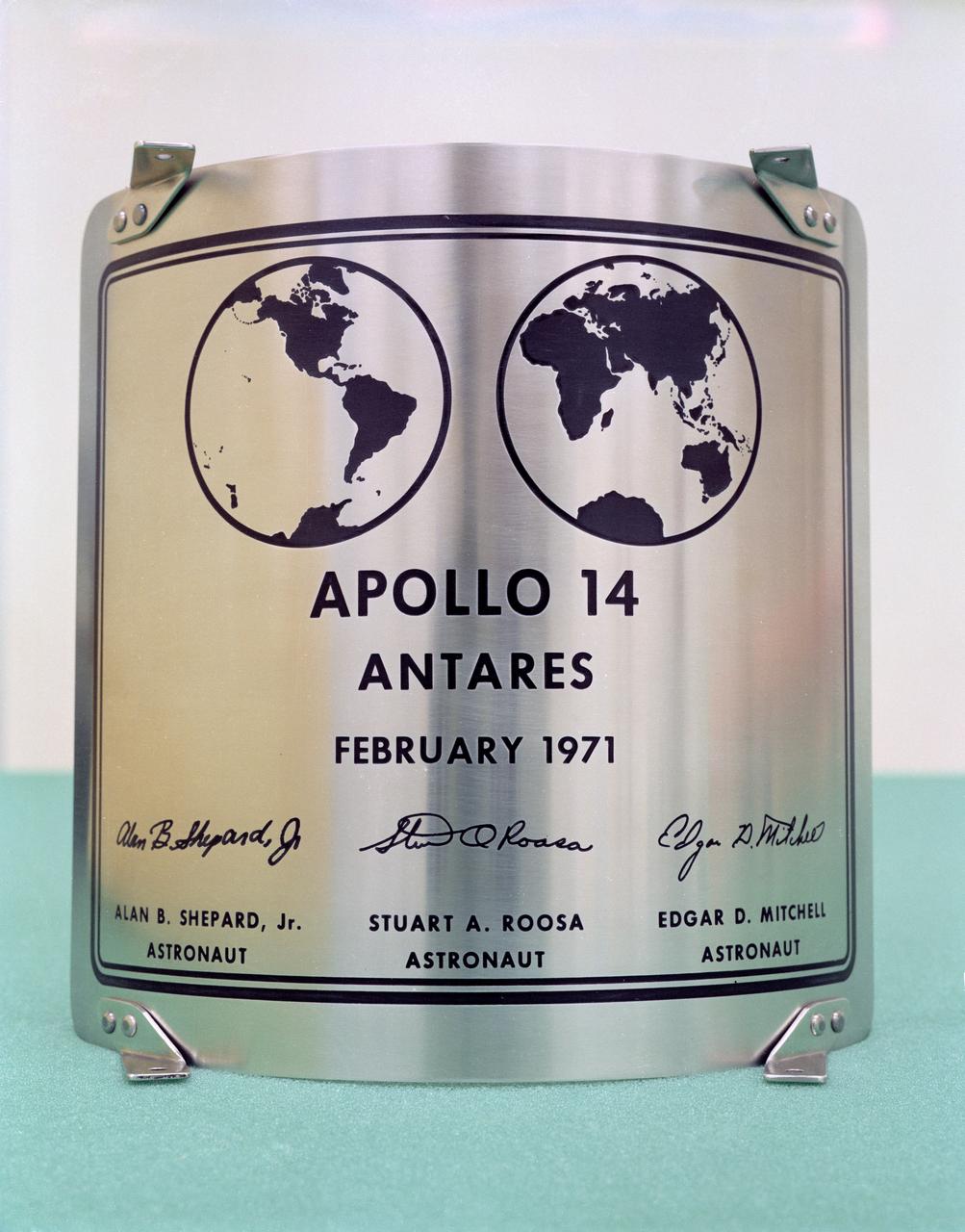
S71-16637 (January 1971) --- A close-up view of the plaque which the Apollo 14 astronauts will leave behind on the moon during their lunar landing mission. Astronauts Alan B. Shepard Jr., commander, and Edgar D. Mitchell, lunar module pilot, will descend to the lunar surface in the Lunar Module (LM) "Antares". Astronaut Stuart A. Roosa, command module pilot, will remain with the Command and Service Modules (CSM) in lunar orbit. The seven by nine inch stainless steel plaque will be attached to the ladder on the landing gear strut on the LM's descent stage. Commemorative plaques were also left on the moon by the Apollo 11 and Apollo 12 astronauts.
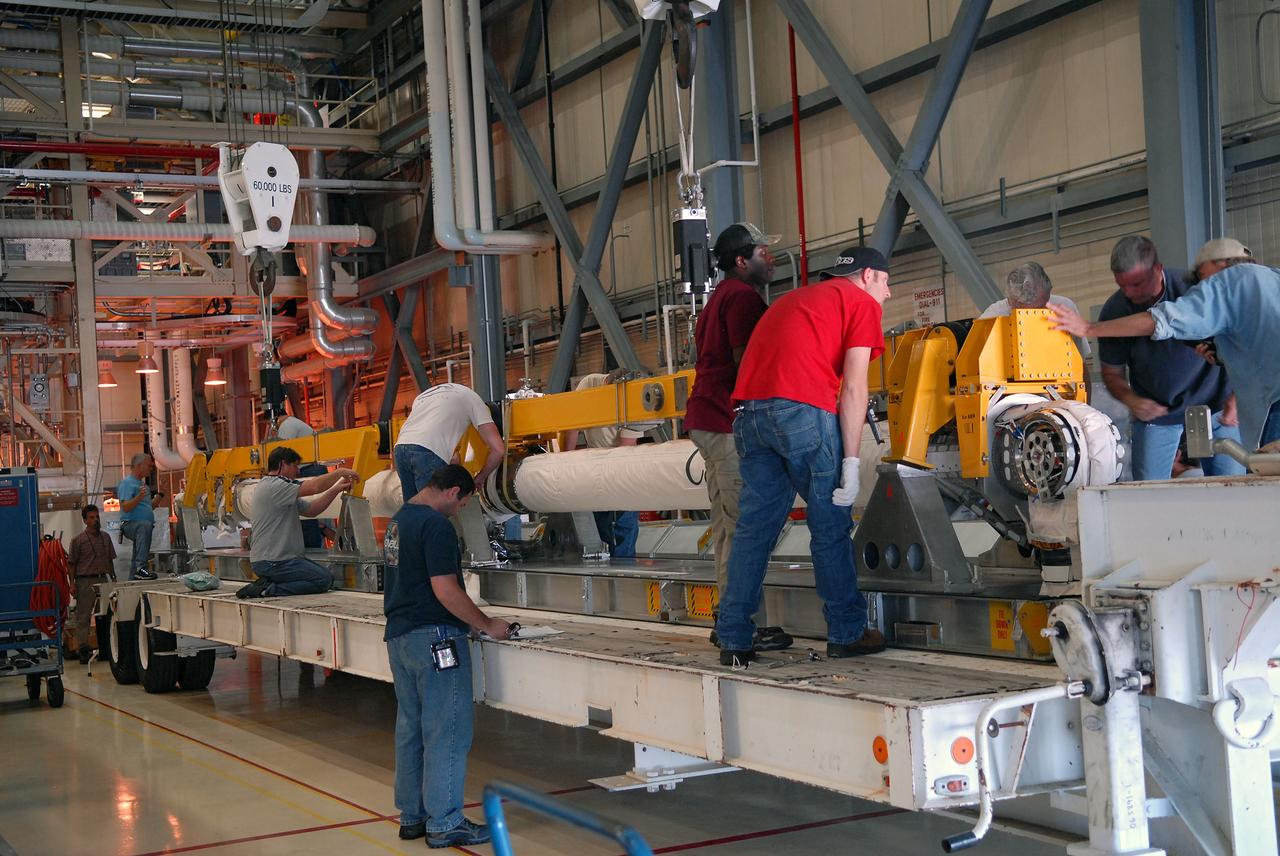
CAPE CANAVERAL, Fla. – In Orbiter Processing Facility bay 3 at NASA's Kennedy Space Center in Florida, technicians secure the remote manipulator system, or RMS, removed from space shuttle Discovery onto a storage platform. The RMS is used to grab, or grapple, the payload as well as retrieve, repair and deploy satellites; provide a mobile extension ladder for spacewalking crewmembers; and be used as an inspection aid to allow flight crew members to view the orbiter’s or payload’s surfaces through a TV camera on the arm. Discovery is targeted to launch Aug. 6 on the STS-128 mission. Photo credit: NASA/Jack Pfaller
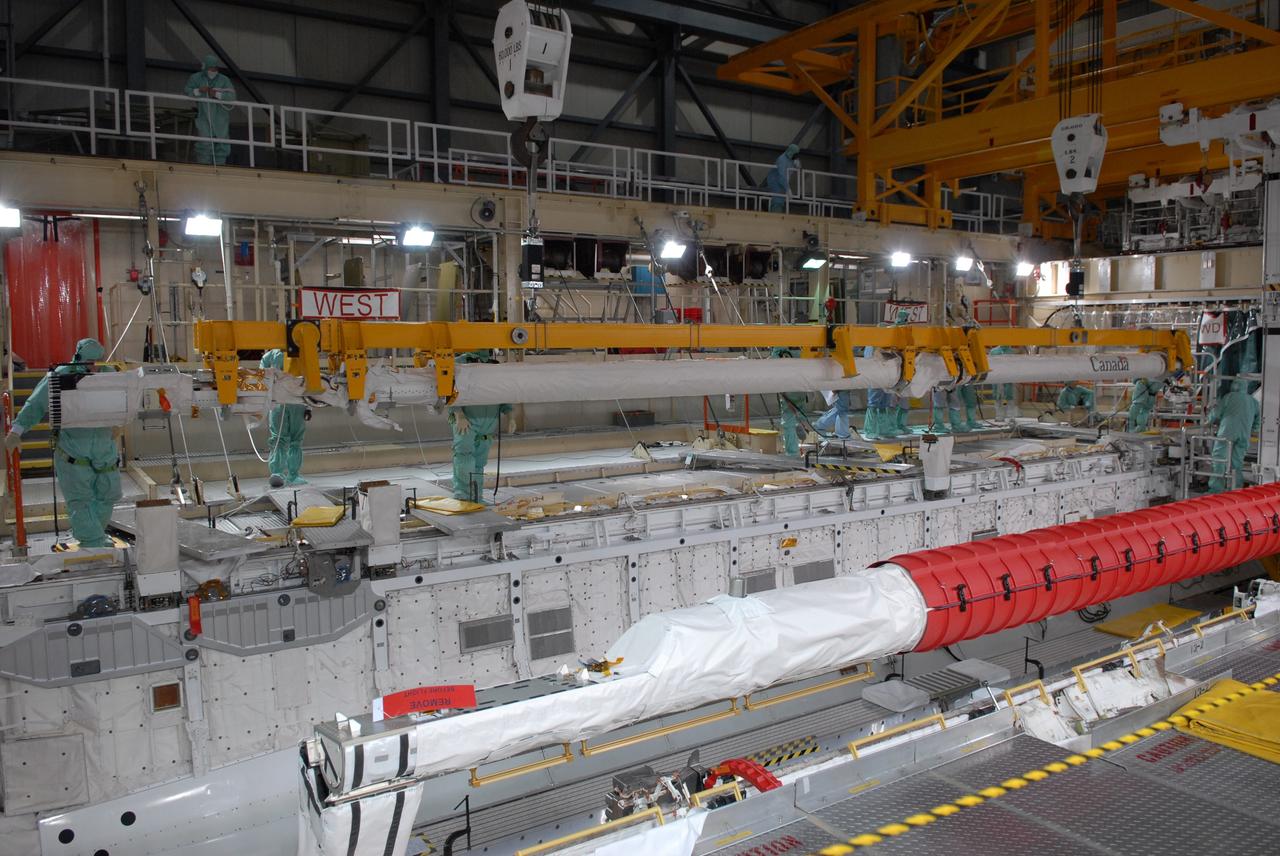
CAPE CANAVERAL, Fla. – In Orbiter Processing Facility bay 3 at NASA's Kennedy Space Center in Florida, remote manipulator system, or RMS, arm is lifted out of the payload bay of space shuttle Discovery. The RMS is used to grab, or grapple, the payload as well as retrieve, repair and deploy satellites; provide a mobile extension ladder for spacewalking crewmembers; and be used as an inspection aid to allow flight crew members to view the orbiter’s or payload’s surfaces through a TV camera on the arm. Discovery is targeted to launch Aug. 6 on the STS-128 mission. Photo credit: NASA/Jack Pfaller
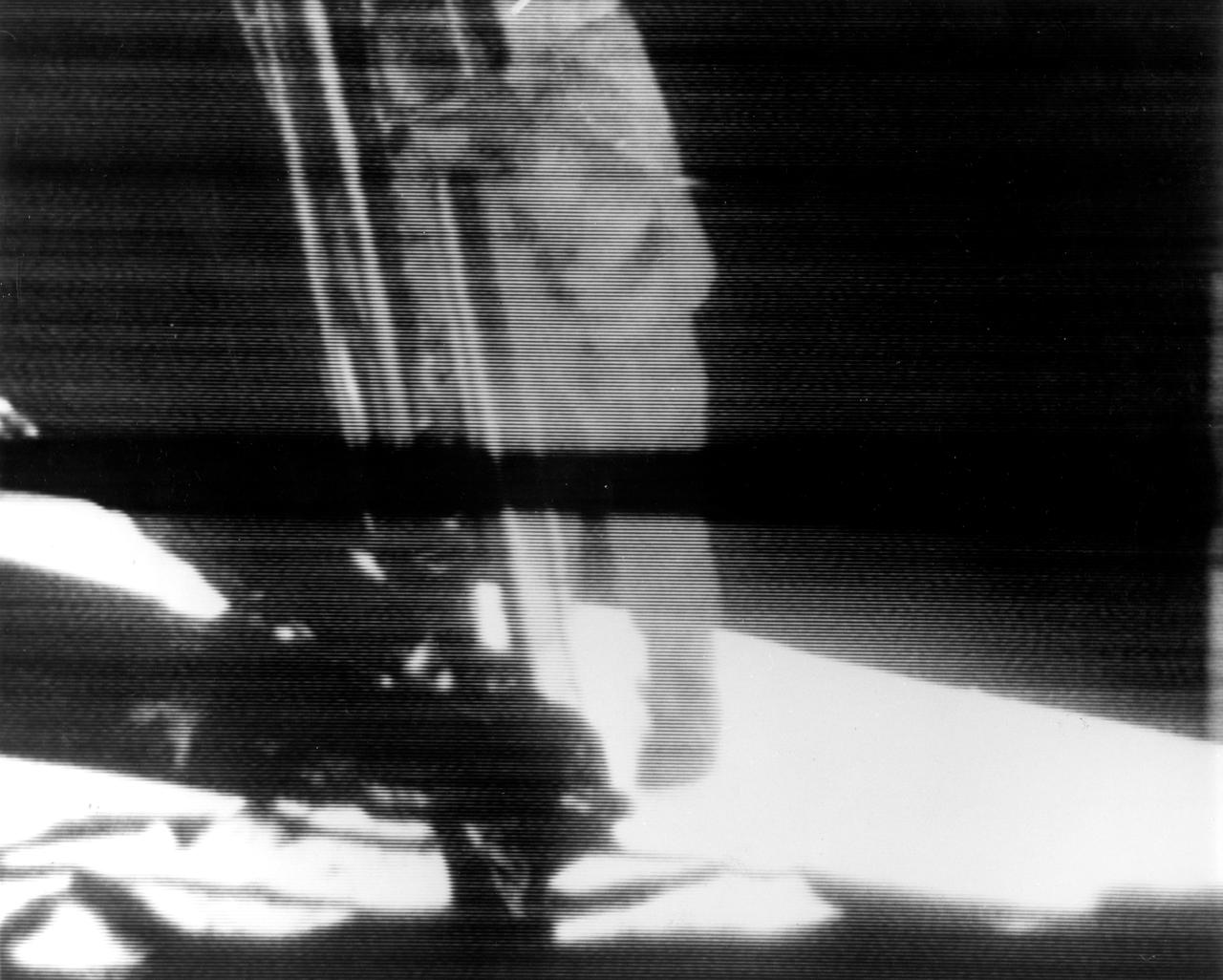
The first manned lunar landing mission, Apollo 11, launched from the Kennedy Space Flight Center (KSC) in Florida via the Marshall Space Flight Center (MSFC) developed Saturn V launch vehicle on July 16, 1969 and safely returned to Earth on July 24, 1969. Astronauts onboard included Neil A. Armstrong, commander; Michael Collins, Command Module (CM) pilot; and Edwin E. Aldrin, Jr., Lunar Module (LM) pilot. The CM, “Columbia”, piloted by Collins, remained in a parking orbit around the Moon while the LM, “Eagle’’, carrying astronauts Armstrong and Aldrin, landed on the Moon in the Sea of Tranquility. On July 20, 1969, Armstrong was the first human to ever stand on the lunar surface, followed by Aldrin. This is a reproduction of the television image that was transmitted to the world on July 20th, as Armstrong egressed the ladder to the lunar surface. The black bar running through the center of the photograph is an anomaly in the TV Ground Data System at Goldstone Tracking Station.
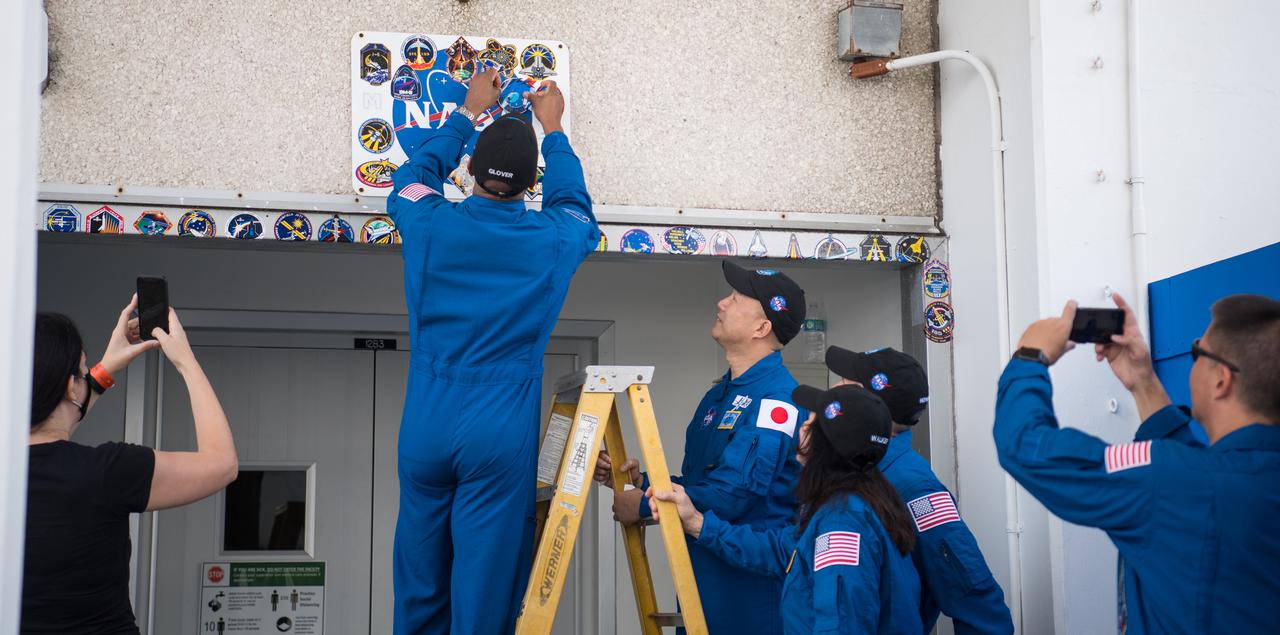
NASA astronaut Victor Glover, left on ladder, places a Crew-1 mission sticker above the doorway to crew quarters at the Neil A. Armstrong Operations and Checkout Building as fellow crewmates astronauts Soichi Noguchi of the Japan Aerospace Exploration Agency (JAXA), and Shannon Walker and Mike Hopkins of NASA look on, Thursday, Nov. 12, 2020, at NASA’s Kennedy Space Center in Florida. NASA’s SpaceX Crew-1 mission is the first crew rotation mission of the SpaceX Crew Dragon spacecraft and Falcon 9 rocket to the International Space Station as part of the agency’s Commercial Crew Program. Glover, Noguchi, Walker, and Hopkins are scheduled to launch at 7:27 p.m. EST on Sunday, Nov. 15, from Launch Complex 39A at the Kennedy Space Center. Photo Credit: (NASA/Joel Kowsky)
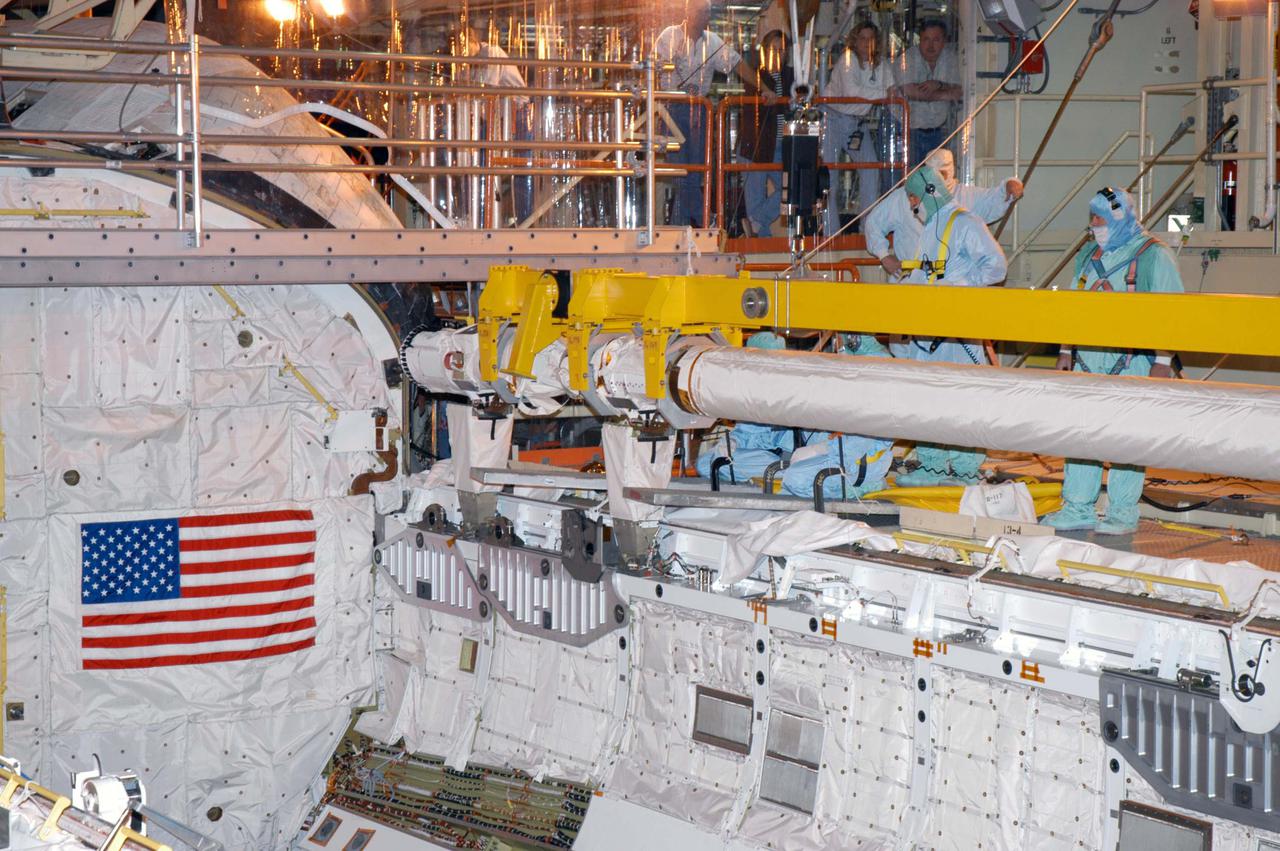
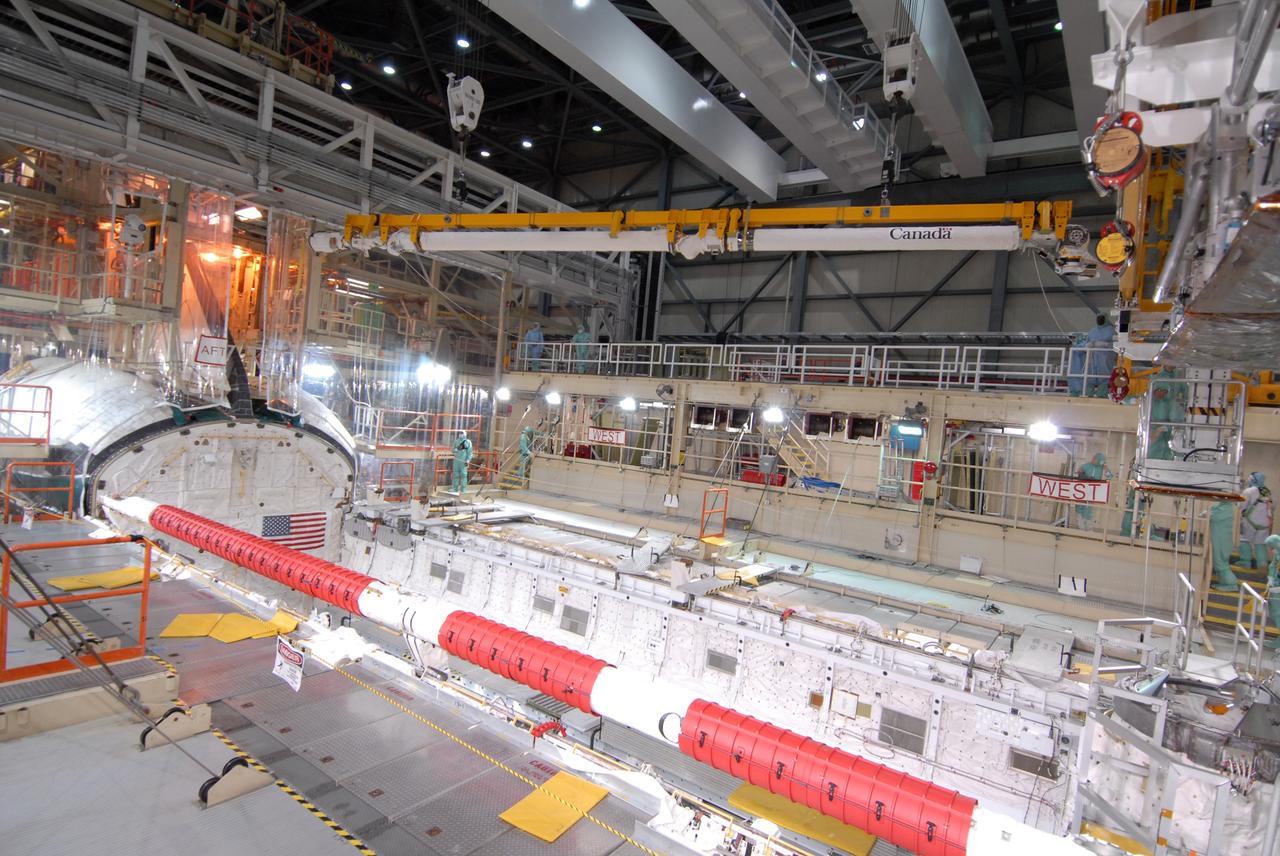
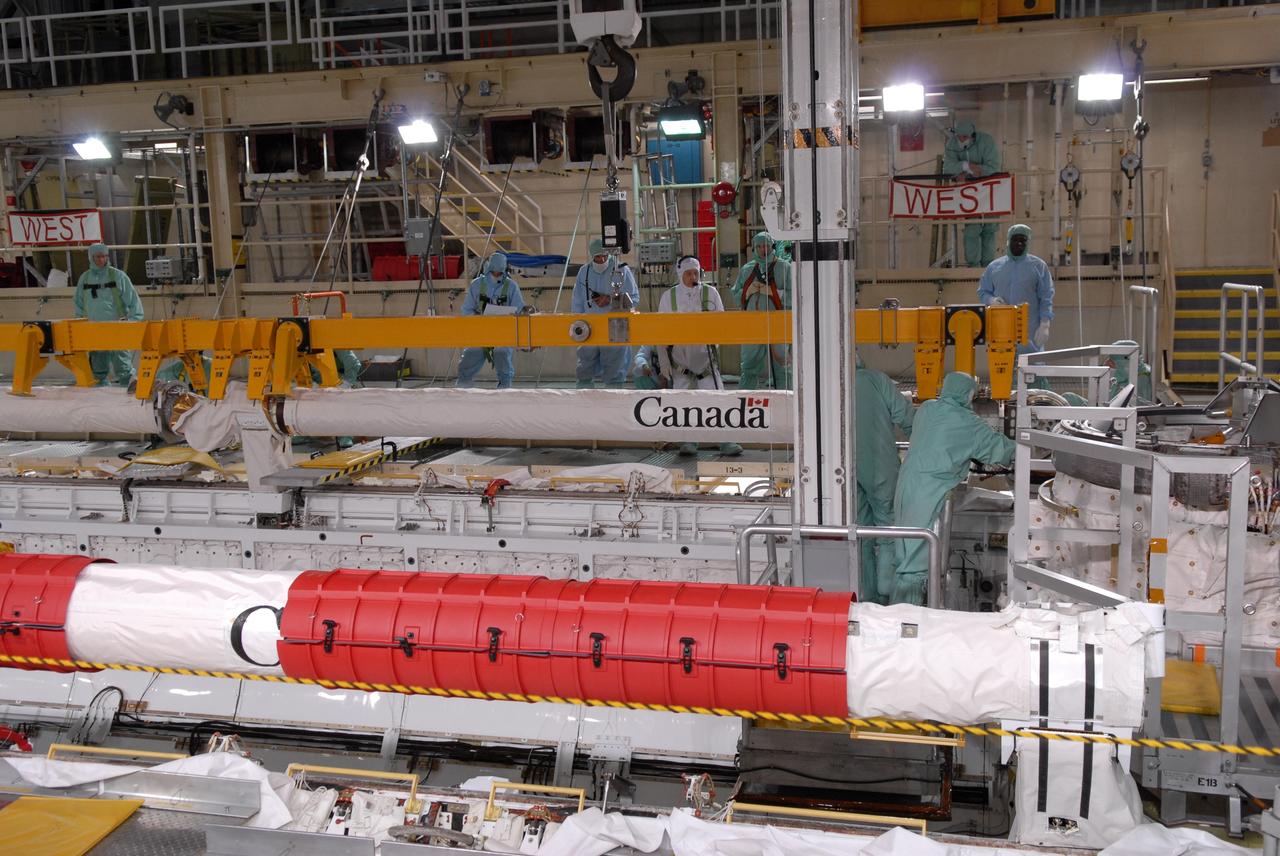
KENNEDY SPACE CENTER, FLA. - In the Orbiter Processing Facility, the Remote Manipulator System (RMS), also known as the Canadian robotic arm, is being installed in Discovery’s payload bay. The RMS is used to deploy and retrieve payloads, provide a mobile extension ladder or foot restraints for crew members during extravehicular activities; and to aid the flight crew members in viewing surfaces of the orbiter or payloads through a television camera on the RMS. The arm is also serving as the base for the new Orbiter Boom Sensor System (OBSS), one of the safety measures for Return to Flight, equipping the Shuttle with cameras and laser systems to inspect the Shuttle’s Thermal Protection System while in space. Discovery is scheduled for a launch planning window of May 2005 on Return to Flight mission STS-114.
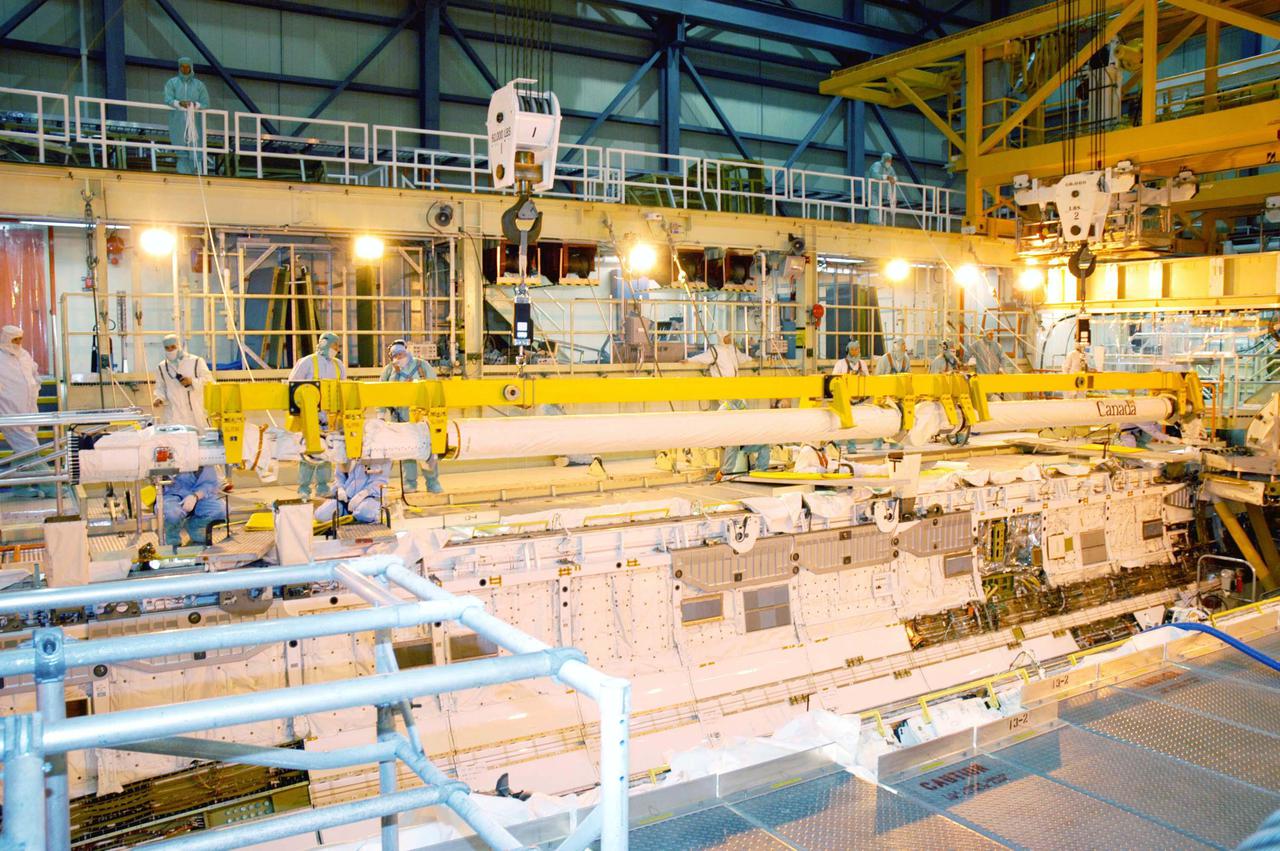
KENNEDY SPACE CENTER, FLA. - In the Orbiter Processing Facility, the Remote Manipulator System (RMS), also known as the Canadian robotic arm, is moved toward Discovery’s payload bay for installation. The RMS is used to deploy and retrieve payloads, provide a mobile extension ladder or foot restraints for crew members during extravehicular activities; and to aid the flight crew members in viewing surfaces of the orbiter or payloads through a television camera on the RMS. The arm is also serving as the base for the new Orbiter Boom Sensor System (OBSS), one of the safety measures for Return to Flight, equipping the Shuttle with cameras and laser systems to inspect the Shuttle’s Thermal Protection System while in space. Discovery is scheduled for a launch planning window of May 2005 on Return to Flight mission STS-114.
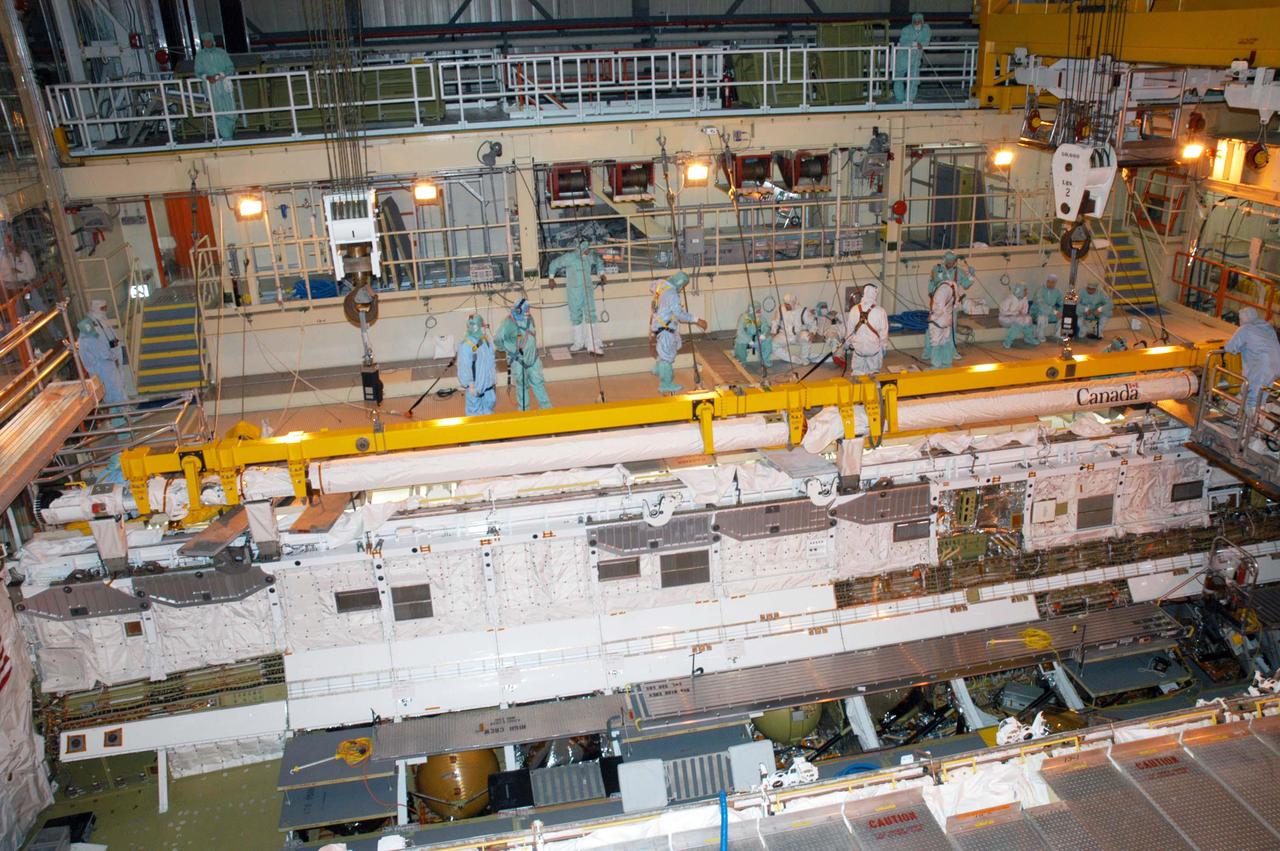
KENNEDY SPACE CENTER, FLA. - Technicians in the Orbiter Processing Facility work to install the Remote Manipulator System (RMS), also known as the Canadian robotic arm, in Discovery’s payload bay. The RMS is used to deploy and retrieve payloads, provide a mobile extension ladder or foot restraints for crew members during extravehicular activities; and to aid the flight crew members in viewing surfaces of the orbiter or payloads through a television camera on the RMS. The arm is also serving as the base for the new Orbiter Boom Sensor System (OBSS), one of the safety measures for Return to Flight, equipping the Shuttle with cameras and laser systems to inspect the Shuttle’s Thermal Protection System while in space. Discovery is scheduled for a launch planning window of May 2005 on Return to Flight mission STS-114.
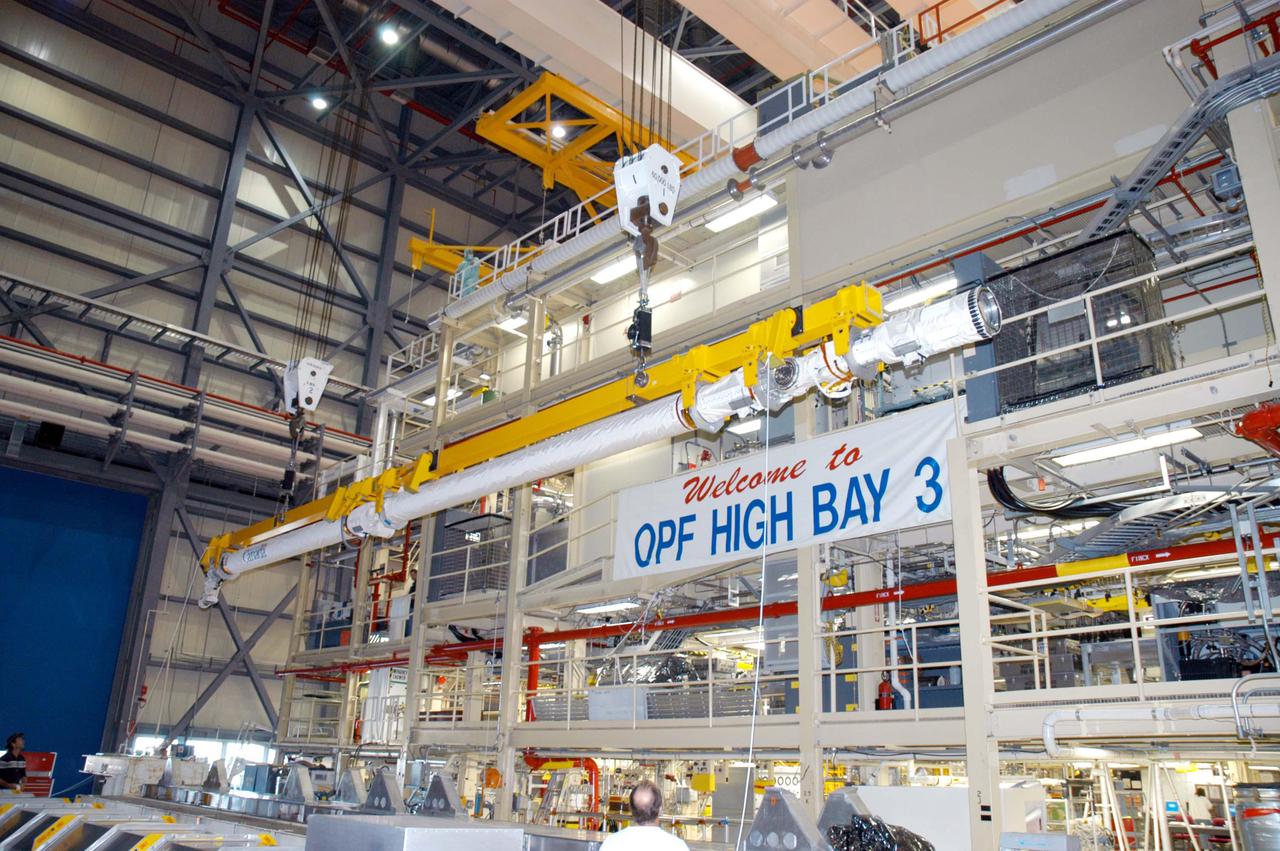
KENNEDY SPACE CENTER, FLA. - The Remote Manipulator System (RMS), also known as the Canadian robotic arm, is moved in the Orbiter Processing Facility for installation in Discovery’s payload bay. The RMS is used to deploy and retrieve payloads, provide a mobile extension ladder or foot restraints for crew members during extravehicular activities; and to aid the flight crew members in viewing surfaces of the orbiter or payloads through a television camera on the RMS. The arm is also serving as the base for the new Orbiter Boom Sensor System (OBSS), one of the safety measures for Return to Flight, equipping the Shuttle with cameras and laser systems to inspect the Shuttle’s Thermal Protection System while in space. Discovery is scheduled for a launch planning window of May 2005 on Return to Flight mission STS-114.
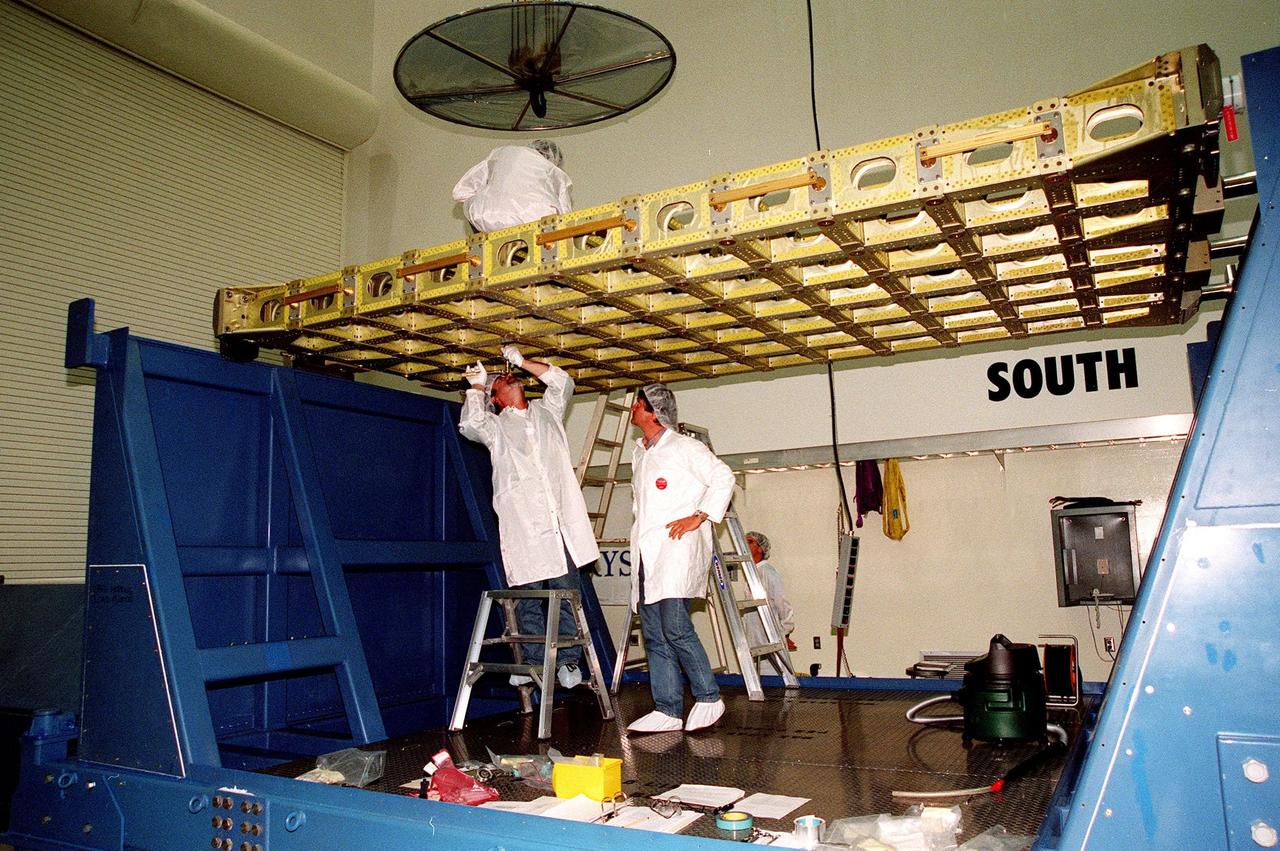
At Astrotech, Titusville, Fla., Harald Schnier and Manfred Nordhoff, with Daimler-Chrysler Aerospace (DASA), look over the International Cargo Carrier that will be used during future International Space Station (ISS) assembly missions. On top is Robert Wilkes, with Lockheed Martin. Behind the ladder in the background is Ben Greene, with Lockheed Martin. The nonpressurized ICC fits inside the payload bay of the orbiter. The ICC will carry the SPACEHAB Oceaneering Space System Box (SHOSS), a logistics items carrier. SHOSS can hold a maximum of 400 pounds of equipment and will carry items to be used during STS-96 and future ISS assembly flights. Also aboard the ICC will be the ORU Transfer Device (OTD), a U.S.-built crane that will be stowed on Unity for use during future ISS assembly missions. The ICC will fly on mission STS-96, targeted for launch on May 20
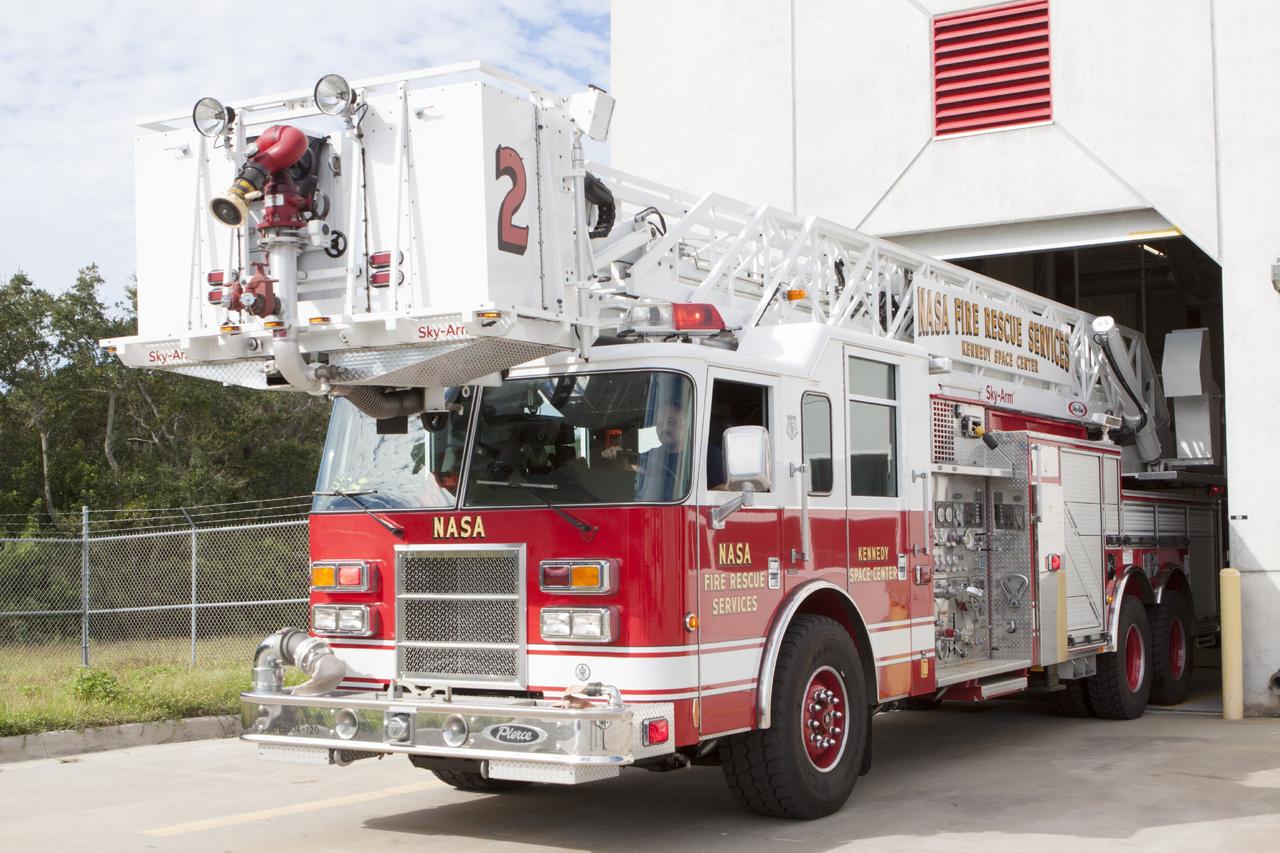
CAPE CANAVERAL, Fla. – At Fire Station No. 2 near the Shuttle Landing Facility at NASA’s Kennedy Space Center in Florida, the aerial fire truck is being driven out of the bay so that Fire Rescue Services personnel can be trained and certified in the operation and use of the vehicle. The center’s Fire Rescue Services recently achieved Pro Board Certification in aerial fire truck operations. Pro Board Certification is a globally recognized certification that puts on multiple courses that all fire departments throughout the world recognize and use to train their personnel. The unique aerial truck contains a 100-foot extendable ladder with a bucket at the end of it that can be used for rescues from taller buildings or aircraft rescue firefighting. Photo credit: NASA/Kim Shiflett
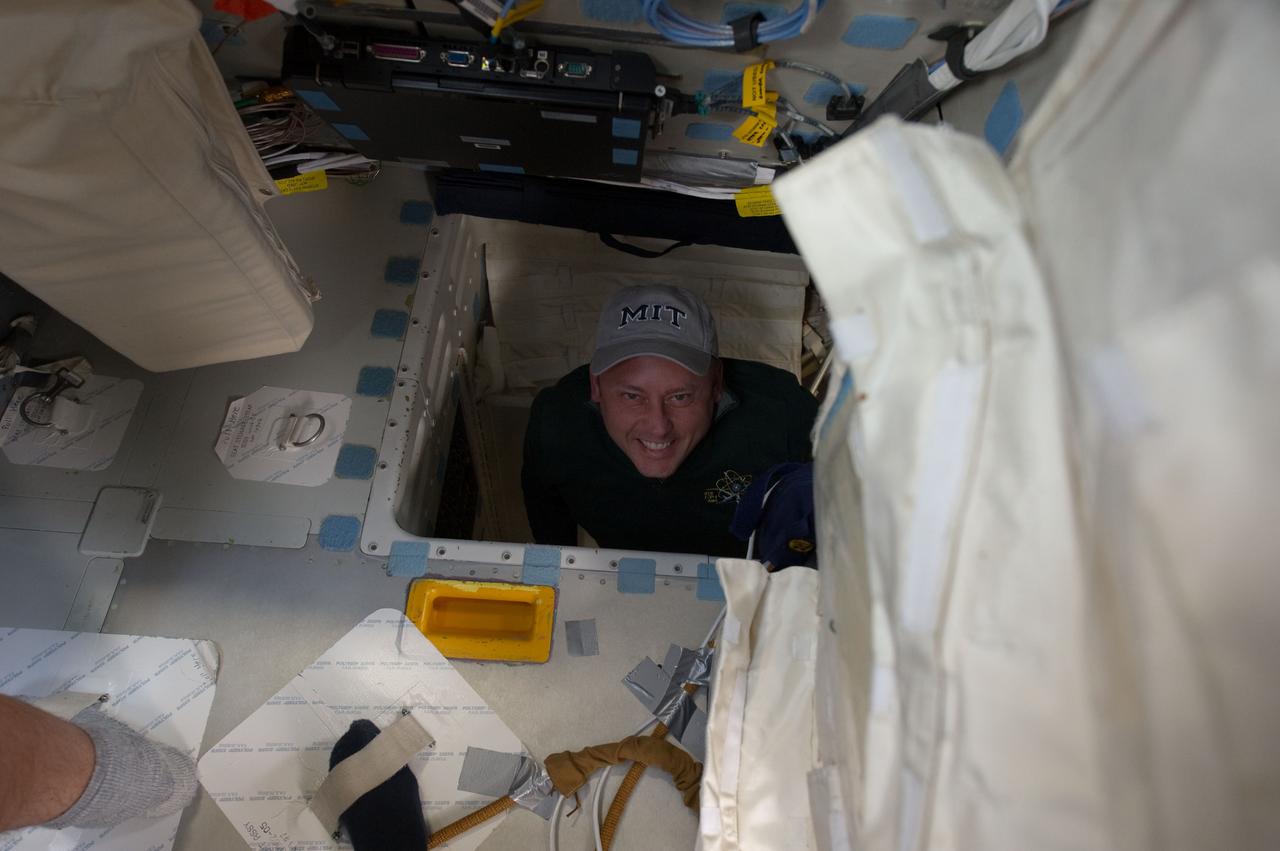
S134-E-006531 (17 May 2011) --- Onboard space shuttle Endeavour, astronaut Michael Fincke, STS-134 mission specialist, merely needs to shove off one of his legs and leap and he transports his body from middeck to flight deck. In Earth-bound trainers, such a move required a stationary ladder. A former long-duration occupant of the International Space Station (ISS), Fincke joins five other veteran astronauts for this final mission of Endeavour -- a 16-day affair that will allow the crew to spend almost two full weeks onboard the orbiting ISS/shuttle joint complex. Docking day is a day away from the time this image was recorded. Photo credit: NASA
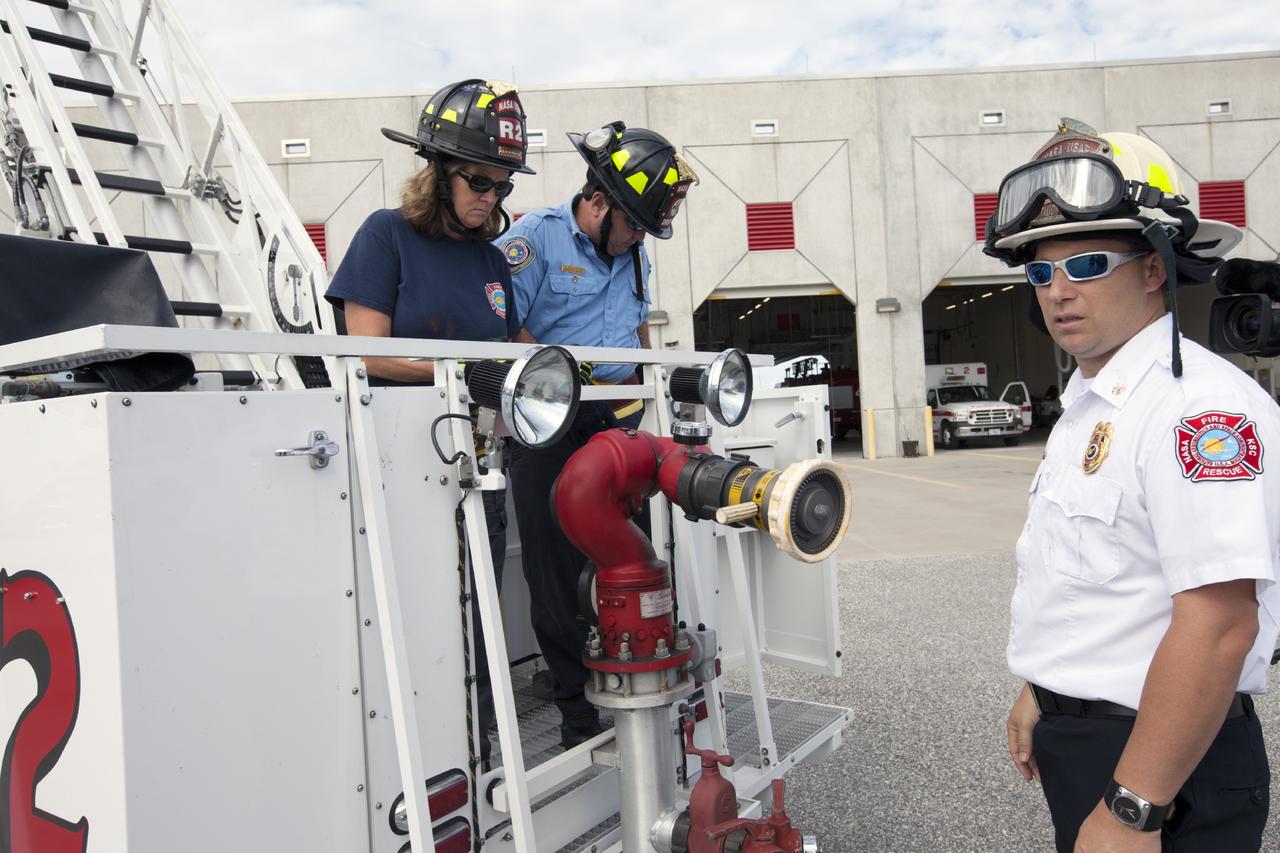
CAPE CANAVERAL, Fla. – At Fire Station No. 2 near the Shuttle Landing Facility at NASA’s Kennedy Space Center in Florida, Mark Huetter, assistant chief of training with the center’s Fire Department, monitors training procedures as two Fire Rescue Services personnel prepare to exit the bucket after training on the aerial fire truck. The center’s Fire Rescue Services recently achieved Pro Board Certification in aerial fire truck operations. Pro Board Certification is a globally recognized certification that puts on multiple courses that all fire departments throughout the world recognize and use to train their personnel. The unique aerial truck contains a 100-foot extendable ladder with a bucket at the end of it that can be used for rescues from taller buildings or aircraft rescue firefighting. Photo credit: NASA/Kim Shiflett
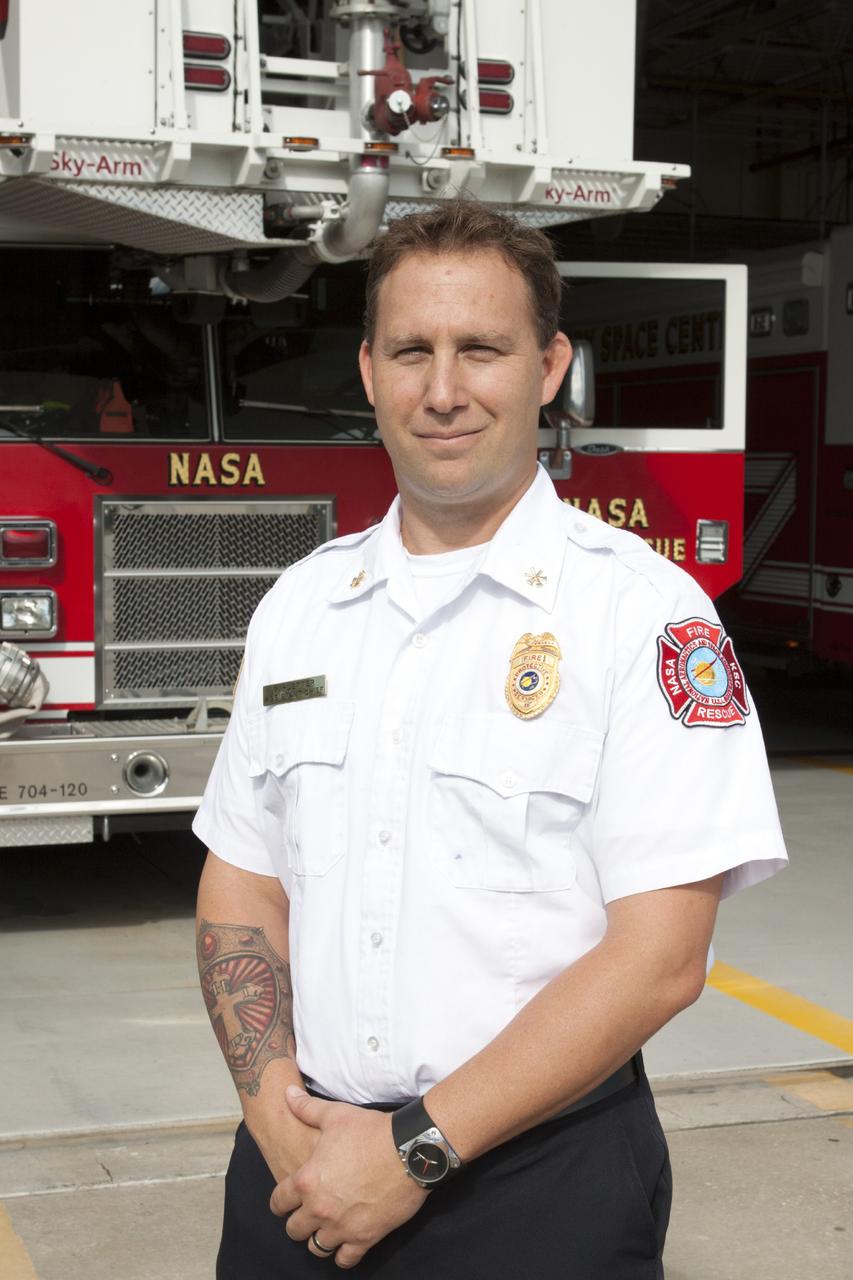
CAPE CANAVERAL, Fla. – At Fire Station No. 2 near the Shuttle Landing Facility at NASA’s Kennedy Space Center in Florida, Mark Huetter, assistant chief of training with the center’s Fire Department, prepares to train Fire Rescue Services personnel in the operation and use of the aerial fire truck. The center’s Fire Rescue Services recently achieved Pro Board Certification in aerial fire truck operations. Pro Board Certification is a globally recognized certification that puts on multiple courses that all fire departments throughout the world recognize and use to train their personnel. The unique aerial truck contains a 100-foot extendable ladder with a bucket at the end of it that can be used for rescues from taller buildings or aircraft rescue firefighting. Photo credit: NASA/Kim Shiflett
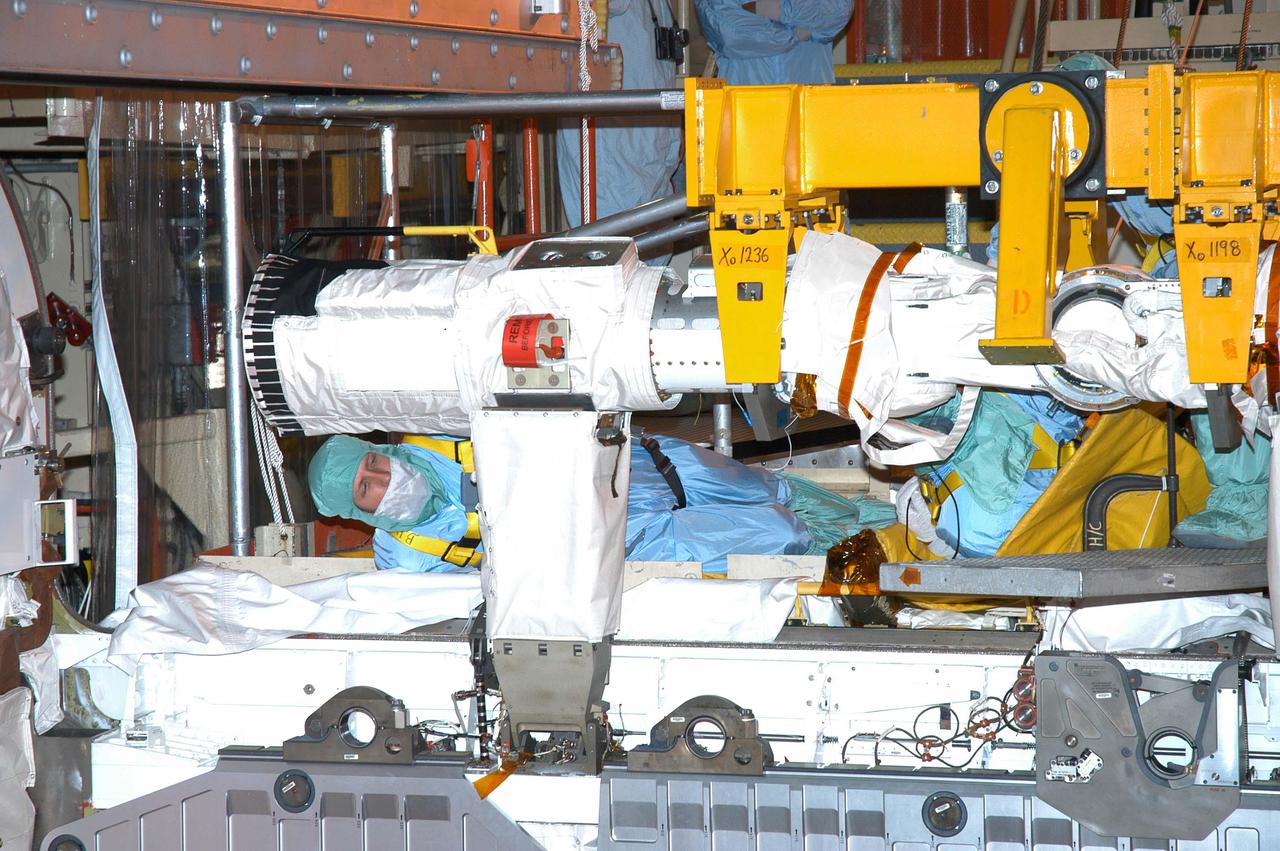
KENNEDY SPACE CENTER, FLA. - Technicians in the Orbiter Processing Facility work to install the Remote Manipulator System (RMS), also known as the Canadian robotic arm, in Discovery’s payload bay. The RMS is used to deploy and retrieve payloads, provide a mobile extension ladder or foot restraints for crew members during extravehicular activities; and to aid the flight crew members in viewing surfaces of the orbiter or payloads through a television camera on the RMS. The arm is also serving as the base for the new Orbiter Boom Sensor System (OBSS), one of the safety measures for Return to Flight, equipping the Shuttle with cameras and laser systems to inspect the Shuttle’s Thermal Protection System while in space. Discovery is scheduled for a launch planning window of May 2005 on Return to Flight mission STS-114.
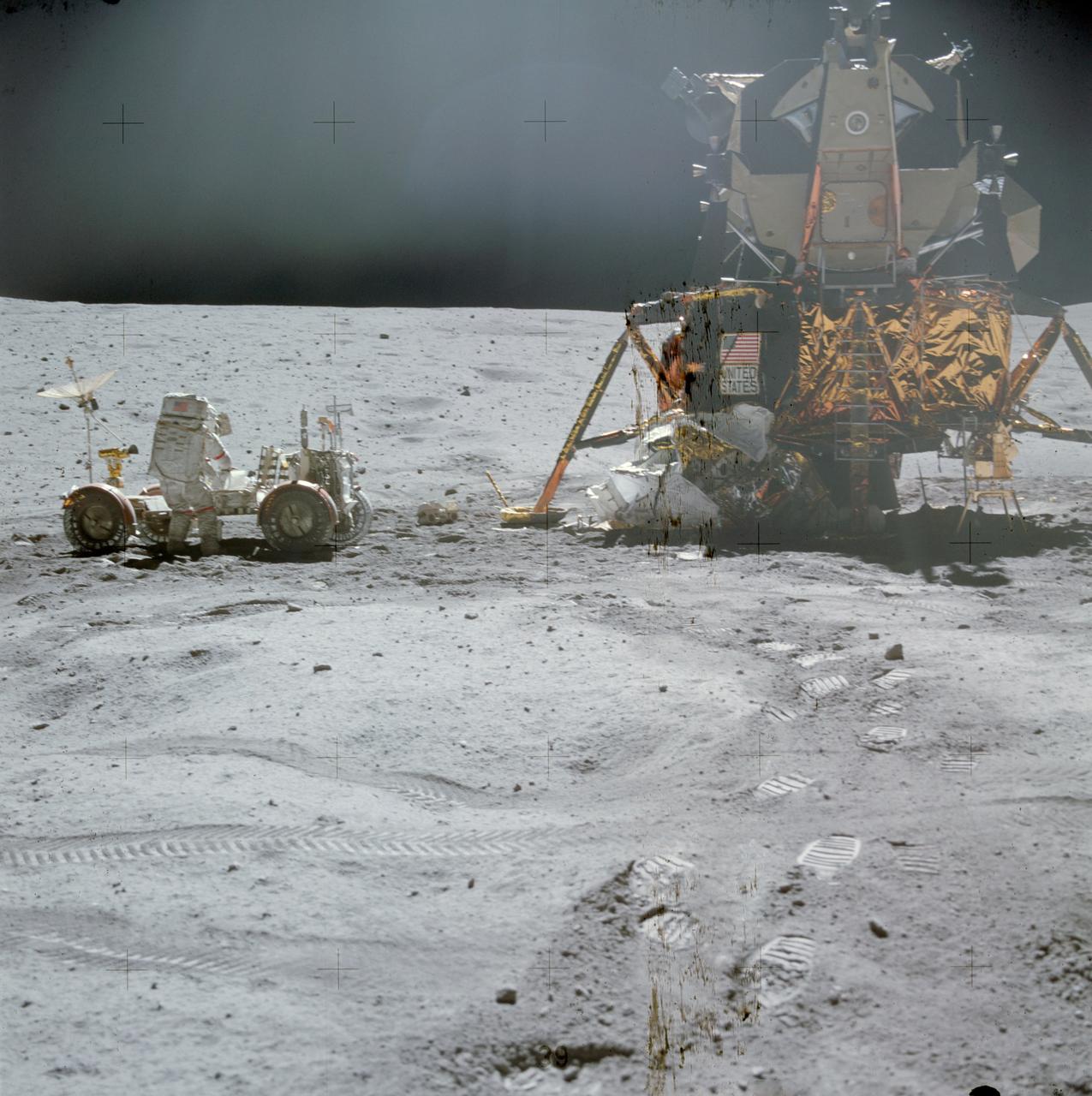
AS16-116-18578 (21 April 1972) --- Astronaut John W. Young, commander of the Apollo 16 lunar landing mission, works at the Lunar Roving Vehicle (LRV) just prior to deployment of the Apollo Lunar Surface Experiments Package (ALSEP) during the first extravehicular activity (EVA) on April 21, 1972. Note the Ultraviolet (UV) Camera/Spectrometer to the right of the Lunar Module (LM) ladder. Also, note the pile of protective/thermal foil under the U.S. flag on the LM which the astronauts pulled away to get to the Modular Equipment Storage Assembly (MESA) bay. While astronauts Young and Charles M. Duke Jr., lunar module pilot; descended in the Apollo 16 LM "Orion" to explore the Descartes highlands landing site on the moon, astronaut Thomas K. Mattingly II, command module pilot, remained with the Command and Service Modules (CSM) "Casper" in lunar orbit.
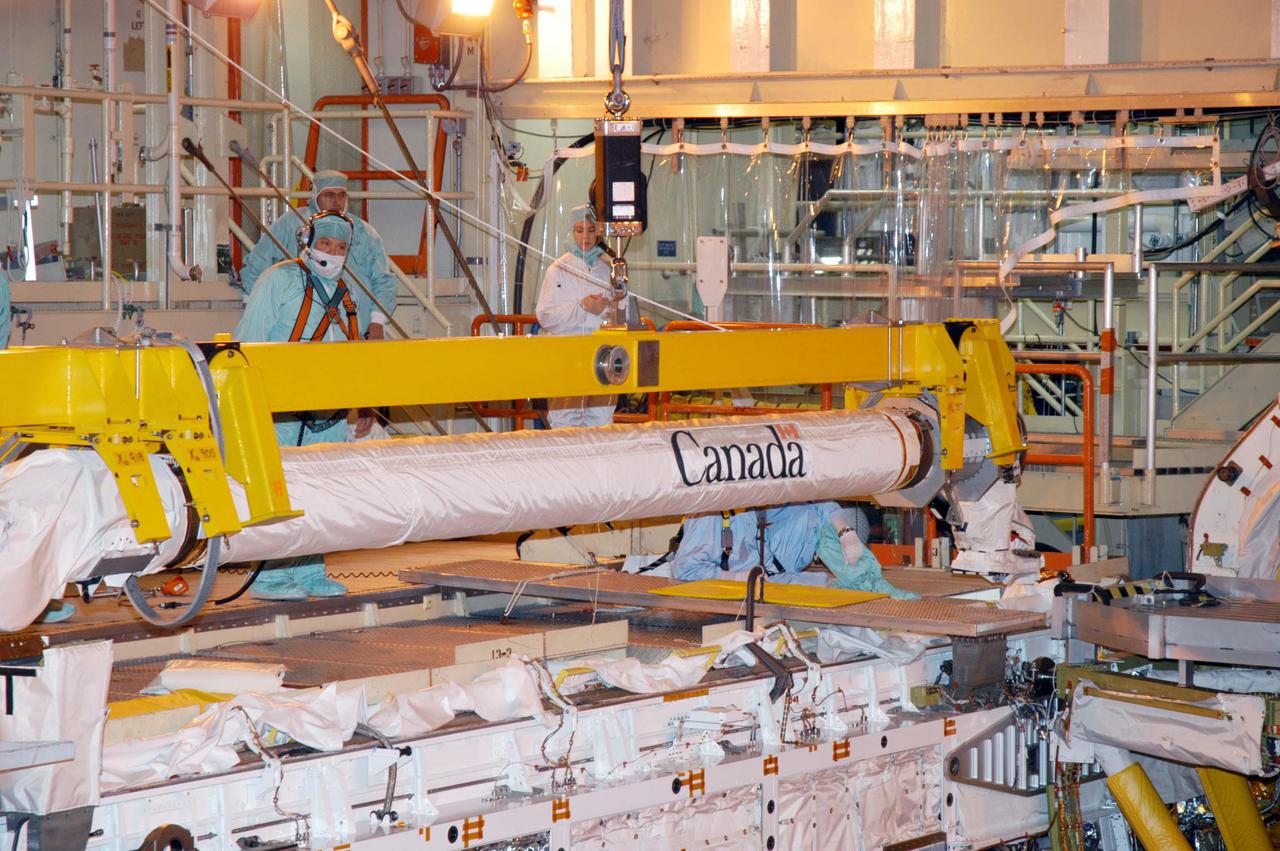
KENNEDY SPACE CENTER, FLA. - In the Orbiter Processing Facility, the Remote Manipulator System (RMS), also known as the Canadian robotic arm, is lowered toward Discovery’s payload bay for installation. The RMS is used to deploy and retrieve payloads, provide a mobile extension ladder or foot restraints for crew members during extravehicular activities; and to aid the flight crew members in viewing surfaces of the orbiter or payloads through a television camera on the RMS. The arm is also serving as the base for the new Orbiter Boom Sensor System (OBSS), one of the safety measures for Return to Flight, equipping the Shuttle with cameras and laser systems to inspect the Shuttle’s Thermal Protection System while in space. Discovery is scheduled for a launch planning window of May 2005 on Return to Flight mission STS-114.
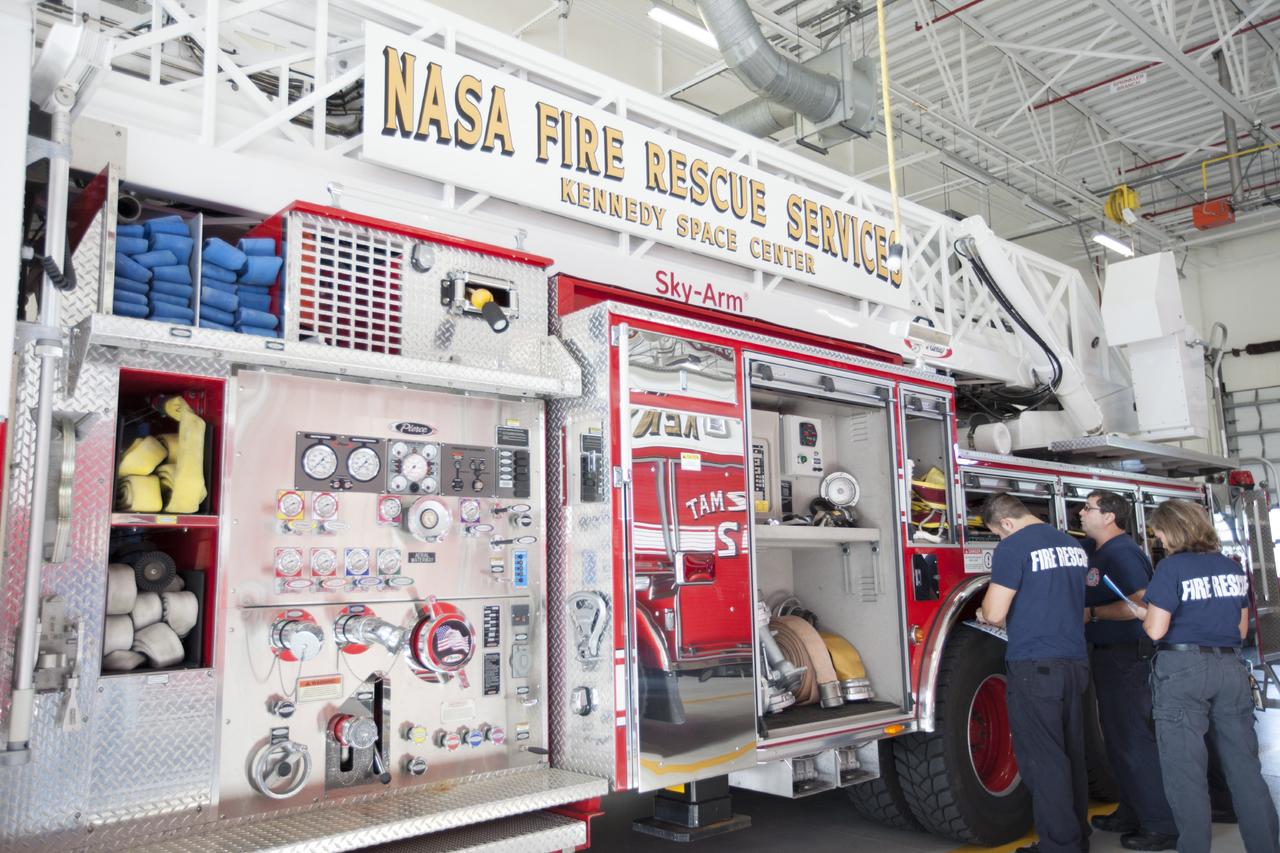
CAPE CANAVERAL, Fla. – At Fire Station No. 2 near the Shuttle Landing Facility at NASA’s Kennedy Space Center in Florida, Fire Rescue Services personnel review procedures and check equipment on the aerial fire truck as part of the training to be certified in the operation and use of the vehicle. The center’s Fire Rescue Services recently achieved Pro Board Certification in aerial fire truck operations. Pro Board Certification is a globally recognized certification that puts on multiple courses that all fire departments throughout the world recognize and use to train their personnel. The unique aerial truck contains a 100-foot extendable ladder with a bucket at the end of it that can be used for rescues from taller buildings or aircraft rescue firefighting. Photo credit: NASA/Kim Shiflett
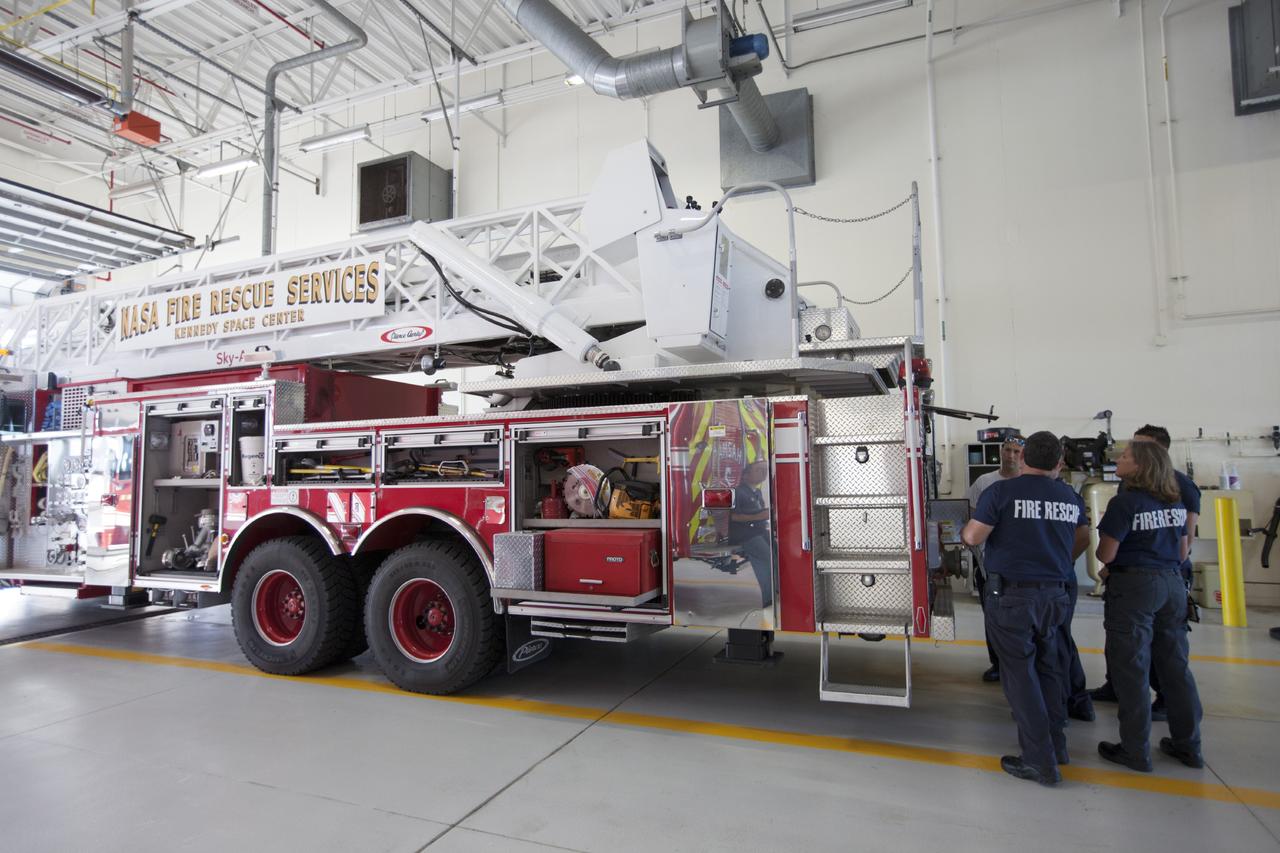
CAPE CANAVERAL, Fla. – At Fire Station No. 2 near the Shuttle Landing Facility at NASA’s Kennedy Space Center in Florida, Fire Rescue Services personnel review procedures and check equipment on the aerial fire truck as part of the training to be certified in the operation and use of the vehicle. The center’s Fire Rescue Services recently achieved Pro Board Certification in aerial fire truck operations. Pro Board Certification is a globally recognized certification that puts on multiple courses that all fire departments throughout the world recognize and use to train their personnel. The unique aerial truck contains a 100-foot extendable ladder with a bucket at the end of it that can be used for rescues from taller buildings or aircraft rescue firefighting. Photo credit: NASA/Kim Shiflett
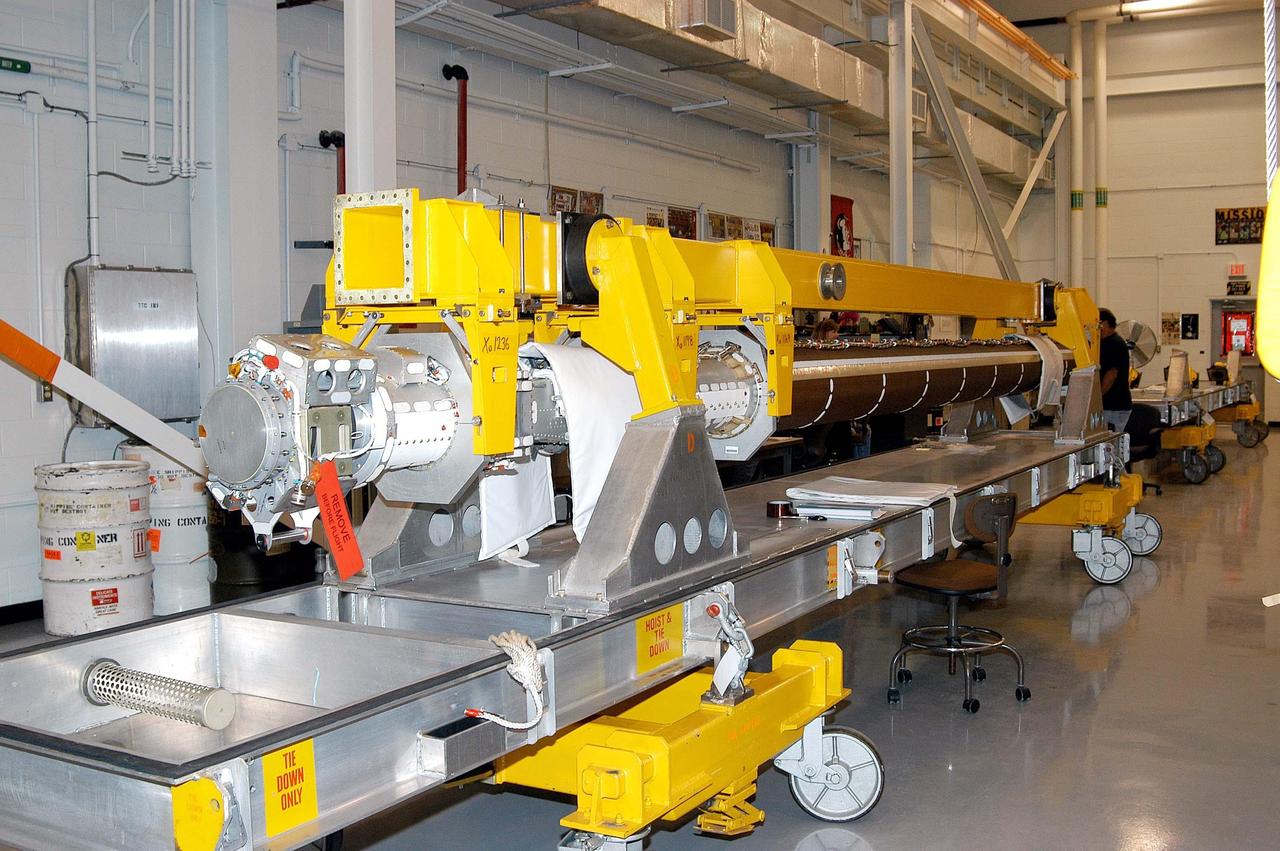
KENNEDY SPACE CENTER, FLA. - The Remote Manipulator System (RMS), also known as the Canadian robotic arm, for the orbiter Discovery has arrived at KSC’s Vehicle Assembly Building Lab. The RMS is used to deploy and retrieve payloads, provide a mobile extension ladder or foot restraints for crew members during extravehicular activities; and to aid the flight crew members in viewing surfaces of the orbiter or payloads through a television camera on the RMS. The arm is also serving as the base for the new Orbiter Boom Sensor System (OBSS), one of the safety measures for Return to Flight, equipping the Shuttle with cameras and laser systems to inspect the Shuttle’s Thermal Protection System while in space. Discovery is scheduled for a launch planning window of March 2005 on mission STS-114.
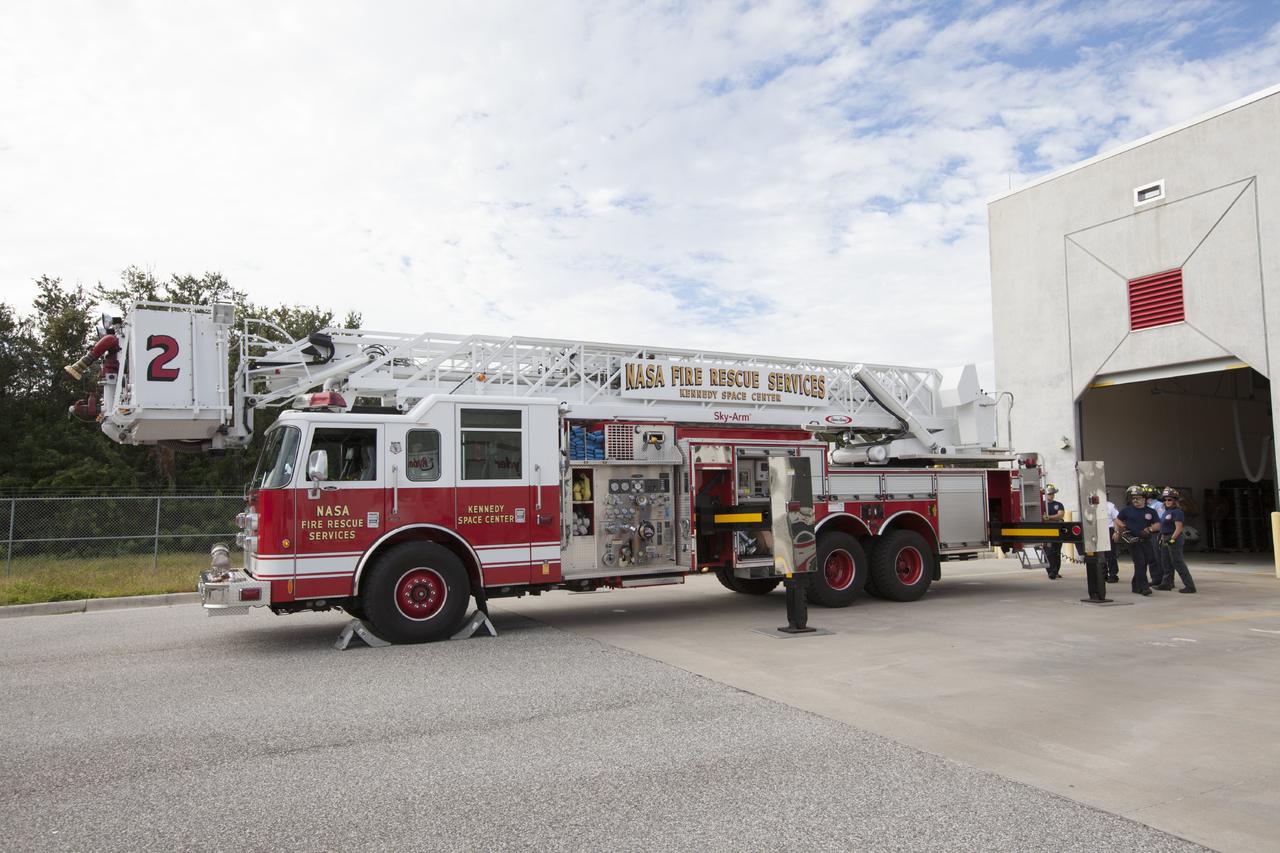
CAPE CANAVERAL, Fla. – At Fire Station No. 2 near the Shuttle Landing Facility at NASA’s Kennedy Space Center in Florida, the aerial fire truck has been moved out of the bay and Fire Rescue Services personnel have deployed the stabilizers on either side of the truck in order to prepare for training to be certified in the operation and use of the vehicle. The center’s Fire Rescue Services recently achieved Pro Board Certification in aerial fire truck operations. Pro Board Certification is a globally recognized certification that puts on multiple courses that all fire departments throughout the world recognize and use to train their personnel. The unique aerial truck contains a 100-foot extendable ladder with a bucket at the end of it that can be used for rescues from taller buildings or aircraft rescue firefighting. Photo credit: NASA/Kim Shiflett
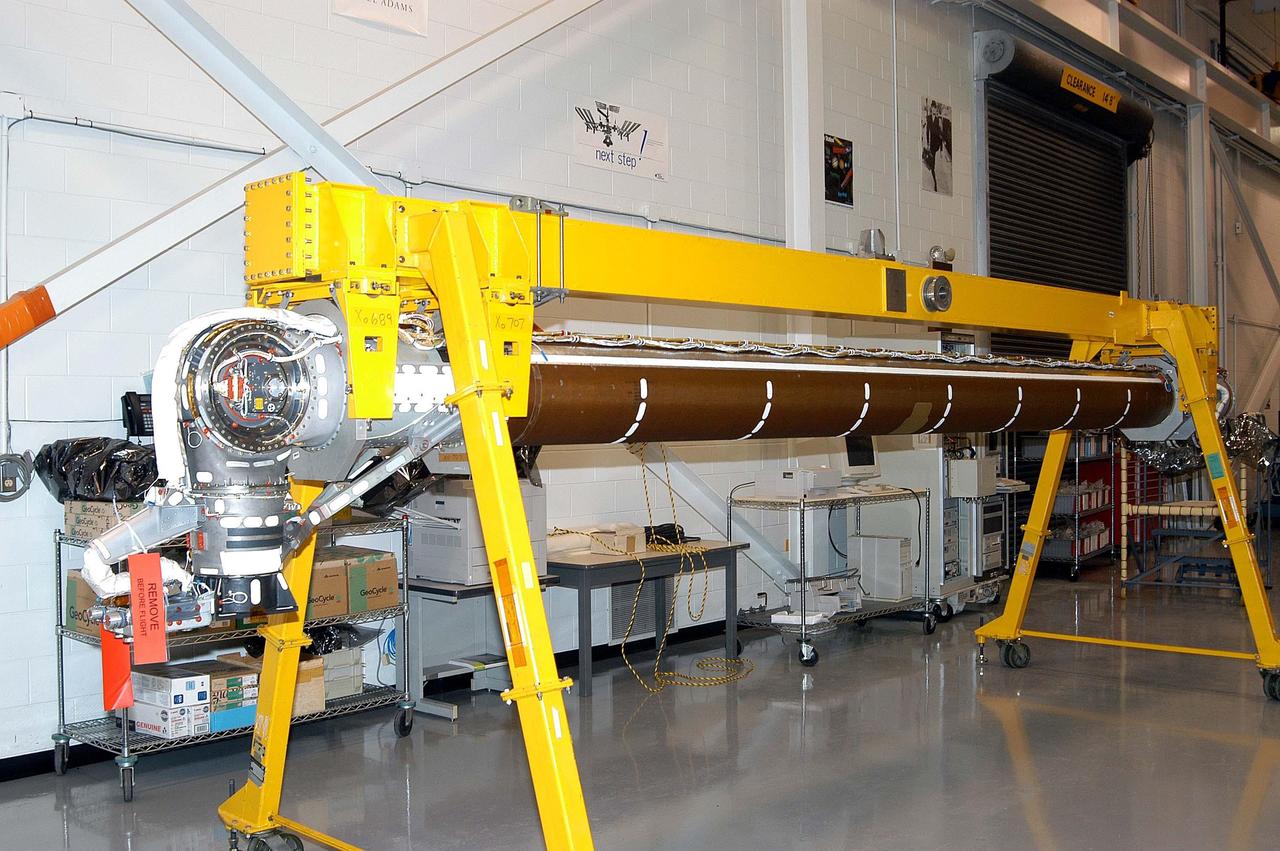
KENNEDY SPACE CENTER, FLA. - The Remote Manipulator System (RMS), also known as the Canadian robotic arm, for the orbiter Discovery has arrived at KSC’s Vehicle Assembly Building Lab. Seen on the left end is the shoulder pitch joint. The wrist and shoulder joints on the RMS allow the basic structure of the arm to maneuver similar to a human arm. The RMS is used to deploy and retrieve payloads, provide a mobile extension ladder or foot restraints for crew members during extravehicular activities; and to aid the flight crew members in viewing surfaces of the orbiter or payloads through a television camera on the RMS. The arm is also serving as the base for the new Orbiter Boom Sensor System (OBSS), one of the safety measures for Return to Flight, equipping the Shuttle with cameras and laser systems to inspect the Shuttle’s Thermal Protection System while in space. Discovery is scheduled for a launch planning window of March 2005 on mission STS-114.
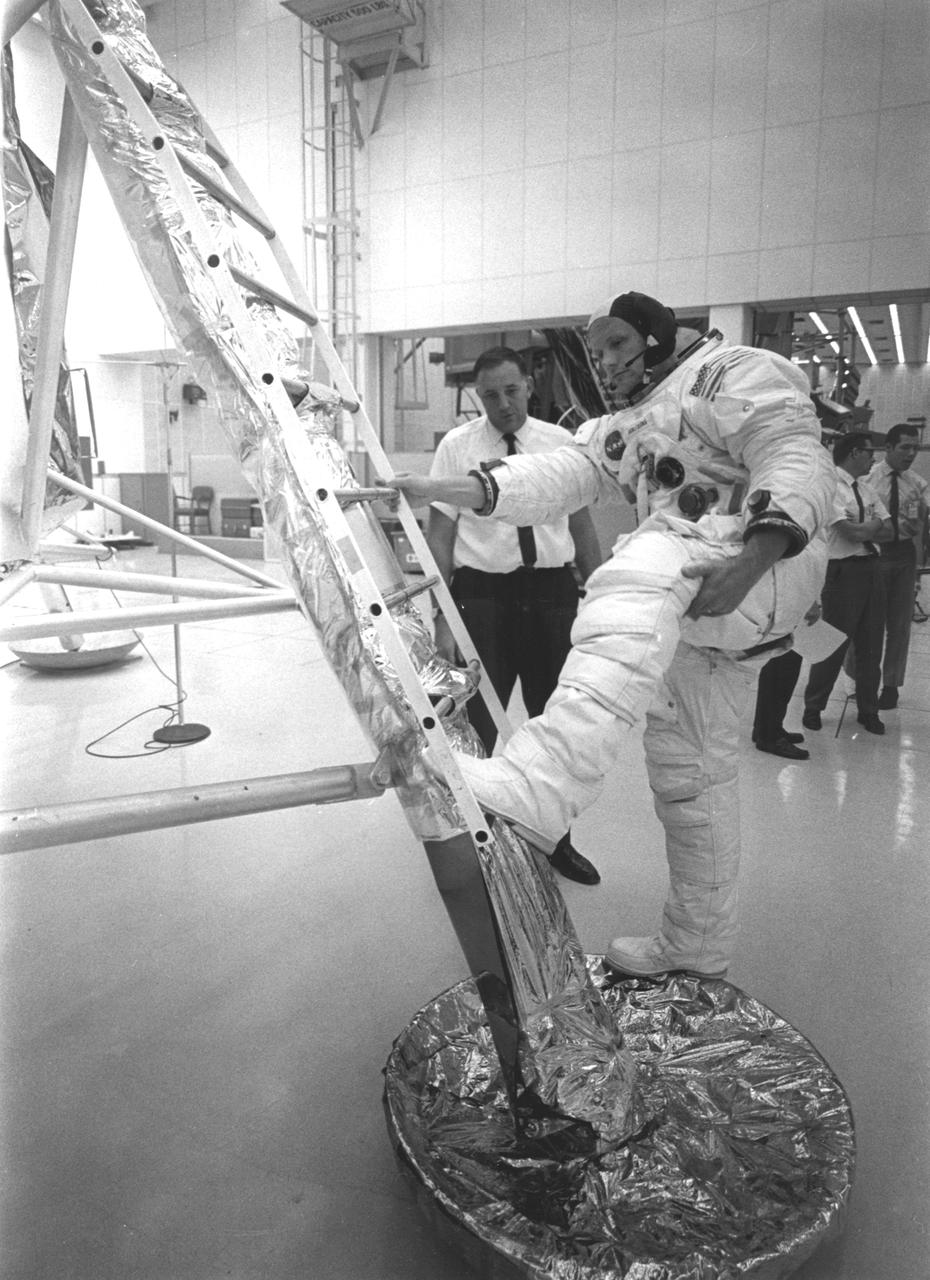
In preparation of the nation’s first Lunar landing mission, Apollo 11 crew members underwent training activities to practice activities they would be performing during the mission. In this photograph, Neil Armstrong, donned in his space suit, practices getting back to the first rung of the ladder on the Lunar Module (LM). The Apollo 11 mission launched from the Kennedy Space Center (KSC) in Florida via the Marshall Space Flight Center (MSFC) developed Saturn V launch vehicle on July 16, 1969 and safely returned to Earth on July 24, 1969. Aboard the space craft were astronauts Neil A. Armstrong, commander; Michael Collins, Command Module (CM) pilot; and Edwin E. (Buzz) Aldrin Jr., Lunar Module (LM) pilot. The CM, “Columbia”, piloted by Collins, remained in a parking orbit around the Moon while the LM, “Eagle’’, carrying astronauts Armstrong and Aldrin, landed on the Moon. On July 20, 1969, Armstrong was the first human to ever stand on the lunar surface, followed by Aldrin. During 2½ hours of surface exploration, the crew collected 47 pounds of lunar surface material for analysis back on Earth. With the success of Apollo 11, the national objective to land men on the Moon and return them safely to Earth had been accomplished.
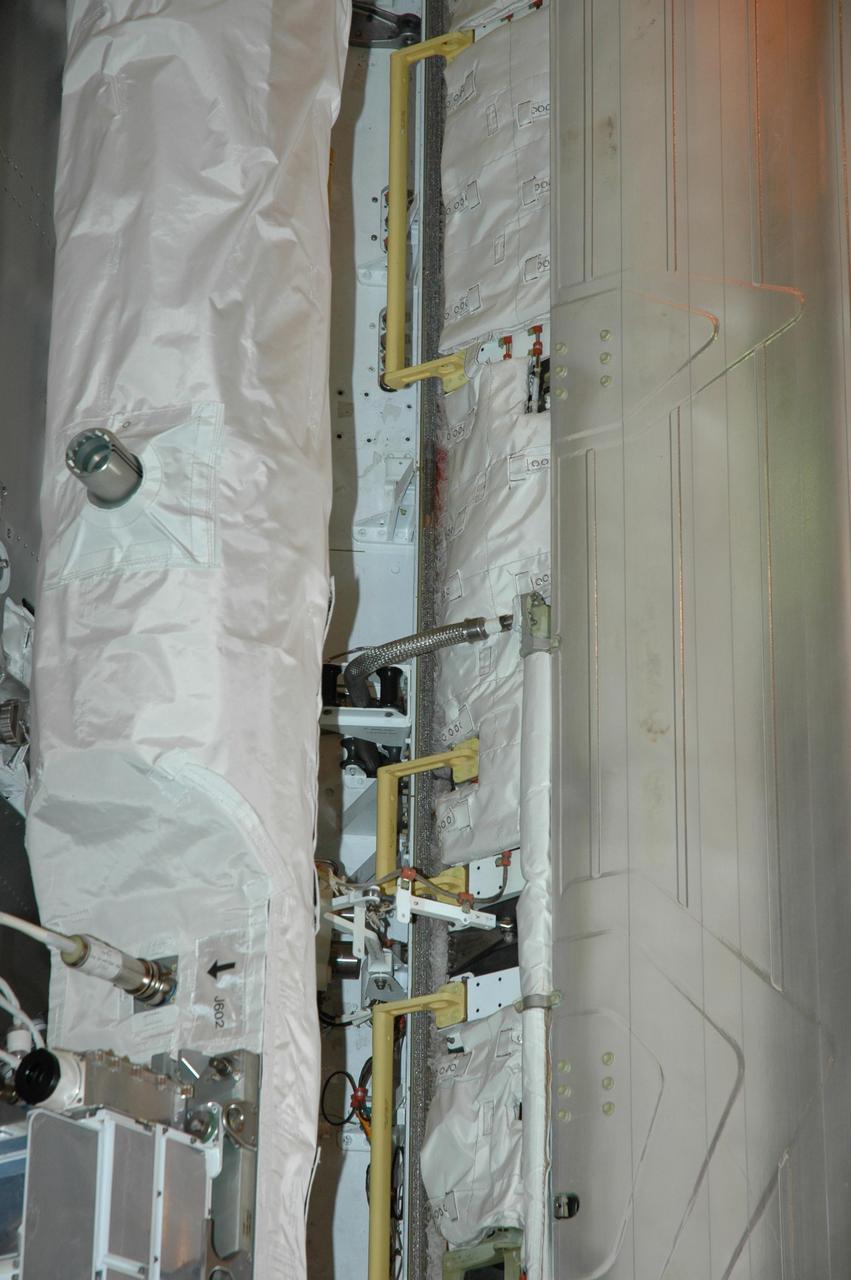
KENNEDY SPACE CENTER, FLA. -- On Launch Pad 39A at NASA's Kennedy Space Center, the payload bay doors are closing on space shuttle Atlantis. During launch preparations, technicians noticed a small section of a braided metal hose that was bent in a shape similar to the Greek letter Omega. The radiator retract hose (seen in the middle), part of the shuttle's cooling system that carries Freon, is designed to flex. Engineers designed a tool to guide the hose back into the storage box. During the starboard door closure, eight incremental stops were performed. After each stop, the aft hose was adjusted and seated in place utilizing the ladder and hose assist tool. The team was satisfied with the final placement of the hose at door closure. STS-122 is the 121st space shuttle flight, the 29th flight for Atlantis and the 24th flight to the International Space Station. The Columbus laboratory module, built by the European Space Agency, is approximately 23 feet long and 15 feet wide, allowing it to hold 10 large racks of experiments. Atlantis is scheduled to launch at 2:45 p.m. Feb. 7. Photo credit: NASA/Jack Pfaller
KENNEDY SPACE CENTER, FLA. -- On Launch Pad 39A at NASA's Kennedy Space Center, engineers examine the fit of the payload bay doors on space shuttle Atlantis as they are closing. During launch preparations, technicians noticed a small section of a braided metal hose that was bent in a shape similar to the Greek letter Omega. The radiator retract hose (seen in the middle), part of the shuttle's cooling system that carries Freon, is designed to flex. Engineers designed a tool to guide the hose back into the storage box. During the starboard door closure, eight incremental stops were performed. After each stop, the aft hose was adjusted and seated in place utilizing the ladder and hose assist tool. The team was satisfied with the final placement of the hose at door closure. STS-122 is the 121st space shuttle flight, the 29th flight for Atlantis and the 24th flight to the International Space Station. The Columbus laboratory module, built by the European Space Agency, is approximately 23 feet long and 15 feet wide, allowing it to hold 10 large racks of experiments. Atlantis is scheduled to launch at 2:45 p.m. Feb. 7. Photo credit: NASA/Jack Pfaller
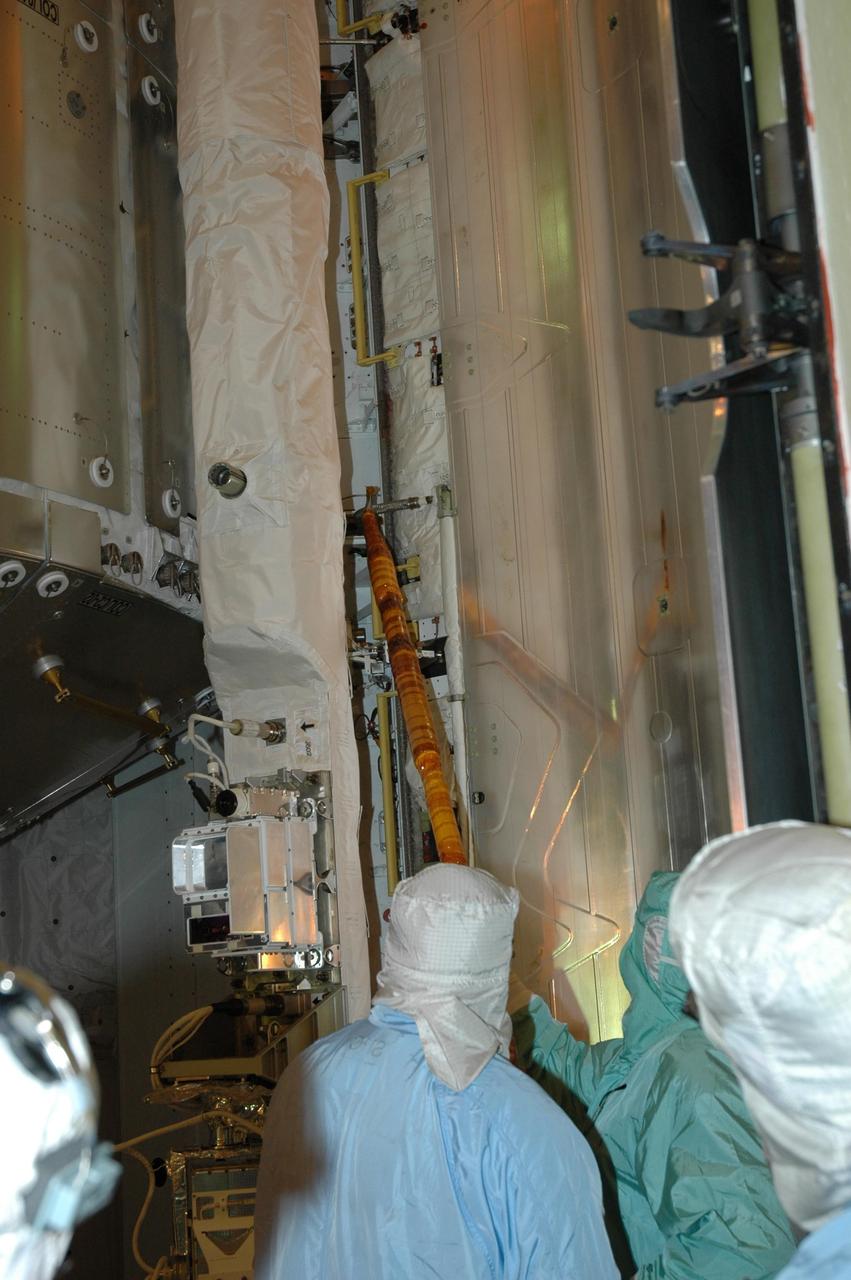
KENNEDY SPACE CENTER, FLA. -- On Launch Pad 39A at NASA's Kennedy Space Center, the payload bay doors are closing on space shuttle Atlantis. During launch preparations, technicians noticed a small section of a braided metal hose that was bent in a shape similar to the Greek letter Omega. The radiator retract hose (seen in the middle), part of the shuttle's cooling system that carries Freon, is designed to flex. Engineers are using a hose assist tool designed to help guide the hose back into the storage box. During the starboard door closure, eight incremental stops were performed. After each stop, the aft hose was adjusted and seated in place utilizing the ladder and hose assist tool. The team was satisfied with the final placement of the hose at door closure. STS-122 is the 121st space shuttle flight, the 29th flight for Atlantis and the 24th flight to the International Space Station. The Columbus laboratory module, built by the European Space Agency, is approximately 23 feet long and 15 feet wide, allowing it to hold 10 large racks of experiments. Atlantis is scheduled to launch at 2:45 p.m. Feb. 7. Photo credit: NASA/Jack Pfaller
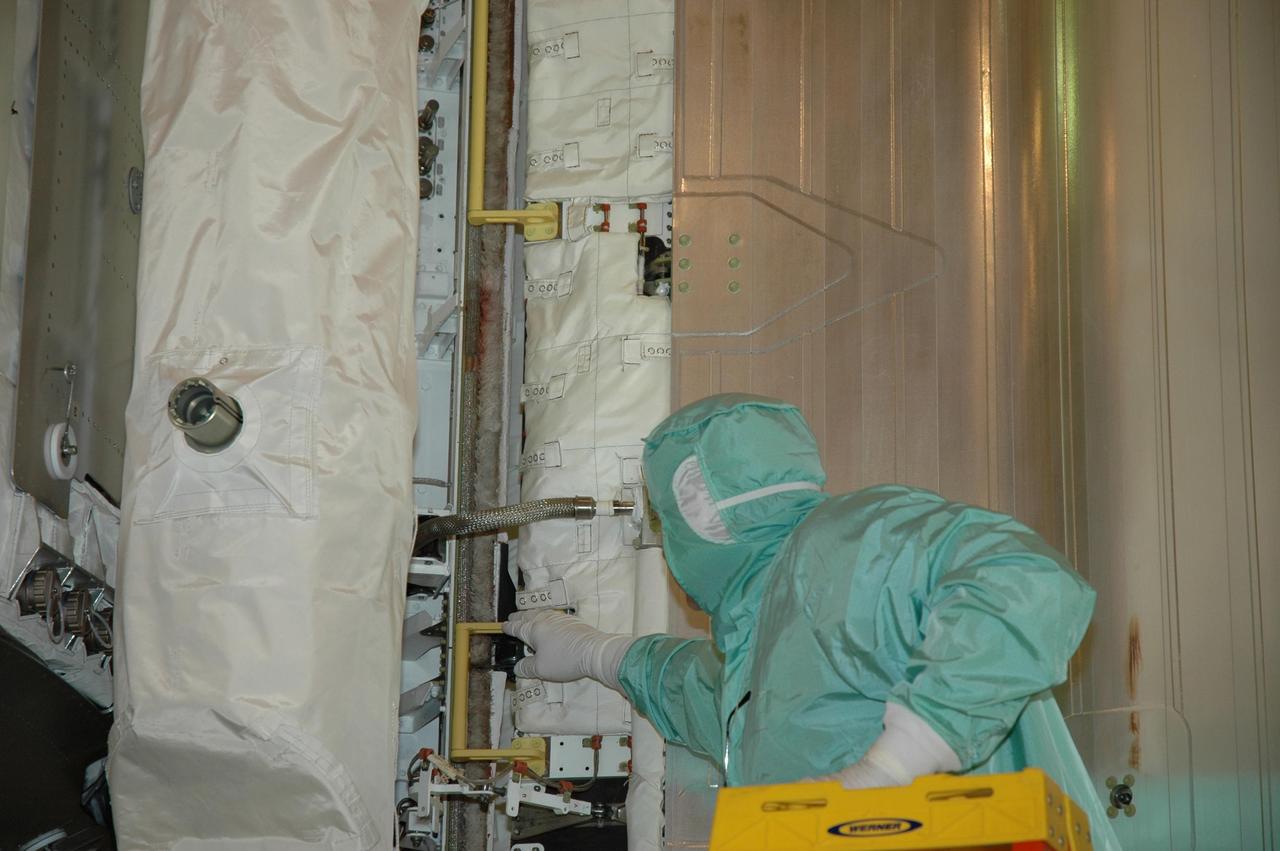
KENNEDY SPACE CENTER, FLA. -- On Launch Pad 39A at NASA's Kennedy Space Center, an engineer checks the progress of payload bay doors closing on space shuttle Atlantis. During launch preparations, technicians noticed a small section of a braided metal hose that was bent in a shape similar to the Greek letter Omega. The radiator retract hose, part of the shuttle's cooling system that carries Freon, is designed to flex. Engineers designed a tool to guide the hose back into the storage box. During the starboard door closure, eight incremental stops were performed. After each stop, the aft hose was adjusted and seated in place utilizing the ladder and hose assist tool. The team was satisfied with the final placement of the hose at door closure. STS-122 is the 121st space shuttle flight, the 29th flight for Atlantis and the 24th flight to the International Space Station. The Columbus laboratory module, built by the European Space Agency, is approximately 23 feet long and 15 feet wide, allowing it to hold 10 large racks of experiments. Atlantis is scheduled to launch at 2:45 p.m. Feb. 7. Photo credit: NASA/Jack Pfaller
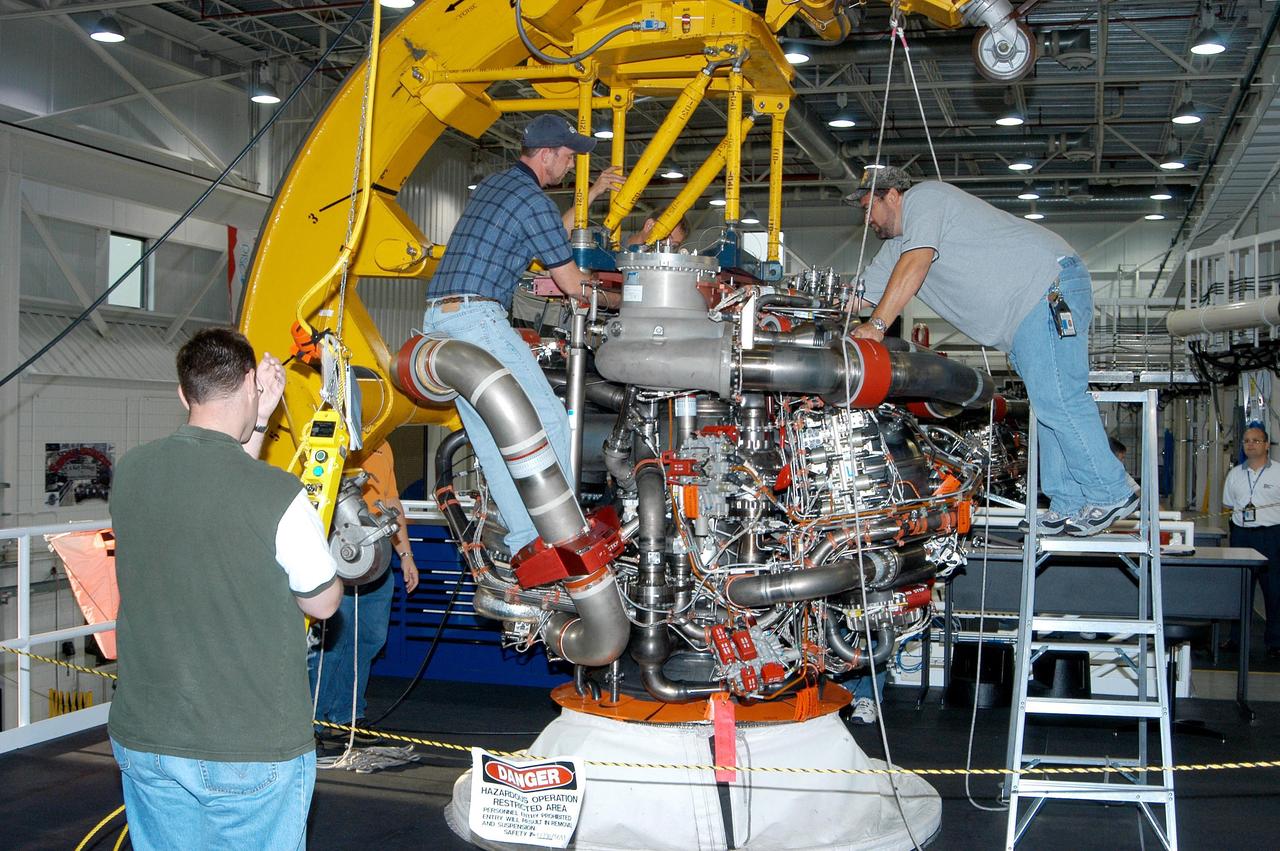
KENNEDY SPACE CENTER, FLA. - In the Space Shuttle Main Engine (SSME) Processing Facility, Boeing-Rocketdyne technicians prepare to move SSME 2058, the first SSME fully assembled at KSC. Move conductor Bob Brackett (on ladder) and technicians secure a sling around the engine under the direction of crane operator Joe Ferrante (left). The engine will be lifted from its vertical work stand into a horizontal position in preparation for shipment to NASA’s Stennis Space Center in Mississippi to undergo a hot fire acceptance test. It is the first of five engines to be fully assembled on site to reach the desired number of 15 engines ready for launch at any given time in the Space Shuttle program. A Space Shuttle has three reusable main engines. Each is 14 feet long, weighs about 7,800 pounds, is seven-and-a-half feet in diameter at the end of its nozzle, and generates almost 400,000 pounds of thrust. Historically, SSMEs were assembled in Canoga Park, Calif., with post-flight inspections performed at KSC. Both functions were consolidated in February 2002. The Rocketdyne Propulsion and Power division of The Boeing Co. manufactures the engines for NASA.
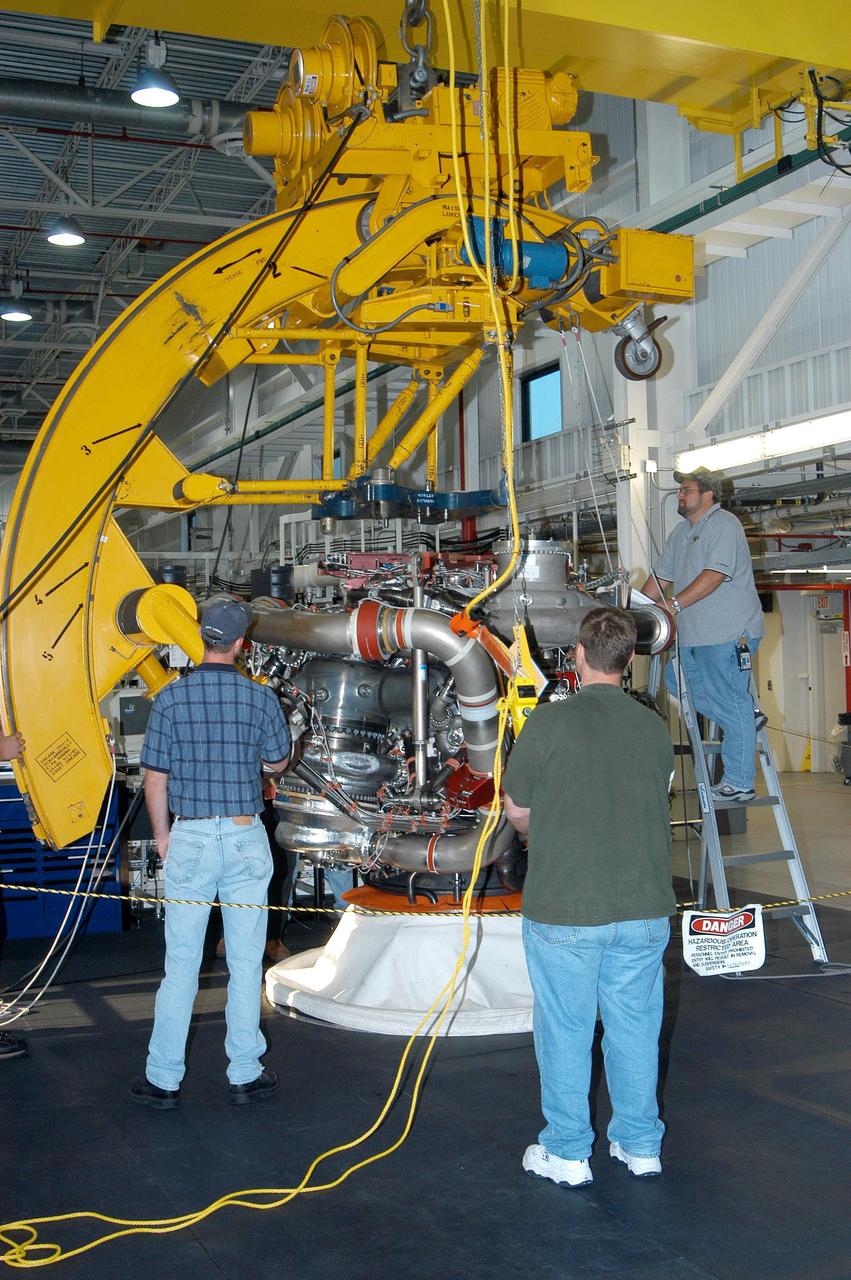
KENNEDY SPACE CENTER, FLA. - In the Space Shuttle Main Engine (SSME) Processing Facility, Boeing-Rocketdyne technicians prepare to move SSME 2058, the first SSME fully assembled at KSC. Move conductor Bob Brackett (on ladder) supervises the placement of a sling around the engine with the assistance of crane operator Joe Ferrante (center) and a technician. The engine will be lifted from its vertical work stand into a horizontal position in preparation for shipment to NASA’s Stennis Space Center in Mississippi to undergo a hot fire acceptance test. It is the first of five engines to be fully assembled on site to reach the desired number of 15 engines ready for launch at any given time in the Space Shuttle program. A Space Shuttle has three reusable main engines. Each is 14 feet long, weighs about 7,800 pounds, is seven-and-a-half feet in diameter at the end of its nozzle, and generates almost 400,000 pounds of thrust. Historically, SSMEs were assembled in Canoga Park, Calif., with post-flight inspections performed at KSC. Both functions were consolidated in February 2002. The Rocketdyne Propulsion and Power division of The Boeing Co. manufactures the engines for NASA.
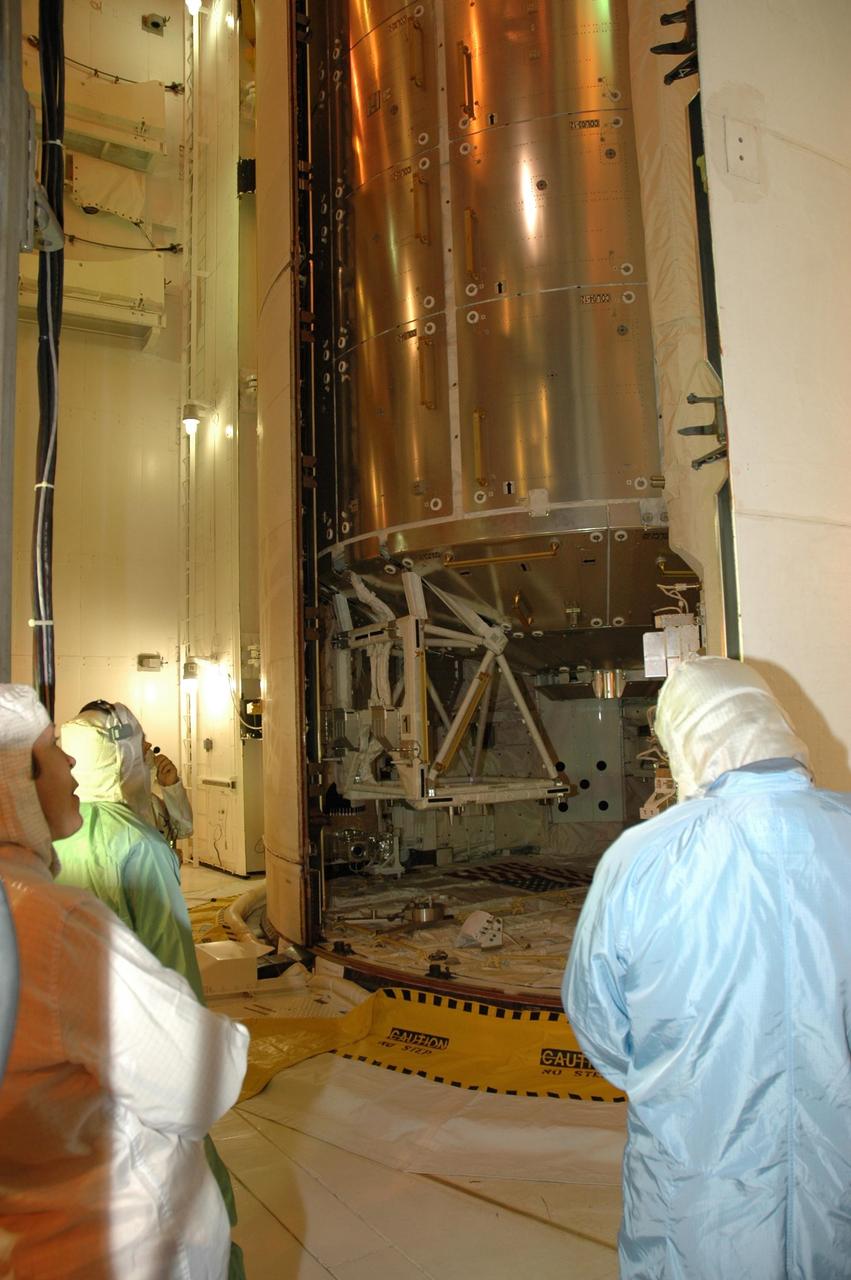
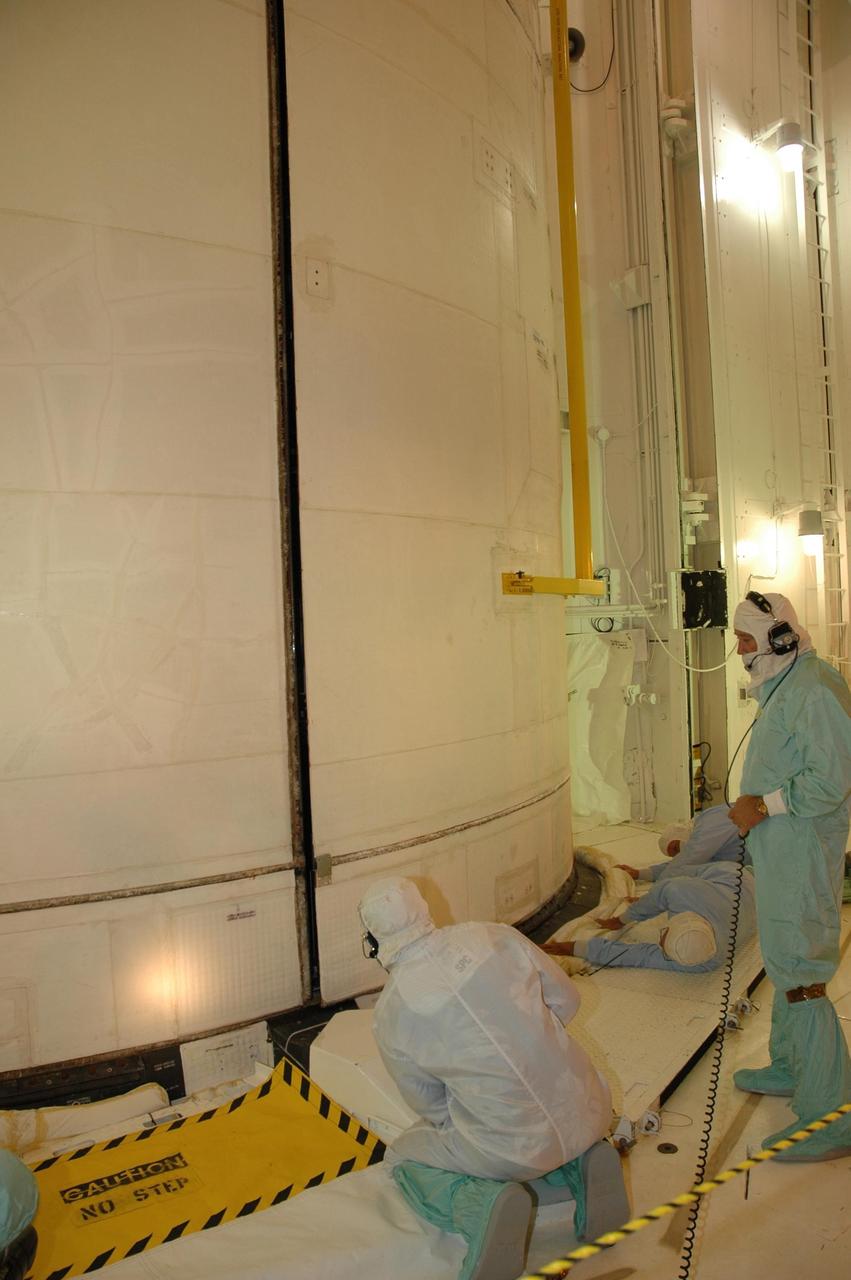
KENNEDY SPACE CENTER, FLA. -- From the payload changeout room on Launch Pad 39A at NASA's Kennedy Space Center, engineers oversee the closing of space shuttle Atlantis' payload bay doors around the cargo -- the Columbus Laboratory seen here. During launch preparations, technicians noticed a small section of a braided metal hose that was bent in a shape similar to the Greek letter Omega. The radiator retract hose, part of the shuttle's cooling system that carries Freon, is designed to flex. Engineers designed a tool to guide the hose back into the storage box. During the starboard door closure, eight incremental stops were performed. After each stop, the aft hose was adjusted and seated in place utilizing the ladder and hose assist tool. The team was satisfied with the final placement of the hose at door closure. STS-122 is the 121st space shuttle flight, the 29th flight for Atlantis and the 24th flight to the International Space Station. The Columbus laboratory module, built by the European Space Agency, is approximately 23 feet long and 15 feet wide, allowing it to hold 10 large racks of experiments. Atlantis is scheduled to launch at 2:45 p.m. Feb. 7. Photo credit: NASA/Jack Pfaller
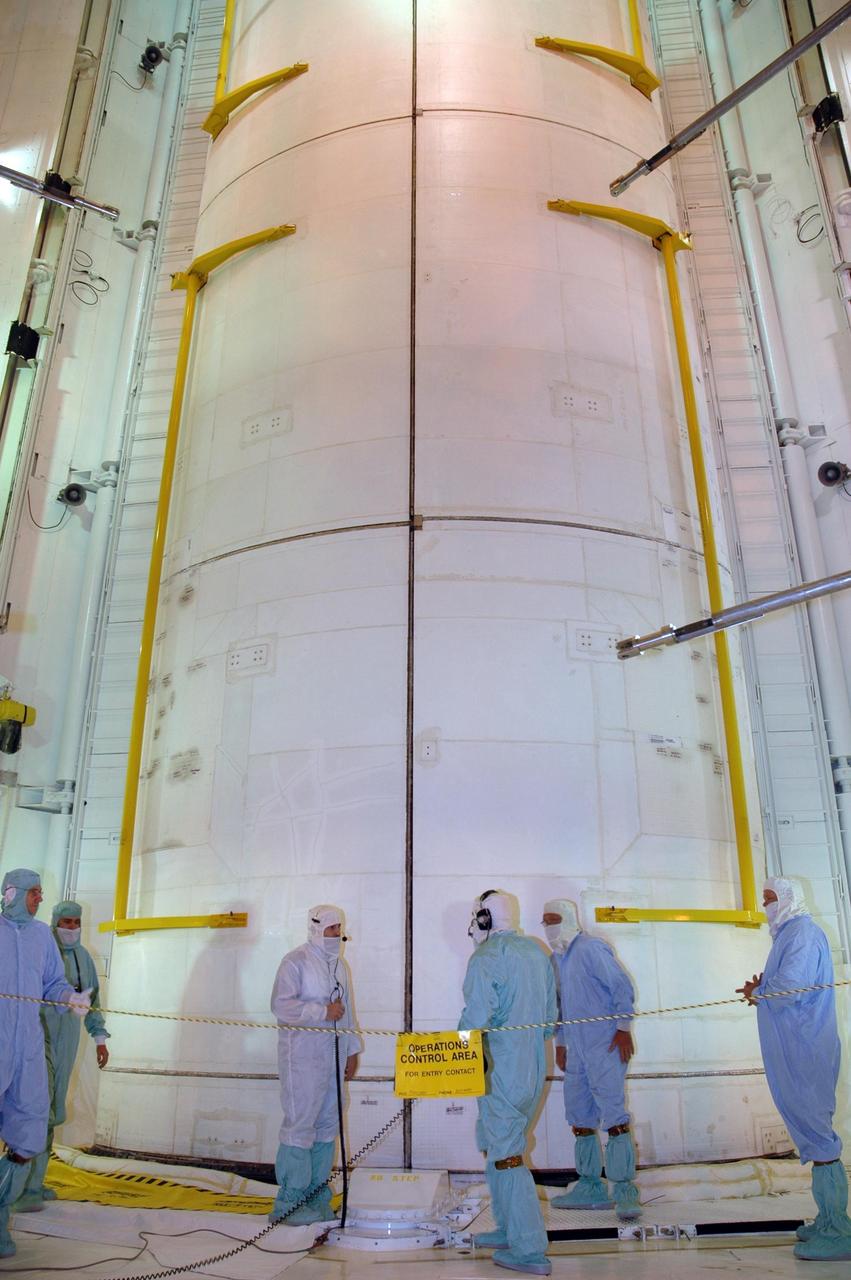
KENNEDY SPACE CENTER, FLA. -- On Launch Pad 39A at NASA's Kennedy Space Center, the payload bay doors on space shuttle Atlantis are successfully closed for launch. During launch preparations, technicians noticed a small section of a braided metal hose that was bent in a shape similar to the Greek letter Omega. The radiator retract hose (seen in the middle), part of the shuttle's cooling system that carries Freon, is designed to flex. Engineers designed a tool to guide the hose back into the storage box. During the starboard door closure, eight incremental stops were performed. After each stop, the aft hose was adjusted and seated in place utilizing the ladder and hose assist tool. The team was satisfied with the final placement of the hose at door closure. STS-122 is the 121st space shuttle flight, the 29th flight for Atlantis and the 24th flight to the International Space Station. The Columbus laboratory module, built by the European Space Agency, is approximately 23 feet long and 15 feet wide, allowing it to hold 10 large racks of experiments. Atlantis is scheduled to launch at 2:45 p.m. Feb. 7. Photo credit: NASA/Jack Pfaller
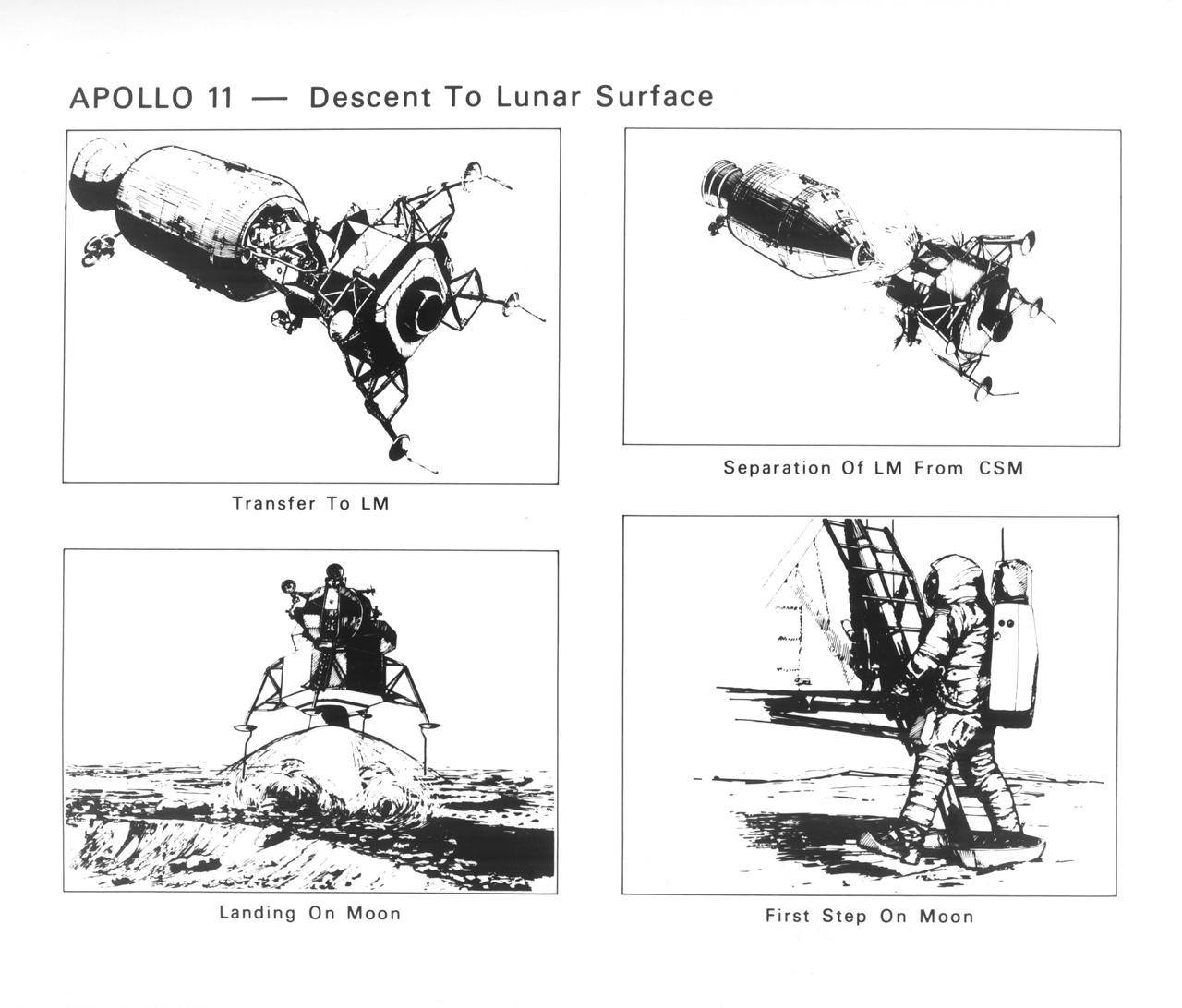
The Apollo 11 mission launched from the Kennedy Space Center (KSC) in Florida via the Marshall Space Flight Center (MSFC) developed Saturn V launch vehicle on July 16, 1969 and safely returned to Earth on July 24, 1969. Aboard the space craft were astronauts Neil A. Armstrong, commander; Michael Collins, Command Module (CM) pilot; and Edwin E. (Buzz) Aldrin Jr., Lunar Module (LM) pilot. With the success of Apollo 11, the national objective to land men on the Moon and return them safely to Earth had been accomplished. These sketches illustrate the steps taken in going from lunar orbit onto the Moon’s surface. Apollo 11 commander, Neil Armstrong and LM pilot Edwin Aldrin transferred from the CM to the LM and the LM separated. Firing the descent stage engine in retrothrust slowed the LM and put it on the let down trajectory. Near the Lunar surface, the engine was used to lower the craft slowly to the surface. After a checkout of systems and depressurization of the LM cabin, the hatch was opened for Armstrong’s climb down the ladder to the Moon’s soil.
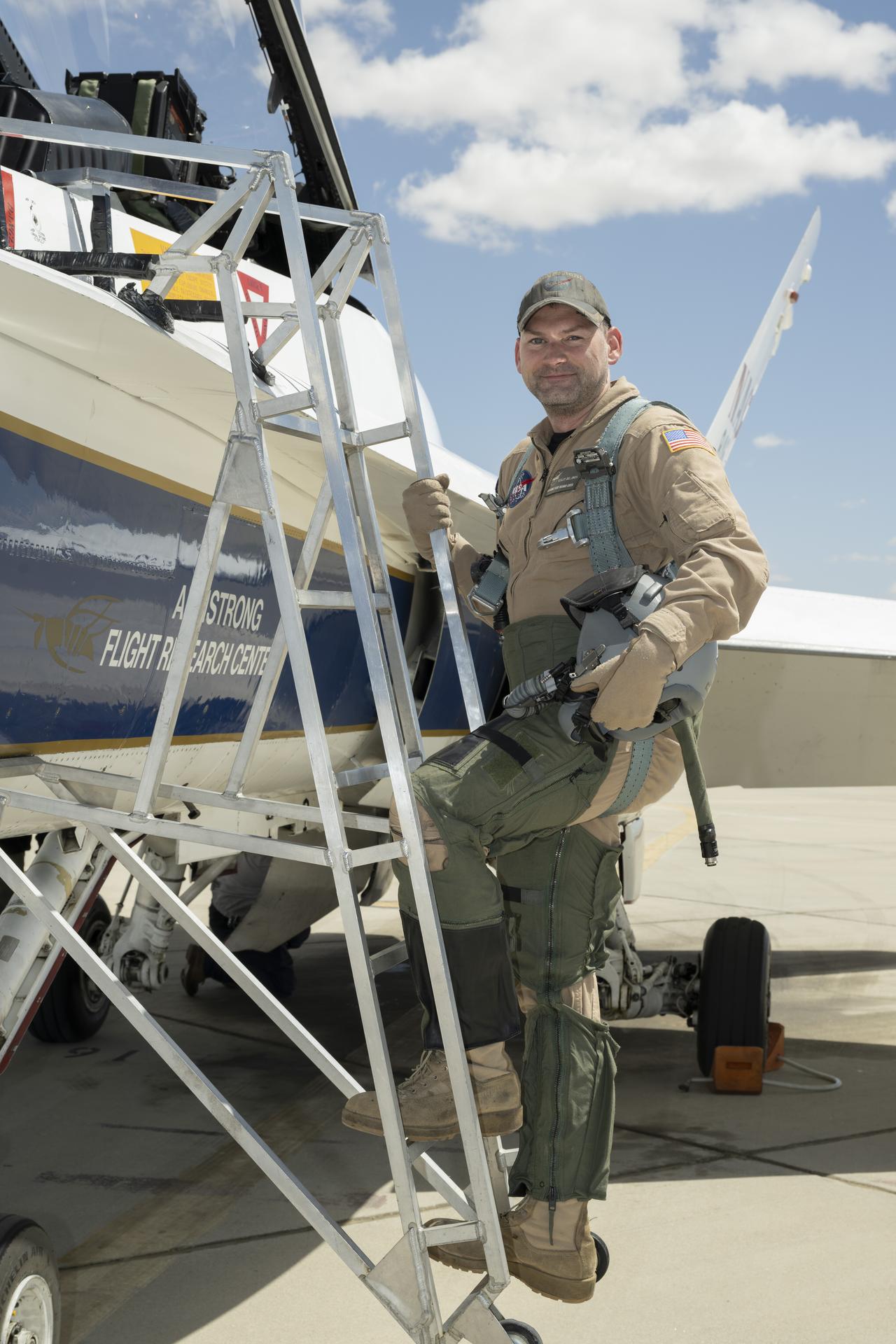
Kelly Jellison, lead avionics technician for NASA’s C-20 and G-V aircraft, concluded an employee incentive flight in an F/A-18 aircraft at NASA’s Armstrong Flight Research Center in Edwards, California, on Wednesday, May 27, 2026. NASA Administrator Jared Isaacman established the ride‑along program to recognize and reward workforce members for their dedication to advancing the agency’s priorities.
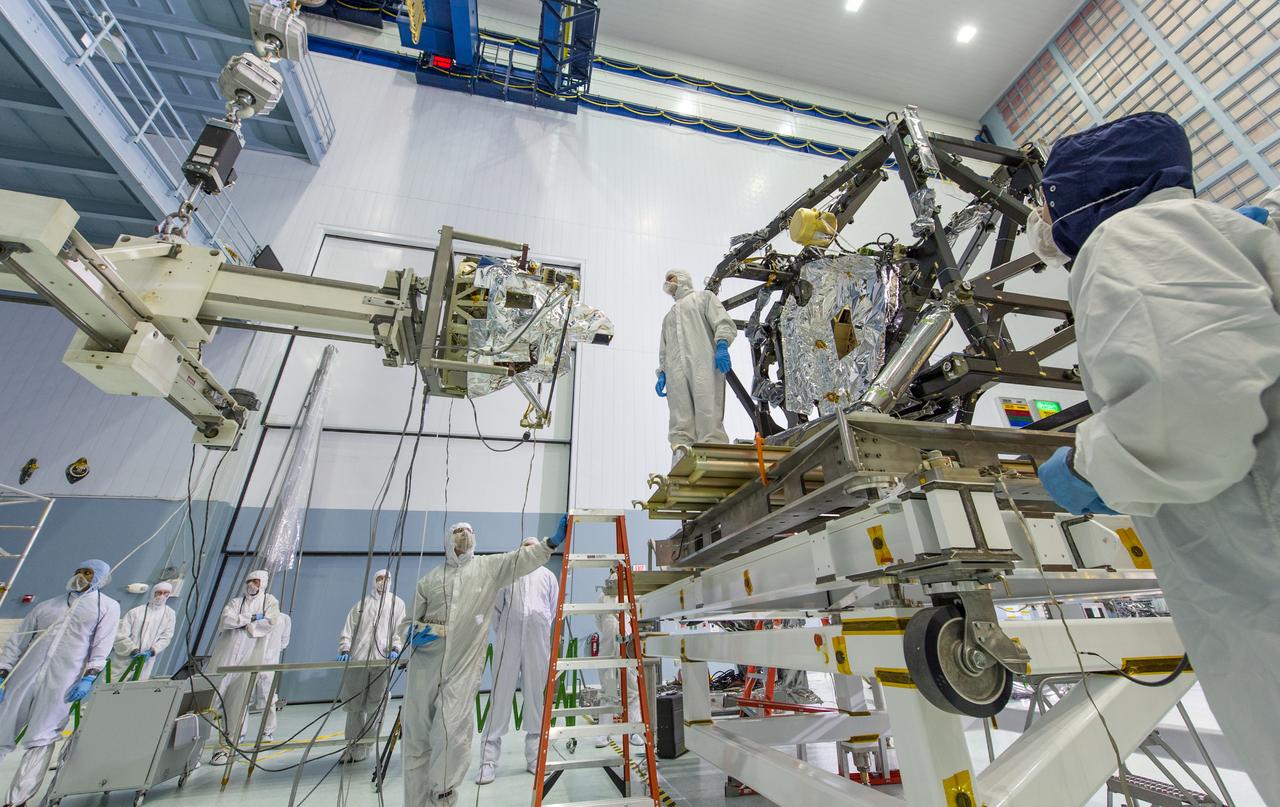
The MIRI itself weighs 181 pounds (82 kg) and is being held by a special balance beam (on the left of the photo), which is being maneuvered using a precision overhead crane by the engineer at the base of the ladder. Photo Credit: NASA/Chris Gunn; Text Credit: NASA/Laura Betz ---- Engineers worked meticulously to implant the James Webb Space Telescope's Mid-Infrared Instrument into the ISIM, or Integrated Science Instrument Module, in the cleanroom at NASA's Goddard Space Flight Center in Greenbelt, Md. As the successor to NASA's Hubble Space Telescope, the Webb telescope will be the most powerful space telescope ever built. It will observe the most distant objects in the universe, provide images of the first galaxies formed and see unexplored planets around distant stars. For more information, visit: <a href="http://www.jwst.nasa.gov" rel="nofollow">www.jwst.nasa.gov</a> <b><a href="http://www.nasa.gov/audience/formedia/features/MP_Photo_Guidelines.html" rel="nofollow">NASA image use policy.</a></b> <b><a href="http://www.nasa.gov/centers/goddard/home/index.html" rel="nofollow">NASA Goddard Space Flight Center</a></b> enables NASA’s mission through four scientific endeavors: Earth Science, Heliophysics, Solar System Exploration, and Astrophysics. Goddard plays a leading role in NASA’s accomplishments by contributing compelling scientific knowledge to advance the Agency’s mission. <b>Follow us on <a href="http://twitter.com/NASA_GoddardPix" rel="nofollow">Twitter</a></b> <b>Like us on <a href="http://www.facebook.com/pages/Greenbelt-MD/NASA-Goddard/395013845897?ref=tsd" rel="nofollow">Facebook</a></b> <b>Find us on <a href="http://instagram.com/nasagoddard?vm=grid" rel="nofollow">Instagram</a></b>

NASA test pilot Nils Larson opens the X-59 cockpit after completing the aircraft’s first flight on Tuesday, Oct. 28, 2025. The mission marked a key milestone in advancing NASA’s Quesst mission to enable quiet supersonic flight over land.

NASA test pilot Nils Larson opens the X-59 cockpit after completing the aircraft’s first flight on Tuesday, Oct. 28, 2025. The mission marked a key milestone in advancing NASA’s Quesst mission to enable quiet supersonic flight over land.
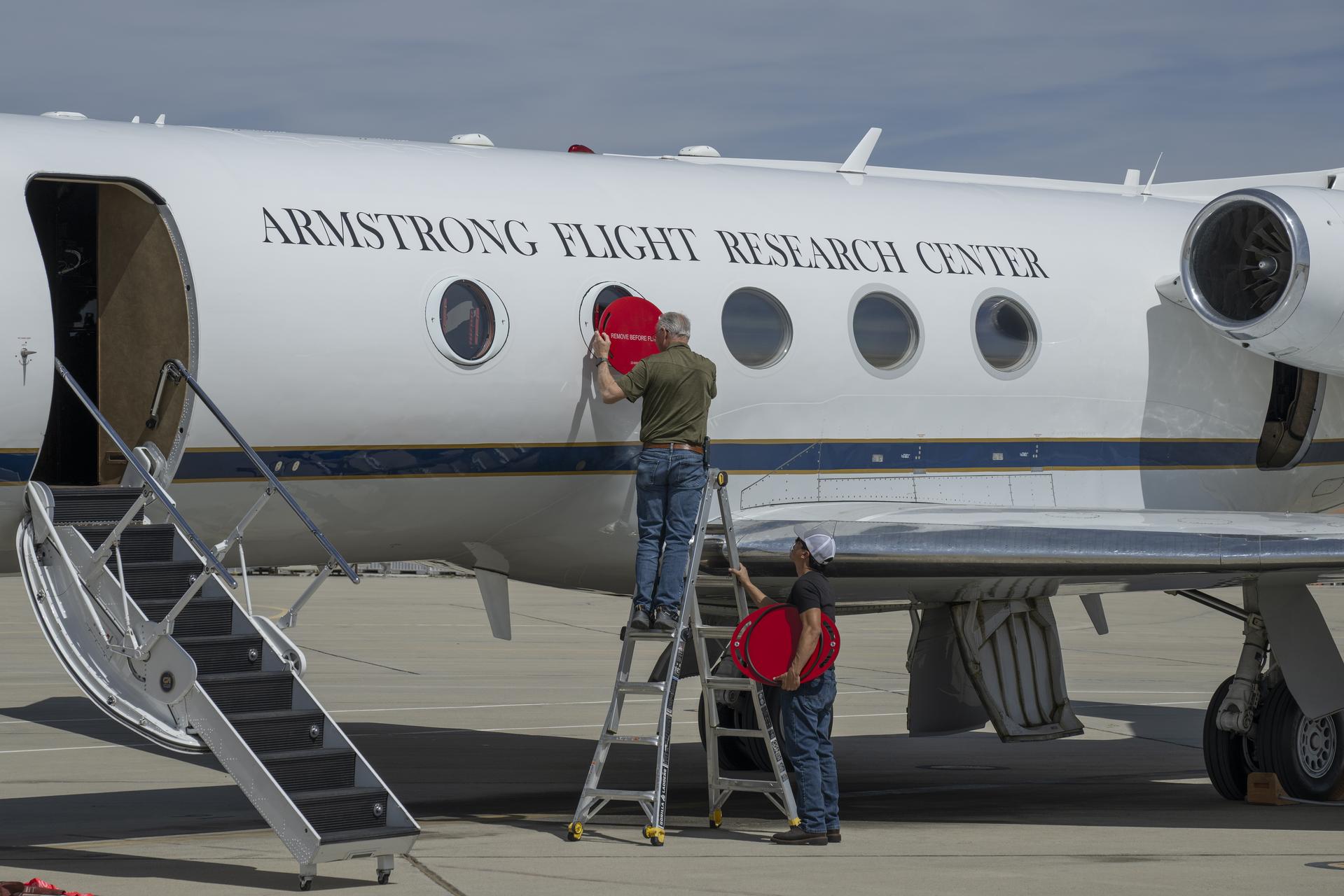
Scott Erickson, left, a quality assurance inspector, and Manny Rodriguez, Gulfstream G-III aircraft crew chief, remove window coverings from the aircraft on Friday, March 27, 2026, at NASA’s Armstrong Flight Research Center in Edwards, California. The G-III will join other NASA aircraft to capture imagery of the Orion spacecraft’s heat shield during Artemis II reentry. The mission is part of NASA’s Scientifically Calibrated In-Flight Imagery (SCIFLI) project, based at NASA’s Langley Research Center in Hampton, Virginia.