
This radar image of the Washington, D.C. area demonstrates the capability of imaging radar as a useful tool for urban planners and managers to map and monitor land use patterns.
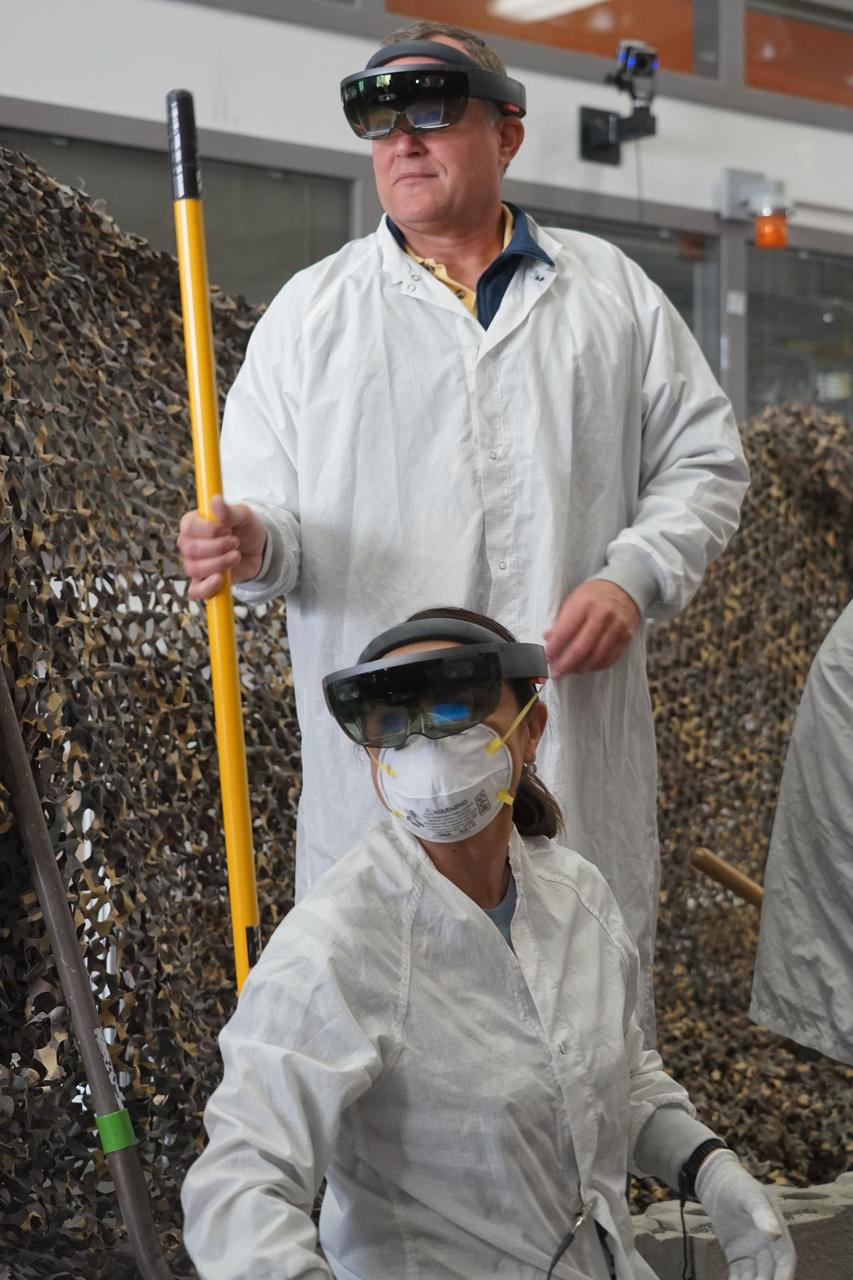
InSight Project Manager Tom Hoffman (standing) and engineer Marleen Sundgaard wear Microsoft HoloLens augmented reality headsets, which project digital terrain models of InSight's landing location on Mars over a lab space. https://photojournal.jpl.nasa.gov/catalog/PIA22951

The large field patterns in this view of the Rio Sao Francisco basin, Brazil, South America, (11.5S, 43.5W) indicate a commercial agriculture venture; family subsistence farms are much smaller and laid out in different patterns. Land clearing in Brazil has increased at an alarming rate in recent years and preliminary estimates suggest a 25 to 30% increase in deforestation since 1984. The long term impact on the ecological processes are still unknown.

STS035-73-082 (2-10 Dec 1990) --- This agricultural and ranching area, Rio Sao Francisco, Brazil (13.0S, 43.5W) has been under study for several years. See scene STS-31-92-045 for comparison. This area has many small single family subsistence farms, large square and rectangular commercial farms and pastures for livestock grazing. Over the several years of observation, the number and size of farms has increased and center-pivot, swing-arm irrigation systems have been installed.

In this panoramic view of the Okavango Swamp, Botswana, (19.0S, 22.0E), the Okavango River, seen in sunglint, flows into a topographic trough to form an inland delta. Water, trapped in the meandering delta distributaries is evaporated or transpired by vegetation. In Angola to the north, the many fires of the seasonal burning of savannah vegetation for land clearing, in preparation for agriculture, has filled the atmosphere with haze and smoke.

STS033-82-103 (22-27 Nov. 1989) --- This oblique view of the southern half of Madagascar was taken by the crew members of the Space Shuttle Discovery as they orbited Earth at an altitude of 289 nautical miles.

SL2-05-397 (22 June 1973) --- New Orleans, Louisiana, Mississippi River, and Lake Pontchartrain (31.0N, 91.0W) can all be seen in this single detailed view. The marshlands of the Atchafalaya Basin, previously the main drainage way for the Mississippi River, can be seen to be partially silted as a result of sediments. The long narrow field patterns fronting on the river is called the "Long Lot" system of equal land distribution based on the French Napoleonic Civil Code. Photo credit: NASA
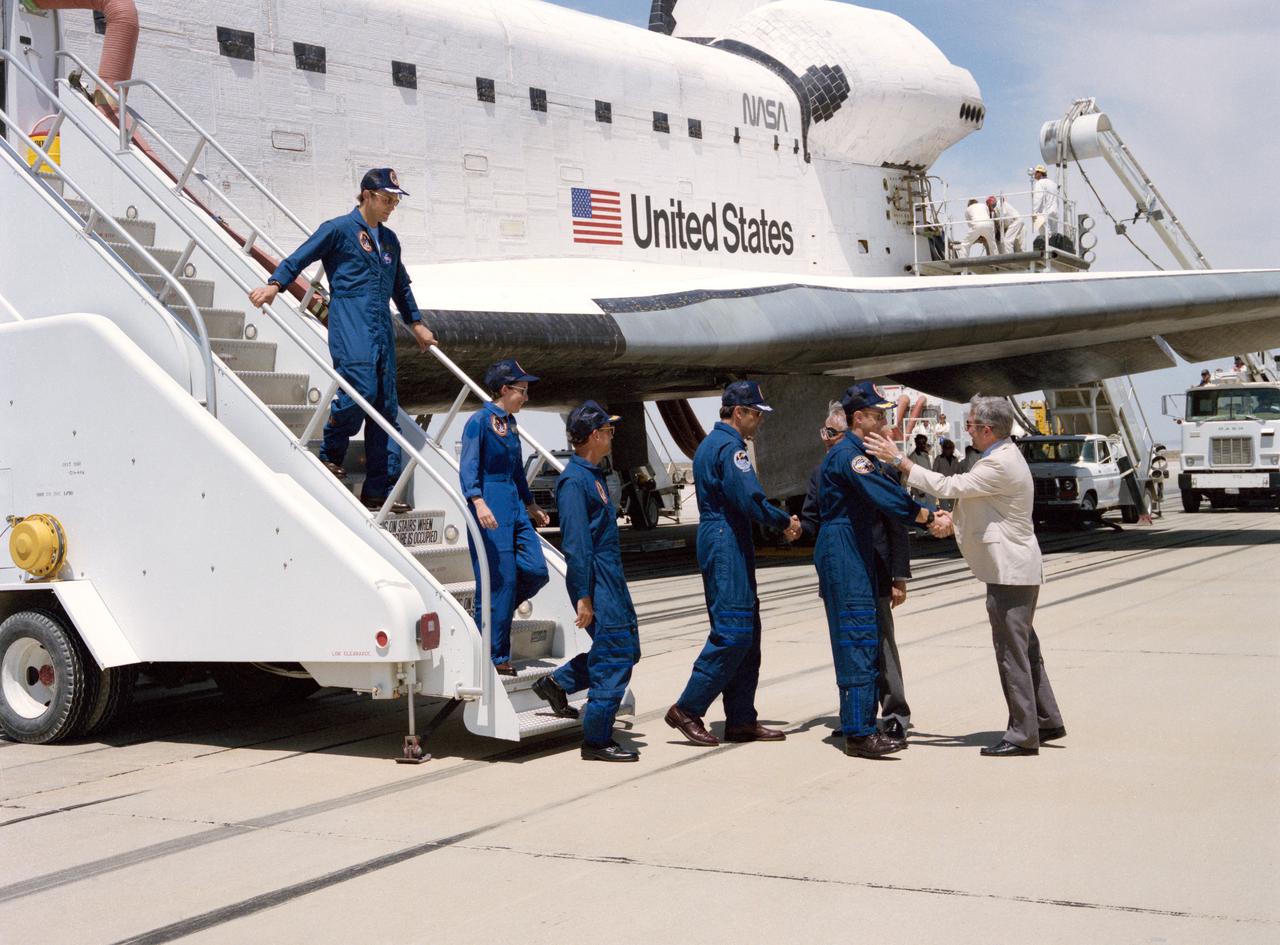
STS030-S-131 (8 May 1989) --- Crewmembers who spent just over four full days in space aboard Space Shuttle Atlantis egress their temporary home for a welcome meeting with terra firma. Astronaut David M. Walker, mission commander, shakes hands with Rear Admiral Richard H. Truly, acting NASA Administrator. Astronaut Ronald J. Grabe (center frame), pilot, is greeted by Dale D. Myers, Deputy Administrator. Pictured behind Grabe, from bottom of steps to top, are astronauts Norman E. Thagard, Mary L. Cleave and Mark C. Lee, all mission specialists. Minutes earlier, the spacecraft?s landing gear came to a stop at 12:44:33 P.M. (PDT), 8 May 1989. It landed on runway 22, a concrete facility, like a number of other NASA flights. Still others have landed on unpaved dry lakebed stripes.

STS066-122-091 (3-14 Nov. 1994) --- This November 1994 view looking south-southeast shows clouds over the Okavango Delta area of northern Botswana. The Okavango is one of the wilder, less spoiled regions of Africa. The area still supports great herds of wild animals such as elephant, zebra and the cape buffalo. Despite conservation efforts from the stable government of Botswana, delta habitats are pressured. The Okavango River (lower left of view) brings water from the high, wet plateaus of Angola into the Kalahari Desert, and enormous inland basin. As a result of a series of small faults (upper center of the view) related to the African Rift System, the river is dammed up in the form of swampy inland delta. Here, water is consumed by evaporation, infiltration, and the swamp forests. Late summer floods take six months to slowly penetrate the 160 kilometer (95 miles) to the other end of the Delta. The visual patterns of the area are strongly linear: straight sand dunes occur in many places and can be seen across the bottom portion of the photograph. Numerous brush-fire scars produce a complex, straight-edged pattern over much of the lower portion of this view. Lake Ngami (upper right of view) was once permanently full as late as the middle 1800's. Changes in the climate of the area over the last 100 years has changed the size and shape of the inland delta.
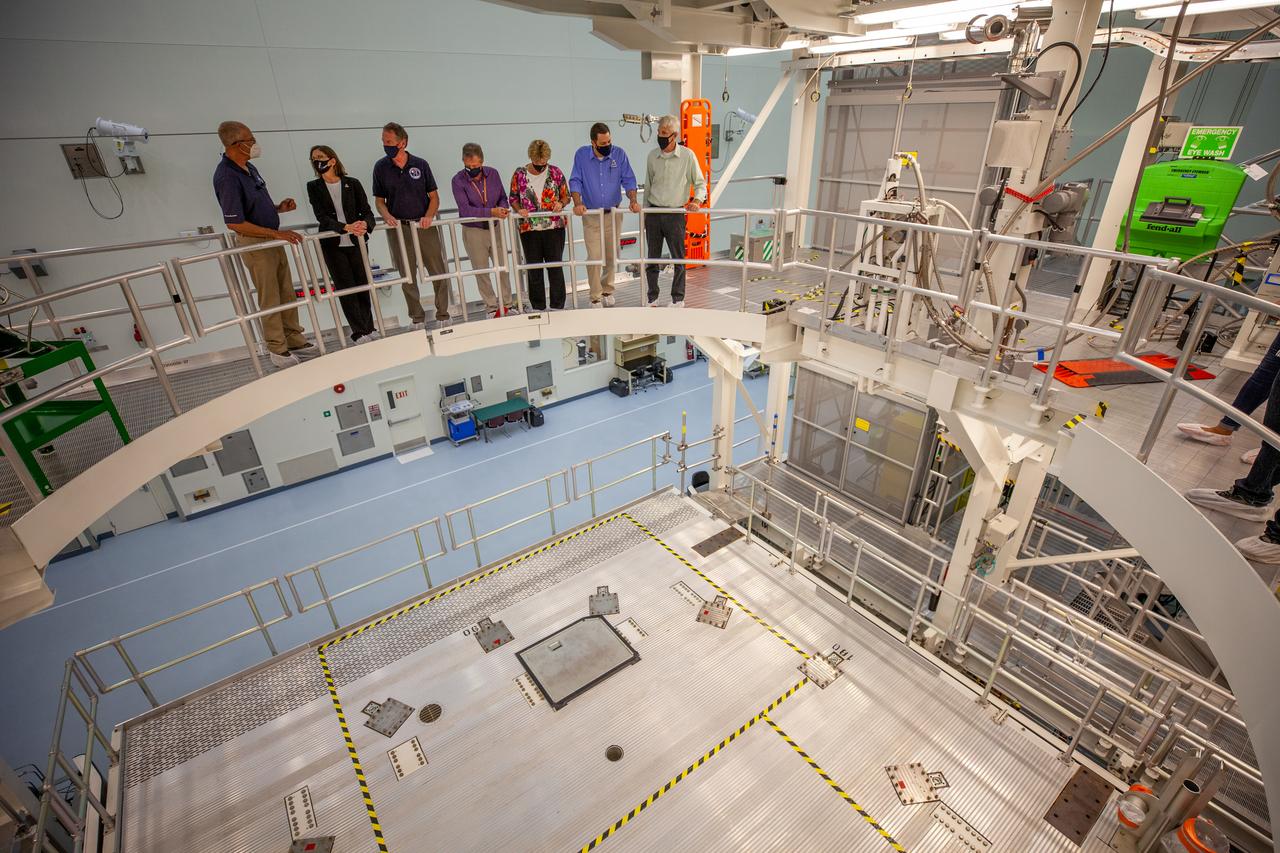
Catherine Koerner, second from left, NASA Orion Program manager, along with senior managers from Orion, Exploration Ground Systems (EGS) and TOSC, tours the Multi-Payload Processing Facility (MPPF) at NASA’s Kennedy Space Center in Florida on Oct. 5, 2020. Accompanying her, from left are Skip Williams, operations manager for the MPPF spacecraft offline element integration team; Mike Bolger, EGS manager; Nicolas Kindred, TOSC flow manager; Annette Hasbrook, Orion Program assistant manager; Jeremy Parsons, EGS deputy manager; and Scott Wilson, Orion Production Operations manager. Koerner viewed spacecraft hardware and processing facilities for the Artemis I and II missions. The first in a series of increasingly complex missions, Artemis I will test the Orion spacecraft and Space Launch System as an integrated system ahead of crewed flights to the Moon. Under the Artemis program, NASA will land the first woman and the next man on the Moon in 2024.

KENNEDY SPACE CENTER, FLA. - In the Launch Control Center, Robert Holl (left), Landing Recovery directo, and Donald Hammel, from the Shuttle Project Office, are in contact with the leaders of the “Mode VII” emergency landing simulation at Kennedy Space Center. The simulation is being managed and directed from the LCC. The purpose of the Mode VII is to exercise emergency preparedness personnel, equipment and facilities in rescuing astronauts from a downed orbiter and providing immediate medical attention. This simulation presents an orbiter that has crashed short of the Shuttle Landing Facility in a wooded area 2-1/2 miles south of Runway 33. Emergency crews are responding to the volunteer “astronauts” who are simulating various injuries inside the crew compartment mock-up. Rescuers must remove the crew, provide triage and transport to hospitals those who need further treatment. Local hospitals are participating in the exercise.

Shown in front of the Artemis I spacecraft, Larry Price, at left, Lockheed Martin Orion program manager, accompanies Russell Vought, director of the White House Office of Management and Budget, during a tour of the Neil Armstrong Operations and Checkout Building high bay at NASA’s Kennedy Space Center in Florida on Aug. 28, 2020. Orion spacecraft are being prepared for Artemis I and Artemis II. The Office of Management and Budget is working with the U.S. Congress to line up the necessary resources to land the first woman and the next man on the Moon in 2024.

Catherine Koerner, in front, NASA Orion Program manager, along with senior managers from Orion, Exploration Ground Systems (EGS) and TOSC, tours the Multi-Payload Processing Facility (MPPF) at NASA’s Kennedy Space Center in Florida on Oct. 5, 2020. Accompanying her, from left are Nicolas Kindred, (partically hidden), TOSC flow manager; Jeremy Parsons, EGS deputy manager; Scott Wilson, Orion Production Operations manager; Mike Bolger, (partially hidden), EGS manager; and Skip Williams, operations manager for the MPPF spacecraft offline element integration team. Koerner viewed spacecraft hardware and processing facilities for the Artemis I and II missions. The first in a series of increasingly complex missions, Artemis I will test the Orion spacecraft and Space Launch System as an integrated system ahead of crewed flights to the Moon. Under the Artemis program, NASA will land the first woman and the next man on the Moon in 2024.
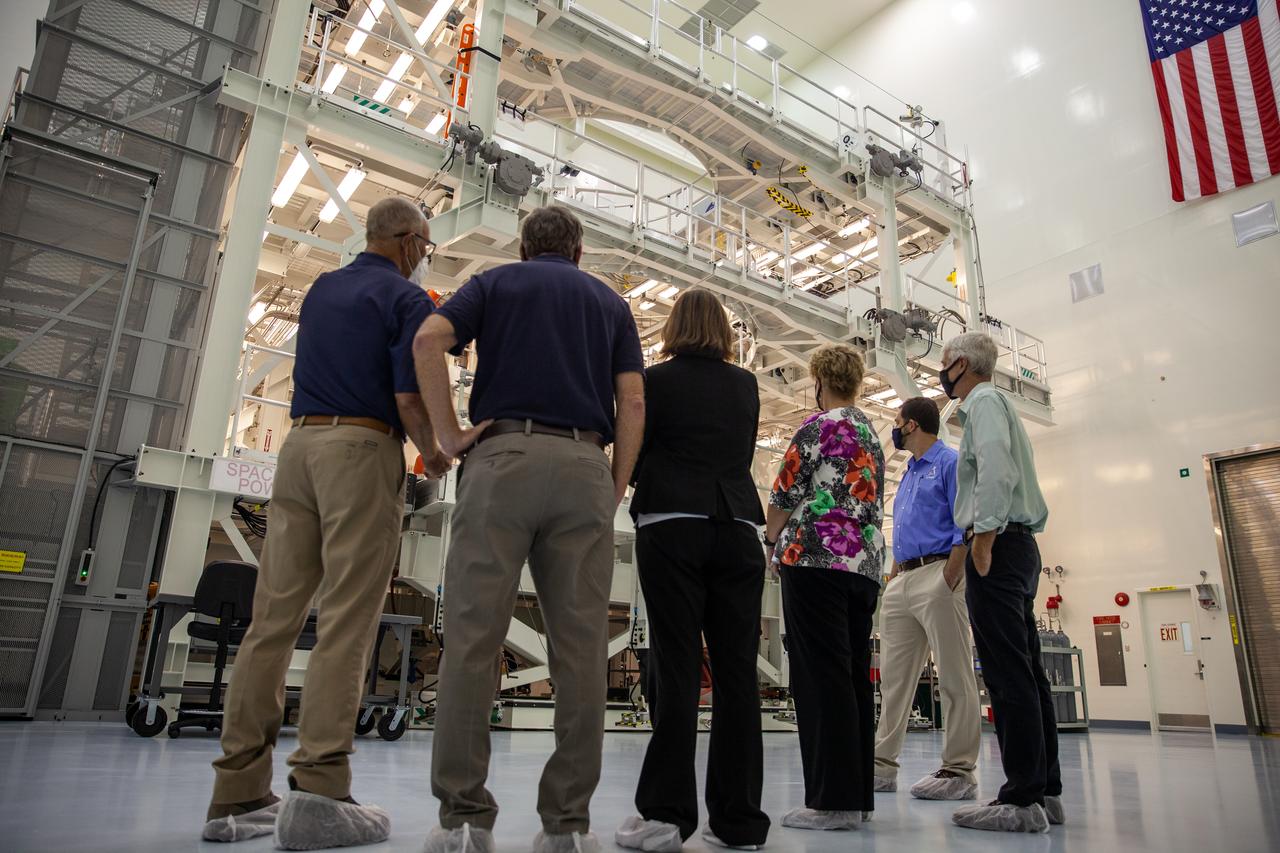
Catherine Koerner, third from left, NASA Orion Program manager, along with senior managers from Orion, and Exploration Ground Systems (EGS), visits the Multi-Payload Processing Facility (MPPF) at NASA’s Kennedy Space Center in Florida on Oct. 5, 2020. Accompanying her, from left are Skip Williams, operations manager for the MPPF spacecraft offline element integration team; Mike Bolger, EGS manager; Annette Hasbrook, Orion Program assistant manager; Scott Wilson, Orion Production Operations manager; and Jeremy Parsons, EGS deputy manager. Koerner viewed spacecraft hardware and processing facilities for the Artemis I and II missions. The first in a series of increasingly complex missions, Artemis I will test the Orion spacecraft and Space Launch System as an integrated system ahead of crewed flights to the Moon. Under the Artemis program, NASA will land the first woman and the next man on the Moon in 2024.
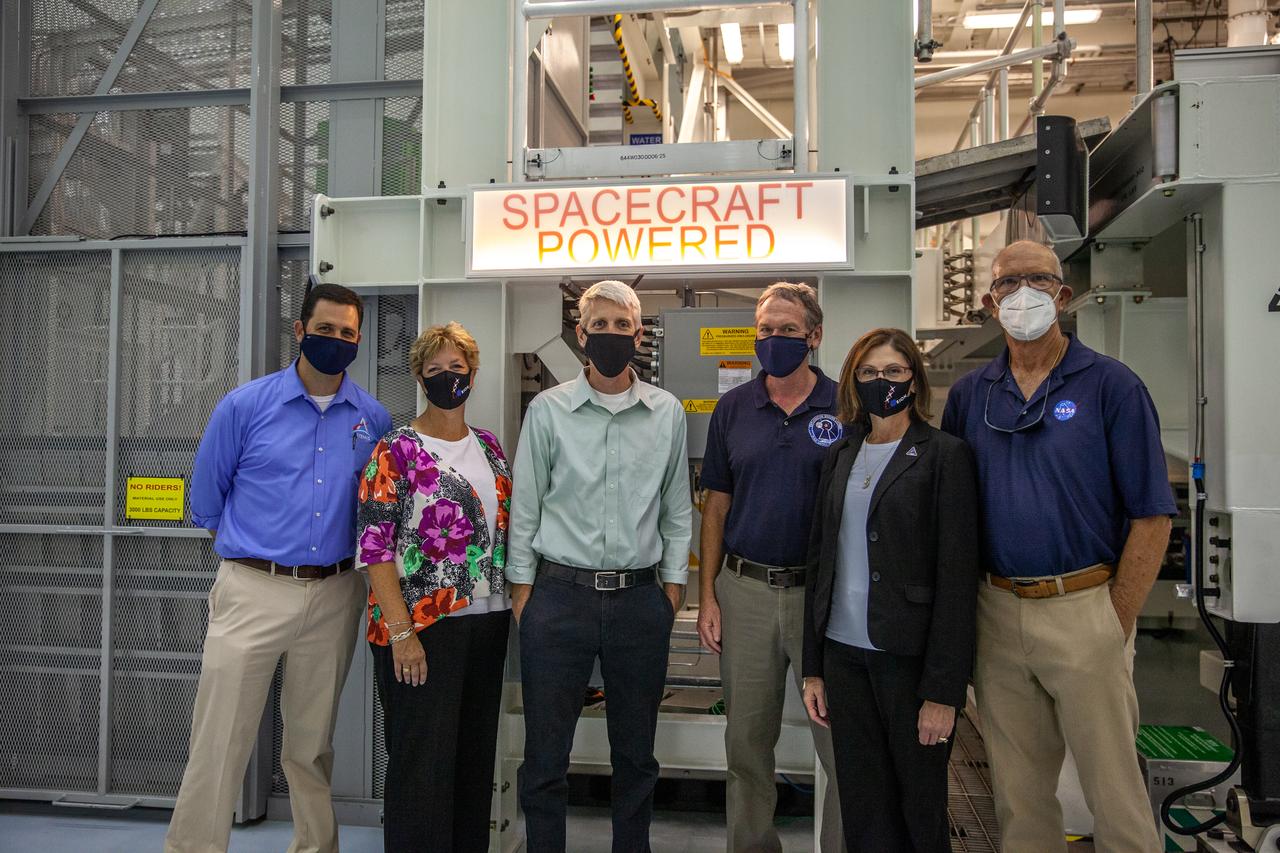
Catherine Koerner, second from right, NASA Orion Program manager, along with senior managers from Orion, and Exploration Ground Systems (EGS), tours the Multi-Payload Processing Facility (MPPF) at NASA’s Kennedy Space Center in Florida on Oct. 5, 2020. Accompanying her, from left are Jeremy Parsons, EGS deputy manager; Annette Hasbrook, Orion Program assistant manager; Scott Wilson, Orion Production Operations manager; and Mike Bolger, EGS manager. At far right is Skip Williams, operations manager for the MPPF spacecraft offline element integration team. Koerner viewed spacecraft hardware and processing facilities for the Artemis I and II missions. The first in a series of increasingly complex missions, Artemis I will test the Orion spacecraft and Space Launch System as an integrated system ahead of crewed flights to the Moon. Under the Artemis program, NASA will land the first woman and the next man on the Moon in 2024.
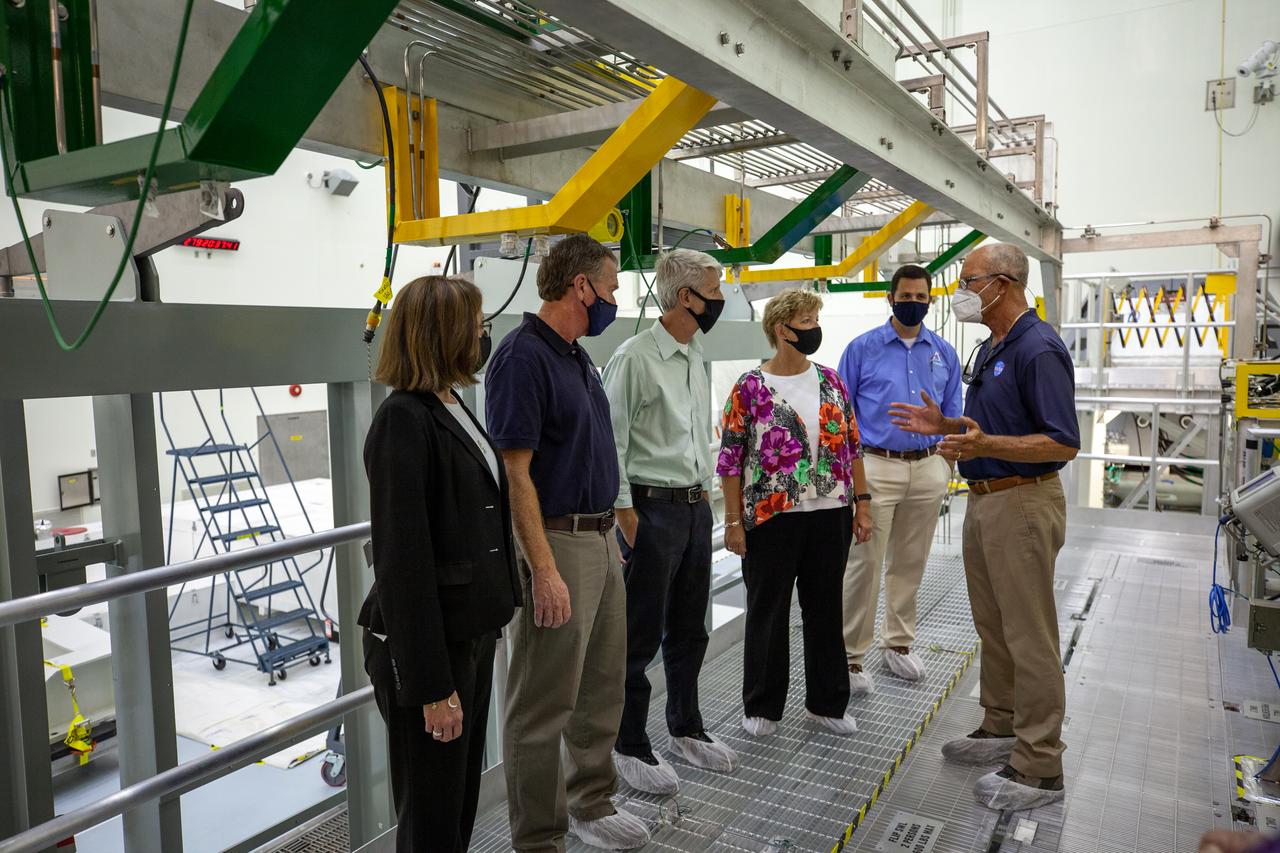
Catherine Koerner, far left, NASA Orion Program manager, along with senior managers from Orion, and Exploration Ground Systems (EGS), tours the Multi-Payload Processing Facility (MPPF) at NASA’s Kennedy Space Center in Florida on Oct. 5, 2020. Accompanying her, from left are Mike Bolger, EGS manager; Scott Wilson, Orion Production Operations manager; Annette Hasbrook, Orion Program assistant manager; and Jeremy Parsons, EGS deputy manager. Speaking to the group is Skip Williams, operations manager for the MPPF spacecraft offline element integration team. Koerner viewed spacecraft hardware and processing facilities for the Artemis I and II missions. The first in a series of increasingly complex missions, Artemis I will test the Orion spacecraft and Space Launch System as an integrated system ahead of crewed flights to the Moon. Under the Artemis program, NASA will land the first woman and the next man on the Moon in 2024.
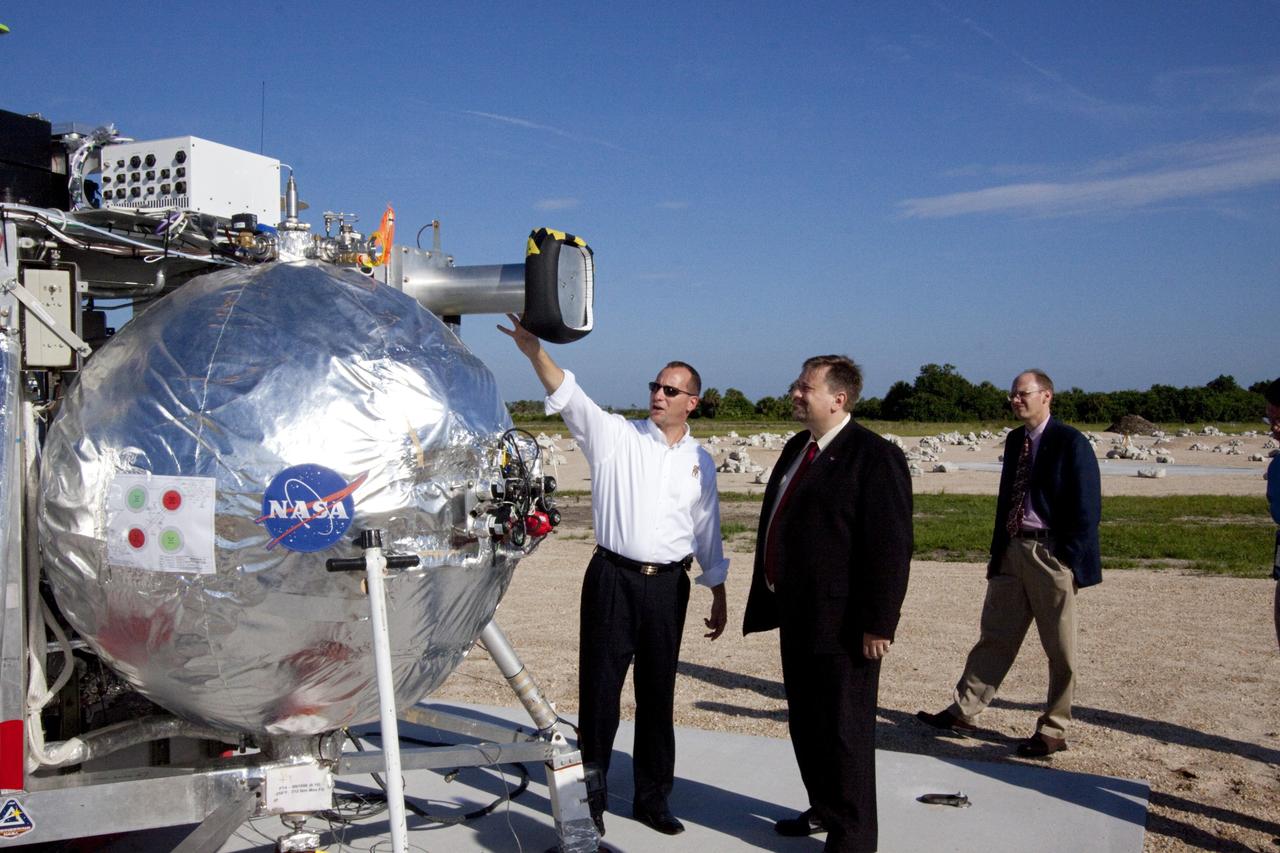
CAPE CANAVERAL, Fla. – Dr. Mason Peck, NASA's chief technologist, talks with managers of the Morpheus lander that will soon begin flight and landing tests at the Shuttle Landing Facility at NASA's Kennedy Space Center in Florida. Photo credit: NASA/Jim Grossmann
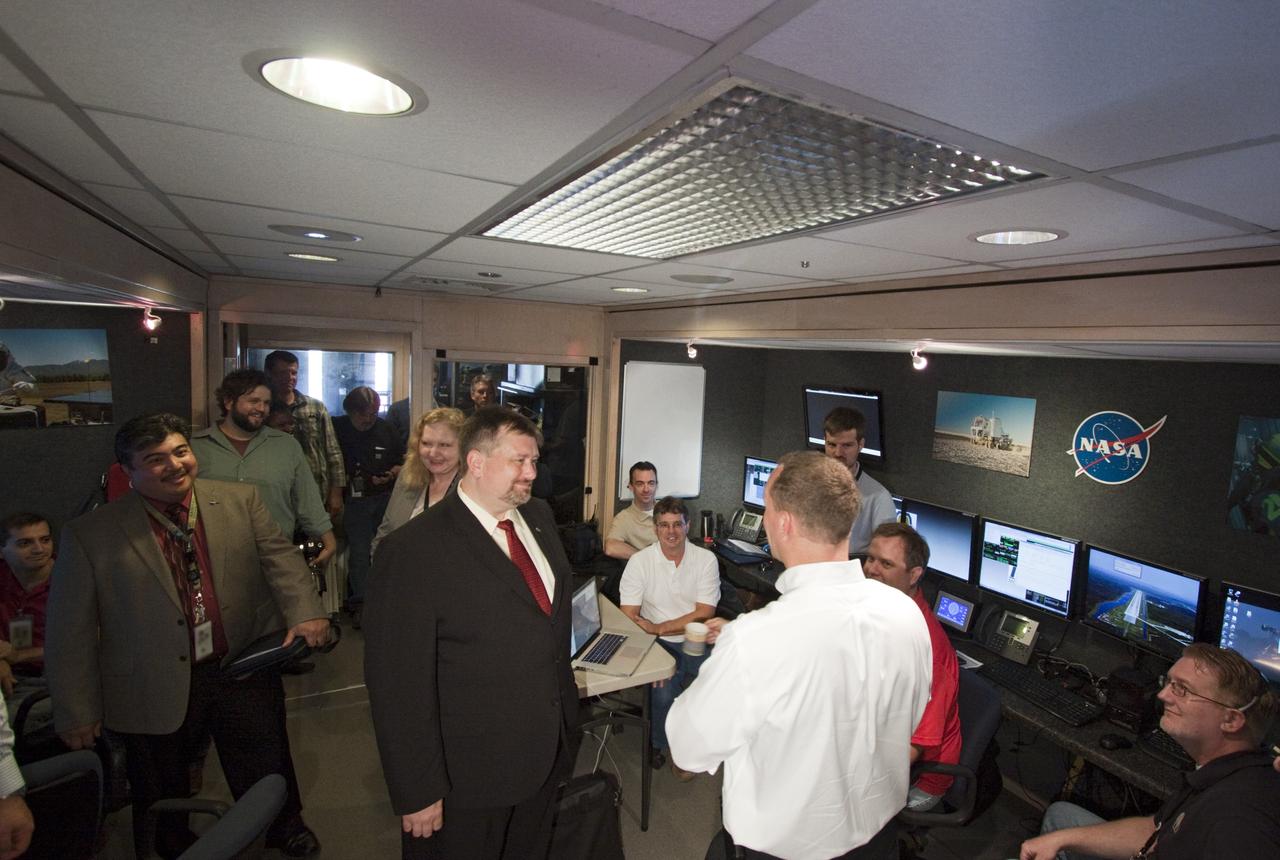
CAPE CANAVERAL, Fla. – Dr. Mason Peck, center, NASA's chief technologist, talks with managers of the Morpheus lander that will soon begin flight and landing tests at the Shuttle Landing Facility at NASA's Kennedy Space Center in Florida. Photo credit: NASA/Jim Grossmann
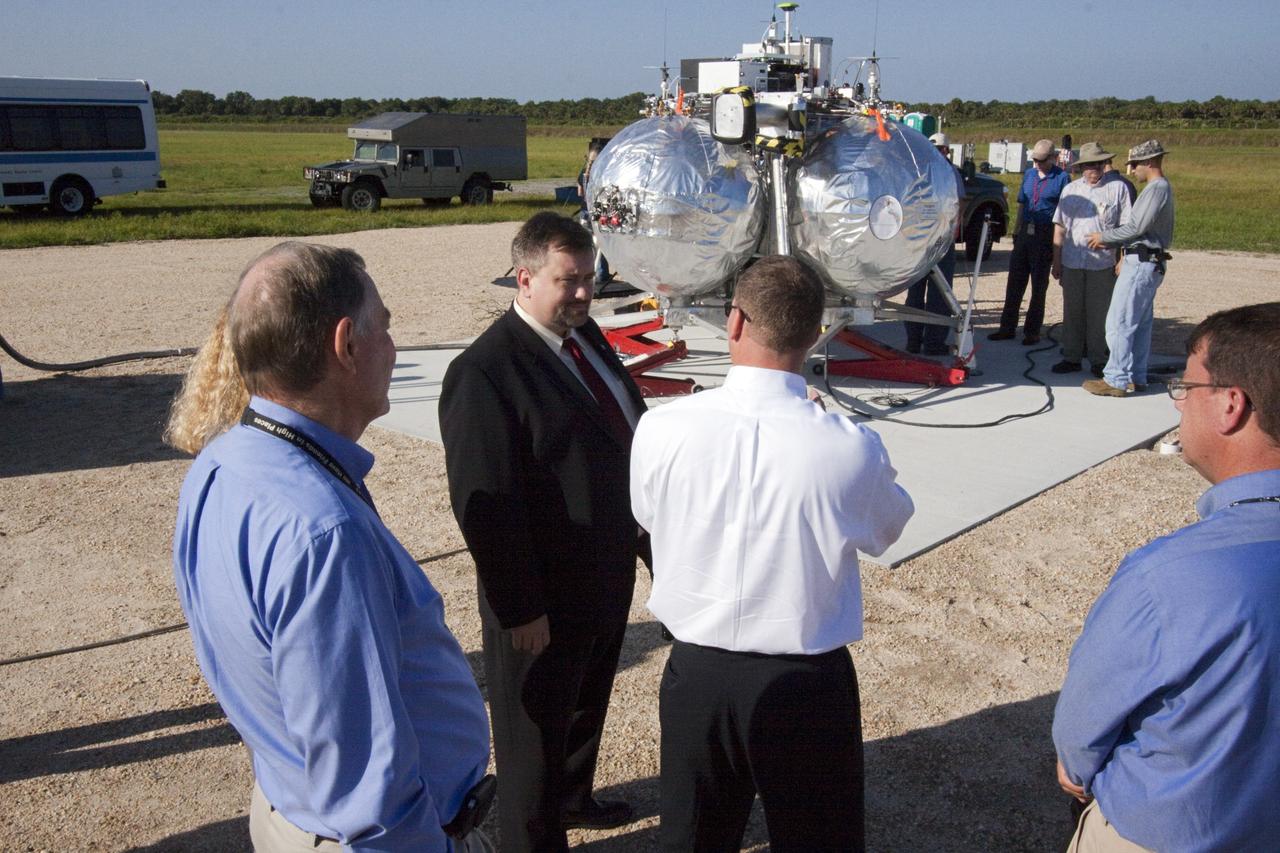
CAPE CANAVERAL, Fla. – Dr. Mason Peck, NASA's chief technologist, talks with managers of the Morpheus lander that will soon begin flight and landing tests at the Shuttle Landing Facility at NASA's Kennedy Space Center in Florida. Photo credit: NASA/Jim Grossman
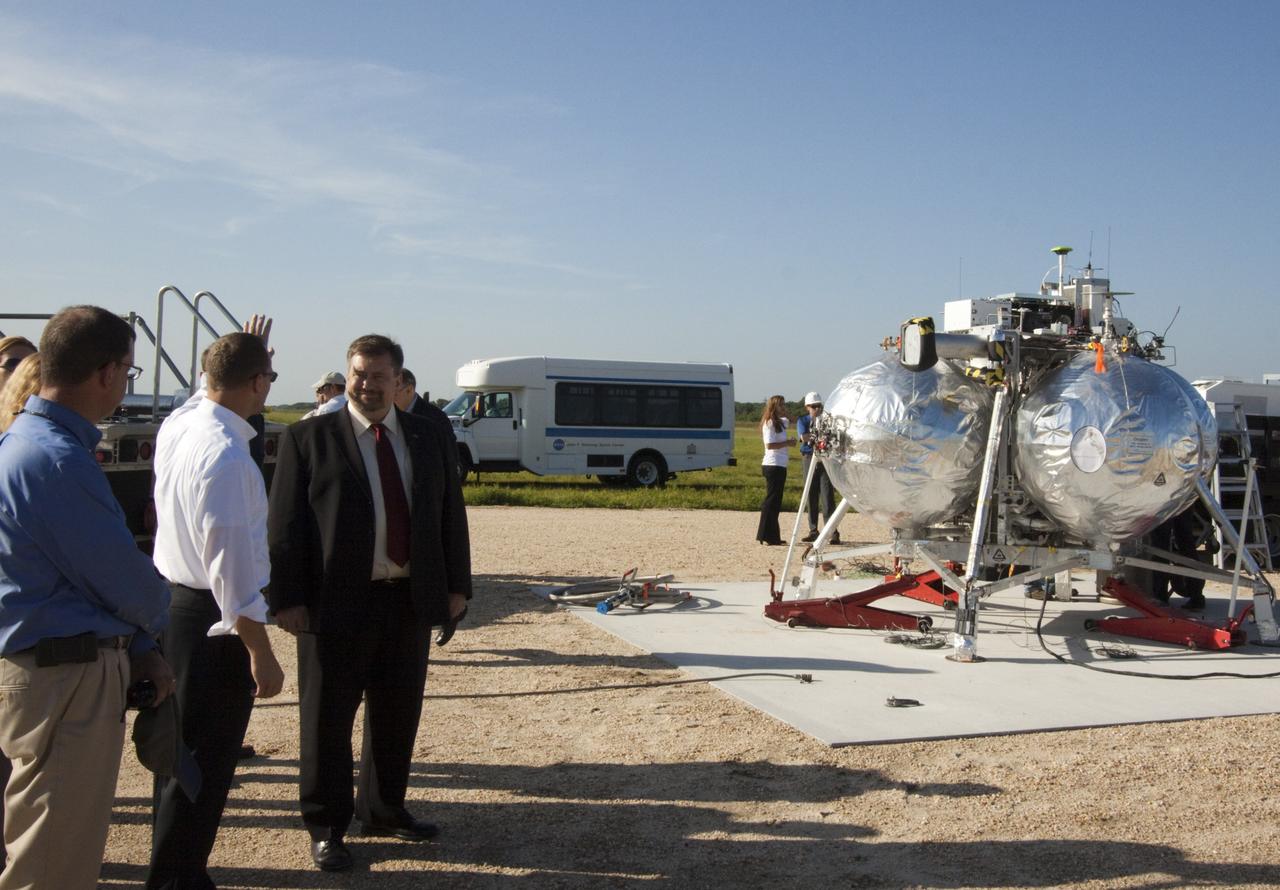
CAPE CANAVERAL, Fla. – Dr. Mason Peck, NASA's chief technologist, talks with managers of the Morpheus lander that will soon begin flight and landing tests at the Shuttle Landing Facility at NASA's Kennedy Space Center in Florida. Photo credit: NASA/Jim Grossman

CAPE CANAVERAL, Fla. – Dr. Mason Peck, center, NASA's chief technologist, talks with managers of the Morpheus lander that will soon begin flight and landing tests at the Shuttle Landing Facility at NASA's Kennedy Space Center in Florida. Photo credit: NASA/Jim Grossmann
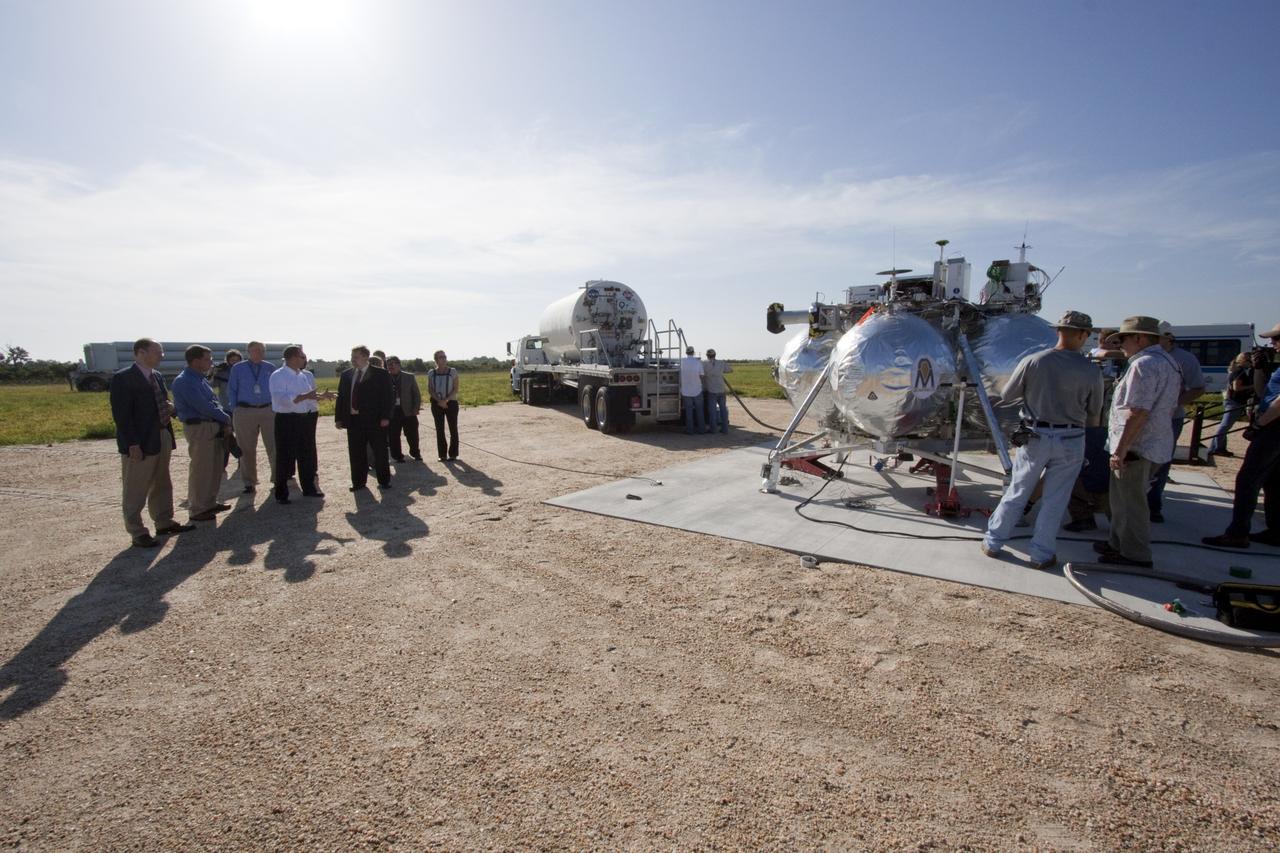
CAPE CANAVERAL, Fla. – Dr. Mason Peck, NASA's chief technologist, talks with managers of the Morpheus lander that will soon begin flight and landing tests at the Shuttle Landing Facility at NASA's Kennedy Space Center in Florida. Photo credit: NASA/Jim Grossman
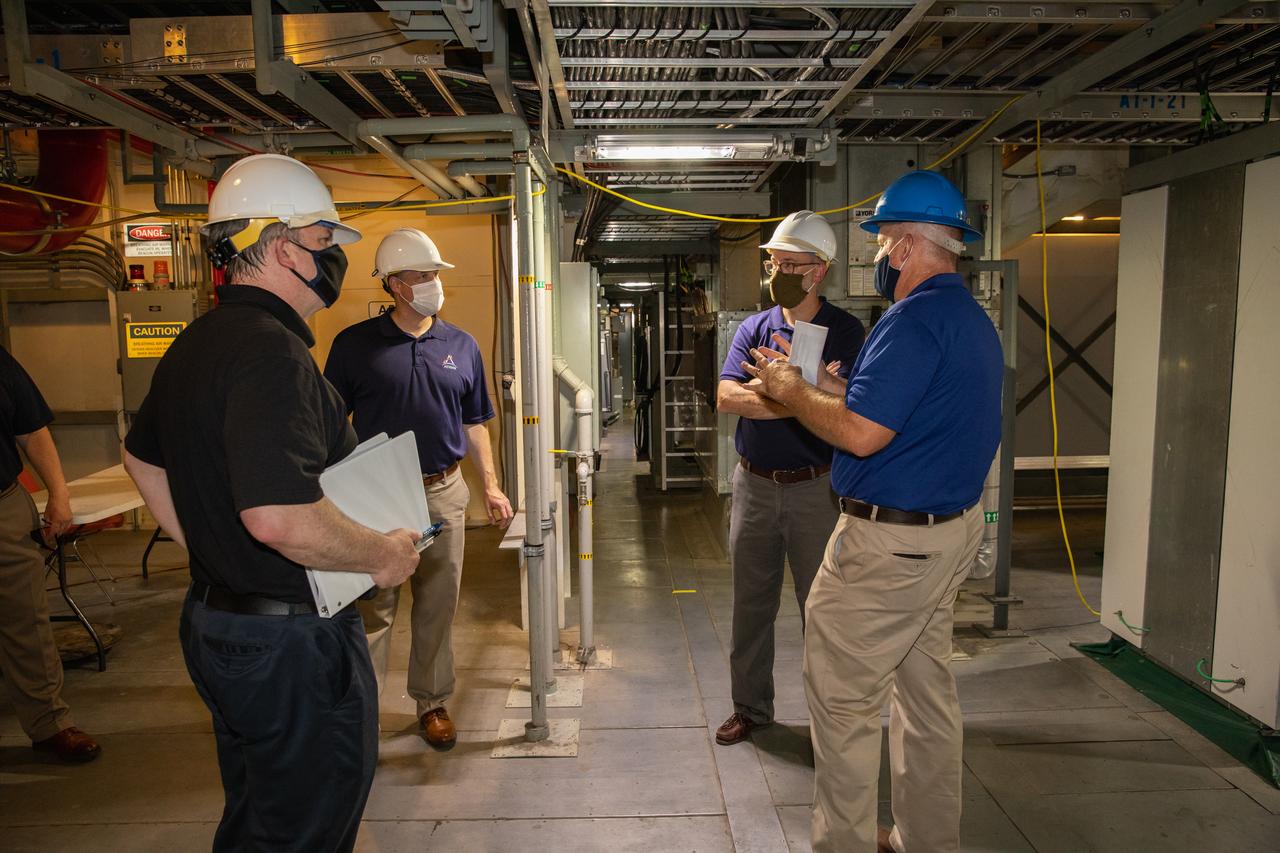
Darrell Foster, far right, chief of the Project Management Division in Exploration Ground Systems, briefs from left, Brian McCormack, associate director of the White House Office of Management and Budget, NASA Administrator Jim Bridenstine, and Russell Vought, director of the White House Office of Management and Budget, while on a tour of the Vehicle Assembly Building on Aug. 28, 2020. The VAB is critical to the assembly of the Space Launch System rocket for NASA’s Artemis program. The Office of Management and Budget is working with the U.S. Congress to line up the necessary resources to land the first woman and the next man on the Moon in 2024.

Reggie Alexander, manager of the Marshall Space Flight Center’s Partnerships and Formulation Office, is interviewed by a member of the MSFC Public Affairs Office. The Partnerships Formulation Office supports commercial development of future human landing systems
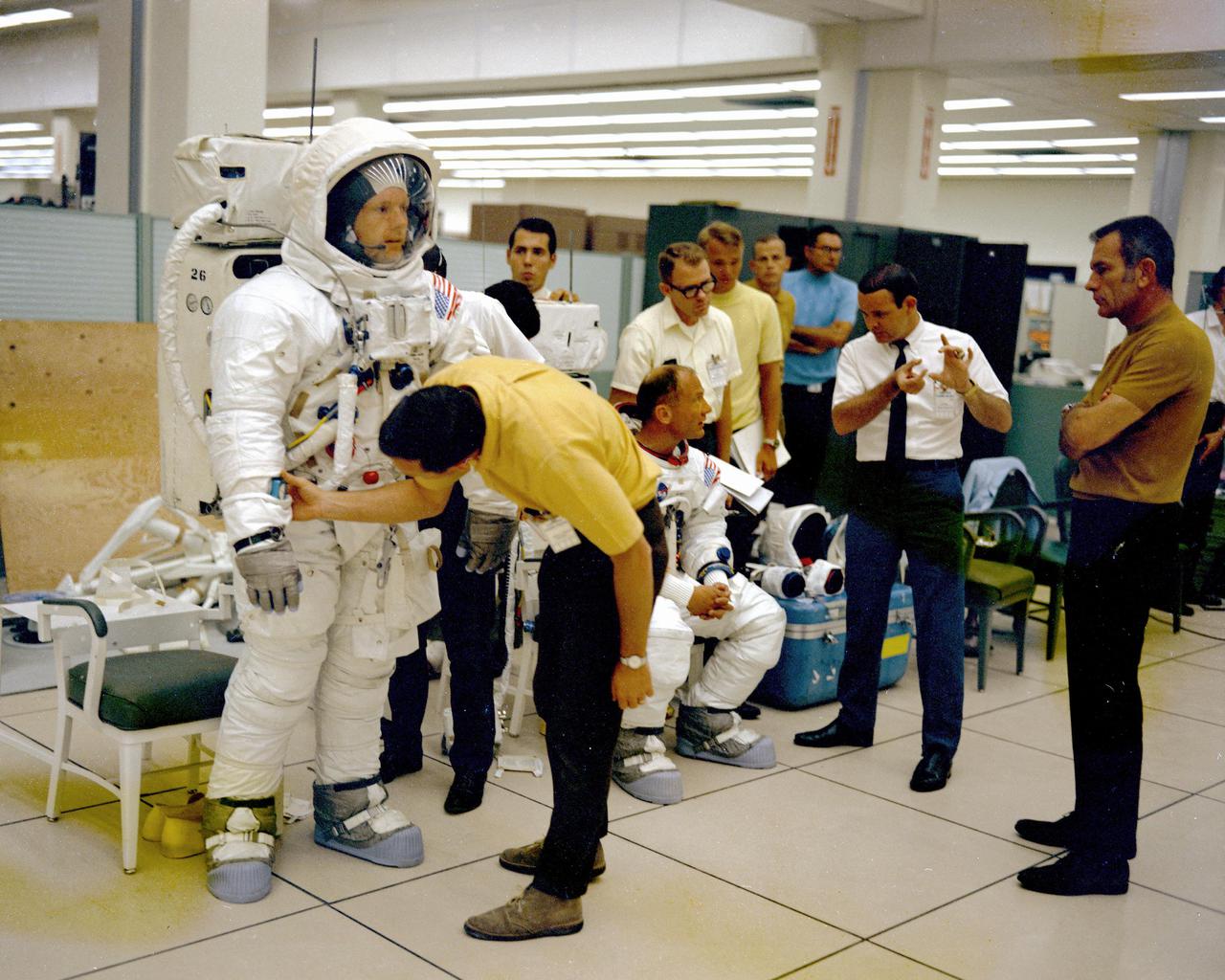
KENNEDY SPACE CENTER, FLA. - The Apollo 11 flight crew are given instructions by technicians and management while undergoing the Extravehicular Activity (EVA) training and the Lunar Module walk-through in preparation for the first manned landing on the Moon.
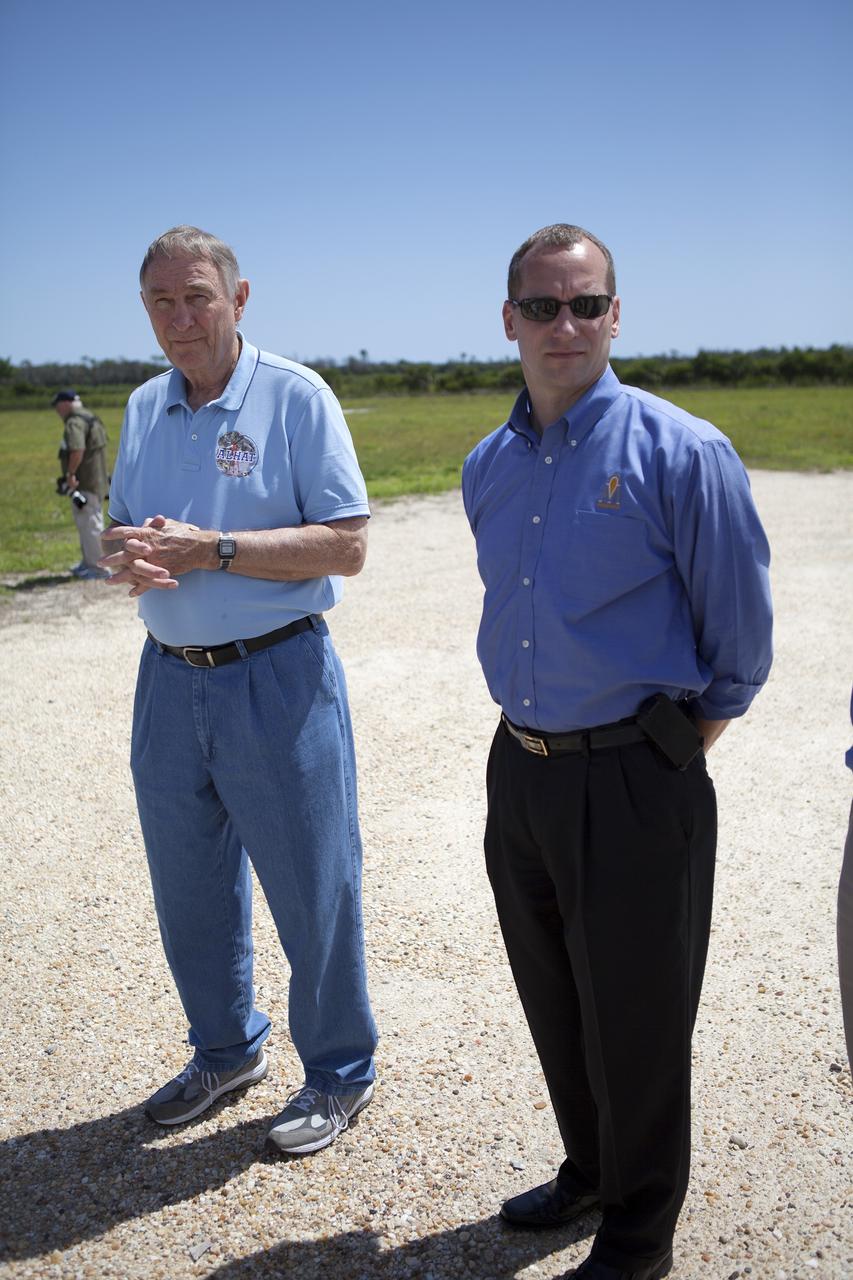
CAPE CANAVERAL, Fla. – From left, Chirold Epp, the Autonomous Landing and Hazard Avoidance Technology, or ALHAT, project manager, and Jon Olansen, Morpheus project manager, speak to members of the media near the north end of the Shuttle Landing Facility at NASA's Kennedy Space Center in Florida. Media also viewed Morpheus inside a facility near the landing facility. Project Morpheus tests NASA’s ALHAT and an engine that runs on liquid oxygen and methane, which are green propellants. These new capabilities could be used in future efforts to deliver cargo to planetary surfaces. The landing facility provides the lander with the kind of field necessary for realistic testing, complete with rocks, craters and hazards to avoid. Morpheus’ ALHAT payload allows it to navigate to clear landing sites amidst rocks, craters and other hazards during its descent. Project Morpheus is being managed under the Advanced Exploration Systems, or AES, Division in NASA’s Human Exploration and Operations Mission Directorate. The efforts in AES pioneer new approaches for rapidly developing prototype systems, demonstrating key capabilities and validating operational concepts for future human missions beyond Earth orbit. For more information on Project Morpheus, visit http://morpheuslander.jsc.nasa.gov/. Photo credit: NASA/Frankie Martin

CAPE CANAVERAL, Fla. – From left behind the reporter in the white shirt, Chirold Epp, the Autonomous Landing and Hazard Avoidance Technology, or ALHAT, project manager, Jon Olansen, Morpheus project manager, and Greg Gaddis, Morpheus/ALHAT site director, speak to members of the media near the north end of the Shuttle Landing Facility at NASA's Kennedy Space Center in Florida. Media also viewed Morpheus inside a facility near the landing facility. Project Morpheus tests NASA’s ALHAT and an engine that runs on liquid oxygen and methane, which are green propellants. These new capabilities could be used in future efforts to deliver cargo to planetary surfaces. The landing facility provides the lander with the kind of field necessary for realistic testing, complete with rocks, craters and hazards to avoid. Morpheus’ ALHAT payload allows it to navigate to clear landing sites amidst rocks, craters and other hazards during its descent. Project Morpheus is being managed under the Advanced Exploration Systems, or AES, Division in NASA’s Human Exploration and Operations Mission Directorate. The efforts in AES pioneer new approaches for rapidly developing prototype systems, demonstrating key capabilities and validating operational concepts for future human missions beyond Earth orbit. For more information on Project Morpheus, visit http://morpheuslander.jsc.nasa.gov/. Photo credit: NASA/Frankie Martin

Shawn Quinn, manager of Exploration Ground Systems at NASA’s Kennedy Space Center, second from left, speaks during an Artemis Program progress update panel at the 2024 Artemis Suppliers Conference, Tuesday, Feb. 27, 2024, at the Grand Hyatt Hotel in Washington. Also participating in the panel was, from left, Amit Kshatriya, deputy associate administrator for the Moon to Mars Program in NASA’s Explorations Systems Development Mission Directorate; John Honeycutt, manager of the Space Launch System Program at NASA’s Marshall Space Flight Center; Howard Hu, manager of the Orion Program at NASA’s Johnson Space Center; Lisa Watson-Morgan, manager of the Human Landing System Program at NASA’s Marshall Space Flight Center; Jon B. Olansen, manager of the Gateway Program at NASA’s Johnson Space Center; and Lara Kearney, manager of Extravehicular Activity and Human Surface Mobility Program at NASA’s Johnson Space Center. Photo Credit: (NASA/Joel Kowsky)
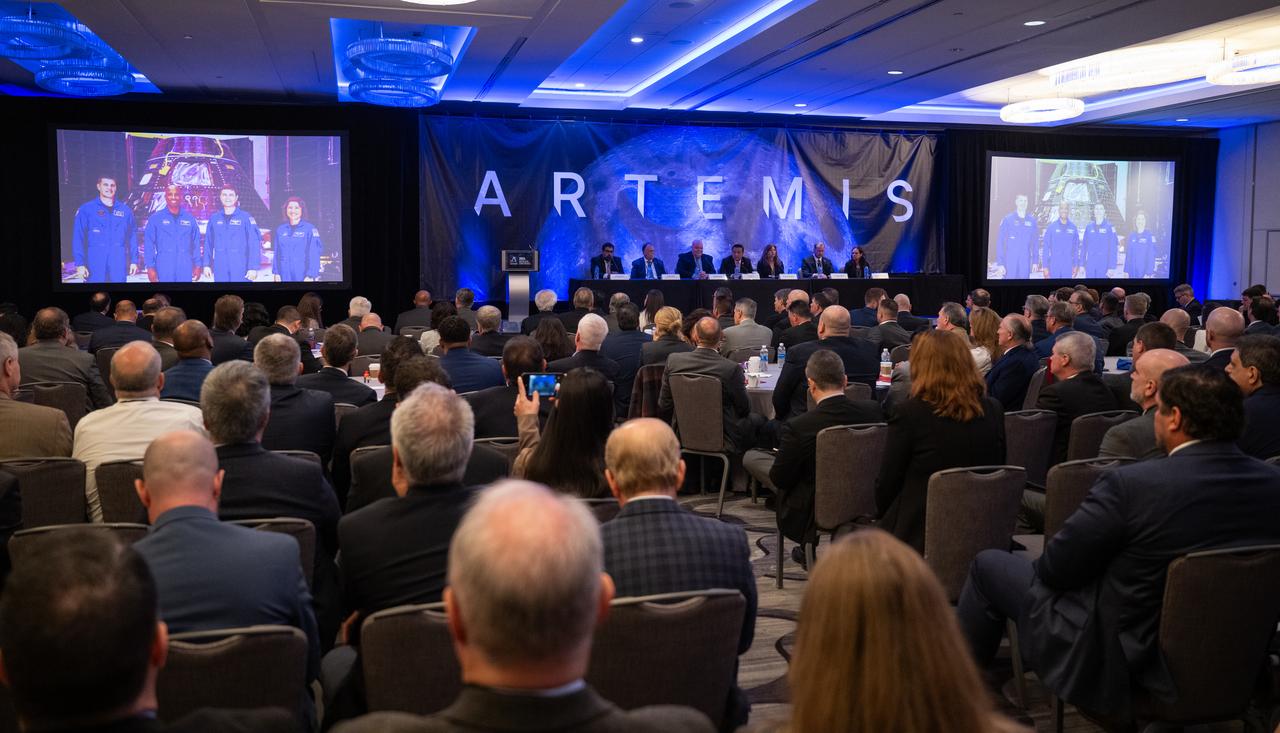
Howard Hu, manager of the Orion Program at NASA’s Johnson Space Center, center, speaks during an Artemis Program progress update panel at the 2024 Artemis Suppliers Conference, Tuesday, Feb. 27, 2024, at the Grand Hyatt Hotel in Washington. Also participating in the panel was, from left, Amit Kshatriya, deputy associate administrator for the Moon to Mars Program in NASA’s Explorations Systems Development Mission Directorate; Shawn Quinn, manager of Exploration Ground Systems at NASA’s Kennedy Space Center; John Honeycutt, manager of the Space Launch System Program at NASA’s Marshall Space Flight Center; Lisa Watson-Morgan, manager of the Human Landing System Program at NASA’s Marshall Space Flight Center; Jon B. Olansen, manager of the Gateway Program at NASA’s Johnson Space Center; and Lara Kearney, manager of Extravehicular Activity and Human Surface Mobility Program at NASA’s Johnson Space Center. Photo Credit: (NASA/Joel Kowsky)

Howard Hu, manager of the Orion Program at NASA’s Johnson Space Center, center, speaks during an Artemis Program progress update panel at the 2024 Artemis Suppliers Conference, Tuesday, Feb. 27, 2024, at the Grand Hyatt Hotel in Washington. Also participating in the panel was, from left, Amit Kshatriya, deputy associate administrator for the Moon to Mars Program in NASA’s Explorations Systems Development Mission Directorate; Shawn Quinn, manager of Exploration Ground Systems at NASA’s Kennedy Space Center; John Honeycutt, manager of the Space Launch System Program at NASA’s Marshall Space Flight Center; Lisa Watson-Morgan, manager of the Human Landing System Program at NASA’s Marshall Space Flight Center; Jon B. Olansen, manager of the Gateway Program at NASA’s Johnson Space Center; and Lara Kearney, manager of Extravehicular Activity and Human Surface Mobility Program at NASA’s Johnson Space Center. Photo Credit: (NASA/Joel Kowsky)

Catherine Koerner, second from right, NASA Orion Program manager, along with senior managers from Orion, Exploration Ground Systems (EGS) and TOSC, tours the Multi-Payload Processing Facility (MPPF) at NASA’s Kennedy Space Center in Florida on Oct. 5, 2020. Accompanying her, from left are Scott Wilson, Orion Production Operations manager; Mike Bolger, EGS manager; and Nicolas Kindred, TOSC flow manager. At right is Jeremy Parsons, EGS deputy manager. Koerner viewed spacecraft hardware and processing facilities for the Artemis I and II missions. The first in a series of increasingly complex missions, Artemis I will test the Orion spacecraft and Space Launch System as an integrated system ahead of crewed flights to the Moon. Under the Artemis program, NASA will land the first woman and the next man on the Moon in 2024.
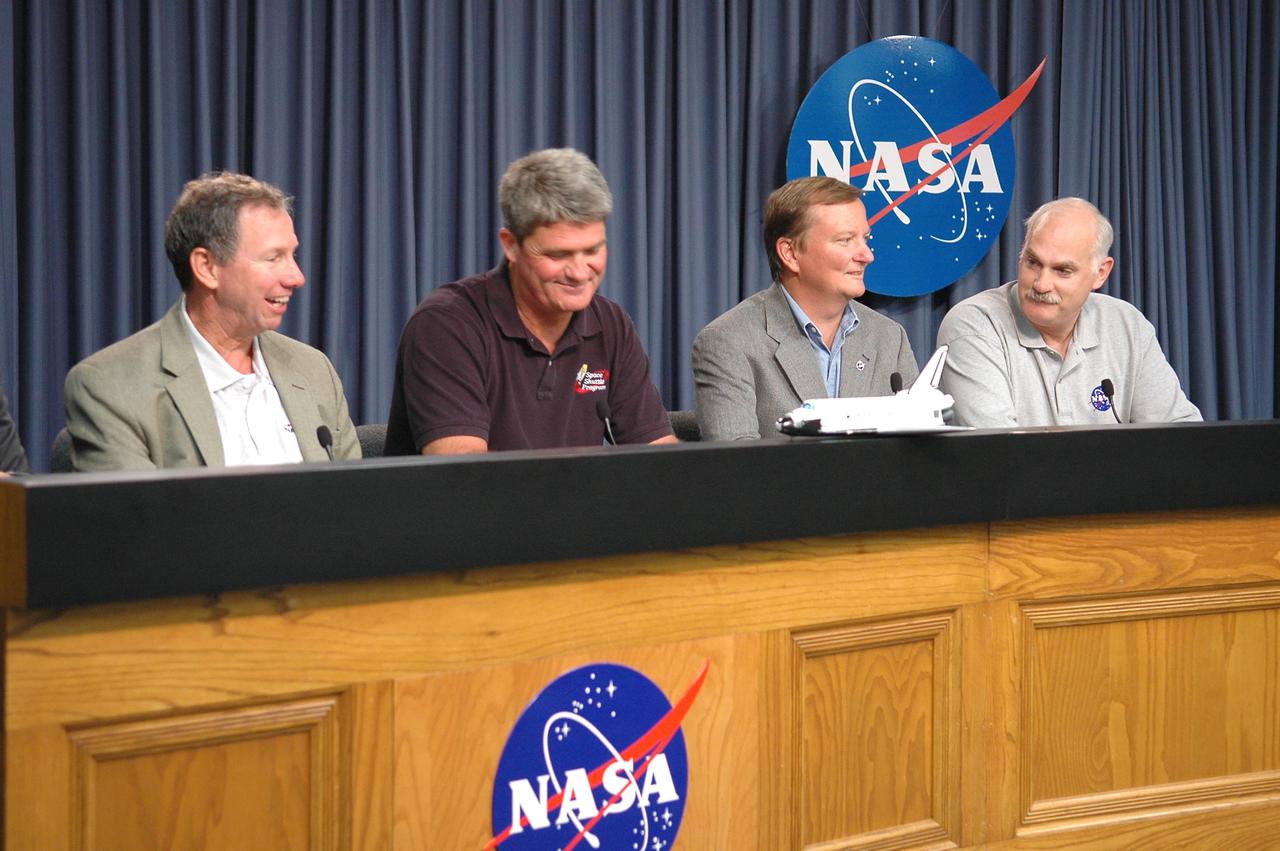
KENNEDY SPACE CENTER, FLA. - At a post-landing briefing, mission management cannot help smiling over the good news that Space Shuttle Discovery safely landed at Edwards Air Force Base in California. From left are NASA Administrator Mike Griffin, Space Shuttle Program Manager Bill Parsons, Shuttle Launch Director Mike Leinbach and Associate Administrator of NASA’s Space Operations Mission Directorate Bill Readdy. A landing at Kennedy Space Center was deferred due to weather concerns. The California landing occurred at 8:11 a.m. EDT, guided by Mission Commander Eileen Collins. Discovery spent two weeks in space on Return to Flight mission STS-114, where the crew demonstrated new methods to inspect and repair the Shuttle in orbit. The crew also delivered supplies, outfitted and performed maintenance on the International Space Station. A number of these tasks were conducted during three spacewalks.
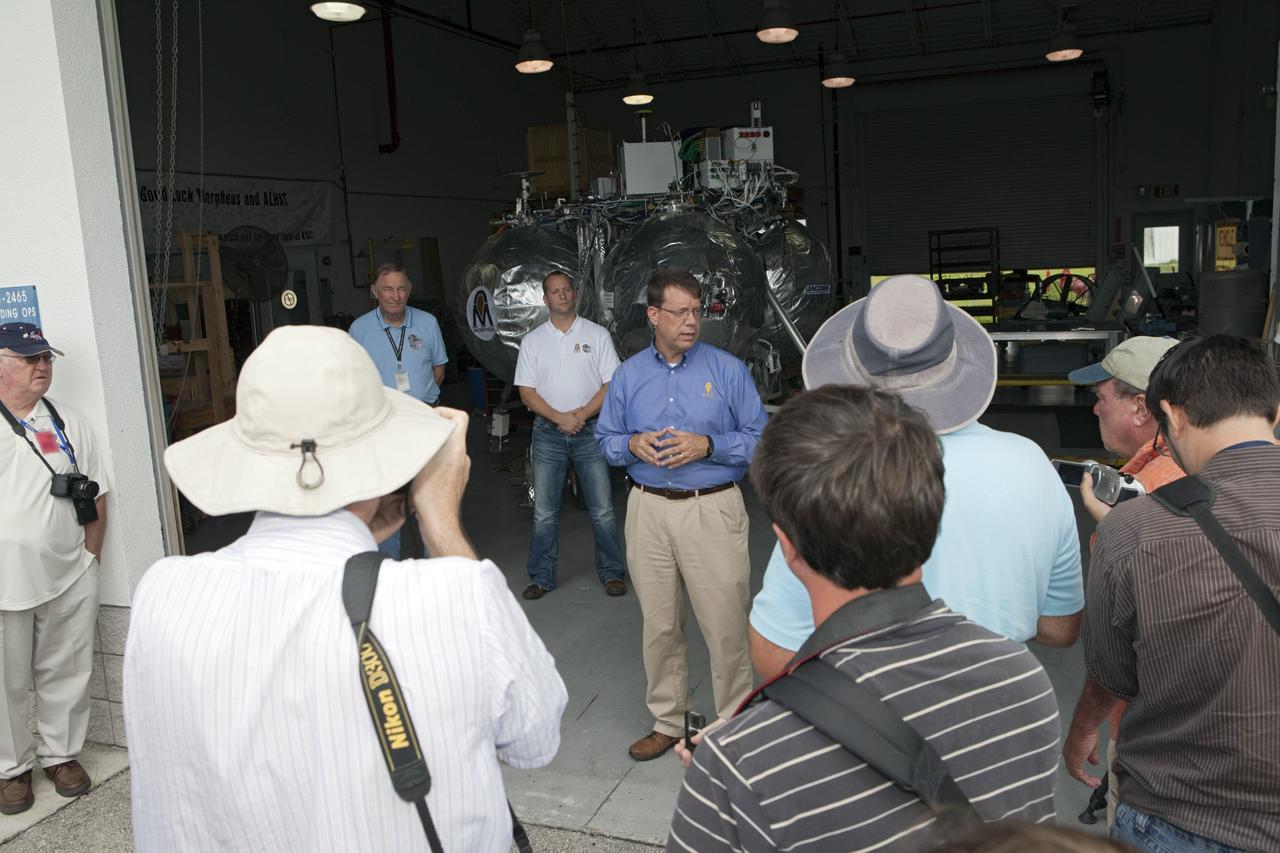
CAPE CANAVERAL, Fla. - At a hangar near the Shuttle Landing Facility, or SLF, at NASA’s Kennedy Space Center in Florida, members of the media view the Morpheus prototype lander and speak with Morpheus managers. In front is Gregory Gaddis, Kennedy Project Morpheus/ALHAT site manager. To his left, are Jon Olansen, Johnson Space Center Project Morpheus manager and Chirold Epp, JSC ALHAT project manager. Testing of the prototype lander had been ongoing at NASA’s Johnson Space Center in Houston in preparation for its first free-flight test at Kennedy Space Center. The SLF will provide the lander with the kind of field necessary for realistic testing, complete with rocks, craters and hazards to avoid. Morpheus utilizes an autonomous landing and hazard avoidance technology, or ALHAT, payload that will allow it to navigate to clear landing sites amidst rocks, craters and other hazards during its descent. Project Morpheus is one of 20 small projects comprising the Advanced Exploration Systems, or AES, program in NASA’s Human Exploration and Operations Mission Directorate. AES projects pioneer new approaches for rapidly developing prototype systems, demonstrating key capabilities and validating operational concepts for future human missions beyond Earth orbit. For more information on Project Morpheus, visit http://morpheuslander.jsc.nasa.gov/. Photo credit: NASA/Kim Shiflett
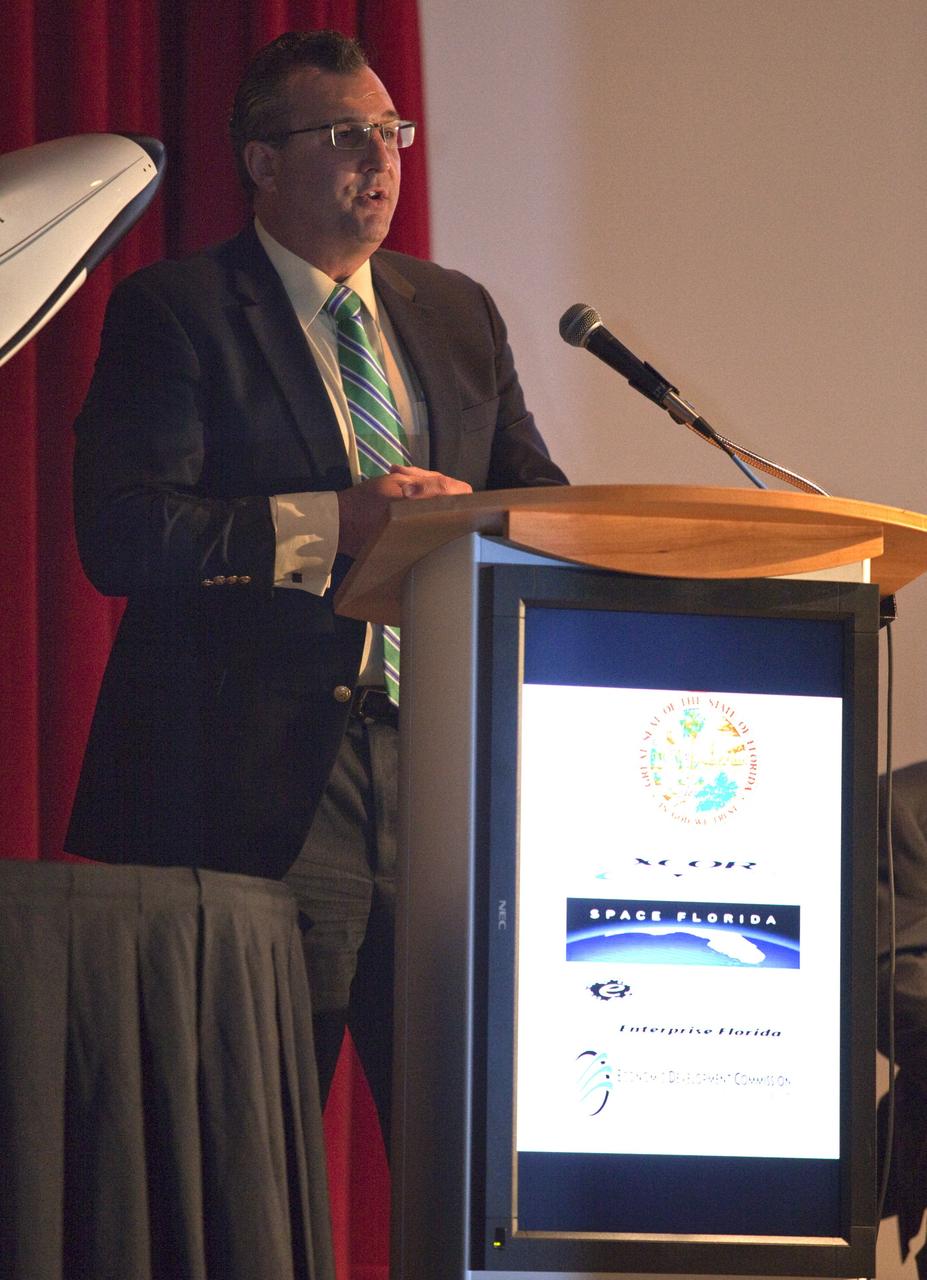
CAPE CANAVERAL, Fla. - At NASA's Kennedy Space Center in Florida, Todd Lindner, senior manager of Aviation Planning and Spaceport Development for the Jacksonville Aviation Authority, addresses guests at a presentation during which XCOR Aerospace announced plans to open a manufacturing operation in Brevard. The company's suborbital Lynx Mark II spacecraft possibly will take off and land at Kennedy's shuttle landing facility. XCOR Aerospace is a small, privately held California corporation with focus on the research, development, project management and production of reusable launch vehicles, rocket engines and rocket propulsion systems. XCOR will focus on space tourism, experimental flights and launching satellites. Photo credit: NASA/ Frankie Martin
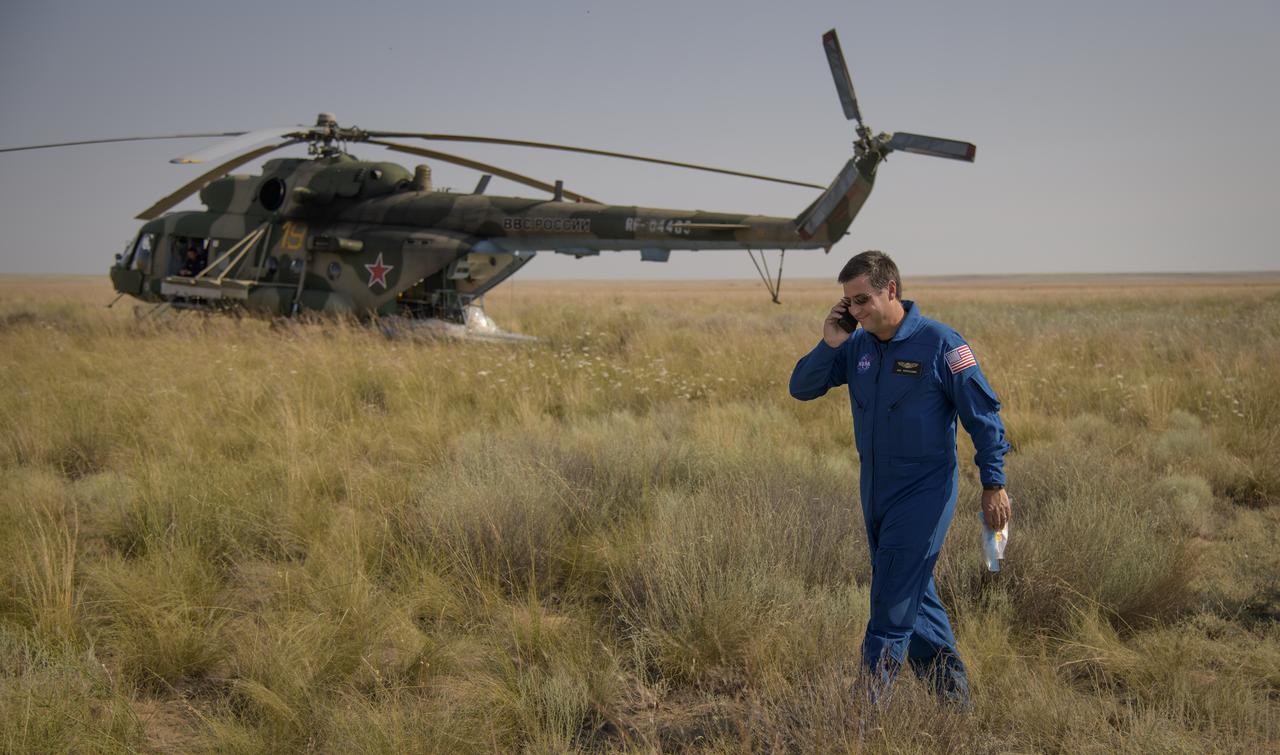
NASA ISS Deputy Program Manager Joel Montalbano talks to mission managers via satellite phone from the Soyuz MS-11 landing zone in a remote area near the town of Zhezkazgan, Kazakhstan on Tuesday, June 25, 2019 Kazakh time (June 24 Eastern time). Expedition 59 crew members Anne McClain of NASA, David Saint-Jacques of the Canadian Space Agency, and Oleg Kononenko of Roscosmos landed in their Soyuz MS-11 spacecraft after 204 days in space where they served as members of the Expedition 58 and 59 crews onboard the International Space Station. Photo Credit: (NASA/Bill Ingalls)

From left, Jules Schneider, Lockheed Martin Assembly, Test and Launch Operations; Kennedy Space Center Director Bob Cabana; NASA Administrator Jim Bridenstine; Russell Vought, director of the White House Office of Management and Budget; and Larry Price, Lockheed Martin Orion Program Manager, tour the Neil Armstrong Operations and Checkout Building high bay at NASA’s Kennedy Space Center in Florida on Aug. 28, 2020. In the center, behind them from left, are Brian McCormack, associate director of the White House Office of Management and Budget, and Glenn Chin, Deputy Manager of Orion Production Operations. Inside the high bay, Orion spacecraft are being prepared for Artemis I and Artemis II, with the Crew Module Adapter for Artemis II shown in the background. The Office of Management and Budget is working with the U.S. Congress to line up the necessary resources to land the first woman and the next man on the Moon in 2024.
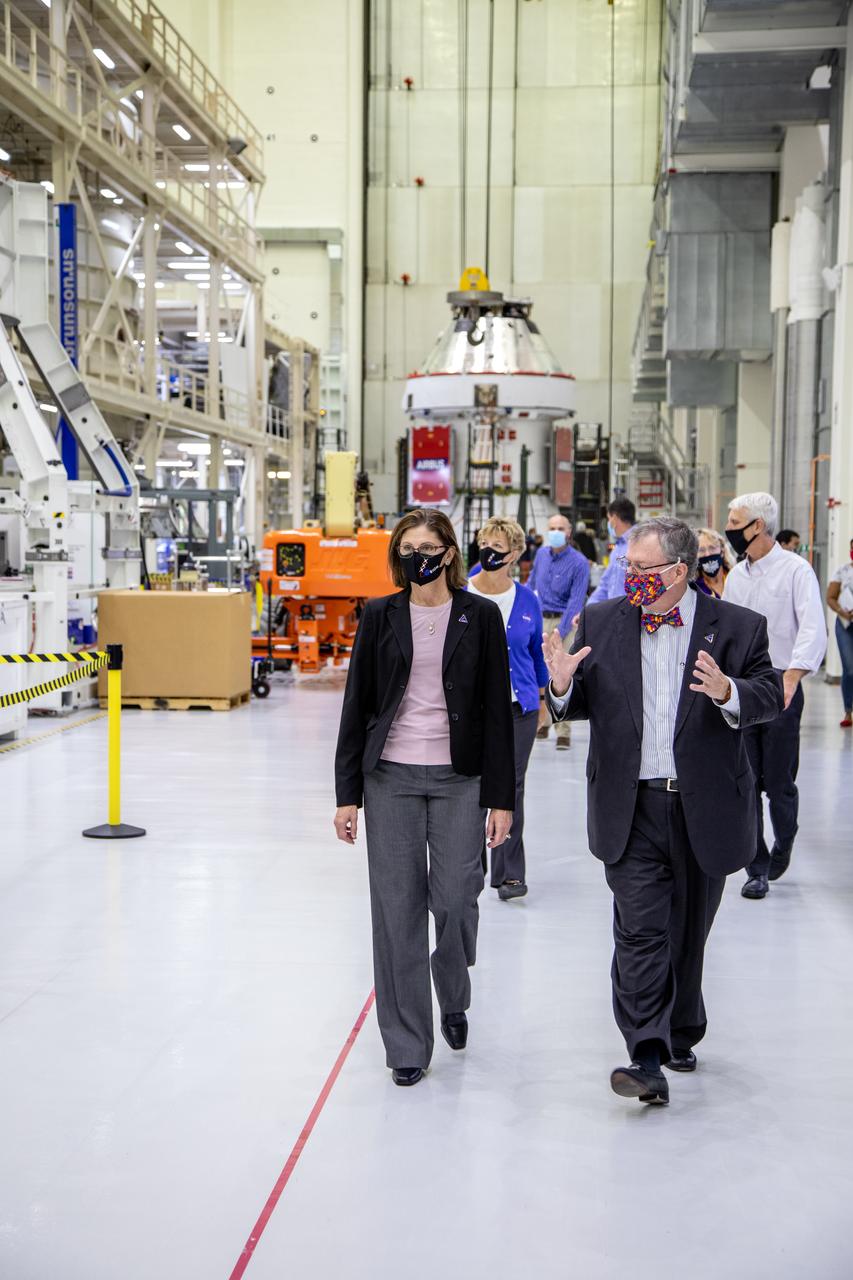
Catherine Koerner, in front at left, NASA Orion Program manager, along with senior managers from Orion and Lockheed Martin, tour the Neil Armstrong Operations and Checkout Building at NASA’s Kennedy Space Center in Florida on Oct. 6, 2020. Accompanying her, in front at right is Mike Hawes, Lockheed Martin vice president and Orion Program manager. In view behind Koerner is Annette Hasbrook, Orion Program assistant manager. In view behind Hawes is Scott Wilson, NASA Kennedy Orion Production Operations manager. Koerner viewed Orion spacecraft for the Artemis I, shown in the background, and II missions. The first in a series of increasingly complex missions, Artemis I will test the Orion spacecraft and Space Launch System as an integrated system ahead of crewed flights to the Moon. Under the Artemis program, NASA will land the first woman and the next man on the Moon in 2024.
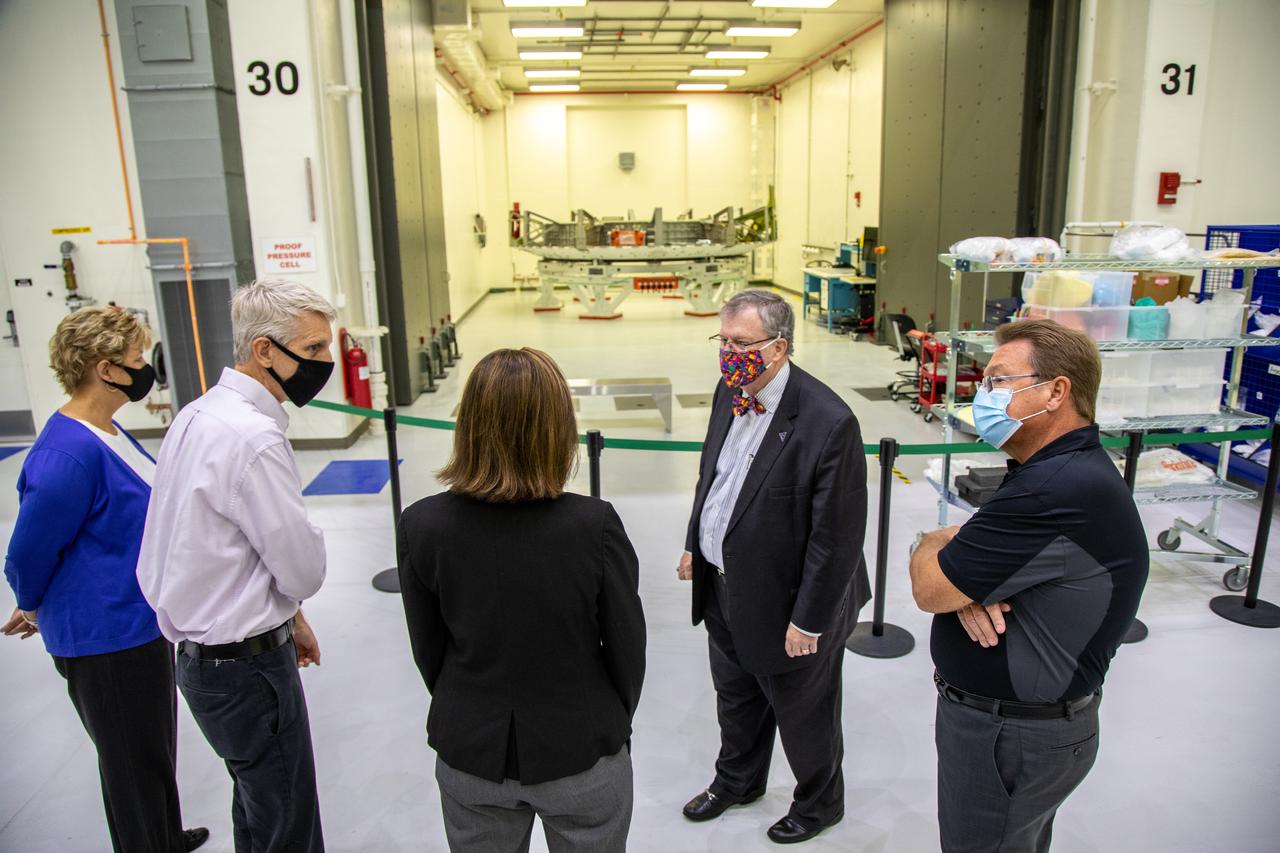
Catherine Koerner, in the center, NASA Orion Program manager, along with senior managers from Orion and Lockheed Martin, tours the Neil Armstrong Operations and Checkout Building at NASA’s Kennedy Space Center in Florida on Oct. 6, 2020. Accompanying her, from left are Annette Hasbrook, Orion Program assistant manager; Scott Wilson, NASA Kennedy Orion Production Operations manager, Mike Hawes, Lockheed Martin vice president and Orion Program manager; and Jules Schneider, Lockheed Martin Assembly, Test and Launch Operations director with Lockheed Martin. Koerner viewed the Orion spacecraft for the Artemis I and II missions. They are shown with the crew module adapter for the Orion Artemis II mission. The first in a series of increasingly complex missions, Artemis I will test the Orion spacecraft and Space Launch System as an integrated system ahead of crewed flights to the Moon. Under the Artemis program, NASA will land the first woman and the next man on the Moon in 2024.
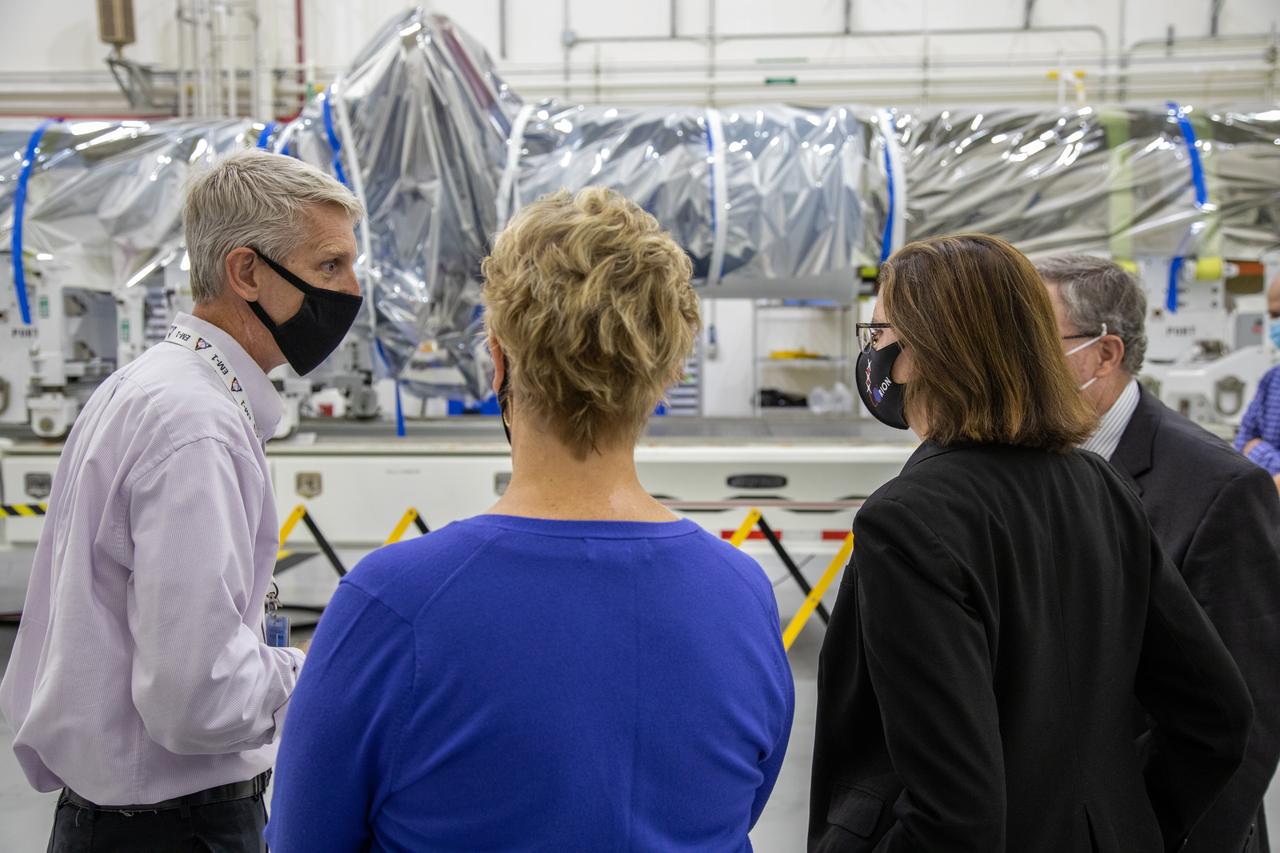
Catherine Koerner, second from right, NASA Orion Program manager, along with senior managers from Orion and Lockheed Martin, tour the Launch Abort System Facility at NASA’s Kennedy Space Center in Florida on Oct. 6, 2020. Accompanying her from left, are Scott Wilson, NASA Kennedy Orion Production Operations manager; Annette Hasbrook, Orion Program assistant manager; and Mike Hawes, Lockheed Martin vice president and Orion Program manager. They are viewing the launch abort system for the Artemis II mission. Koerner also viewed the Orion spacecraft for the Artemis I and II missions in the Neil Armstrong Operations and Checkout Building. The first in a series of increasingly complex missions, Artemis I will test the Orion spacecraft and Space Launch System as an integrated system ahead of crewed flights to the Moon. Under the Artemis program, NASA will land the first woman and the next man on the Moon in 2024.
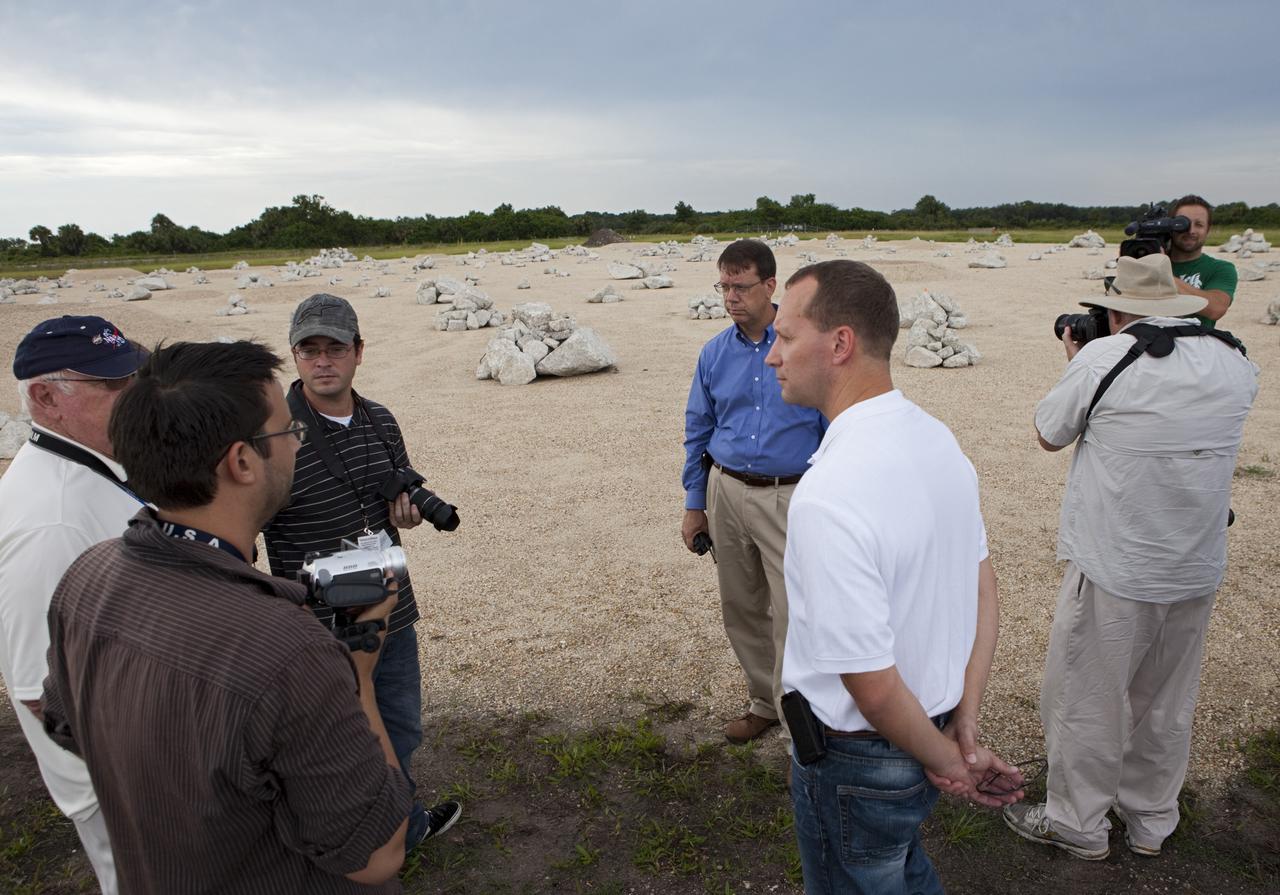
CAPE CANAVERAL, Fla. - At the Autonomous Landing and Hazard Avoidance Technology, or ALHAT, field at the north end of the Shuttle Landing Facility, or SLF, at NASA’s Kennedy Space Center in Florida, members of the media view the hazard field and speak with Morpheus managers. In the white shirt is Jon Olansen, Johnson Space Center Project Morpheus Manager. Behind Olansen is Gregory Gaddis, Kennedy Project Morpheus/ALHAT site manager. Testing of the prototype lander had been ongoing at NASA’s Johnson Space Center in Houston in preparation for its first free-flight test at Kennedy Space Center. The SLF will provide the lander with the kind of field necessary for realistic testing, complete with rocks, craters and hazards to avoid. Morpheus utilizes an autonomous landing and hazard avoidance technology, or ALHAT, payload that will allow it to navigate to clear landing sites amidst rocks, craters and other hazards during its descent. Project Morpheus is one of 20 small projects comprising the Advanced Exploration Systems, or AES, program in NASA’s Human Exploration and Operations Mission Directorate. AES projects pioneer new approaches for rapidly developing prototype systems, demonstrating key capabilities and validating operational concepts for future human missions beyond Earth orbit. For more information on Project Morpheus, visit http://morpheuslander.jsc.nasa.gov/. Photo credit: NASA/Kim Shiflett
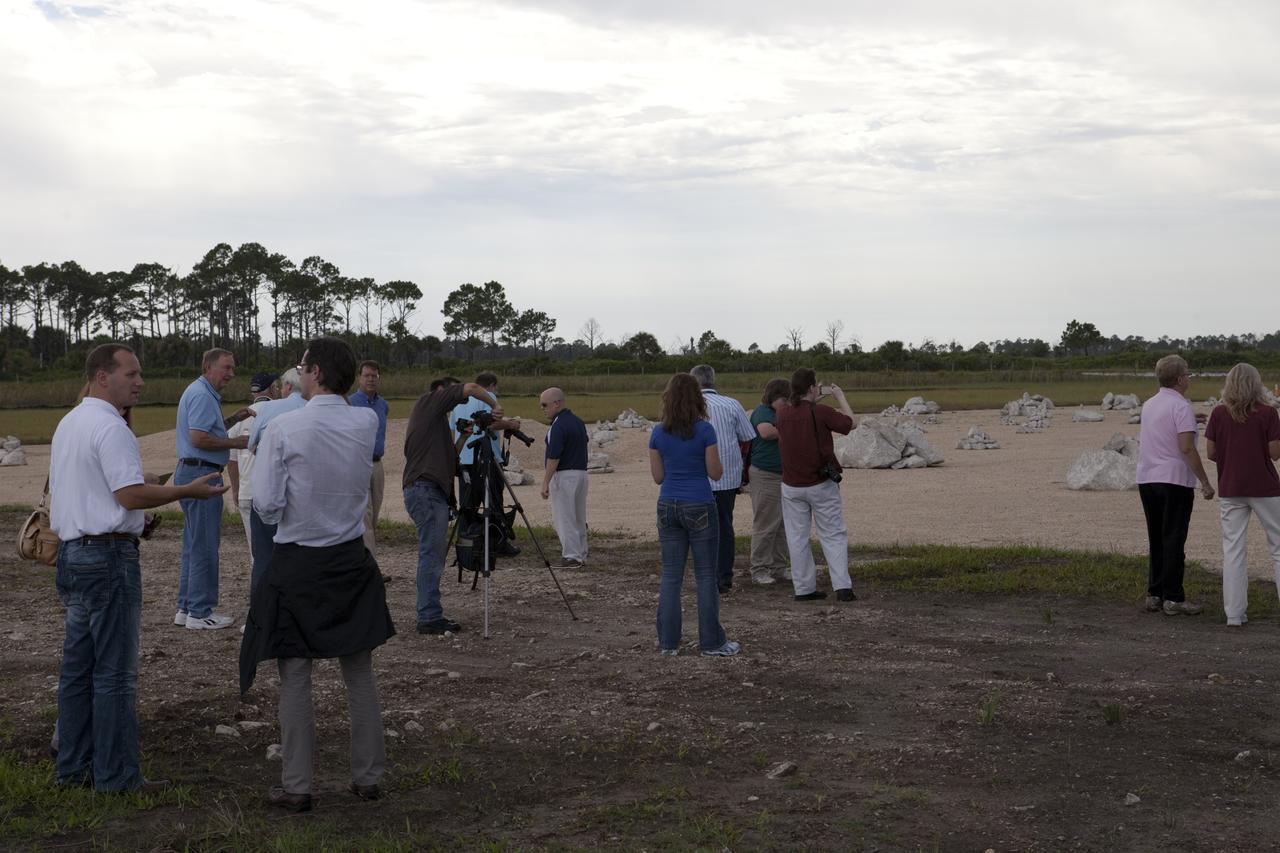
CAPE CANAVERAL, Fla. - At the Autonomous Landing and Hazard Avoidance Technology, or ALHAT, field at the north end of the Shuttle Landing Facility, or SLF, at NASA’s Kennedy Space Center in Florida, members of the media view the hazard field and speak with Morpheus managers. At far left, in the white shirt is Jon Olansen, Johnson Space Center Project Morpheus Manager. At left, in the blue shirt is Chirold Epp, JSC project manager for ALHAT. Testing of the prototype lander had been ongoing at NASA’s Johnson Space Center in Houston in preparation for its first free-flight test at Kennedy Space Center. The SLF will provide the lander with the kind of field necessary for realistic testing, complete with rocks, craters and hazards to avoid. Morpheus utilizes an autonomous landing and hazard avoidance technology, or ALHAT, payload that will allow it to navigate to clear landing sites amidst rocks, craters and other hazards during its descent. Project Morpheus is one of 20 small projects comprising the Advanced Exploration Systems, or AES, program in NASA’s Human Exploration and Operations Mission Directorate. AES projects pioneer new approaches for rapidly developing prototype systems, demonstrating key capabilities and validating operational concepts for future human missions beyond Earth orbit. For more information on Project Morpheus, visit http://morpheuslander.jsc.nasa.gov/. Photo credit: NASA/Kim Shiflett
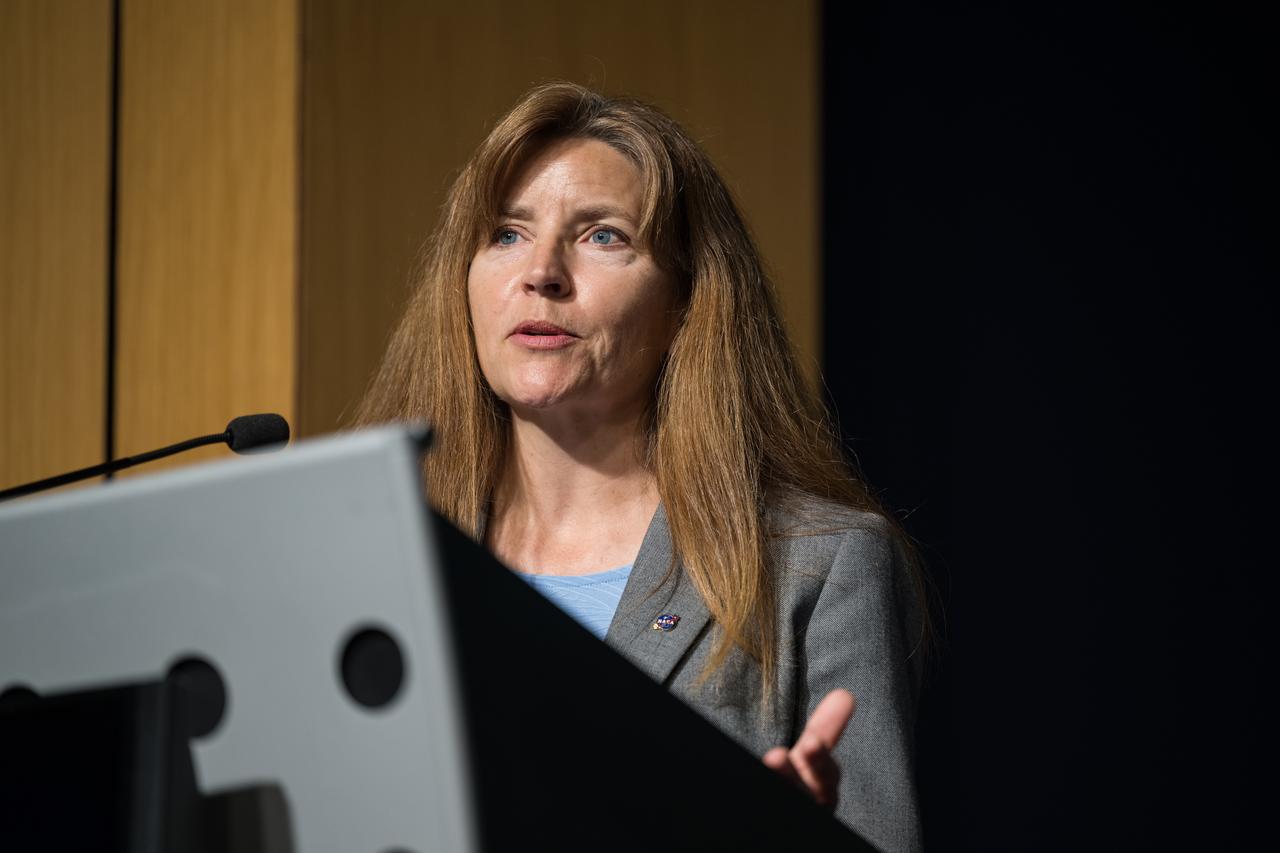
Human Landing System Program Manager Lisa Watson-Morgan gives remarks during an event announcing Blue Origin as the company selected to develop a sustainable human landing system for the Artemis V Moon mission, Friday, May 19, 2023 at the Mary W. Jackson NASA Headquarters building in Washington. The human landing system will take astronauts to and from Gateway in lunar orbit to the surface and back to the lunar space station as part of NASA’s return to the Moon for science, exploration, and inspiration. Photo Credit: (NASA/Aubrey Gemignani)
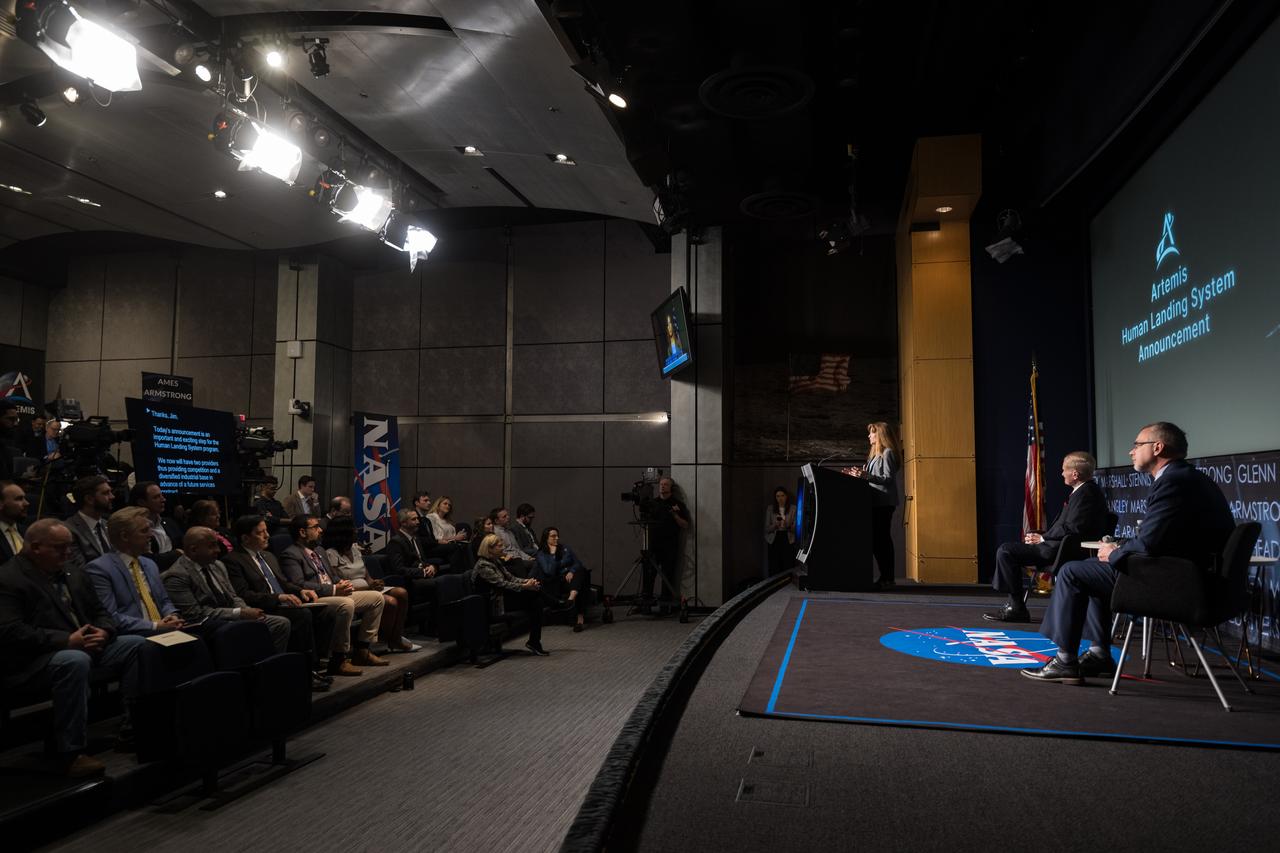
Human Landing System Program Manager Lisa Watson-Morgan gives remarks during an event announcing Blue Origin as the company selected to develop a sustainable human landing system for the Artemis V Moon mission, Friday, May 19, 2023 at the Mary W. Jackson NASA Headquarters building in Washington. The human landing system will take astronauts to and from Gateway in lunar orbit to the surface and back to the lunar space station as part of NASA’s return to the Moon for science, exploration, and inspiration. Photo Credit: (NASA/Aubrey Gemignani)
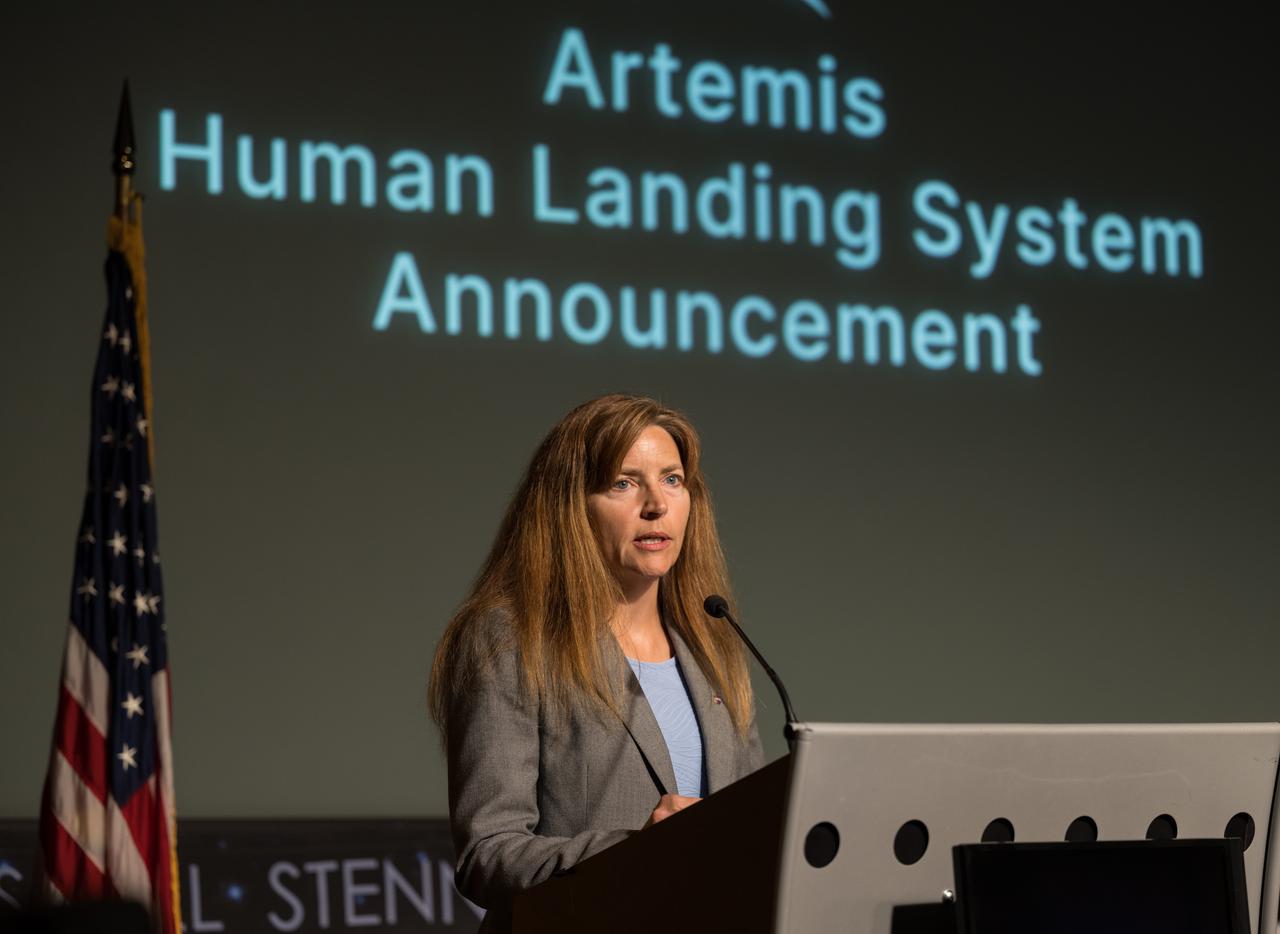
Human Landing System Program Manager Lisa Watson-Morgan gives remarks during an event announcing Blue Origin as the company selected to develop a sustainable human landing system for the Artemis V Moon mission, Friday, May 19, 2023 at the Mary W. Jackson NASA Headquarters building in Washington. The human landing system will take astronauts to and from Gateway in lunar orbit to the surface and back to the lunar space station as part of NASA’s return to the Moon for science, exploration, and inspiration. Photo Credit: (NASA/Aubrey Gemignani)
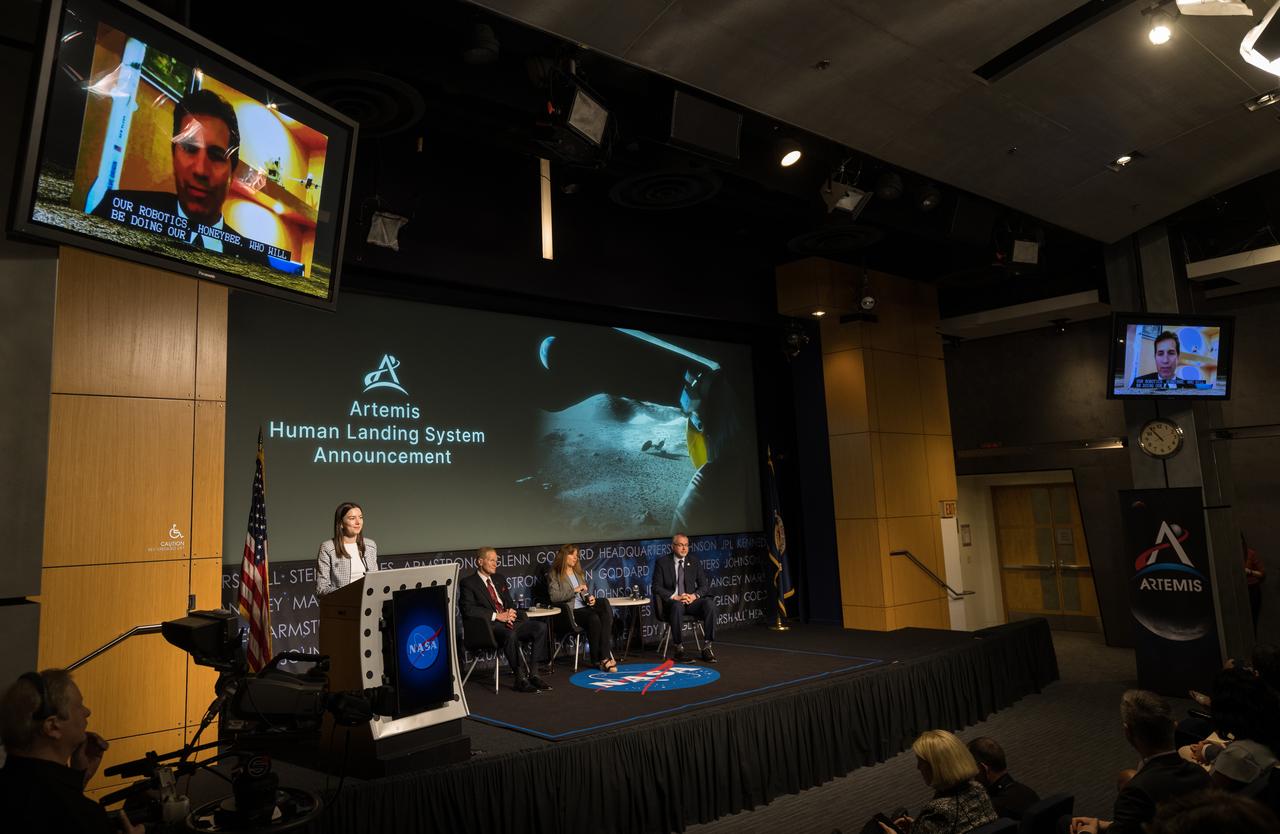
Blue Origin Human Landing System Program Manager, John Couluris, gives remarks during an event announcing Blue Origin as the company selected to develop a sustainable human landing system for the Artemis V Moon mission, Friday, May 19, 2023 at the Mary W. Jackson NASA Headquarters building in Washington. The human landing system will take astronauts to and from Gateway in lunar orbit to the surface and back to the lunar space station as part of NASA’s return to the Moon for science, exploration, and inspiration. Photo Credit: (NASA/Aubrey Gemignani)
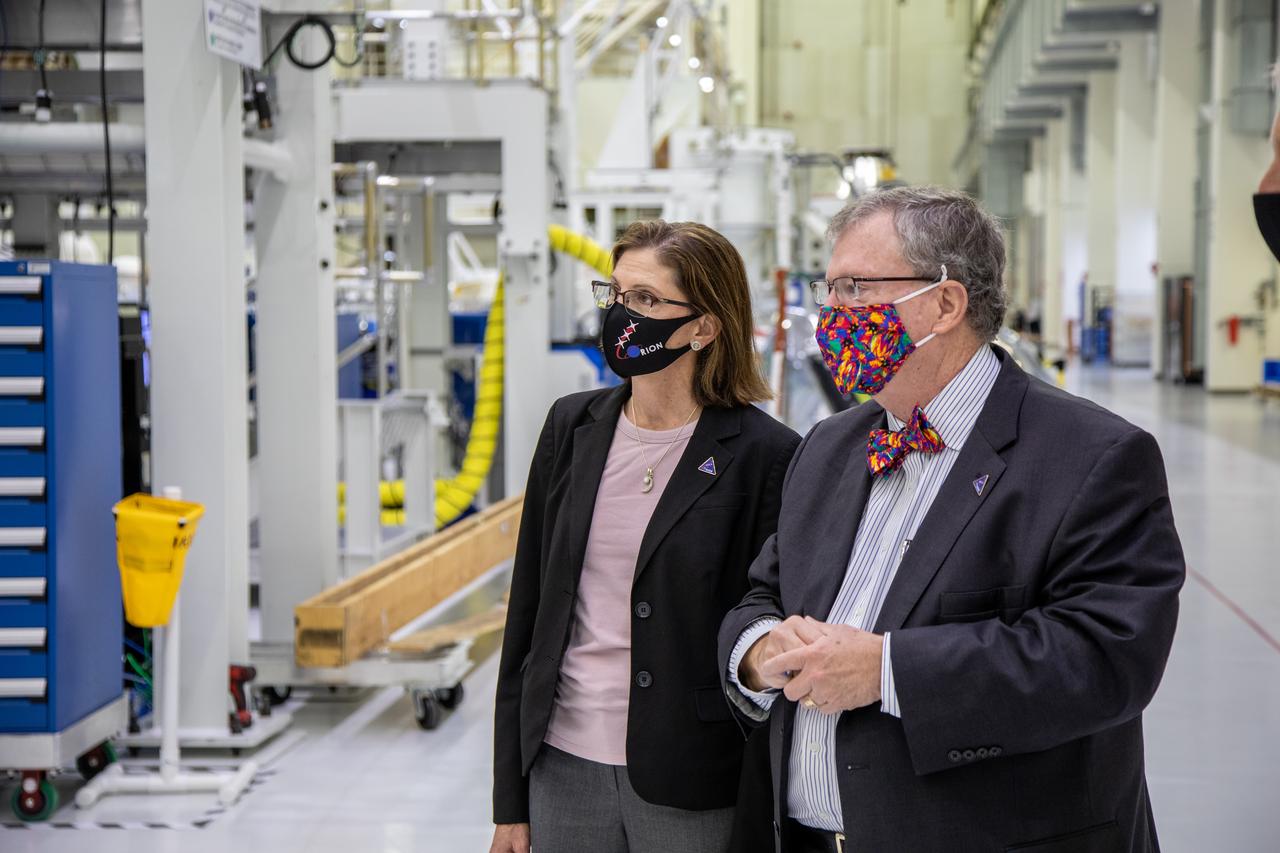
Catherine Koerner, at left, NASA Orion Program manager, along with senior managers from Orion and Lockheed Martin, tours the Neil Armstrong Operations and Checkout Building at NASA’s Kennedy Space Center in Florida on Oct. 6, 2020. Accompanying her, at right is Mike Hawes, Lockheed Martin vice president and Orion Program manager. Koerner viewed Orion spacecraft for the Artemis I and II missions. The first in a series of increasingly complex missions, Artemis I will test the Orion spacecraft and Space Launch System as an integrated system ahead of crewed flights to the Moon. Under the Artemis program, NASA will land the first woman and the next man on the Moon in 2024.
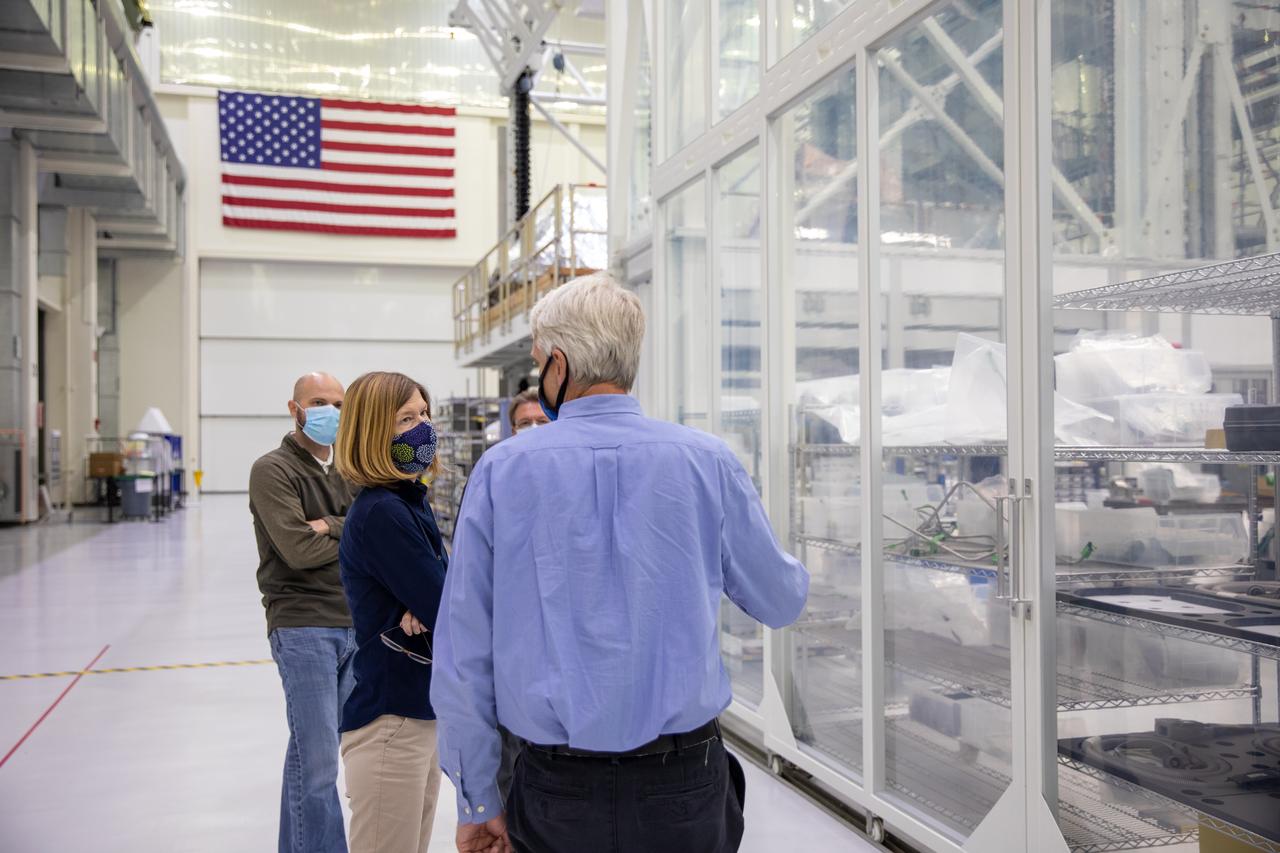
Senior managers from Orion, NASA, and Lockheed Martin view the Artemis II crew module inside a clean room during a visit to the Neil Armstrong Operations and Checkout Building high bay at NASA’s Kennedy Space Center in Florida on Nov. 5, 2020. From left are Jim Skaggs, senior manager of Kennedy Operations for Lockheed Martin; Kathy Lueders, associate administrator of NASA’s Human Exploration and Operations Mission Directorate; and Scott Wilson, manager, Orion Production Office. Artemis II will be the first crewed flight test of the Space Launch System rocket and the Orion spacecraft. Under the Artemis program, NASA is planning to land the first woman and the next man on the lunar surface by 2024.
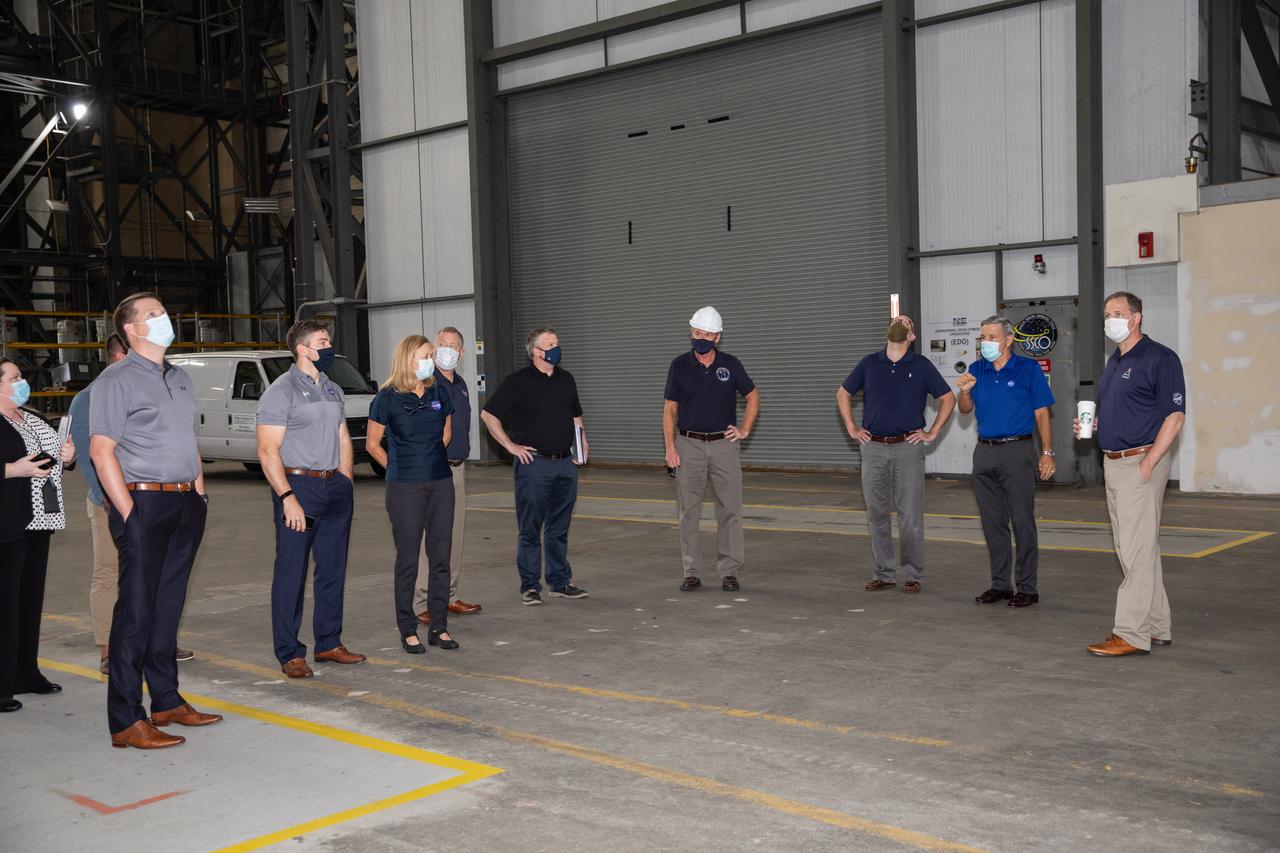
Kennedy Space Center Director Bob Cabana, second from right, accompanies Russell Vought, third from right, director of the White House Office of Management and Budget, and NASA Administrator Jim Bridenstine, far right, on a tour of the Vehicle Assembly Building (VAB) on Aug. 28, 2020. Third from left is Kennedy Deputy Director Janet Petro, and fourth from right is Mike Bolger, manager of Kennedy’s Exploration Ground Systems Directorate. The VAB is critical to the assembly of the Space Launch System rocket for NASA’s Artemis program. The Office of Management and Budget is working with the U.S. Congress to line up the necessary resources to land the first woman and the next man on the Moon in 2024.
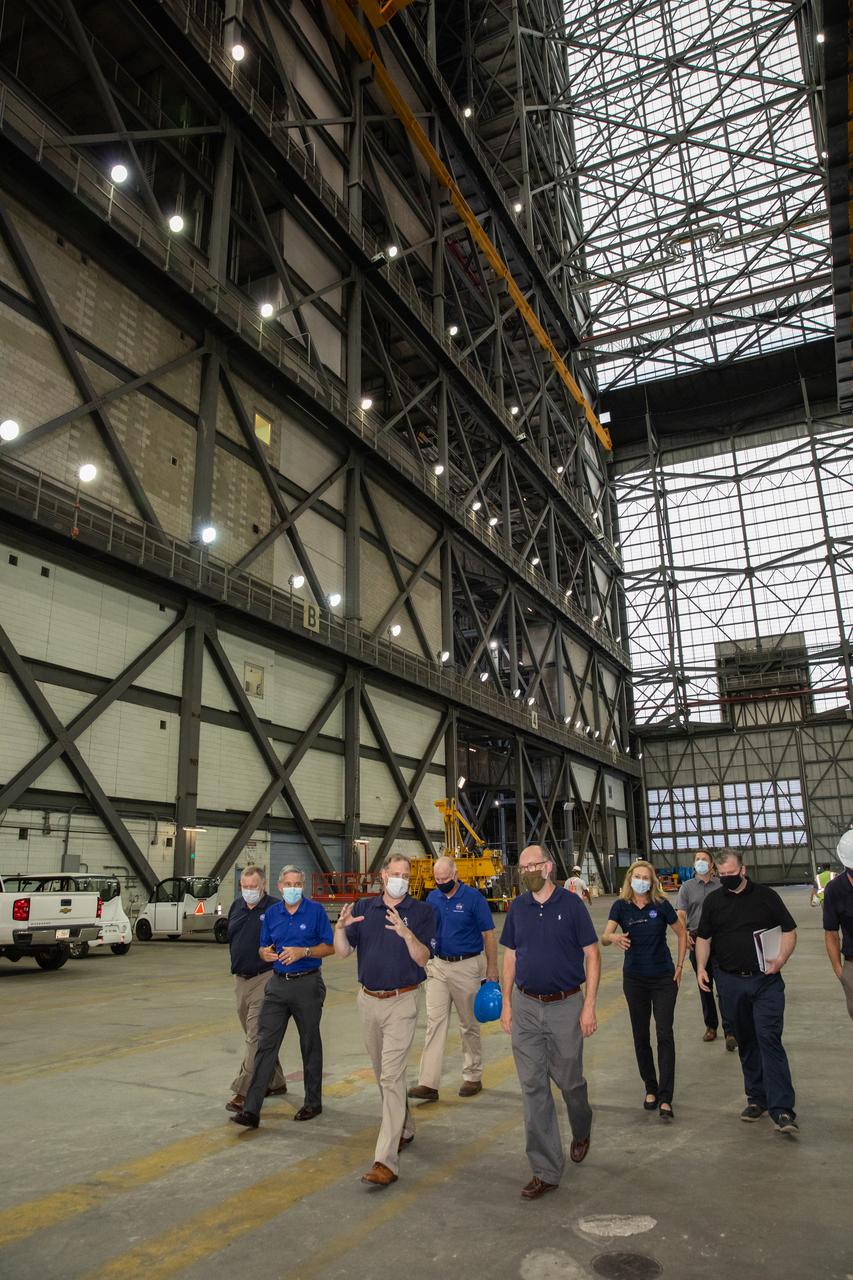
NASA Administrator Jim Bridenstine, in the center, tours the Vehicle Assembly Building at NASA’s Kennedy Space Center in Florida on Aug. 28, 2020, with Russell Vought, in front at right, director of the White House Office of Management and Budget. Accompanying them is Kennedy Director Bob Cabana, second from left. Behind Vought is Kennedy Deputy Director Janet Petro. At right, next to Petro, is Brian McCormack, associate director of the White House Office of Management and Budget. The VAB is critical to the assembly of the Space Launch System rocket for NASA’s Artemis program. The Office of Management and Budget is working with the U.S. Congress to line up the necessary resources to land the first woman and the next man on the Moon in 2024.
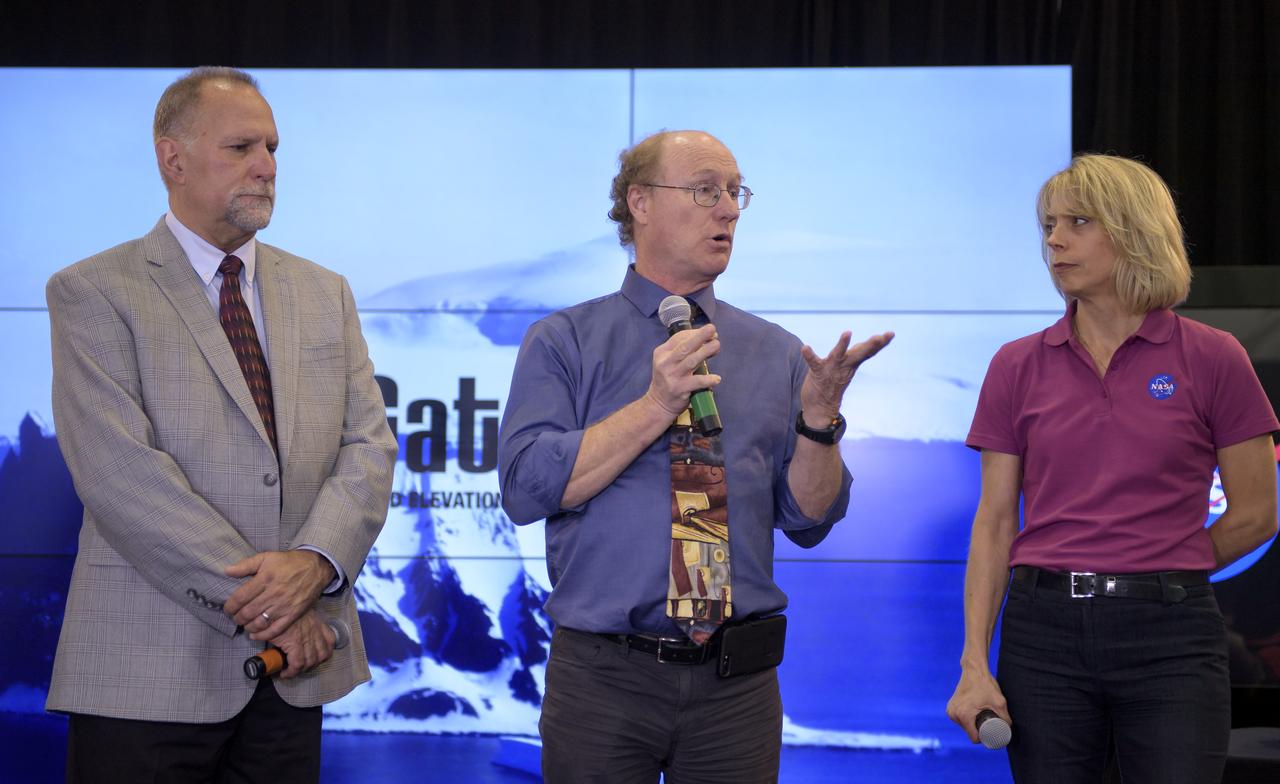
Bill Barnhart, ICESat-2 Program Manager, Northrop Grumman, left, Doug McLennan, ICESat-2 Project Manager, NASA's Goddard Space Flight Center, center, and Cathy Richardson, Deputy Program Manager, Earth Science Projects Division, NASA's Goddard Space Flight Center, are seen during a NASA Ice, Cloud and land Elevation Satellite-2 (ICESat-2) prelaunch briefing, Thursday, Sept. 13, 2018, at Vandenberg Air Force Base in California. The ICESat-2 mission will measure the changing height of Earth's ice. Photo Credit: (NASA/Bill Ingalls)
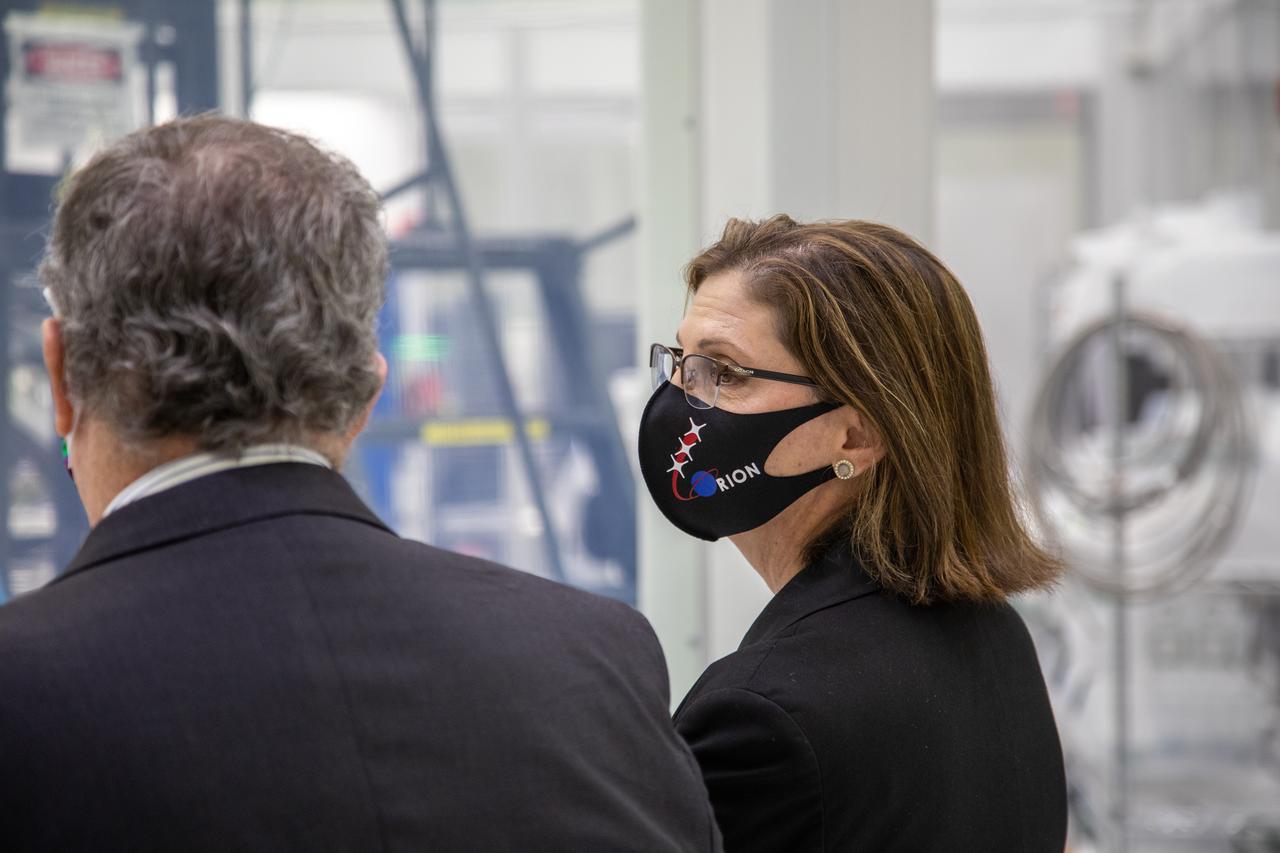
Catherine Koerner, at right, NASA Orion Program manager, along with senior managers from Orion and Lockheed Martin, tours the Neil Armstrong Operations and Checkout Building at NASA’s Kennedy Space Center in Florida on Oct. 6, 2020. Accompanying her, at left is Mike Hawes, Lockheed Martin vice president and Orion Program manager. Koerner viewed Orion spacecraft for the Artemis I and II missions. The first in a series of increasingly complex missions, Artemis I will test the Orion spacecraft and Space Launch System as an integrated system ahead of crewed flights to the Moon. Under the Artemis program, NASA will land the first woman and the next man on the Moon in 2024.
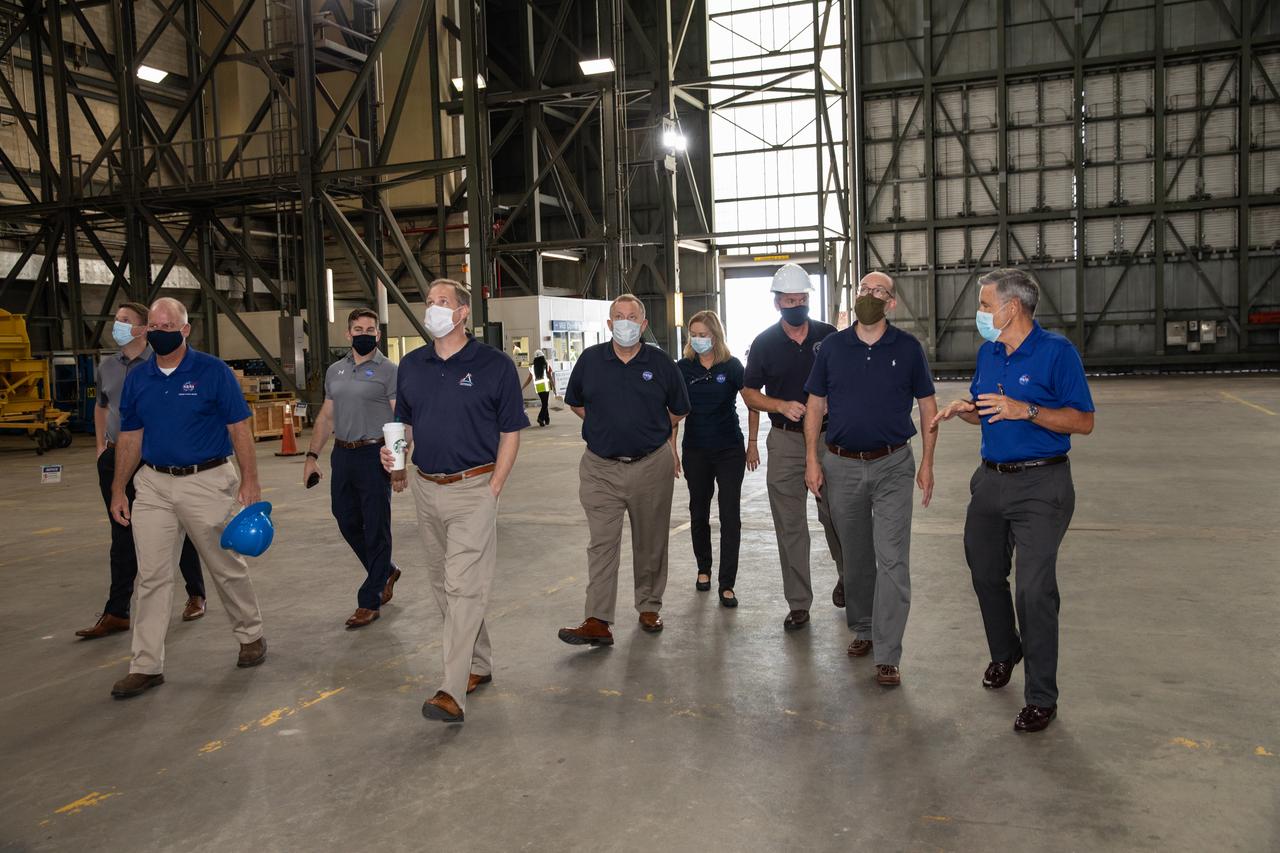
Kennedy Space Center Director Bob Cabana, far right, accompanies Russell Vought, second from right, director of the White House Office of Management and Budget, on a tour of the Vehicle Assembly Building (VAB) on Aug. 28, 2020. Leading the group, in front, is NASA Administrator Jim Bridenstine, along with NASA Deputy Administrator Jim Morhard, Kennedy Space Center Deputy Director Janet Petro, and Mike Bolger, manager of Kennedy’s Exploration Ground Systems Directorate. The VAB is critical to the assembly of the Space Launch System rocket for NASA’s Artemis program. The Office of Management and Budget is working with the U.S. Congress to line up the necessary resources to land the first woman and the next man on the Moon in 2024.
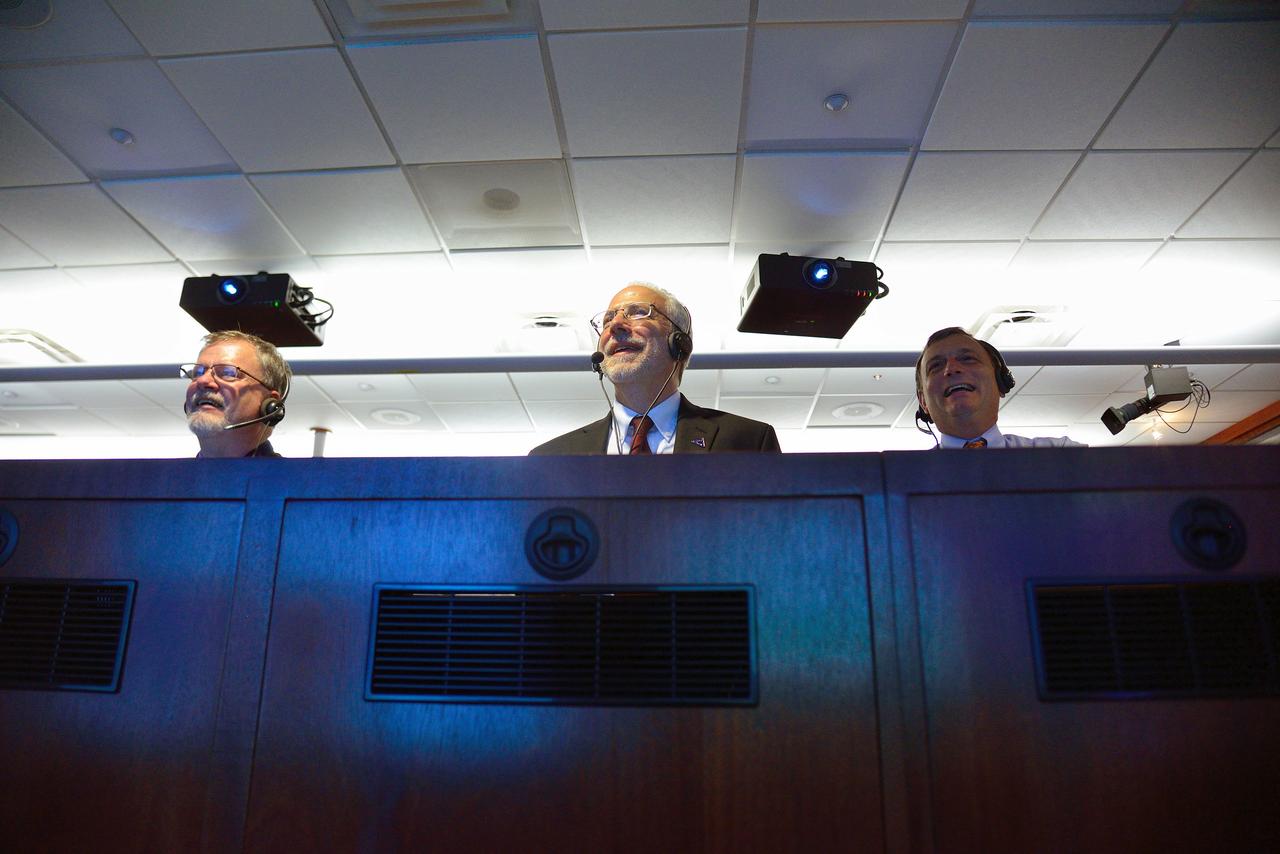
Lockheed Martin Program Manager Mike Hawes, Orion Program Manager Mark Geyer, and Orion Deputy Program Manager Mike Kirasich watch Orion's Exploration Flight Test-1 (EFT-1) reentry sequence in Building AE at Cape Canaveral Air Force Station on a live stream from the Ikhana aircraft on Dec. 5, 2014. The Orion spacecraft orbited Earth twice, reaching an altitude of approximately 3,600 miles above Earth before landing. No one was aboard Orion for this flight test, but the spacecraft is designed to allow us to journey to destinations never before visited by humans, including an asteroid and Mars. Part of Batch image transfer from Flickr.

Closest to the Artemis I spacecraft, Larry Price, at left, Lockheed Martin Orion program manager, talks with Russell Vought, director of the White House Office of Management and Budget, and NASA Administrator Jim Bridenstine, third from left in front, during a tour of the Neil Armstrong Operations and Checkout Building high bay at NASA’s Kennedy Space Center in Florida on Aug. 28, 2020. Orion spacecraft are being prepared for Artemis I and Artemis II. The Office of Management and Budget is working with the U.S. Congress to line up the necessary resources to land the first woman and the next man on the Moon in 2024.
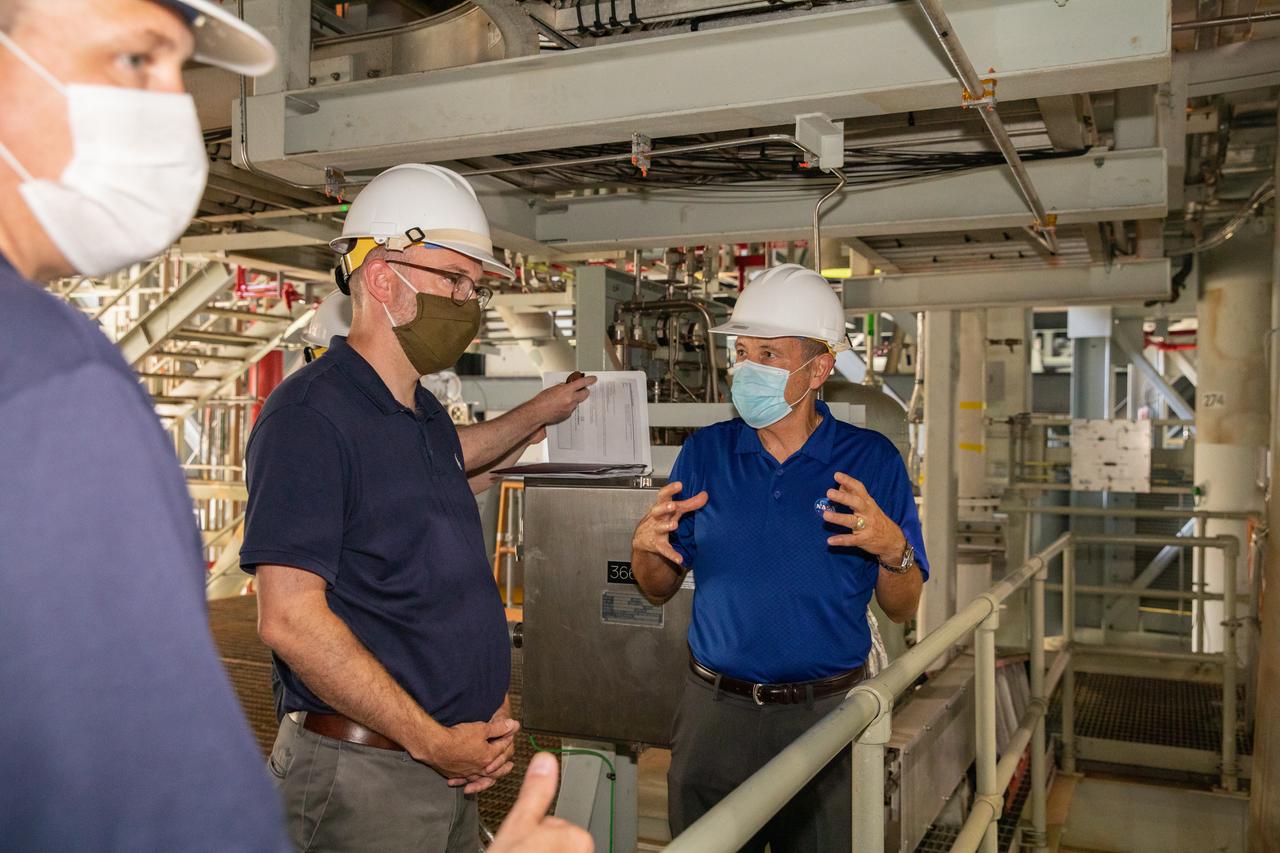
Kennedy Space Center Director Bob Cabana, far right, accompanies Russell Vought, second from right, director of the White House Office of Management and Budget, and NASA Administrator Jim Bridenstine, far left, on a tour of the Vehicle Assembly Building (VAB) on Aug. 28, 2020. The VAB is critical to the assembly of the Space Launch System rocket for NASA’s Artemis program. The Office of Management and Budget is working with the U.S. Congress to line up the necessary resources to land the first woman and the next man on the Moon in 2024.
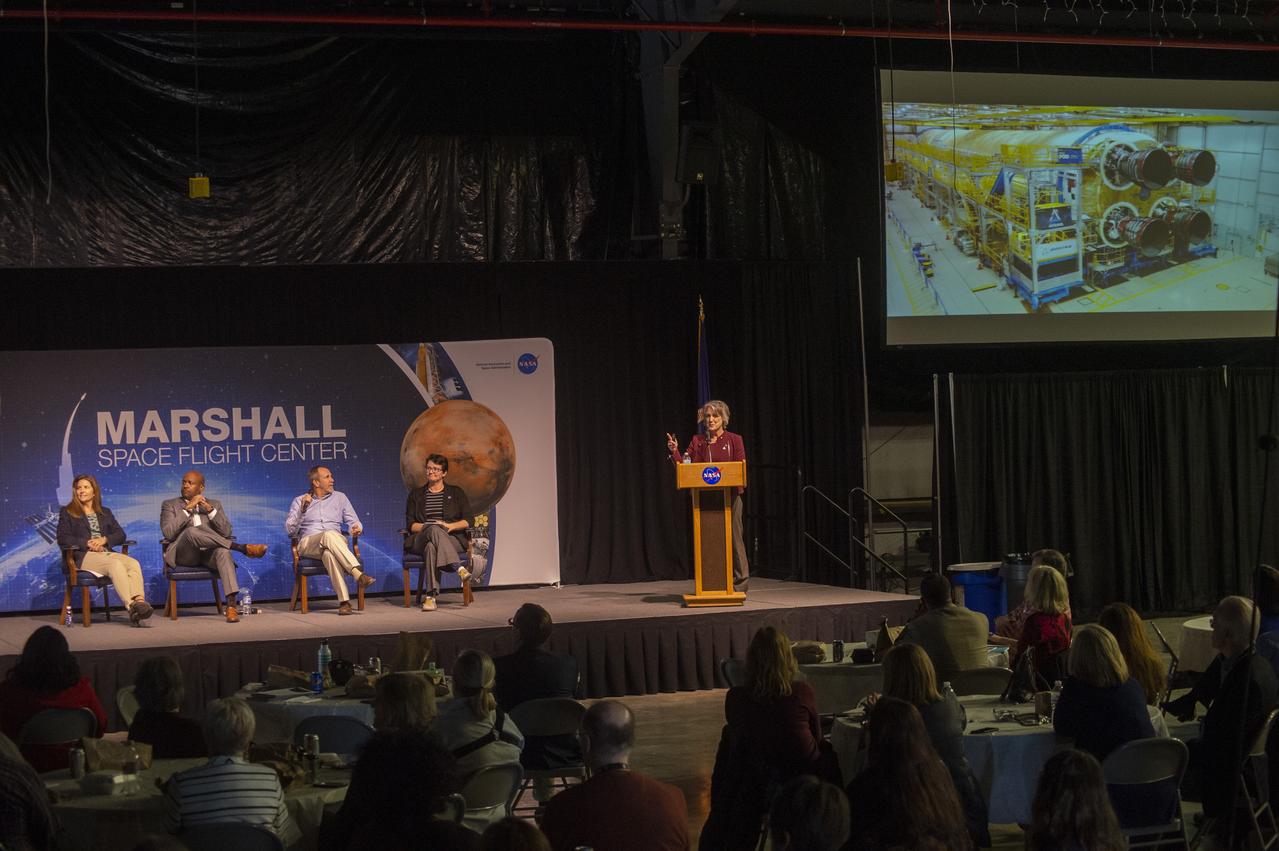
MARCIA LINDSTROM, AT PODIUM, FACILITATES ARTEMIS PROGRAM PANEL DISCUSSION AT NOVEMBER MARSHALL ASSOCIATION LUNCHEON. (L TO R), LISA WATSON-MORGAN, PROGRAM MANAGER, HUMAN LANDING SYSTEM; BOBBY WATKINS, DIRECTOR HUMAN EXPLORATION DEVELOPMENT & OPERATIONS OFFICE; DAVID BEAMAN, MANAGER, SYSTEMS ENGINEERING & INTEGRATION OFFICE, RENEE WEBER, ACTING CENTER CHIEF SCIENTIST
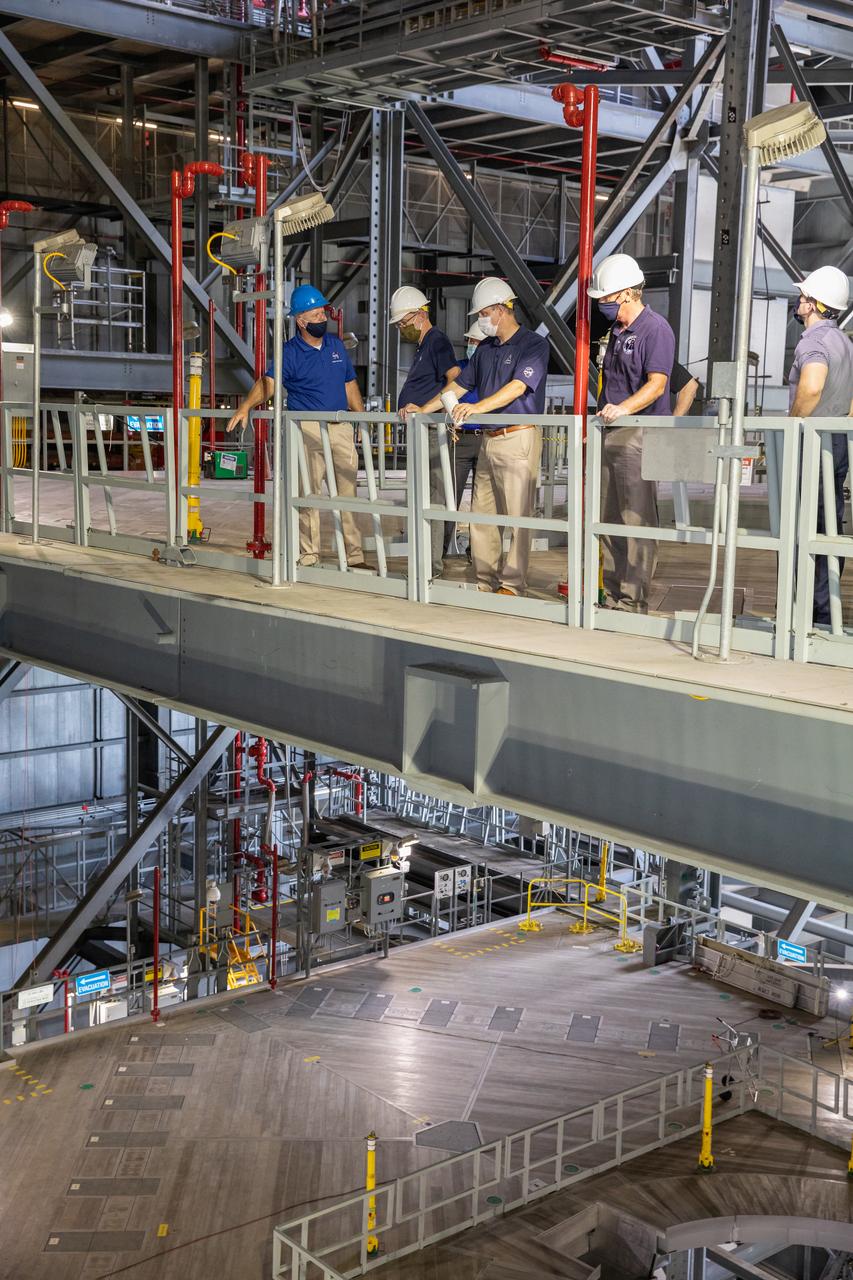
Russell Vought, director of the White House Office of Management and Budget, second from left, and NASA Administrator Jim Bridenstine, are on a tour of the Vehicle Assembly Building on Aug. 28, 2020. In this photo, they are viewing one of the levels of new service platforms in High Bay 3. The VAB is critical to the assembly of the Space Launch System rocket for NASA’s Artemis program. The Office of Management and Budget is working with the U.S. Congress to line up the necessary resources to land the first woman and the next man on the Moon in 2024.
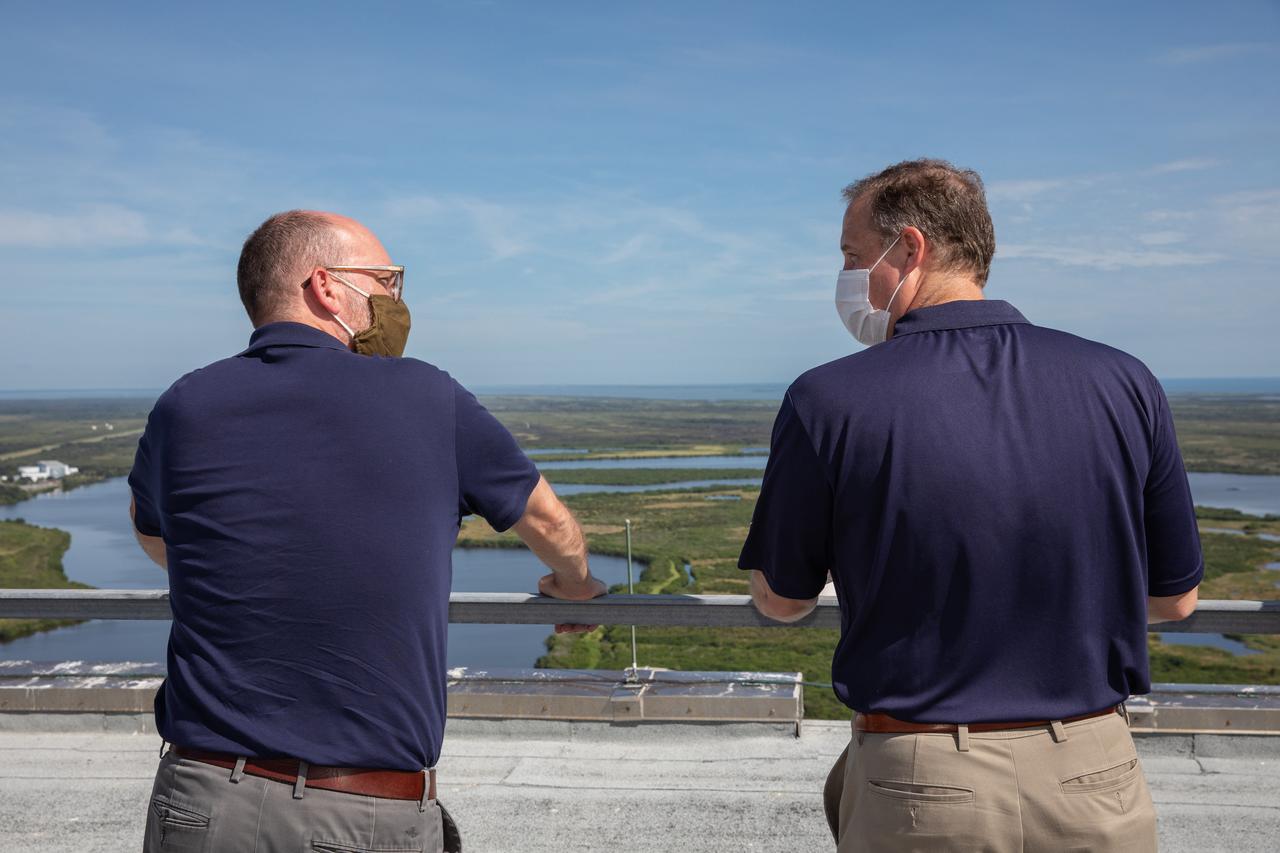
NASA Administrator Jim Bridenstine, at right, and Russell Vought, director of the White House Office of Management and Budget, are on the roof of the Vehicle Assembly Building (VAB) during a tour of the spaceport on Aug. 28, 2020. The VAB is critical to the assembly of the Space Launch System rocket for NASA’s Artemis program. The Office of Management and Budget is working with the U.S. Congress to line up the necessary resources to land the first woman and the next man on the Moon in 2024.
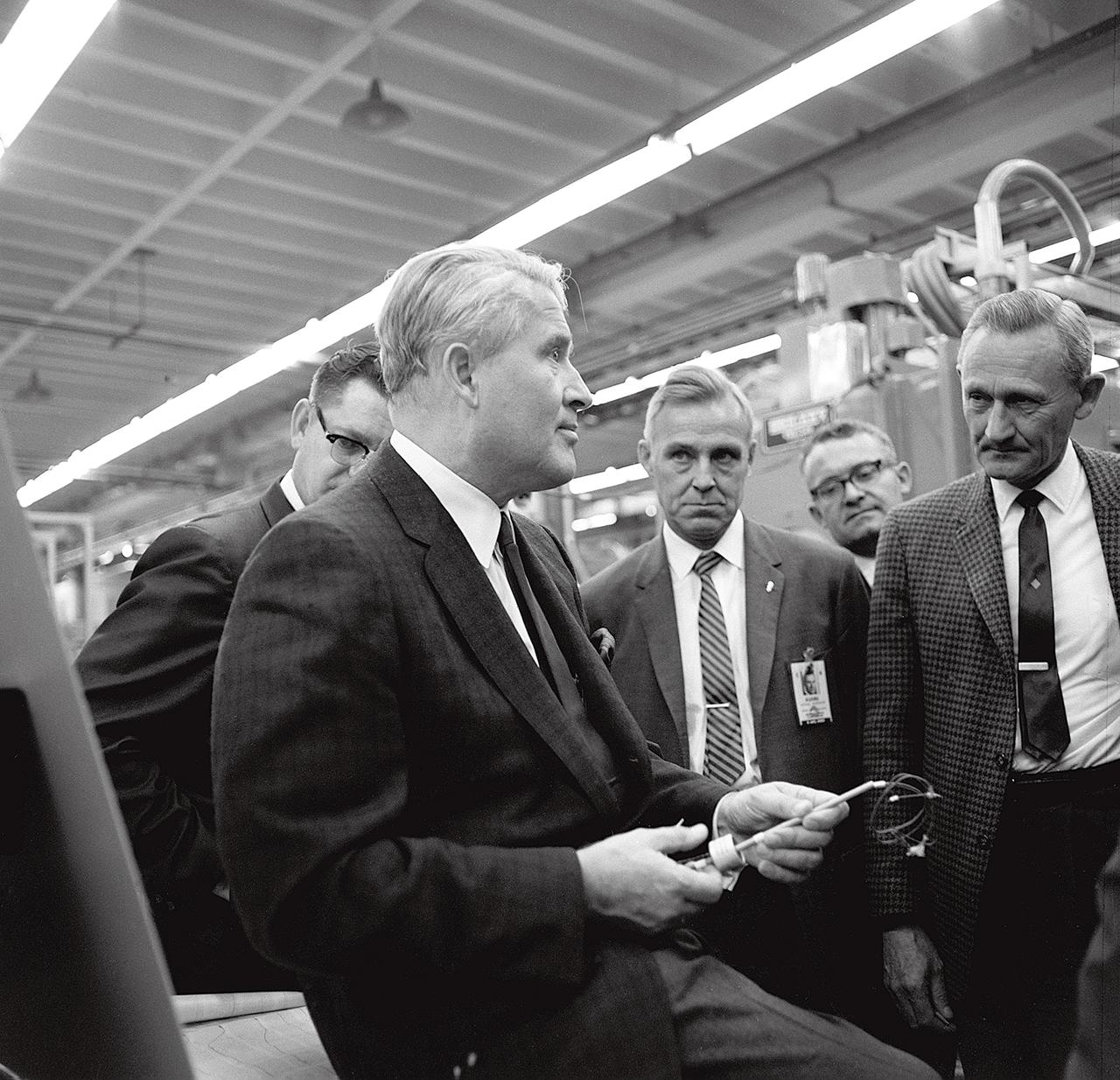
Dr. von Braun encouraged his laboratory directors and other managers at the Marshall Space Flight Center (MSFC) to adopt a "hands-on" approach to managing the technical challenges they confronted in developing the Saturn rockets for the Marned Lunar Landing Program. He is shown here asking a question about welding in an MSFC manufacturing and engineering laboratory. This photograph was made on or about October 17, 1967.
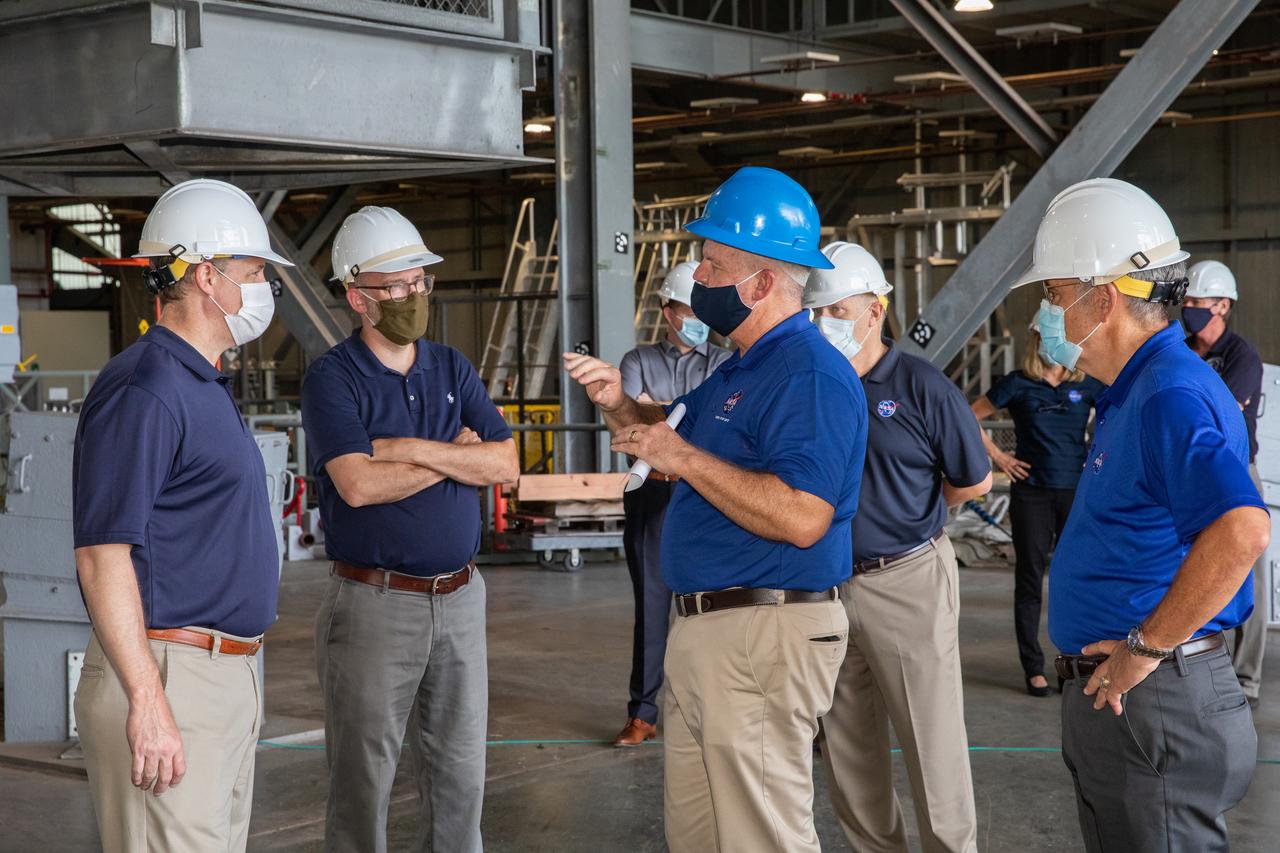
NASA Administrator Jim Bridenstine, far left, Russell Vought, director of the White House Office of Management and Budget, second from left, and Kennedy Space Center Director Bob Cabana, far right, are on a tour of the Vehicle Assembly Building on Aug. 28, 2020. The VAB is critical to the assembly of the Space Launch System rocket for NASA’s Artemis program. The Office of Management and Budget is working with the U.S. Congress to line up the necessary resources to land the first woman and the next man on the Moon in 2024.
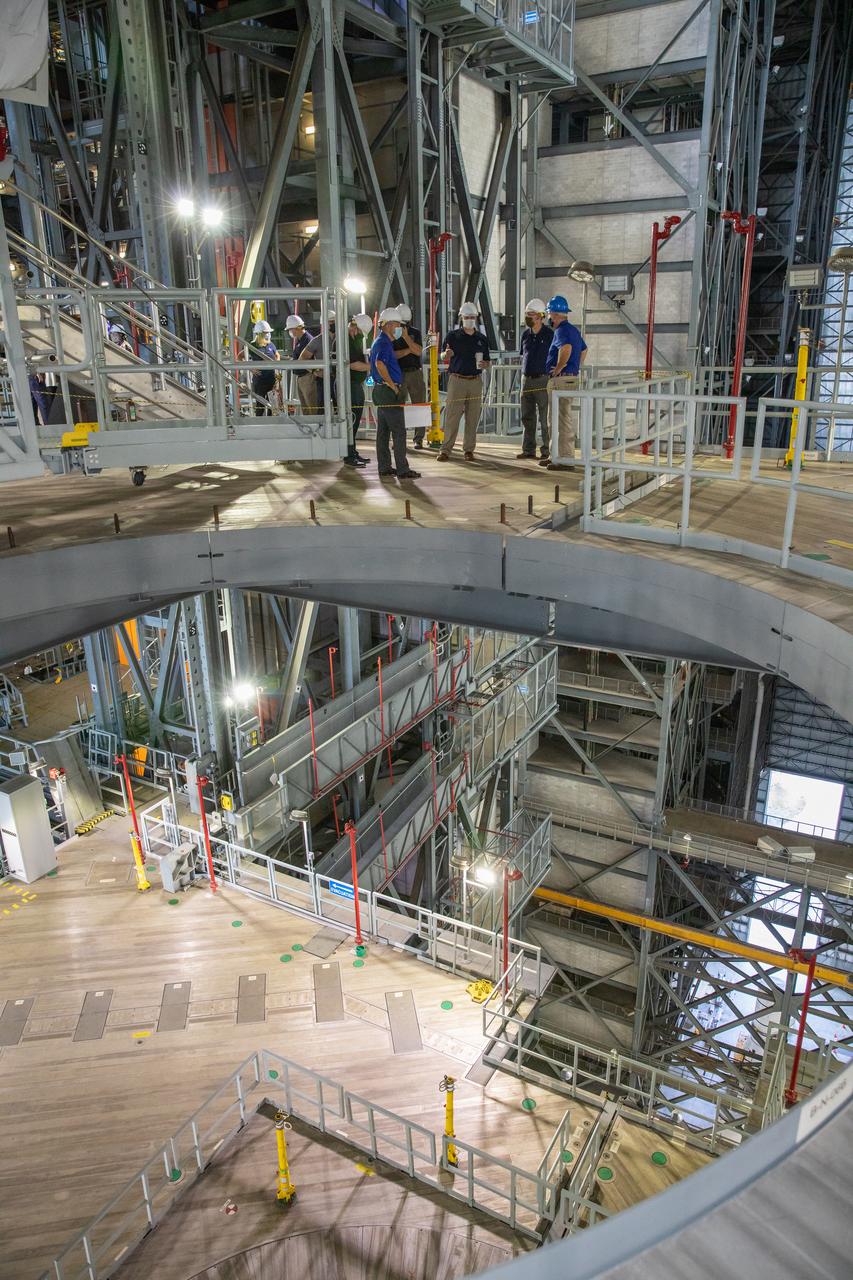
Kennedy Space Center Director Bob Cabana accompanies NASA Administrator Jim Bridenstine, and Russell Vought, director of the White House Office of Management and Budget, on a tour of the Vehicle Assembly Building (VAB) on Aug. 28, 2020. In this photo, they are viewing one of the levels of new service platforms in High Bay 3. The VAB is critical to the assembly of the Space Launch System rocket for NASA’s Artemis program. The Office of Management and Budget is working with the U.S. Congress to line up the necessary resources to land the first woman and the next man on the Moon in 2024.
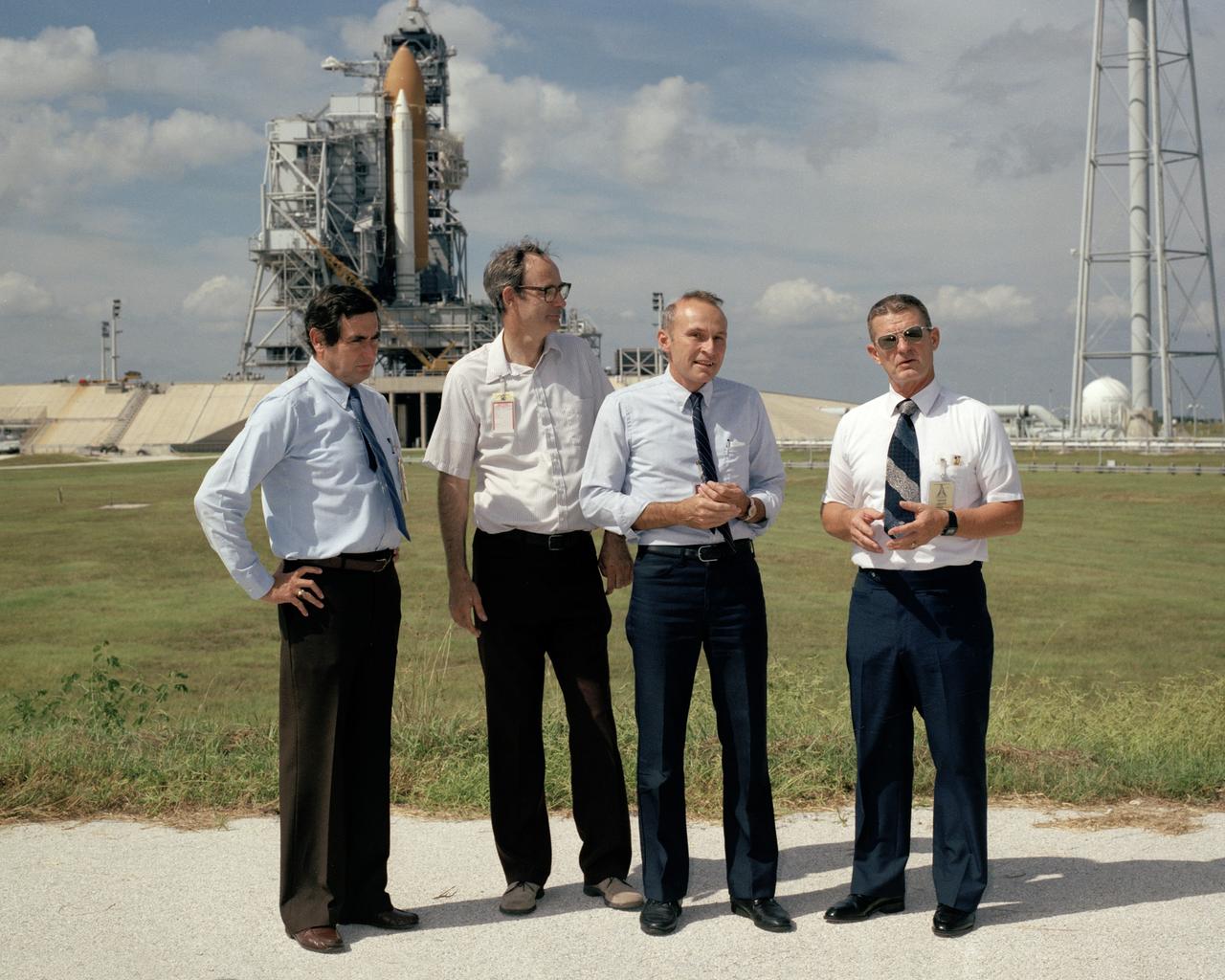
CAPE CANAVERAL, Fla. - Kennedy Space Center Director Lt. Gen. Forrest S. McCartney, far right, stands in front of the space shuttle Atlantis the morning after it is rolled out to Launch Pad 39B. Standing with McCartney is, from right to left, Bob Sieck, director of Shuttle Management and Operations, Bill Warren, pad site manager, and Gene Thomas, director of Launch and Landing Operations. Photo credit: NASA

KENNEDY SPACE CENTER, FLA. -- Dr. Irene Duhart Long is the director, Biomedical Operations and Research Office, at the Kennedy Space Center effective July 24, 1994. She is responsible for the program management of the center's aerospace and occupational medicine, life sciences research, environmental health programs and the operations management of the life sciences support facilities. Dr. Long also is responsible for providing the coordinating medical, environmental monitoring and environmental health support to launch and landing activities and day-to-day institutional functions.
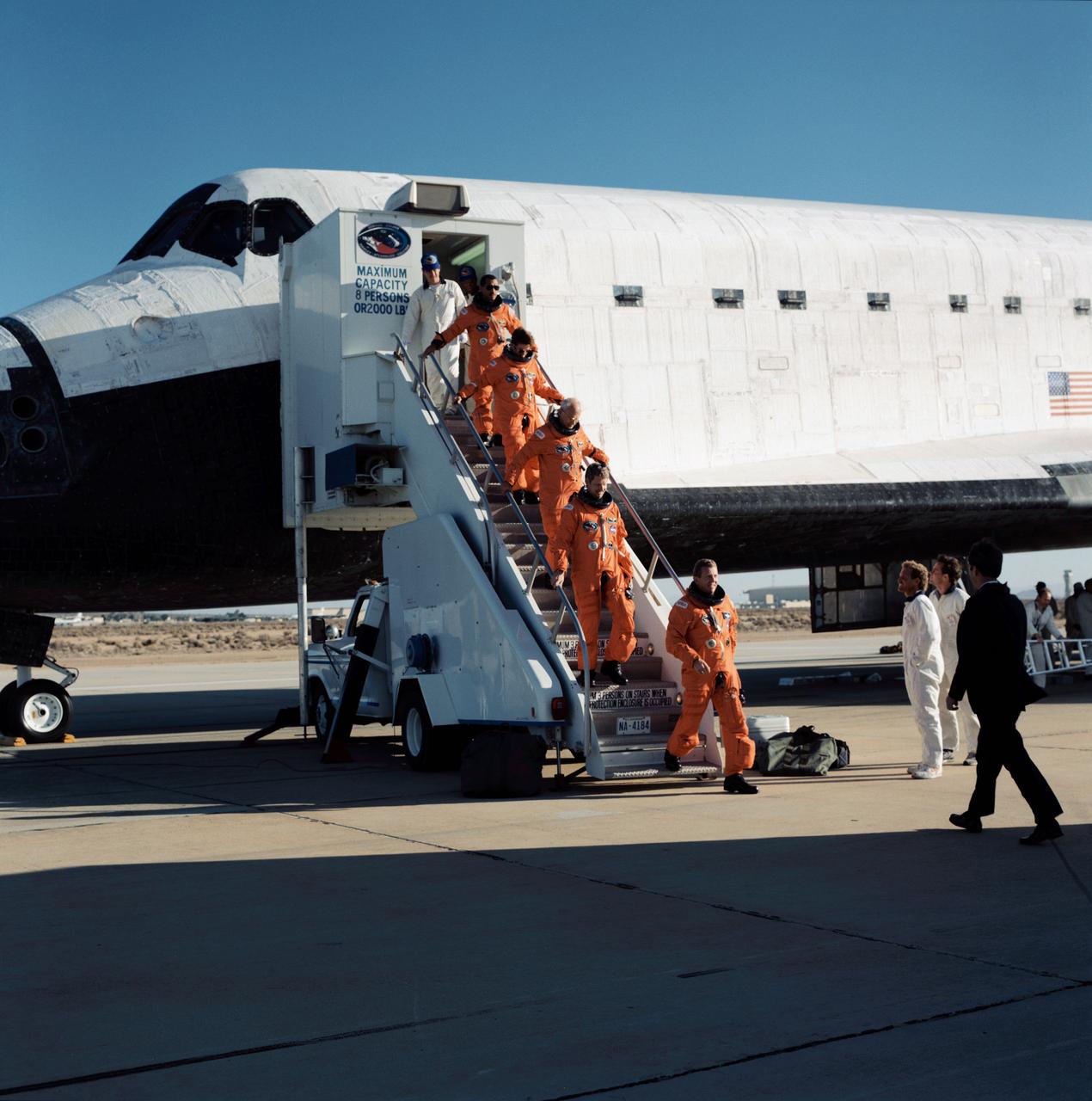
STS031-S-129 (29 April 1990) --- The astronauts of STS-31 egress the Space Shuttle Discovery following a smooth landing on the runway at Edwards Air Force Base to complete a highly successful five-day mission. Approaching from the far right to greet the crew is Dr. William B. Lenoir, NASA's Acting Associate Administrator for Space Flight. Leading the way down the steps is astronaut Loren J. Shriver, mission commander, followed by (in order from bottom of steps) astronauts Steven A. Hawley, Bruce McCandless II and Kathryn D. Sullivan, all mission specialists; and Charles F. Bolden Jr., pilot. Theirs was an Earth-orbital flight during which the Hubble Space Telescope (HST) was sent toward its 15-year mission.
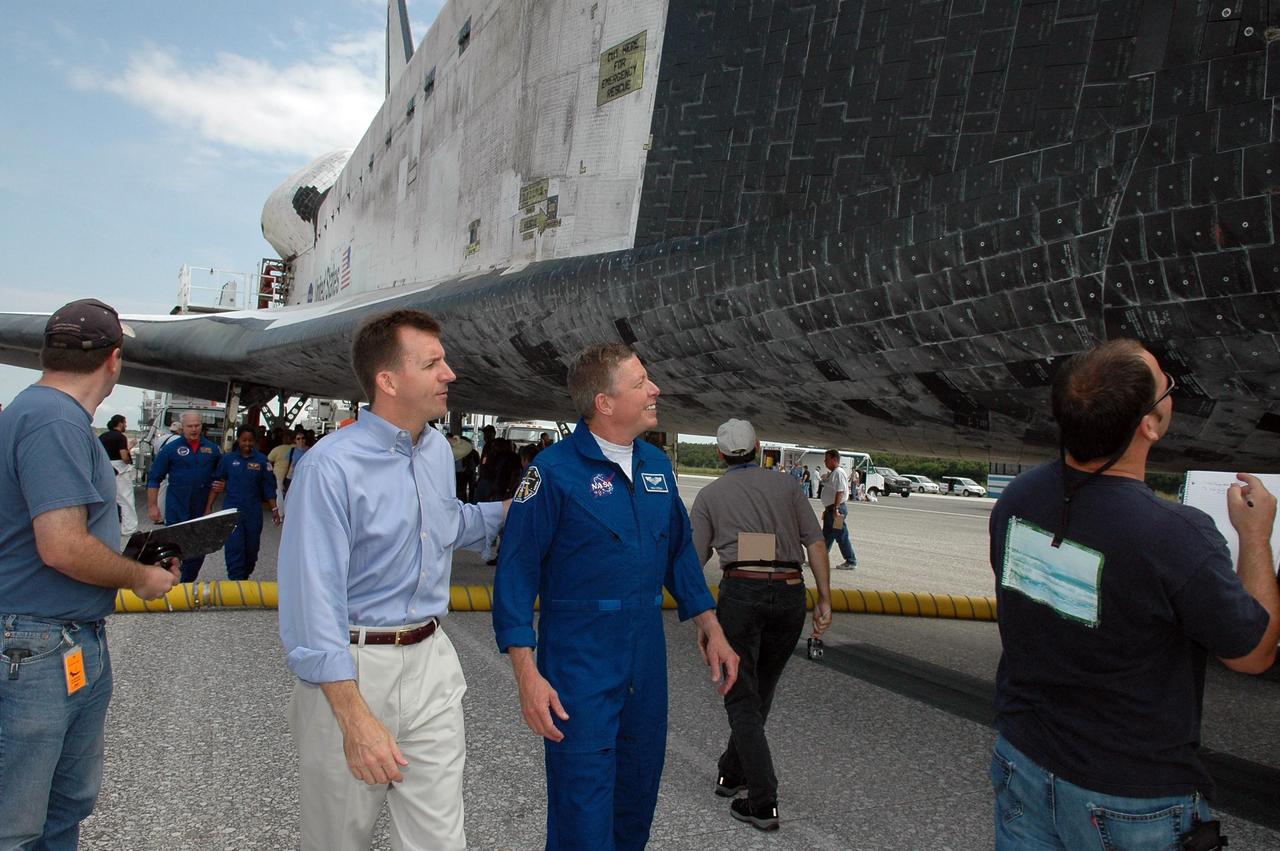
KENNEDY SPACE CENTER, FLA. - LeRoy Cain, manager of Shuttle Launch Integration, and Michael Fossum, STS-121 mission specialist, take a look at the orbiter Discovery during the traditional post-flight walk-around after the landing. Discovery's smooth and perfect landing was on time at 9:14 a.m. EDT on Runway 15 of NASA's Shuttle Landing Facility after traveling 5.3 million miles on 202 orbits. Mission elapsed time was 12 days, 18 hours, 37 minutes and 54 seconds. The landing is the 62nd at Kennedy Space Center and the 32nd for Discovery. Photo credit: NASA/Kim Shiflett
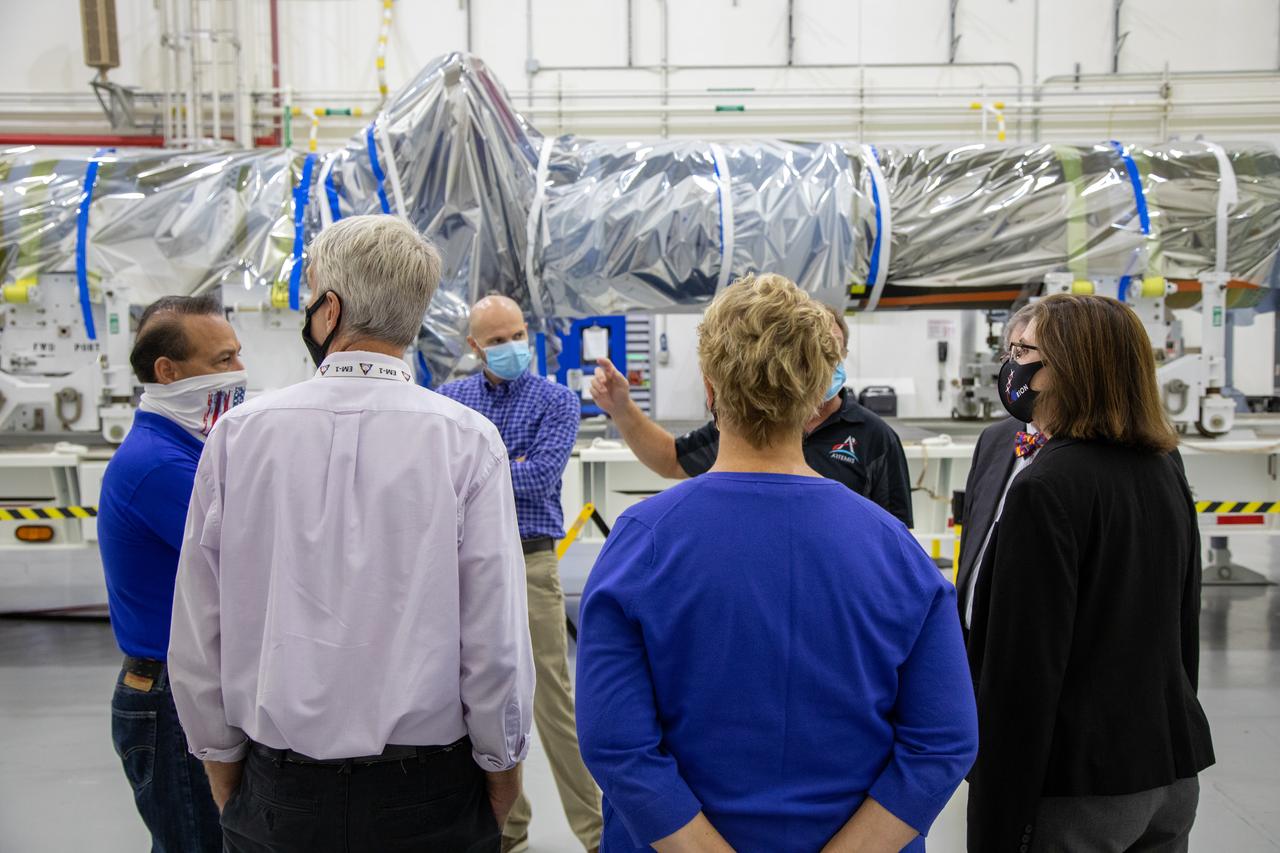
Catherine Koerner, far right, NASA Orion Program manager, along with senior managers from Orion and Lockheed Martin, tour the Launch Abort System Facility at NASA’s Kennedy Space Center in Florida on Oct. 6, 2020. Accompanying her from left, are Carlos Garcia, NASA Kennedy Launch Abort System Assembly, Integration and Test lead and Resident office manager; Scott Wilson, NASA Kennedy Orion Production Operations manager; Jim Skaggs, Kennedy Operations senior manager with Lockheed Martin; Jules Schneider, Kennedy Assembly, Test and Launch Operations director with Lockheed Martin; Mike Hawes, Lockheed Martin vice president and Orion Program manager; and Annette Hasbrook, Orion Program assistant manager. They are viewing the launch abort system for the Artemis II mission. Koerner also viewed the Orion spacecraft for the Artemis I and II missions in the Neil Armstrong Operations and Checkout Building. The first in a series of increasingly complex missions, Artemis I will test the Orion spacecraft and Space Launch System as an integrated system ahead of crewed flights to the Moon. Under the Artemis program, NASA will land the first woman and the next man on the Moon in 2024.
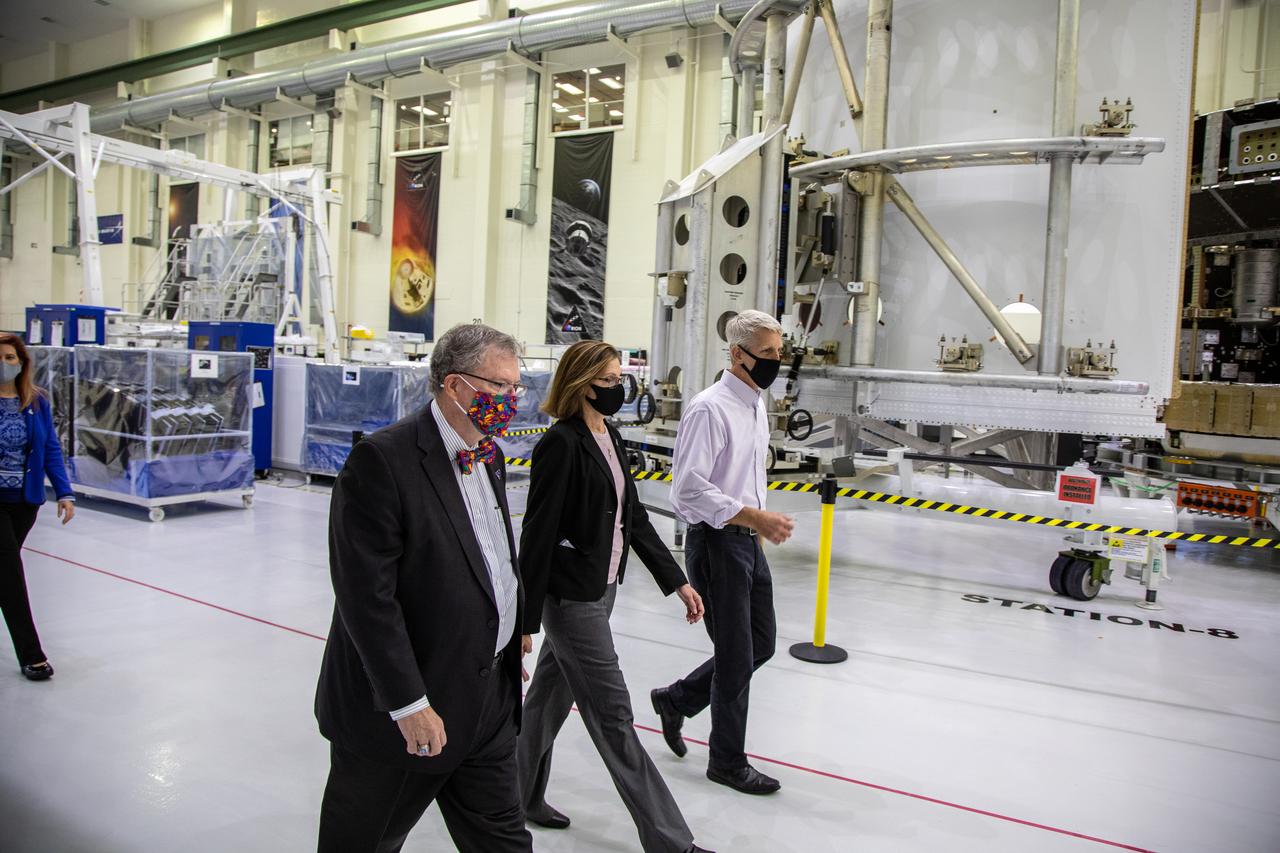
Catherine Koerner, in the center, NASA Orion Program manager, along with senior managers from Orion and Lockheed Martin, tours the Neil Armstrong Operations and Checkout Building at NASA’s Kennedy Space Center in Florida on Oct. 6, 2020. Accompanying her, at left is Mike Hawes, Lockheed Martin vice president and Orion Program manager; and at right is Scott Wilson, NASA Kennedy Orion Production Operations manager. Koerner viewed the Orion spacecraft for the Artemis I and II missions. They are shown with one of the space adapter jettison fairing panels that will be installed on Orion for the Artemis I mission. The first in a series of increasingly complex missions, Artemis I will test the Orion spacecraft and Space Launch System as an integrated system ahead of crewed flights to the Moon. Under the Artemis program, NASA will land the first woman and the next man on the Moon in 2024.
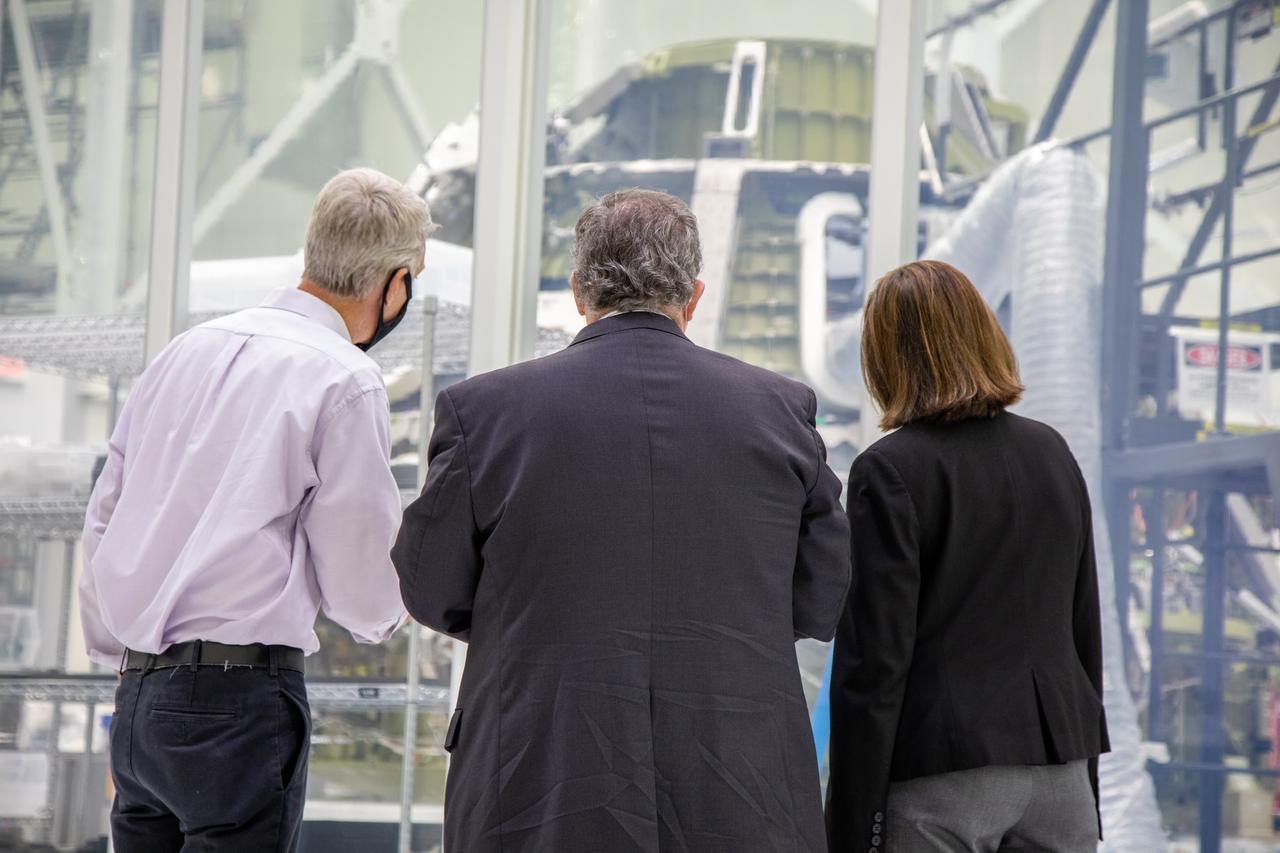
Catherine Koerner, at far right, NASA Orion Program manager, along with senior managers from Orion and Lockheed Martin, tours the Neil Armstrong Operations and Checkout Building at NASA’s Kennedy Space Center in Florida on Oct. 6, 2020. Accompanying her, from left are Scott Wilson, NASA Kennedy Orion Production Operations manager, and Mike Hawes, Lockheed Martin vice president and Orion Program manager. They are pictured viewing the Orion crew module for the Artemis II mission, and also viewed the Orion spacecraft with its solar array wings installed for Artemis I. The first in a series of increasingly complex missions, Artemis I will test the Orion spacecraft and Space Launch System as an integrated system ahead of crewed flights to the Moon. Under the Artemis program, NASA will land the first woman and the next man on the Moon in 2024.

Dr. Eric H. Thoemmes, third from left, vice president of Space, Missile Defense and Strategic with Lockheed Martin, speaks to Russell Vought, second from left, director of the White House Office of Management and Budget, during a tour of the Neil Armstrong Operations and Checkout Building high bay at NASA’s Kennedy Space Center in Florida on Aug. 28, 2020. At far left is Larry Price, Lockheed Martin Orion Program manager. To the right of Thoemmes is NASA Deputy Administrator Jim Morhard, and Brian McCormack, associate director of the White House Office of Management and Budget. In view in the background is the heatshield for Artemis II. Inside the high bay, Orion spacecraft are being prepared for Artemis I and Artemis II. The Office of Management and Budget is working with the U.S. Congress to line up the necessary resources to land the first woman and the next man on the Moon in 2024.
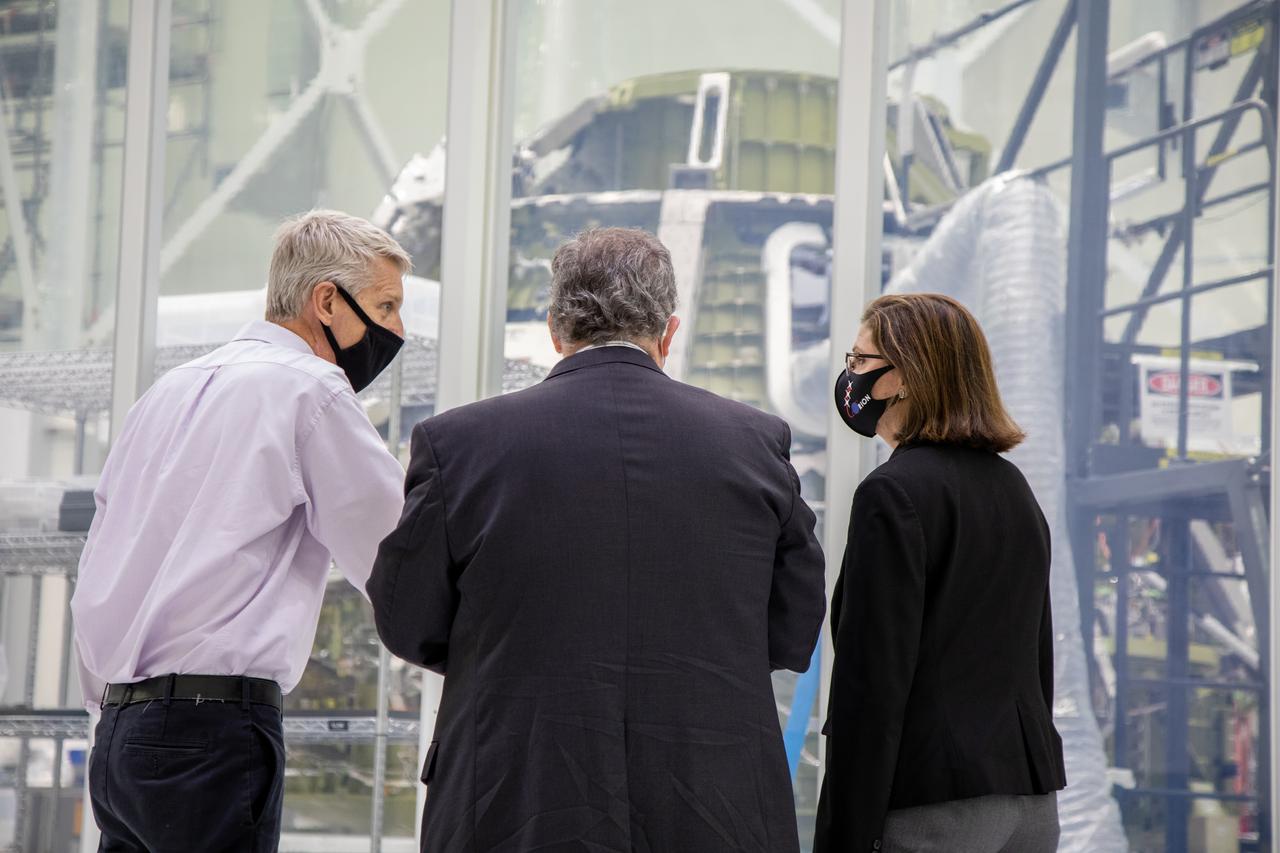
Catherine Koerner, at far right, NASA Orion Program manager, along with senior managers from Orion and Lockheed Martin, tours the Neil Armstrong Operations and Checkout Building at NASA’s Kennedy Space Center in Florida on Oct. 6, 2020. Accompanying her, from left are Scott Wilson, NASA Kennedy Orion Production Operations manager, and Mike Hawes, Lockheed Martin vice president and Orion Program manager. They are pictured viewing the Orion crew module for the Artemis II mission, and also viewed the Orion spacecraft with its solar array wings installed for Artemis I. The first in a series of increasingly complex missions, Artemis I will test the Orion spacecraft and Space Launch System as an integrated system ahead of crewed flights to the Moon. Under the Artemis program, NASA will land the first woman and the next man on the Moon in 2024.
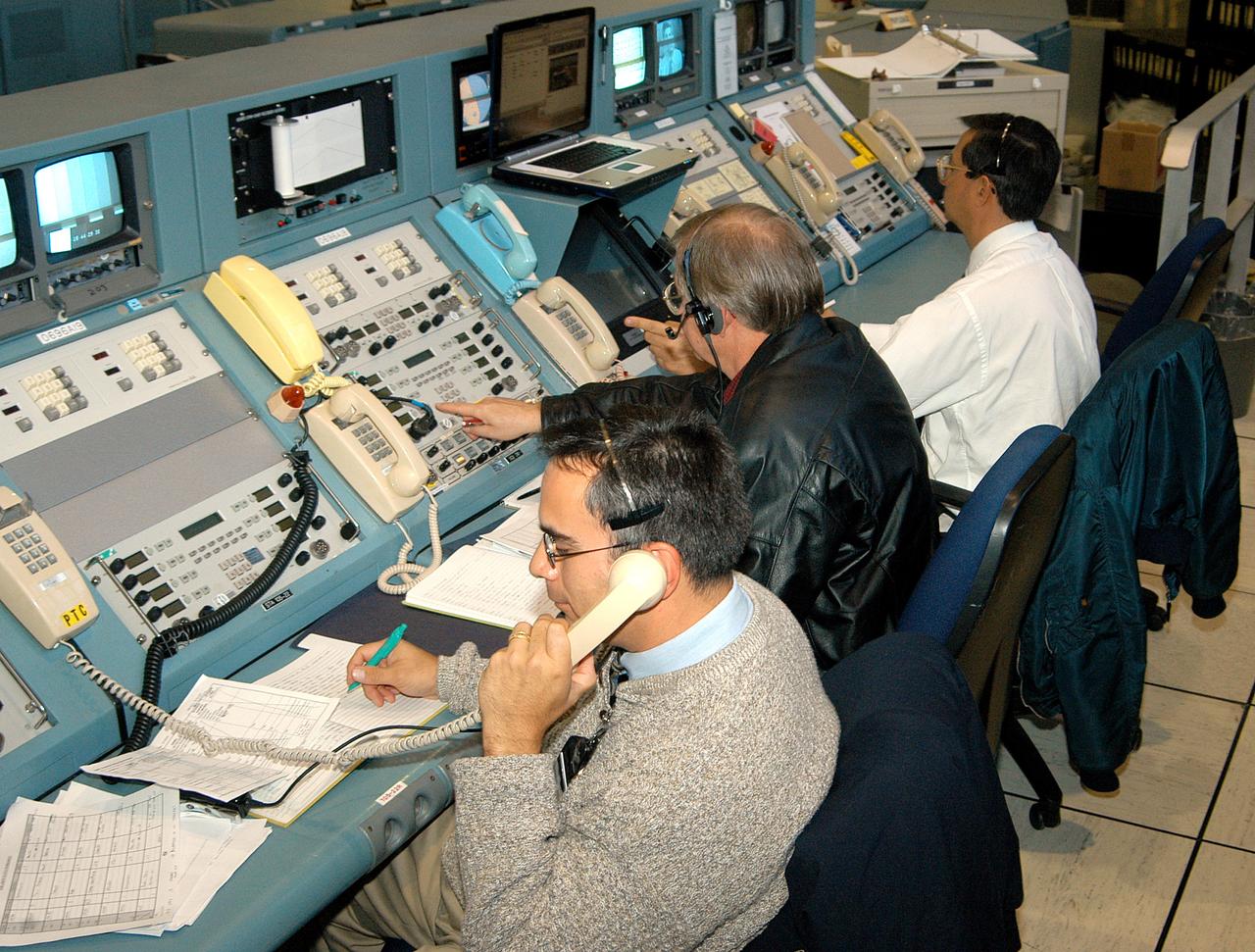
KENNEDY SPACE CENTER, FLA. - In the Launch Control Center, officials monitor the “Mode VII” emergency landing simulation being conducted at Kennedy Space Center and managed and directed from the LCC. From left are Dr. Luis Moreno and Dr. David Reed, with Bionetics Life Sciences, and Dr. Philip Scarpa, with the KSC Safety, Occupational Health and Environment Division. The purpose of the Mode VII is to exercise emergency preparedness personnel, equipment and facilities in rescuing astronauts from a downed orbiter and providing immediate medical attention. This simulation presents an orbiter that has crashed short of the Shuttle Landing Facility in a wooded area 2-1/2 miles south of Runway 33. Emergency crews are responding to the volunteer “astronauts” who are simulating various injuries inside the crew compartment mock-up. Rescuers must remove the crew, provide triage and transport to hospitals those who need further treatment. Local hospitals are participating in the exercise.
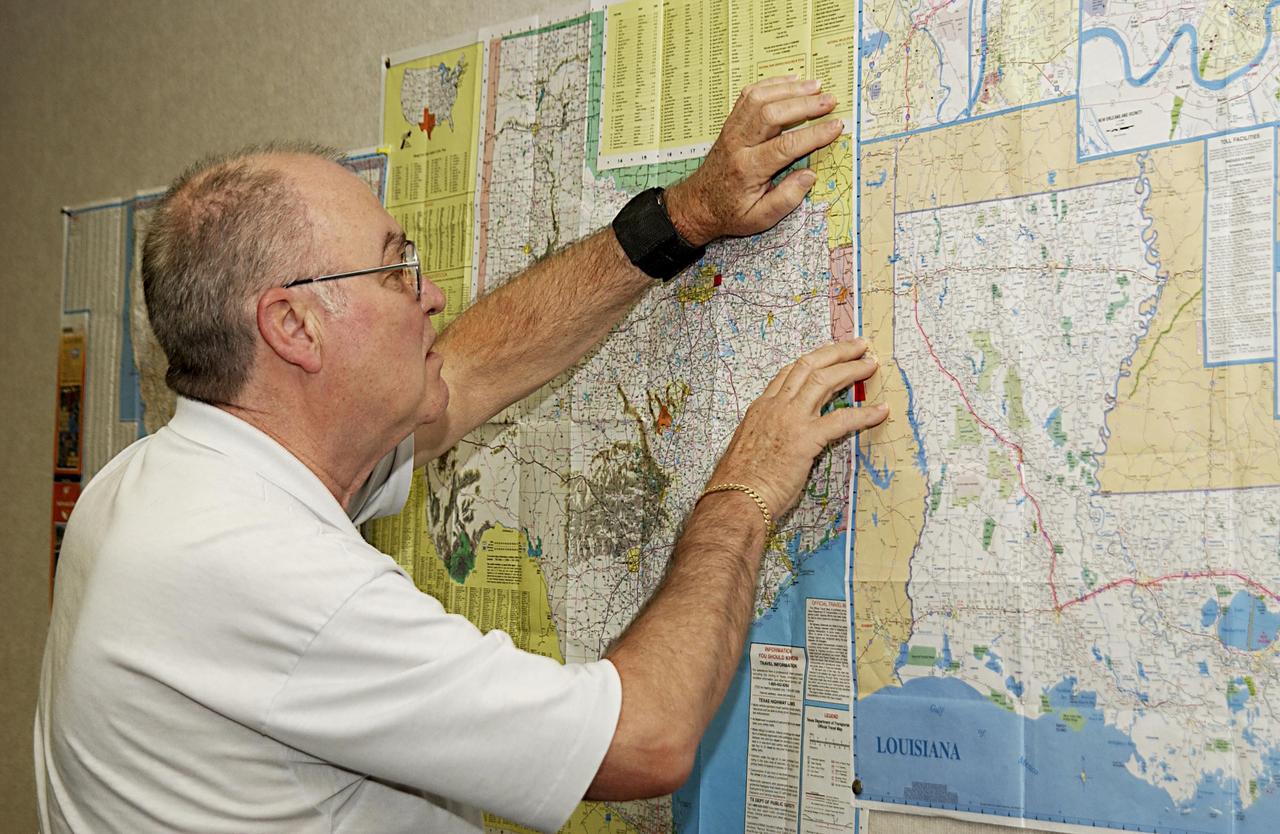
KENNEDY SPACE CENTER, FLA. - Don Maxwell, Safety, United Space Alliance, checks a map of Texas during a meeting of the Recovery Management Team at KSC. The team is part of the investigation into the accident that claimed orbiter Columbia and her crew of seven on Feb. 1, 2003, over East Texas as they returned to Earth after a 16-day research mission. Other team members are Russ DeLoach, chief, Shuttle Mission Assurance Branch, NASA; George Jacobs, Shuttle Engineering; Jeff Campbell, Shuttle Engineering; Dave Rainer, Launch and Landing Operations; the two co-chairs of the Response Management Team, Denny Gagen, Landing Recovery Manager, Chris Hasselbring, Landing Operations, USA; and Larry Ulmer, Safety, NASA. The team is coordinating KSC technical support and assets to the Mishap Investigation Team in Barksdale, La., and providing support for the Recovery teams in Los Angeles, Texas, New Mexico, Arizona and California. In addition, the team is following up on local leads pertaining to potential debris in the KSC area. .
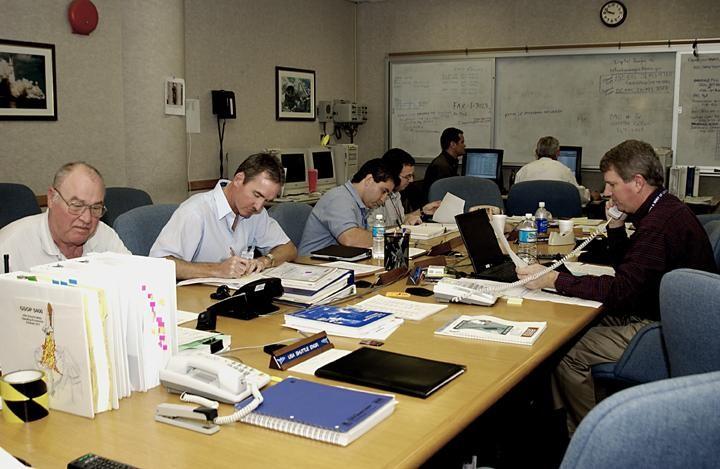
KENNEDY SPACE CENTER, FLA. -- Members of the Recovery Management Team at KSC are at work in the Operations Support Building. They are part of the investigation into the accident that claimed orbiter Columbia and her crew of seven on Feb. 1, 2003, over East Texas as they returned to Earth after a 16-day research mission. From left around the table are Don Maxwell, Safety, United Space Alliance (USA); Russ DeLoach, chief, Shuttle Mission Assurance Branch, NASA; George Jacobs, Shuttle Engineering; Jeff Campbell, Shuttle Engineering; Dave Rainer, Launch and Landing Operations; and the two co-chairs of the Response Management Team, Denny Gagen, Landing Recovery Manager, and Chris Hasselbring, Landing Operations, USA. The team is coordinating KSC technical support and assets to the Mishap Investigation Team in Barksdale, La., and providing support for the Recovery teams in Los Angeles, Texas, New Mexico, Arizona and California. In addition, the team is following up on local leads pertaining to potential debris in the KSC area. .
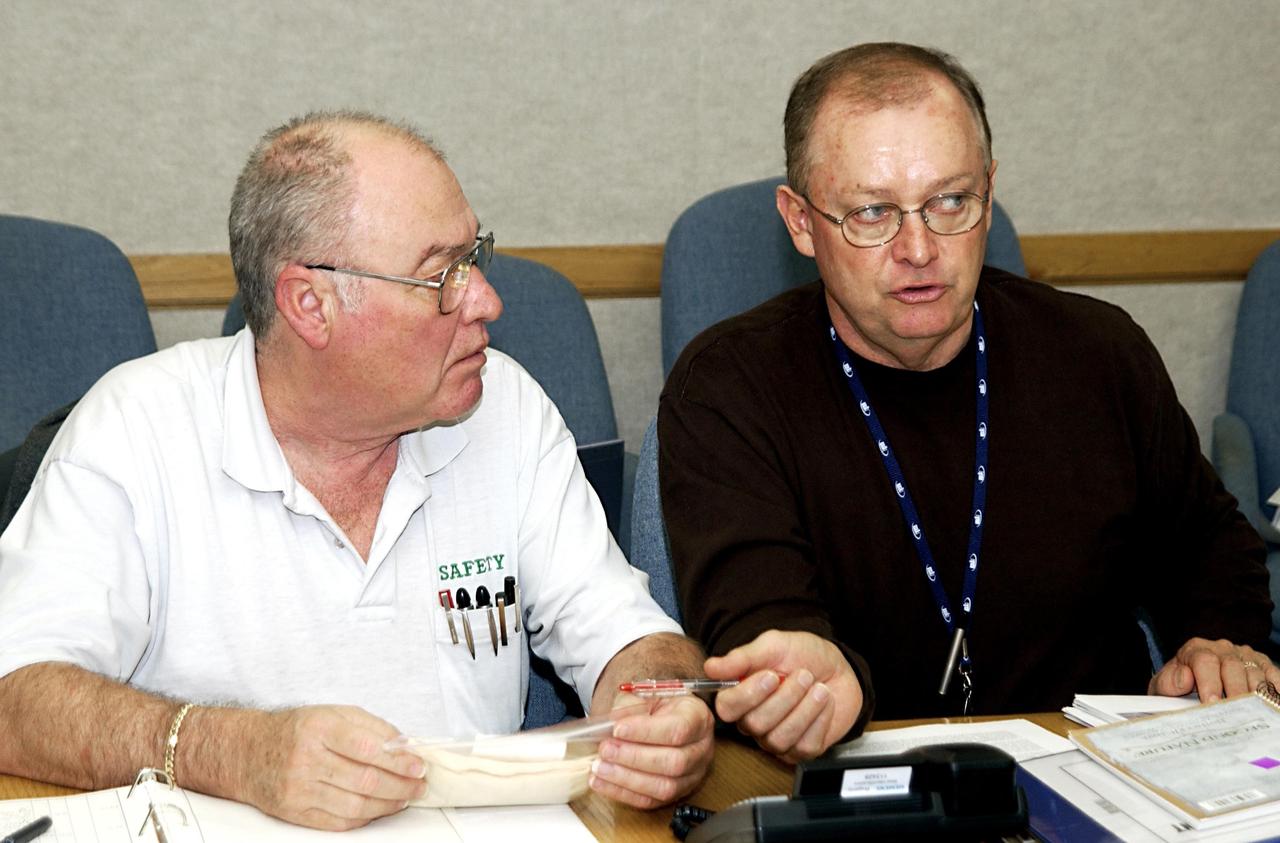
KENNEDY SPACE CENTER, FLA. - Two members of the Recovery Management Team at KSC are at work in the Operations Support Building. At left is Don Maxwell, Safety, United Space Alliance, and at right is Larry Ulmer, Safety, NASA. They are part of the investigation into the accident that claimed orbiter Columbia and her crew of seven on Feb. 1, 2003, over East Texas as they returned to Earth after a 16-day research mission. Other team members are Russ DeLoach, chief, Shuttle Mission Assurance Branch, NASA; George Jacobs, Shuttle Engineering; Jeff Campbell, Shuttle Engineering; Dave Rainer, Launch and Landing Operations; and the two co-chairs of the Response Management Team, Denny Gagen, Landing Recovery Manager, and Chris Hasselbring, Landing Operations, USA. The team is coordinating KSC technical support and assets to the Mishap Investigation Team in Barksdale, La., and providing support for the Recovery teams in Los Angeles, Texas, New Mexico, Arizona and California. In addition, the team is following up on local leads pertaining to potential debris in the KSC area. .
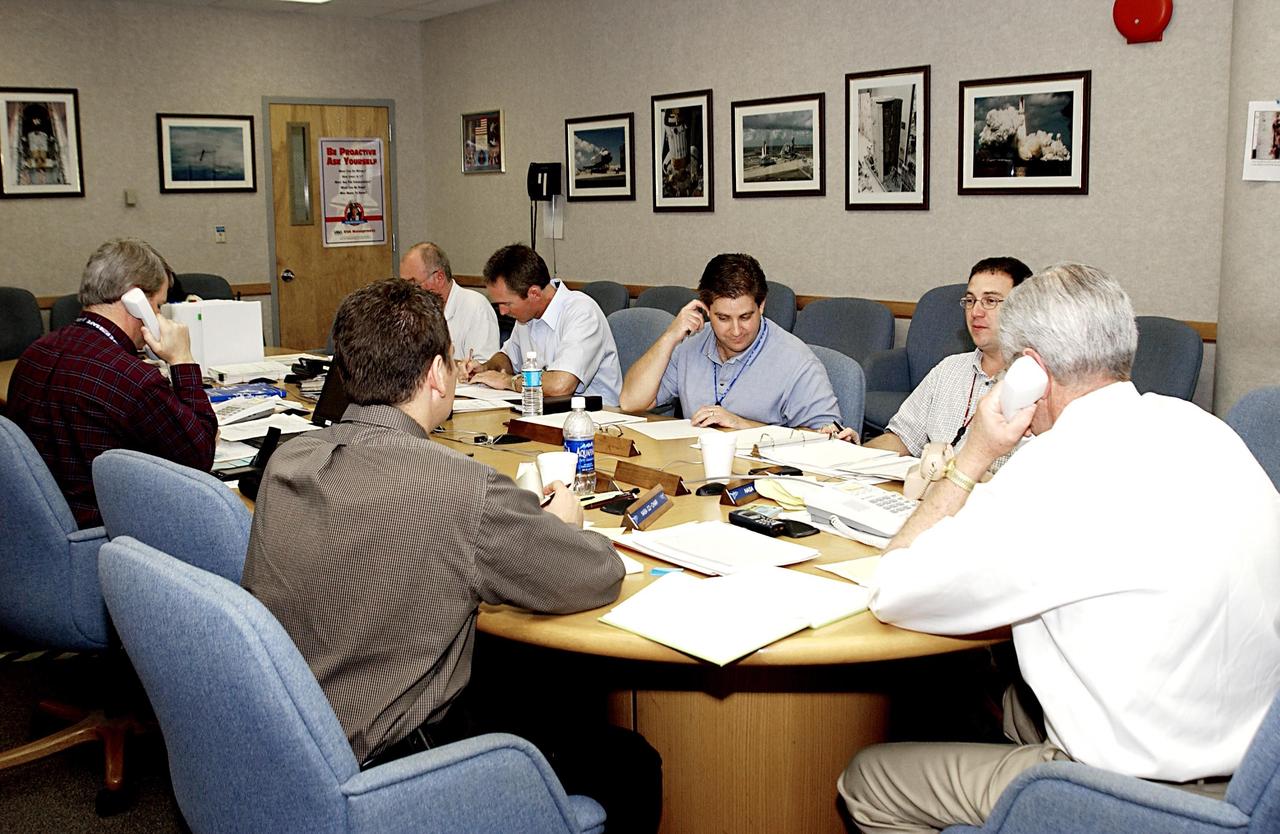
KENNEDY SPACE CENTER, FLA. -- Members of the Recovery Management Team at KSC are at work in the Operations Support Building. They are part of the investigation into the accident that claimed orbiter Columbia and her crew of seven on Feb. 1, 2003, over East Texas as they returned to Earth after a 16-day research mission. Seated around the table (clockwise from far left) are Chris Hasselbring, Landing Operations, USA (co-chair of the Response Management Team); Don Maxwell, Safety, United Space Alliance (USA); Russ DeLoach, chief, Shuttle Mission Assurance Branch, NASA; George Jacobs, Shuttle Engineering; Jeff Campbell, Shuttle Engineering; Denny Gagen, Landing Recovery Manager (second co-chair of the team); and Dave Rainer, Launch and Landing Operations. The team is coordinating KSC technical support and assets to the Mishap Investigation Team in Barksdale, La., and providing support for the Recovery teams in Los Angeles, Texas, New Mexico, Arizona and California. In addition, the team is following up on local leads pertaining to potential debris in the KSC area. .
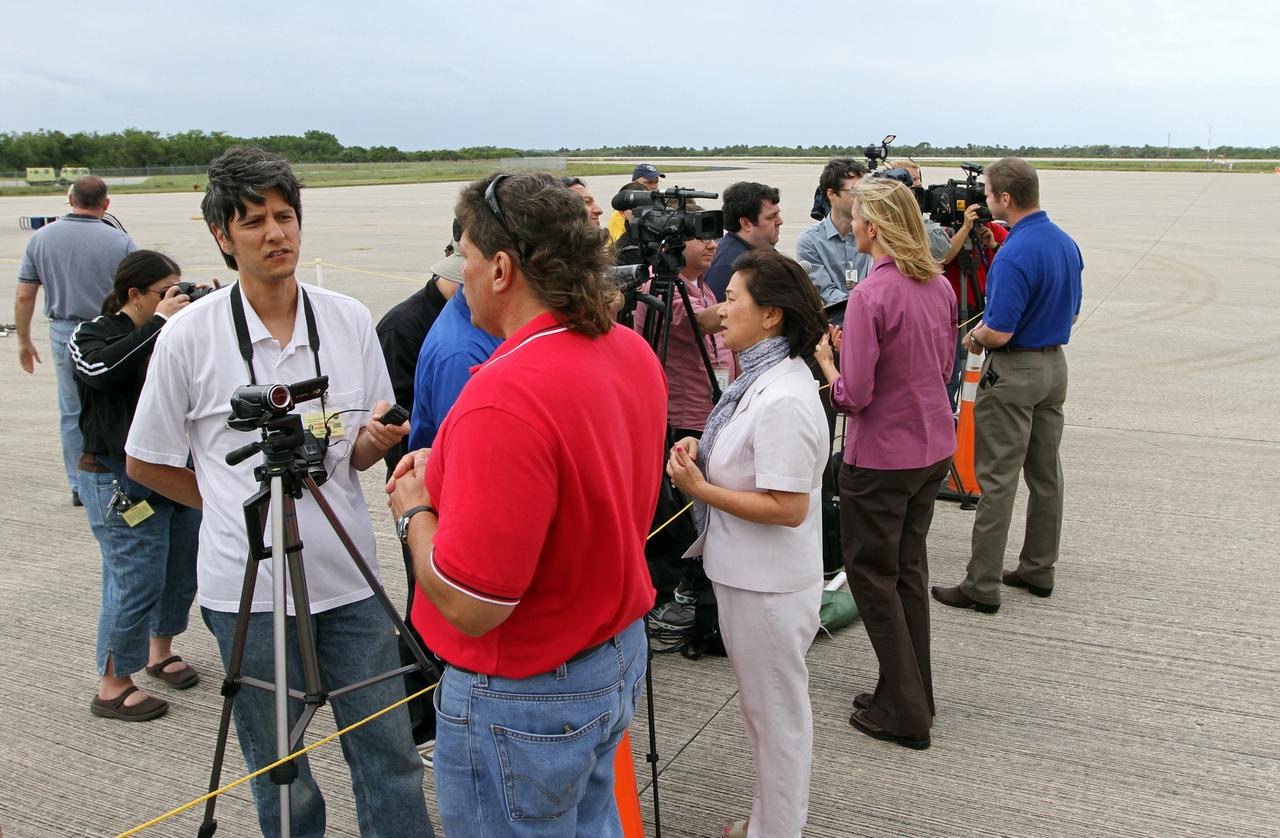
CAPE CANAVERAL, Fla. – At the Shuttle Landing Facility at NASA’s Kennedy Space Center in Florida, media representatives interview space shuttle managers following the arrival of space shuttle Discovery. Behind the rope with their backs to the camera are, from left, Bart Pannullo, NASA Transition and Retirement vehicle manager at Kennedy Dorothy Rasco, manager for Space Shuttle Program Transition and Retirement at NASA’s Johnson Space Center Stephanie Stilson, NASA flow director for Orbiter Transition and Retirement at Kennedy and Kevin Templin, transition manager for the Space Shuttle Program at Johnson. Discovery will be hoisted onto a Shuttle Carrier Aircraft, or SCA, with the aid of the mate-demate device at the landing facility. The SCA, a modified Boeing 747 jet airliner, is scheduled to ferry Discovery to the Washington Dulles International Airport in Virginia on April 17, after which the shuttle will be placed on permanent public display in the Smithsonian's National Air and Space Museum Steven F. Udvar-Hazy Center. For more information on shuttle transition and retirement activities, visit http://www.nasa.gov/transition. Photo credit: NASA/Kim Shiflett
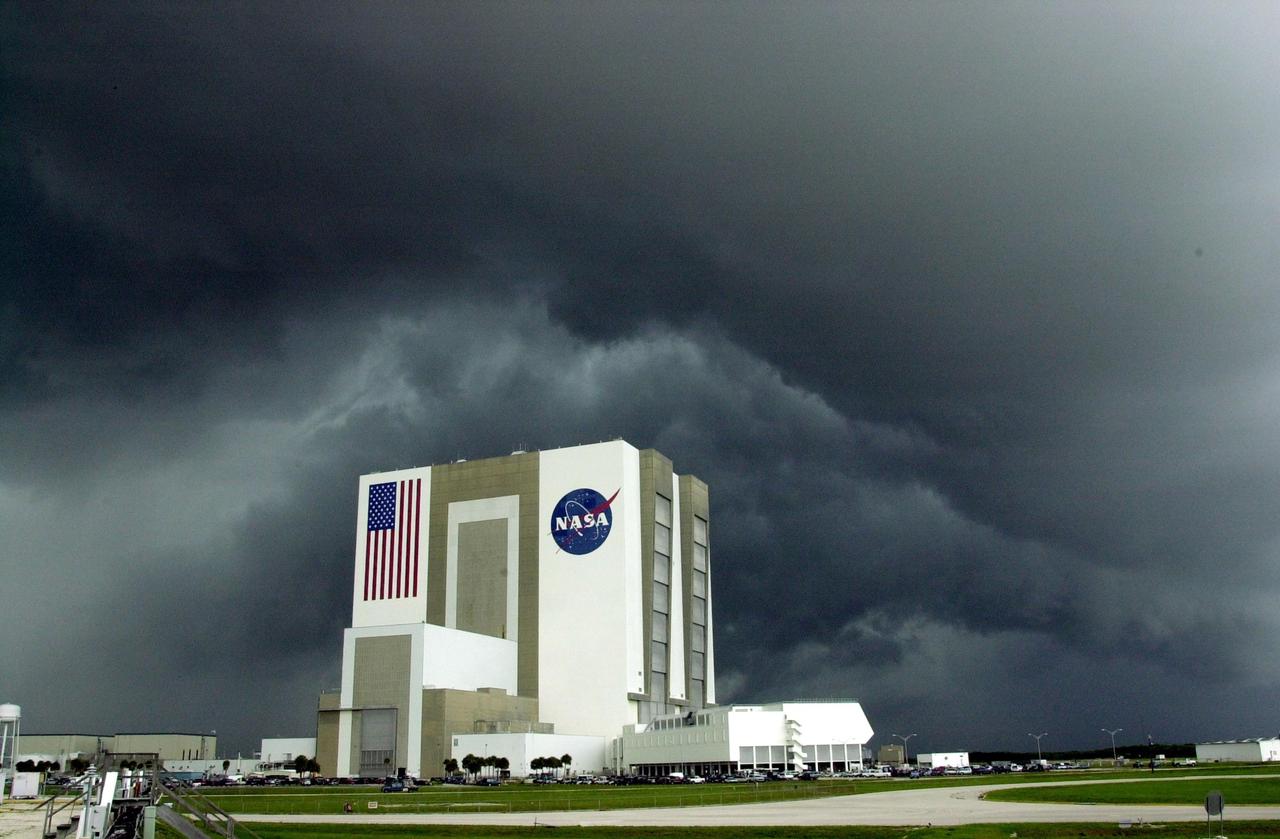
KENNEDY SPACE CENTER, FLA. -- Black storm clouds roll in over the Vehicle Assembly Building, bringing thunder and heavy rain. This type of weather convinced flight control managers to wave off the two scheduled landing attempts at KSC for Endeavour, returning from mission STS-111
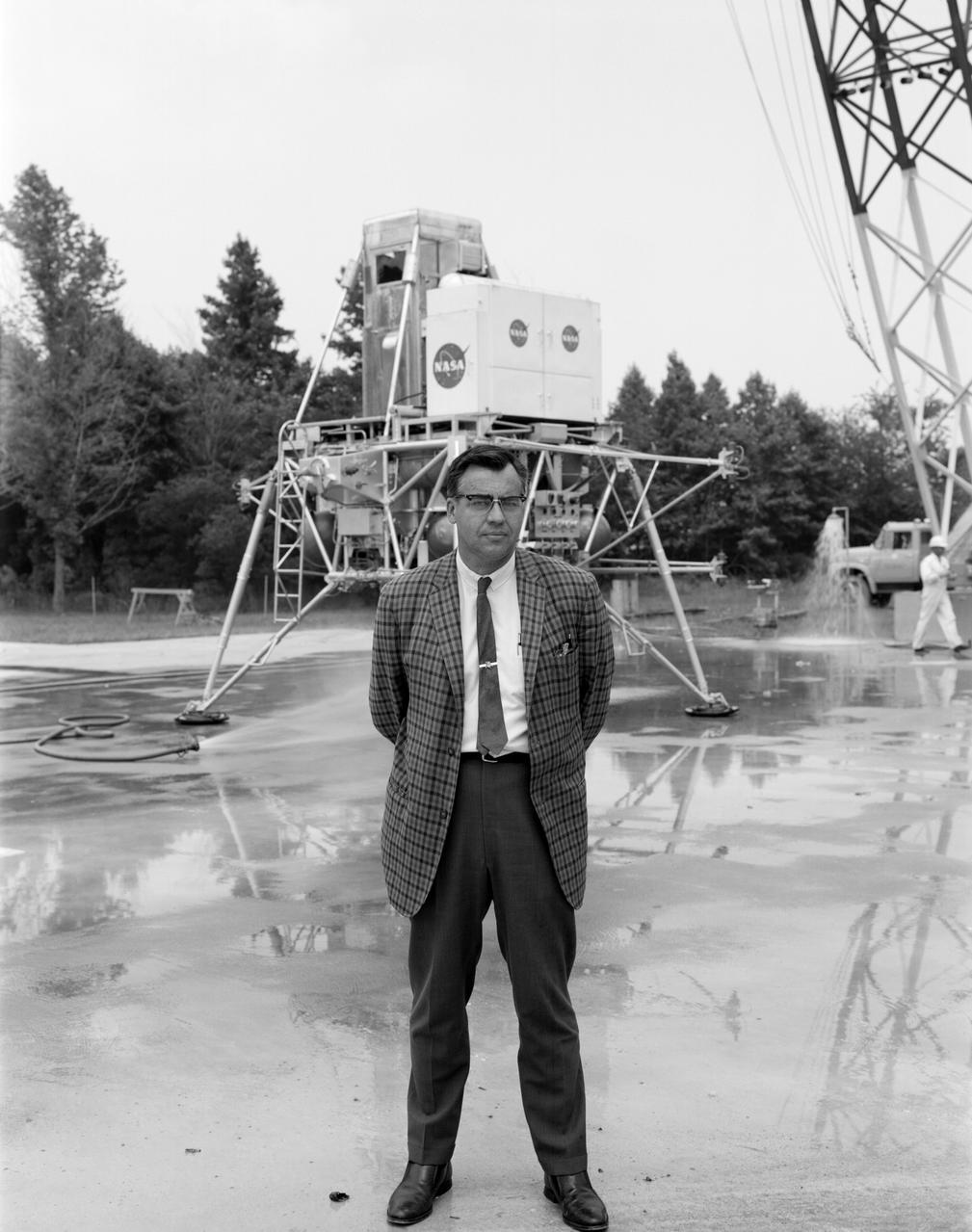
Donald Hewes at Lunar Landing Research Facility (LLRF). Donald Hewes, head of the Spacecraft Research Branch, managed the facility. Piles of cinders simulated the lunar craters and terrain features. Published in the book " A Century at Langley" by Joseph Chambers. pg. 97
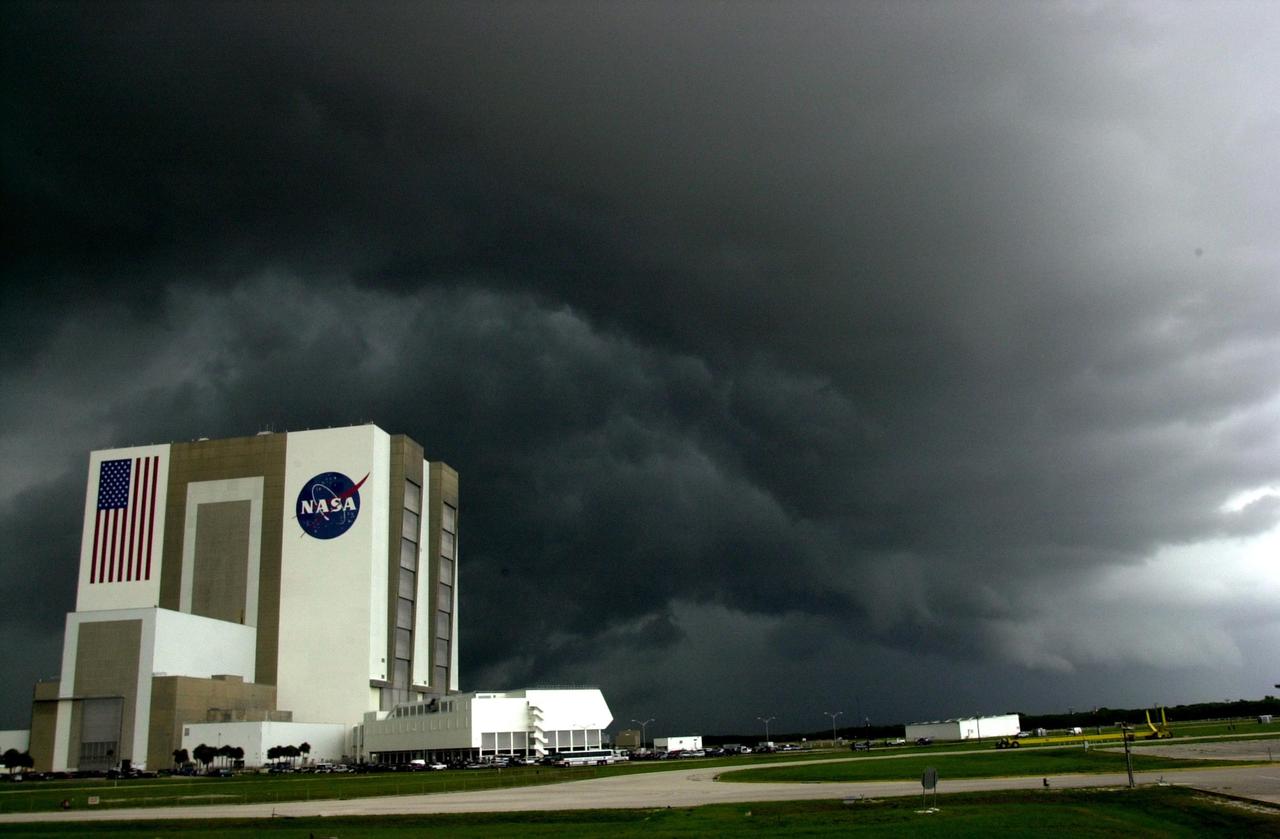
KENNEDY SPACE CENTER, FLA. -- Black storm clouds hang over the Vehicle Assembly Building and Launch Control Center, bringing thunder and heavy rain to the area. This type of weather convinced flight control managers to wave off the two scheduled landing attempts at KSC for Endeavour, returning from mission STS-111
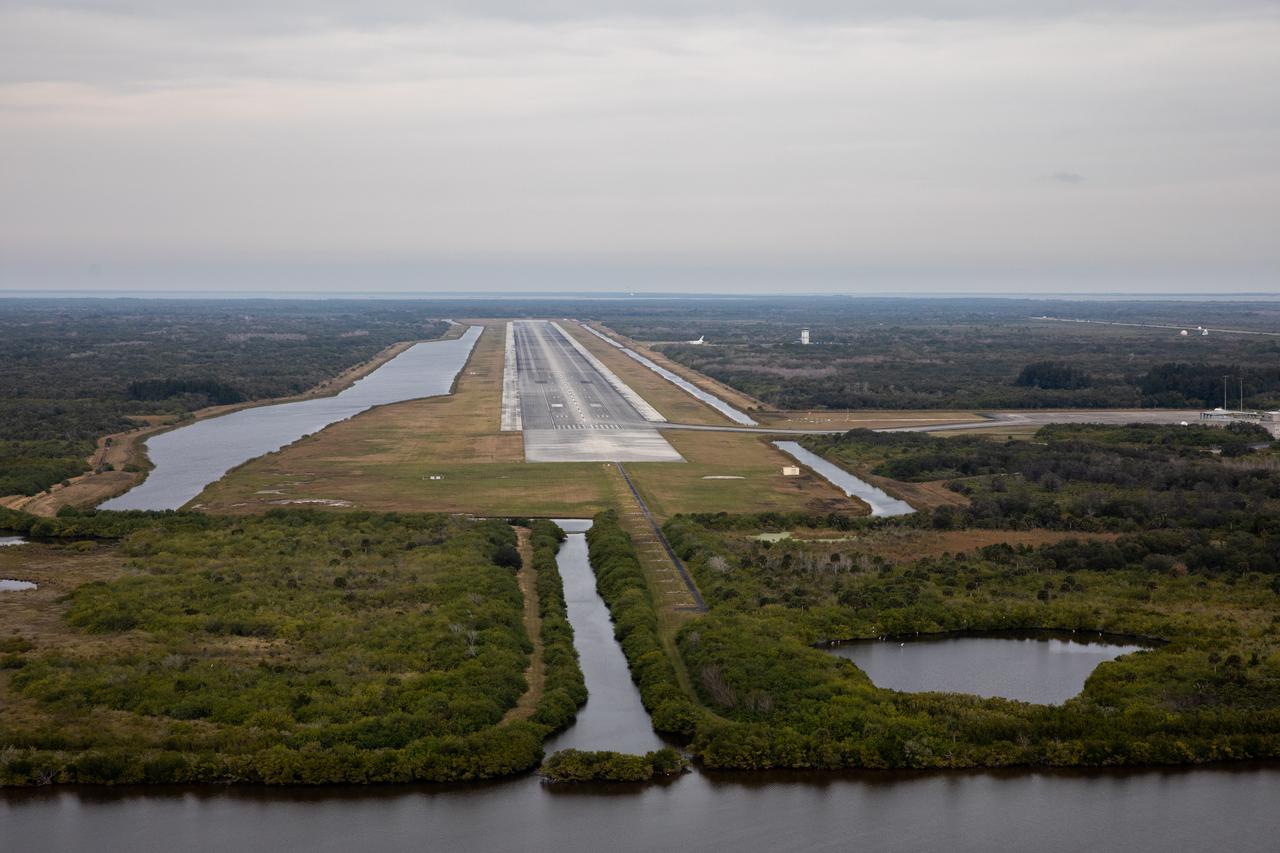
An aerial view of the Launch and Landing Facility at NASA’s Kennedy Space Center in Florida on Jan. 13, 2021. The runway is where the space shuttle touched down and came to a stop after returning to Earth from a mission. The facility is managed by Space Florida.

51F-37-059 (29 July-6 Aug 1985) --- The mouth of the Betsiboka River in northwest Madagascar is seen. The estuary at Mahajanga is being quickly filled with river borne sediments due to poor land management, mainly deforest-action in the river basin. Changes in the estuary can be seen from one Shuttle flight to the next.
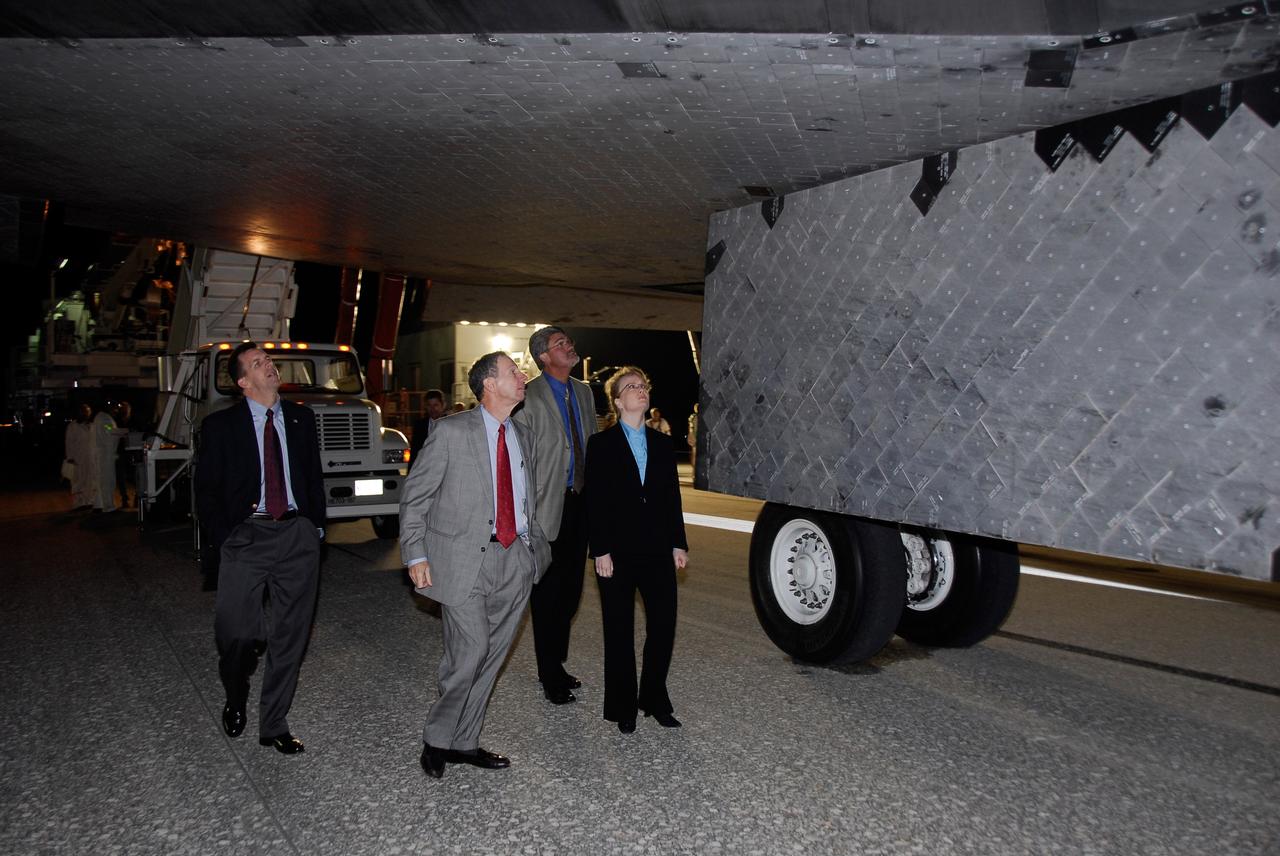
CAPE CANAVERAL, Fla. --- NASA managers examine the thermal protection system tile under space shuttle Endeavour on Runway 15 at Kennedy Space Center's Shuttle Landing Facility at the end of the STS-123 mission, a 16-day flight to the International Space Station. From left are Mission Management Team Chairman LeRoy Cain, NASA Administrator Mike Griffin, Kennedy Space Center Director Bill Parsons and NASA Deputy Administrator Shana Dale. This was the 16th night landing at Kennedy. The main landing gear touched down at 8:39:08 p.m. EDT. The nose landing gear touched down at 8:39:17 p.m. and wheel stop was at 8:40:41 p.m. The mission completed nearly 6.6 million miles. The landing was on the second opportunity after the first was waved off due to unstable weather in the Kennedy Space Center area. The STS-123 mission delivered the first segment of the Japan Aerospace Exploration Agency's Kibo laboratory and the Canadian Space Agency's two-armed robotic system, known as Dextre. Photo credit: NASA/Kim Shiflett
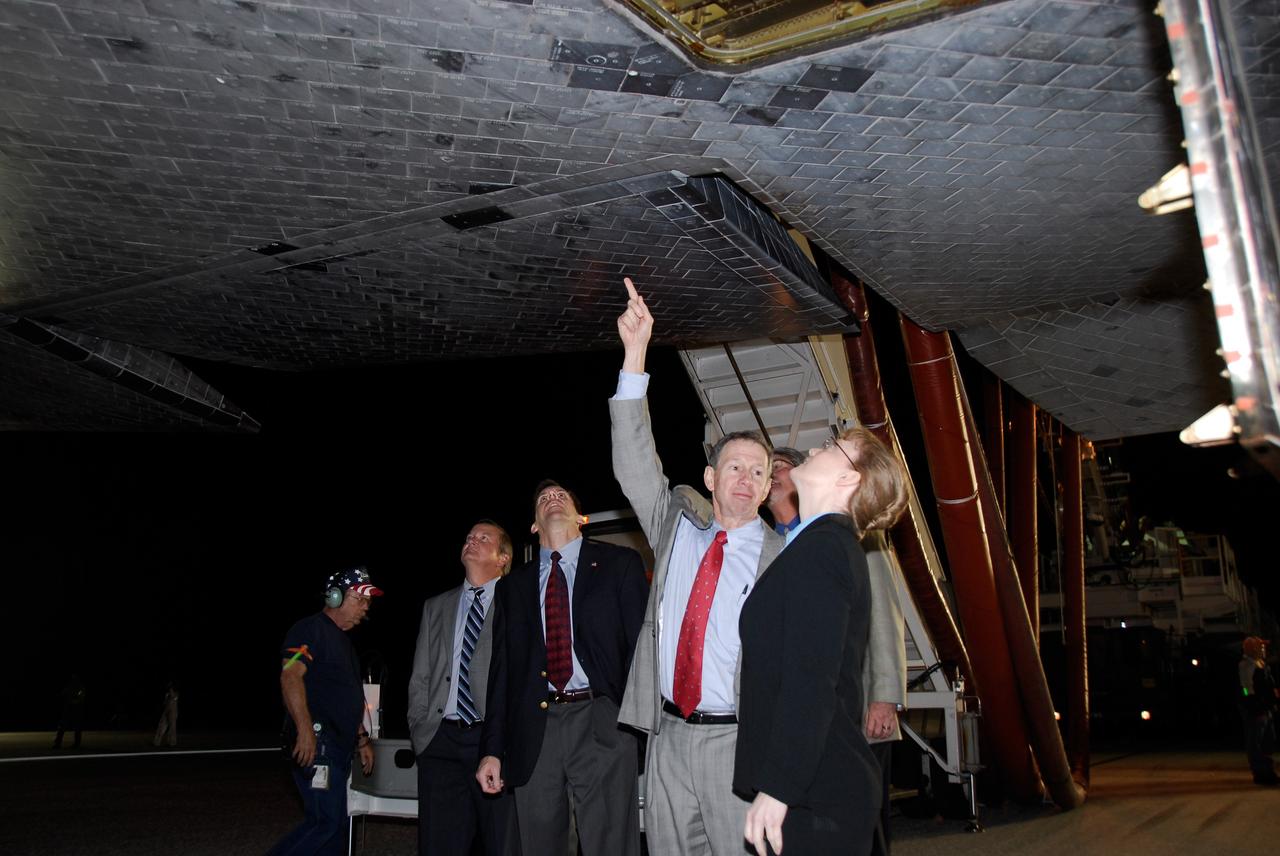
CAPE CANAVERAL, Fla. --- NASA managers examine the thermal protection system tile under space shuttle Endeavour on Runway 15 at Kennedy Space Center's Shuttle Landing Facility at the end of the STS-123 mission, a 16-day flight to the International Space Station. From left are a member of the convoy crew, Shuttle Launch Director Mike Leinbach, Mission Management Team Chairman LeRoy Cain, NASA Administrator Mike Griffin and NASA Deputy Administrator Shana Dale. Behind them is Kennedy Space Center Director Bill Parsons. This was the 16th night landing at Kennedy. The main landing gear touched down at 8:39:08 p.m. EDT. The nose landing gear touched down at 8:39:17 p.m. and wheel stop was at 8:40:41 p.m. The mission completed nearly 6.6 million miles. The landing was on the second opportunity after the first was waved off due to unstable weather in the Kennedy Space Center area. The STS-123 mission delivered the first segment of the Japan Aerospace Exploration Agency's Kibo laboratory and the Canadian Space Agency's two-armed robotic system, known as Dextre. Photo credit: NASA/Kim Shiflett
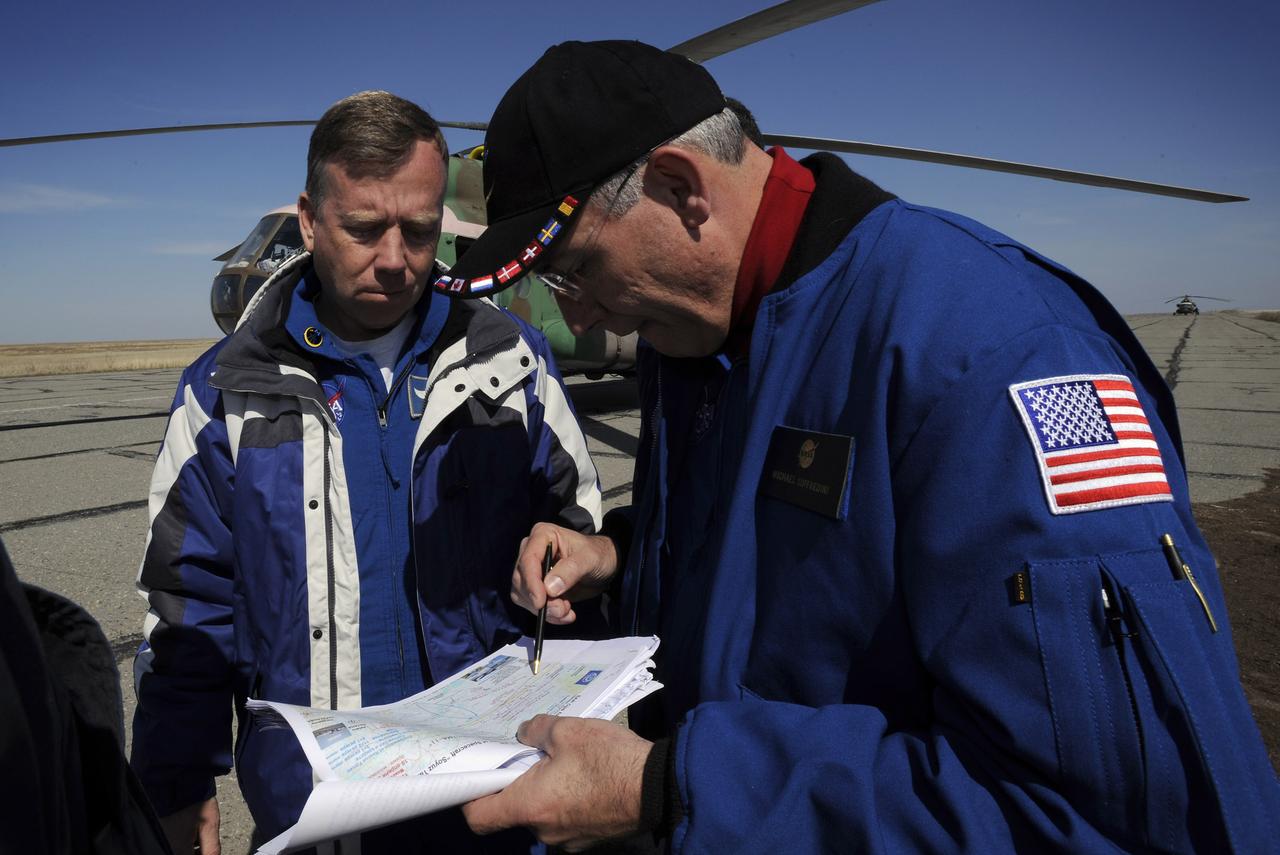
Steve Lindsey, Chief of NASA's Astronaut office, left, and Michael Sufferdini, International Station Program Manager, examine a map of central Kazakhstan as they received information at the Arkalyk airport April 19, 2008 on the landing of the Expedition 16 crew in the Soyuz TMA-11 capsule. The Soyuz made a ballistic landing, touching down more then 400 kilometers short of the intended target, but the crew reported by satellite phone to recovery forces that they were in good shape. Photo Credit: (NASA/Bill Ingalls)

The Mars 2020 rover arrives at the Launch and Landing Facility, formerly known as the Shuttle Landing Facility, at NASA’s Kennedy Space Center on Feb. 12, 2020. The rover was delivered to the Florida spaceport on a C-17 aircraft, making a cross-country trip that started at NASA’s Jet Propulsion Laboratory in Pasadena, California. The mission, targeted for mid-July 2020, will launch aboard an Atlas V 541 rocket from Cape Canaveral Air Force Station. NASA’s Launch Services Program based at Kennedy is managing the launch.
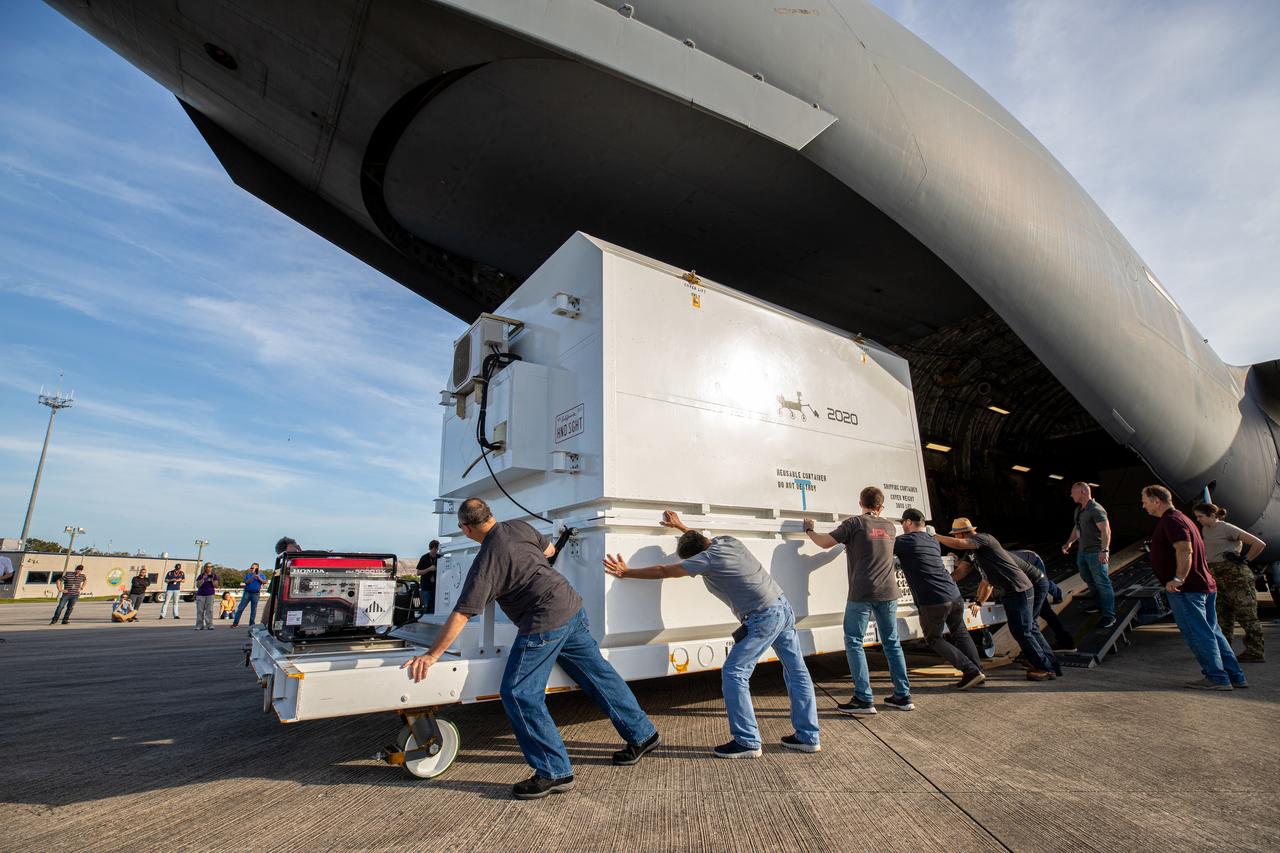
The Mars 2020 rover is offloaded from a C-17 aircraft at the Launch and Landing Facility, formerly known as the Shuttle Landing Facility, at NASA’s Kennedy Space Center on Feb. 12, 2020. The rover made a cross-country trip to the Florida spaceport that started at NASA’s Jet Propulsion Laboratory in Pasadena, California. The mission, targeted for mid-July 2020, will launch aboard an Atlas V 541 rocket from Cape Canaveral Air Force Station. NASA’s Launch Services Program based at Kennedy is managing the launch.
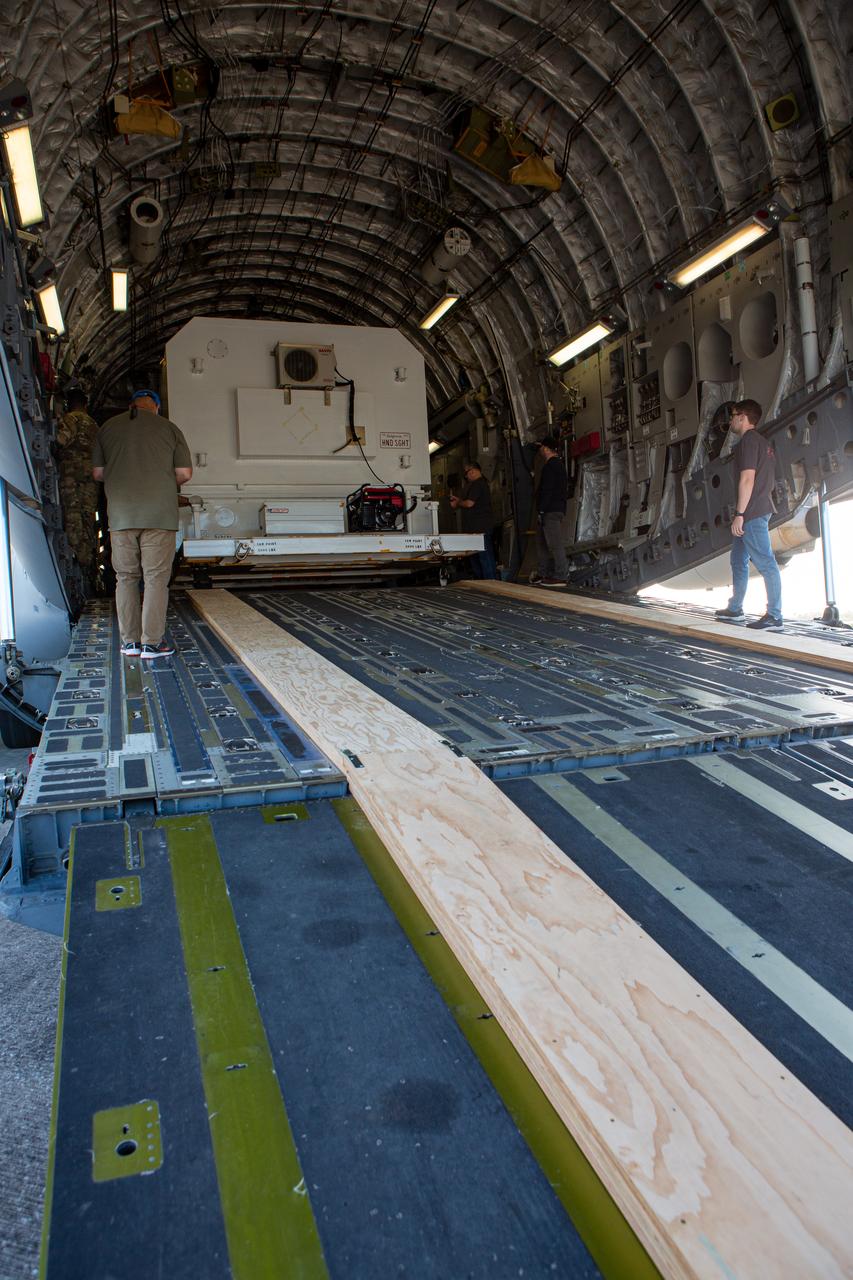
The Mars 2020 rover arrives at the Launch and Landing Facility, formerly known as the Shuttle Landing Facility, at NASA’s Kennedy Space Center on Feb. 12, 2020. The rover was delivered to the Florida spaceport on a C-17 aircraft, making a cross-country trip that started at NASA’s Jet Propulsion Laboratory in Pasadena, California. The mission, targeted for mid-July 2020, will launch aboard an Atlas V 541 rocket from Cape Canaveral Air Force Station. NASA’s Launch Services Program based at Kennedy is managing the launch.
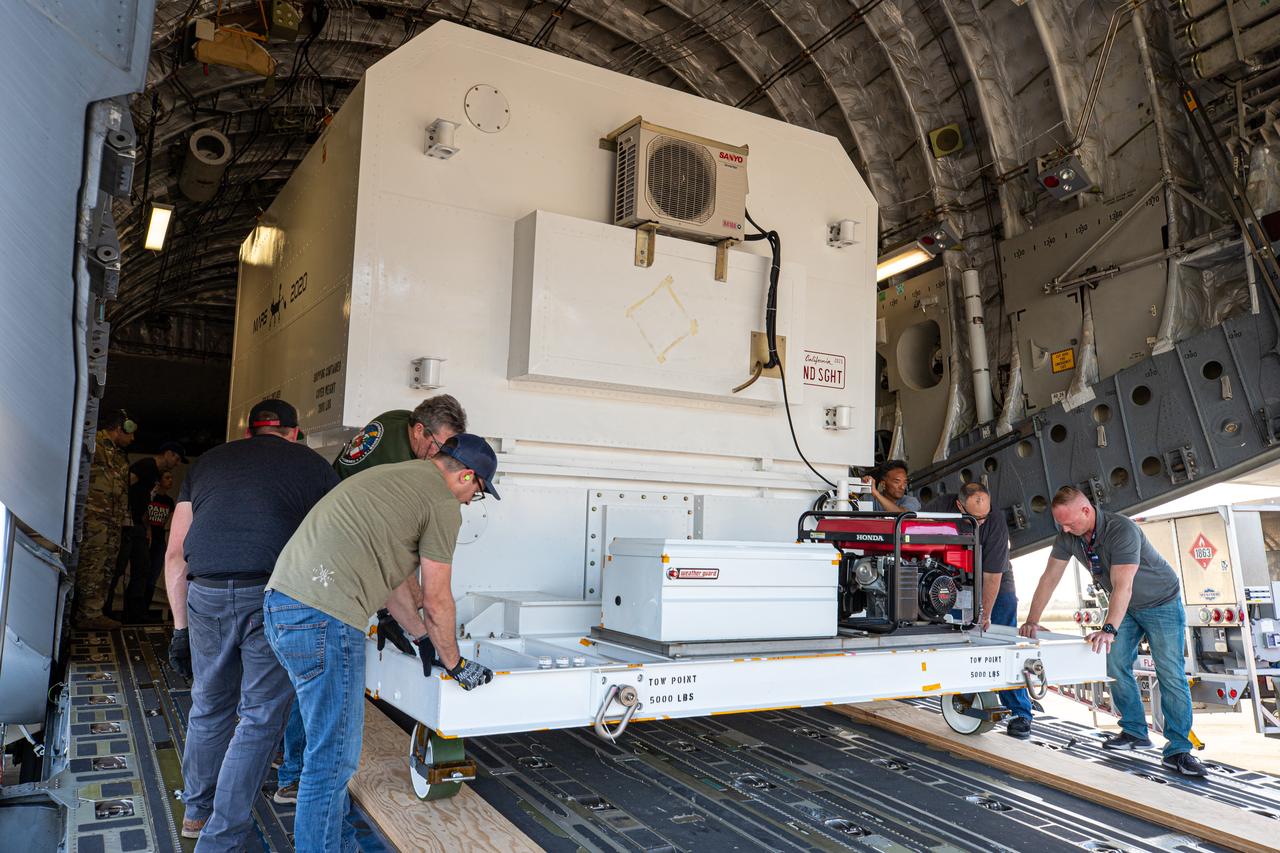
The Mars 2020 rover is offloaded from a C-17 aircraft at the Launch and Landing Facility, formerly known as the Shuttle Landing Facility, at NASA’s Kennedy Space Center on Feb. 12, 2020. The rover made a cross-country trip to the Florida spaceport that started at NASA’s Jet Propulsion Laboratory in Pasadena, California. The mission, targeted for mid-July 2020, will launch aboard an Atlas V 541 rocket from Cape Canaveral Air Force Station. NASA’s Launch Services Program based at Kennedy is managing the launch.
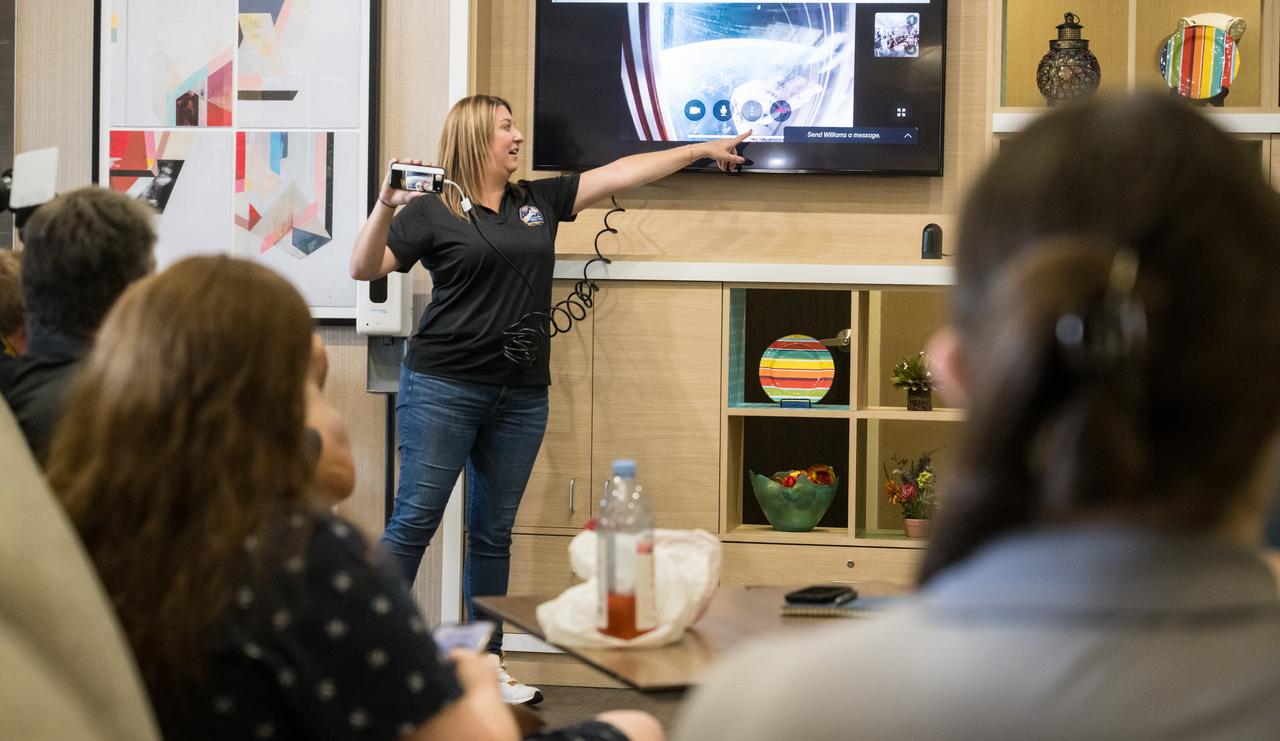
Boeing Astronaut Liaison & Space Flight Awareness Program Manager Megan Donaldson points out NASA’s Boeing Crew Flight Test Starliner spacecraft docked at the International Space Station during a call with NASA astronauts Butch Wilmore and Suni Williams before it’s uncrewed landing, Friday, Sept. 6, 2024, in Las Cruces, New Mexico. It is scheduled to land at White Sands Missile Range’s Space Harbor later today, Mountain Time (Sept. 7 Eastern Time). Photo Credit: (NASA/Aubrey Gemignani)
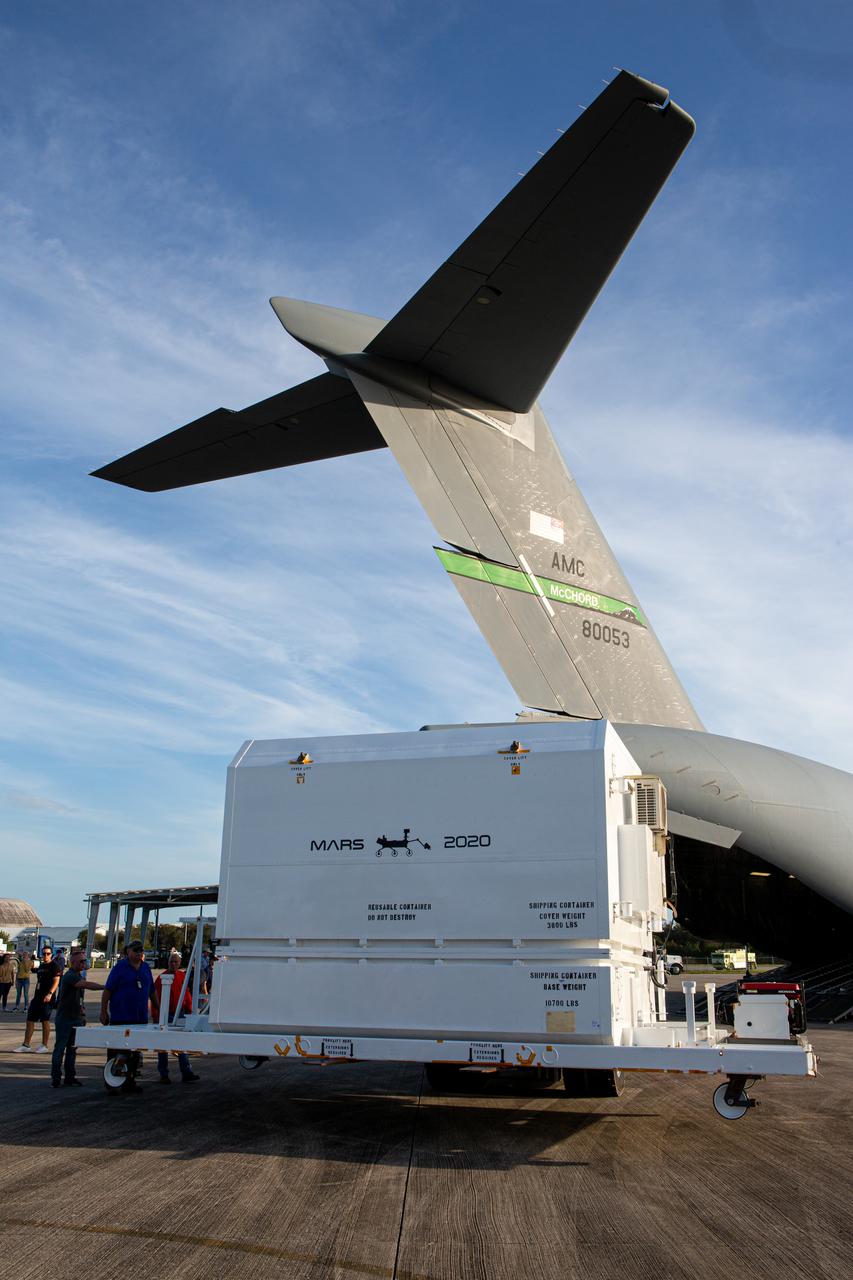
The Mars 2020 rover is pictured outside of the C-17 aircraft that delivered it to the Launch and Landing Facility, formerly known as the Shuttle Landing Facility, at NASA’s Kennedy Space Center in Florida on Feb. 12, 2020. The rover made a cross-country trip that started at NASA’s Jet Propulsion Laboratory in Pasadena, California. The mission, targeted for mid-July 2020, will launch aboard an Atlas V 541 rocket from Cape Canaveral Air Force Station. NASA’s Launch Services Program based at Kennedy is managing the launch.
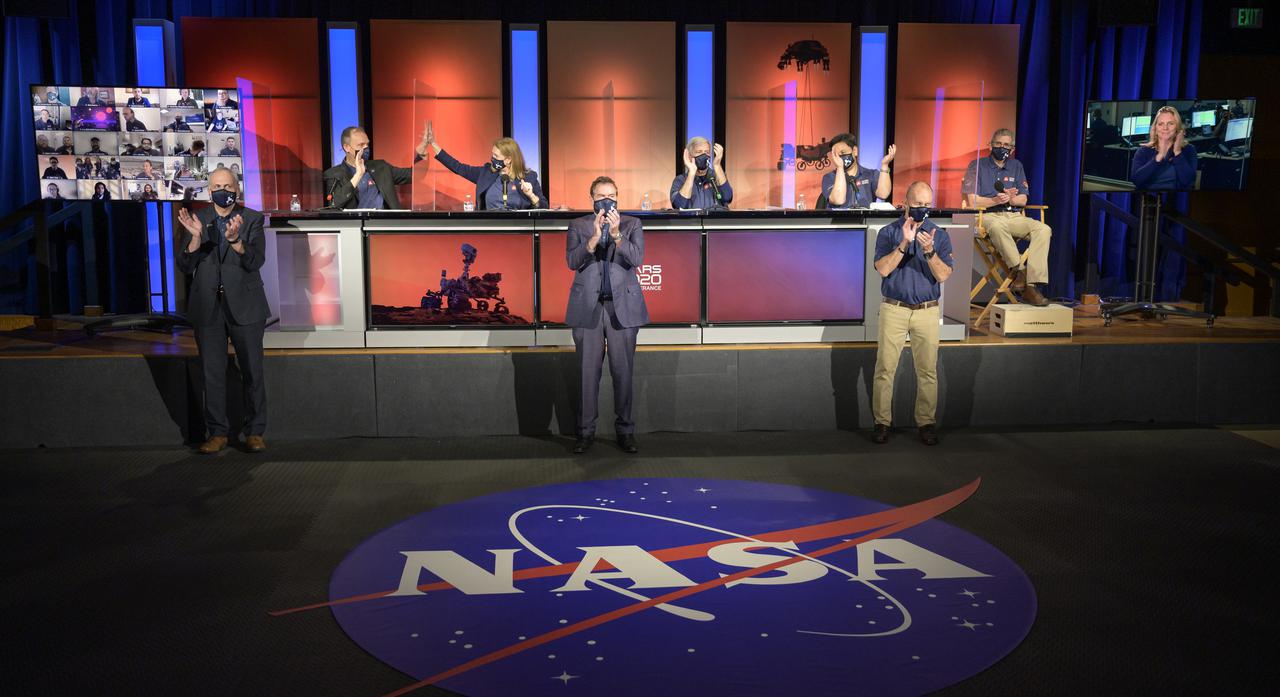
NASA Perseverance rover mission management and scientist celebrate a successful landing on Mars at the start of a post-landing update, Thursday, Feb. 18, 2021, at NASA's Jet Propulsion Laboratory in Pasadena, California. A key objective for Perseverance’s mission on Mars is astrobiology, including the search for signs of ancient microbial life. The rover will characterize the planet’s geology and past climate, pave the way for human exploration of the Red Planet, and be the first mission to collect and cache Martian rock and regolith. Photo Credit: (NASA/Bill Ingalls)
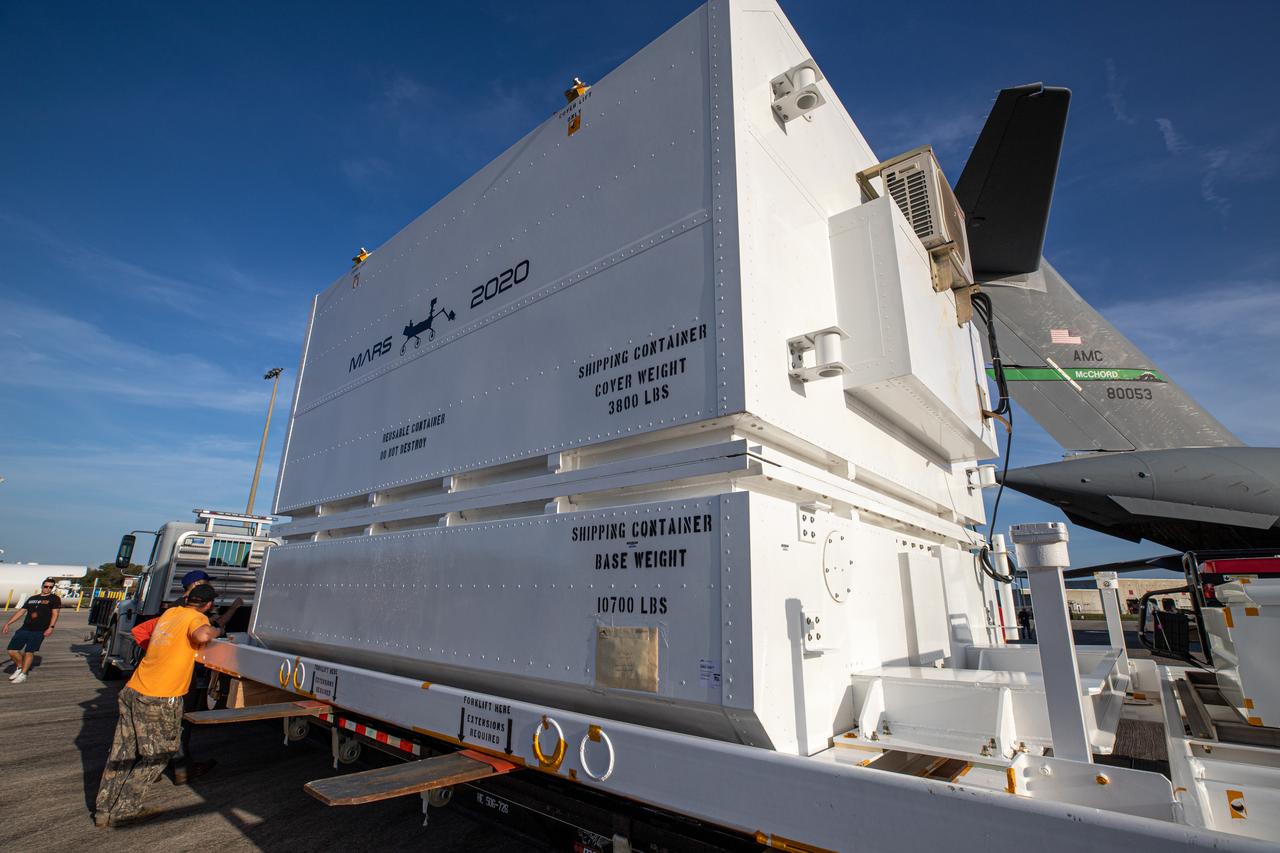
The Mars 2020 rover is offloaded from a C-17 aircraft at the Launch and Landing Facility, formerly known as the Shuttle Landing Facility, at NASA’s Kennedy Space Center on Feb. 12, 2020. The rover made a cross-country trip to the Florida spaceport that started at NASA’s Jet Propulsion Laboratory in Pasadena, California. The mission, targeted for mid-July 2020, will launch aboard an Atlas V 541 rocket from Cape Canaveral Air Force Station. NASA’s Launch Services Program based at Kennedy is managing the launch.
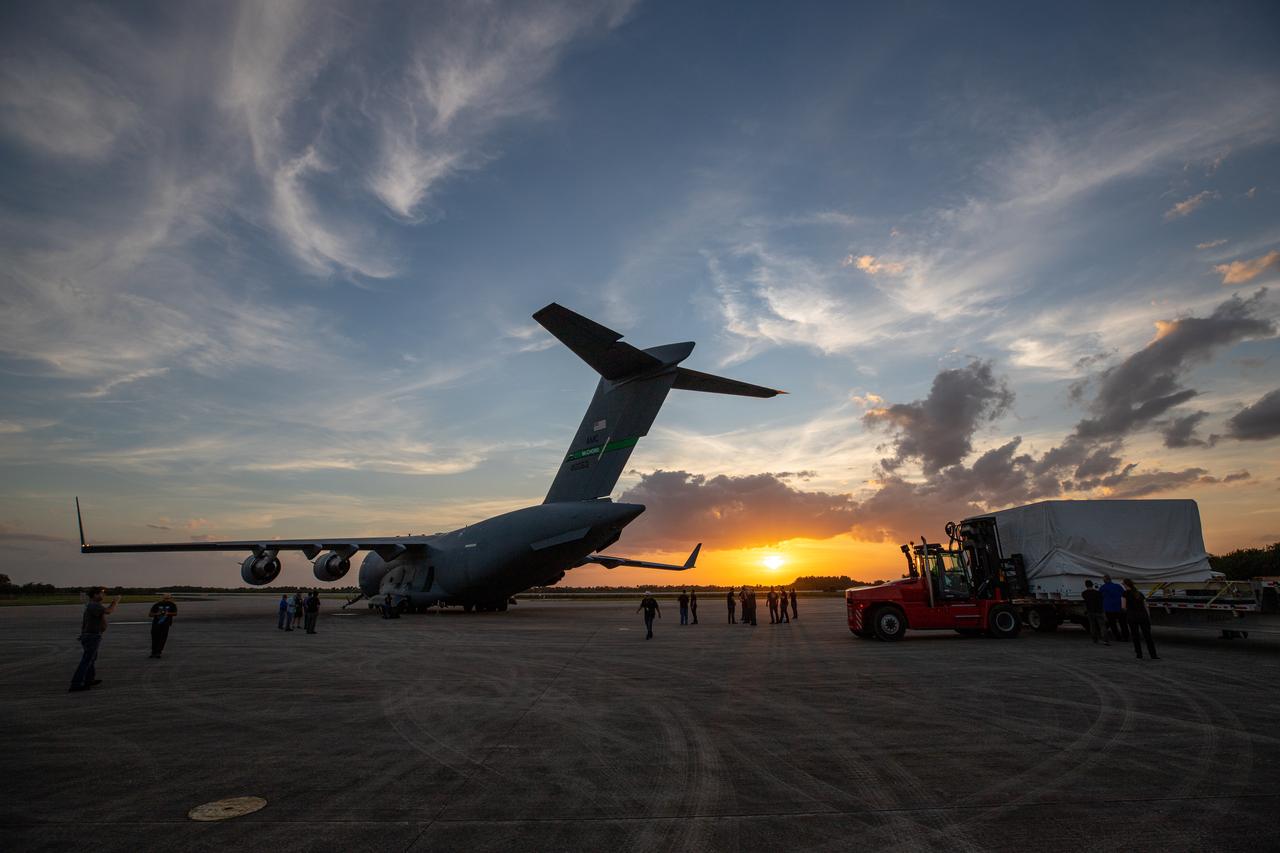
The C-17 aircraft that delivered the Mars 2020 rover sits at the Launch and Landing Facility, formerly known as the Shuttle Landing Facility, at NASA’s Kennedy Space Center on Feb. 12, 2020. The rover made a cross-country trip to the Florida spaceport that started at NASA’s Jet Propulsion Laboratory in Pasadena, California. The mission, targeted for mid-July 2020, will launch aboard an Atlas V 541 rocket from Cape Canaveral Air Force Station. NASA’s Launch Services Program based at Kennedy is managing the launch.
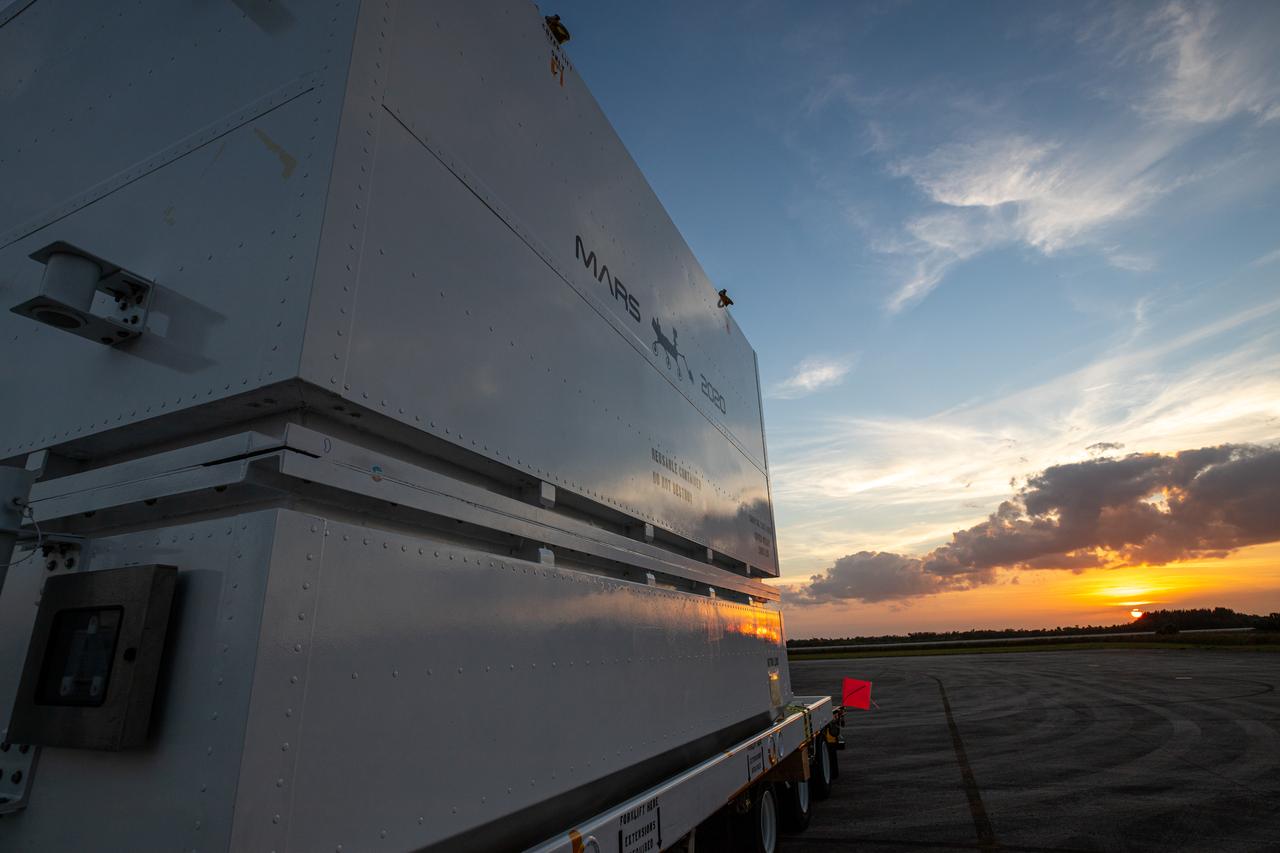
The Mars 2020 is pictured at the Launch and Landing Facility, formerly known as the Shuttle Landing Facility, at NASA’s Kennedy Space Center on Feb. 12, 2020. The rover was delivered to the Florida spaceport on a C-17 aircraft, making a cross-country trip that started at NASA’s Jet Propulsion Laboratory in Pasadena, California. The mission, targeted for mid-July 2020, will launch aboard an Atlas V 541 rocket from Cape Canaveral Air Force Station. NASA’s Launch Services Program based at Kennedy is managing the launch.

JSC2011-E-067691 (21 July 2011) --- Shuttle launch director Mike Leinbach, facing camera, hugs LeRoy Cain, deputy space shuttle program manager, after the space shuttle Atlantis landed on July 21 at the Kennedy Space Center in Florida. The landing completed STS-135, the final mission of the Space Shuttle Program. Photo credit: NASA/Houston Chronicle, Smiley N. Pool

(left to right) NASA Administrator Michael Griffin, NASA Assistant Administrator for Public Affairs David Mould and NASA Space Shuttle Manager Wayne Hale watch as the space shuttle Discovery comes in for landing at NASA's Kennedy Space Center, Fla., completing the 15-day STS-120 mission to the International Space Station. Discovery landed at 1:01pm EST Wednesday after a mission that included on-orbit construction of the station with the installation of the Harmony Node 2 module and the relocation of the P6 truss. Photo Credit: 'NASA/Bill Ingalls"
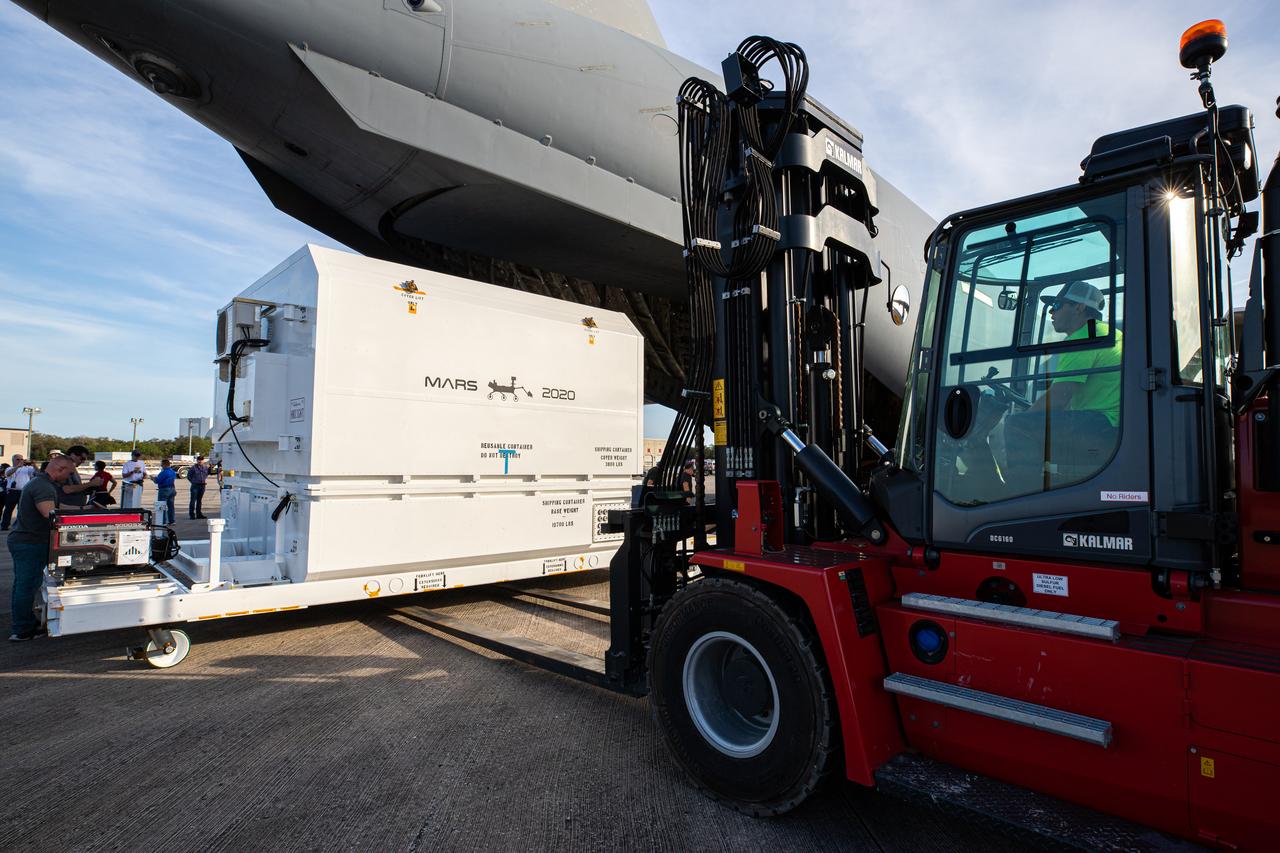
The Mars 2020 rover is offloaded from a C-17 aircraft at the Launch and Landing Facility, formerly known as the Shuttle Landing Facility, at NASA’s Kennedy Space Center on Feb. 12, 2020. The rover made a cross-country trip to the Florida spaceport that started at NASA’s Jet Propulsion Laboratory in Pasadena, California. The mission, targeted for mid-July 2020, will launch aboard an Atlas V 541 rocket from Cape Canaveral Air Force Station. NASA’s Launch Services Program based at Kennedy is managing the launch.

The Mars 2020 rover is offloaded from a C-17 aircraft at the Launch and Landing Facility, formerly known as the Shuttle Landing Facility, at NASA’s Kennedy Space Center on Feb. 12, 2020. The rover made a cross-country trip to the Florida spaceport that started at NASA’s Jet Propulsion Laboratory in Pasadena, California. The mission, targeted for mid-July 2020, will launch aboard an Atlas V 541 rocket from Cape Canaveral Air Force Station. NASA’s Launch Services Program based at Kennedy is managing the launch.
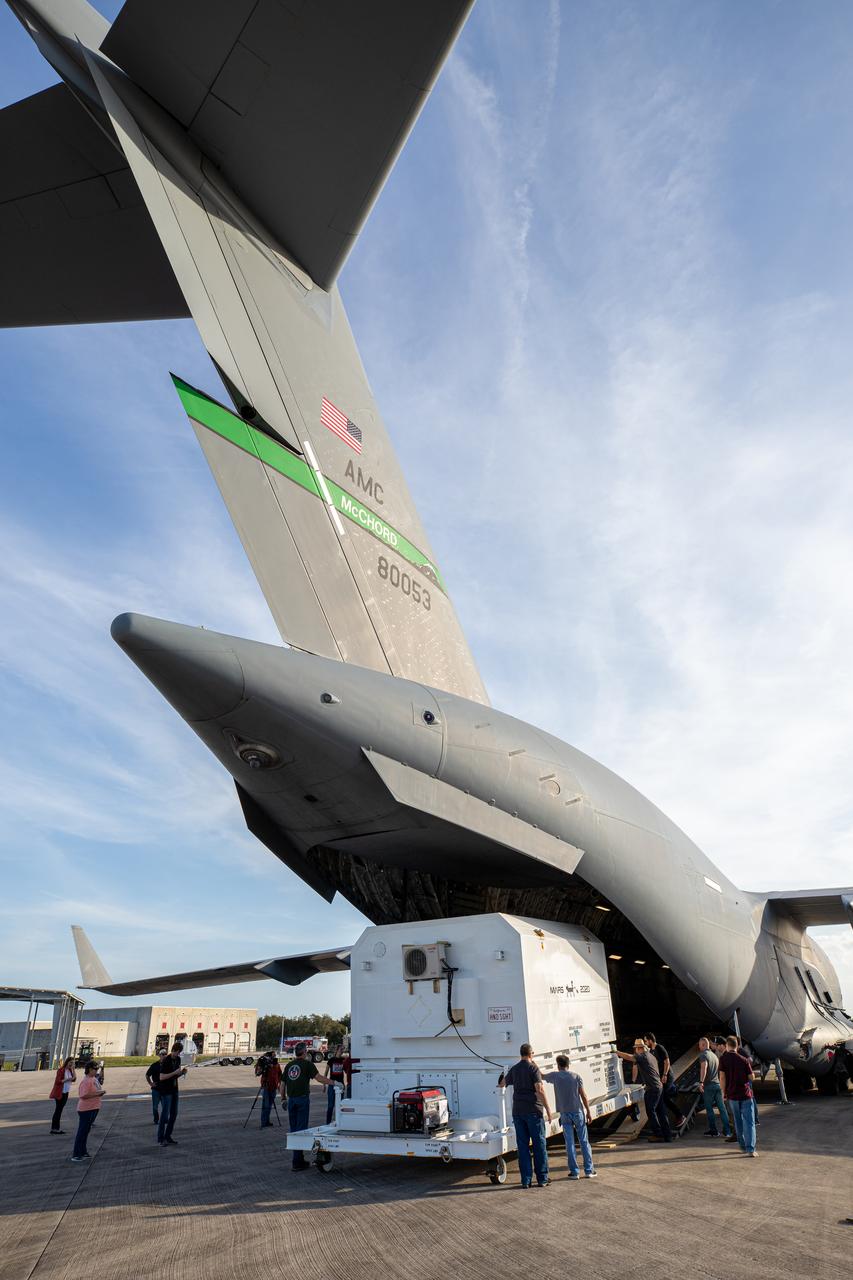
The Mars 2020 rover is offloaded from a C-17 aircraft at the Launch and Landing Facility, formerly known as the Shuttle Landing Facility, at NASA’s Kennedy Space Center on Feb. 12, 2020. The rover made a cross-country trip to the Florida spaceport that started at NASA’s Jet Propulsion Laboratory in Pasadena, California. The mission, targeted for mid-July 2020, will launch aboard an Atlas V 541 rocket from Cape Canaveral Air Force Station. NASA’s Launch Services Program based at Kennedy is managing the launch.
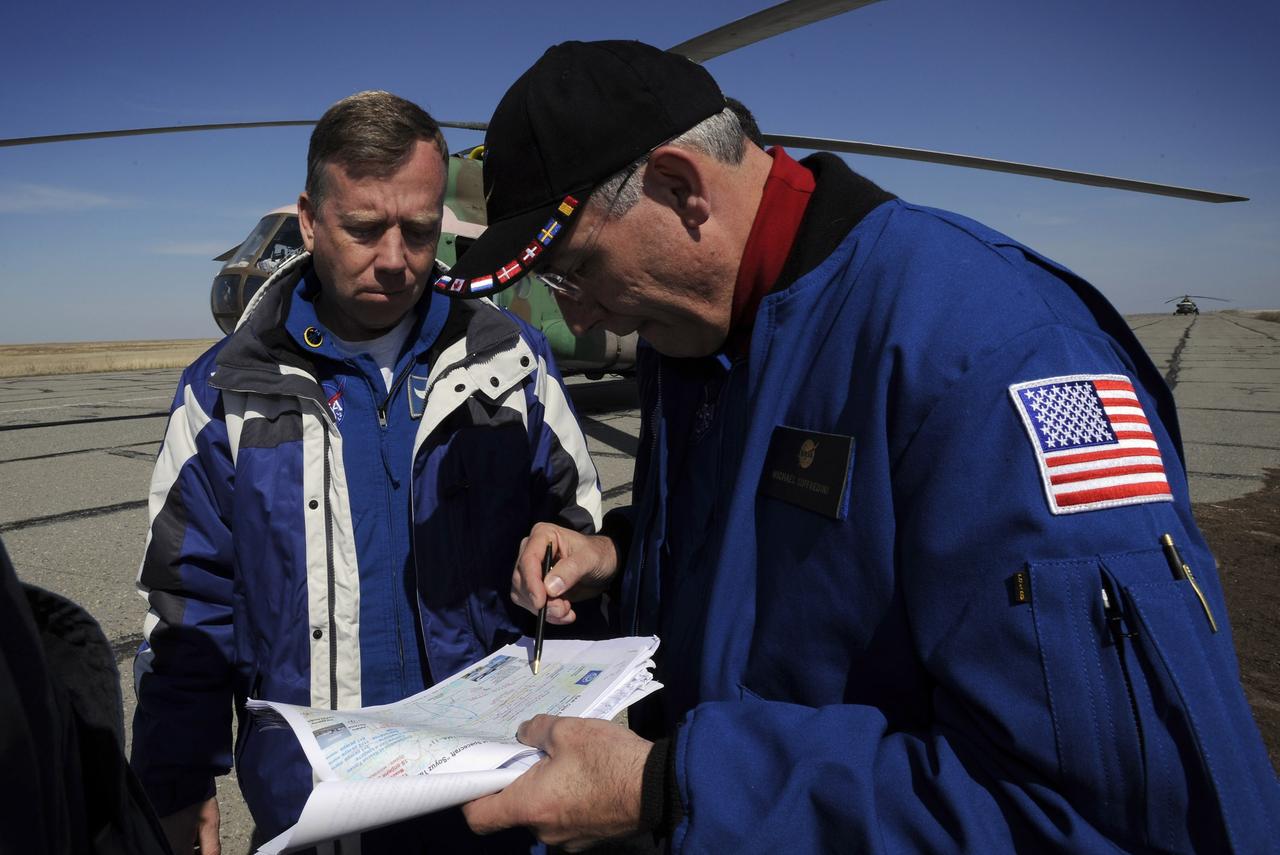
CHKALOVSKY, Russia -- Steve Lindsey, Chief of NASA's Astronaut office, left, and Michael Sufferdini, International Station Program Manager, examine a map of central Kazakhstan as they received information at the Arkalyk airport April 19, 2008, on the landing of the Expedition 16 crew in the Soyuz TMA-11 capsule. The Soyuz made a ballistic landing, touching down more then 400 kilometers short of the intended target, but the crew reported by satellite phone to recovery forces that they were in good shape. Photo Credit: (NASA/Bill Ingalls)