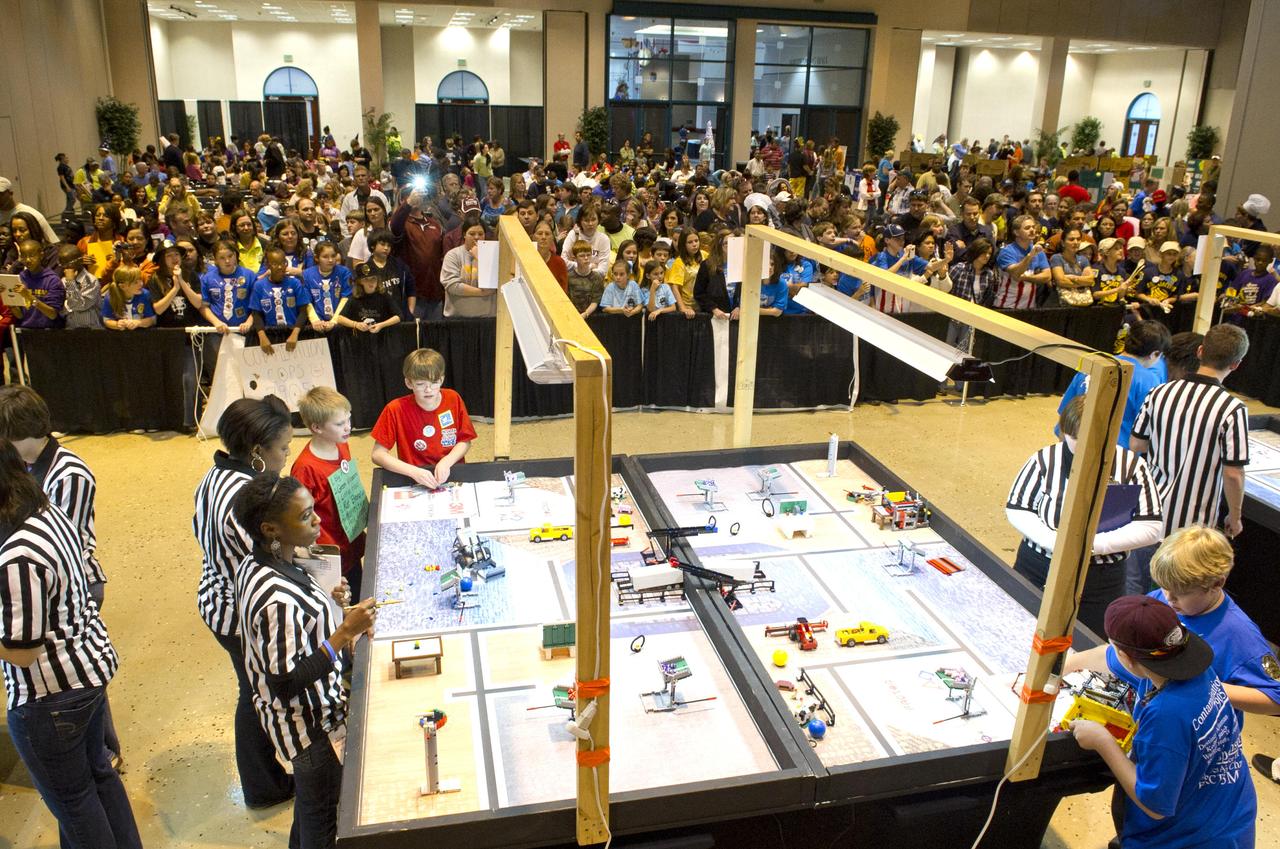
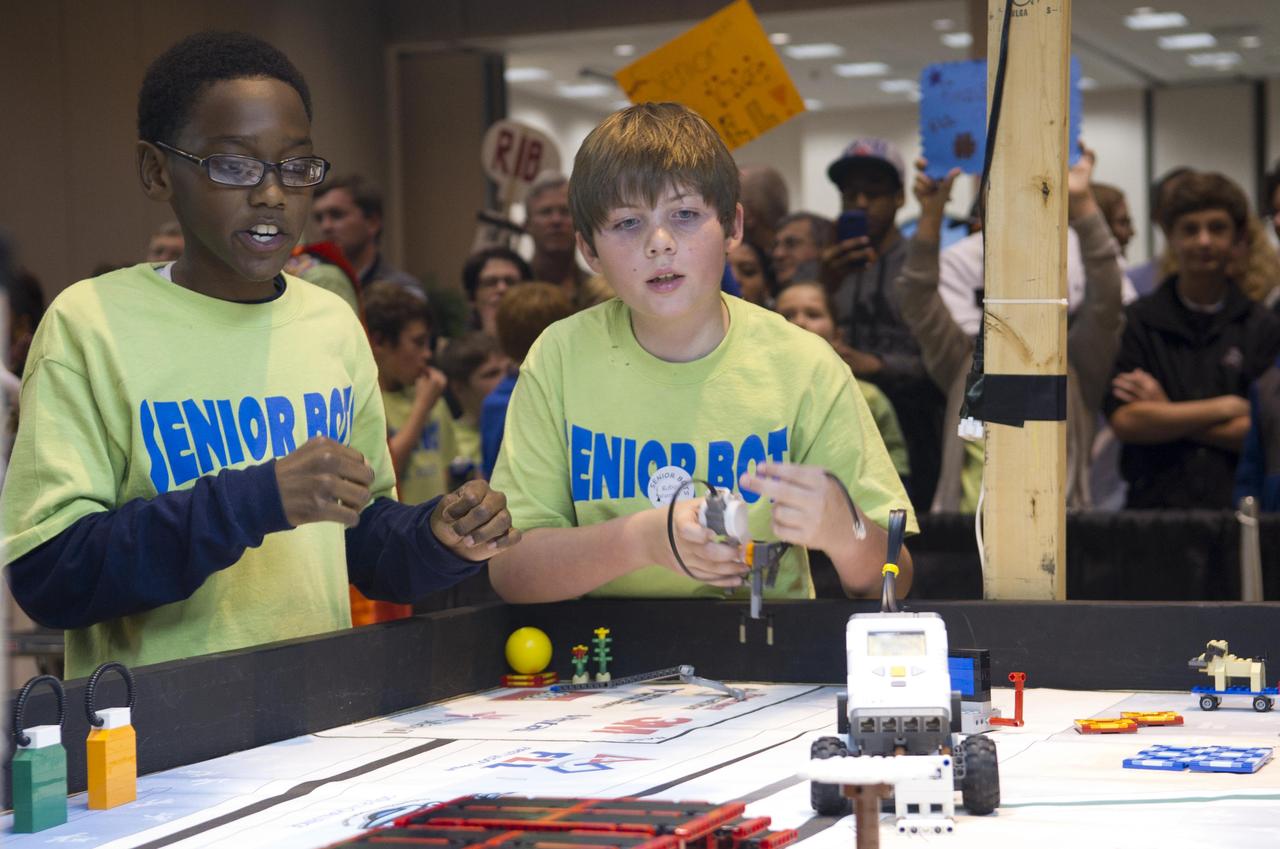
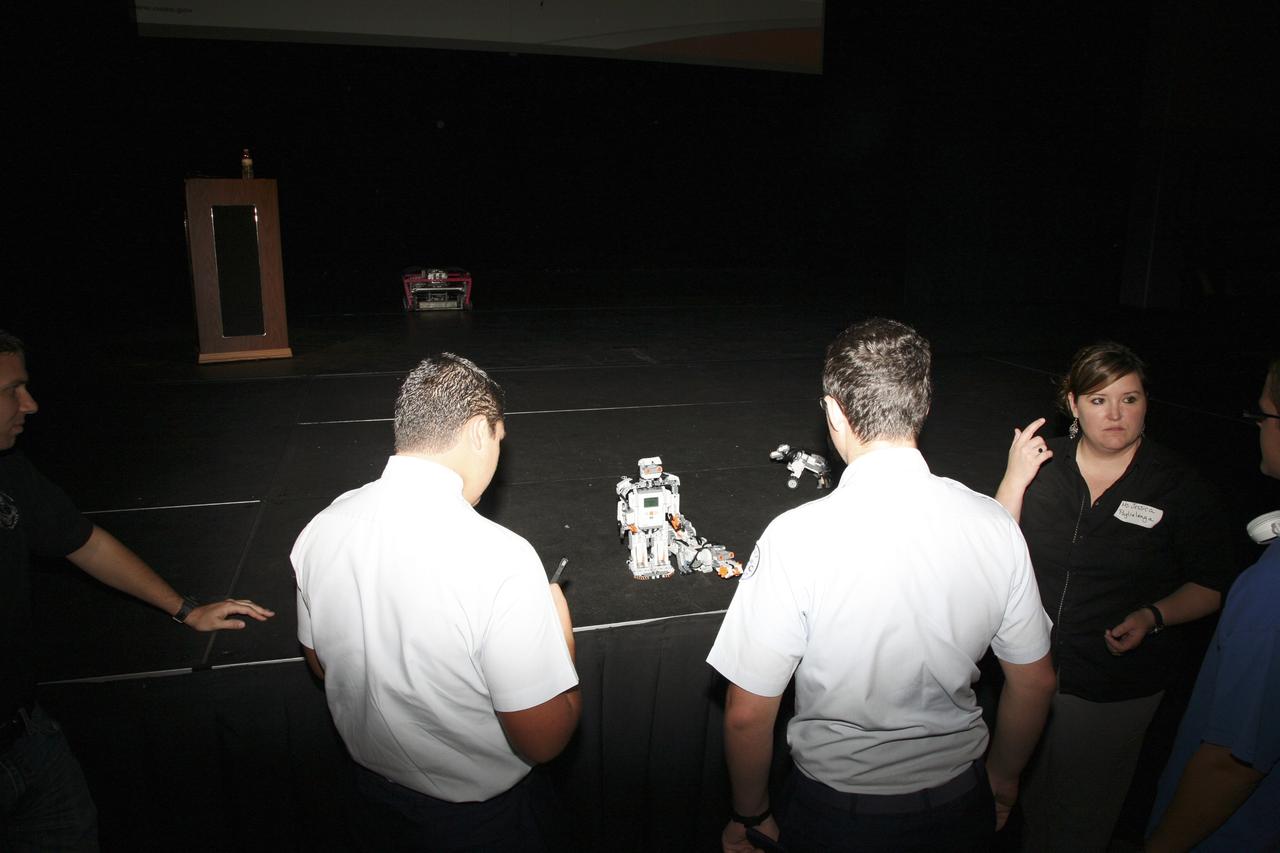
Matthew Myles (left) and Agrippa Kellum from Armstrong Middle School in Starkville, watch as their LEGO robot competes during a Dec. 4 tournament. Elementary and middle school students from across Mississippi gathered in Hattiesburg to participate in the Mississippi Championship FIRST (For Inspiration and Recognition of Science and Technology) LEGO League Tournament. Stennis supports FIRST LEGO League each year by providing mentors, training and tournament volunteers.
2011 FIRST LEGO League
The 2011 Mississippi FIRST LEGO League Championship Tournament attracted more than 1,000 participants and guests to the Lake Terrace Convention Center in Hattiesburg. In partnership with the LEGO Group, registered participants use the MINDSTORMSTM NXT system to build robots prior to each year's annual competition.
2011 FIRST LEGO League
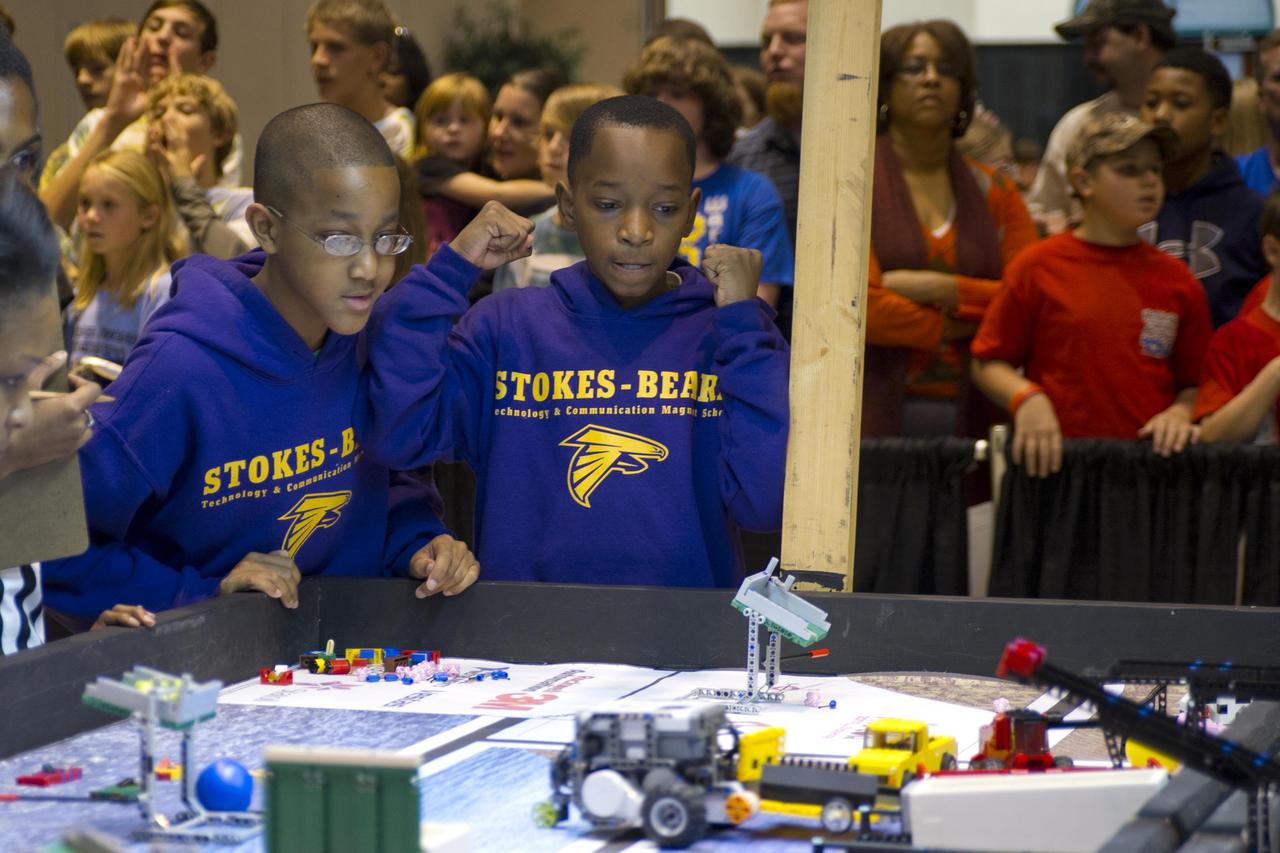
Two 2011 Mississippi FIRST LEGO League competitors from Stokes-Beard Magnet Elementary School in Columbus urge their robots on during the annual tournament Dec. 3. The competition attracted more than 1,000 participants and guests to the Lake Terrace Convention Center in Hattiesburg.
2011 FIRST LEGO League
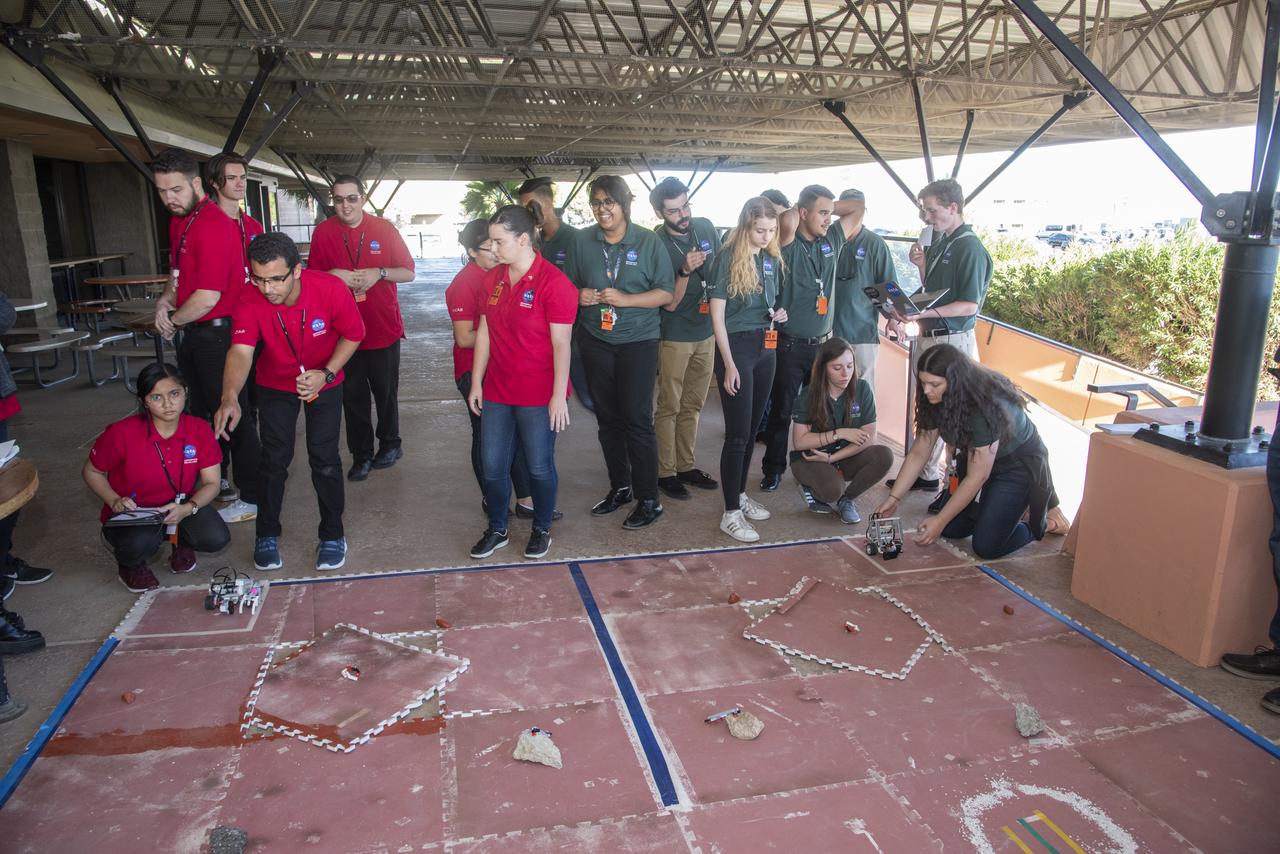
Four student teams: Blue, Gold, Green and Red built, designed and tested a LEGO robotic Martian rover prototype at NASA's Armstrong Flight Research Center. The teams competed against each other during a four-day workshop coordinated by the NASA Community College Aerospace Scholars. Each team prepared a marketing package to "sell" their design to NASA based on the performance of its Martian rover.
Students Test their LEGO Rover Prototype
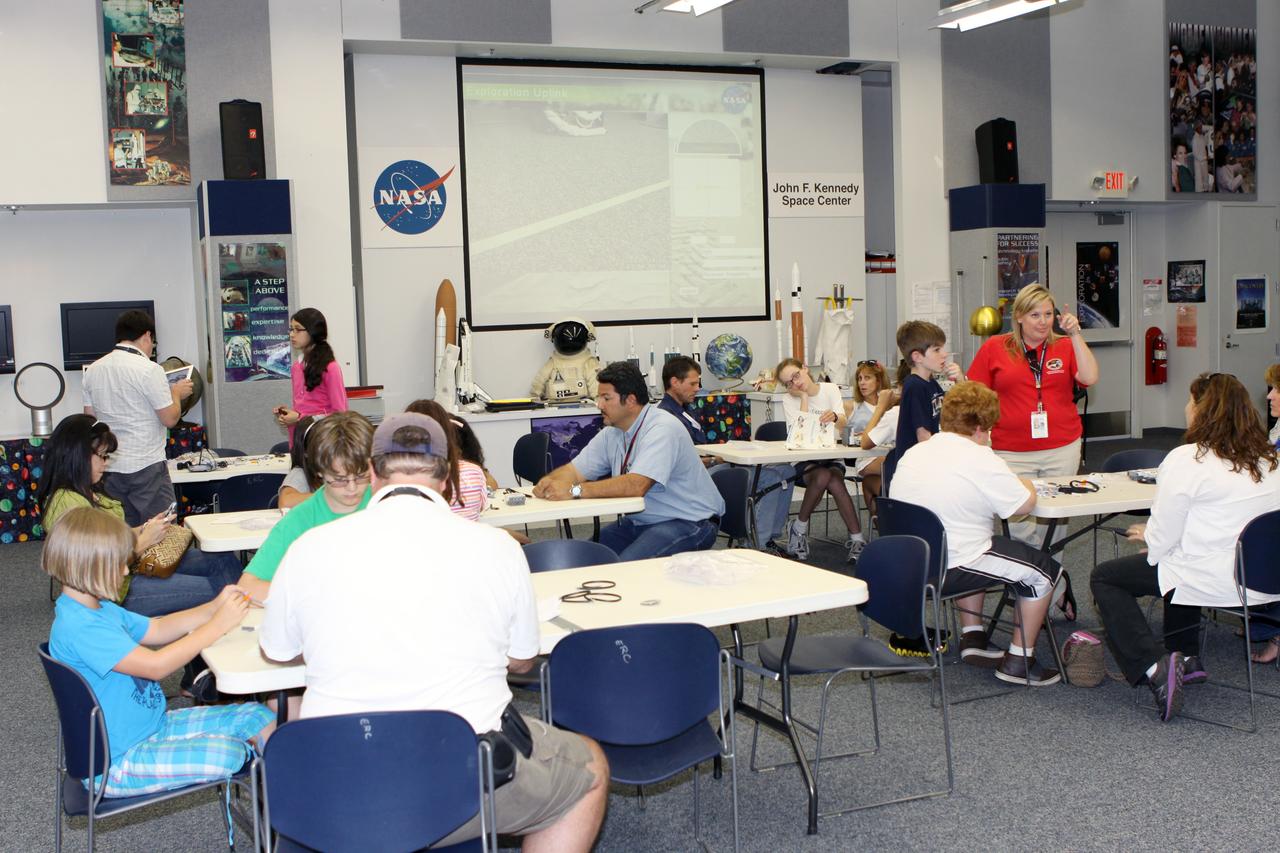
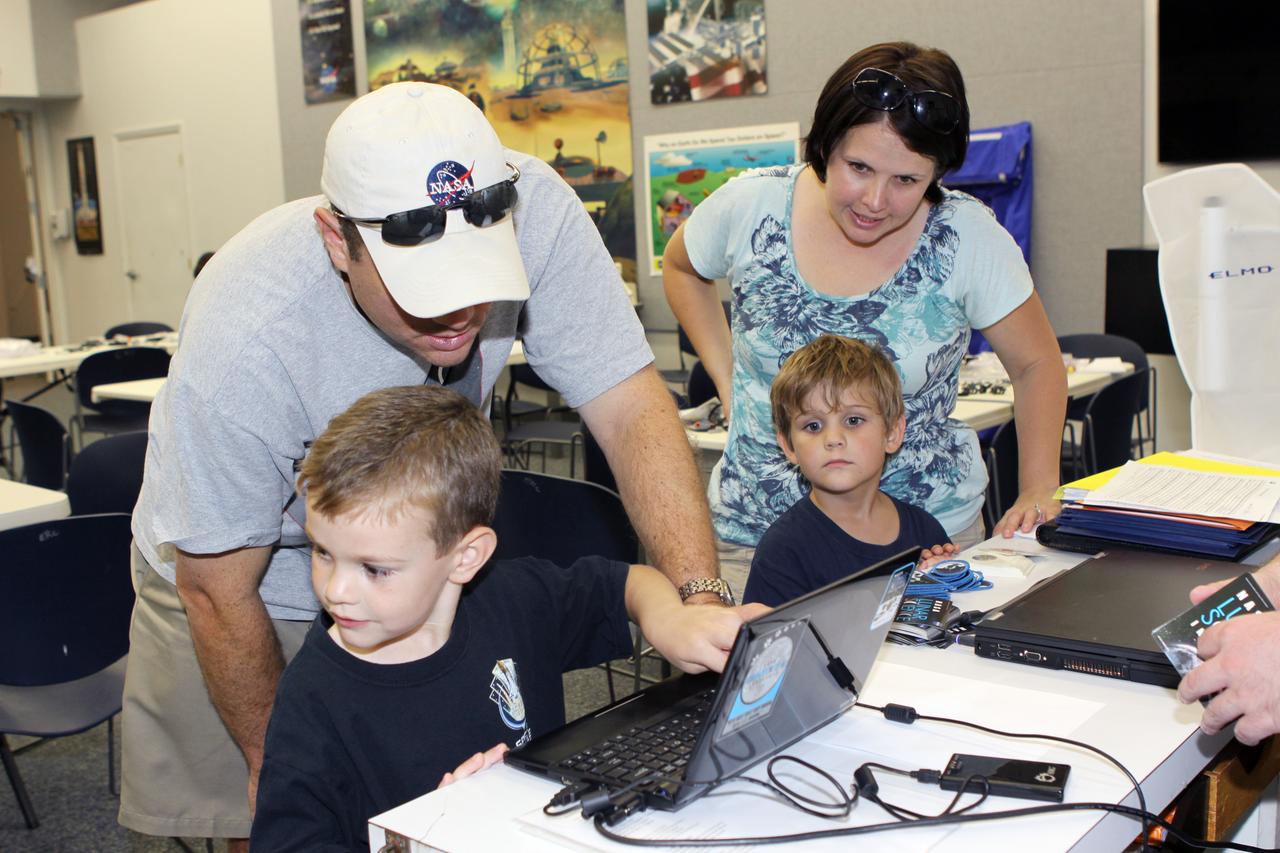
KSC Families build Lego Robots in Exploration Station
2012-3083
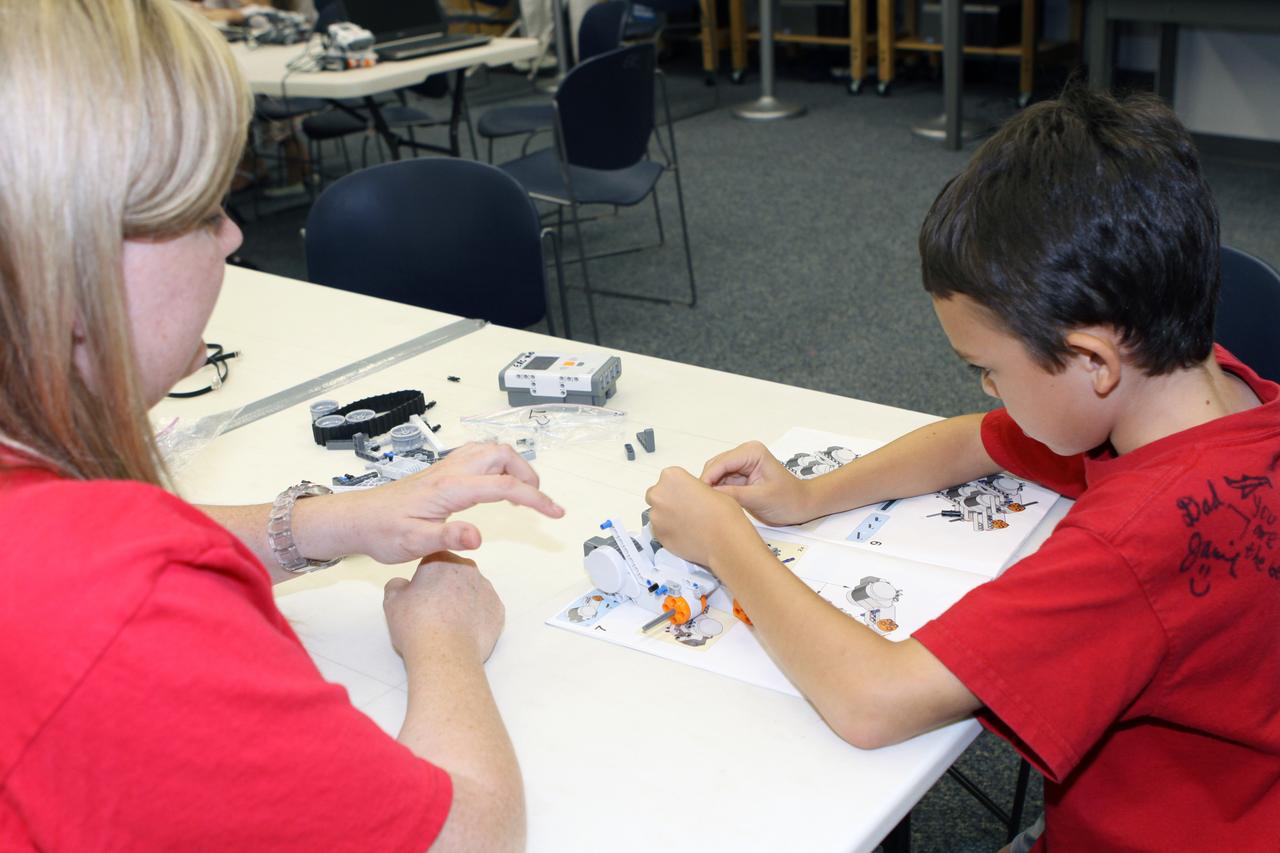
KSC Families build Lego Robots in Exploration Station
2012-3085
KSC Families build Lego Robots in Exploration Station
2012-3082
Mississippi students monitor performance of their robots during the 2012 FIRST LEGO League Mississippi Championship Tournament in Hattiesburg, Miss., on Dec. 1. The tournament is an annual high-energy robotics competition for children 9-14.
2012 FIRST LEGO League
Mississippi students monitor performance of their robots during the 2012 FIRST LEGO League Mississippi Championship Tournament in Hattiesburg, Miss., on Dec. 1. The tournament is an annual high-energy robotics competition for children 9-14.
2012 FIRST LEGO League
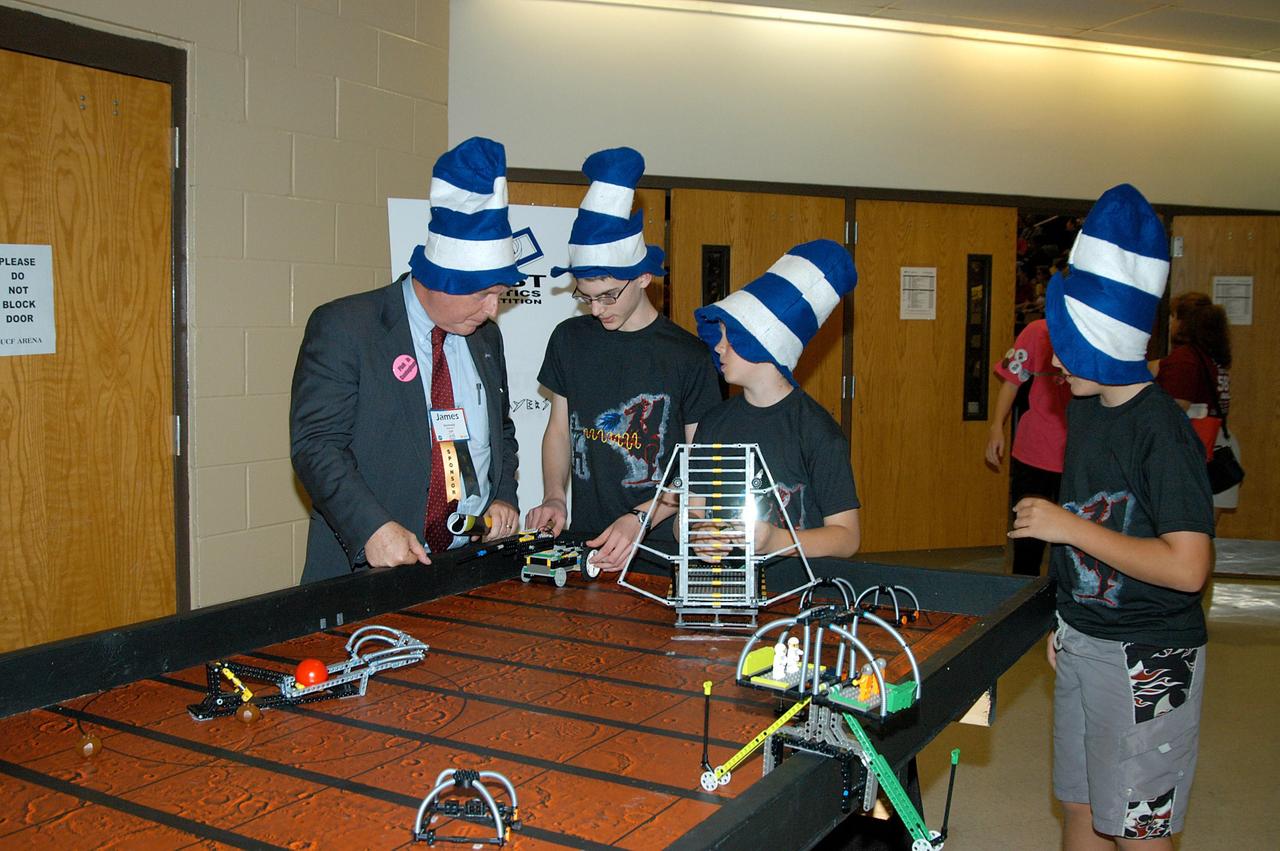
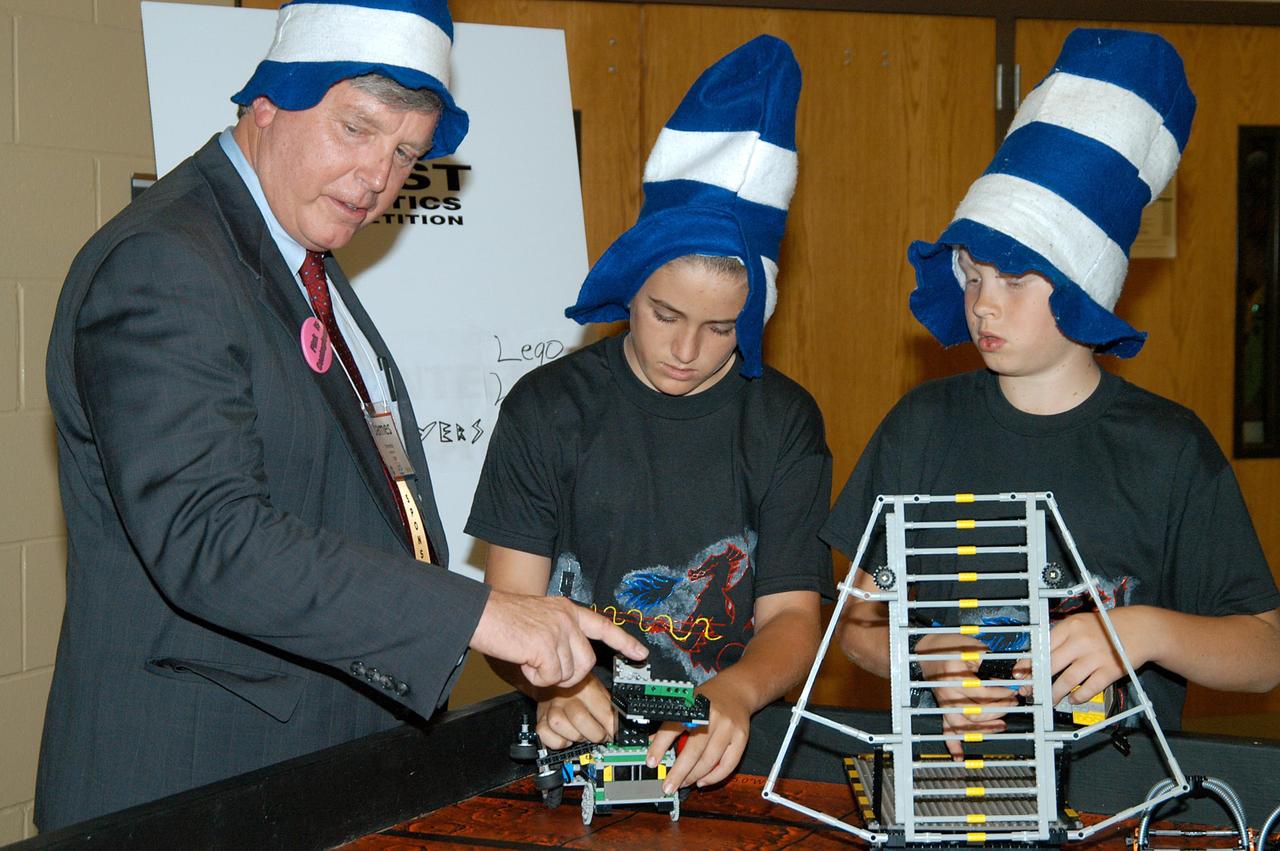
KENNEDY SPACE CENTER, FLA. -  While at the 2004 Florida Regional FIRST competition, held at the University of Central Florida, Center Director Jim Kennedy talks to participants in the FIRST LEGO™ League (FLL).  Considered the "little league" of the FIRST (For Inspiration and Recognition of Science and Technology) Robotics Competition, FLL is the result of a partnership between FIRST and the LEGO™ Company. FLL extends the FIRST concept of inspiring and celebrating science and technology to children aged 9 through 14, using real-world context and hands-on experimentation.  Young participants can build a robot and compete in a friendly, FIRST-style robotics event specially designed for their age group.
KSC-04pd0497
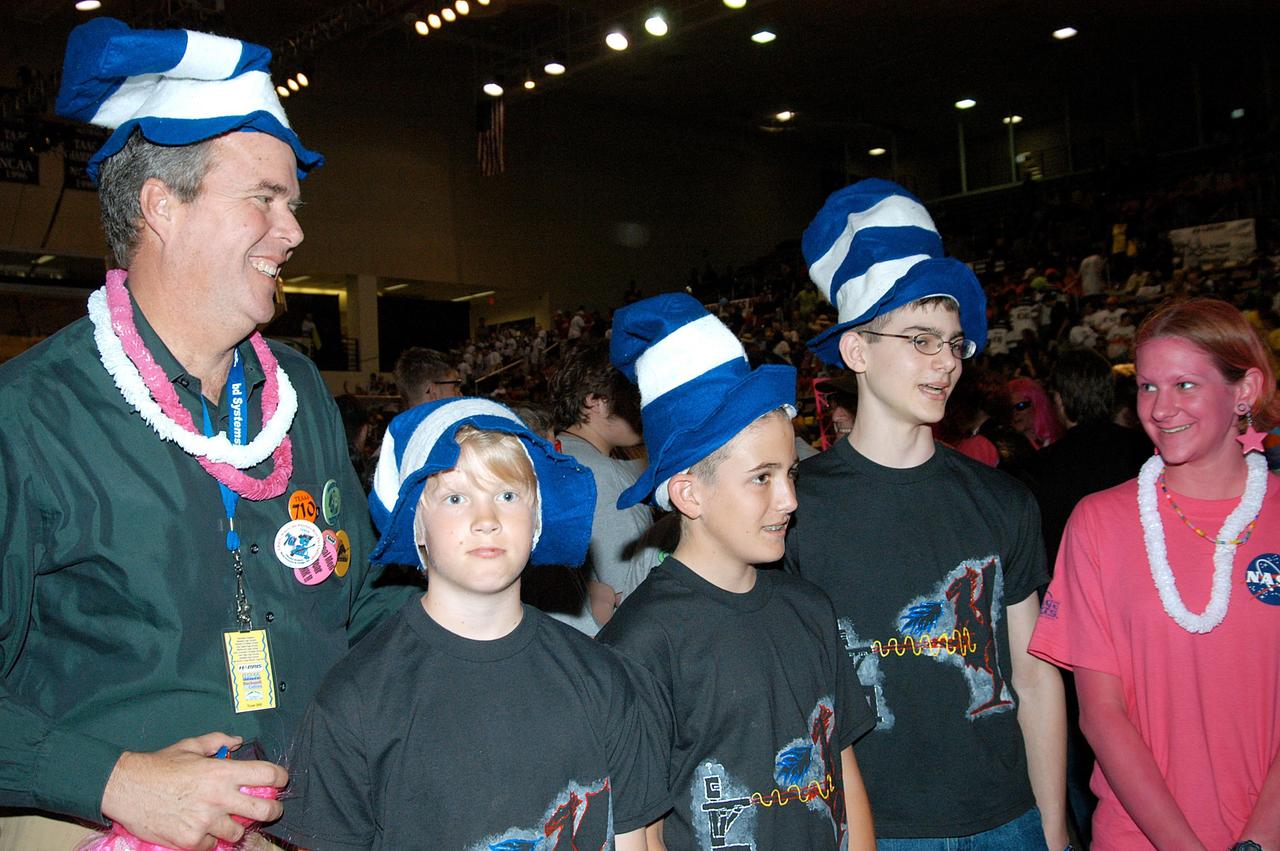
KENNEDY SPACE CENTER, FLA. -  During a break at the 2004 Florida Regional FIRST competition, held at the University of Central Florida, Florida Gov. Jeb Bush joins participants in the FIRST LEGO™ League (FLL).  Considered the "little league" of the FIRST (For Inspiration and Recognition of Science and Technology) Robotics Competition, FLL is the result of a partnership between FIRST and the LEGO™ Company. FLL extends the FIRST concept of inspiring and celebrating science and technology to children aged 9 through 14, using real-world context and hands-on experimentation.  Young participants can build a robot and compete in a friendly, FIRST-style robotics event specially designed for their age group.
KSC-04pd0505
KENNEDY SPACE CENTER, FLA. -  While at the 2004 Florida Regional FIRST competition, held at the University of Central Florida, Center Director Jim Kennedy talks to participants in the FIRST LEGO™ League (FLL).  Considered the "little league" of the FIRST (For Inspiration and Recognition of Science and Technology) Robotics Competition, FLL is the result of a partnership between FIRST and the LEGO™ Company. FLL extends the FIRST concept of inspiring and celebrating science and technology to children aged 9 through 14, using real-world context and hands-on experimentation.  Young participants can build a robot and compete in a friendly, FIRST-style robotics event specially designed for their age group.
KSC-04pd0498
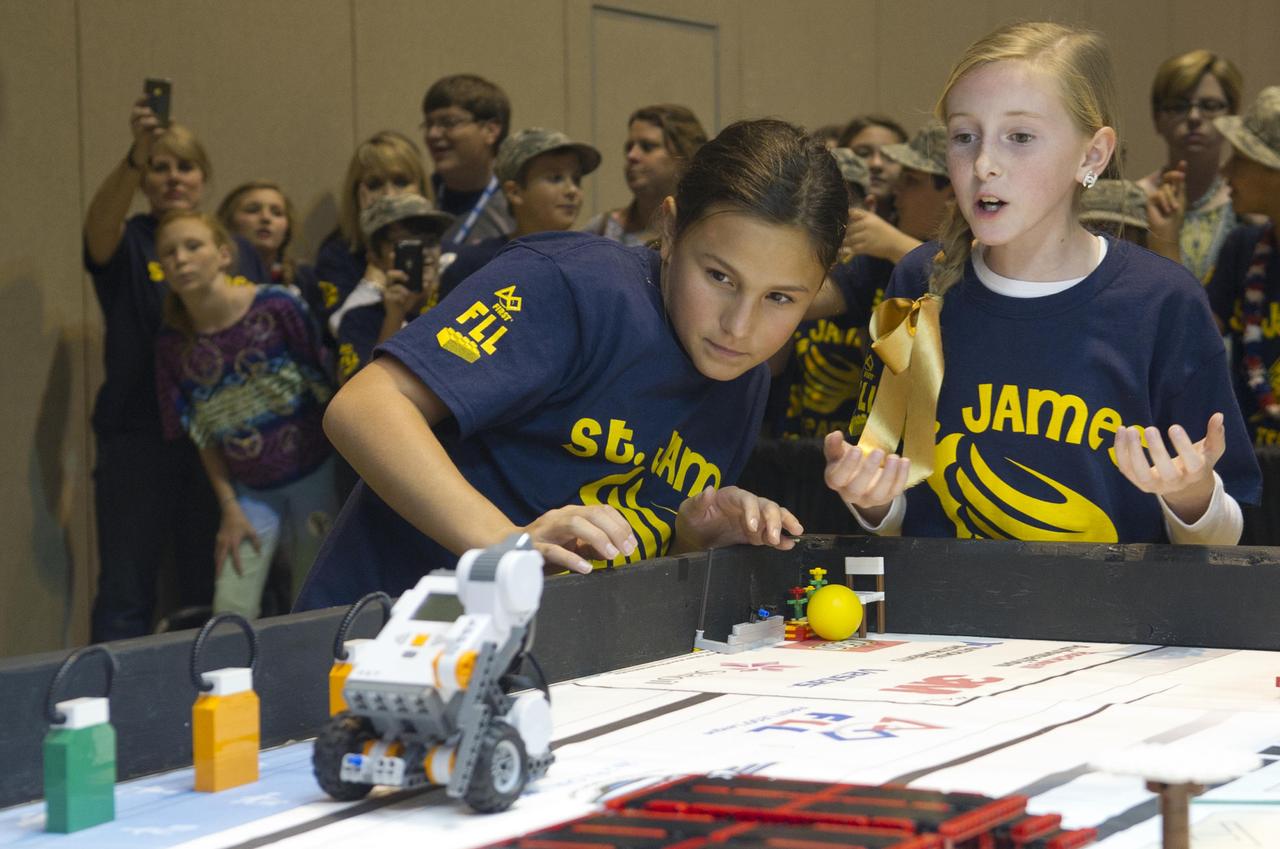
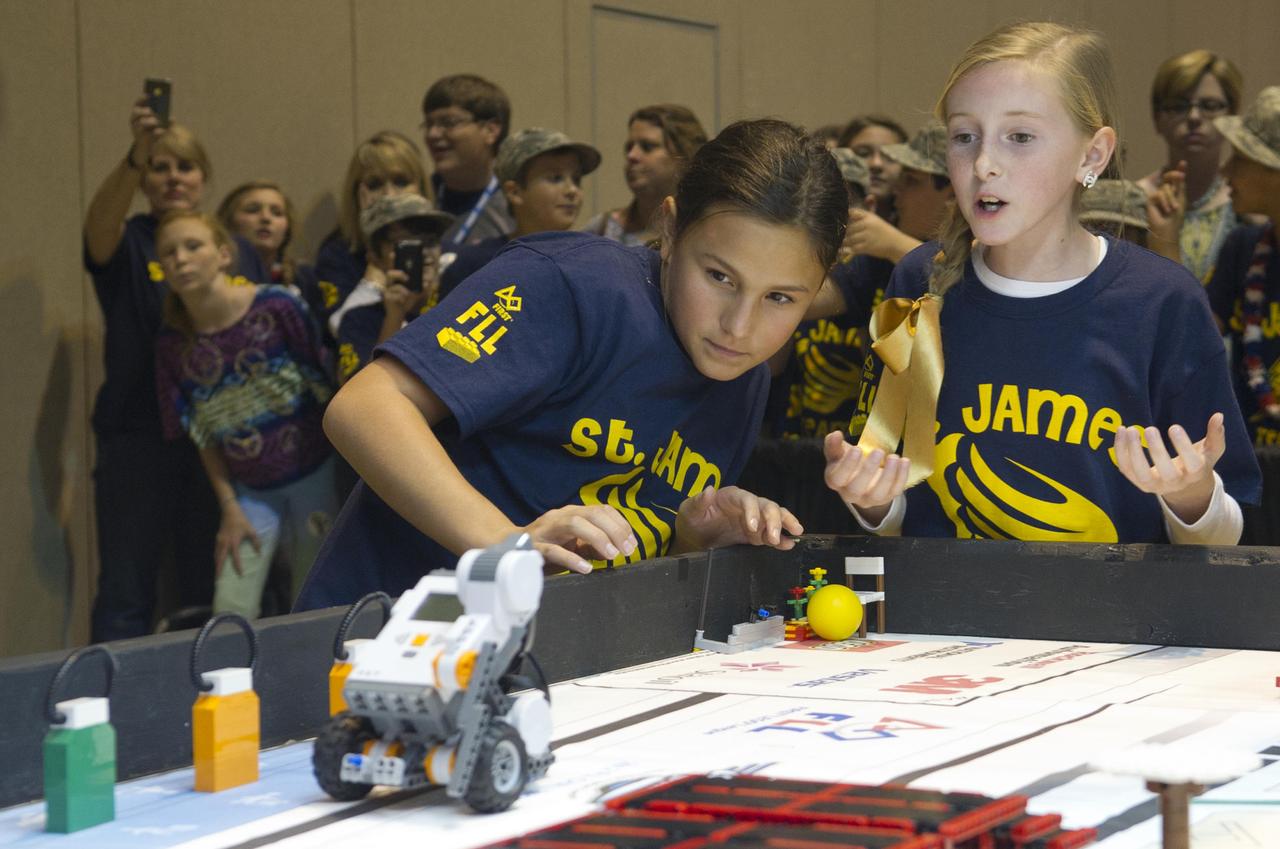
Two students anxiously watch their robot during the 2012 FIRST LEGO League Mississippi Championship Tournament in Hattiesburg, Miss., on Dec. 1. In addition to competing with robots, students presented research on this year's 'Senior Solutions' theme, which focused on addressing problems faced by senior adults.
2012 FIRST LEGO League
Two students anxiously watch their robot during the 2012 FIRST LEGO League Mississippi Championship Tournament in Hattiesburg, Miss., on Dec. 1. In addition to competing with robots, students presented research on this year's 'Senior Solutions' theme, which focused on addressing problems faced by senior adults.
2012 FIRST LEGO League
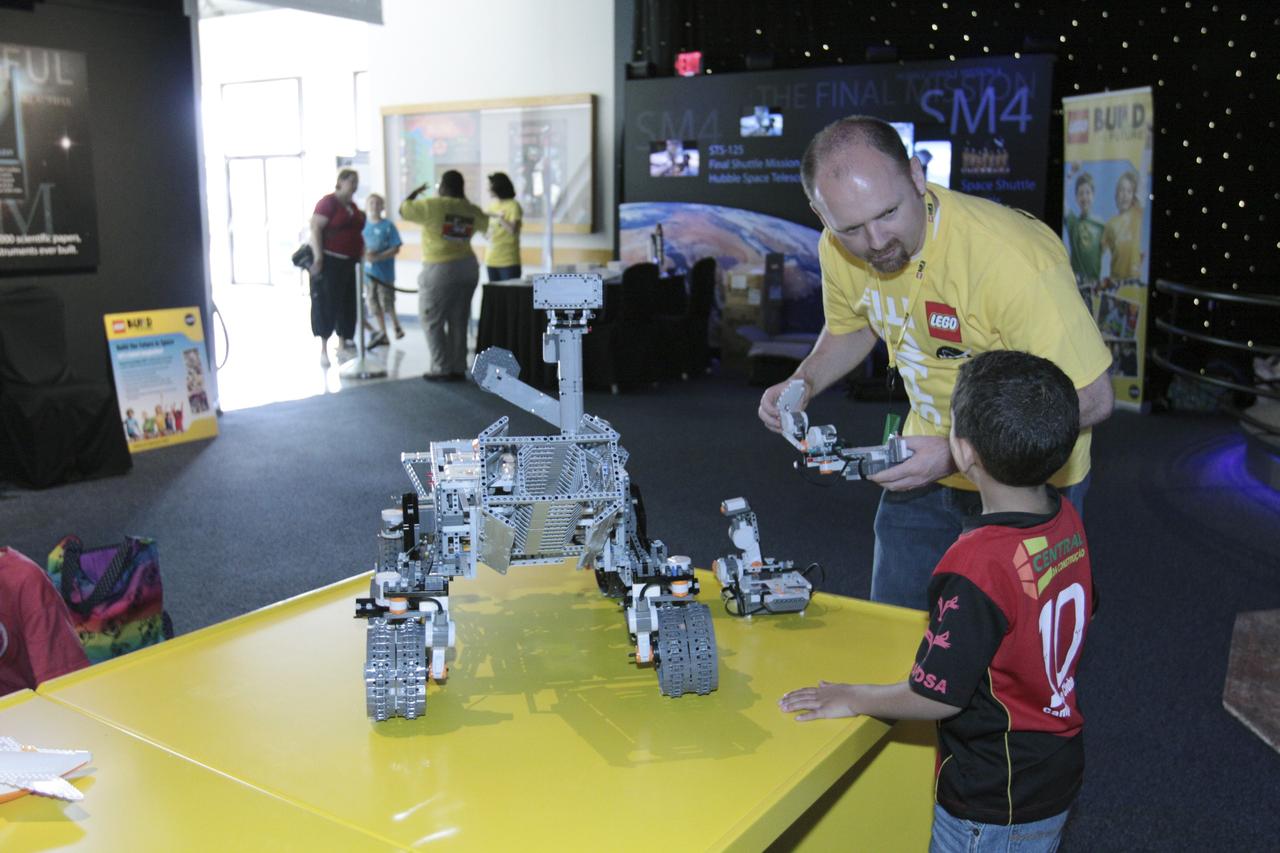
CAPE CANAVERAL, Fla. – LEGO NXT robots, designed to look like Mars rovers, are on display at the LEGO "Build the Future" event at the Kennedy Space Center Visitor Complex in Florida.     The festivities coincide with the launch of NASA's Mars Science Laboratory (MSL), carrying a compact car-sized rover, Curiosity, to the red planet. Part of the Space Act Agreement between NASA and LEGO A/S, the activities are designed to inspire students of every age to consider an education and careers in the science, technology, engineering and mathematics, or STEM, disciplines. Launch of MSL aboard a United Launch Alliance Atlas V rocket is scheduled for Nov. 26 from Space Launch Complex-41 on Cape Canaveral Air Force Station in Florida. For more information, visit http://www.nasa.gov/audience/foreducators/nasa-lego-partnership.html. Photo credit: NASA/Kim Shiflett
KSC-2011-7890
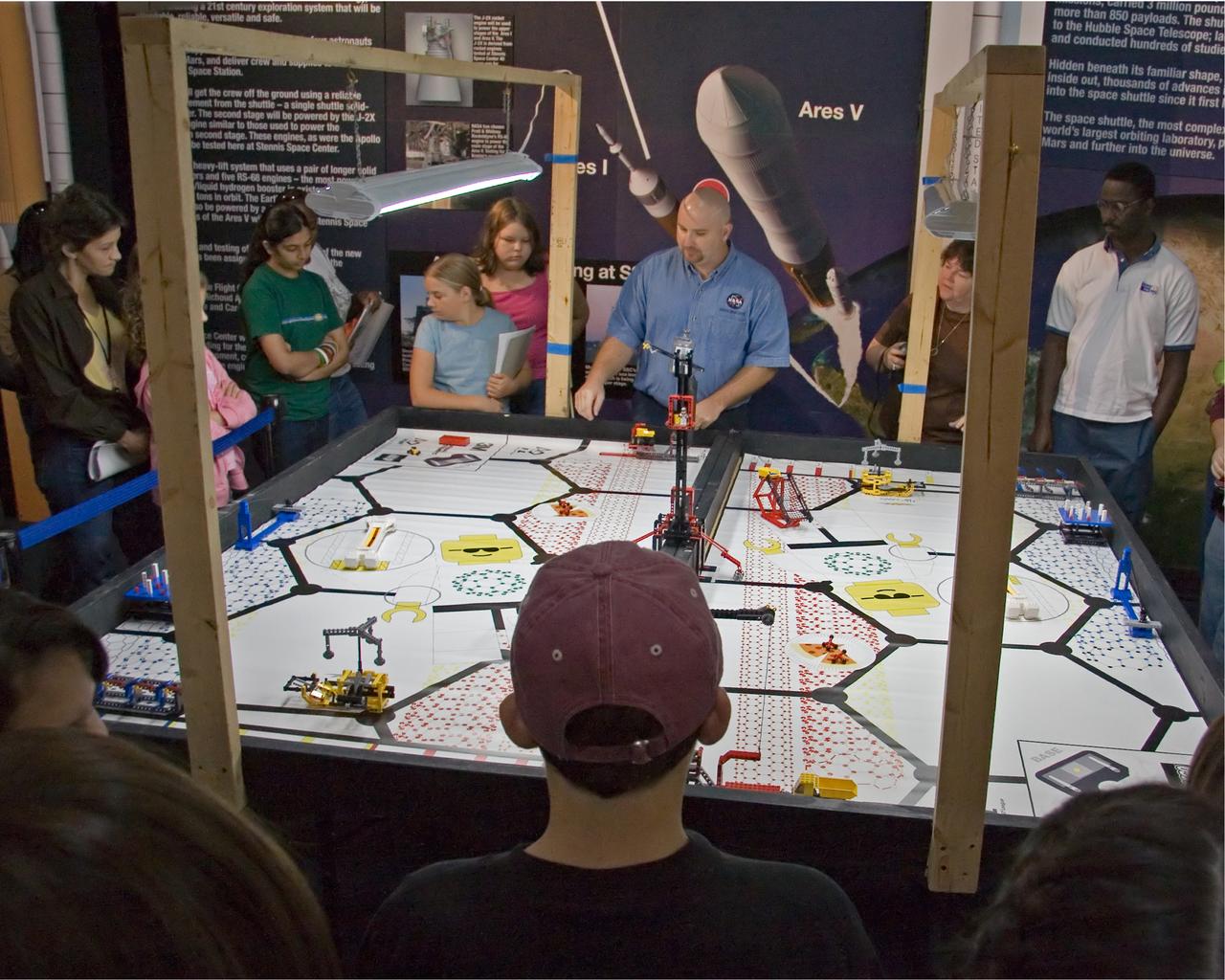
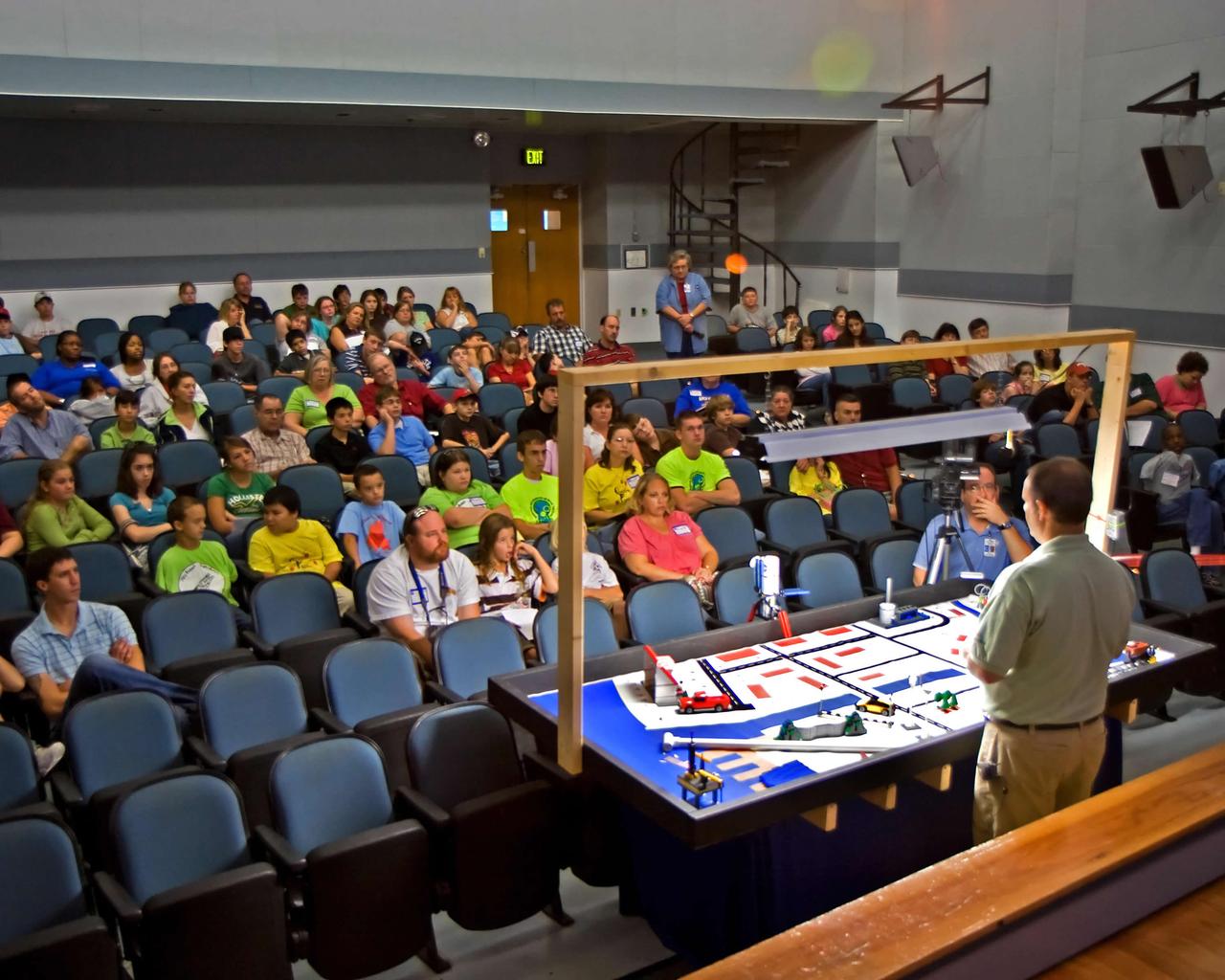
FIRST LEGO League participants listen to Aerospace Education Specialist Chris Copelan explain the playing field for 'Nano Quest' during a recent FLL kickoff event at StenniSphere, the visitor center at NASA Stennis Space Center. The kickoff began the 2006 FLL competition season. Eighty-five teachers, mentors, parents and 9- to 14-year-old students from southern and central Mississippi came to SSC to hear the rules for Nano Quest. The challenge requires teams to spend eight weeks building and programming robots from LEGO Mindstorms kits. They'll battle their creations in local and regional competitions. The Dec. 2 competition at Mississippi Gulf Coast Community College will involve about 200 students. FIRST LEGO League, considered the 'little league' of the FIRST (For Inspiration and Recognition of Science and Technology) Robotics Competition, partners FIRST and the LEGO Group. Competitions aim to inspire and celebrate science and technology using real-world context and hands-on experimentation, and to promote the principles of team play and gracious professionalism. Because NASA advocates robotics and science-technology education, the agency and SSC support FIRST by providing team coaches, mentors and training, as well as competition event judges, referees, audio-visual and other volunteer staff personnel. Two of Mississippi's NASA Explorer Schools, Bay-Waveland Middle and Hattiesburg's Lillie Burney Elementary, were in attendance. The following schools were also represented: Ocean Springs Middle, Pearl Upper Elementary, Long Beach Middle, Jackson Preparatory Academy, North Woolmarket Middle, D'Iberville Middle, West Wortham Middle, Picayune's Roseland Park Baptist Academy and Nicholson Elementary, as well as two home-school groups from McComb and Brandon. Gulfport and Picayune Memorial-Pearl River high schools' FIRST Robotics teams conducted robotics demonstrations for the FLL crowd.
FIRST LEGO League Kickoff
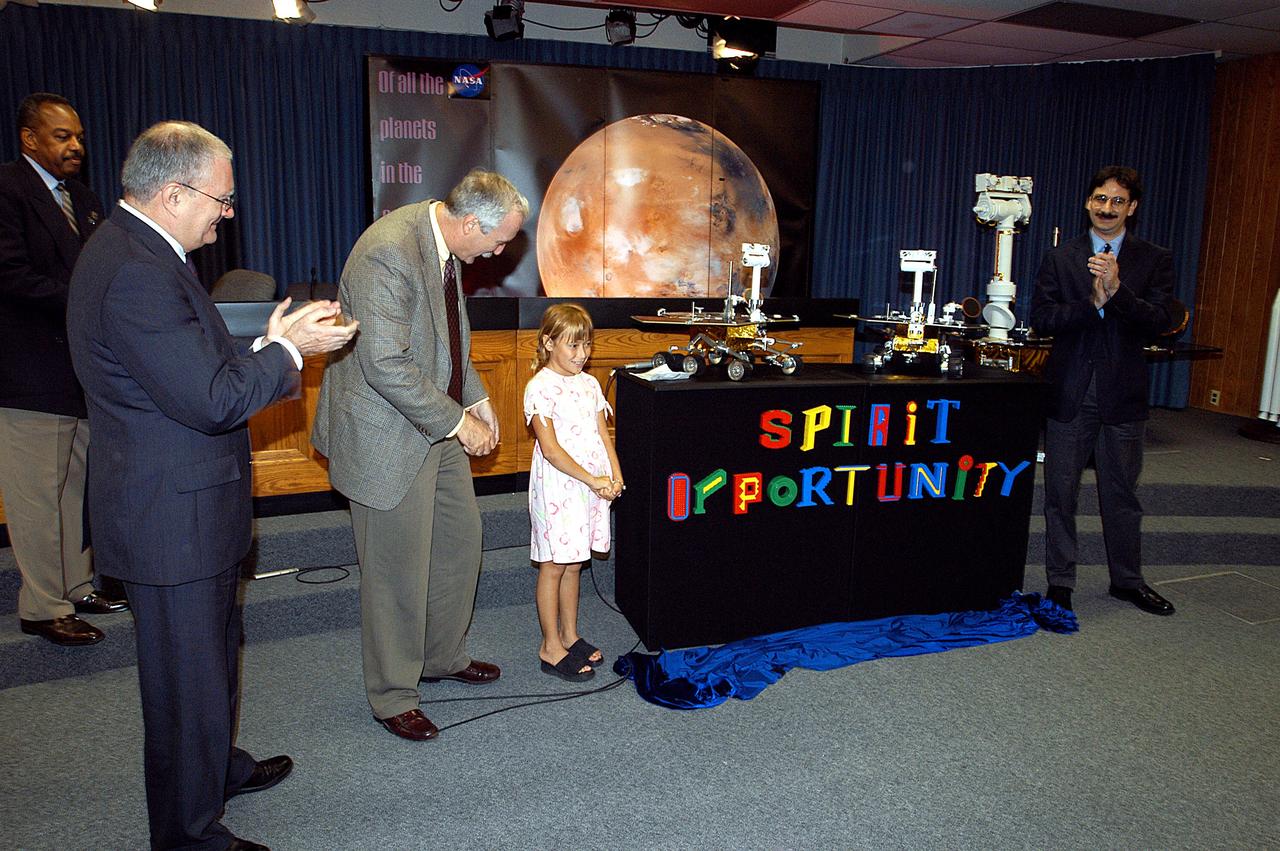
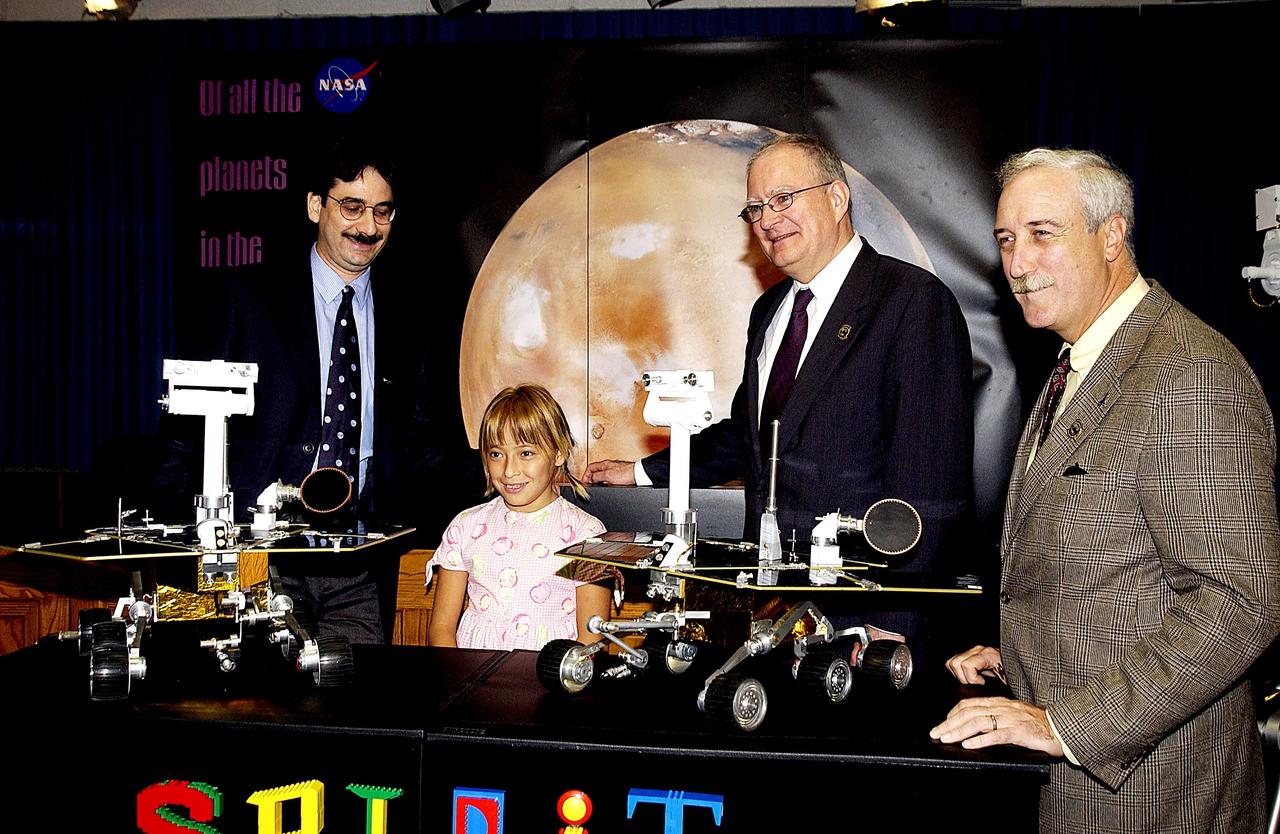
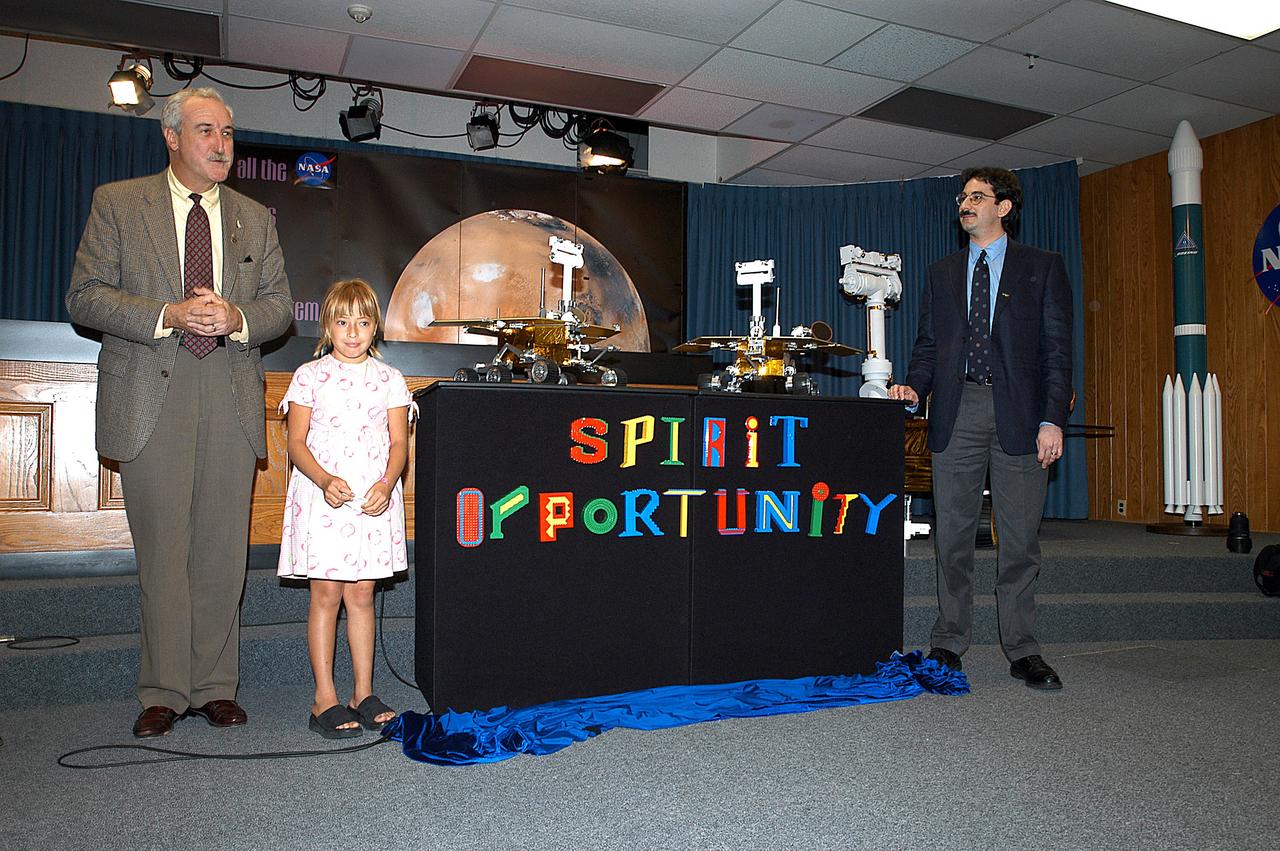
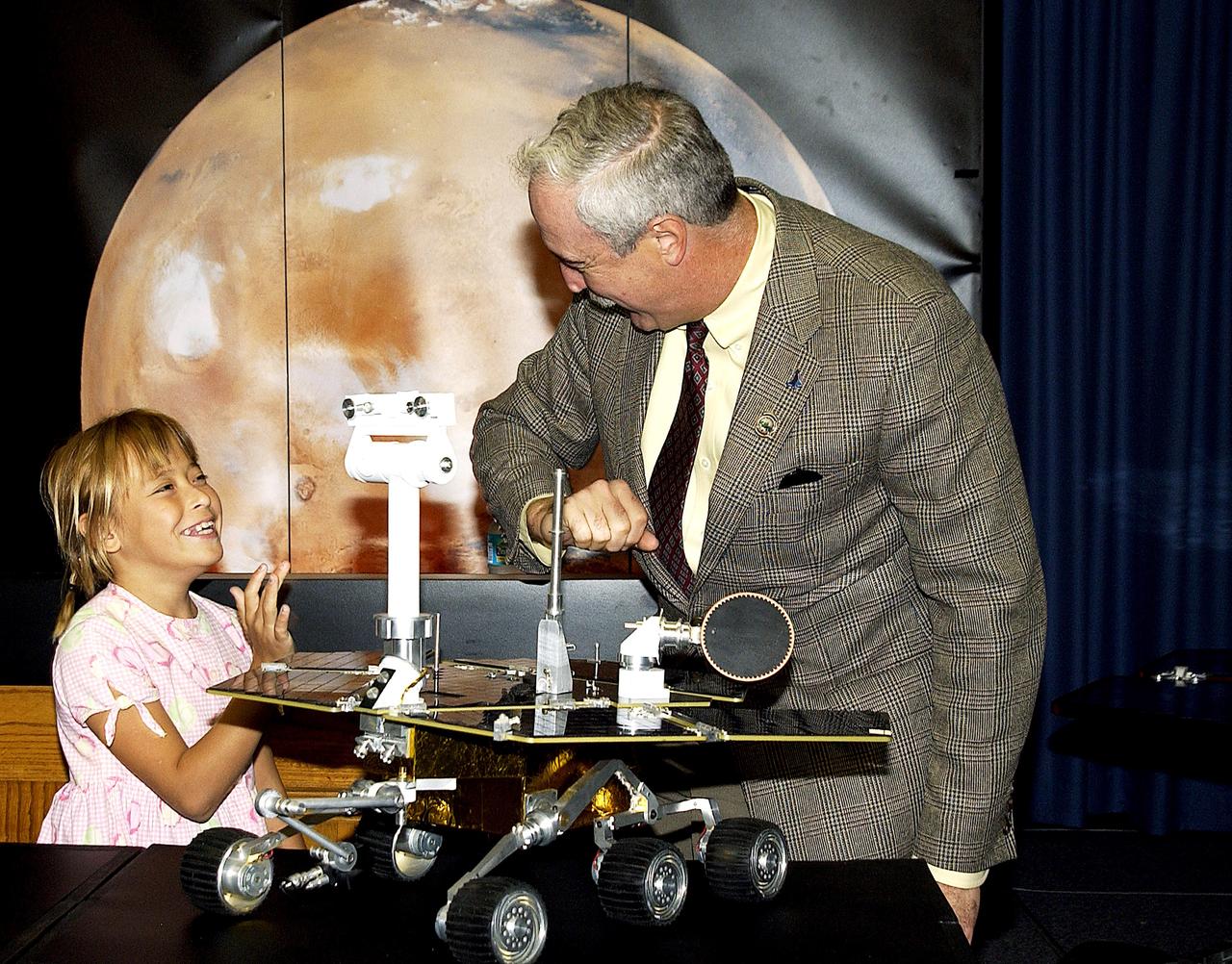
KENNEDY SPACE CENTER, FLA. -  Nine-year-old Sofi Collis proudly presents the names she selected for the Mars Exploration Rovers  -- "Spirit" and "Opportunity" --  during a press conference.  Also participating in the press conference are NASA Administrator Sean O'Keefe (left) and Brad Justus, LEGO Co. senior vice president (right).  The names Sofi suggested were selected from more than 10,000 student entries in an essay contest managed for NASA by the LEGO Company.   NASA's twin Mars Exploration Rovers are designed to study the history of water on Mars. These robotic geologists are equipped with a robotic arm, a drilling tool, three spectrometers, and four pairs of cameras that allow them to have a human-like, 3D view of the terrain. Each rover could travel as far as 100 meters in one day to act as Mars scientists' eyes and hands, exploring an environment where humans are not yet able to go. MER-A, with the rover Spirit aboard, is scheduled to launch on June 8 at 2:06 p.m. EDT, with two launch opportunities each day during a launch period that closes on June 24.
KENNEDY SPACE CENTER, FLA. - Nine-year-old Sofi Collis proudly presents the names she selected for the Mars Exploration Rovers -- "Spirit" and "Opportunity" -- during a press conference. Also participating in the press conference are NASA Administrator Sean O'Keefe (left) and Brad Justus, LEGO Co. senior vice president (right). The names Sofi suggested were selected from more than 10,000 student entries in an essay contest managed for NASA by the LEGO Company. NASA's twin Mars Exploration Rovers are designed to study the history of water on Mars. These robotic geologists are equipped with a robotic arm, a drilling tool, three spectrometers, and four pairs of cameras that allow them to have a human-like, 3D view of the terrain. Each rover could travel as far as 100 meters in one day to act as Mars scientists' eyes and hands, exploring an environment where humans are not yet able to go. MER-A, with the rover Spirit aboard, is scheduled to launch on June 8 at 2:06 p.m. EDT, with two launch opportunities each day during a launch period that closes on June 24.
KENNEDY SPACE CENTER, FLA. -  Nine-year-old Sofi Collis unveils the names of the Mars Exploration Rovers  -- "Spirit" and "Opportunity" --  during a press conference.  Participating in the press conference are, from left, Dr. John Marburger, science advisor to the President and director of the Office of Science and Technology Policy; NASA Administrator Sean O'Keefe; Sofi Collis, a third grade student from Arizona; and Brad Justus, LEGO Co. senior vice president.  The names Sofi suggested were selected from more than 10,000 student entries in an essay contest managed for NASA by the LEGO Company.   NASA's twin Mars Exploration Rovers are designed to study the history of water on Mars. These robotic geologists are equipped with a robotic arm, a drilling tool, three spectrometers, and four pairs of cameras that allow them to have a human-like, 3D view of the terrain. Each rover could travel as far as 100 meters in one day to act as Mars scientists' eyes and hands, exploring an environment where humans are not yet able to go. MER-A, with the rover Spirit aboard, is scheduled to launch on June 8 at 2:06 p.m. EDT, with two launch opportunities each day during a launch period that closes on June 24.
KENNEDY SPACE CENTER, FLA. - Nine-year-old Sofi Collis unveils the names of the Mars Exploration Rovers -- "Spirit" and "Opportunity" -- during a press conference. Participating in the press conference are, from left, Dr. John Marburger, science advisor to the President and director of the Office of Science and Technology Policy; NASA Administrator Sean O'Keefe; Sofi Collis, a third grade student from Arizona; and Brad Justus, LEGO Co. senior vice president. The names Sofi suggested were selected from more than 10,000 student entries in an essay contest managed for NASA by the LEGO Company. NASA's twin Mars Exploration Rovers are designed to study the history of water on Mars. These robotic geologists are equipped with a robotic arm, a drilling tool, three spectrometers, and four pairs of cameras that allow them to have a human-like, 3D view of the terrain. Each rover could travel as far as 100 meters in one day to act as Mars scientists' eyes and hands, exploring an environment where humans are not yet able to go. MER-A, with the rover Spirit aboard, is scheduled to launch on June 8 at 2:06 p.m. EDT, with two launch opportunities each day during a launch period that closes on June 24.
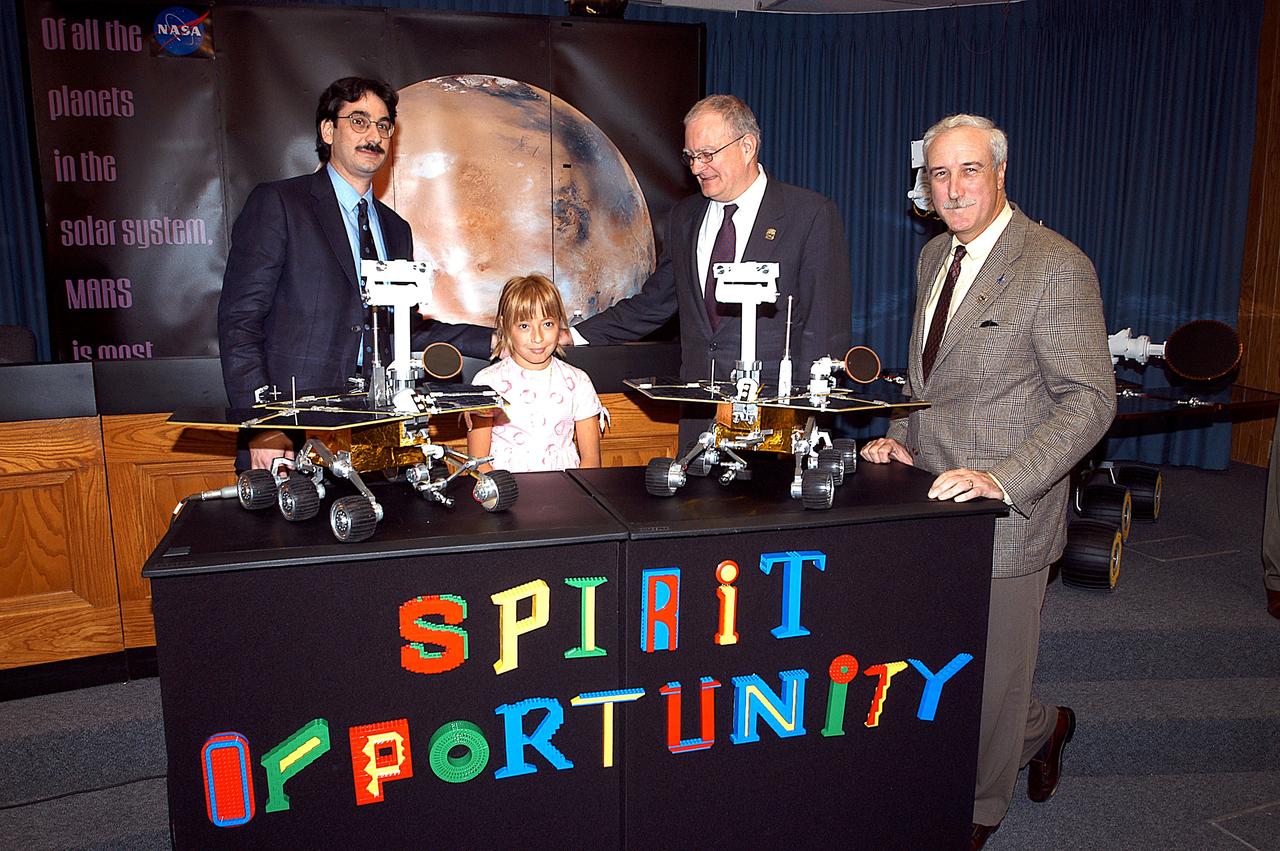
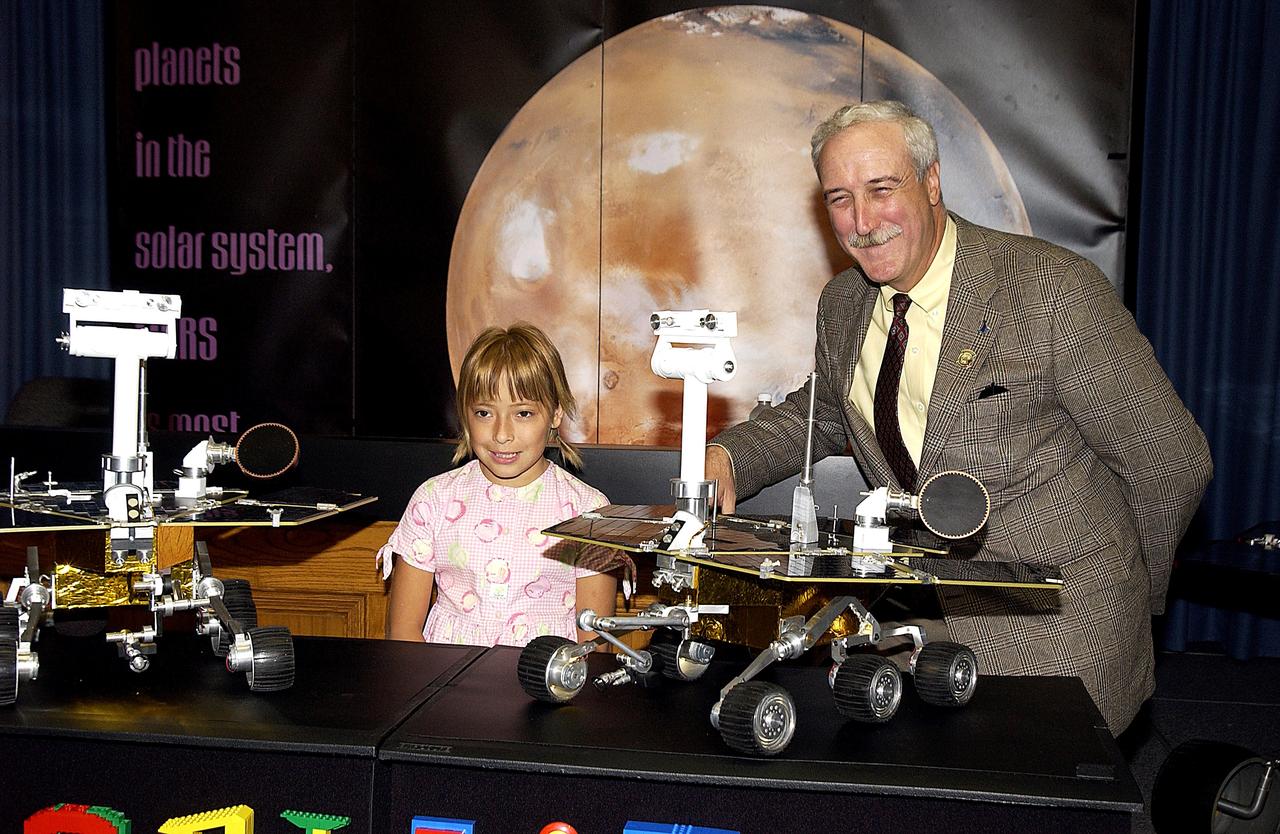
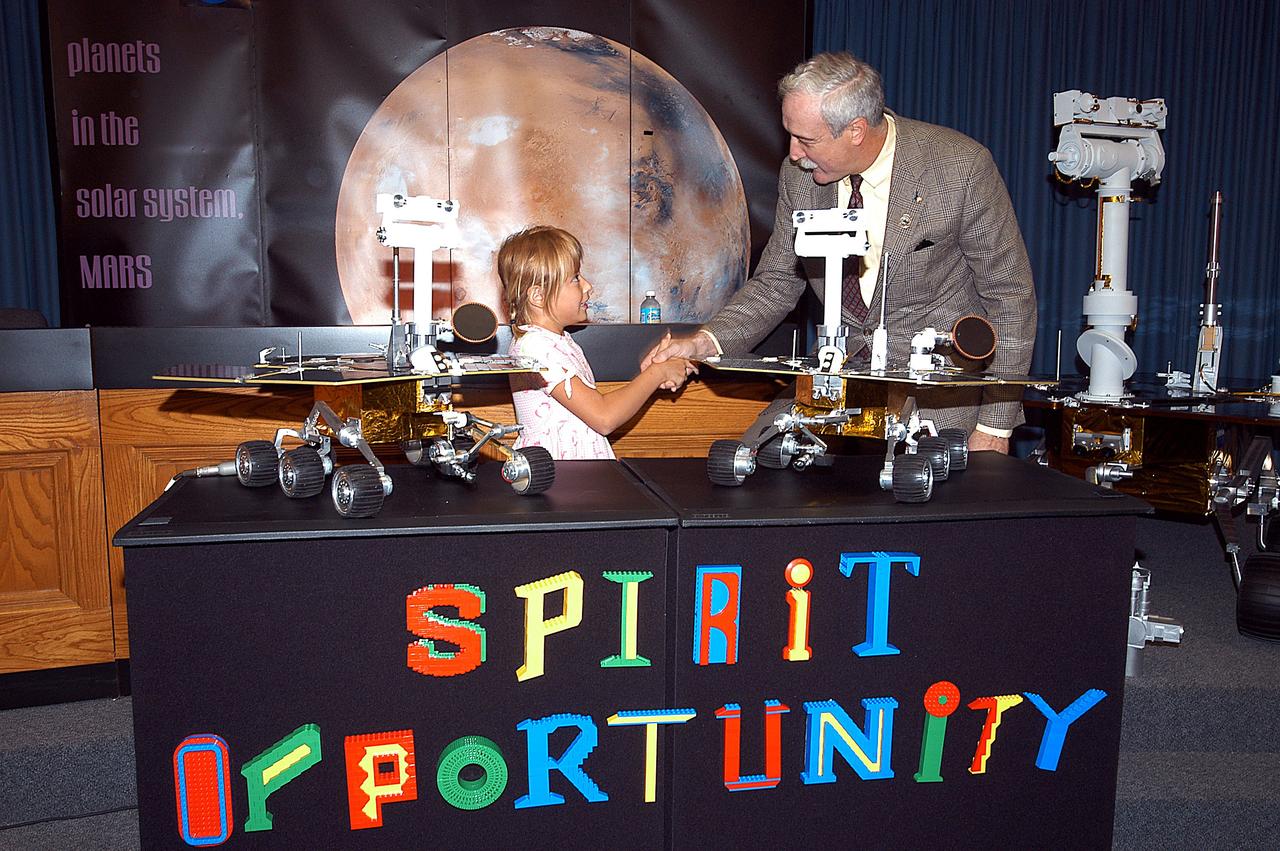
KENNEDY SPACE CENTER, FLA. -  Nine-year-old Sofi Collis poses proudly with a banner displaying the names she selected for the Mars Exploration Rovers -- "Spirit" and "Opportunity" -- during a press conference. Participating in the press conference are, from left, Brad Justus, LEGO Co. senior vice president; Sofi Collis, third grade student from Arizona; Dr. John Marburger, science advisor to the President and director of the Office of Science and Technology Policy; and NASA Administrator Sean O'Keefe. The names Sofi suggested were selected from more than 10,000 student entries in an essay contest managed for NASA by the LEGO Company. NASA's twin Mars Exploration Rovers are designed to study the history of water on Mars. These robotic geologists are equipped with a robotic arm, a drilling tool, three spectrometers, and four pairs of cameras that allow them to have a human-like, 3D view of the terrain. Each rover could travel as far as 100 meters in one day to act as Mars scientists' eyes and hands, exploring an environment where humans are not yet able to go. MER-A, with the rover Spirit aboard, is scheduled to launch on June 8 at 2:06 p.m. EDT, with two launch opportunities each day during a launch period that closes on June 24.
KENNEDY SPACE CENTER, FLA. - Nine-year-old Sofi Collis poses proudly with a banner displaying the names she selected for the Mars Exploration Rovers -- "Spirit" and "Opportunity" -- during a press conference. Participating in the press conference are, from left, Brad Justus, LEGO Co. senior vice president; Sofi Collis, third grade student from Arizona; Dr. John Marburger, science advisor to the President and director of the Office of Science and Technology Policy; and NASA Administrator Sean O'Keefe. The names Sofi suggested were selected from more than 10,000 student entries in an essay contest managed for NASA by the LEGO Company. NASA's twin Mars Exploration Rovers are designed to study the history of water on Mars. These robotic geologists are equipped with a robotic arm, a drilling tool, three spectrometers, and four pairs of cameras that allow them to have a human-like, 3D view of the terrain. Each rover could travel as far as 100 meters in one day to act as Mars scientists' eyes and hands, exploring an environment where humans are not yet able to go. MER-A, with the rover Spirit aboard, is scheduled to launch on June 8 at 2:06 p.m. EDT, with two launch opportunities each day during a launch period that closes on June 24.
KENNEDY SPACE CENTER, FLA. -  Nine-year-old Sofi Collis poses proudly with a banner displaying the names she selected for the Mars Exploration Rovers -- "Spirit" and "Opportunity" -- during a press conference. Participating in the press conference are, from left, Brad Justus, LEGO Co. senior vice president; Sofi Collis, a third grade student from Arizona; Dr. John Marburger, science advisor to the President and director of the Office of Science and Technology Policy; and NASA Administrator Sean O'Keefe. The names Sofi suggested were selected from more than 10,000 student entries in an essay contest managed for NASA by the LEGO Company. NASA's twin Mars Exploration Rovers are designed to study the history of water on Mars. These robotic geologists are equipped with a robotic arm, a drilling tool, three spectrometers, and four pairs of cameras that allow them to have a human-like, 3D view of the terrain. Each rover could travel as far as 100 meters in one day to act as Mars scientists' eyes and hands, exploring an environment where humans are not yet able to go. MER-A, with the rover Spirit aboard, is scheduled to launch on June 8 at 2:06 p.m. EDT, with two launch opportunities each day during a launch period that closes on June 24.
KENNEDY SPACE CENTER, FLA. - Nine-year-old Sofi Collis poses proudly with a banner displaying the names she selected for the Mars Exploration Rovers -- "Spirit" and "Opportunity" -- during a press conference. Participating in the press conference are, from left, Brad Justus, LEGO Co. senior vice president; Sofi Collis, a third grade student from Arizona; Dr. John Marburger, science advisor to the President and director of the Office of Science and Technology Policy; and NASA Administrator Sean O'Keefe. The names Sofi suggested were selected from more than 10,000 student entries in an essay contest managed for NASA by the LEGO Company. NASA's twin Mars Exploration Rovers are designed to study the history of water on Mars. These robotic geologists are equipped with a robotic arm, a drilling tool, three spectrometers, and four pairs of cameras that allow them to have a human-like, 3D view of the terrain. Each rover could travel as far as 100 meters in one day to act as Mars scientists' eyes and hands, exploring an environment where humans are not yet able to go. MER-A, with the rover Spirit aboard, is scheduled to launch on June 8 at 2:06 p.m. EDT, with two launch opportunities each day during a launch period that closes on June 24.
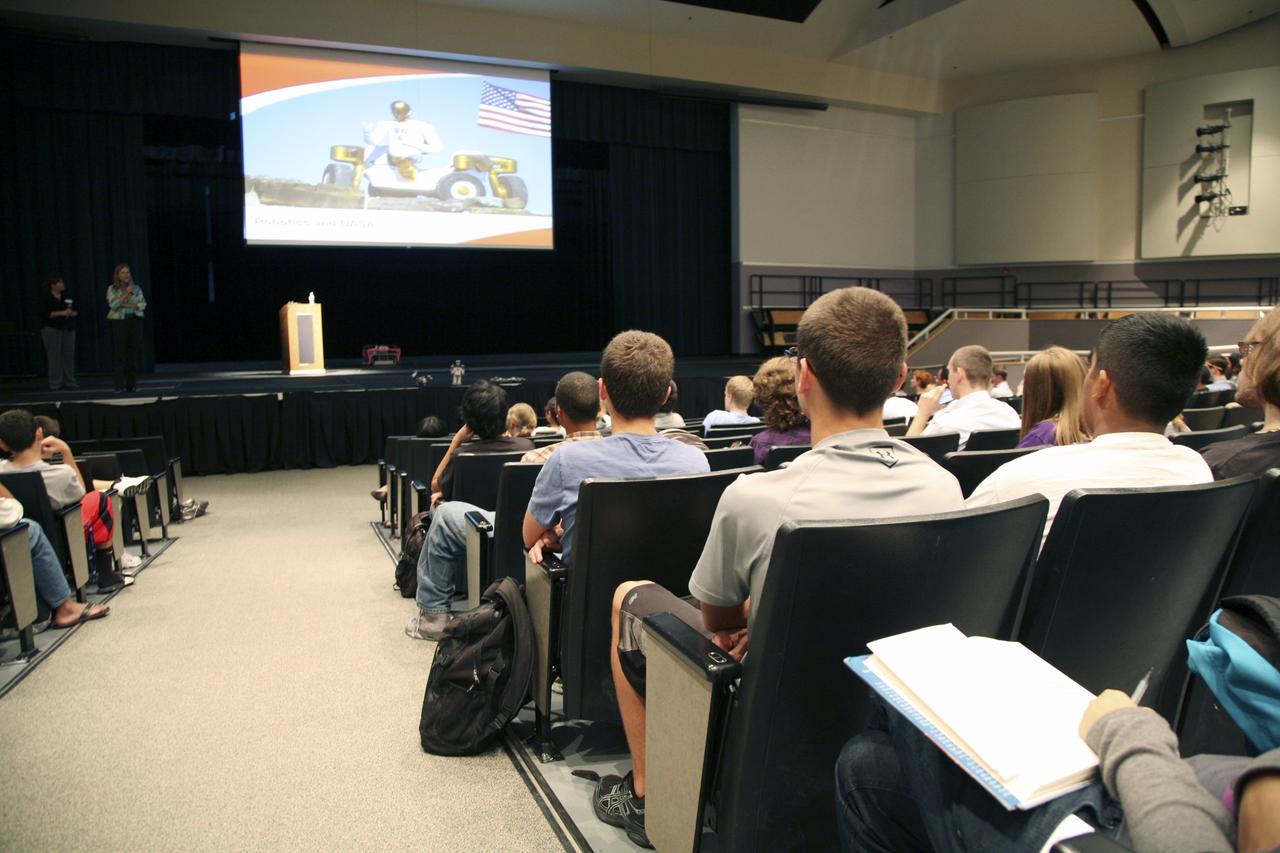
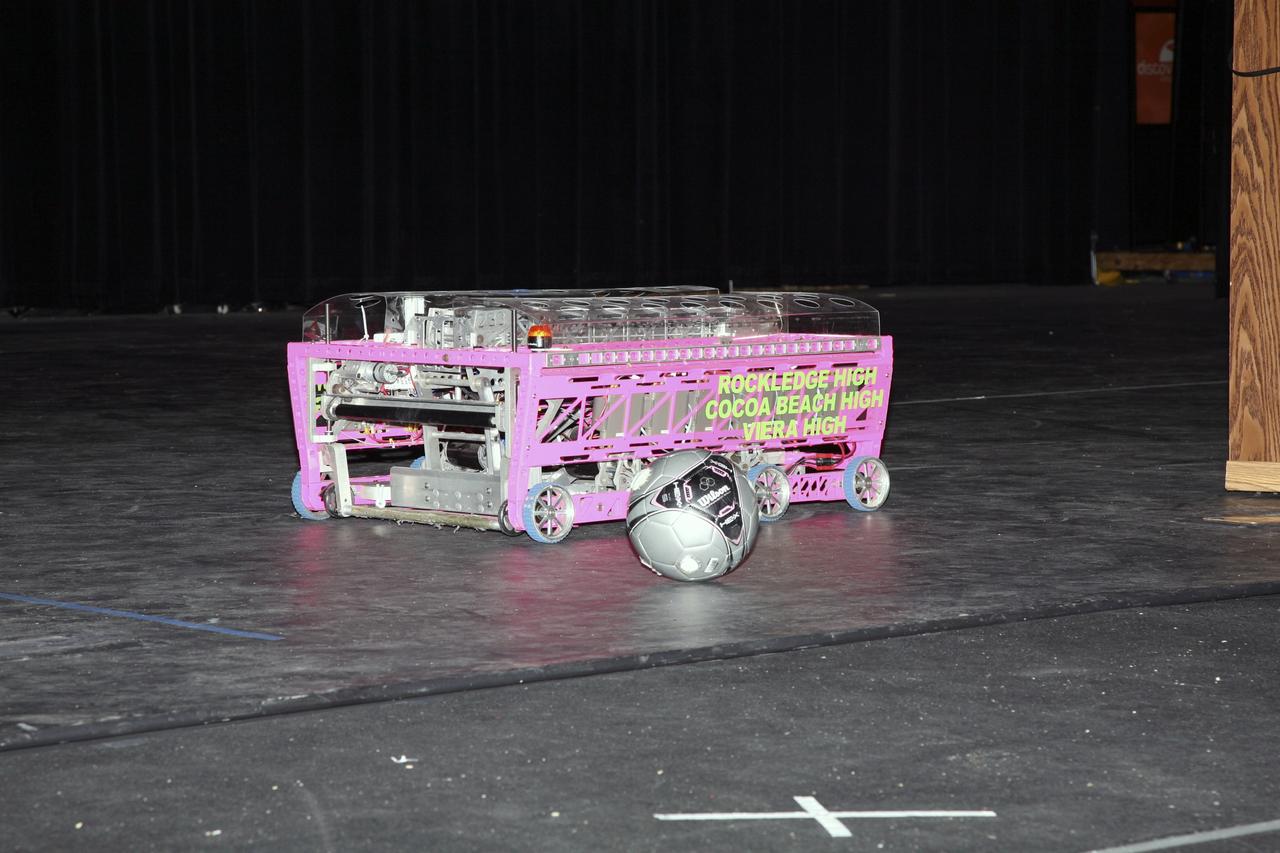
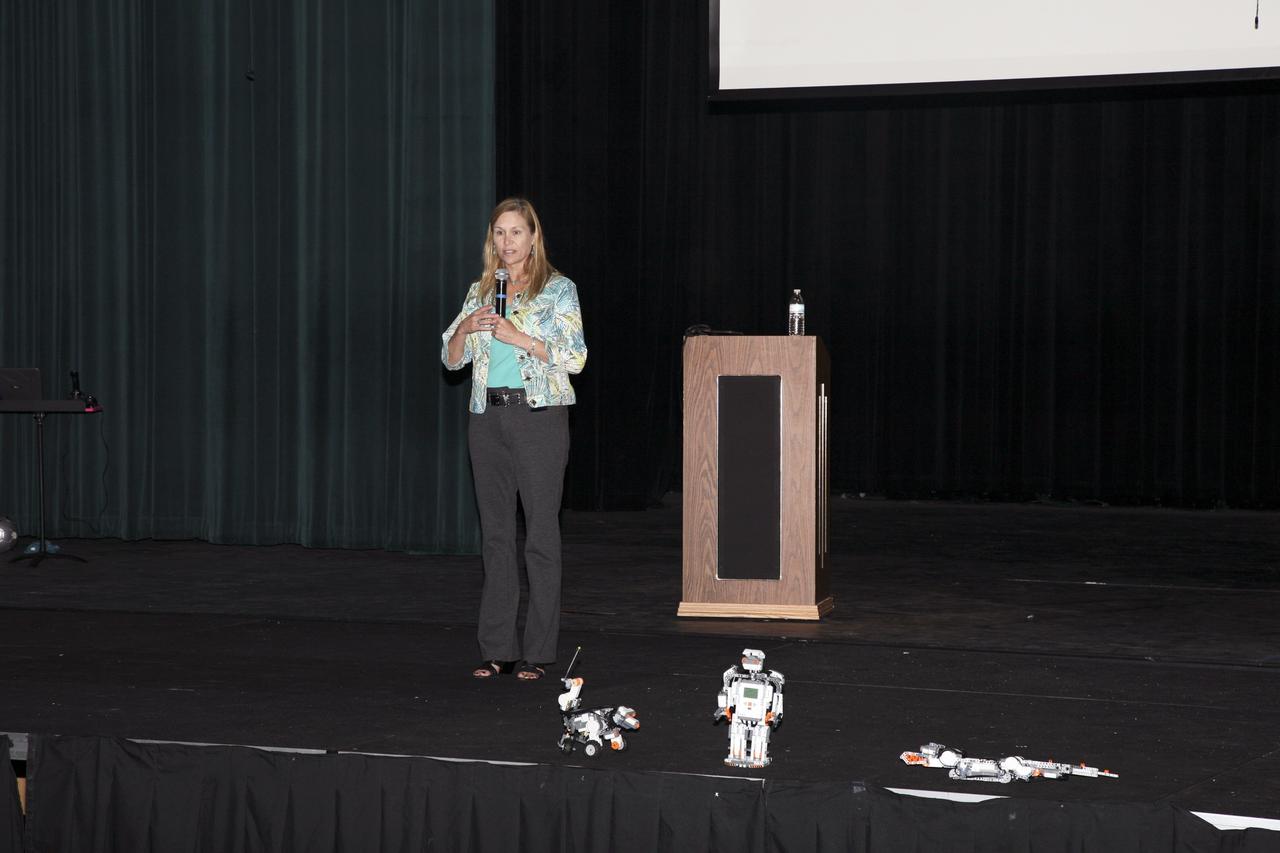
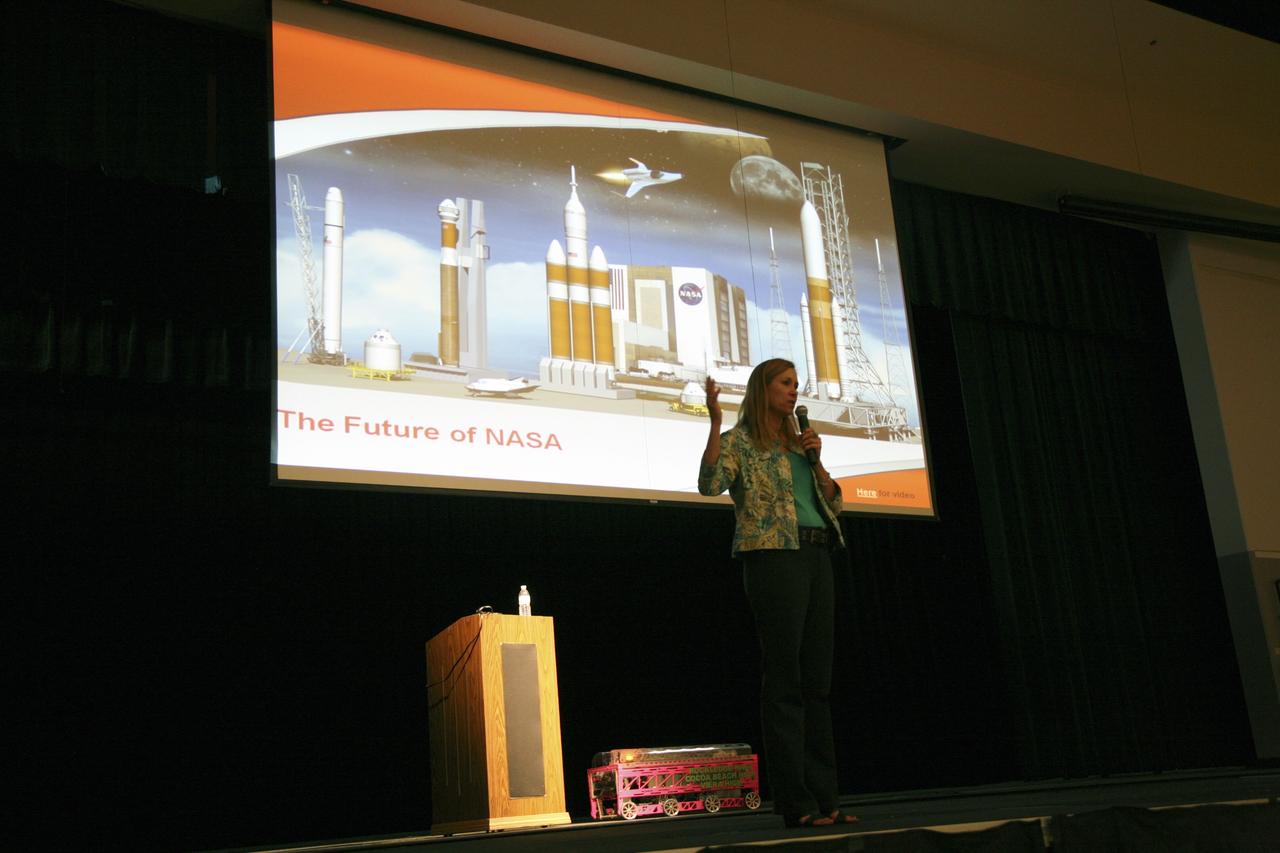
CAPE CANAVERAL, Fla. -- -- NASA Kennedy Space Center Deputy Director Janet Petro addresses pre-calculus, engineering, and physics students at Timber Creek High School in Orlando, Fla., on the future of the center during an education outreach event on Nov. 16 in the school’s Performing Arts Center. Students also had the opportunity to view FIRST Robotics robot in action and learned about Kennedy’s Educate to Innovate (KETI) LEGO Mindstorm activities. Photo credit: NASA/Gianni Woods
KSC-2011-7825
CAPE CANAVERAL, Fla. -- Pre-calculus, engineering, and physics students at Timber Creek High School in Orlando, Fla., had the opportunity to view a FIRST robotics robot demonstration during an education outreach event on Nov. 16 in the school’s Performing Arts Center. Students, heard from NASA Kennedy Space Center Deputy Director Janet Petro about work being done at the center, and learned about Kennedy’s Educate to Innovate (KETI) LEGO Mindstorm activities. Photo credit: NASA/Gianni Woods
KSC-2011-7826
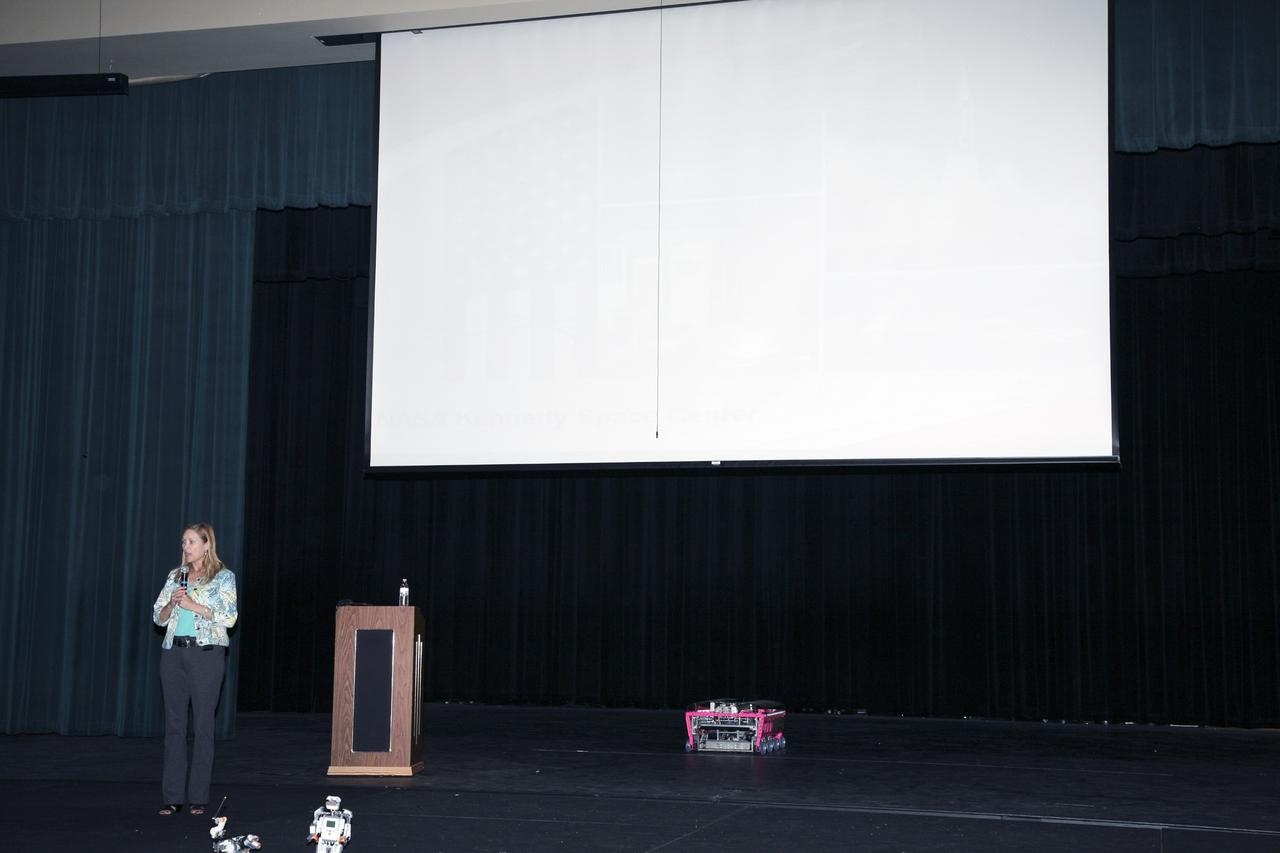
CAPE CANAVERAL, Fla. -- -- Pre-calculus, engineering, and physics students at Timber Creek High School in Orlando, Fla., listen to NASA Kennedy Space Center Deputy Director Janet Petro speak on work being done at the center during an education outreach event on Nov. 16 in the school’s Performing Arts Center. Students also had the opportunity to view a FIRST Robotics robot in action and learn about Kennedy’s Educate to Innovate (KETI) LEGO Mindstorm activities. Photo credit: NASA/Gianni Woods
KSC-2011-7823
CAPE CANAVERAL, Fla. -- -- NASA Kennedy Space Center Deputy Director Janet Petro addresses pre-calculus, engineering and physics students at Timber Creek High School, in Orlando, Fla., on work being done at the center during an education outreach event on Nov. 16. Students also had the opportunity to view a FIRST Robotics robot in action, and learn about Kennedy’s Educate to Innovate (KETI) LEGO Mindstorm activities in the school’s Performing Arts Center. Photo credit: NASA/Gianni Woods
KSC-2011-7821
CAPE CANAVERAL, Fla. -- -- Pre-calculus, engineering, and physics students at Timber Creek High School in Orlando, Fla., had the opportunity to view a FIRST robotics robot demonstration during an education outreach event on Nov. 16 in the school’s Performing Arts Center. Students, heard from NASA Kennedy Space Center Deputy Director Janet Petro about work being done at the center, and also learned about Kennedy’s Educate to Innovate (KETI) LEGO Mindstorm activities. Photo credit: NASA/Gianni Woods
KSC-2011-7824
CAPE CANAVERAL, Fla. -- -- NASA Kennedy Space Center Deputy Director Janet Petro addresses pre-calculus, engineering and physics students at Timber Creek High School, in Orlando, Fla., on work being done at the center during an education outreach event on Nov. 16. Students also had the opportunity to view a FIRST Robotics robot in action, and learn about Kennedy’s Educate to Innovate (KETI) LEGO Mindstorm activities in the school’s Performing Arts Center. Photo credit: NASA/Gianni Woods
KSC-2011-7822
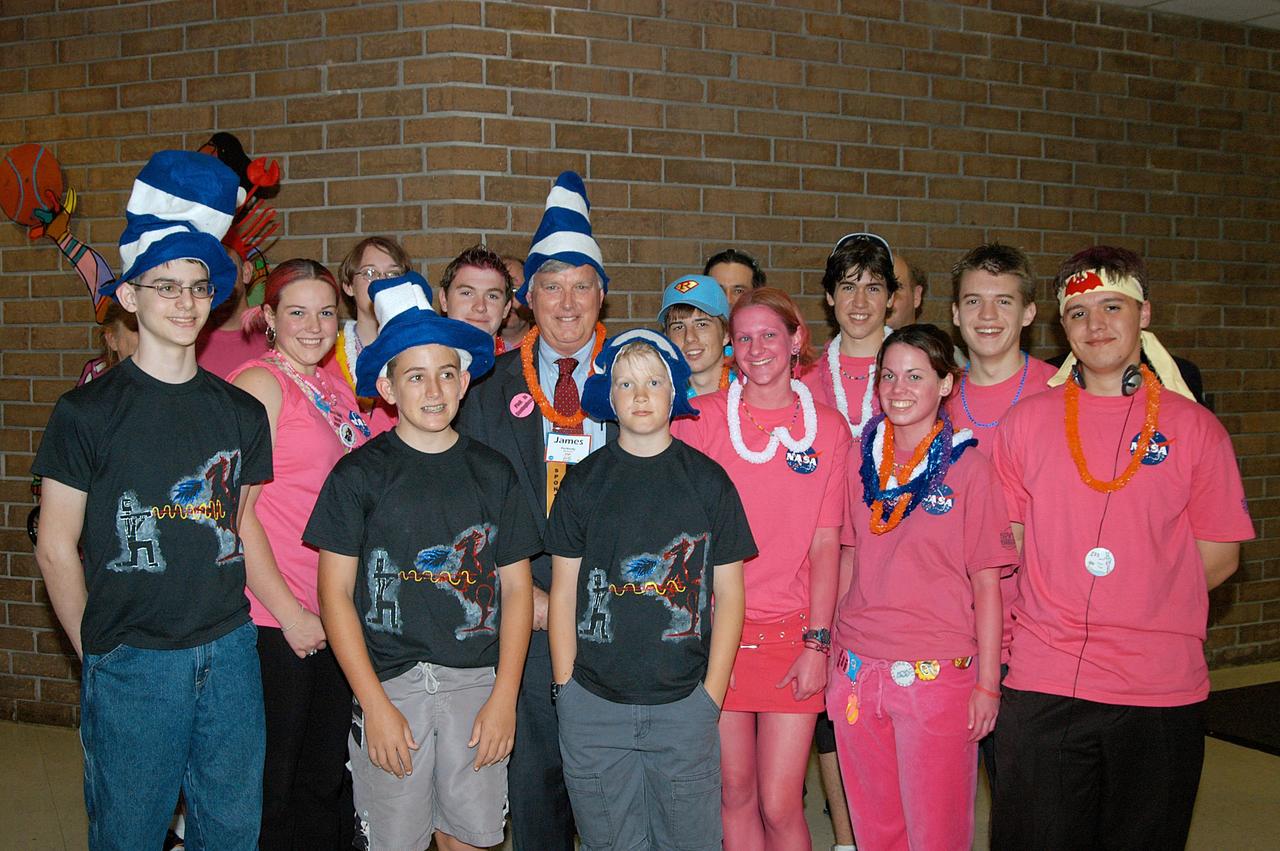
KENNEDY SPACE CENTER, FLA. -  Center Director Jim Kennedy (center) poses for a photo amid the members of the KSC-sponsored “Pink” team and the FIRST LEGO™ League at the 2004 Florida Regional FIRST competition, held at the University of Central Florida.  The annual event is hosting 41 teams from Canada, Brazil, Great Britain and the United States. FIRST is a nonprofit organization, For Inspiration and Recognition of Science and Technology, that sponsors the event pitting gladiator robots against each other in an athletic-style competition. The FIRST robotics competition is designed to provide students with a hands-on, inside look at engineering and other professional careers, pairing high school students with engineer mentors and corporations.
KSC-04pd0499
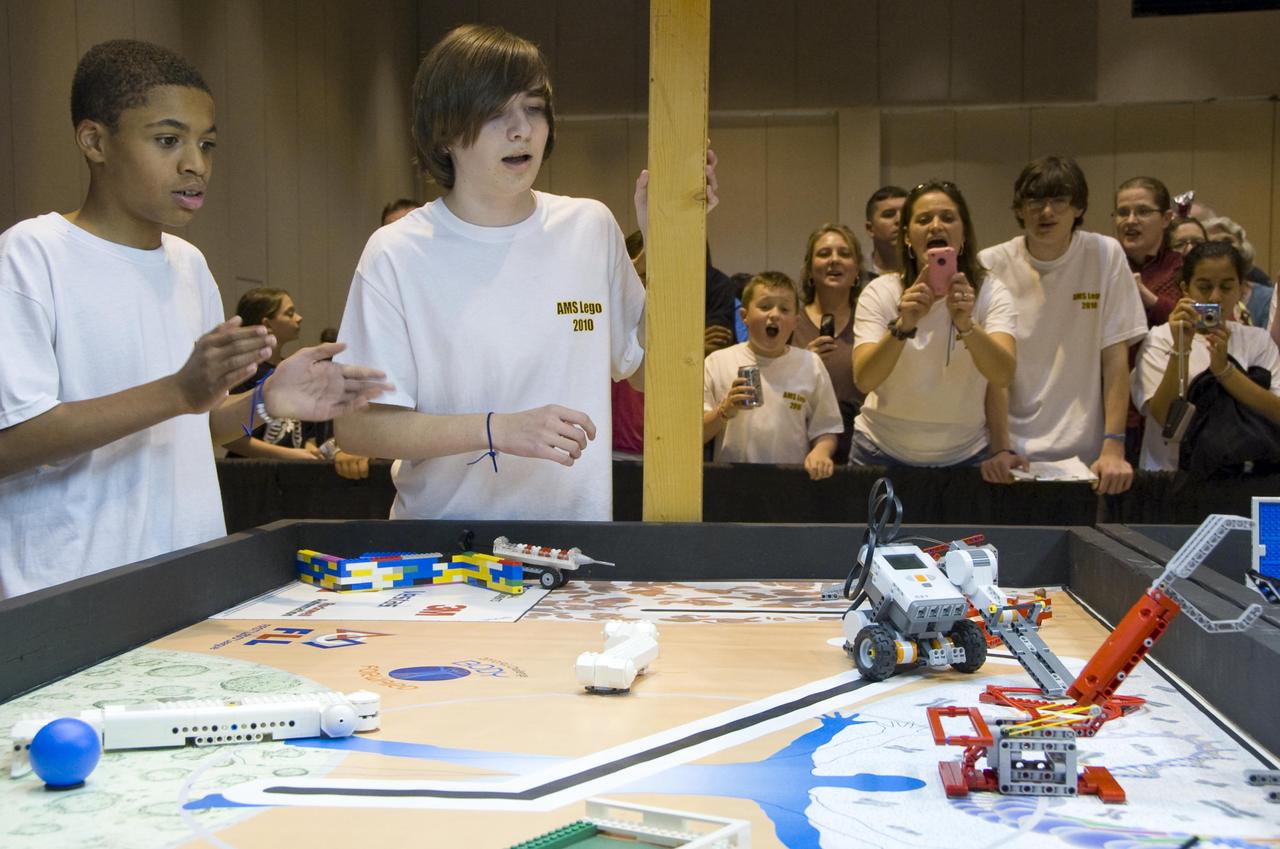
Randall Hicks (right), Jacobs Technology's Education Services manager at NASA John C. Stennis Space Center, answers questions about the playing field for FIRST (For Inspiration and Recognition of Science and Technology) LEGO League's 2007 Challenge, `Power Puzzle.' More than 140 teachers, mentors, parents and students from 15 schools attended the Sept. 15 FLL season kickoff at StenniSphere, the visitor center at SSC. The teams from southern and central Mississippi and Mobile, Ala., who came to SSC heard rules for and asked questions about `Power Puzzle,' and saw robot demonstrations by Gulfport and Picayune high schools' past FIRST Robotics competitions. Using LEGO Mindstorms NXT kits, FLL teams of children ages 9-14 will spend the next three months building and programming robots to perform 'Power Puzzle's' challenge tasks, then pit them in competitions. They also will submit a research project about how energy choices impact the environment and the economy. The season will culminate at the Mississippi Championship Tournament on Dec. 8 at the Mississippi Gulf Coast Community College. FLL, considered the `little league' of the FIRST Robotics Competition, partners FIRST and the LEGO Group. Competitions aim to inspire and celebrate science and technology using real-world context and hands-on experimentation. NASA recognizes FIRST activities as an excellent hands-on method to increase student knowledge of science, engineering, technology and mathematics. Schools represented in this year's kickoff were: Madison Avenue Upper Elementary, the Mississippi Band of Choctaw Indians' Conehatta Elementary, Hattiesburg's Lillie Burney Elementary, Pearl Upper Elementary, Long Beach Middle, Oktibehha Elementary, d'Iberville Middle, Saucier's West Wortham Middle, Picayune's Nicholson Elementary and Roseland Park Baptist Church Academy, Bay St. Louis' St. Stanislaus College and Mobile's Davidson High, as well as two home-school groups from the Jackson area.
FIRST LEGO League Kickoff
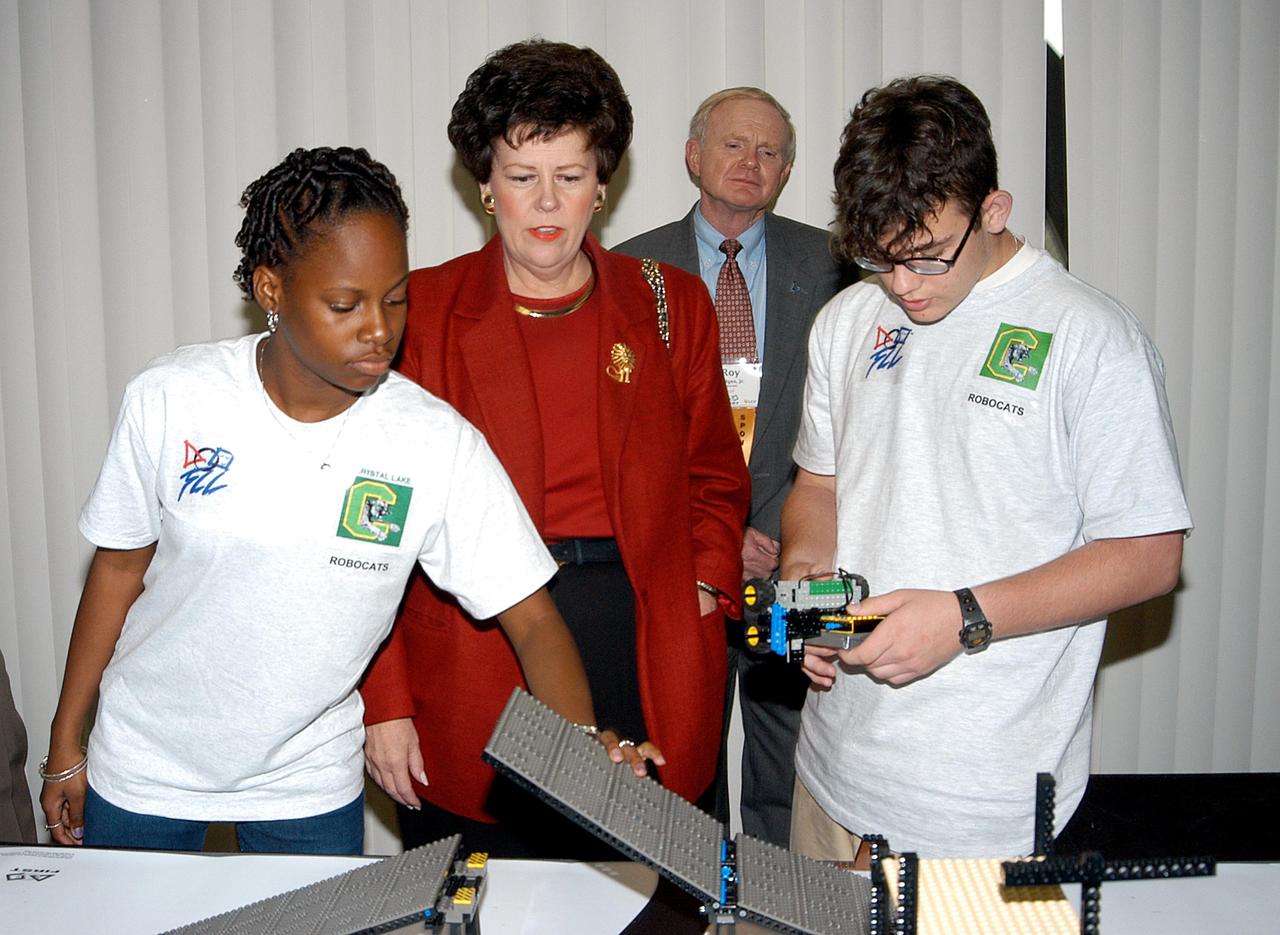
KENNEDY SPACE CENTER, FLA. -  NASA/Kennedy Space Center Director Roy Bridges (background) observes as Florida Lt. Gov. Toni Jennings interacts with students at a display of space structures built from Lego blocks at the 2003 Southeastern Regional FIRST Robotic Competition. The competition is being held at the University of Central Florida (UCF) in Orlando, March 20-23. Forty student teams from around the country are participating in the event that pits team-built gladiator robots against each other in an athletic-style competition. The teams are sponsored by NASA/Kennedy Space Center, The Boeing Company/Brevard Community College, and Lockheed Martin Space Operations/Mission Systems for the nonprofit organization For Inspiration and Recognition of Science and Technology, known as FIRST. The vision of FIRST is to inspire in the youth of our nation an appreciation of science and technology and an understanding that mastering these disciplines can enrich the lives of all mankind.
KSC-03pd0811
KENNEDY SPACE CENTER, FLA. -  Nine-year-old Sofi Collis (left) is introduced to the media by NASA Administrator Sean O'Keefe at a press conference.   The Siberian-born Arizona resident wrote the winning entry in the Name the Rovers Contest sponsored by NASA and the Lego Co., a Denmark-based toymaker, with collaboration from the Planetary Society, Pasadena, Calif.  The names she selected for the Mars Exploration Rovers are "Spirit" and "Opportunity." The third grader's essay was chosen from more than 10,000 American student entries.  NASA's twin Mars Exploration Rovers are designed to study the history of water on Mars. These robotic geologists are equipped with a robotic arm, a drilling tool, three spectrometers, and four pairs of cameras that allow them to have a human-like, 3D view of the terrain. Each rover could travel as far as 100 meters in one day to act as Mars scientists' eyes and hands, exploring an environment where humans are not yet able to go. MER-A, with the rover Spirit aboard, is scheduled to launch on June 8 at 2:06 p.m. EDT, with two launch opportunities each day during a launch period that closes on June 24.
KENNEDY SPACE CENTER, FLA. - Nine-year-old Sofi Collis (left) is introduced to the media by NASA Administrator Sean O'Keefe at a press conference. The Siberian-born Arizona resident wrote the winning entry in the Name the Rovers Contest sponsored by NASA and the Lego Co., a Denmark-based toymaker, with collaboration from the Planetary Society, Pasadena, Calif. The names she selected for the Mars Exploration Rovers are "Spirit" and "Opportunity." The third grader's essay was chosen from more than 10,000 American student entries. NASA's twin Mars Exploration Rovers are designed to study the history of water on Mars. These robotic geologists are equipped with a robotic arm, a drilling tool, three spectrometers, and four pairs of cameras that allow them to have a human-like, 3D view of the terrain. Each rover could travel as far as 100 meters in one day to act as Mars scientists' eyes and hands, exploring an environment where humans are not yet able to go. MER-A, with the rover Spirit aboard, is scheduled to launch on June 8 at 2:06 p.m. EDT, with two launch opportunities each day during a launch period that closes on June 24.
KENNEDY SPACE CENTER, FLA. -  Nine-year-old Sofi Collis (left) is congratulated by NASA Administrator Sean O'Keefe for selecting the names of the Mars Exploration Rovers  -- "Spirit" and "Opportunity" --  during a press conference.  The names Sofi suggested were chosen from more than 10,000 student entries in an essay contest managed for NASA by the LEGO Company.   NASA's twin Mars Exploration Rovers are designed to study the history of water on Mars. These robotic geologists are equipped with a robotic arm, a drilling tool, three spectrometers, and four pairs of cameras that allow them to have a human-like, 3D view of the terrain. Each rover could travel as far as 100 meters in one day to act as Mars scientists' eyes and hands, exploring an environment where humans are not yet able to go. MER-A, with the rover Spirit aboard, is scheduled to launch on June 8 at 2:06 p.m. EDT, with two launch opportunities each day during a launch period that closes on June 24.
KENNEDY SPACE CENTER, FLA. - Nine-year-old Sofi Collis (left) is congratulated by NASA Administrator Sean O'Keefe for selecting the names of the Mars Exploration Rovers -- "Spirit" and "Opportunity" -- during a press conference. The names Sofi suggested were chosen from more than 10,000 student entries in an essay contest managed for NASA by the LEGO Company. NASA's twin Mars Exploration Rovers are designed to study the history of water on Mars. These robotic geologists are equipped with a robotic arm, a drilling tool, three spectrometers, and four pairs of cameras that allow them to have a human-like, 3D view of the terrain. Each rover could travel as far as 100 meters in one day to act as Mars scientists' eyes and hands, exploring an environment where humans are not yet able to go. MER-A, with the rover Spirit aboard, is scheduled to launch on June 8 at 2:06 p.m. EDT, with two launch opportunities each day during a launch period that closes on June 24.
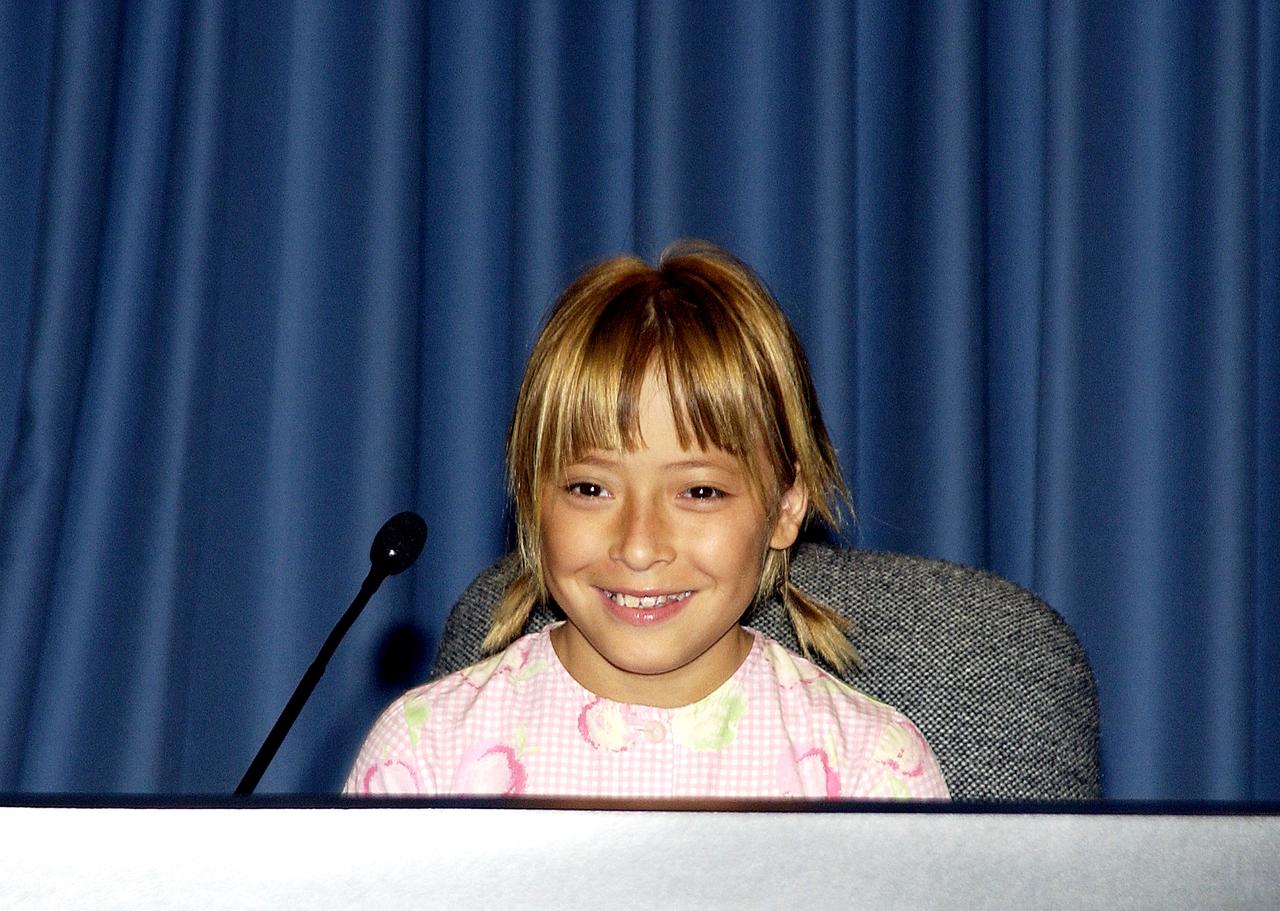
KENNEDY SPACE CENTER, FLA. -  Nine-year-old Sofi Collis is introduced to the media at a press conference.   The Siberian-born Arizona resident wrote the winning entry in the Name the Rovers Contest sponsored by NASA and the Lego Co., a Denmark-based toymaker, with collaboration from the Planetary Society, Pasadena, Calif.  The names she selected for the Mars Exploration Rovers are "Spirit" and "Opportunity." The third grader's essay was chosen from more than 10,000 American student entries.  NASA's twin Mars Exploration Rovers are designed to study the history of water on Mars. These robotic geologists are equipped with a robotic arm, a drilling tool, three spectrometers, and four pairs of cameras that allow them to have a human-like, 3D view of the terrain. Each rover could travel as far as 100 meters in one day to act as Mars scientists' eyes and hands, exploring an environment where humans are not yet able to go. MER-A, with the rover Spirit aboard, is scheduled to launch on June 8 at 2:06 p.m. EDT, with two launch opportunities each day during a launch period that closes on June 24.
KENNEDY SPACE CENTER, FLA. - Nine-year-old Sofi Collis is introduced to the media at a press conference. The Siberian-born Arizona resident wrote the winning entry in the Name the Rovers Contest sponsored by NASA and the Lego Co., a Denmark-based toymaker, with collaboration from the Planetary Society, Pasadena, Calif. The names she selected for the Mars Exploration Rovers are "Spirit" and "Opportunity." The third grader's essay was chosen from more than 10,000 American student entries. NASA's twin Mars Exploration Rovers are designed to study the history of water on Mars. These robotic geologists are equipped with a robotic arm, a drilling tool, three spectrometers, and four pairs of cameras that allow them to have a human-like, 3D view of the terrain. Each rover could travel as far as 100 meters in one day to act as Mars scientists' eyes and hands, exploring an environment where humans are not yet able to go. MER-A, with the rover Spirit aboard, is scheduled to launch on June 8 at 2:06 p.m. EDT, with two launch opportunities each day during a launch period that closes on June 24.
KENNEDY SPACE CENTER, FLA. -  Nine-year-old Sofi Collis (left) shares a light moment with NASA Administrator Sean O'Keefe at a press conference.   The Siberian-born Arizona resident wrote the winning entry in the Name the Rovers Contest sponsored by NASA and the Lego Co., a Denmark-based toymaker, with collaboration from the Planetary Society, Pasadena, Calif.  The names she selected for the Mars Exploration Rovers are "Spirit" and "Opportunity." The third grader's essay was chosen from more than 10,000 American student entries.  NASA's twin Mars Exploration Rovers are designed to study the history of water on Mars. These robotic geologists are equipped with a robotic arm, a drilling tool, three spectrometers, and four pairs of cameras that allow them to have a human-like, 3D view of the terrain. Each rover could travel as far as 100 meters in one day to act as Mars scientists' eyes and hands, exploring an environment where humans are not yet able to go. MER-A, with the rover Spirit aboard, is scheduled to launch on June 8 at 2:06 p.m. EDT, with two launch opportunities each day during a launch period that closes on June 24.
KENNEDY SPACE CENTER, FLA. - Nine-year-old Sofi Collis (left) shares a light moment with NASA Administrator Sean O'Keefe at a press conference. The Siberian-born Arizona resident wrote the winning entry in the Name the Rovers Contest sponsored by NASA and the Lego Co., a Denmark-based toymaker, with collaboration from the Planetary Society, Pasadena, Calif. The names she selected for the Mars Exploration Rovers are "Spirit" and "Opportunity." The third grader's essay was chosen from more than 10,000 American student entries. NASA's twin Mars Exploration Rovers are designed to study the history of water on Mars. These robotic geologists are equipped with a robotic arm, a drilling tool, three spectrometers, and four pairs of cameras that allow them to have a human-like, 3D view of the terrain. Each rover could travel as far as 100 meters in one day to act as Mars scientists' eyes and hands, exploring an environment where humans are not yet able to go. MER-A, with the rover Spirit aboard, is scheduled to launch on June 8 at 2:06 p.m. EDT, with two launch opportunities each day during a launch period that closes on June 24.
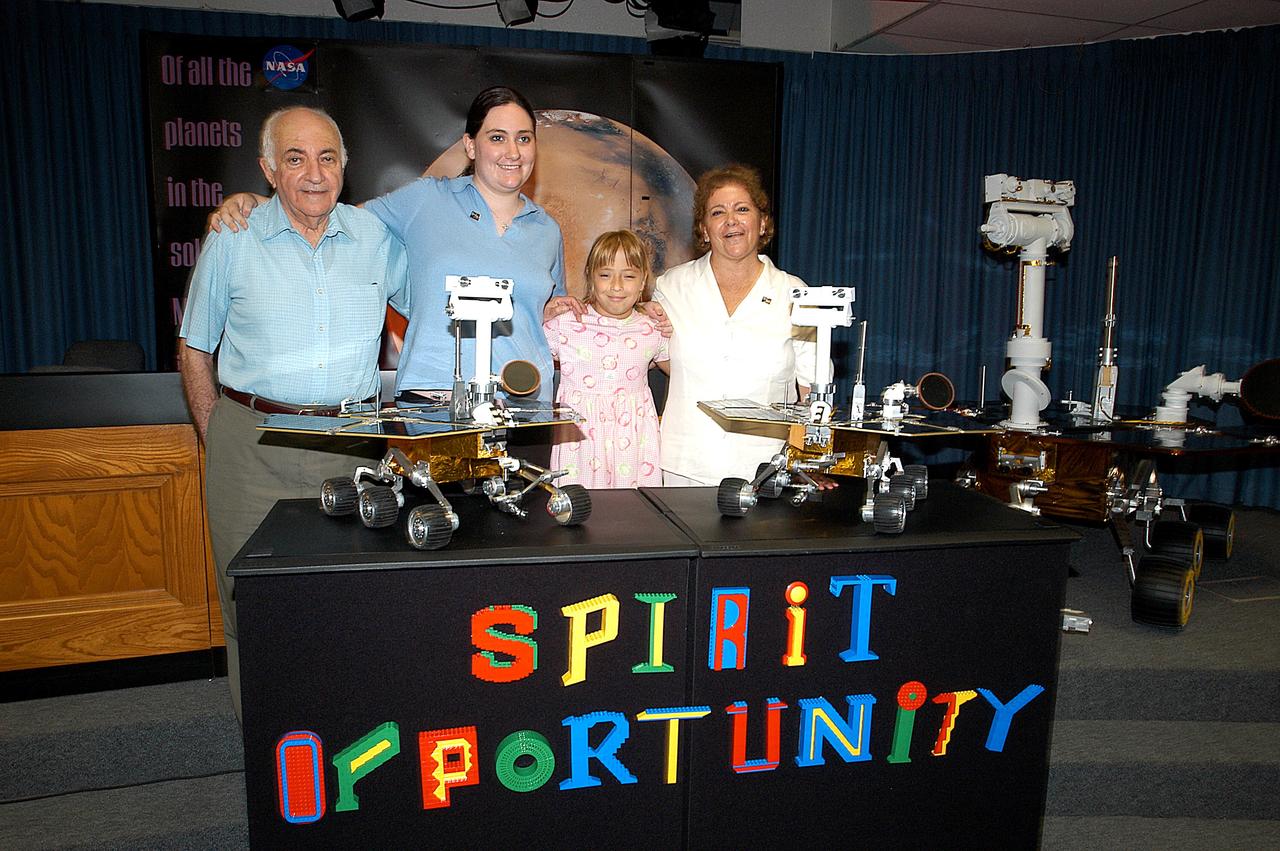
KENNEDY SPACE CENTER, FLA. -  Nine-year-old Sofi Collis (third from left) and her family pose proudly with a banner displaying the names she selected for the Mars Exploration Rovers -- "Spirit" and "Opportunity" -- following a press conference announcing the names. The names Sofi suggested were chosen from more than 10,000 student entries in an essay contest managed for NASA by the LEGO Company. NASA's twin Mars Exploration Rovers are designed to study the history of water on Mars. These robotic geologists are equipped with a robotic arm, a drilling tool, three spectrometers, and four pairs of cameras that allow them to have a human-like, 3D view of the terrain. Each rover could travel as far as 100 meters in one day to act as Mars scientists' eyes and hands, exploring an environment where humans are not yet able to go. MER-A, with the rover Spirit aboard, is scheduled to launch on June 8 at 2:06 p.m. EDT, with two launch opportunities each day during a launch period that closes on June 24.
KENNEDY SPACE CENTER, FLA. - Nine-year-old Sofi Collis (third from left) and her family pose proudly with a banner displaying the names she selected for the Mars Exploration Rovers -- "Spirit" and "Opportunity" -- following a press conference announcing the names. The names Sofi suggested were chosen from more than 10,000 student entries in an essay contest managed for NASA by the LEGO Company. NASA's twin Mars Exploration Rovers are designed to study the history of water on Mars. These robotic geologists are equipped with a robotic arm, a drilling tool, three spectrometers, and four pairs of cameras that allow them to have a human-like, 3D view of the terrain. Each rover could travel as far as 100 meters in one day to act as Mars scientists' eyes and hands, exploring an environment where humans are not yet able to go. MER-A, with the rover Spirit aboard, is scheduled to launch on June 8 at 2:06 p.m. EDT, with two launch opportunities each day during a launch period that closes on June 24.
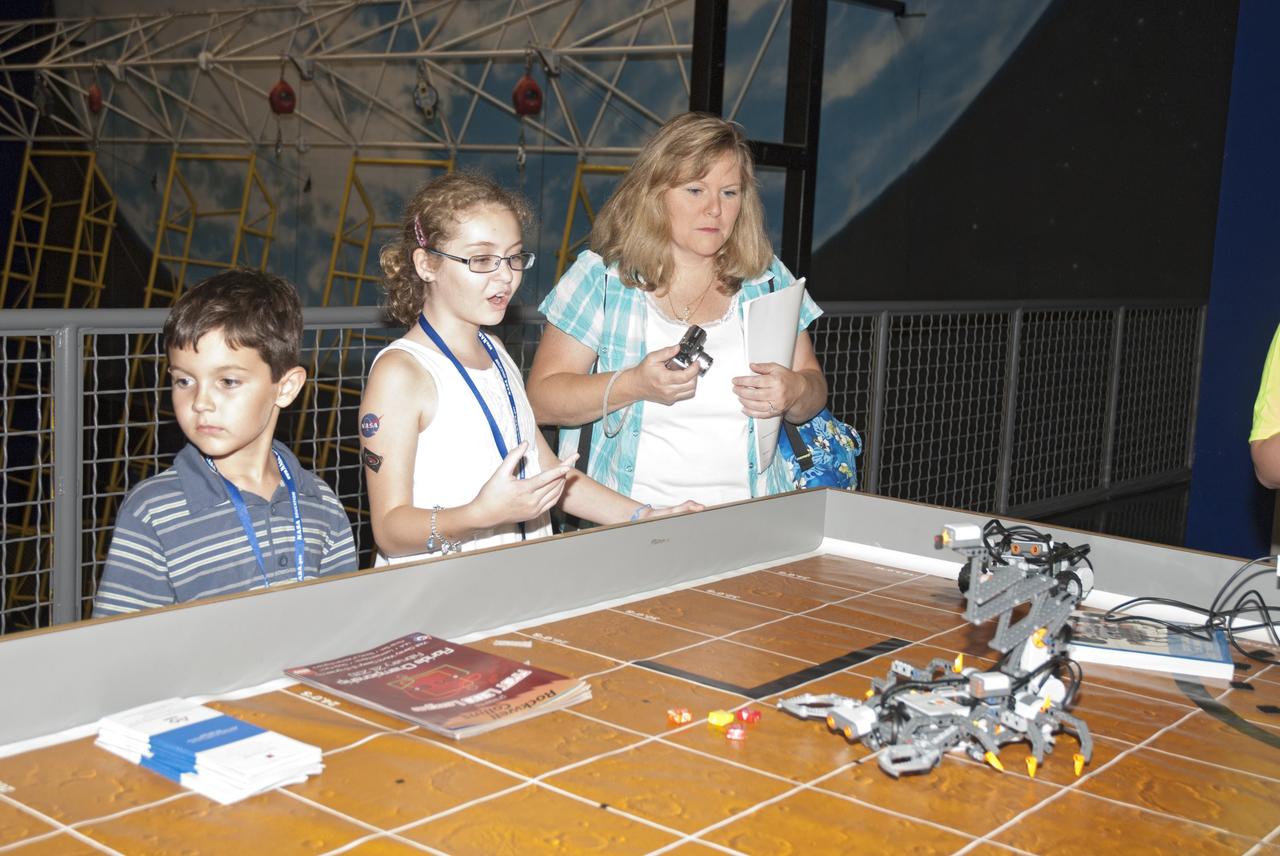
CAPE CANAVERAL, Fla. -- At the Astronaut Hall of Fame near the Kennedy Space Center Visitor Complex in Florida, fifth- through eighth-grade students and their parents participate in a Lego robotics demonstration during the last NASA family education night event. Other activities included "gee-whiz" presentations, astronaut appearances, a hovercraft, vortex cannon and alternative fuel vehicles, which promote science, technology, engineering and mathematics (STEM) education.    The event is part of NASA's Summer of Innovation initiative to provide interactive learning experiences to middle school students nationwide during the summer months. The program is a cornerstone of the Educate to Innovate campaign announced by President Barack Obama in November 2009. Photo credit: NASA/Charisse Nahser
KSC-2010-4523