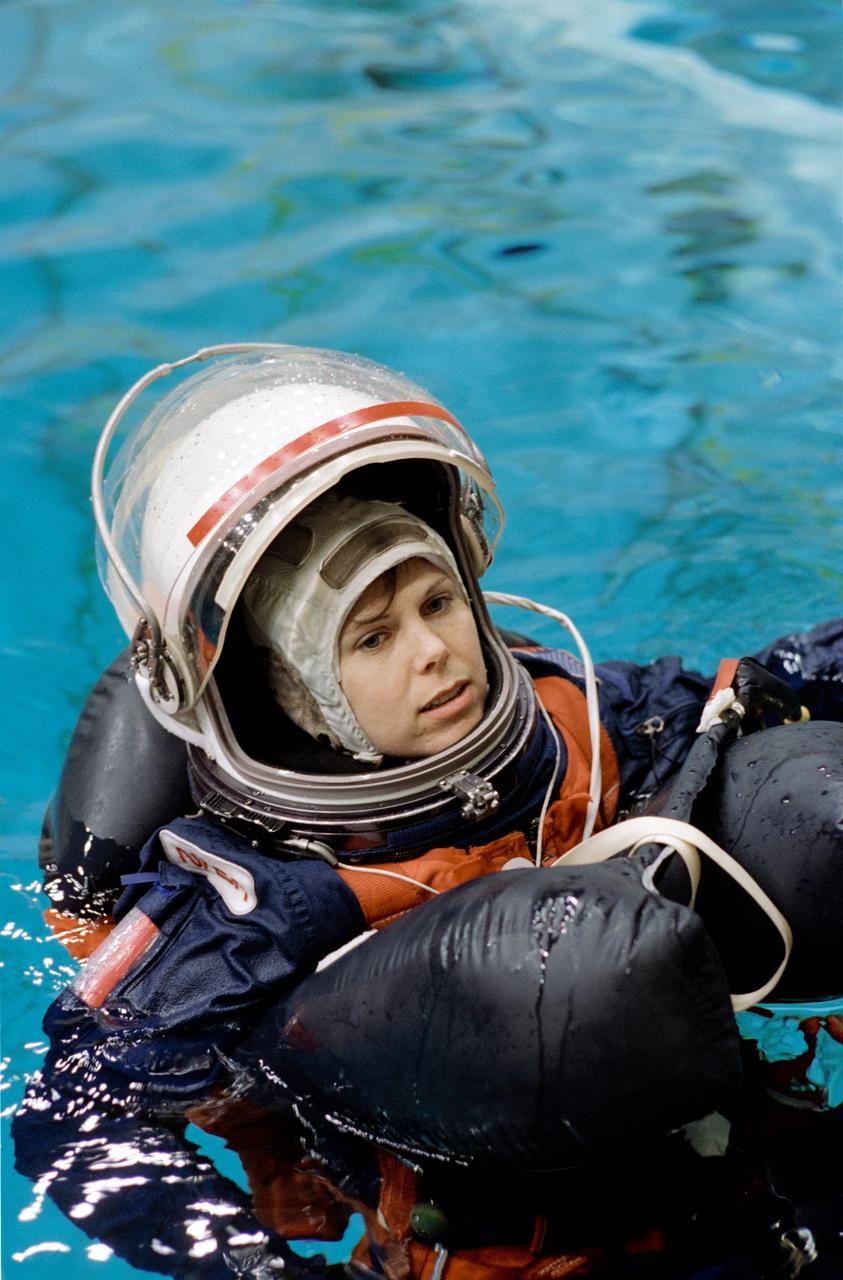
S95-03501 (16 FEB 1995) --- Astronaut Mary Ellen Weber prepares to deploy a life raft during a training session at the Johnson Space Center's (JSC) Weightless Environment Training Facility (WET-F). Training as a mission specialist for the STS-70 mission, Weber was joined by four crew mates in the emergency bailout rehearsal.
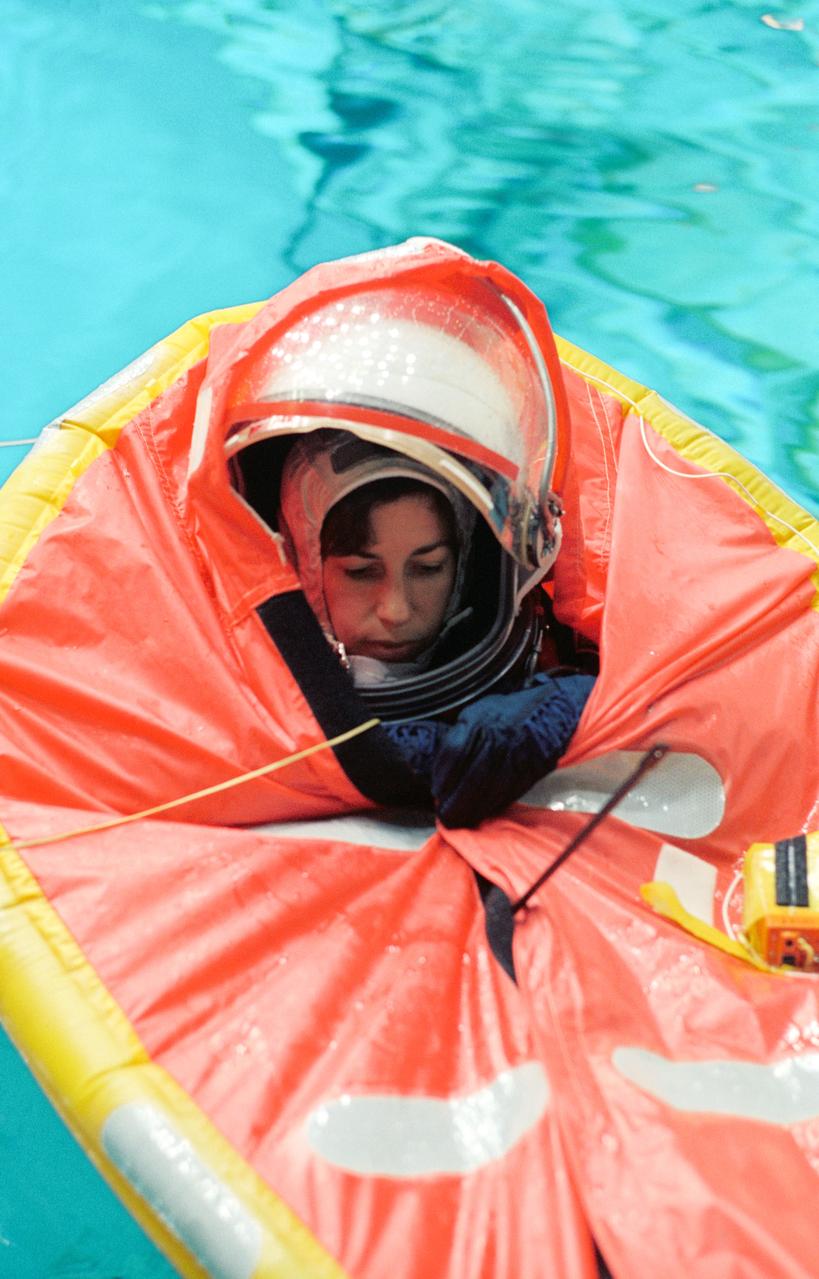
S94-37520 (28 June 1994) --- Astronaut Ellen Ochoa, STS-66 payload commander, secures herself in a small life raft during an emergency bailout training exercise in the Johnson Space Center's (JSC) Weightless Environment Training Facility (WET-F). Making her second flight in space, Ochoa will join four other NASA astronauts and a European mission specialist for a week and a half in space aboard the Space Shuttle Atlantis in support of the Atmospheric Laboratory for Applications and Science (ATLAS-3) mission. Ochoa was a mission specialist on the ATLAS-2 mission in April of 1993.
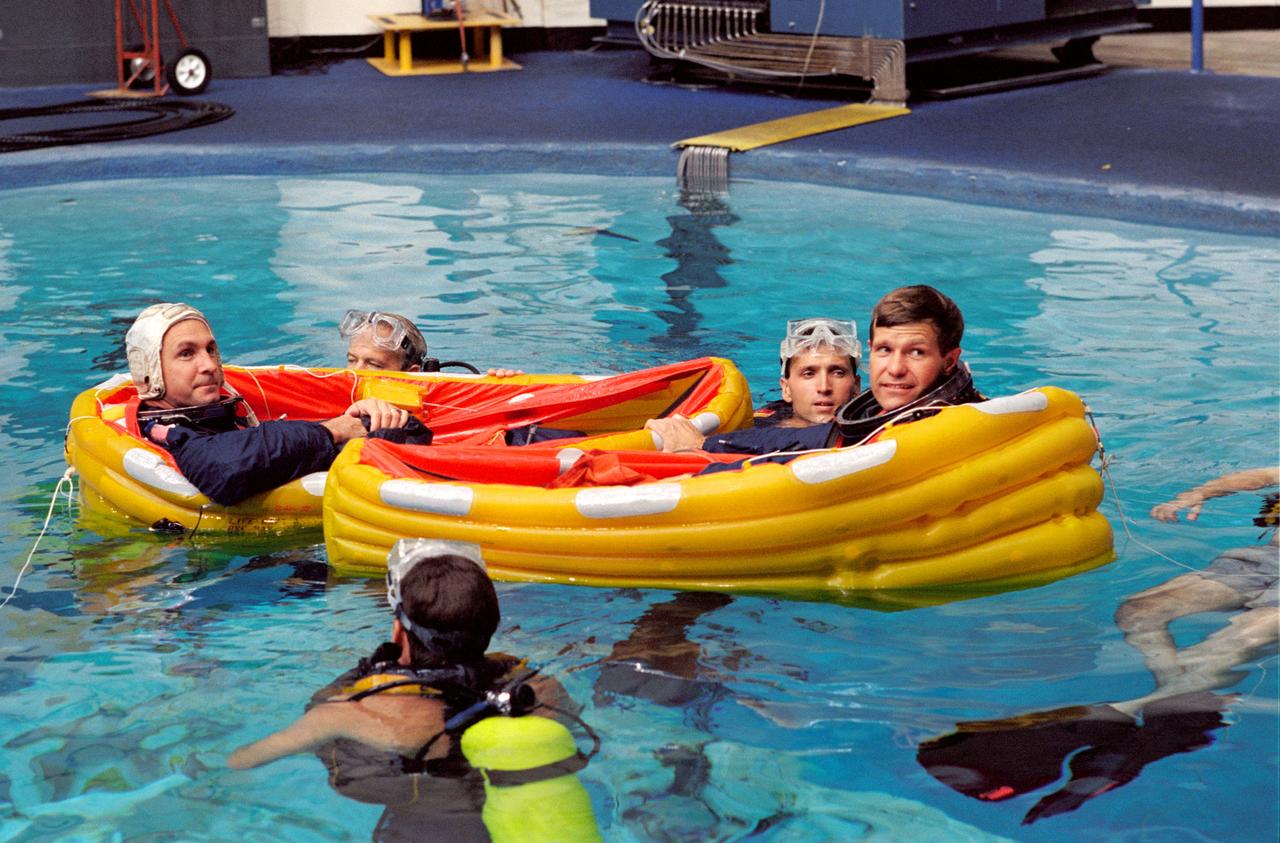
S94-37526 (28 June 1994) --- In separate life rafts, astronauts Donald R. McMonagle (right), mission commander, and Curtis L. Brown, pilot, are assisted by several SCUBA-equipped divers during an emergency bailout training exercise in the Johnson Space Center's (JSC) Weightless Environment Training Facility (WET-F). Making their third and second flights in space, respectively, McMonagle and Brown will be joined by three other NASA astronauts and a European mission specialist for a week and a half in space aboard the Space Shuttle Atlantis. The flight will support the Atmospheric Laboratory for Applications and Science (ATLAS-3) mission.
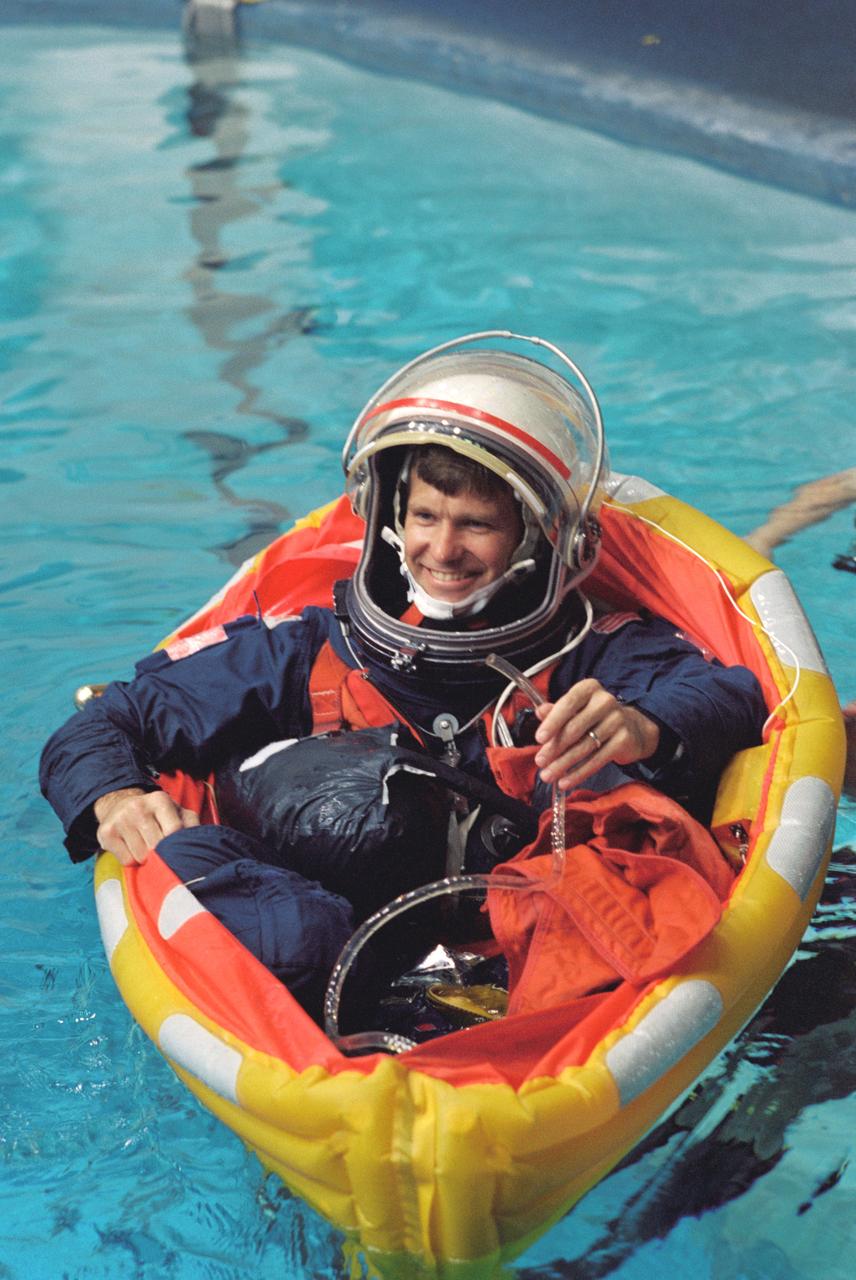
S94-37521 (28 June 1994) --- Astronaut Donald R. McMonagle, mission commander, checks the drainage hose on his rapidly fashioned life raft during an emergency bailout training exercise in the Johnson Space Center's (JSC) Weightless Environment Training Facility (WET-F). Making his third flight in space covering 343 hours, McMonagle will be joined by four other NASA astronauts and a European mission specialist for a week and a half in space aboard the Space Shuttle Atlantis. The flight will support the Atmospheric Laboratory for Applications and Science (ATLAS-3) mission.
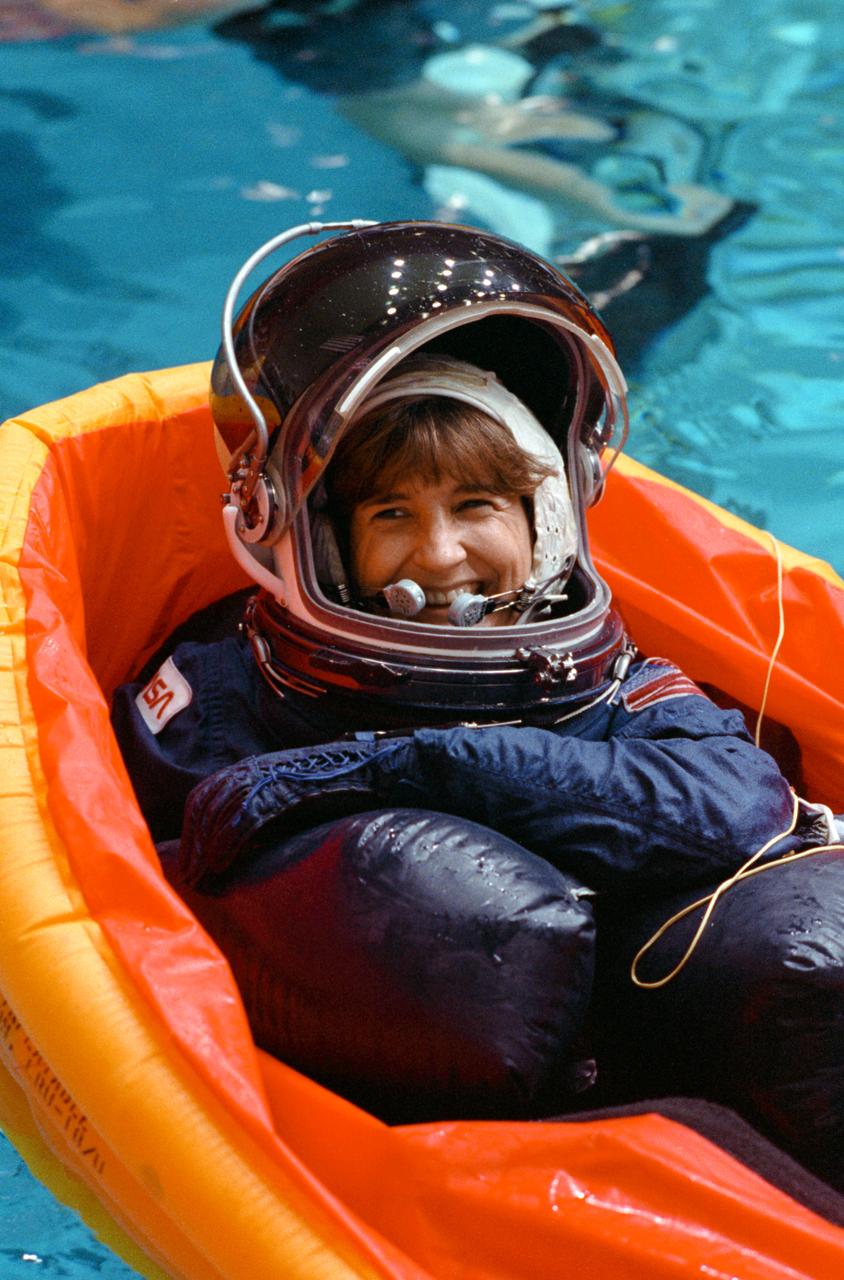
S90-45229 (25 June 1990) --- Astronaut Linda M. Godwin, STS-37 mission specialist, floats in a one-person life raft. She was simulating steps involved in emergency egress from a space shuttle. The training session was held in the Johnson Space Center's weightless environment training facility (WET-F). The 25-ft. deep pool in the facility served as a simulated ocean into which a parachute landing might be made. Early next year, Godwin, along with four other astronauts, will fly onboard Atlantis for a five-day mission.
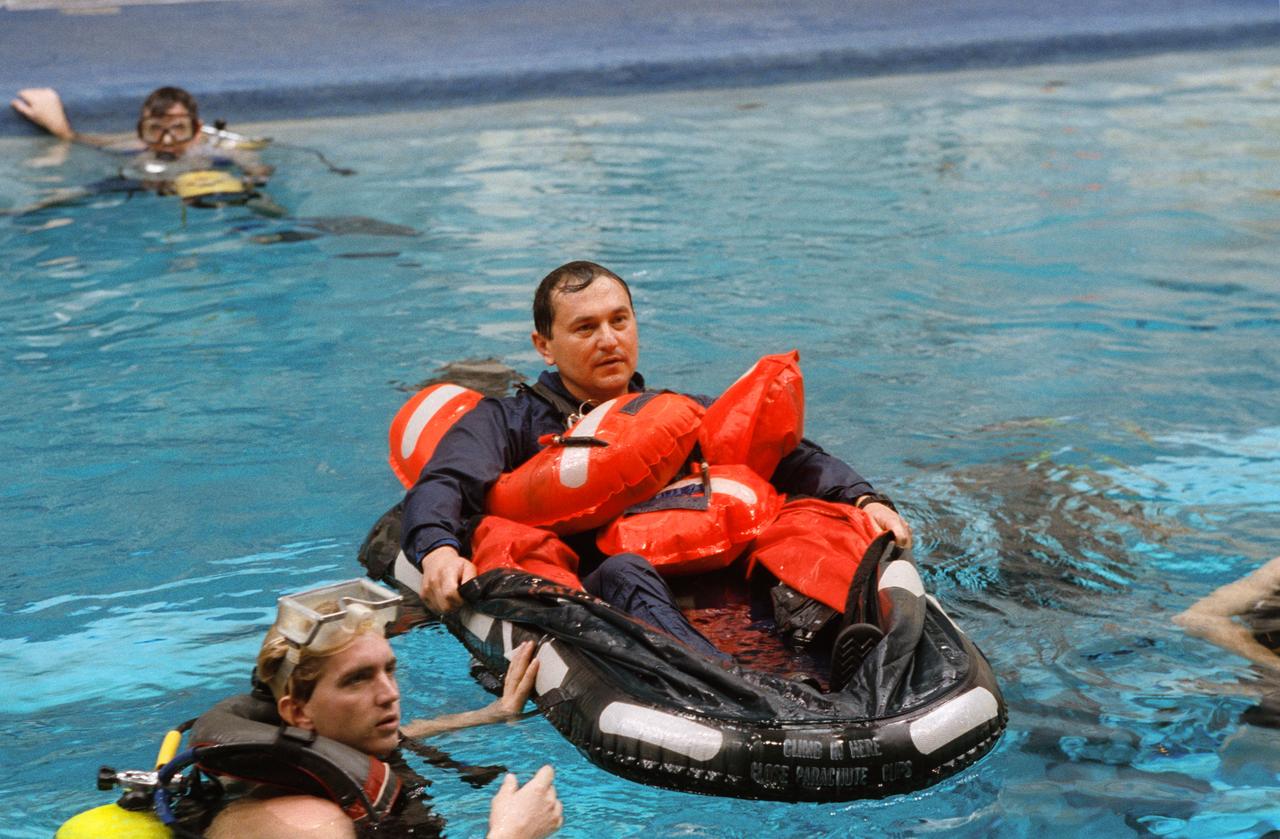
Russian Cosmonaut Vladimir Titov maneuvers a small life raft during bailout training at JSC's Weightless Environment Training Facility (WETF). Two SCUBA-equipped divers assisted Titov in the STS-60 training exercise.
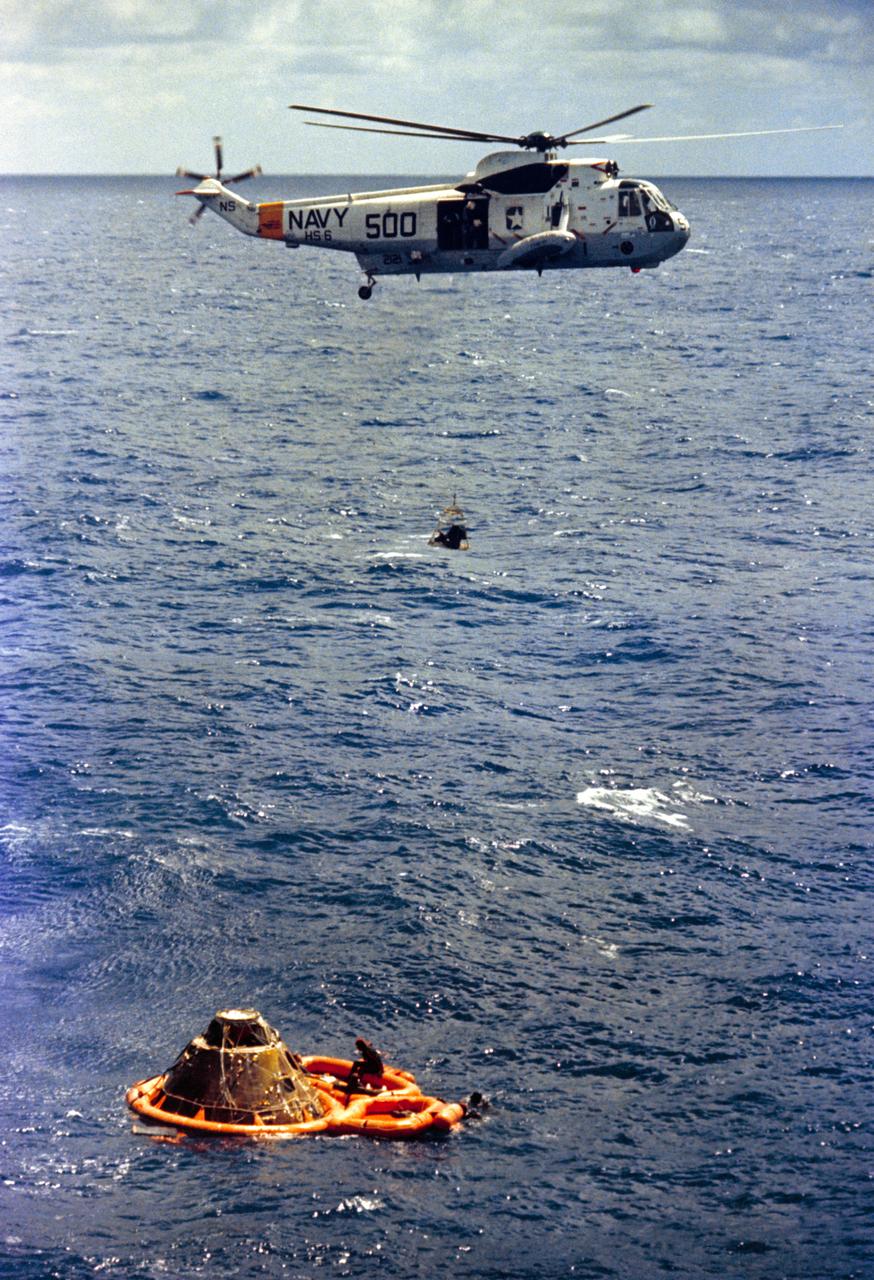
S71-19476 (9 Feb. 1971) --- Astronaut Stuart A. Roosa, command module pilot, is hoisted inside a Billy Pugh net to a U.S. Navy helicopter assisting in Apollo 14 recovery operations in the South Pacific Ocean. Visible in a life raft beside the Command Module (CM) are astronauts Alan B. Shepard Jr., commander, back to camera; and Edgar D. Mitchell (partially obscured by the spacecraft), lunar module pilot. Three U.S. Navy underwater demolition team swimmers who assisted in the recovery operations are pictured in and around the life raft. Apollo 14 splashdown occurred at 3:04:39 p.m. (CST), Feb. 9, 1971, approximately 765 nautical miles south of American Samoa in the South Pacific Ocean.
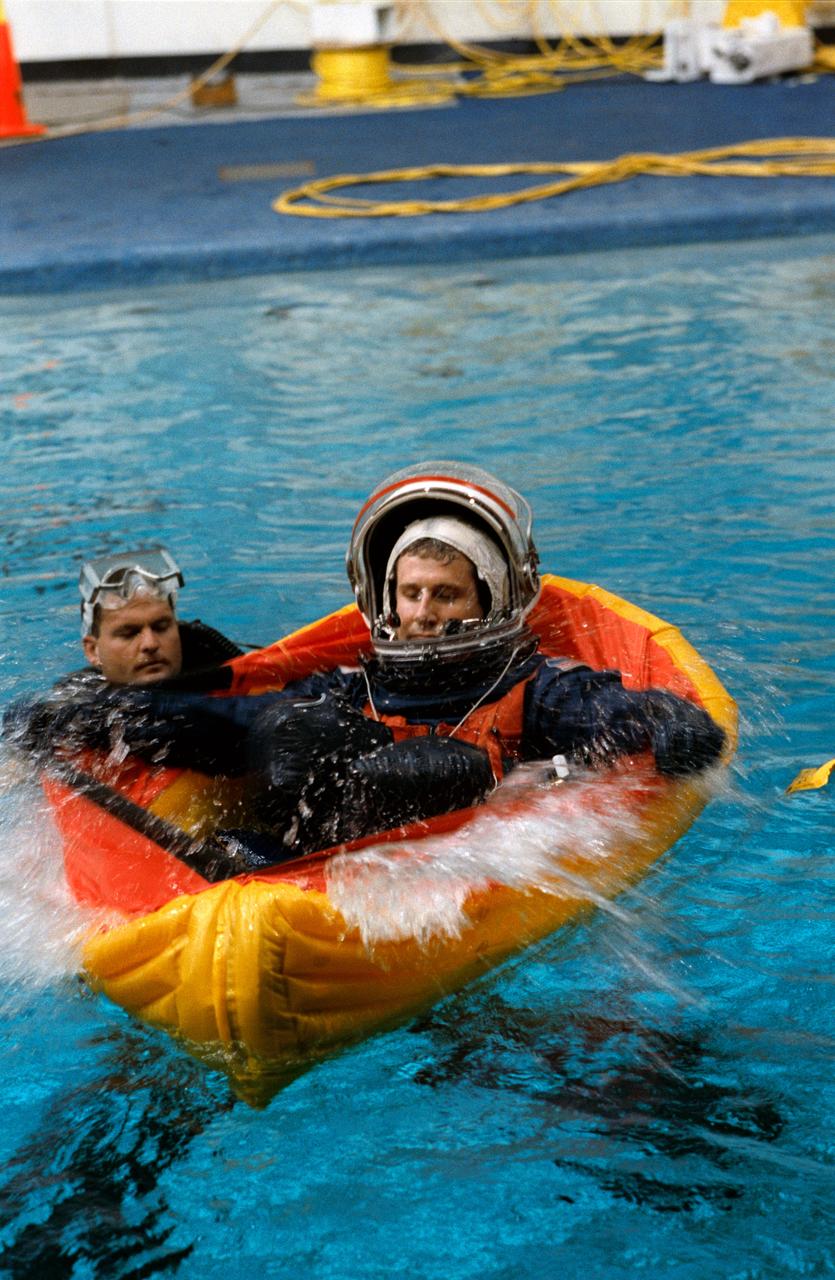
S93-43856 (7 Ssept 1993) --- Navigating a one person life raft, Jay C. Buckey, M.D., participates in emergency bailout training in the Johnson Space Center's (JSC) Weightless Environment Training Facility (WET-F). Dr. Buckey has been assigned as an alternate payload specialist for the Spacelab Life Sciences (SLS-2) mission scheduled for next month. Nearby is a SCUBA-equipped diver who assisted in the training exercises.
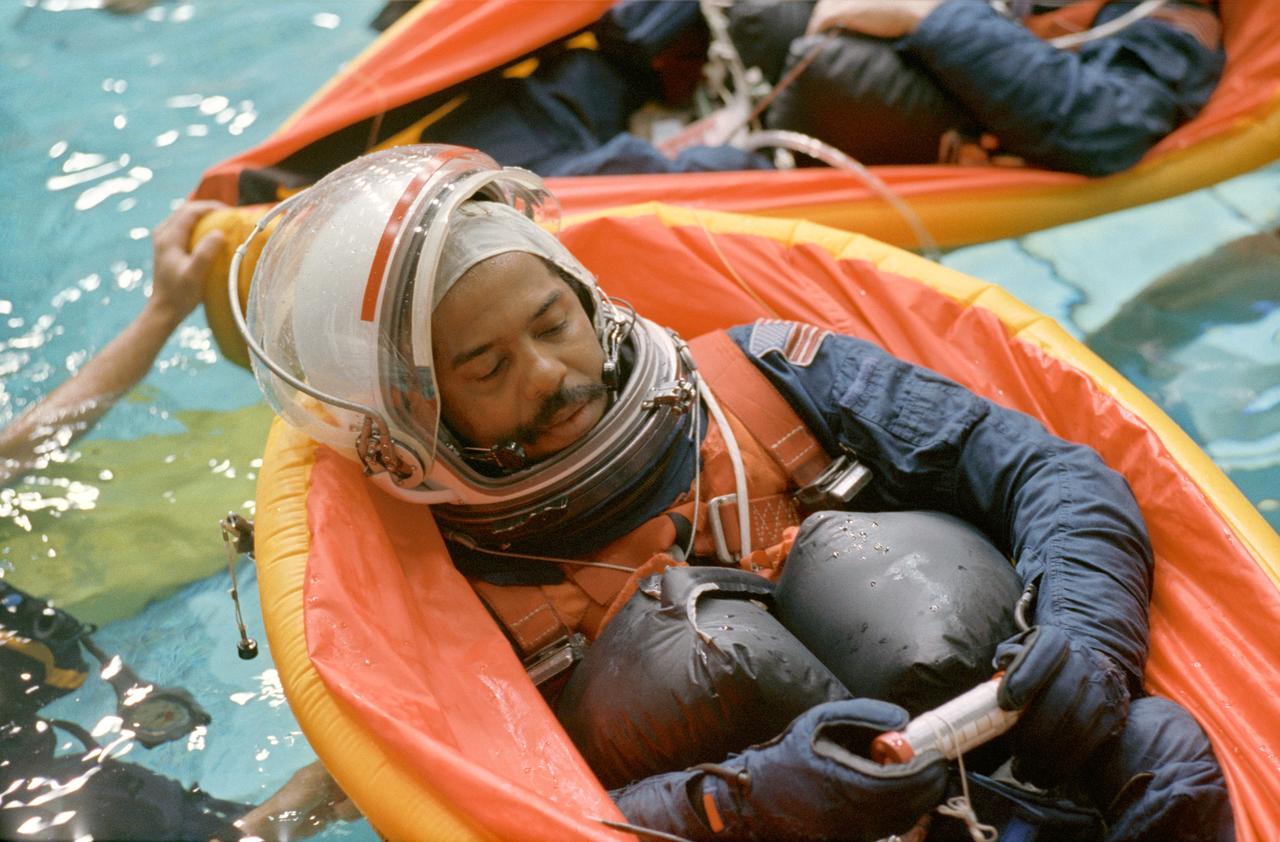
S92-50679 (Dec 1992) --- Using a small life raft, astronaut Bernard A. Harris Jr., mission specialist for the STS-55\D-2 mission, participates in bailout training at the Johnson Space Center's (JSC) Weightless Environment and Training Facility (WET-F). Harris is attired in a training version of the partial pressure Shuttle launch and entry garment. All seven prime flight crew members and the two back-up payload specialists participated in the training session.
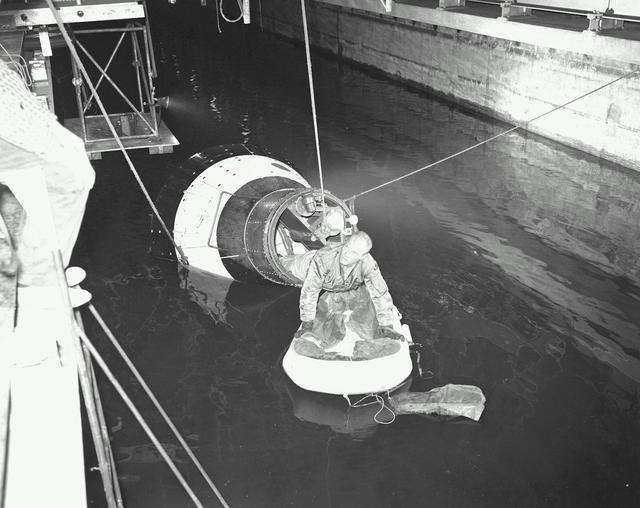
B60-00285 (1960) --- Astronaut John H. Glenn Jr., pilot of the Mercury Atlas 6 spaceflight, emerges from an egress trainer during training activity at the Langley Research Center. He is attempting to transfer onto a life raft from the mock-up of the Mercury capsule. Photo credit: NASA
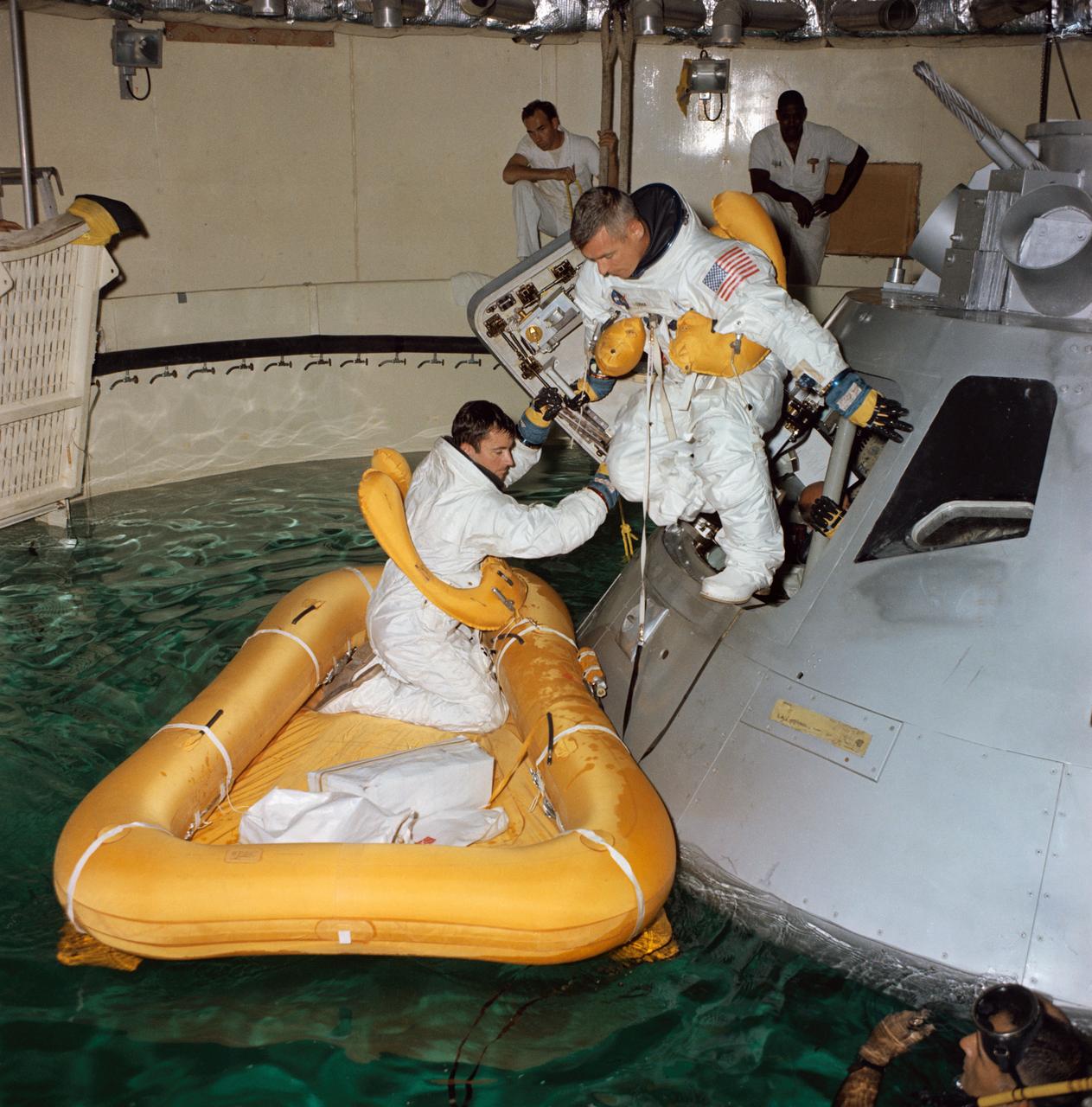
S68-41683 (August 1968) --- Three astronauts participate in Apollo water egress training in a tank in Building 260 at the Manned Spacecraft Center. Already in life raft is John W. Young. Eugene A. Cernan is egressing the Apollo Command Module trainer. Inside the trainer and almost obscured is Thomas P. Stafford.
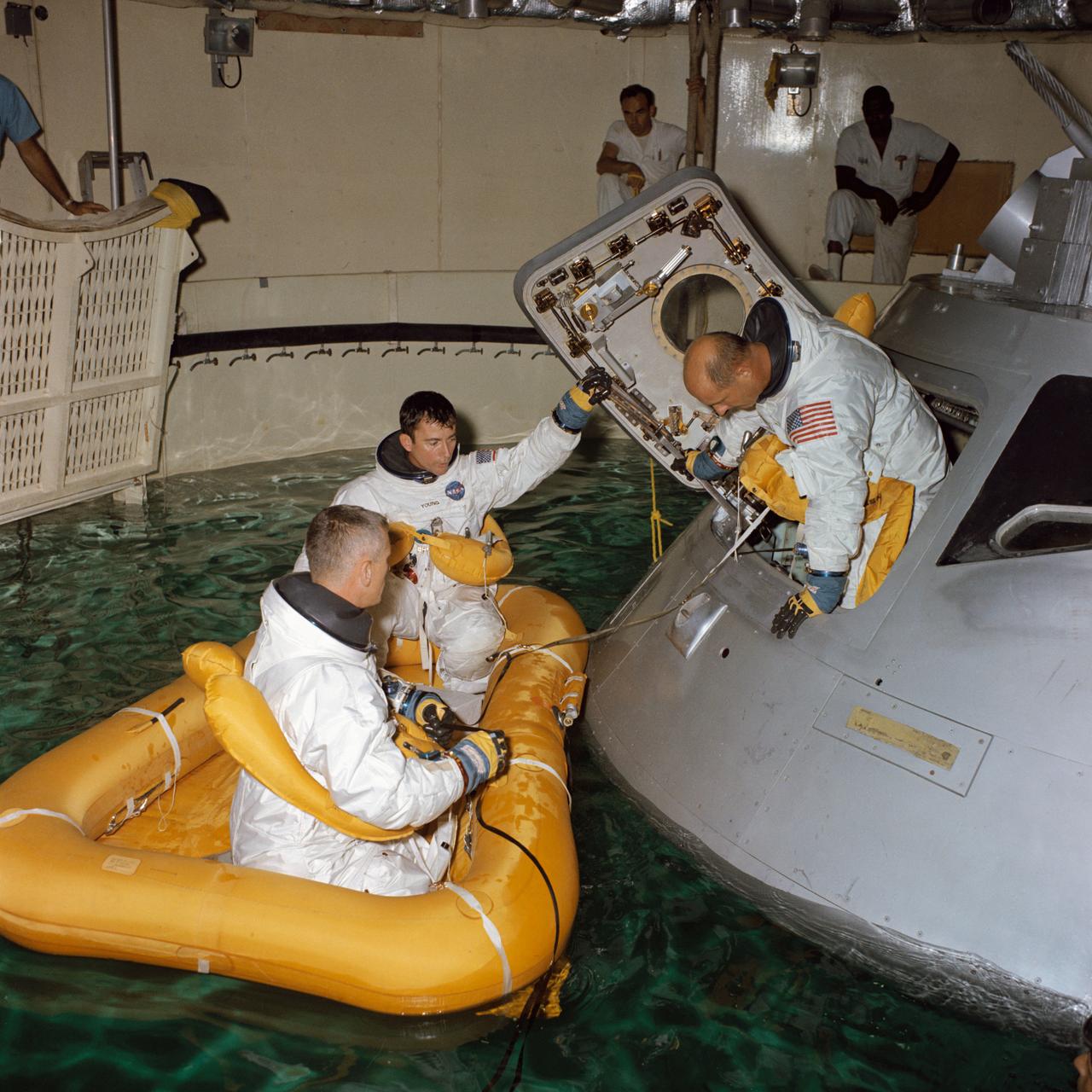
S68-41685 (August 1968) --- Three astronauts participate in Apollo water egress training in a tank in Building 260 at the Manned Spacecraft Center. Egressing the Apollo Command Module trainer is Thomas P. Stafford. Already in life raft are Eugene A. Cernan (in foreground) and John W. Young.
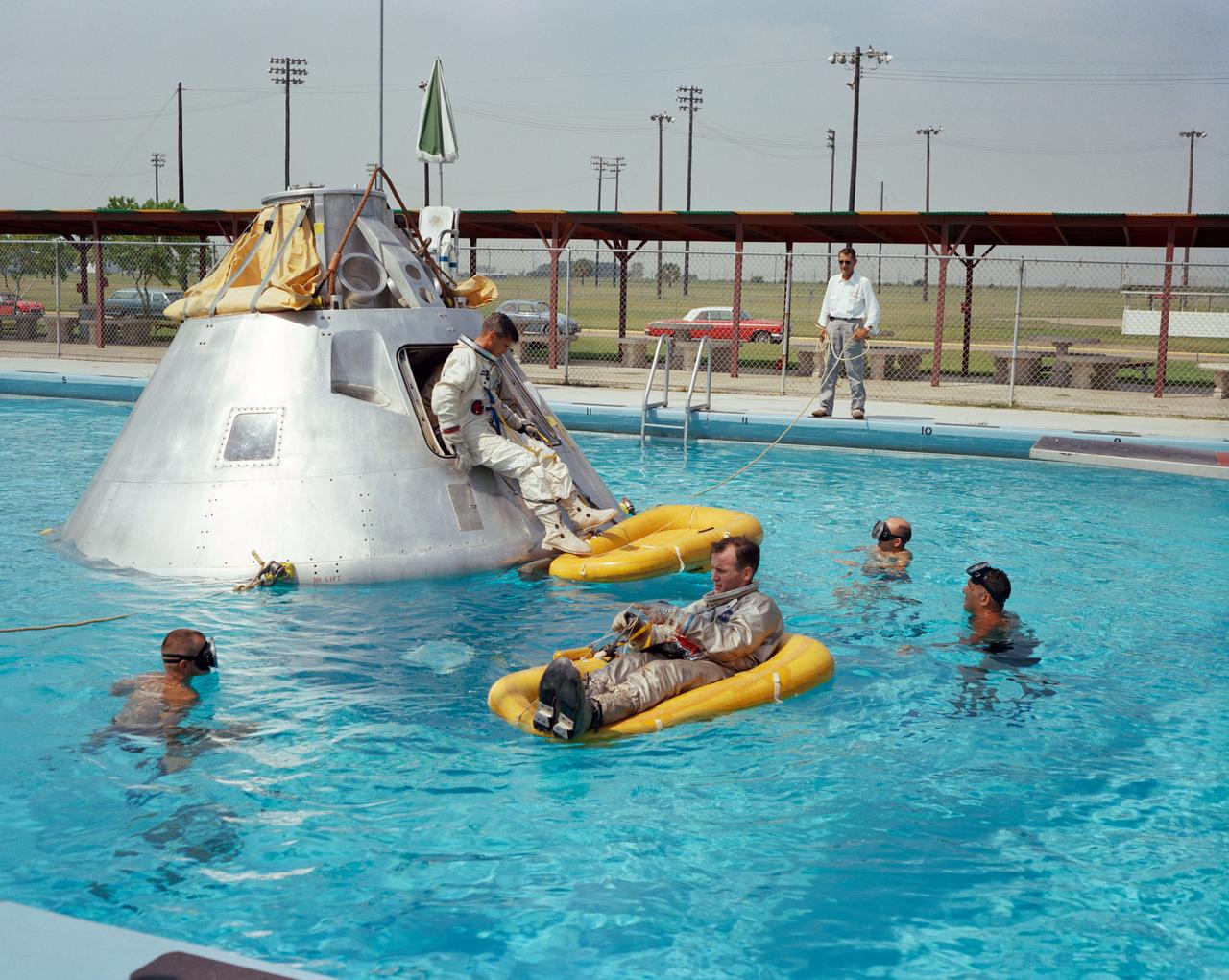
S66-51583 (June 1966)--- Prime crew members announced by the National Aeronautics and Space Administration (NASA) for the first manned Apollo 1 space flight practice water egress procedures in a swimming pool at Ellington Air Force Base (EAFB), Houston, Texas. Astronaut Edward H. White II rides life raft in the foreground. Astronaut Roger B. Chaffee sits in hatch of the boilerplate model of the spacecraft. Astronaut Virgil I. Grissom, third member of the crew, waits inside the spacecraft.
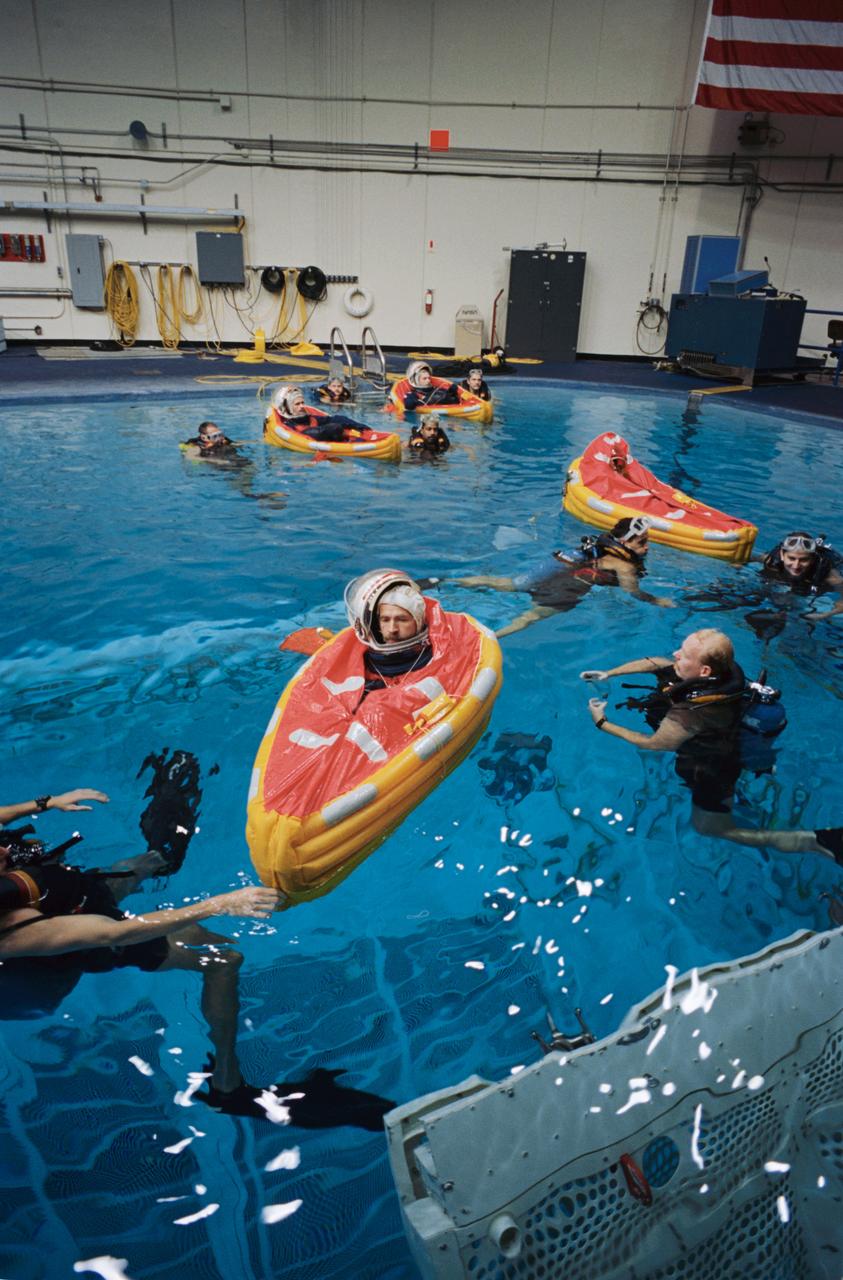
S94-47226 (13 Oct 1994) --- Using small life rafts, several cosmonauts and astronauts participating in joint Russia - United States space missions take part in an emergency bailout training session in the Johnson Space Center's (JSC) Weightless Environment Training Facility's (WET-F) 25-feet-deep pool. In the foreground is cosmonaut Alexsandr F. Poleshchuk, a member of the Mir reserve crew. A number of SCUBA-equipped divers assist the trainees.
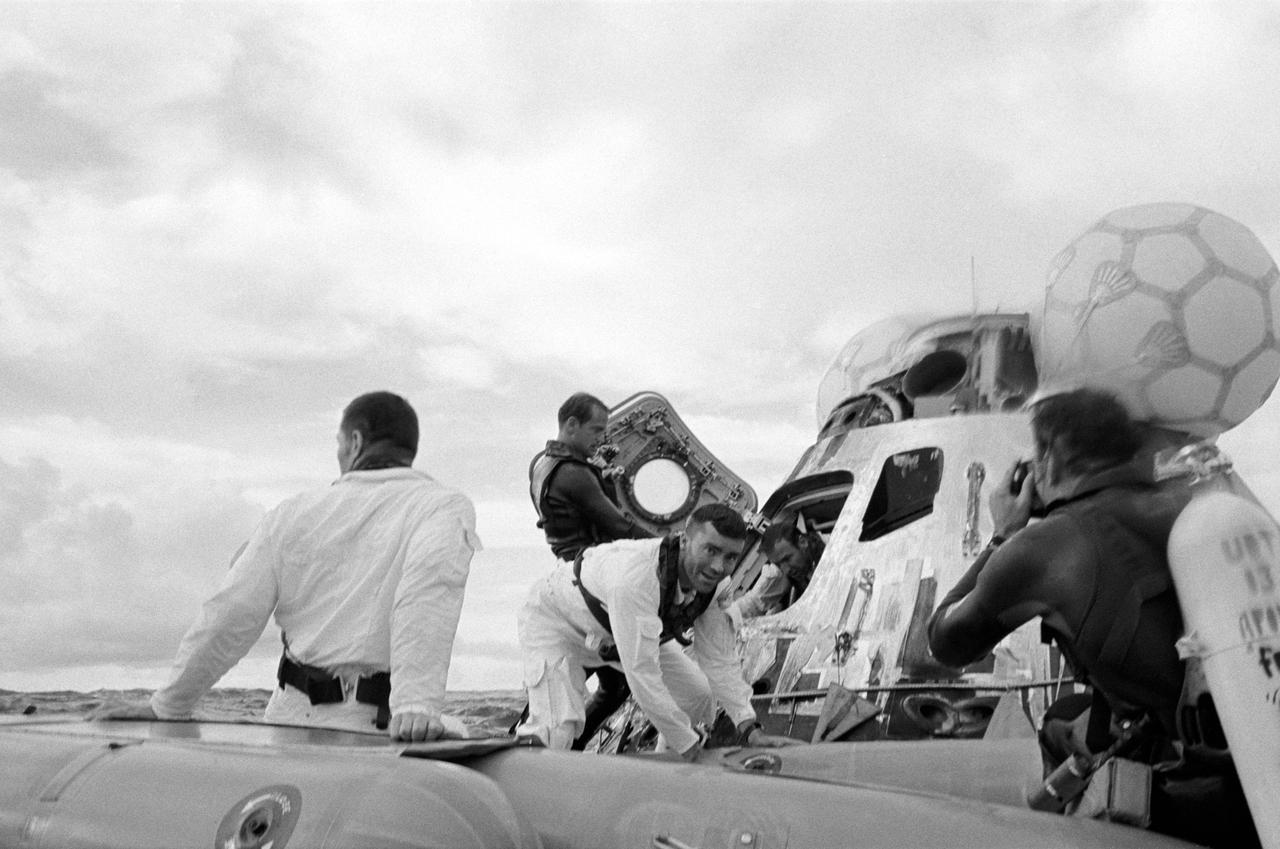
S70-35610 (17 April 1970) --- A water level view of the Apollo 13 recovery operations in the South Pacific Ocean. The three astronauts as seen egressing their spacecraft. John L. Swigert Jr. (back to camera), command module pilot, is already in the life raft. Fred W. Haise Jr., lunar module pilot, facing camera, is stepping into the life raft. James A. Lovell Jr., commander, is leaving the spacecraft in the background. A United States Navy underwater demolition team assists with the recovery operations. The three crewmembers were picked up by helicopter and flown to the prime recovery ship, USS Iwo Jima. The Apollo 13 Command Module (CM) splashed down at 12:07:44 p.m. (CST), April 17, 1970, to conclude safely a perilous space flight. Though the Apollo lunar landing mission was canceled, a disastrous loss of three astronauts was averted.
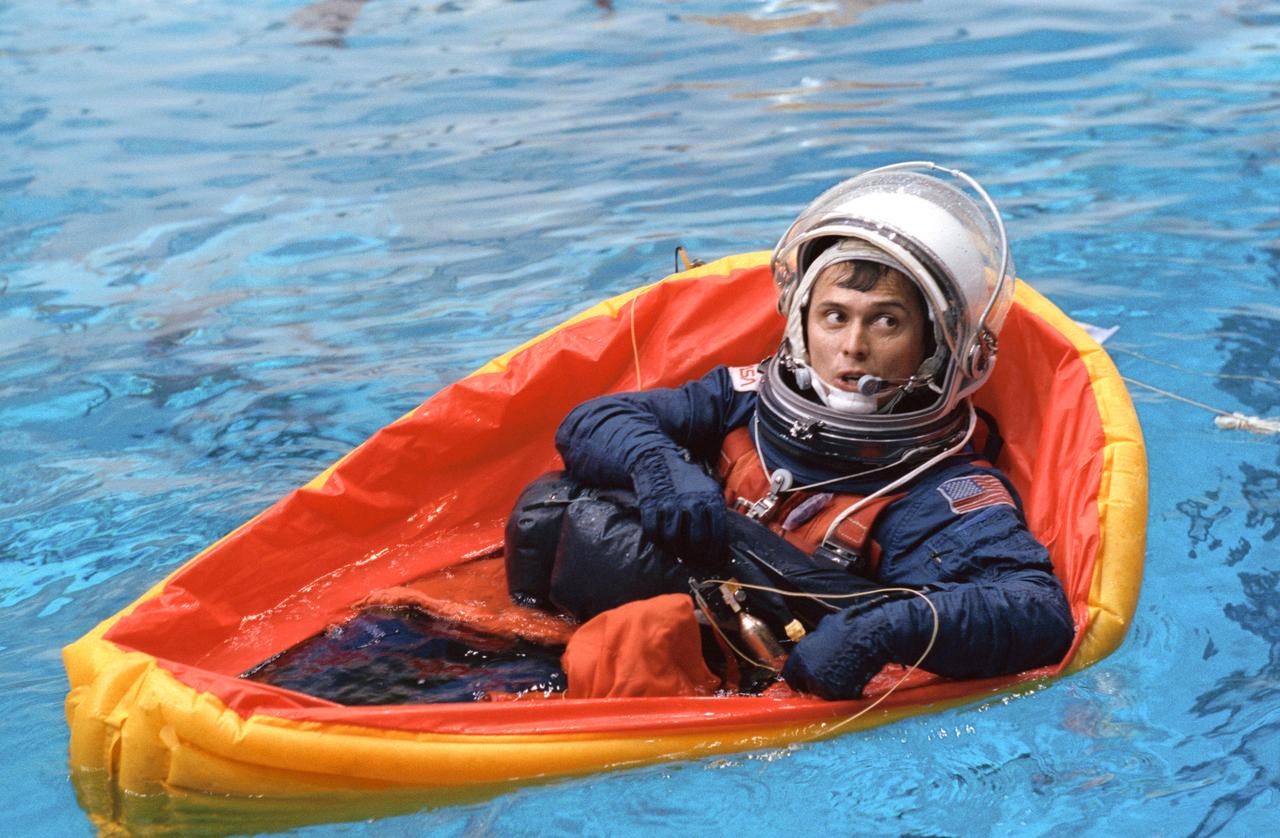
S92-33478 (12 March 1992) --- Astronaut Franklin R. Chang-Diaz, mission specialist, relies on a one-person life raft to get him to "safety" during a STS-46 bailout simulation exercise. The training took place in the Johnson Space Center's weightless environment training facility.
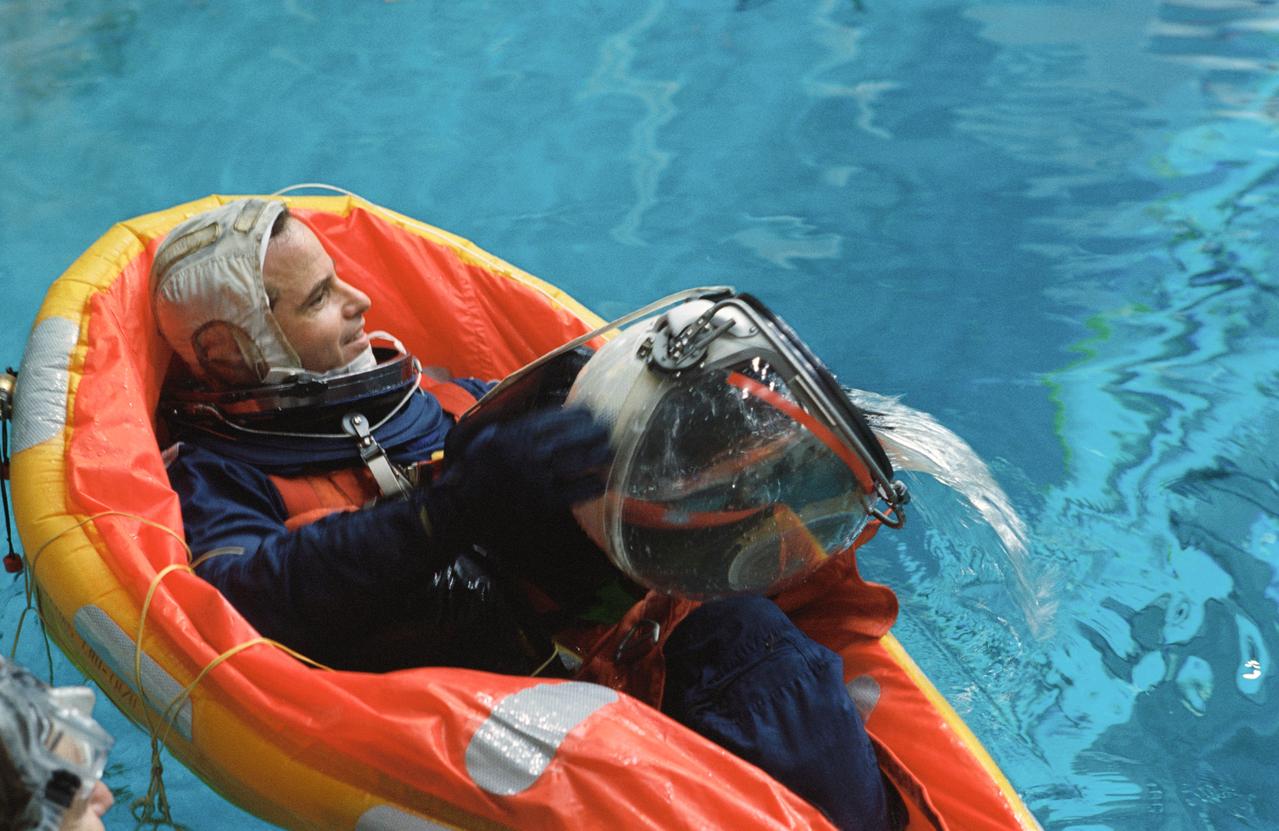
S93-50705 (22 Dec 1993) --- Astronaut Kevin P. Chilton, pilot, uses his helmet to bail water from his life raft during emergency bailout training at the Johnson Space Center's (JSC) Weightless Environment Training Facility (WET-F). Chilton and five other NASA astronauts are scheduled to fly aboard the Space Shuttle Endeavour next year.
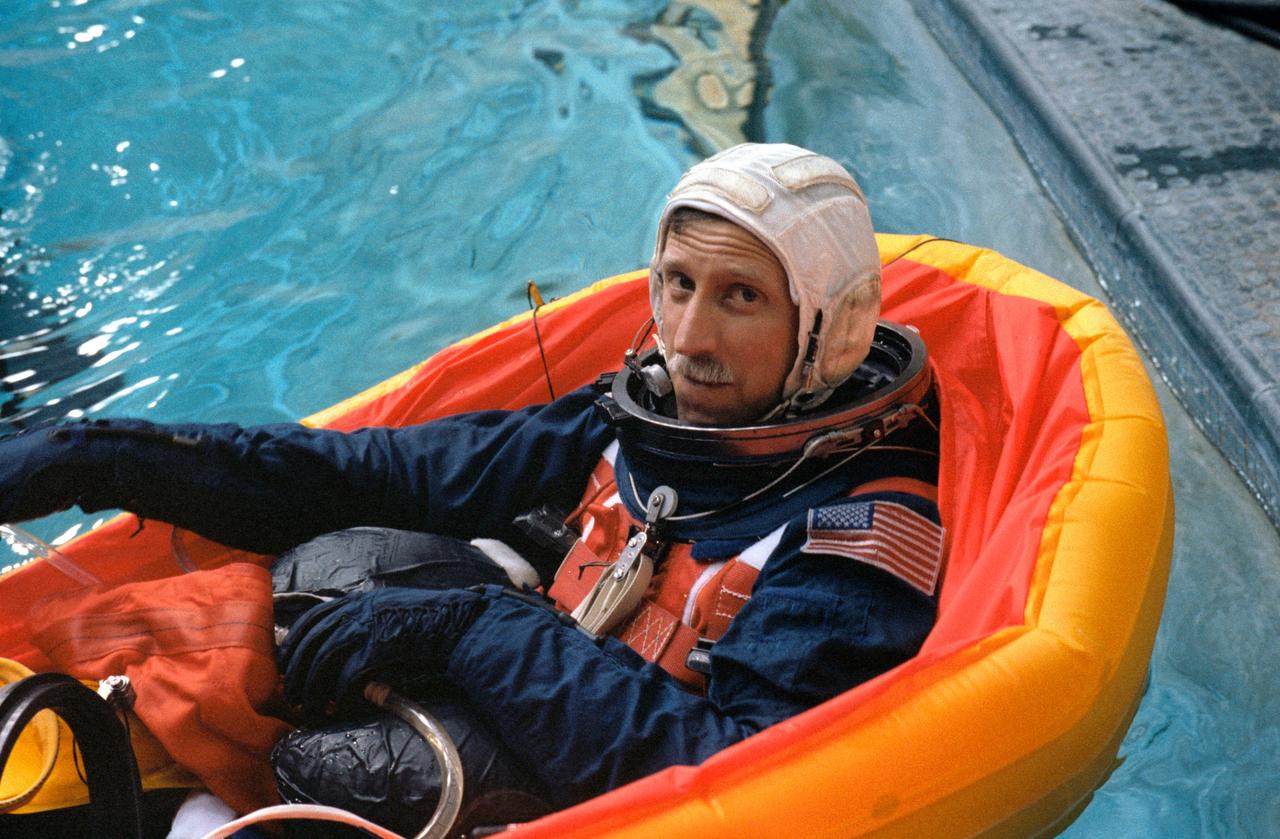
S88-42425 (20 July 1988) --- STS-26 Discovery, Orbiter Vehicle (OV) 103, Pilot Richard O. Covey, wearing the newly designed launch and entry suit (LES), floats in single-occupant life raft in JSC Weightless Environment Training Facility (WETF) Bldg 29 pool. The simulation of the escape and rescue operations utilized the crew escape system (CES) pole method of egress from the Space Shuttle.
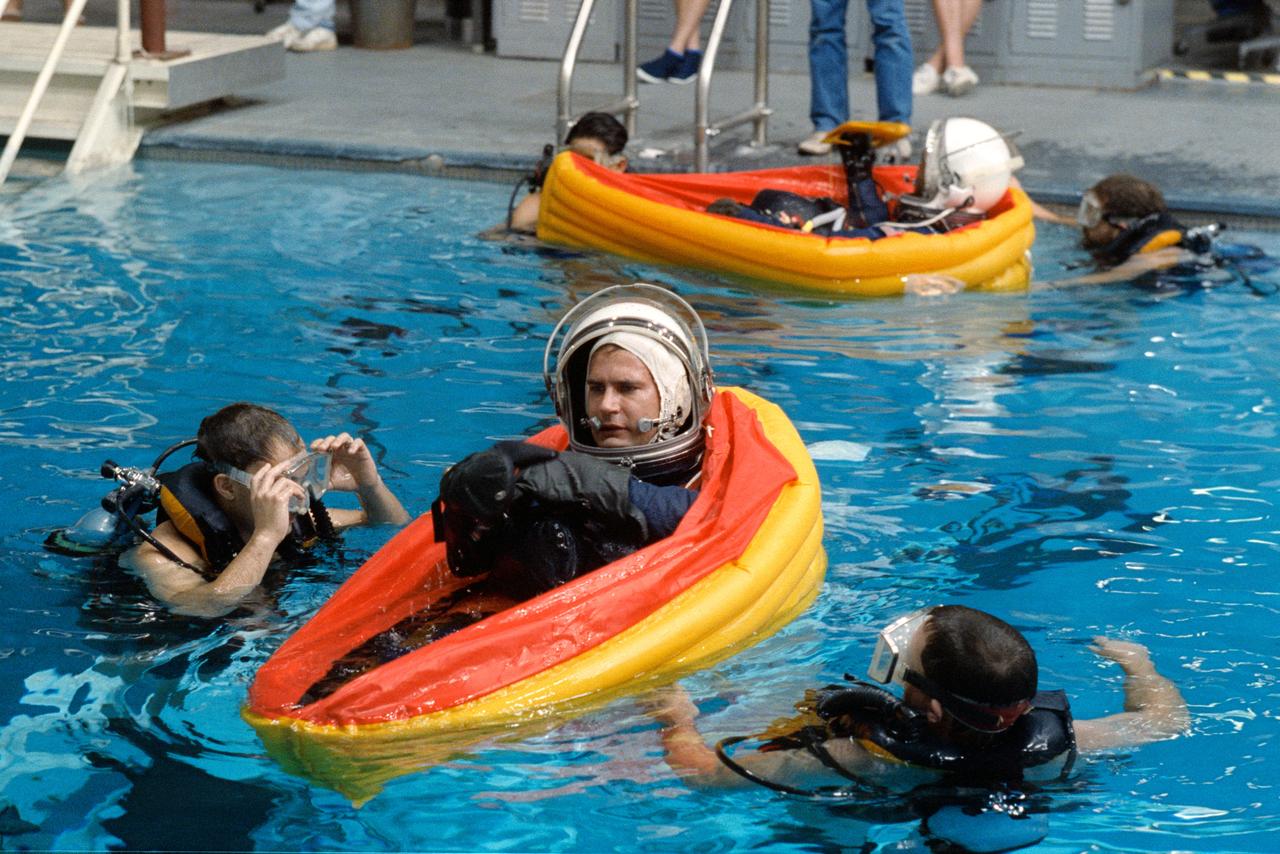
S90-54754 (13 Dec 1990) --- Astronaut Richard J. Hieb, STS-39 mission specialist, wearing launch and entry suit (LES) and launch and entry helmet (LEH), floats in single person life raft after landing in JSC's Weightless Environment Training Facility (WETF) Bldg 29 pool. During emergency egress bailout procedures, Hieb practiced procedures necessary for a water landing. Divers monitor Hieb's activity.
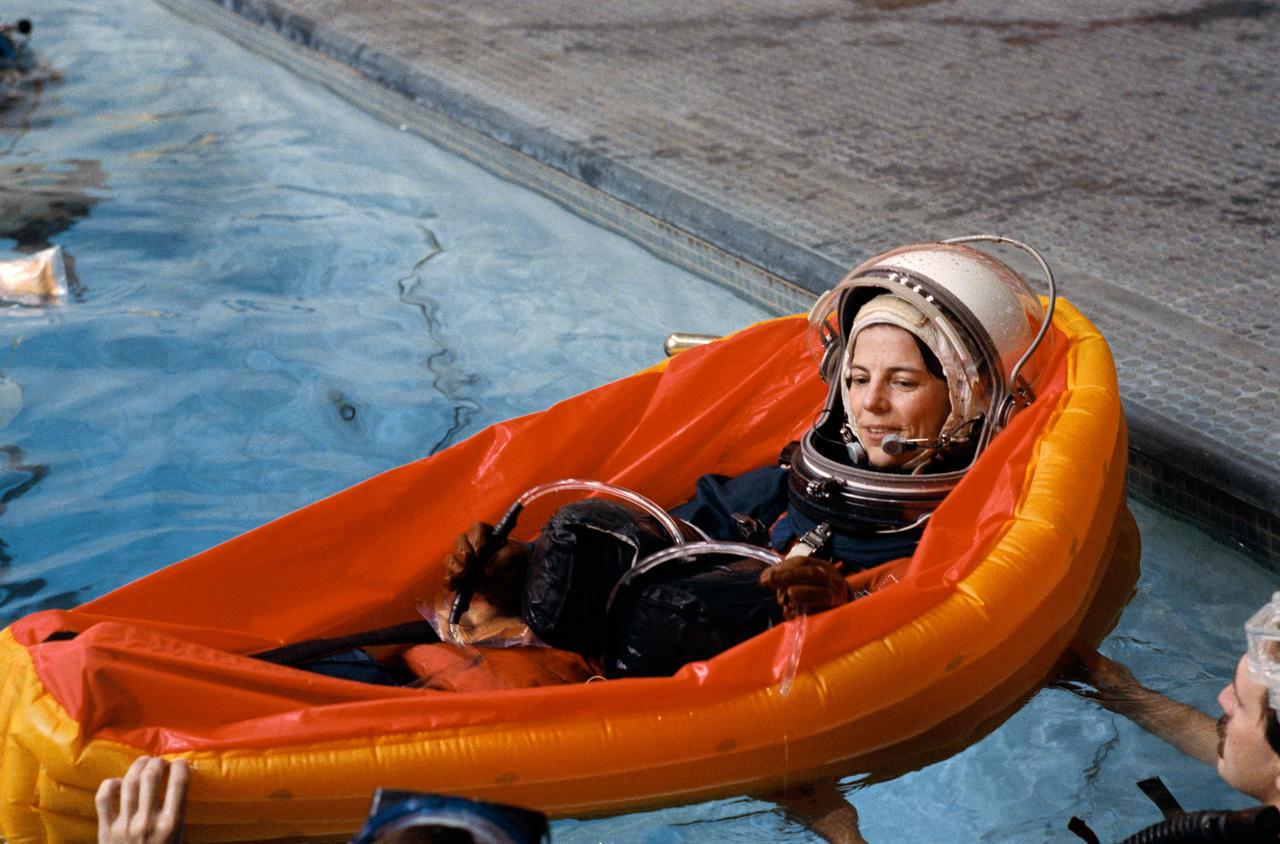
STS-32 Mission Specialist (MS) Bonnie J. Dunbar, wearing a launch and entry suit (LES) and lauch and entry helmet (LEH), in a single-occupant (one man) lift raft enlists the aid of two SCUBA-equipped divers as she floats in 25 ft deep pool located in JSC's Weightless Environment Training Facility (WETF) Bldg 29. During the exercises the crew practiced the procedures to follow in the event of an emergency aboard the Space Shuttle and familiarized themselves with post-Challenger pole system of emergency egress.
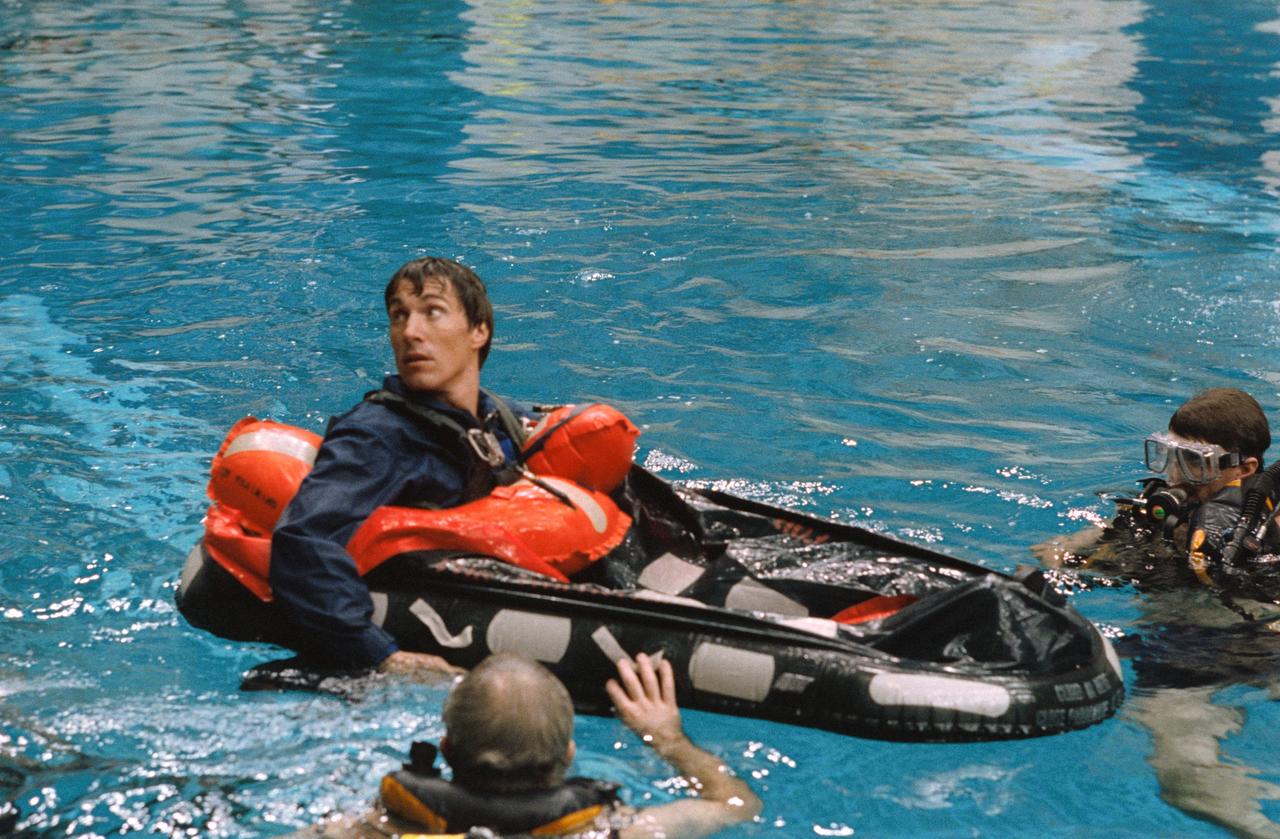
S93-26021 (Feb 1993) --- Russian cosmonaut Sergei Krikalev maneuvers a small life raft during bailout training at the Johnson Space Center's (JSC) Weightless Environment Training Facility (WET-F). Two SCUBA-equipped divers assisted Krikalev in the STS-60 training exercise. Shuttle crew members frequently utilize the 25-ft. deep pool to learn proper procedures to follow in the event of emergency egress from their Space Shuttle via the escape pole system. Krikalev is one of two cosmonauts in training for the STS-60 mission. One of the two will serve as primary payload specialist with the other filling an alternate's role. This pool and the facility in which it is housed are titled the WET-F, because they are also used by astronauts rehearsing both mission-specific and contingency extravehicular activities (EVA).
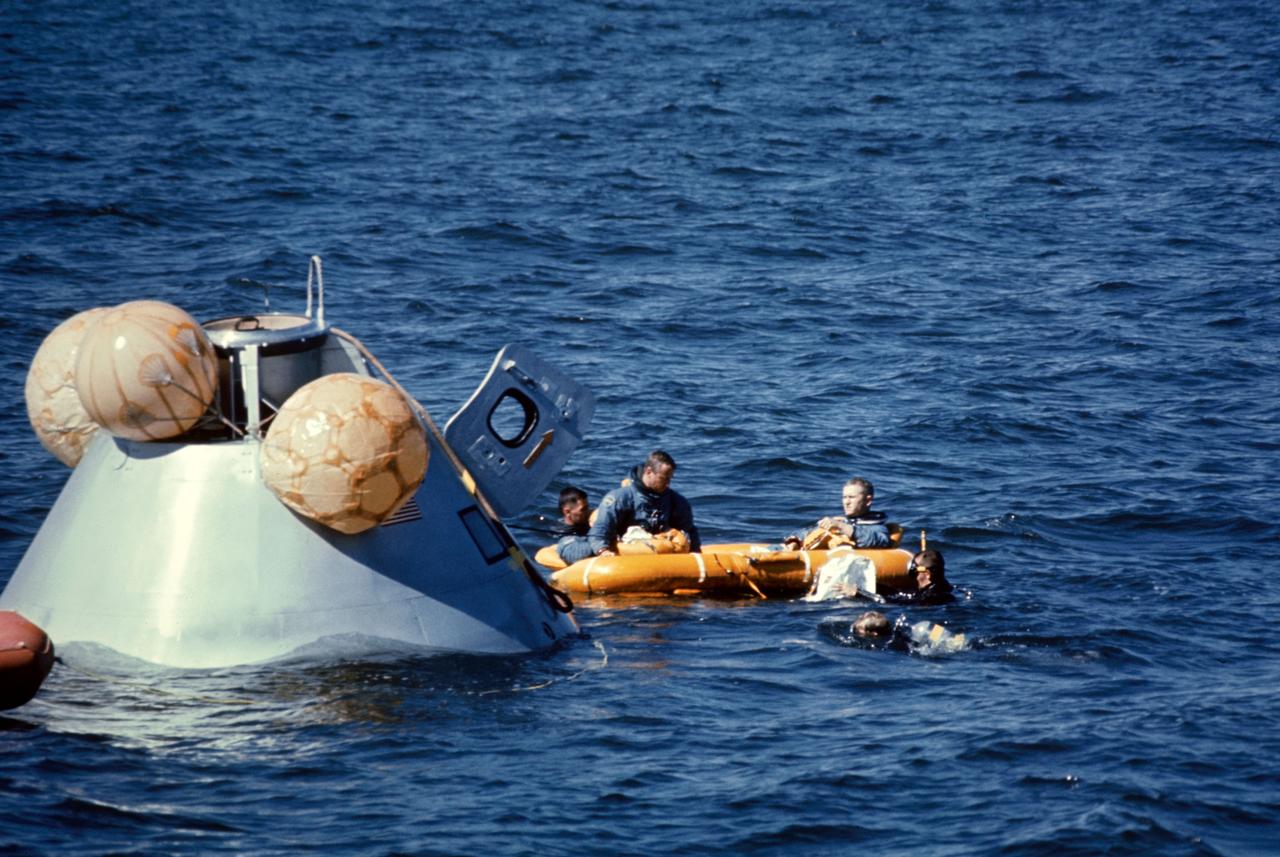
S68-53223 (19 Oct. 1968) --- The prime crew of the Apollo 8 mission in life raft awaiting pickup by U.S. Coast Guard helicopter during water egress training in the Gulf of Mexico. They had just egressed Apollo Boilerplate 1102A, at left. Inflated bags were used to upright the boilerplate. Left to right, are astronauts William A. Anders, lunar module pilot; and Frank Borman, commander. A team of MSC swimmers assisted with the training exercise.
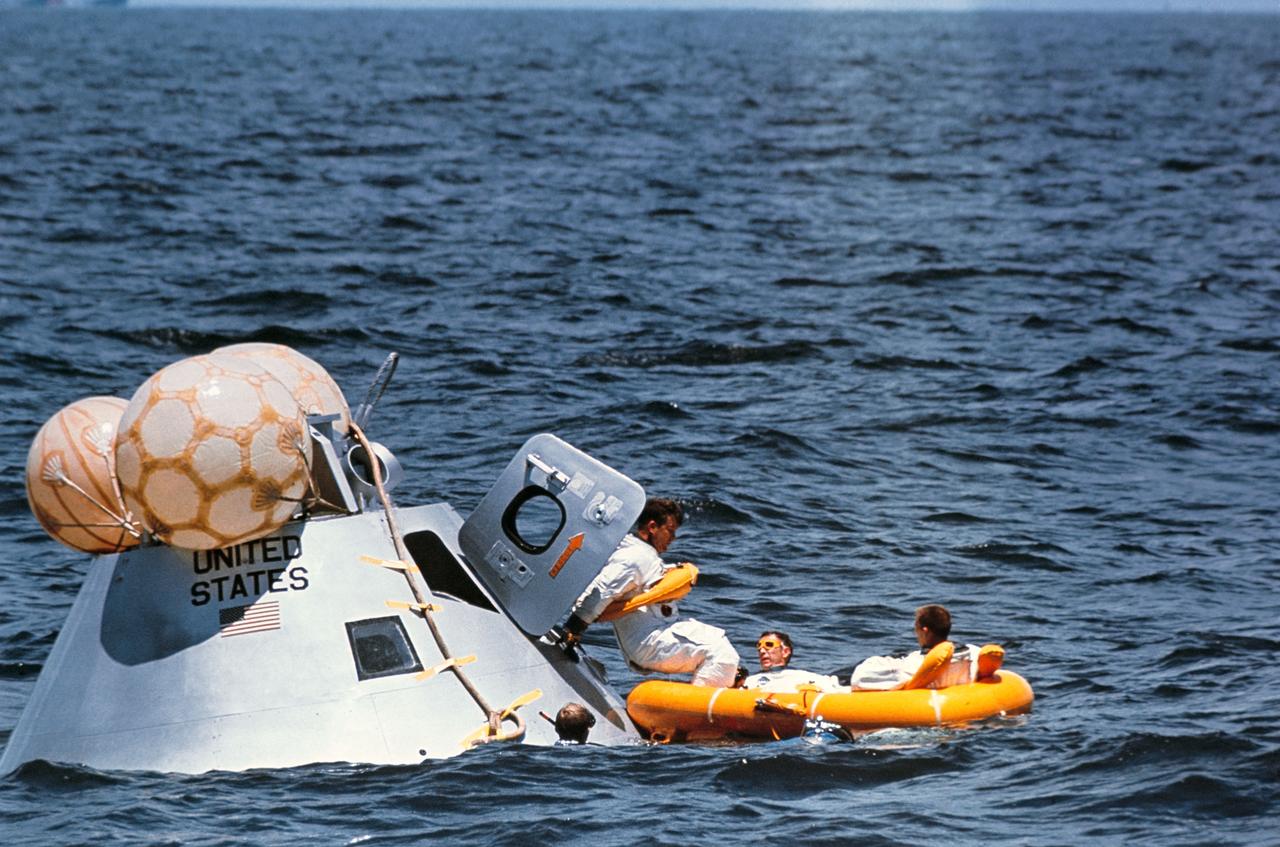
S68-46605 (5 Aug. 1968) --- The prime crew of the first manned Apollo mission (Spacecraft 101/Saturn 205) participates in water egress training in the Gulf of Mexico. Left to right, are astronauts Walter M. Schirra Jr. (stepping into life raft), Donn F. Eisele, and Walter Cunningham. They have just egressed Apollo Command Module Boilerplate 1102, and are awaiting helicopter pickup. Inflated bags were used to upright the boilerplate. MSC swimmers assisted in the training exercise.
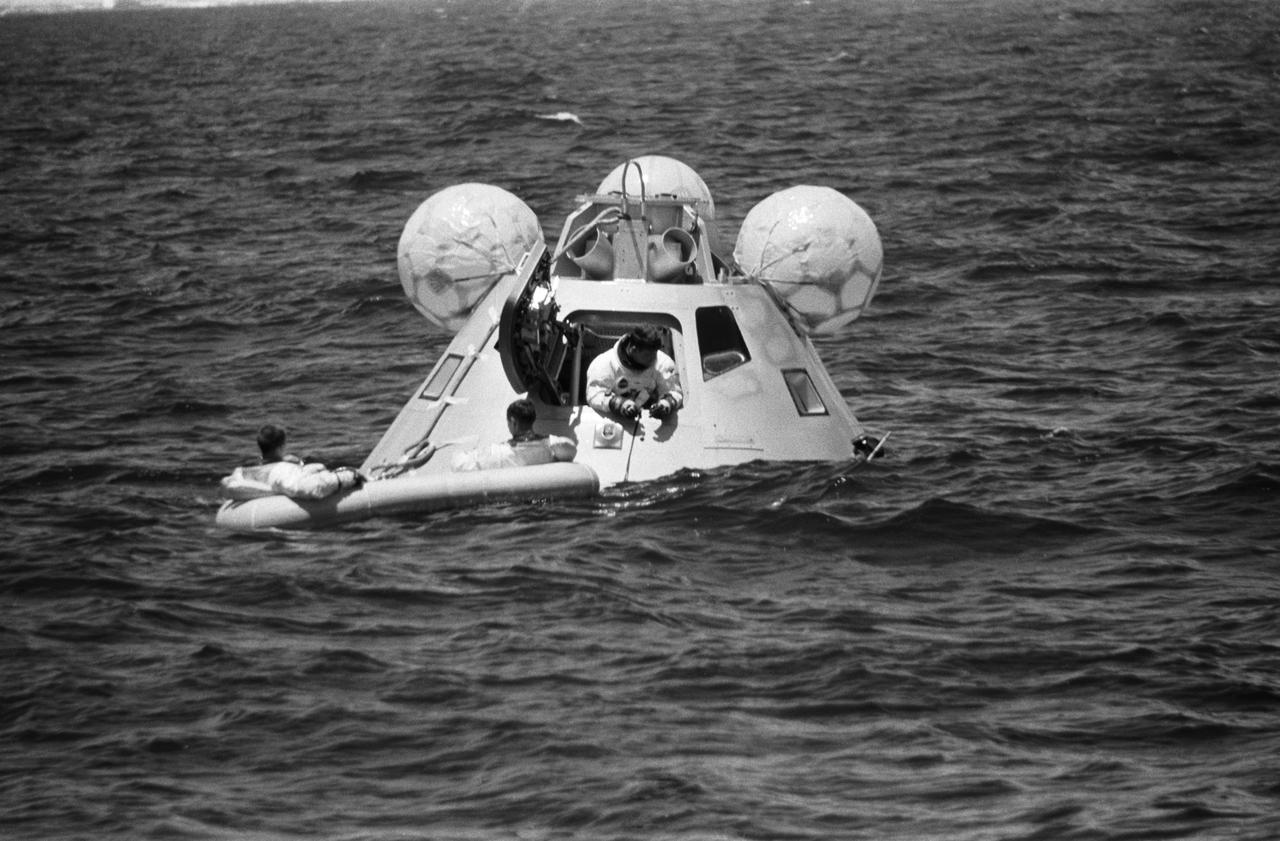
S68-42197 (5 Aug. 1968) --- The prime crew of the first manned Apollo space mission, Apollo 7, participates in water egress training in the Gulf of Mexico. In hatch of the Apollo egress trainer (command module) is astronaut Walter M. Schirra Jr. Sitting in life raft are astronauts Walter Cunningham (on left) and Donn F. Eisele. A team of MSC swimmers assisted with the training exercise. The inflated bags were used to upright the trainer prior to egress.
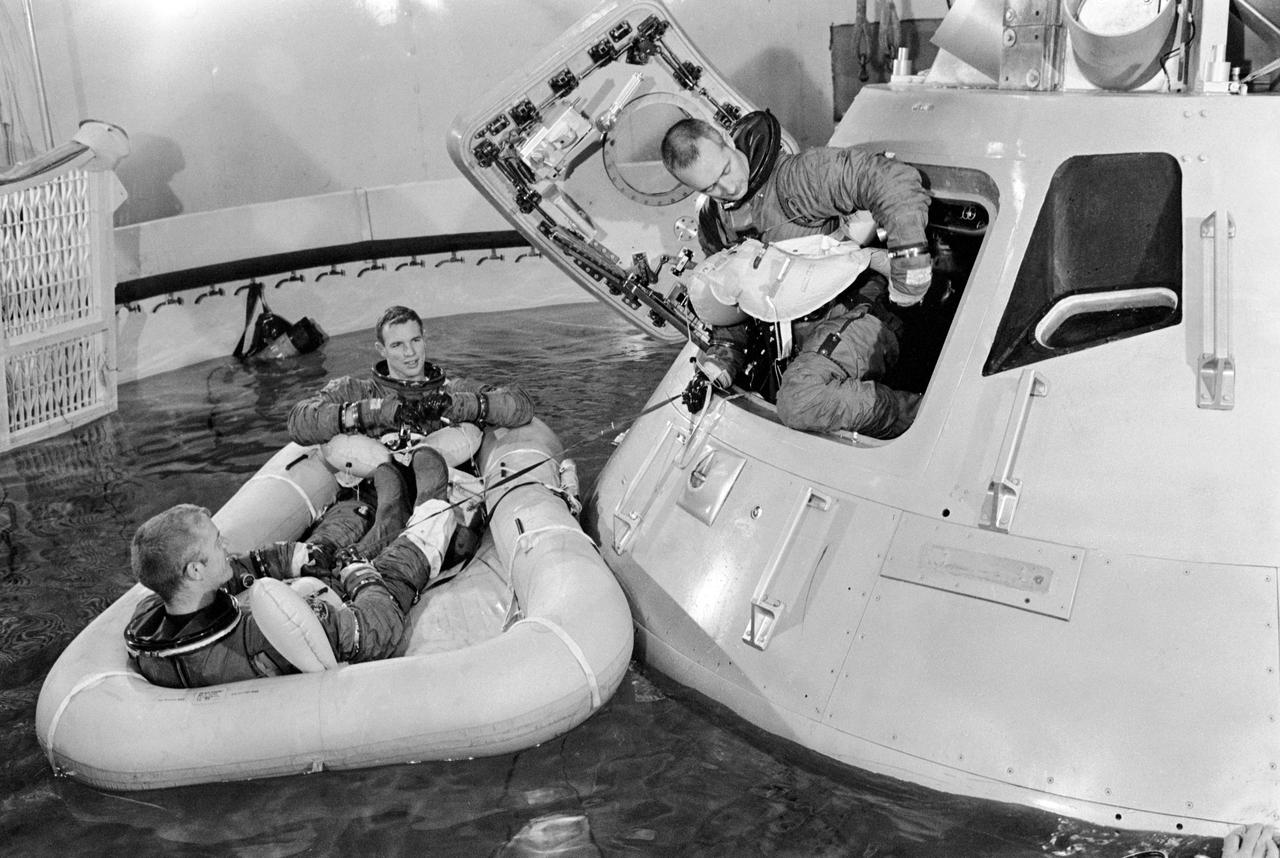
S68-54859 (November 1968) --- The prime crew of the Apollo 9 (Spacecraft 104/Lunar Module 3/Saturn 504) space mission participates in water egress training in a tank in Building 260 at the Manned Spacecraft Center. Egressing the Apollo command module boilerplate is astronaut James A. McDivitt, commander. In life raft are astronauts David R. Scott (background), command module pilot; and Russell L. Schweickart, lunar module pilot.
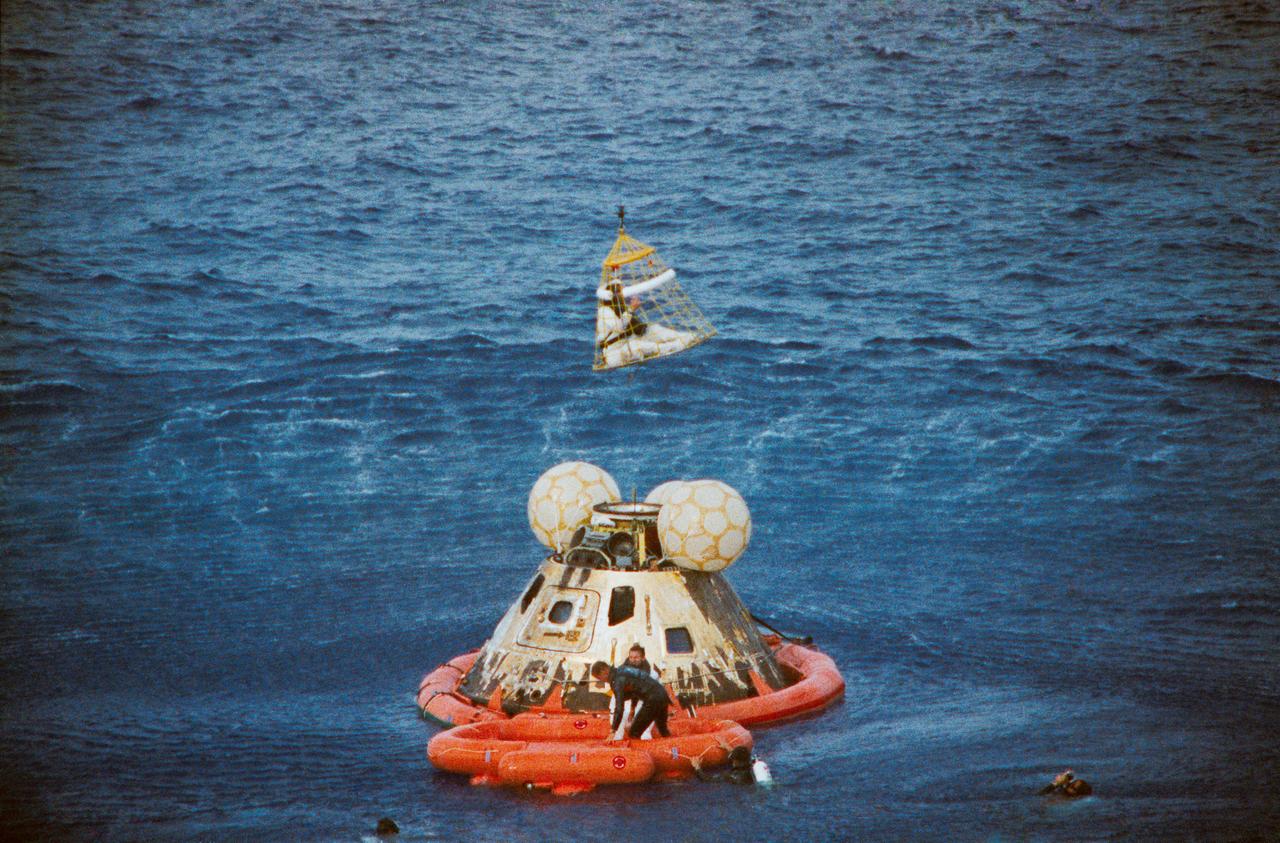
S70-35651 (17 April 1970) --- Astronaut John L. Swigert Jr., command module pilot, is lifted aboard a helicopter in a "Billy Pugh" net while astronaut James A. Lovell Jr., commander, awaits his turn. Astronaut Fred W. Haise Jr., lunar module pilot, is already aboard the helicopter. In the life raft with Lovell, and in the water are several U.S. Navy underwater demolition team swimmers, who assisted in the recovery operations. The crew was taken to the USS Iwo Jima, prime recovery ship, several minutes after the Apollo 13 spacecraft splashed down at 12:07:44 p.m. (CST), April 17, 1970.
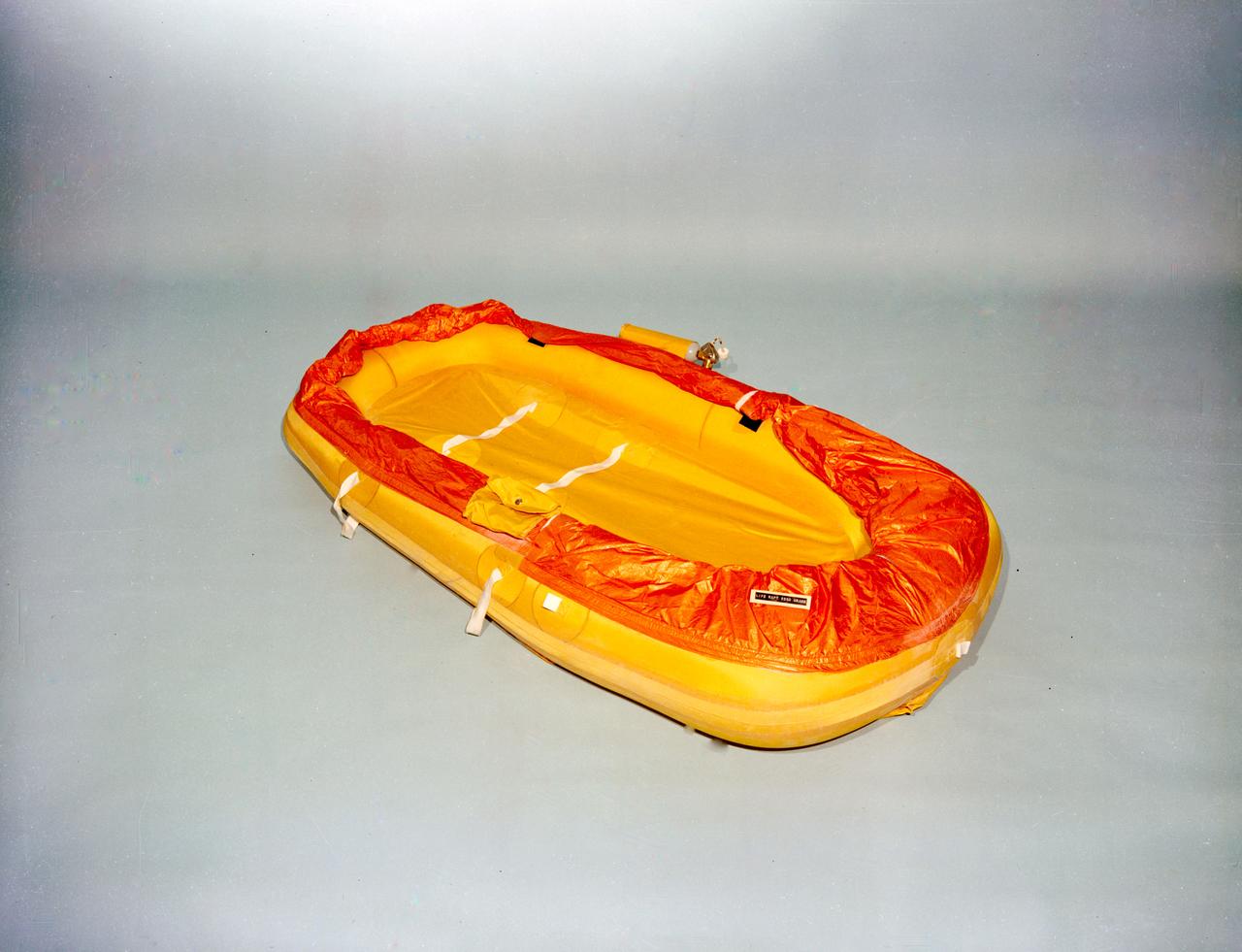
S62-06769 (1962) --- A life raft, survival equipment for the Mercury astronauts. Photo credit: NASA
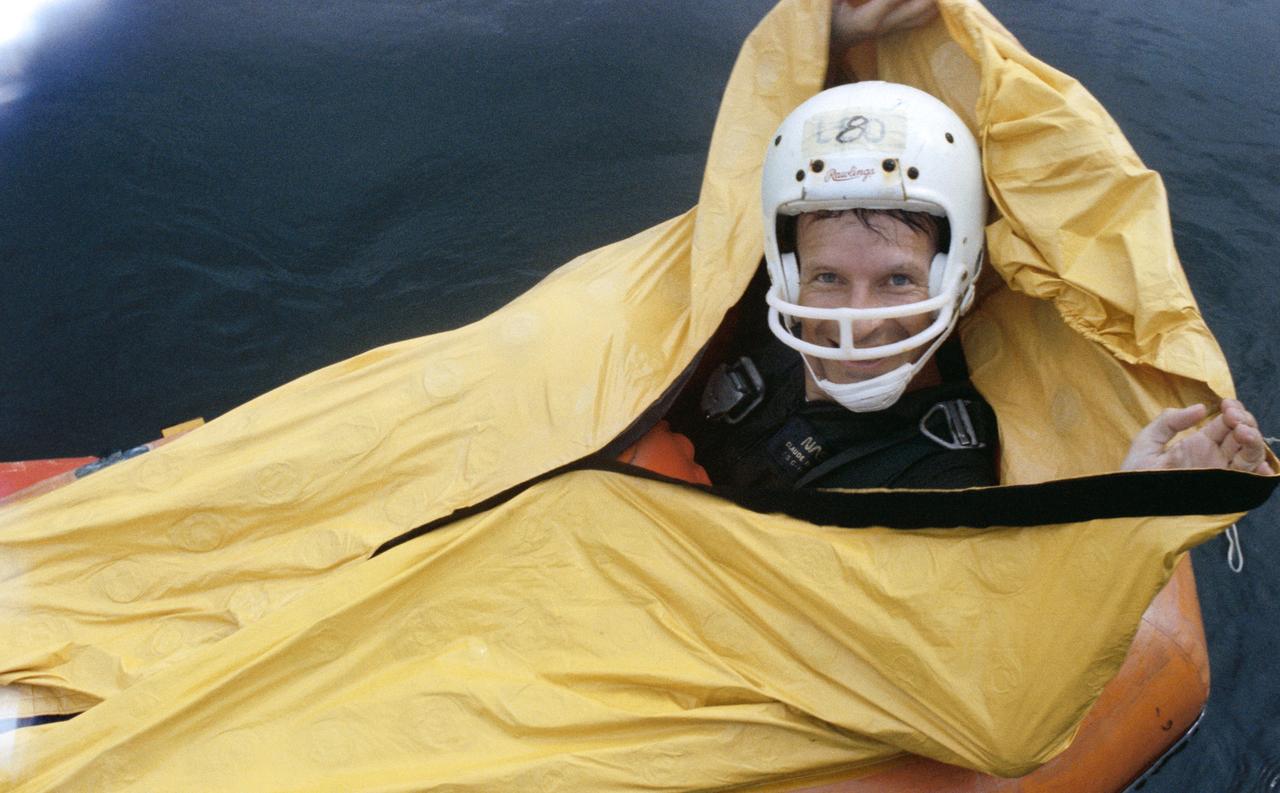
S80-38468 (4 Sept 1980) --- Astronaut Claude Nicollier in water egress training. View is of Nicollier in one-man life raft.
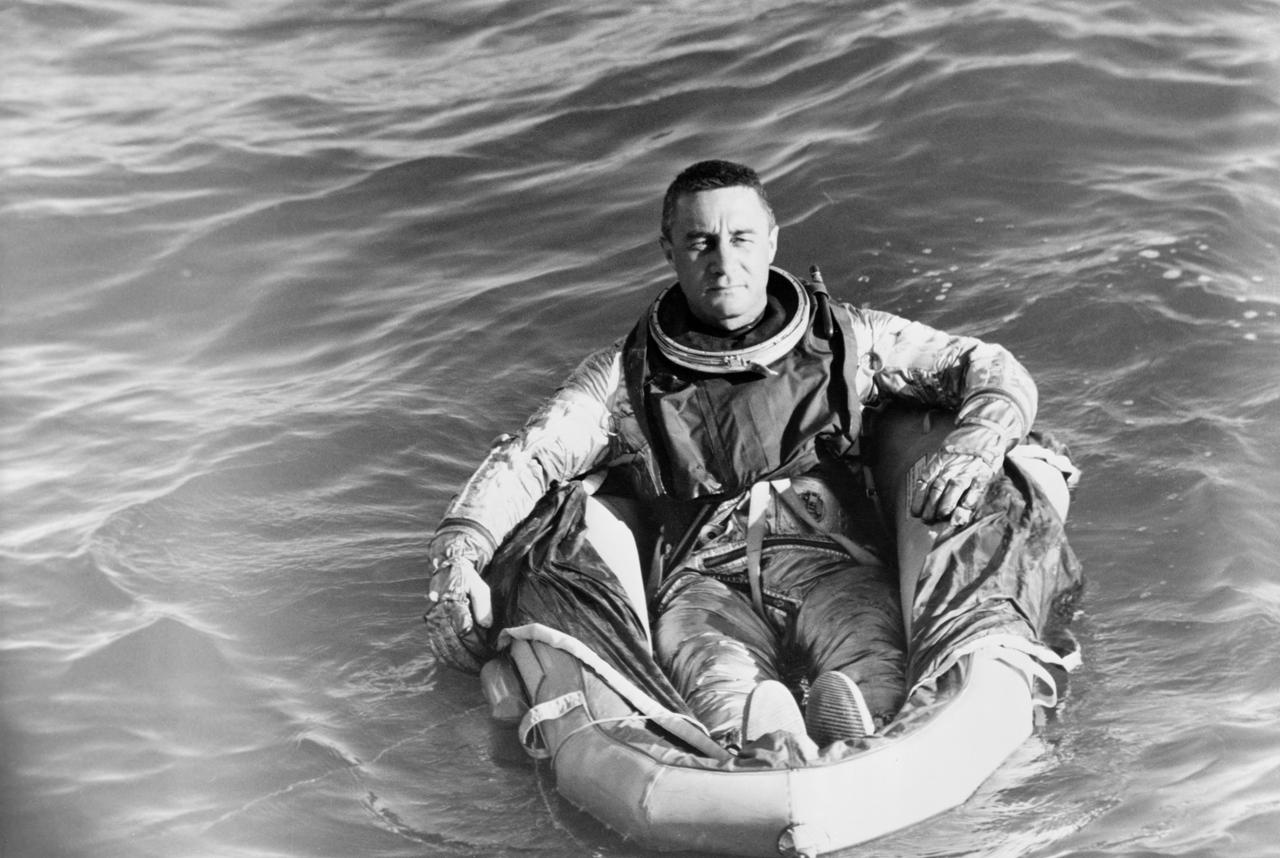
S61-04037 (1961) --- Astronaut Virgil I. (Gus) Grissom, pilot of the Mercury-Redstone 4 spaceflight, sits in a life raft during water egress training activies. Photo credit: NASA
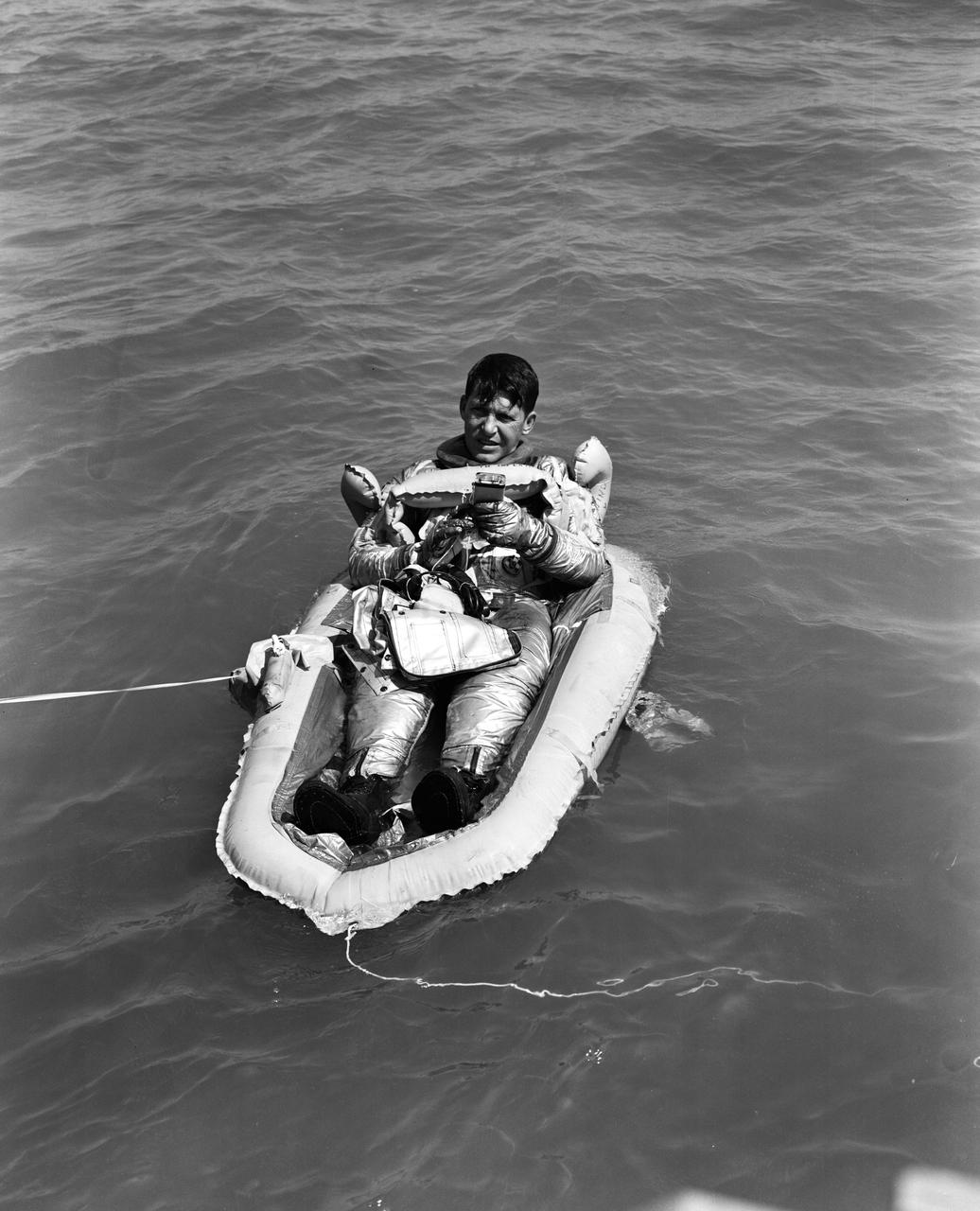
S62-01379 (1962) --- Astronaut Walter M. Schirra Jr., wearing his pressure suit, is seated in a life raft during a portion of his water egress training. Photo credit: NASA
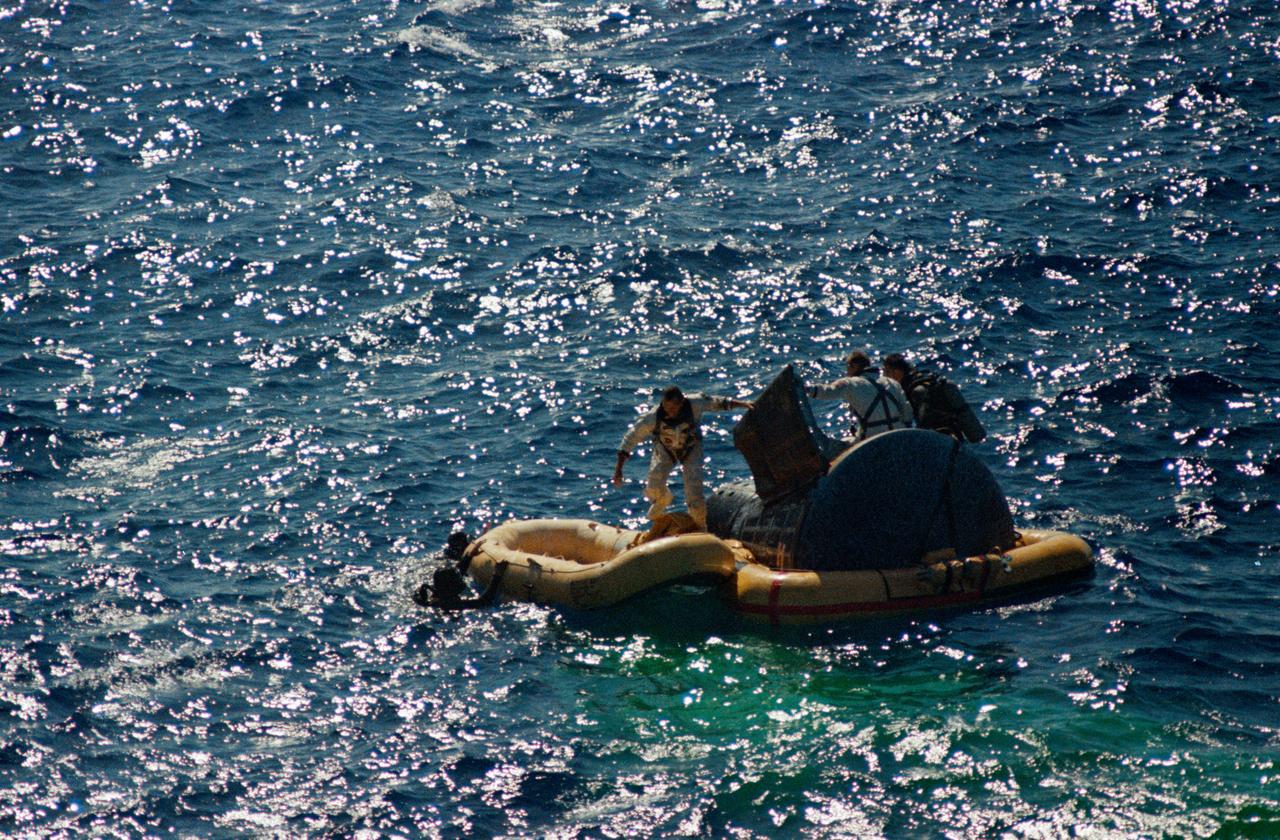
S65-51653 (29 Aug. 1965) --- Astronauts L. Gordon Cooper Jr. and Charles Conrad Jr. exit their spacecraft after splashdown of the Gemini-5 spacecraft. They are photographed boarding a life raft with the help of Navy divers.
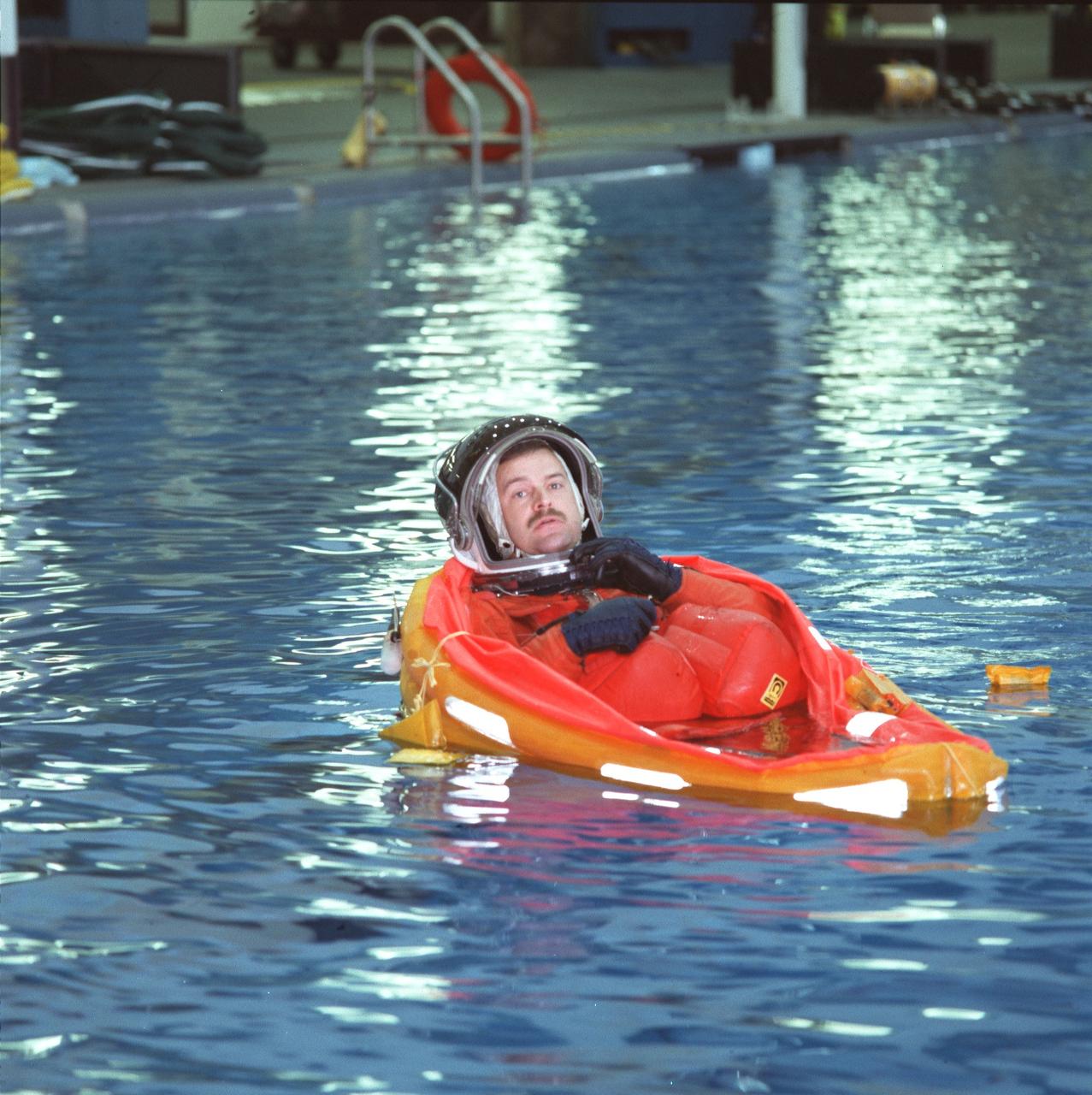
JSC2000-02532 (21 March 2000) --- Astronaut Scott D. Altman, STS-106 pilot, prepares to deploy his life raft during emergency bailout training at the Neutral Buoyancy Laboratory (NBL).
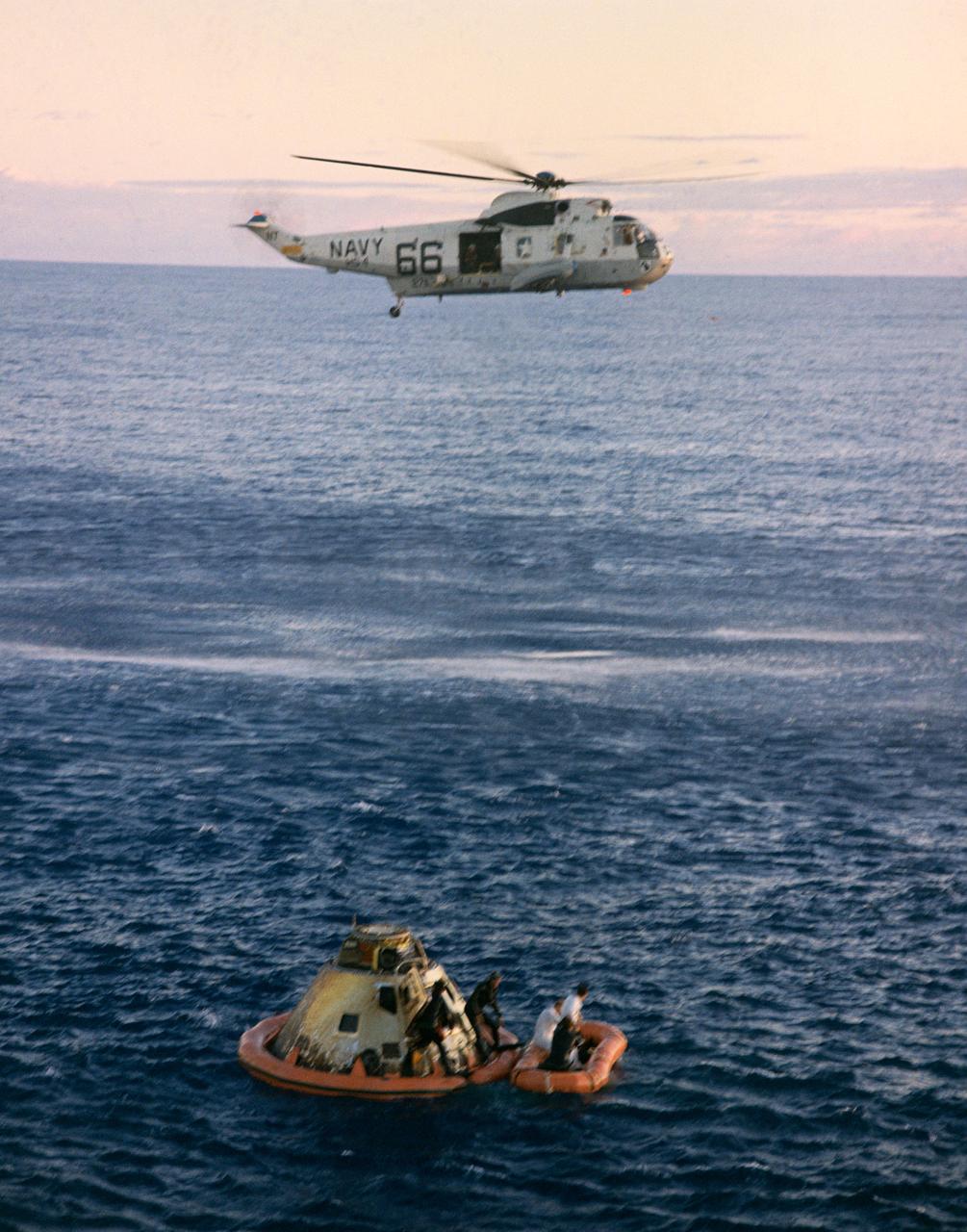
S69-21036 (26 May 1969) --- A Navy helicopter arrives to recover the Apollo 10 astronauts, seen entering a life raft, as their spacecraft floats in the South Pacific immediately after touchdown. U.S. Navy underwater demolition team swimmers assist in the recovery operations. Already in the life raft are astronauts Thomas P. Stafford (left), commander, and John W. Young (right), command module pilot. Splashdown occurred at 11:53 a.m., May 26, 1969, about 400 miles east of American Samoa and about four miles from the recovery ship to conclude a successful eight-day lunar orbit mission. Note that in this photo the divers have attached a flotation collar to the spacecraft.
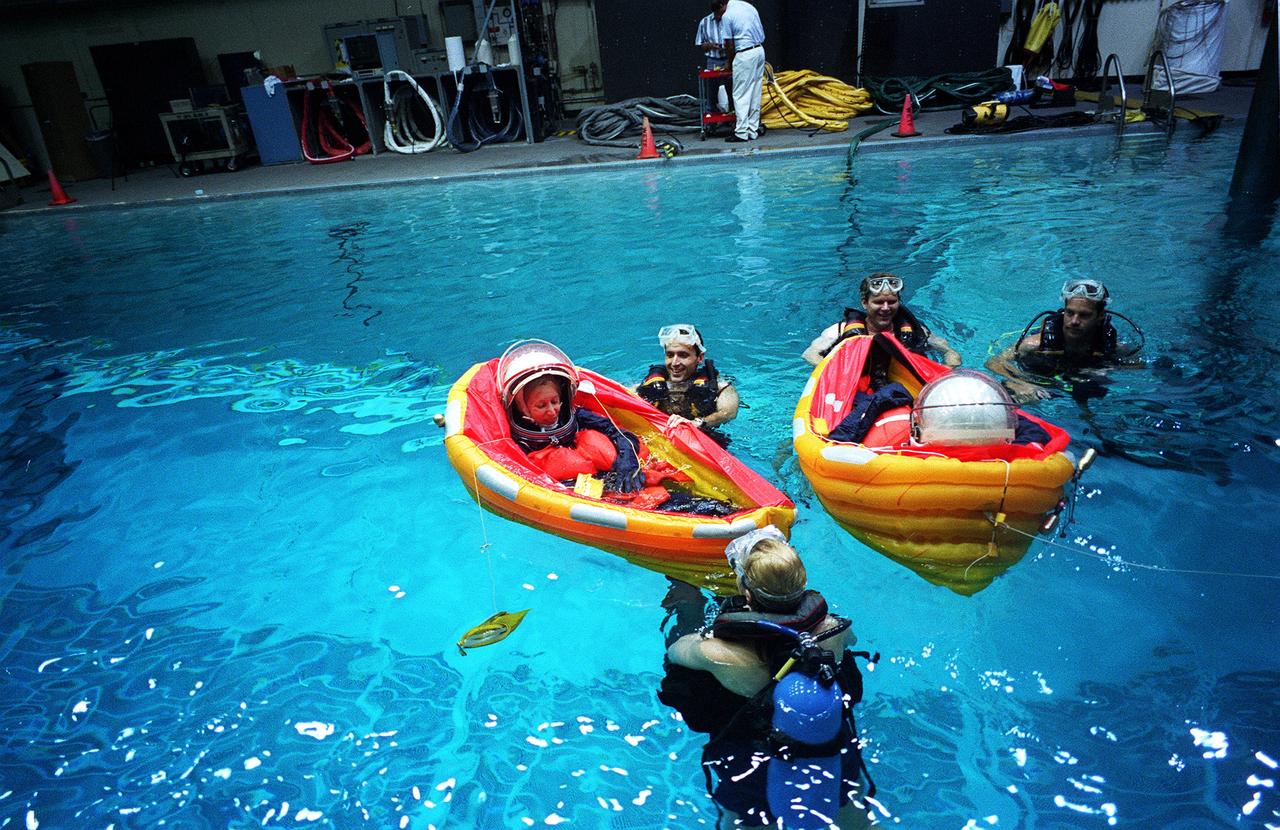
S96-15405 (26 Sept. 1996) --- In the Johnson Space Center's weightless environment training facility, astronaut Marsha S. Ivins, STS-81 mission specialist, bails water from her life raft during water bailout survival training. Astronaut Peter J.K. (Jeff) Wisoff (pictured in right raft) and four other STS-81 crewmates (out of frame) joined Ivins for the bailout training exercises. Several SCUBA-equipped divers assist in the training exercise.
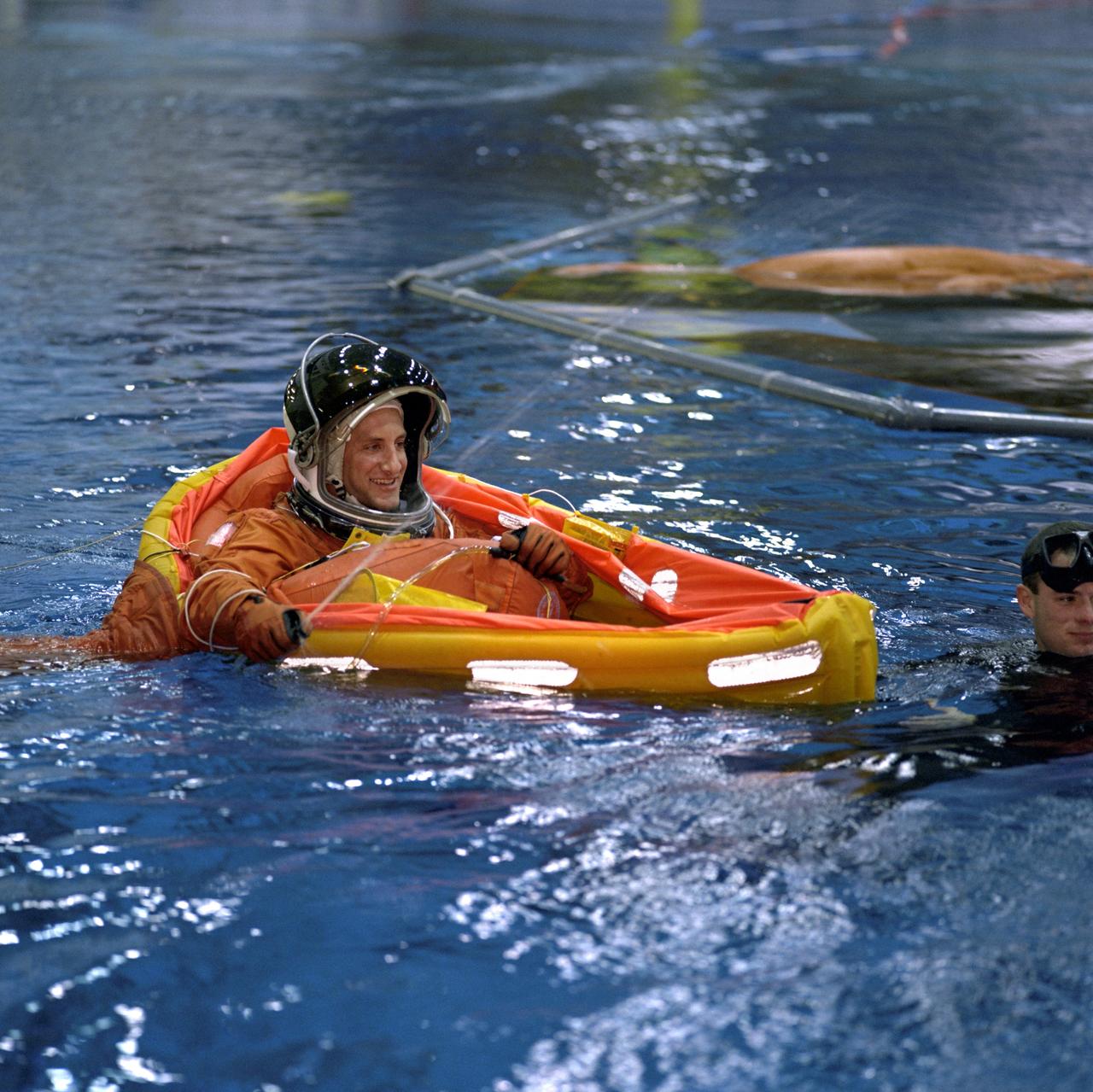
JSC2001-00012 (January 2001) --- Astronaut Charles O. Hobaugh, STS-104 pilot, floats in a small life raft during an emergency egress training session at the Neutral Buoyancy Laboratory (NBL) near the Johnson Space Center (JSC). Hobaugh will join four other astronauts for a June mission to the International Space Station (ISS).

JSC2002-00573 (19 February 2002) --- Astronaut Pamela A. Melroy, STS-112 pilot, assisted by divers, floats in a small life raft during an emergency egress training session in the Neutral Buoyancy Laboratory (NBL) near the Johnson Space Center (JSC).

JSC2002-00824 (17 April 2002) --- Astronaut James M. Kelly, STS-114 pilot, assisted by divers, floats in a small life raft during an emergency egress training session in the Neutral Buoyancy Laboratory (NBL) near the Johnson Space Center (JSC).
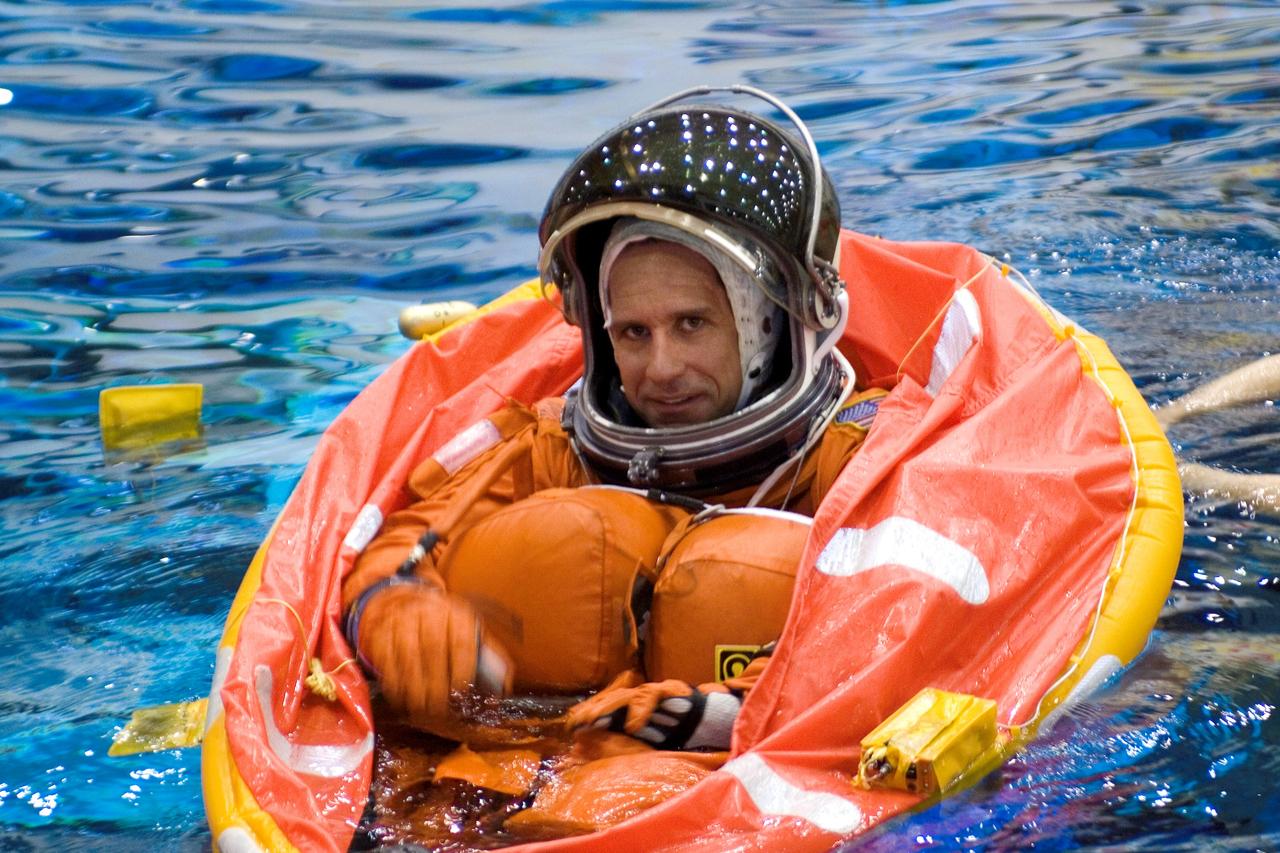
JSC2005-E-31234 (28 July 2005) --- Astronaut William A. Oefelein, STS-116 pilot, attired in a training version of the shuttle launch and entry suit and equipped with a one-person life raft, floats in water during an emergency egress training session in the Neutral Buoyancy Laboratory (NBL) near the Johnson Space Center.
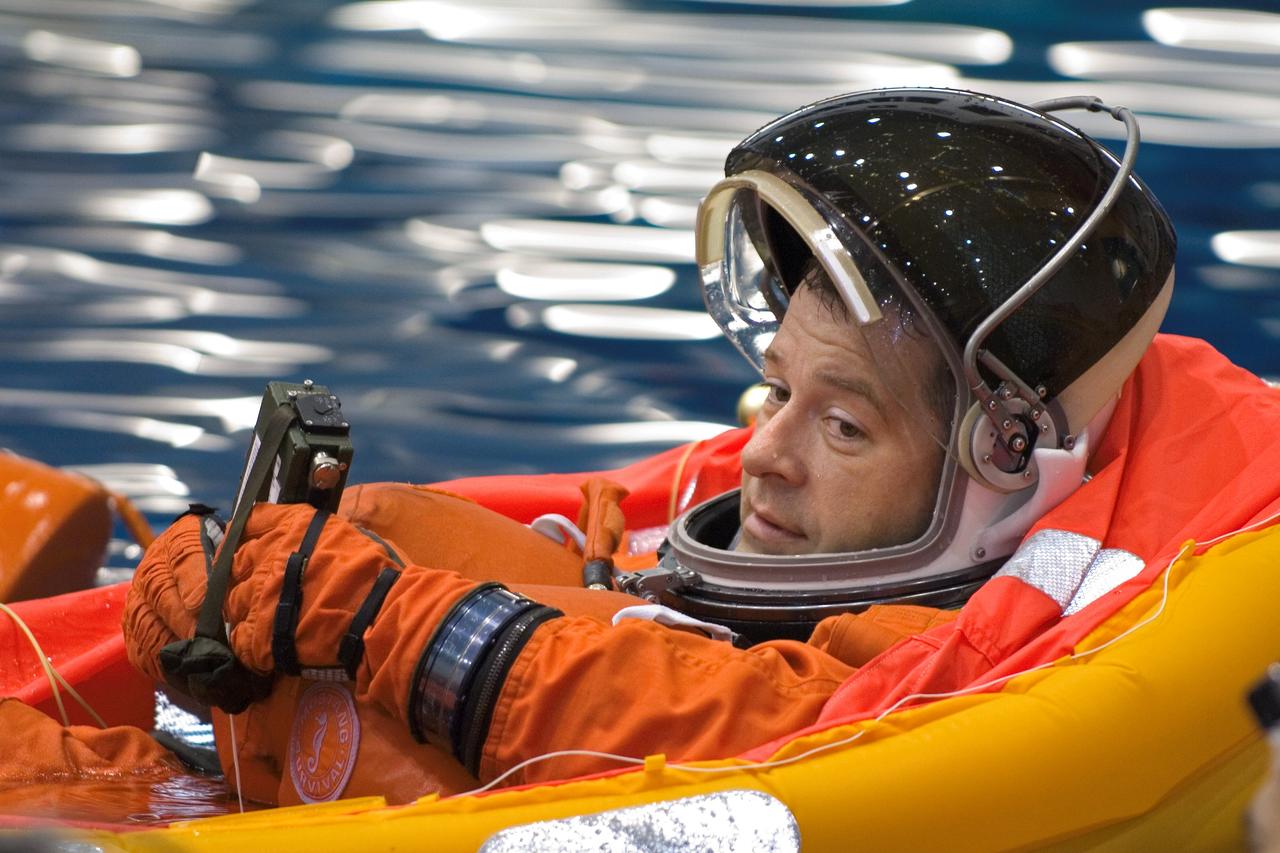
JSC2005-E-31291 (28 July 2005) --- Astronaut Nicholas J. M. Patrick, STS-116 mission specialist, attired in a training version of the shuttle launch and entry suit, floats in a small life raft during an emergency egress training session in the Neutral Buoyancy Laboratory (NBL) near the Johnson Space Center.
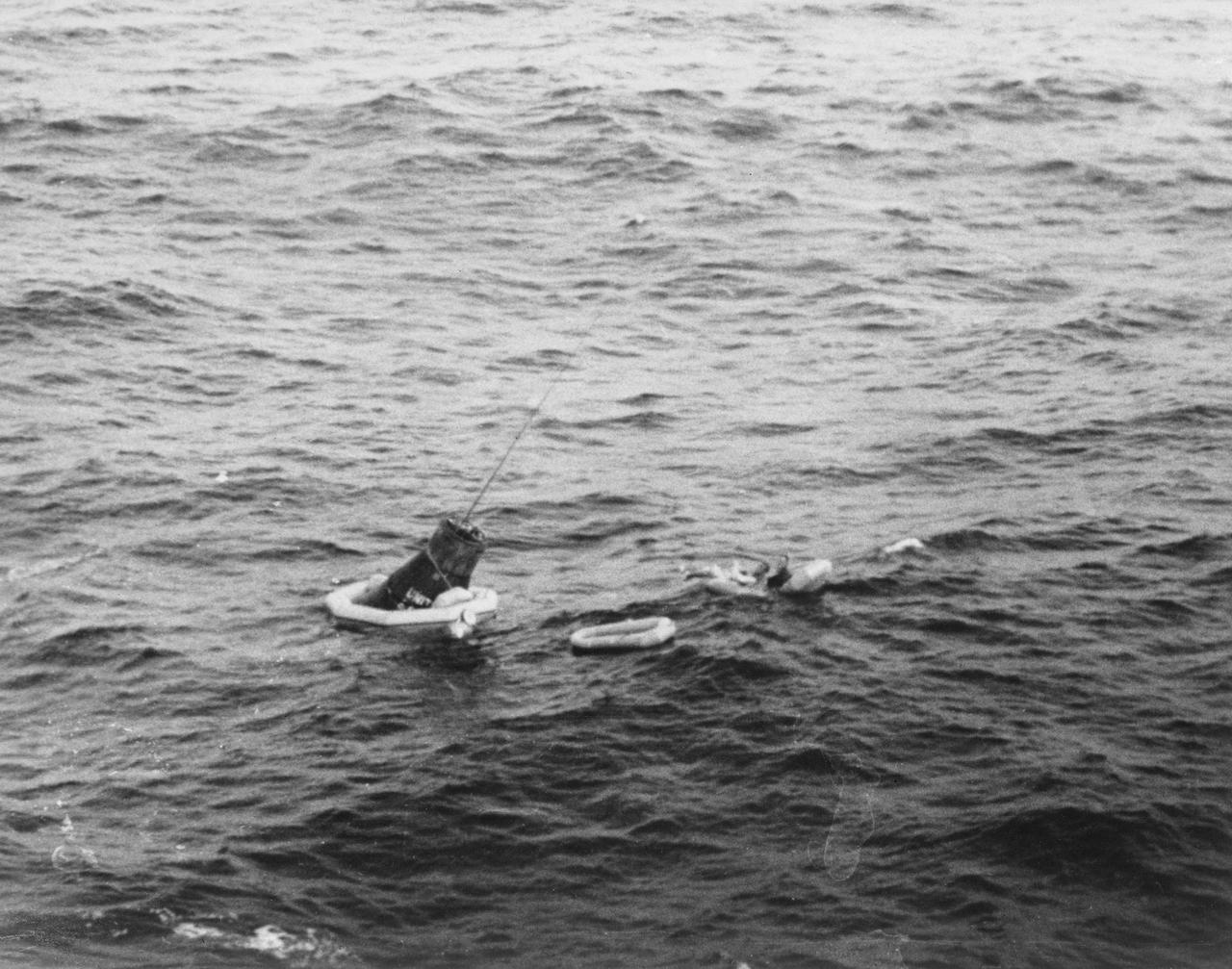
S62-04065 (24 May 1962) --- Astronaut M. Scott Carpenter, prime pilot for the Mercury-Atlas 7 (MA-7) mission, is seen being recovered from the Atlantic Ocean after MA-7 flight. A diver helps Carpenter into a life raft while the capsule floats nearby. Photo credit: NASA
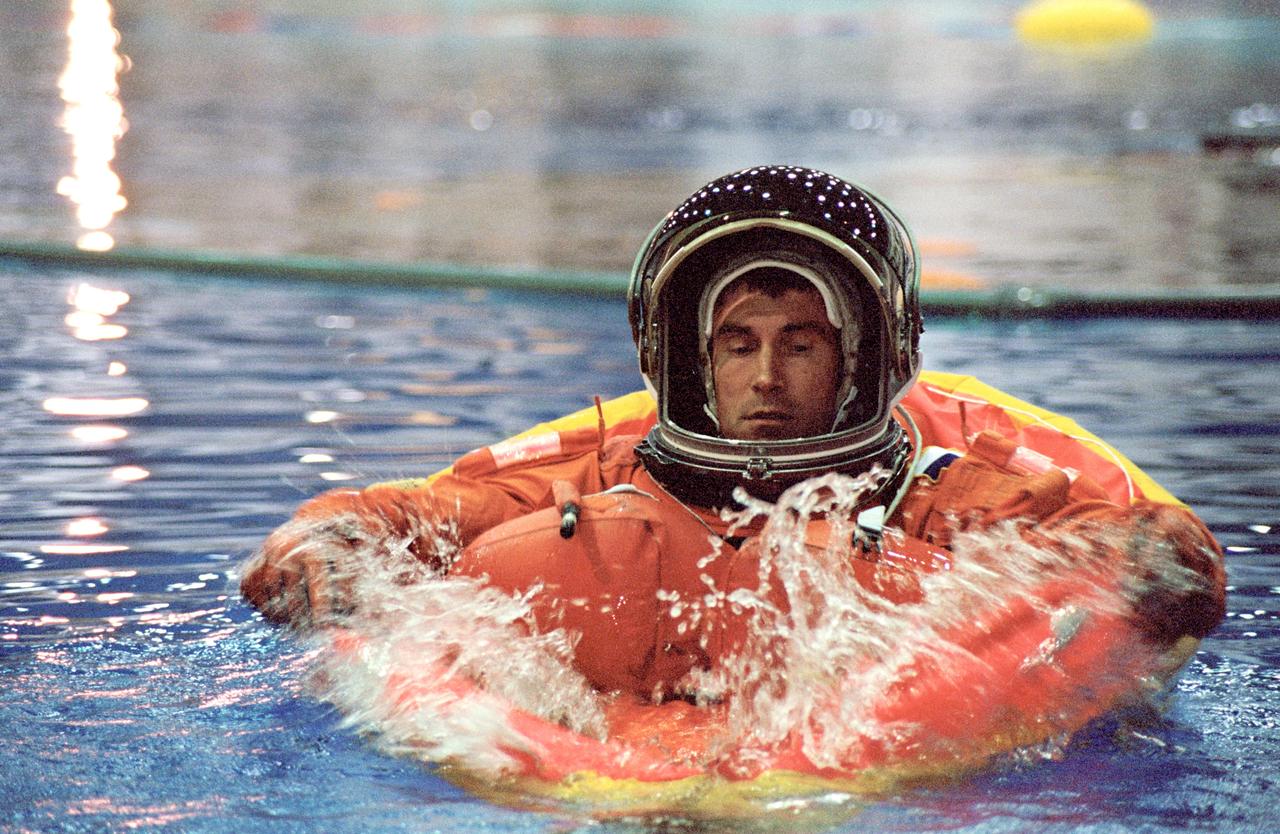
JSC2002-01972 (28 October 2002) --- Cosmonaut Sergei K. Krikalev, backup Expedition Seven mission commander, floats in a small life raft during an emergency bailout training session in the Neutral Buoyancy Laboratory (NBL) near the Johnson Space Center (JSC). Krikalev represents Rosaviakosmos.
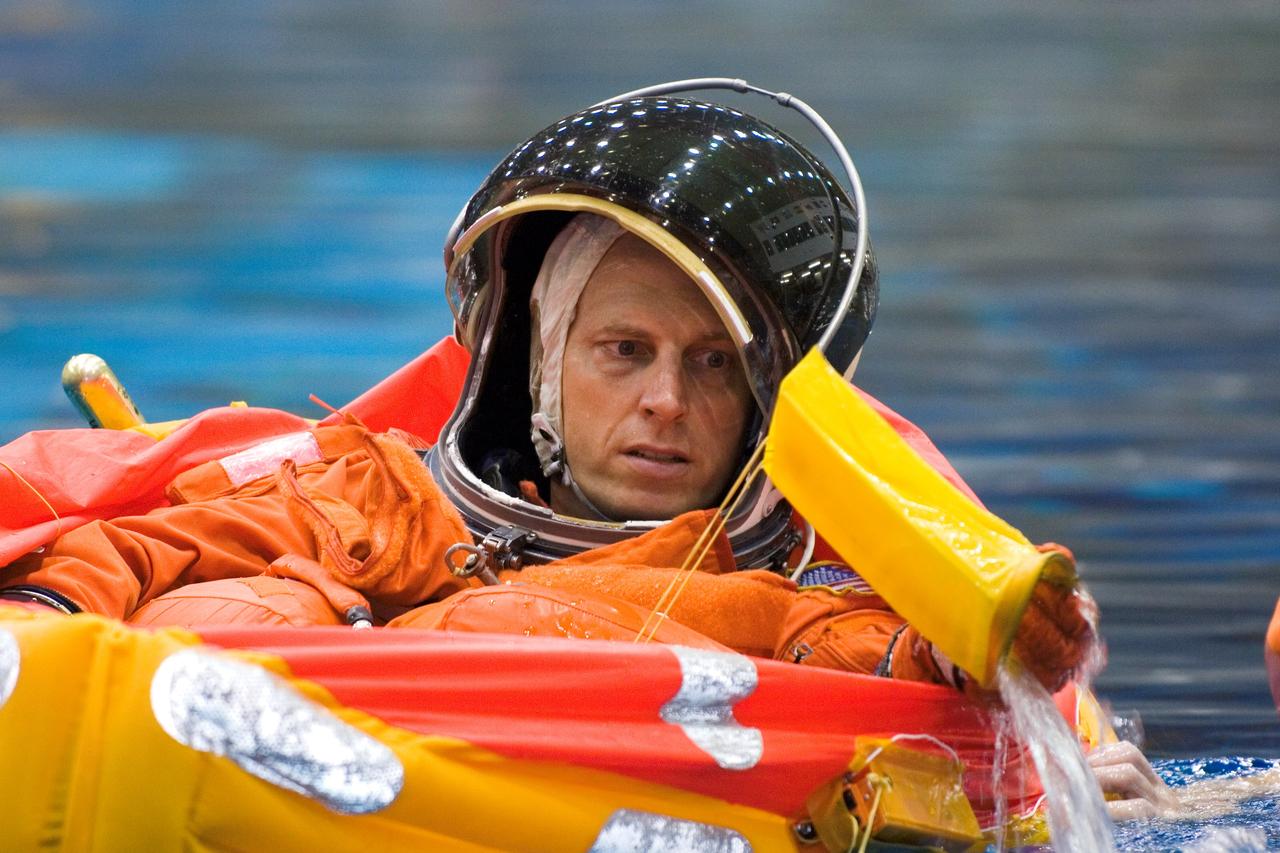
JSC2005-E-31315 (28 July 2005) --- Astronaut Clayton C. Anderson, Expedition 14 backup flight engineer, floats in a small life raft during an emergency bailout training session in the Neutral Buoyancy Laboratory (NBL) near the Johnson Space Center. Anderson is wearing a training version of the shuttle launch and entry suit.
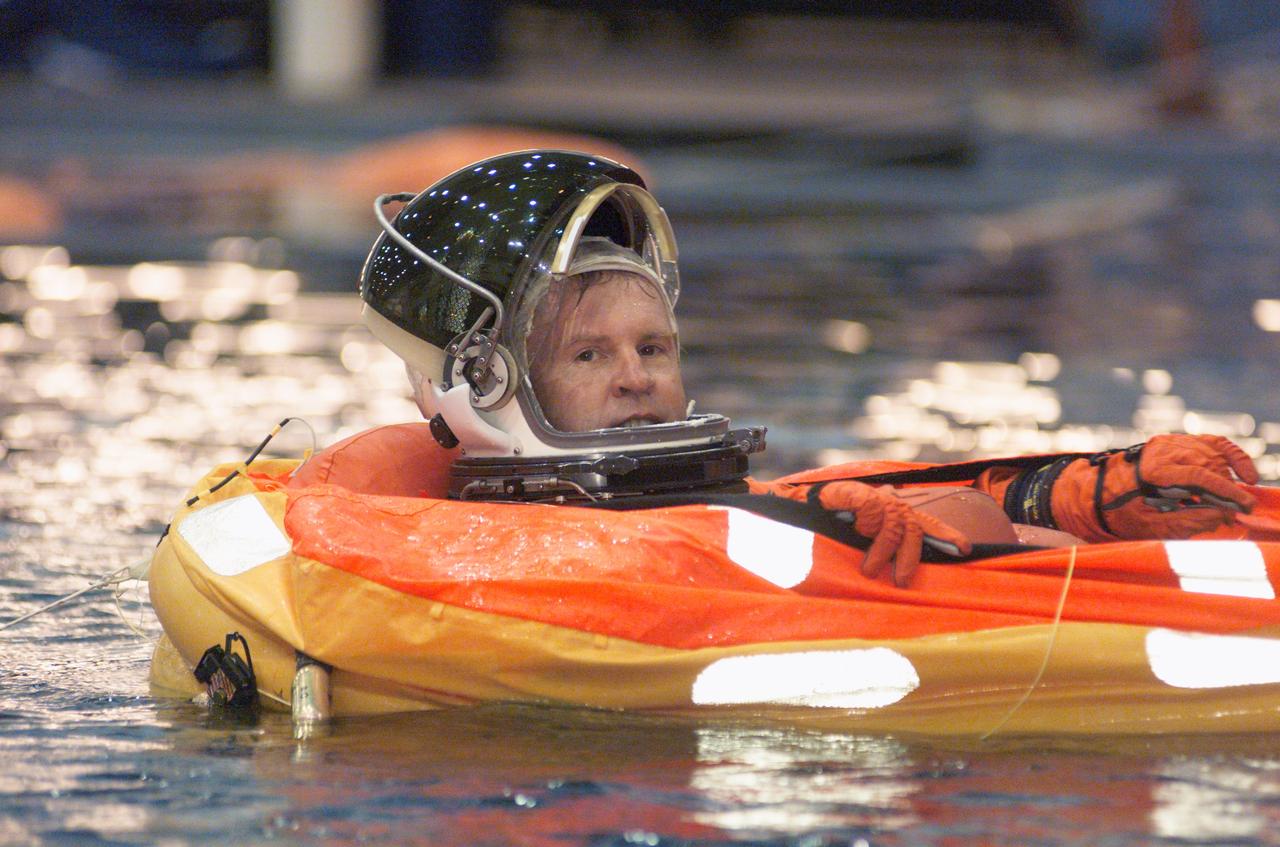
JSC2004-E-41399 (17 September 2004) --- Astronaut Andrew S. W. Thomas, STS-114 mission specialist, attired in a training version of the shuttle launch and entry suit, floats in a small life raft during an emergency egress training session in the Neutral Buoyancy Laboratory (NBL) near the Johnson Space Center (JSC).
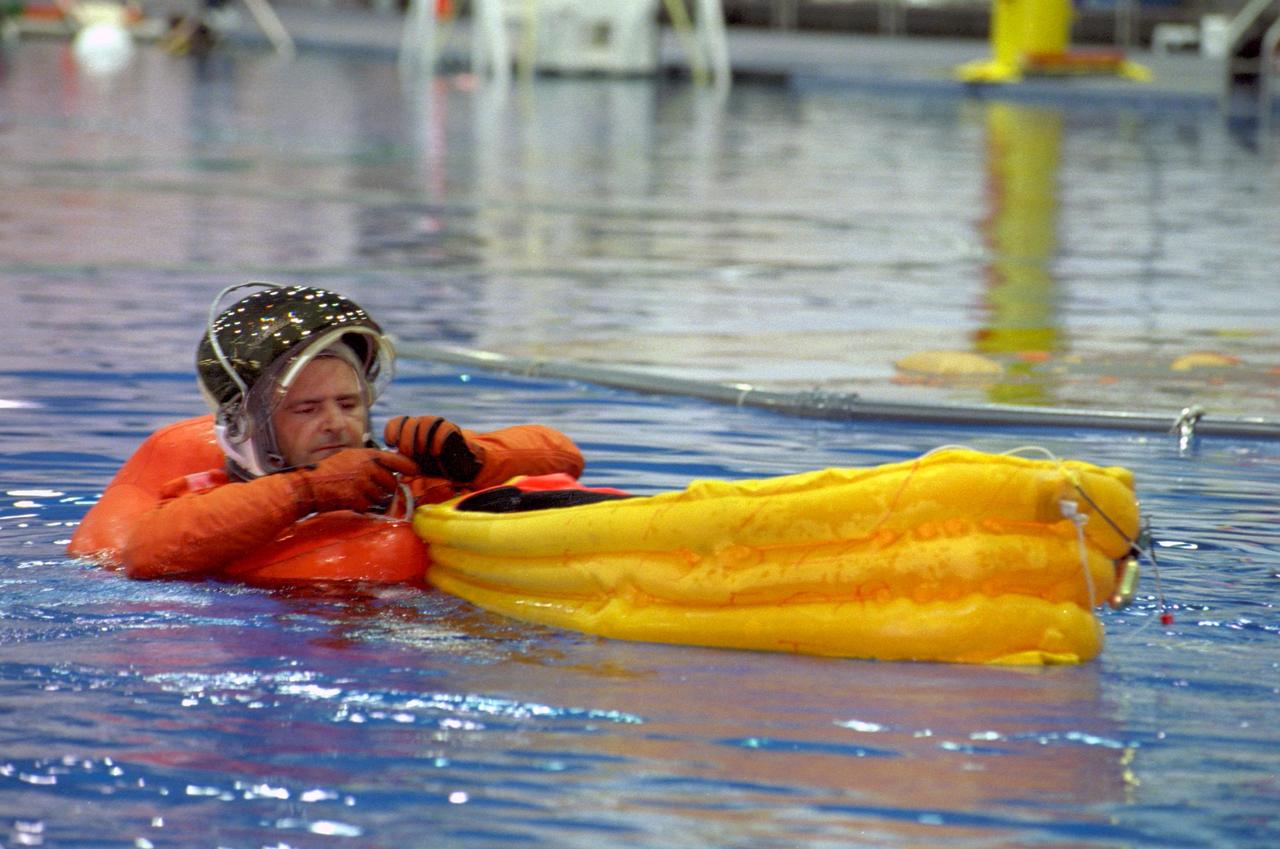
S99-07008 (9 July 1999) --- Astronaut Marc Garneau, mission specialist representing the Canadian Space Agency, puts the final touches on the life raft he's just deployed during a simulated emergency bailout exercise in the Neutral Buoyancy Laboratory at the Sonny Carter Training Center.
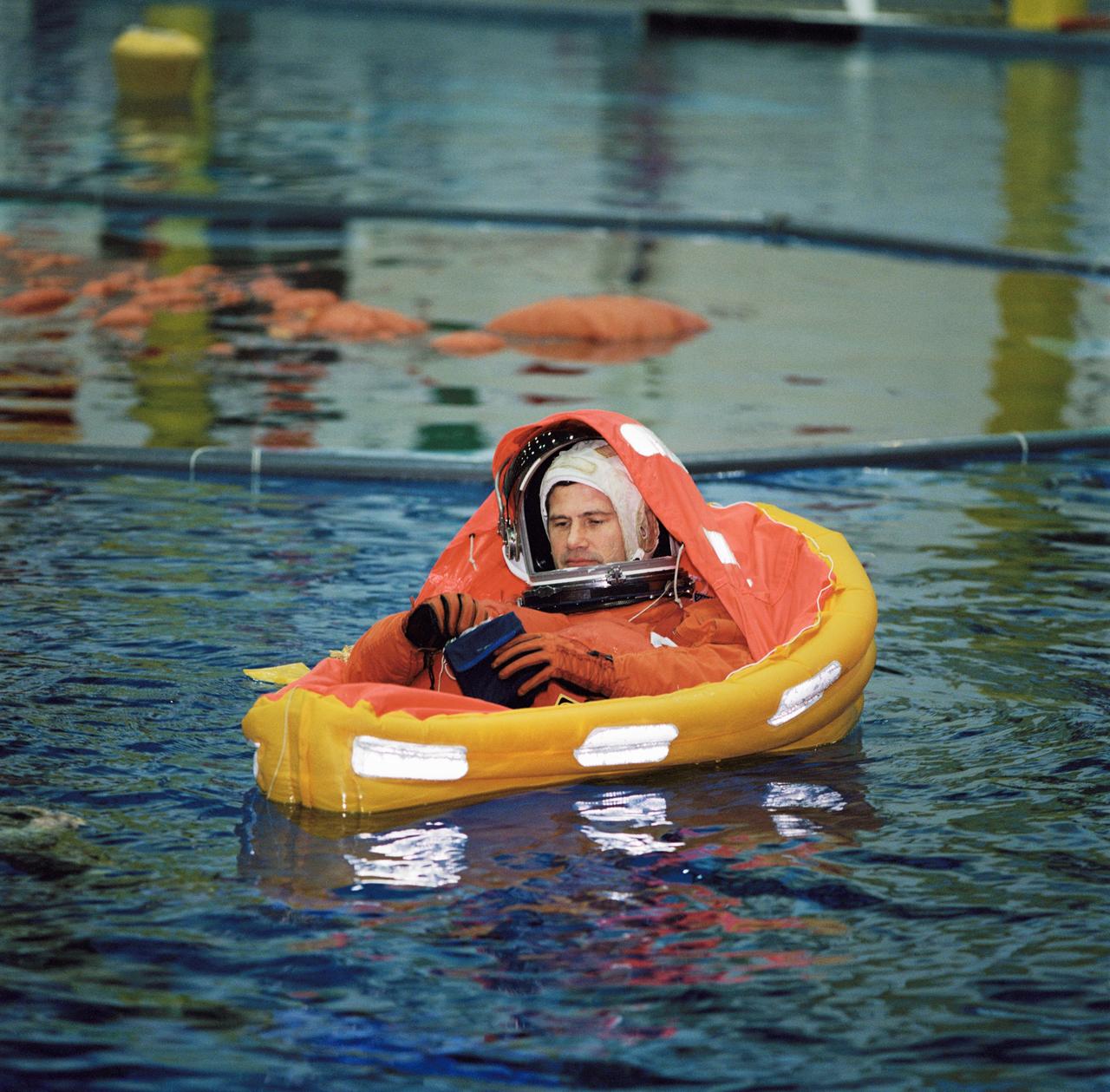
JSC2002-00404 (4 February 2002) --- Astronaut Paul S. Lockhart, STS-111 pilot, floats in a small life raft during an emergency bailout training session in the Neutral Buoyancy Laboratory (NBL) near the Johnson Space Center (JSC). STS-111 will be the 14th shuttle mission to visit the International Space Station (ISS).
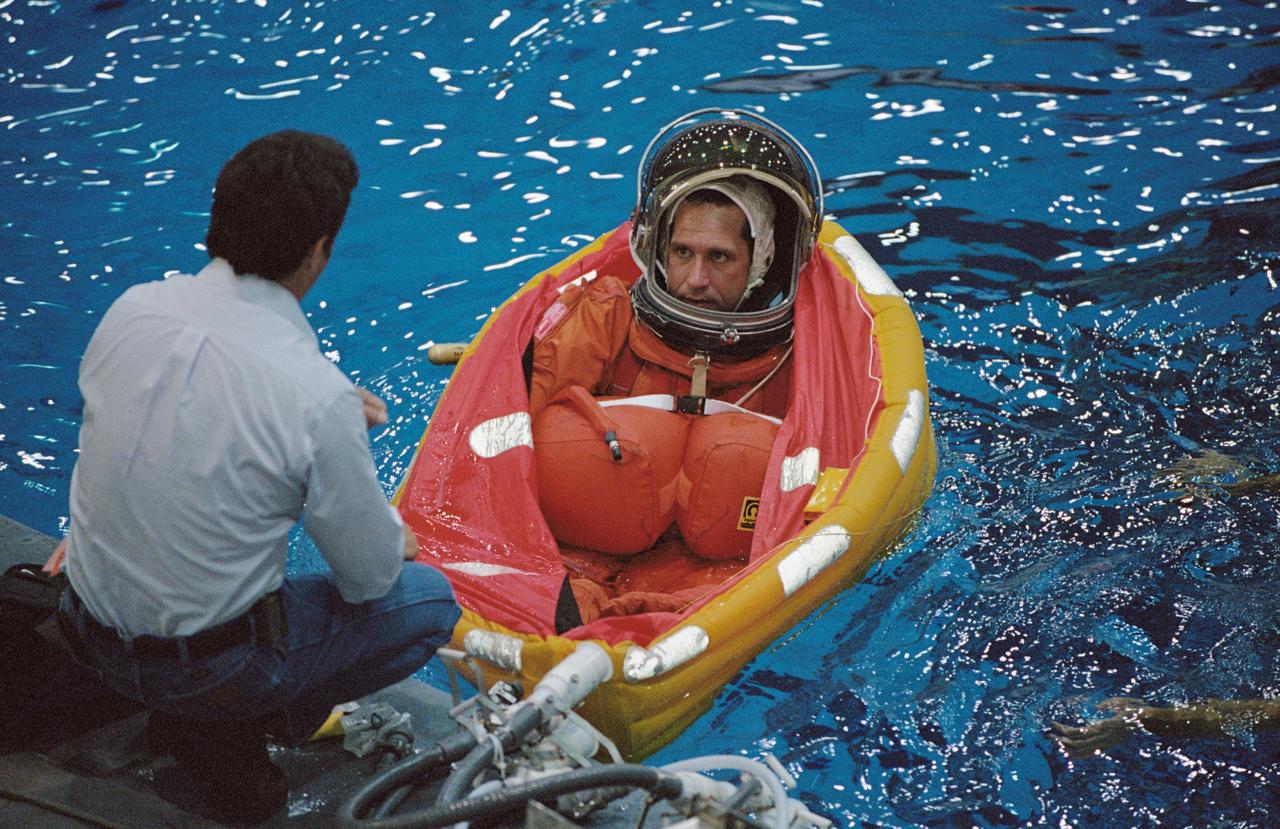
JSC2002-01775 (20 September 2002) --- Astronaut William A. Oefelein, STS-116 pilot, floats in a small life raft during an emergency bailout training session in the Neutral Buoyancy Laboratory (NBL) near the Johnson Space Center (JSC). Oefelein is attired in a training version of the shuttle launch and entry suit.
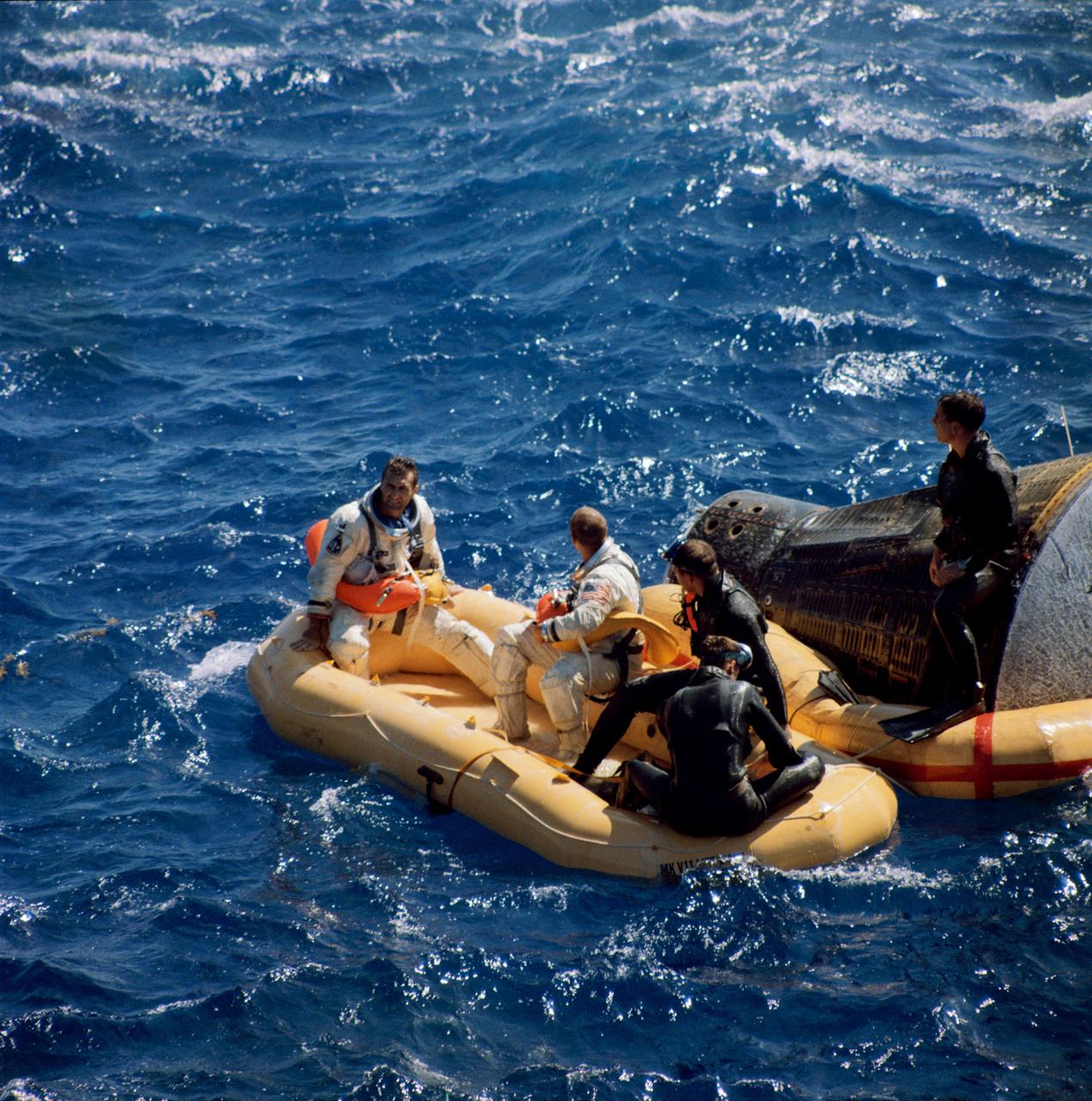
S66-50761 (15 Sept. 1966) --- Astronauts Richard F. Gordon Jr. (left), pilot of the Gemini-11 spaceflight, and Charles Conrad Jr., command pilot, sit in life raft while awaiting pickup by a helicopter from the USS Guam. Members of the Navy frogman team wait with them. Photo credit: NASA
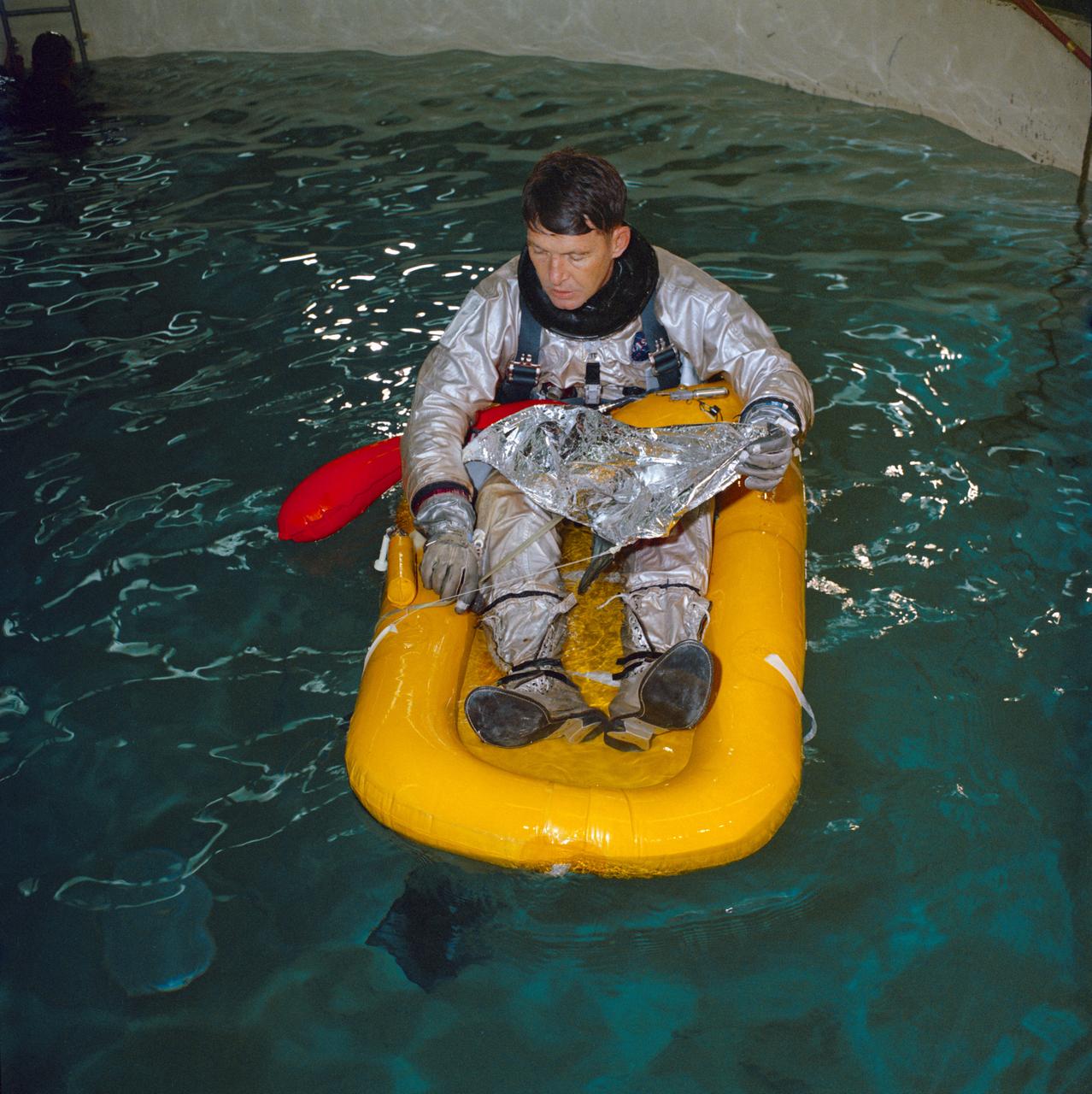
S65-10121 (1 Feb. 1965) --- Astronaut Walter M. Schirra Jr., the Gemini-6 command pilot for the prime crew, floats on a one-man life raft in a pool during water egress training at Ellington Air Force Base, Texas. Photo credit: NASA or National Aeronautics and Space Administration
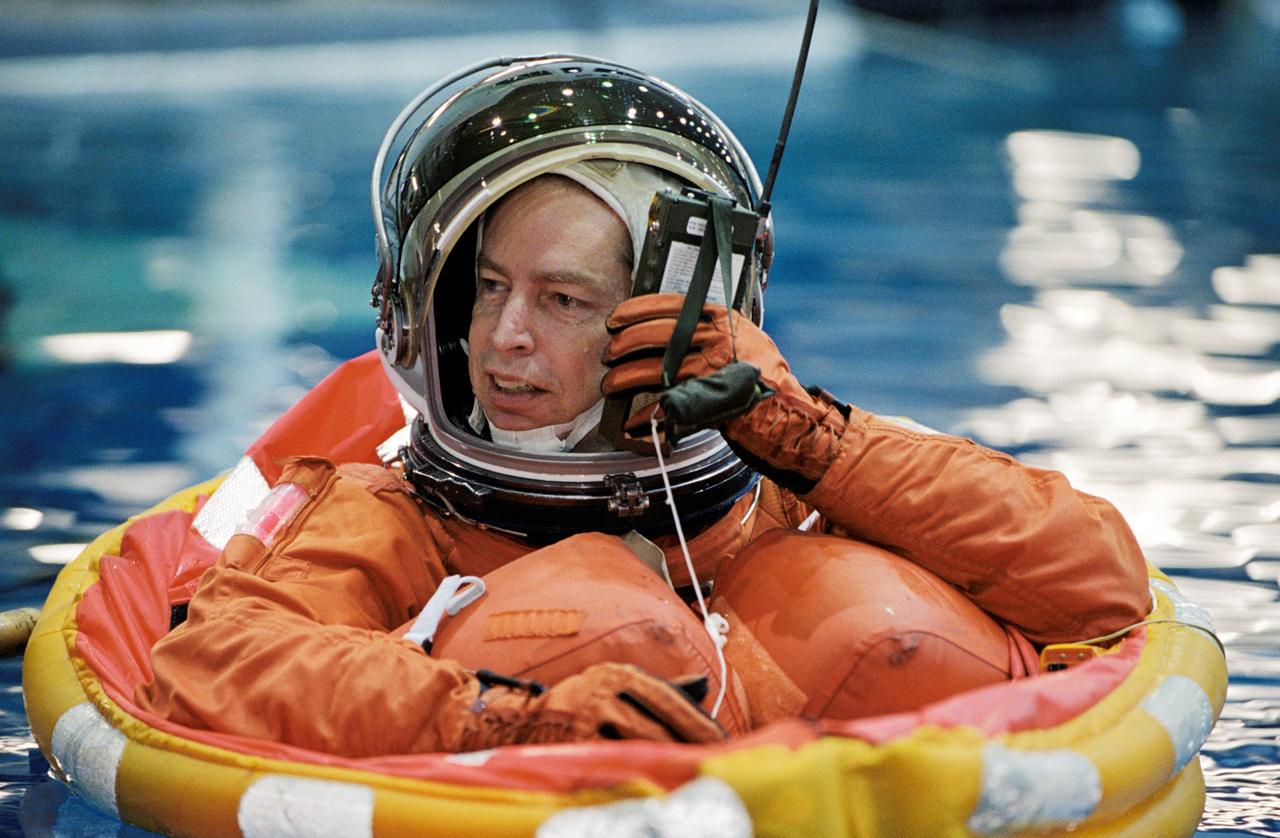
JSC2002-00529 (19 February 2002) --- Astronaut James D. Wetherbee, STS-113 mission commander, floats in a small life raft during an emergency bailout training session in the Neutral Buoyancy Laboratory (NBL) near the Johnson Space Center (JSC).
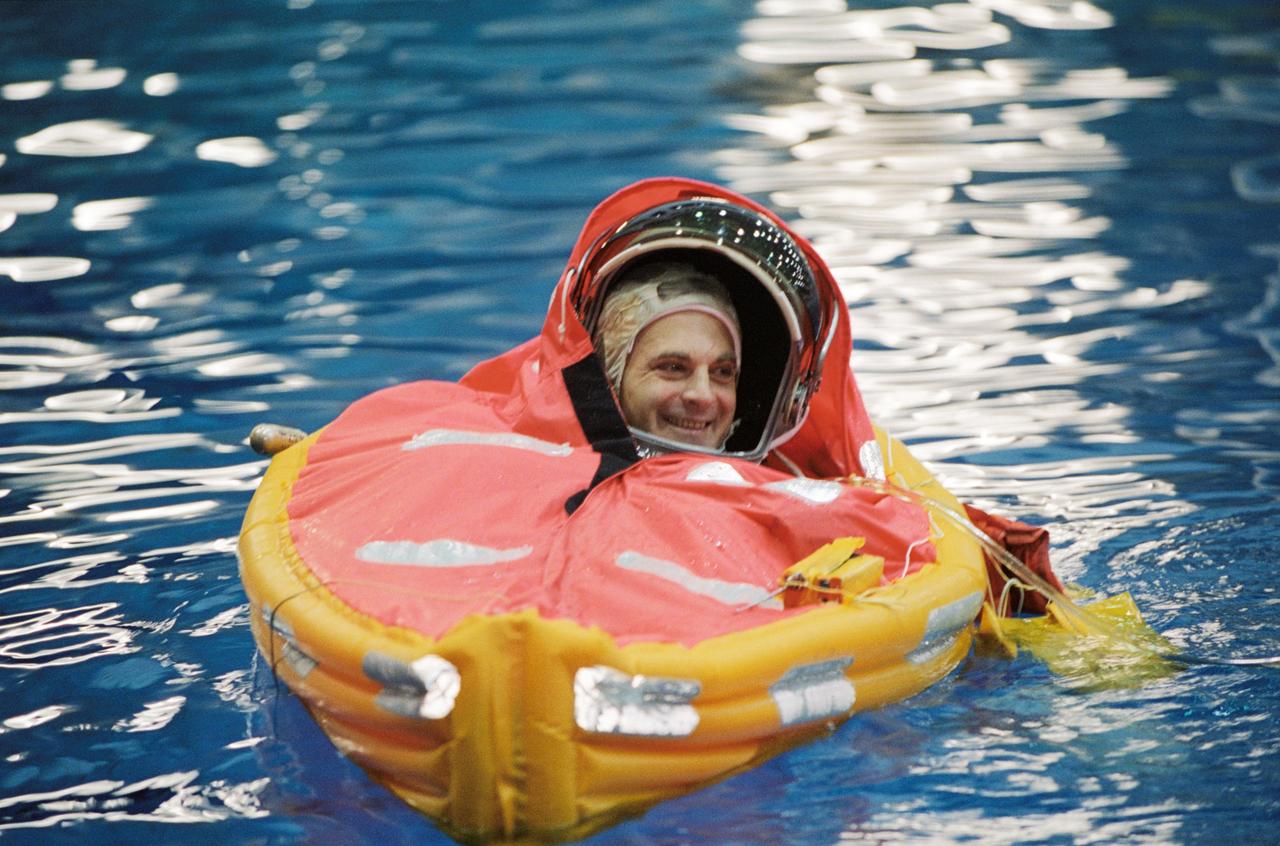
JSC2002-00517 (19 February 2002) --- Astronaut David A. Wolf, STS-112 mission specialist, floats in a small life raft during an emergency bailout training session in the Neutral Buoyancy Laboratory (NBL) near the Johnson Space Center (JSC). Wolf is attired a training version of the shuttle launch and entry suit.

JSC2002-01759 (20 September 2002) --- Astronaut Robert L. Curbeam, Jr., STS-116 mission specialist, floats in a small life raft during an emergency bailout training session in the Neutral Buoyancy Laboratory (NBL) near the Johnson Space Center (JSC). Curbeam is attired in a training version of the shuttle launch and entry suit.
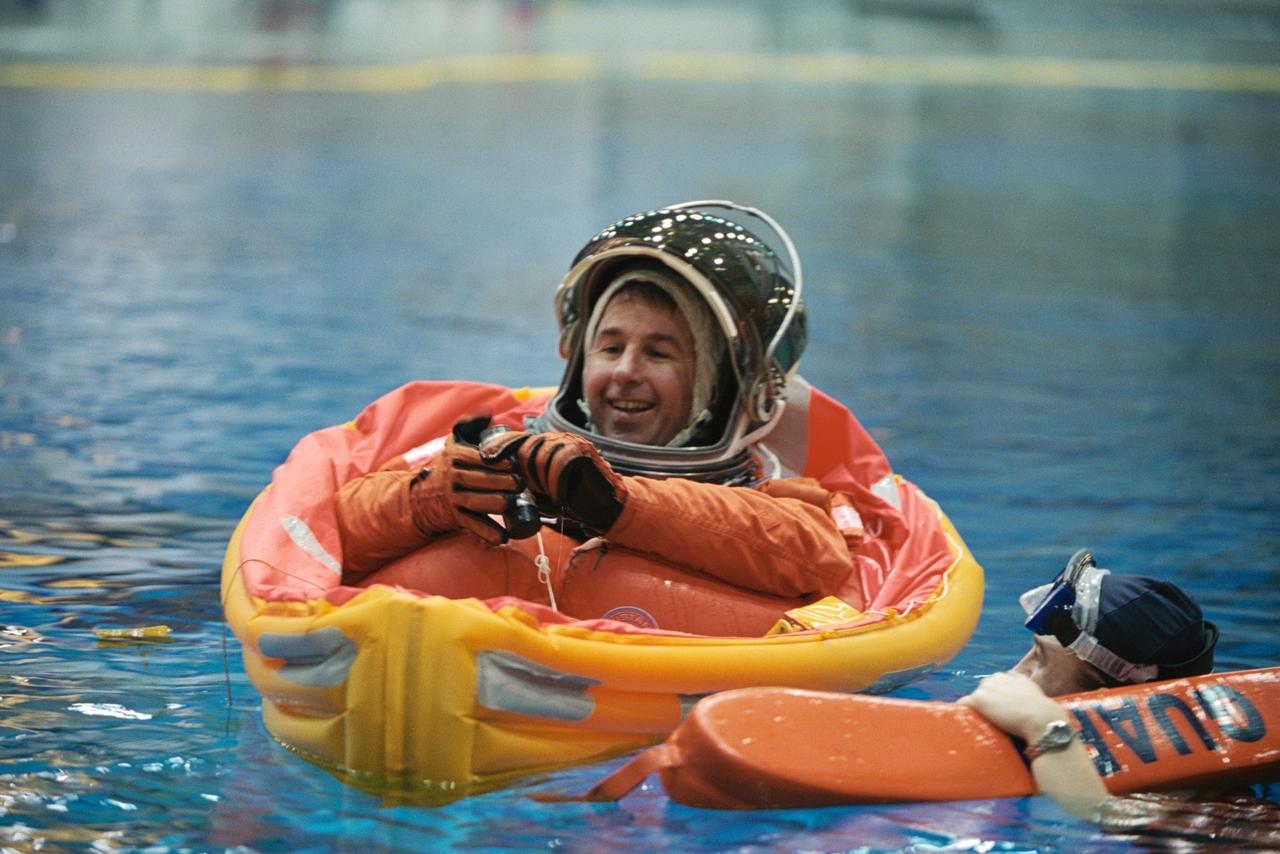
JSC2002-00818 (17 April 2002) --- Astronaut Stephen K. Robinson, STS-114 mission specialist, assisted by divers, floats in a small life raft during an emergency egress training session in the Neutral Buoyancy Laboratory (NBL) near the Johnson Space Center (JSC).

A C-17 Globemaster aircraft from the Alaska Air National Guard’s 249th Airlift Squadron flies overhead as pararescue specialists from the 304th Rescue Squadron, located in Portland, Oregon complete an astronaut rescue training exercise inside a covered life raft on the Atlantic Ocean. The pararescue specialists, supporting the 45th Operations Group’s Detachment 3, based out of Patrick Air Force Base, conducted the exercise in April with NASA’s Commercial Crew Program and SpaceX off of Florida’s eastern coast. The specially designed 20-person life raft is equipped with enough food, water and medical supplies to sustain both rescuers and crew for up to three days, if necessary. In this situation, the Department of Defense (DOD) would complete the rescue by enlisting help from the US Coast Guard, a DOD ship, or a nearby commercial ship of opportunity to transport the crew to safety.

Pararescue specialists from the 304th Rescue Squadron, located in Portland, Oregon and supporting the 45th Operations Group’s Detachment 3, based out of Patrick Air Force Base, secure a covered life raft as the sun sets during an astronaut rescue training exercise with NASA’s Commercial Crew Program and SpaceX off of Florida’s eastern coast in April. The specially designed 20-person life raft is equipped with enough food, water and medical supplies to sustain both rescuers and crew for up to three days, if necessary. In this situation, the Department of Defense (DOD) would complete the rescue by enlisting help from the US Coast Guard, a DOD ship, or a nearby commercial ship of opportunity to transport the crew to safety.
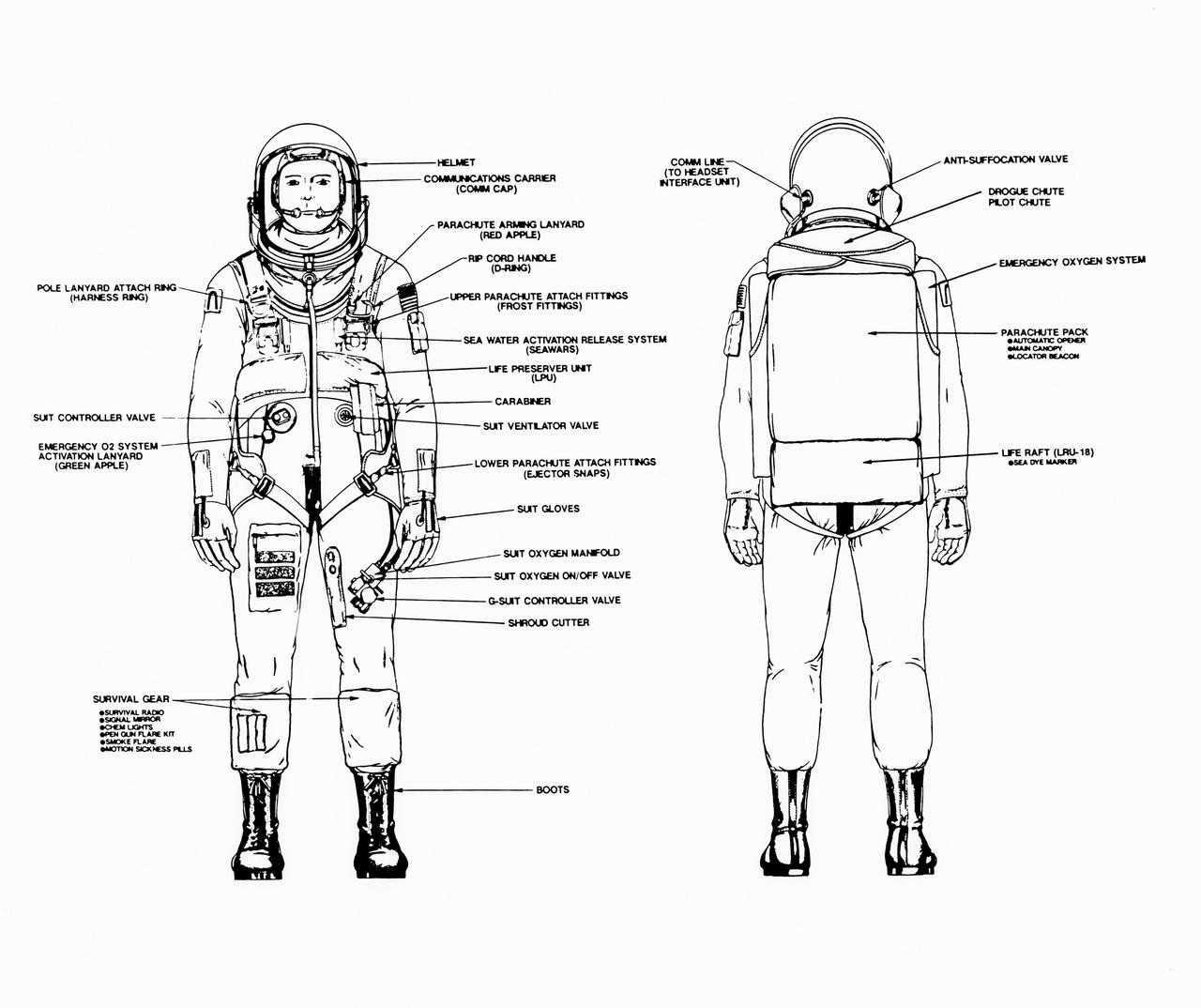
Line drawings illustrate the front and back of the space shuttle launch and entry suit (LES) and labels identify various components. LES was designed for STS-26, the return to flight mission, and subsequent missions. Included in the crew escape system (CES) package are launch and entry helmet (LEH) with communications carrier (COMM CAP), parachute pack and harness, life preserver unit (LPU), life raft unit (LRU), LES gloves, suit oxygen manifold and valves, boots, and survival gear. Details of larger components are also identified.
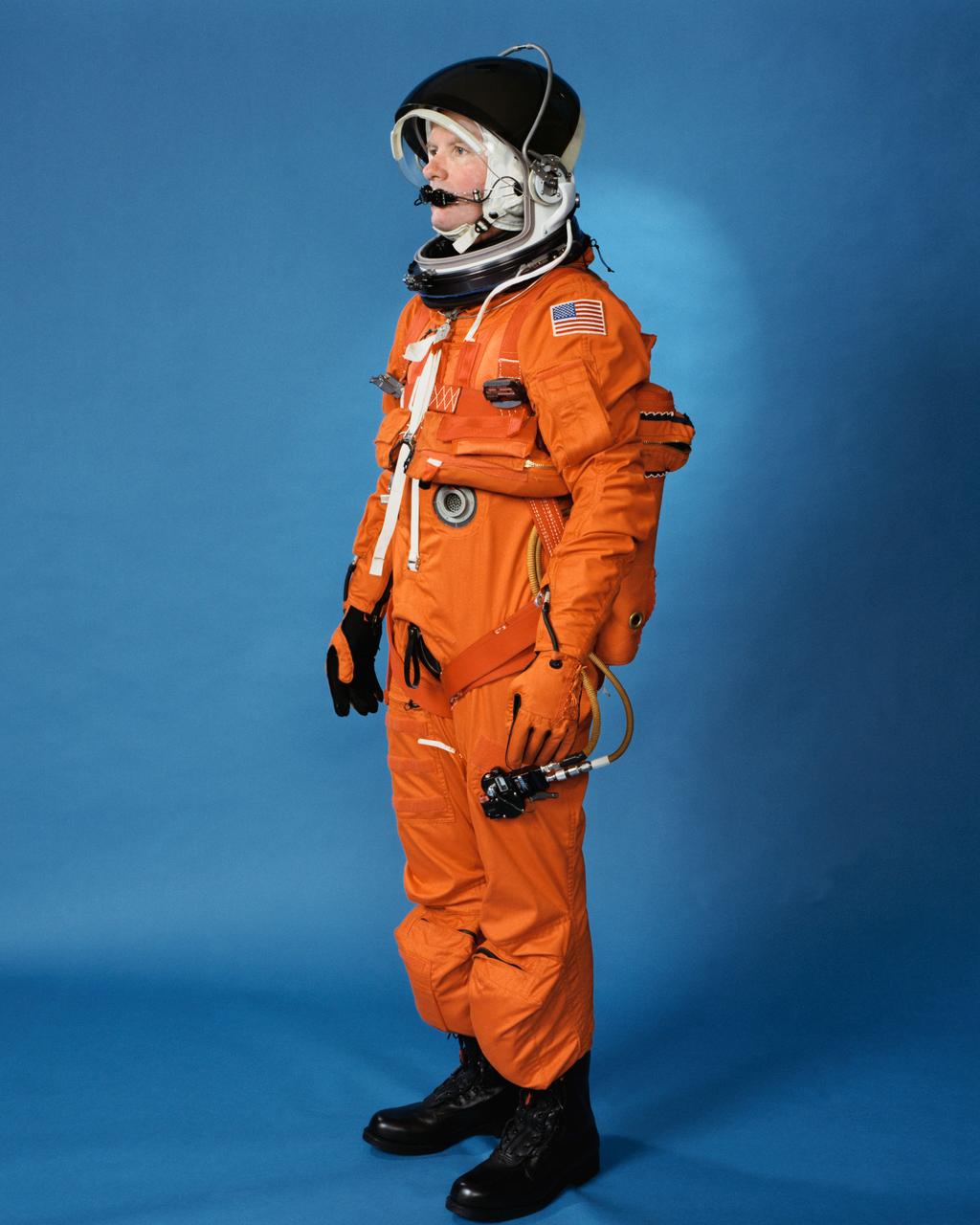
Space shuttle orange launch and entry suit (LES), a partial pressure suit, is modeled by a technician. LES was designed for STS-26, the return to flight mission, and subsequent missions. Included in the crew escape system (CES) package are launch and entry helmet (LEH) with communications carrier (COMM CAP), parachute pack and harness, life raft, life preserver unit (LPU), LES gloves, suit oxygen manifold and valves, boots, and survival gear.
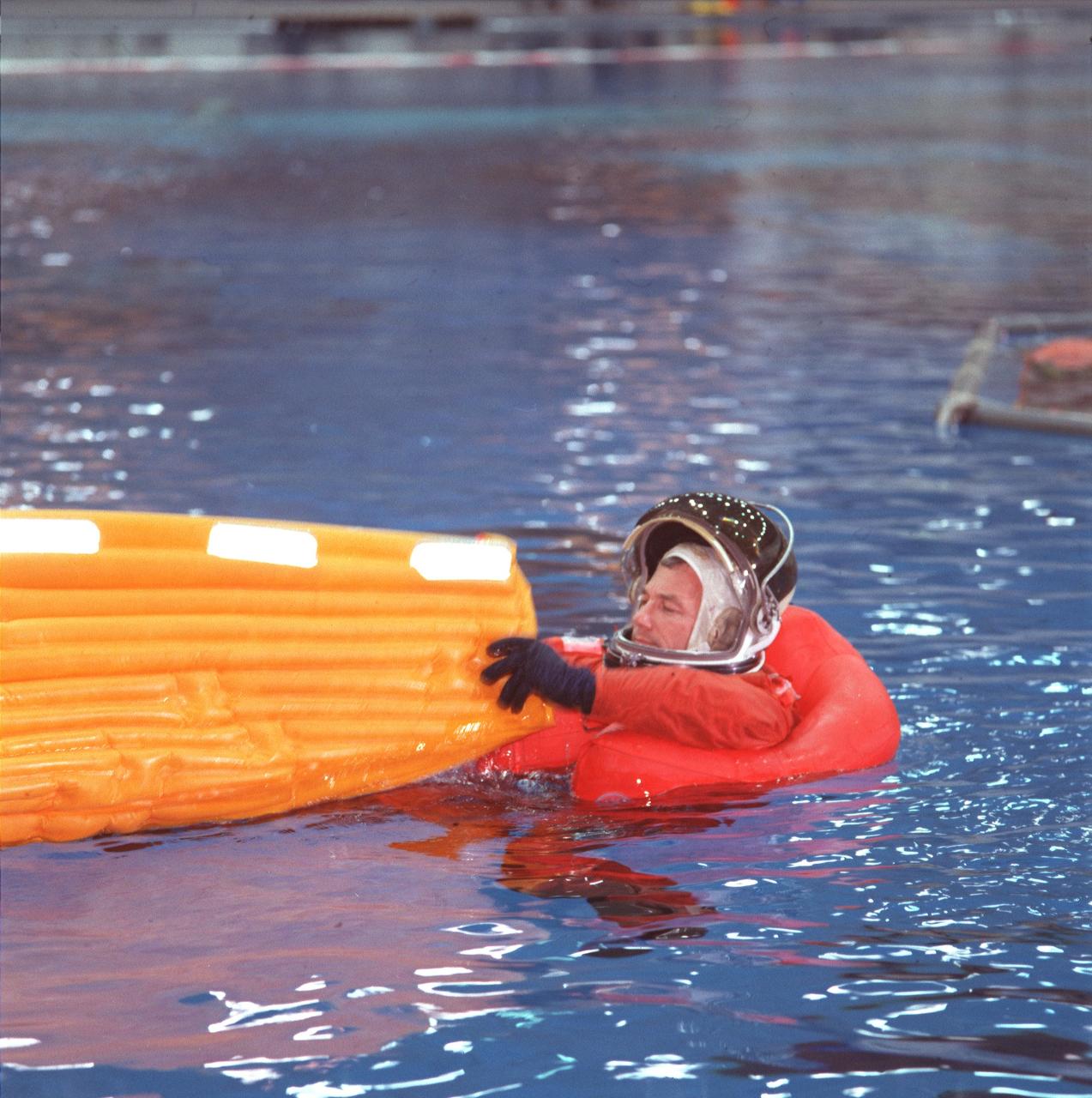
JSC2000-02567 (21 March 2000) --- Astronaut Terrence W. (Terry) Wilcutt, STS-106 mission commander, empties water from his newly-deployed life raft during a simulation of an emergency bailout exercise. The water survival training routinely takes place in the Neutral Buoyancy Laboratory (NBL) near the Johnson Space Center (JSC).

JSC2001-00005 (January 2001) --- Astronaut Charles O. Hobaugh, STS-104 pilot, watches a crew mate in a life raft during an emergency bailout training session in the Neutral Buoyancy Laboratory (NBL) near Johnson Space Center (JSC). Hobaugh will join four other astronauts for a June mission with the International Space Station (ISS).

JSC2000-07460 (11 December 2000) --- Astronaut Scott J. Horowitz, STS-105 mission commander, floats in a small life raft during an emergency egress training session at the Neutral Buoyancy Laboratory (NBL) near the Johnson Space Center (JSC). This summer, Horowitz will join four other astronauts and two cosmonauts for a mission to the International Space Station (ISS).
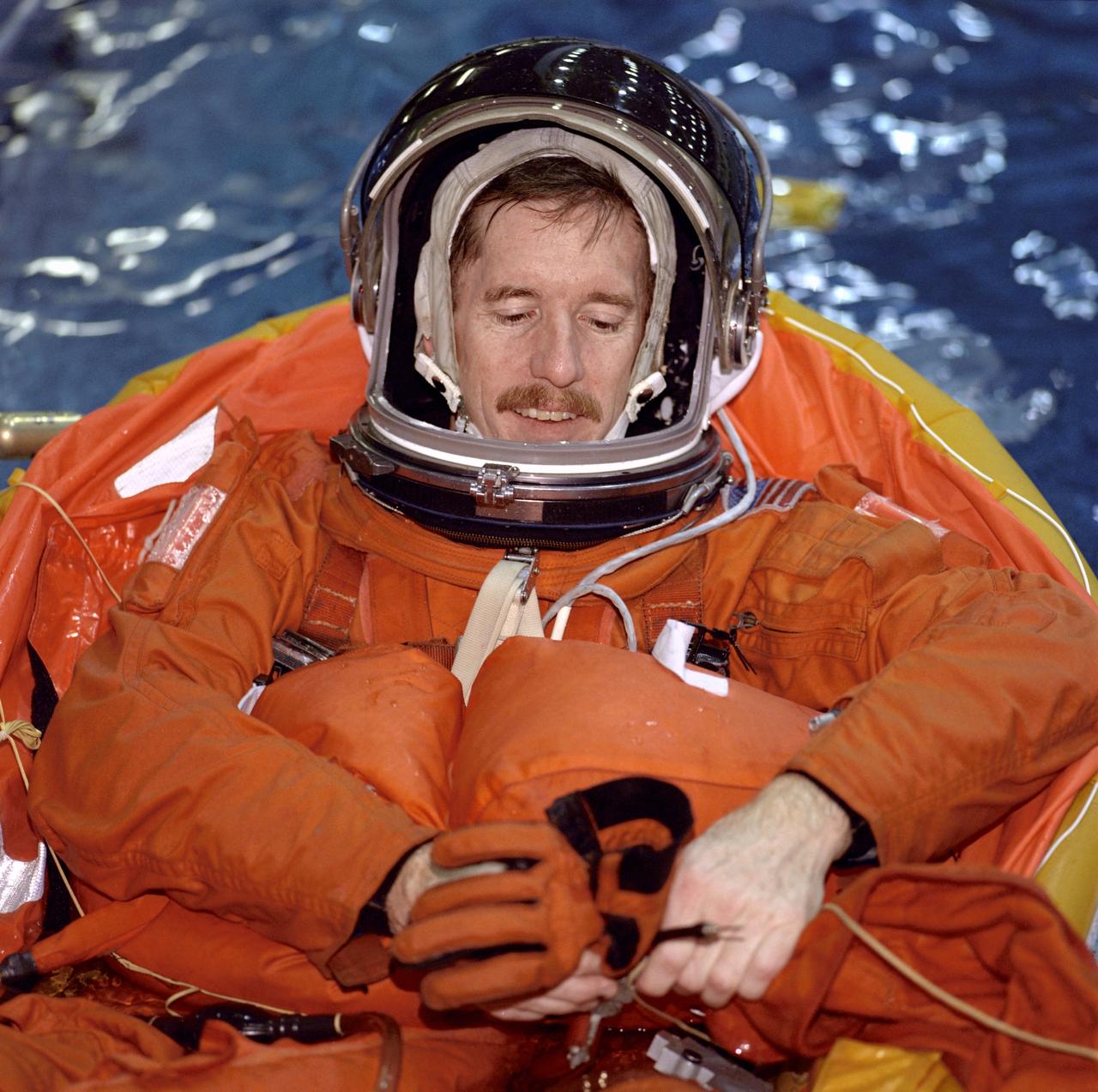
JSC2001-00010 (January 2001) --- Astronaut James F. Reilly, STS-104 mission specialist, floats in a small life raft during an emergency egress training session at the Neutral Buoyancy Laboratory (NBL) near the Johnson Space Center (JSC). Reilly will join four other astronauts for a June mission to the International Space Station (ISS).
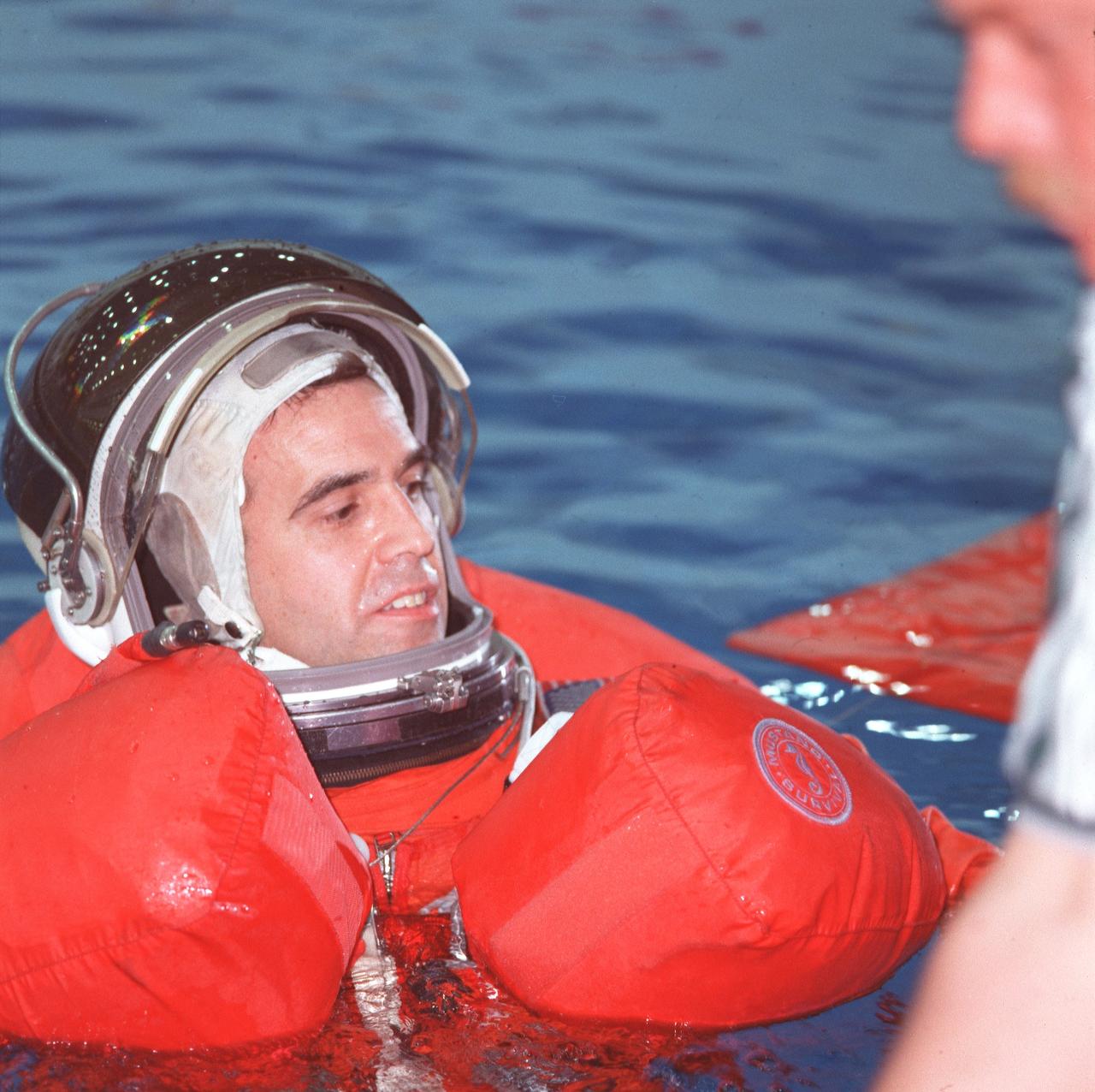
JSC2000-02523 (21 March 2000) --- Astronaut Richard A. Mastracchio, STS-106 mission specialist, depends on his "Mae West" preserver to keep him afloat as he deploys his life raft during an emergency bailout exercise in the Neutral Buoyancy Laboratory (NBL). Mastracchio, an alumnus of NASA 1996 class of astronaut candidates, will join four other astronauts and two cosmonauts, representing the Russian Aviation and Space Agency, for a late summer visit to the International Space Station.
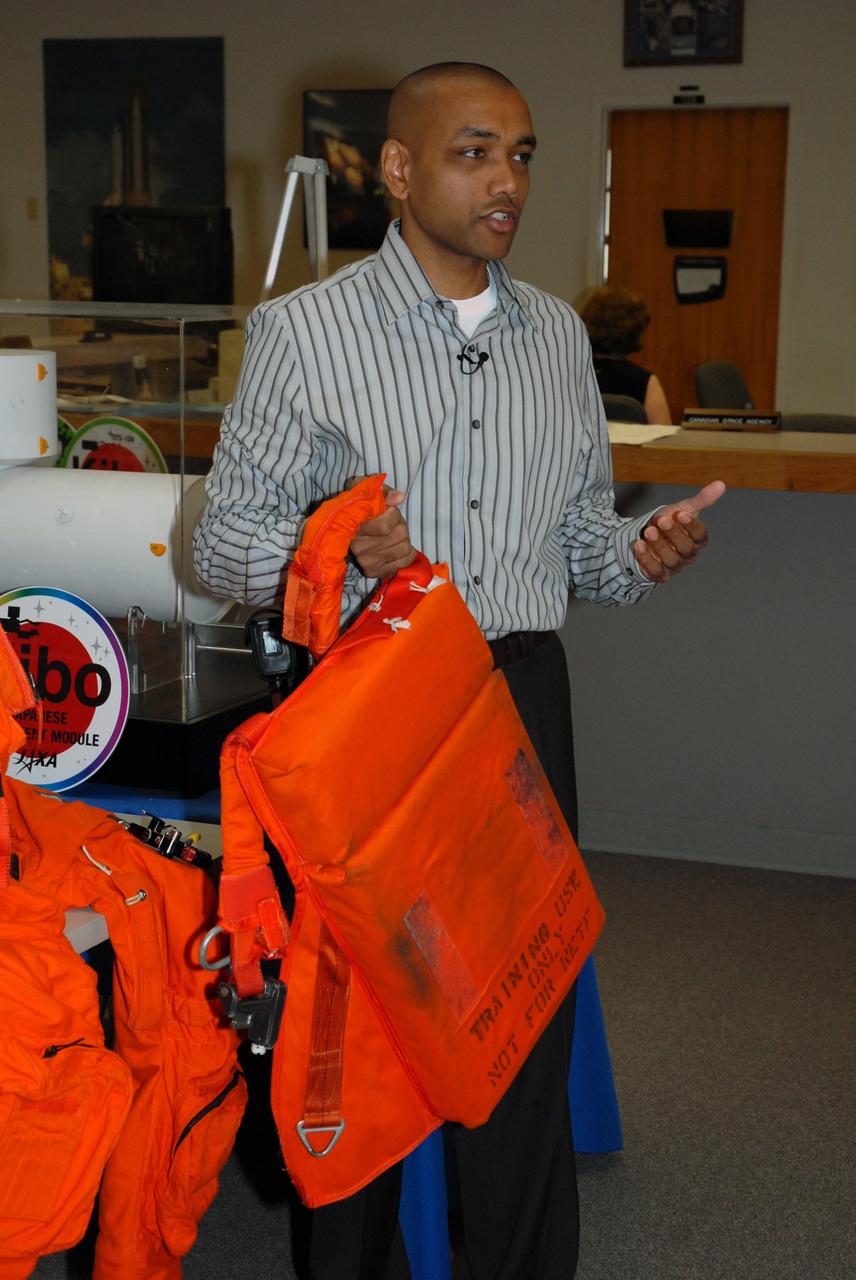
CAPE CANAVERAL, Fla. -- In the NASA News Center at NASA's Kennedy Space Center, Shuttle Crew Escape System Manager KC Chhipwadia describes for the media the components of the parachute worn by shuttle crews during launch and landing. On top is a pilot and drag chute. In the middle is the main chute. At bottom is a survival life raft. The elements of the suit and parachute provide safety elements in the event of an emergency. Photo credit: NASA/Amanda Diller
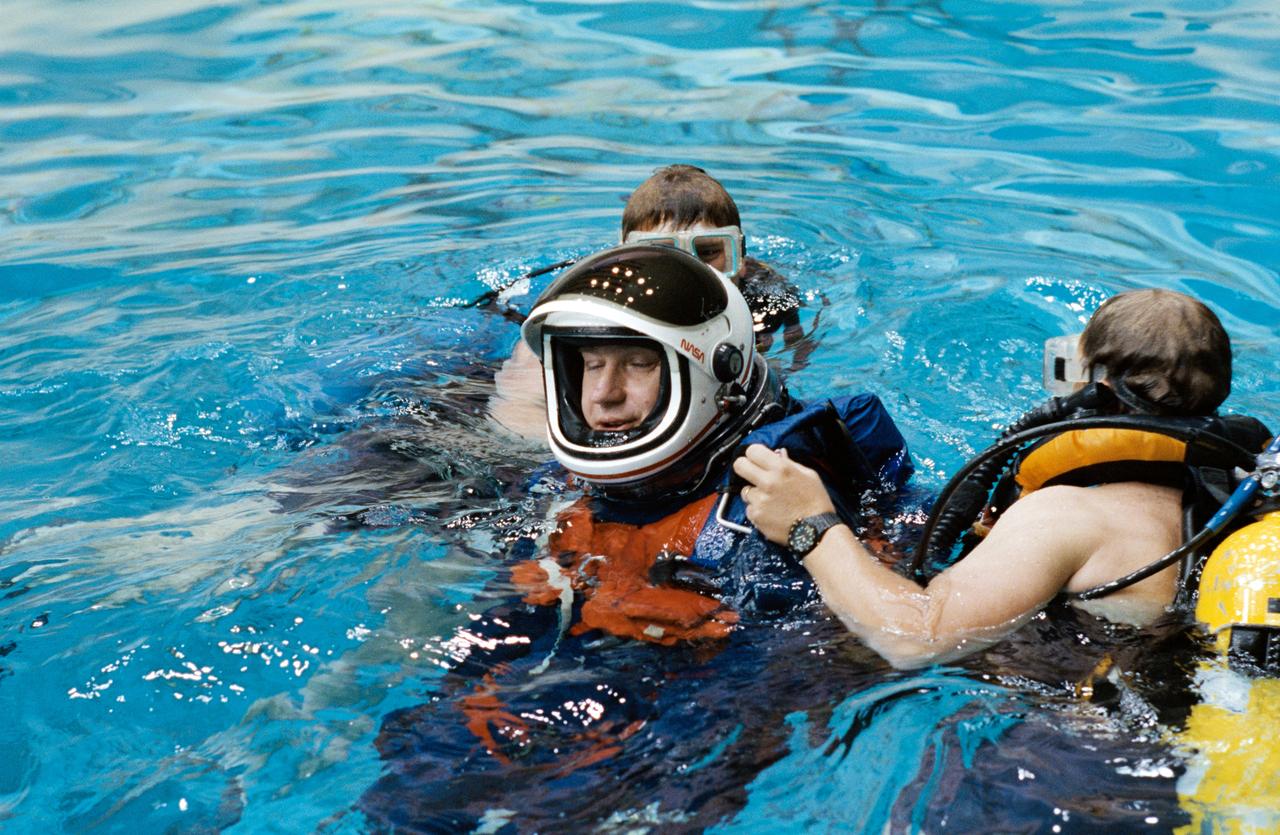
S92-32108 (May 1992) --- Payload specialist Albert Sacco Jr. uses a one-person life raft during emergency bailout training exercises in the Johnson Space Center?s (JSC) Weightless Environment Training Facility (WET-F). Sacco is an alternate payload specialist for the United States Microgravity Laboratory (USML-1) mission, scheduled for launch later this year. EDITOR?S NOTE: Sacco was later named as prime crew payload specialist for the USML-2 mission (STS-73), scheduled for 1995.
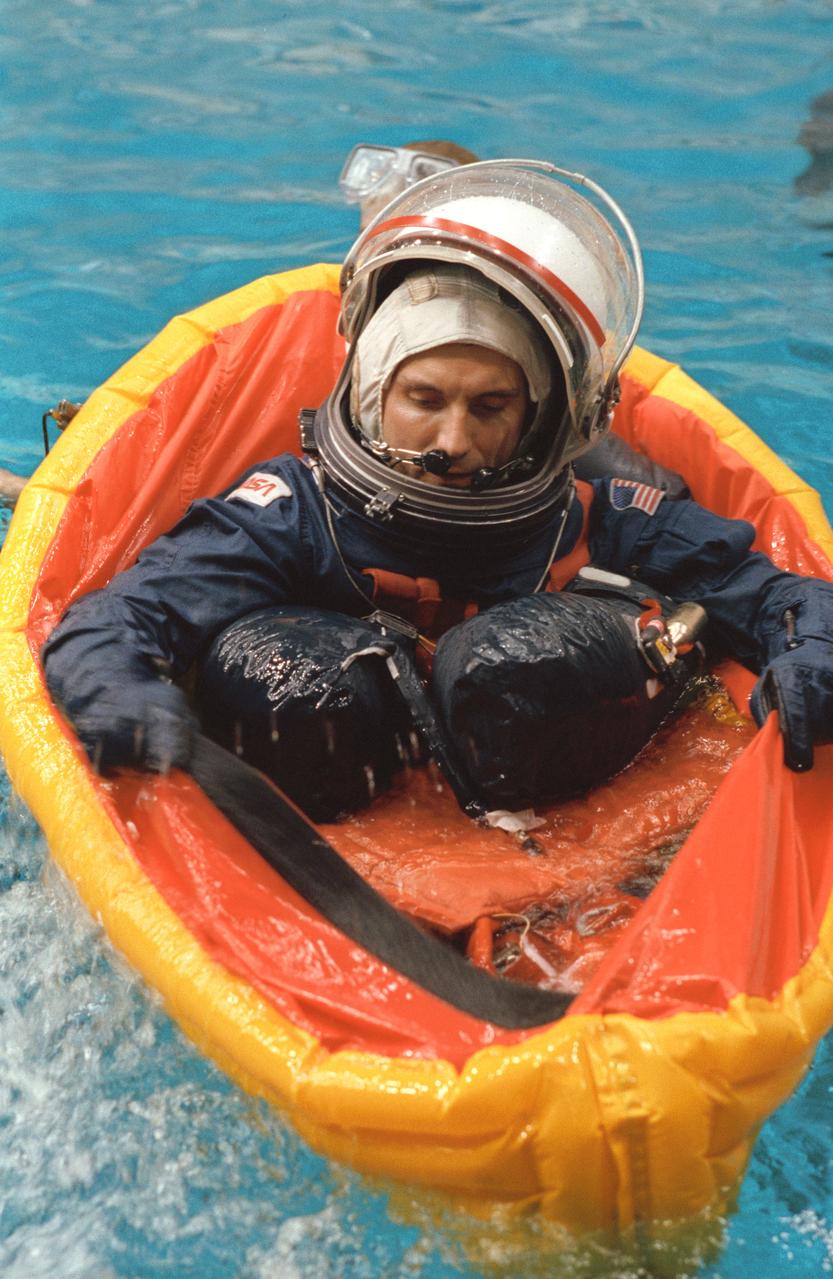
S93-31928 (24 March 1993) --- Astronaut Carl E. Walz, mission specialist, navigates a one-person life raft during emergency bailout training exercises at the Johnson Space Center's Weightless Environment Training Facility (WET-F). Walz was joined in the training session by the four other NASA astronauts assigned to the STS-51 flight.

S66-50757 (15 Sept. 1966) --- Astronaut Charles Conrad Jr., command pilot of the Gemini-11 spaceflight, is hoisted aboard a recovery helicopter from the USS Guam. Astronaut Richard F. Gordon Jr., pilot, sits in a life raft below waiting to be picked up. Gemini-11 splashed down at 9 a.m. (EST) Sept. 15, 1966, to conclude a three-day mission in space. Photo credit: NASA
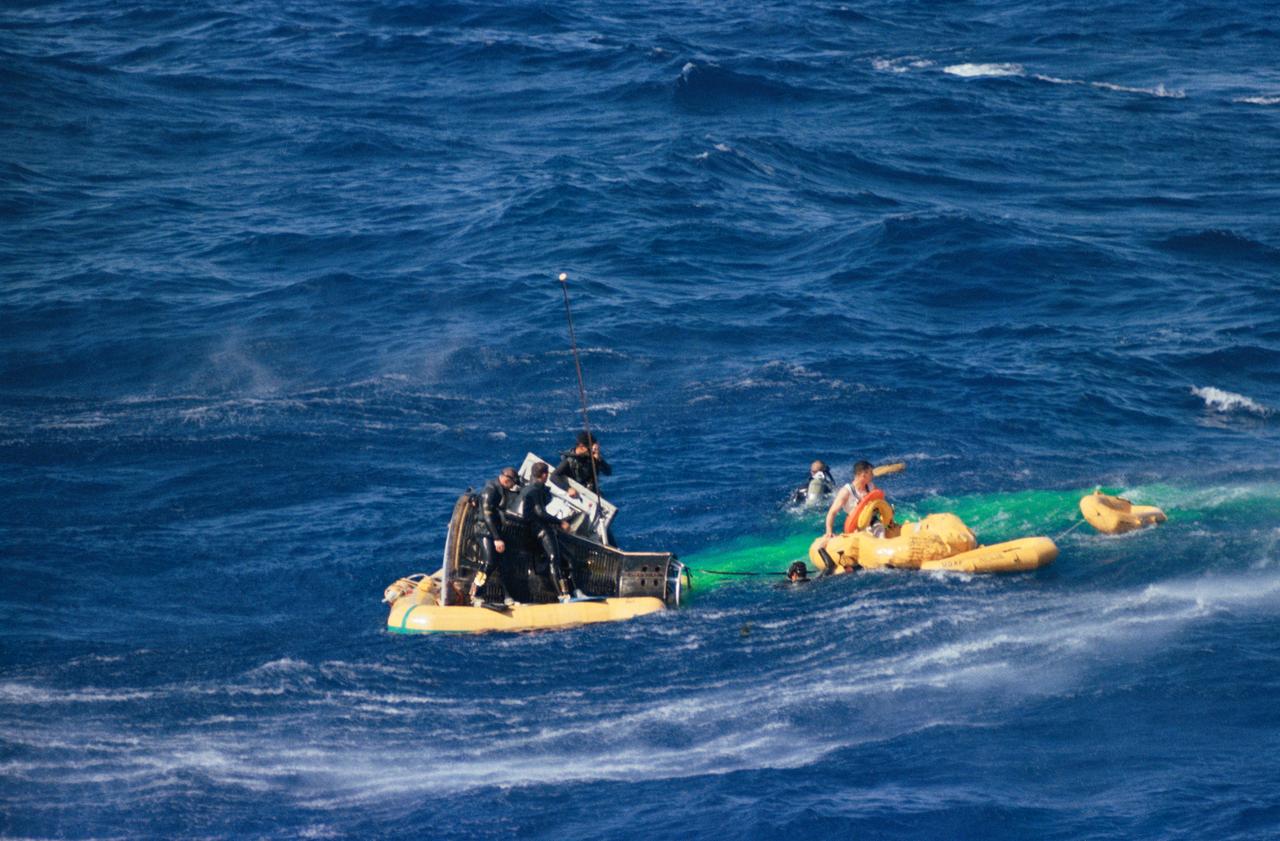
S65-22893 (23 March 1965) --- Astronaut John W. Young, the pilot of the Gemini-Titan III (GT-3) flight, waits in a life raft to be picked up by a helicopter during recovery operations following the successful three-orbit mission. Young and astronaut Virgil I. Grissom, command pilot, were flown by helicopter to the nearby recovery vessel, the USS Intrepid. The recovery ship later came alongside and retrieved the GT-3 spacecraft. United States Navy swimmers assisted in the GT-3 recovery operations.
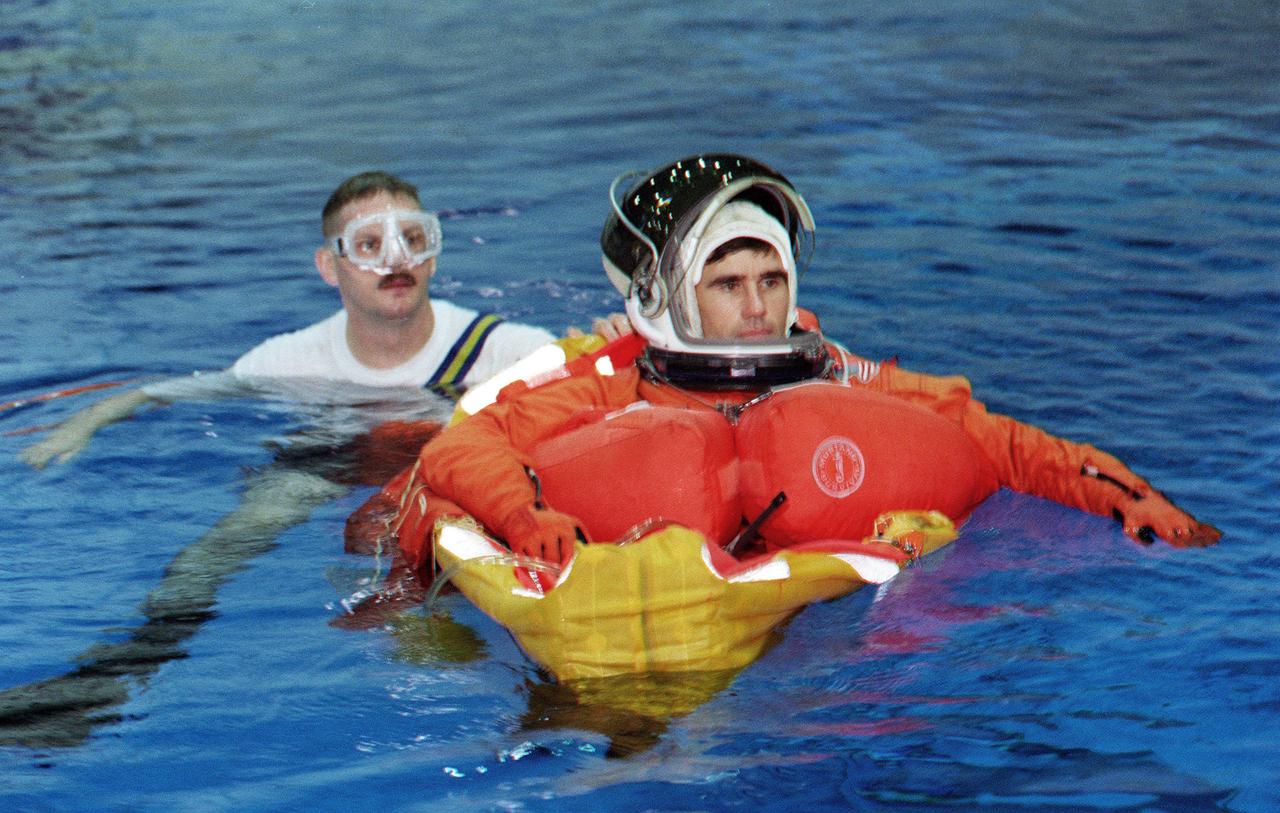
S99-09098 (6 August 1999) --- Cosmonaut Yuri I. Malenchenko, mission specialist representing the Russian Space Agency (RSA), floats in a small life raft following a simulated parachute drop. A diver remains nearby to assist in the training activity. The exercise was part of an emergency bailout training session at the Neutral Buoyancy Laboratory (NBL). Malenchenko will join five astronauts and a second cosmonaut for one of the scheduled missions next year with the International Space Station (ISS).
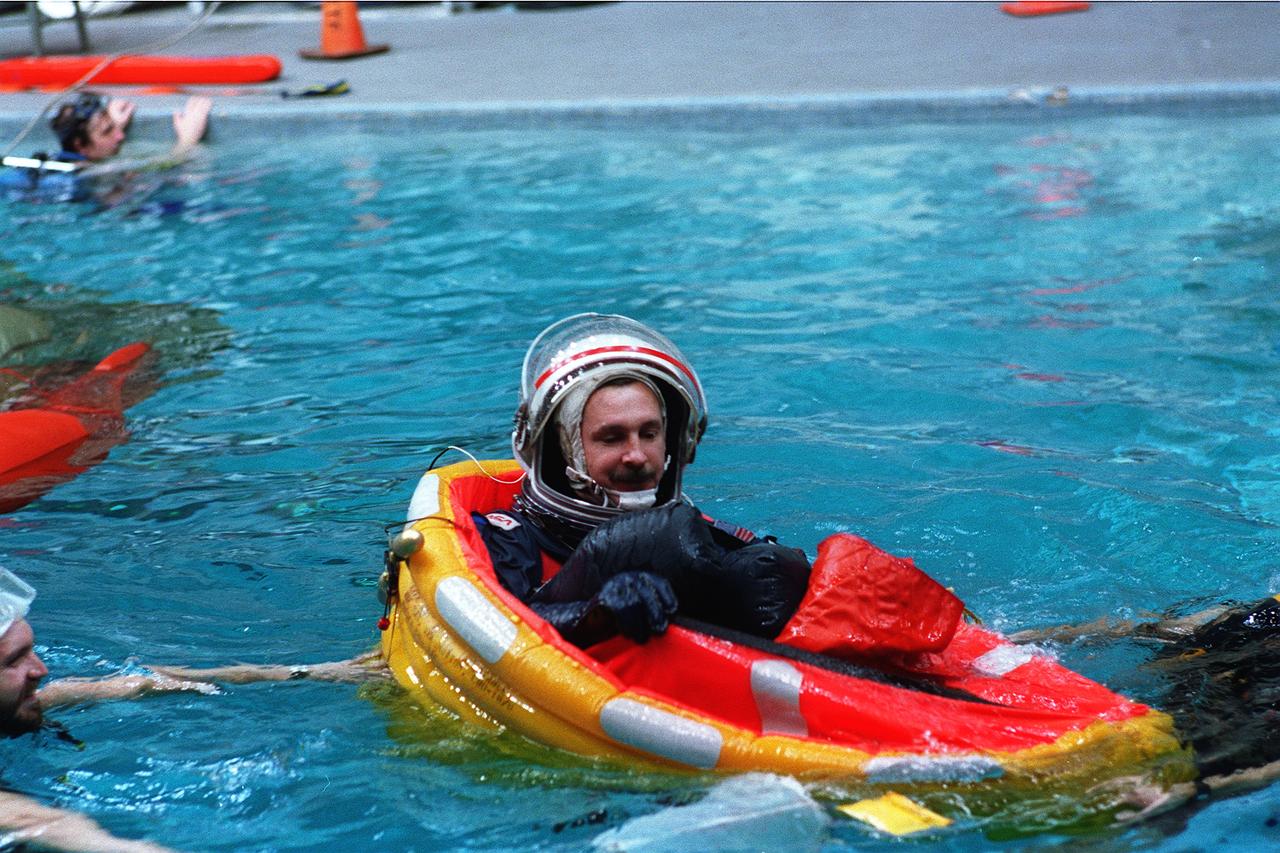
S96-08069 (April 1996) --- Astronaut Curtis L. Brown, Jr., pilot, works with his life raft during emergency bailout training for crew members in the Johnson Space Center's (JSC) Weightless Environment Training Facility (WET-F). Brown will join five other astronauts for nine days aboard the Space Shuttle Endeavour next month.
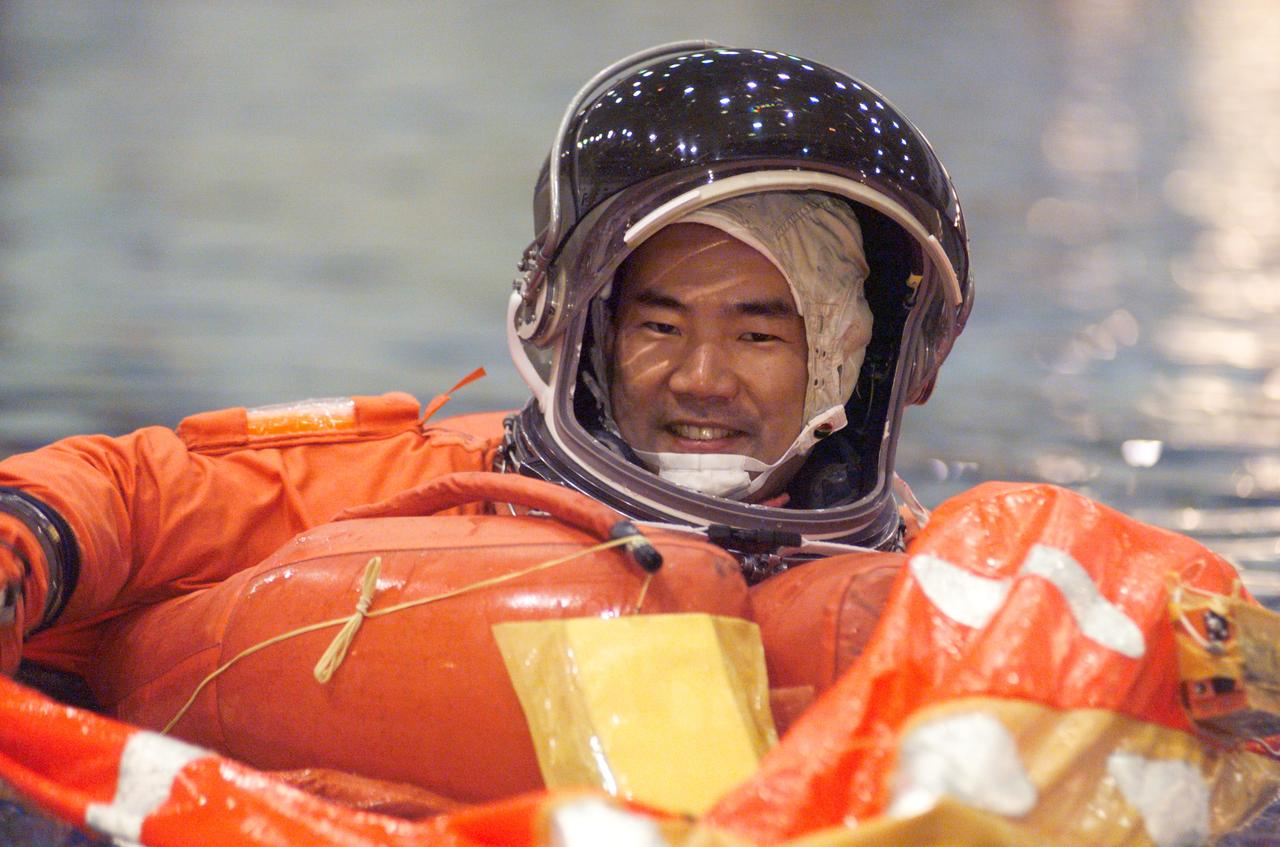
JSC2004-E-41402 (17 September 2004) --- Astronaut Soichi Noguchi, STS-114 mission specialist representing the Japan Aerospace Exploration Agency (JAXA), attired in a training version of the shuttle launch and entry suit, floats in a small life raft during an emergency egress training session in the Neutral Buoyancy Laboratory (NBL) near the Johnson Space Center (JSC).
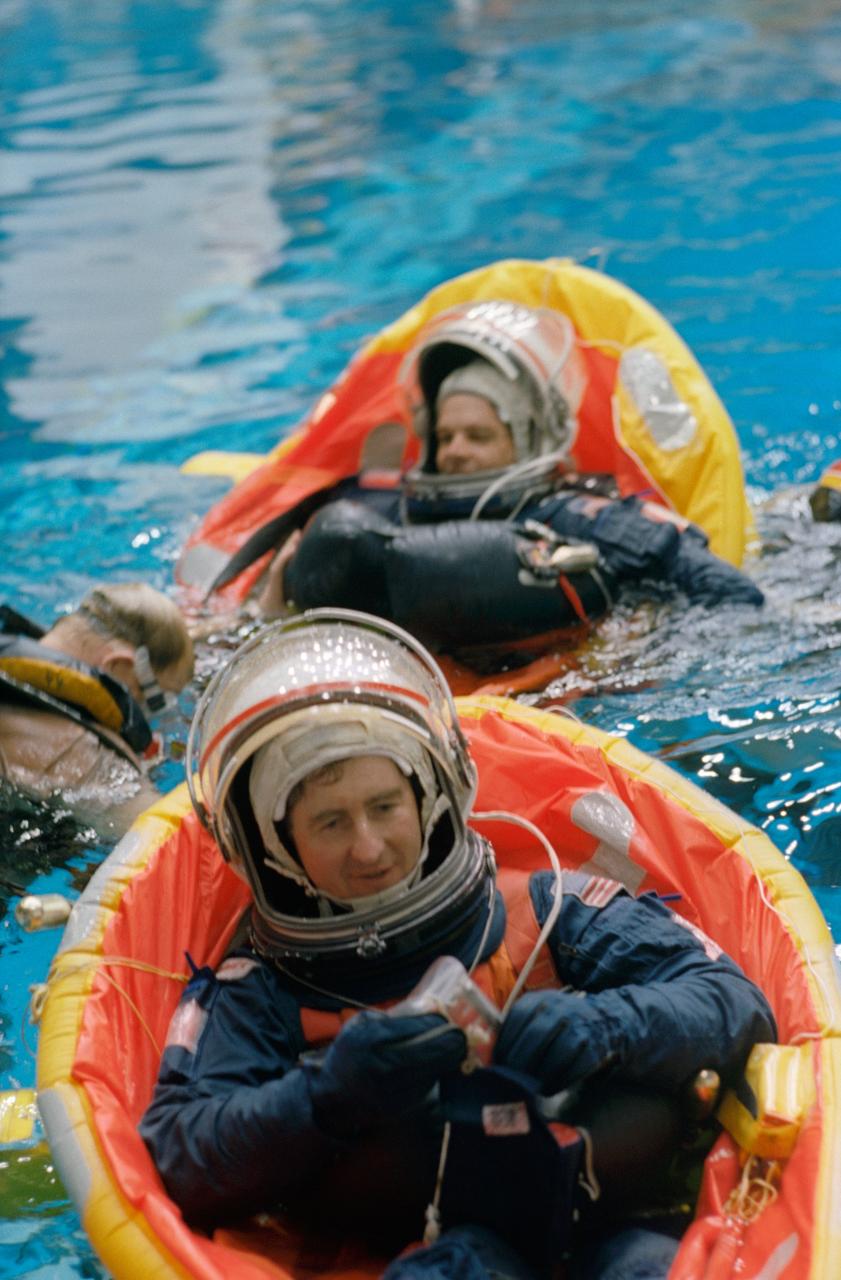
S95-03473 (16 Feb 1995) --- Astronauts Terence T. (Tom) Henricks (foreground) and Kevin R. Kregel deploy their life rafts during emergency bailout training in a 25 feet deep pool at the Johnson Space Center's (JSC) Weightless Environment Training Facility (WET-F). Henricks and Kregel are commander and pilot, respectively, for the STS-70 mission, now scheduled for a liftoff in early June.
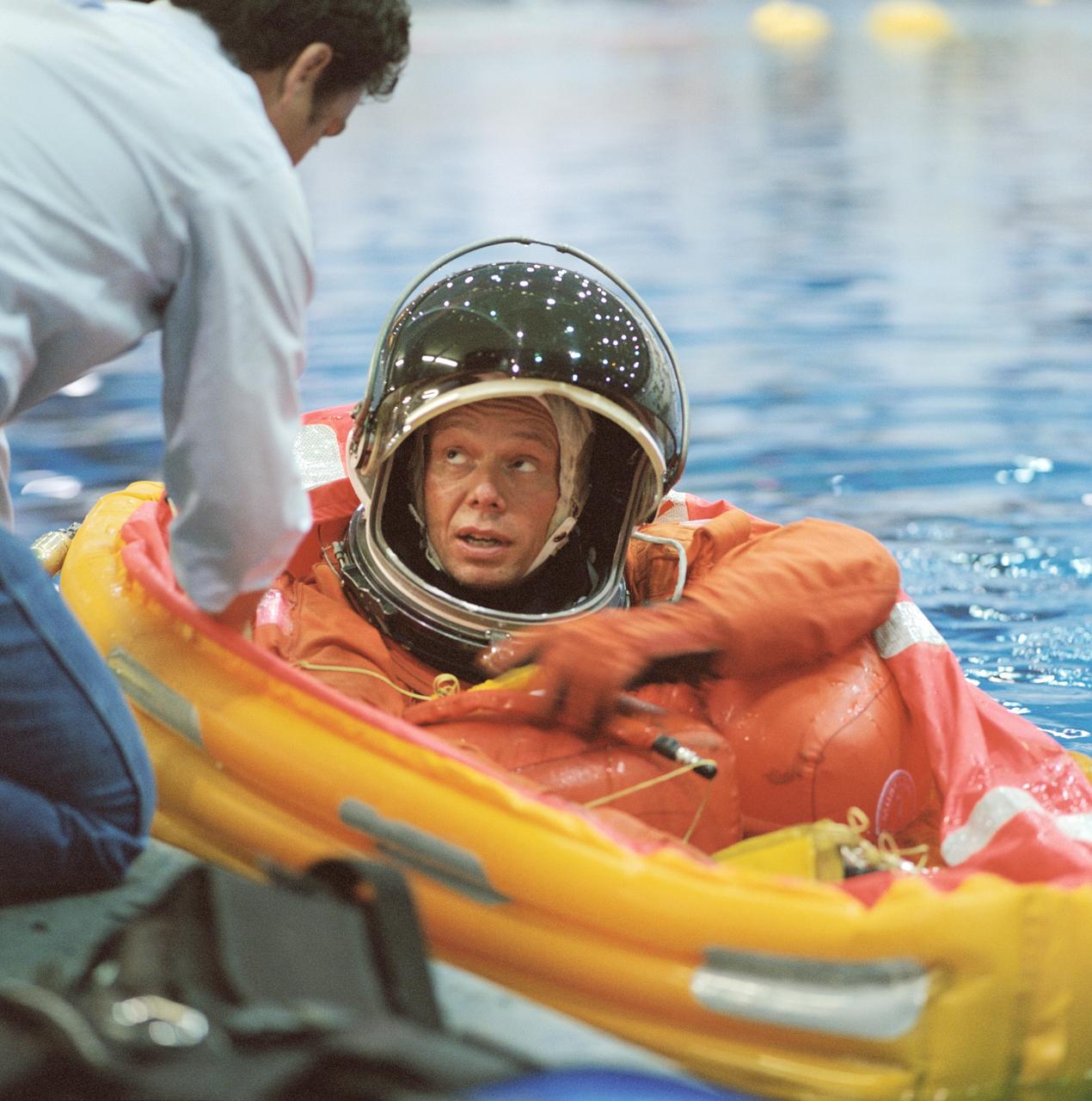
JSC2002-01762 (20 September 2002) --- Astronaut Christer Fuglesang, STS-116 mission specialist, floats in a small life raft during an emergency bailout training session in the Neutral Buoyancy Laboratory (NBL) near the Johnson Space Center (JSC). Fuglesang, who represents the European Space Agency (ESA), is attired in a training version of the shuttle launch and entry suit.
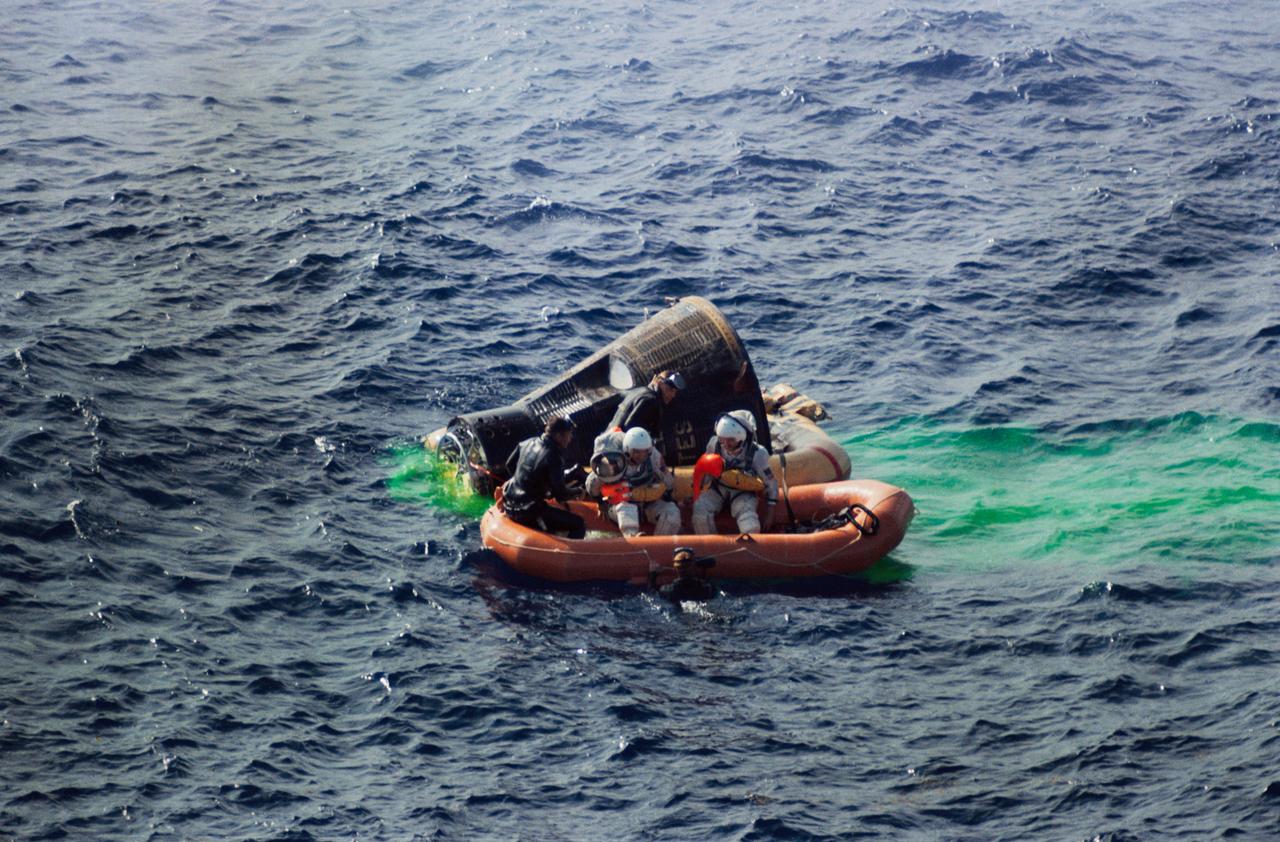
S65-63690 (18 Dec. 1965) --- Astronauts Frank Borman, command pilot, and James A. Lovell Jr., pilot, sit in life raft while awaiting pickup by a helicopter from the aircraft carrier USS Wasp. The three-man Navy frogman team attached the flotation collar to increase the Gemini-7 spacecraft's buoyancy prior to recovery. Photo credit: NASA
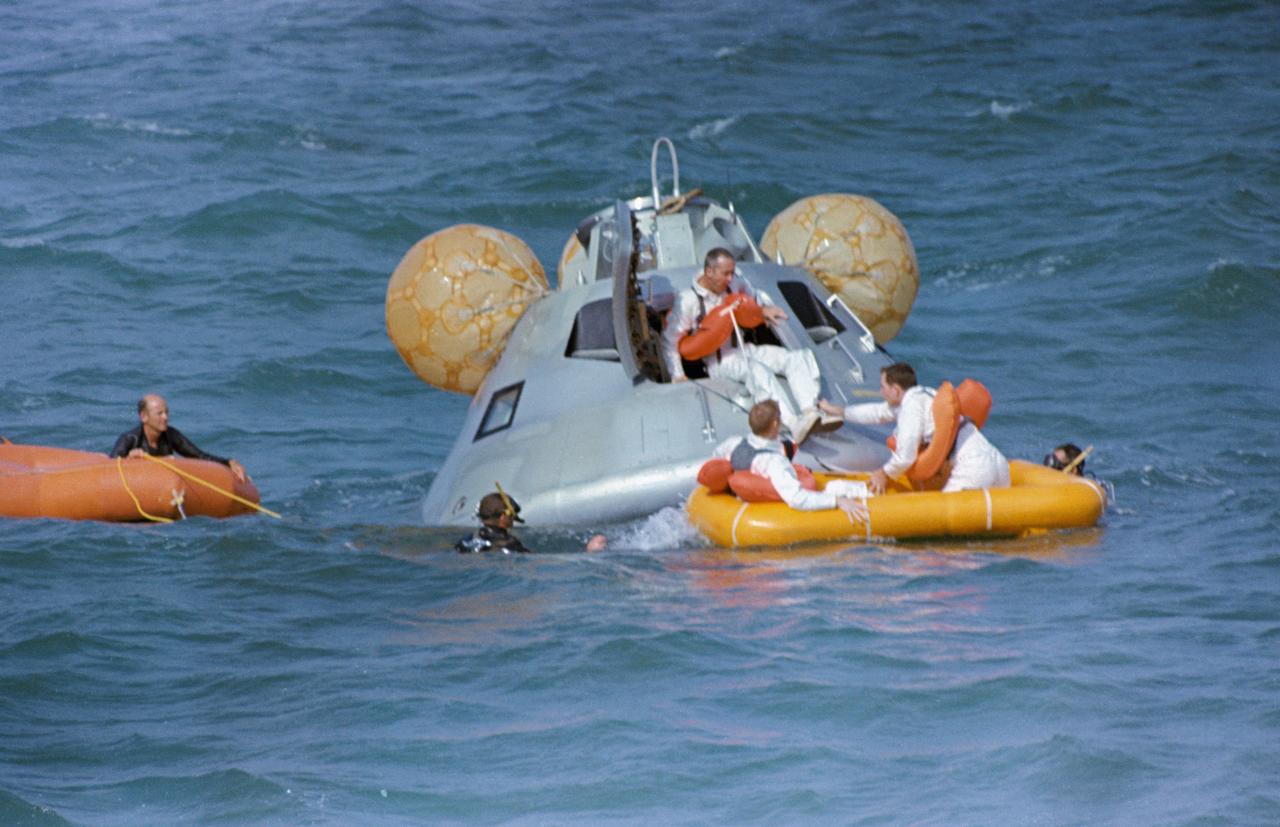
S68-50967 (20 Nov. 1968) --- The Apollo 9 prime crew participates in water egress training in the Gulf of Mexico. Apollo Command Module (CM) Boilerplate 1102 was used in the training. Egressing boilerplate is astronaut James A. McDivitt, commander. In life raft are astronauts Russell L. Schweickart (on left), lunar pilot; and David R. Scott, command pilot. A team of MSC swimmers assisted in the exercise. The inflated bags were used to upright the boilerplate prior to egress.
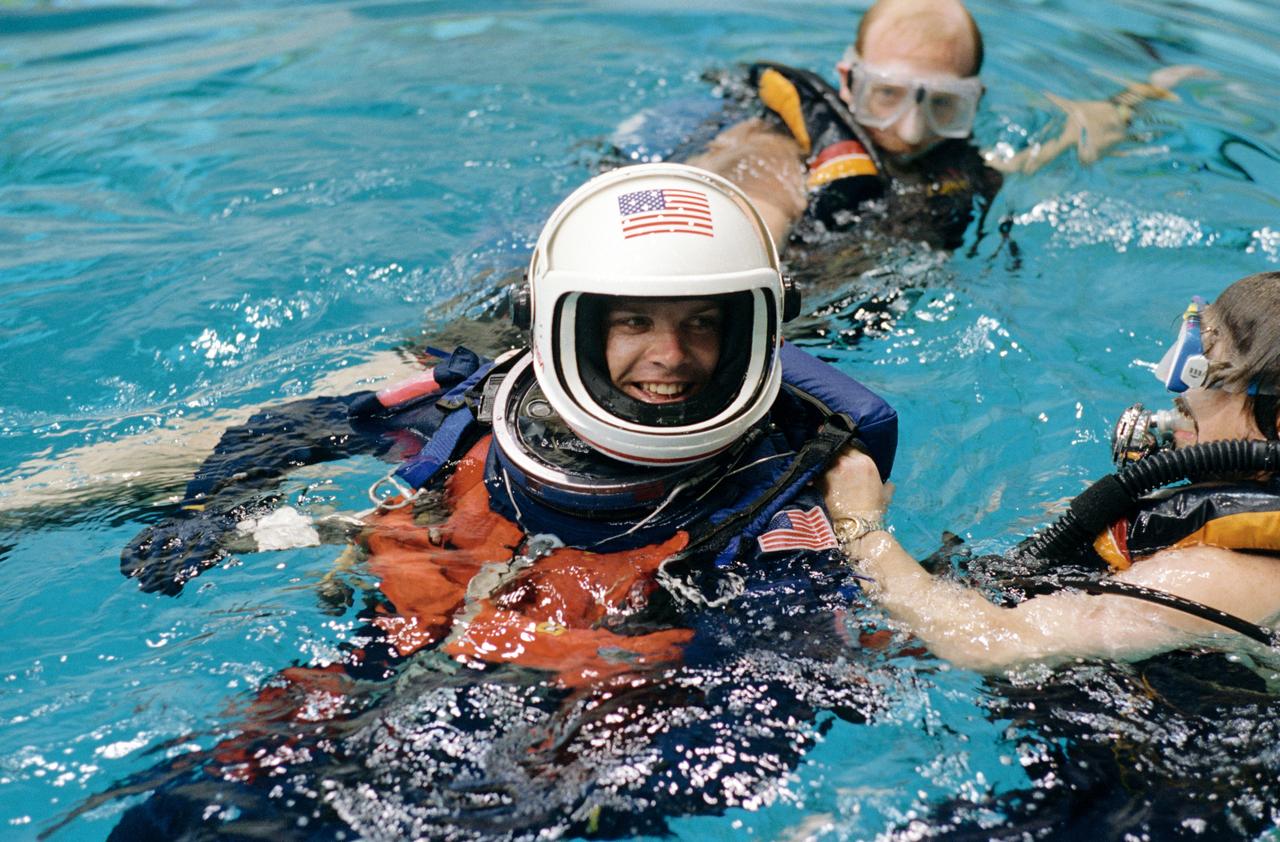
S95-03480 (16 FEB 1995) --- Attired in a training version of the Shuttle launch and entry garment, astronaut Kevin R. Kregel, pilot, gets help from SCUBA-equipped divers during a training session at the Johnson Space Center's (JSC) Weightless Environment Training Facility (WET-F). As part of the emergency bailout phase of their training agenda, the STS-70 crew members made use of this 25-feet deep pool to practice parachute landings in water and subsequent deployment of life rafts.
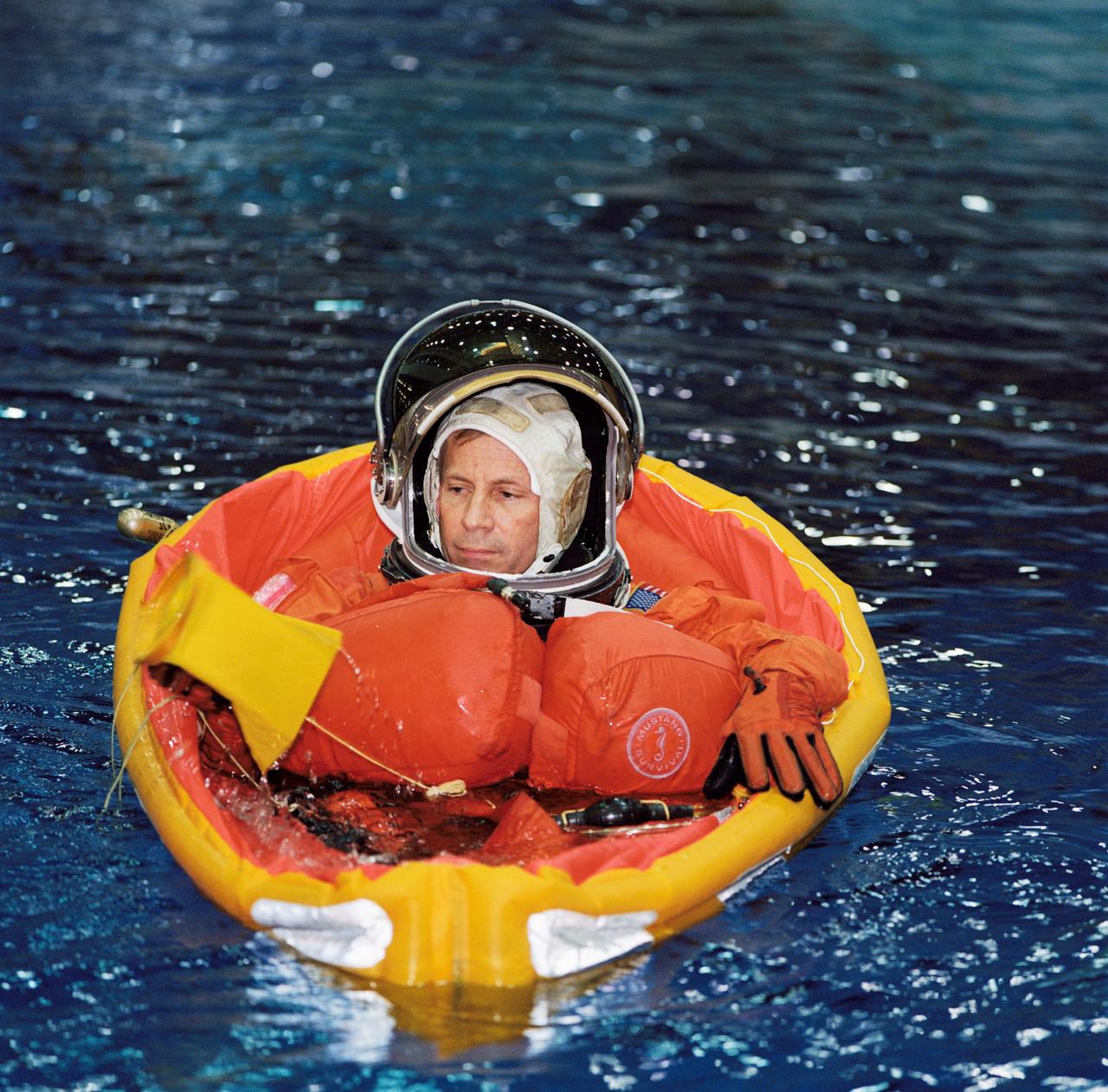
JSC2002-00413 (4 February 2002) --- Astronaut Kenneth D. Cockrell, STS-111 mission commander, floats in a small life raft during an emergency bailout training session in the Neutral Buoyancy Laboratory (NBL) near the Johnson Space Center (JSC). STS-111 will be the 14th shuttle mission to visit the International Space Station (ISS).
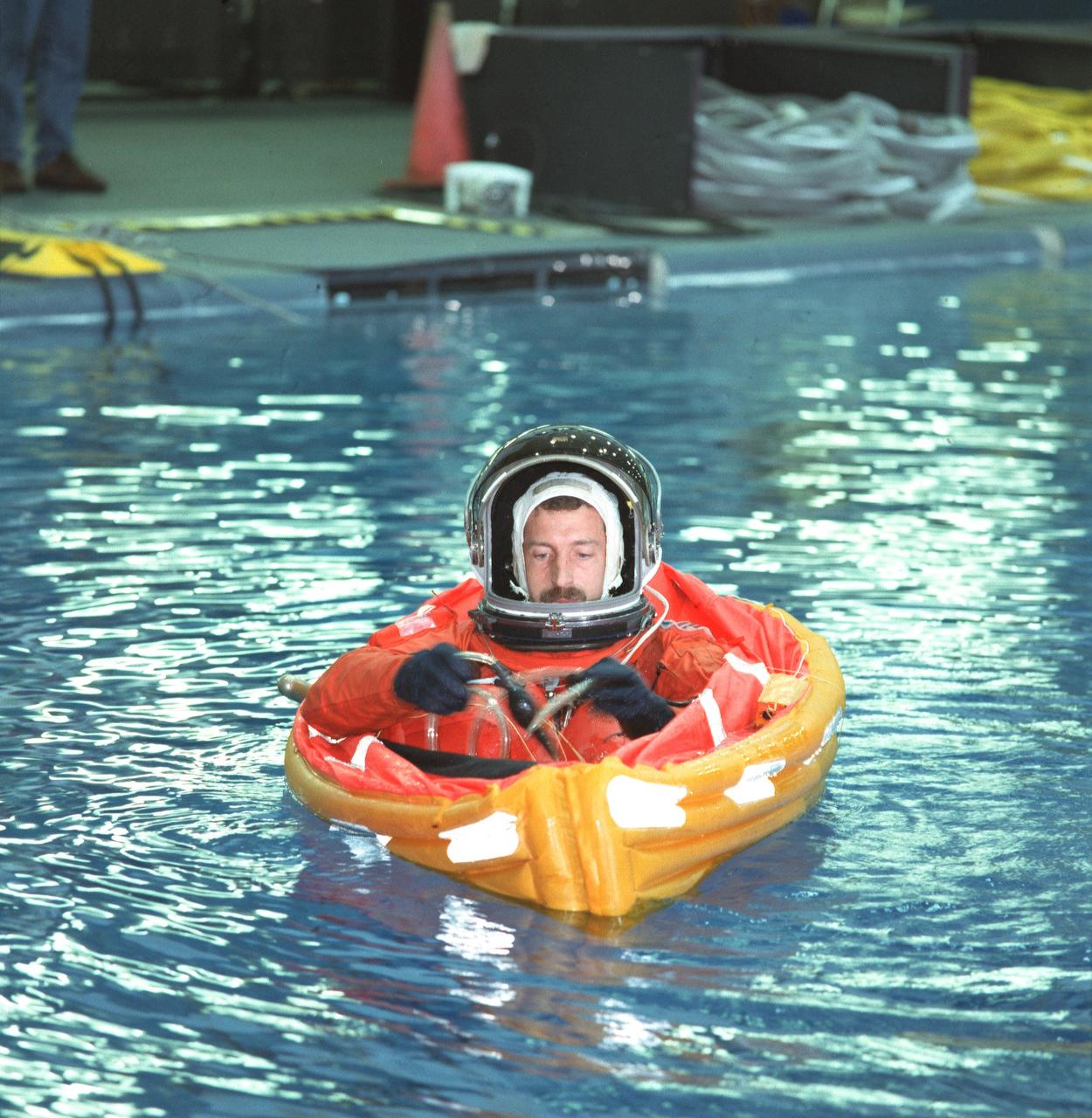
JSC2000-02549 (21 March 2000) --- Astronaut Daniel C. Burbank, STS-106 mission specialist, is in the process of deploying his life raft during an emergency bailout training exercise in the Neutral Buoyancy Laboratory (NBL). Burbank will join four other NASA astronauts and two cosmonauts, representing the Russian Aviation and Space Agency, for a late summer visit to the International Space Station.
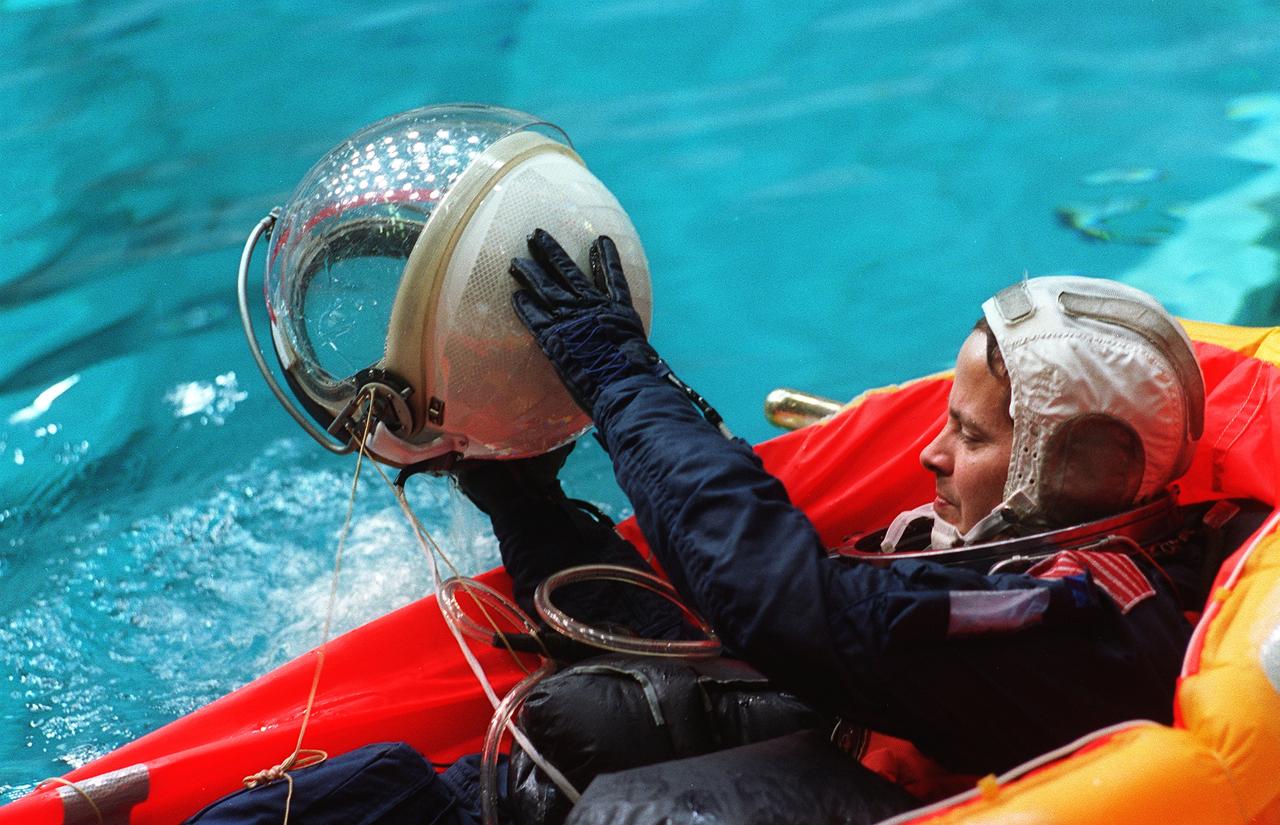
S96-08073 (April 1996) --- Astronaut Daniel W. Bursch, mission specialist, uses his helmet to bail out water from his life raft during emergency bailout training for crewmembers in the Johnson Space Center's (JSC) Weightless Environment Training Facility (WET-F). Bursch will join five other astronauts for nine days aboard the Space Shuttle Endeavour next month.
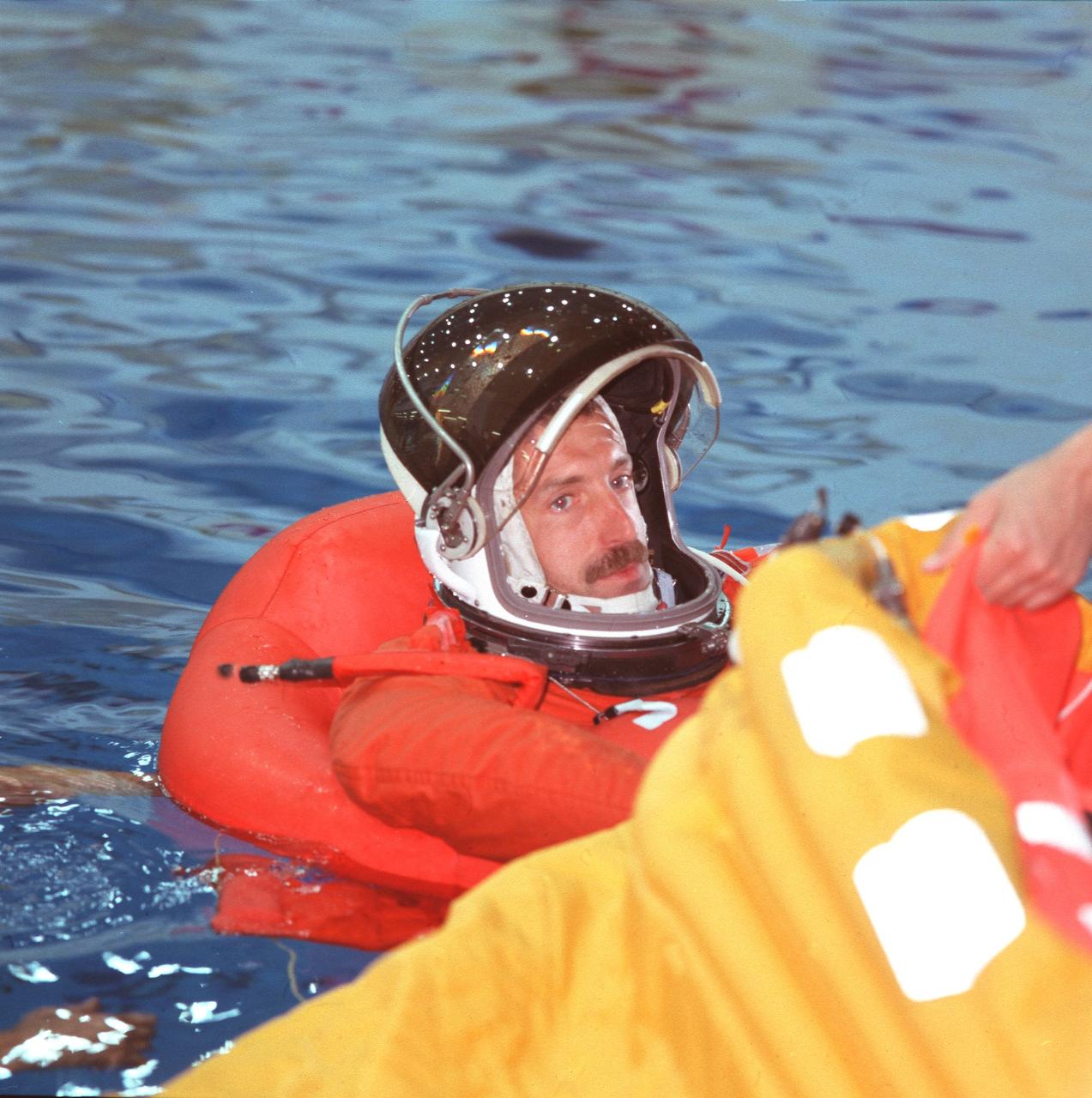
JSC2000-02545 (21 March 2000) --- Astronaut Daniel C. Burbank, STS-106 mission specialist, prepares his life raft during an emergency bailout training simulation in the pool of the Neutral Buoyancy Laboratory (NBL). Burbank will join four NASA astronauts and two cosmonauts, representing the Russian Aviation and Space Agency, for a late summer visit to the International Space Station (ISS).
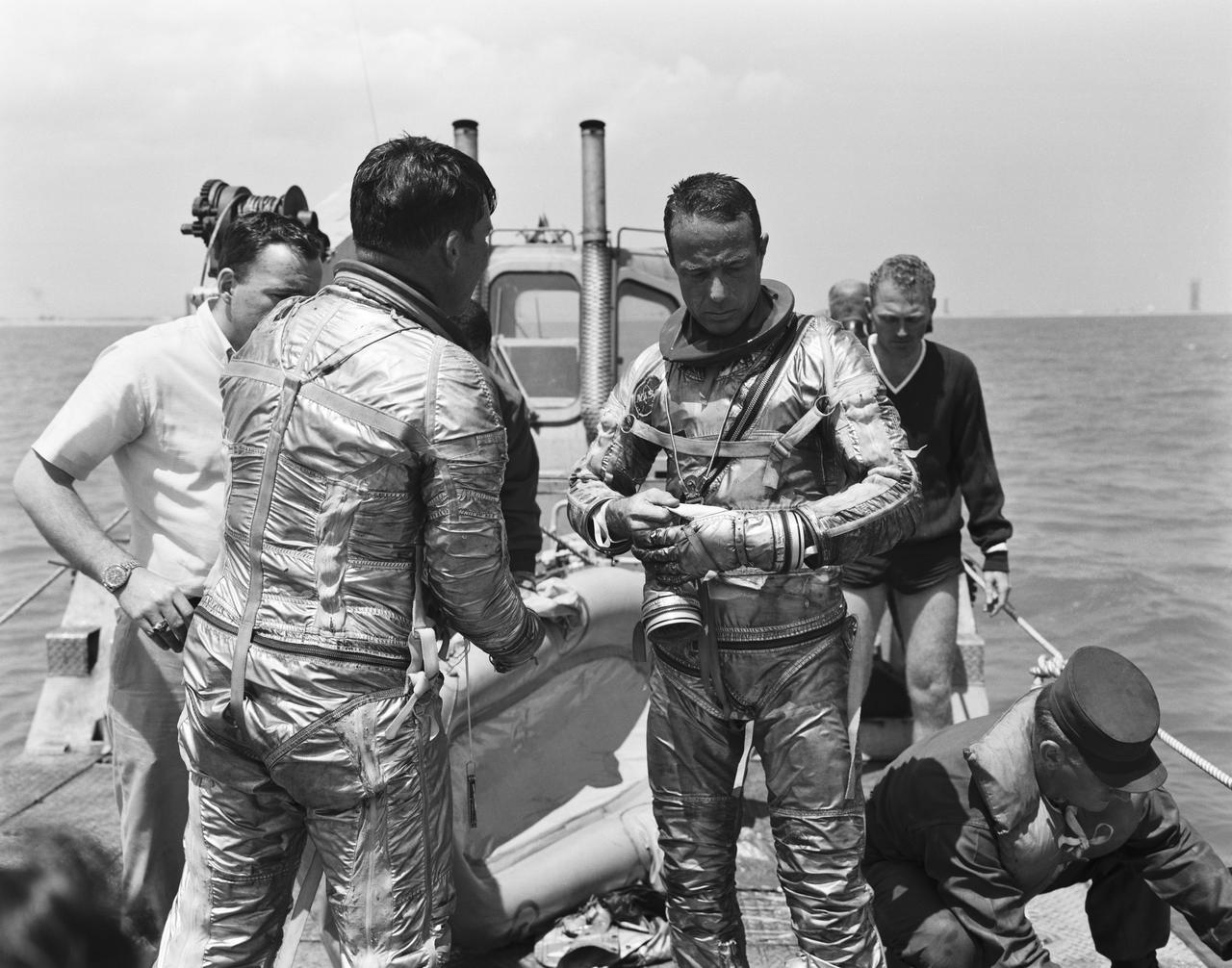
S62-01355 (1962) --- Project Mercury astronauts M. Scott Carpenter, prime pilot of the Mercury-Atlas 7 (MA-7) spaceflight, prepares to go through a water egress test. Astronaut Walter M. Schirra (back to camera), the backup MA-7 pilot is also present. Carpenter and Schirra are in the Mercury pressure suit, without the helmet. Behind them is an inflated life raft. Photo credit: NASA
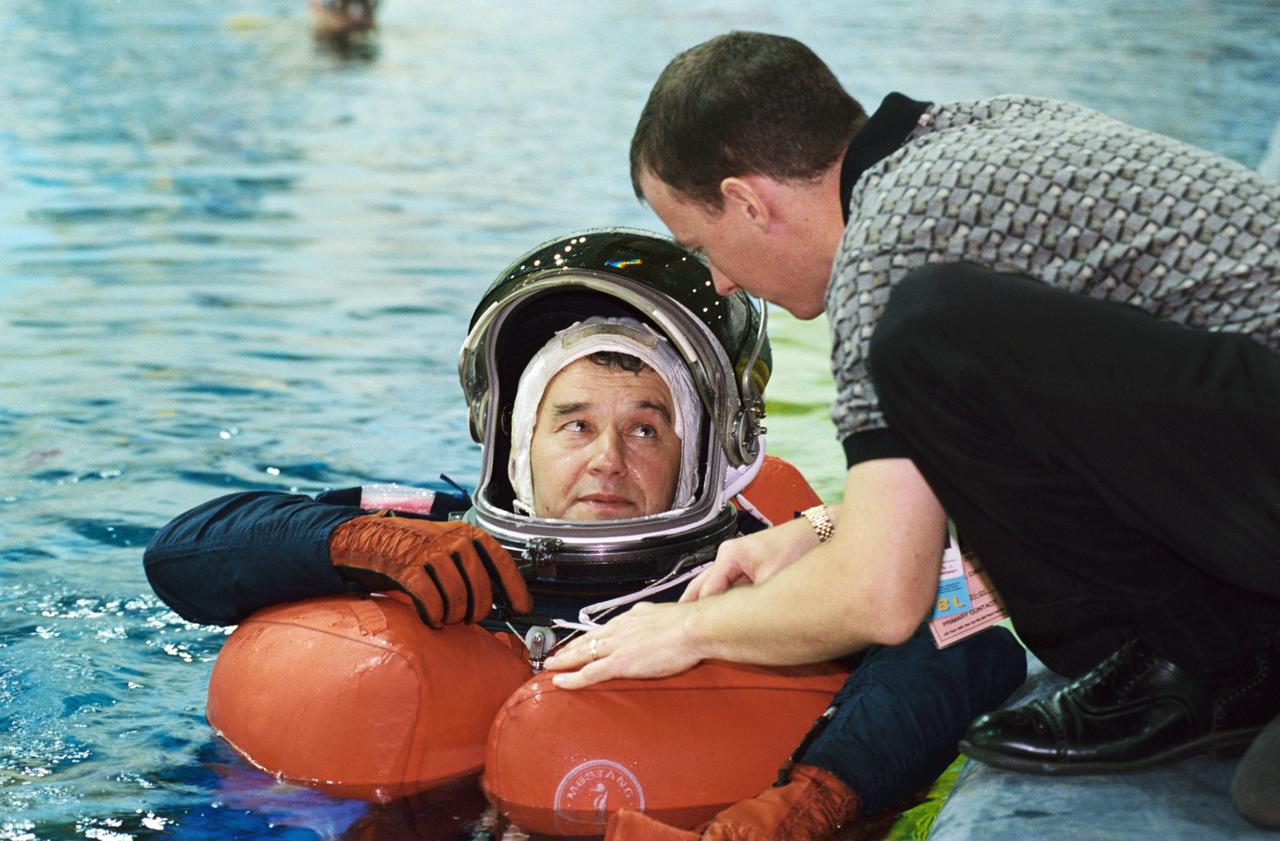
JSC2001-01923 (12 July 2001) --- Cosmonaut Valeri G. Korzun, Expedition Five mission commander representing Rosaviakosmos, floats in a life raft during an emergency bailout training session in the Neutral Buoyancy Laboratory (NBL) near the Johnson Space Center (JSC). Korzun is assisted by United Space Alliance (USA) crew trainer David Pogue.
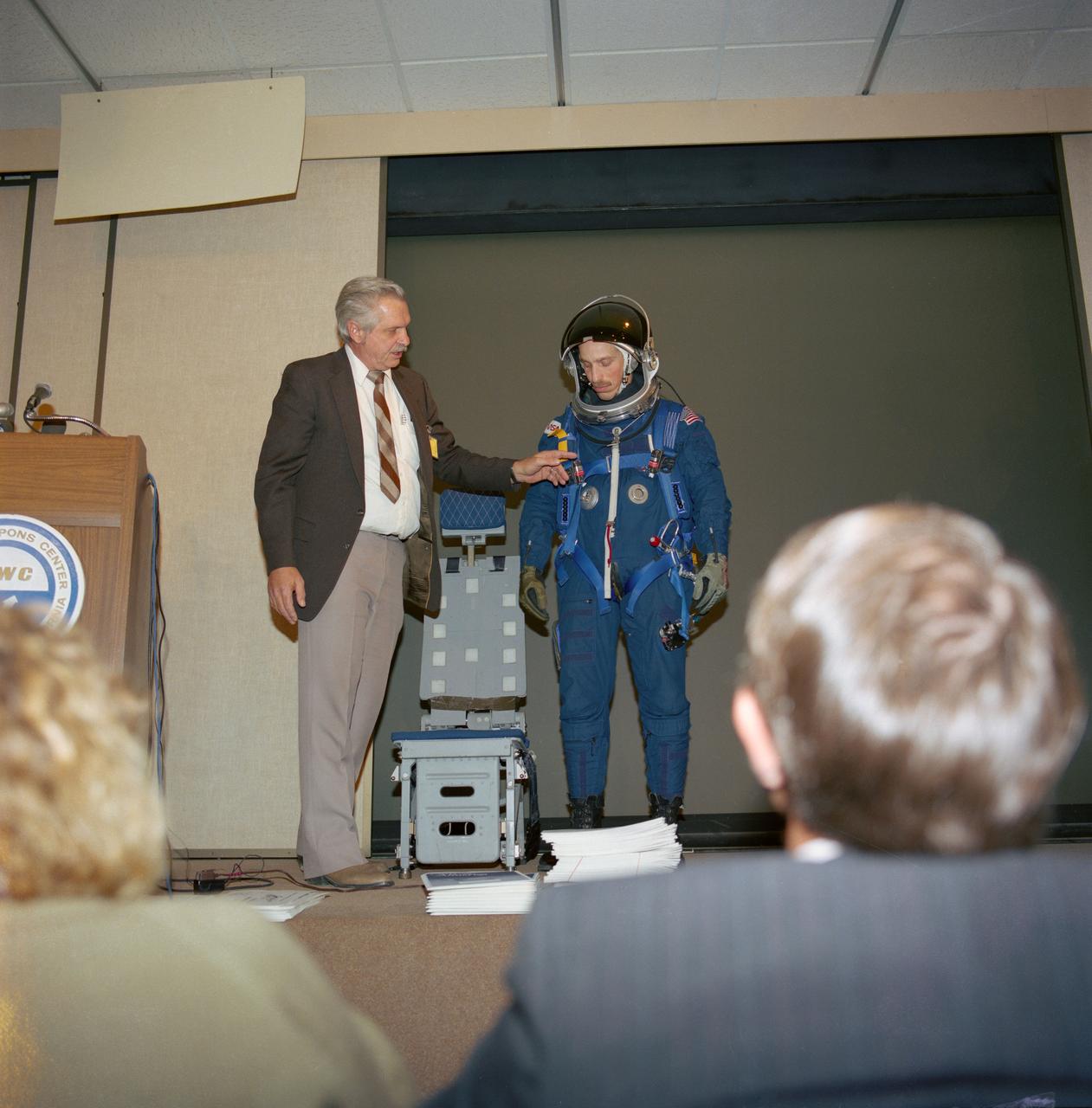
S88-25408 (8 Dec 1987) --- James O. Schlosser (left), JSC crew systems branch employee responsible for crew equipment development, gives a briefing on the crew equipment baselined for STs-26 as astronaut James P. Bagian models the new gear. Included in the package are a partial pressure suit, harness, parachute, life raft and survival gear. The deomonstration took place at the Naval Weapons Center in China Lake, CA.
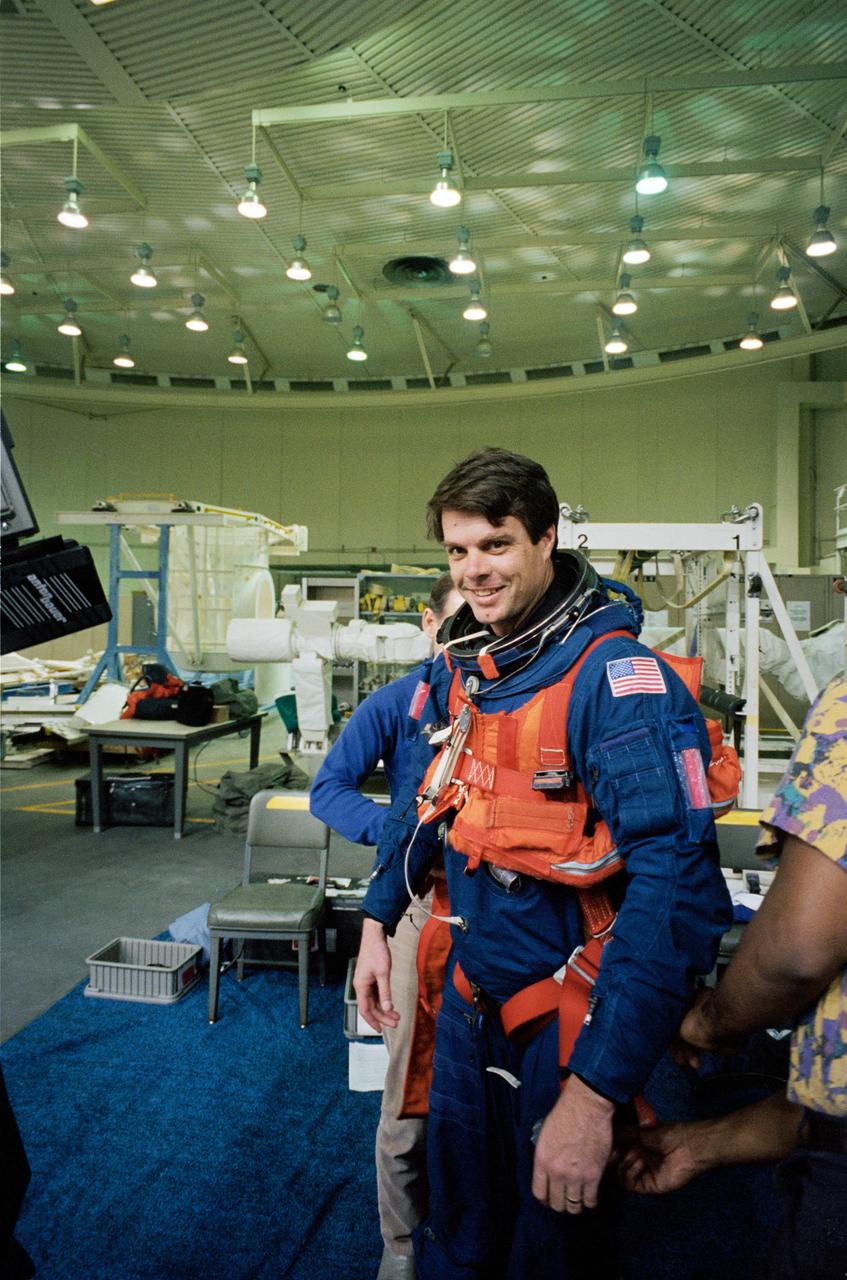
S95-03465 (16 Feb 1995) --- Attired in a training version of the Shuttle launch and entry garment, astronaut Kevin R. Kregel gets help with the final touches of suit donning during a training session at the Johnson Space Center's (JSC) Weightless Environment Training Facility (WET-F). Assigned as pilot for the STS-70 mission, Kregel was about to rehearse emergency bailout. The crew members made use of a nearby 25-feet deep pool to practice parachute landings in water and subsequent deployment of life rafts.
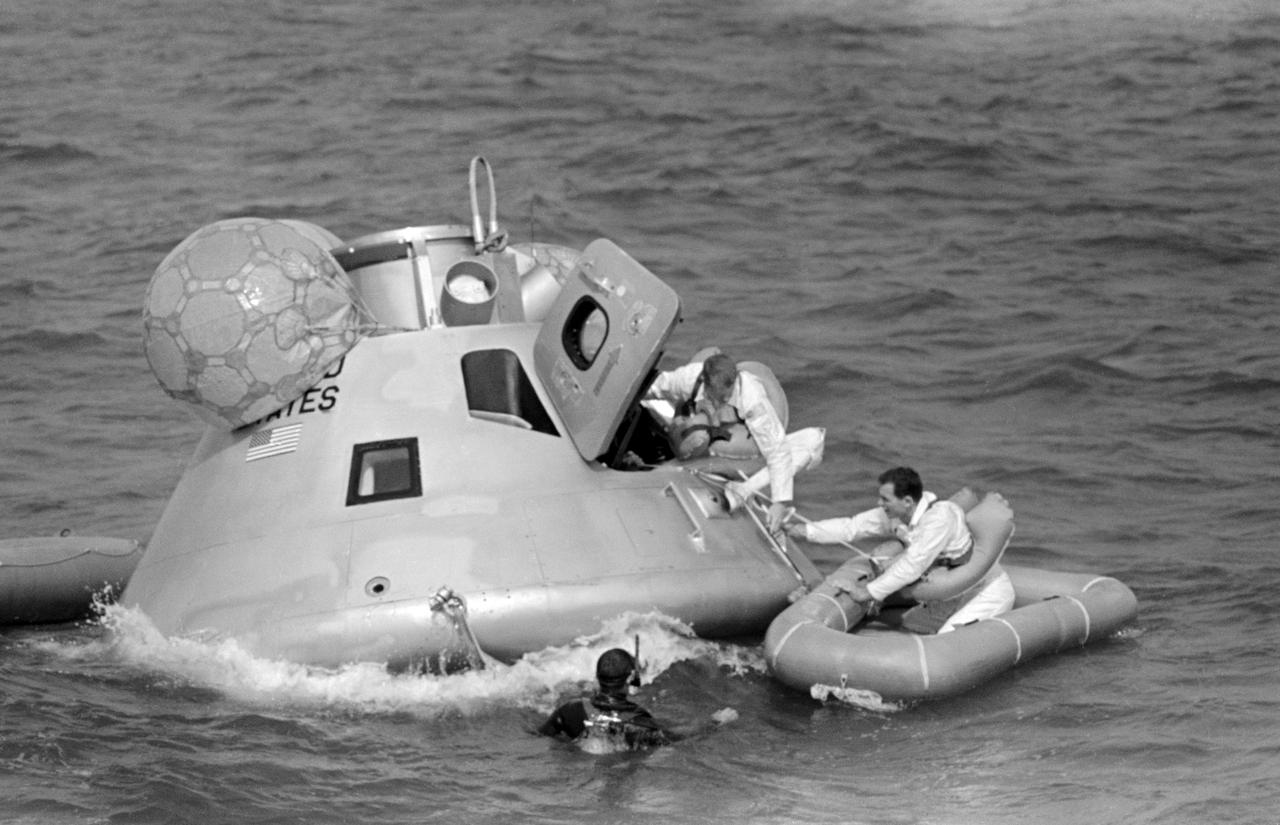
S68-50960 (20 Nov. 1968) --- The Apollo 9 prime crew participates in water egress training in the Gulf of Mexico. Apollo Command Module Boilerplate 1102 was used in the training. In life raft is astronaut David R. Scott, command module pilot. Egressing the boilerplate is astronaut Russell L. Schweickart, lunar module pilot. Still inside boilerplate, out of view, is astronaut James A. McDivitt, commander. A team of MSC swimmers assisted in the exercise. The inflated bags were used to upright the boilerplate prior to egress.
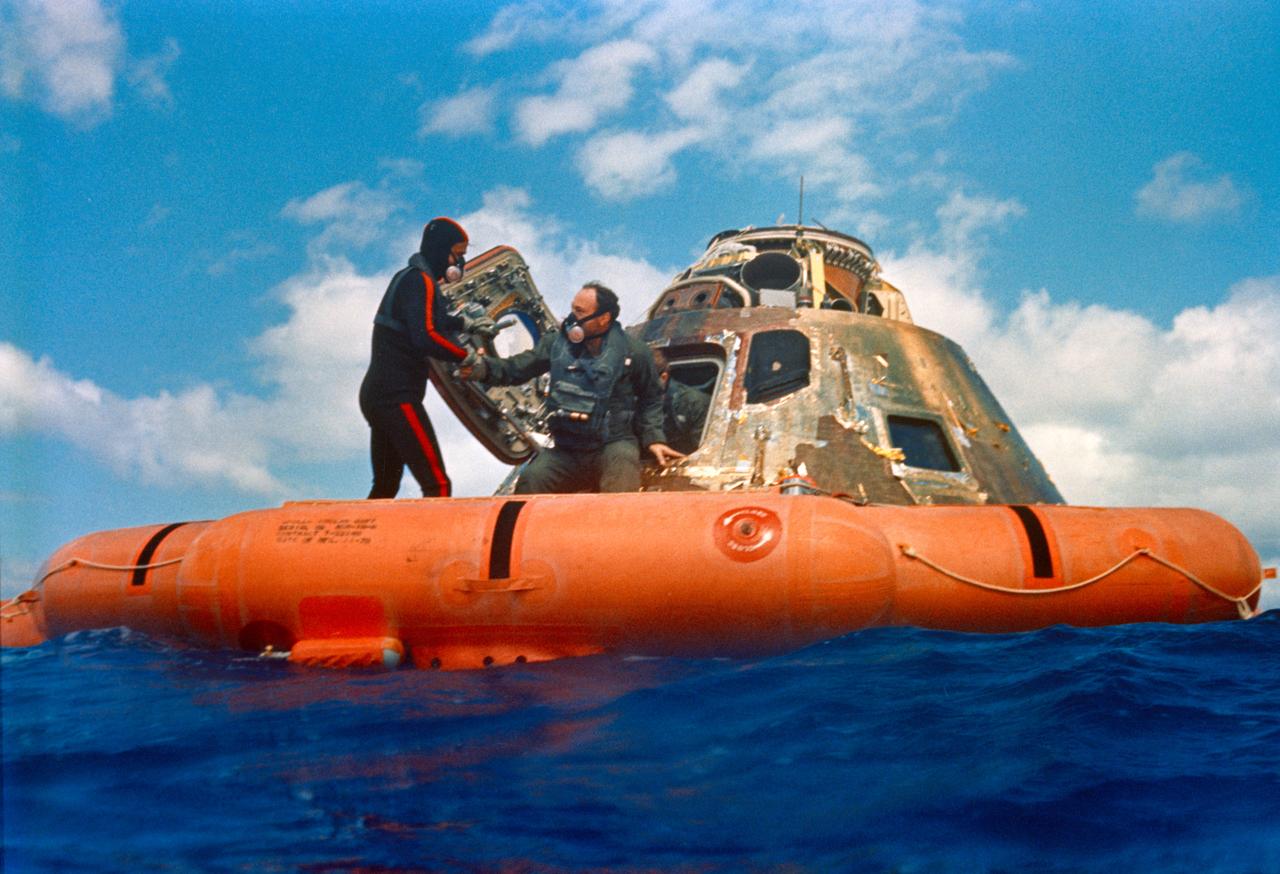
S71-19474 (9 Feb. 1971) --- Astronaut Edgar D. Mitchell, lunar module pilot, is assisted out of the Command Module (CM) by a U.S. Navy underwater demolition team swimmer during the Apollo 14 recovery operations in the South Pacific Ocean. Mitchell was followed out of the spacecraft by astronauts Alan B. Shepard Jr., commander; and Stuart A. Roosa, command module pilot. Roosa is partially visible behind Mitchell. The Apollo 14 splashdown occurred at 3:04:39 p.m. (CST), Feb. 9, 1971, in the South Pacific Ocean, approximately 765 nautical miles from American Samoa. They were transported by U.S. Navy helicopter to the USS New Orleans, prime recovery vessel.
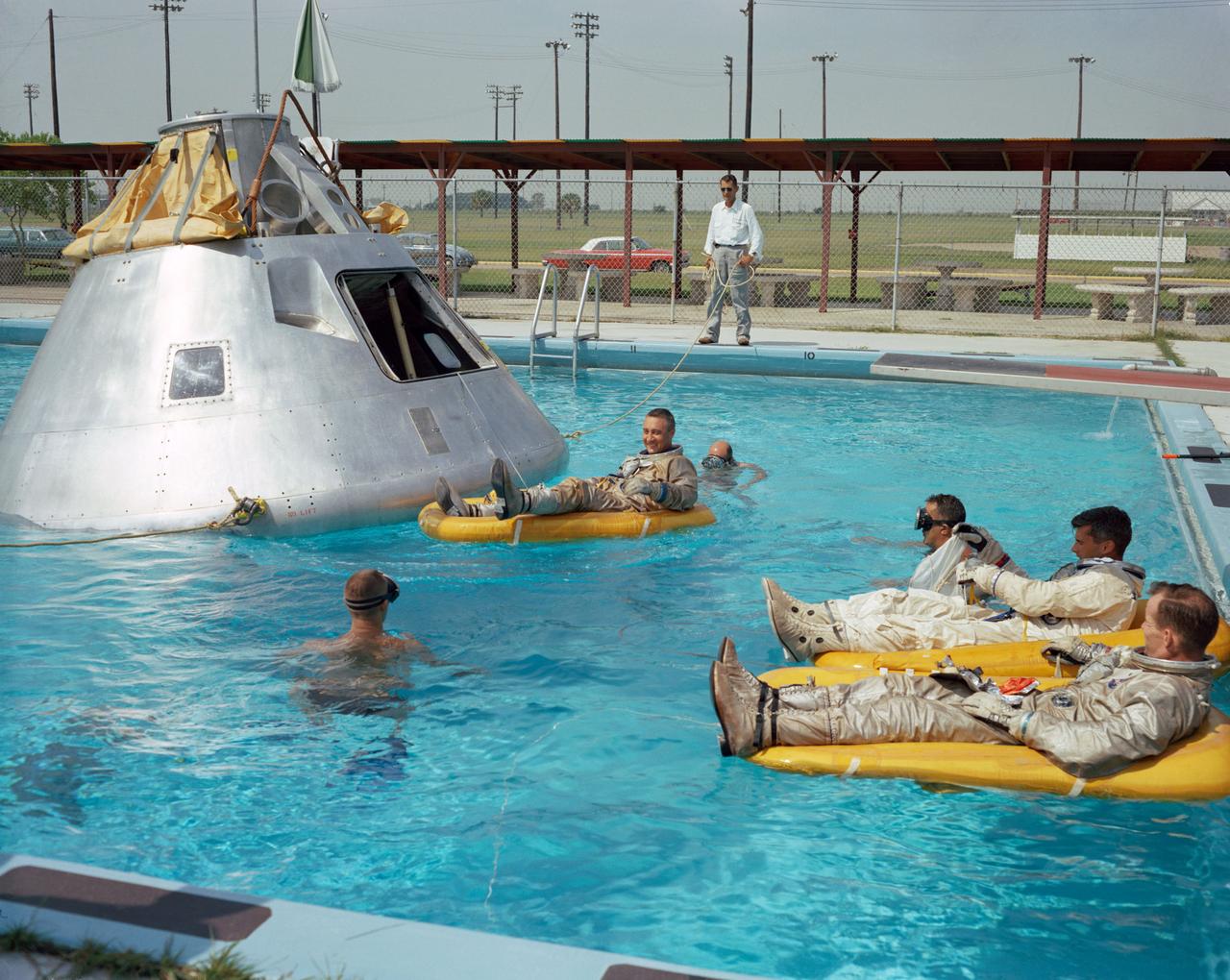
S66-51581 (June 1966) --- Prime crew for the first manned Apollo mission practice water egress procedures with full scale boilerplate model of their spacecraft. In the water at right is astronaut Edward H. White (foreground) and astronaut Roger B. Chaffee. In raft near the spacecraft is astronaut Virgil I. Grissom. NASA swimmers are in the water to assist in the practice session that took place at Ellington AFB, near the Manned Spacecraft Center, Houston.

S69-27746 (13 March 1969) --- The Apollo 9 crew awaits the arrival of a recovery helicopter from the USS Guadalcanal, prime recovery ship for the Apollo 9 10-day Earth-orbital space mission. Astronaut James A. McDivitt, commander, stands in hatch of spacecraft. Already in life raft are astronauts Russell L. Schweickart (foreground), lunar module pilot, and David R. Scott, command module pilot. Scott is taking a picture of McDivitt. Splashdown occurred at 12:00:53 p.m. (EST), March 13, 1969, only 4.5 nautical miles from the USS Guadalcanal. U.S. Navy underwater demolition team swimmers assist in the recovery operations.
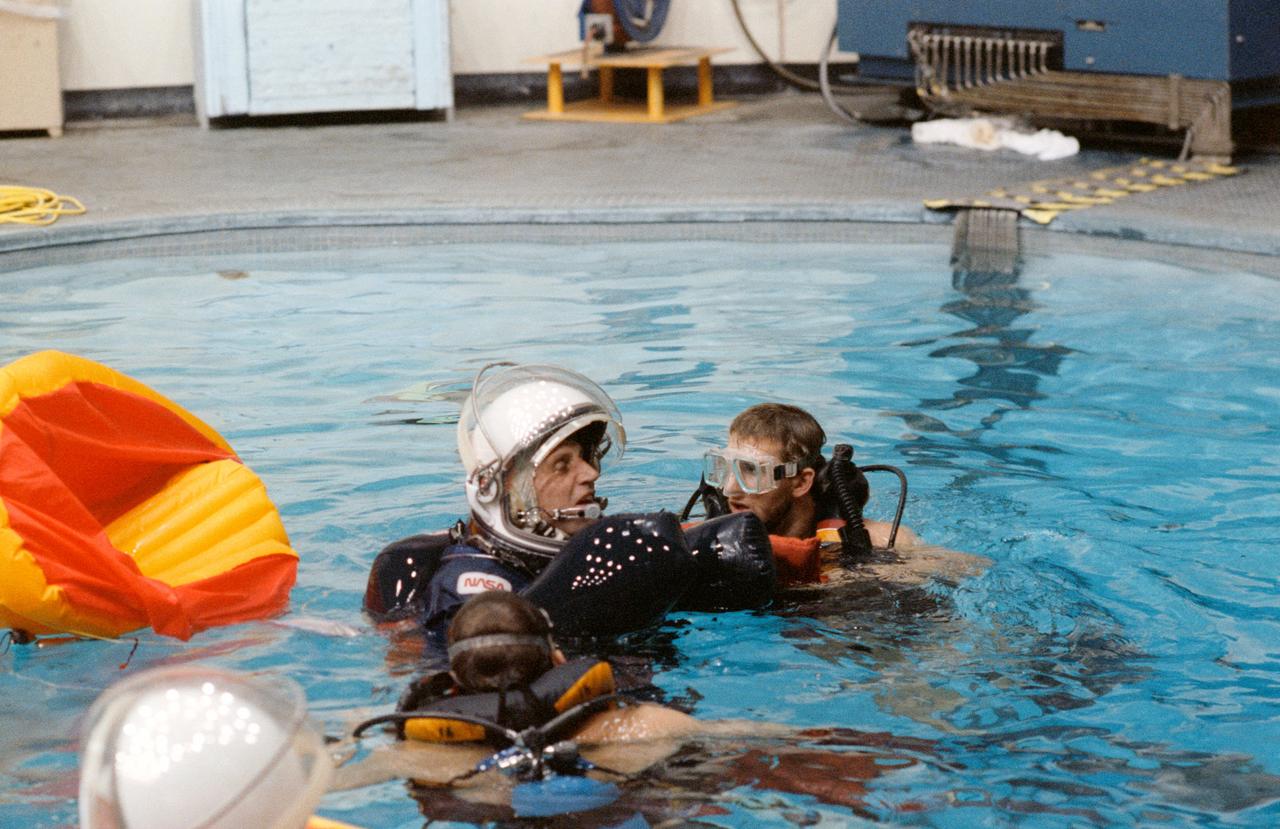
S91-51995 (26 Nov 1991) --- Astronaut David C. Hilmers, STS-42 mission specialist, wearing launch and entry suit (LES) and launch and entry helmet (LEH), floats in the water with the aid of an underarm flotation device as SCUBA-equipped divers look on. Behind Hilmers is his yellow and orange single person life raft. Hilmers is rehearsing launch emergency egress (bailout) procedures in the Johnson Space Center?s (JSC) Weightless Environment Training Facility (WETF) Bldg 29. The crewmembers would use this equipment in the event of an emergency bailout over water. The WETF's 25 ft deep pool is used to simulate the ocean.

S69-52990 (20 Sept. 1969) --- The three prime crew men of the Apollo 12 lunar landing mission participate in water egress training in the Gulf of Mexico. They have just egressed the Apollo Command Module (CM) trainer. The man standing at left is a Manned Spacecraft Center's (MSC) swimmer. The crew men await in life raft for helicopter pickup. All four persons are wearing biological isolation garments. Participating in the training exercise were astronauts Charles Conrad Jr., commander; Richard F. Gordon Jr., command module pilot; and Alan L. Bean, lunar module pilot.
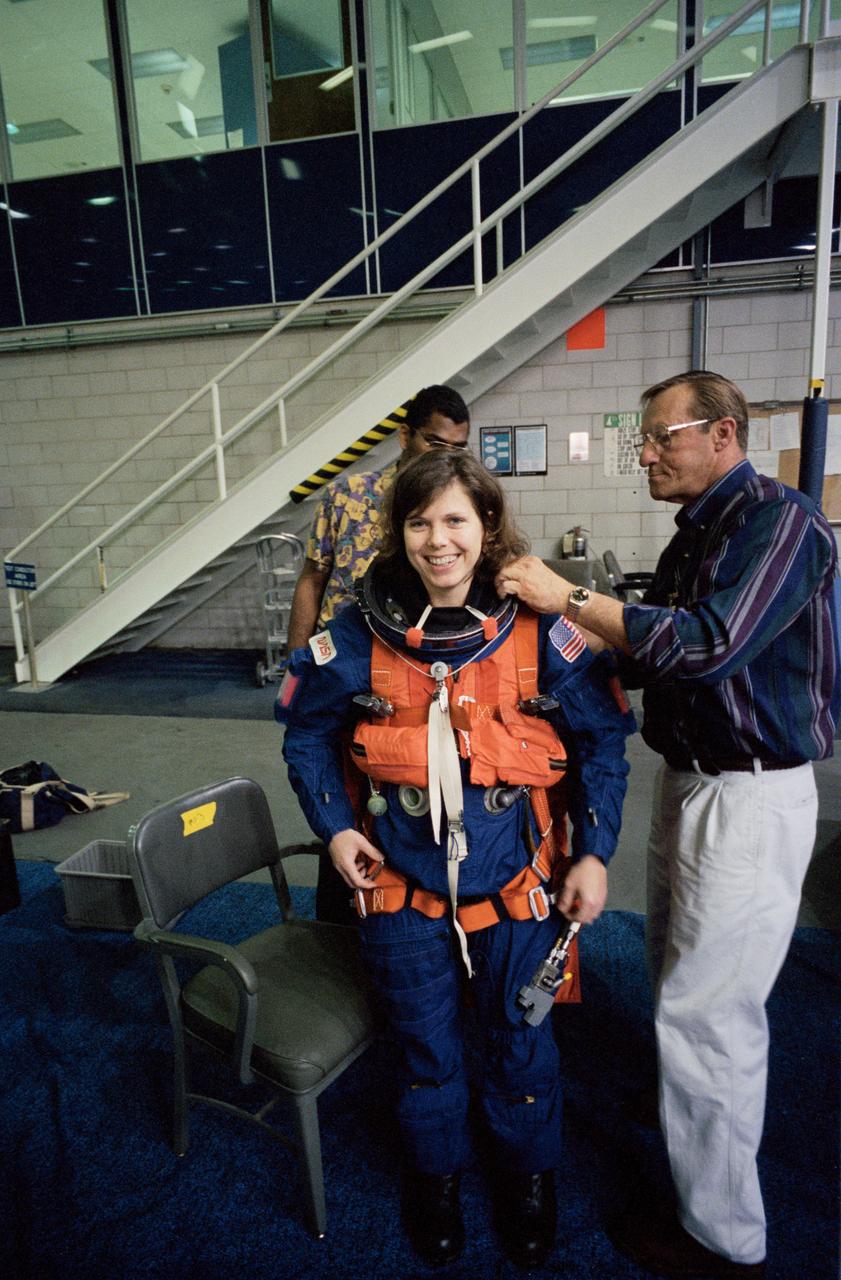
S95-03469 (16 FEB 1995) --- Attired in a training version of the Shuttle launch and entry garment, astronaut Mary Ellen Weber gets help with the final touches of suit donning during a training session at the Johnson Space Center's (JSC) Weightless Environment Training Facility (WET-F). Helping out is Rockwell's William L. Todd (right), while Staffon Isaacs looks on. Training as a mission specialist for the STS-70 mission, Weber was about to rehearse emergency bailout. The crew members made use of a nearby 25-feet deep pool to practice parachute landings in water and subsequent deployment of life rafts.
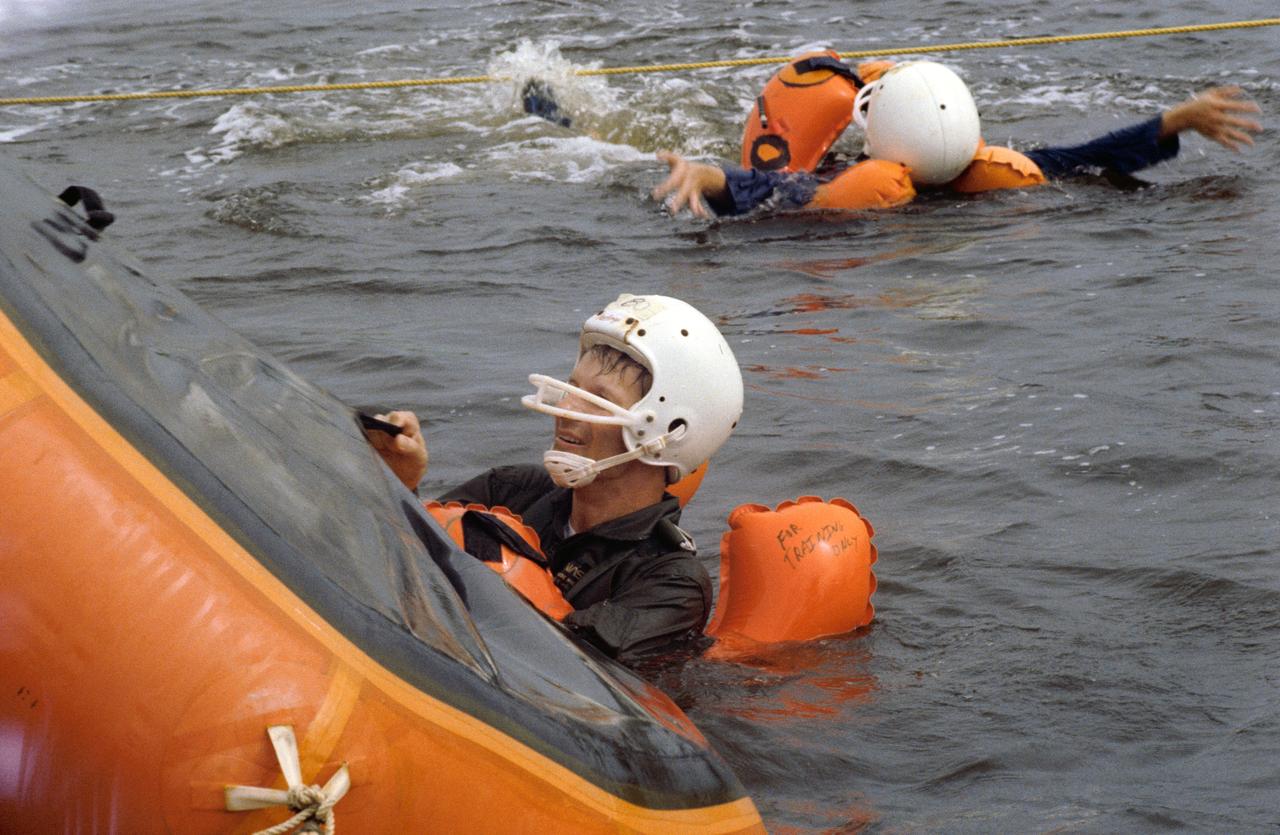
S80-38456 (13 Aug 1980) --- Claude Nicollier of Switzerland, one of two European scientists/Spacelab payload specialist candidates training in the United States along with 19 new NASA astronaut candidates, grabs onto the one-man life raft he is using during a water survival training school attended by several JSC personnel in mid-August. Six of the 19 candidates who had not had this type training before and the two Europeans were joined by a veteran astronaut, training personnel and two NASA physicians on the trip.
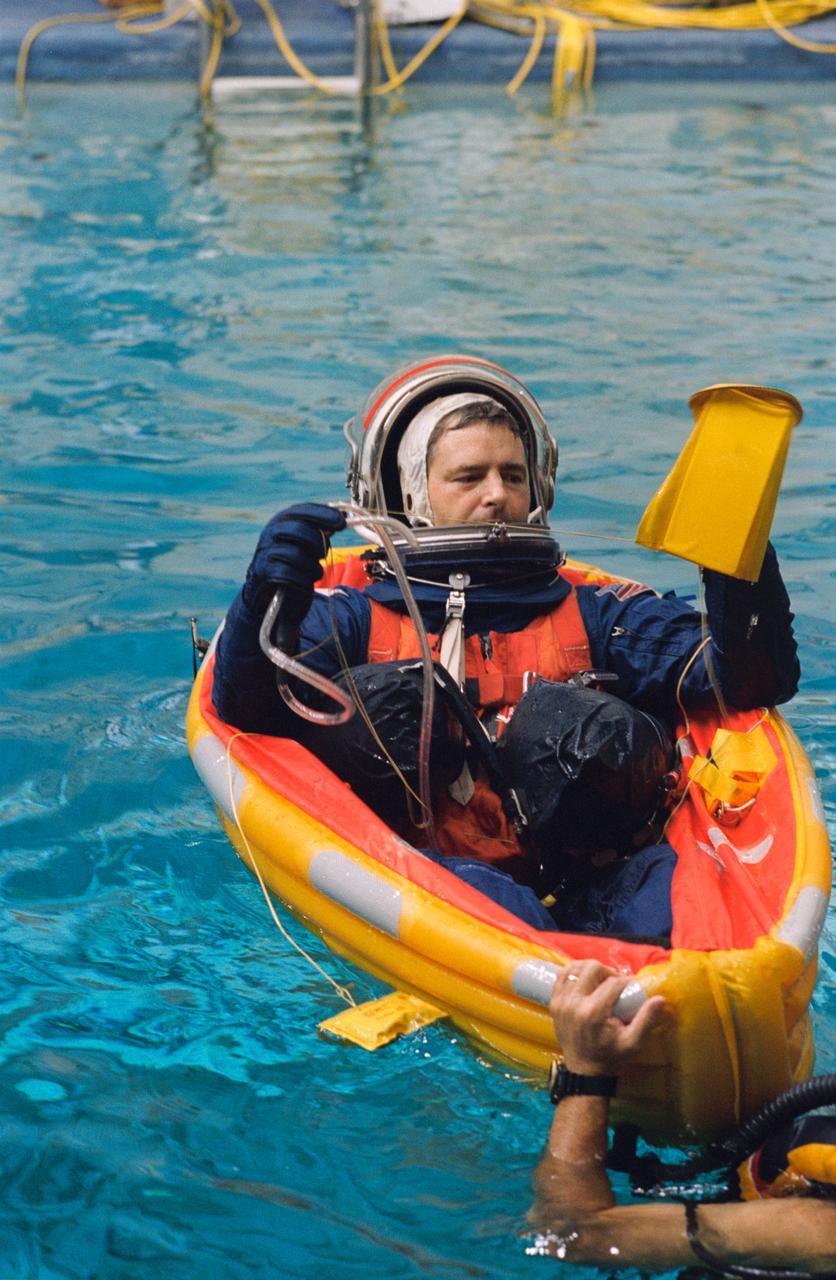
S93-45726 (7 Oct. 1993) --- Canadian astronaut candidate Marc Garneau, later named as a mission specialist for NASA's STS-77 mission, participates in emergency bailout training at the Johnson Space Center (JSC). Garneau was in the 1992 class of Astronaut Candidates (ASCAN). Wearing full parachute gear following a simulated parachute drop, Garneau has deployed a small life raft in a 25-feet deep pool in JSC's Weightless Environment Training Facility (WET-F). This portion of an astronaut's training is to prepare him or her for proper measures to take in the event of bailout over water. Garneau is assisted here by one of several SCUBA-equipped divers in the pool.
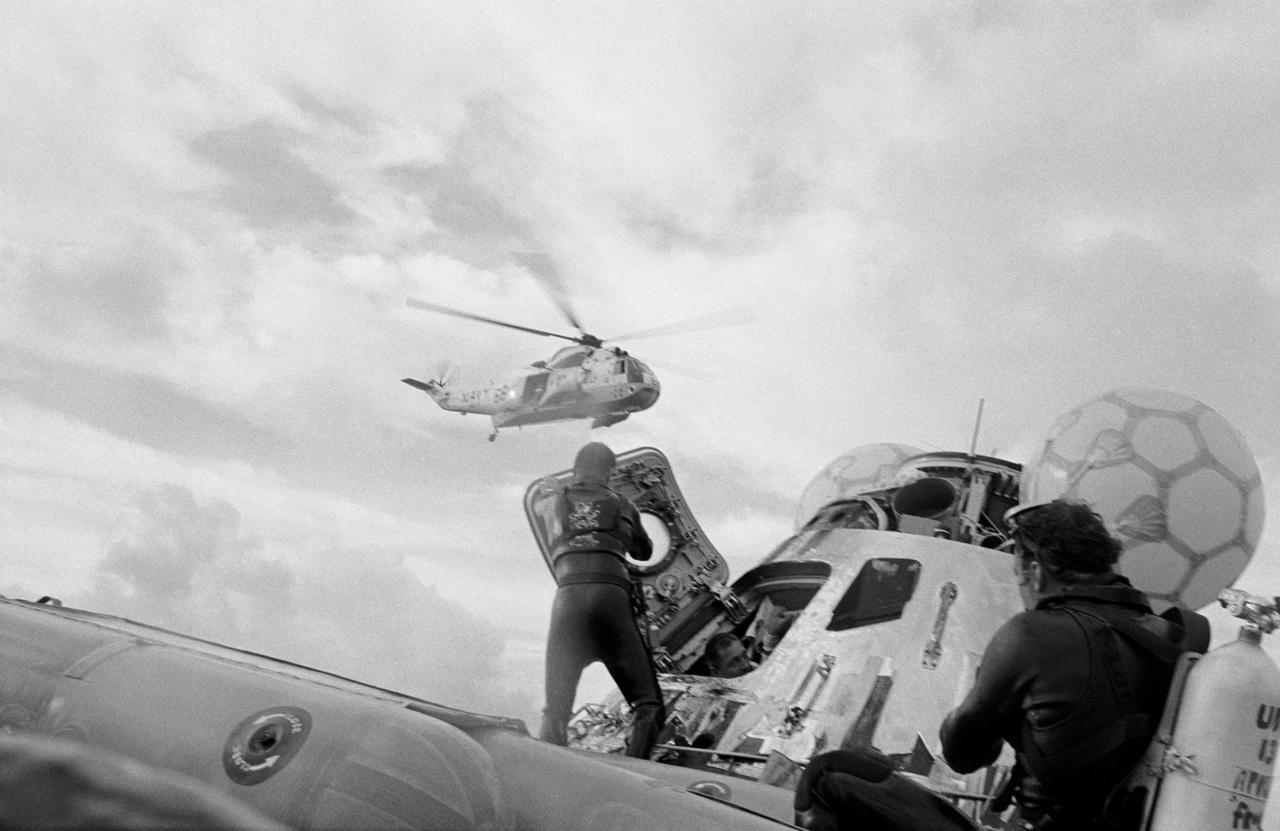
S70-35622 (17 April 1970) --- United States Navy underwater demolition team swimmers assist in the recovery operations of the Apollo 13 crewmembers, shortly after splashdown. The divers prepare to assist the astronauts out of their crippled Command Module (CM), into an awaiting life raft. Astronaut John L. Swigert Jr., command module pilot, is preparing to exit the CM. A Navy helicopter is waiting to take the astronauts to the prime recovery ship, the USS Iwo Jima. Apollo 13 splashed down at 12:07:44 p.m. (CST), April 17, 1970. Still aboard the CM are astronauts James A. Lovell Jr., commander; and Fred W. Haise Jr., lunar module pilot.
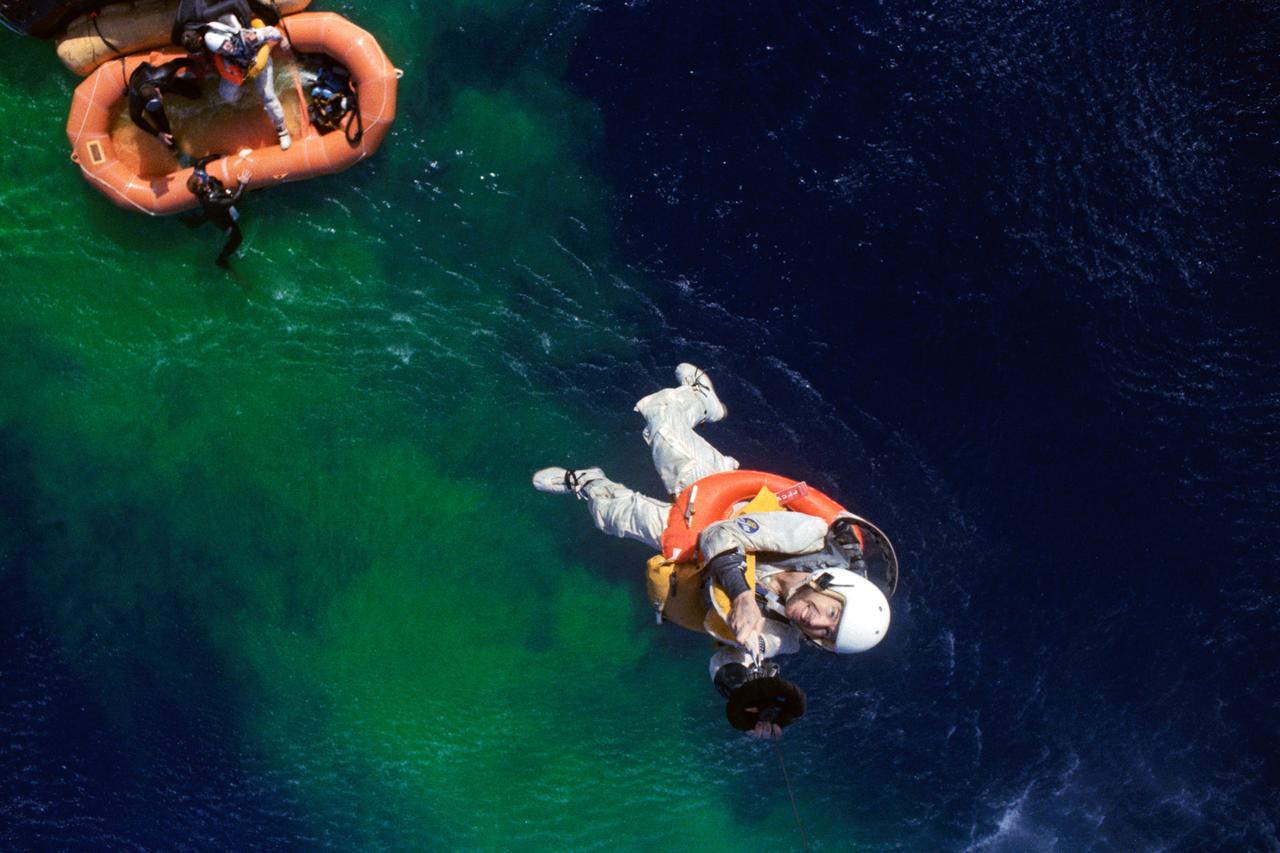
S66-15447 (18 Dec. 1965) --- Astronaut James A. Lovell Jr., pilot of the National Aeronautics Space Administration's 14-day Gemini-7 spaceflight, is hoisted from the water by a recovery helicopter from the aircraft carrier USS Wasp. Gemini-7 splashed down in the western Atlantic recovery area at 9:05 a.m. (EST), Dec. 18, 1965, to conclude the record-breaking mission in space. Astronaut Frank Borman, command pilot and three Navy frogmen sit in a life raft beside the spacecraft. Photo credit: NASA
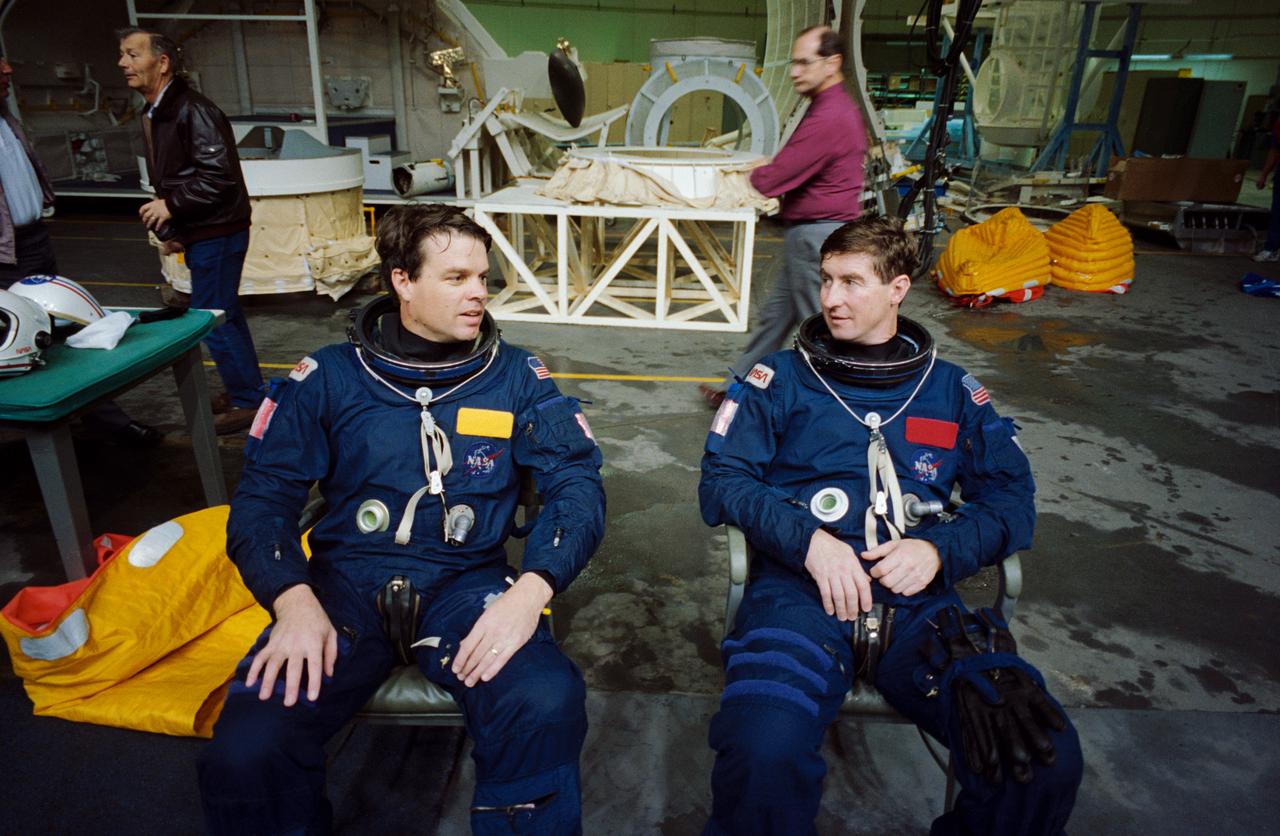
S95-03470 (16 FEB 1995) --- Attired in blue training versions of the orange Shuttle launch and entry garments, astronauts Terence T. (Tom) Henricks, right, and Kevin R. Kregel take a break during a bailout training session at the Johnson Space Center's (JSC) Weightless Environment Training Facility (WET-F). Assigned as commander and pilot, respectively, for the STS-70 mission, the two later joined their crew mates in making use of a nearby 25-feet deep pool to practice parachute landings in water and subsequent deployment of life rafts.
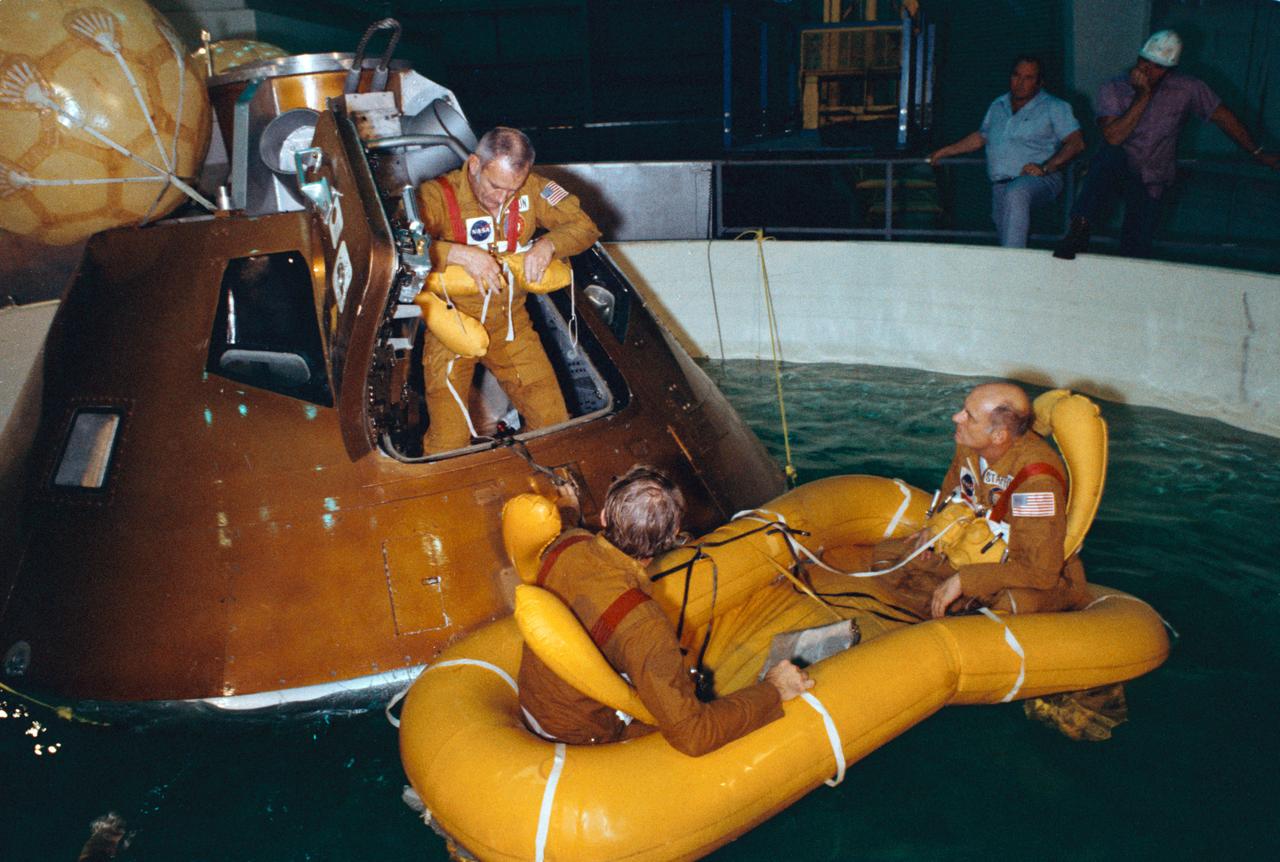
S75-23431 (8 March 1975) --- Astronaut Donald K. Slayton attaches his life preserver as he egresses an Apollo Command Module trainer in a water tank in Building 260 during water egress training at NASA's Johnson Space Center. The crewmen exit through the hatch when the CM is in this stable I (apex up) position; and they egress through the tunnel when the CM is in a stable II (apex down) position. Astronauts Vance D. Brand (on left) and Thomas P. Stafford have already egressed the trainer and are seated in a three-man life raft. This training session was part of the preparations for the joint U.S.-USSR Apollo-Soyuz Test Project docking mission in Earth orbit scheduled for July 1975. These three men compose the American ASTP prime crew. Stafford is the commander, Brand is the command module pilot, and Slayton is the docking module pilot.
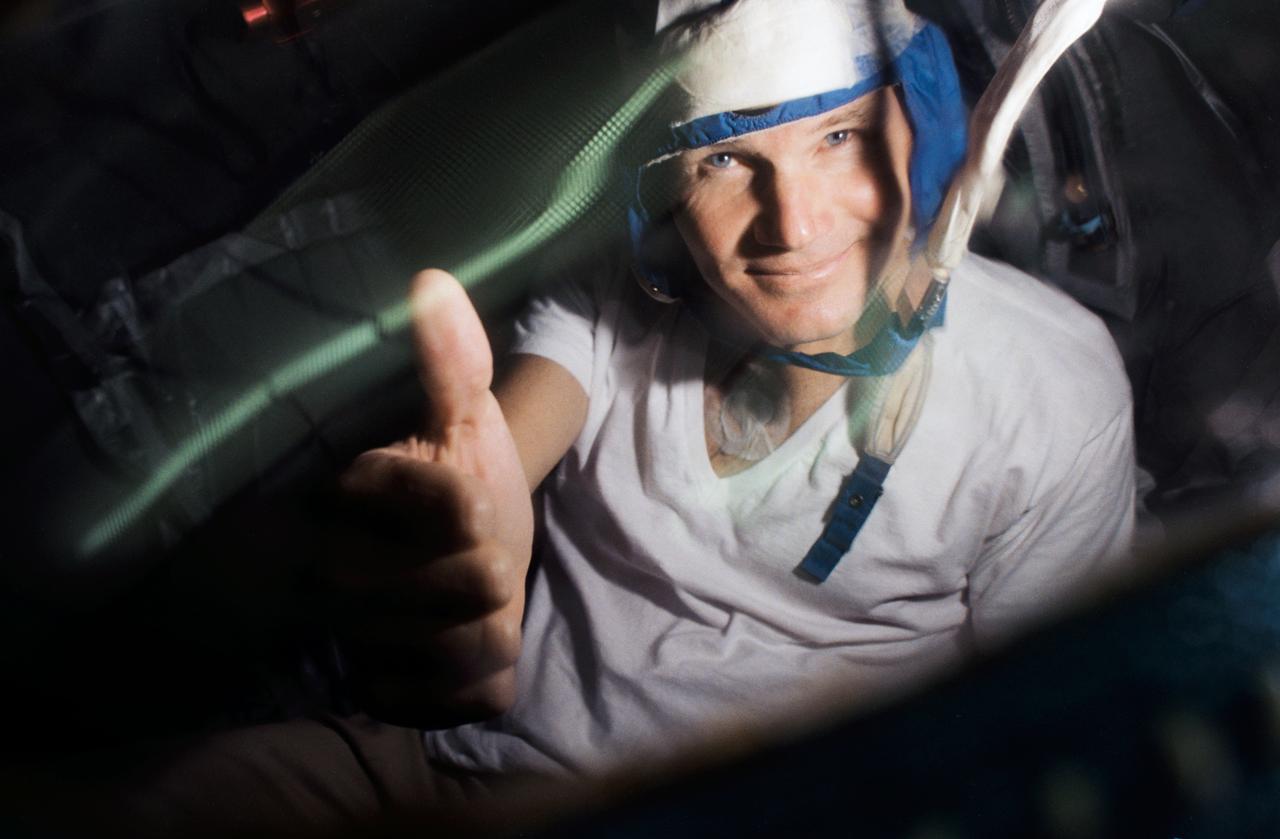
U.S. Representative Bill Nelson (D.,Florida) gives a thumbs up signal from inside a small ball called a personal rescue sphere (PRS). The PRS is not part of STS 61-C hardware, but serves to evaluate a subject's reaction to close quarters. The photo was taken through a visor on the 39-inch diameter fabric rescue sphere.
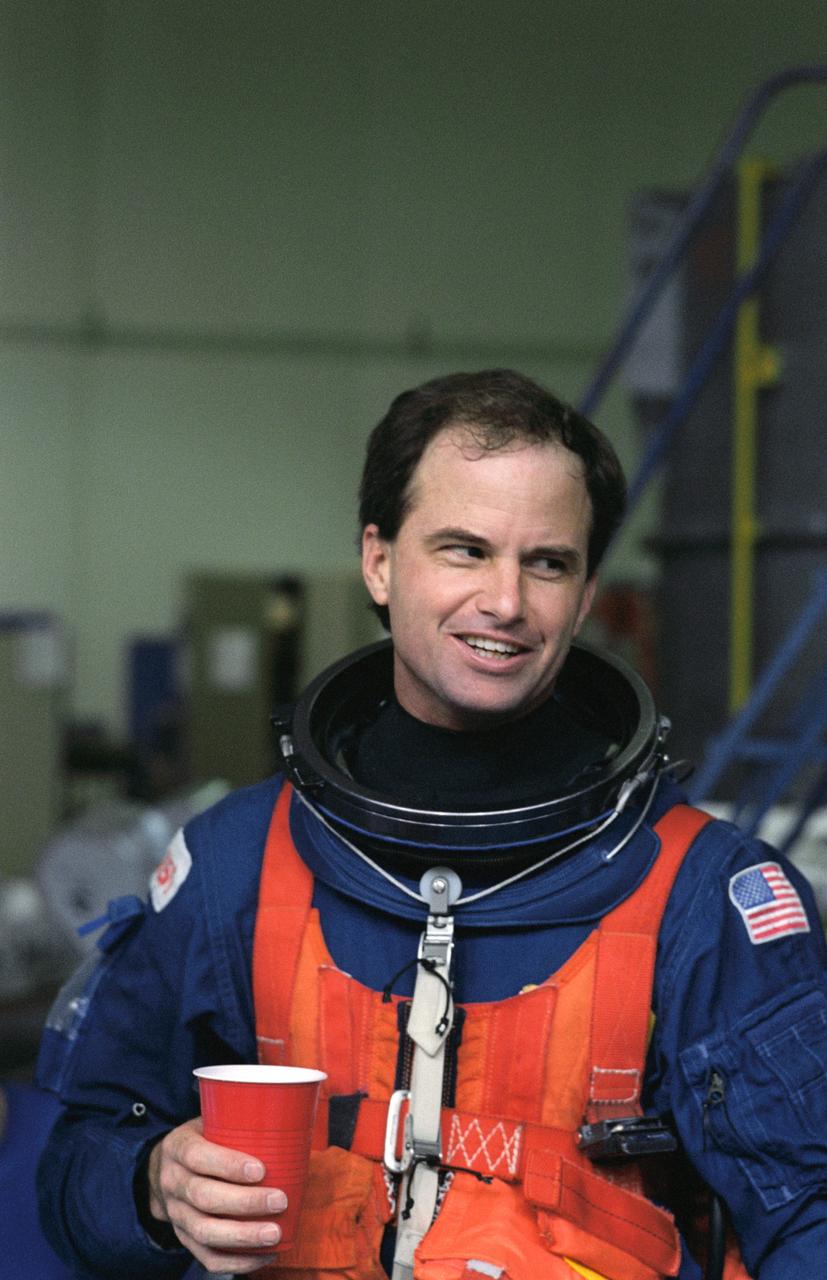
S93-50720 (22 Dec 1993) --- Astronaut Kevin P. Chilton, pilot, takes a break during emergency bailout training at the Johnson Space Center's (JSC) Weightless Environment Training Facility (WET-F). Chilton and five other NASA astronauts are scheduled to fly aboard the Space Shuttle Endeavour next year.
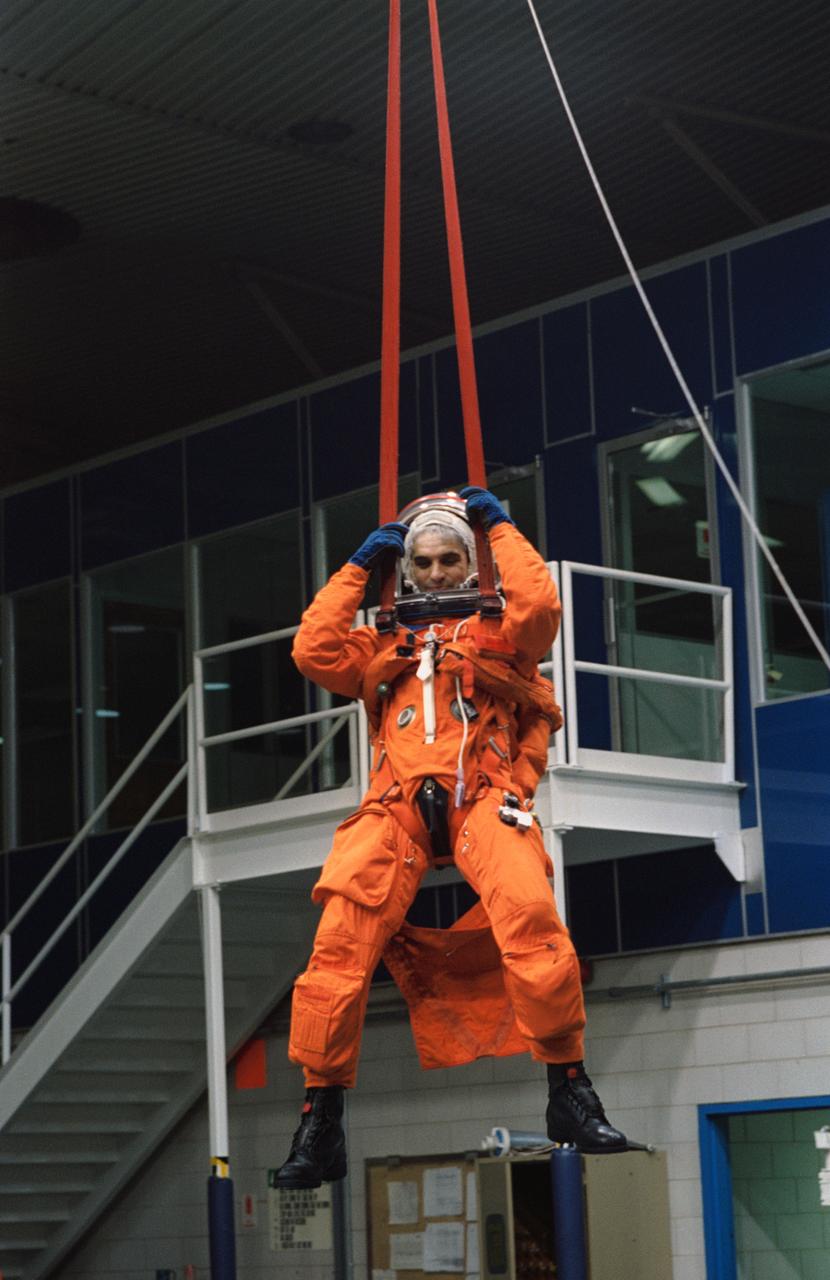
S93-50718 (22 Dec 1993) --- Astronaut Sidney M. Gutierrez, commander, is suspended by his parachute gear during emergency bailout training at the Johnson Space Center's (JSC) Weightless Environment Training Facility (WET-F). Gutierrez and five other NASA astronauts are scheduled to fly aboard the Space Shuttle Endeavour next year.
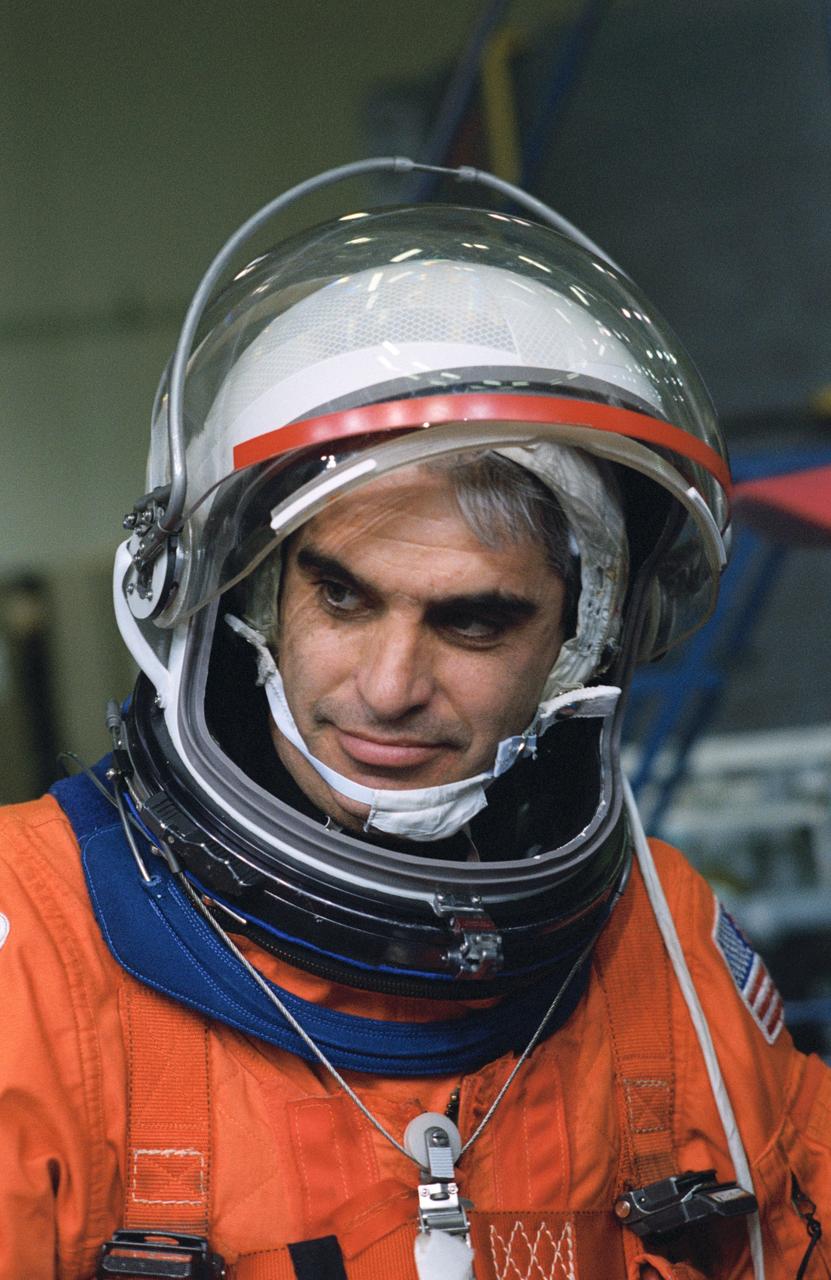
S93-50710 (22 Dec 1993) --- Astronaut Sidney M. Gutierrez, commander, takes a break during emergency bailout training at the Johnson Space Center's (JSC) Weightless Environment Training Facility (WET-F). Gutierrez and five other NASA astronauts are scheduled to fly aboard the Space Shuttle Endeavour next year.
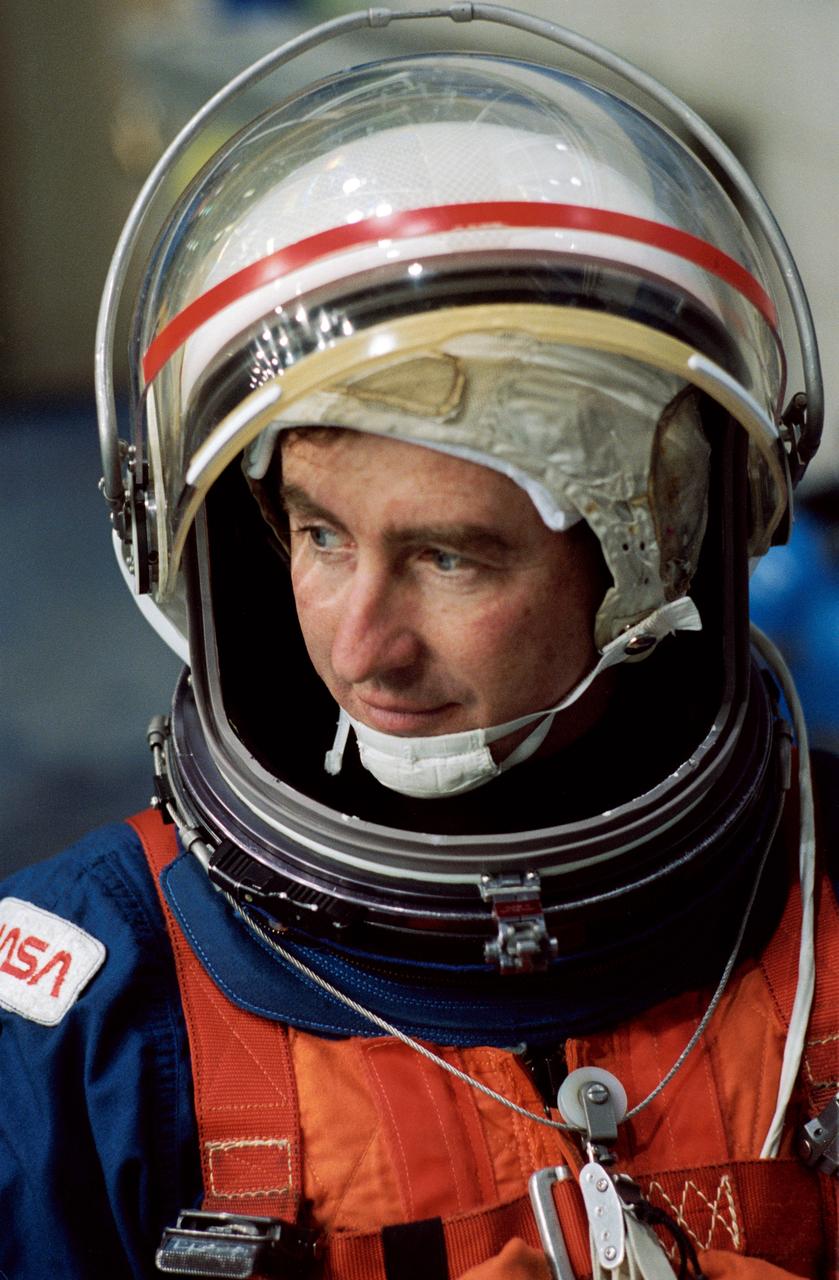
S95-03464 (16 Feb 1995) --- Attired in a training version of the Shuttle launch and entry garment, astronaut Terence T. (Tom) Henricks participates in a bailout training session at the Johnson Space Center's (JSC) systems integration facility. Henricks, mission commander for the STS-70 flight, was listening as a member of the crew training staff briefed the crew members on the use of parachute gear.