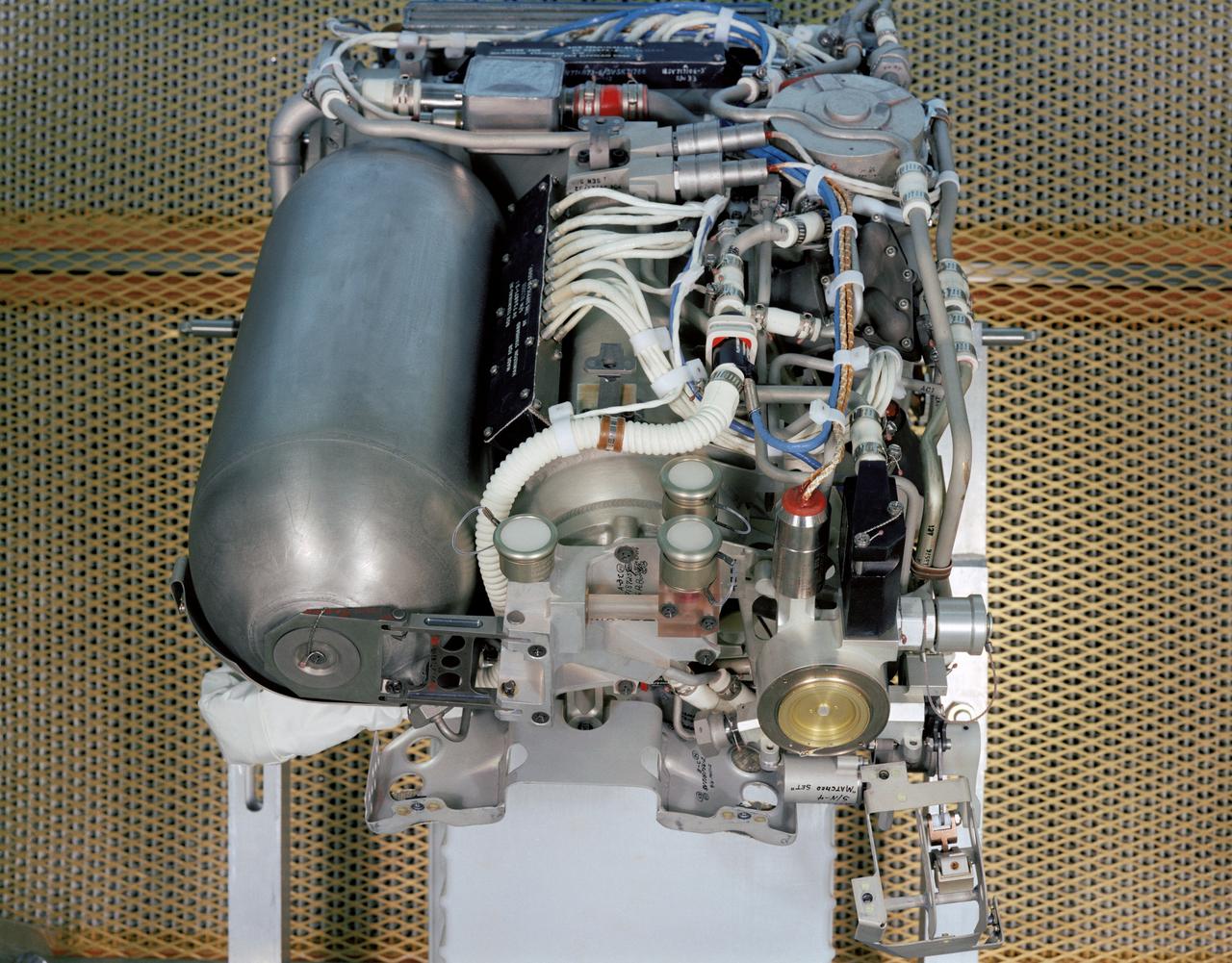
S68-34582 (1968) --- With its exterior removed, the Apollo portable life support system (PLSS) can be easily studied. The PLSS is worn as a backpack over the Extravehicular Mobility Unit (EMU) a multi-layered spacesuit used for outside-the-spacecraft activity. JSC photographic frame no. S68-34582 is a wider view of the exposed interior working parts of the PLSS and its removed cover.
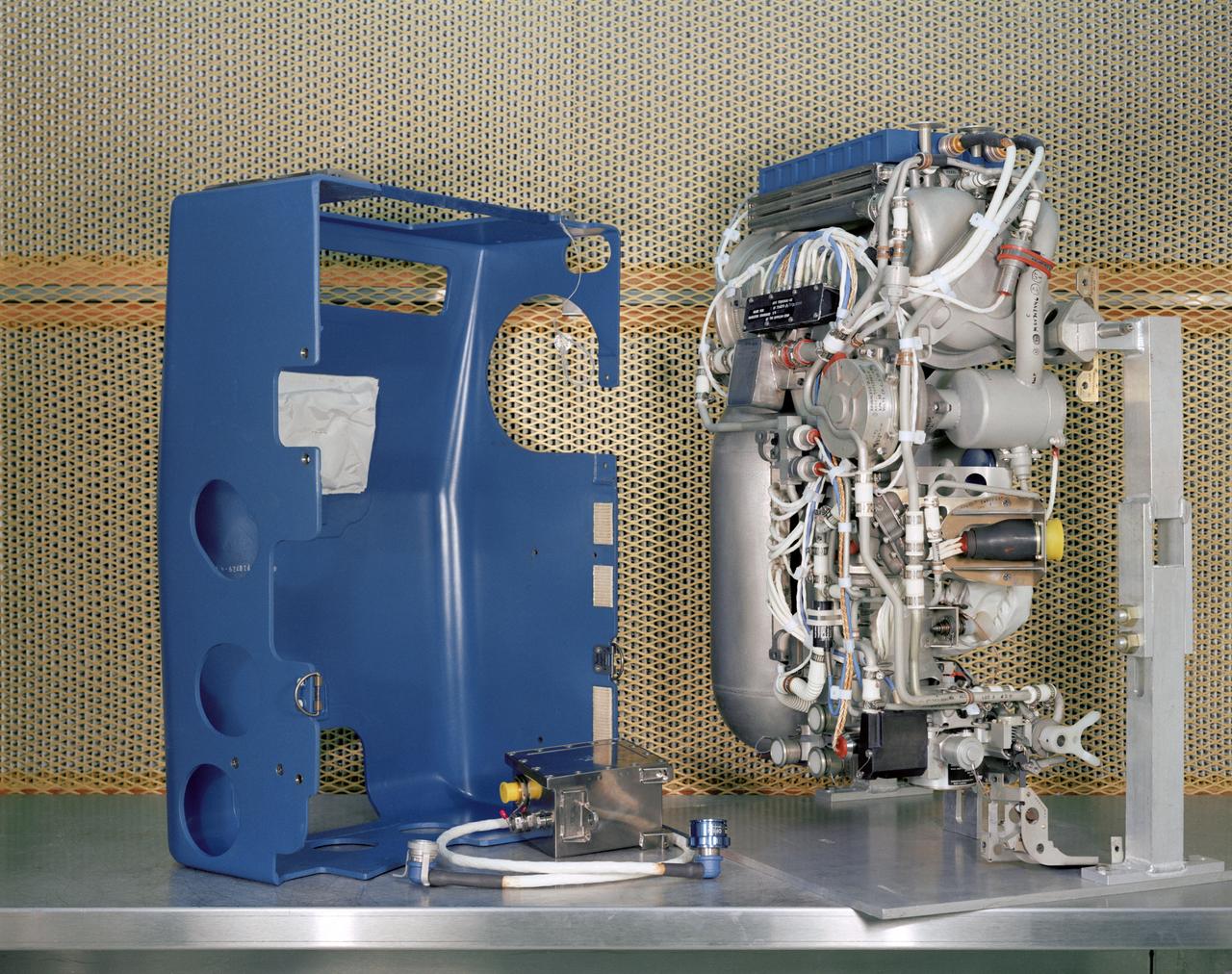
S68-34580 (1968) --- With its exterior removed, the Apollo portable life support system (PLSS) can be easily studied. The PLSS is worn as a backpack over the Extravehicular Mobility Unit (EMU), a multi-layered spacesuit used for outside-the-spacecraft activity. JSC photographic frame no. S68-34582 is a close-up view of the working parts of the PLSS.
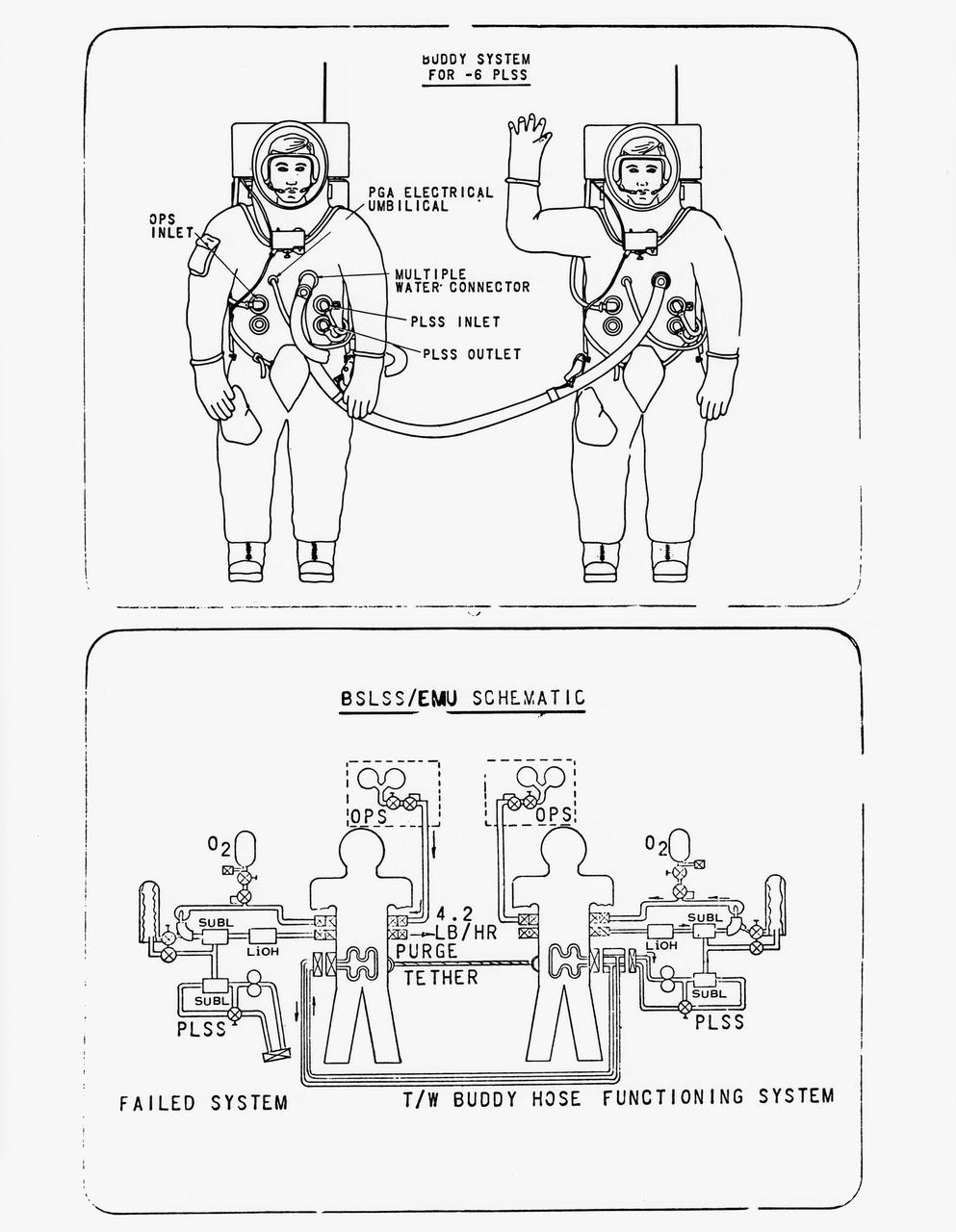
S70-56965 (December 1970) --- Drawing of the newly developed Buddy Secondary Life Support System (BSLSS). The life-sustaining system will be provided for the first time on the Apollo 14 lunar landing mission. The two flexible hoses, to be used on the second Apollo 14 extravehicular activity (EVA), will be among the paraphernalia on the Modular Equipment Transporter (MET) or two-wheeled workshop, and readily accessible in an emergency. During EVAs the Portable Life Support System (PLSS) supplies the astronaut with breathing and suit-pressurizing oxygen and water flow for the liquid-cooling garment -- a suit of knitted long underwear with thin tubing woven in the torso and limbs. The tubes carry water from a reservoir in the PLSS, and the circulating water serves to carry the astronaut's metabolic heat to a heat exchanger in the PLSS. Before the BSLSS was devised, the emergency tank was required to furnish not only suit pressure and breathing oxygen, but also cooling through a high oxygen flow rate. The BSLSS, by sharing the water supply between the two crewmen, stretches the time of the emergency oxygen from about 40 minutes to 60 to 75 minutes.
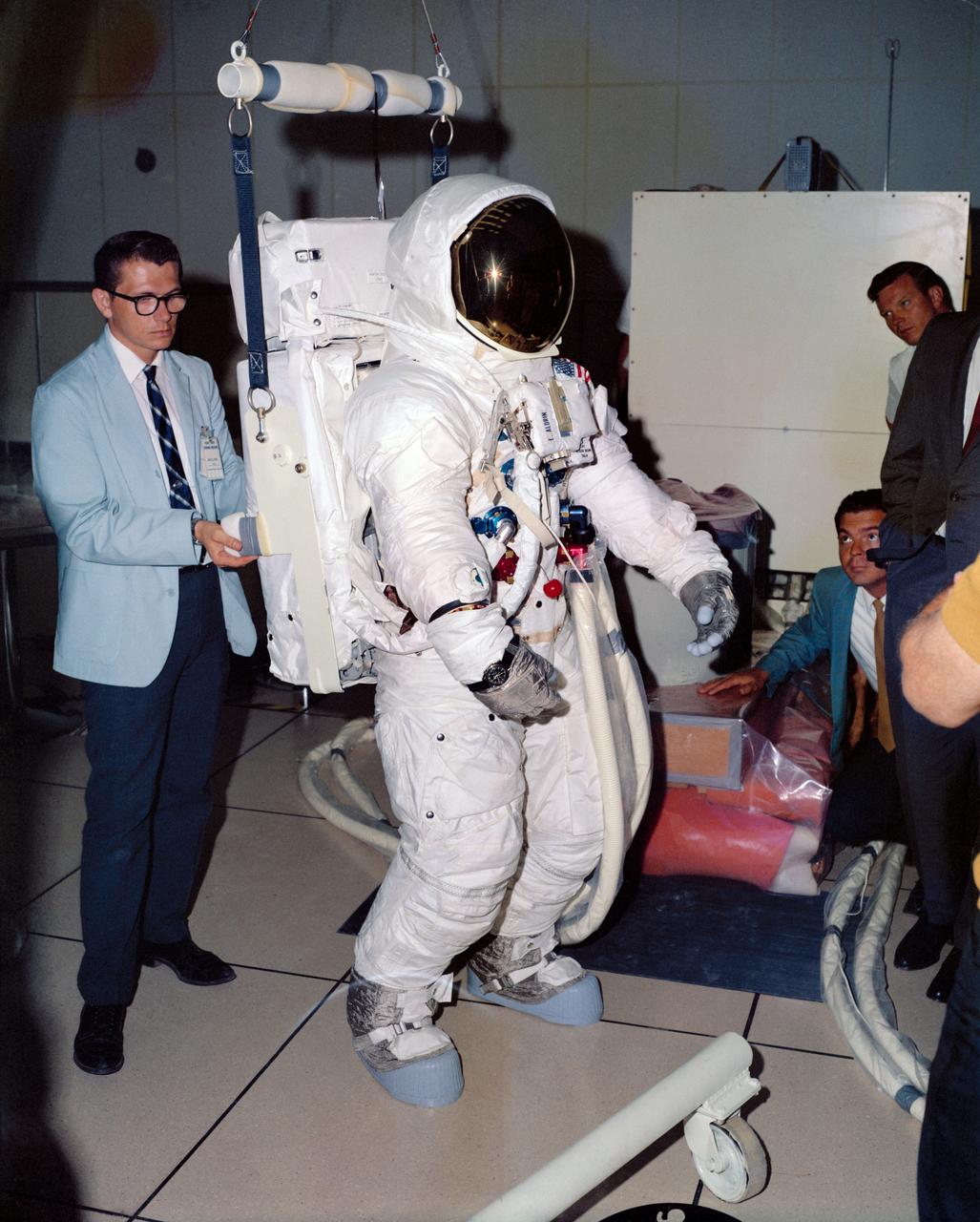
Astronaut Edwin E. Aldrin Jr., wearing an Extravehicular Mobility Unit (EMU), verifies fit of the Portable Life Support System (PLSS) strap length during lunar surface training at the Kennedy Space Center. Aldrin is the prime crew lunar module pilot of the Apollo 11 lunar landing mission. Aldrin's PLSS backpack is attached to a lunar weight simulator.
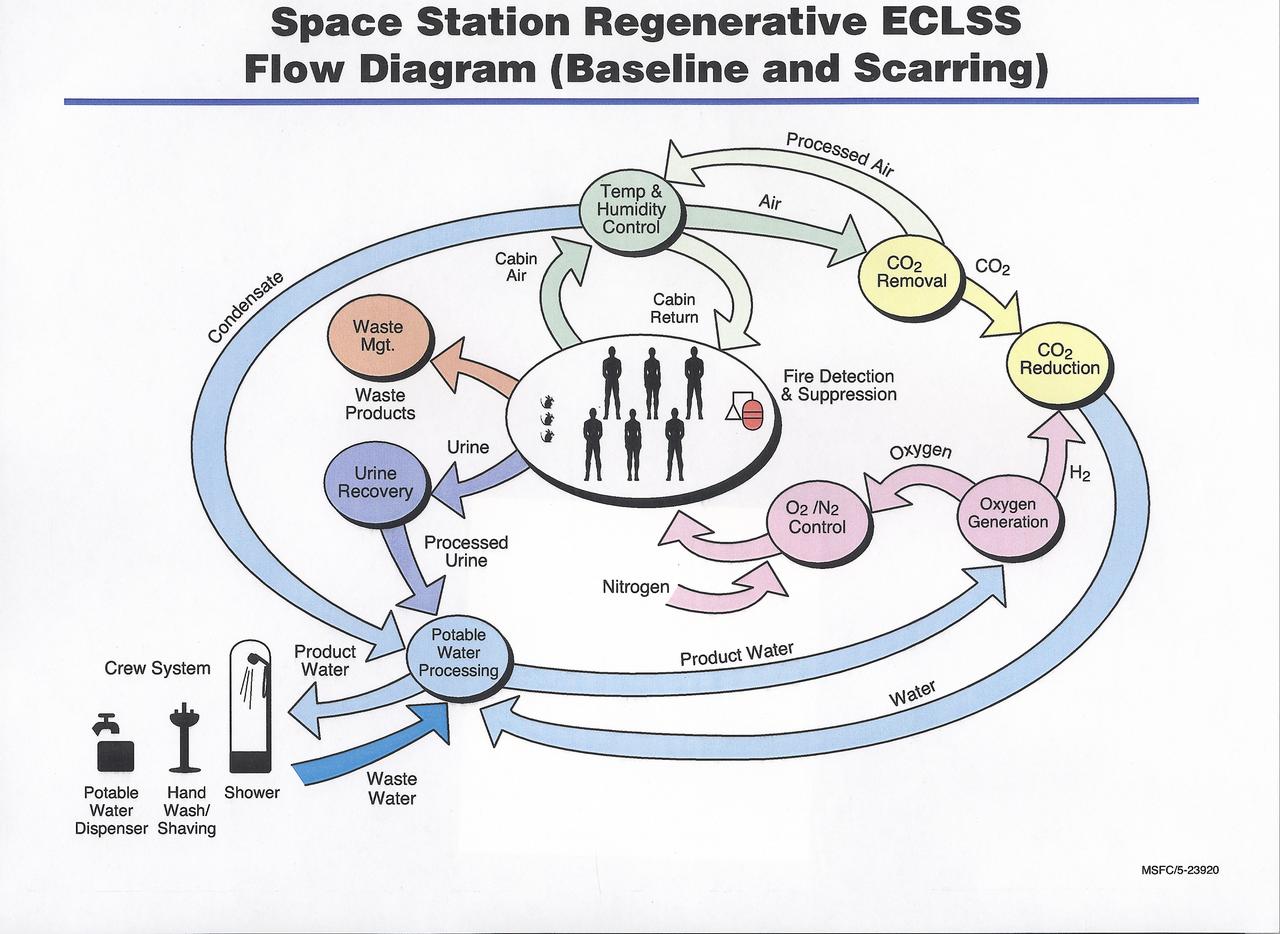
This diagram shows the flow of recyclable resources in the International Space Station (ISS). The Environmental Control and Life Support System (ECLSS) Group of the Flight Projects Directorate at the Marshall Space Flight Center is responsible for the regenerative ECLSS hardware, as well as providing technical support for the rest of the system. The regenerative ECLSS, whose main components are the Water Recovery System (WRS), and the Oxygen Generation System (OGS), reclaims and recycles water and oxygen. The ECLSS maintains a pressurized habitation environment, provides water recovery and storage, maintains and provides fire detection / suppression, and provides breathable air and a comfortable atmosphere in which to live and work within the ISS. The ECLSS hardware will be located in the Node 3 module of the ISS.
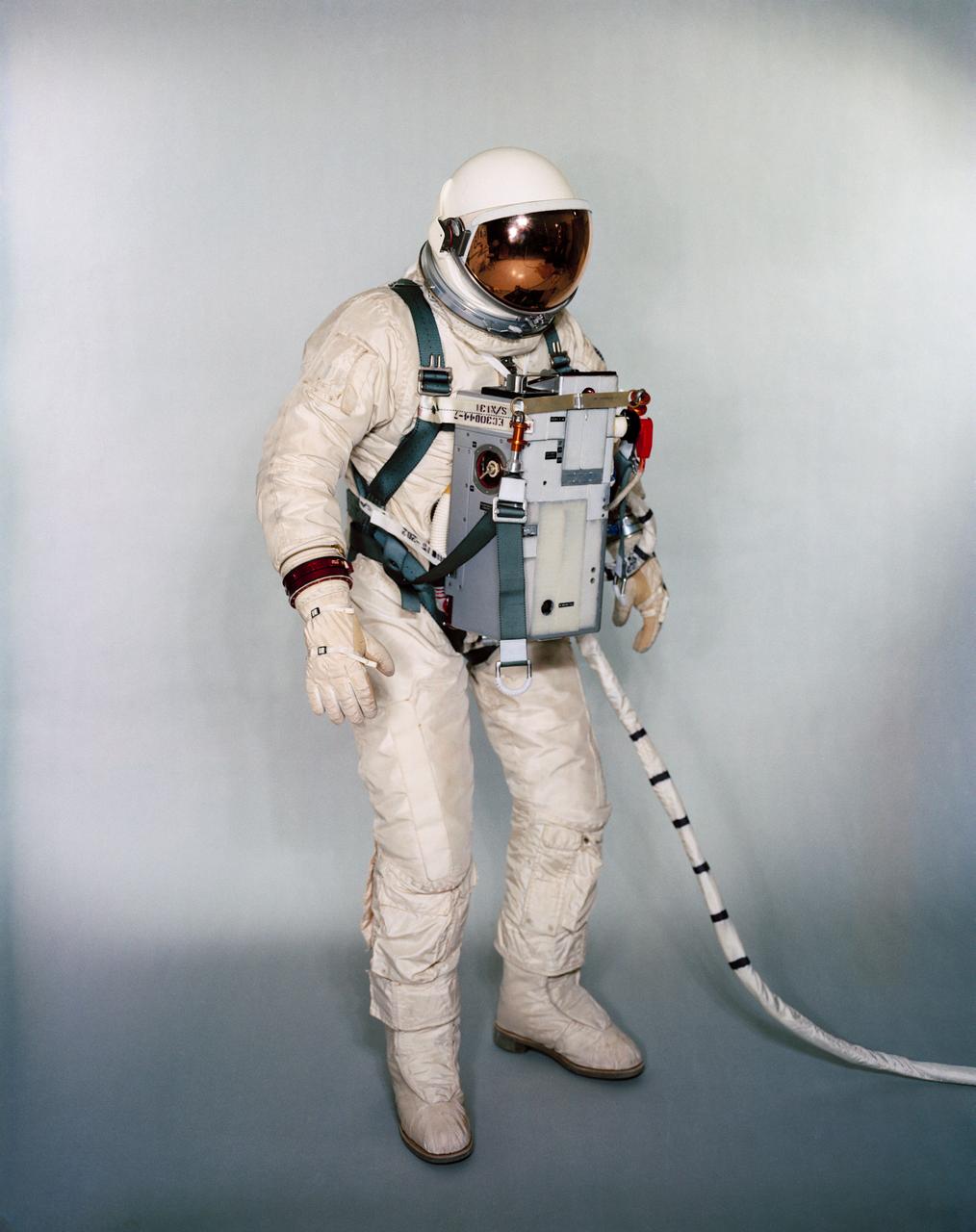
S67-24267 (1966) --- Suited test subject equipped with Gemini-12 Life Support System and waist tethers for extravehicular activity (EVA). Photo credit: NASA
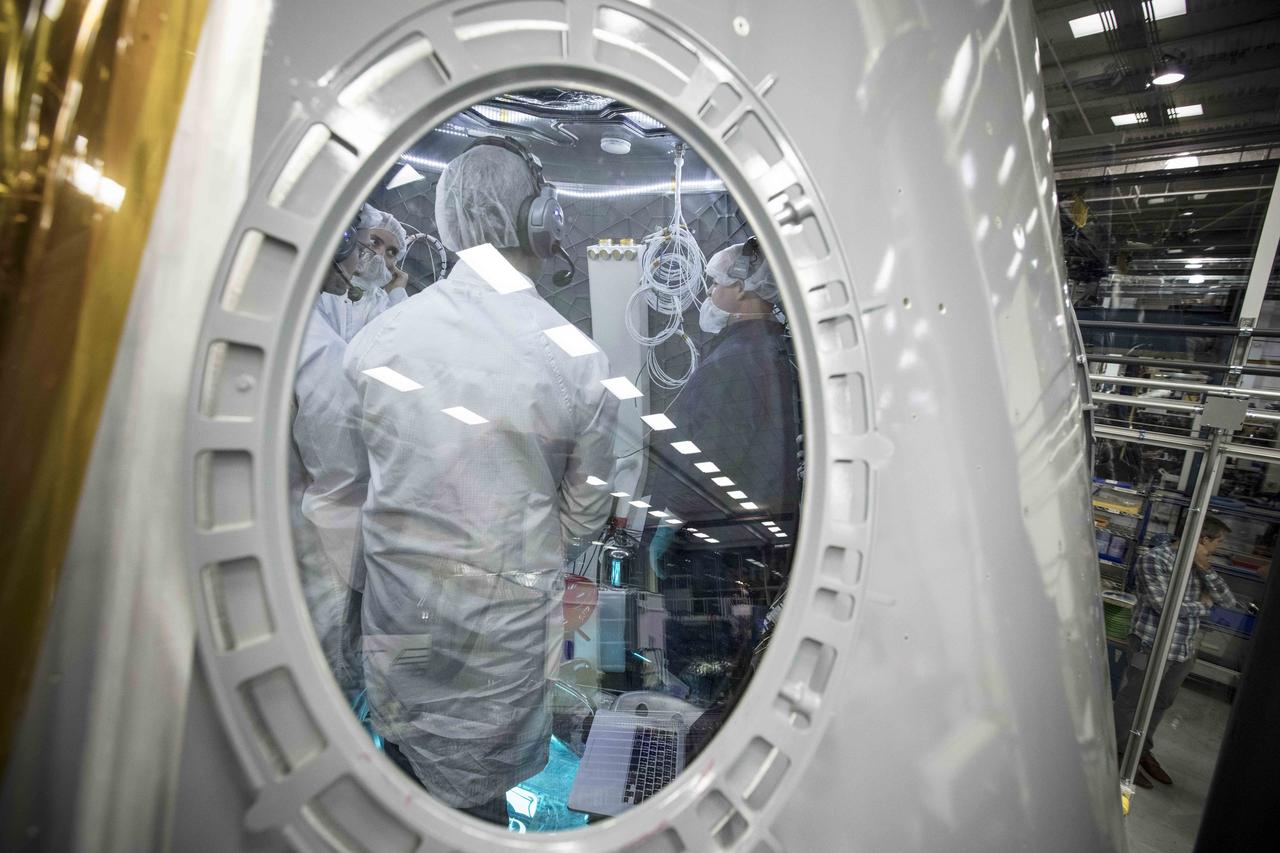
Engineers work inside the ECLSS module at SpaceX’s headquarters and factory in Hawthorne, California. The module is the same size as the company’s Crew Dragon spacecraft and is built to test the Environmental Control and Life Support System, or ECLSS, that is being built for missions aboard the Crew Dragon including those by astronauts flying to the International Space Station on flights for NASA’s Commercial Crew Program. Photo credit: SpaceX

The ECLSS module inside SpaceX’s headquarters and factory in Hawthorne, California. The module is the same size as the company’s Crew Dragon spacecraft and is built to test the Environmental Control and Life Support System, or ECLSS, that is being built for missions aboard the Crew Dragon including those by astronauts flying to the International Space Station on flights for NASA’s Commercial Crew Program. Photo credit: SpaceX
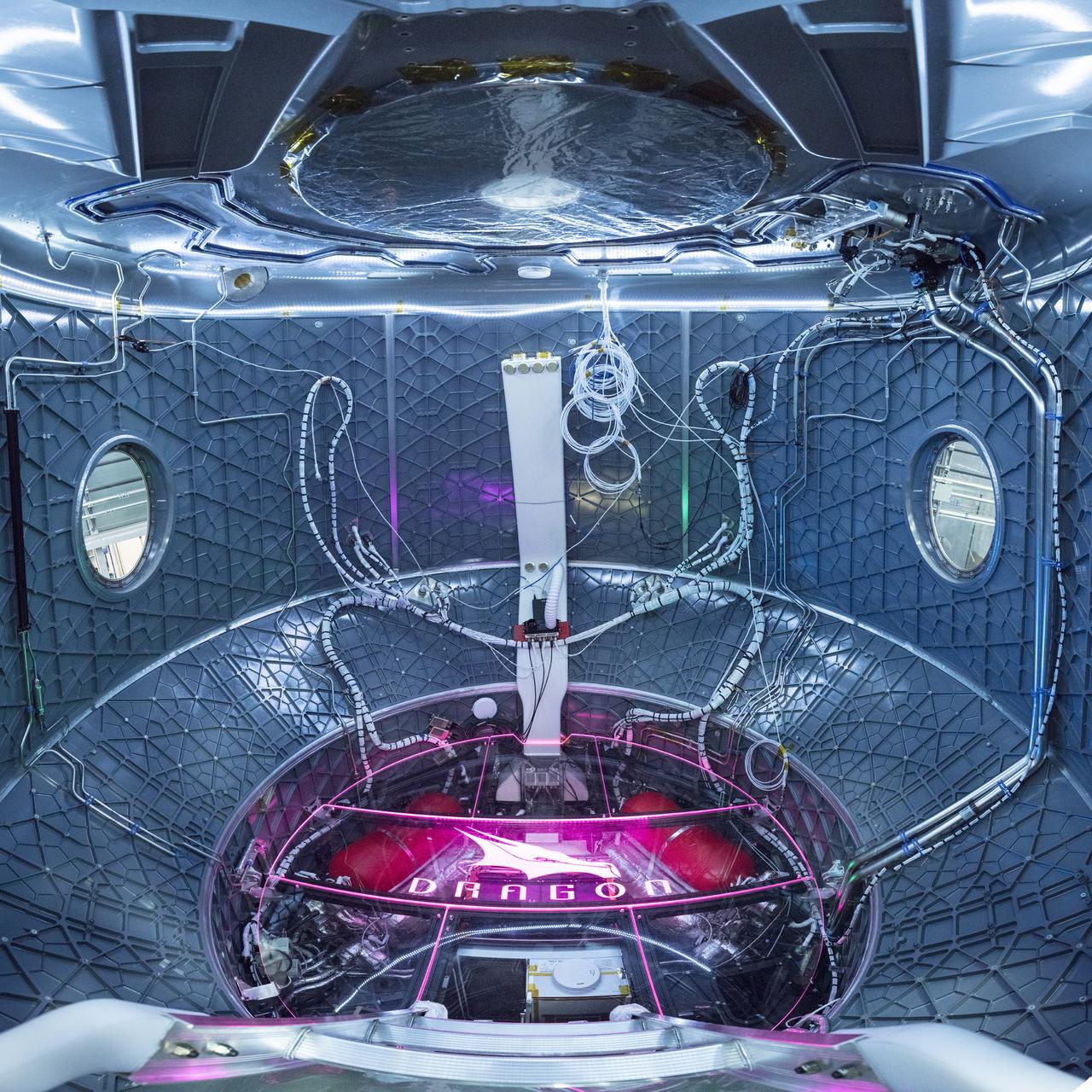
The interior of the ECLSS module inside SpaceX’s headquarters and factory in Hawthorne, California. The module is the same size as the company’s Crew Dragon spacecraft and is built to test the Environmental Control and Life Support System, or ECLSS, that is being built for missions aboard the Crew Dragon including those by astronauts flying to the International Space Station on flights for NASA’s Commercial Crew Program. Photo credit: SpaceX
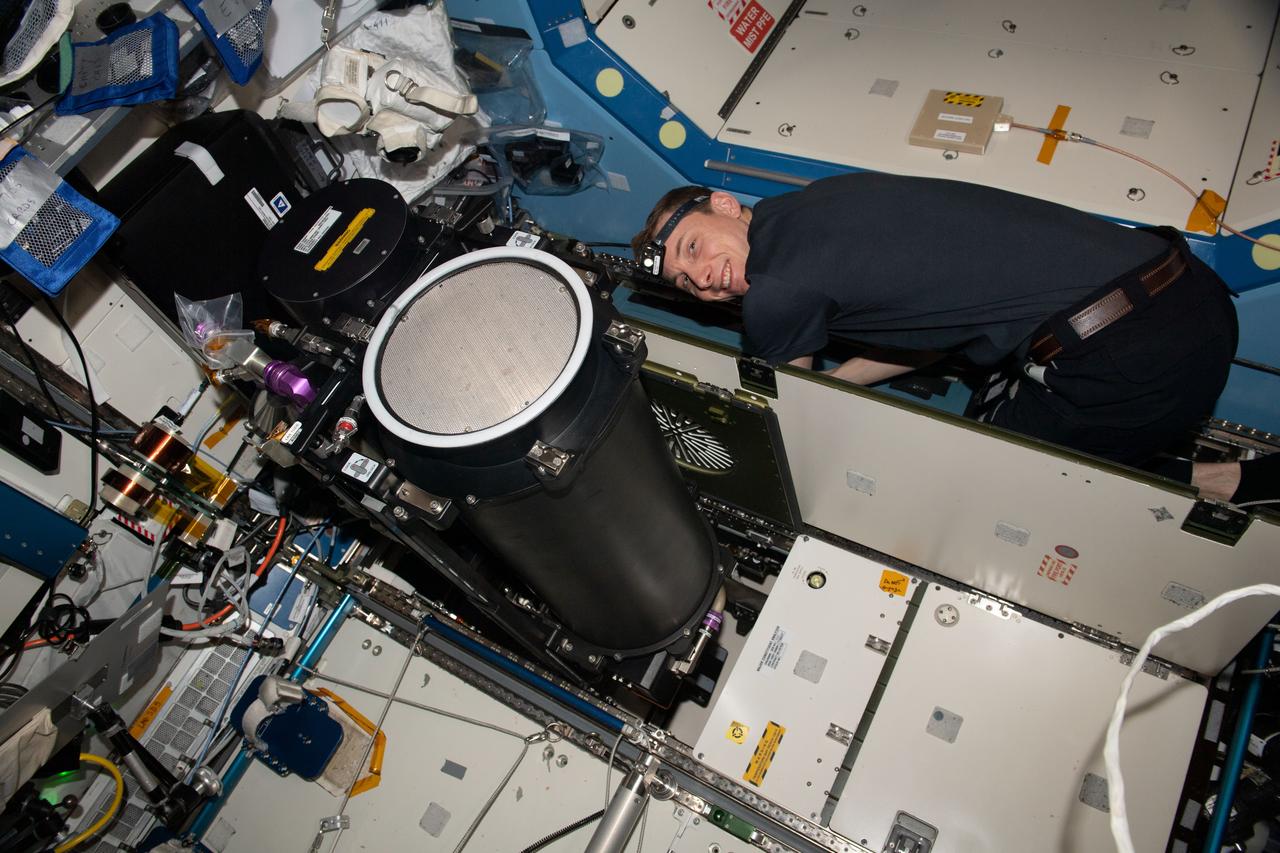
iss069e009909 (May 9, 2023) --- NASA astronaut and Expedition 69 Flight Engineer Woody Hoburg works inside the International Space Station's Destiny laboratory module and replaces life support system components.
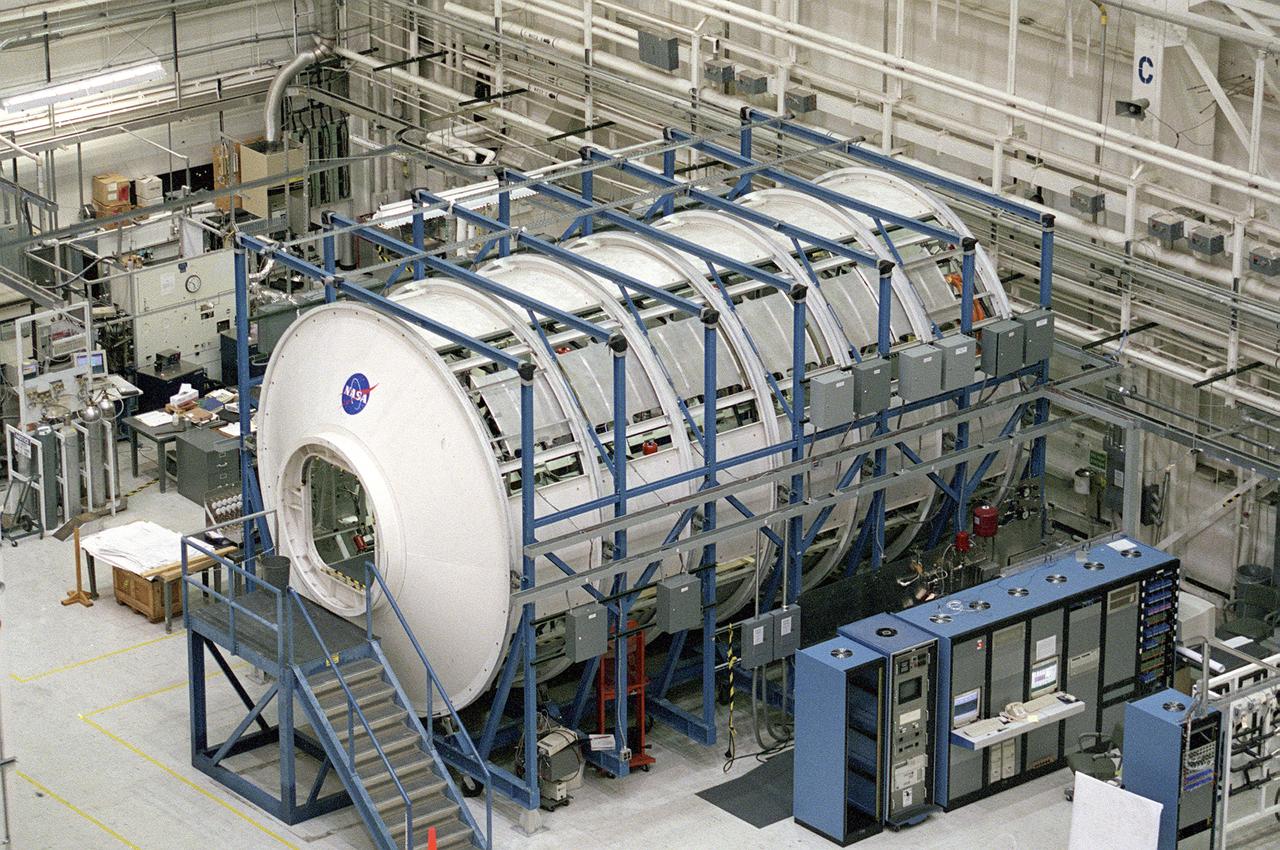
The Marshall Space Flight Center (MSFC) is responsible for designing and building the life support systems that will provide the crew of the International Space Station (ISS) a comfortable environment in which to live and work. Scientists and engineers at the MSFC are working together to provide the ISS with systems that are safe, efficient and cost-effective. These compact and powerful systems are collectively called the Environmental Control and Life Support Systems, or simply, ECLSS. This is an exterior view of the U.S. Laboratory Module Simulator containing the ECLSS Internal Thermal Control System (ITCS) testing facility at MSFC. At the bottom right is the data acquisition and control computers (in the blue equipment racks) that monitor the testing in the facility. The ITCS simulator facility duplicates the function, operation, and troubleshooting problems of the ITCS. The main function of the ITCS is to control the temperature of equipment and hardware installed in a typical ISS Payload Rack.
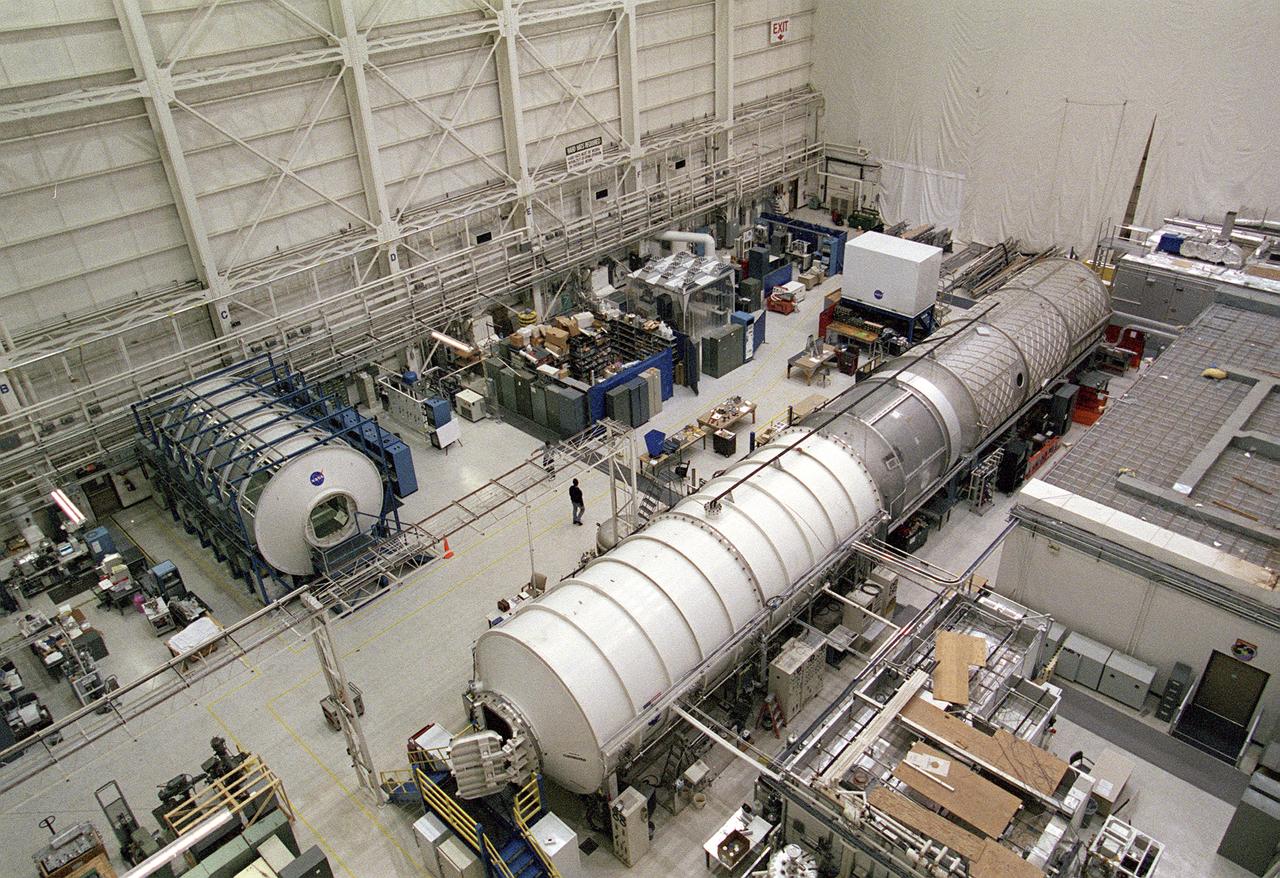
The Marshall Space Flight Center (MSFC) is responsible for designing and building the life support systems that will provide the crew of the International Space Station (ISS) a comfortable environment in which to live and work. Scientists and engineers at the MSFC are working together to provide the ISS with systems that are safe, efficient, and cost-effective. These compact and powerful systems are collectively called the Environmental Control and Life Support Systems, or simply, ECLSS. This is a view of the ECLSS and the Internal Thermal Control System (ITCS) Test Facility in building 4755, MSFC. In the foreground is the 3-module ECLSS simulator comprised of the U.S. Laboratory Module Simulator, Node 1 Simulator, and Node 3/Habitation Module Simulator. At center left is the ITCS Simulator. The main function of the ITCS is to control the temperature of equipment and hardware installed in a typical ISS Payload Rack.
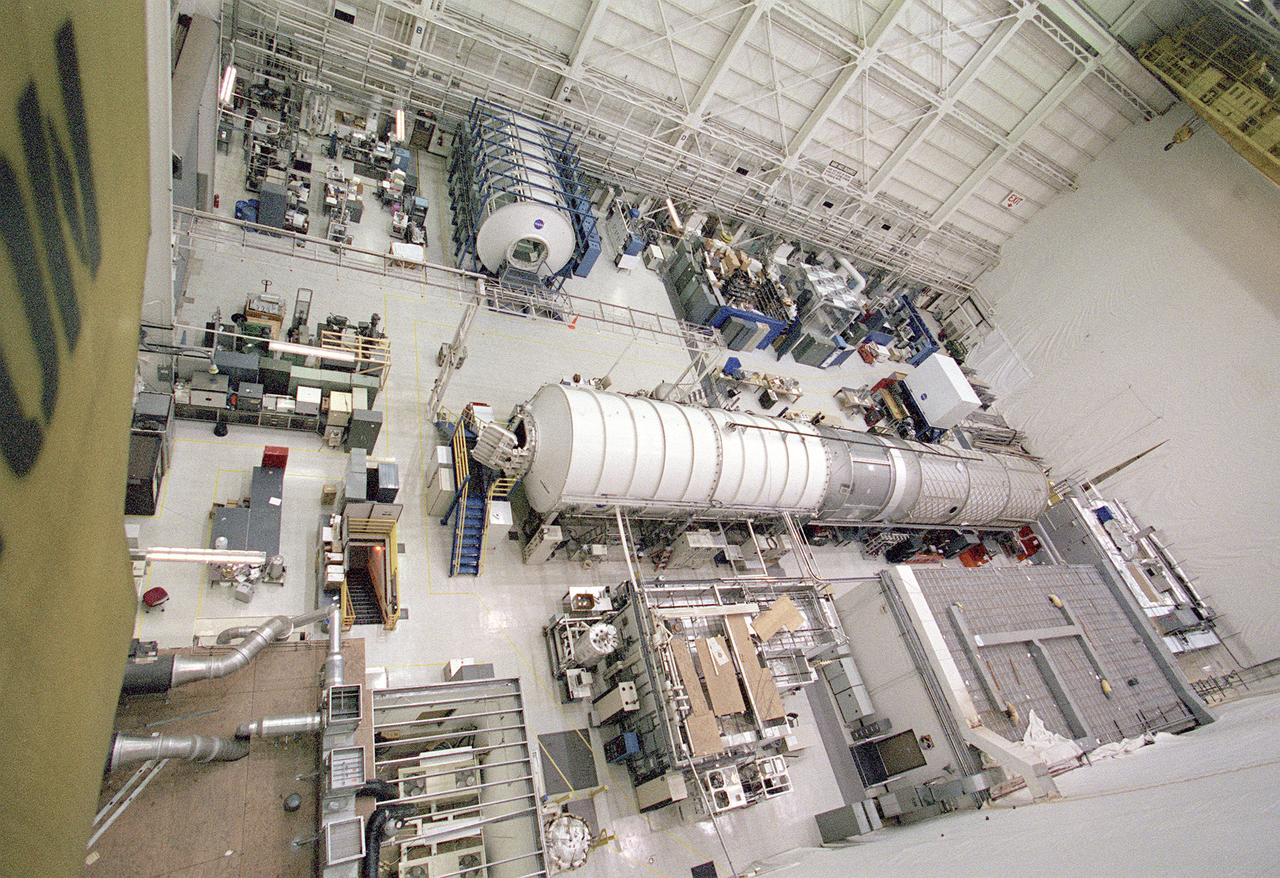
The Marshall Space Flight Center (MSFC) is responsible for designing and building the life support systems that will provide the crew of the International Space Station (ISS) a comfortable environment in which to live and work. Scientists and engineers at the MSFC are working together to provide the ISS with systems that are safe, efficient, and cost-effective. These compact and powerful systems are collectively called the Environmental Control and Life Support Systems, or simply, ECLSS. This is a view of the ECLSS and the Internal Thermal Control System (ITCS) Test Facility in building 4755, MSFC. In the foreground is the 3-module ECLSS simulator comprised of the U.S. Laboratory Module Simulator, Node 1 Simulator, and Node 3/Habitation Module Simulator. On the left is the ITCS Simulator. The main function of the ITCS is to control the temperature of equipment and hardware installed in a typical ISS Payload Rack.

The Marshall Space Flight Center (MSFC) is responsible for designing and building the life support systems that will provide the crew of the International Space Station (ISS) a comfortable environment in which to live and work. Scientists and engineers at the MSFC are working together to provide the ISS with systems that are safe, efficient, and cost-effective. These compact and powerful systems are collectively called the Environmental Control and Life Support Systems, or simply, ECLSS. This photograph shows the development Water Processor located in two racks in the ECLSS test area at the Marshall Space Flight Center. Actual waste water, simulating Space Station waste, is generated and processed through the hardware to evaluate the performance of technologies in the flight Water Processor design.
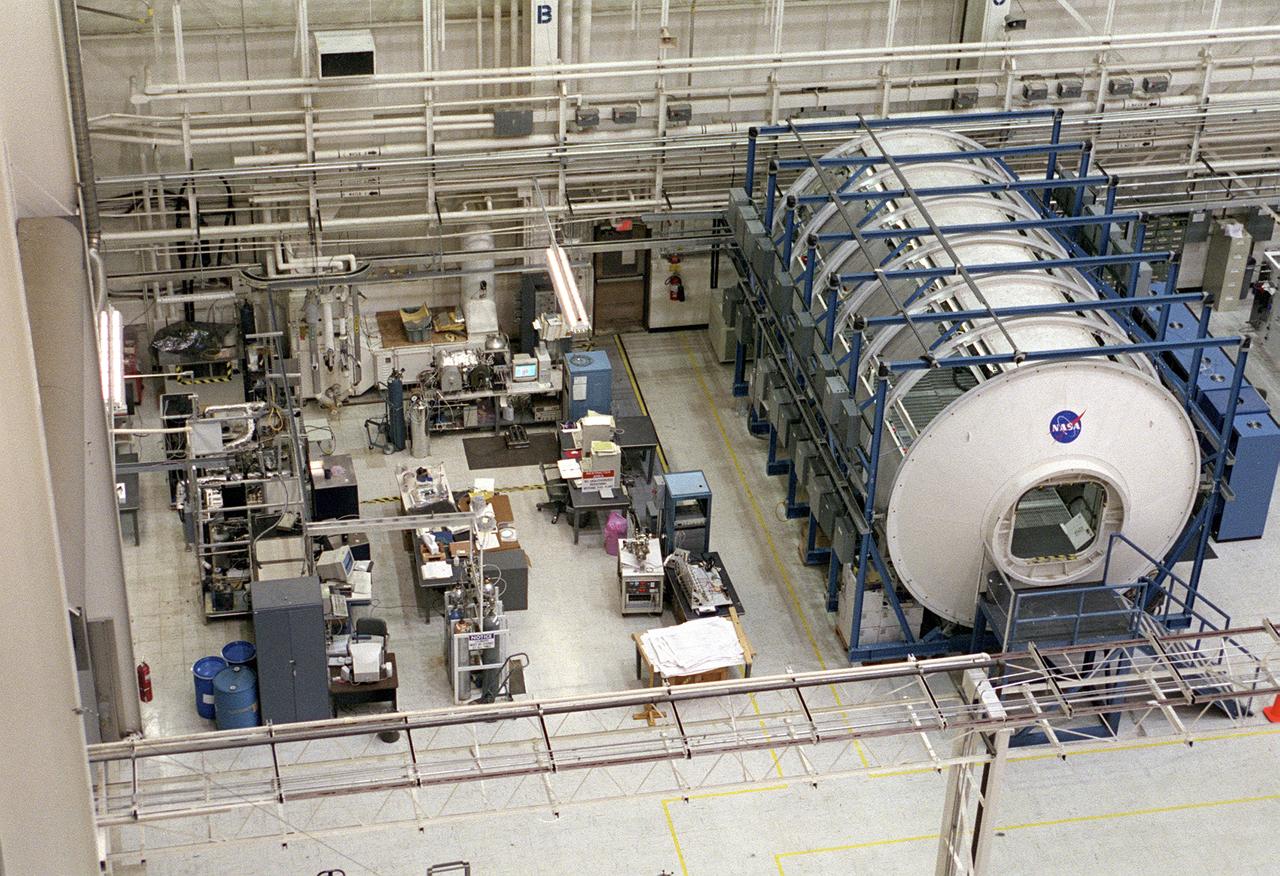
The Marshall Space Flight Center (MSFC) is responsible for designing and building the life support systems that will provide the crew of the International Space Station (ISS) a comfortable environment in which to live and work. Scientists and engineers at the MSFC are working together to provide the ISS with systems that are safe, efficient, and cost-effective. These compact and powerful systems are collectively called the Environmental Control and Life Support Systems, or simply, ECLSS. In this photograph, the life test area on the left of the MSFC ECLSS test facility is where various subsystems and components are tested to determine how long they can operate without failing and to identify components needing improvement. Equipment tested here includes the Carbon Dioxide Removal Assembly (CDRA), the Urine Processing Assembly (UPA), the mass spectrometer filament assemblies and sample pumps for the Major Constituent Analyzer (MCA). The Internal Thermal Control System (ITCS) simulator facility (in the module in the right) duplicates the function and operation of the ITCS in the ISS U.S. Laboratory Module, Destiny. This facility provides support for Destiny, including troubleshooting problems related to the ITCS.
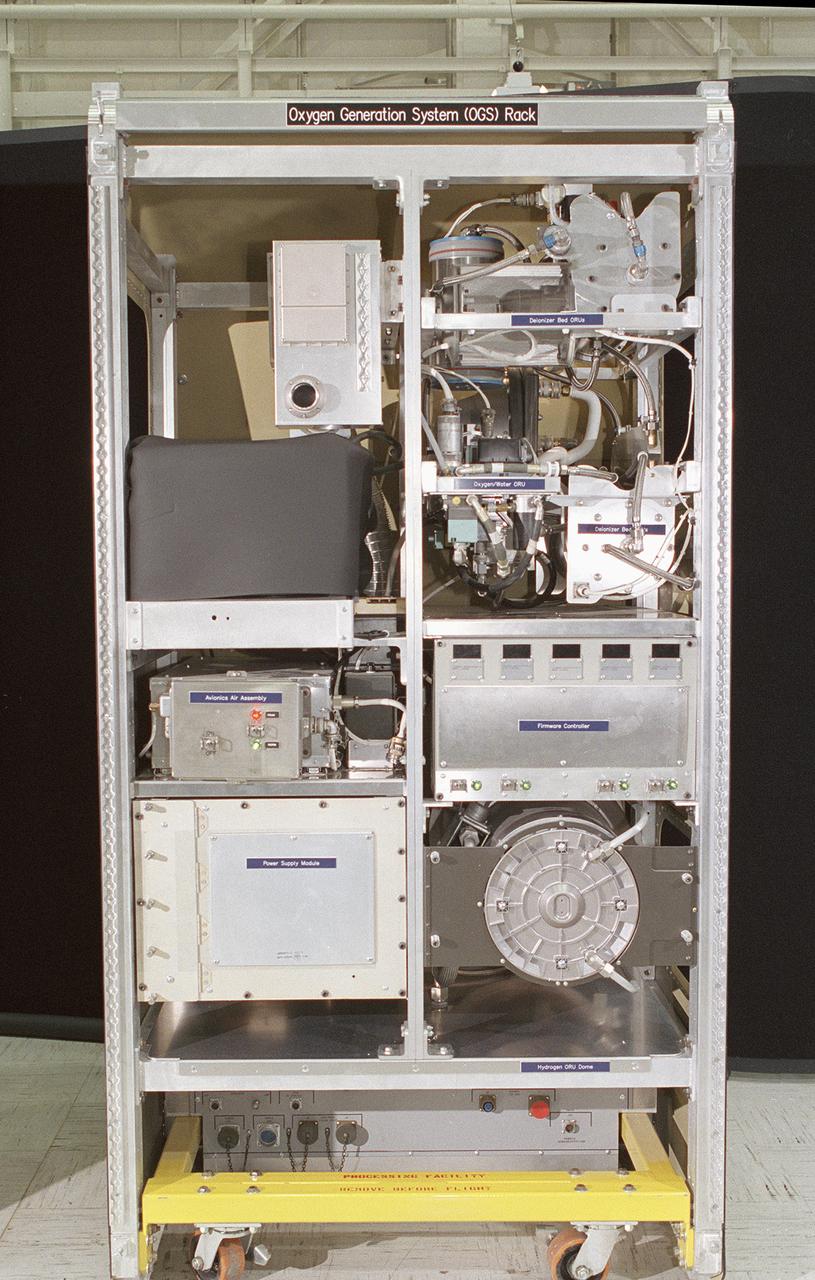
The Environmental Control and Life Support System (ECLSS) Group of the Flight Projects Directorate at the Marshall Space Flight Center (MSFC) in Huntsville, Alabama, is responsible for designing and building the life support systems that will provide the crew of the International Space Station (ISS) a comfortable environment in which to live and work. This is a close-up view of ECLSS Oxygen Generation System (OGS) rack. The ECLSS Group at the MSFC oversees the development of the OGS, which produces oxygen for breathing air for the crew and laboratory animals, as well as for replacing oxygen lost due to experiment use, airlock depressurization, module leakage, and carbon dioxide venting. The OGS consists primarily of the Oxygen Generator Assembly (OGA), provided by the prime contractor, the Hamilton Sundstrand Space Systems, International (HSSSI) in Windsor Locks, Cornecticut and a Power Supply Module (PSM), supplied by the MSFC. The OGA is comprised of a cell stack that electrolyzes (breaks apart the hydrogen and oxygen molecules) some of the clean water provided by the Water Recovery System and the separators that remove the gases from water after electrolysis. The PSM provides the high power to the OGA needed to electrolyze the water.
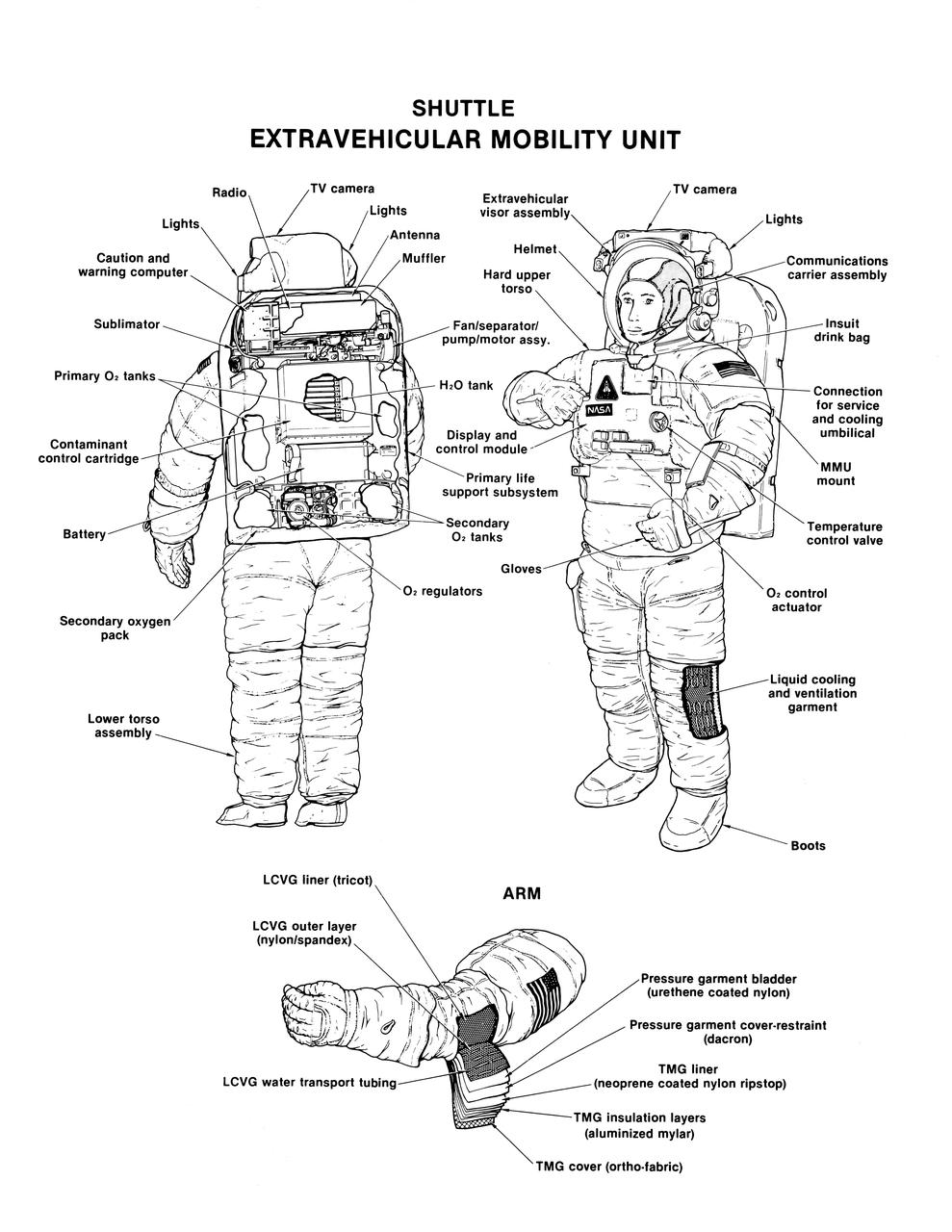
Labeled cutaway line drawing of the Shuttle extravehicular mobility unit (EMU) identifies its various components and equipment. The portable life support system (PLSS) and protective layers of fabric (thermal micrometeoroid garment (TMG)) incorporated in this extravehicular activity (EVA) space suit are shown.
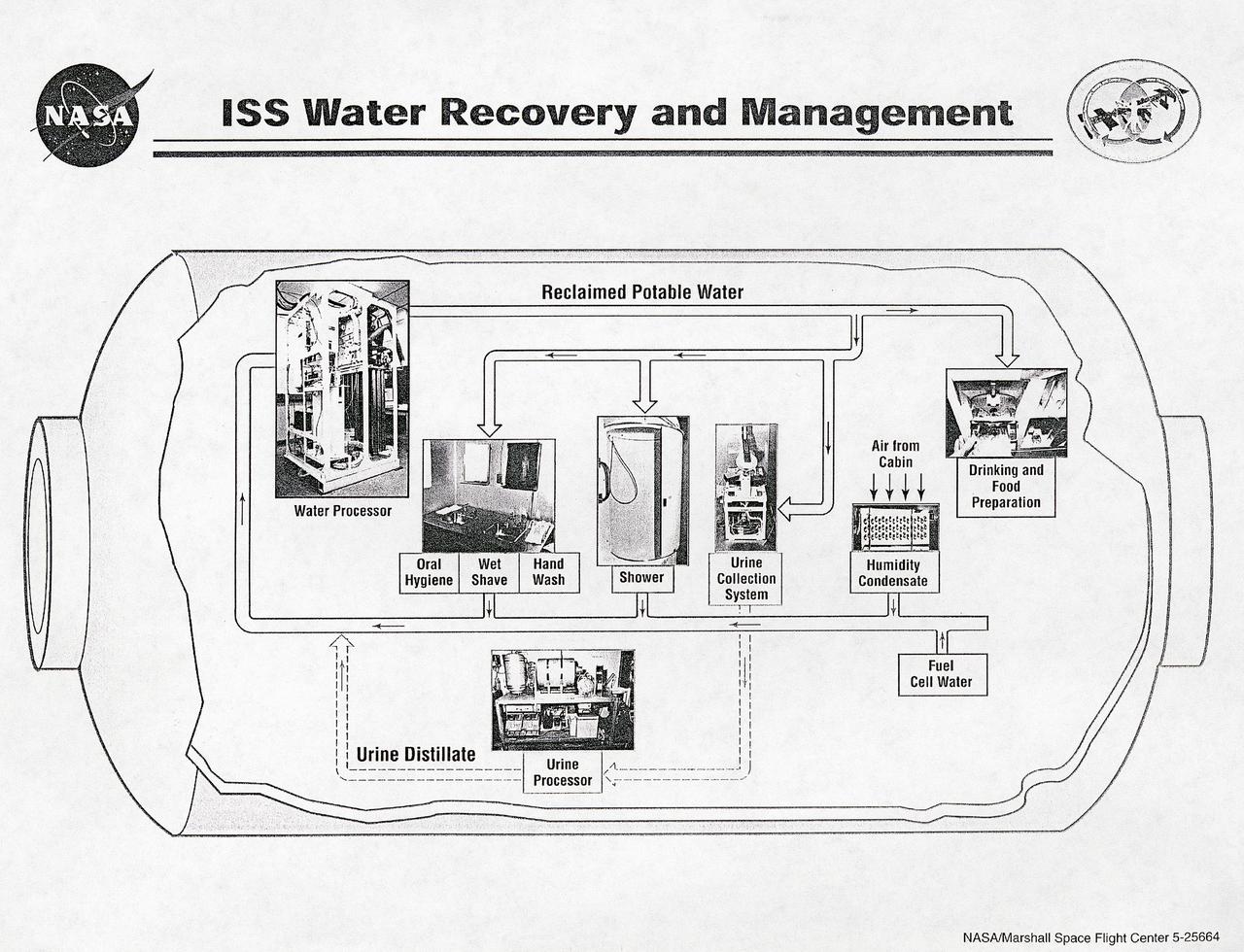
This diagram shows the flow of water recovery and management in the International Space Station (ISS). The Environmental Control and Life Support System (ECLSS) Group of the Flight Projects Directorate at the Marshall Space Flight Center is responsible for the regenerative ECLSS hardware, as well as providing technical support for the rest of the system. The regenerative ECLSS, whose main components are the Water Recovery System (WRS), and the Oxygen Generation System (OGS), reclaims and recycles water oxygen. The ECLSS maintains a pressurized habitation environment, provides water recovery and storage, maintains and provides fire detection/ suppression, and provides breathable air and a comfortable atmosphere in which to live and work within the ISS. The ECLSS hardware will be located in the Node 3 module of the ISS.
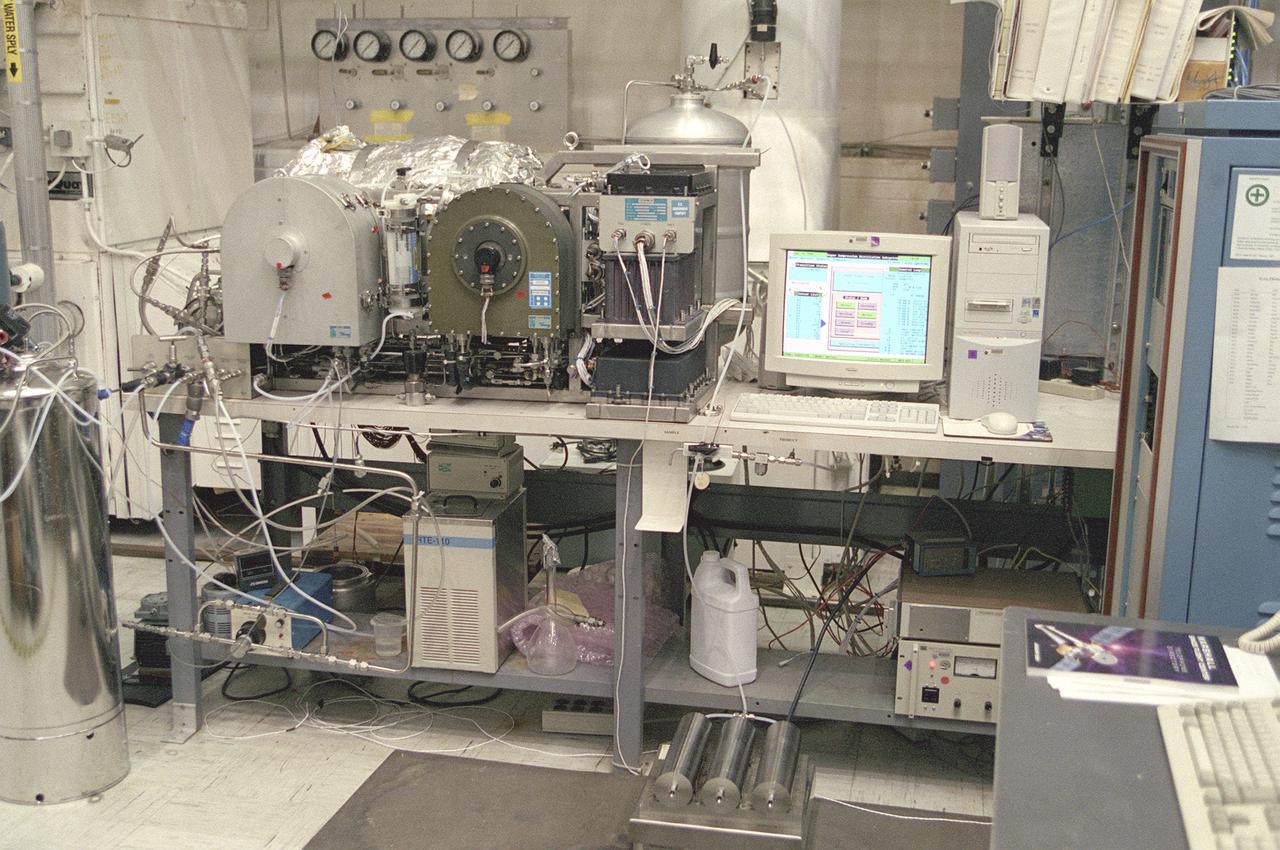
The Marshall Space Flight Center (MSFC) is responsible for designing and building the life support systems that will provide the crew of the International Space Station (ISS) a comfortable environment in which to live and work. Scientists and engineers at the MSFC are working together to provide the ISS with systems that are safe, efficient, and cost-effective. These compact and powerful systems are collectively called the Environmental Control and Life Support Systems, or simply, ECLSS. This photograph shows the fifth generation Urine Processor Development Hardware. The Urine Processor Assembly (UPA) is a part of the Water Recovery System (WRS) on the ISS. It uses a chase change process called vapor compression distillation technology to remove contaminants from urine. The UPA accepts and processes pretreated crewmember urine to allow it to be processed along with other wastewaters in the Water Processor Assembly (WPA). The WPA removes free gas, organic, and nonorganic constituents before the water goes through a series of multifiltration beds for further purification. Product water quality is monitored primarily through conductivity measurements. Unacceptable water is sent back through the WPA for reprocessing. Clean water is sent to a storage tank.
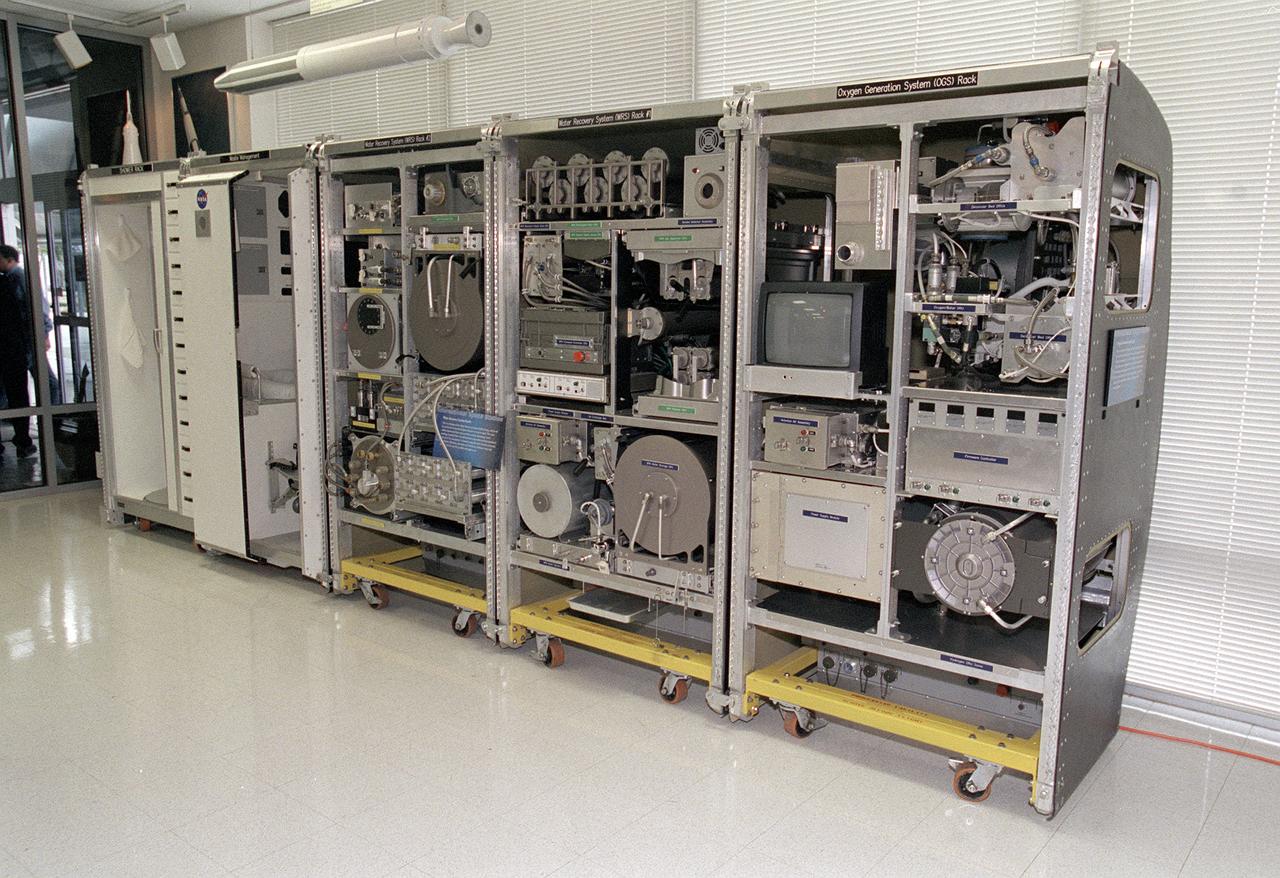
The Environmental Control and Life Support System (ECLSS) Group of the Flight Projects Directorate at the Marshall Space Flight Center in Huntsville, Alabama, is responsible for designing and building the life support systems that will provide the crew of the International Space Station (ISS) a comfortable environment in which to live and work. This photograph shows the mockup of the the ECLSS to be installed in the Node 3 module of the ISS. From left to right, shower rack, waste management rack, Water Recovery System (WRS) Rack #2, WRS Rack #1, and Oxygen Generation System (OGS) rack are shown. The WRS provides clean water through the reclamation of wastewaters and is comprised of a Urine Processor Assembly (UPA) and a Water Processor Assembly (WPA). The UPA accepts and processes pretreated crewmember urine to allow it to be processed along with other wastewaters in the WPA. The WPA removes free gas, organic, and nonorganic constituents before the water goes through a series of multifiltration beds for further purification. The OGS produces oxygen for breathing air for the crew and laboratory animals, as well as for replacing oxygen loss. The OGS is comprised of a cell stack, which electrolyzes (breaks apart the hydrogen and oxygen molecules) some of the clean water provided by the WRS, and the separators that remove the gases from the water after electrolysis.
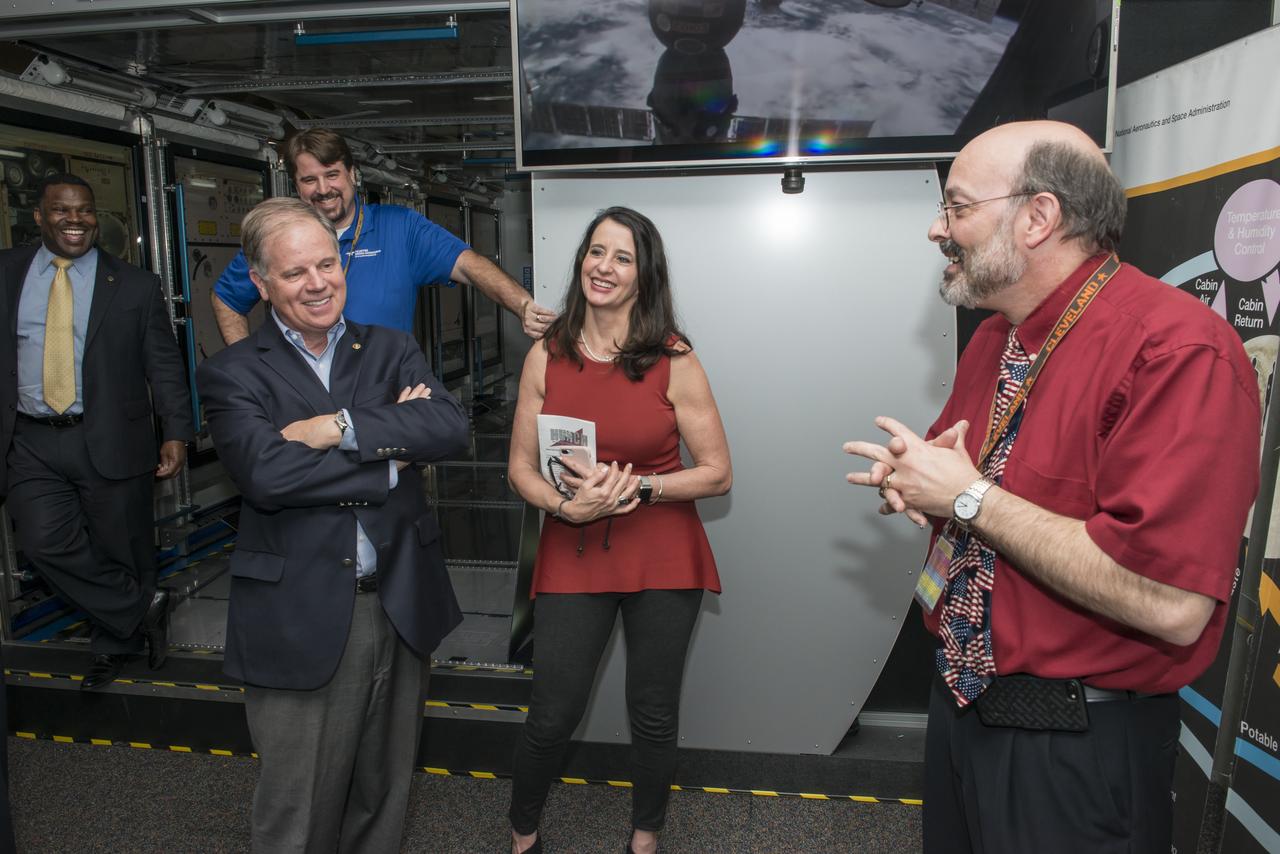
Senator Doug Jones (D-Al.) and wife Louise are presented an overview of the Environmental Control and Life Support System (ECLSS) which was developed at Marshall Space flight Center. Marshall engineer Keith Parrish explains the steps in converting waste fluids generated on the International Space Station (ISS) into purified drinking water.
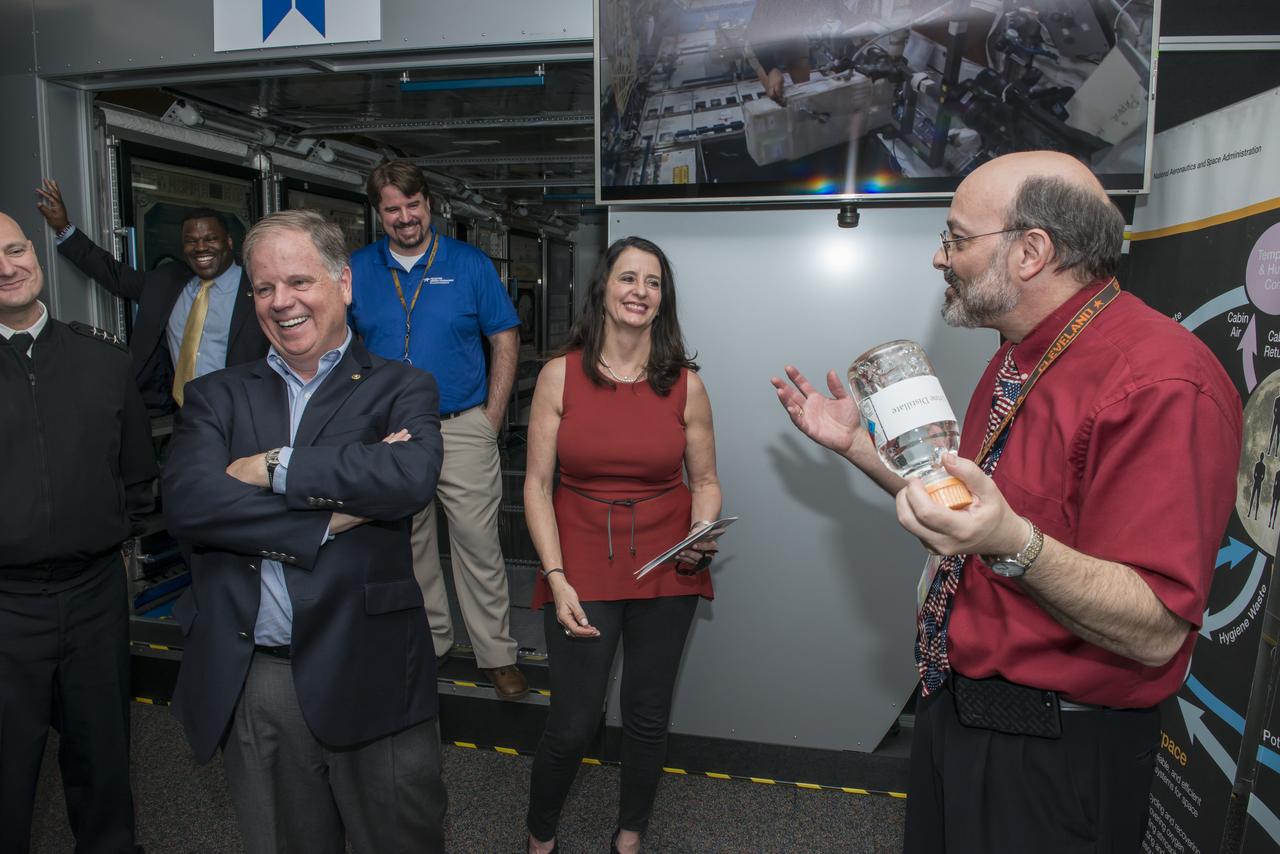
Senator Doug Jones (D-Al.) and wife Louise are presented an overview of the Environmental Control and Life Support System (ECLSS) which was developed at Marshall Space flight Center. Marshall engineer Keith Parrish explains the steps in converting waste fluids generated on the International Space Station (ISS) into purified drinking water.

Jeff Greulich, DynCorp life support technician, adjusts a prototype helmet on pilot Craig Bomben at NASA Dryden Flight Research Center, Edwards, Calif. Built by Gentex Corp., Carbondale, Pa., the helmet was evaluated by five NASA pilots during the summer and fall of 2002. The objective was to obtain data on helmet fit, comfort and functionality. The inner helmet of the modular system is fitted to the individual crewmember. The outer helmet features a fully integrated spectral mounted helmet display and a binocular helmet mounted display. The helmet will be adaptable to all flying platforms. The Dryden evaluation was overseen by the Center's Life Support office. Assessments have taken place during normal proficiency flights and some air-to-air combat maneuvering. Evaluation platforms included the F-18, B-52 and C-12. The prototype helmet is being developed by the Naval Air Science and Technology Office and the Aircrew Systems Program Office, Patuxent River, Md.
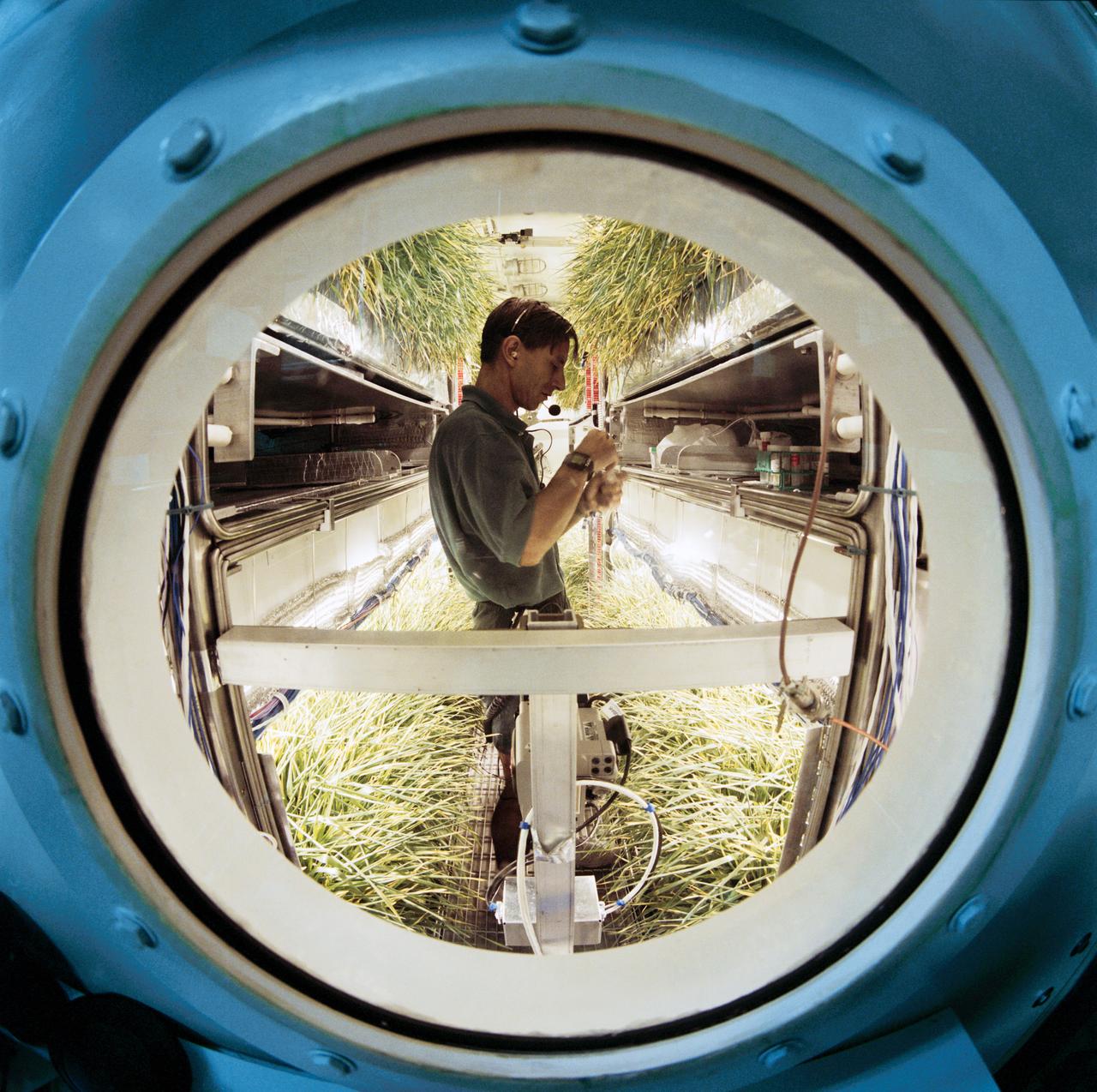
Early Human Testing (EHT) Initiative Phase 1 Regenerative Life Support Systems Laboratory (RLSSL). Nigel Packham activities in the Variable Pressure Growth Chamber which he lived inside for 15 days. A crowd of well-wishers outside the test chamber, at the console are John Lewis, Ed Mohr and Marybeth Edeen (15577). Packham exiting the chamber (15578-81). Packham is the focus of television cameras and reporters (15582-3). Don Henninger interviewed by reporters (15584). Packham is presented with a jacket after his stay in the chamber (15585). Packham inside the wheat growth chamber checking the condition of the plants (15586-7, 15597). Packham exercising on a recumbant bicycle (15588, 15592). Packham, through the window into the growth chamber, displays a handful of wheat plants to console monitor Dan Barta (15589-90). Group portrait of the team conducting the Early Human Testing Initiative Phase 1 Regenerative Life Support Systems test and include, front row, from left: Jeff Dominick and Don Overton and back row, from left, unidentified member, Marybeth Edeen, Nigel Packham, John Lewis, Ed Mohr, Dan Barta and Tim Monk (15591). Harry Halford prepares to send a package through the airlock to Packham (15593). Packham displays a handful of wheat plants (15594). Packham fixes himself a bowl of cereal (15595) and retrieves a carton of milk from the refrigerator (15596). Packham retrieves a package from the airlock (15598). Packham packs up trash in plastic bag (15599-600) and sends it back through the airlock (15601). Packham gets a cup of water (15602) and heats it in the microwave (15603).

S66-33162 (May 1966) --- Test subject Fred Spross, Crew Systems Division, wears configured extravehicular spacesuit assembly and Extravehicular Life Support System chest pack. The spacesuit legs are covered with Chromel R, which is a cloth woven from stainless steel fibers, used to protect the suit and astronaut from the hot exhaust thrust of the Astronaut Maneuvering Unit backpack. The Gemini spacesuit, backpack and chest pack comprise the AMU, a system which is essentially a miniature manned spacecraft. Astronaut Eugene A. Cernan will wear the AMU during his Gemini-9A extravehicular activity (EVA). Photo credit: NASA

S66-33167 (May 1966) --- Test subject Fred Spross, Crew Systems Division, wears an Astronaut Maneuvering Unit (AMU). The Gemini spacesuit, AMU backpack, and the Extravehicular Life Support System chest pack comprises the AMU, a system which is essentially a miniature manned spacecraft. The spacesuit legs are covered with Chromel R, which is a cloth woven from stainless steel fibers, used to protect the suit and astronaut from the hot exhaust thrust of the AMU backpack. Astronaut Eugene A. Cernan will wear the AMU during his Gemini-9A extravehicular activity (EVA). Photo credit: NASA
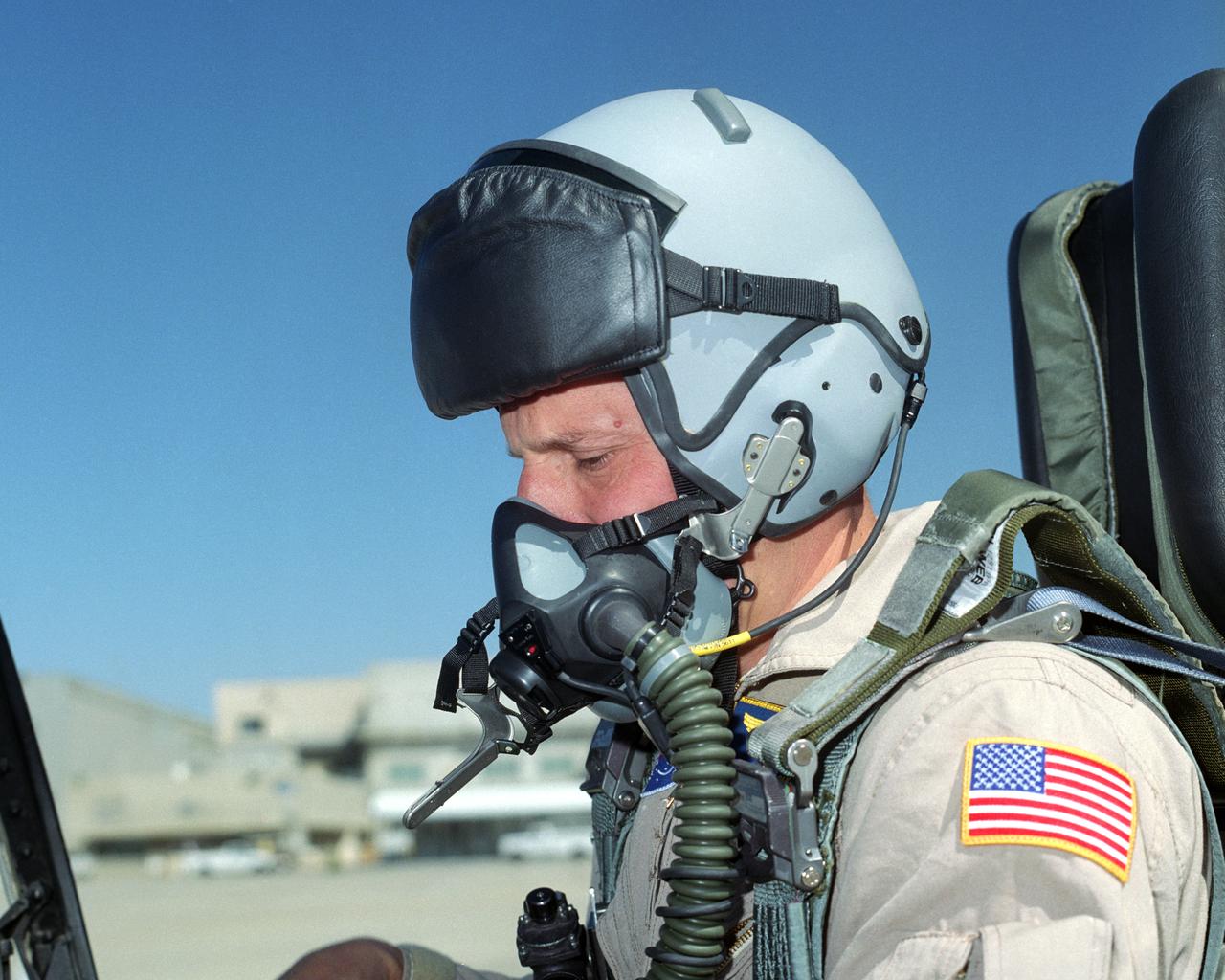
Research pilots from the NASA Dryden Flight Research Center, Edwards, Calif., tested a prototype two-part helmet. Built by Gentex Corp., Carbondale, Pa., the helmet was evaluated by five NASA pilots during the summer and fall of 2002. The objective was to obtain data on helmet fit, comfort and functionality. The inner helmet of the modular system is fitted to the individual crewmember. The outer helmet features a fully integrated spectral mounted helmet display and a binocular helmet mounted display. The helmet will be adaptable to all flying platforms. The Dryden evaluation was overseen by the Center's Life Support office. Assessments have taken place during normal proficiency flights and some air-to-air combat maneuvering. Evaluation platforms included the F-18, B-52 and C-12. The prototype helmet is being developed by the Naval Air Science and Technology Office and the Aircrew Systems Program Office, Patuxent River, Md.
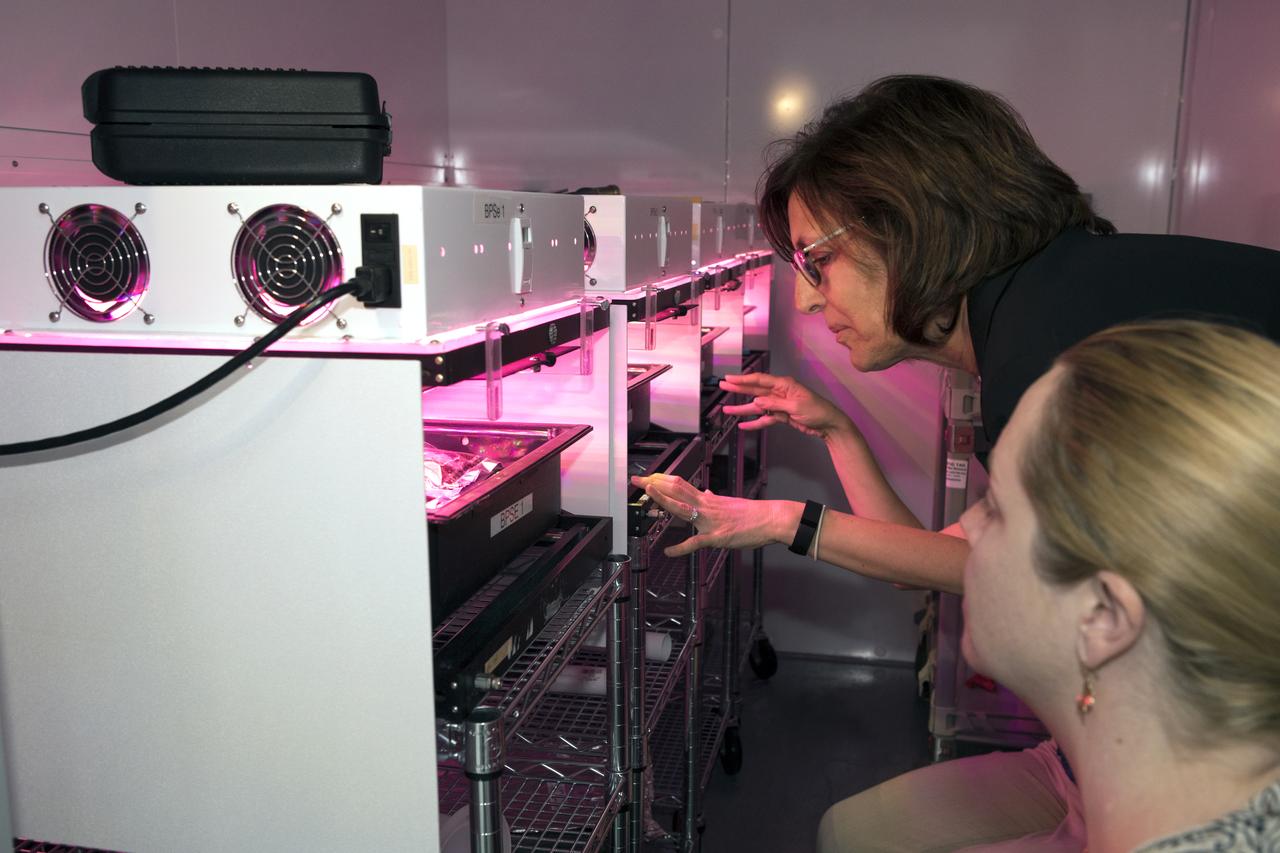
Robyn Gatens, left, deputy director, ISS Division and system capability leader for Environmental Control and Life Support Systems (ECLSS) at NASA Headquarters in Washington, tours laboratories in the Space Station Processing Facility at the agency's Kennedy Space Center in Florida, on June 13, 2018. To her right is Molly Anderson, deputy ECLSS capability lead at Johnson Space Center in Houston. They are viewing plant growth chambers and seeing firsthand some of the capabilities in the center's Exploration Research and Technology Programs.
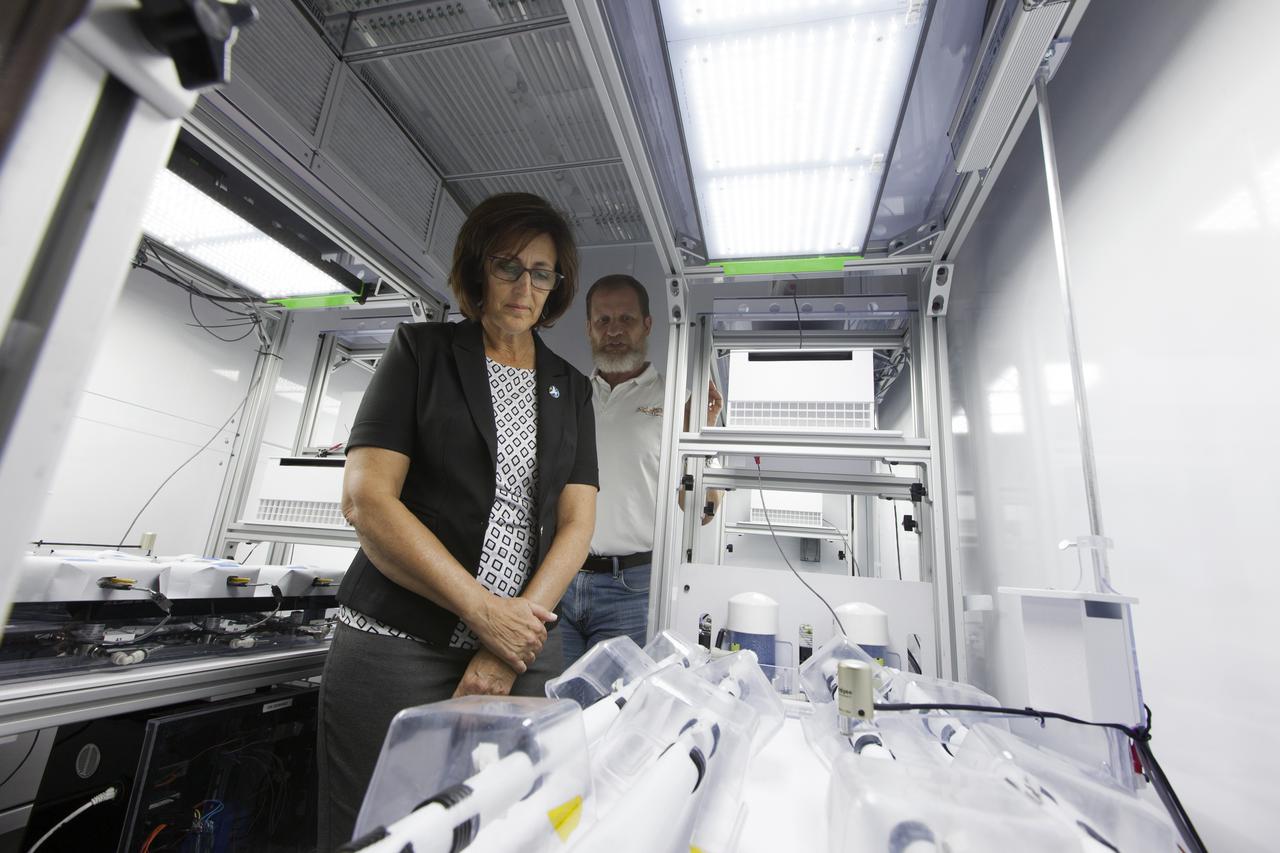
Robyn Gatens, left, deputy director, ISS Division and system capability leader for Environmental Control and Life Support Systems (ECLSS) at NASA Headquarters in Washington, tours laboratories in the Space Station Processing Facility at the agency's Kennedy Space Center in Florida, on June 13, 2018. Standing behind her is Ralph Fritsche, long-duration food production project manager at Kennedy. Gatens is viewing plant growth chambers and seeing firsthand some of the capabilities in the center's Exploration Research and Technology Programs.
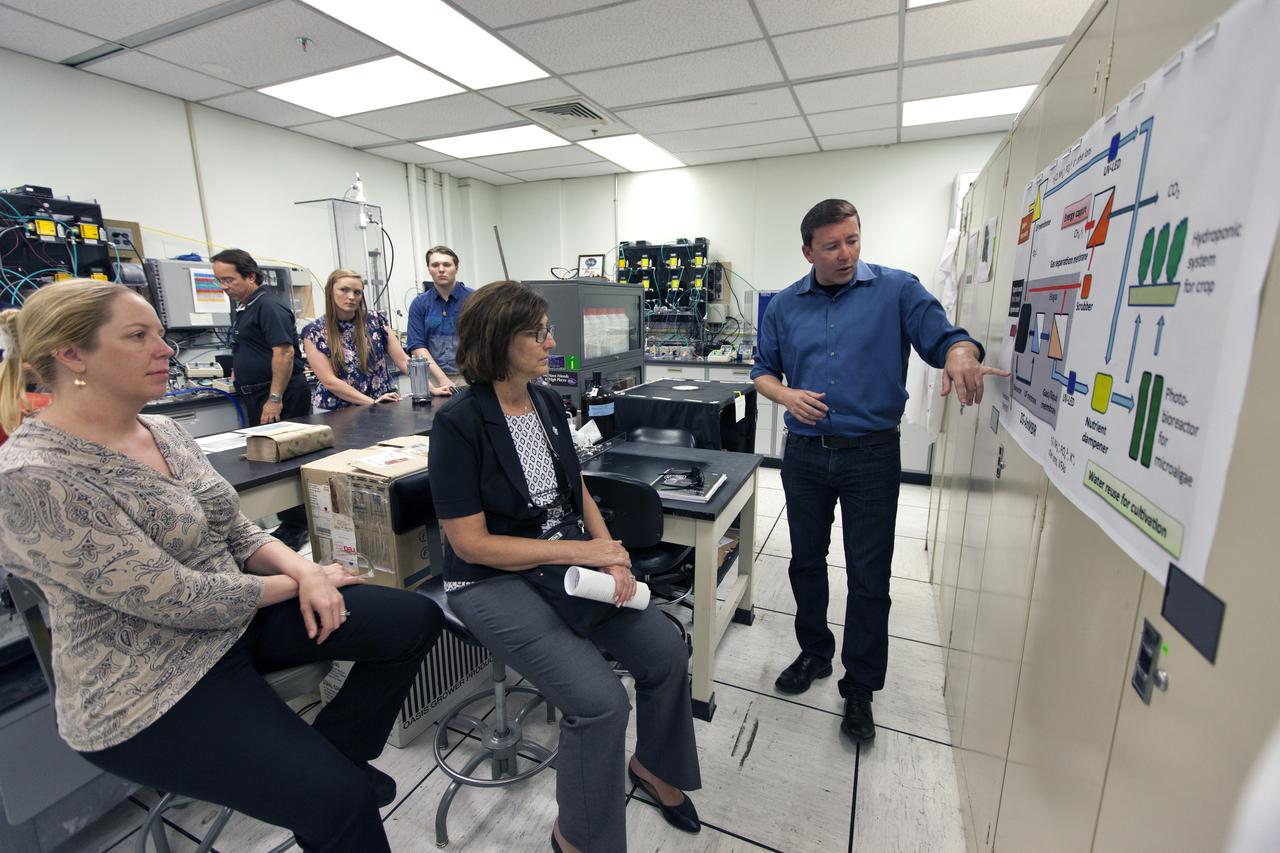
Inside a laboratory in the Neil Armstrong Operations and Checkout Building at NASA's Kennedy Space Center in Florida, Dr. Luke Roberson, right, principal investigator for research and development in Swamp Works, explains the algae bio reactor to Robyn Gatens, center, deputy director, ISS Division and system capability leader for Environmental Control and Life Support Systems (ECLSS) at NASA Headquarters in Washington, on June 13, 2018. At far left is Molly Anderson, deputy ECLSS capability lead at Johnson Space Center in Houston. They are seeing firsthand some of the capabilities in the center's Exploration Research and Technology Programs.
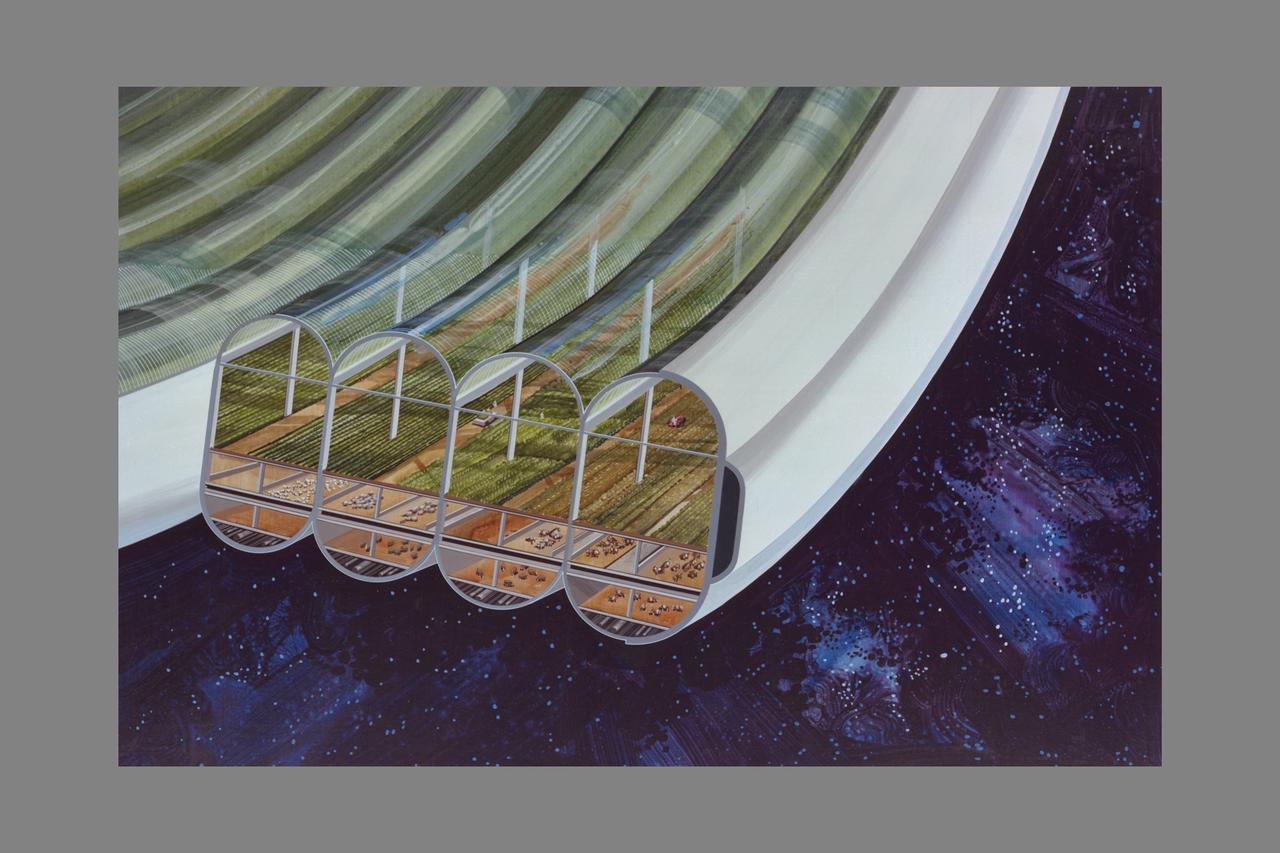
Artist: Rick Guidice Space Colonization regenerative life support systems. This concept from a summer study done in 1977 depicts a closed loop life support system for long duration space settlements or space industrialization.
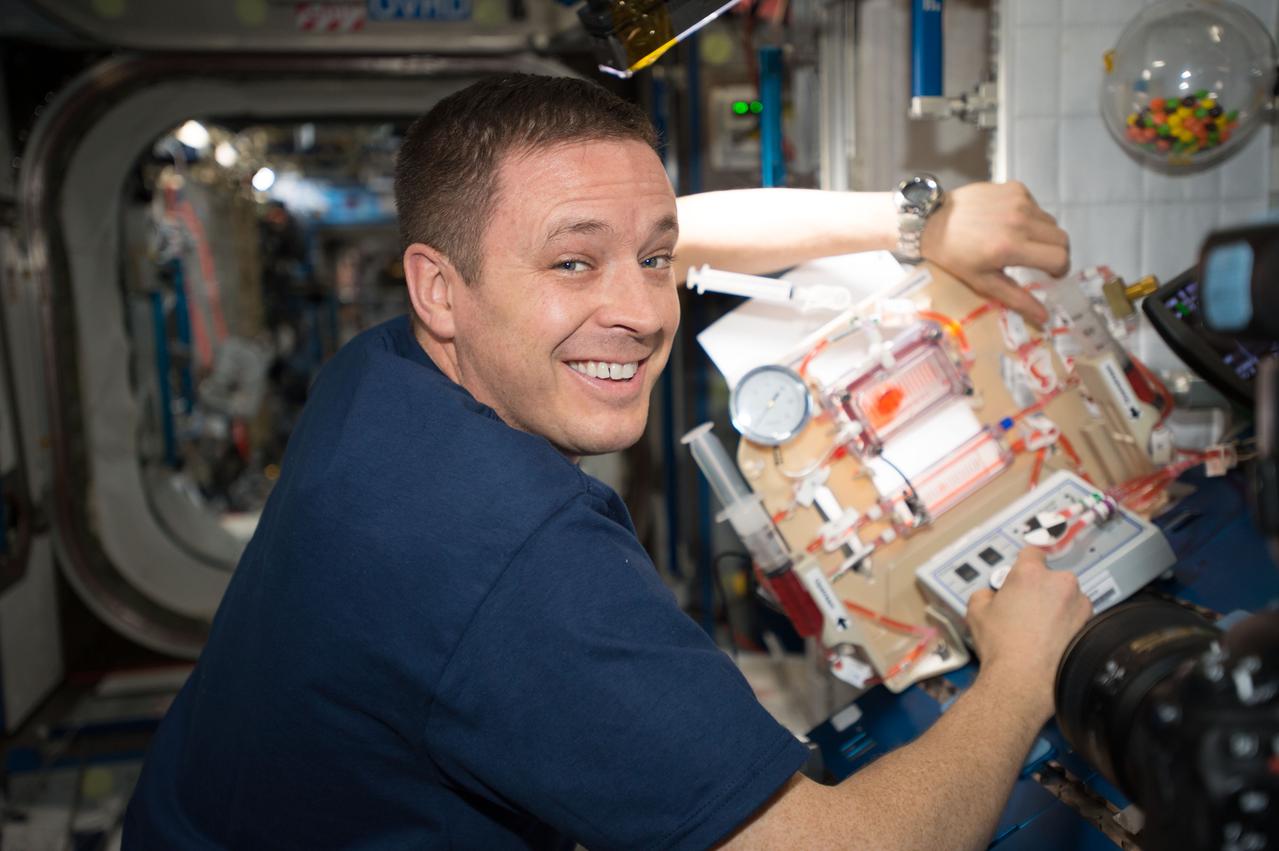
iss052e013146 (July 10, 2017) --- Astronaut Jack Fischer is photographed during setup of hardware for the Capillary Structures for Exploration Life Support (Capillary Structures) two sorbent demonstrations. The Capillary Structures for Exploration Life Support (Capillary Structures) investigation studies a new method using structures of specific shapes to manage fluid and gas mixtures. The investigation studies water recycling and carbon dioxide removal, benefiting future efforts to design lightweight, more reliable life support systems for future space missions.
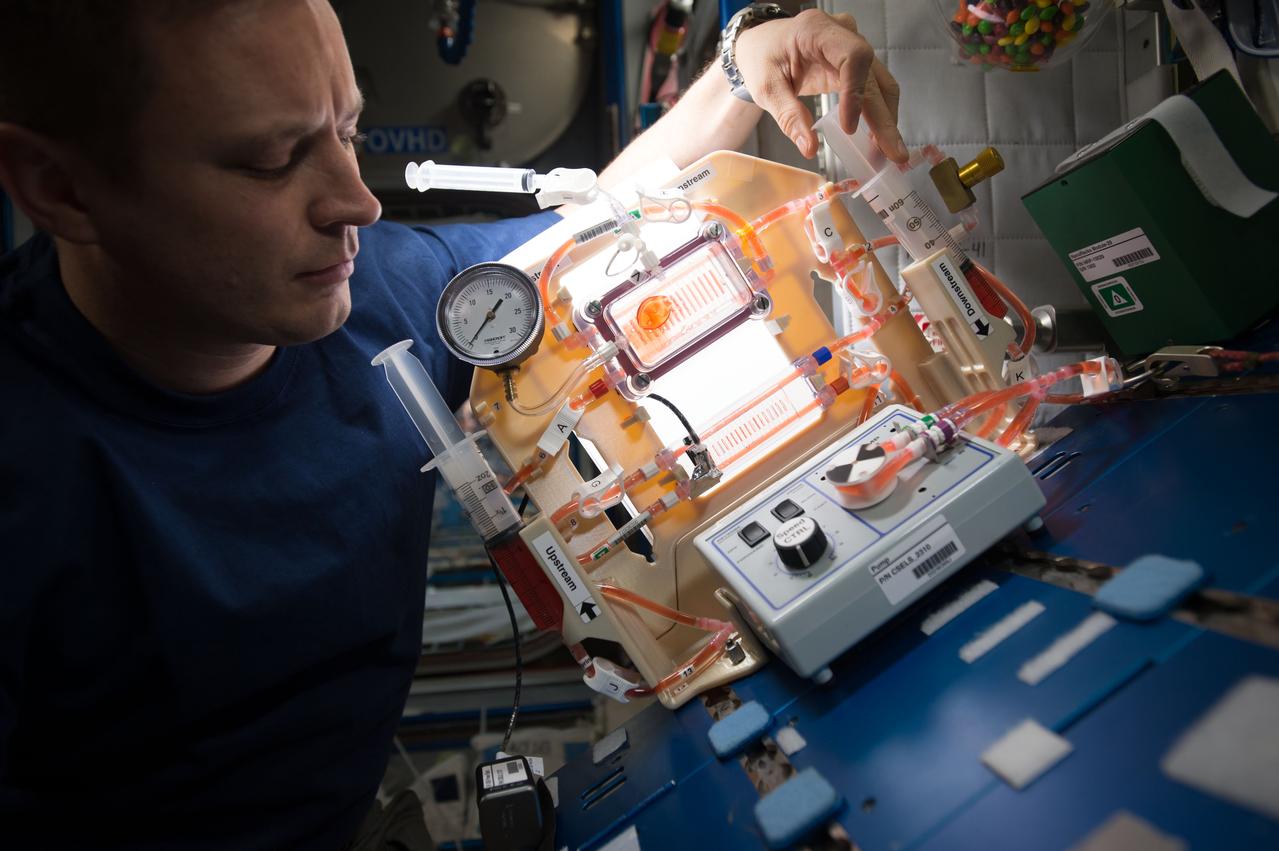
iss052e013087 (7/10/2017) NASA astronaut Jack Fischer is photographed during setup of hardware for the Capillary Structures for Exploration Life Support (Capillary Structures) two sorbent demonstrations. The Capillary Structures for Exploration Life Support (Capillary Structures) investigation studies a new method using structures of specific shapes to manage fluid and gas mixtures. The investigation studies water recycling and carbon dioxide removal, benefiting future efforts to design lightweight, more reliable life support systems for future space missions.
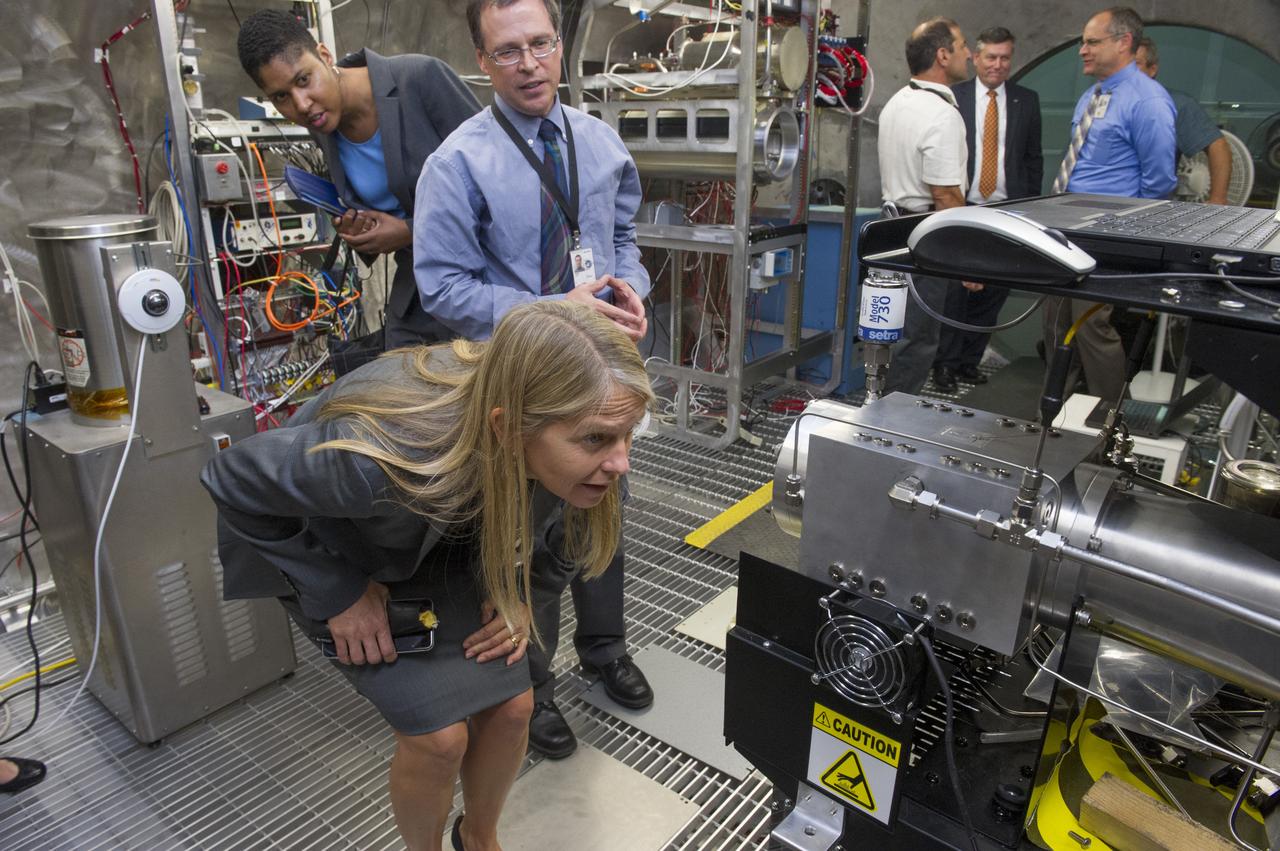
NEWMAN TAKES A CLOSER LOOK AT EQUIPMENT UNDER DEVELOPMENT IN THE ENVIRONMENTAL CONTROL & LIFE SUPPORT SYSTEMS SECTION IN BUILDING 4755. ELCSS IS BUILDING DEVICES TO RECYCLE AIR AND WATER FOR CREW MEMBERS ON THE INTERNATIONAL SPACE STATION, USING THE ORBITING LABORATORY AS A TEST BED FOR LIFE SUPPORT SYSTEMS ON LONG-DURATION MISSIONS DEEPER INTO OUR SOLAR SYSTEM.

KENNEDY SPACE CENTER, FLA. - Hyeon-Hye Kim, a plant physiologist with the National Research Council at the Space Life Sciences Lab, discusses the growing of plants utilizing light-emitting diodes (LEDs) during a tour of the Space Life Sciences Lab for members of the news media. A major challenge to growing plants in space will be controlling and supplying sufficient quantity and quality of light. LEDs represent an innovative artificial lighting source with several features specific for supporting plants, whether on space-based transit vehicles or planetary life support systems.
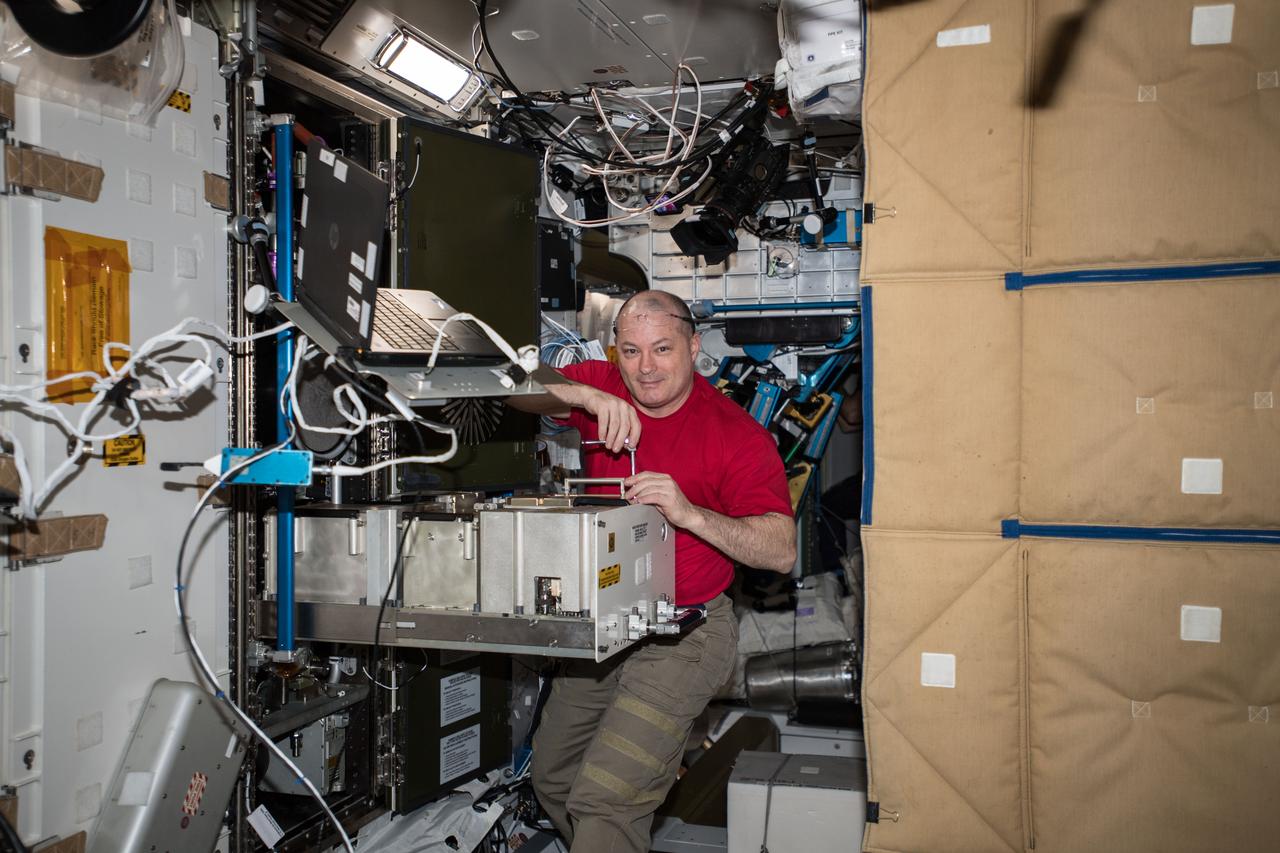
iss055e033717 (April 27, 2018) --- NASA astronaut Scott Tingle works inside the Tranquility module removing and replacing life support systems hardware.

Patches of NASA Vehicle Integration Test Team (VITT) (26308) and JSC Crew and Thermal Systems Division - Life Support - EVA - Thermal (26309).
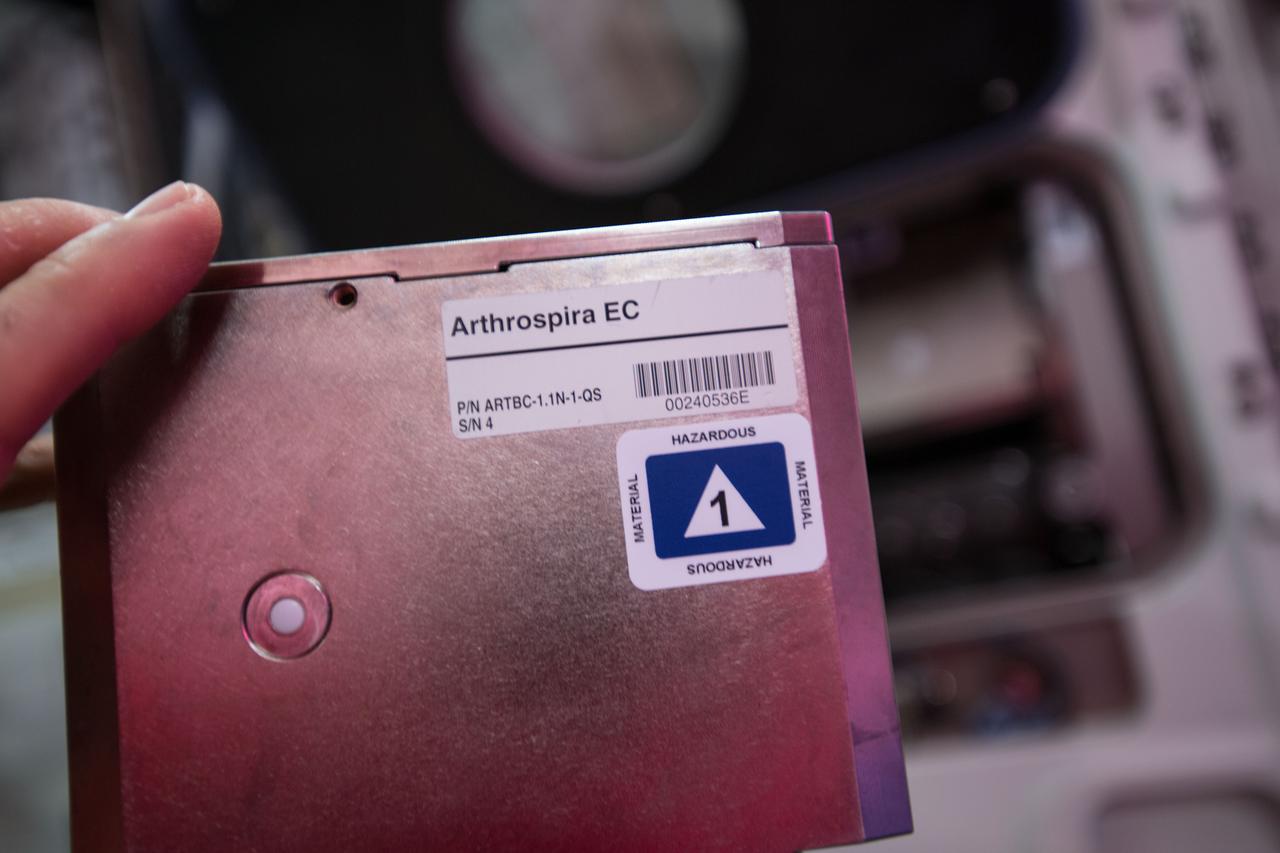
iss054e005642 (Dec. 27, 2017) --- Experiment Container (EC) for the Arthrospira B experiment to test the oxygen production of plants in space for a closed regenerative life support system.
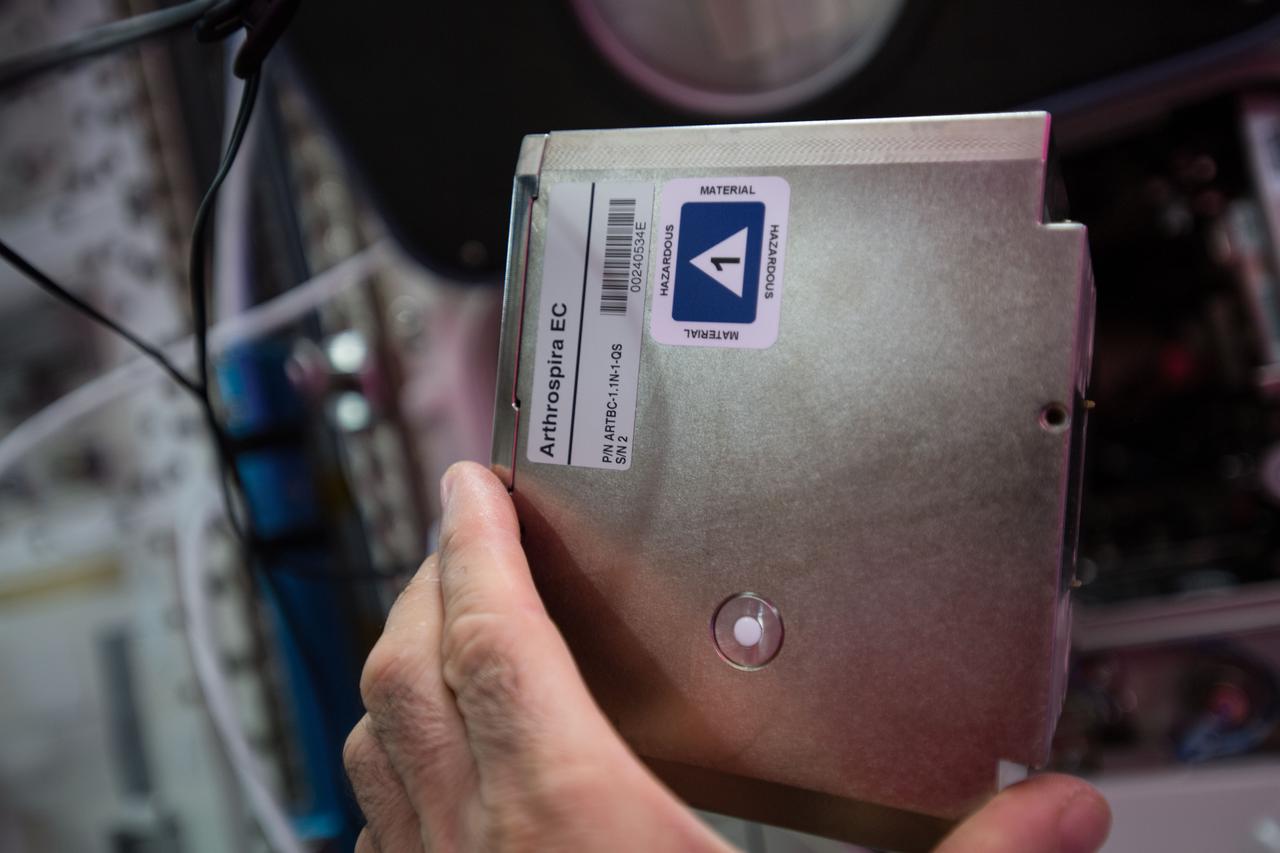
iss054e005663 (Dec. 27, 2017) --- Experiment Container (EC) for the Arthrospira B experiment to test the oxygen production of plants in space for a closed regenerative life support system.
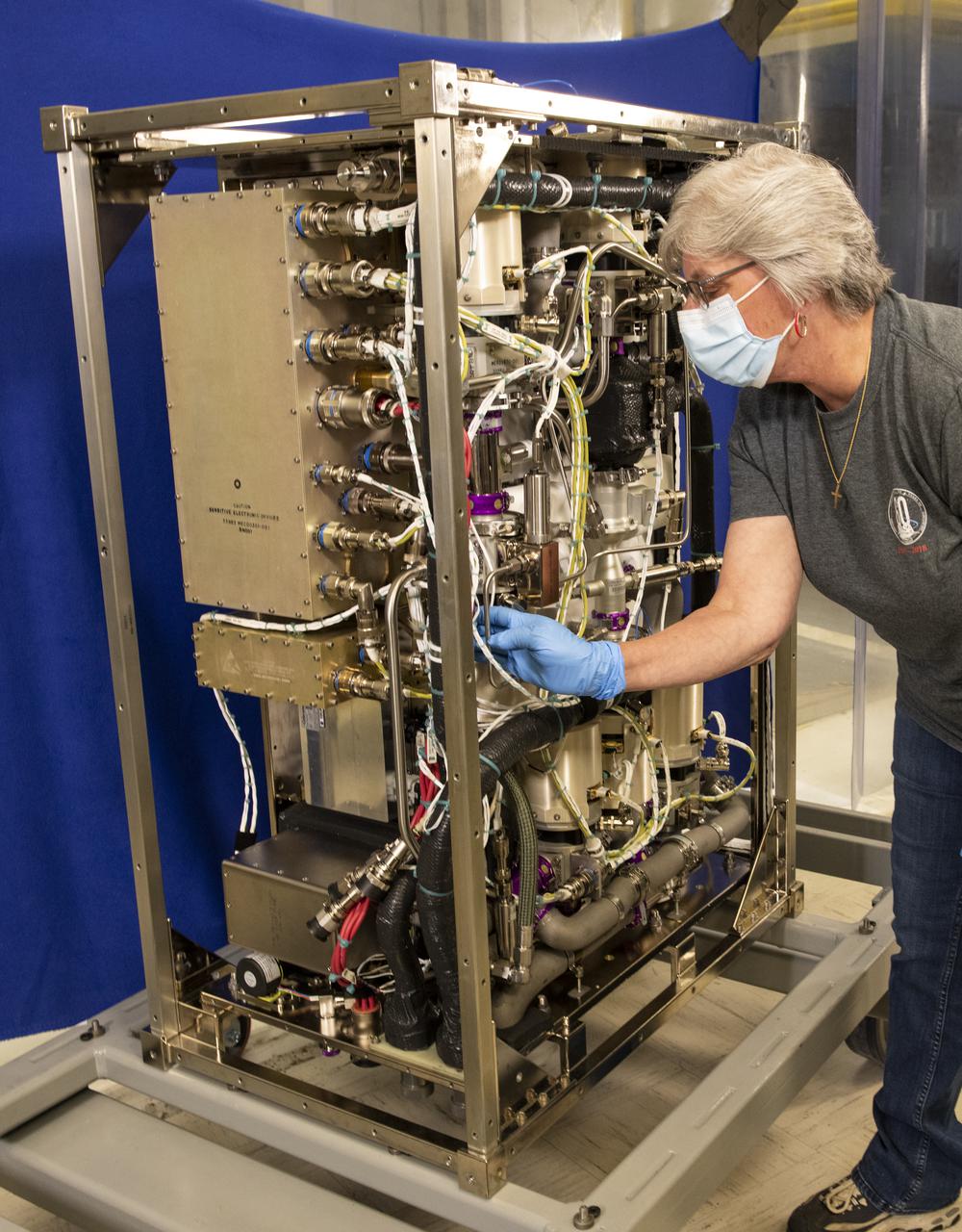
The flight demonstration unit of the next-generation 4-bed CO2 Scrubber (4BCO2) is targeted for launch aboard NG16 NET August 1, 2021. Once aboard the space station, this u nit will be mounted in a basic express rack. This four-bed technology is a mainstay for metabolic CO2 removal and crew life support. The new 4-Bed Carbon Dioxide Scrubber, developed, built, and tested at NASA’s Marshall Space Flight Center in Huntsville, Alabama, is checked out by Kathi Lange, a Bastion Technologies contractor supporting the quality assurance group in Marshall’s Safety and Mission Assurance Directorate, prior to its shipment to NASA’s Wallops Flight Facility in Wallops Island, Virginia.
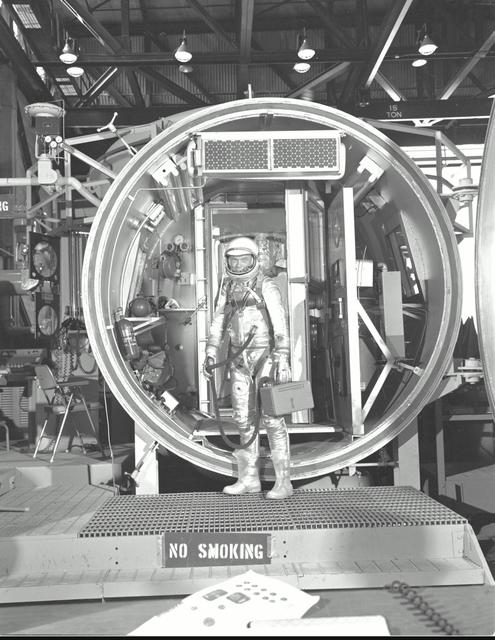
M61-00150 (1961) --- Astronaut John H. Glenn Jr., suited with hose to suit ventilation unit attached, during altitude chamber test. He is standing in the entrance to the test chamber with his helmet visor down. Photo credit: NASA
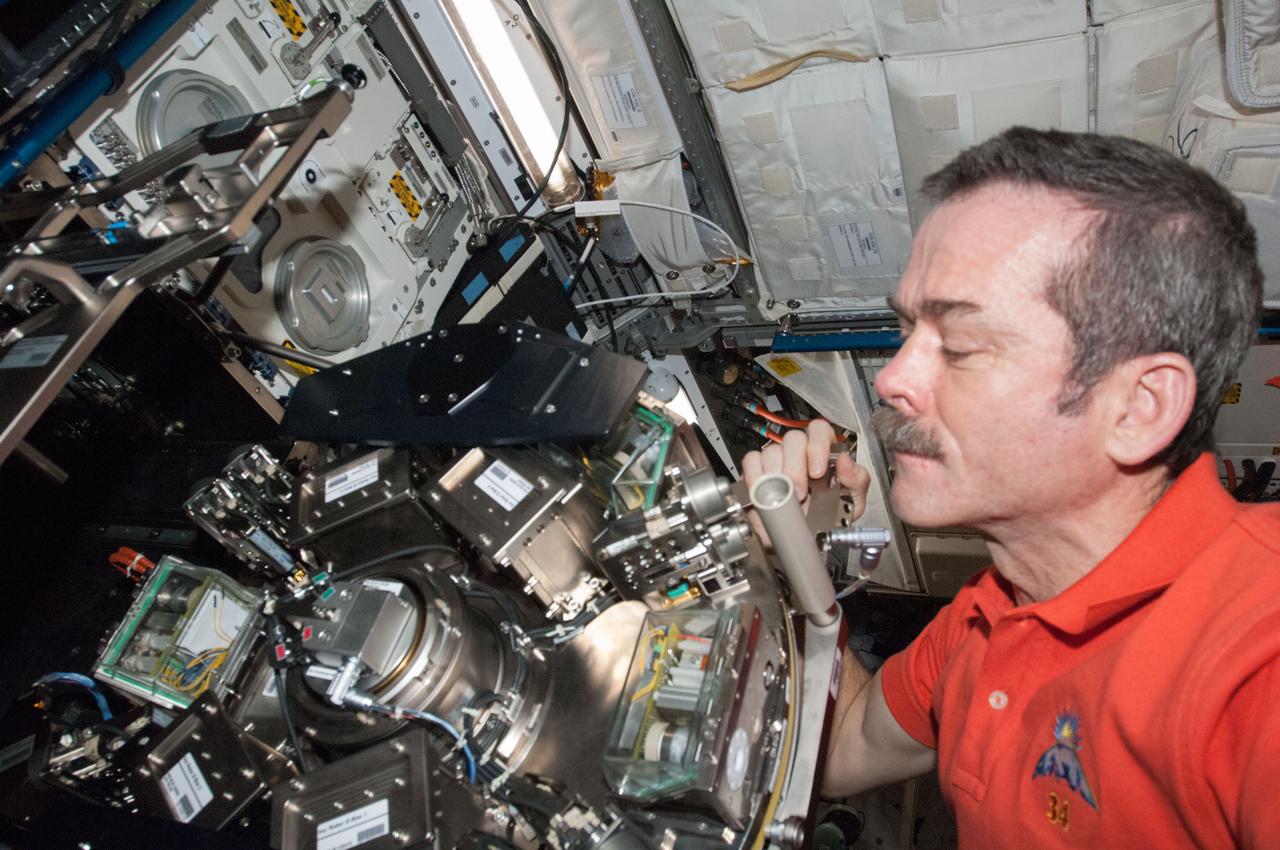
ISS034-E-051715 (20 Feb. 2013) --- Canadian Space Agency astronaut Chris Hadfield, Expedition 34 flight engineer, performs routine maintenance on Biolab in the Columbus Module aboard the International Space Station.
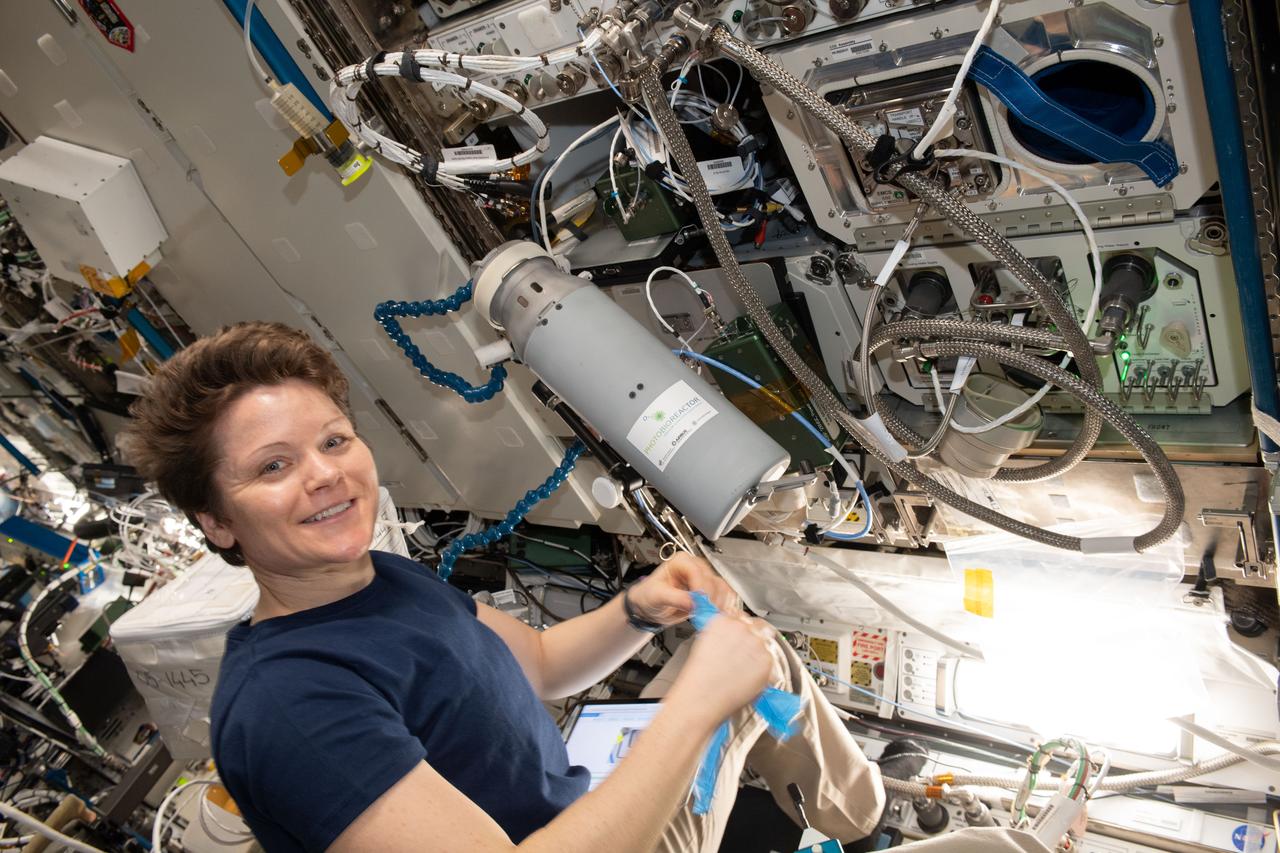
iss059e092349 (June 6, 2019) --- NASA astronaut Anne McClain works with Photobioreactor hardware for a study demonstrating that microalgae could be used to support hybrid life support systems in space. This hybrid approach could be helpful in future long-duration exploration missions, reducing the amount of consumables required from Earth.
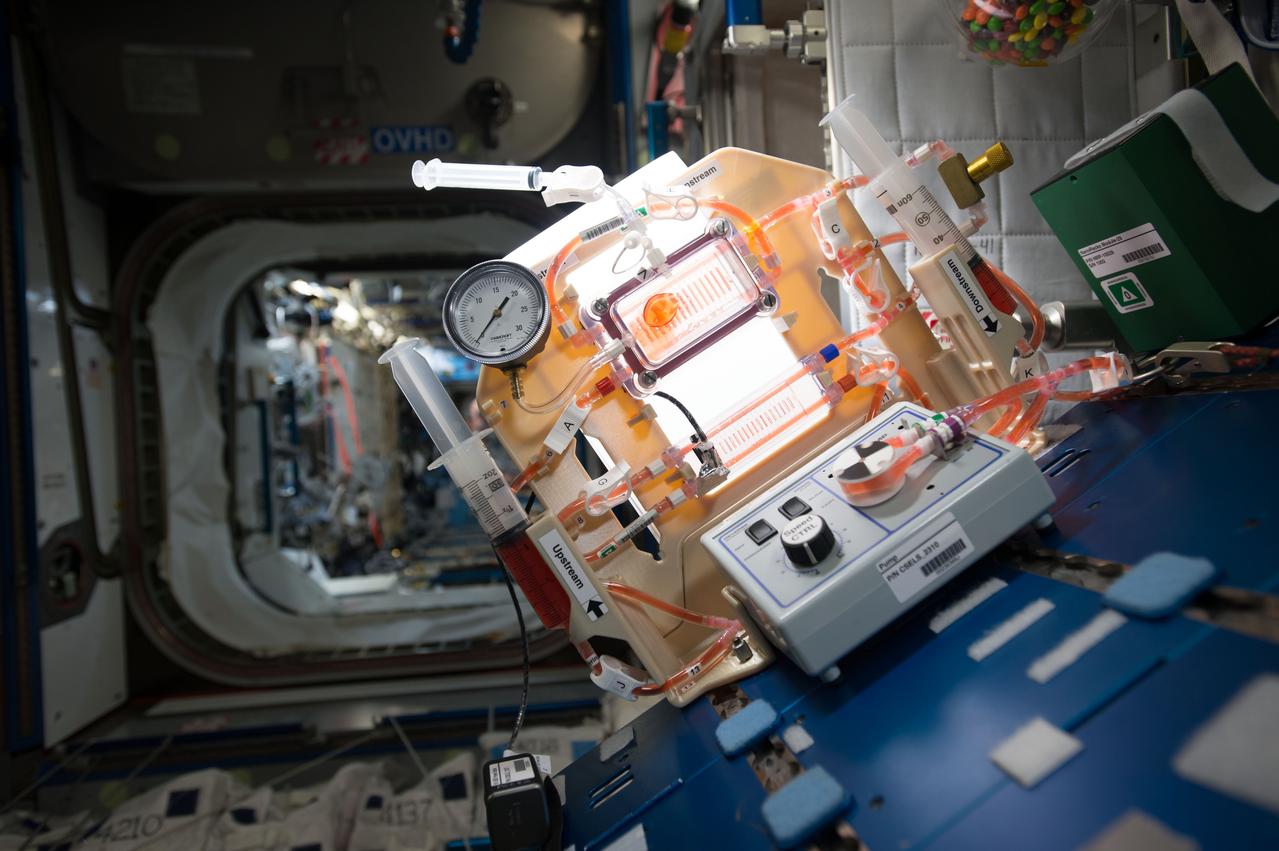
iss052e013081 (7/10/2017) --- The Capillary Structures for Exploration Life Support (Capillary Structures) investigation studies a new method using structures of specific shapes to manage fluid and gas mixtures. The investigation studies water recycling and carbon dioxide removal, benefiting future efforts to design lightweight, more reliable life support systems for future space missions.
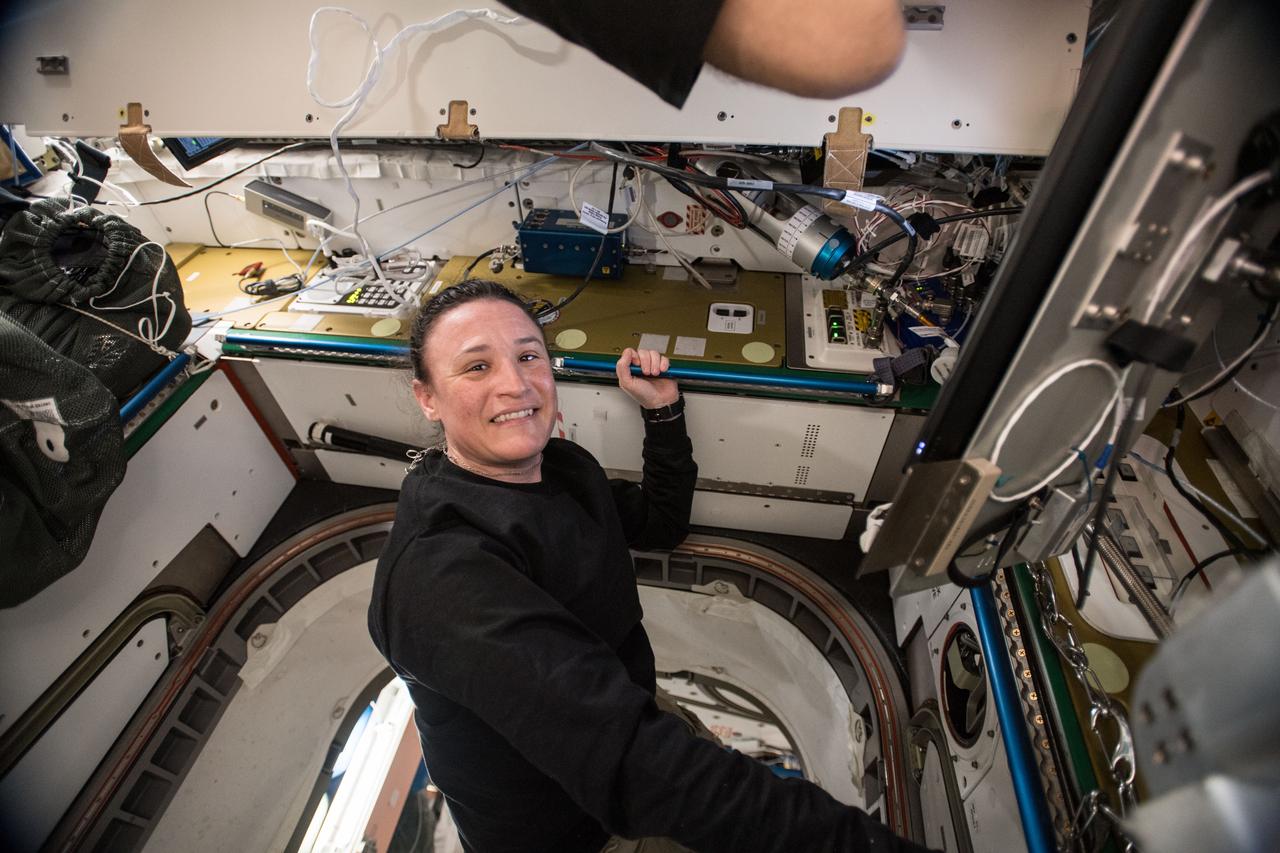
iss056e014502 (June 18, 2018) --- Expedition 56 Flight Engineer Serena Auñón-Chancellor of NASA is pictured in the Unity module during life support maintenance work to remove and replace an Oxygen Generation System Hydrogen Sensor.
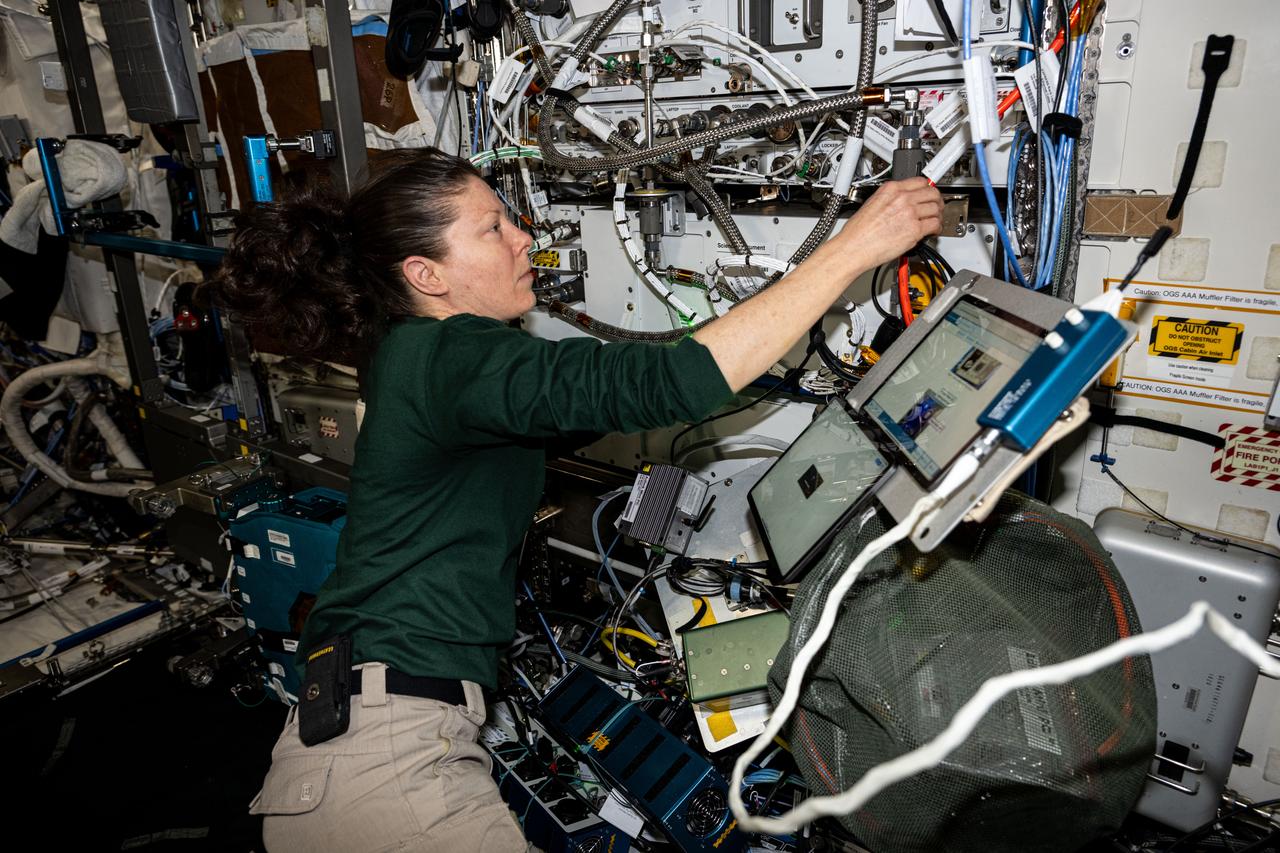
iss071e609375 (Sept. 5, 2024) --- NASA astronaut and Expedition 71 Flight Engineer Tracy C. Dyson tests the configuration of computers that control life support systems aboard the International Space Station's Destiny laboratory module.
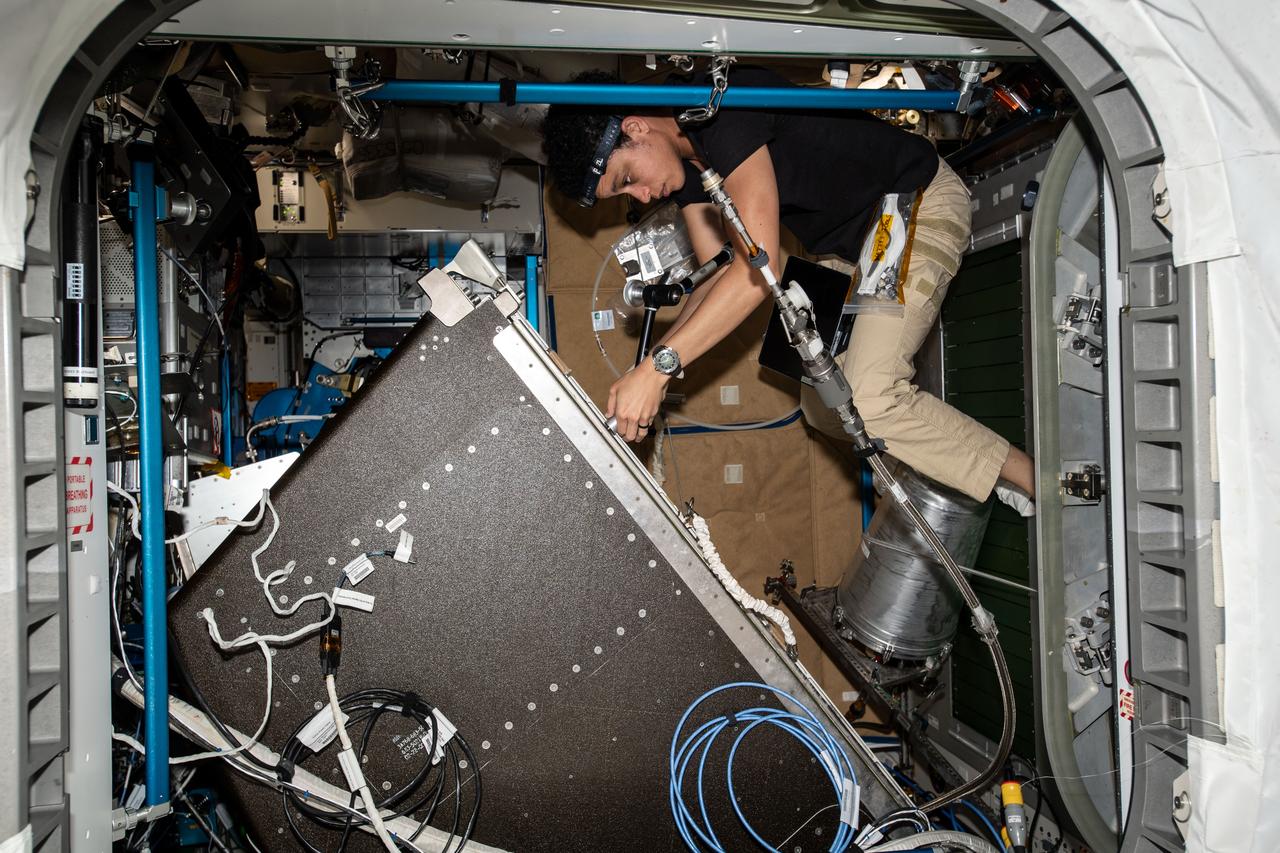
iss067e099373 (June 1, 2022) --- NASA astronaut and Expedition 67 Flight Engineer Jessica Watkins services life support components inside the Tranquility module's Water Recovery System rack abaord the International Space Station.
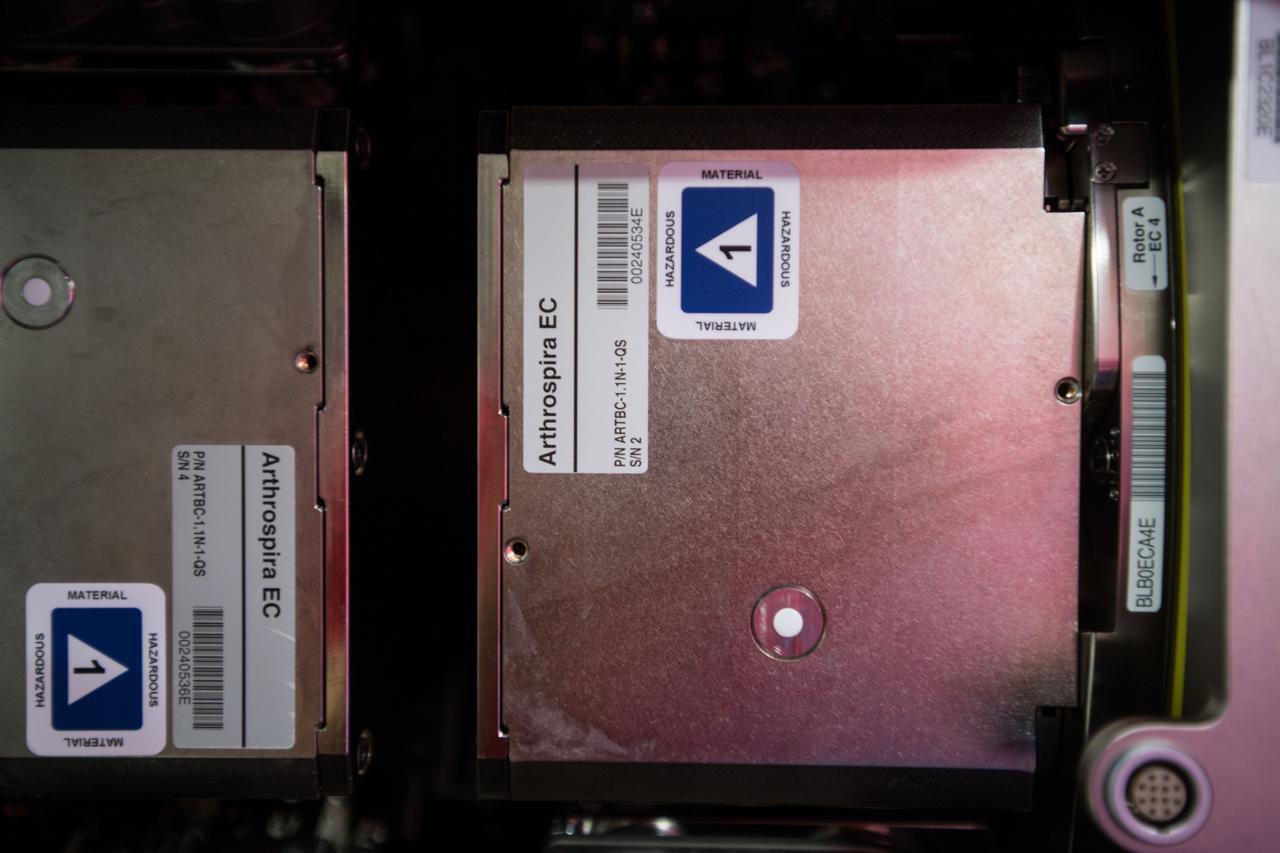
iss054e005660 (Dec. 27, 2017) --- Experiment Containers (EC) for the Arthrospira B experiment inside BioLab to test the oxygen production of plants in space for a closed regenerative life support system.
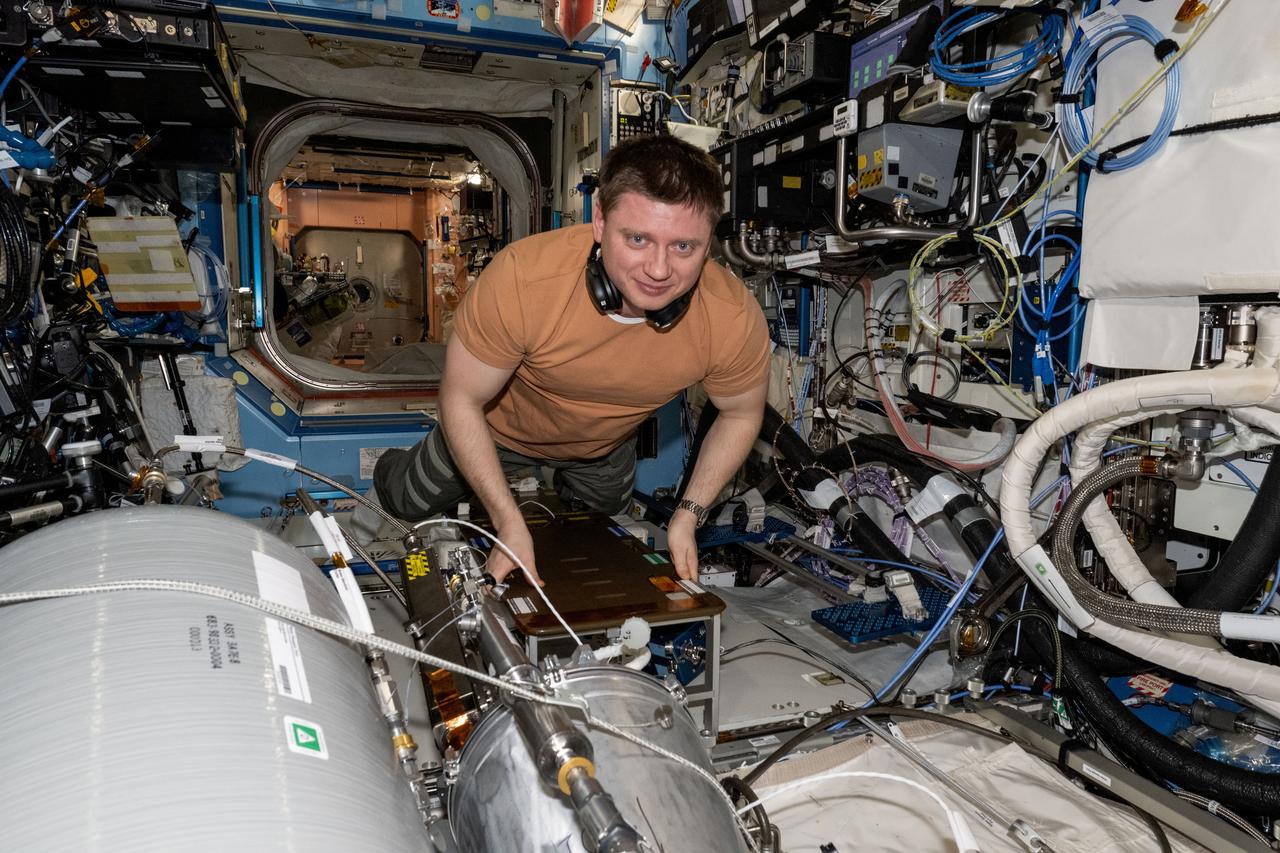
iss071e523250 (Aug. 21, 2024) --- Roscosmos cosmonaut and Expedition 71 Flight Engineer Alexander Grebenkin works on transferring water from resupply tanks to life support systems aboard the International Space Station's Destiny laboratory module
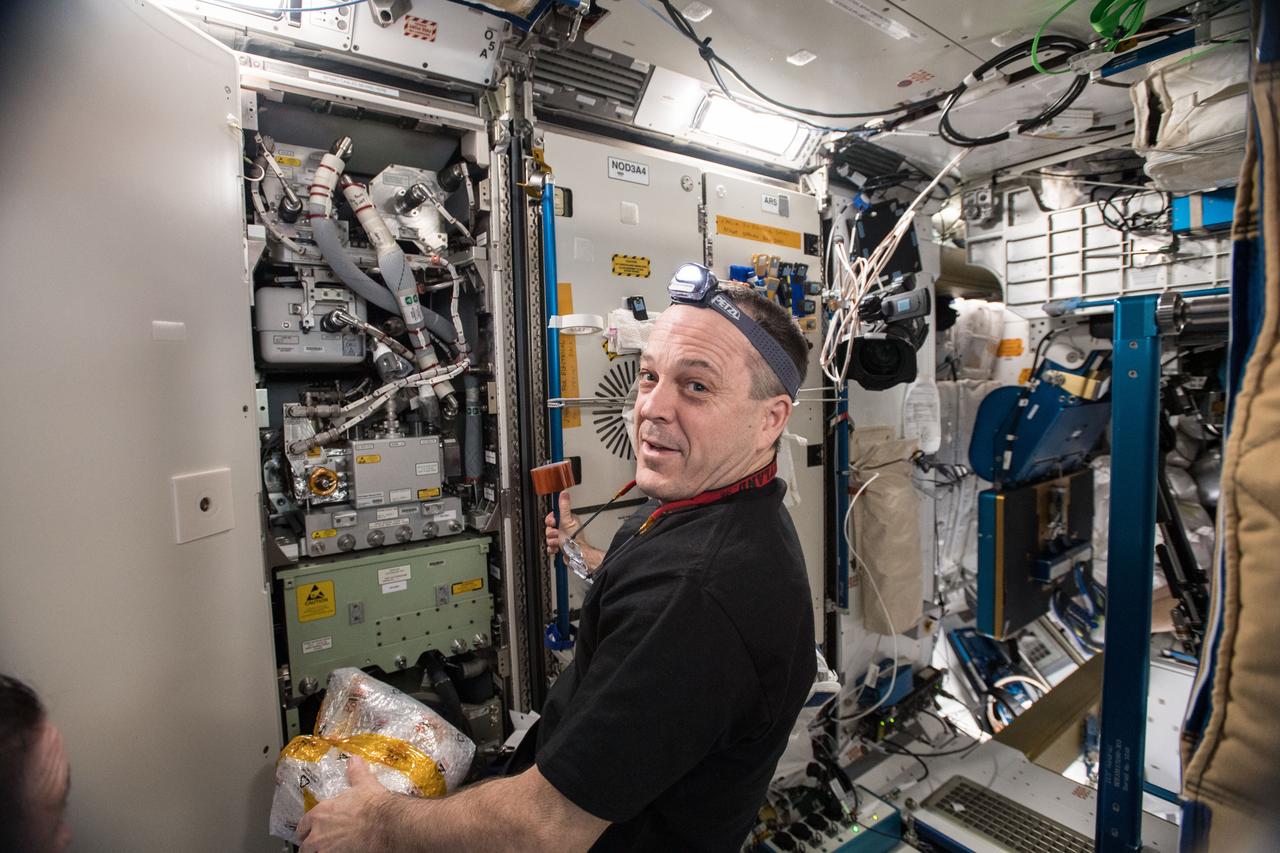
iss056e014487 (June 18, 2018) --- Expedition 56 Flight Engineer Ricky Arnold of NASA is pictured in the Unity module during life support maintenance work to remove and replace an Oxygen Generation System Hydrogen Sensor.
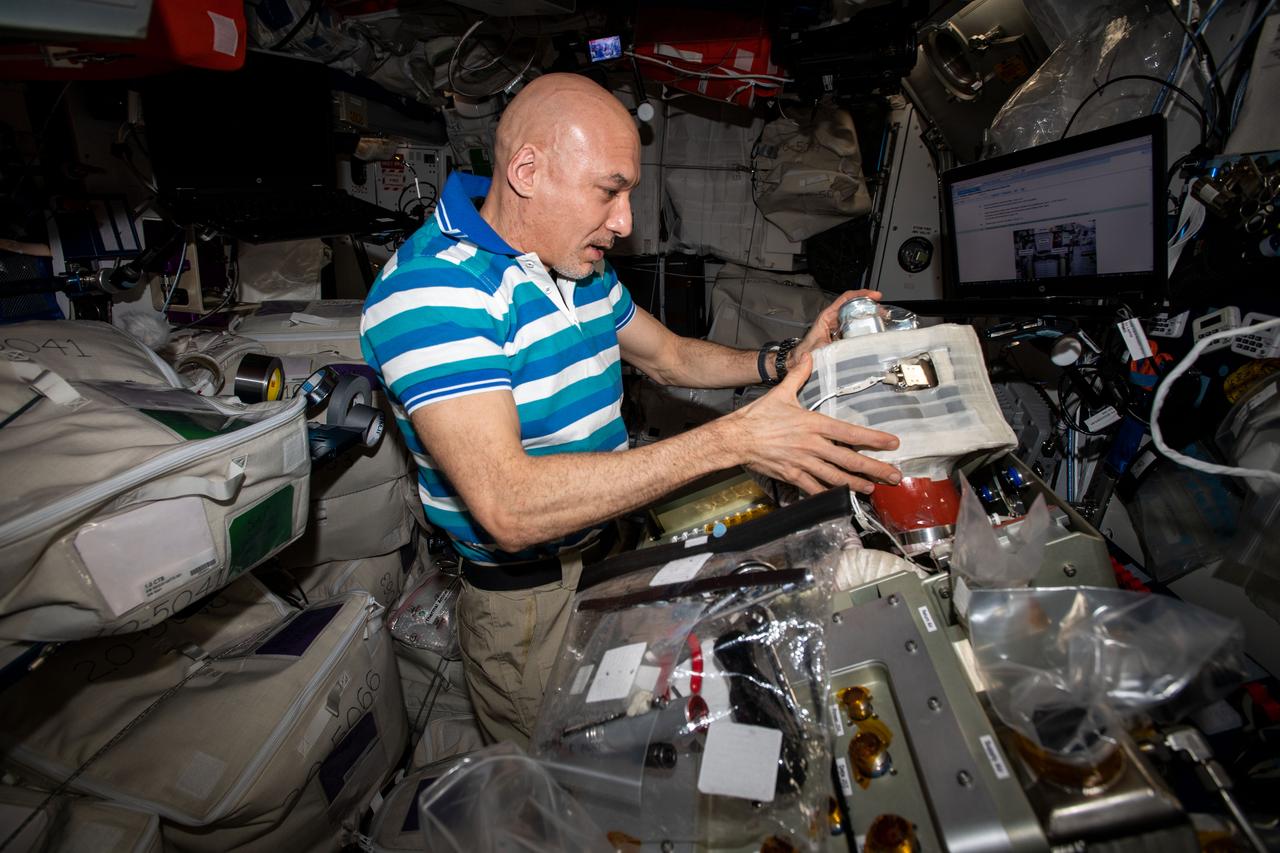
iss061e111401 (Dec. 31, 2019) --- Commander Luca Parmitano of ESA (European Space Agency) installs new components in a life support system that removes carbon dioxide from the station’s atmosphere.
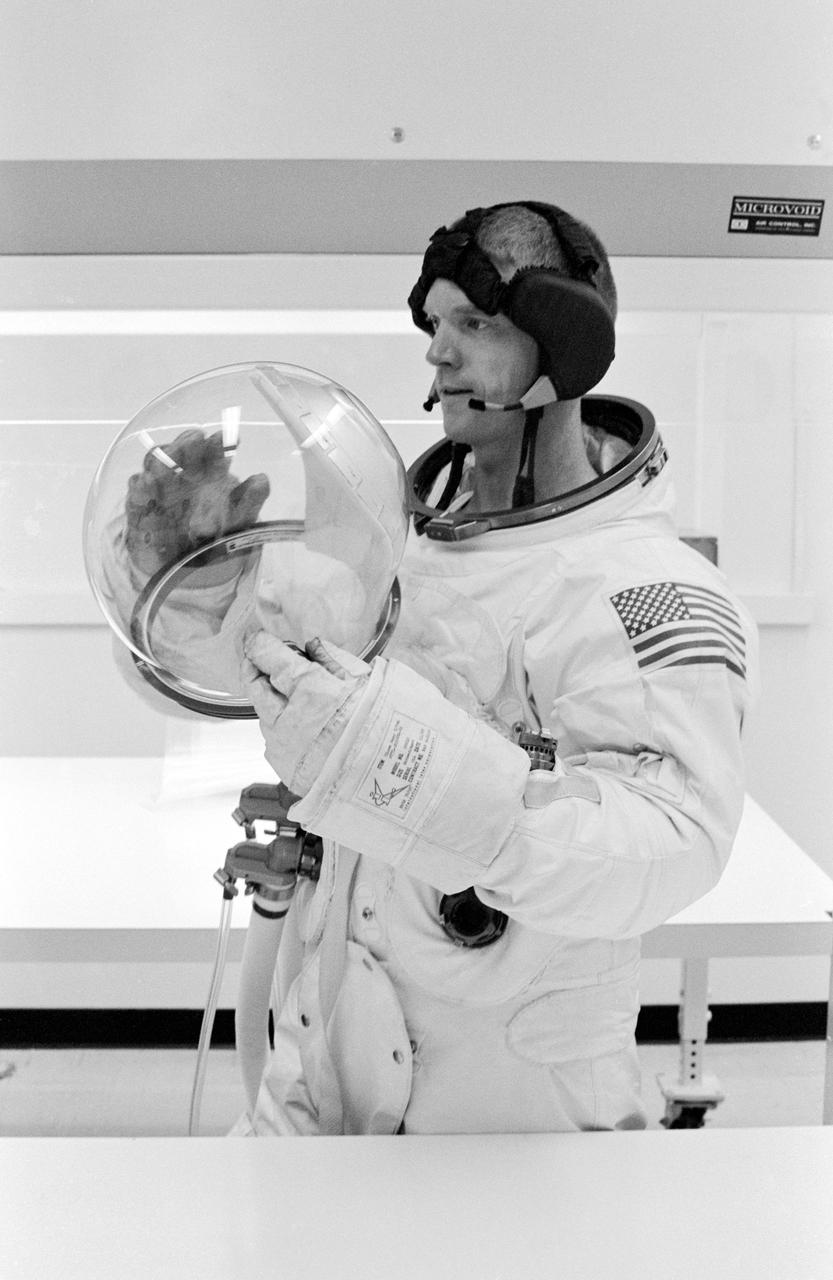
S68-38051 (29 June 1968) --- Astronaut Russell L. Schweickart suits up to participate in an altitude verification test of the Apollo Portable Life Support System flight unit in Crew Systems Division's 8-ft altitude chamber in Building 7.
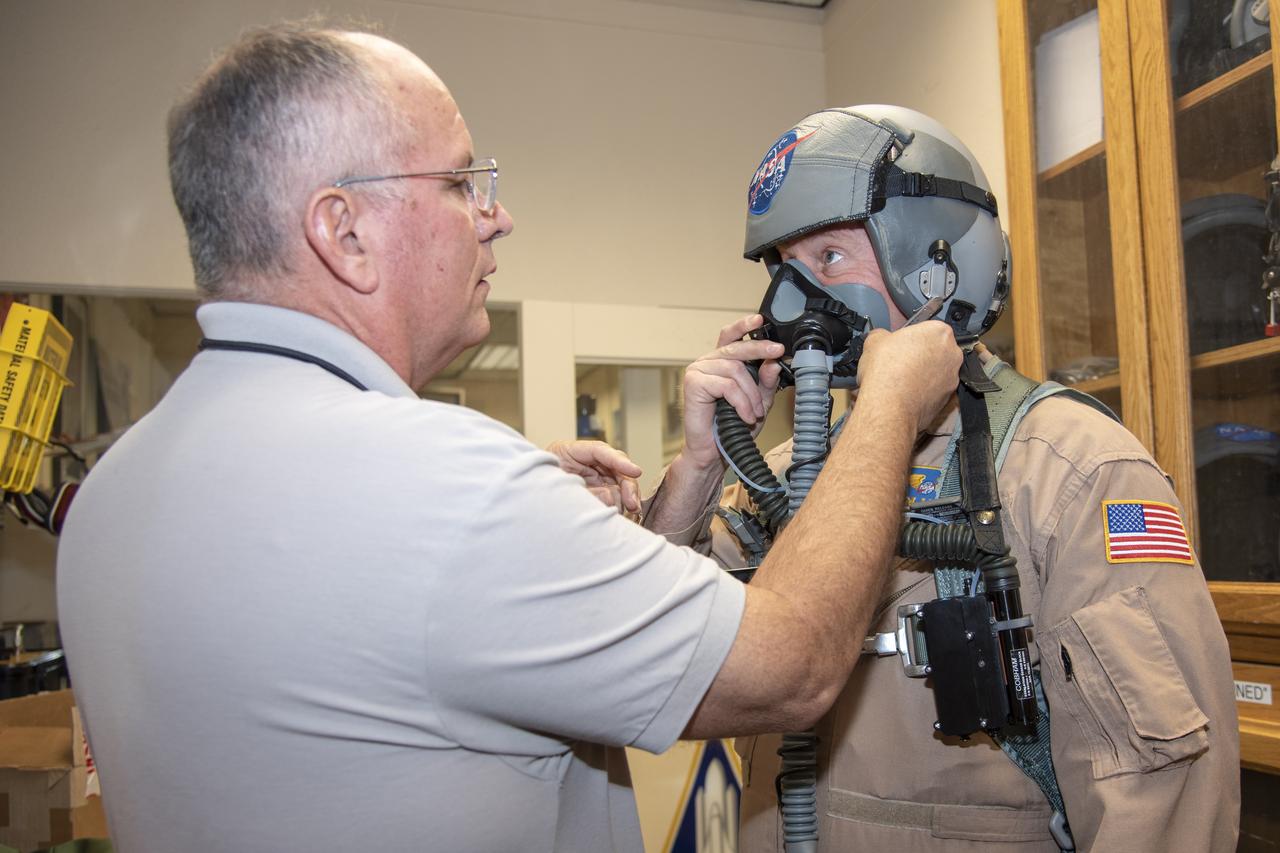
NASA pilot Jim Less is assisted by life support as he is fitted with a Cobham designed VigiLOX pilot oxygen monitoring system. VigiLOX is a sensing system that is attached to a pilot's existing gear to capture real-time physiological, breathing gas and cockpit environmental data.
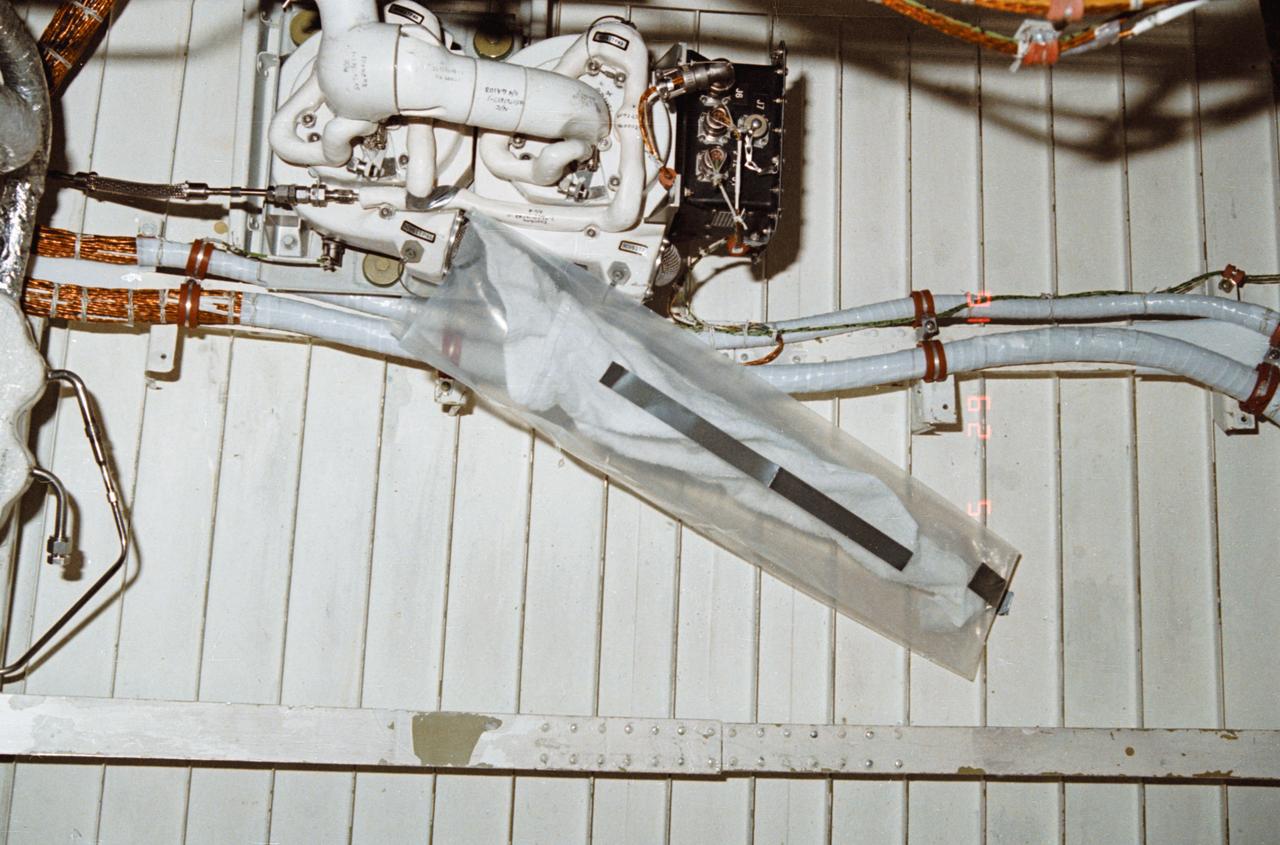
During STS-32, onboard Columbia, Orbiter Vehicle (OV) 102, a leakage problem at environmental control and life support system (ECLSS) air revitalization system (ARS) humidity separator A below the middeck is solved with a plastic bag and a towel. The towel inserted inside a plastic bag absorbed the water that had collected at the separator inlet.

ISS014-E-12509 (20 Jan. 2007) --- Astronaut Sunita L. Williams, Expedition 14 flight engineer, replaces a European Modular Cultivation System (EMCS) Rotor Based Life Support System (RBLSS) module in the Destiny laboratory of the International Space Station.
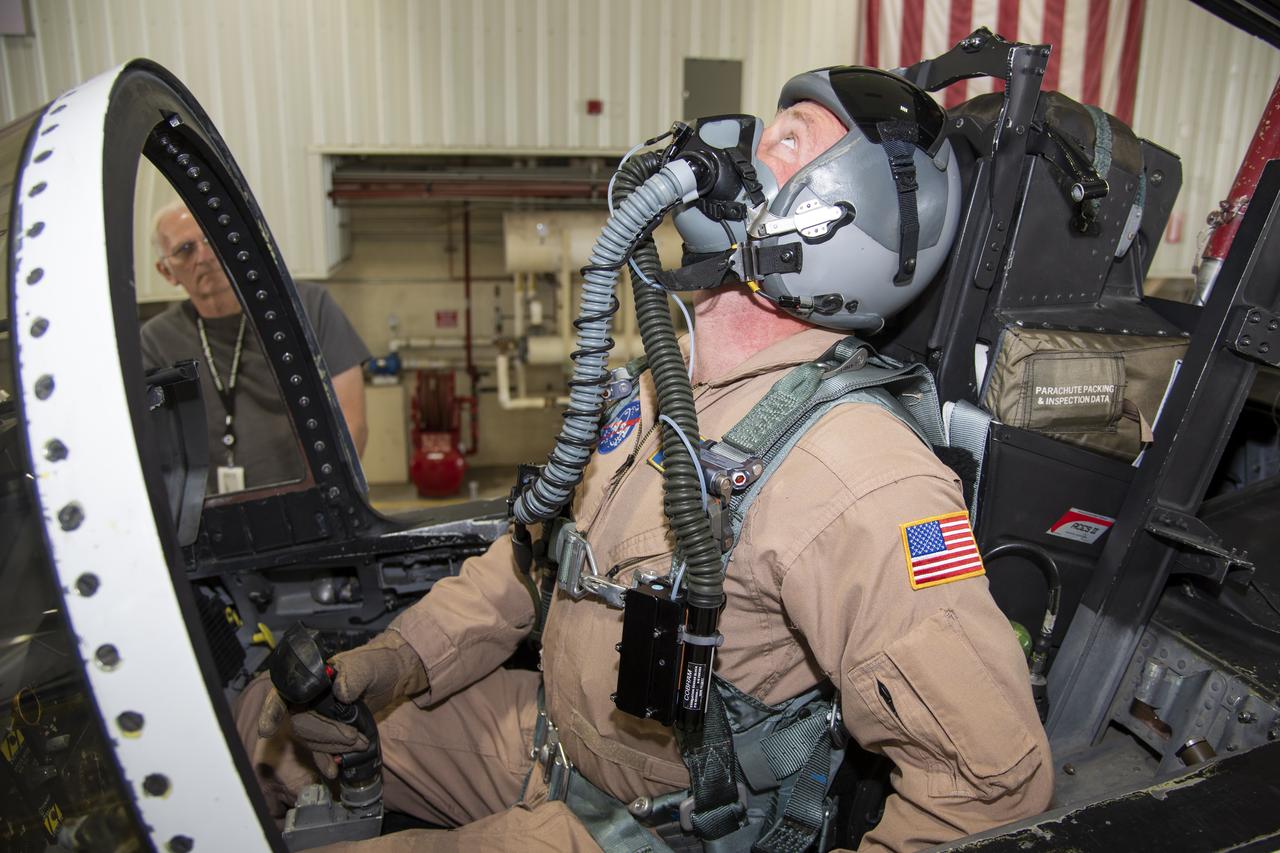
NASA pilot Jim Less is assisted by life support as he is fitted with a Cobham designed VigiLOX pilot oxygen monitoring system. VigiLOX is a sensing system that is attached to a pilot's existing gear to capture real-time physiological, breathing gas and cockpit environmental data.
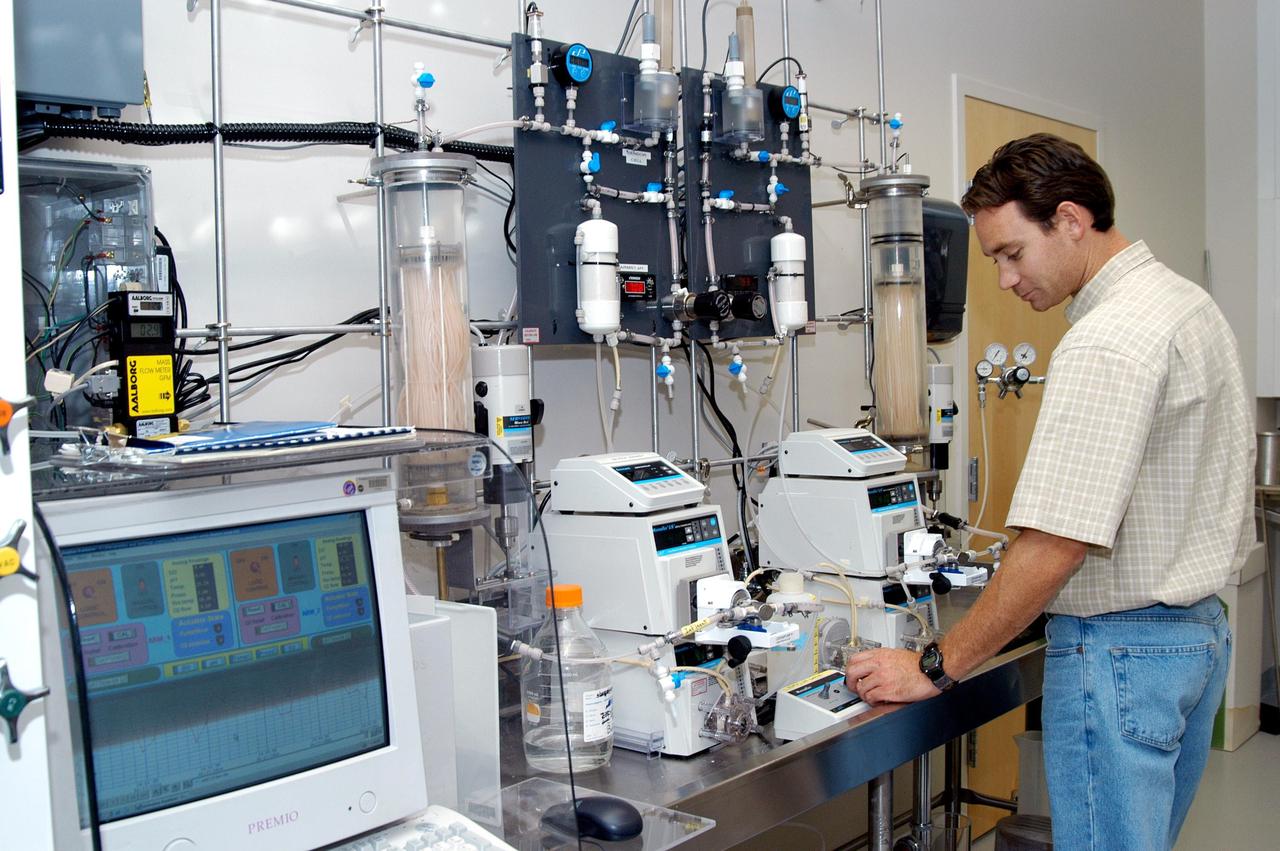
KENNEDY SPACE CENTER, FLA. - In the KSC Space Life Sciences Lab’s Resource Recovery lab, bioengineer Tony Rector checks the clear plexiglass ARMS reactor vessel. ARMS, or Aerobic Rotational Membrane System, is a wastewater processing project being tested for use on the International Space Station to collect, clean and reuse wastewater. It could be adapted for use on the Moon and Mars. The Lab is exploring various aspects of a bioregenerative life support system. Such research and technology development will be crucial to long-term habitation of space by humans.
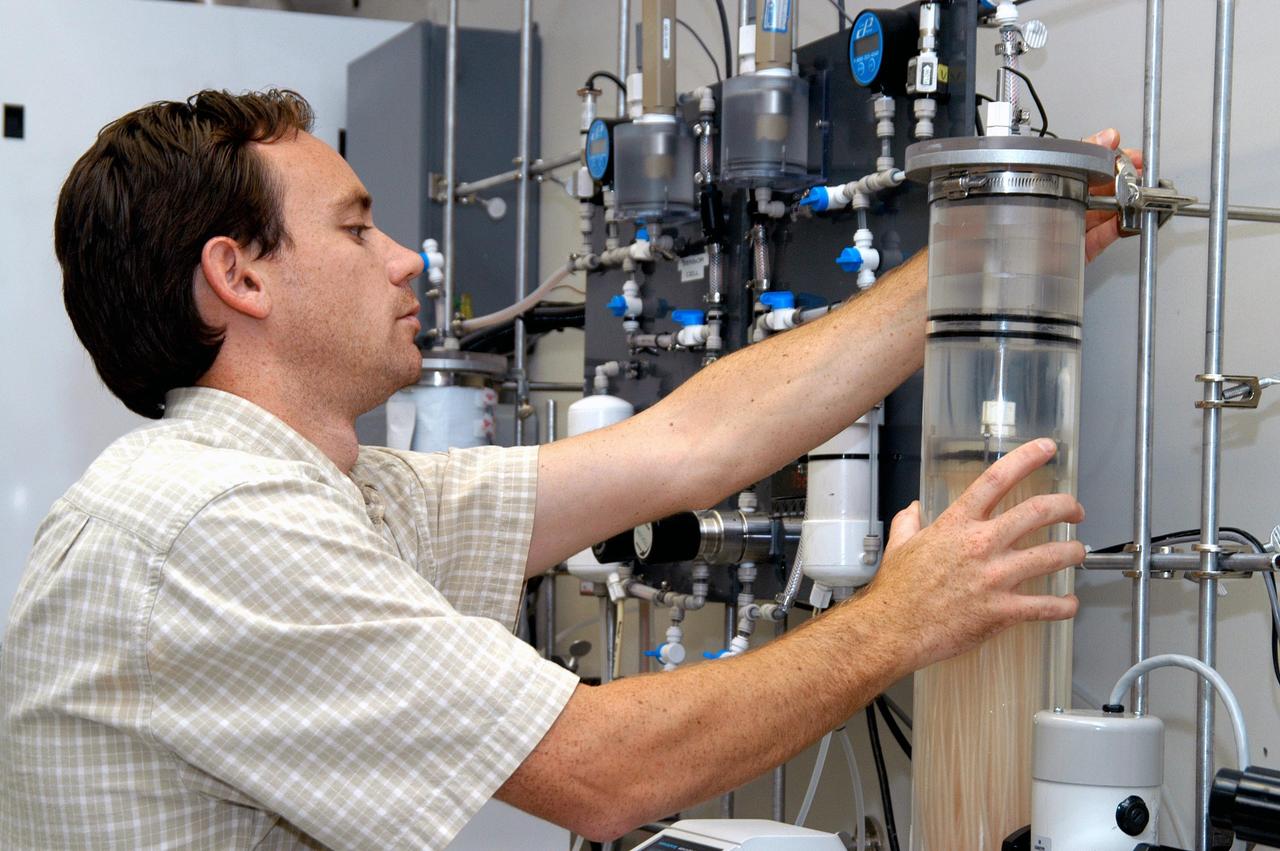
KENNEDY SPACE CENTER, FLA. - In the KSC Space Life Sciences Lab’s Resource Recovery lab, bioengineer Tony Rector checks the ARMS reactor vessel. ARMS, or Aerobic Rotational Membrane System, is a wastewater processing project being tested for use on the International Space Station to collect, clean and reuse wastewater. It could be adapted for use on the Moon and Mars. The Lab is exploring various aspects of a bioregenerative life support system. Such research and technology development will be crucial to long-term habitation of space by humans.
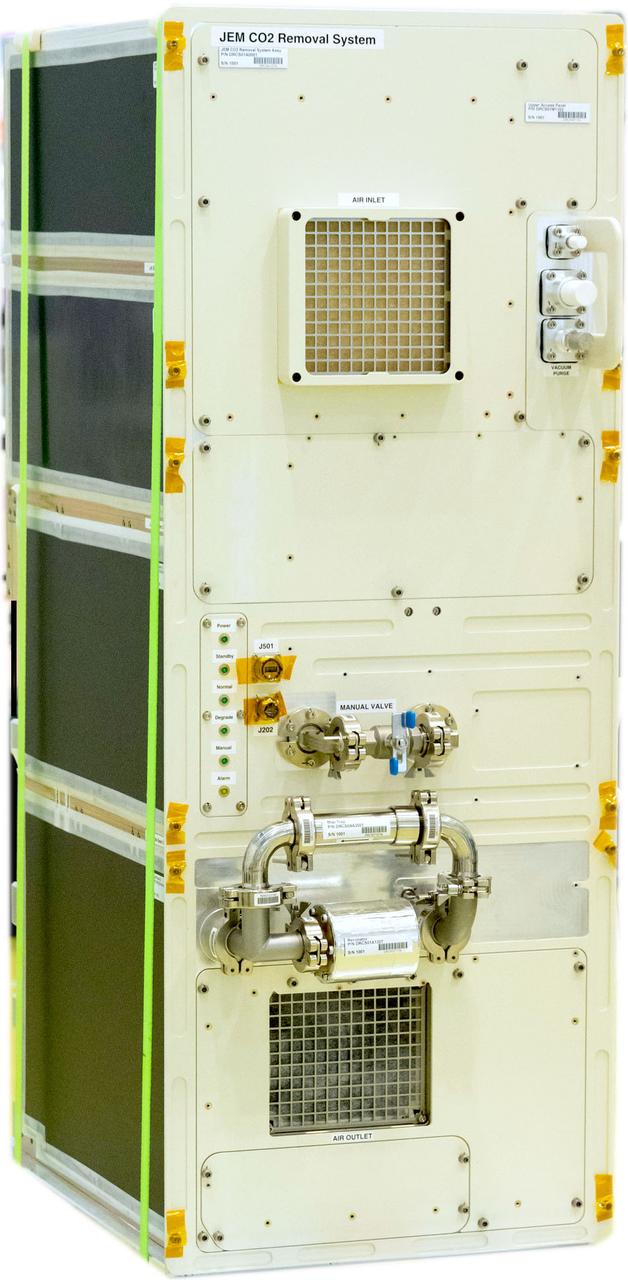
jsc2025e076916 (September 25, 2025) -- A close-up view of the JEM Demonstration of CO? Removal System (JEM DRCS) hardware. JEM DRCS will operate on the space station by filtering carbon dioxide out of the cabin air. The experiment will help guide future spacecraft life support systems and could also support technologies that reduce carbon dioxide emissions on Earth. Image courtesy of JAXA.
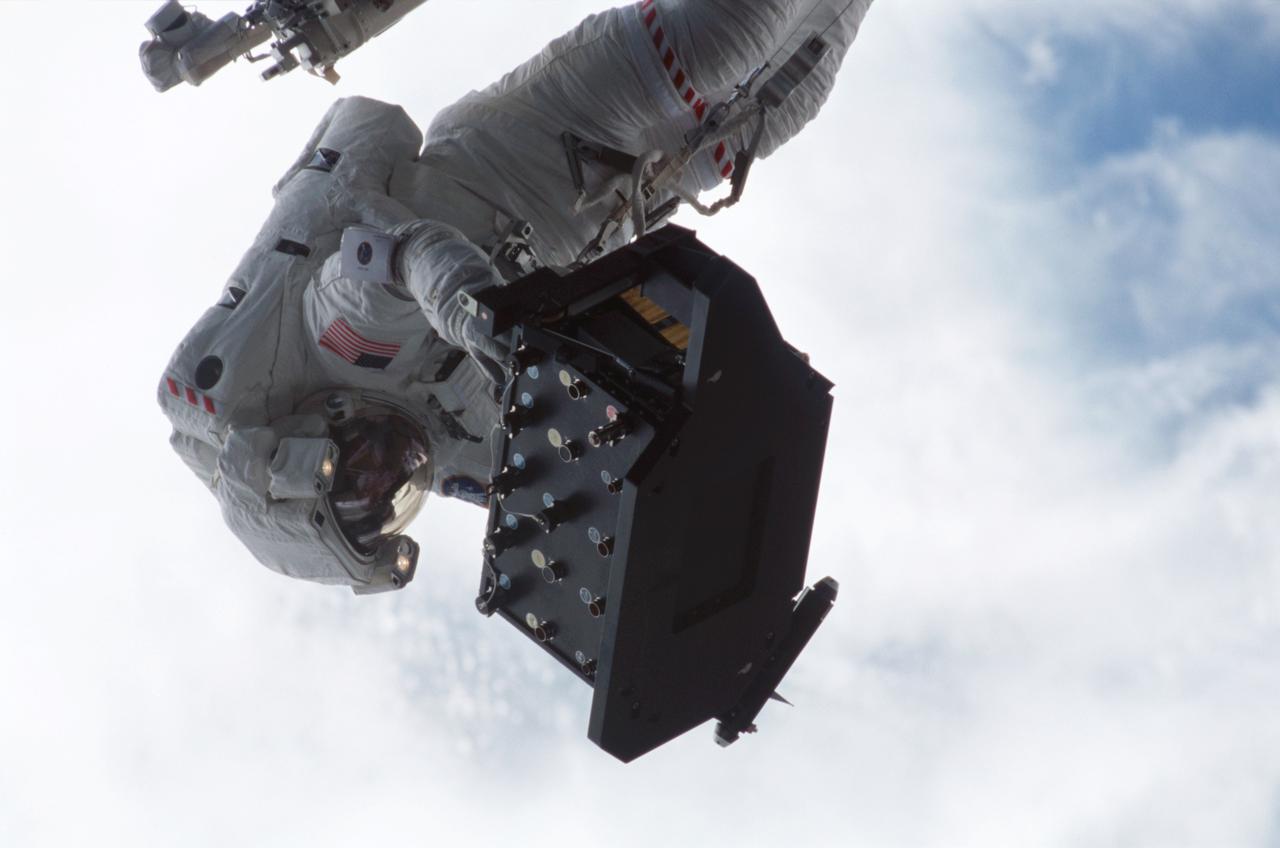
STS109-323-035 (7 March 2002) --- Astronaut Michael J. Massimino, on the shuttle’s robotic arm, prepares to install the Electronic Support Module (ESM) in the aft shroud of the Hubble Space Telescope (HST), with the assistance of astronaut James H. Newman (out of frame). The module will support a new experimental cooling system to be installed during the next day's fifth and final scheduled spacewalk of the mission. That cooling system is designed to bring the telescope's Near-Infrared Camera and Multi-Object Spectrometer (NICMOS) back to life.
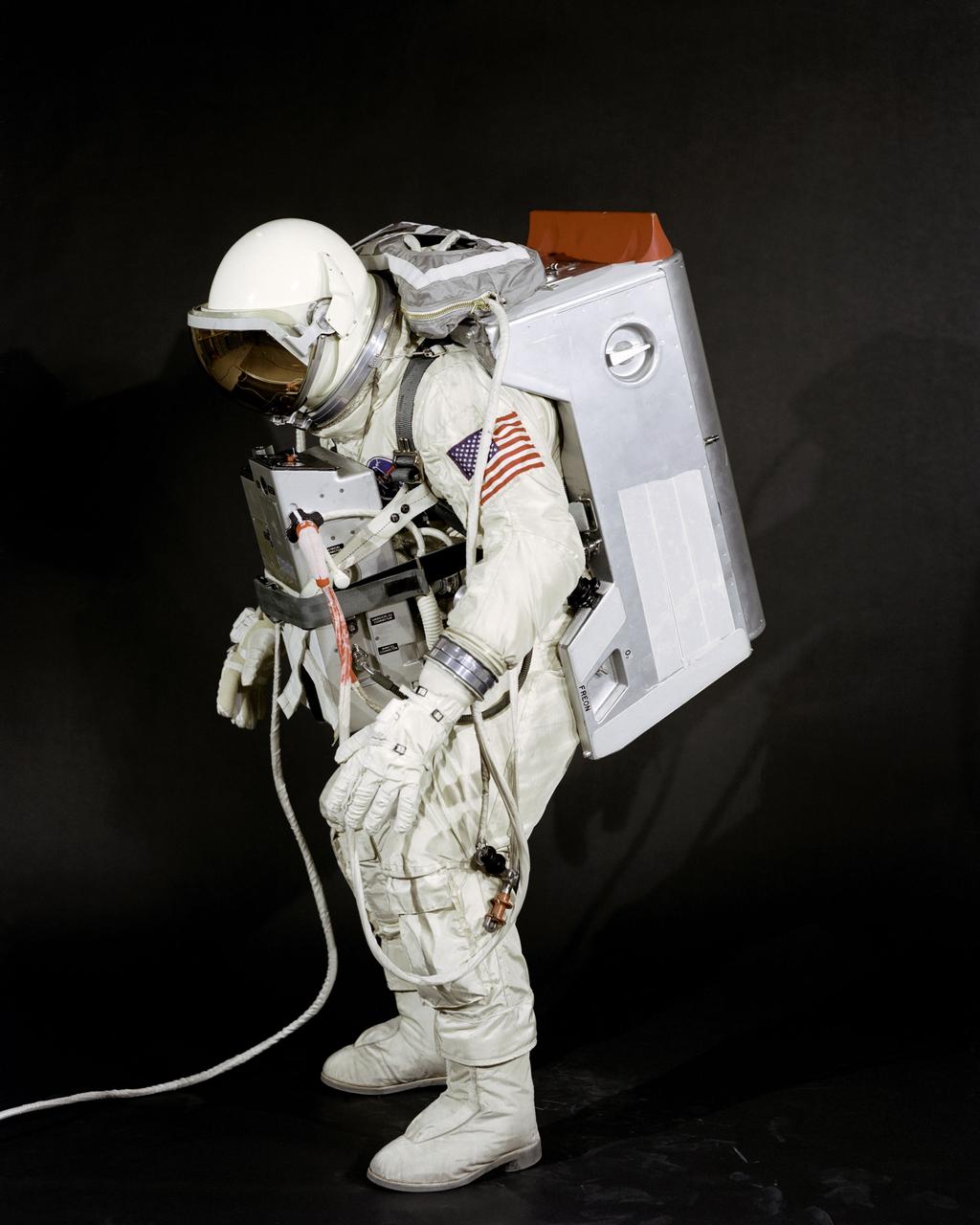
S66-17475 (18 Jan. 1966) --- Test subject Fred Spress, Crew Systems Division, wears the spacesuit and extravehicular equipment planned for use by astronaut David R. Scott. The helmet is equipped with a gold-plated visor to shield the astronaut's face from unfiltered sun rays. The system is composed of a life support pack worn on the chest and a support pack worn on the back. Photo credit: NASA
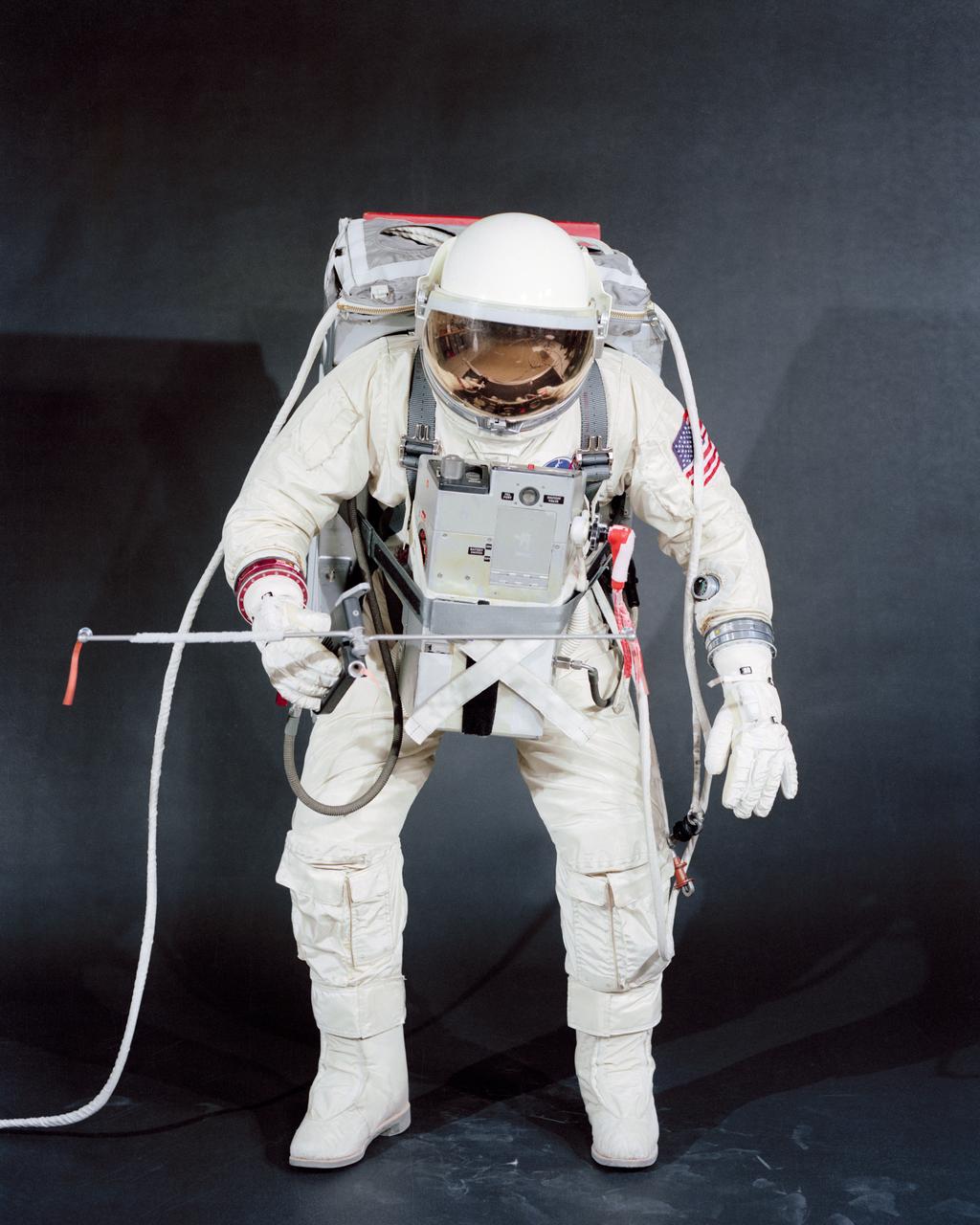
S66-17480 (18 Jan. 1966) --- Test subject Fred Spress, Crew Systems Division, wears the spacesuit and extravehicular equipment planned for use by astronaut David R. Scott. The helmet is equipped with a gold-plated visor to shield the astronaut's face from unfiltered sun rays. The system is composed of a life support pack worn on the chest and a support pack worn on the back. Photo credit: NASA
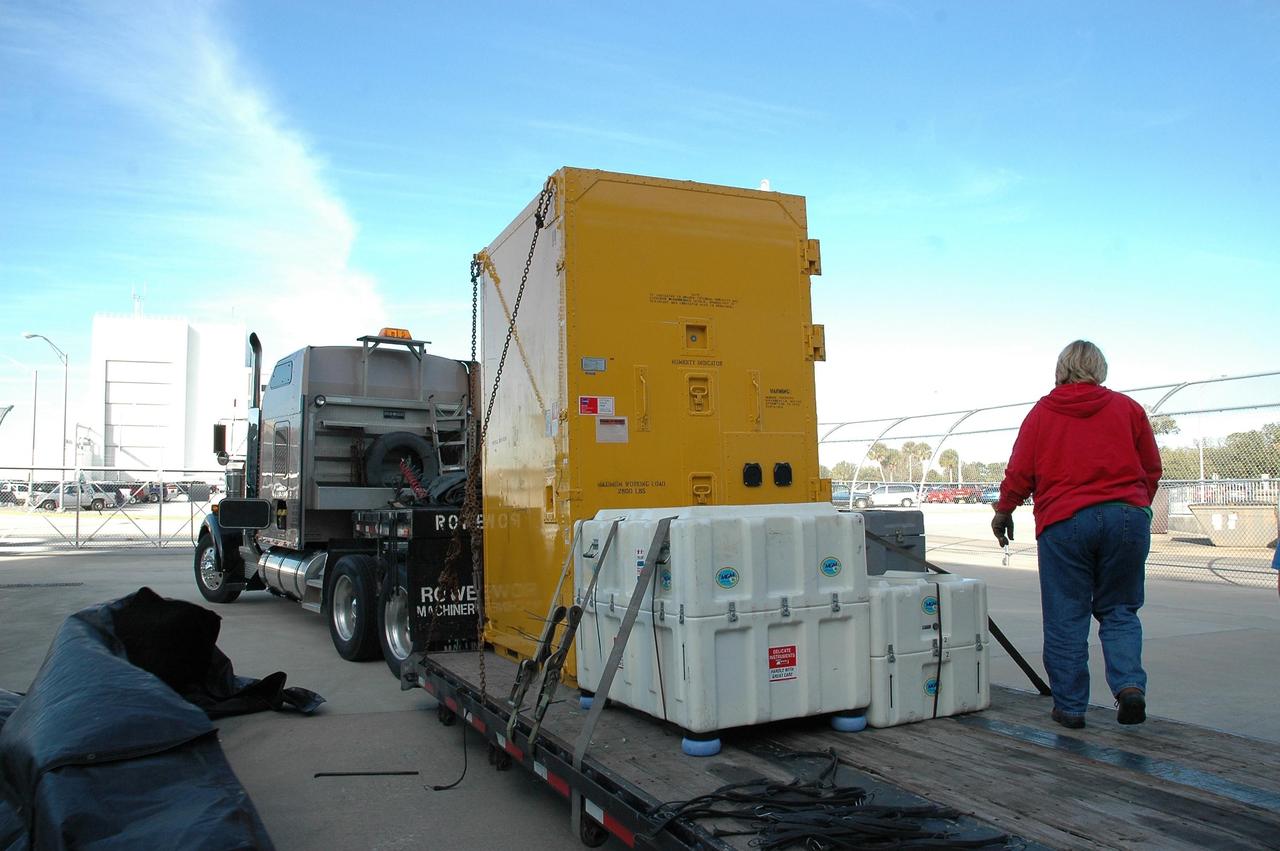
KENNEDY SPACE CENTER, FLA. — A truck arrives at NASA Kennedy Space Center carrying a new environmental control and life support system. The life support system is part of the payload on the second return-to-flight test mission, STS-121, aboard space shuttle Discovery to the International Space Station. The system will add to the station’s oxygen-making capabilities and could provide enough oxygen for up to six people. Managed by Marshall Space Flight Center in Huntsville, the system was built by Hamilton Sundstrand Corp. in Connecticut. Discovery will carry more than two tons of equipment and supplies to the station. This second return-to-flight test mission is to carry on analysis of safety improvements that debuted on the first return-to-flight mission, STS-114, and build upon those tests. The launch is targeted for a date no earlier than May. Photo credit: NASA/Jack Pfaller
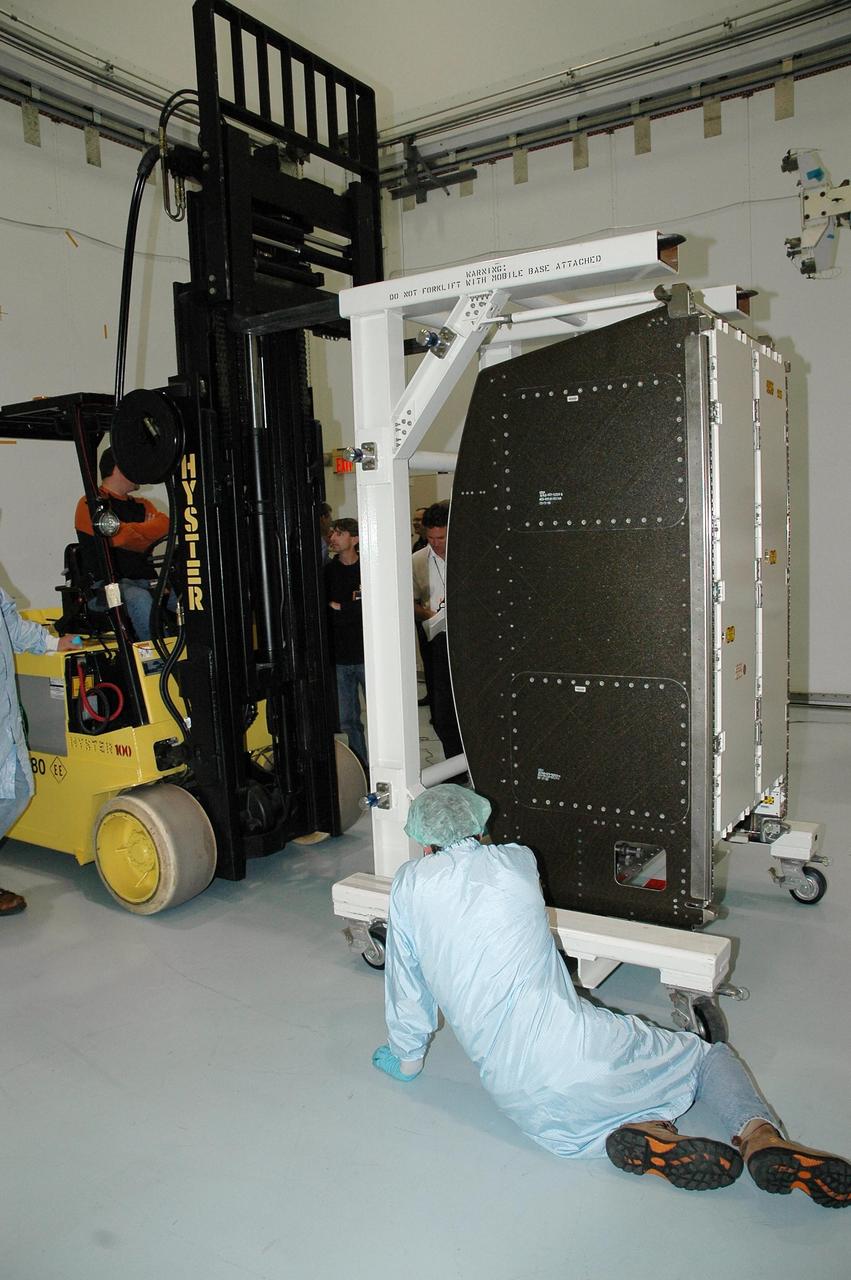
KENNEDY SPACE CENTER, FLA. — At NASA Kennedy Space Center, a new environmental control and life support system is moved into the Space Station Processing Facility after being removed from its shipping container. The life support system is part of the payload on the second return-to-flight test mission, STS-121, aboard space shuttle Discovery to the International Space Station. The system will add to the station’s oxygen-making capabilities and could provide enough oxygen for up to six people. Managed by Marshall Space Flight Center in Huntsville, the system was built by Hamilton Sundstrand Corp. in Connecticut. Discovery will carry more than two tons of equipment and supplies to the station. This second return-to-flight test mission is to carry on analysis of safety improvements that debuted on the first return-to-flight mission, STS-114, and build upon those tests. The launch is targeted for a date no earlier than May. Photo credit: NASA/Jack Pfaller
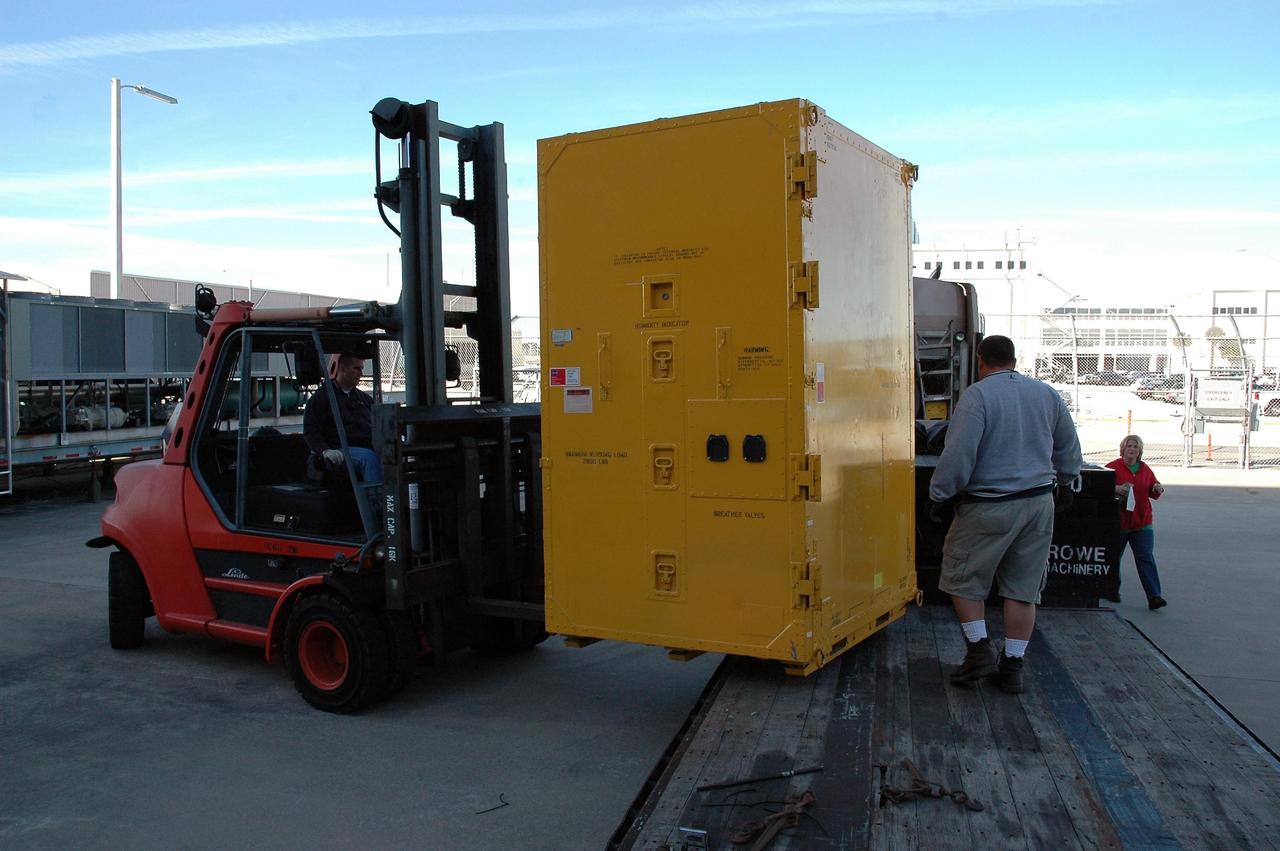
KENNEDY SPACE CENTER, FLA. — At NASA Kennedy Space Center, a new environmental control and life support system is offloaded from a truck. The life support system is part of the payload on the second return-to-flight test mission, STS-121, aboard space shuttle Discovery to the International Space Station. The system will add to the station’s oxygen-making capabilities and could provide enough oxygen for up to six people. Managed by Marshall Space Flight Center in Huntsville, the system was built by Hamilton Sundstrand Corp. in Connecticut. Discovery will carry more than two tons of equipment and supplies to the station. This second return-to-flight test mission is to carry on analysis of safety improvements that debuted on the first return-to-flight mission, STS-114, and build upon those tests. The launch is targeted for a date no earlier than May. Photo credit: NASA/Jack Pfaller
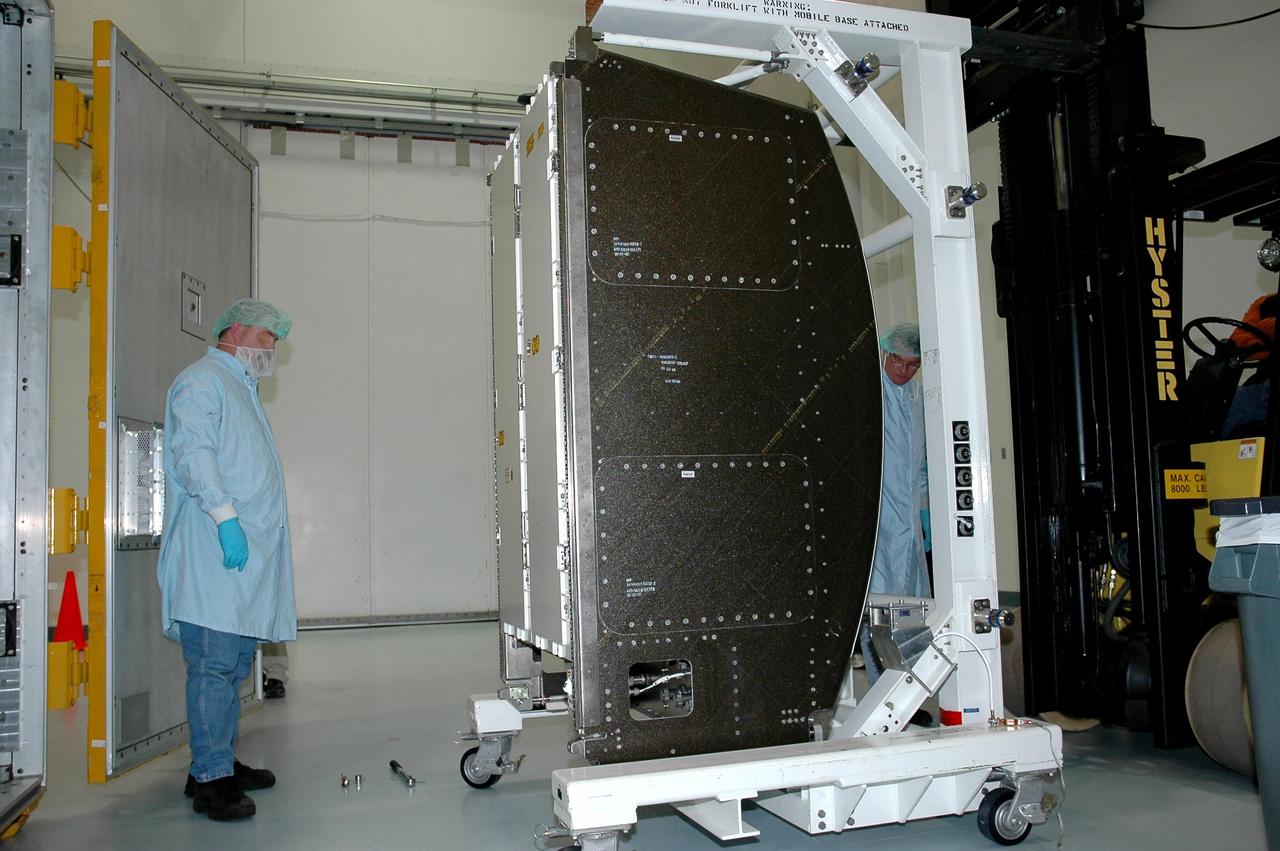
KENNEDY SPACE CENTER, FLA. — At NASA Kennedy Space Center, a new environmental control and life support system is moved into the Space Station Processing Facility. The life support system is part of the payload on the second return-to-flight test mission, STS-121, aboard space shuttle Discovery to the International Space Station. The system will add to the station’s oxygen-making capabilities and could provide enough oxygen for up to six people. Managed by Marshall Space Flight Center in Huntsville, the system was built by Hamilton Sundstrand Corp. in Connecticut. Discovery will carry more than two tons of equipment and supplies to the station. This second return-to-flight test mission is to carry on analysis of safety improvements that debuted on the first return-to-flight mission, STS-114, and build upon those tests. The launch is targeted for a date no earlier than May. Photo credit: NASA/Jack Pfaller

iss071e414633 (July 31, 2024) --- NASA astronaut and Expedition 71 Flight Engineer Matthew Dominick is pictured wearing a spacesuit aboard the International Space Station's Quest airlock. Dominick was evaluating the spacesuit, configuring its components, and testing the suit’s communications and life support systems.
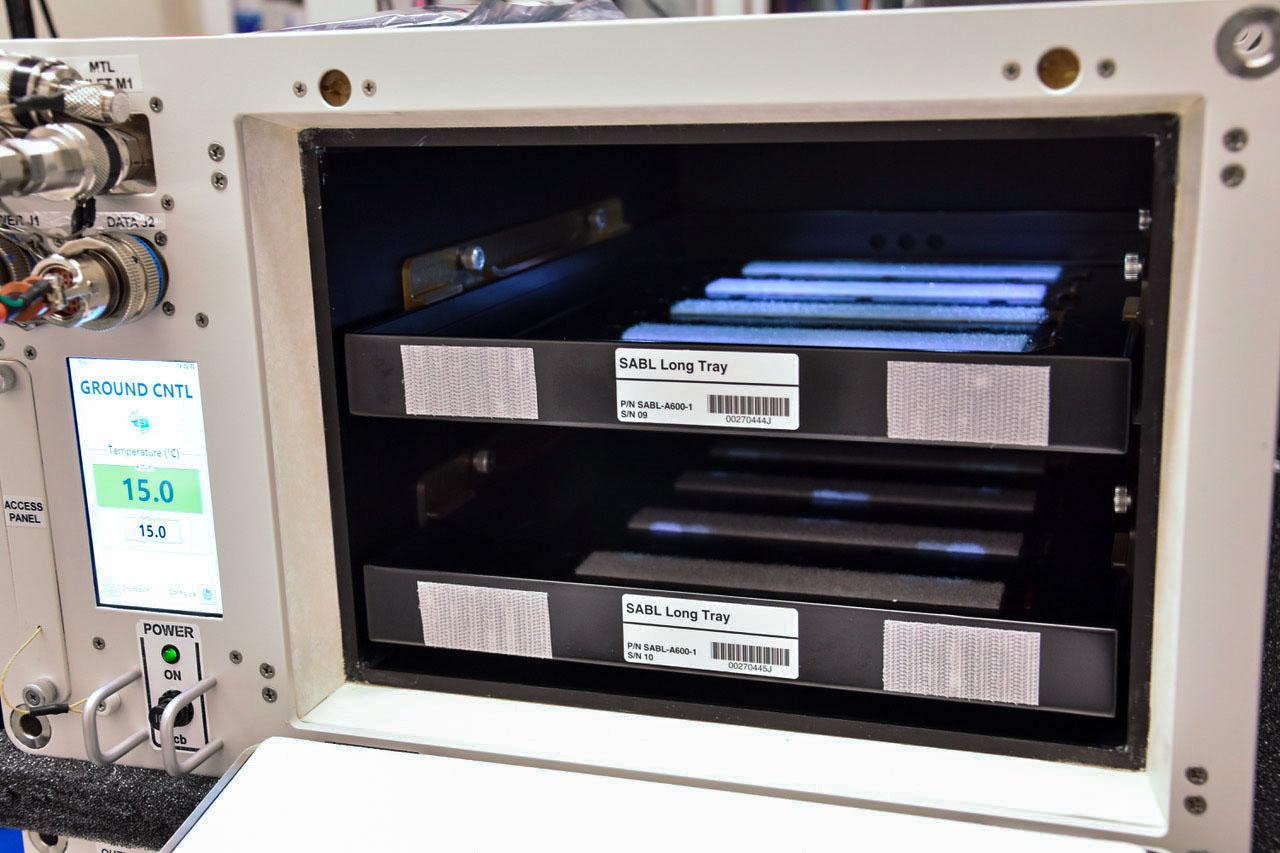
jsc2021e037286 (5/21/2021) --- A preflight view of the SALI incubator. The Space Automated Lab Incubator (SALI) supports a wide variety of investigations in the life, physical, and material sciences, focusing on research on biological systems and processes. SALI accommodates multiple sample packs or habitats and also serves as back-up cold stowage.
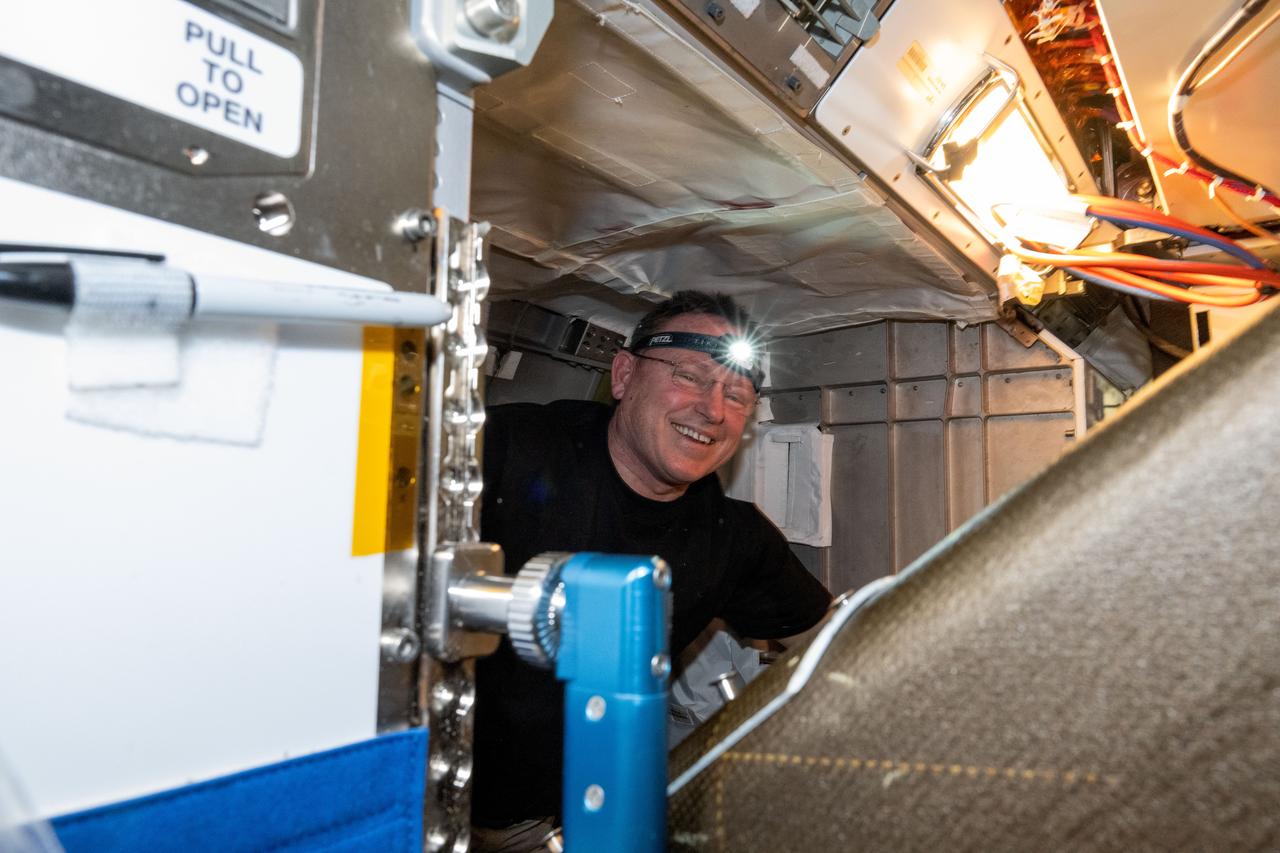
iss071e580589 (Aug. 27, 2024) --- Veteran NASA astronaut Butch Wilmore, who has launched to the International Space Station on three different spacecraft (Space Shuttle Atlantis, Soyuz TMA-14, and Boeing's CST-100 Starliner), services life support hardware located in the Tranquility module’s Air Revitalization System rack.

iss071e414639 (July 31, 2024) --- NASA astronaut and Expedition 71 Flight Engineer Matthew Dominick is pictured wearing a spacesuit aboard the International Space Station's Quest airlock. Dominick was evaluating the spacesuit, configuring its components, and testing the suit’s communications and life support systems.
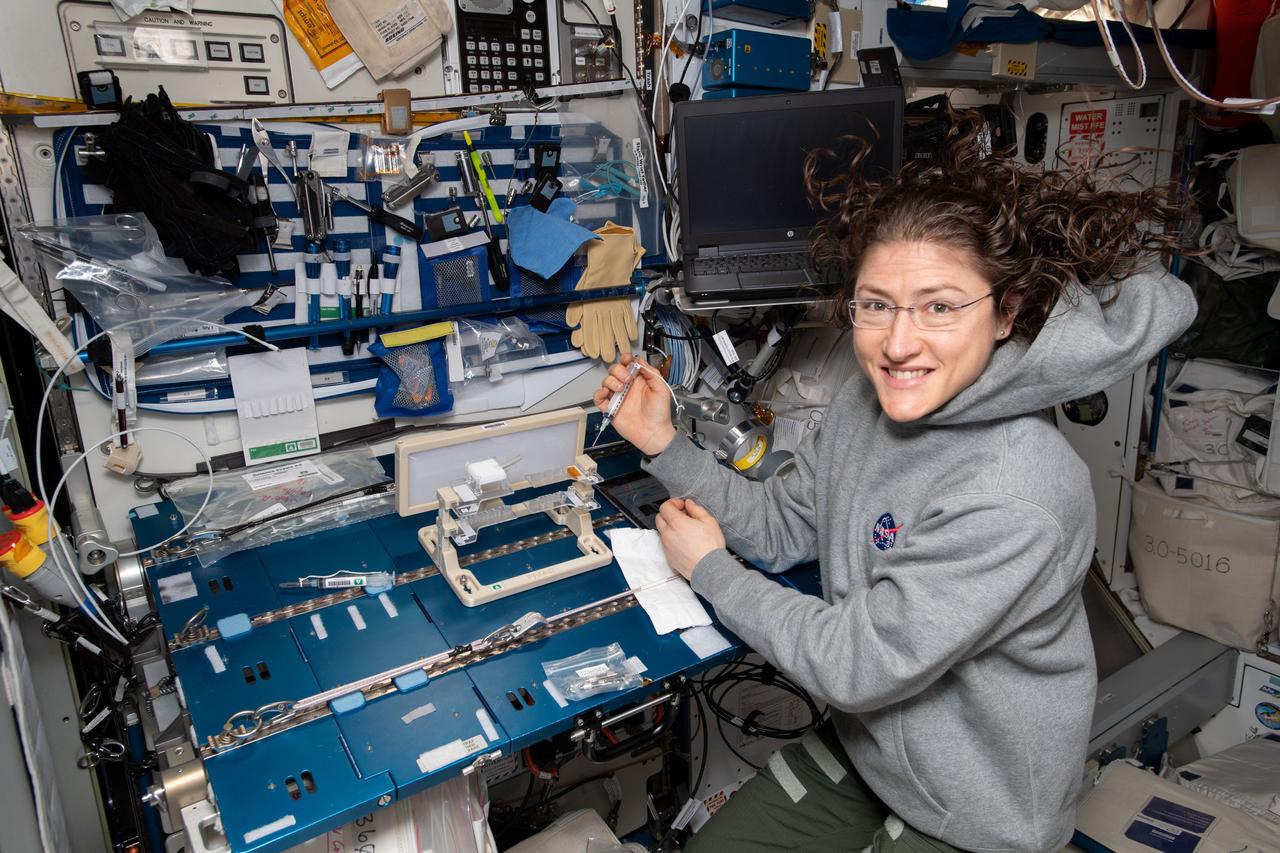
iss059e101367 (June 12, 2019) --- NASA astronaut Christina Koch checks out hardware for the Capillary Structures experiment. The investigation studies a new method of using structures of specific shapes to manage fluid and gas mixtures for more reliable life support systems on future space missions.
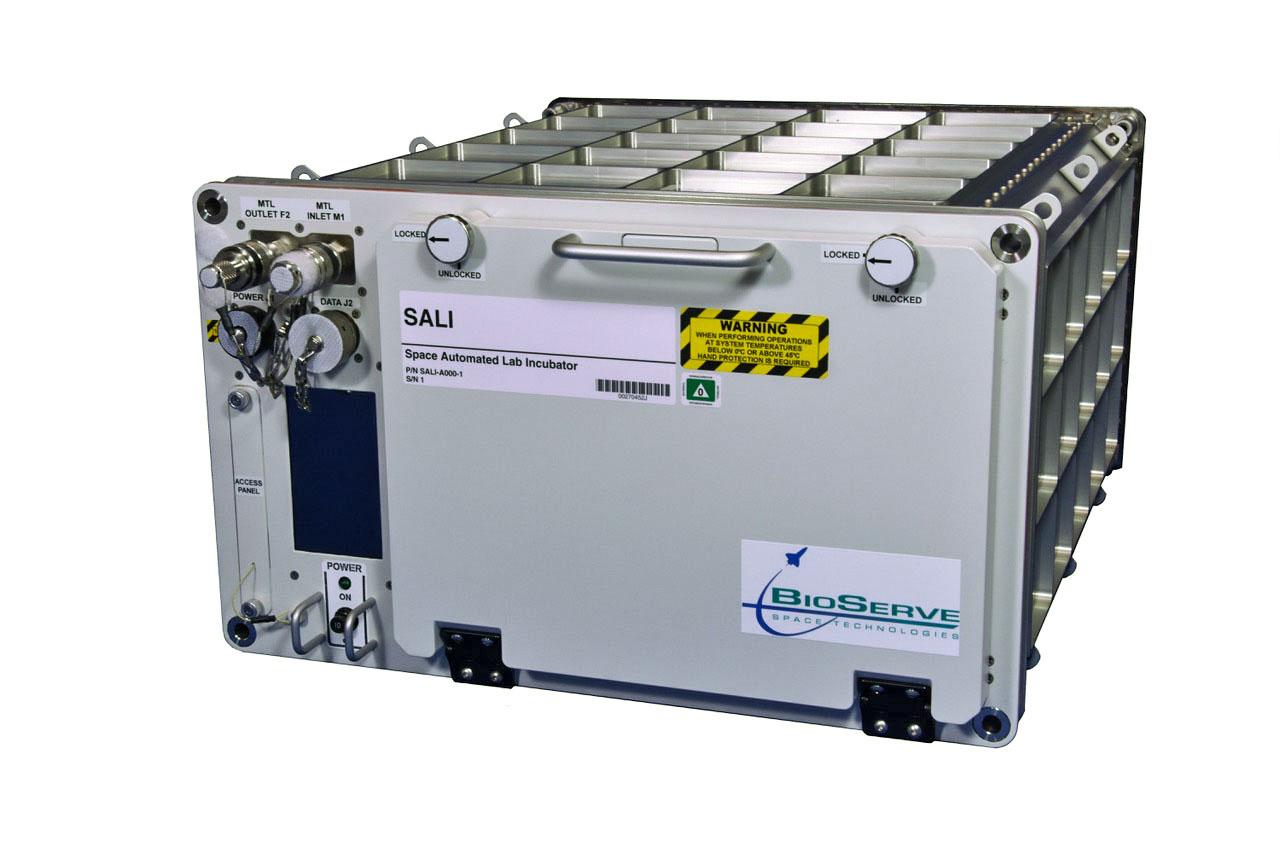
jsc2021e037287 (5/21/2021) --- A preflight view of the SALI incubator. The Space Automated Lab Incubator (SALI) supports a wide variety of investigations in the life, physical, and material sciences, focusing on research on biological systems and processes. SALI accommodates multiple sample packs or habitats and also serves as back-up cold stowage.e.
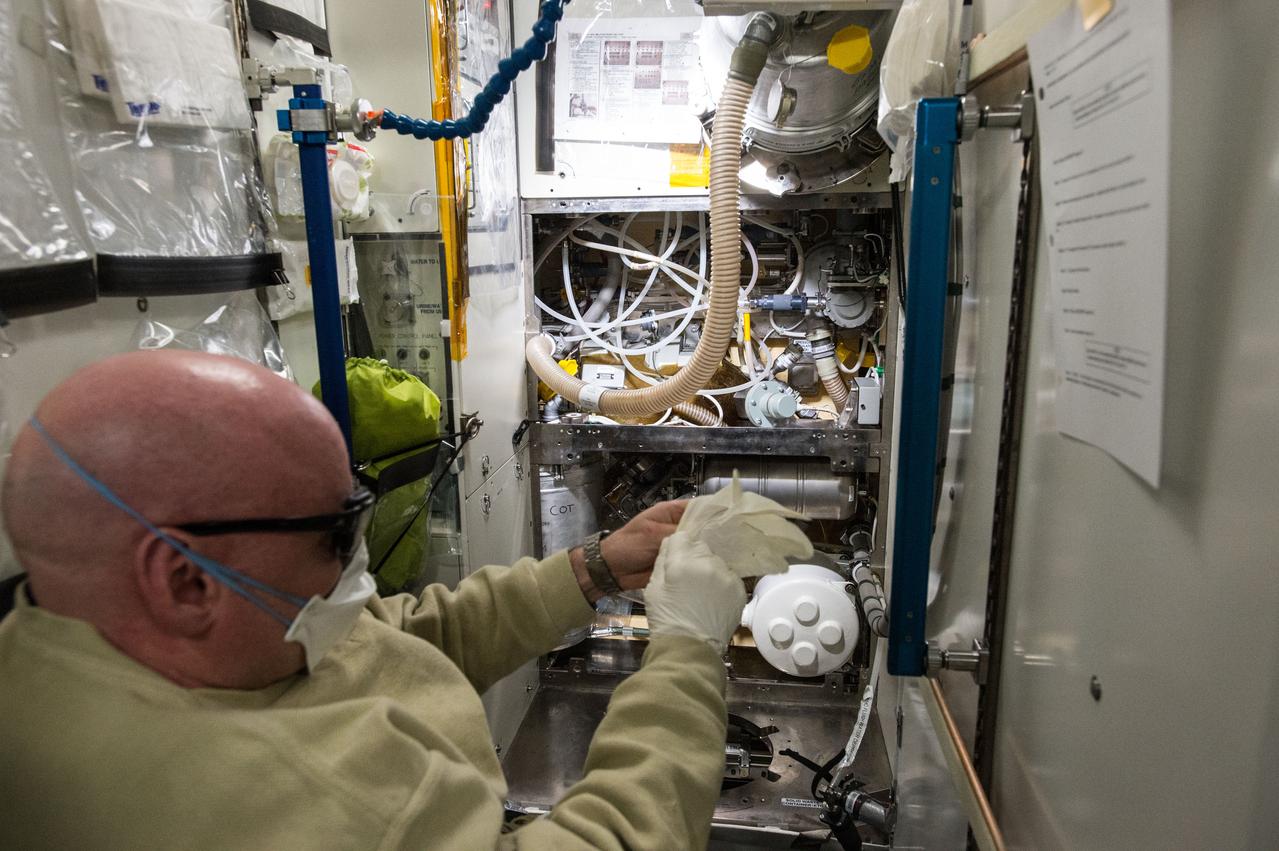
ISS046e005831 (01/07/2016) --- Expedition 46 Commander and NASA astronaut Scott Kelly works to clean up a leak in the Waste and Hygiene Compartment aboard the International Space Station. Crew members are routinely called on for maintenance efforts across the orbiting laboratory as they work to keep their various life support systems in working order.
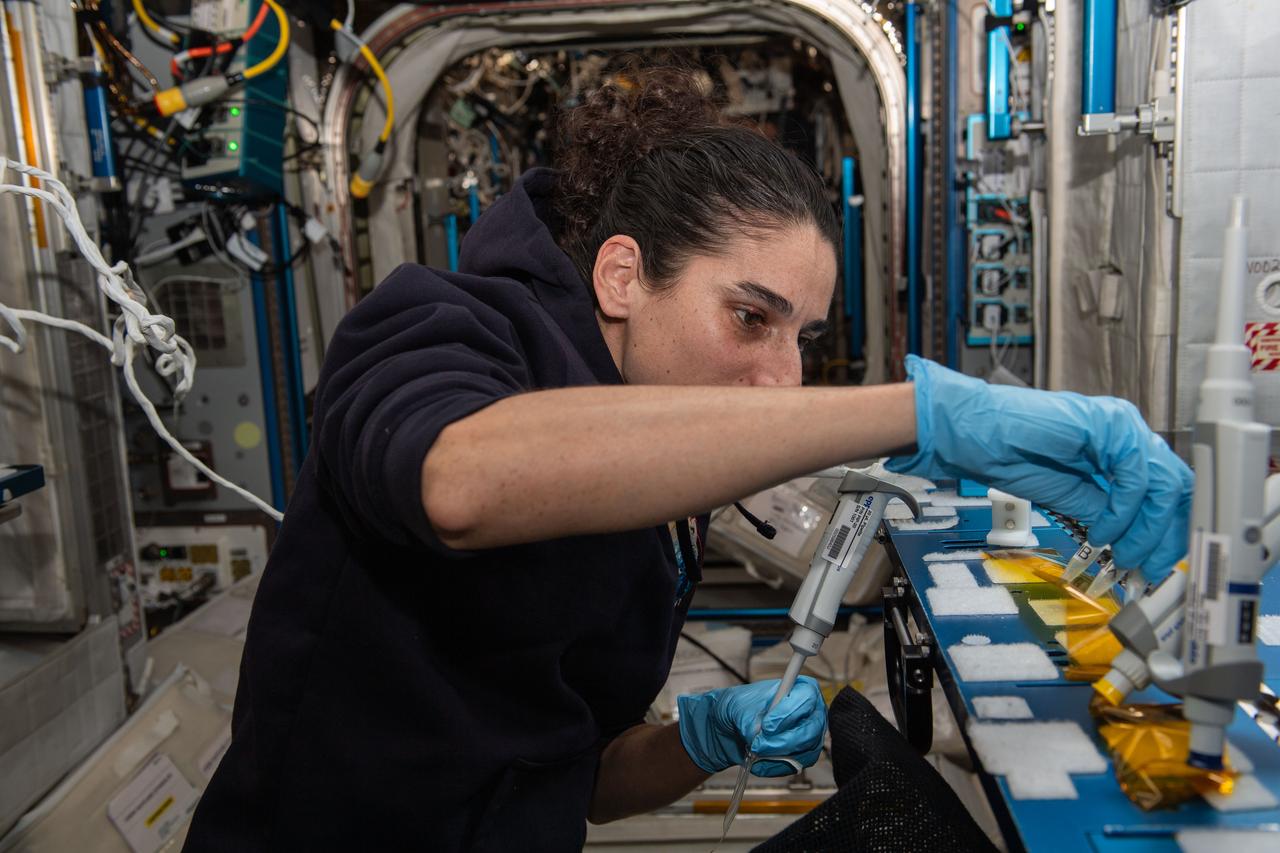
iss070e062919 (Jan. 11, 2024) --- NASA astronaut and Expedition 70 Flight Engineer Jasmin Moghbeli sequences DNA samples for the BioMole study demonstrating hardware that can analyze microbes to protect crew health and spacecraft life support systems.
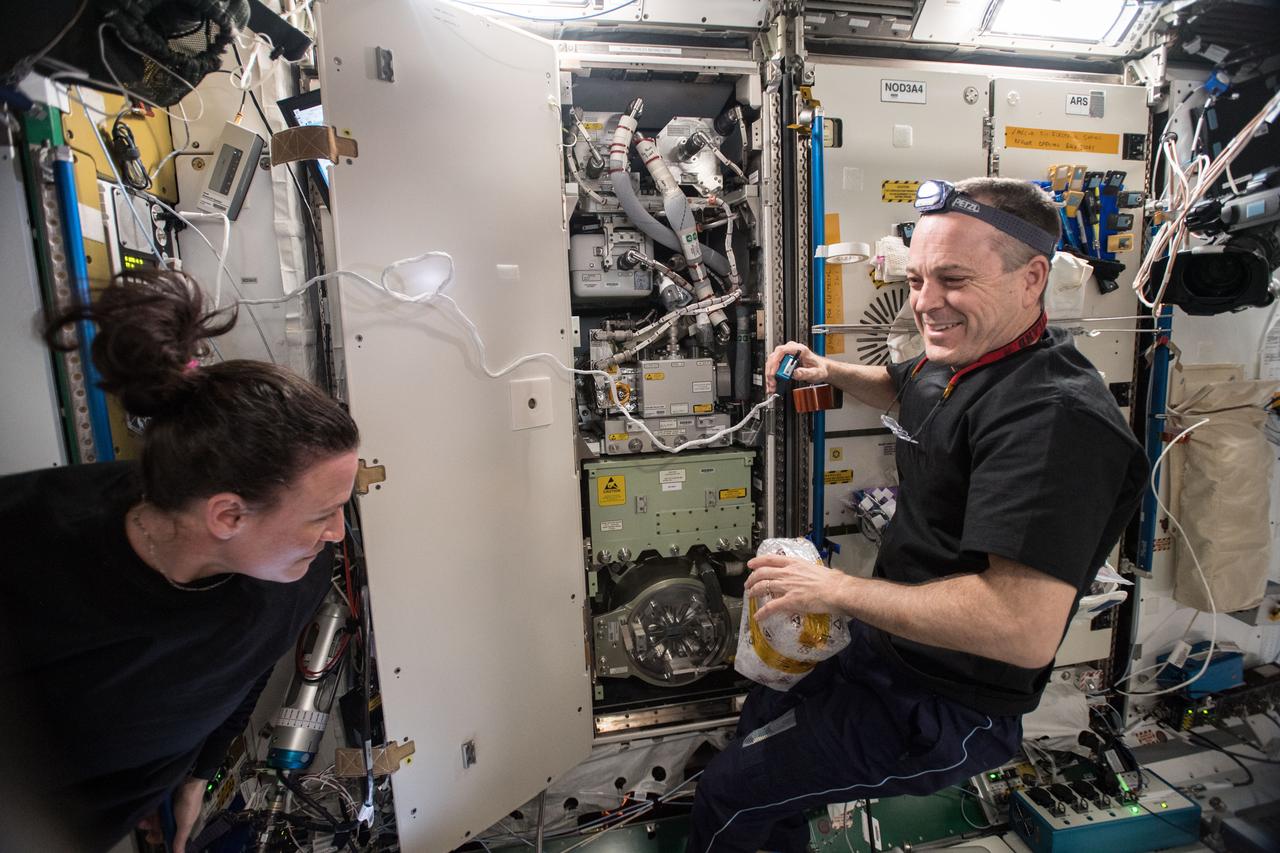
iss056e014488 (June 18, 2018) --- Expedition 56 Flight Engineers Serena Auñón-Chancellor (right) and Ricky Arnold of NASA are pictured in the Unity module during life support maintenance work to remove and replace an Oxygen Generation System Hydrogen Sensor.
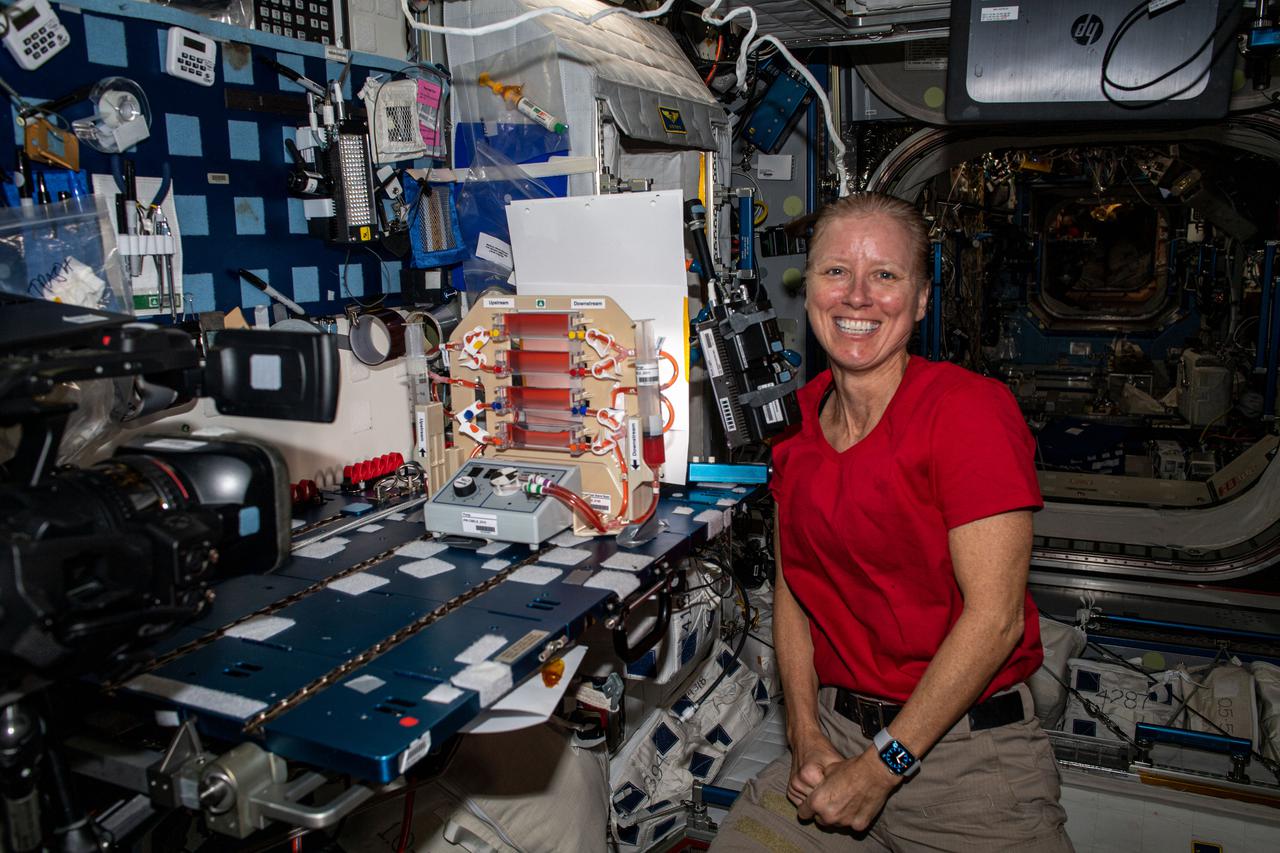
iss064e029079 (Feb. 4, 2021) --- NASA astronaut and Expedition 64 Flight Engineer Shannon Walker researches how to manage fluid and gas mixtures inside structures of specific shapes for the Capillary Structures technology demonstration. Results could lead to lightweight, more reliable life support systems for future space missions.
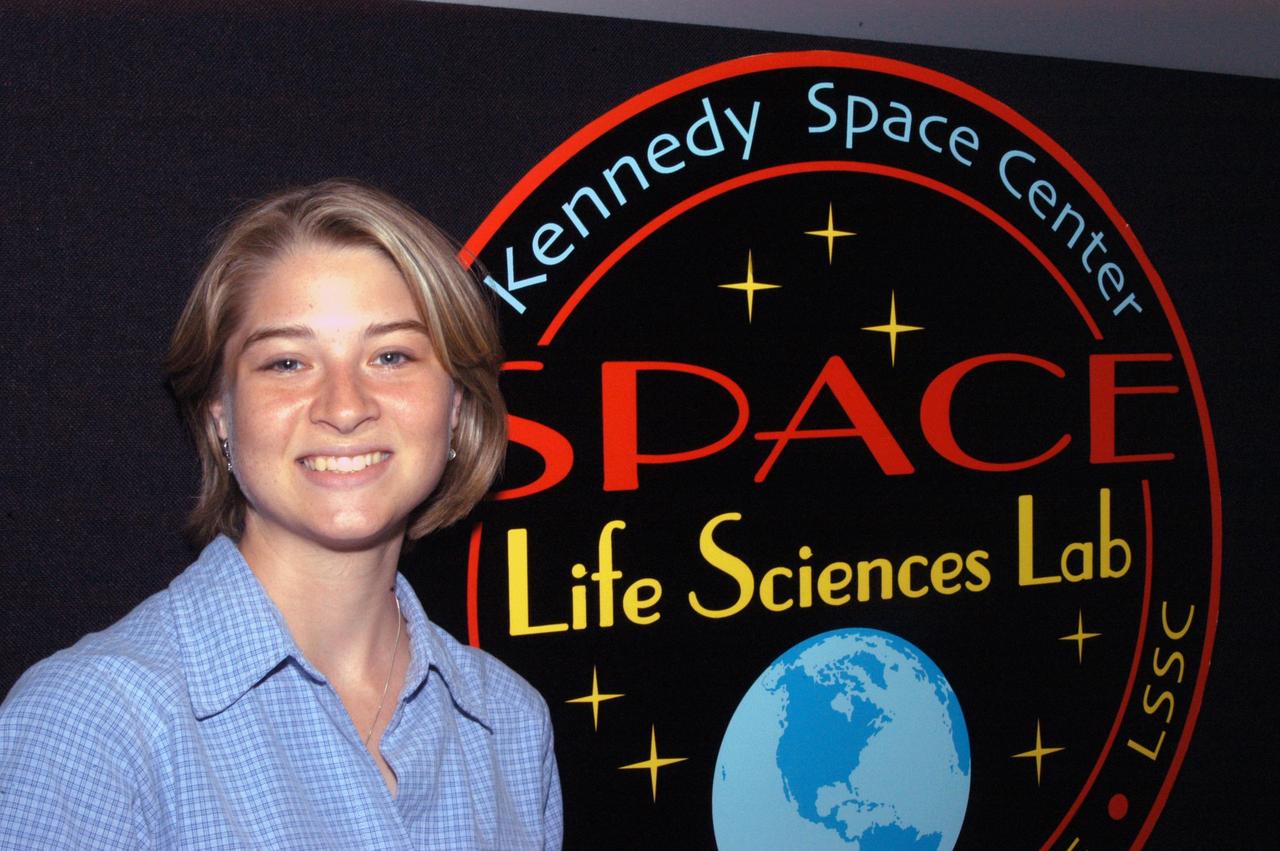
KENNEDY SPACE CENTER, FLA. - Kimberly Beck, a college trainee in Controlled Biological Systems in the Spaceflight and Life Sciences Training Program, is helping with growth studies supporting payload development. Behind her is part of the WONDER (Water Offset Nutrient Delivery Experiment) flight payload that is investigating hydroponic plant crop production in microgravity.
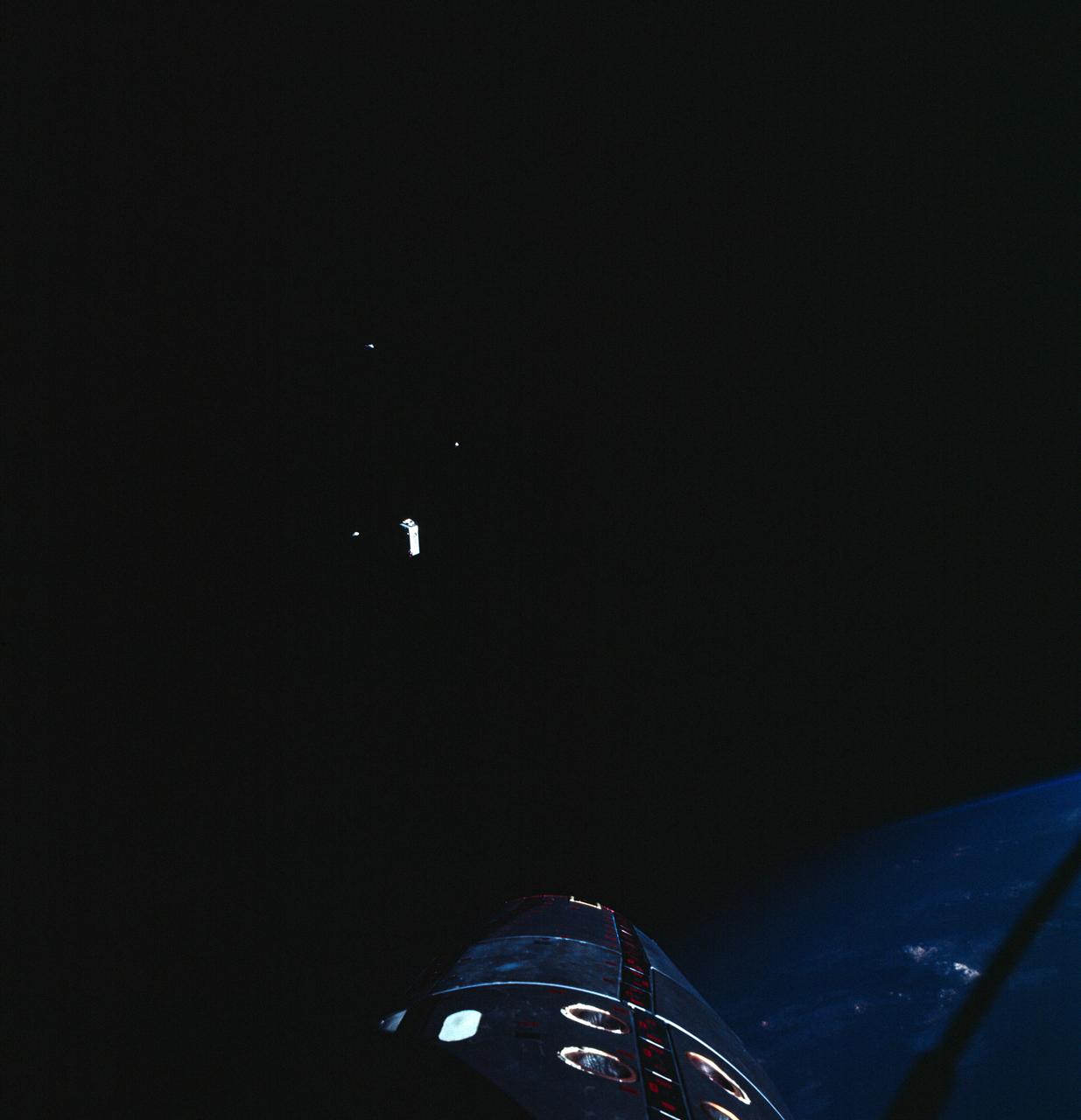
S66-62999 (13 Nov. 1966) --- Jettison of the extravehicular life support system (ELSS) and other equipment from the Gemini-12 spacecraft during its rendezvous mission in space. The nose of the Gemini-12 spacecraft is clearly visible at right edge of photo. Photo credit: NASA
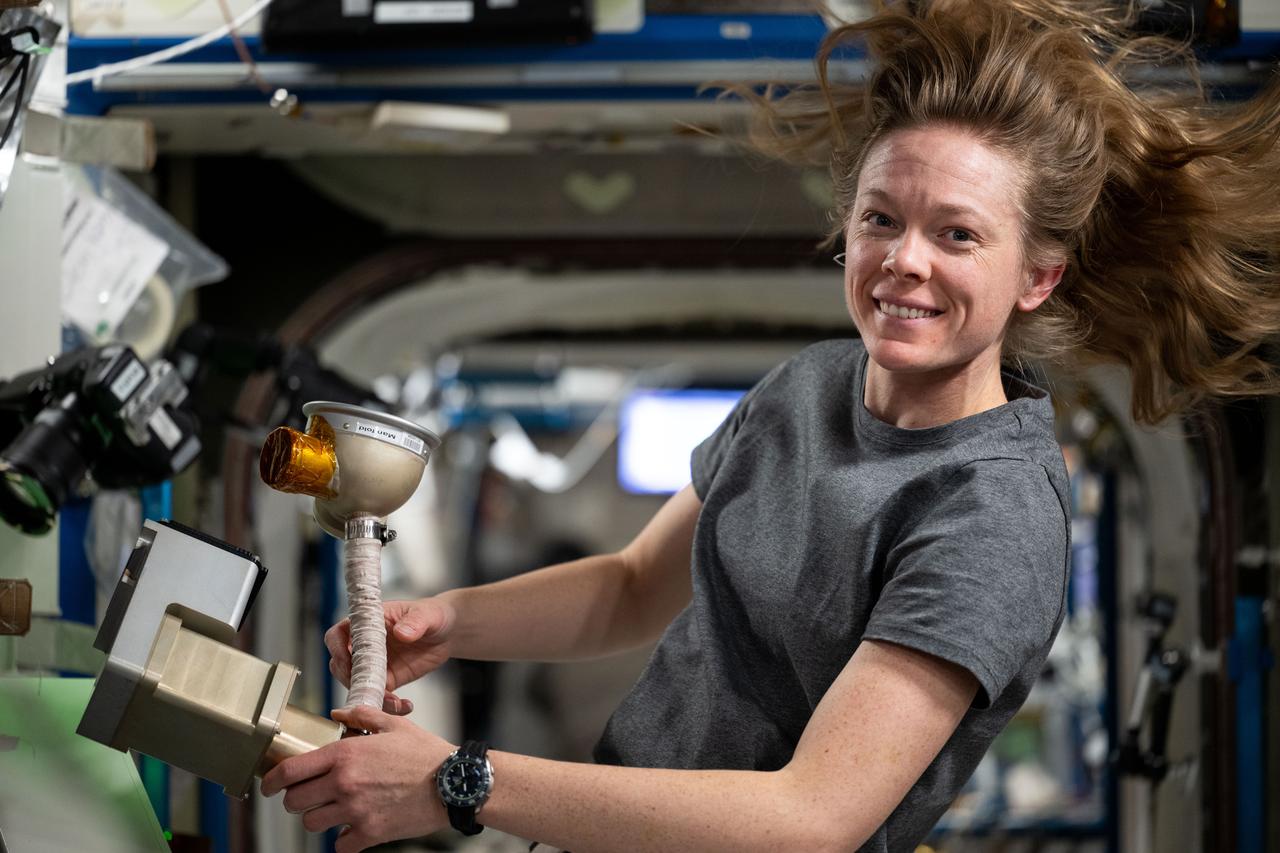
iss073e0118757 (May 29, 2025) --- NASA astronaut and Expedition 73 Flight Engineer Nichole Ayers cleans and services life support components that are part of the Oxygen Generation System rack located inside the International Space Station's Destiny laboratory module.
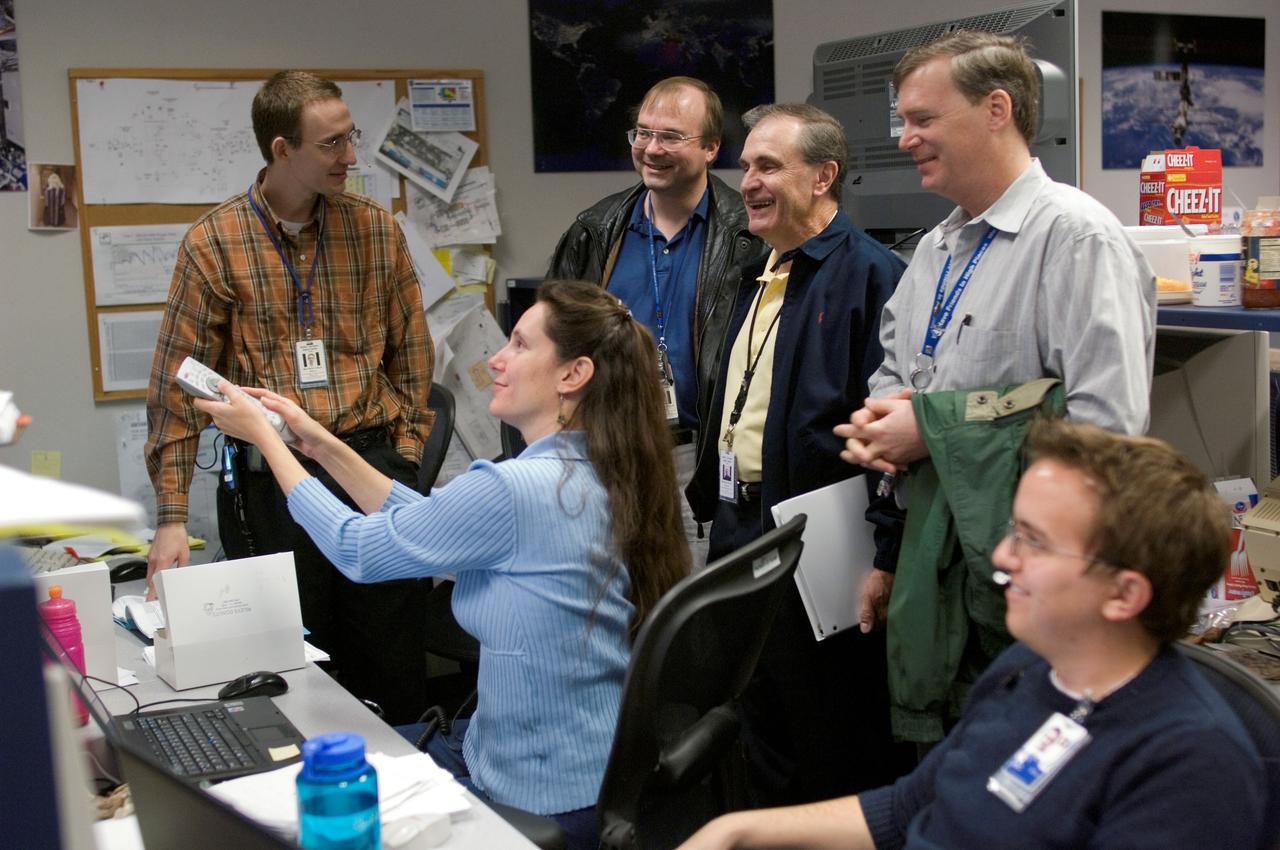
JSC2006-E-54262 ( ) --- MERLIN console operators review the Environmental Control and Life Support (ECLS) system status with ECLS management in preparation for the IMMT. Standing, from the left, are Brandon Dick , Matthew Davis, Richard Reysa and Greg Gentry. Seated are Karen Meyers (left) and Chris Matty.
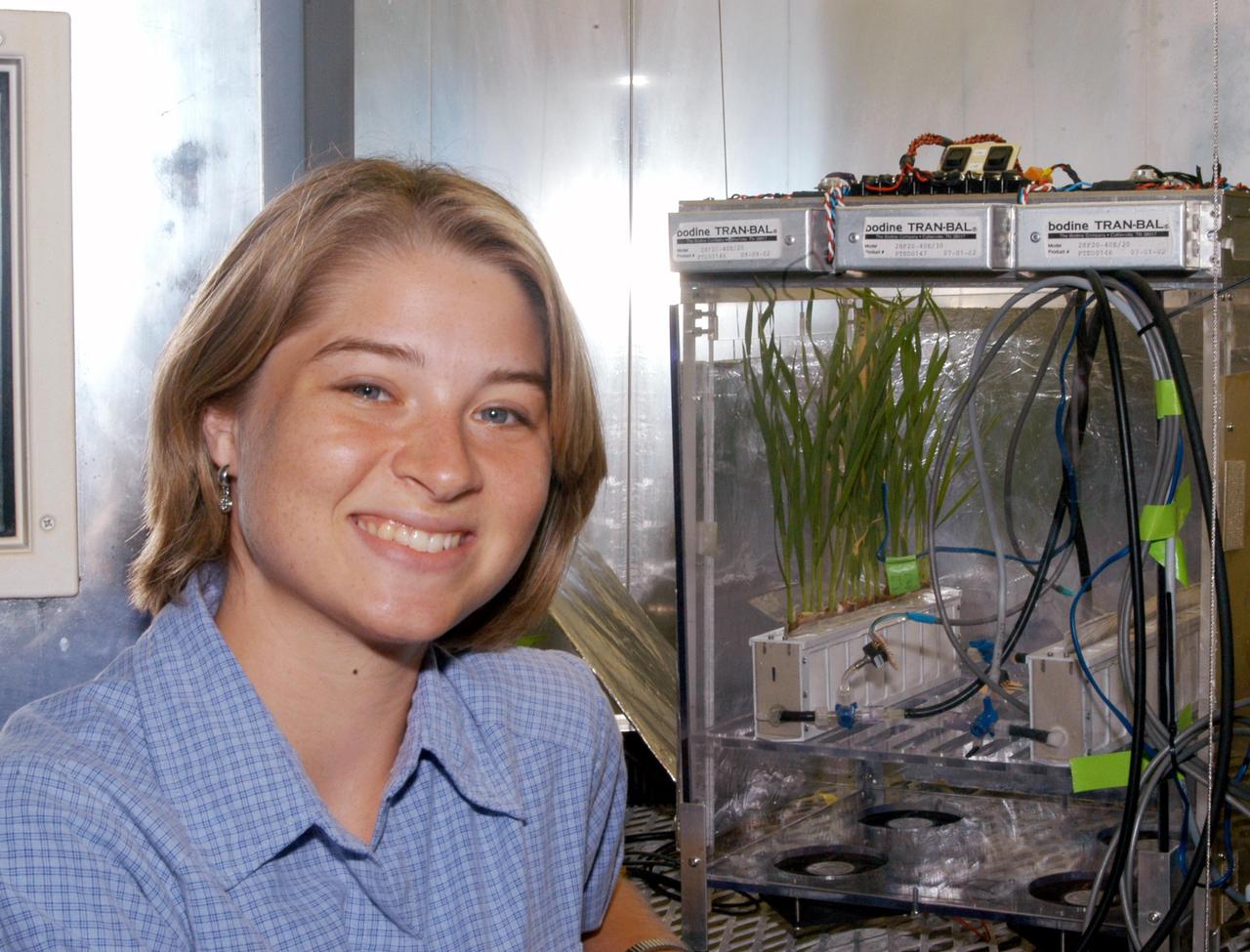
KENNEDY SPACE CENTER, FLA. - Kimberly Beck is a Controlled Biological Systems trainee in the Spaceflight and Life Sciences Training Program. She is helping with growth studies supporting the WONDER (Water Offset Nutrient Delivery Experiment) flight payload, which is investigating hydroponic plant crop production in microgravity.
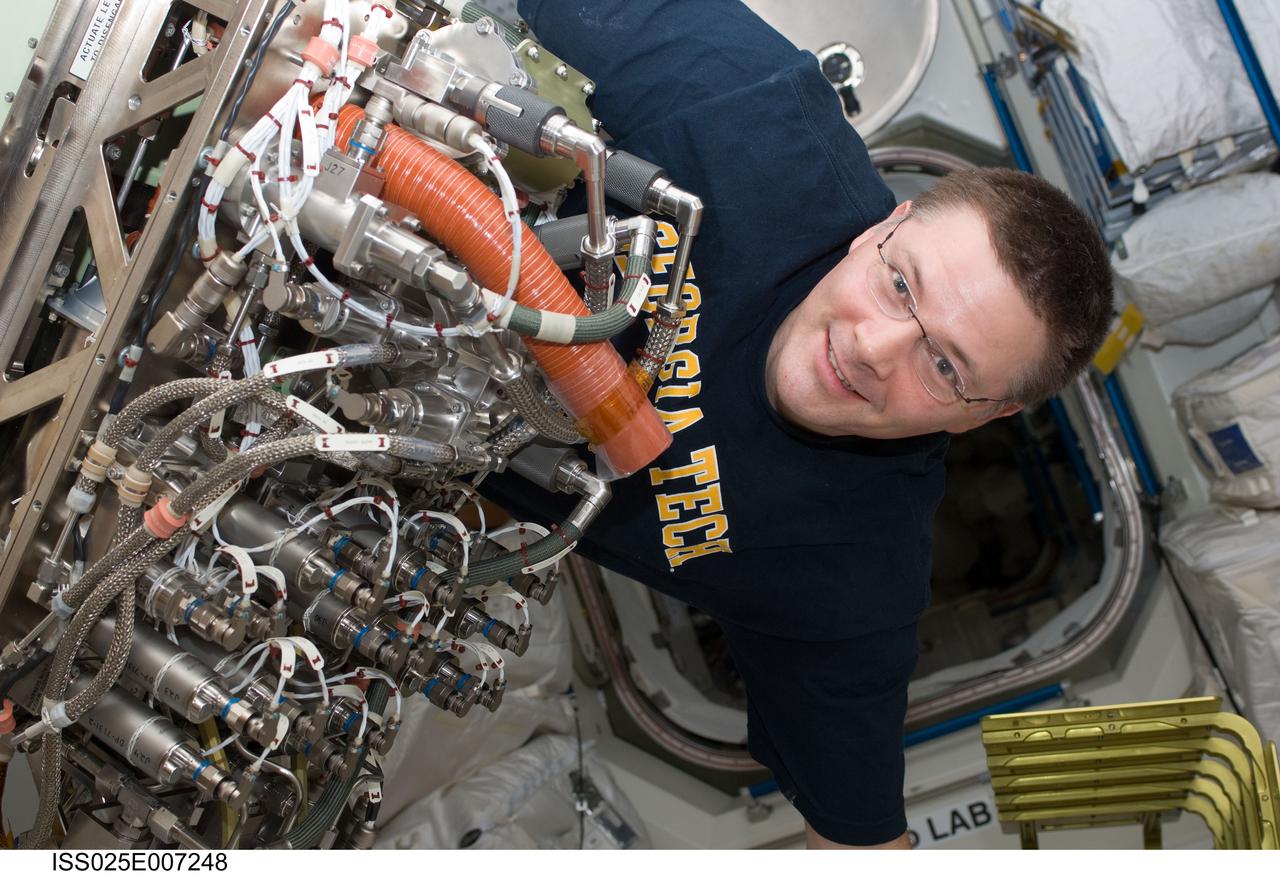
ISS025-E-007248 (13 Oct. 2010) --- In the Tranquility node aboard the International Space Station, NASA astronaut Doug Wheelock, Expedition 25 commander, works to install the new Sabatier system that will extract more water out of the ISS atmosphere. Sabatier will create water from the byproducts of the station?s Oxygen Generation System and Carbon Dioxide Removal Assembly. Under contract to NASA, Hamilton Sundstrand supplied the flight hardware and operational support for a Sabatier-reaction based system that operates as part of the station?s Environmental Control and Life Support System.
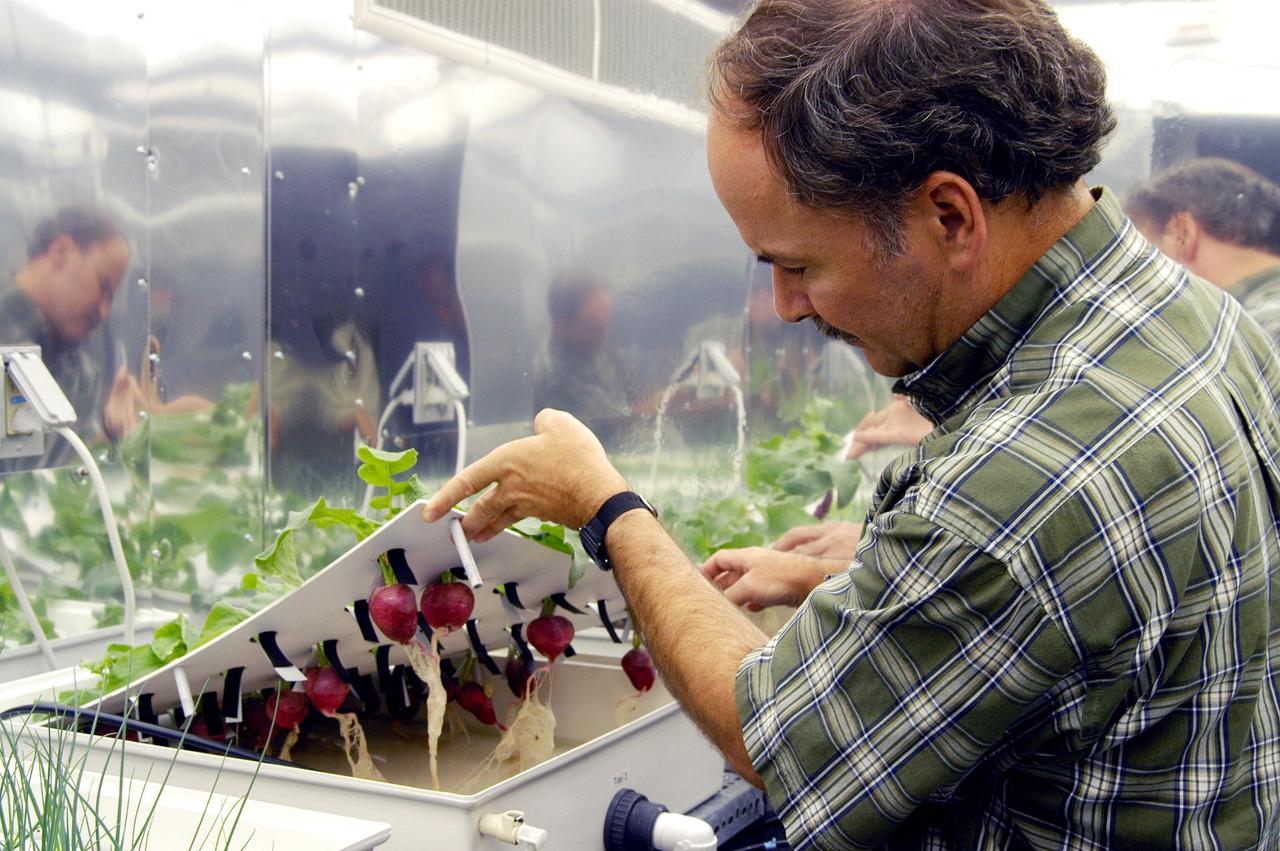
KENNEDY SPACE CENTER, FLA. - In a plant growth chamber in the KSC Space Life Sciences Lab, plant physiologist Ray Wheeler checks radishes being grown using hydroponic techniques. Wheeler and other colleagues are researching plant growth under different types of light, different CO2 concentrations and temperatures. The Lab is exploring various aspects of a bioregenerative life support system. Such research and technology development will be crucial to long-term habitation of space by humans.
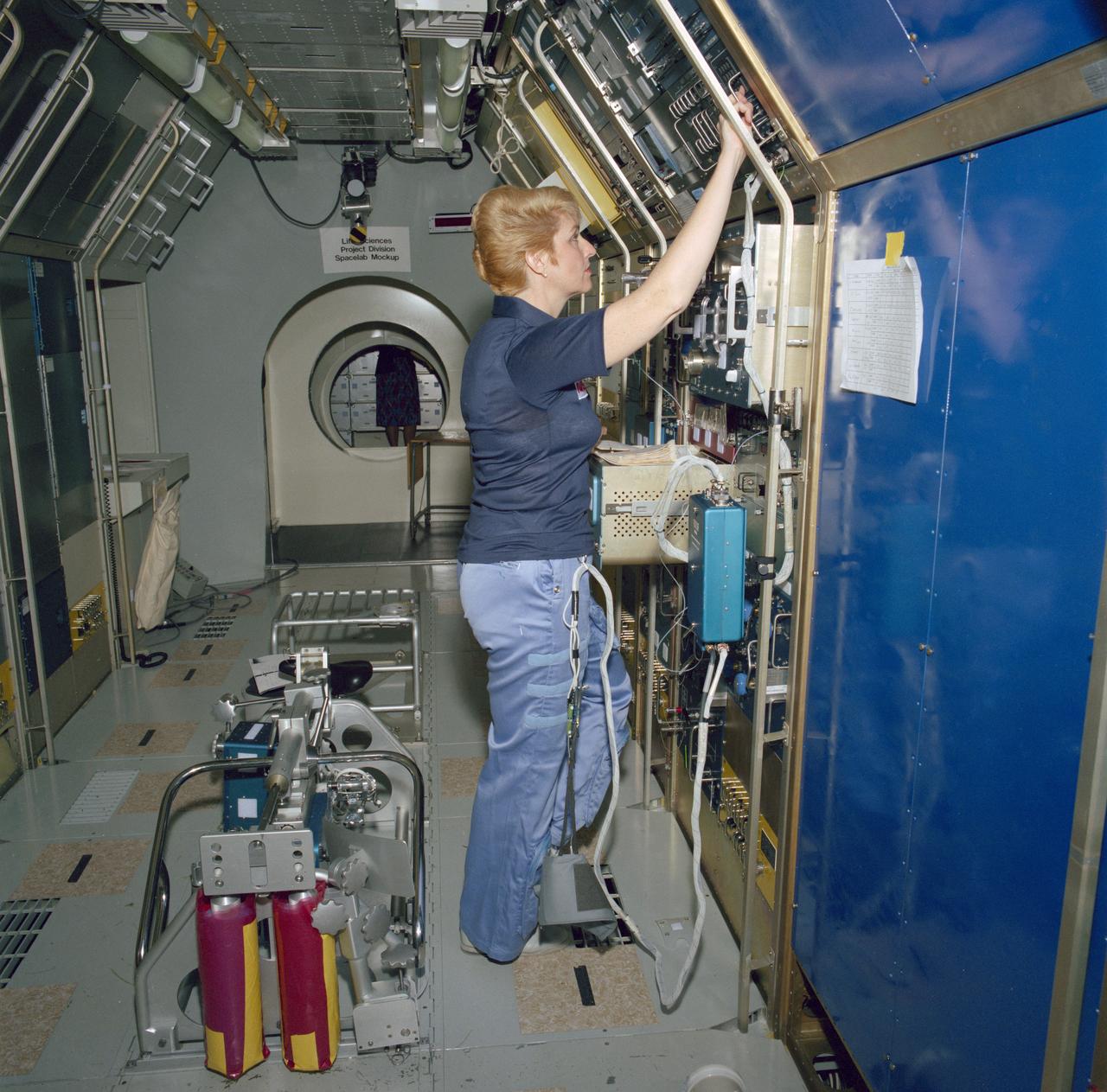
STS-40 Payload Specialist Millie Hughes-Fulford conducts Spacelab Life Sciences 1 (SLS-1) Experiment No. 198, Pulmonary Function During Weightlessness, in JSC's Life Sciences Project Division (LSPD) SLS mockup located in the Bioengineering and Test Support Facility Bldg 36. Hughes-Fulford sets switches on Rack 8. Behind her in the center aisle are the stowed bicycle ergometer (foreground) and the body restraint system.
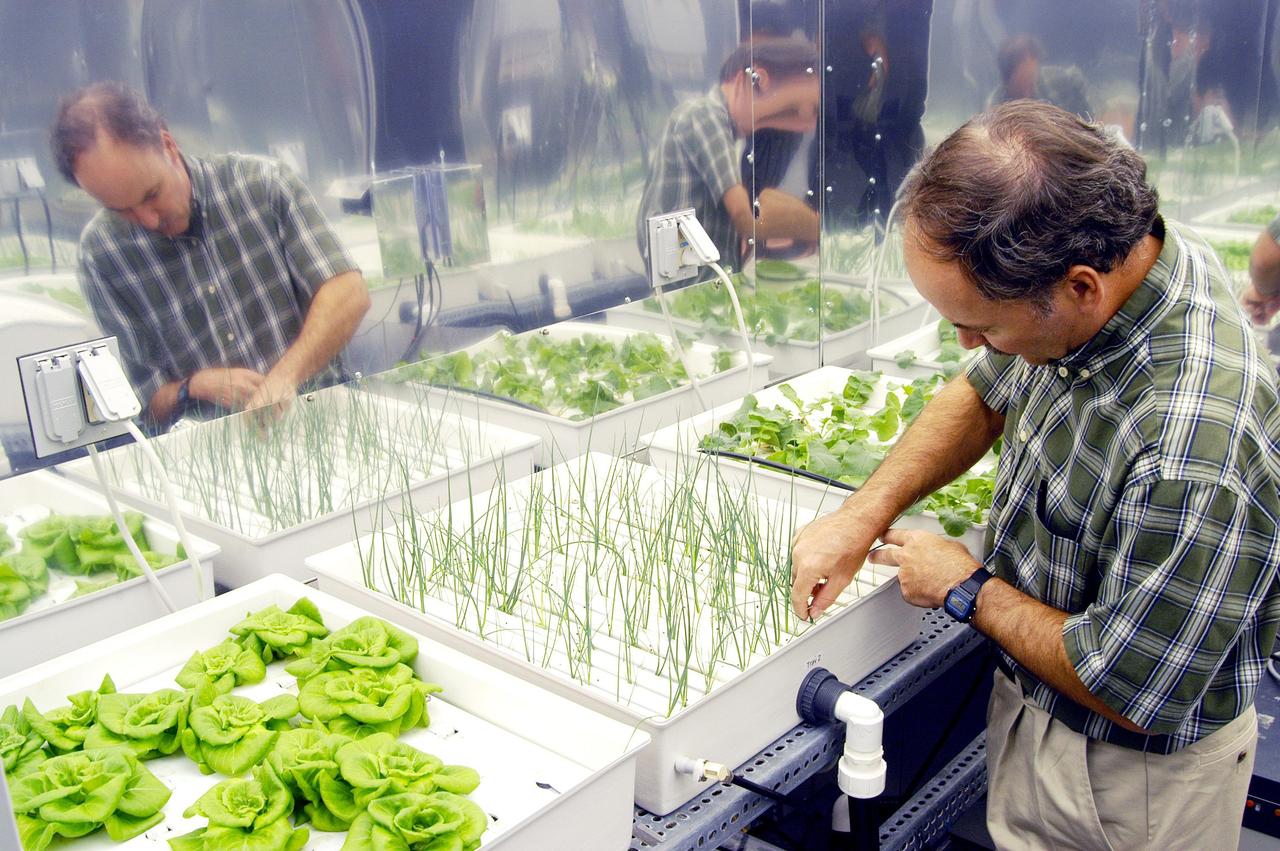
KENNEDY SPACE CENTER, FLA. - In a plant growth chamber in the KSC Space Life Sciences Lab, plant physiologist Ray Wheeler checks onions being grown using hydroponic techniques. The other plants are Bibb lettuce (left) and radishes (right). Wheeler and other colleagues are researching plant growth under different types of light, different CO2 concentrations and temperatures. The Lab is exploring various aspects of a bioregenerative life support system. Such research and technology development will be crucial to long-term habitation of space by humans.
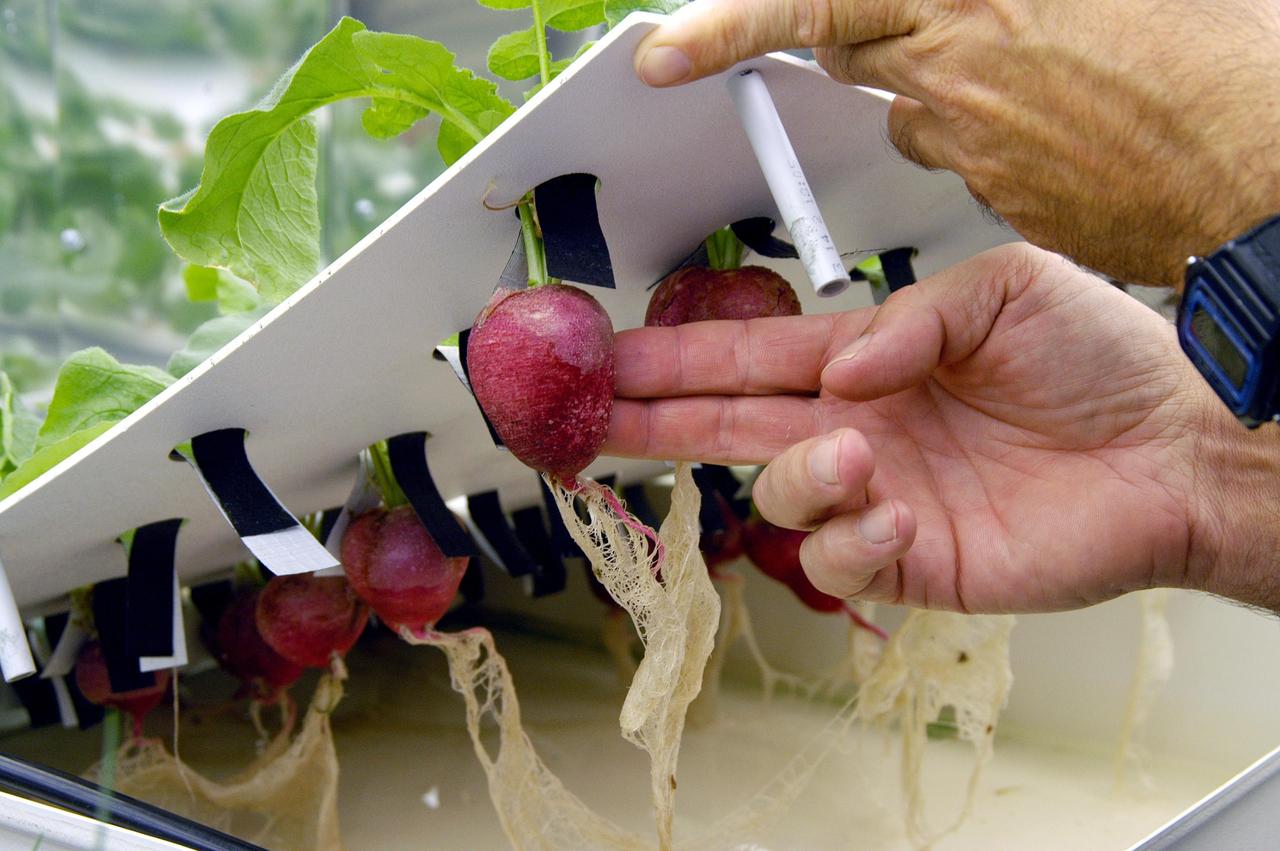
KENNEDY SPACE CENTER, FLA. - In a plant growth chamber in the KSC Space Life Sciences Lab, plant physiologist Ray Wheeler checks radishes being grown using hydroponic techniques. Wheeler and other colleagues are researching plant growth under different types of light, different CO2 concentrations and temperatures. The Lab is exploring various aspects of a bioregenerative life support system. Such research and technology development will be crucial to long-term habitation of space by humans.
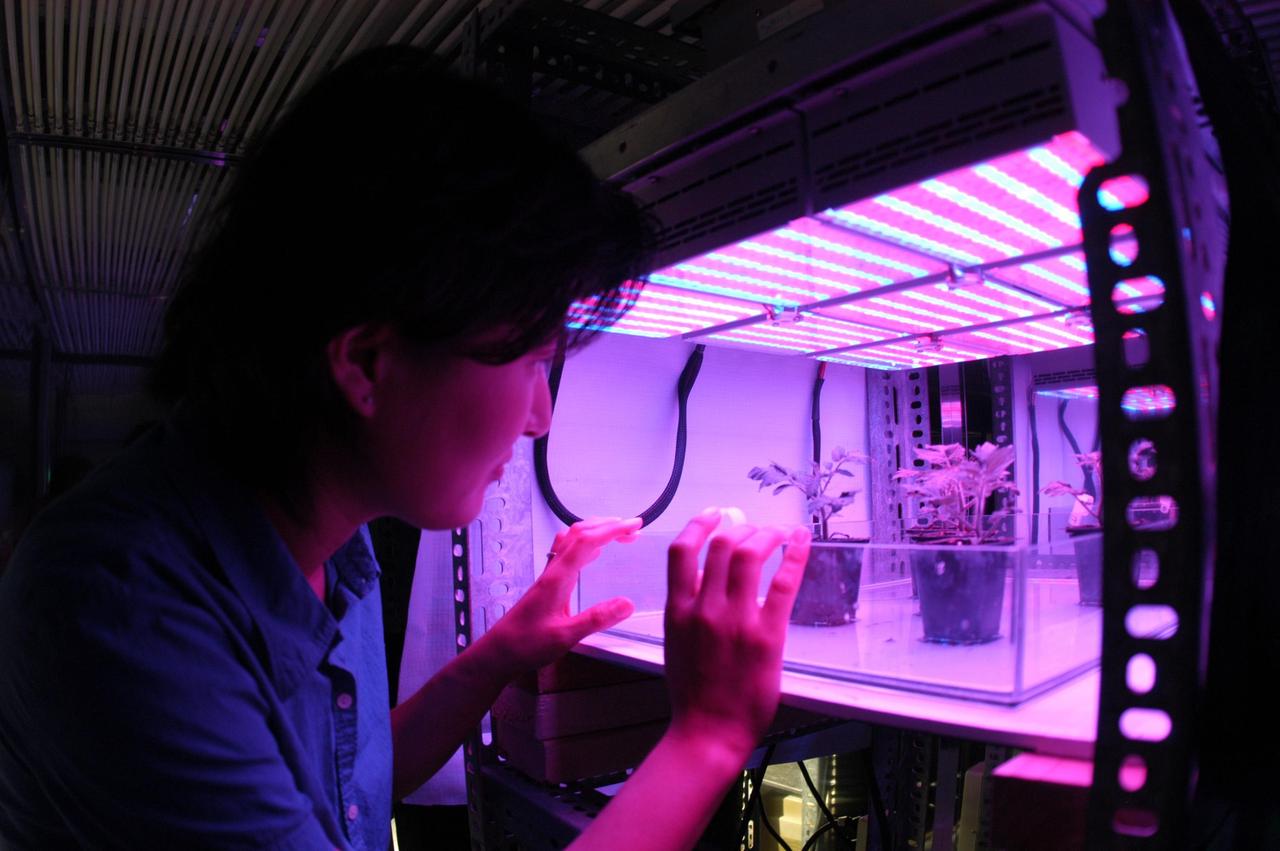
KENNEDY SPACE CENTER, FLA. - In the KSC Space Life Sciences Lab, Dr. Hyeon-Hye Kim checks plants in a plant growth chamber for testing under various light conditions. Other plant research includes different CO2 concentrations and temperatures. The Lab is exploring various aspects of a bioregenerative life support system. Such research and technology development will be crucial to long-term habitation of space by humans.
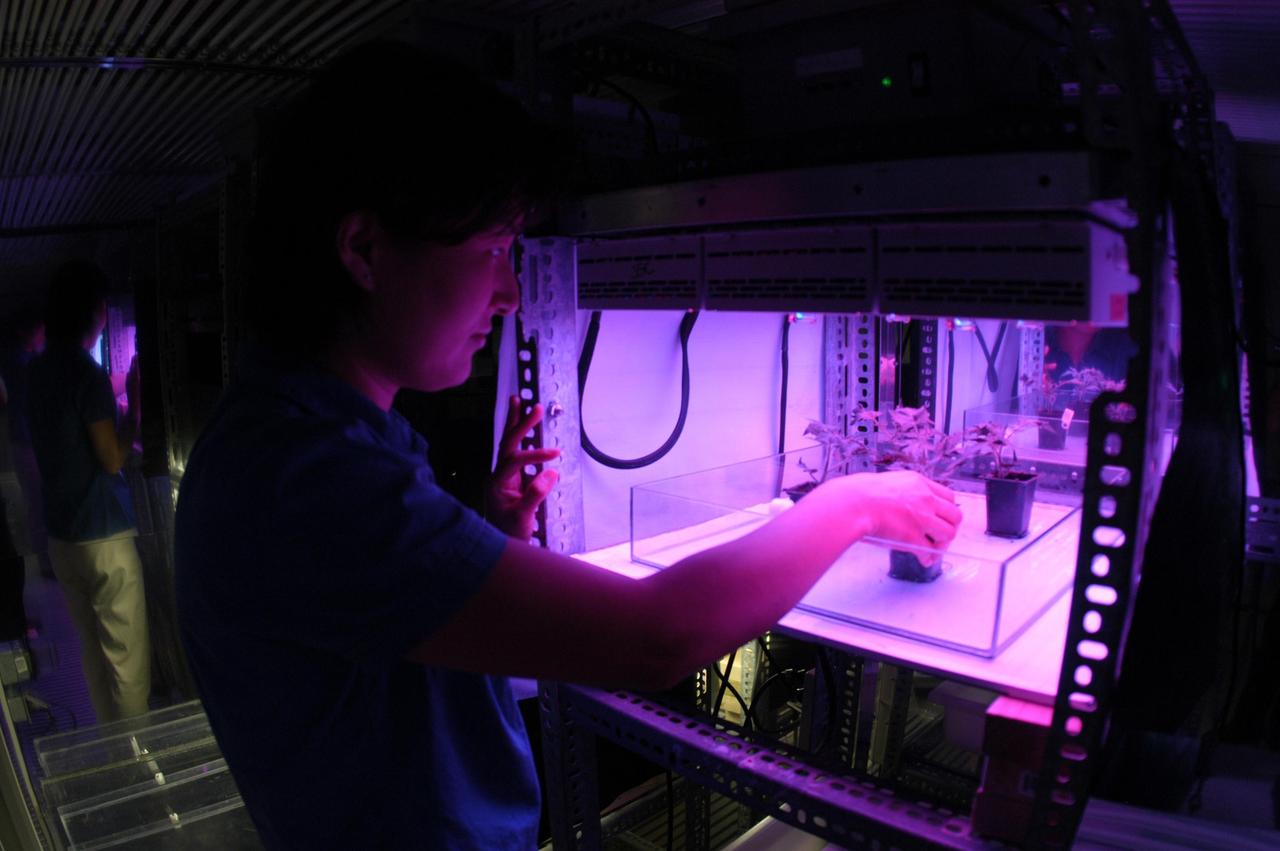
KENNEDY SPACE CENTER, FLA. - - In the KSC Space Life Sciences Lab, Dr. Hyeon-Hye Kim places Arabidopsis plants in a plant growth chamber for testing under various light conditions. Other plant research includes different CO2 concentrations and temperatures. The Lab is exploring various aspects of a bioregenerative life support system. Such research and technology development will be crucial to long-term habitation of space by humans.
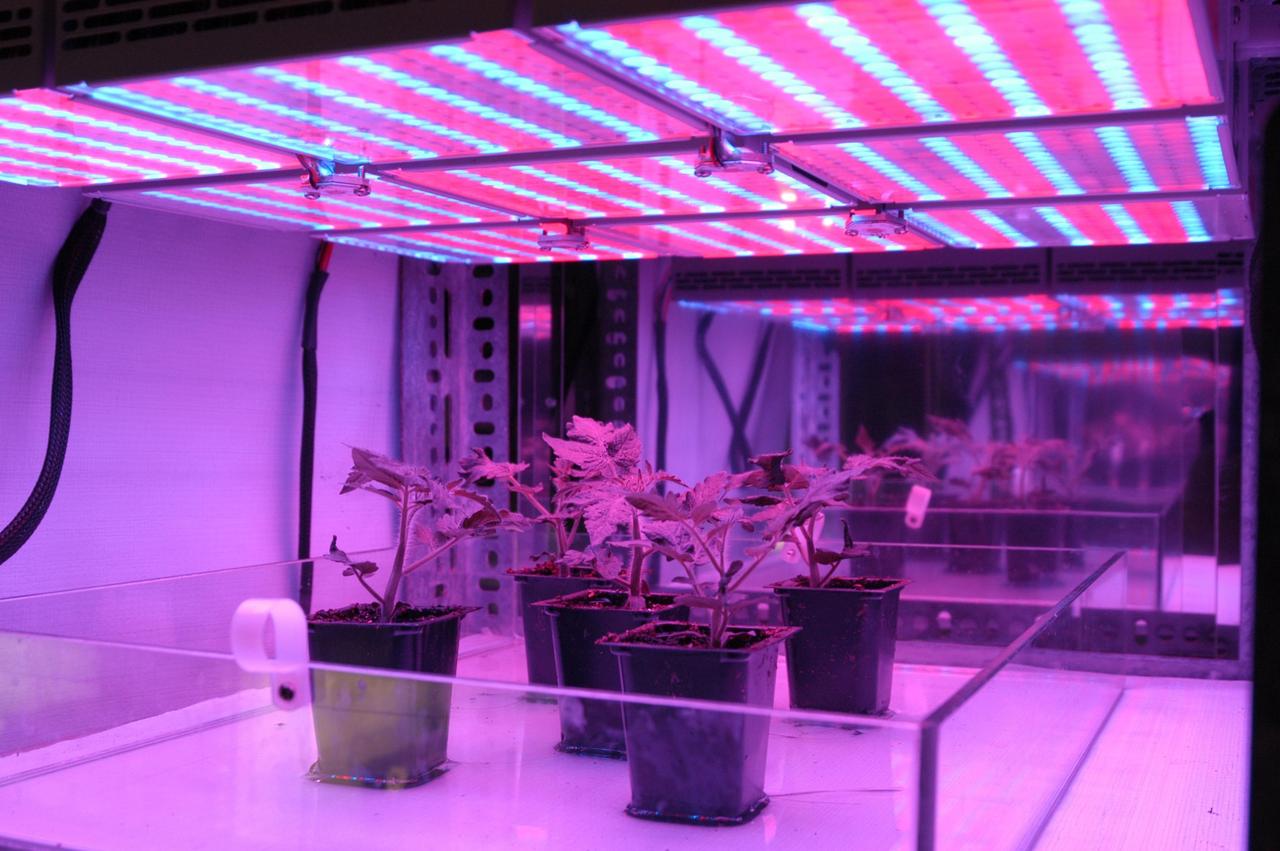
KENNEDY SPACE CENTER, FLA. - In the KSC Space Life Sciences Lab, Arabidopsis plants appear purple under red and green light as part of research on growth under various light conditions. Other plant research includes different CO2 concentrations and temperatures. The Lab is exploring various aspects of a bioregenerative life support system. Such research and technology development will be crucial to long-term habitation of space by humans.

iss069e088358 (9/14/2023) --- Japan Aerospace Exploration Agency (JAXA) astronaut Satoshi Furukawa is seen processing samples from the JEM Water Recovery System (JWRS) in the KIBO module aboard the International Space Station (ISS). The JWRS demonstrates that potable water can be generated from urine. In the past, urine and wastewater were collected and stored, or vented overboard. However, for long-term space missions, water supply could become a limiting factor. Demonstrating the function of this water recovery system on orbit contributes to updating the Environmental Control and Life Support System (ECLSS) to support astronauts on the space station and future exploration missions.
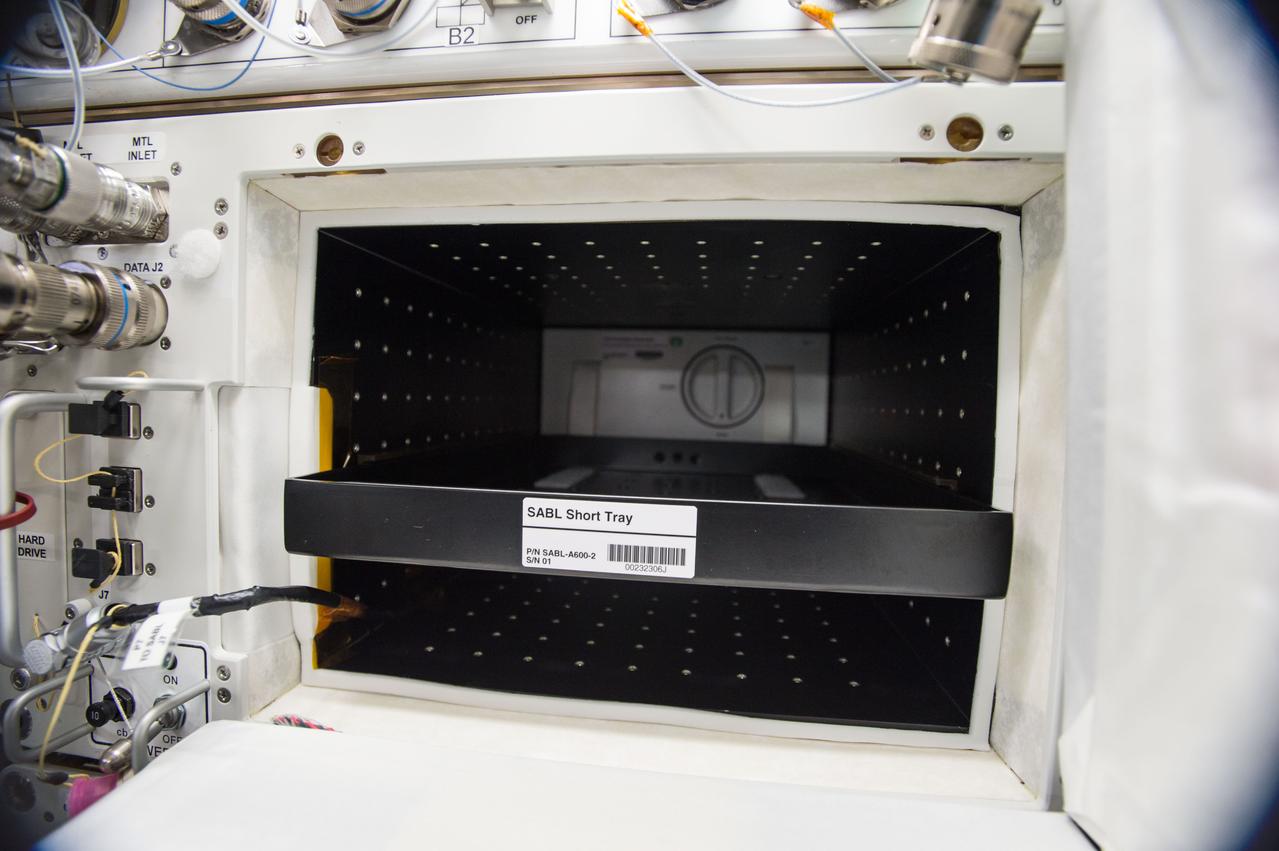
iss048e042380(7/21/2016) --- A view of the Space Automated Bioproduct Laboratory (SABL) Short Tray inside the SABL 2 following installation of the Carbon Dioxide (CO2) Incubator Controller. Image was taken during Heart Cells experiment setup in the Destiny U.S. Laboratory. The Space Automated Bioproduct Laboratory (SABL) supports a wide variety of experiments in the life, physical and material sciences with a focus on supporting research of biological systems and processes.
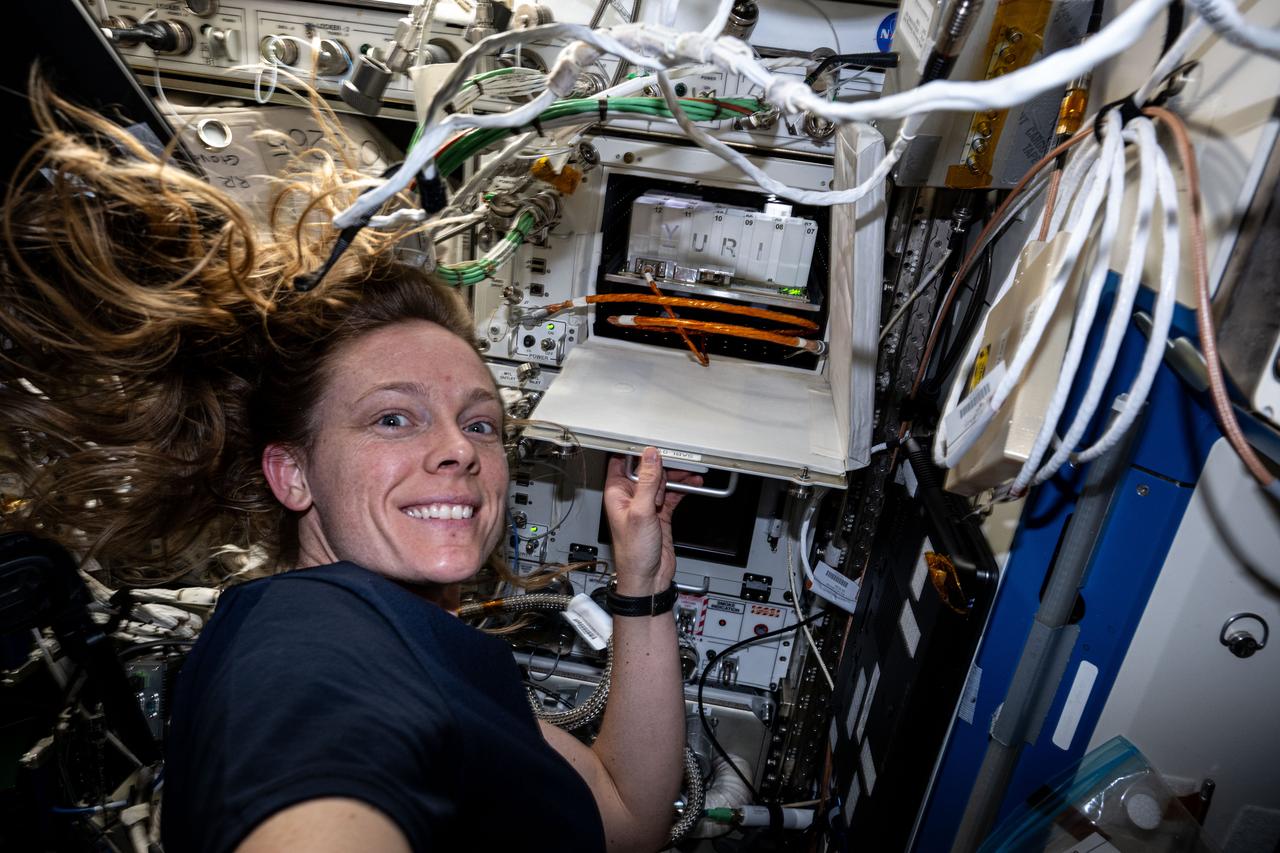
iss073e0002615 (April 28, 2025) --- NASA astronaut and Expedition 73 Flight Engineer Nichole Ayers shows off research hardware to study how microalgae grow in spaceflight conditions such as microgravity and radiation. Results from the biotechnology investigation may provide insights to support life support systems, fuel production, and food on future missions to the Moon, Mars, and beyond.
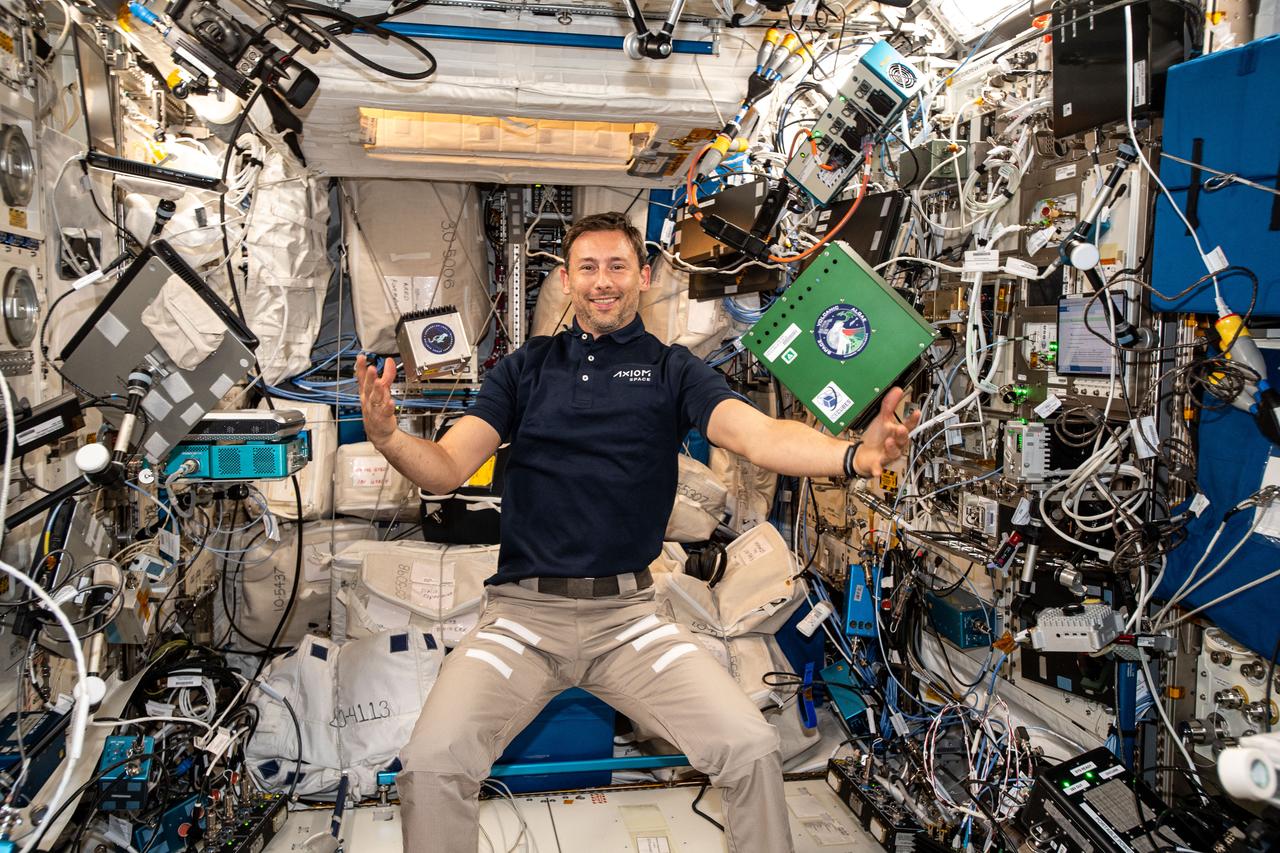
iss073e0251660 (June 26, 2025) --- ESA (European Space Agency) astronaut and Axiom Mission 4 Mission Specialist Sławosz Uznański-Wiśniewski shows off research hardware inside the International Space Station's Columbus laboratory module. The large box on the right is supporting a biotechnology study that looks at microalgae as a sustainable source for oxygen in spacecraft life support systems. The smaller box on the left provides a platform to test data processing and algorithms in microgravity.
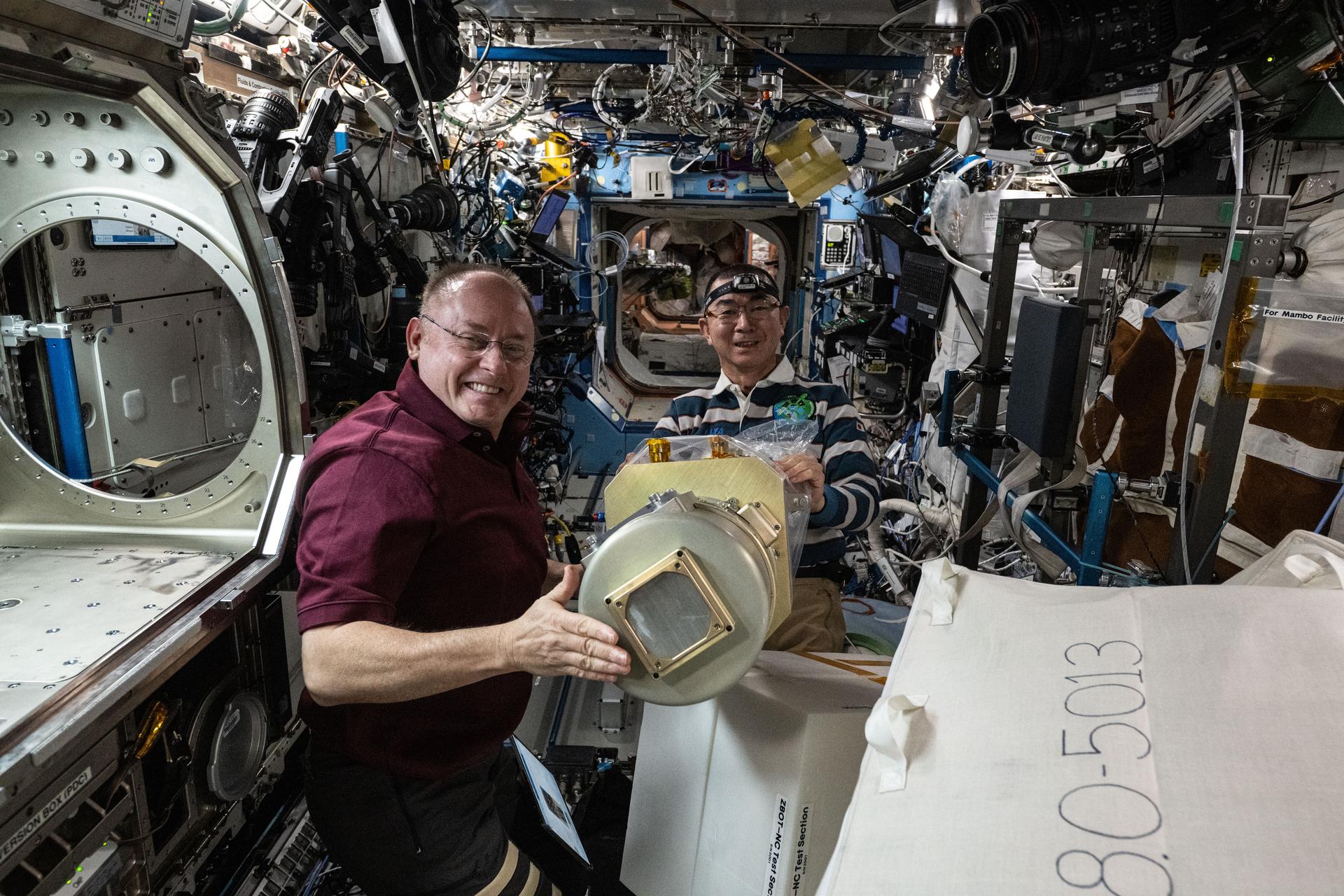
iss073e0982900 (Oct. 28, 2025) --- Expedition 73 Flight Engineers Mike Fincke of NASA and Kimiya Yui of JAXA (Japan Aerospace Exploration Agency) work together to configure research hardware for the Zero Boil-Off Tank physics investigation inside the Microgravity Science Glovebox aboard the International Space Station. The experiment explores methods for storing cryogenic fluids and supports advancements in spacecraft propulsion and life support systems, as well as biotechnological, medical, and industrial applications on Earth.
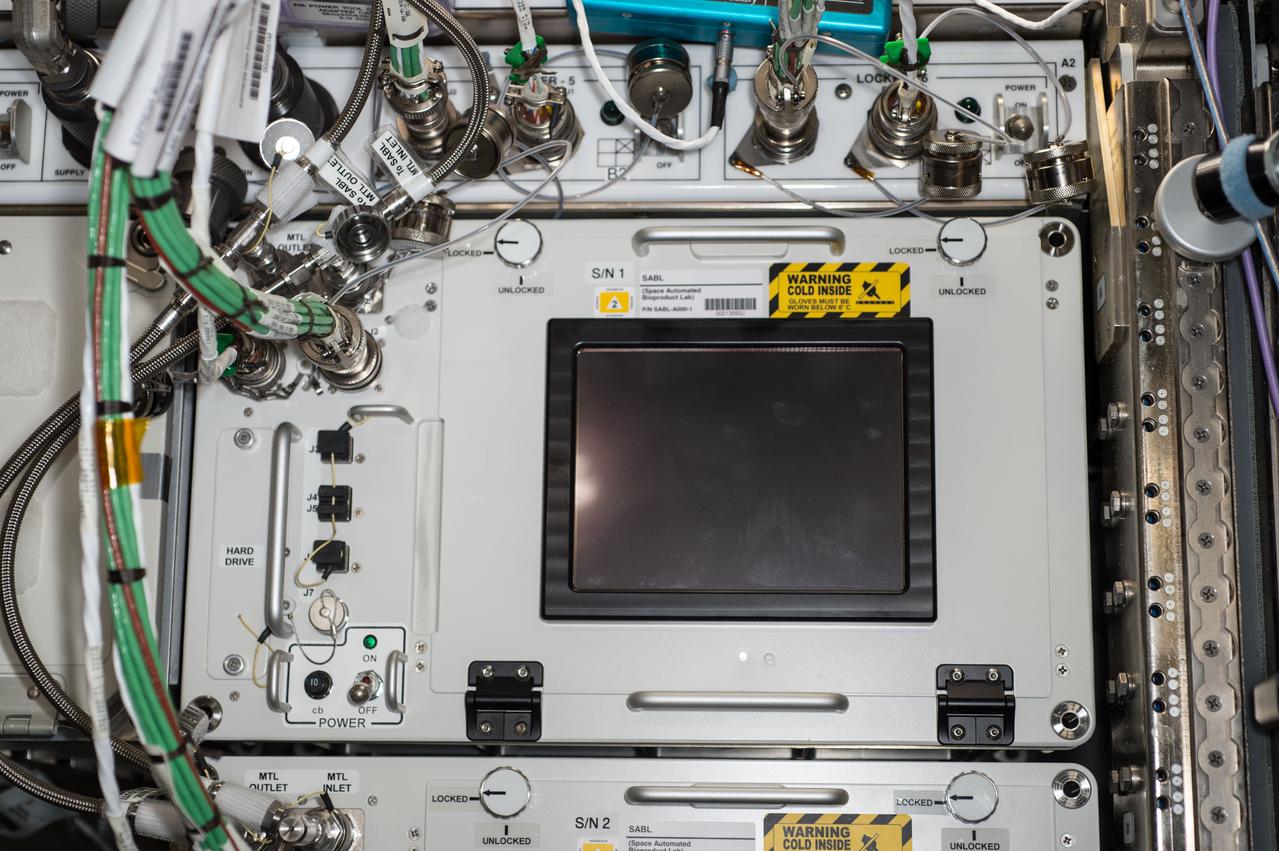
iss046e046607 (2/23/2016) --- A view of the newly installed Space Automated Bioproduct Laboratory (SABL) power, data, and thermal connections in the rack located in the U.S Lab. SABL is an upgrade to the long standing ISS incubator, Commercial Generic Bioprocessing Apparatus (CGBA). The Space Automated Bioproduct Laboratory (SABL) supports a wide variety of experiments in the life, physical and material sciences with a focus on supporting research of biological systems and processes.
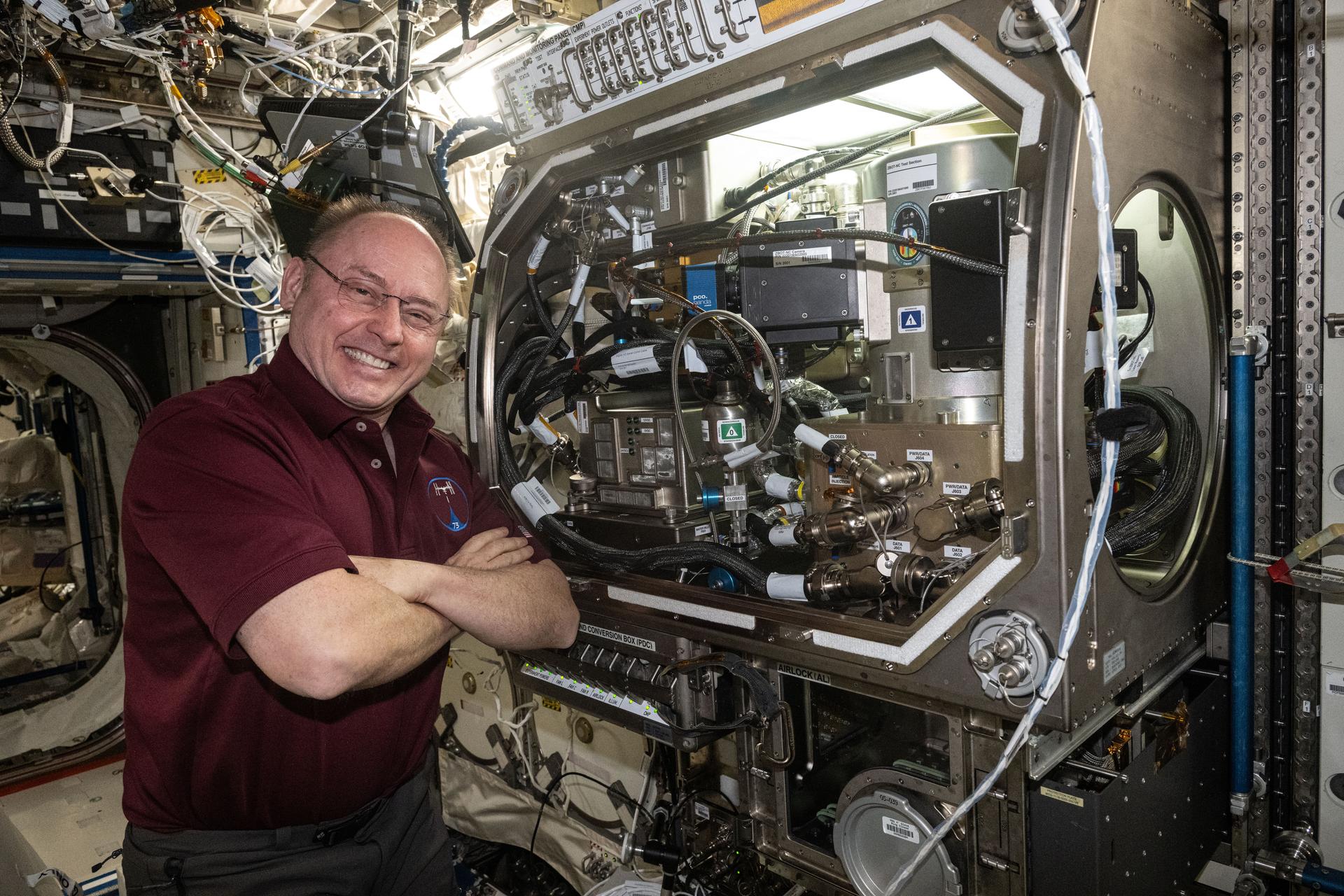
iss073e0982894 (Oct. 28, 2025) --- NASA astronaut and Expedition 73 Flight Engineer Mike Fincke poses for a portrait next to the Microgravity Science Glovebox aboard the International Space Station’s Destiny laboratory module. Fincke had just completed configuring research hardware for the Zero Boil-Off Tank physics investigation, which explores methods for storing cryogenic fluids. The experiment supports advancements in spacecraft propulsion and life support systems, as well as biotechnological, medical, and industrial applications on Earth.
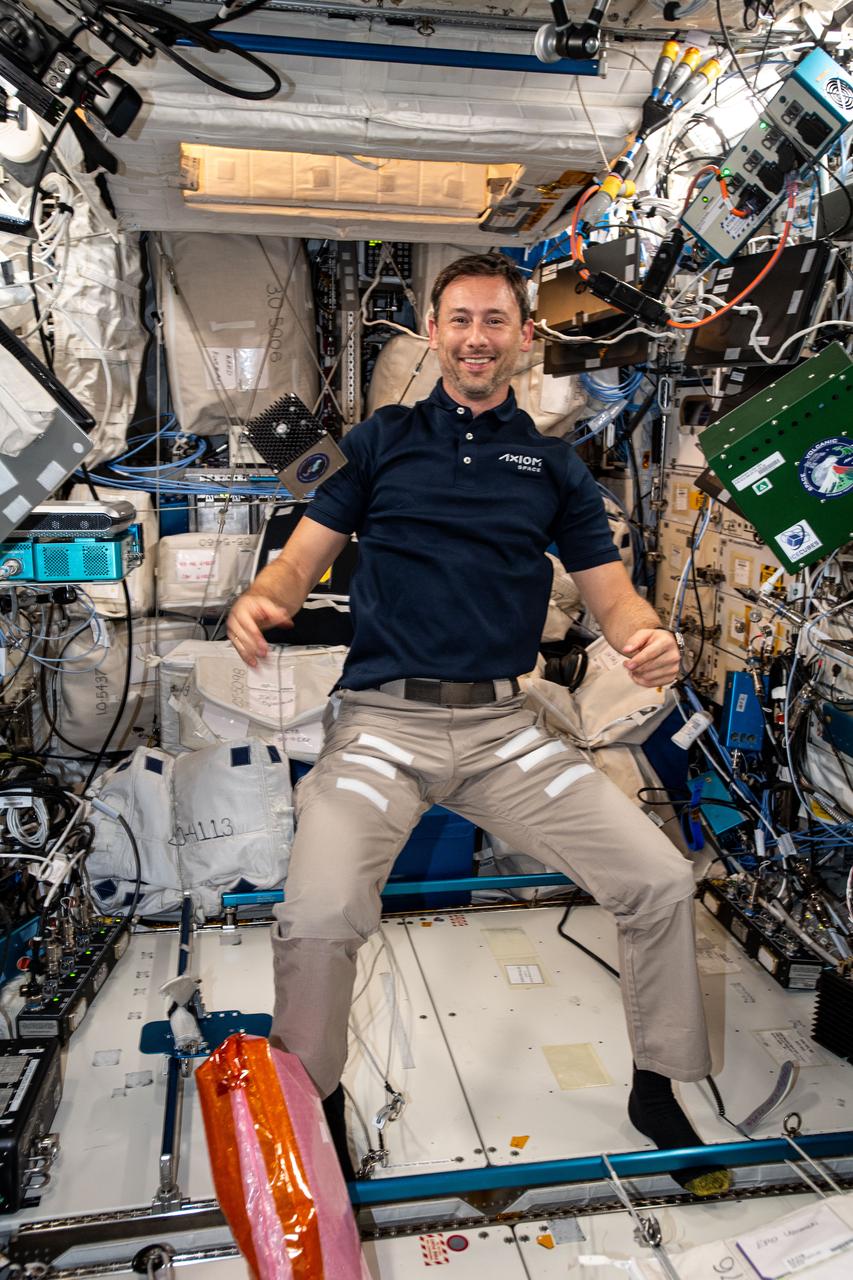
iss073e0251659 (June 26, 2025) --- ESA (European Space Agency) astronaut and Axiom Mission 4 Mission Specialist Sławosz Uznański-Wiśniewski shows off research hardware inside the International Space Station's Columbus laboratory module. The large box on the right is supporting a biotechnology study that looks at microalgae as a sustainable source for oxygen in spacecraft life support systems. The smaller box on the left provides a platform to test data processing and algorithms in microgravity.
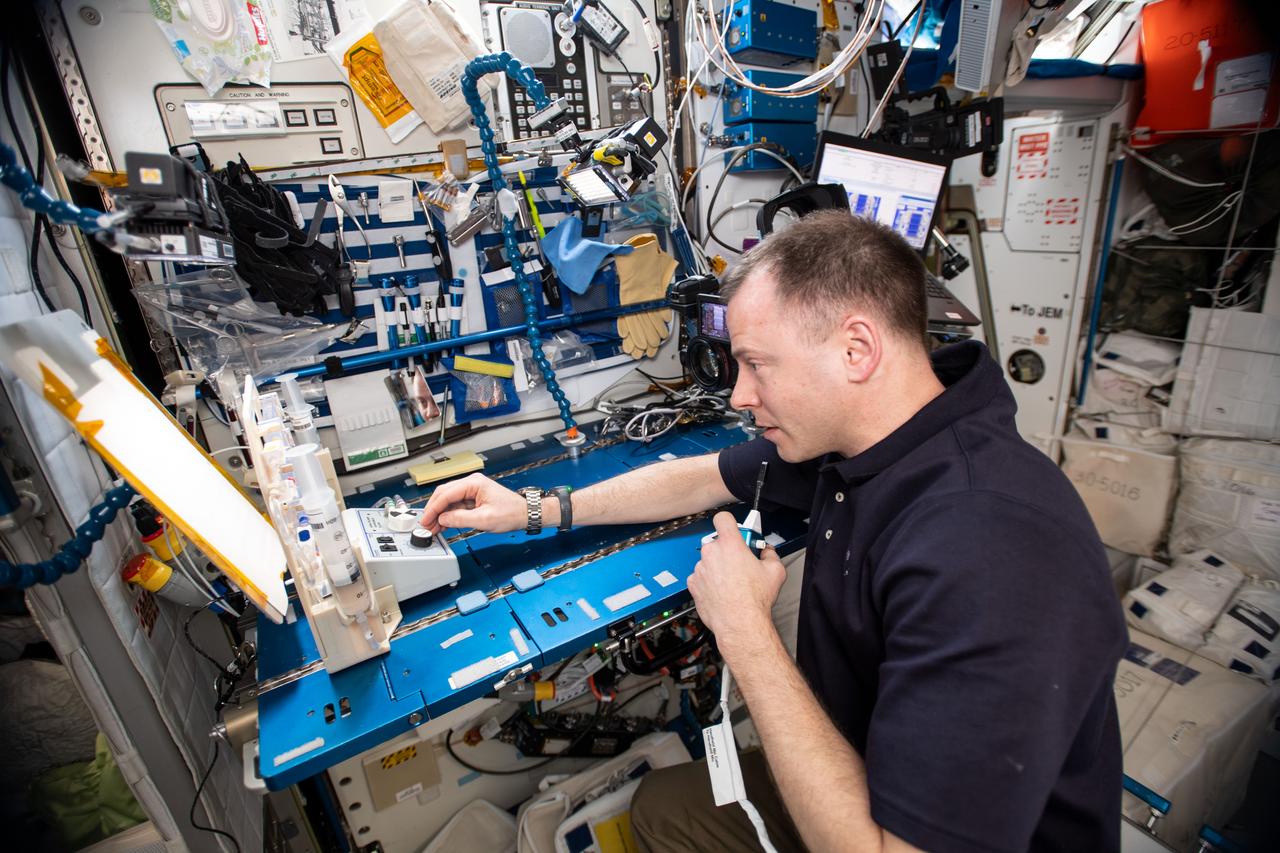
iss059e112425 (June 18, 2019) --- Flight Engineer Nick Hague is supporting research for the Capillary Structures experiment that uses specialized hardware to demonstrate the flow of fluid and gas mixtures using surface tension and fluid dynamics. The fluid physics study is helping NASA evaluate technologies for a lightweight, advanced life support system that can recover water and remove carbon dioxide in space.
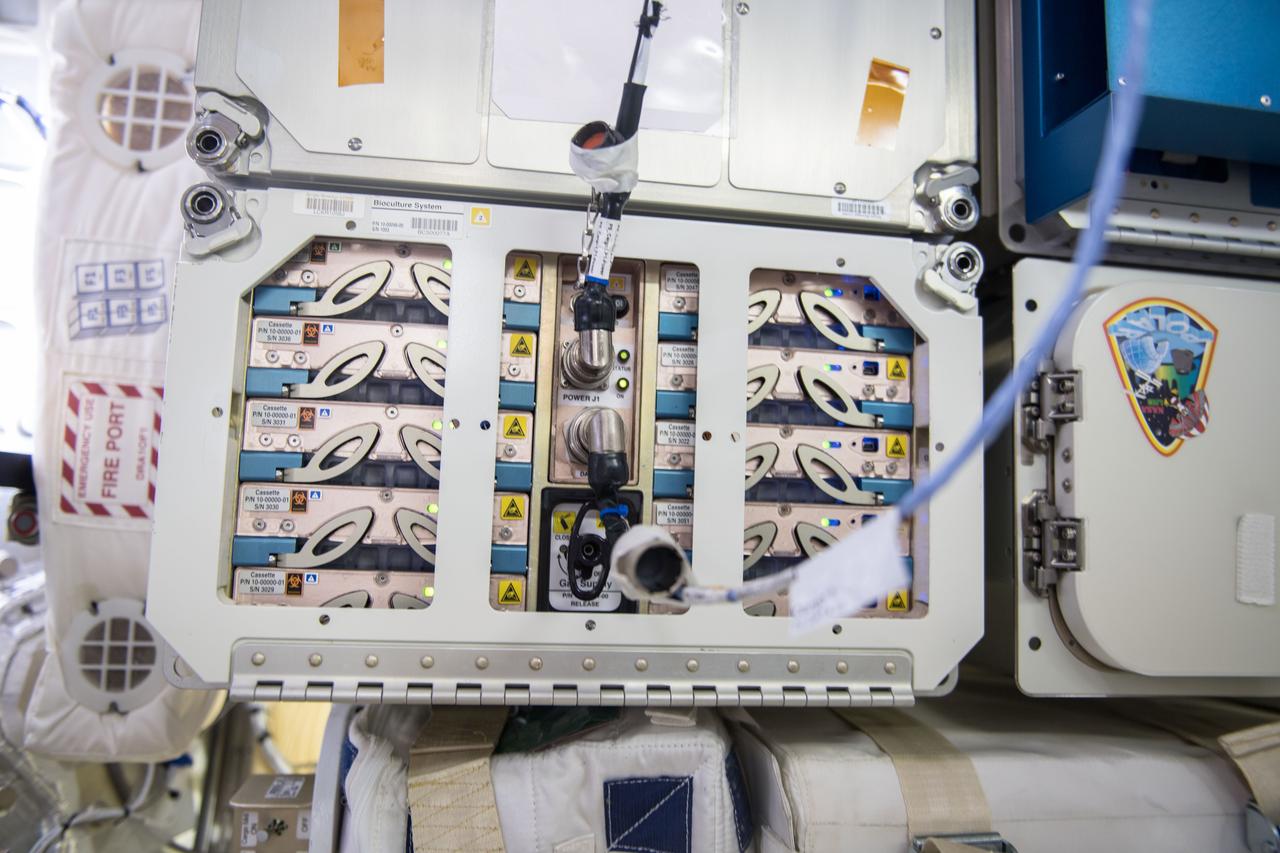
iss054e020928 (1/12/2018) --- Photo documentation of the Bioculture System Facility installed in the SpaceX Dragon Commercial Resupply Services-13 (CRS-13) spacecraft for return to Earth. The Bioculture System Hardware Validation (Cell Science-Validation) tests the performance and life-support capability of a new cell culture hardware system for use aboard the International Space Station (ISS).
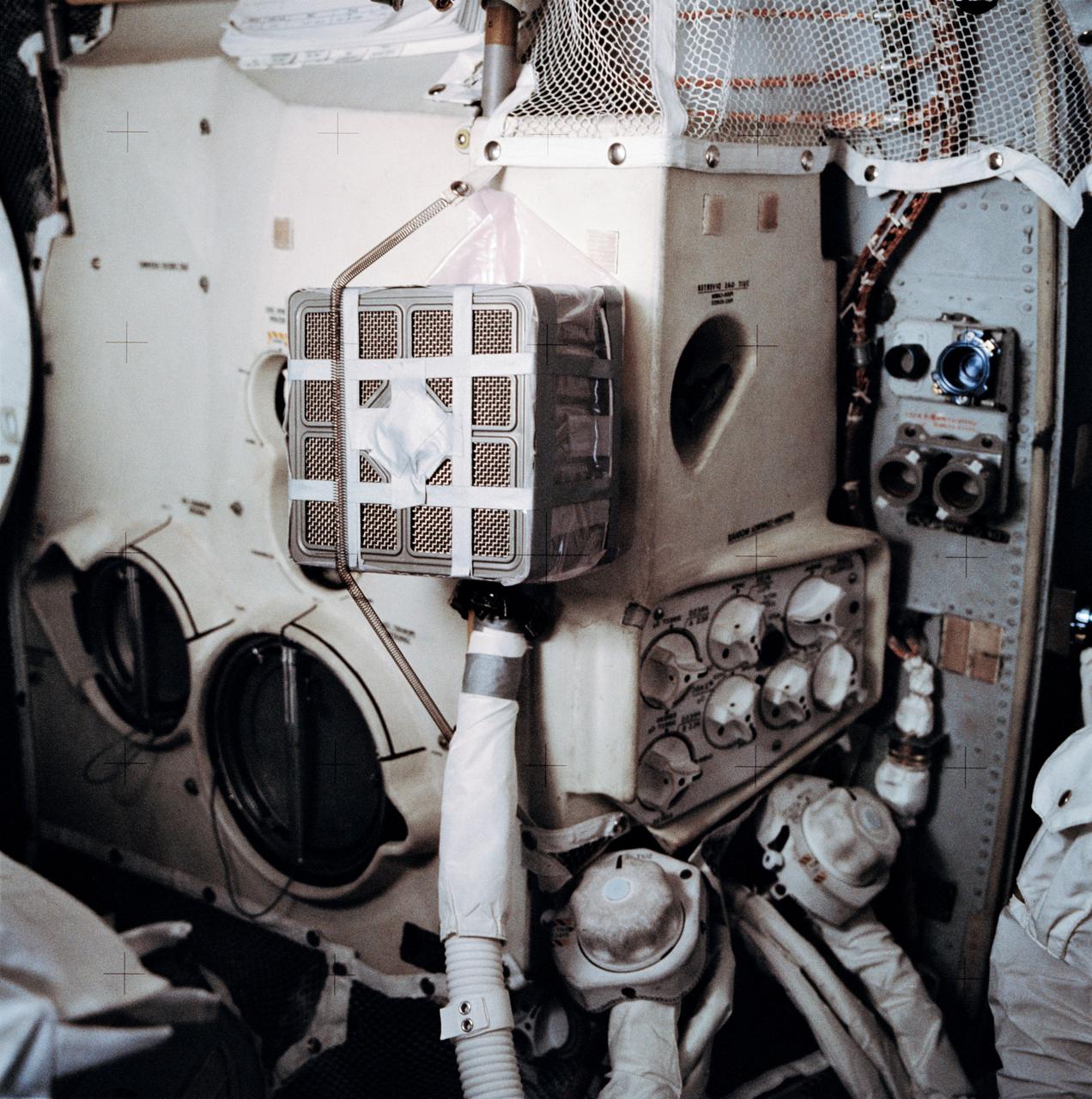
AS13-62-8929 (11-17 April 1970) --- Interior view of the Apollo 13 Lunar Module (LM) showing the "mail box," a jury-rigged arrangement which the Apollo 13 astronauts built to use the Command Module (CM) lithium hydroxide canisters to purge carbon dioxide from the LM. Lithium hydroxide is used to scrub CO2 from the spacecraft's atmosphere. Since there was a limited amount of lithium hydroxide in the LM, this arrangement was rigged up to utilize the canisters from the CM. The "mail box" was designed and tested on the ground at the Manned Spacecraft Center (MSC) before it was suggested to the problem-plagued Apollo 13 crew men. Because of the explosion of one of the oxygen tanks in the Service Module (SM), the three crew men had to use the LM as a "lifeboat".