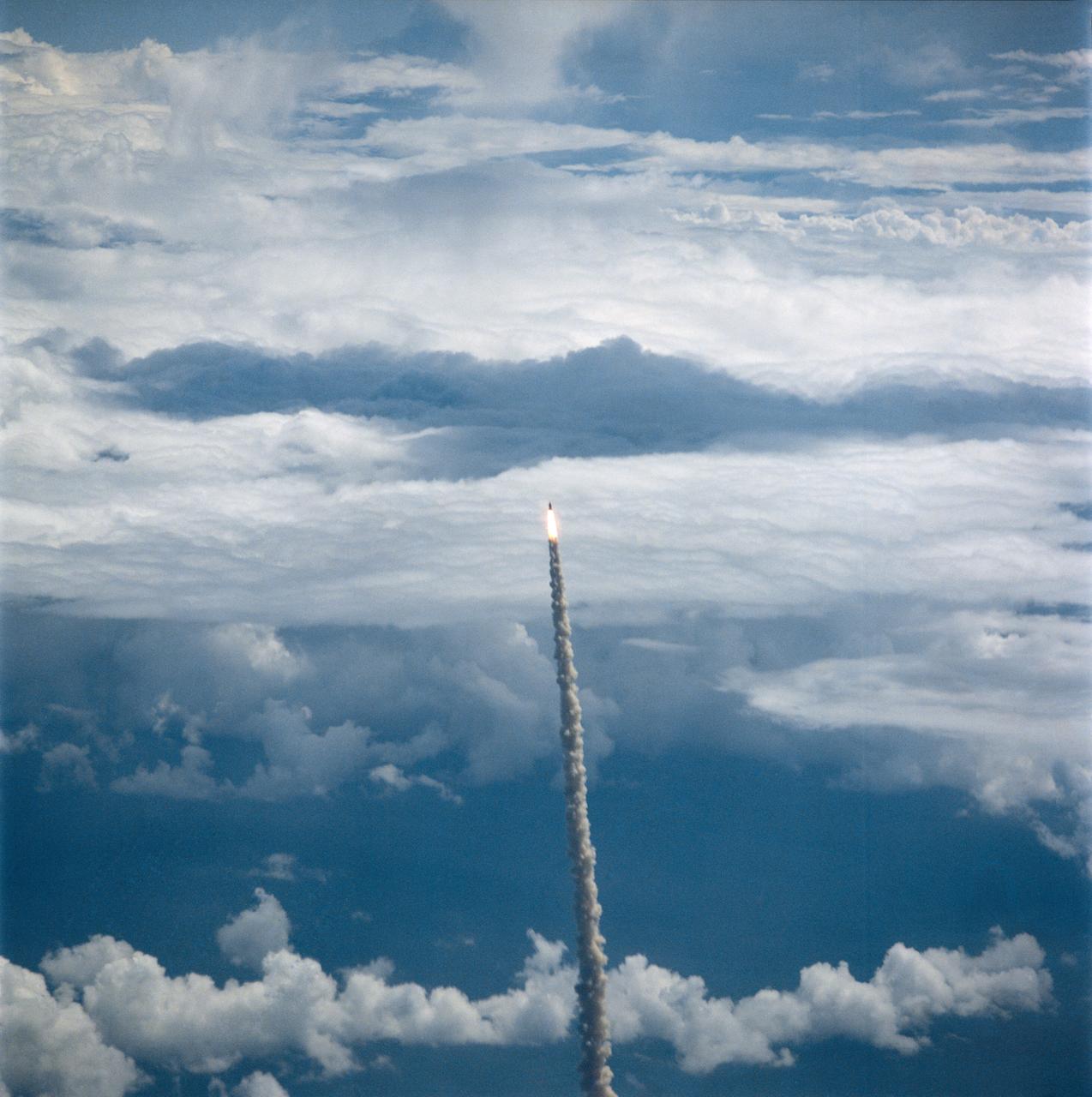
S26-S-026 (29 Sept. 1988) --- The STS-26 launch was captured on film from the NASA Shuttle Training Aircraft, piloted by astronaut Daniel C. Brandenstein, chief of JSC's Astronaut Office. Discovery?s mission was the first flight to be flown after the Challenger accident. The flight crew included astronauts Rick Hauck, commander; Dick Covey, pilot; and three mission specialists, Dave Hilmers, Mike Lounge, and George (Pinky) Nelson. During the four-day mission, the crew deployed the Tracking and Data Relay Satellite (TDRS-C) and operated eleven mid-deck experiments. Discovery completed 64 orbits of the earth before landing at Edwards Air Force Base, California, on October 3, 1988. Photo credit: NASA or National Aeronautics and Space Administration
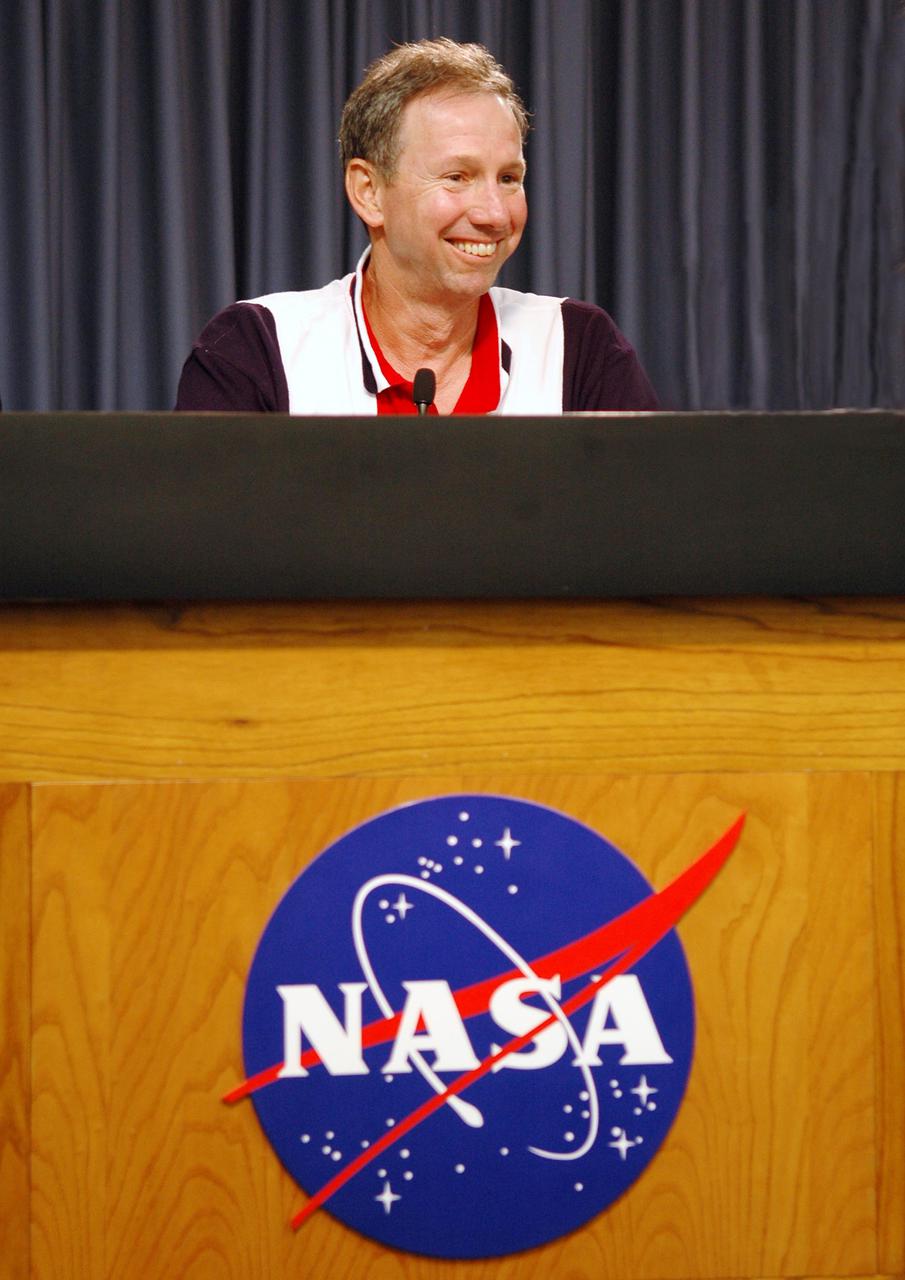
KENNEDY SPACE CENTER, FLA. - At the STS-114 Launch Readiness Press Conference at NASA Kennedy Space Center, NASA Administrator Mike Griffin was pleased to confirm the July 26 launch of Space Shuttle Discovery on the Return to Flight mission STS-114 scheduled for 10:39 a.m. EDT July 26 from Launch Pad 39B. Liftoff of Space Shuttle Discovery on the Return to Flight mission STS-114 is scheduled for 10:39 a.m. EDT July 26 from Launch Pad 39B.
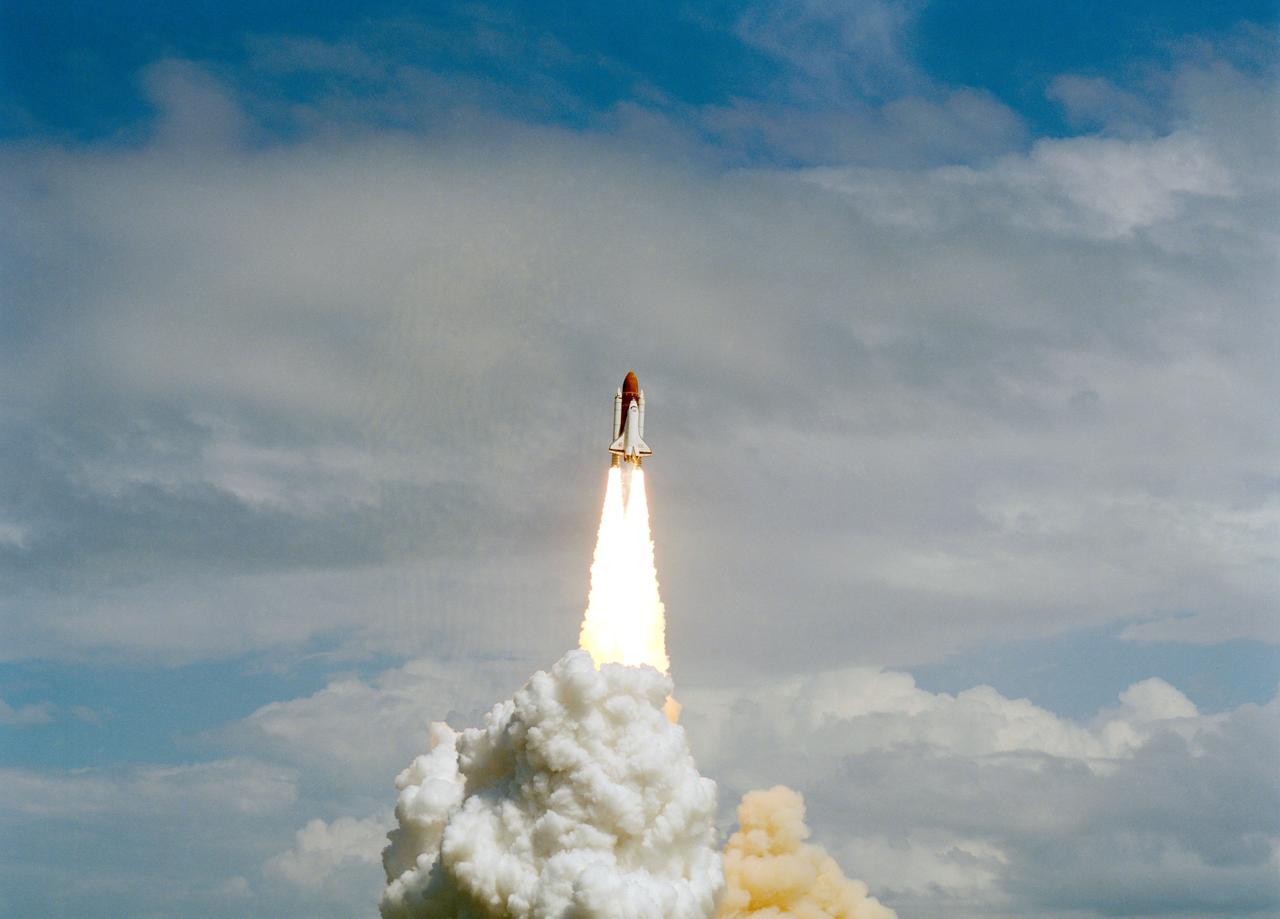
STS-26 Discovery, Orbiter Vehicle (OV) 103, rises into a cloudy sky and heads for Earth orbit atop the external tank (ET) as exhaust plumes billow from the two solid rocket boosters (SRBs) during liftoff from Kennedy Space Center (KSC) Launch Complex (LC) pad 39B. STS-26 marks OV-103's first flight since September 1985 and NASA's first manned mission since 51L Challenger accident, 01-28-86.
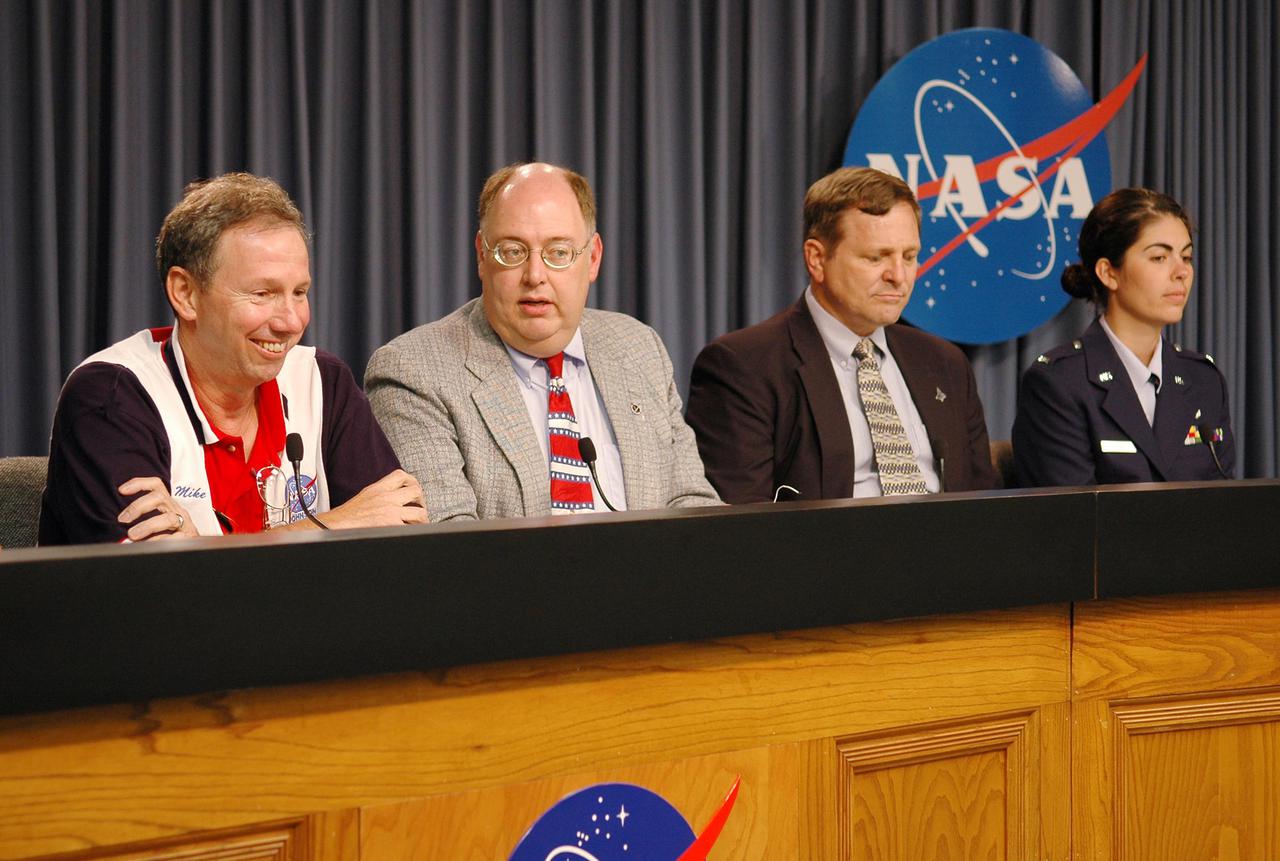
KENNEDY SPACE CENTER, FLA. - At the STS-114 Launch Readiness Press Conference at NASA Kennedy Space Center, NASA officials confirm the July 26 launch. Seated from left are NASA Administrator Mike Griffin, Space Shuttle Deputy Program Manager Wayne Hale, Shuttle Processing Director Mike Wetmore and launch weather officer 1st Lt. Mindy Chavez, with the U.S. Air Force 45th Weather Squadron. Liftoff of Space Shuttle Discovery on the Return to Flight mission STS-114 is scheduled for 10:39 a.m. EDT July 26 from Launch Pad 39B.
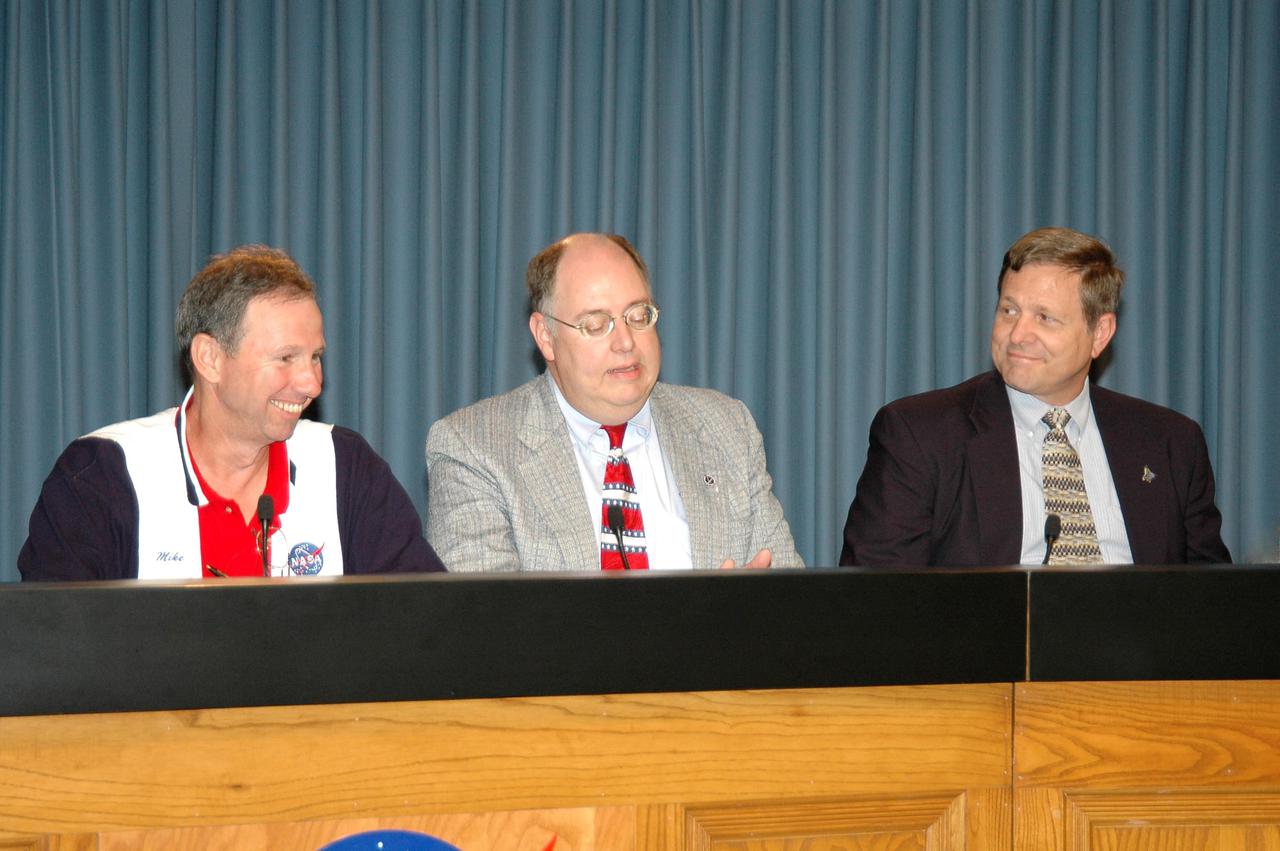
KENNEDY SPACE CENTER, FLA. - At the STS-114 Launch Readiness Press Conference at NASA Kennedy Space Center, Space Shuttle Deputy Program Manager Wayne Hale (center) answers a question from the media. At the conference, NASA officials confirmed the July 26 launch. Others seated with Hale on the stage are NASA Administrator Mike Griffin (left) and Shuttle Processing Director Mike Wetmore (right). Not pictured is launch weather officer 1st Lt. Mindy Chavez, with the U.S. Air Force 45th Weather Squadron. Liftoff of Space Shuttle Discovery on the Return to Flight mission STS-114 is scheduled for 10:39 a.m. EDT July 26 from Launch Pad 39B.
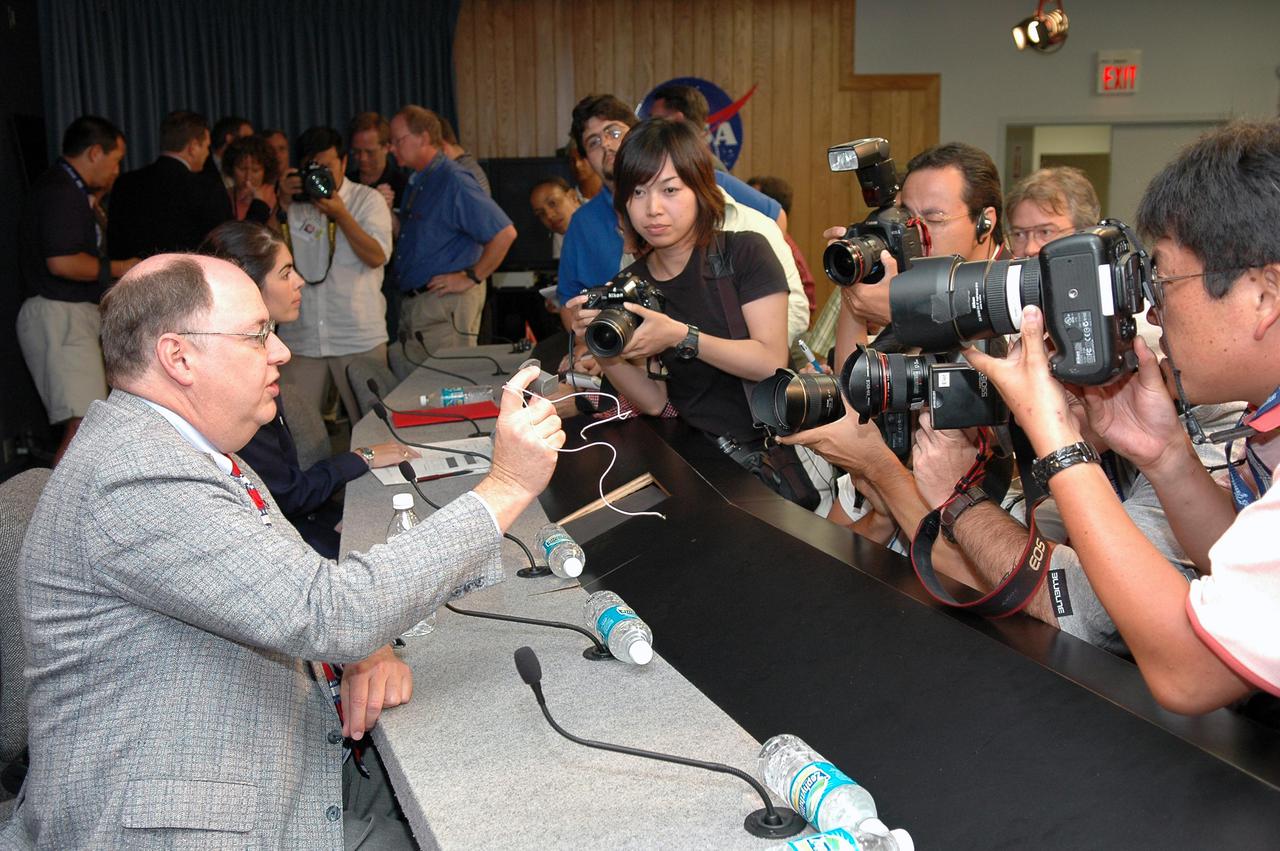
KENNEDY SPACE CENTER, FLA. - After the STS-114 Launch Readiness Press Conference at NASA Kennedy Space Center, media crowd around Space Shuttle Deputy Program Manager Wayne Hale, who is holding an ECO (engine cut-off) sensor similar to the one in the External Tank that had a faulty reading in the first launch attempt. Liftoff of Space Shuttle Discovery on the Return to Flight mission STS-114 is scheduled for 10:39 a.m. EDT July 26 from Launch Pad 39B.
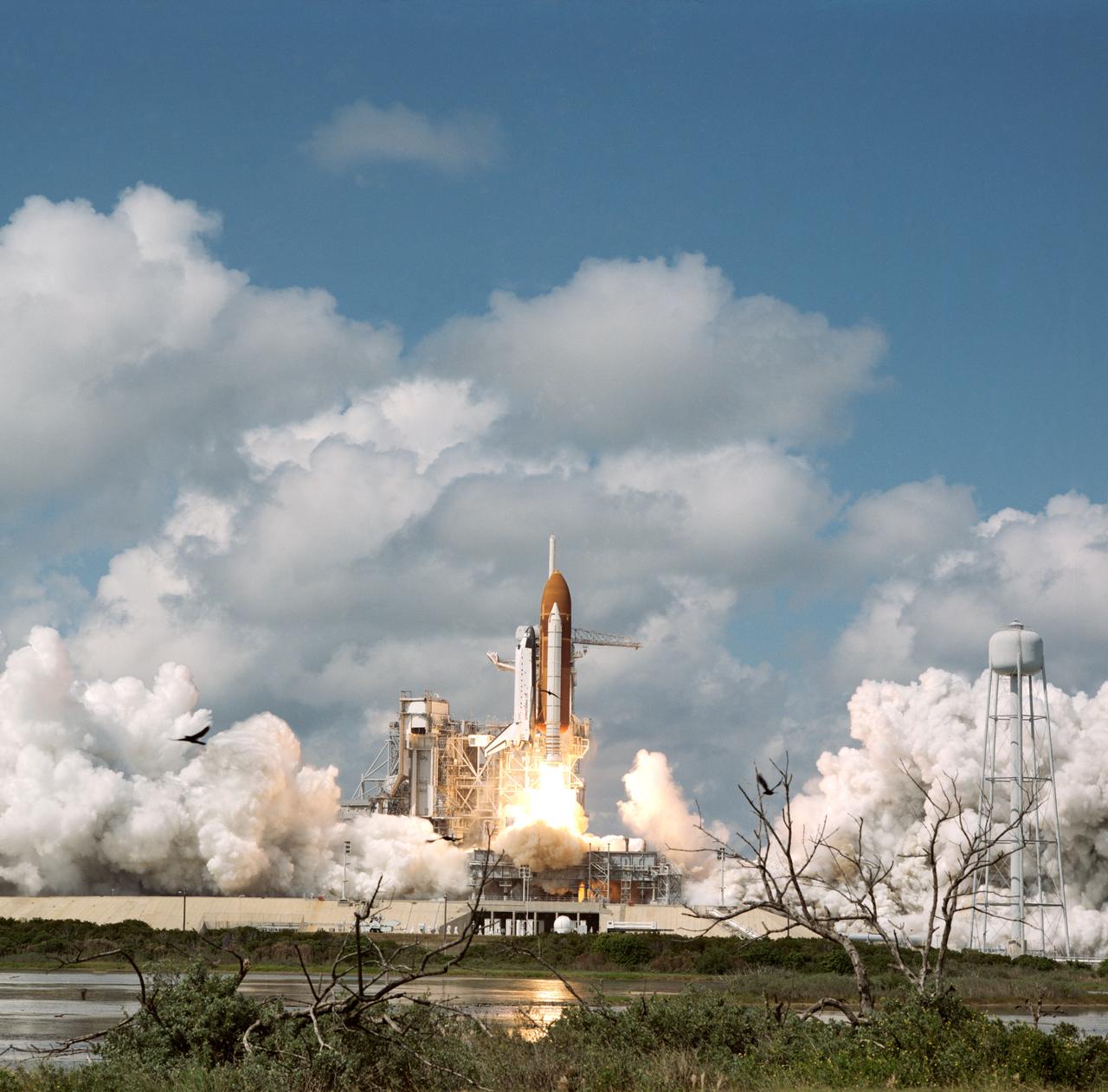
STS-26 Discovery, Orbiter Vehicle (OV) 103, lifts off from mobile launcher platform at Kennedy Space Center (KSC) Launch Complex (LC) pad 39B. Riding atop the orange external tank (ET), OV-103 heads for Earth orbit as the exhaust plumes from the two solid rocket boosters (SRBs) cover the mobile launcher platform and the area surrounding the launch pad. SRB firings are reflected in a nearby waterway. In the foreground are trees and several birds in flight. STS-26 marks OV-103's first flight since September 1985 and NASA's first manned mission since the 51L Challenger accident, 01-28-86.
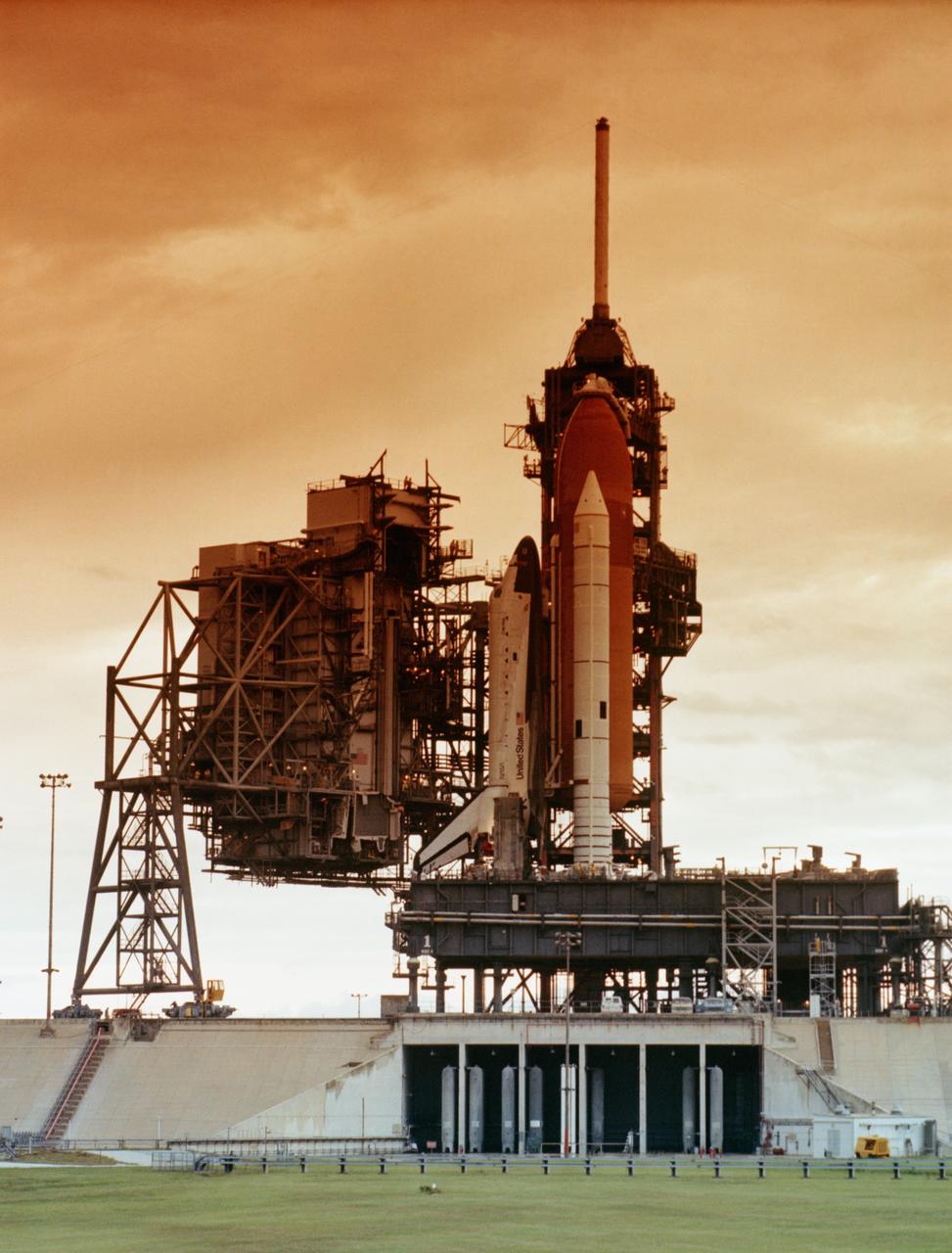
S82-32169 (26 May 1982) --- View of the space shuttle Columbia sitting on Launch Pad 39A at Kennedy Space Center (KSC), following rollout for STS-4, as preparations continue toward a late June launch. The fourth liftoff of the Columbia will mark the beginning of the final test flight in the Space Transportation System (STS) program. Astronauts Thomas K. Mattingly II and Henry W. Hartsfield will man the vehicle for a scheduled eight-day flight. Photo credit: NASA
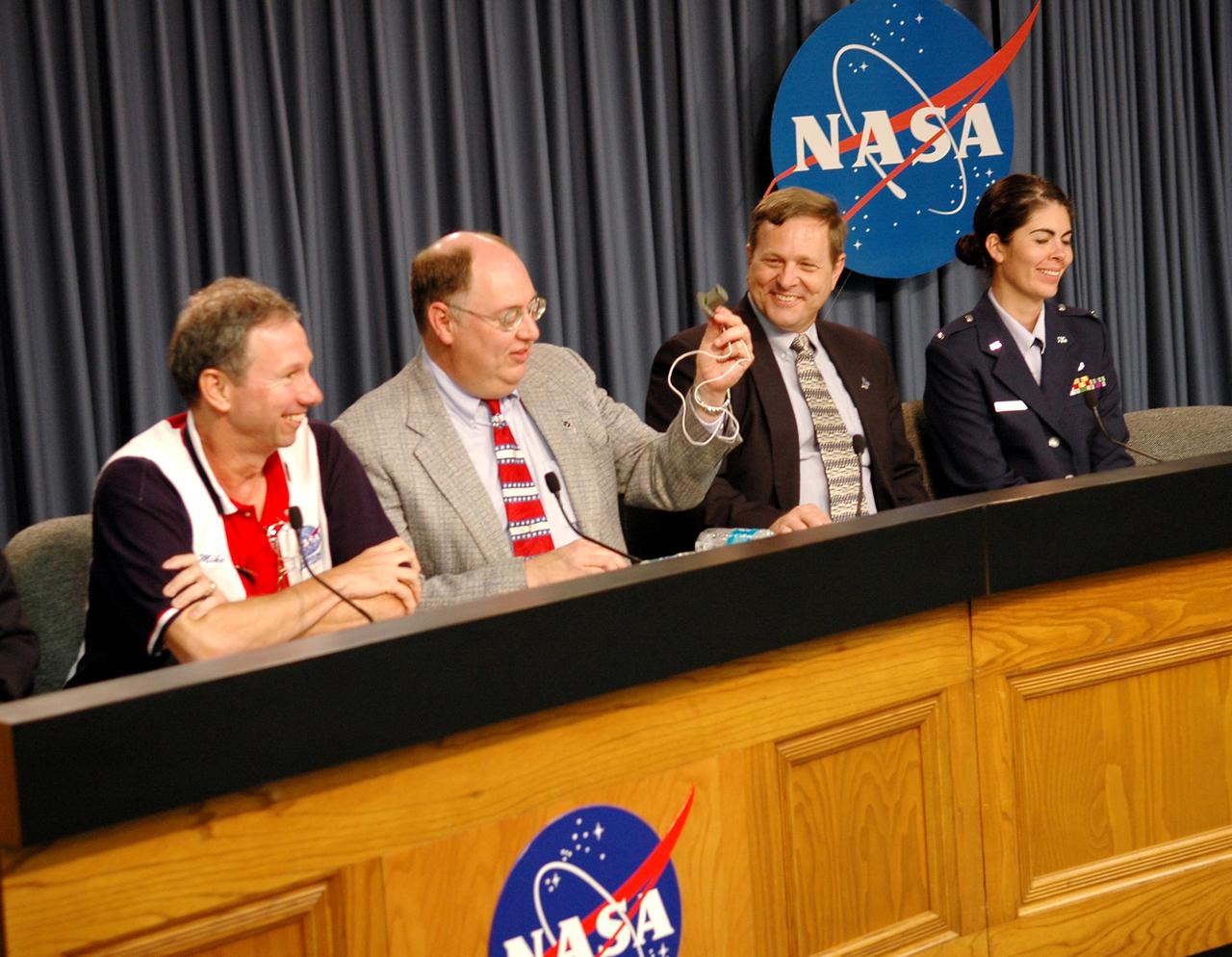
KENNEDY SPACE CENTER, FLA. - At the STS-114 Launch Readiness Press Conference at NASA Kennedy Space Center, the plan to launch July 26 is confirmed. Seated from left are NASA Administrator Mike Griffin, Space Shuttle Deputy Program Manager Wayne Hale, Shuttle Processing Director Mike Wetmore and launch weather officer 1st Lt. Mindy Chavez, with the U.S. Air Force 45th Weather Squadron. Hale is holding an ECO (engine cut-off) sensor similar to the one in Space Shuttle Discovery’s External Tank that had a faulty reading in the first launch attempt. Liftoff of Space Shuttle Discovery on the Return to Flight mission STS-114 is scheduled for 10:39 a.m. EDT July 26 from Launch Pad 39B.
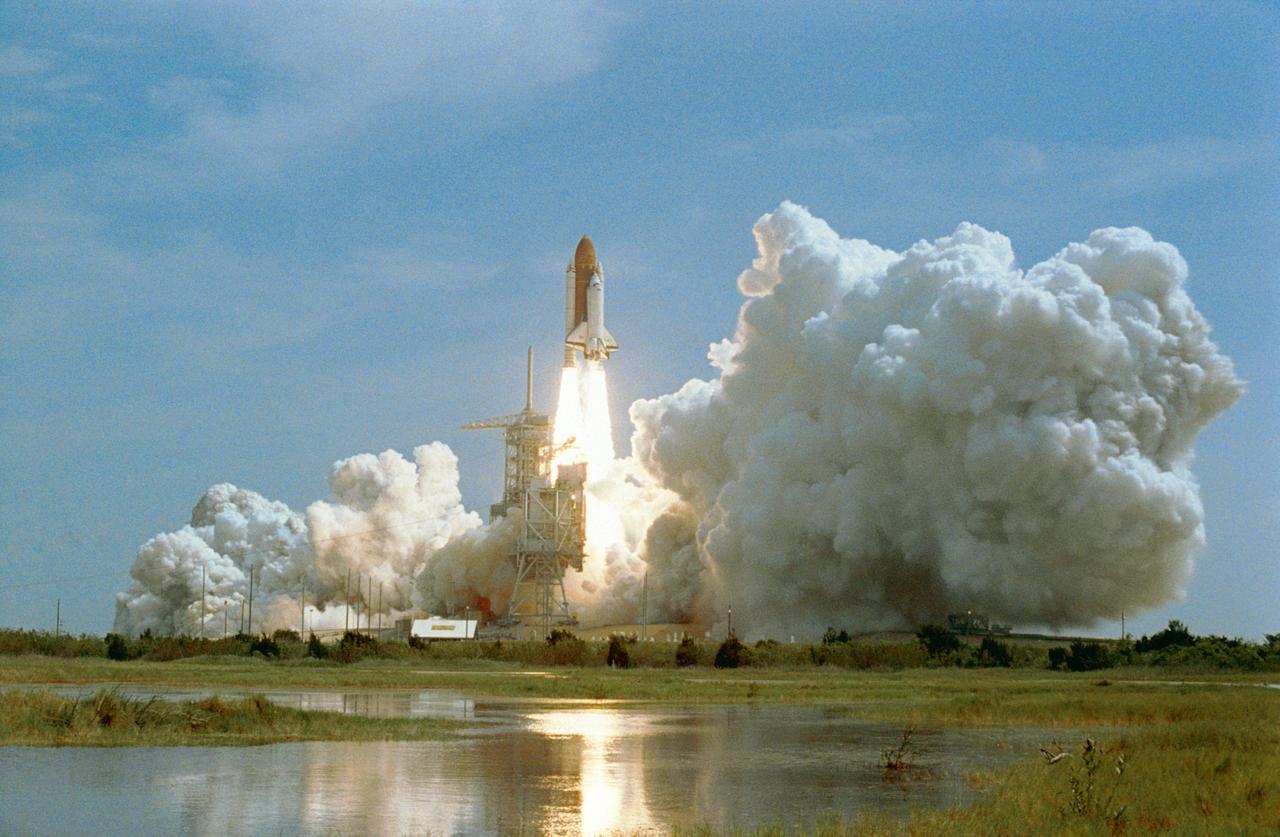
STS055-S-052 (26 April 1993) --- A wide shot shows the STS-55 launch at the Kennedy Space Center. Carrying an international crew of seven and a science laboratory, the Space Shuttle Columbia was on its way for a nine-day Earth-orbital mission in support of the Spacelab D-2 mission. Onboard were astronauts Steven R. Nagel, mission commander; Terence T. (Tom) Henricks, pilot; Jerry L. Ross, payload commander; Charles J. Precourt and Bernard A. Harris Jr., mission specialists; along with German payload specialists Hans Schlegel and Ulrich Walter. Liftoff occurred at 10:50 a.m. (EDT), April 26, 1993.
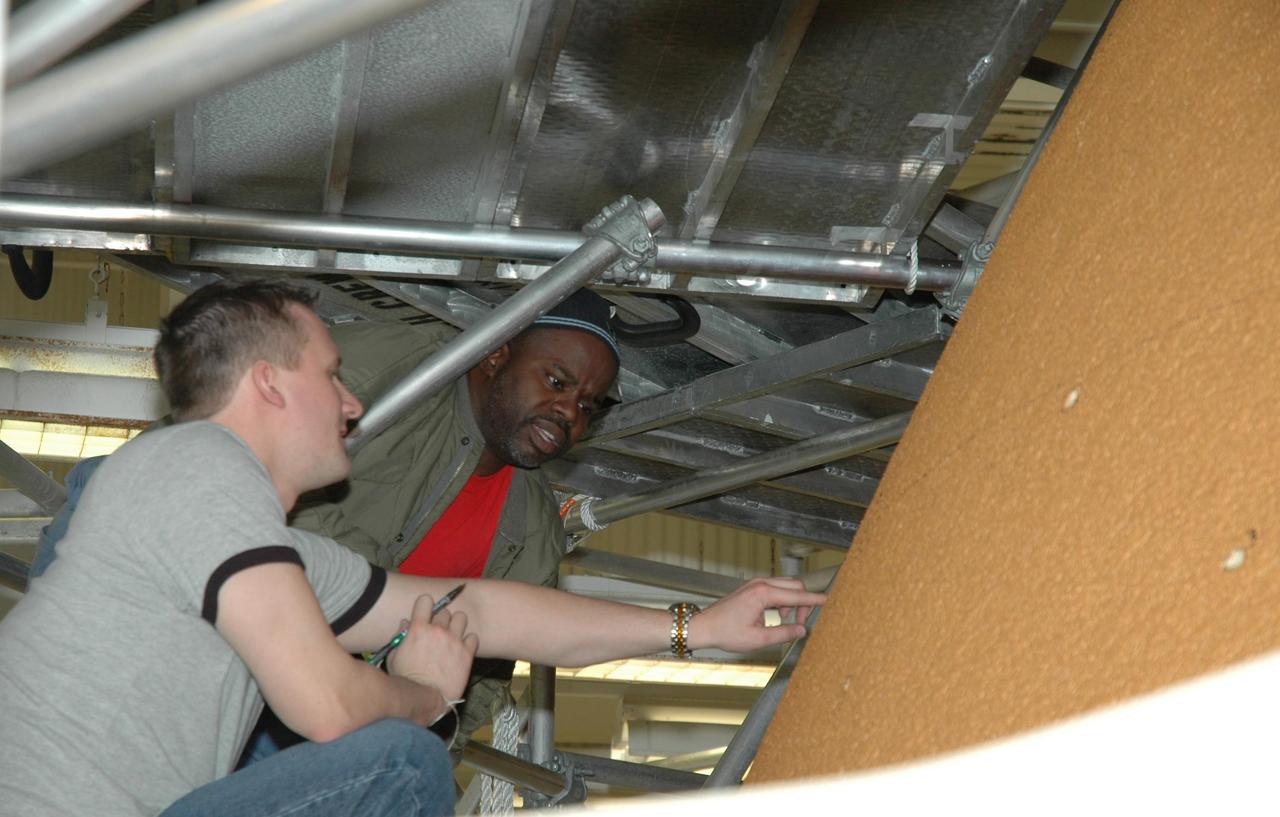
KENNEDY SPACE CENTER, FLA. -- In Highbay 1 inside the Vehicle Assembly Building, technicians look at hail damage on the external tank. A severe thunderstorm with golf ball-sized hail caused visible divots in the giant tank's foam insulation and minor surface damage to about 26 heat shield tiles on the shuttle's left wing. A new target launch date has not been determined, but teams will focus on preparing Atlantis for liftoff in late April on mission STS-117. Photo credit: NASA/Jim Grossmann
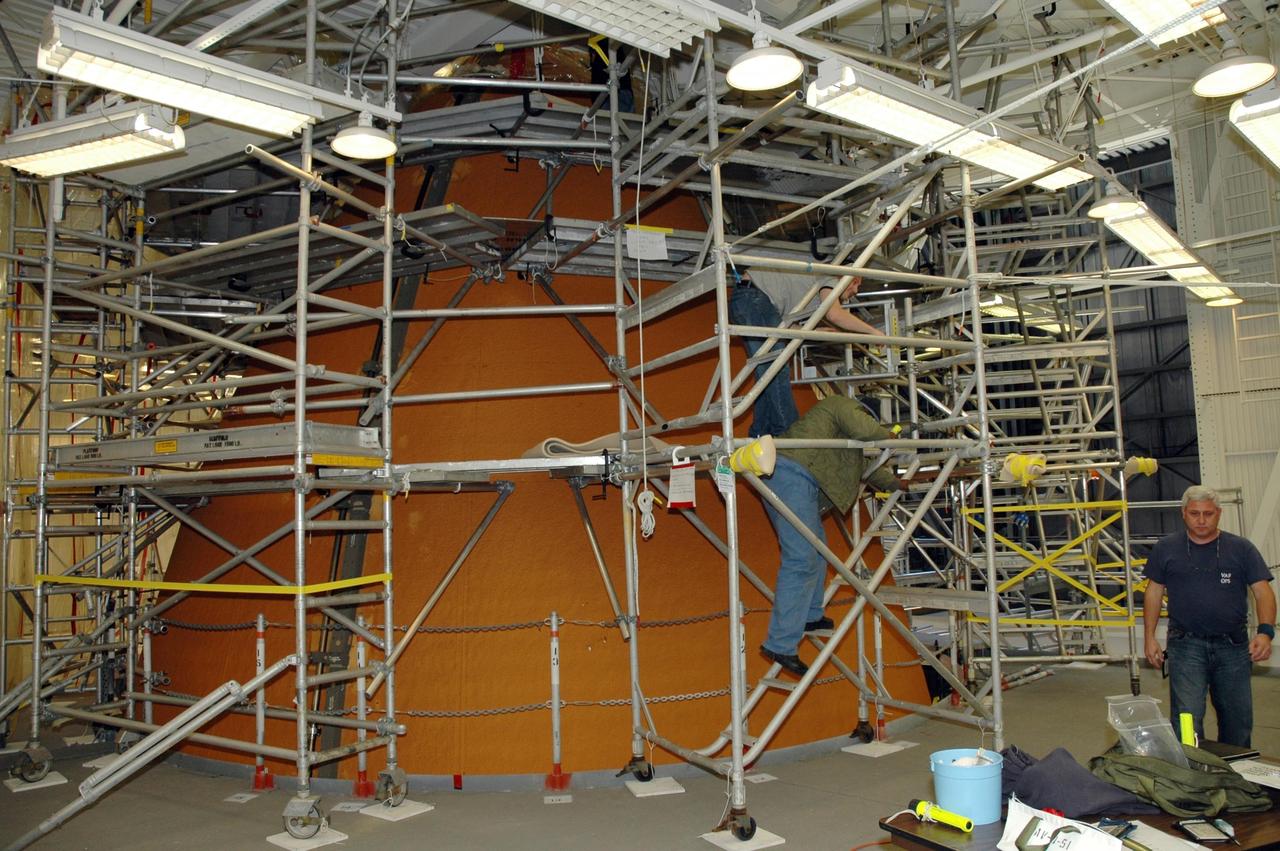
KENNEDY SPACE CENTER, FLA. -- In Highbay 1 inside the Vehicle Assembly Building, workers secure scaffolding around the external tank to prepare it for repairs. A severe thunderstorm with golf ball-sized hail caused visible divots in the giant tank's foam insulation and minor surface damage to about 26 heat shield tiles on the shuttle's left wing. A new target launch date has not been determined, but teams will focus on preparing Atlantis for liftoff in late April on mission STS-117. Photo credit: NASA/Jim Grossmann
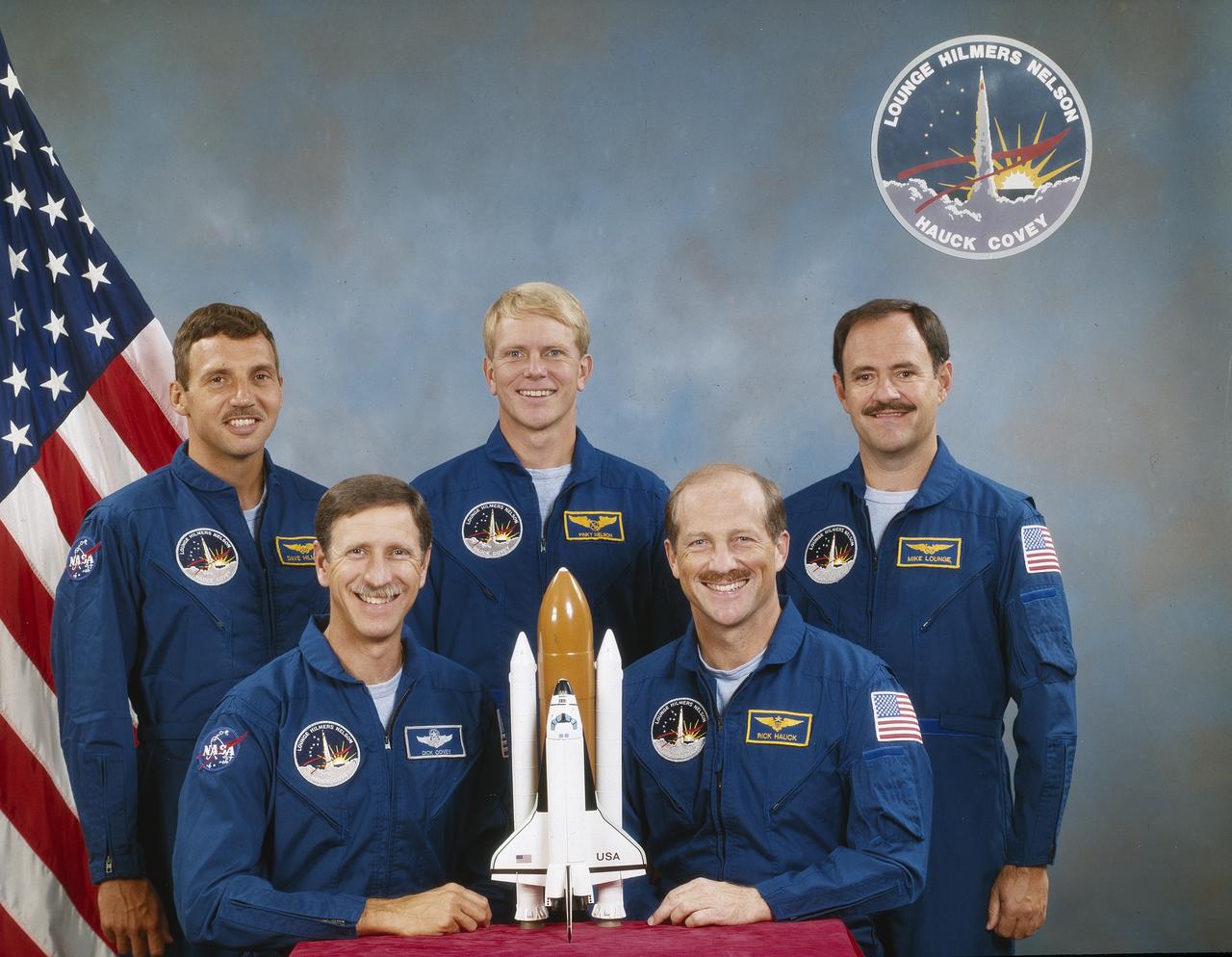
Five astronauts composed the crew of the STS-26 mission. Pictured in the portrait (left to right) are David C. Hilmer, mission specialist; Richard O. Covey, pilot; George D. Nelson, mission specialist; Frederick H. Hauck, Jr., commander; and John, M. Lounge, mission specialist. Launched aboard the Space Shuttle Orbiter Discovery, liftoff occurred on September 29, 1988 at 11:37am (EDT). This was the 7th flight of the Orbiter Discovery, and the return to flight after the STS-51L mission accident. The primary payload was the NASA Tracking and Data Relay Satellite-3 (TDRS-3).

CAPE CANAVERAL, Fla. – Xenon lights over Launch Pad 39A at NASA's Kennedy Space Center in Florida compete with the lightning strike seen to the left. Space shuttle Discovery is on the pad waiting for a scheduled liftoff on the STS-128 mission. Launch was scrubbed due to the weather conditions that violated the limitations for liftoff. Another launch attempt was scheduled for 1:10 a.m. Aug. 26. Discovery's 13-day mission will deliver more than 7 tons of supplies, science racks and equipment, as well as additional environmental hardware to sustain six crew members on the International Space Station. The equipment includes a freezer to store research samples, a new sleeping compartment and the COLBERT treadmill. The mission is the 128th in the Space Shuttle Program, the 37th flight of Discovery and the 30th station assembly flight. Photo credit: NASA/Ben Cooper
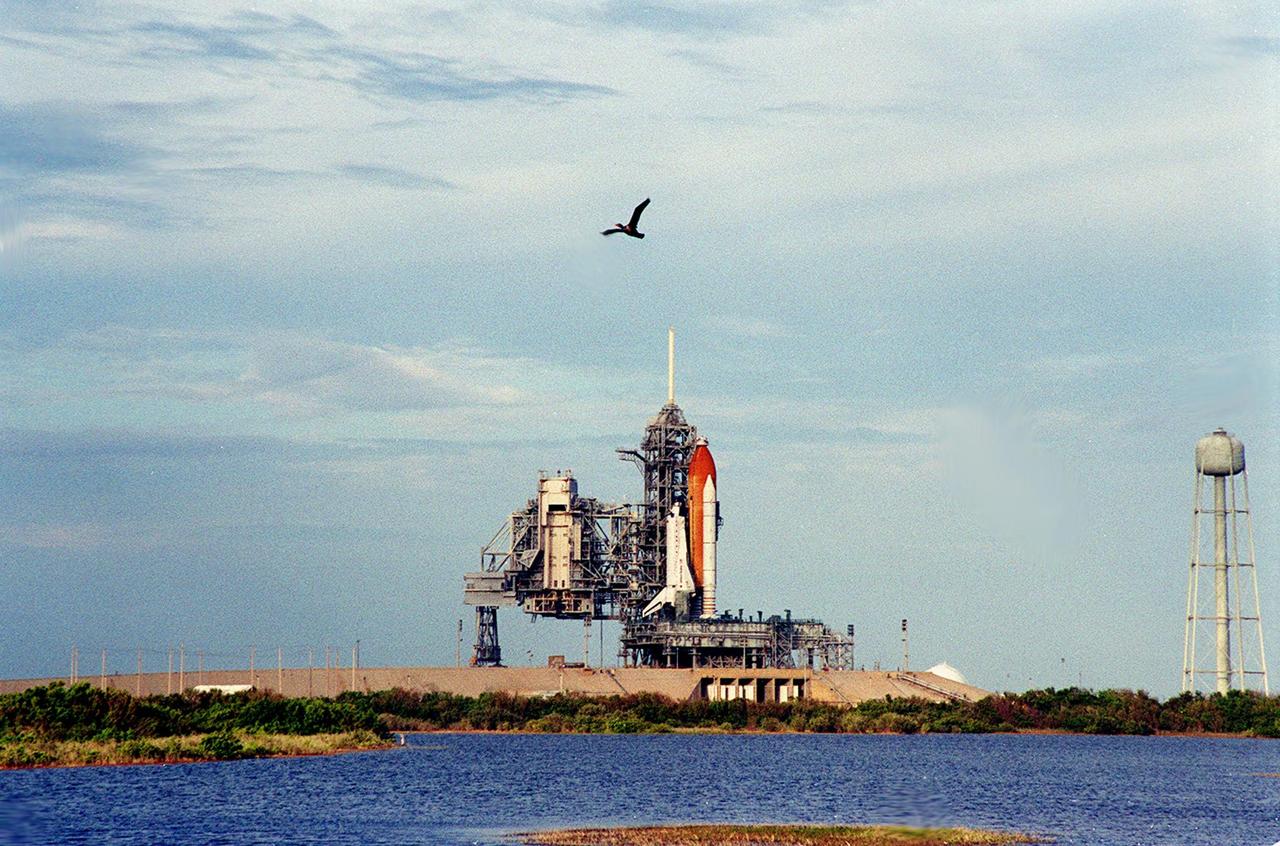
An olivaceous cormorant soars in the cloud-streaked sky near the Space Shuttle Discovery as it waits for liftoff on mission STS-103. To the left of Discovery is the Rotating Service Structure, rolled back on Dec. 16 in preparation for launch. At right is a 290-foot-high water tank with a capacity of 300,000 gallons. The tank is part of the sound suppression water system used during launch. The STS-103 mission, to service the Hubble Space Telescope, is scheduled for launch Dec. 17 at 8:47 p.m. EST from Launch Pad 39B. Mission objectives include replacing gyroscopes and an old computer, installing another solid state recorder, and replacing damaged insulation in the telescope. The mission is expected to last about 8 days and 21 hours. Discovery is expected to land at KSC Sunday, Dec. 26, at about 6:25 p.m. EST
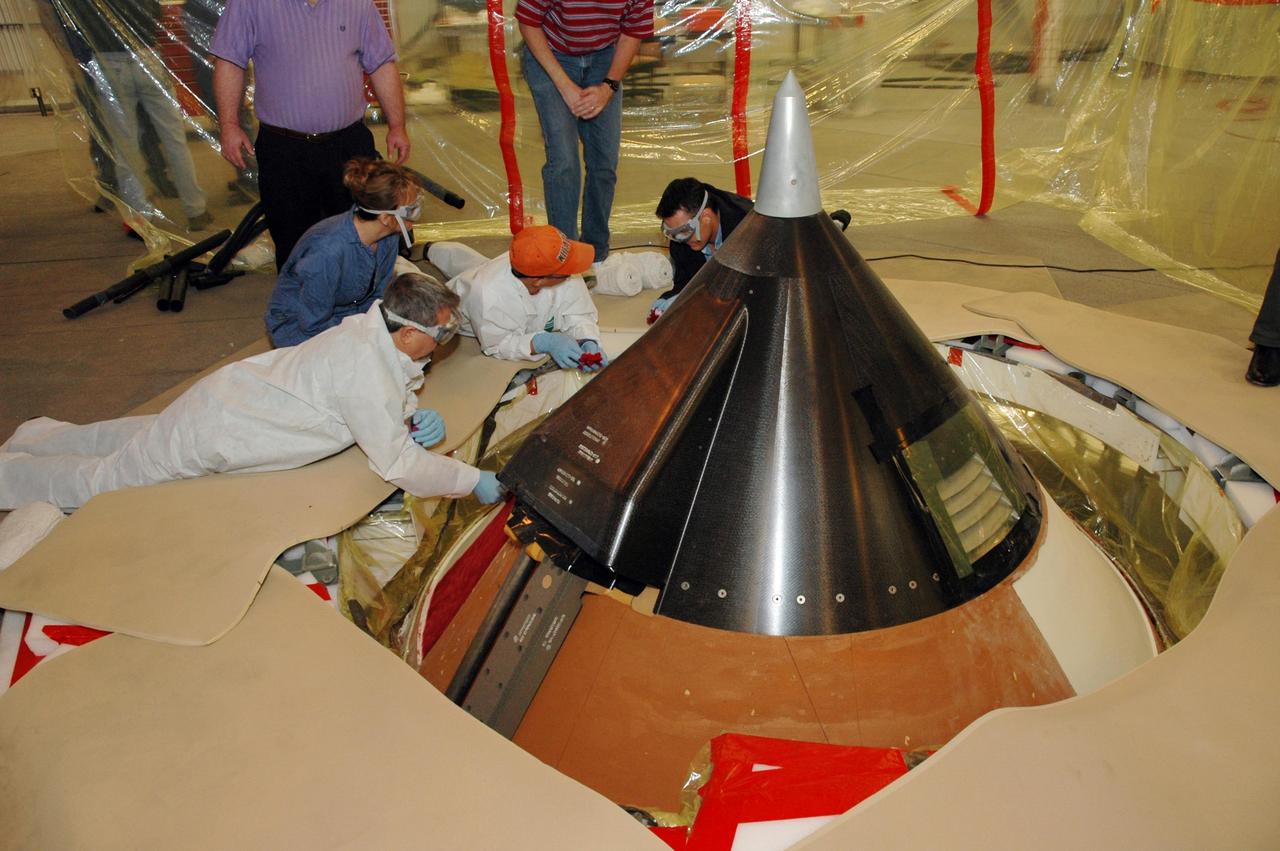
KENNEDY SPACE CENTER, FLA. -- In Highbay 1 inside the Vehicle Assembly Building, technicians perform repair techniques to the external tank inside a tented area that protects the top of the tank. A severe thunderstorm with golf ball-sized hail caused visible divots in the giant tank's foam insulation and minor surface damage to about 26 heat shield tiles on the shuttle's left wing. A new target launch date has not been determined, but teams will focus on preparing Atlantis for liftoff in late April on mission STS-117. Photo credit: NASA/Jim Grossmann
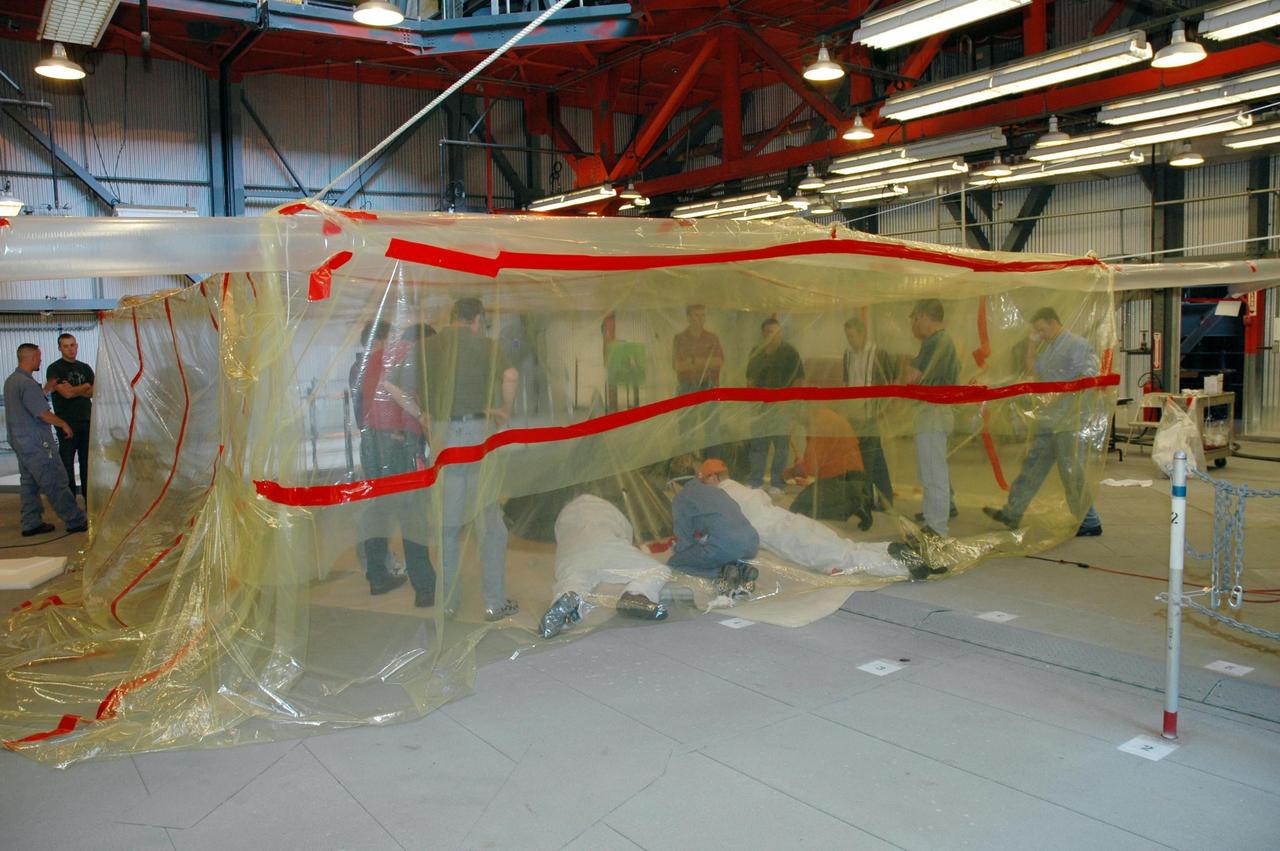
KENNEDY SPACE CENTER, FLA. -- In Highbay 1 inside the Vehicle Assembly Building, technicians work on repair techniques to the external tank. They are inside a tented area that protects the tank. A severe thunderstorm with golf ball-sized hail caused visible divots in the giant tank's foam insulation and minor surface damage to about 26 heat shield tiles on the shuttle's left wing. A new target launch date has not been determined, but teams will focus on preparing Atlantis for liftoff in late April on mission STS-117. Photo credit: NASA/Jim Grossmann
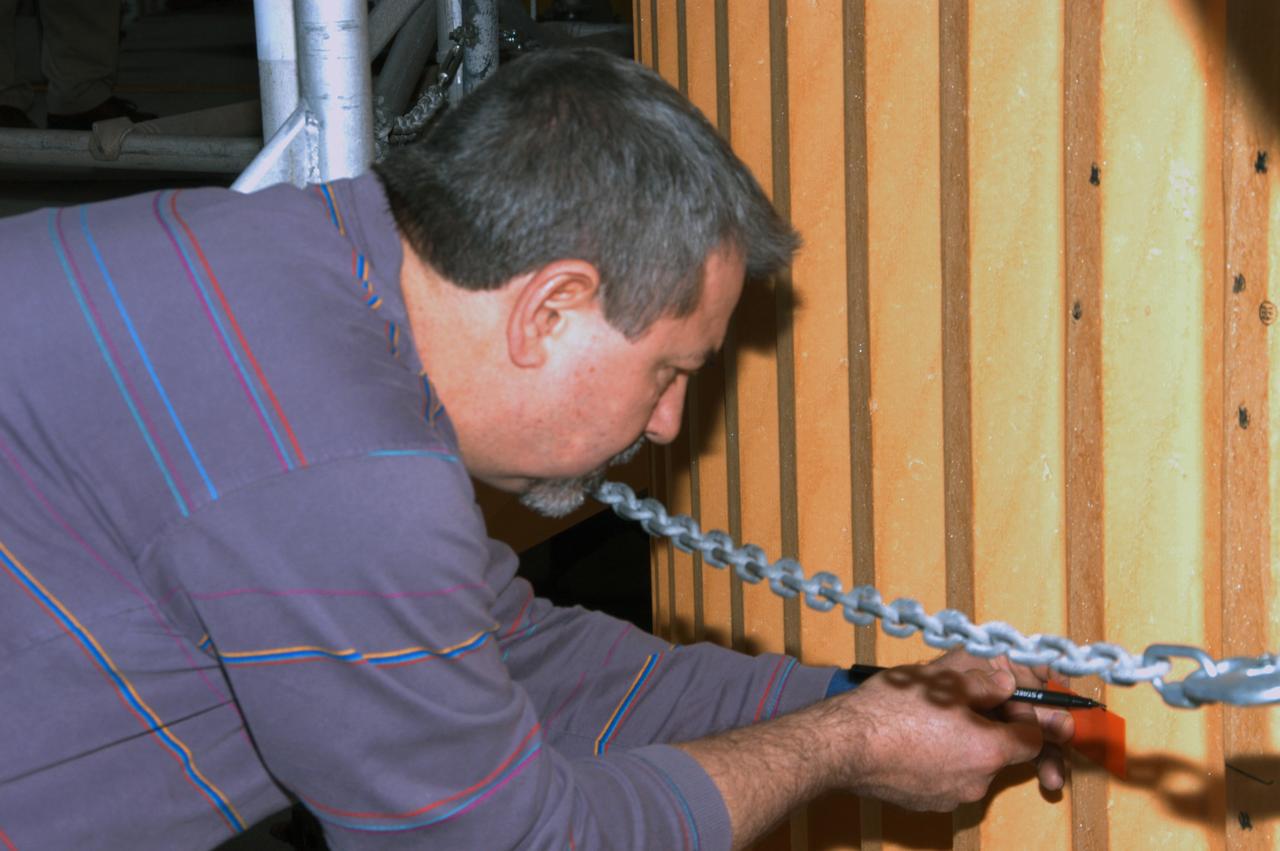
In high bay 1 of the Vehicle Assembly Building, a technician marks off an area for inspection on Atlantis' external tank. A severe thunderstorm with golf ball-sized hail caused visible divots in the giant tank's foam insulation and minor surface damage to about 26 heat shield tiles on the shuttle's left wing. Further evaluation of the tank is necessary to get an accurate accounting of foam damage and determine the type of repair required and the time needed for that work. A new target launch date has not been determined, but teams will focus on preparing Atlantis for liftoff in late April on mission STS-117.

KENNEDY SPACE CENTER, FLA. -- In Highbay 1 inside the Vehicle Assembly Building, a technician carefully applies red dye to the external tank as part of repair operations. A severe thunderstorm with golf ball-sized hail caused visible divots in the giant tank's foam insulation and minor surface damage to about 26 heat shield tiles on the shuttle's left wing. A new target launch date has not been determined, but teams will focus on preparing Atlantis for liftoff in late April on mission STS-117. Photo credit: NASA/Jim Grossmann
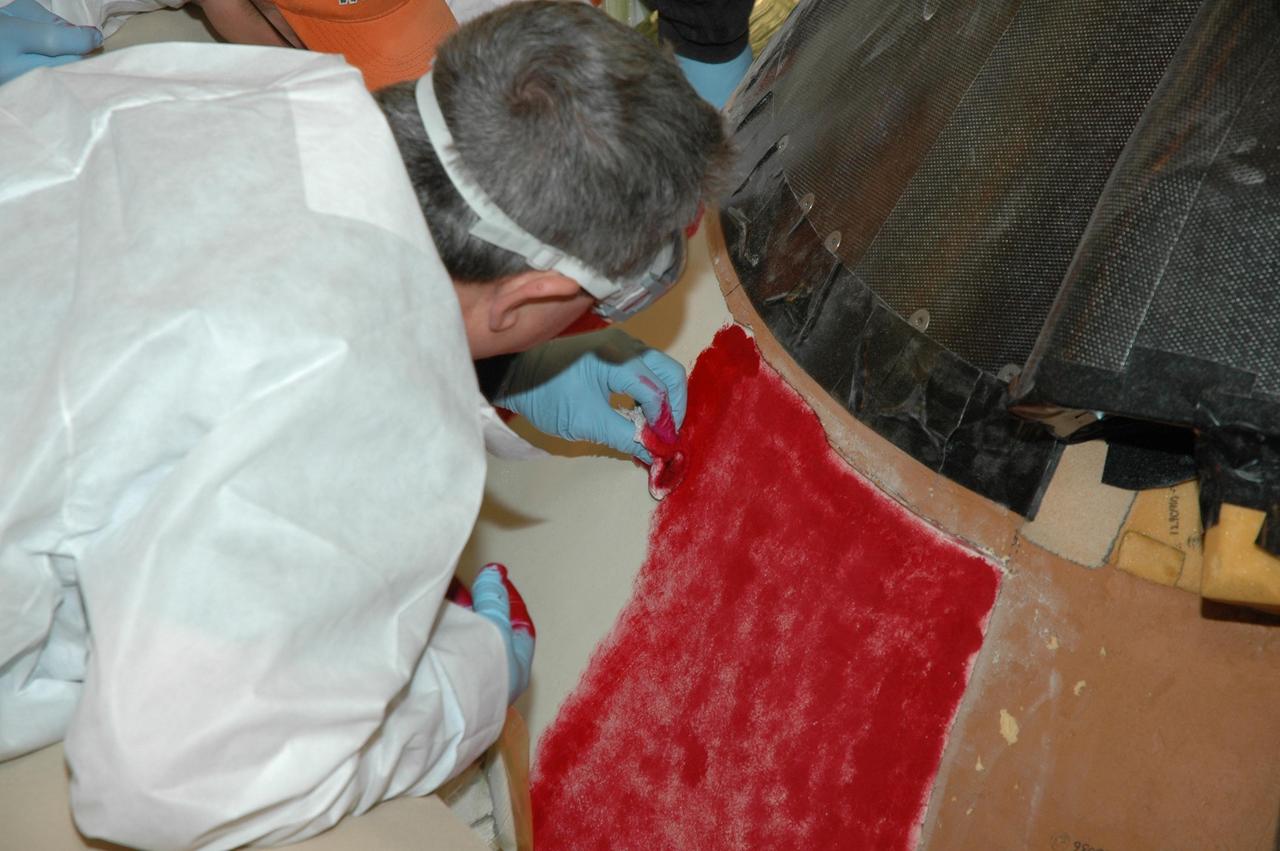
KENNEDY SPACE CENTER, FLA. -- In Highbay 1 inside the Vehicle Assembly Building, a technician carefully applies red dye to the external tank as part of repair operations. A severe thunderstorm with golf ball-sized hail caused visible divots in the giant tank's foam insulation and minor surface damage to about 26 heat shield tiles on the shuttle's left wing. A new target launch date has not been determined, but teams will focus on preparing Atlantis for liftoff in late April on mission STS-117. Photo credit: NASA/Jim Grossmann
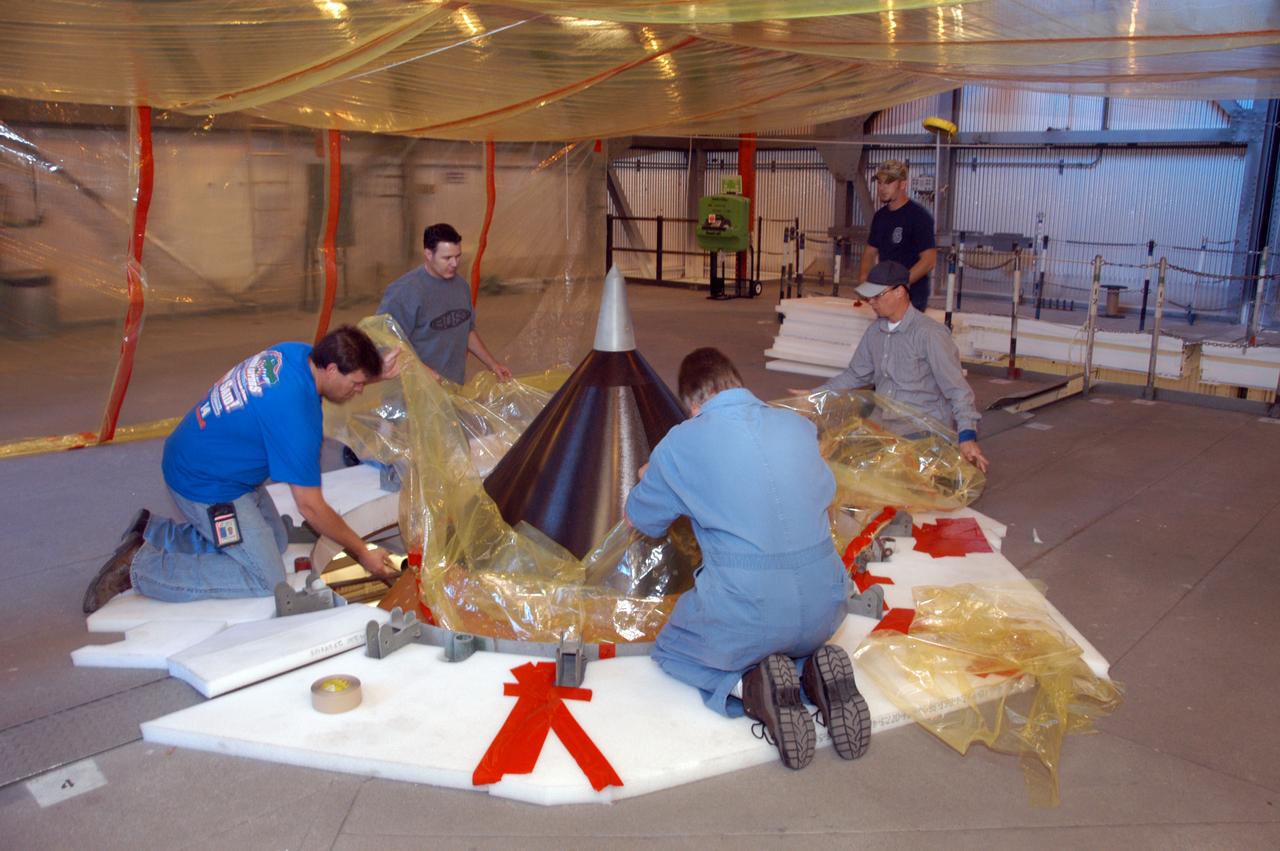
On an upper level of high bay 1 of the Vehicle Assembly Building, technicians place protective material around the nose cone of Atlantis' external tank. The nose cone will undergo repair for hail damage. A severe thunderstorm with golf ball-sized hail caused visible divots in the giant tank's foam insulation and minor surface damage to about 26 heat shield tiles on the shuttle's left wing. Further evaluation of the tank is necessary to get an accurate accounting of foam damage and determine the type of repair required and the time needed for that work. A new target launch date has not been determined, but teams will focus on preparing Atlantis for liftoff in late April on mission STS-117.
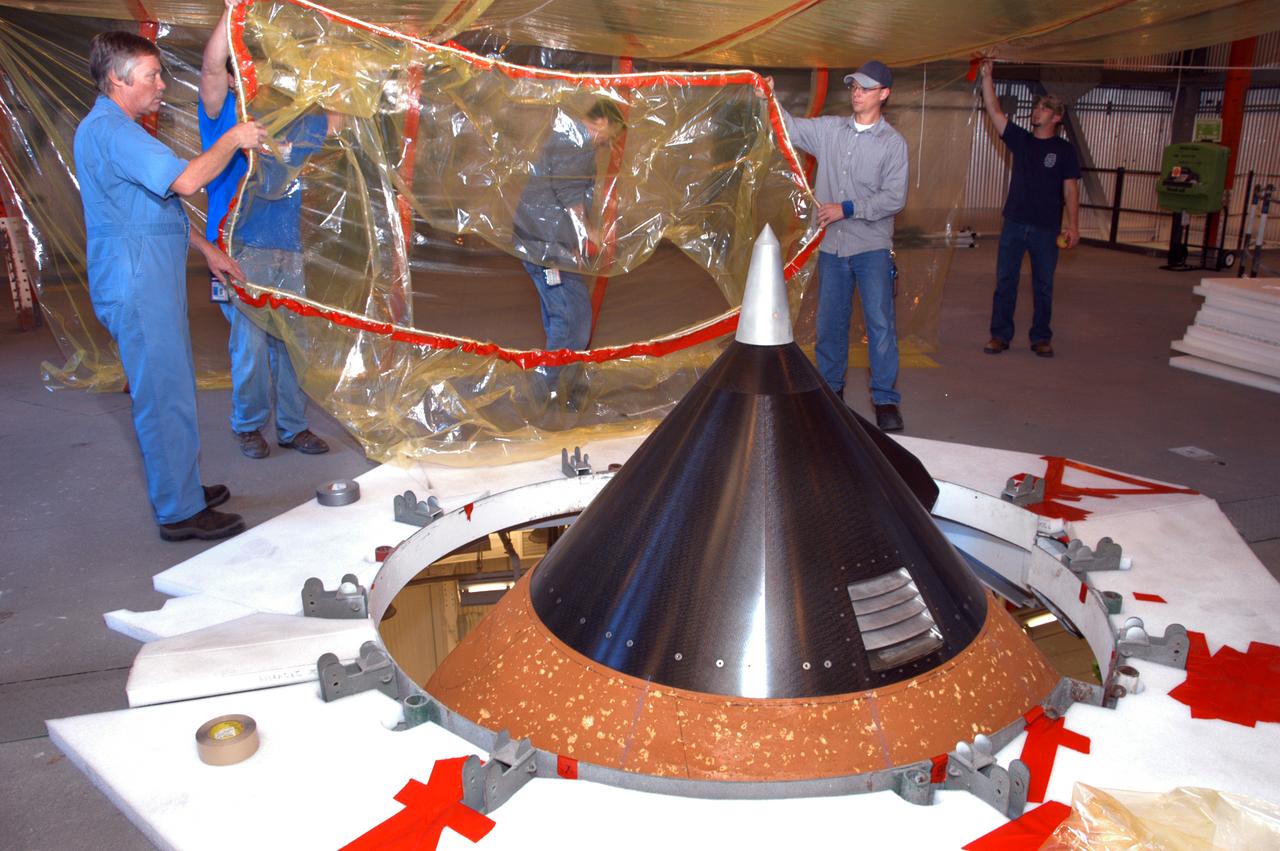
On an upper level of high bay 1 of the Vehicle Assembly Building, technicians move protective material toward the nose cone (foreground) of Atlantis' external tank. The nose cone will undergo repair for hail damage. A severe thunderstorm with golf ball-sized hail caused visible divots in the giant tank's foam insulation and minor surface damage to about 26 heat shield tiles on the shuttle's left wing. Further evaluation of the tank is necessary to get an accurate accounting of foam damage and determine the type of repair required and the time needed for that work. A new target launch date has not been determined, but teams will focus on preparing Atlantis for liftoff in late April on mission STS-117.
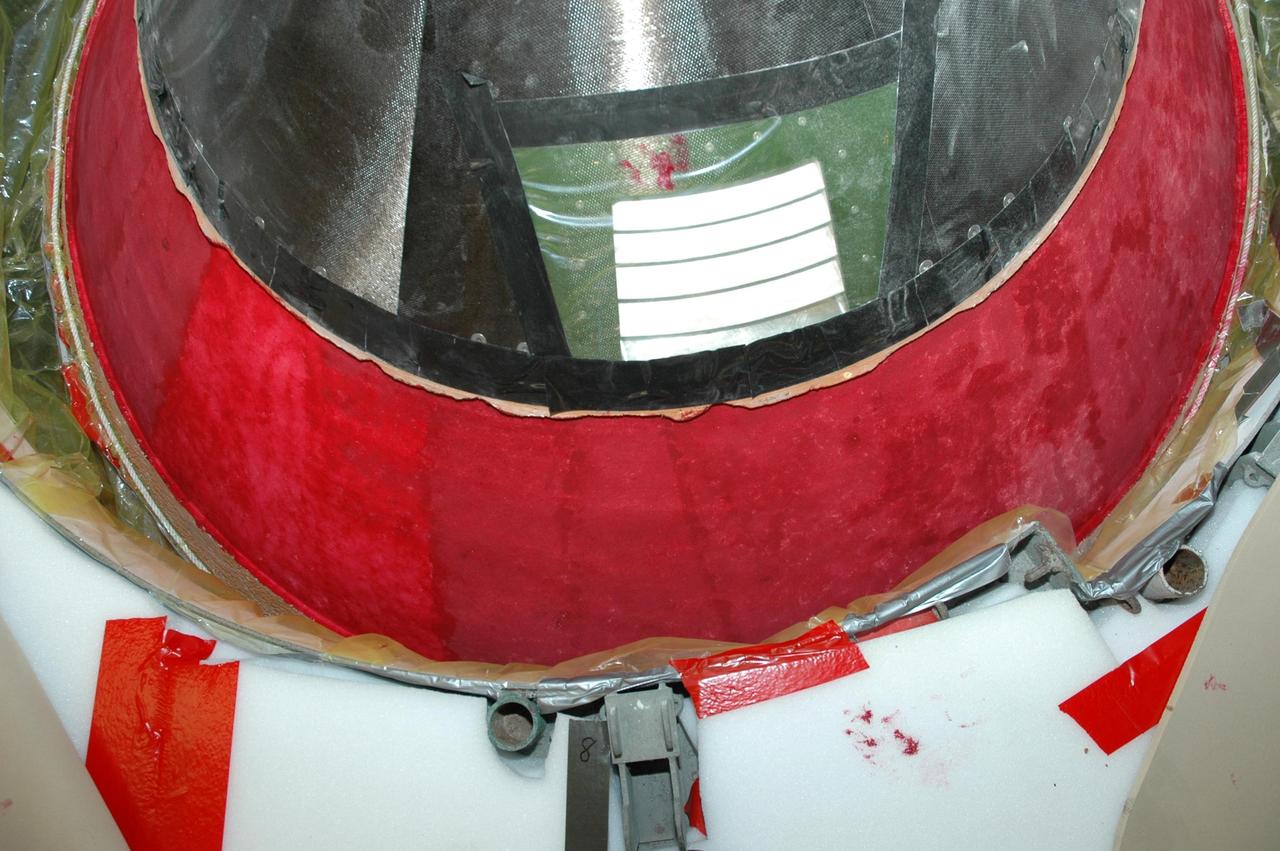
KENNEDY SPACE CENTER, FLA. -- In Highbay 1 inside the Vehicle Assembly Building, an area near the top of the external tank has been covered in a red dye to help expose cracks or compression dents. A severe thunderstorm with golf ball-sized hail caused visible divots in the giant tank's foam insulation and minor surface damage to about 26 heat shield tiles on the shuttle's left wing. A new target launch date has not been determined, but teams will focus on preparing Atlantis for liftoff in late April on mission STS-117. Photo credit: NASA/Jim Grossmann
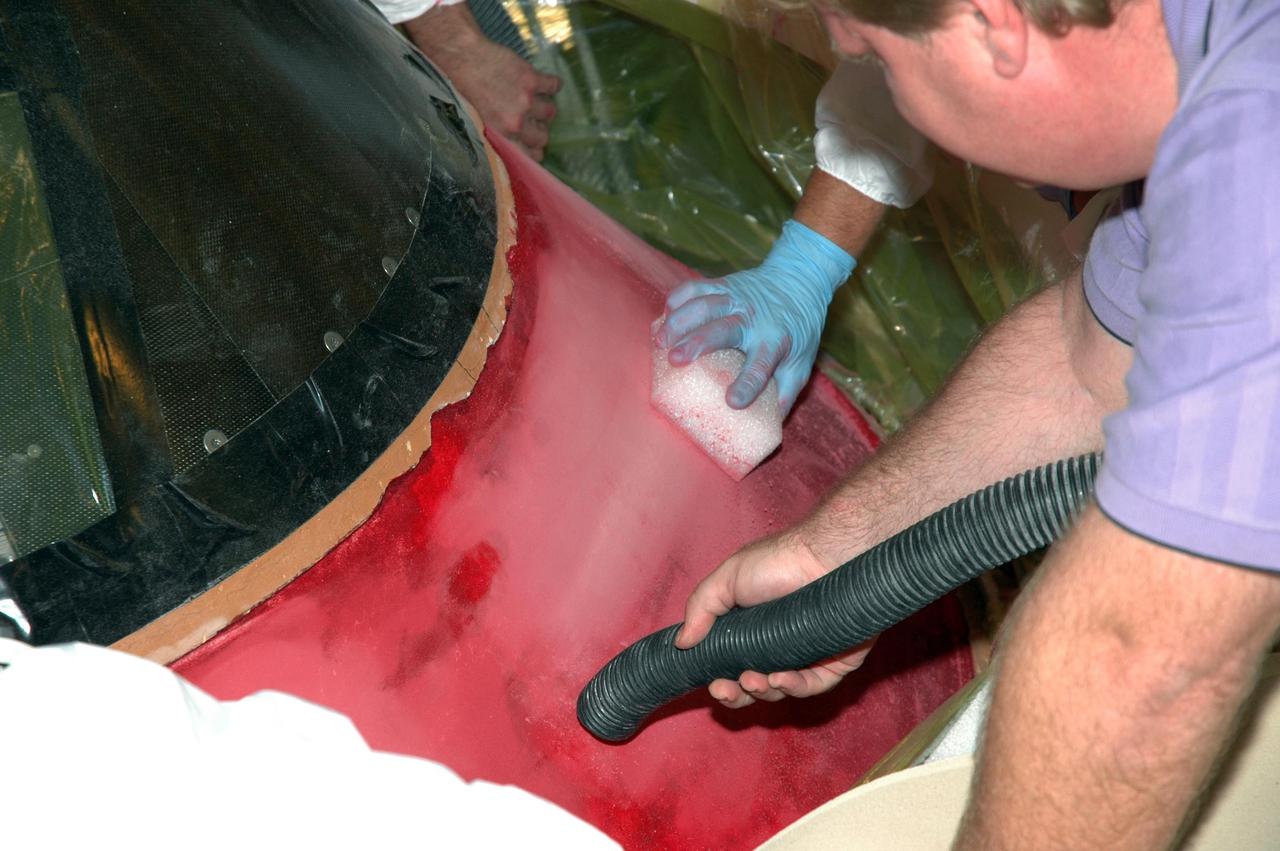
KENNEDY SPACE CENTER, FLA. -- In Highbay 1 inside the Vehicle Assembly Building, a technician carefully sands away the red dye that has been applied to the external tank to help expose cracks or compression dents, while another technician uses a compression hose to remove excess particles. A severe thunderstorm with golf ball-sized hail caused visible divots in the giant tank's foam insulation and minor surface damage to about 26 heat shield tiles on the shuttle's left wing. A new target launch date has not been determined, but teams will focus on preparing Atlantis for liftoff in late April on mission STS-117. Photo credit: NASA/Jim Grossmann

KENNEDY SPACE CENTER, FLA. -- In Highbay 1 inside the Vehicle Assembly Building, technicians carefully inspect a portion of the external tank foam that has been covered in red dye to help expose cracks or compression dents. A severe thunderstorm with golf ball-sized hail caused visible divots in the giant tank's foam insulation and minor surface damage to about 26 heat shield tiles on the shuttle's left wing. A new target launch date has not been determined, but teams will focus on preparing Atlantis for liftoff in late April on mission STS-117. Photo credit: NASA/Jim Grossmann
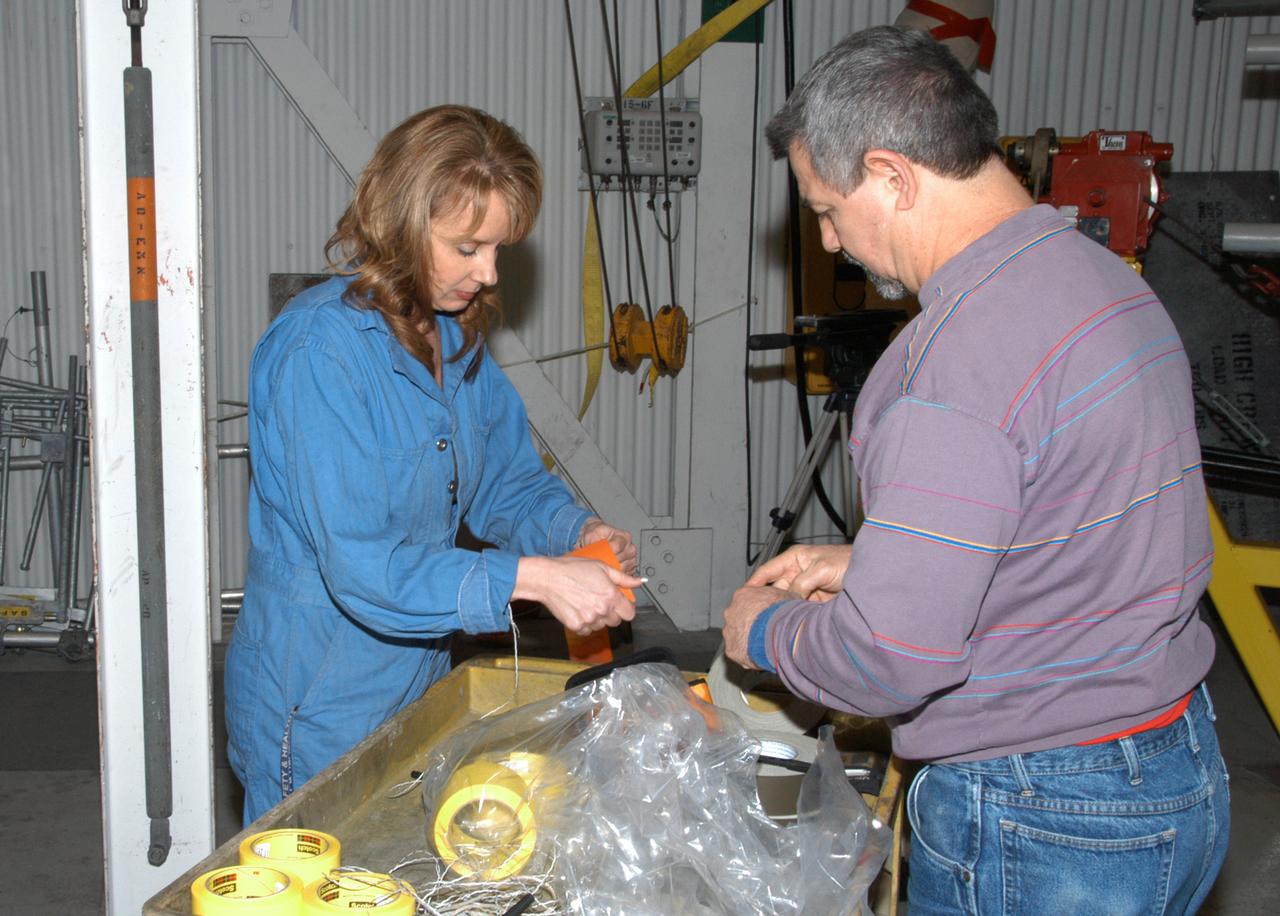
Technicians in the Vehicle Assembly Building prepare materials that will be used during repair of the nose cone on Atlantis' external tank. A severe thunderstorm with golf ball-sized hail caused visible divots in the giant tank's foam insulation and minor surface damage to about 26 heat shield tiles on the shuttle's left wing. Further evaluation of the tank is necessary to get an accurate accounting of foam damage and determine the type of repair required and the time needed for that work. A new target launch date has not been determined, but teams will focus on preparing Atlantis for liftoff in late April on mission STS-117.
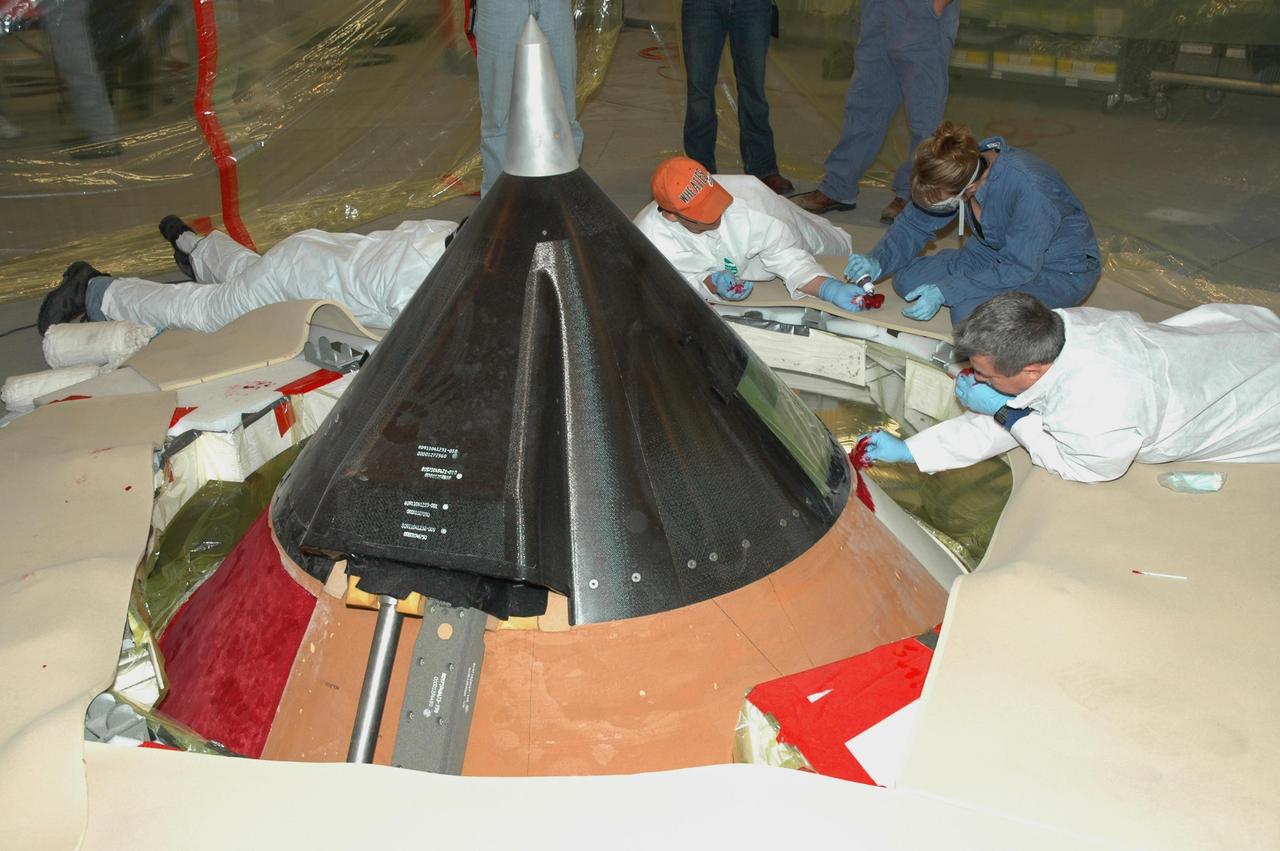
KENNEDY SPACE CENTER, FLA. -- In Highbay 1 inside the Vehicle Assembly Building, technicians carefully apply red dye to the external tank as part of repair operations. A severe thunderstorm with golf ball-sized hail caused visible divots in the giant tank's foam insulation and minor surface damage to about 26 heat shield tiles on the shuttle's left wing. A new target launch date has not been determined, but teams will focus on preparing Atlantis for liftoff in late April on mission STS-117. Photo credit: NASA/Jim Grossmann

KENNEDY SPACE CENTER, FLA. -- In Highbay 1 inside the Vehicle Assembly Building, technicians work on repair techniques to the hail-damaged external tank. They are inside a tented area that protects the tank. Scaffolding around the tank can be seen below. A severe thunderstorm with golf ball-sized hail caused visible divots in the giant tank's foam insulation and minor surface damage to about 26 heat shield tiles on the shuttle's left wing. A new target launch date has not been determined, but teams will focus on preparing Atlantis for liftoff in late April on mission STS-117. Photo credit: NASA/Jim Grossmann
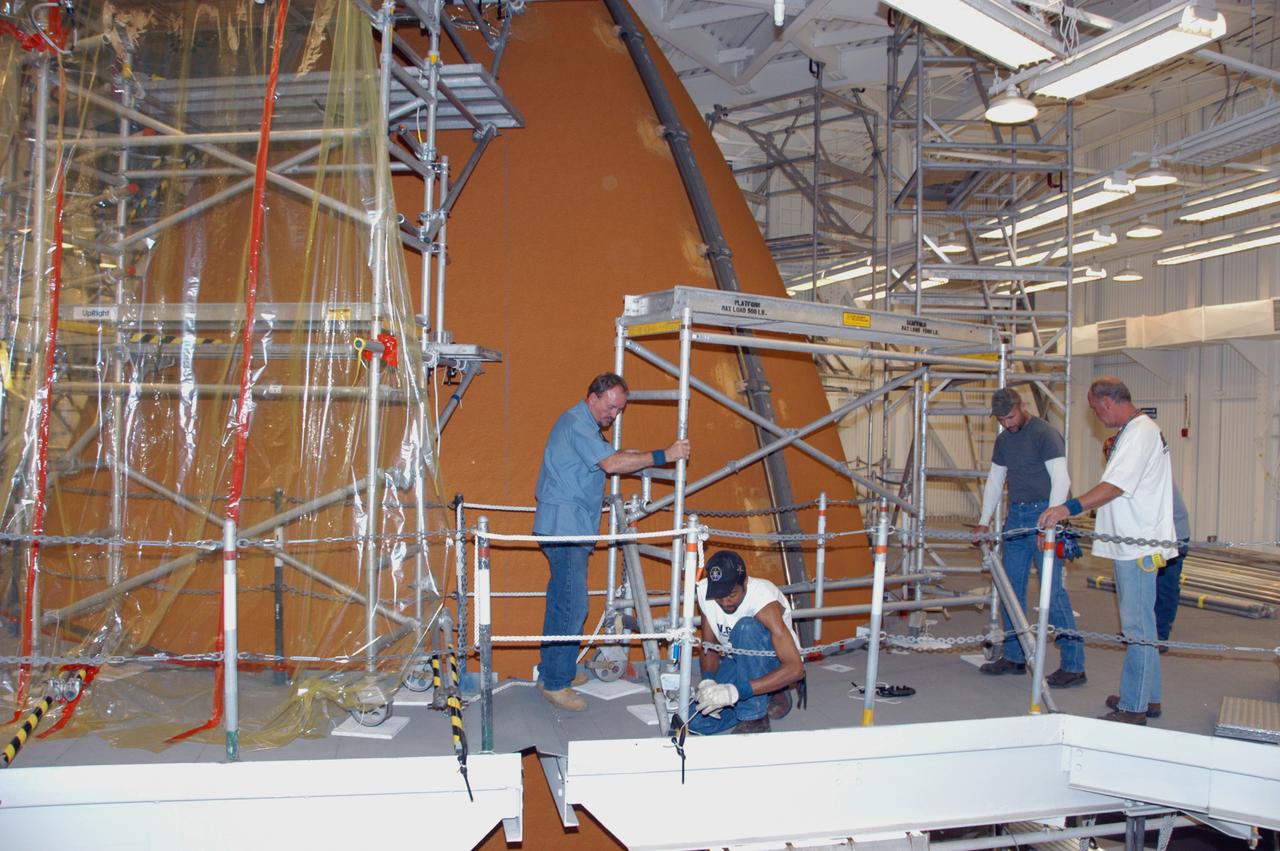
On an upper level of high bay 1 of the Vehicle Assembly Building, technicians secure protective material around Atlantis' external tank. The preparations are for future repair work of the hail damage that happened Feb. 27. A severe thunderstorm with golf ball-sized hail caused visible divots in the giant tank's foam insulation and minor surface damage to about 26 heat shield tiles on the shuttle's left wing. Further evaluation of the tank is necessary to get an accurate accounting of foam damage and determine the type of repair required and the time needed for that work. A new target launch date has not been determined, but teams will focus on preparing Atlantis for liftoff in late April on mission STS-117.
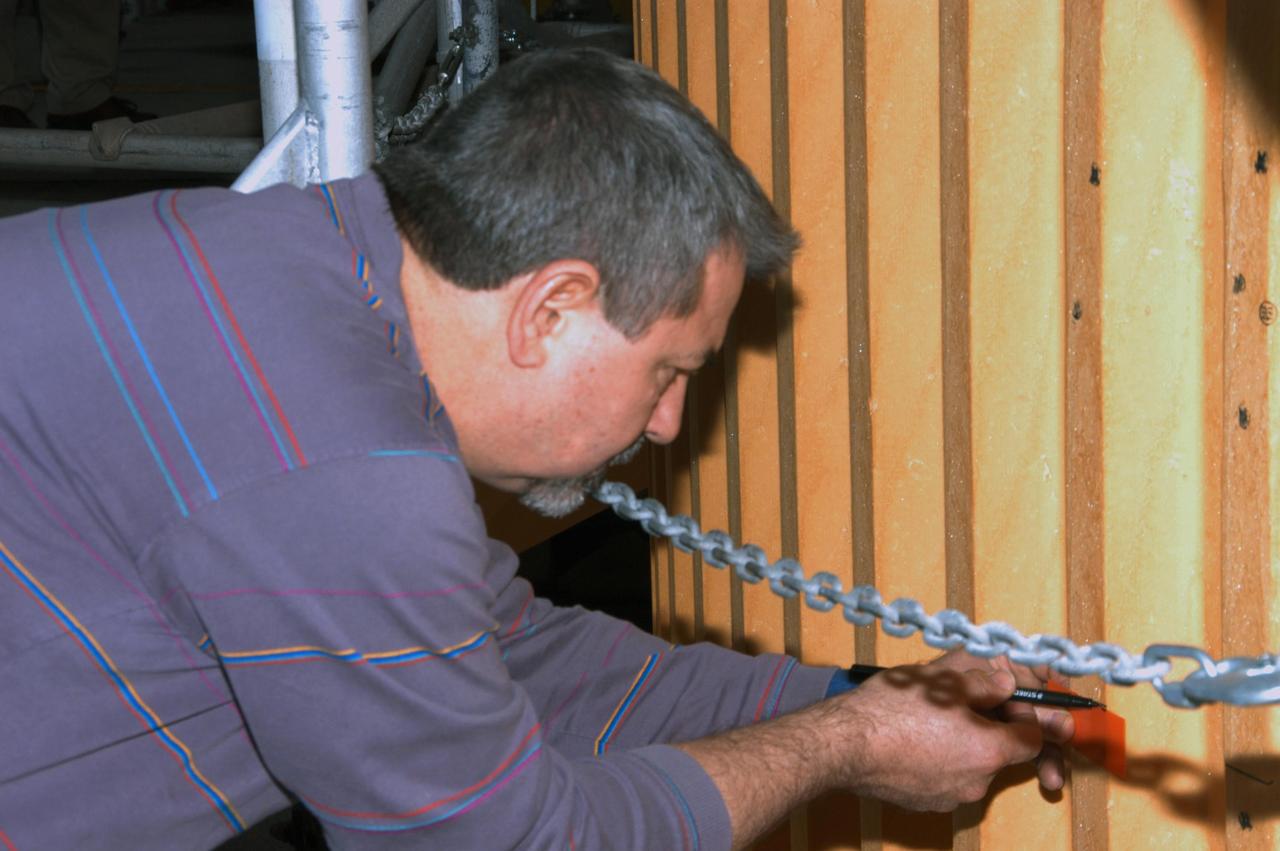
KENNEDY SPACE CENTER, FLA. -- In high bay 1 of the Vehicle Assembly Building, a technician marks off an area for inspection on Atlantis' external tank. A severe thunderstorm with golf ball-sized hail caused visible divots in the giant tank's foam insulation and minor surface damage to about 26 heat shield tiles on the shuttle's left wing. Further evaluation of the tank is necessary to get an accurate accounting of foam damage and determine the type of repair required and the time needed for that work. A new target launch date has not been determined, but teams will focus on preparing Atlantis for liftoff in late April on mission STS-117. Photo credit: NASA/George Shelton

On an upper level of high bay 1 of the Vehicle Assembly Building, technicians secure protective material around the base of the nose cone of Atlantis' external tank. The nose cone will undergo repair for hail damage. A severe thunderstorm with golf ball-sized hail caused visible divots in the giant tank's foam insulation and minor surface damage to about 26 heat shield tiles on the shuttle's left wing. Further evaluation of the tank is necessary to get an accurate accounting of foam damage and determine the type of repair required and the time needed for that work. A new target launch date has not been determined, but teams will focus on preparing Atlantis for liftoff in late April on mission STS-117.
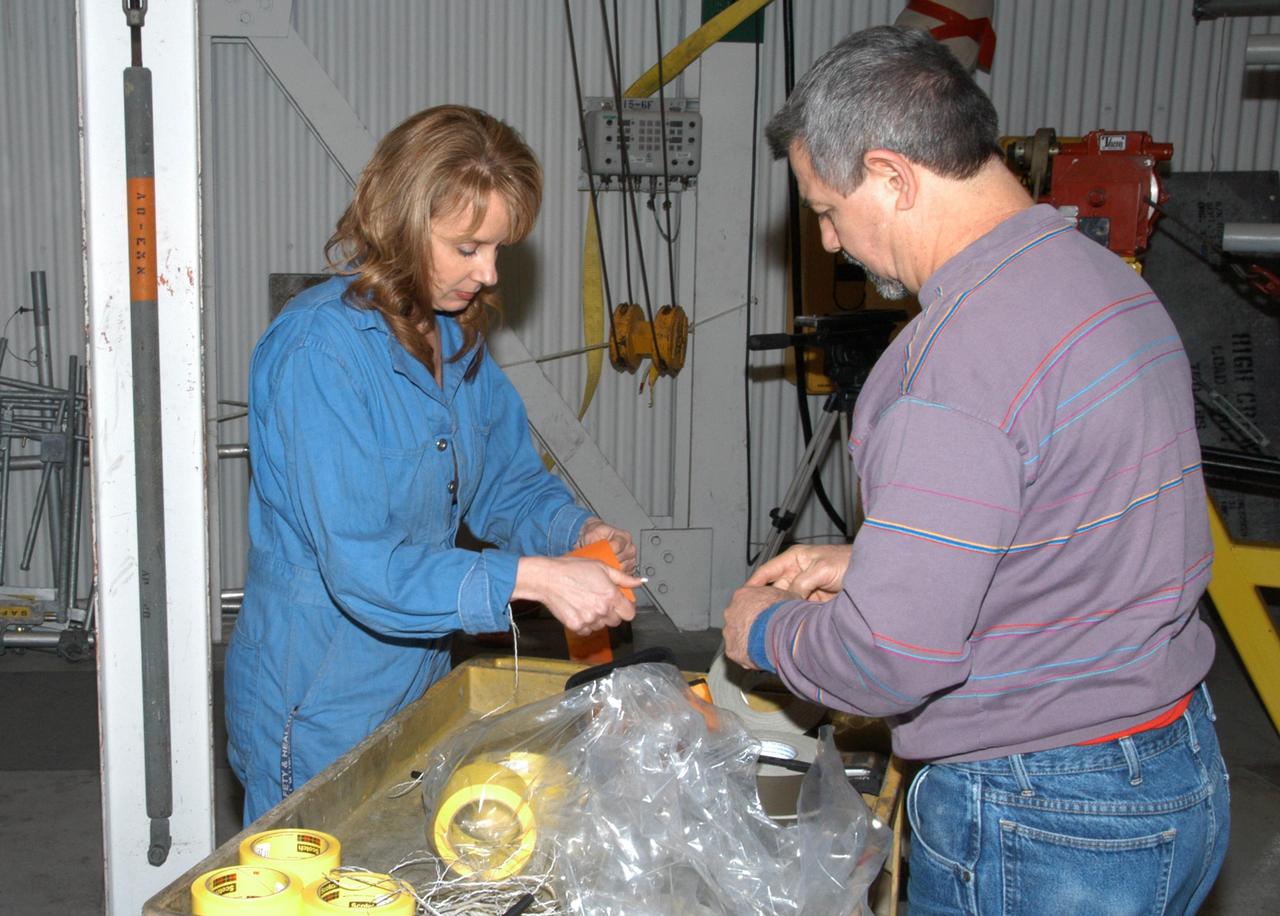
KENNEDY SPACE CENTER, FLA. -- Technicians in the Vehicle Assembly Building prepare materials that will be used during repair of the nose cone on Atlantis' external tank. A severe thunderstorm with golf ball-sized hail caused visible divots in the giant tank's foam insulation and minor surface damage to about 26 heat shield tiles on the shuttle's left wing. Further evaluation of the tank is necessary to get an accurate accounting of foam damage and determine the type of repair required and the time needed for that work. A new target launch date has not been determined, but teams will focus on preparing Atlantis for liftoff in late April on mission STS-117. Photo credit: NASA/George Shelton
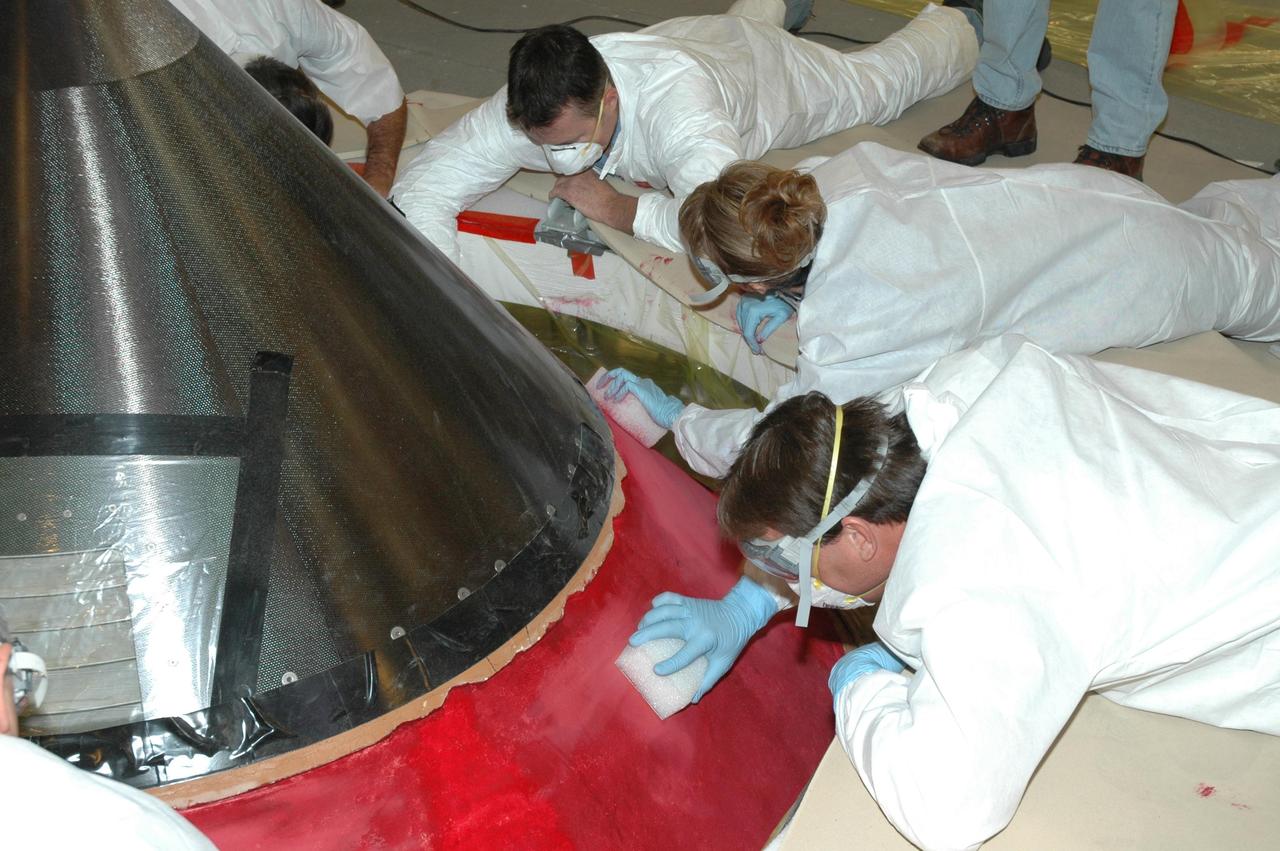
KENNEDY SPACE CENTER, FLA. -- In Highbay 1 inside the Vehicle Assembly Building, technicians begin to carefully sand away the red dye that has been applied to the external tank to help expose cracks or compression dents. A severe thunderstorm with golf ball-sized hail caused visible divots in the giant tank's foam insulation and minor surface damage to about 26 heat shield tiles on the shuttle's left wing. A new target launch date has not been determined, but teams will focus on preparing Atlantis for liftoff in late April on mission STS-117. Photo credit: NASA/Jim Grossmann
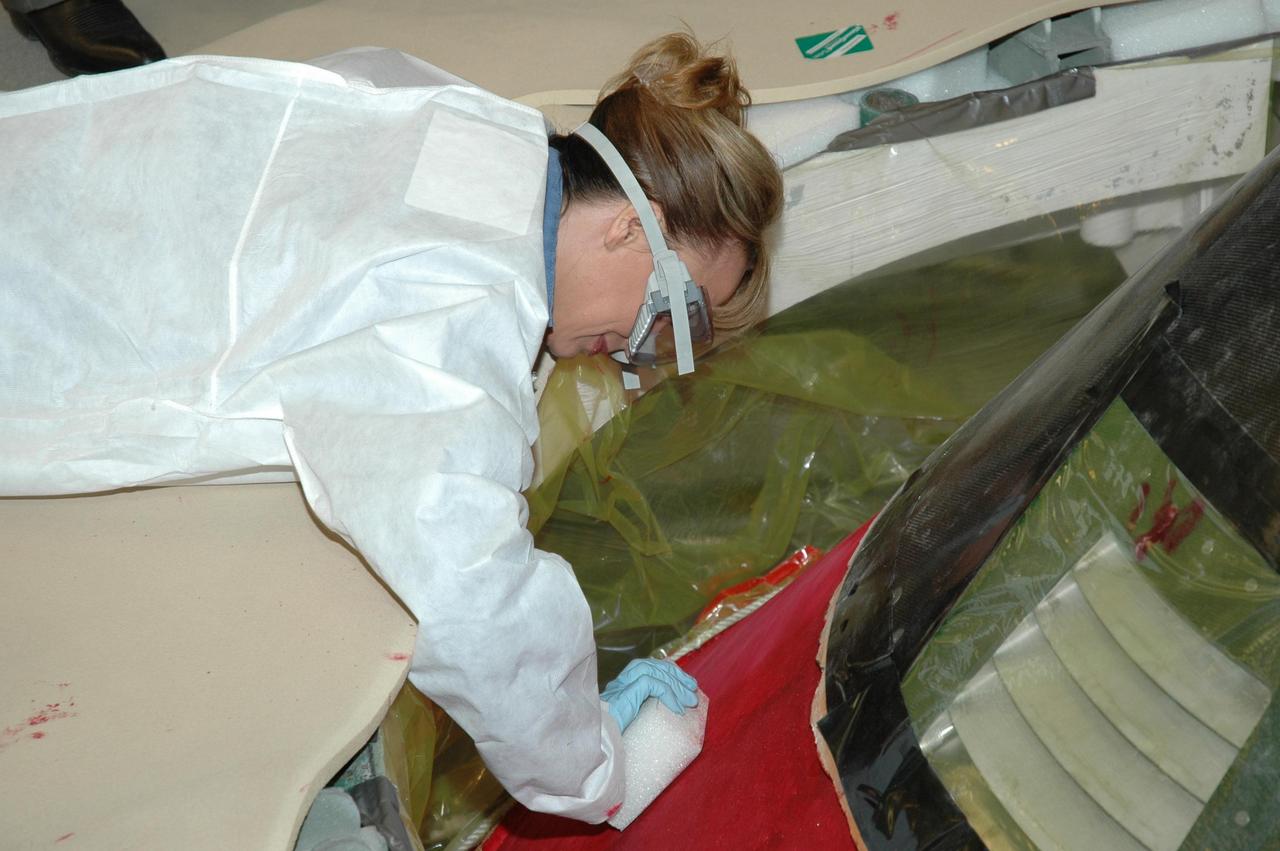
KENNEDY SPACE CENTER, FLA. -- In Highbay 1 inside the Vehicle Assembly Building, a technician carefully begins to sand away the red dye that has been applied to the external tank to help expose cracks or compression dents. A severe thunderstorm with golf ball-sized hail caused visible divots in the giant tank's foam insulation and minor surface damage to about 26 heat shield tiles on the shuttle's left wing. A new target launch date has not been determined, but teams will focus on preparing Atlantis for liftoff in late April on mission STS-117. Photo credit: NASA/Jim Grossmann

KENNEDY SPACE CENTER, FLA. -- In Highbay 1 inside the Vehicle Assembly Building, a technician carefully begins to carefully sand away the red dye that has been applied to the external tank to help expose cracks or compression dents. A severe thunderstorm with golf ball-sized hail caused visible divots in the giant tank's foam insulation and minor surface damage to about 26 heat shield tiles on the shuttle's left wing. A new target launch date has not been determined, but teams will focus on preparing Atlantis for liftoff in late April on mission STS-117. Photo credit: NASA/Jim Grossmann
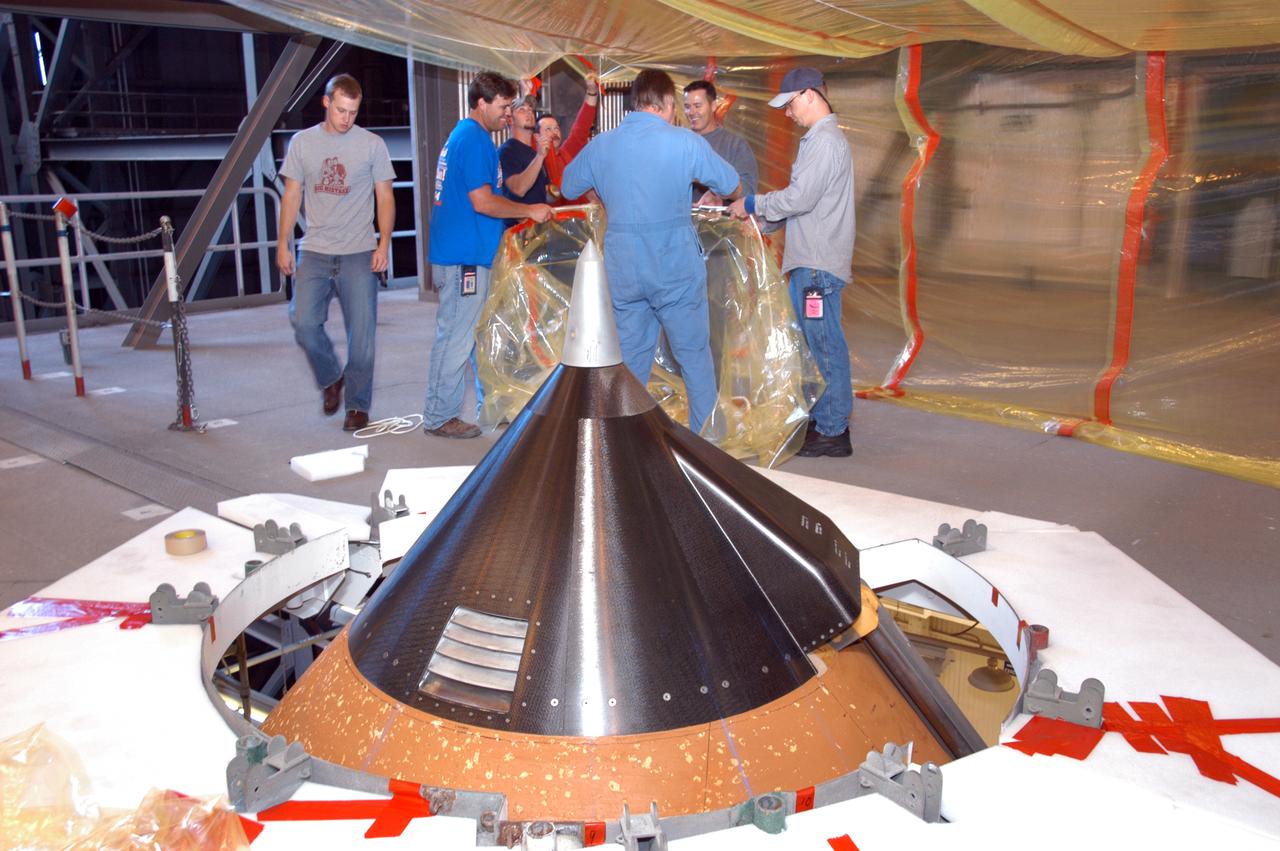
On an upper level of high bay 1 of the Vehicle Assembly Building, technicians prepare the area around the nose cone (foreground) of Atlantis' external tank that will undergo repair for hail damage. A severe thunderstorm with golf ball-sized hail caused visible divots in the giant tank's foam insulation and minor surface damage to about 26 heat shield tiles on the shuttle's left wing. Further evaluation of the tank is necessary to get an accurate accounting of foam damage and determine the type of repair required and the time needed for that work. A new target launch date has not been determined, but teams will focus on preparing Atlantis for liftoff in late April on mission STS-117.
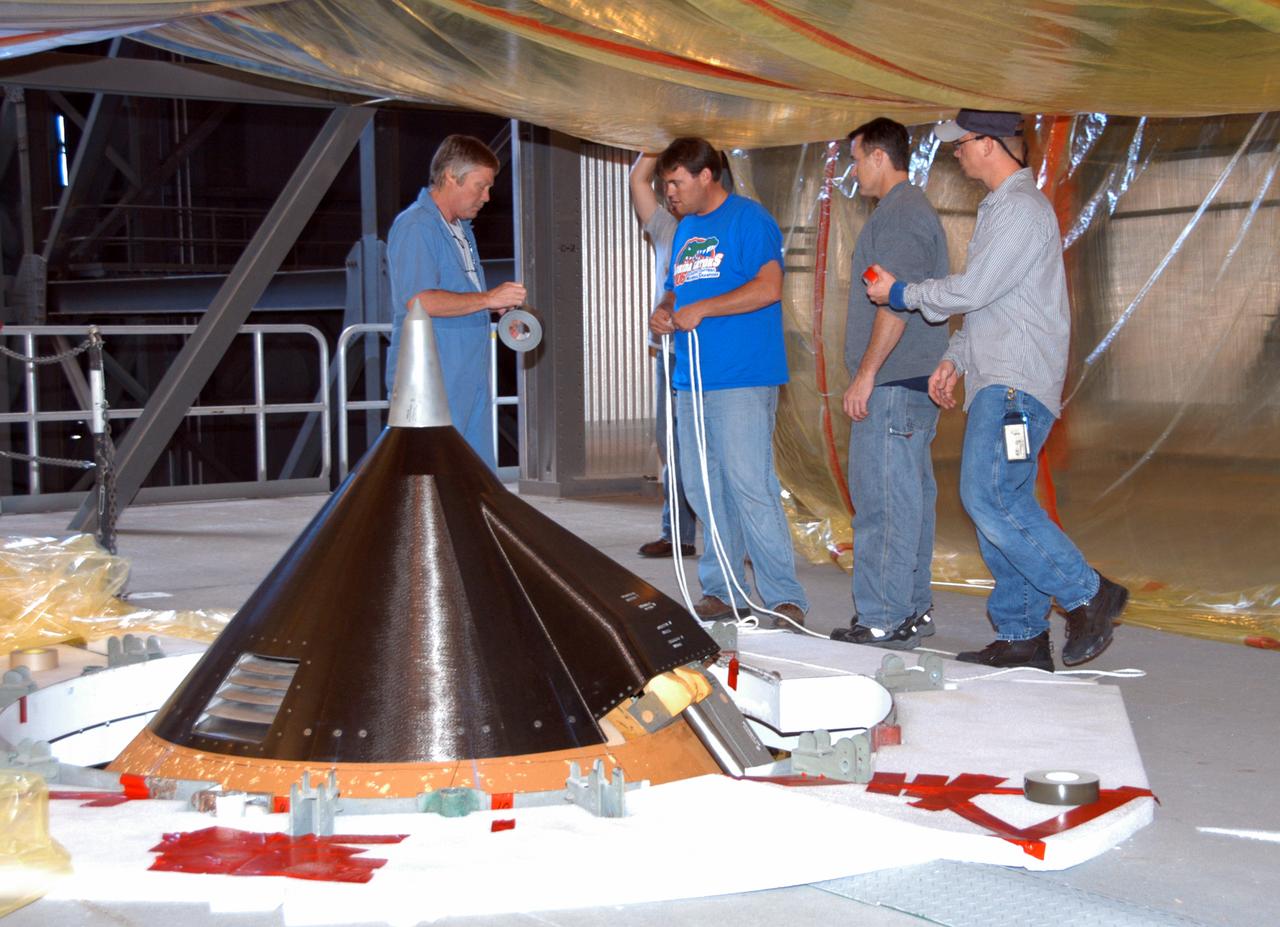
On an upper level of high bay 1 of the Vehicle Assembly Building, technicians prepare the area around the nose cone (left) of Atlantis' external tank that will undergo repair for hail damage. A severe thunderstorm with golf ball-sized hail caused visible divots in the giant tank's foam insulation and minor surface damage to about 26 heat shield tiles on the shuttle's left wing. Further evaluation of the tank is necessary to get an accurate accounting of foam damage and determine the type of repair required and the time needed for that work. A new target launch date has not been determined, but teams will focus on preparing Atlantis for liftoff in late April on mission STS-117.
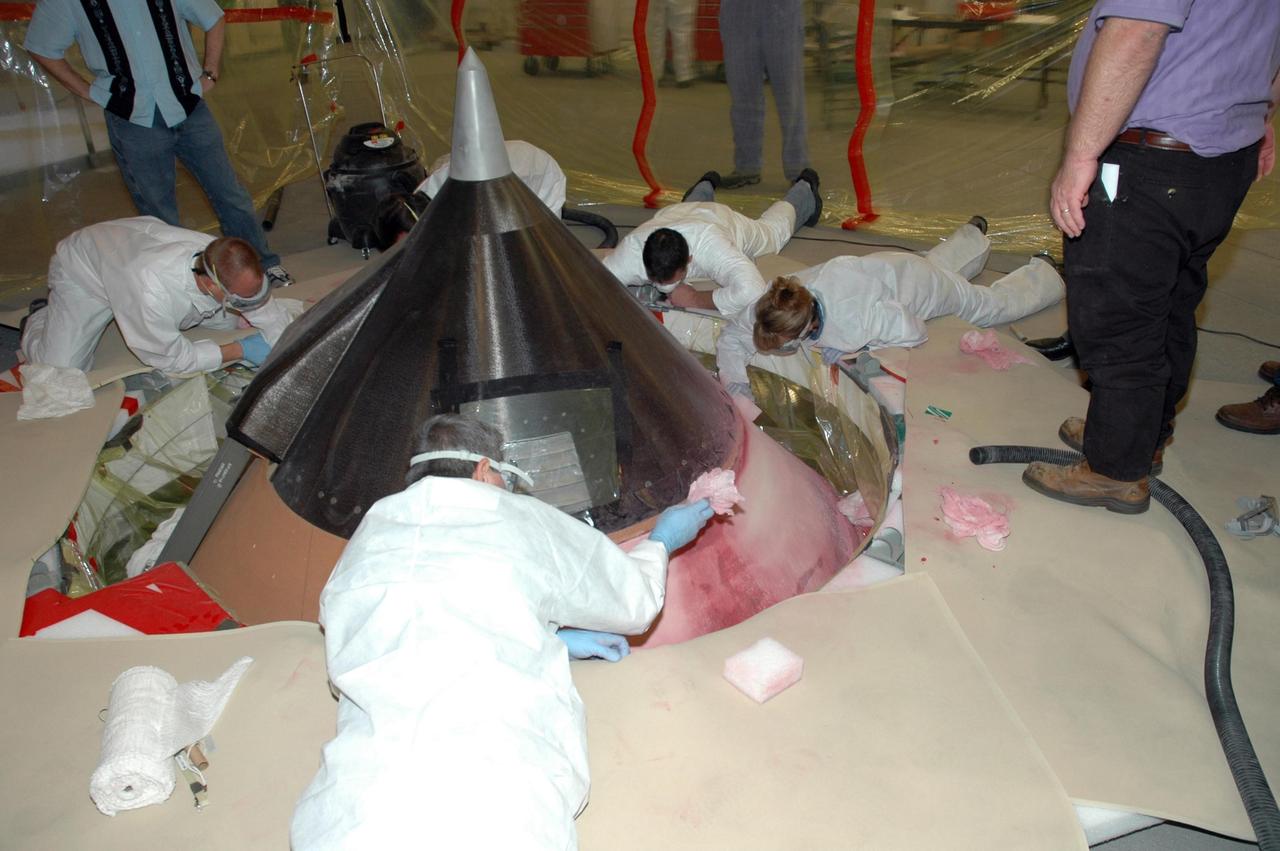
KENNEDY SPACE CENTER, FLA. -- In Highbay 1 inside the Vehicle Assembly Building, technicians carefully sand away the red dye that has been applied to the external tank to help expose cracks or compression dents. A severe thunderstorm with golf ball-sized hail caused visible divots in the giant tank's foam insulation and minor surface damage to about 26 heat shield tiles on the shuttle's left wing. A new target launch date has not been determined, but teams will focus on preparing Atlantis for liftoff in late April on mission STS-117. Photo credit: NASA/Jim Grossmann
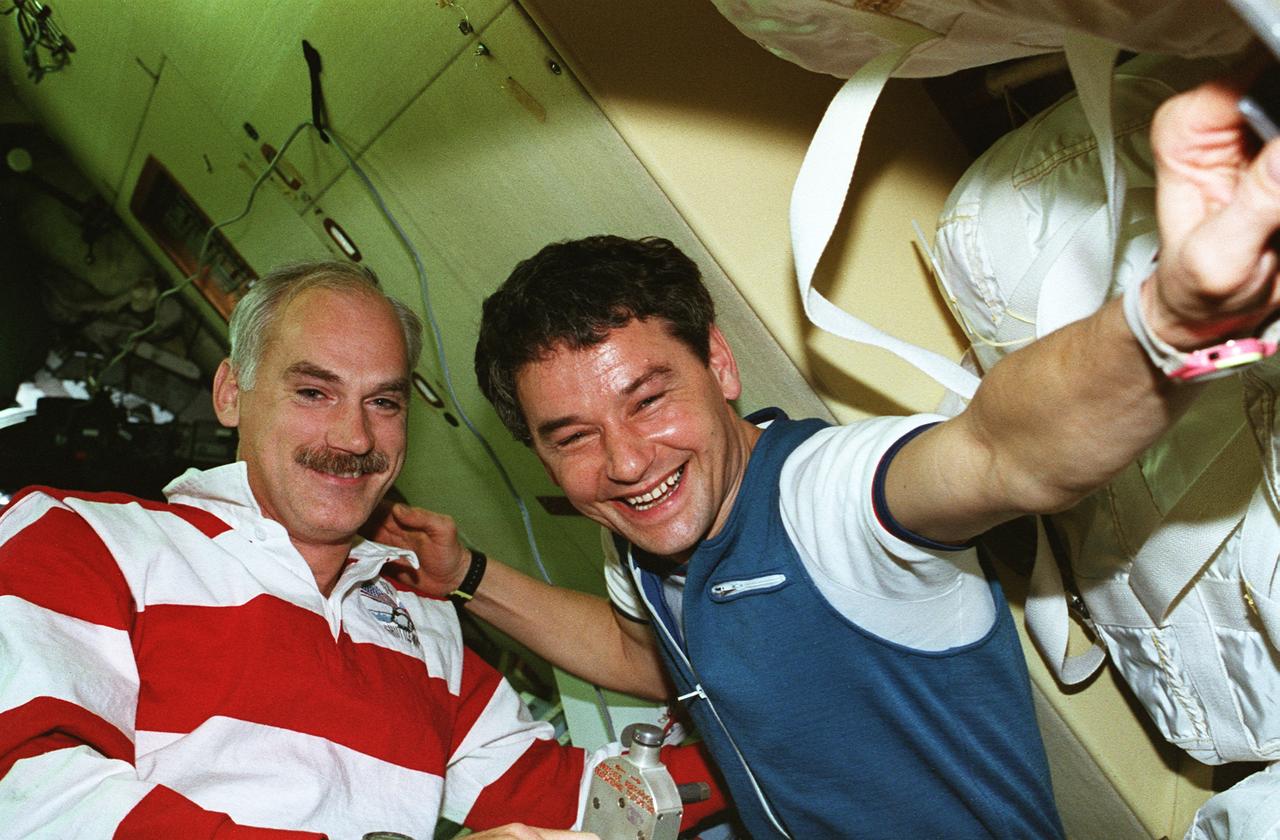
STS079-347-033 (16-26 Sept. 1996) --- Valeri G. Korzun and William F. Readdy, commanders, for Mir-22 and STS-79, respectively, reunite in the Docking Module (DM). The two have shared training experience in both Russia and the United States. This photograph is one of fifteen 35mm frames (along with four 70mm frames) of still photography documenting the activities of NASA's STS-79 mission, which began with a September 16, 1996, liftoff from Launch Pad 39A the Kennedy Space Center (KSC) and ended with a landing at KSC on September 26, 1996. Onboard for the launch were astronauts Readdy; Terrence W. Wilcutt, pilot; John E. Blaha, Jerome (Jay) Apt, Thomas D. Akers and Carl E. Walz, all mission specialists. On flight day 4, the crew docked with Russia's Mir Space Station. Shannon W. Lucid, who had spent six months aboard Mir, switched cosmonaut guest researcher roles with Blaha. The latter joined fellow Mir-22 crewmembers Korzun, and Aleksandr Y. Kaleri, flight engineer.
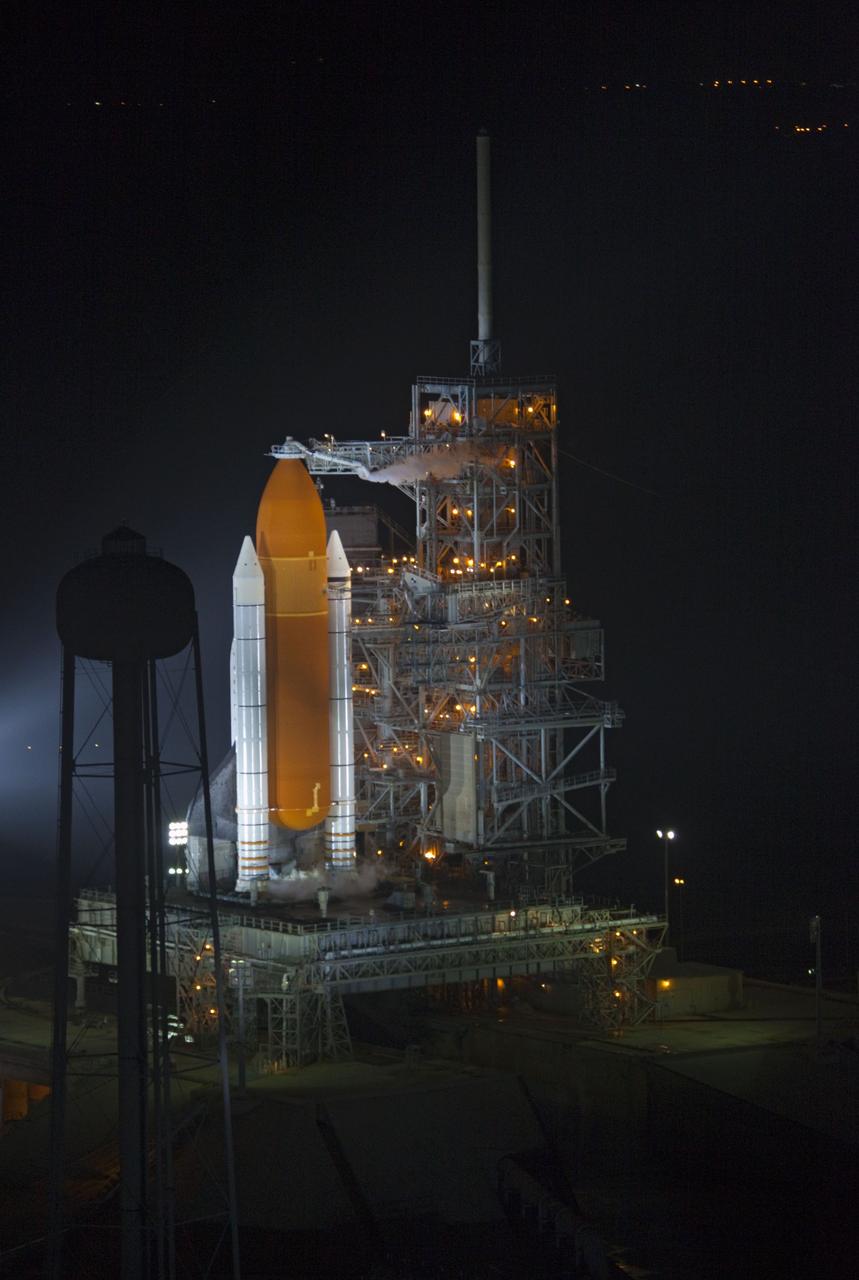
CAPE CANAVERAL, Fla. -- A NASA helicopter circles space shuttle Atlantis on Launch Pad 39A prior to launch on the STS-135 mission. To the right of the shuttle, the fixed service structure which is normally closed around the shuttle now is open for liftoff. At left of the pad is the 300,000-gallon water tower that provides the water used for sound suppression on the pad during liftoff. Atlantis and its crew of four -- Commander Chris Ferguson, Pilot Doug Hurley and Mission Specialists Sandy Magnus and Rex Walheim -- are scheduled to lift off at 11:26 a.m. EDT on July 8 to deliver the Raffaello multi-purpose logistics module packed with supplies and spare parts to the International Space Station. Atlantis also will fly the Robotic Refueling Mission experiment that will investigate the potential for robotically refueling existing satellites in orbit. In addition, Atlantis will return with a failed ammonia pump module to help NASA better understand the failure mechanism and improve pump designs for future systems. STS-135 will be the 33rd flight of Atlantis, the 37th shuttle mission to the space station, and the 135th and final mission of NASA's Space Shuttle Program. For more information, visit www.nasa.gov/mission_pages/shuttle/shuttlemissions/sts135/index.html. Photo credit: NASA/Frank Michaux
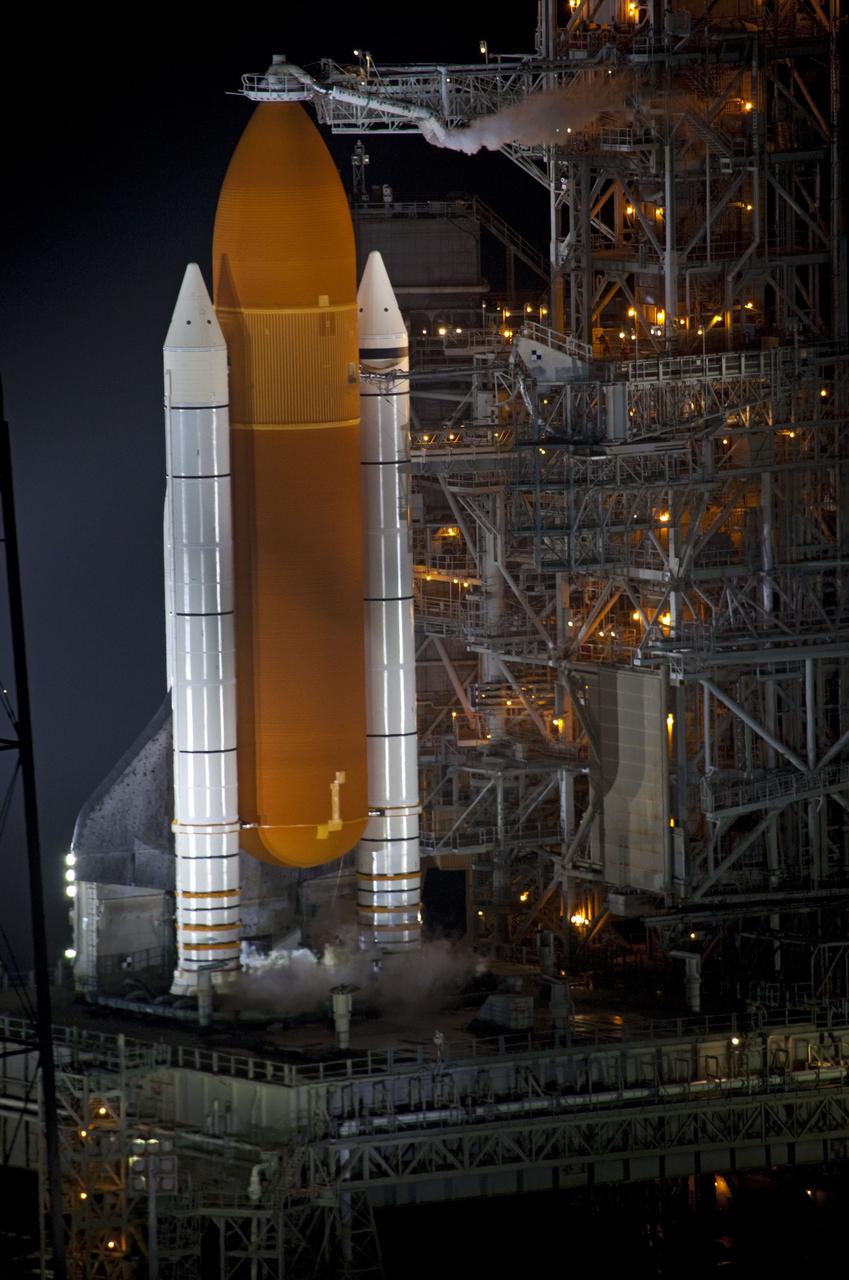
CAPE CANAVERAL, Fla. -- A NASA helicopter circles space shuttle Atlantis on Launch Pad 39A prior to launch on the STS-135 mission. To the right of the shuttle, the fixed service structure which is normally closed around the shuttle now is open for liftoff. At left of the pad is the 300,000-gallon water tower that provides the water used for sound suppression on the pad during liftoff. Atlantis and its crew of four -- Commander Chris Ferguson, Pilot Doug Hurley and Mission Specialists Sandy Magnus and Rex Walheim -- are scheduled to lift off at 11:26 a.m. EDT on July 8 to deliver the Raffaello multi-purpose logistics module packed with supplies and spare parts to the International Space Station. Atlantis also will fly the Robotic Refueling Mission experiment that will investigate the potential for robotically refueling existing satellites in orbit. In addition, Atlantis will return with a failed ammonia pump module to help NASA better understand the failure mechanism and improve pump designs for future systems. STS-135 will be the 33rd flight of Atlantis, the 37th shuttle mission to the space station, and the 135th and final mission of NASA's Space Shuttle Program. For more information, visit www.nasa.gov/mission_pages/shuttle/shuttlemissions/sts135/index.html. Photo credit: NASA/Frank Michaux
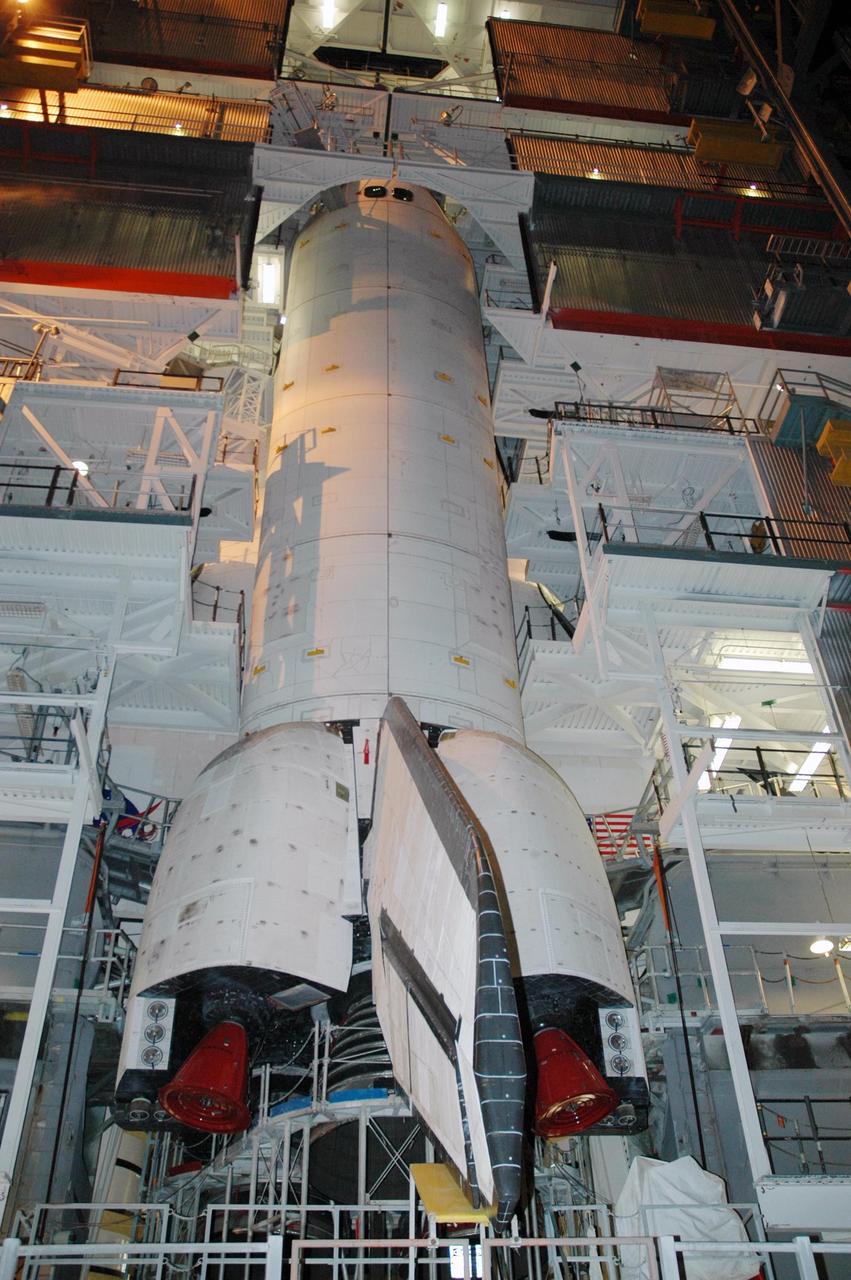
KENNEDY SPACE CENTER, FLA. -- Service platforms surround Space Shuttle Atlantis as it sits in Highbay 1 inside the Vehicle Assembly Building, while repair work continues on the external tank. In late February, Atlantis' external tank received hail damage during a severe thunderstorm that passed through the Kennedy Space Center Launch Complex 39 area. The hail caused visible divots in the giant tank's foam insulation and minor surface damage to about 26 heat shield tiles on the shuttle's left wing. A new target launch date has not been determined, but teams will focus on preparing Atlantis for liftoff in late April on mission STS-117. Photo credit: NASA/Jack Pfaller
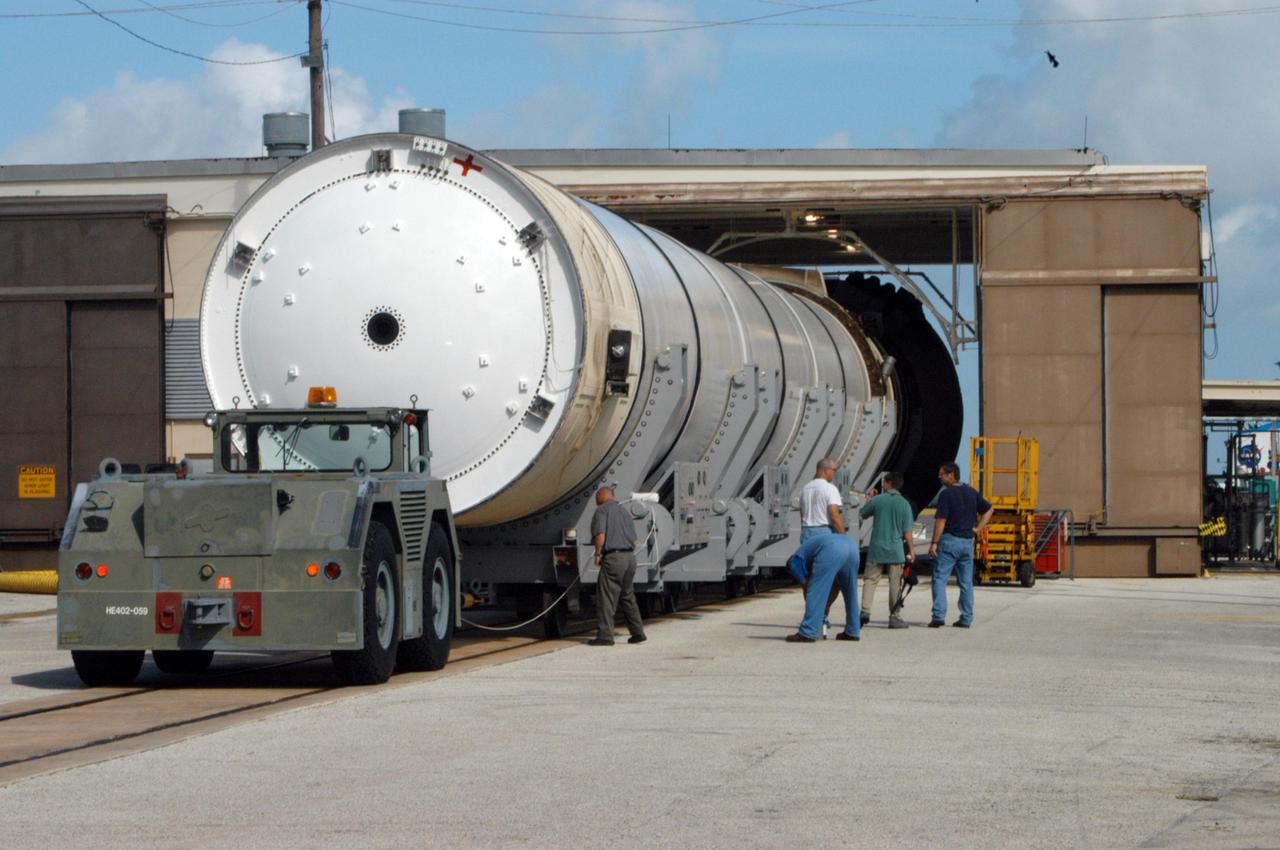
KENNEDY SPACE CENTER, FLA. - One of the spent Solid Rocket Boosters (SRBs) from the launch of Space Shuttle Discovery July 26 on Return to Flight mission STS-114 is moved into Hangar AF at Cape Canaveral Air Force Station. The SRBs are the largest solid propellant motors ever flown and the first designed for reuse. After a Shuttle is launched, the SRBs are jettisoned at two minutes, seven seconds into the flight. At six minutes and 44 seconds after liftoff, the spent SRBs, weighing about 165,000 lb., have slowed their descent speed to about 62 mph and splashdown takes place in a predetermined area. They are retrieved from the Atlantic Ocean by special recovery vessels and returned for refurbishment and eventual reuse on future Shuttle flights. Once at Hangar AF, the SRBs are unloaded onto a hoisting slip and mobile gantry cranes lift them onto tracked dollies where they are safed and undergo their first washing.
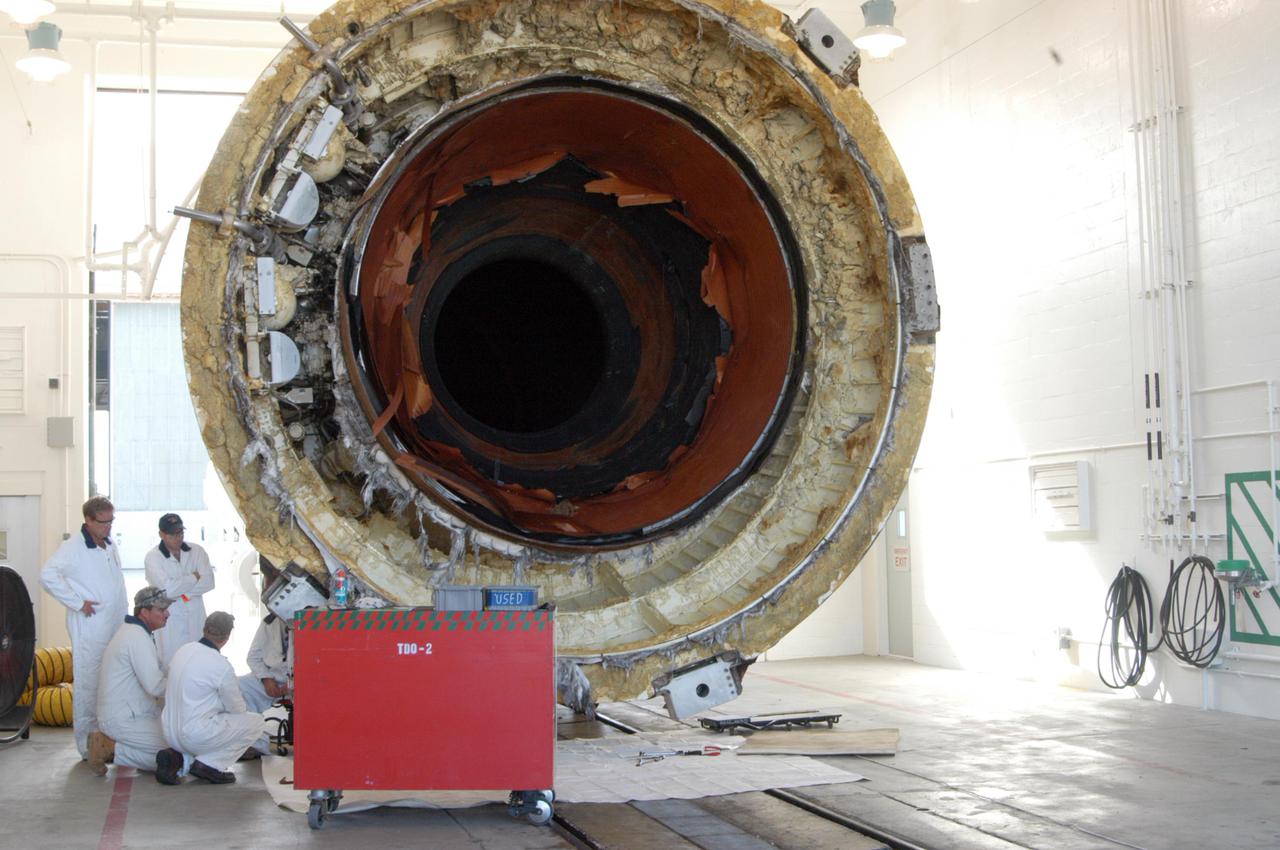
KENNEDY SPACE CENTER, FLA. - Workers in Hangar AF at Cape Canaveral Air Force Station take a look at one of the spent Solid Rocket Boosters (SRBs) from the launch of Space Shuttle Discovery July 26 on Return to Flight mission STS-114. The SRBs are the largest solid propellant motors ever flown and the first designed for reuse. After a Shuttle is launched, the SRBs are jettisoned at two minutes, seven seconds into the flight. At six minutes and 44 seconds after liftoff, the spent SRBs, weighing about 165,000 lb., have slowed their descent speed to about 62 mph and splashdown takes place in a predetermined area. They are retrieved from the Atlantic Ocean by special recovery vessels and returned for refurbishment and eventual reuse on future Shuttle flights. Once at Hangar AF, the SRBs are unloaded onto a hoisting slip and mobile gantry cranes lift them onto tracked dollies where they are safed and undergo their first washing.
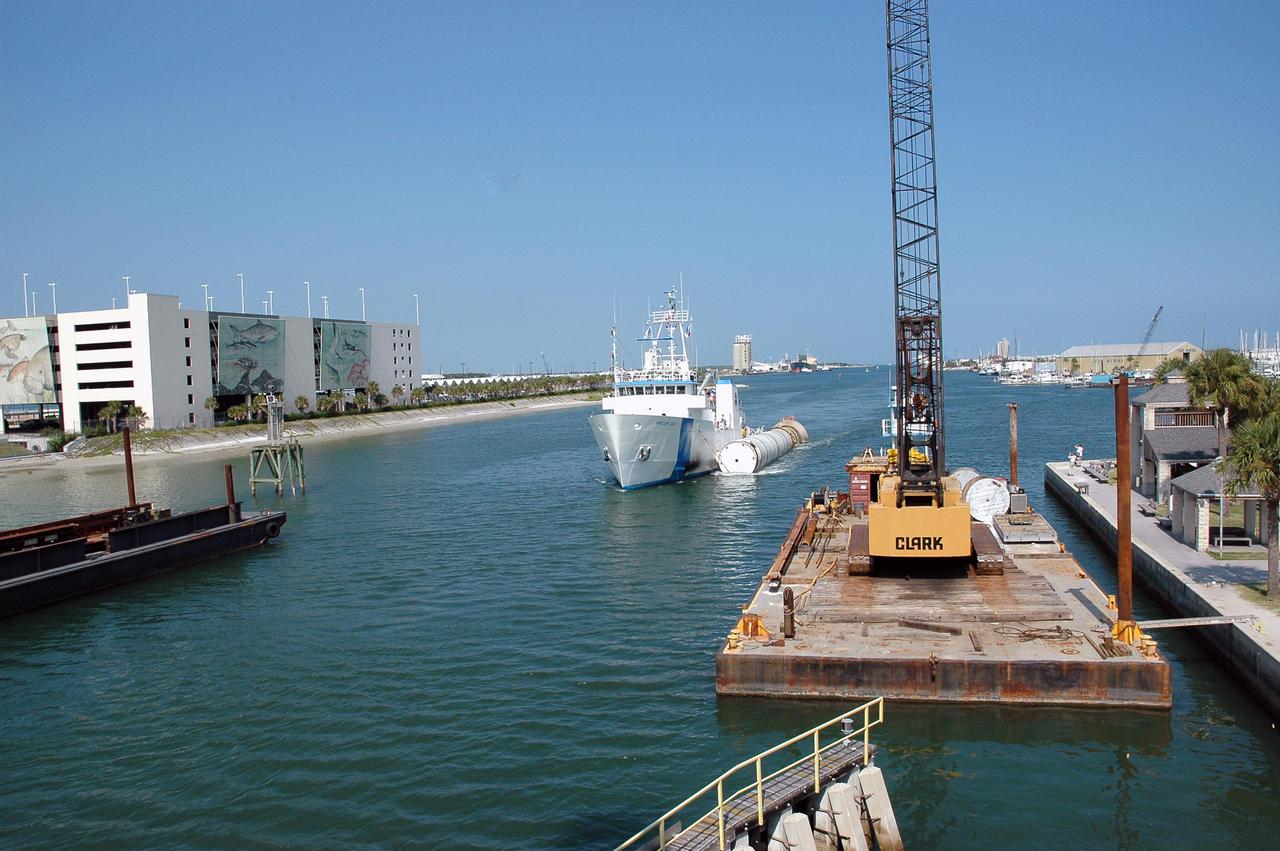
KENNEDY SPACE CENTER, FLA. - The solid rocket booster recovery ship Freedom Star makes its way through Port Canaveral with a spent solid rocket booster (SRB) from the STS-114 launch on July 26 in tow. The SRBs are the largest solid propellant motors ever flown and the first designed for reuse. After a Shuttle is launched, the SRBs are jettisoned at two minutes, seven seconds into the flight. At six minutes and 44 seconds after liftoff, the spent SRBs, weighing about 165,000 lb., have slowed their descent speed to about 62 mph and splashdown takes place in a predetermined area. They are retrieved from the Atlantic Ocean by special recovery vessels and returned for refurbishment and eventual reuse on future Shuttle flights. Once at Hangar AF, the SRBs are unloaded onto a hoisting slip and mobile gantry cranes lift them onto tracked dollies where they are safed and undergo their first washing.
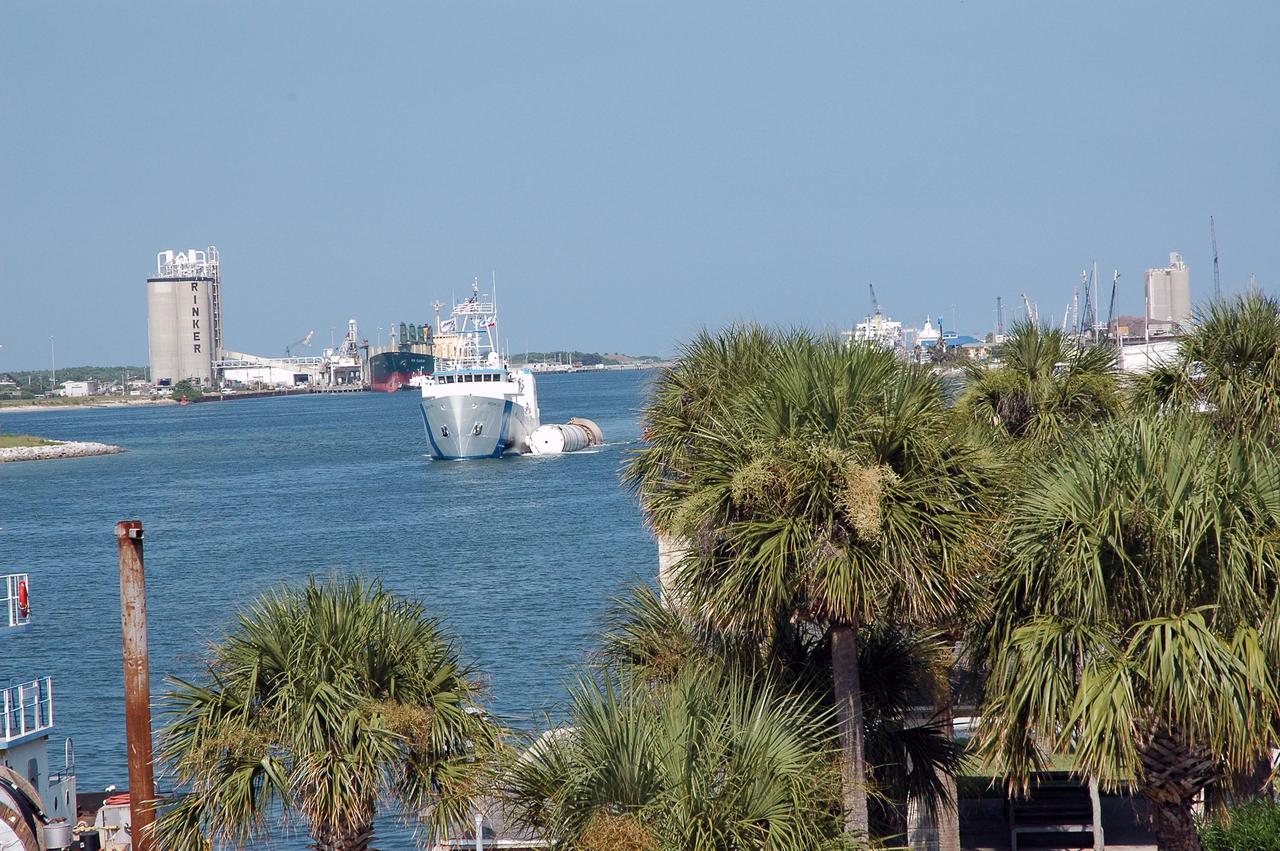
KENNEDY SPACE CENTER, FLA. - The solid rocket booster recovery ship Freedom Star enters Port Canaveral with a spent solid rocket booster (SRB) from the STS-114 launch on July 26 in tow. The SRBs are the largest solid propellant motors ever flown and the first designed for reuse. After a Shuttle is launched, the SRBs are jettisoned at two minutes, seven seconds into the flight. At six minutes and 44 seconds after liftoff, the spent SRBs, weighing about 165,000 lb., have slowed their descent speed to about 62 mph and splashdown takes place in a predetermined area. They are retrieved from the Atlantic Ocean by special recovery vessels and returned for refurbishment and eventual reuse on future Shuttle flights. Once at Hangar AF, the SRBs are unloaded onto a hoisting slip and mobile gantry cranes lift them onto tracked dollies where they are safed and undergo their first washing.
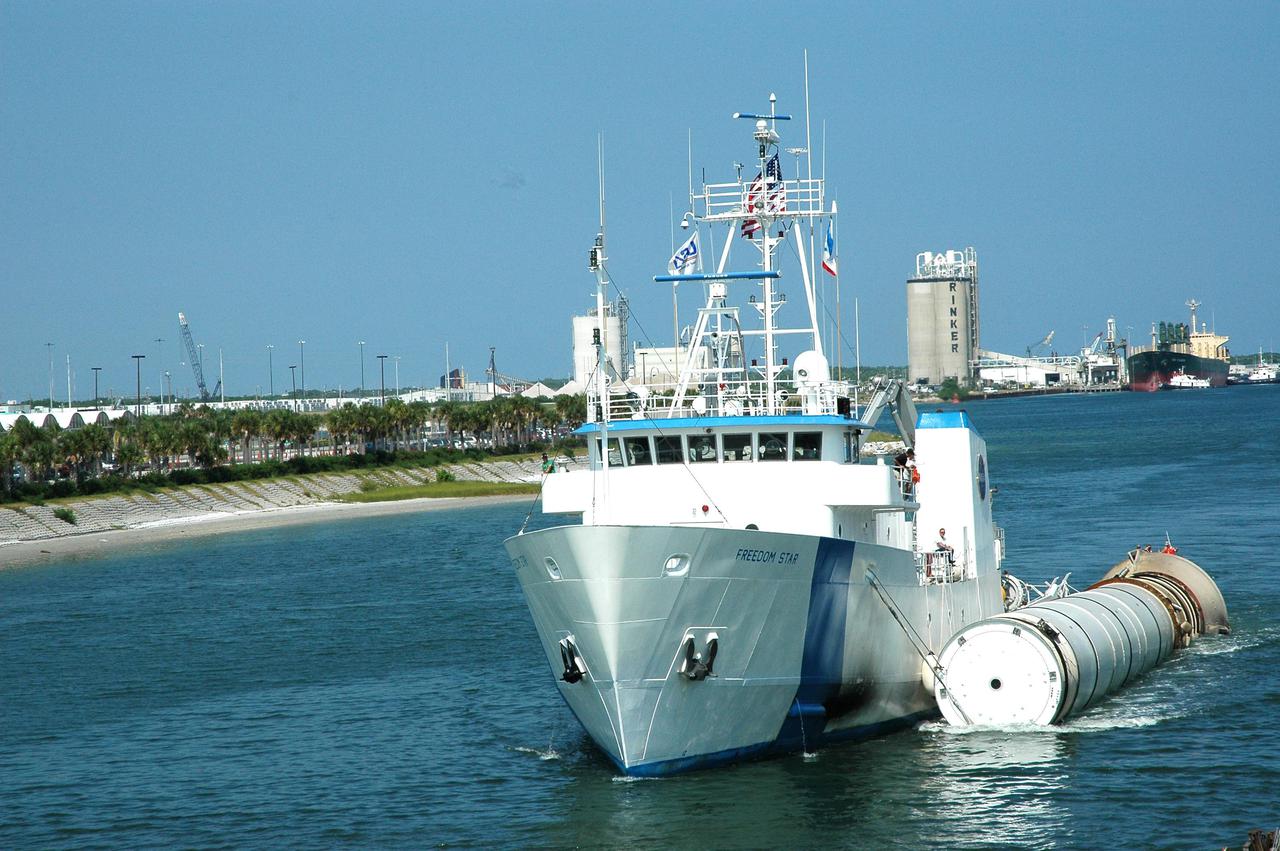
KENNEDY SPACE CENTER, FLA. - The solid rocket booster recovery ship Freedom Star travels through Port Canaveral with a spent solid rocket booster (SRB) from the STS-114 launch on July 26 in tow. The SRBs are the largest solid propellant motors ever flown and the first designed for reuse. After a Shuttle is launched, the SRBs are jettisoned at two minutes, seven seconds into the flight. At six minutes and 44 seconds after liftoff, the spent SRBs, weighing about 165,000 lb., have slowed their descent speed to about 62 mph and splashdown takes place in a predetermined area. They are retrieved from the Atlantic Ocean by special recovery vessels and returned for refurbishment and eventual reuse on future Shuttle flights. Once at Hangar AF, the SRBs are unloaded onto a hoisting slip and mobile gantry cranes lift them onto tracked dollies where they are safed and undergo their first washing.
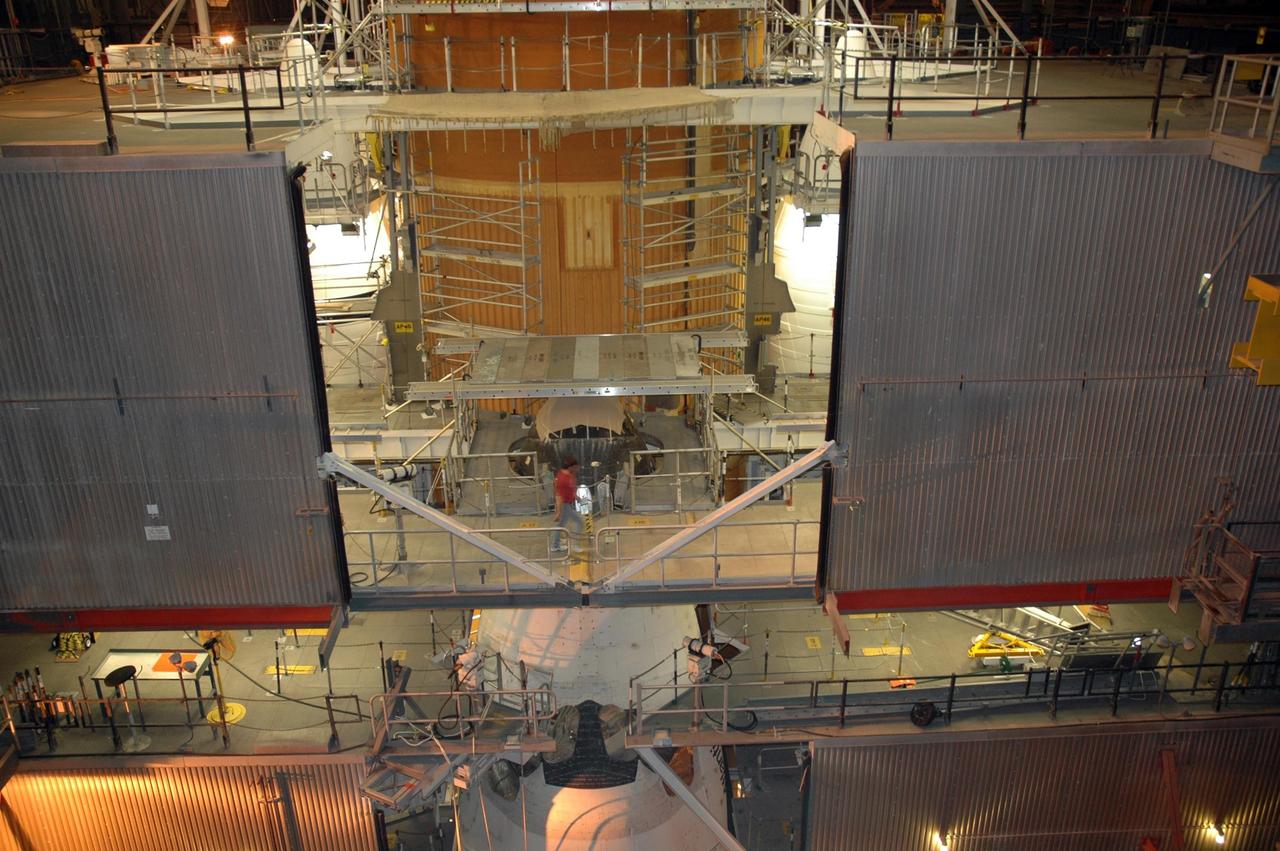
KENNEDY SPACE CENTER, FLA. -- In high bay 1 in the Vehicle Assembly Building, Space Shuttle Atlantis' orbiter cockpit, nose cone and part of the external tank peak through various levels of scaffolding as work continues to repair the external tank. In late February, Atlantis' external tank received hail damage during a severe thunderstorm that passed through the Kennedy Space Center Launch Complex 39 area. The hail caused visible divots in the giant tank's foam insulation and minor surface damage to about 26 heat shield tiles on the shuttle's left wing. A new target launch date has not been determined, but teams will focus on preparing Atlantis for liftoff in late April on mission STS-117. Photo credit: NASA/Jack Pfaller
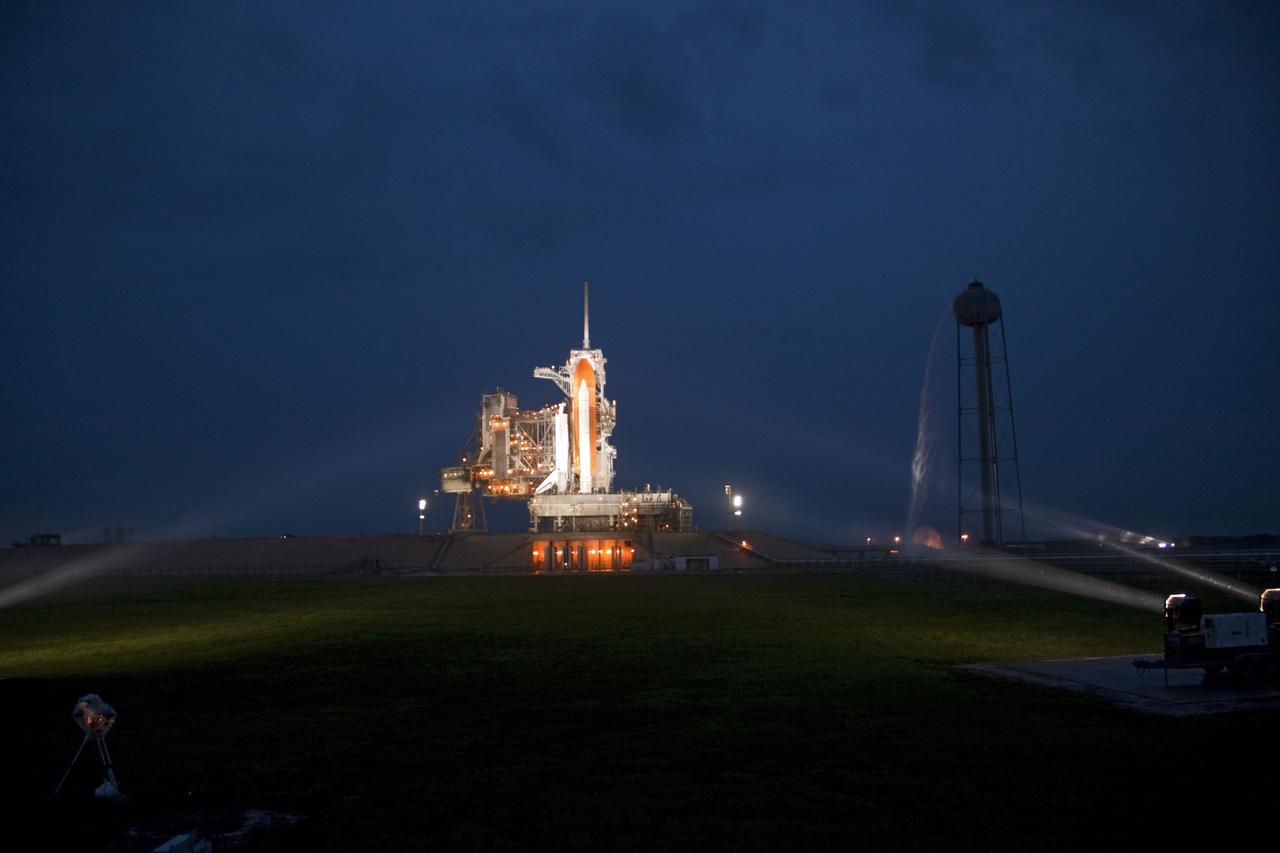
CAPE CANAVERAL, Fla. -- Space shuttle Atlantis is revealed on Launch Pad 39A at NASA's Kennedy Space Center in Florida bathed in xenon lights following the move of the rotating service structure (RSS). The structure provides weather protection and access to the shuttle while it awaits liftoff on the pad. To the right of the pad is the 300,000-gallon water tower that provides the water used for sound suppression on the pad during liftoff. RSS retract marks a major milestone in Atlantis' STS-135 mission countdown. Atlantis and its crew of four; Commander Chris Ferguson, Pilot Doug Hurley, Mission Specialists Sandy Magnus and Rex Walheim will lift off at 11:26 a.m. EDT on July 8 to deliver the Raffaello multi-purpose logistics module packed with supplies and spare parts for the International Space Station. Atlantis also will fly the Robotic Refueling Mission experiment that will investigate the potential for robotically refueling existing satellites in orbit. In addition, Atlantis will return with a failed ammonia pump module to help NASA better understand the failure mechanism and improve pump designs for future systems. STS-135 is the 33rd flight of Atlantis, the 37th shuttle mission to the space station, and the 135th and final mission of NASA's Space Shuttle Program. For more information, visit www.nasa.gov/mission_pages/shuttle/shuttlemissions/sts135/index.html. Photo credit: Jim Grossmann
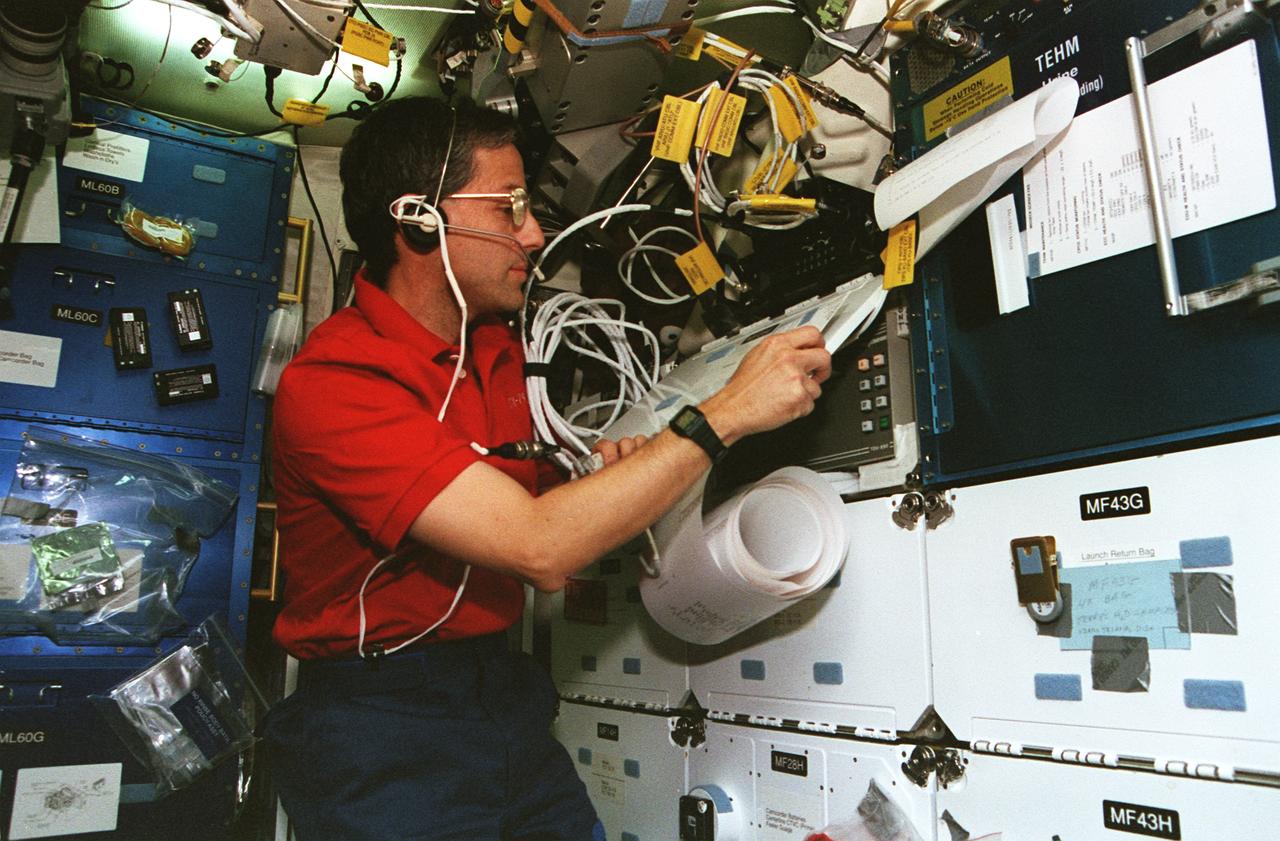
STS079-365-004 (16-26 Sept. 1996) --- During off-duty time, Jerome (Jay) Apt, a licensed amateur radio operator, talks to ground contacts via the Shuttle Amateur Radio Experiment (SAREX). The radio was also used for communications between the Space Shuttle Atlantis and Russia's Mir Space Station during docking and undocking activities. This photograph is one of fifteen 35mm frames (along with four 70mm frames) of still photography documenting the activities of NASA's STS-79 mission, which began with a September 16, 1996, liftoff from Launch Pad 39A the Kennedy Space Center (KSC) and ended with a landing at KSC on September 26, 1996. Onboard for the launch were astronauts William F. Readdy, commander; Terrence W. Wilcutt, pilot; John E. Blaha, Apt, Thomas D. Akers and Carl E. Walz, all mission specialists. On flight day 4, the crew docked with Mir. Shannon W. Lucid, who had spent six months aboard Mir, switched cosmonaut guest researcher roles with Blaha. The latter joined fellow Mir-22 crew members Valeri G. Korzun, commander, and Aleksandr Y. Kaleri, flight engineer.

STS079-813-023 (16-26 Sept. 1996) --- The docked Russian Mir Space Station is partially visible through the Spacehab viewing port, onboard the space shuttle Atlantis. This photograph is one of four 70mm frames (along with fifteen 35mm frames) of still photography documenting the activities of NASA's STS-79 mission, which began with a Sept. 16, 1996, liftoff from Launch Pad 39A the Kennedy Space Center (KSC) and ended with a landing at KSC on Sept. 26, 1996. Onboard for the launch were astronauts William F. Readdy, commander; Terrence W. Wilcutt, pilot; John E. Blaha, Jerome (Jay) Apt, Thomas D. Akers and Carl E. Walz, all mission specialists. On flight day 4, the crew docked with the Mir Space Station. Shannon W. Lucid, who had spent six months aboard Mir, switched cosmonaut guest researcher roles with Blaha. The latter joined fellow Mir-22 crewmembers Valeri G. Korzun, commander, and Aleksandr Y. Kaleri, flight engineer.
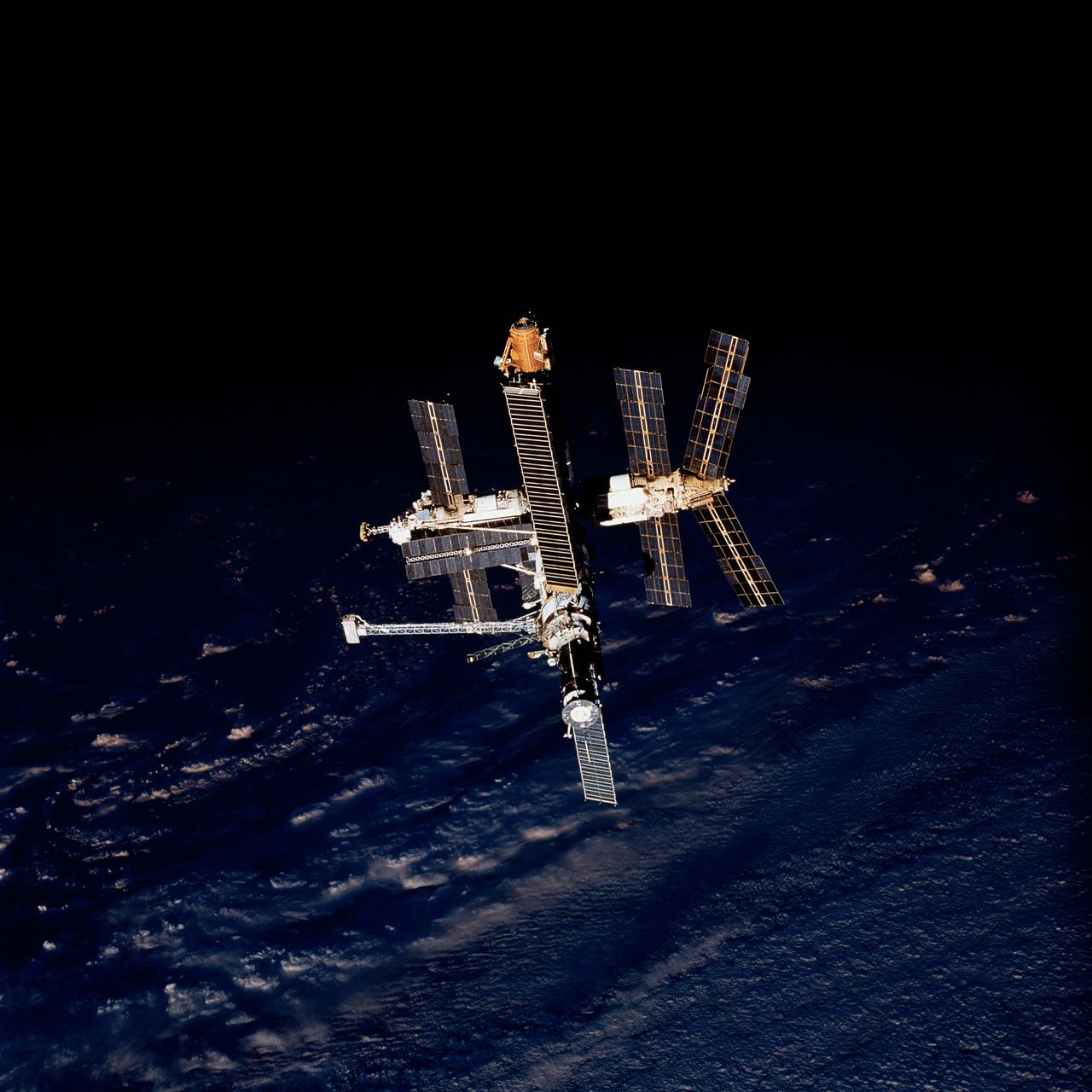
STS079-821-036 (16-26 Sept. 1996) --- Following the Space Shuttle Atlantis - Russian Mir Space Station undocking activities, a crew member captured this 70mm frame of Mir as the two crews shared their final common sunset scene. This photograph is one of four 70mm frames (along with fifteen 35mm frames) of still photography documenting the activities of NASA's STS-79 mission, which began with a September 16, 1996, liftoff from Launch Pad 39A the Kennedy Space Center (KSC) and ended with a landing at KSC on September 26, 1996. Onboard for the launch were astronauts William F. Readdy, commander; Terrence W. Wilcutt, pilot; John E. Blaha, Jerome (Jay) Apt, Thomas D. Akers and Carl E. Walz, all mission specialists. On flight day 4, the crew docked with Mir. Shannon W. Lucid, who had spent six months aboard Mir, switched cosmonaut guest researcher roles with Blaha. The latter joined fellow Mir-22 crew members Valeri G. Korzun, commander, and Aleksandr Y. Kaleri, flight engineer.
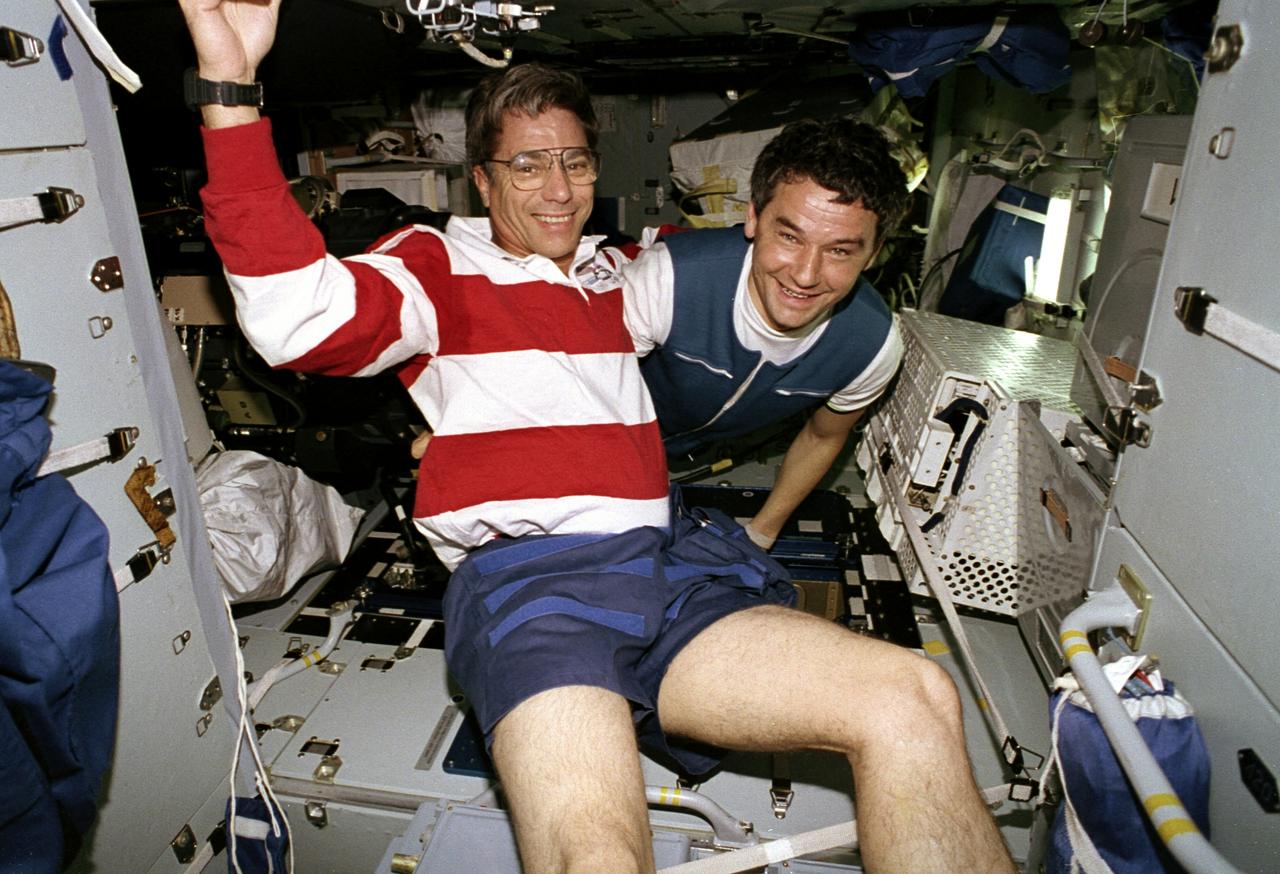
STS079-350-028 (16-26 Sept. 1996) --- Aboard Russian Mir Space Station's Spektr Module, astronaut John E. Blaha, now a cosmonaut guest researcher, visits with Valeri G. Korzun, his mission commander for Mir-22. This photograph is one of fifteen 35mm frames (along with four 70mm frames) of still photography documenting the activities of NASA's STS-79 mission, which began with a Sept. 16, 1996, liftoff from Launch Pad 39A the Kennedy Space Center (KSC) and ended with a landing at KSC on September 26, 1996. Onboard for the launch were astronauts William F. Readdy, commander; Terrence W. Wilcutt, pilot; Blaha, Jerome (Jay) Apt, Thomas D. Akers and Carl E. Walz, all mission specialists. On flight day 4, the crew docked with Mir. Shannon W. Lucid, who had spent six months aboard Mir, switched cosmonaut guest researcher roles with Blaha. The latter joined fellow Mir-22 crewmembers Korzun, and Aleksandr Y. Kaleri, flight engineer.
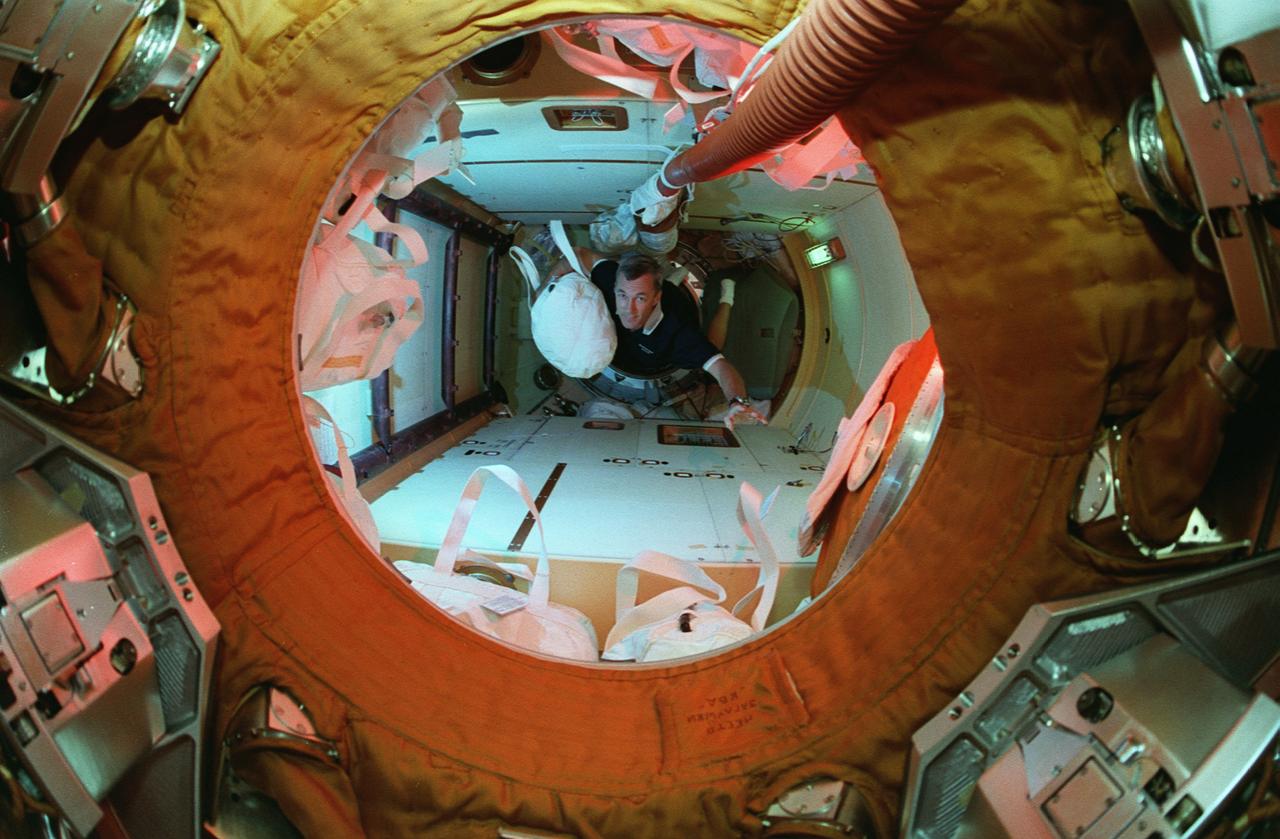
STS079-335-001 (16-26 Sept. 1996) --- Astronaut Terrence W. Wilcutt traverses into Russia's Mir Space Station Kristall Module toting a water bag from the Space Shuttle Atlantis to be used on Mir. This photograph is one of fifteen 35mm frames (along with four 70mm frames) of still photography documenting the activities of NASA's STS-79 mission, which began with a Sept. 16, 1996, liftoff from Launch Pad 39A the Kennedy Space Center (KSC) and ended with a landing at KSC on September 26, 1996. Onboard for the launch were astronauts William F. Readdy, commander; Wilcutt, pilot; John E. Blaha, Jerome (Jay) Apt, Thomas D. Akers and Carl E. Walz, all mission specialists. On flight day 4, the crew docked with Mir. Shannon W. Lucid, who had spent six months aboard Mir, switched cosmonaut guest researcher roles with Blaha. The latter joined fellow Mir-22 crewmembers Valeri G. Korzun, commander, and Aleksandr Y. Kaleri, flight engineer.
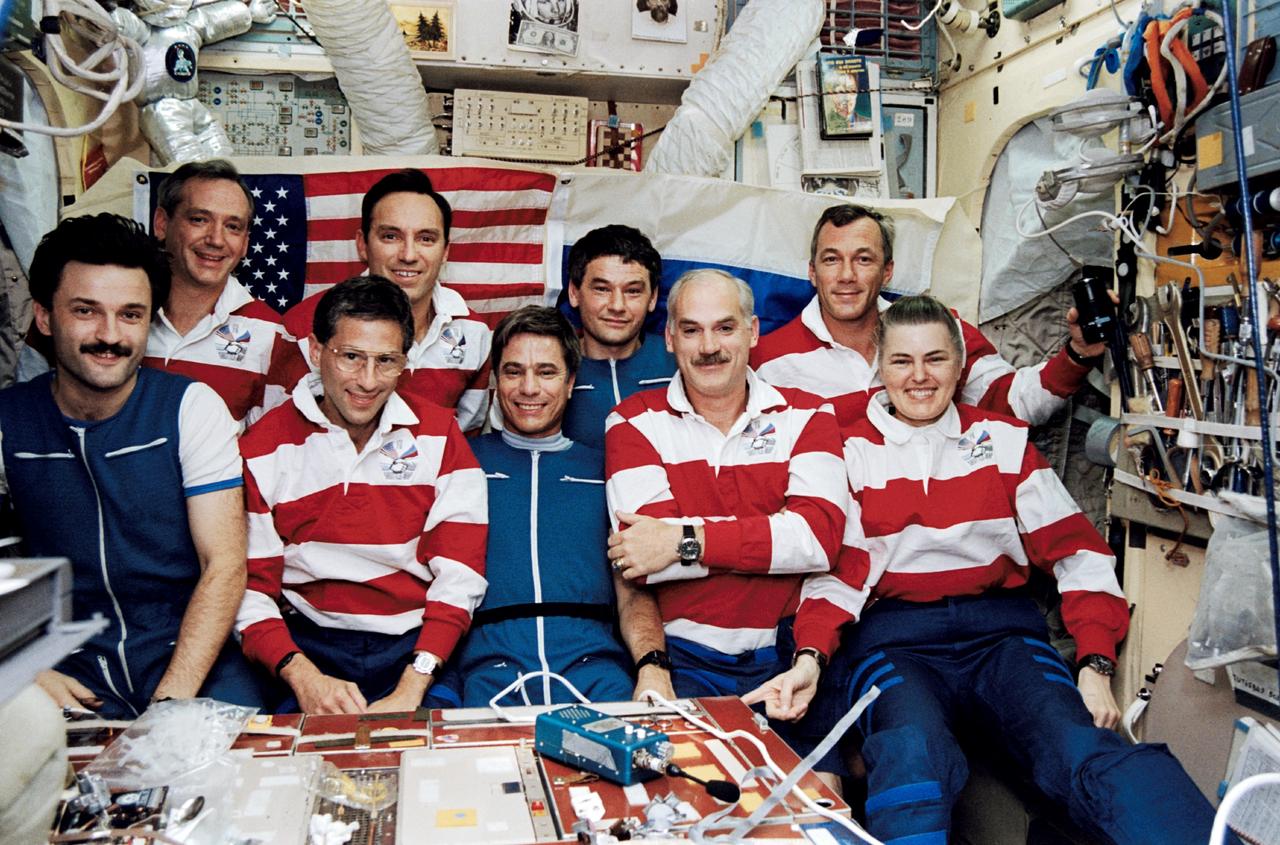
STS079-349-022 (16-26 Sept. 1996) --- The traditional inflight crew portrait, taken in Russia's Mir Space Station base block. Front row, left to right, Aleksandr Y. Kaleri, Jerome (Jay) Apt, John E. Blaha, William F. Readdy and Shannon W. Lucid. Back row, left to right, Thomas D. Akers, Carl E. Walz, Valeri G. Korzun and Terrence W. Wilcutt. This photograph is one of fifteen 35mm frames (along with four 70mm frames) of still photography documenting the activities of NASA's STS-79 mission, which began with a September 16, 1996, liftoff from Launch Pad 39A the Kennedy Space Center (KSC) and ended with a landing at KSC on September 26, 1996. Onboard for the launch were astronauts Readdy, commander; Wilcutt, pilot; Blaha, Apt, Akers and Walz, all mission specialists. On flight day 4, the crew docked with the Mir Space Station. Lucid, who had spent six months aboard Mir, switched cosmonaut guest researcher roles with Blaha. The latter joined fellow Mir-22 crewmembers Korzun, commander, and Kaleri, flight engineer.
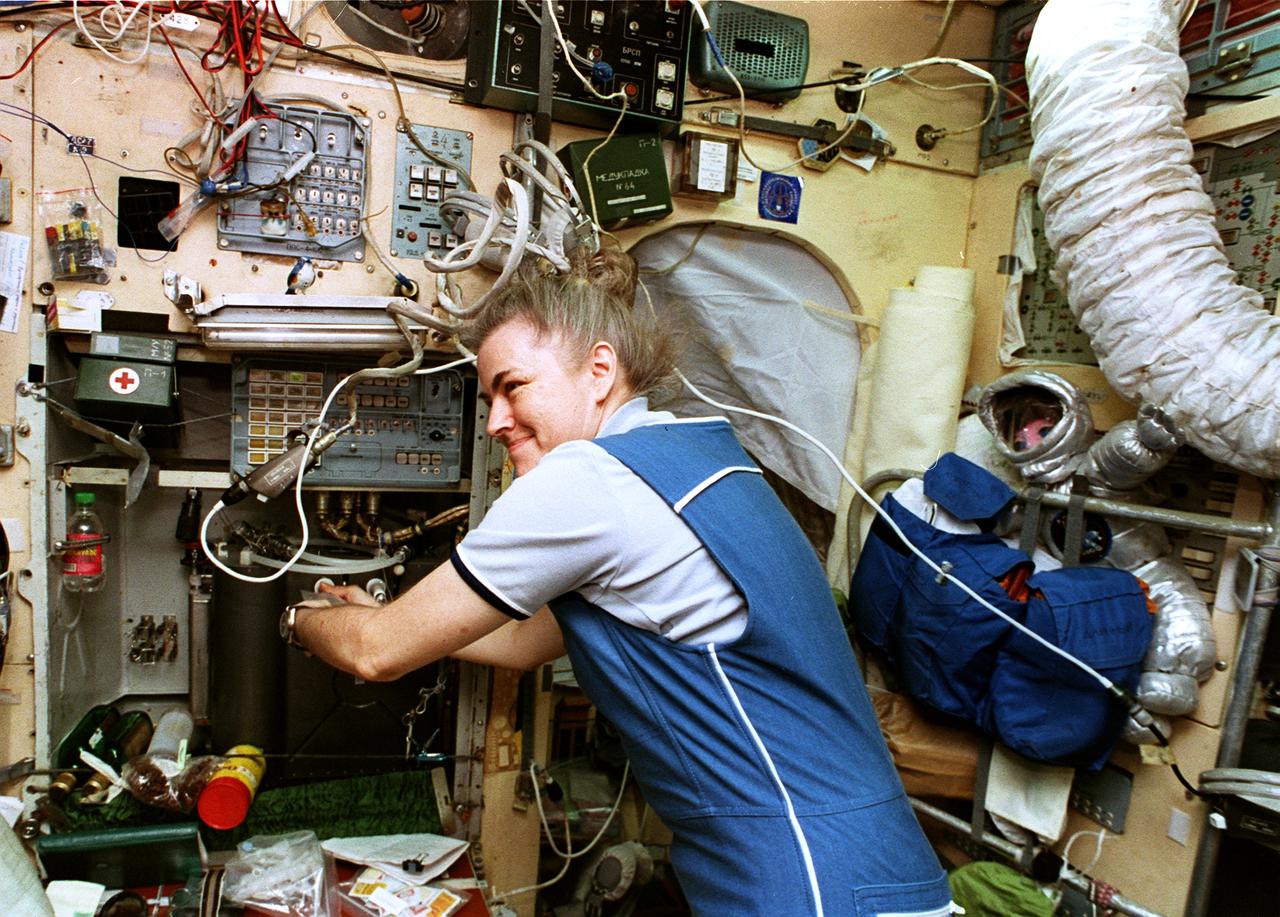
STS079-354-001 (16-26 Sept. 1996) --- Astronaut Shannon W. Lucid gets a beverage at the galley on Russia's Mir Space Station Base Block. This photograph is one of fifteen 35mm frames (along with four 70mm frames) of still photography documenting the activities of NASA's STS-79 mission, which began with a September 16, 1996, liftoff from Launch Pad 39A the Kennedy Space Center (KSC) and ended with a landing at KSC on September 26, 1996. Onboard for the launch were astronauts William F. Readdy, commander; Terrence W. Wilcutt, pilot; John E. Blaha, Jerome (Jay) Apt, Thomas D. Akers and Carl E. Walz, all mission specialists. On flight day 4, the crew docked with Mir. Lucid, who had spent six months aboard Mir, switched cosmonaut guest researcher roles with Blaha. The latter joined fellow Mir-22 crew members Valeri G. Korzun, commander, and Aleksandr Y. Kaleri, flight engineer.

STS079-358-027 (16-26 September 1996) --- Astronaut William F. Readdy looks over a checklist at the commander's station on the Space Shuttle Atlantis' flight deck. Among his many other duties as mission commander, Readdy controlled the Orbiter during a series of maneuvers associated with the docking and undocking operations with Russia's Mir Space Station. This photograph is one of fifteen 35mm frames (along with four 70mm frames) of still photography documenting the activities of NASA's STS-79 mission, which began with a September 16, 1996, liftoff from Launch Pad 39A the Kennedy Space Center (KSC) and ended with a landing at KSC on September 26, 1996. Onboard for the launch were astronauts Readdy; Terrence W. Wilcutt, pilot; John E. Blaha, Jerome (Jay) Apt, Thomas D. Akers and Carl E. Walz, all mission specialists. On flight day 4, the crew docked with Russia's Mir Space Station. Shannon W. Lucid, who had spent six months aboard Mir, switched cosmonaut guest researcher roles with Blaha. The latter joined fellow Mir-22 crewmembers Valeri G. Korzun, commander, and Aleksandr Y. Kaleri, flight engineer.

STS079-817-034 (16-26 Sept. 1996) --- The Russian Mir Space Station is backdropped over a storm in the Roaring 40's near Heard Island in the south Indian Ocean. This photograph is one of four 70mm frames (along with fifteen 35mm frames) of still photography documenting the activities of NASA's STS-79 mission, which began with a Sept. 16, 1996, liftoff from Launch Pad 39A the Kennedy Space Center (KSC) and ended with a landing at KSC on Sept. 26, 1996. Onboard for the launch were astronauts William F. Readdy, commander; Terrence W. Wilcutt, pilot; John E. Blaha, Jerome (Jay) Apt, Thomas D. Akers and Carl E. Walz, all mission specialists. On flight day 4, the crew docked with Russia's Mir Space Station. Shannon W. Lucid, who had spent six months aboard Mir, switched cosmonaut guest researcher roles with Blaha. The latter joined fellow Mir-22 crewmembers Valeri G. Korzun, commander, and Aleksandr Y. Kaleri, flight engineer.
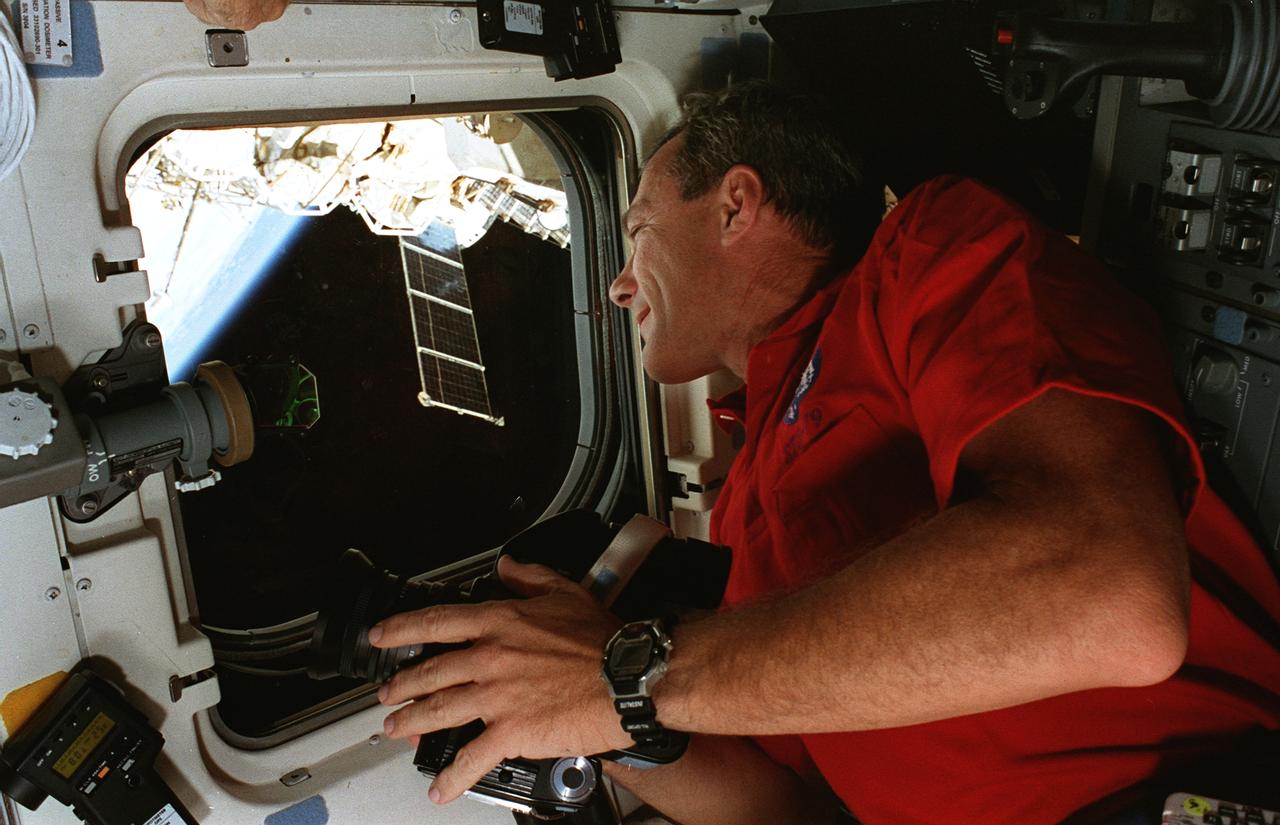
STS079-353-007 (16-26 Sept. 1996) --- Astronaut Terrence W. Wilcutt, on the Space Shuttle Atlantis' aft flight deck, takes pictures of Earth for study by Earth observations scientists at the Johnson Space Center (JSC). Several components of the docked Russia's Mir Space Station can be seen in the background. This photograph is one of fifteen 35mm frames (along with four 70mm frames) of still photography documenting the activities of NASA's STS-79 mission, which began with a September 16, 1996, liftoff from Launch Pad 39A the Kennedy Space Center (KSC) and ended with a landing at KSC on September 26, 1996. Onboard for the launch were astronauts William F. Readdy, commander; Wilcutt, pilot; John E. Blaha, Jerome (Jay) Apt, Thomas D. Akers and Carl E. Walz, all mission specialists. On flight day 4, the crew docked with Russia's Mir Space Station. Shannon W. Lucid, who had spent six months aboard Mir, switched cosmonaut guest researcher roles with Blaha. The latter joined fellow Mir-22 crew members Valeri G. Korzun, commander, and Aleksandr Y. Kaleri, flight engineer.
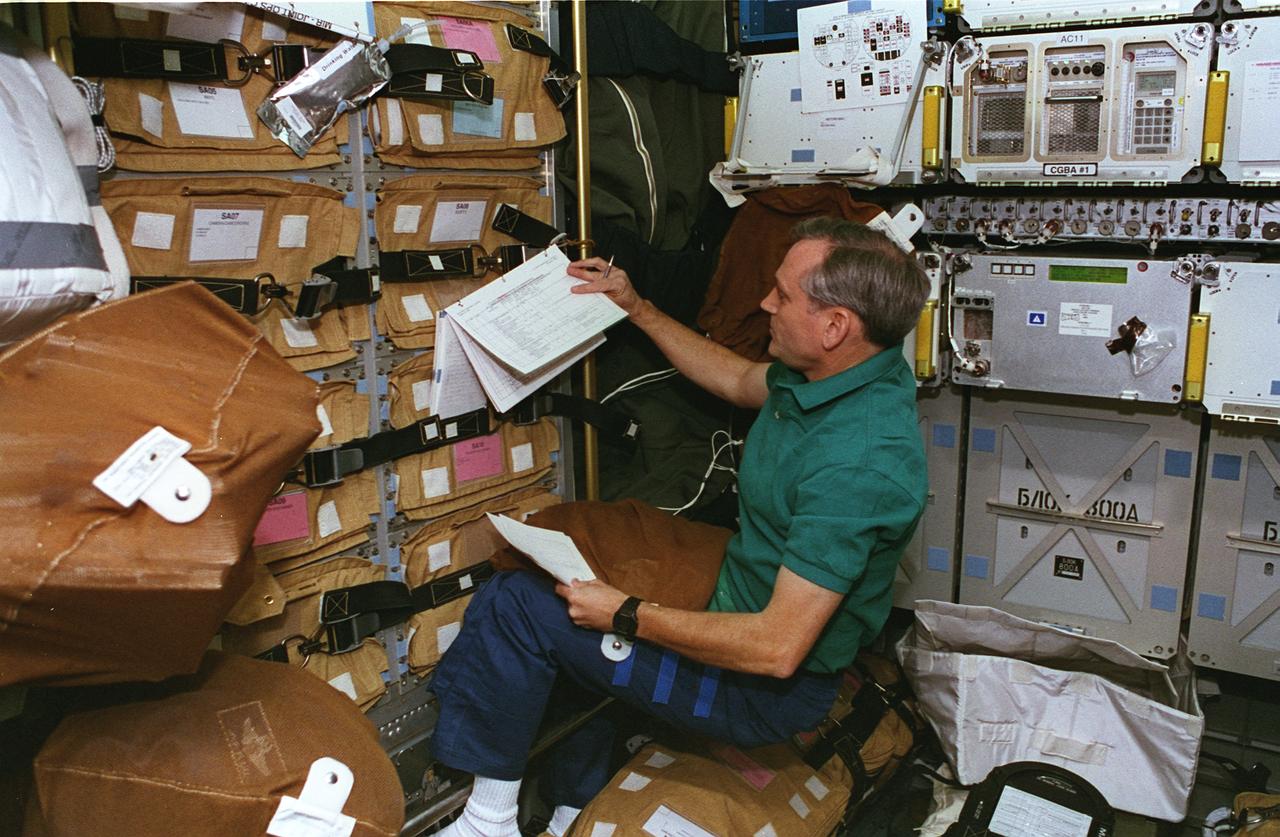
STS079-309-022 (16-26 Sept. 1996) --- Astronaut Thomas D. Akers, in the Spacehab, goes over an inventory of supplies which will be transferred to the Russia's Mir Space Station. This photograph is one of fifteen 35mm frames (along with four 70mm frames) of still photography documenting the activities of NASA's STS-79 mission, which began with a September 16, 1996, liftoff from Launch Pad 39A the Kennedy Space Center (KSC) and ended with a landing at KSC on September 26, 1996. Onboard for the launch were astronauts William F. Readdy, commander; Terrence W. Wilcutt, pilot; John E. Blaha, Jerome (Jay) Apt, Akers and Carl E. Walz, all mission specialists. On flight day 4, the crew docked with the Mir Space Station. Shannon W. Lucid, who had spent six months aboard Mir, switched cosmonaut guest researcher roles with Blaha. The latter joined fellow Mir-22 crew members Valeri G. Korzun, commander, and Aleksandr Y. Kaleri, flight engineer.
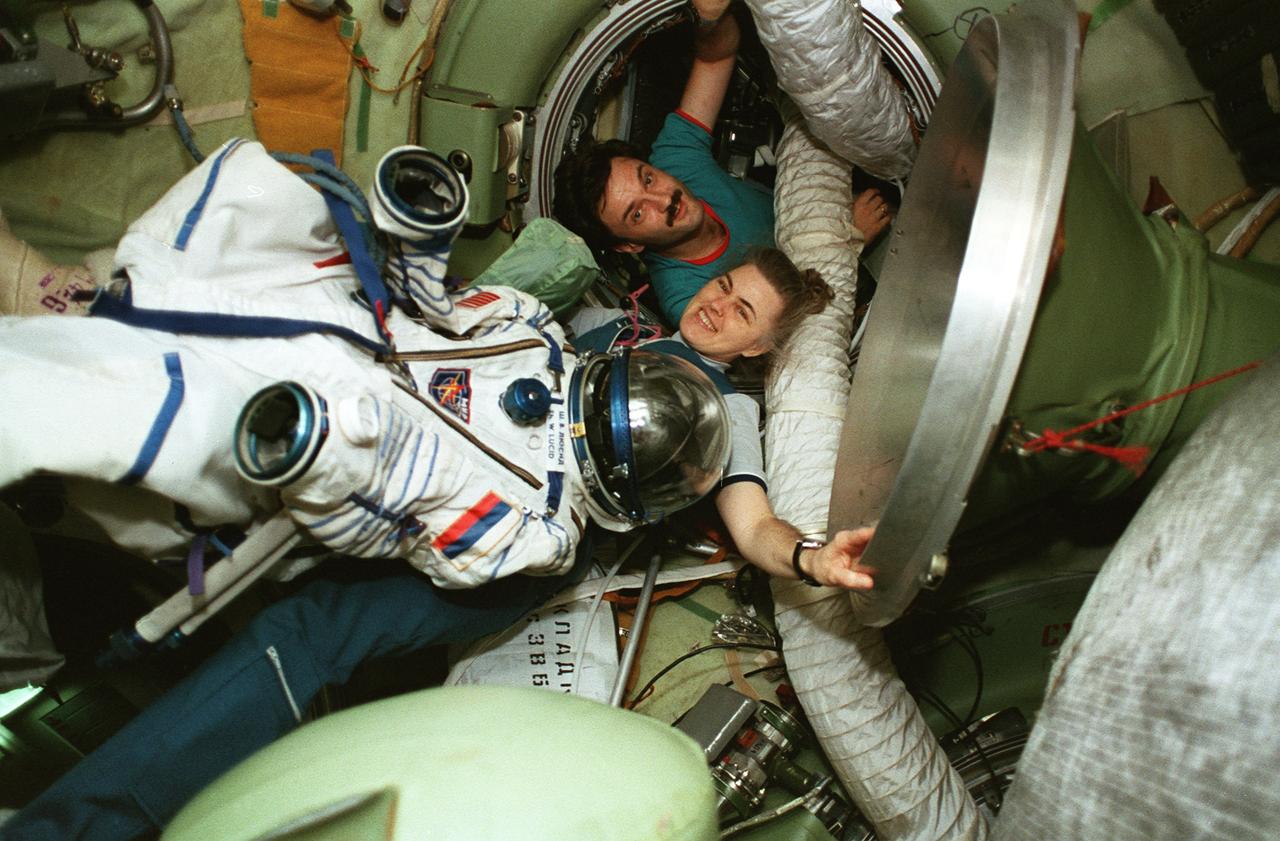
STS079-354-011 (16-26 Sept. 1996) --- Astronaut Shannon W. Lucid with cosmonaut Aleksandr Y. Kaleri prepare to move Lucid's cosmonaut space suit from Russia's Mir Space Station to the Space Shuttle Atlantis. This photograph is one of fifteen 35mm frames (along with four 70mm frames) of still photography documenting the activities of NASA's STS-79 mission, which began with a Sept. 16, 1996, liftoff from Launch Pad 39A the Kennedy Space Center (KSC) and ended with a landing at KSC on Sept. 26, 1996. Onboard for the launch were astronauts William F. Readdy, commander; Terrence W. Wilcutt, pilot; John E. Blaha, Jerome (Jay) Apt, Thomas D. Akers and Carl E. Walz, all mission specialists. On flight day 4, the crew docked with Mir. Lucid, who had spent six months aboard Mir, switched cosmonaut guest researcher roles with Blaha. The latter joined fellow Mir-22 crewmembers Valeri G. Korzun, commander, and Kaleri, flight engineer.
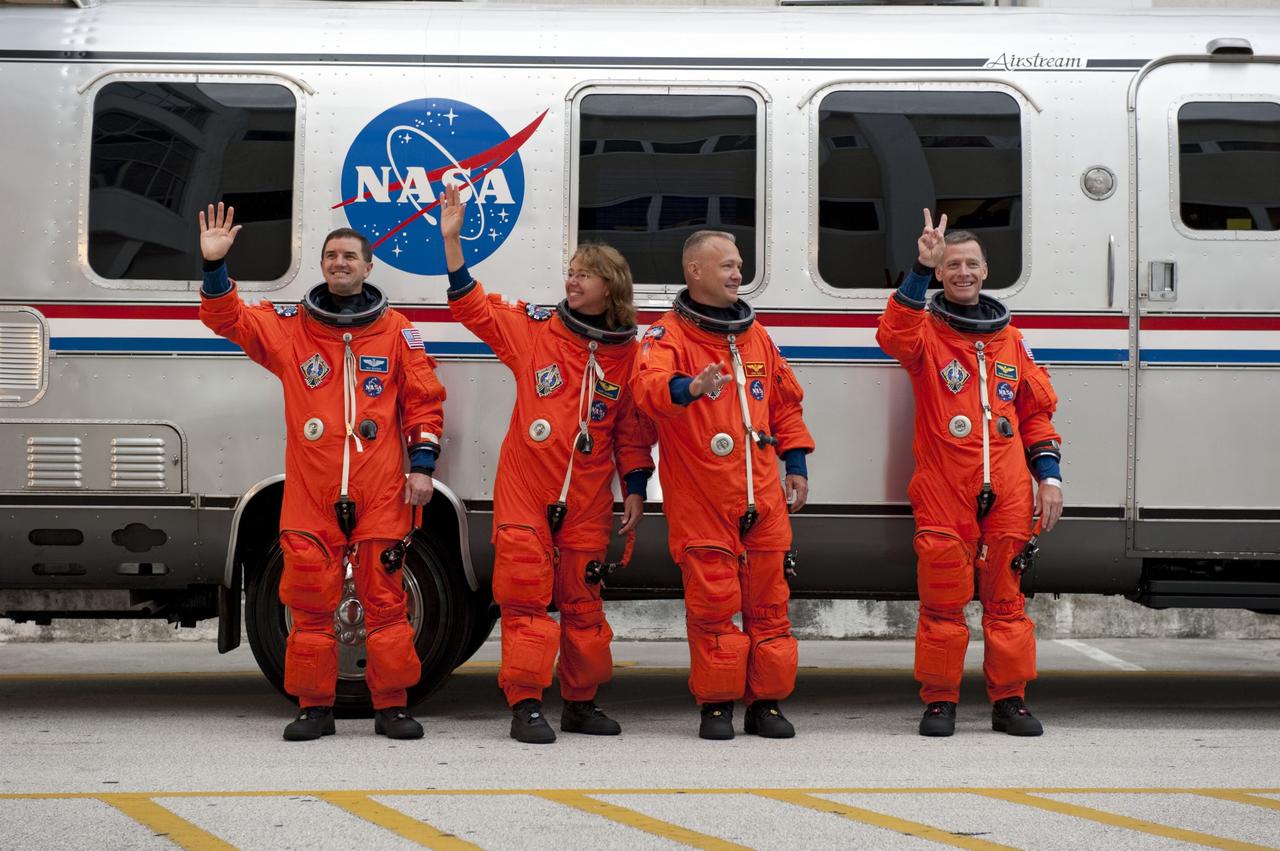
CAPE CANAVERAL, Fla. -- Dressed in their bright-orange launch-and-entry suits, the final four astronauts to launch aboard a space shuttle wave to media and employees cheering them on in front of the Astronaut Crew Quarters in the Operations and Checkout Building at NASA's Kennedy Space Center in Florida. From left, are STS-135 Mission Specialists Rex Walheim and Sandy Magnus, Pilot Doug Hurley, and Commander Chris Ferguson. The silver Astrovan will take the astronauts to Launch Pad 39A, where they will board space shuttle Atlantis for a scheduled liftoff at 11:26 a.m. EDT on July 8 for their mission to the International Space Station. STS-135 will deliver the Raffaello multi-purpose logistics module packed with supplies and spare parts for the orbiting outpost. Atlantis also will fly the Robotic Refueling Mission experiment that will investigate the potential for robotically refueling existing satellites in orbit. In addition, Atlantis will return with a failed ammonia pump module to help NASA better understand the failure mechanism and improve pump designs for future systems. STS-135 will be the 33rd flight of Atlantis, the 37th shuttle mission to the space station, and the 135th and final mission of NASA's Space Shuttle Program. For more information, visit www.nasa.gov/mission_pages/shuttle/shuttlemissions/sts135/index.html. Photo credit: NASA/Kim Shiflett
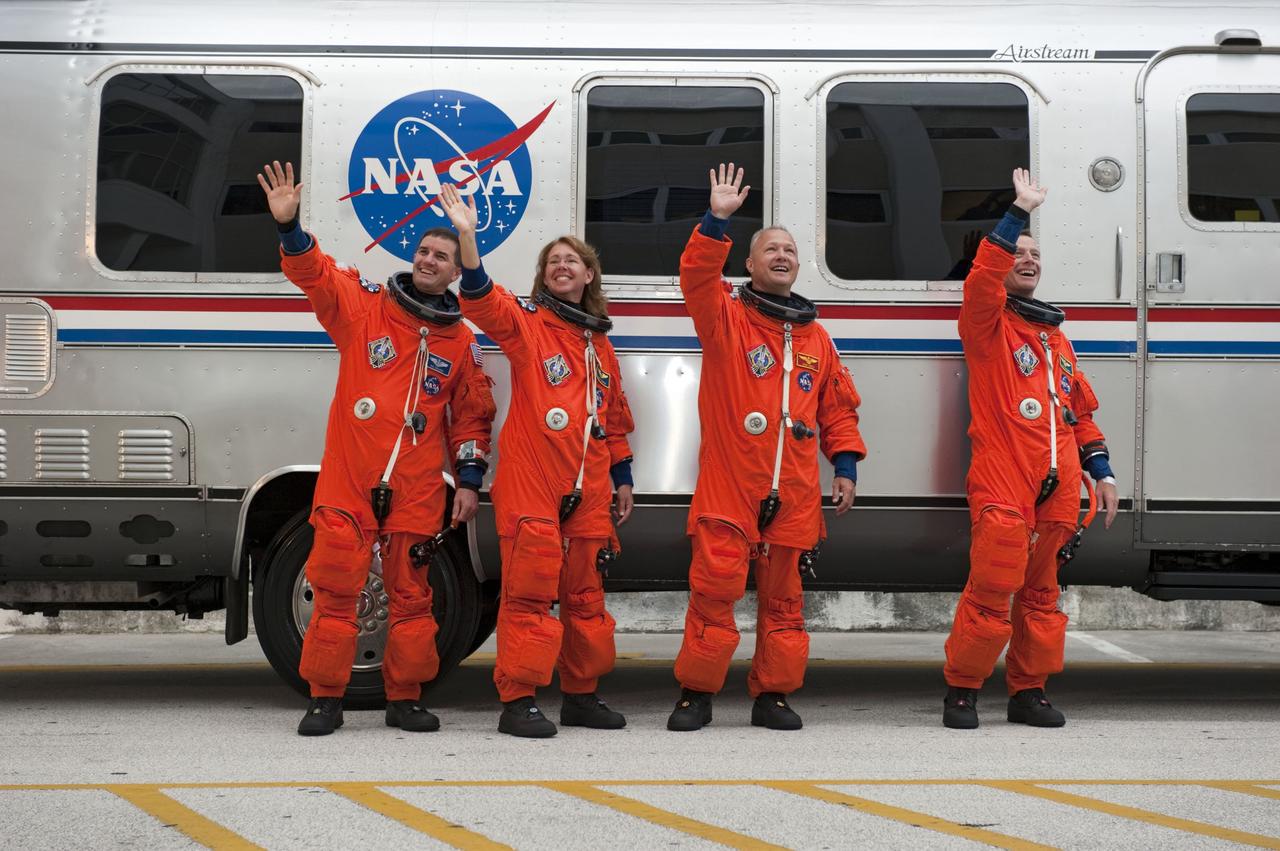
CAPE CANAVERAL, Fla. -- Dressed in their bright-orange launch-and-entry suits, the final four astronauts to launch aboard a space shuttle wave to media and employees cheering them on in front of the Astronaut Crew Quarters in the Operations and Checkout Building at NASA's Kennedy Space Center in Florida. From left, are STS-135 Mission Specialists Rex Walheim and Sandy Magnus, Pilot Doug Hurley, and Commander Chris Ferguson. The silver Astrovan will take the astronauts to Launch Pad 39A, where they will board space shuttle Atlantis for a scheduled liftoff at 11:26 a.m. EDT on July 8 for their mission to the International Space Station. STS-135 will deliver the Raffaello multi-purpose logistics module packed with supplies and spare parts for the orbiting outpost. Atlantis also will fly the Robotic Refueling Mission experiment that will investigate the potential for robotically refueling existing satellites in orbit. In addition, Atlantis will return with a failed ammonia pump module to help NASA better understand the failure mechanism and improve pump designs for future systems. STS-135 will be the 33rd flight of Atlantis, the 37th shuttle mission to the space station, and the 135th and final mission of NASA's Space Shuttle Program. For more information, visit www.nasa.gov/mission_pages/shuttle/shuttlemissions/sts135/index.html. Photo credit: NASA/Kim Shiflett
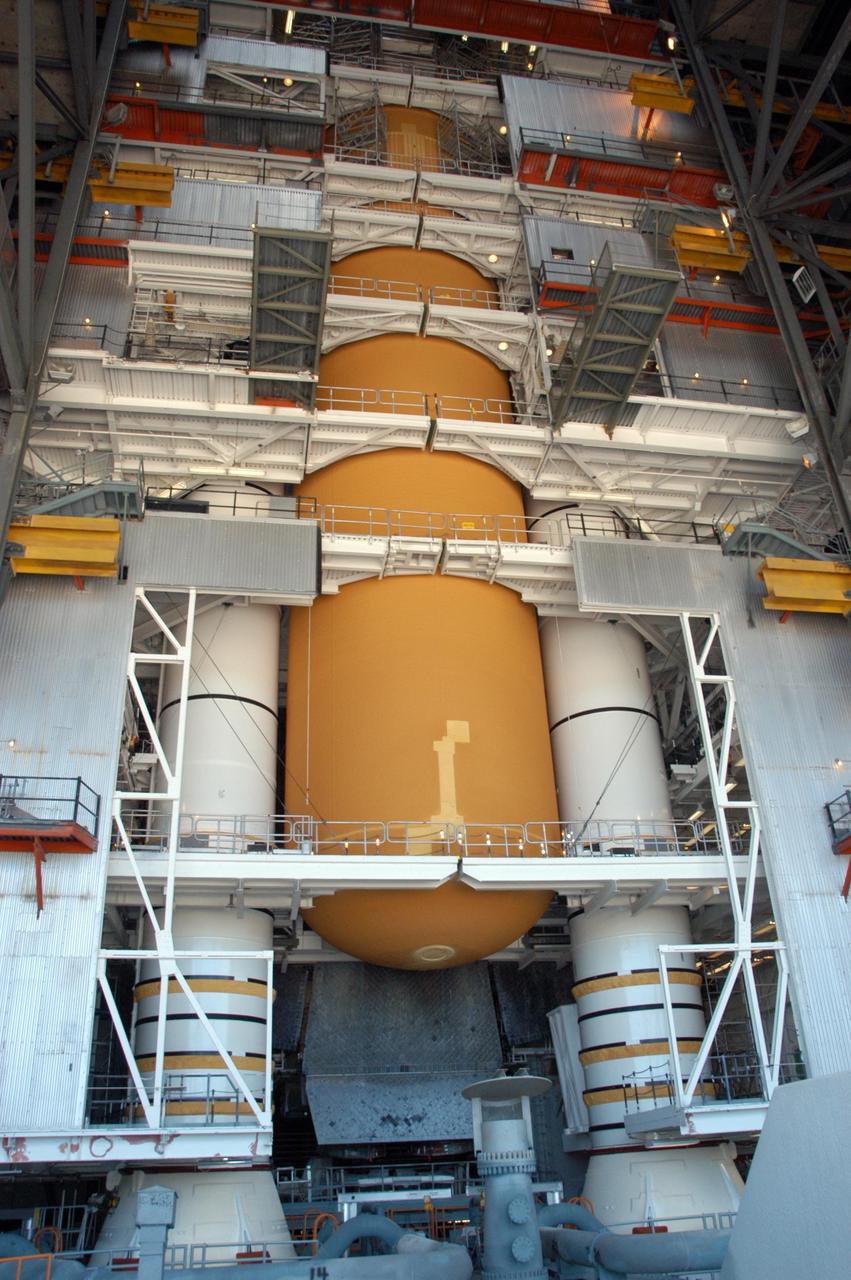
KENNEDY SPACE CENTER, FLA. -- In high bay 1 of the Vehicle Assembly Building, work is underway to repair the damage to Atlantis' external tank, seen here. Technicians will prepare the nose cone for future work. A severe thunderstorm with golf ball-sized hail caused visible divots in the giant tank's foam insulation and minor surface damage to about 26 heat shield tiles on the shuttle's left wing. Further evaluation of the tank is necessary to get an accurate accounting of foam damage and determine the type of repair required and the time needed for that work. A new target launch date has not been determined, but teams will focus on preparing Atlantis for liftoff in late April on mission STS-117. Photo credit: NASA/George Shelton
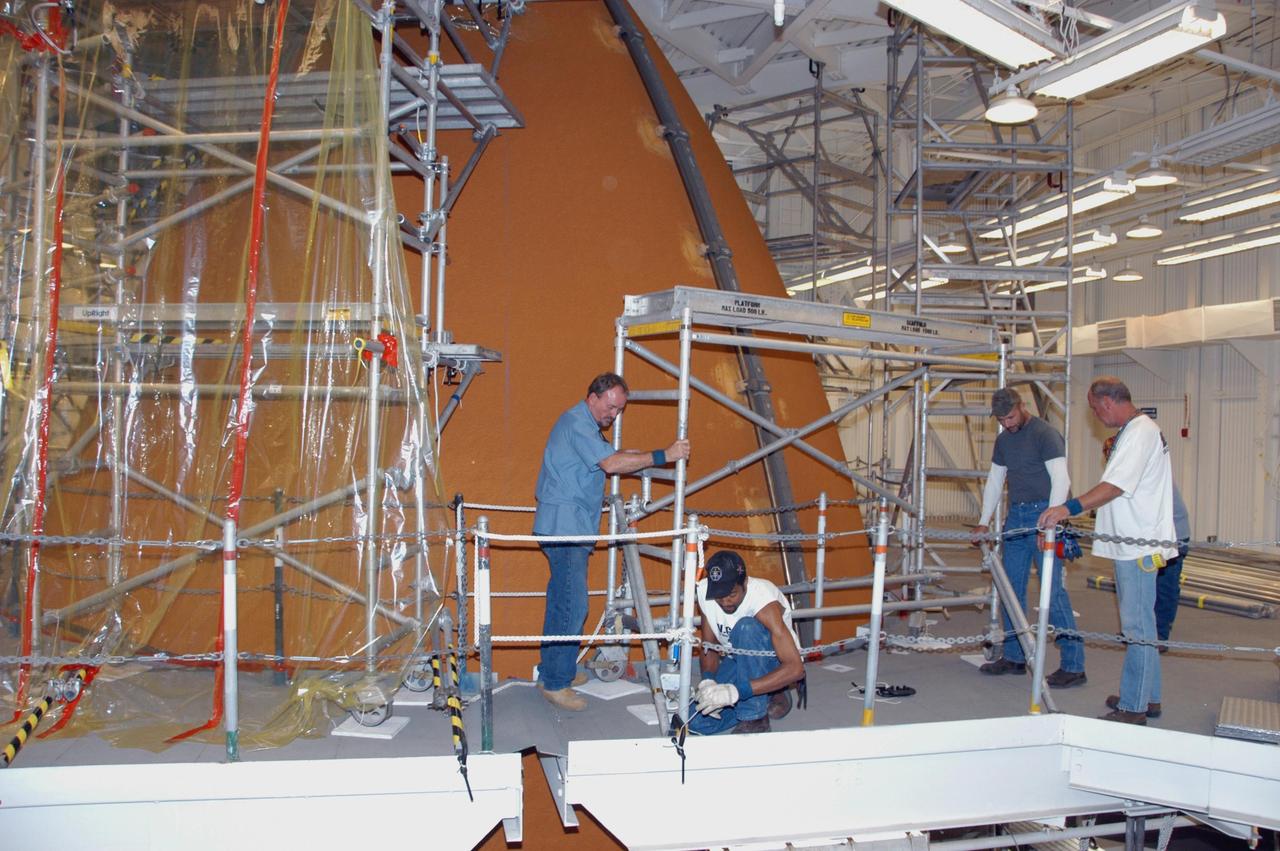
KENNEDY SPACE CENTER, FLA. -- On an upper level of high bay 1 of the Vehicle Assembly Building, technicians secure protective material around Atlantis' external tank. The preparations are for future repair work of the hail damage that happened Feb. 27. A severe thunderstorm with golf ball-sized hail caused visible divots in the giant tank's foam insulation and minor surface damage to about 26 heat shield tiles on the shuttle's left wing. Further evaluation of the tank is necessary to get an accurate accounting of foam damage and determine the type of repair required and the time needed for that work. A new target launch date has not been determined, but teams will focus on preparing Atlantis for liftoff in late April on mission STS-117. Photo credit: NASA/George Shelton
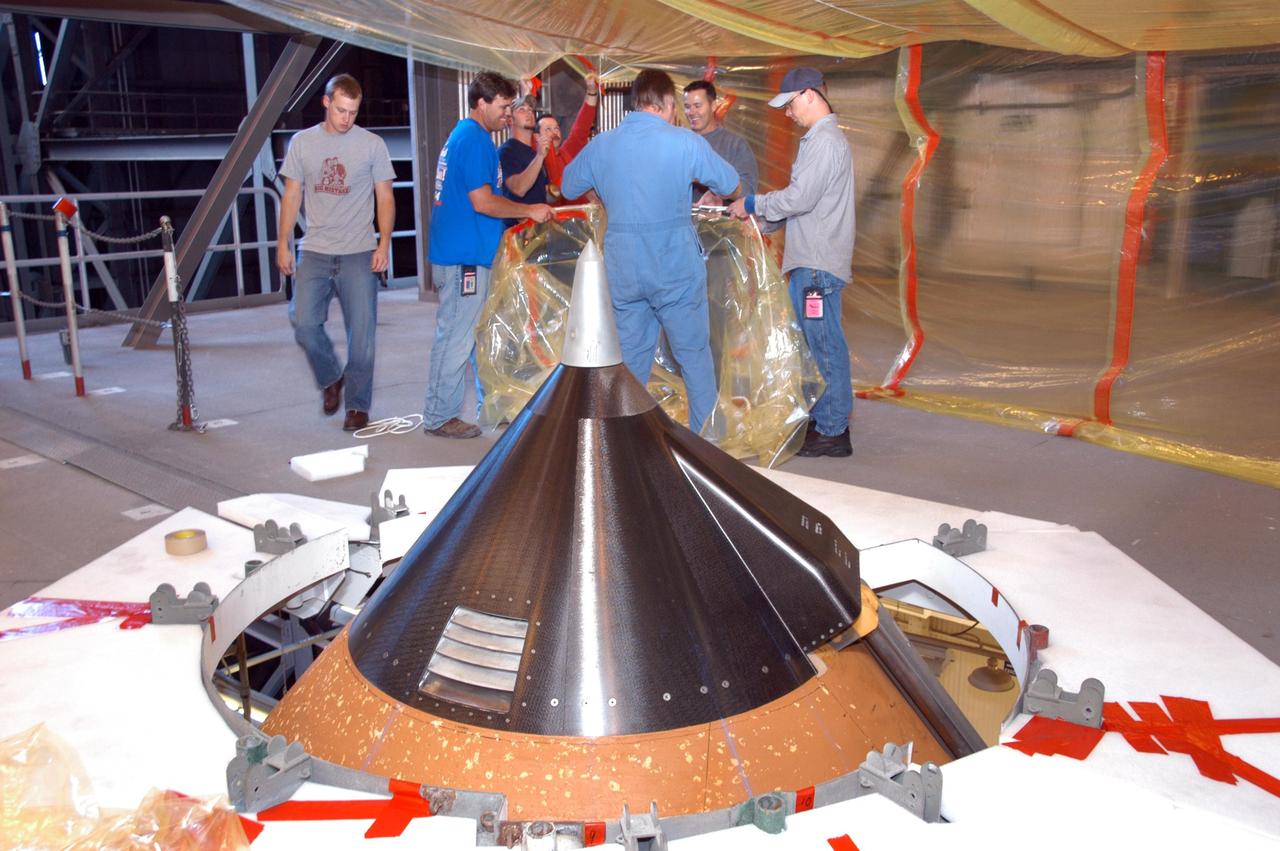
KENNEDY SPACE CENTER, FLA. -- On an upper level of high bay 1 of the Vehicle Assembly Building, technicians prepare the area around the nose cone (foreground) of Atlantis' external tank that will undergo repair for hail damage. A severe thunderstorm with golf ball-sized hail caused visible divots in the giant tank's foam insulation and minor surface damage to about 26 heat shield tiles on the shuttle's left wing. Further evaluation of the tank is necessary to get an accurate accounting of foam damage and determine the type of repair required and the time needed for that work. A new target launch date has not been determined, but teams will focus on preparing Atlantis for liftoff in late April on mission STS-117. Photo credit: NASA/George Shelton
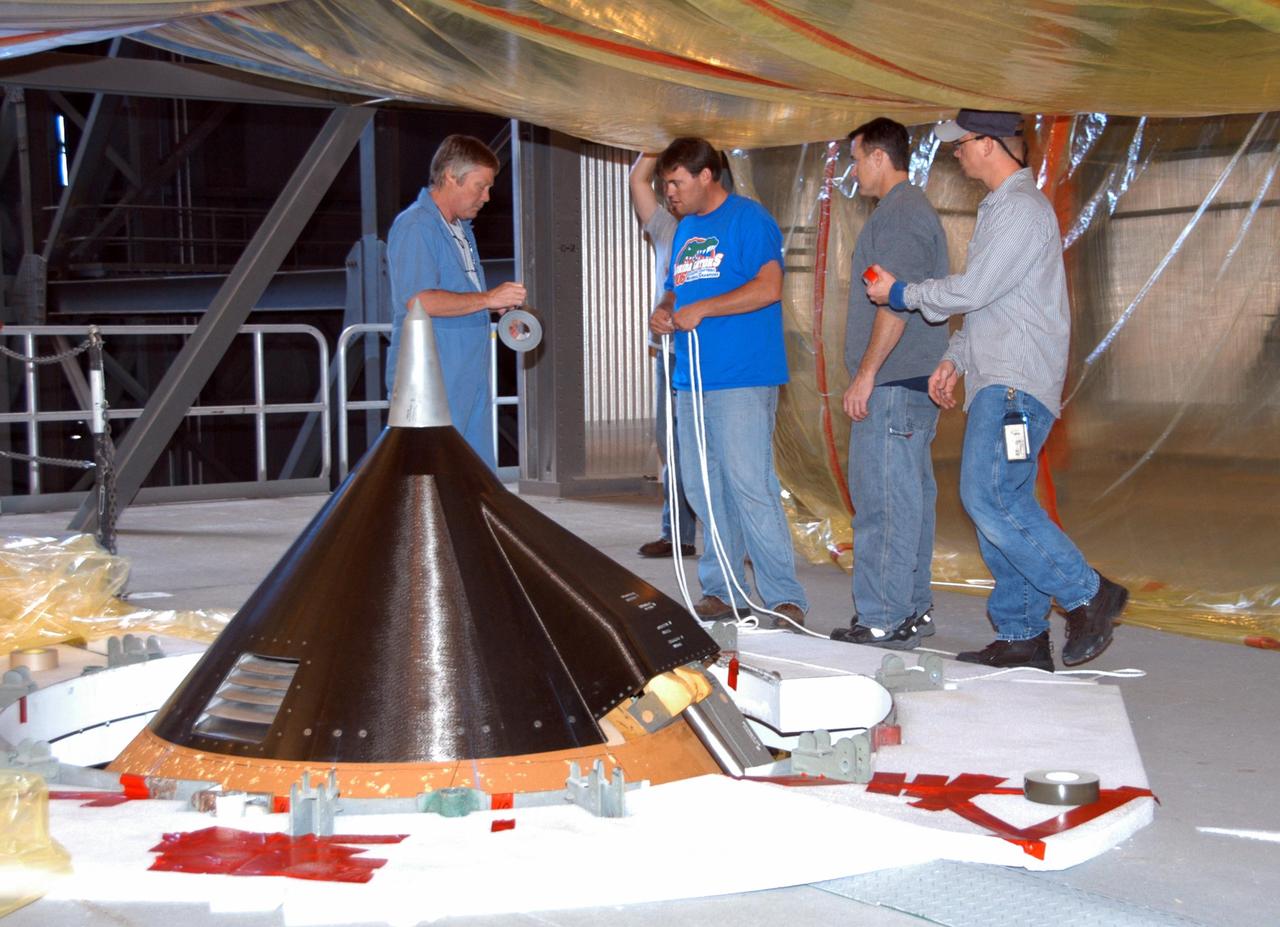
KENNEDY SPACE CENTER, FLA. -- On an upper level of high bay 1 of the Vehicle Assembly Building, technicians prepare the area around the nose cone (left) of Atlantis' external tank that will undergo repair for hail damage. A severe thunderstorm with golf ball-sized hail caused visible divots in the giant tank's foam insulation and minor surface damage to about 26 heat shield tiles on the shuttle's left wing. Further evaluation of the tank is necessary to get an accurate accounting of foam damage and determine the type of repair required and the time needed for that work. A new target launch date has not been determined, but teams will focus on preparing Atlantis for liftoff in late April on mission STS-117. Photo credit: NASA/George Shelton
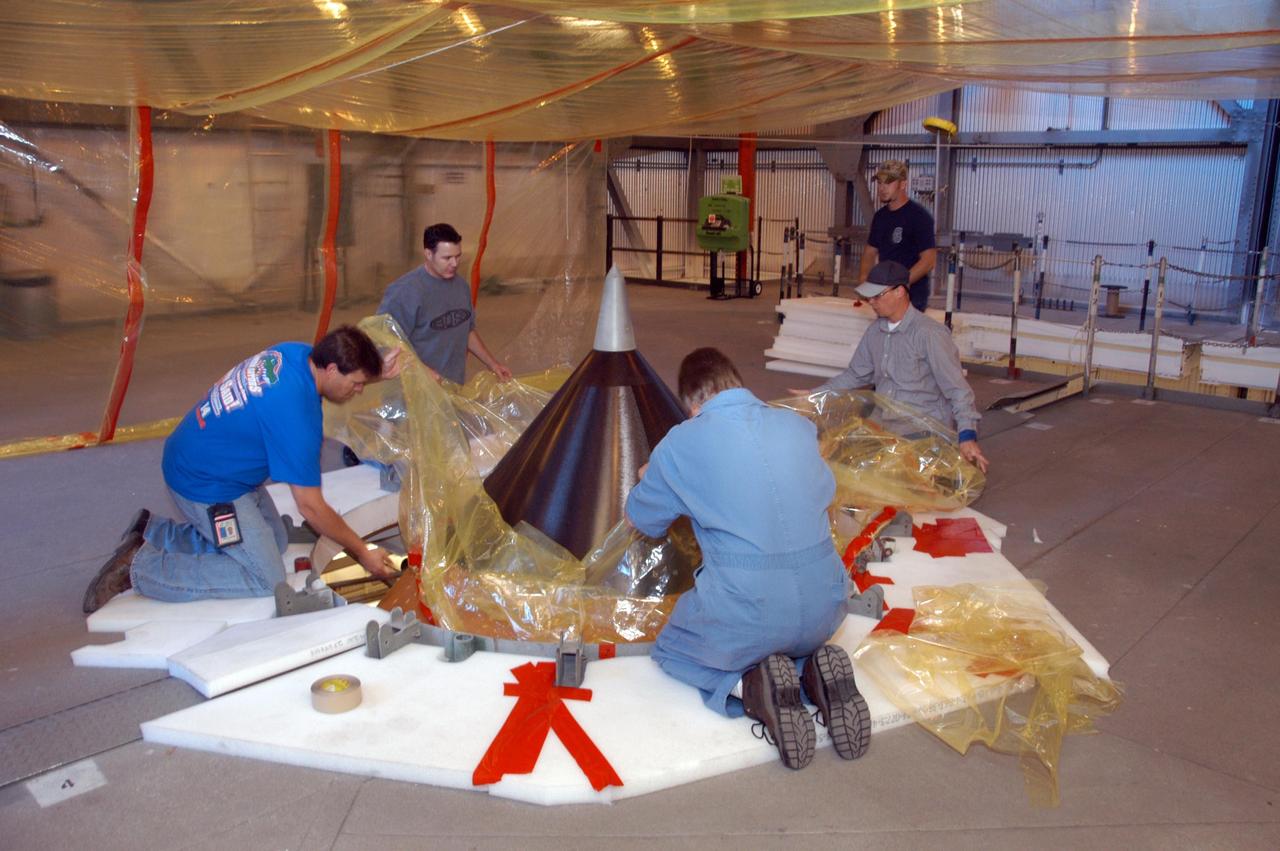
KENNEDY SPACE CENTER, FLA. -- On an upper level of high bay 1 of the Vehicle Assembly Building, technicians place protective material around the nose cone of Atlantis' external tank. The nose cone will undergo repair for hail damage. A severe thunderstorm with golf ball-sized hail caused visible divots in the giant tank's foam insulation and minor surface damage to about 26 heat shield tiles on the shuttle's left wing. Further evaluation of the tank is necessary to get an accurate accounting of foam damage and determine the type of repair required and the time needed for that work. A new target launch date has not been determined, but teams will focus on preparing Atlantis for liftoff in late April on mission STS-117. Photo credit: NASA/George Shelton

KENNEDY SPACE CENTER, FLA. -- On an upper level of high bay 1 of the Vehicle Assembly Building, technicians move protective material toward the nose cone (foreground) of Atlantis' external tank. The nose cone will undergo repair for hail damage. A severe thunderstorm with golf ball-sized hail caused visible divots in the giant tank's foam insulation and minor surface damage to about 26 heat shield tiles on the shuttle's left wing. Further evaluation of the tank is necessary to get an accurate accounting of foam damage and determine the type of repair required and the time needed for that work. A new target launch date has not been determined, but teams will focus on preparing Atlantis for liftoff in late April on mission STS-117. Photo credit: NASA/George Shelton
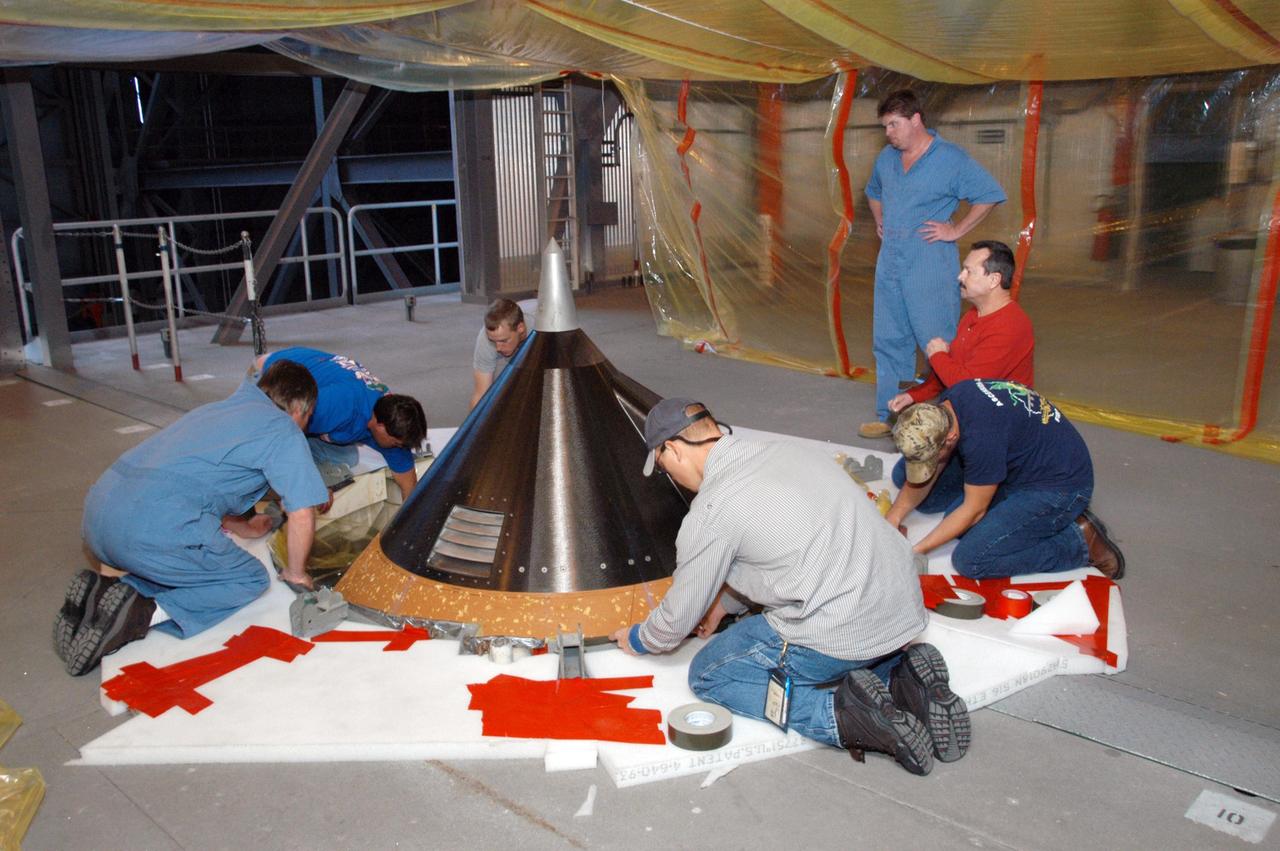
KENNEDY SPACE CENTER, FLA. -- On an upper level of high bay 1 of the Vehicle Assembly Building, technicians secure protective material around the base of the nose cone of Atlantis' external tank. The nose cone will undergo repair for hail damage. A severe thunderstorm with golf ball-sized hail caused visible divots in the giant tank's foam insulation and minor surface damage to about 26 heat shield tiles on the shuttle's left wing. Further evaluation of the tank is necessary to get an accurate accounting of foam damage and determine the type of repair required and the time needed for that work. A new target launch date has not been determined, but teams will focus on preparing Atlantis for liftoff in late April on mission STS-117. Photo credit: NASA/George Shelton
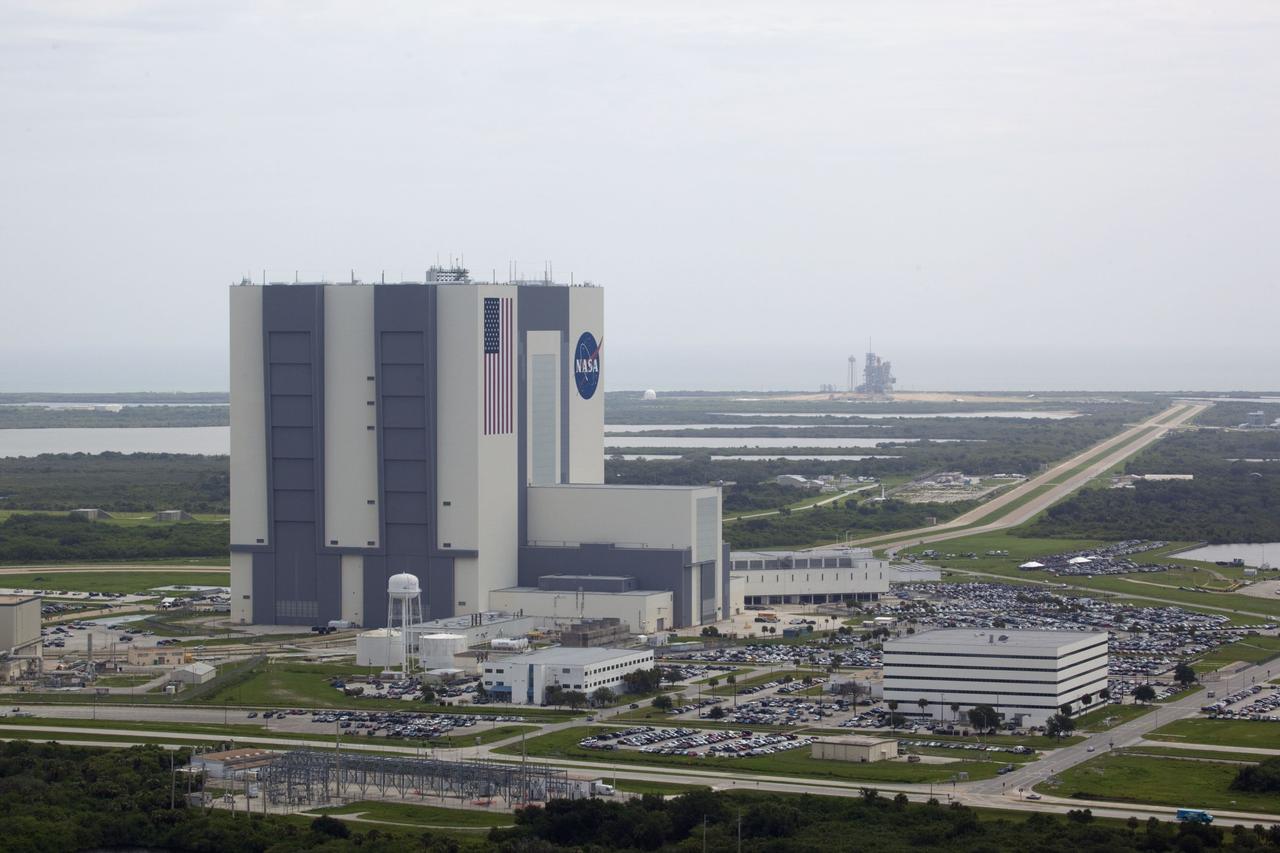
CAPE CANAVERAL, Fla. -- After 30 years and 135 missions, employees and invited guests crowd the Launch Complex 39 area of NASA's Kennedy Space Center in Florida to see the rocket's red glare of NASA's Space Shuttle Program soar for the last time. Space shuttle Atlantis is scheduled to liftoff at 11:26 a.m. EDT from Launch Pad 39A. On board will be four experienced astronauts -- STS-135 Commander Chris Ferguson, Pilot Doug Hurley, and Mission Specialists Sandy Magnus and Rex Walheim. STS-135 will deliver the Raffaello multi-purpose logistics module packed with supplies and spare parts for the International Space Station. Atlantis also will fly the Robotic Refueling Mission experiment that will investigate the potential for robotically refueling existing satellites in orbit. In addition, Atlantis will return with a failed ammonia pump module to help NASA better understand the failure mechanism and improve pump designs for future systems. STS-135 will be the 33rd flight of Atlantis, the 37th shuttle mission to the space station, and the 135th and final mission of NASA's Space Shuttle Program. For more information visit, www.nasa.gov/mission_pages/shuttle/shuttlemissions/sts135/index.html. Photo credit: NASA/Frank Michaux
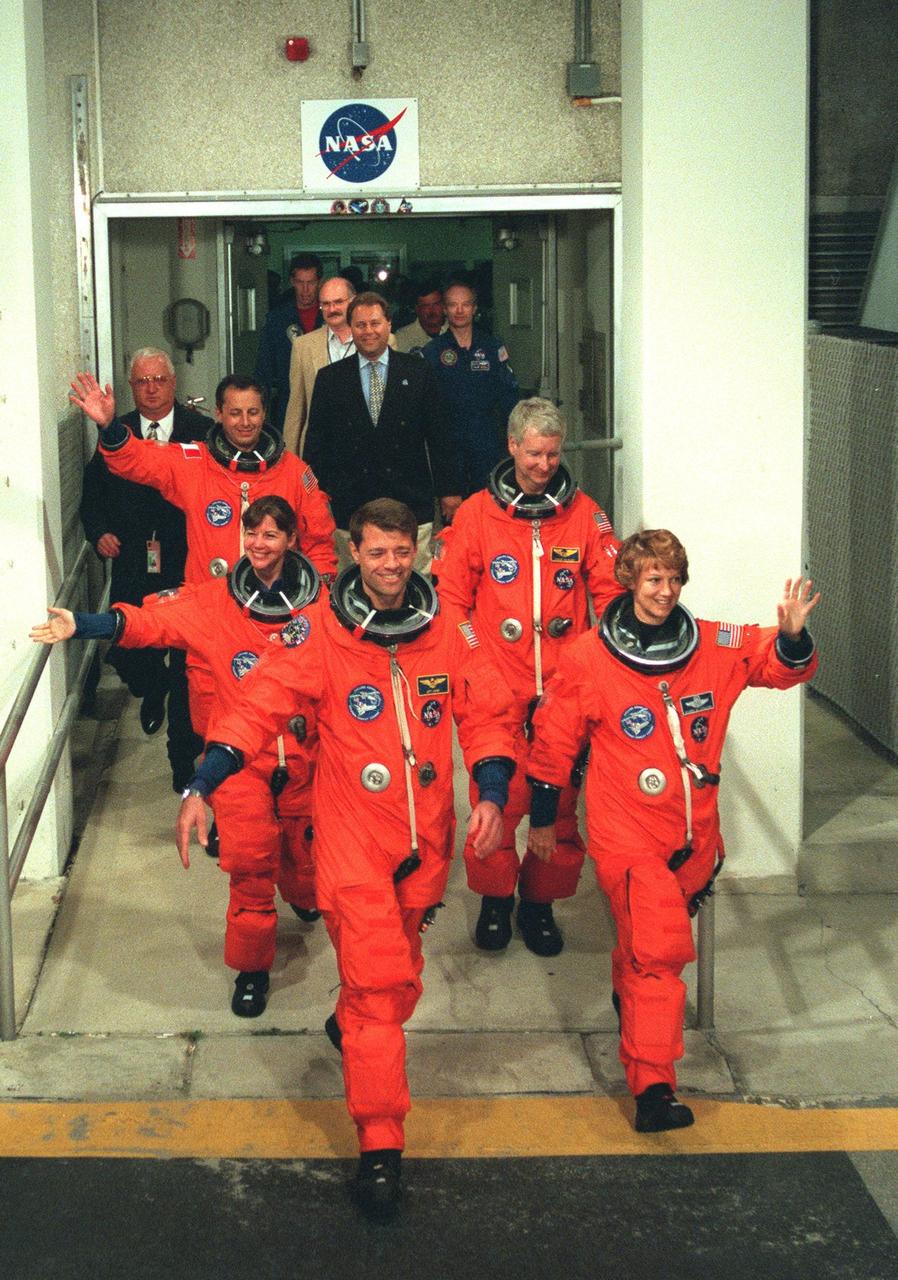
The STS-93 crew wave to onlookers as they walk out of the Operations and Checkout Building for the second time enroute to Launch Pad 39-B and liftoff of Space Shuttle Columbia. After Space Shuttle Columbia's July 20 launch attempt was scrubbed at the T-7 second mark in the countdown, the launch was rescheduled for Thursday, July 22, at 12:28 a.m. EDT. The target landing date is July 26, 1999, at 11:24 p.m. EDT. In their orange launch and entry suits, they are (starting at rear, left to right) Mission Specialists Michel Tognini of France, who represents the Centre National d'Etudes Spatiales (CNES), and Catherine G. Coleman (Ph.D.); Pilot Jeffrey S. Ashby; Mission Specialist Steven A. Hawley (Ph.D.); and Commander Eileen M. Collins. STS-93 is a five-day mission primarily to release the Chandra X-ray Observatory, which will allow scientists from around the world to study some of the most distant, powerful and dynamic objects in the universe. The new telescope is 20 to 50 times more sensitive than any previous X-ray telescope and is expected unlock the secrets of supernovae, quasars and black holes. Collins is the first woman to serve as commander of a Shuttle mission
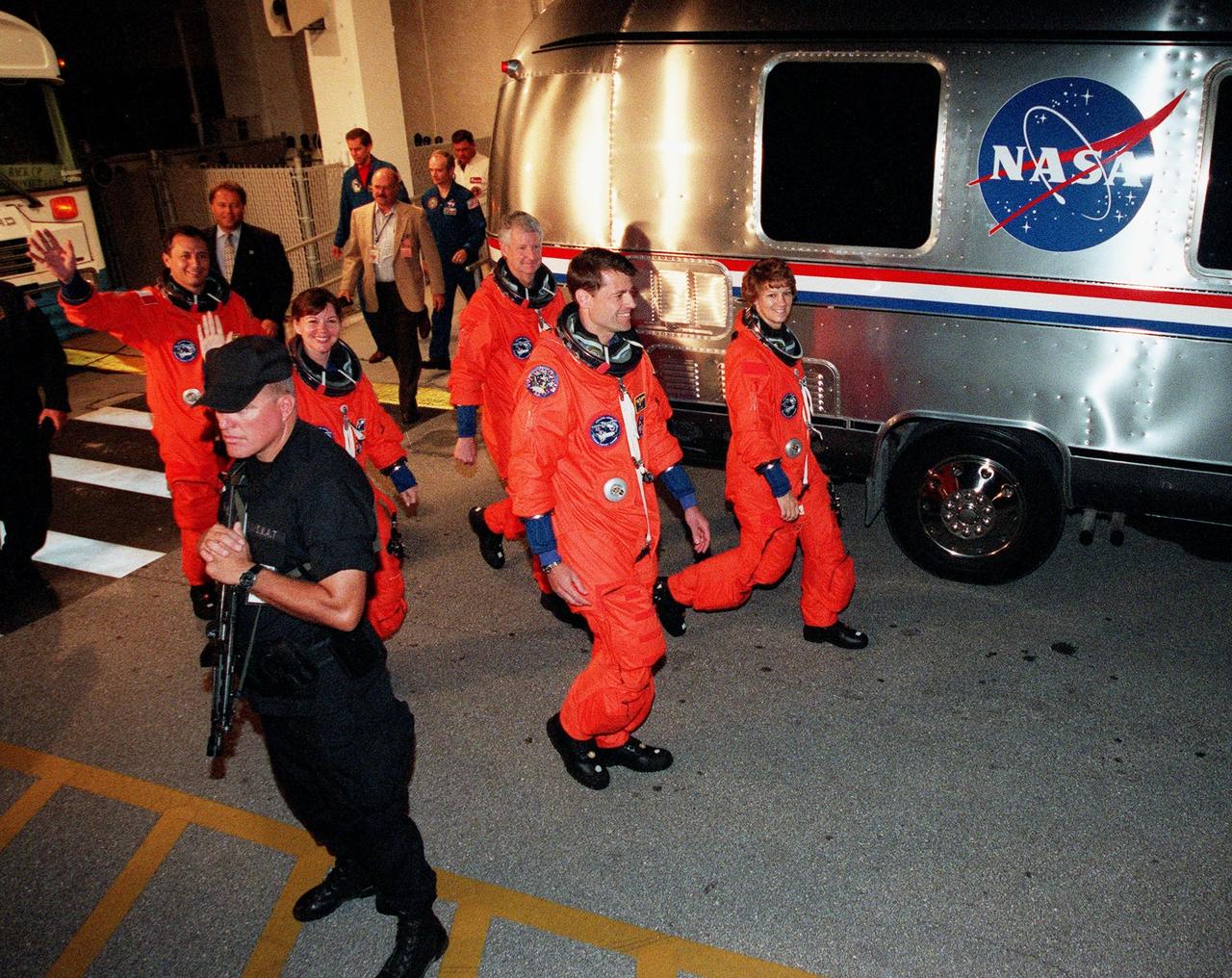
Flanked by security, the STS-93 crew wave to onlookers as they head for the "Astrovan" a second time to take them to Launch Pad 39-B and liftoff of Space Shuttle Columbia. After the July 20 launch attempt was scrubbed at the T-7 second mark in the countdown, the launch was rescheduled for Thursday, July 22, at 12:28 a.m. EDT. The target landing date is July 26, 1999, at 11:24 p.m. EDT. In their orange launch and entry suits, they are (starting at rear, left to right) Mission Specialists Michel Tognini of France, who represents the Centre National d'Etudes Spatiales (CNES), Catherine G. Coleman (Ph.D.), and Steven A. Hawley (Ph.D.); Pilot Jeffrey S. Ashby; and Commander Eileen M. Collins. STS-93 is a five-day mission primarily to release the Chandra X-ray Observatory, which will allow scientists from around the world to study some of the most distant, powerful and dynamic objects in the universe. The new telescope is 20 to 50 times more sensitive than any previous X-ray telescope and is expected unlock the secrets of supernovae, quasars and black holes. Collins is the first woman to serve as commander of a Shuttle mission
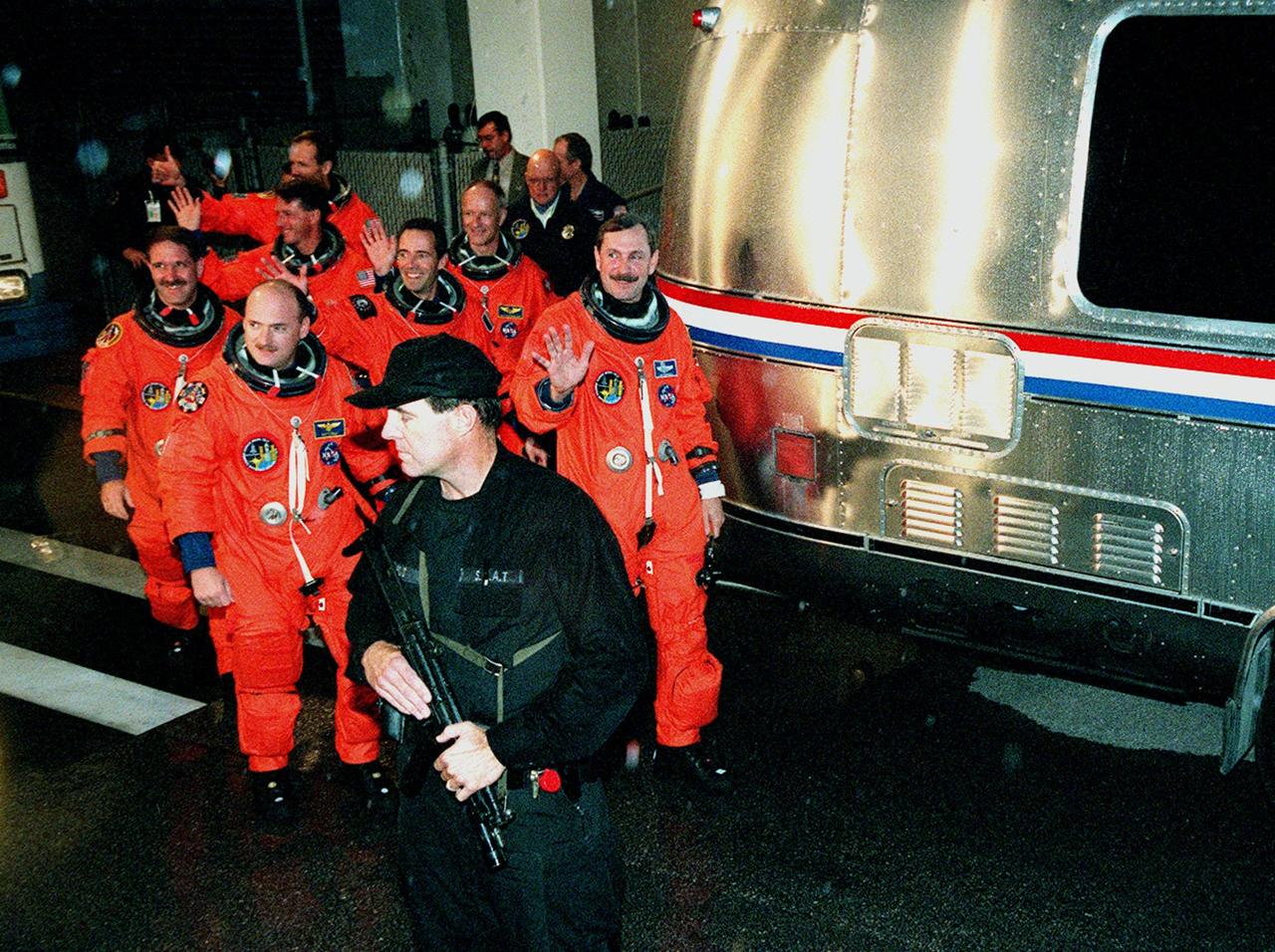
The STS-103 crew smile and wave to onlookers as they head toward the "Astrovan" at right that will carry them to Launch Pad 39B for liftoff of Space Shuttle Discovery. In their orange launch and entry suits, they are (front row) Pilot Scott J. Kelly and Commander Curtis L. Brown Jr., (second row) Mission Specialists John M. Grunsfeld (Ph.D.) and Jean-Francois Clervoy of France, (third row) C. Michael Foale (Ph. D.) and Claude Nicollier of Switzerland, and bringing up the rear, Steven L. Smith. The STS-103 mission, to service the Hubble Space Telescope, is scheduled for launch Dec. 17 at 8:47 p.m. EST from Launch Pad 39B. Mission objectives include replacing gyroscopes and an old computer, installing another solid state recorder, and replacing damaged insulation in the telescope. After the 8-day, 21-hour mission, Discovery is expected to land at KSC Sunday, Dec. 26, at about 6:30 p.m. EST
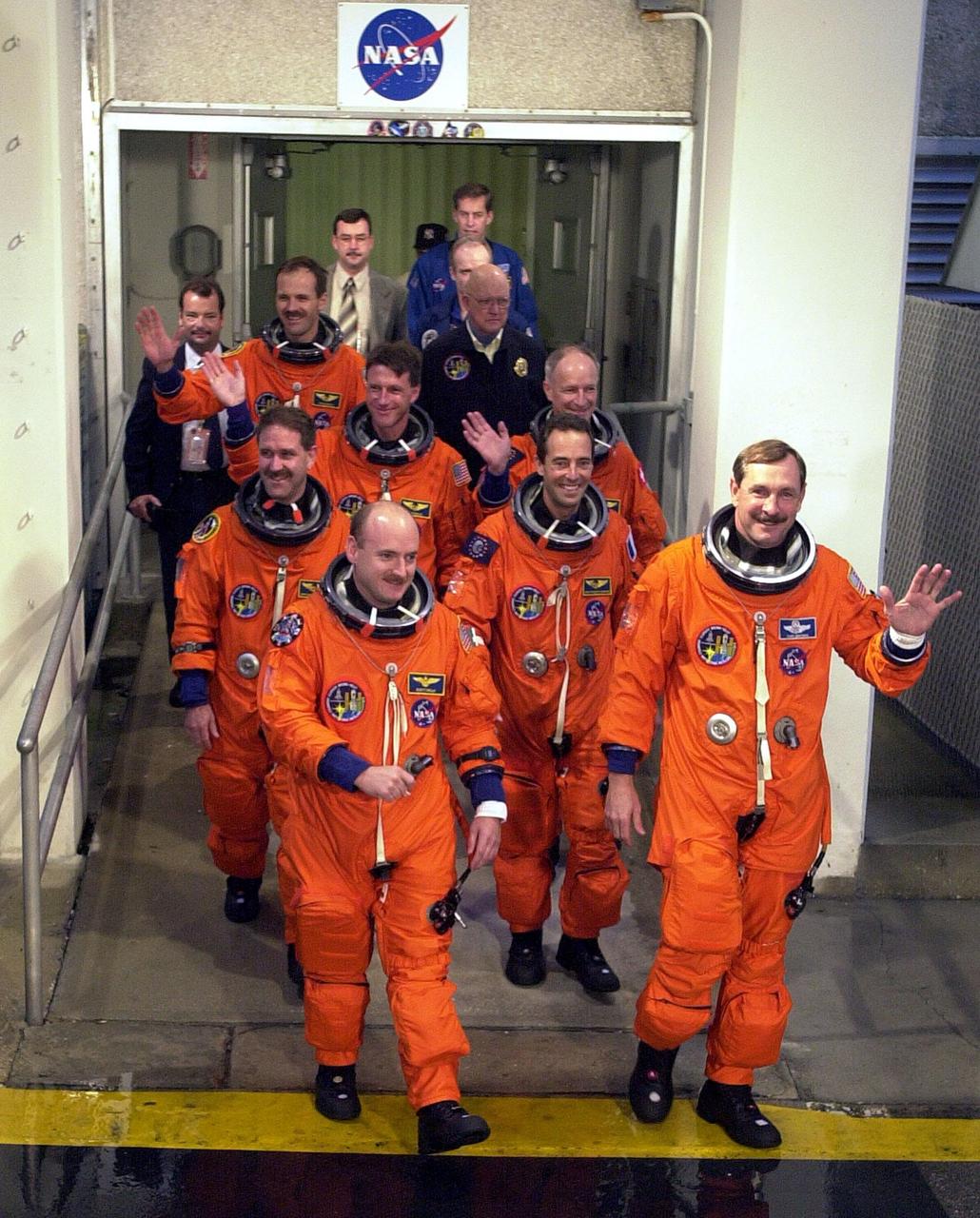
The STS-103 crew wave to onlookers as they walk out of the Operations and Checkout Building enroute to Launch Pad 39B and liftoff of Space Shuttle Discovery. In their orange launch and entry suits, they are (front row) Pilot Scott J. Kelly and Commander Curtis L. Brown Jr., (second row) Mission Specialists John M. Grunsfeld (Ph.D.) and Jean-Francois Clervoy of France, (third row) C. Michael Foale (Ph. D.) and Claude Nicollier of Switzerland, and bringing up the rear, Steven L. Smith. The STS-103 mission, to service the Hubble Space Telescope, is scheduled for launch Dec. 17 at 8:47 p.m. EST from Launch Pad 39B. Mission objectives include replacing gyroscopes and an old computer, installing another solid state recorder, and replacing damaged insulation in the telescope. After the 8-day, 21-hour mission, Discovery is expected to land at KSC Sunday, Dec. 26, at about 6:30 p.m. EST
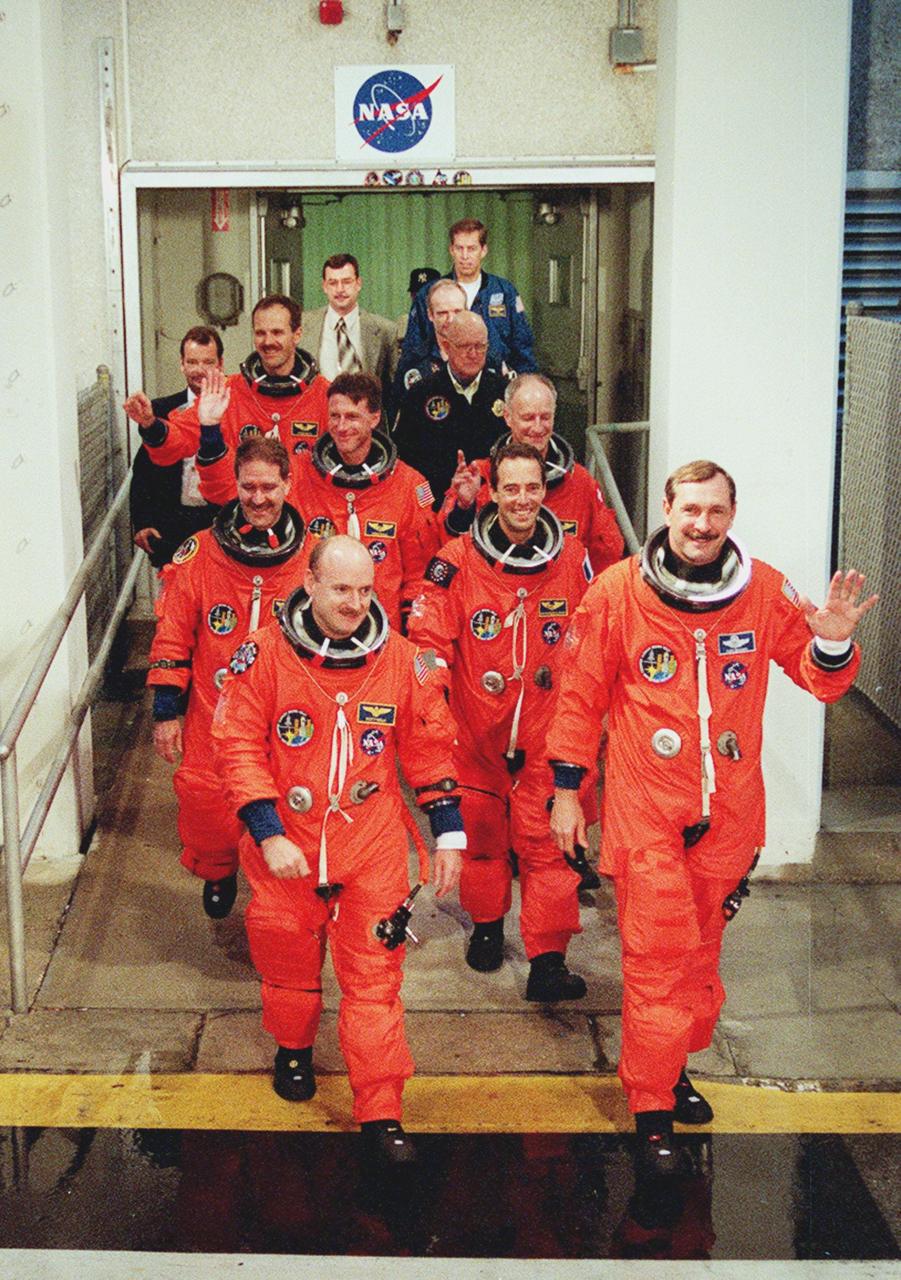
The STS-103 crew smile and wave to onlookers as they walk out of the Operations and Checkout Building enroute to Launch Pad 39B and liftoff of Space Shuttle Discovery. In their orange launch and entry suits, they are (front row) Pilot Scott J. Kelly and Commander Curtis L. Brown Jr., (second row) Mission Specialists John M. Grunsfeld (Ph.D.) and Jean-Francois Clervoy of France, (third row) C. Michael Foale (Ph. D.) and Claude Nicollier of Switzerland, and bringing up the rear, Steven L. Smith. The STS-103 mission, to service the Hubble Space Telescope, is scheduled for launch Dec. 17 at 8:47 p.m. EST from Launch Pad 39B. Mission objectives include replacing gyroscopes and an old computer, installing another solid state recorder, and replacing damaged insulation in the telescope. After the 8-day, 21-hour mission, Discovery is expected to land at KSC Sunday, Dec. 26, at about 6:30 p.m. EST
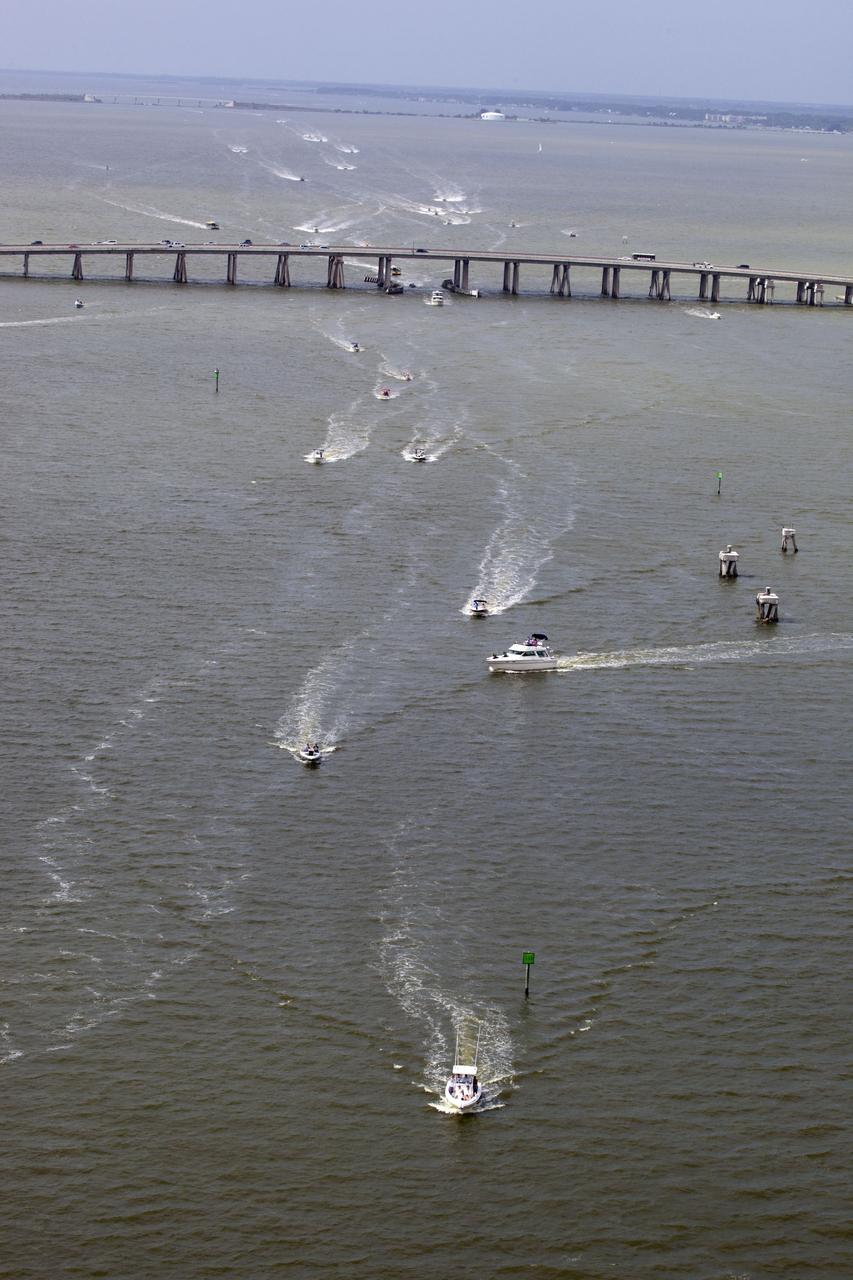
CAPE CANAVERAL, Fla. -- After 30 years and 135 missions, residents and visitors to Florida's Space Coast traverse the waters near Port Canaveral to see the rocket's red glare of NASA's Space Shuttle Program soar for the last time. Space shuttle Atlantis is scheduled to liftoff at 11:26 a.m. EDT from Launch Pad 39A at NASA's Kennedy Space Center in Florida. On board will be four experienced astronauts -- STS-135 Commander Chris Ferguson, Pilot Doug Hurley, and Mission Specialists Sandy Magnus and Rex Walheim. STS-135 will deliver the Raffaello multi-purpose logistics module packed with supplies and spare parts for the International Space Station. Atlantis also will fly the Robotic Refueling Mission experiment that will investigate the potential for robotically refueling existing satellites in orbit. In addition, Atlantis will return with a failed ammonia pump module to help NASA better understand the failure mechanism and improve pump designs for future systems. STS-135 will be the 33rd flight of Atlantis, the 37th shuttle mission to the space station, and the 135th and final mission of NASA's Space Shuttle Program. For more information visit, www.nasa.gov/mission_pages/shuttle/shuttlemissions/sts135/index.html. Photo credit: NASA/Frank Michaux
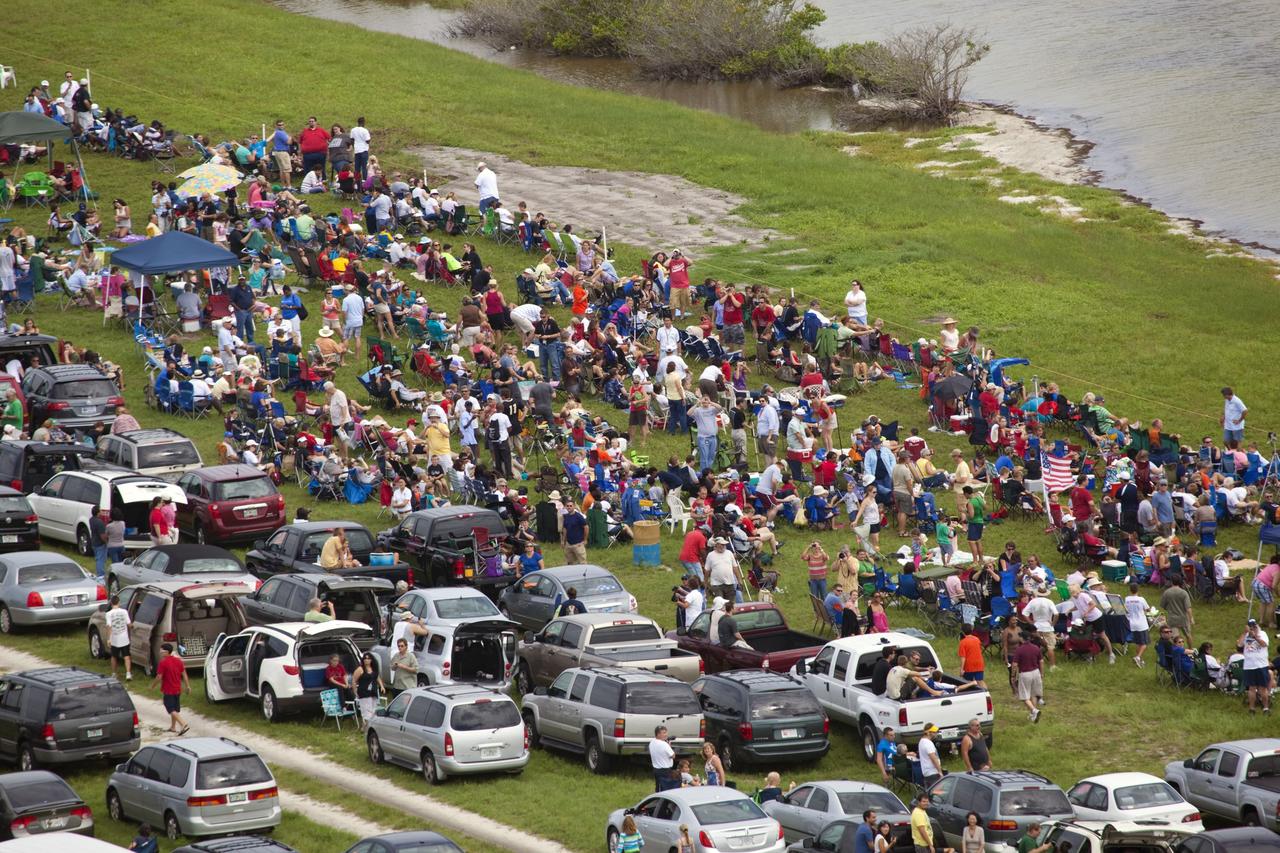
CAPE CANAVERAL, Fla. -- After 30 years and 135 missions, invited guests congregate along the NASA Causeway to see the rocket's red glare of NASA's Space Shuttle Program soar for the last time. Space shuttle Atlantis is scheduled to liftoff at 11:26 a.m. EDT from Launch Pad 39A at NASA's Kennedy Space Center in Florida. On board will be four experienced astronauts -- STS-135 Commander Chris Ferguson, Pilot Doug Hurley, and Mission Specialists Sandy Magnus and Rex Walheim. STS-135 will deliver the Raffaello multi-purpose logistics module packed with supplies and spare parts for the International Space Station. Atlantis also will fly the Robotic Refueling Mission experiment that will investigate the potential for robotically refueling existing satellites in orbit. In addition, Atlantis will return with a failed ammonia pump module to help NASA better understand the failure mechanism and improve pump designs for future systems. STS-135 will be the 33rd flight of Atlantis, the 37th shuttle mission to the space station, and the 135th and final mission of NASA's Space Shuttle Program. For more information visit, www.nasa.gov/mission_pages/shuttle/shuttlemissions/sts135/index.html. Photo credit: NASA/Frank Michaux
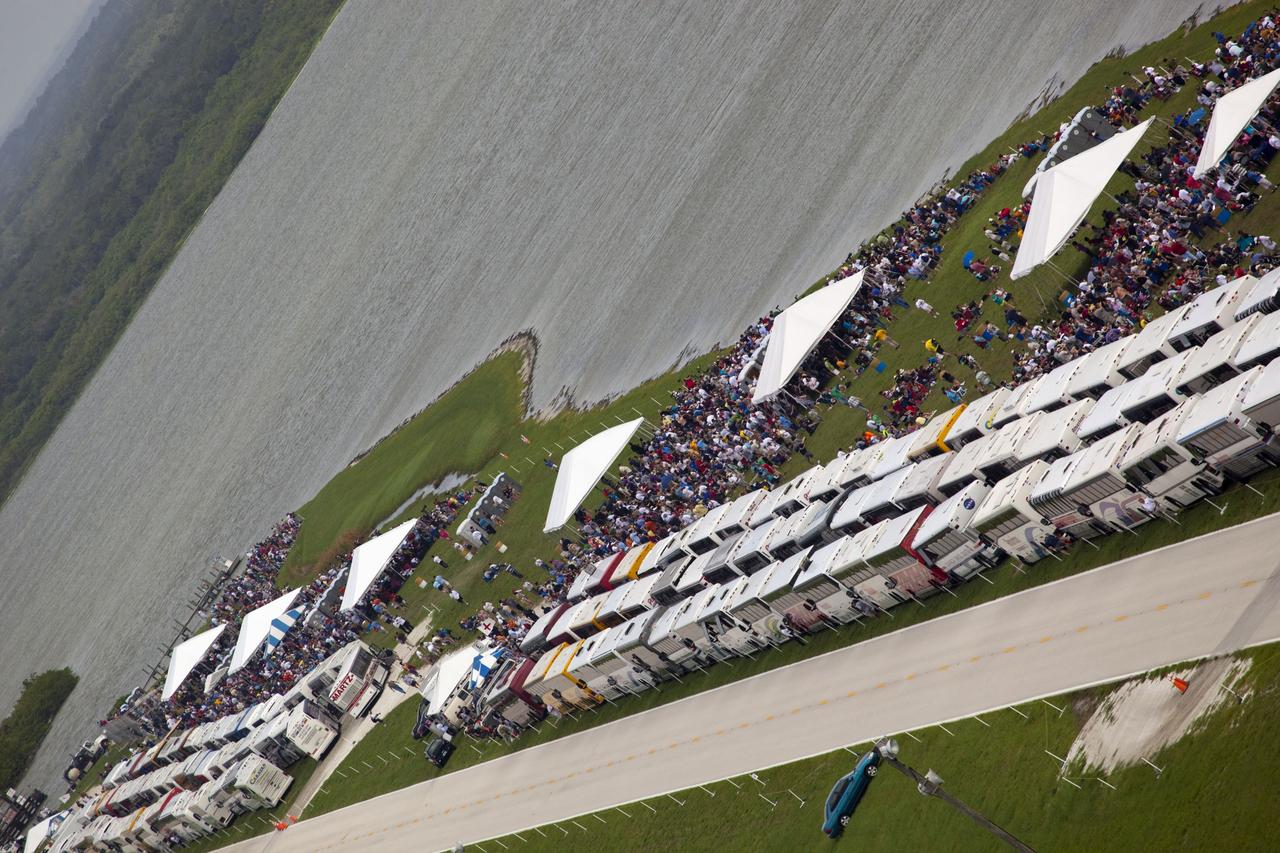
CAPE CANAVERAL, Fla. -- After 30 years and 135 missions, invited guests congregate along the NASA Causeway to see the rocket's red glare of NASA's Space Shuttle Program soar for the last time. Space shuttle Atlantis is scheduled to liftoff at 11:26 a.m. EDT from Launch Pad 39A at NASA's Kennedy Space Center in Florida. On board will be four experienced astronauts -- STS-135 Commander Chris Ferguson, Pilot Doug Hurley, and Mission Specialists Sandy Magnus and Rex Walheim. STS-135 will deliver the Raffaello multi-purpose logistics module packed with supplies and spare parts for the International Space Station. Atlantis also will fly the Robotic Refueling Mission experiment that will investigate the potential for robotically refueling existing satellites in orbit. In addition, Atlantis will return with a failed ammonia pump module to help NASA better understand the failure mechanism and improve pump designs for future systems. STS-135 will be the 33rd flight of Atlantis, the 37th shuttle mission to the space station, and the 135th and final mission of NASA's Space Shuttle Program. For more information visit, www.nasa.gov/mission_pages/shuttle/shuttlemissions/sts135/index.html. Photo credit: NASA/Frank Michaux
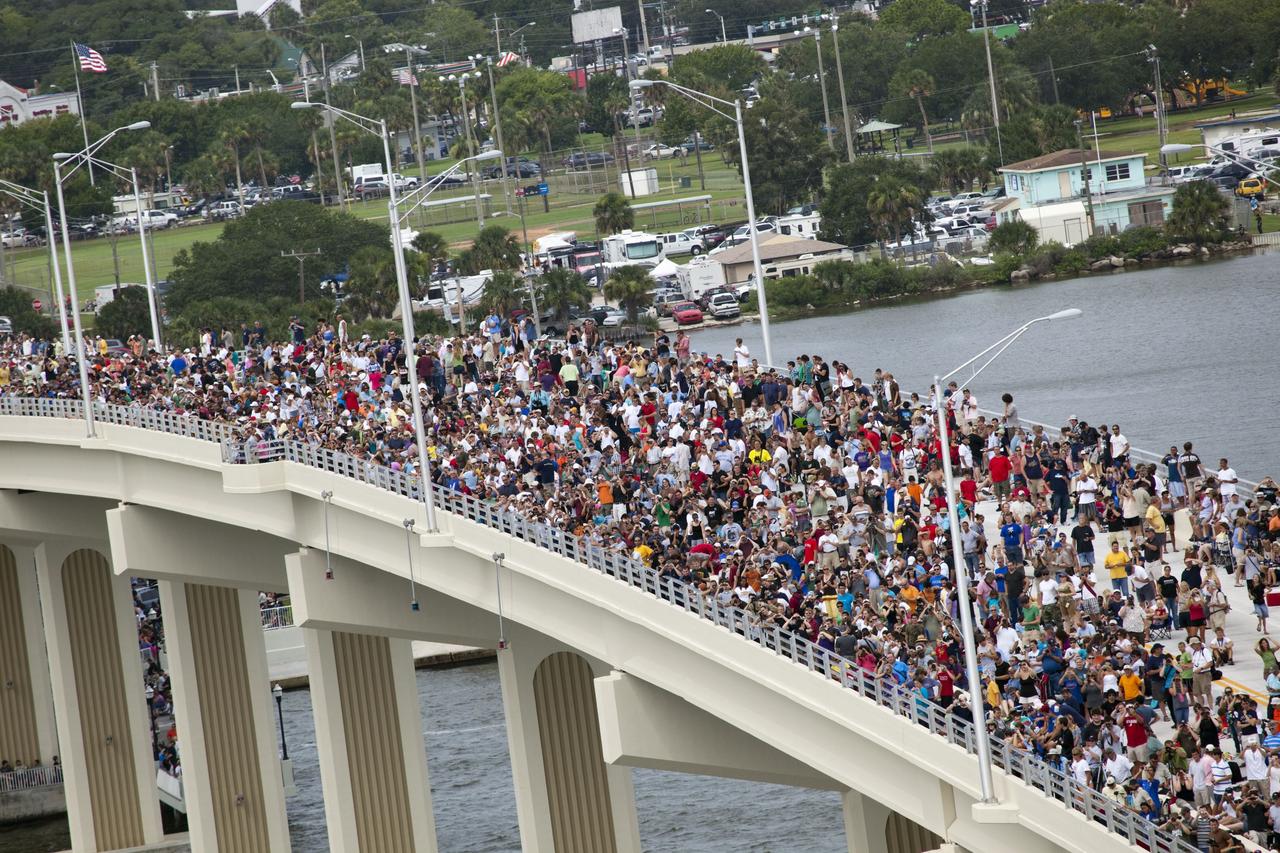
CAPE CANAVERAL, Fla. -- After 30 years and 135 missions, residents and visitors to Florida's Space Coast crowd the new A. Max Brewer Bridge in Titusville to see the rocket's red glare of NASA's Space Shuttle Program soar for the last time. Space shuttle Atlantis is scheduled to liftoff at 11:26 a.m. EDT from Launch Pad 39A at NASA's Kennedy Space Center in Florida. On board will be four experienced astronauts -- STS-135 Commander Chris Ferguson, Pilot Doug Hurley, and Mission Specialists Sandy Magnus and Rex Walheim. STS-135 will deliver the Raffaello multi-purpose logistics module packed with supplies and spare parts for the International Space Station. Atlantis also will fly the Robotic Refueling Mission experiment that will investigate the potential for robotically refueling existing satellites in orbit. In addition, Atlantis will return with a failed ammonia pump module to help NASA better understand the failure mechanism and improve pump designs for future systems. STS-135 will be the 33rd flight of Atlantis, the 37th shuttle mission to the space station, and the 135th and final mission of NASA's Space Shuttle Program. For more information visit, www.nasa.gov/mission_pages/shuttle/shuttlemissions/sts135/index.html. Photo credit: NASA/Frank Michaux
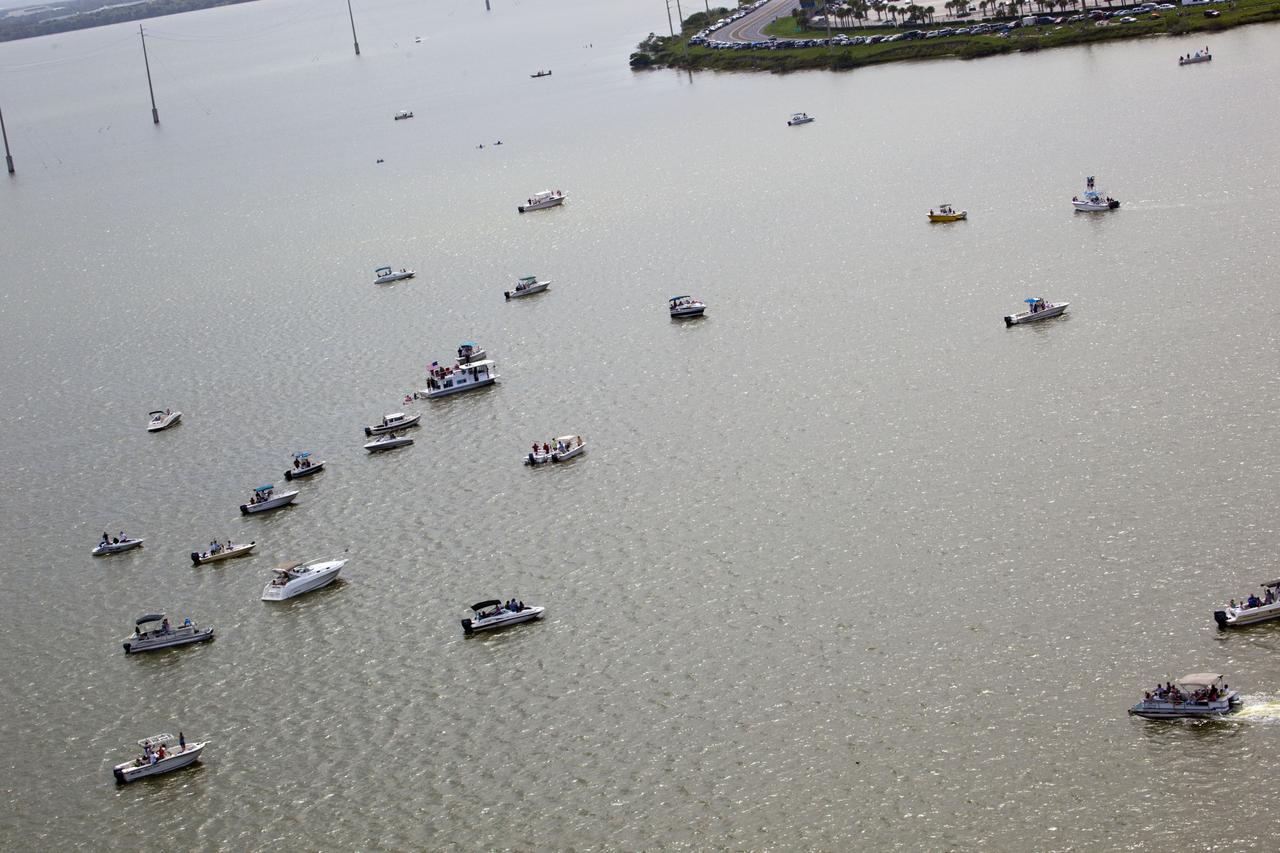
CAPE CANAVERAL, Fla. -- After 30 years and 135 missions, residents and visitors to Florida's Space Coast traverse the waters near Port Canaveral to see the rocket's red glare of NASA's Space Shuttle Program soar for the last time. Space shuttle Atlantis is scheduled to liftoff at 11:26 a.m. EDT from Launch Pad 39A at NASA's Kennedy Space Center in Florida. On board will be four experienced astronauts -- STS-135 Commander Chris Ferguson, Pilot Doug Hurley, and Mission Specialists Sandy Magnus and Rex Walheim. STS-135 will deliver the Raffaello multi-purpose logistics module packed with supplies and spare parts for the International Space Station. Atlantis also will fly the Robotic Refueling Mission experiment that will investigate the potential for robotically refueling existing satellites in orbit. In addition, Atlantis will return with a failed ammonia pump module to help NASA better understand the failure mechanism and improve pump designs for future systems. STS-135 will be the 33rd flight of Atlantis, the 37th shuttle mission to the space station, and the 135th and final mission of NASA's Space Shuttle Program. For more information visit, www.nasa.gov/mission_pages/shuttle/shuttlemissions/sts135/index.html. Photo credit: NASA/Frank Michaux
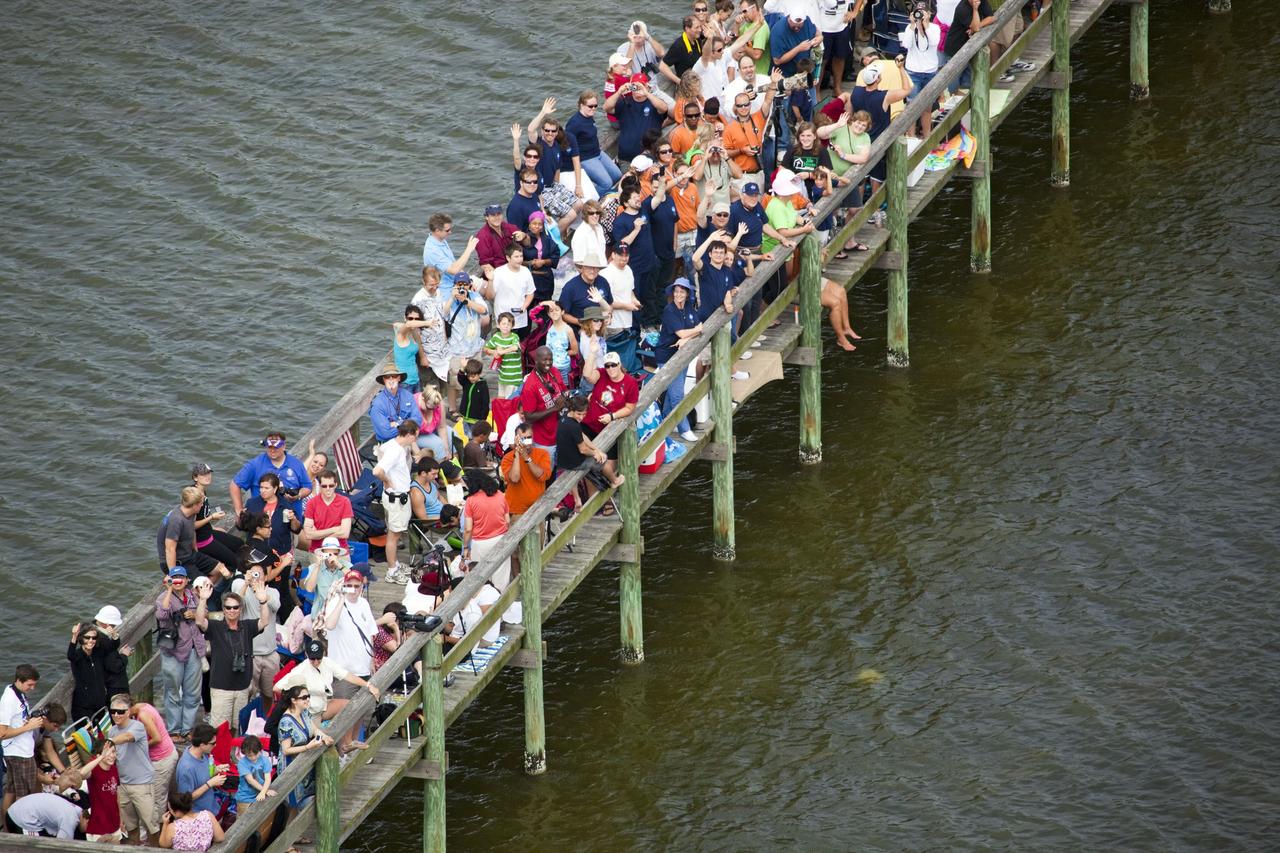
CAPE CANAVERAL, Fla. -- After 30 years and 135 missions, residents and visitors to Florida's Space Coast flock to viewing sites on the waters of Brevard County to see the rocket's red glare of NASA's Space Shuttle Program soar for the last time. Space shuttle Atlantis is scheduled to liftoff at 11:26 a.m. EDT from Launch Pad 39A at NASA's Kennedy Space Center in Florida. On board will be four experienced astronauts -- STS-135 Commander Chris Ferguson, Pilot Doug Hurley, and Mission Specialists Sandy Magnus and Rex Walheim. STS-135 will deliver the Raffaello multi-purpose logistics module packed with supplies and spare parts for the International Space Station. Atlantis also will fly the Robotic Refueling Mission experiment that will investigate the potential for robotically refueling existing satellites in orbit. In addition, Atlantis will return with a failed ammonia pump module to help NASA better understand the failure mechanism and improve pump designs for future systems. STS-135 will be the 33rd flight of Atlantis, the 37th shuttle mission to the space station, and the 135th and final mission of NASA's Space Shuttle Program. For more information visit, www.nasa.gov/mission_pages/shuttle/shuttlemissions/sts135/index.html. Photo credit: NASA/Frank Michaux
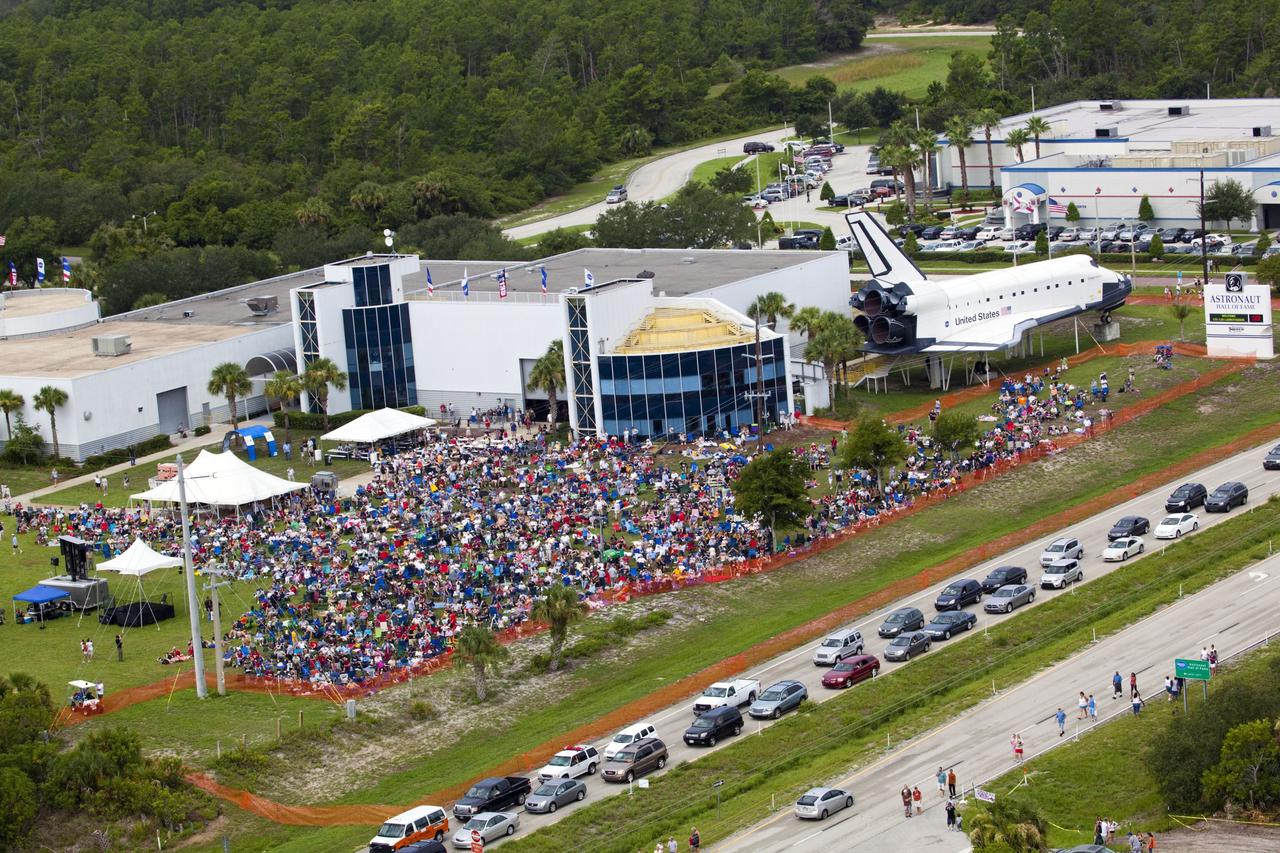
CAPE CANAVERAL, Fla. -- After 30 years and 135 missions, residents and visitors to Florida's Space Coast flock to the Astronaut Hall of Fame in Titusville to see the rocket's red glare of NASA's Space Shuttle Program soar for the last time. Space shuttle Atlantis is scheduled to liftoff at 11:26 a.m. EDT from Launch Pad 39A at NASA's Kennedy Space Center in Florida. On board will be four experienced astronauts -- STS-135 Commander Chris Ferguson, Pilot Doug Hurley, and Mission Specialists Sandy Magnus and Rex Walheim. STS-135 will deliver the Raffaello multi-purpose logistics module packed with supplies and spare parts for the International Space Station. Atlantis also will fly the Robotic Refueling Mission experiment that will investigate the potential for robotically refueling existing satellites in orbit. In addition, Atlantis will return with a failed ammonia pump module to help NASA better understand the failure mechanism and improve pump designs for future systems. STS-135 will be the 33rd flight of Atlantis, the 37th shuttle mission to the space station, and the 135th and final mission of NASA's Space Shuttle Program. For more information visit, www.nasa.gov/mission_pages/shuttle/shuttlemissions/sts135/index.html. Photo credit: NASA/Frank Michaux
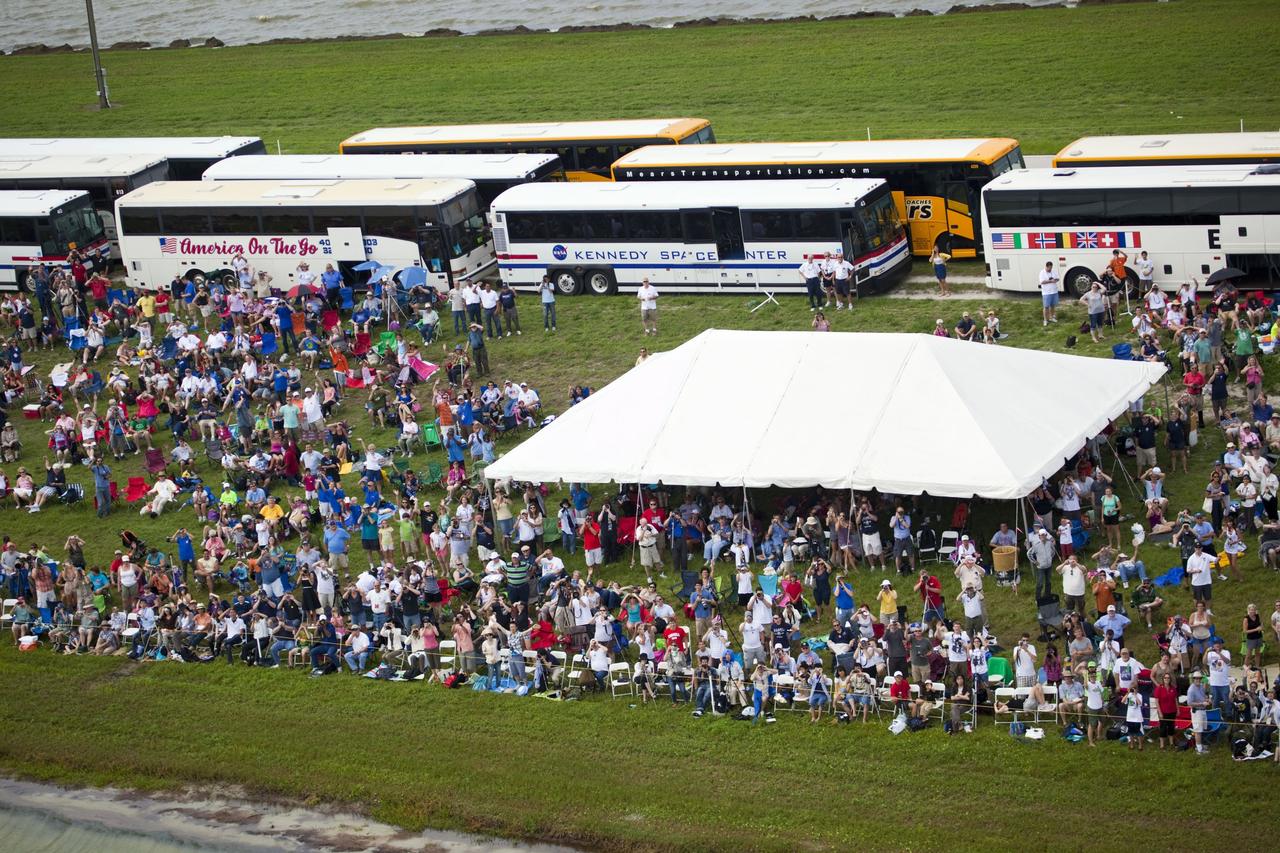
CAPE CANAVERAL, Fla. -- After 30 years and 135 missions, invited guests congregate along the NASA Causeway to see the rocket's red glare of NASA's Space Shuttle Program soar for the last time. Space shuttle Atlantis is scheduled to liftoff at 11:26 a.m. EDT from Launch Pad 39A at NASA's Kennedy Space Center in Florida. On board will be four experienced astronauts -- STS-135 Commander Chris Ferguson, Pilot Doug Hurley, and Mission Specialists Sandy Magnus and Rex Walheim. STS-135 will deliver the Raffaello multi-purpose logistics module packed with supplies and spare parts for the International Space Station. Atlantis also will fly the Robotic Refueling Mission experiment that will investigate the potential for robotically refueling existing satellites in orbit. In addition, Atlantis will return with a failed ammonia pump module to help NASA better understand the failure mechanism and improve pump designs for future systems. STS-135 will be the 33rd flight of Atlantis, the 37th shuttle mission to the space station, and the 135th and final mission of NASA's Space Shuttle Program. For more information visit, www.nasa.gov/mission_pages/shuttle/shuttlemissions/sts135/index.html. Photo credit: NASA/Frank Michaux
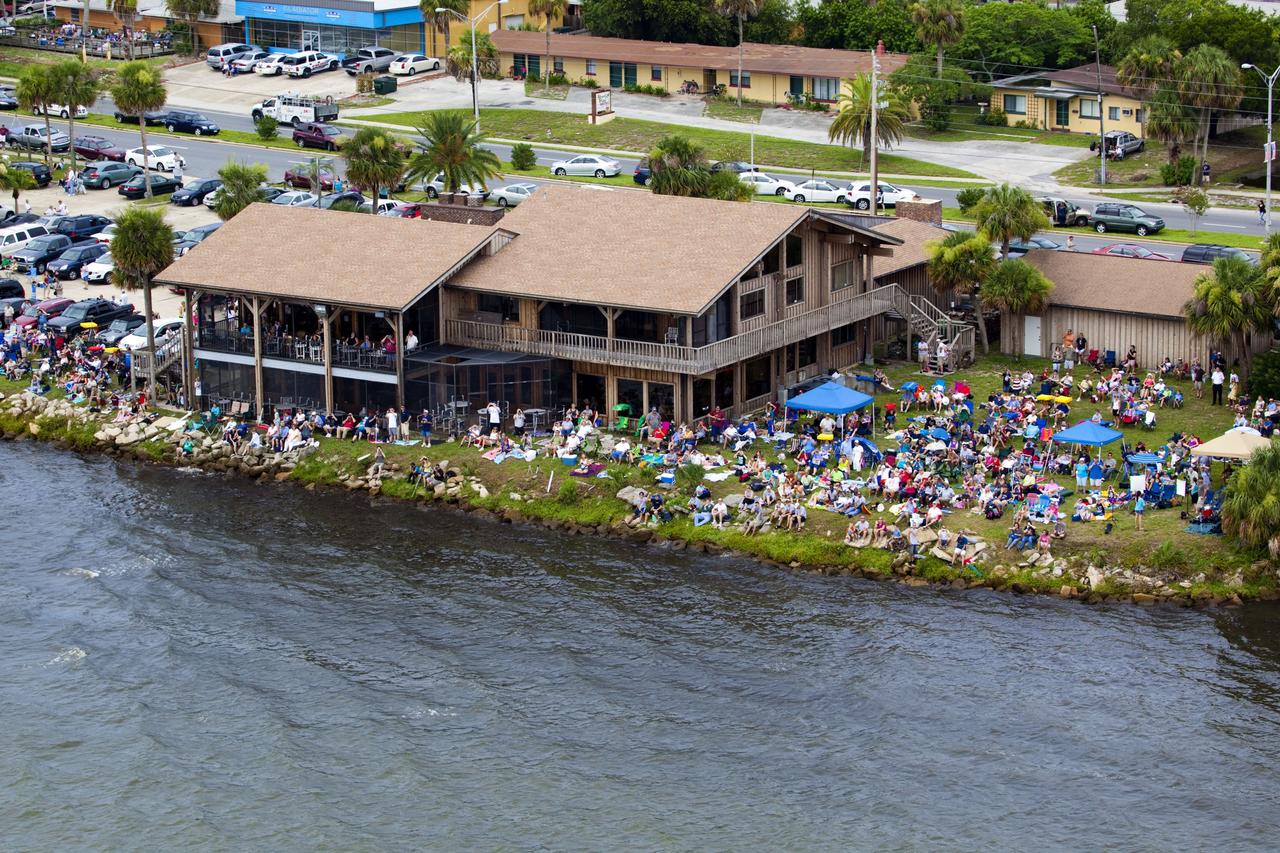
CAPE CANAVERAL, Fla. -- After 30 years and 135 missions, residents and visitors to Florida's Space Coast flock to a viewing site along U.S. 1 in Titusville to see the rocket's red glare of NASA's Space Shuttle Program soar for the last time. Space shuttle Atlantis is scheduled to liftoff at 11:26 a.m. EDT from Launch Pad 39A at NASA's Kennedy Space Center in Florida. On board will be four experienced astronauts -- STS-135 Commander Chris Ferguson, Pilot Doug Hurley, and Mission Specialists Sandy Magnus and Rex Walheim. STS-135 will deliver the Raffaello multi-purpose logistics module packed with supplies and spare parts for the International Space Station. Atlantis also will fly the Robotic Refueling Mission experiment that will investigate the potential for robotically refueling existing satellites in orbit. In addition, Atlantis will return with a failed ammonia pump module to help NASA better understand the failure mechanism and improve pump designs for future systems. STS-135 will be the 33rd flight of Atlantis, the 37th shuttle mission to the space station, and the 135th and final mission of NASA's Space Shuttle Program. For more information visit, www.nasa.gov/mission_pages/shuttle/shuttlemissions/sts135/index.html. Photo credit: NASA/Frank Michaux
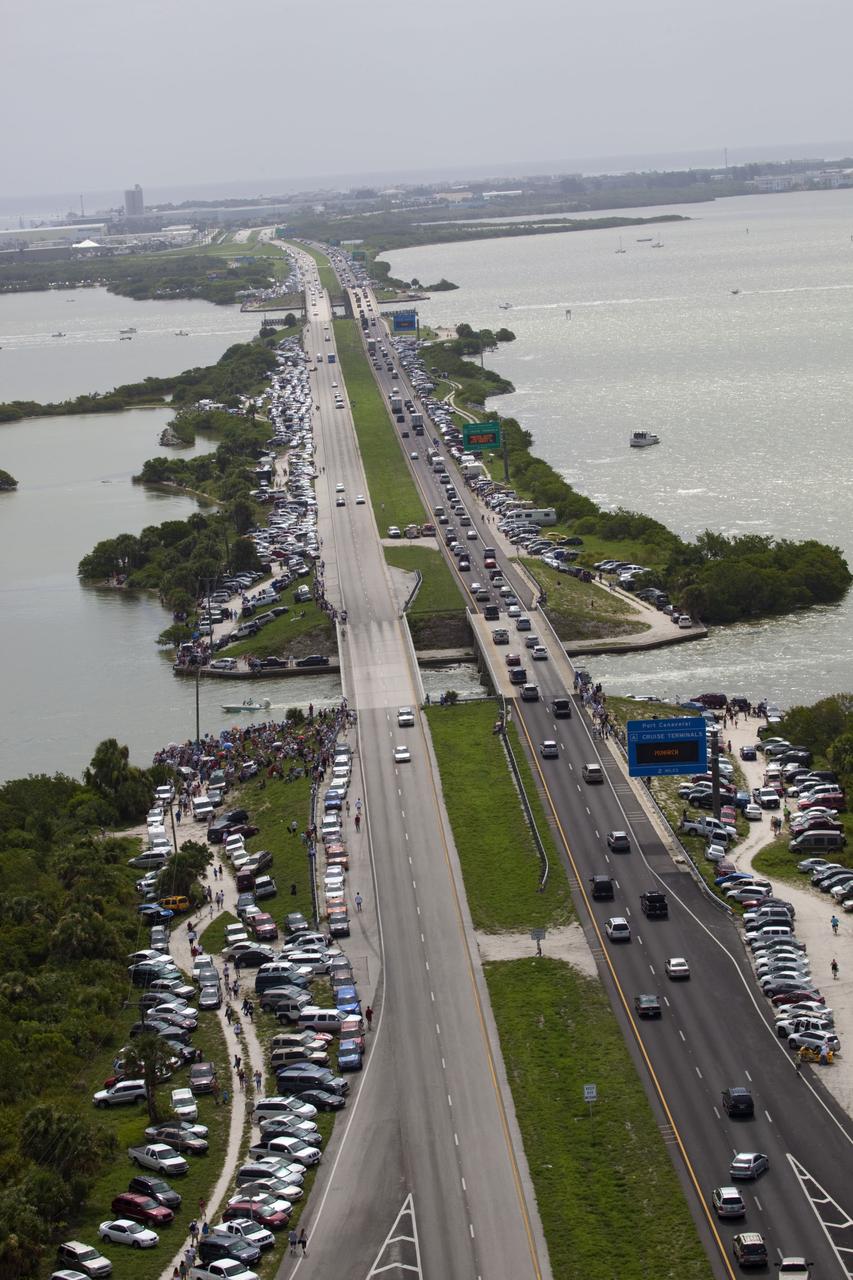
CAPE CANAVERAL, Fla. -- After 30 years and 135 missions, residents and visitors to Florida's Space Coast flock to viewing sites near Port Canaveral to see the rocket's red glare of NASA's Space Shuttle Program soar for the last time. Space shuttle Atlantis is scheduled to liftoff at 11:26 a.m. EDT from Launch Pad 39A at NASA's Kennedy Space Center in Florida. On board will be four experienced astronauts -- STS-135 Commander Chris Ferguson, Pilot Doug Hurley, and Mission Specialists Sandy Magnus and Rex Walheim. STS-135 will deliver the Raffaello multi-purpose logistics module packed with supplies and spare parts for the International Space Station. Atlantis also will fly the Robotic Refueling Mission experiment that will investigate the potential for robotically refueling existing satellites in orbit. In addition, Atlantis will return with a failed ammonia pump module to help NASA better understand the failure mechanism and improve pump designs for future systems. STS-135 will be the 33rd flight of Atlantis, the 37th shuttle mission to the space station, and the 135th and final mission of NASA's Space Shuttle Program. For more information visit, www.nasa.gov/mission_pages/shuttle/shuttlemissions/sts135/index.html. Photo credit: NASA/Frank Michaux
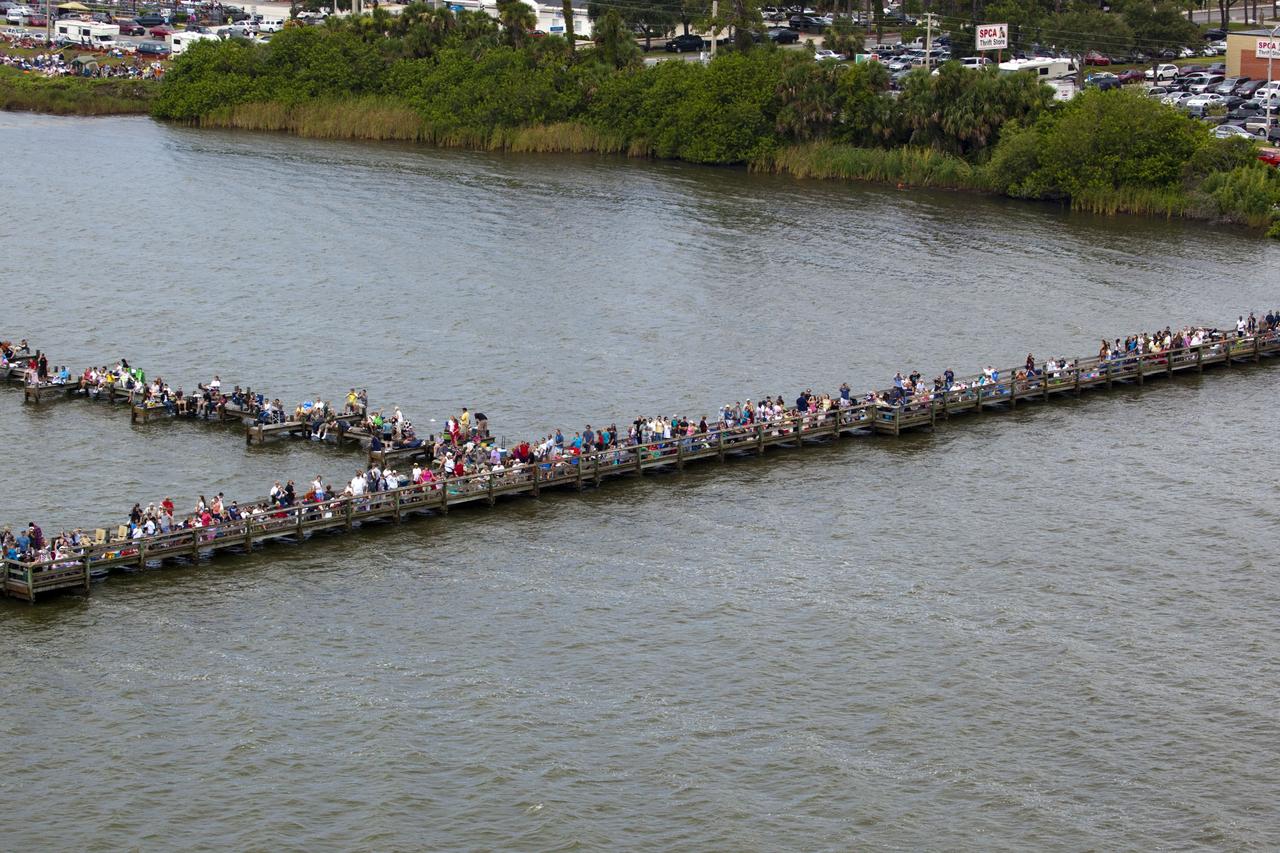
CAPE CANAVERAL, Fla. -- After 30 years and 135 missions, residents and visitors to Florida's Space Coast flock to a viewing site along U.S. 1 in Titusville to see the rocket's red glare of NASA's Space Shuttle Program soar for the last time. Space shuttle Atlantis is scheduled to liftoff at 11:26 a.m. EDT from Launch Pad 39A at NASA's Kennedy Space Center in Florida. On board will be four experienced astronauts -- STS-135 Commander Chris Ferguson, Pilot Doug Hurley, and Mission Specialists Sandy Magnus and Rex Walheim. STS-135 will deliver the Raffaello multi-purpose logistics module packed with supplies and spare parts for the International Space Station. Atlantis also will fly the Robotic Refueling Mission experiment that will investigate the potential for robotically refueling existing satellites in orbit. In addition, Atlantis will return with a failed ammonia pump module to help NASA better understand the failure mechanism and improve pump designs for future systems. STS-135 will be the 33rd flight of Atlantis, the 37th shuttle mission to the space station, and the 135th and final mission of NASA's Space Shuttle Program. For more information visit, www.nasa.gov/mission_pages/shuttle/shuttlemissions/sts135/index.html. Photo credit: NASA/Frank Michaux
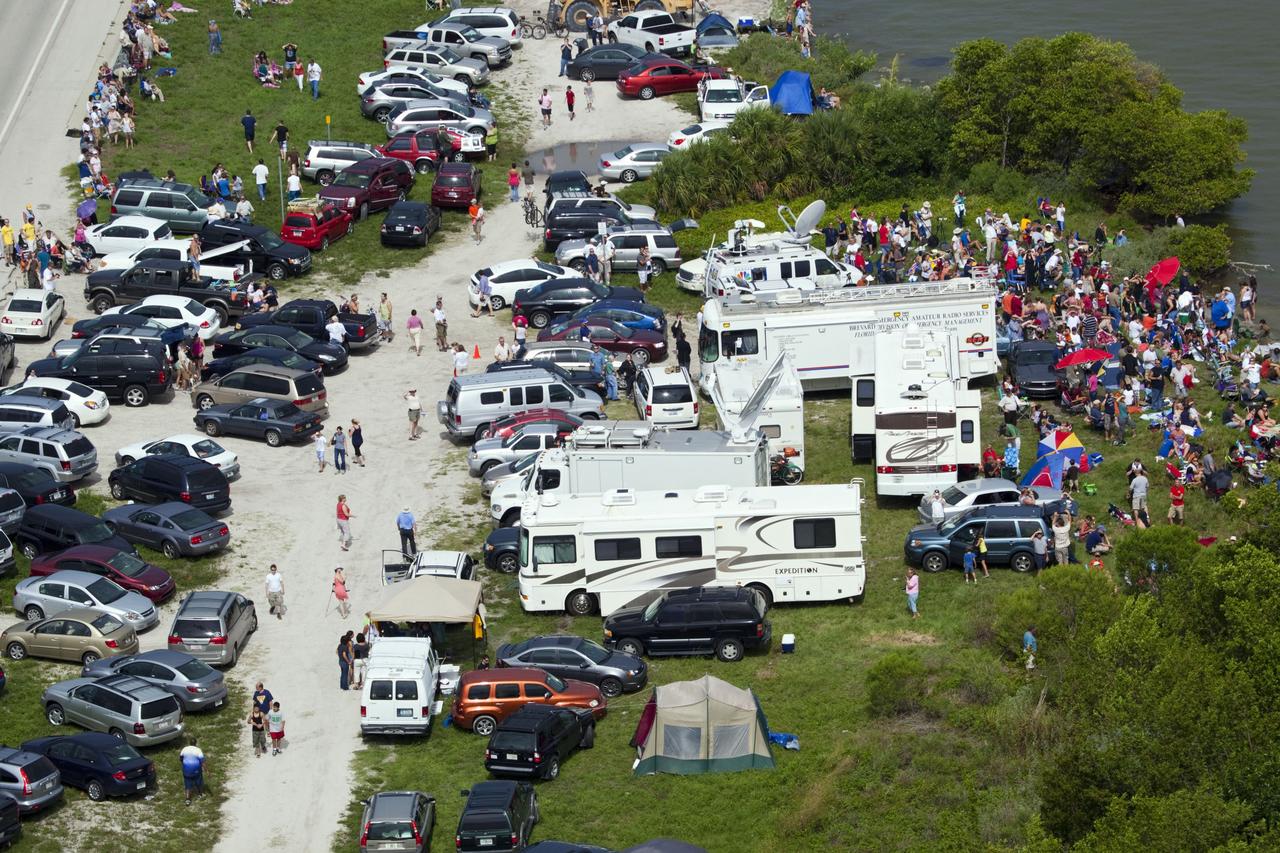
CAPE CANAVERAL, Fla. -- After 30 years and 135 missions, residents and visitors to Florida's Space Coast flock to viewing sites near Port Canaveral to see the rocket's red glare of NASA's Space Shuttle Program soar for the last time. Space shuttle Atlantis is scheduled to liftoff at 11:26 a.m. EDT from Launch Pad 39A at NASA's Kennedy Space Center in Florida. On board will be four experienced astronauts -- STS-135 Commander Chris Ferguson, Pilot Doug Hurley, and Mission Specialists Sandy Magnus and Rex Walheim. STS-135 will deliver the Raffaello multi-purpose logistics module packed with supplies and spare parts for the International Space Station. Atlantis also will fly the Robotic Refueling Mission experiment that will investigate the potential for robotically refueling existing satellites in orbit. In addition, Atlantis will return with a failed ammonia pump module to help NASA better understand the failure mechanism and improve pump designs for future systems. STS-135 will be the 33rd flight of Atlantis, the 37th shuttle mission to the space station, and the 135th and final mission of NASA's Space Shuttle Program. For more information visit, www.nasa.gov/mission_pages/shuttle/shuttlemissions/sts135/index.html. Photo credit: NASA/Frank Michaux
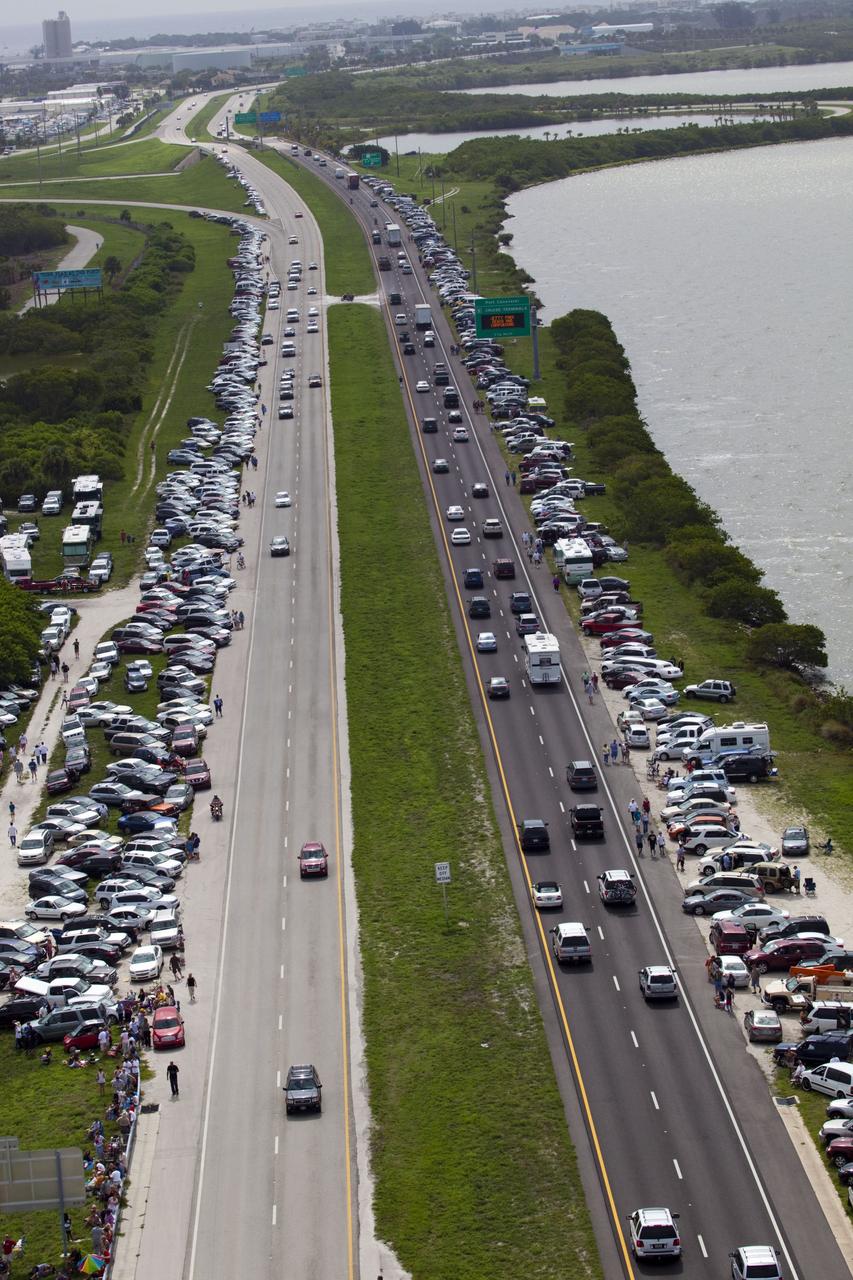
CAPE CANAVERAL, Fla. -- After 30 years and 135 missions, residents and visitors to Florida's Space Coast flock to S.R. 528 near Port Canaveral to see the rocket's red glare of NASA's Space Shuttle Program soar for the last time. Space shuttle Atlantis is scheduled to liftoff at 11:26 a.m. EDT from Launch Pad 39A at NASA's Kennedy Space Center in Florida. On board will be four experienced astronauts -- STS-135 Commander Chris Ferguson, Pilot Doug Hurley, and Mission Specialists Sandy Magnus and Rex Walheim. STS-135 will deliver the Raffaello multi-purpose logistics module packed with supplies and spare parts for the International Space Station. Atlantis also will fly the Robotic Refueling Mission experiment that will investigate the potential for robotically refueling existing satellites in orbit. In addition, Atlantis will return with a failed ammonia pump module to help NASA better understand the failure mechanism and improve pump designs for future systems. STS-135 will be the 33rd flight of Atlantis, the 37th shuttle mission to the space station, and the 135th and final mission of NASA's Space Shuttle Program. For more information visit, www.nasa.gov/mission_pages/shuttle/shuttlemissions/sts135/index.html. Photo credit: NASA/Frank Michaux

CAPE CANAVERAL, Fla. -- After 30 years and 135 missions, residents and visitors to Florida's Space Coast flock to a viewing site along U.S. 1 in Titusville to see the rocket's red glare of NASA's Space Shuttle Program soar for the last time. Space shuttle Atlantis is scheduled to liftoff at 11:26 a.m. EDT from Launch Pad 39A at NASA's Kennedy Space Center in Florida. On board will be four experienced astronauts -- STS-135 Commander Chris Ferguson, Pilot Doug Hurley, and Mission Specialists Sandy Magnus and Rex Walheim. STS-135 will deliver the Raffaello multi-purpose logistics module packed with supplies and spare parts for the International Space Station. Atlantis also will fly the Robotic Refueling Mission experiment that will investigate the potential for robotically refueling existing satellites in orbit. In addition, Atlantis will return with a failed ammonia pump module to help NASA better understand the failure mechanism and improve pump designs for future systems. STS-135 will be the 33rd flight of Atlantis, the 37th shuttle mission to the space station, and the 135th and final mission of NASA's Space Shuttle Program. For more information visit, www.nasa.gov/mission_pages/shuttle/shuttlemissions/sts135/index.html. Photo credit: NASA/Frank Michaux
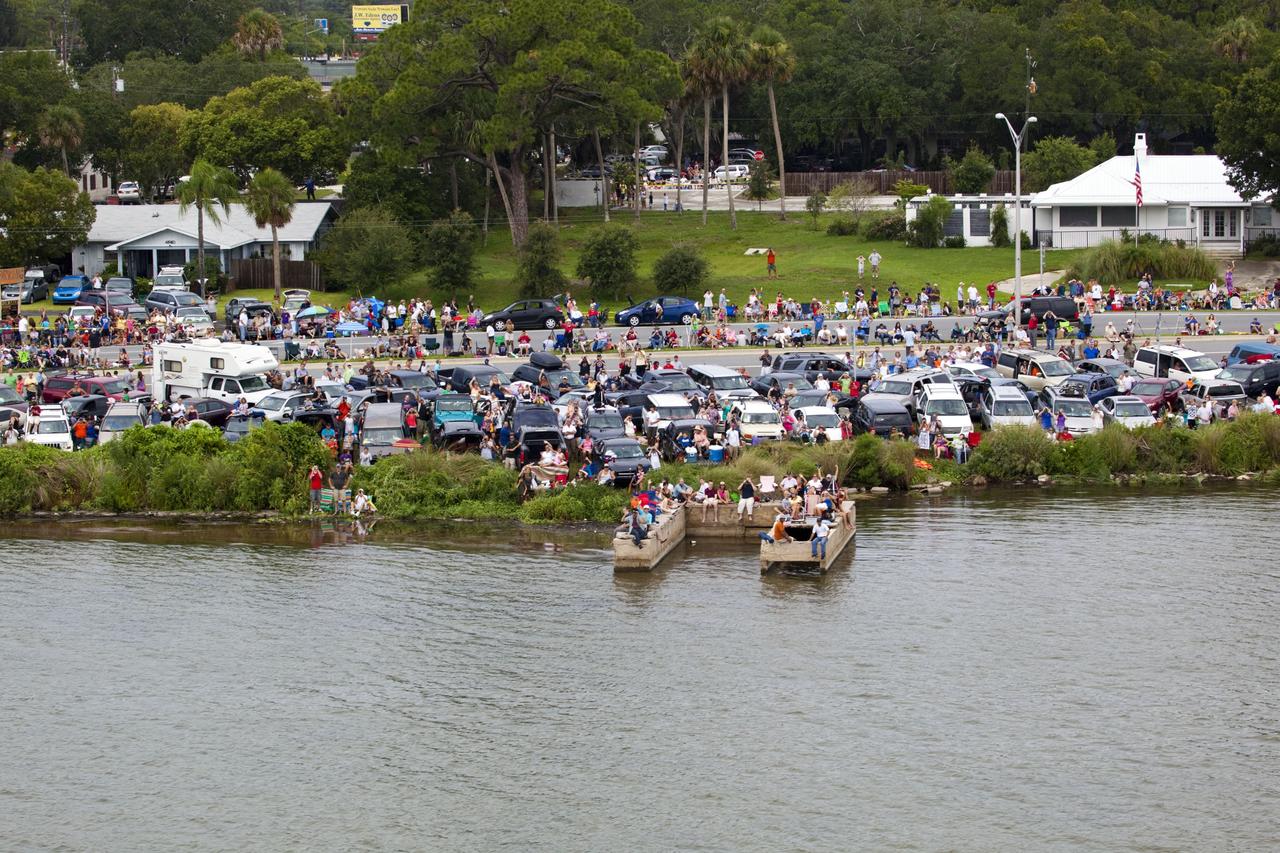
CAPE CANAVERAL, Fla. -- After 30 years and 135 missions, residents and visitors to Florida's Space Coast flock to a viewing site along U.S. 1 in Titusville to see the rocket's red glare of NASA's Space Shuttle Program soar for the last time. Space shuttle Atlantis is scheduled to liftoff at 11:26 a.m. EDT from Launch Pad 39A at NASA's Kennedy Space Center in Florida. On board will be four experienced astronauts -- STS-135 Commander Chris Ferguson, Pilot Doug Hurley, and Mission Specialists Sandy Magnus and Rex Walheim. STS-135 will deliver the Raffaello multi-purpose logistics module packed with supplies and spare parts for the International Space Station. Atlantis also will fly the Robotic Refueling Mission experiment that will investigate the potential for robotically refueling existing satellites in orbit. In addition, Atlantis will return with a failed ammonia pump module to help NASA better understand the failure mechanism and improve pump designs for future systems. STS-135 will be the 33rd flight of Atlantis, the 37th shuttle mission to the space station, and the 135th and final mission of NASA's Space Shuttle Program. For more information visit, www.nasa.gov/mission_pages/shuttle/shuttlemissions/sts135/index.html. Photo credit: NASA/Frank Michaux
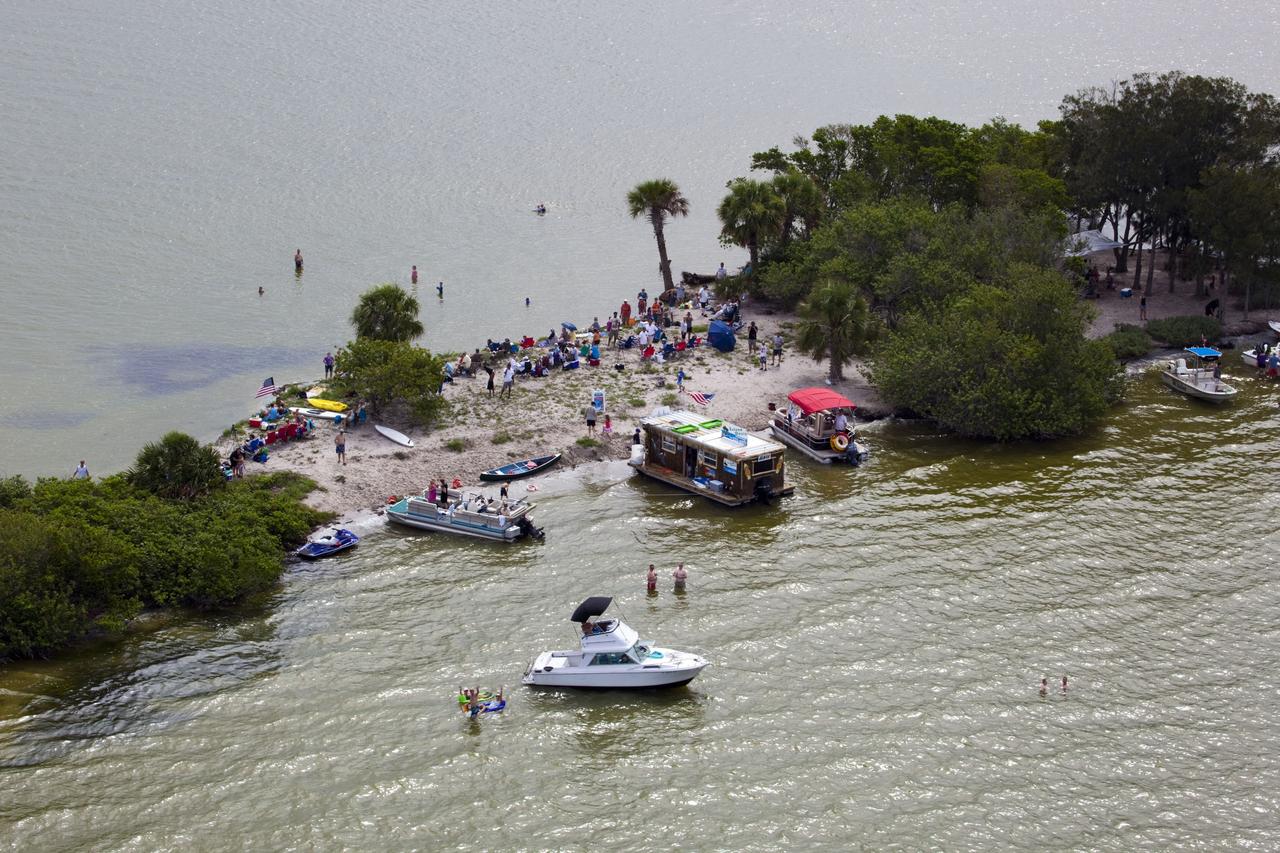
CAPE CANAVERAL, Fla. -- After 30 years and 135 missions, residents and visitors to Florida's Space Coast flock to viewing sites near Port Canaveral to see the rocket's red glare of NASA's Space Shuttle Program soar for the last time. Space shuttle Atlantis is scheduled to liftoff at 11:26 a.m. EDT from Launch Pad 39A at NASA's Kennedy Space Center in Florida. On board will be four experienced astronauts -- STS-135 Commander Chris Ferguson, Pilot Doug Hurley, and Mission Specialists Sandy Magnus and Rex Walheim. STS-135 will deliver the Raffaello multi-purpose logistics module packed with supplies and spare parts for the International Space Station. Atlantis also will fly the Robotic Refueling Mission experiment that will investigate the potential for robotically refueling existing satellites in orbit. In addition, Atlantis will return with a failed ammonia pump module to help NASA better understand the failure mechanism and improve pump designs for future systems. STS-135 will be the 33rd flight of Atlantis, the 37th shuttle mission to the space station, and the 135th and final mission of NASA's Space Shuttle Program. For more information visit, www.nasa.gov/mission_pages/shuttle/shuttlemissions/sts135/index.html. Photo credit: NASA/Frank Michaux
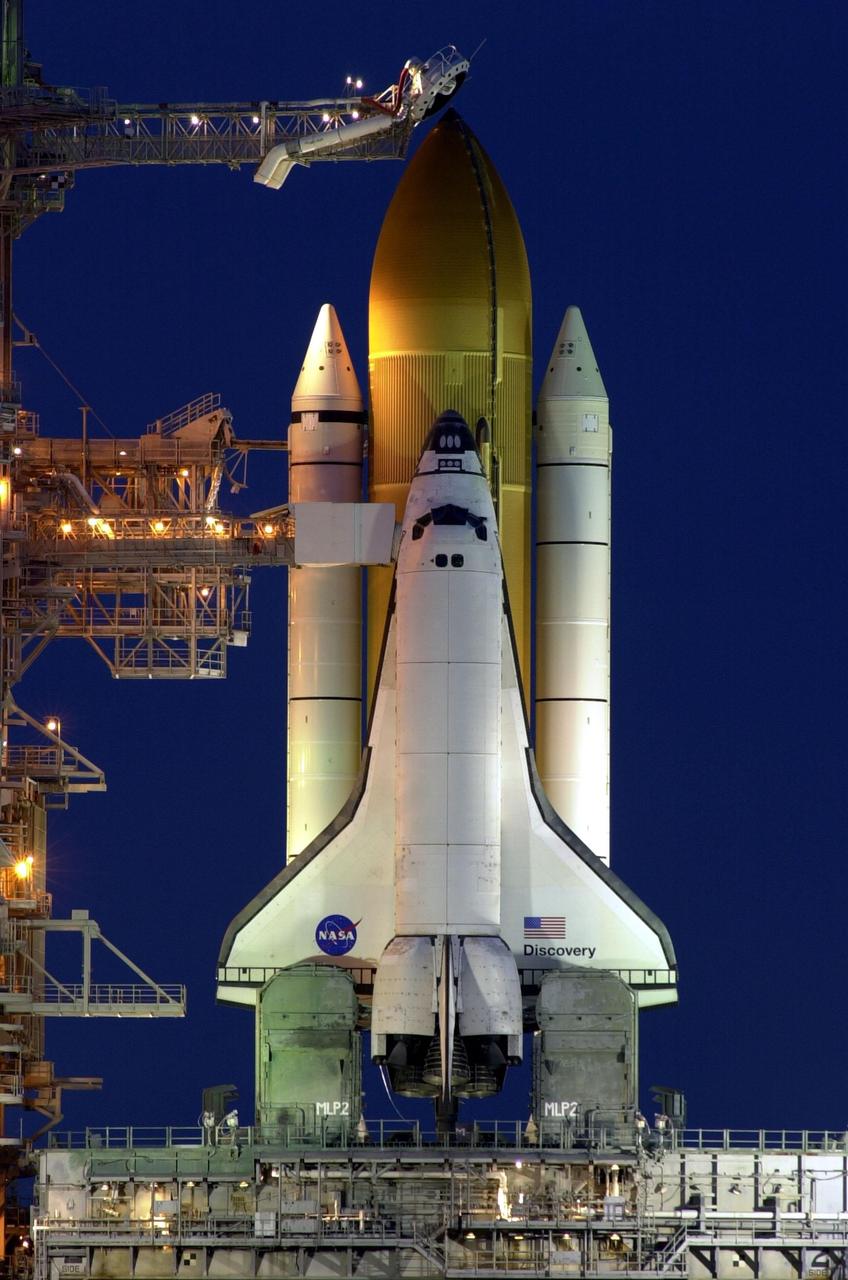
Just after sundown, Space Shuttle Discovery is framed with light from the Fixed Service Structure on Launch Pad 39B as it waits for liftoff on mission STS-103. At the top is seen the external tank gaseous oxygen vent arm system with the vent hood (commonly called the "beanie cap") poised above the external tank. The retractable arm and the beanie cap are designed to vent gaseous oxygen vapors away from the Space Shuttle. The arm truss section is 65 feet long and the diameter of the beanie cap is 13 feet. Extending toward the cabin of the orbiter is the orbiter access arm, with the environmental chamber (called the White Room) at the end. Through this chamber the crew enters the orbiter. The STS-103 mission, to service the Hubble Space Telescope, is scheduled for launch Dec. 17 at 8:47 p.m. EST. Mission objectives include replacing gyroscopes and an old computer, installing another solid state recorder, and replacing damaged insulation in the telescope. The mission is expected to last about 8 days and 21 hours. Discovery is expected to land at KSC Sunday, Dec. 26, at about 6:25 p.m. EST

CAPE CANAVERAL, Fla. -- Space shuttle Atlantis is revealed on Launch Pad 39A at NASA's Kennedy Space Center in Florida bathed in xenon lights following the move of the rotating service structure (RSS). The structure provides weather protection and access to the shuttle while it awaits liftoff on the pad. The tower at left is used for safely burning off any excess hydrogen while the shuttle is on the pad prior to launch. RSS retract marks a major milestone in Atlantis' STS-135 mission countdown. Atlantis and its crew of four; Commander Chris Ferguson, Pilot Doug Hurley, Mission Specialists Sandy Magnus and Rex Walheim will lift off at 11:26 a.m. EDT on July 8 to deliver the Raffaello multi-purpose logistics module packed with supplies and spare parts for the International Space Station. Atlantis also will fly the Robotic Refueling Mission experiment that will investigate the potential for robotically refueling existing satellites in orbit. In addition, Atlantis will return with a failed ammonia pump module to help NASA better understand the failure mechanism and improve pump designs for future systems. STS-135 is the 33rd flight of Atlantis, the 37th shuttle mission to the space station, and the 135th and final mission of NASA's Space Shuttle Program. For more information, visit www.nasa.gov/mission_pages/shuttle/shuttlemissions/sts135/index.html. Photo credit: Jim Grossmann
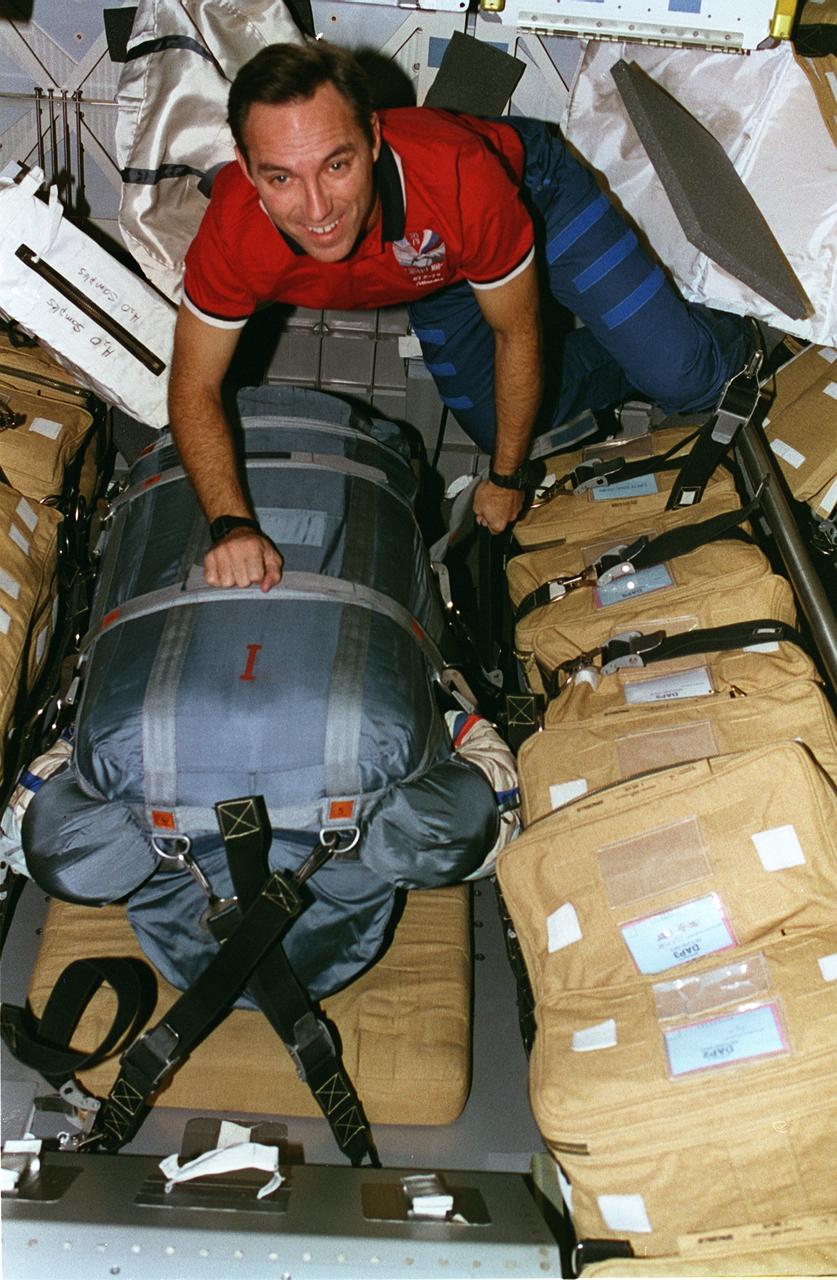
STS079-304-001 (16 Sept. 1996)--- Astronaut Carl E. Walz totes a bag carrying a space suit used by the cosmonauts. At the completion of the STS-79 mission, the suit was brought back to Earth for analysis. This photograph is one of fifteen 35mm frames (along with four 70mm frames) of still photography documenting the activities of NASA's STS-79 mission, which began with a September 16, 1996, liftoff from Launch Pad 39A the Kennedy Space Center (KSC) and ended with a landing at KSC on September 26, 1996. Onboard for the launch were astronauts William F. Readdy, commander; Terrence W. Wilcutt, pilot; John E. Blaha, Jerome (Jay) Apt, Thomas D. Akers and Walz, all mission specialists. On flight day 4, the crew docked with Russia's Mir Space Station. Shannon W. Lucid, who had spent six months aboard Mir, switched cosmonaut guest researcher roles with Blaha. The latter joined fellow Mir-22 crew members Valeri G. Korzun, commander, and Aleksandr Y. Kaleri, flight engineer.
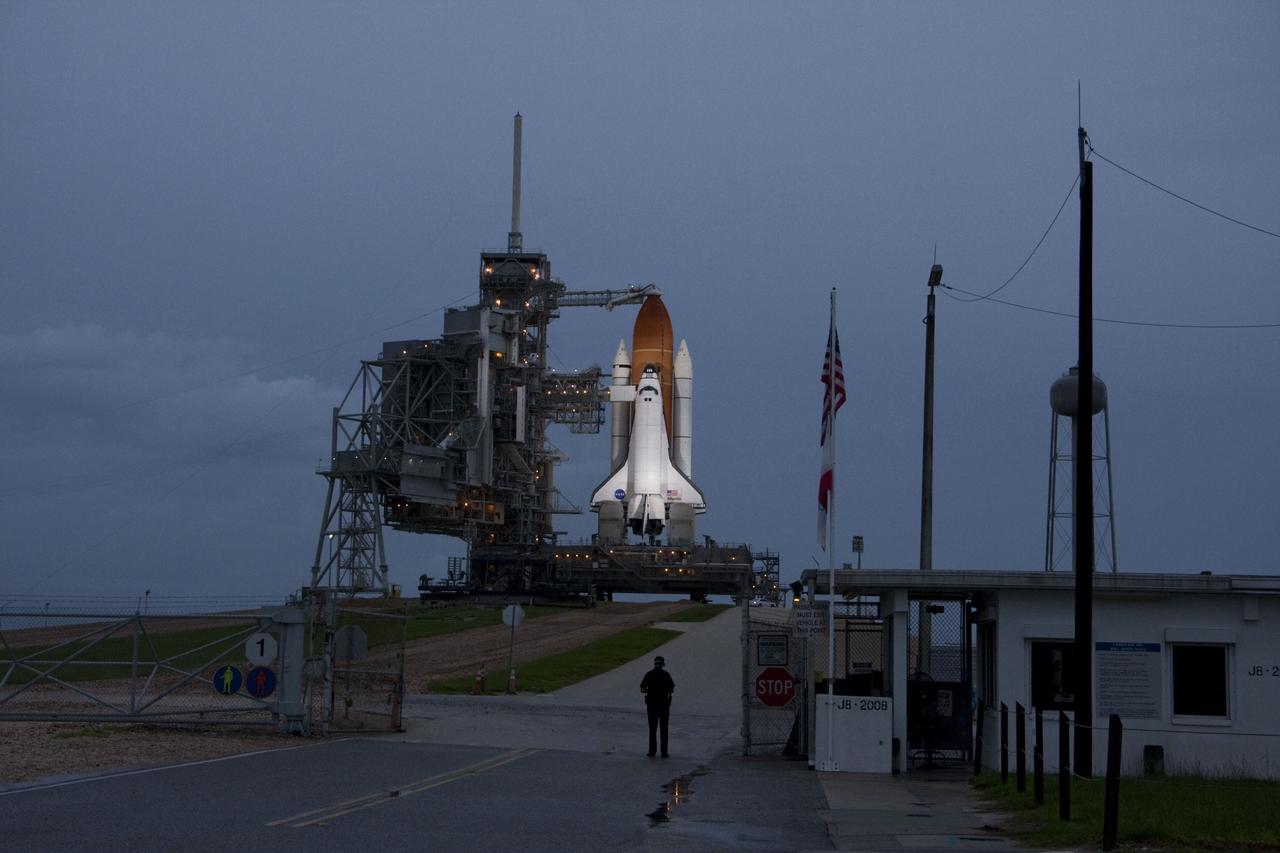
CAPE CANAVERAL, Fla. -- Space shuttle Atlantis is revealed on Launch Pad 39A at NASA's Kennedy Space Center in Florida bathed in xenon lights following the move of the rotating service structure (RSS). The structure provides weather protection and access to the shuttle while it awaits liftoff on the pad. RSS retract marks a major milestone in Atlantis' STS-135 mission countdown. A NASA security guard takes a moment to look at Atlantis on its seaside launch pad before its final flight. Atlantis and its crew of four; Commander Chris Ferguson, Pilot Doug Hurley, Mission Specialists Sandy Magnus and Rex Walheim are scheduled to lift off at 11:26 a.m. EDT on July 8 to deliver the Raffaello multi-purpose logistics module packed with supplies and spare parts for the International Space Station. Atlantis also will fly the Robotic Refueling Mission experiment that will investigate the potential for robotically refueling existing satellites in orbit. In addition, Atlantis will return with a failed ammonia pump module to help NASA better understand the failure mechanism and improve pump designs for future systems. STS-135 is the 33rd flight of Atlantis, the 37th shuttle mission to the space station, and the 135th and final mission of NASA's Space Shuttle Program. For more information, visit www.nasa.gov/mission_pages/shuttle/shuttlemissions/sts135/index.html. Photo credit: Ken Thornsley
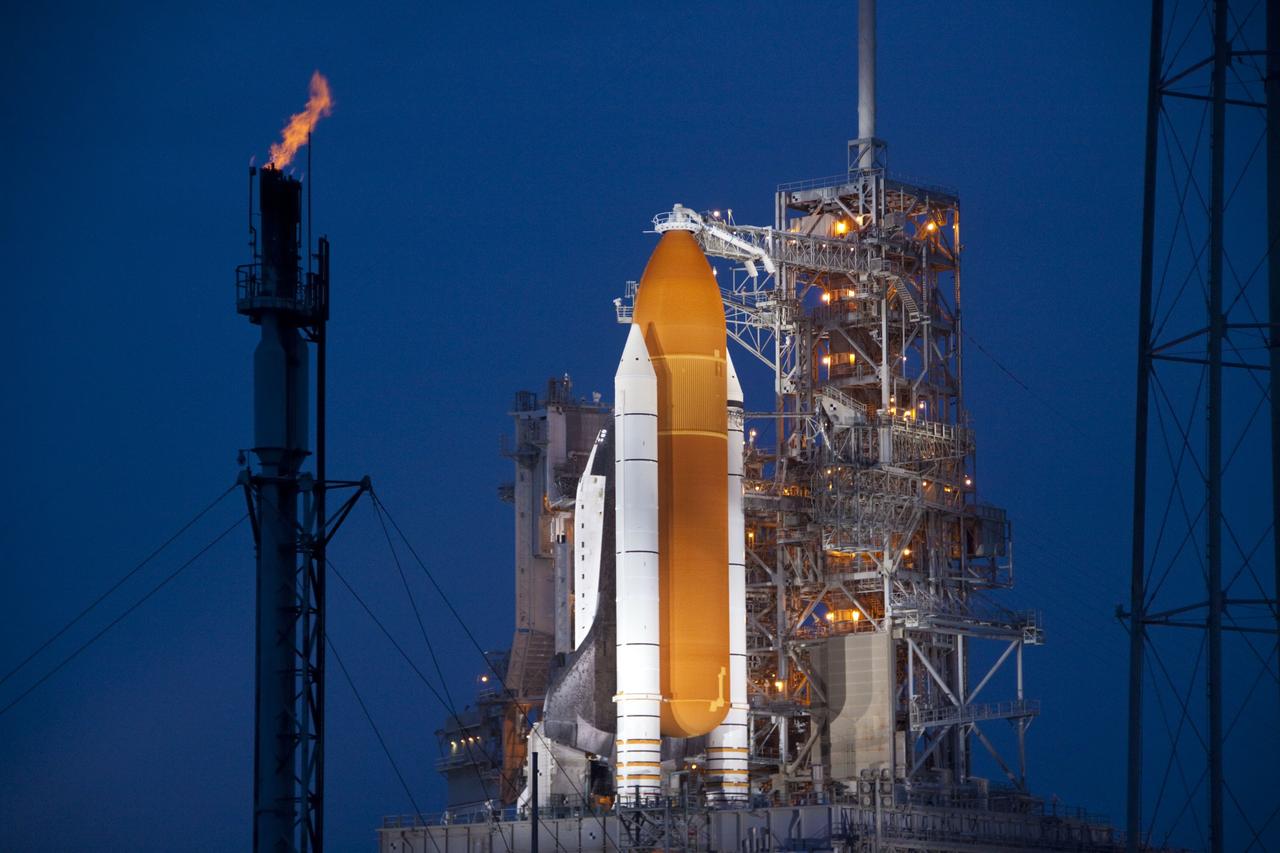
CAPE CANAVERAL, Fla. -- Space shuttle Atlantis is revealed on Launch Pad 39A at NASA's Kennedy Space Center in Florida bathed in xenon lights following the move of the rotating service structure (RSS). The structure provides weather protection and access to the shuttle while it awaits liftoff on the pad. The tower at left is used for safely burning off any excess hydrogen while the shuttle is on the pad prior to launch. RSS retract marks a major milestone in Atlantis' STS-135 mission countdown. Atlantis and its crew of four; Commander Chris Ferguson, Pilot Doug Hurley, Mission Specialists Sandy Magnus and Rex Walheim will lift off at 11:26 a.m. EDT on July 8 to deliver the Raffaello multi-purpose logistics module packed with supplies and spare parts for the International Space Station. Atlantis also will fly the Robotic Refueling Mission experiment that will investigate the potential for robotically refueling existing satellites in orbit. In addition, Atlantis will return with a failed ammonia pump module to help NASA better understand the failure mechanism and improve pump designs for future systems. STS-135 is the 33rd flight of Atlantis, the 37th shuttle mission to the space station, and the 135th and final mission of NASA's Space Shuttle Program. For more information, visit www.nasa.gov/mission_pages/shuttle/shuttlemissions/sts135/index.html. Photo credit: Jim Grossmann
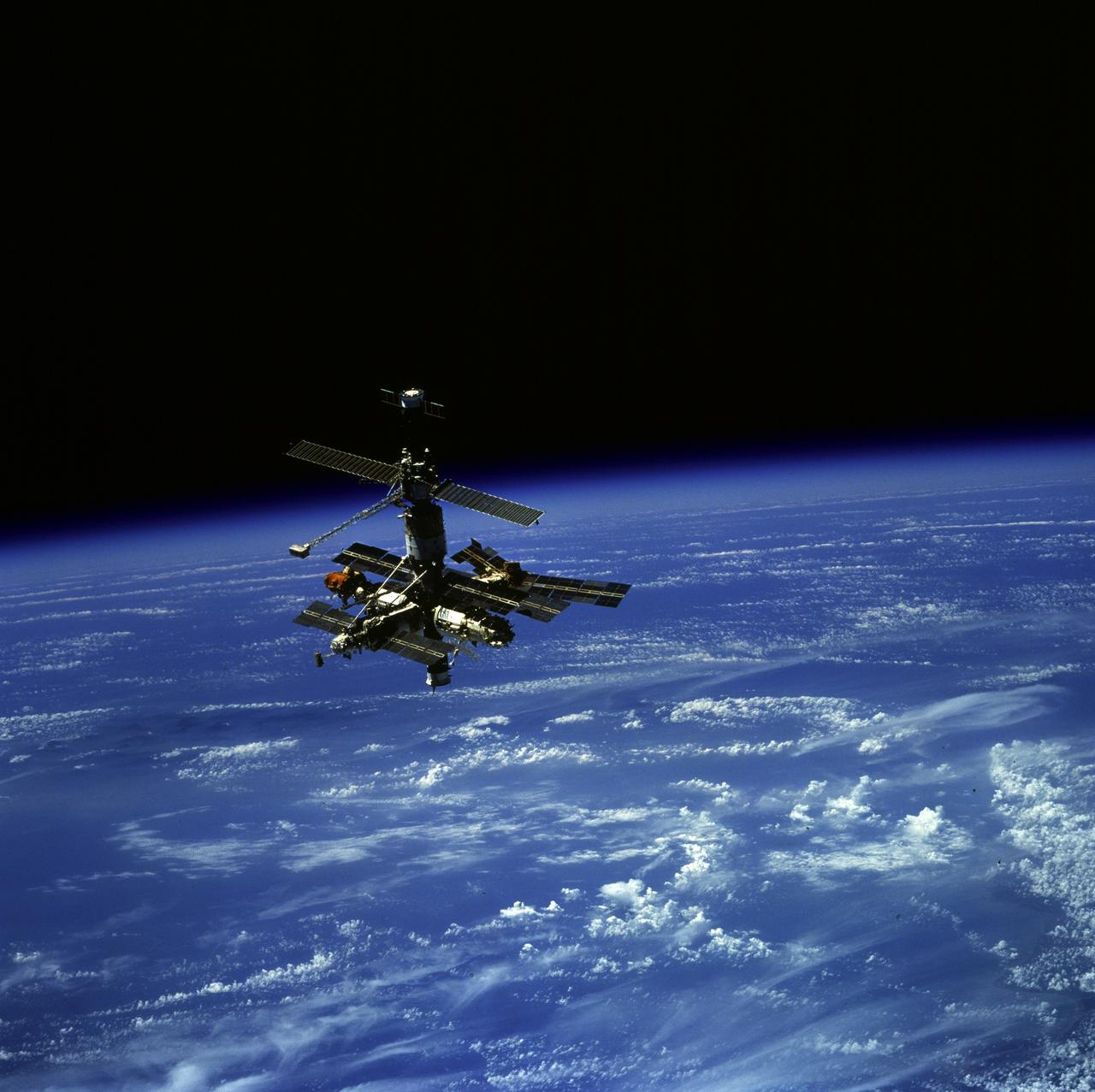
STS079-810-028 (24 Sept. 1996) --- Russia's Mir Space Station, backdropped over Earth's horizon, was photographed by one of the STS-79 crew members aboard the space shuttle Atlantis as it performed its final fly around following undocking operations. The STS-79 flight began with a Sept. 16, 1996, liftoff from Launch Pad 39A at the Kennedy Space Center and ended with a landing at KSC on Sept. 26, 1996. Onboard for the launch were astronauts William F. Readdy, commander; Terrence W. Wilcutt, pilot; John E. Blaha, Jerome (Jay) Apt, Thomas D. Akers and Carl E. Walz, all mission specialists. On flight day four, the crew docked with Mir. Shannon W. Lucid, who had spent six months aboard Mir, switched cosmonaut guest researcher roles with Blaha. The latter joined fellow Mir-22 crew members Valeri G. Korzun, commander, and Aleksandr Y. Kaleri, flight engineer. Photo credit: NASA
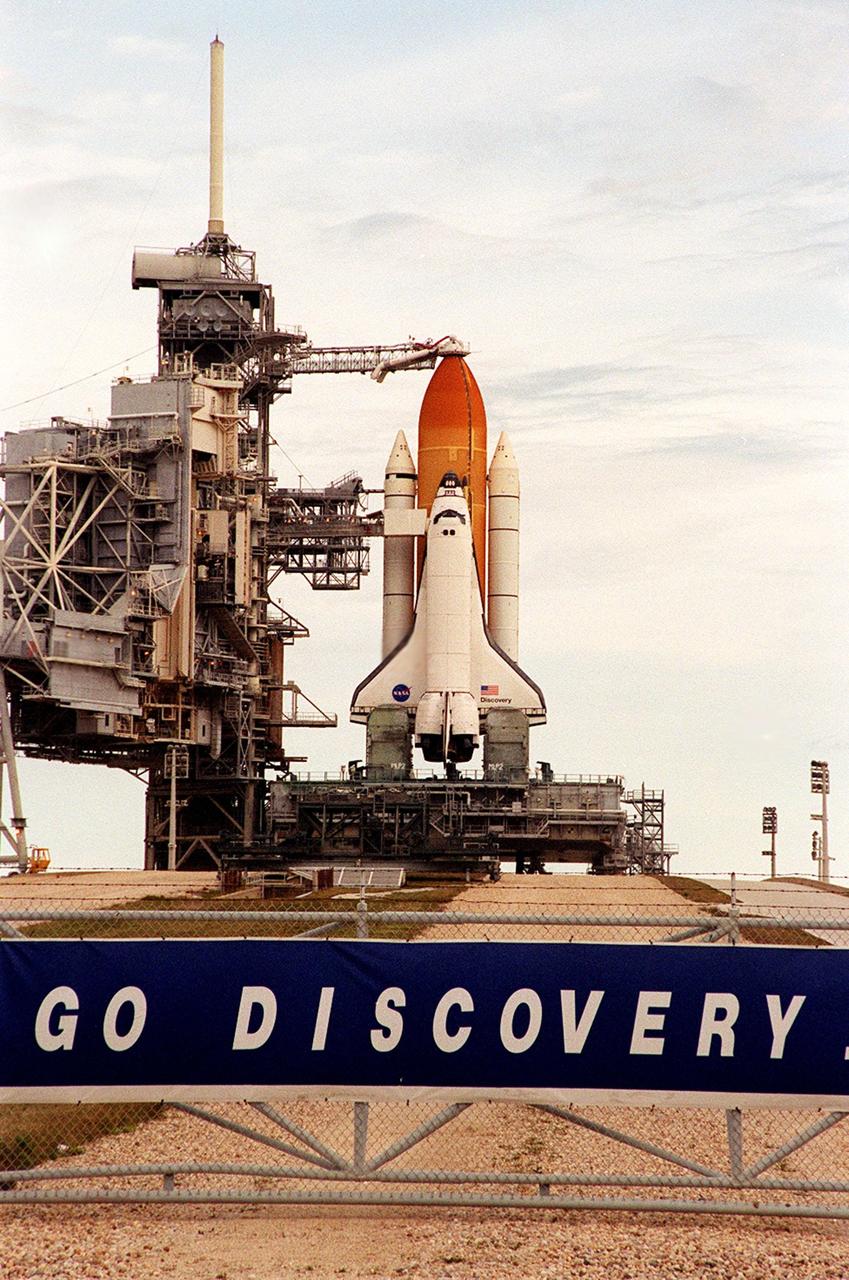
A cloud-streaked sky provides backdrop for Space Shuttle Discovery as it waits for liftoff on mission STS-103 from Launch Pad 39B. The tower at its left is the Fixed Service Structure, topped by the 80-foot-tall fiberglass mast that helps provide protection from lightning strikes. Below it, extending outward, is the external tank gaseous oxygen vent arm system with the vent hood (commonly called the "beanie cap") poised above the external tank. The retractable arm and the beanie cap are designed to vent gaseous oxygen vapors away from the Space Shuttle. The arm truss section is 65 feet long and the diameter of the vent hood is 13 feet. Extending toward the cabin of the orbiter below is the orbiter access arm, with the environmental chamber (called the White Room) at the end. Through this chamber the crew enters the orbiter. The STS-103 mission, to service the Hubble Space Telescope, is scheduled for launch Dec. 17 at 8:47 p.m. EST. Mission objectives include replacing gyroscopes and an old computer, installing another solid state recorder, and replacing damaged insulation in the telescope. The mission is expected to last about 8 days and 21 hours. Discovery is expected to land at KSC Sunday, Dec. 26, at about 6:25 p.m. EST
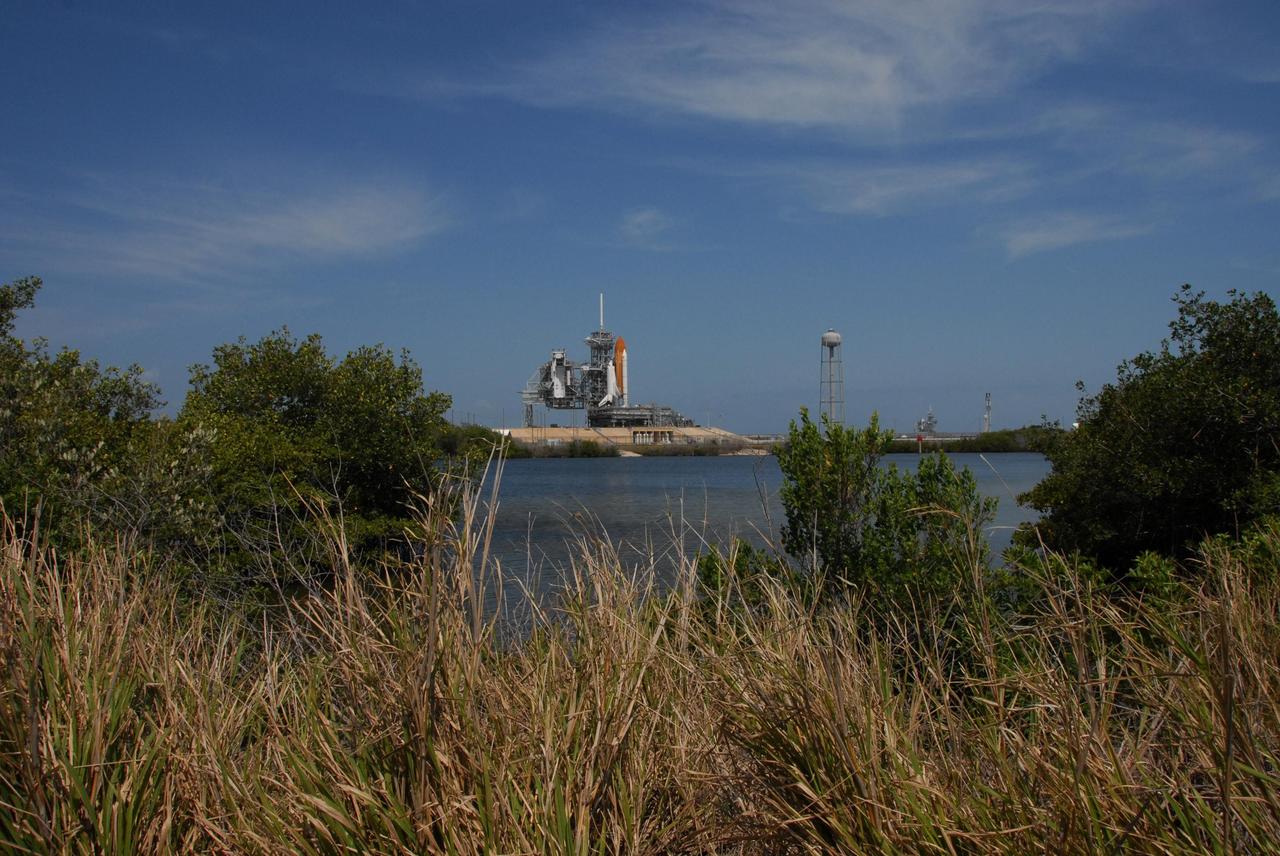
KENNEDY SPACE CENTER, FLA. -- Viewed across an arm of the Banana River, Space Shuttle Atlantis sits on Launch Pad 39A. At right of the pad is the 300,000-gallon water tower that provides the water for sound suppression during liftoff. Atlantis rolled out to the pad for the second time before dawn. First motion out of the Vehicle Assembly Building was at 5:02 a.m. EDT. In late February, while Atlantis was on the launch pad, Atlantis' external tank received hail damage during a severe thunderstorm that passed through the Kennedy Space Center Launch Complex 39 area. The hail caused visible divots in the giant tank's foam insulation, as well as minor surface damage to about 26 heat shield tiles on the shuttle's left wing. The shuttle was returned to the VAB for repairs. The launch of Space Shuttle Atlantis on mission STS-117 is now targeted for June 8. A flight readiness review will be held on May 30 and 31. Photo credit: NASA/Ken Thornsley