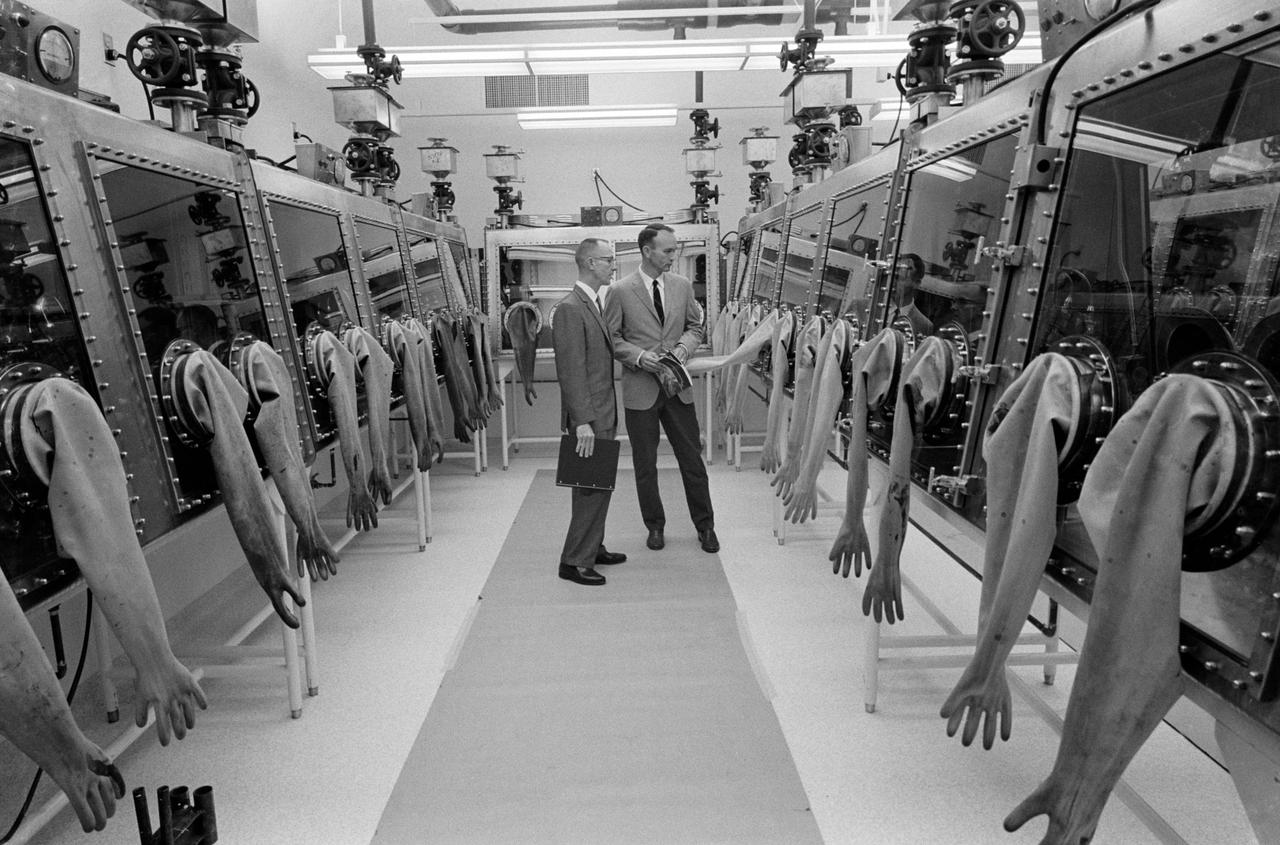
Astronaut Michael Collins on the right and Richard Wright on the left during tour of Lunar Receiving Lab (LRL) at MSC.
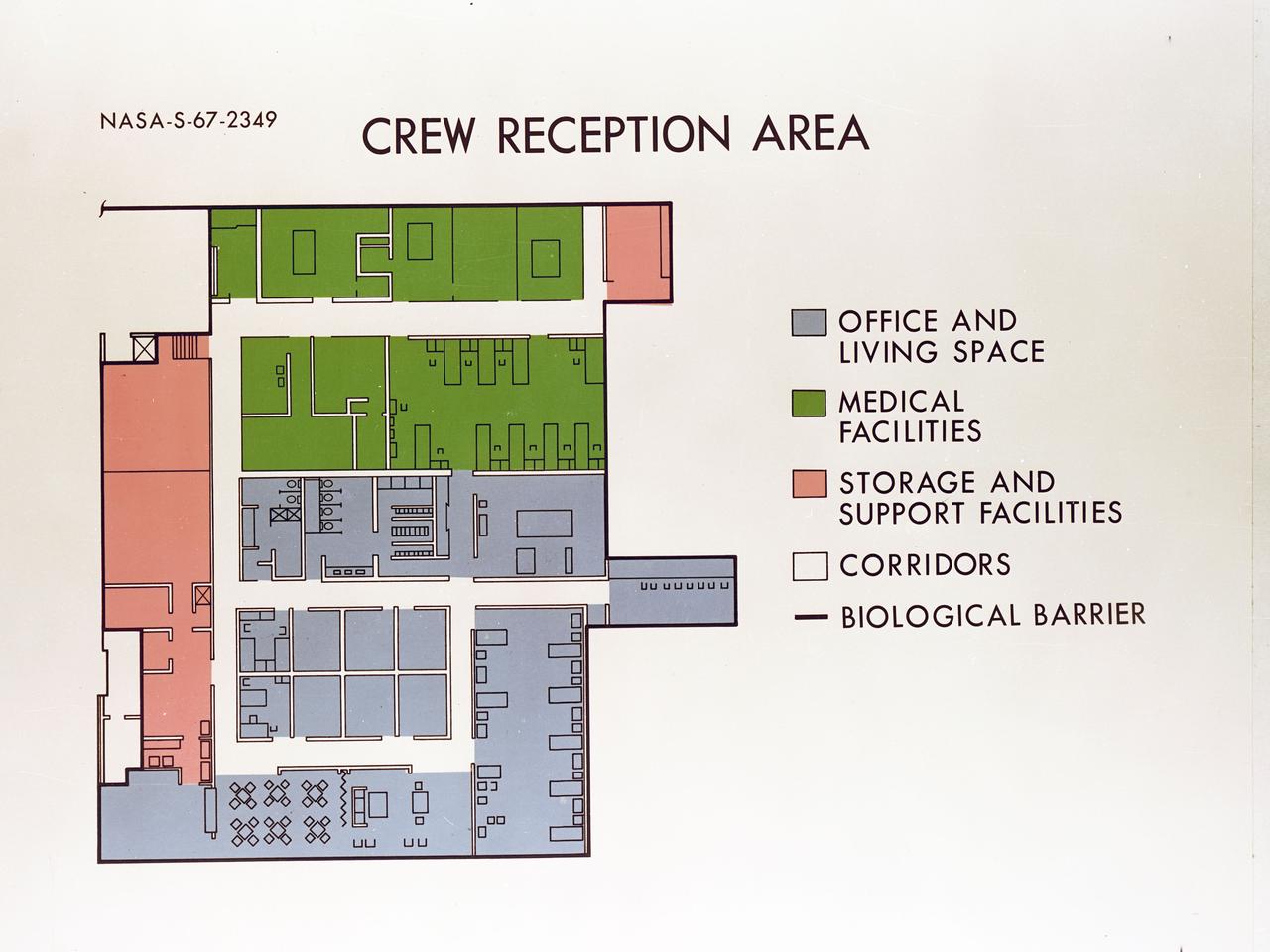
Artist's concept depicting the floor plan of the Crew Reception Area of the Lunar Receiving Laboratory (LRL), bldg 37.
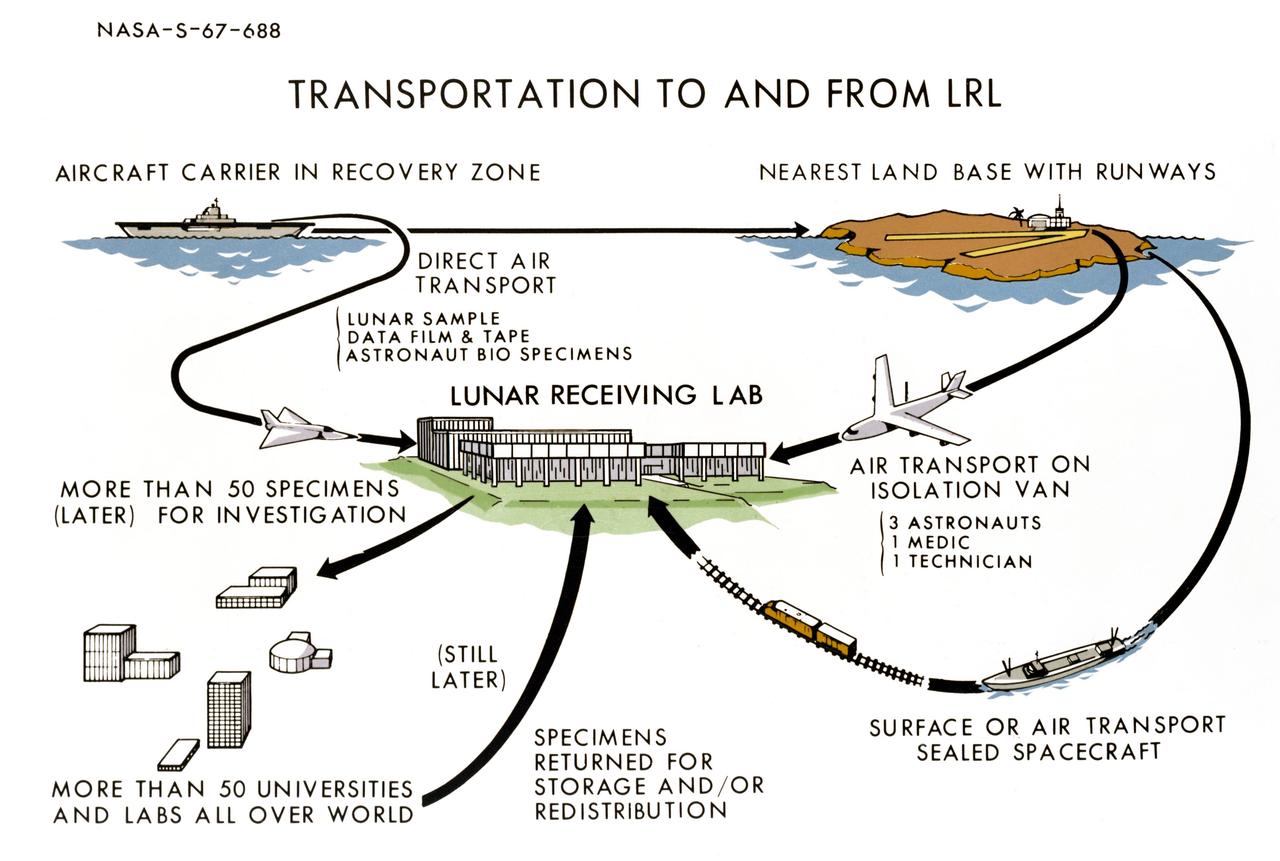
Cutway view illustrating transportation of the LRL to and from MSC. MSC, HOUSTON, TX CN and B&W

S71-23602 (17 March 1971) --- Left to right: Everett Gibson, Gary McCollom, unidentified man in control room of Lunar Receiving Lab (LRL) during Apollo 14 quarantine period. Photo credit: NASA
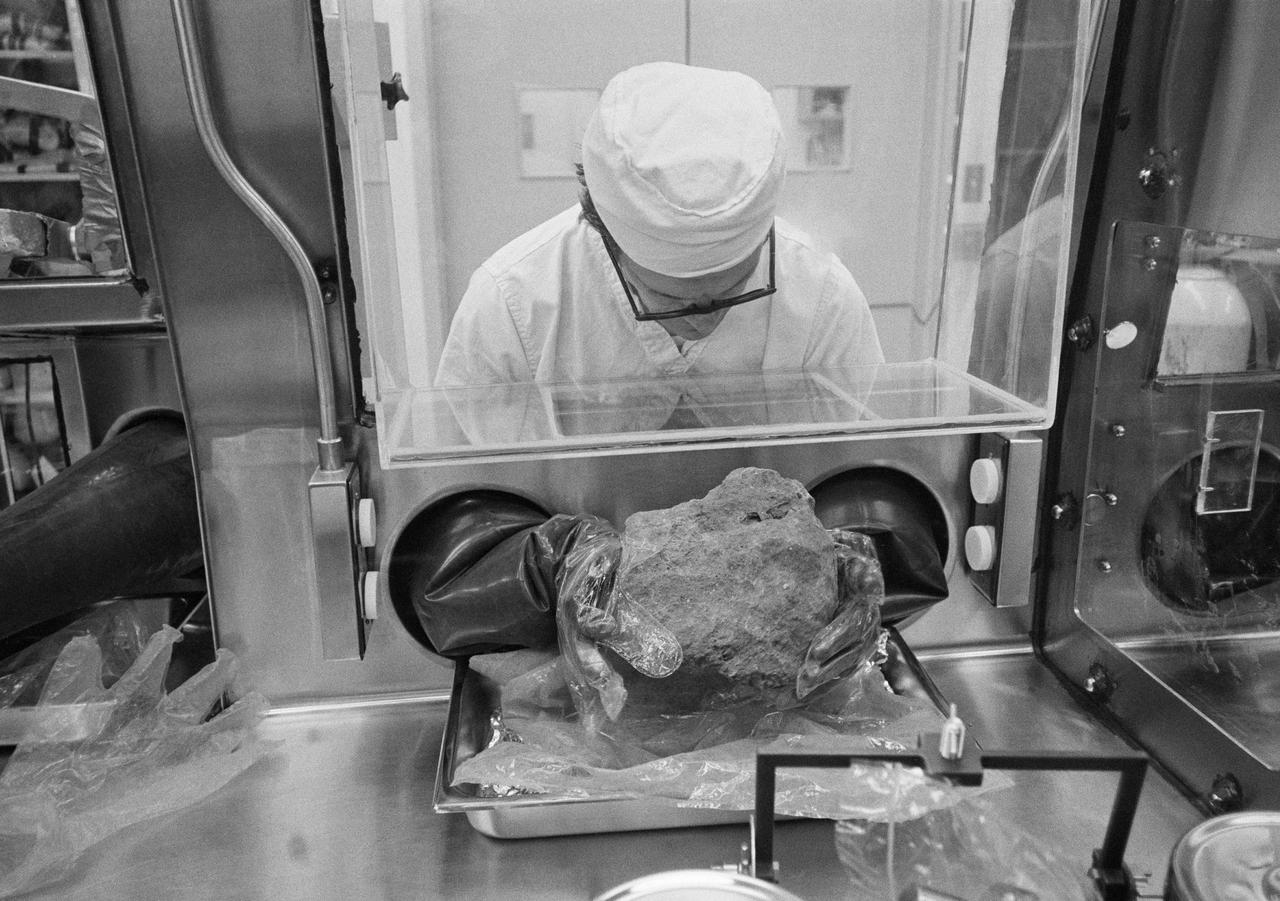
S71-21619 (1 March 1971) --- Dan Anderson works with Apollo 14 lunar samples in the Lunar Receiving Lab (LRL) during the mission?s postflight period. Photo credit: NASA
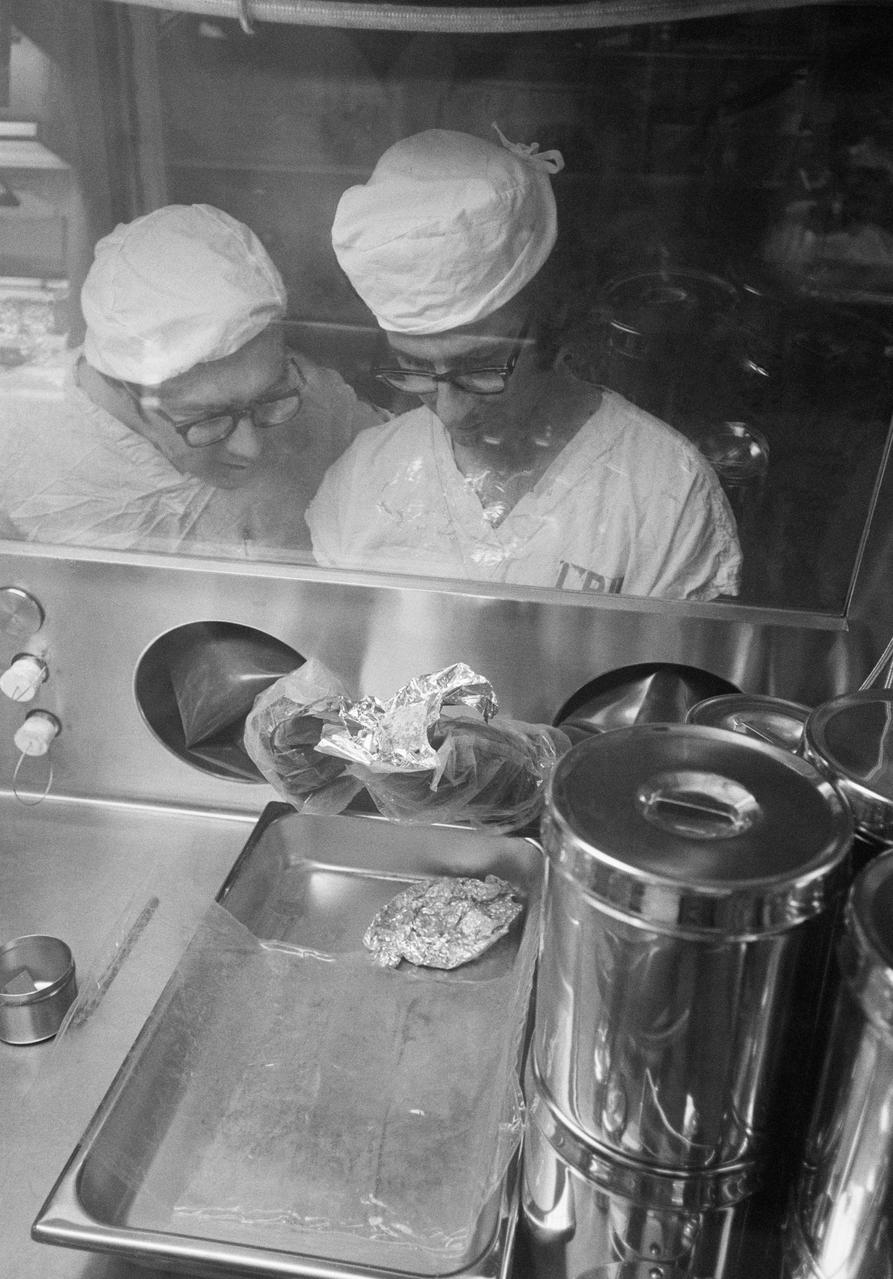
S71-21029 (24 Feb. 1971) --- Everett Gibson (left) and Don Morrison with Apollo 14 rocks in the Lunar Receiving Lab (LRL). Photo credit: NASA
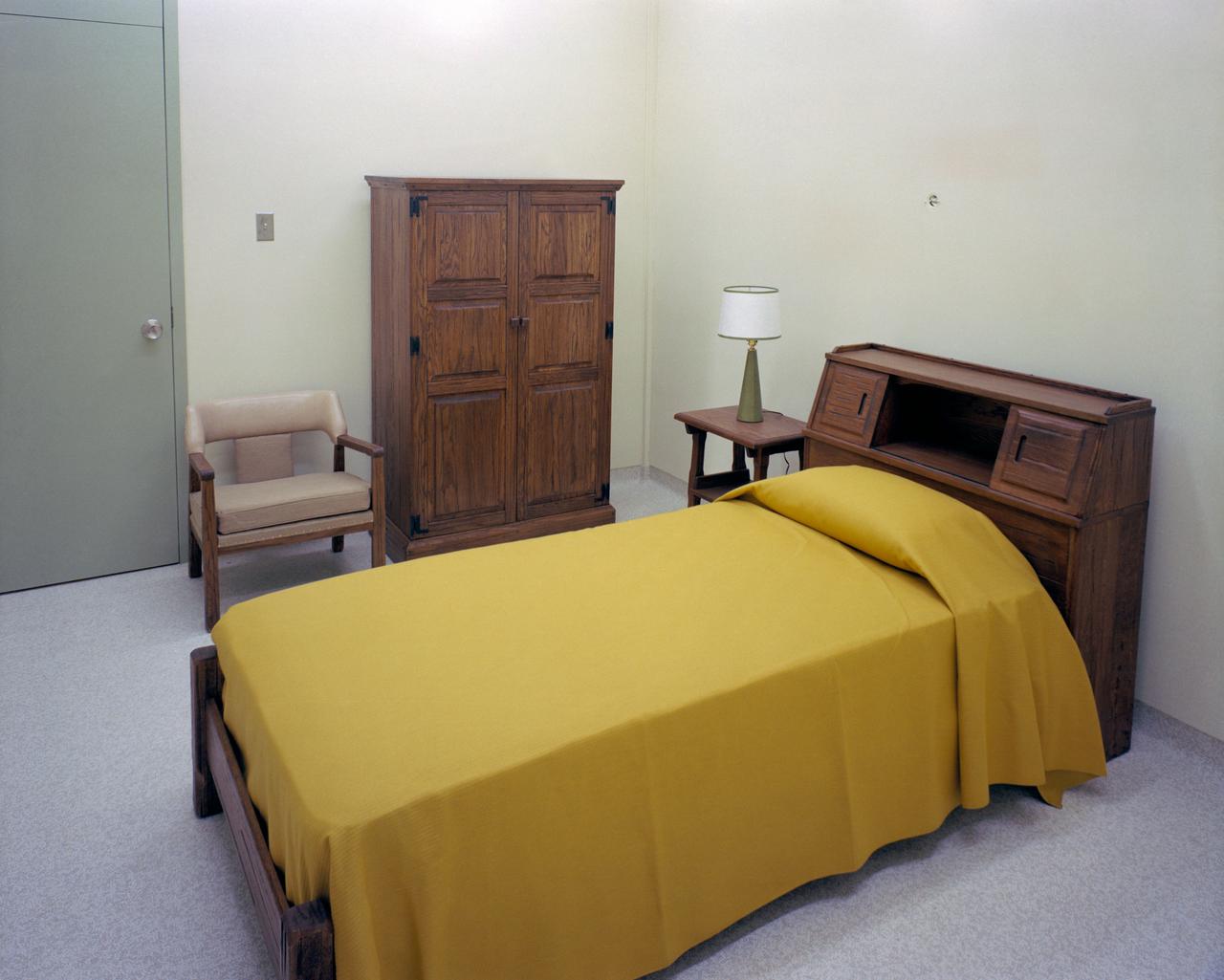
Typical Astronaut living quarters in the Crew Reception Area of the LRL, Bldg. 37, MSC, Houston, TX
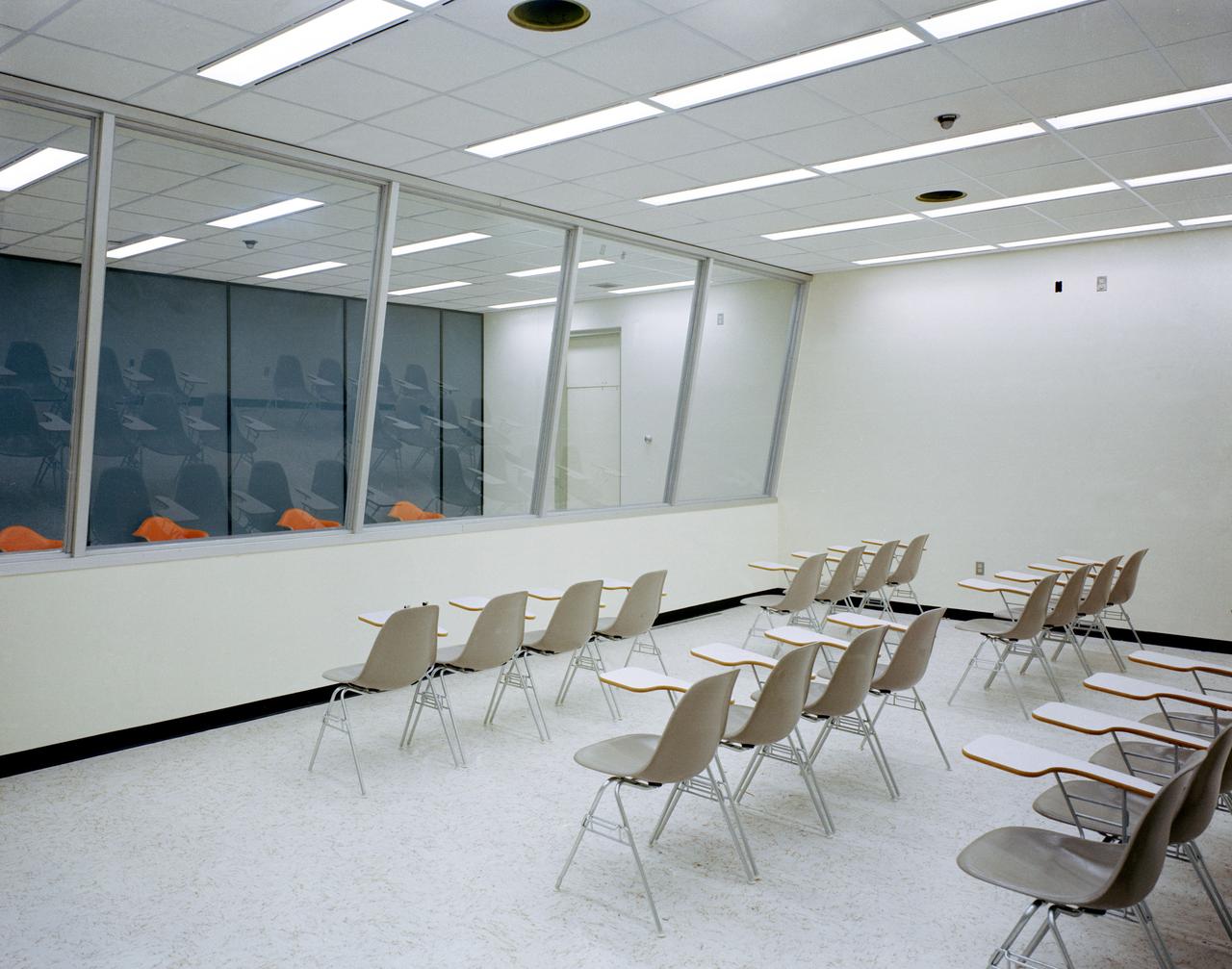
Room 190 of the Support and Administrative Facilities, CRA, LRL, Bldg 37. The room is a debriefing room which facilitates indirect contact with the Astronauts and CRA Medical Staff during quarantine periods. Also called the Press Room. MSC, Houston, TX
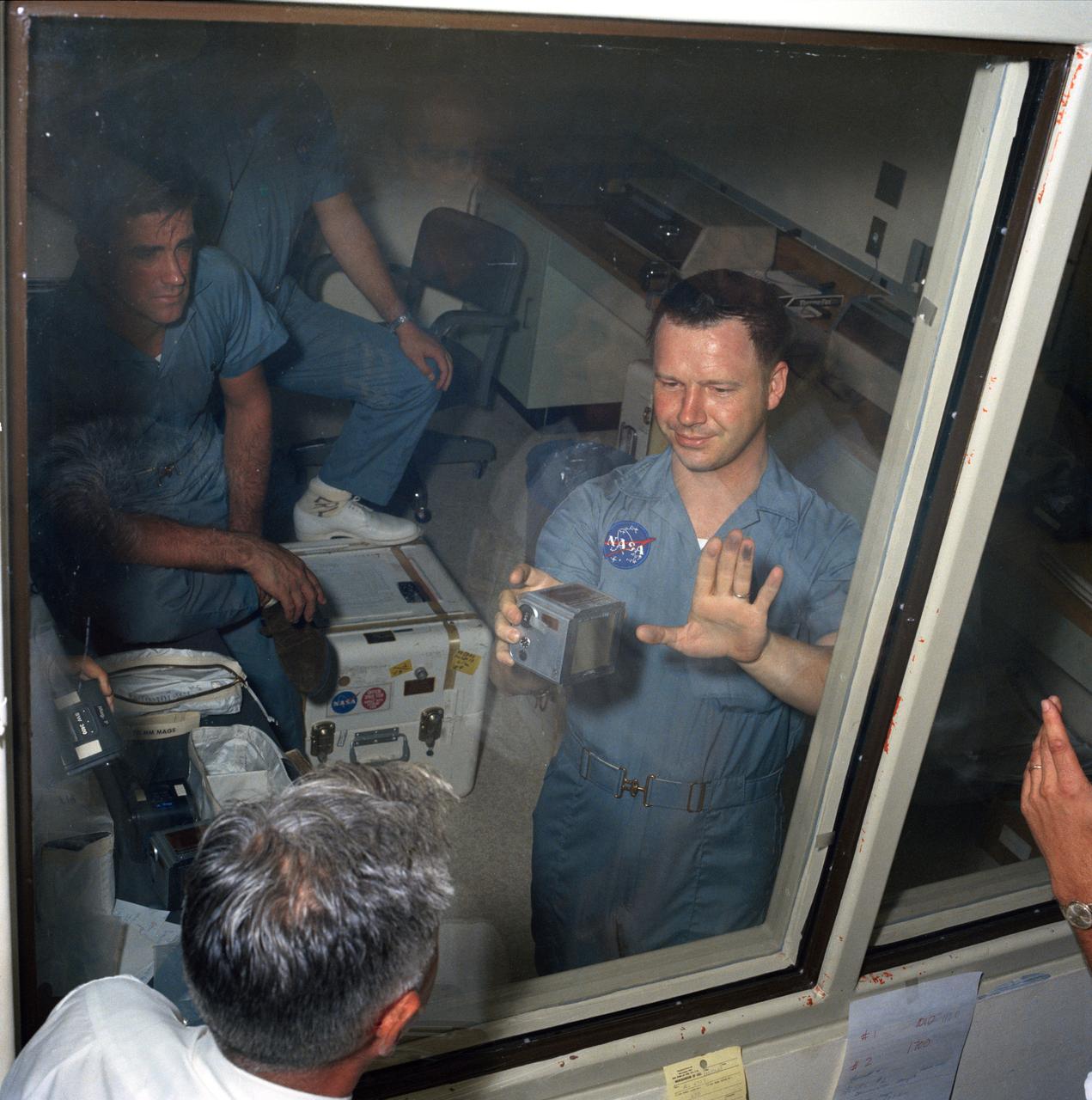
The first direct exposure to Lunar material for Crew Reception Personnel probably happened late Friday, 07/25/1969. Terry Slezak (displaying Moon dust on his left hand fingers), MSC photographic technician, was removing film magazines from the first of two (2) containers when the incident occurred. As he removed the plastic seal from Magazine "S", one of the 70mm magazines taken during Apollo XI Extravehicular Activity (EVA), it was apparent that the exterior of the cassette displayed traces of a black powdery substance. Apollo XI Commander Neil Armstrong reported during the mission that he had retrieved a 70mm cassette which had dropped to the Lunar surface. Seen in the backgound is John H. Boynton. ( S69-40054 ) MSC, Houston, TX
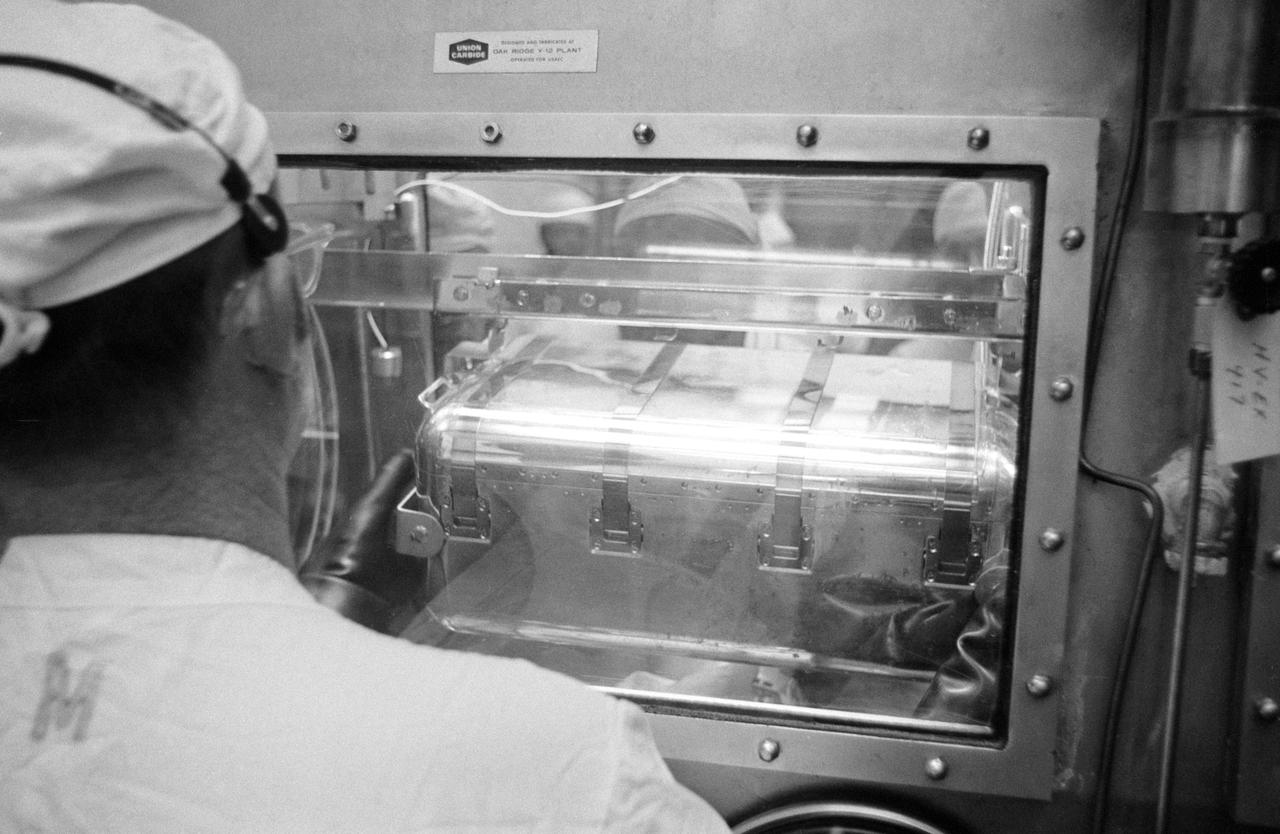
S69-40110 (25 July 1969) --- The first Apollo 11 sample return container, containing lunar surface material, is photographed just after it arrives at the Lunar Receiving Laboratory (LRL), Building 37, Manned Spacecraft Center (MSC). The box arrived by air at Ellington Air Force Base just before noon on Friday, July 25, 1969, from the Pacific recovery area. It was taken immediately to the Manned Spacecraft Center. The lunar samples were collected by astronauts Neil A. Armstrong and Edwin E. Aldrin Jr. during their lunar surface extravehicular activity (EVA).

S69-60644 (29 Nov. 1969) --- A Mobile Quarantine Facility (MQF), with the crew men of the Apollo 12 lunar landing mission aboard, arrived at the Manned Spacecraft Center (MSC) Saturday morning, Nov. 29, 1969. Astronauts Charles Conrad Jr., Richard F. Gordon Jr., and Alan L. Bean were on their way to the Lunar Receiving Laboratory (LRL) where they will remain in quarantines until Dec. 10, 1969. Minutes earlier the three astronauts had arrived at Ellington Air Force Base from Hawaii aboard a U.S. Air Force C-141 transport. The crewmen were confined to the MQF from splashdown until they arrived at the LRL.
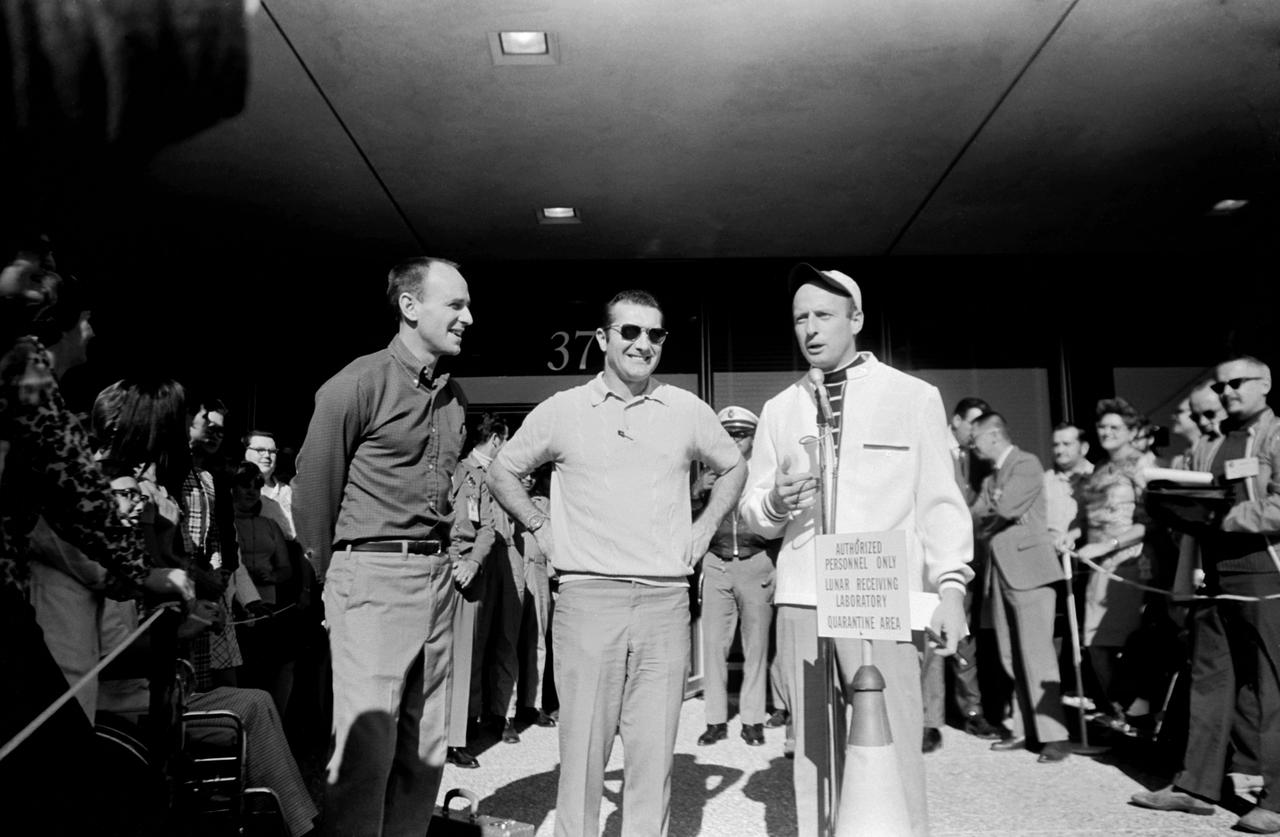
S69-62884 (10 Dec. 1969) --- Astronaut Charles Conrad Jr., commander of the Apollo 12 lunar landing mission, makes several remarks publicly in response to the welcome given him and other members of the Apollo 12 crew upon their release from post-mission isolation in the Manned Spacecraft Center's (MSC) Lunar Receiving Laboratory (LRL). Pictured with Conrad outside Building 37, which houses the LRL, are his fellow crewmembers for the Apollo 12 mission, astronauts Alan L. Bean (left), lunar module pilot; and Richard F. Gordon Jr. (center), command module pilot.
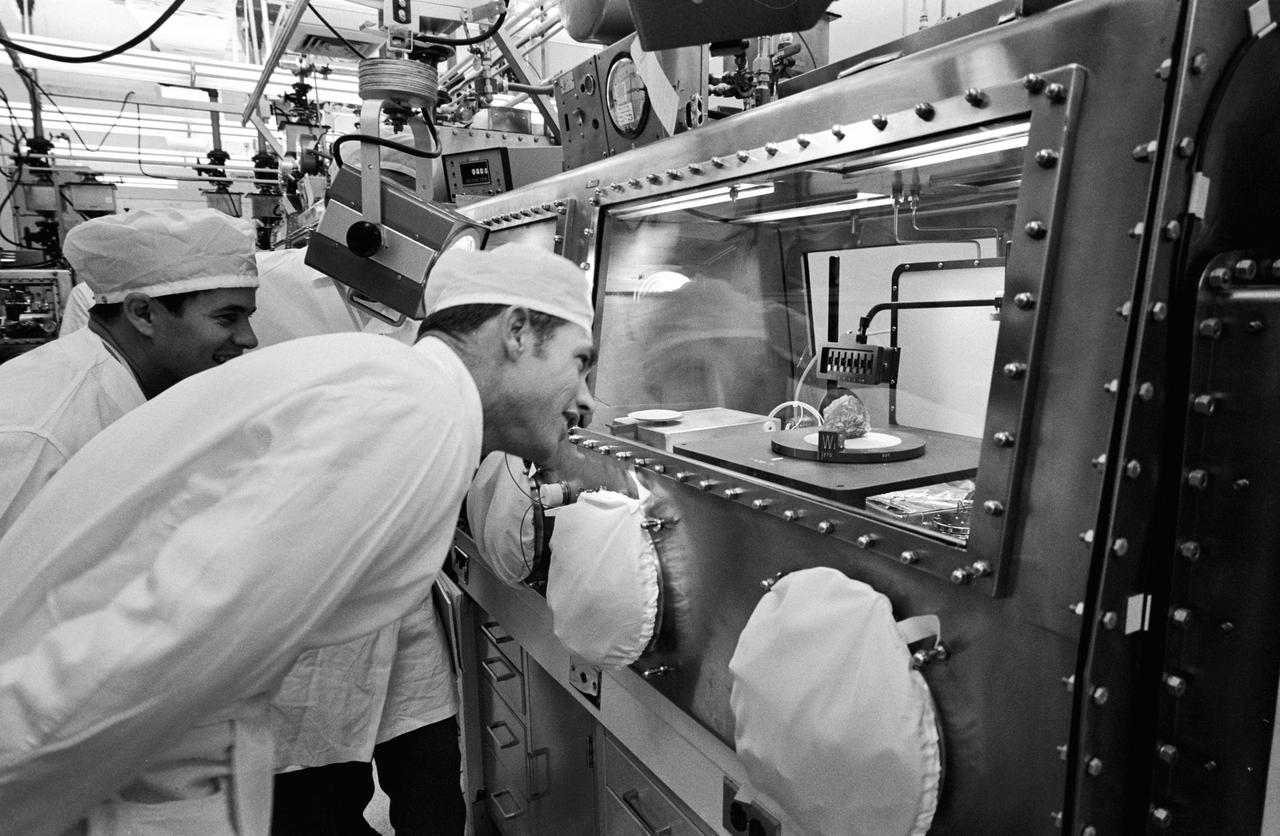
S71-43477 (12 Aug. 1971) --- Astronaut David R. Scott, right, commander of the Apollo 15 mission, gets a close look at the sample referred to as "Genesis rock" in the Non-Sterile Nitrogen Processing Line (NNPL) in the Lunar Receiving Laboratory (LRL) at the Manned Spacecraft Center (MSC). Scientist-astronaut Joseph P. Allen IV, left, an Apollo 15 spacecraft communicator, looks on with interest. The white-colored rock has been given the permanent identification of 15415.

S69-40939 (August 1969) --- Landrum Young, Brown and Root - Northrop technician, examines mice in the Animal Laboratory of the Lunar Receiving Laboratory (LRL) which have been inoculated with lunar sample material. The sample material was collected by astronauts Neil A. Armstrong and Edwin E. Aldrin Jr. during their lunar surface extravehicular activity (EVA) on July 20, 1969.
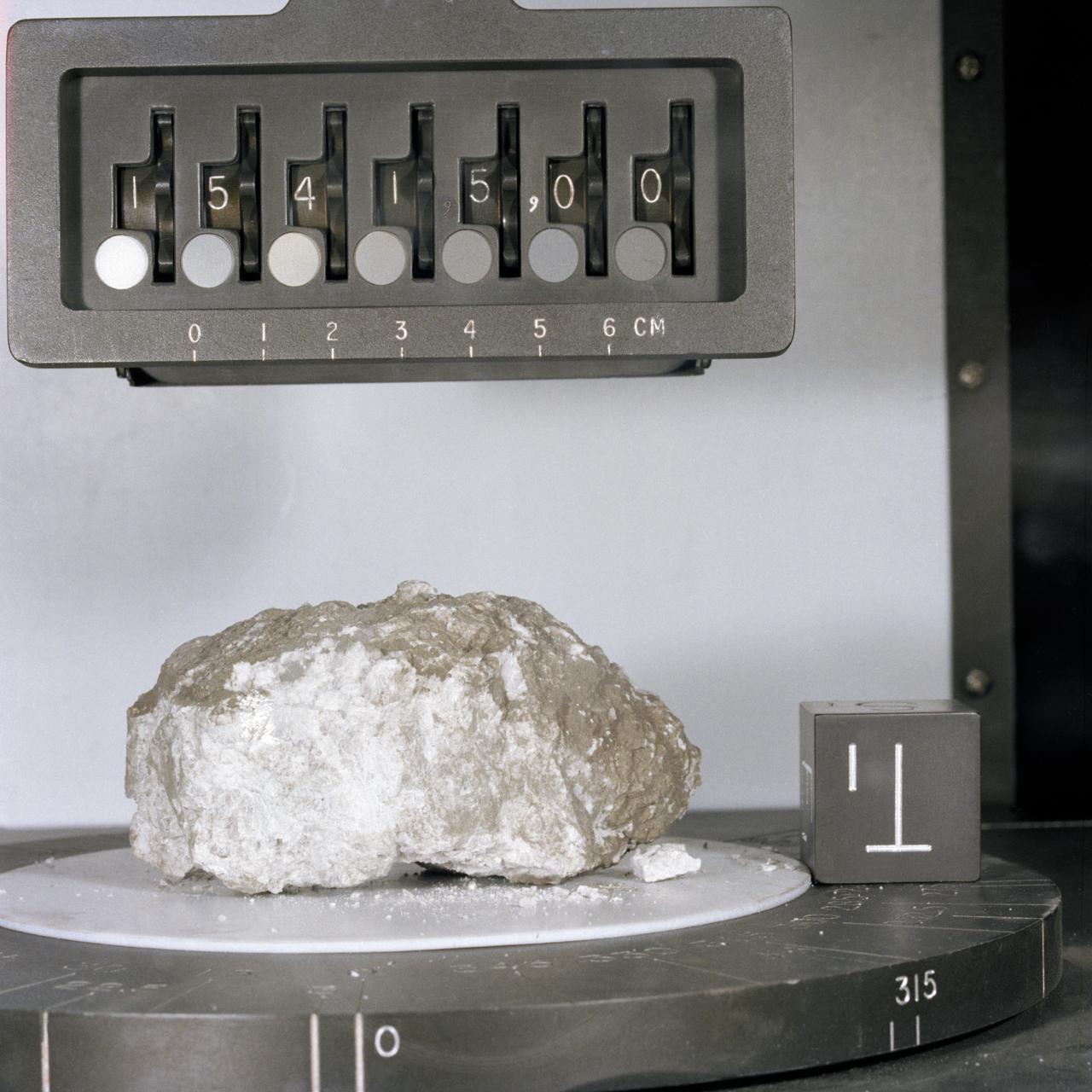
S71-42955 (August 1971) --- A close-up view of Apollo 15 lunar sample no. 15415 in the Non-Sterile Nitrogen Processing Line (NNPL) in the Lunar Receiving Laboratory (LRL) at the Manned Spacecraft Center (MSC). This sample is the white anorthositic rock (Genesis Rock) collected by astronauts David R. Scott and James B. Irwin in container no. 196 at Site no. 7 at a Ground Elapsed Time of 145 hours and 42 minutes, on the mission's second extravehicular activity (EVA).
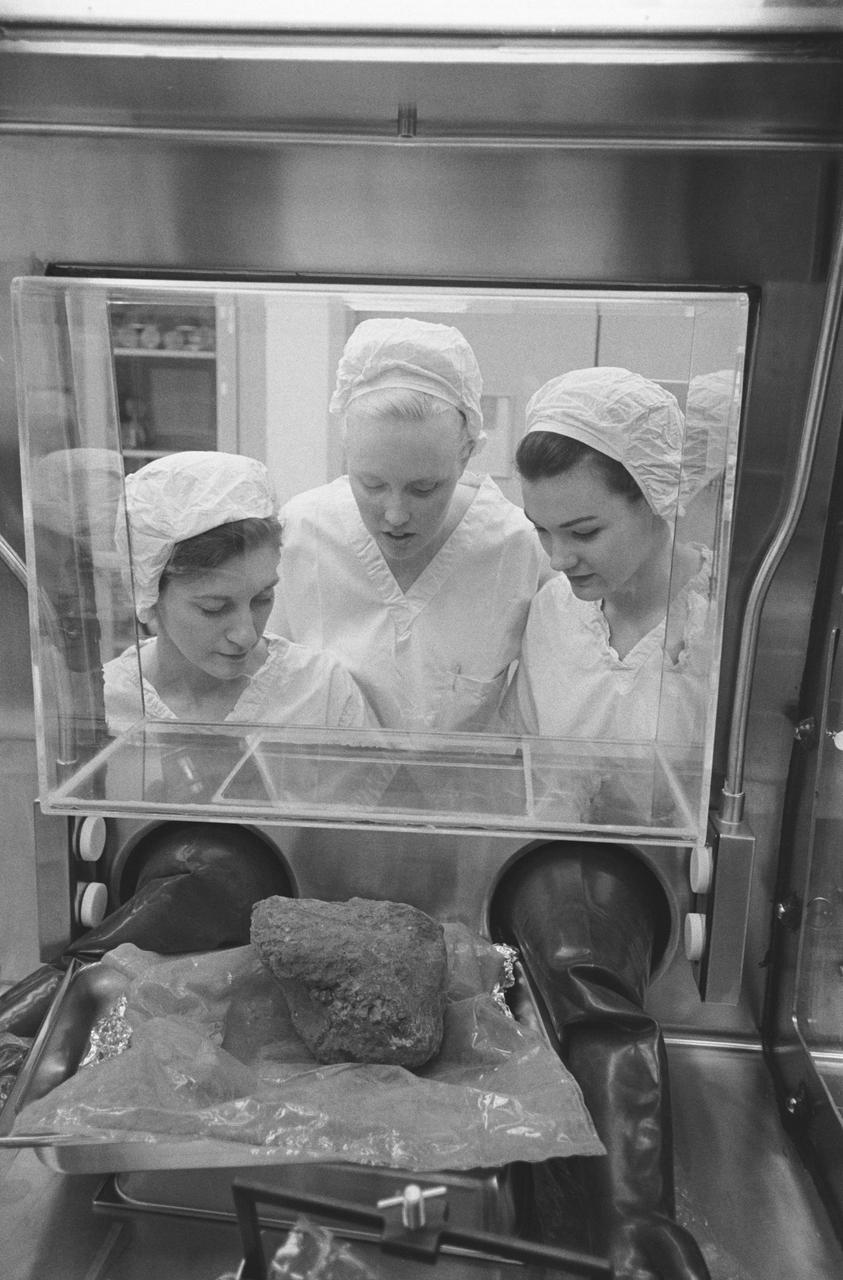
S71-21244 (24 Feb. 1971) --- Three Brown and Root/Northrop technicians in the Nonsterile Nitrogen Laboratory in the Lunar Receiving Laboratory (LRL) peer through glass at the much-discussed basketball size rock which Apollo 14 crewmen brought back from the Fra Mauro area of the moon. They are, left to right, Linda Tyler, Nancy L. Trent and Sandra Richards.
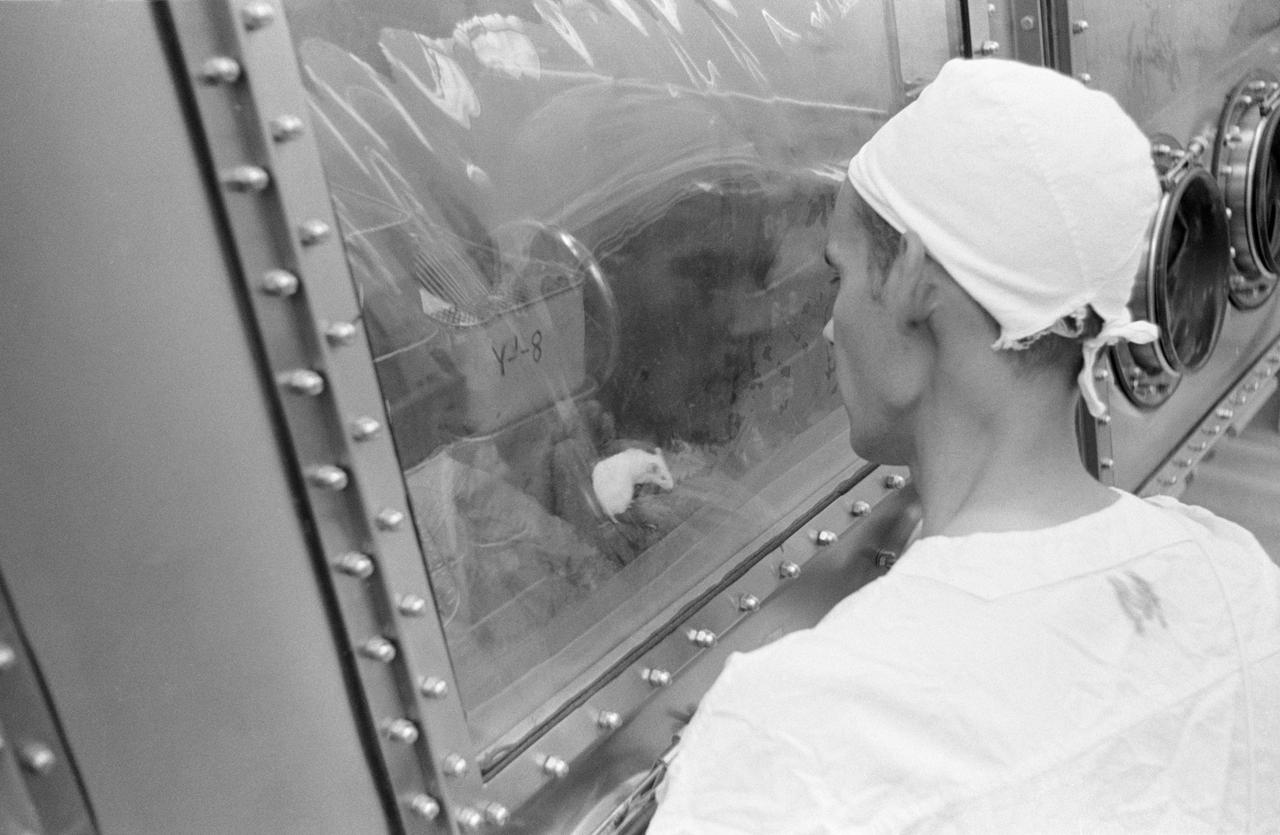
S69-40752 (August 1969) --- Landrum Young, Brown and Root - Northrop technician examines mice in the Animal Laboratory of the Lunar Receiving Laboratory (LRL) which have been inoculated with lunar sample material. The sample material was collected by astronauts Neil A. Armstrong and Edwin E. Aldrin Jr. during their lunar surface extravehicular activity (EVA) on July 20, 1969.
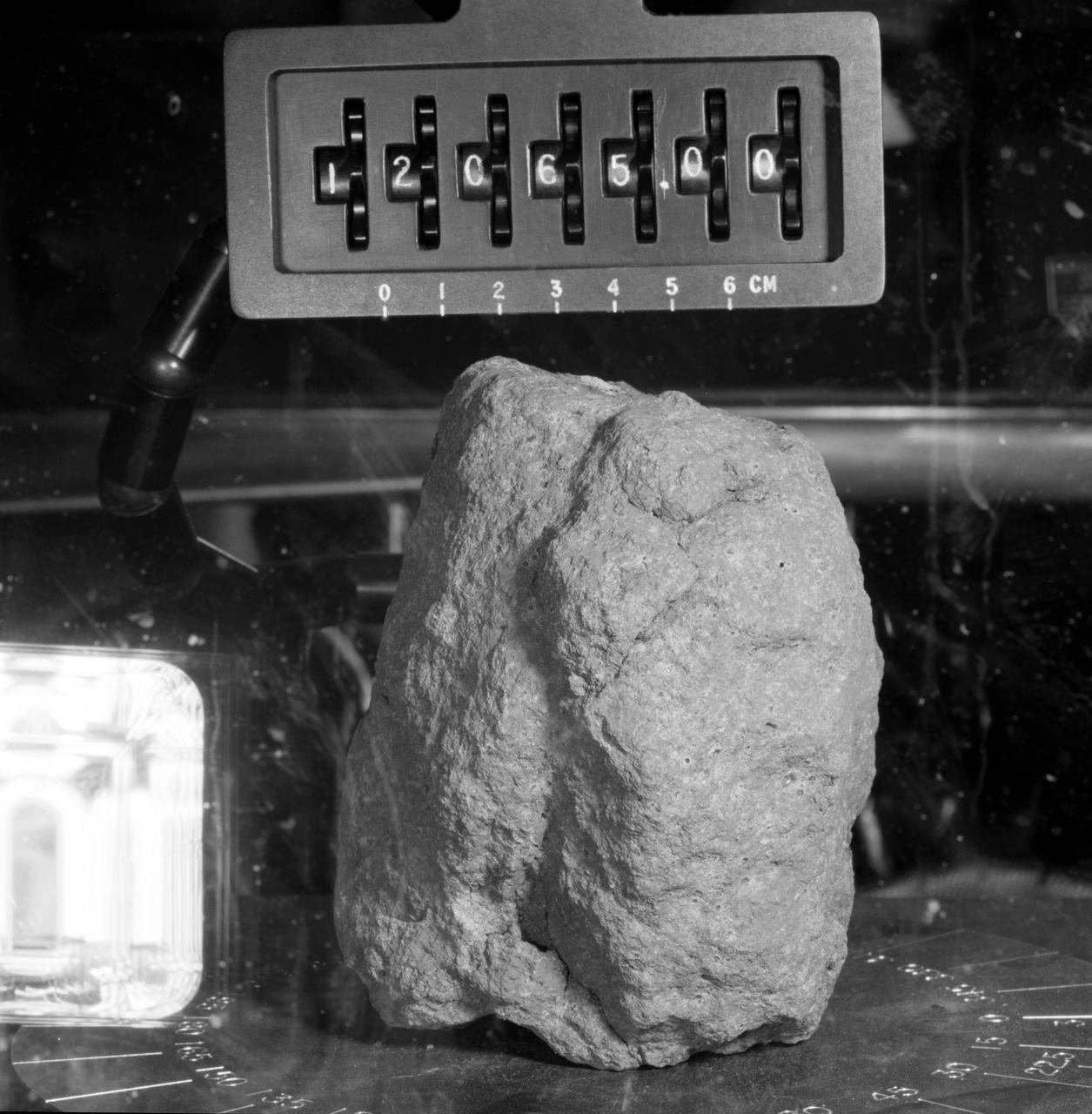
S69-60580 (November 1969) --- Close-up view of Apollo 12 sample 12,065 under observation in the Manned Spacecraft Center's (MSC) Lunar Receiving Laboratory (LRL). This sample, collected during the second Apollo 12 extravehicular activity (EVA) of astronauts Charles Conrad Jr. and Alan L. Bean, is a fine-grained rock. Note the glass-lined pits. Viewer can gain an idea of the size of the rock by reference to the gauge on the bottom portion of the number meter.
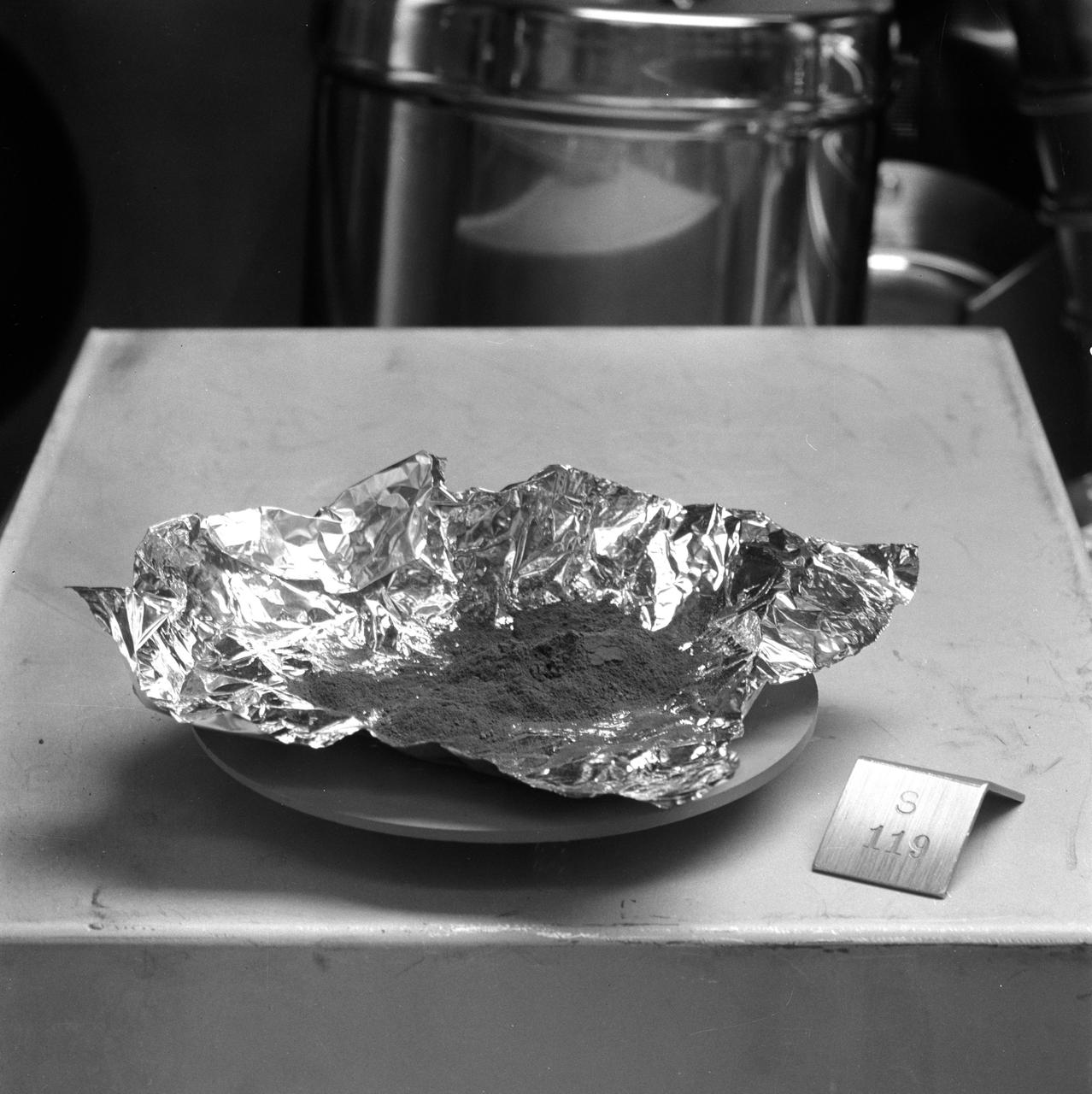
S71-19269 (12 Feb. 1971) --- A close-up view of Apollo 14 sample number 14414 & 14412, a fine lunar powder-like material under examination in the Sterile Nitrogen Atmospheric Processing (SNAP) line in the Lunar Receiving Laboratory (LRL) at the Manned Spacecraft Center (MSC). Scientists are currently making preliminary analyses of material brought back from the moon by the crew of Apollo 14 lunar landing mission.
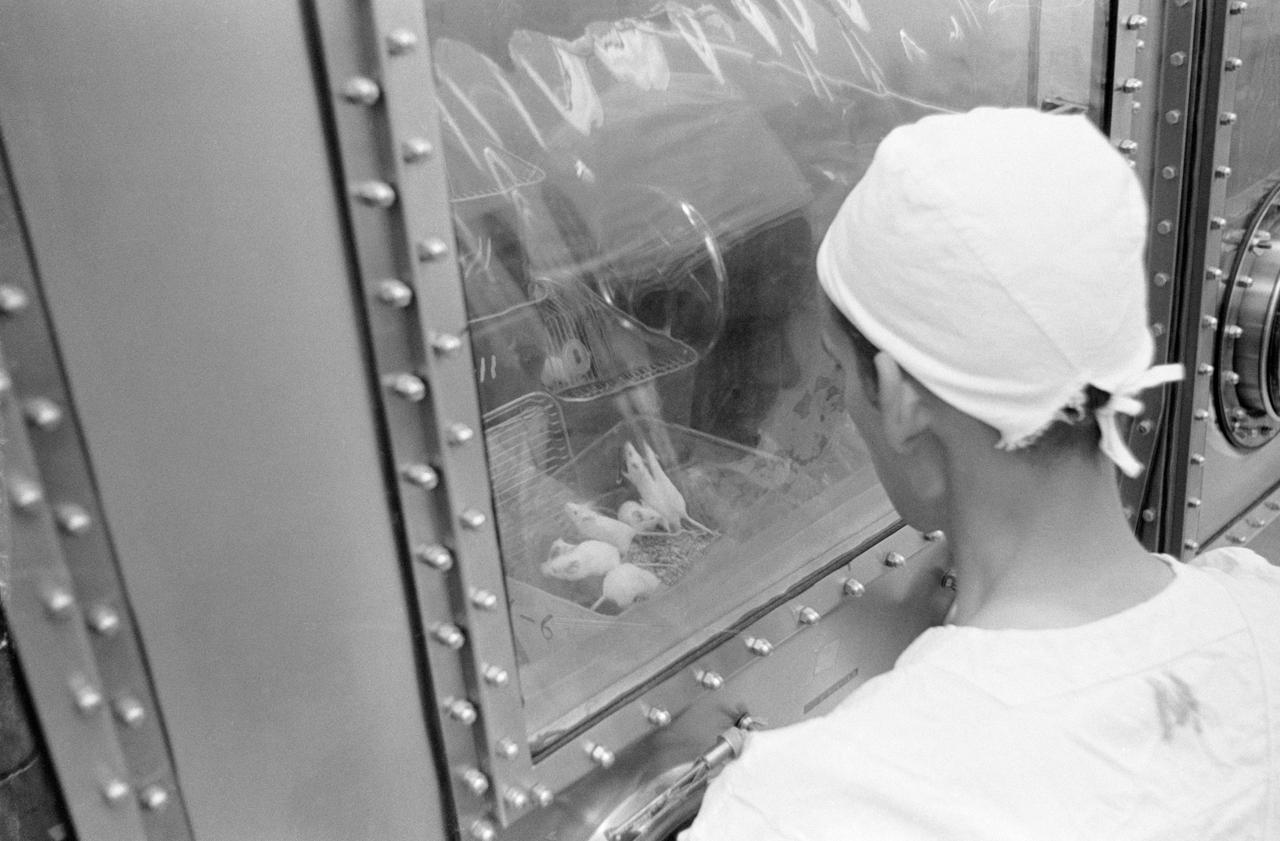
S69-40751 (August 1969) --- Landrum Young, Brown and Root - Northrop technician, examines mice in the Animal Laboratory of the Lunar Receiving Laboratory (LRL) which have been inoculated with lunar sample material. The sample material was collected by astronauts Neil A. Armstrong and Edwin E. Aldrin Jr. during their lunar surface extravehicular activity (EVA) on July 20, 1969.
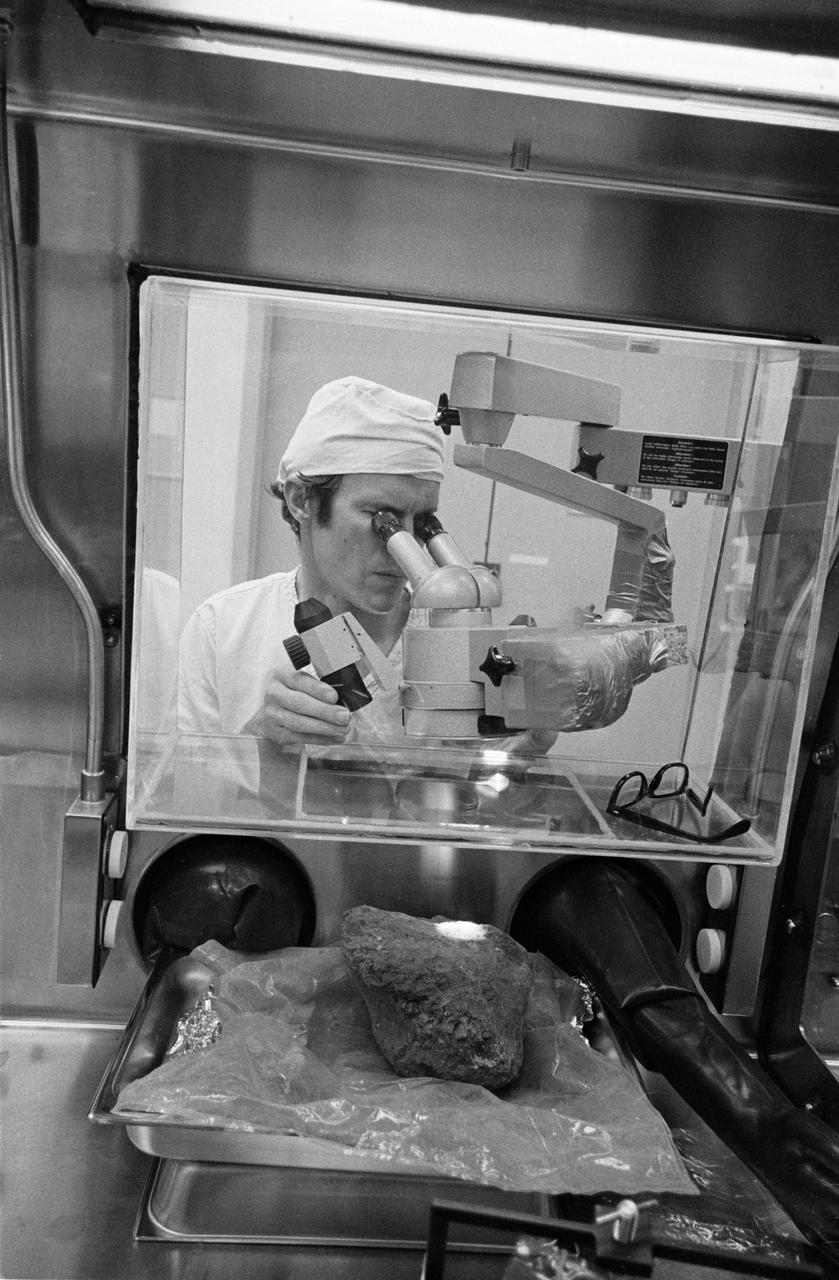
S71-21245 (24 Feb. 1971) --- Dr. Daniel H. Anderson, an aerospace technologist and test director in the Nonsterile Nitrogen Processing Laboratory in the Lunar Receiving Laboratory (LRL) at the Manned Spacecraft Center (MSC) looks at much-discussed Apollo 14 basketball-size rock through a microscope. The two moon-exploring crew men of Apollo 14 brought back 90-odd pounds of lunar sample material from their two periods of extravehicular activity (EVA) on the lunar surface in the Fra Mauro area.
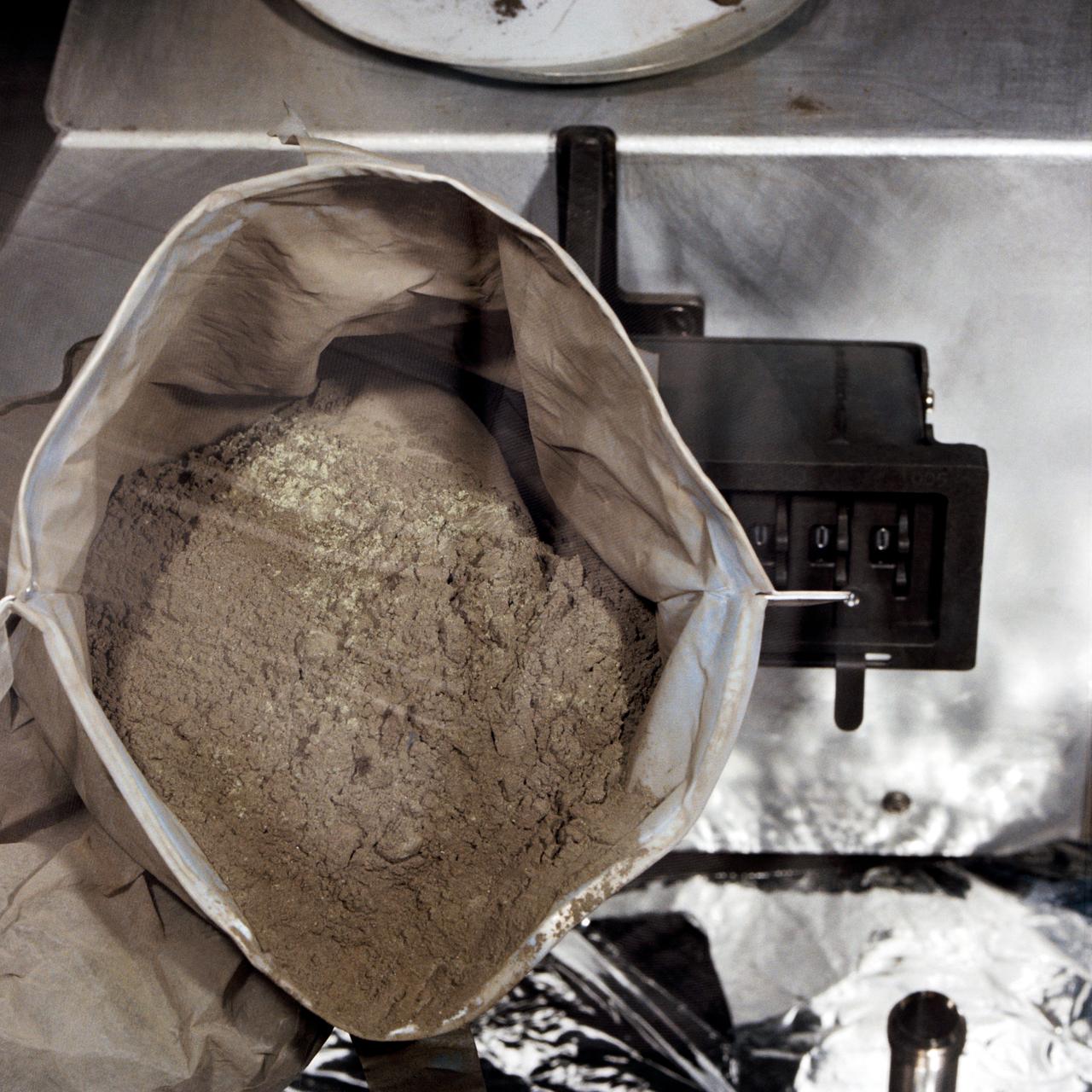
S71-43052 (August 1971) --- A close-up view of a container full of green-colored lunar soil in the Non-Sterile Nitrogen Processing Line (NNPL) in the Lunar Receiving Laboratory (LRL) at the Manned Spacecraft Center (MSC). This sample, broken down into six separate samples after this photo was made, was made up of comprehensive fines from near Spur Crater on the Apennine Front. The numbers assigned to the sample include numbers 15300 through 15305. Astronauts David R. Scott and James B. Irwin took the sample during their second extravehicular activity (EVA) at a ground elapsed time (GET) of 146:05 to 146:06.
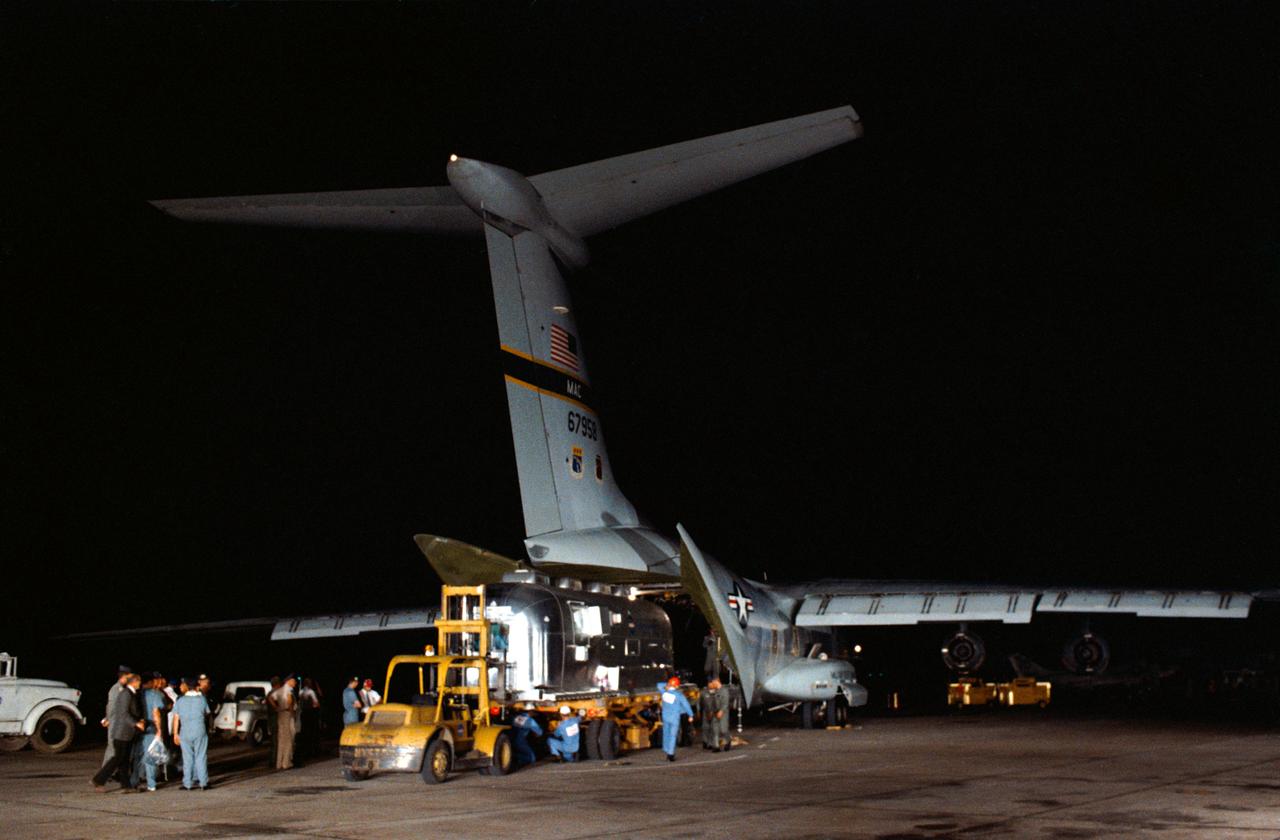
S69-40132 (27 July 1969) --- A Mobile Quarantine Facility (MQF), with the three Apollo 11 crewmembers inside, is unloaded from a United States Air Force C-141 transport at Ellington Air Force Base very early Sunday after a flight from Hawaii. A large crowd was present to welcome astronauts Neil A. Armstrong, Michael Collins, and Edwin E. Aldrin Jr. back to Houston following their historic lunar landing mission. The crew remained in the MQF until they arrived at the Crew Reception Area of the Lunar Receiving Laboratory (LRL) at the Manned Spacecraft Center (MSC). The crew will be released from quarantine on Aug. 11, 1969.
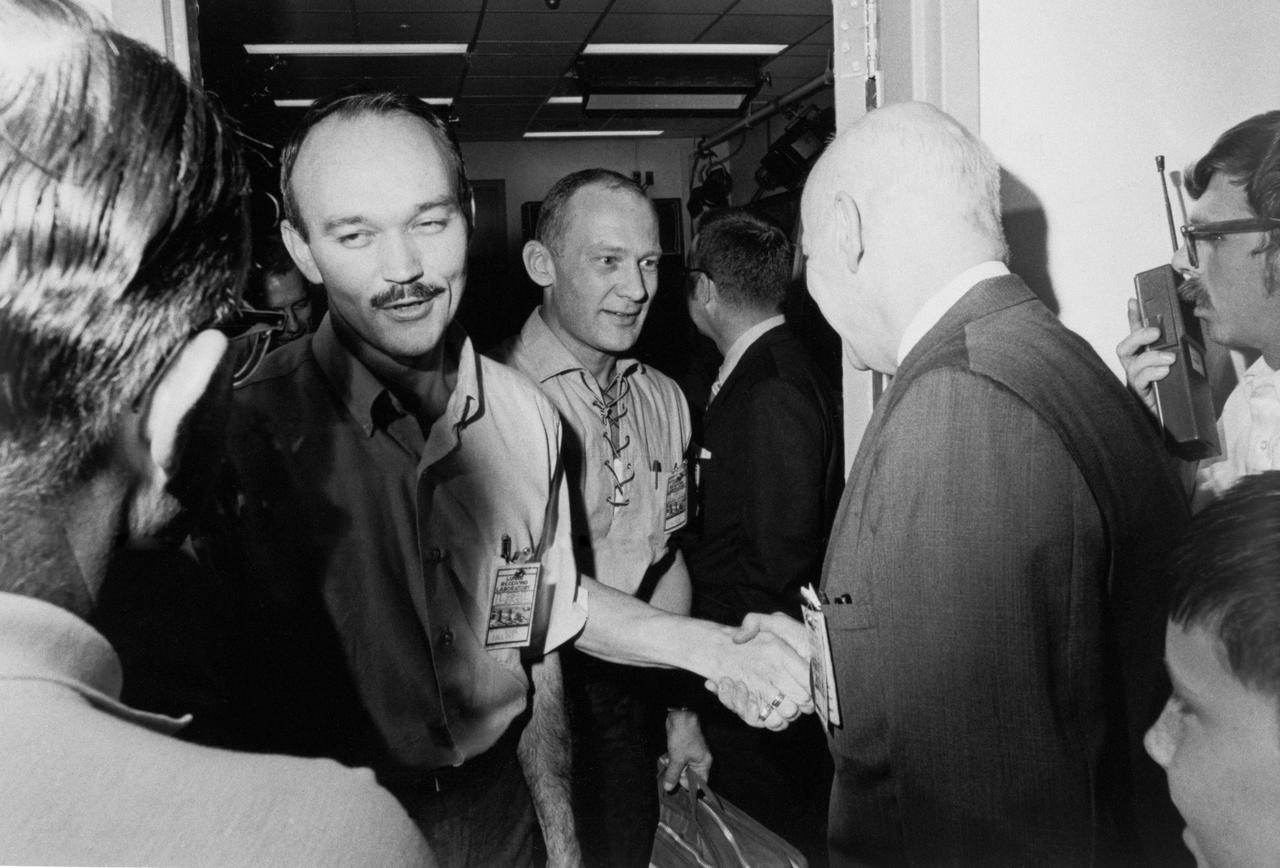
S69-41359 (10 Aug. 1969) --- Astronauts Michael Collins (left) and Edwin E. Aldrin Jr., are greeted by Dr. Robert R. Gilruth, director, Manned Spacecraft Center (MSC), and others upon their release from quarantine. The Apollo 11 crew left the Crew Reception Area (CRA) of the Lunar Receiving Laboratory (LRL) at 9 p.m., Aug. 10, 1969. While astronauts Neil A. Armstrong, commander, and Aldrin, lunar module pilot, descended in the Lunar Module (LM) "Eagle" to explore the Sea of Tranquility region of the moon, astronaut Collins, command module pilot, remained with the Command and Service Modules (CSM) "Columbia" in lunar orbit.
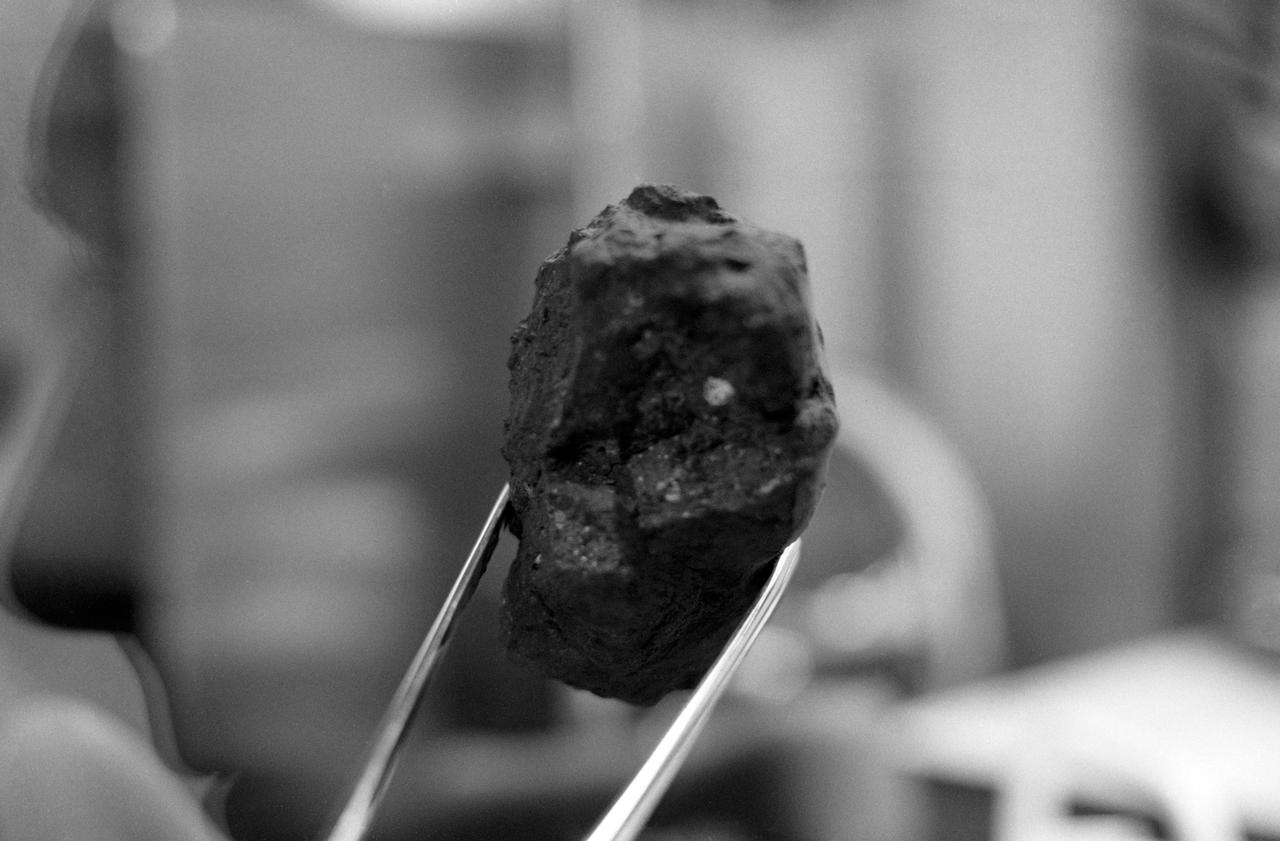
S69-60487 (1 Dec. 1969) --- A close-up view of one of the rocks brought back to Earth from the Apollo 12 lunar landing mission. The rock is under examination in the Physical-Chemical Test Laboratory in the Lunar Receiving Laboratory (LRL), Building 37, MSC. This rock is one of two breccia found in the contingency collection gathered by astronauts Charles Conrad Jr. and Alan L. Bean during their stay on the lunar surface. The breccia rocks, common in the collection of Apollo 11 lunar samples, have been rare in examinations of the Apollo 12 samples thus far.
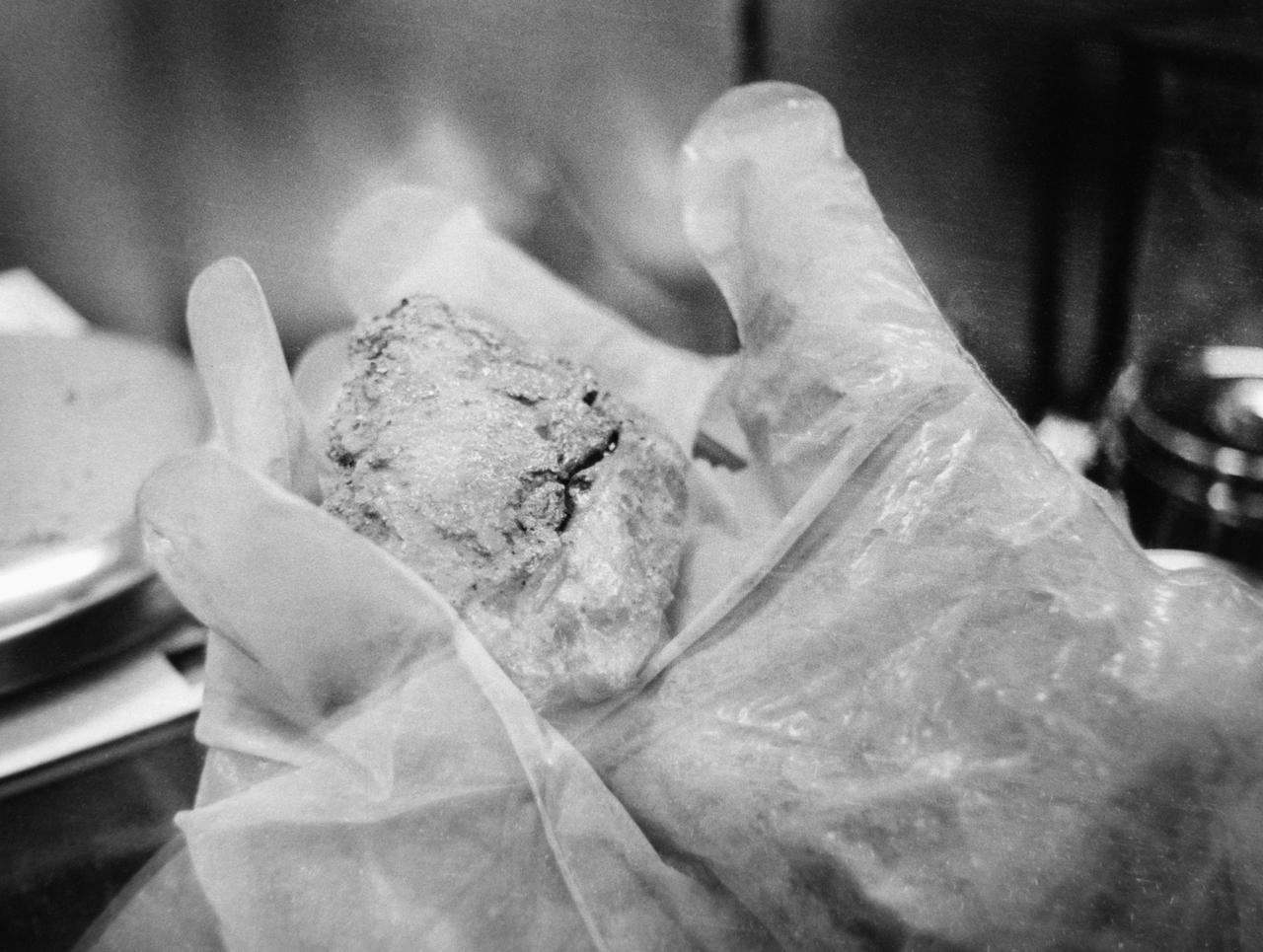
S69-60354 (29 Nov. 1969) --- A scientist's gloved hand holds one of the numerous rock samples brought back to Earth from the Apollo 12 lunar landing mission. The rocks are under thorough examination in the Manned Spacecraft Center's (MSC) Lunar Receiving Laboratory (LRL). This sample is a highly shattered basaltic rock with a thin black-glass coating on five of its six sides. Glass fills fractures and cements the rock together. The rock appears to have been shattered and thrown out by a meteorite impact explosion and coated with molten rock material before the rock fell to the surface.

S69-40152 (27 July 1969) --- A Mobile Quarantine Facility (MQF), with the three Apollo 11 crewmen inside, is unloaded from a United States Air Force C-141 transport at Ellington Air Force Base very early Sunday after a flight from Hawaii. A large crowd was present to welcome astronauts Neil A. Armstrong, Michael Collins, and Edwin E. Aldrin Jr. back to Houston following their historic lunar landing mission. The crew remained in the MQF until they arrived at the Crew Reception Area of the Lunar Receiving Laboratory (LRL) at the Manned Spacecraft Center (MSC). The crew will be released from quarantine on Aug. 11, 1969.
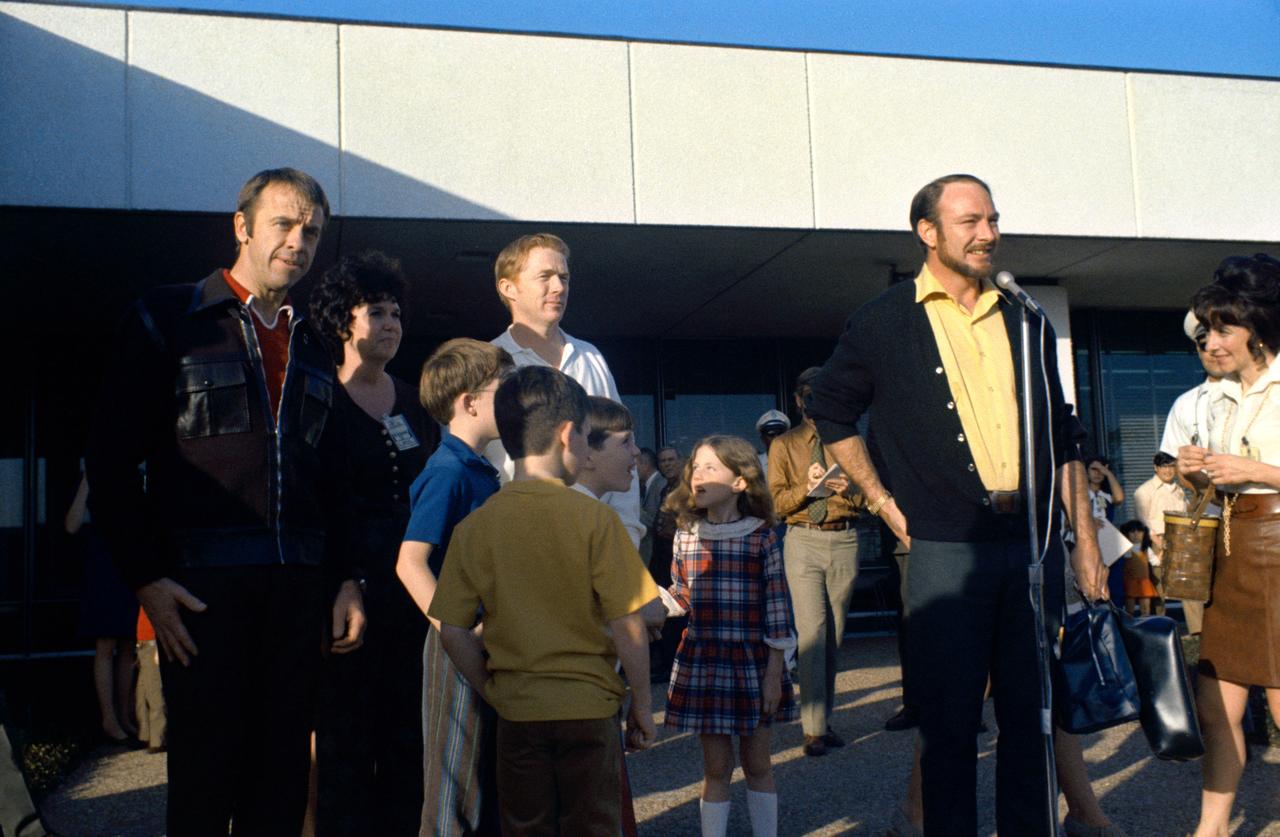
S71-22028 (26 Feb. 1971) --- Astronaut Edgar D. Mitchell, right, the Apollo 14 lunar module pilot, addresses NASA-MSC personnel and news media representatives and other visitors soon after he and his fellow crewmen were released from a 15-day confinement period in the Lunar Receiving Laboratory. Pictured with Mitchell in front of the LRL, MSC Building 37, are astronauts Alan B. Shepard Jr., left, commander; and Stuart A Roosa, command module pilot, Mrs. Mitchell is at right and Mrs. Roosa, near left. Roosa is flanked by his four children, left to right, Christopher A., Stuart A. Roosa Jr., John D. and Rosemary D.
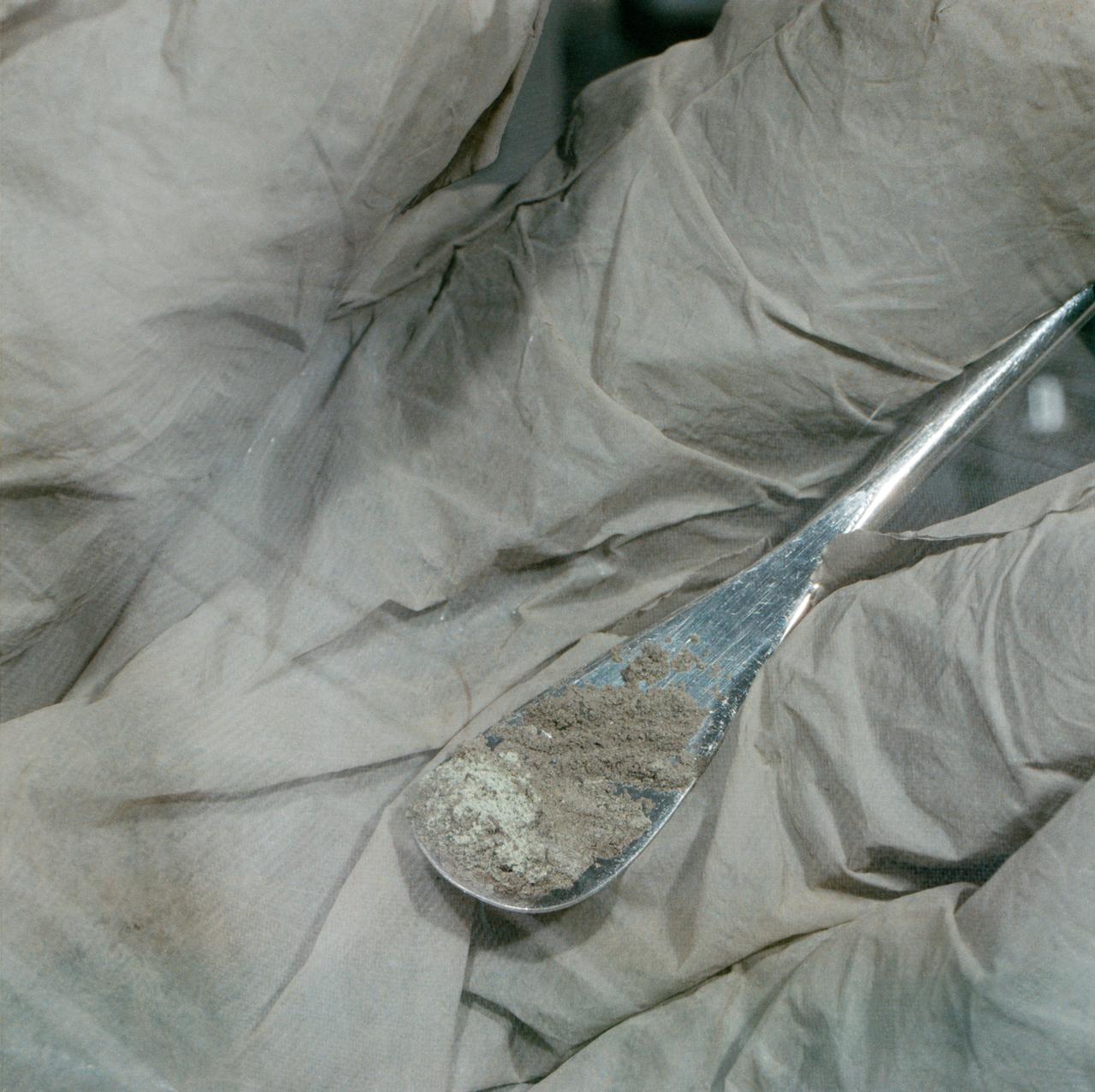
S71-43050 (August 1971) --- A close-up view of Apollo 15 lunar sample No. 15305 in the Non-sterile Nitrogen Processing Line (NNPL) in the Lunar Receiving Laboratory (LRL) at the Manned Spacecraft Center (MSC). This sample, pictured on a small spatula in a lab technician's glove, is green and is one of six recently taken from container No. 173, made up of comprehensive fines from the Apennine Front, Site No. 7. Astronauts David R. Scott, commander; and James B. Irwin, lunar module pilot, took the sample during their second extravehicular activity (EVA), at a ground elapsed time (GET) of 146:05 to 146:06.

S69-40217 (27 July 1969) --- Neil A. Armstrong, commander of the Apollo 11 flight, greets his son Mark, on telephone intercom system, while his wife Jan and another son Eric look on. Armstrong had just arrived in early morning with the Mobile Quarantine Facility (MQF) at Ellington Air Force Base. Armstrong and fellow astronauts will remain in the MQF until arrival and confinement in the Crew Reception Area (CRA) of the Lunar Receiving Laboratory (LRL) at the Manned Spacecraft Center (MSC). Quarantine period will end on Aug. 11, 1969.
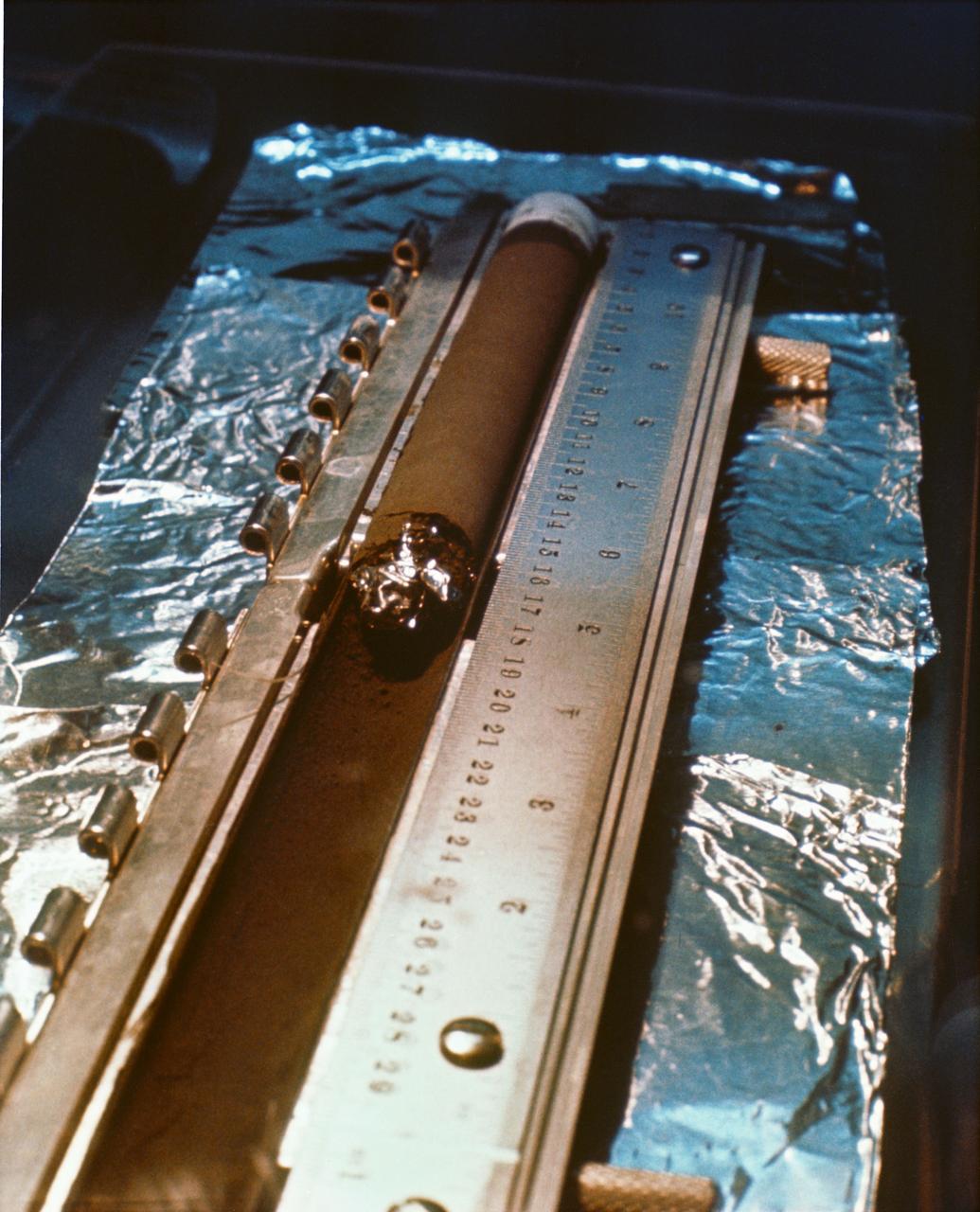
S69-40945 (August 1969) --- This is a core tube sample under study and examination in the Manned Spacecraft Center?s (MSC) Lunar Receiving Laboratory (LRL). The sample was among lunar soil and rock samples collected by astronauts Neil A. Armstrong and Edwin E. Aldrin Jr. during their extravehicular activity (EVA) on July 20, 1969. While astronauts Armstrong, commander; and Aldrin, lunar module pilot; descended in the Apollo 11 Lunar Module (LM) "Eagle" to explore the Sea of Tranquility landing site on the moon. Astronaut Michael Collins, command module pilot, remained with the Command and Service Modules (CSM) "Columbia" in lunar orbit.
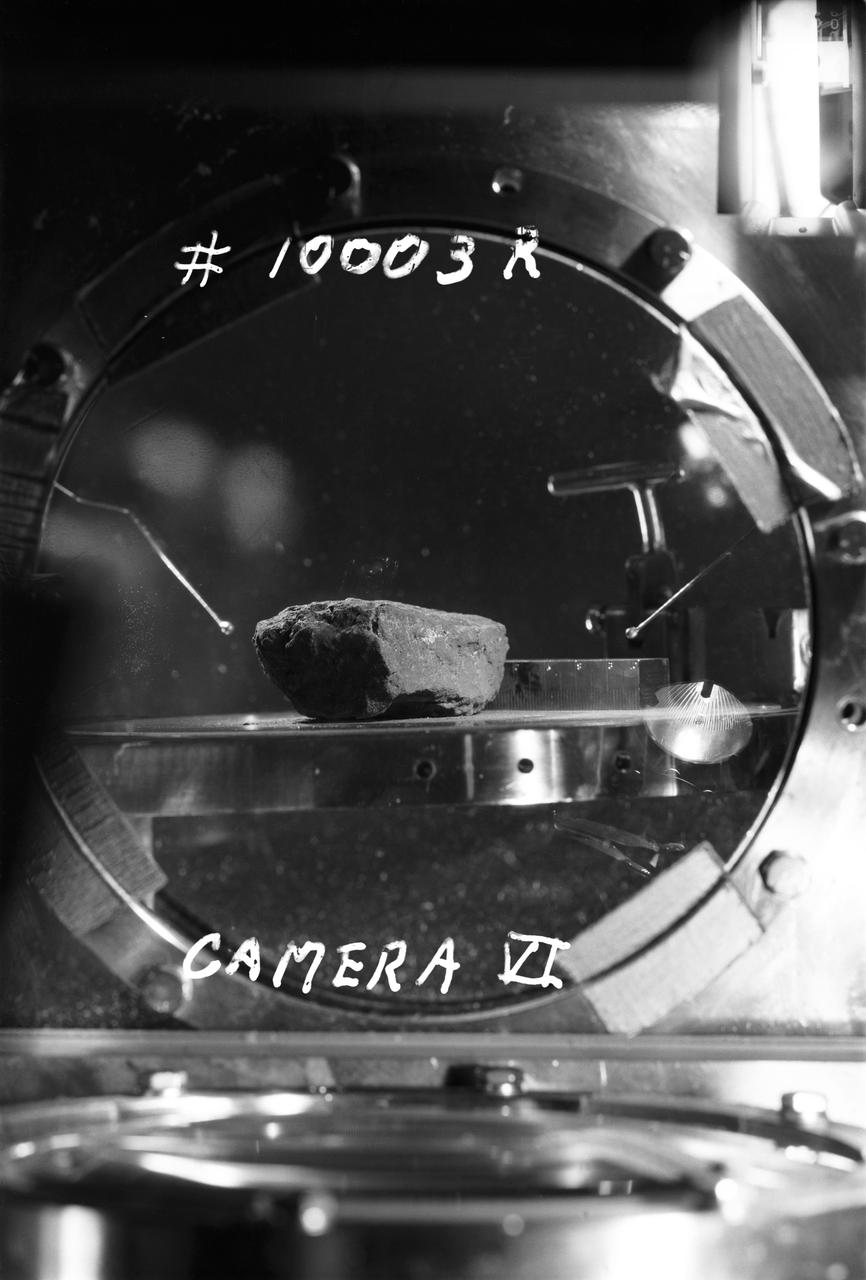
S69-45009 (27 July 1969) --- This is the first lunar sample that was photographed in detail in the Lunar Receiving Laboratory (LRL) at the Manned Spacecraft Center (MSC). The photograph shows a granular, fine-grained, mafic (iron magnesium rich) rock. At this early stage of the examination, this rock appears similar to several igneous rock types found on Earth. The scale is printed backwards due to the photographic configuration in the Vacuum Chamber. The sample number is 10003. This rock was among the samples collected by astronauts Neil A. Armstrong and Edwin E. Aldrin Jr. during their lunar surface extravehicular activity (EVA) on July 20, 1969.
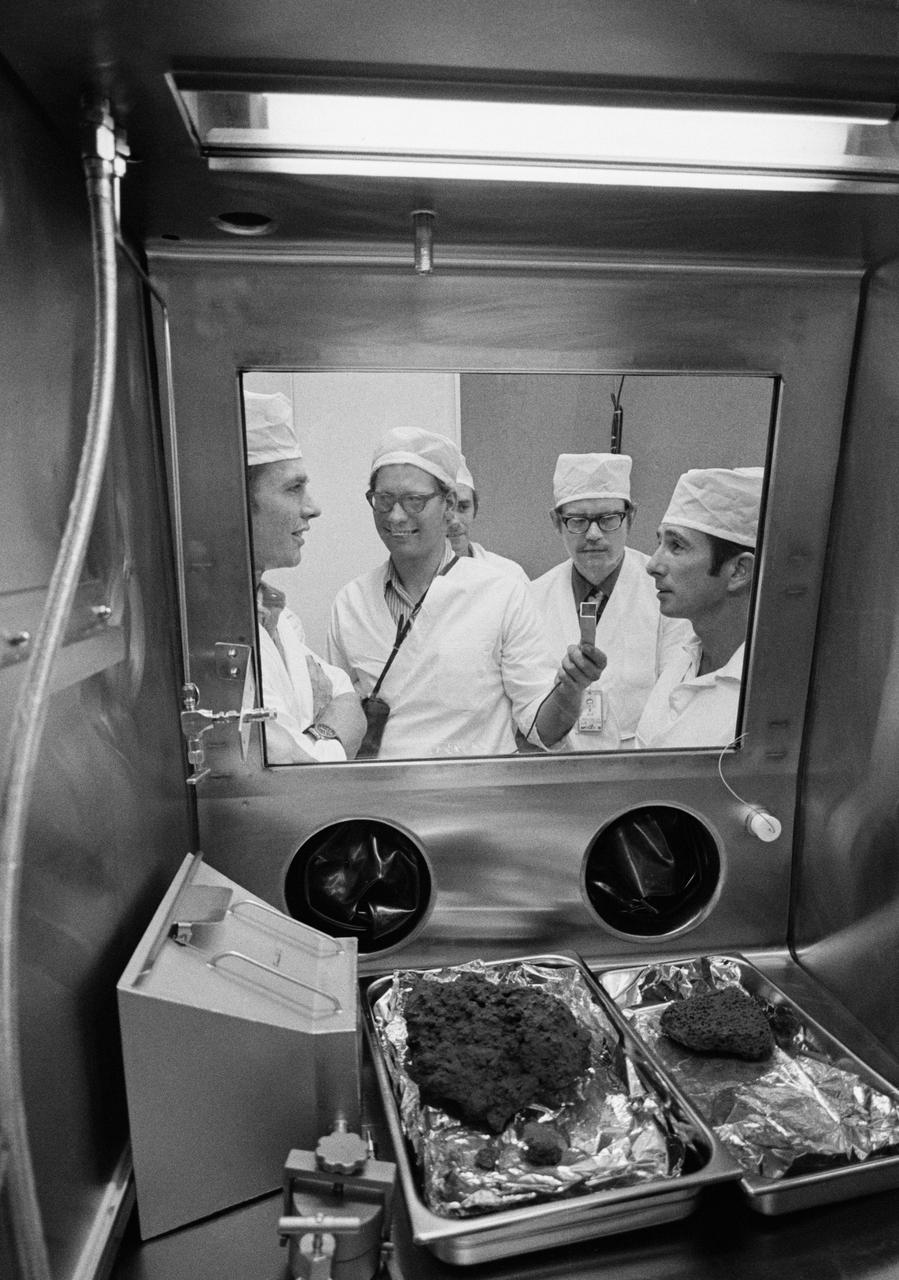
S71-43203 (9 Aug. 1971) --- Astronauts David R. Scott, left foreground, and James B. Irwin, right foreground, join the Manned Spacecraft Center's (MSC) geologists in getting first looks at some of the first Apollo 15 samples to be opened in the Non-Sterile Nitrogen Processing Line (NNPL) in the MSC Lunar Receiving Laboratory (LRL). Holding the microphone and making recorded tapes of the two Apollo 15 crew men's comments is Dr. Gary Lofgren. Partially obscured, near center of photo is Dr. William Phinney, and to his left is Dr. James W. Head.
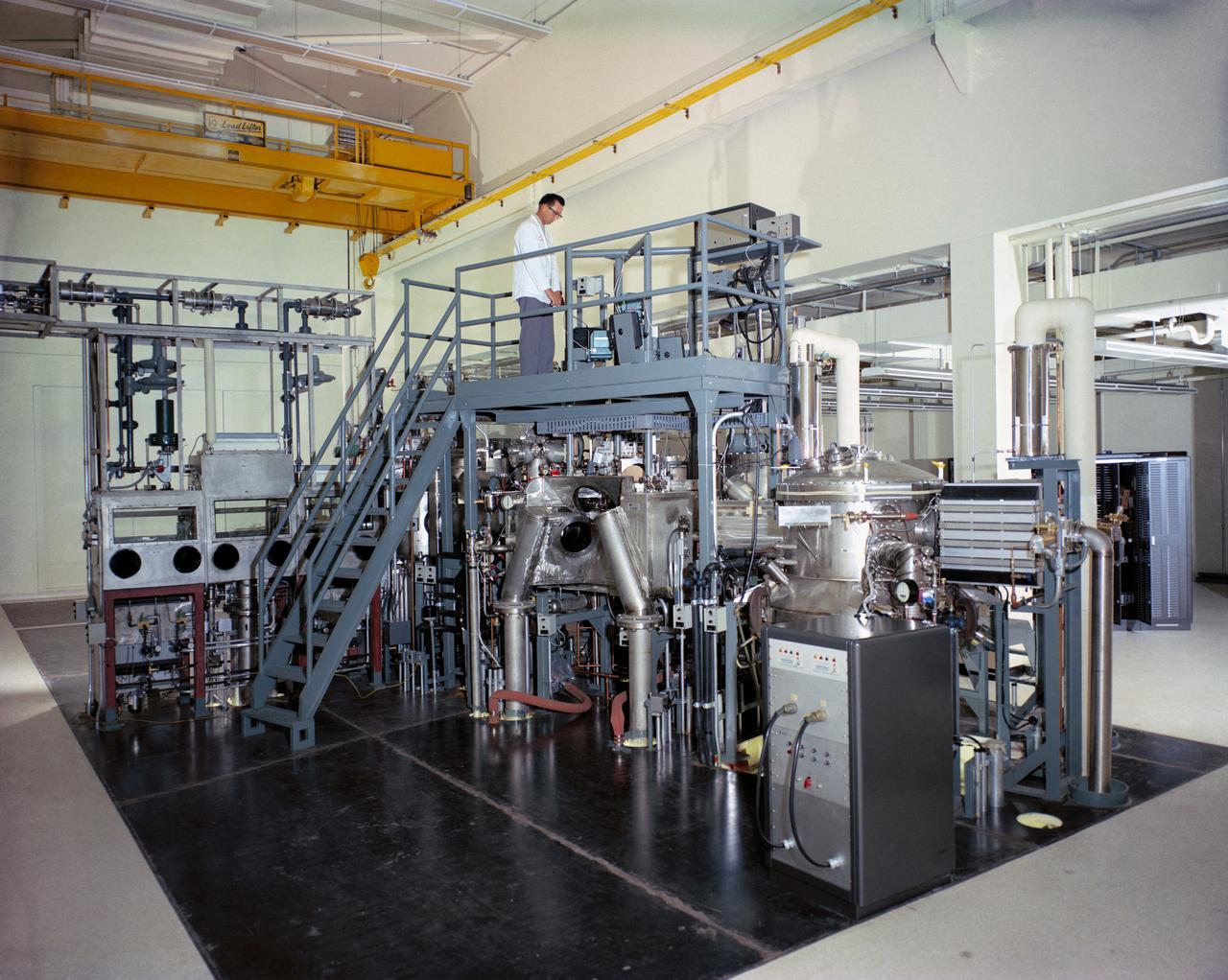
Overall view of the equipment in Room 2-203, Vacuum Laboratory, Sample Operations Area, Lunar Receiving Laboratory, Bldg 37.

S73-36162 (November 1973) --- Dr. Robert S. Clark changes magnetic tape on the Radiation Counting Laboratory's mini-computer. The computer calculates the total content of radioactive isotopes in the lunar materials. Some 120 different samples from the six landings on the moon have been studied by the lab's gamma spectrometer, which generates 65,000 individual data points of each sample. Measurements of radioactive isotopes reveal how long they have been near the surface, and also reflect how much the rocks have been eroded by micrometeorites. Photo credit: NASA
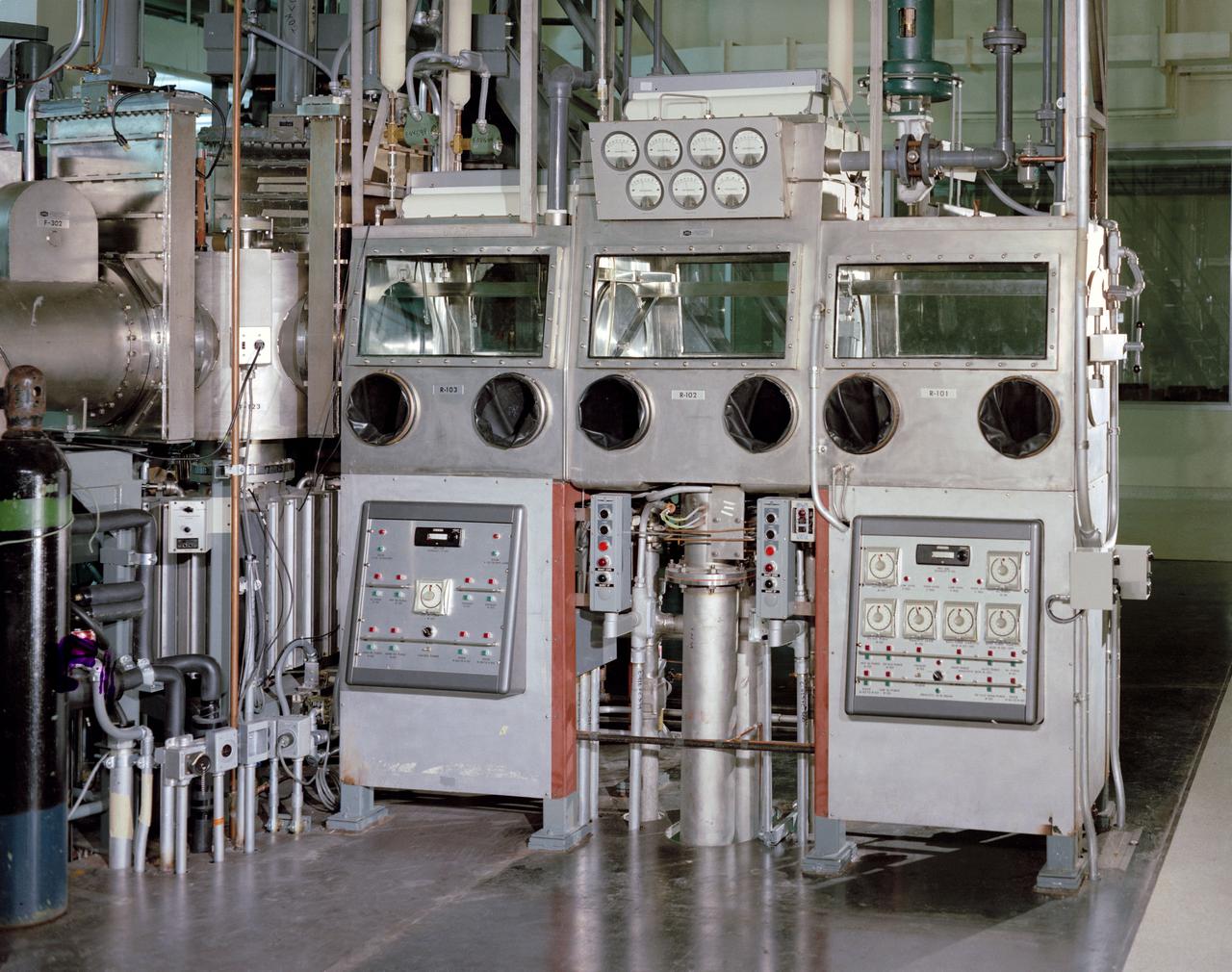
Atmospheric Decontamination System equipment in Room 2-203, Vacuum Laboratory, Sample Operations Area, Lunar Receiving Laboratory, Bldg 37.
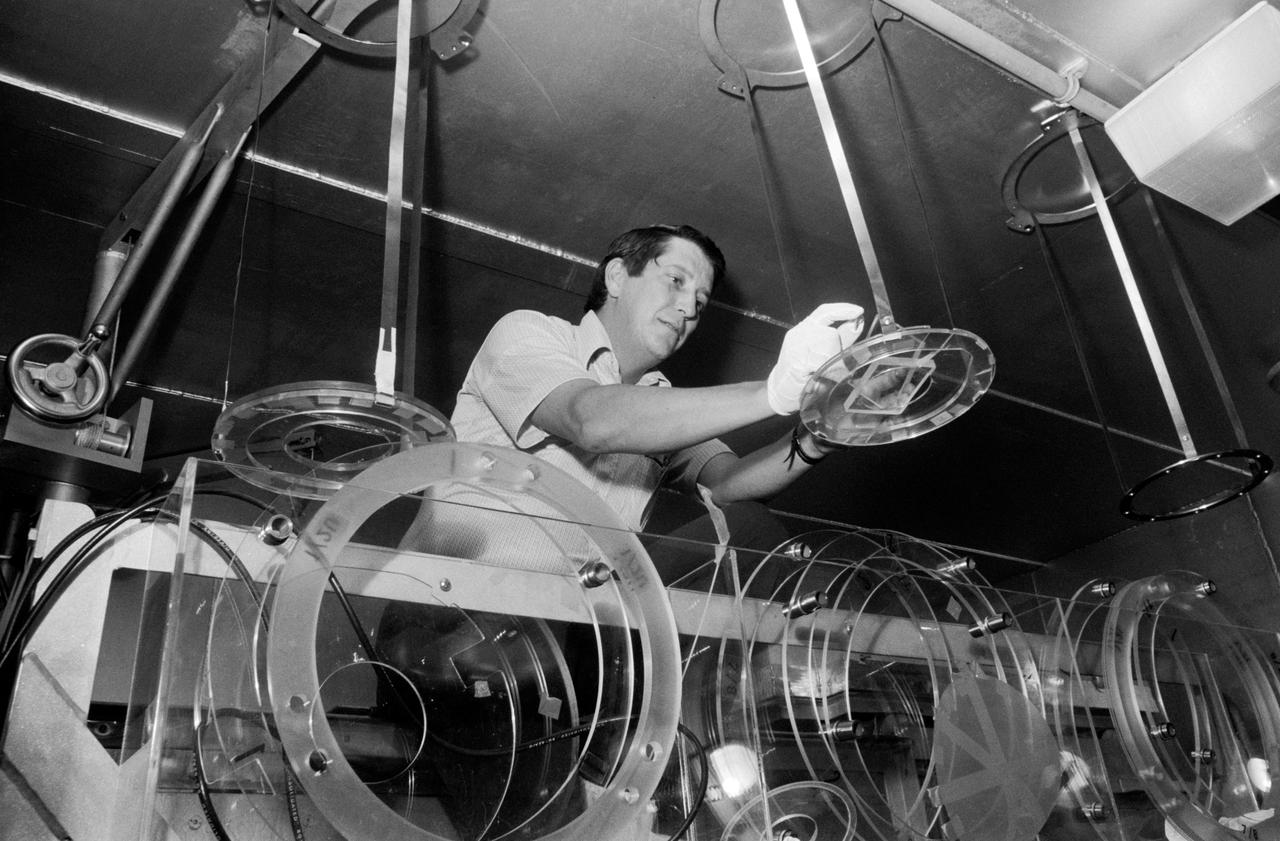
S73-36161 (November 1973) --- In the Radiation Counting Laboratory sixty feet underground at JSC, Dr. Robert S. Clark prepares to load pieces of iridium foil -- sandwiched between plastic sheets -- into the laboratory's radiation detector. The iridium foil strips were worn by the crew of the second Skylab flight in personal radiation dosimeters throughout their 59 1/2 days in space. Inside the radiation detector assembly surrounded by 28 tons of lead shielding, the sample will be tested to determine the total neutron dose to which the astronauts were exposed during their long stay aboard the space station. Photo credit: NASA
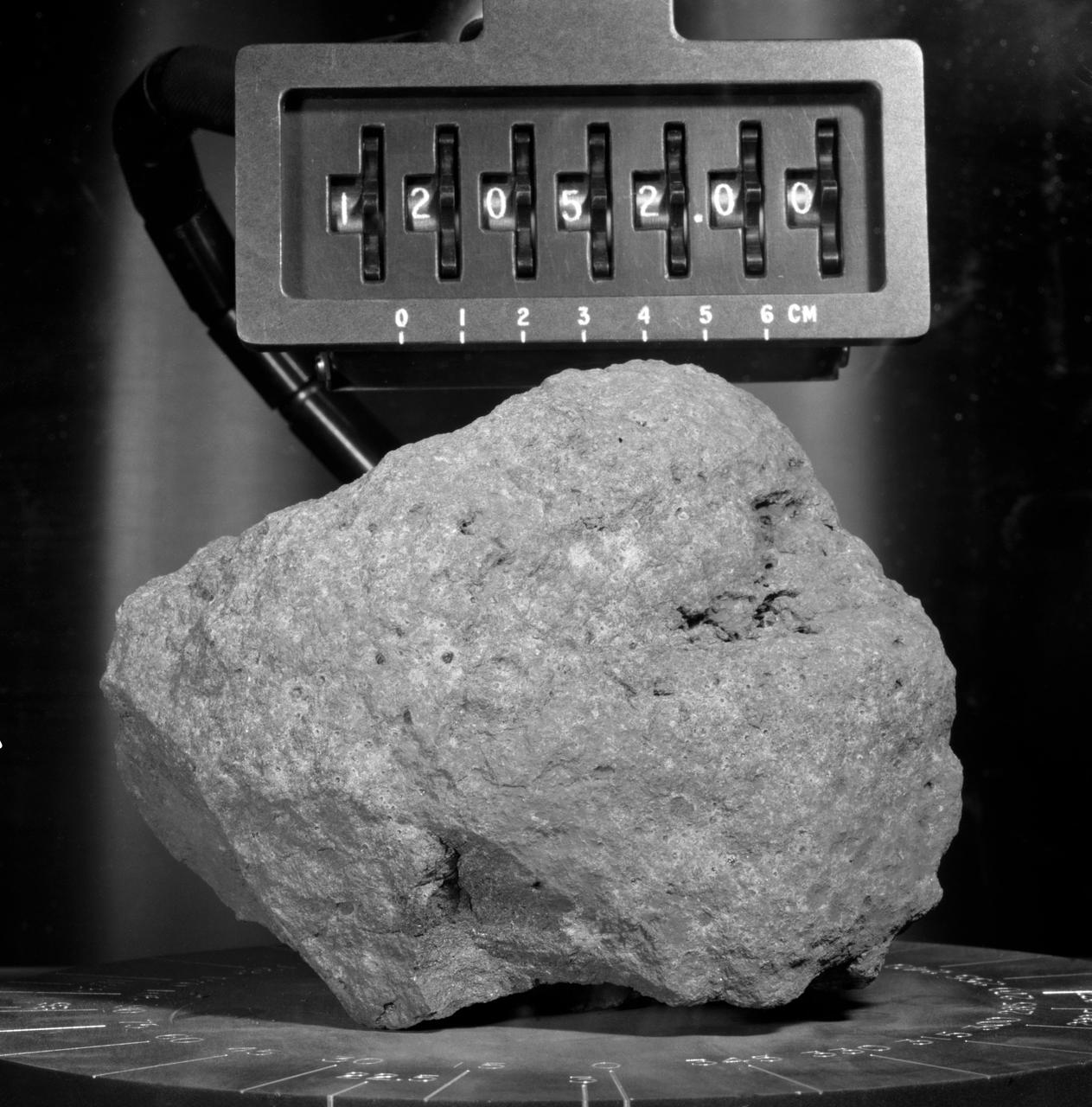
S69-60909 (November 1969) --- A close-up view of lunar sample 12,052 under observation in the Manned Spacecraft Center's Lunar Receiving Laboratory (LRL). Astronauts Charles Conrad Jr., and Alan L. Bean collected several rocks and samples of finer lunar matter during their Apollo 12 lunar landing mission extravehicular activity (EVA). This particular sample was picked up during the second space walk (EVA) on Nov. 20, 1969. It is a typically fine-grained crystalline rock with a concentration of holes on the left part of the exposed side. These holes are called vesicles and have been identified as gas bubbles formed during the crystallization of the rock. Several glass-lined pits can be seen on the surface of the rock.
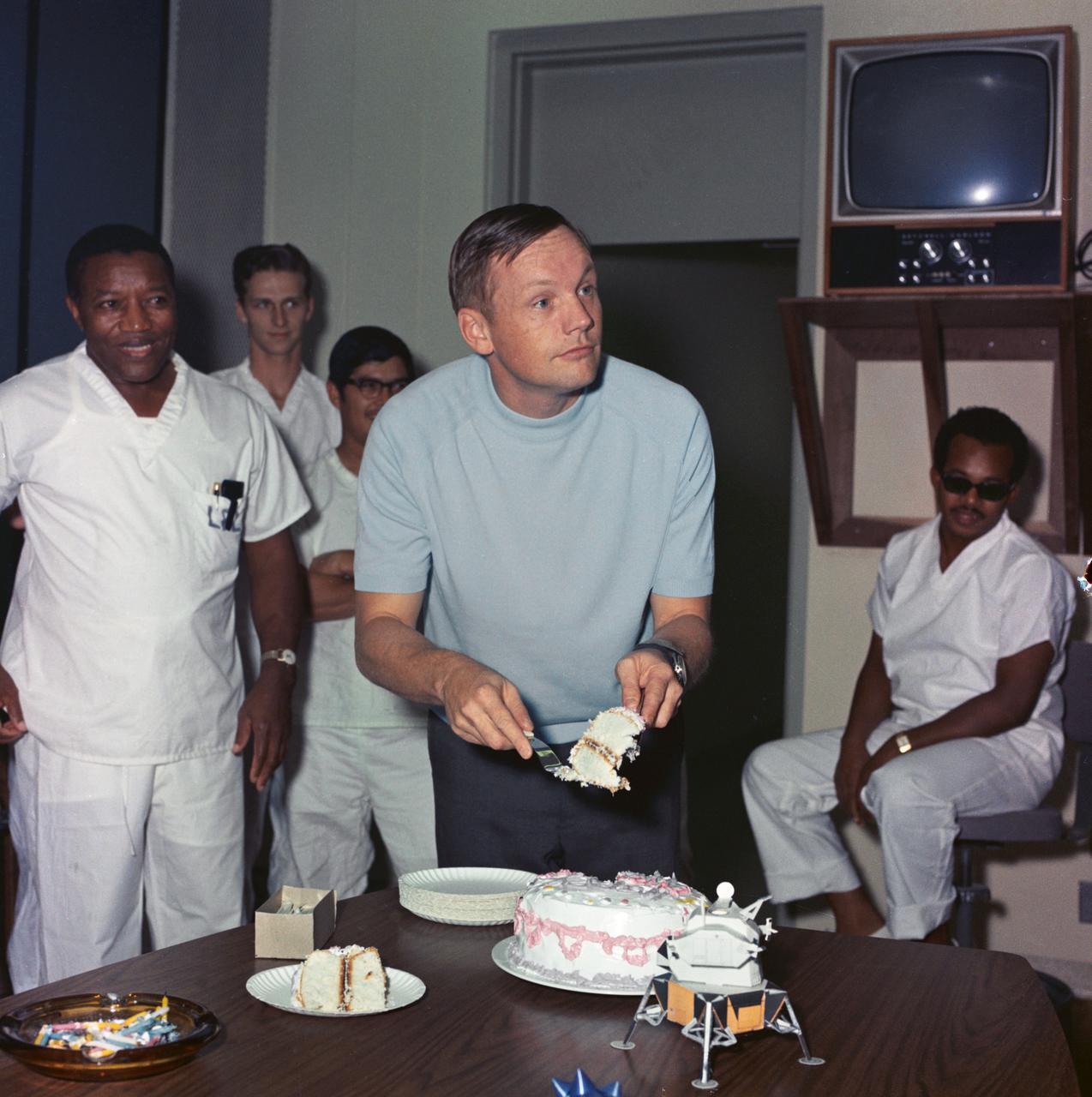
S69-40958 (5 August 1969) --- Astronaut Neil A. Armstrong, commander of the historic Apollo 11 lunar landing mission, and the first man to set foot on the Moon, cuts his birthday cake as he celebrated his 39th birthday. The crew still confined to the Crew Reception Area (CRA) of the Manned Spacecraft Center's (MSC) Lunar Receiving Laboratory (LRL). Armstrong was born on August 5, 1930, in Wapakoneta, Ohio. The cake was described as "standard two-layer, plain vanilla" on which was placed 39 candles. Eighteen of the persons quarantined with Armstrong assembled and sang happy birthday; and a champagne toast was offered. CRA support personnel are in the background. Astronauts Armstrong; Michael Collins, command module pilot; and Edwin E. Aldrin Jr., lunar module pilot, will be released from quarantine on August 11, 1969.
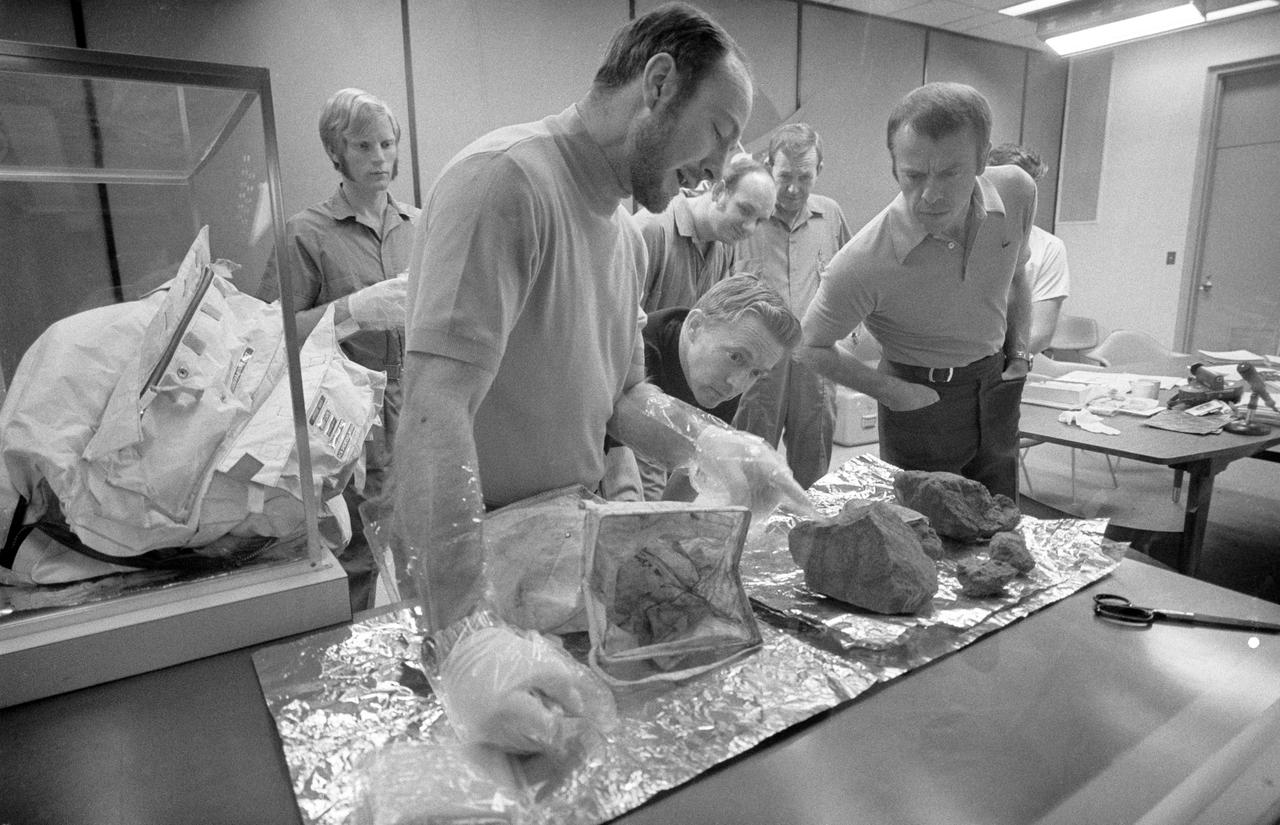
S71-20373 (19 Feb. 1971) --- The Apollo 14 crew men show off some of the largest of the lunar rocks which they brought back from the moon during a through-the-glass meeting with news men in the Crew Reception Area of the Lunar Receiving Laboratory (LRL) at the Manned Spacecraft Center (MSC). Astronaut Alan B. Shepard Jr. (right), mission commander, leans over to view a large basketball-size rock which astronaut Edgar D. Mitchell, lunar module pilot, points out. Astronaut Stuart A. Roosa, command module pilot, who circled the moon in the Command and Service Modules (CSM) while his two fellow crewmembers explored the moon, looks on (near the center of the photograph). Four of the 14 men quarantined with the Apollo 14 crew look on in the background.

The two moon-exploring crewmen of the Apollo 14 lunar landing mission show off some of the largest of the lunar rocks they collected on their mission, during a through-the-glass meeting with newsmen in the Crew Reception Area of the Lunar Receiving Laboratory (LRL) at the Manned Spacecraft Center (MSC). Astronaut Edgar D. Mitchell (left), lunar module pilot, holds up a tote bag in which some of the lunar samples were stowed, while astronaut Alan B. Shepard Jr., commander, looks on. The largest sample brought back on the mission, a basketball-size rock (nicknamed "Big Bertha"), is said to be the largest lunar rock collected in three lunar landing missions for the National Aeronautics and Space Administration (NASA).
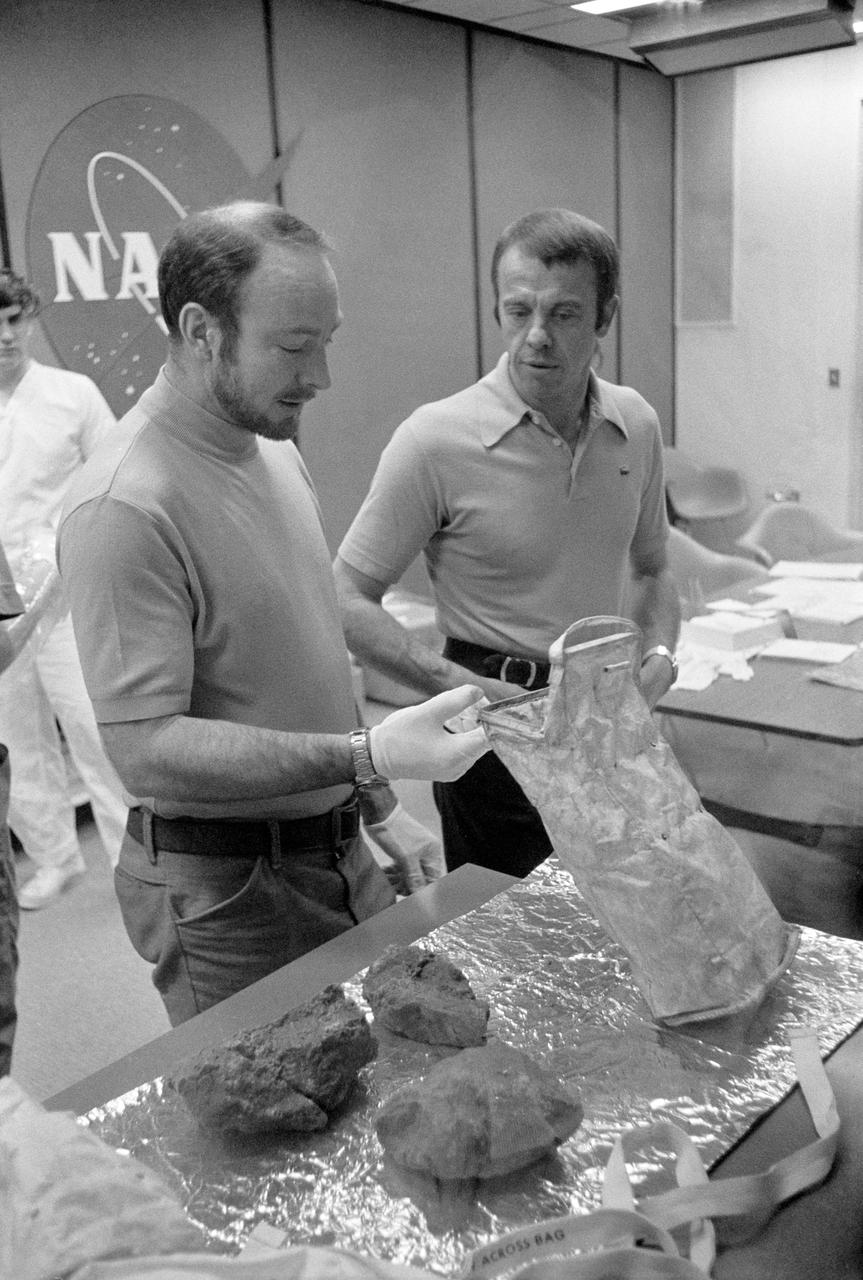
S71-20375 (19 Feb. 1971) --- The two moon-exploring crewmen of the Apollo 14 lunar landing mission show off some of the largest of the lunar rocks they collected on their mission, during a through-the-glass meeting with newsmen in the Crew Reception Area of the Lunar Receiving Laboratory (LRL) at the Manned Spacecraft Center (MSC). Astronaut Edgar D. Mitchell (left), lunar module pilot, holds up a tote bag in which some of the lunar samples were stowed, while astronaut Alan B. Shepard Jr., commander, looks on. The largest sample brought back on the mission, a basketball-size rock (nicknamed "Big Bertha"), is said to be the largest lunar rock collected in three lunar landing missions for the National Aeronautics and Space Administration (NASA).

S69-40753 (24 July 1969) --- The Apollo 11 crewmen, wearing biological isolation garments, arrive aboard the USS Hornet during recovery operations in the central Pacific. They are walking toward the Mobile Quarantine Facility (MQF), in which they will be confined until they arrive at the Manned Spacecraft Center's (MSC), Lunar Receiving Laboratory (LRL). Apollo 11, with astronauts Neil A. Armstrong, commander; Michael Collins, command module pilot; and Edwin E. Aldrin Jr., lunar module pilot, onboard, splashed down at 11:49 a.m. (CDT), July 24, 1969, about 812 nautical miles southwest of Hawaii and only 12 nautical miles from the USS Hornet to conclude their historic lunar landing mission.
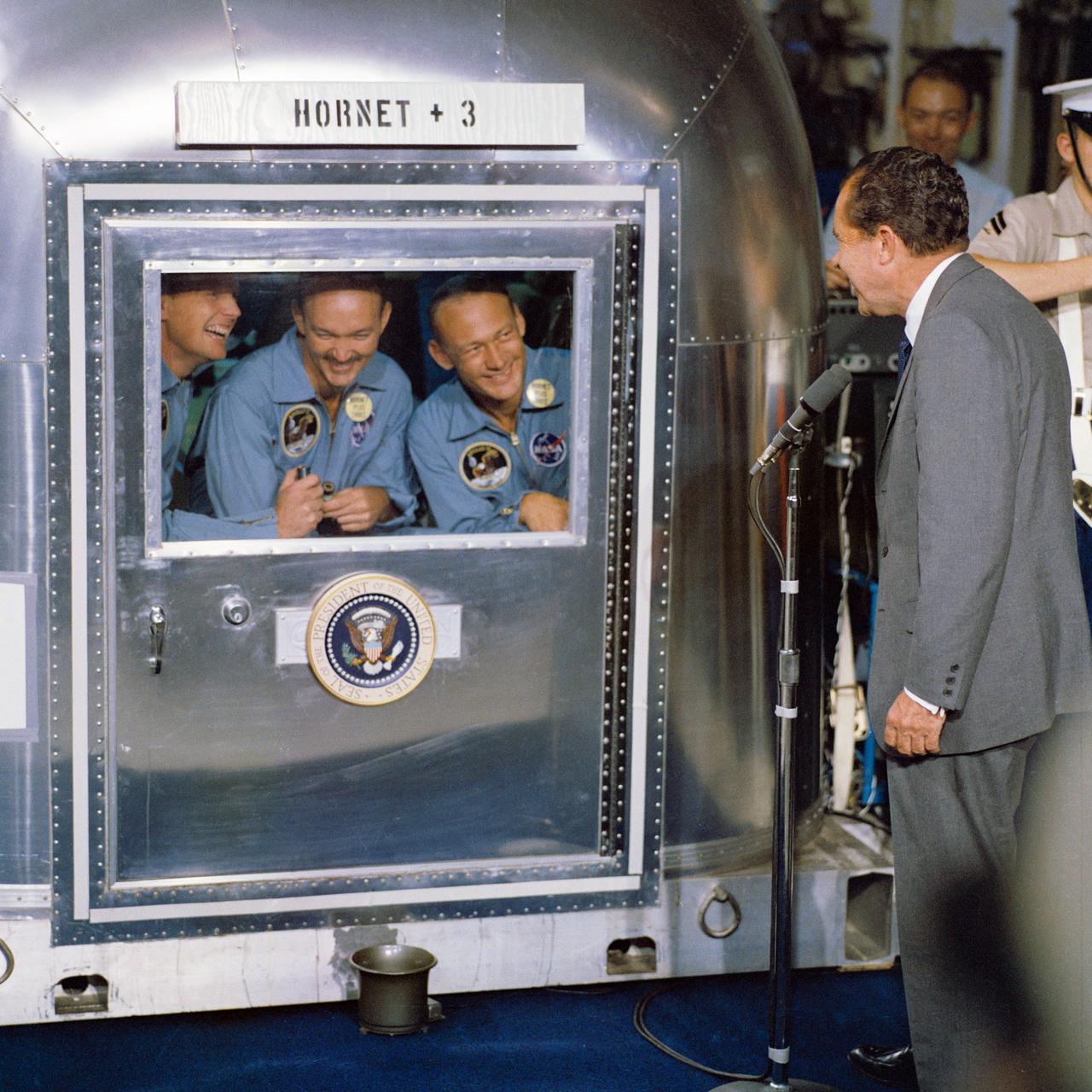
S69-21365 (24 July 1969) --- United States President Richard M. Nixon was in the central Pacific recovery area to welcome the Apollo 11 astronauts aboard the USS Hornet, prime recovery ship for the historic Apollo 11 lunar landing mission. Already confined to the Mobile Quarantine Facility (MQF) are (left to right) Neil A. Armstrong, commander; Michael Collins, command module pilot; and Edwin E. Aldrin Jr., lunar module pilot. Apollo 11 splashed down at 11:49 a.m. (CDT), July 24, 1969, about 812 nautical miles southwest of Hawaii and only 12 nautical miles from the USS Hornet. The three crewmen will remain in the MQF until they arrive at the Manned Spacecraft Center's (MSC) Lunar Receiving Laboratory (LRL). While astronauts Armstrong and Aldrin descended in the Lunar Module (LM) "Eagle" to explore the Sea of Tranquility region of the moon, astronaut Collins remained with the Command and Service Modules (CSM) "Columbia" in lunar orbit. Photo credit: NASA

S69-40307 (30 July 1969) --- The crewmen of the historic Apollo 11 lunar landing mission stand in the serving line as they prepare to dine in the Crew Reception Area of the Lunar Receiving Laboratory, Building 37, Manned Spacecraft Center. Left to right, are astronauts Edwin E. Aldrin Jr., Michael Collins, and Neil A. Armstrong. They are continuing their postflight debriefings. The three astronauts will be released from quarantine on Aug. 11, 1969.
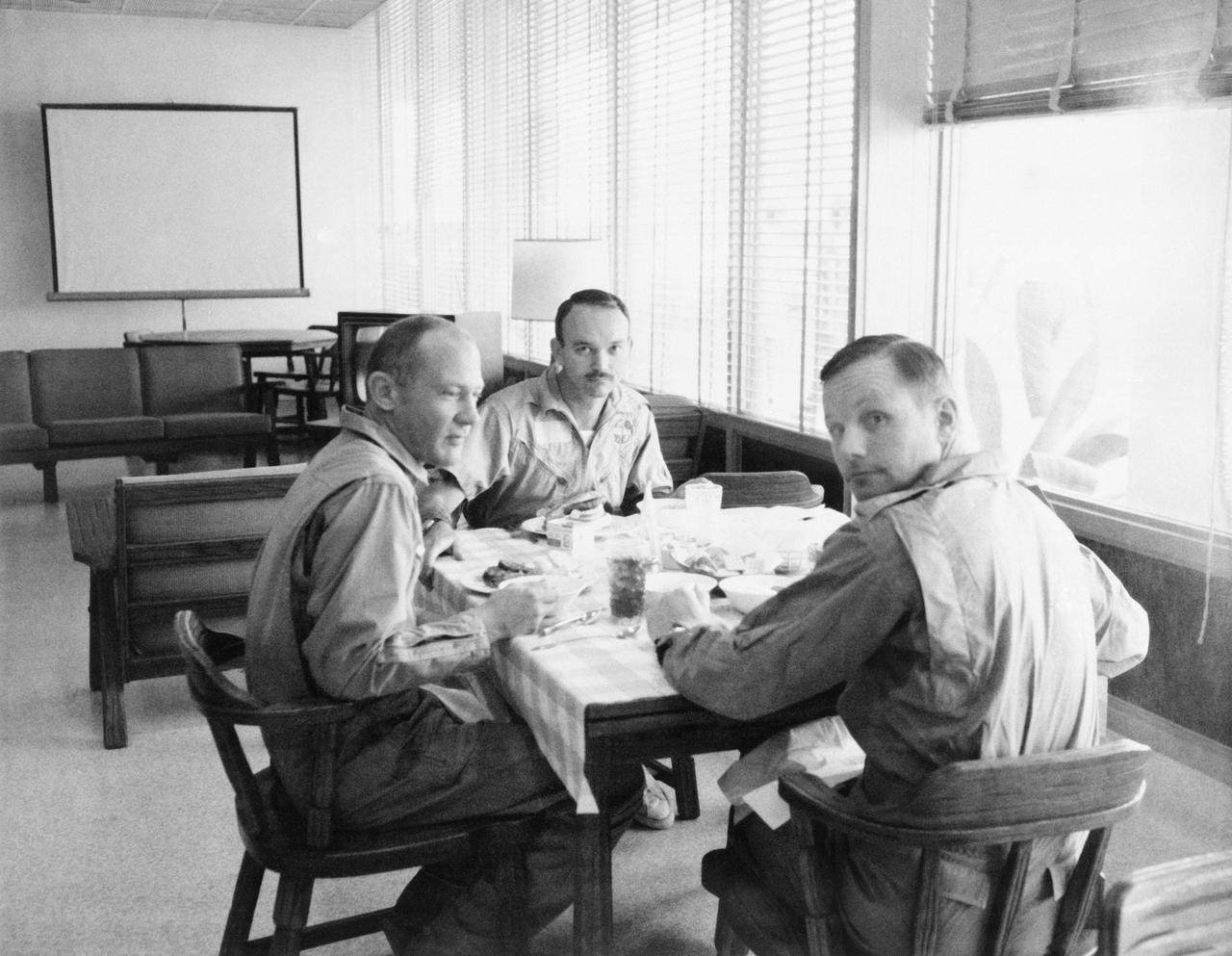
S69-40306 (30 July 1969) --- The crewmen of the historic Apollo 11 lunar landing mission are seen dining in the Crew Reception Area of the Lunar Receiving Laboratory, Building 37, Manned Spacecraft Center. Left to right, are astronauts Edwin E. Aldrin Jr., Michael Collins, and Neil A. Armstrong. They are continuing their postflight debriefings. The astronauts will be released from quarantine on Aug. 11, 1969.
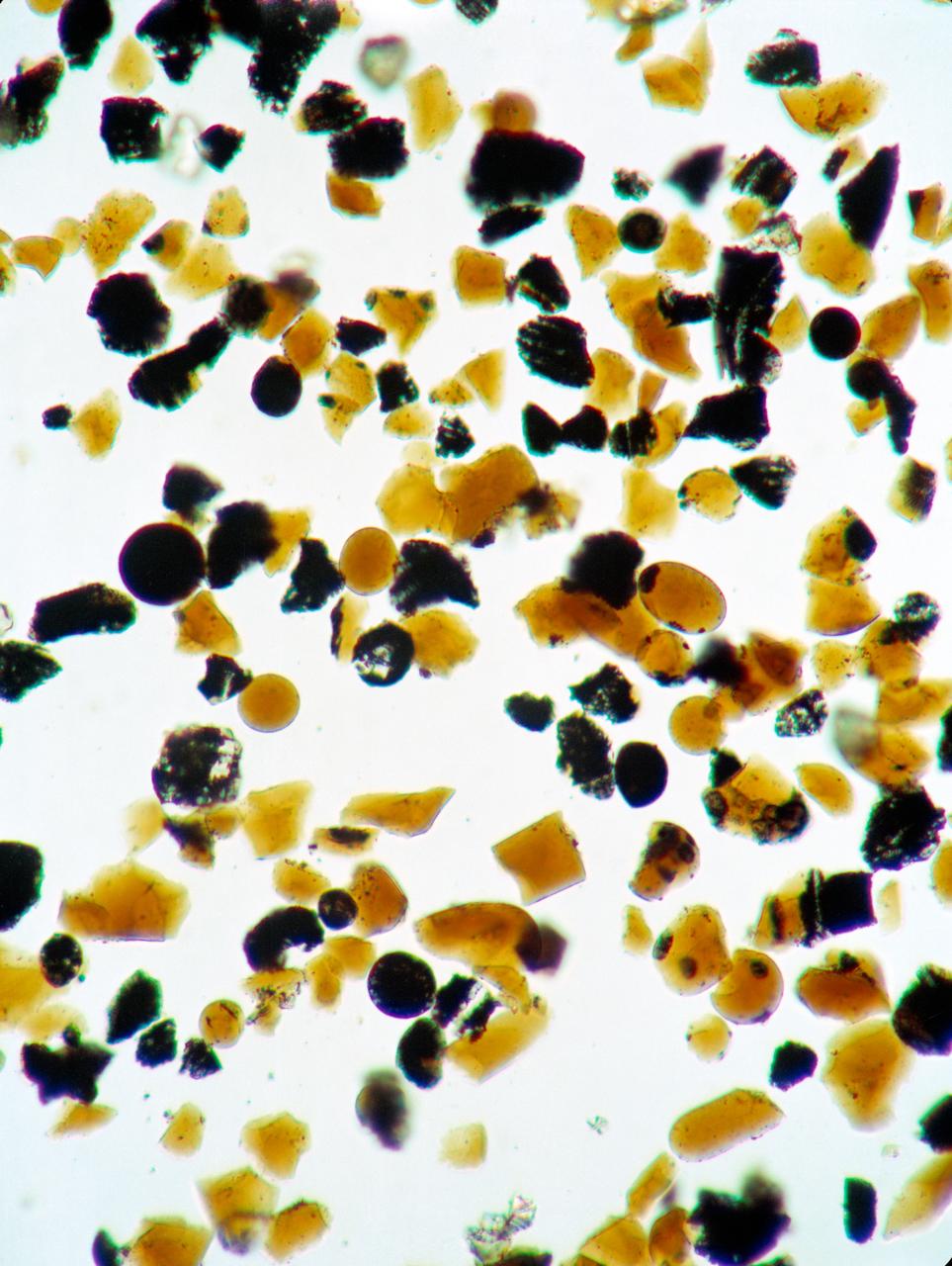
S73-15171 (4 Jan. 1973) --- These orange glass spheres and fragments are the finest particles ever brought back from the moon. Ranging in size from 20 to 45 microns (about 1/1000 of an inch) the particles are magnified 160 times in this photomicrograph made in the Lunar Receiving Laboratory at the Manned Spacecraft Center. The orange soil was brought back from the Taurus-Littrow landing site by the Apollo 17 crewmen. Scientist-astronaut Harrison H. "Jack" Schmitt discovered the orange soil at Shorty Crater during the second Apollo 17 extravehicular activity (EVA). This lunar material is being studied and analyzed by scientists in the LRL. The orange particles in this photomicrograph, which are intermixed with black and black-speckled grains, are about the same size as the particles that compose silt on Earth. Chemical analysis of the orange soil material has shown the sample to be similar to some of the samples brought back from the Apollo 11 (Sea of Tranquility) site several hundred miles to the southwest. Like those samples, it is rich in titanium (8%) and iron oxide (22%). But unlike the Apollo 11 samples, the orange soil is unexplainably rich in zinc ? an anomaly that has scientists in a quandary. This Apollo 17 sample is not high in volatile elements, nor do the minerals contain substantial amounts of water. These would have provided strong evidence of volcanic activity. On the other hand, the lack of agglutinates (rocks made up of a variety of minerals cemented together) indicates that the orange glass is probably not the product of meteorite impact -- strengthening the argument that the glass was produced by volcanic activity.