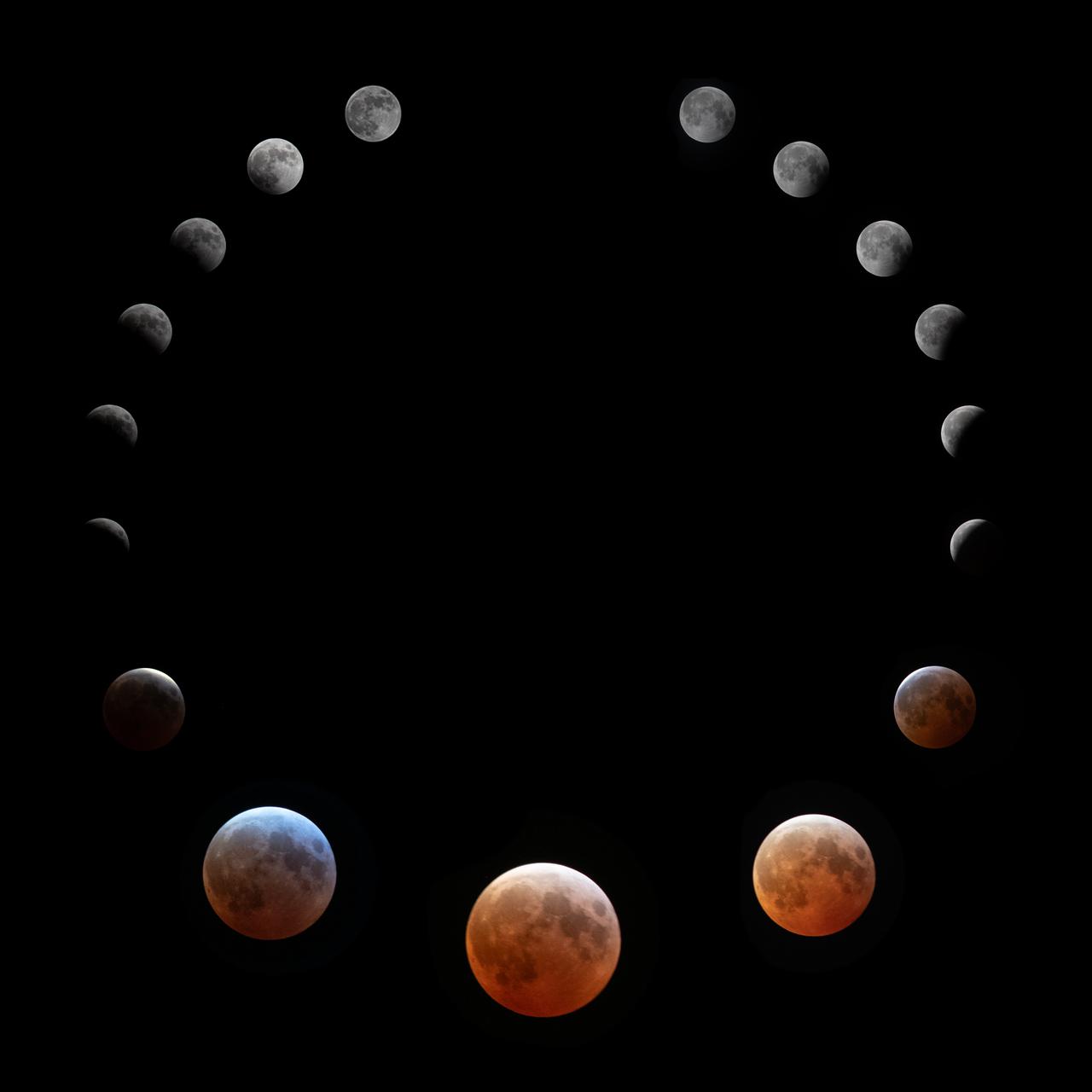
A composite photo made from 17 images of the lunar eclipse. These photographs were taken at NASA’s Glenn Research Center at Neil Armstrong Test Facility in Sandusky, Ohio, during the early hours of March 14, 2025. Photo Credit: (NASA/Sara Lowthian-Hanna)
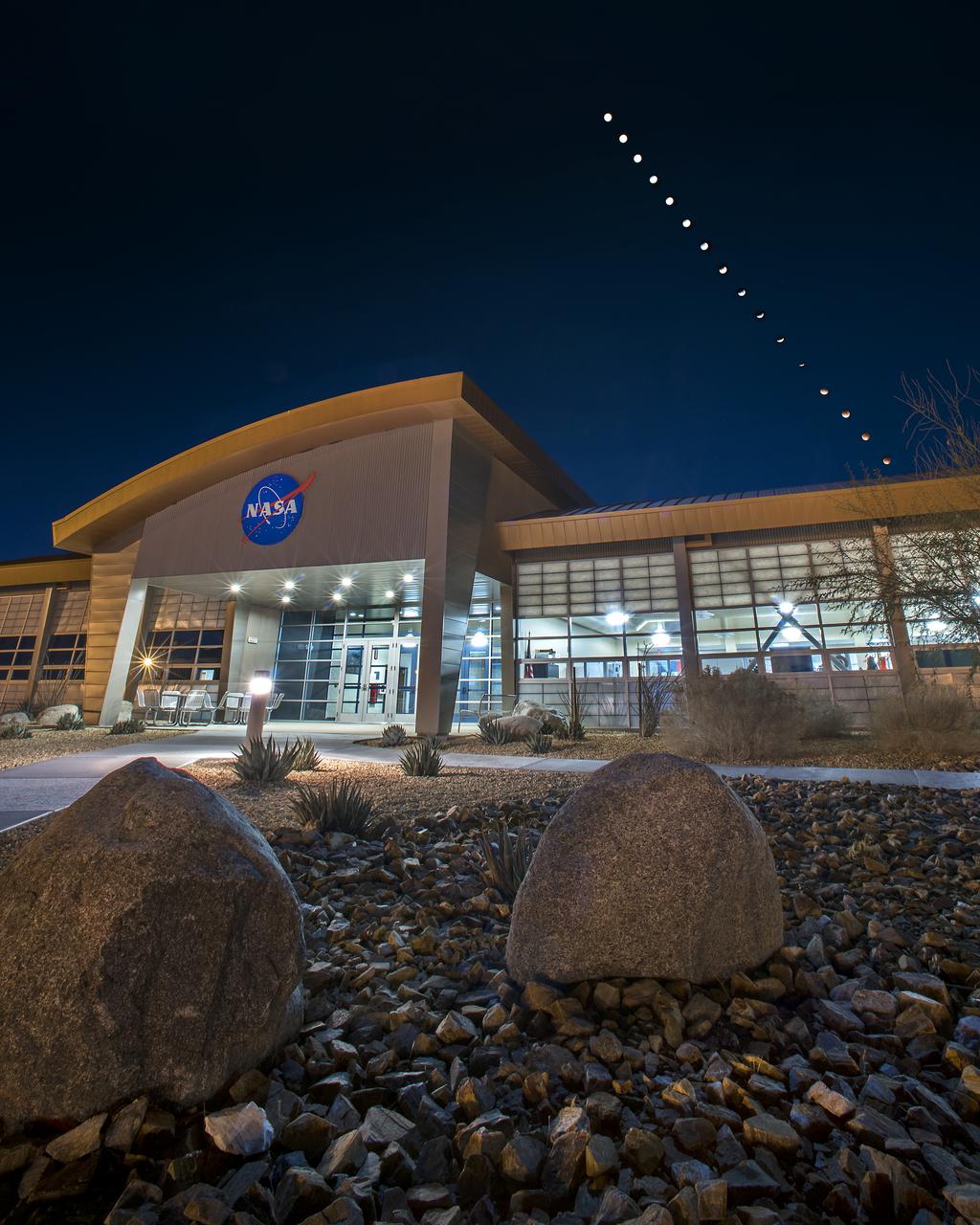
California’s NASA Armstrong Flight Research Center photographer Ken Ulbrich takes photos of Super Blue Blood Moon eclipse making a time-lapse composition of the event on January 31. The total lunar eclipse provided a rare opportunity to capture a supermoon, a blue moon and a lunar eclipse at the same time. A supermoon occurs when the Moon is closer to Earth in its orbit and appearing 14 percent brighter than usual. As the second full moon of the month, this moon is also commonly known as a blue moon, though it will not be blue in appearance. The super blue moon passed through Earth’s shadow and took on a reddish tint, known as a blood moon. This total lunar eclipse occurs when the Sun, Earth, and a full moon form a near-perfect lineup in space. The Moon passes directly behind the Earth into its umbra (shadow).
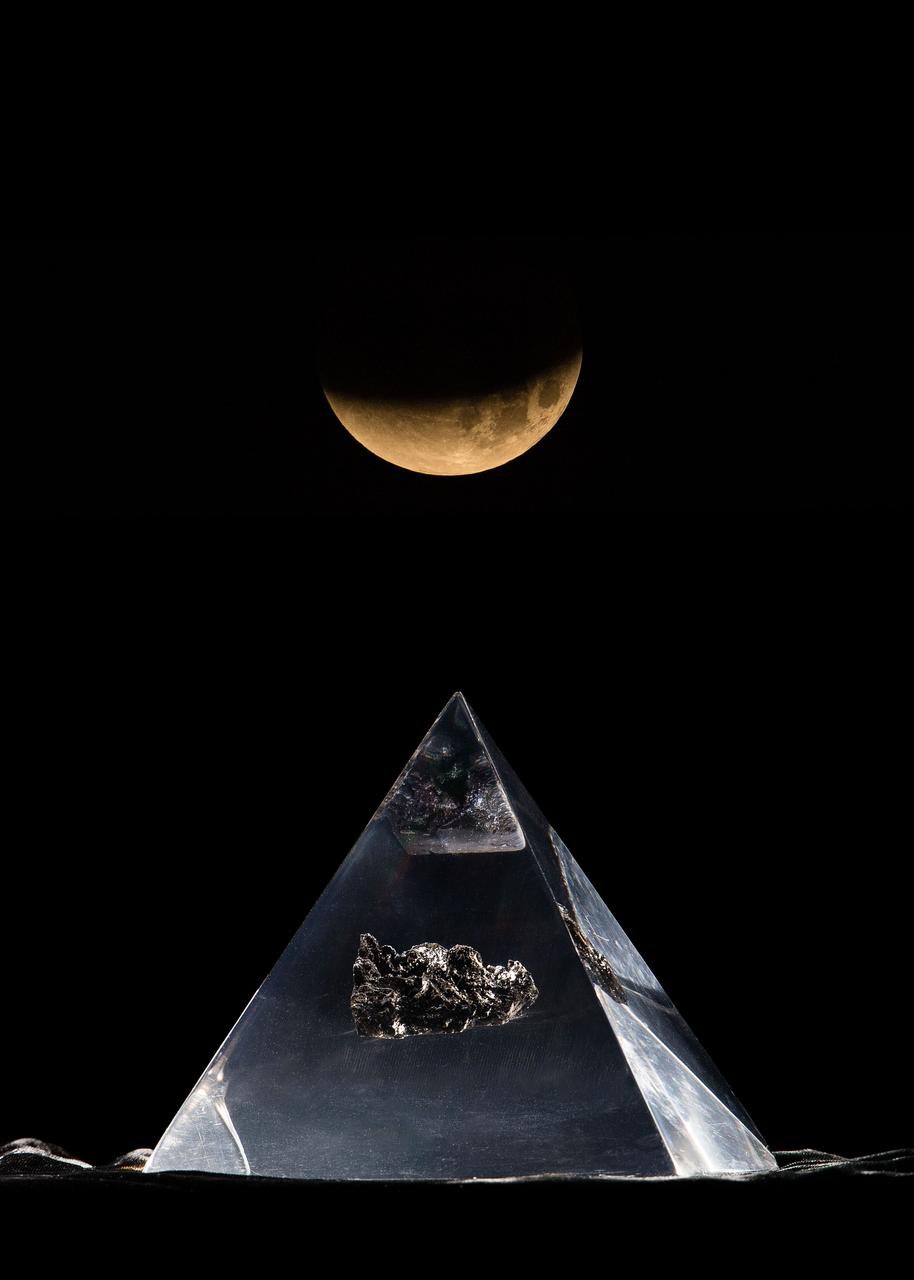
jsc2018e003239_alt (Jan. 31, 2018) --- Composite image of an Apollo lunar sample in front of the lunar eclipse "Blood Moon". Credit: NASA/Josh Valcarcel
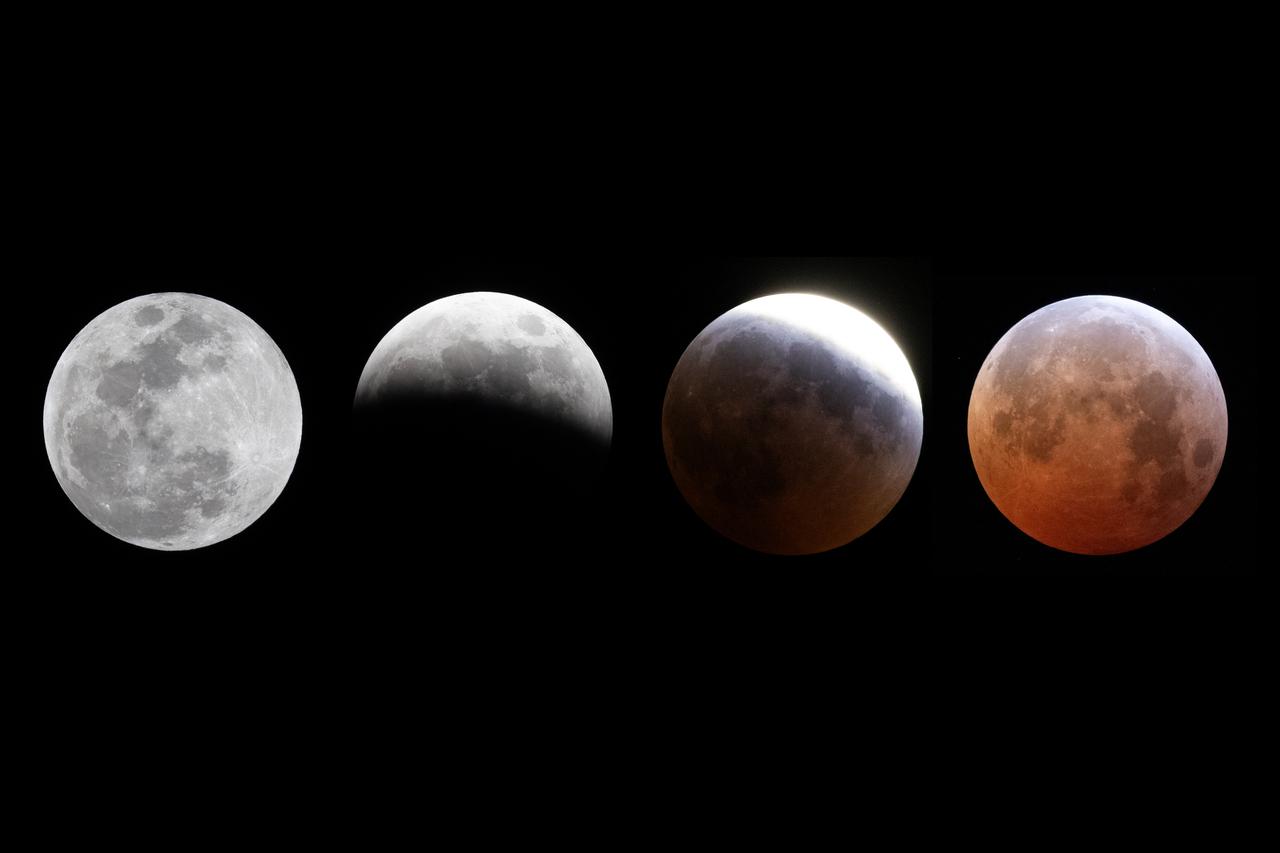
The blood moon lunar eclipse over New Orleans, home to NASA’s Michoud Assembly Facility, is shown from full moon to totality as it moves into the Earth’s umbral shadow in a composite of four images shot early Friday morning, March 14, 2025. Image credit: NASA/Michael DeMocker
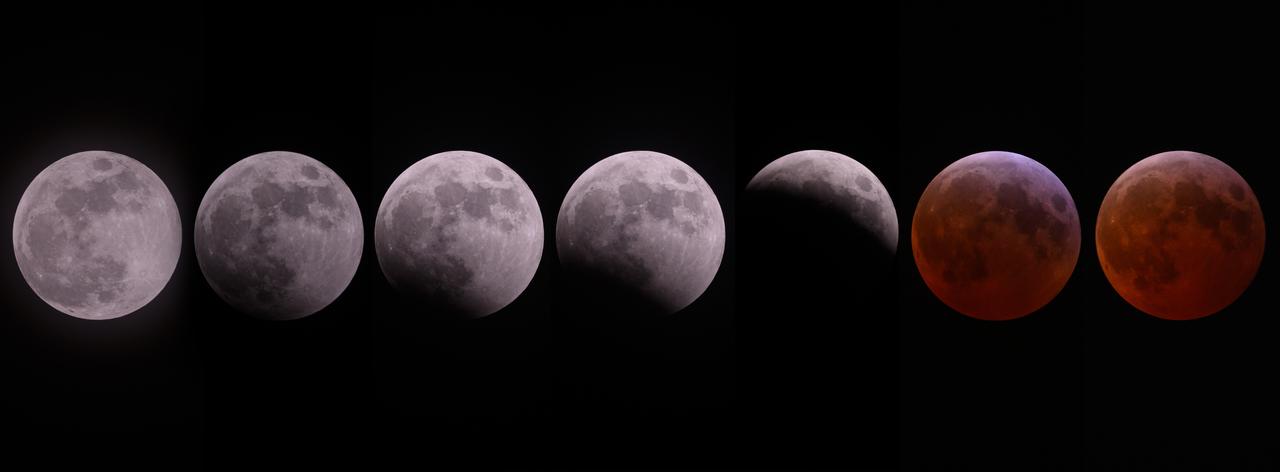
The blood Moon lunar eclipse over NASA’s Michoud Assembly Facility in New Orleans is shown from the initial partial eclipse to totality in a composite of 7 images shot on Friday, March 14, 2025. Image credit: NASA/Eric Bordelon

This composite made from ten images shows the progression of the Moon during a total lunar eclipse above the Vehicle Assembly Building, Nov. 8, 2022, at NASA’s Kennedy Space Center in Florida. Visible trailing the Moon in this composite is Mars. Photo Credit: (NASA/Joel Kowsky)

S69-19794 (February 1969) --- Composite of two artist's concepts illustrating key events, tasks and activities on the third day of the Apollo 9 mission, including crew transfer and Lunar Module system evaluation. The Apollo 9 mission will evaluate spacecraft lunar module systems performance during manned Earth-orbital flight.
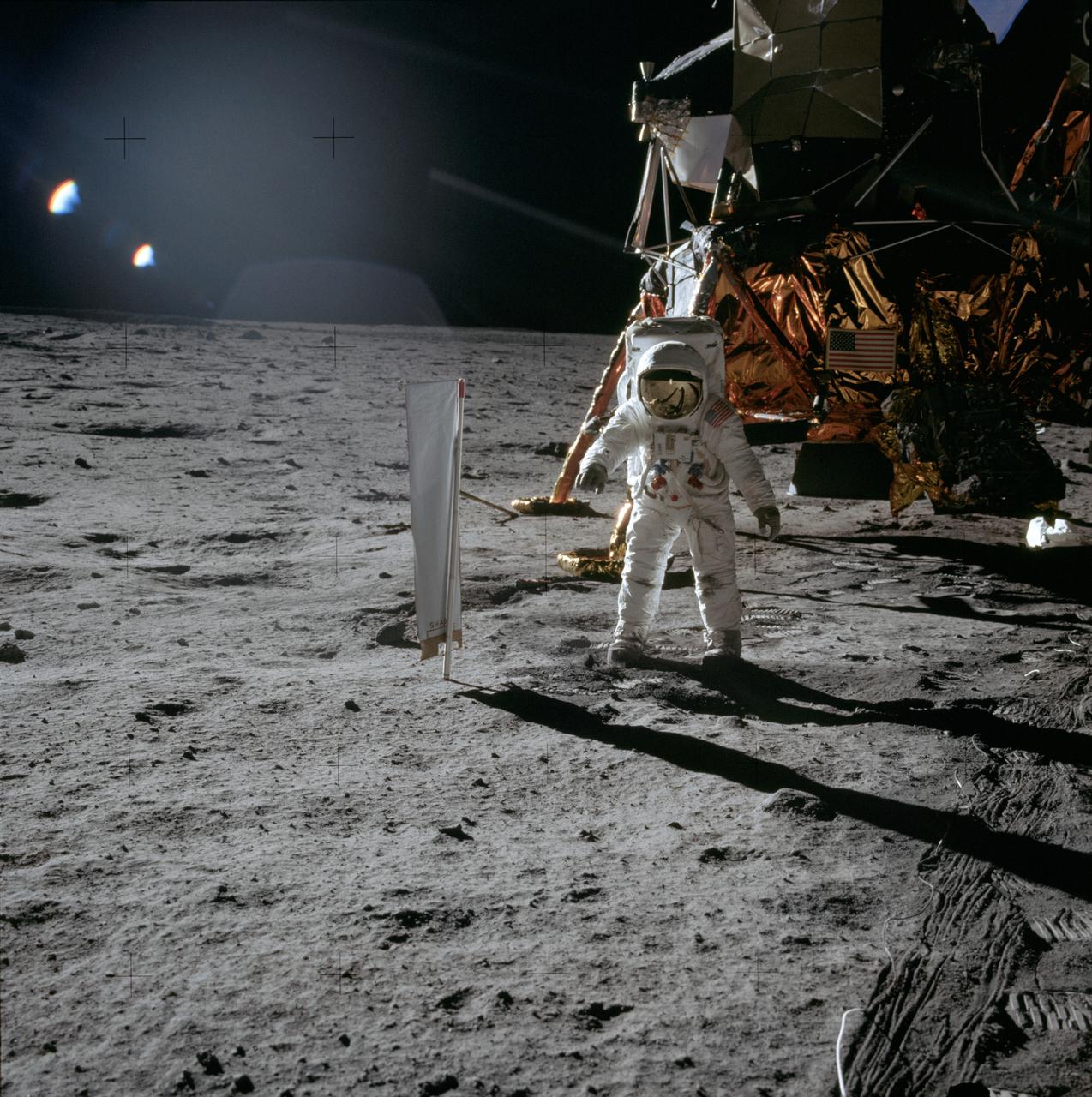
AS11-40-5873 (20 July 1969) --- Astronaut Edwin E. Aldrin Jr., lunar module pilot, is photographed during the Apollo 11 extravehicular activity (EVA) on the lunar surface. In the right background is the lunar module. On Aldrin's right is the Solar Wind Composition (SWC) experiment, already deployed. This photograph was taken by astronaut Neil A. Armstrong, commander, with a 70mm lunar surface camera.

Workers erect the first stage of a Lockheed Martin Launch Vehicle-2 (LMLV-2) at Launch Complex 46 at Cape Canaveral Air Station, Fla. The Lunar Prospector spacecraft is scheduled to launch aboard the LMLV-2 in October for an 18-month mission that will orbit the Earth’s Moon to collect data from the lunar surface. Designed for a low polar orbit investigation of the Moon, the Lunar Prospector will map the Moon’s surface composition and possible polar ice deposits, measure magnetic and gravity fields, and study lunar outgassing events
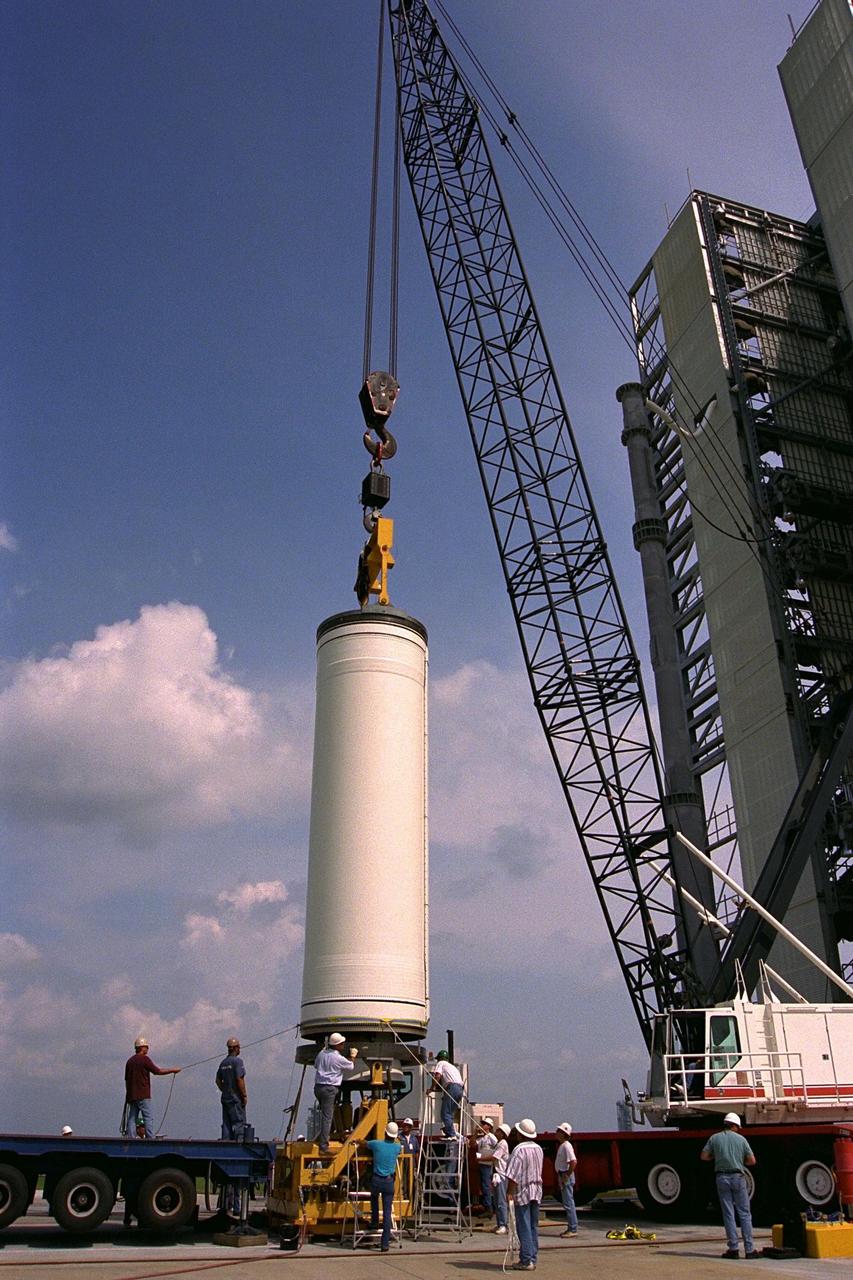
Workers erect the first stage of a Lockheed Martin Launch Vehicle-2 (LMLV-2) at Launch Complex 46 at Cape Canaveral Air Station, Fla. The Lunar Prospector spacecraft is scheduled to launch aboard the LMLV-2 in October for an 18-month mission that will orbit the Earth’s Moon to collect data from the lunar surface. Designed for a low polar orbit investigation of the Moon, the Lunar Prospector will map the Moon’s surface composition and possible polar ice deposits, measure magnetic and gravity fields, and study lunar outgassing events

jsc2018e003235 (Jan. 31, 2018) --- Composite photograph created from 13 images of the lunar eclipse through its phases as viewed from the 9th floor of NASA Johnson Space Center’s Building 1.

This composite photo made up of 11 images of shows the Blood Moon and the phases of the Lunar Eclipse on March 14th, 2025 seen from Brookpark, OH at NASA Glenn Research Center.. Photo Credit: (NASA/Jordan Cochran)
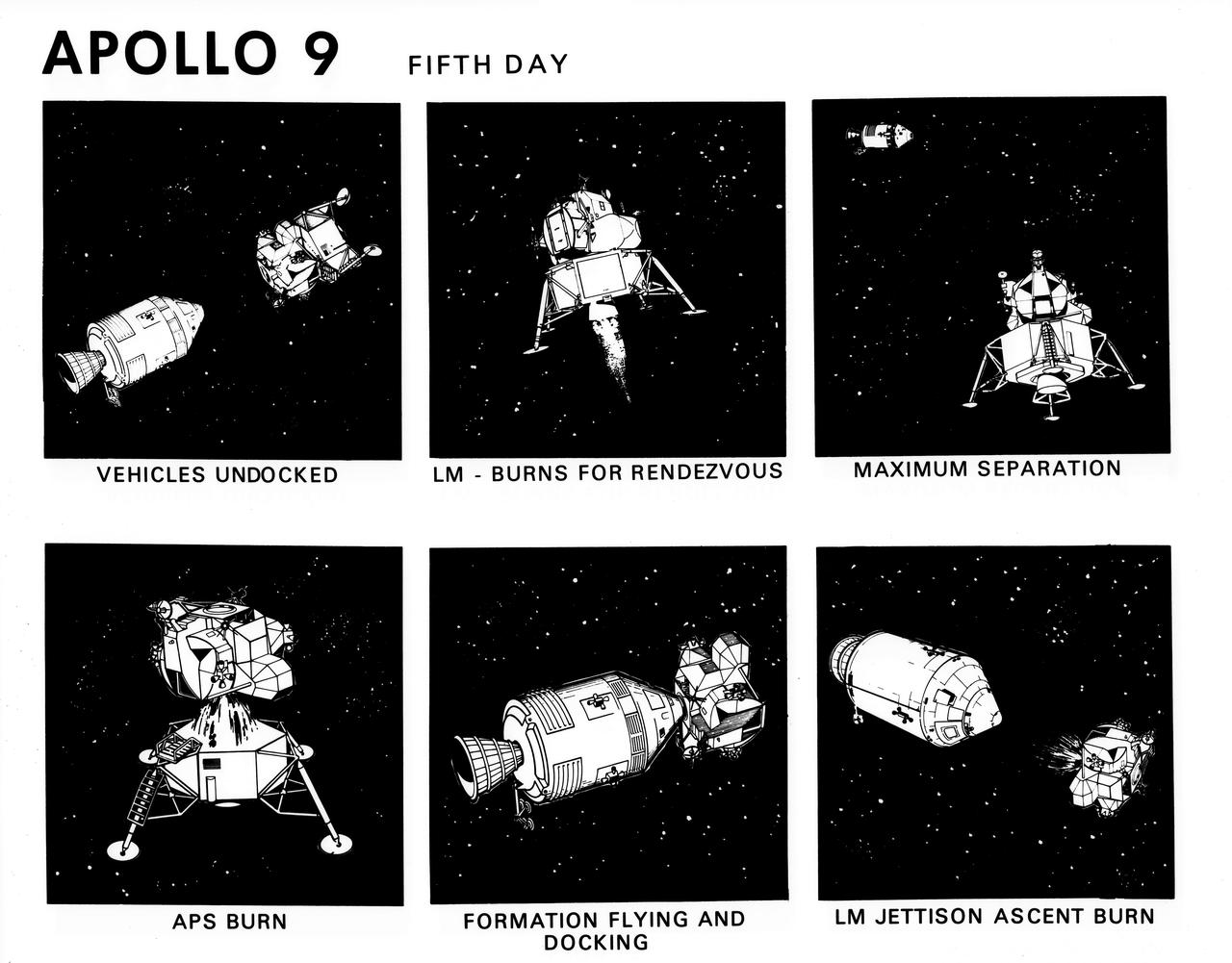
S69-19796 (February 1969) --- Composite of six artist's concepts illustrating key events, tasks and activities on the fifth day of the Apollo 9 mission, including vehicles undocked, Lunar Module burns for rendezvous, maximum separation, ascent propulsion system burn, formation flying and docking, and Lunar Module jettison ascent burn. The Apollo 9 mission will evaluate spacecraft lunar module systems performance during manned Earth-orbital flight.
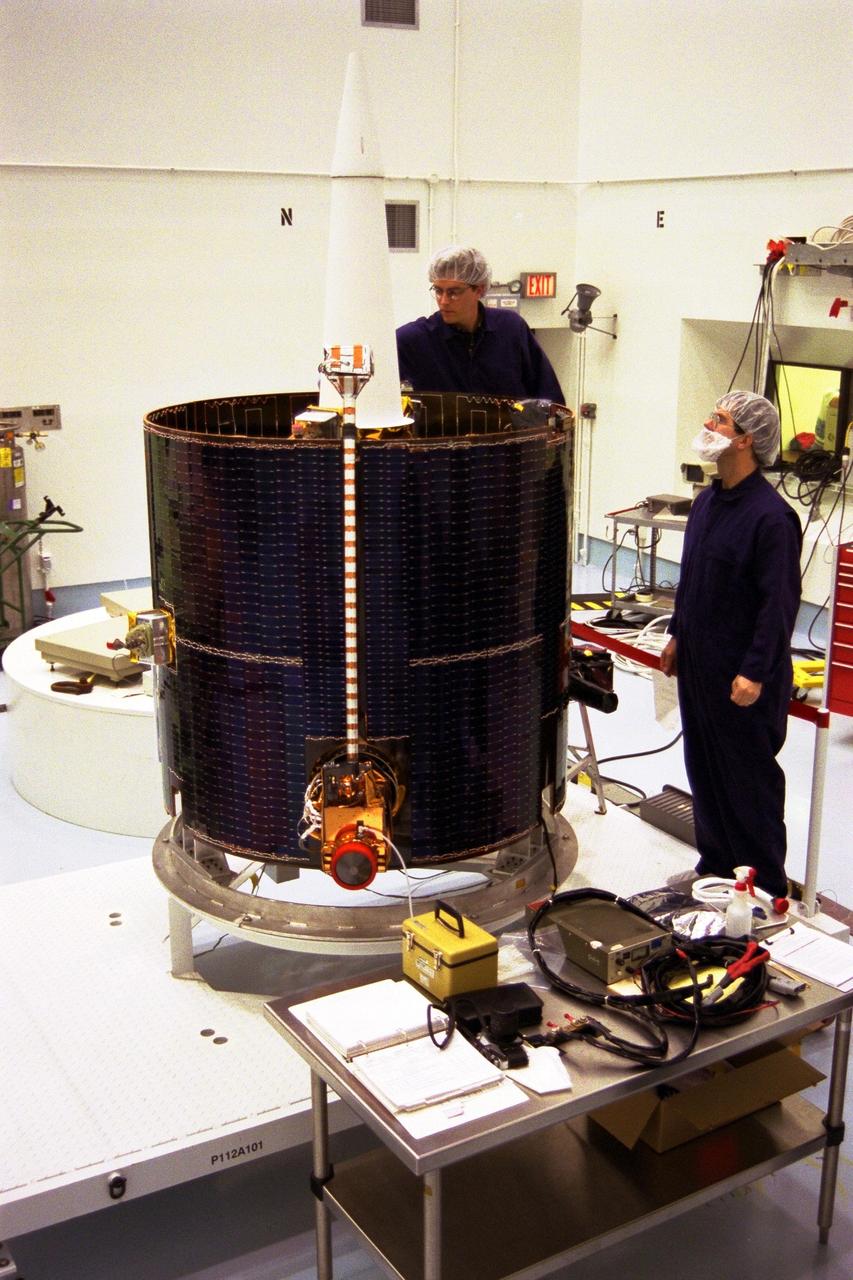
Lockheed Martin Missile Systems technicians prepare NASA’s Lunar Prospector spacecraft for mating to the Trans Lunar Injection Module of the spacecraft at Astrotech, a commercial payload processing facility, in Titusville, Fla. The small robotic spacecraft, to be launched for NASA on an Athena II launch vehicle by Lockheed Martin, is designed to provide the first global maps of the Moon’s surface compositional elements and its gravitational and magnetic fields. The launch of Lunar Prospector is scheduled for Jan. 5, 1998 at 8:31 p.m
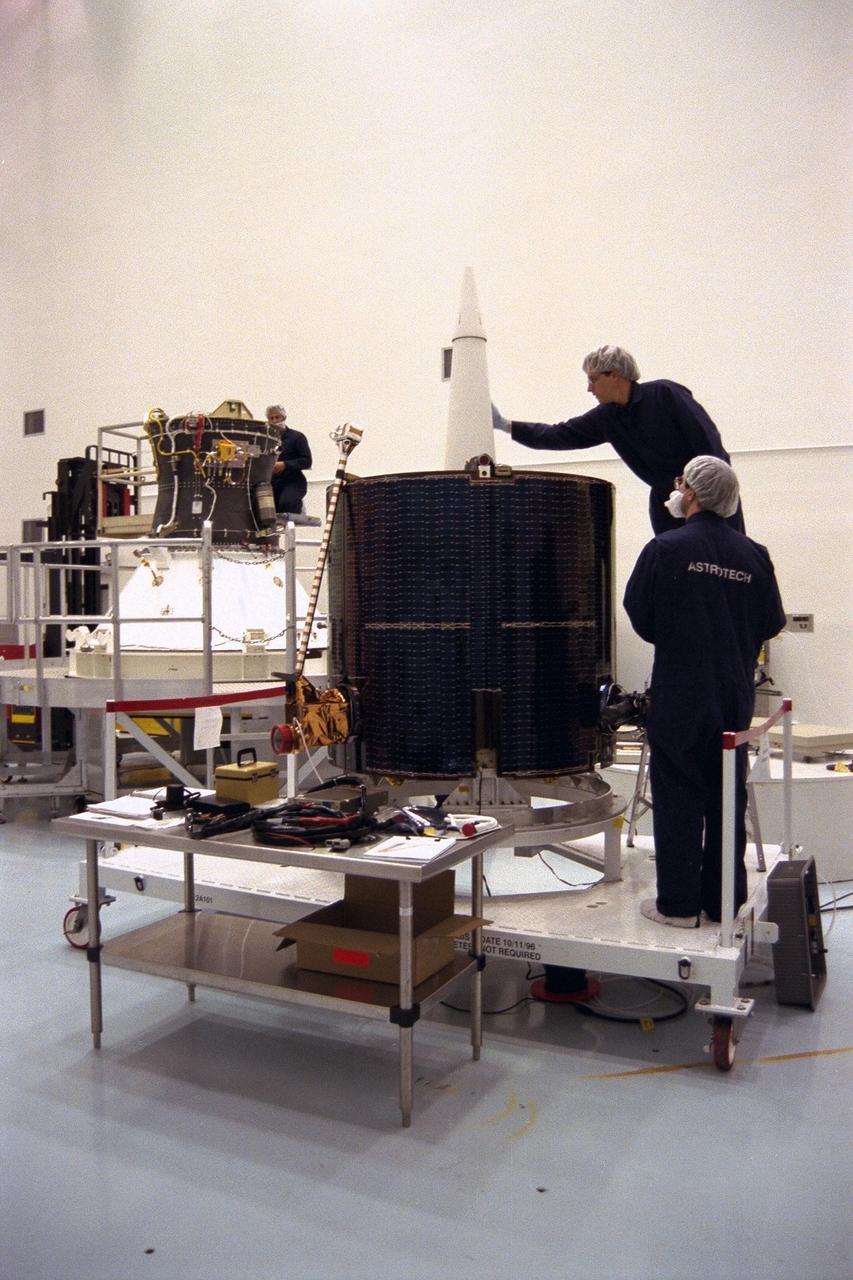
NASA’s Lunar Prospector is prepared for mating to the Trans Lunar Injection Module of the spacecraft, seen in the background, at Astrotech, a commercial payload processing facility, in Titusville, Fla. The small robotic spacecraft, to be launched for NASA on an Athena II launch vehicle by Lockheed Martin, is designed to provide the first global maps of the Moon’s surface compositional elements and its gravitational and magnetic fields. The launch of Lunar Prospector is scheduled for Jan. 5, 1998 at 8:31 p.m
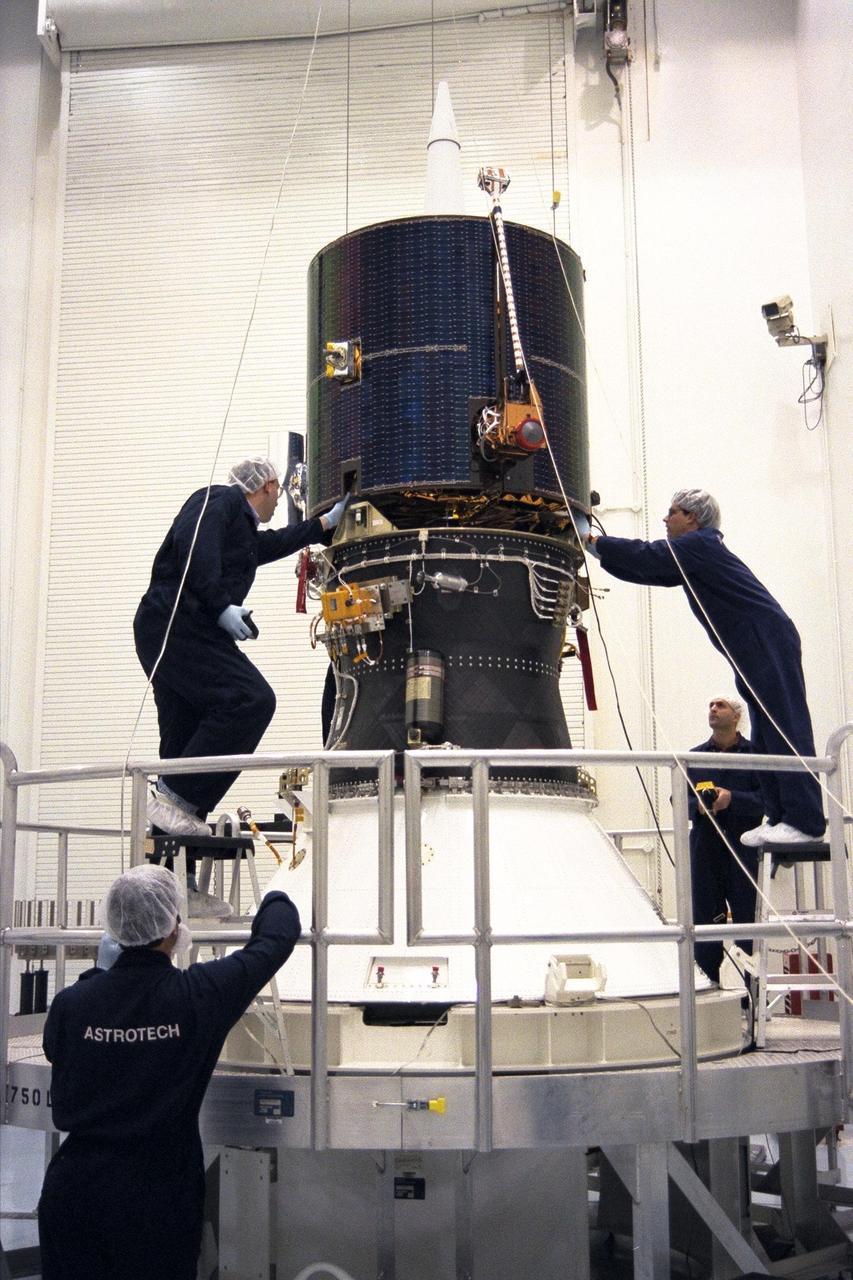
Lockheed Martin Missile Systems integration and test staff join NASA’s Lunar Prospector spacecraft to the Trans Lunar Injection Module of the spacecraft at Astrotech, a commercial payload processing facility, in Titusville, Fla. The small robotic spacecraft, to be launched on an Athena II launch vehicle by Lockheed Martin, is designed to provide the first global maps of the Moon’s surface compositional elements and its gravitational and magnetic fields. The launch of Lunar Prospector is scheduled for Jan. 5, 1998 at 8:31 p.m
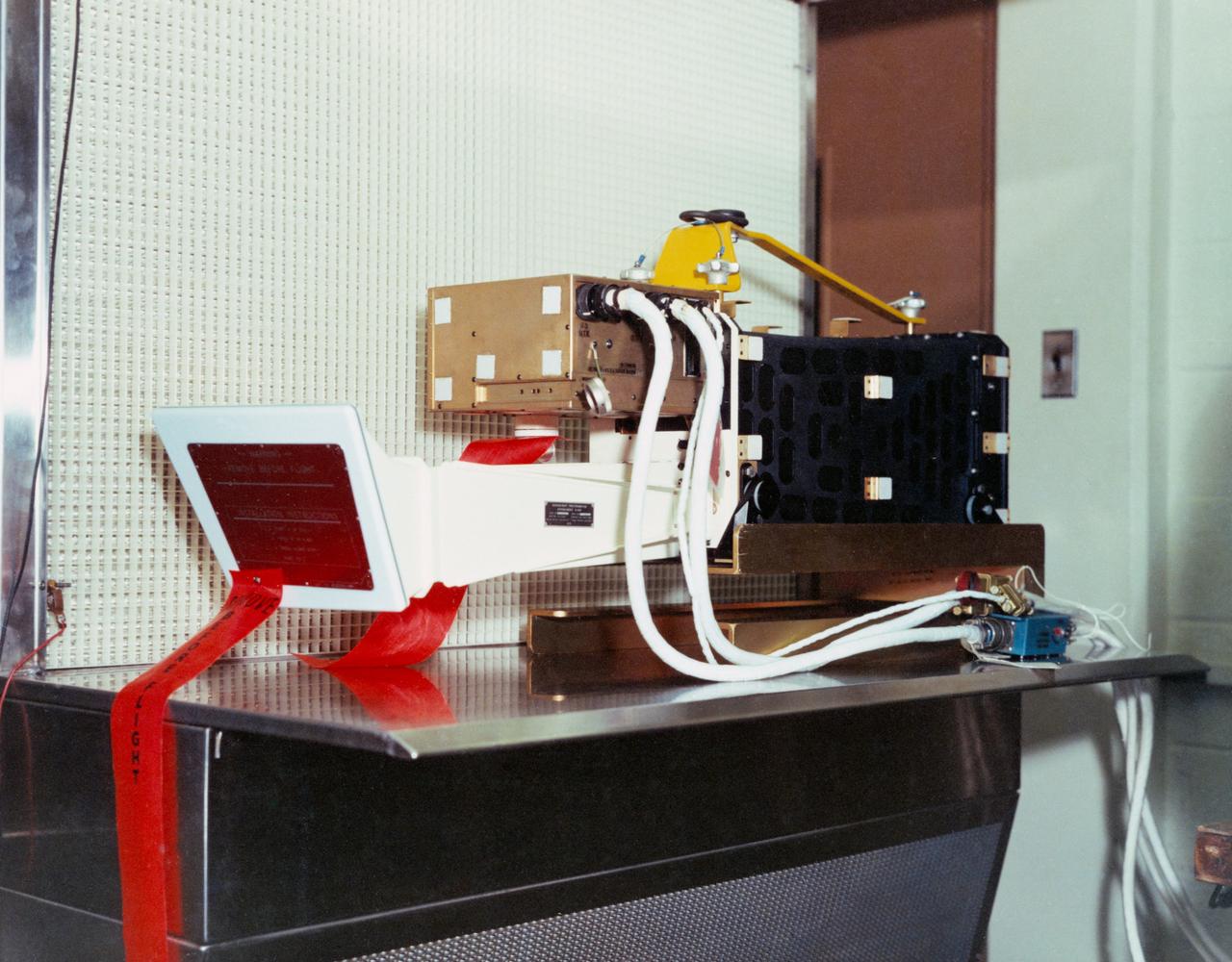
S72-53470 (November 1972) --- The Far-Ultraviolet Spectrometer, Experiment S-169, one of the lunar orbital science experiments which will be mounted in the SIM bay of the Apollo 17 Service Module. Controls for activating and deactivating the experiment and for opening and closing a protective cover are located in the Command Module. Atomic composition, density and scale height for several constituents of the lunar atmosphere will be measured by the far-ultraviolet spectrometer. Solar far-UV radiation reflected from the lunar surface as well as UV radiation emitted by galactic sources also will be detected by the instrument.

S70-27034 (4 Feb. 1970) --- Astronaut Fred W. Haise Jr., lunar module pilot of the Apollo 13 lunar landing mission, simulates lunar surface extravehicular activity (EVA) during training exercises in the Kennedy Space Center's (KSC) Flight Crew Training Building (FCTB). Haise, wearing an Extravehicular Mobility Unit (EMU), is holding a Solar Wind Composition (SWC) experiment.
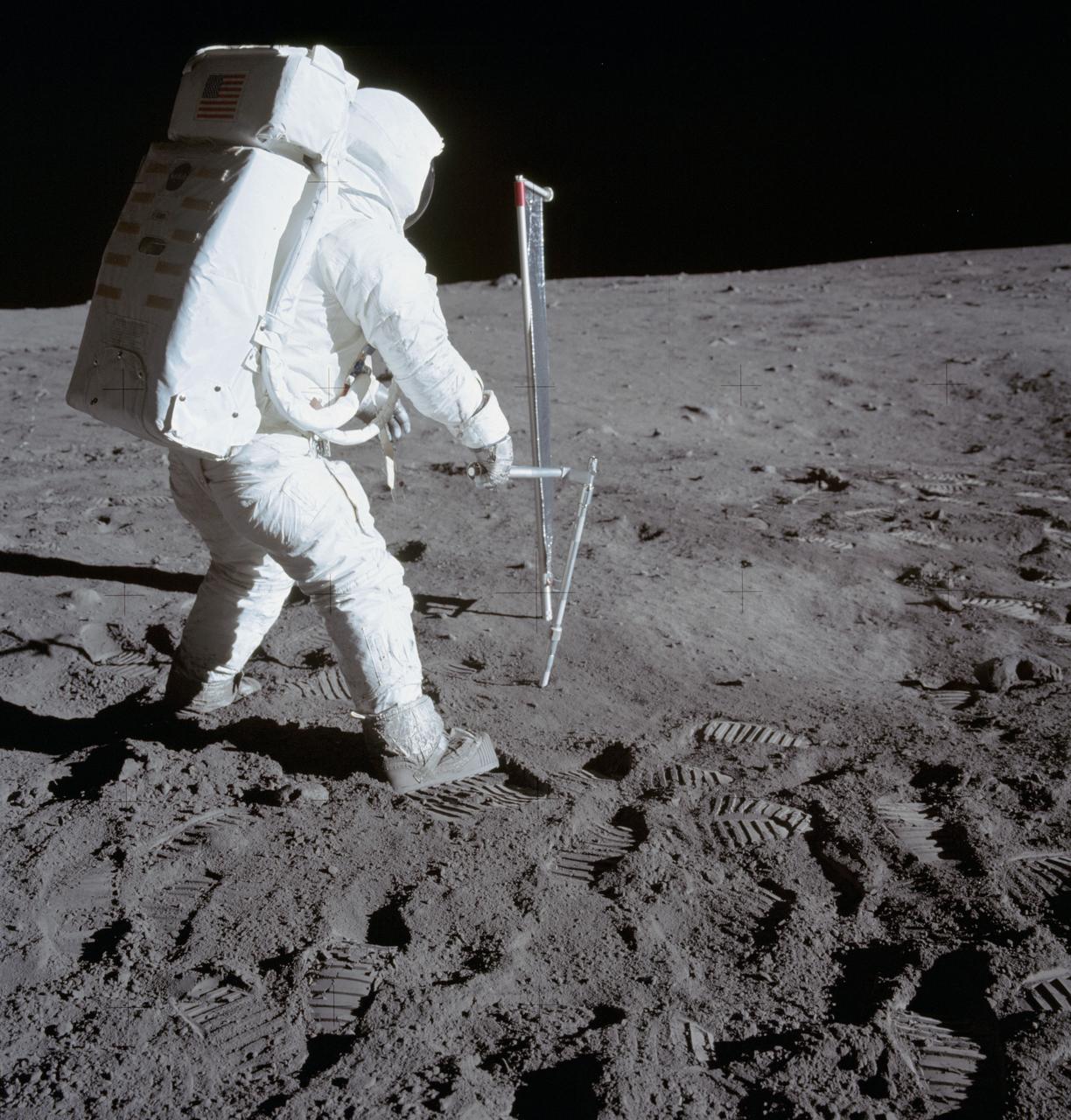
AS11-40-5964 (20 July 1969) --- Astronaut Edwin E. Aldrin Jr., lunar module pilot, is photographed during the Apollo 11 extravehicular activity (EVA) on the moon. He is driving one of two core tubes into the lunar soil. Astronaut Neil A. Armstrong, commander, took this picture with a 70mm lunar surface camera. Aldrin stands near the Solar Wind Composition (SWC) experiment, a component of the Early Apollo Scientific Experiments Package (EASEP, deployed earlier). The SWC is in the center background.
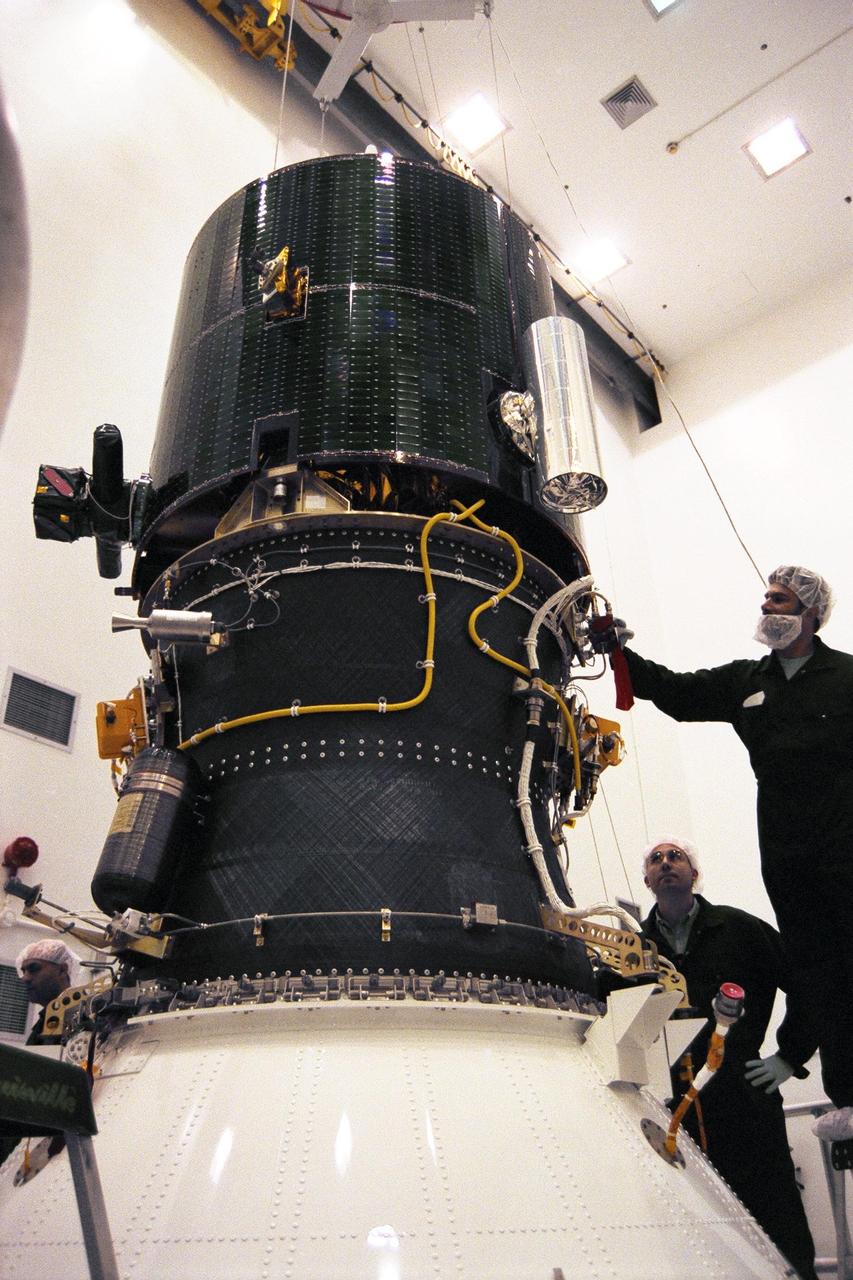
Lockheed Martin Missile Systems integration and test staff join NASA’s Lunar Prospector spacecraft atop the Trans Lunar Injection Module of the spacecraft at Astrotech, a commercial payload processing facility, in Titusville, Fla. The small robotic spacecraft, to be launched on an Athena II launch vehicle by Lockheed Martin, is designed to provide the first global maps of the Moon’s surface compositional elements and its gravitational and magnetic fields. The launch of Lunar Prospector is scheduled for Jan. 5, 1998 at 8:31 p.m
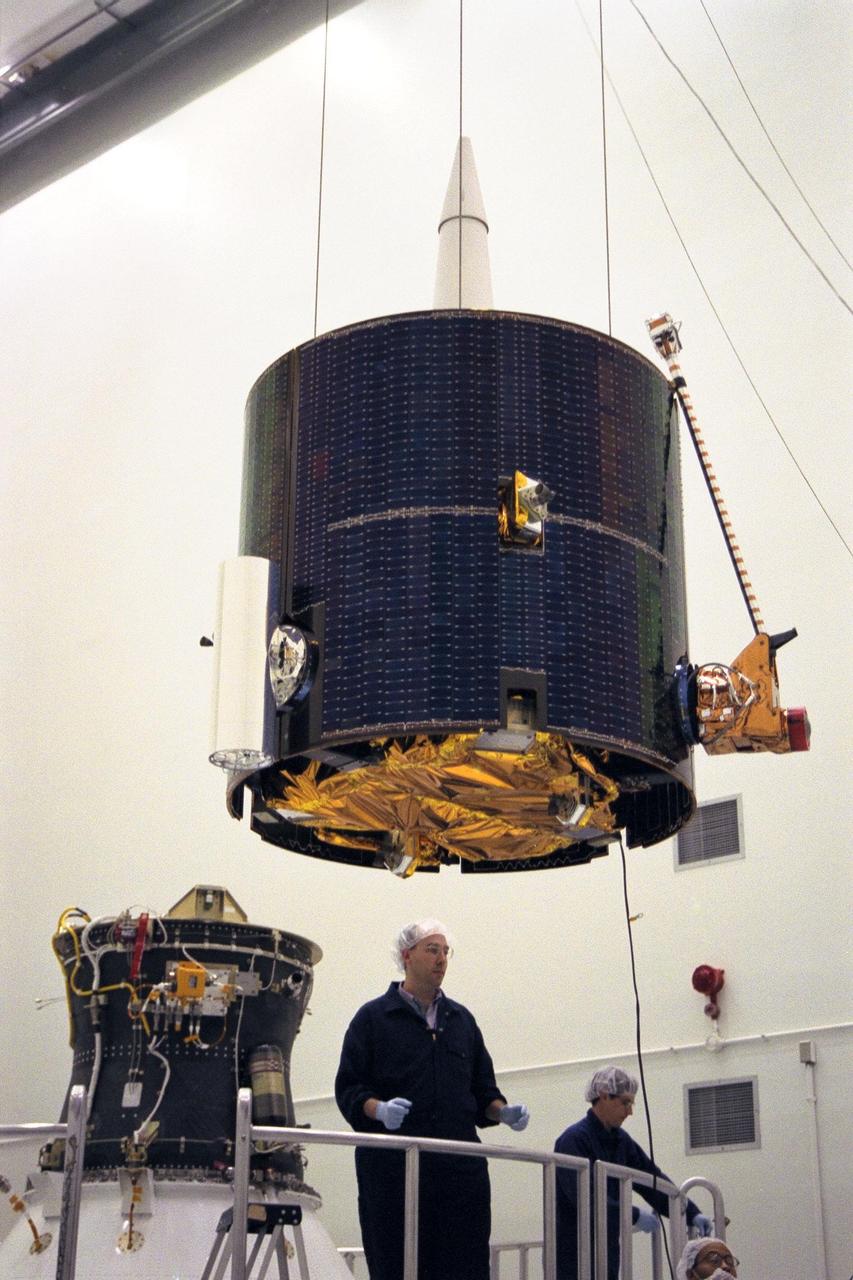
Lockheed Martin Missile Systems integration and test staff prepare NASA’s Lunar Prospector spacecraft for mating to the Trans Lunar Injection Module of the spacecraft at Astrotech, a commercial payload processing facility, in Titusville, Fla. The small robotic spacecraft, to be launched for NASA on an Athena II launch vehicle by Lockheed Martin, is designed to provide the first global maps of the Moon’s surface compositional elements and its gravitational and magnetic fields. The launch of Lunar Prospector is scheduled for Jan. 5, 1998 at 8:31 p.m
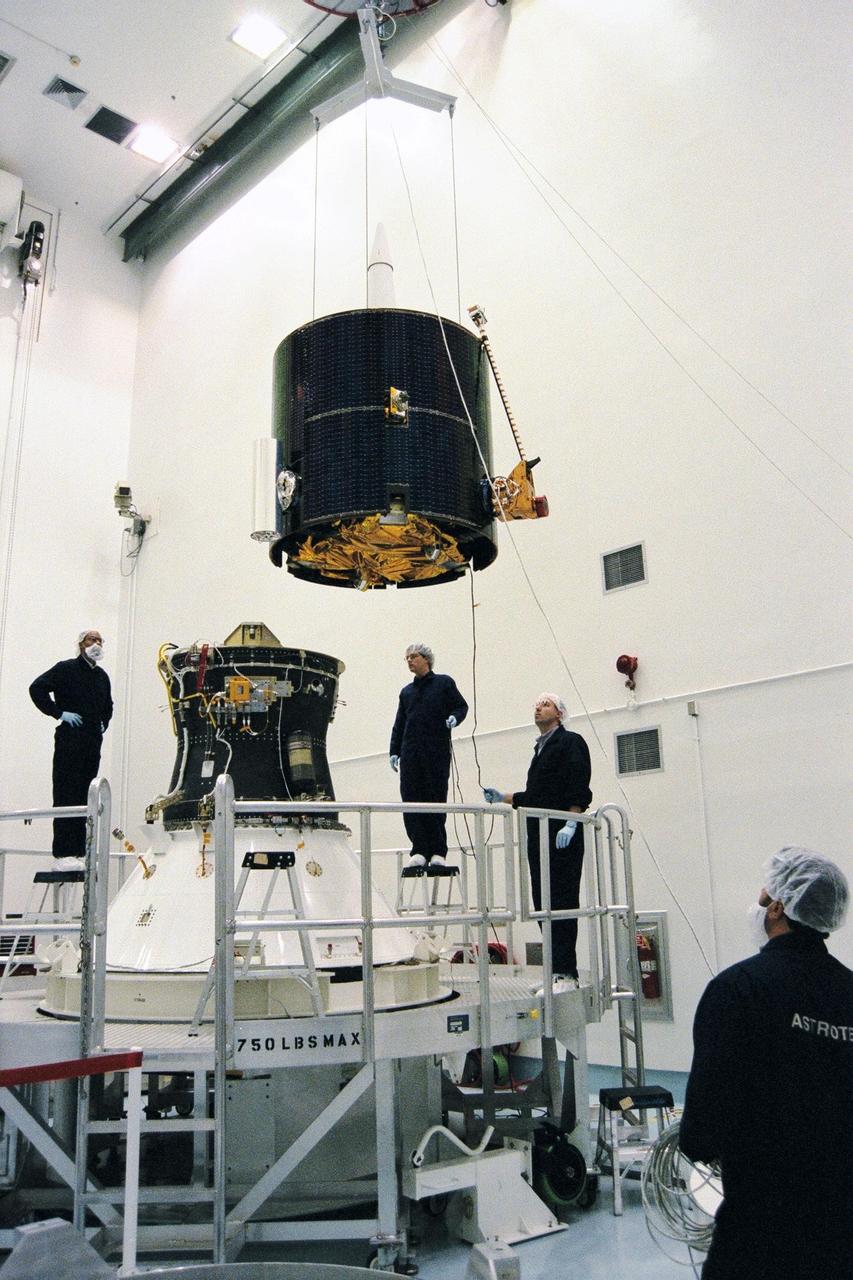
Lockheed Martin Missile Systems integration and test staff move NASA’s Lunar Prospector spacecraft over the Trans Lunar Injection Module of the spacecraft at Astrotech, a commercial payload processing facility, in Titusville, Fla. The small robotic spacecraft, to be launched on an Athena II launch vehicle by Lockheed Martin, is designed to provide the first global maps of the Moon’s surface compositional elements and its gravitational and magnetic fields. The launch of Lunar Prospector is scheduled for Jan. 5, 1998 at 8:31 p.m
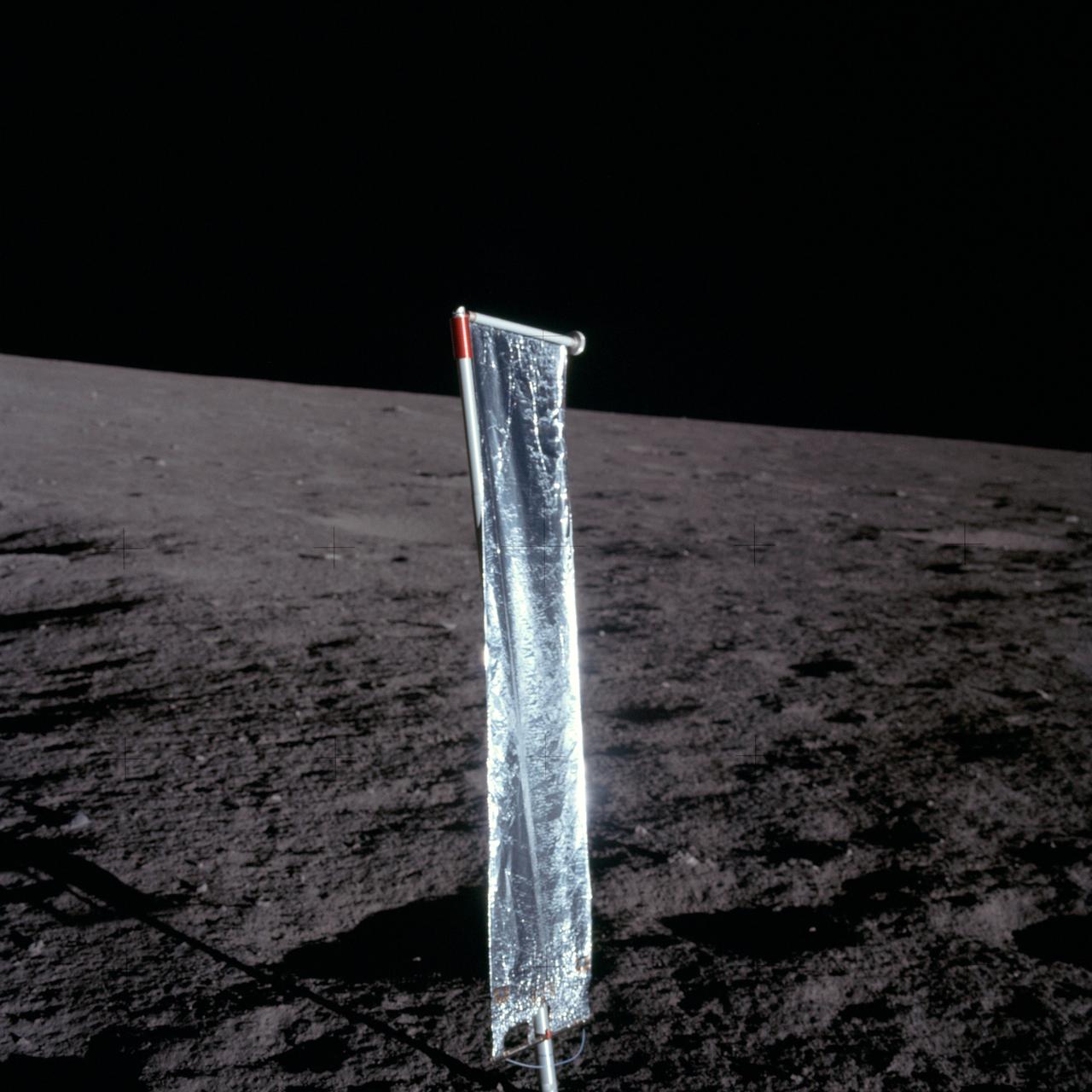
AS12-47-6898 (19 Nov. 1969) --- A close-up view of the Solar Wind Composition device. Astronaut Alan L. Bean, lunar module pilot, took this photograph, after having deployed the device. Astronauts Charles Conrad Jr., commander, and Bean descended in the Apollo 12 Lunar Module (LM) to explore the moon, while astronaut Richard F. Gordon Jr., command module pilot, remained in lunar orbit with the Command and Service Modules (CSM).
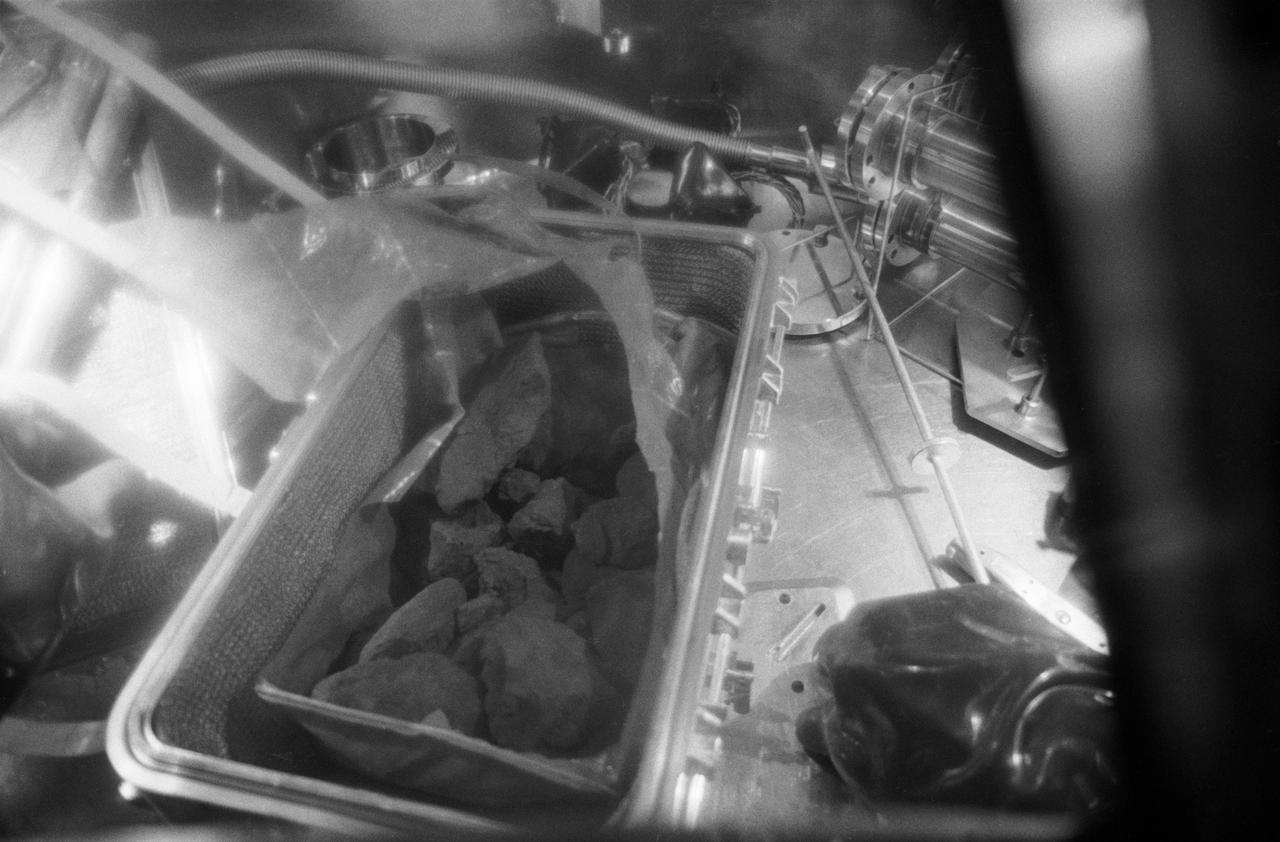
S69-45002 (26 July 1969) --- A close-up view of the lunar rocks contained in the first Apollo 11 sample return container. The rock box was opened for the first time in the Vacuum Laboratory of the Manned Spacecraft Center’s Lunar Receiving Laboratory, Building 37, at 3:55 p.m. (CDT), Saturday, July 26, 1969. The gloved hand gives an indication of size. This box also contained the Solar Wind Composition experiment (not shown) and two core tubes for subsurface samples (not shown). These lunar samples were collected by astronauts Neil A. Armstrong and Edwin E. Aldrin Jr. during their lunar surface extravehicular activity on July 20, 1969.
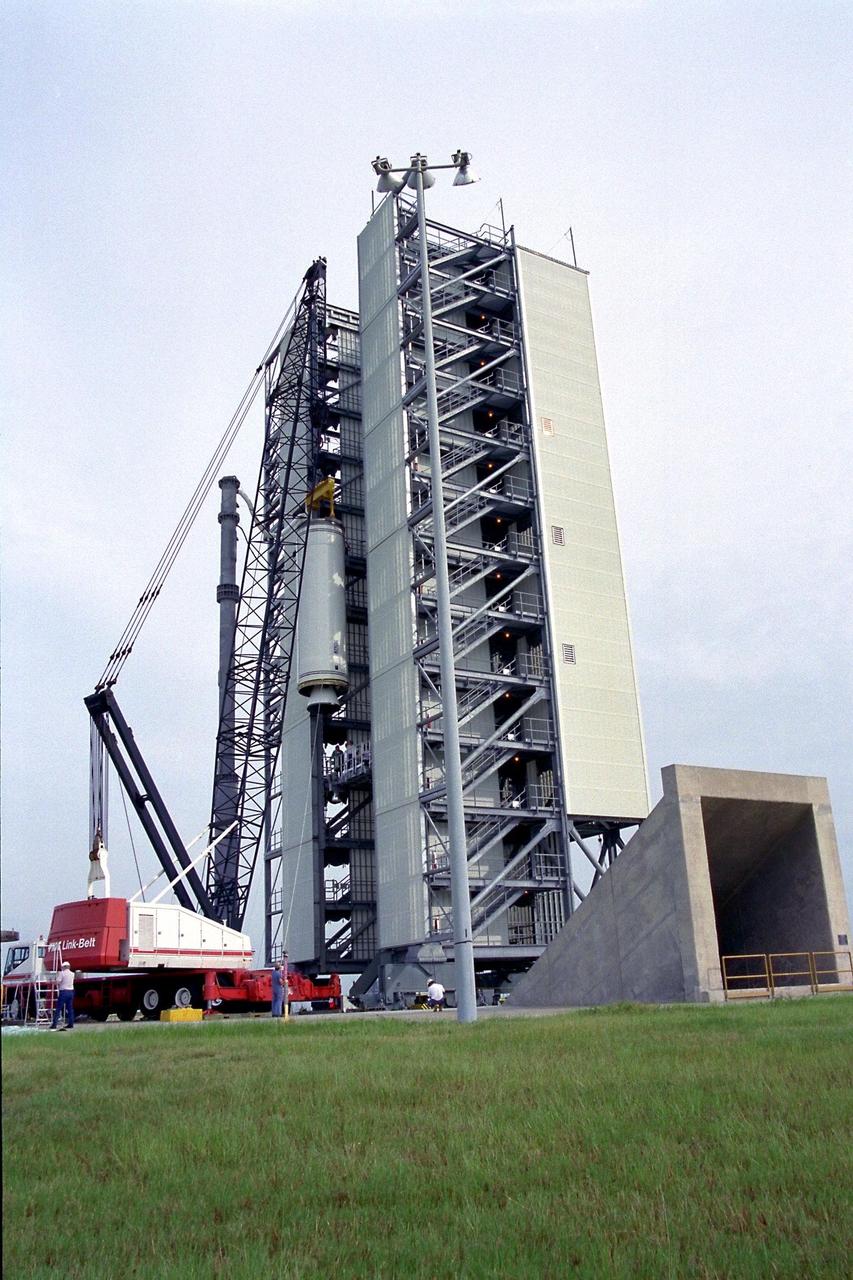
The second stage of the Lockheed Martin Launch Vehicle-2 (LMLV-2) is hoisted into position at Launch Pad 46 at Cape Canaveral Air Station for mating to the rocket’s first stage, which is out of camera view. The LMLV-2 will carry the Lunar Prospector spacecraft, scheduled to launch in October for an 18-month mission that will orbit the Earth’s moon to collect data from the lunar surface. Designed for a low polar orbit investigation of the moon, the Lunar Prospector will map the moon’s surface composition and possible polar ice deposits, measure magnetic and gravity fields, and study lunar outgassing events
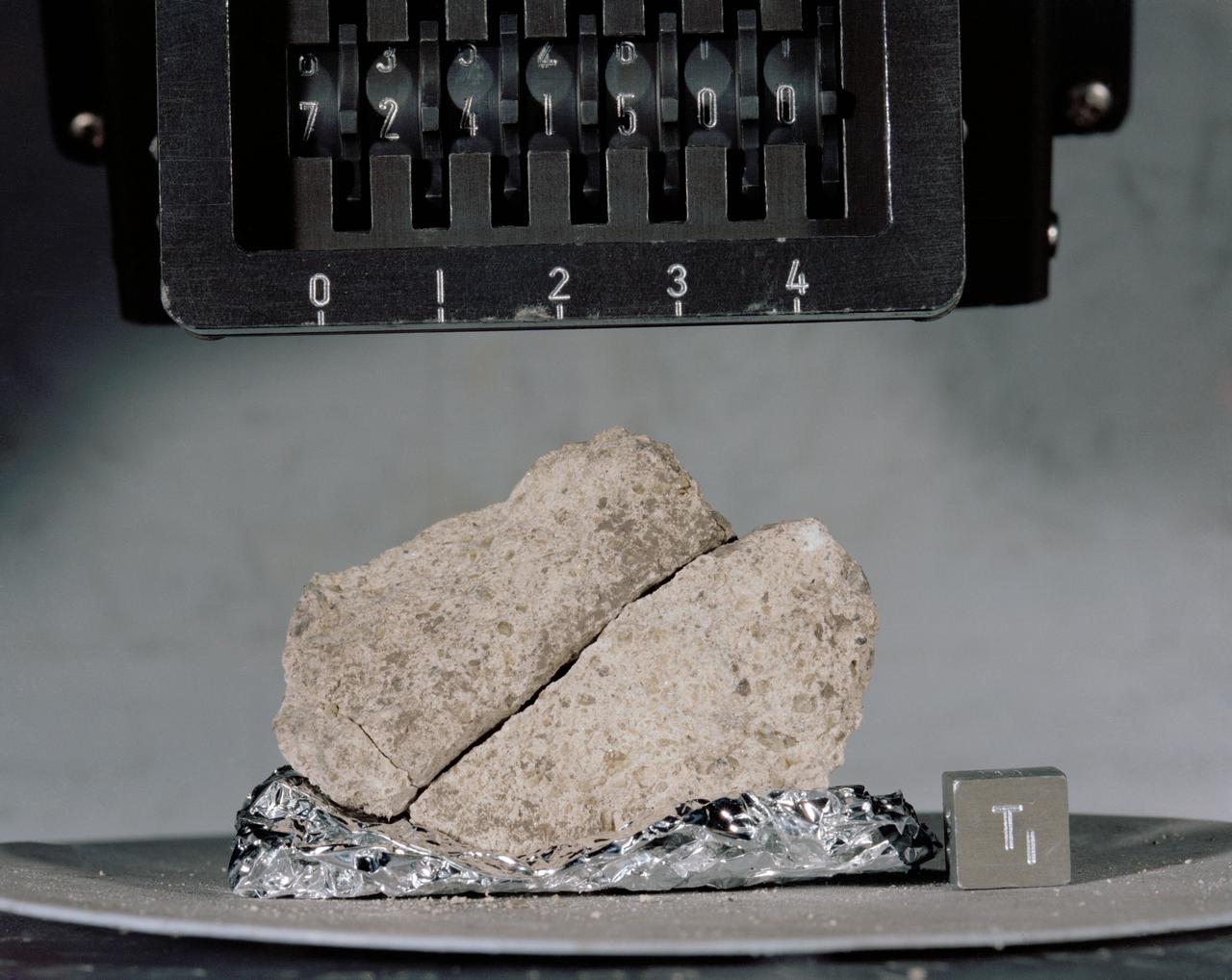
S73-16199 (December 1972) --- A close-up view of Apollo 17 lunar sample number 72415,0 which was brought back from the Taurus-Littrow landing site by the Apollo 17 crewmen. This sample is a brecciated dunite clast weighing a little over 32 grams (about 1.14 ounces). This sample was collected at station 2 (South Massif) during the second Apollo 17 extravehicular activity (EVA). IMPORTANT NOTE FOR CREDIT: The view was photographed by Karl Mills, Scientific Photo Arts, Berkeley, California.
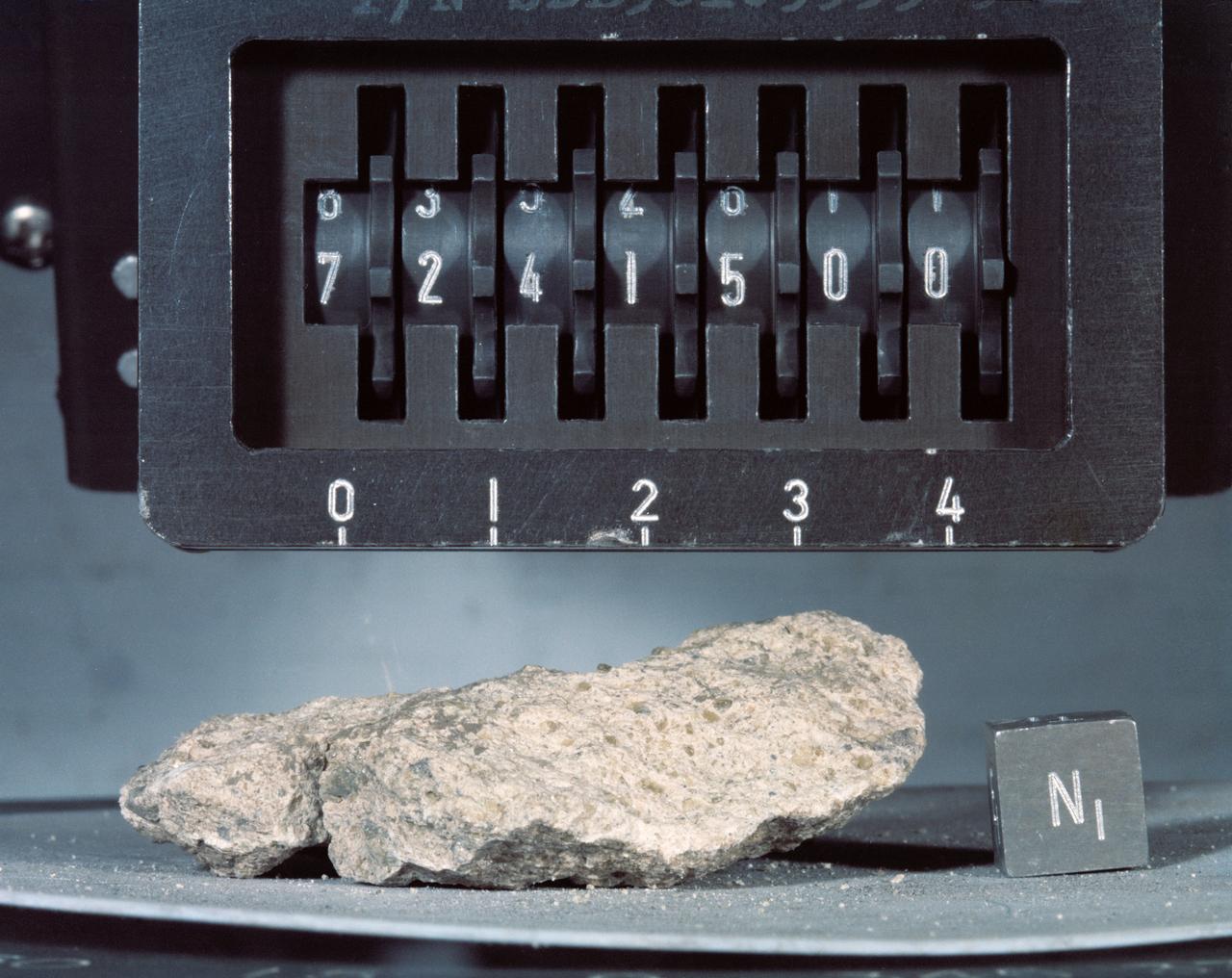
S73-16198 (December 1972) --- A close-up view of Apollo 17 lunar sample number 72415,0 which was brought back from the Taurus-Littrow landing site by the Apollo 17 crewmen. This sample is a brecciated dunite clast weighing a little over 32 grams (about 1.14 ounces). This sample was collected at station 2 (South Massif) during the second Apollo 17 extravehicular activity (EVA).
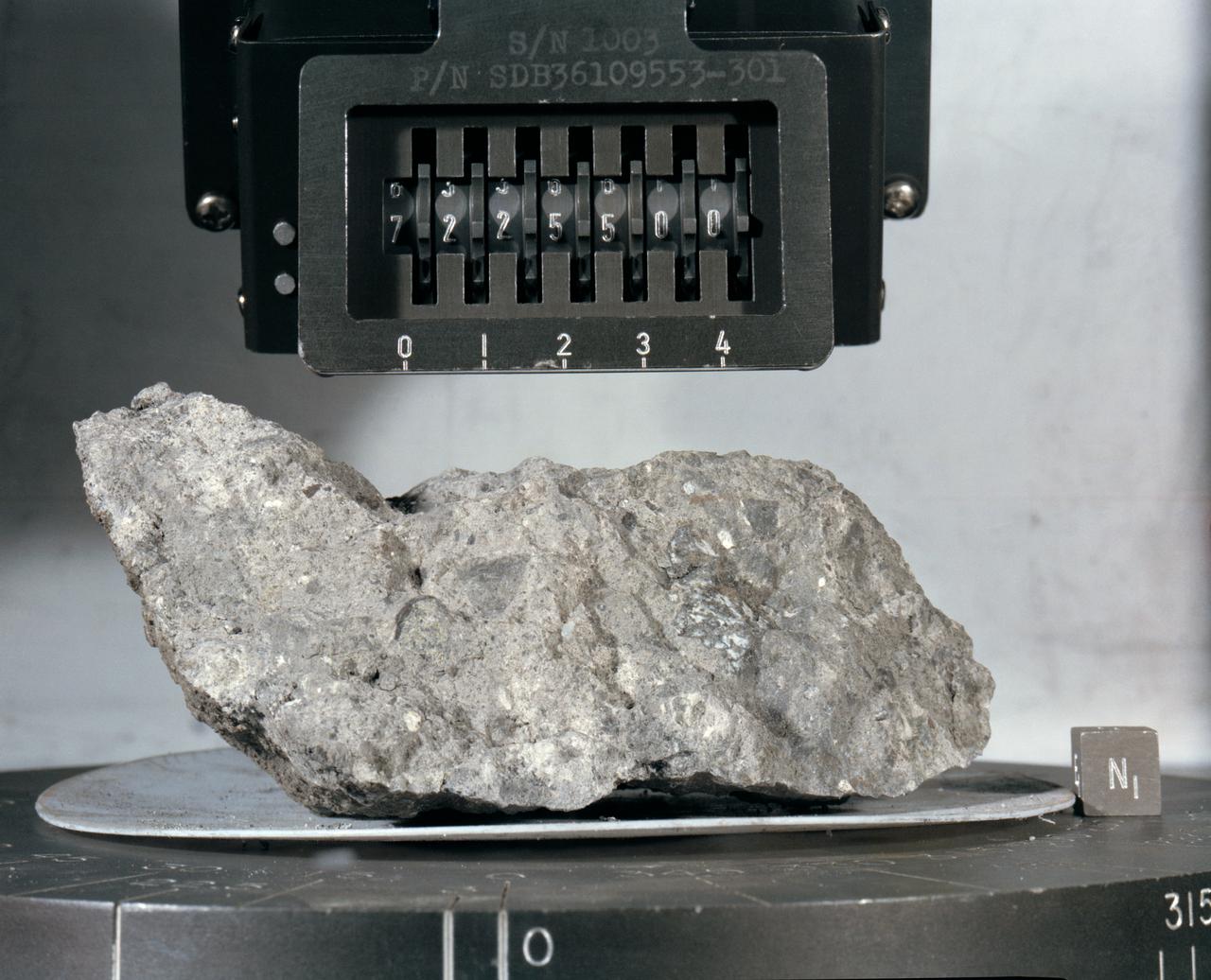
S73-16007 (December 1972) --- A "mug shot" of Apollo 17 lunar sample no. 72255 which was brought back from the lunar surface by the final team of Apollo astronauts. The rock weighs 461.2 grams and measures 2.5 x 9 x 10.5 centimeters. The light grey breccia is sub-rounded on all faces except the top and north sides.
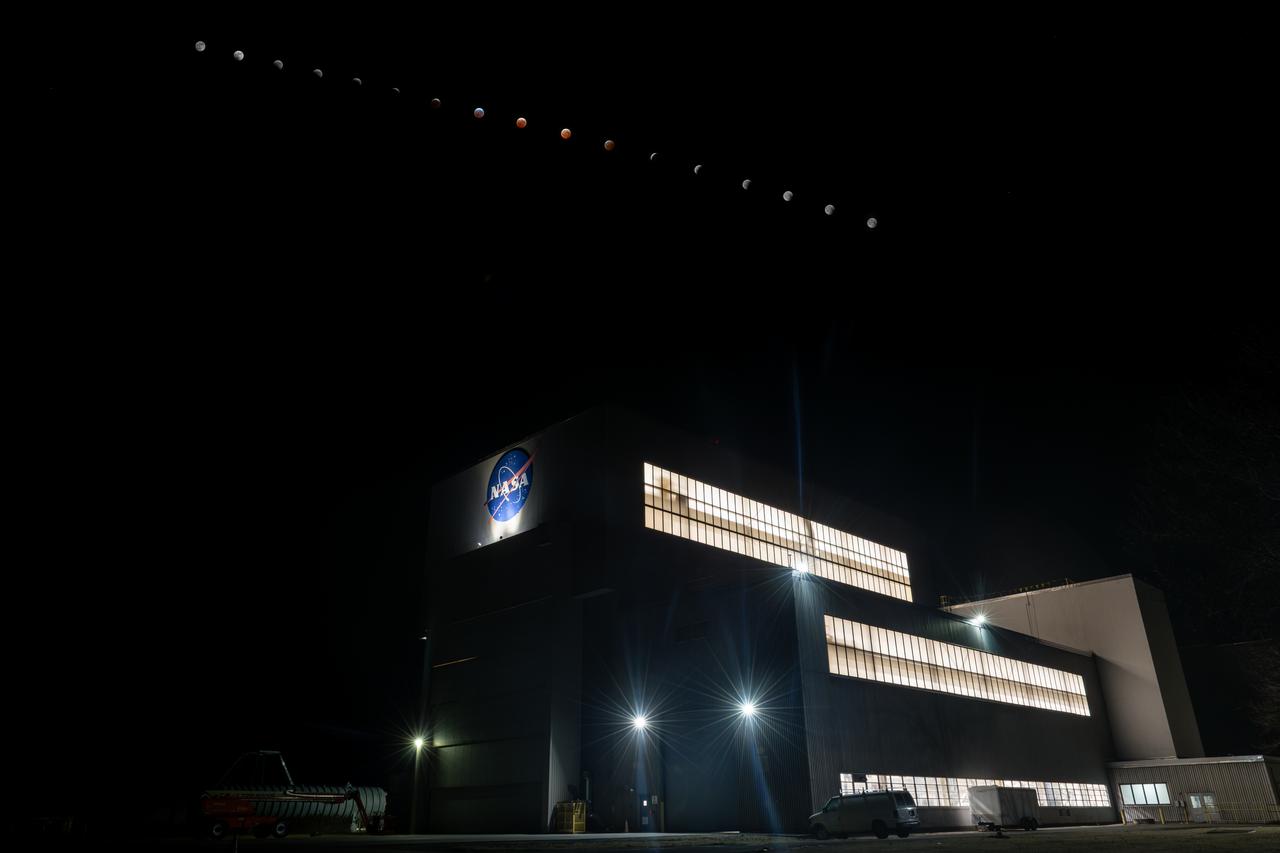
A composite photo made from 18 images of the lunar eclipse above the Space Environments Complex at NASA’s Glenn Research Center at Neil Armstrong Test Facility in Sandusky, Ohio, during the early hours of March 14, 2025. Photo Credit: (NASA/Sara Lowthian-Hanna)
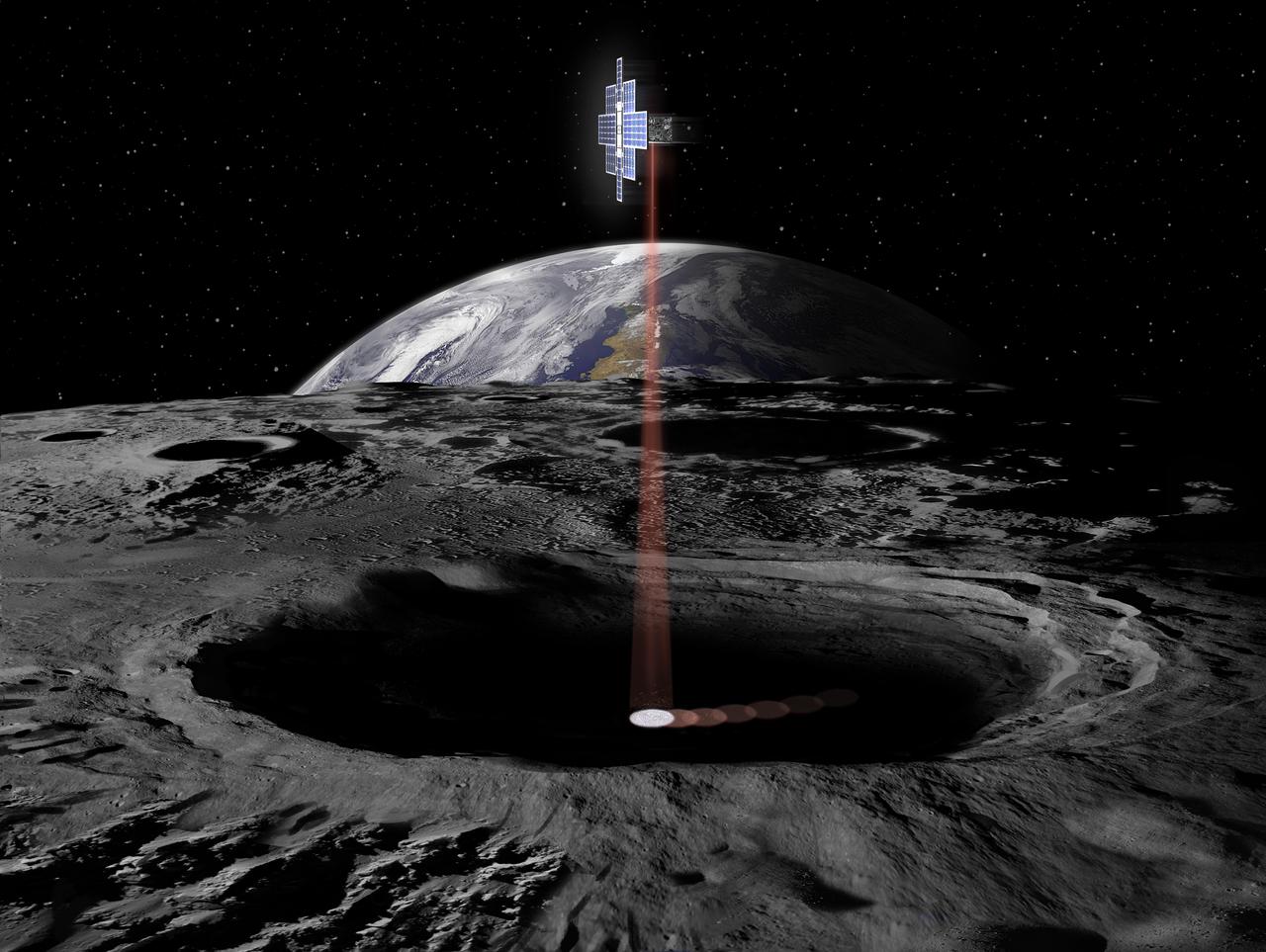
This artist's concept shows the Lunar Flashlight spacecraft, a six-unit CubeSat designed to search for ice on the Moon's surface using special lasers. The spacecraft will use its near-infrared lasers to shine light into shaded polar regions on the Moon, while an onboard reflectometer will measure surface reflection and composition. https://photojournal.jpl.nasa.gov/catalog/PIA23131

The Flower Moon lunar eclipse over NASA’s Michoud Assembly Facility in New Orleans is shown from the initial partial eclipse to totality in a composite of seven images shot on Sunday, May 15, 2022. Image credit: NASA/Michael DeMocker
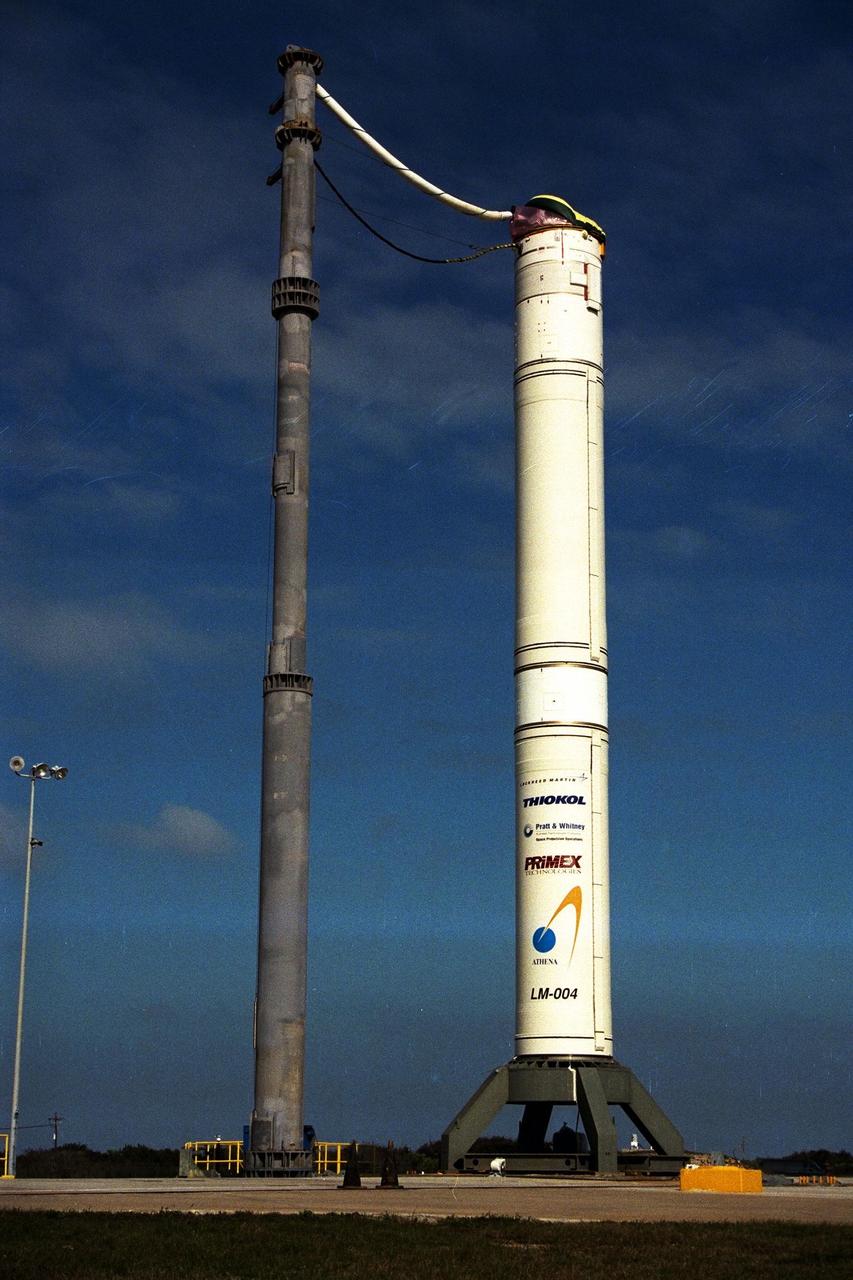
The access tower around the Athena II rocket for the Lunar Prospector spacecraft, to be launched for NASA by Lockheed Martin, was rolled back today at Launch Complex 46 at Cape Canaveral Air Station for final prelaunch preparations. The small robotic spacecraft is designed to provide the first global maps of the Moon's surface compositional elements and its gravitational and magnetic fields. The launch of Lunar Prospector is currently scheduled for Jan. 5, 1998 at 8:31 p.m
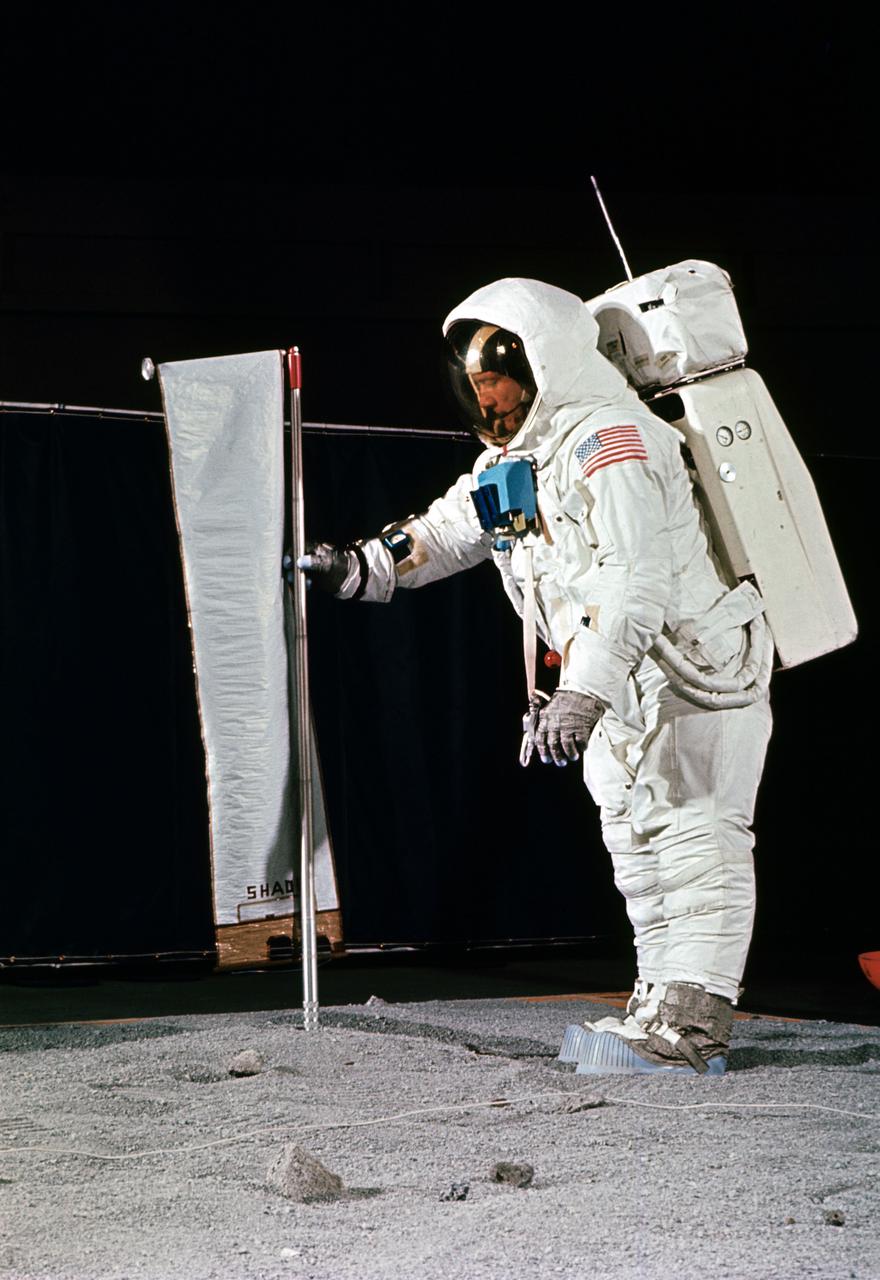
S69-32247 (22 April 1969) --- Astronaut Edwin E. Aldrin Jr., wearing an Extravehicular Mobility Unit (EMU), simulates deploying the Solar Wind Composition (SWC) experiment, on the surface of the moon, during a training exercise in Building 9 on April 22, 1969. The SWC is a component of the Early Apollo Scientific Experiment Package (EASEP). Aldrin is the lunar module pilot of the Apollo 11 lunar landing mission.
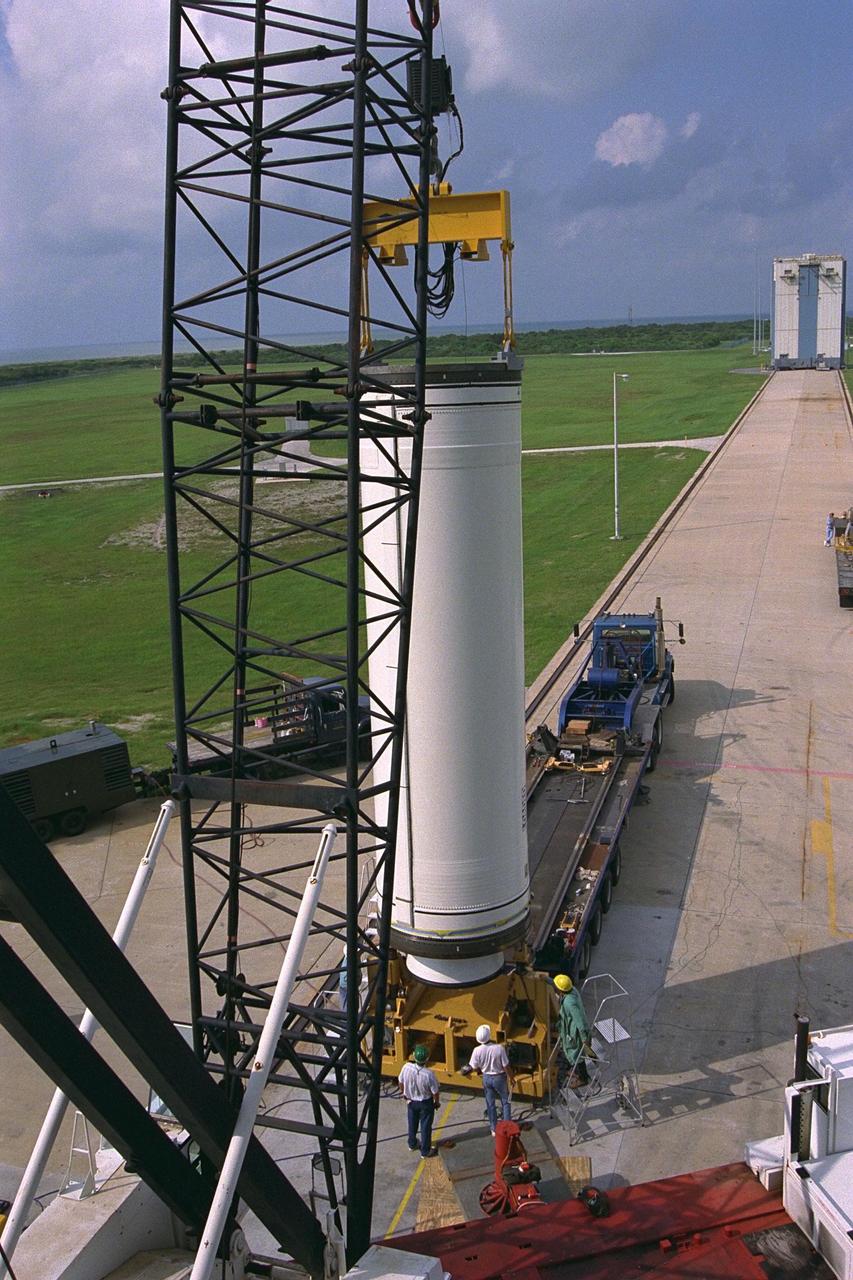
Workers hoist the first stage of a Lockheed Martin Launch Vehicle-2 (LMLV-2) for placement at Launch Complex 46 at Cape Canaveral Air Station (CCAS), Fla. The Lunar Prospector spacecraft is scheduled to launch aboard the LMLV-2 from CCAS in October for an 18-month mission that will orbit the Earth’s Moon to collect data from the lunar surface. Information gathered during the mission will allow construction of a detailed map of the surface composition of the Moon and will improve our understanding of its origin, evolution, current state, and resources
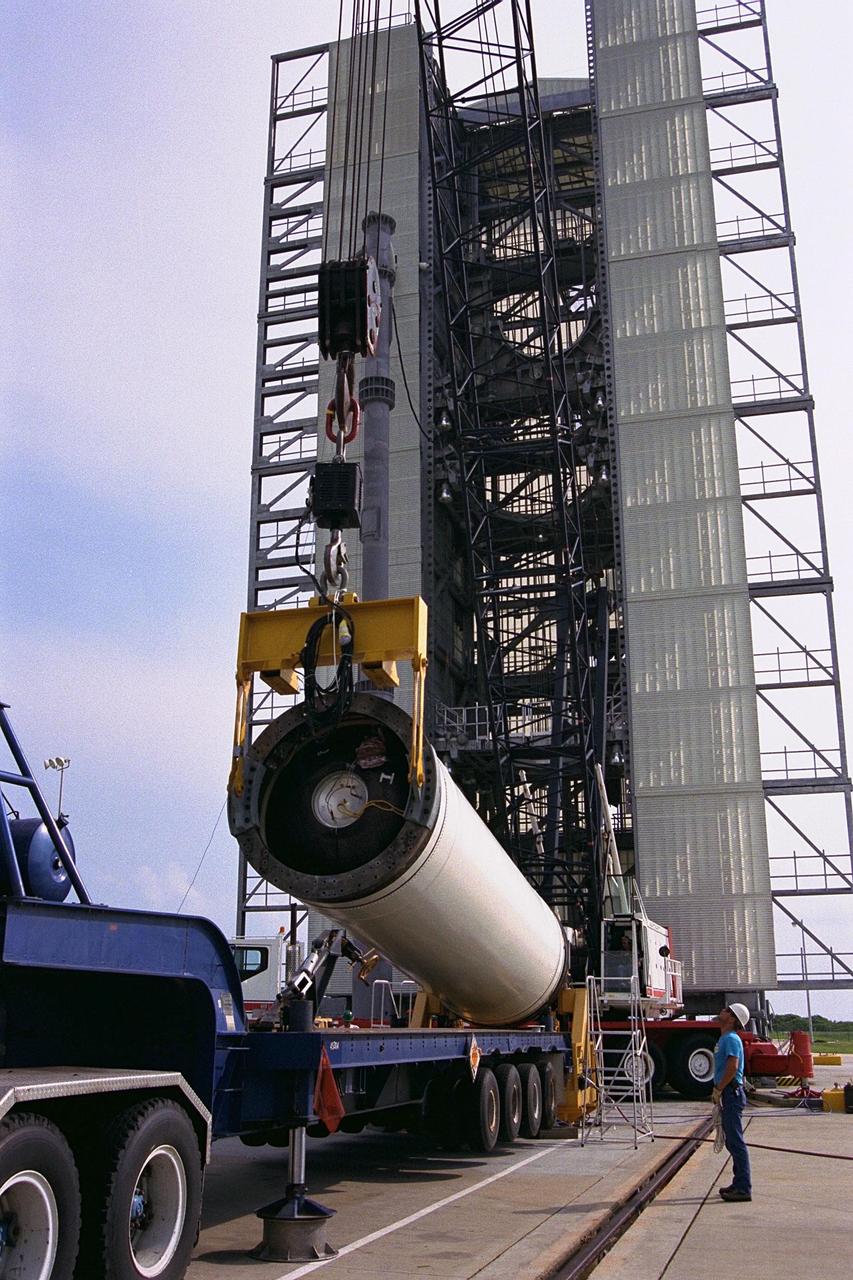
Workers hoist the first stage of a Lockheed Martin Launch Vehicle-2 (LMLV-2) for placement at Launch Complex 46 at Cape Canaveral Air Station (CCAS), Fla. The Lunar Prospector spacecraft is scheduled to launch aboard the LMLV-2 from CCAS in October for an 18-month mission that will orbit the Earth’s Moon to collect data from the lunar surface. Information gathered during the mission will allow construction of a detailed map of the surface composition of the Moon and will improve our understanding of its origin, evolution, current state, and resources

A total lunar eclipse rises over New Orleans, home of NASA’s Michoud Assembly Facility, in the early morning hours of Tuesday, March 3. A lunar eclipse occurs when Earth passes directly between the Sun and Moon, casting a huge shadow across the Moon’s surface. The Moon appears dark red or orange as the Sun’s light filters through Earth’s atmosphere. This is a composite of 4 images taken during the eclipse.
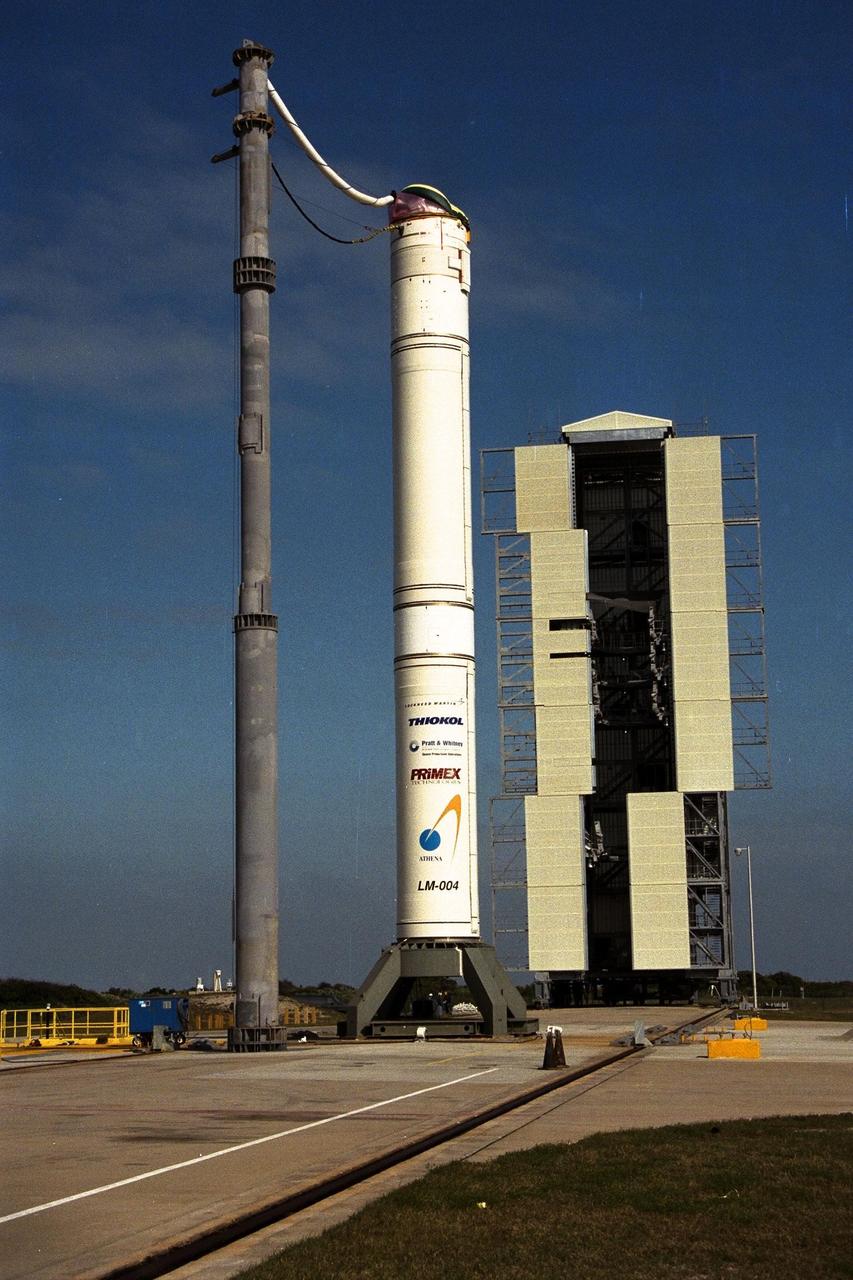
The access tower around the Athena II rocket for the Lunar Prospector spacecraft, to be launched for NASA by Lockheed Martin, was rolled back today at Launch Complex 46 at Cape Canaveral Air Station for final prelaunch preparations. The small robotic spacecraft is designed to provide the first global maps of the Moon's surface compositional elements and its gravitational and magnetic fields. The launch of Lunar Prospector is currently scheduled for Jan. 5, 1998 at 8:31 p.m
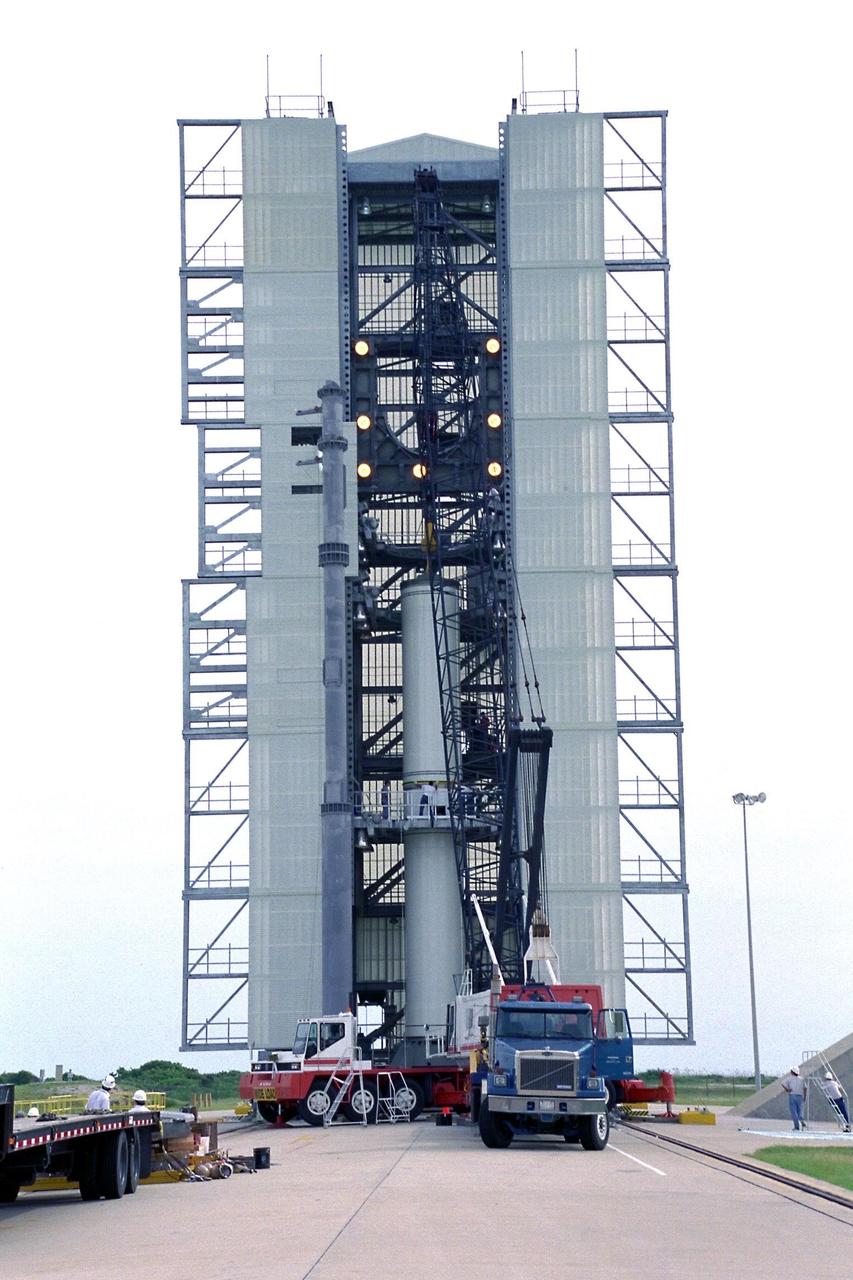
The second stage of the Lockheed Martin Launch Vehicle-2 (LMLV-2) is mated to its first stage at Launch Complex 46 at Cape Canaveral Air Station. The LMLV-2 will carry the Lunar Prospector spacecraft, scheduled to launch in October for an 18-month mission that will orbit the Earth’s moon to collect data from the lunar surface. Information gathered during the mission will allow construction of a detailed map of the surface composition of the moon and will improve our understanding of its origin, evolution, current state, and resources
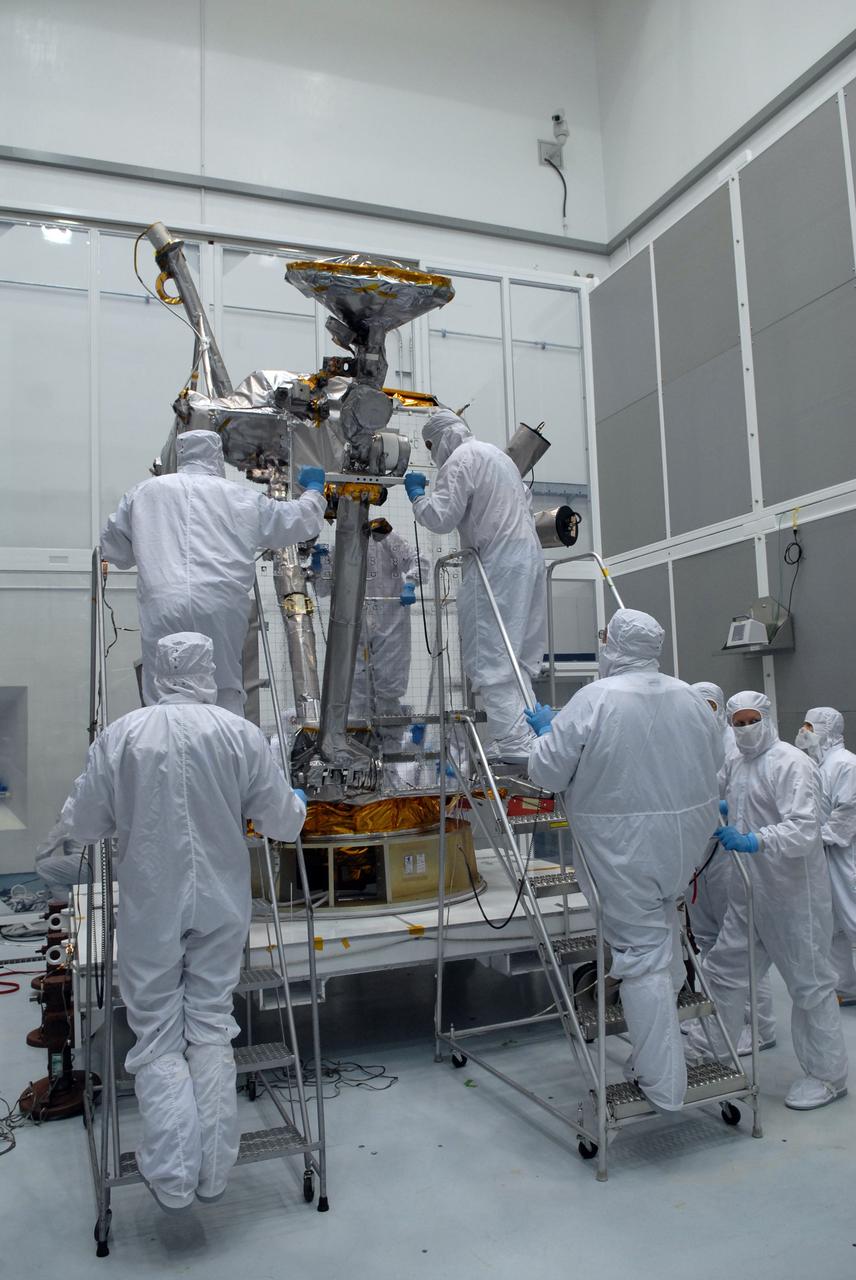
CAPE CANAVERAL, Fla. – At Astrotech Space Operations in Titusville, Fla., technicians maneuver NASA's Lunar Reconnaissance Orbiter's high-gain antenna into place for stowage. The antenna completed a range of motion test. The orbiter will carry seven instruments to provide scientists with detailed maps of the lunar surface and enhance our understanding of the moon's topography, lighting conditions, mineralogical composition and natural resources. Information gleaned from LRO will be used to select safe landing sites, determine locations for future lunar outposts and help mitigate radiation dangers to astronauts. Launch of LRO is targeted no earlier than June 2. Photo credit: NASA/Jack Pfaller
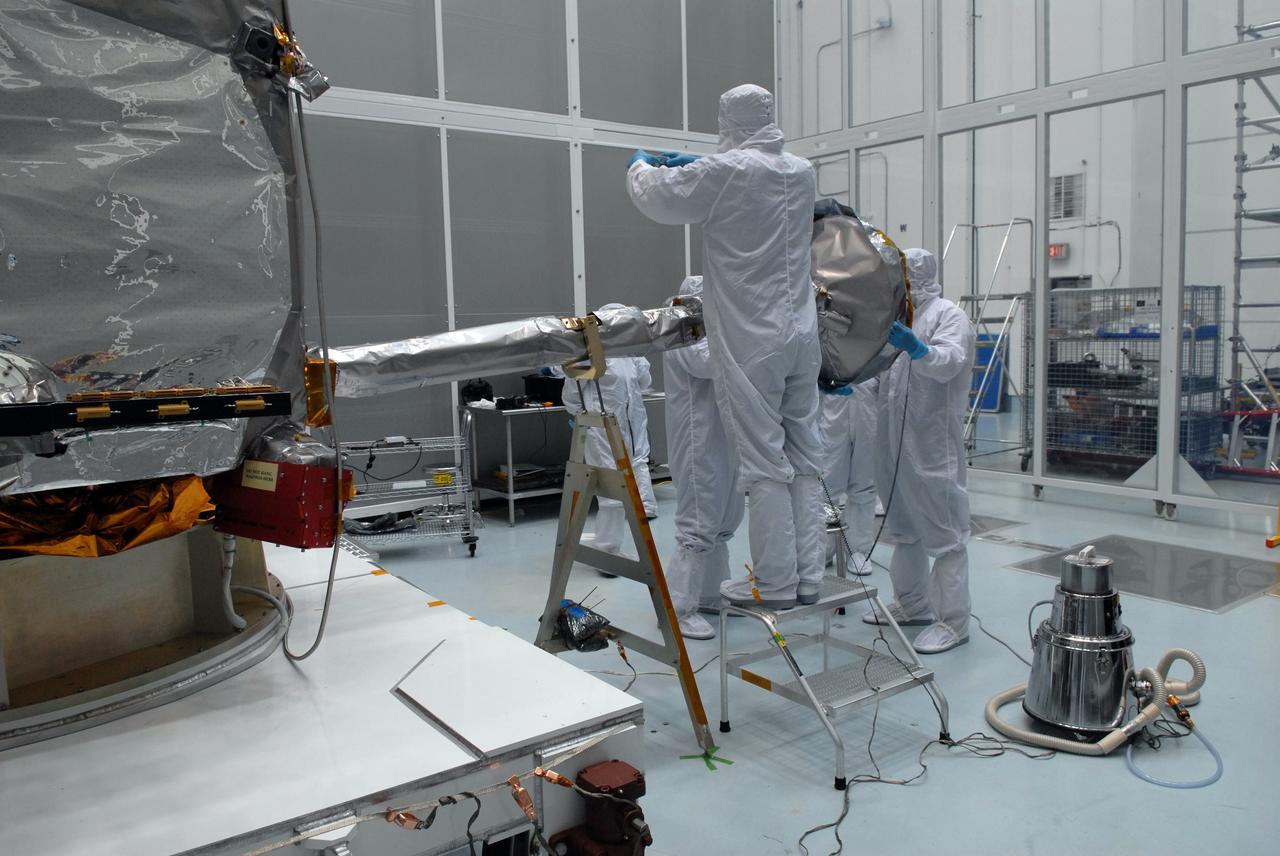
CAPE CANAVERAL, Fla. – At Astrotech Space Operations in Titusville, Fla., technicians prepare NASA's Lunar Reconnaissance Orbiter's high-gain antenna for stowage. The antenna completed a range of motion test. The orbiter will carry seven instruments to provide scientists with detailed maps of the lunar surface and enhance our understanding of the moon's topography, lighting conditions, mineralogical composition and natural resources. Information gleaned from LRO will be used to select safe landing sites, determine locations for future lunar outposts and help mitigate radiation dangers to astronauts. Launch of LRO is targeted no earlier than June 2. Photo credit: NASA/Jack Pfaller
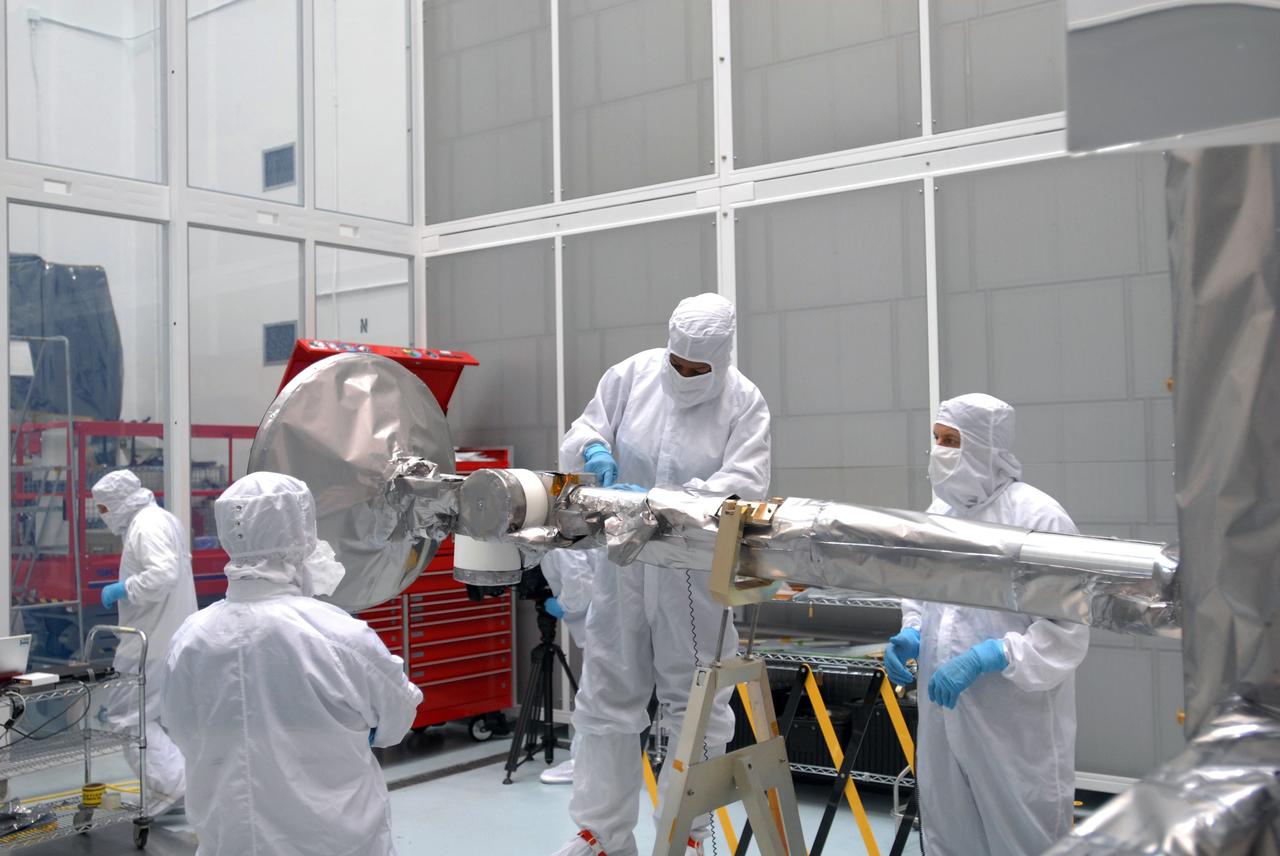
CAPE CANAVERAL, Fla. – At Astrotech Space Operations in Titusville, Fla., technicians are testing the range of motion on the high-gain antenna for the Lunar Reconnaissance Orbiter. The orbiter will carry seven instruments to provide scientists with detailed maps of the lunar surface and enhance our understanding of the moon's topography, lighting conditions, mineralogical composition and natural resources. Information gleaned from LRO will be used to select safe landing sites, determine locations for future lunar outposts and help mitigate radiation dangers to astronauts. Launch of LRO is targeted no earlier than June 2. Photo credit: NASA/Jim Grossmann
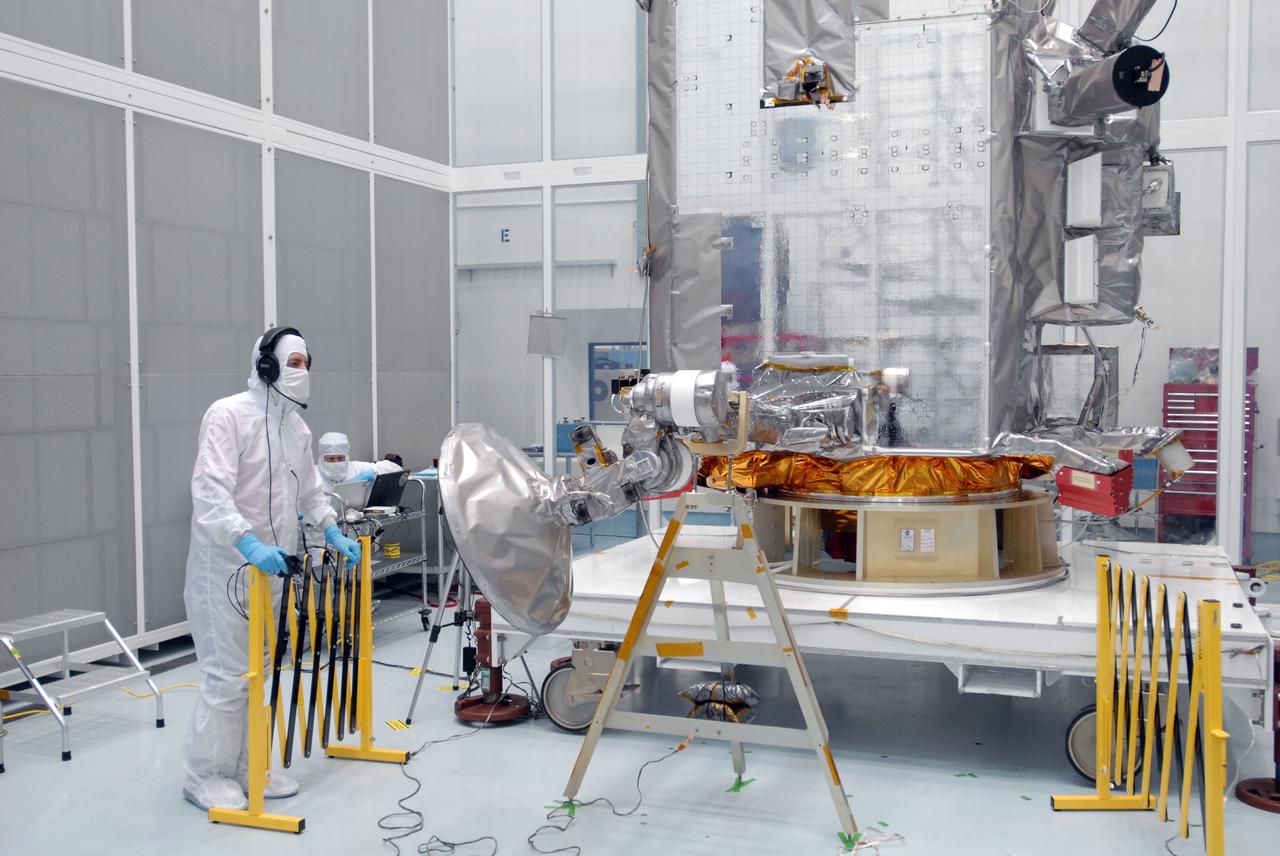
CAPE CANAVERAL, Fla. – At Astrotech Space Operations in Titusville, Fla., technicians are testing the range of motion on the high-gain antenna for the Lunar Reconnaissance Orbiter. The orbiter will carry seven instruments to provide scientists with detailed maps of the lunar surface and enhance our understanding of the moon's topography, lighting conditions, mineralogical composition and natural resources. Information gleaned from LRO will be used to select safe landing sites, determine locations for future lunar outposts and help mitigate radiation dangers to astronauts. Launch of LRO is targeted no earlier than June 2. Photo credit: NASA/Jim Grossmann
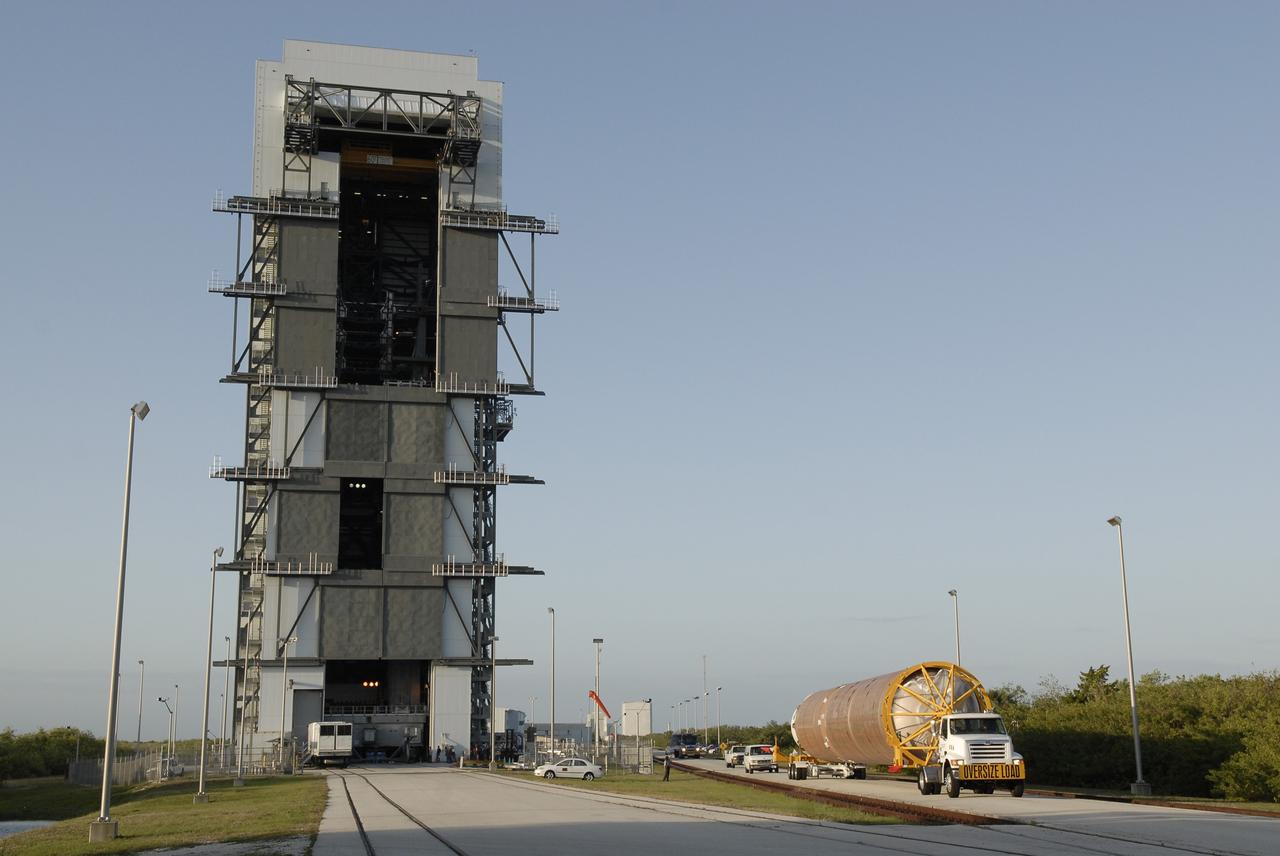
CAPE CANAVERAL, Fla. –– The Atlas V first stage arrives at the Vertical Integration Facility on Cape Canaveral Air Force Station's Launch Complex 41. The Atlas V/Centaur is the launch vehicle for the Lunar Reconnaissance Orbiter, or LRO. The orbiter will carry seven instruments to provide scientists with detailed maps of the lunar surface and enhance our understanding of the moon's topography, lighting conditions, mineralogical composition and natural resources. Information gleaned from LRO will be used to select safe landing sites, determine locations for future lunar outposts and help mitigate radiation dangers to astronauts. Launch of LRO is targeted no earlier than June 2. Photo credit: NASA/Kim Shiflett
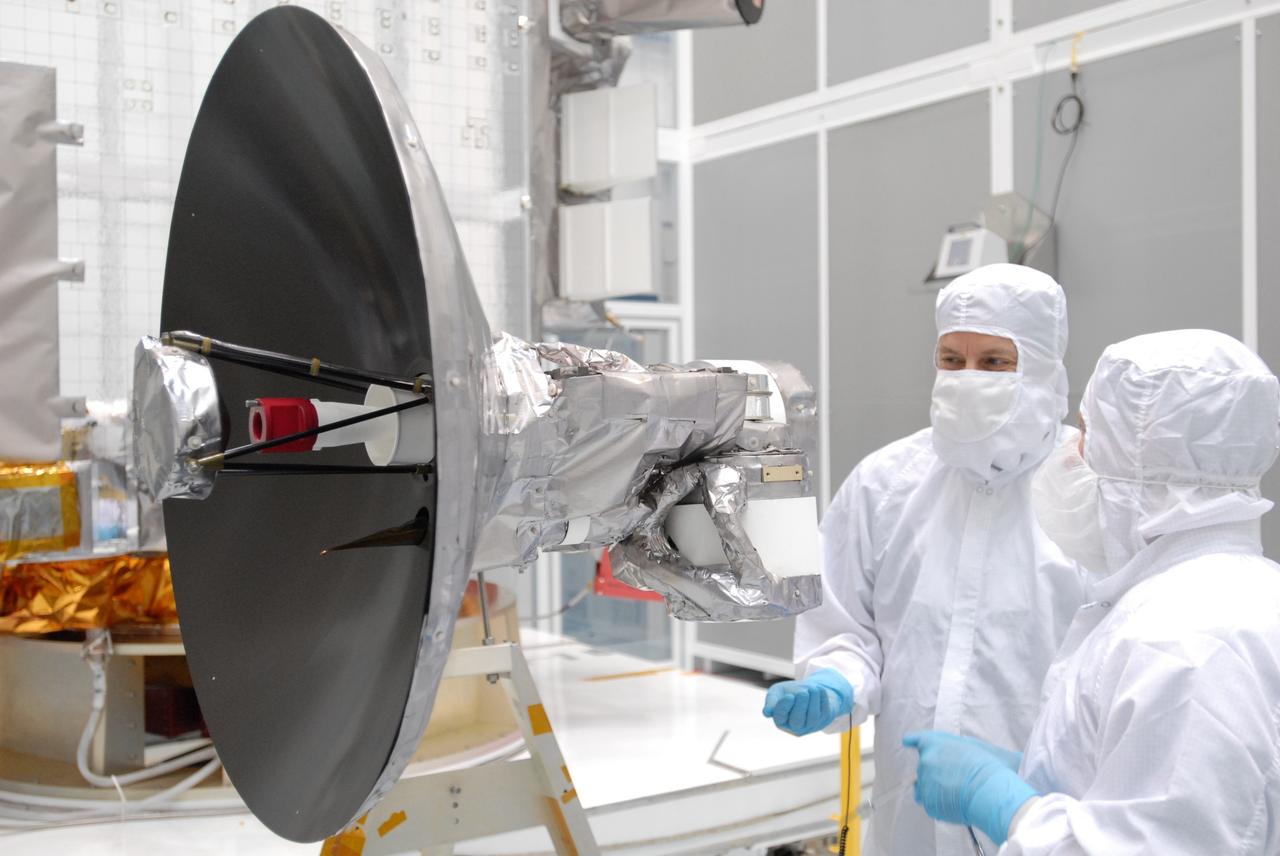
CAPE CANAVERAL, Fla. – At Astrotech Space Operations in Titusville, Fla., technicians are testing the range of motion on the high-gain antenna for the Lunar Reconnaissance Orbiter. The orbiter will carry seven instruments to provide scientists with detailed maps of the lunar surface and enhance our understanding of the moon's topography, lighting conditions, mineralogical composition and natural resources. Information gleaned from LRO will be used to select safe landing sites, determine locations for future lunar outposts and help mitigate radiation dangers to astronauts. Launch of LRO is targeted no earlier than June 2. Photo credit: NASA/Jim Grossmann
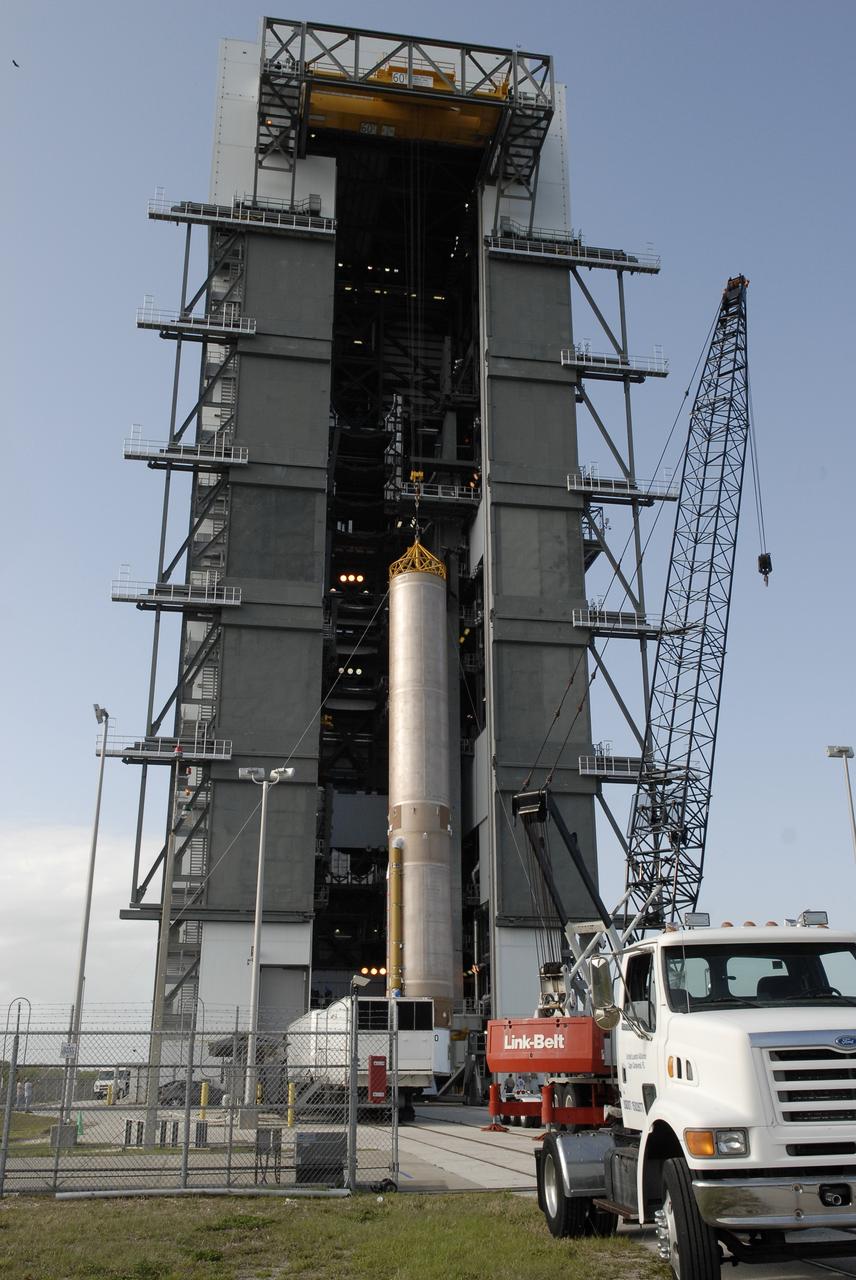
CAPE CANAVERAL, Fla. –– On Cape Canaveral Air Force Station's Launch Complex 41, the Atlas V first stage is being moved into the Vertical Integration Facility. The Atlas V/Centaur is the launch vehicle for the Lunar Reconnaissance Orbiter, or LRO. The orbiter will carry seven instruments to provide scientists with detailed maps of the lunar surface and enhance our understanding of the moon's topography, lighting conditions, mineralogical composition and natural resources. Information gleaned from LRO will be used to select safe landing sites, determine locations for future lunar outposts and help mitigate radiation dangers to astronauts. Launch of LRO is targeted no earlier than June 2. Photo credit: NASA/Kim Shiflett
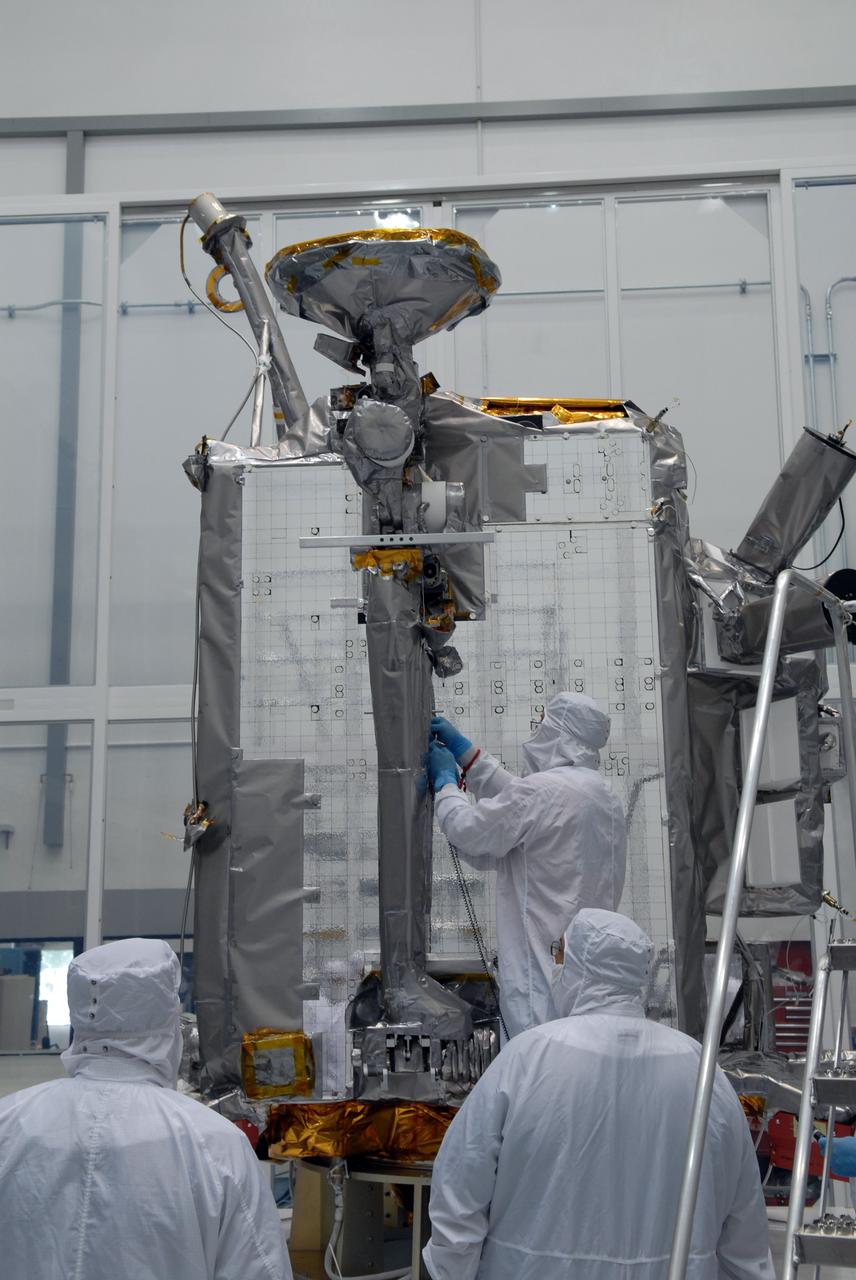
CAPE CANAVERAL, Fla. – At Astrotech Space Operations in Titusville, Fla., technicians secure NASA's Lunar Reconnaissance Orbiter's high-gain antenna into place for stowage. The antenna completed a range of motion test. The orbiter will carry seven instruments to provide scientists with detailed maps of the lunar surface and enhance our understanding of the moon's topography, lighting conditions, mineralogical composition and natural resources. Information gleaned from LRO will be used to select safe landing sites, determine locations for future lunar outposts and help mitigate radiation dangers to astronauts. Launch of LRO is targeted no earlier than June 2. Photo credit: NASA/Jack Pfaller
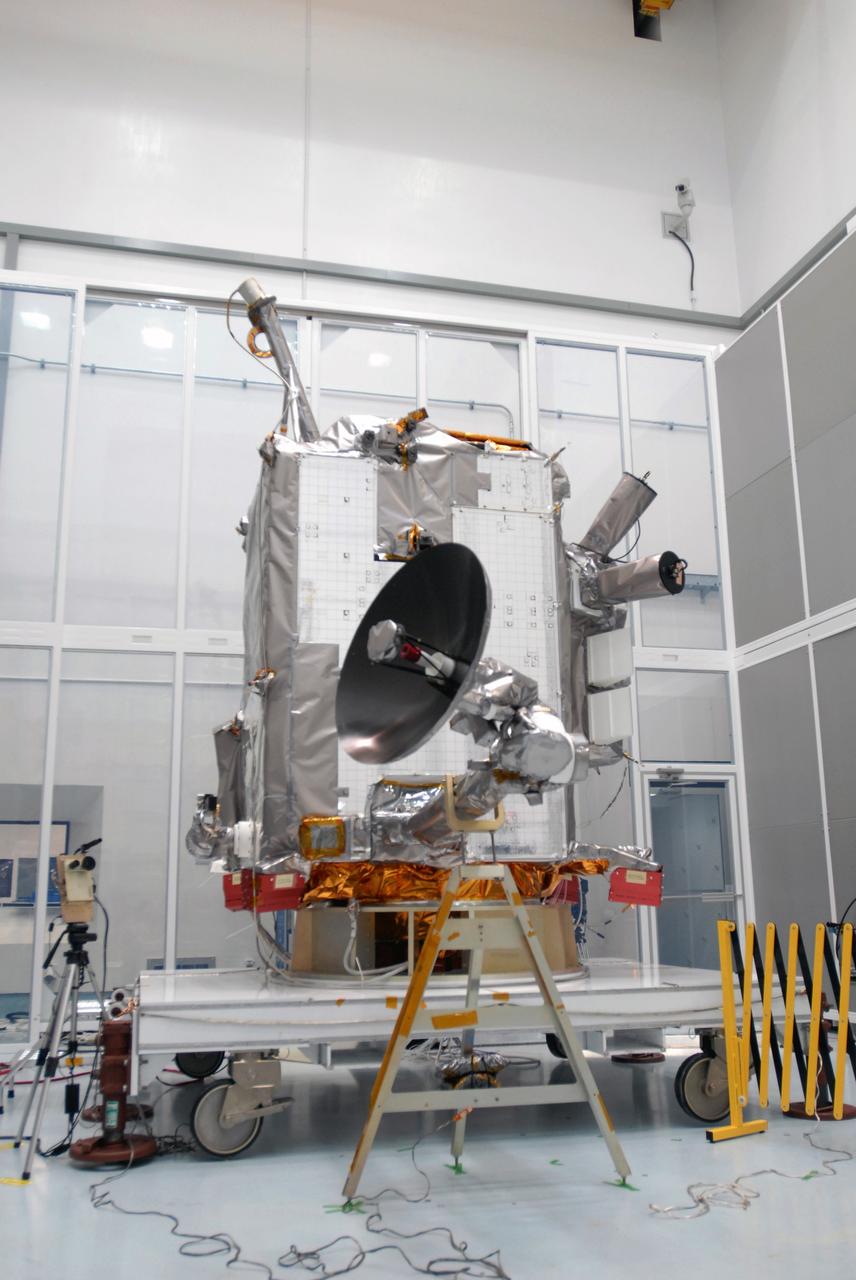
CAPE CANAVERAL, Fla. – At Astrotech Space Operations in Titusville, Fla., the range of motion is tested on the high-gain antenna for the Lunar Reconnaissance Orbiter. The orbiter will carry seven instruments to provide scientists with detailed maps of the lunar surface and enhance our understanding of the moon's topography, lighting conditions, mineralogical composition and natural resources. Information gleaned from LRO will be used to select safe landing sites, determine locations for future lunar outposts and help mitigate radiation dangers to astronauts. Launch of LRO is targeted no earlier than June 2. Photo credit: NASA/Jim Grossmann
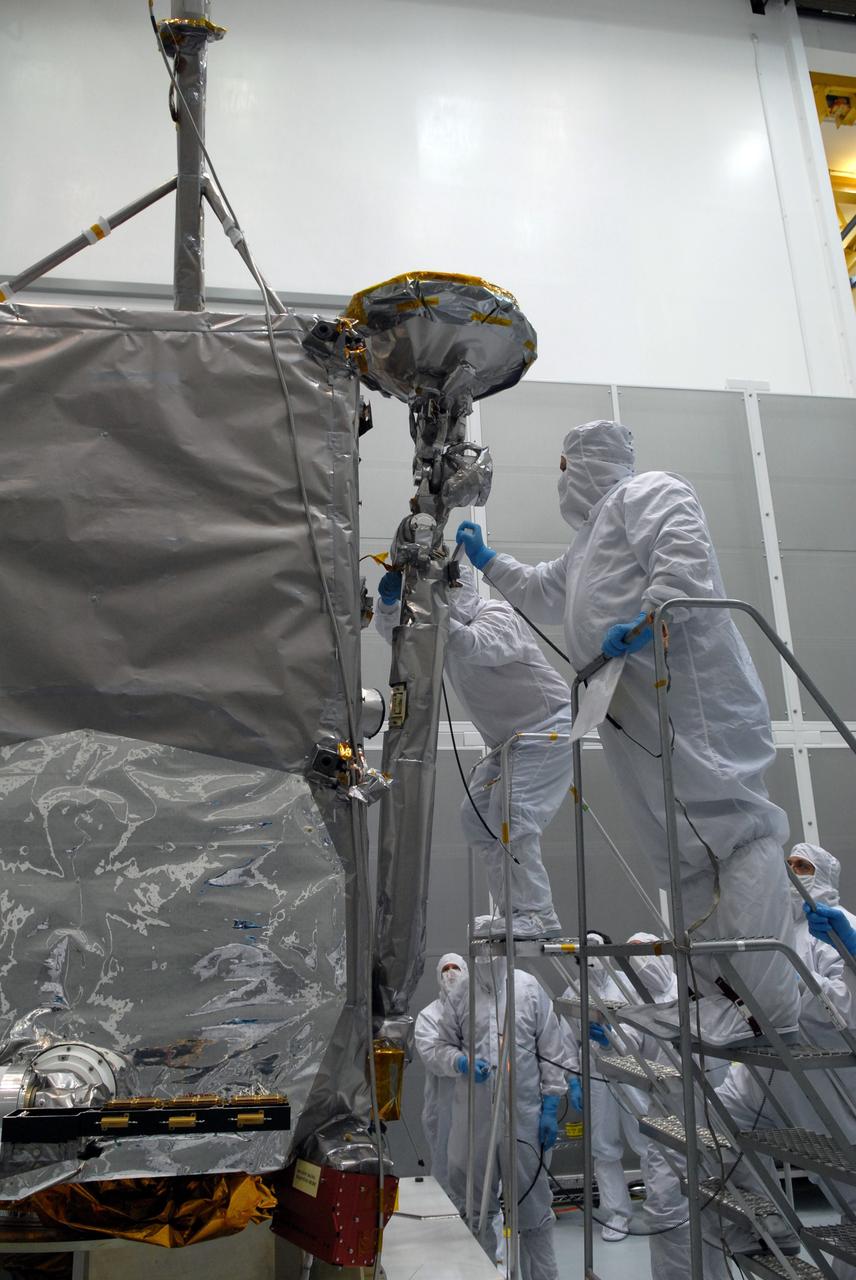
CAPE CANAVERAL, Fla. – At Astrotech Space Operations in Titusville, Fla., technicians maneuver NASA's Lunar Reconnaissance Orbiter's high-gain antenna into place for stowage. The antenna completed a range of motion test. The orbiter will carry seven instruments to provide scientists with detailed maps of the lunar surface and enhance our understanding of the moon's topography, lighting conditions, mineralogical composition and natural resources. Information gleaned from LRO will be used to select safe landing sites, determine locations for future lunar outposts and help mitigate radiation dangers to astronauts. Launch of LRO is targeted no earlier than June 2. Photo credit: NASA/Jack Pfaller
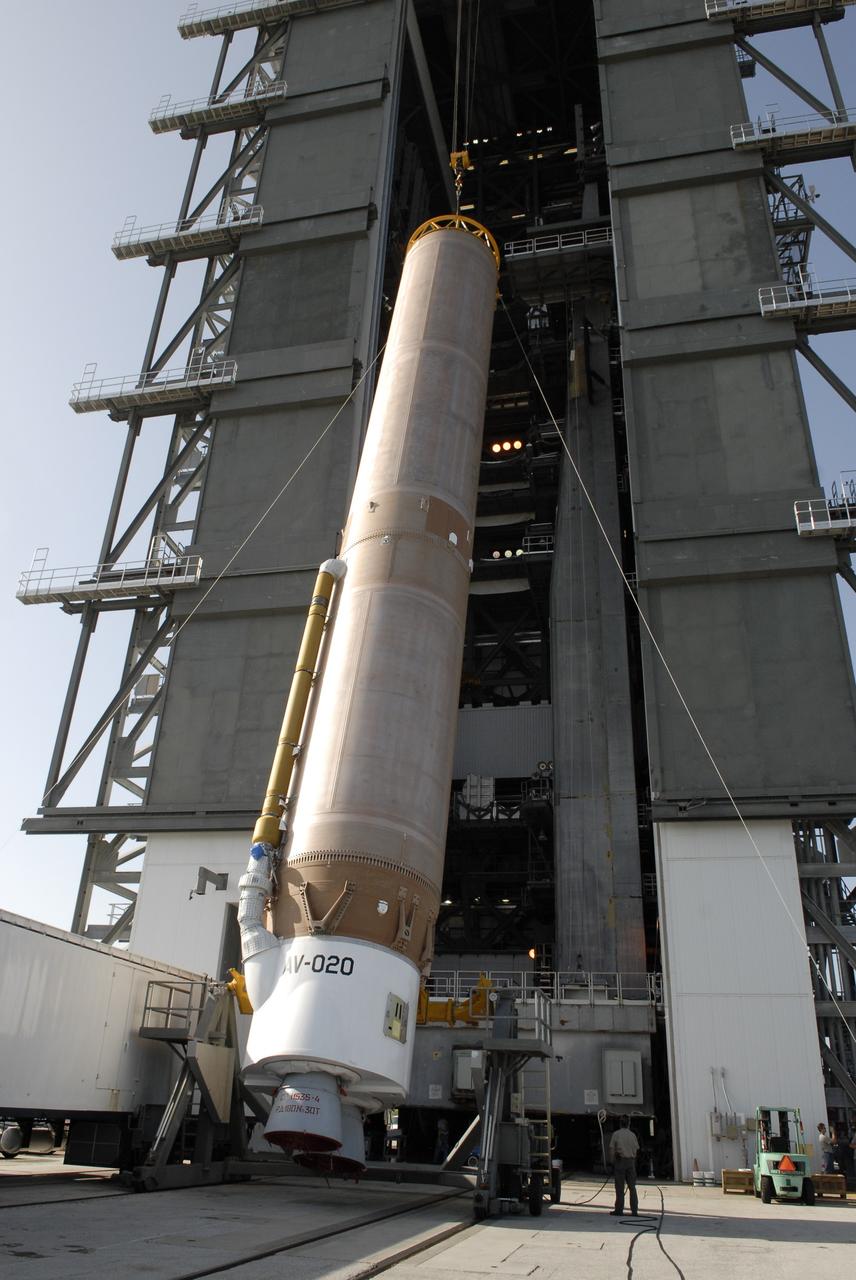
CAPE CANAVERAL, Fla. –– When the Atlas V first stage is raised to vertical, it will be lifted into the Vertical Integration Facility on Cape Canaveral Air Force Station's Launch Complex 41. The Atlas V/Centaur is the launch vehicle for the Lunar Reconnaissance Orbiter, or LRO. The orbiter will carry seven instruments to provide scientists with detailed maps of the lunar surface and enhance our understanding of the moon's topography, lighting conditions, mineralogical composition and natural resources. Information gleaned from LRO will be used to select safe landing sites, determine locations for future lunar outposts and help mitigate radiation dangers to astronauts. Launch of LRO is targeted no earlier than June 2. Photo credit: NASA/Kim Shiflett
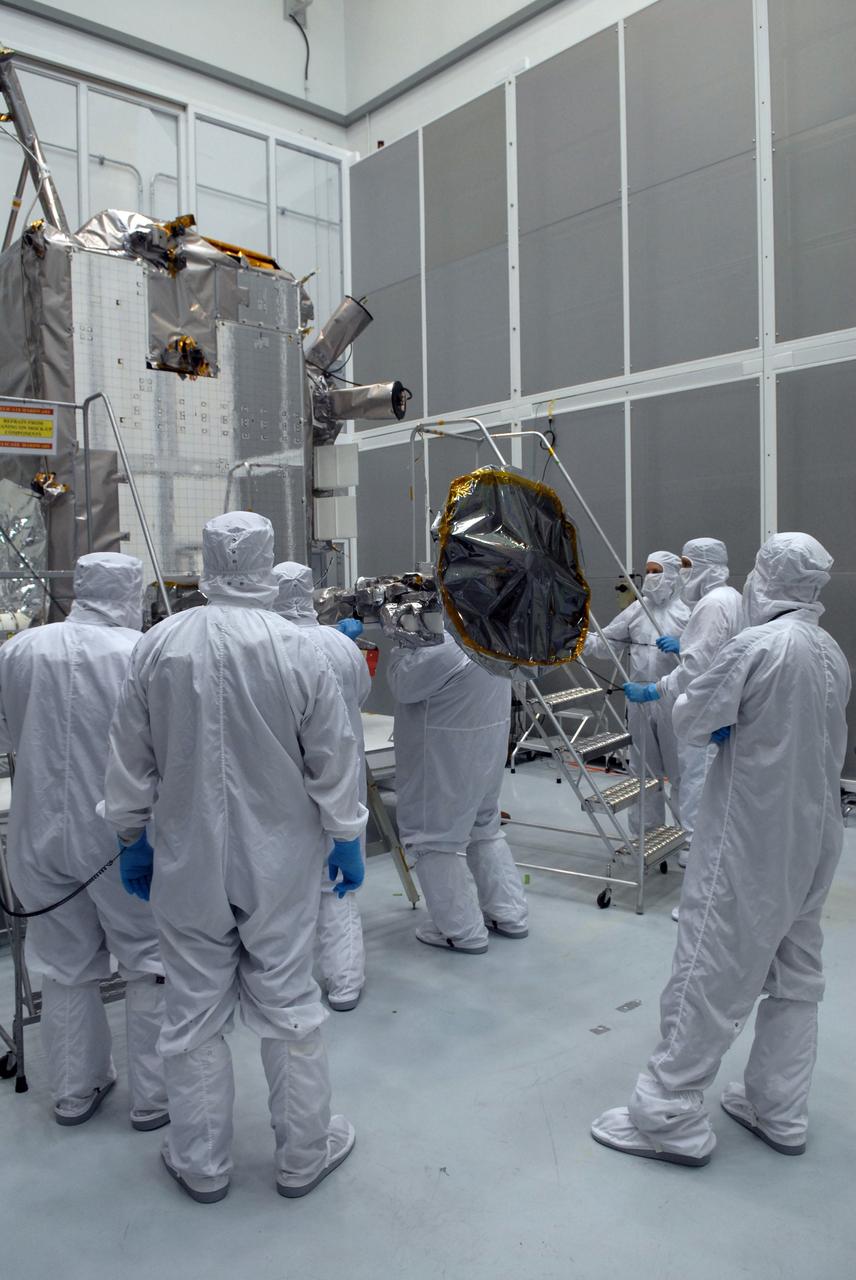
CAPE CANAVERAL, Fla. – At Astrotech Space Operations in Titusville, Fla., technicians begin stowing NASA's Lunar Reconnaissance Orbiter's high-gain antenna. The antenna completed a range of motion test. The orbiter will carry seven instruments to provide scientists with detailed maps of the lunar surface and enhance our understanding of the moon's topography, lighting conditions, mineralogical composition and natural resources. Information gleaned from LRO will be used to select safe landing sites, determine locations for future lunar outposts and help mitigate radiation dangers to astronauts. Launch of LRO is targeted no earlier than June 2. Photo credit: NASA/Jack Pfaller
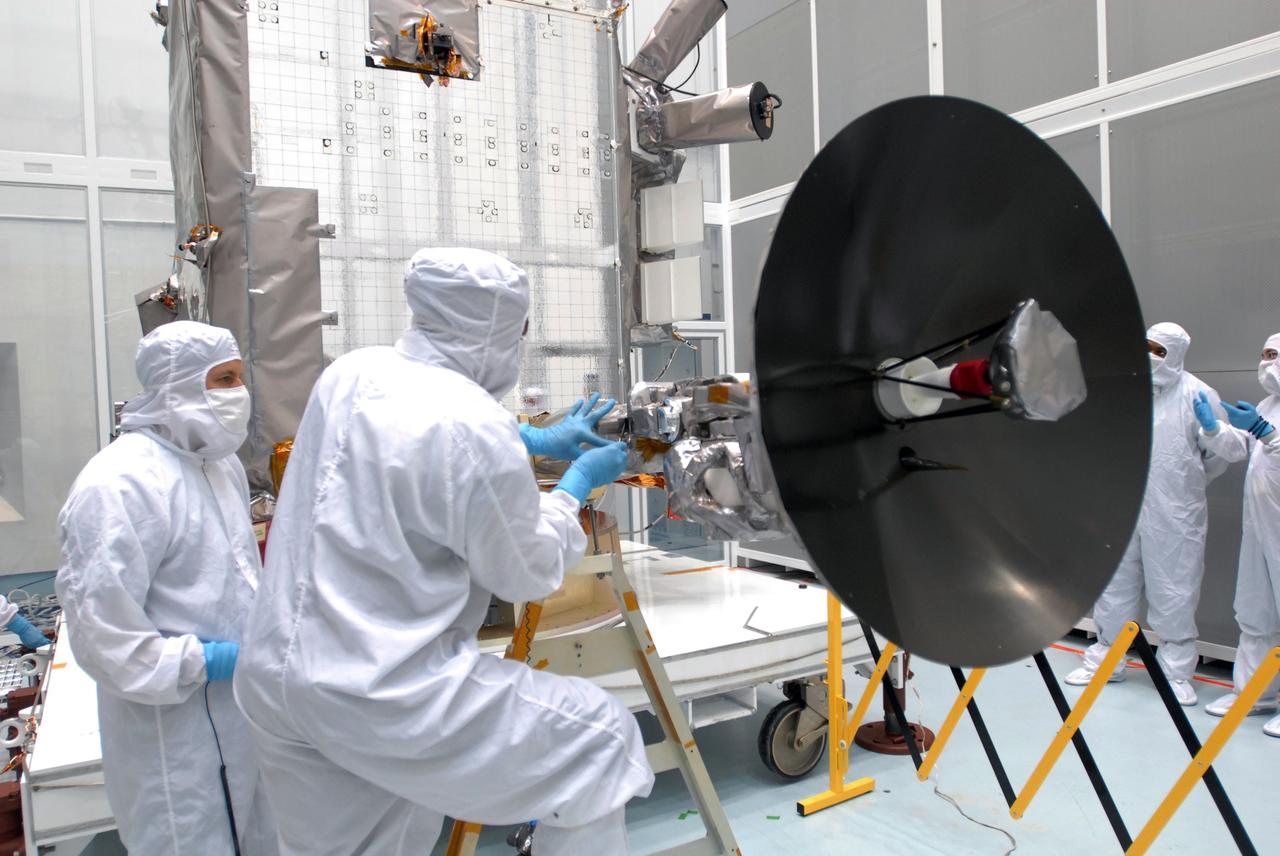
CAPE CANAVERAL, Fla. – At Astrotech Space Operations in Titusville, Fla., technicians are testing the range of motion on the high-gain antenna for the Lunar Reconnaissance Orbiter. The orbiter will carry seven instruments to provide scientists with detailed maps of the lunar surface and enhance our understanding of the moon's topography, lighting conditions, mineralogical composition and natural resources. Information gleaned from LRO will be used to select safe landing sites, determine locations for future lunar outposts and help mitigate radiation dangers to astronauts. Launch of LRO is targeted no earlier than June 2. Photo credit: NASA/Jim Grossmann
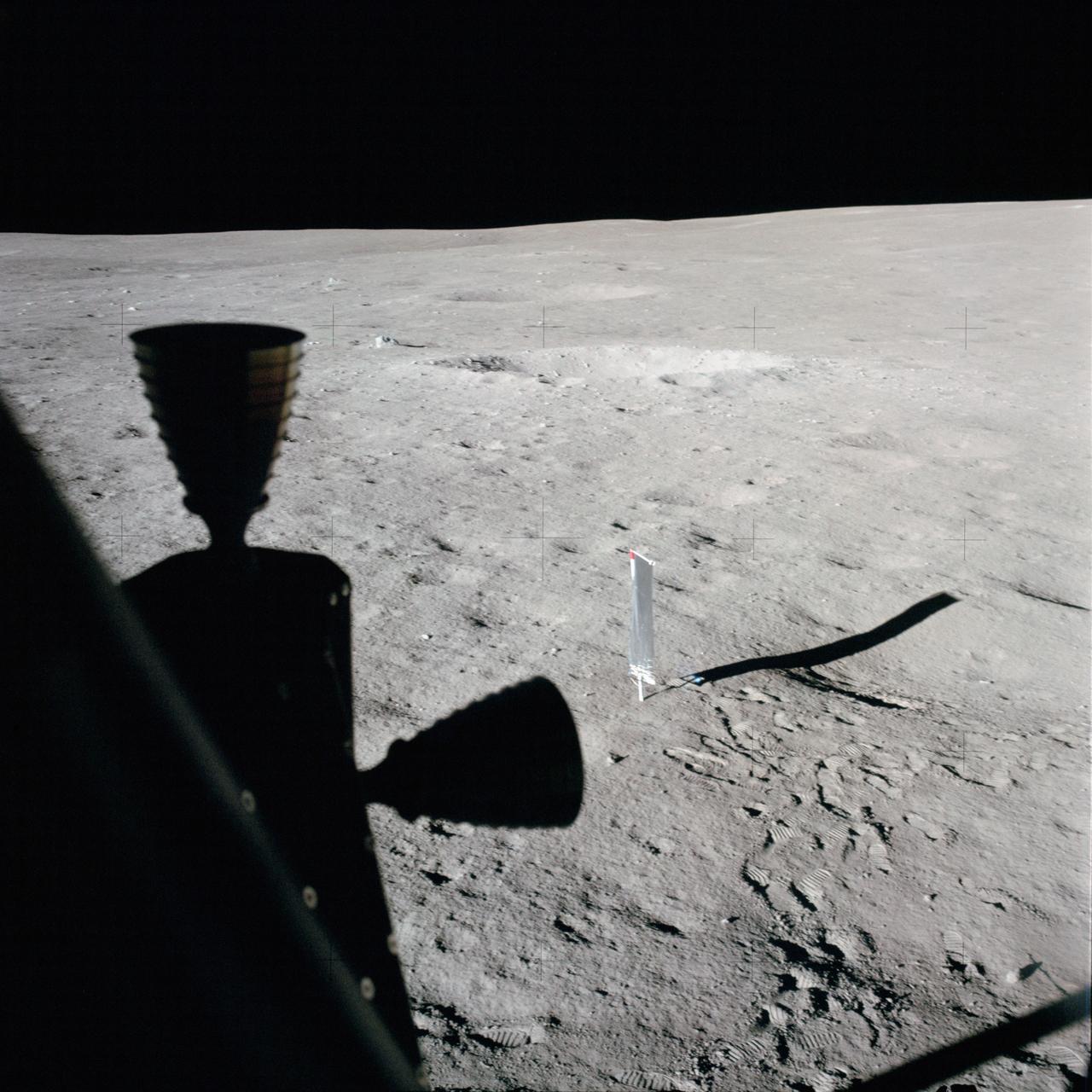
AS14-66-9322 (5-6 Feb. 1971) --- This photograph taken through a window of the Apollo 14 Lunar Module (LM), on the moon, shows an excellent view of the nearby terrain. In the center background is the deployed solar wind composition (SWC) experiment. Two LM RCS thrusters are silhouetted in the left foreground. While astronauts Alan B. Shepard Jr., commander; and Edgar D. Mitchell, lunar module pilot; descended in the LM, astronaut Stuart A. Roosa, command module pilot, remained with the Command and Service Modules (CSM) in lunar orbit.
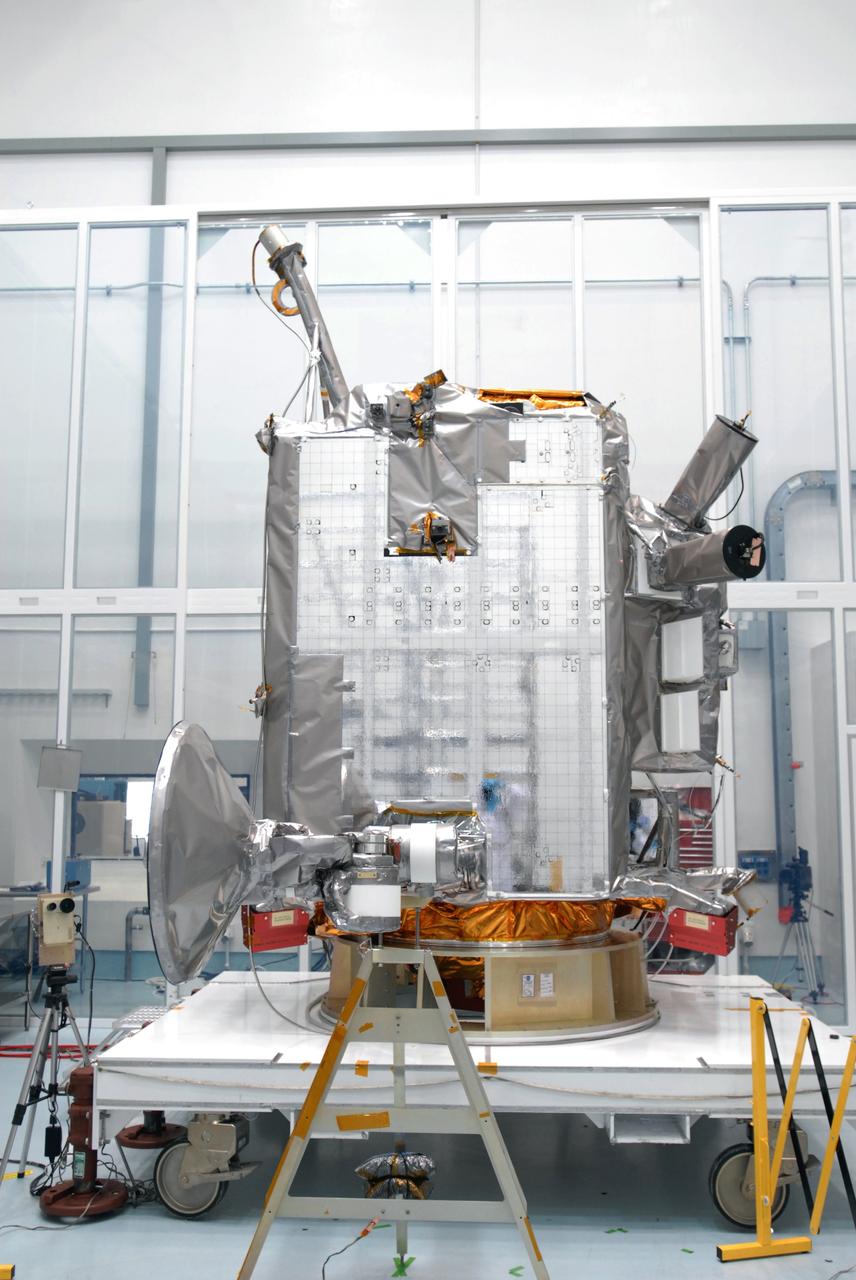
CAPE CANAVERAL, Fla. – At Astrotech Space Operations in Titusville, Fla., the range of motion is being tested on the high-gain antenna for the Lunar Reconnaissance Orbiter. The orbiter will carry seven instruments to provide scientists with detailed maps of the lunar surface and enhance our understanding of the moon's topography, lighting conditions, mineralogical composition and natural resources. Information gleaned from LRO will be used to select safe landing sites, determine locations for future lunar outposts and help mitigate radiation dangers to astronauts. Launch of LRO is targeted no earlier than June 2. Photo credit: NASA/Jim Grossmann
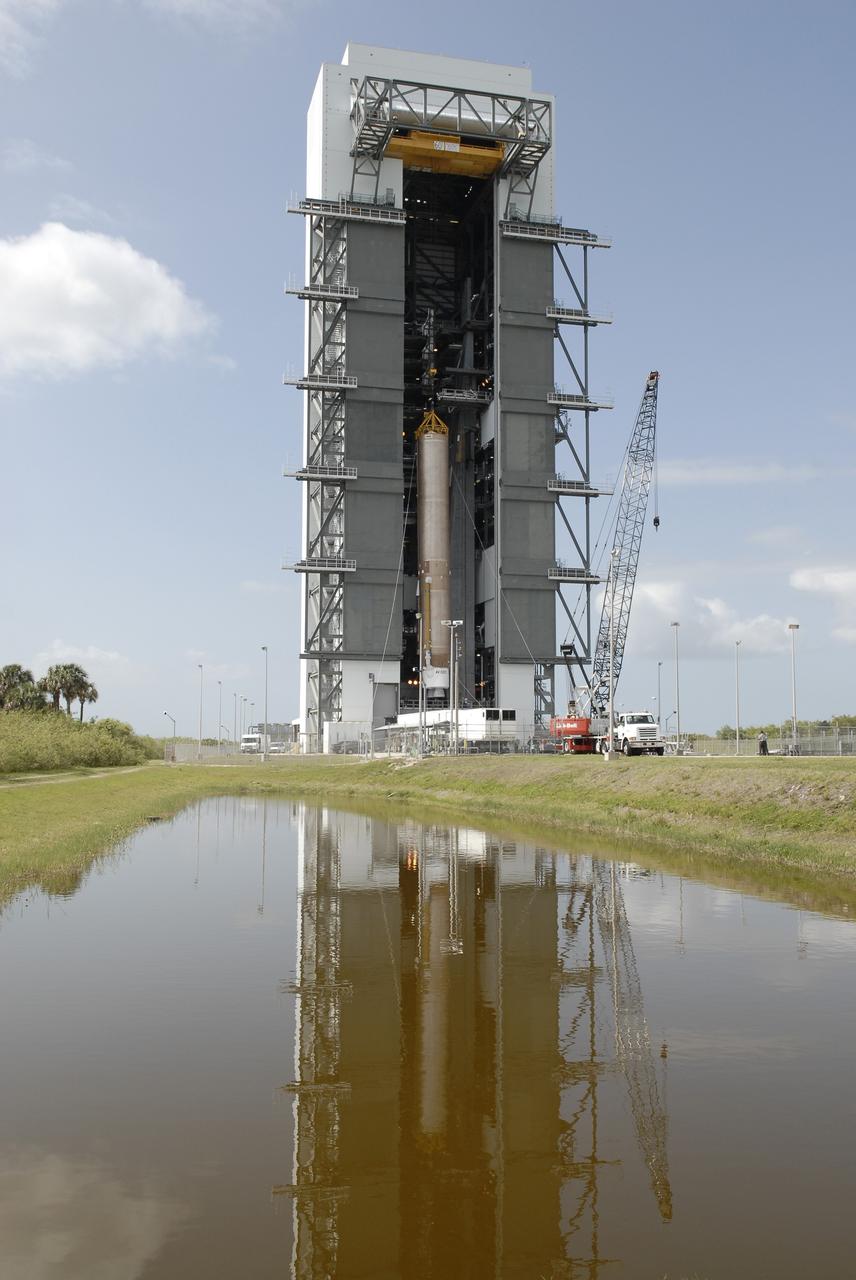
CAPE CANAVERAL, Fla. –– On Cape Canaveral Air Force Station's Launch Complex 41, the Atlas V first stage is being moved into the Vertical Integration Facility. The Atlas V/Centaur is the launch vehicle for the Lunar Reconnaissance Orbiter, or LRO. The orbiter will carry seven instruments to provide scientists with detailed maps of the lunar surface and enhance our understanding of the moon's topography, lighting conditions, mineralogical composition and natural resources. Information gleaned from LRO will be used to select safe landing sites, determine locations for future lunar outposts and help mitigate radiation dangers to astronauts. Launch of LRO is targeted no earlier than June 2. Photo credit: NASA/Kim Shiflett
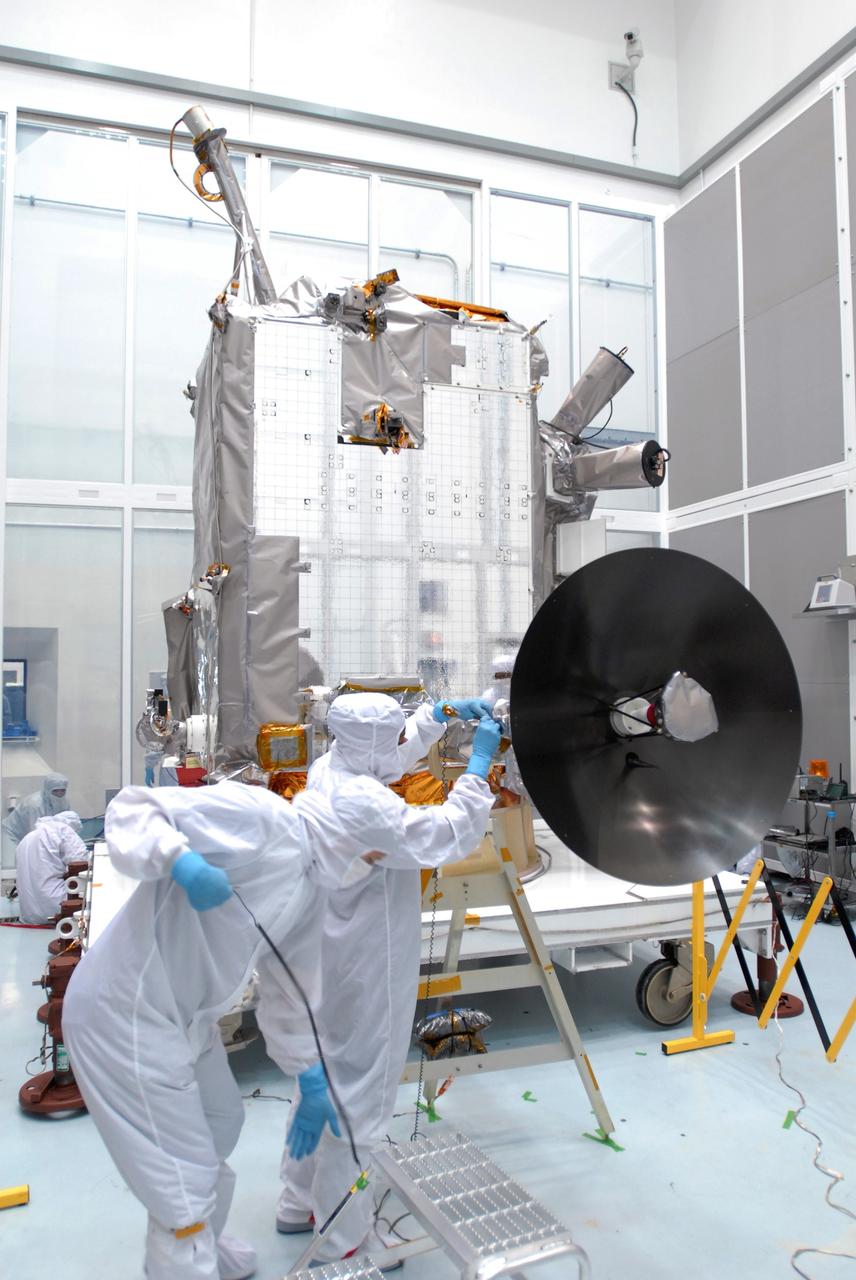
CAPE CANAVERAL, Fla. – At Astrotech Space Operations in Titusville, Fla., technicians are testing the range of motion on the high-gain antenna for the Lunar Reconnaissance Orbiter. The orbiter will carry seven instruments to provide scientists with detailed maps of the lunar surface and enhance our understanding of the moon's topography, lighting conditions, mineralogical composition and natural resources. Information gleaned from LRO will be used to select safe landing sites, determine locations for future lunar outposts and help mitigate radiation dangers to astronauts. Launch of LRO is targeted no earlier than June 2. Photo credit: NASA/Jim Grossmann
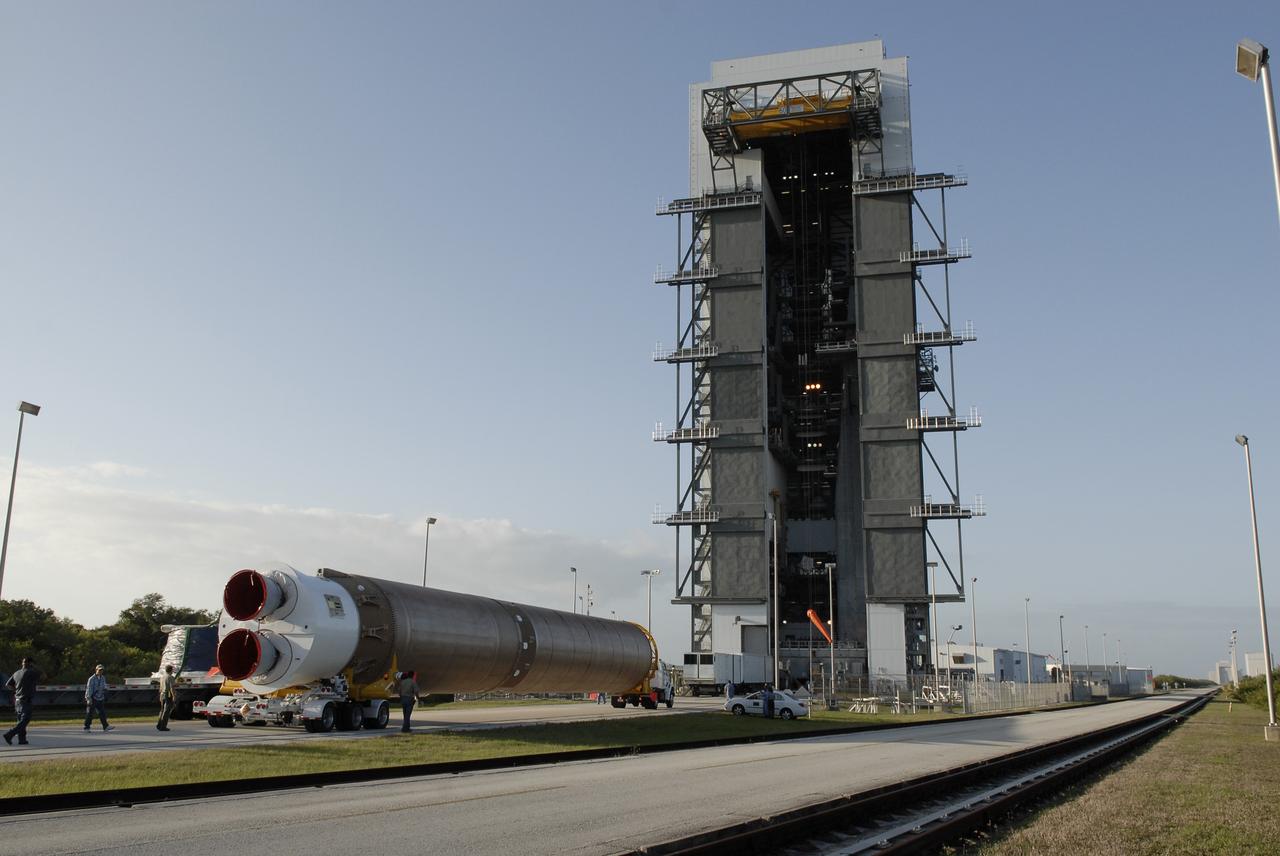
CAPE CANAVERAL, Fla. –– The Atlas V first stage arrives at the Vertical Integration Facility on Cape Canaveral Air Force Station's Launch Complex 41. The Atlas V/Centaur is the launch vehicle for the Lunar Reconnaissance Orbiter, or LRO. The orbiter will carry seven instruments to provide scientists with detailed maps of the lunar surface and enhance our understanding of the moon's topography, lighting conditions, mineralogical composition and natural resources. Information gleaned from LRO will be used to select safe landing sites, determine locations for future lunar outposts and help mitigate radiation dangers to astronauts. Launch of LRO is targeted no earlier than June 2. Photo credit: NASA/Kim Shiflett
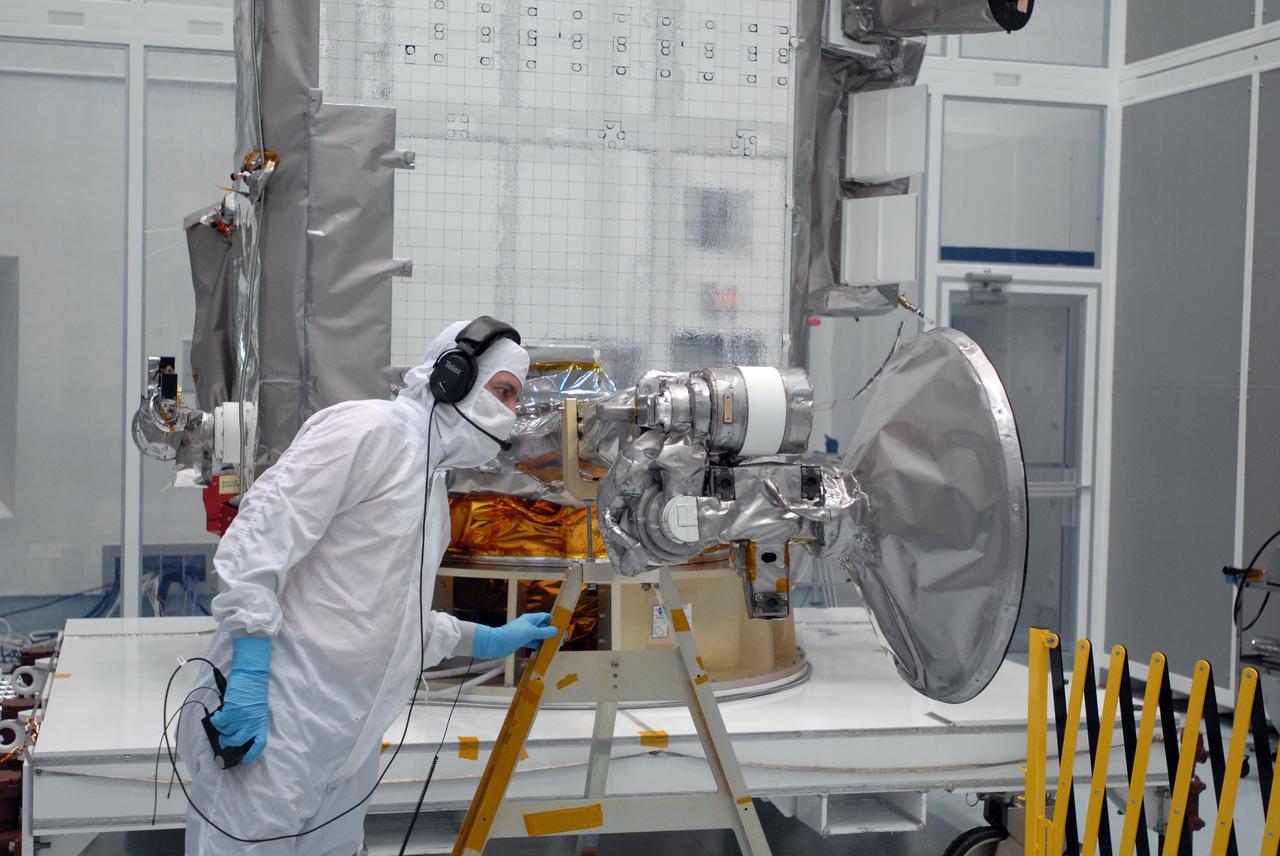
CAPE CANAVERAL, Fla. – At Astrotech Space Operations in Titusville, Fla., technicians check data (left) as the range of motion is tested on the high-gain antenna (foreground) for the Lunar Reconnaissance Orbiter. The orbiter will carry seven instruments to provide scientists with detailed maps of the lunar surface and enhance our understanding of the moon's topography, lighting conditions, mineralogical composition and natural resources. Information gleaned from LRO will be used to select safe landing sites, determine locations for future lunar outposts and help mitigate radiation dangers to astronauts. Launch of LRO is targeted no earlier than June 2. Photo credit: NASA/Jim Grossmann
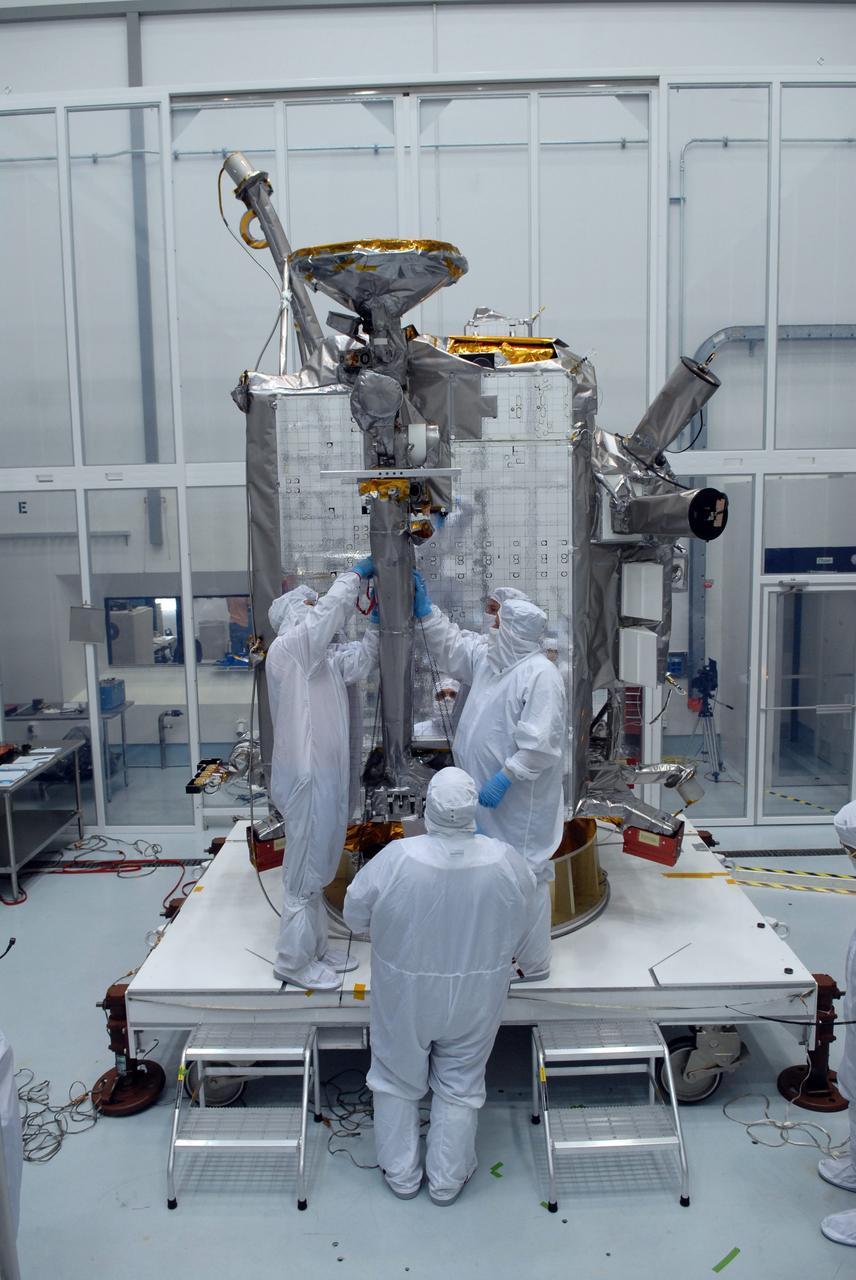
CAPE CANAVERAL, Fla. – At Astrotech Space Operations in Titusville, Fla., technicians secure NASA's Lunar Reconnaissance Orbiter's high-gain antenna into place for stowage. The antenna completed a range of motion test. The orbiter will carry seven instruments to provide scientists with detailed maps of the lunar surface and enhance our understanding of the moon's topography, lighting conditions, mineralogical composition and natural resources. Information gleaned from LRO will be used to select safe landing sites, determine locations for future lunar outposts and help mitigate radiation dangers to astronauts. Launch of LRO is targeted no earlier than June 2. Photo credit: NASA/Jack Pfaller
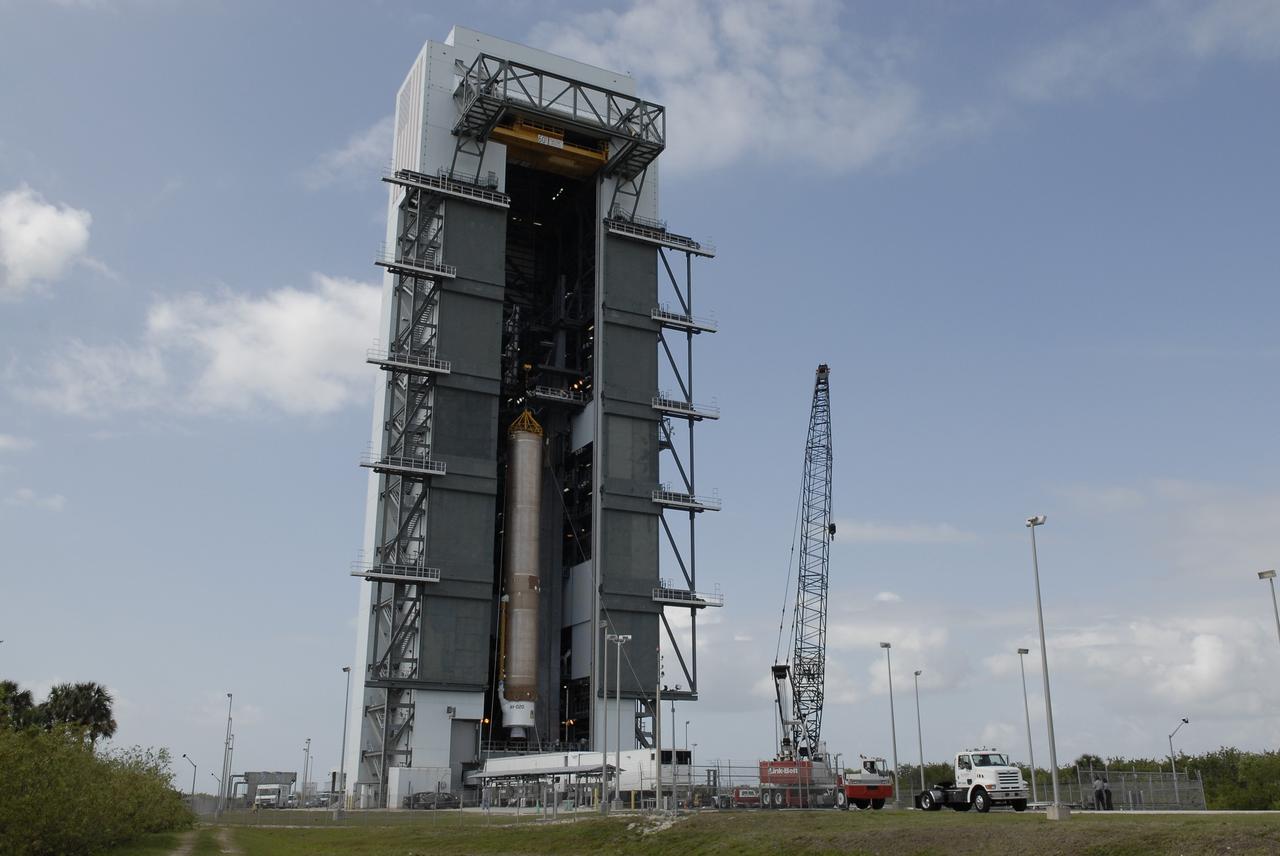
CAPE CANAVERAL, Fla. –– On Cape Canaveral Air Force Station's Launch Complex 41, the Atlas V first stage is being moved into the Vertical Integration Facility. The Atlas V/Centaur is the launch vehicle for the Lunar Reconnaissance Orbiter, or LRO. The orbiter will carry seven instruments to provide scientists with detailed maps of the lunar surface and enhance our understanding of the moon's topography, lighting conditions, mineralogical composition and natural resources. Information gleaned from LRO will be used to select safe landing sites, determine locations for future lunar outposts and help mitigate radiation dangers to astronauts. Launch of LRO is targeted no earlier than June 2. Photo credit: NASA/Kim Shiflett
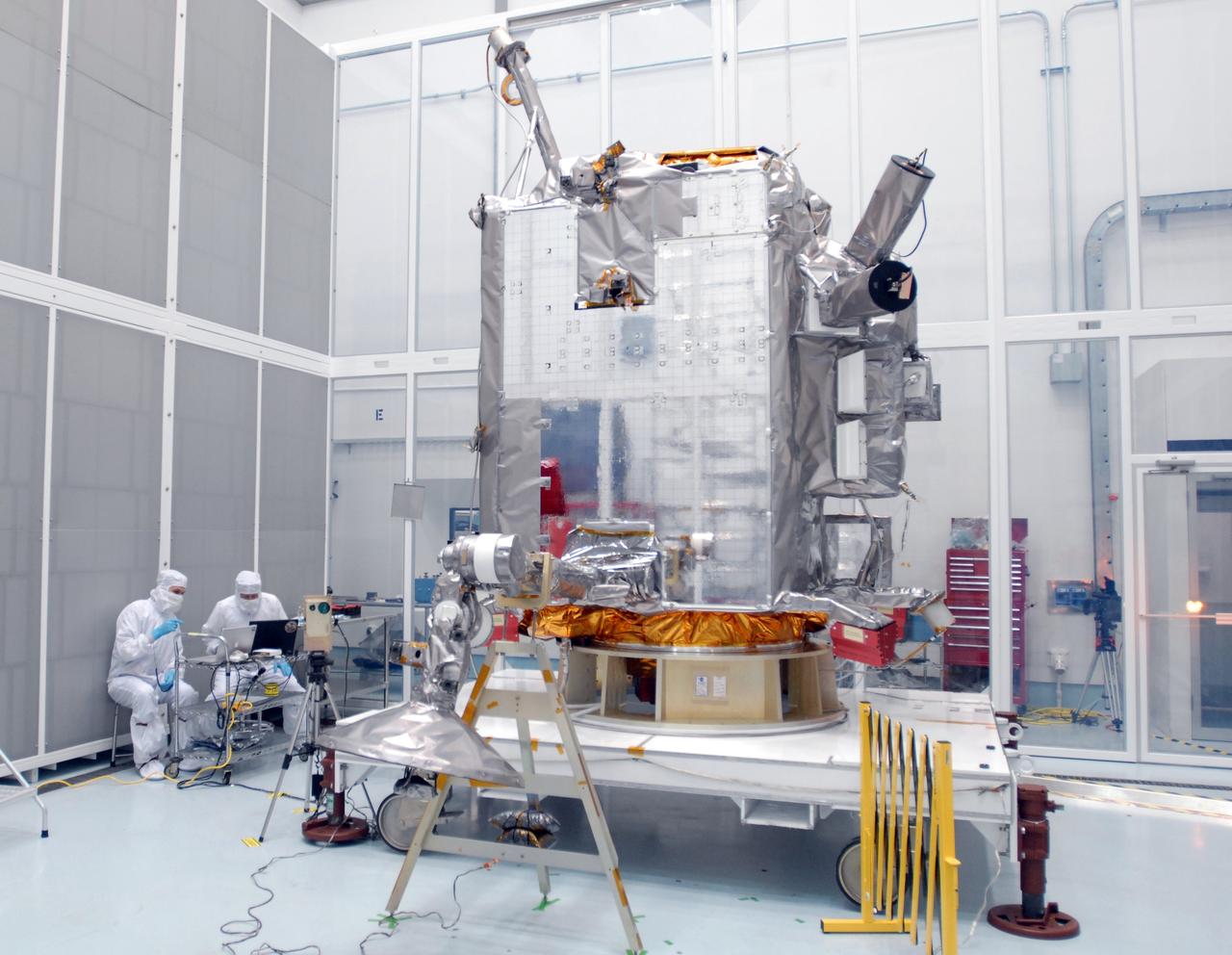
CAPE CANAVERAL, Fla. – At Astrotech Space Operations in Titusville, Fla., technicians check data (left) as the range of motion is tested on the high-gain antenna (foreground) for the Lunar Reconnaissance Orbiter. The orbiter will carry seven instruments to provide scientists with detailed maps of the lunar surface and enhance our understanding of the moon's topography, lighting conditions, mineralogical composition and natural resources. Information gleaned from LRO will be used to select safe landing sites, determine locations for future lunar outposts and help mitigate radiation dangers to astronauts. Launch of LRO is targeted no earlier than June 2. Photo credit: NASA/Jim Grossmann
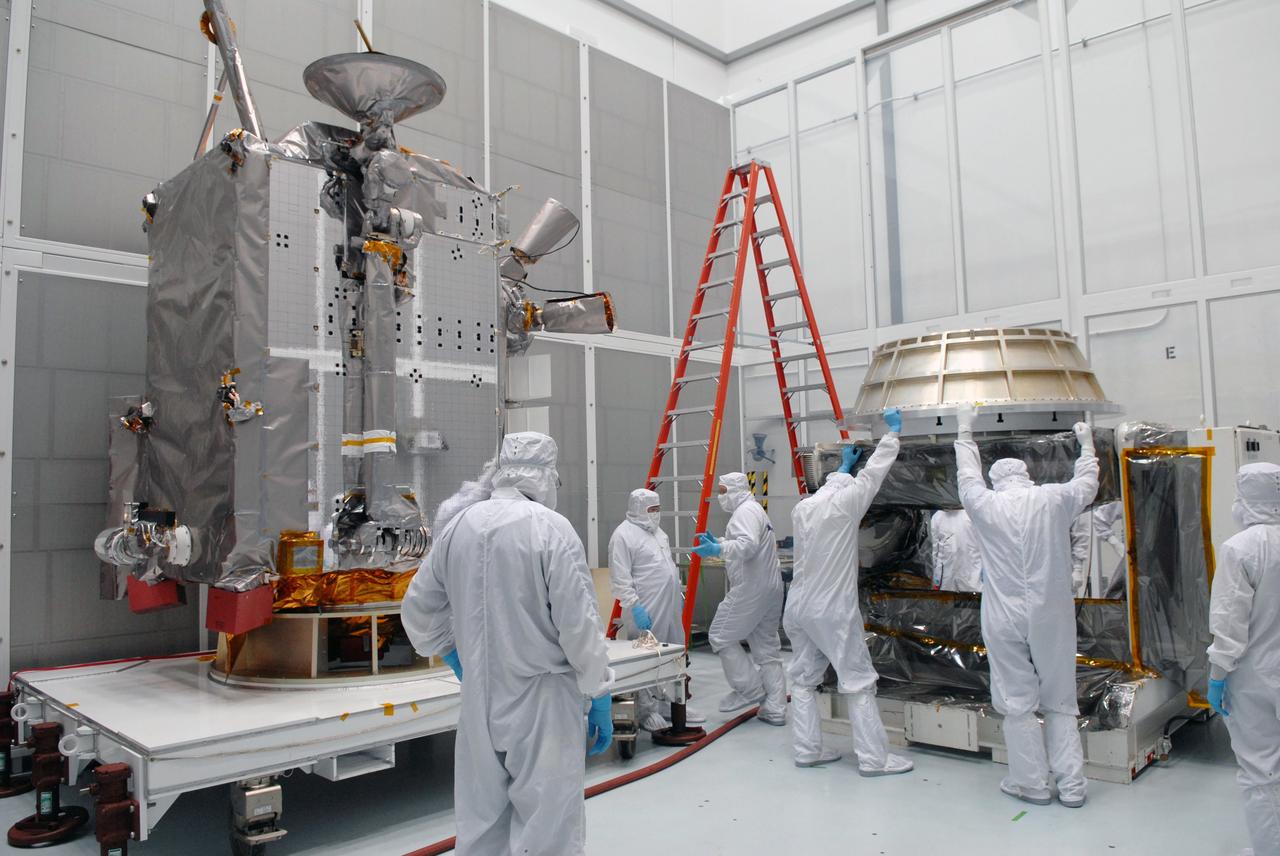
CAPE CANAVERAL, Fla. – At Astrotech in Titusville, Fla., technicians prepare an Aronson table to receive NASA's Lunar Reconnaissance Orbiter, or LRO, at left. The orbiter will be rotated on the table to provide proper access for processing. The orbiter will carry seven instruments to provide scientists with detailed maps of the lunar surface and enhance our understanding of the moon's topography, lighting conditions, mineralogical composition and natural resources. Information gleaned from LRO will be used to select safe landing sites, determine locations for future lunar outposts and help mitigate radiation dangers to astronauts. The polar regions of the moon are the main focus of the mission because continuous access to sunlight may be possible and water ice may exist in permanently shadowed areas of the poles. Accompanying LRO on its journey to the moon will be the Lunar CRater Observation and Sensing Satellite, or LCROSS, a mission that will impact the lunar surface in its search for water ice. Launch of LRO is targeted for May 20. Photo credit: NASA/Jack Pfaller
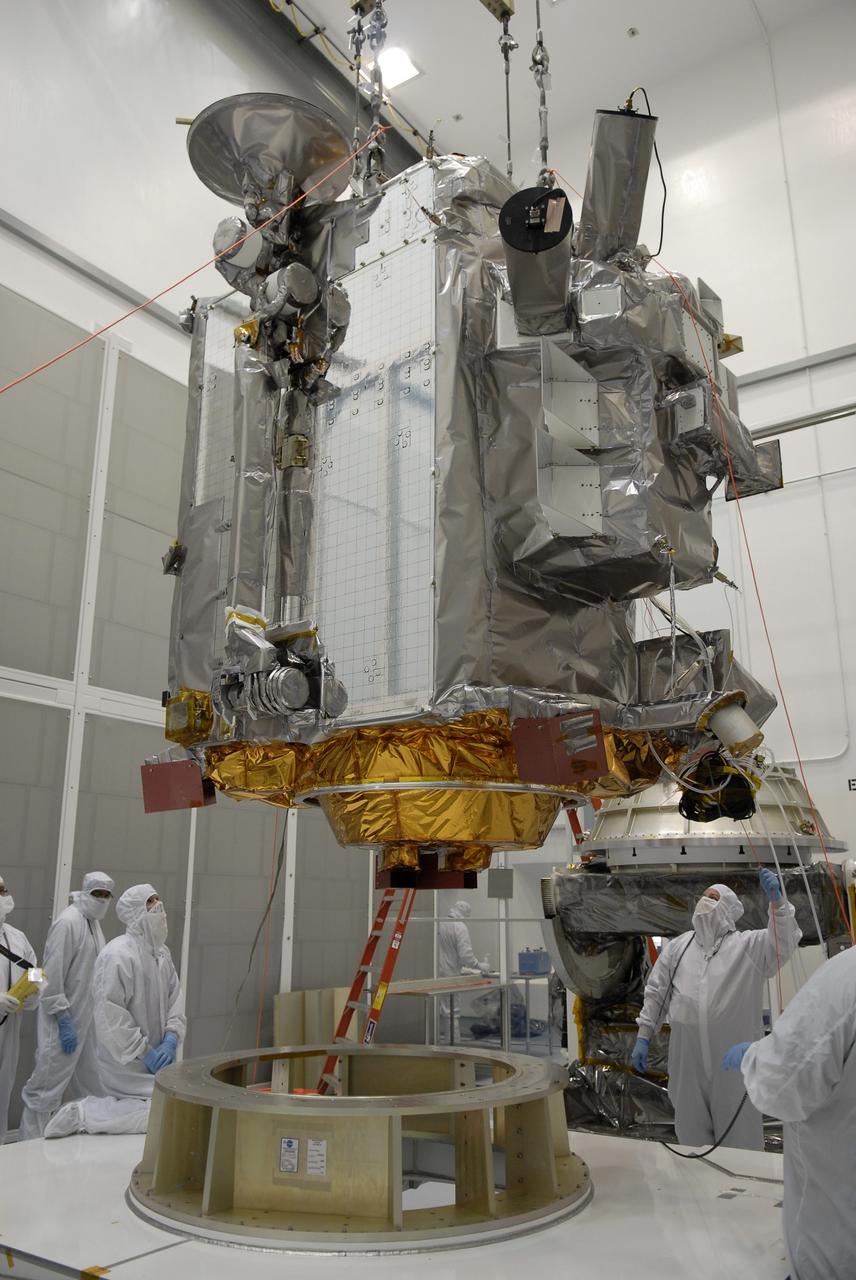
CAPE CANAVERAL, Fla. – At the Astrotech facility in Titusville, Fla., a crane moves NASA's Lunar Reconnaissance Orbiter, or LRO, toward a stand in the foreground. The orbiter will carry seven instruments to provide scientists with detailed maps of the lunar surface and enhance our understanding of the moon's topography, lighting conditions, mineralogical composition and natural resources. Information gleaned from LRO will be used to select safe landing sites, determine locations for future lunar outposts and help mitigate radiation dangers to astronauts. The polar regions of the moon are the main focus of the mission because continuous access to sunlight may be possible and water ice may exist in permanently shadowed areas of the poles. Accompanying LRO on its journey to the moon will be the Lunar CRater Observation and Sensing Satellite, or LCROSS, a mission that will impact the lunar surface in its search for water ice. Launch of LRO is targeted for May 20. Photo credit: NASA/Kim Shiflett
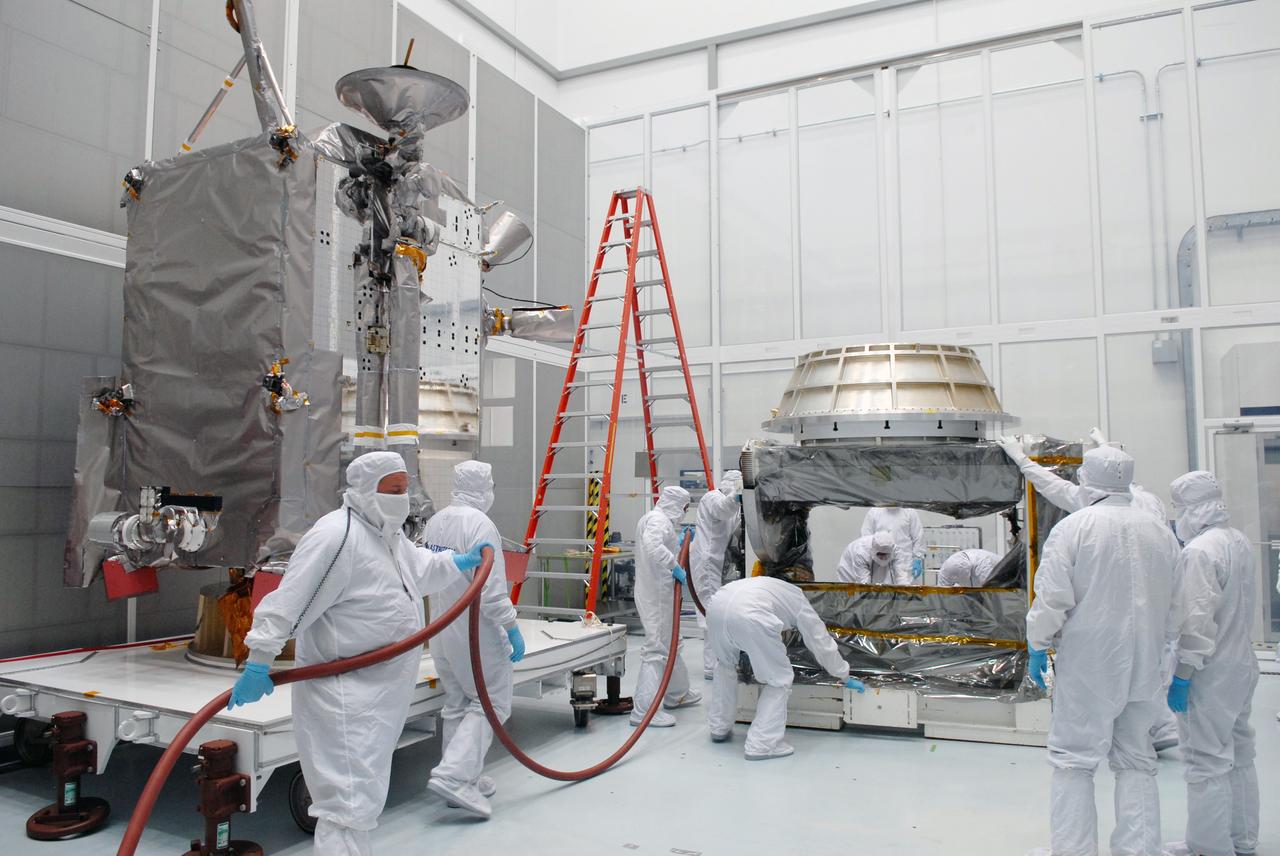
CAPE CANAVERAL, Fla. – At Astrotech in Titusville, Fla., technicians prepare an Aronson table to receive NASA's Lunar Reconnaissance Orbiter, or LRO, at left. The orbiter will be rotated on the table to provide proper access for processing. The orbiter will carry seven instruments to provide scientists with detailed maps of the lunar surface and enhance our understanding of the moon's topography, lighting conditions, mineralogical composition and natural resources. Information gleaned from LRO will be used to select safe landing sites, determine locations for future lunar outposts and help mitigate radiation dangers to astronauts. The polar regions of the moon are the main focus of the mission because continuous access to sunlight may be possible and water ice may exist in permanently shadowed areas of the poles. Accompanying LRO on its journey to the moon will be the Lunar CRater Observation and Sensing Satellite, or LCROSS, a mission that will impact the lunar surface in its search for water ice. Launch of LRO is targeted for May 20. Photo credit: NASA/Jack Pfaller
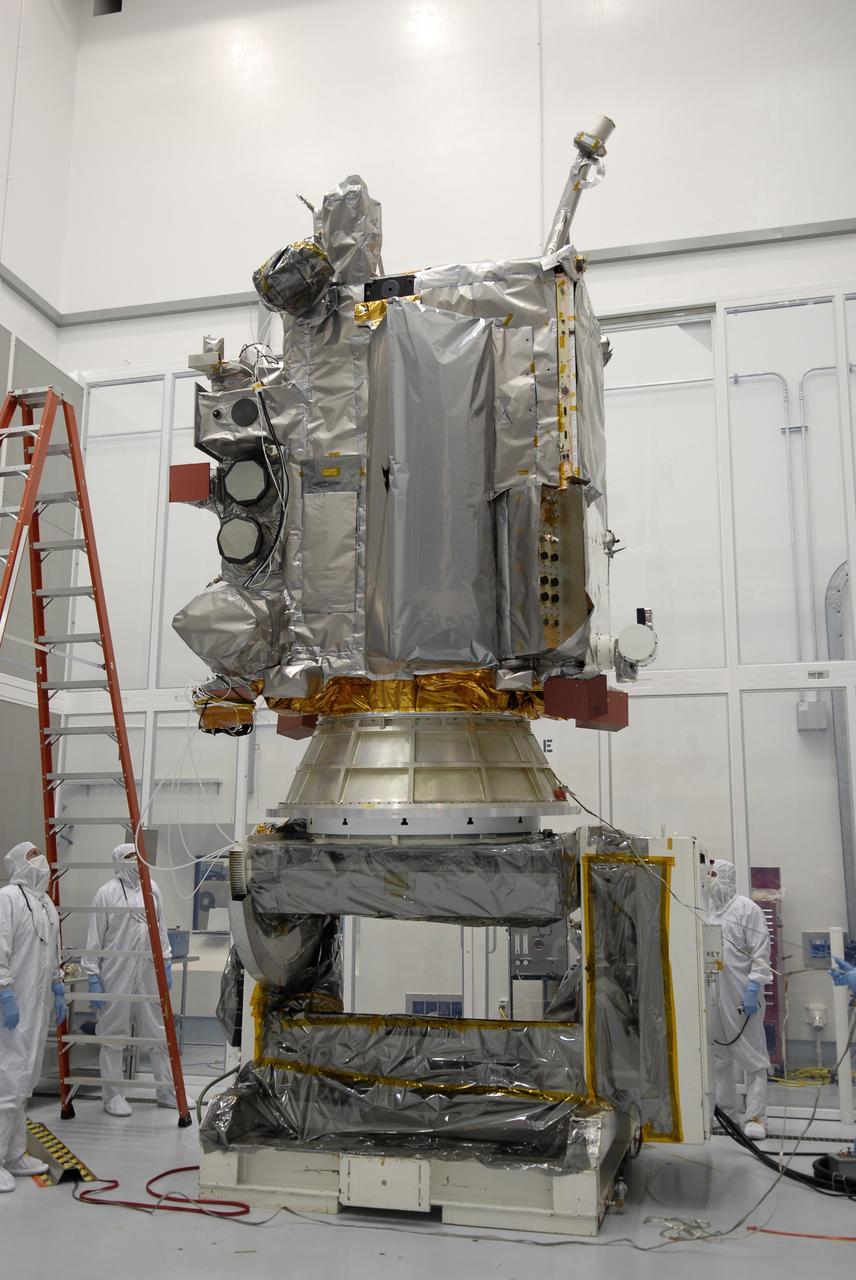
CAPE CANAVERAL, Fla. – At the Astrotech facility in Titusville, Fla., NASA's Lunar Reconnaissance Orbiter, or LRO, has been rotated to vertical on the Aronson stand. A crane will be attached to move it to another stand. The orbiter will carry seven instruments to provide scientists with detailed maps of the lunar surface and enhance our understanding of the moon's topography, lighting conditions, mineralogical composition and natural resources. Information gleaned from LRO will be used to select safe landing sites, determine locations for future lunar outposts and help mitigate radiation dangers to astronauts. The polar regions of the moon are the main focus of the mission because continuous access to sunlight may be possible and water ice may exist in permanently shadowed areas of the poles. Accompanying LRO on its journey to the moon will be the Lunar CRater Observation and Sensing Satellite, or LCROSS, a mission that will impact the lunar surface in its search for water ice. Launch of LRO is targeted for May 20. Photo credit: NASA/Kim Shiflett
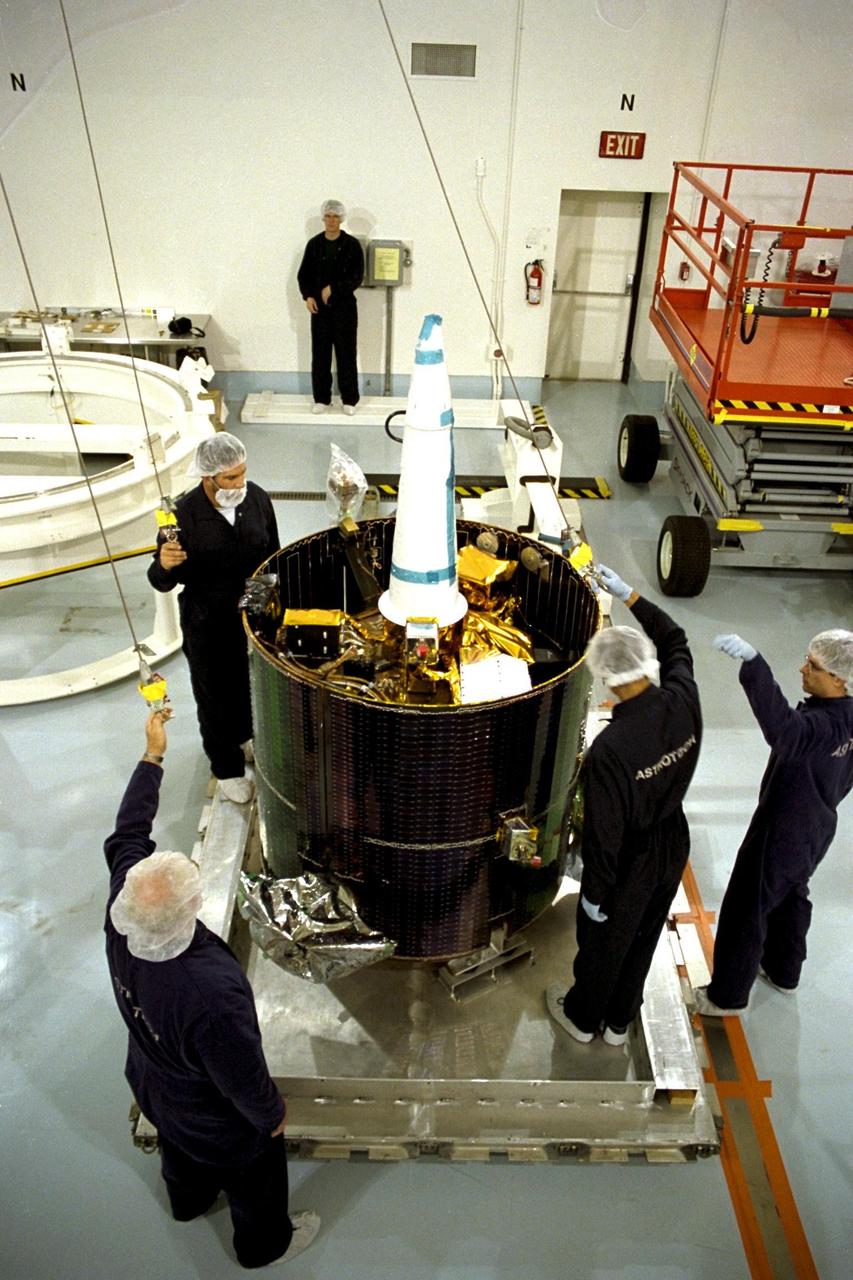
NASA's Lunar Prospector is taken out of its crate at Astrotech, a commercial payload processing facility, in Titusville, Fla. The small robotic spacecraft, to be launched for NASA on an Athena 2 rocket by Lockheed Martin, is designed to provide the first global maps of the Moon's surface compositional elements and its gravitational and magnetic fields. While at Astrotech, Lunar Prospector will be fueled with its attitude control propellant and then mated to a Trans-Lunar Injection Stage which is a solid propellant upper stage motor. The combination will next be spin tested to verify proper balance, then encapsulated into an Athena nose fairing. Then the Lunar Prospector will be transported from Astrotech to Cape Canaveral Air Station and mated to an Athena rocket. The launch of Lunar Prospector is scheduled for Jan. 5, 1998 at 8:31 p.m
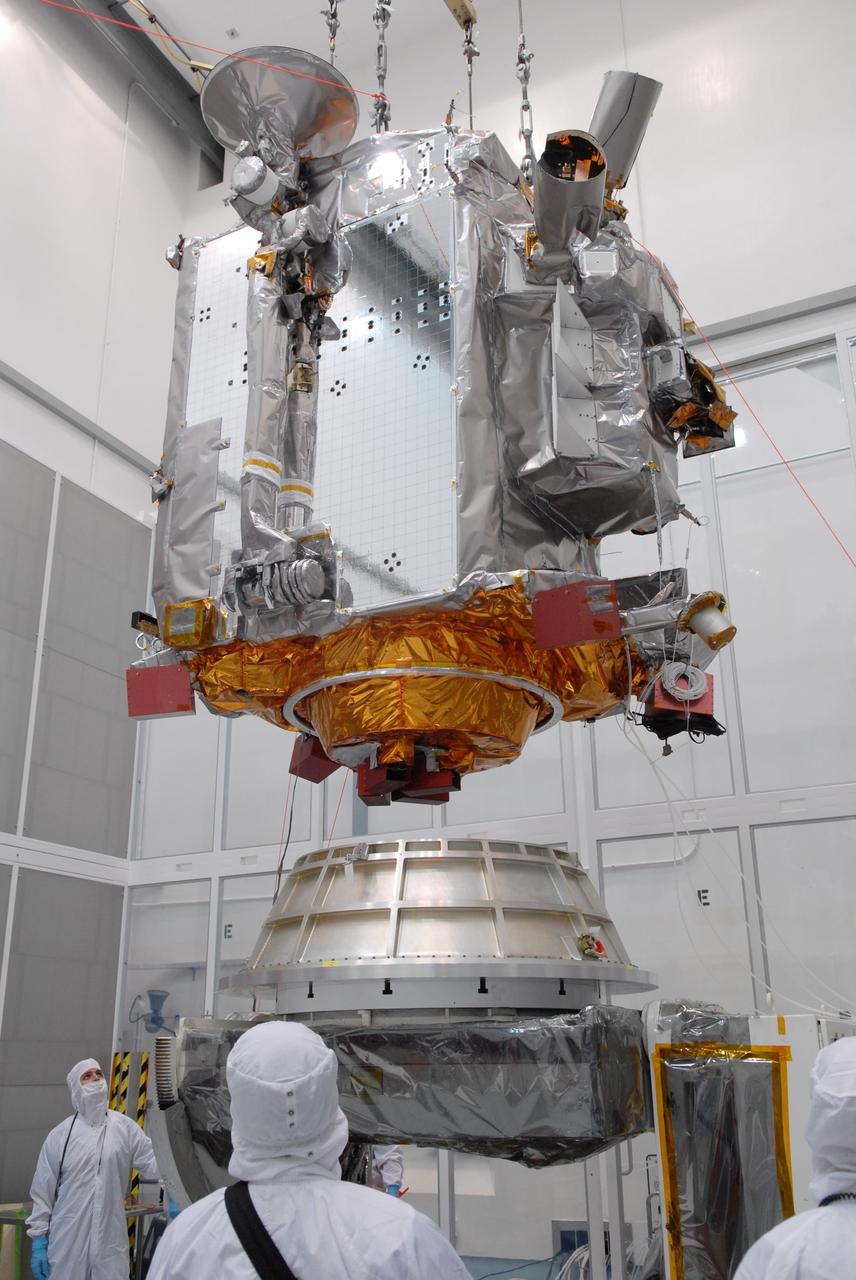
CAPE CANAVERAL, Fla. – At Astrotech in Titusville, Fla., an overhead crane lowers NASA's Lunar Reconnaissance Orbiter, or LRO, toward the Aronson table. The orbiter will be rotated on the table to provide proper access for processing. The orbiter will carry seven instruments to provide scientists with detailed maps of the lunar surface and enhance our understanding of the moon's topography, lighting conditions, mineralogical composition and natural resources. Information gleaned from LRO will be used to select safe landing sites, determine locations for future lunar outposts and help mitigate radiation dangers to astronauts. The polar regions of the moon are the main focus of the mission because continuous access to sunlight may be possible and water ice may exist in permanently shadowed areas of the poles. Accompanying LRO on its journey to the moon will be the Lunar CRater Observation and Sensing Satellite, or LCROSS, a mission that will impact the lunar surface in its search for water ice. Launch of LRO is targeted for May 20. Photo credit: NASA/Jack Pfaller
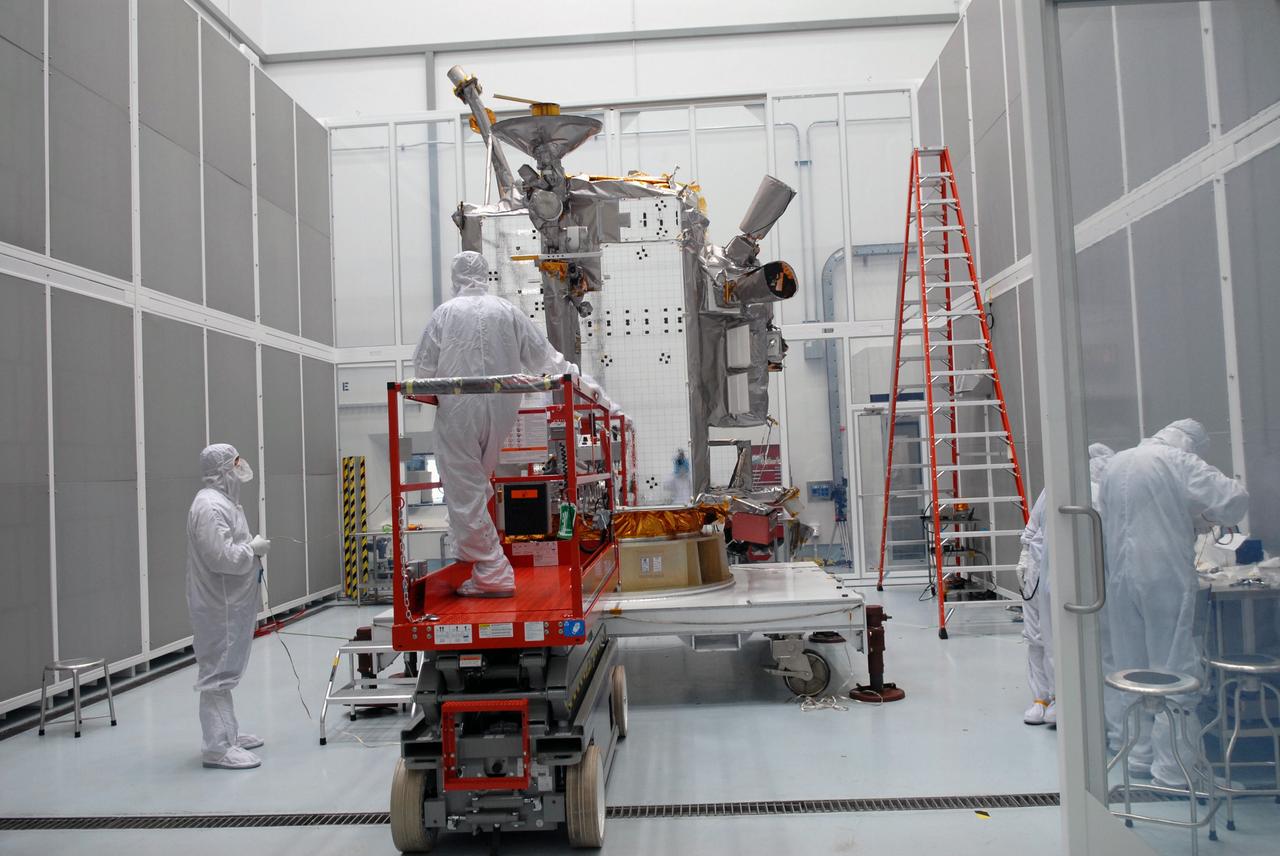
CAPE CANAVERAL, Fla. – At Astrotech in Titusville, Fla., NASA's Lunar Reconnaissance Orbiter, or LRO, spacecraft is being prepared for lifting to an Aronson table. The LRO will be rotated on the table to provide proper access for processing. The orbiter will carry seven instruments to provide scientists with detailed maps of the lunar surface and enhance our understanding of the moon's topography, lighting conditions, mineralogical composition and natural resources. Information gleaned from LRO will be used to select safe landing sites, determine locations for future lunar outposts and help mitigate radiation dangers to astronauts. The polar regions of the moon are the main focus of the mission because continuous access to sunlight may be possible and water ice may exist in permanently shadowed areas of the poles. Accompanying LRO on its journey to the moon will be the Lunar CRater Observation and Sensing Satellite, or LCROSS, a mission that will impact the lunar surface in its search for water ice. Launch of LRO is targeted for May 20. Photo credit: NASA/Jack Pfaller
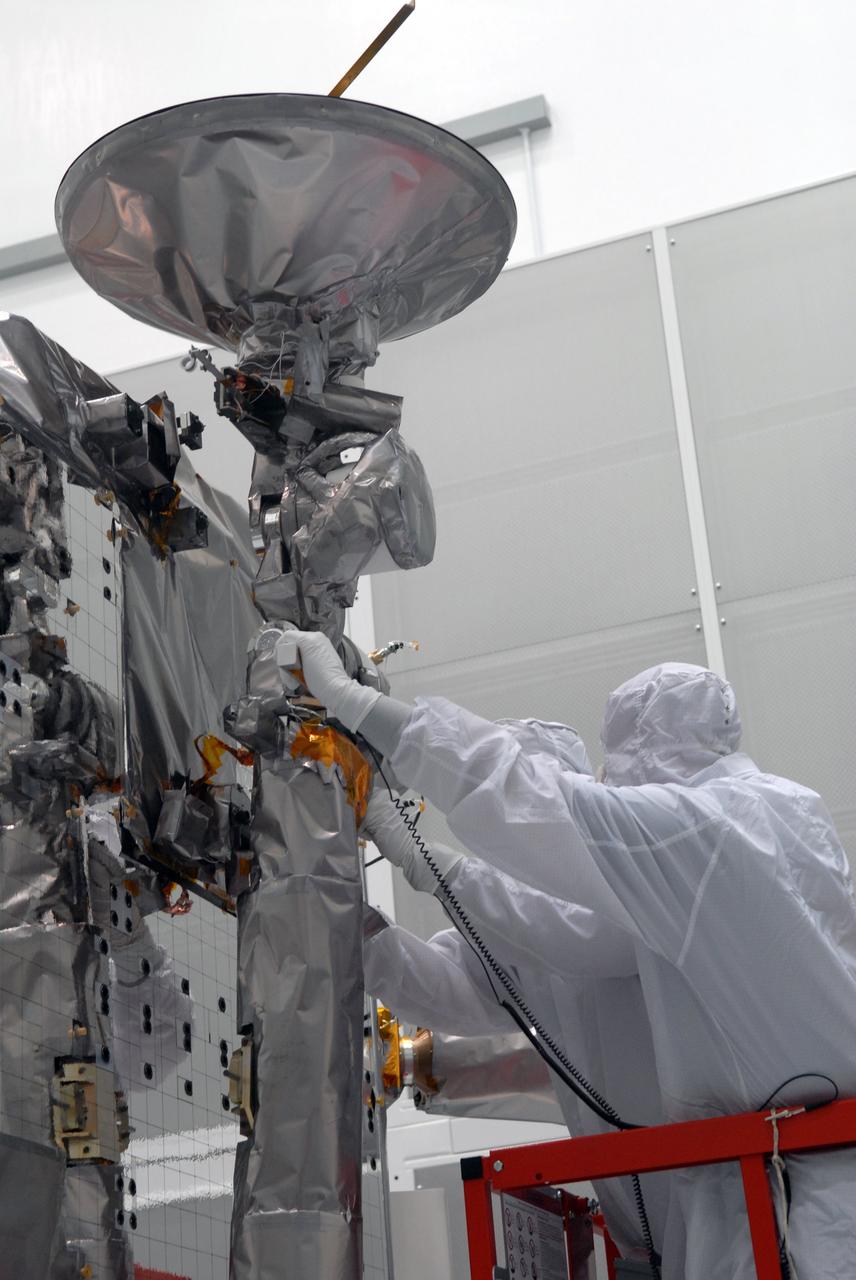
CAPE CANAVERAL, Fla. – At Astrotech in Titusville, Fla., a technician attaches cables to NASA's Lunar Reconnaissance Orbiter, or LRO. The orbiter will be rotated on the table to provide proper access for processing. The orbiter will carry seven instruments to provide scientists with detailed maps of the lunar surface and enhance our understanding of the moon's topography, lighting conditions, mineralogical composition and natural resources. Information gleaned from LRO will be used to select safe landing sites, determine locations for future lunar outposts and help mitigate radiation dangers to astronauts. The polar regions of the moon are the main focus of the mission because continuous access to sunlight may be possible and water ice may exist in permanently shadowed areas of the poles. Accompanying LRO on its journey to the moon will be the Lunar CRater Observation and Sensing Satellite, or LCROSS, a mission that will impact the lunar surface in its search for water ice. Launch of LRO is targeted for May 20. Photo credit: NASA/Jack Pfaller
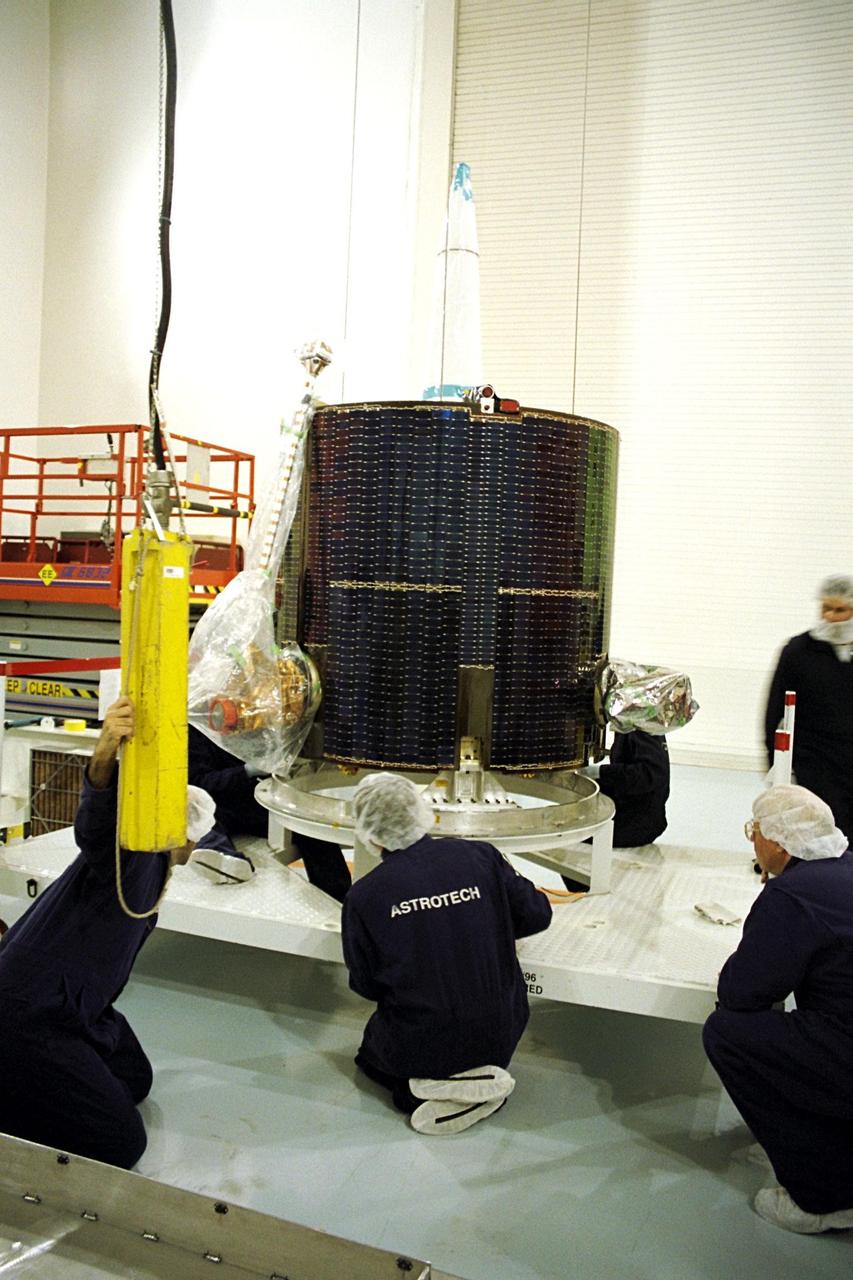
NASA's Lunar Prospector is taken out of its crate at Astrotech, a commercial payload processing facility, in Titusville, Fla. The small robotic spacecraft, to be launched for NASA on an Athena 2 rocket by Lockheed Martin, is designed to provide the first global maps of the Moon's surface compositional elements and its gravitational and magnetic fields. While at Astrotech, Lunar Prospector will be fueled with its attitude control propellant and then mated to a Trans-Lunar Injection Stage which is a solid propellant upper stage motor. The combination will next be spin tested to verify proper balance, then encapsulated into an Athena nose fairing. Then the Lunar Prospector will be transported from Astrotech to Cape Canaveral Air Station and mated to an Athena rocket. The launch of Lunar Prospector is scheduled for Jan. 5, 1998 at 8:31 p.m
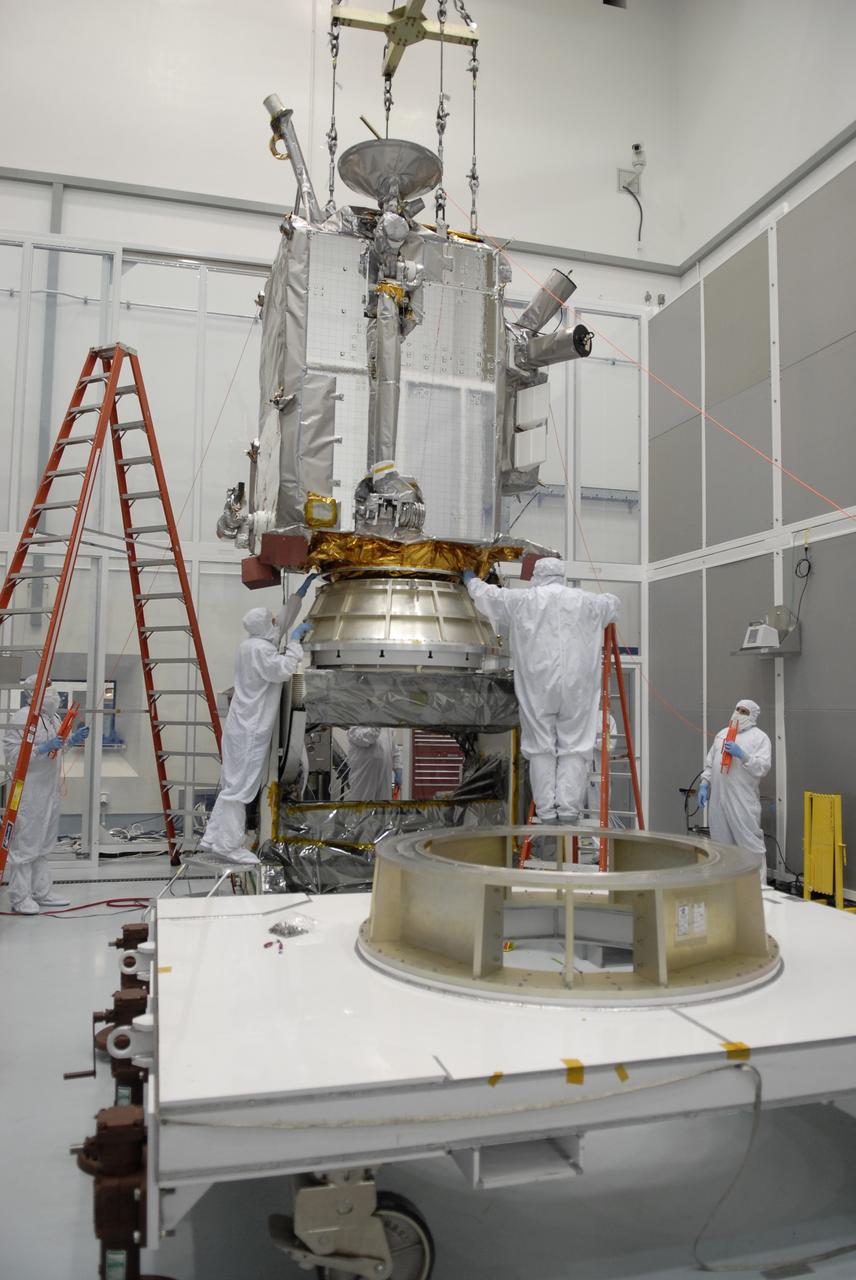
CAPE CANAVERAL, Fla. – At the Astrotech facility in Titusville, Fla., a crane is attached to NASA's Lunar Reconnaissance Orbiter, or LRO. The crane will move LRO to another stand. The orbiter will carry seven instruments to provide scientists with detailed maps of the lunar surface and enhance our understanding of the moon's topography, lighting conditions, mineralogical composition and natural resources. Information gleaned from LRO will be used to select safe landing sites, determine locations for future lunar outposts and help mitigate radiation dangers to astronauts. The polar regions of the moon are the main focus of the mission because continuous access to sunlight may be possible and water ice may exist in permanently shadowed areas of the poles. Accompanying LRO on its journey to the moon will be the Lunar CRater Observation and Sensing Satellite, or LCROSS, a mission that will impact the lunar surface in its search for water ice. Launch of LRO is targeted for May 20. Photo credit: NASA/Kim Shiflett
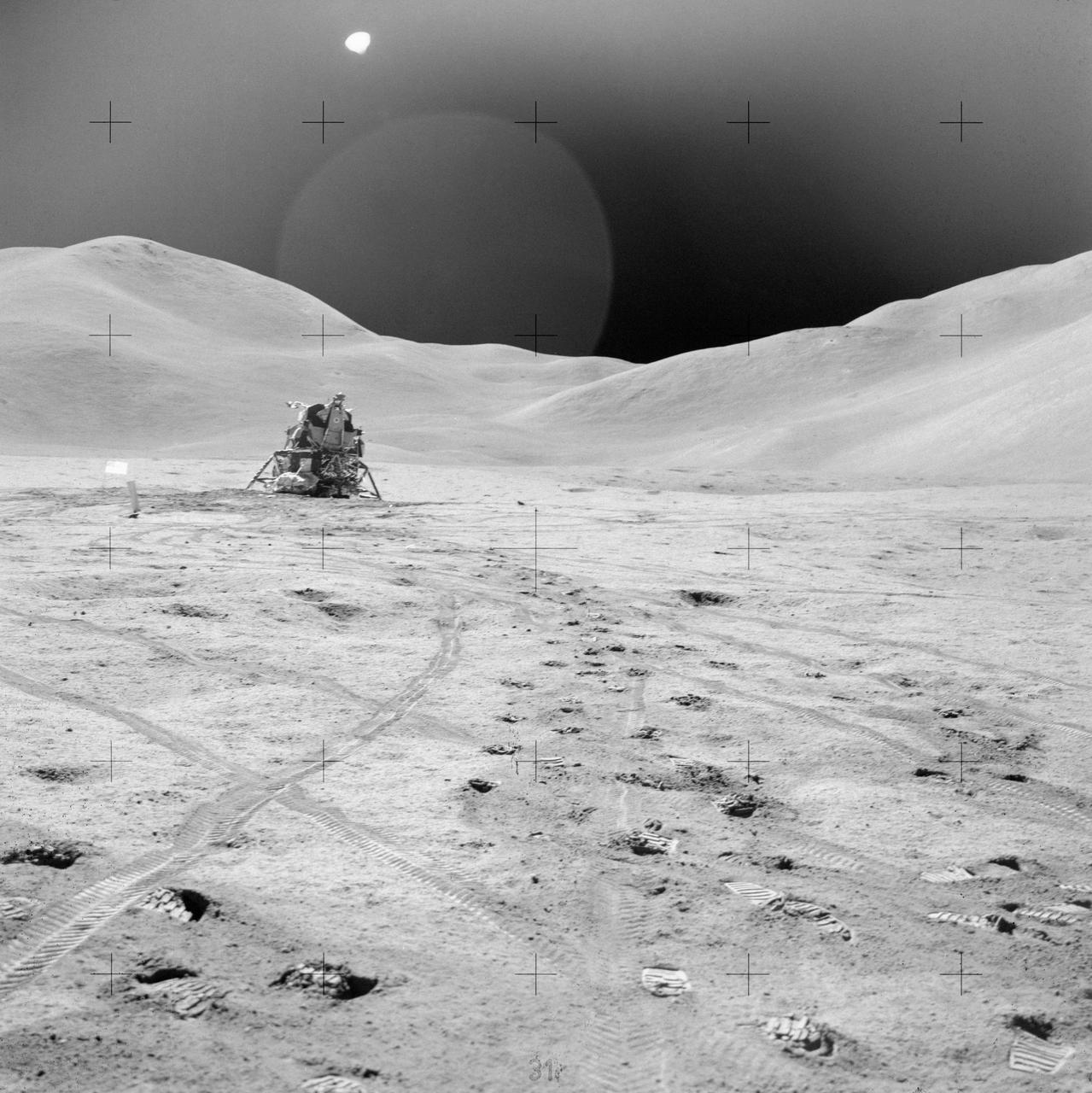
AS15-82-11057 (2 Aug. 1971) --- The Lunar Module (LM) "Falcon" is photographed against the barren lunarscape during the third Apollo 15 lunar surface extravehicular activity (EVA) at the Hadley-Apennine landing site on the lunar nearside. This view is looking southeast. The Apennine Front is in the left background; and Hadley Delta Mountain is in the right background. The object next to the United States flag is the Solar Wind Composition (SWC) experiment. Last Crater is to the right of the LM. Note bootprints and tracks of the Lunar Roving Vehicle (LRV). The light spherical object at the top is a reflection in the lens of the camera. While astronauts David R. Scott and James B. Irwin descended in the LM to explore the moon, astronaut Alfred M. Worden remained with the Command and Service Modules (CSM) in lunar orbit.
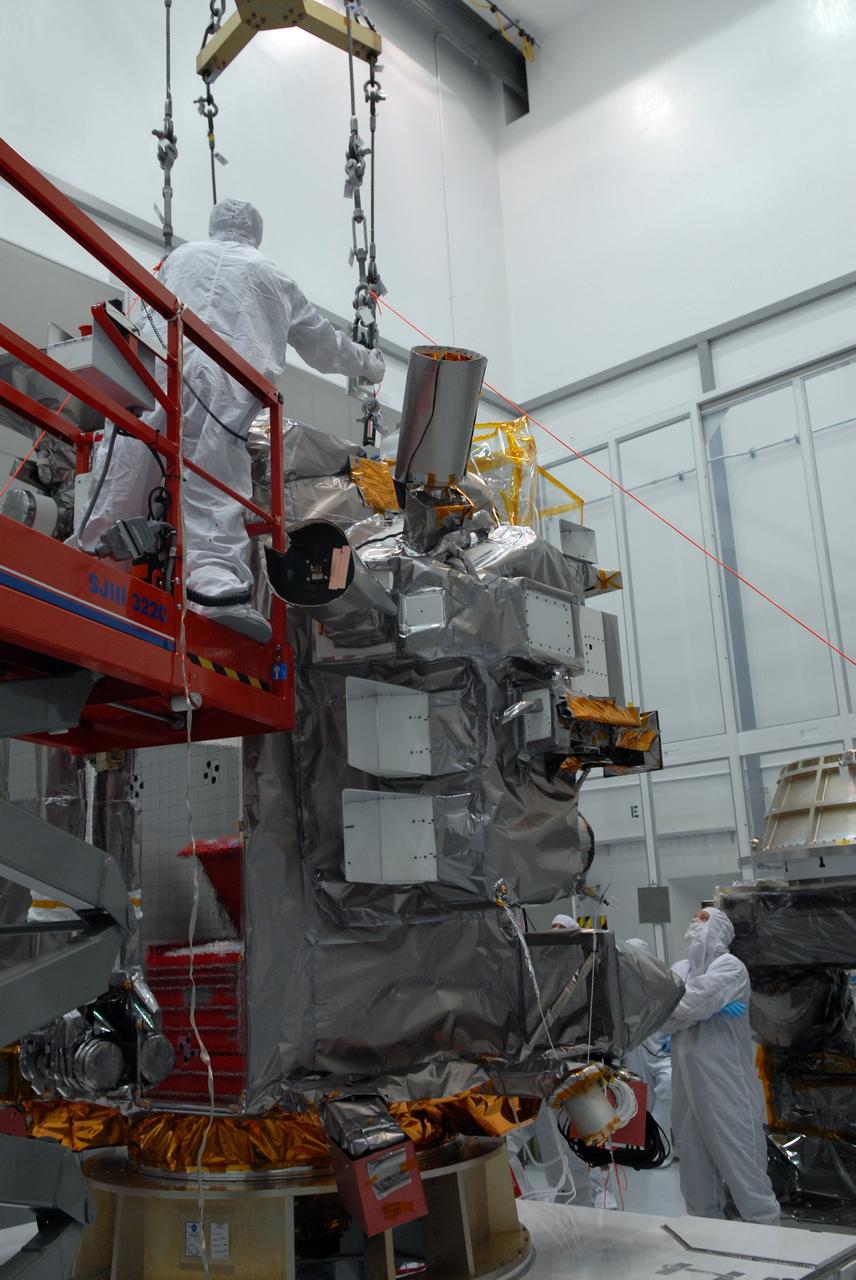
CAPE CANAVERAL, Fla. – At Astrotech in Titusville, Fla., technicians get ready to lift NASA's Lunar Reconnaissance Orbiter, or LRO. It will be moved to an Aronson table for rotation to provide proper access for processing. The orbiter will carry seven instruments to provide scientists with detailed maps of the lunar surface and enhance our understanding of the moon's topography, lighting conditions, mineralogical composition and natural resources. Information gleaned from LRO will be used to select safe landing sites, determine locations for future lunar outposts and help mitigate radiation dangers to astronauts. The polar regions of the moon are the main focus of the mission because continuous access to sunlight may be possible and water ice may exist in permanently shadowed areas of the poles. Accompanying LRO on its journey to the moon will be the Lunar CRater Observation and Sensing Satellite, or LCROSS, a mission that will impact the lunar surface in its search for water ice. Launch of LRO is targeted for May 20. Photo credit: NASA/Jack Pfaller
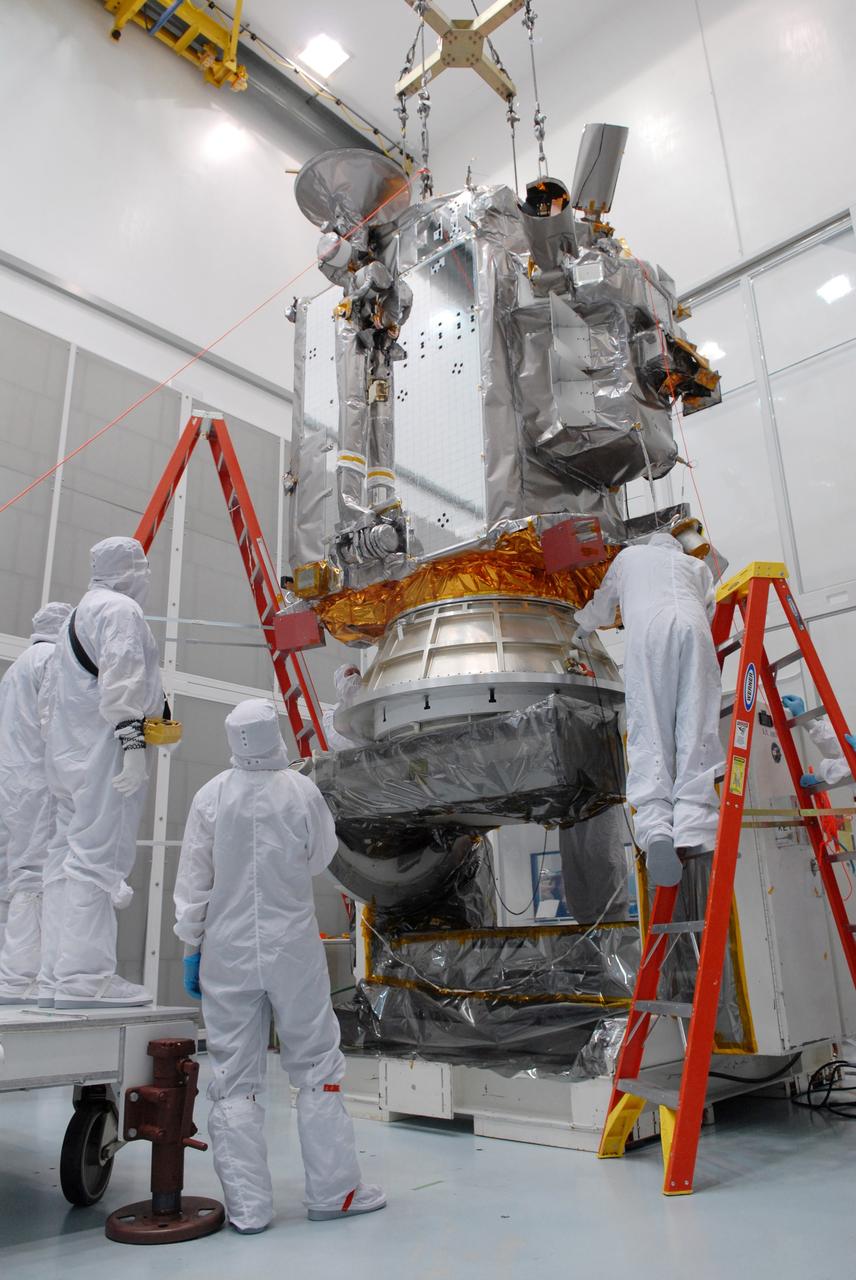
CAPE CANAVERAL, Fla. – At Astrotech in Titusville, Fla., an overhead crane lowers NASA's Lunar Reconnaissance Orbiter, or LRO, onto the Aronson table. The orbiter will be rotated on the table to provide proper access for processing. The orbiter will carry seven instruments to provide scientists with detailed maps of the lunar surface and enhance our understanding of the moon's topography, lighting conditions, mineralogical composition and natural resources. Information gleaned from LRO will be used to select safe landing sites, determine locations for future lunar outposts and help mitigate radiation dangers to astronauts. The polar regions of the moon are the main focus of the mission because continuous access to sunlight may be possible and water ice may exist in permanently shadowed areas of the poles. Accompanying LRO on its journey to the moon will be the Lunar CRater Observation and Sensing Satellite, or LCROSS, a mission that will impact the lunar surface in its search for water ice. Launch of LRO is targeted for May 20. Photo credit: NASA/Jack Pfaller
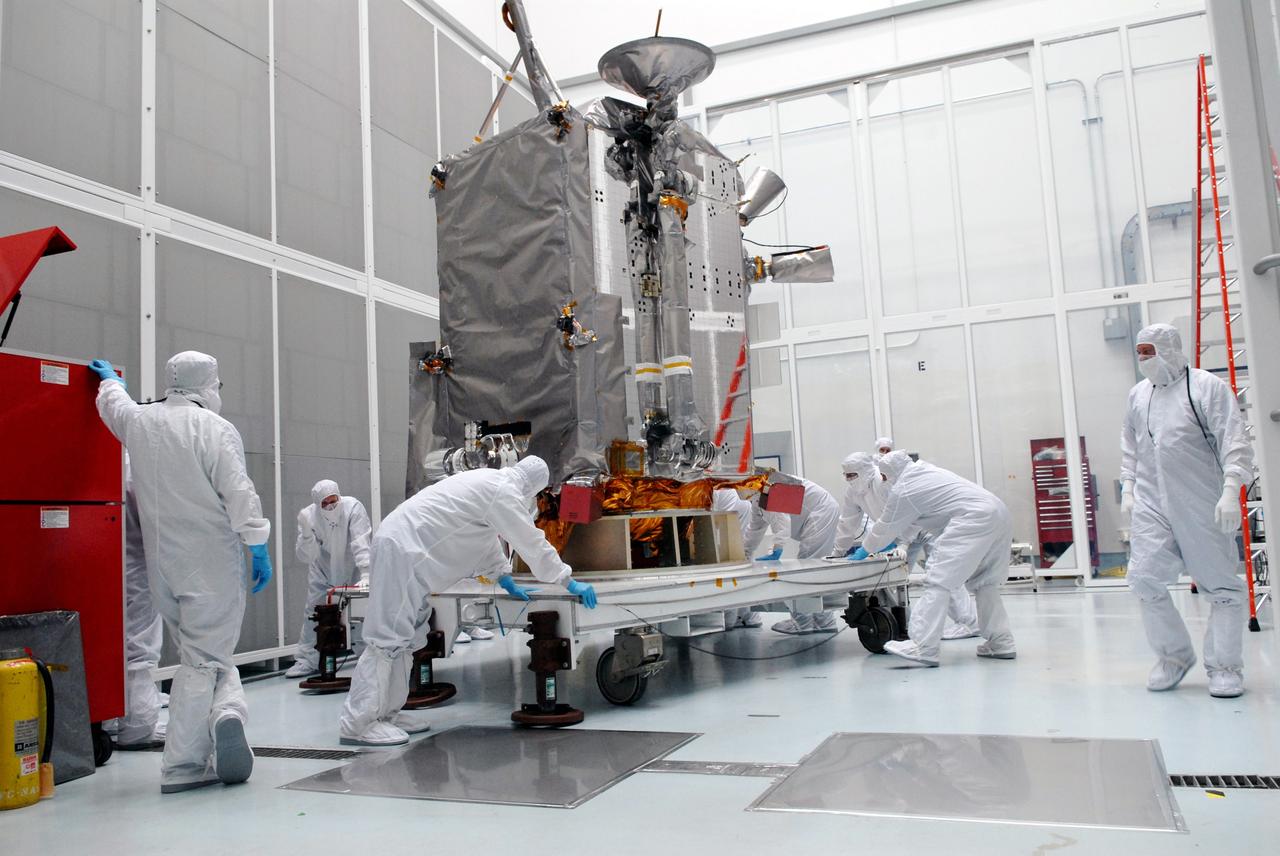
CAPE CANAVERAL, Fla. – At Astrotech in Titusville, Fla., technicians moved the stand with NASA's Lunar Reconnaissance Orbiter, or LRO. The orbiter will be rotated on the table to provide proper access for processing. The orbiter will carry seven instruments to provide scientists with detailed maps of the lunar surface and enhance our understanding of the moon's topography, lighting conditions, mineralogical composition and natural resources. Information gleaned from LRO will be used to select safe landing sites, determine locations for future lunar outposts and help mitigate radiation dangers to astronauts. The polar regions of the moon are the main focus of the mission because continuous access to sunlight may be possible and water ice may exist in permanently shadowed areas of the poles. Accompanying LRO on its journey to the moon will be the Lunar CRater Observation and Sensing Satellite, or LCROSS, a mission that will impact the lunar surface in its search for water ice. Launch of LRO is targeted for May 20. Photo credit: NASA/Jack Pfaller
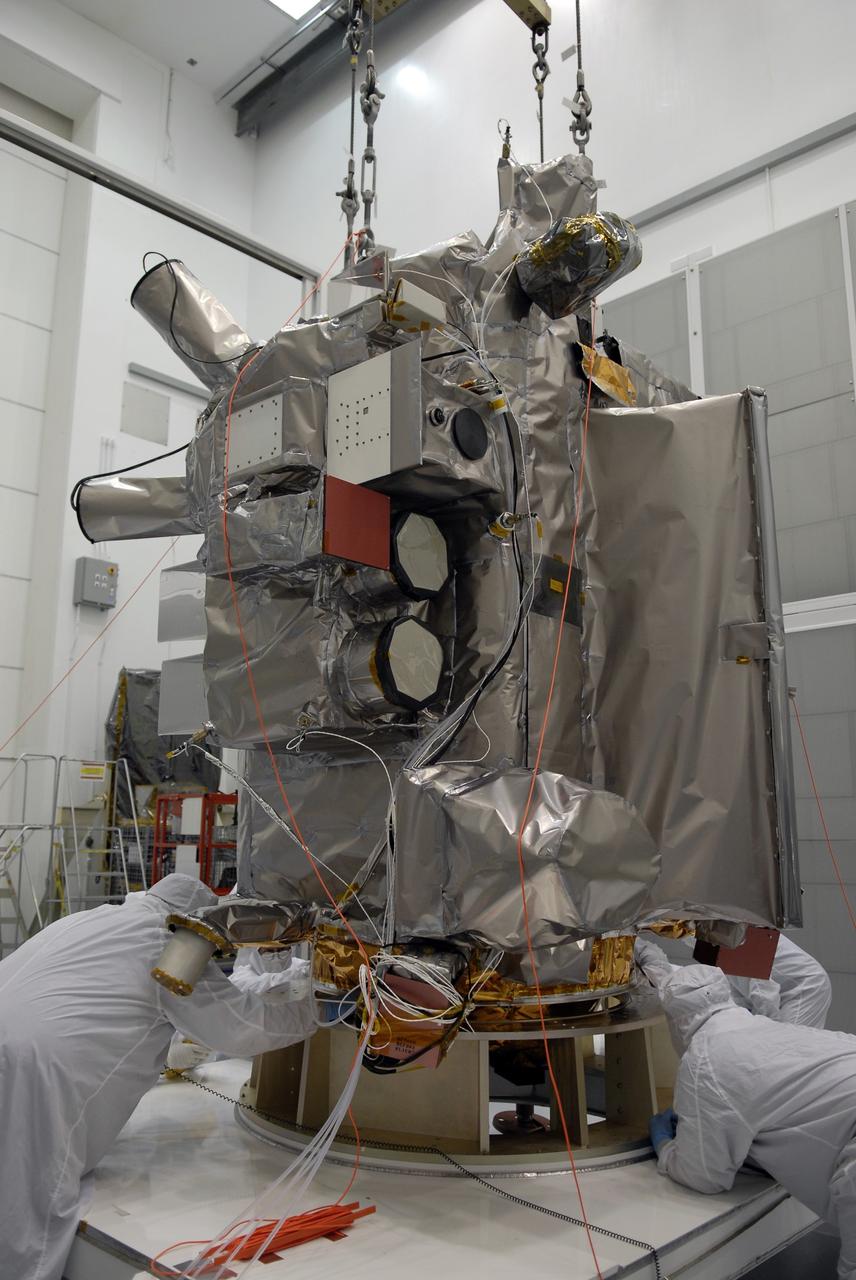
CAPE CANAVERAL, Fla. – At the Astrotech facility in Titusville, Fla., technicians secure NASA's Lunar Reconnaissance Orbiter, or LRO, onto a stand. The orbiter will carry seven instruments to provide scientists with detailed maps of the lunar surface and enhance our understanding of the moon's topography, lighting conditions, mineralogical composition and natural resources. Information gleaned from LRO will be used to select safe landing sites, determine locations for future lunar outposts and help mitigate radiation dangers to astronauts. The polar regions of the moon are the main focus of the mission because continuous access to sunlight may be possible and water ice may exist in permanently shadowed areas of the poles. Accompanying LRO on its journey to the moon will be the Lunar CRater Observation and Sensing Satellite, or LCROSS, a mission that will impact the lunar surface in its search for water ice. Launch of LRO is targeted for May 20. Photo credit: NASA/Kim Shiflett
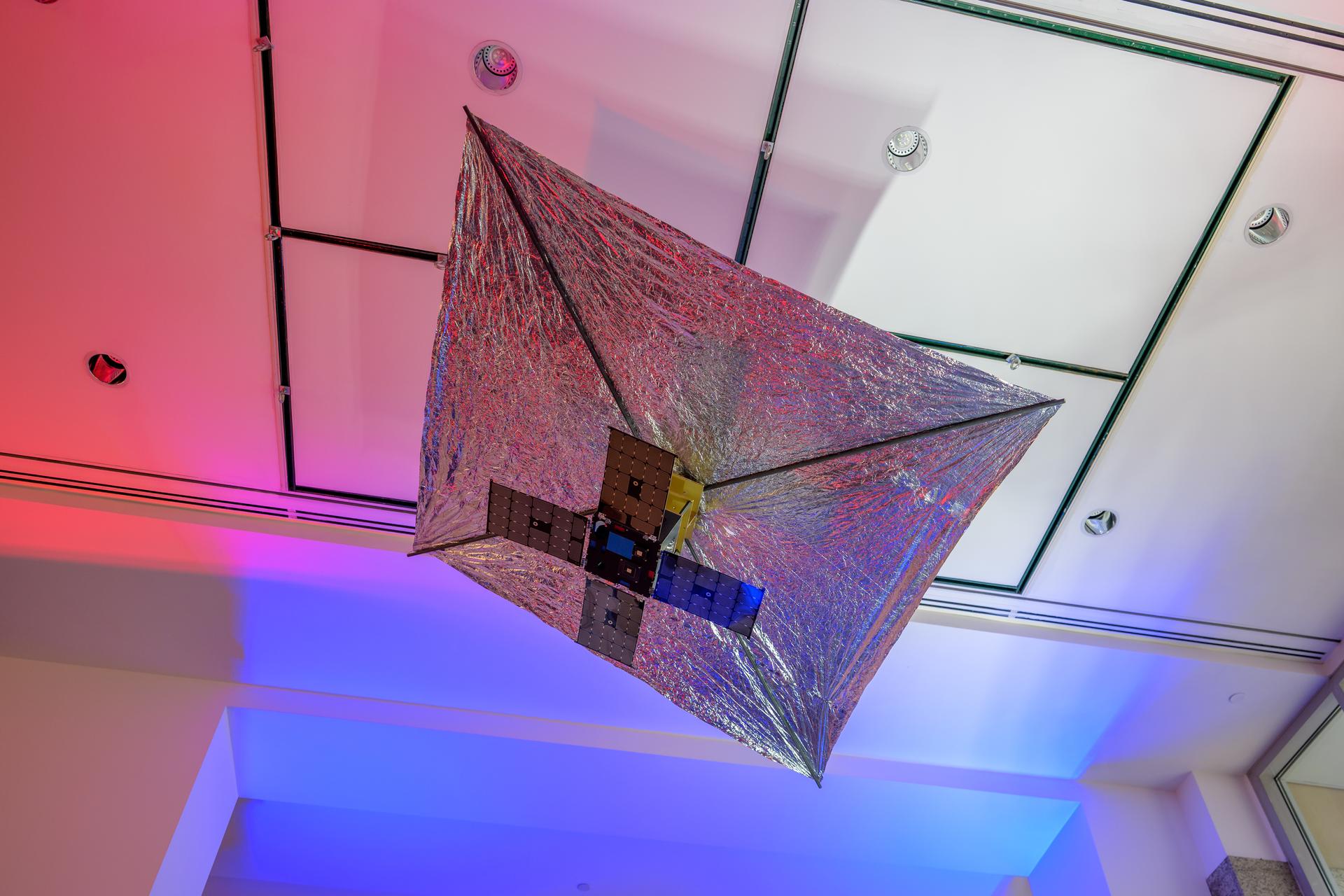
A model of the Advanced Composite Solar Sail System (ACS3) is seen in the NASA Headquarters lobby during a 2-day event where NASA outlined how the agency is executing President Donald J. Trump’s National Space Policy and accelerating preparations for America’s return to the surface of the Moon by 2028, Wednesday, March 25, 2026, at the Mary W. Jackson NASA Headquarters building in Washington. During the event NASA leadership provided updates on mission priorities, including sending the first astronauts to the lunar surface in more than 50 years, establishing the initial elements of a permanent lunar base, getting America underway in space on nuclear propulsion, and other objectives. Photo Credit: (NASA/Bill Ingalls)
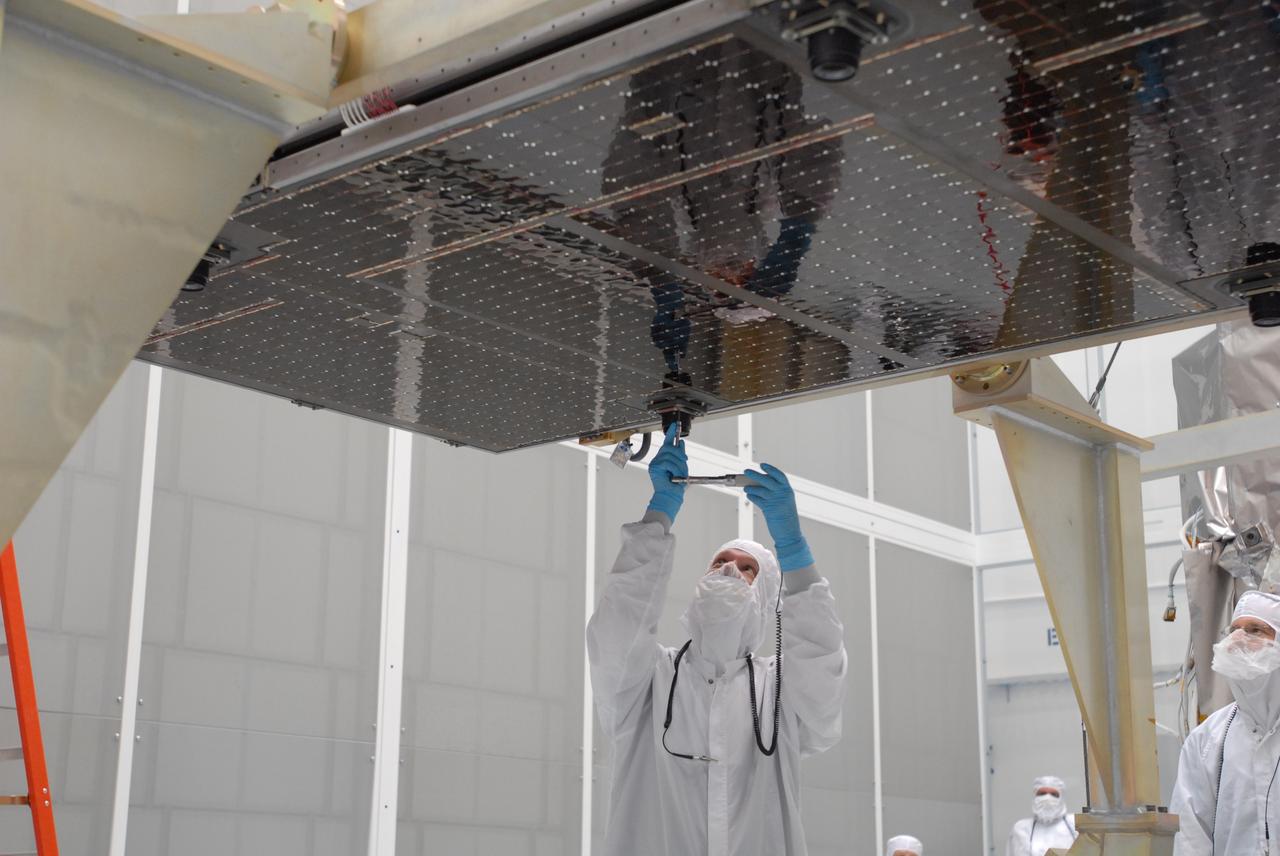
CAPE CANAVERAL, Fla. –– At Astrotech Space Operations in Titusville, Fla., technicians prepare the solar array panel for installation on the Lunar Reconnaissance Orbiter, or LRO. The orbiter will carry seven instruments to provide scientists with detailed maps of the lunar surface and enhance our understanding of the moon's topography, lighting conditions, mineralogical composition and natural resources. Information gleaned from LRO will be used to select safe landing sites, determine locations for future lunar outposts and help mitigate radiation dangers to astronauts. The polar regions of the moon are the main focus of the mission because continuous access to sunlight may be possible and water ice may exist in permanently shadowed areas of the poles. Launch of LRO is targeted for June 2. Photo credit: NASA/Jim Grossmann
CAPE CANAVERAL, Fla. –– At Astrotech Space Operations in Titusville, Fla., a technician checks the installation of a solar array panel on the Lunar Reconnaissance Orbiter, or LRO. The orbiter will carry seven instruments to provide scientists with detailed maps of the lunar surface and enhance our understanding of the moon's topography, lighting conditions, mineralogical composition and natural resources. Information gleaned from LRO will be used to select safe landing sites, determine locations for future lunar outposts and help mitigate radiation dangers to astronauts. The polar regions of the moon are the main focus of the mission because continuous access to sunlight may be possible and water ice may exist in permanently shadowed areas of the poles. Launch of LRO is targeted for June 2. Photo credit: NASA/Jim Grossmann
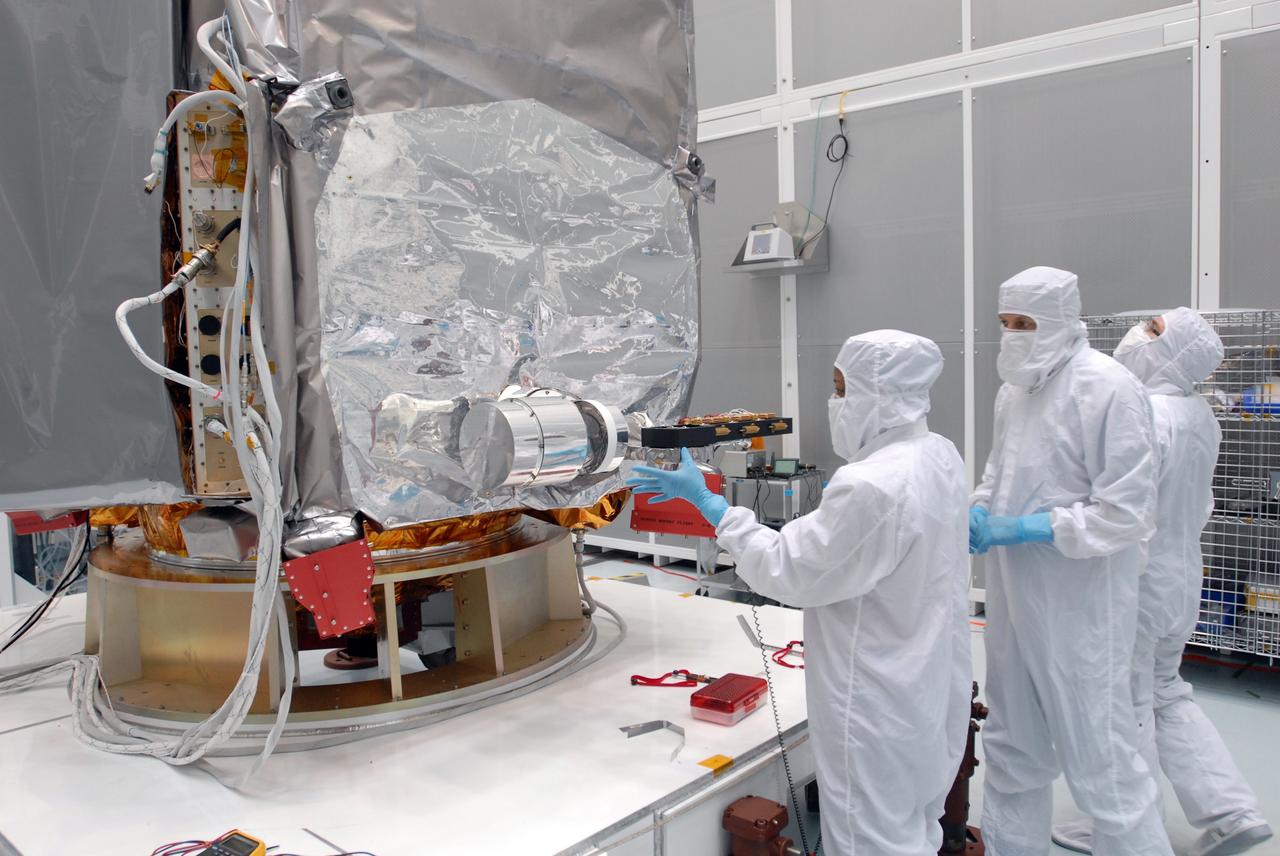
CAPE CANAVERAL, Fla. –– At Astrotech Space Operations in Titusville, Fla., technicians prepare the Lunar Reconnaissance Orbiter, or LRO, for installation of the solar array panels. The orbiter will carry seven instruments to provide scientists with detailed maps of the lunar surface and enhance our understanding of the moon's topography, lighting conditions, mineralogical composition and natural resources. Information gleaned from LRO will be used to select safe landing sites, determine locations for future lunar outposts and help mitigate radiation dangers to astronauts. The polar regions of the moon are the main focus of the mission because continuous access to sunlight may be possible and water ice may exist in permanently shadowed areas of the poles. Launch of LRO is targeted for June 2. Photo credit: NASA/Jim Grossmann

CAPE CANAVERAL, Fla. –– At Astrotech Space Operations in Titusville, Fla., technicians prepare for installation of the solar array panels on the Lunar Reconnaissance Orbiter, or LRO. The orbiter will carry seven instruments to provide scientists with detailed maps of the lunar surface and enhance our understanding of the moon's topography, lighting conditions, mineralogical composition and natural resources. Information gleaned from LRO will be used to select safe landing sites, determine locations for future lunar outposts and help mitigate radiation dangers to astronauts. The polar regions of the moon are the main focus of the mission because continuous access to sunlight may be possible and water ice may exist in permanently shadowed areas of the poles. Launch of LRO is targeted for June 2. Photo credit: NASA/Jim Grossmann
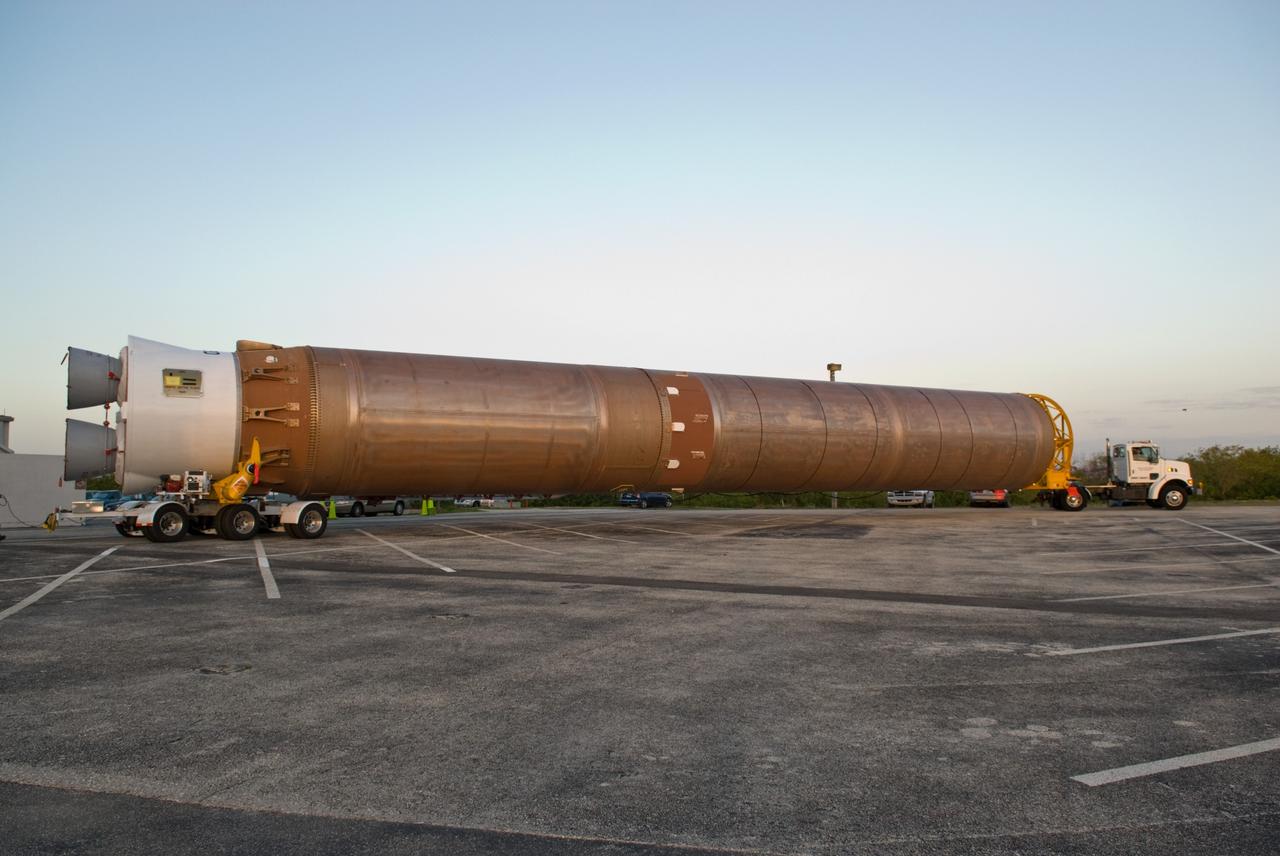
CAPE CANAVERAL, Fla. –– The Atlas V first stage is being transferred from the hangar at the Atlas Space Operations Facility to the Vertical Integration Facility near Cape Canaveral Air Force Station's Launch Complex 41. The Atlas V/Centaur is the launch vehicle for the Lunar Reconnaissance Orbiter, or LRO. The orbiter will carry seven instruments to provide scientists with detailed maps of the lunar surface and enhance our understanding of the moon's topography, lighting conditions, mineralogical composition and natural resources. Information gleaned from LRO will be used to select safe landing sites, determine locations for future lunar outposts and help mitigate radiation dangers to astronauts. Launch of LRO is targeted no earlier than June 2. Photo credit: NASA/Kim Shiflett
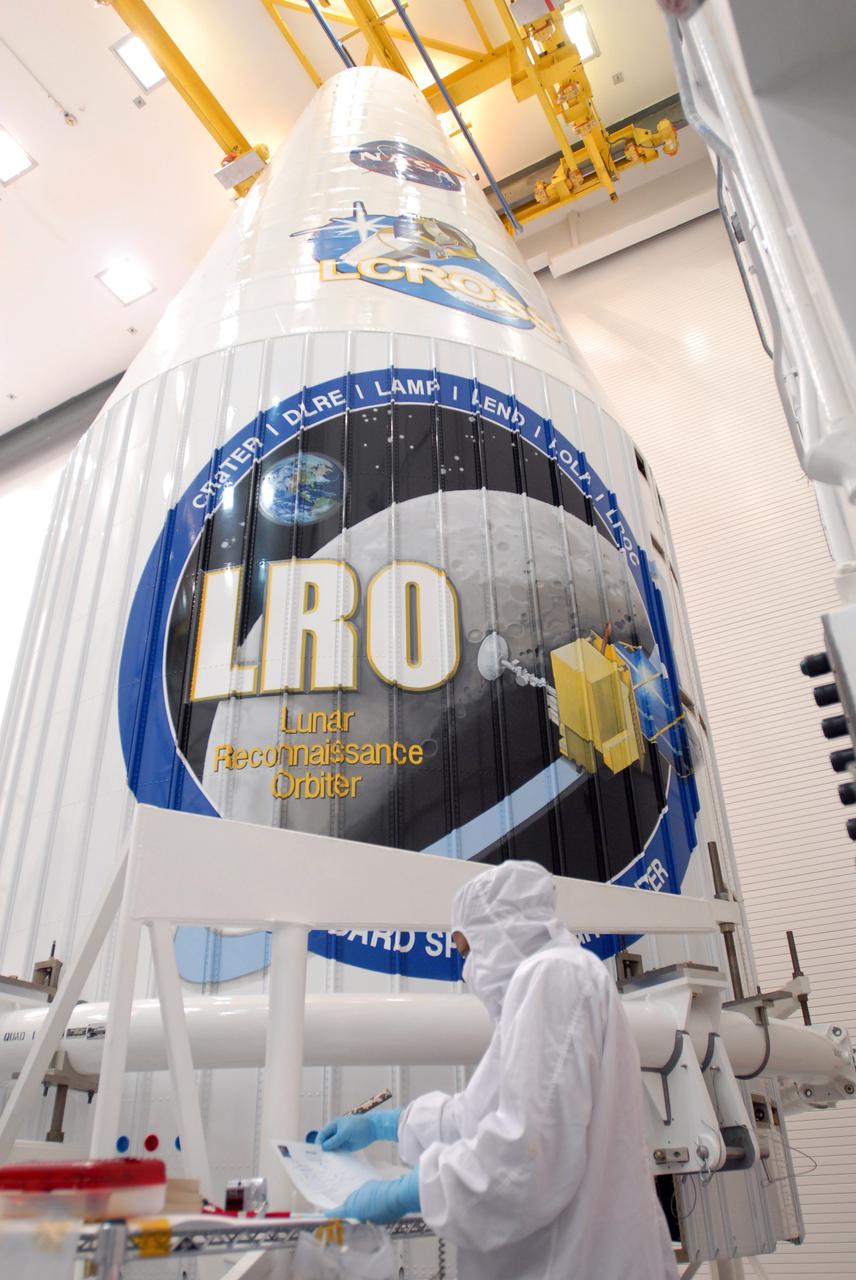
CAPE CANAVERAL, Fla. –– At Astrotech Space Operations in Titusville, Fla., a technician prepares for the installation of the solar array panel on the Lunar Reconnaissance Orbiter, or LRO. He stands in front of the fairing that will encapsulate the spacecraft at a later date. The orbiter will carry seven instruments to provide scientists with detailed maps of the lunar surface and enhance our understanding of the moon's topography, lighting conditions, mineralogical composition and natural resources. Information gleaned from LRO will be used to select safe landing sites, determine locations for future lunar outposts and help mitigate radiation dangers to astronauts. The polar regions of the moon are the main focus of the mission because continuous access to sunlight may be possible and water ice may exist in permanently shadowed areas of the poles. Launch of LRO is targeted for June 2. Photo credit: NASA/Jim Grossmann
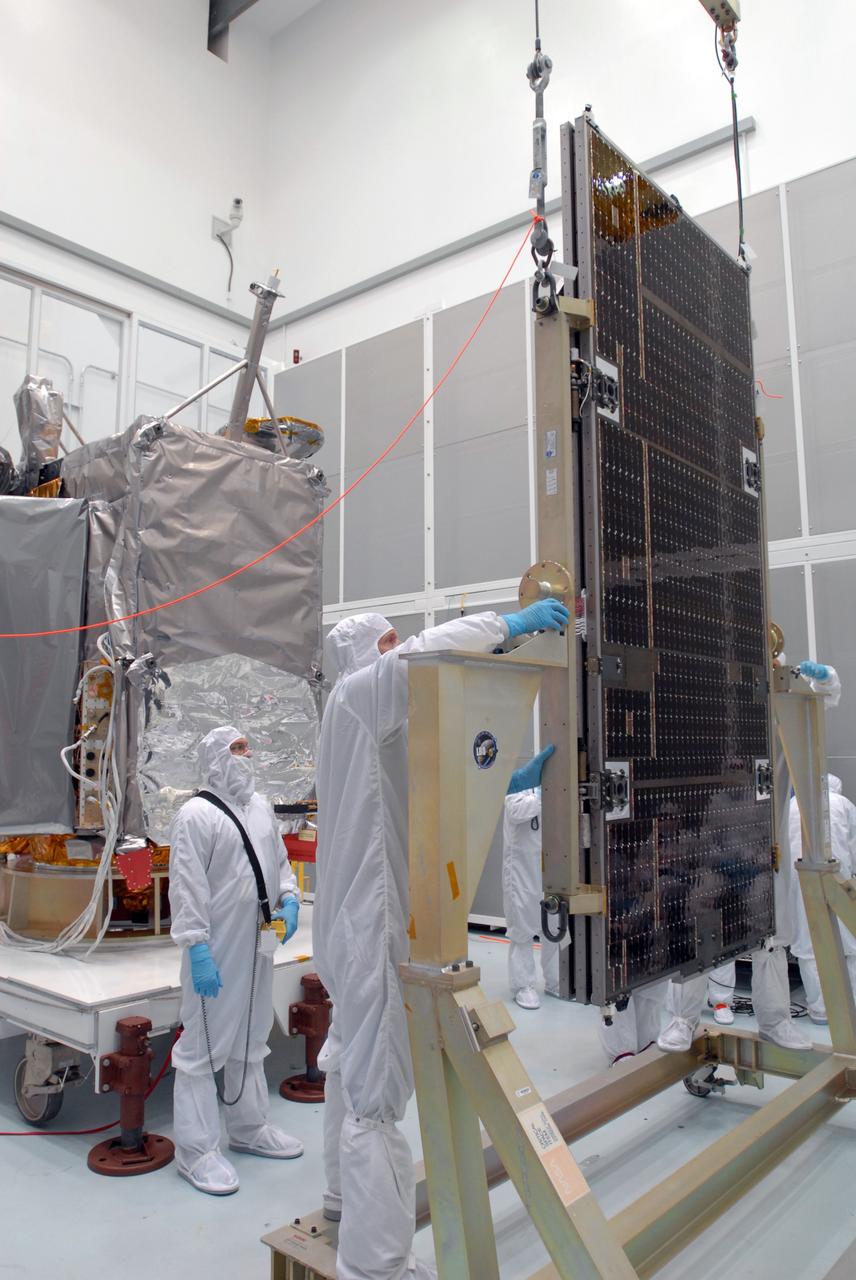
CAPE CANAVERAL, Fla. –– At Astrotech Space Operations in Titusville, Fla., technicians prepare the solar array panel for installation on the Lunar Reconnaissance Orbiter, or LRO, at left. The orbiter will carry seven instruments to provide scientists with detailed maps of the lunar surface and enhance our understanding of the moon's topography, lighting conditions, mineralogical composition and natural resources. Information gleaned from LRO will be used to select safe landing sites, determine locations for future lunar outposts and help mitigate radiation dangers to astronauts. The polar regions of the moon are the main focus of the mission because continuous access to sunlight may be possible and water ice may exist in permanently shadowed areas of the poles. Launch of LRO is targeted for June 2. Photo credit: NASA/Jim Grossmann
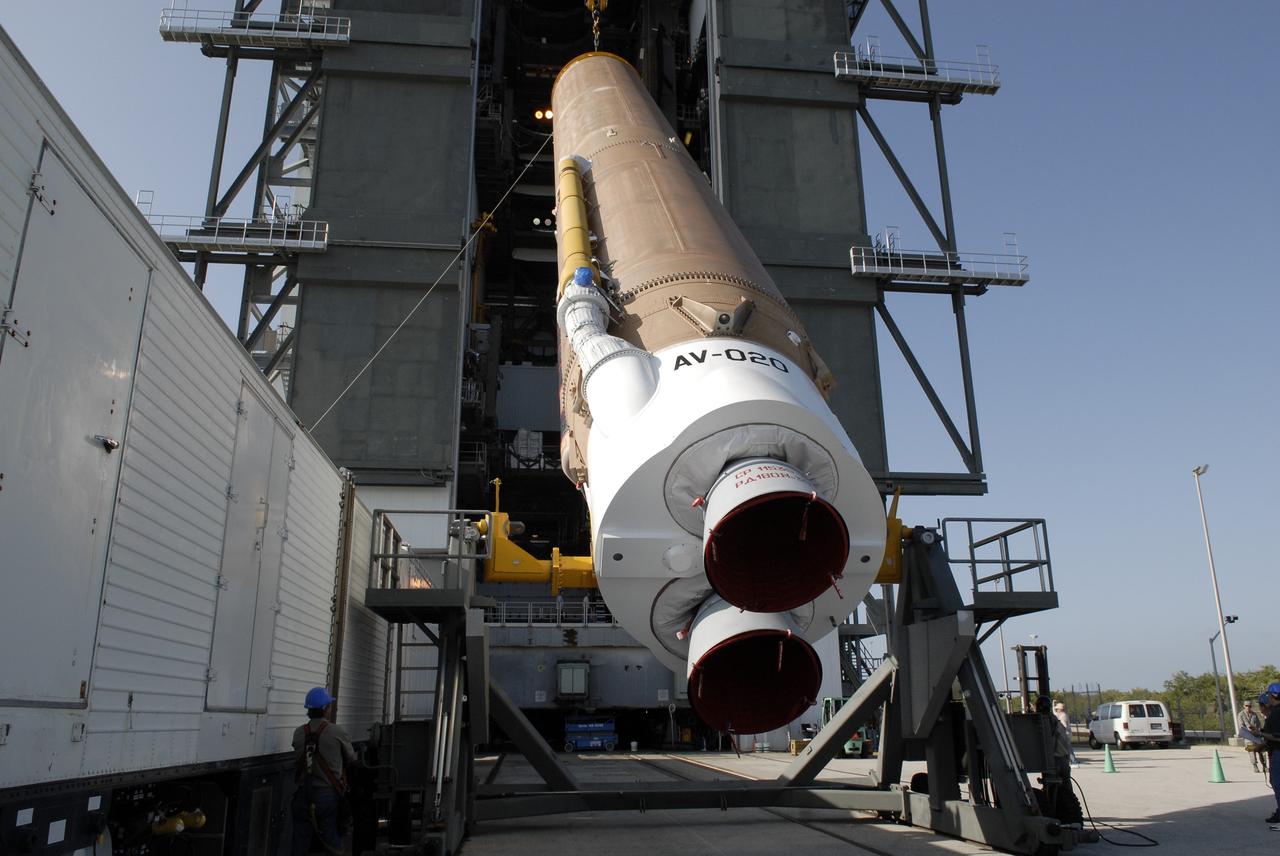
CAPE CANAVERAL, Fla. –– At the Vertical Integration Facility on Cape Canaveral Air Force Station's Launch Complex 41, the Atlas V first stage is being raised to a vertical position. The Atlas will be lifted into the VIF. The Atlas V/Centaur is the launch vehicle for the Lunar Reconnaissance Orbiter, or LRO. The orbiter will carry seven instruments to provide scientists with detailed maps of the lunar surface and enhance our understanding of the moon's topography, lighting conditions, mineralogical composition and natural resources. Information gleaned from LRO will be used to select safe landing sites, determine locations for future lunar outposts and help mitigate radiation dangers to astronauts. Launch of LRO is targeted no earlier than June 2. Photo credit: NASA/Kim Shiflett
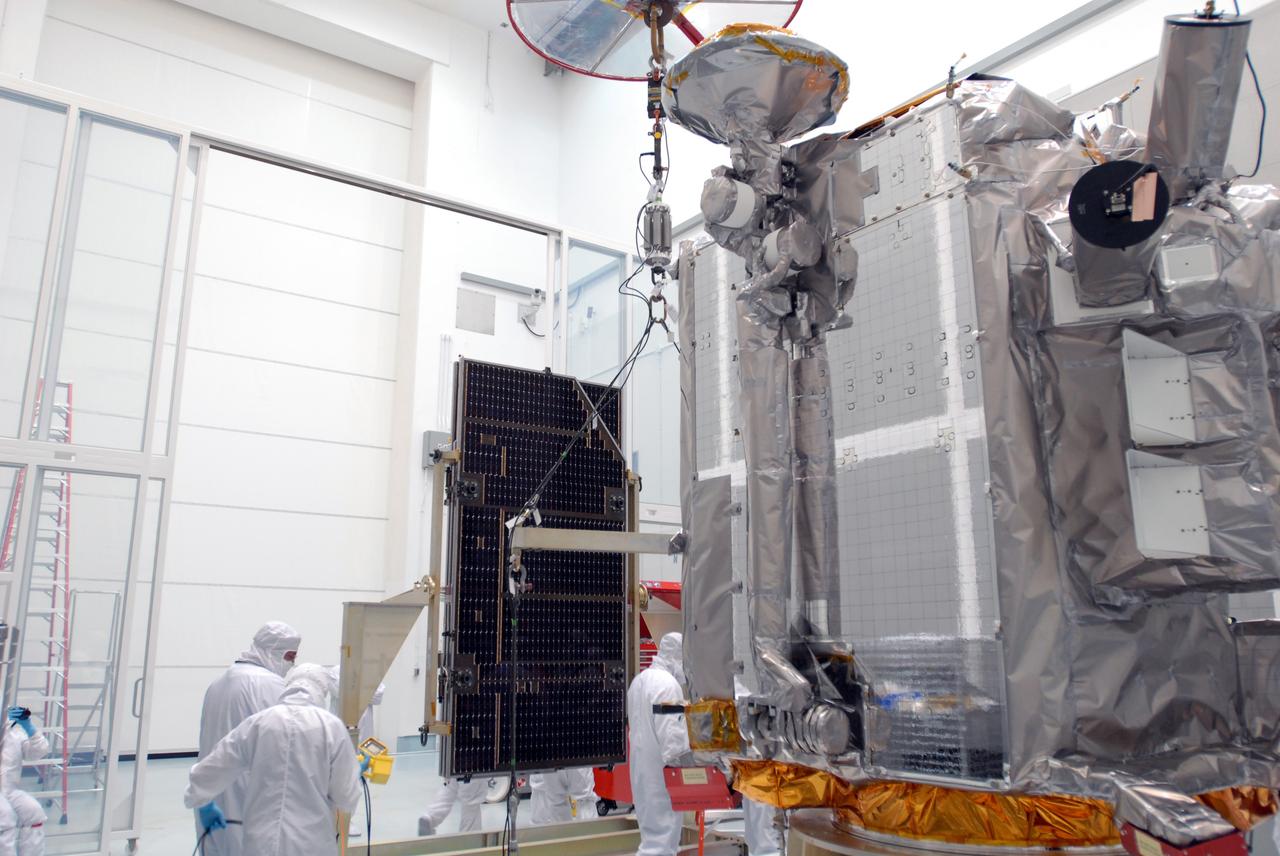
CAPE CANAVERAL, Fla. –– At Astrotech Space Operations in Titusville, Fla., technicians prepare the solar array panel for installation on the Lunar Reconnaissance Orbiter, or LRO. The orbiter will carry seven instruments to provide scientists with detailed maps of the lunar surface and enhance our understanding of the moon's topography, lighting conditions, mineralogical composition and natural resources. Information gleaned from LRO will be used to select safe landing sites, determine locations for future lunar outposts and help mitigate radiation dangers to astronauts. The polar regions of the moon are the main focus of the mission because continuous access to sunlight may be possible and water ice may exist in permanently shadowed areas of the poles. Launch of LRO is targeted for June 2. Photo credit: NASA/Jim Grossmann
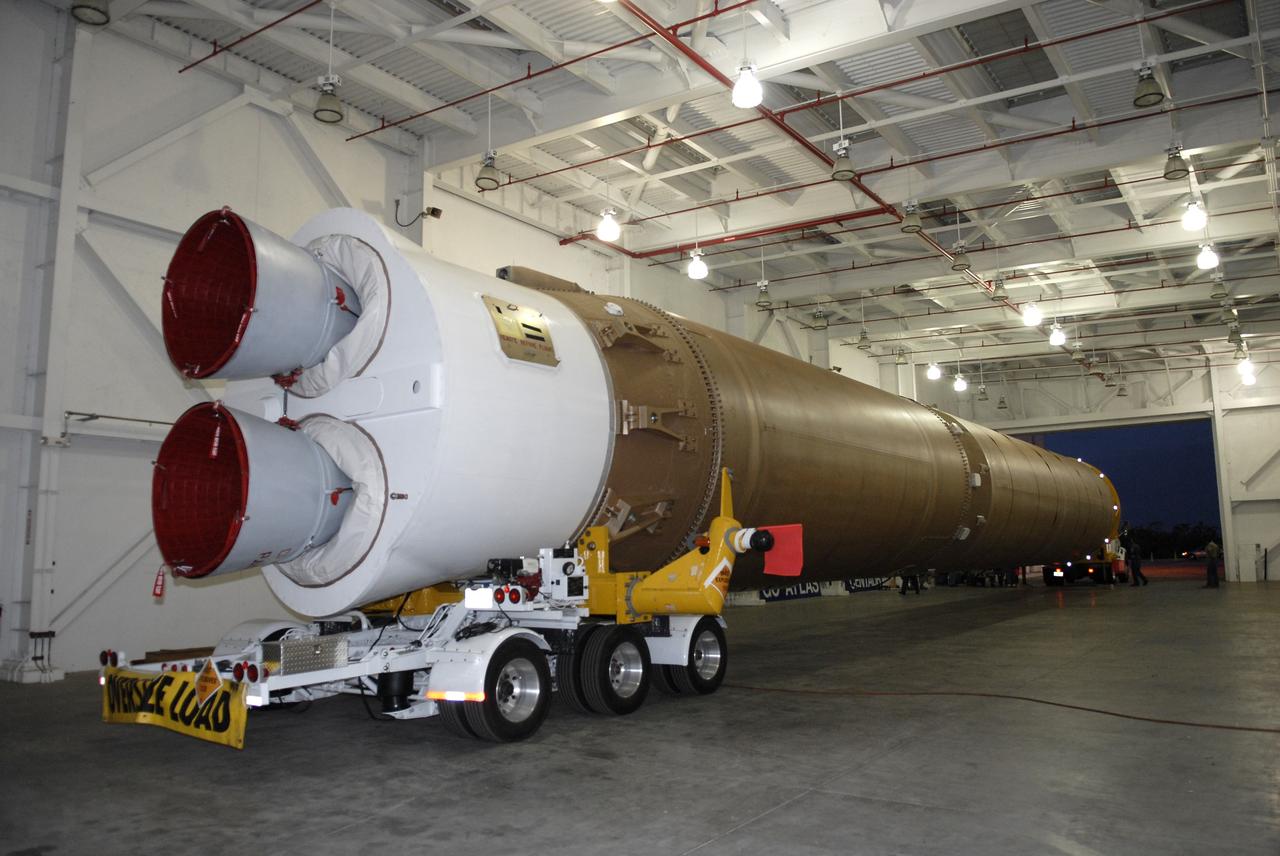
CAPE CANAVERAL, Fla. –– The Atlas V first stage is moved from the hangar at the Atlas Space Operations Facility. It is going to the Vertical Integration Facility near Cape Canaveral Air Force Station's Launch Complex 41. The Atlas V/Centaur is the launch vehicle for the Lunar Reconnaissance Orbiter, or LRO. The orbiter will carry seven instruments to provide scientists with detailed maps of the lunar surface and enhance our understanding of the moon's topography, lighting conditions, mineralogical composition and natural resources. Information gleaned from LRO will be used to select safe landing sites, determine locations for future lunar outposts and help mitigate radiation dangers to astronauts. Launch of LRO is targeted no earlier than June 2. Photo credit: NASA/Kim Shiflett
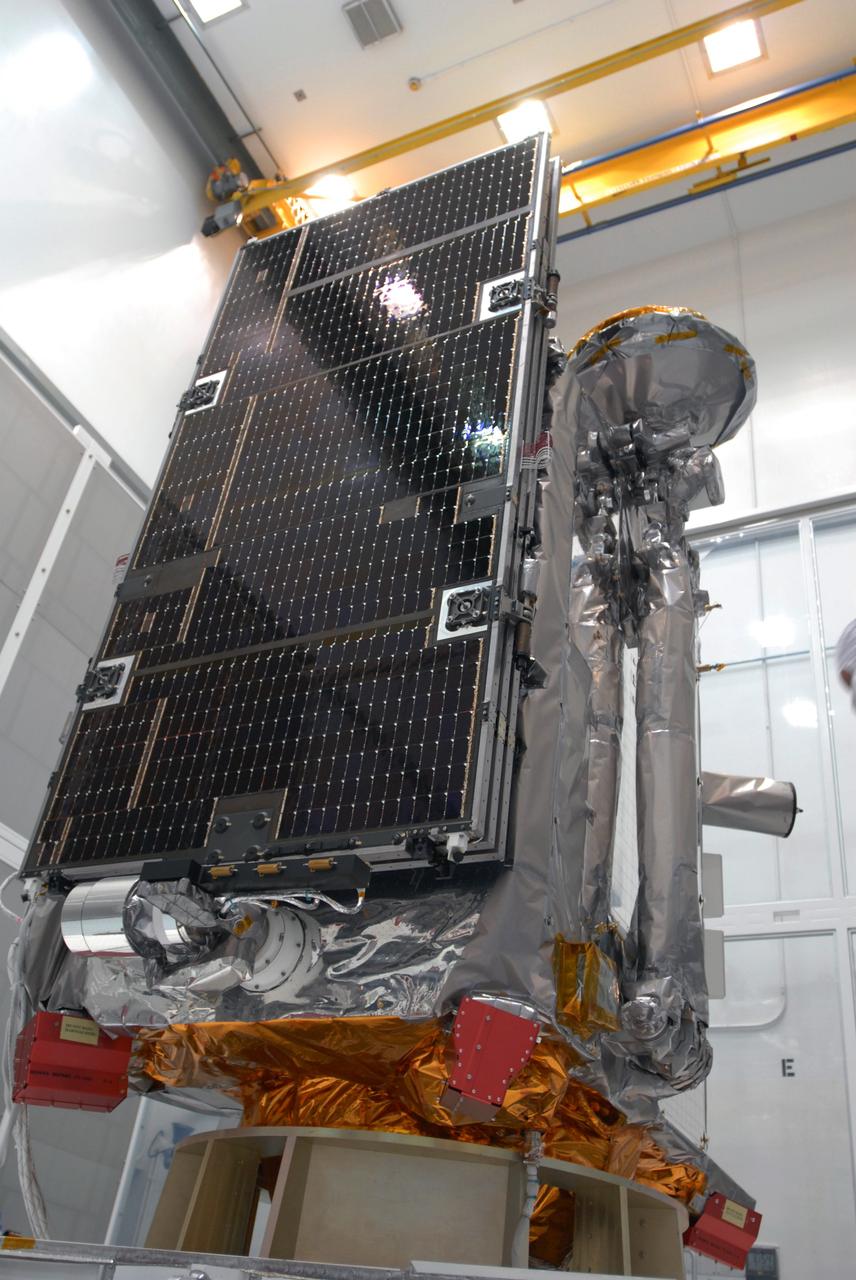
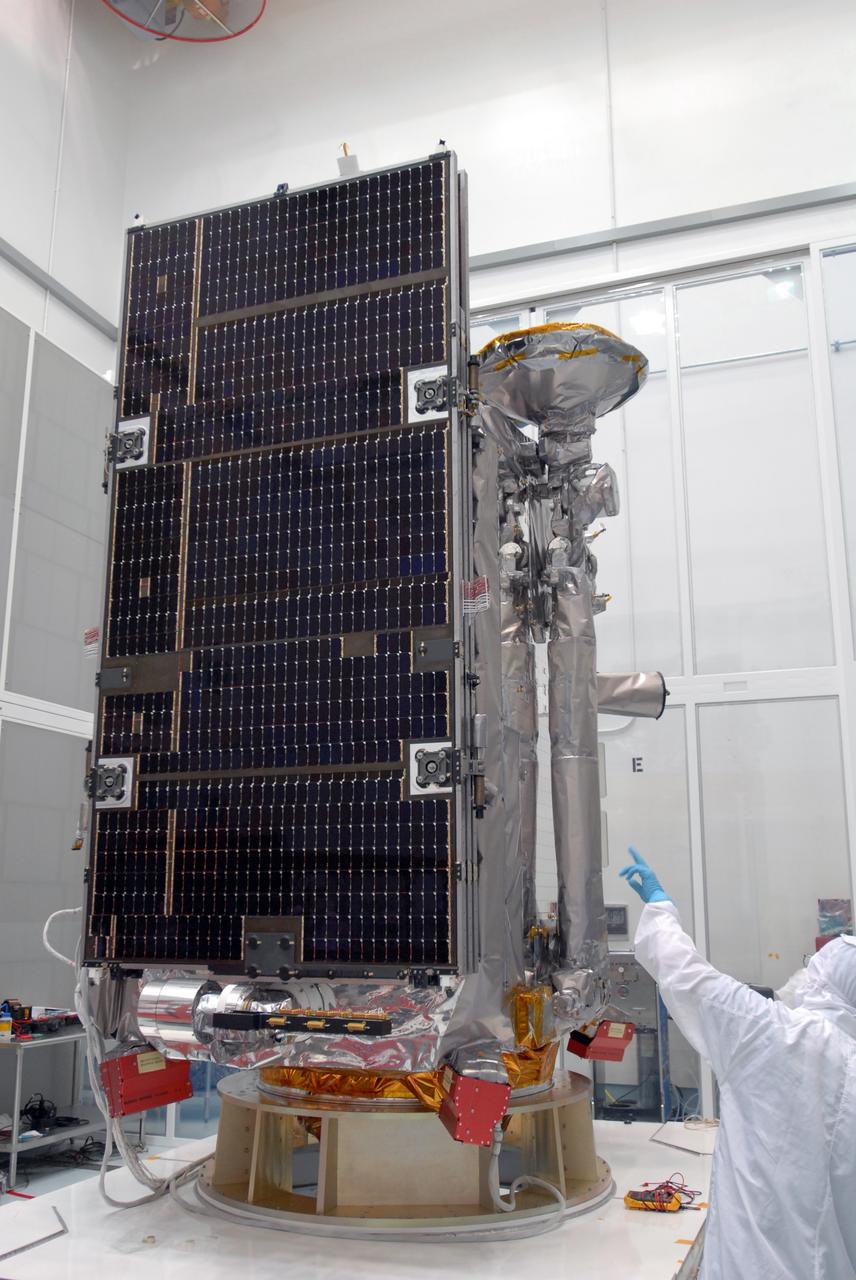
CAPE CANAVERAL, Fla. –– At Astrotech Space Operations in Titusville, Fla., the Lunar Reconnaissance Orbiter, or LRO, with a solar array panel installed. The orbiter will carry seven instruments to provide scientists with detailed maps of the lunar surface and enhance our understanding of the moon's topography, lighting conditions, mineralogical composition and natural resources. Information gleaned from LRO will be used to select safe landing sites, determine locations for future lunar outposts and help mitigate radiation dangers to astronauts. The polar regions of the moon are the main focus of the mission because continuous access to sunlight may be possible and water ice may exist in permanently shadowed areas of the poles. Launch of LRO is targeted for June 2. Photo credit: NASA/Jim Grossmann
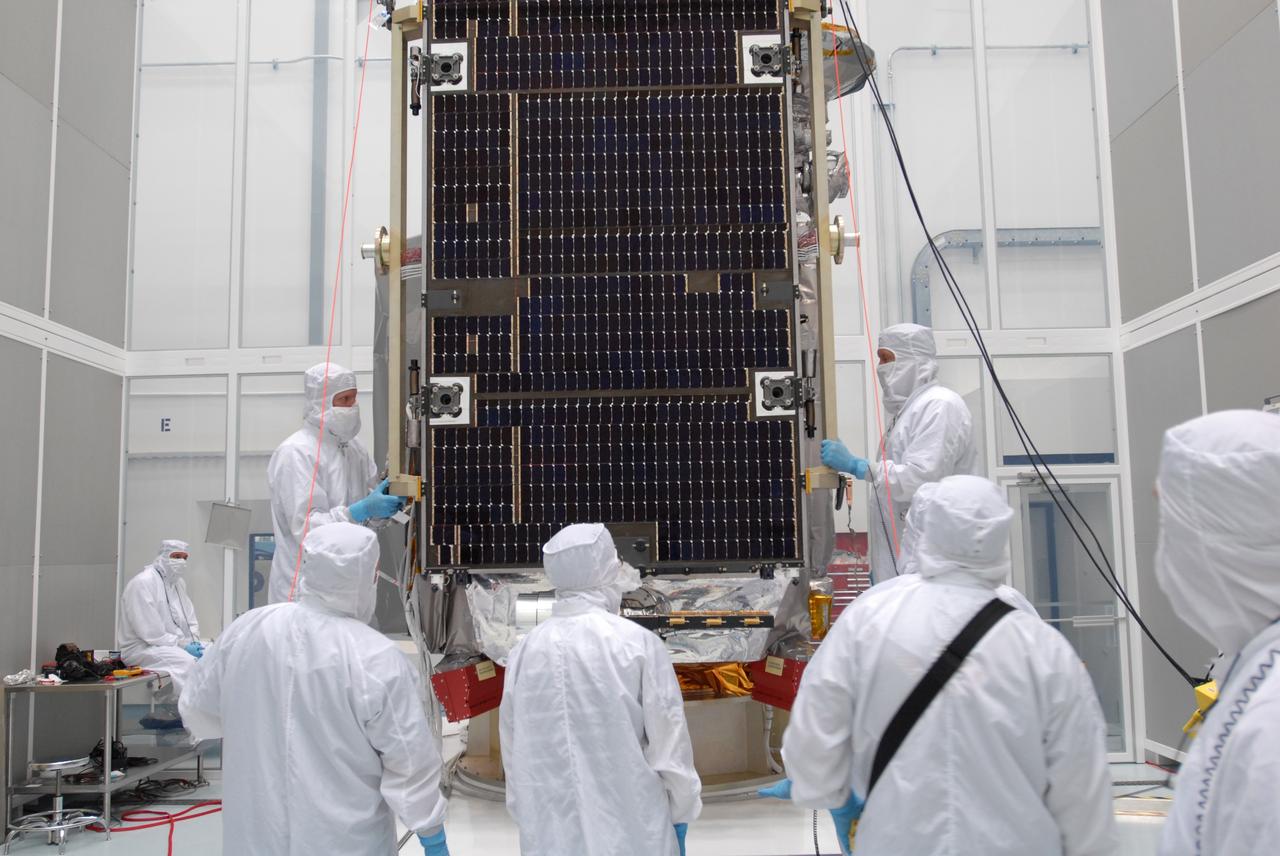
CAPE CANAVERAL, Fla. –– At Astrotech Space Operations in Titusville, Fla., technicians move the solar array panel closer to the Lunar Reconnaissance Orbiter, or LRO, for installation. The orbiter will carry seven instruments to provide scientists with detailed maps of the lunar surface and enhance our understanding of the moon's topography, lighting conditions, mineralogical composition and natural resources. Information gleaned from LRO will be used to select safe landing sites, determine locations for future lunar outposts and help mitigate radiation dangers to astronauts. The polar regions of the moon are the main focus of the mission because continuous access to sunlight may be possible and water ice may exist in permanently shadowed areas of the poles. Launch of LRO is targeted for June 2. Photo credit: NASA/Jim Grossmann
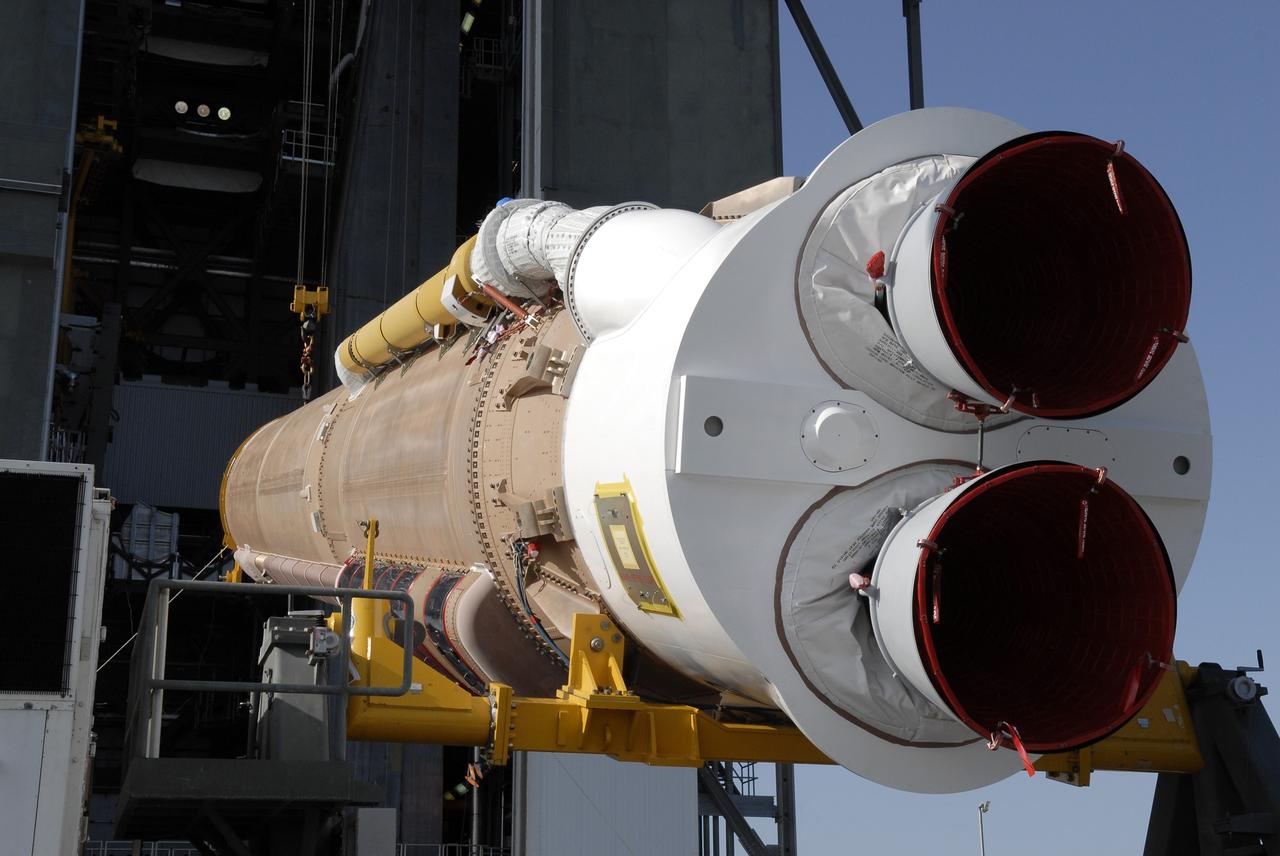
CAPE CANAVERAL, Fla. –– At the Vertical Integration Facility on Cape Canaveral Air Force Station's Launch Complex 41, the Atlas V first stage is being raised to a vertical position. The Atlas will be lifted into the VIF. The Atlas V/Centaur is the launch vehicle for the Lunar Reconnaissance Orbiter, or LRO. The orbiter will carry seven instruments to provide scientists with detailed maps of the lunar surface and enhance our understanding of the moon's topography, lighting conditions, mineralogical composition and natural resources. Information gleaned from LRO will be used to select safe landing sites, determine locations for future lunar outposts and help mitigate radiation dangers to astronauts. Launch of LRO is targeted no earlier than June 2. Photo credit: NASA/Kim Shiflett
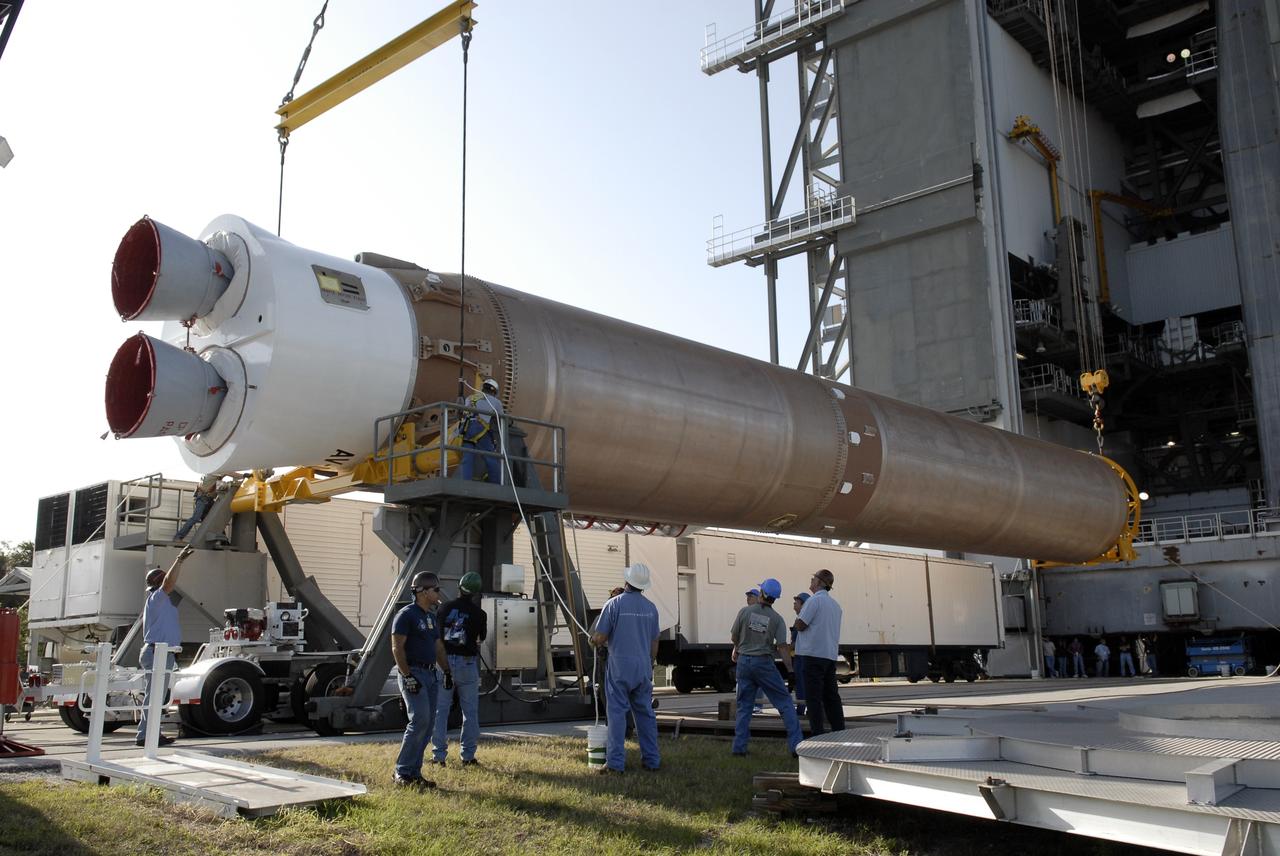
CAPE CANAVERAL, Fla. –– At the Vertical Integration Facility on Cape Canaveral Air Force Station's Launch Complex 41, cranes are attached to the Atlas V first stage to raise it to vertical. The Atlas will be lifted into the VIF. The Atlas V/Centaur is the launch vehicle for the Lunar Reconnaissance Orbiter, or LRO. The orbiter will carry seven instruments to provide scientists with detailed maps of the lunar surface and enhance our understanding of the moon's topography, lighting conditions, mineralogical composition and natural resources. Information gleaned from LRO will be used to select safe landing sites, determine locations for future lunar outposts and help mitigate radiation dangers to astronauts. Launch of LRO is targeted no earlier than June 2. Photo credit: NASA/Kim Shiflett
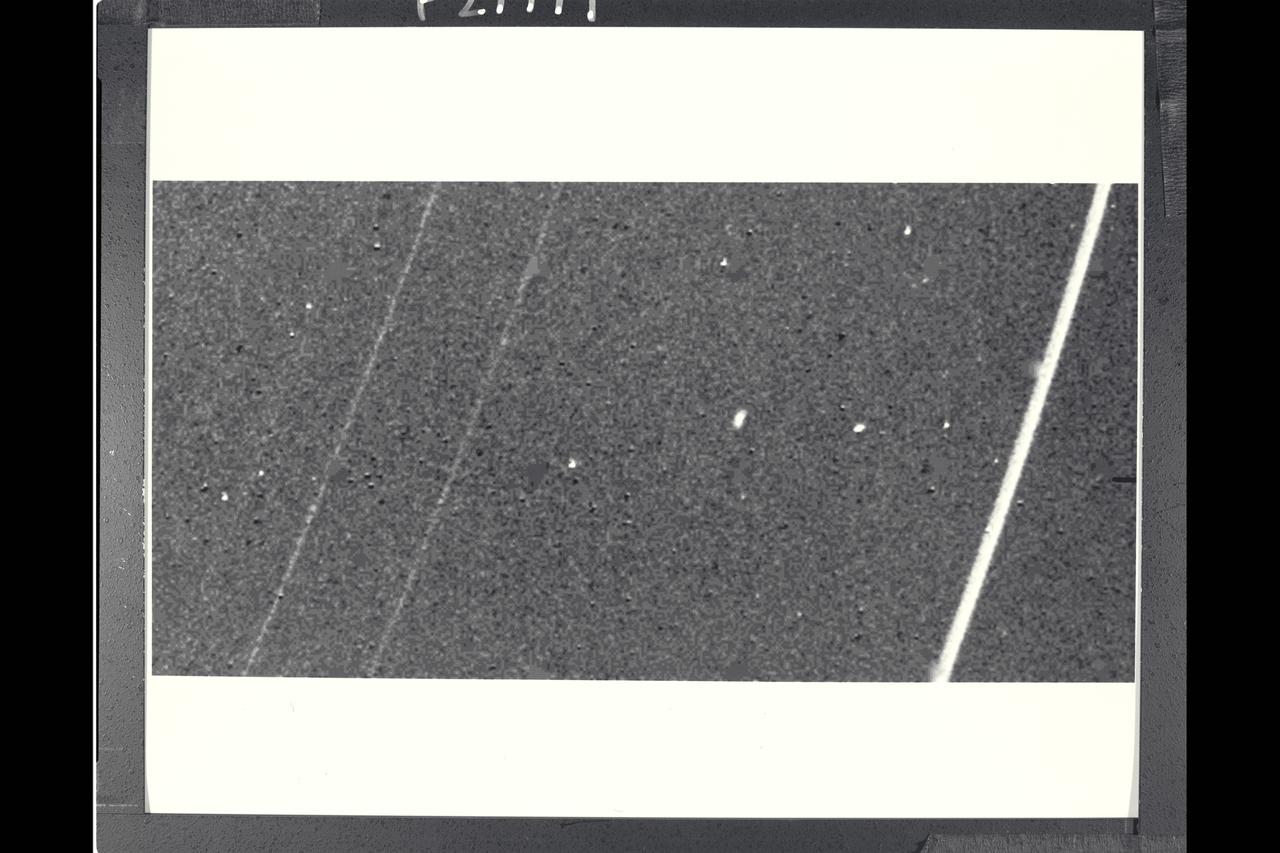
This image of the crescent moon was obtained by the Galileo Solid-State Imaging System, taken at 5 am PST as the spacecraft neared Earth. The image was taken through a green filter and shows the western part of the lunar near side. The smallest features visible are 8 km (5 mi) in size. Major features visible include the dark plains of Mare Imbrium in the upper part of the image, the bright crater Copernicus (100 km, 60 miles in diameter) in the centeral part, and the heavily cratered lunar highlands in the bottom of the image. The landing sides of the Apollo 12,14 and 15 missions lie within the central part of the image. Samples returned from these sites will be used to calibrate this and accompanying images taken in different colors, which will extend the knowledge of the spectral and compositional properties of the near side of the moon, seen from Earth, to the lunar far side.
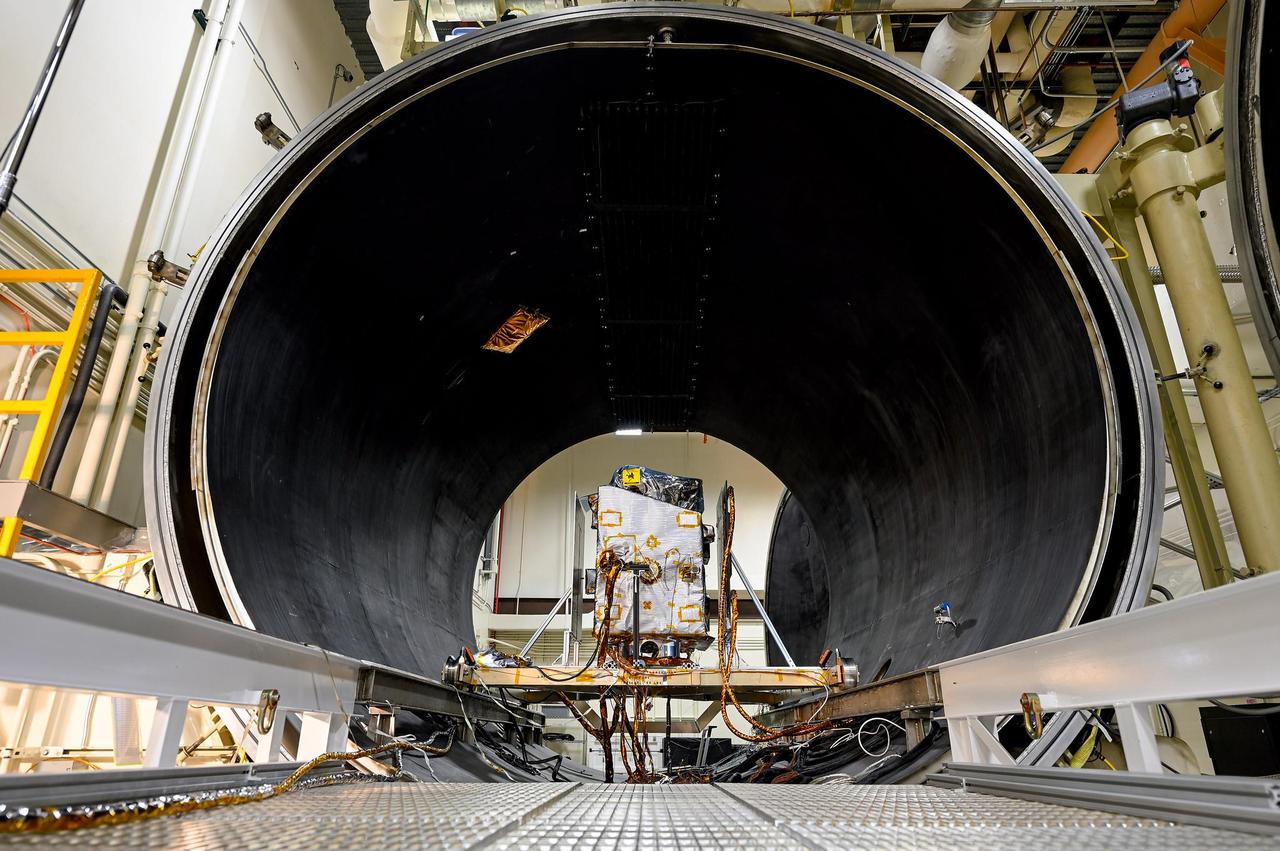
NASA's Lunar Trailblazer undergoes thermal vacuum chamber (TVAC) testing at Lockheed Martin Space in Littleton, Colorado, in June 2023. The extremely low pressures and temperatures during these tests simulate the conditions that the spacecraft will experience during in space. Lunar Trailblazer, which has a mass of about 440 pounds (200 kilograms) and measures only 11.5 feet (3.5 meters) wide with its solar panels deployed, has now completed TVAC testing and is nearing completion before its planned launch in early 2024. The spacecraft's two science instruments will map the form, abundance, and locations of water in on the lunar surface while also revealing the thermal properties and surface composition of those regions. https://photojournal.jpl.nasa.gov/catalog/PIA25836
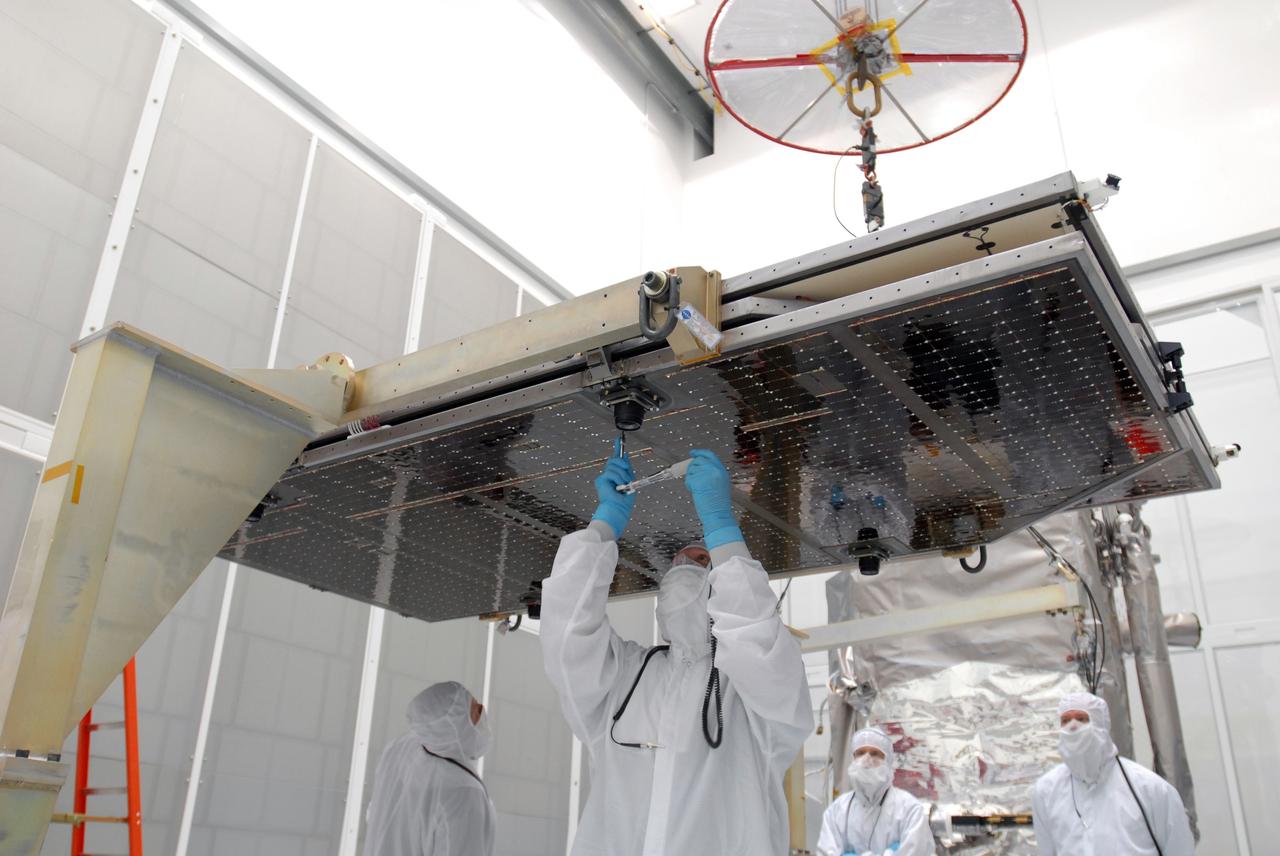
CAPE CANAVERAL, Fla. –– At Astrotech Space Operations in Titusville, Fla., technicians prepare the solar array panel for installation on the Lunar Reconnaissance Orbiter, or LRO. The orbiter will carry seven instruments to provide scientists with detailed maps of the lunar surface and enhance our understanding of the moon's topography, lighting conditions, mineralogical composition and natural resources. Information gleaned from LRO will be used to select safe landing sites, determine locations for future lunar outposts and help mitigate radiation dangers to astronauts. The polar regions of the moon are the main focus of the mission because continuous access to sunlight may be possible and water ice may exist in permanently shadowed areas of the poles. Launch of LRO is targeted for June 2. Photo credit: NASA/Jim Grossmann
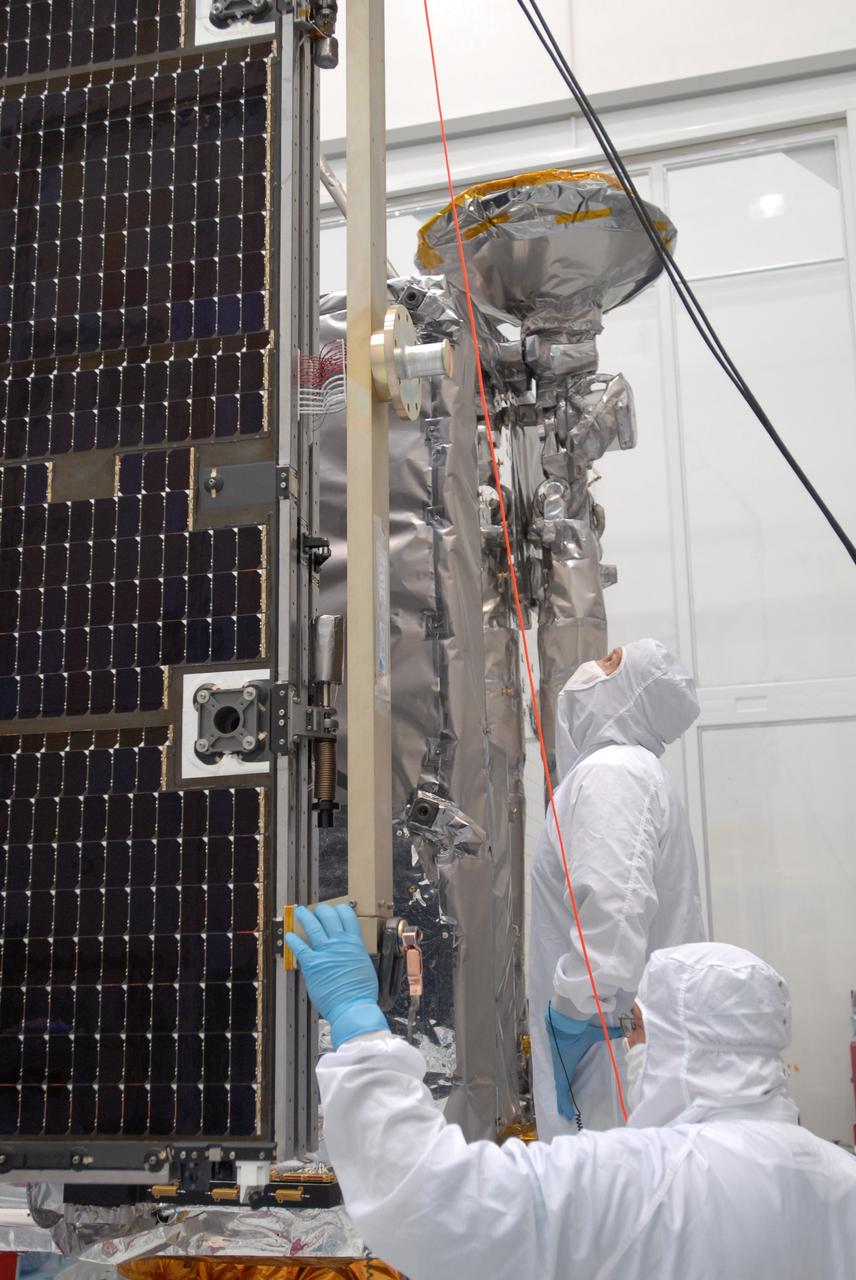
CAPE CANAVERAL, Fla. –– At Astrotech Space Operations in Titusville, Fla., technicians prepare to install the solar array panel to the Lunar Reconnaissance Orbiter, or LRO. The orbiter will carry seven instruments to provide scientists with detailed maps of the lunar surface and enhance our understanding of the moon's topography, lighting conditions, mineralogical composition and natural resources. Information gleaned from LRO will be used to select safe landing sites, determine locations for future lunar outposts and help mitigate radiation dangers to astronauts. The polar regions of the moon are the main focus of the mission because continuous access to sunlight may be possible and water ice may exist in permanently shadowed areas of the poles. Launch of LRO is targeted for June 2. Photo credit: NASA/Jim Grossmann
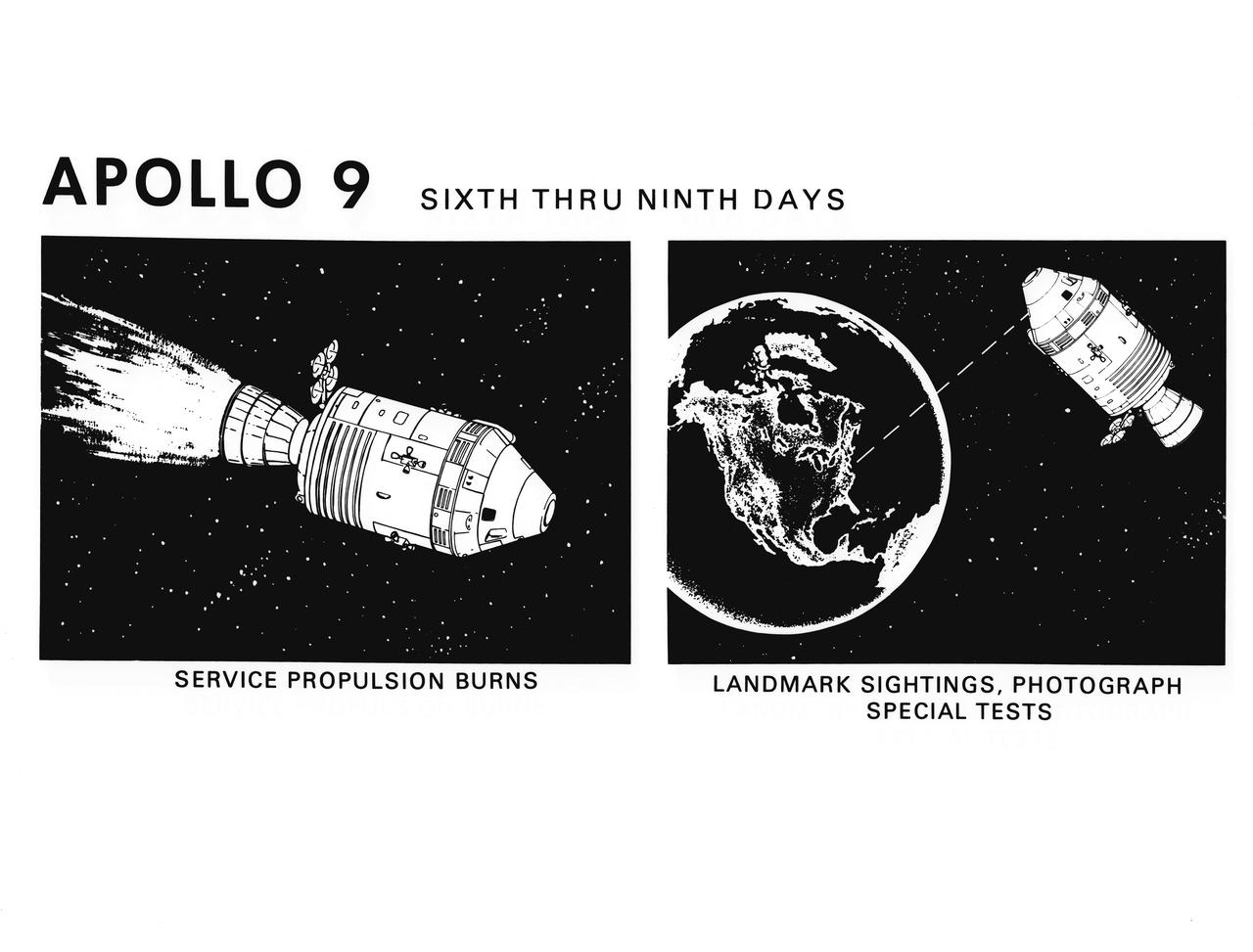
S69-19797 (February 1969) --- Composite of two artist's concepts illustrating key events, tasks and activities from the sixth through the ninth day of the Apollo 9 mission, including service propulsion system burns, and landmark sightings, photograph special tests. The Apollo 9 mission will evaluate spacecraft lunar module systems performance during manned Earth-orbital flight.
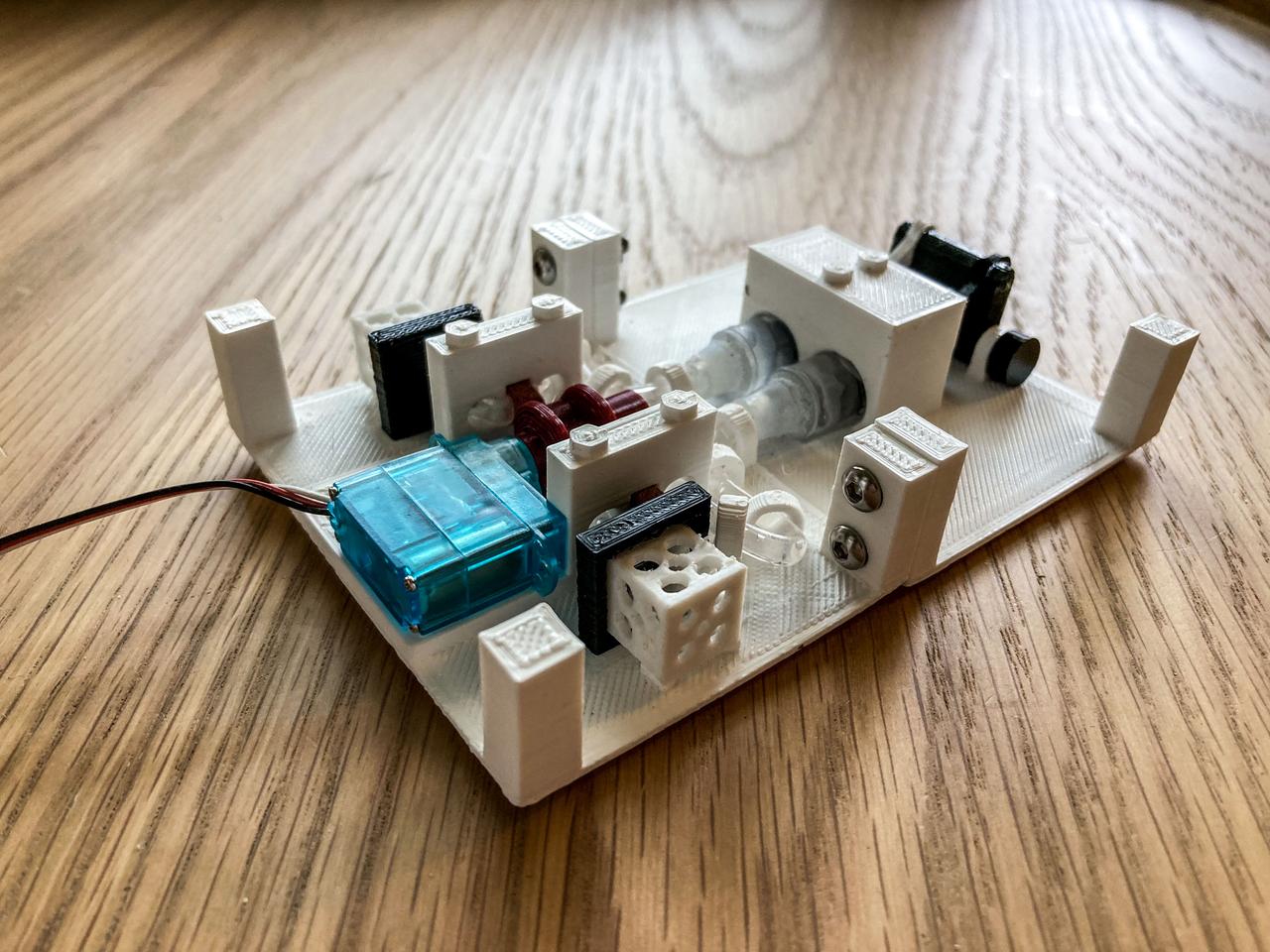
jsc2022e042480 (5/19/2022) --- An early iteration of the experiment hardware for the Biopolymer Research for In-Situ Capabilities investigation, launching aboard SpaceX’s 25th commercial resupply services mission to the International Space Station. Biopolymer Research for In-Situ Capabilities looks at how microgravity affects the process of creating biopolymer soil composite (BSC), a concrete alternative made by mixing an organic compound and silica, which is found in lunar and Martian dust. Image courtesy of James Wall.
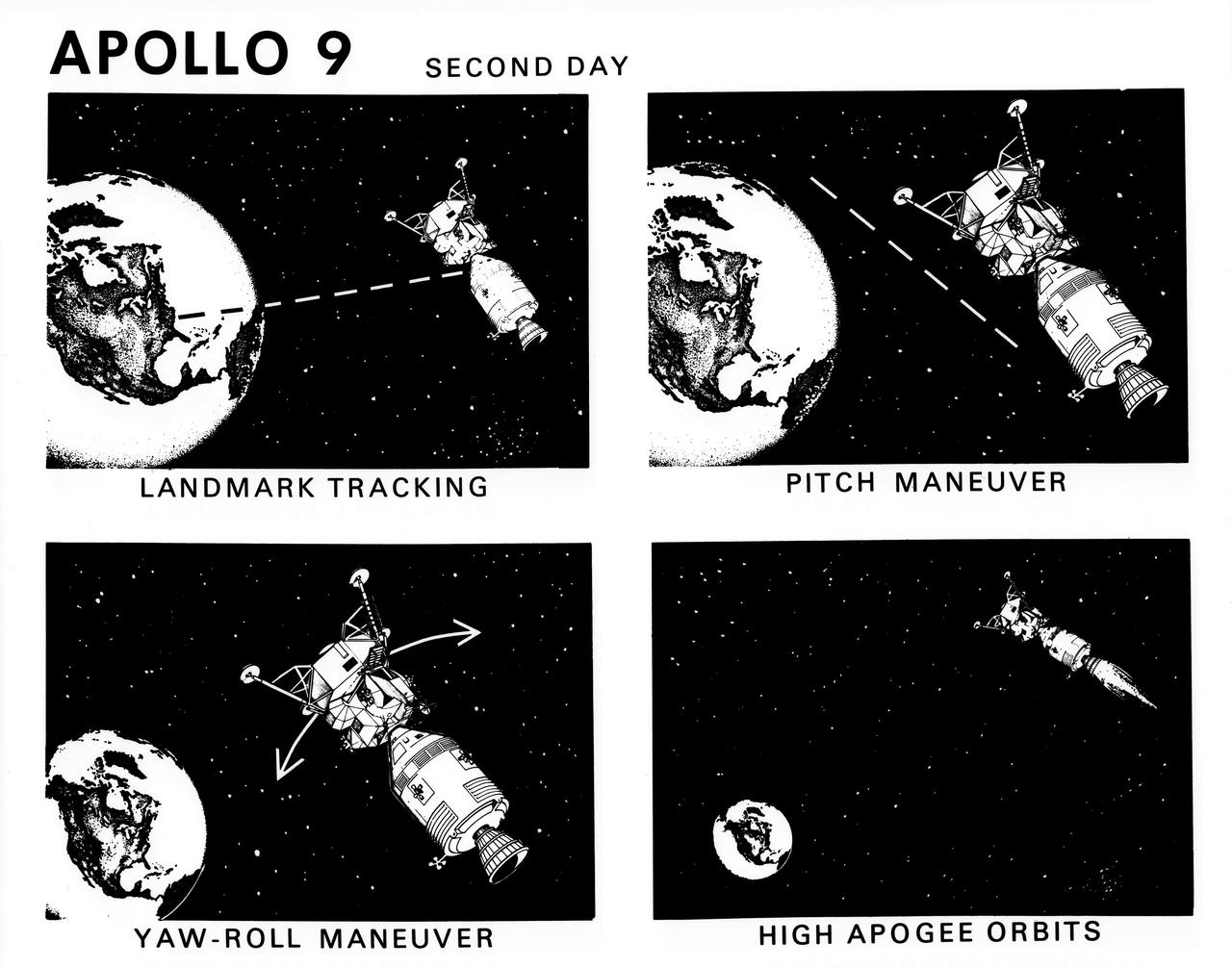
S69-19793 (February 1969) --- Composite of six artist's concepts illustrating key events, tasks and activities on the first day of the Apollo 9 mission, including flight crew preparation, orbital insertion, 103 nautical mile orbit, separation, docking, and docked Service Propulsion System burn. The Apollo 9 mission will evaluate spacecraft lunar module systems performance during manned Earth-orbital flight.
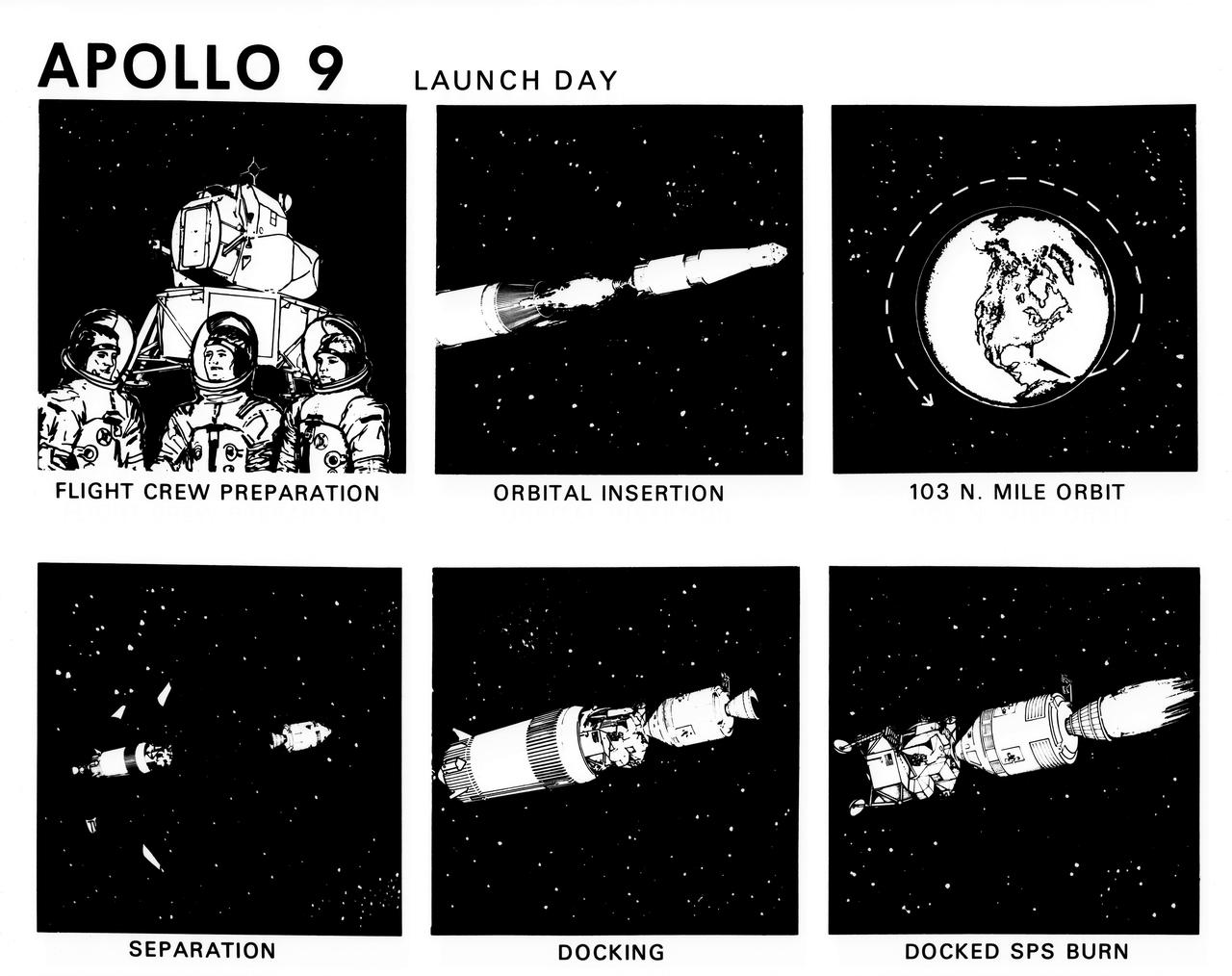
S69-19792 (February 1969) --- Composite of six artist's concepts illustrating key events, tasks and activities on the first day of the Apollo 9 mission, including flight crew preparation, orbital insertion, 103 nautical mile orbit, separation, docking, and docked Service Propulsion System burn. The Apollo 9 mission will evaluate spacecraft lunar module systems performance during manned Earth-orbital flight.
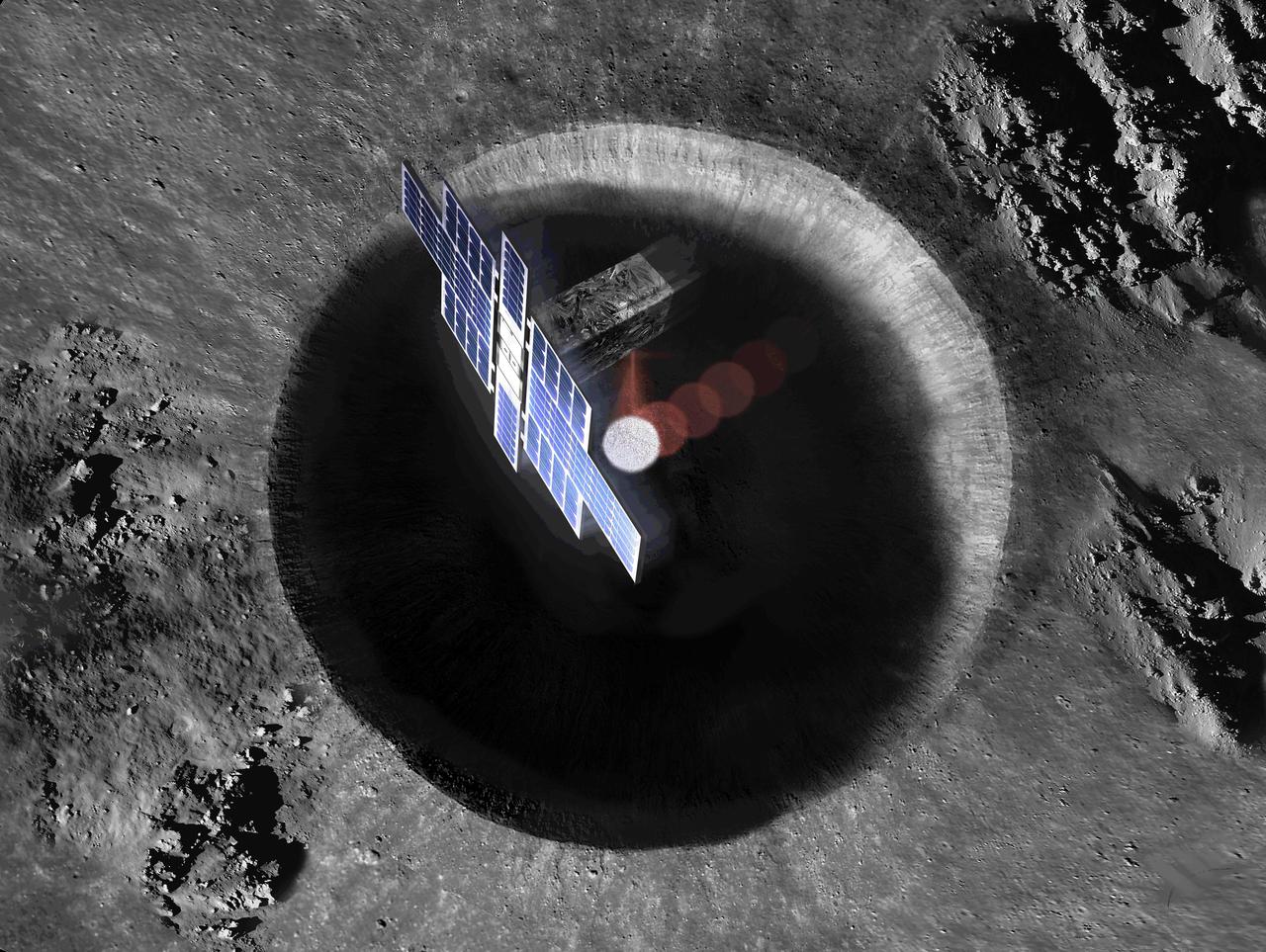
This artist's concept shows a view from above the Lunar Flashlight spacecraft, a six-unit CubeSat designed to search for ice on the Moon's surface using special lasers. The spacecraft uses its near-infrared lasers to shine light into shaded polar regions on the Moon, while an on-board reflectometer measures surface reflection and composition. https://photojournal.jpl.nasa.gov/catalog/PIA23132
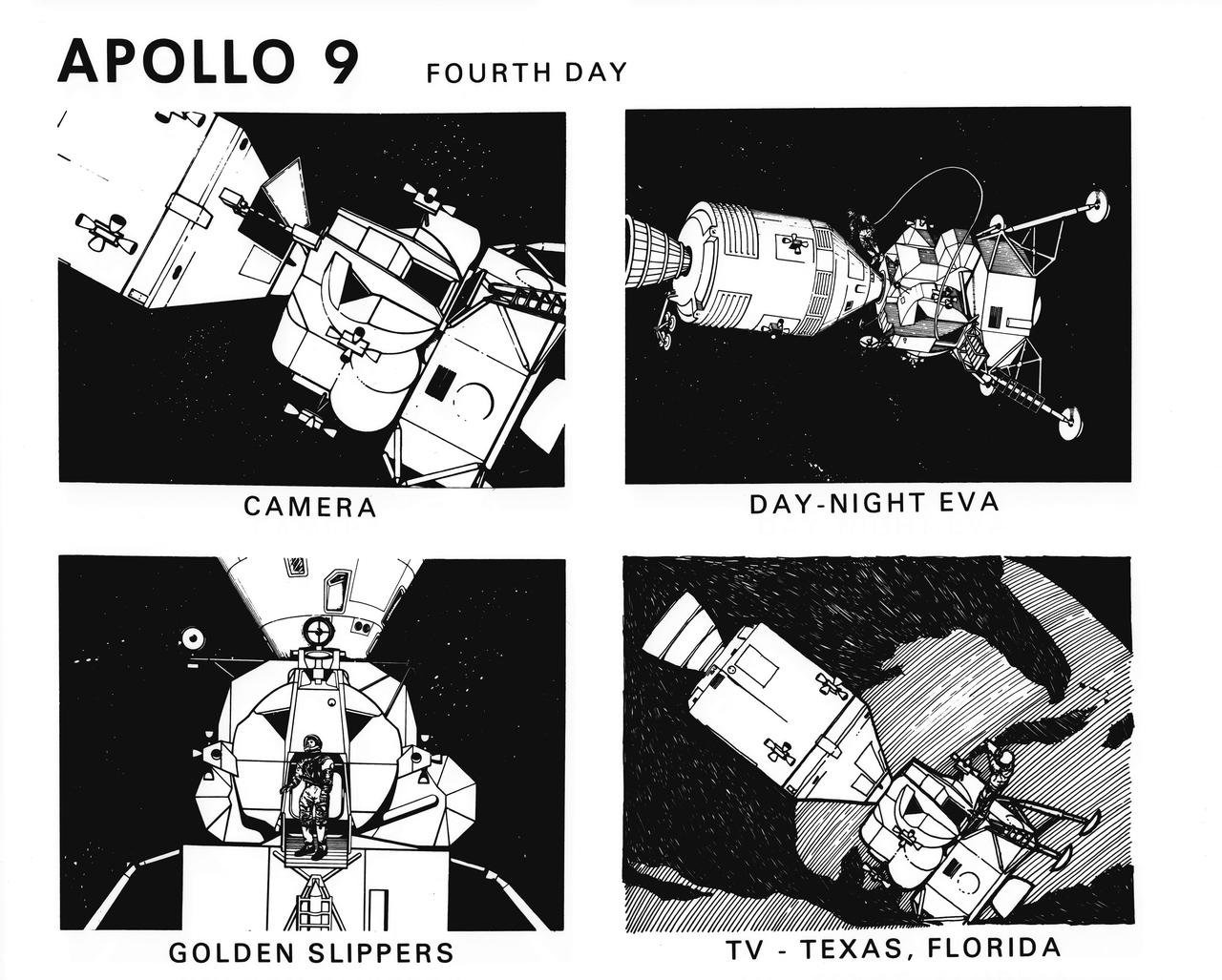
S69-19795 (February 1969) --- Composite of four artist's concepts illustrating key events, tasks and activities on the fourth day of the Apollo 9 mission, including use of camera, day-night extravehicular activity, use of golden slippers, and television over Texas and Florida. The Apollo 9 mission will evaluate spacecraft lunar module systems performance during manned Earth-orbital flight.