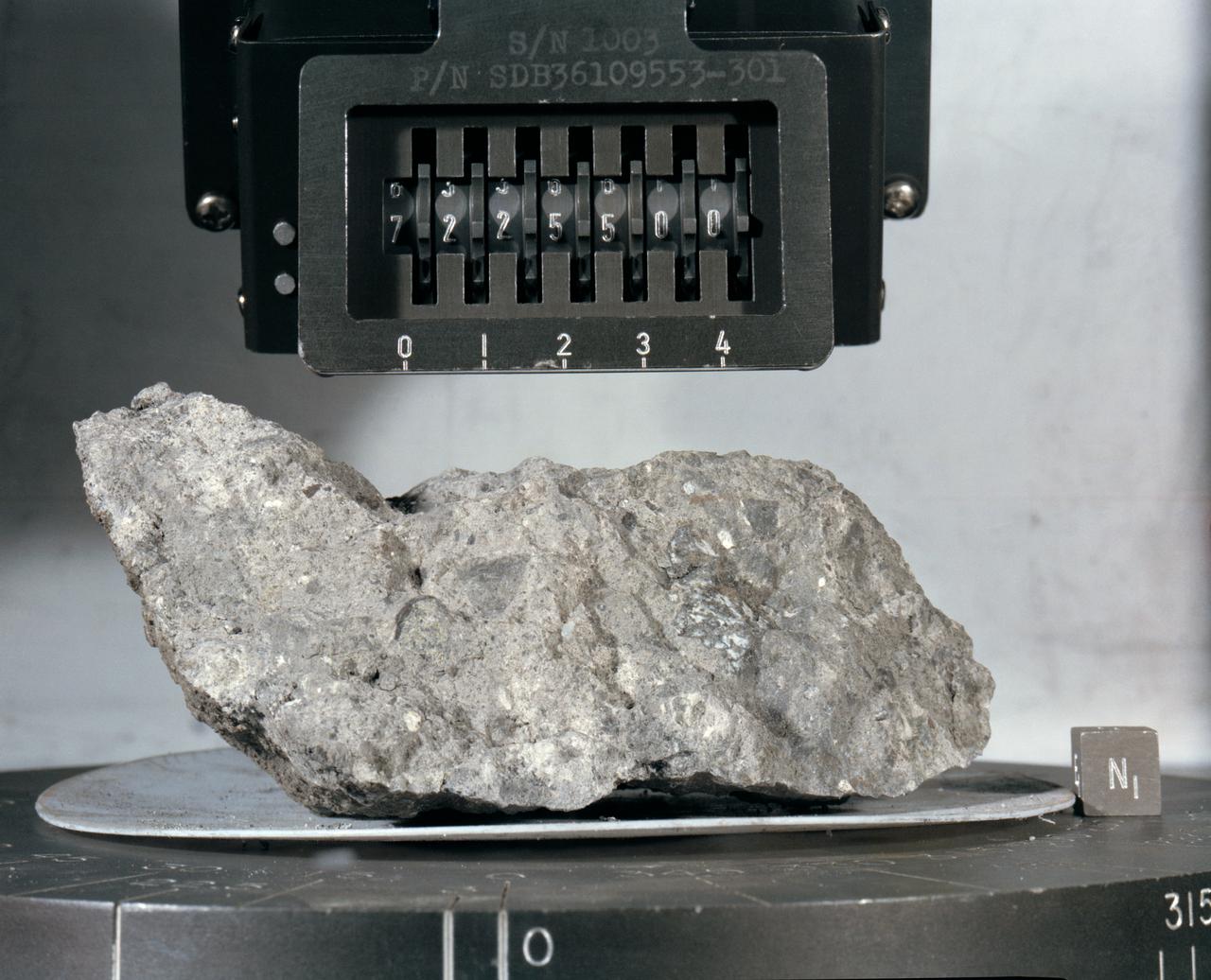
S73-16007 (December 1972) --- A "mug shot" of Apollo 17 lunar sample no. 72255 which was brought back from the lunar surface by the final team of Apollo astronauts. The rock weighs 461.2 grams and measures 2.5 x 9 x 10.5 centimeters. The light grey breccia is sub-rounded on all faces except the top and north sides.

The two moon-exploring crewmen of the Apollo 14 lunar landing mission show off some of the largest of the lunar rocks they collected on their mission, during a through-the-glass meeting with newsmen in the Crew Reception Area of the Lunar Receiving Laboratory (LRL) at the Manned Spacecraft Center (MSC). Astronaut Edgar D. Mitchell (left), lunar module pilot, holds up a tote bag in which some of the lunar samples were stowed, while astronaut Alan B. Shepard Jr., commander, looks on. The largest sample brought back on the mission, a basketball-size rock (nicknamed "Big Bertha"), is said to be the largest lunar rock collected in three lunar landing missions for the National Aeronautics and Space Administration (NASA).
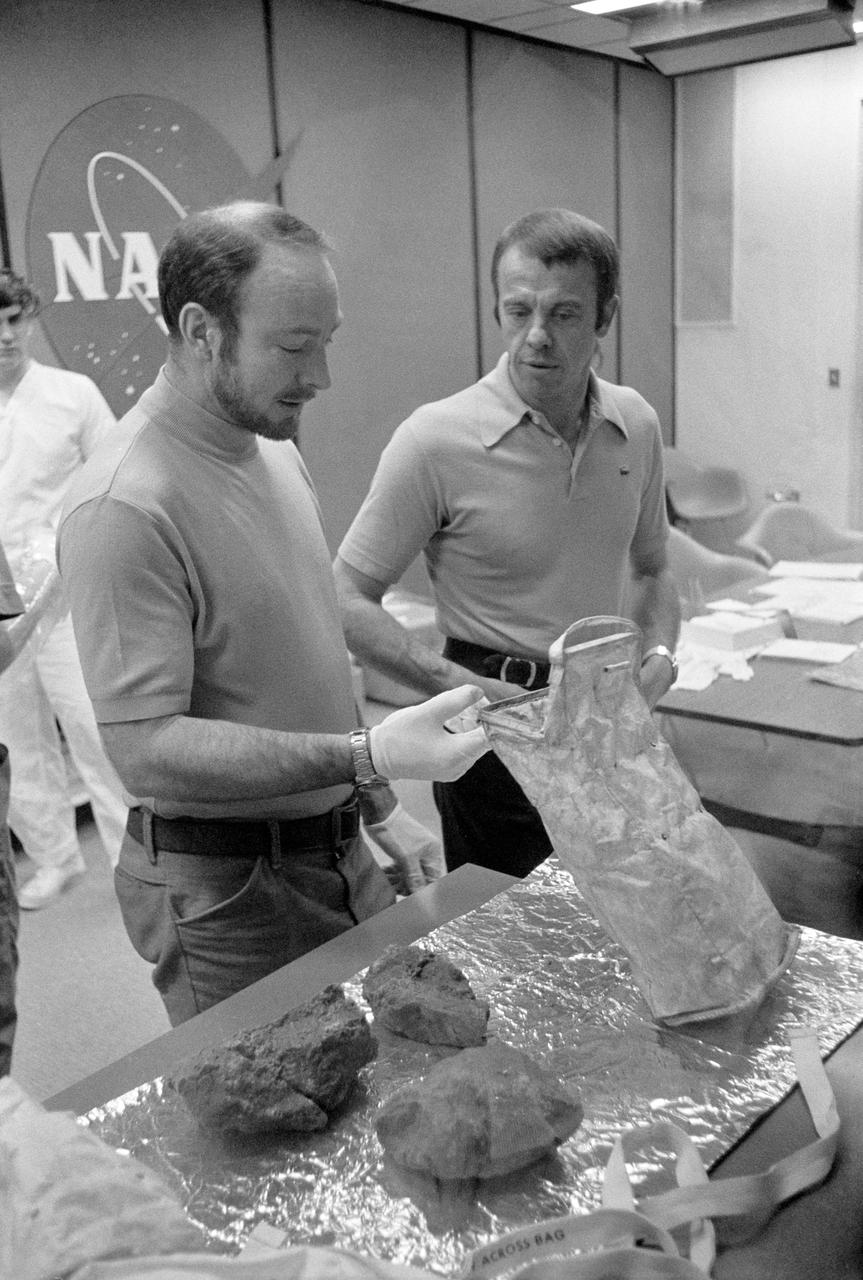
S71-20375 (19 Feb. 1971) --- The two moon-exploring crewmen of the Apollo 14 lunar landing mission show off some of the largest of the lunar rocks they collected on their mission, during a through-the-glass meeting with newsmen in the Crew Reception Area of the Lunar Receiving Laboratory (LRL) at the Manned Spacecraft Center (MSC). Astronaut Edgar D. Mitchell (left), lunar module pilot, holds up a tote bag in which some of the lunar samples were stowed, while astronaut Alan B. Shepard Jr., commander, looks on. The largest sample brought back on the mission, a basketball-size rock (nicknamed "Big Bertha"), is said to be the largest lunar rock collected in three lunar landing missions for the National Aeronautics and Space Administration (NASA).
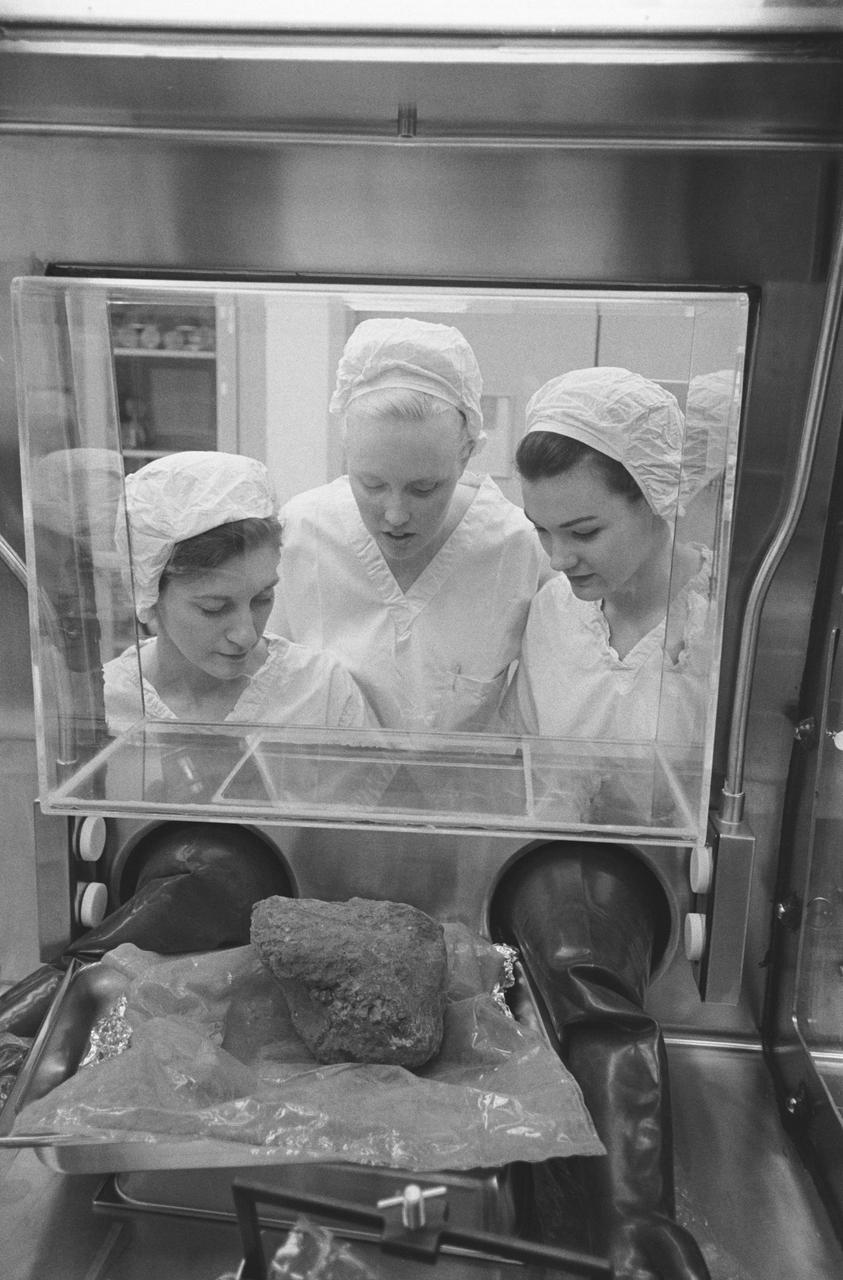
S71-21244 (24 Feb. 1971) --- Three Brown and Root/Northrop technicians in the Nonsterile Nitrogen Laboratory in the Lunar Receiving Laboratory (LRL) peer through glass at the much-discussed basketball size rock which Apollo 14 crewmen brought back from the Fra Mauro area of the moon. They are, left to right, Linda Tyler, Nancy L. Trent and Sandra Richards.
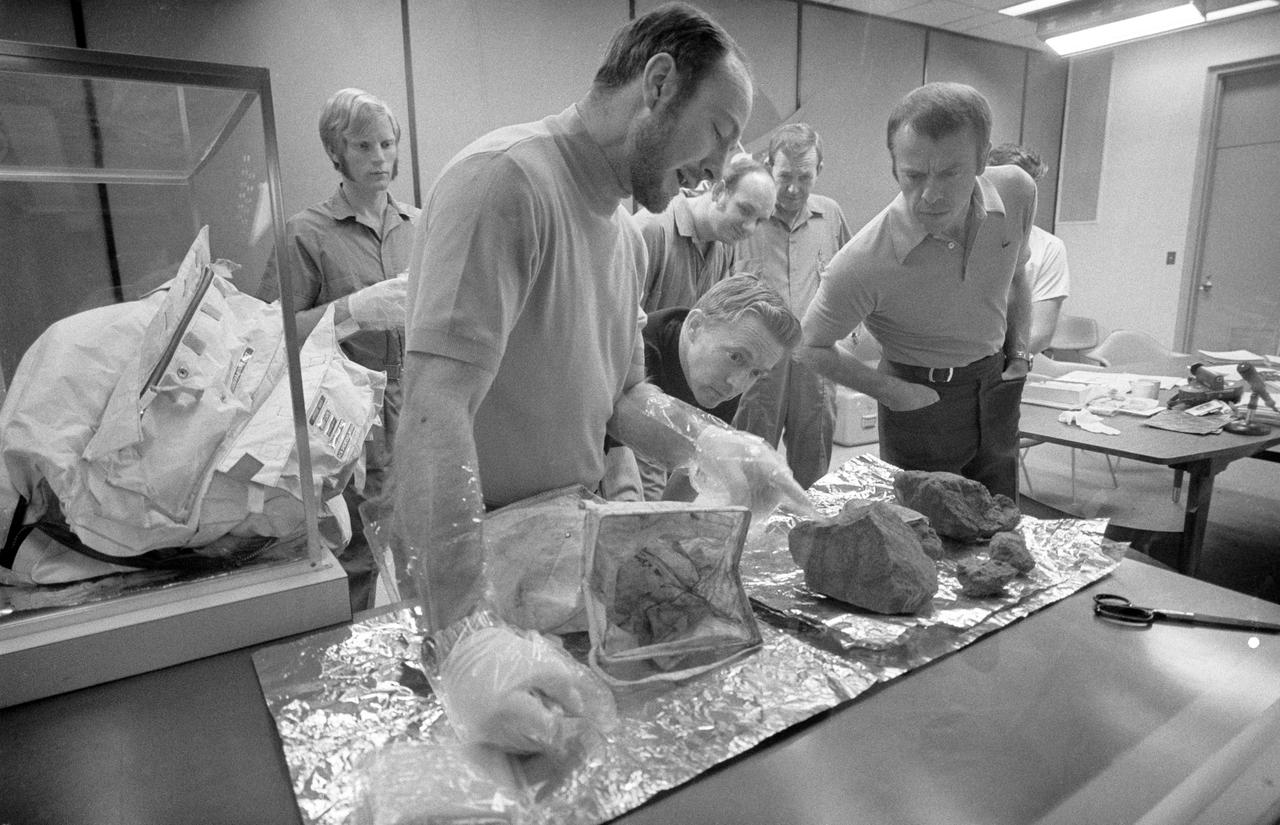
S71-20373 (19 Feb. 1971) --- The Apollo 14 crew men show off some of the largest of the lunar rocks which they brought back from the moon during a through-the-glass meeting with news men in the Crew Reception Area of the Lunar Receiving Laboratory (LRL) at the Manned Spacecraft Center (MSC). Astronaut Alan B. Shepard Jr. (right), mission commander, leans over to view a large basketball-size rock which astronaut Edgar D. Mitchell, lunar module pilot, points out. Astronaut Stuart A. Roosa, command module pilot, who circled the moon in the Command and Service Modules (CSM) while his two fellow crewmembers explored the moon, looks on (near the center of the photograph). Four of the 14 men quarantined with the Apollo 14 crew look on in the background.
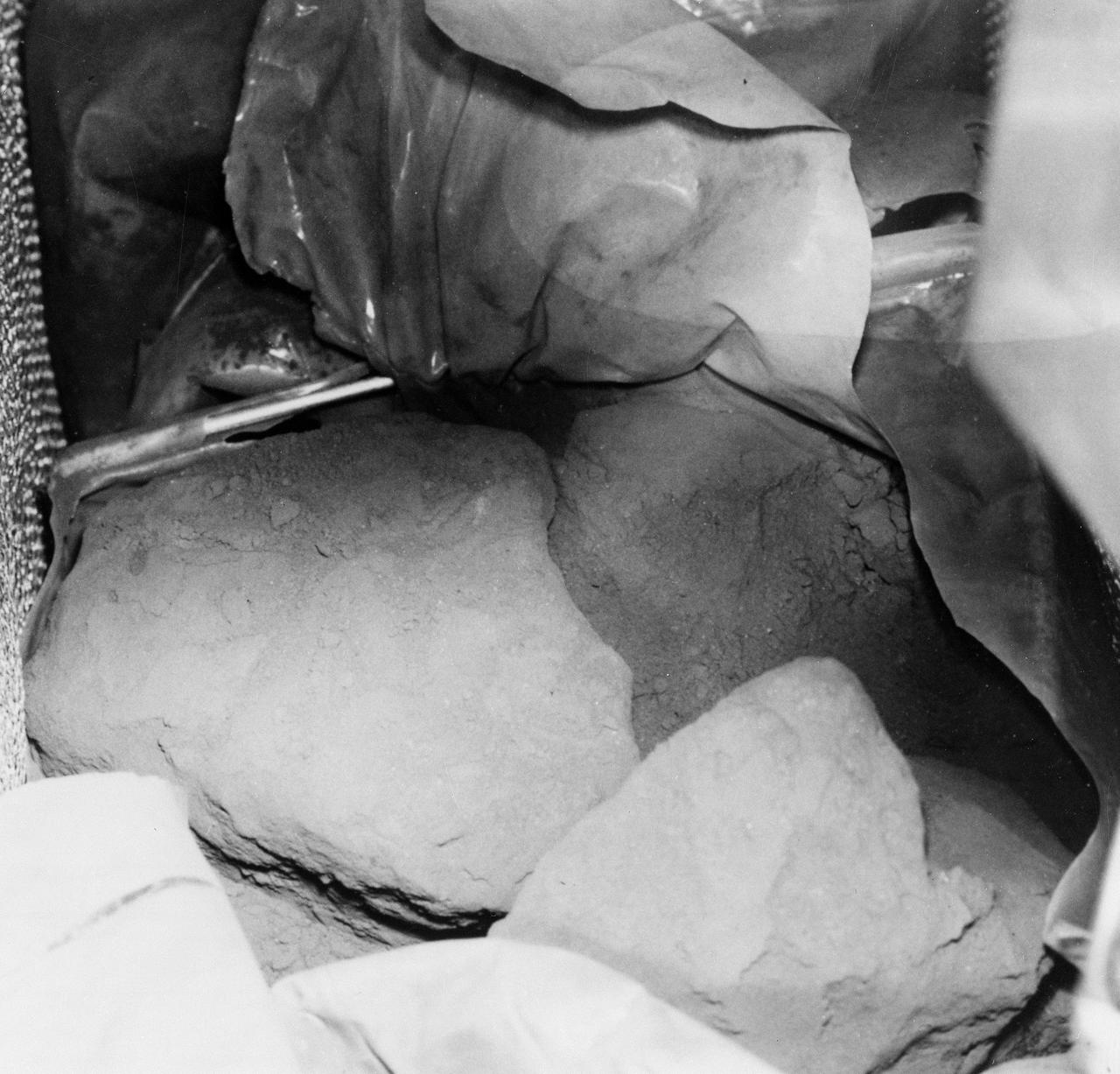
The second manned lunar landing mission, Apollo 12 launched from launch pad 39-A at Kennedy Space Center in Florida on November 14, 1969 via a Saturn V launch vehicle. The Saturn V vehicle was developed by the Marshall Space Flight Center (MSFC) under the direction of Dr. Wernher von Braun. Aboard Apollo 12 was a crew of three astronauts: Alan L. Bean, pilot of the Lunar Module (LM), Intrepid; Richard Gordon, pilot of the Command Module (CM), Yankee Clipper; and Spacecraft Commander Charles Conrad. The LM, Intrepid, landed astronauts Conrad and Bean on the lunar surface in what’s known as the Ocean of Storms while astronaut Richard Gordon piloted the CM, Yankee Clipper, in a parking orbit around the Moon. Lunar soil activities included the deployment of the Apollo Lunar Surface Experiments Package (ALSEP), finding the unmanned Surveyor 3 that landed on the Moon on April 19, 1967, and collecting 75 pounds (34 kilograms) of rock samples, some of which can be seen in this photograph. Apollo 12 safely returned to Earth on November 24, 1969.
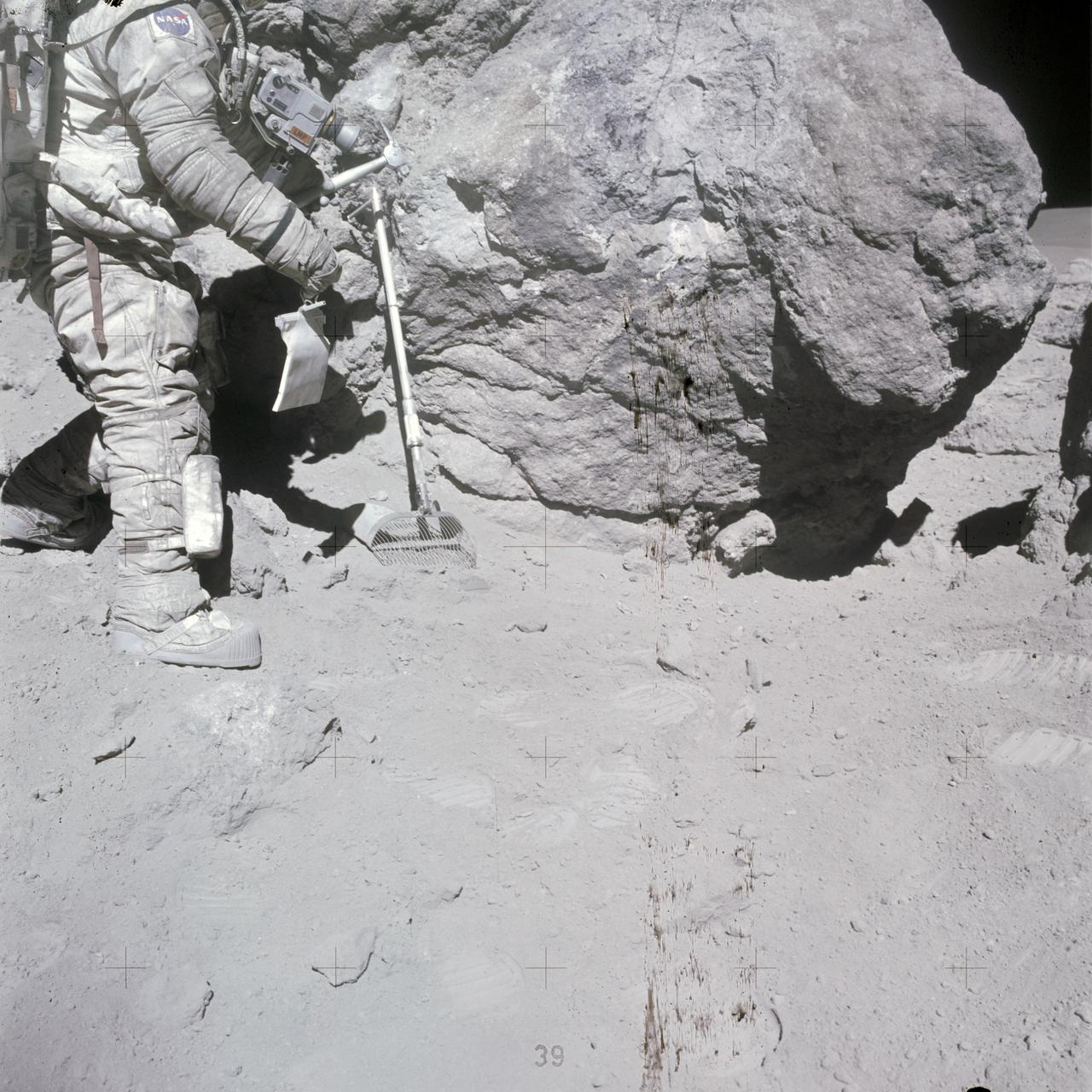
AS16-116-18653 (23 April 1972) --- Astronaut Charles M. Duke Jr., Apollo 16 lunar module pilot, stands at a big rock adjacent (south) to the huge "House Rock" (barely out of view at right edge). Note shadow at extreme right center where the two moon-exploring crew members of the mission sampled what they referred to as the "east-by-west split of House Rock" or the open space between this rock and "House Rock". At their post-mission press conference, the crewmen expressed the opinion that this rock was once a part of "House Rock" which had broken away. The two sampled the big boulder seen here also. Duke has a sample bag in his hand, and a lunar surface rake leans against the large boulder. Astronaut John W. Young, commander, exposed this view with a color magazine in his 70mm Hasselblad camera. While astronauts Young and Duke descended in the Apollo 16 Lunar Module (LM) "Orion" to explore the Descartes highlands landing site on the moon, astronaut Thomas K. Mattingly II, command module pilot, remained with the Command and Service Modules (CSM) "Casper" in lunar orbit.
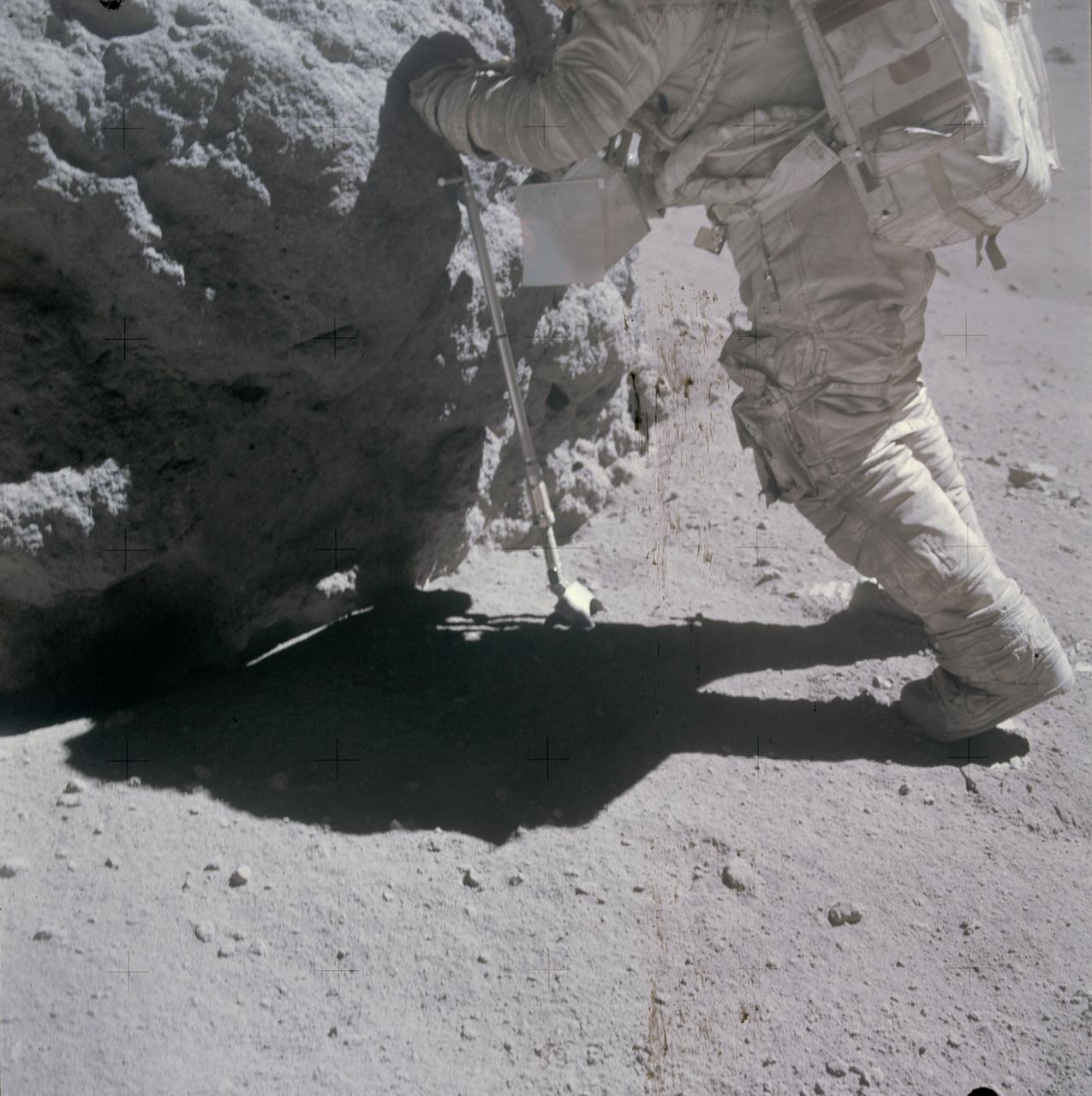
AS16-116-18671 (23 April 1972) --- Astronaut Charles M. Duke Jr., lunar module pilot, works at the "Shadow Rock", discovered during the missions third extravehicular activity (EVA) in the area of North Ray Crater (Station 13), April 23, 1972. The scoop, a geological hand tool, leans against the rock. This view was exposed by astronaut John W. Young, commander. The two moon-exploring crew men sampled this rock, which got its name because of a permanently shadowed area it protected. While astronauts Young and Duke descended in the Apollo 16 Lunar Module (LM) "Orion" to explore the Descartes highlands landing site on the moon, astronaut Thomas K. Mattingly II, command module pilot, remained with the Command and Service Modules (CSM) "Casper" in lunar orbit.
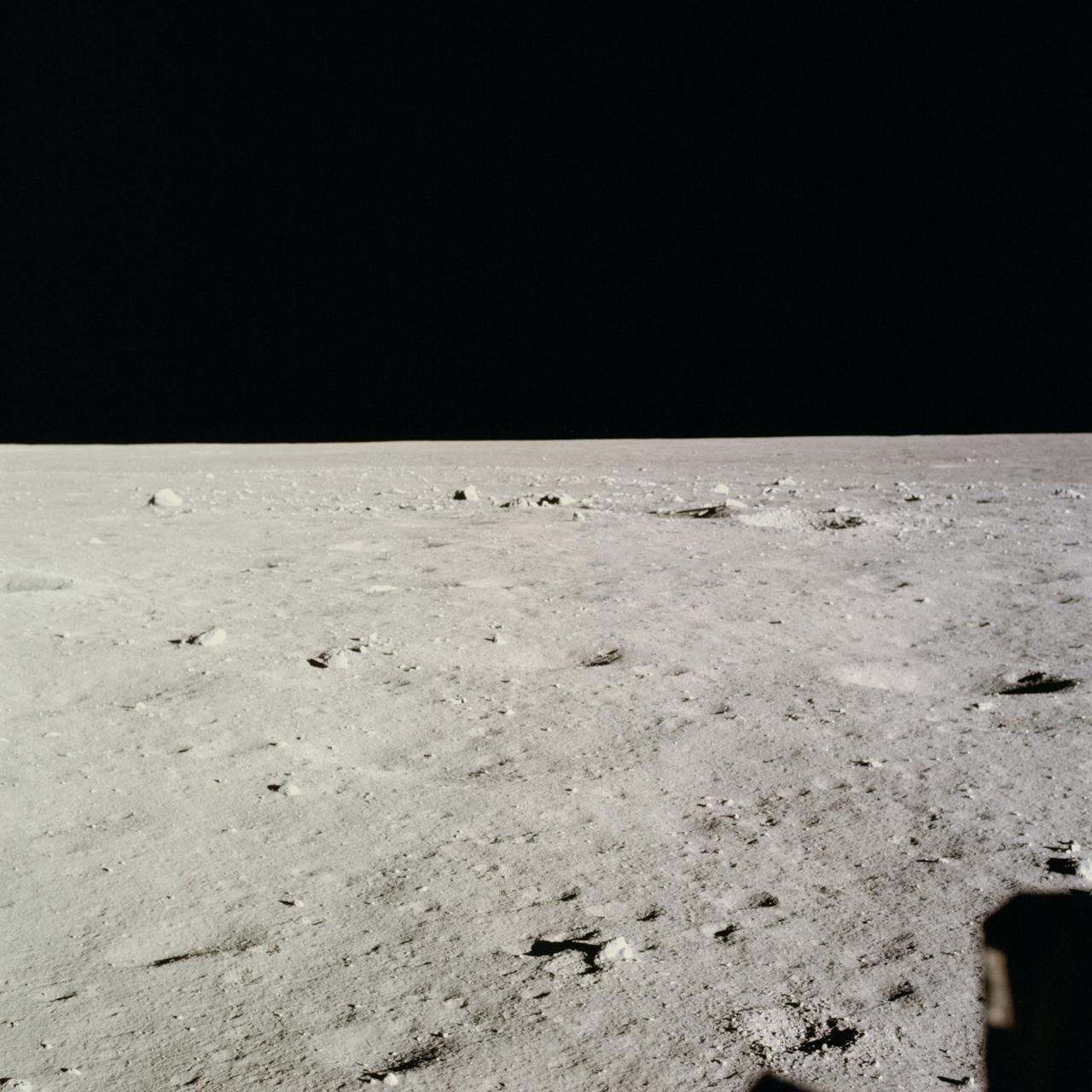
AS11-37-5458 (20 July 1969) --- This excellent view from the right-hand window of the Apollo 11 Lunar Module (LM) shows the surface of the moon in the vicinity of where the LM touched down. Numerous small rocks and craters can be seen between the LM and the lunar horizon. Astronaut Michael Collins, command module pilot, remained with the Command and Service Modules (CSM) in lunar orbit while astronauts Neil A. Armstrong, commander; and Edwin E. Aldrin Jr., lunar module pilot, descended in the LM to the lunar surface.
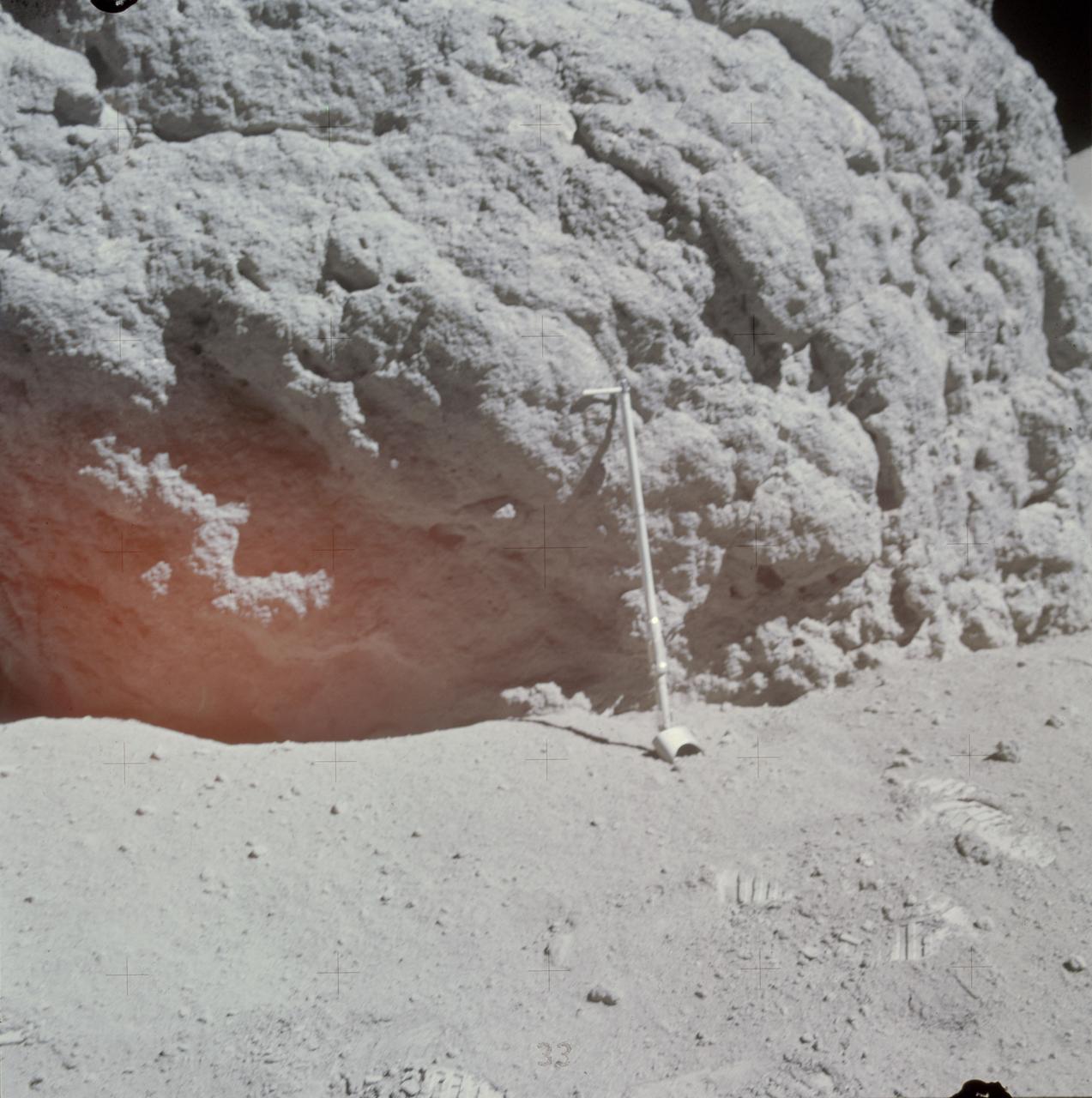
AS16-117-18728 (23 April 1972) --- Astronaut Charles M. Duke Jr., lunar module pilot, exposed this view of the huge "Shadow Rock" with his 70mm Hasselblad camera during the mission's third and final extravehicular activity (EVA), on April 23, 1972. This particular stop was referenced as Station 13. The scoop, a geological hand tool, leans against the rock and helps to give an idea of the size. Station 13 is a little southeast of North Ray Crater at the Descartes area. While astronauts John W. Young, commander; and Duke descended in the Apollo 16 Lunar Module (LM) "Orion" to explore the Descartes highlands landing site on the moon, astronaut Thomas K. Mattingly II, command module pilot, remained with the Command and Service Modules (CSM) "Casper" in lunar orbit.
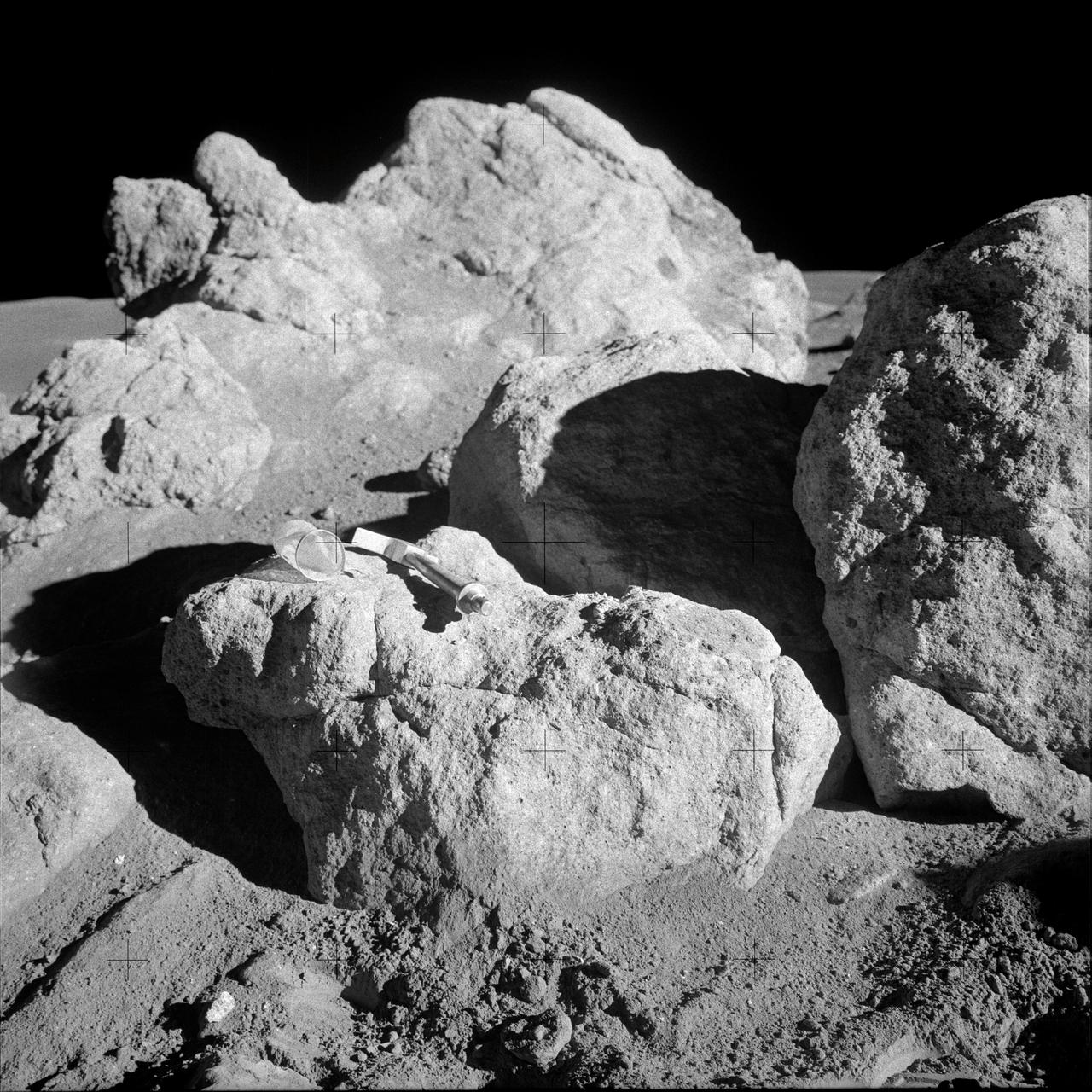
AS14-68-9452 (5-6 Feb. 1971) --- A hammer and a small collection bag lie atop a lunar boulder to give some indication of size in this view of several boulders clustered together. This is one of the white rocks from which samples were taken by the two moon-exploring crew men of the Apollo 14 lunar landing mission. While astronauts Alan B. Shepard Jr., commander, and Edgar D. Mitchell, lunar module pilot, were exploring the moon, astronaut Stuart A. Roosa, command module pilot, remained with the Command and Service Modules (CSM) in lunar orbit.
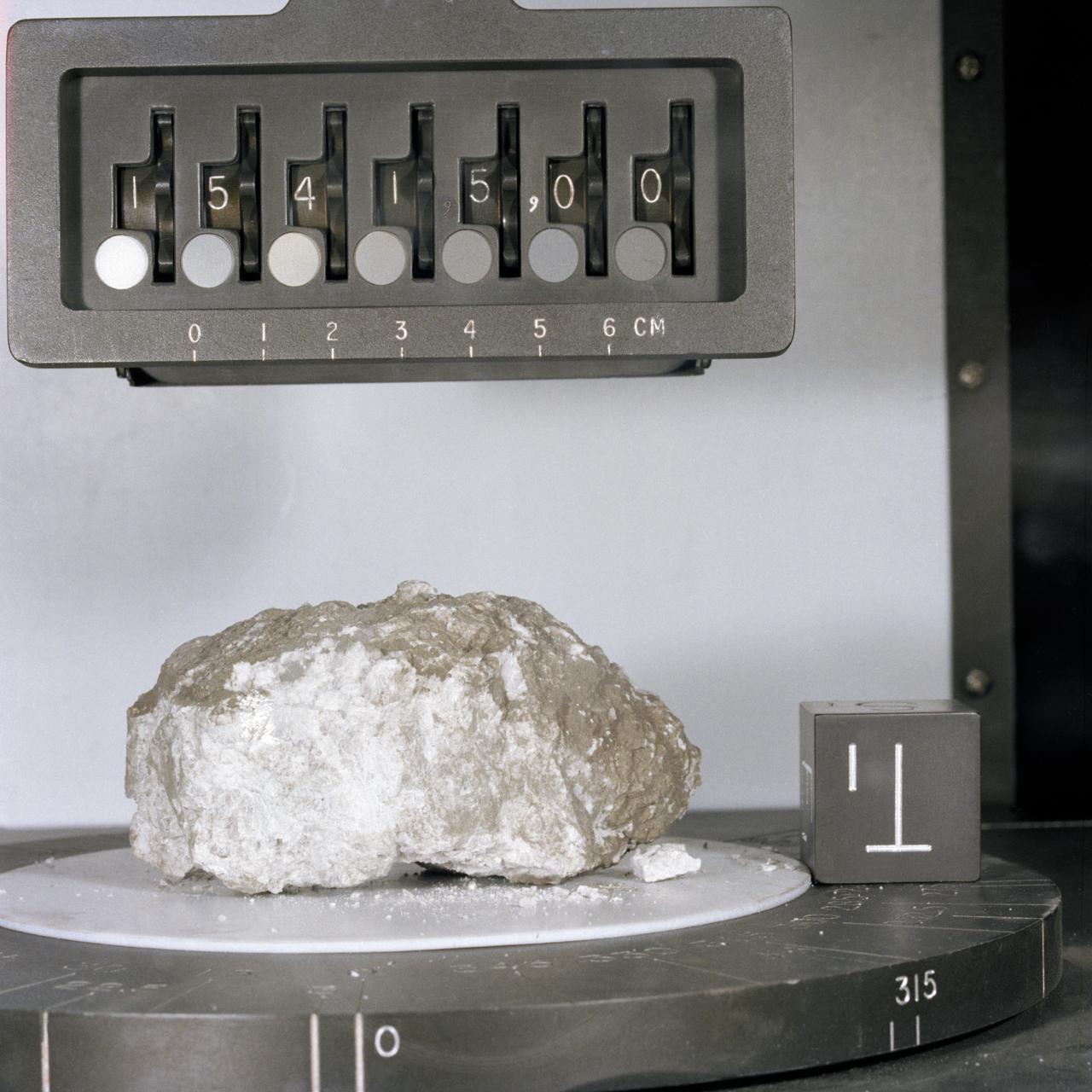
S71-42955 (August 1971) --- A close-up view of Apollo 15 lunar sample no. 15415 in the Non-Sterile Nitrogen Processing Line (NNPL) in the Lunar Receiving Laboratory (LRL) at the Manned Spacecraft Center (MSC). This sample is the white anorthositic rock (Genesis Rock) collected by astronauts David R. Scott and James B. Irwin in container no. 196 at Site no. 7 at a Ground Elapsed Time of 145 hours and 42 minutes, on the mission's second extravehicular activity (EVA).
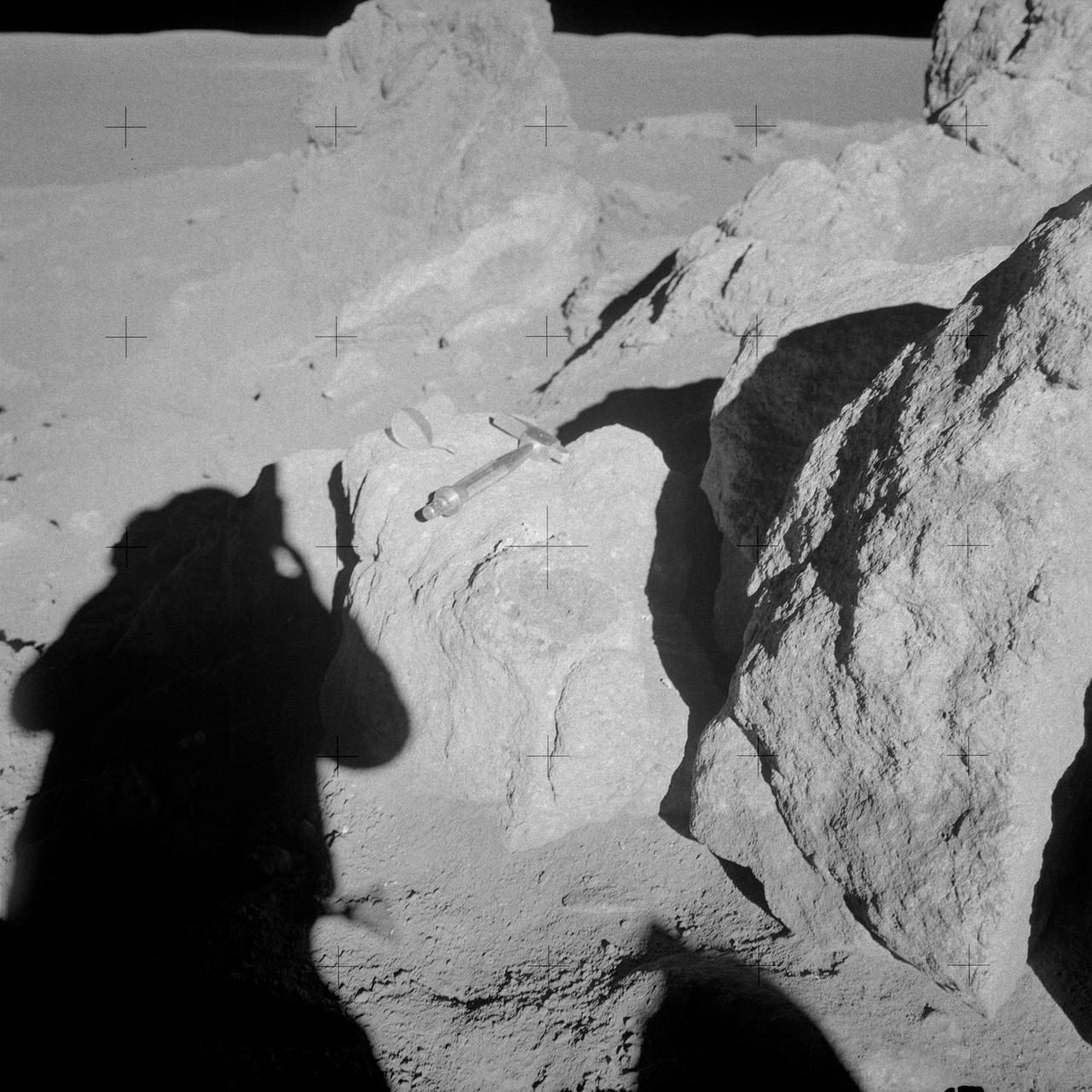
AS14-68-9453 (6 Feb. 1971) --- Astronaut Edgar D. Mitchell, lunar module pilot, whose shadow is in the foreground, photographs a group of large boulders near the rim of Cone Crater. An interesting feature is the white and brown rock in the boulder. Mitchell removed a sample where the hammer is lying. While astronauts Alan B. Shepard Jr., commander, and Mitchell descended in the Lunar Module (LM) "Antares" to explore the Fra Mauro region of the moon, astronaut Stuart A. Roosa, command module pilot, remained with the Command and Service Modules (CSM) "Kitty Hawk" in lunar orbit.
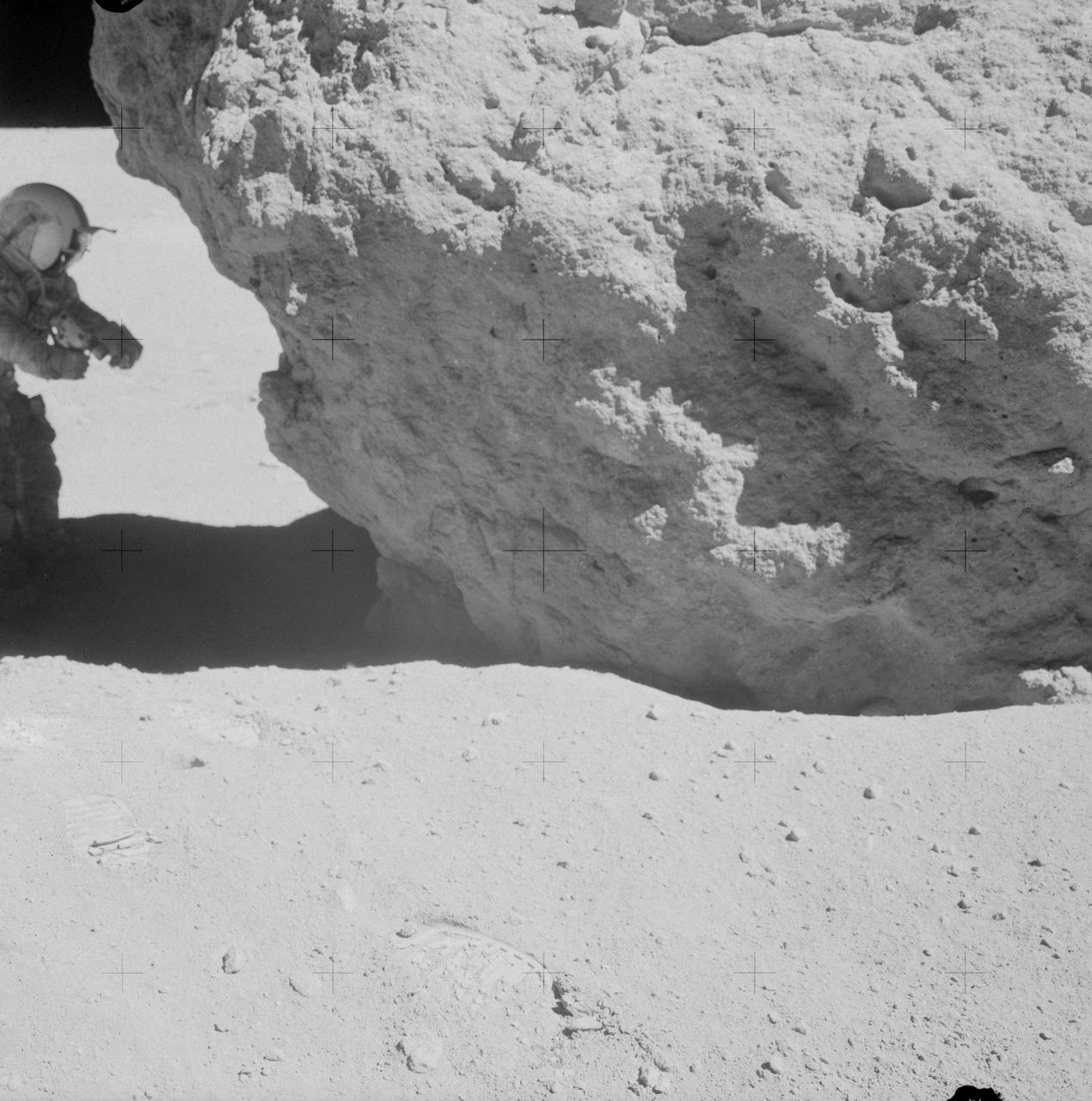
AS16-106-17413 (23 April 1972) --- Astronaut John W. Young, commander of the Apollo 16 lunar landing mission, looks over a large boulder at Station No.13 during the third Apollo 16 extravehicular activity (EVA) at the Descartes landing site. This was the site of the permanently shadowed soil sample which was taken from a hole extending under overhanging rock. Astronaut Charles M. Duke Jr., lunar module pilot, took this photograph. Concerning Young's reaching under the big rock, Duke remarked: "You do that in west Texas and you get a rattlesnake!"
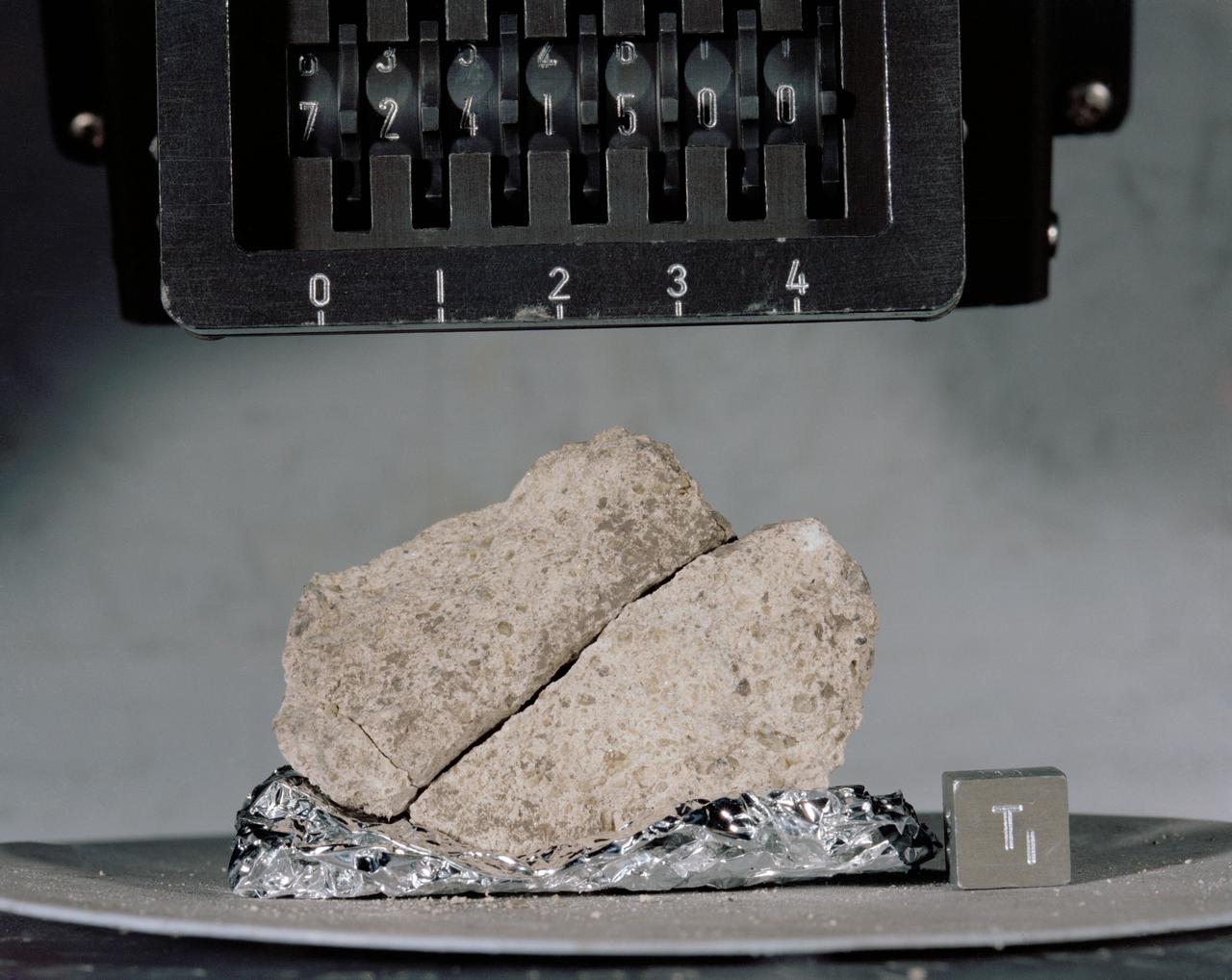
S73-16199 (December 1972) --- A close-up view of Apollo 17 lunar sample number 72415,0 which was brought back from the Taurus-Littrow landing site by the Apollo 17 crewmen. This sample is a brecciated dunite clast weighing a little over 32 grams (about 1.14 ounces). This sample was collected at station 2 (South Massif) during the second Apollo 17 extravehicular activity (EVA). IMPORTANT NOTE FOR CREDIT: The view was photographed by Karl Mills, Scientific Photo Arts, Berkeley, California.
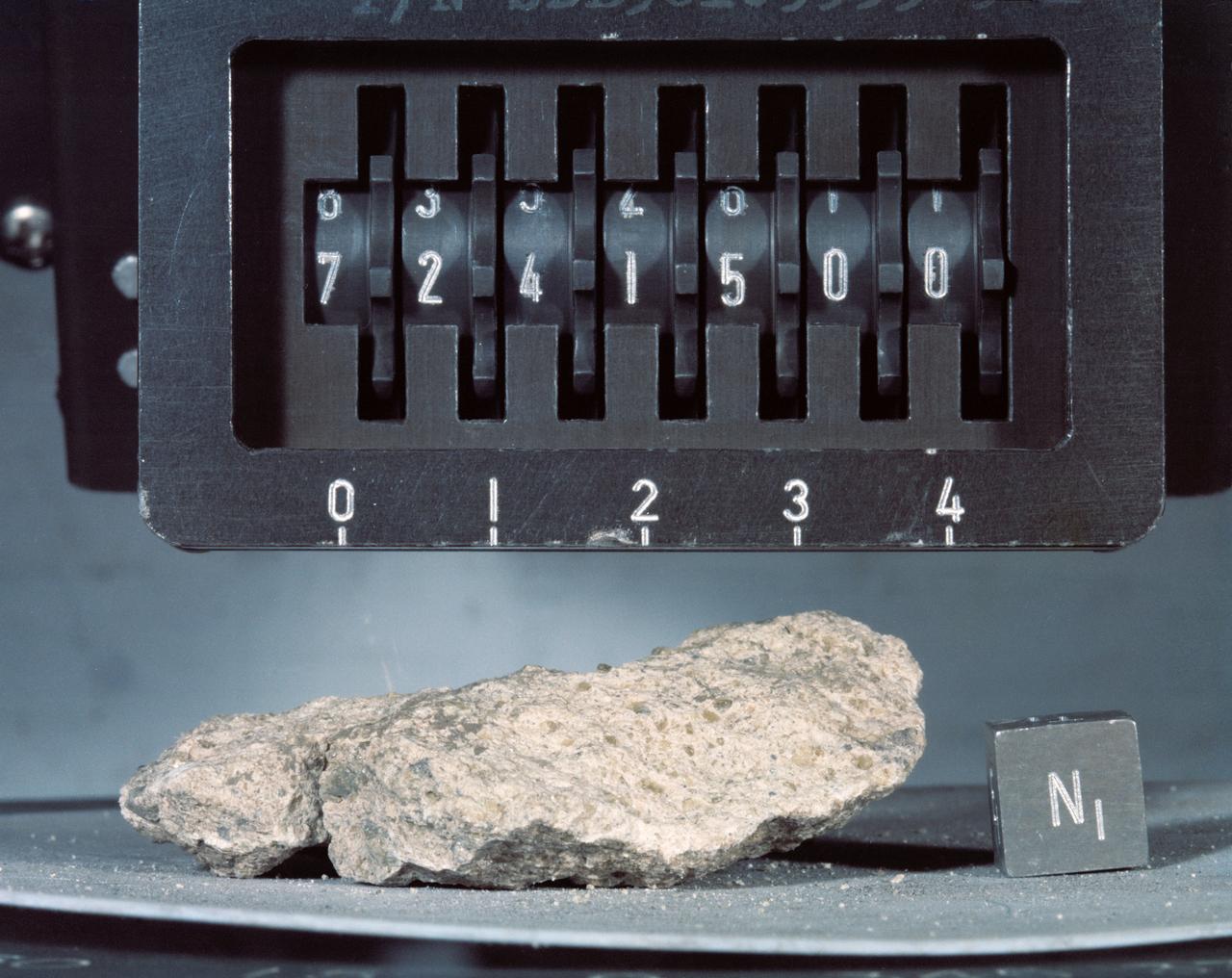
S73-16198 (December 1972) --- A close-up view of Apollo 17 lunar sample number 72415,0 which was brought back from the Taurus-Littrow landing site by the Apollo 17 crewmen. This sample is a brecciated dunite clast weighing a little over 32 grams (about 1.14 ounces). This sample was collected at station 2 (South Massif) during the second Apollo 17 extravehicular activity (EVA).
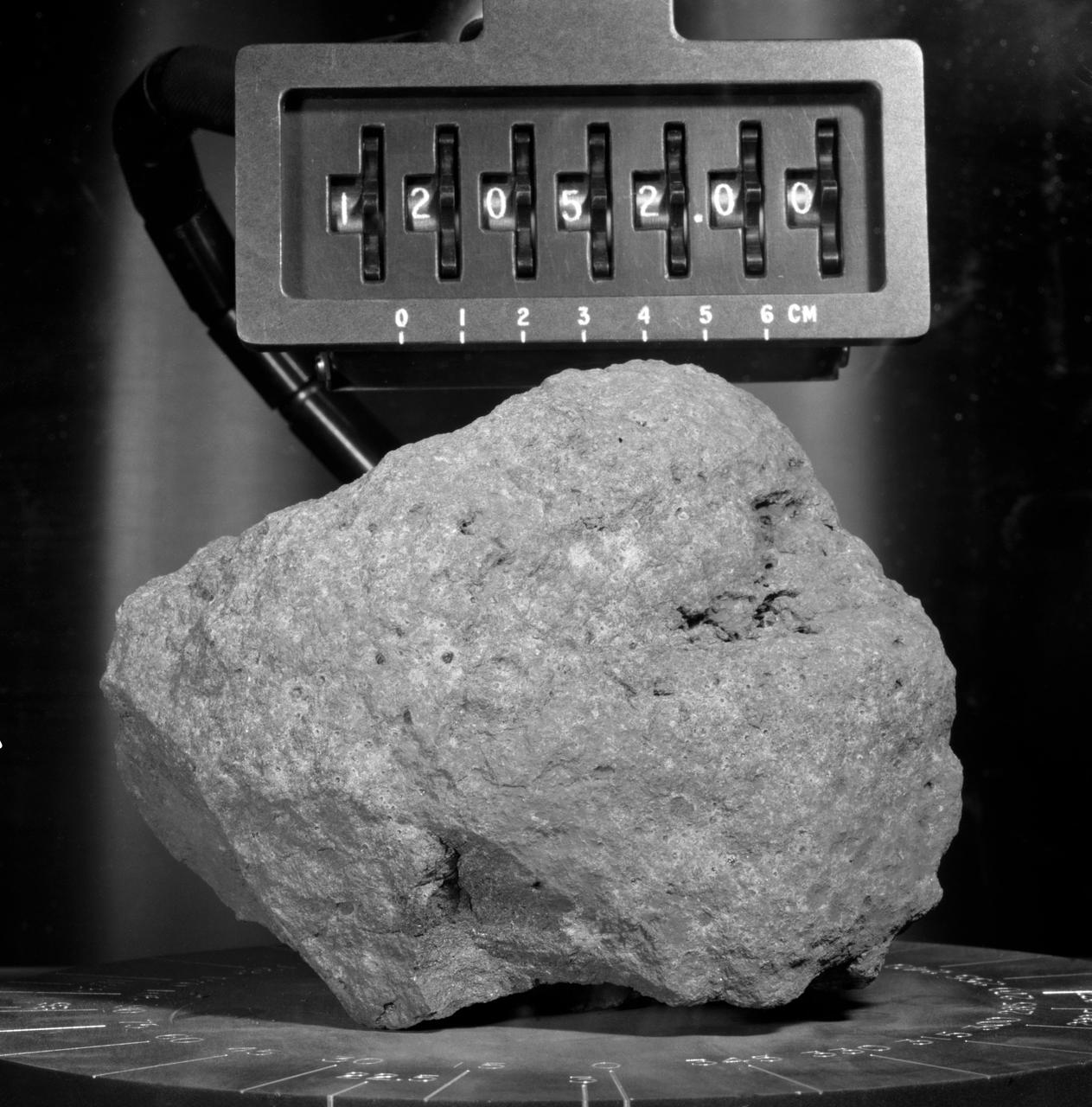
S69-60909 (November 1969) --- A close-up view of lunar sample 12,052 under observation in the Manned Spacecraft Center's Lunar Receiving Laboratory (LRL). Astronauts Charles Conrad Jr., and Alan L. Bean collected several rocks and samples of finer lunar matter during their Apollo 12 lunar landing mission extravehicular activity (EVA). This particular sample was picked up during the second space walk (EVA) on Nov. 20, 1969. It is a typically fine-grained crystalline rock with a concentration of holes on the left part of the exposed side. These holes are called vesicles and have been identified as gas bubbles formed during the crystallization of the rock. Several glass-lined pits can be seen on the surface of the rock.
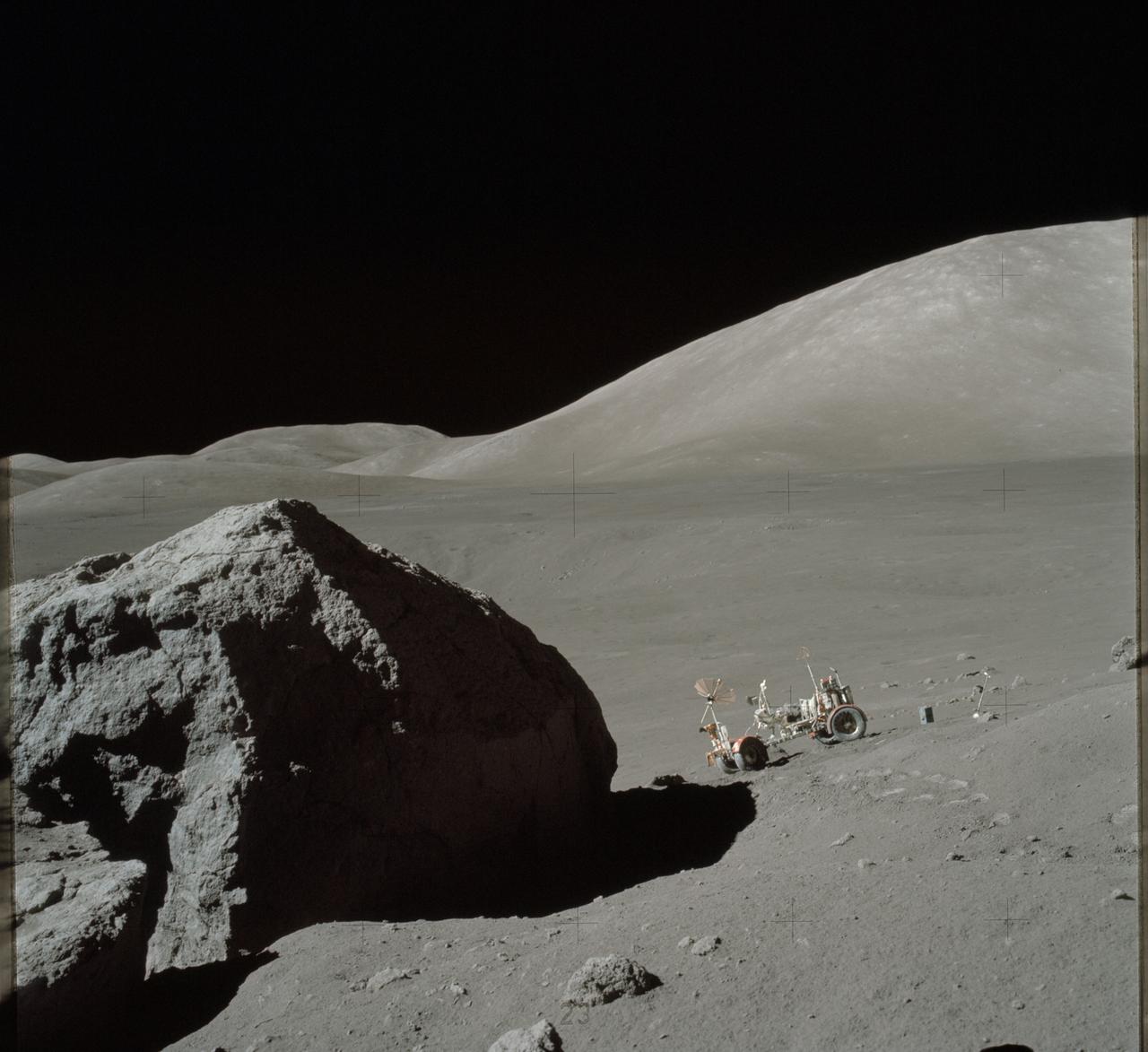
AS17-140-21494 (13 Dec. 1972) --- This view shows the Lunar Roving Vehicle (LRV) parked by an outcrop of rocks by astronauts Eugene A. Cernan and Harrison H. (Jack) Schmitt during their visit to extravehicular activity Station 6 (Henry Crater).
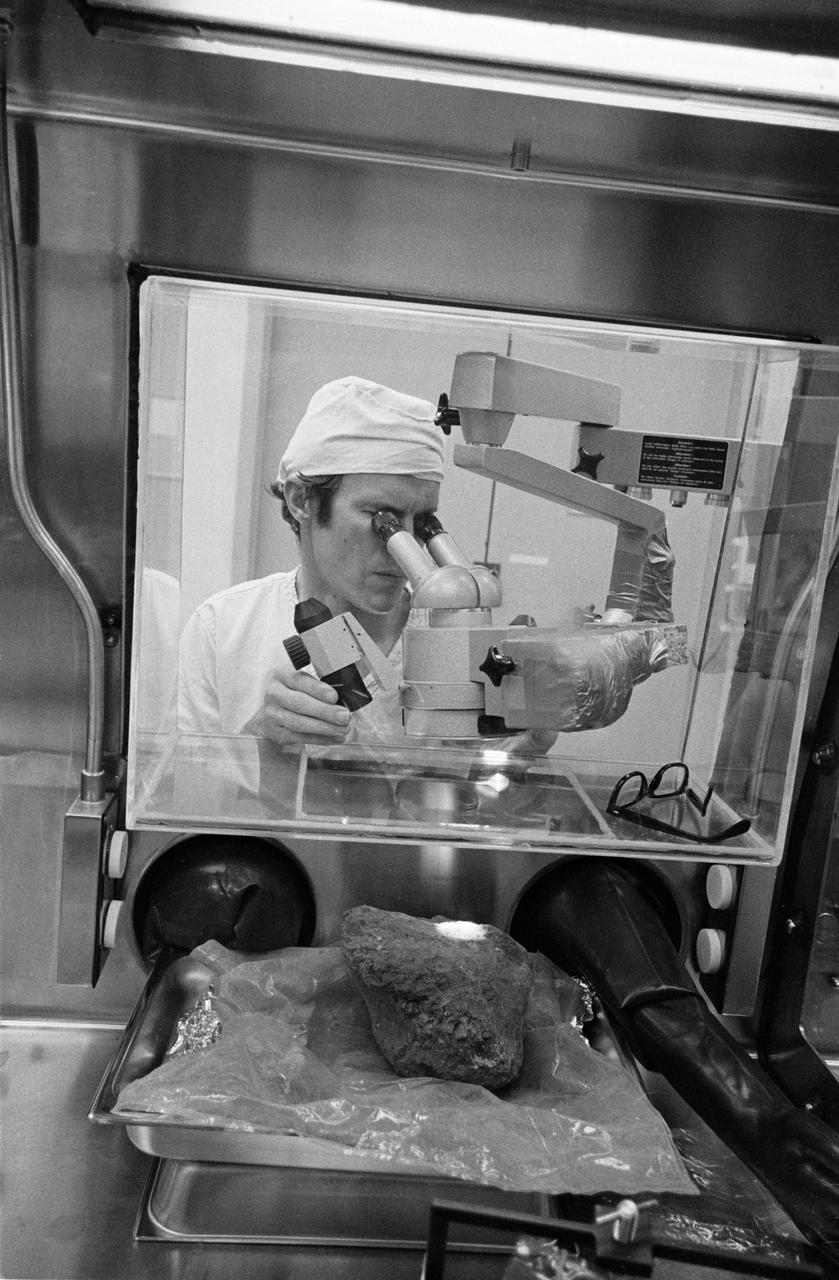
S71-21245 (24 Feb. 1971) --- Dr. Daniel H. Anderson, an aerospace technologist and test director in the Nonsterile Nitrogen Processing Laboratory in the Lunar Receiving Laboratory (LRL) at the Manned Spacecraft Center (MSC) looks at much-discussed Apollo 14 basketball-size rock through a microscope. The two moon-exploring crew men of Apollo 14 brought back 90-odd pounds of lunar sample material from their two periods of extravehicular activity (EVA) on the lunar surface in the Fra Mauro area.
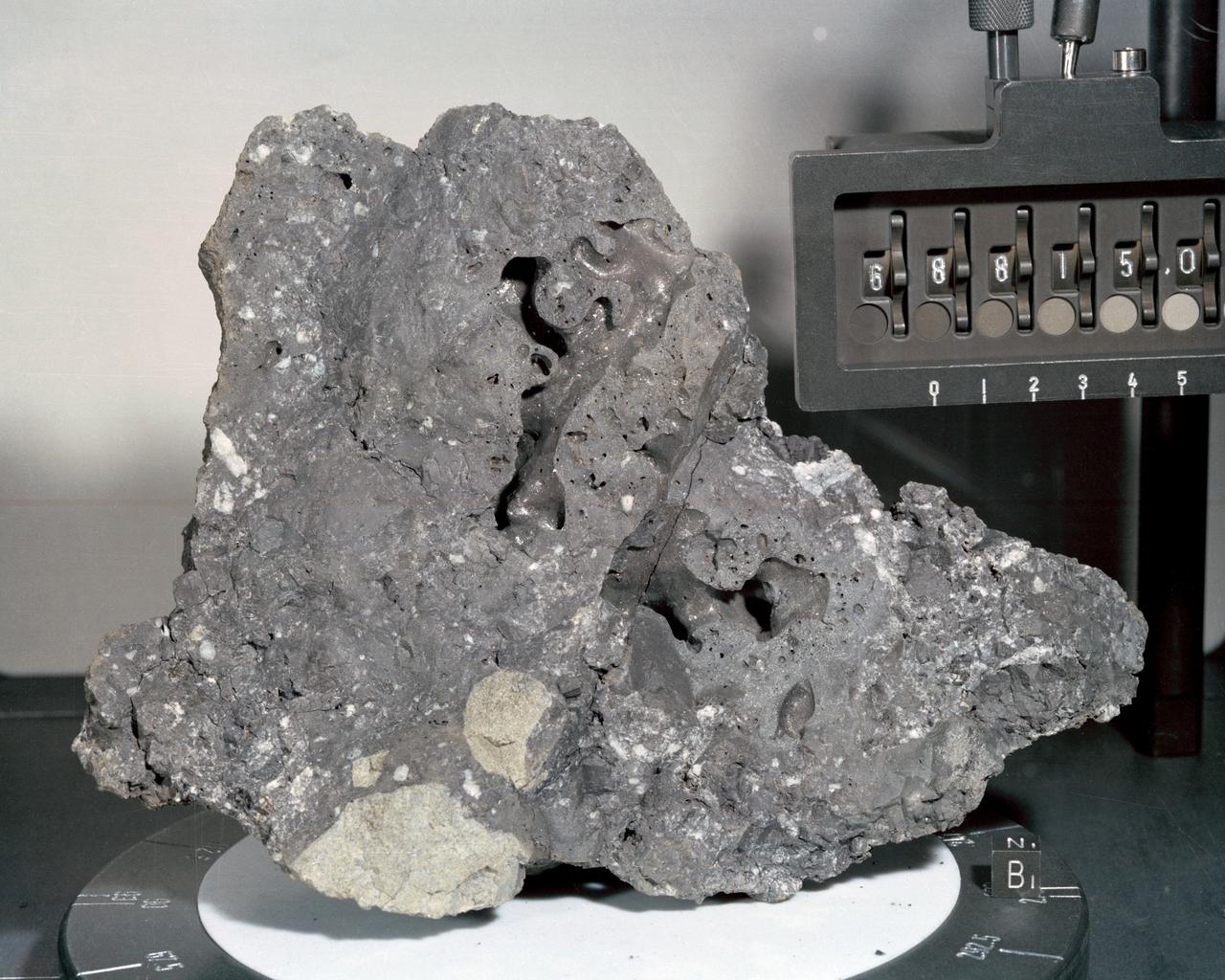
A closeup view or "mug shot" of Apollo 16 lunar sample no. 68815, a dislodged fragment from a parent boulder roughly four feet high and five feet long encountered at Station 8. The crew tried in vain to overturn the parent boulder. A fillet-soil sample was taken close to the boulder, allowing for study of the type and rate of erosion acting on lunar rocks. The fragment itself is very hard, has many veticles and a variety of inclusions. In addition, numerous metallic particles were observed in the black matrix.
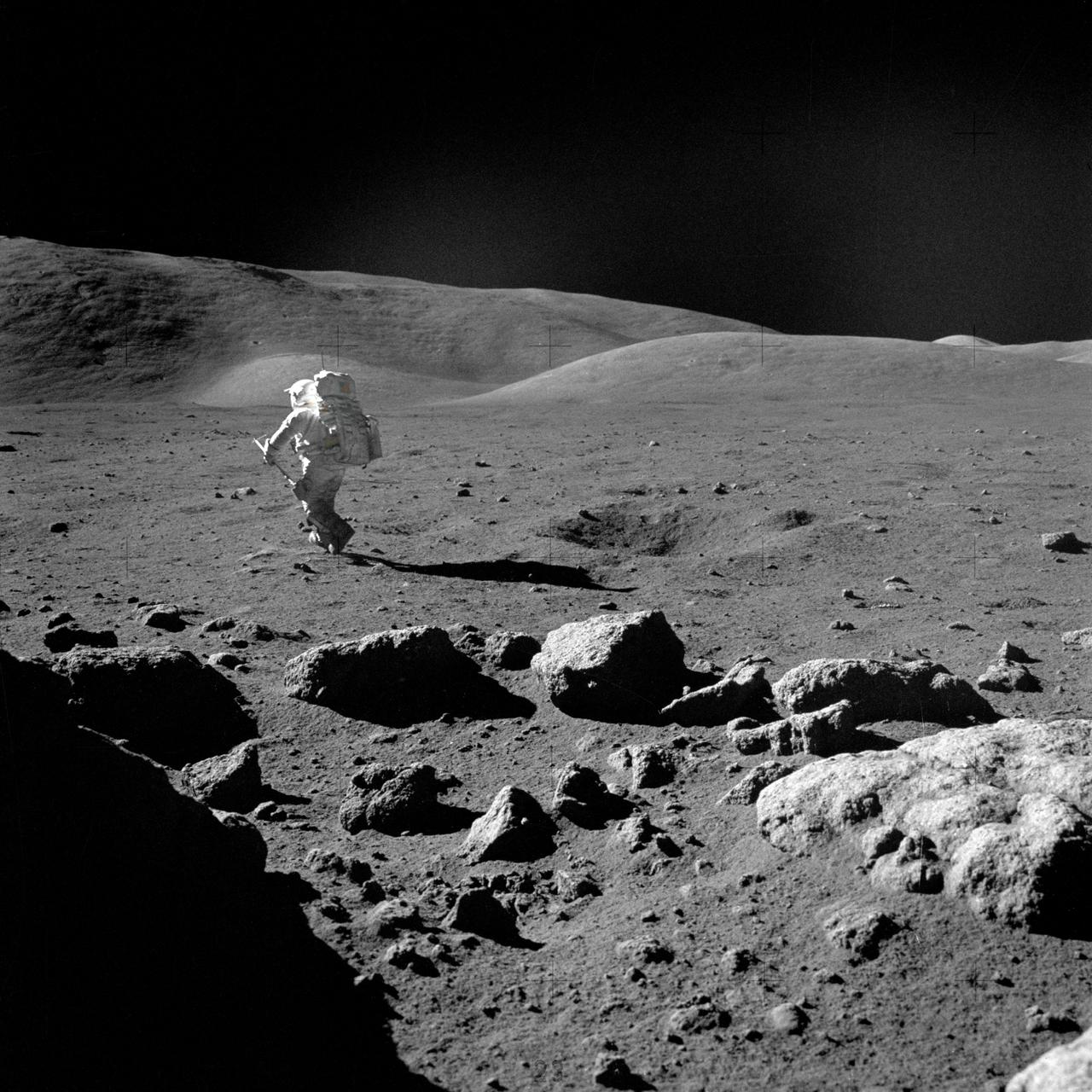
AS17-145-22165 (12 Dec. 1972) --- Scientist-astronaut Harrison H. Schmitt, lunar module pilot, with his adjustable sampling scoop, heads for a selected rock on the lunar surface to retrieve the sample for study. The action was photographed by Apollo 17 crew commander, astronaut Eugene A. Cernan on the mission's second extravehicular activity (EVA), at Station 5 at the Taurus-Littrow landing site. Cernan used a 70mm Hasselblad camera equipped with a 60mm lens and type SO-368 color film for this photograph. While astronauts Cernan and Schmitt descended in the Lunar Module (LM) "Challenger" to explore the Taurus-Littrow region of the moon, astronaut Ronald E. Evans, command module pilot, remained with the Command and Service Modules (CSM) "America" in lunar orbit.
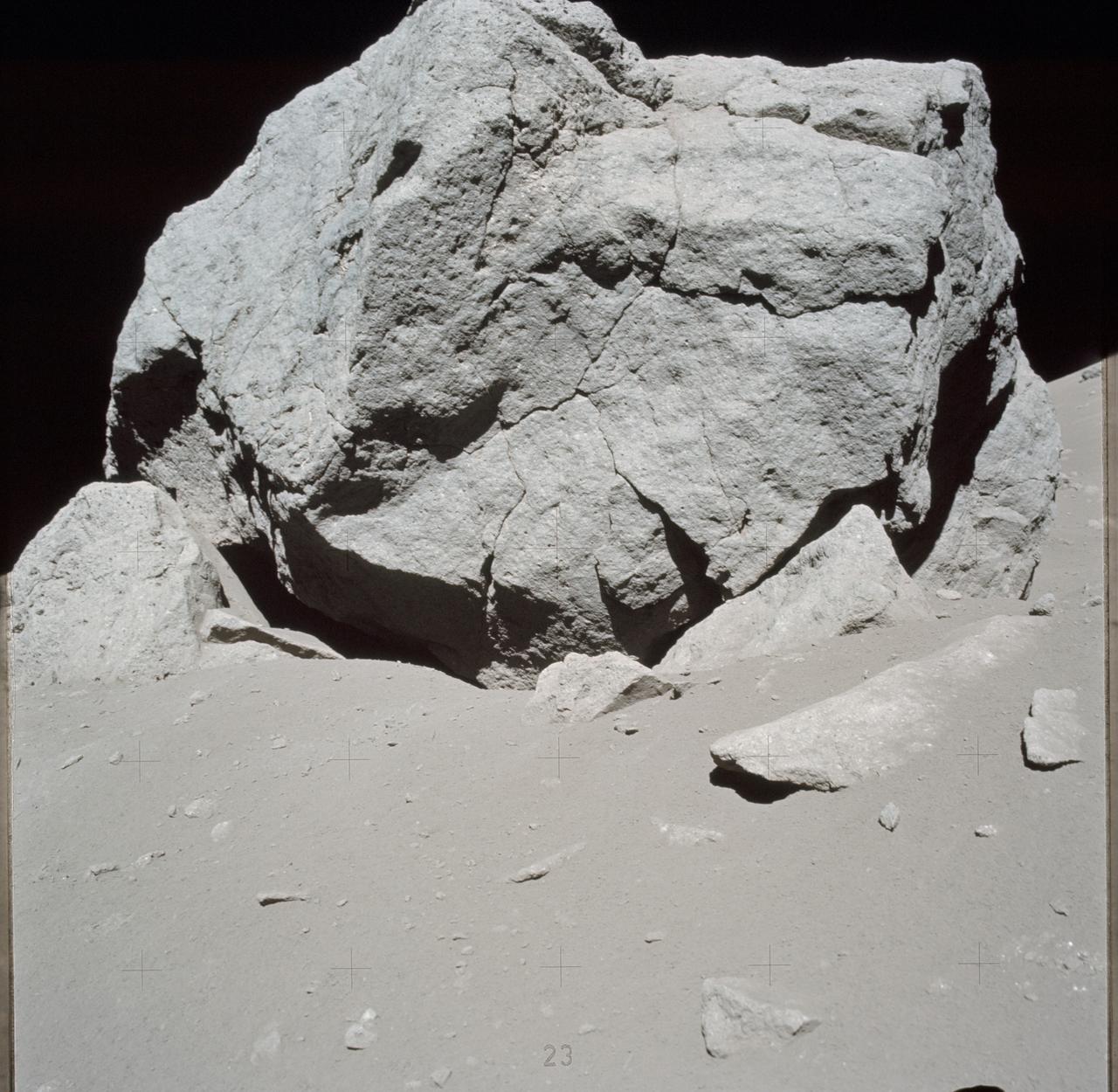
AS17-140-21438 (7-19 Dec. 1972) --- This 70mm frame features a close-up view of a large multi-cracked boulder discovered by astronauts Eugene A. Cernan, commander, and Harrison H. (Jack) Schmitt, lunar module pilot, during their visit to extravehicular activity (EVA) Station 6. This boulder, referred to as number two, provided several samples for the crew members' record-setting volume of rock collections. While astronauts Cernan and Schmitt descended in the Lunar Module (LM) "Challenger" to explore the Taurus-Littrow region of the moon, astronaut Ronald E. Evans, command module pilot, remained with the Command and Service Modules (CSM) "America" in lunar orbit. Cernan and Schmitt were the last crew members to explore the moon in the Apollo Program.
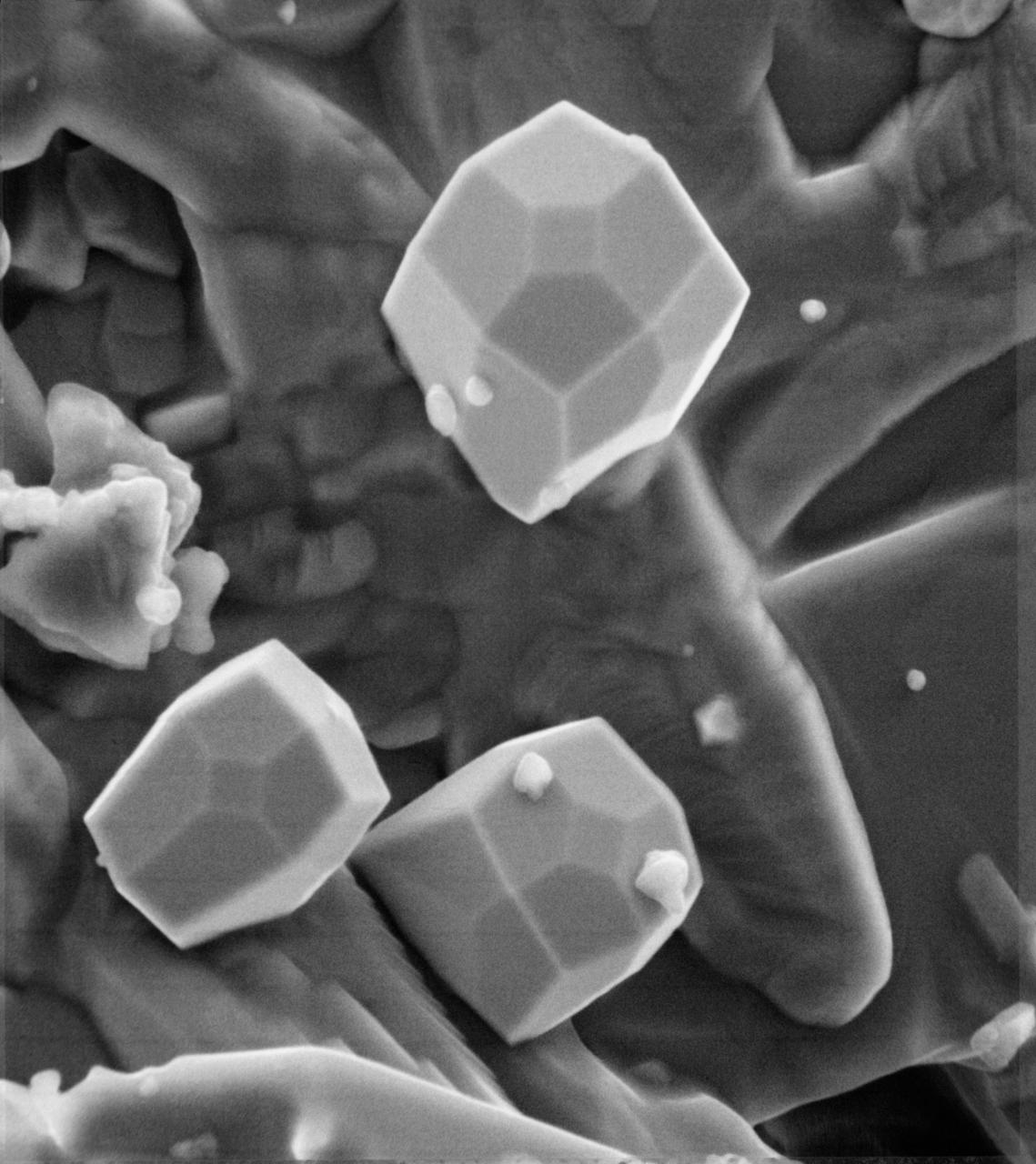
A scanning electron microscope photograph of iron crystals which grow in a small vug or cavity in a recrystallized breccia (fragmented rock) from the Apollo 15 Hadley-Apennino lunar landing site. The largest crystal is three microns across. Perfectly developed crystals such as these indicate slow formation from a hot vapor as the rock was cooling. The crystals are resting on an interlocking lattice of pyroxene (calsium-magnesium-iron silicate).

AS17-145-22157 (12 Dec. 1972) --- Scientist-astronaut Harrison Schmitt, Apollo 17 lunar module pilot, uses an adjustable sampling scoop to retrieve lunar samples during the second Apollo 17 extravehicular activity (EVA), at Station 5 at the Taurus-Littrow landing site. A gnomon is atop the large rock in the foreground. The gnomon is a stadia rod mounted on a tripod, and serves as an indicator of the gravitational vector and provides accurate vertical reference and calibrated length for determining size and position of objects in near-field photographs. The color scale of blue, orange and green is used to accurately determine color for photography. The rod of it is 18 inches long. The scoop Dr. Schmitt is using is 11 3/4 inches long and is attached to a tool extension which adds a potential 30 inches of length to the scoop. The pan portion, obscured in this view, has a flat bottom, flanged on both sides with a partial cover on the top. It is used to retrieve sand, dust and lunar samples too small for the tongs, another geological tool used by the astronauts. The pan and the adjusting mechanism are made of stainless steel and the handle is made of aluminum. Within the foreground of this scene, three lunar samples were taken--numbers 75060, 75075 and 75080. Astronaut Eugene A. Cernan, crew commander, was using a 60mm lens on the 70mm Hasselblad camera and type SO-368 film to take this photograph.
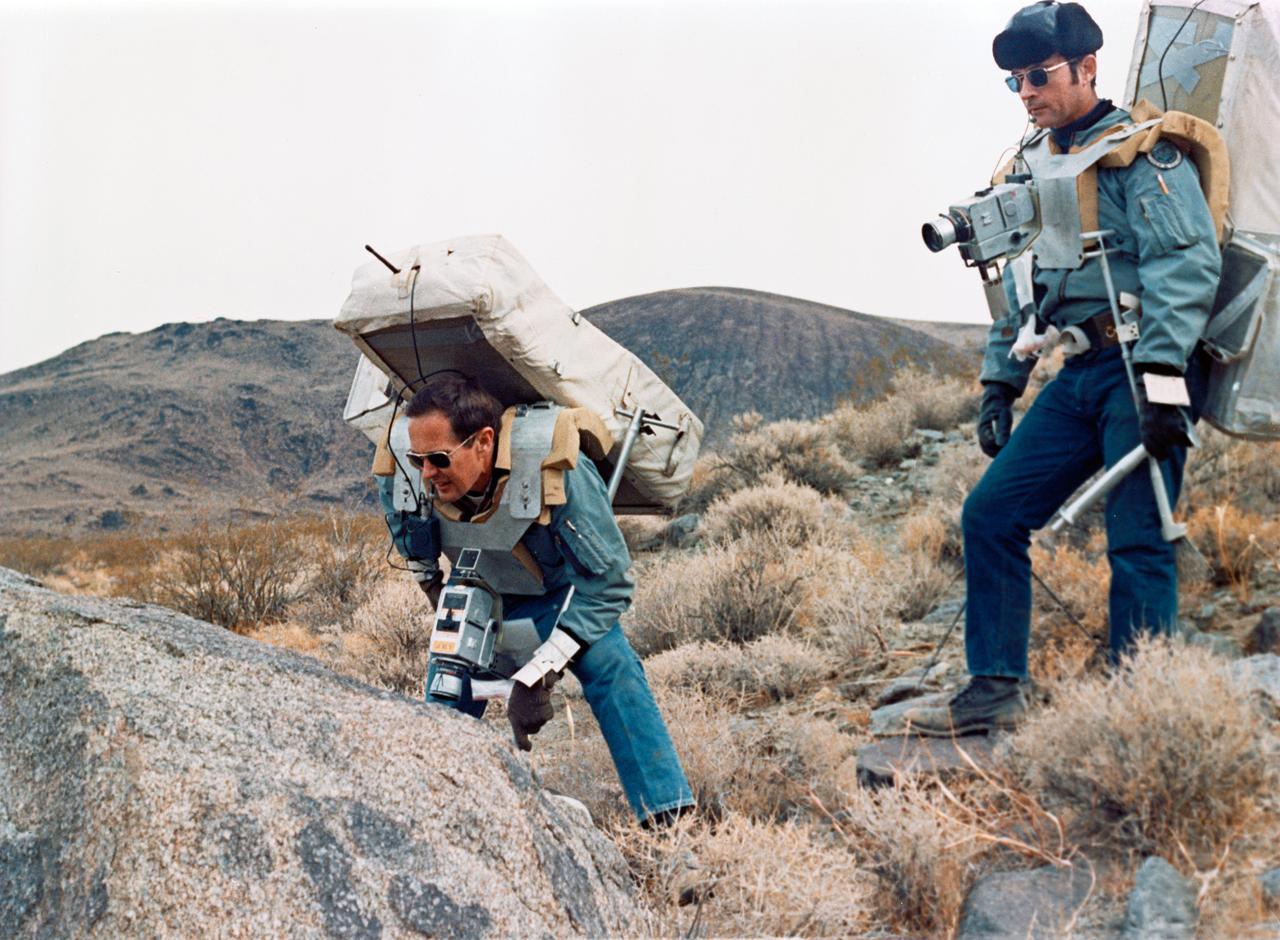
S71-59355 (17-18 Nov. 1971) --- Astronauts John W. Young, right, prime crew commander for Apollo 16, and Charles M. Duke Jr., lunar module pilot, study rock formations along their simulated lunar traverse route. The prime and backup commanders and lunar module pilots for Apollo 16 took part in the two-day geology field trip and simulations in the Coso Range, near Ridgecrest, California, about 160 miles north by northeast of Los Angeles. The training and simulations were conducted Nov. 17 and 18, 1971, at the U.S. Naval Ordnance Test Station.

AS14-68-9448 (6 Feb. 1971) --- A close-up view of a large multi-colored boulder in the boulder field located on the rim of Cone Crater, as photographed by the moon-exploring crew members of the Apollo 14 lunar landing mission. This view is looking west by southwest. The Lunar Module (LM) can be seen in the background. While astronauts Alan B. Shepard Jr., commander, and Edgar D. Mitchell, lunar module pilot, were exploring the moon, after descending in the LM, astronaut Stuart A. Roosa, command module pilot, remained with the Command and Service Modules (CSM) in lunar orbit.
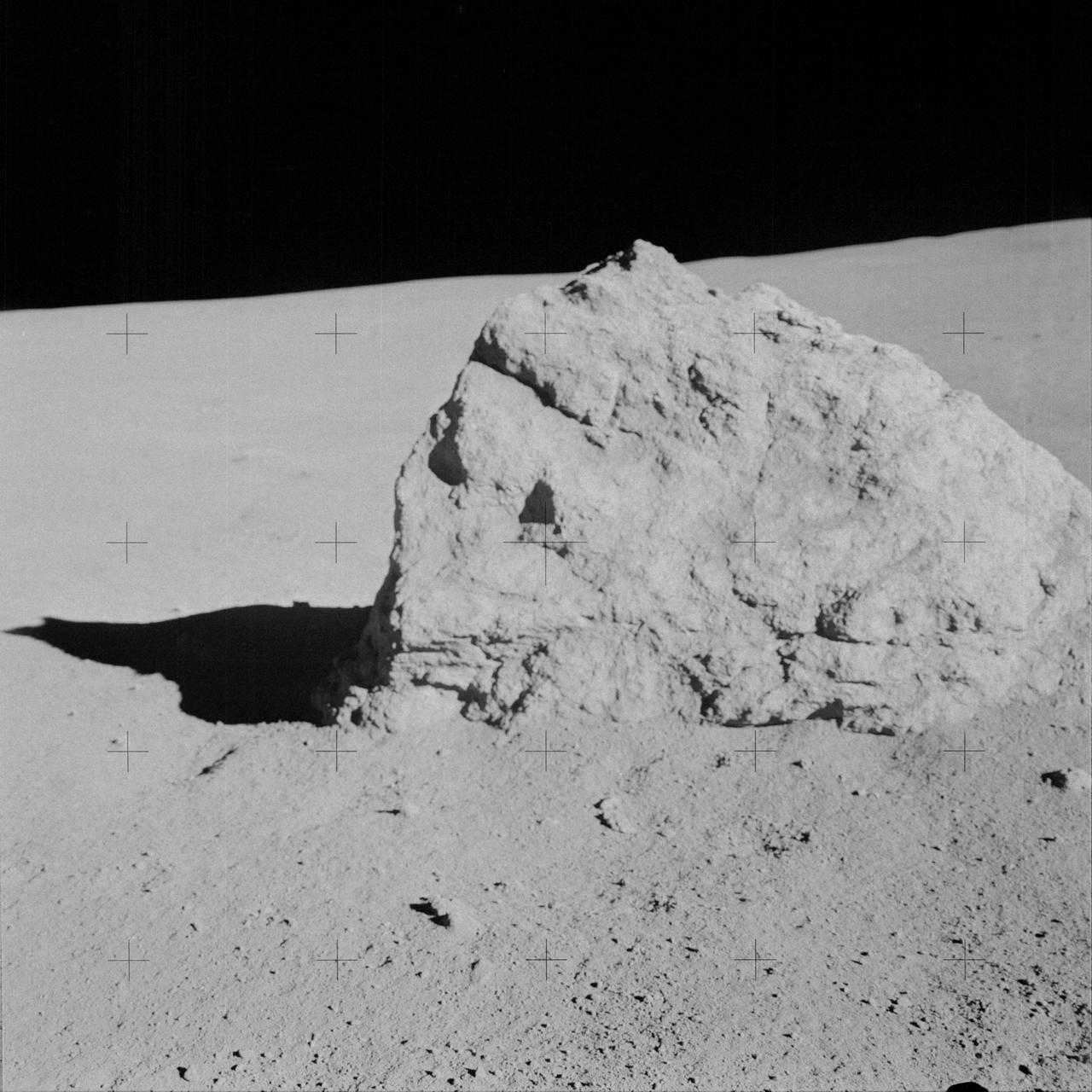
AS14-64-9135 (6 Feb. 1971) --- Astronaut Alan B. Shepard Jr., commander, took this close-up view of a large boulder, approximately five feet long, during the second extravehicular activity (EVA), on Feb. 6, 1971. Astronauts Shepard and Edgar D. Mitchell, lunar module pilot, descended in the Lunar Module (LM) to explore the moon, while astronaut Stuart A. Roosa, command module pilot, remained with the Command and Service Modules (CSM) in lunar orbit.
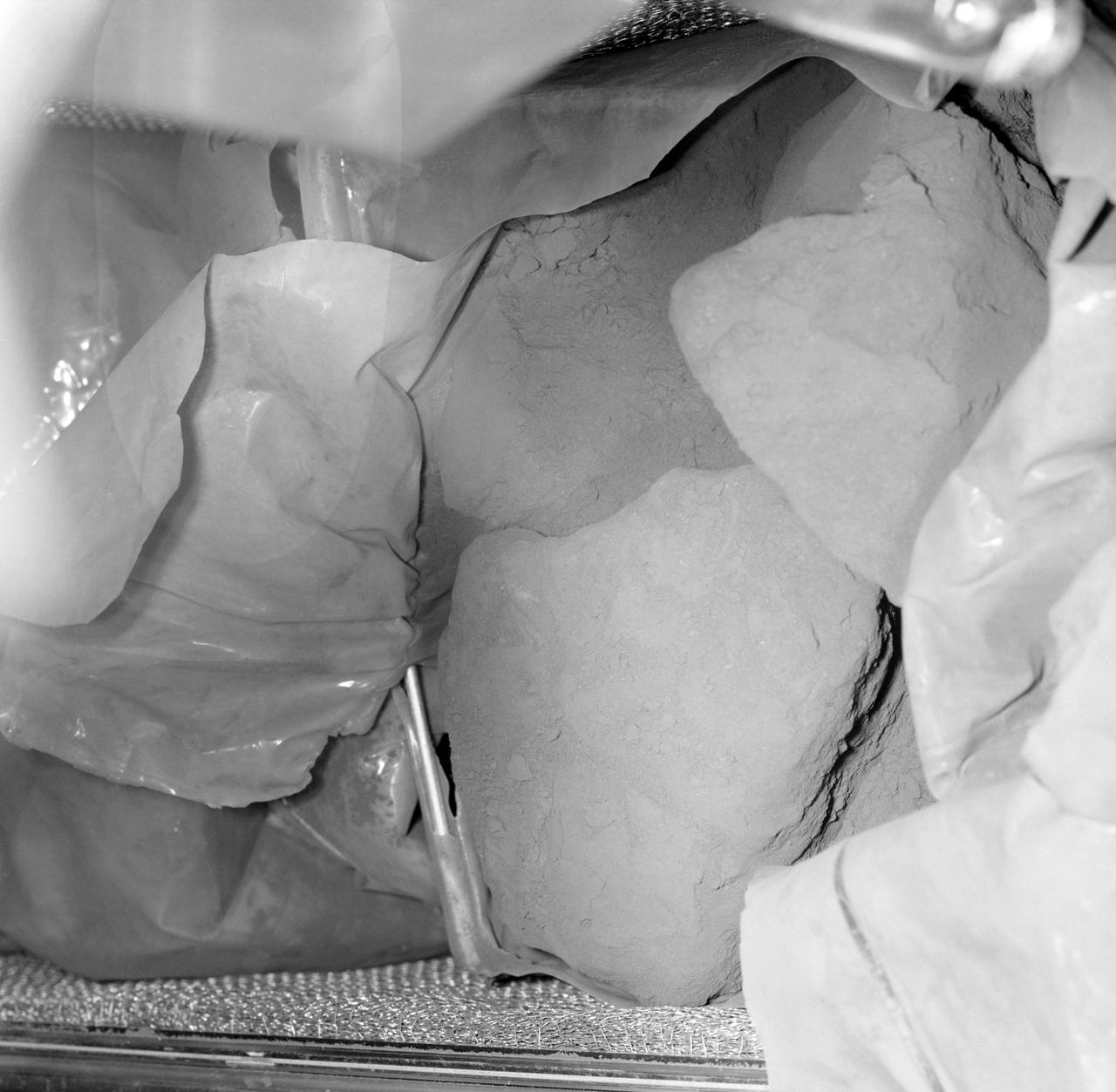
S69-60294 (26 Nov. 1969) --- One of the first views of the Apollo 12 lunar rocks is this photograph of the open sample return container. The large rock is approximately 7 1/2 inches across and is larger than any rock brought back to Earth by the crew of the Apollo 11 lunar landing mission. Two of the rocks in the first container are crystalline and generally lighter in color than those returned on the first lunar landing. The rocks in this box are medium charcoal brown/gray in color.
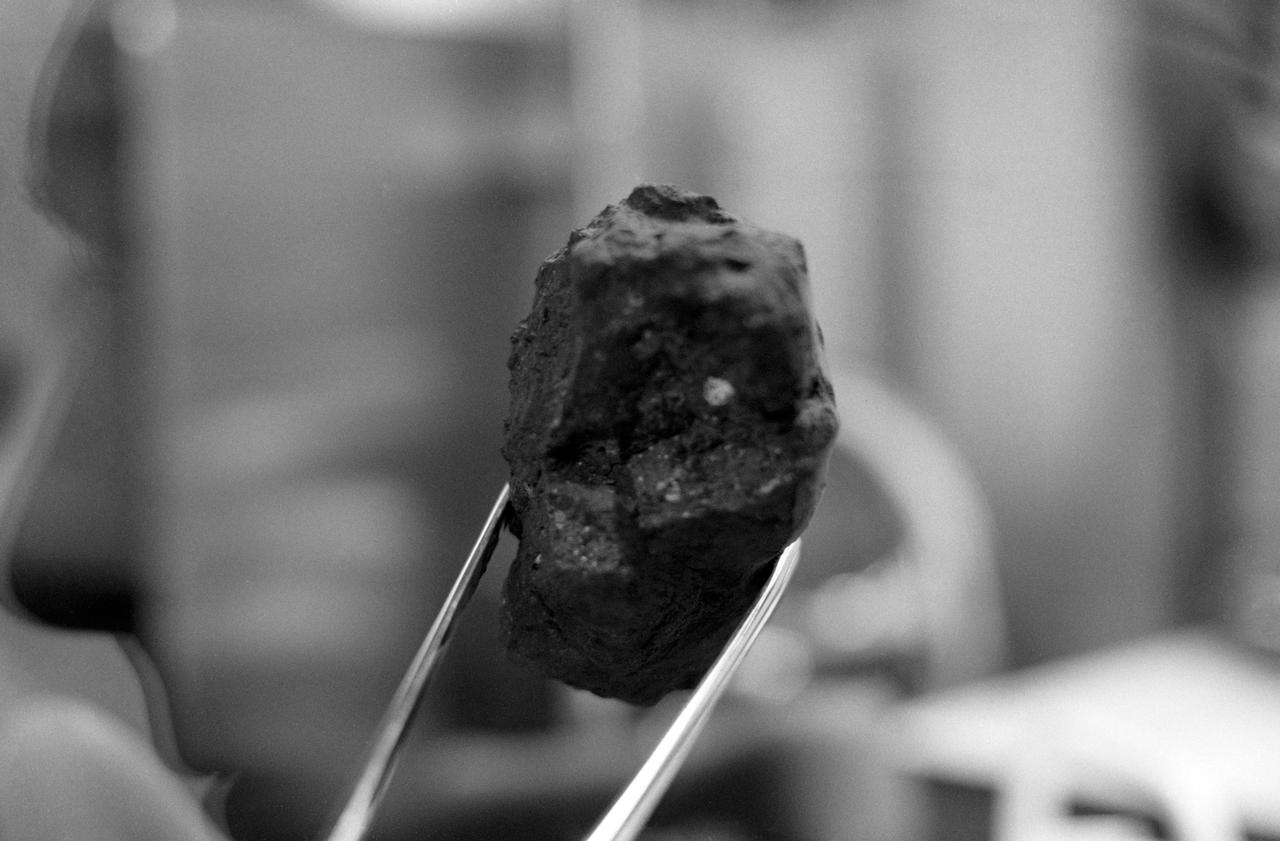
S69-60487 (1 Dec. 1969) --- A close-up view of one of the rocks brought back to Earth from the Apollo 12 lunar landing mission. The rock is under examination in the Physical-Chemical Test Laboratory in the Lunar Receiving Laboratory (LRL), Building 37, MSC. This rock is one of two breccia found in the contingency collection gathered by astronauts Charles Conrad Jr. and Alan L. Bean during their stay on the lunar surface. The breccia rocks, common in the collection of Apollo 11 lunar samples, have been rare in examinations of the Apollo 12 samples thus far.
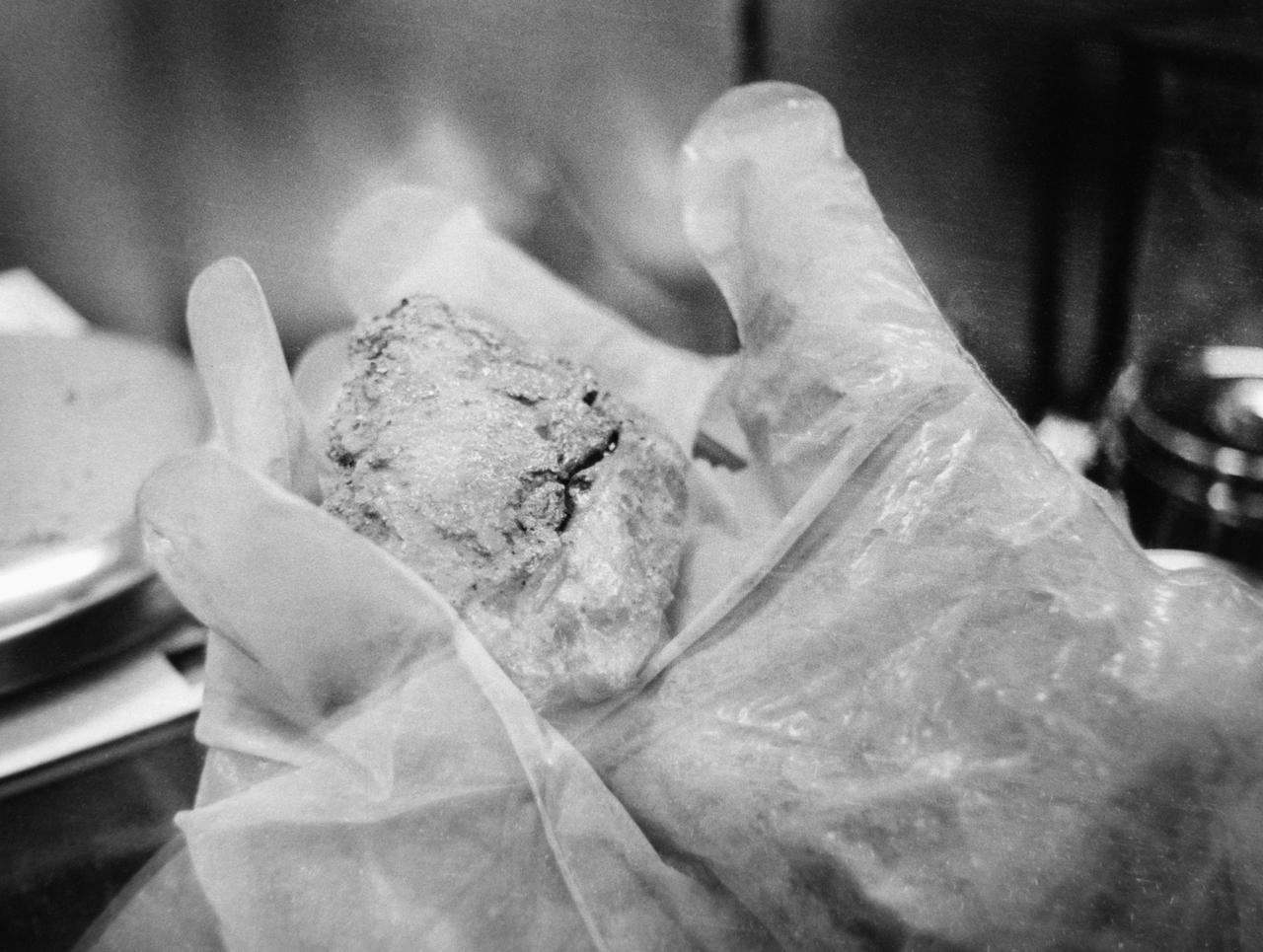
S69-60354 (29 Nov. 1969) --- A scientist's gloved hand holds one of the numerous rock samples brought back to Earth from the Apollo 12 lunar landing mission. The rocks are under thorough examination in the Manned Spacecraft Center's (MSC) Lunar Receiving Laboratory (LRL). This sample is a highly shattered basaltic rock with a thin black-glass coating on five of its six sides. Glass fills fractures and cements the rock together. The rock appears to have been shattered and thrown out by a meteorite impact explosion and coated with molten rock material before the rock fell to the surface.
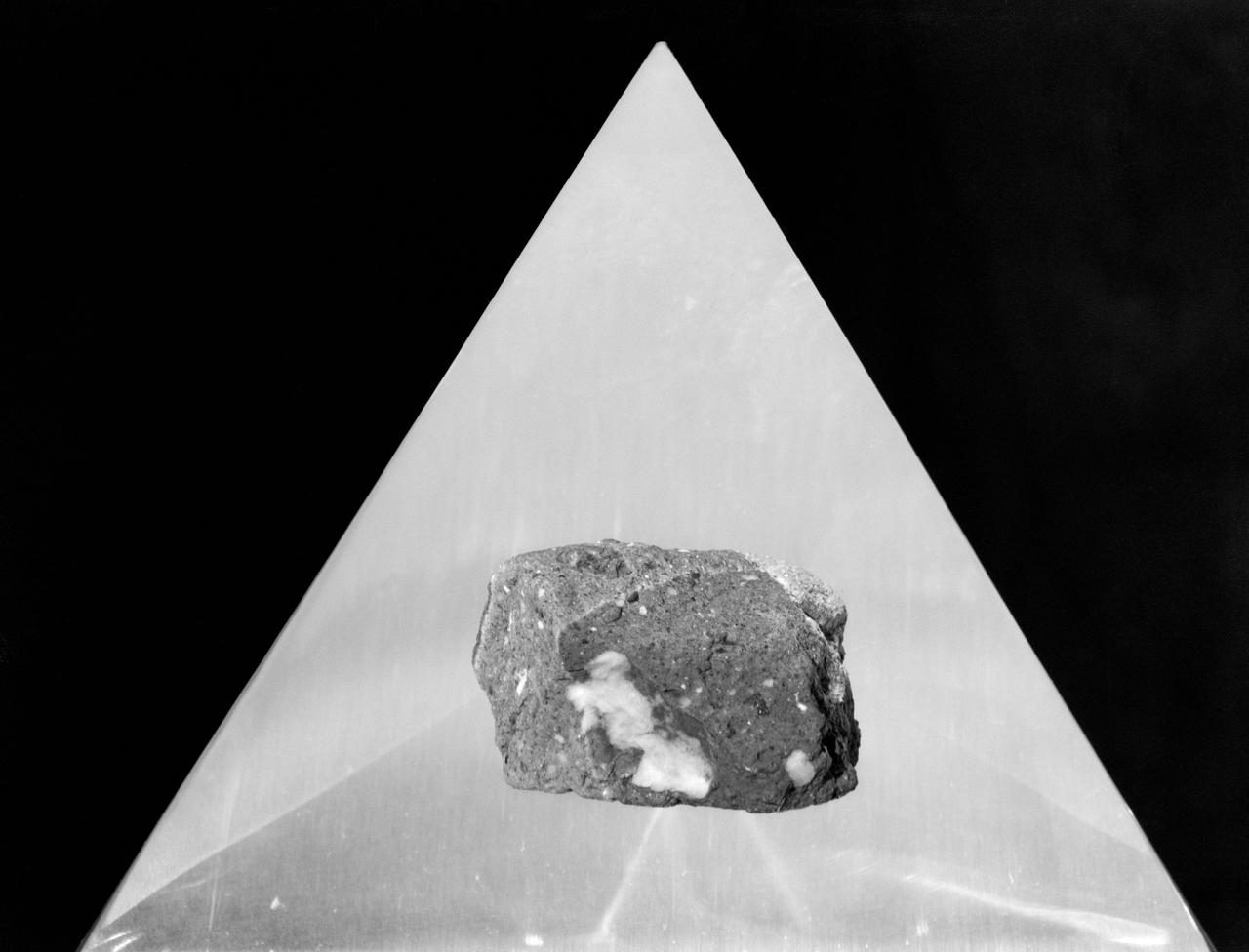
S75-23543 (April 1972) --- This Apollo 16 lunar sample (moon rock) was collected by astronaut John W. Young, commander of the mission, about 15 meters southwest of the landing site. This rock weighs 128 grams when returned to Earth. The sample is a polymict breccia. This rock, like all lunar highland breccias, is very old, about 3,900,000,000 years older than 99.99% of all Earth surface rocks, according to scientists. Scientific research is being conducted on the balance of this sample at NASA's Johnson Space Center and at other research centers in the United States and certain foreign nations under a continuing program of investigation involving lunar samples collected during the Apollo program.
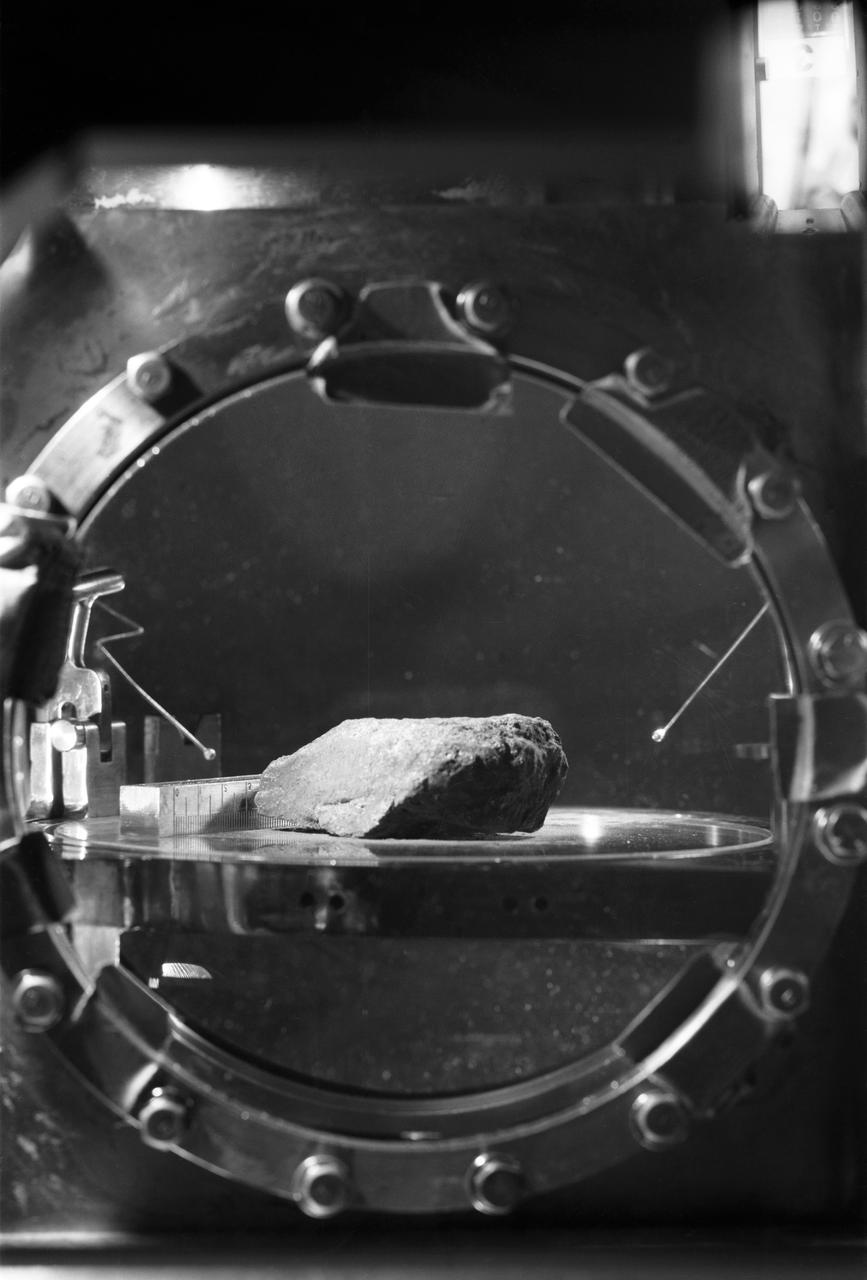
S69-45025 (27 July 1969) --- This is the first lunar sample that was photographed in detail in the Lunar Receiving Laboratory at the Manned Spacecraft Center. The photograph shows a granular, fine-grained, mafic (iron magnesium rich) rock. At this early stage of the examination, this rock appears similar to several igneous rock types found on Earth. The scale is printed backwards due to the photographic configuration in the Vacuum Chamber. The sample number is 10003. This rock was among the samples collected by astronauts Neil A. Armstrong and Edwin E. Aldrin Jr. during their lunar surface extravehicular activity on July 20, 1969.
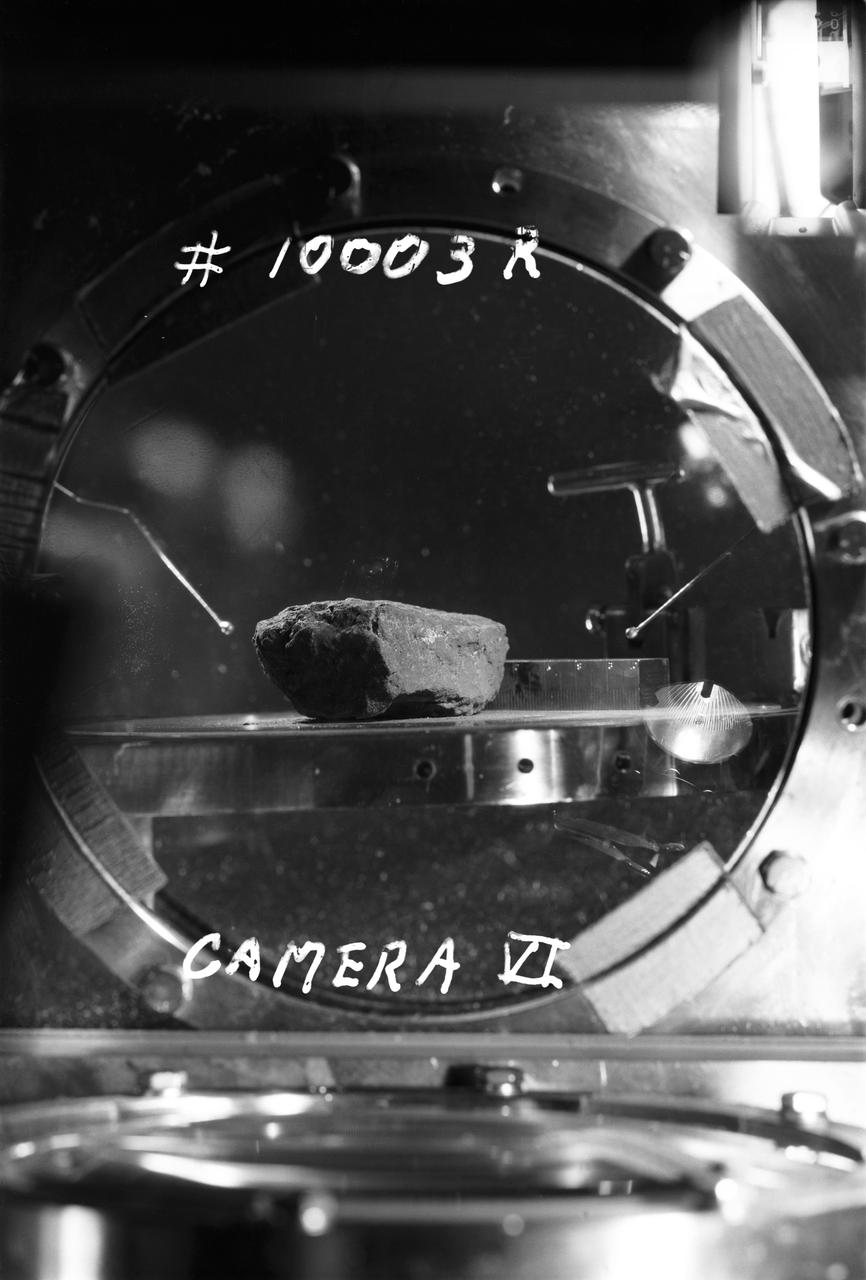
S69-45009 (27 July 1969) --- This is the first lunar sample that was photographed in detail in the Lunar Receiving Laboratory (LRL) at the Manned Spacecraft Center (MSC). The photograph shows a granular, fine-grained, mafic (iron magnesium rich) rock. At this early stage of the examination, this rock appears similar to several igneous rock types found on Earth. The scale is printed backwards due to the photographic configuration in the Vacuum Chamber. The sample number is 10003. This rock was among the samples collected by astronauts Neil A. Armstrong and Edwin E. Aldrin Jr. during their lunar surface extravehicular activity (EVA) on July 20, 1969.
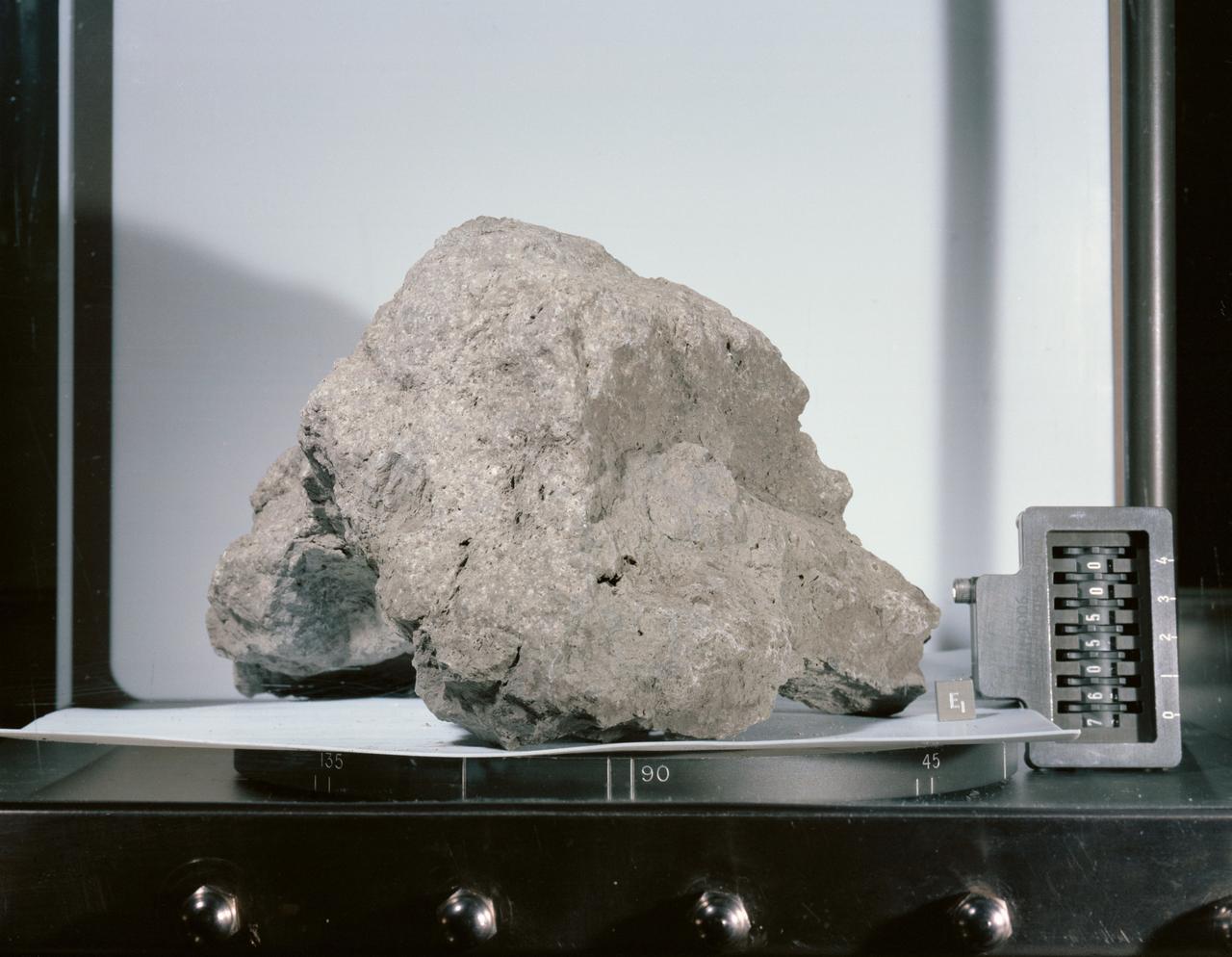
S73-15713 (January 1973) --- A close-up view of Apollo 17 lunar rock sample No. 76055 being studied and analyzed in the Lunar Receiving Laboratory at the Manned Spacecraft Center. This tan-gray irregular, rounded breccia was among many lunar samples brought back from the Taurus-Littrow landing site by the Apollo 17 crew. The rock measures 18 x 20 x 25 centimeters (7.09 x 7.87 x 9.84 inches) and weighs 6,389 grams (14.2554 pounds). The rock was collected from the south side of the lunar roving vehicle while the Apollo 17 astronauts were at Station 7 (base of North Massif).

jsc2011e118362 - Panorama view of Apollo 16 lunar surface photos of the Station 10 and Sample 381 Rock taken during the second moonwalk of the mission. The panoramas were built by combining Apollo 16 images starting with frame AS16-114-18450 thru end frame AS16-114-18467. The panoramic images received minimal retouching by NASA imagery specialists, including the removal of lens flares that were problematic in stitching together the individual frames and blacking out the sky to the lunar horizon. These adjustments were made based on observations of the Moon walkers who reported that there are no stars visible in the sky due to the bright lunar surface reflection of the Sun.
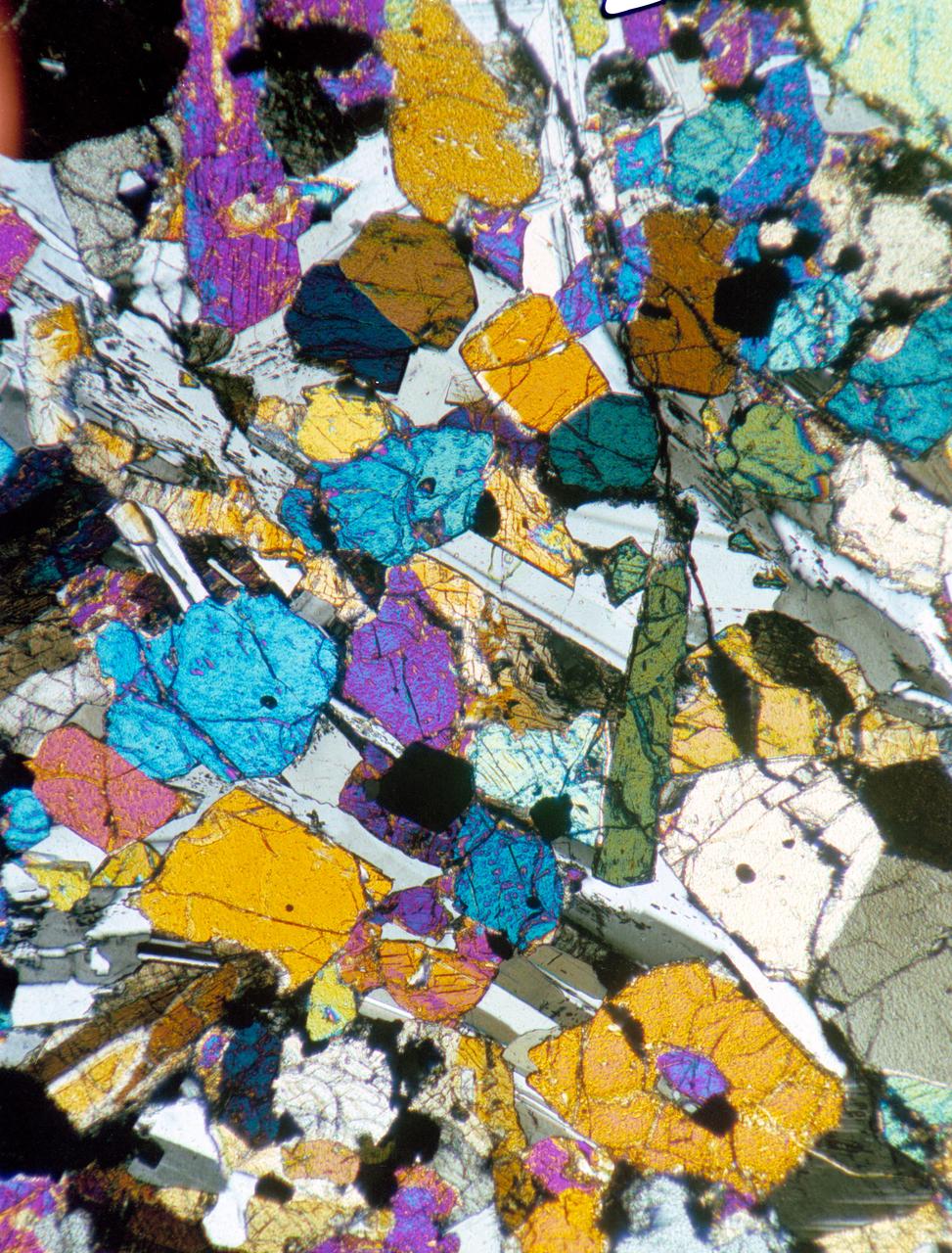
Microscopic views of Apollo XII Lunar rock sample thin sections, with and without polarized light. 1. Lunar Sample - Apollo XII (Thin Sections)
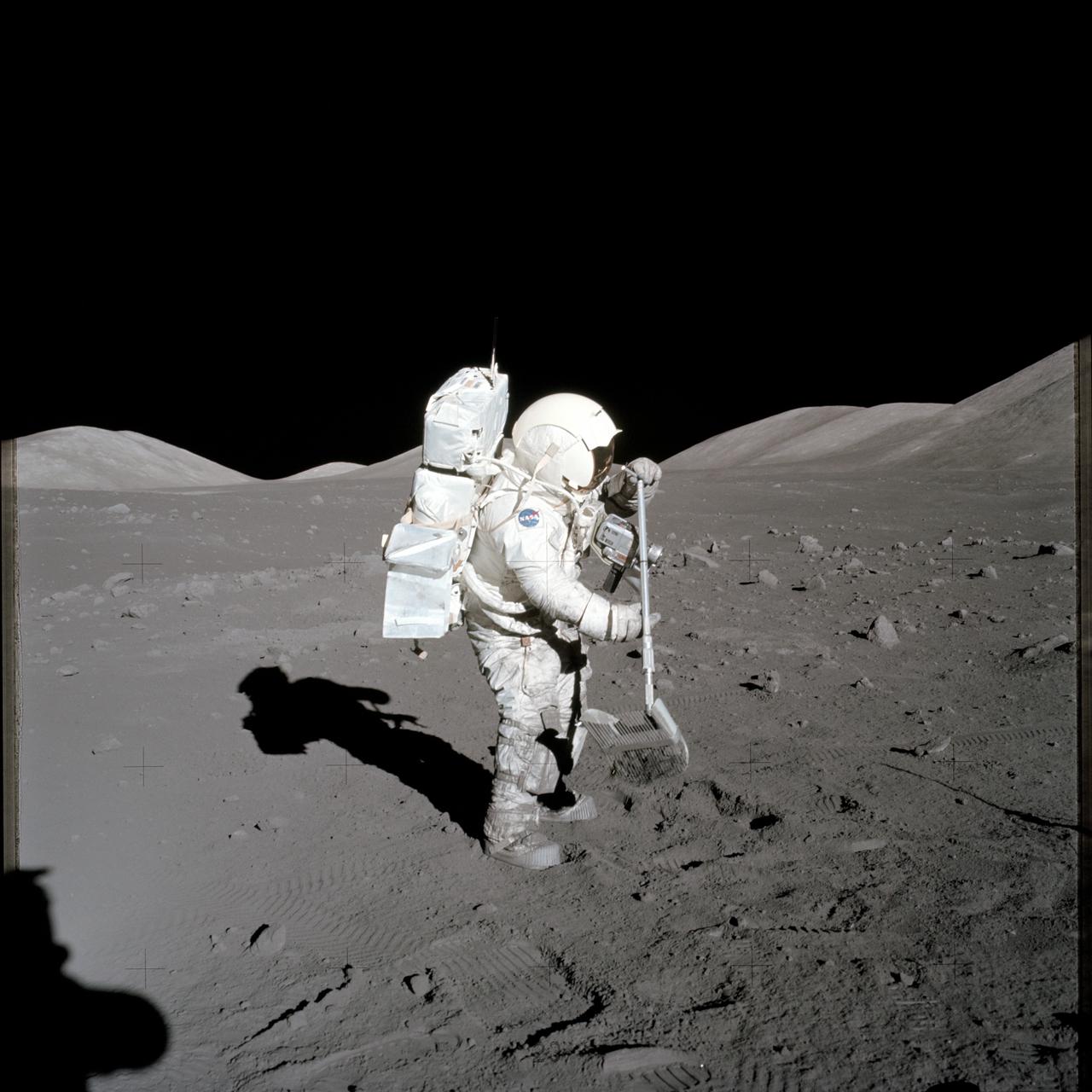
AS17-134-20425 (11 Dec. 1972) --- Scientist-astronaut Harrison H. Schmitt, lunar module pilot, collects lunar rake samples at Station 1 during the first Apollo 17 extravehicular activity (EVA) at the Taurus-Littrow landing site. This picture was taken by astronaut Eugene Cernan, commander. The lunar rake, an Apollo lunar geology hand tool, is used to collect discrete samples of rocks and rock chips ranging in size from one-half inch (1.3 centimeter) to one inch (2.5 centimeter).
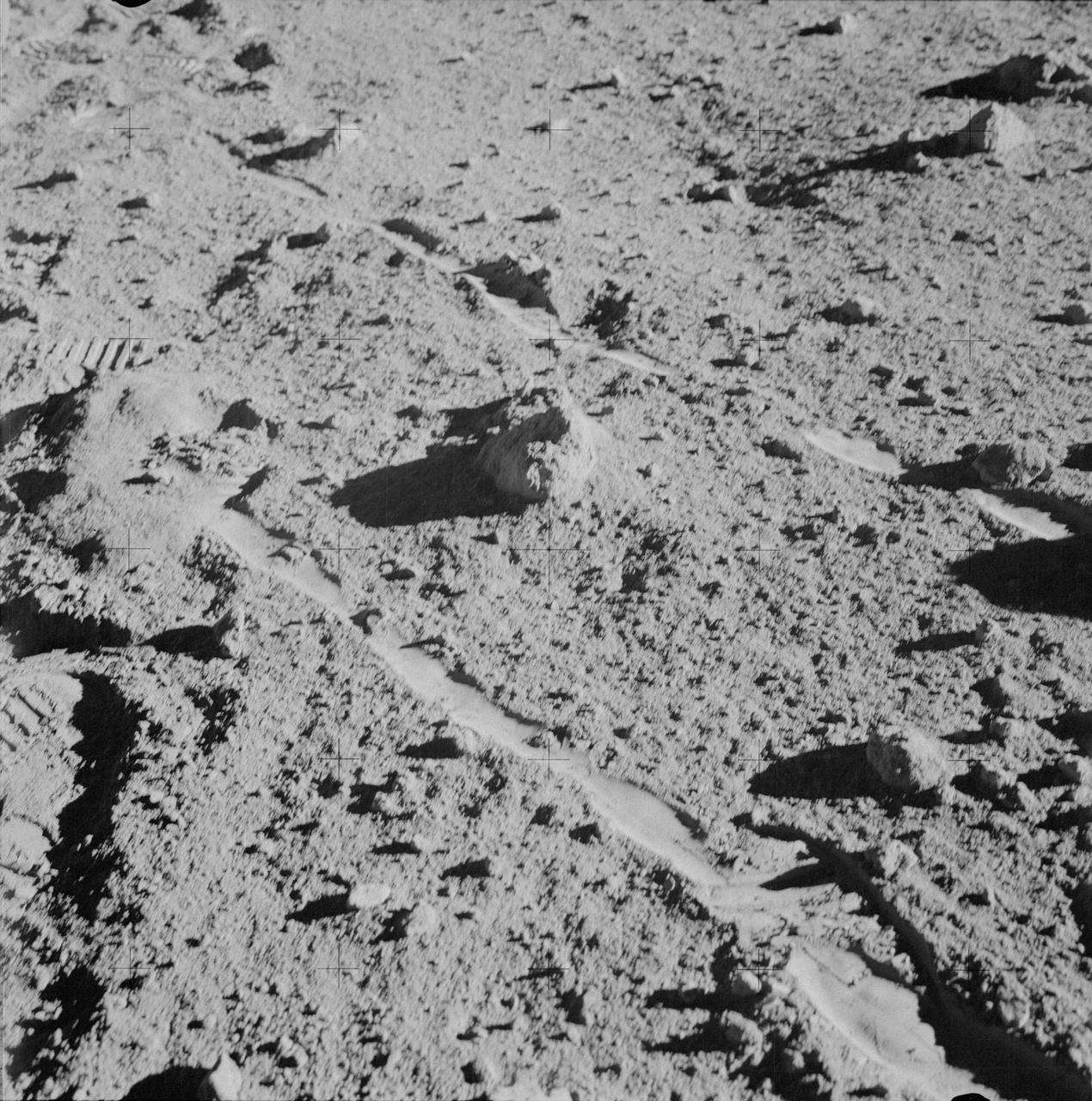
AS14-64-9129 (6 Feb. 1971) --- The two moon-exploring crew men of the Apollo 14 lunar landing mission, photographed and collected the large rock pictured just above the exact center of this picture. (Hold picture with the NASA photographic number at lower right hand corner.) The rock, casting a shadow off to the left, is lunar sample number 14321, referred to as a basketball-sized rock by newsmen and nicknamed "Big Bertha" by principal investigators. It lies between the wheel tracks made by the modular equipment transporter (MET) or rickshaw-type portable workbench. A few prints of the lunar overshoes of the crew members are at the left. This photo was made near the boulder field near the rim of Cone Crater.
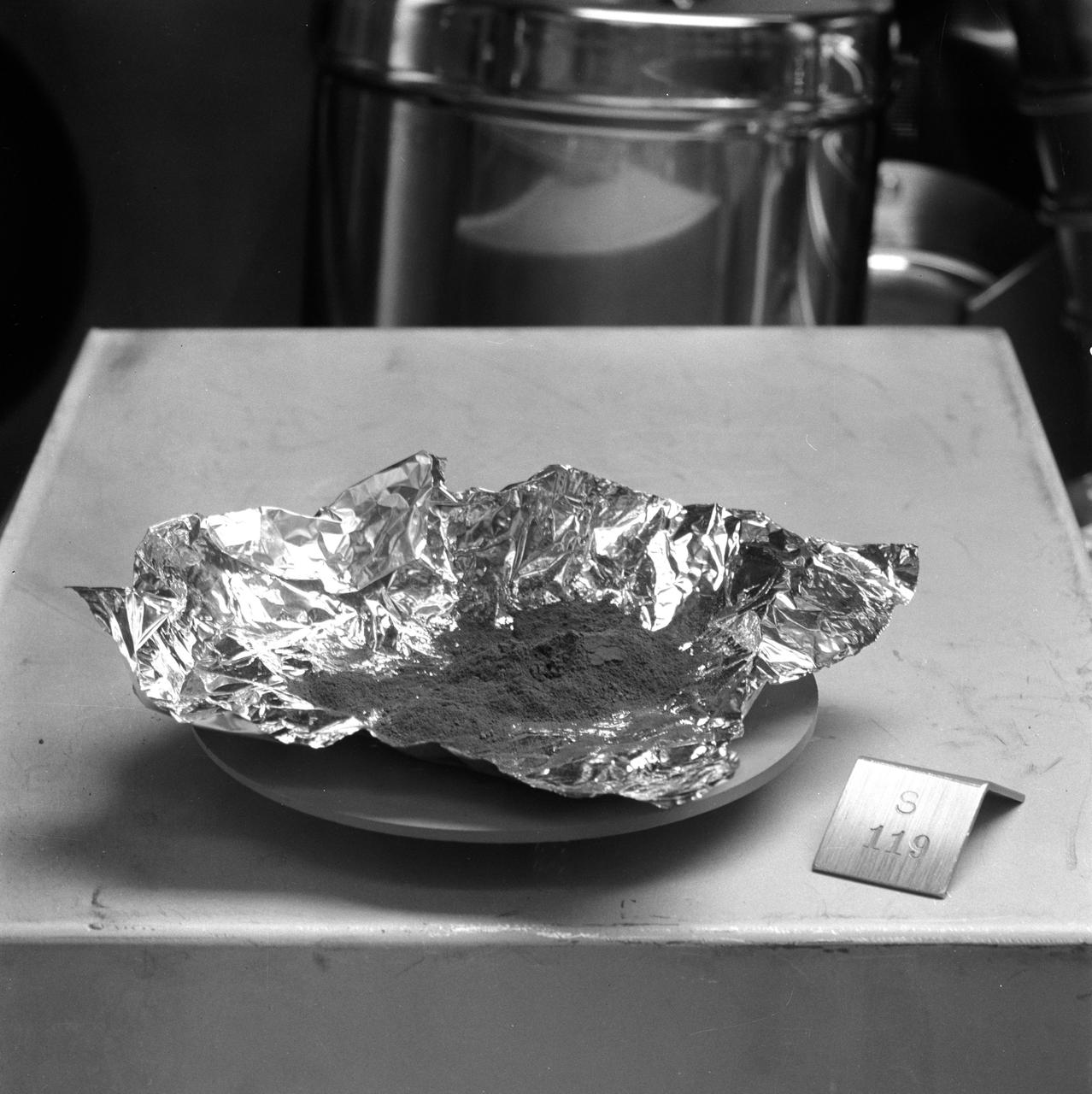
S71-19269 (12 Feb. 1971) --- A close-up view of Apollo 14 sample number 14414 & 14412, a fine lunar powder-like material under examination in the Sterile Nitrogen Atmospheric Processing (SNAP) line in the Lunar Receiving Laboratory (LRL) at the Manned Spacecraft Center (MSC). Scientists are currently making preliminary analyses of material brought back from the moon by the crew of Apollo 14 lunar landing mission.
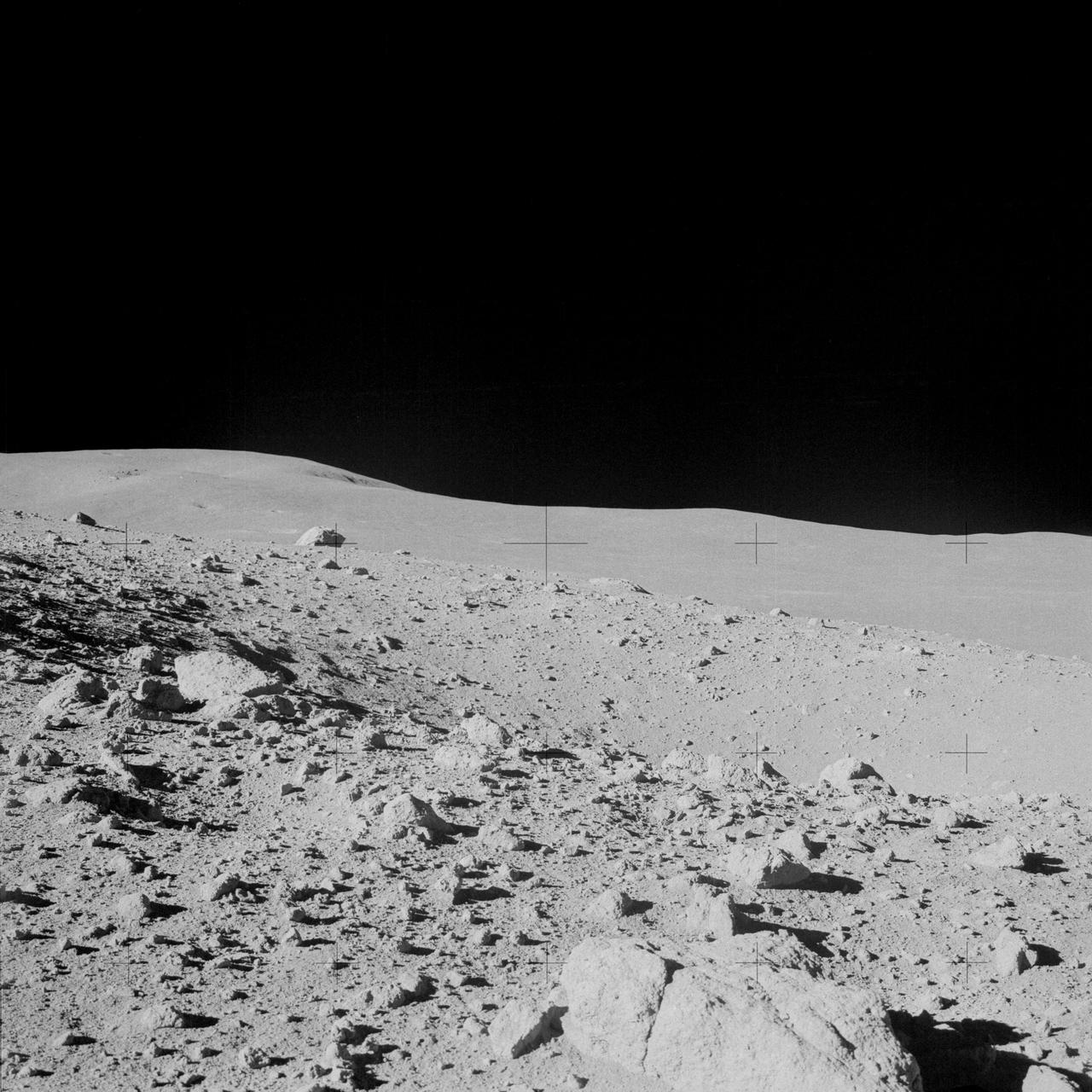
AS14-64-9118 (6 Feb. 1971) --- Astronaut Alan B. Shepard Jr., commander, photographed this overall view of a field of boulders on the flank of Cone Crater, during the second extravehicular activity (EVA), on Feb. 6, 1971. The view is looking south across the lunar valley through which the Apollo 14 moon-explorers flew their Lunar Module (LM) during the final approach to the landing. Astronaut Edgar D. Mitchell, lunar module pilot, joined Shepard in exploring the moon, while astronaut Stuart A. Roosa, command module pilot, remained with the Command and Service Modules (CSM) in lunar orbit.
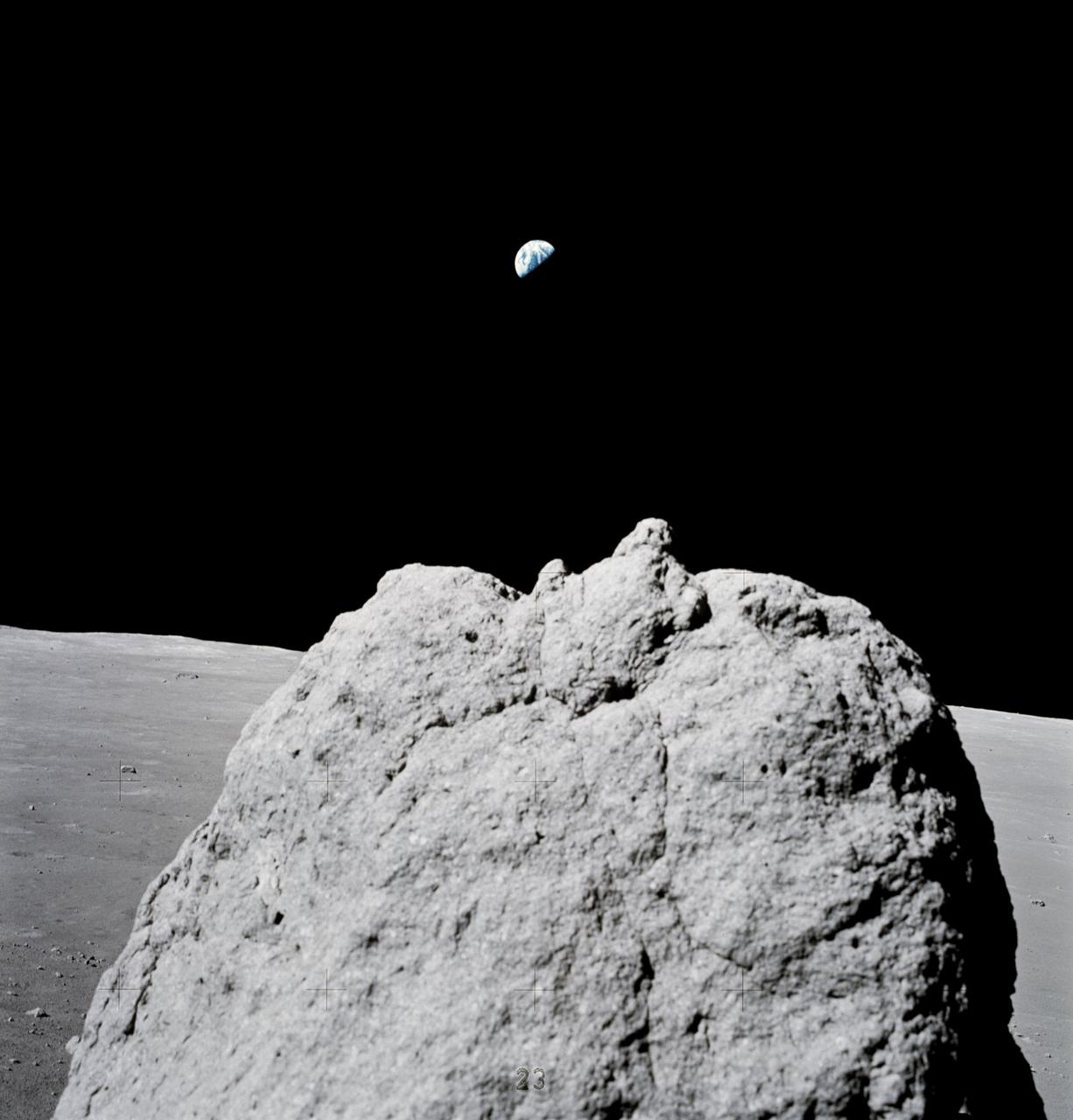
AS17-137-20910 (7-19 Dec. 1972) --- Earth (far distant background) is seen above a large lunar boulder (foreground) on the moon. The photo was taken with a handheld Hasselblad camera by the last two moon walkers in the Apollo Program. While astronauts Eugene A. Cernan, commander; and Harrison H. Schmitt, lunar module pilot, descended in the Lunar Module (LM) "Challenger" to explore the Taurus-Littrow region of the moon, astronaut Ronald E. Evans, command module pilot, remained with the Command and Service Modules (CSM) "America" in lunar orbit.
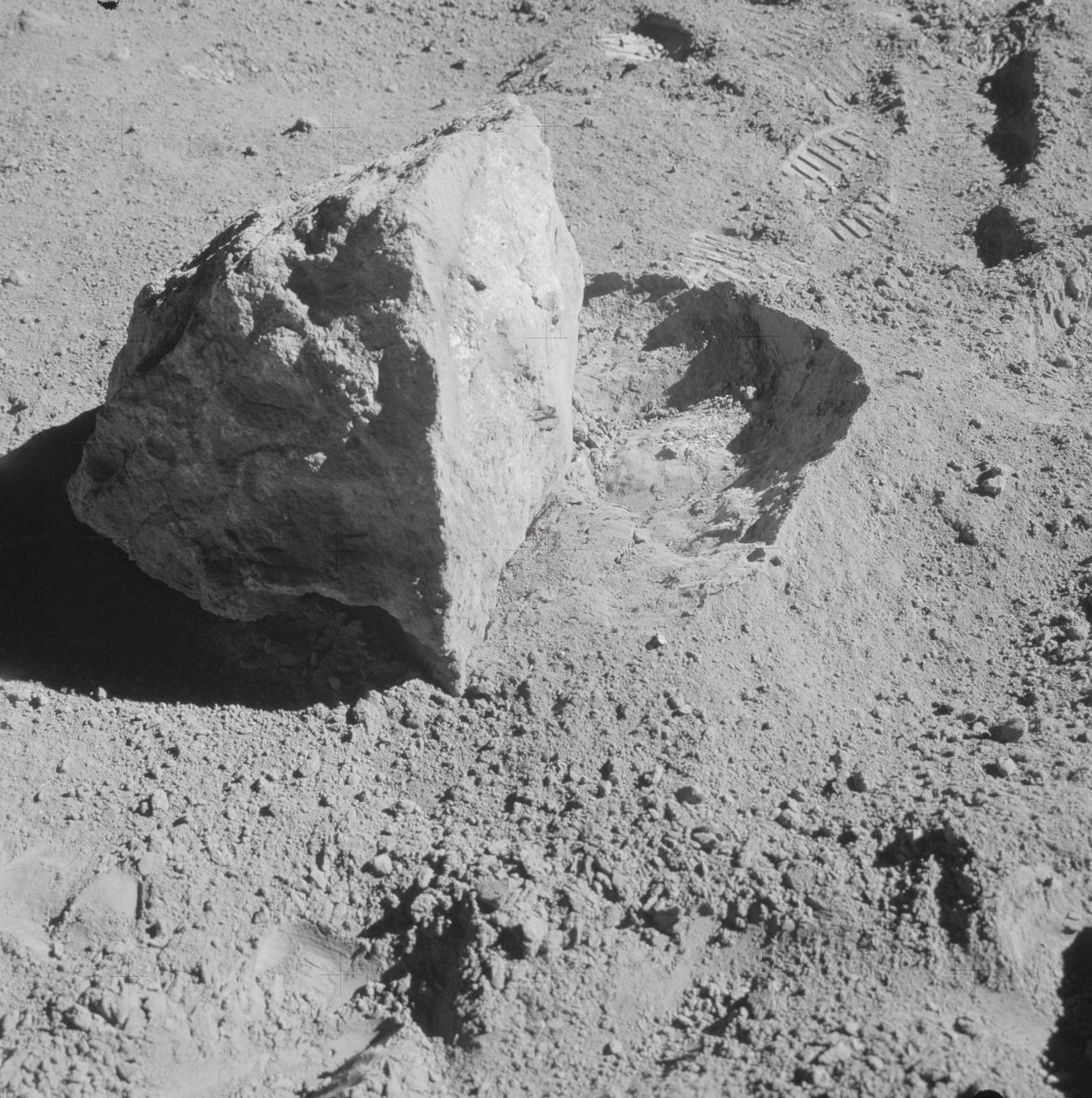
AS16-107-17573 (22 April 1972) --- A close-up view of a block (about 1/2 meter long) found by the two moon-exploring crewmembers of the Apollo 16 lunar landing mission. The block had been rolled over only moments earlier during this Apollo 16 second extravehicular activity (EVA) near South Ray Crater. Astronaut John W. Young, commander, said at the post-mission press conference, "The block has been sitting there evidently since South Ray Crater was formed." While astronauts Young and Charles M. Duke Jr., lunar module pilot; descended in the Apollo 16 Lunar Module (LM) "Orion" to explore the Descartes highlands landing site on the moon, astronaut Thomas K. Mattingly II, command module pilot, remained with the Command and Service Modules (CSM) "Casper" in lunar orbit.
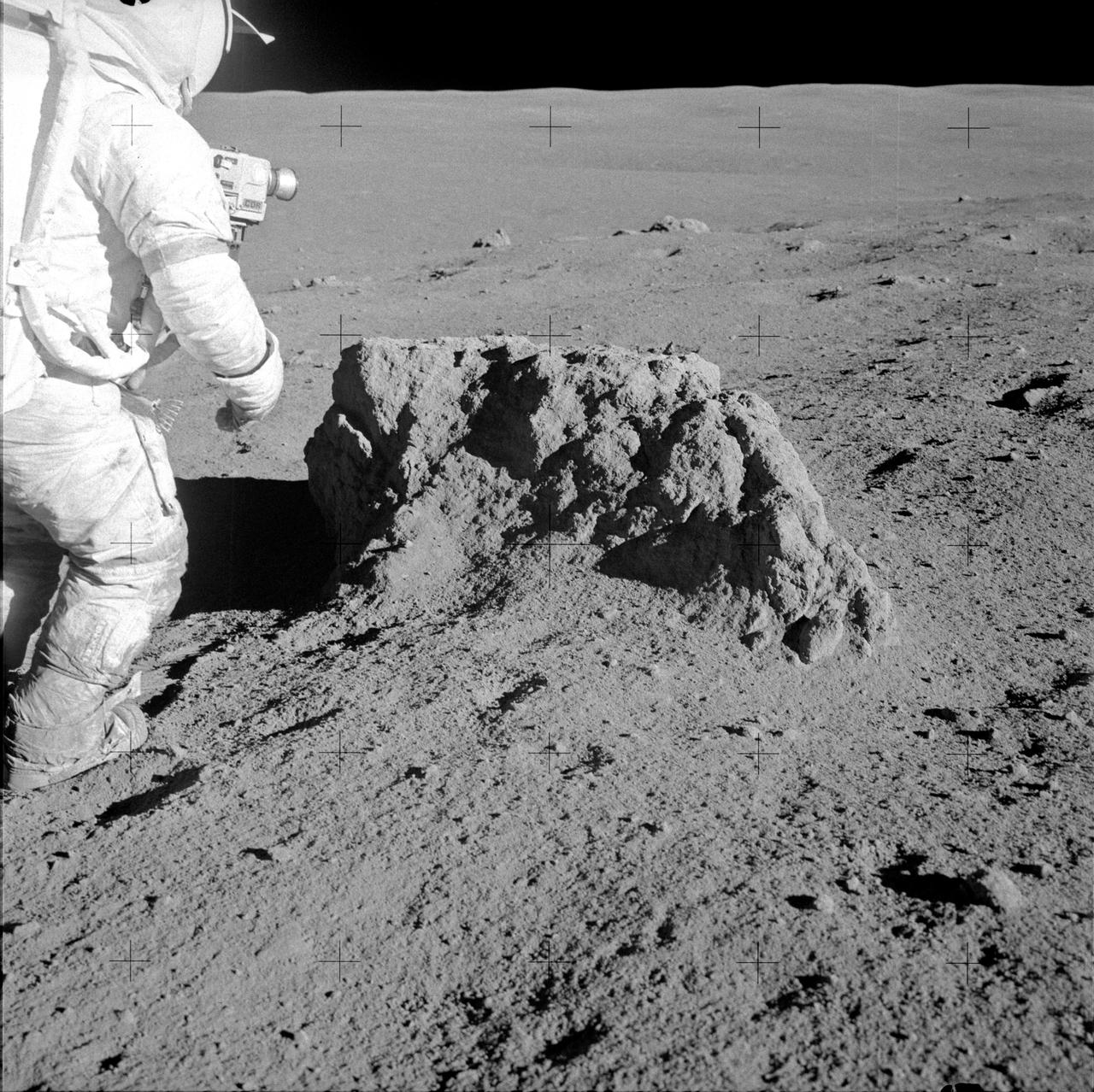
AS14-68-9414 (6 Feb. 1971) --- Astronaut Alan B. Shepard Jr., Apollo 14 commander, stands beside a large boulder on the lunar surface during the mission's second extravehicular activity (EVA), on Feb. 6, 1971. Note the lunar dust clinging to Shepard's space suit. Astronauts Shepard and Edgar D. Mitchell, lunar module pilot, explored the lunar surface while astronaut Stuart A. Roosa, command module pilot, orbited the moon in the Command and Service Modules (CSM).
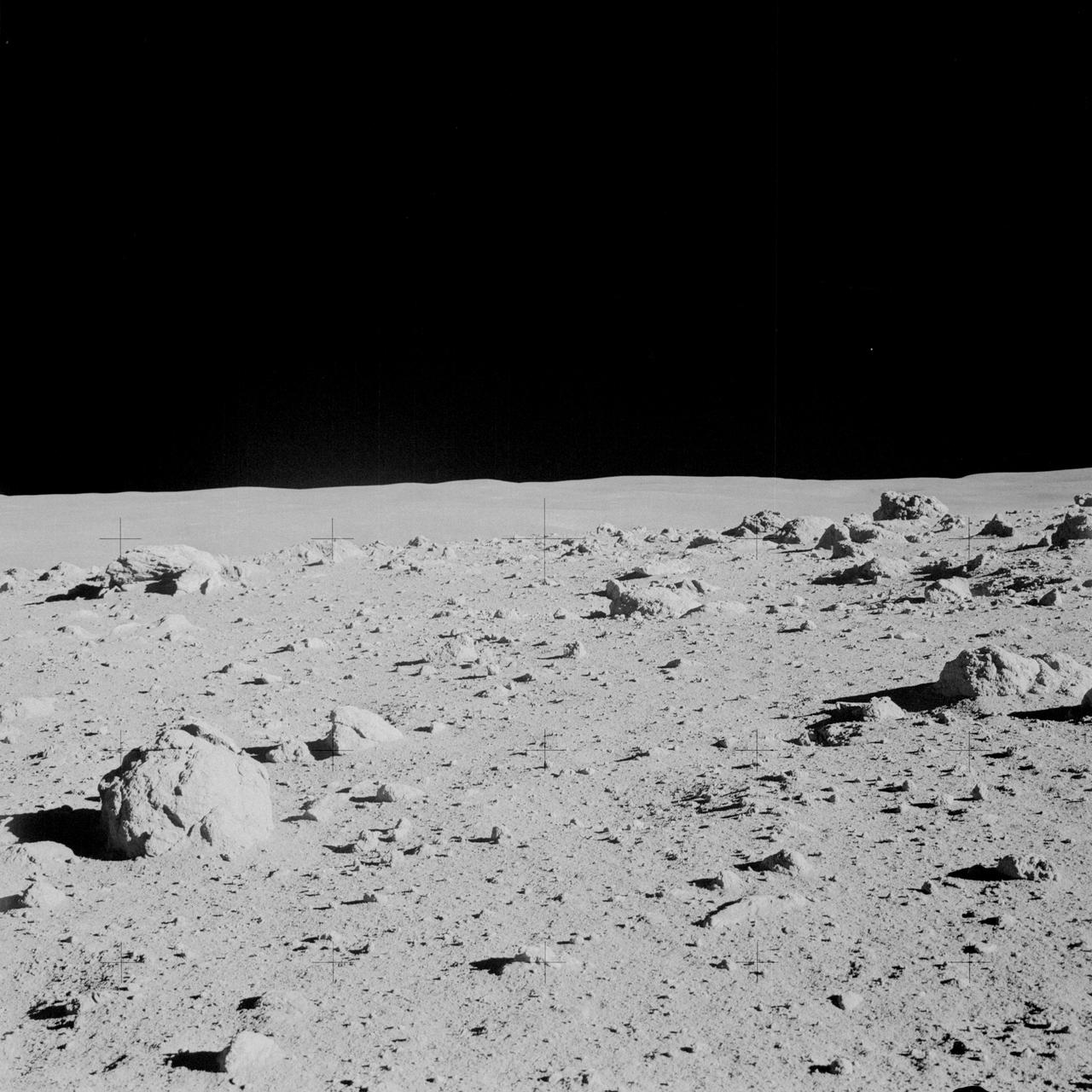
AS14-64-9103 (6 Feb. 1971) --- Astronaut Alan B. Shepard Jr., commander, photographed this overall view of a field of boulders on the flank of Cone Crater during the second extravehicular activity (EVA) on the lunar surface. Astronaut Edgar D. Mitchell, lunar module pilot, joined Shepard in exploring the moon, while astronaut Stuart A. Roosa, command module pilot, remained with the Command and Service Modules (CSM) in lunar orbit.
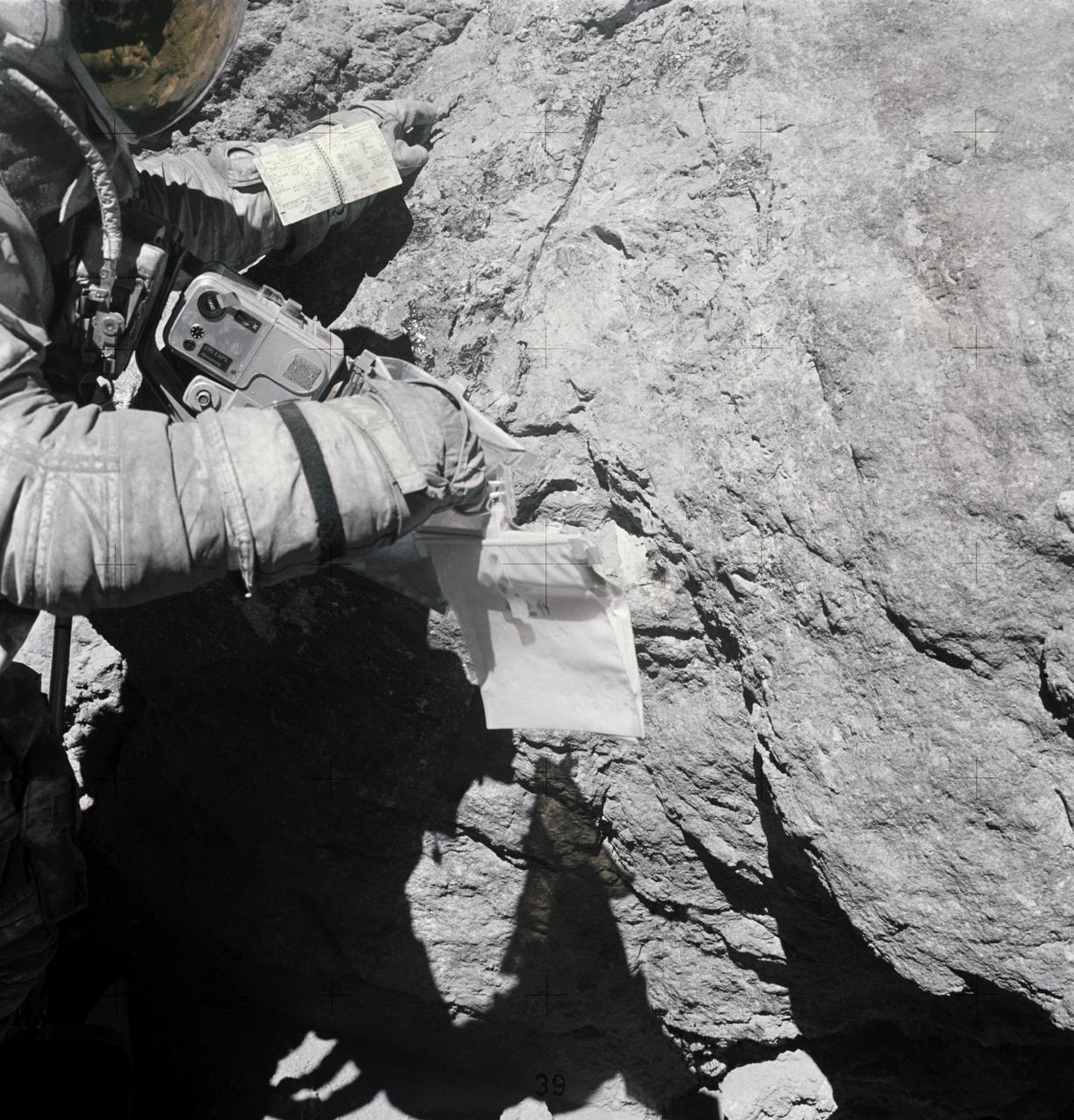
AS16-116-18649 (23 April 1972) --- Astronaut Charles M. Duke Jr., lunar module pilot of the Apollo 16 lunar landing mission, examines closely the surface of a large boulder at North Ray Crater during the third Apollo 16 extravehicular activity (EVA) at the Descartes landing site. This picture was taken by astronaut John W. Young, commander. Note the chest-mounted 70mm Hasselblad camera. While astronauts Young and Duke descended in the Apollo 16 Lunar Module (LM) "Orion" to explore the Descartes highlands landing site on the moon, astronaut Thomas K. Mattingly II, command module pilot, remained with the Command and Service Modules (CSM) "Casper" in lunar orbit.

This radar image of asteroid 2005 YU55 was obtained NASA Deep Space Network antenna in Goldstone, Calif. on Nov. 7, 2011, when the space rock was at 3.6 lunar distances, which is about 860,000 miles, or 1.38 million kilometers, from Earth.
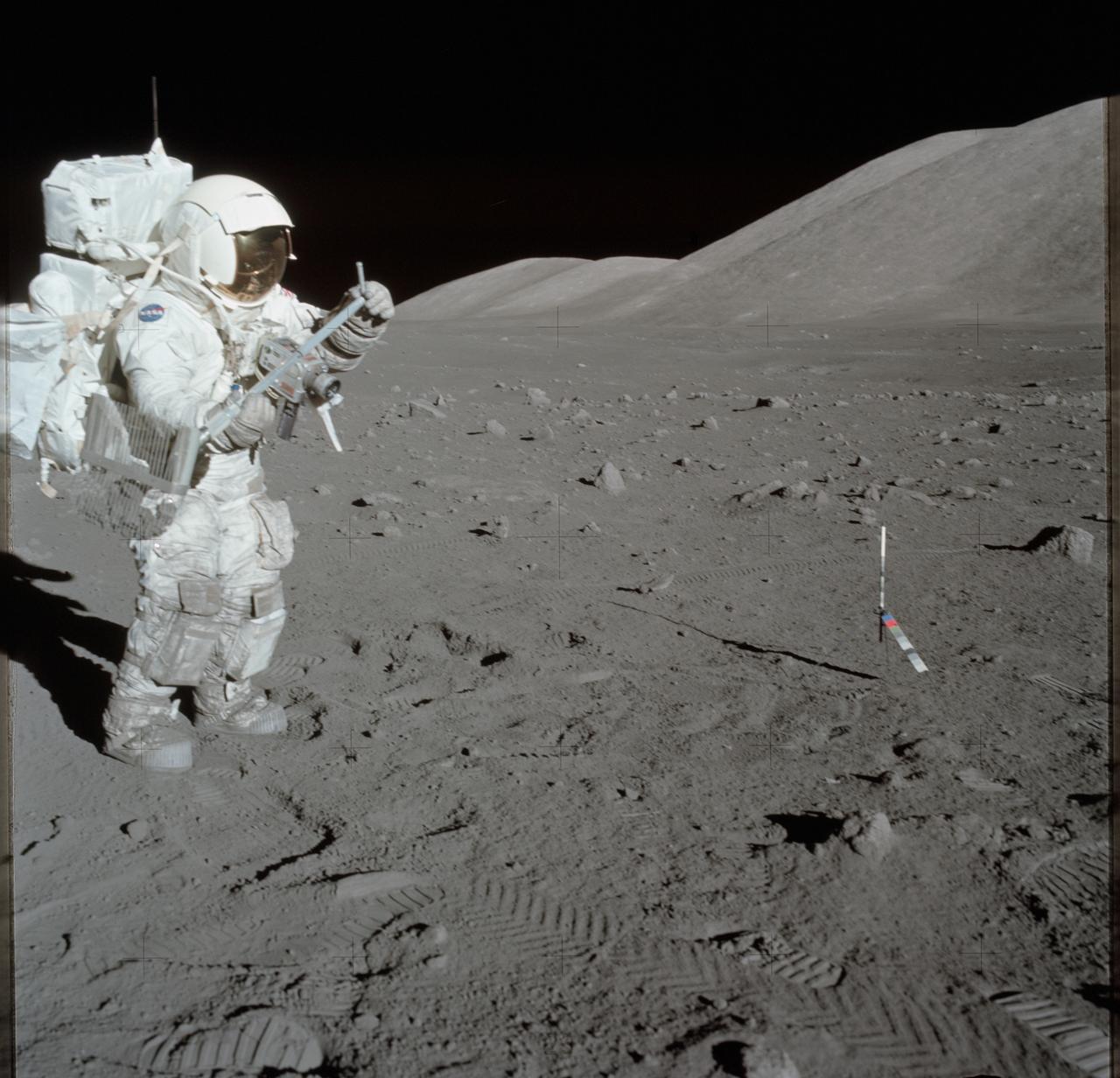
AS17-134-20426 (11 Dec. 1972) --- Scientist-astronaut Harrison H. Schmitt collects lunar rake samples at Station 1 during the first Apollo 17 extravehicular activity (EVA) at the Taurus-Littrow landing site. This picture was taken by astronaut Eugene A. Cernan, Apollo 17 commander. Schmitt is the lunar module pilot. The Lunar Rake, an Apollo Lunar Geology Hand Tool, is used to collect discrete samples of rocks and rock chips ranging in size from one-half inch (1.3 cm) to one inch (2.5 cm).
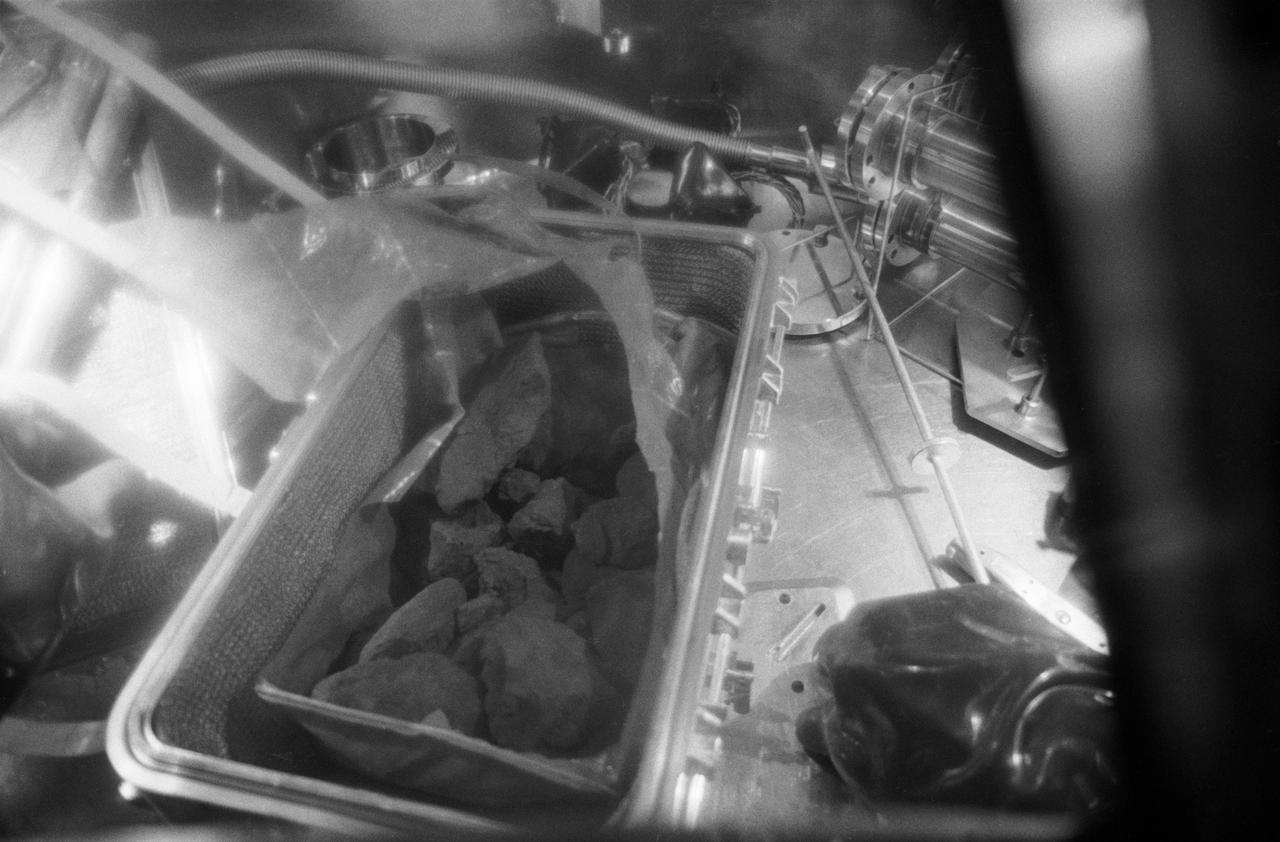
S69-45002 (26 July 1969) --- A close-up view of the lunar rocks contained in the first Apollo 11 sample return container. The rock box was opened for the first time in the Vacuum Laboratory of the Manned Spacecraft Center’s Lunar Receiving Laboratory, Building 37, at 3:55 p.m. (CDT), Saturday, July 26, 1969. The gloved hand gives an indication of size. This box also contained the Solar Wind Composition experiment (not shown) and two core tubes for subsurface samples (not shown). These lunar samples were collected by astronauts Neil A. Armstrong and Edwin E. Aldrin Jr. during their lunar surface extravehicular activity on July 20, 1969.
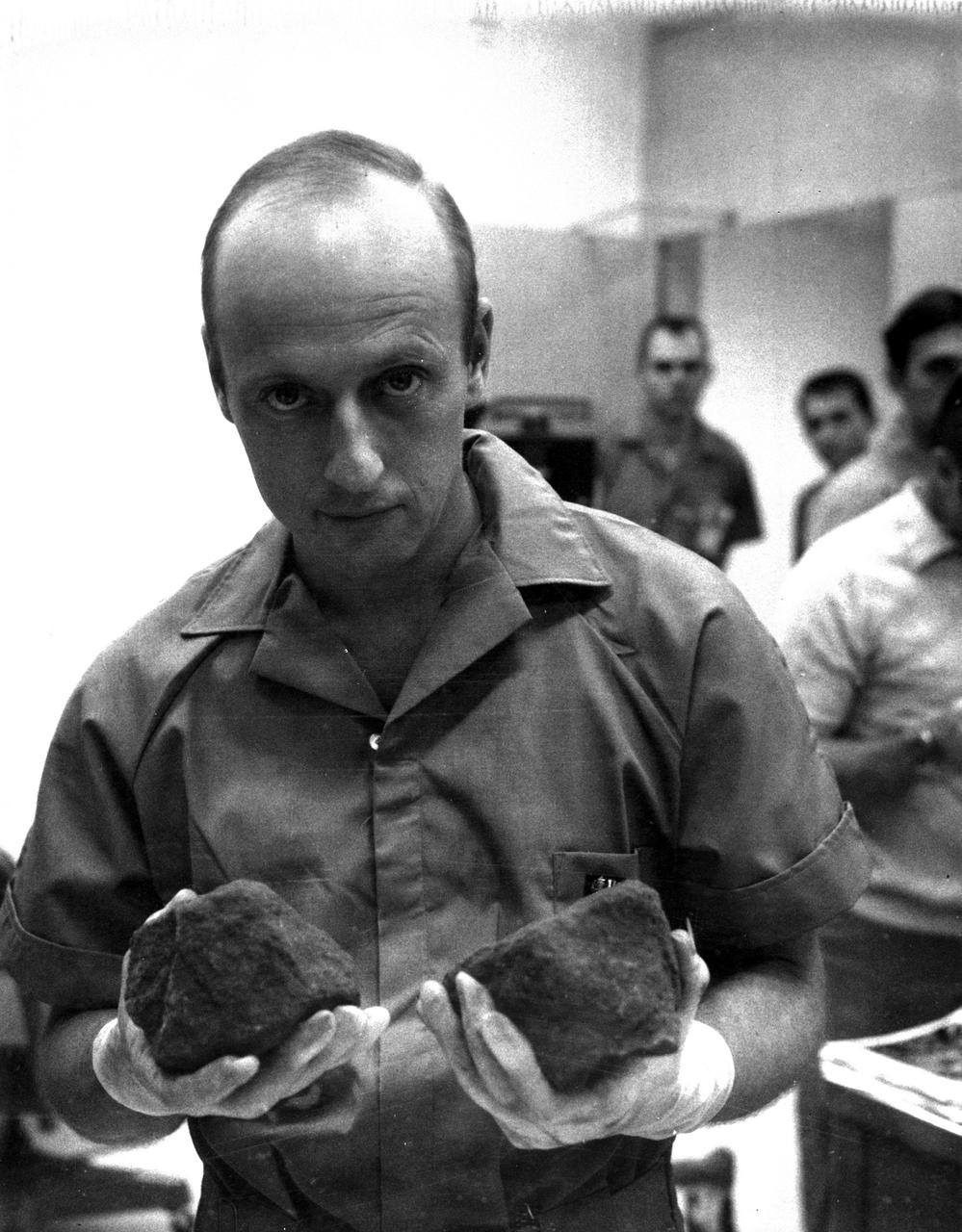
S69-60424 (29 Nov. 1969) --- Astronaut Charles Conrad Jr., commander of the Apollo 12 lunar landing mission, holds two lunar rocks which were among the samples brought back from the moon by the Apollo 12 astronauts. The samples are under scientific examination in the Manned Spacecraft Center's Lunar Receiving Laboratory.
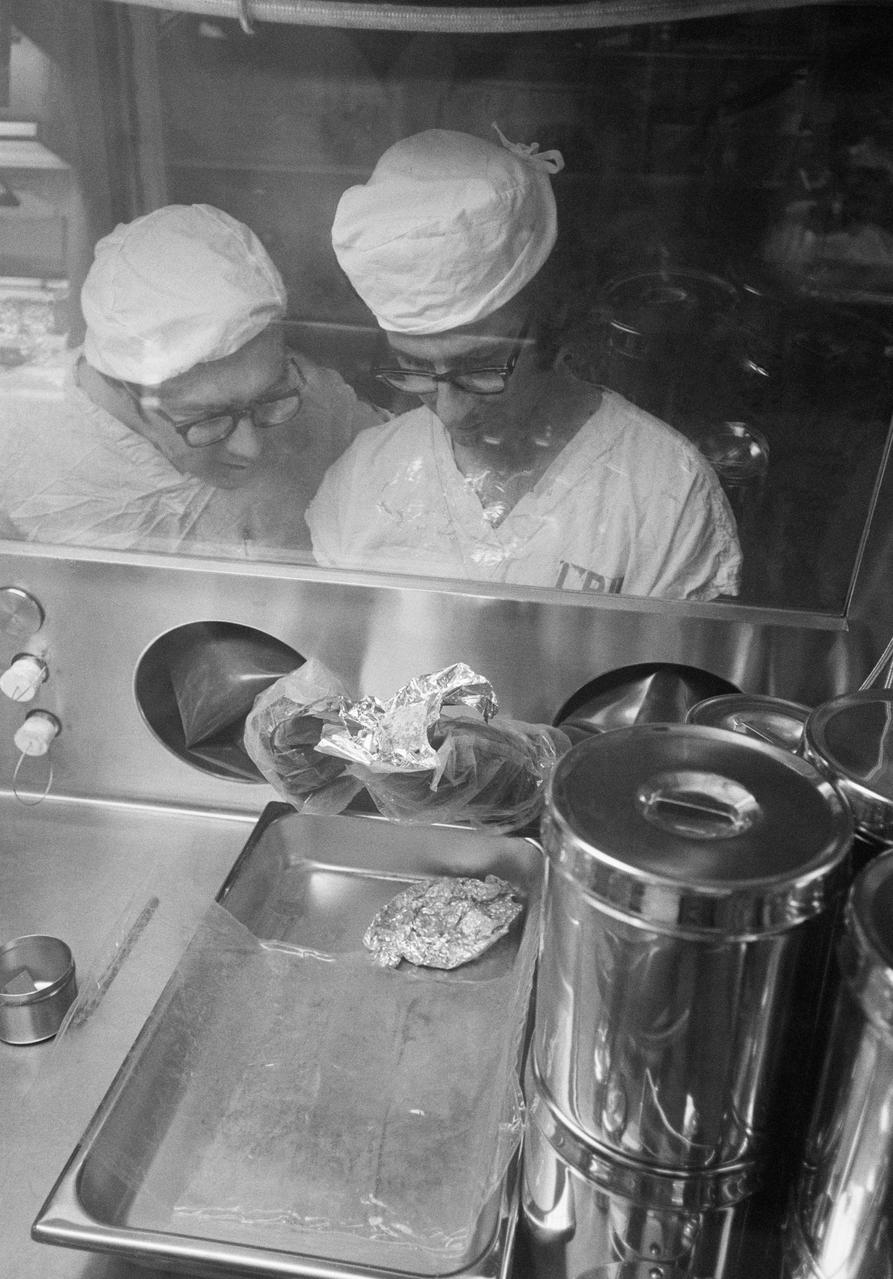
S71-21029 (24 Feb. 1971) --- Everett Gibson (left) and Don Morrison with Apollo 14 rocks in the Lunar Receiving Lab (LRL). Photo credit: NASA
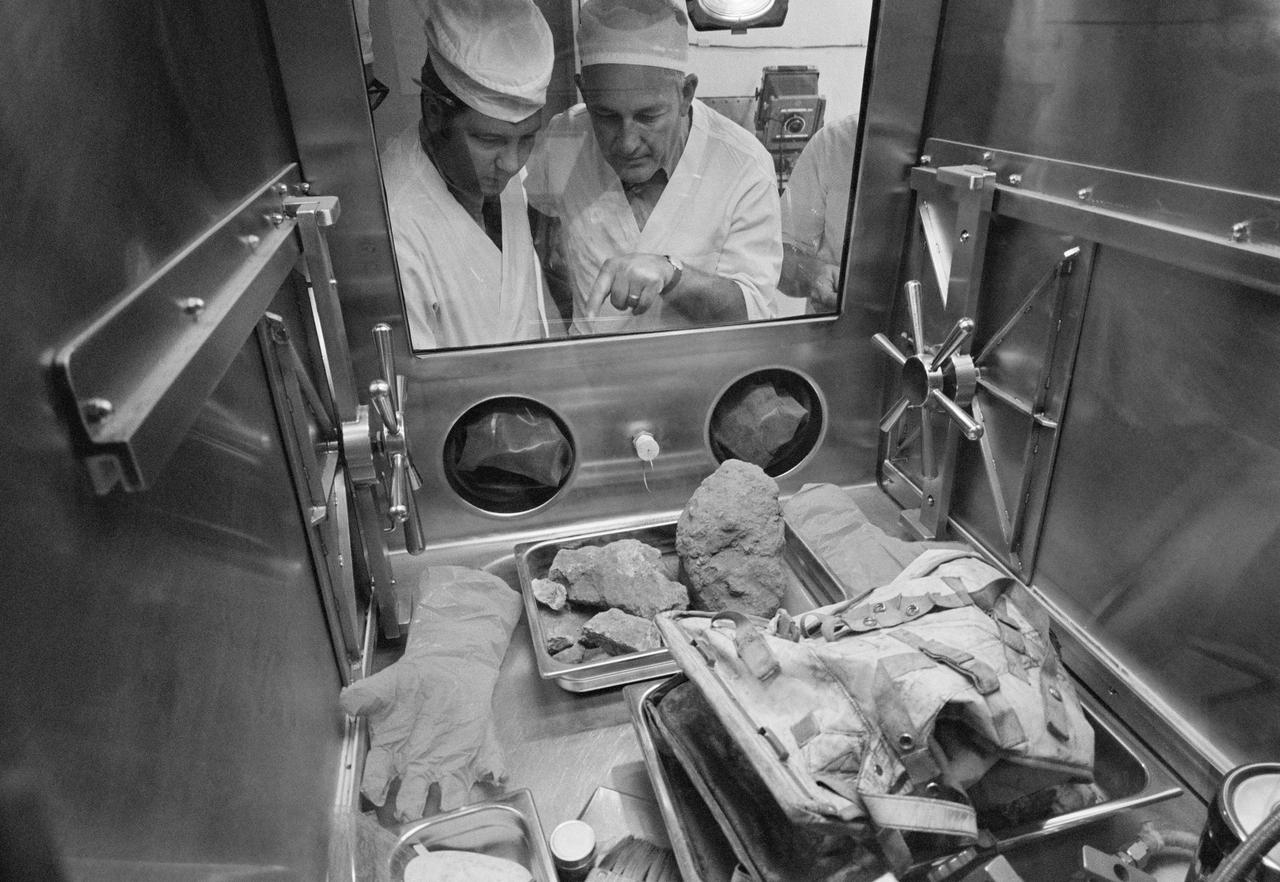
S72-38465 (19 May 1972) --- In an isolated area of the Manned Spacecraft Center's Lunar Receiving Laboratory, engineer David White (left) and University of Texas geologist/professor William Muehlberger look at a "special" rock brought back from the moon recently by the Apollo 16 astronauts. Lunar sample 61016, better known as "Big Muley," is a large breccia sample, the largest moon rock returned by any Apollo crew, which is named after Muehlberger, the Apollo 16 field geology team leader. Photo credit: NASA

AS16-114-18423 (21 April 1972) --- Astronaut Charles M. Duke Jr., lunar module pilot, is photographed collecting lunar samples at Station No. 1, during the first Apollo 16 extravehicular activity (EVA), at the Descartes landing site. This picture, looking eastward, was taken by astronaut John W. Young, commander. Duke is standing at the rim of Plum Crater. The parked Lunar Roving Vehicle (LRV) can be seen in the left background. While astronauts Young and Duke descended in the Lunar Module (LM) "Orion" to explore the Descartes highlands region of the moon, astronaut Thomas K. Mattingly II, command module pilot, remained with the Command and Service Modules (CSM) "Casper" in lunar orbit.
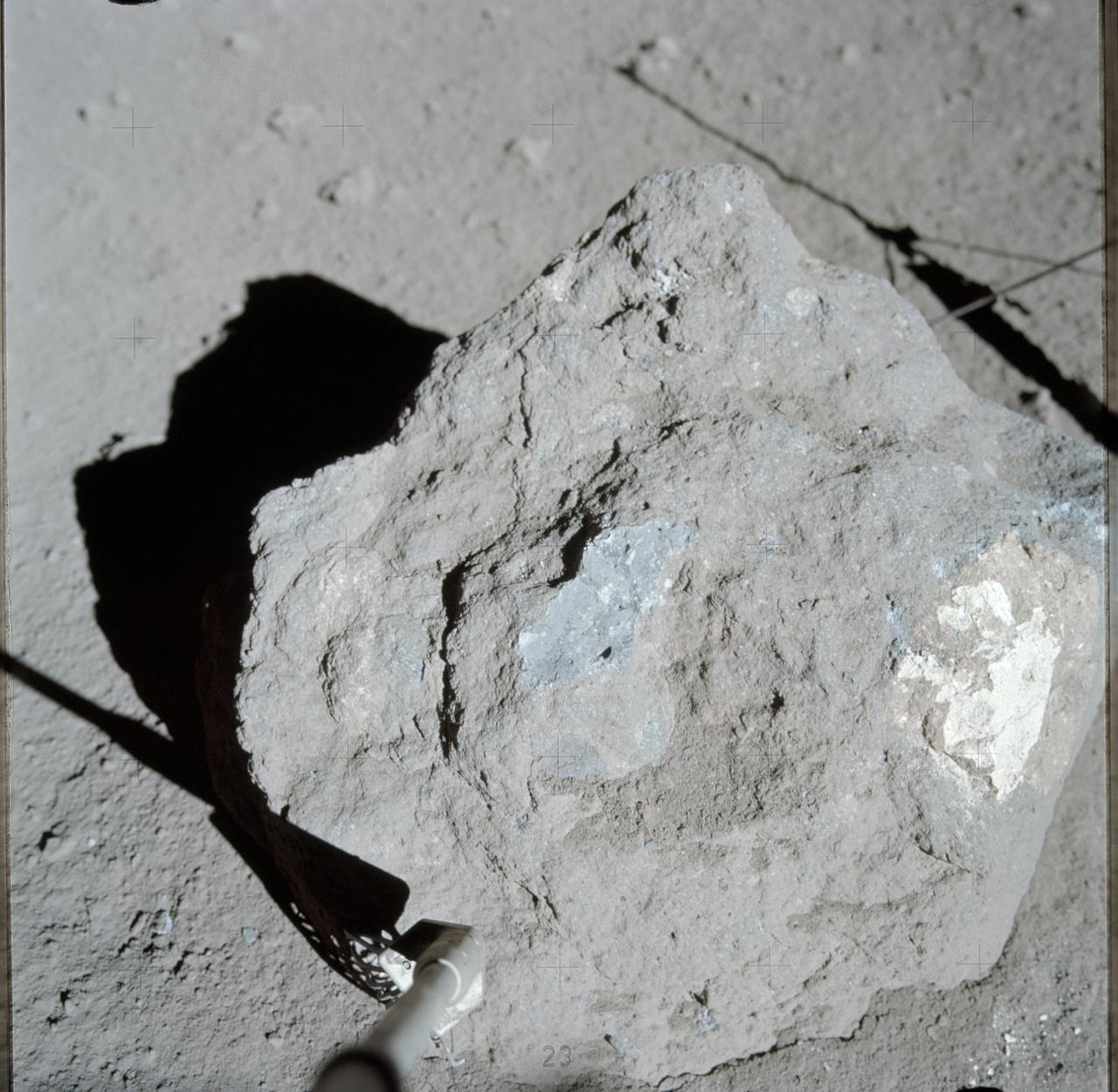
AS17-137-20972 (7-19 Dec. 1972) --- This is a close-up view of a lunar rock, showing multi-colored clasts embedded in larger rock. This picture was taken by one of the Apollo 17 astronauts during an extravehicular activity (EVA) on the moon surface.
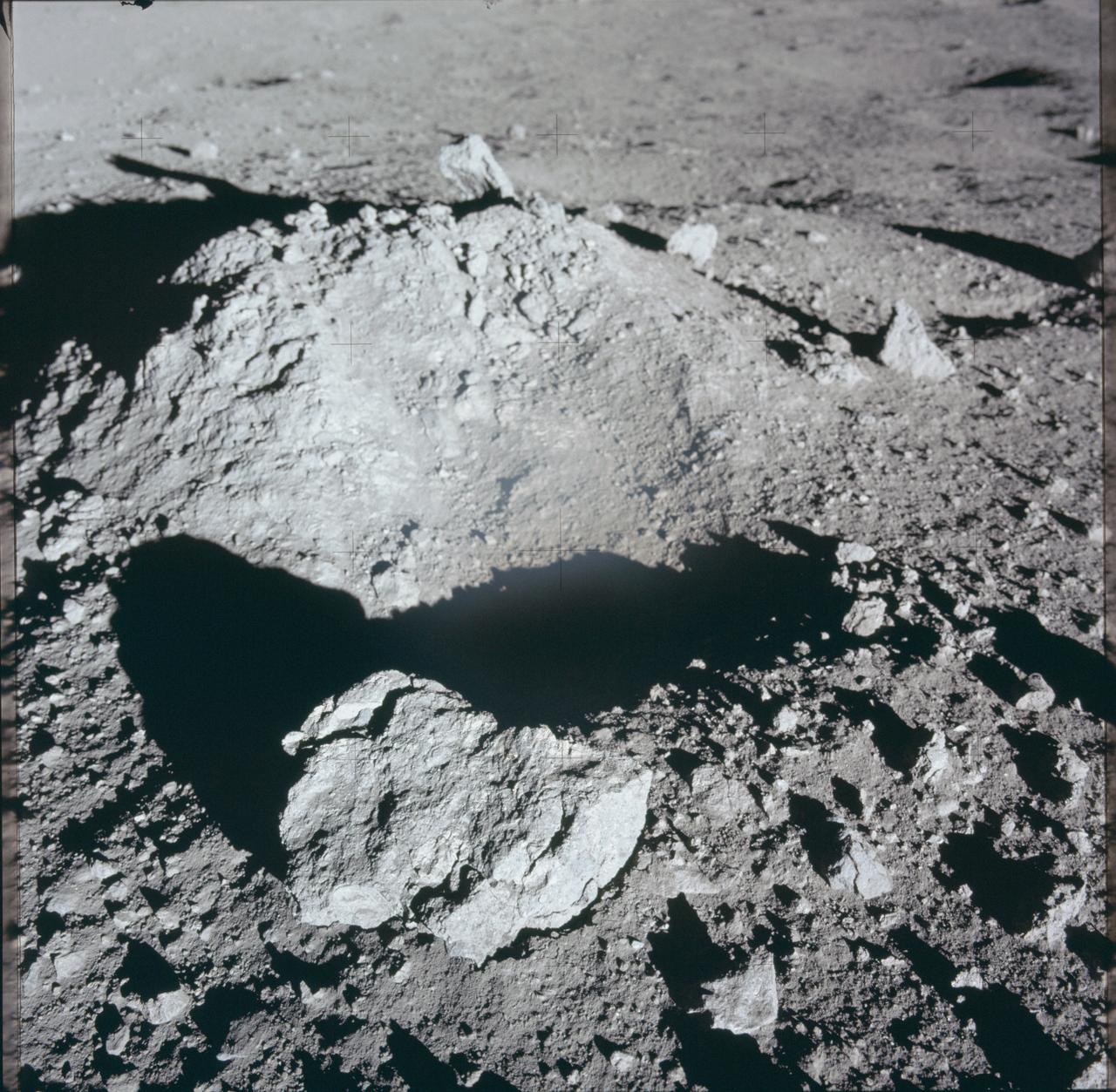
AS12-46-6825 (19 Nov. 1969) --- Close-up view of a lunar rock, small crater, and lunar mound as photographed during the Apollo 12 extravehicular activity (EVA). Astronaut Richard F. Gordon Jr., command module pilot, remained with the Apollo 12 Command and Service Modules (CSM) in lunar orbit while astronauts Charles Conrad Jr., commander, and Alan L. Bean, lunar module pilot, descended in the Lunar Module (LM) to explore the moon.
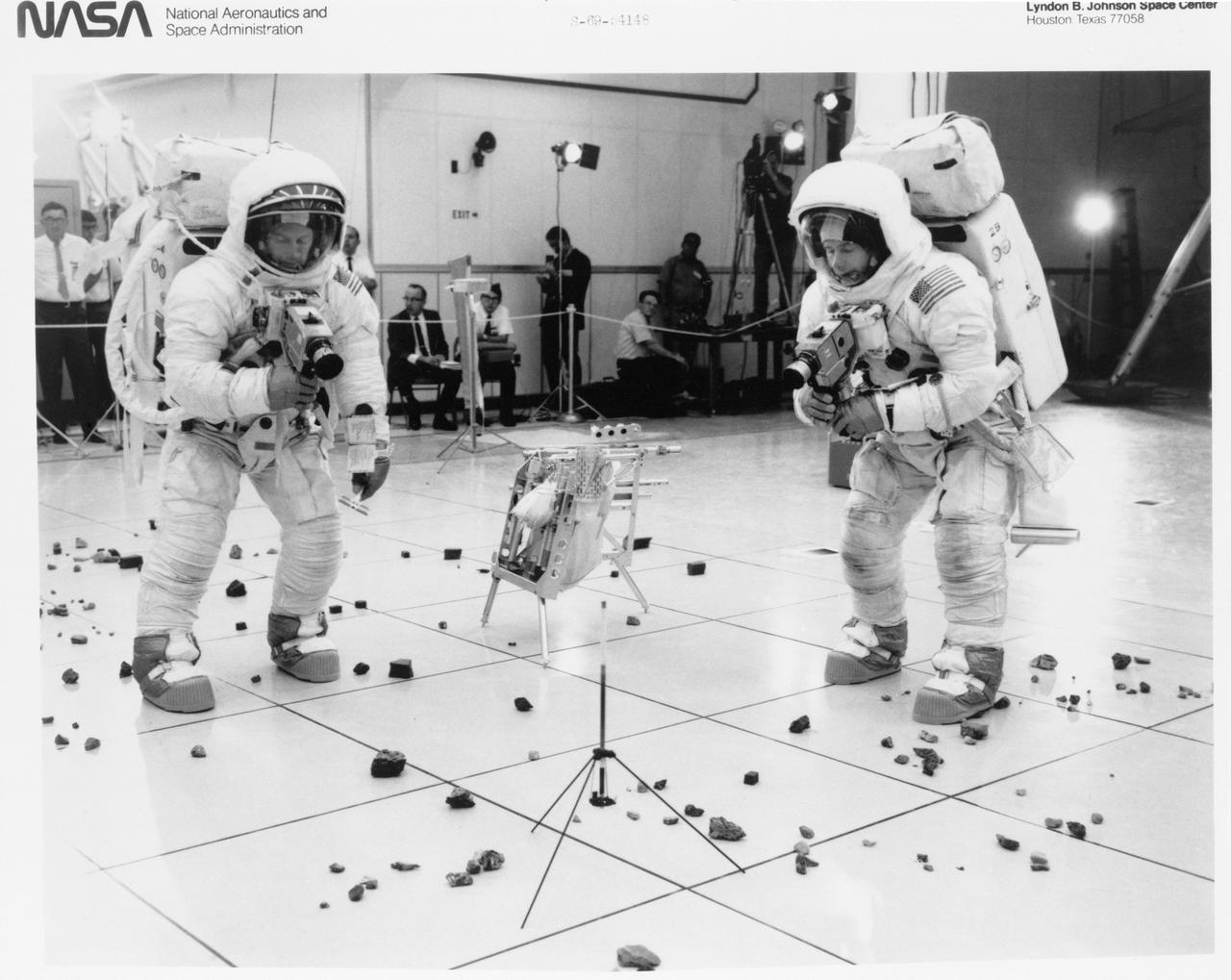
S69-54148 (October 1969) --- Two members of the Apollo 12 lunar landing mission participates in lunar surface extravehicular activity (EVA) simulations in the Kennedy Space Center's (KSC) Flight Crew Training Building. Here, astronauts Charles Conrad Jr. (on left), commander, and Alan L. Bean, lunar module pilot, simulate the photographic documentation of lunar rock samples. The simulations were part of a run-through of the Apollo 12 lunar surface "timeline".
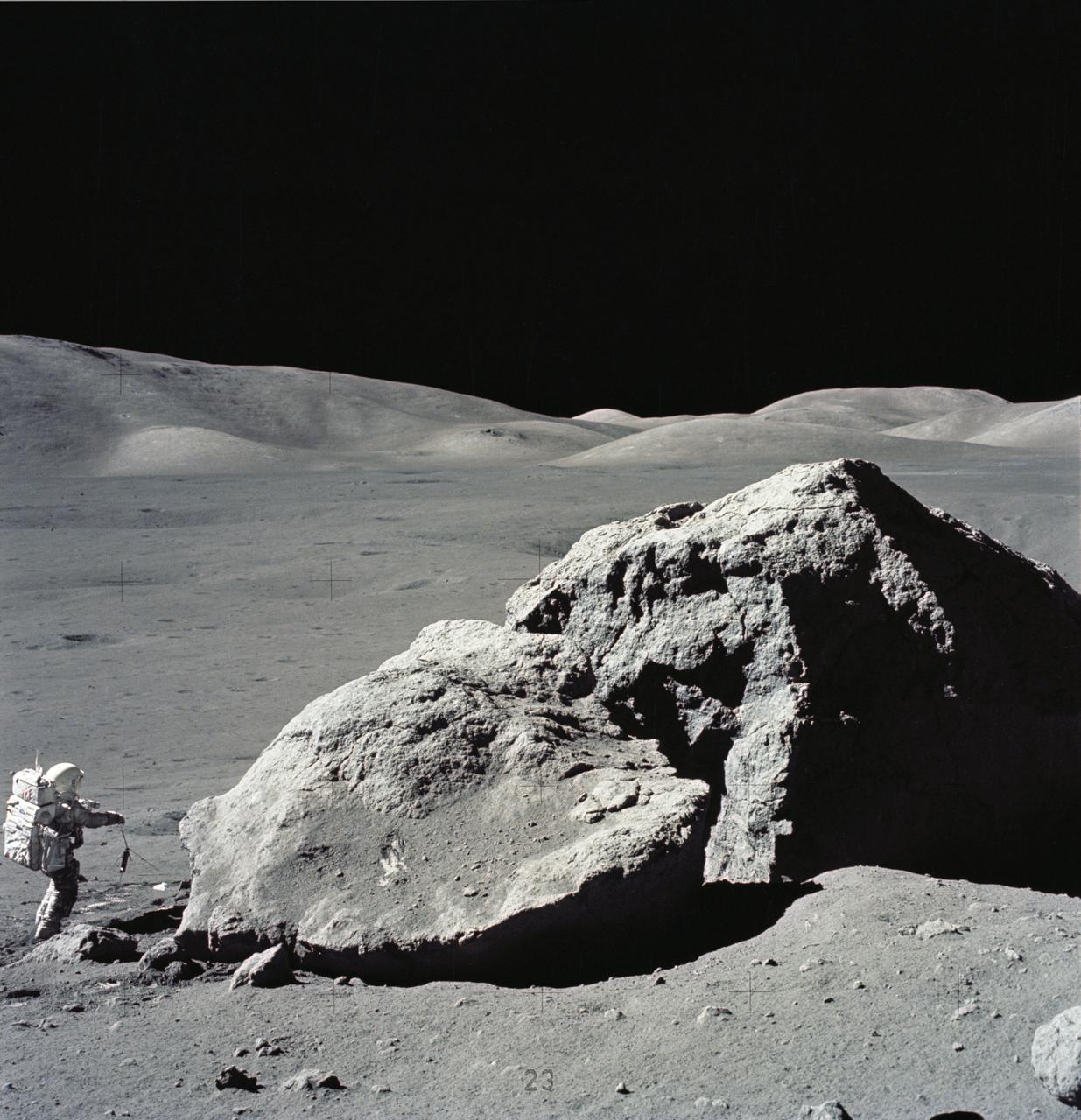
AS17-140-21496 (13 Dec. 1972) --- Scientist-astronaut Harrison H. Schmitt is photographed standing next to a huge, split boulder during the third Apollo 17 extravehicular activity (EVA) at the Taurus-Littrow landing site on the moon. Schmitt is the Apollo 17 lunar module pilot. This picture was taken by astronaut Eugene A. Cernan, commander. While Cernan and Schmitt descended in the Lunar Module (LM) "Challenger" to explore the moon, astronaut Ronald E. Evans, command module pilot, remained with the Apollo 17 Command and Service Modules (CSM) in lunar orbit.
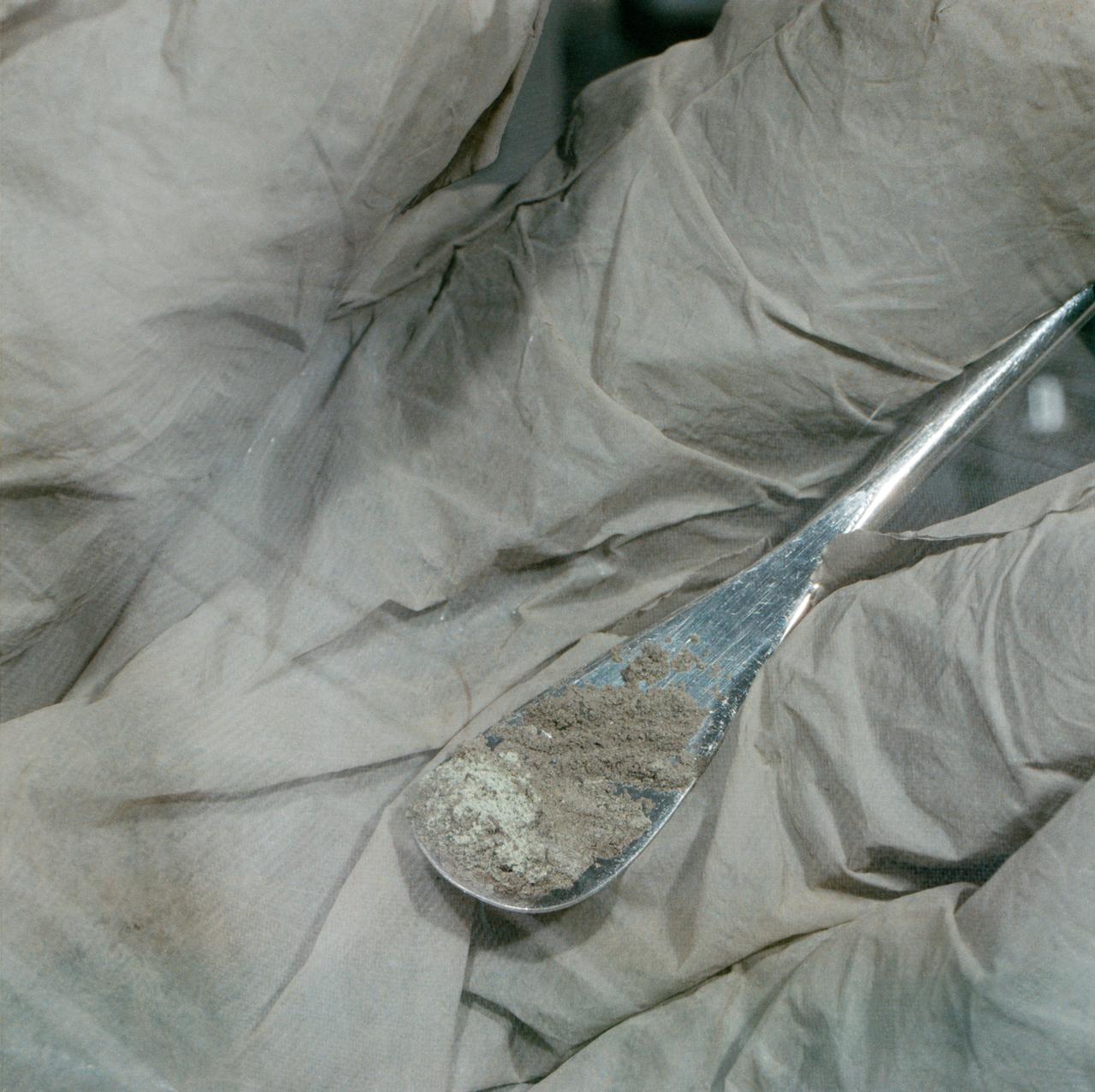
S71-43050 (August 1971) --- A close-up view of Apollo 15 lunar sample No. 15305 in the Non-sterile Nitrogen Processing Line (NNPL) in the Lunar Receiving Laboratory (LRL) at the Manned Spacecraft Center (MSC). This sample, pictured on a small spatula in a lab technician's glove, is green and is one of six recently taken from container No. 173, made up of comprehensive fines from the Apennine Front, Site No. 7. Astronauts David R. Scott, commander; and James B. Irwin, lunar module pilot, took the sample during their second extravehicular activity (EVA), at a ground elapsed time (GET) of 146:05 to 146:06.
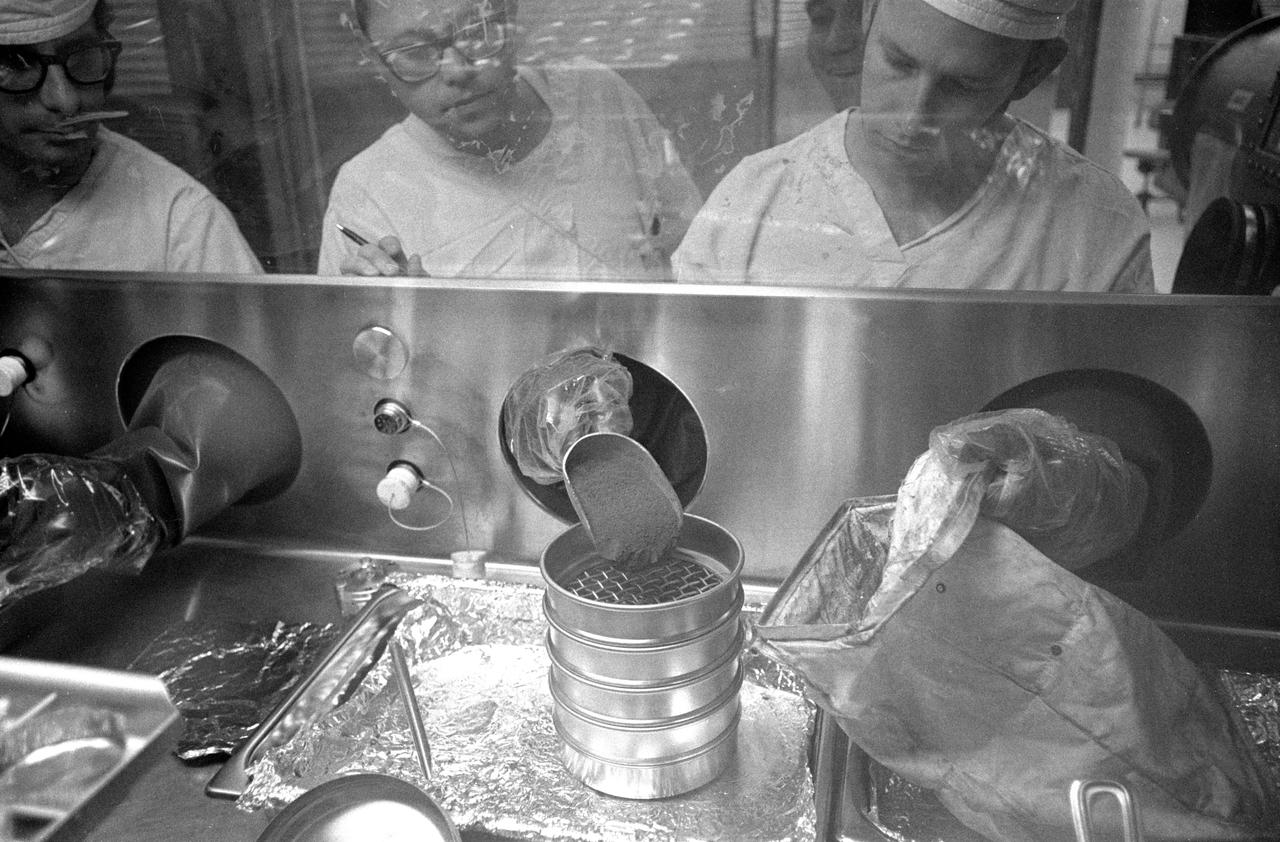
S71-19489 (18 Feb. 1971) --- Glove handlers work with freshly opened Apollo 14 lunar sample material in modularized cabinets in the Lunar Receiving Laboratory at the Manned Spacecraft Center. The glove operator on the right starts to pour fine lunar material which he has just taken from a tote bag. The powdery sample was among the last to be revealed of the 90-odd pounds of material brought back to Earth by the Apollo 14 crew members.
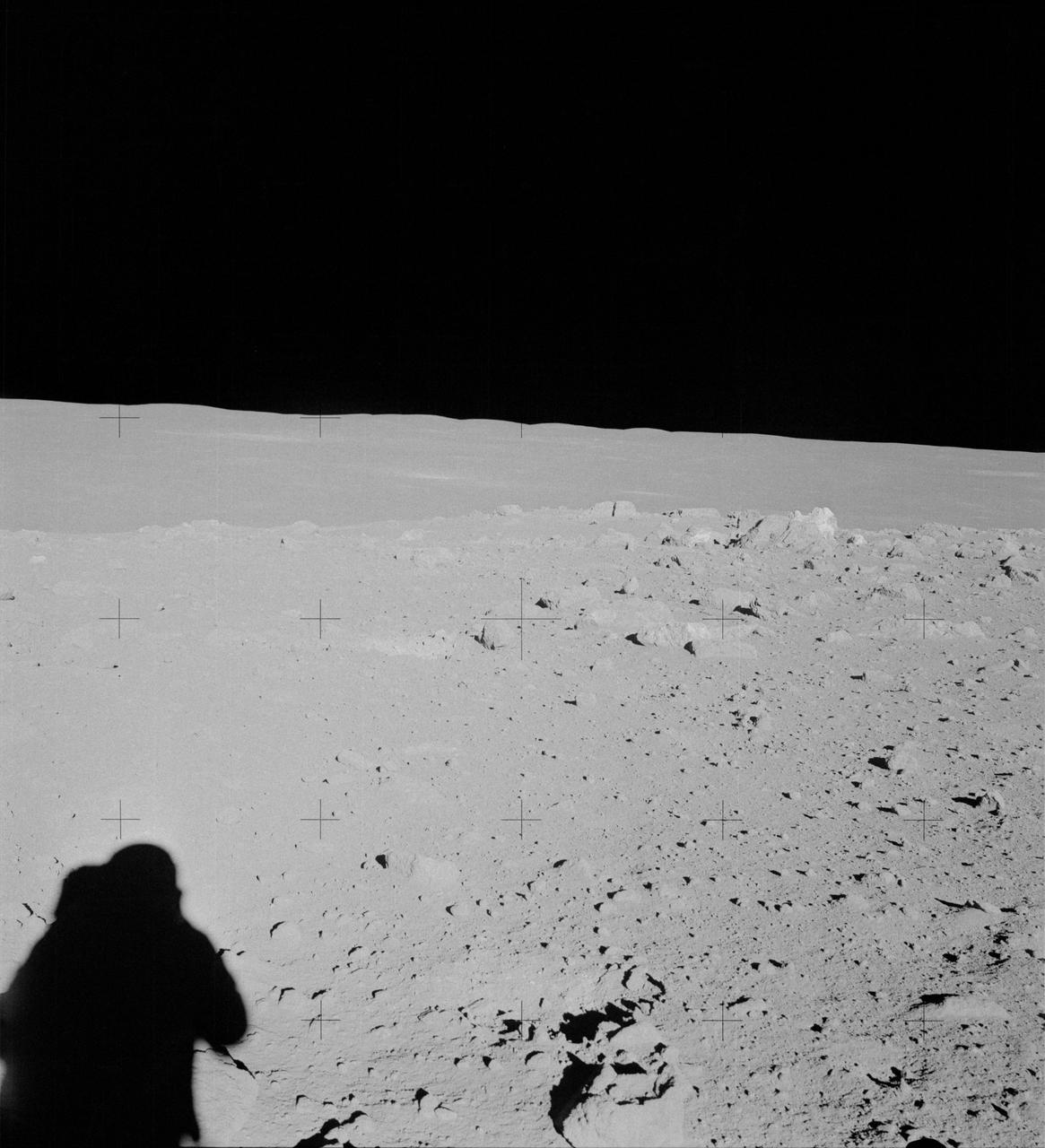
AS14-64-9099 (6 Feb. 1971) --- An Apollo 14 crew member (note shadow) photographs this field of boulders located on the flank of Cone Crater during the second extravehicular activity (EVA). This view is looking just north of west. While astronauts Alan B. Shepard Jr., commander, and Edgar D. Mitchell, lunar module pilot, were exploring the moon, astronaut Stuart A. Roosa, command module pilot, was maneuvering the Apollo 14 Command and Service Modules (CSM) in lunar orbit.
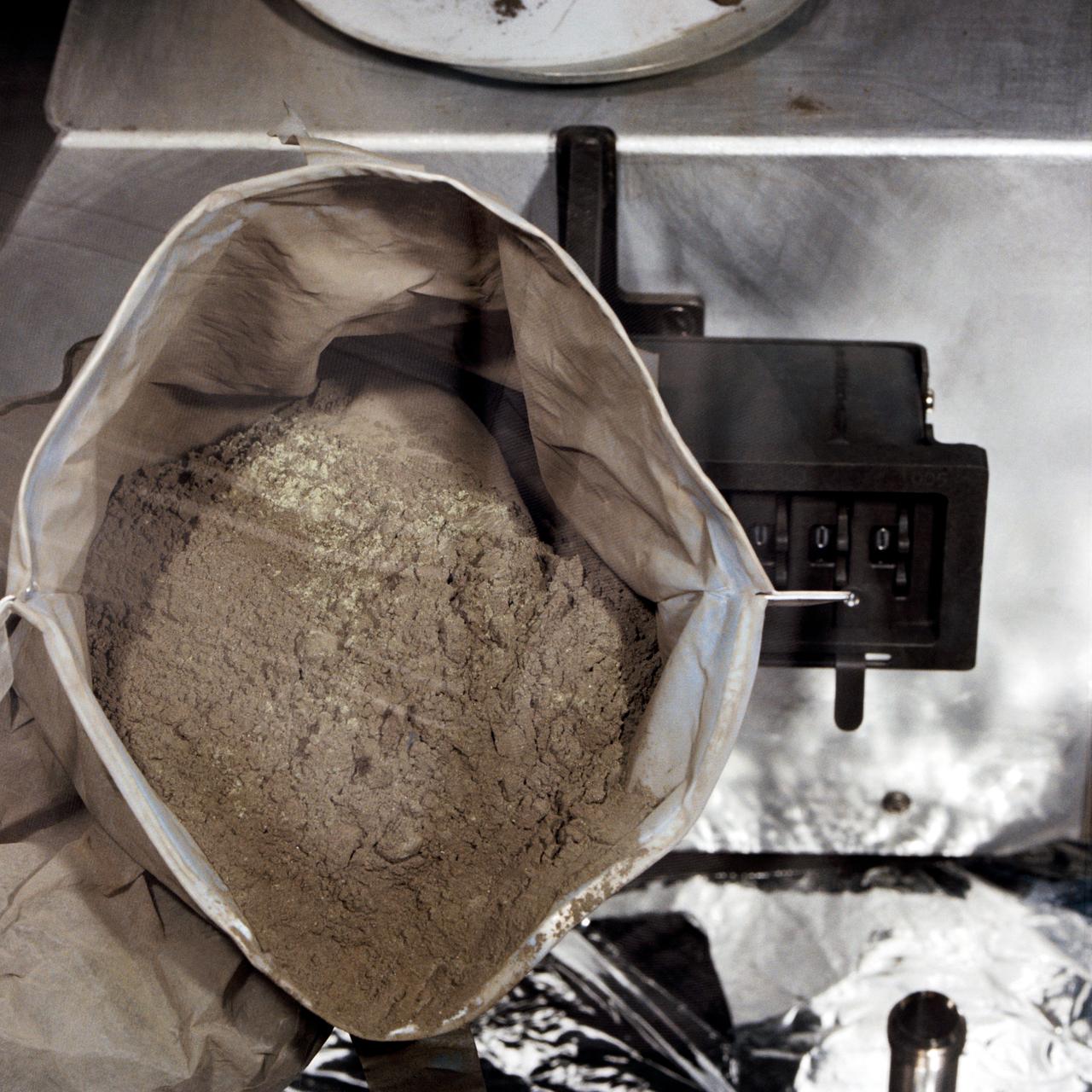
S71-43052 (August 1971) --- A close-up view of a container full of green-colored lunar soil in the Non-Sterile Nitrogen Processing Line (NNPL) in the Lunar Receiving Laboratory (LRL) at the Manned Spacecraft Center (MSC). This sample, broken down into six separate samples after this photo was made, was made up of comprehensive fines from near Spur Crater on the Apennine Front. The numbers assigned to the sample include numbers 15300 through 15305. Astronauts David R. Scott and James B. Irwin took the sample during their second extravehicular activity (EVA) at a ground elapsed time (GET) of 146:05 to 146:06.
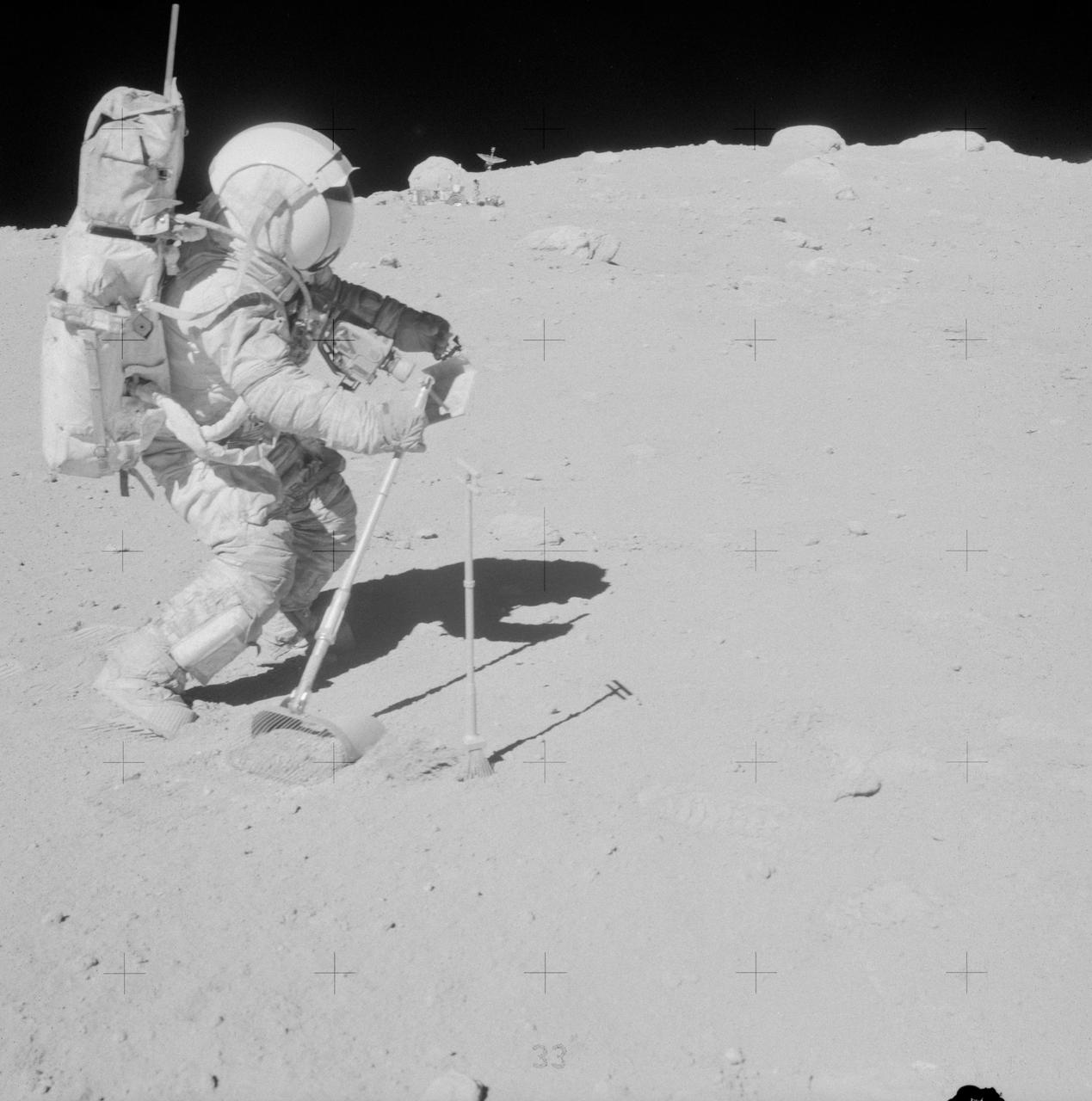
AS16-106-17340 (23 April 1972) --- Astronaut John W. Young, commander of the Apollo 16 lunar landing mission, is photographed collecting lunar samples near North Ray Crater during the third Apollo 16 extravehicular activity (EVA) at the Descartes landing site. This picture was taken by astronaut Charles M. Duke Jr., lunar module pilot. Young is using the lunar surface rake and a set of tongs. The Lunar Roving Vehicle (LRV) is parked in the field of large boulders in the background. While astronauts Young and Duke descended in the Lunar Module (LM) "Orion" to explore the moon, astronaut Thomas K. Mattingly II, command module pilot, remained with the Command and Service Modules (CSM) in lunar orbit.
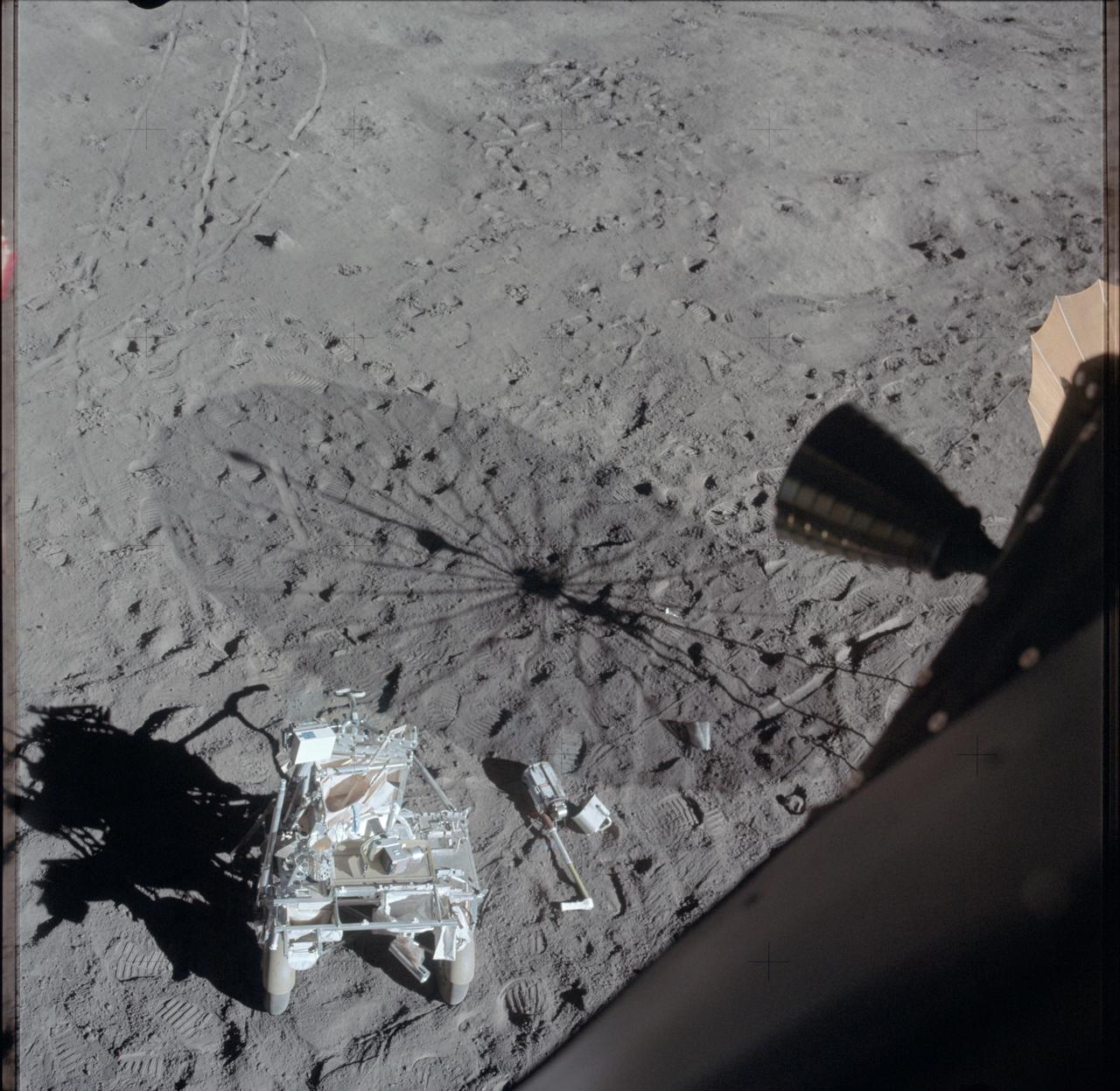
AS14-66-9340 (6 Feb. 1971) --- A view from inside the Lunar Module (LM) following the second Apollo 14 extravehicular activity (EVA). At the left foreground is the modularized equipment transporter (MET). Tracks made by the two-wheeled "Rickshaw"-type cart can be seen in the left background. The Apollo 35mm stereo close-up camera lies next to the MET, near a huge shadow of the erectable S-Band antenna. The area is largely covered with bootprints made by astronauts Alan B. Shepard Jr., commander, and Edgar D. Mitchell, lunar module pilot. While the pair explored the moon, astronaut Stuart A. Roosa, command module pilot, remained with the Command and Service Modules (CSM) in lunar orbit.
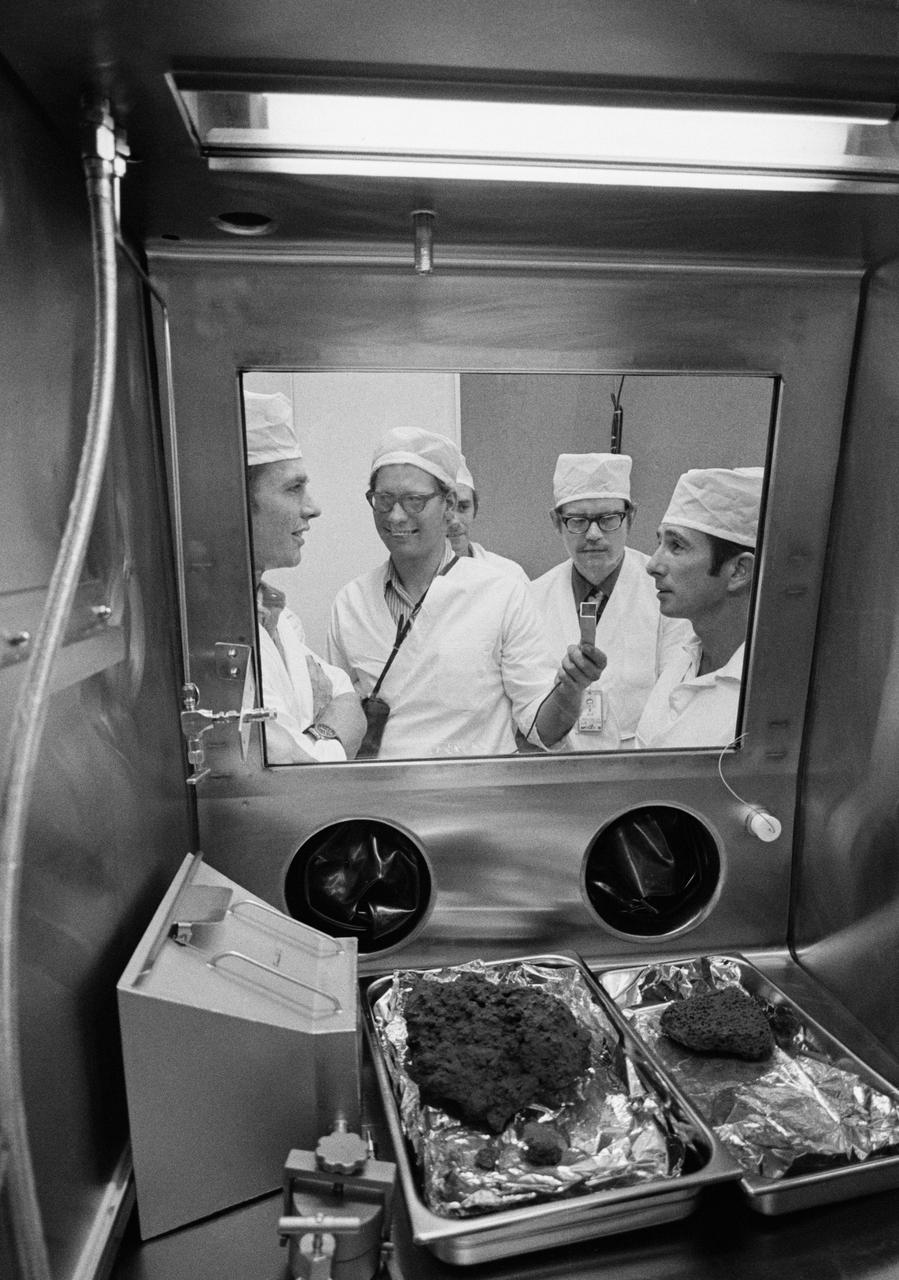
S71-43203 (9 Aug. 1971) --- Astronauts David R. Scott, left foreground, and James B. Irwin, right foreground, join the Manned Spacecraft Center's (MSC) geologists in getting first looks at some of the first Apollo 15 samples to be opened in the Non-Sterile Nitrogen Processing Line (NNPL) in the MSC Lunar Receiving Laboratory (LRL). Holding the microphone and making recorded tapes of the two Apollo 15 crew men's comments is Dr. Gary Lofgren. Partially obscured, near center of photo is Dr. William Phinney, and to his left is Dr. James W. Head.
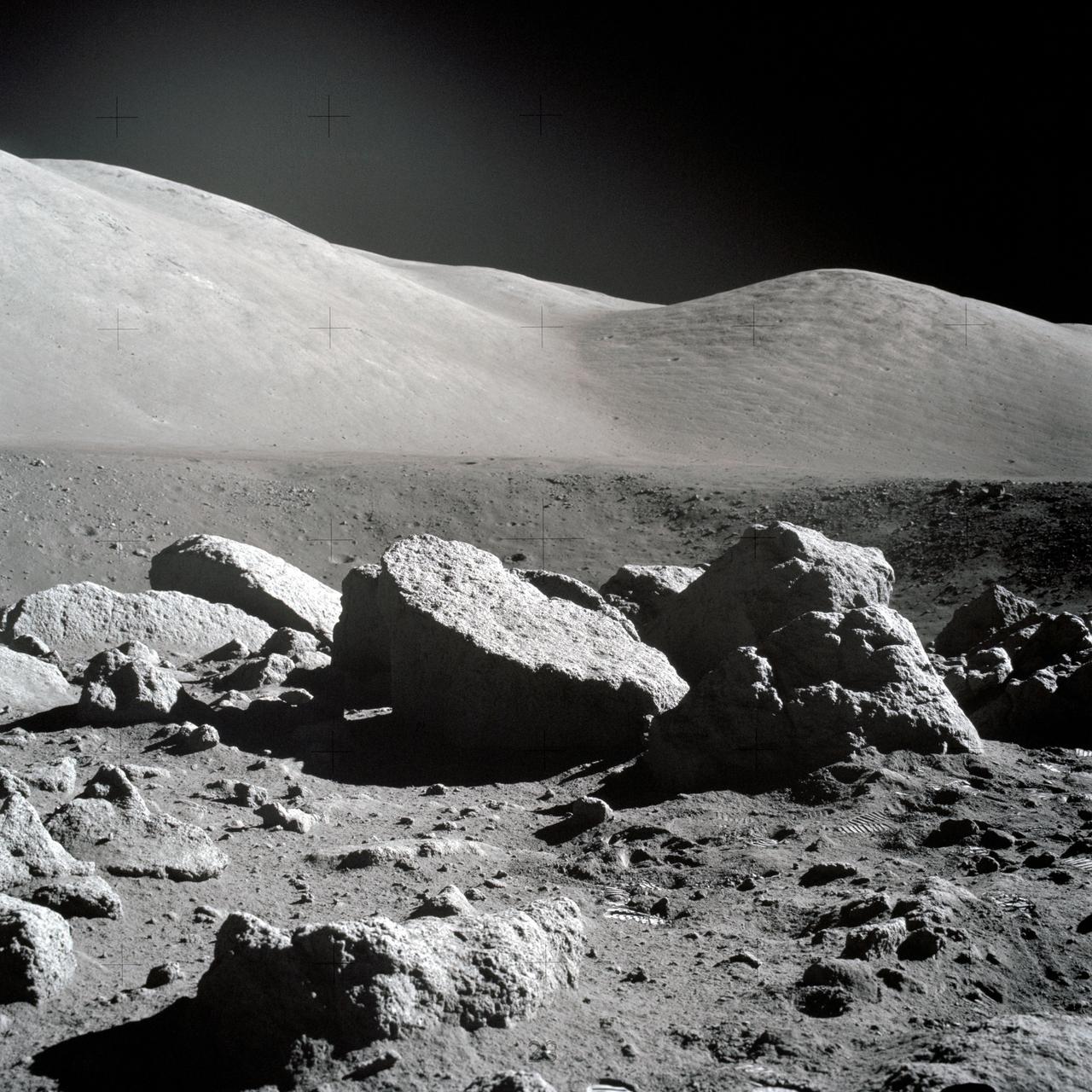
AS17-145-22183 (7-19 Dec. 1972) --- One of the Apollo 17 crew took this picture of a large boulder field during lunar surface extravehicular activity (EVA) at the Taurus-Littrow landing site. This view is looking northeast. Apollo 17 was the final lunar landing mission in NASA's Apollo Program. While astronauts Eugene A. Cernan, commander, and Harrison H. Schmitt, lunar module pilot, descended in the Lunar Module (LM) "Challenger" to explore the Taurus-Littrow region of the moon, astronaut Ronald E. Evans, command module pilot, remained with the Command and Service Modules (CSM) "America" in lunar orbit.
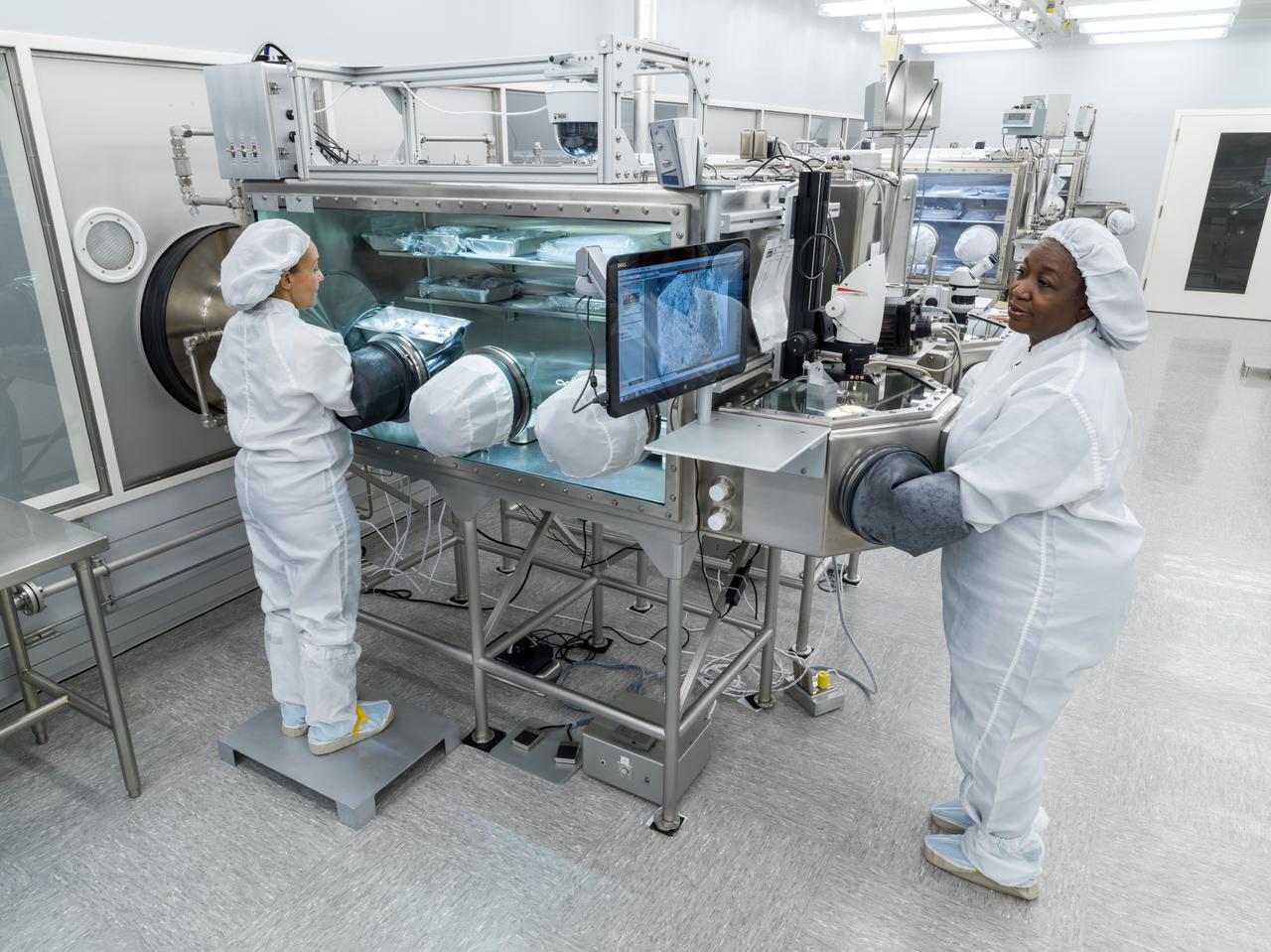
jsc2019e023774 --- Lunar sample processors work in the Lunar Lab at NASA's Johnson Space Center in Houston.
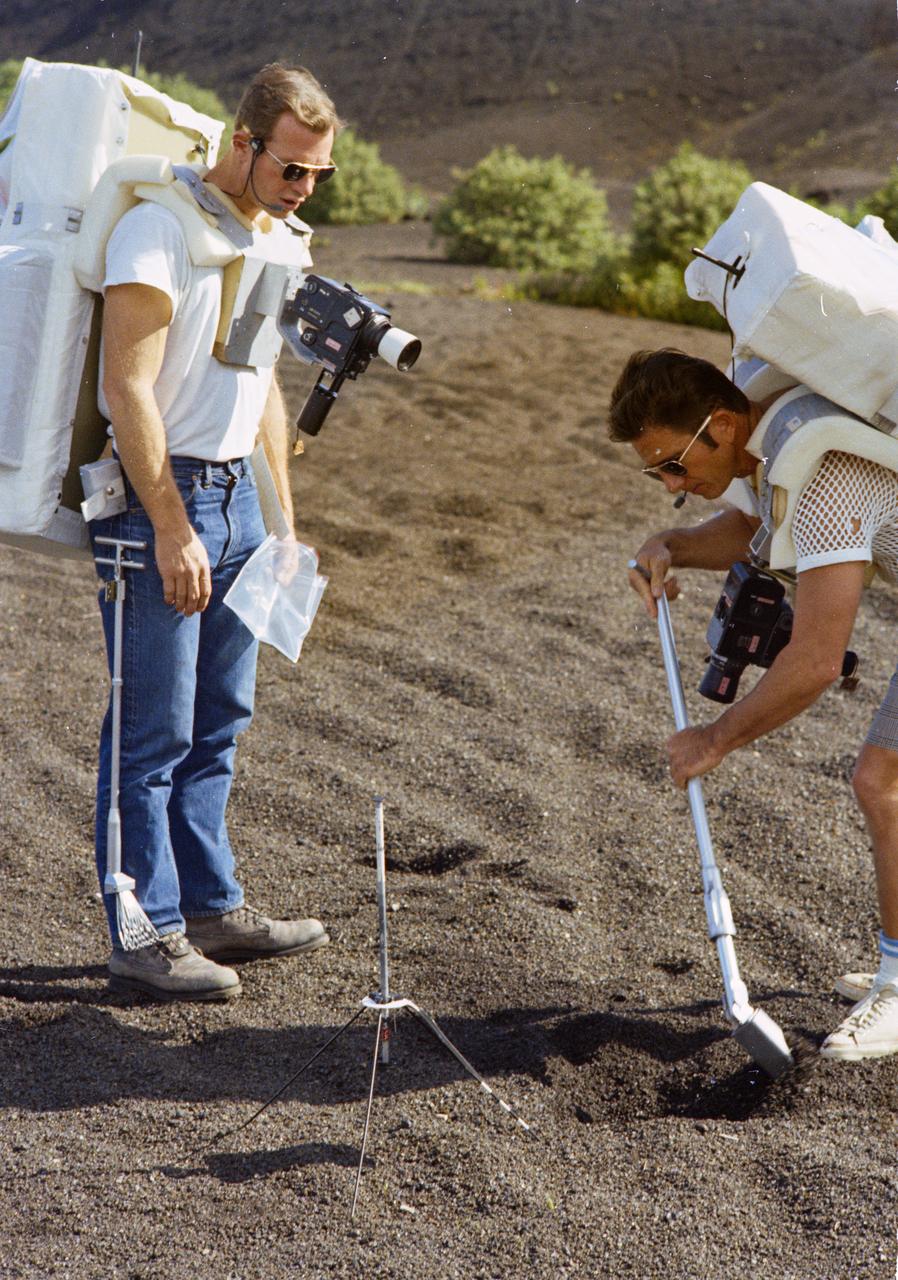
S70-56415 (December 1970) --- At Kapoho, Hawaii, astronauts David R. Scott (left), commander of the Apollo 15 lunar landing mission, and James B. Irwin, lunar module pilot, train at a designated lunar surface simulation area for their upcoming lunar landing mission. Wearing street clothes, but equipped with a Portable Life Support System (PLSS), the two rehearse for a selenological traverse. Here, they are inspecting a grapefruit-sized rock. Photo credit: NASA
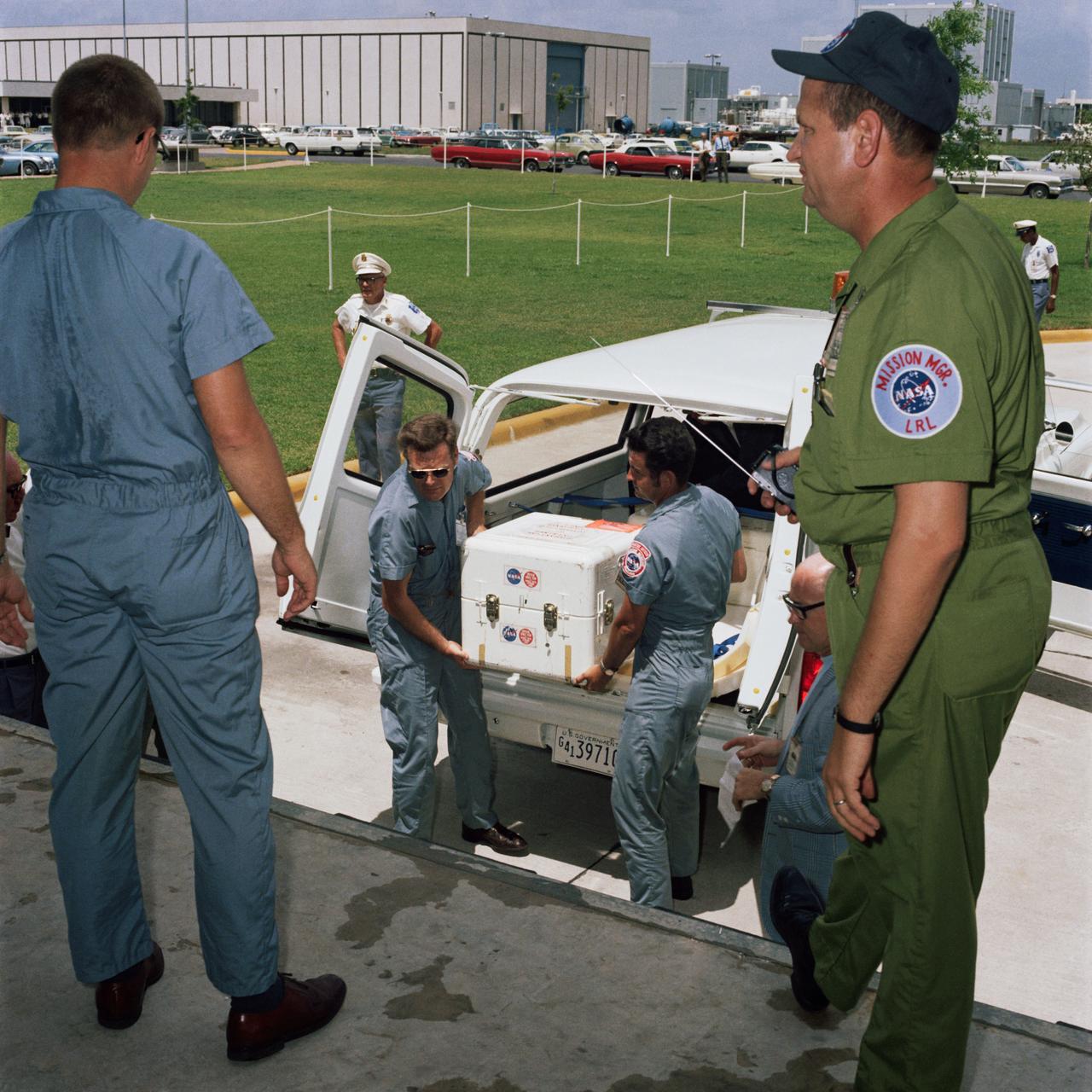
S69-39996 (25 July 1969) --- The first Apollo 11 sample return container, with lunar surface material inside, is unloaded at the Lunar Receiving Laboratory, Building 37, Manned Spacecraft Center (MSC). The rock box had arrived only minutes earlier at Ellington Air Force Base by air from the Pacific recovery area. The lunar samples were collected by astronauts Neil A. Armstrong and Edwin E. Aldrin Jr. during their lunar surface extravehicular activity.
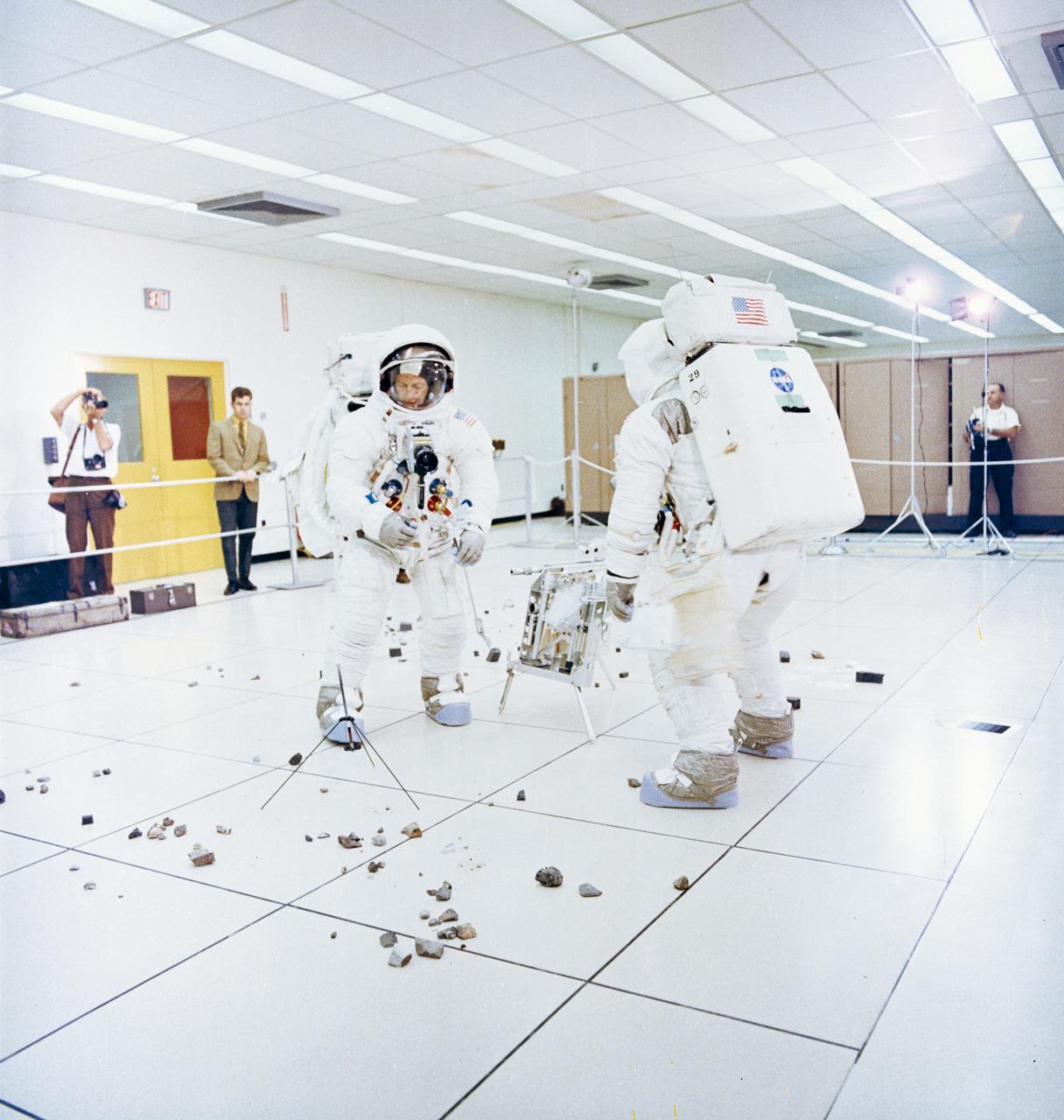
S69-55368 (6 Oct. 1969) --- Two members of the Apollo 12 lunar landing mission participate in lunar surface extravehicular activity (EVA) simulations in the Flight Crew Training Building at the Kennedy Space Center (KSC). Astronaut Charles Conrad Jr., commander (facing camera), simulates picking up samples. Astronaut Alan L. Bean, lunar module pilot, simulates photographic lunar rock sample documentation.
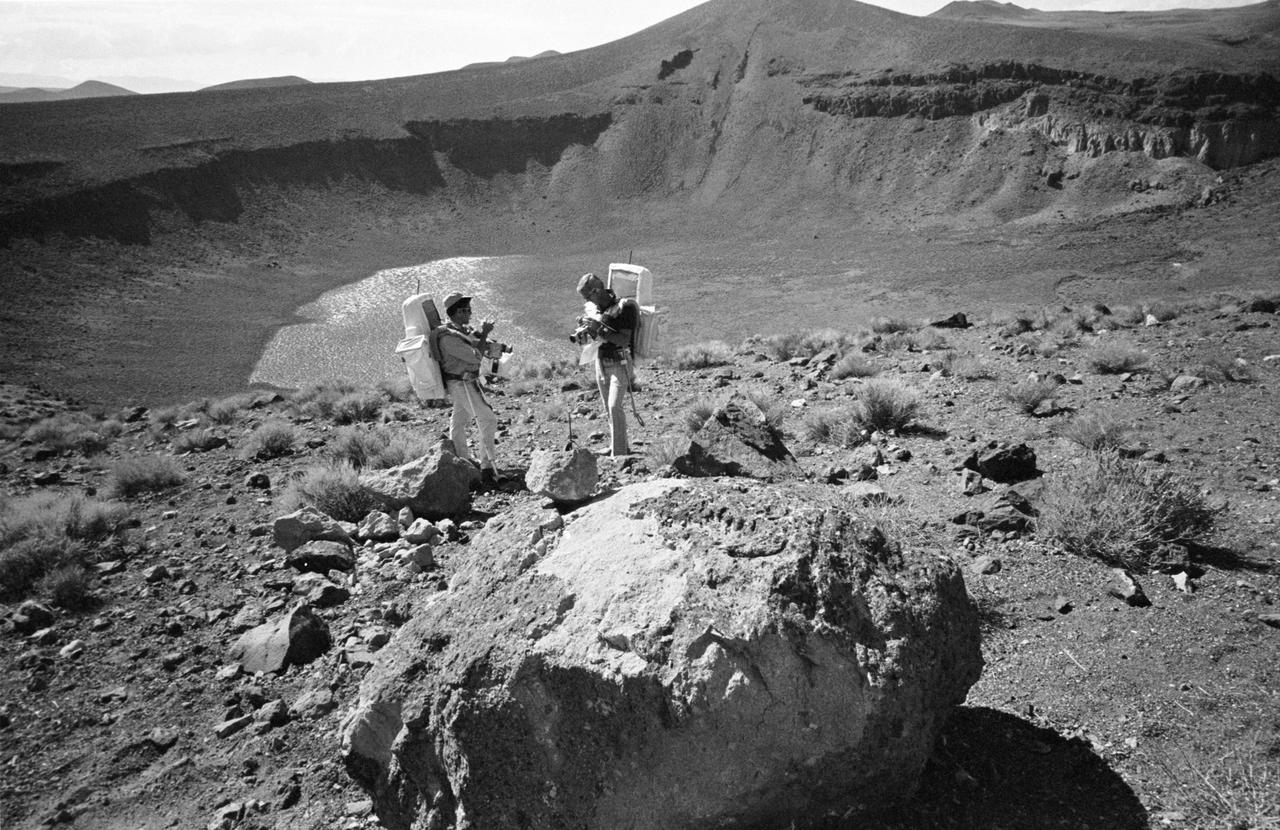
S72-48854 (6 Sept. 1972) --- Two members of the prime crew of the Apollo 17 lunar landing mission examine rock specimens during lunar surface extravehicular activity simulation training on a geological field trip to the Pancake Range area of south-central Nevada. They are astronaut Eugene A. Cernan (right), commander; and scientist-astronaut Harrison H. Schmitt, lunar module pilot. They are standing on the rim of Lunar Crater, which is about 600 feet deep and five-eighths of a mile in diameter. It is a volcanic crater.
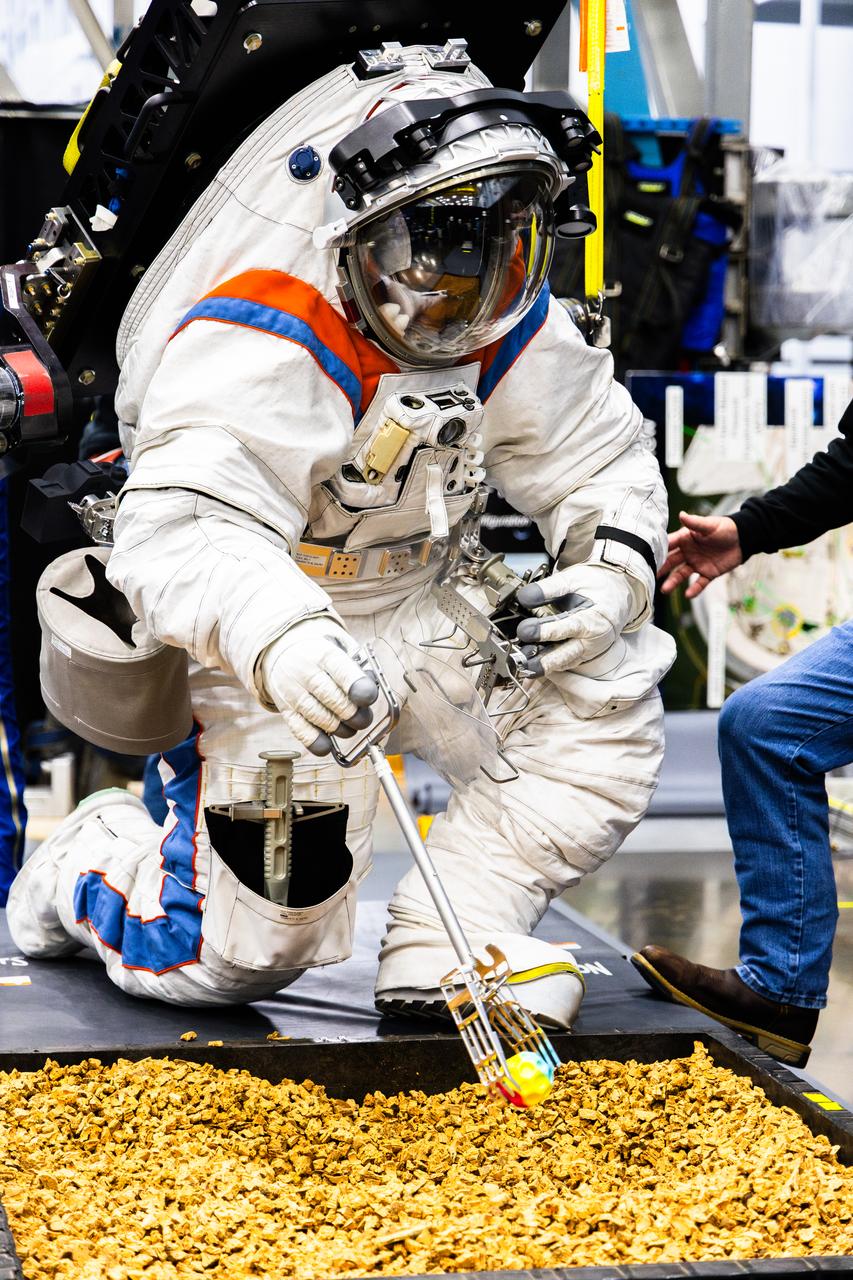
An Axiom Space engineer uses tongs to pick up a simulated lunar rock while wearing the AxEMU (Axiom Extravehicular Mobility Unit) spacesuit during testing at NASA’s Johnson Space Center. Image Credit: Axiom Space
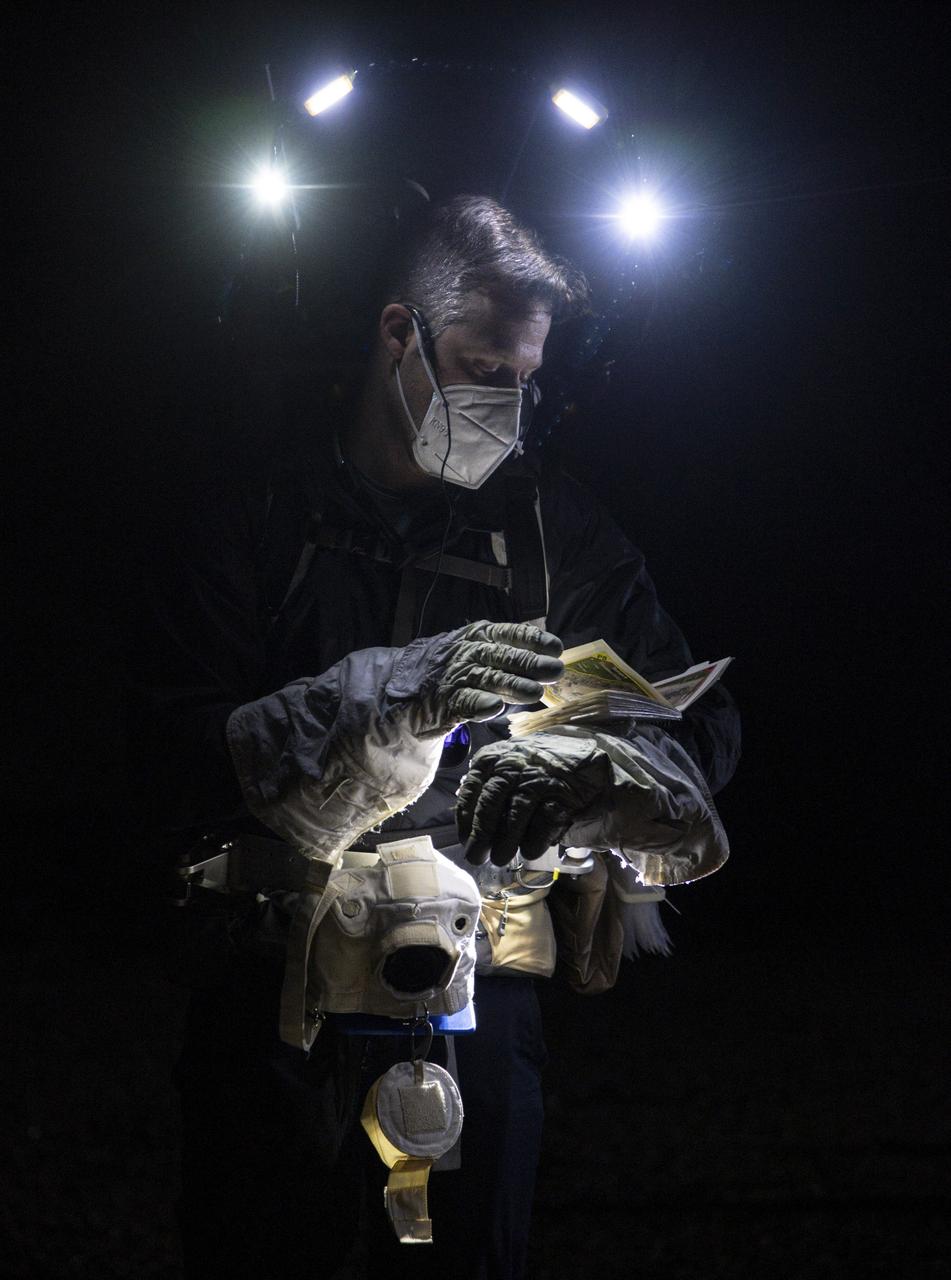
Date: 03-02-2021 Location: JSC Rockyard Subject: Scott Wray rewiews test documents during Lunar Exploration EVA Night Operations at Johnson Space Center's Rock Yard. Photographer: James Blair
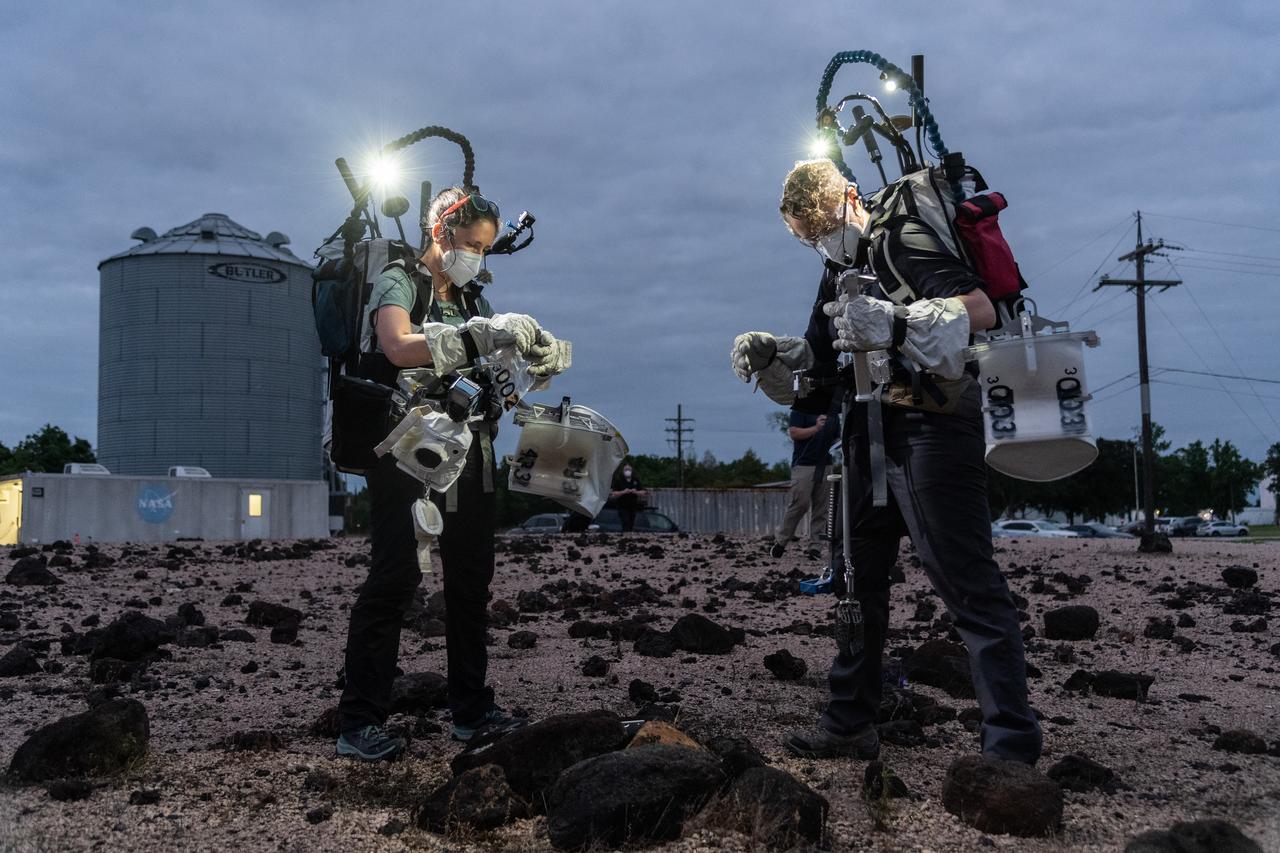
Test subjects Kelsey Young and Tess Caswell evaluate lunar field geology tasks as part of the Exploration Extravehicular Activity (xEVA) night operations development tests conducted at Johnson Space Center’s Rock Yard.
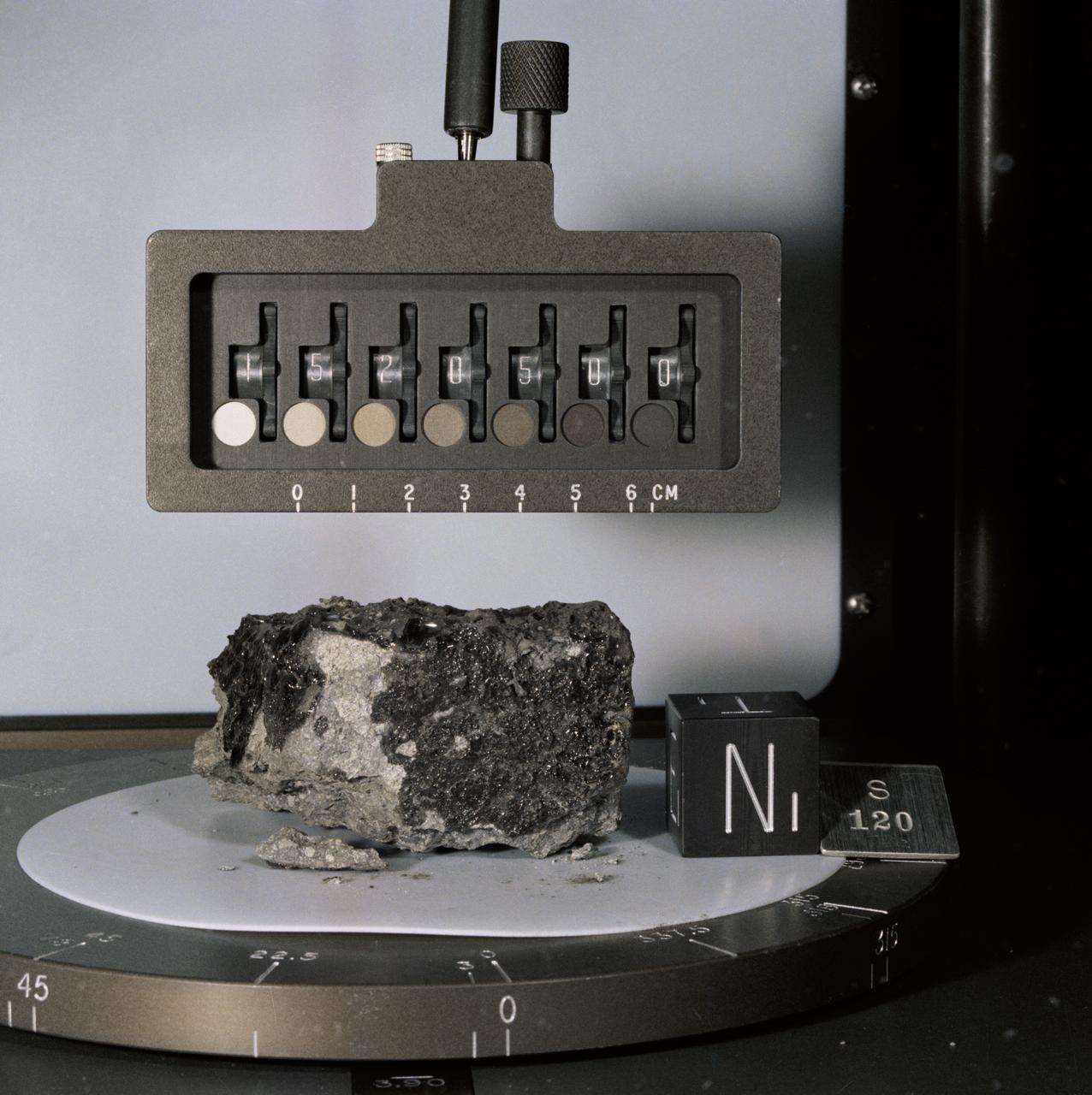
Generic: 15205. Mission: Apollo 15. Station: 2. Landmark: ST. GEORGE CRATER. BagNumber: SCB 1 161. OrignalWeight: 337.3. SuperClass: Breccia. SubClass: Regolith. Category: ROCK . Classifications: Glass-coated. Description: Glass-coated. Classificaiton 1: BRECCIA.
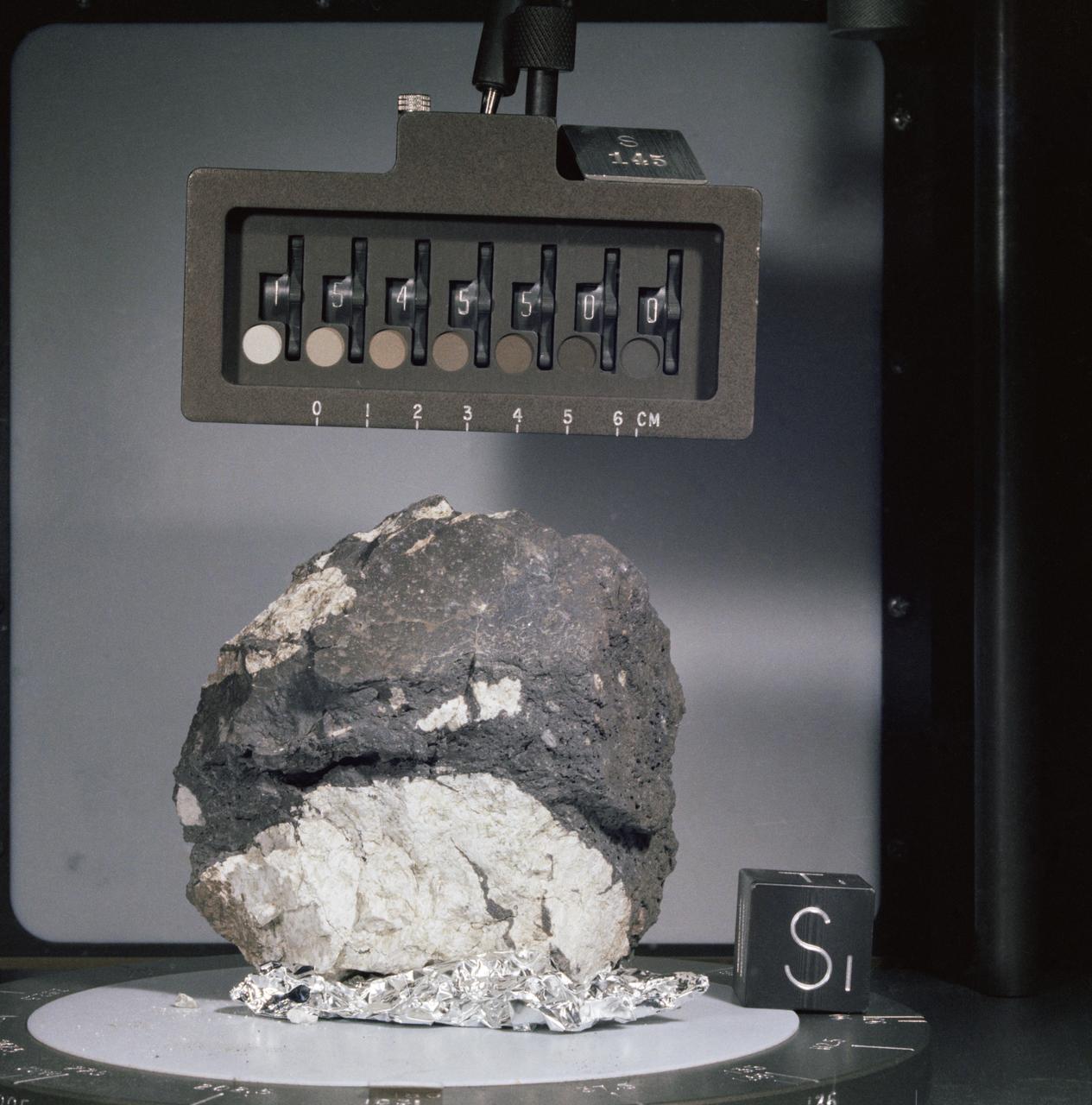
Generic: 15556. Mission: Apollo 15. Station: 9A. Landmark: HADLEY RILLE. BagNumber: SCB 2. OriginalWeight: 1542. SuperClass: Basalt. SubClass: Olivine. Category: ROCK. Classifications: F.G. ol-norm . Description: F.G. ol-norm. Classification 1: BASALT.
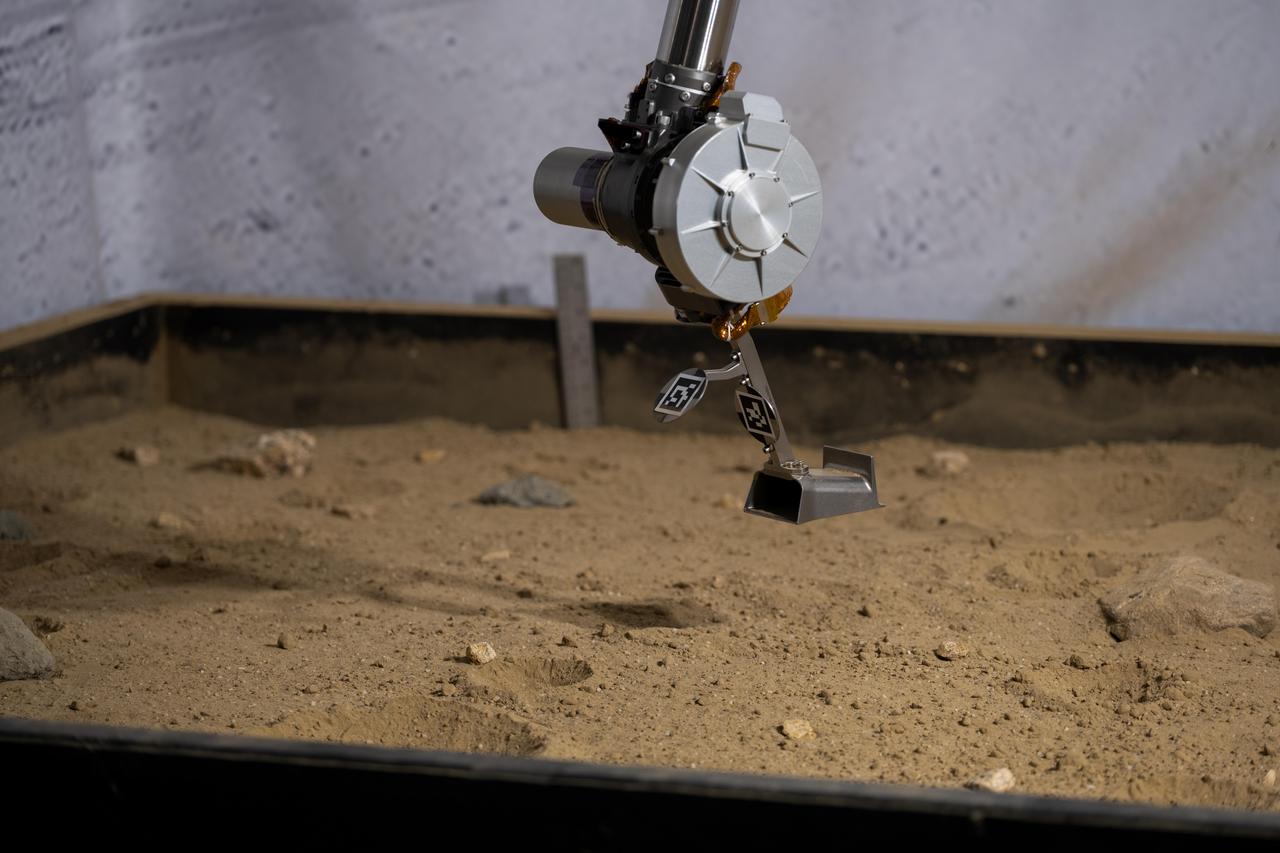
The 3D-printed titanium scoop of the Cold Operable Lunar Deployable Arm (COLDArm) robotic arm system is poised above a test bed filled with material to simulate lunar regolith (broken rocks and dust) at NASA's Jet Propulsion Laboratory in Southern California. COLDArm can function in temperatures as cold as minus 280 degrees Fahrenheit (minus 173 degrees Celsius). COLDArm is designed to go on a Moon lander and operate during lunar night, a period that lasts about 14 Earth days. Frigid temperatures during lunar night would stymie current spacecraft, which must rely on energy-consuming heaters to stay warm. To operate in the cold, the 6-foot-6-inch (2-meter) arm combines several key new technologies: gears made of bulk metallic glass that require no lubrication or heating, cold motor controllers that don't need to be kept warm in an electronics box near the core of the spacecraft, and a cryogenic six-axis force torque sensor that lets the arm "feel" what it's doing and make adjustments. A variety of attachments and small instruments could go on the end of the arm, including the scoop, which could be used for collecting samples from a planet's surface. Like the arm on NASA's InSight Mars lander, COLDArm could deploy science instruments to the surface. https://photojournal.jpl.nasa.gov/catalog/PIA25318
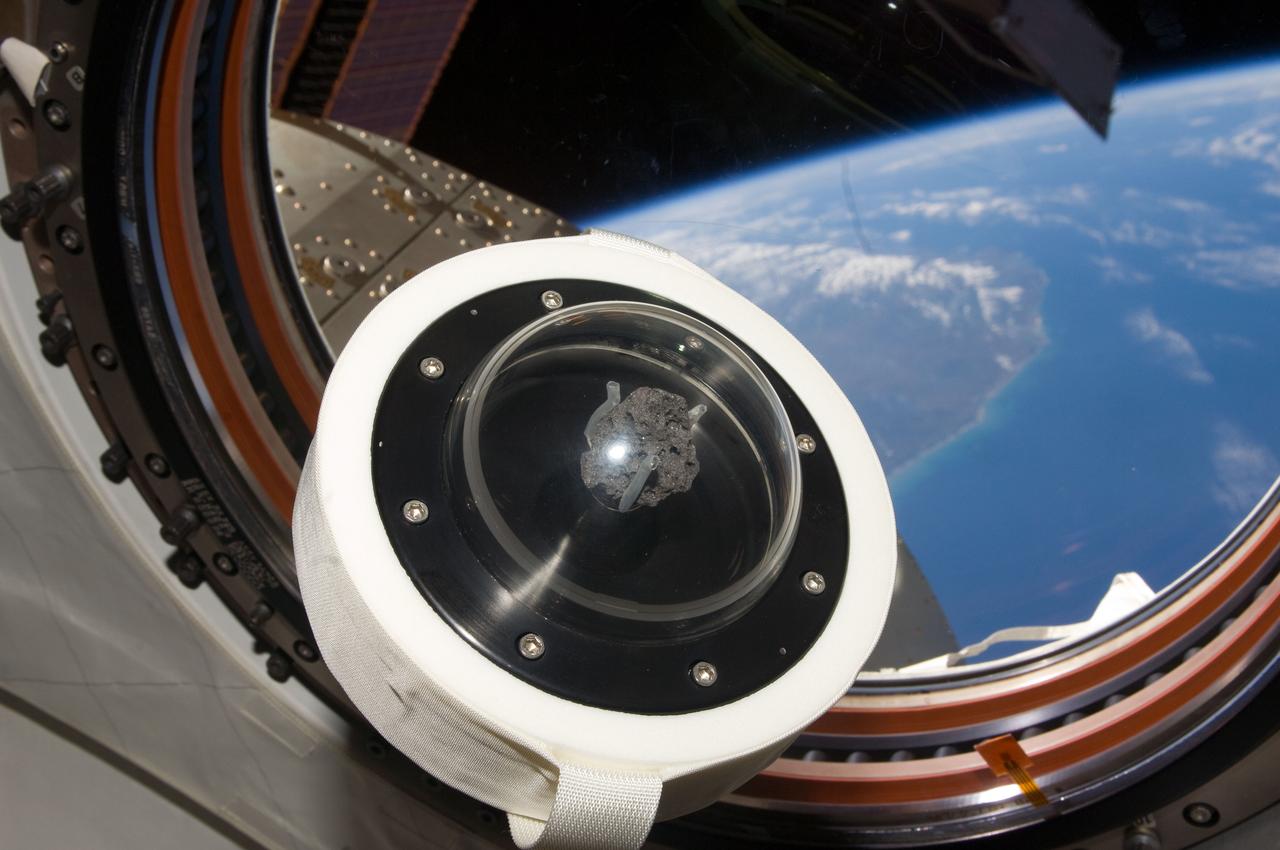
ISS020-E-014193 (FOR RELEASE 21 JULY 2009) --- A moon rock brought to Earth by Apollo 11, humans? first landing on the moon in July 1969, is shown as it floats aboard the International Space Station. Part of Earth can be seen through the window. The 3.6 billion year-old lunar sample was flown to the station aboard Space Shuttle mission STS-119 in April 2009 in honor of the July 2009 40th anniversary of the historic first moon landing. The rock, lunar sample 10072, was flown to the station to serve as a symbol of the nation?s resolve to continue the exploration of space. It will be returned on shuttle mission STS-128 to be publicly displayed.
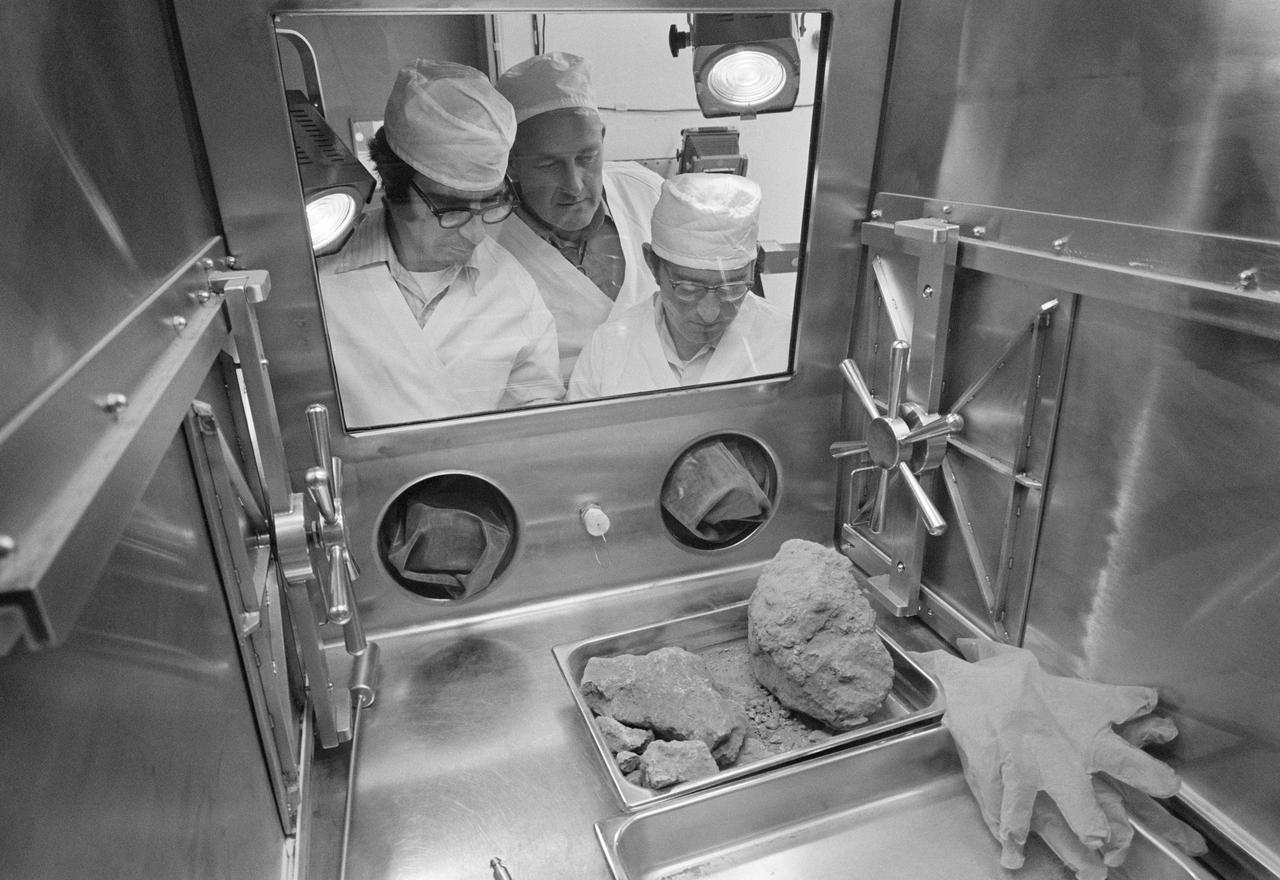
S72-38463 (19 May 1972) --- In an isolated area of the Manned Spacecraft Center's Lunar Receiving Laboratory, geologists Don Morrison (left) and Fred Horz flank University of Texas geologist/professor William (Bill) Muehlberger as the three look at a "special" rock brought back from the moon recently by the Apollo 16 astronauts. Lunar sample 61016, better known as "Big Muley," is a large breccia sample, the largest moon rock returned by any Apollo crew, which is named after Muehlberger, the Apollo 16 field geology team leader. Photo credit: NASA
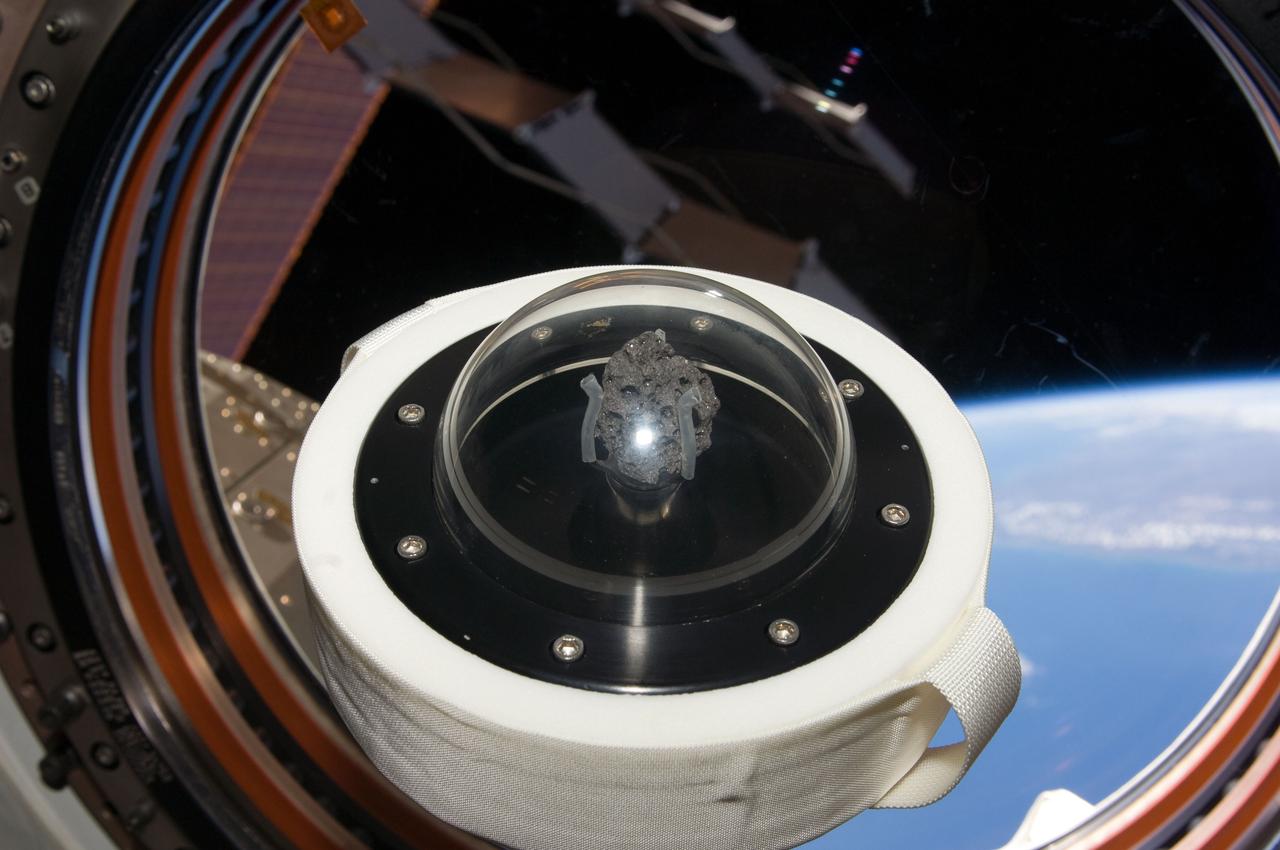
ISS020-E-14196 (FOR RELEASE 21 JULY 2009) --- A moon rock brought to Earth by Apollo 11, humans? first landing on the moon in July 1969, is shown as it floats aboard the International Space Station. Part of Earth can be seen through the window. The 3.6 billion year-old lunar sample was flown to the station aboard Space Shuttle mission STS-119 in April 2009 in honor of the July 2009 40th anniversary of the historic first moon landing. The rock, lunar sample 10072, was flown to the station to serve as a symbol of the nation?s resolve to continue the exploration of space. It will be returned on shuttle mission STS-128 to be publicly displayed.
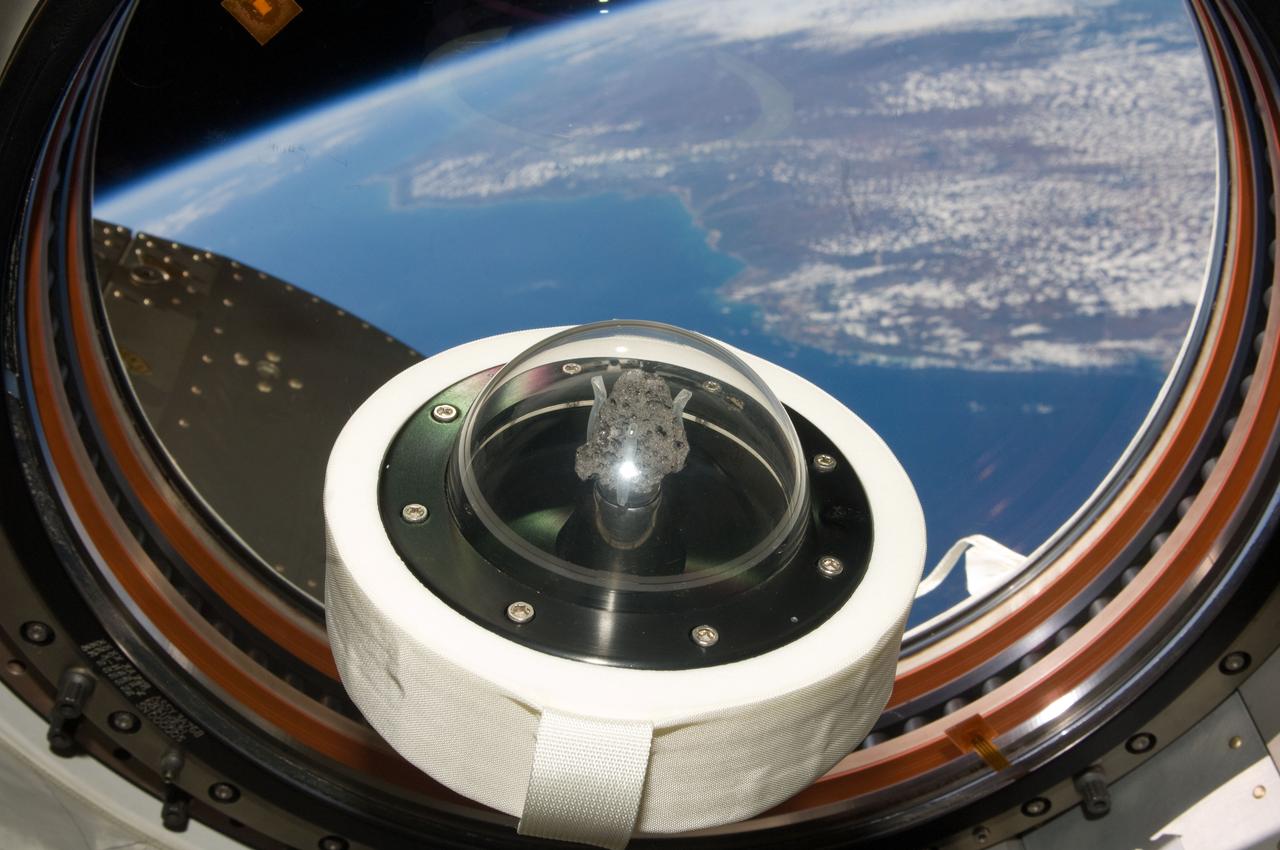
ISS020-E-14200 (FOR RELEASE 21 JULY 2009) --- A moon rock brought to Earth by Apollo 11, humans? first landing on the moon in July 1969, is shown as it floats aboard the International Space Station. Part of Earth can be seen through the window. The 3.6 billion year-old lunar sample was flown to the station aboard Space Shuttle mission STS-119 in April 2009 in honor of the July 2009 40th anniversary of the historic first moon landing. The rock, lunar sample 10072, was flown to the station to serve as a symbol of the nation?s resolve to continue the exploration of space. It will be returned on shuttle mission STS-128 to be publicly displayed.
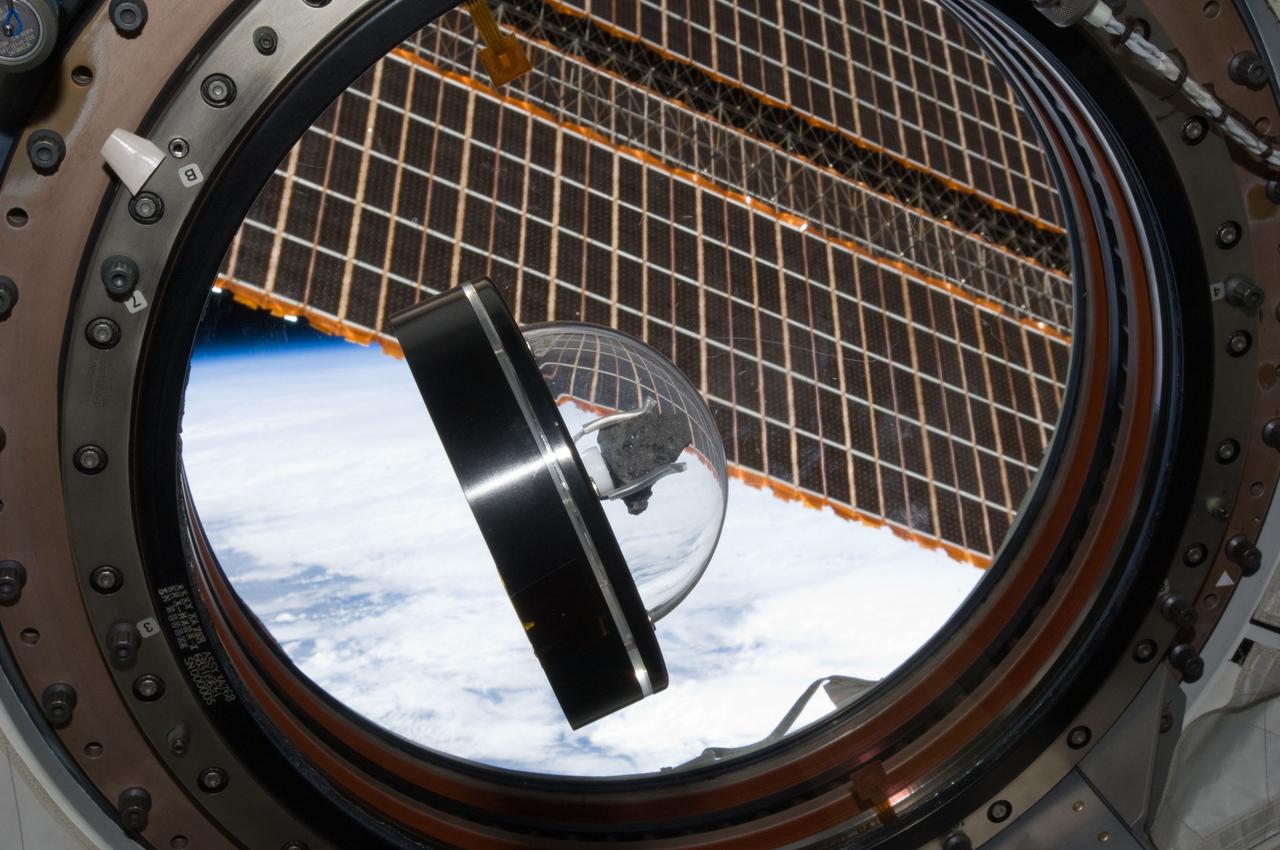
ISS020-E-007383 (FOR RELEASE 21 JULY 2009) --- A moon rock brought to Earth by Apollo 11, humans? first landing on the moon in July 1969, is shown as it floats aboard the International Space Station. Part of Earth and a section of a station solar panel can be seen through the window. The 3.6 billion year-old lunar sample was flown to the station aboard Space Shuttle mission STS-119 in April 2009 in honor of the July 2009 40th anniversary of the historic first moon landing. The rock, lunar sample 10072, was flown to the station to serve as a symbol of the nation?s resolve to continue the exploration of space. It will be returned on shuttle mission STS-128 to be publicly displayed.
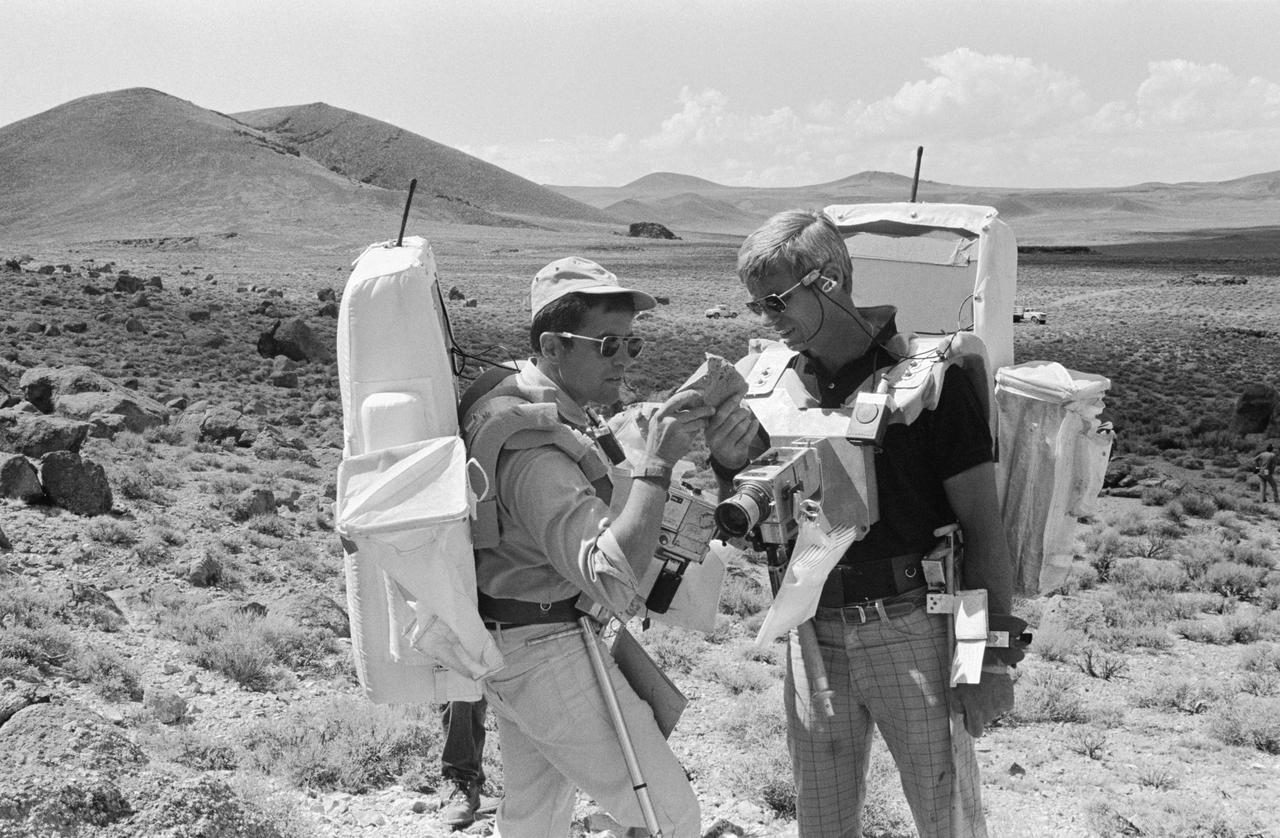
S72-48859 (6 Sept. 1972) --- Two members of the prime crew of the Apollo 17 lunar landing mission examine a rock specimen during lunar surface extravehicular activity simulation training on a geological field trip to the Pancake Range area of south-central Nevada. They are astronauts Eugene A. Cernan (right), commander; and Harrison H. Schmitt, lunar module pilot.
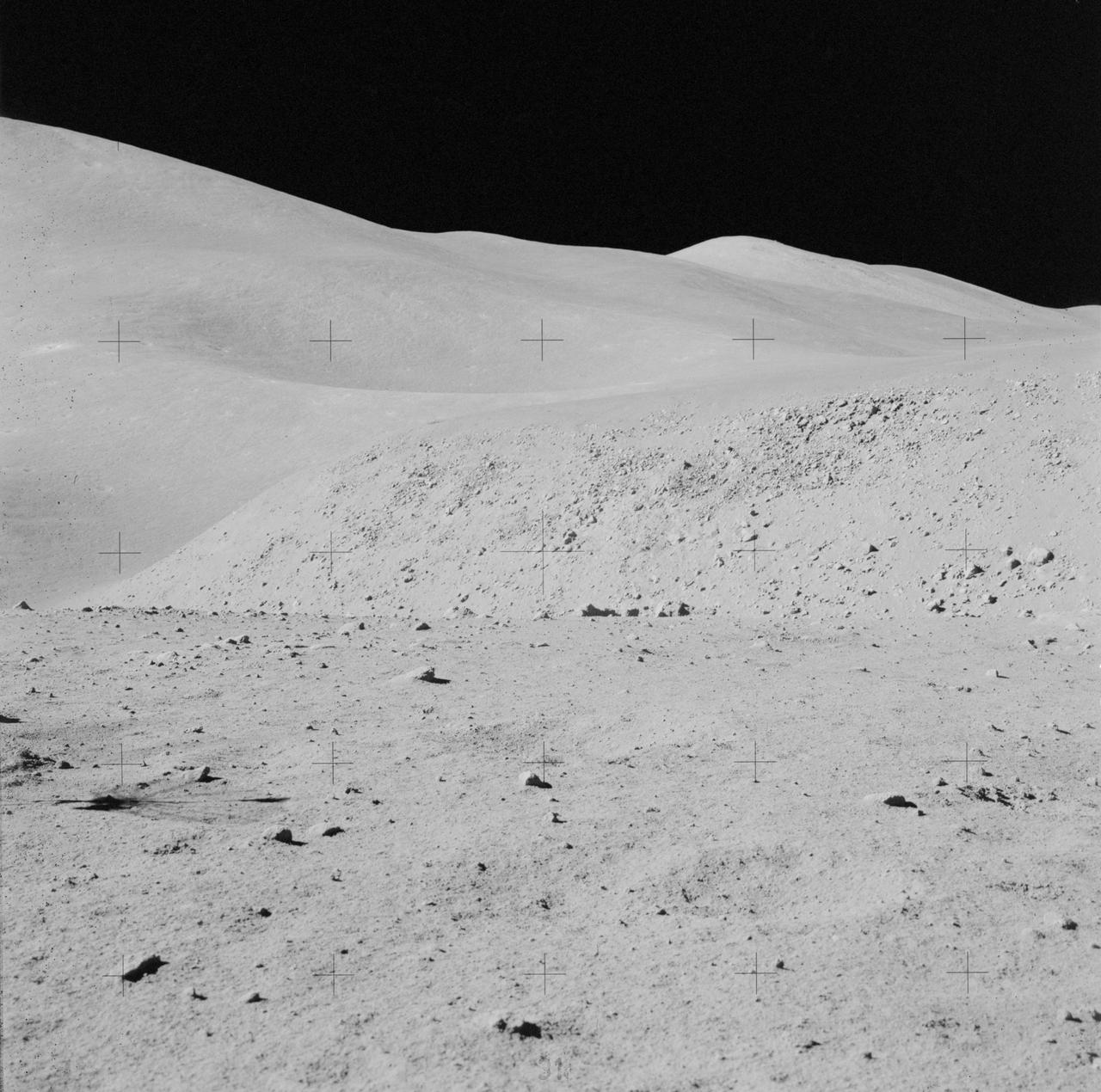
AS15-82-11123 (2 Aug. 1971) --- A view of the "strewn rock" scene encountered by Apollo 15 astronauts David R. Scott, commander, and James B. Irwin, lunar module pilot, during their third extravehicular activity (EVA) of the mission. Irwin took this photograph with a handheld 70mm camera. While astronauts Scott and Irwin descended in the Lunar Module (LM) "Falcon" to explore the moon, astronaut Alfred M. Worden, command module pilot, remained with the Command and Service Modules (CSM) in lunar orbit.
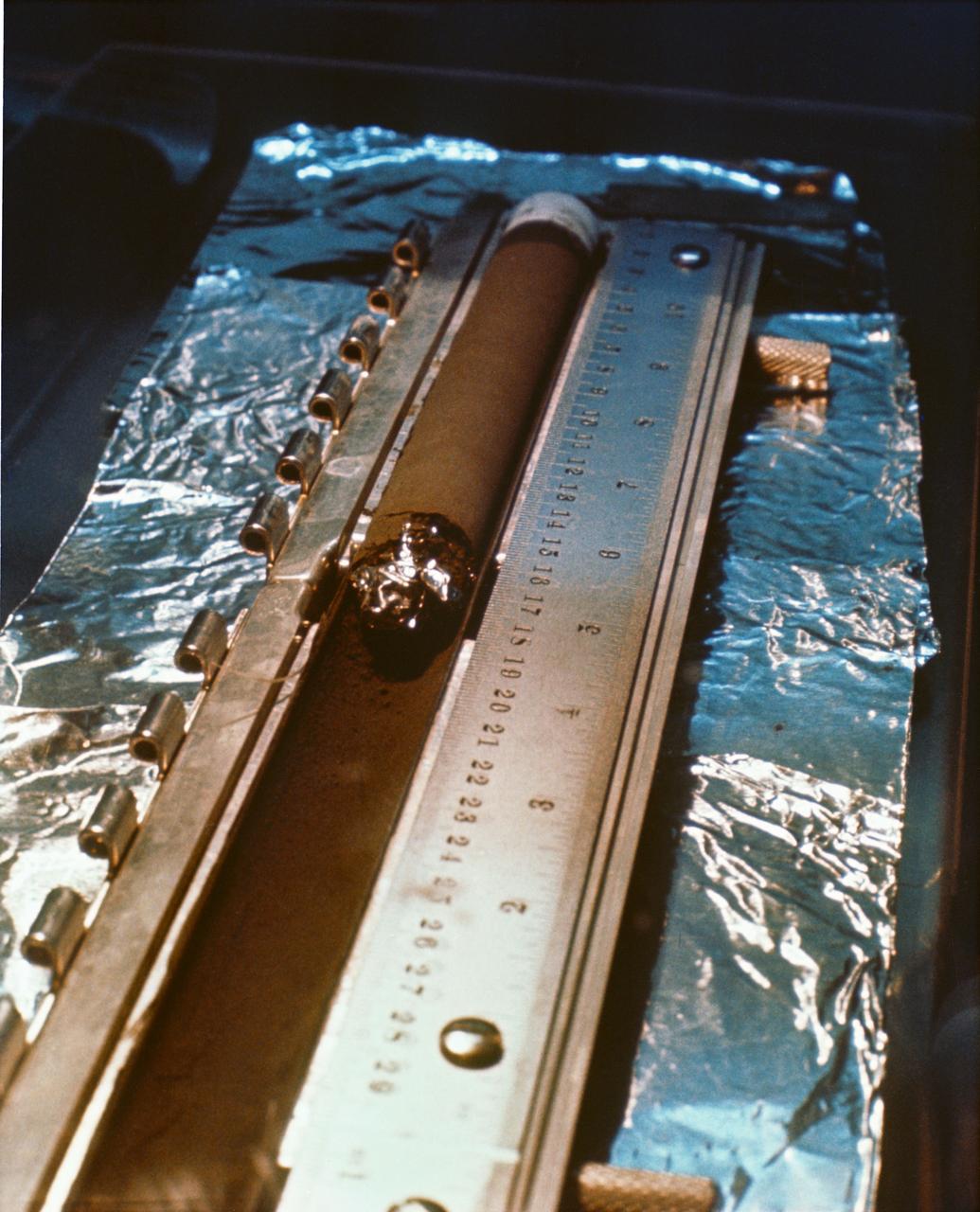
S69-40945 (August 1969) --- This is a core tube sample under study and examination in the Manned Spacecraft Center?s (MSC) Lunar Receiving Laboratory (LRL). The sample was among lunar soil and rock samples collected by astronauts Neil A. Armstrong and Edwin E. Aldrin Jr. during their extravehicular activity (EVA) on July 20, 1969. While astronauts Armstrong, commander; and Aldrin, lunar module pilot; descended in the Apollo 11 Lunar Module (LM) "Eagle" to explore the Sea of Tranquility landing site on the moon. Astronaut Michael Collins, command module pilot, remained with the Command and Service Modules (CSM) "Columbia" in lunar orbit.
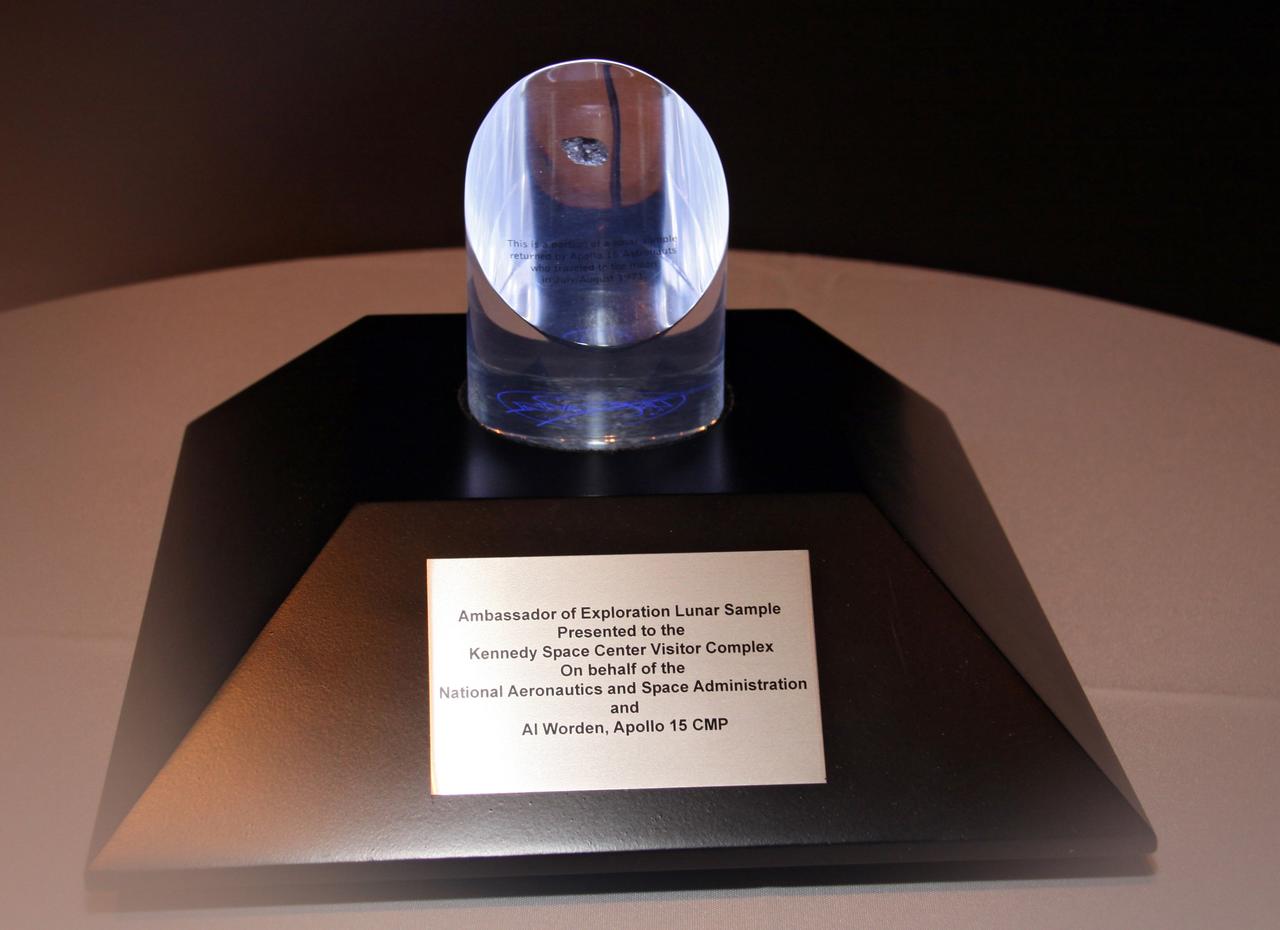
CAPE CANAVERAL, Fla. – NASA will honor Apollo astronaut Al Worden with the presentation of this Ambassador of Exploration Award, a moon rock encased in Lucite, mounted for public display. He is being honored for his contributions to the U.S. space program. Worden received the award during a ceremony July 30 at the Apollo Saturn V Center at NASA's Kennedy Space Center Visitor Complex in Florida, where the moon rock will be displayed. Worden served as command module pilot for the Apollo 15 mission, which set several moon records for NASA, including the longest lunar surface stay time, the longest lunar extravehicular activity and the first use of a lunar roving vehicle. Worden spent 38 minutes in a spacewalk outside the command module and logged a total of 295 hours, 11 minutes in space during the mission. NASA is giving the Ambassador of Exploration Award to the first generation of explorers in the Mercury, Gemini and Apollo space programs for realizing America's goal of going to the moon. The rock is part of the 842 pounds of lunar samples collected during six Apollo expeditions from 1969 to 1972. Those astronauts who receive the award will then present the award to a museum of their choice. Photo credit: NASA/Jack Pfaller

This is the Apollo 16 lunar landing mission crew portrait. Pictured from left to right are: Thomas K. Mattingly II, Command Module pilot; John W. Young, Mission Commander; and Charles M. Duke Jr., Lunar Module pilot. Launched from the Kennedy Space Center on April 16, 1972, Apollo 16 spent three days on Earth's Moon. The first study of the highlands area, the landing site for Apollo 16 was the Descartes Highlands. The fifth lunar landing mission out of six, Apollo 16 was famous for deploying and using an ultraviolet telescope as the first lunar observatory. The telescope photographed ultraviolet light emitted by Earth and other celestial objects. The Lunar Roving Vehicle, developed by the Marshall Space Flight Center, was also used for collecting rocks and data on the mysterious lunar highlands. In this photo, astronaut John W. Young photographs Charles M. Duke, Jr. collecting rock samples at the Descartes landing site. Duke stands by Plum Crater while the Lunar Roving Vehicle waits parked in the background. High above, Thomas K. Mattingly orbits in the Command Module. The mission ended April 27, 1972 as the crew splashed down into the Pacific Ocean.
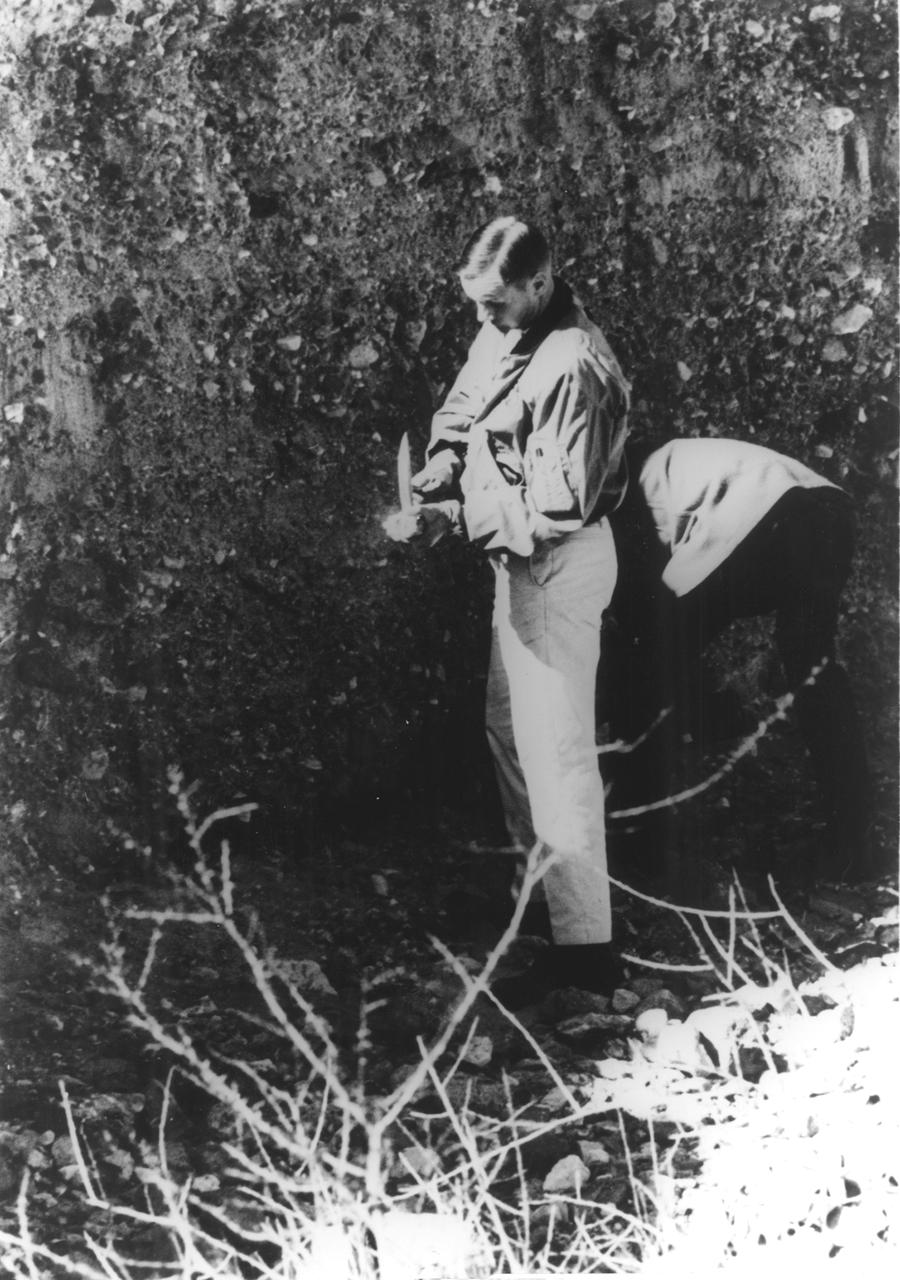
In this photograph, Apollo 11 astronaut Neil A. Armstrong uses a geologist’s hammer in selecting rock specimens during a geological field trip to the Quitman Mountains area near the Fort Quitman ruins in far west Texas. Armstrong, alongside astronaut Edwin (Buzz) Aldrin, practiced gathering rock specimens using special lunar geological tools in preparation for the first Lunar landing. Mission was accomplished in July of the same year. Aboard the Marshall Space Fight center (MSFC) developed Saturn V launch vehicle, the Apollo 11 mission launched from The Kennedy Space Center, Florida on July 16, 1969 and safely returned to Earth on July 24, 1969. The 3-man crew aboard the flight consisted of Armstrong, commander; Aldrin, Lunar Module pilot; and a third astronaut Michael Collins, Command Module pilot. Armstrong was the first human to ever stand on the lunar surface, followed by Aldrin, while Collins remained in lunar orbit. The crew collected 47 pounds of lunar surface material which was returned to Earth for analysis. The lunar surface exploration was concluded in 2½ hours.
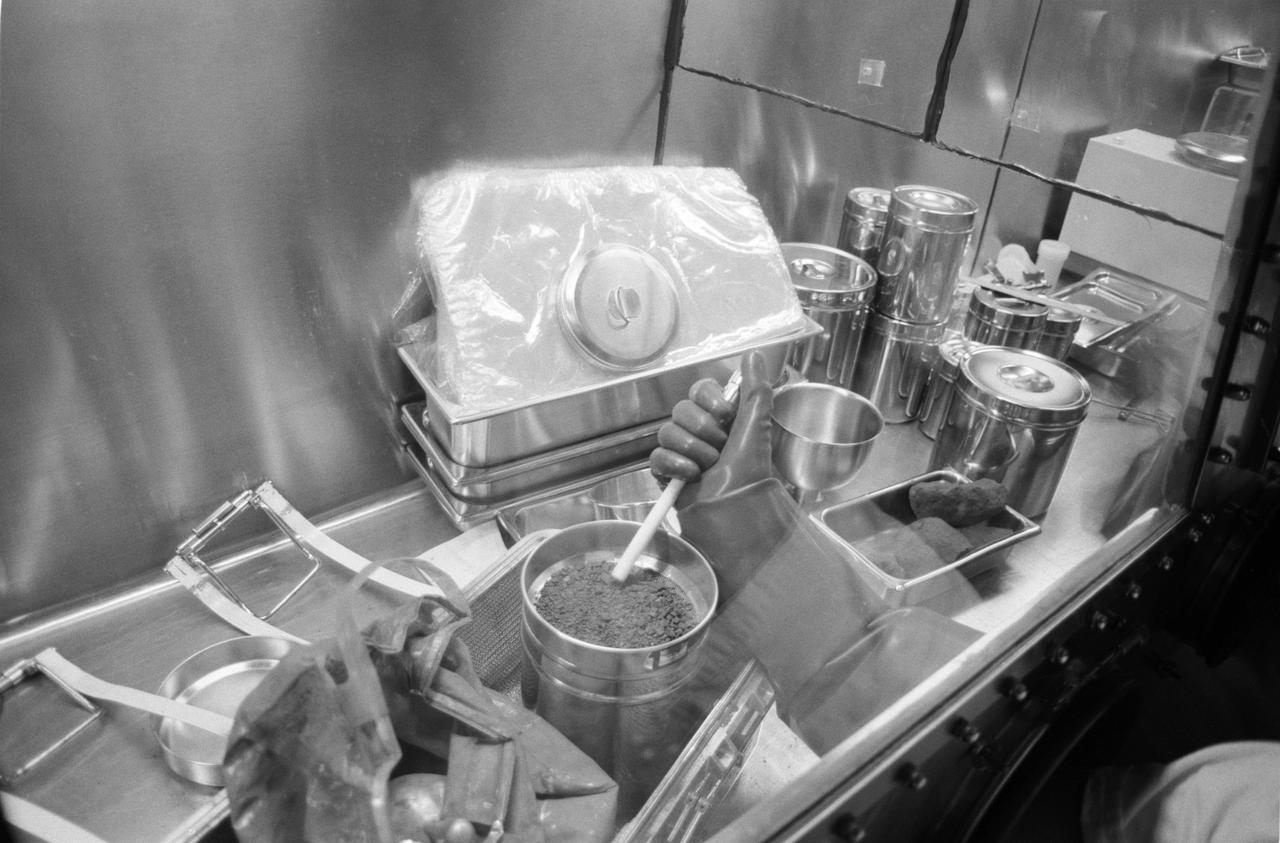
S69-45507 (4 Aug. 1969) --- A close-up of the second Apollo 11 sample return container in the Vacuum Laboratory of the Manned Spacecraft Center’s Lunar Receiving Laboratory, Building 37. This rock box was opened for the first time at 1 p.m. (CDT), Aug. 4, 1969. Some of the material has already been removed from the ALSRC in this view. The stainless steel can contains some course lunar surface material. The lunar samples were collected by astronauts Neil A. Armstrong and Edwin E. Aldrin Jr. during their lunar surface extravehicular activity on July 20, 1969.
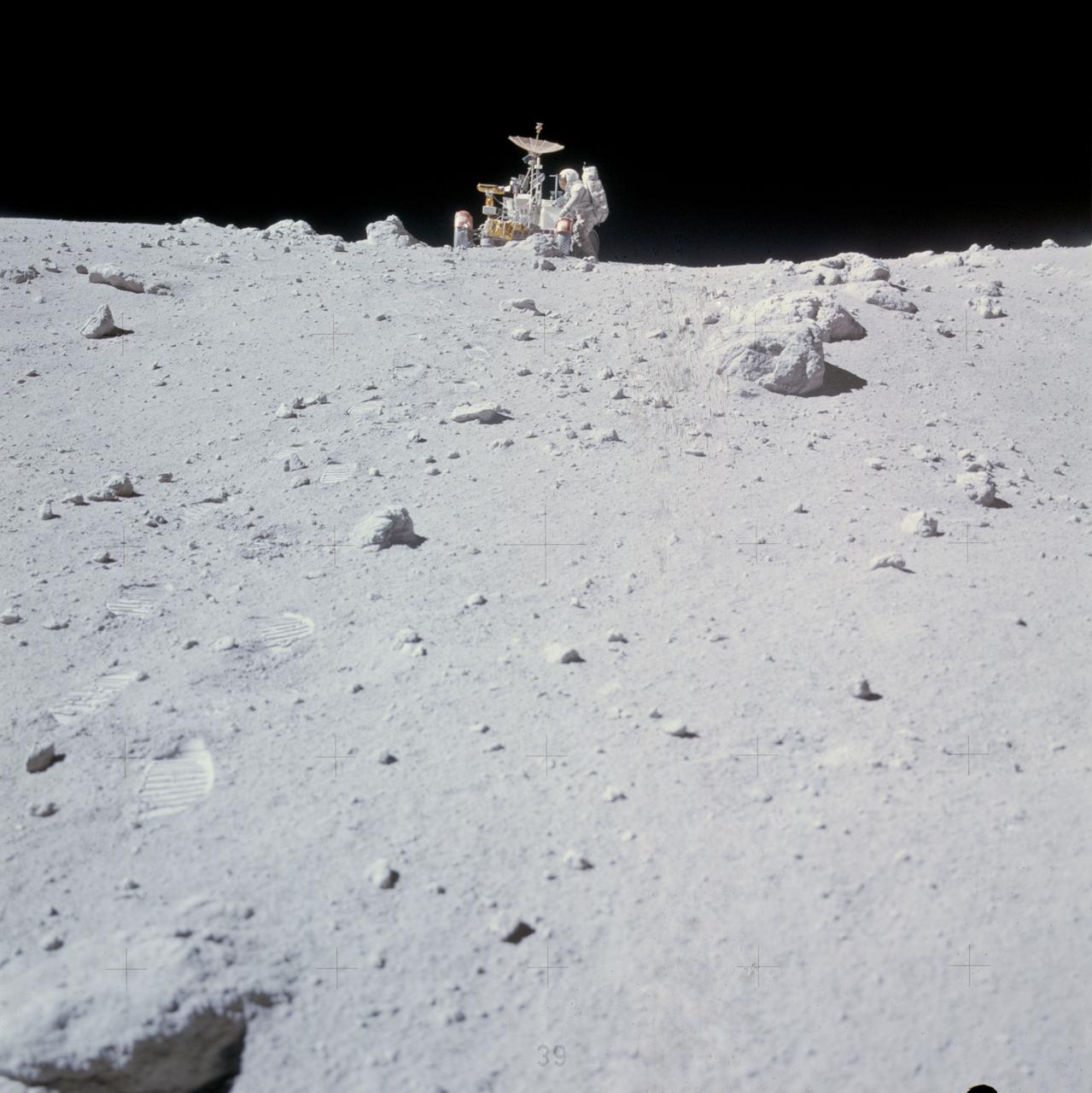
AS16-116-18607 (23 April 1972) --- Astronaut Charles M. Duke Jr. works at the front of the Lunar Roving Vehicle (LRV) parked in this rock field at a North Ray Crater geological site during the mission's third extravehicular activity (EVA) on April 23, 1972. Astronaut John W. Young took this picture with a 70mm Hasselblad camera. While astronauts Young, commander; and Duke, lunar module pilot; descended in the Apollo 16 Lunar Module (LM) "Orion" to explore the Descartes highlands landing site on the moon, astronaut Thomas K. Mattingly II, command module pilot, remained with the Command and Service Modules (CSM) "Casper" in lunar orbit.
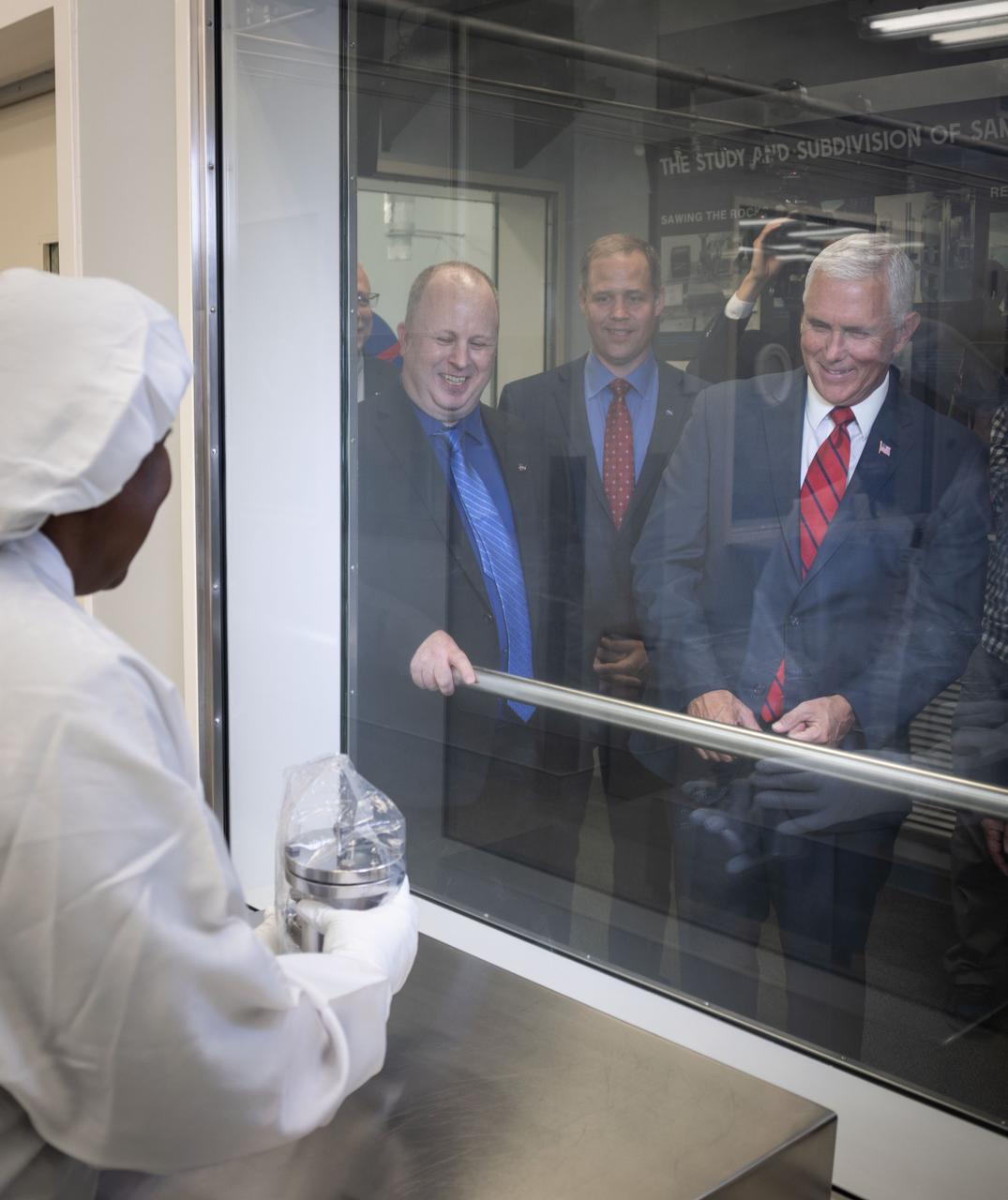
jsc2018e076655 (Aug. 23, 2018) --- Vice President Mike Pence visited NASA’s Johnson Space Center in Houston on Aug. 23, 2018, to discuss the future of space exploration and other elements of human spaceflight. During his trip to the Johnson Space Center, the Vice President also toured the laboratory housing the moon rocks retrieved during the Apollo program’s lunar missions and extraterrestrial samples from other uncrewed sample return missions. Apollo Lunar Sample Principle Scientist Andrea Mosie held a lunar sample up for inspection by the Vice President, who was joined in the viewing room behind protective glass by Apollo Lunar Sample Curator Ryan Ziegler.
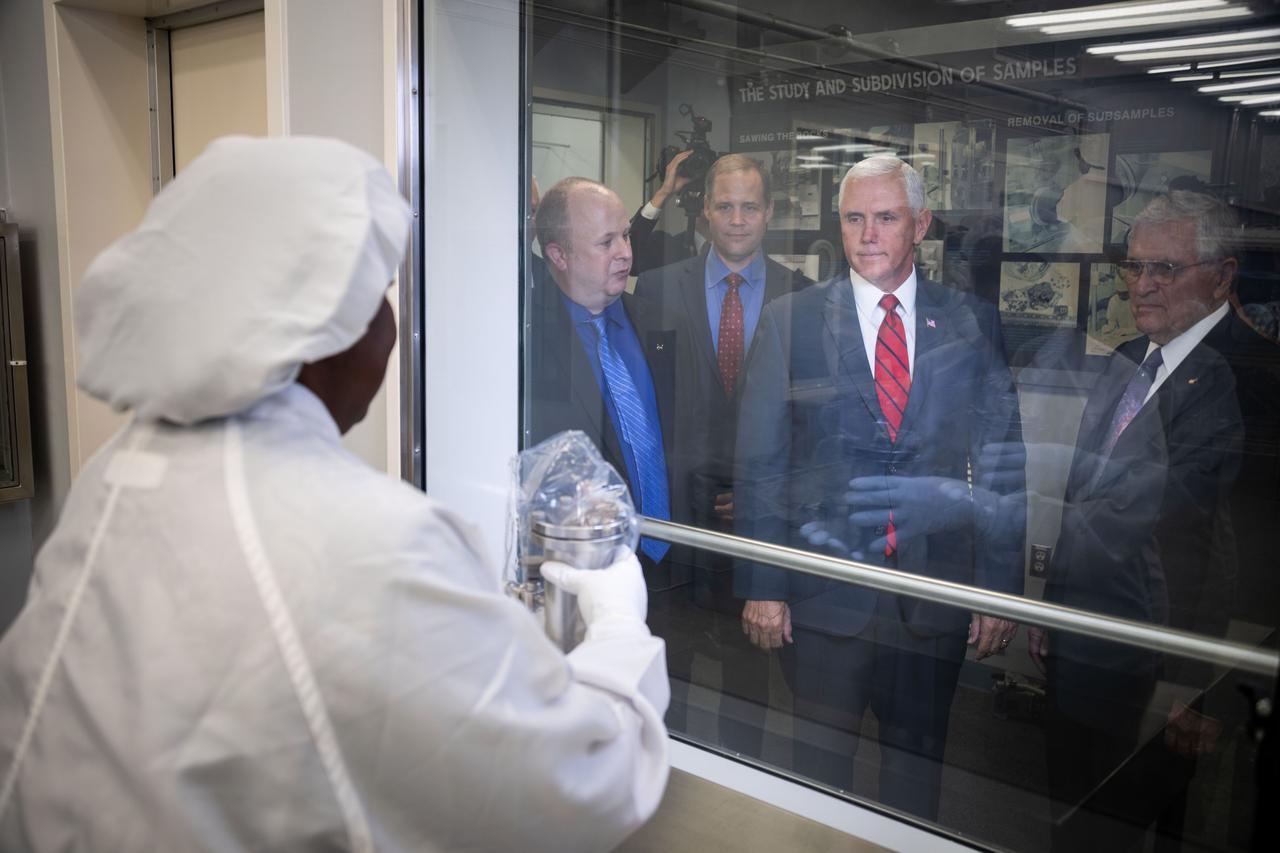
jsc2018e076652 (Aug. 23, 2018) --- Vice President Mike Pence visited NASA’s Johnson Space Center in Houston on Aug. 23, 2018, to discuss the future of space exploration and other elements of human spaceflight. During his trip to the Johnson Space Center, the Vice President also toured the laboratory housing the moon rocks retrieved during the Apollo program’s lunar missions and extraterrestrial samples from other uncrewed sample return missions. Apollo Lunar Sample Principle Scientist Andrea Mosie held a lunar sample up for inspection by the Vice President, who was joined in the viewing room behind protective glass by Apollo Lunar Sample Curator Ryan Ziegler.
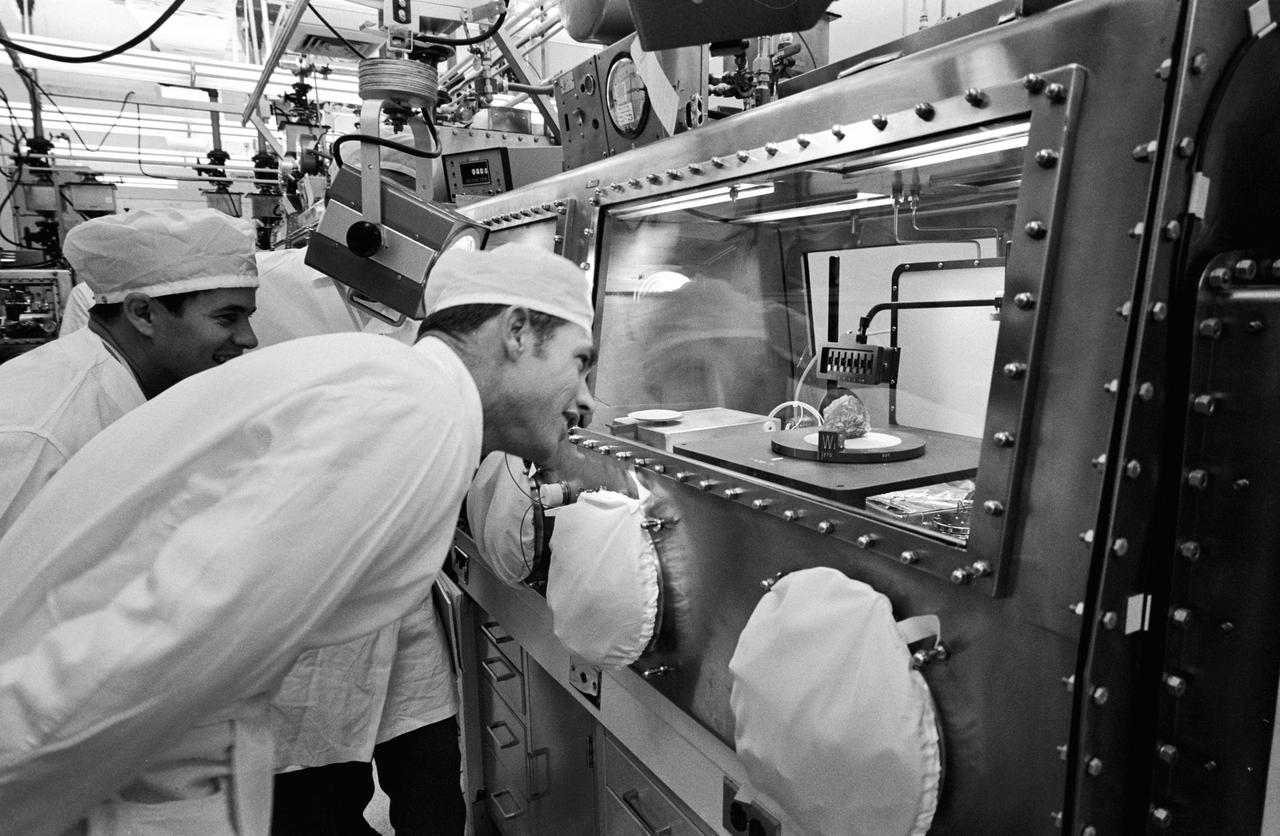
S71-43477 (12 Aug. 1971) --- Astronaut David R. Scott, right, commander of the Apollo 15 mission, gets a close look at the sample referred to as "Genesis rock" in the Non-Sterile Nitrogen Processing Line (NNPL) in the Lunar Receiving Laboratory (LRL) at the Manned Spacecraft Center (MSC). Scientist-astronaut Joseph P. Allen IV, left, an Apollo 15 spacecraft communicator, looks on with interest. The white-colored rock has been given the permanent identification of 15415.
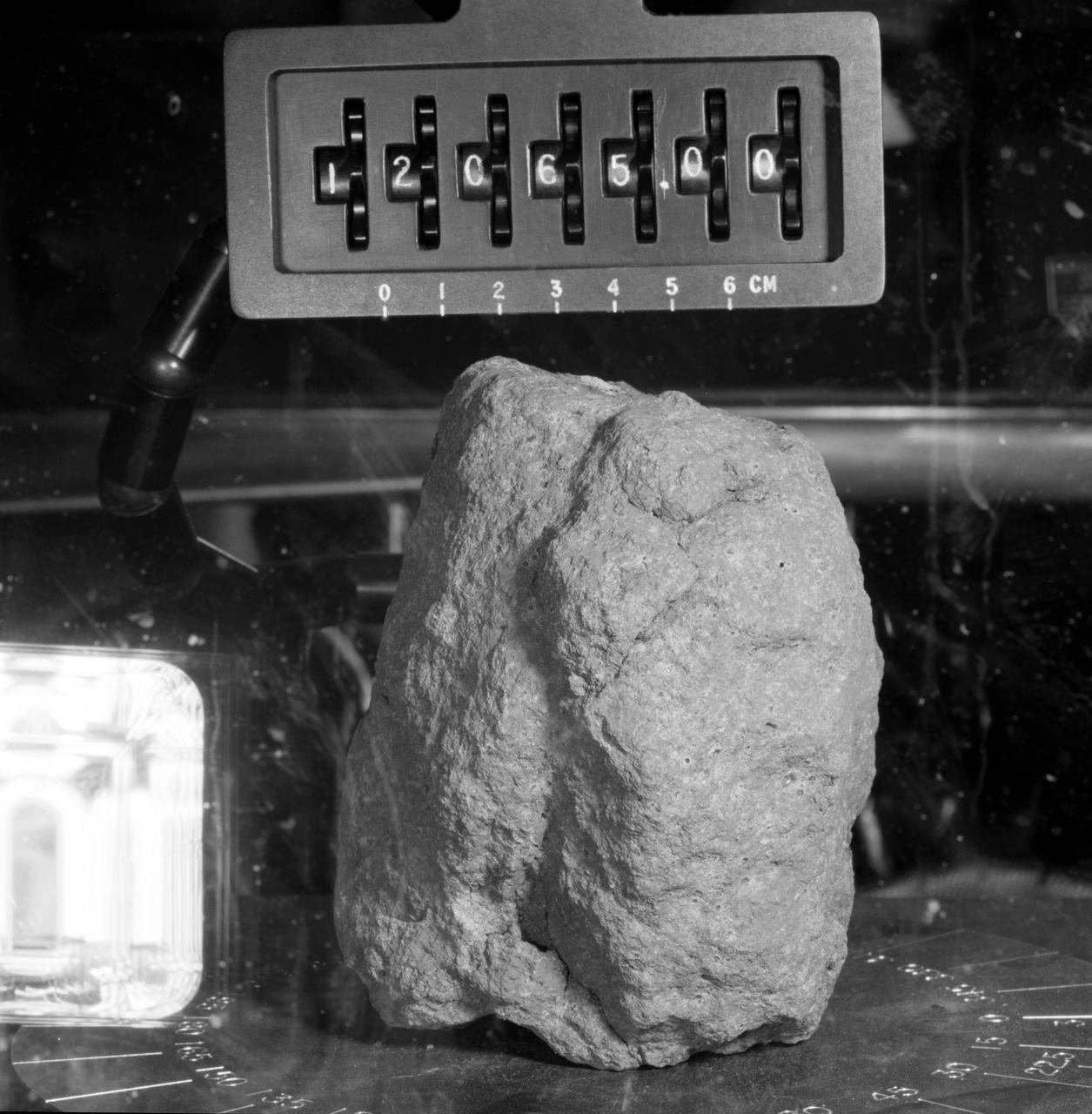
S69-60580 (November 1969) --- Close-up view of Apollo 12 sample 12,065 under observation in the Manned Spacecraft Center's (MSC) Lunar Receiving Laboratory (LRL). This sample, collected during the second Apollo 12 extravehicular activity (EVA) of astronauts Charles Conrad Jr. and Alan L. Bean, is a fine-grained rock. Note the glass-lined pits. Viewer can gain an idea of the size of the rock by reference to the gauge on the bottom portion of the number meter.
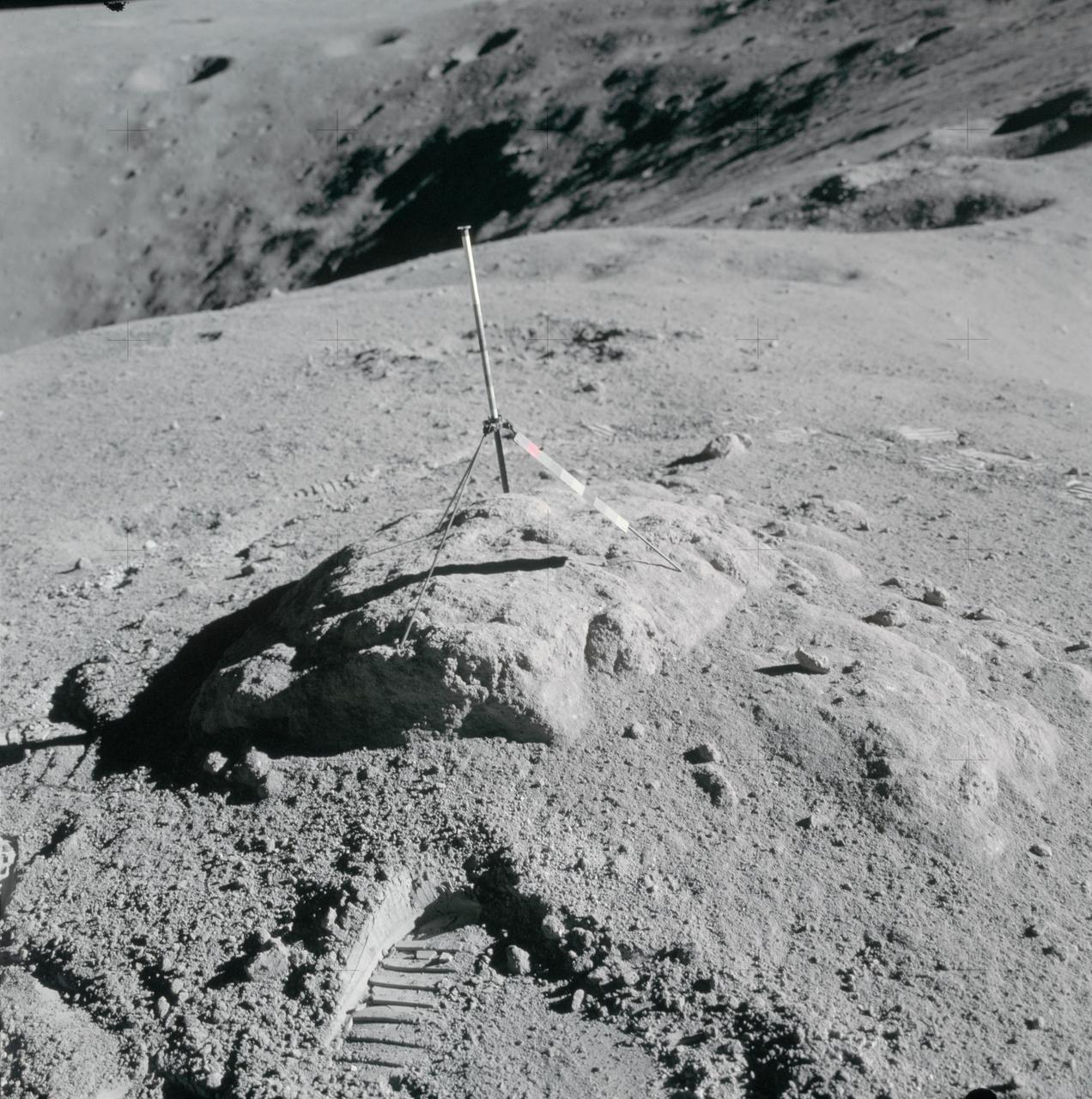
AS16-114-18412 (16-27 April 1972) --- The gnomon and color patch, one of the Apollo Lunar Hand Tools (ALHT), is deployed atop a lunar rock, in this photograph taken by one of the Apollo 16 astronauts during their lunar surface extravehicular activity (EVA) at the Descartes landing site. The gnomon is used as a photographic reference to establish local vertical sun angle, scale, and lunar color. The color patch, mounted on one of the legs of the tripod, provides a larger target for accurately determining colors in color photography. A portion of Flag Crater can be seen in the background. While astronauts John W. Young, commander; and Charles M. Duke Jr., lunar module pilot; descended in the Apollo 16 Lunar Module (LM) "Orion" to explore the Descartes highlands landing site on the moon, astronaut Thomas K. Mattingly II, command module pilot, remained with the Command and Service Modules (CSM) "Casper" in lunar orbit.
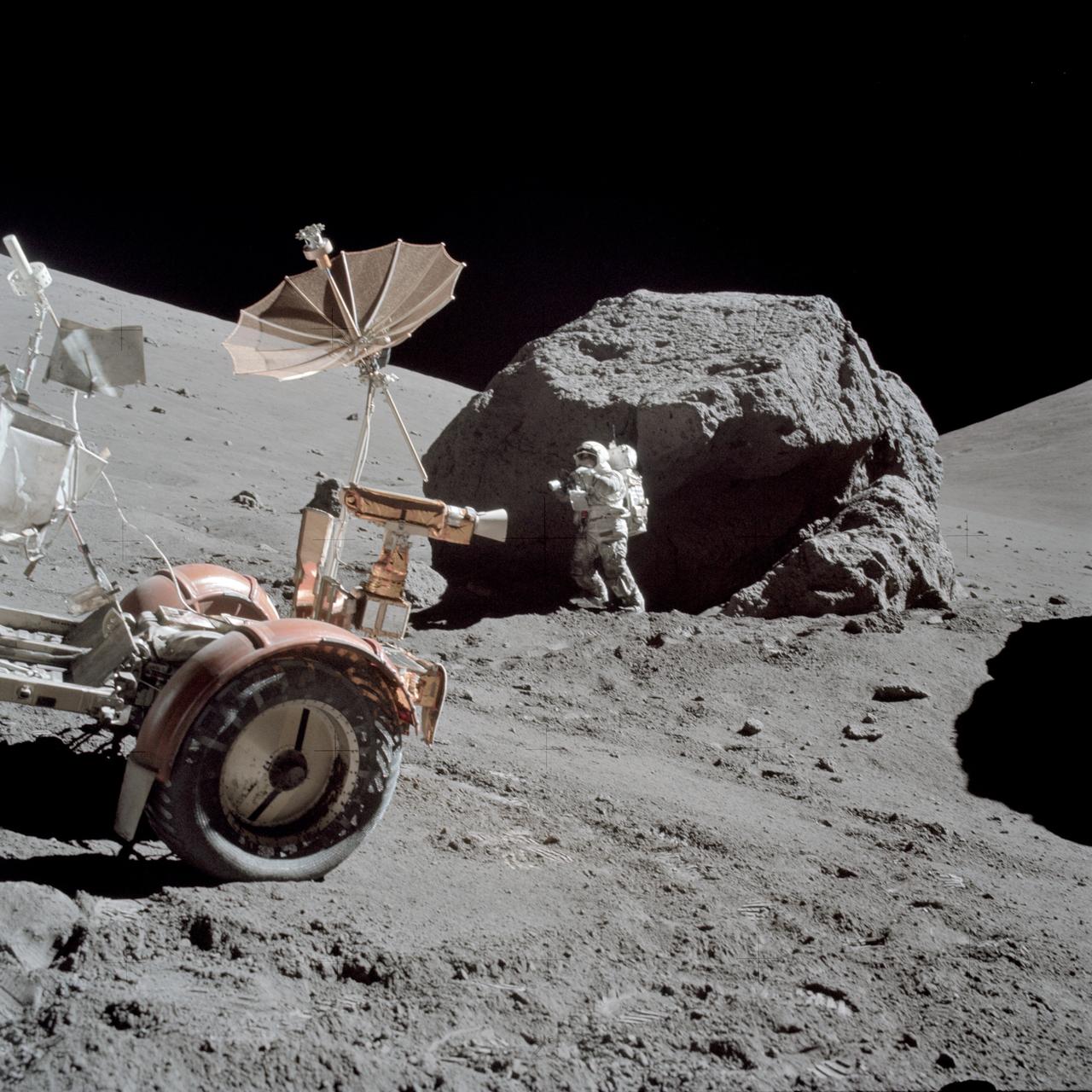
AS17-146-22294 (13 Dec. 1972) --- Scientist-astronaut Harrison H. Schmitt is photographed working beside a huge boulder at Station 6 (base of North Massif) during the third Apollo 17 extravehicular activity (EVA) at the Taurus-Littrow landing site. The front portion of the Lunar Roving Vehicle (LRV) is visible on the left. This picture was taken by astronaut Eugene A. Cernan, Apollo 17 commander. Schmitt is the lunar module pilot. While astronauts Cernan and Schmitt descended in the Lunar Module (LM) "Challenger" to explore the moon, astronaut Ronald E. Evans, command module pilot, remained with the Apollo 17 Command and Service Modules (CSM) in lunar orbit.
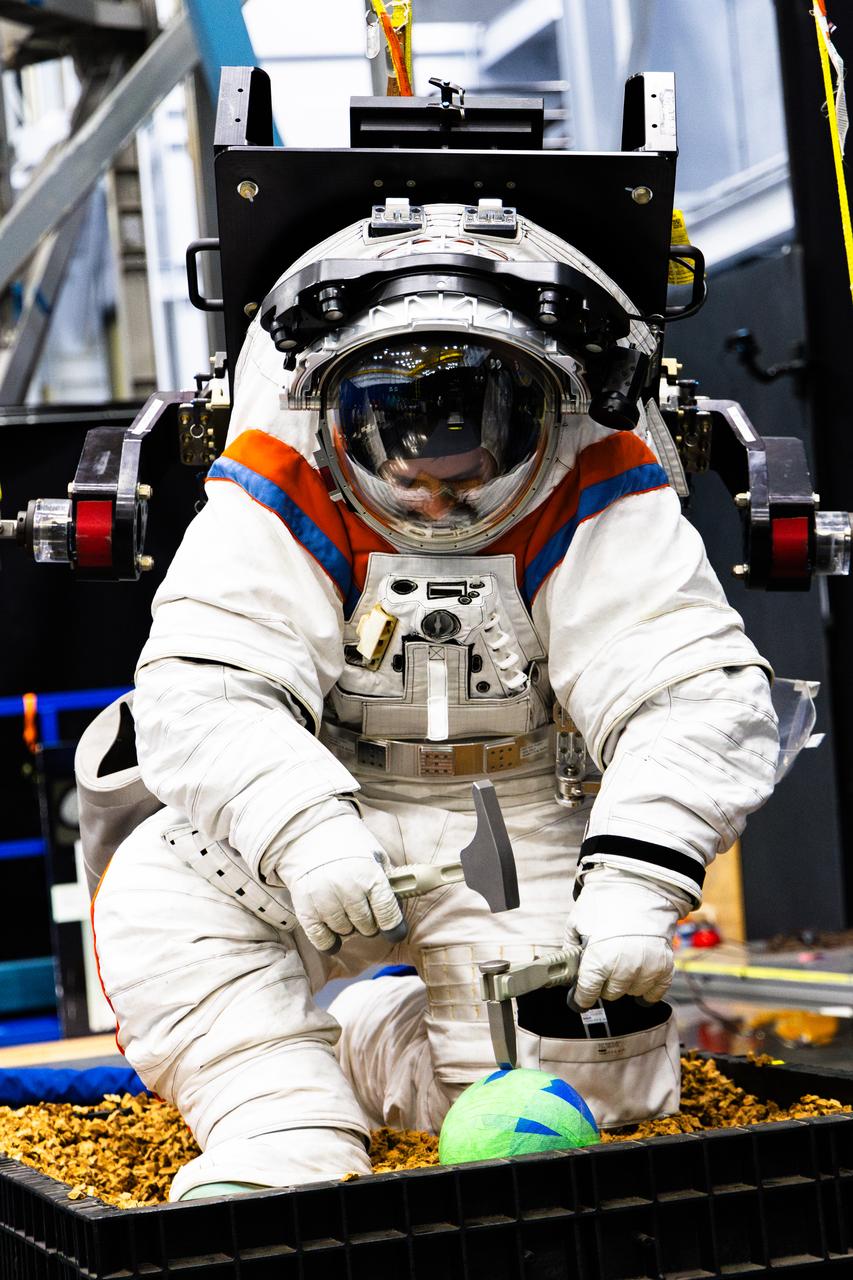
An Axiom Space engineer uses a hammer and chisel to chip off simulated lunar rocks while wearing the AxEMU (Axiom Extravehicular Mobility Unit) spacesuit during testing at NASA’s Johnson Space Center. Image Credit: Axiom Space
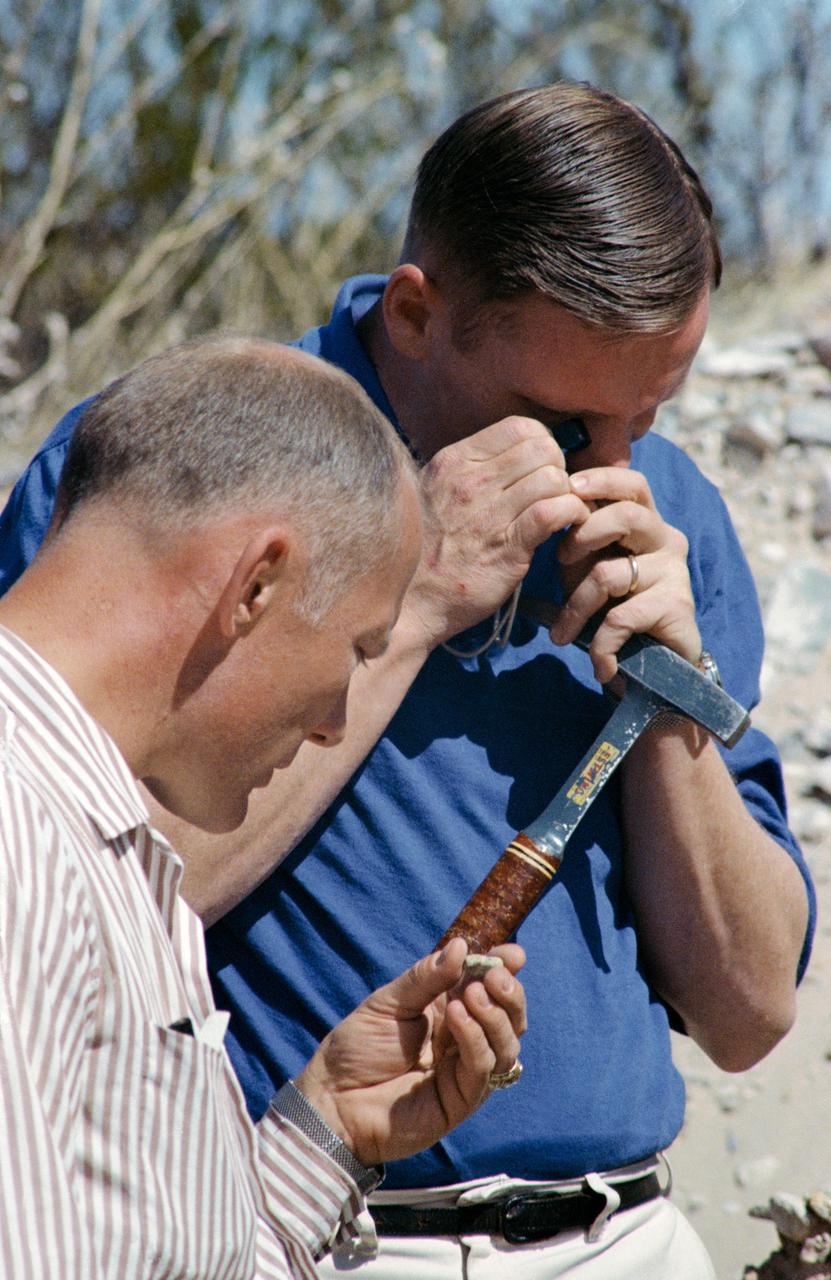
S69-25944 (25 Feb. 1969) --- These two Apollo 11 crew astronauts study rock samples during a geological field trip to the Quitman Mountains area near the Fort Quitman ruins in far west Texas. Neil A. Armstrong (in background) is the Apollo 11 commander; and Edwin E. Aldrin Jr. is the lunar module pilot.
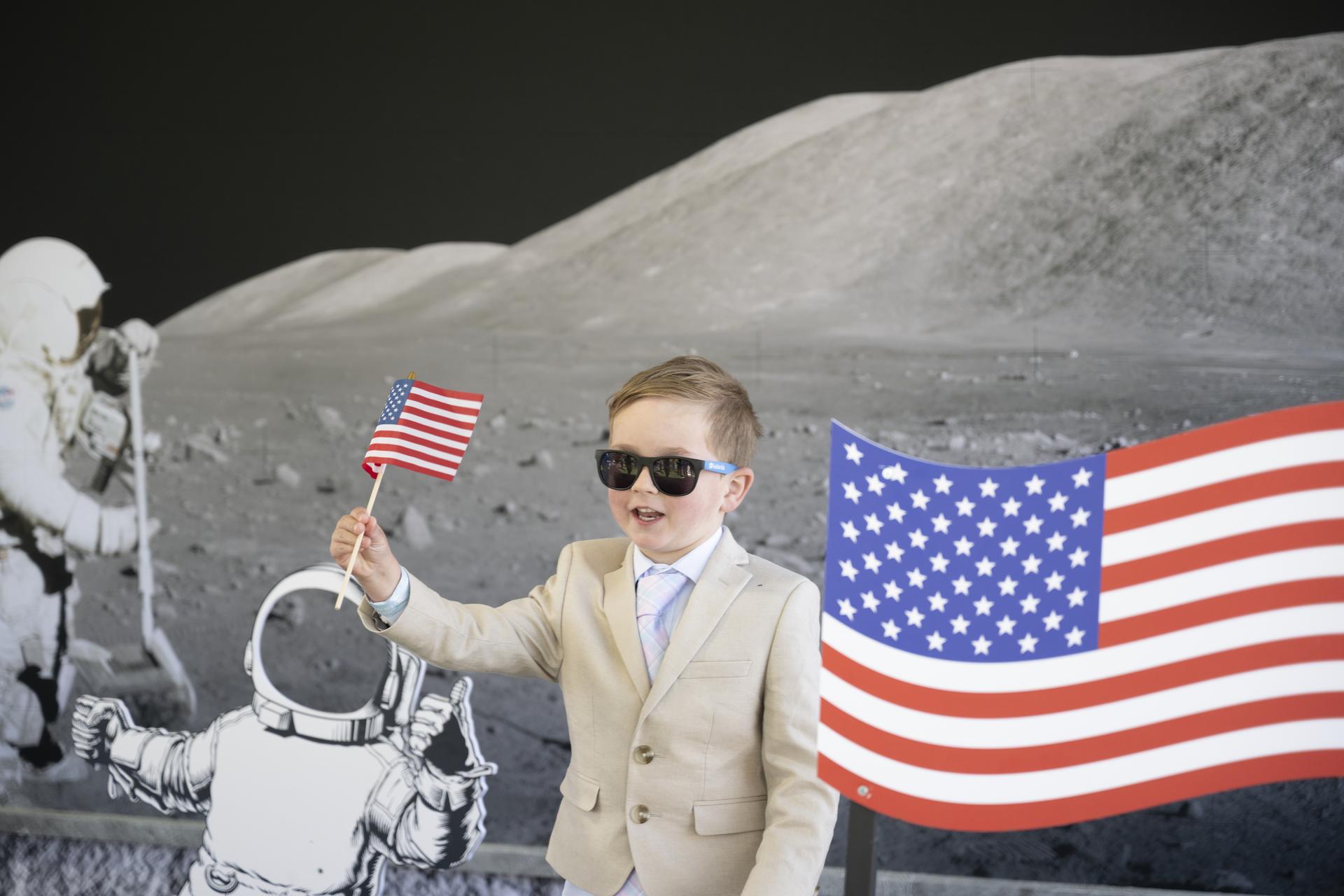
Children explore the NASA Moon Box (Lunar Sandbox) digging for “moon rocks” and planting an American flag, to bringing Artemis exploration to life through curiosity and engagement. during the White House Easter Egg Roll, on the South Lawn in Washington D.C., on April 6, 2026. (Photo Credit: (NASA/Crystal R. Hines)
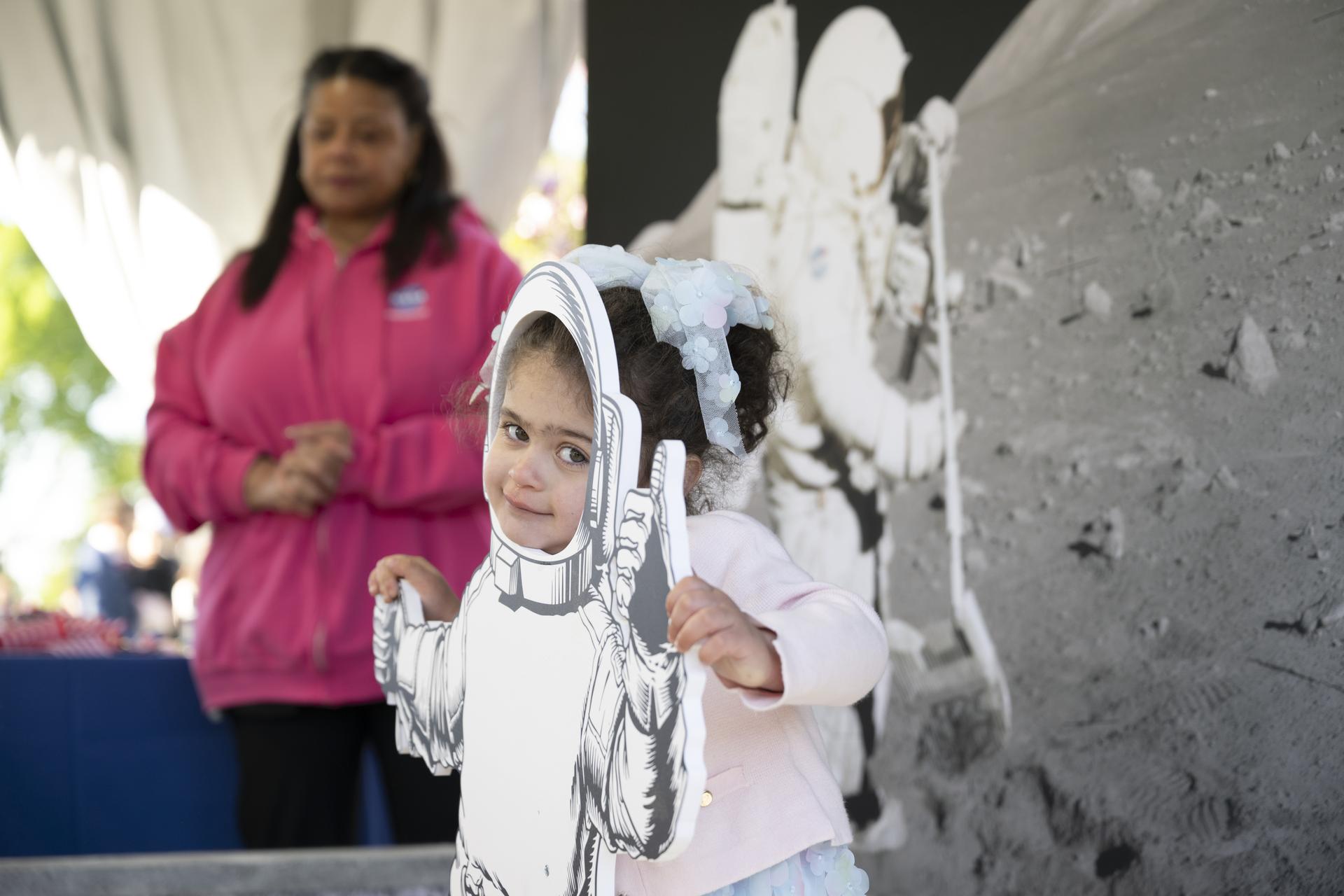
Children explore the NASA Moon Box (Lunar Sandbox) digging for “moon rocks” and planting an American flag, to bringing Artemis exploration to life through curiosity and engagement. during the White House Easter Egg Roll, on the South Lawn in Washington D.C., on April 6, 2026. (Photo Credit: (NASA/Crystal R. Hines)
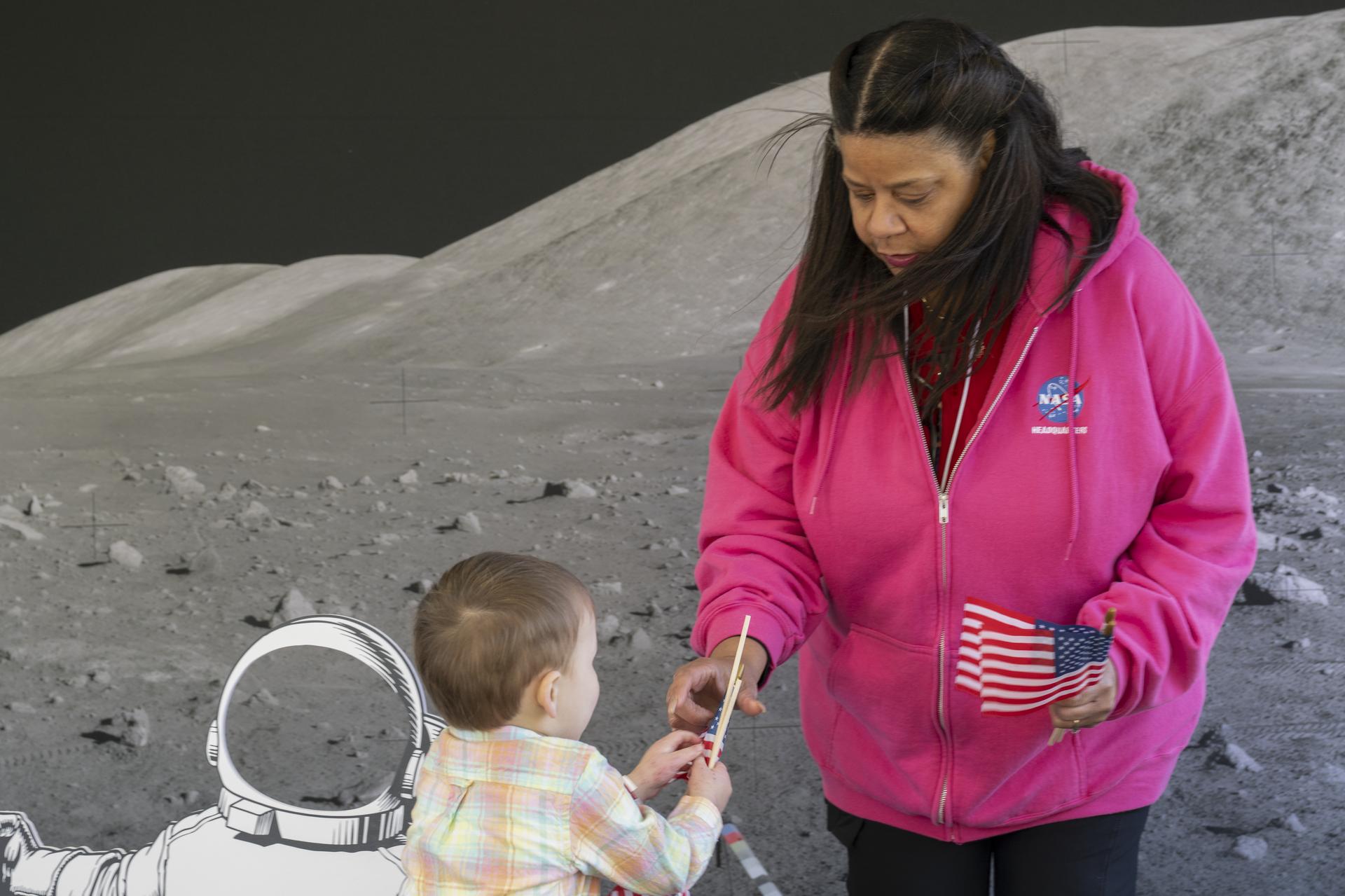
Children explore the NASA Moon Box (Lunar Sandbox) digging for “moon rocks” and planting an American flag, to bringing Artemis exploration to life through curiosity and engagement. during the White House Easter Egg Roll, on the South Lawn in Washington D.C., on April 6, 2026. (Photo Credit: (NASA/Crystal R. Hines)
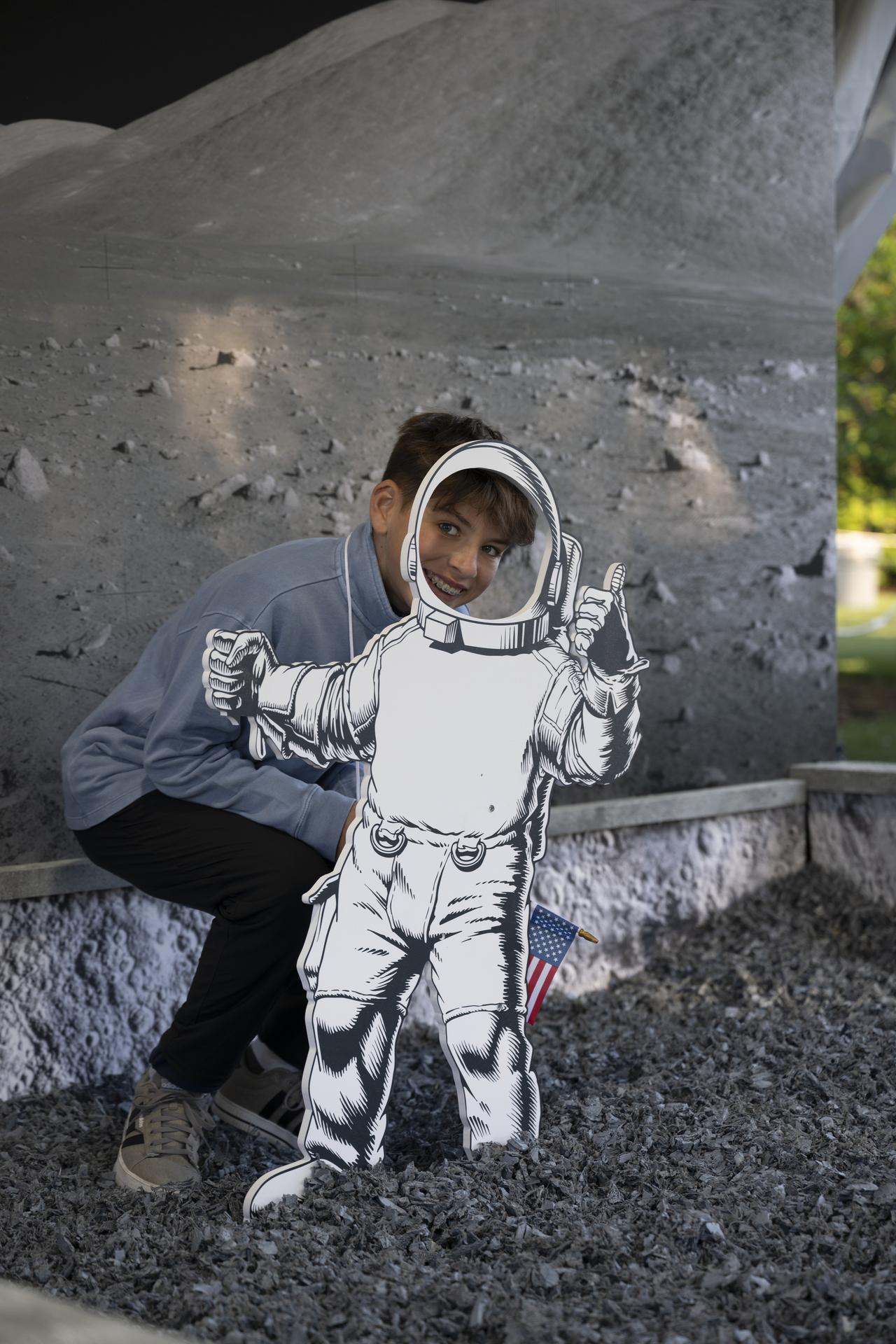
Children explore the NASA Moon Box (Lunar Sandbox) digging for “moon rocks” and planting an American flag, to bringing Artemis exploration to life through curiosity and engagement. during the White House Easter Egg Roll, on the South Lawn in Washington D.C., on April 6, 2026. (Photo Credit: (NASA/Crystal R. Hines)