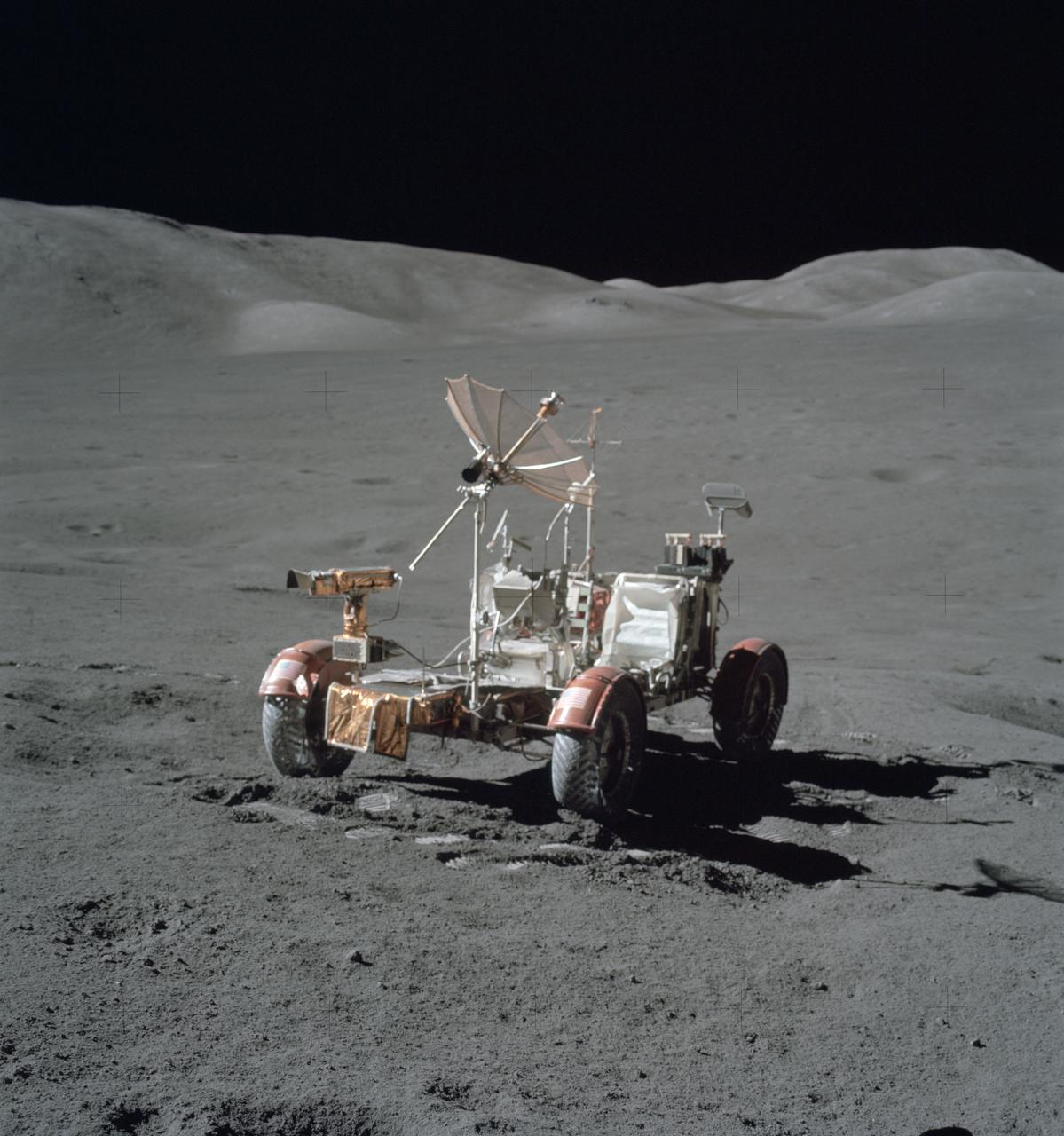
AS17-146-22367 (7-19 Dec. 1972) --- This is an excellent view of the Lunar Roving Vehicle (LRV) which was used extensively by astronauts Eugene A. Cernan and Harrison H. Schmitt at the Taurus-Littrow landing site.
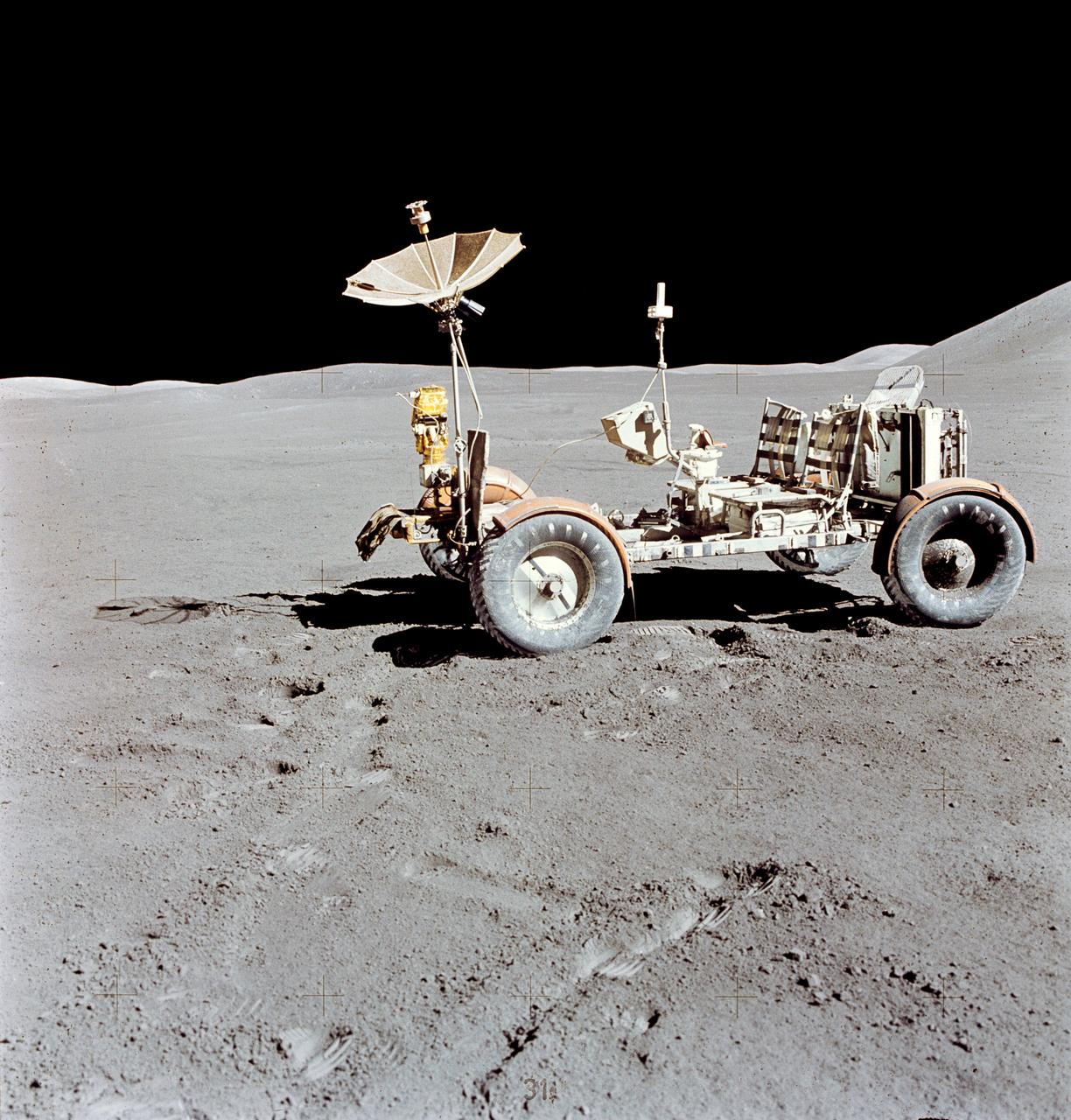
AS15-88-11901 (31 July-2 Aug. 1971) --- The Lunar Roving Vehicle (LRV) is photographed alone against the desolate lunar background during the third Apollo 15 lunar surface extravehicular activity (EVA) at the Hadley-Apennine landing site. This view is looking north. The west edge of Mount Hadley is at the upper right edge of the picture. Mount Hadley rises approximately 4,500 meters (about 4,765 feet) above the plain. The most distant lunar feature visible is approximately 25 kilometers (about 15.5 statute miles) away. While astronauts David R. Scott, commander; and James B. Irwin, lunar module pilot, descended in the Lunar Module (LM) "Falcon" to explore the moon, astronaut Alfred M. Worden, command module pilot, remained with the Command and Service Modules (CSM) in lunar orbit.
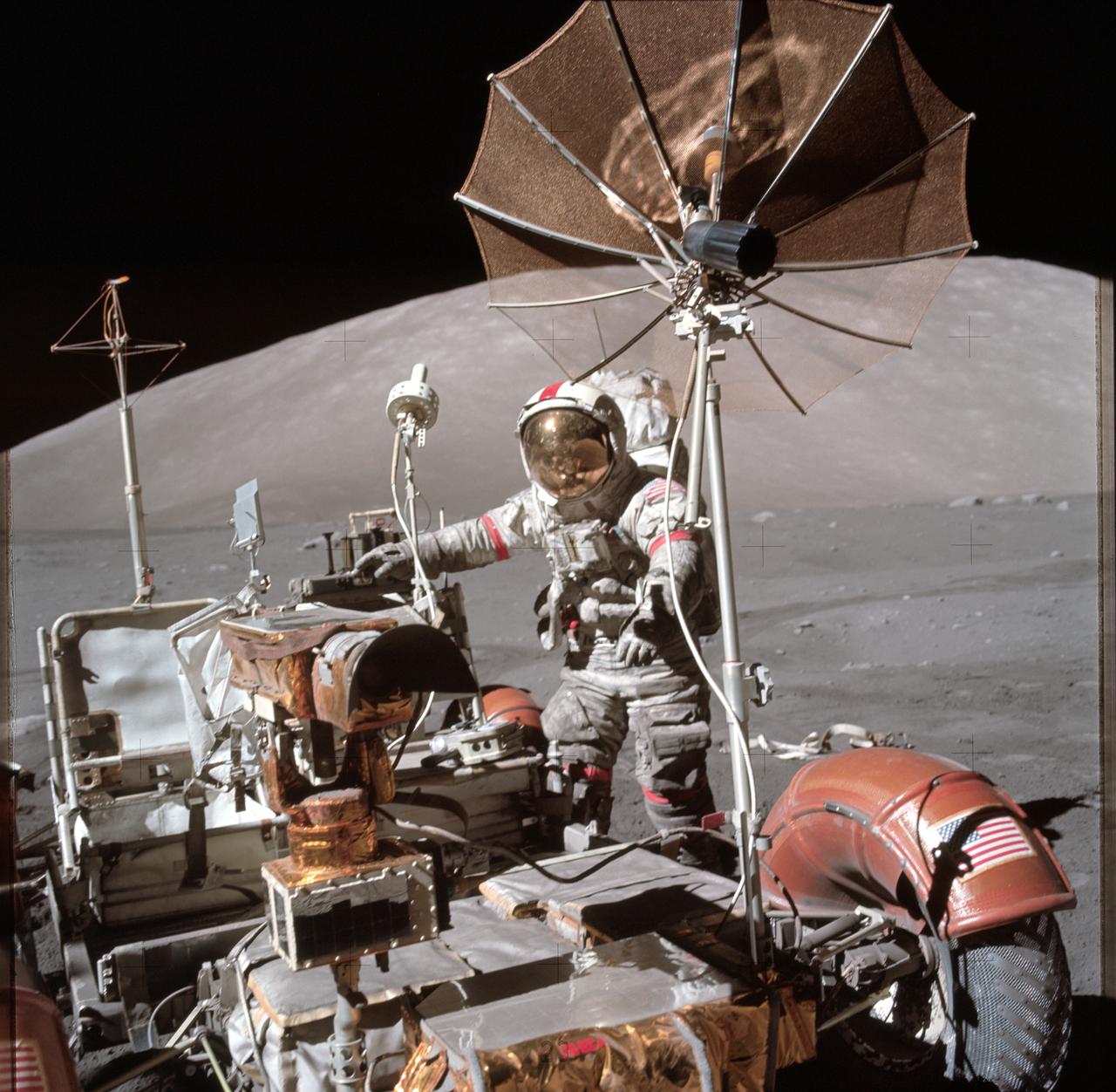
AS17-134-20476 (13 Dec. 1972) --- Astronaut Eugene A. Cernan, Apollo 17 commander, approaches the parked Lunar Roving Vehicle (LRV) on the lunar surface during the flight's third period of extravehicular activity (EVA). South Massif can be seen in the background. The photograph was taken with a hand-held Hasselblad camera by scientist-astronaut Harrison H. Schmitt, lunar module pilot. While the two explored the surface of the moon, astronaut Ronald E. Evans remained with the Command and Service Modules (CSM) in lunar orbit.
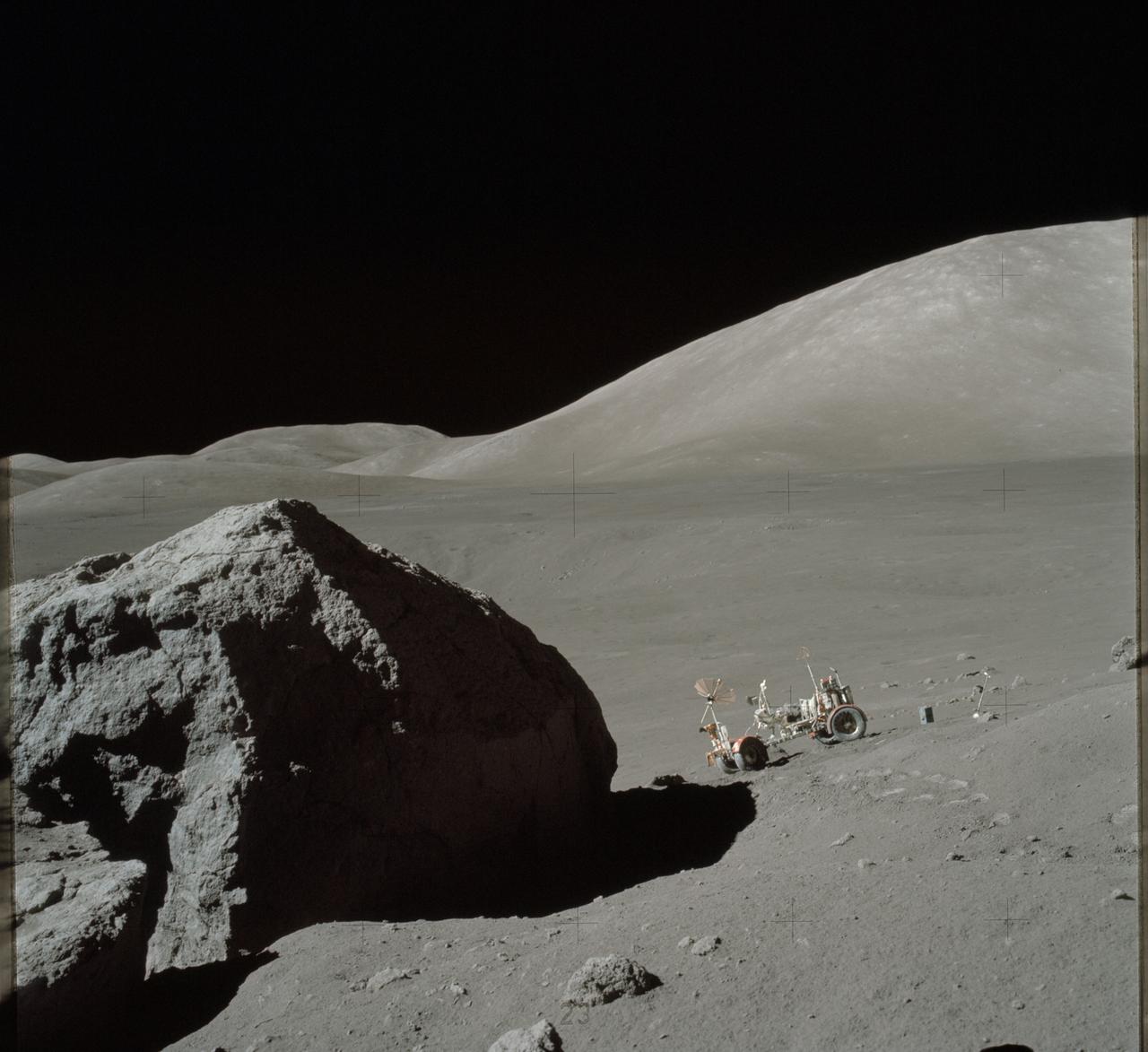
AS17-140-21494 (13 Dec. 1972) --- This view shows the Lunar Roving Vehicle (LRV) parked by an outcrop of rocks by astronauts Eugene A. Cernan and Harrison H. (Jack) Schmitt during their visit to extravehicular activity Station 6 (Henry Crater).

AS16-107-17436 (21 April 1972) --- An excellent view of the Lunar Module (LM) "Orion" and Lunar Roving Vehicle (LRV), as photographed by astronaut Charles M. Duke Jr., lunar module pilot, during the first Apollo 16 extravehicular activity (EVA) at the Descartes landing site. Astronaut John W. Young, commander, can be seen directly behind the LRV. The lunar surface feature in the left background is Stone Mountain. While astronauts Young and Duke descended in the LM to explore the Descartes highlands landing site on the moon, astronaut Thomas K. Mattingly II, command module pilot, remained with the Command and Service Modules (CSM) "Casper" in lunar orbit.
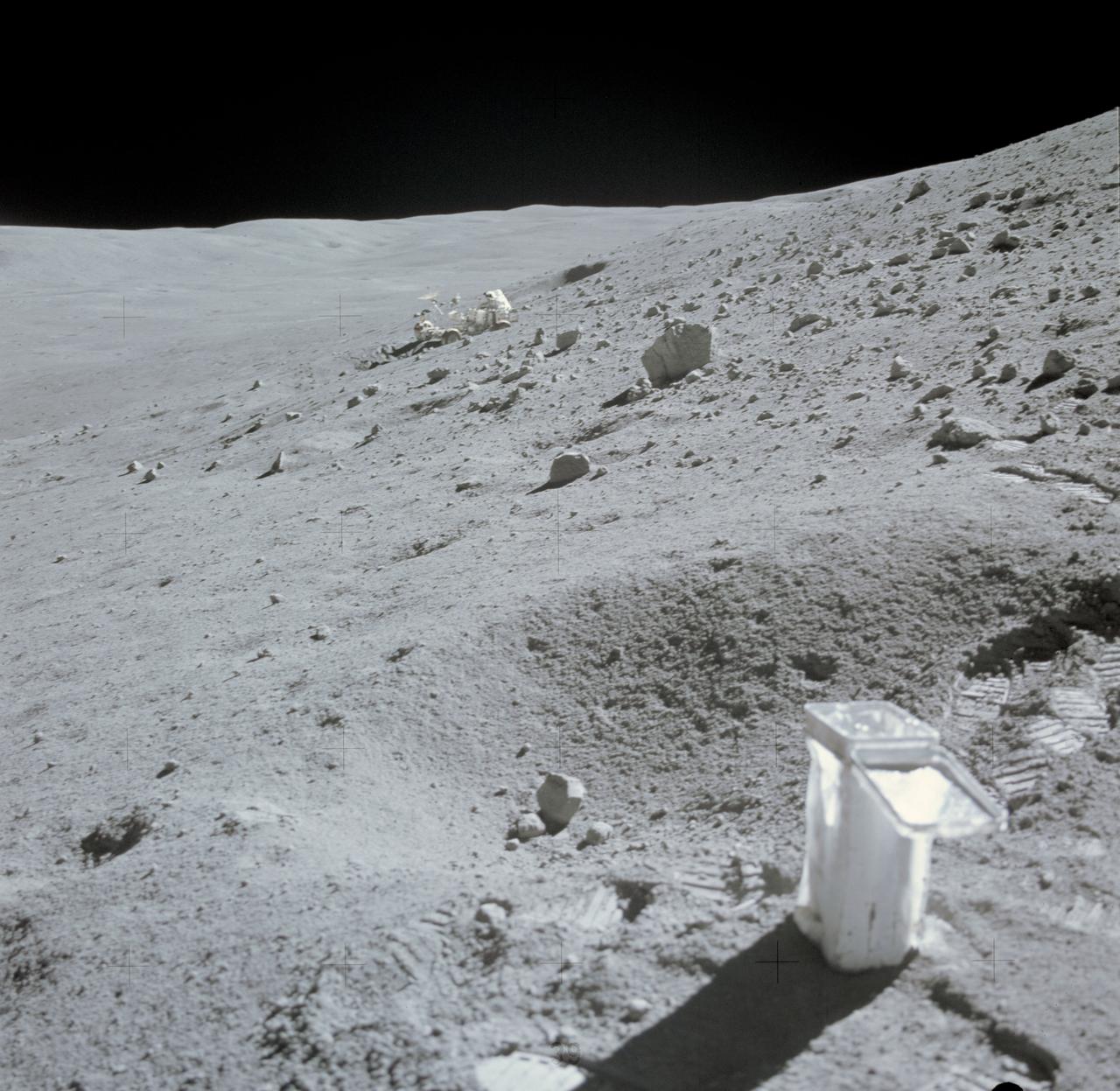
AS16-107-17473 (22 April 1972) --- The Lunar Roving Vehicle (LRV) appears to be parked in a deep lunar depression, on the slope of Stone Mountain. This photograph of the lunar scene at Station No. 4 was taken during the second Apollo 16 extravehicular activity (EVA) at the Descartes landing site. A sample collection bag is in the right foreground. Note field of small boulders at upper right. While astronauts John W. Young, commander, and Charles M. Duke Jr., lunar module pilot, descended in the Lunar Module (LM) "Orion" to explore the moon, astronaut Thomas K. Mattingly II, command module pilot, remained with the Command and Service Modules (CSM) in lunar orbit.
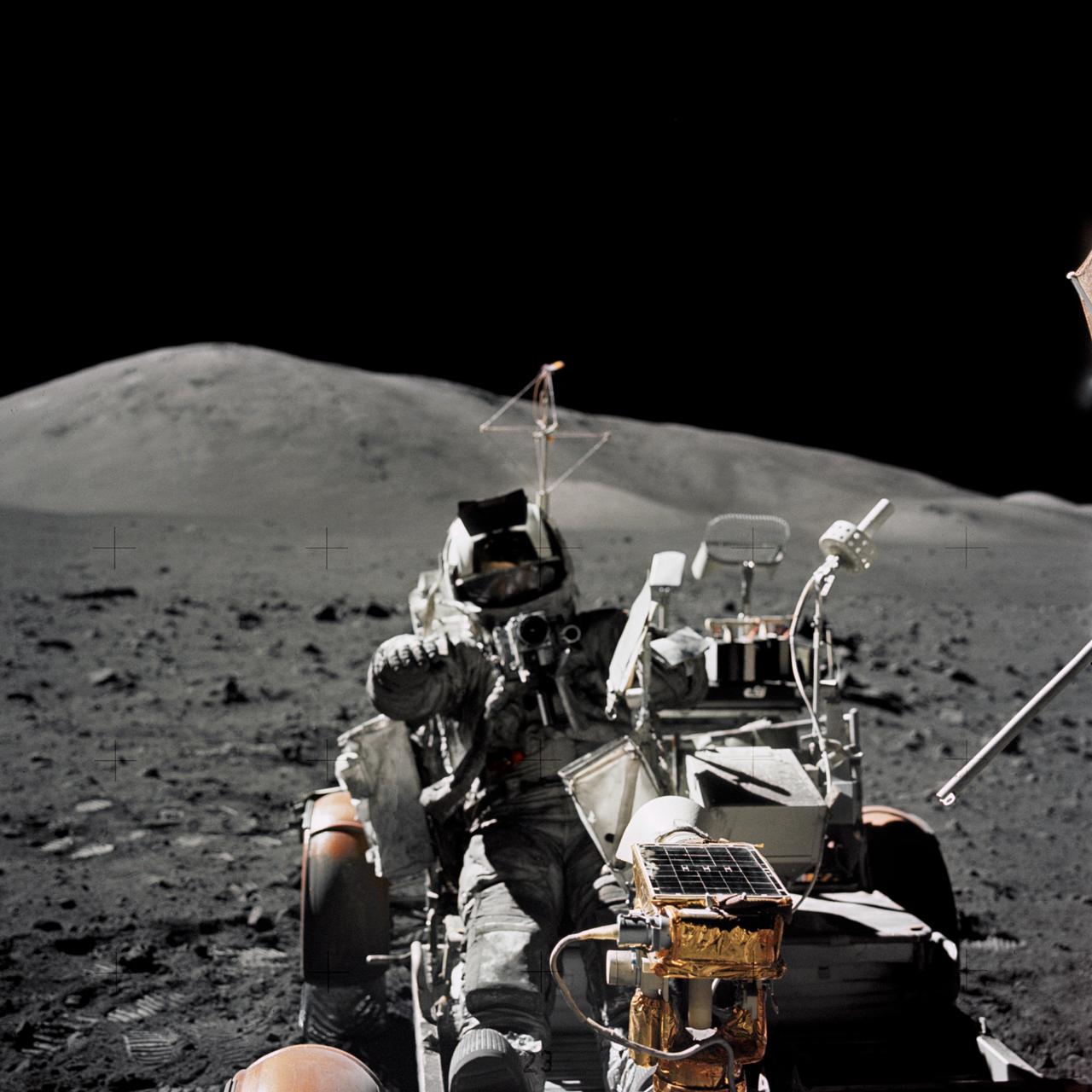
AS17-134-20454 (13 Dec. 1972) --- Scientist-astronaut Harrison H. Schmitt is photographed seated in the Lunar Roving Vehicle (LRV) at Station 9 (Van Serg Crater) during the third Apollo 17 extravehicular activity (EVA) at the Taurus-Littrow landing site. This photograph was taken by astronaut Eugene A. Cernan, commander. Schmitt, lunar module pilot, and Cernan explored the moon while astronaut Ronald E. Evans, command module pilot, remained with the Command and Service Modules in lunar orbit.
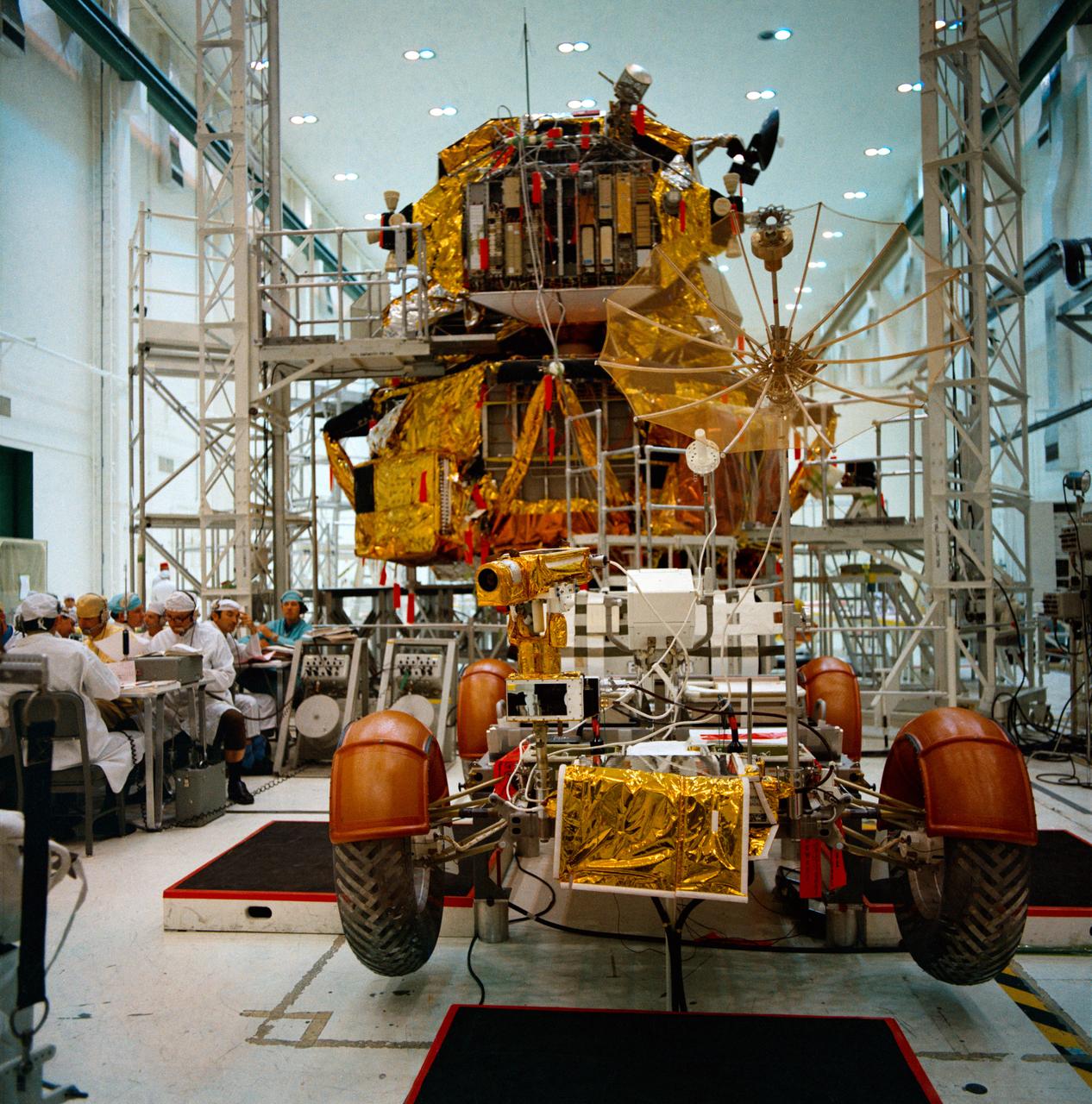
S71-30542 (21 April 1971) --- An overall view of the Apollo 15 Lunar Roving Vehicle (LRV) and the Lunar Module (LM) during simulations at the Kennedy Space Center (KSC). Astronauts David R. Scott, commander, and James B. Irwin, lunar module pilot, will man the LRV on the lunar surface during their August 1971 traverses. Rover 1 will permit the astronauts to cover a larger area of the moon for exploration and sample collecting than on previous missions.
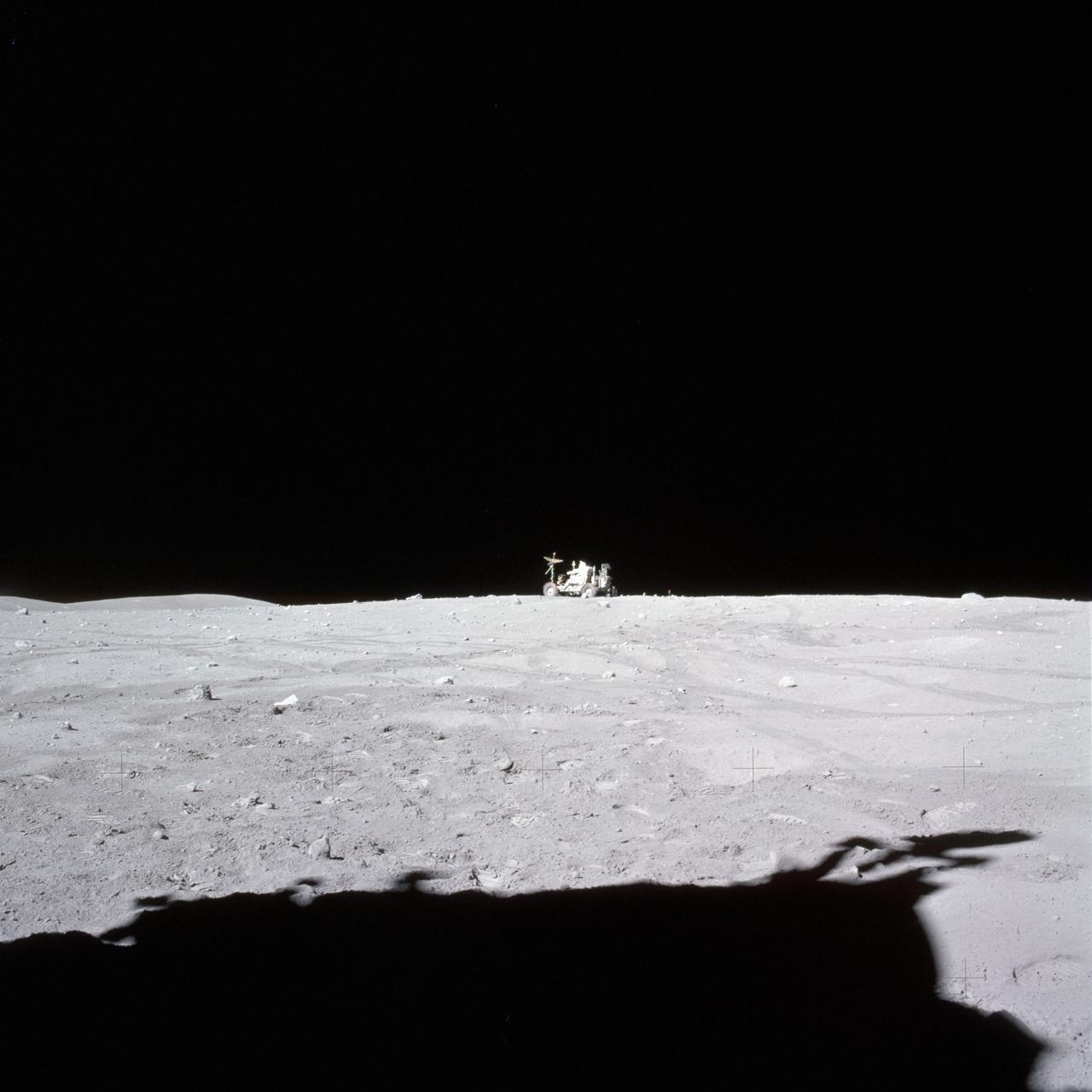
AS16-115-18559 (23 April 1972) --- Astronaut John W. Young, commander of the Apollo 16 lunar landing mission, drives the Lunar Roving Vehicle (LRV) to its final parking place near the end of the third Apollo 16 extravehicular activity (EVA) at the Descartes landing site. Astronaut Charles M. Duke Jr., lunar module pilot, took this photograph looking southward. The flank of Stone Mountain can be seen on the horizon at left. The shadow of the Lunar Module (LM) occupies much of the picture. While astronauts Young and Duke descended in the Apollo 16 LM "Orion" to explore the Descartes highlands landing site on the moon, astronaut Thomas K. Mattingly II, command module pilot, remained with the Command and Service Modules (CSM) "Casper" in lunar orbit.
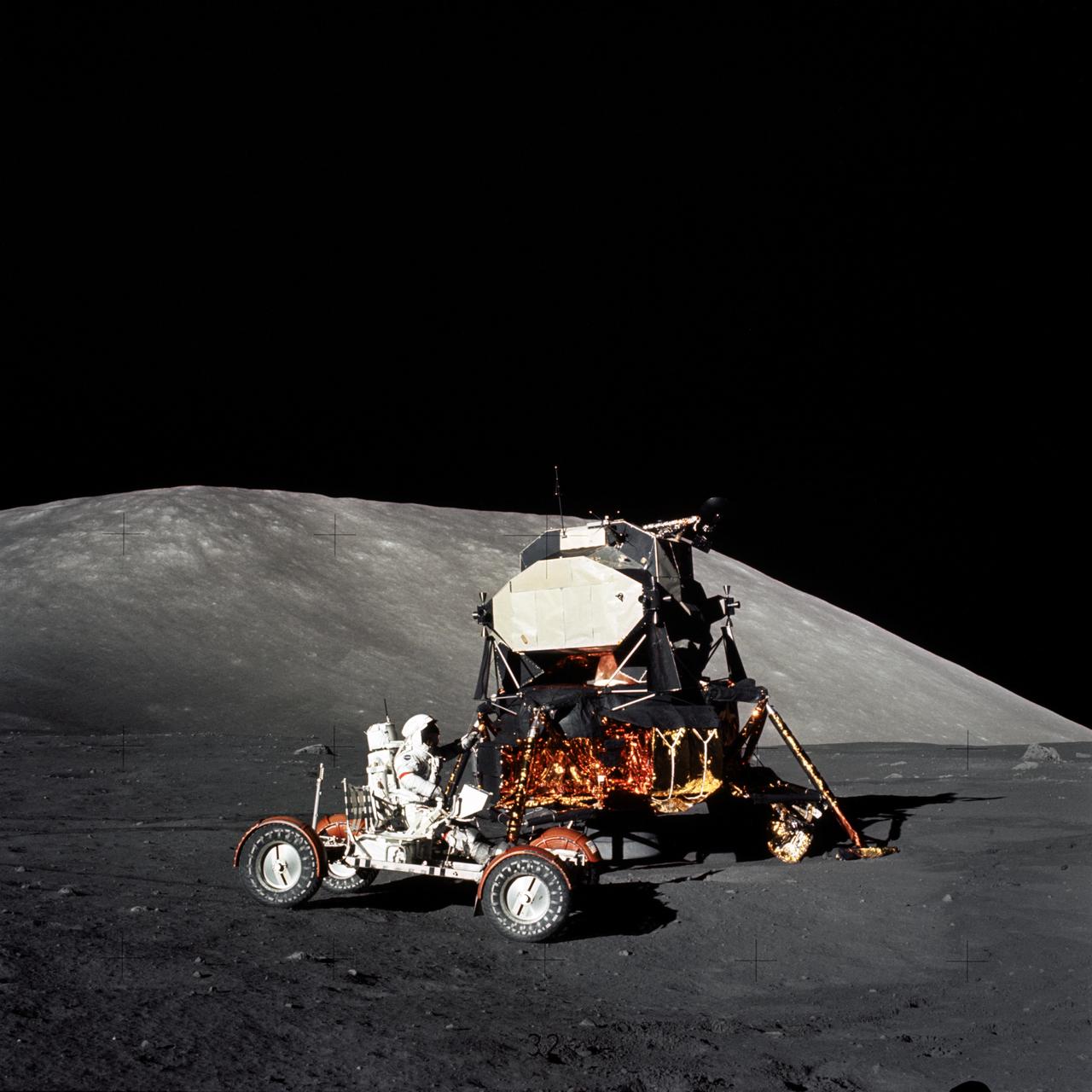
AS17-147-22527 (11 Dec. 1972) --- Astronaut Eugene A. Cernan, Apollo 17 mission commander, makes a short checkout of the Lunar Roving Vehicle during the early part of the first Apollo 17 extravehicular activity (EVA) at the Taurus-Littrow landing site. The Lunar Module is in the background. This photograph was taken by scientist-astronaut Harrison H. Schmitt, lunar module pilot.
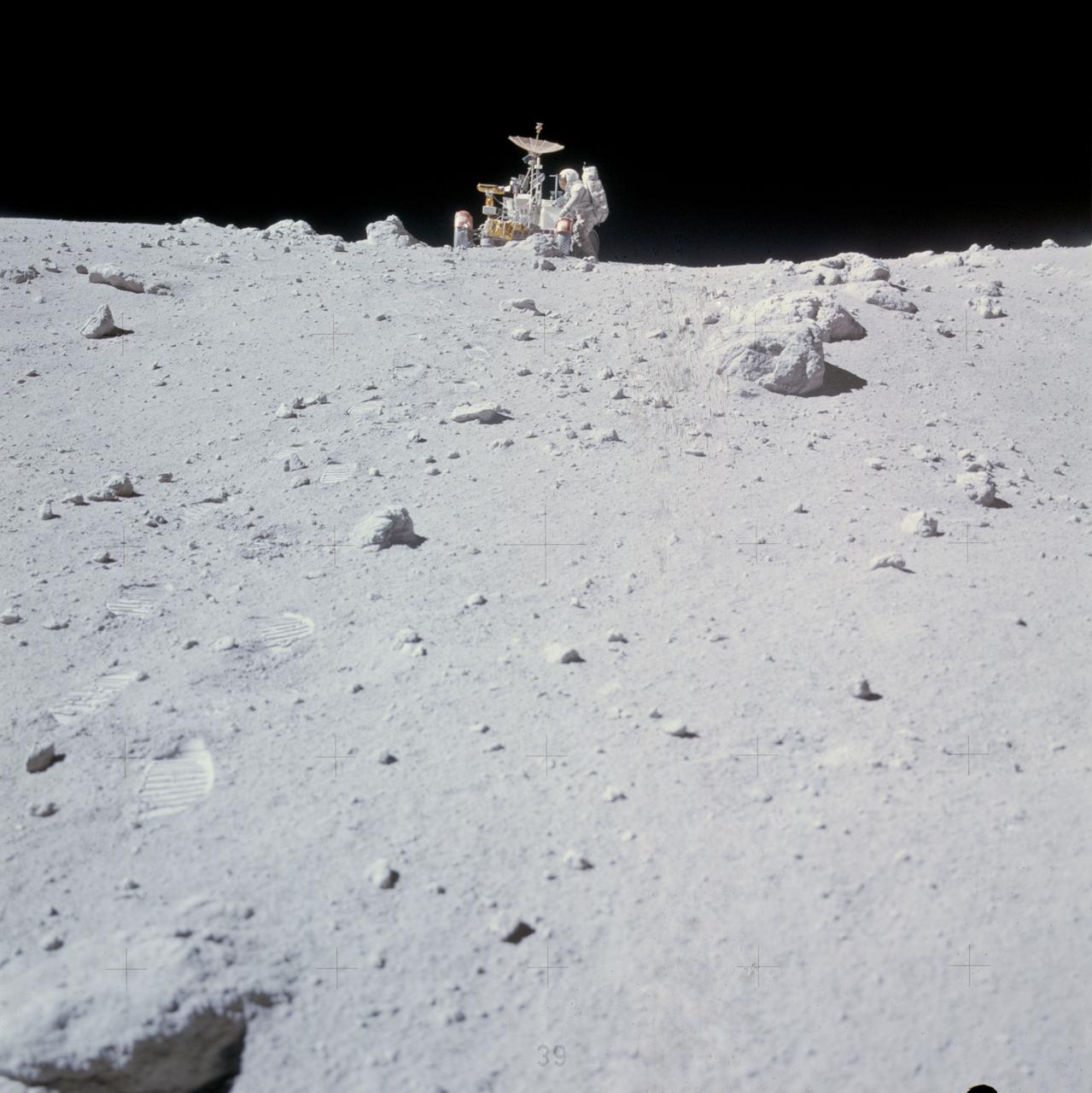
AS16-116-18607 (23 April 1972) --- Astronaut Charles M. Duke Jr. works at the front of the Lunar Roving Vehicle (LRV) parked in this rock field at a North Ray Crater geological site during the mission's third extravehicular activity (EVA) on April 23, 1972. Astronaut John W. Young took this picture with a 70mm Hasselblad camera. While astronauts Young, commander; and Duke, lunar module pilot; descended in the Apollo 16 Lunar Module (LM) "Orion" to explore the Descartes highlands landing site on the moon, astronaut Thomas K. Mattingly II, command module pilot, remained with the Command and Service Modules (CSM) "Casper" in lunar orbit.
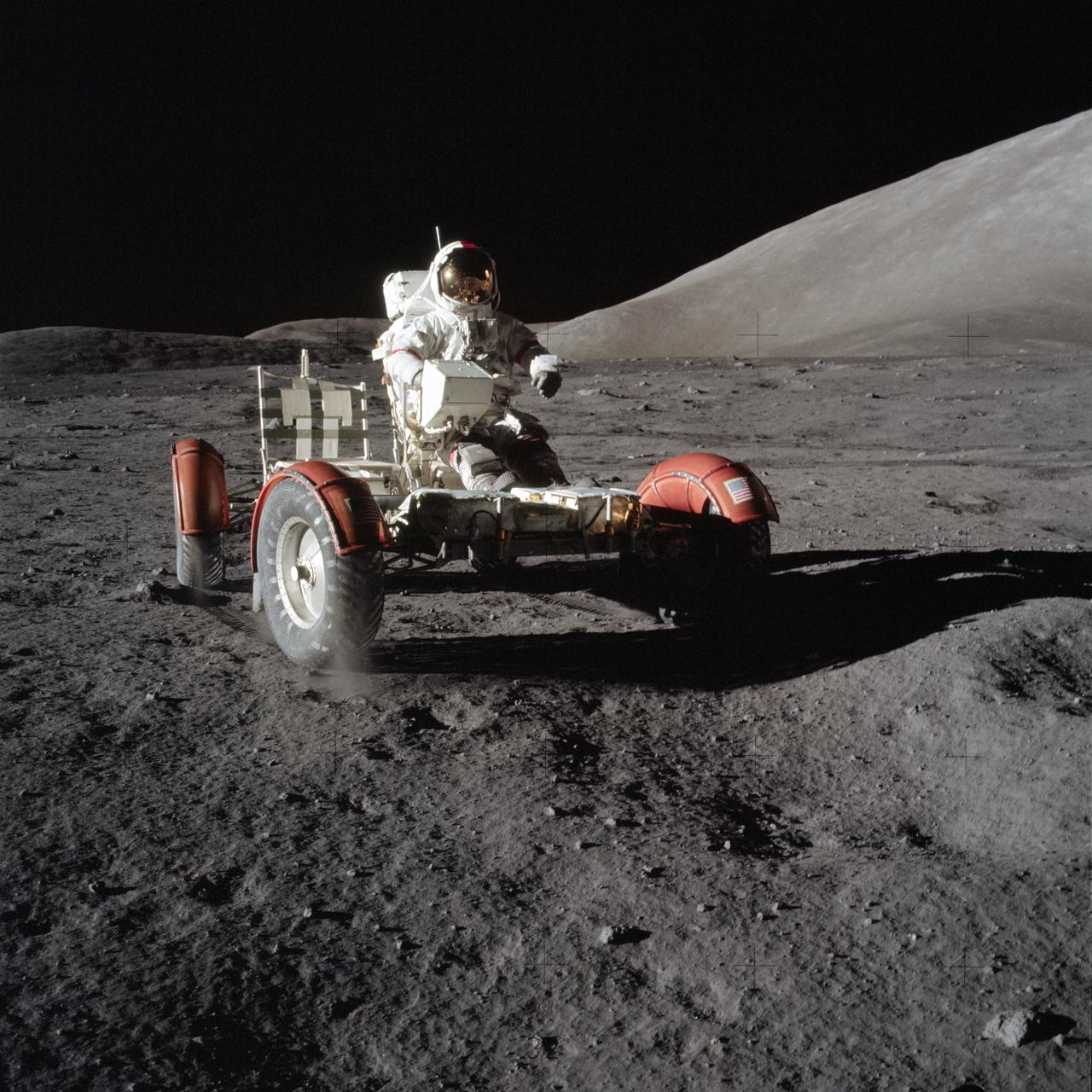
AS17-147-22526 (11 Dec. 1972) --- Astronaut Eugene A. Cernan, commander, makes a short checkout of the Lunar Roving Vehicle (LRV) during the early part of the first Apollo 17 extravehicular activity (EVA) at the Taurus-Littrow landing site. This view of the "stripped down" LRV is prior to loading up. Equipment later loaded onto the LRV included the ground-controlled television assembly, the lunar communications relay unit, hi-gain antenna, low-gain antenna, aft tool pallet, lunar tools and scientific gear. This photograph was taken by scientist-astronaut Harrison H. Schmitt, lunar module pilot. The mountain in the right background is the east end of South Massif. While astronauts Cernan and Schmitt descended in the Lunar Module (LM) "Challenger" to explore the moon, astronaut Ronald E. Evans, command module pilot, remained with the Command and Service Modules (CSM) "America" in lunar orbit.
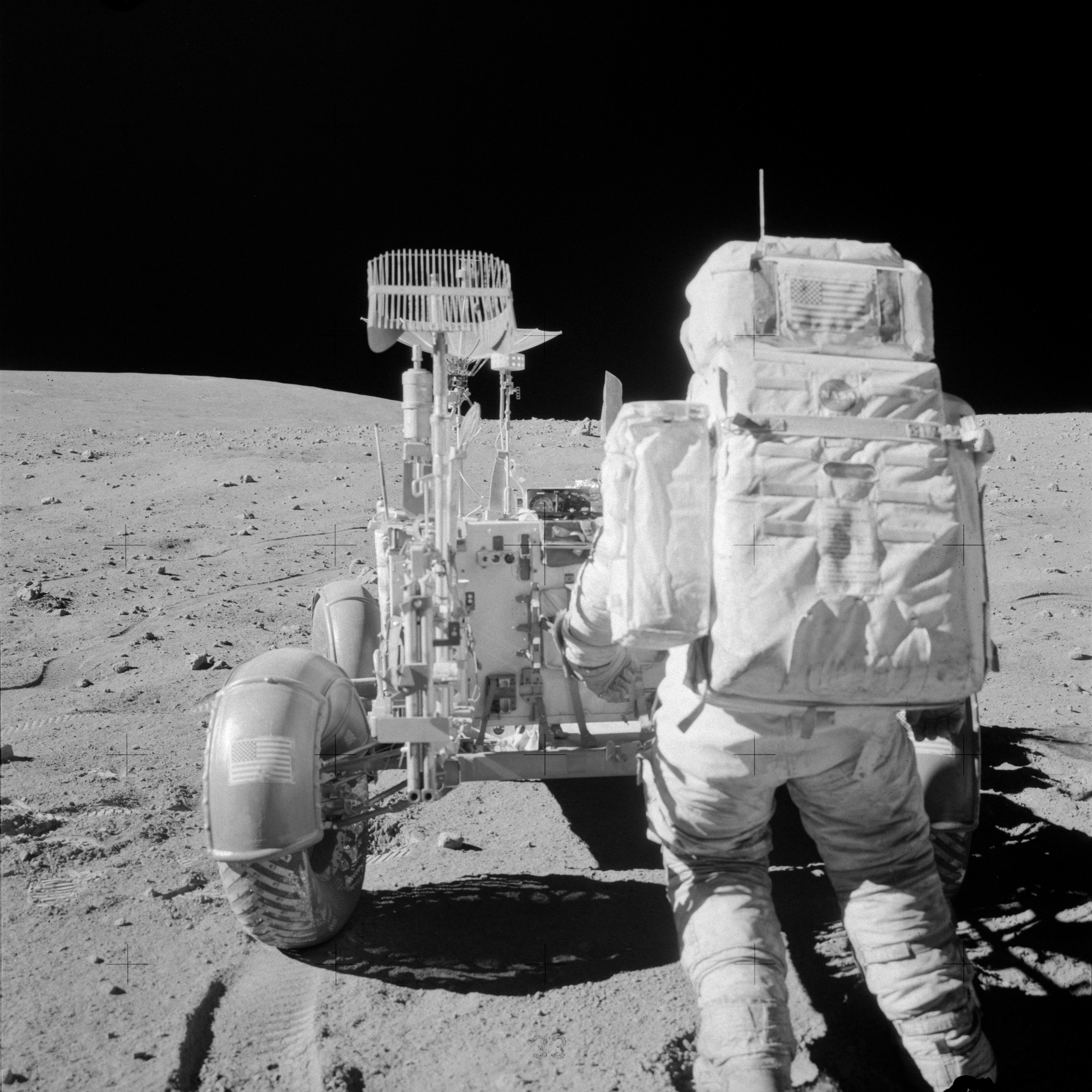
AS16-108-17622 (22 April 1972) --- Astronaut John W. Young, commander of the Apollo 16 lunar landing mission, reaches for tools in the Apollo Lunar Hand Tool Carrier at the aft end of the Lunar Roving Vehicle (LRV) during the second Apollo 16 extravehicular activity (EVA) at the Descartes landing site. This photograph was taken by astronaut Charles M. Duke Jr., lunar module pilot. This view is looking south from the base of Stone Mountain. While astronauts Young and Duke descended in the Lunar Module (LM) "Orion" to explore the Descartes highlands region of the moon, astronaut Thomas K. Mattingly II, command module pilot, remained with the Command and Service Modules (CSM) "Casper" in lunar orbit.

AS16-110-17960 (22 April 1972) --- Astronaut John W. Young, commander, replaces tools in the Apollo Lunar Hand Tool (ALHT) carrier at the aft end of the Lunar Roving Vehicle (LRV) during the second Apollo 16 extravehicular activity (EVA) on the high side of Stone Mountain at the Descartes landing site. Astronaut Charles M. Duke Jr., lunar module pilot, took this photograph near the conclusion of Station 4 activities. Smoky Mountain, with the large Ravine Crater on its flank, is in the left background. This view is looking northeast. While astronauts Young and Duke descended in the Apollo 16 Lunar Module (LM) "Orion" to explore the Descartes highlands landing site on the moon, astronaut Thomas K. Mattingly II, command module pilot, remained with the Command and Service Modules (CSM) "Casper" in lunar orbit.

S71-39867 (June 1971) --- Astronauts David R. Scott (right), commander, and James B. Irwin, lunar module pilot, are shown on the Lunar Roving Vehicle (LRV) at the Kennedy Space Center (KSC), Florida, during Apollo 15 lunar surface extravehicular activity (EVA) simulations. While astronauts Scott and Irwin descend in the Lunar Module (LM) "Falcon" to explore the moon, astronaut Alfred M. Worden, command module pilot, will remain with the Command and Service Modules (CSM) in lunar orbit.
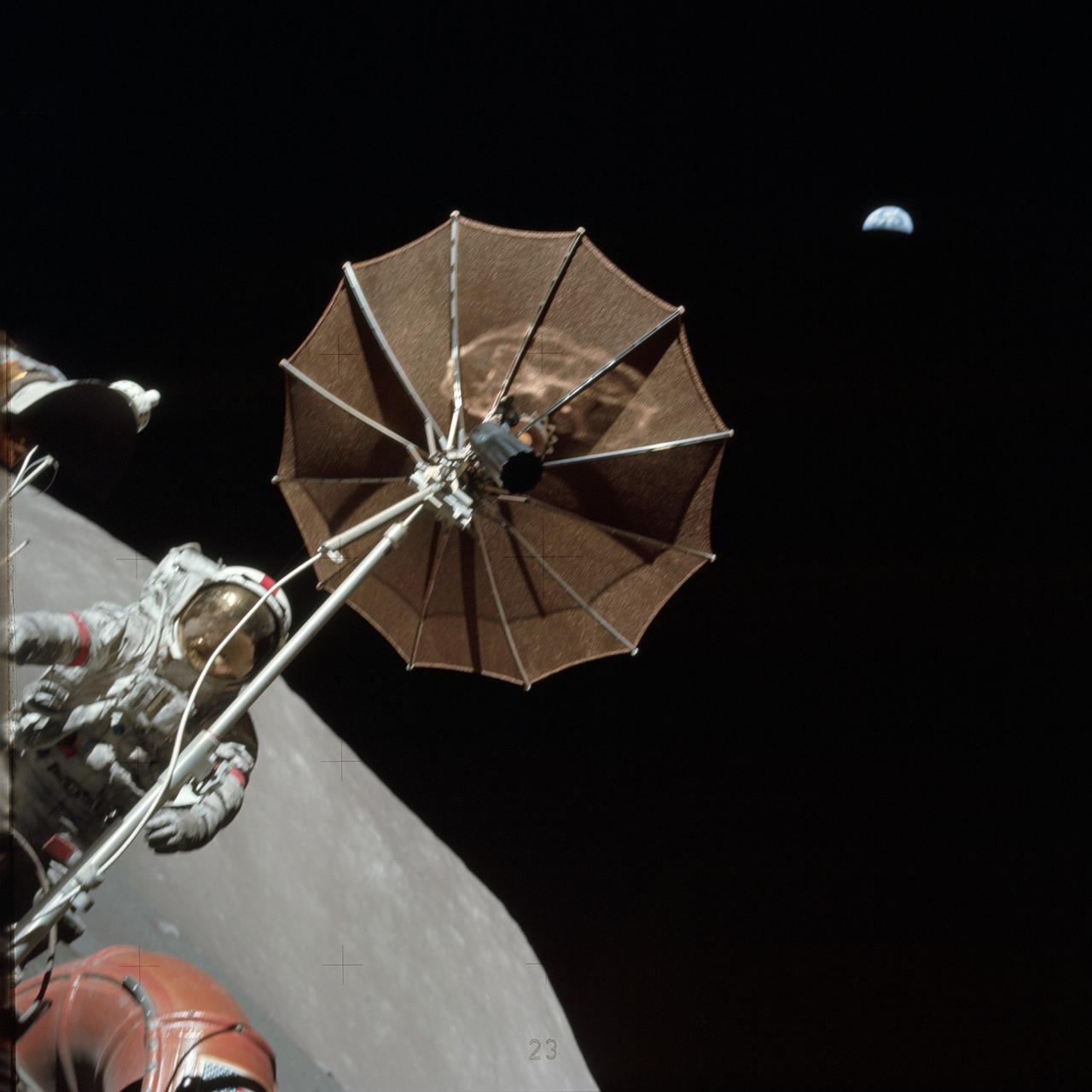
AS17-134-20473 (13 Dec. 1972) --- Earth appears in the far distant background above the hi-gain antenna of the Lunar Roving Vehicle in this photograph taken by scientist-astronaut Harrison H. Schmitt during the third Apollo 17 extravehicular activity (EVA) at the Taurus-Littrow landing site. Astronaut Eugene A. Cernan, Apollo 17 commander, stands beside the LRV. Schmitt is the mission's lunar module pilot. While Cernan and Schmitt descended in the lunar module "Challenger" to explore the moon, astronaut Ronald E. Evans, command module pilot, remained with the Command and Service Modules in lunar orbit.
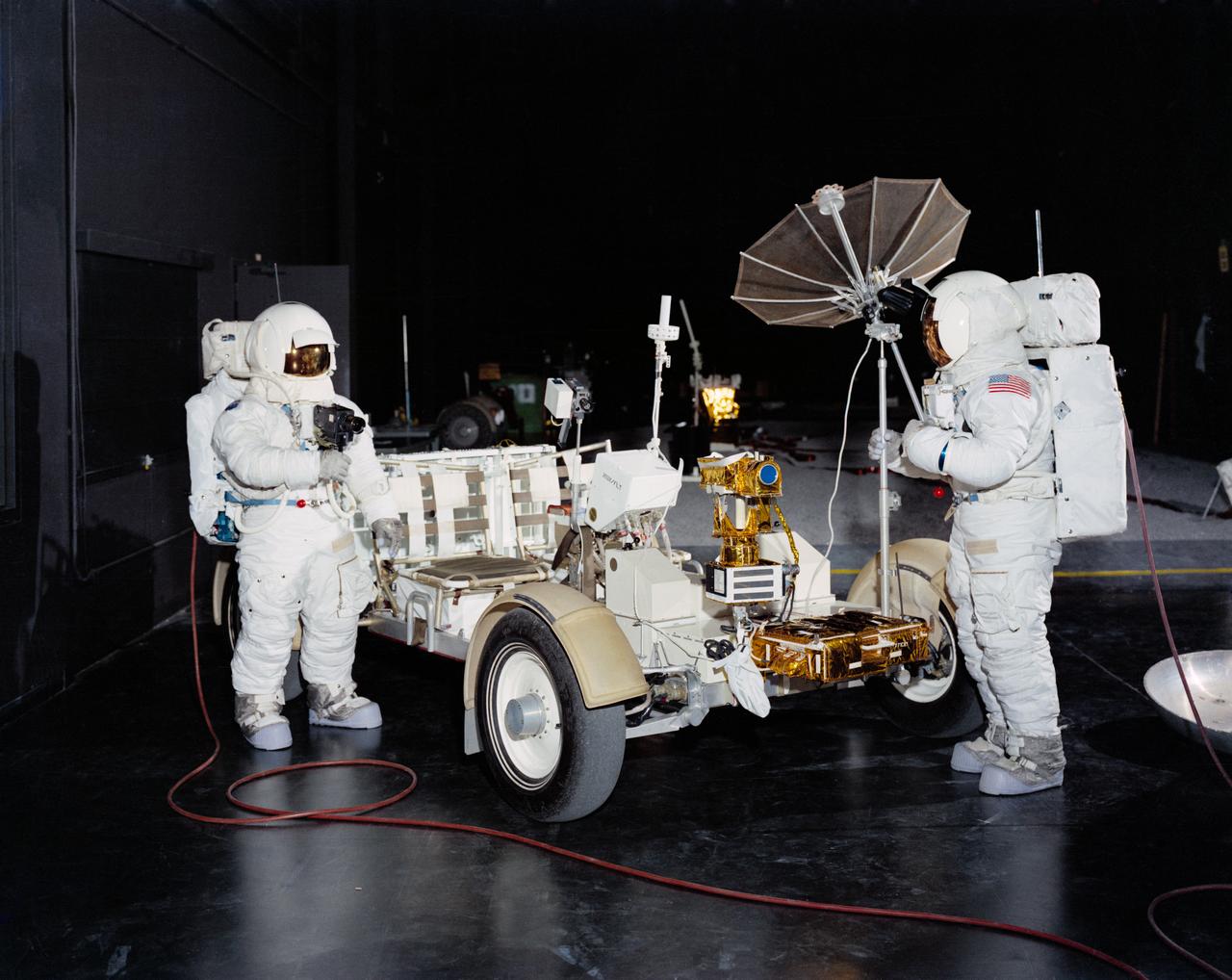
S71-16722 (January 1971) --- Two members of the prime crew of the Apollo 15 lunar landing mission are shown with the Lunar Roving Vehicle "one G" trainer in Building 5, Mission Simulation and Training Facility, Manned Spacecraft Center. Astronaut David R. Scott (on right) is the Apollo 15 commander; and astronaut James B. Irwin is the lunar module pilot. A Lunar Roving Vehicle similar to this trainer will be used by Scott and Irwin during their Apollo 15 lunar surface extravehicular activity.

Astronaut John W. Young, Apollo 16 prime crew commander (right), takes a drive in the One-G Lunar Roving Vehicle (LRV) trainer in the Lunar Topgraphic Simulation area at the Manned Spacecraft Center (MSC). He is accompanied by John Omstead, with General Electric, MSC.
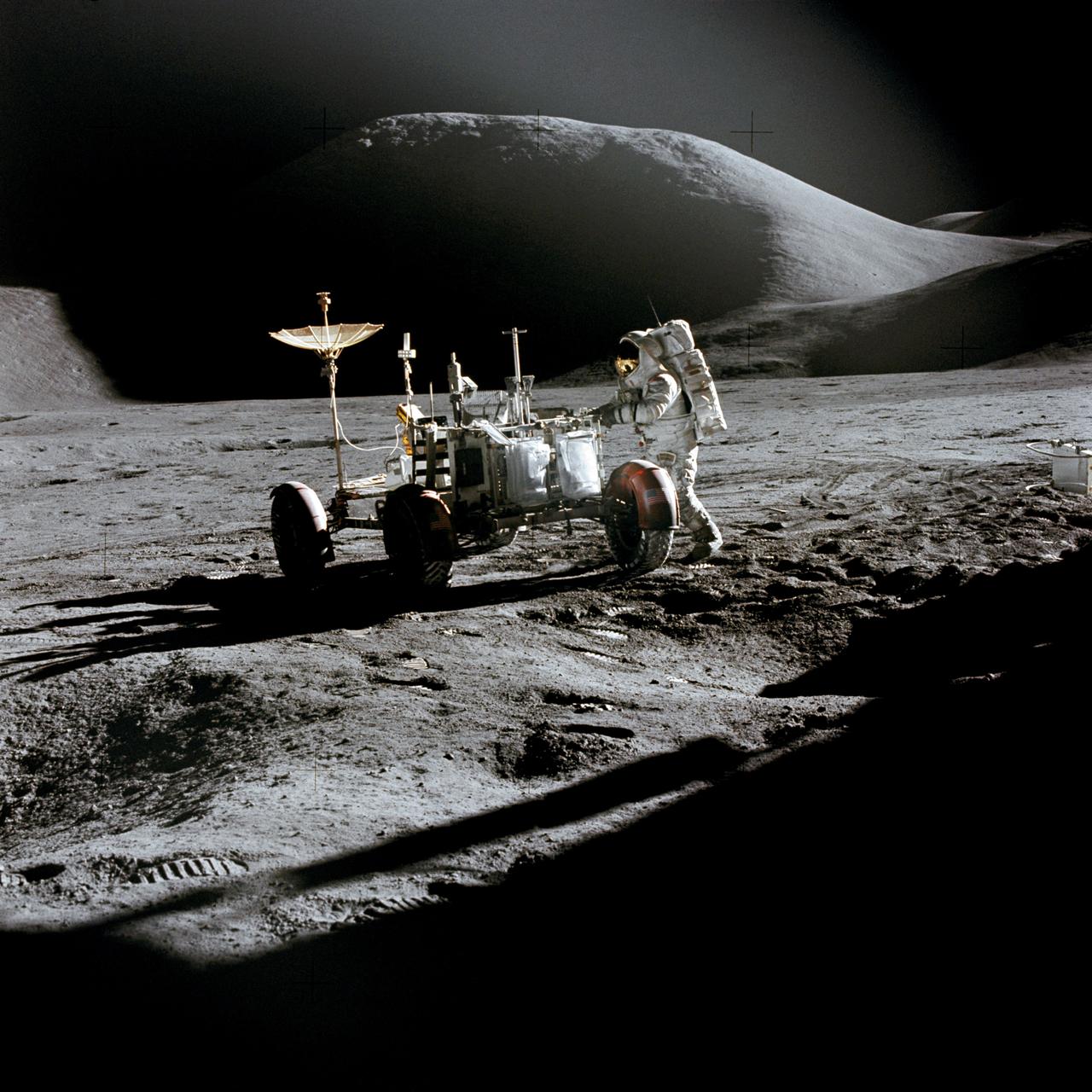
AS15-86-11603 (31 July 1971) --- Astronaut James B. Irwin, lunar module pilot, works at the Lunar Roving Vehicle during the first Apollo 15 lunar surface extravehicular activity (EVA) at the Hadley-Apennine landing site. The shadow of the Lunar Module "Falcon" is in the foreground. This view is looking northeast, with Mount Hadley in the background. This photograph was taken by astronaut David R. Scott, commander.
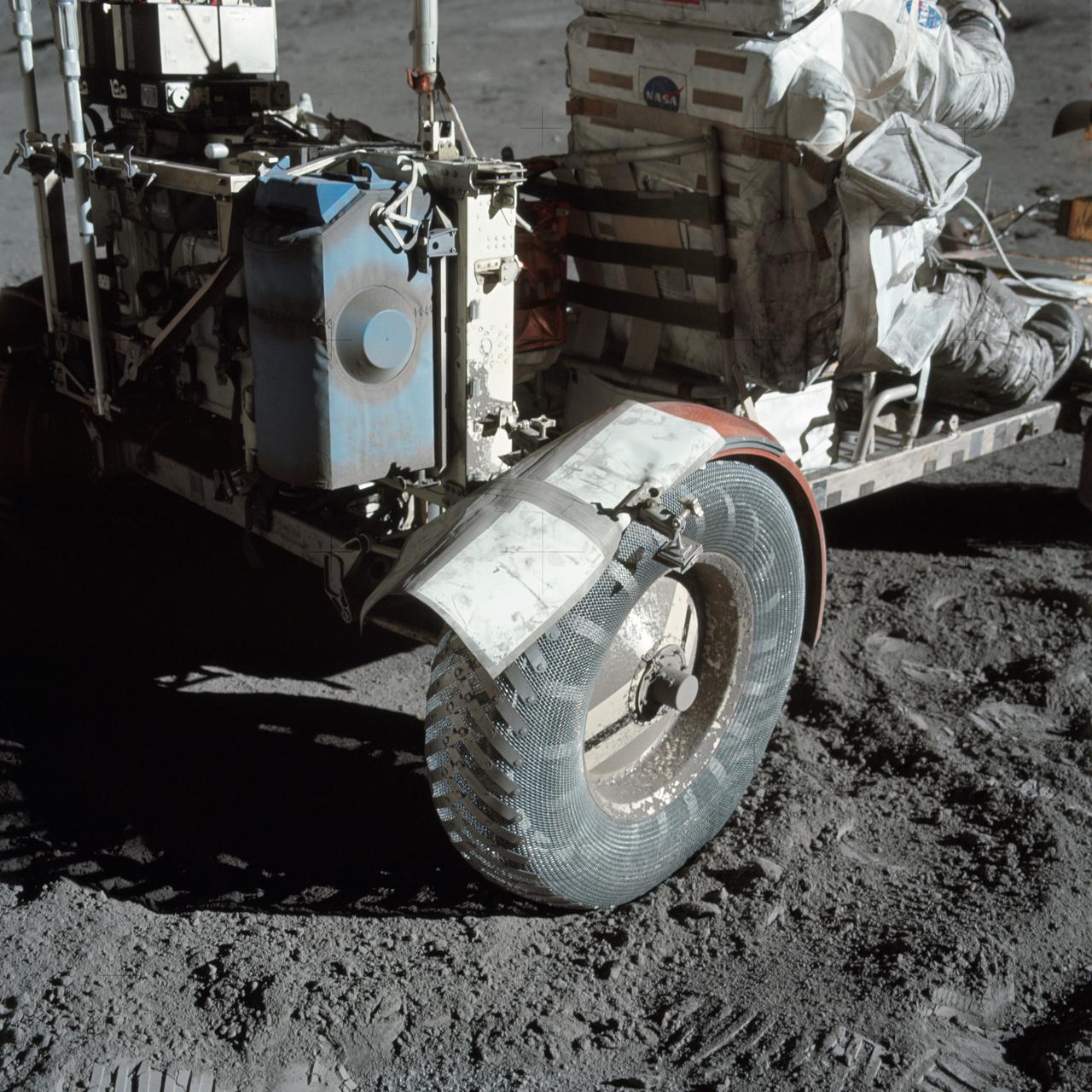
AS17-137-20979 (12 Dec. 1972) --- A close-up view of the lunar roving vehicle (LRV) at the Taurus-Littrow landing site photographed during Apollo 17 lunar surface extravehicular activity. Note the makeshift repair arrangement on the right rear fender of the LRV. During EVA-1 a hammer got underneath the fender and a part of it was knocked off. Astronauts Eugene A. Cernan and Harrison H. Schmitt were reporting a problem with lunar dust because of the damage fender. Following a suggestion from astronaut John W. Young in the Mission Control Center at Houston the crewmen repaired the fender early in EVA-2 using lunar maps and clamps from the optical alignment telescope lamp. Schmitt is seated in the rover. Cernan took this picture.
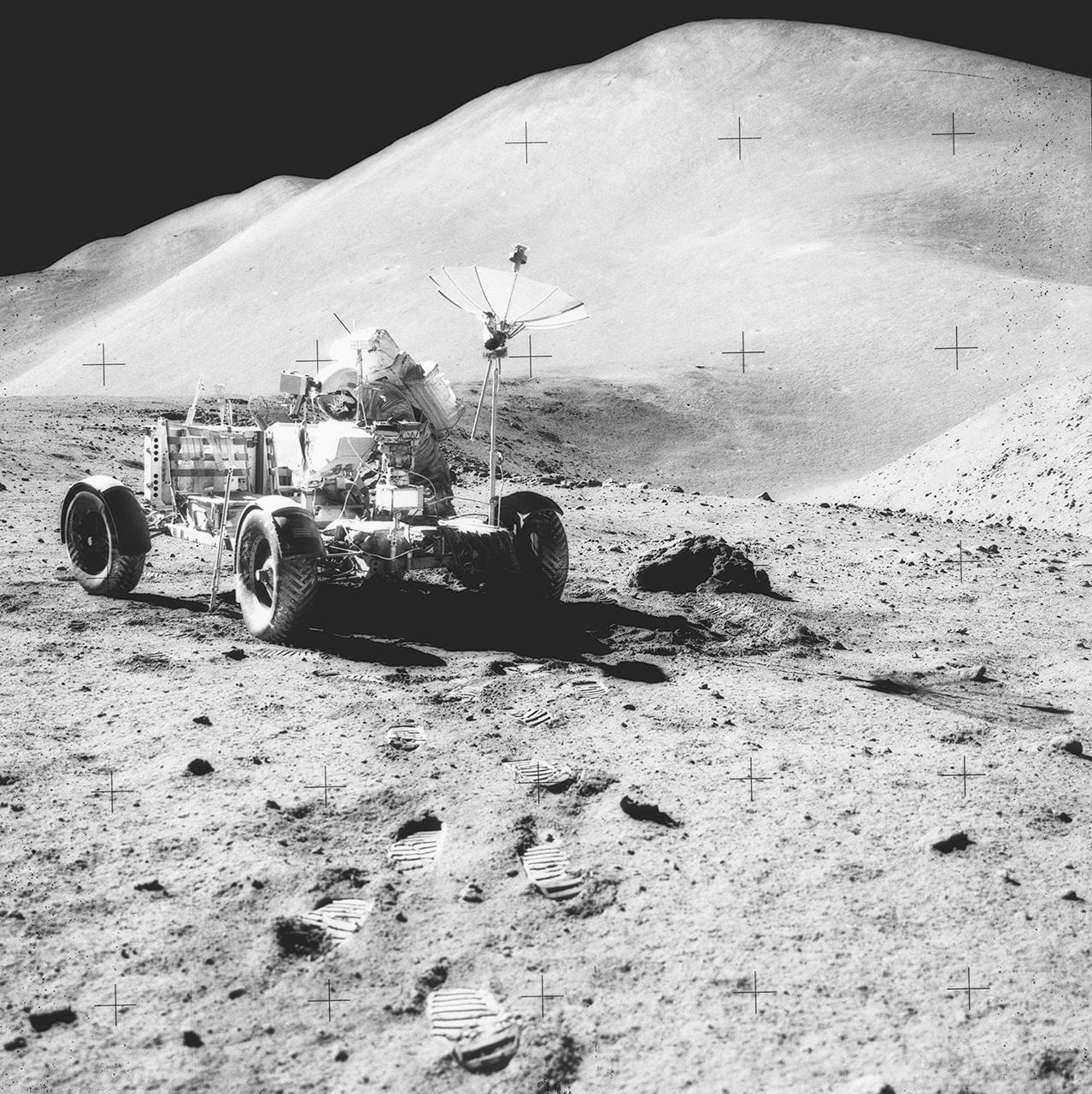
The Lunar Roving Vehicle (LRV) was designed to transport astronauts and materials on the Moon. An LRV was used on each of the last three Apollo missions, Apollo 15, Apollo 16, and Apollo 17, in 1971 and 1972 to permit the crew to travel several miles from the lunar landing site. This photograph was taken during the Apollo 15 mission.
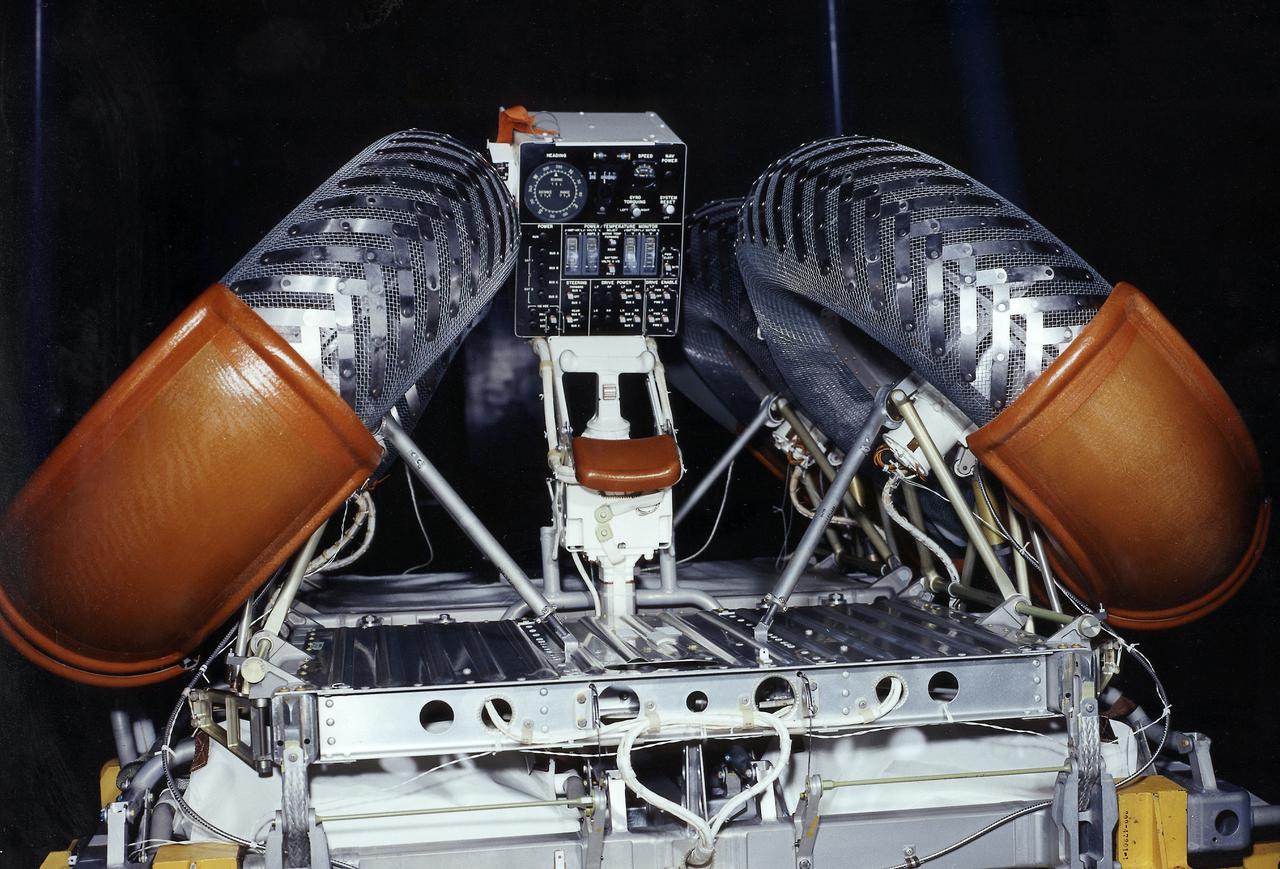
This photograph shows a rear view of a folded configuration of the Lunar Roving Vehicle (LRV) No. 2. The LRV was built to give Apollo astronauts a greater range of mobility during lunar exploration. It was an open-space and collapsible vehicle about 10 feet long with large mesh wheels, anterna, appendages, tool caddies, and camera. An LRV was used on each of the last three Apollo missions; Apollo 15, Apollo 16, and Apollo 17. It was built by the Boeing Company under the direction of the Marshall Space Flight Center.
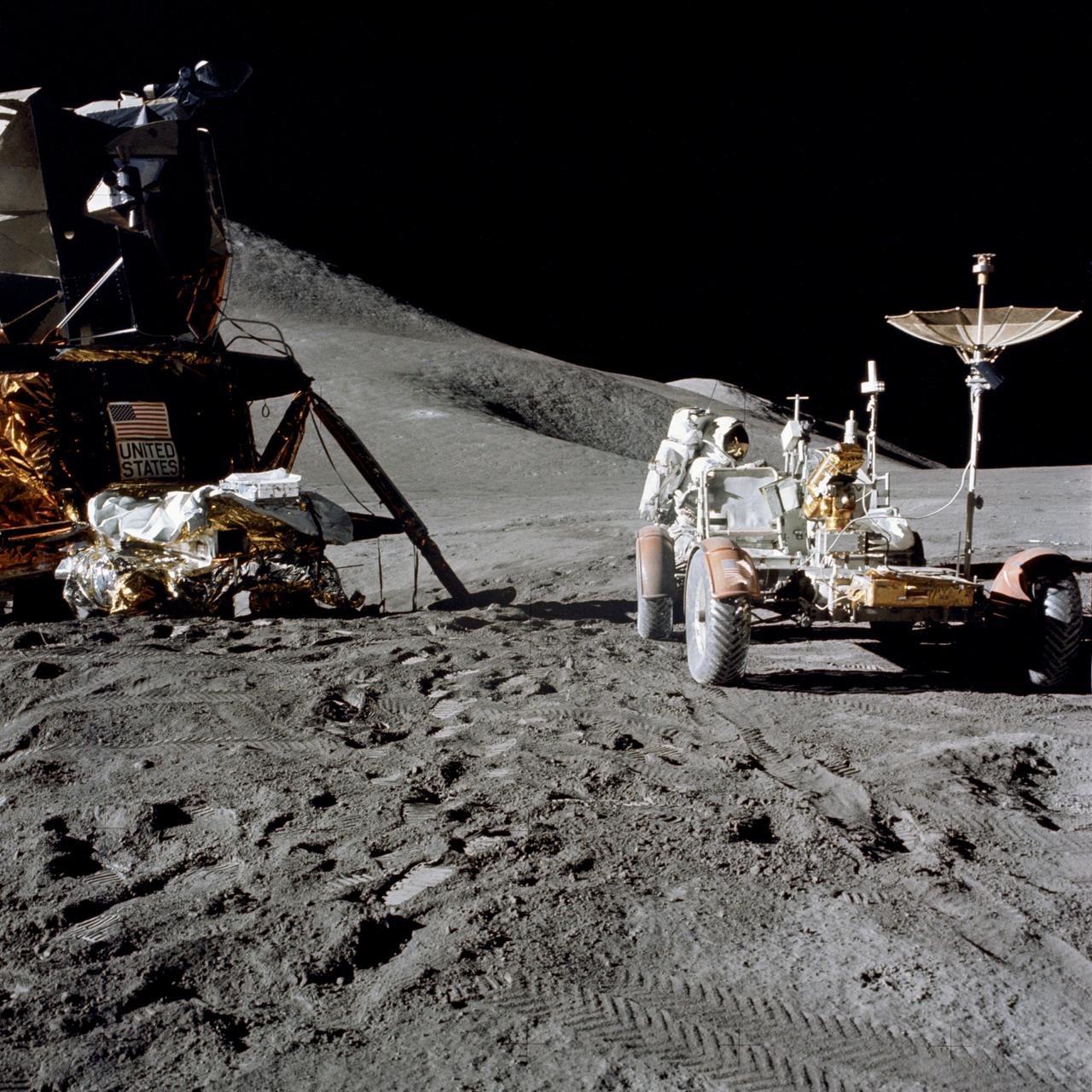
AS15-86-11602 (31 July 1971) --- Astronaut James B. Irwin, lunar module pilot, works at the Lunar Roving Vehicle (LRV) during the first Apollo 15 lunar surface extravehicular activity (EVA) at the Hadley-Apennine landing site. A portion of the Lunar Module (LM) "Falcon" is on the left. The undeployed Laser Ranging Retro Reflector (LR-3) lies atop the LM's modular equipment stowage assembly (MESA). This view is looking slightly west of south. Hadley Delta and the Apennine Front are in the background to the left. St. George crater is approximately five kilometers (about three statute miles) in the distance behind Irwin's head. This photograph was taken by astronaut David R. Scott, commander. While astronauts Scott and Irwin descended in the LM to explore the moon, astronaut Alfred M. Worden, command module pilot, remained with the Command and Service Modules (CSM) in lunar orbit.
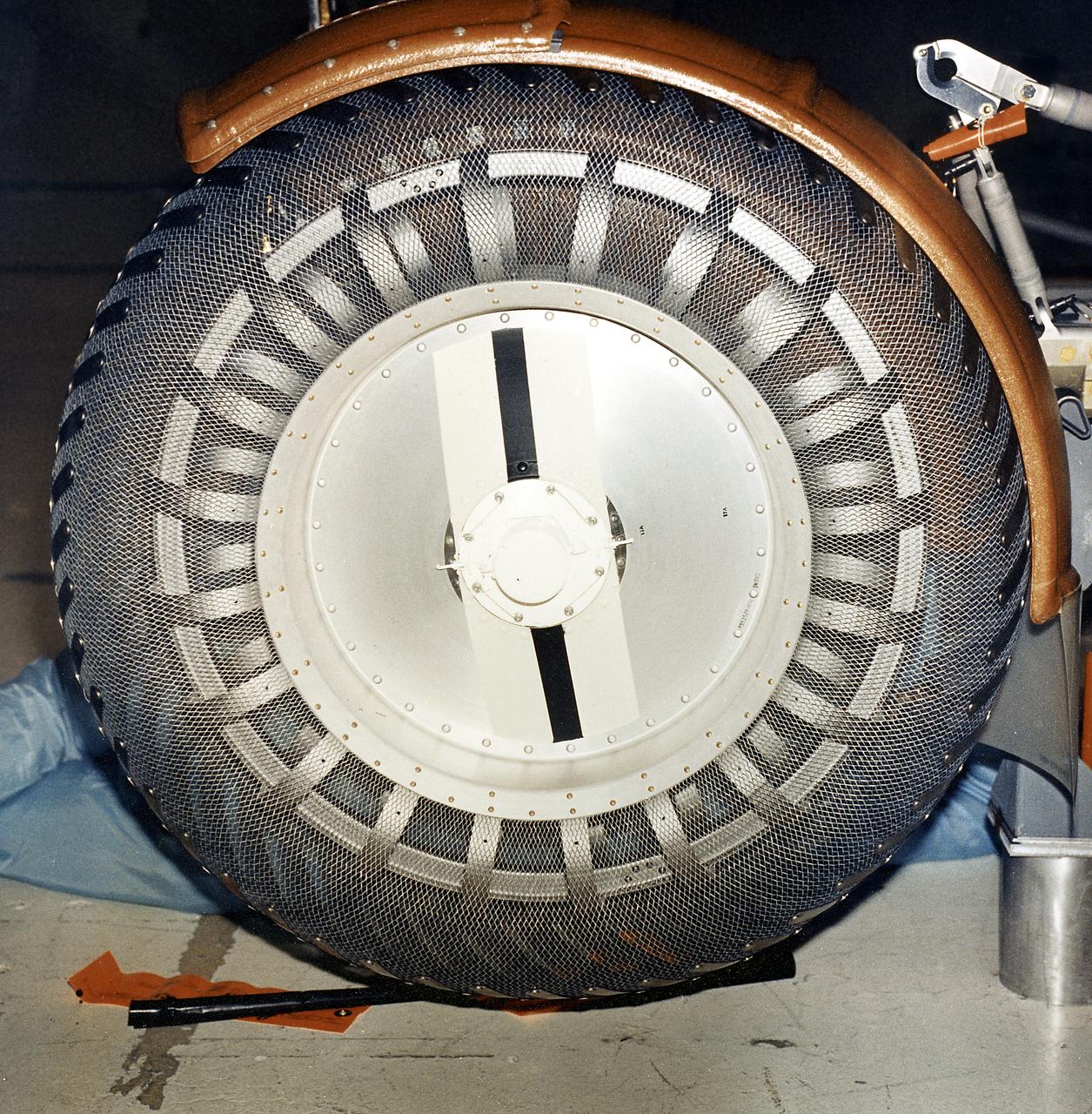
This is a close-up view of a left front wheel of the Lunar Roving Vehicle (LRV) No. 1. The LRV was built to give Apollo astronauts a greater range of mobility during lunar exploration. It was an open-space and collapsible vehicle about 10 feet long with large mesh wheels, anterna, appendages, tool caddies, and camera. An LRV was used on each of the last three Apollo missions; Apollo 15, Apollo 16, and Apollo 17. It was built by the Boeing Company under the direction of the Marshall Space Flight Center.
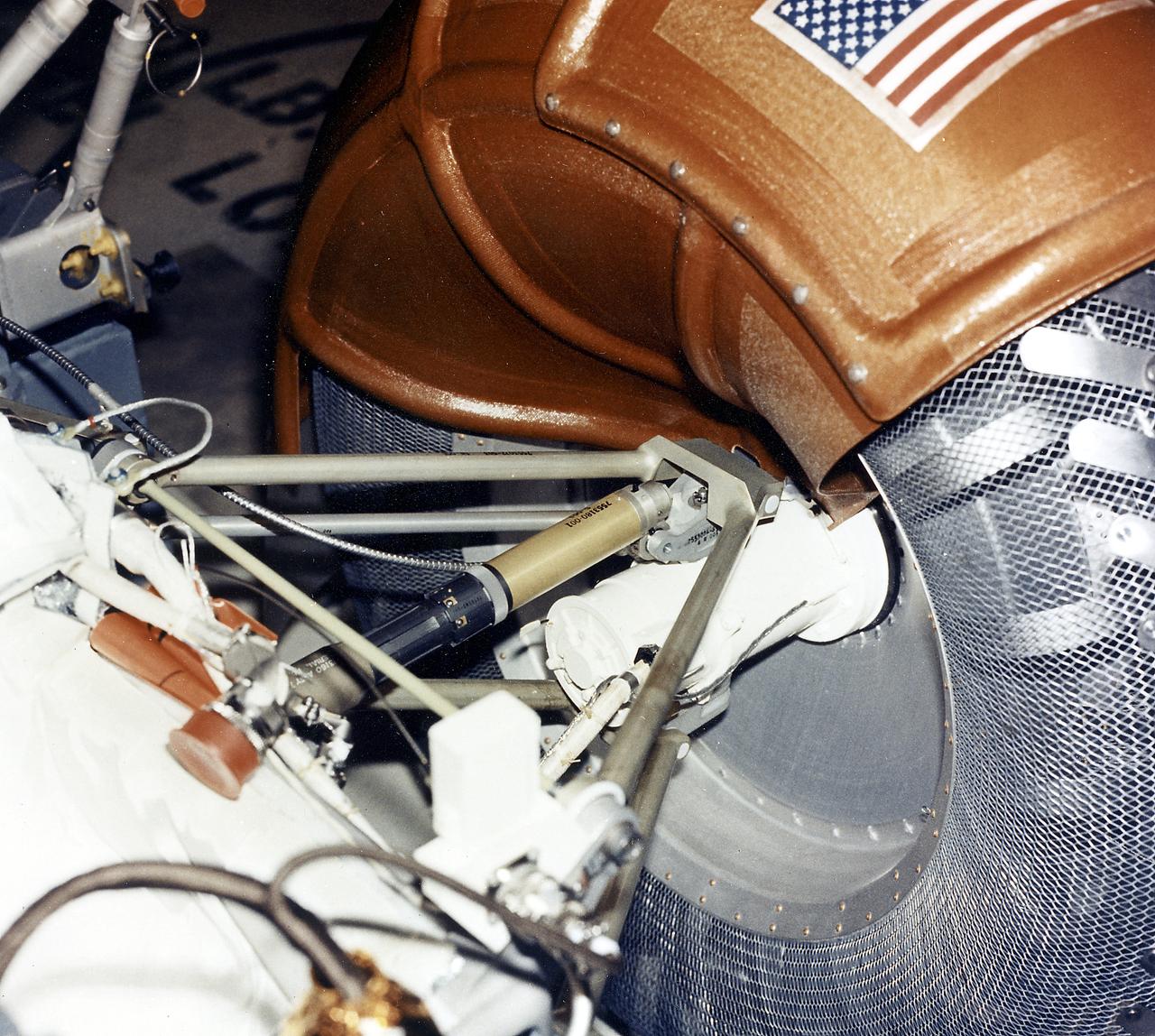
This is a close-up inboard view of a left front wheel of the Lunar Roving Vehicle (LRV) No. 1. The LRV was built to give Apollo astronauts a greater Range of mobility during lunar exploration. It was an open-space and collapsible vehicle about 10 feet long with large mesh wheels, anterna, appendages, tool caddies, and camera. An LRV was used on each of the last three Apollo missions; Apollo 15, Apollo 16, and Apollo 17. It was built by the Boeing Company under the direction of the Marshall Space Flight Center.
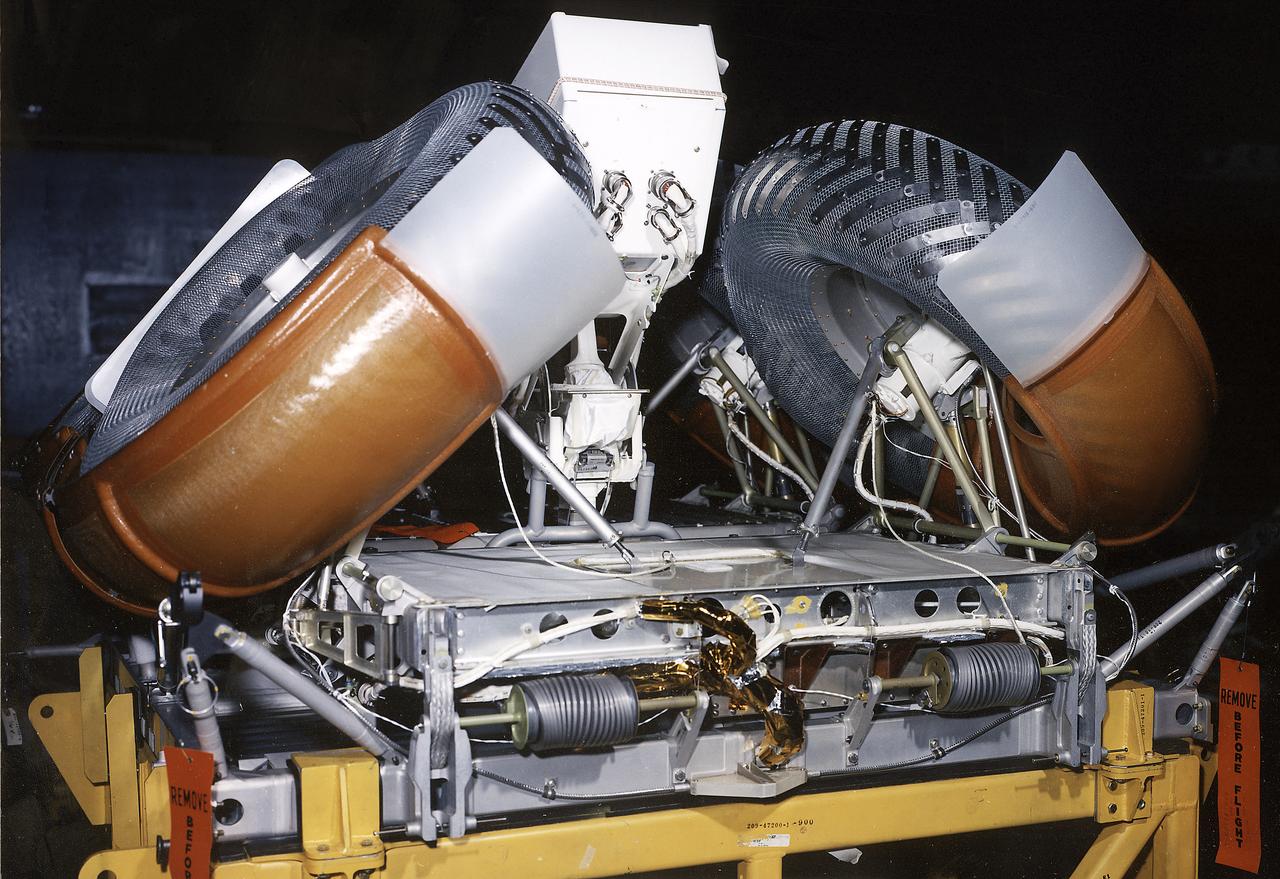
This photograph shows a front view of a folded configuration of the Lunar Roving Vehicle (LRV) No. 2. The LRV was built to give Apollo astronauts a greater range of mobility during lunar exploration. It was an open-space and collapsible vehicle about 10 feet long with large mesh wheels, anterna, appendages, tool caddies, and camera. An LRV was used on each of the last three Apollo missions; Apollo 15, Apollo 16, and Apollo 17. It was built by the Boeing Company under the direction of the Marshall Space Flight Center.
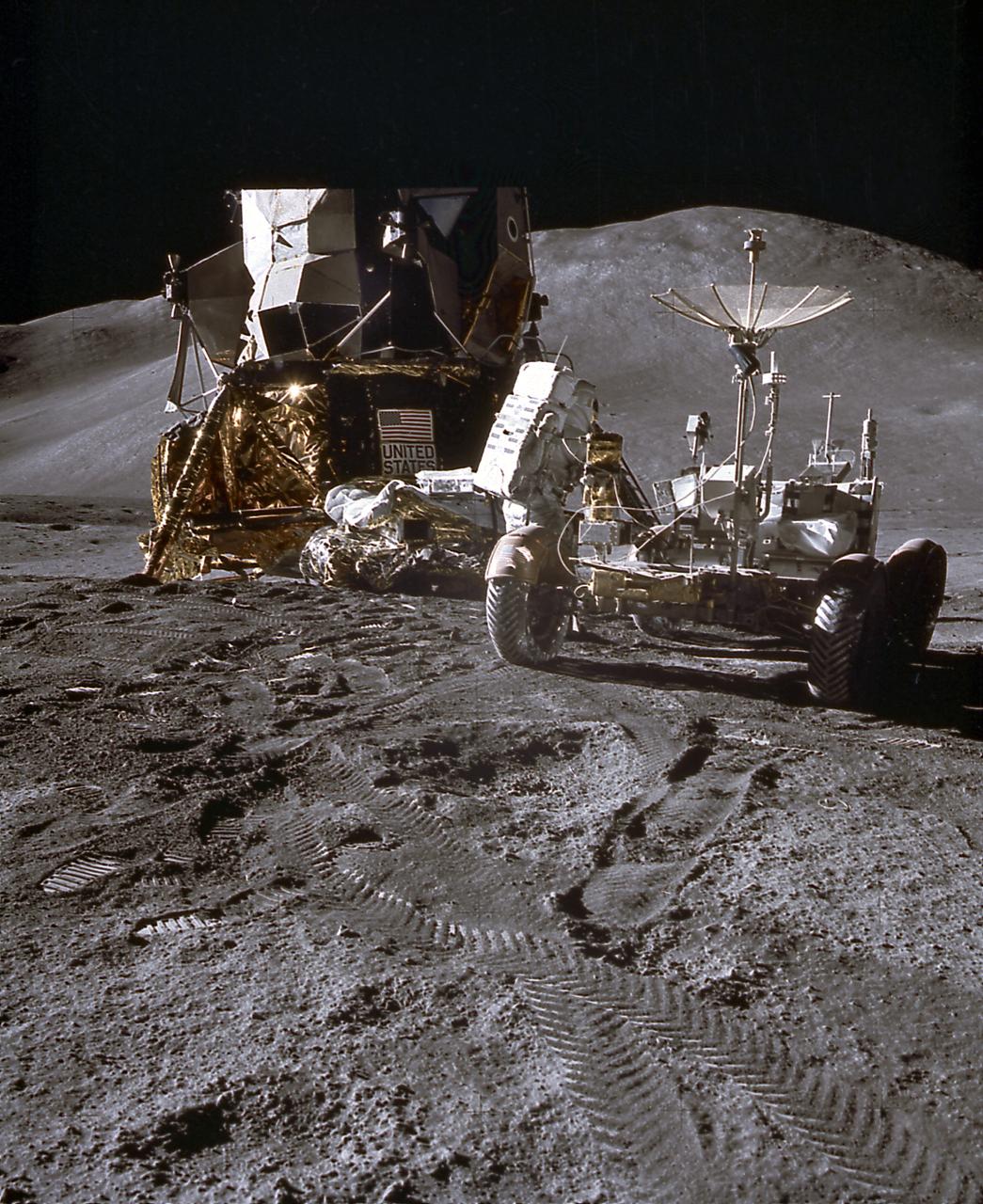
This photograph of an astronaut getting the Lunar Roving Vehicle (LRV) ready for exploration of the lunar surface was taken during activities of the Apollo 15 mission. Designed and developed by the Marshall Space Flight Center and built by the Boeing Company, the LRV was first used on the Apollo 15 mission and increased the range of astronauts' mobility and productivity on the lunar surface.
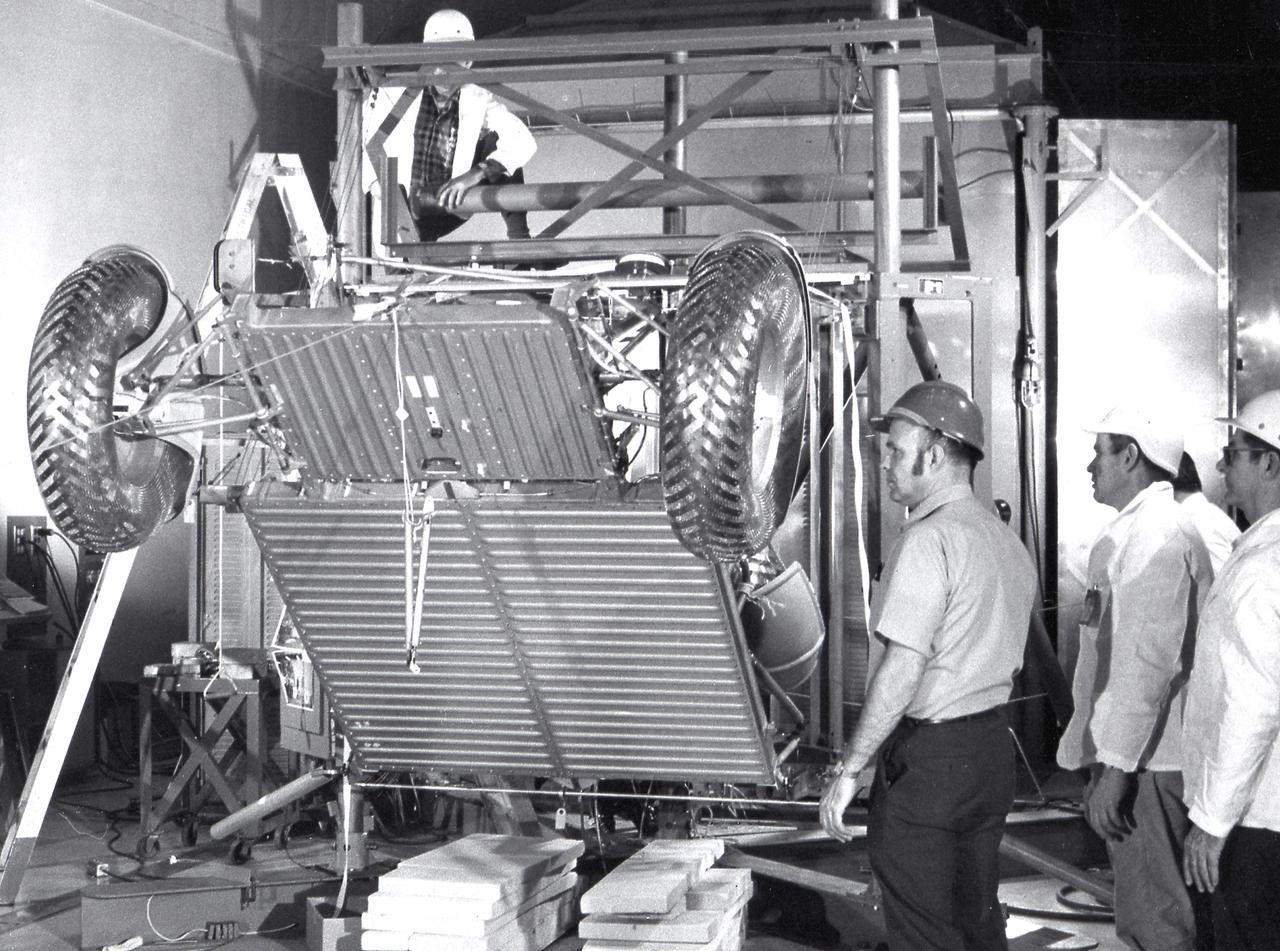
This photograph shows workmen at the Boeing plant in Kent, Washington, performing deployment tests on the Lunar Roving Vehicle (LRV). The LRV, developed under the direction of the Marshall Space Flight Center, was designed to allow Apollo astronauts a greater range of mobility on the lunar surface during the last three lunar exploration missions; Apollo 15, Apollo 16, and Apollo 17.

This photograph shows the Lunar Roving Vehicle (LRV) being prepared for installation in the Lunar Module at the Kennedy Space Center. The LRV was built to give Apollo astronauts a greater range of mobility during the last three lunar exploration missions; Apollo 15, Apollo 16, and Apollo 17. It was designed and developed by the Marshall Space Flight Center and built by the Boeing Company.
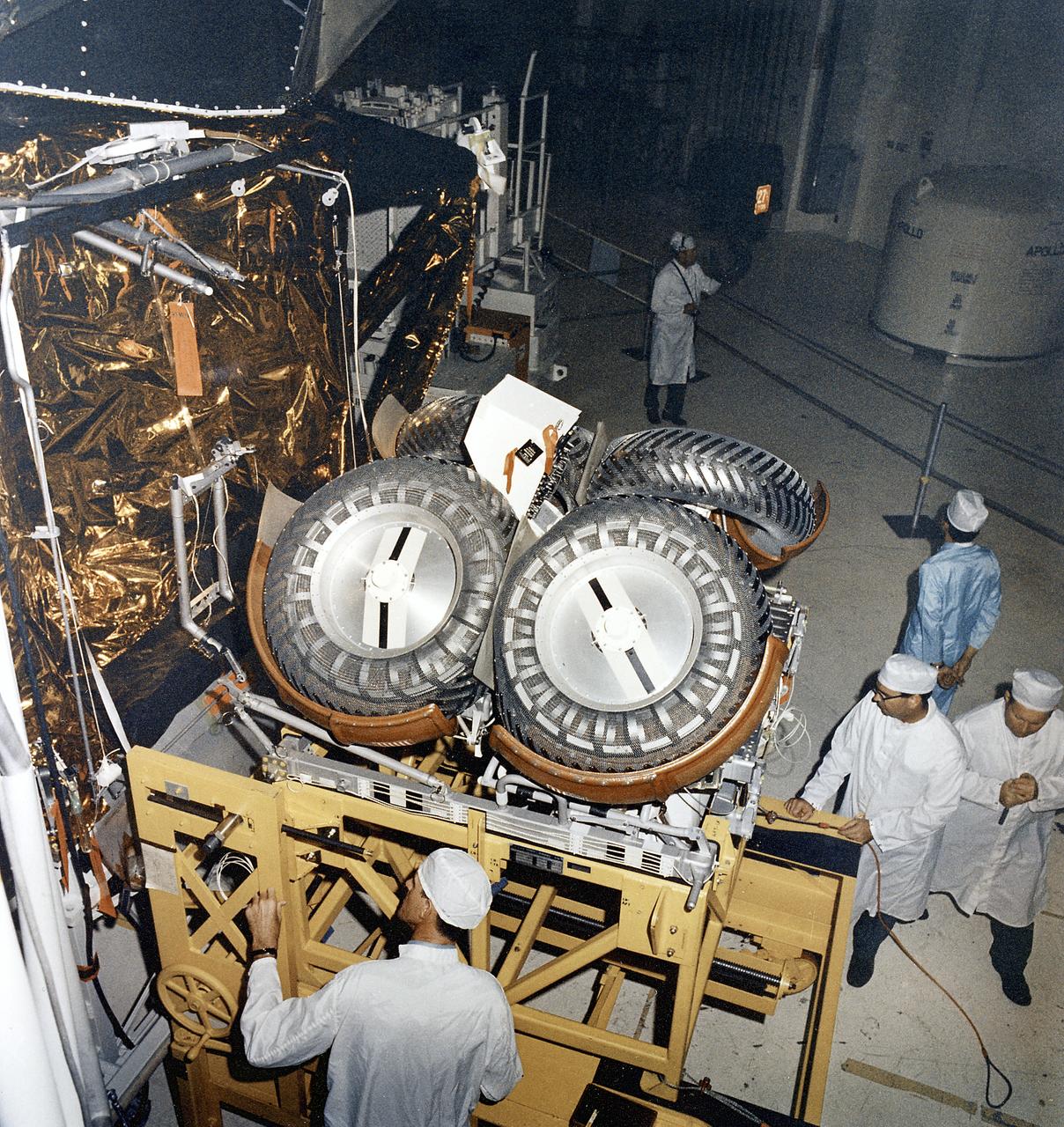
This photograph was taken during the installation of the Lunar Roving Vehicle (LRV) in the Lunar Module at the Kennedy Space Center. The LRV was built to give Apollo astronauts a greater range of mobility during the last three lunar exploration missions; Apollo 15, Apollo 16, and Apollo 17. It was designed and developed by the Marshall Space Flight Center and built by the Boeing Company.
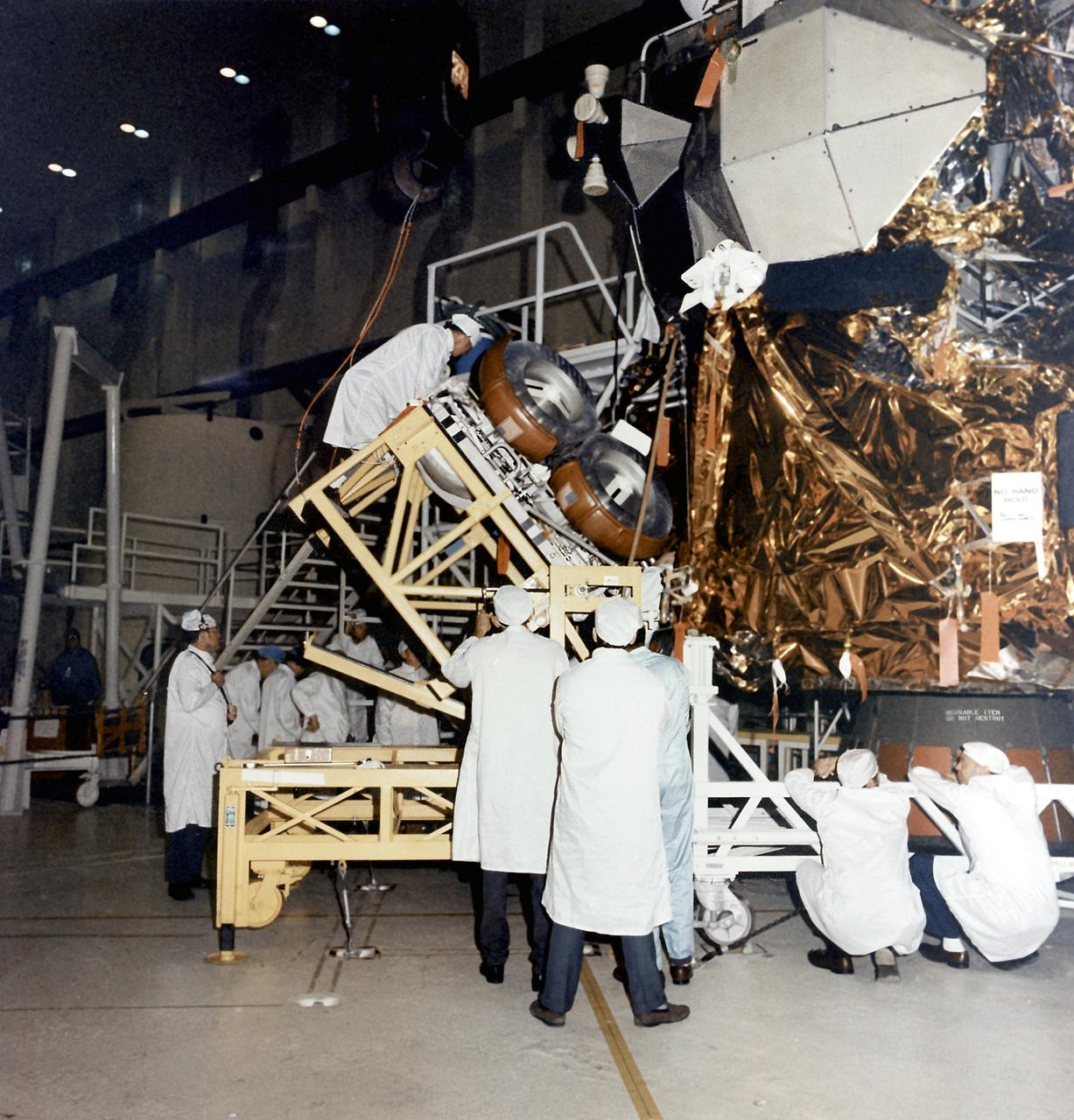
This photograph was taken during the installation of the Lunar Roving Vehicle (LRV) in the Lunar Module at the Kennedy Space Center. The LRV was built to give Apollo astronauts a greater range of mobility during the last three lunar exploration missions; Apollo 15, Apollo 16, and Apollo 17. It was designed and developed by the Marshall Space Flight Center and built by the Boeing Company.
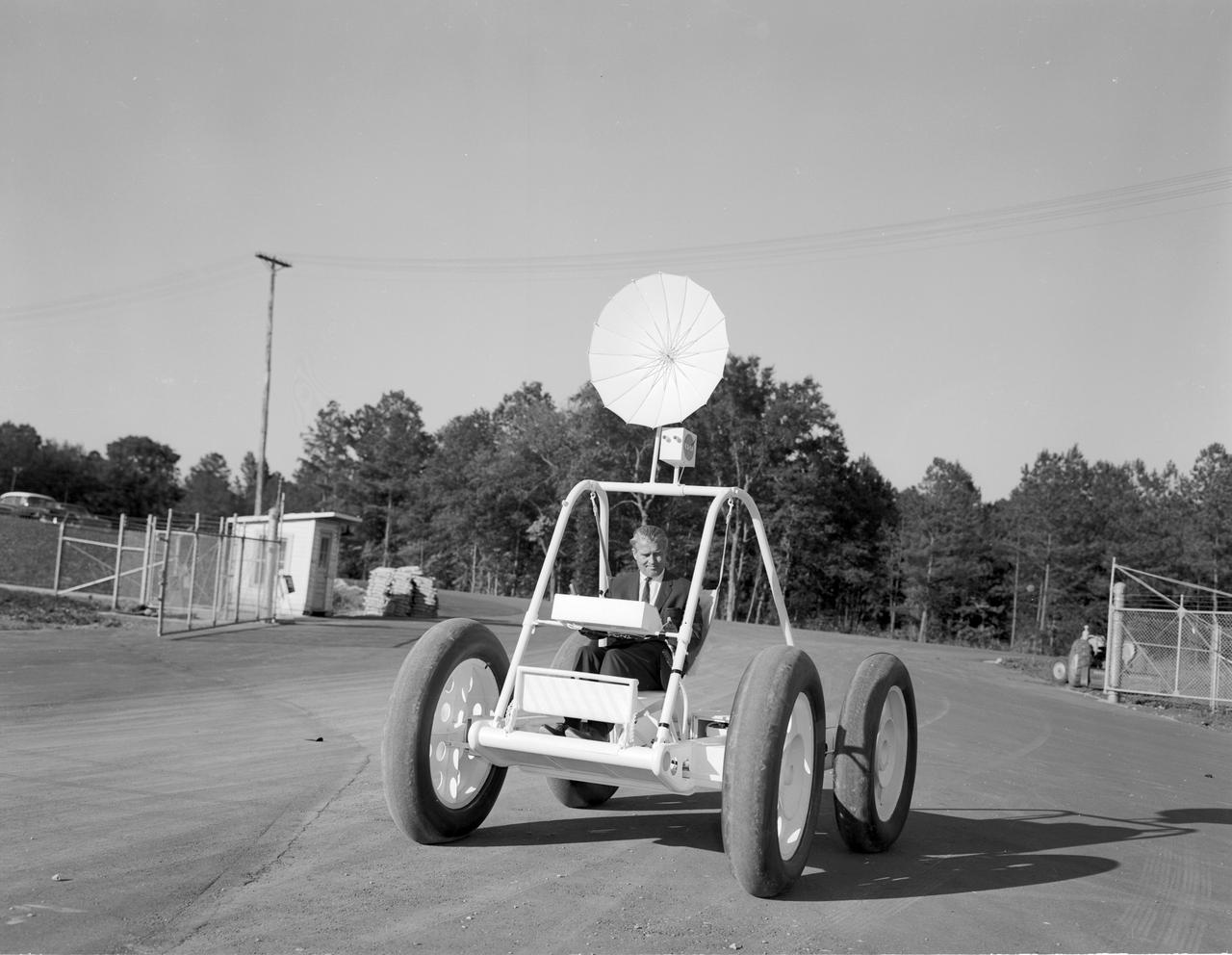
Dr. von Braun, director of NASA’s Marshall Space Flight Center (MSFC), is driving a small vehicle used in the studies of modes for transportation on the moon’s surface. From those studies evolved the Lunar Roving Vehicle (LRV).
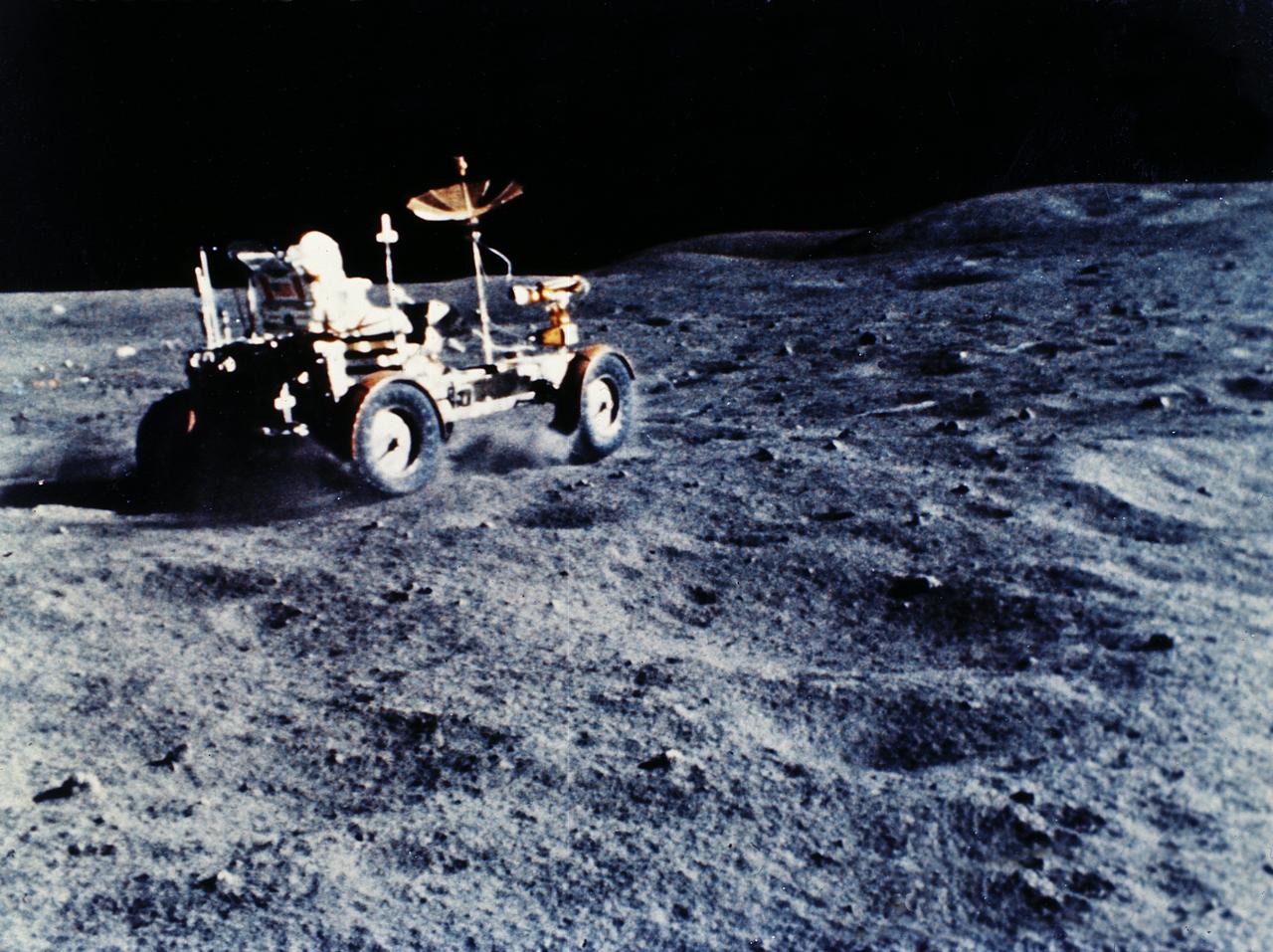
The Lunar Roving Vehicle (LRV) was designed to transport astronauts and materials on the Moon. An LRV was used on each of the last three Apollo missions; Apollo 15, Apollo 16, and Apollo 17, in 1971 and 1972, to permit the crew to travel several miles from the lunar landing site. This photograph was taken during the Apollo 16 mission.
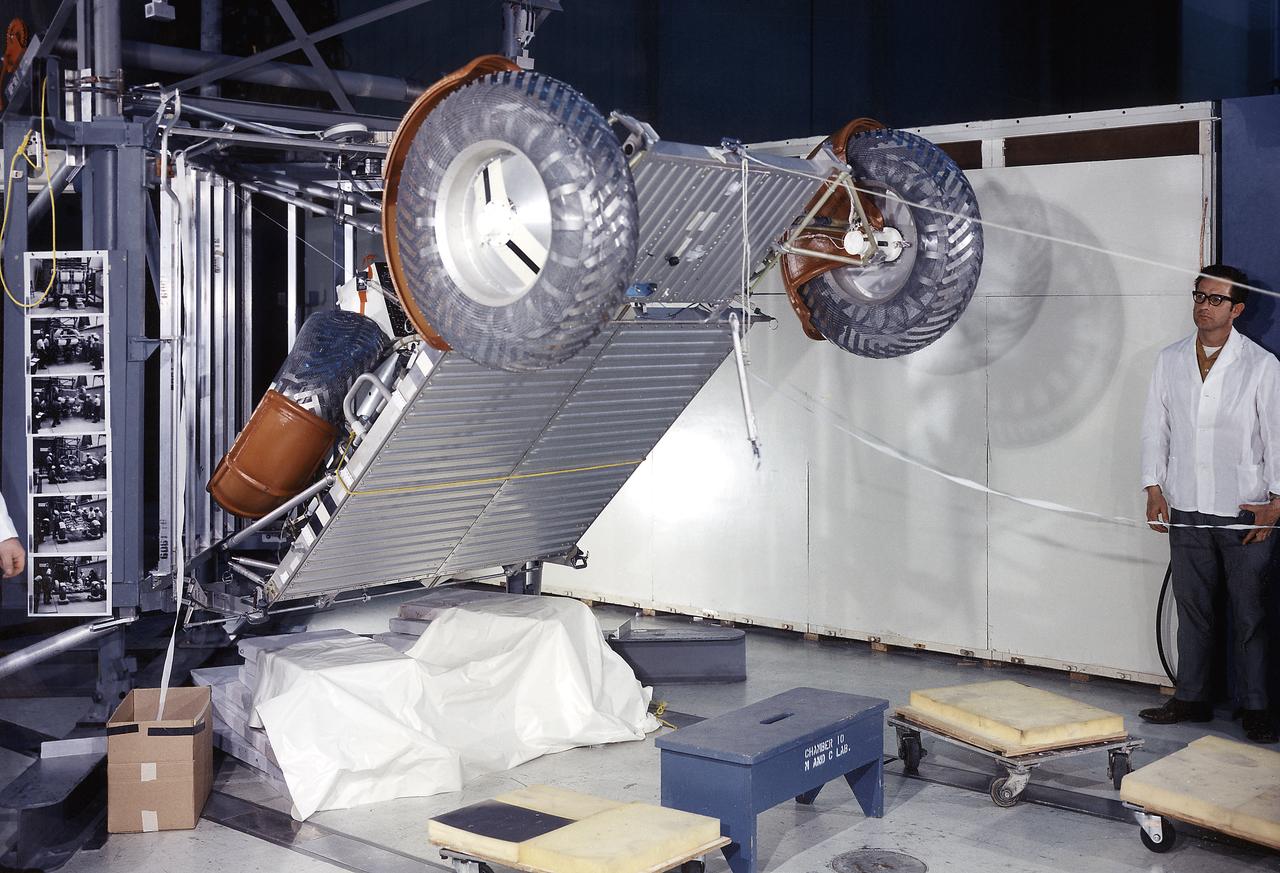
This photograph was taken during a deployment simulation of the Lunar Roving Vehicle (LRV). The LRV was built to give Apollo astronauts a greater range of mobility during the last three lunar exploration missions; Apollo 15, Apollo 16, and Apollo 17. It was designed and developed by the Marshall Space Flight Center and built by the Boeing Company.
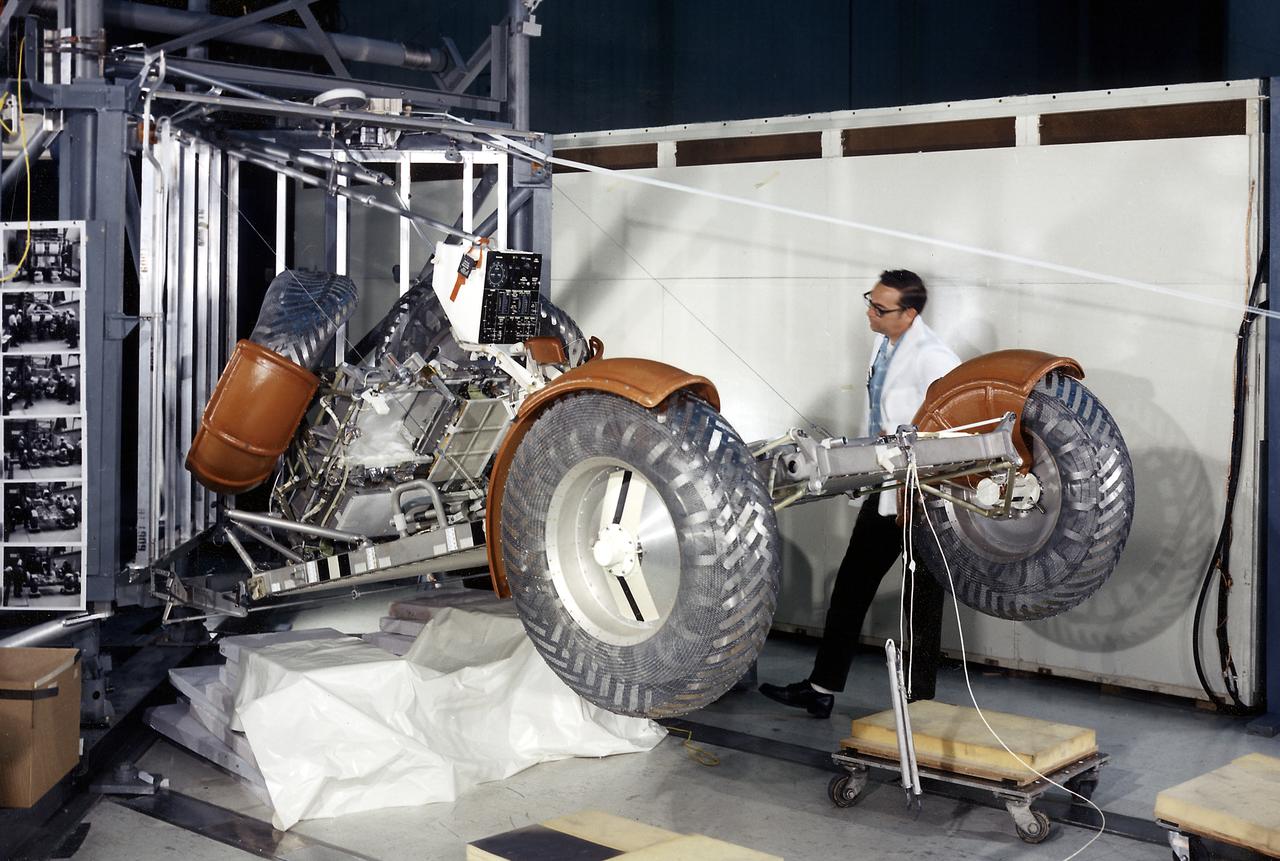
This photograph was taken during a deployment simulation of the Lunar Roving Vehicle (LRV). The LRV was built to give Apollo astronauts a greater range of mobility during the last three lunar exploration missions; Apollo 15, Apollo 16, and Apollo 17. It was designed and developed by the Marshall Space Flight Center and built by the Boeing Company.
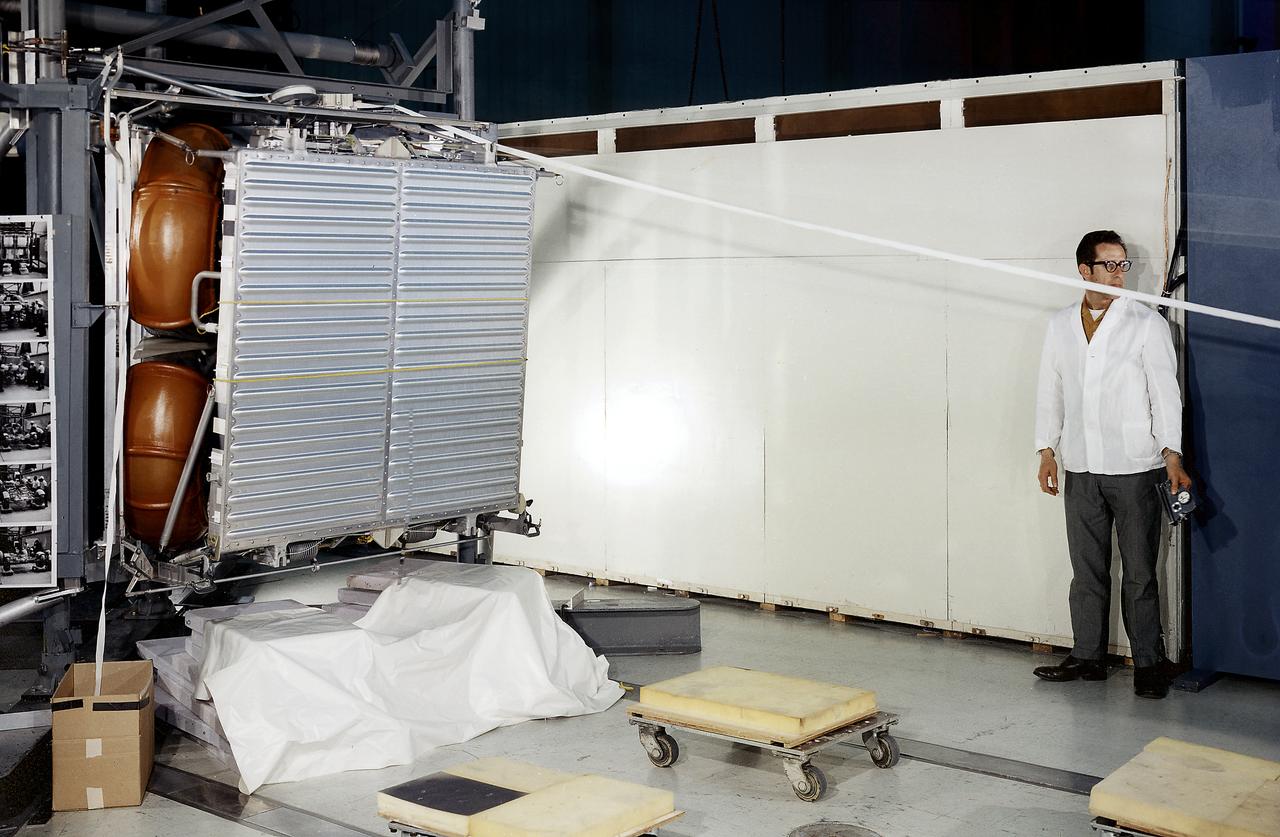
This photograph was taken during a deployment simulation of the Lunar Roving Vehicle (LRV). The LRV was built to give Apollo astronauts a greater range of mobility during the last three lunar exploration missions; Apollo 15, Apollo 16, and Apollo 17. It was designed and developed by the Marshall Space Flight Center and built by the Boeing Company.

This in an aerial view (looking north) of a Lunar Roving Vehicle (LRV), often referrd to as “Moonbuggy”, simulator area built at the Marshall Space Flight Center (MSFC) where tesing was performed. The LRV was developed under the direction of MSFC to provide astronauts with greater mobility on the lunar surface.
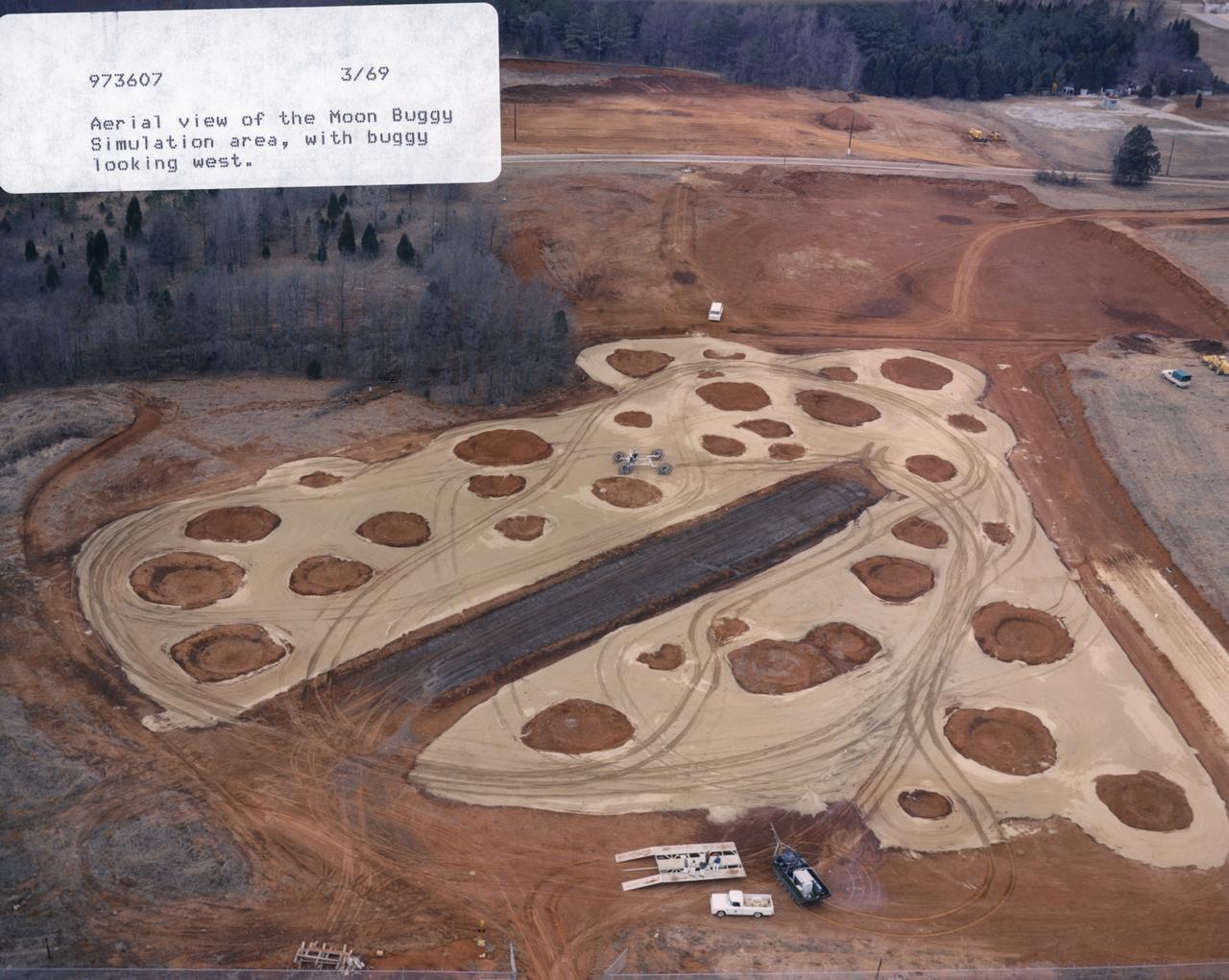
This in an aerial view (looking west) of a Lunar Roving Vehicle (LRV), often referred to as “Moonbuggy”, simulator area built at the Marshall Space Flight Center (MSFC) where tesing was performed. The LRV was developed under the direction of MSFC to provide astronauts with greater mobility on the lunar surface.
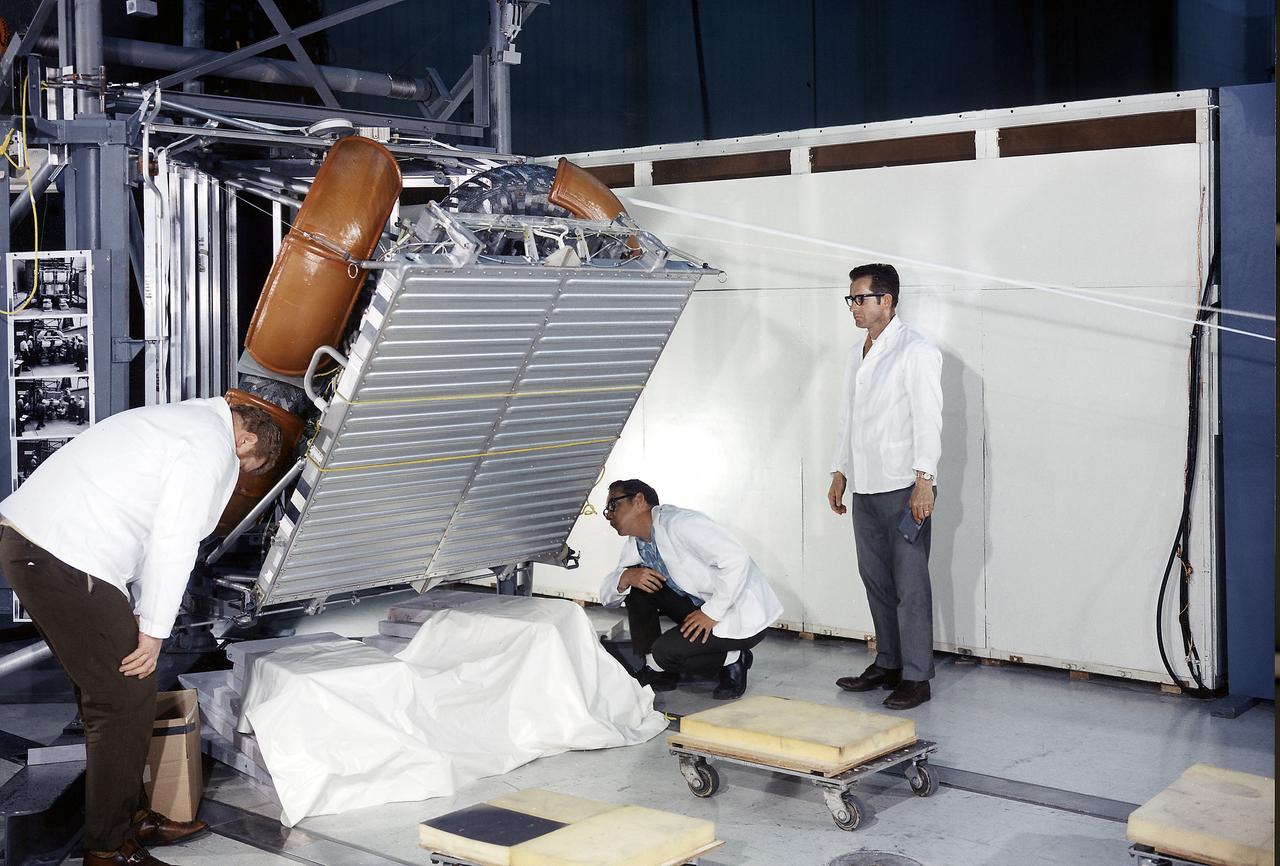
This photograph was taken during a deployment simulation of the Lunar Roving Vehicle (LRV). The LRV was built to give Apollo astronauts a greater range of mobility during the last three lunar exploration missions; Apollo 15, Apollo 16, and Apollo 17. It was designed and developed by the Marshall Space Flight Center and built by the Boeing Company.
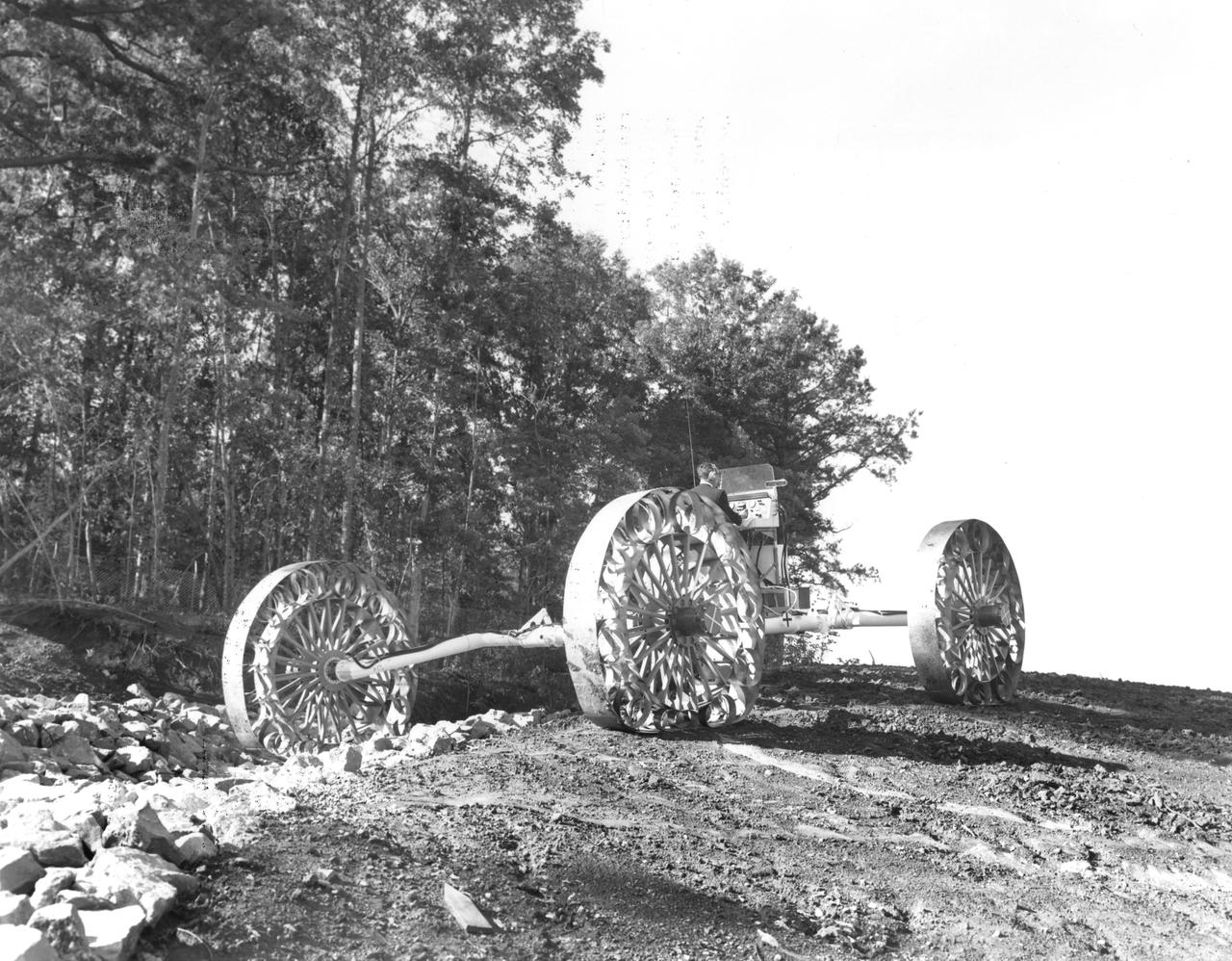
An engineer demonstrates a Mobility Test Article (MTA) at NASA’s Marshall Space Flight Center (MSFC). This unit, weighing 1/6th as much as an actual vehicle, was built by the Bendix Corporation and was one of the concepts of a possible Lunar Roving Vehicle (LRV). The data provided by the MTA helped in designing the Lunar Roving Vehicle (LRV), developed under the direction of MSFC. The LRV was designed to allow Apollo astronauts a greater range of mobility during lunar exploration missions.
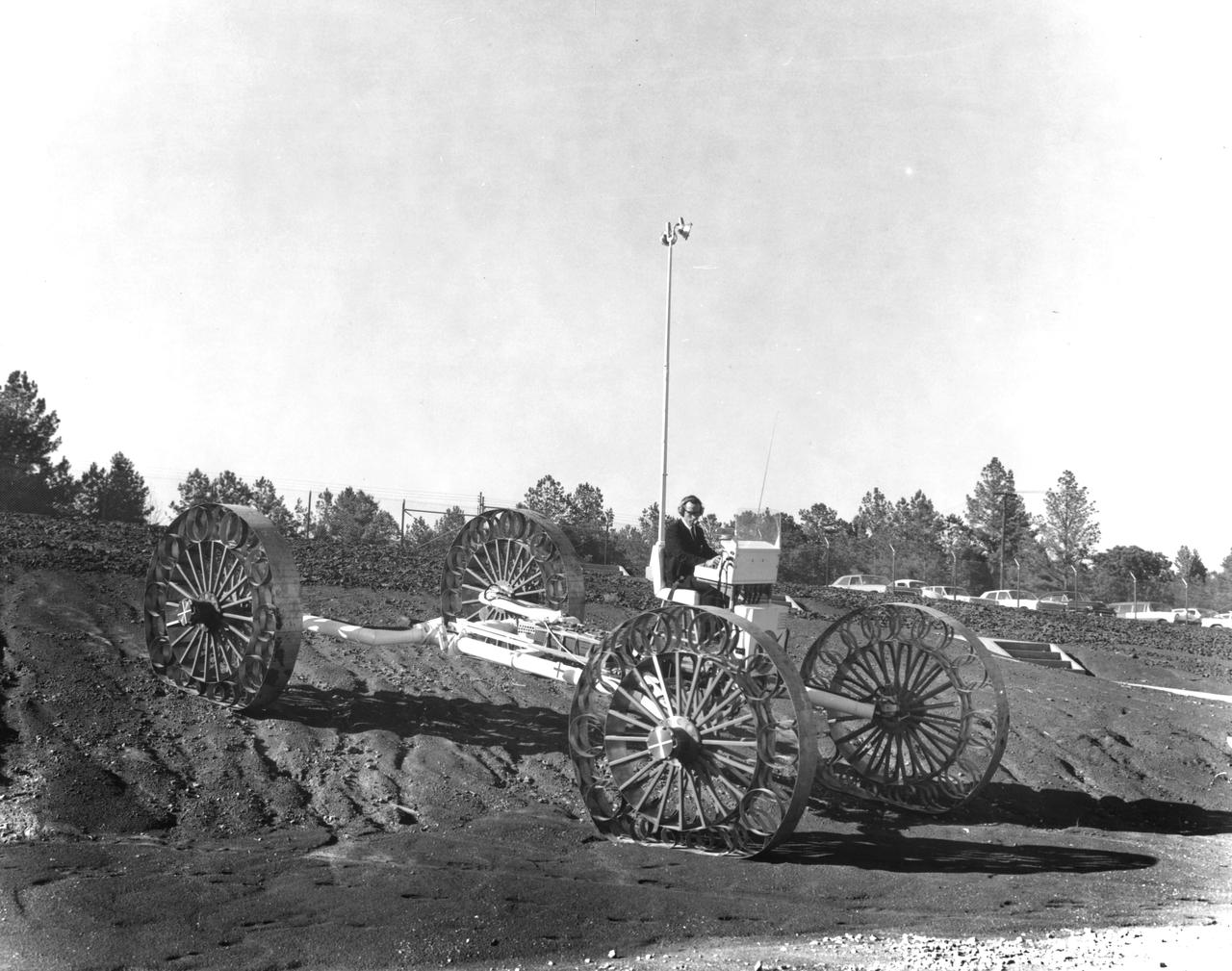
An engineer demonstrates a Mobility Test Article (MTA) at NASA’s Marshall Space Flight Center (MSFC) as he goes down a slope onto soft earth. This unit, weighing 1/6th as much as an actual vehicle, was built by the Bendix Corporation and was one of the concepts of a possible Lunar Roving Vehicle (LRV). The data provided by the MTA helped in designing the Lunar Roving Vehicle (LRV), developed under the direction of MSFC. The LRV was designed to allow Apollo astronauts a greater range of mobility during lunar exploration missions.
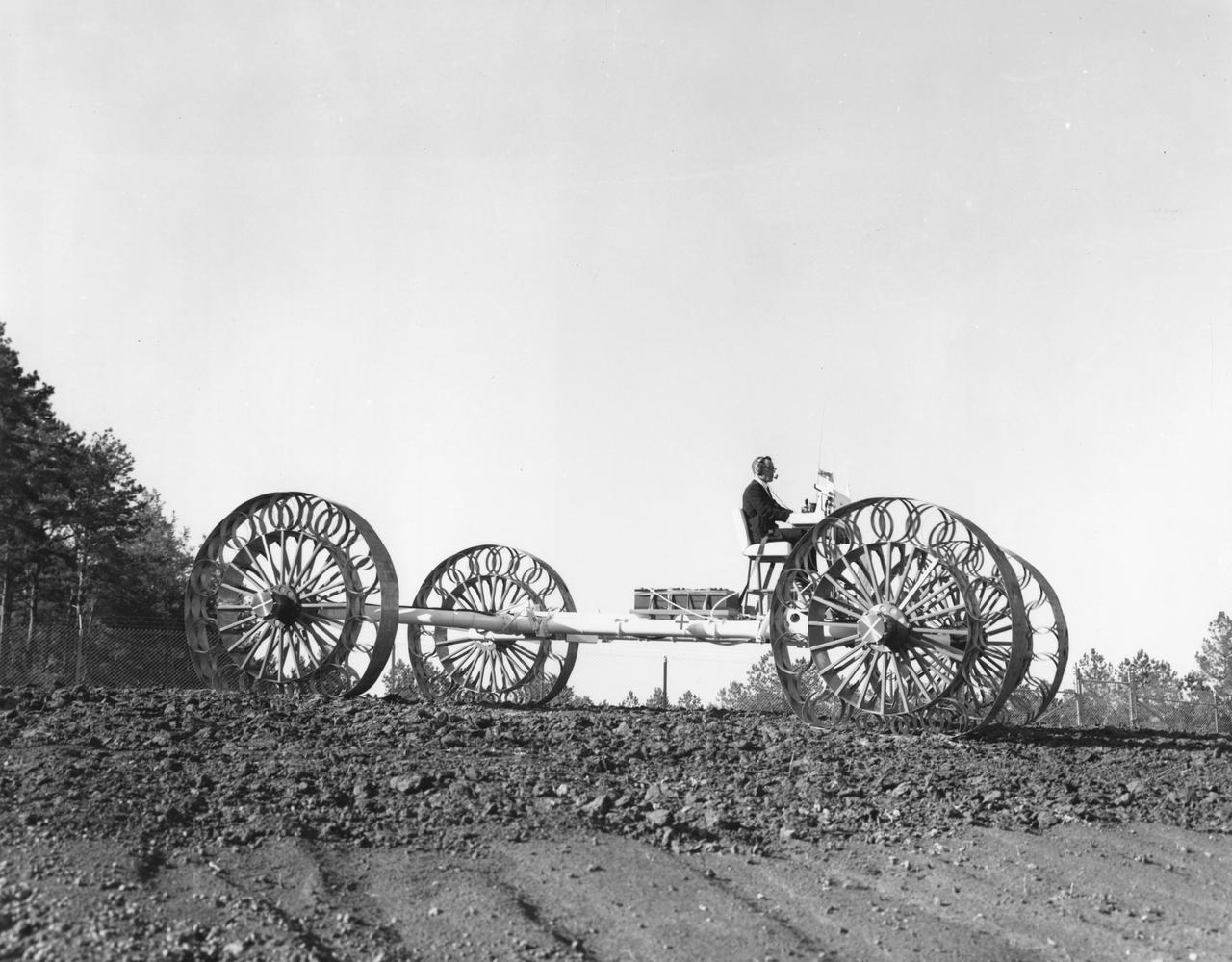
An engineer demonstrates a Mobility Test Article (MTA) at NASA’s Marshall Space Flight Center (MSFC). This unit, weighing 1/6th as much as an actual vehicle, was built by the Bendix Corporation and was one of the concepts of a possible Lunar Roving Vehicle (LRV). The data provided by the MTA helped in designing the Lunar Roving Vehicle (LRV), developed under the direction of MSFC. The LRV was designed to allow Apollo astronauts a greater range of mobility during lunar exploration missions.

The Lunar Roving Vehicle (LRV) was designed to transport astronauts and materials on the Moon. It was a collapsible open-space vehicle about 10 feet long with large mesh wheels, anterna, appendages, tool caddies, and cameras. Powered by two 36-volt batteries, it has four 1/4-hp drive motors, one for each wheel. The vehicle was designed to travel in forward or reverse, negotiate obstacles about 1 foot high, cross crevasses about 2 feet wide, and climb or descend moderate slopes. Its speed limit was about 9 miles (14 kilometers) per hour. An LRV was used on each of the last three Apollo missions (Apollo 15, Apollo 16, and Apollo 17) and permitted the crew to travel several miles from the Lunar Module. The LRV was designed, developed, and tested by the Marshall Space Flight Center, and built by the Boeing Plant in Kent, Washington.
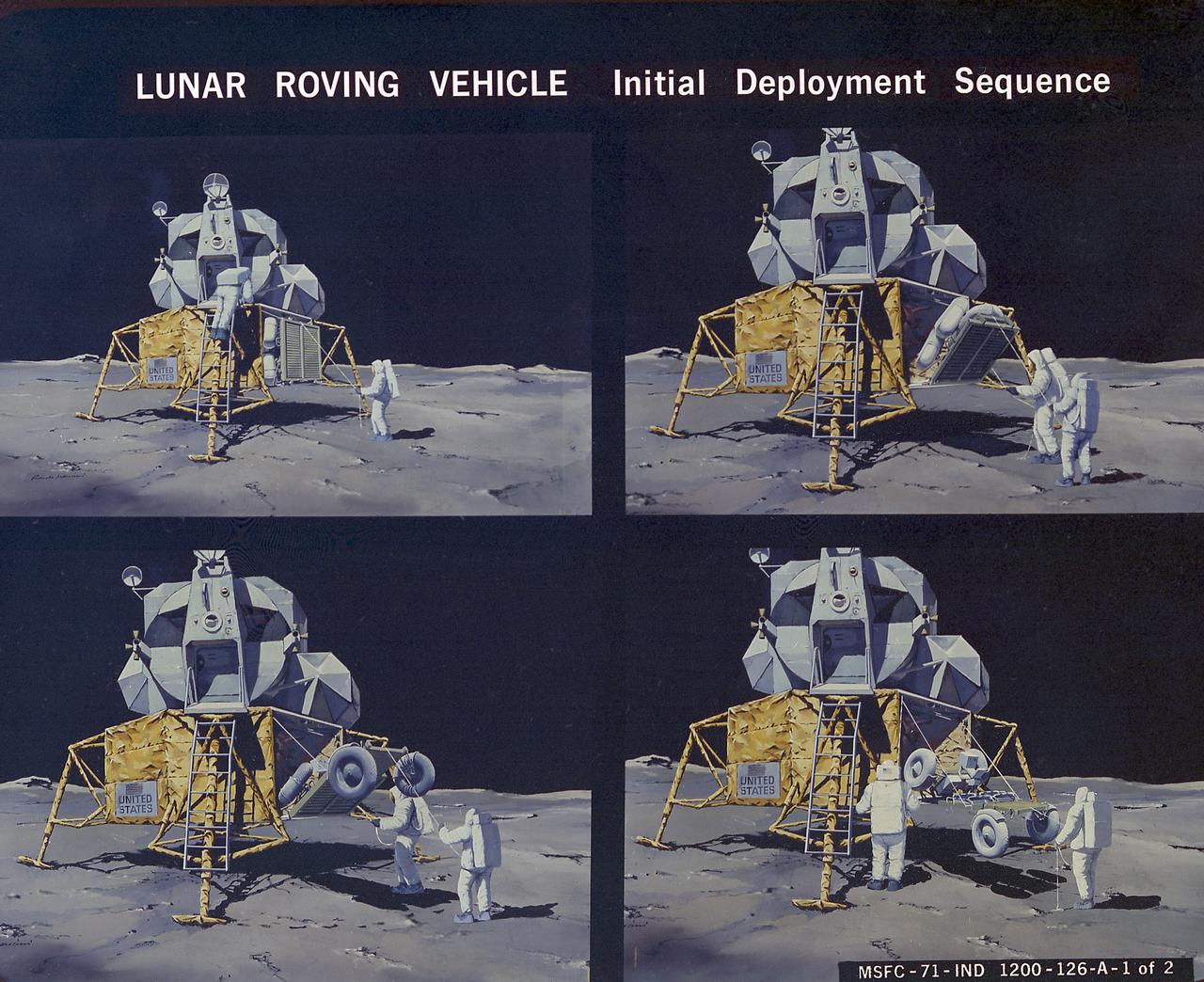
This artist's concept illustrates the deployment sequence of the Lunar Roving Vehicle (LRV) on the Moon. The LRV was designed to transport astronauts and materials on the Moon. It was a collapsible open-space vehicle about 10 feet long with large mesh wheels, anterna, appendages, tool caddies, and cameras. Powered by two 36-volt batteries, it has four 1/4-hp drive motors, one for each wheel. The vehicle was designed to travel in forward or reverse, negotiate obstacles about 1 foot high, cross crevasses about 2 feet wide, and climb or descend moderate slopes. Its speed limit was about 9 miles (14 kilometers) per hour. An LRV was used on each of the last three Apollo missions (Apollo 15, Apollo 16, and Apollo 17) and permitted the crew to travel several miles from the Lunar Module. The LRV was designed, developed, and tested by the Marshall Space Flight Center, and built by the Boeing Plant in Kent, Washington.
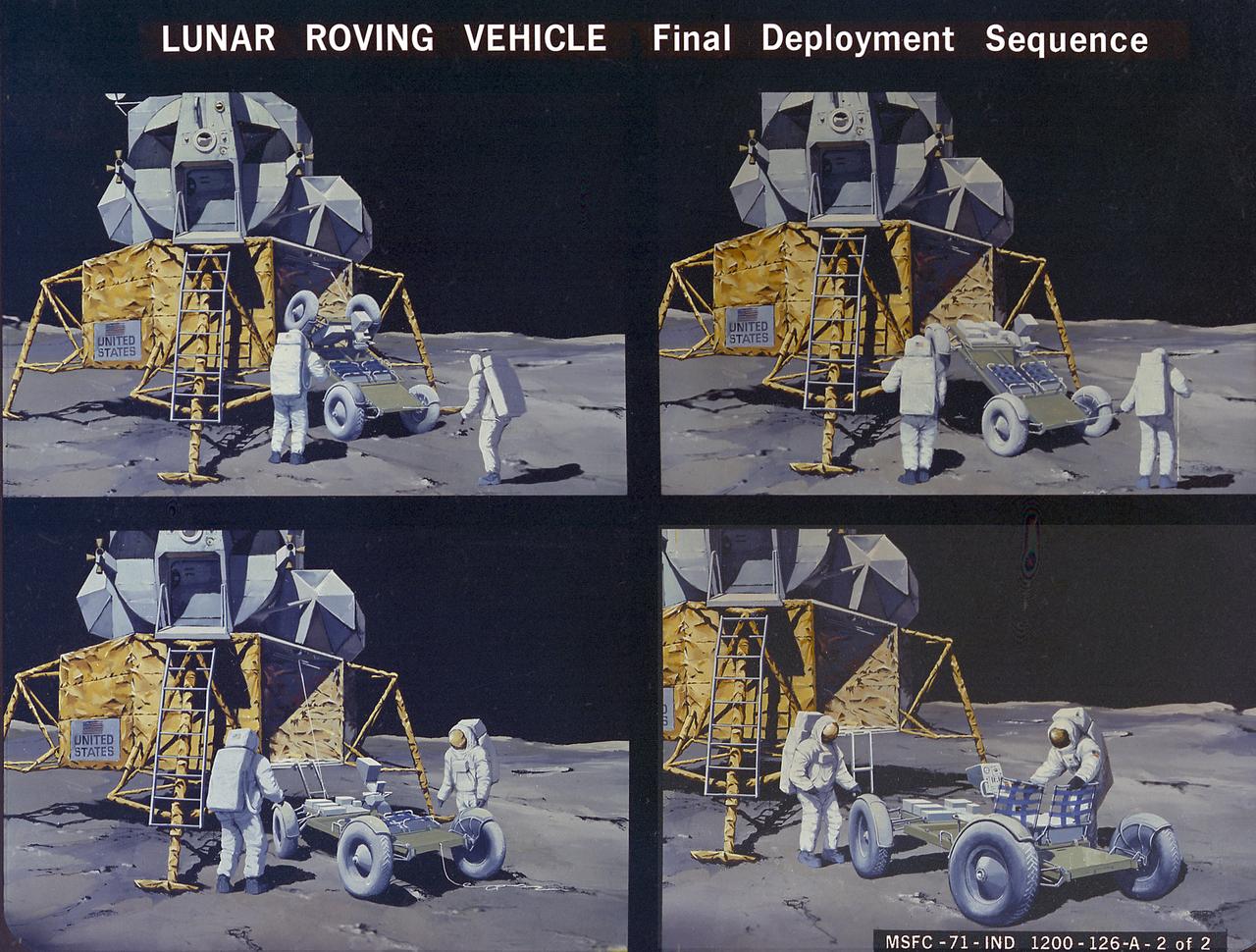
This artist's concept illustrates the deployment sequence of the Lunar Roving Vehicle (LRV) on the Moon. The LRV was designed to transport astronauts and materials on the Moon. It was a collapsible open-space vehicle about 10 feet long with large mesh wheels, anterna, appendages, tool caddies, and cameras. Powered by two 36-volt batteries, it has four 1/4-hp drive motors, one for each wheel. The vehicle was designed to travel in forward or reverse, negotiate obstacles about 1 foot high, cross crevasses about 2 feet wide, and climb or descend moderate slopes. Its speed limit was about 9 miles (14 kilometers) per hour. An LRV was used on each of the last three Apollo missions (Apollo 15, Apollo 16, and Apollo 17) and permitted the crew to travel several miles from the Lunar Module. The LRV was designed, developed, and tested by the Marshall Space Flight Center, and built by the Boeing Plant in Kent, Washington.
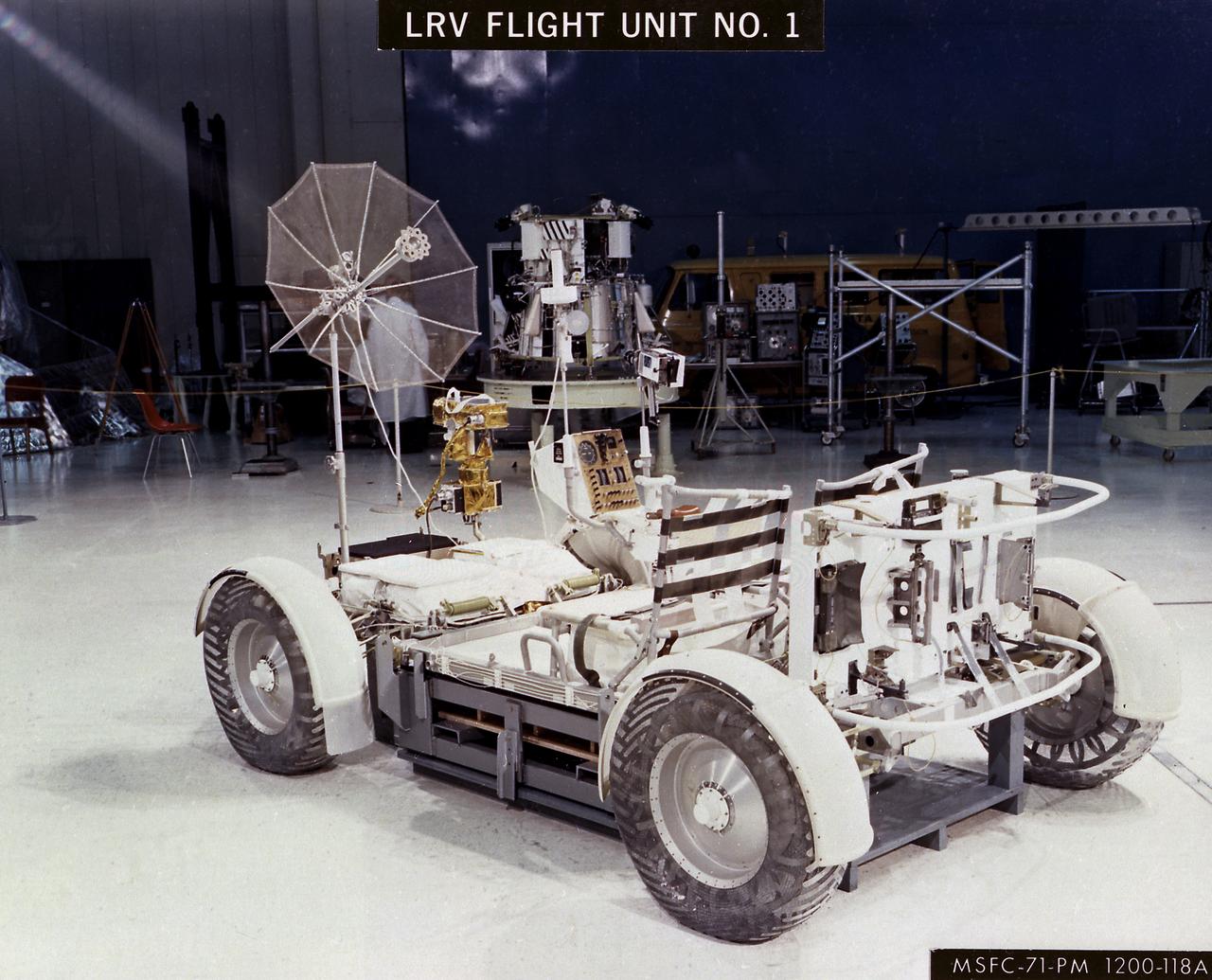
The Lunar Roving Vehicle (LRV) was designed to transport astronauts and materials on the Moon. It was a collapsible open-space vehicle about 10 feet long with large mesh wheels, anterna, appendages, tool caddies, and cameras. Powered by two 36-volt batteries, it has four 1/4-hp drive motors, one for each wheel. The vehicle was designed to travel in forward or reverse, negotiate obstacles about 1 foot high, cross crevasses about 2 feet wide, and climb or descend moderate slopes. Its speed limit was about 9 miles (14 kilometers) per hour. An LRV was used on each of the last three Apollo missions (Apollo 15, Apollo 16, and Apollo 17) and permitted the crews to travel several miles from the Lunar Module. The LRV was designed, developed, and tested by the Marshall Space Flight Center, and built by the Boeing Plant in Kent, Washington.
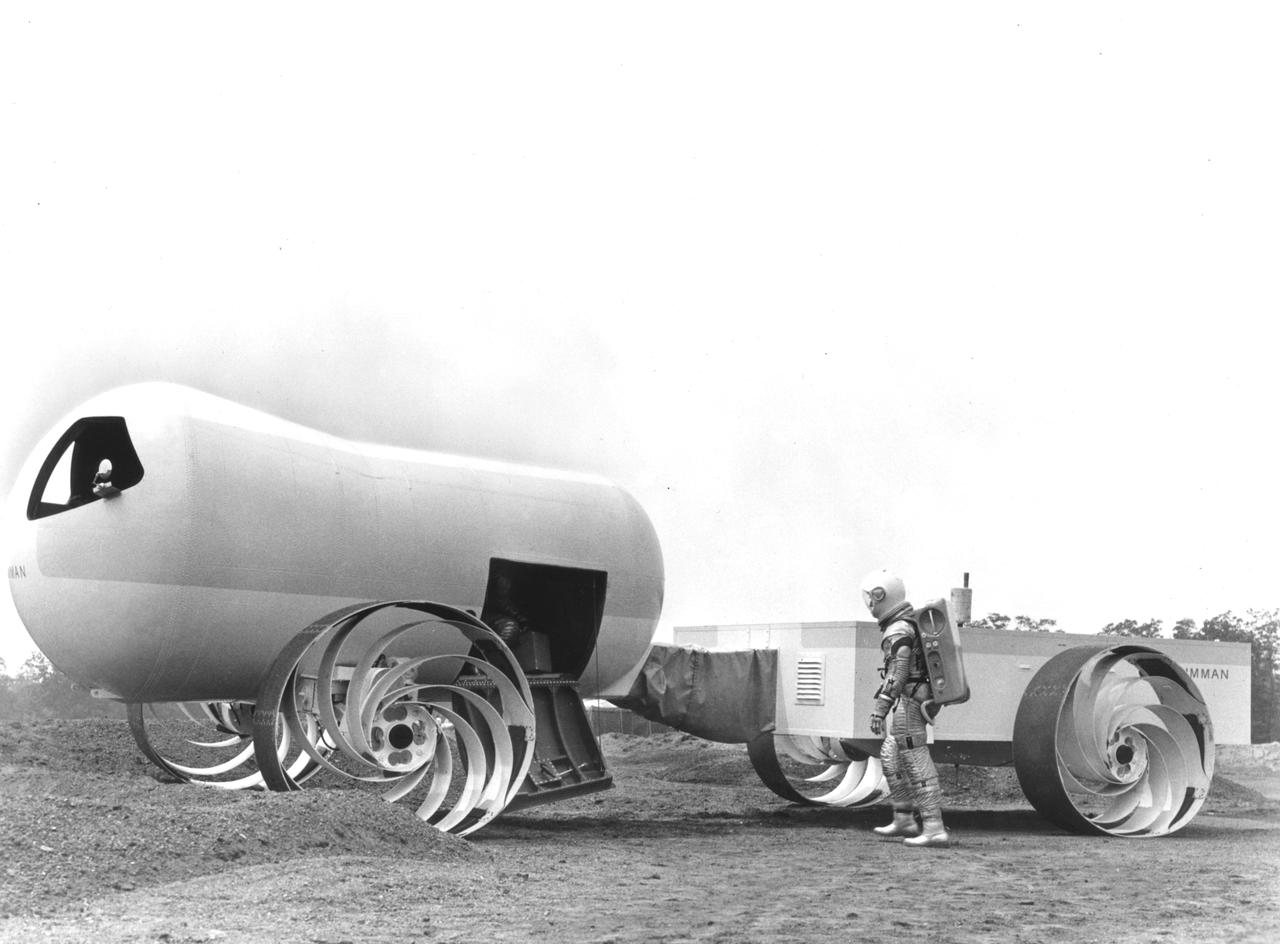
This Mobility Test Article (MTA) was a concept of a possible dual mode Lunar Roving Vehicle (LRV) built by the Grumman Industries for NASA’s Marshall Space Flight Center (MSFC). The data provided by the MTA helped in designing the Lunar Roving Vehicle (LRV), developed under the direction of MSFC. The LRV was designed to allow Apollo astronauts a greater range of mobility during lunar exploration missions.
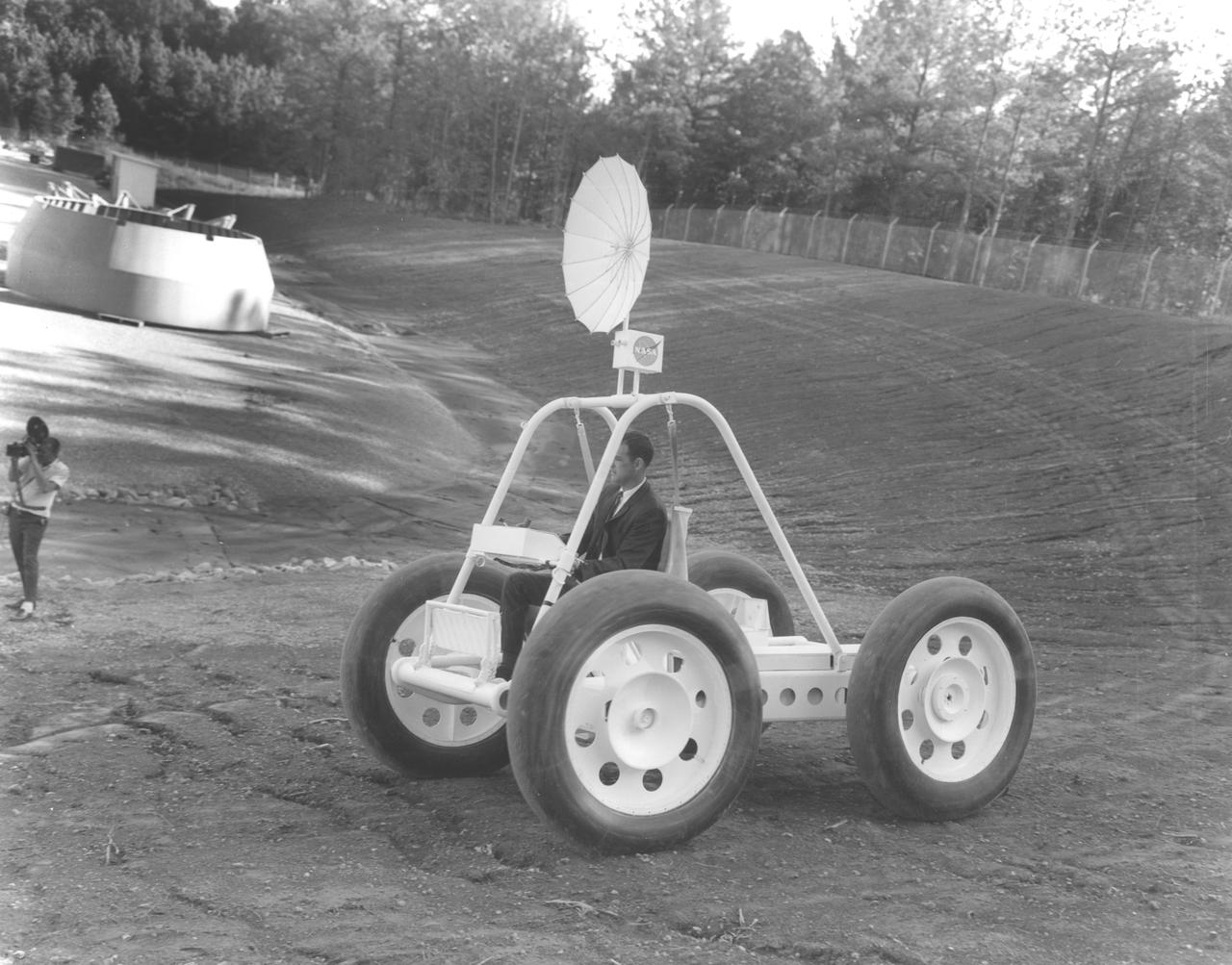
Built by Brown Engineering company of Huntsville, Alabama, a motorized mockup of a small Lunar Roving Vehicle (LRV) is being demonstrated at the Marshall Space Flight Center (MSFC). This particular vehicle weighed about 1200 pounds and is almost 10 feet long, 7-feet and 2-inches wide, and 7-feet and 8-inches high. The LRV was developed under the direction of MSFC to provide astronauts with greater mobility on the lunar surface.
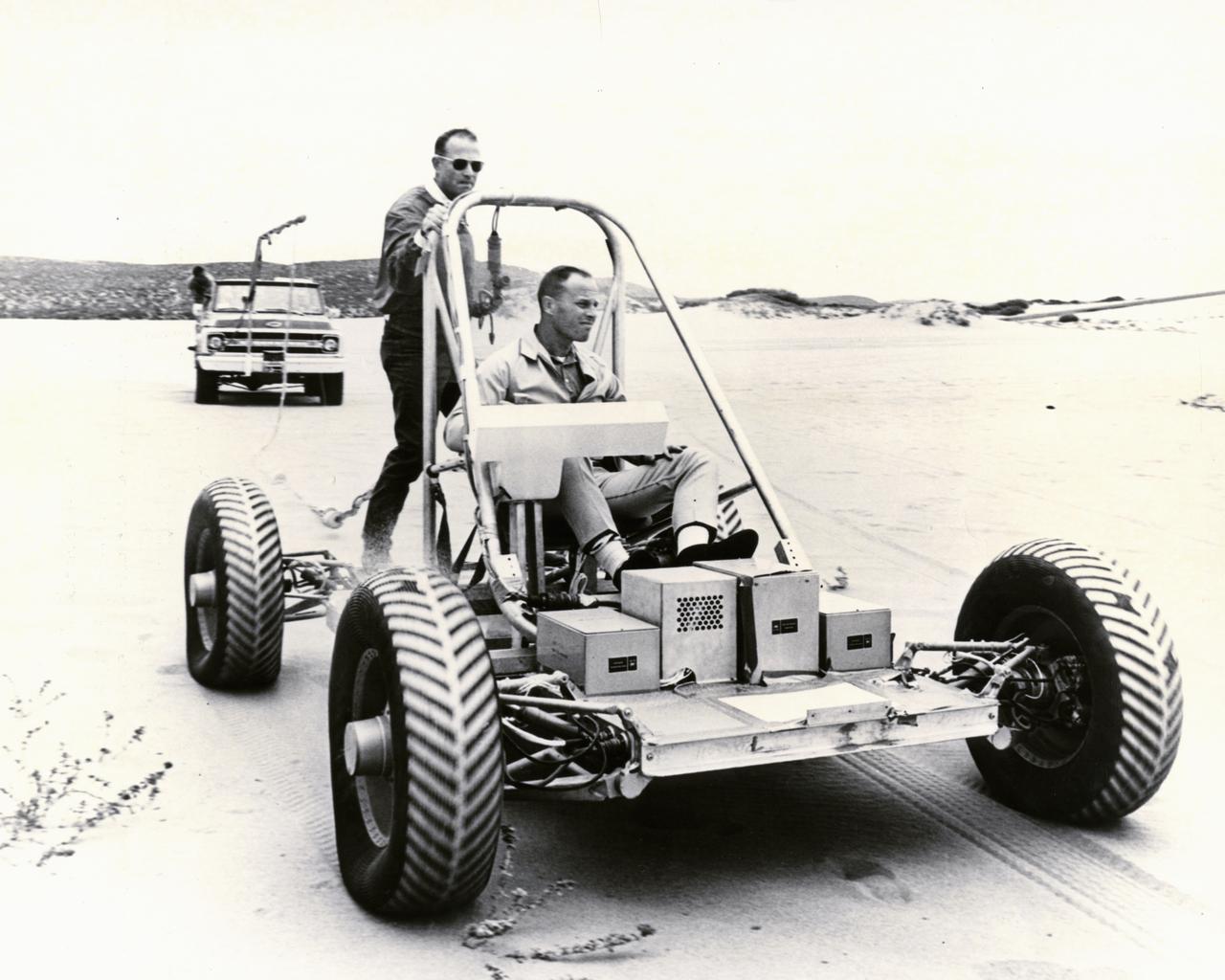
Astronauts Jack Lousma (seated) and Gerald Carr tested the Lunar Roving Vehicle (LRV) training unit on the sands near Pismo Beach. The vehicle was built by the AC Delco electronics division of General Motors Corporation. Under the direction of Marshall Space Flight Center (MSFC), the LRV was designed to allow Apollo astronauts a greater range of mobility during lunar exploration missions. The LRVs were deployed during the last three Apollo missions; Apollo 15, Apollo 16, and Apollo 17.
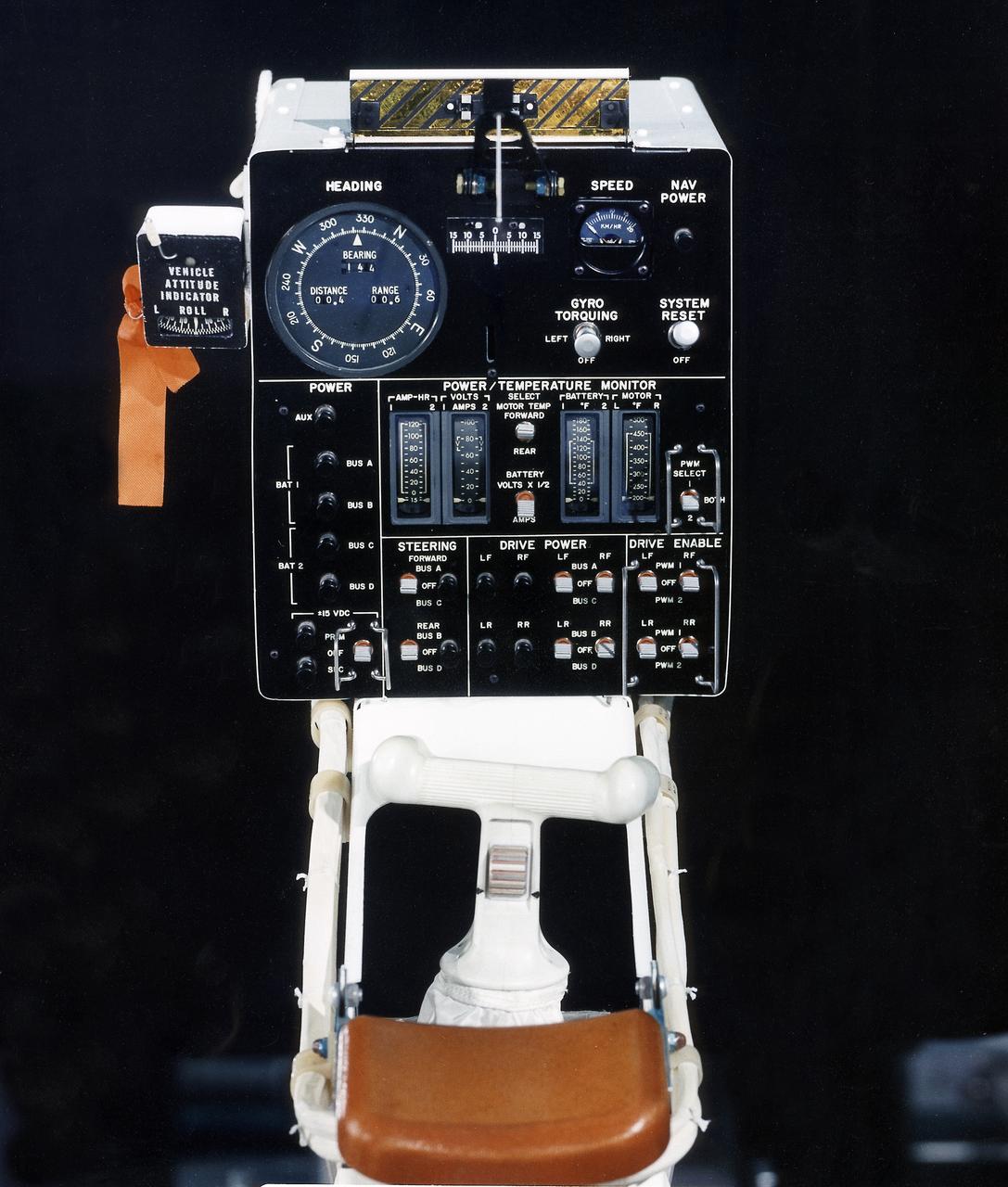
This photograph is a view of a display, control console, and hand controller for the Lunar Roving Vehicle (LRV) No. 2. The LRV was built to give Apollo astronauts a greater range of mobility during lunar exploration. It was an open-space and collapsible vehicle about 10 feet long with large mesh wheels, anterna, appendages, tool caddies, and camera. An LRV was used on each of the last three Apollo missions; Apollo 15, Apollo 16, and Apollo 17. It was built by the Boeing Company under the direction of the Marshall Space Flight Center.
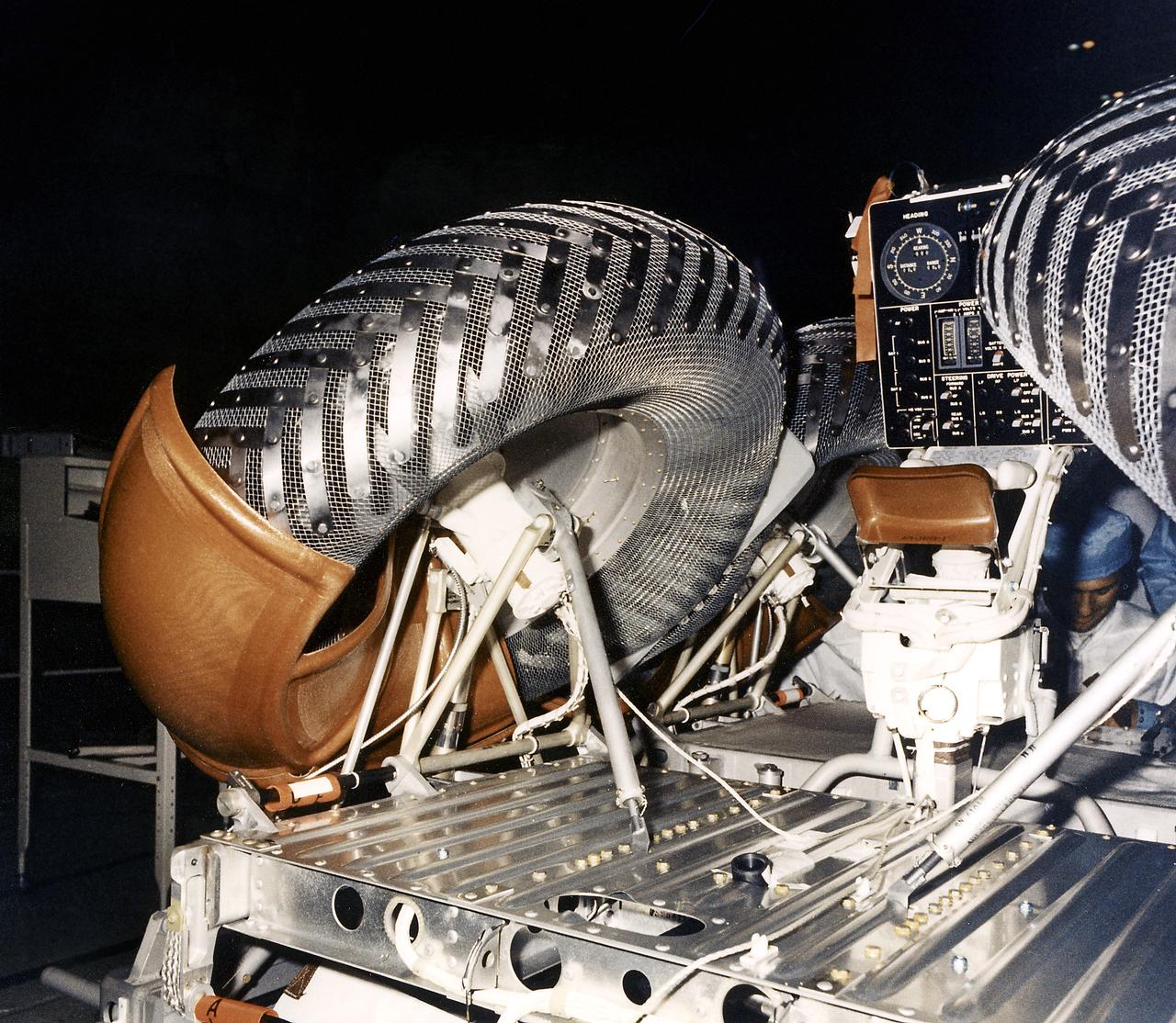
This is a close-up view of a right rear wheel strut of the Lunar Roving Vehicle (LRV) No. 1. The LRV was built to give Apollo astronauts a greater range of mobility during lunar exploration. It was an open-space and collapsible vehicle about 10 feet long with large mesh wheels, anterna, appendages, tool caddies, and camera. An LRV was used on each of the last three Apollo missions; Apollo 15, Apollo 16, and Apollo 17. It was built by the Boeing Company under the direction of the Marshall Space Flight Center.
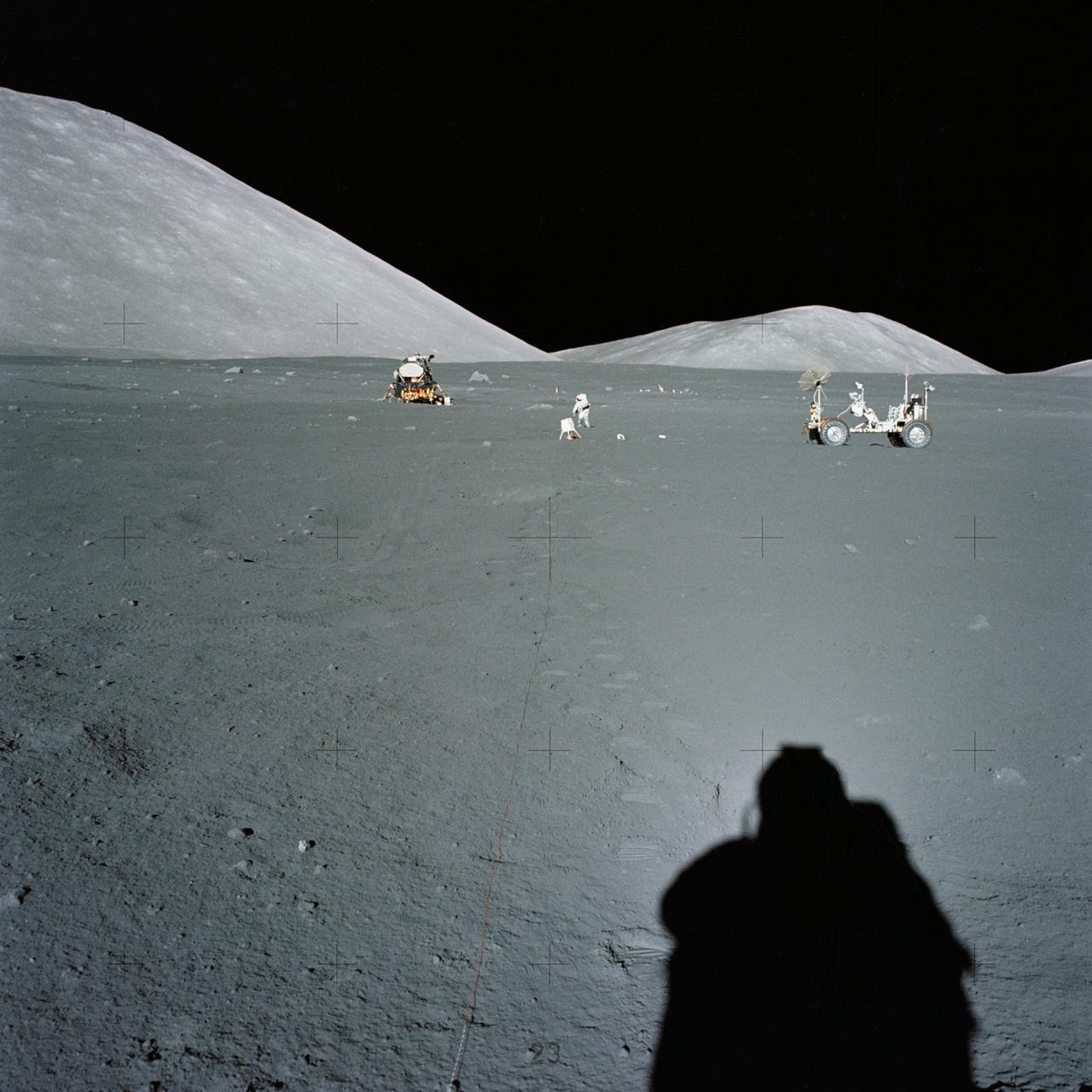
AS17-134-20435 (10 Dec. 1972) --- Wide-angle view of the Apollo 17 Taurus-Littrow lunar landing site. To the left in the background is the Lunar Module. To the right in the background is the Lunar Roving vehicle. An Apollo 17 crewmember is photographed between the two points. The shadow of the astronaut taking the photograph can be seen in the right foreground.
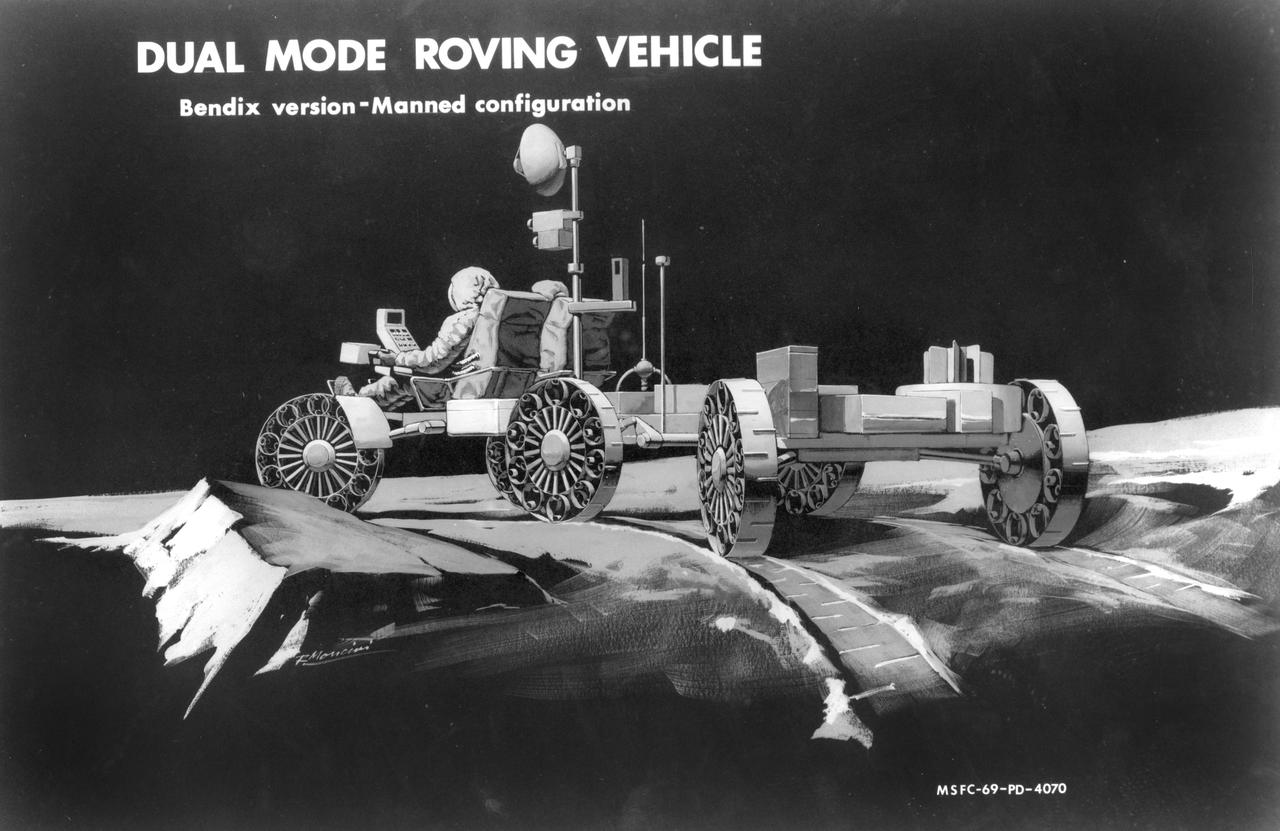
Artist’s concept of a dual mode Lunar Roving Vehicle (LRV) on the Lunar surface. This represents the Bendix version in an unmanned configuration. The LRV was developed under the direction of MSFC to allow Apollo astronauts a greater range of mobility during lunar exploration missions.
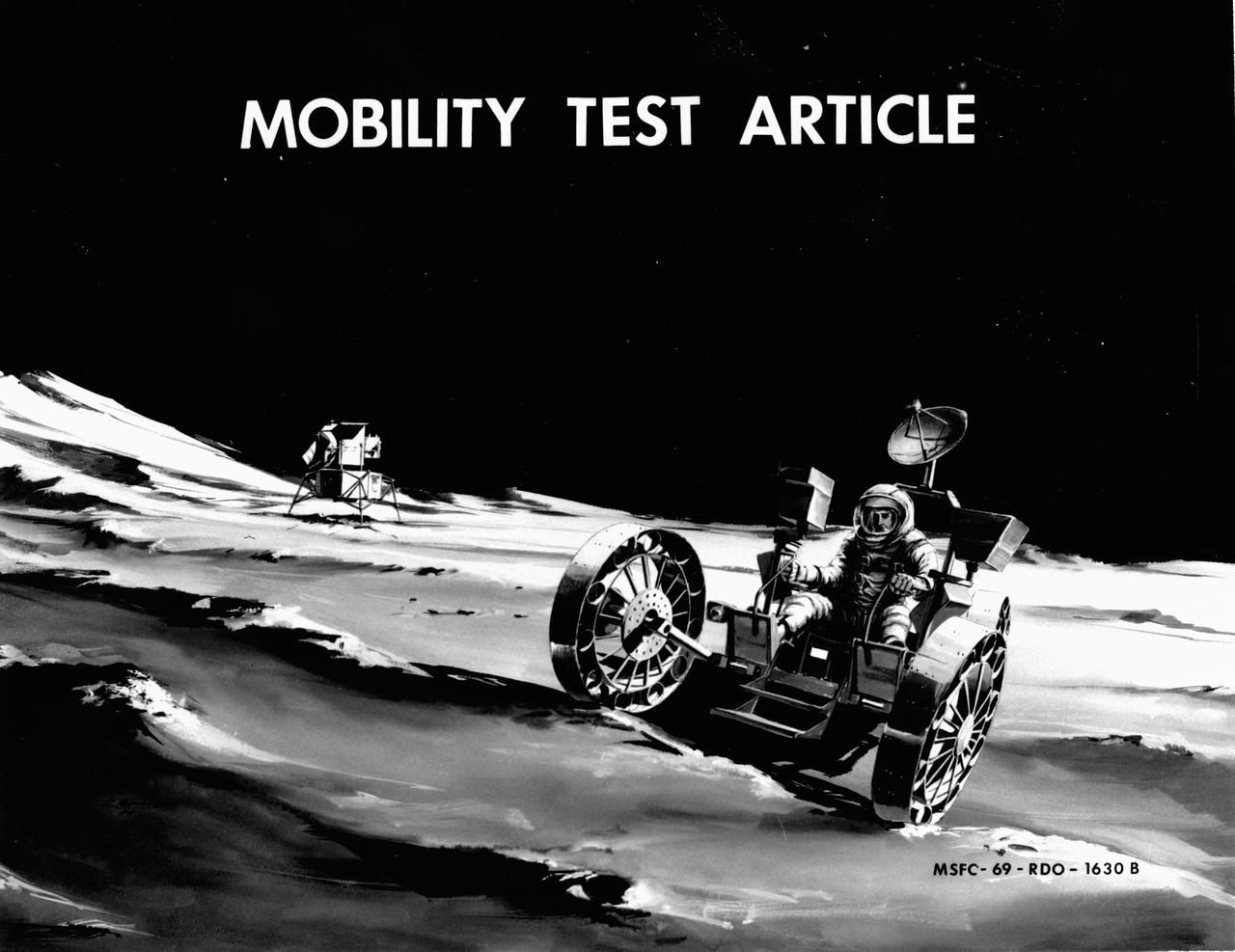
Artist’s concept of a Lunar Roving Vehicle (LRV) Mobility Test Article (MTA) on the Lunar surface. The data provided by the MTA helped in designing the LRV, developed under the direction of MSFC. The LRV was designed to allow Apollo astronauts a greater range of mobility during lunar exploration missions.
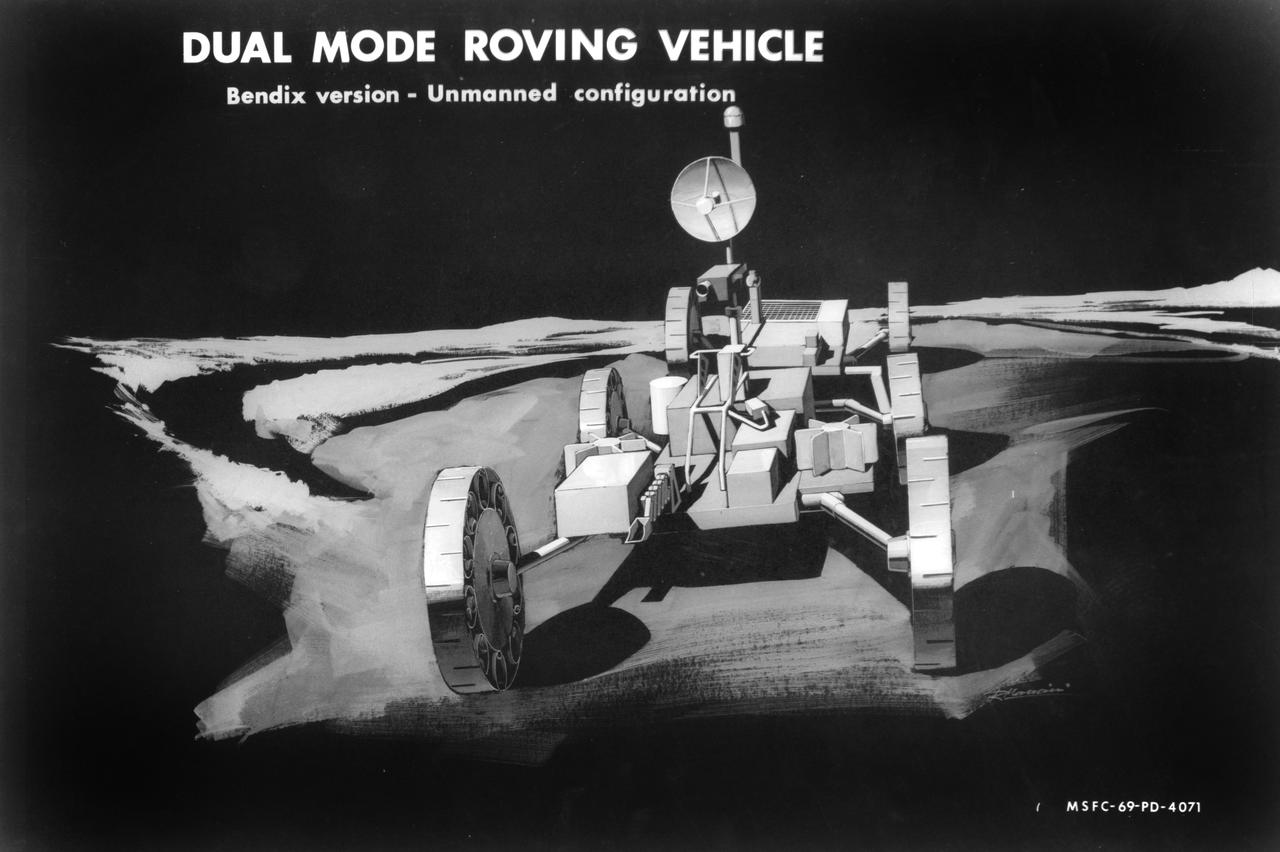
Artist’s concept of a dual mode Lunar Roving Vehicle (LRV) on the Lunar surface. This represents the Bendix version in an unmanned configuration. The LRV was developed under the direction of MSFC to allow Apollo astronauts a greater range of mobility during lunar exploration missions.
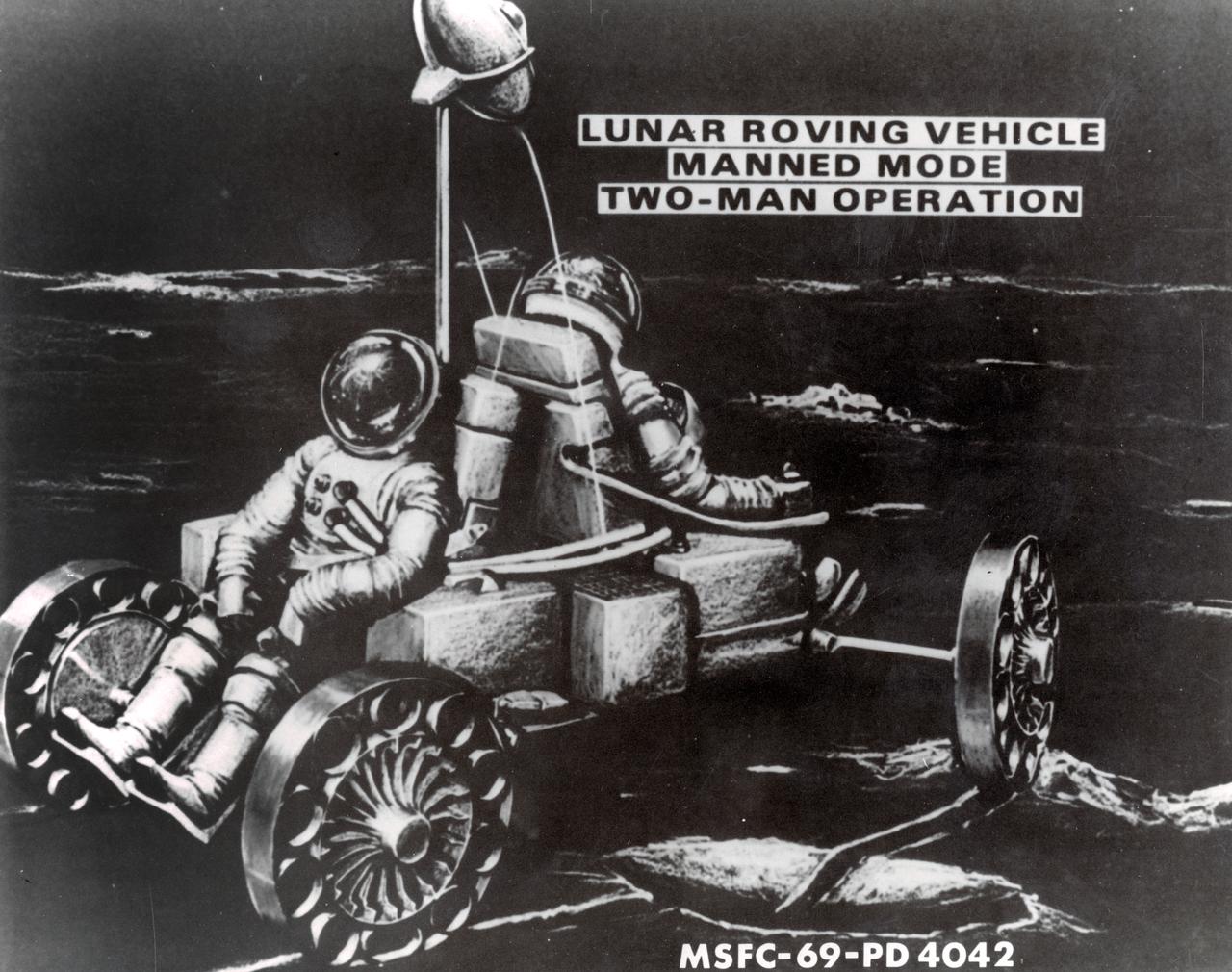
Artist’s concept of a manned Lunar Roving Vehicle (LRV) depicting two-man operation on the Lunar surface. The LRV was developed under the direction of the Marshall Space Flight Center (MSFC) to provide Apollo astronauts with a greater range of mobility on the lunar surface.

Artist’s concept of a dual mode Lunar Roving Vehicle (LRV) on the Lunar surface. This represents the Grumman version in an unmanned configuration. The LRV was developed under the direction of MSFC to allow Apollo astronauts a greater range of mobility during lunar exploration missions.
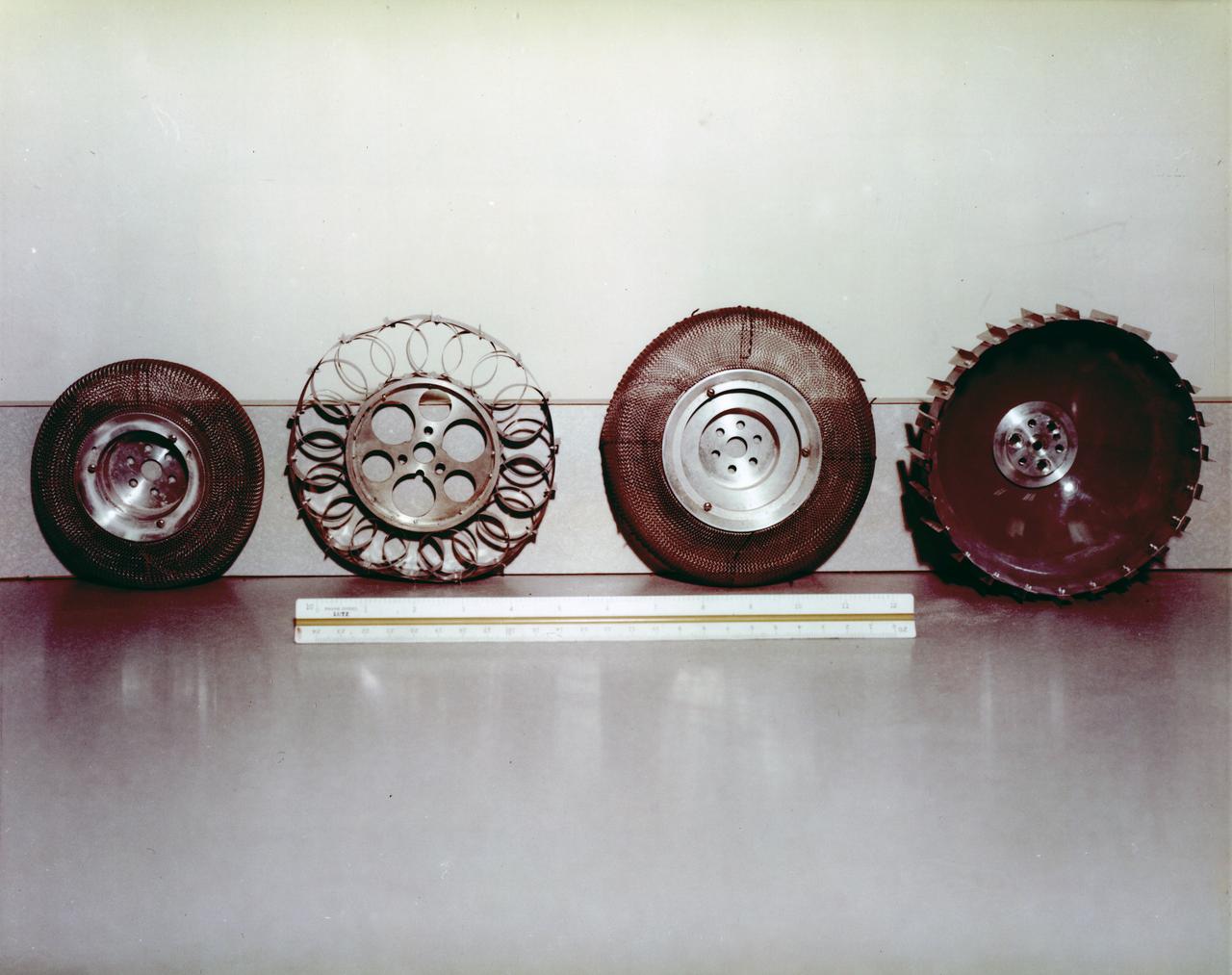
Under the direction of Marshall Space Flight Center (MSFC), the Lunar Roving Vehicle (LRV) was designed to allow Apollo astronauts a greater range of mobility during lunar exploration missions. During the development process, LRV prototype wheels underwent soil tests in building 4481 at Marshall Space Flight Center (MSFC). Pictured from left to right are the wheels for: LRV, Bendix Corporation, Local Scientific Survey Module (LSSM), and Grumman Industries.
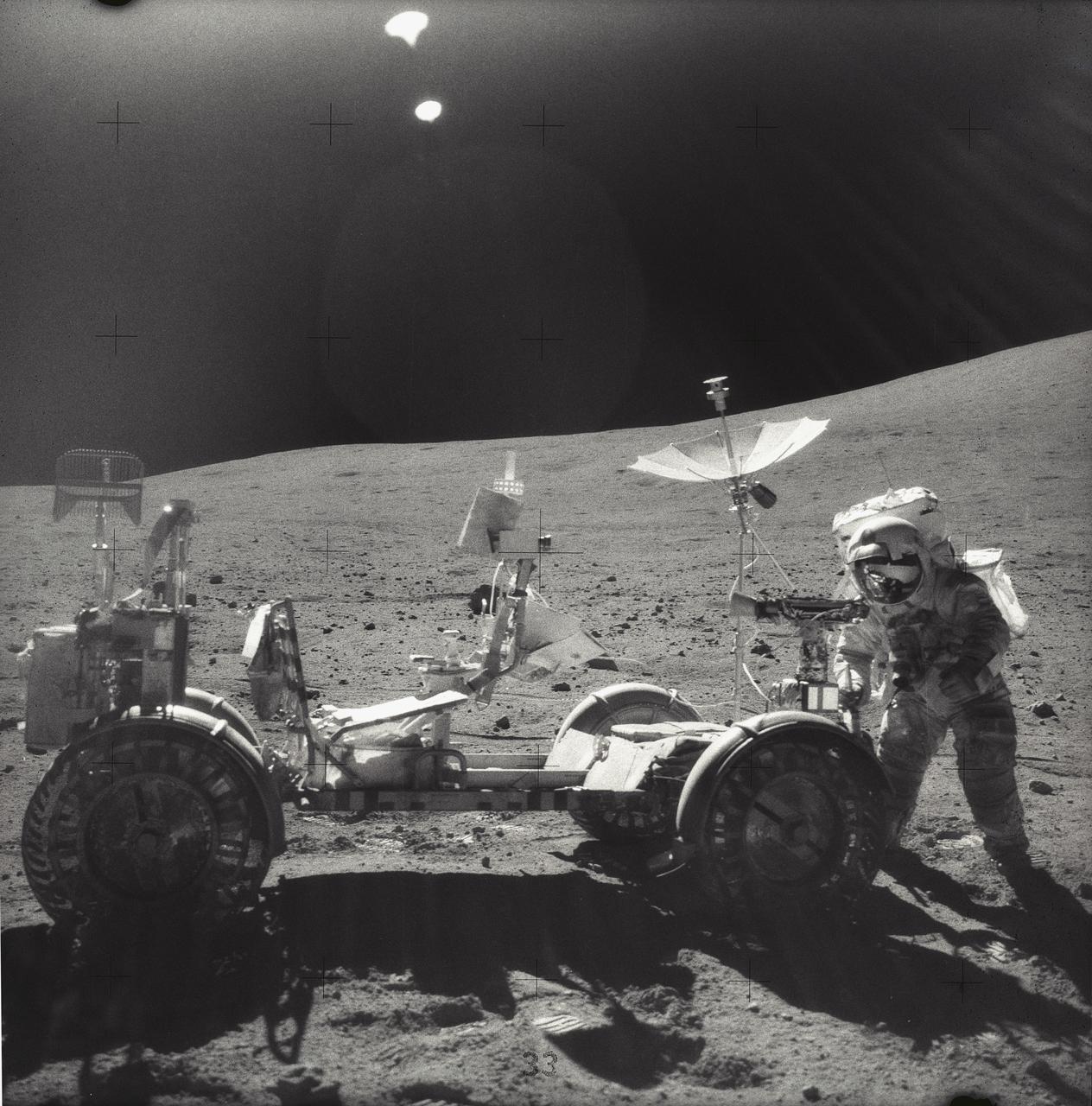
The Lunar Roving Vehicle (LRV) was designed by Marshall Space Flight Center to transport astronauts and materials on the Moon. An LRV was used on each of the last three Apollo missions; Apollo 15, Apollo 16, and Apollo 17, in 1971 and 1972, to permit the crew to travel several miles from the lunar landing site. This photograph was taken during the Apollo 16 mission in 1972.
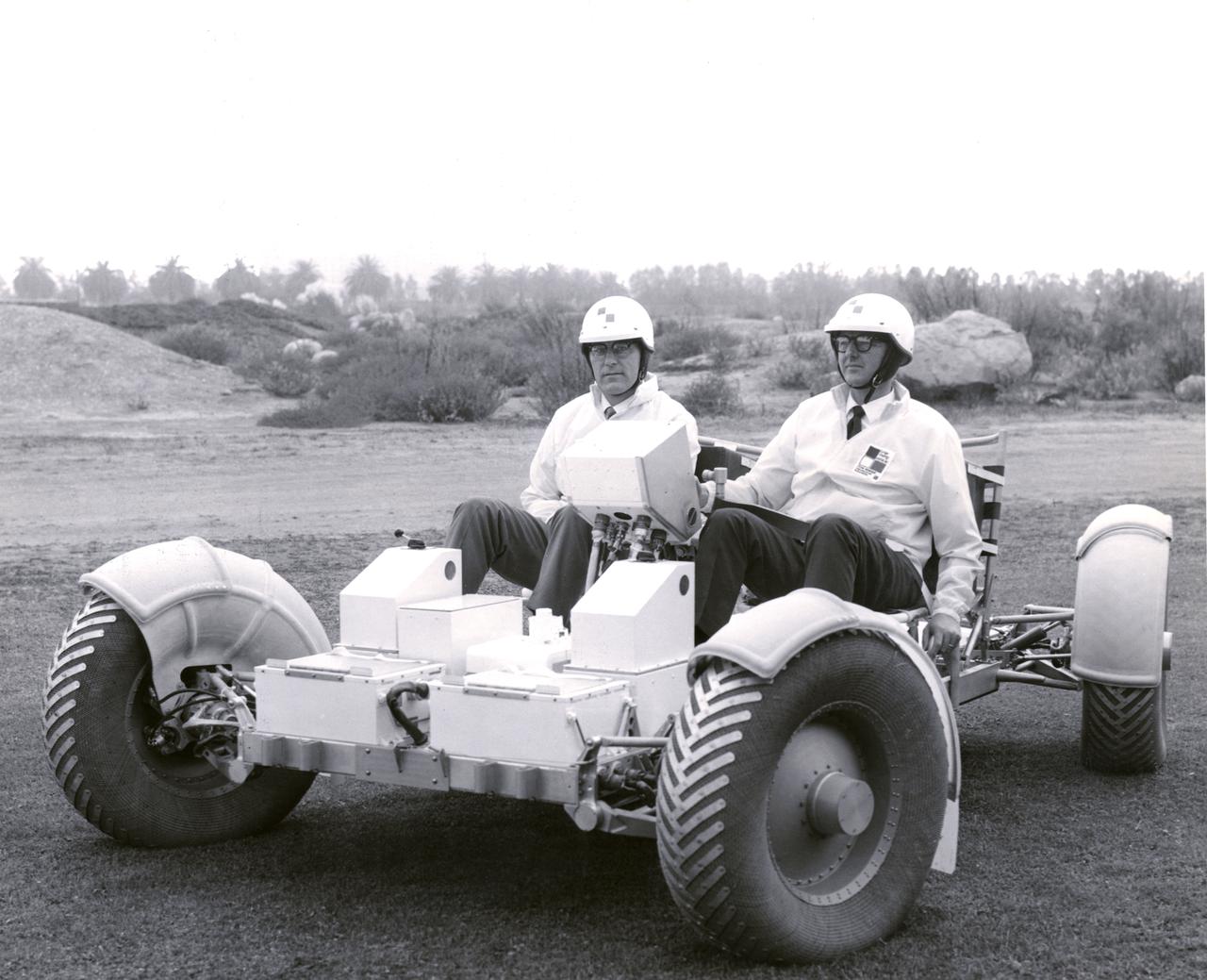
Delco engineers are operating this Lunar Roving Vehicle (LRV) Trainer. Built by by Delco Electronics Division of the General Motors Corporation, the trainer was shipped to NASA’s Manned Spacecraft Center in Houston, Texas for an astronaut training program. Under the direction of Marshall Space Flight Center (MSFC), the LRV was designed to allow Apollo astronauts a greater range of mobility during lunar exploration missions. The LRVs were deployed during the last three Apollo missions; Apollo 15, Apollo 16, and Apollo 17.
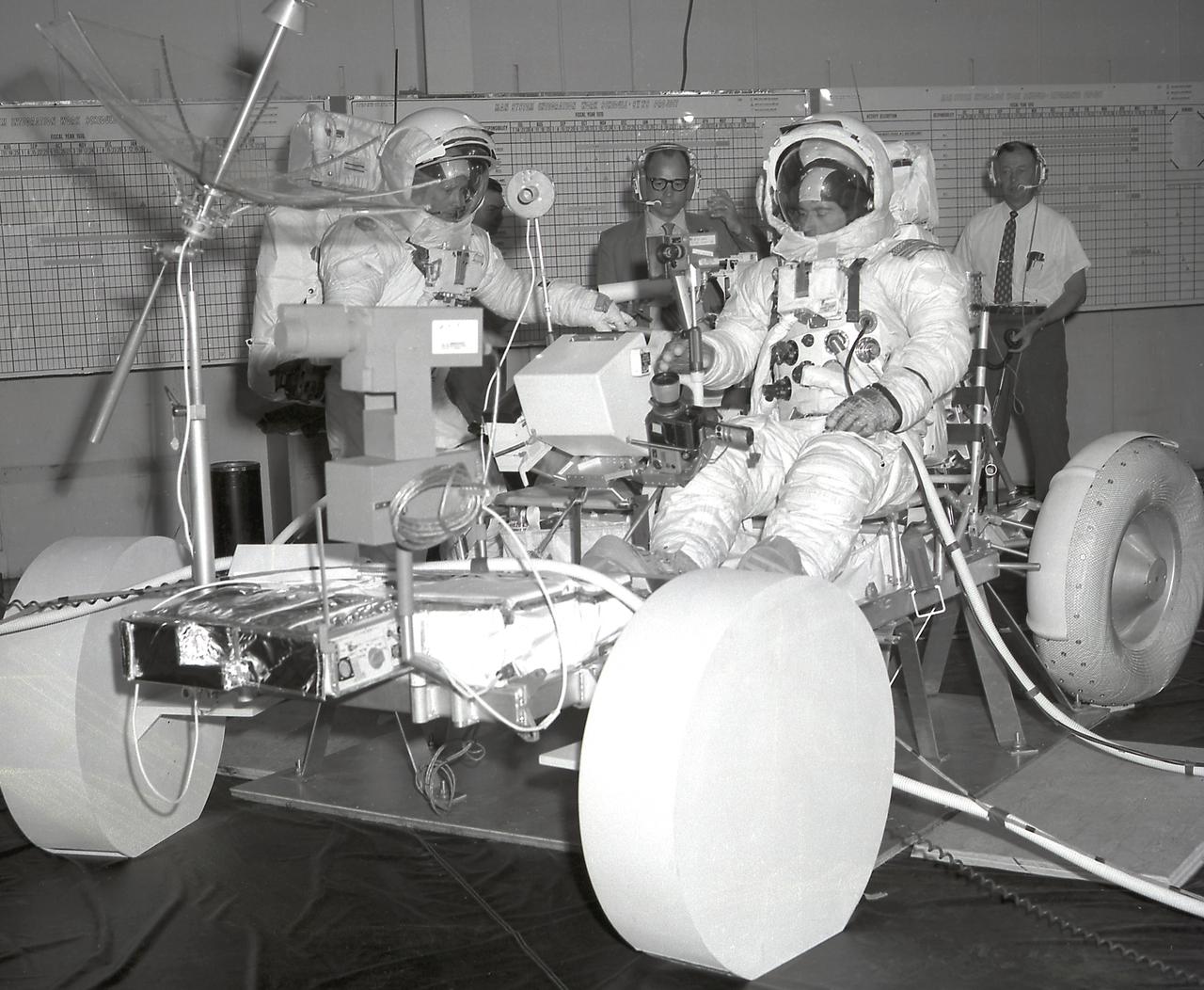
This image depicts the Apollo 16 mission astronauts John Young (right) and Charles Duke (left) in pressure suits during a final crew training on the Lunar Roving Vehicle (LRV) at the Marshall Space Flight Center (MSFC), building 4619. Developed by the MSFC, the LRV was the lightweight electric car designed to increase the range of mobility and productivity of astronauts on the lunar surface. It was used on the last three Apollo missions; Apollo 15, Apollo 16, and Apollo 17.
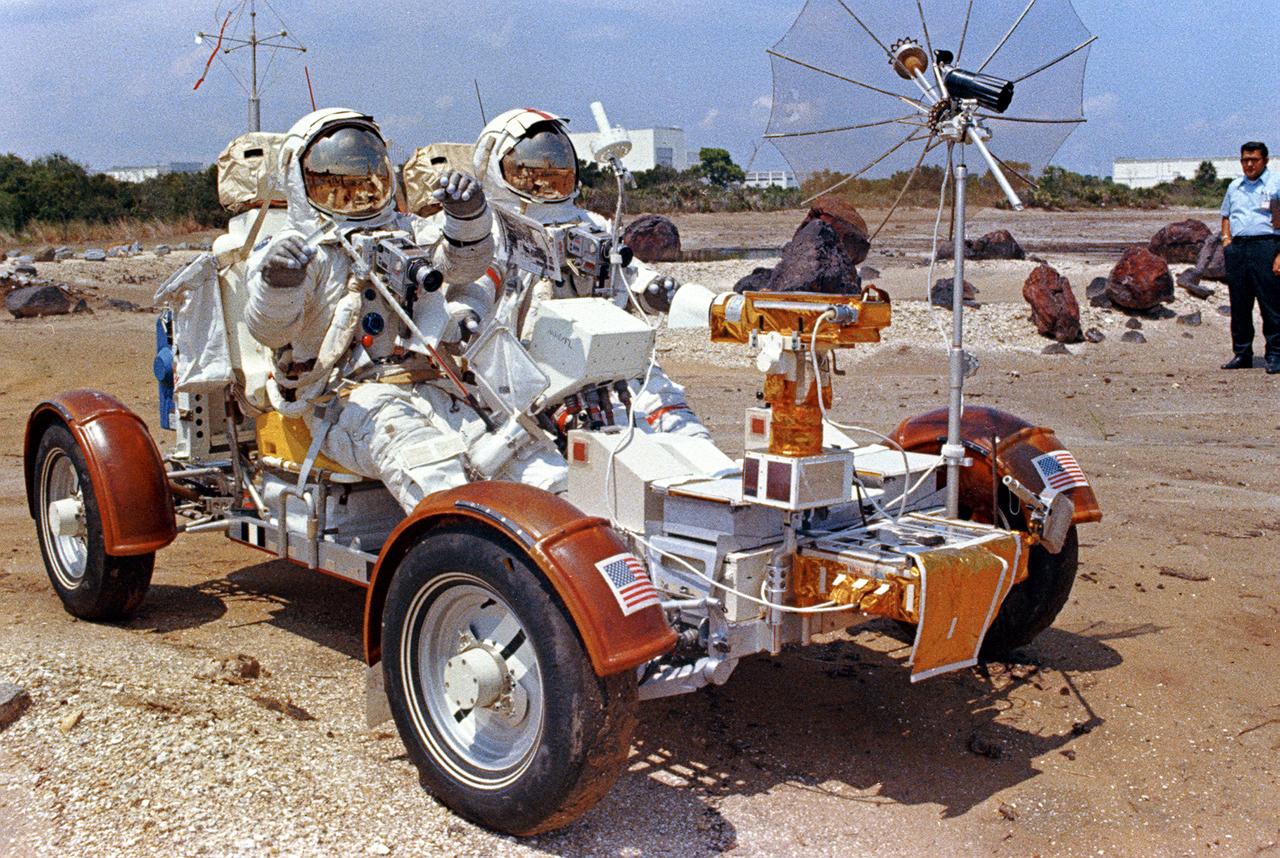
This photograph was taken during the testing of the Lunar Roving Vehicle (LRV) at the Johnson Space Center. Developed by the MSFC, the LRV was the lightweight electric car designed to increase the range of mobility and productivity of astronauts on the lunar surface. It was used on the last three Apollo missions; Apollo 15, Apollo 16, and Apollo 17.
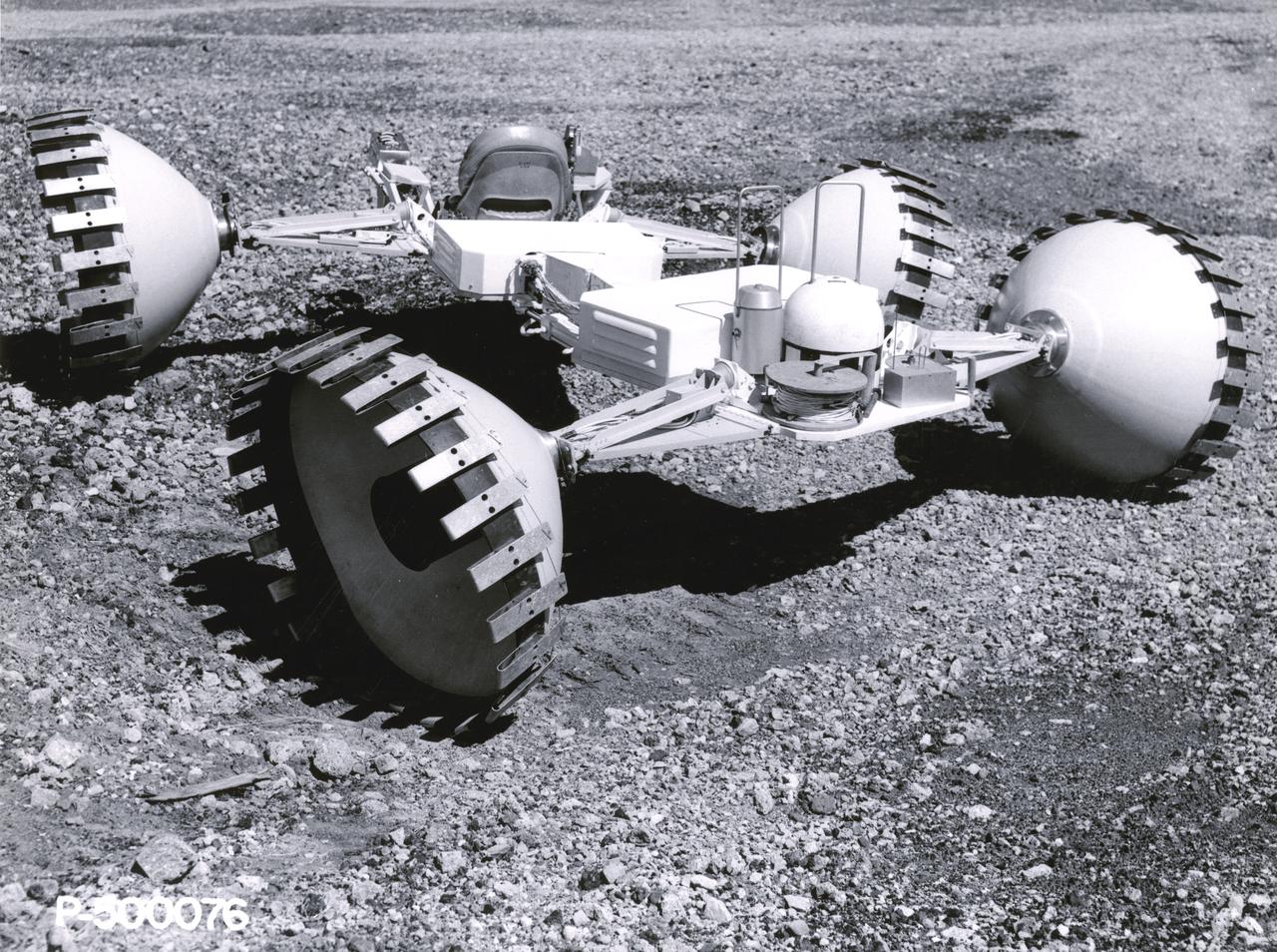
A concept of a possible Lunar Roving Vehicle (LRV) built for NASA’s Marshall Space Flight Center (MSFC). This Mobility Test Article (MTA) is one of many that provided data contributing to the design of the LRV, developed under the direction of MSFC. The LRV was designed to allow Apollo astronauts a greater range of mobility during lunar exploration missions.
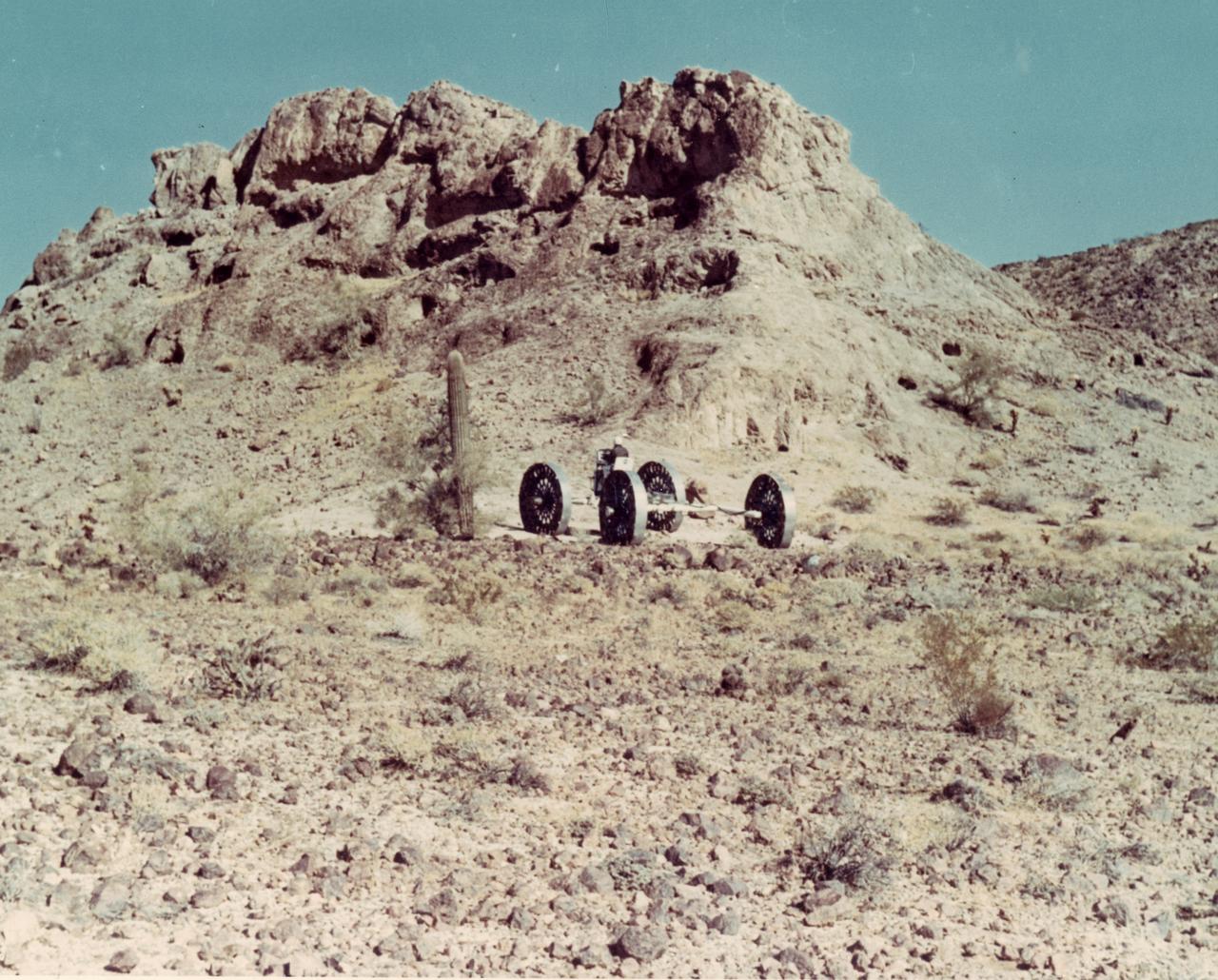
A test engineer drives a Mobility Test Article (MTA) during a test of a Lunar Roving Vehicle (LRV) concept through the mountains of Arizona. The data provided by the MTA helped in designing the LRV, developed under the direction of MSFC. The LRV was designed to allow Apollo astronauts a greater range of mobility during lunar exploration missions.
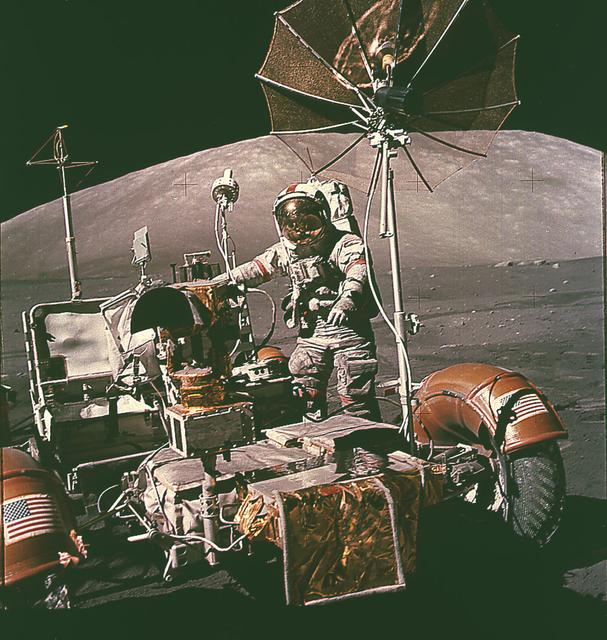
This is an Apollo 17 onboard photo of an astronaut beside the Lunar Roving Vehicle (LRV) on the lunar surface. Designed and developed by the Marshall Space Flight Center and built by the Boeing Company, the LRV was first used on the Apollo 15 mission and increased the range of astronauts' mobility and productivity on the lunar surface. This lightweight electric car had battery power sufficient for about 55 miles. It weighed 462 pounds (77 pounds on the Moon) and could carry two suited astronauts, their gear, cameras, and several hundred pounds of bagged samples. The LRV's mobility was quite high. It could climb and descend slopes of about 25 degrees.
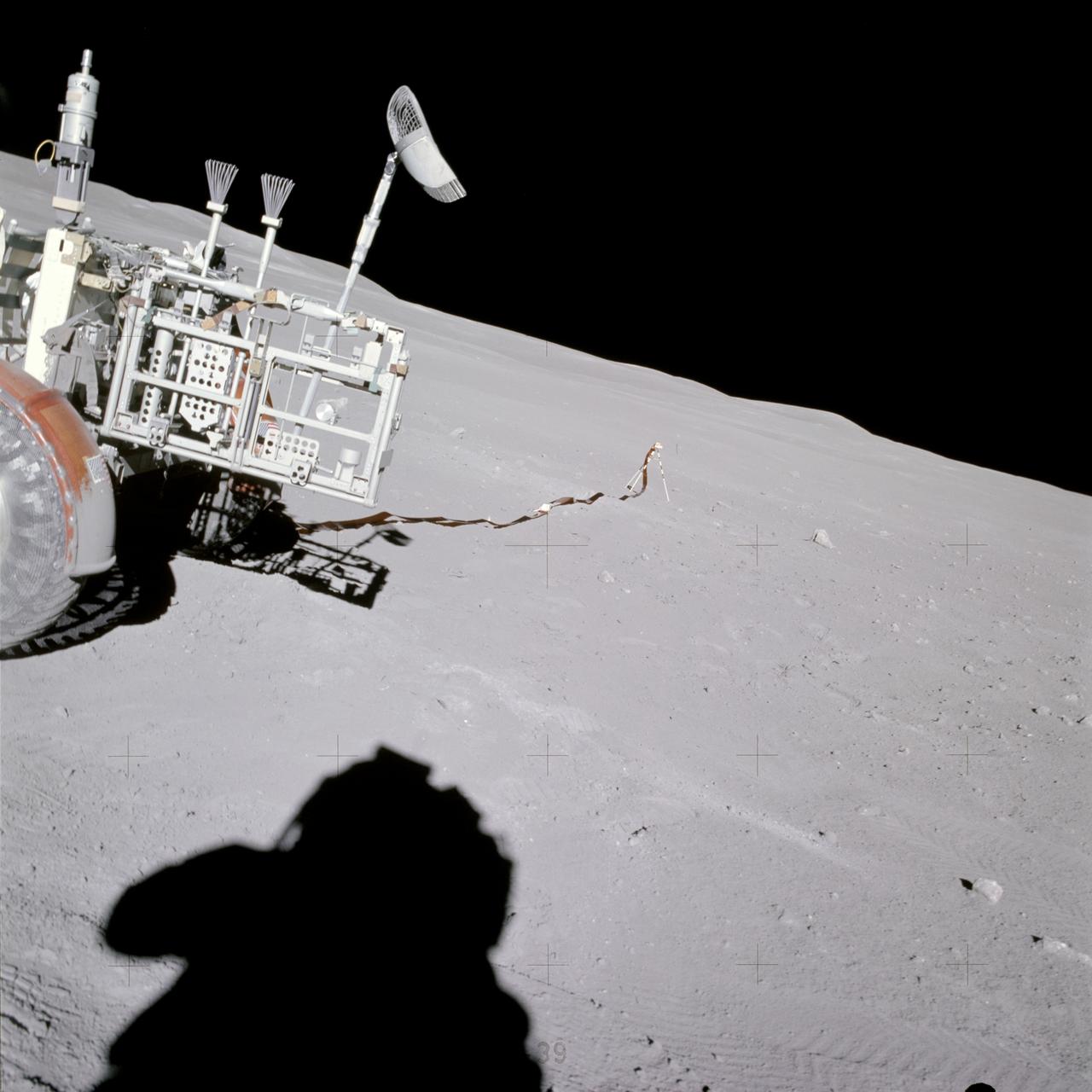
AS16-114-18433 (22 April 1972) --- View of the Lunar Portable Magnetometer mounted on the Lunar Roving Vehicle (LRV) which was parked at Station No. 2 on the Descartes lunar landing site. The Apollo 16 crew photographed it during their second extravehicular activity (EVA). Note the shadow of the astronaut taking the photograph in the left foreground.
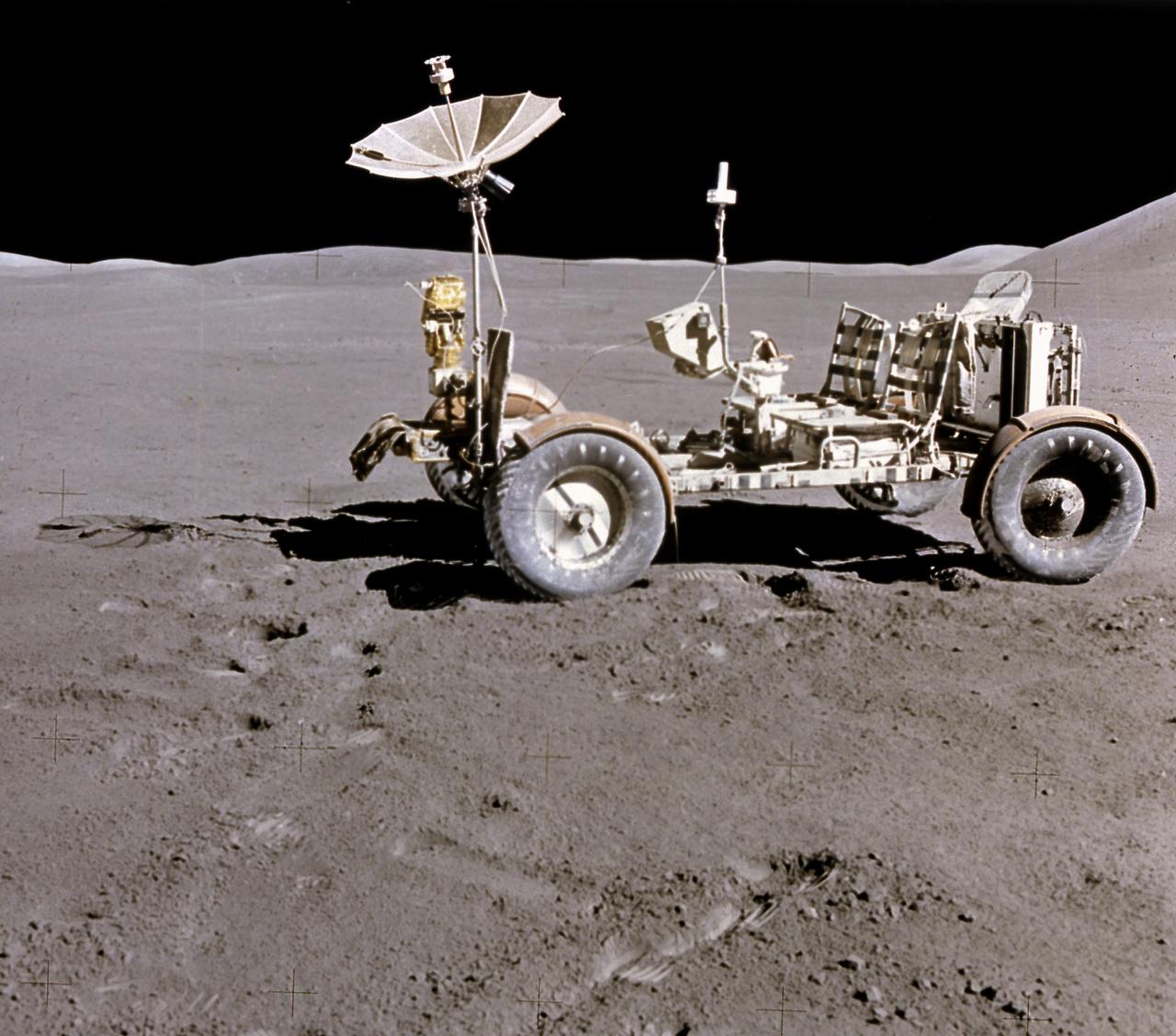
This photograph of the Lunar Roving Vehicle (LRV) was taken during the Apollo 15 mission. Powered by battery, the lightweight electric car greatly increased the range of mobility and productivity on the scientific traverses for astronauts. It weighed 462 pounds (77 pounds on the Moon) and could carry two suited astronauts, their gear and cameras, and several hundred pounds of bagged samples. The LRV's mobility was quite high. It could climb and descend slopes of about 25 degrees. The LRV was designed and developed by the Marshall Space Flight Center and built by the Boeing Company.
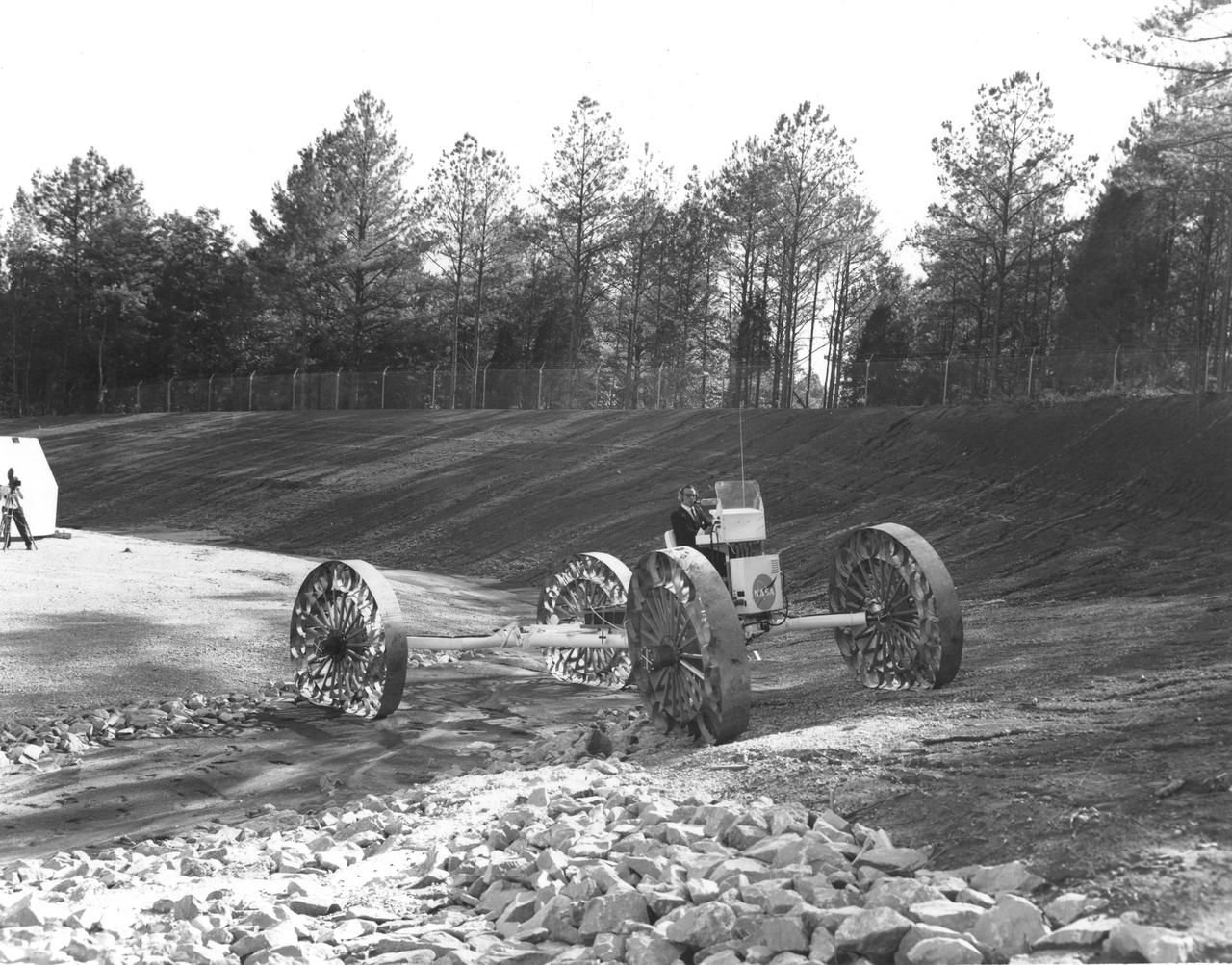
An engineer demonstrates a Mobility Test Article (MTA) at NASA’s Marshall Space Flight Center (MSFC) as he crosses a soft clay strip onto rocky ground. This unit, weighing 1/6th as much as an actual vehicle, was built by the Bendix Corporation and was one of the concepts of a possible Lunar Roving Vehicle (LRV). The data provided by the MTA helped in designing the LRV, developed under the direction of MSFC. The LRV was designed to allow Apollo astronauts a greater range of mobility during lunar exploration missions.
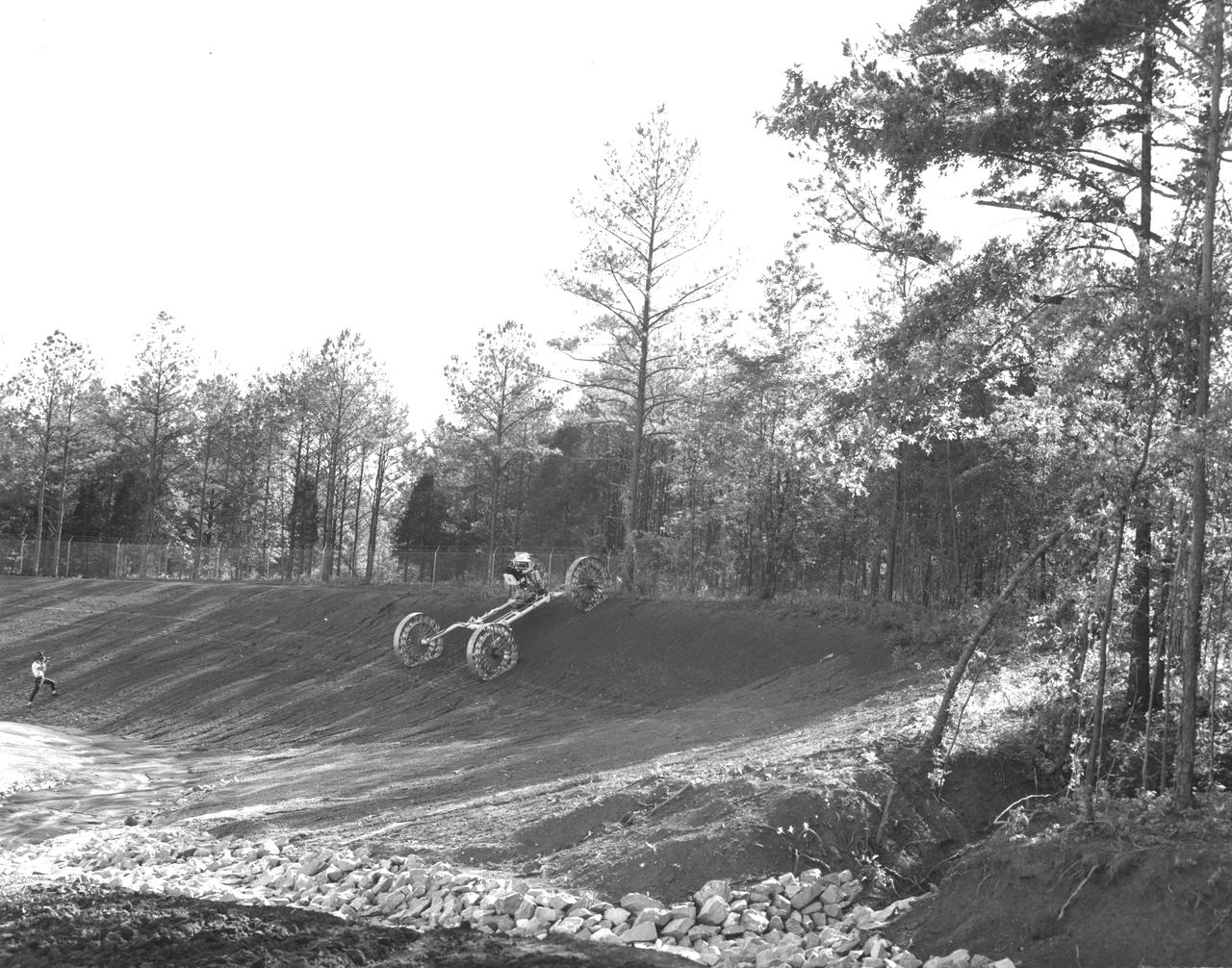
An engineer demonstrates a Mobility Test Article (MTA) at NASA’s Marshall Space Flight Center (MSFC). This unit, weighing 1/6th as much as an actual vehicle, was built by the Bendix Corporation and was one of the concepts of a possible Lunar Roving Vehicle (LRV). The data provided by the MTA helped in designing the LRV, developed under the direction of MSFC. The LRV was designed to allow Apollo astronauts a greater range of mobility during lunar exploration missions.
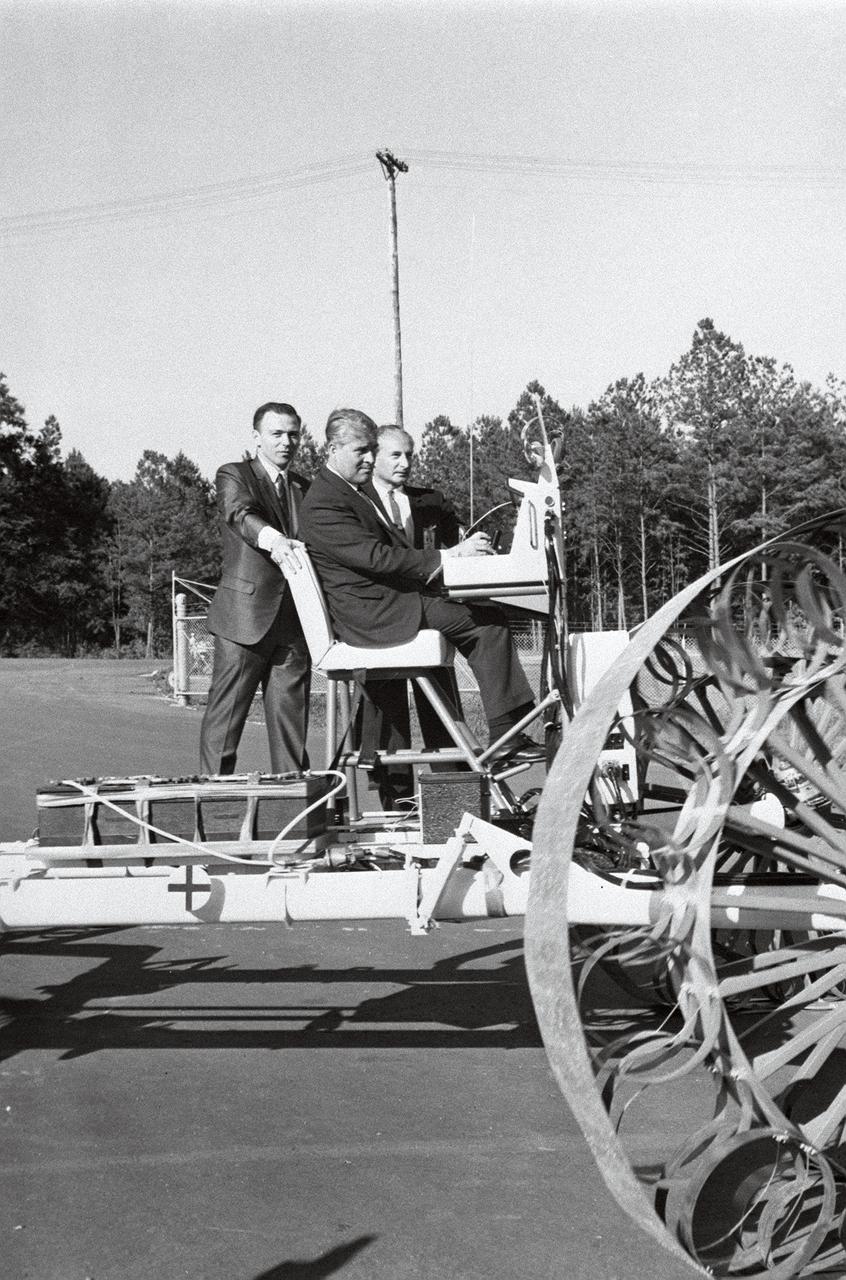
In this June 1966 photograph, Marshall Space Flight Center Director Dr. Wernher von Braun test-drives the Mobility Test Article (MTA), a developmental vehicle built by the Bendix Corporation to test lunar mobility vehicle concepts. The data provided by the MTA helped in designing the Lunar Roving Vehicle (LRV), developed under the direction of the MSFC. The LRV was designed to allow Apollo astronauts a greater range of mobility during lunar exploration missions. The LRVs were deployed during the last three Apollo missions; Apollo 15, Apollo 16, and Apollo 17.
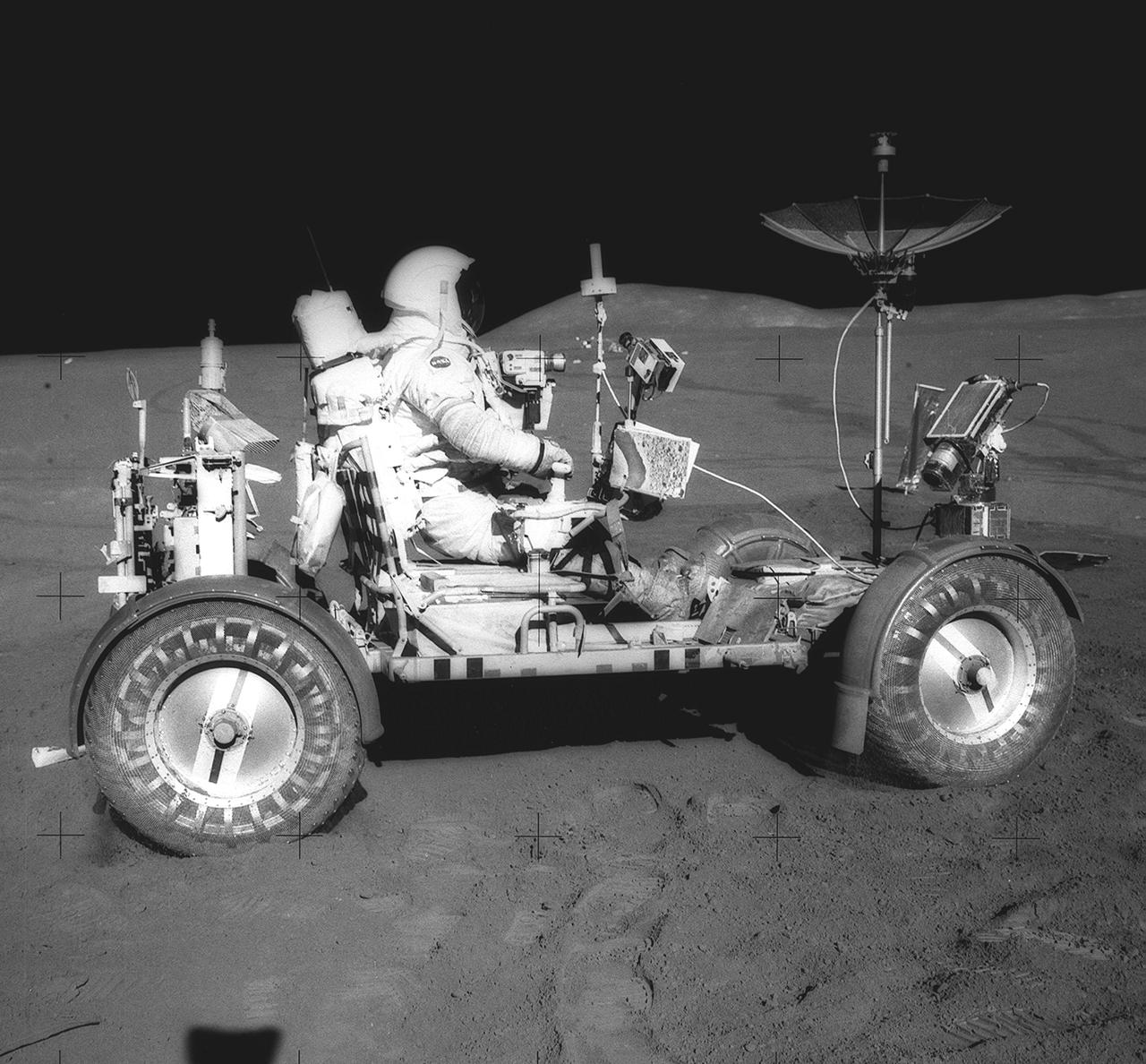
This photograph was taken during the Apollo 15 mission on the lunar surface. Astronaut David R. Scott waits in the Lunar Roving Vehicle (LRV) for astronaut James Irwin for the return trip to the Lunar Module, Falcon, with rocks and soil collected near the Hadley-Apernine landing site. The Apollo 15 was the first mission to use the LRV. Powered by battery, the lightweight electric car greatly increased the range of mobility and productivity on the scientific traverses for astronauts. It weighed 462 pounds (77 pounds on the Moon) and could carry two suited astronauts, their gear and cameras, and several hundred pounds of bagged samples. The LRV's mobility was quite high. It could climb and descend slopes of about 25 degrees. The LRV was designed and developed by the Marshall Space Flight Center and built by the Boeing Company.
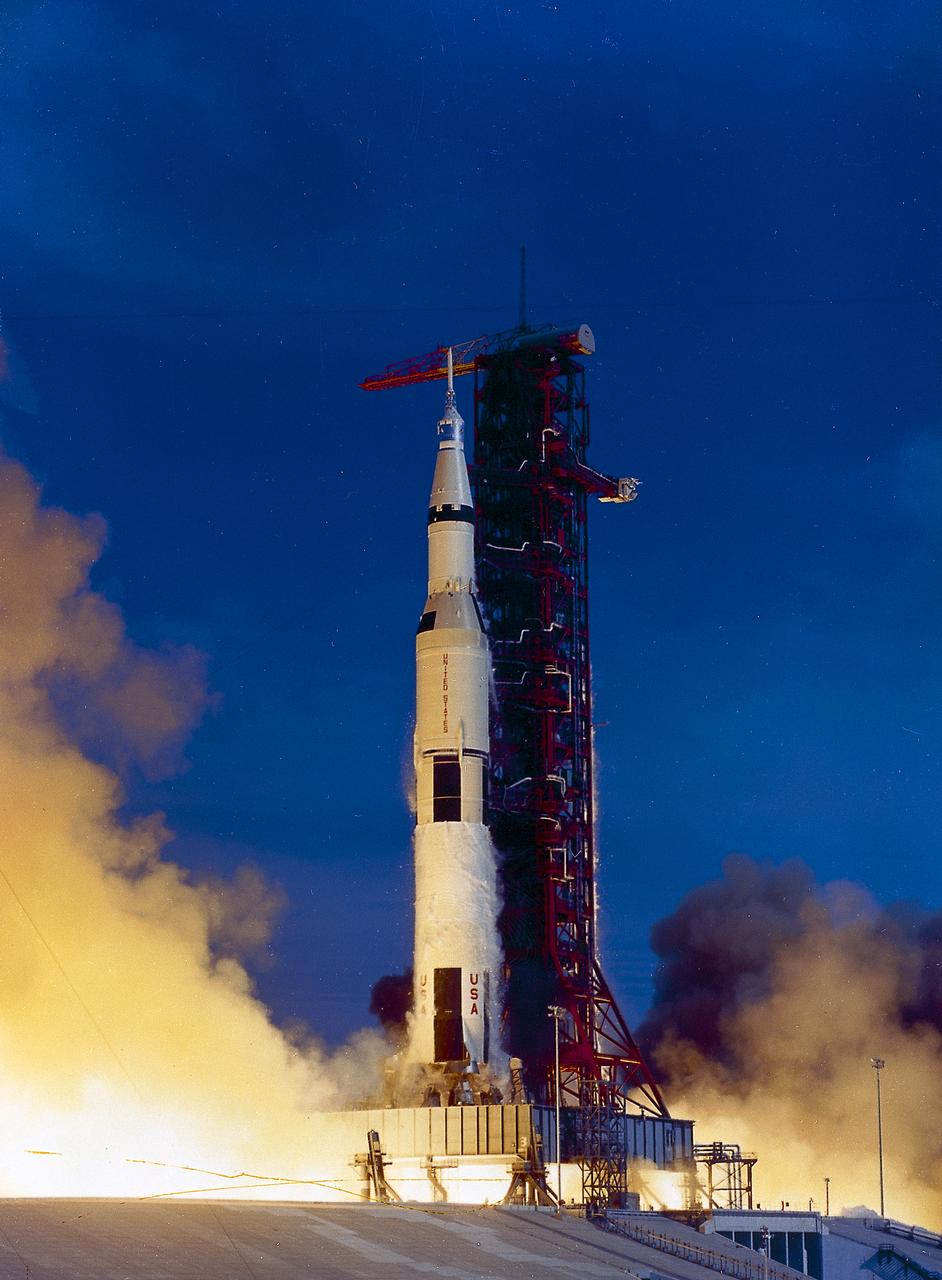
The fifth marned lunar landing mission, Apollo 15 (SA-510), carrying a crew of three astronauts: Mission commander David R. Scott, Lunar Module pilot James B. Irwin, and Command Module pilot Alfred M. Worden Jr., lifted off on July 26, 1971. Astronauts Scott and Irwin were the first to use a wheeled surface vehicle, the Lunar Roving Vehicle, or the Rover, which was designed and developed by the Marshall Space Flight Center, and built by the Boeing Company. Astronauts spent 13 days, nearly 67 hours, on the Moon's surface to inspect a wide variety of its geological features.
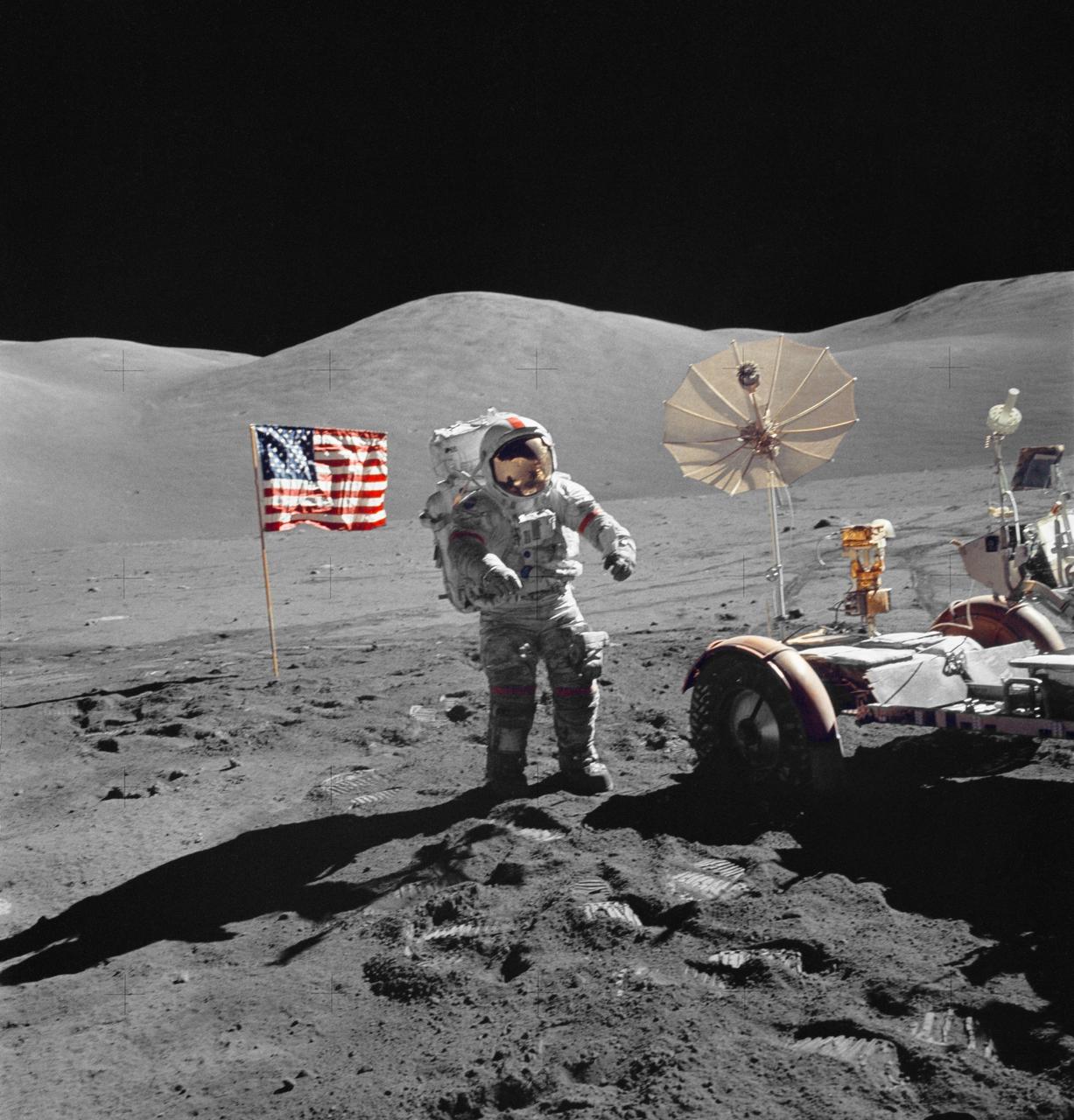
AS17-140-21388 (7-19 Dec. 1972) --- Astronaut Eugene A. Cernan, mission commander, walks toward the Lunar Roving Vehicle (LRV) during extravehicular activity (EVA) at the Taurus-Littrow landing site of NASA's sixth and final Apollo lunar landing mission. The photograph was taken by astronaut Harrison H. Schmitt, lunar module pilot. While astronauts Cernan and Schmitt descended in the Lunar Module (LM) "Challenger" to explore the Taurus-Littrow region of the moon, astronaut Ronald E. Evans, command module pilot, remained with the Command and Service Modules (CSM) "America" in lunar orbit.
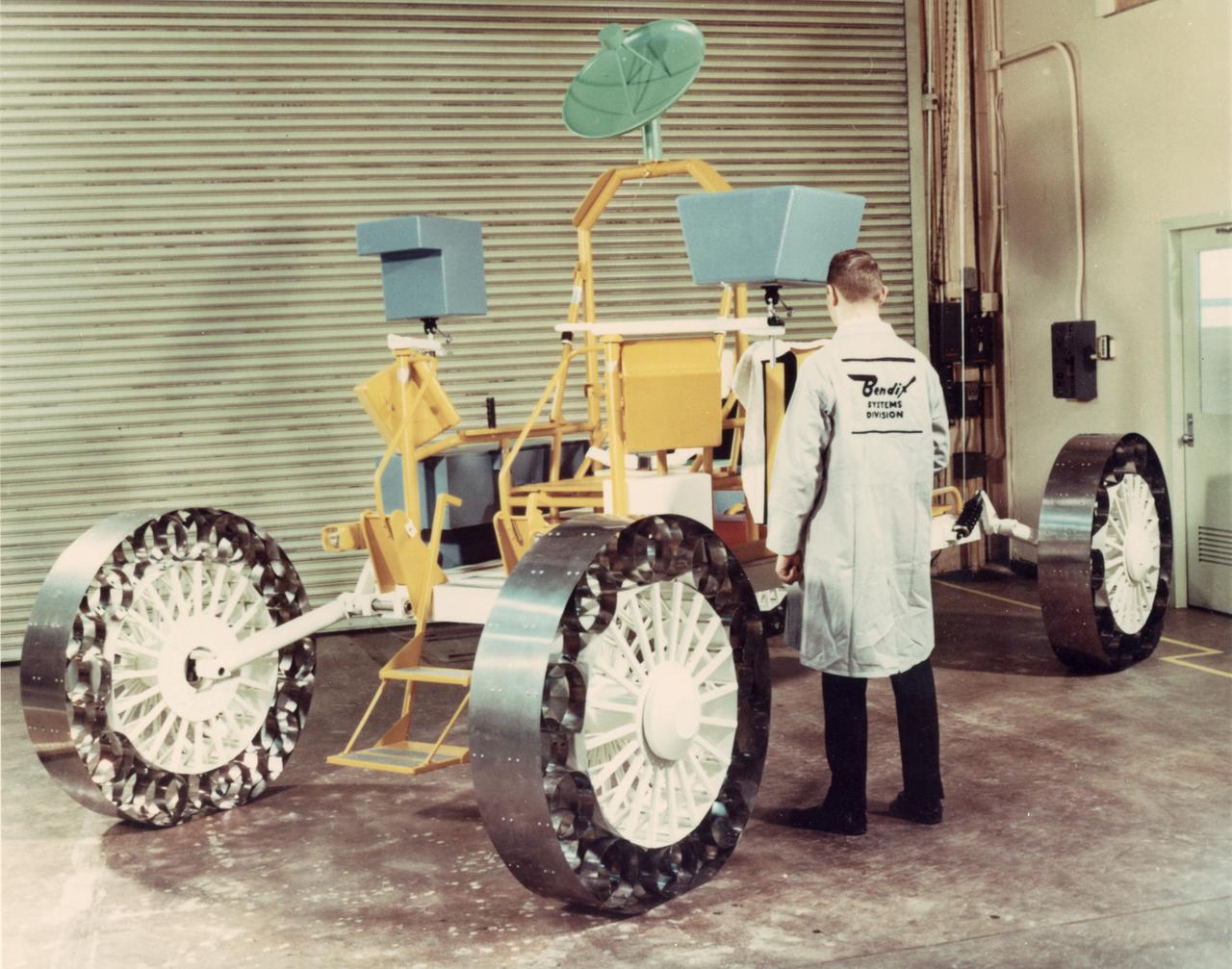
A concept of a possible Lunar Roving Vehicle (LRV) built by the Bendix Corporation for NASA’s Marshall Space Flight Center (MSFC). This Mobility Test Article (MTA) is being inspected by a Bendix technician. The data provided by the MTA helped in designing the LRV, developed under the direction of MSFC. The LRV was designed to allow Apollo astronauts a greater range of mobility during lunar exploration missions.
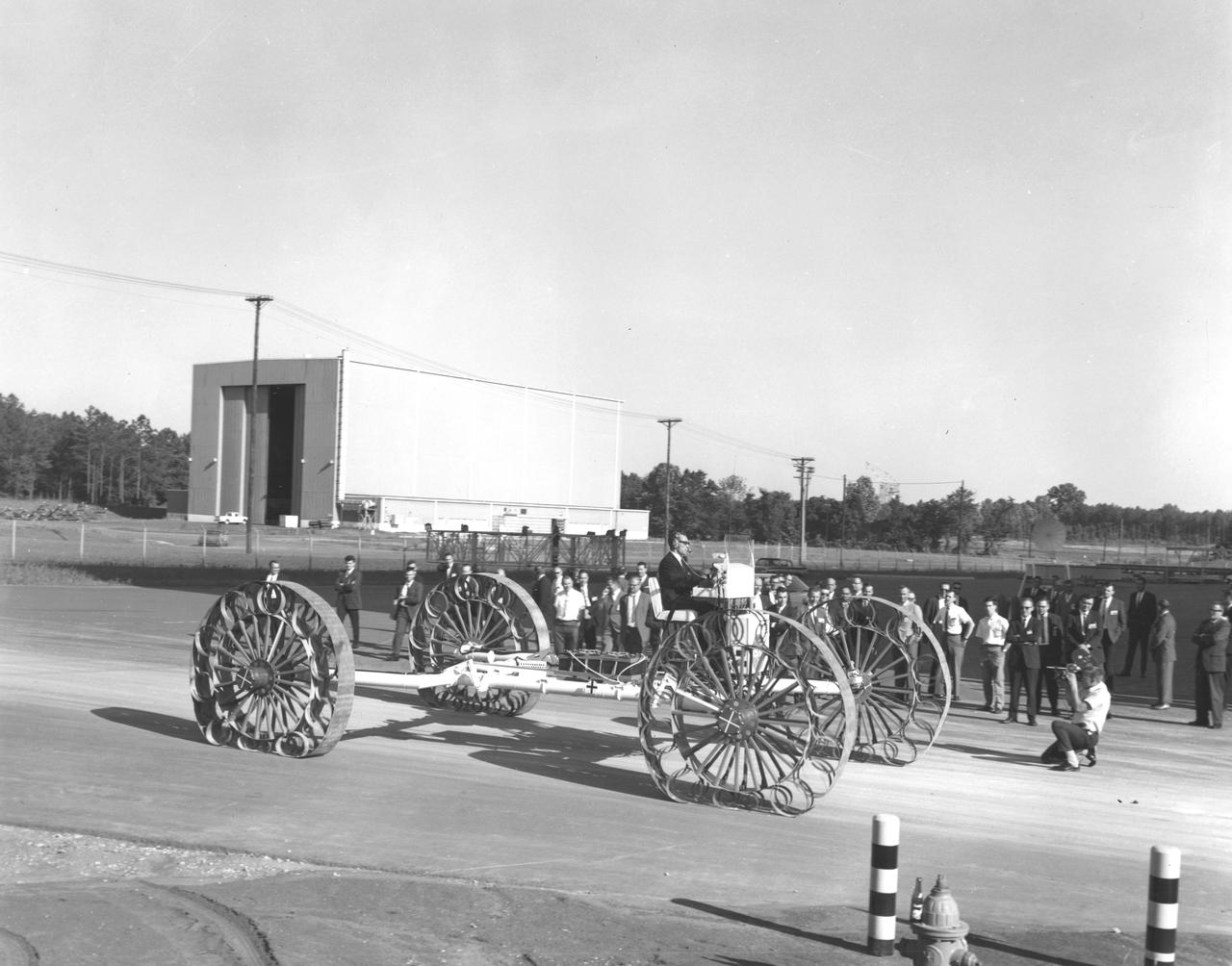
Newsmen watch a test engineer drive a Mobility Test Article (MTA) demonstrated at NASA’s Marshall Space Flight Center (MSFC). This unit, built by the Bendix Corporation, was one of the concepts of a possible Lunar Roving Vehicle (LRV). The data provided by the MTA helped in designing the LRV, developed under the direction of MSFC. The LRV was designed to allow Apollo astronauts a greater range of mobility during lunar exploration missions.
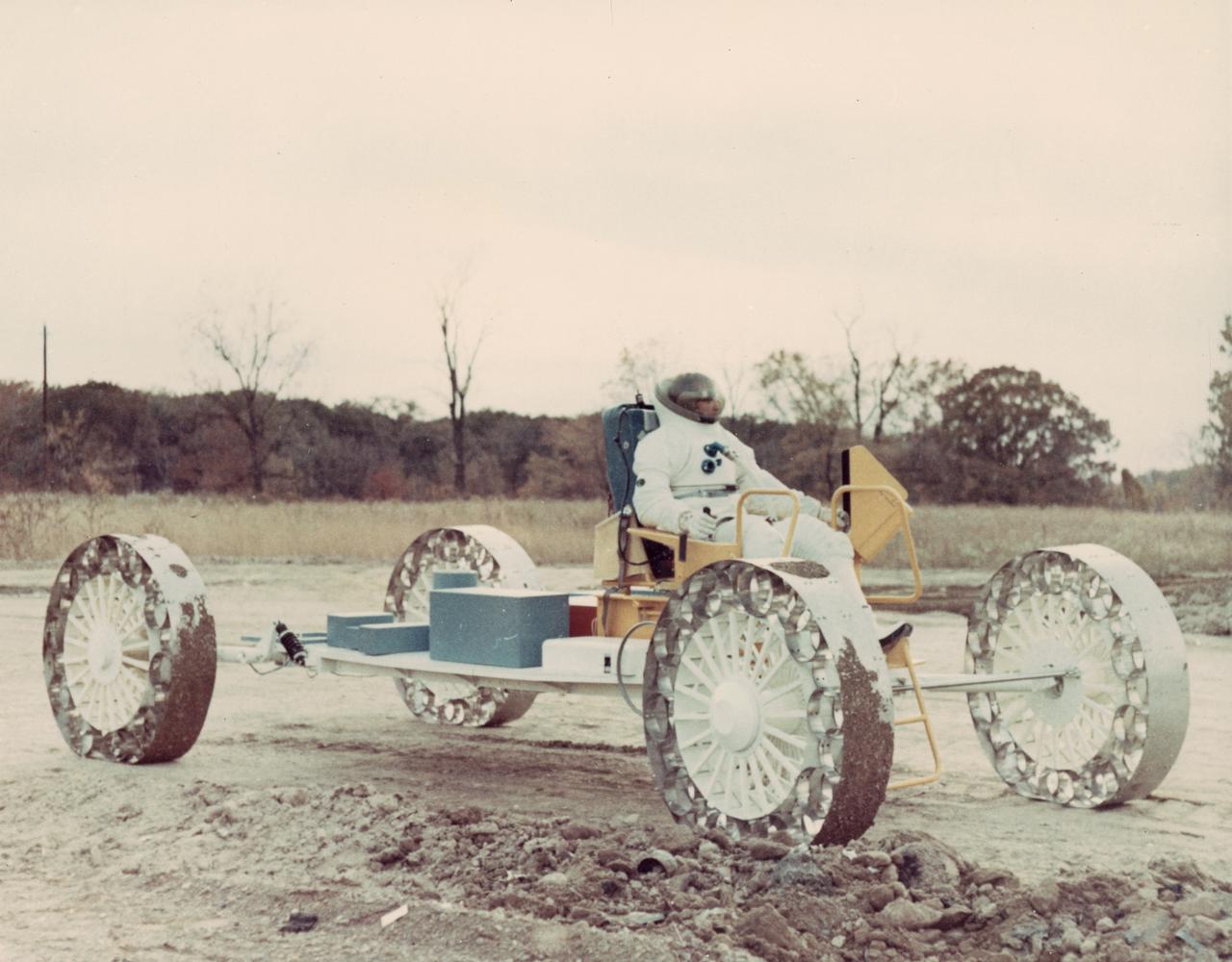
A concept of a possible Lunar Roving Vehicle (LRV) built by the Grumman Industries for NASA’s Marshall Space Flight Center (MSFC), this Mobility Test Article (MTA) is undergoing a full fledged test, complete with space suit attire. The data provided by the MTA helped in designing the LRV, developed under the direction of MSFC. The LRV was designed to allow Apollo astronauts a greater range of mobility during lunar exploration missions.
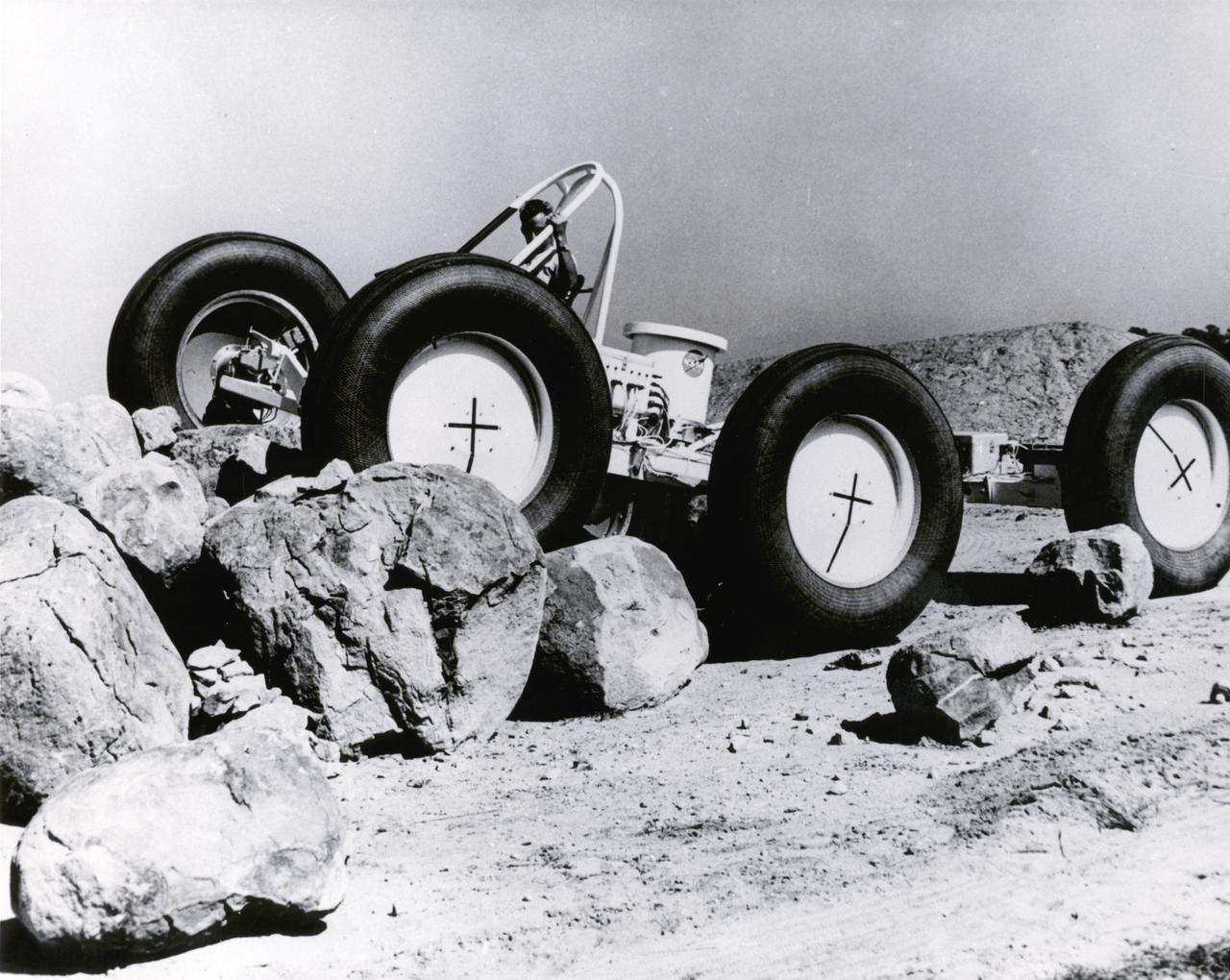
A test engineer drove a Mobility Test Article (MTA) of a possible future Lunar Roving Vehicle (LRV) over rocks during tests in Arizona. The machine was built by General Motors for NASA’s Marshall Space Flight Center (MSFC). Under the direction of MSFC, the LRV was designed to allow Apollo astronauts a greater range of mobility during lunar exploration missions.
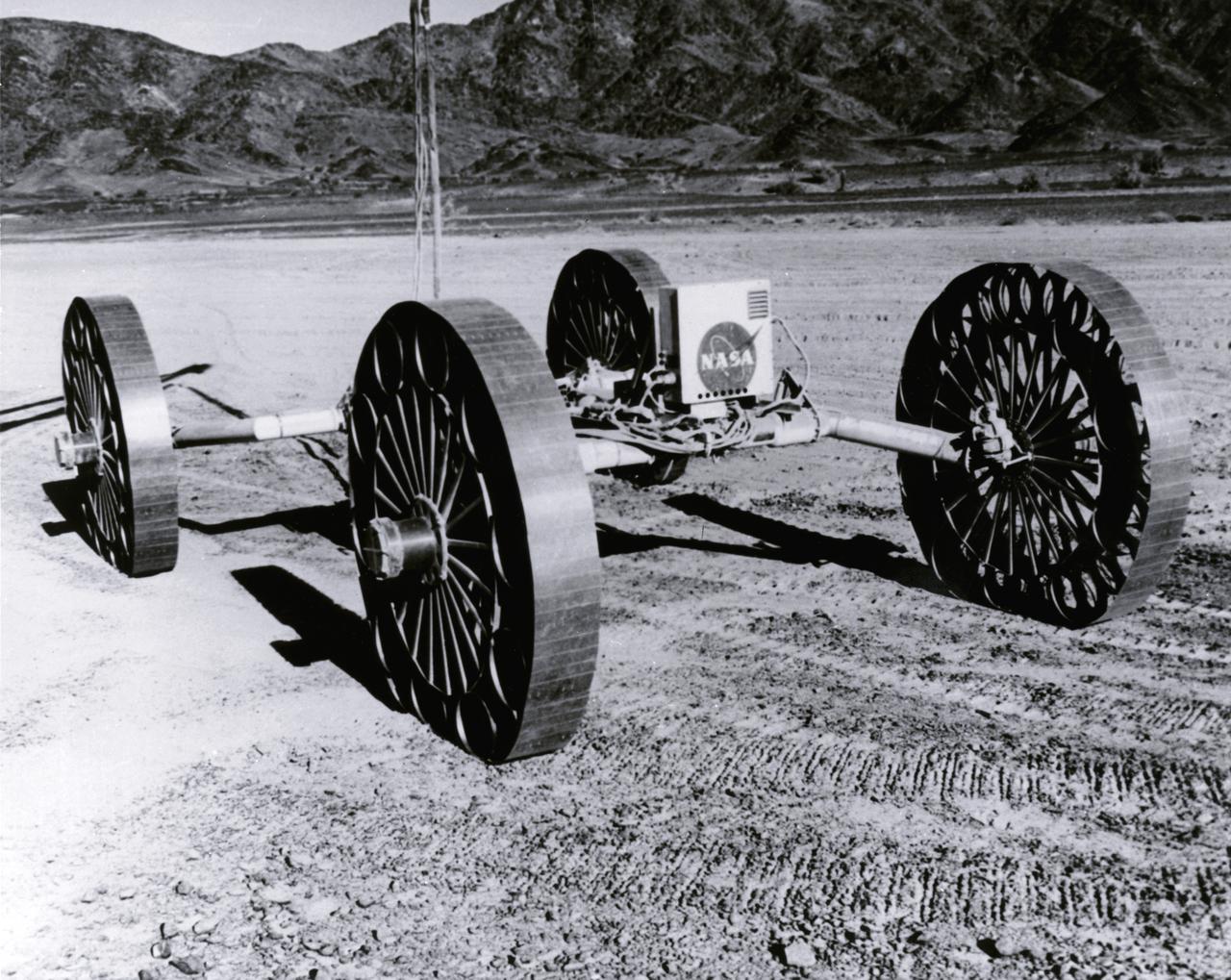
This Mobility Test Article (MTA), built by the Bendix Corporation for NASA’s Marshall Space Flight Center (MSFC), was driven over rocks in Arizona. The data provided by the MTA helped in designing the Lunar Roving Vehicle (LRV), developed under the direction of the MSFC. The LRV was designed to allow Apollo astronauts a greater range of mobility during lunar exploration missions.
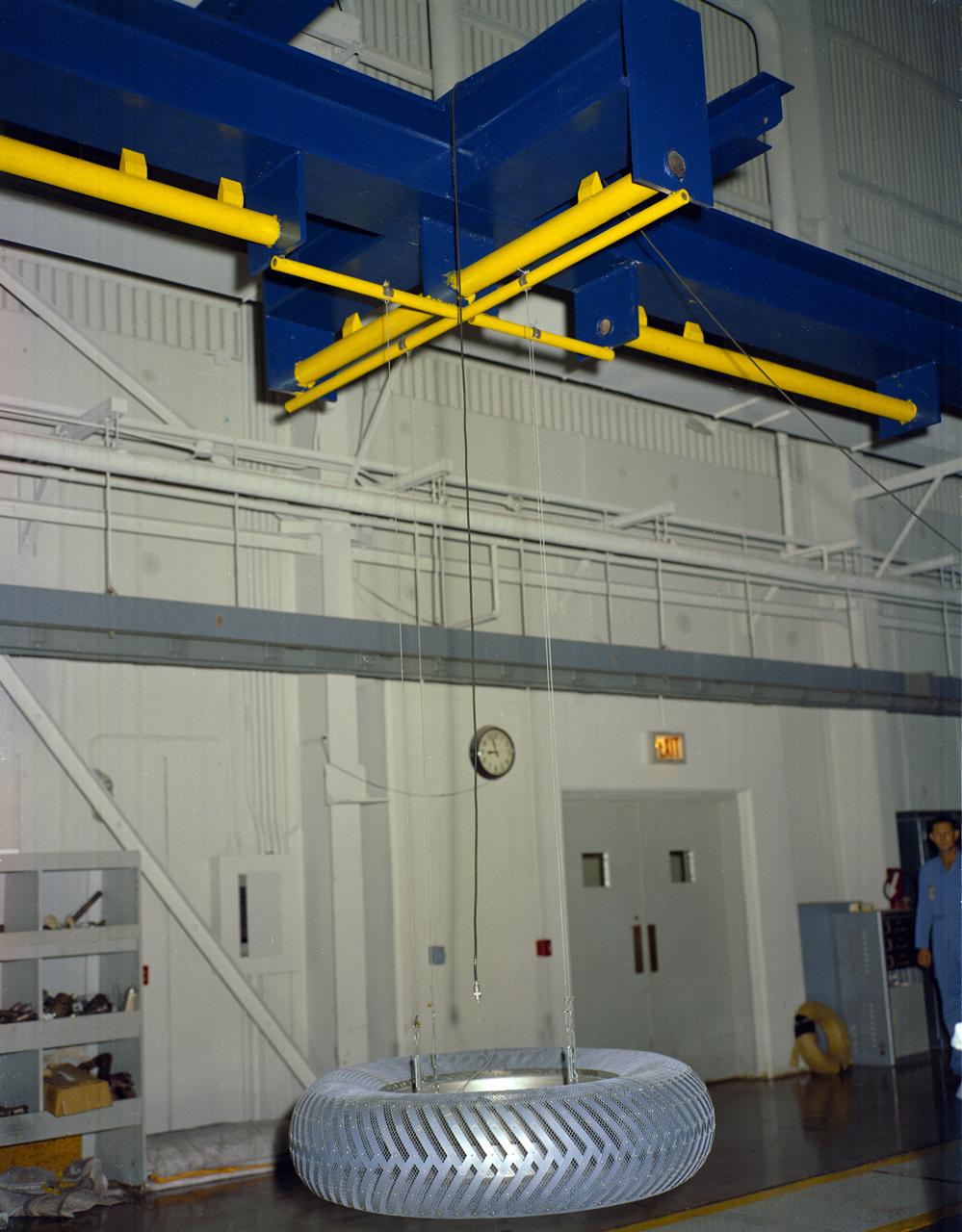
Under the direction of Marshall Space Flight Center (MSFC), the Lunar Roving Vehicle (LRV) was designed to allow Apollo astronauts a greater range of mobility during lunar exploration missions. During the development process, LRV prototype wheels underwent soil tests in building 4481 at Marshall Space Flight Center (MSFC). Pictured is the GM wheel design.
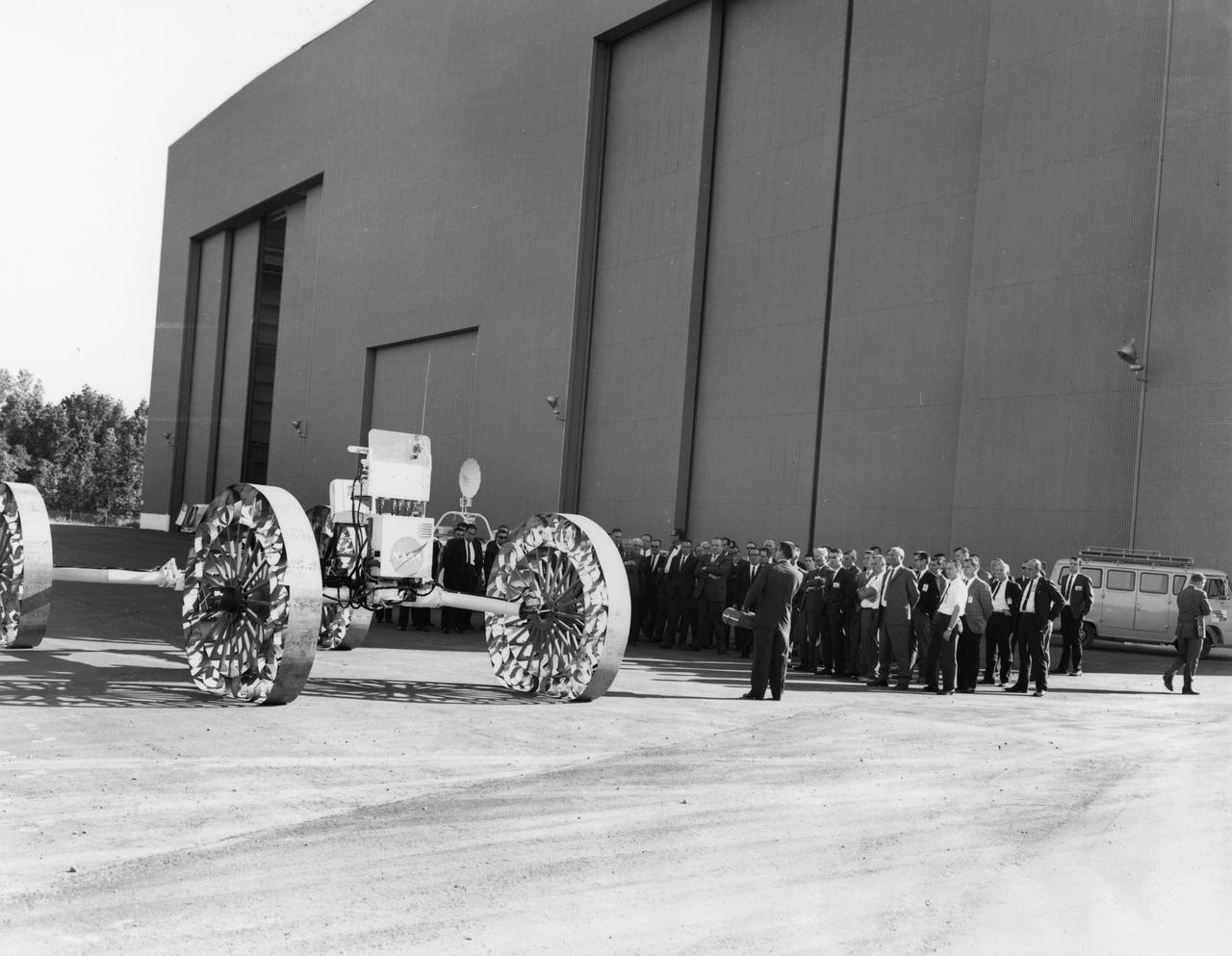
Newsmen listen as an engineer explains operations and capabilities of a Mobility Test Article (MTA) demonstrated at NASA’s Marshall Space Flight Center (MSFC). This unit, built by the Bendix Corporation, was one of the concepts of a possible Lunar Roving Vehicle (LRV). The data provided by the MTA helped in designing the LRV, developed under the direction of MSFC. The LRV was designed to allow Apollo astronauts a greater range of mobility during lunar exploration missions.
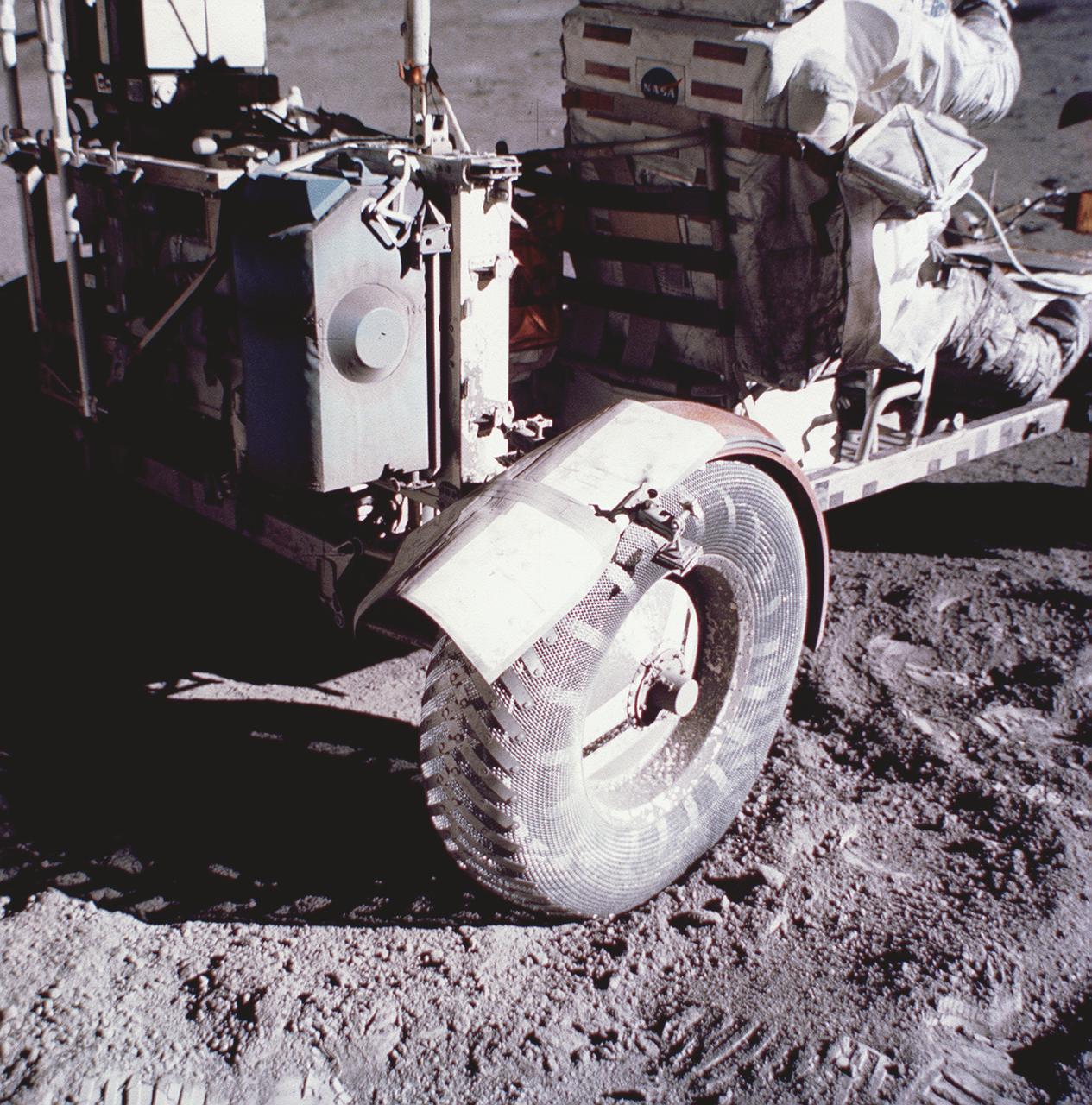
This photograph taken during the Apollo 17 mission (the last mission of the Apollo Program), depicts stiff plasticized maps being taped together and fastened by clamps to patch a broken fender of the Lunar Roving Vehicle (LRV). Powered by battery, the lightweight electric car greatly increased the range of mobility and productivity on the scientific traverses for astronauts. It weighed 462 pounds (77 pounds on the Moon) and could carry two suited astronauts, their gear and cameras, and several hundred pounds of bagged samples. The LRV's mobility was quite high. It could climb and descend slopes of about 25 degrees. The LRV was designed and developed by the Marshall Space Flight Center and built by the Boeing Company.
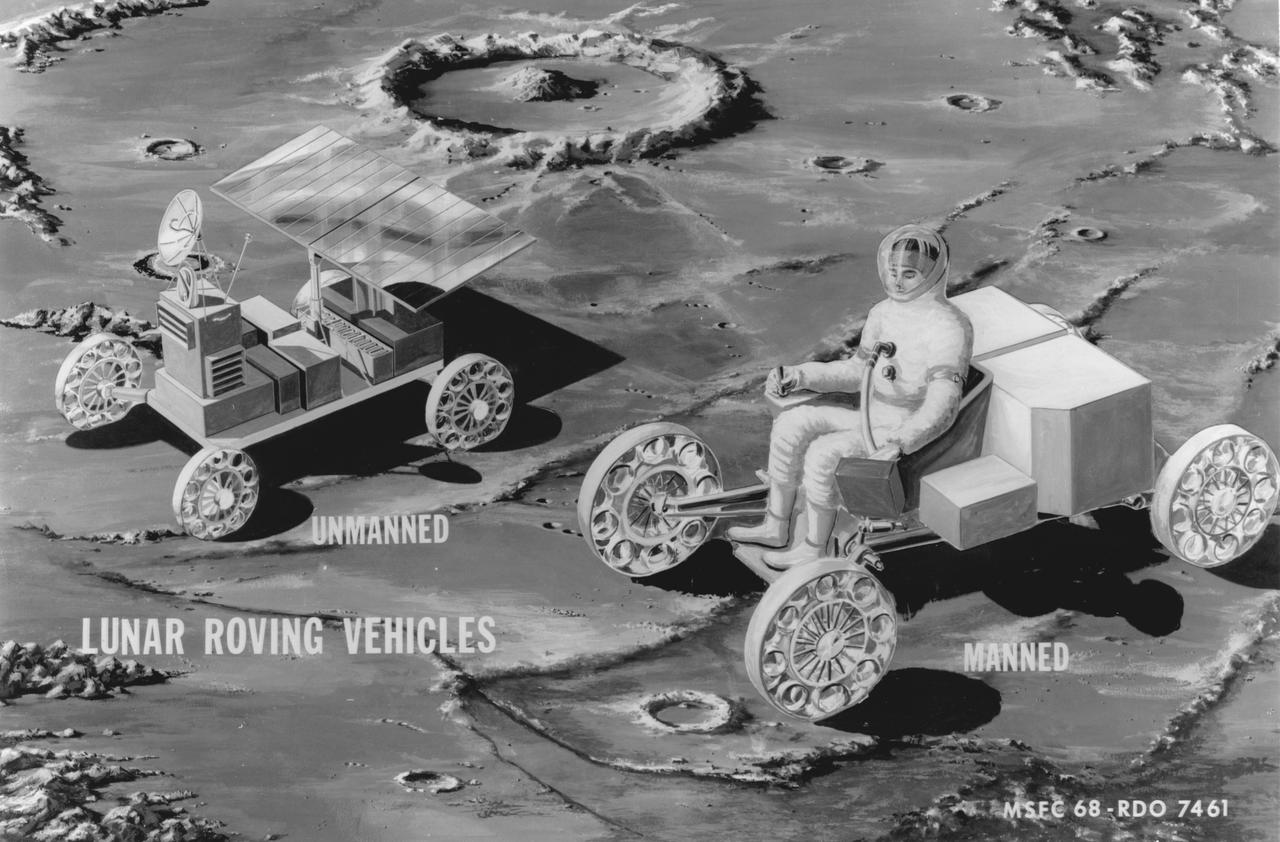
Artist’s manned and unmanned concepts of a Lunar Roving Vehicle (LRV) Mobility Test Article (MTA) on the Lunar surface. The data provided by the MTA helped in designing the LRV, developed under the direction of MSFC. The LRV was designed to allow Apollo astronauts a greater range of mobility during lunar exploration missions.
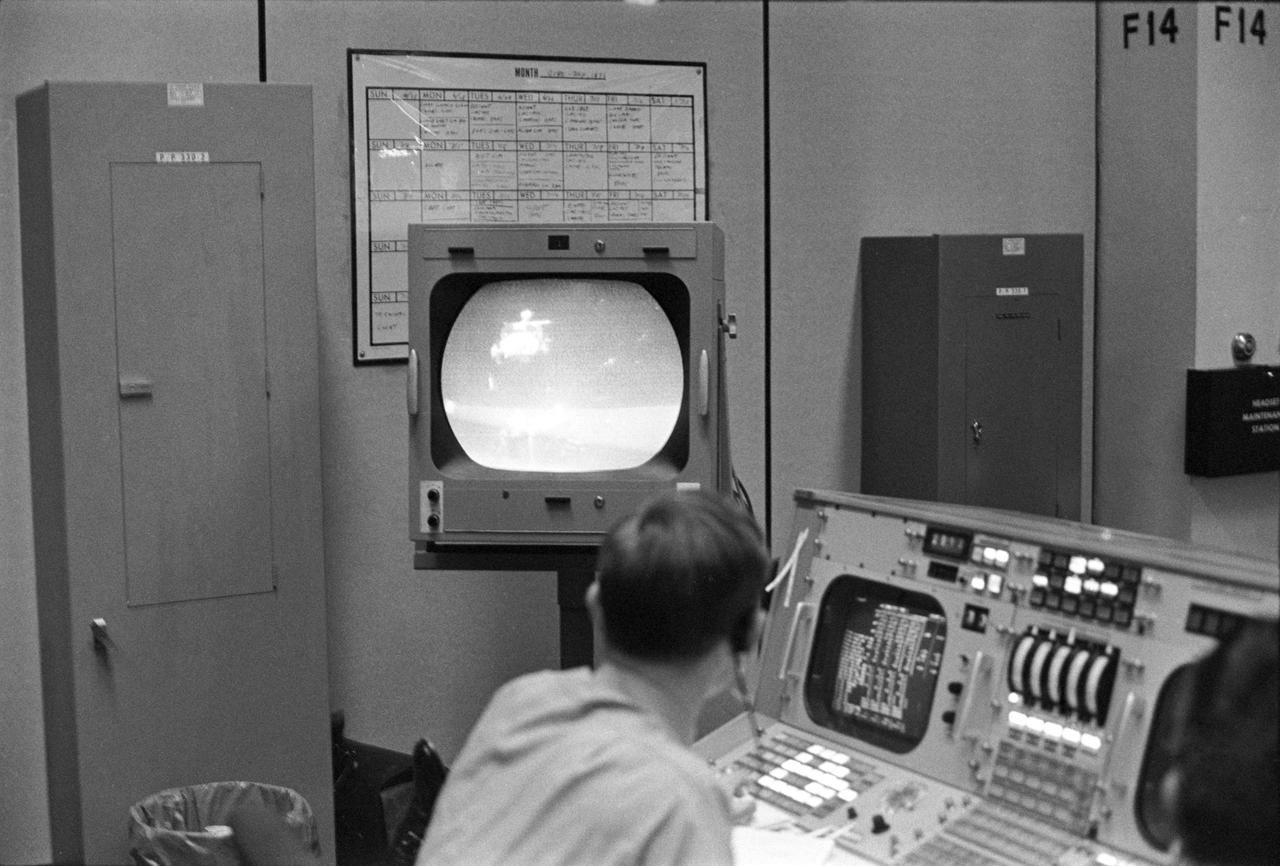
View of a photograph of the television (TV) monitor in the MCC showing a picture being transmitted from the color TV camera mounted on the parked Lunar Roving Vehicle (LRV) at the Hadley-Apennine Landing Site showing the liftoff of the Apollo 15 Lunar Module (LM) Ascent Stage from the Lunar surface. MSC, Houston, TX
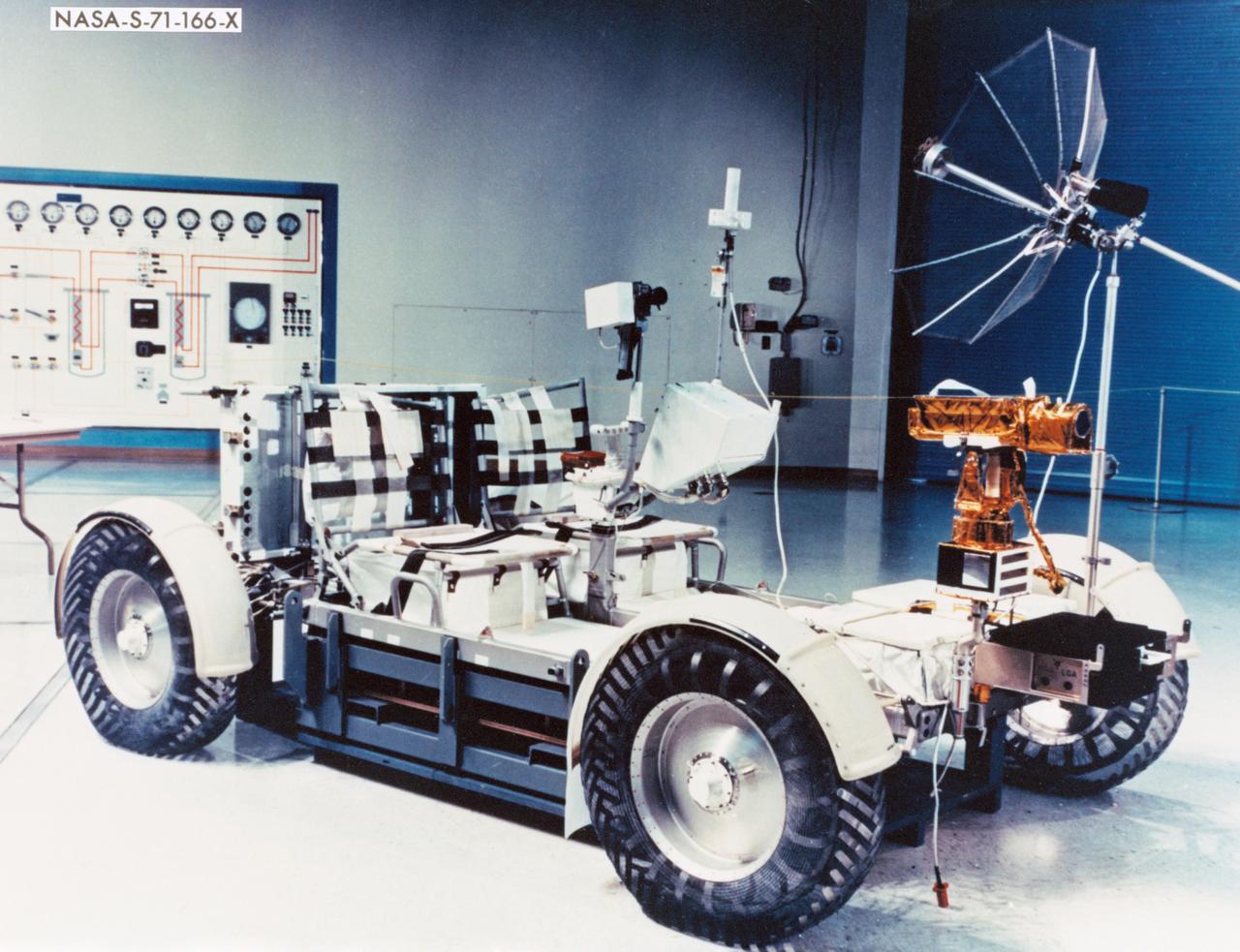
S71-00166 (June 1971) --- A close-up view of the Lunar Roving Vehicle (LRV). Apollo 15 will be the first mission to employ the services of the LRV. Astronauts David R. Scott, commander; and James B. Irwin, lunar module pilot, will move about the lunar surface in the Hadley-Apennine region in their four-wheeled vehicle while astronaut Alfred M. Worden, command module pilot, remains with the Command and Service Modules (CSM) in lunar orbit. A television camera, which can be controlled remotely from the ground (front), and a motion picture camera (rear) are among the gear on the LRV.
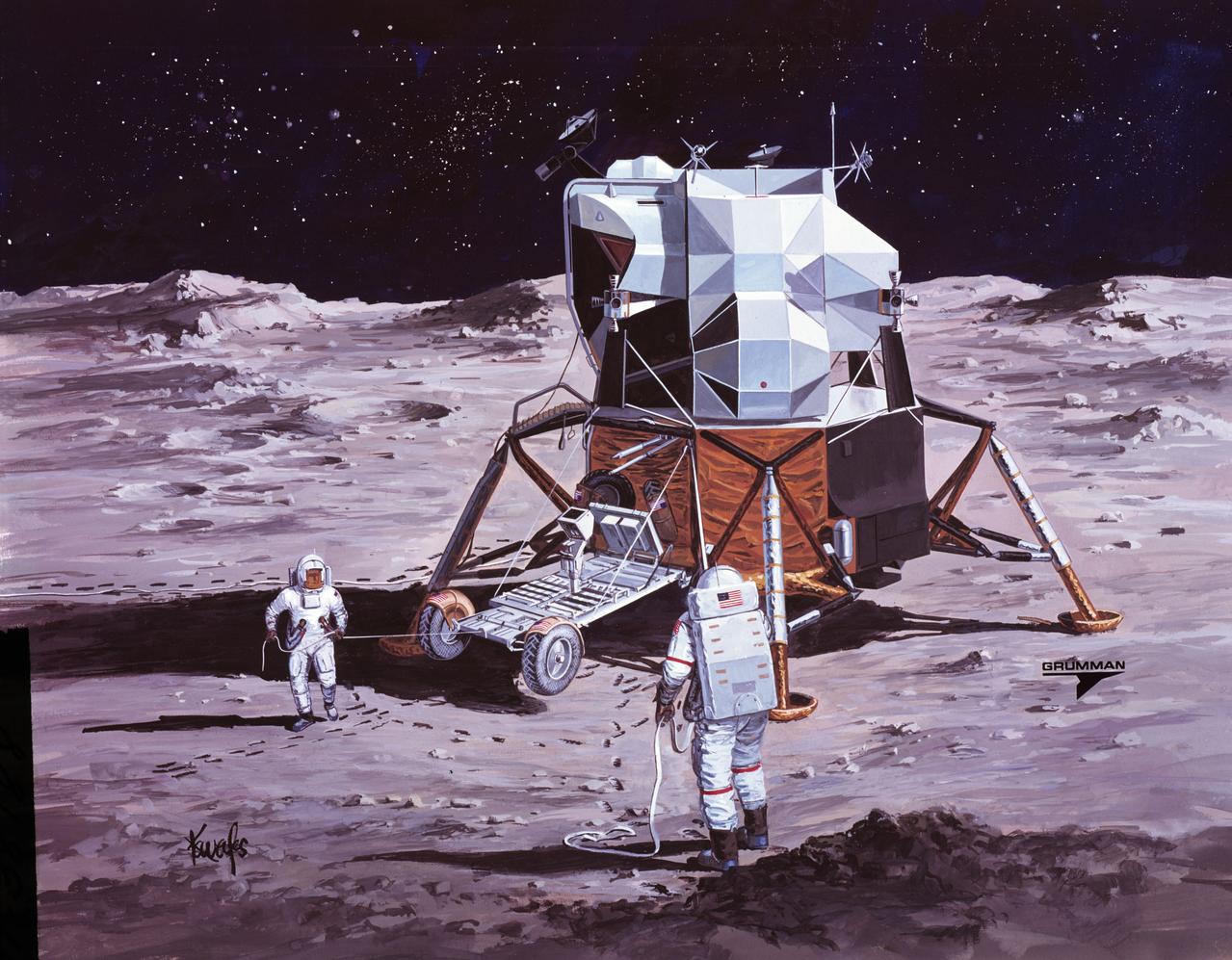
S71-38188 (26 June 1971) --- An artist's concept showing the Apollo 15 mission commander and the lunar module pilot performing deployment of the Lunar Roving Vehicle (LRV) on the lunar surface. The figure on the left represents astronaut James B. Irwin, lunar module pilot, who here is maintaining a constant pull on the deployment cable to help the LRV unfold, while astronaut David R. Scott (right), commander, pulls the tapes that lower the LRV to the surface. (This is the third in a series of Grumman Aerospace Corporation artist's concepts telling the lunar surface LRV deployment story of the Apollo 15 mission).
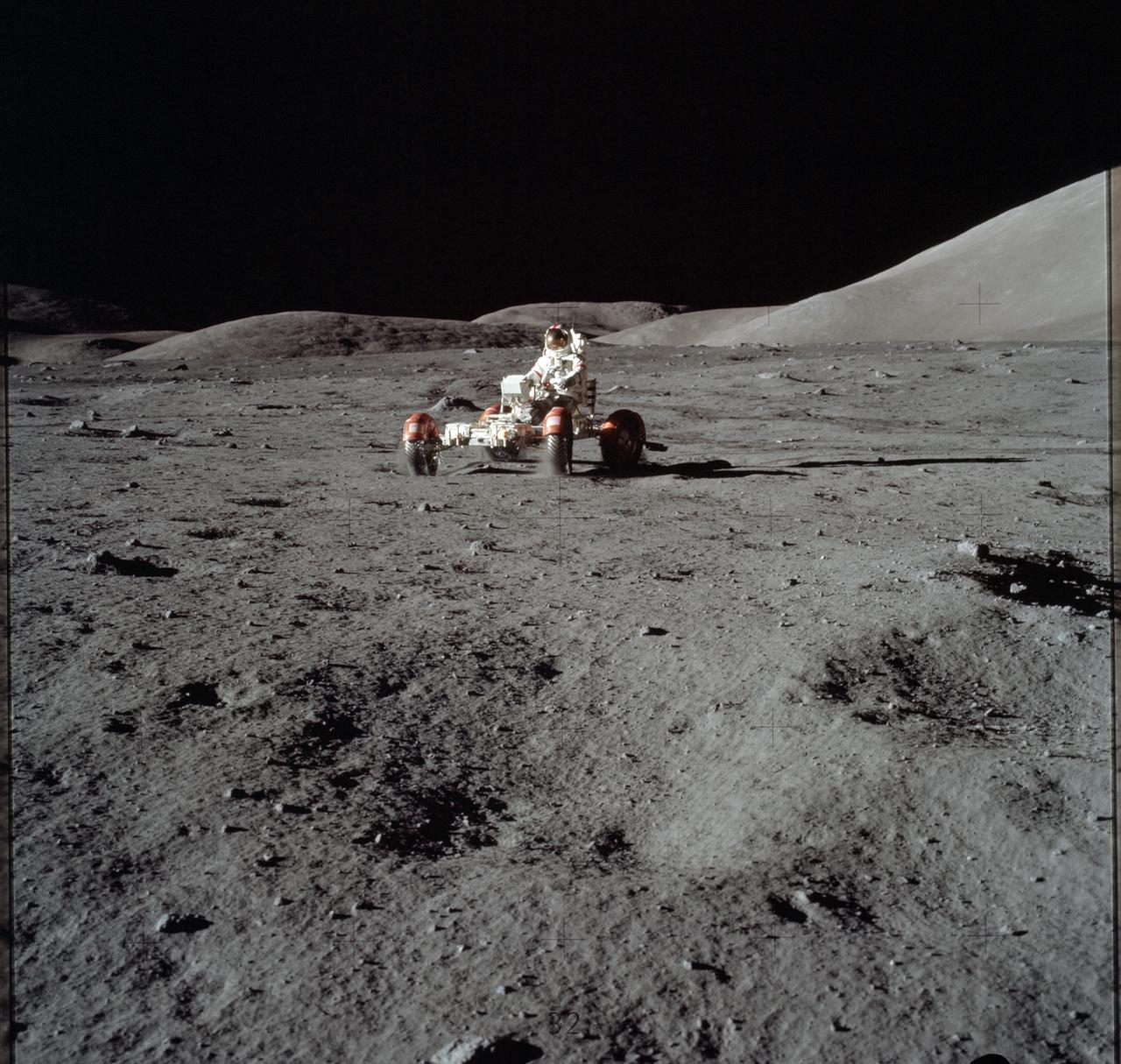
AS17-147-22523 (11 Dec. 1972) --- Astronaut Eugene A. Cernan is seen test driving the "stripped down" Lunar Rover Vehicle (LRV) prior to loading the LRV up. Equipment later loaded onto the LRV included the ground controlled television assembly, the lunar communications relay unit, the hi-gain antenna, the low-gain antenna, aft tool pallet, and lunar tools and scientific gear.
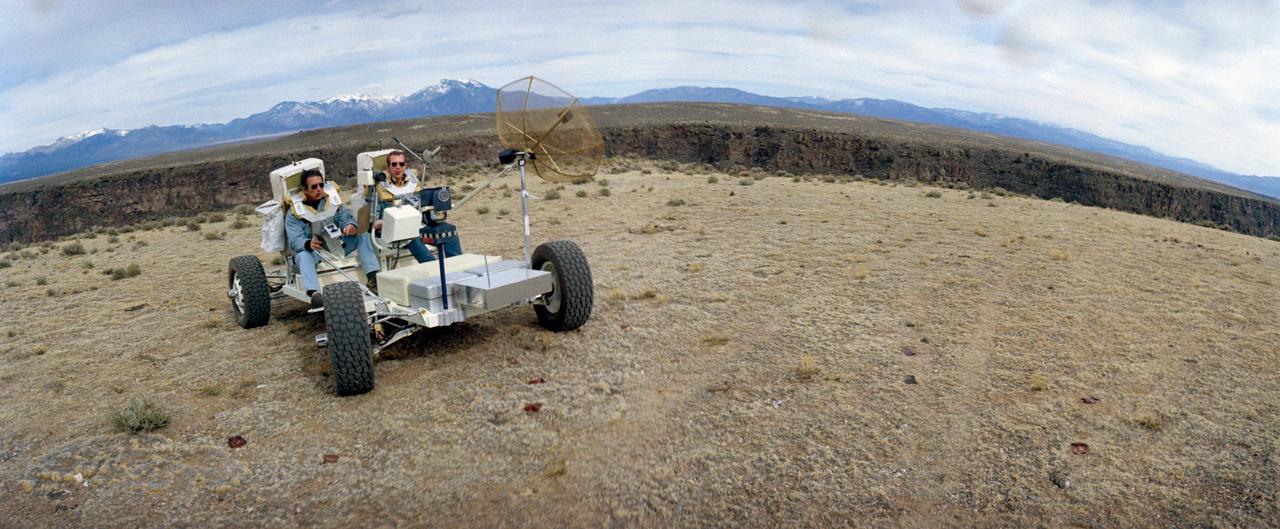
S71-23774 (11-12 March 1971) --- A wide-angle view showing two members of the prime crew of the Apollo 15 lunar landing mission riding in a Lunar Roving Vehicle trainer called "Grover" during a simulation of lunar surface extravehicular activity in the Taos, New Mexico area. They are astronauts David R. Scott (riding in left side seat), commander; and James B. Irwin, lunar module pilot. Apollo 15 will be the first mission to the moon to carry a Lunar Roving Vehicle, which will permit the astronauts to cover a larger area for exploration and sample collecting than on previous missions.
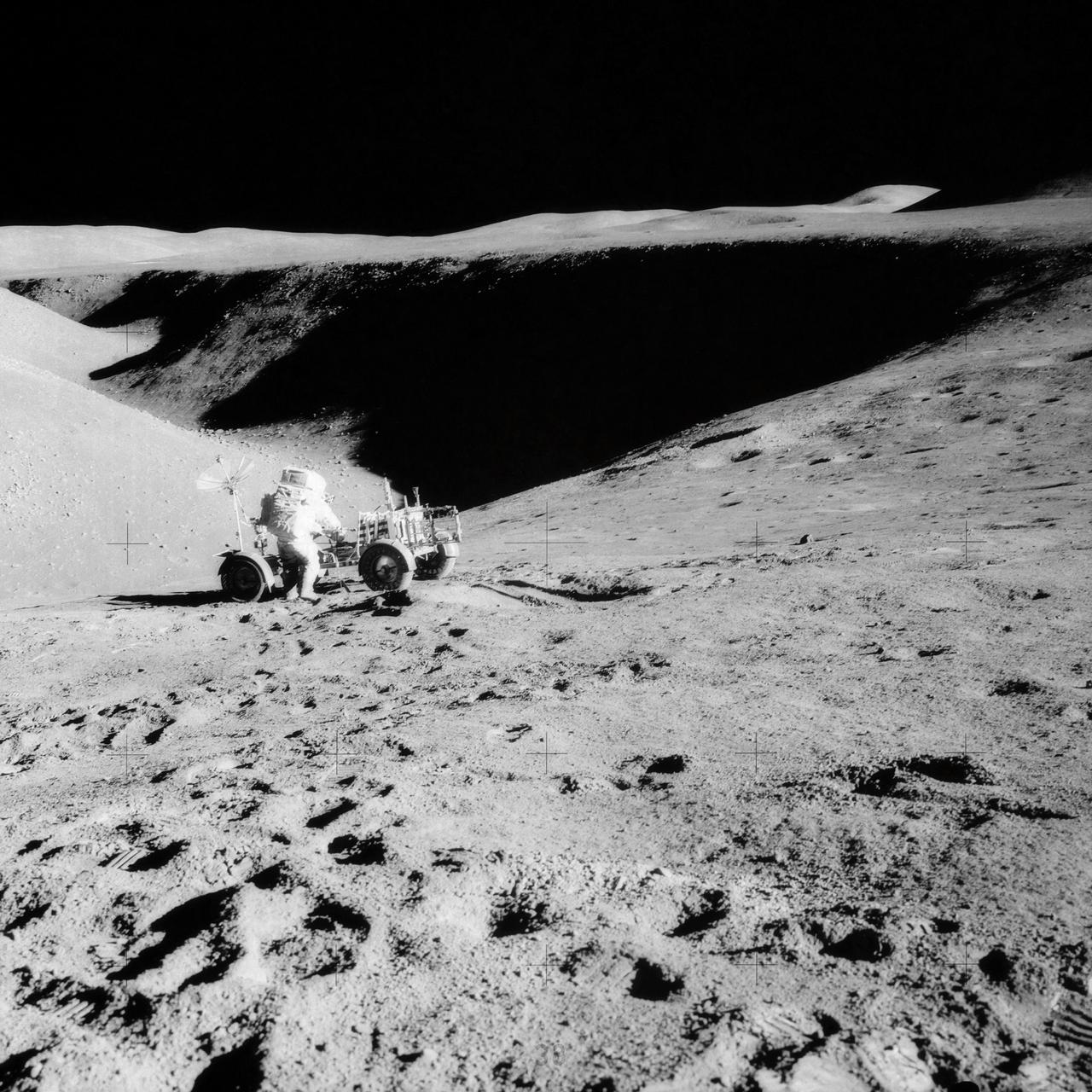
AS15-85-11451 (31 July 1971) --- Astronaut David R. Scott, mission commander, performs a task at the Lunar Roving Vehicle parked on the edge of Hadley Rille during the first Apollo 15 lunar surface extravehicular activity (EVA). This photograph was taken by astronaut James B. Irwin, lunar module pilot, from the flank of St. George Crater. The view is looking north along the rille.
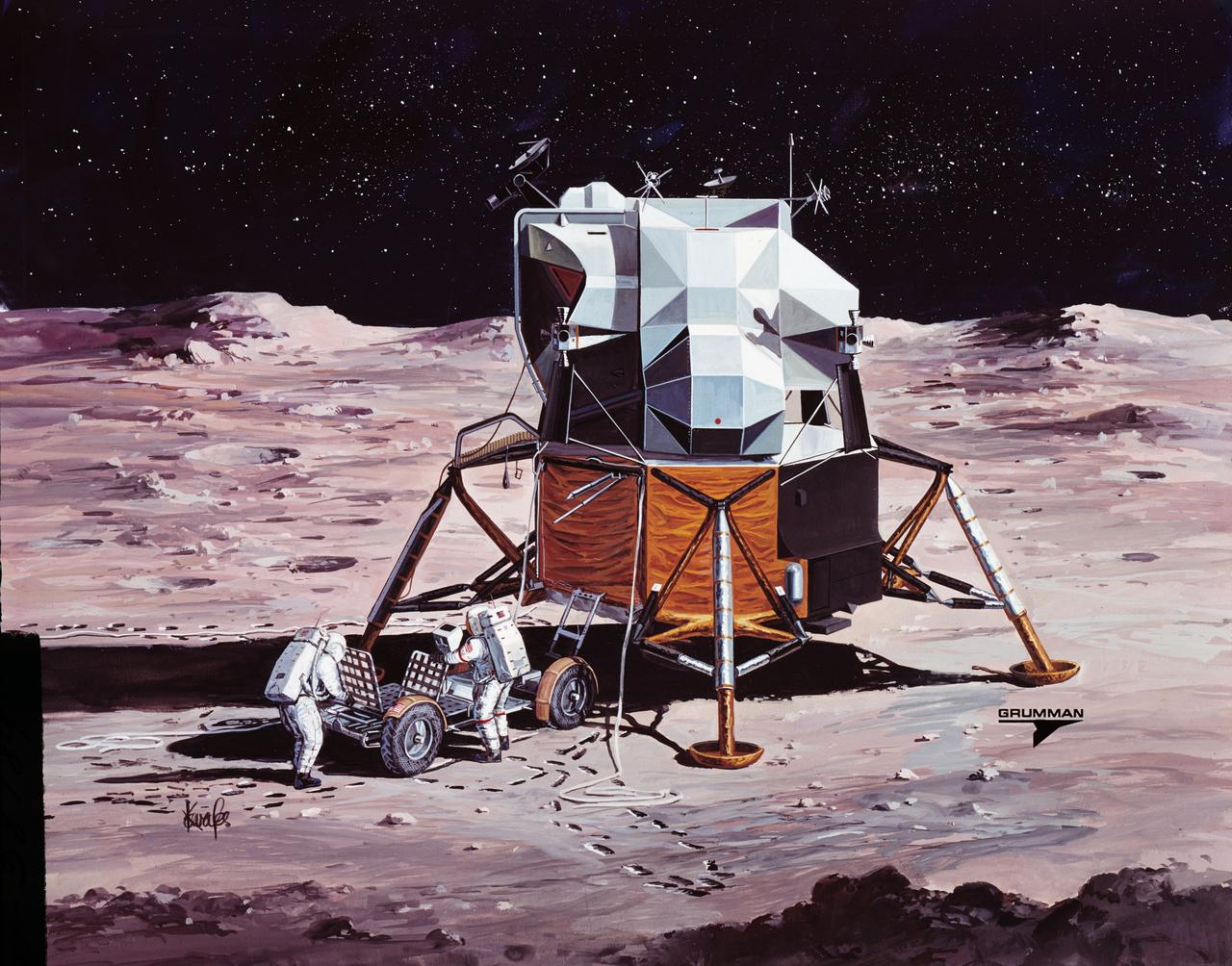
S71-38189 (26 June 1971) --- An artist's concept showing the final steps of readying the Apollo 15 Lunar Roving Vehicle (LRV) or Rover 1 for mobility on the lunar surface. Performing the last few LRV deployment tasks here are, left to right, astronauts James B. Irwin, lunar module pilot, and David R. Scott, commander. More specifically the tasks depicted here include the setting up of the seats and the total releasing of the LRV from the LM. (This is the fourth in a series of four Grumman Aerospace Corporation artist's concepts telling the lunar surface LRV deployment story for Apollo 15).
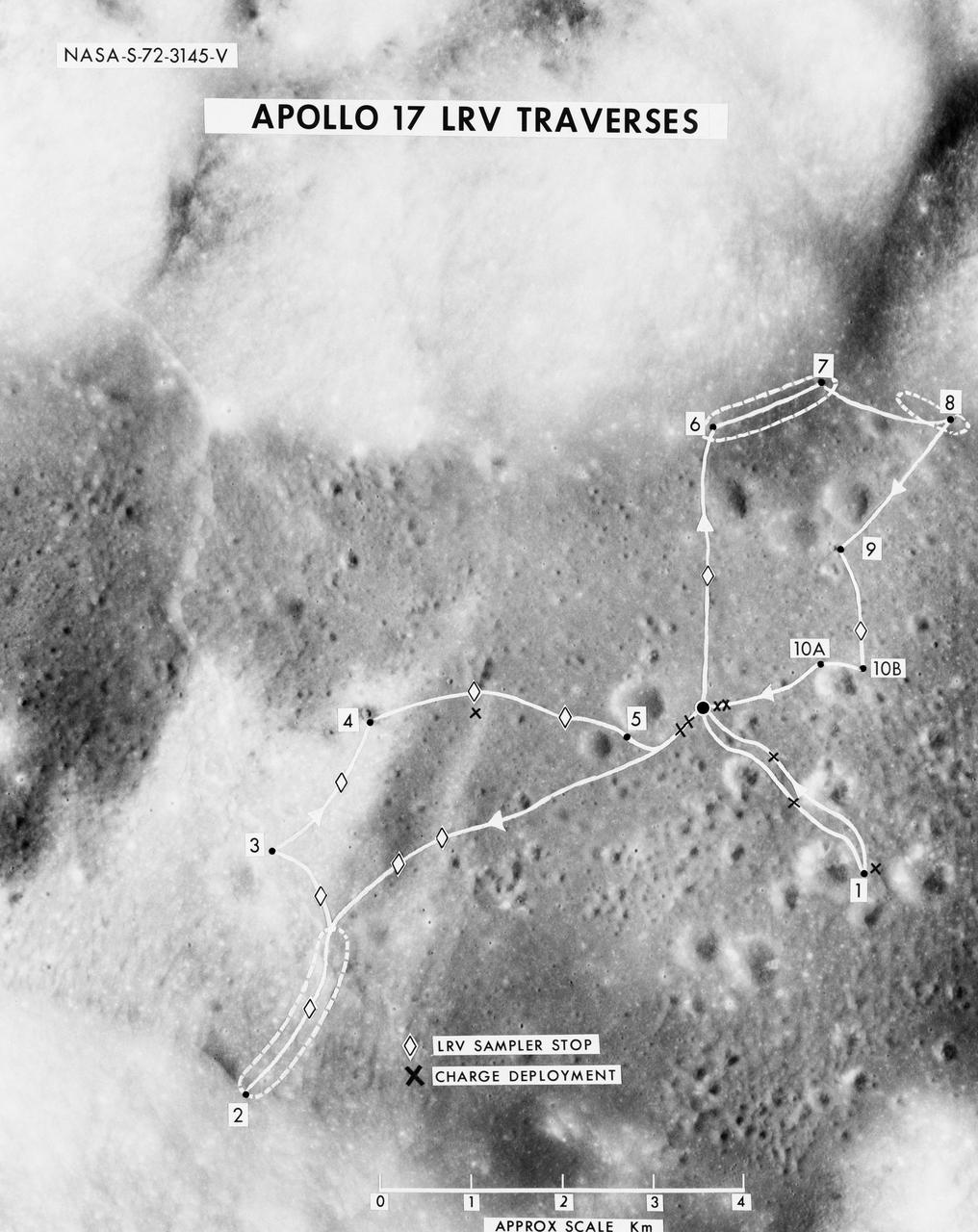
S72-03145 (October 1972) --- A vertical view of the Apollo 17 Taurus-Littrow site with an overlay to illustrate the three planned Apollo 17 traverses using the Lunar Roving Vehicle (LRV). The EVA-1 traverse has a single station (1); the EVA-2 traverse has four stations (2,3,4,5); and the EVA-3 traverse has five stations (6,7,8,9,10). Stations 10-A and 10-B are alternate locations for Station 10. In addition to the major stations mentioned above, brief stops are planned for sampling between stations using the LRV sampler tool (note diamond-shaped figures), and for deploying explosive charges associated with the Lunar Seismic Profiling Experiment (LSPE - note black x-marks).
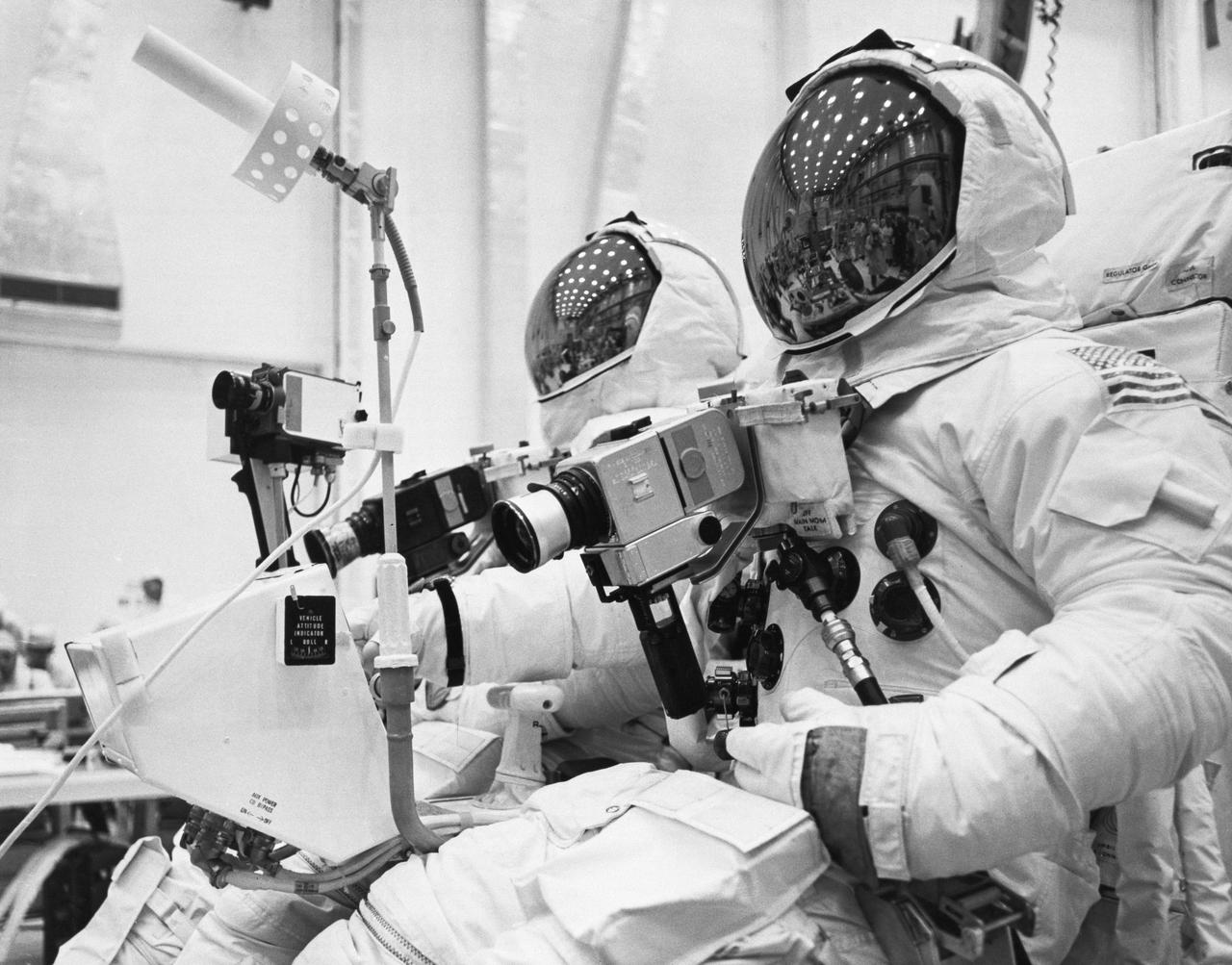
S72-33685 (22 March 1972) --- Astronauts John W. Young, Apollo 16 commander; and Charles M. Duke Jr. (nearest camera), lunar module pilot, rehearse some of the motorized phases of their scheduled extravehicular activity (EVA) assignments on the lunar surface. Young and Duke will take part in three different sessions of EVA on the moon while astronaut Thomas K. (Ken) Mattingly II, command module pilot, remains with the Command and Service Modules (CSM) in lunar orbit. The four-wheeled helper is called the Lunar Roving Vehicle (LRV).
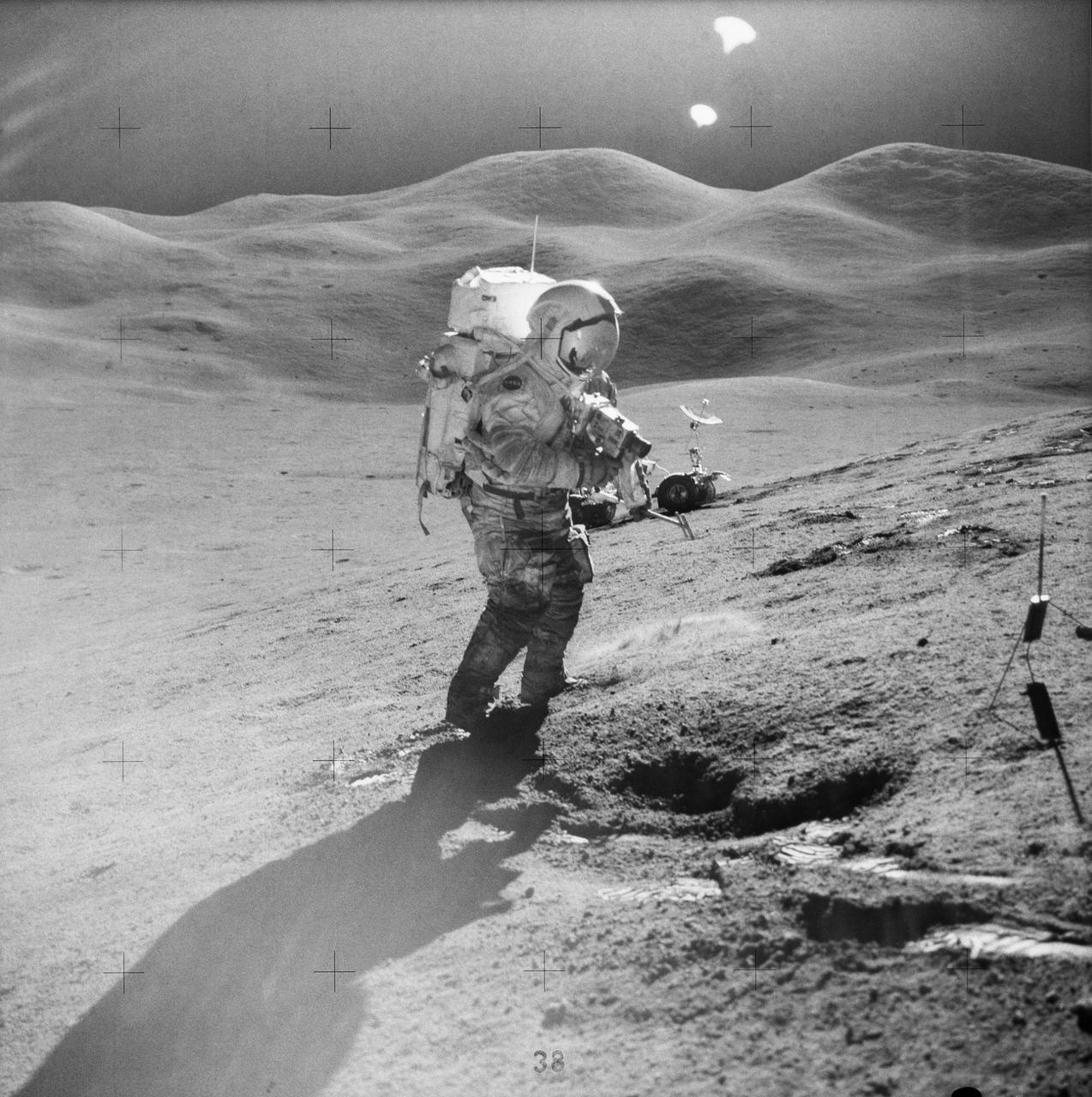
AS15-85-11514 (31 July-2 Aug. 1971) --- Astronaut David R. Scott, commander, standing on the slope of Hadley Delta, uses a 70mm camera during Apollo 15 extravehicular activity (EVA) on the lunar surface. He is 10.5 miles (or 17.5 kilometers) from the base of the Apennine Mountains seen in the background. Scott carries tongs in his left hand. The Lunar Roving Vehicle (LRV) is in the background. This view is looking east. While astronauts Scott and James B. Irwin, lunar module pilot, descended in the Lunar Module (LM) "Falcon" to explore the moon, astronaut Alfred M. Worden, command module pilot, remained with the Command and Service Modules (CSM) in lunar orbit.

AS15-85-11437 (31 July 1971) --- Astronaut David R. Scott, commander, with tongs and gnomon in hand, studies a boulder on the slope of Hadley Delta during the Apollo 15 lunar landing mission's first extravehicular activity (EVA). The Lunar Roving Vehicle (LRV), "Rover", is in the right foreground. The view is looking slightly south of west. "Bennett Hill" is at extreme right. Astronaut James B. Irwin, lunar module pilot, took this photograph. While astronauts Scott and Irwin descended together in the Lunar Module (LM) "Falcon" to explore the Hadley-Apennine area of the moon, astronaut Alfred M. Worden, command module pilot, remained with the Command and Service Modules (CSM) in lunar orbit.
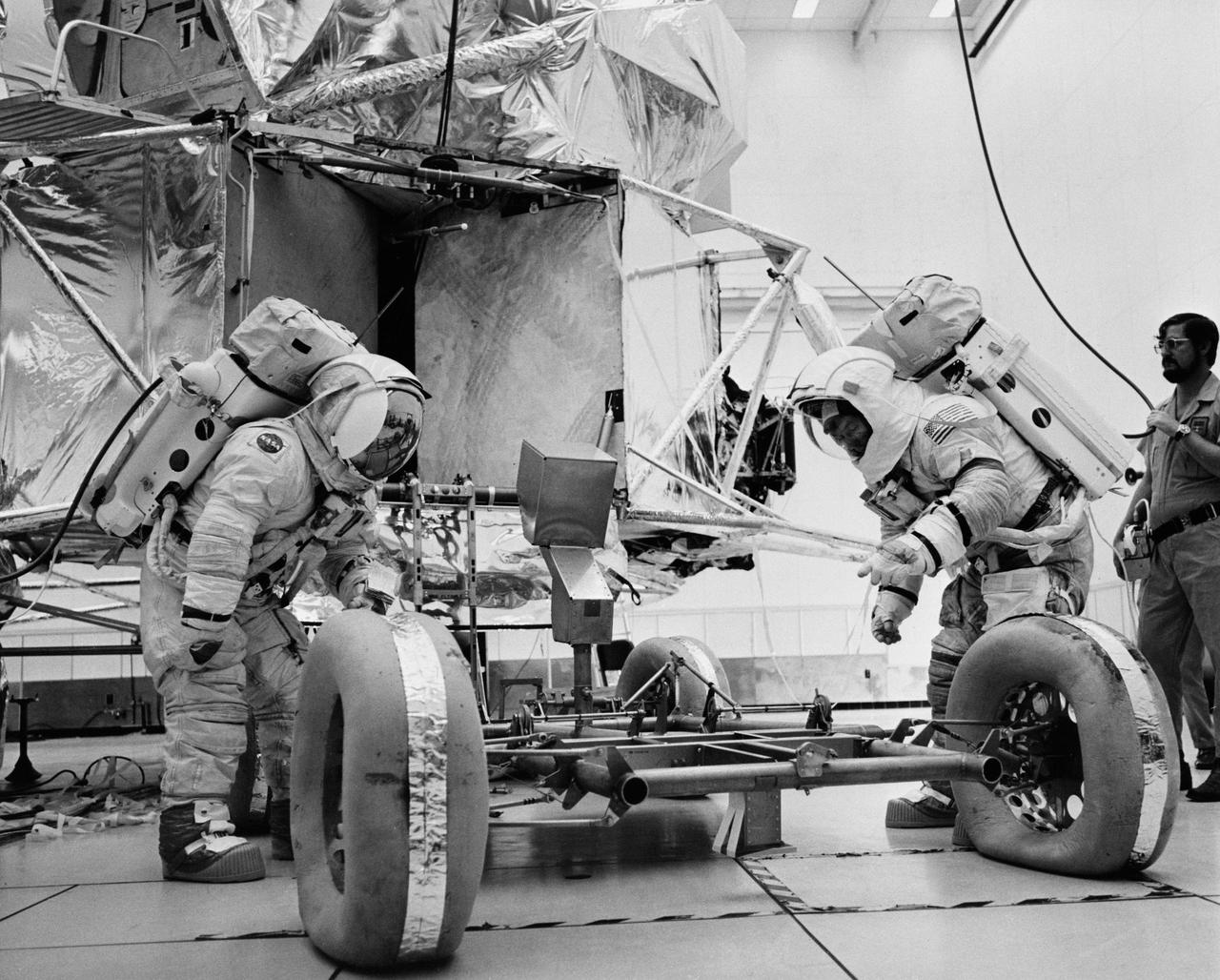
S72-44423 (8 Sept. 1972) --- Two Apollo 17 crewmen ready a Lunar Roving Vehicle trainer following its deployment from a Lunar Module trainer in the Flight Crew Training Building at the Kennedy Space Center, Florida. Taking part in the Apollo 17 training exercise were astronauts Eugene A. Cernan (right), commander; and Harrison H. "Jack" Schmitt, lunar module pilot.
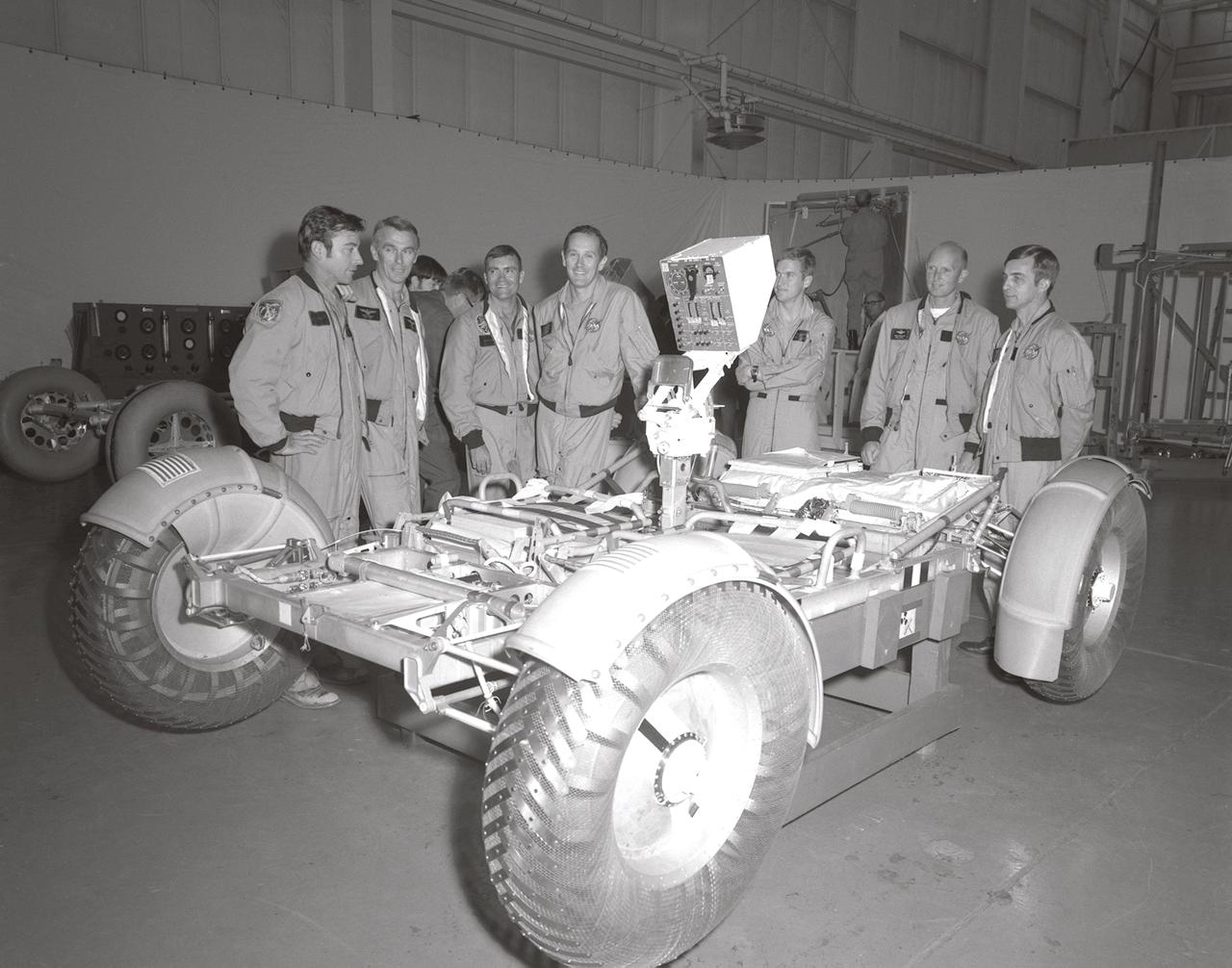
In this November 1971 photograph, (from left to right) Astronauts John Young, Eugene Cernan, Charles Duke, Fred Haise, Anthony England, Charles Fullerton, and Donald Peterson await deployment tests of the Lunar Roving Vehicle (LRV) qualification test unit in building 4649 at the Marshall Space Flight Center (MSFC). The LRV, developed under the direction of the MSFC, was designed to allow Apollo astronauts a greater range of mobility on the lunar surface during the last three lunar exploration missions; Apollo 15, Apollo 16, and Apollo 17.
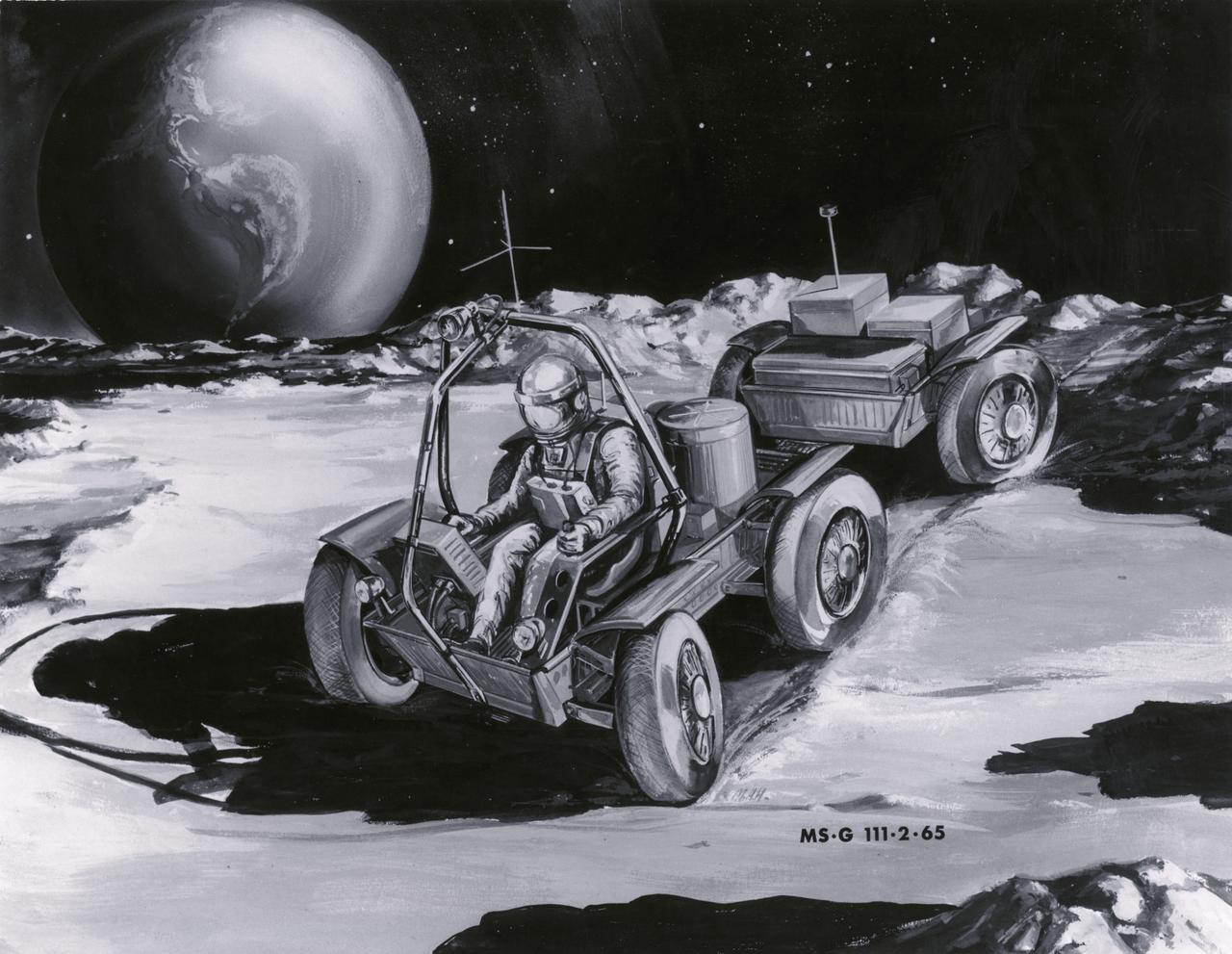
Artist’s concept of the Local Scientific Survey Module (LSSM), one of two designs for a Lunar Roving Vehicle (LRV), depicted on the lunar surface A Bendix Corporation concept, this configuration weighs more than 8,000 pounds, is 21-feet long, 15-feet wide and has 6 wheels with 5-foot diameters. The LRV was developed under the direction of the Marshall Space Flight Center (MSFC) to give Apollo astronauts a wider range of mobility on the lunar surface.
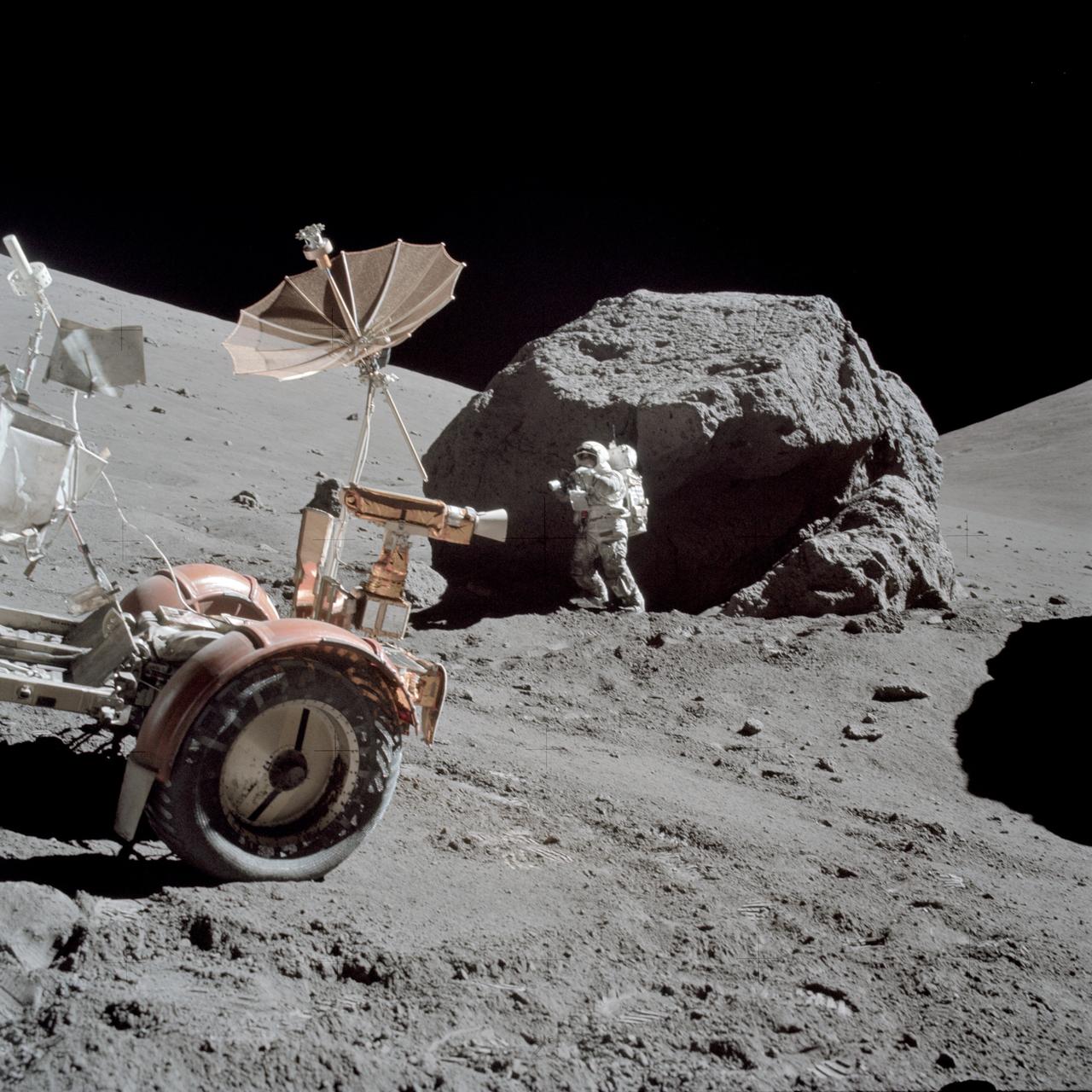
AS17-146-22294 (13 Dec. 1972) --- Scientist-astronaut Harrison H. Schmitt is photographed working beside a huge boulder at Station 6 (base of North Massif) during the third Apollo 17 extravehicular activity (EVA) at the Taurus-Littrow landing site. The front portion of the Lunar Roving Vehicle (LRV) is visible on the left. This picture was taken by astronaut Eugene A. Cernan, Apollo 17 commander. Schmitt is the lunar module pilot. While astronauts Cernan and Schmitt descended in the Lunar Module (LM) "Challenger" to explore the moon, astronaut Ronald E. Evans, command module pilot, remained with the Apollo 17 Command and Service Modules (CSM) in lunar orbit.
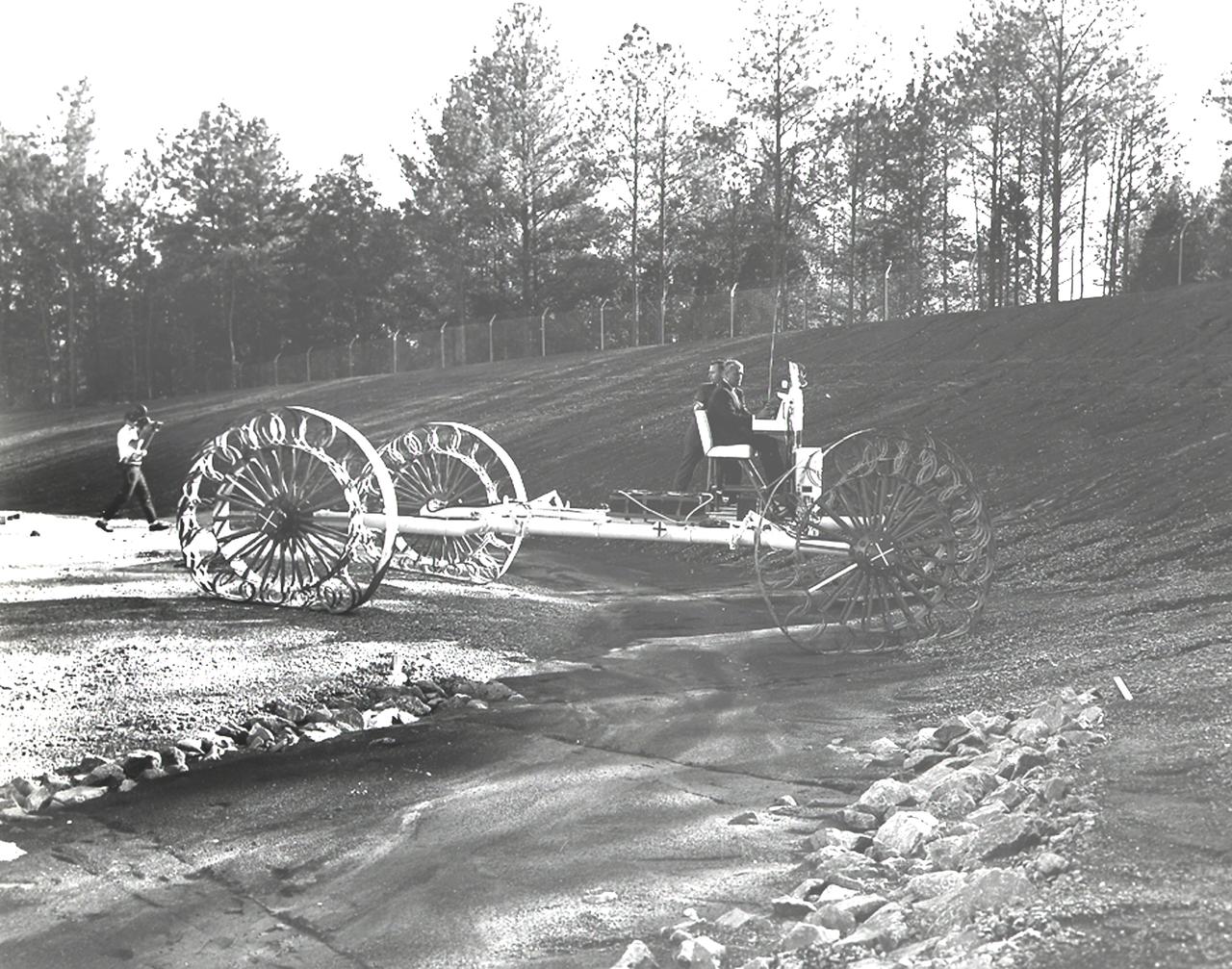
In this June, 1966 photograph, Marshall Space Flight Center Director, Dr. Wernher von Braun test drives the Mobility Test Article (MTA), a developmental vehicle built by the Bendix Corporation to test lunar mobility concepts. The data provided by the MTA helped in designing the Lunar Roving Vehicle (LRV), developed under the direction of the Marshall Space Flight Center. The LRV was designed to allow Apollo astronauts a greater range during lunar exploration missions and served its purpose during the last three Apollo lunar missions in 1971 and 1972.
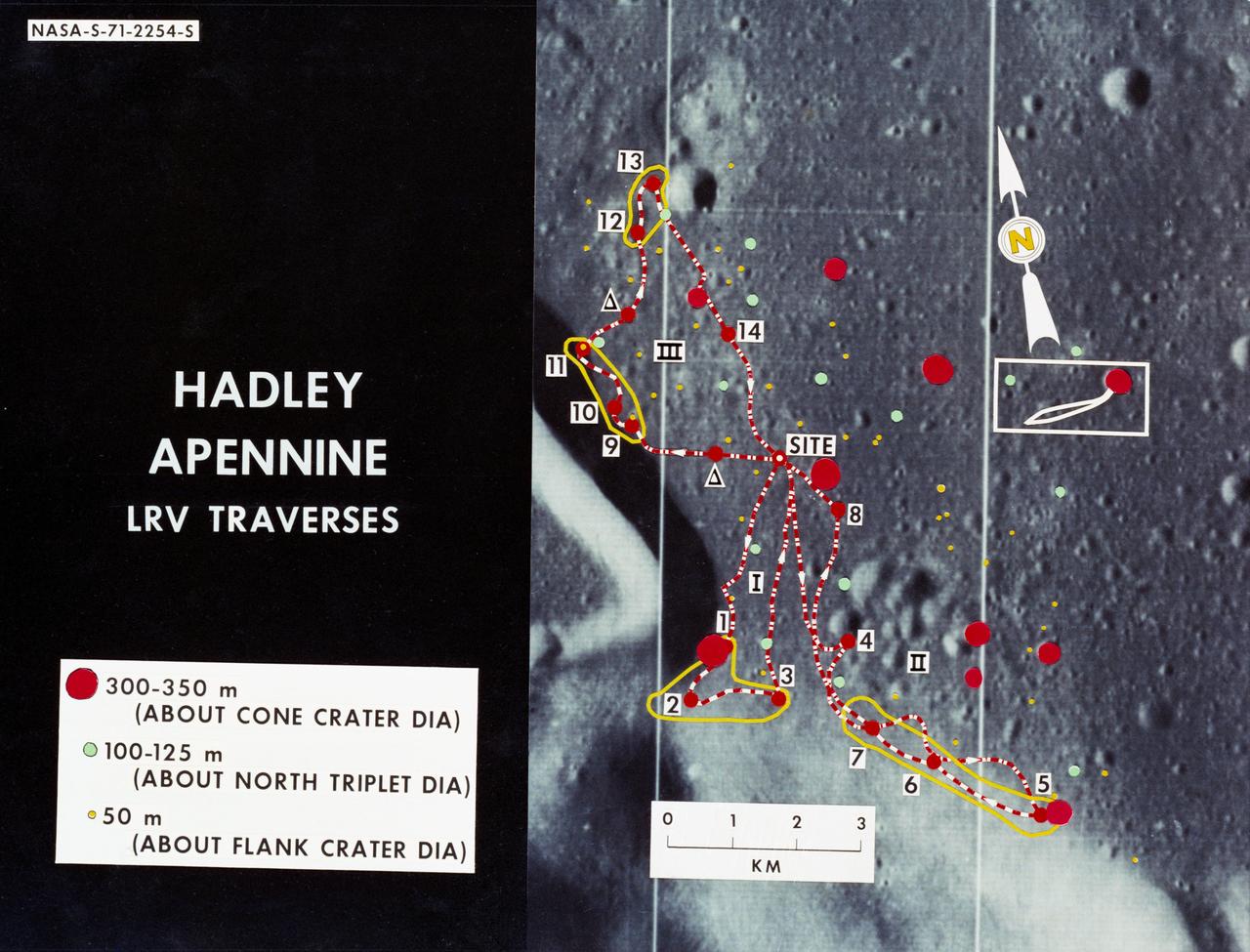
S71-02254 (June 1971) --- An enlarged Lunar Orbiter photograph showing the Lunar Roving Vehicle (LRV) traverse routes overlaid on the Hadley-Apennine landing site. Apollo 15 is to land at the point labeled "site," and a comparison of Apollo 14 crater sizes with those of Apollo 15 is included, also. While astronauts David R. Scott, commander, and James B. Irwin, lunar module pilot, descend in the Lunar Module (LM) "Falcon" to explore the moon, astronaut Alfred M. Worden, command module pilot, will remain with the Command and Service Modules (CSM) in lunar orbit.
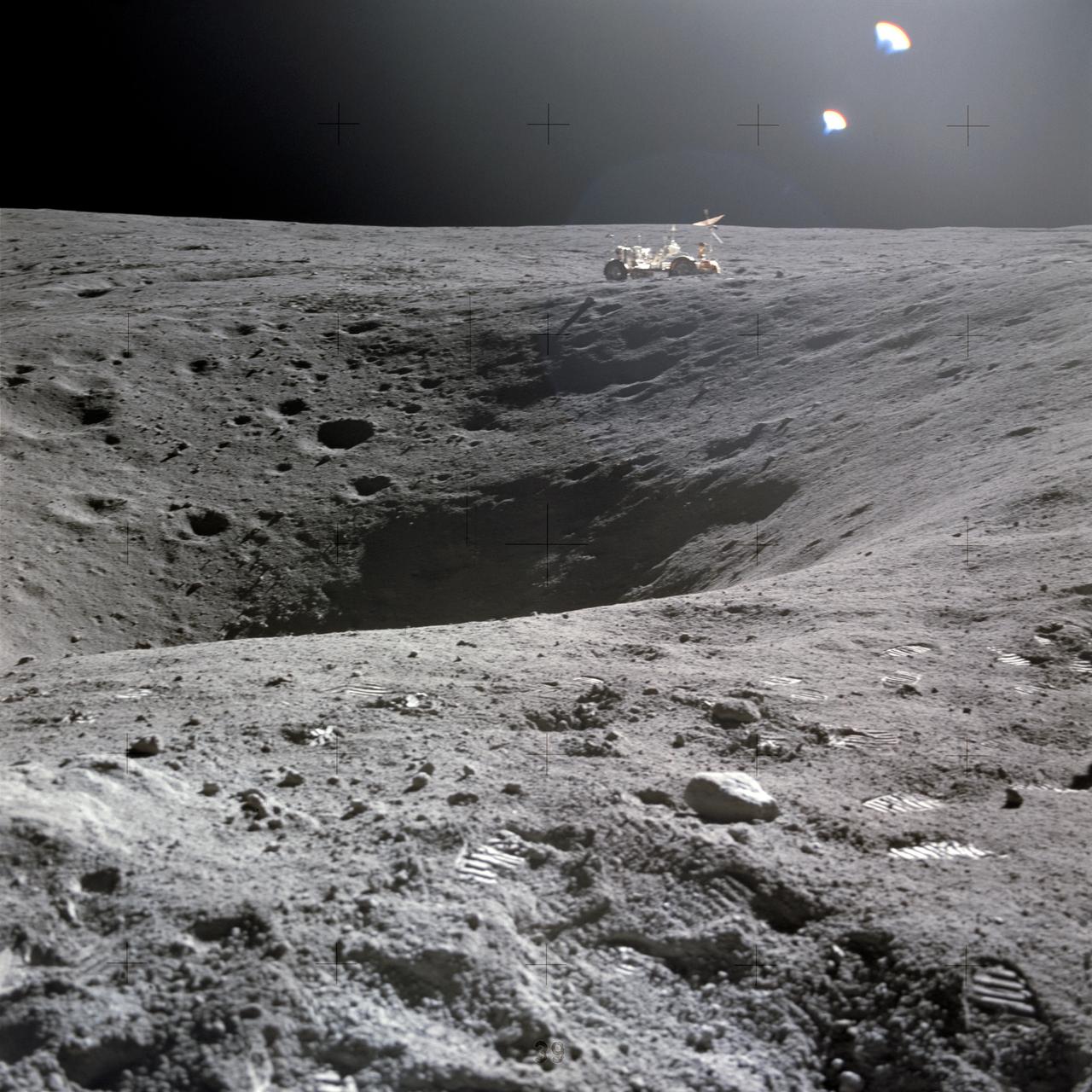
AS16-114-18422 (21 April 1972) --- A view of Plum Crater, which was visited by the two moon-exploring crewmen of the Apollo 16 lunar landing mission, on their first extravehicular activity (EVA) traverse, April 21, 1972. The Lunar Roving Vehicle (LRV) is parked on the far side of the crater, which measures approximately 40 meters in diameter. While astronauts John W. Young, commander; and Charles M. Duke Jr., lunar module pilot; descended in the Apollo 16 Lunar Module (LM) "Orion" to explore the Descartes highlands landing site on the moon, astronaut Thomas K. Mattingly II, command module pilot, remained with the Command and Service Modules (CSM) "Casper" in lunar orbit.