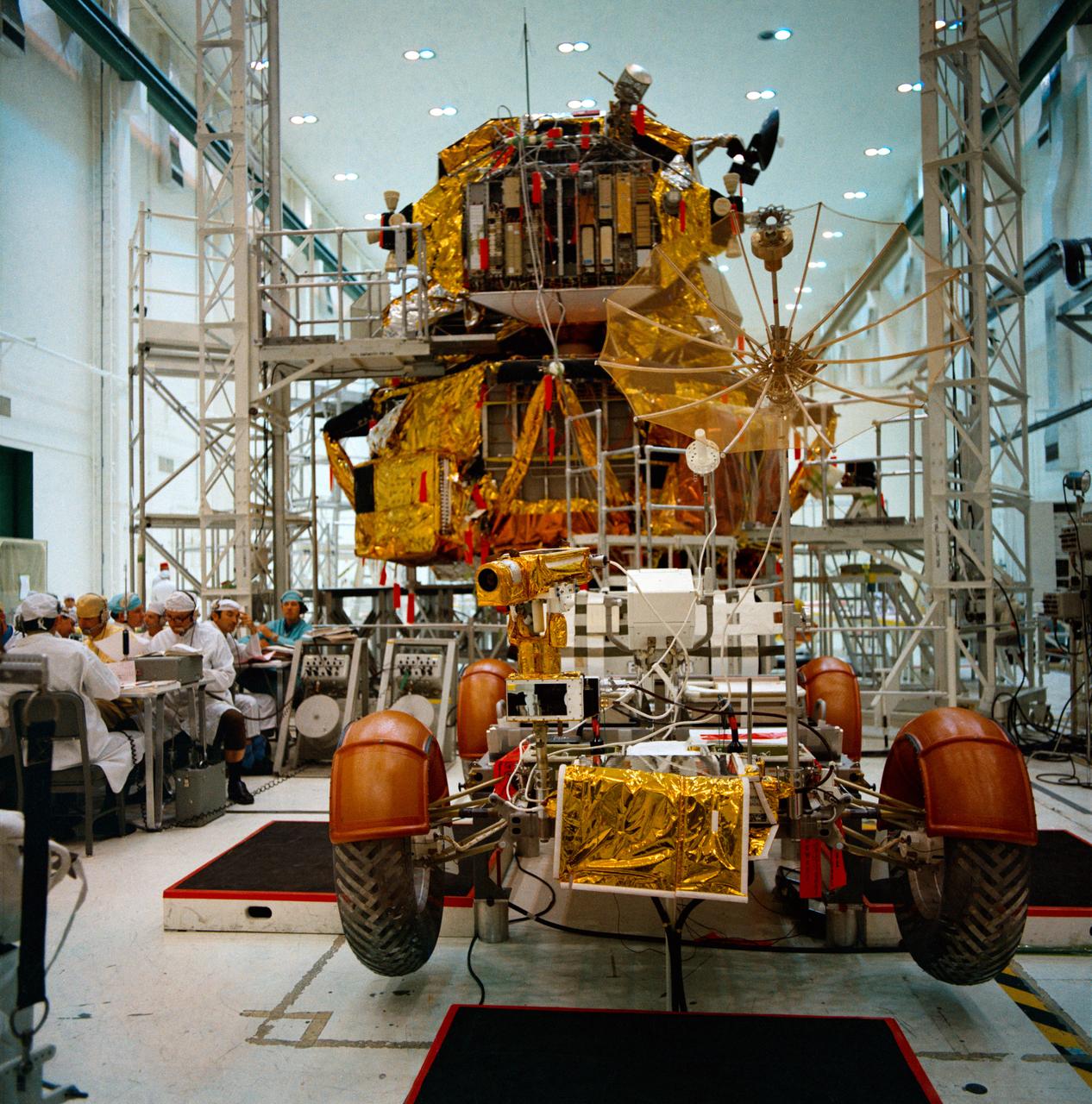
S71-30542 (21 April 1971) --- An overall view of the Apollo 15 Lunar Roving Vehicle (LRV) and the Lunar Module (LM) during simulations at the Kennedy Space Center (KSC). Astronauts David R. Scott, commander, and James B. Irwin, lunar module pilot, will man the LRV on the lunar surface during their August 1971 traverses. Rover 1 will permit the astronauts to cover a larger area of the moon for exploration and sample collecting than on previous missions.

Astronaut John W. Young, Apollo 16 prime crew commander (right), takes a drive in the One-G Lunar Roving Vehicle (LRV) trainer in the Lunar Topgraphic Simulation area at the Manned Spacecraft Center (MSC). He is accompanied by John Omstead, with General Electric, MSC.
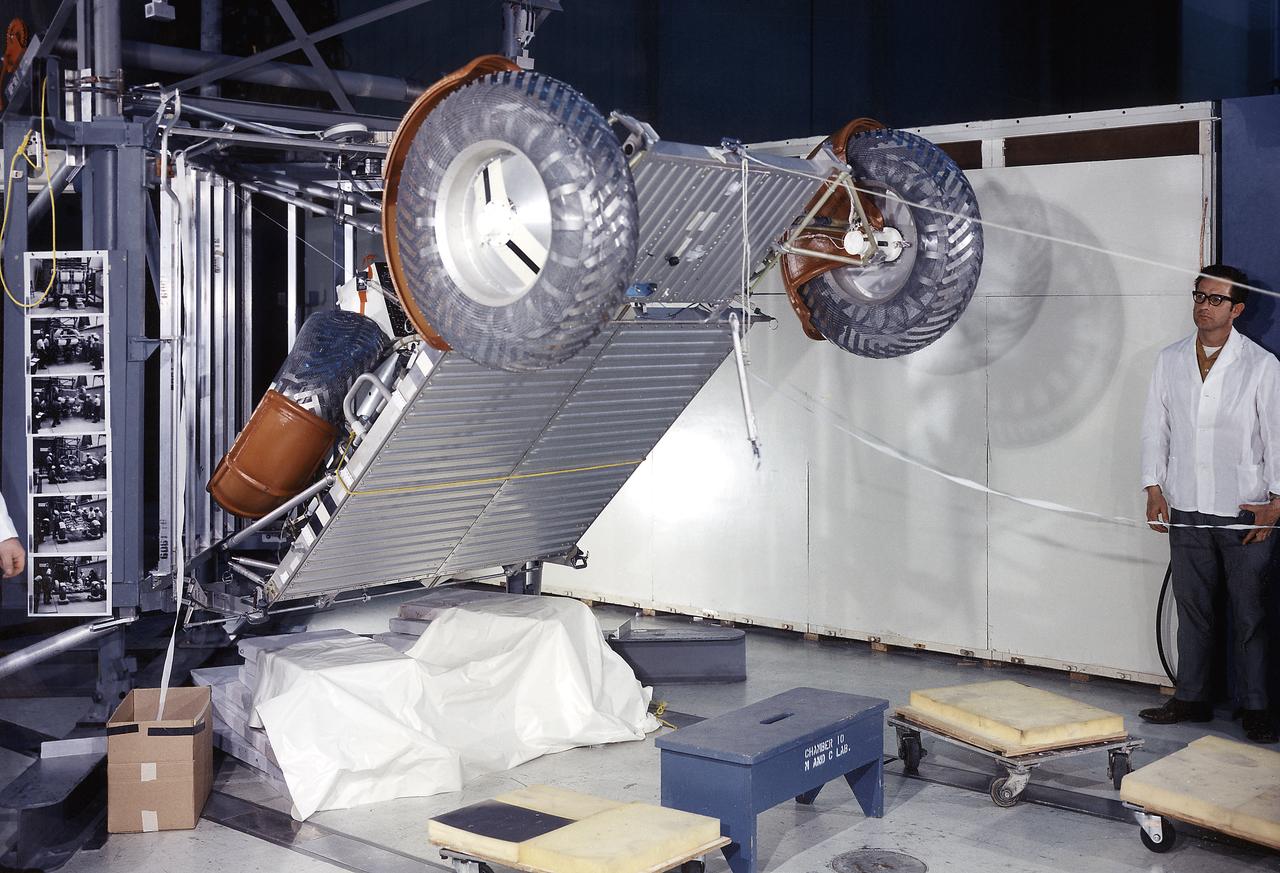
This photograph was taken during a deployment simulation of the Lunar Roving Vehicle (LRV). The LRV was built to give Apollo astronauts a greater range of mobility during the last three lunar exploration missions; Apollo 15, Apollo 16, and Apollo 17. It was designed and developed by the Marshall Space Flight Center and built by the Boeing Company.
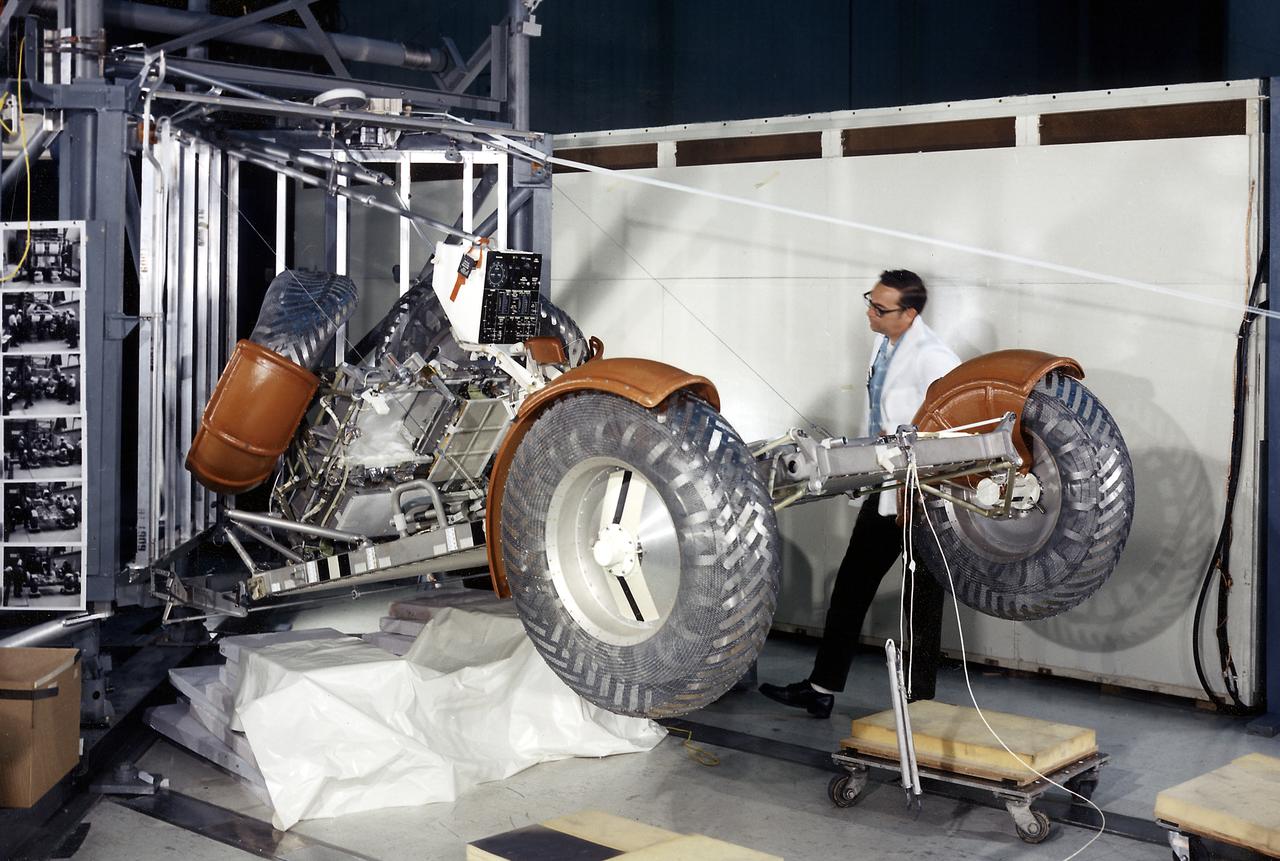
This photograph was taken during a deployment simulation of the Lunar Roving Vehicle (LRV). The LRV was built to give Apollo astronauts a greater range of mobility during the last three lunar exploration missions; Apollo 15, Apollo 16, and Apollo 17. It was designed and developed by the Marshall Space Flight Center and built by the Boeing Company.
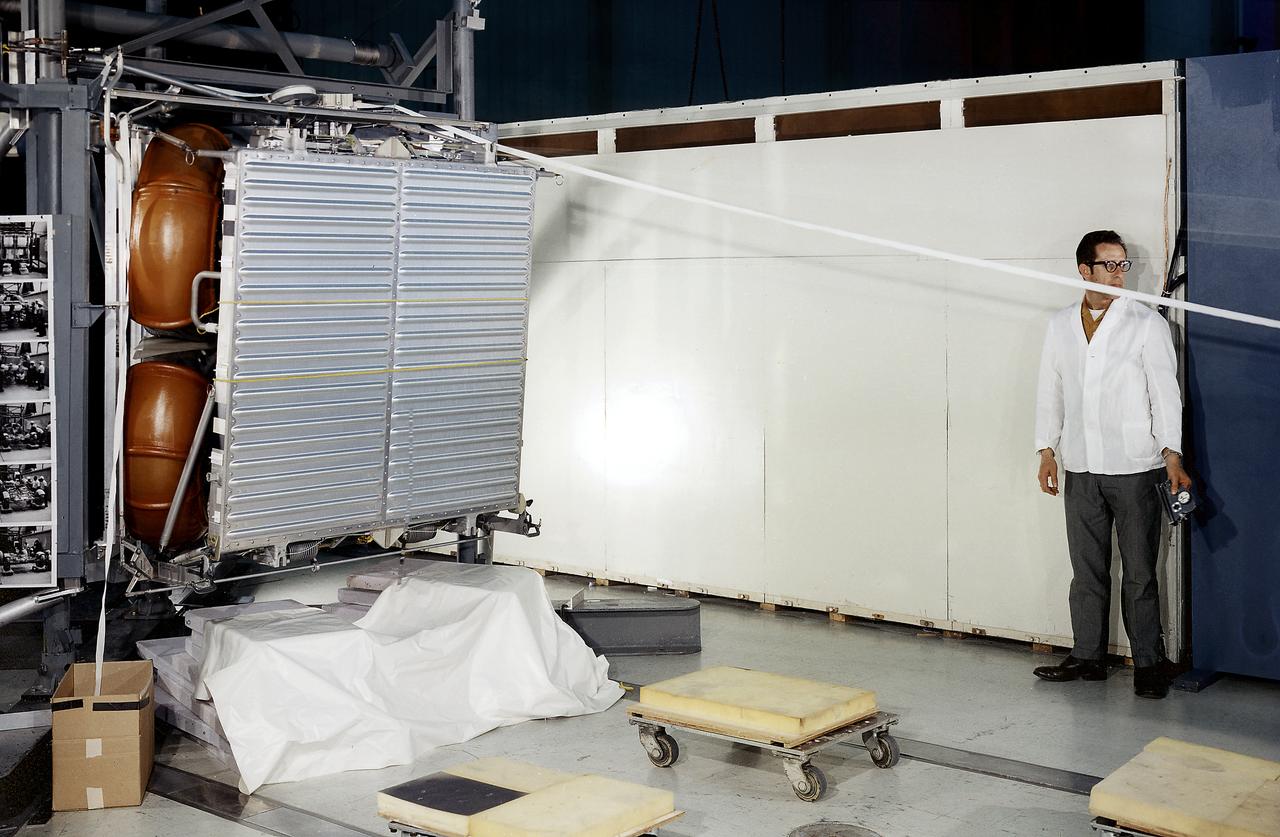
This photograph was taken during a deployment simulation of the Lunar Roving Vehicle (LRV). The LRV was built to give Apollo astronauts a greater range of mobility during the last three lunar exploration missions; Apollo 15, Apollo 16, and Apollo 17. It was designed and developed by the Marshall Space Flight Center and built by the Boeing Company.

This in an aerial view (looking north) of a Lunar Roving Vehicle (LRV), often referrd to as “Moonbuggy”, simulator area built at the Marshall Space Flight Center (MSFC) where tesing was performed. The LRV was developed under the direction of MSFC to provide astronauts with greater mobility on the lunar surface.
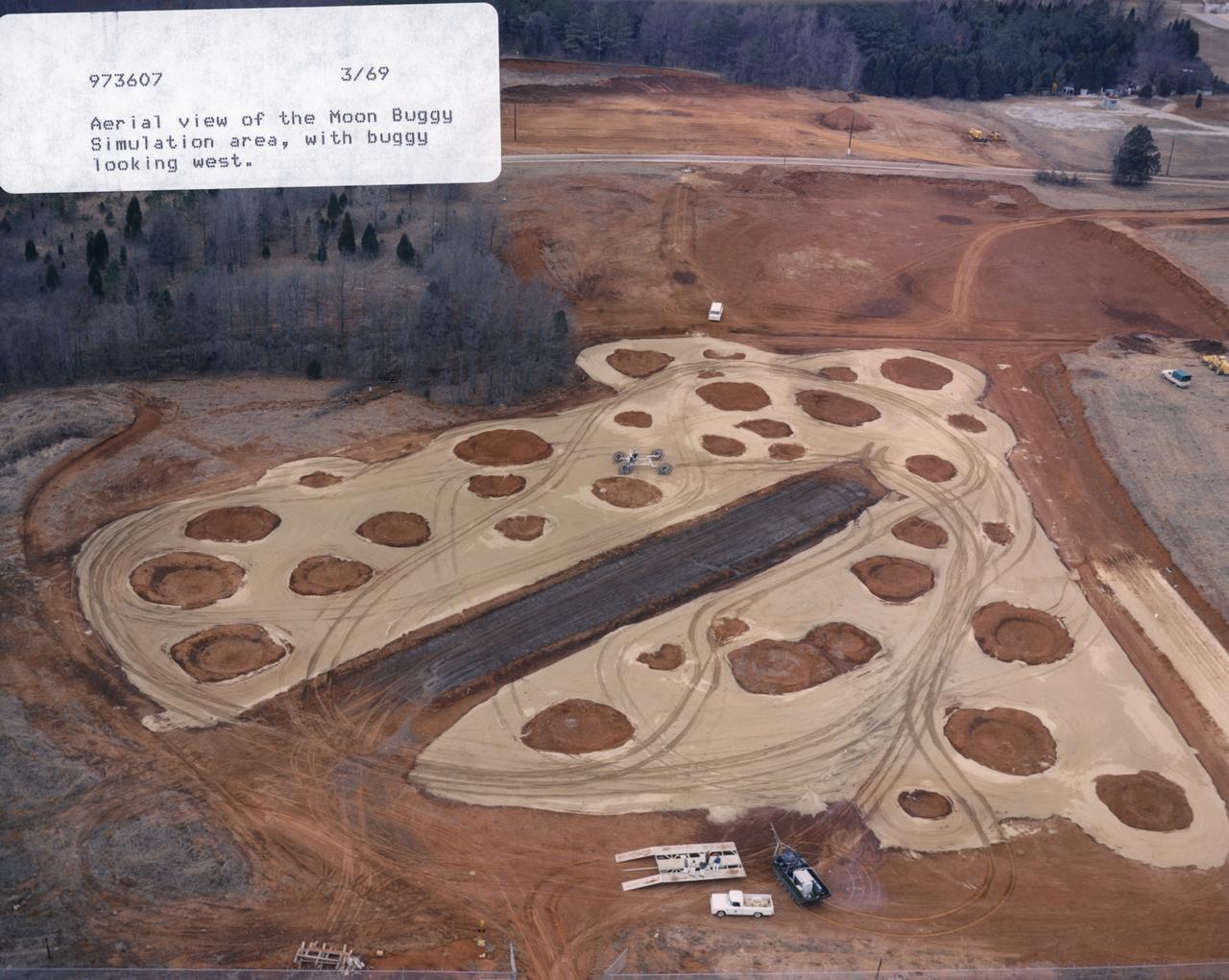
This in an aerial view (looking west) of a Lunar Roving Vehicle (LRV), often referred to as “Moonbuggy”, simulator area built at the Marshall Space Flight Center (MSFC) where tesing was performed. The LRV was developed under the direction of MSFC to provide astronauts with greater mobility on the lunar surface.
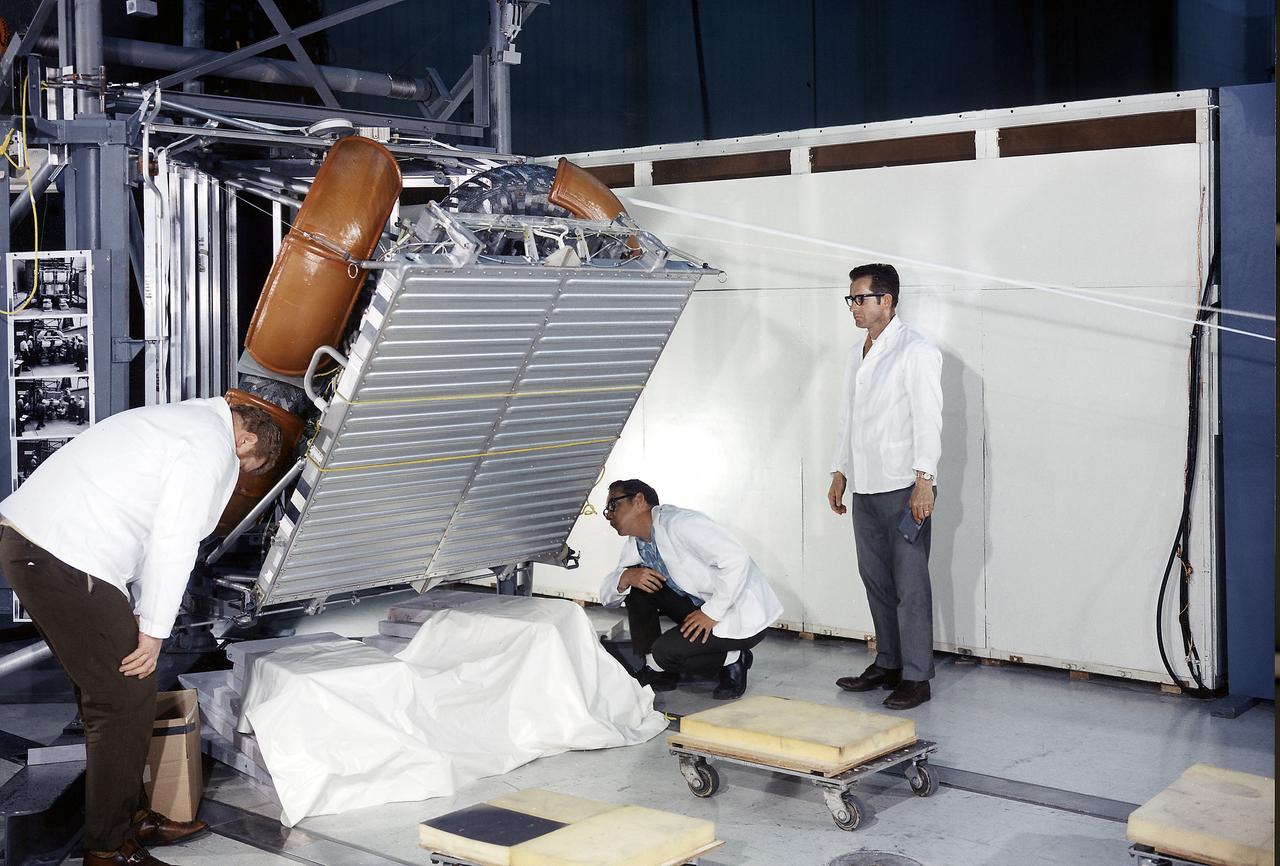
This photograph was taken during a deployment simulation of the Lunar Roving Vehicle (LRV). The LRV was built to give Apollo astronauts a greater range of mobility during the last three lunar exploration missions; Apollo 15, Apollo 16, and Apollo 17. It was designed and developed by the Marshall Space Flight Center and built by the Boeing Company.

This in an aerial view (looking east) of a Lunar Roving Vehicle (LRV), often referred to as “Moonbuggy”, simulator area built at the Marshall Space Flight Center (MSFC) where testing was performed. The LRV was developed under the direction of MSFC to provide astronauts with greater mobility on the lunar surface. Visible in the background is the 18-acre facility known as the Random Motion/ Lift-Off Simulator or ‘Arm Farm’ which was developed to test the Saturn swingarm mechanisms that were used to hold the rocket in position until lift-off.
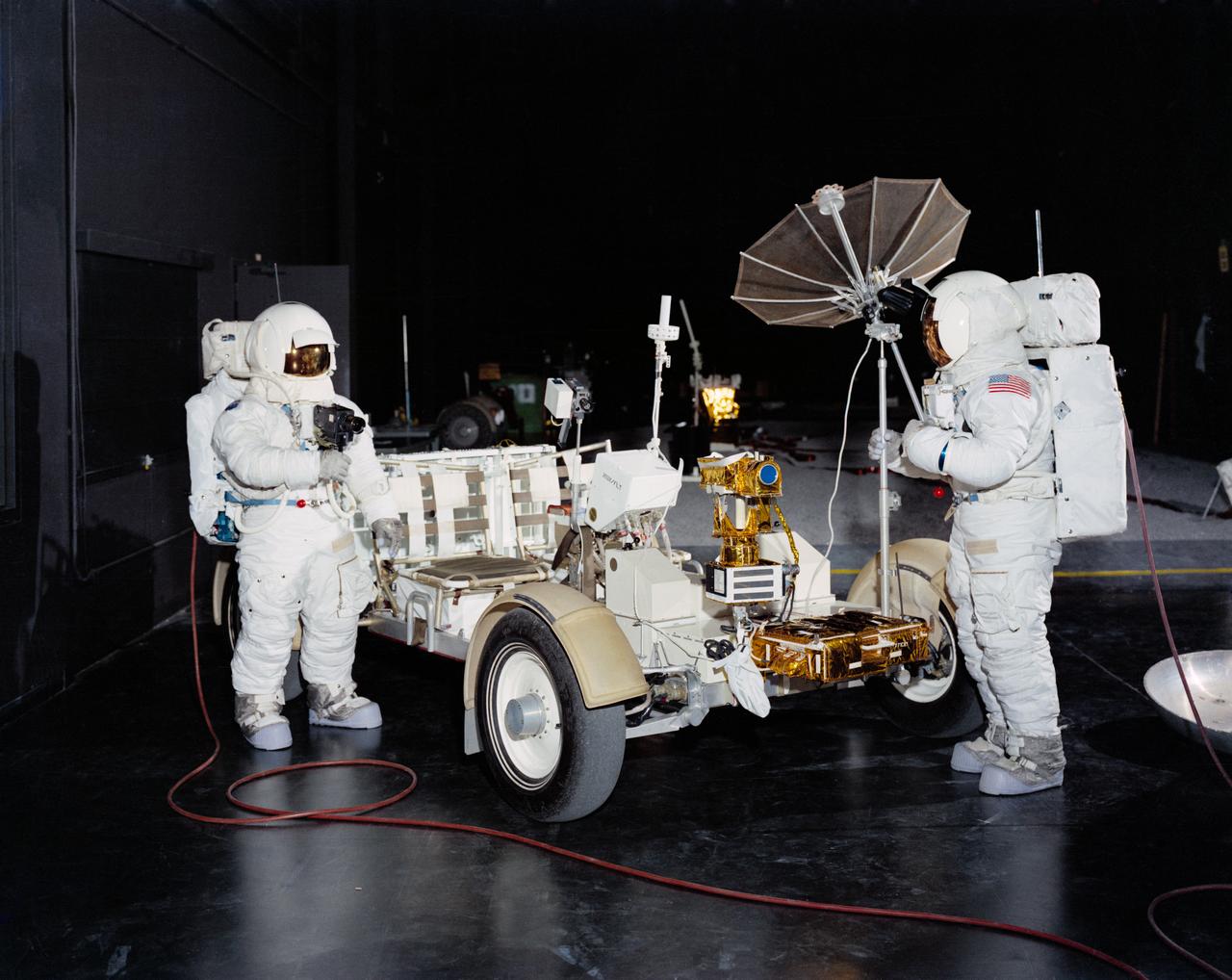
S71-16722 (January 1971) --- Two members of the prime crew of the Apollo 15 lunar landing mission are shown with the Lunar Roving Vehicle "one G" trainer in Building 5, Mission Simulation and Training Facility, Manned Spacecraft Center. Astronaut David R. Scott (on right) is the Apollo 15 commander; and astronaut James B. Irwin is the lunar module pilot. A Lunar Roving Vehicle similar to this trainer will be used by Scott and Irwin during their Apollo 15 lunar surface extravehicular activity.
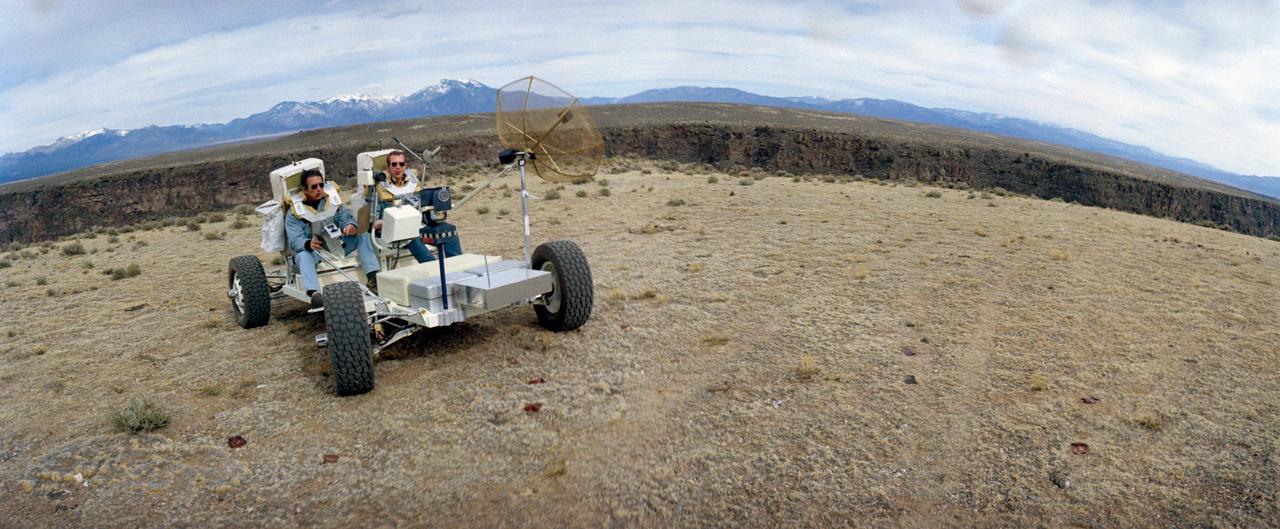
S71-23774 (11-12 March 1971) --- A wide-angle view showing two members of the prime crew of the Apollo 15 lunar landing mission riding in a Lunar Roving Vehicle trainer called "Grover" during a simulation of lunar surface extravehicular activity in the Taos, New Mexico area. They are astronauts David R. Scott (riding in left side seat), commander; and James B. Irwin, lunar module pilot. Apollo 15 will be the first mission to the moon to carry a Lunar Roving Vehicle, which will permit the astronauts to cover a larger area for exploration and sample collecting than on previous missions.

S71-39867 (June 1971) --- Astronauts David R. Scott (right), commander, and James B. Irwin, lunar module pilot, are shown on the Lunar Roving Vehicle (LRV) at the Kennedy Space Center (KSC), Florida, during Apollo 15 lunar surface extravehicular activity (EVA) simulations. While astronauts Scott and Irwin descend in the Lunar Module (LM) "Falcon" to explore the moon, astronaut Alfred M. Worden, command module pilot, will remain with the Command and Service Modules (CSM) in lunar orbit.
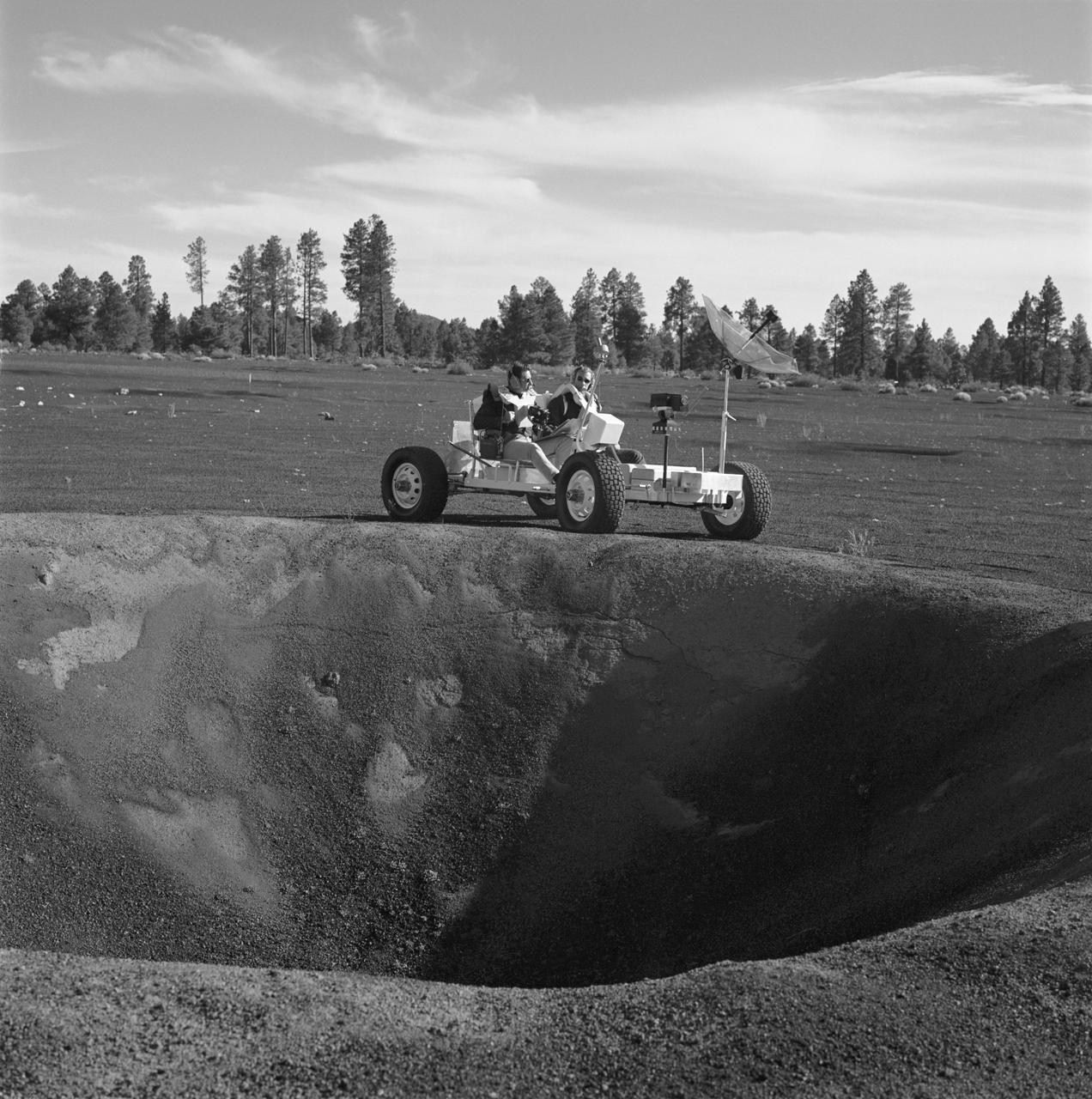
S70-53300 (2-3 Nov. 1970) --- Two Apollo 15 crew members, riding a Lunar Roving Vehicle (LRV) simulator, participate in geology training at the Cinder Lake crater field in Arizona. Astronaut David R. Scott, Apollo 15 commander, seated on the left; and to Scott's right is astronaut James B. Irwin, lunar module pilot. They have stopped at the rim of a 30-feet deep crater to look over the terrain. The simulator, called "Grover", was built by the United States Geological Survey.
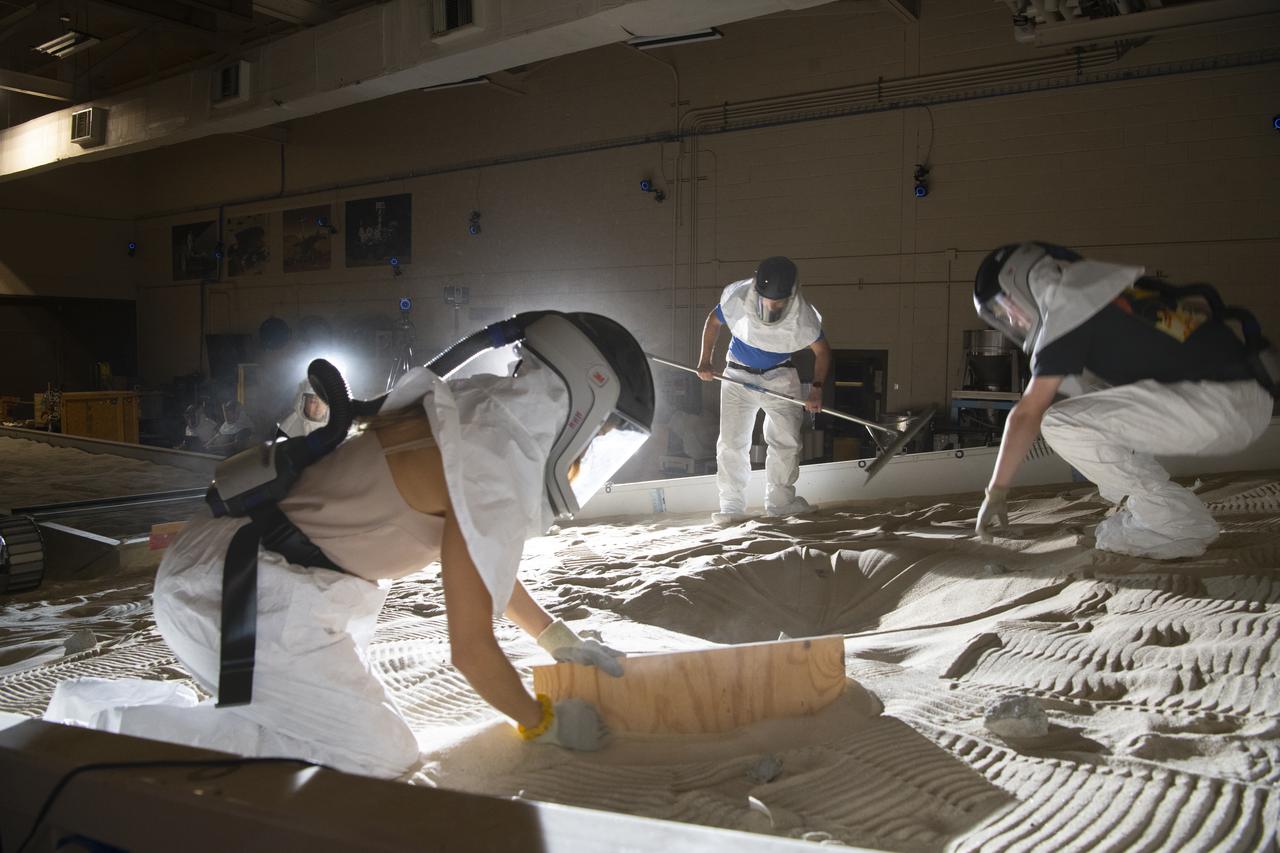
The Simulated Lunar Operations Lab at NASA Glenn Research Center serve to test planetary roving vehicle systems and components in simulated planetary and lunar conditions such as the VIPER Rover.
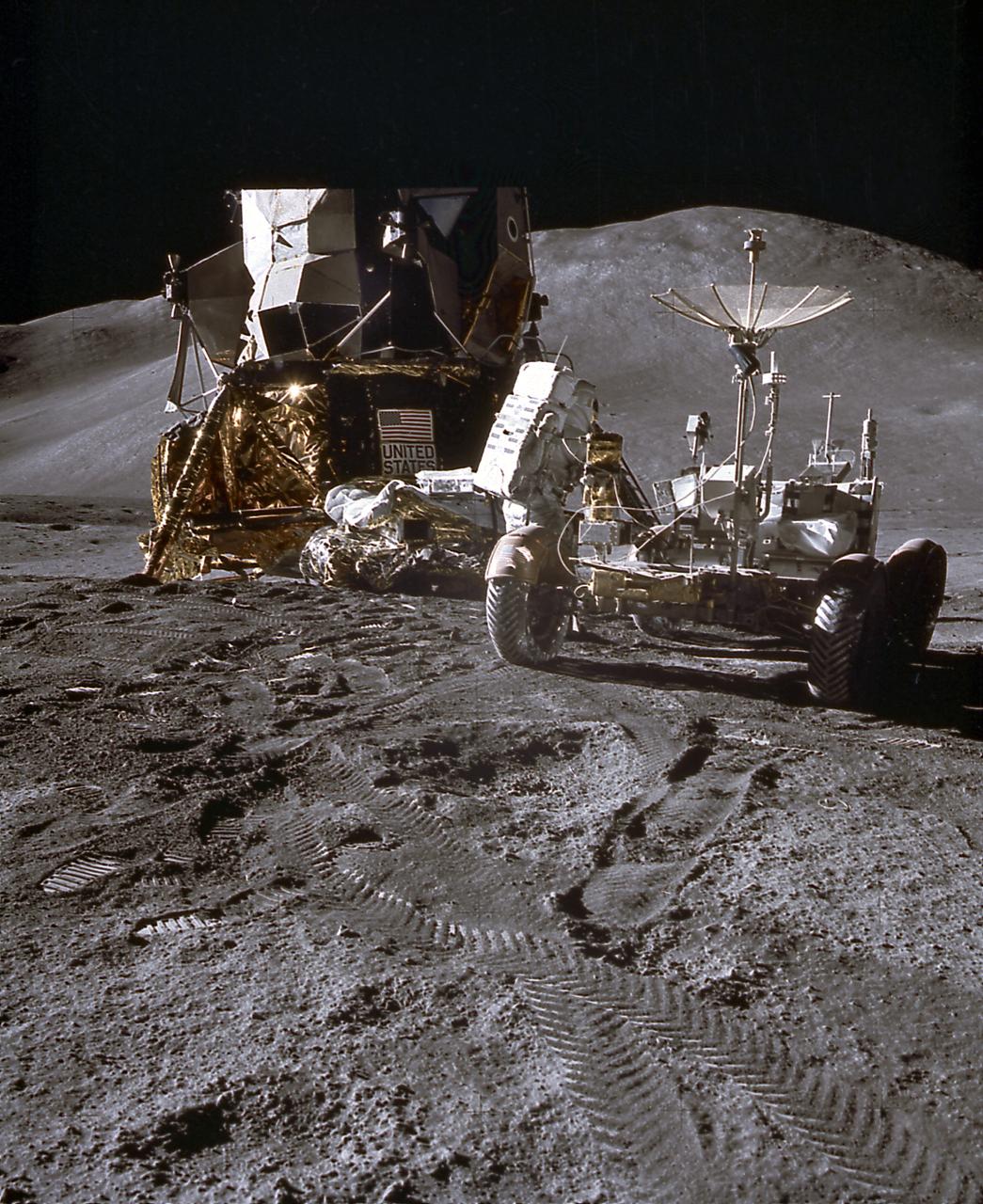
This photograph of an astronaut getting the Lunar Roving Vehicle (LRV) ready for exploration of the lunar surface was taken during activities of the Apollo 15 mission. Designed and developed by the Marshall Space Flight Center and built by the Boeing Company, the LRV was first used on the Apollo 15 mission and increased the range of astronauts' mobility and productivity on the lunar surface.
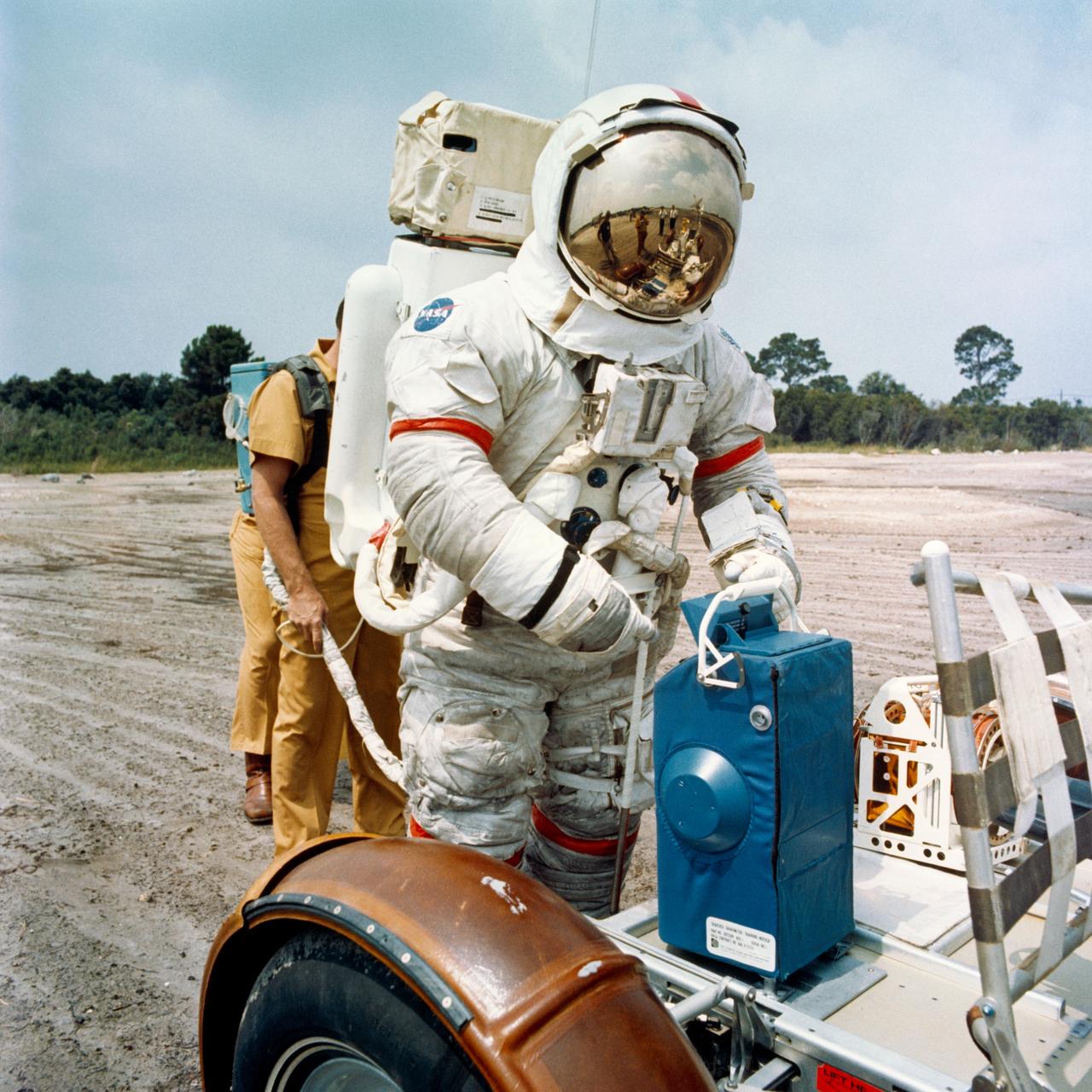
S72-44420 (8 June 1972) --- Astronaut Eugene A. Cernan, commander of the Apollo 17 lunar landing mission, prepares to remove a traverse gravimeter training mock-up from a Lunar Roving Vehicle for deployment during lunar surface extravehicular activity simulations at the Kennedy Space Center (KSC), Florida.
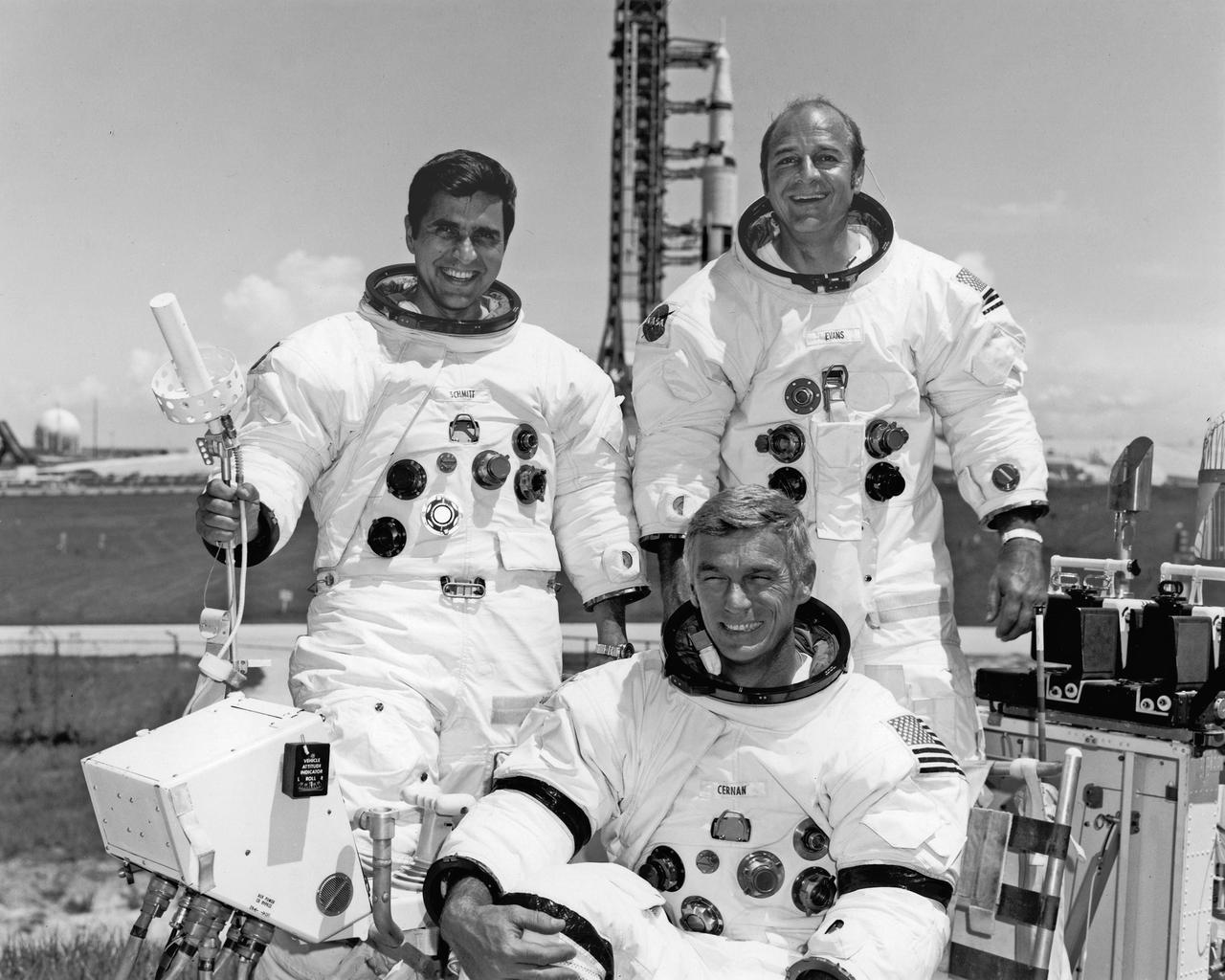
CAPE CANAVERAL, Fla. -- The Apollo 17 crew took time out from training to pose for the press after the Space Vehicle for their Manned Lunar Landing Mission was moved to Pad A, Complex 39 today. Apollo 17 Commander Eugene A Cernan sits at the controls of the One-G Lunar Roving Vehicle Simulator used to simulate operations on the Moon’s surface. With Cernan are Lunar Module Pilot Dr. Harrison H. “Jack” Schmitt, left and Command Module Plot Ronald A. Evans. The Apollo 17 Space Vehicle, scheduled for launch from KSC on the sixth U.S. Manned Lunar Landing Mission on December 6, 1972 is in the background. Photo credit: NASA
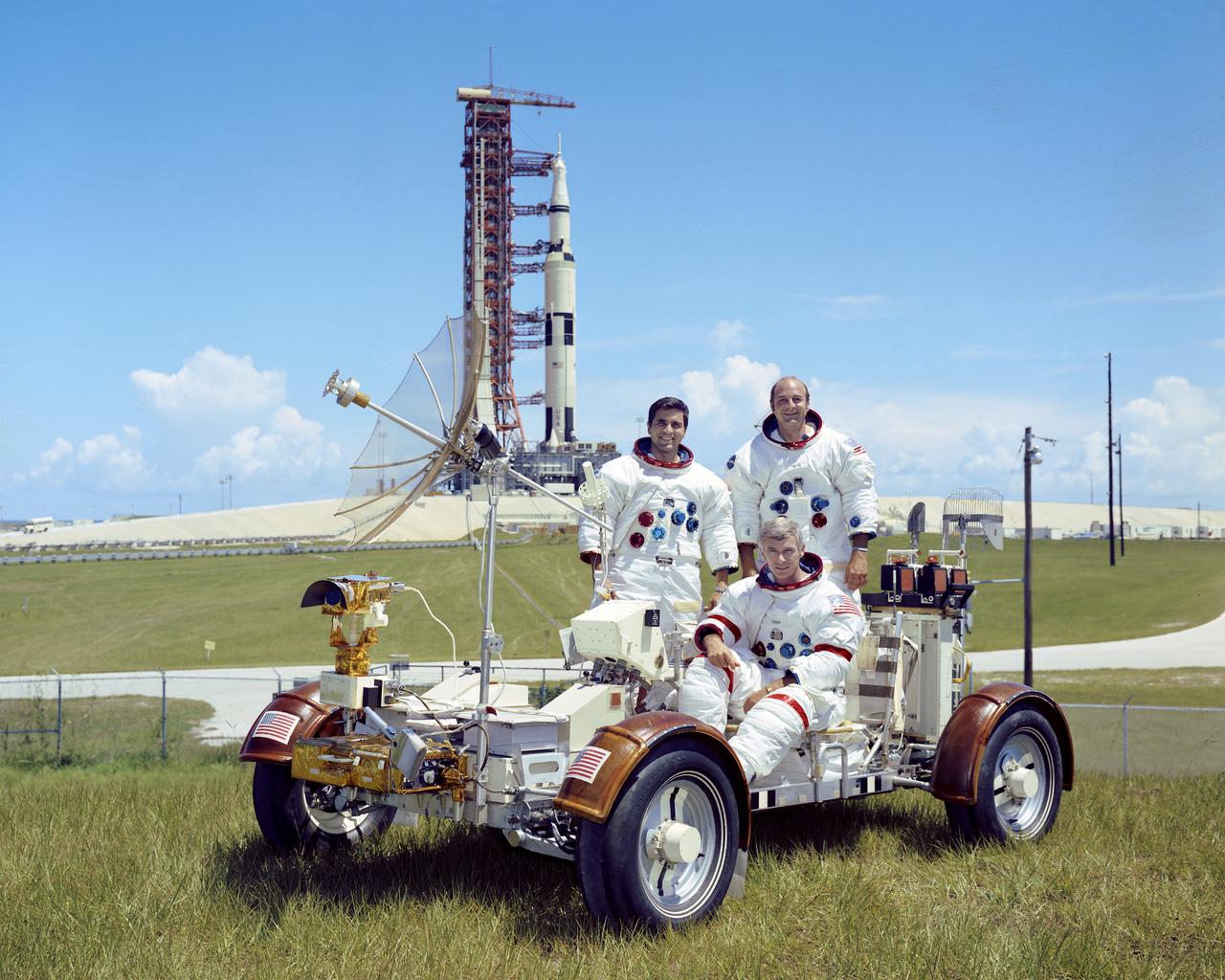
CAPE CANAVERAL, Fla. -- The Apollo 17 crew took time out from training to pose for the press after the Space Vehicle for their Manned Lunar Landing Mission was moved to Pad A, Complex 39 today. Apollo 17 Commander Eugene A Cernan sits at the controls of the One-G Lunar Roving Vehicle Simulator used to simulate operations on the Moon’s surface. With Cernan are Lunar Module Pilot Dr. Harrison H. “Jack” Schmitt, left and Command Module Plot Ronald A. Evans. The Apollo 17 Space Vehicle, scheduled for launch from KSC on the sixth U.S. Manned Lunar Landing Mission on December 6, 1972 is in the background. Photo credit: NASA
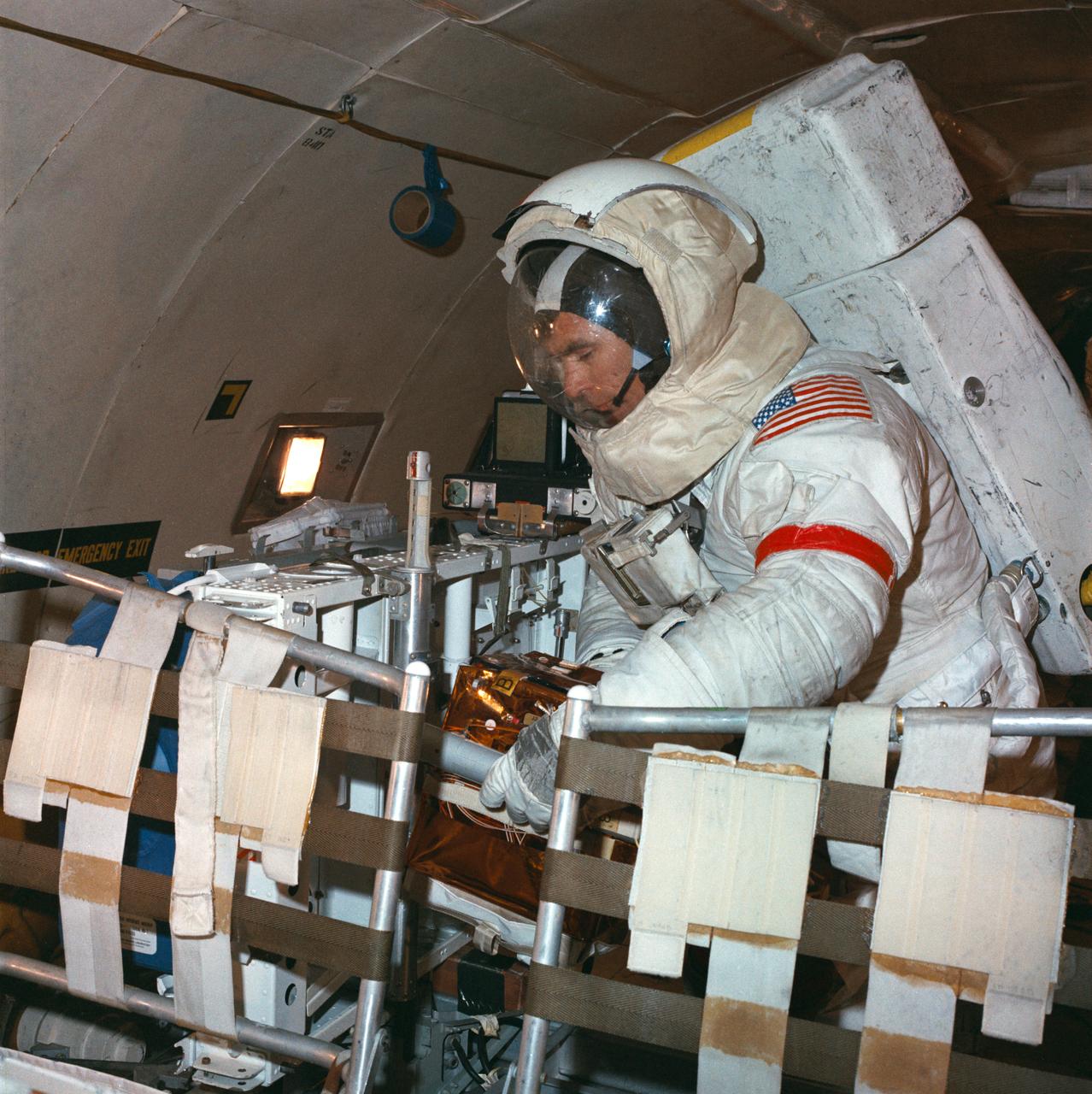
S72-50270 (September 1972) --- Astronaut Eugene A. Cernan, commander of the Apollo 17 lunar landing mission, participates in lunar surface extravehicular activity simulation training under one-sixth gravity conditions aboard a U. S. Air Force KC-135 aircraft. Here, Cernan simulates removing an experiment package from the aft end of a Lunar Roving Vehicle.
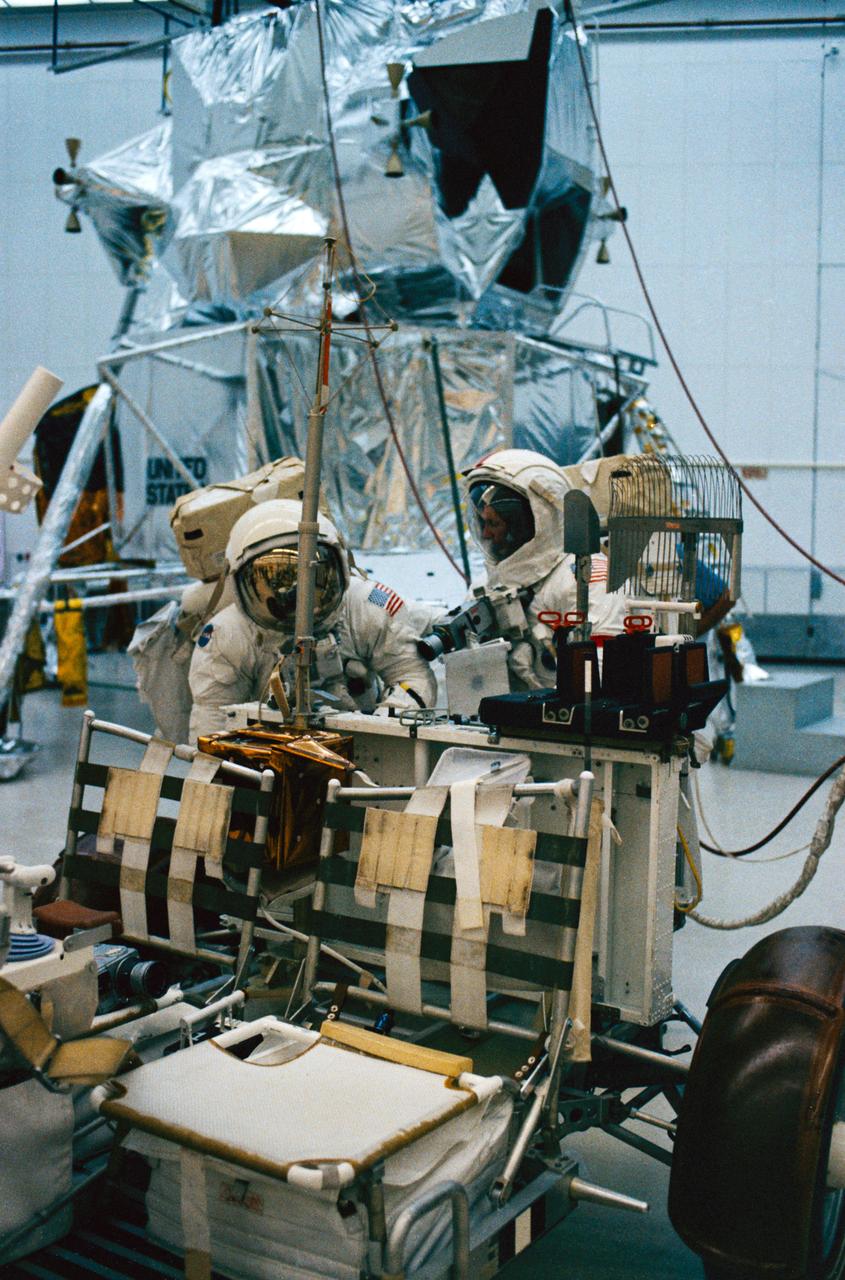
S72-48887 (September 1972) --- Astronaut Eugene A. Cernan (right), commander, and scientist-astronaut Harrison H. Schmitt, lunar module pilot, work at the aft end of a Lunar Roving Vehicle trainer during lunar surface extravehicular activity simulation training at the Kennedy Space Center (KSC), Florida. Astronauts Cernan, Schmitt, and Ronald E. Evans, command module pilot, are the prime crewmen of the Apollo 17 lunar landing mission. A Lunar Module mock-up can be seen in the background.
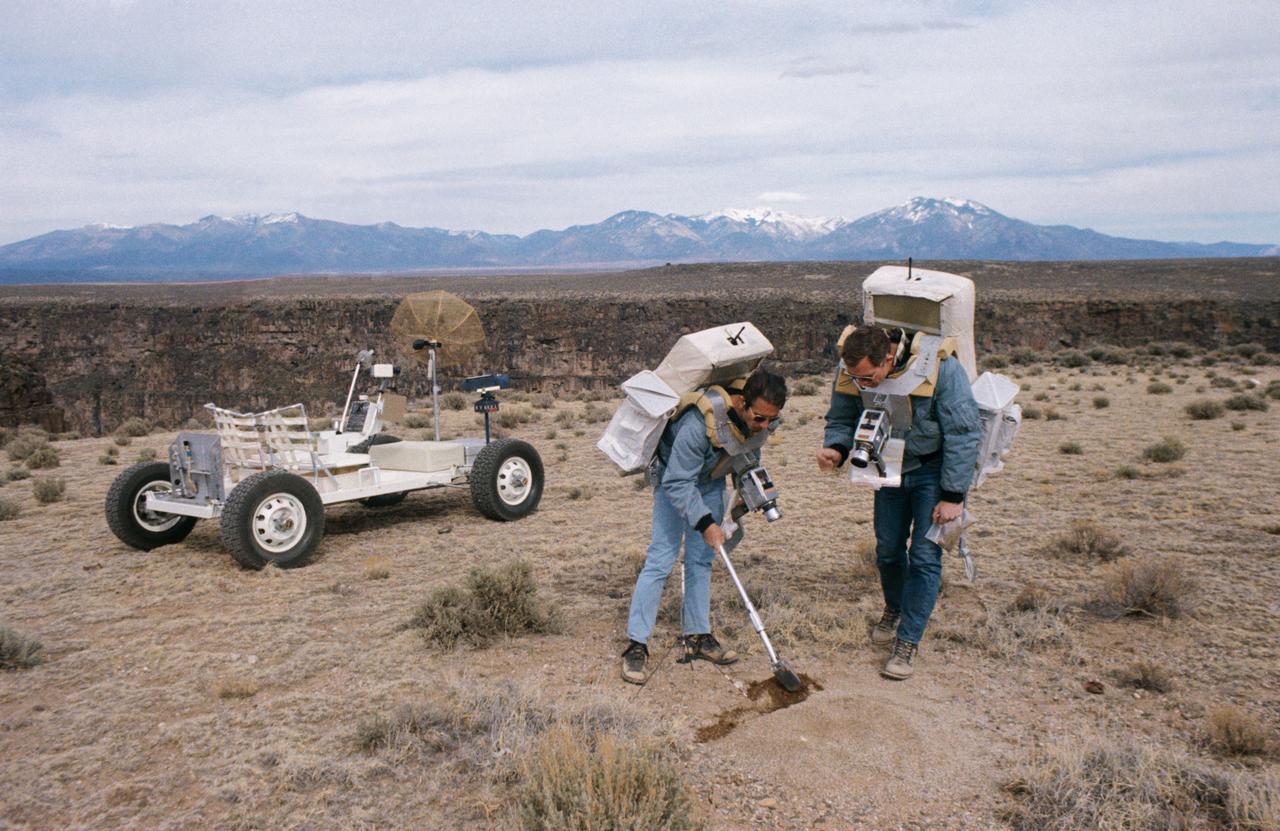
S71-23772 (11-12 March 1971) --- Two members of the prime crew of the Apollo 15 lunar landing mission collect soil samples during a simulation of lunar surface extravehicular activity in the Taos, New Mexico area. Astronaut James B. Irwin, lunar module pilot, is using a scoop. Astronaut David R. Scoot (right), commander, is holding a sample bag. On the left is a Lunar Roving Vehicle trainer.
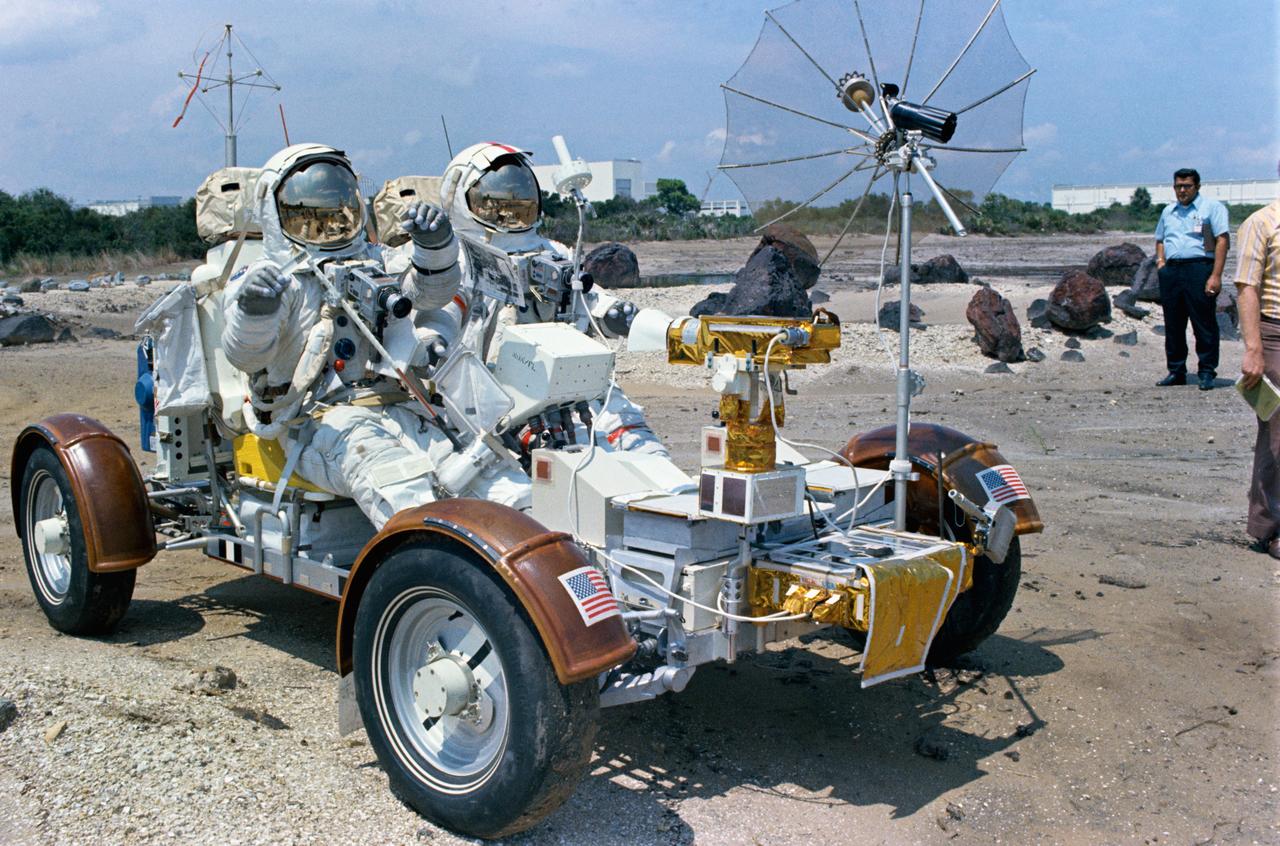
S72-48892 (September 1972) --- Two members of the prime crew of the Apollo 17 lunar landing mission ride in a Lunar Roving Vehicle trainer during lunar surface extravehicular activity simulation training at the Kennedy Space Center (KSC), Florida. Astronaut Eugene A. Cernan, commander, is seated in the left-hand seat. Scientist-astronaut Harrison H. Schmitt, lunar module pilot, is on Cernan's right.
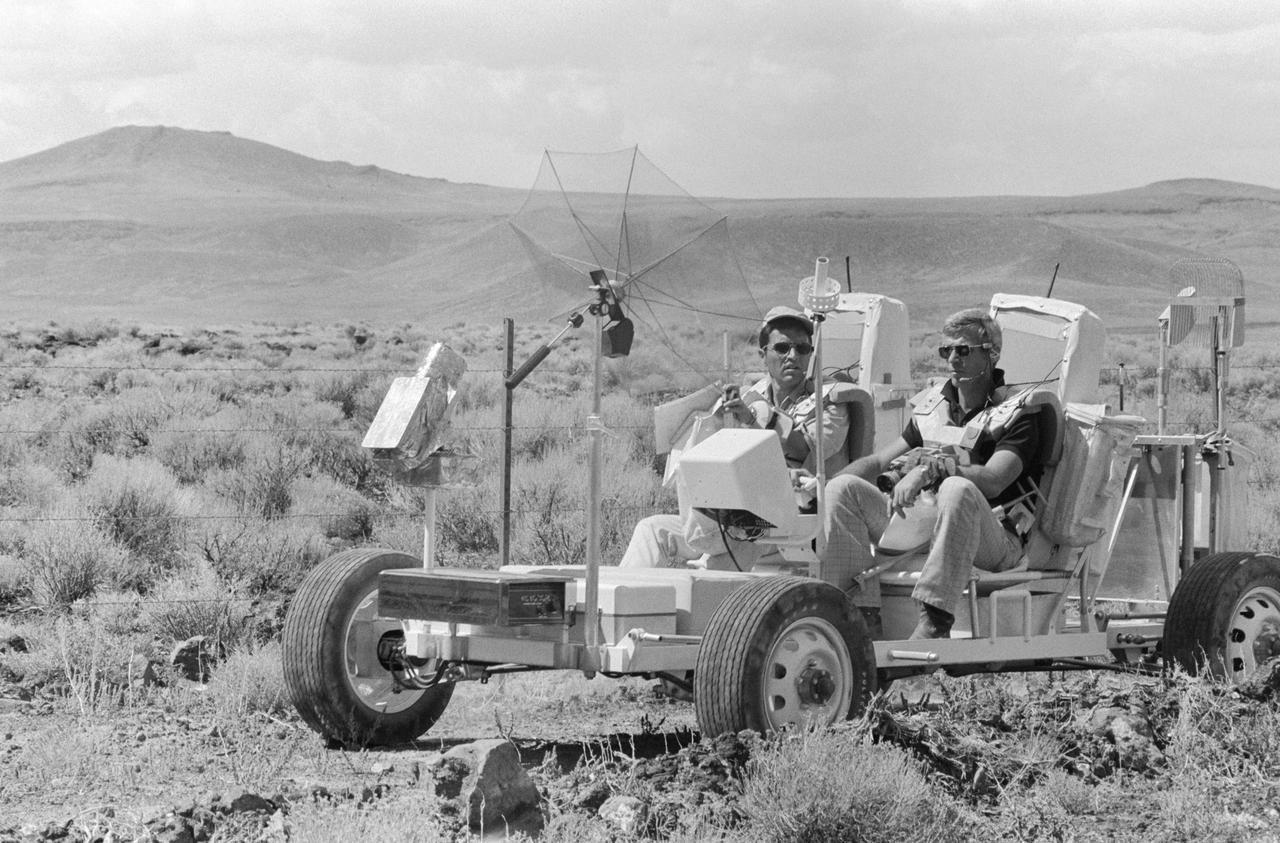
S72-48864 (6 Sept. 1972) --- Two members of the prime crew of the Apollo 17 lunar landing mission ride in a Lunar Roving Vehicle trainer during lunar surface extravehicular activity simulation training in the Pancake Range area of south-central Nevada. They are astronaut Eugene A. Cernan (foreground), commander; and scientist-astronaut Harrison H. Schmitt (on Cernan’s right), lunar module pilot.
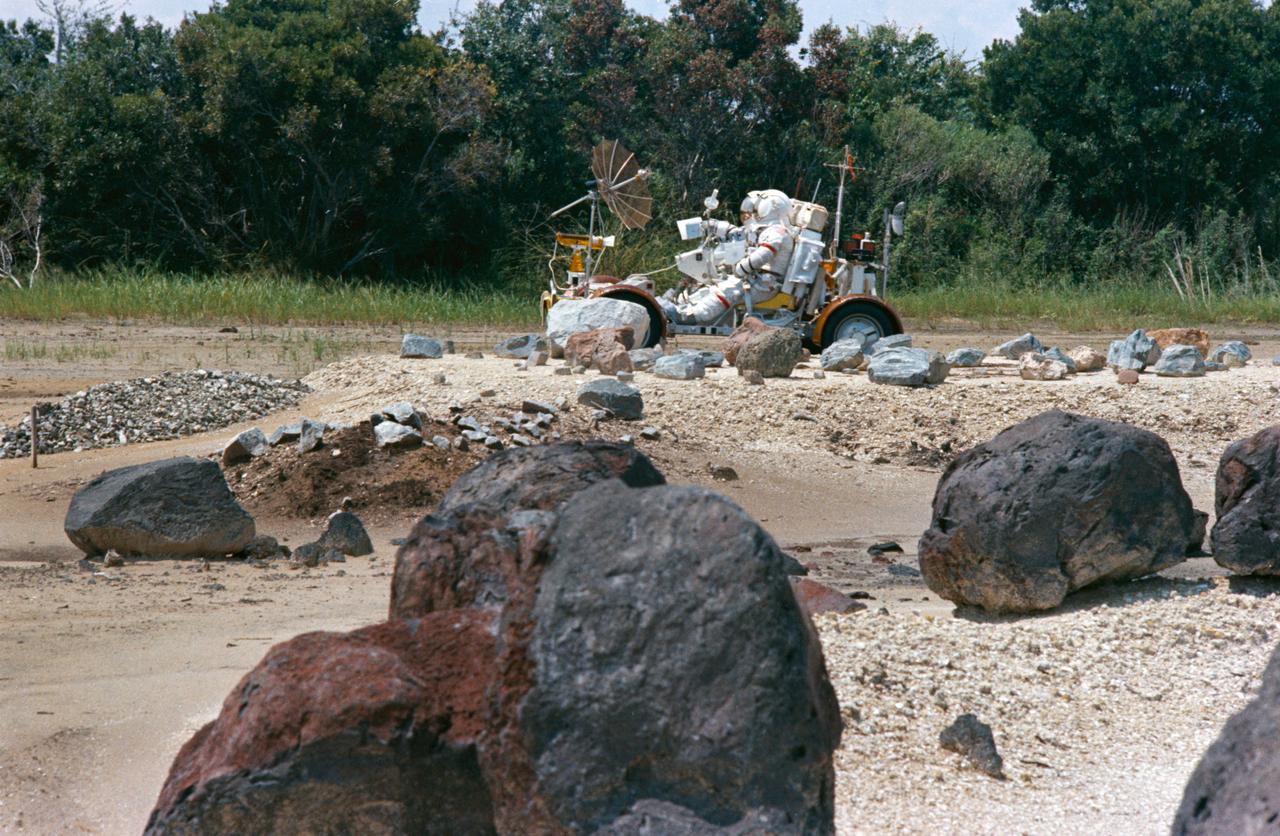
S72-48889 (September 1972) --- Two members of the prime crew of the Apollo 17 lunar landing mission ride in a lunar roving vehicle trainer during lunar surface extravehicular activity simulation training at the Kennedy Space Center, Florida. Astronaut Eugene A. Cernan, commander, is seated in the left-hand seat. Scientist-astronaut Harrison H. Schmitt, lunar module pilot, is on Cernan's right.
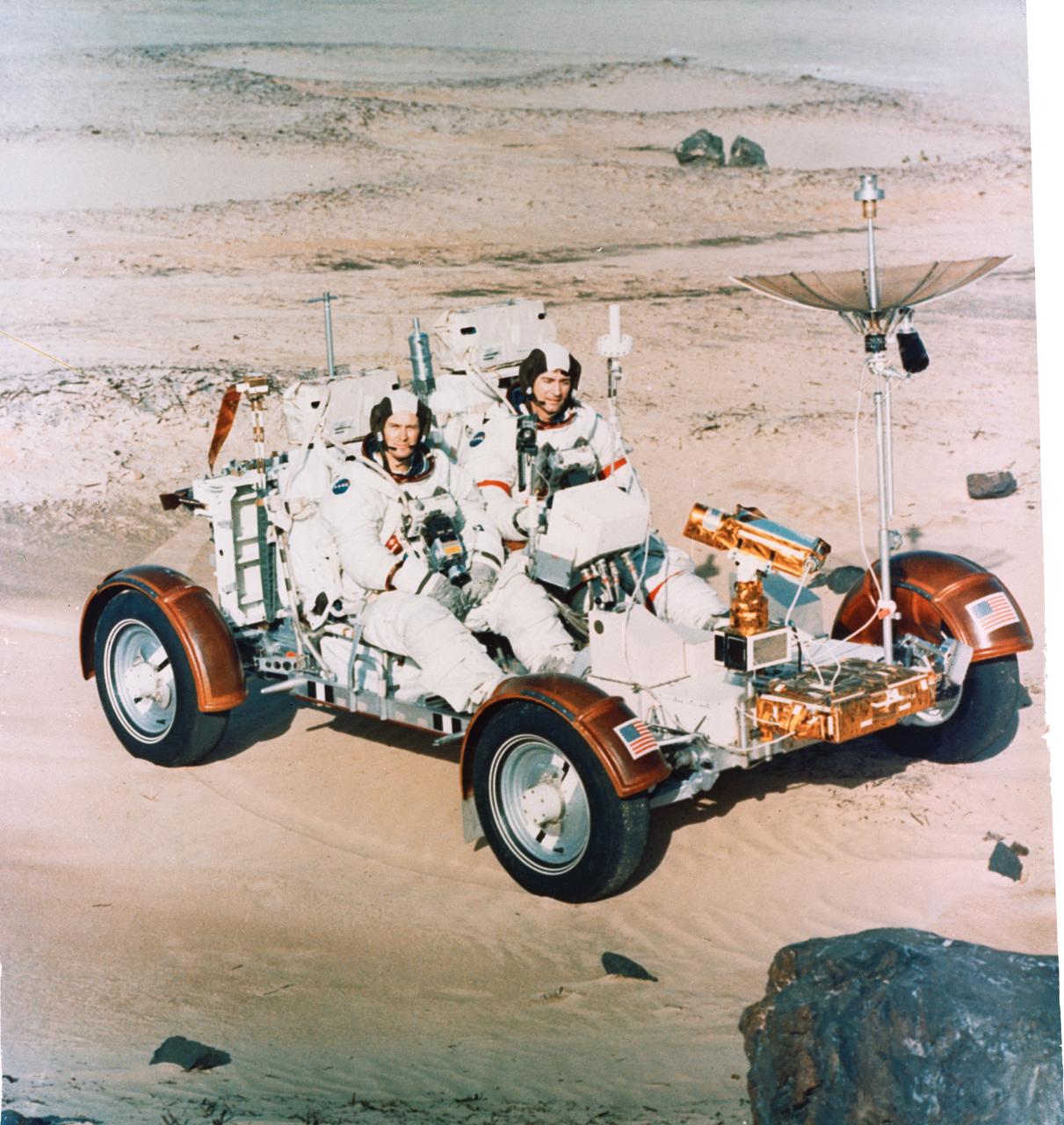
S72-30695 (22 Dec. 1971) --- Astronauts John W. Young, right, Apollo 16 commander, and Charles M. Duke Jr., lunar module pilot, maneuver a training version of the Lunar Roving Vehicle (LRV) about a field at Kennedy Space Center (KSC) simulated to represent the lunar surface. The LRV is planned to transport the two crew men around the Descartes area on the lunar surface while astronaut Thomas K. Mattingly II, command module pilot, orbits the moon in the Command and Service Modules (CSM).
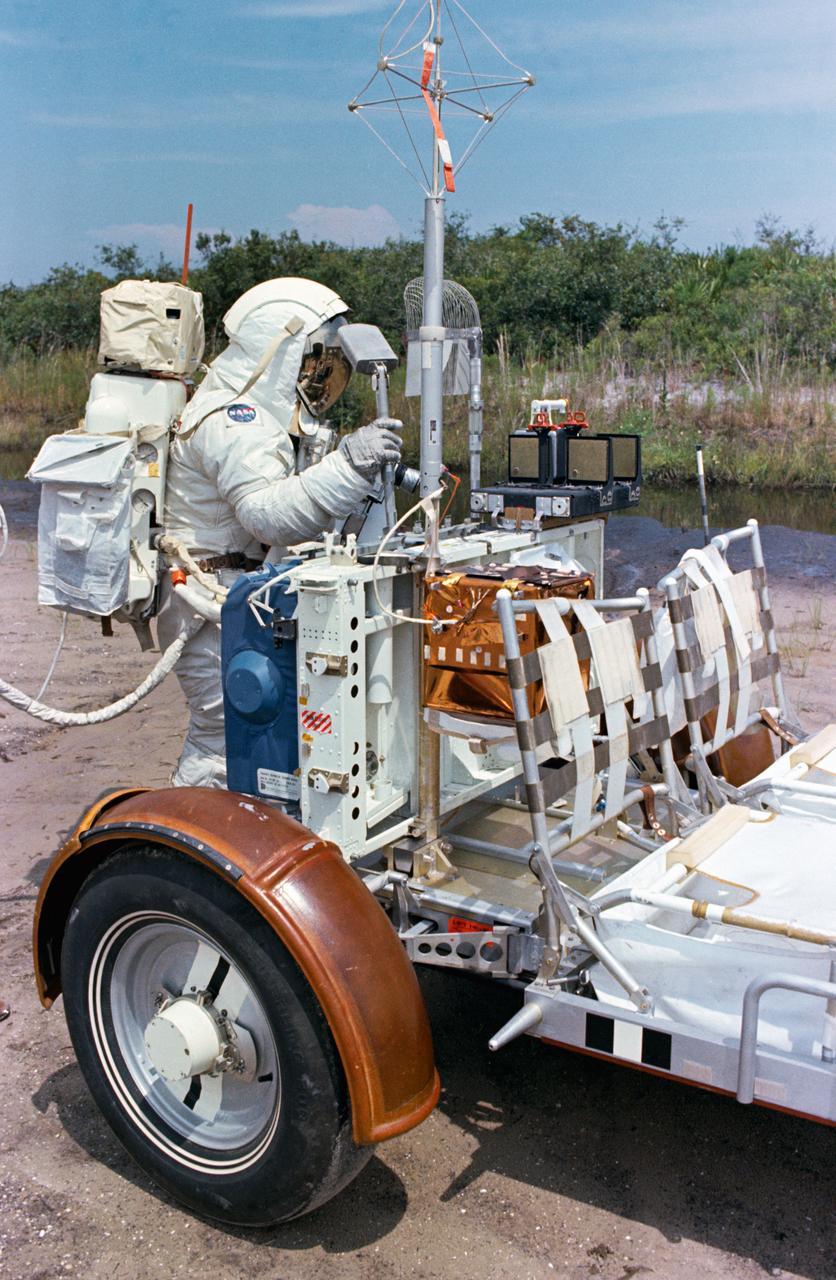
S72-48890 (September 1972) --- Scientist-astronaut Harrison H. Schmitt, lunar module pilot of the Apollo 17 lunar landing mission, procures a geological hand tool from the tool carrier at the aft end of the Lunar Roving Vehicle during lunar surface extravehicular activity simulation training at the Kennedy Space Center (KSC), Florida. Schmitt grasps a scoop with extension handle in his right hand.
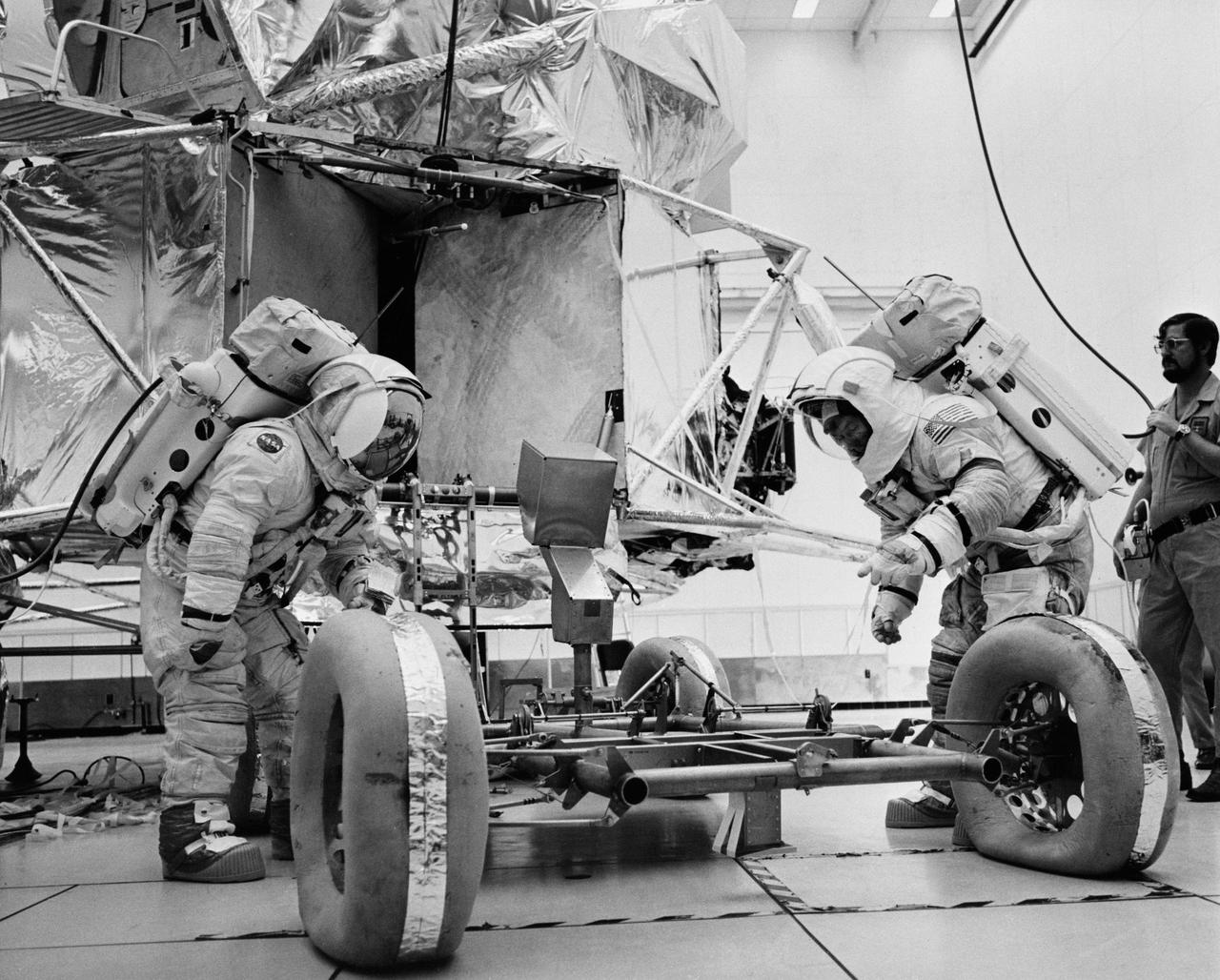
S72-44423 (8 Sept. 1972) --- Two Apollo 17 crewmen ready a Lunar Roving Vehicle trainer following its deployment from a Lunar Module trainer in the Flight Crew Training Building at the Kennedy Space Center, Florida. Taking part in the Apollo 17 training exercise were astronauts Eugene A. Cernan (right), commander; and Harrison H. "Jack" Schmitt, lunar module pilot.
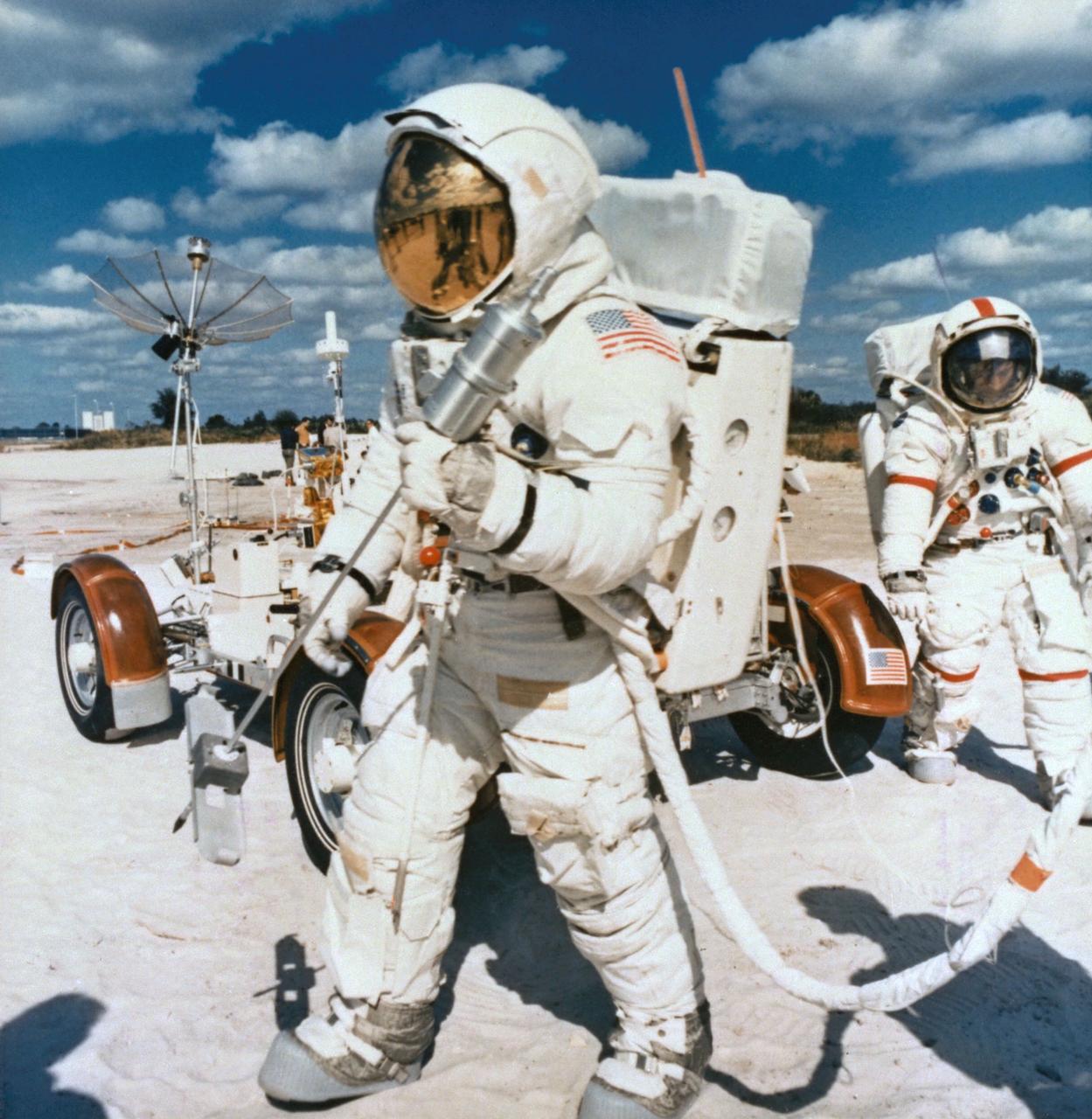
S72-30694 (28 Jan. 1972) --- Astronauts John W. Young, left, Apollo 16 commander, and Charles M. Duke Jr., lunar module pilot, prepare to begin a simulated traverse in a training area at the Kennedy Space Center (KSC). The fifth National Aeronautics and Space Administration (NASA) Apollo lunar landing mission is scheduled to land in the mountainous highlands region near the crater Descartes to explore the area for a three-day period. Among the experiments to fly on Apollo 16 is the soil mechanics (S-200) experiment or self-recording penetrometer, a model of which is held here by Duke. A training model of the Lunar Roving Vehicle (LRV) is parked between the two crew men. Astronaut Thomas K. (Ken) Mattingly II is prime crew command module pilot for the mission.
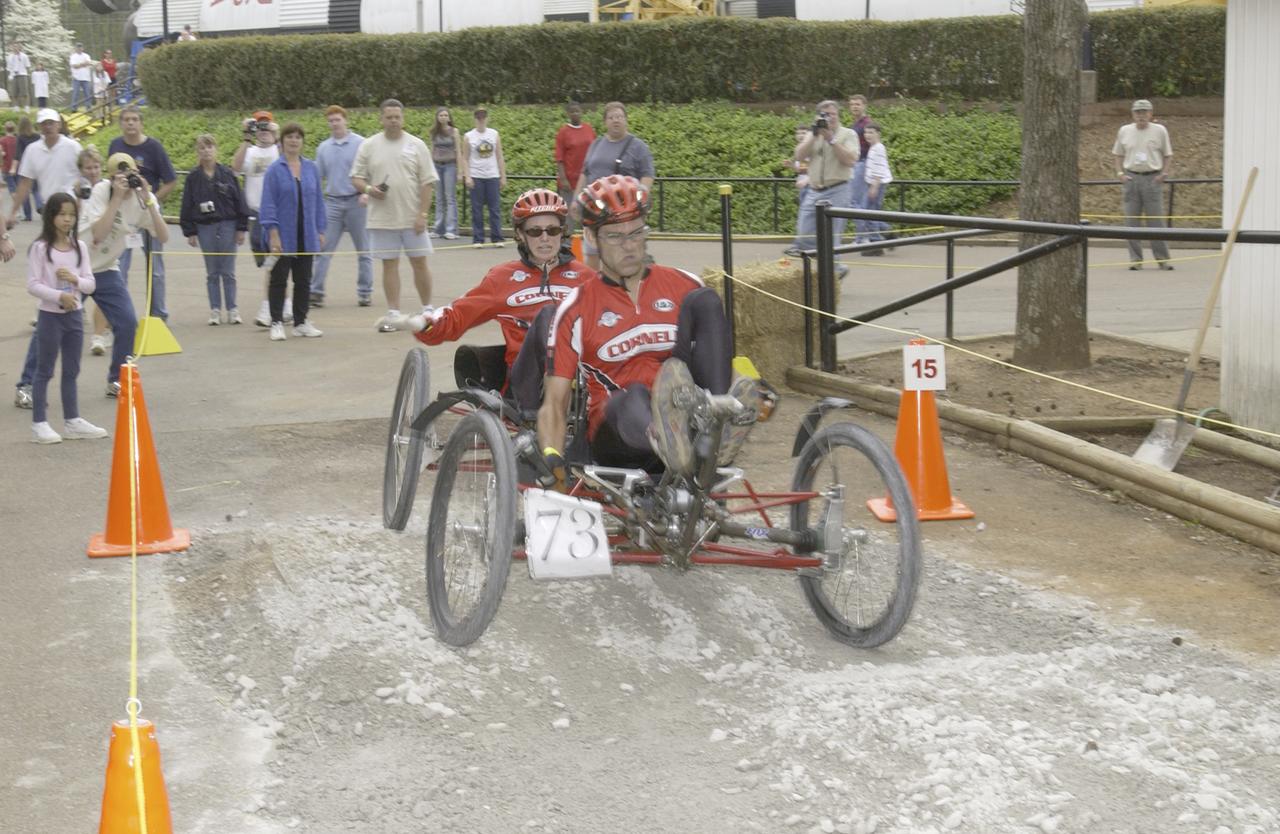
Students from across the United States and as far away as Puerto Rico and South America came to Huntsville, Alabama for the 9th annual Great Moonbuggy Race at the U.S. Space Rocket Center. Seventy-seven teams, representing high schools and colleges from 21 states, Puerto Rico, and Columbia, raced human powered vehicles over a lunar-like terrain. A team from Cornell University in Ithaca, New York, took the first place honor in the college division. This photograph shows the Cornell #2 team driving their vehicle through the course. The team finished the race in second place in the college division. Vehicles powered by two team members, one male and one female, raced one at a time over a half-mile obstacle course of simulated moonscape terrain. The competition is inspired by development, some 30 years ago, of the Lunar Roving Vehicle (LRV), a program managed by the Marshall Space Flight Center. The LRV team had to design a compact, lightweight, all-terrain vehicle, that could be transported to the Moon in the small Apollo spacecraft. The Great Moonbuggy Race challenges students to design and build a human powered vehicle so they will learn how to deal with real-world engineering problems, similar to those faced by the actual NASA LRV team.
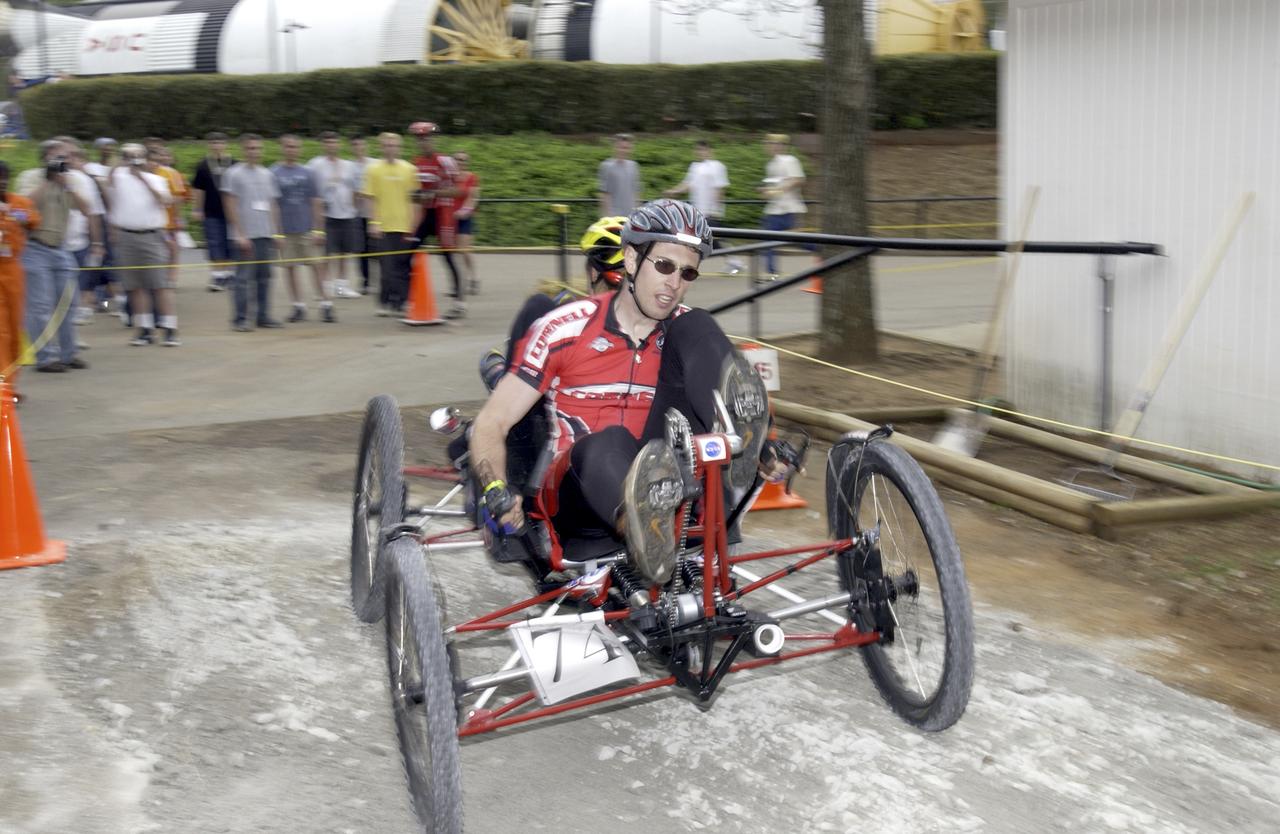
Students from across the United States and as far away as Puerto Rico and South America came to Huntsville, Alabama for the 9th annual Great Moonbuggy Race at the U.S. Space Rocket Center. Seventy-seven teams, representing high schools and colleges from 21 states, Puerto Rico, and Columbia, raced human powered vehicles over a lunar-like terrain. A team from Cornell University in Ithaca, New York, took the first place honor in the college division. In this photograph, the Cornell #1 team, the collegiate first place winner, maneuvers their vehicle through the course. Vehicles powered by two team members, one male and one female, raced one at a time over a half-mile obstacle course of simulated moonscape terrain. The competition is inspired by development, some 30 years ago, of the Lunar Roving Vehicle (LRV), a program managed by the Marshall Space Flight Center. The LRV team had to design a compact, lightweight, all-terrain vehicle that could be transported to the Moon in the small Apollo spacecraft. The Great Moonbuggy Race challenges students to design and build a humanpowered vehicle so they will learn how to deal with real-world engineering problems similar to those faced by the actual NASA LRV team.
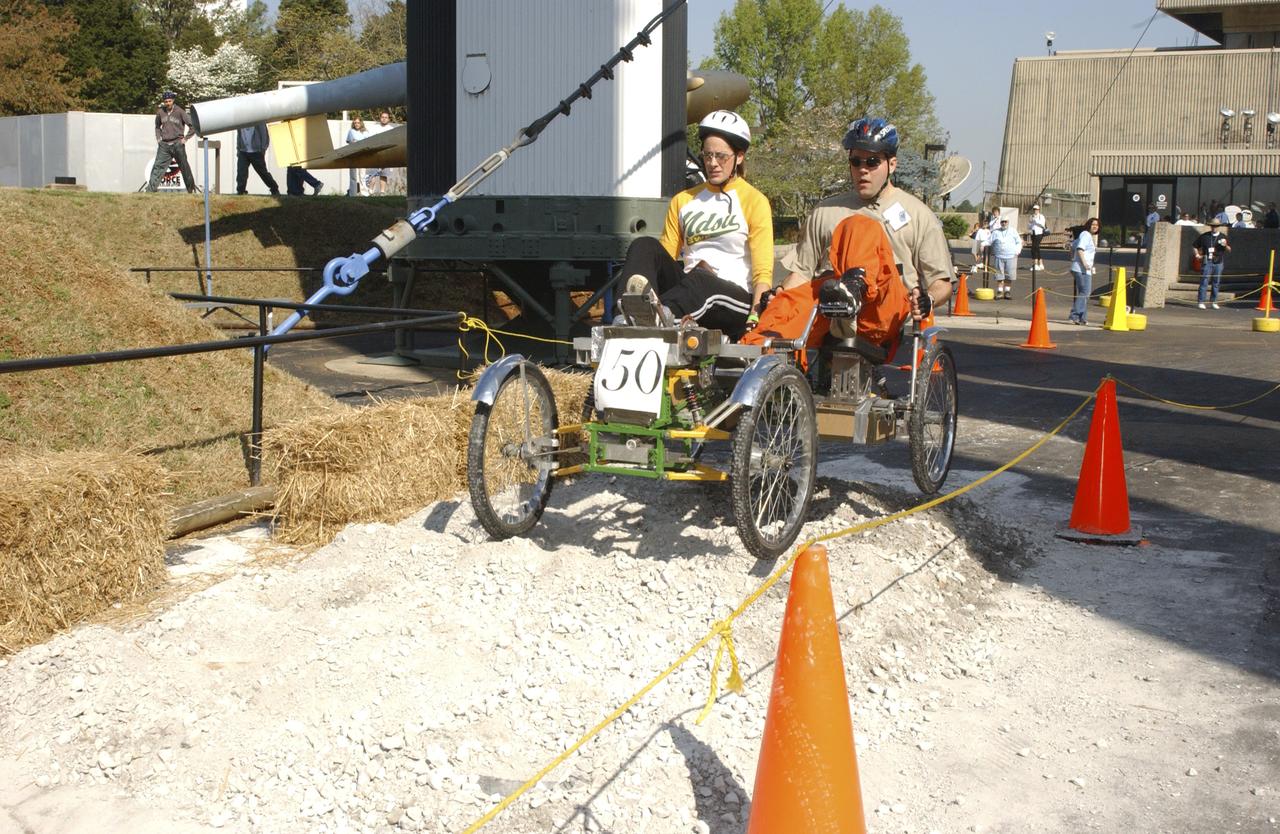
Students from across the United States and as far away as Puerto Rico came to Huntsville, Alabama for the 10th annual Great Moonbuggy Race at the U.S. Space Rocket Center. Sixty-eight teams, representing high schools and colleges from all over the United States, and Puerto Rico, raced human powered vehicles over a lunar-like terrain. Vehicles powered by two team members, one male and one female, raced one at a time over a half-mile obstacle course of simulated moonscape terrain. The competition is inspired by development, some 30 years ago, of the Lunar Roving Vehicle (LRV), a program managed by the Marshall Space Flight Center. The LRV team had to design a compact, lightweight, all-terrain vehicle that could be transported to the Moon in the small Apollo spacecraft. The Great Moonbuggy Race challenges students to design and build a human powered vehicle so they will learn how to deal with real-world engineering problems similar to those faced by the actual NASA LRV team. In this photograph, Team No. 1 from North Dakota State University in Fargo conquers one of several obstacles on their way to victory. The team captured first place honors in the college level competition.
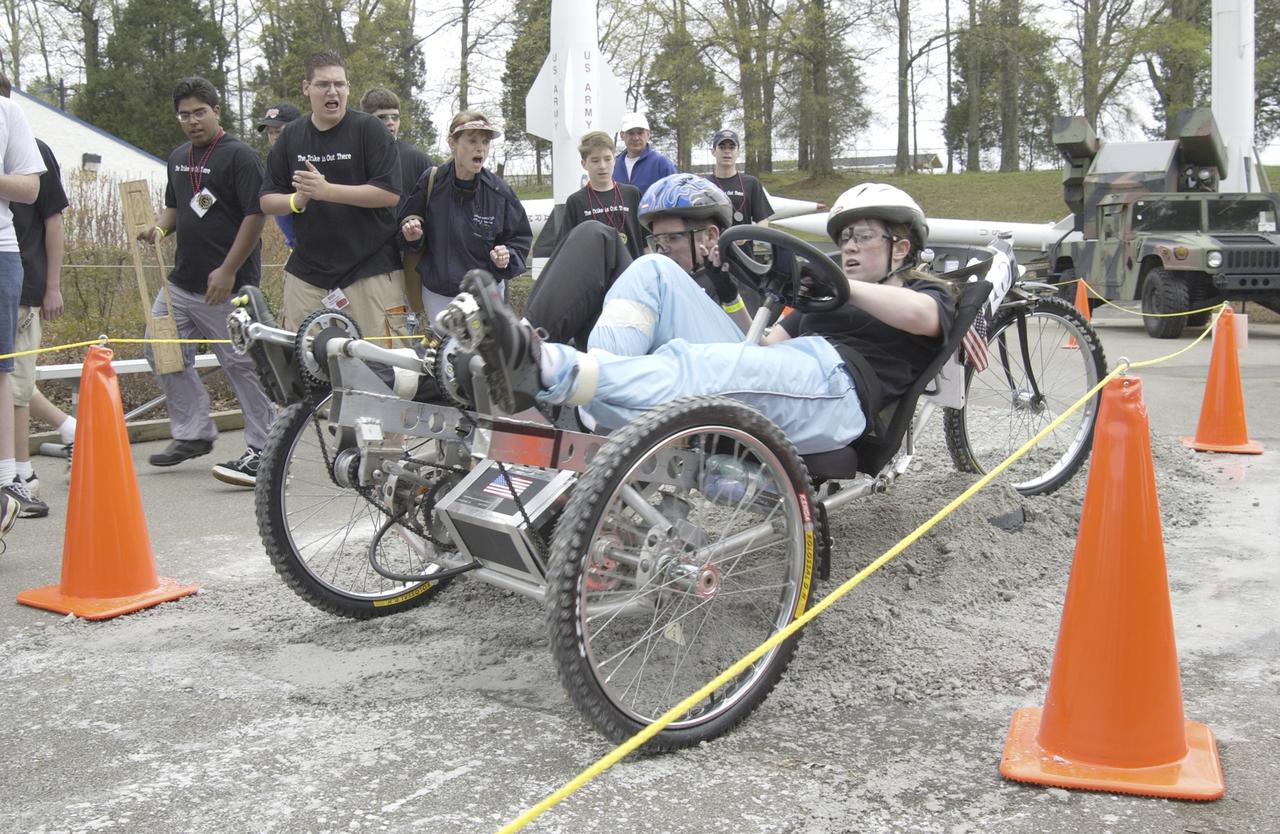
Students from across the United States and as far away as Puerto Rico and South America came to Huntsville, Alabama for the 9th annual Great Moonbuggy Race at the U.S. Space Rocket Center. Seventy-seven teams, representing high schools and colleges from 21 states, Puerto Rico, and Columbia, raced human powered vehicles over a lunar-like terrain. In this photograph, the New Orleans area schools team #2 from New Orleans, Louisiana maneuvers through an obstacle course. The team captured second place in the high school division competition. Vehicles powered by two team members, one male and one female, raced one at a time over a half-mile obstacle course of simulated moonscape terrain. The competition is inspired by the development, some 30 years ago, of the Lunar Roving Vehicle (LRV), a program managed by the Marshall Space Flight Center. The LRV team had to design a compact, lightweight, all-terrain vehicle that could be transported to the Moon in the small Apollo spacecraft. The Great Moonbuggy Race challenges students to design and build a human powered vehicle so they will learn how to deal with real-world engineering problems, similar to those faced by the actual NASA LRV team.