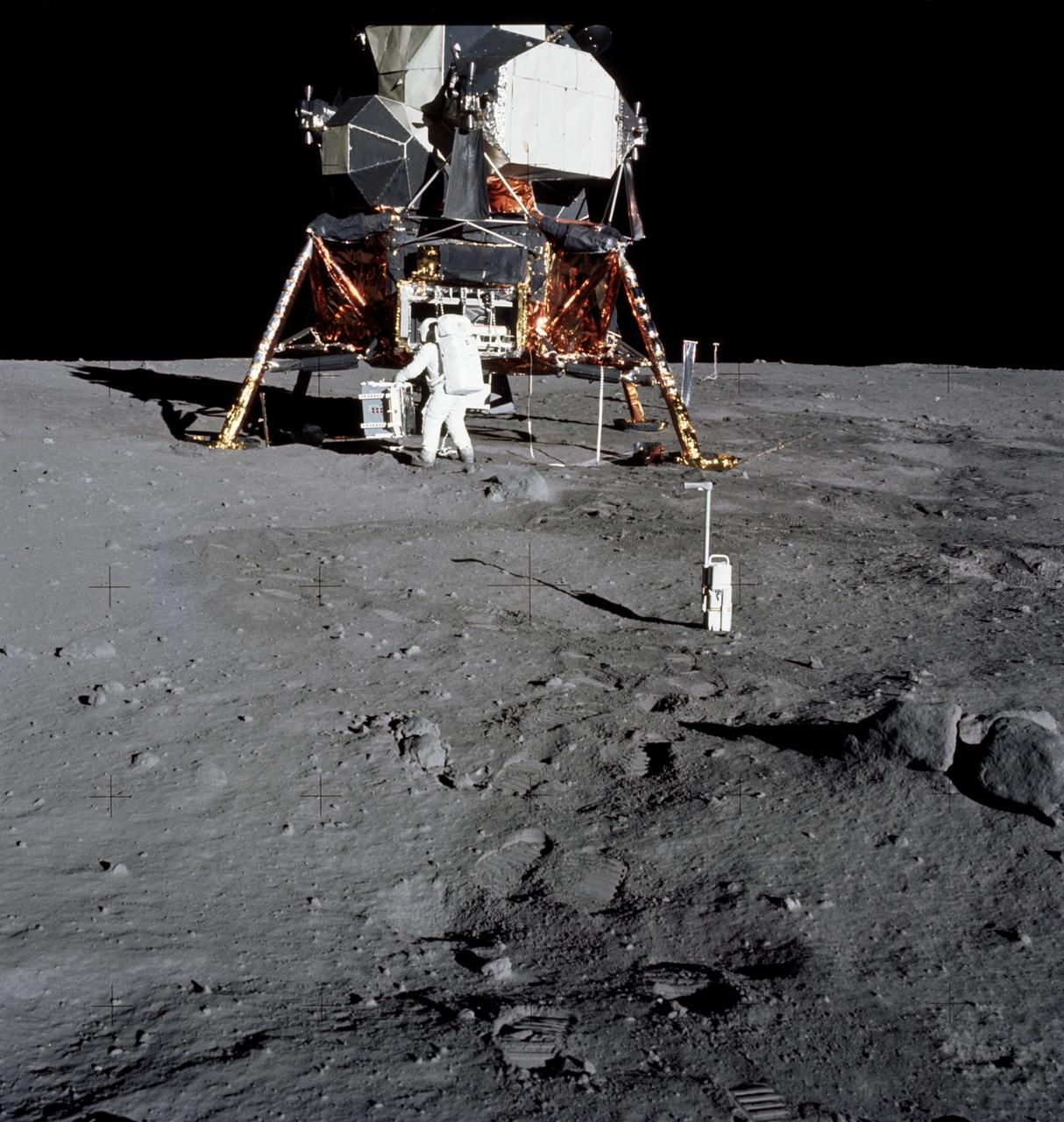
AS11-40-5931 (20 July 1969) --- Astronaut Edwin E. Aldrin Jr., lunar module pilot, prepares to deploy the Early Apollo Scientific Experiments Package (EASEP) on the surface of the moon during the Apollo 11 extravehicular activity. Astronaut Neil A. Armstrong, commander, took this photograph with a 70mm lunar surface camera. In the foreground is the Apollo 11 35mm stereo close-up camera.
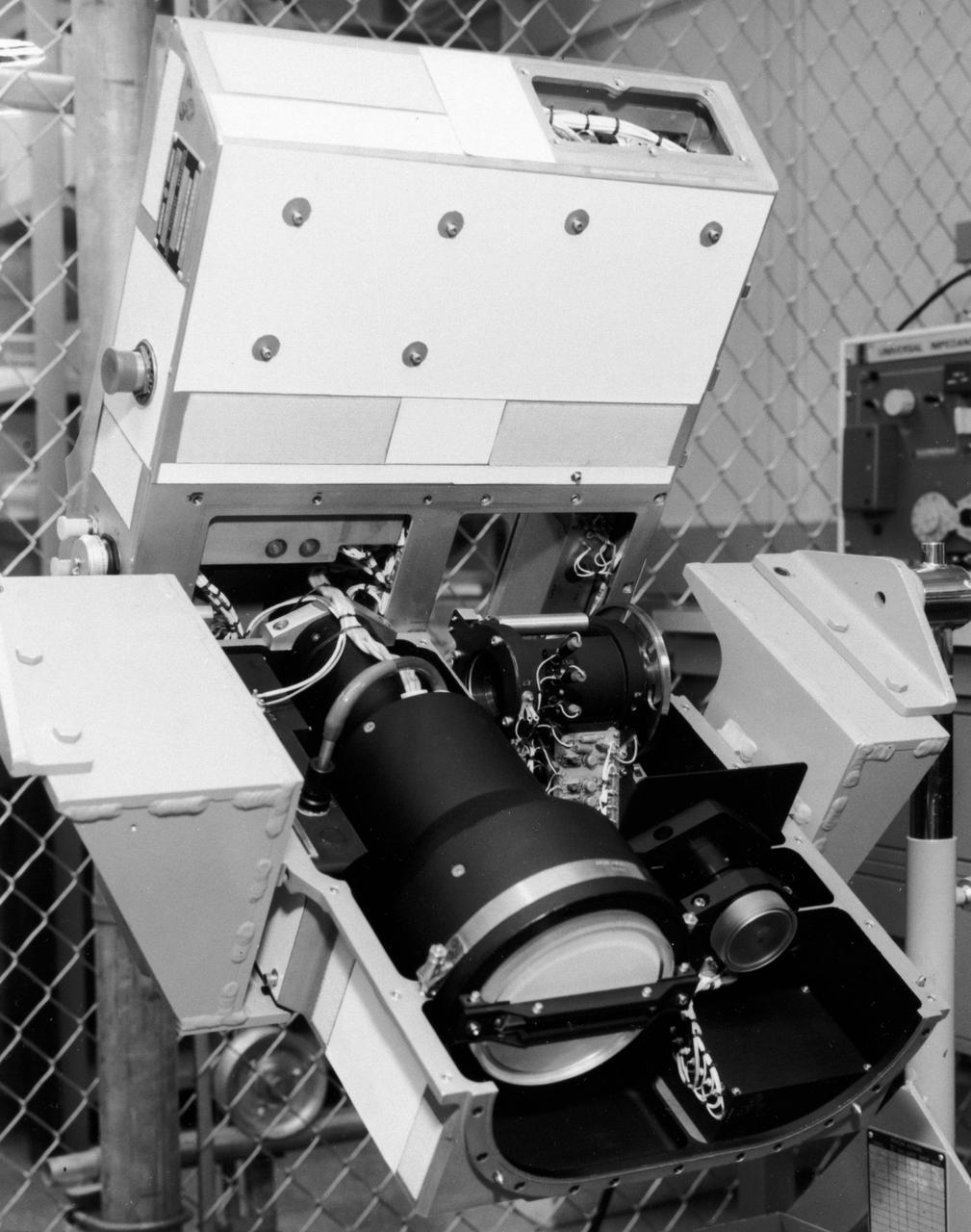
S72-49482 (November 1972) --- The Optical Recorder of the Lunar Sounder Experiment (S-209) which will be mounted in the SIM bay of the Apollo 17 Service Module. The three functional parts of the Lunar Sounder are the optical recorder, the coherent synthetic aperture radar, and the antennas, a retractable dipole for HF and a yagi for VHF. The Lunar Sounder will probe three-quarters of a mile below the moon's surface from the orbiting Apollo 17 spacecraft. Electronic data recorded on film will be retrieved by the crew during trans-Earth EVA. Geologic information on the lunar interior obtained by the sounder will permit scientific investigation of underground rock layers, lava flow patterns, rille (canyon) structures, mascon properties, and any areas containing water. A prototype lunar sounder has been flight tested in aircraft over selected Earth sites to confirm the equipment design and develop scientific analysis techniques. The Lunar Sounder Experiment was developed by North American Rockwell's (NR) Space Division for NASA's Manned Spacecraft Center to provide data for a scientific investigation team with representatives from the Jet Propulsion Laboratory, University of Utah, University of Michigan, U.S. Geological Survey, and NASA Ames Research Center.
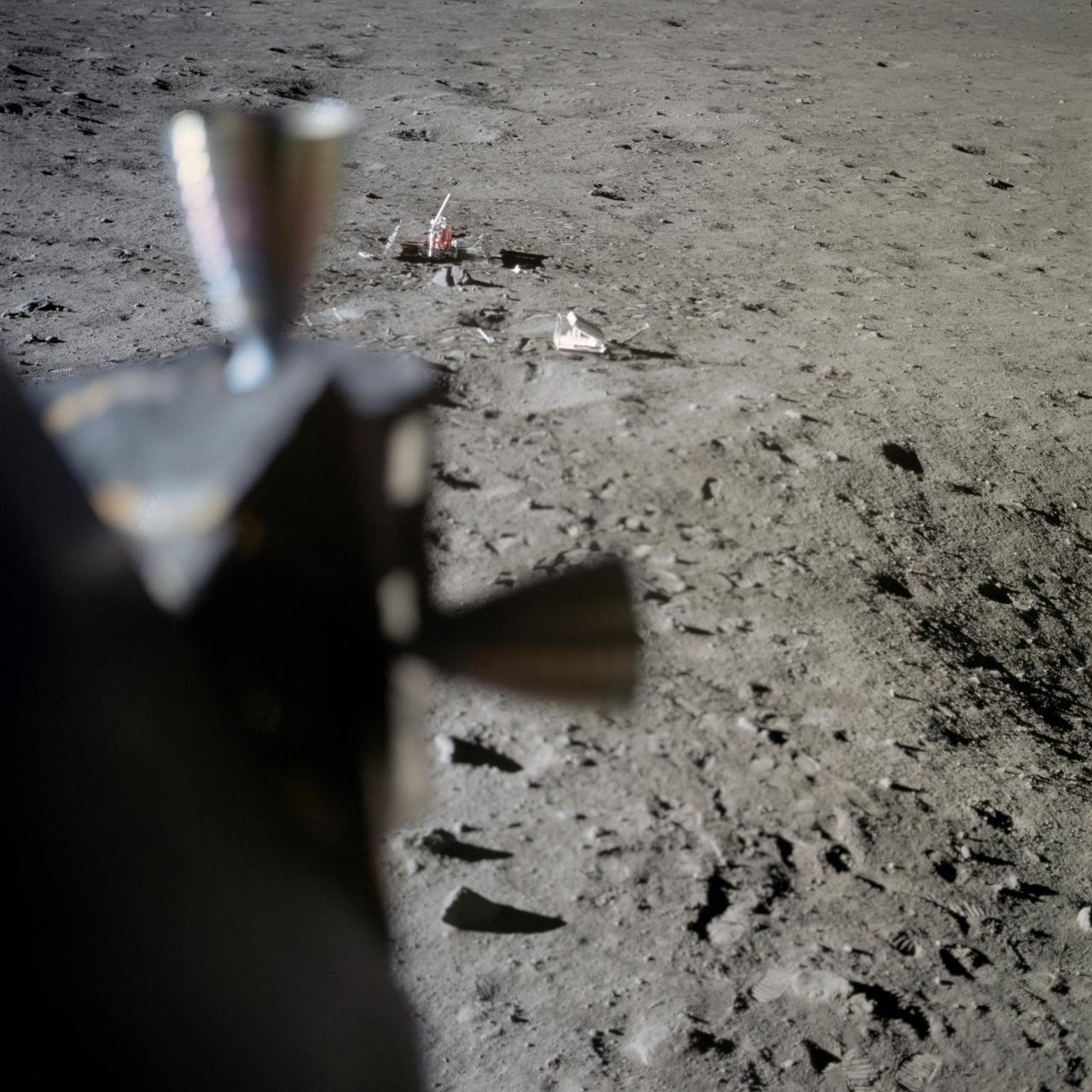
AS11-37-5551 (20 July 1969) --- Two components of the Early Apollo Scientific Experiments Package (EASEP) are seen deployed on the lunar surface in this view photographed from inside the Lunar Module (LM). In the far background is the Passive Seismic Experiment Package (PSEP); and to the right and closer to the camera is the Laser Ranging Retro-Reflector (LR-3). The footprints of Apollo 11 astronauts Neil A. Armstrong and Edwin E. Aldrin Jr. are very distinct in the lunar soil.
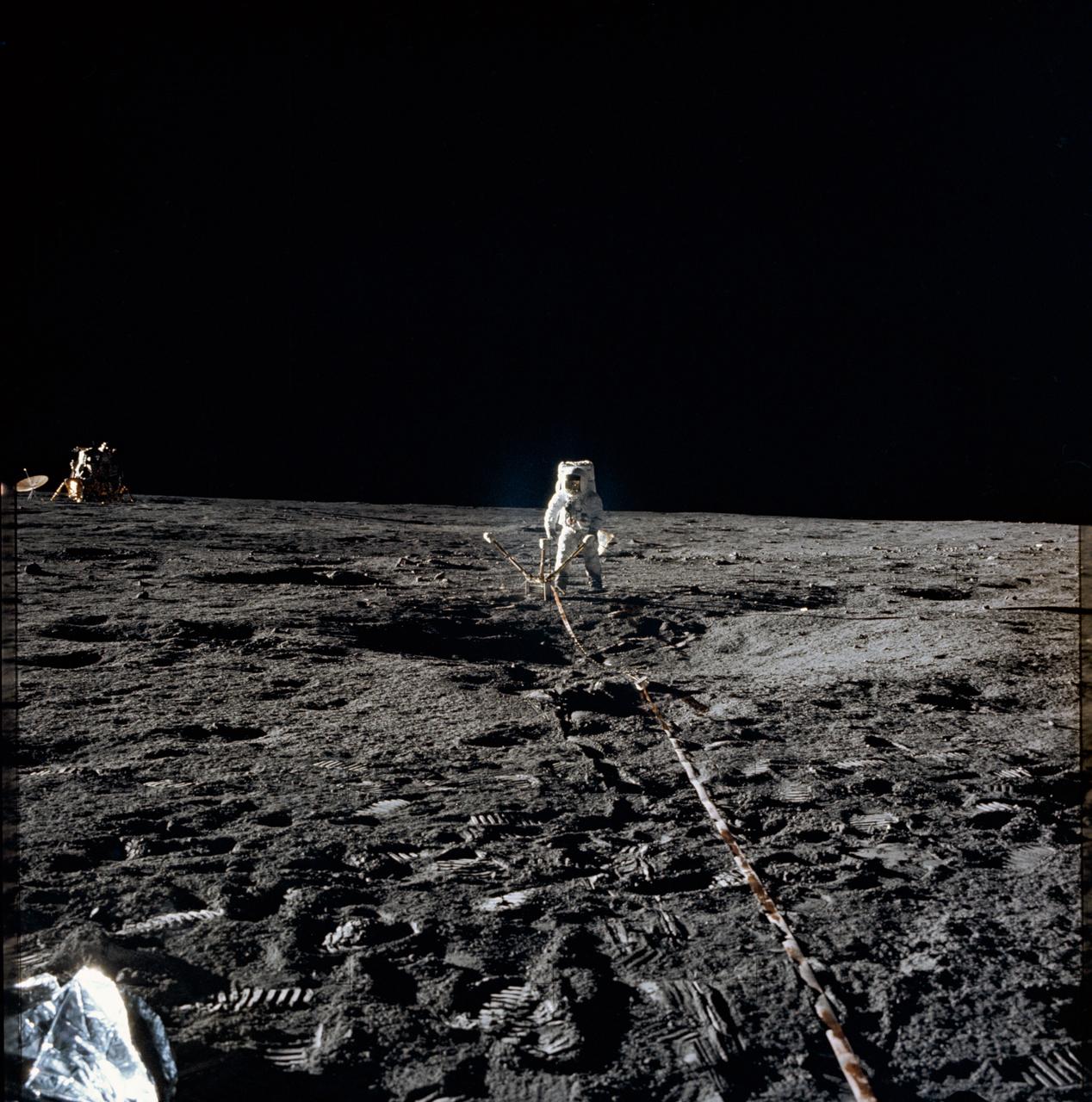
Astronaut Alan L. Bean, lunar module pilot, deploys the Lunar Surface Magnetometer (LSM) during the first Apollo 12 extravehicular activity on the Moon. The LSM is a component of the Apollo Lunar Surface Experiments Package (ALSEP). The Lunar Module can be seen in the left background.
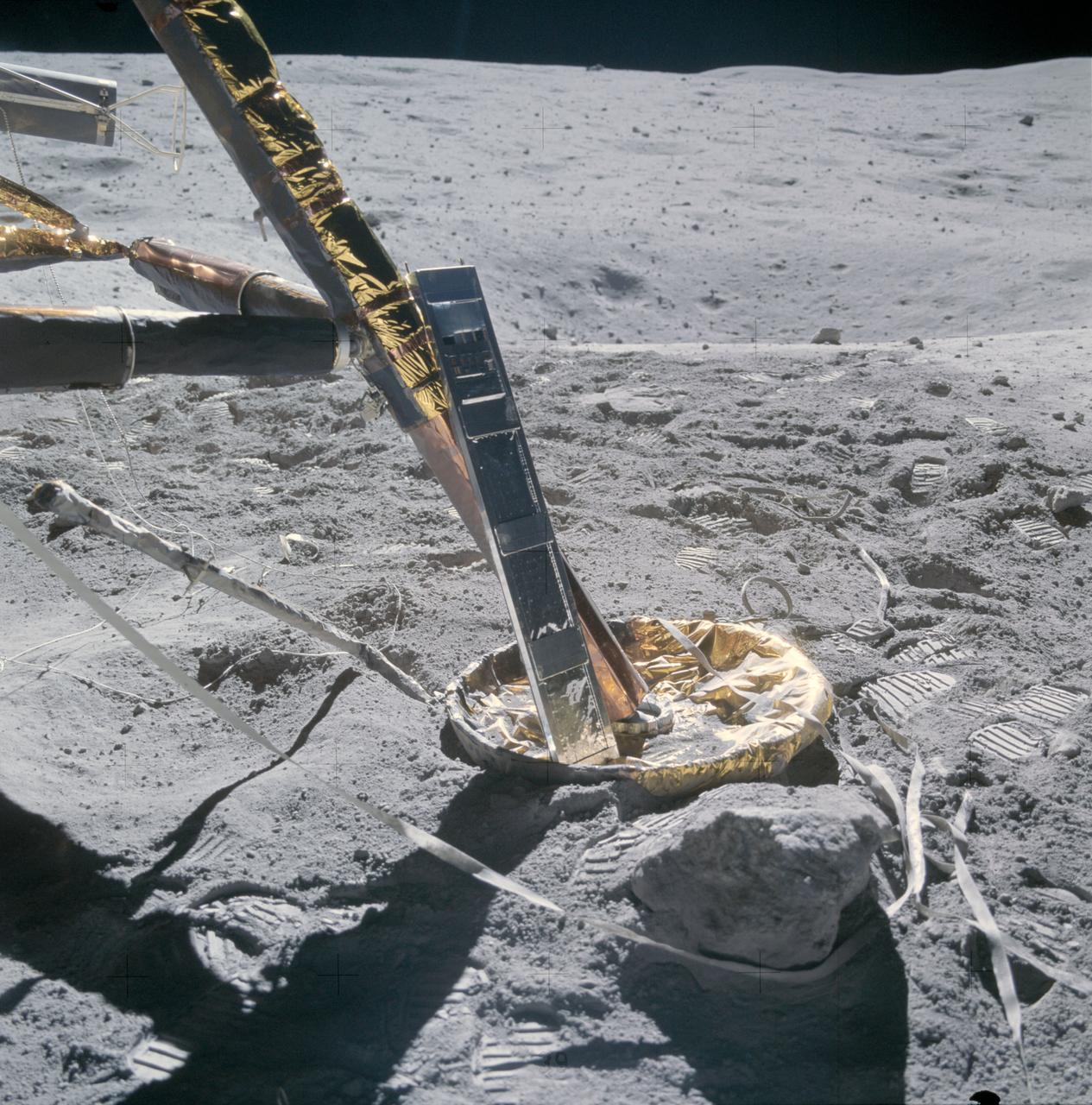
AS16-107-17442 (22 April 1972) --- A close-up view of the Apollo 16 Cosmic Ray Detector (CRD) experiment deployed at the +Y strut of the Lunar Module (LM). The crewmembers moved it to this position from near the deployment site of the Apollo Lunar Surface Experiments Package (ALSEP) because, in the words of astronaut John W. Young, commander, "The panels were getting a little warm." Note that the LM did not skid upon landing, as evidenced by the landing contact probe's folded back (neatly) position and the lack of skid marks. While astronauts Young, and Charles M. Duke Jr., lunar module pilot; descended in the Apollo 16 Lunar Module (LM) "Orion" to explore the Descartes highlands landing site on the moon, astronaut Thomas K. Mattingly II, command module pilot, remained with the Command and Service Modules (CSM) "Casper" in lunar orbit.
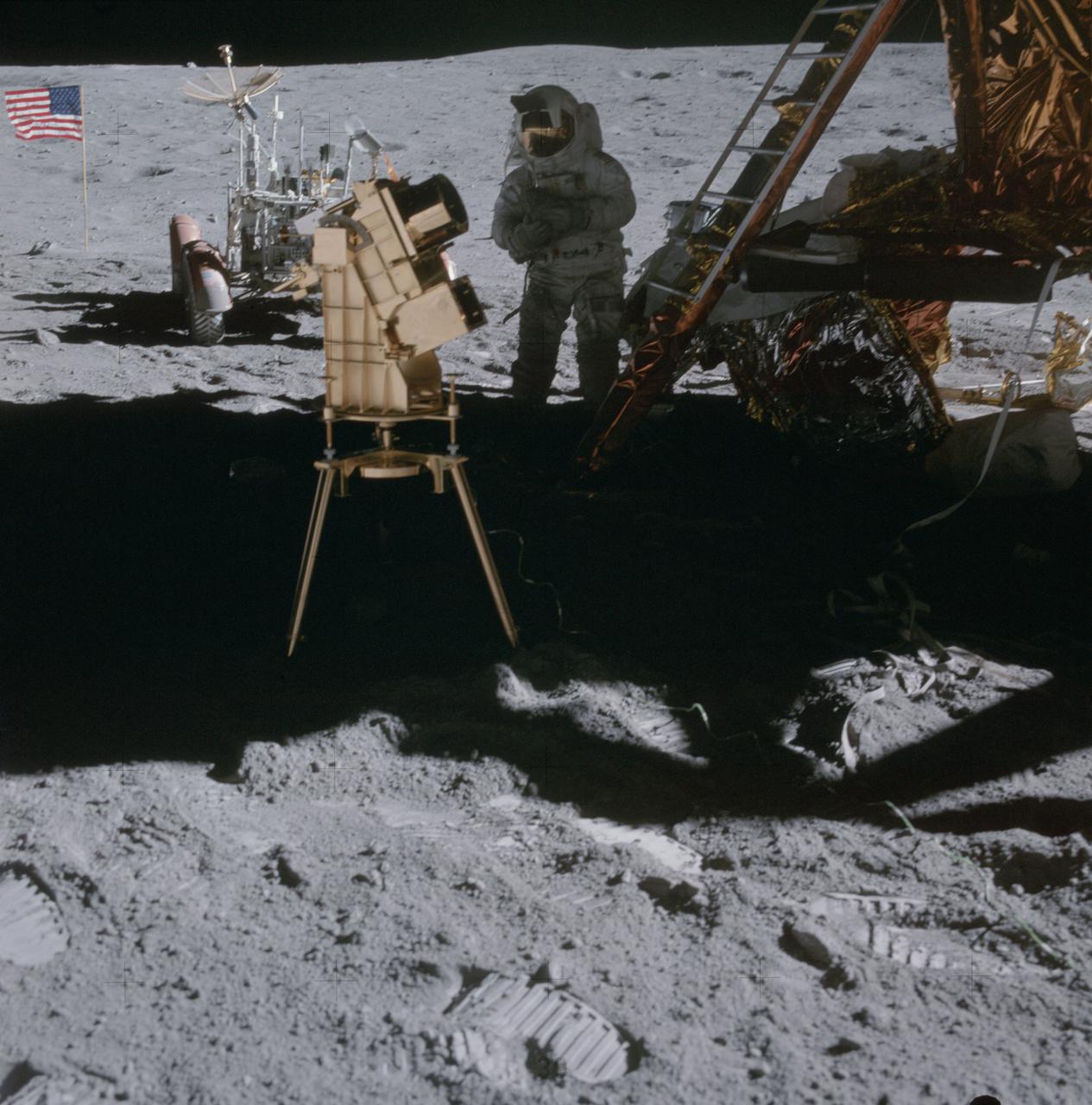
AS16-114-18439 (22 April 1972) --- Astronaut Charles M. Duke Jr., lunar module pilot, stands in the shadow of the Lunar Module (LM) behind the ultraviolet (UV) camera which is in operation. This photograph was taken by astronaut John W. Young, commander, during the mission's second extravehicular activity (EVA). The UV camera's gold surface is designed to maintain the correct temperature. The astronauts set the prescribed angles of azimuth and elevation (here 14 degrees for photography of the large Magellanic Cloud) and pointed the camera. Over 180 photographs and spectra in far-ultraviolet light were obtained showing clouds of hydrogen and other gases and several thousand stars. The United States flag and Lunar Roving Vehicle (LRV) are in the left background. While astronauts Young and Duke descended in the Apollo 16 Lunar Module (LM) "Orion" to explore the Descartes highlands landing site on the moon, astronaut Thomas K. Mattingly II, command module pilot, remained with the Command and Service Modules (CSM) "Casper" in lunar orbit.
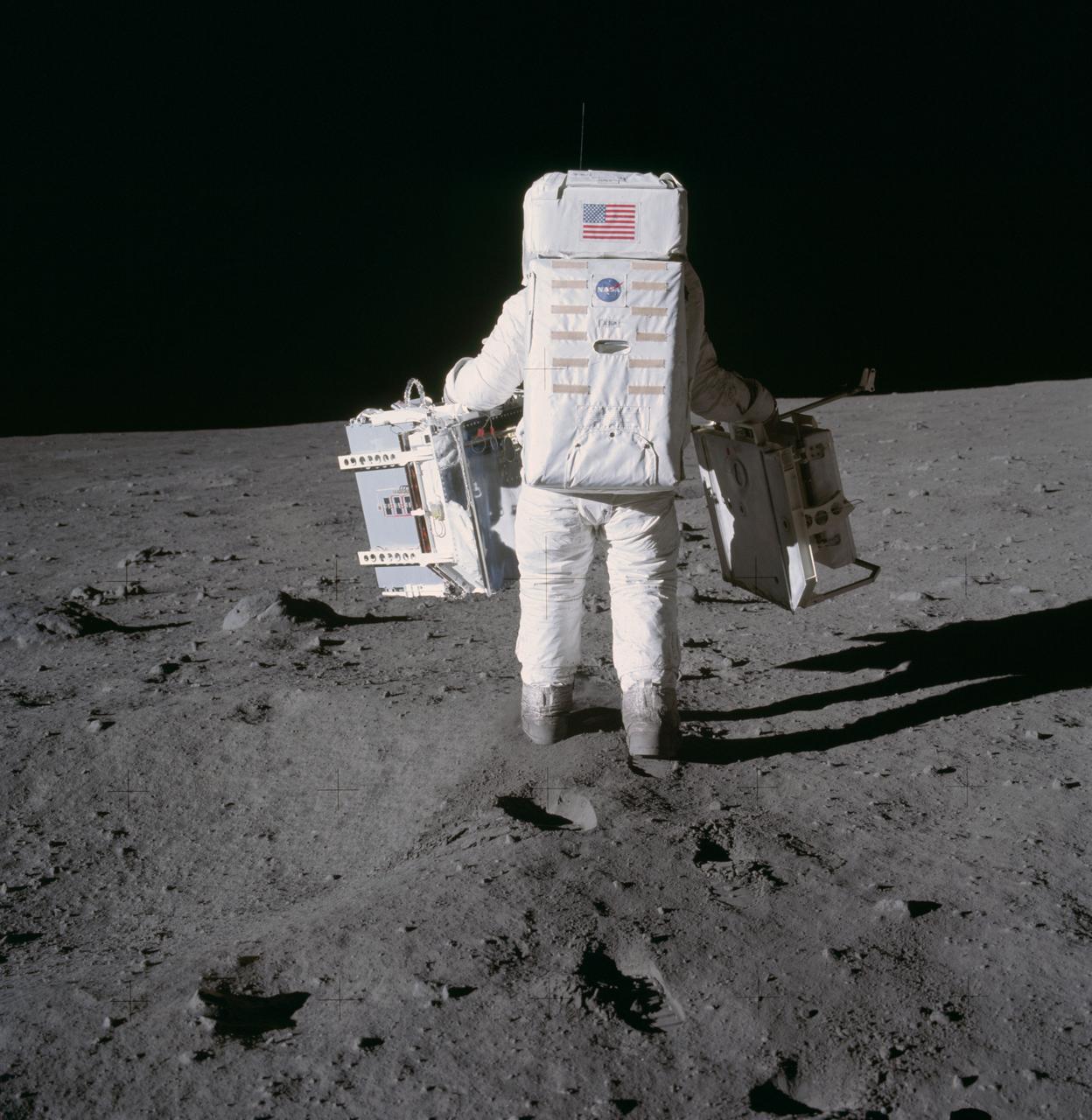
Astronaut Edwin E. Aldrin Jr., lunar module pilot, moves toward a position to deploy two components of the Early Apollo Scientific Experiments Package (EASEP) on the surface of the Moon during the Apollo 11 extravehicular activity. The Passive Seismic Experiments Package (PSEP) is in his left hand; and in his right hand is the Laser Ranging Retro-Reflector (LR3). Astronaut Neil A. Armstrong, commander, took this photograph with a 70mm lunar surface camera.
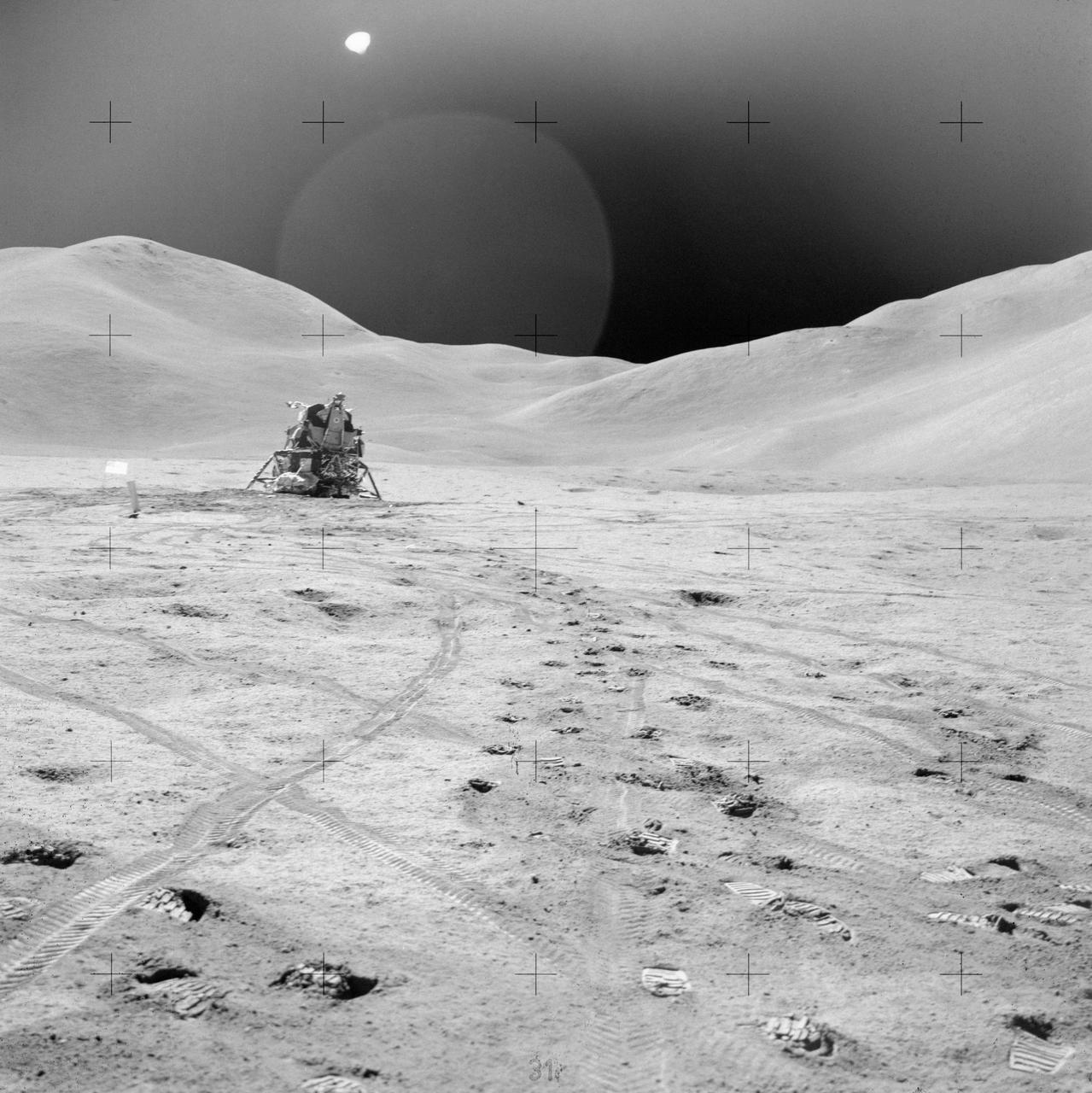
AS15-82-11057 (2 Aug. 1971) --- The Lunar Module (LM) "Falcon" is photographed against the barren lunarscape during the third Apollo 15 lunar surface extravehicular activity (EVA) at the Hadley-Apennine landing site on the lunar nearside. This view is looking southeast. The Apennine Front is in the left background; and Hadley Delta Mountain is in the right background. The object next to the United States flag is the Solar Wind Composition (SWC) experiment. Last Crater is to the right of the LM. Note bootprints and tracks of the Lunar Roving Vehicle (LRV). The light spherical object at the top is a reflection in the lens of the camera. While astronauts David R. Scott and James B. Irwin descended in the LM to explore the moon, astronaut Alfred M. Worden remained with the Command and Service Modules (CSM) in lunar orbit.
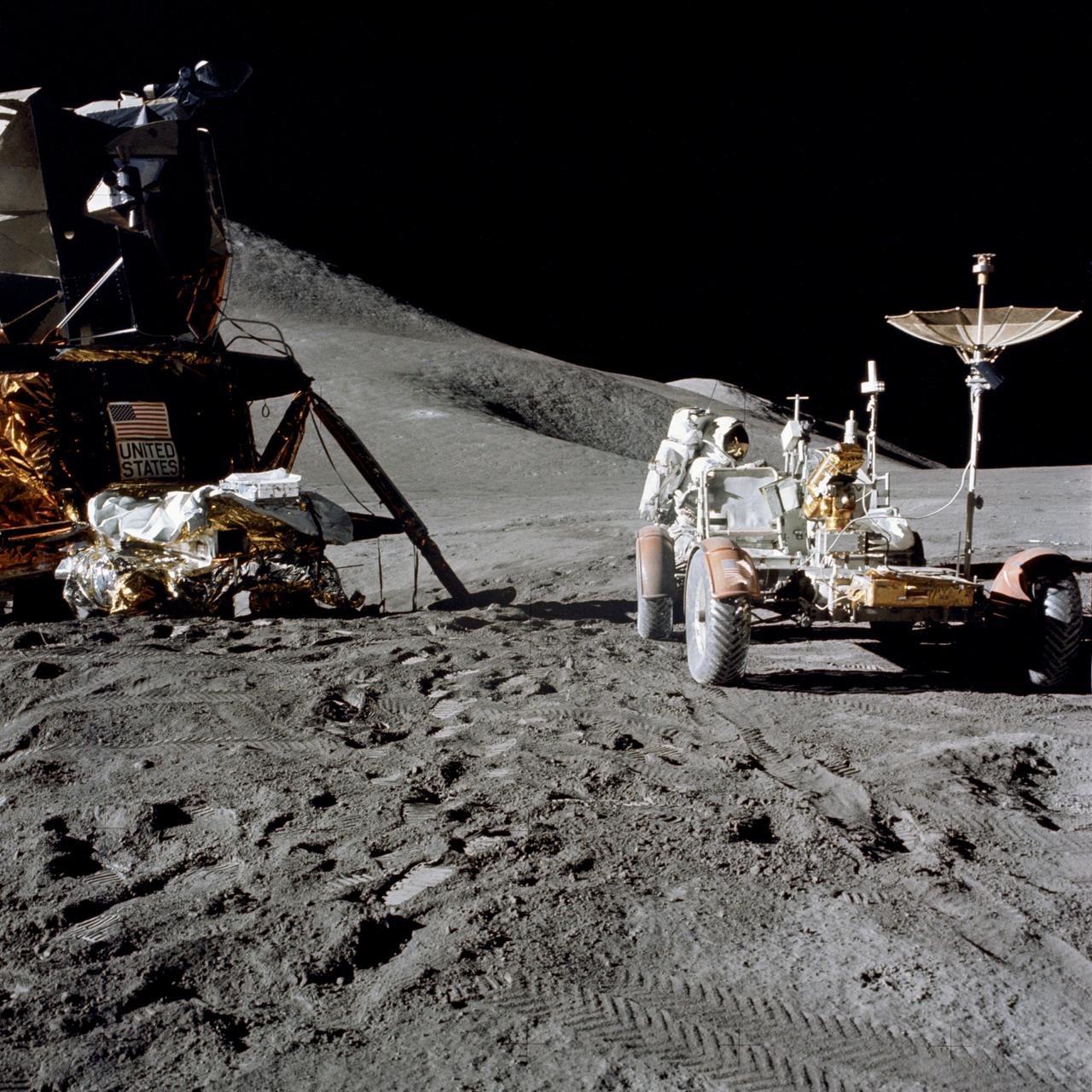
AS15-86-11602 (31 July 1971) --- Astronaut James B. Irwin, lunar module pilot, works at the Lunar Roving Vehicle (LRV) during the first Apollo 15 lunar surface extravehicular activity (EVA) at the Hadley-Apennine landing site. A portion of the Lunar Module (LM) "Falcon" is on the left. The undeployed Laser Ranging Retro Reflector (LR-3) lies atop the LM's modular equipment stowage assembly (MESA). This view is looking slightly west of south. Hadley Delta and the Apennine Front are in the background to the left. St. George crater is approximately five kilometers (about three statute miles) in the distance behind Irwin's head. This photograph was taken by astronaut David R. Scott, commander. While astronauts Scott and Irwin descended in the LM to explore the moon, astronaut Alfred M. Worden, command module pilot, remained with the Command and Service Modules (CSM) in lunar orbit.
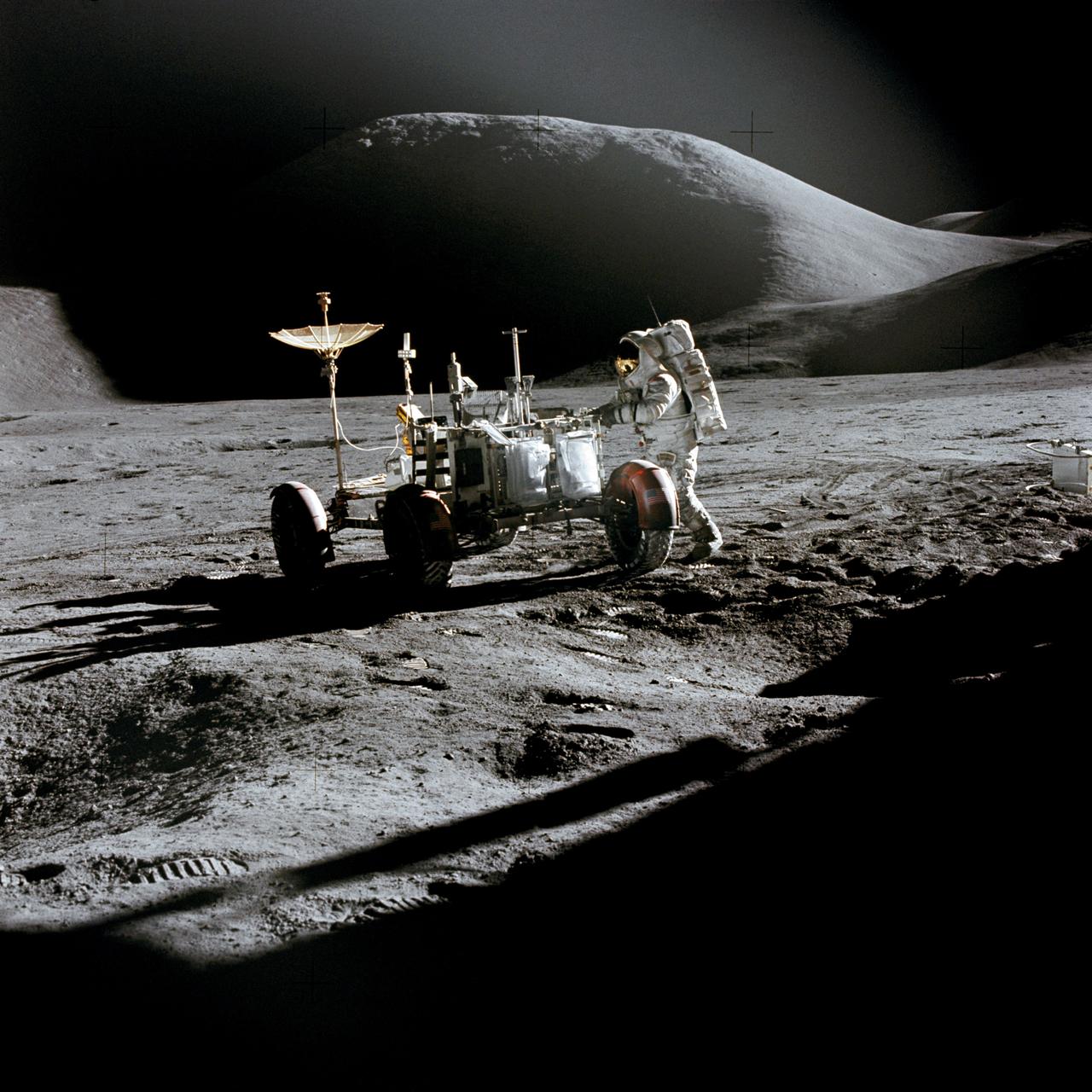
AS15-86-11603 (31 July 1971) --- Astronaut James B. Irwin, lunar module pilot, works at the Lunar Roving Vehicle during the first Apollo 15 lunar surface extravehicular activity (EVA) at the Hadley-Apennine landing site. The shadow of the Lunar Module "Falcon" is in the foreground. This view is looking northeast, with Mount Hadley in the background. This photograph was taken by astronaut David R. Scott, commander.
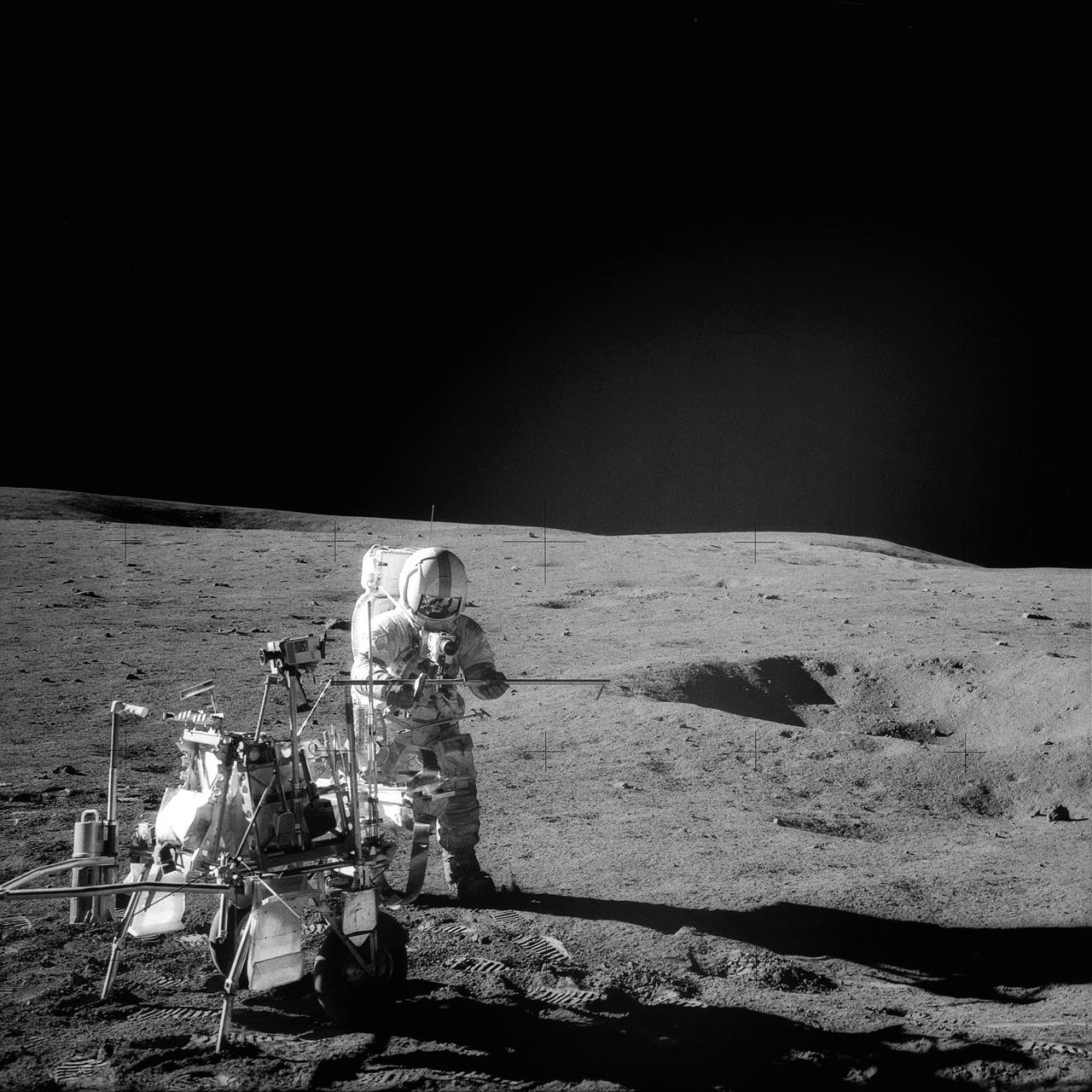
AS14-68-9405 (6 Feb. 1971) --- Astronaut Alan B. Shepard Jr., Apollo 14 commander, assembles a double core tube as he stands beside the rickshaw-type portable workbench or modularized equipment transporter (MET) unique to this mission. The photograph was taken by astronaut Edgar D. Mitchell, lunar module pilot, standing some 170 meters northeast of the Lunar Module (LM), during the mission's second extravehicular activity (EVA) on Feb. 6, 1971. While astronauts Shepard and Mitchell descended in the LM "Antares" to explore the Fra Mauro region of the moon, astronaut Stuart A. Roosa, command module pilot, remained with the Command and Service Modules (CSM) "Kitty Hawk" in lunar orbit.
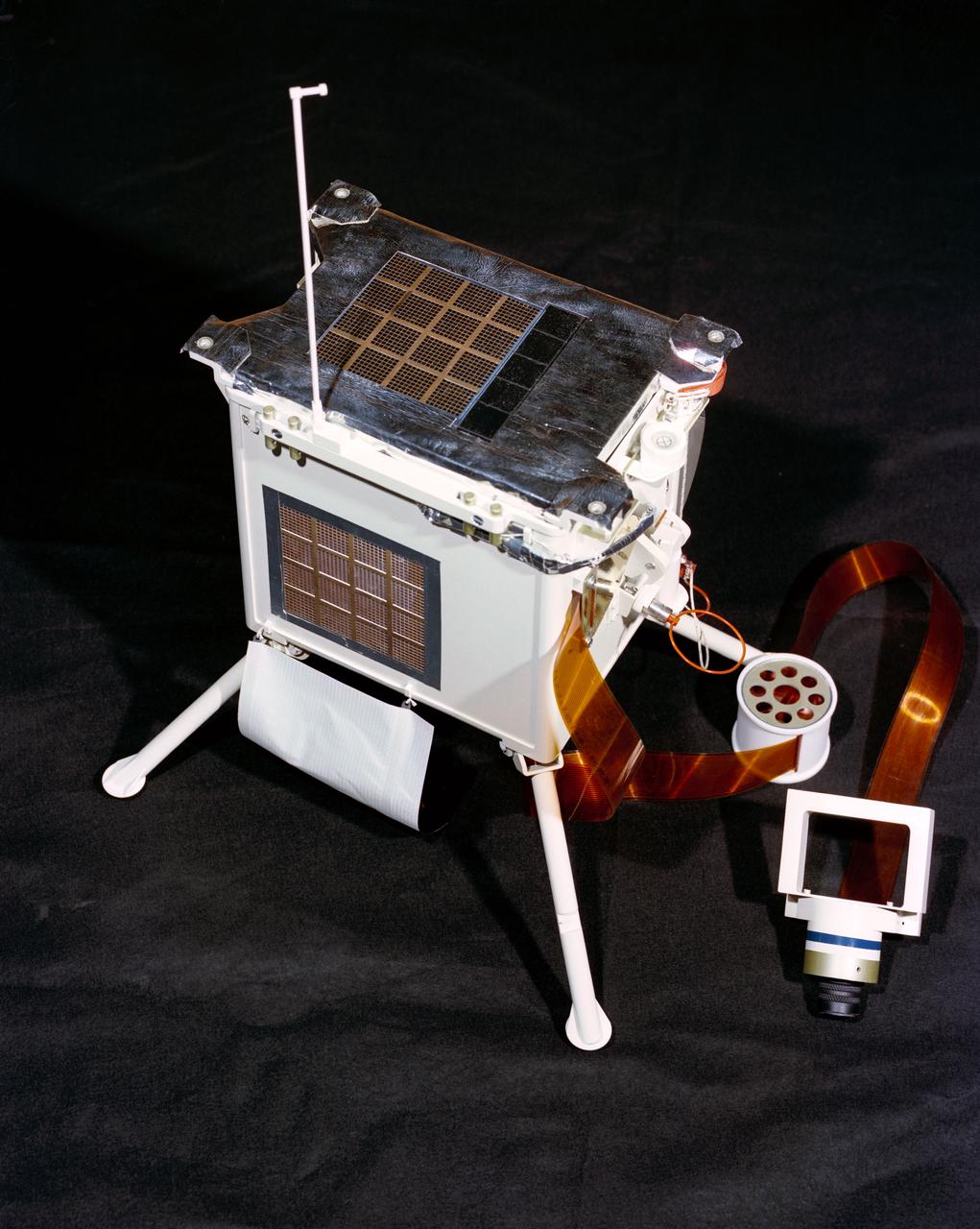
S72-37257 (November 1972) --- The Lunar Ejecta and Meteorites Experiment (S-202), one of the experiments of the Apollo Lunar Surface Experiments Package which will be carried on the Apollo 17 lunar landing mission. The purpose of this experiment is to measure the physical parameters of primary and secondary particles impacting the lunar surface.
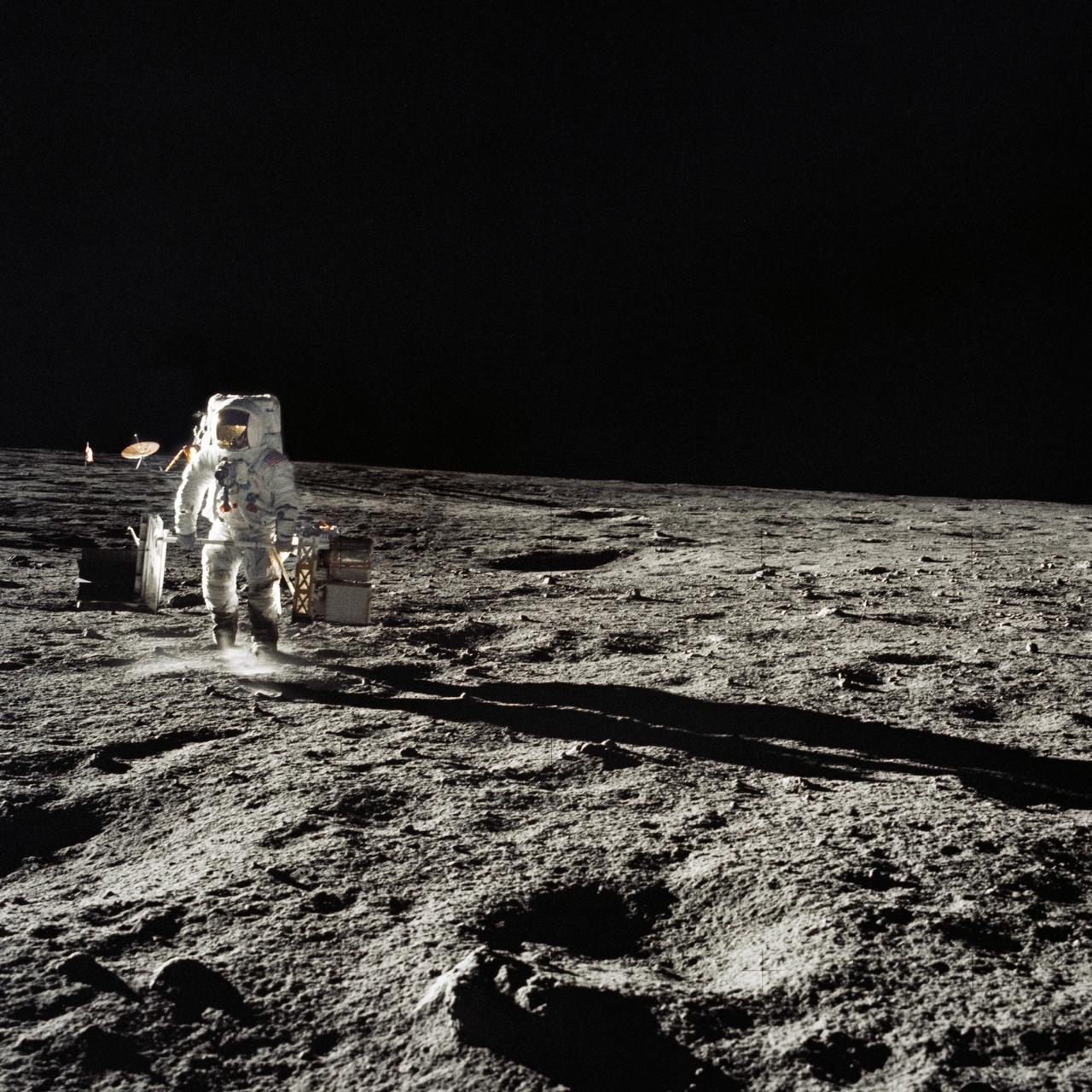
AS12-46-6807 (19 Nov. 1969) --- Astronaut Alan L. Bean, lunar module pilot, traverses with the two sub packages of the Apollo Lunar Surface Experiments Package (ALSEP) during the first Apollo 12 extravehicular activity (EVA). Bean deployed the ALSEP components 300 feet from the Lunar Module (LM). The LM and deployed erectable S-band antenna can be seen in the background.
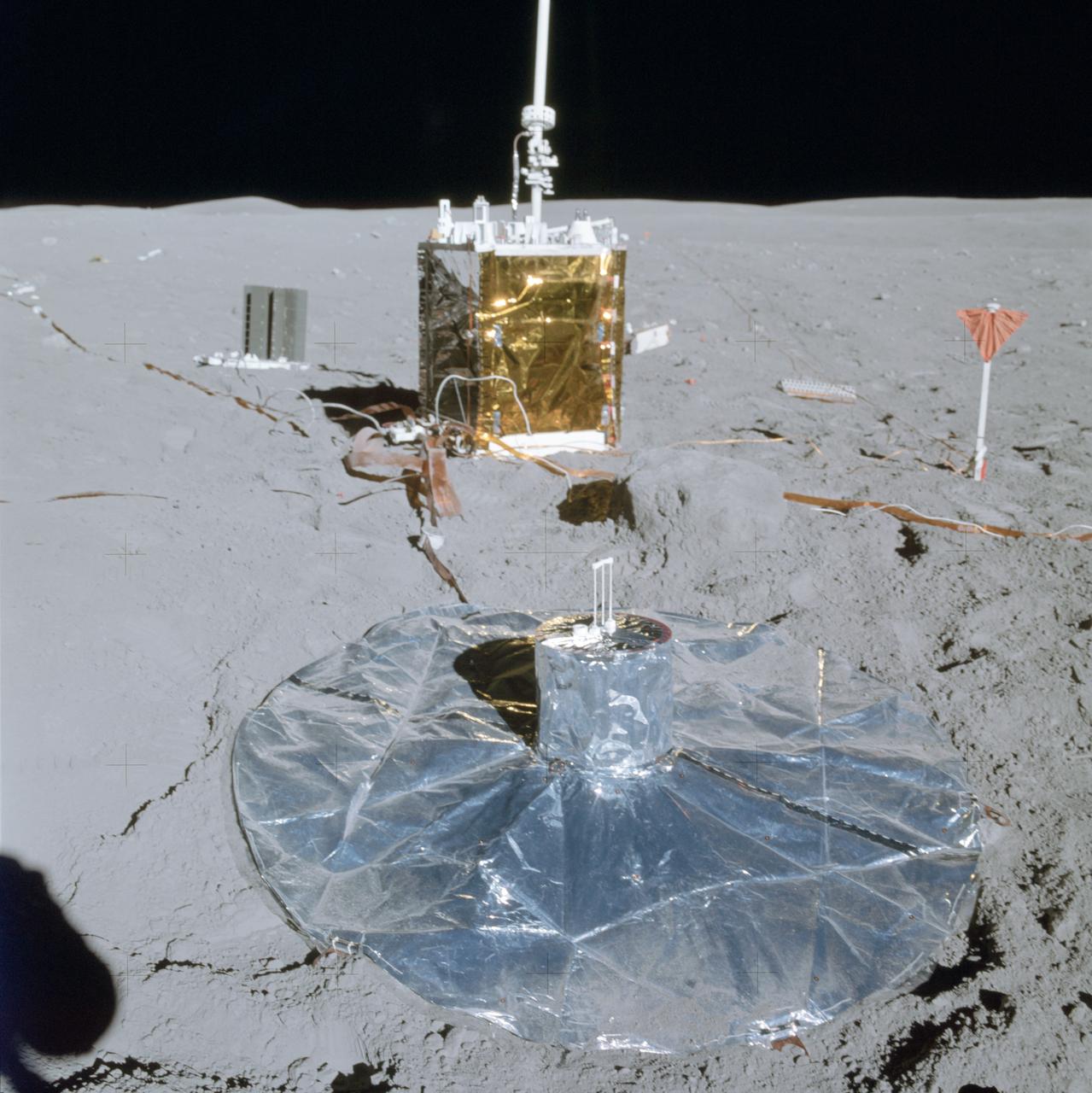
AS16-113-18347 (21 April 1972) --- A partial view of the Apollo 16 Apollo Lunar Surface Experiments Package (ALSEP) in deployed configuration on the lunar surface as photographed during the mission's first extravehicular activity (EVA), on April 21, 1972. The Passive Seismic Experiment (PSE) is in the foreground center; Central Station (C/S) is in center background, with the Radioisotope Thermoelectric Generator (RTG) to the left. One of the anchor flags for the Active Seismic Experiment (ASE) is at right. While astronauts John W. Young, commander; and Charles M. Duke Jr., lunar module pilot; descended in the Apollo 16 Lunar Module (LM) "Orion" to explore the Descartes highlands landing site on the moon, astronaut Thomas K. Mattingly II, command module pilot, remained with the Command and Service Modules (CSM) "Casper" in lunar orbit.
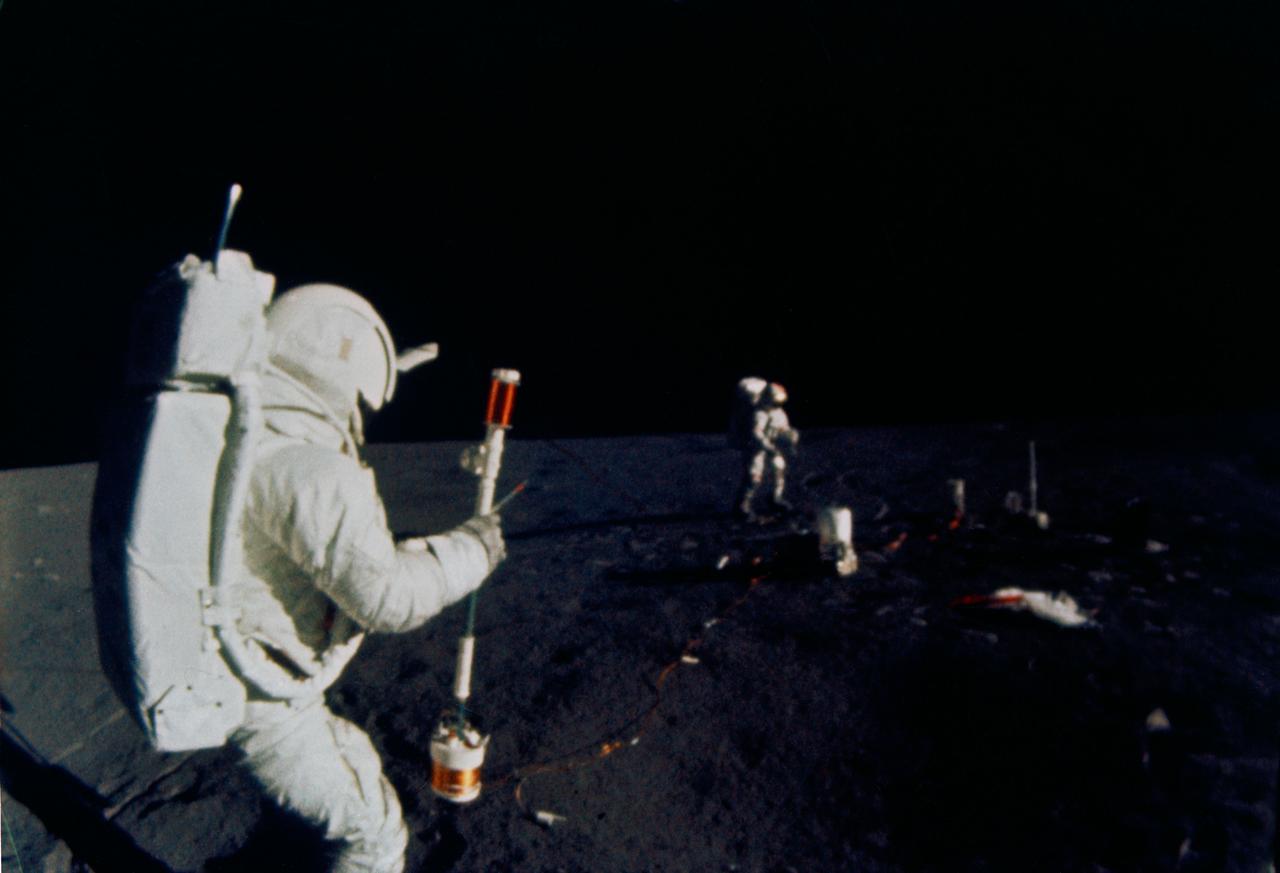
S71-19509 (5 Feb. 1971) --- Astronaut Edgar D. Mitchell, lunar module pilot, operates the Active Seismic Experiment's (ASE) thumper during the first Apollo 14 extravehicular activity (EVA) on the moon. Astronaut Alan B. Shepard Jr., commander, walks near deployed components of the Apollo Lunar Surface Experiments Package (ALSEP) in the background. This photograph was taken by an automatic 16mm camera mounted on the Apollo lunar hand tool carrier aboard the Modularized Equipment Transporter (MET). While astronauts Shepard and Mitchell descended in the LM to explore the moon, astronaut Stuart A. Roosa, command module pilot, remained with the Command and Service Modules (CSM) in lunar orbit.
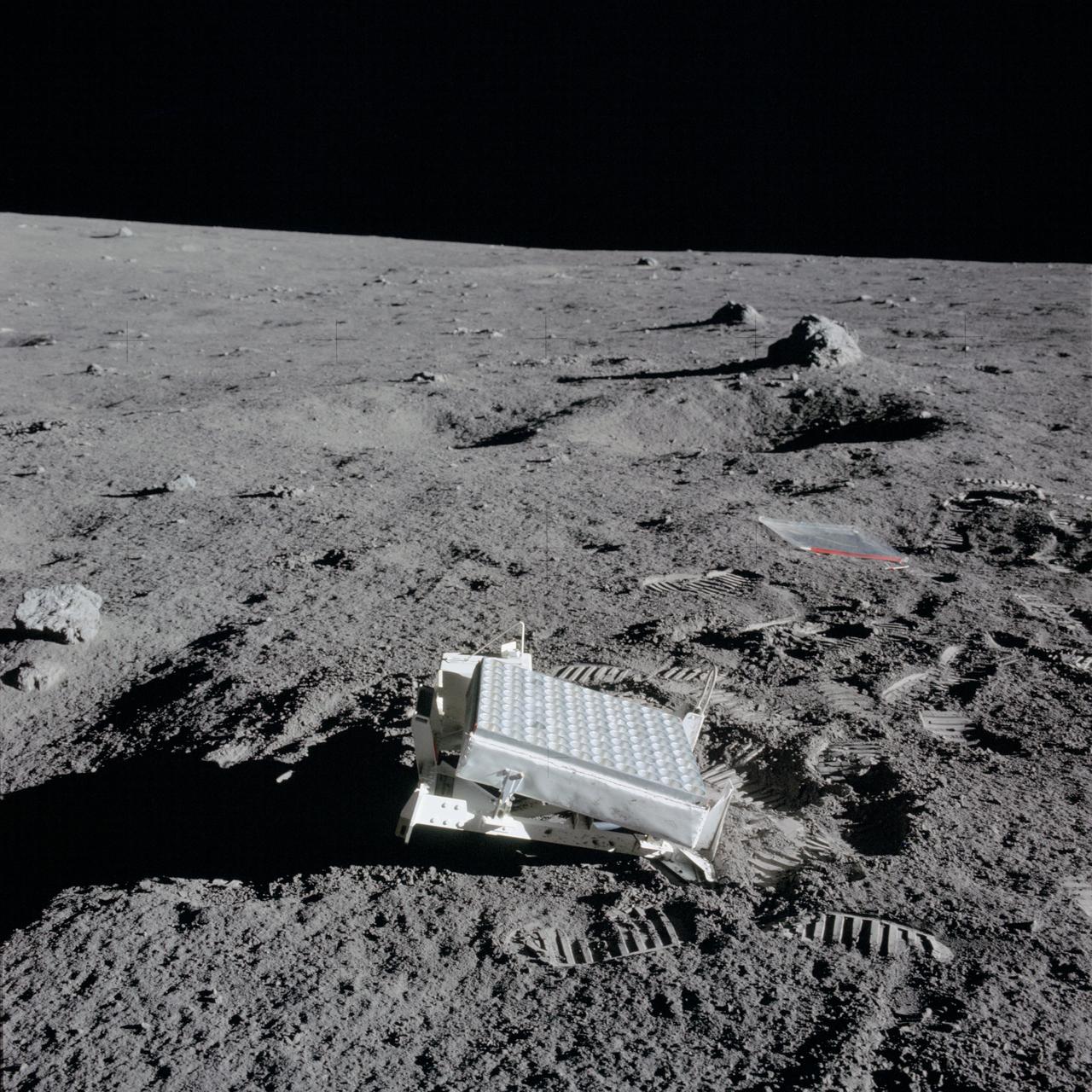
AS14-67-9386 (5 Feb. 1971) --- A close-up view of the laser ranging retro reflector (LR3) which the Apollo 14 astronauts deployed on the moon during their lunar surface extravehicular activity (EVA). While astronauts Alan B. Shepard Jr., commander, and Edgar D. Mitchell, lunar module pilot, descended in the Lunar Module (LM) to explore the moon, astronaut Stuart A. Roosa, command module pilot, remained with the Command and Service Modules (CSM) in lunar orbit.
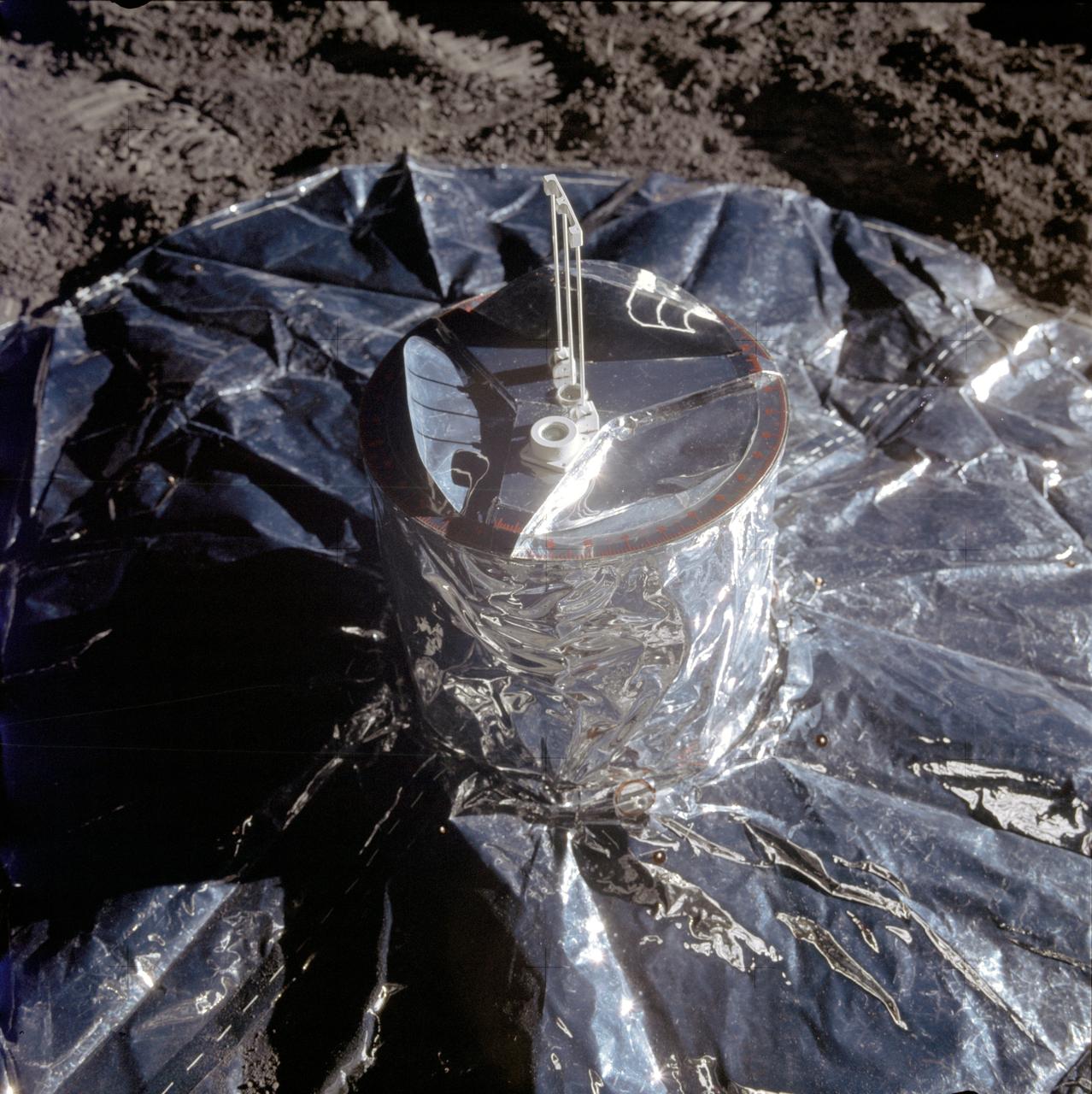
AS14-67-9362 (5 Feb. 1971) --- A close-up view of the passive seismic experiment (PSE), a component of the Apollo lunar surface experiments package (ALSEP), which was deployed on the moon by the Apollo 14 astronauts during their first extravehicular activity (EVA). While astronauts Alan B. Shepard Jr., commander, and Edgar D. Mitchell, lunar module pilot, descended in the Lunar Module (LM) to explore the moon, astronaut Stuart A. Roosa, command module pilot, remained with the Command and Service Modules (CSM) in lunar orbit.
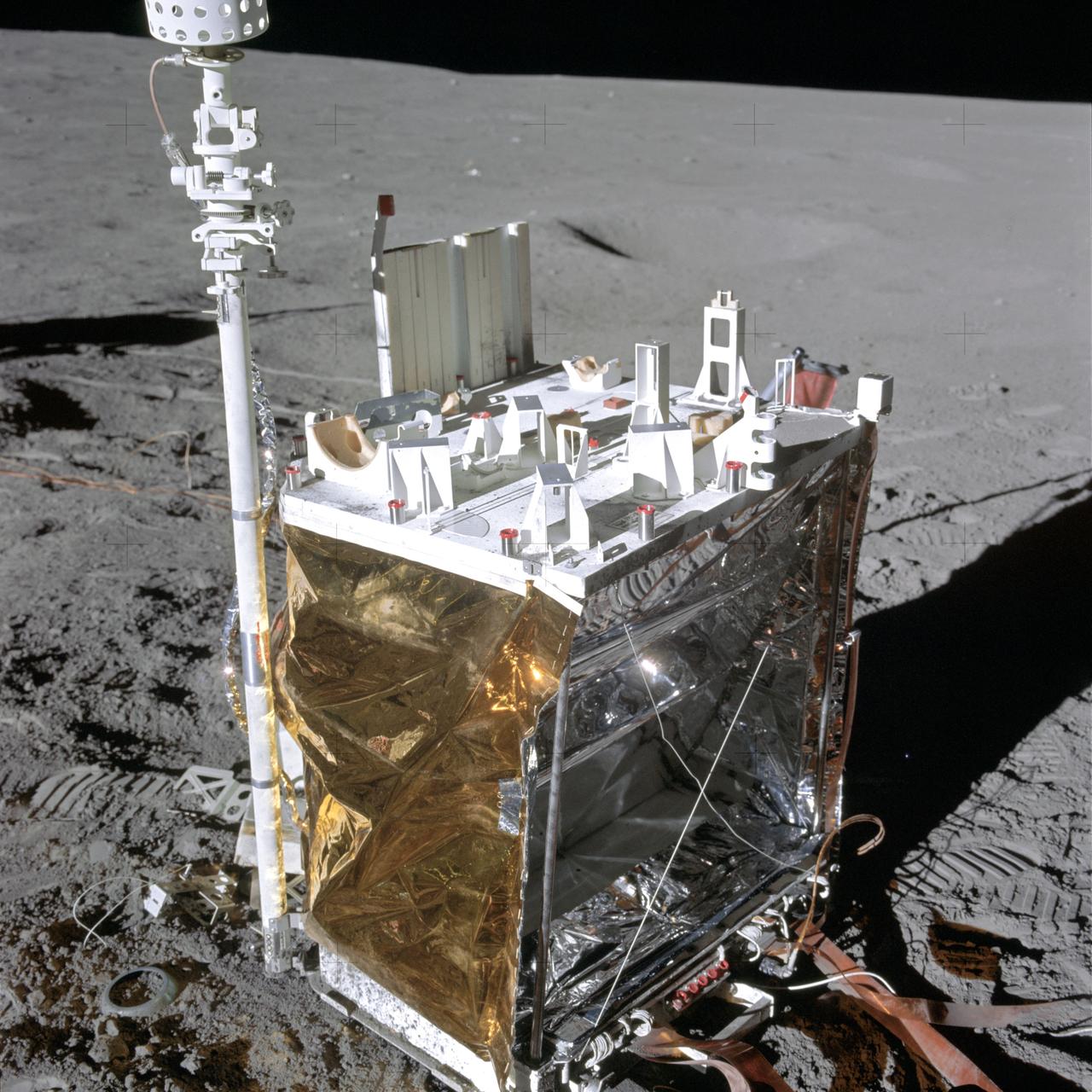
AS14-67-9379 (5 Feb. 1971) --- A close-up view of the central station (CS) of the Apollo lunar surface experiments package (ALSEP), which was deployed on the moon by the Apollo 14 astronauts during their first extravehicular activity (EVA). While astronauts Alan B. Shepard Jr., commander, and Edgar D. Mitchell, lunar module pilot, descended in the Lunar Module (LM) to explore the moon, astronaut Stuart A. Roosa, command module pilot, remained with the Command and Service Modules (CSM) in lunar orbit.
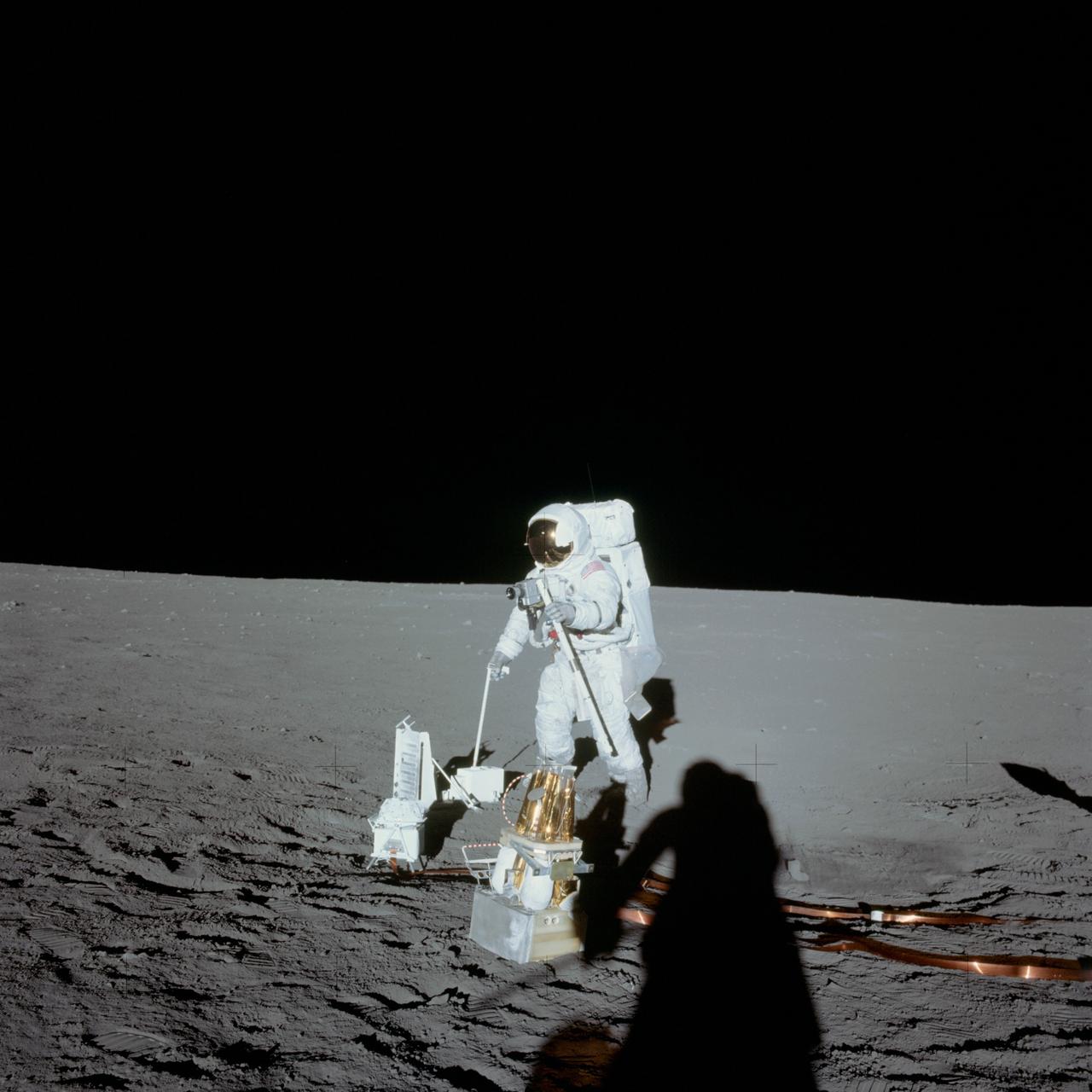
AS12-47-6919 (19 Nov. 1969) --- Astronaut Alan L. Bean, lunar module pilot, deploys components of the Apollo Lunar Surface Experiments Package (ALSEP) during the first Apollo 12 extravehicular activity (EVA) on the moon. The photo was made by astronaut Charles Conrad Jr., commander, using a 70mm handheld Hasselblad camera modified for lunar surface usage.
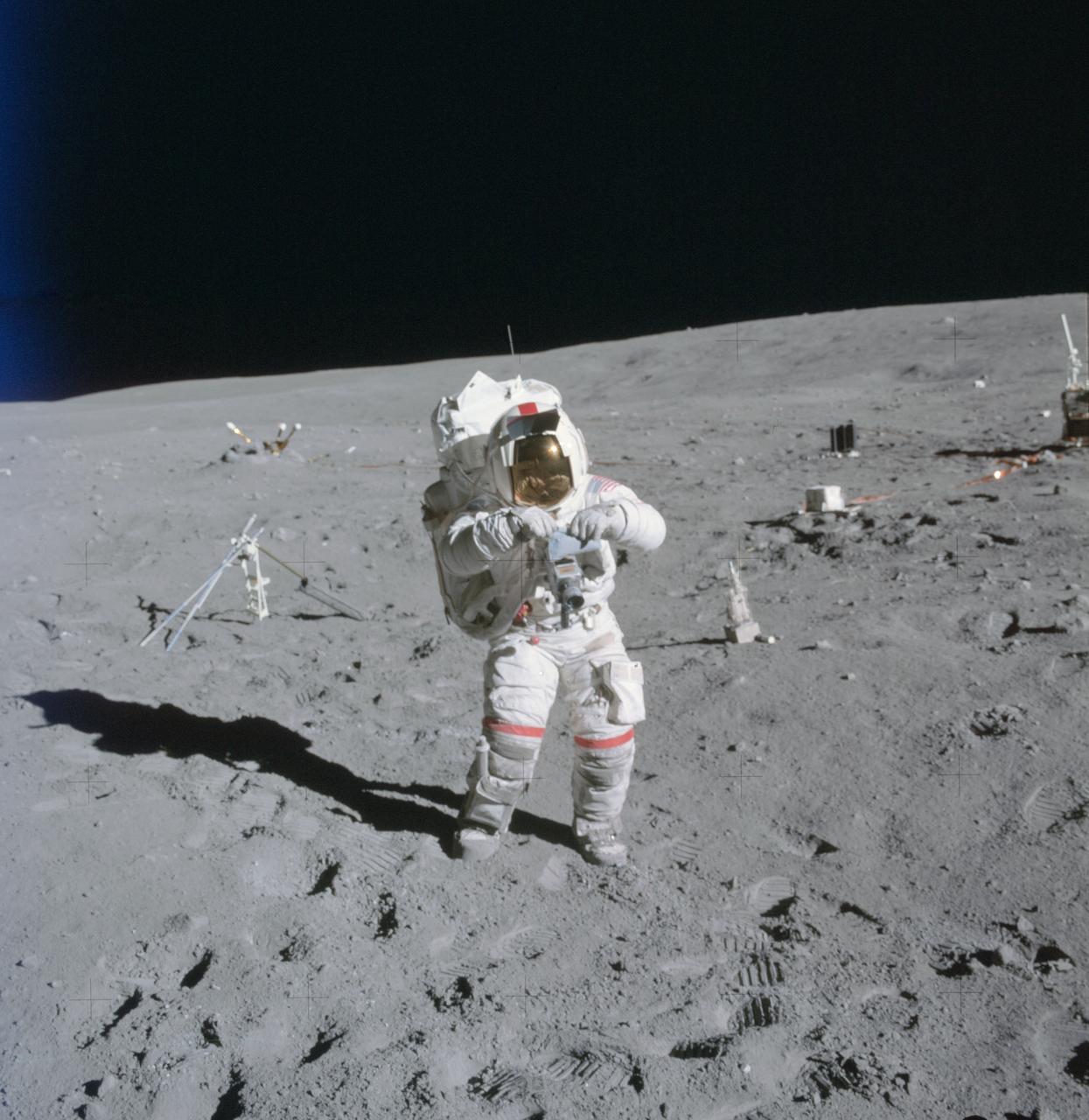
AS16-114-18388 (21 April 1972) --- Astronaut John W. Young, commander of the Apollo 16 lunar landing mission, stands at the Apollo Lunar Surface Experiments Package (ALSEP) deployment site during the first Apollo 16 extravehicular activity (EVA) at the Descartes landing site. The components of the ALSEP are in the background. The lunar surface drill is just behind and to the right of astronaut Young. The drill's rack and bore stems are to the left. The three-sensor Lunar Surface Magnetometer is beyond the rack. The dark object in the right background is the Radioisotope Thermoelectric Generator (RTG). Between the RTG and the drill is the Heat Flow Experiment. A part of the Central Station is at the right center edge of the picture. This photograph was taken by astronaut Charles M. Duke Jr., lunar module pilot.
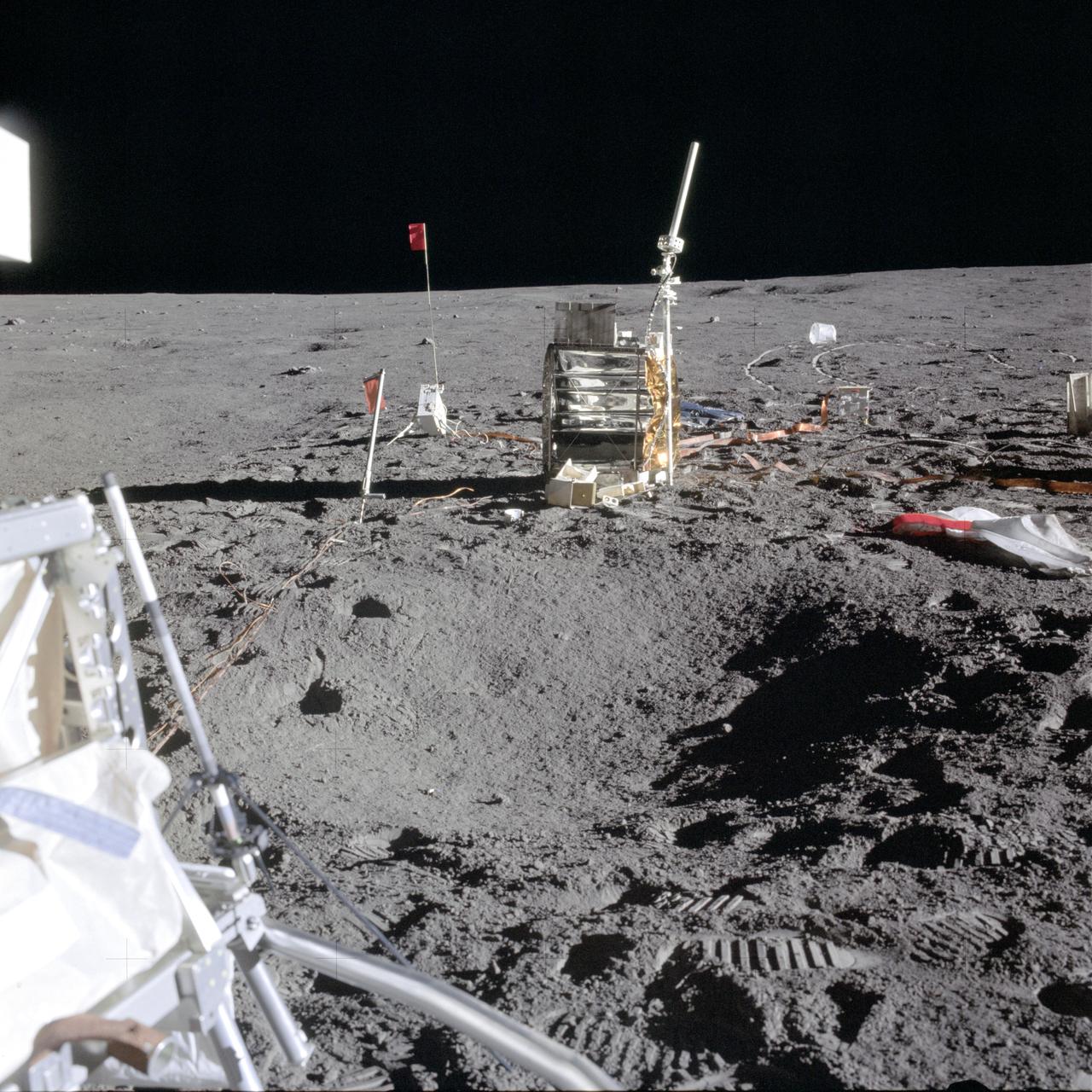
AS14-67-9376 (5 Feb. 1971) --- Several components of the Apollo lunar surface experiments package (ASLEP) are deployed in this photograph taken during the first Apollo 14 extravehicular activity (EVA). The larger object with antenna is the ALSEP central station (CS). The active seismic experiment (ASE) mortar package assembly is to the rear left of the CS. The charged particle lunar environment experiment (CPLEE) is to the right rear of the CS. A portion of the modularized equipment transporter (MET) can be seen in the left foreground.
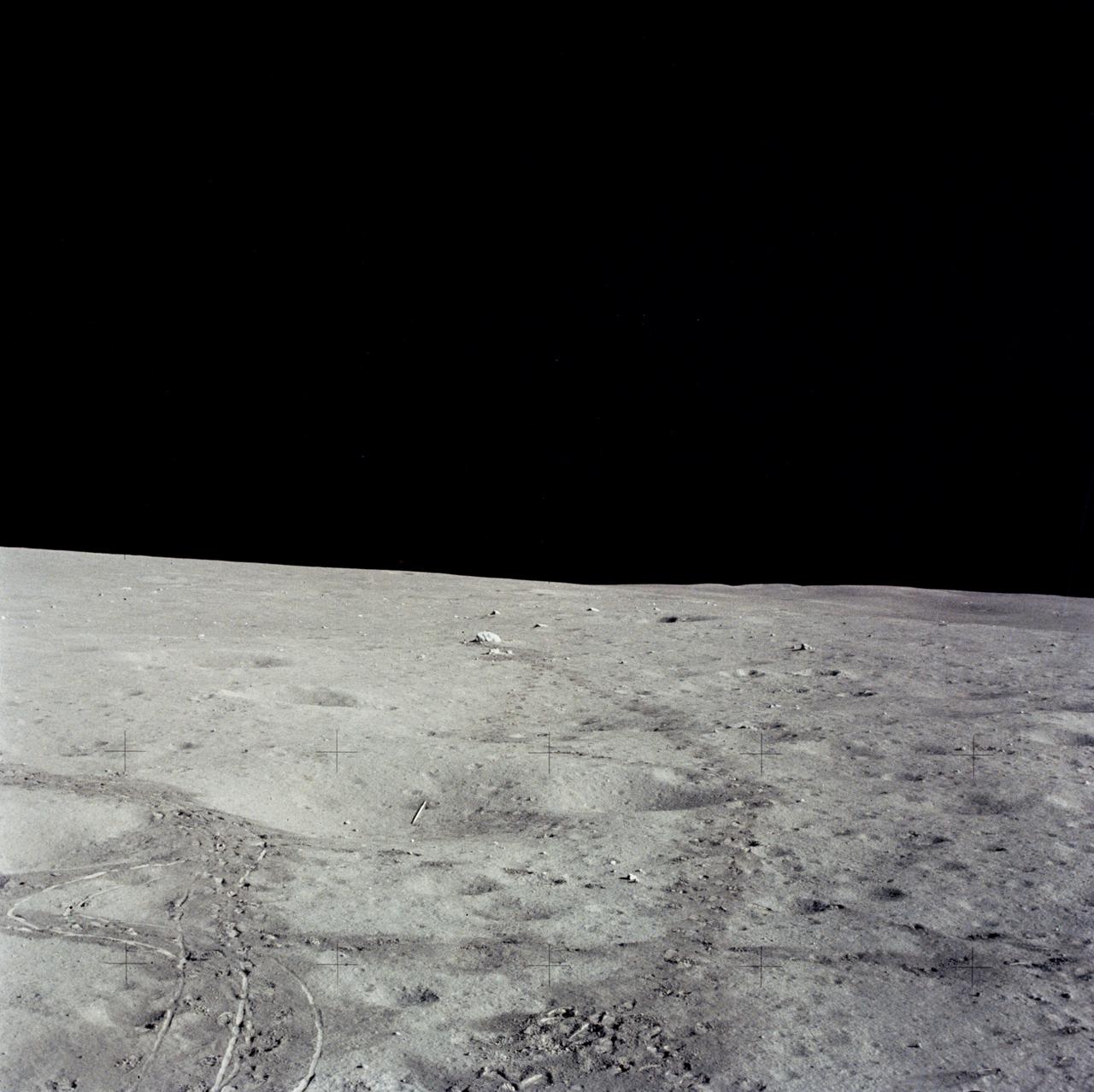
AS14-66-9337 (6 Feb. 1971) --- This view shows the "javelin" and golf ball used by astronaut Alan B. Shepard Jr., commander, during the mission's second extravehicular activity (EVA) on Feb. 6, 1971. Just to the left of center lies the "javelin", with the golf ball just below it, almost perpendicular to it. Dark colored trails are the results of tracks made by the lunar overshoes of the astronauts and the wheels of the modular equipment transporter (MET). This photograph was made through the right window of the Lunar Module (LM), looking northwest.

AS16-113-18339 (21 April 1972) --- Astronaut John W. Young, commander of the Apollo 16 lunar landing mission, leaps from the lunar surface as he salutes the United States flag at the Descartes landing site during the first Apollo 16 extravehicular activity (EVA). Astronaut Charles M. Duke Jr., lunar module pilot, took this picture. The Lunar Module (LM) "Orion" is on the left. The Lunar Roving Vehicle (LRV) is parked beside the LM. The object behind Young (in the shade of the LM) is the Far Ultraviolet Camera/Spectrograph (FUC/S). Stone Mountain dominates the background in this lunar scene. While astronauts Young and Duke descended in the LM to explore the Descartes highlands landing site on the moon, astronaut Thomas K. Mattingly II, command module pilot, remained with the Command and Service Modules (CSM) "Casper" in lunar orbit.
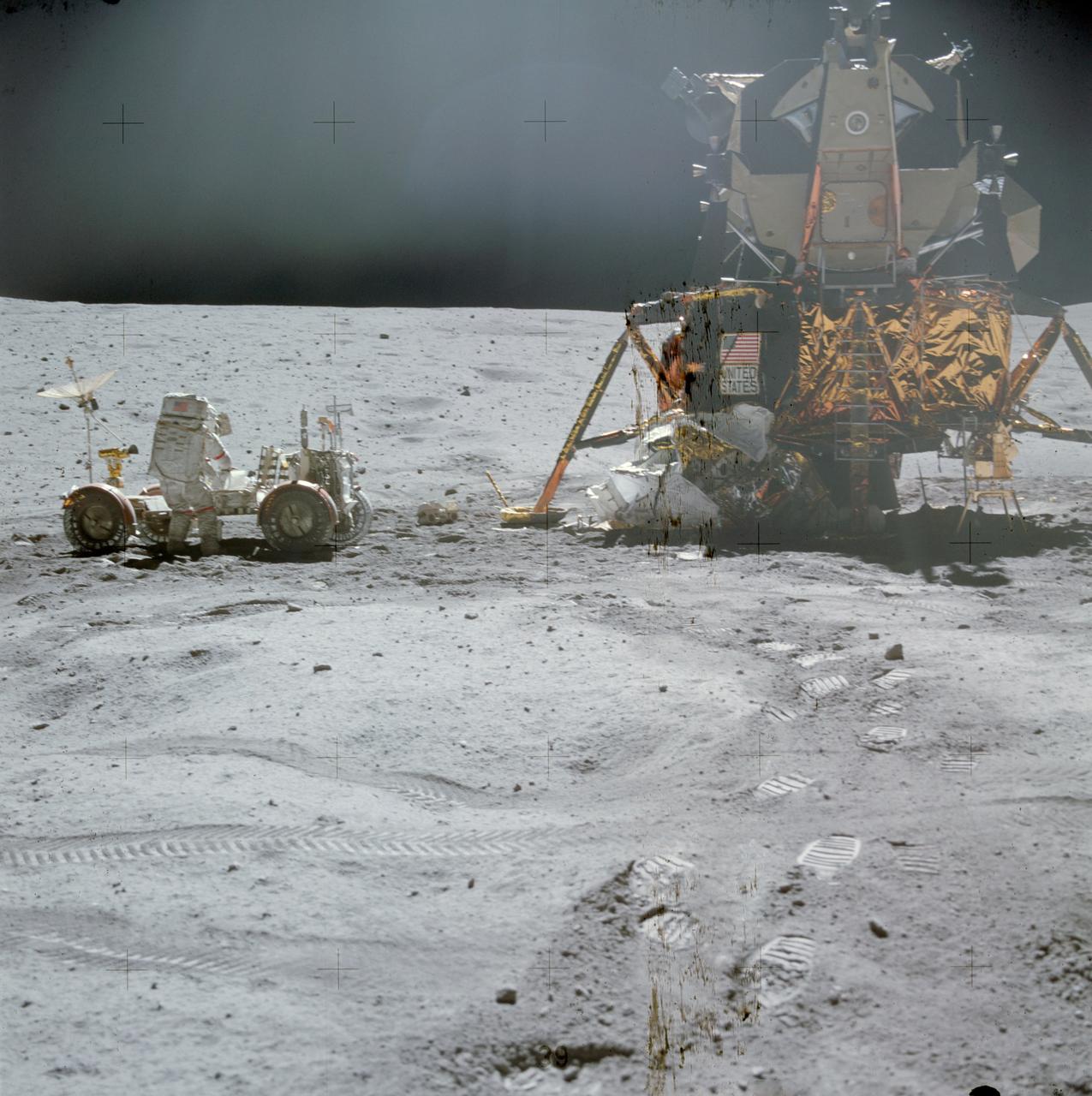
AS16-116-18578 (21 April 1972) --- Astronaut John W. Young, commander of the Apollo 16 lunar landing mission, works at the Lunar Roving Vehicle (LRV) just prior to deployment of the Apollo Lunar Surface Experiments Package (ALSEP) during the first extravehicular activity (EVA) on April 21, 1972. Note the Ultraviolet (UV) Camera/Spectrometer to the right of the Lunar Module (LM) ladder. Also, note the pile of protective/thermal foil under the U.S. flag on the LM which the astronauts pulled away to get to the Modular Equipment Storage Assembly (MESA) bay. While astronauts Young and Charles M. Duke Jr., lunar module pilot; descended in the Apollo 16 LM "Orion" to explore the Descartes highlands landing site on the moon, astronaut Thomas K. Mattingly II, command module pilot, remained with the Command and Service Modules (CSM) "Casper" in lunar orbit.
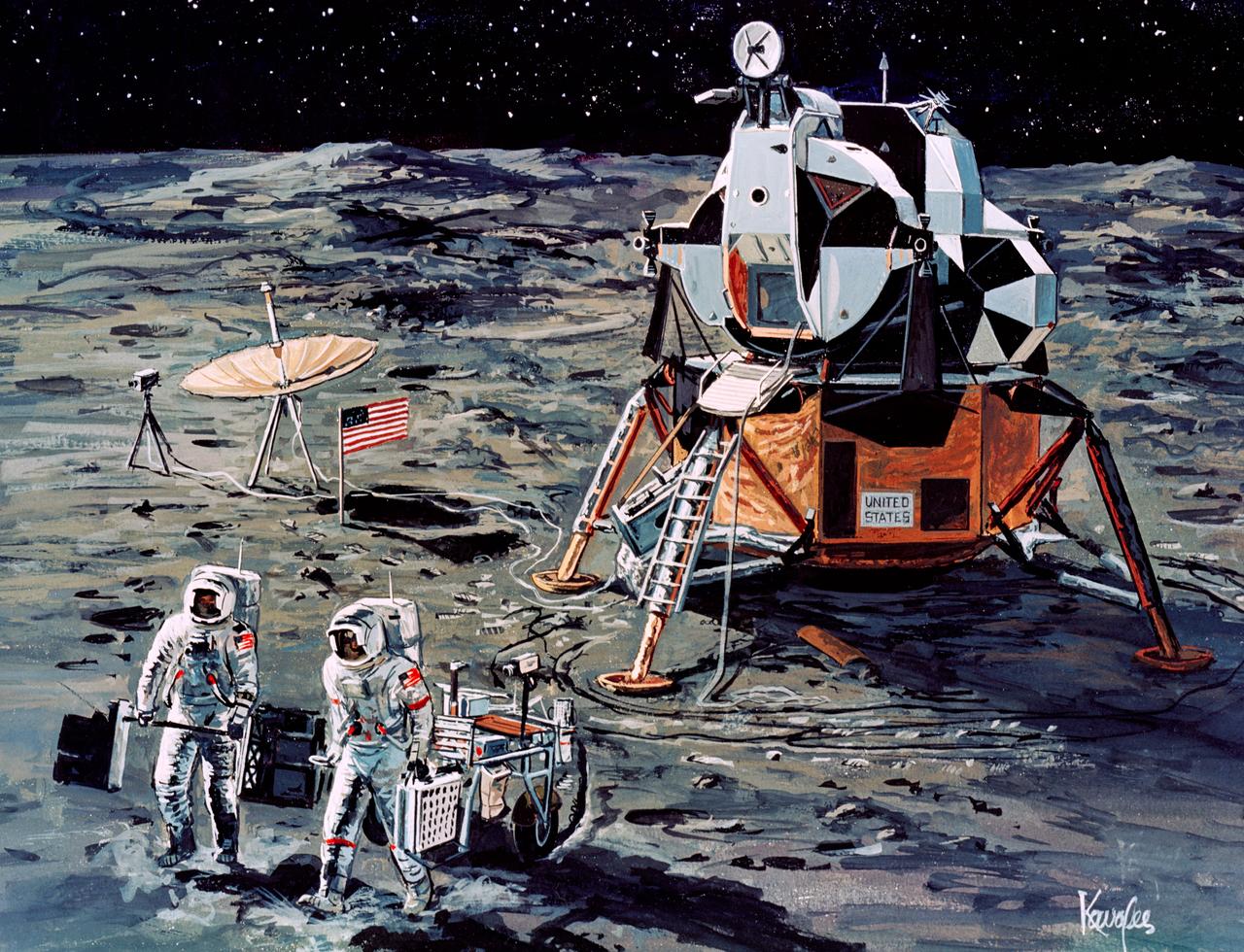
S71-16101 (January 1971) --- A Grumman Aerospace Corporation artist's concept of Apollo 14 crewmen, astronauts Alan B. Shepard Jr., commander, and Edgar D. Mitchell, lunar module pilot, as they set out on their first traverse. Shepard is pulling the Modularized Equipment Transporter (MET) which contains cameras, lunar sample bags, tools and other paraphernalia. Shepard has the Laser Ranging Retro-Reflector (LR-3) in his other hand. Mitchell is carrying the Apollo Lunar Surface Experiments Package (ALSEP) barbell mode.

AS11-40-5948 (20 July 1969) --- Astronaut Edwin E. Aldrin Jr., lunar module pilot, is photographed during the Apollo 11 extravehicular activity (EVA) on the moon. He has just deployed the Early Apollo Scientific Experiments Package (EASEP). This is a good view of the deployed equipment. In the foreground is the Passive Seismic Experiment Package (PSEP); beyond it is the Laser Ranging Retro-Reflector (LR-3); in the center background is the United States flag; in the left background is the black and white lunar surface television camera; in the far right background is the Lunar Module (LM). Astronaut Neil A. Armstrong, commander, took this picture with a 70mm lunar surface camera. While astronauts Armstrong and Aldrin descended in the Lunar Module (LM) "Eagle" to explore the Sea of Tranquility region of the moon, astronaut Michael Collins, command module pilot, remained with the Command and Service Modules (CSM) "Columbia" in lunar orbit.
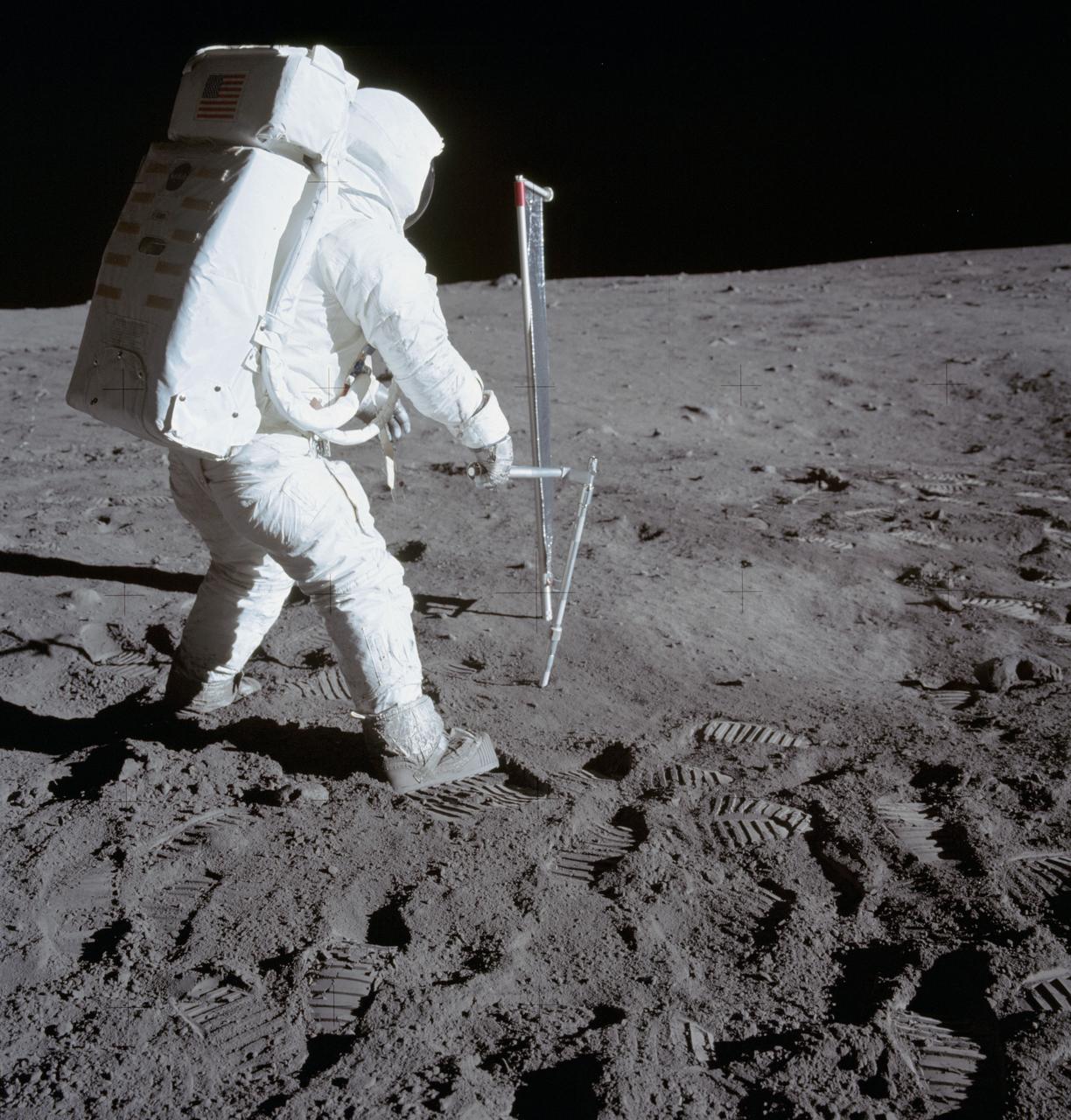
AS11-40-5964 (20 July 1969) --- Astronaut Edwin E. Aldrin Jr., lunar module pilot, is photographed during the Apollo 11 extravehicular activity (EVA) on the moon. He is driving one of two core tubes into the lunar soil. Astronaut Neil A. Armstrong, commander, took this picture with a 70mm lunar surface camera. Aldrin stands near the Solar Wind Composition (SWC) experiment, a component of the Early Apollo Scientific Experiments Package (EASEP, deployed earlier). The SWC is in the center background.
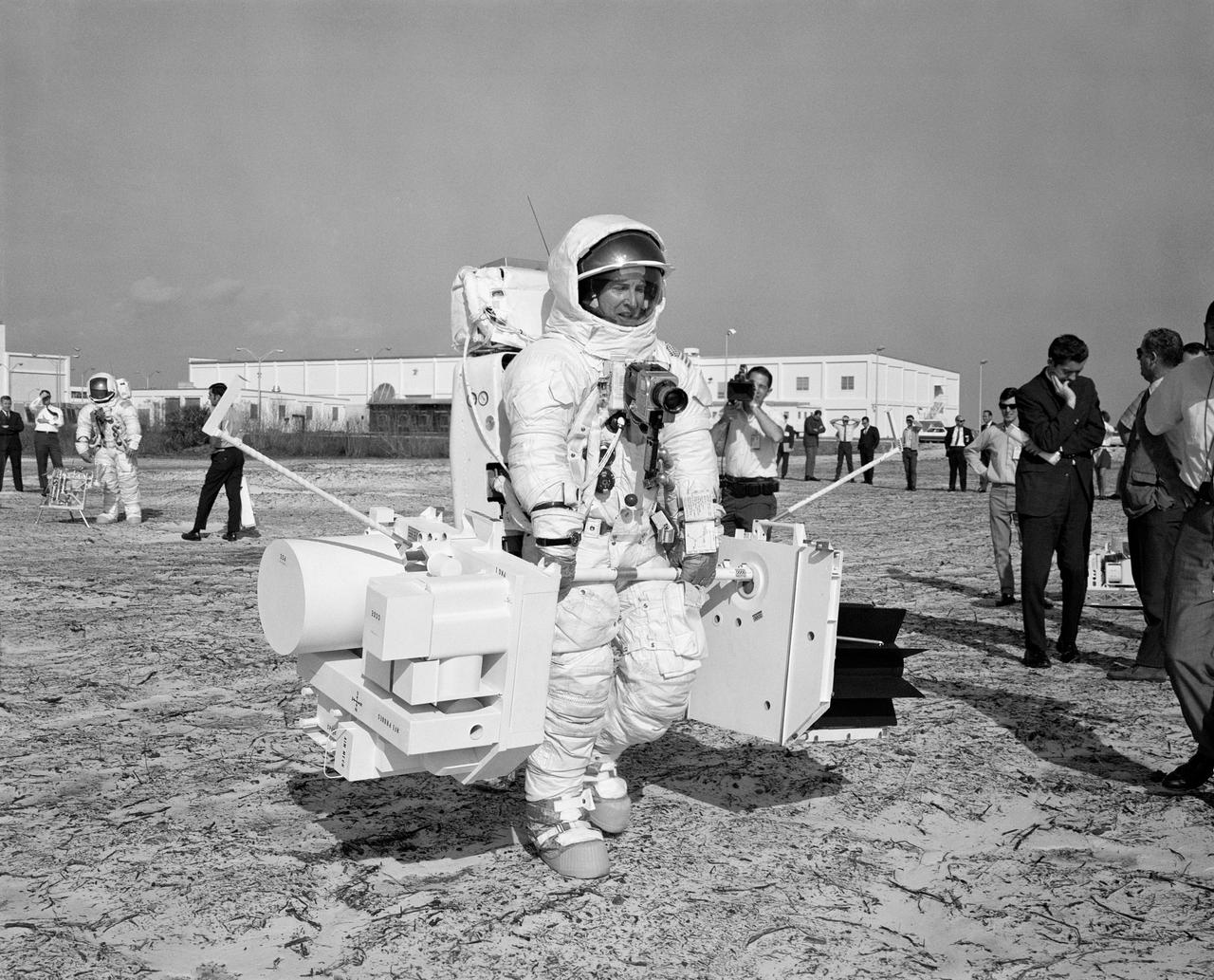
S70-29672 (28 Jan. 1970) --- Astronaut James A. Lovell Jr., commander of the Apollo 13 lunar landing mission, participates in a walk-through of the extravehicular activity timeline at the Kennedy Space Center. Here, Lovell, using mock-ups, traverses with the two subpackages of the Apollo Lunar Surface Experiments Package (ALSEP). Astronaut Fred W. Haise Jr., lunar module pilot, is standing in the left background.
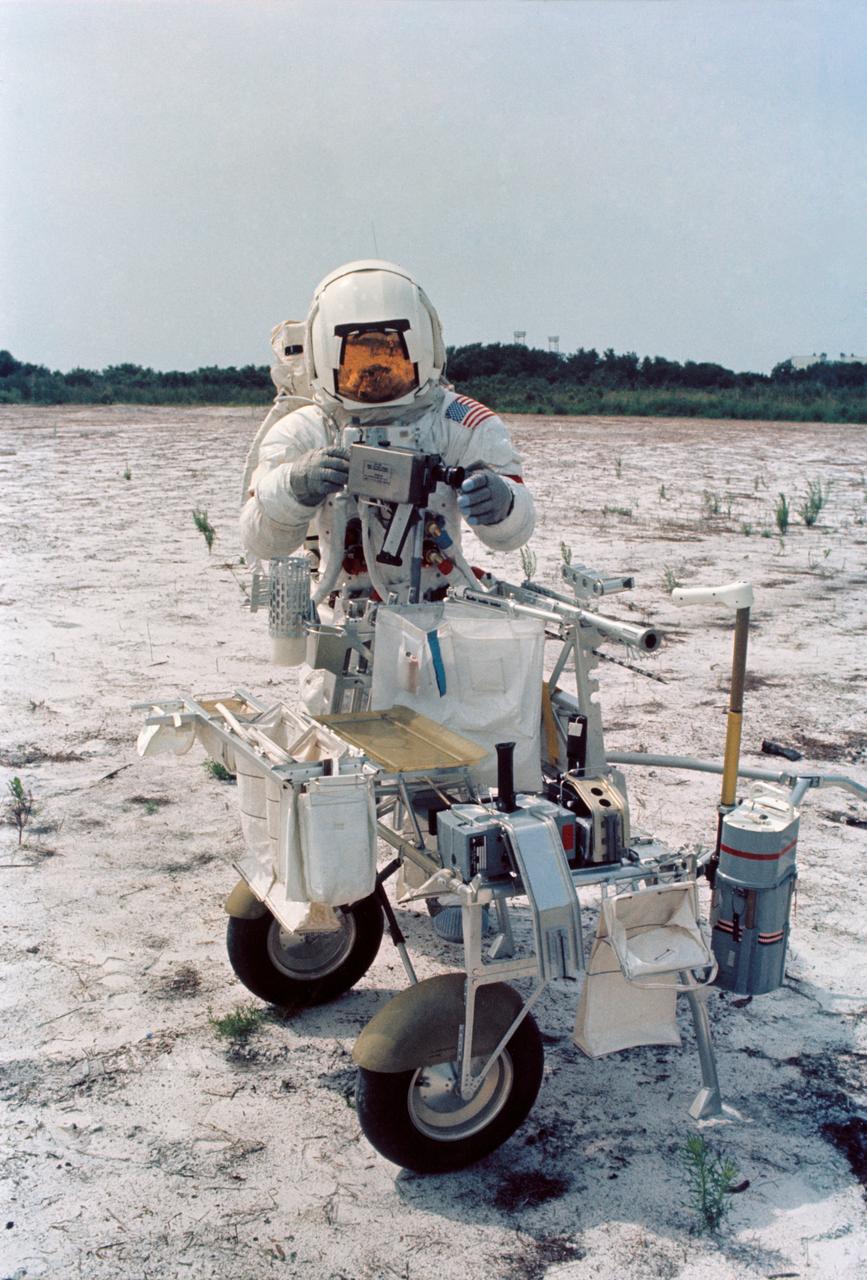
S70-46191 (July 1970) --- Astronaut Alan B. Shepard Jr., commander of the Apollo 14 lunar landing mission, participates in lunar surface training at the Kennedy Space Center (KSC). Shepard is adjusting a camera mounted to the modular equipment transporter (MET). The MET, nicknamed the "Rickshaw", will serve as a portable work bench with a place for the Apollo lunar hand tools and their carrier, three cameras, two sample container bags, a special environment sample container, spare magazines, and a lunar surface Penetrometer. Shepard is wearing an Extravehicular Mobility Unit (EMU).
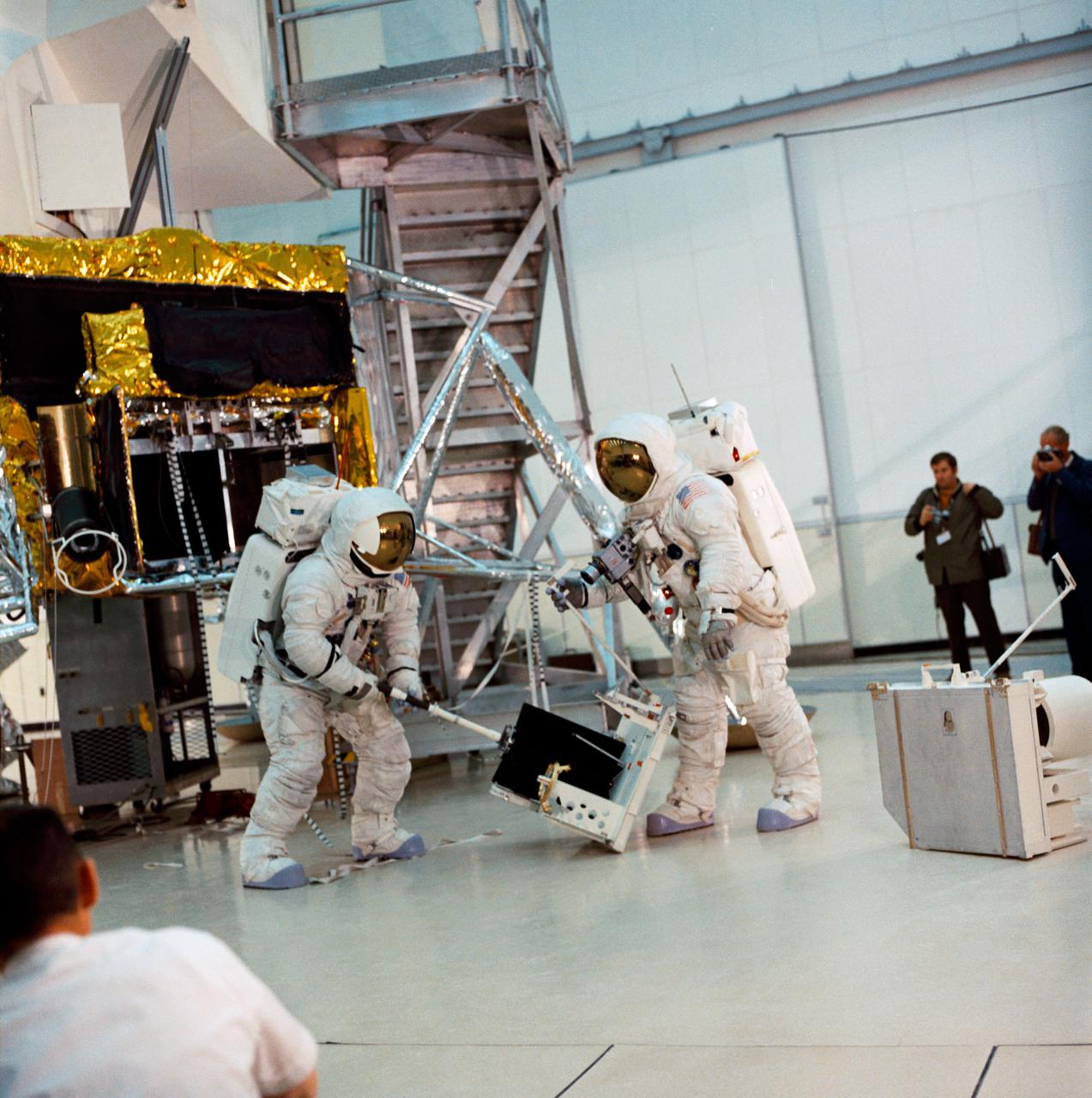
S70-27036 (4 Feb. 1970) --- Two crew men of the Apollo 13 lunar landing mission simulate lunar surface extravehicular activity (EVA) during training exercises in the Kennedy Space Center's (KSC) Flight Crew Training Building. They are astronauts James A. Lovell Jr. commander; and Fred W. Haise Jr., lunar module pilot.
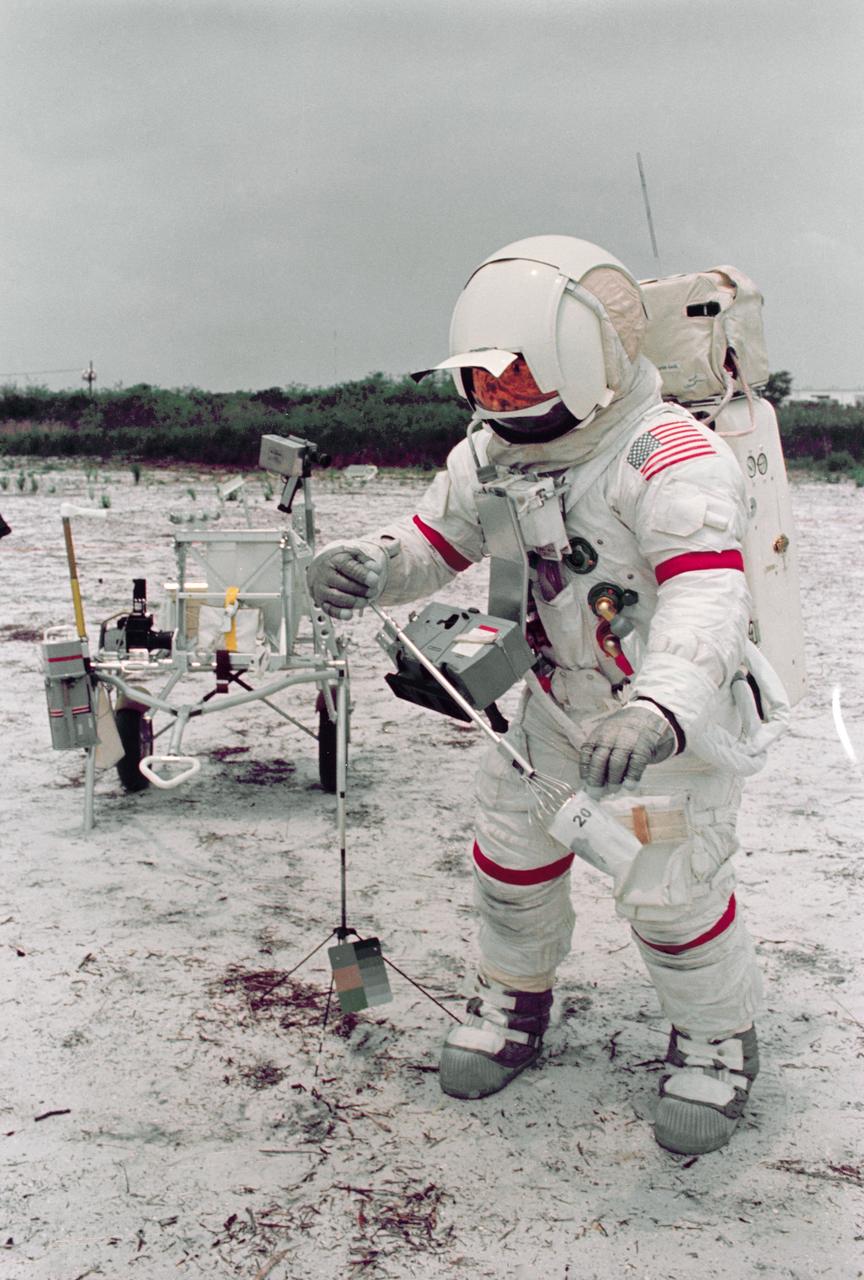
S70-46157 (July 1970) --- Astronaut Alan B. Shepard Jr., commander of the Apollo 14 lunar landing mission, participates in lunar surface simulation training at the Kennedy Space Center (KSC). The modular equipment transporter (MET) is in the left background, in the center foreground is a gnomon. The MET, nicknamed the "Rickshaw", will serve as a portable work bench with a place for the Apollo lunar hand tools and their carrier, three cameras, two sample container bags, a special environment sample container, spare magazines, and a lunar surface Penetrometer. Shepard is wearing an Extravehicular Mobility Unit (EMU).
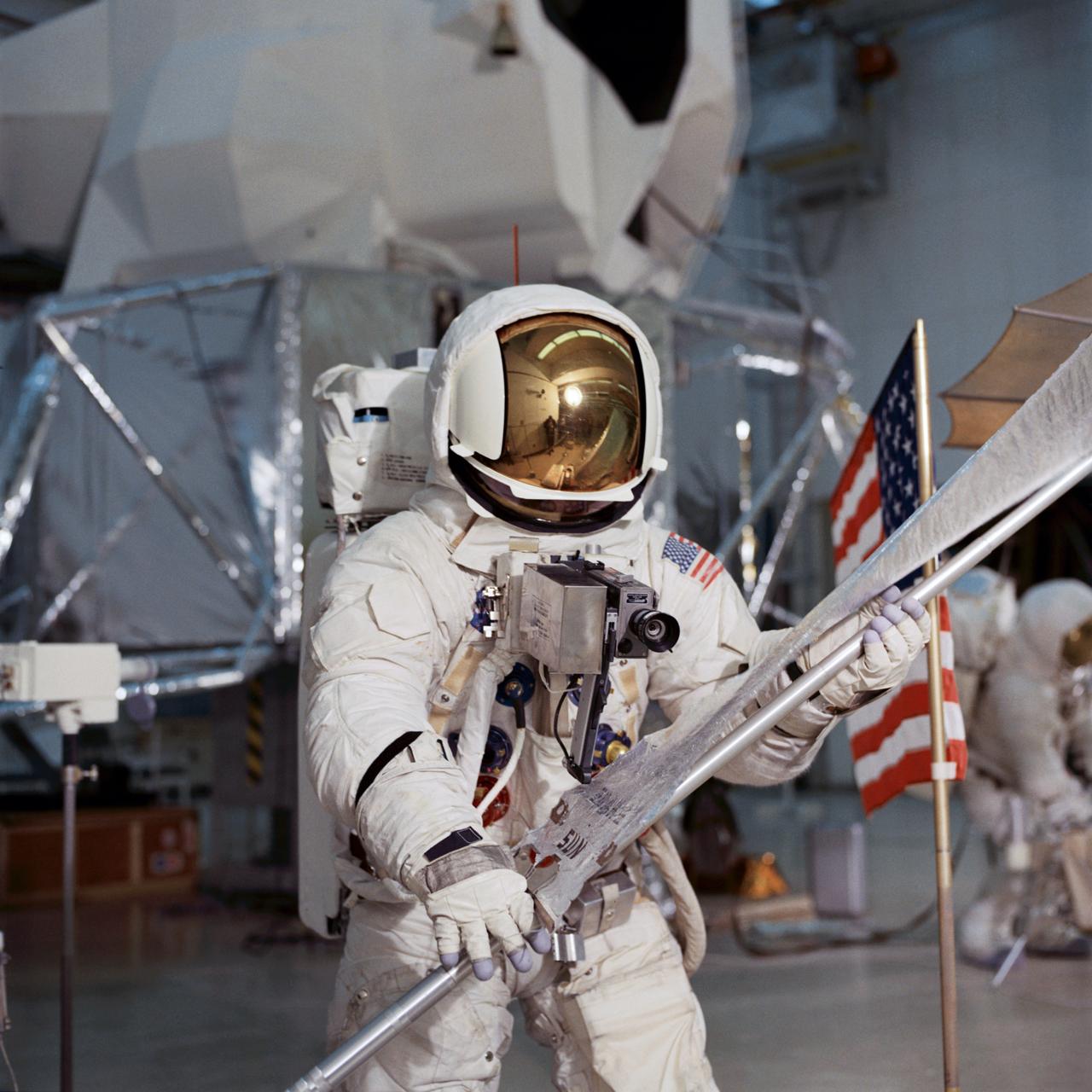
S70-27034 (4 Feb. 1970) --- Astronaut Fred W. Haise Jr., lunar module pilot of the Apollo 13 lunar landing mission, simulates lunar surface extravehicular activity (EVA) during training exercises in the Kennedy Space Center's (KSC) Flight Crew Training Building (FCTB). Haise, wearing an Extravehicular Mobility Unit (EMU), is holding a Solar Wind Composition (SWC) experiment.