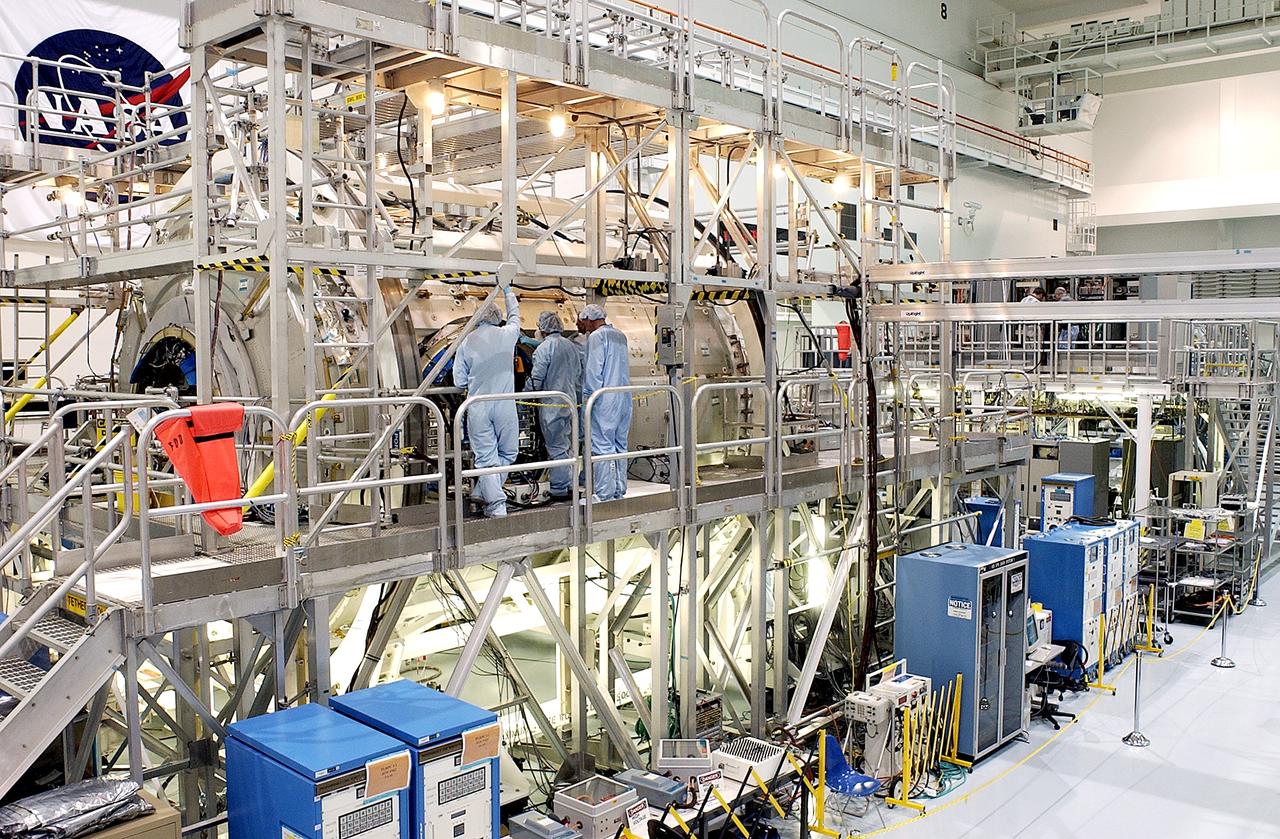
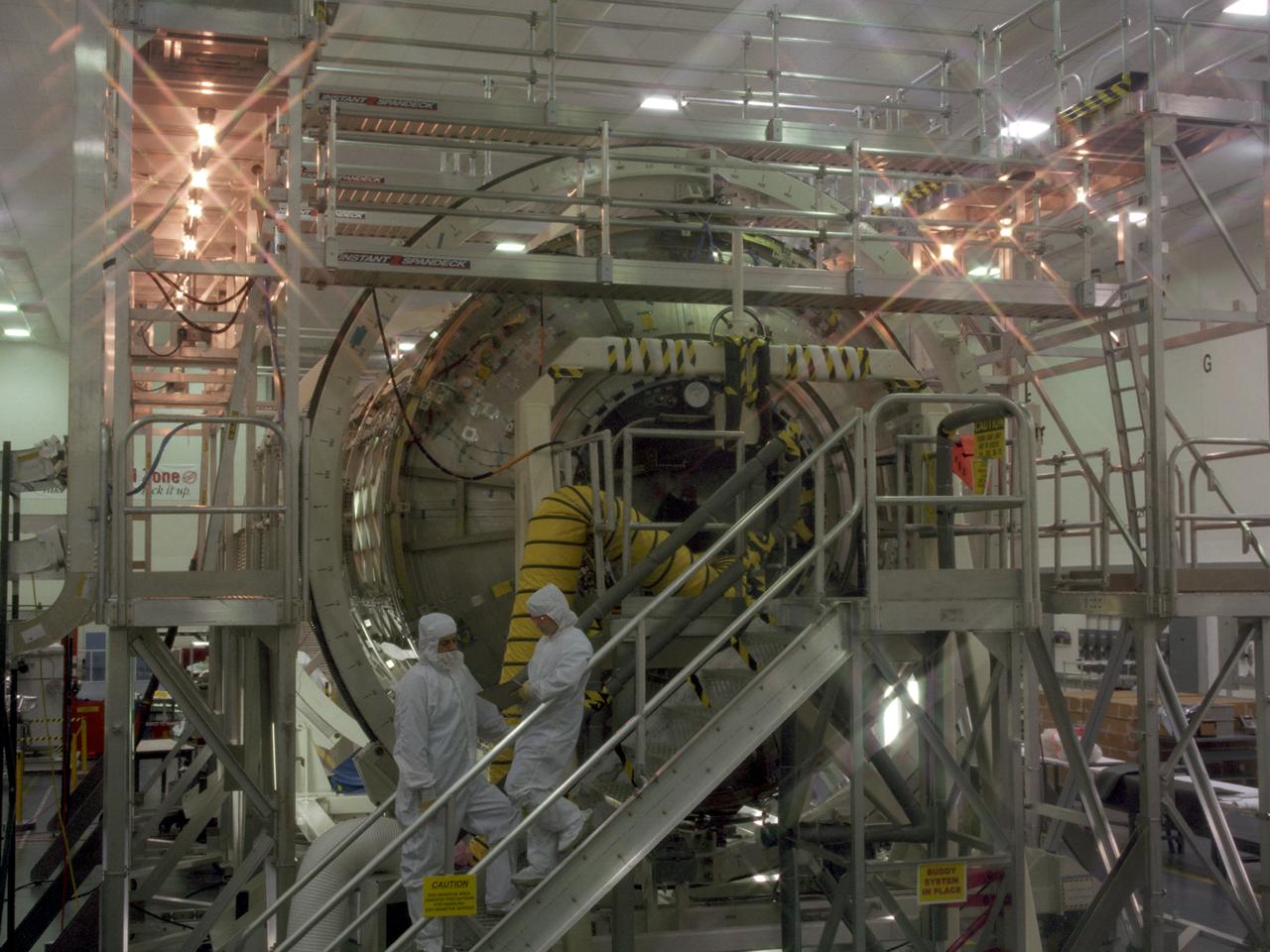
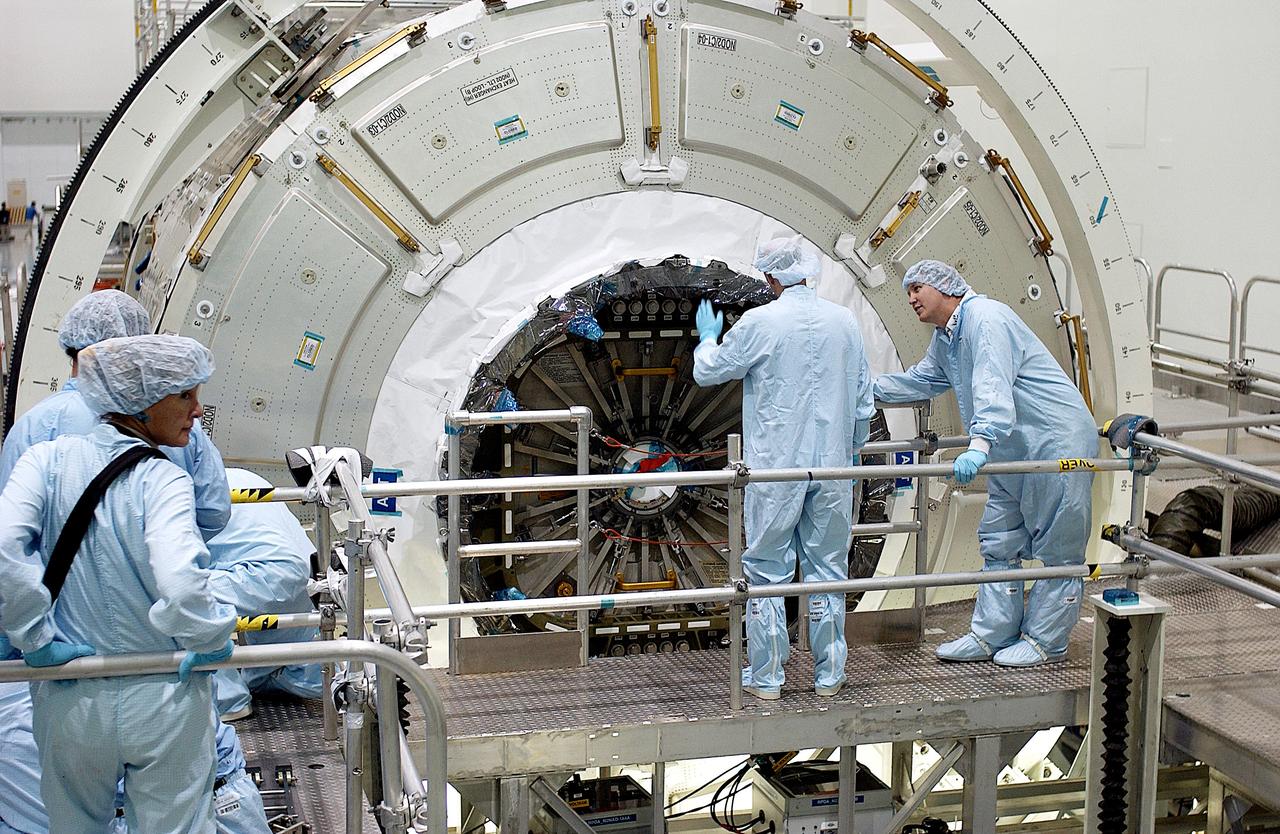
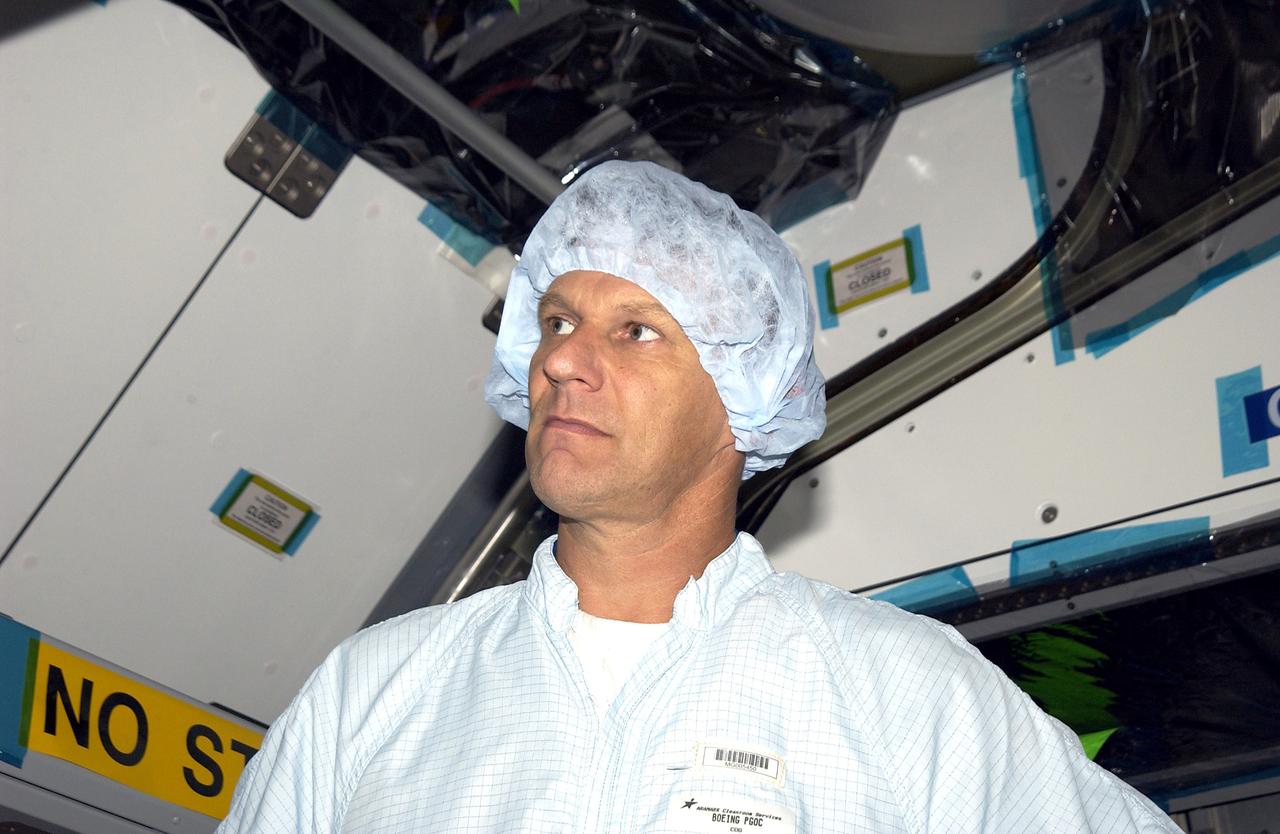
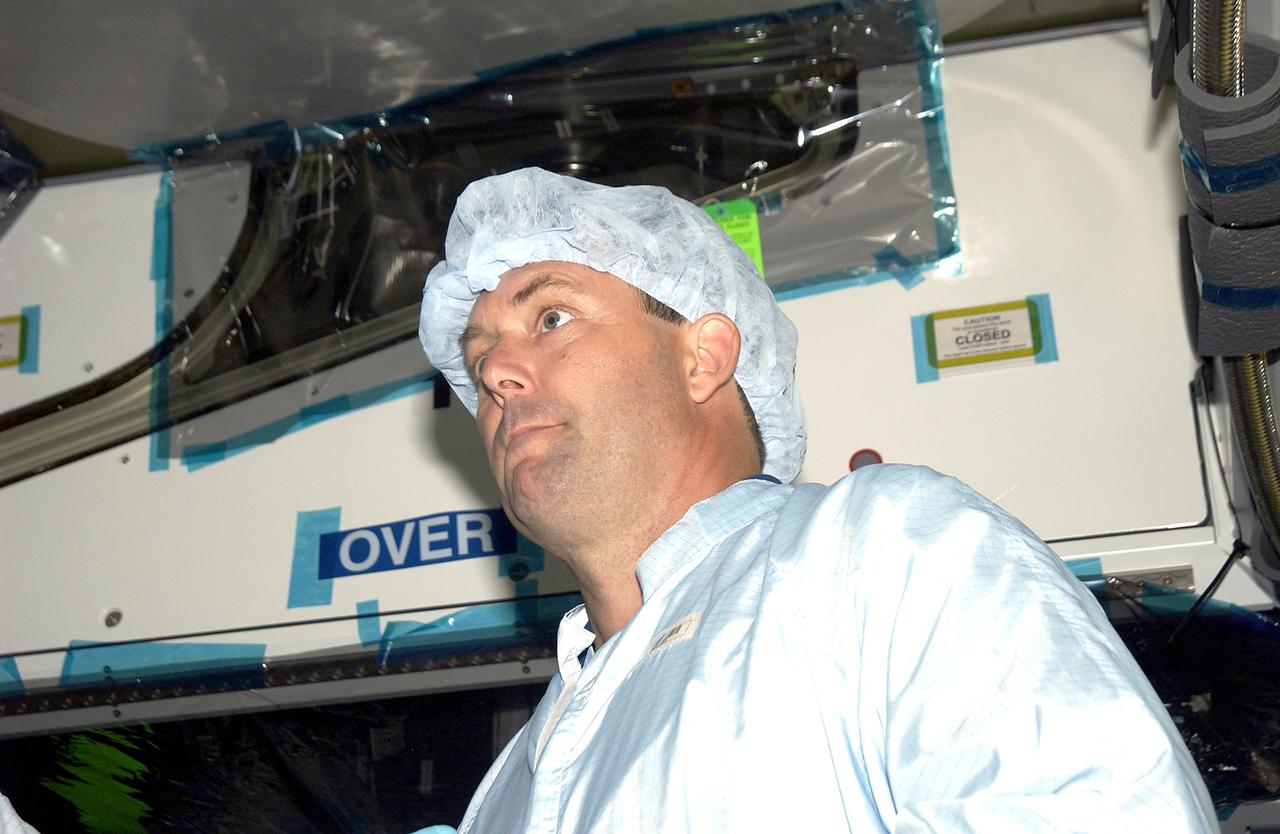
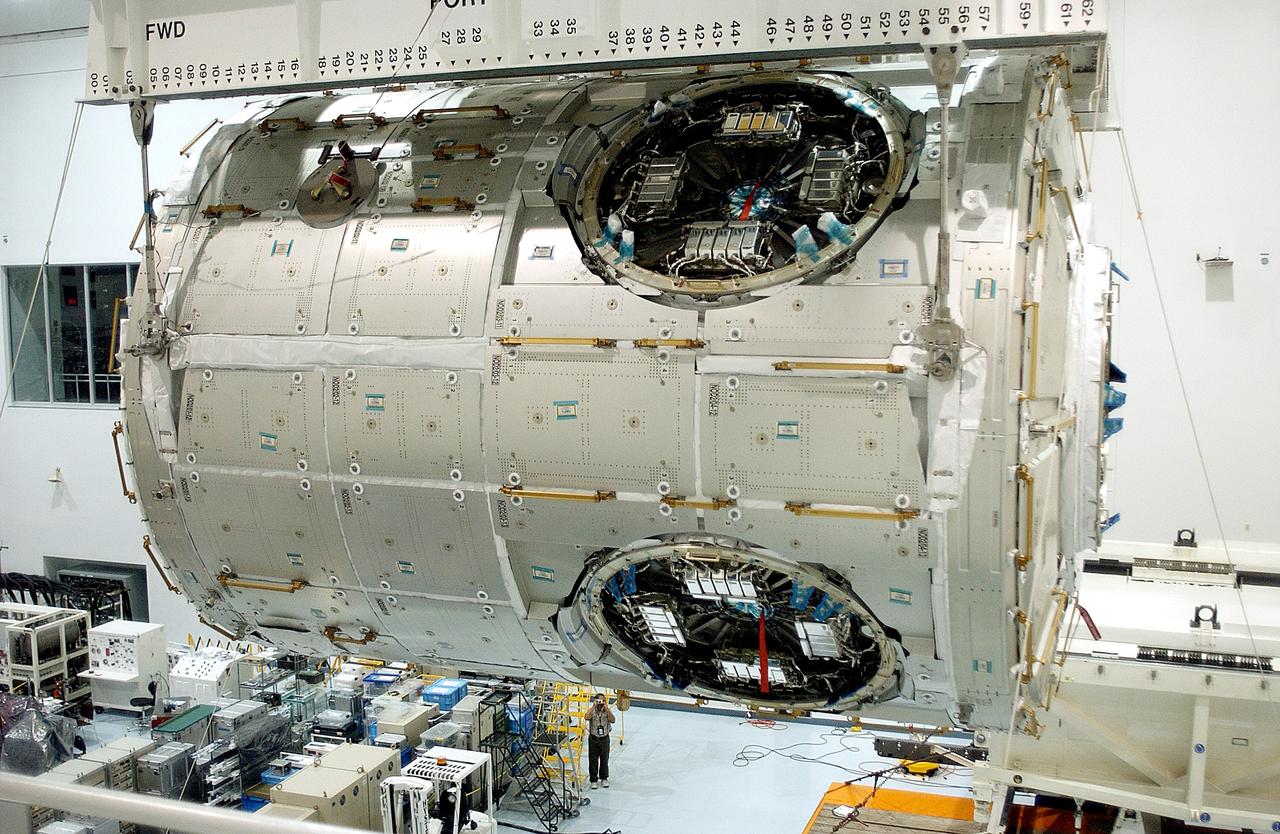
KENNEDY SPACE CENTER, FLA.  - In the Space Station Processing Facility, work is ongoing on the U.S. Node 2, the second of three Space Station connecting modules.  The Italian-built Node 2 attaches to the end of the U.S. Lab and will provide attach locations for the Japanese laboratory, European laboratory, the Centrifuge Accommodation Module and, later, Multipurpose Logistics Modules. It will provide the primary docking location for the Shuttle when a pressurized mating adapter is attached to Node 2.  Installation of the module will complete the U.S. Core of the ISS.  Node 2 is the designated payload for mission STS-120.  No orbiter or launch date has been determined yet.
KENNEDY SPACE CENTER, FLA. - In the Space Station Processing Facility, work is ongoing on the U.S. Node 2, the second of three Space Station connecting modules. The Italian-built Node 2 attaches to the end of the U.S. Lab and will provide attach locations for the Japanese laboratory, European laboratory, the Centrifuge Accommodation Module and, later, Multipurpose Logistics Modules. It will provide the primary docking location for the Shuttle when a pressurized mating adapter is attached to Node 2. Installation of the module will complete the U.S. Core of the ISS. Node 2 is the designated payload for mission STS-120. No orbiter or launch date has been determined yet.
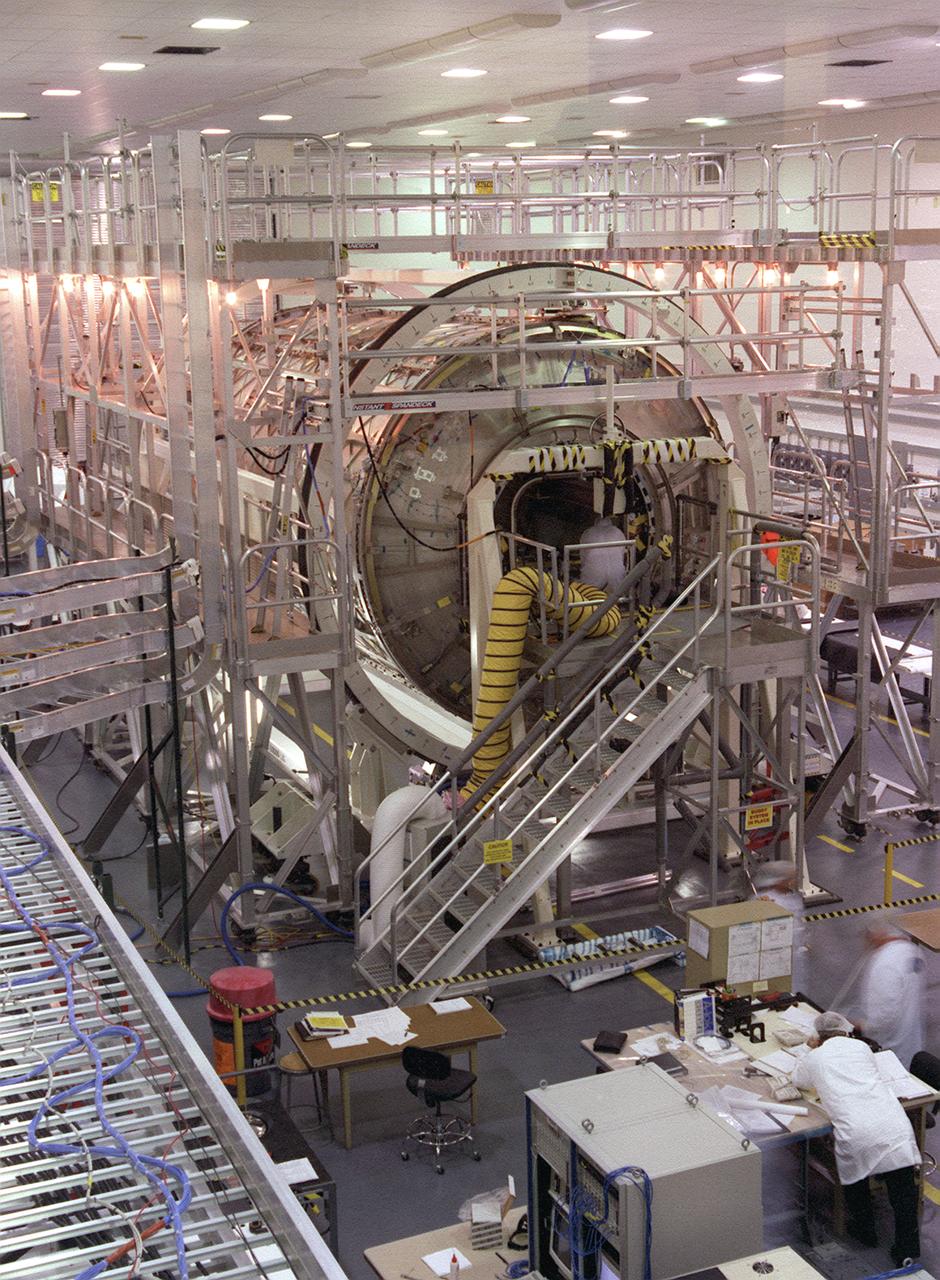
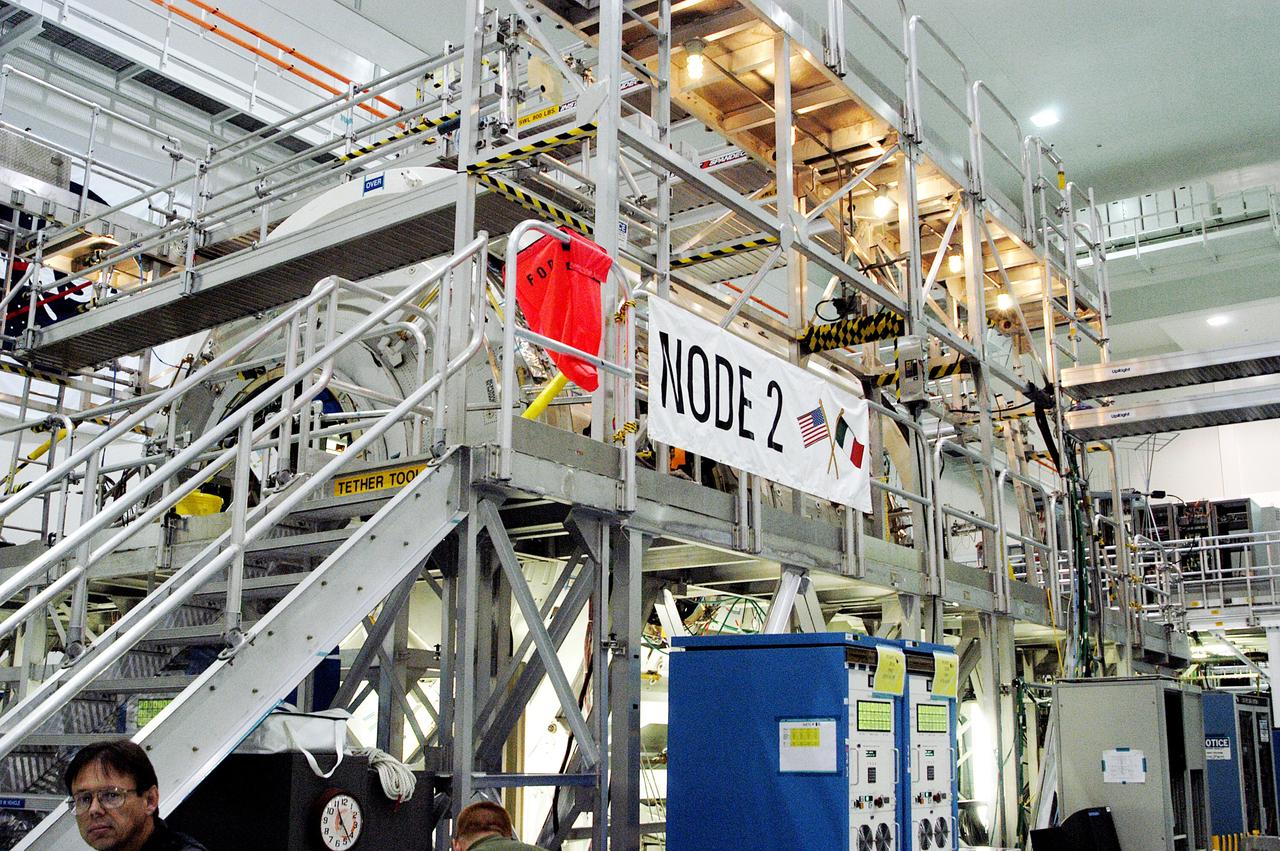
KENNEDY SPACE CENTER, FLA.  -  Work is ongoing on the U.S. Node 2 in the Space Station Processing Facility.  The second of three Space Station connecting modules, the Italian-built Node 2 attaches to the end of the U.S. Lab and will provide attach locations for the Japanese laboratory, European laboratory, the Centrifuge Accommodation Module and, later, Multipurpose Logistics Modules. It will provide the primary docking location for the Shuttle when a pressurized mating adapter is attached to Node 2.  Installation of the module will complete the U.S. Core of the ISS.  Node 2 is the designated payload for mission STS-120.  No orbiter or launch date has been determined yet.
KENNEDY SPACE CENTER, FLA. - Work is ongoing on the U.S. Node 2 in the Space Station Processing Facility. The second of three Space Station connecting modules, the Italian-built Node 2 attaches to the end of the U.S. Lab and will provide attach locations for the Japanese laboratory, European laboratory, the Centrifuge Accommodation Module and, later, Multipurpose Logistics Modules. It will provide the primary docking location for the Shuttle when a pressurized mating adapter is attached to Node 2. Installation of the module will complete the U.S. Core of the ISS. Node 2 is the designated payload for mission STS-120. No orbiter or launch date has been determined yet.
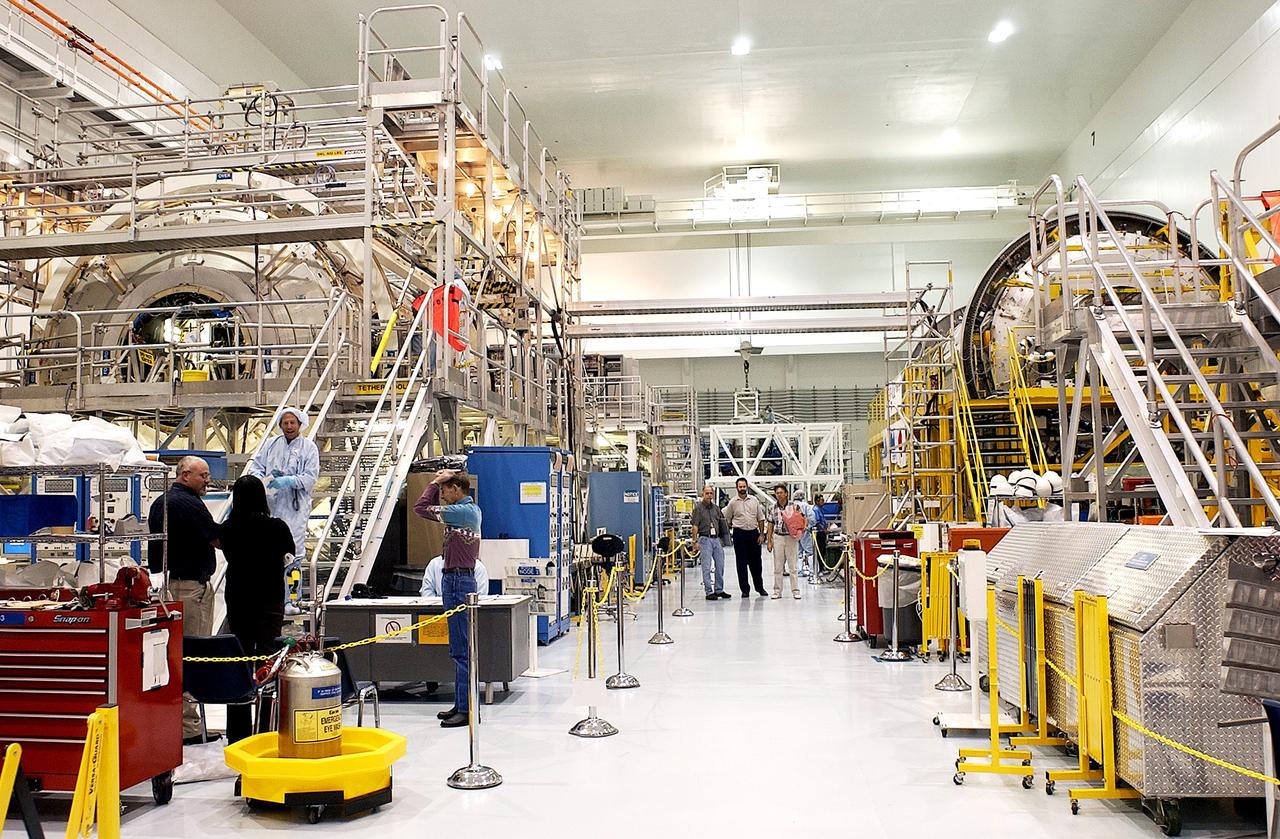
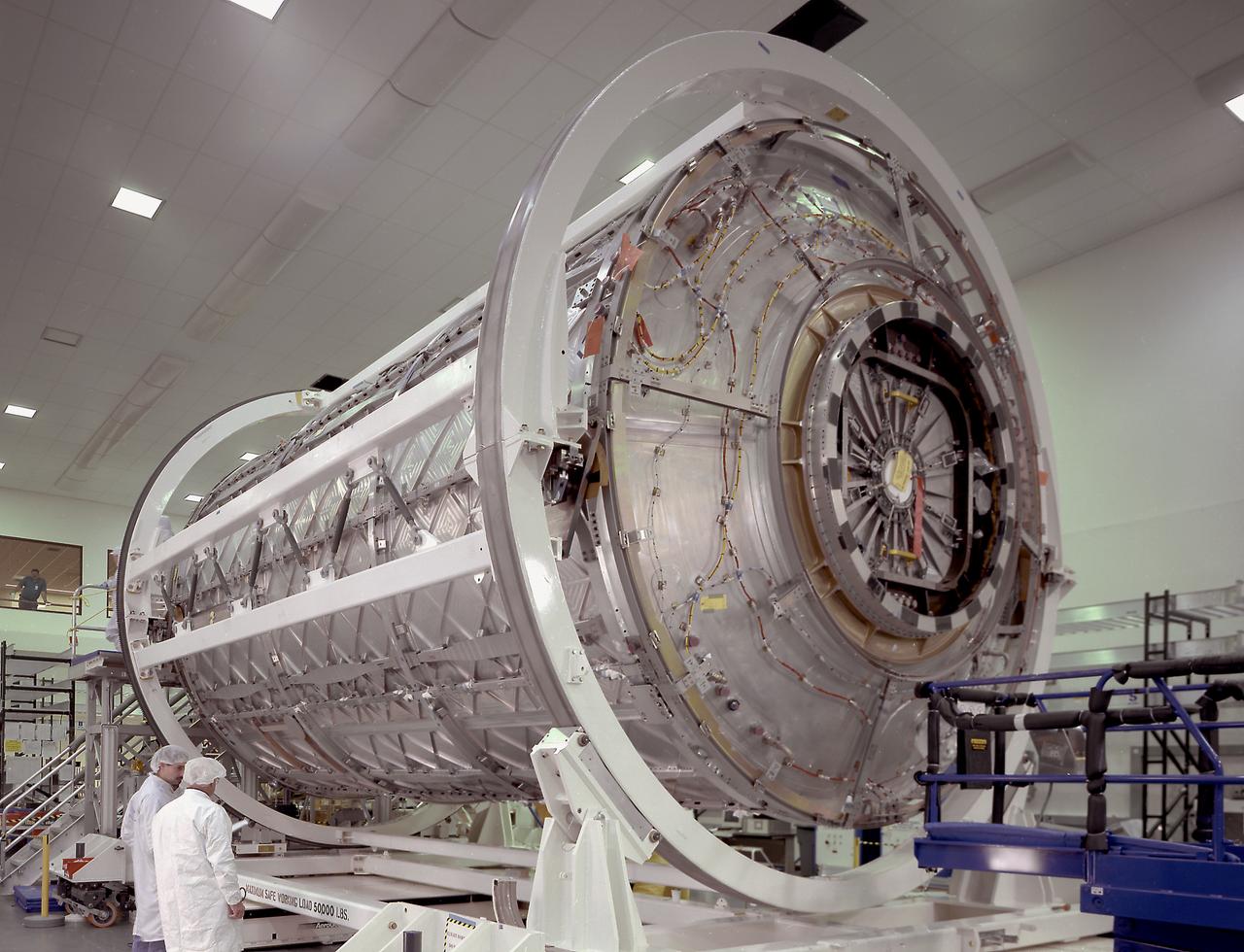
KENNEDY SPACE CENTER, FLA.  - In the Space Station Processing Facility can be seen the U.S. Node 2 (at left) and the Japanese Experiment Module (JEM)’s Pressurized Module (at right).  The  Italian-built Node 2, the second of three Space Station connecting modules, attaches to the end of the U.S. Lab and will provide attach locations for the Japanese laboratory, European laboratory, the Centrifuge Accommodation Module and, later, Multipurpose Logistics Modules. It will provide the primary docking location for the Shuttle when a pressurized mating adapter is attached to Node 2.  Installation of the module will complete the U.S. Core of the ISS.  Node 2 is the designated payload for mission STS-120.  No orbiter or launch date has been determined yet.  The Pressurized Module is the first element of the JEM to be delivered to KSC. The JEM is Japan's primary contribution to the Station. It will enhance the unique research capabilities of the orbiting complex by providing an additional environment for astronauts to conduct science experiments.  The JEM also includes an exposed facility (platform) for space environment experiments, a robotic manipulator system, and two logistics modules. The various JEM components will be  assembled in space over the course of three Shuttle missions.
KENNEDY SPACE CENTER, FLA. - In the Space Station Processing Facility can be seen the U.S. Node 2 (at left) and the Japanese Experiment Module (JEM)’s Pressurized Module (at right). The Italian-built Node 2, the second of three Space Station connecting modules, attaches to the end of the U.S. Lab and will provide attach locations for the Japanese laboratory, European laboratory, the Centrifuge Accommodation Module and, later, Multipurpose Logistics Modules. It will provide the primary docking location for the Shuttle when a pressurized mating adapter is attached to Node 2. Installation of the module will complete the U.S. Core of the ISS. Node 2 is the designated payload for mission STS-120. No orbiter or launch date has been determined yet. The Pressurized Module is the first element of the JEM to be delivered to KSC. The JEM is Japan's primary contribution to the Station. It will enhance the unique research capabilities of the orbiting complex by providing an additional environment for astronauts to conduct science experiments. The JEM also includes an exposed facility (platform) for space environment experiments, a robotic manipulator system, and two logistics modules. The various JEM components will be assembled in space over the course of three Shuttle missions.
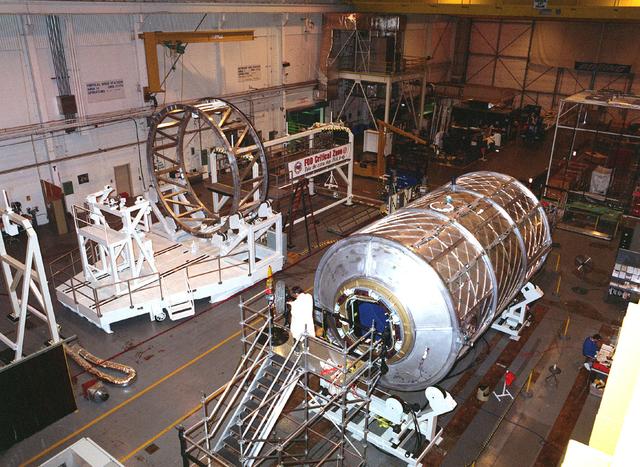
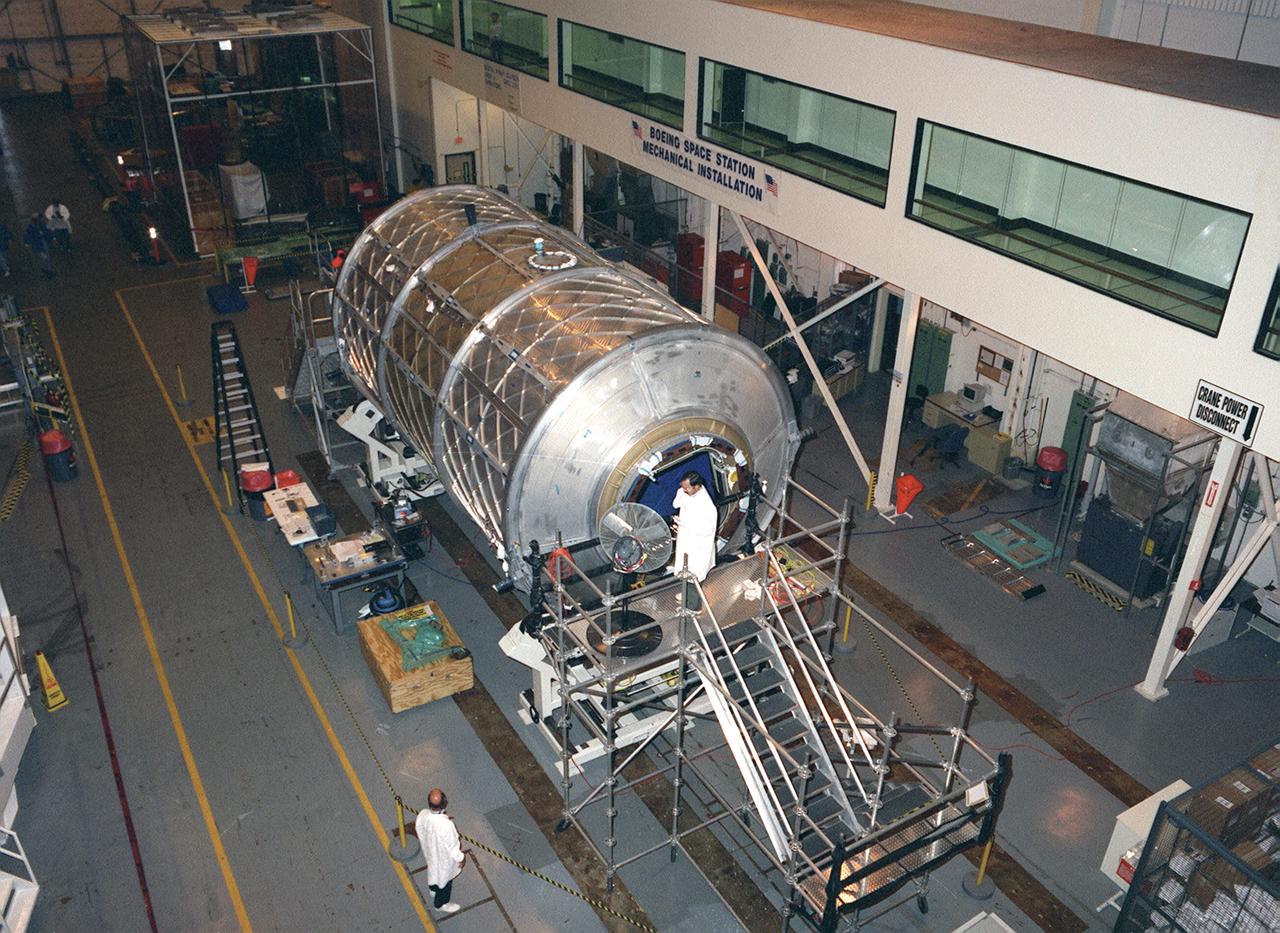
Photograph shows the International Space Station Laboratory Module under fabrication at Marshall Space Flight Center (MSFC), Building 4708 West High Bay. Although management of the U.S. elements for the Station were consolidated in 1994, module and node development continued at MSFC by Boeing Company, the prime contractor for the Space Station.
International Space Station (ISS)
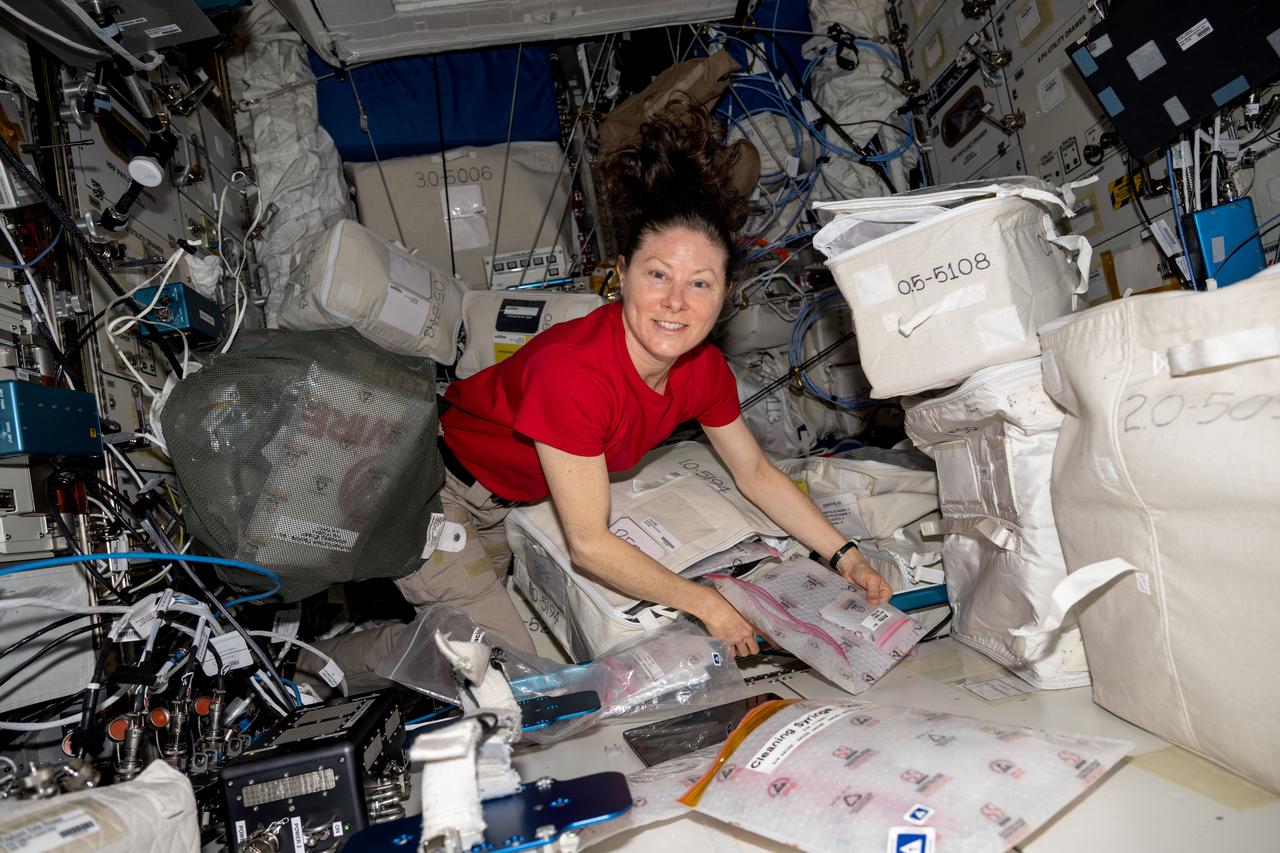
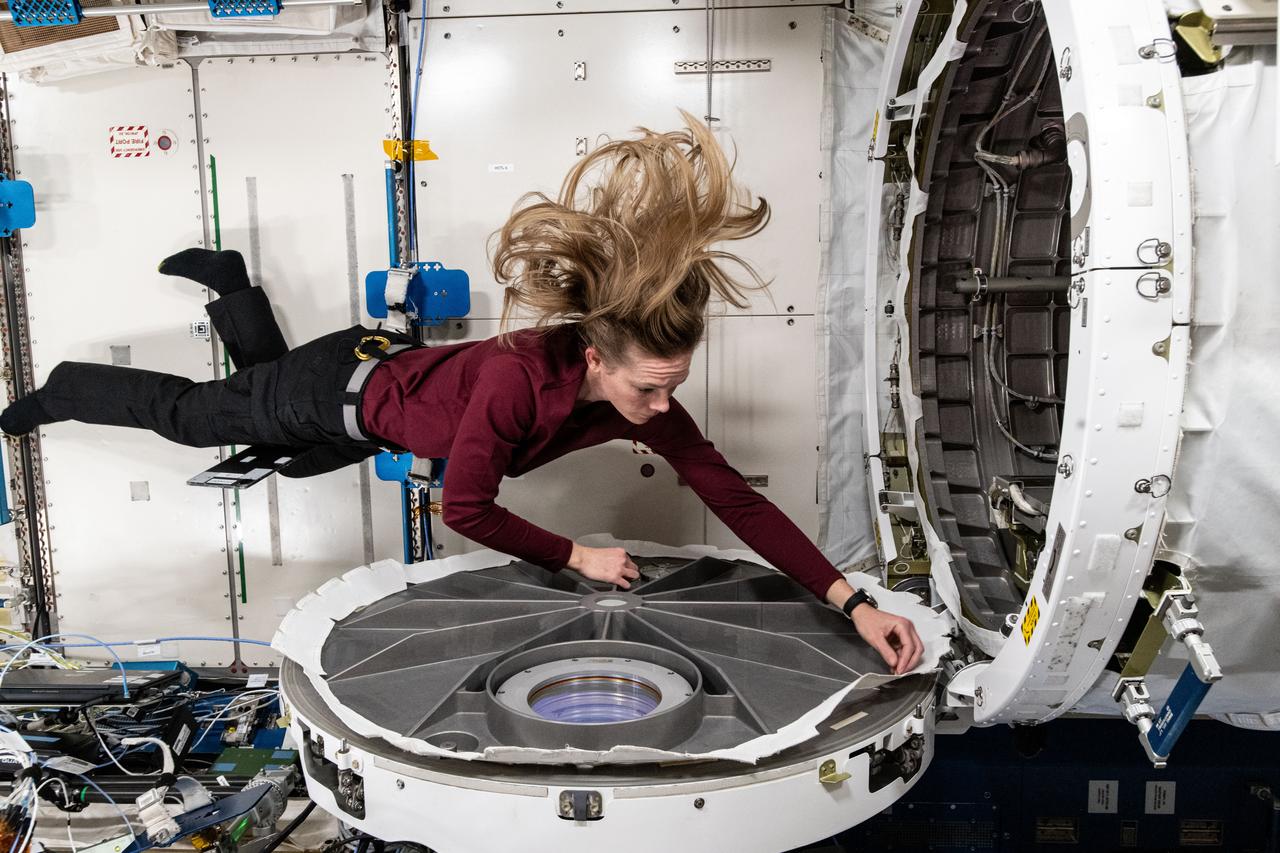
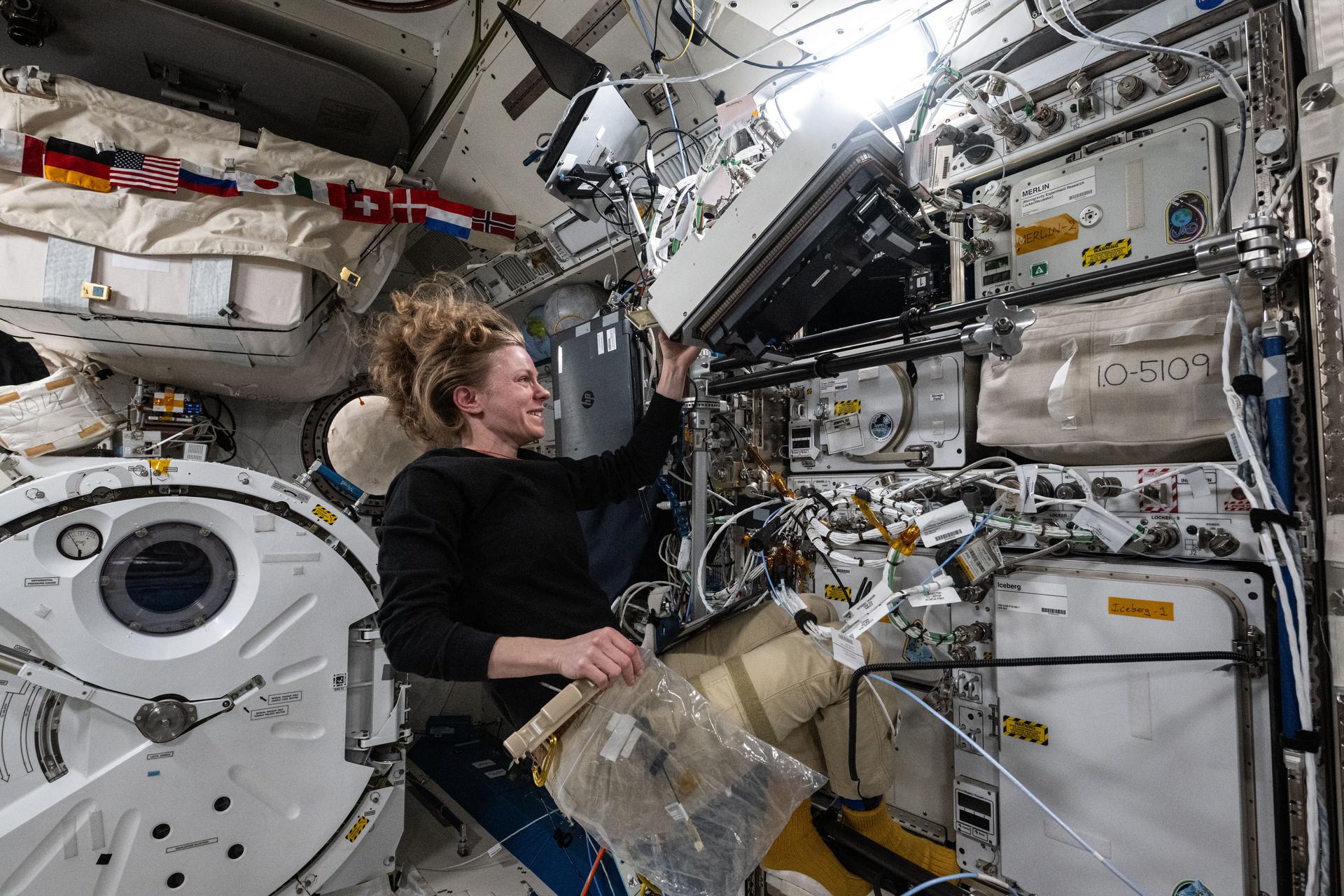
iss071e403579 (July 23, 2024) --- NASA astronaut and Expedition 71 Flight Engineer Tracy C. Dyson unpacks and examines research gear that is part of the BioFabrication Facility (BFF) located inside the International Space Station's Columbus laboratory module. The BFF is a research device being tested for its ability to print organ-like tissues in microgravity.
NASA astronaut Tracy C. Dyson unpacks and examines research gear
This photograph shows the U.S. Laboratory Module (also called Destiny) for the International Space Station (ISS), in the Space Station manufacturing facility at the Marshall Space Flight Center, being readied for shipment to the Kennedy Space Center. The U.S. Laboratory module is the centerpiece of the ISS, where science experiments will be performed in the near-zero gravity of space. The Destiny Module was launched aboard the Space Shuttle orbiter Atlantis (STS-67 mission) on February 7, 2001. The aluminum module is 8.5 meters (28 feet) long and 4.3 meters (14 feet) in diameter. The laboratory consists of three cylindrical sections and two endcones with hatches that will be mated to other station components. A 50.9-centimeter- (20-inch-) diameter window is located on one side of the center module segment. This pressurized module is designed to accommodate pressurized payloads. It has a capacity of 24 rack locations, and payload racks will occupy 13 locations especially designed to support experiments. The ISS is a multidisciplinary laboratory, technology test bed, and observatory that will provide unprecedented undertakings in scientific, technological, and international experimentation.
International Space Station (ISS)
In this photograph, the U.S. Laboratory Module (also called Destiny) for the International Space Station (ISS) is shown under construction in the West High Bay of the Space Station manufacturing facility (building 4708) at the Marshall Space Flight Center. The U.S. Laboratory module is the centerpiece of the ISS, where science experiments will be performed in the near-zero gravity of space. The Destiny Module was launched aboard the Space Shuttle orbiter Atlantis (STS-98 mission) on February 7, 2001. The aluminum module is 8.5 meters (28 feet) long and 4.3 meters (14 feet) in diameter. The laboratory consists of three cylindrical sections and two endcones with hatches that will be mated to other station components. A 50.9-centimeter- (20-inch-) diameter window is located on one side of the center module segment. This pressurized module is designed to accommodate pressurized payloads. It has a capacity of 24 rack locations, and payload racks will occupy 13 locations especially designed to support experiments. The ISS is a multidisciplinary laboratory, technology test bed, and observatory that will provide unprecedented undertakings in scientific, technological, and international experimentation.
International Space Station (ISS)
In this photograph, the U.S. Laboratory Module (also called Destiny) for the International Space Station (ISS) is shown under construction in the West High Bay of the Space Station manufacturing facility (building 4708) at the Marshall Space Flight Center. The U.S. Laboratory module is the centerpiece of the ISS, where science experiments will be performed in the near-zero gravity of space. The Destiny Module was launched aboard the Space Shuttle orbiter Atlantis (STS-98 mission) on February 7, 2001. The aluminum module is 8.5 meters (28 feet) long and 4.3 meters (14 feet) in diameter. The laboratory consists of three cylindrical sections and two endcones with hatches that will be mated to other station components. A 50.9-centimeter- (20-inch-) diameter window is located on one side of the center module segment. This pressurized module is designed to accommodate pressurized payloads. It has a capacity of 24 rack locations, and payload racks will occupy 13 locations especially designed to support experiments. The ISS is a multidisciplinary laboratory, technology test bed, and observatory that will provide unprecedented undertakings in scientific, technological, and international experimentation.
International Space Station (ISS)
This photograph shows the U.S. Laboratory Module (also called Destiny) for the International Space Station (ISS), under construction in the Space Station manufacturing facility at the Marshall Space Flight Center. The U.S. Laboratory module is the centerpiece of the ISS, where science experiments will be performed in the near-zero gravity of space. The Destiny Module was launched aboard the Space Shuttle orbiter Atlantis (STS-67 mission) on February 7, 2001. The aluminum module is 8.5 meters (28 feet) long and 4.3 meters (14 feet) in diameter. The laboratory consists of three cylindrical sections and two end cones with hatches that will be mated to other station components. A 50.9-centimeter- (20-inch-) diameter window is located on one side of the center module segment. This pressurized module is designed to accommodate pressurized payloads. It has a capacity of 24 rack locations, and payload racks will occupy 13 locations especially designed to support experiments. The ISS is a multidisciplinary laboratory, technology test bed, and observatory that will provide unprecedented undertakings in scientific, technological, and international experimentation.
International Space Station (ISS)
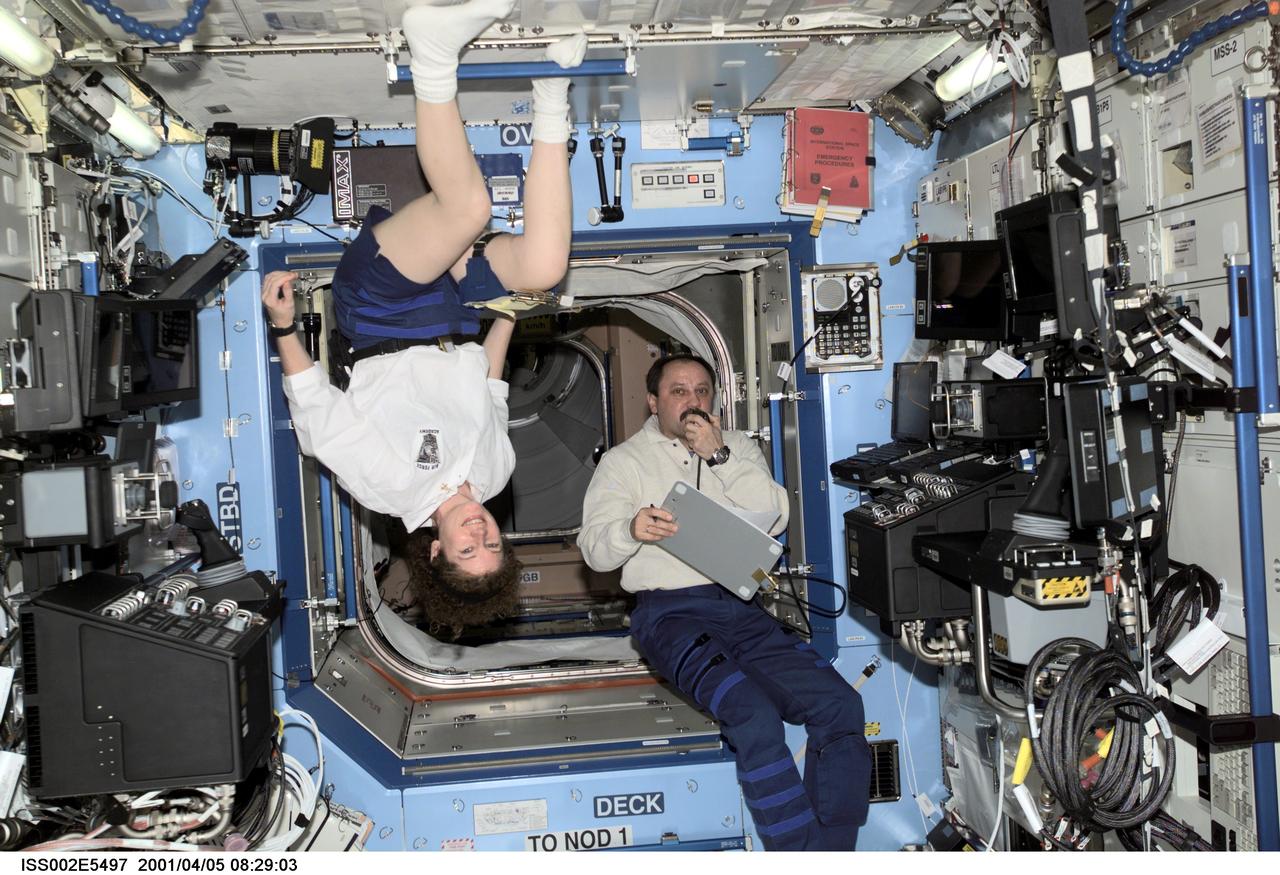
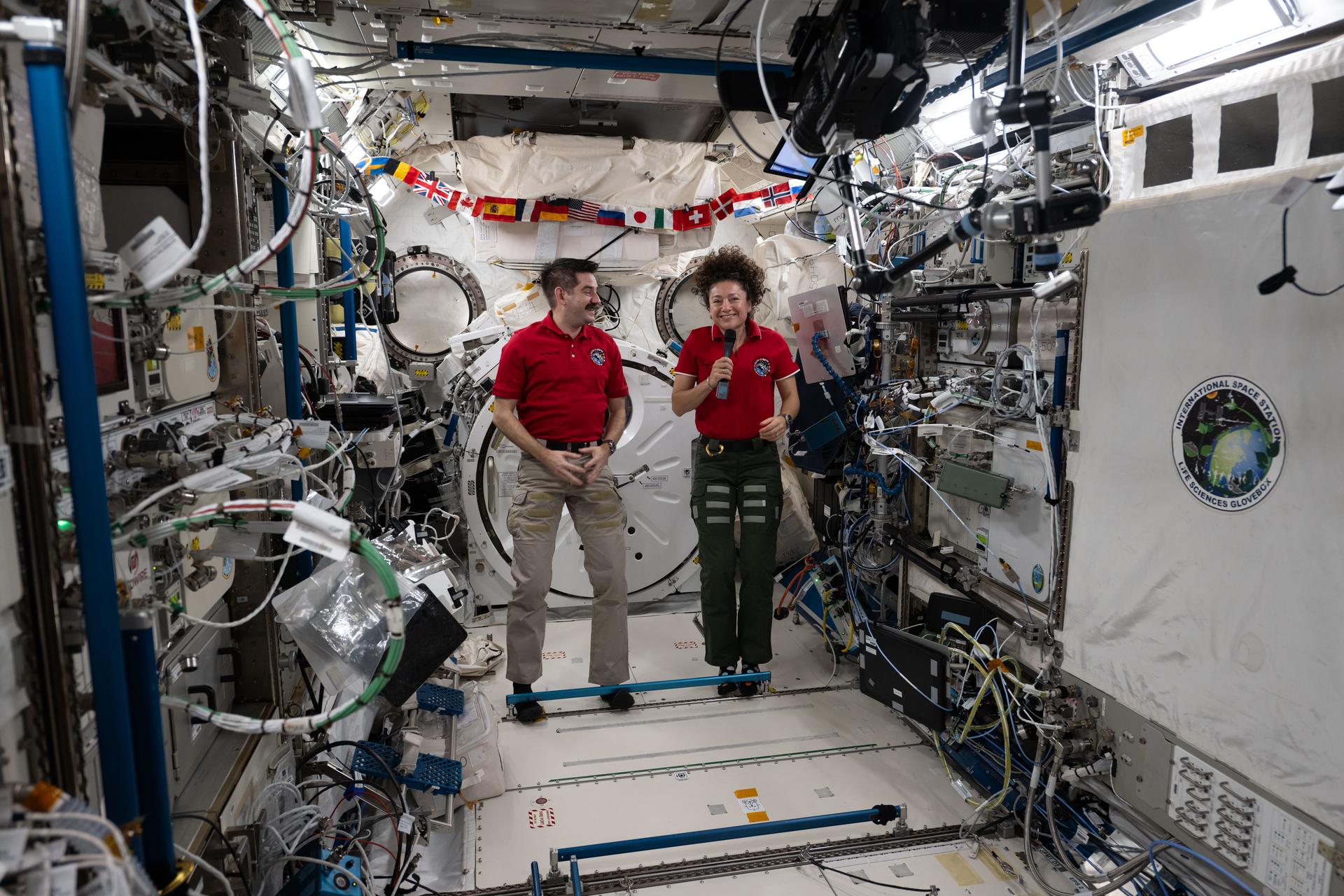
ISS002-E-5497 (05 April 2001) --- Astronaut Susan J. Helms (left), Expedition Two flight engineer, pauses from her work to pose for a photograph while Expedition Two mission commander, cosmonaut Yury V. Usachev, speaks into a microphone aboard the U.S. Laboratory / Destiny module of the International Space Station (ISS).   This image was recorded with a digital still camera.
Helms and Usachev in Destiny Laboratory module
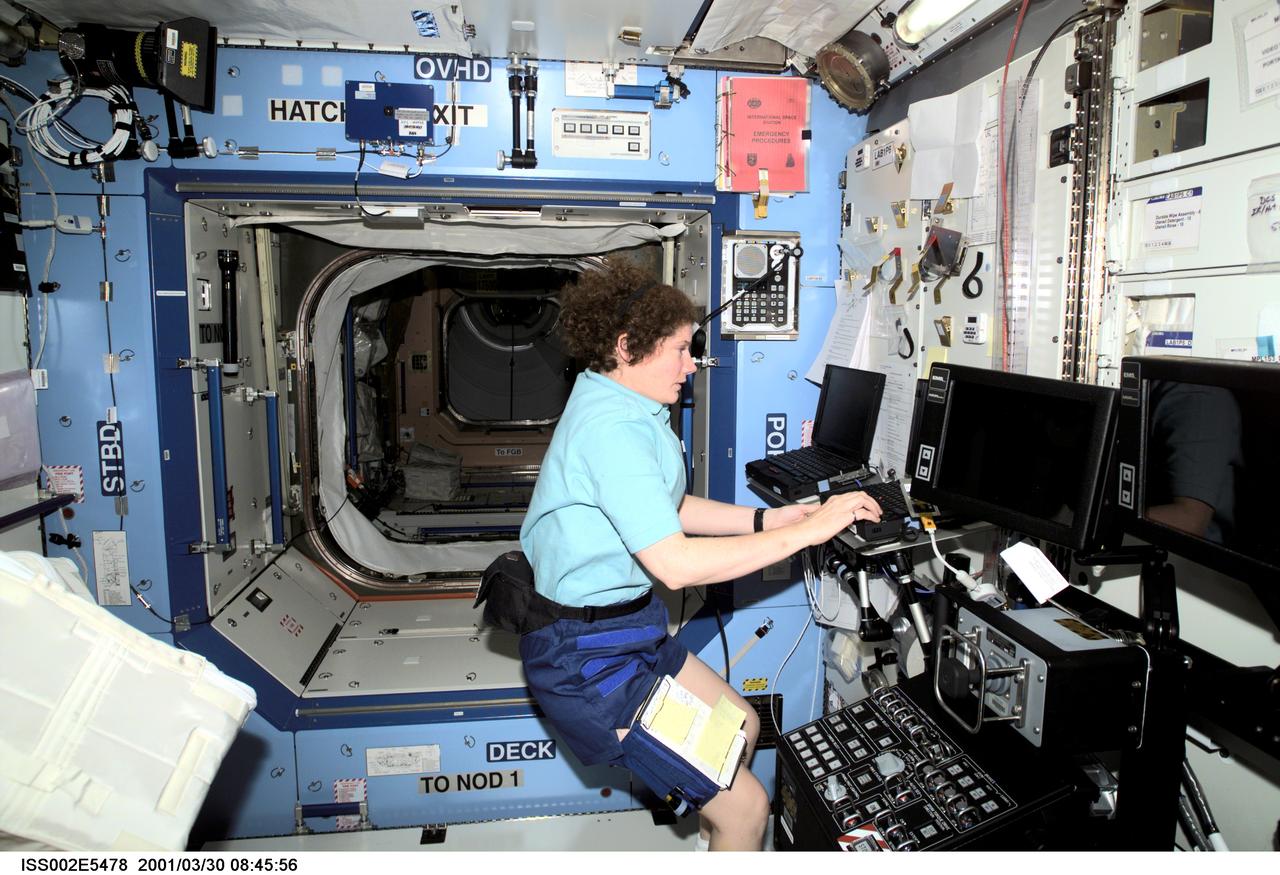
ISS002-E-5478 (30 March 2001) --- Astronaut Susan J. Helms, Expedition Two flight engineer, works at a laptop computer in the U.S. Laboratory / Destiny module of the International Space Station (ISS).  The Space Station Remote Manipulator System (SSRMS) control panel is visible to Helms' right.  This image was recorded with a digital still camera.
Helms with laptop in Destiny laboratory module
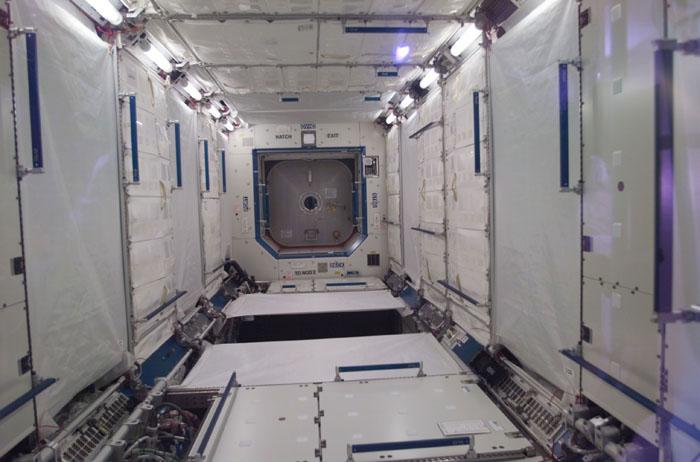
STS98-E-5113 (11 February 2001) --- This wide shot, photographed with a digital still camera, shows the interior of  the newly attached Destiny laboratory.  The crews of Atlantis and the International Space Station opened the laboratory on Feb. 11 and spent the first full day of what are planned to be years of work ahead inside the orbiting science and command center. Station commander William M. (Bill) Shepherd opened the Destiny hatch, and he and shuttle commander Kenneth D. Cockrell ventured inside at 8:38 a.m. (CST), Feb. 11.  As depicted in subsequent digital images in this series, members of both crews went to work quickly inside the new module, activating air systems, fire extinguishers, alarm systems, computers and internal communications.  The crew also continued equipment transfers from the shuttle to the station.
Interior of the U.S. Laboratory / Destiny module
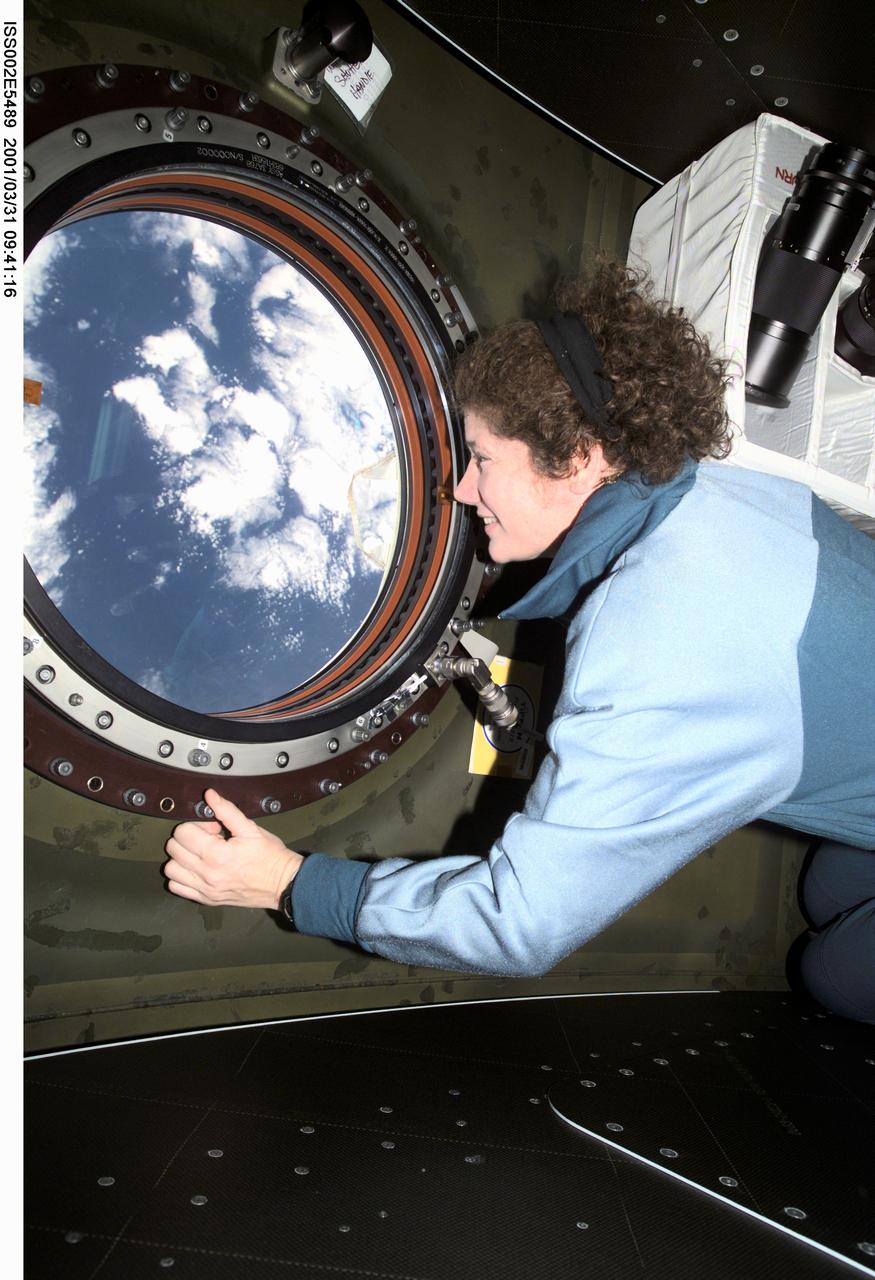
ISS002-E-5489 (31 March 2001) --- Astronaut Susan J. Helms, Expedition Two flight engineer, views the topography of a point on Earth from the nadir window in the U.S. Laboratory / Destiny module of the International Space Station (ISS).  The image was recorded with a digital still camera.
Helms at photo quality window in Destiny Laboratory module
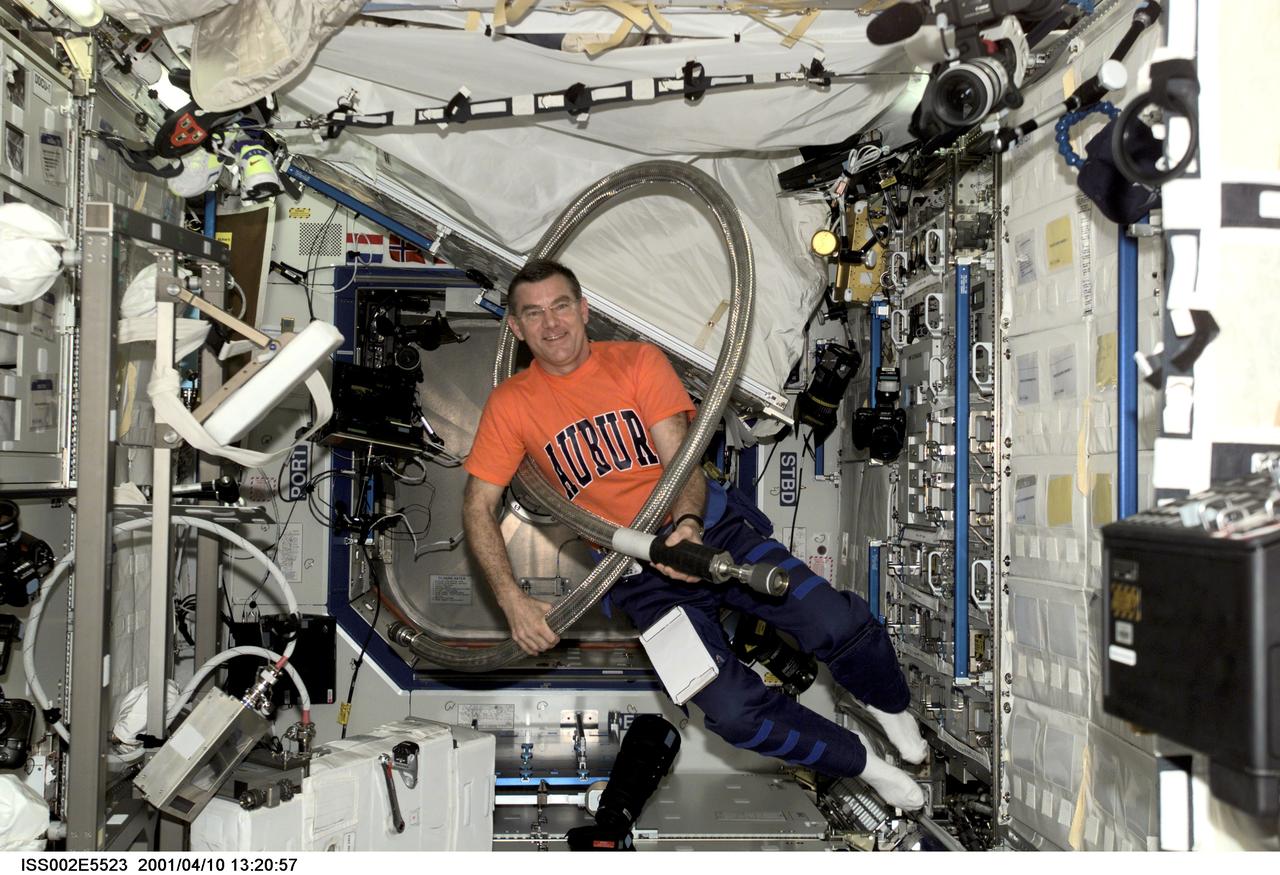
ISS002-E-5523 (10 April 2001) --- Astronaut James S. Voss, Expedition Two flight engineer, jokingly wraps a large hose around his body prior to installing it in the U.S. Laboratory / Destiny module of the International Space Station (ISS). This image was recorded with a digital still camera.
Voss jokes with long hose in Destiny Laboratory module
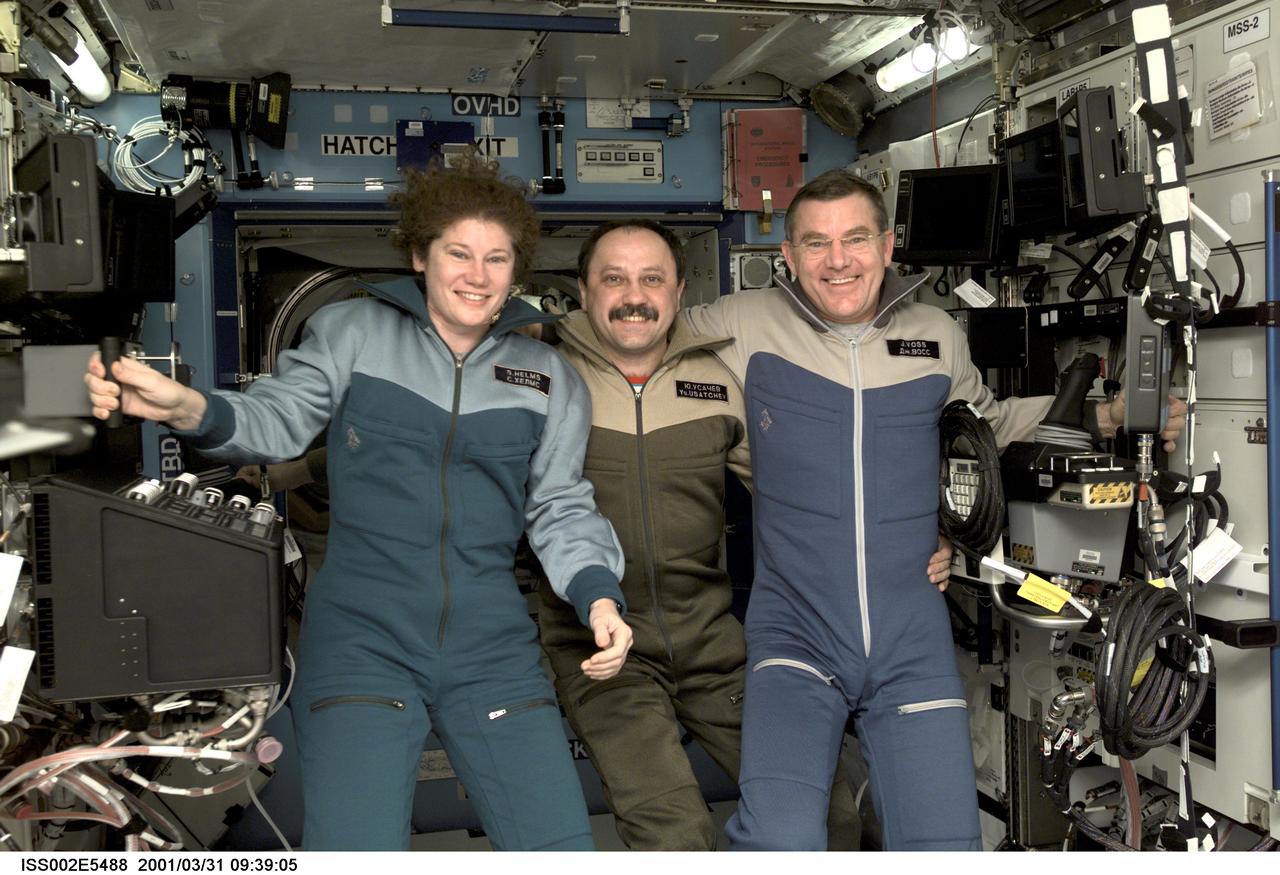
ISS002-E-5488 (31 March 2001) --- The Expedition Two crewmembers -- astronaut Susan J. Helms (left), cosmonaut Yury V. Usachev and astronaut James S. Voss -- pose for a photograph in the U.S. Laboratory / Destiny module of the International Space Station (ISS).    This image was recorded with a digital still camera.
Expedition Two crewmembers pose in Destiny Laboratory module
iss058e013244 (Feb. 13, 2019) --- The forward end of the International Space Station is pictured showing portions of five modules. From right to left is a portion of the U.S. Destiny laboratory module linking forward to the Harmony module. Attached to the port side of Harmony (left foreground) is the Kibo laboratory module from the Japan Aerospace Exploration Agency (JAXA) with its logistics module berthed on top. On Harmony's starboard side (center background) is the Columbus laboratory module from ESA (European Space Agency).
The forward end of the International Space Station is pictured showing portions of five modules.
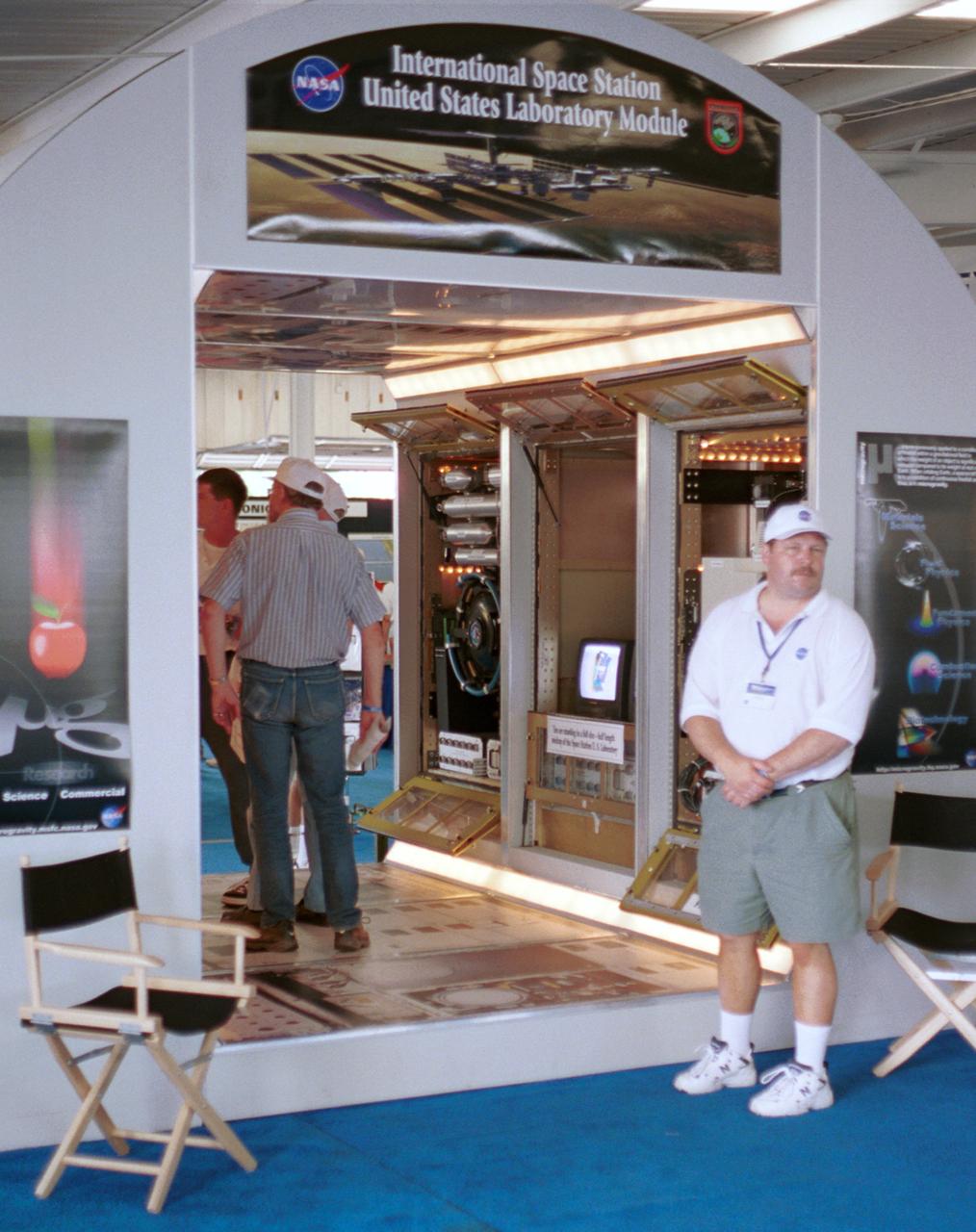
Thomas Turk, an engineer with NASA's Glenn Research Center, waits for more visitors at a mockup of part of Destiny, the U.S. laboratory module that will be attached to the International Space Station (ISS) in Year 2001. Visible behind Turk are engineering models of the three racks that will make up the Fluids and Combustion Facility (FCF) in the module. The mockup is full scale, although Destiny will be twice as long to accomodate six experiment racks along each side. The exhibit was part of the NASA outreach activity at AirVenture 2000 sponsored by the Expeprimental Aircraft Association in Oshkosh, WI.
Microgravity
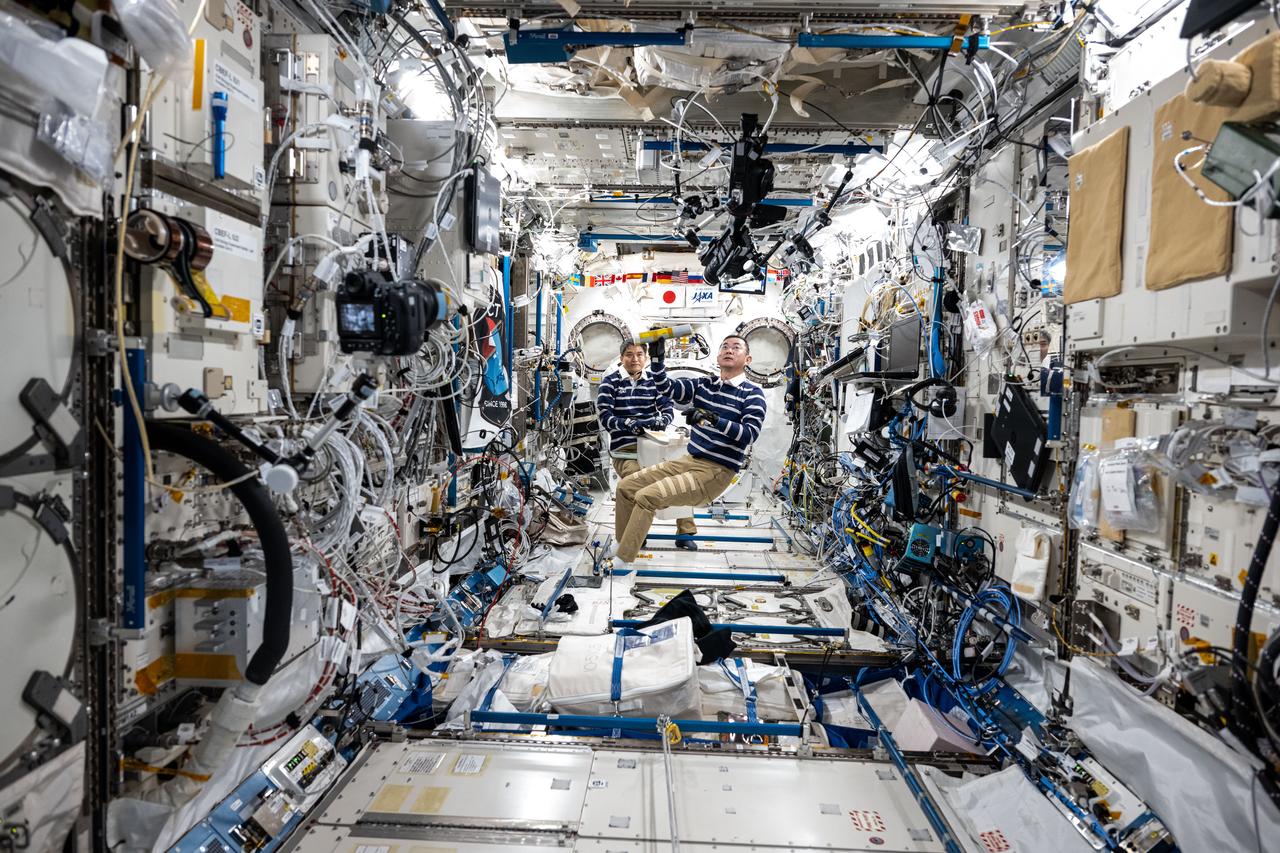
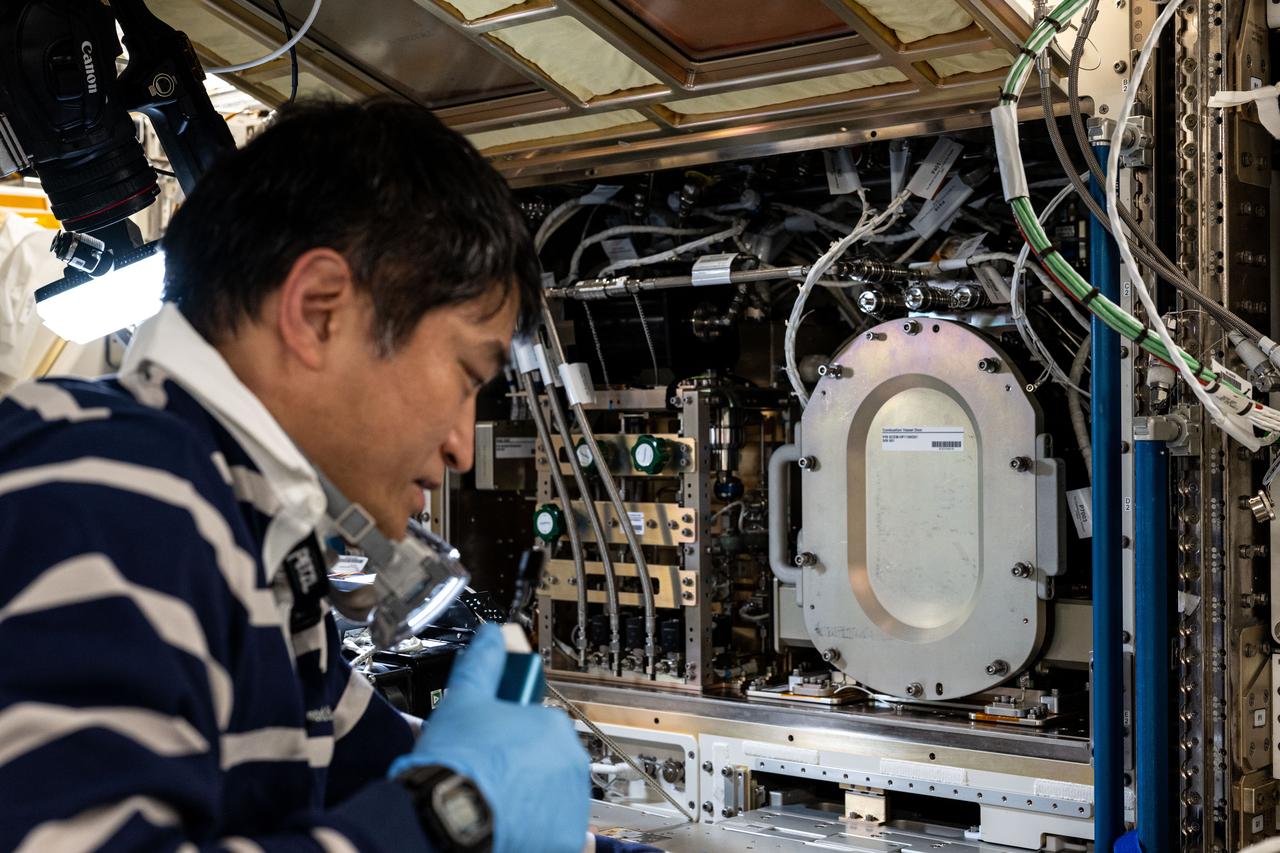
iss073e0000313 (April 21, 2025) --- JAXA (Japan Aerospace Exploration Agency) astronaut and Expedition 73 Commander Takuya Onishi inspects science hardware inside the Kibo laboratory module's Solid Combustion Experiment Module, a space fire safety research facility, aboard the International Space Station.
Astronaut Takuya Onishi inspects science hardware inside the Kibo laboratory module
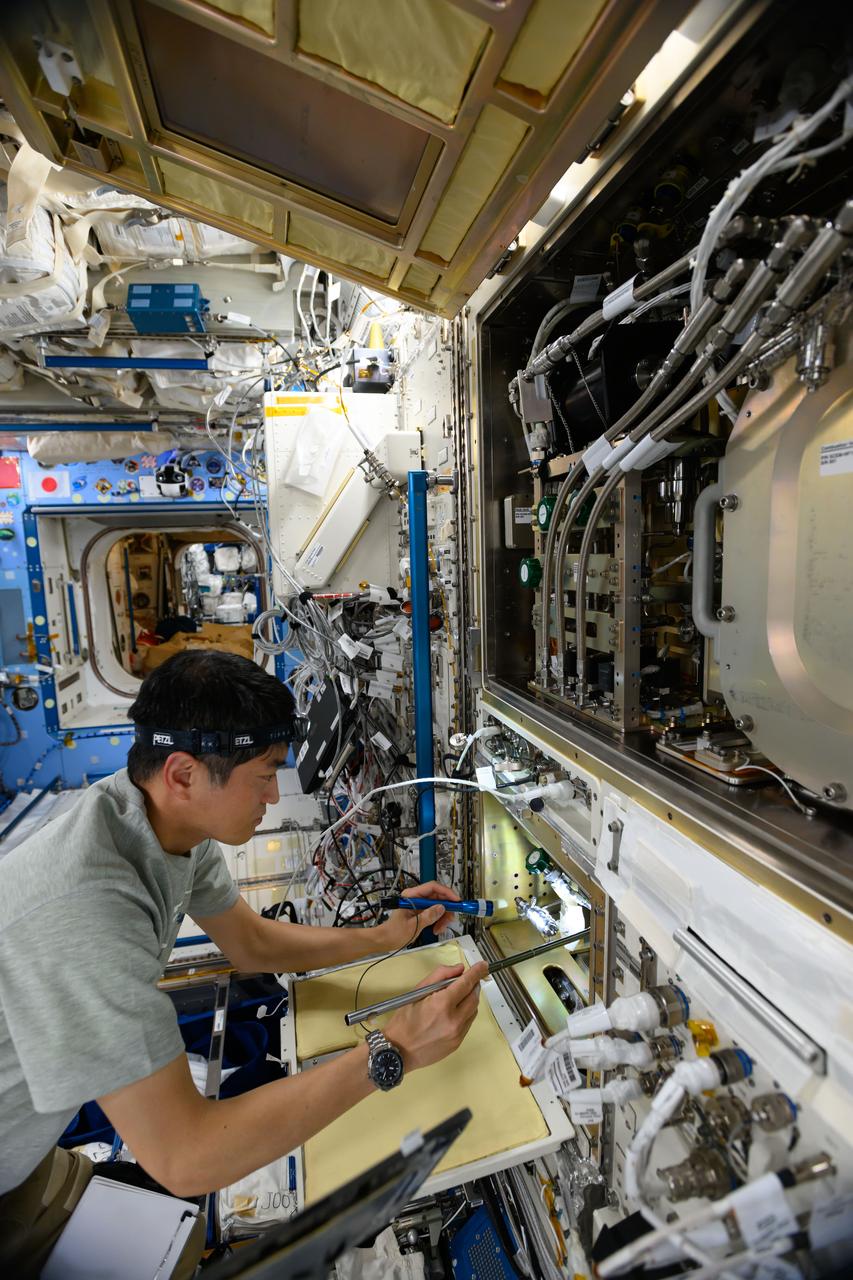
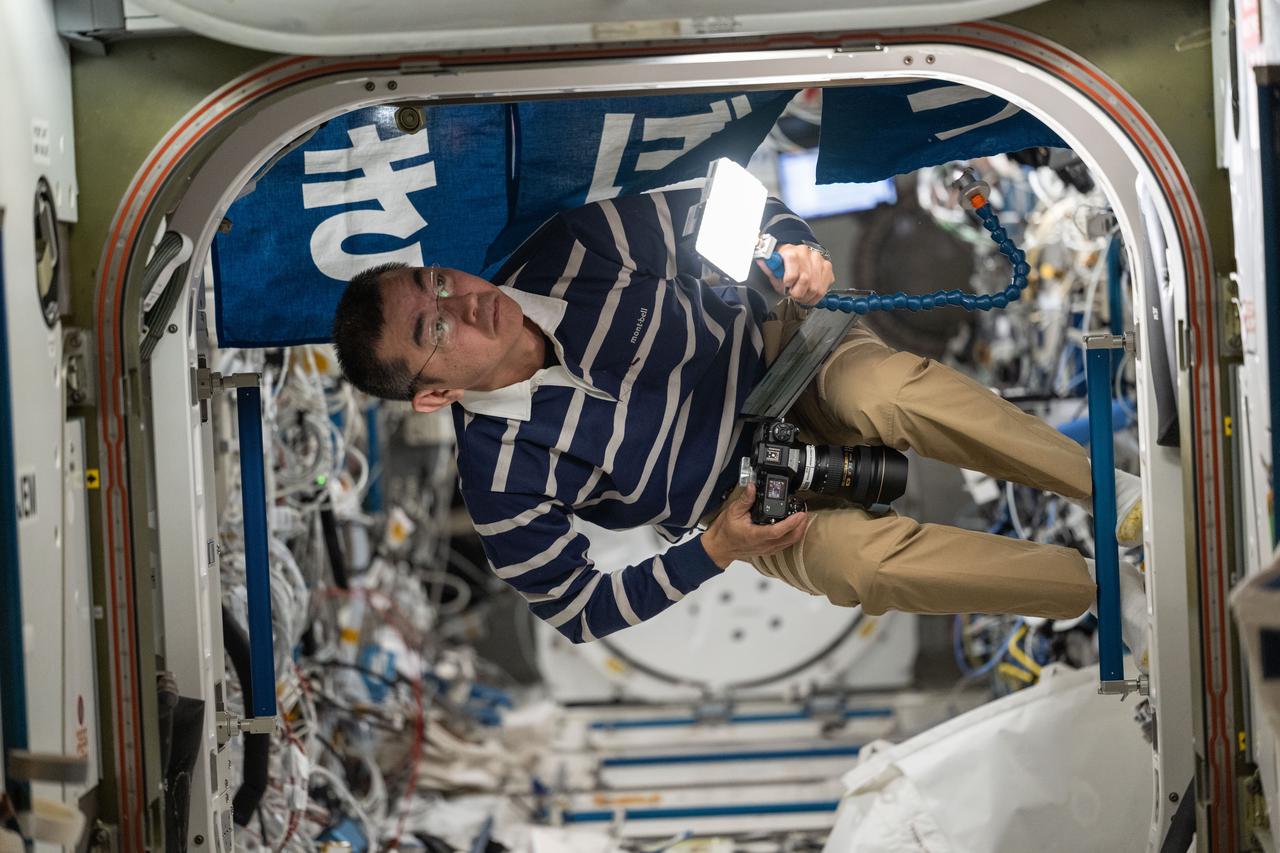
iss073e0424048 (Aug. 7, 2025) --- JAXA (Japan Aerospace Exploration Agency) astronaut and Expedition 73 Flight Engineer Kimiya Yui is pictured inside the vestibule inspecting hardware between Kibo laboratory module and the Harmony module aboard the International Space Station.
JAXA astronaut Kimiya Yui inspects hardware inside the Kibo laboratory module
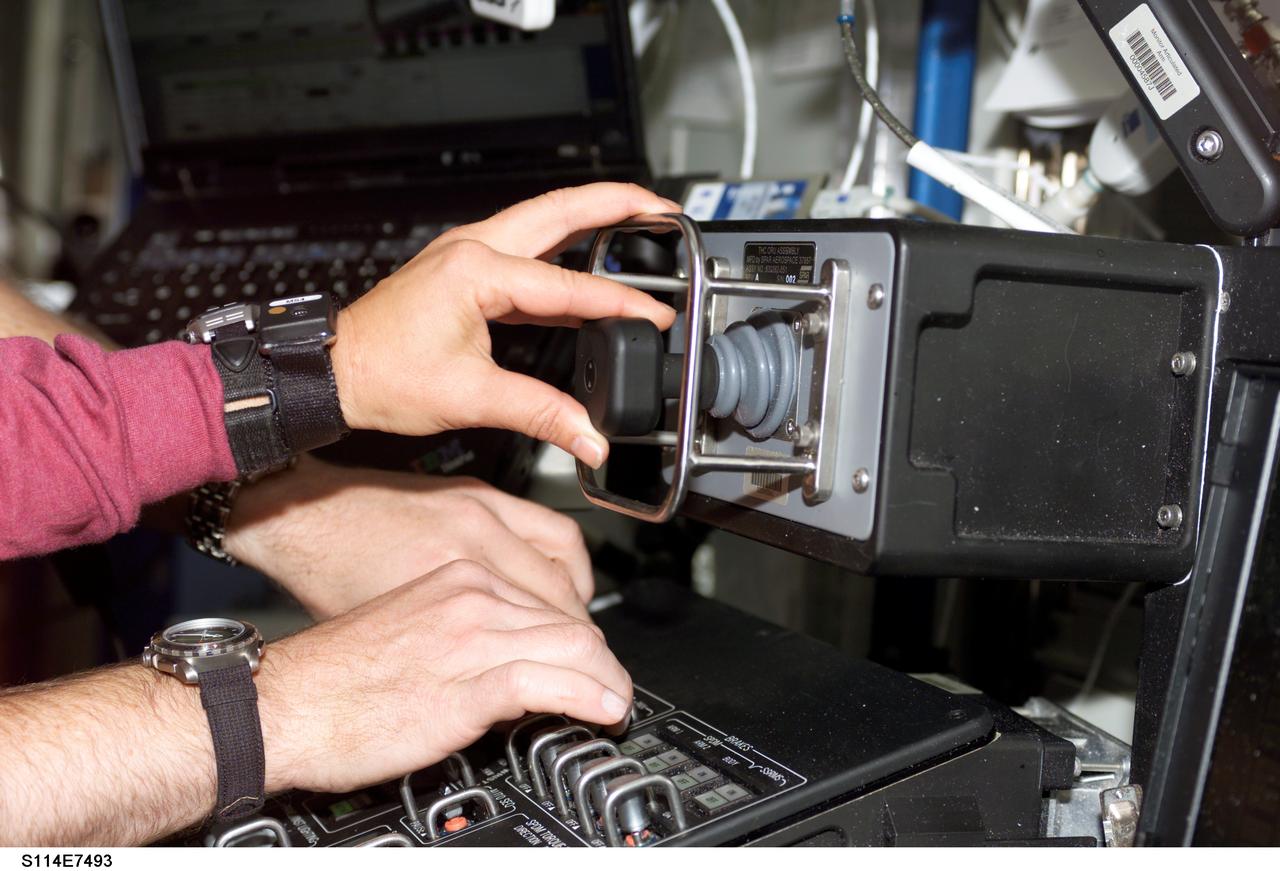
S114-E-7493 (5 August 2005) --- This image features a close-up view the hands of astronauts Wendy B. Lawrence, STS-114 mission specialist, and James M. Kelly, pilot, at the Mobile Service System (MSS) and Canadarm2 controls in the Destiny laboratory of the International Space Station while Space Shuttle Discovery was docked to the Station. The two were re-stowing the Italian-built Raffaello Multi-Purpose Logistics Module (MPLM) in the cargo bay.
Lawrence and Kelly's hands on controls in the Destiny laboratory module
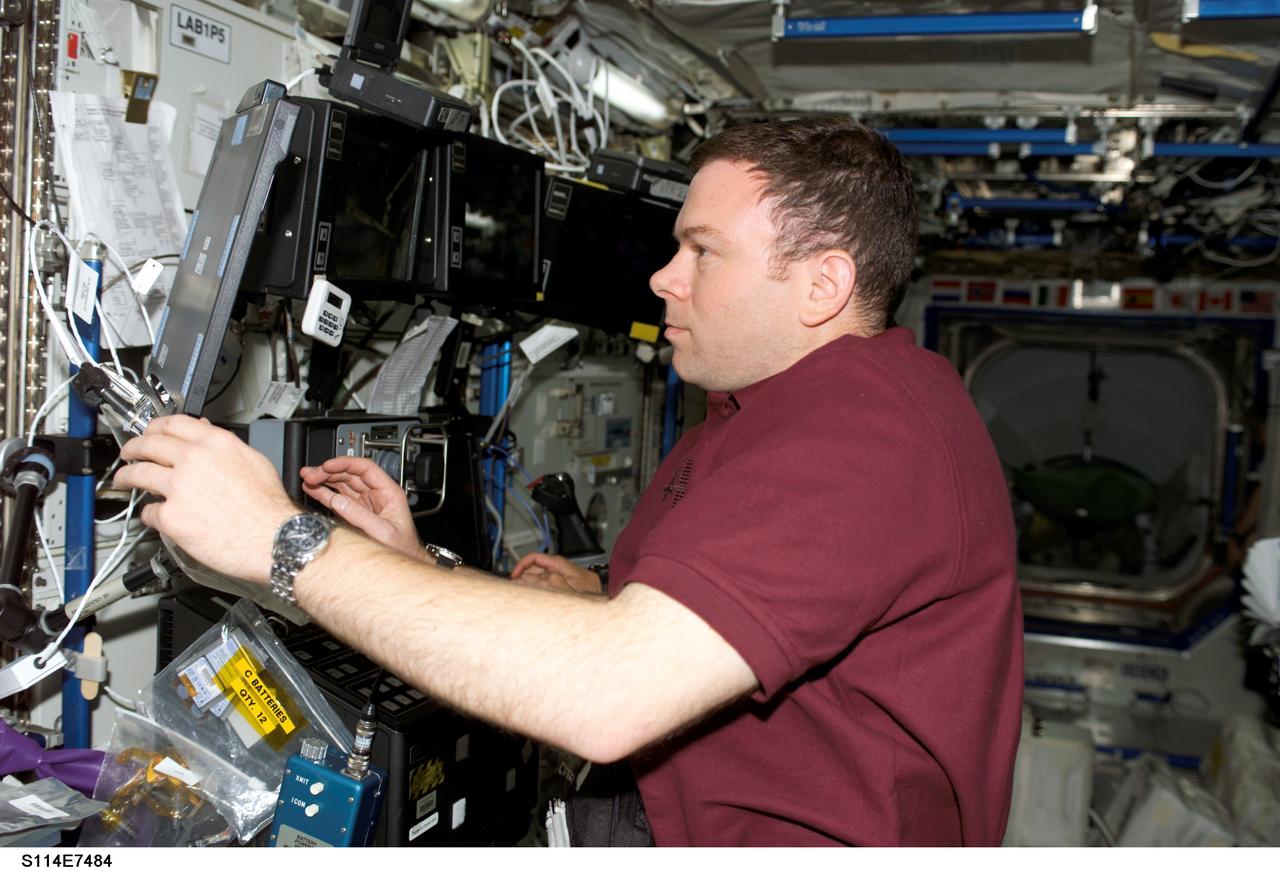
S114-E-7484 (5 August 2005) --- Astronaut James M. Kelly, STS-114 pilot, works in the Destiny laboratory of the International Space Station while Space Shuttle Discovery was docked to the Station. Astronauts Kelly and Wendy B. Lawrence (out of frame), mission specialist, joined forces to re-stow the Italian-built Raffaello Multi-Purpose Logistics Module (MPLM) in the cargo bay.
Kelly at SSRMS controls in Destiny laboratory module
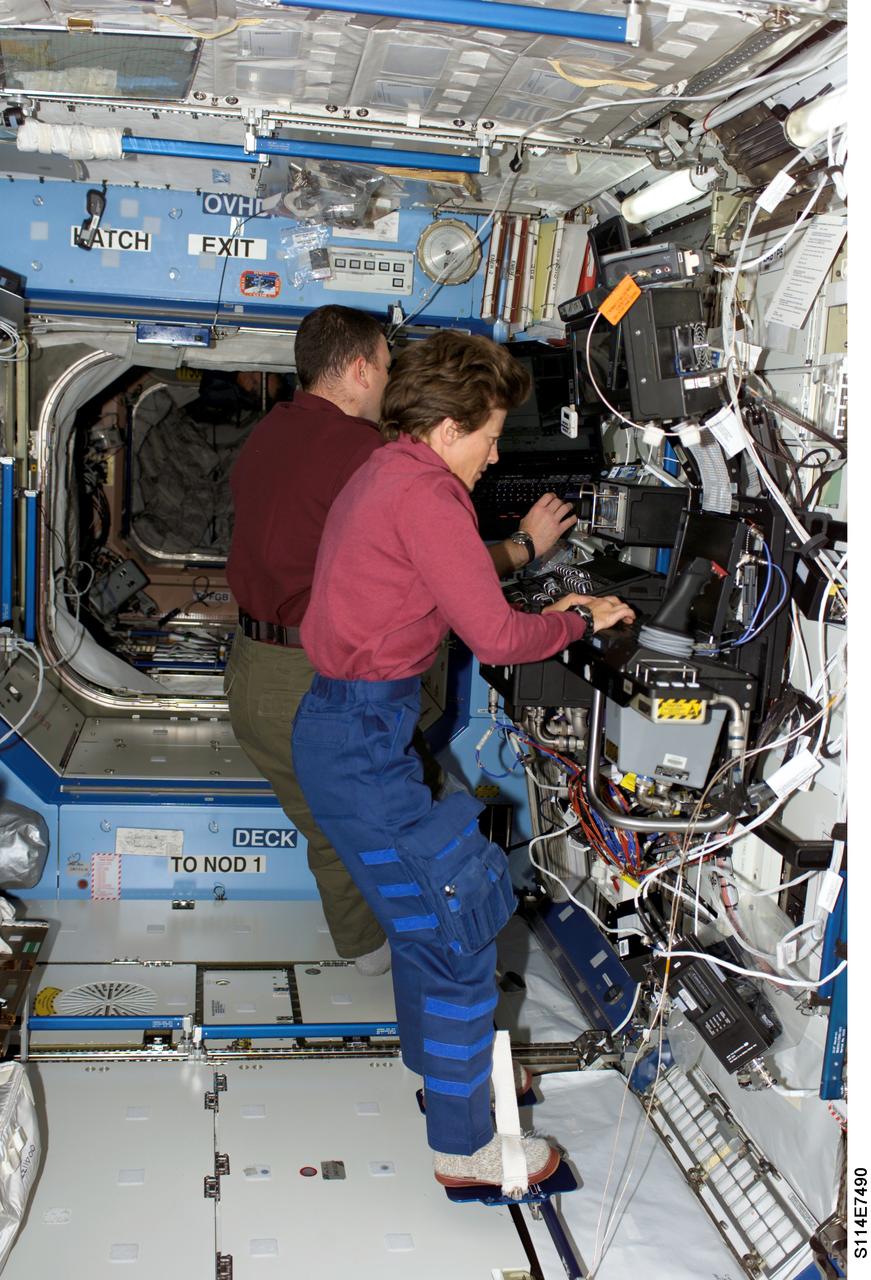
S114-E-7490 (5 August 2005) --- Astronauts Wendy B. Lawrence (foreground), STS-114 mission specialist, and James M. Kelly, pilot, work with the Mobile Service System (MSS) and Canadarm2 controls in the Destiny laboratory of the International Space Station while Space Shuttle Discovery was docked to the Station. The two were re-stowing the Italian-built Raffaello Multi-Purpose Logistics Module (MPLM) in the cargo bay.
Lawrence and Kelly at SSRMS controls in Destiny laboratory module
iss072e978952 (April 8, 2025) --- NASA astronaut and Expedition 72 Flight Engineer Nichole Ayers poses for a portrait in front of a window inside the International Space Station's Kibo laboratory module.
Astronaut Nichole Ayers poses for a portrait inside the Kibo laboratory module
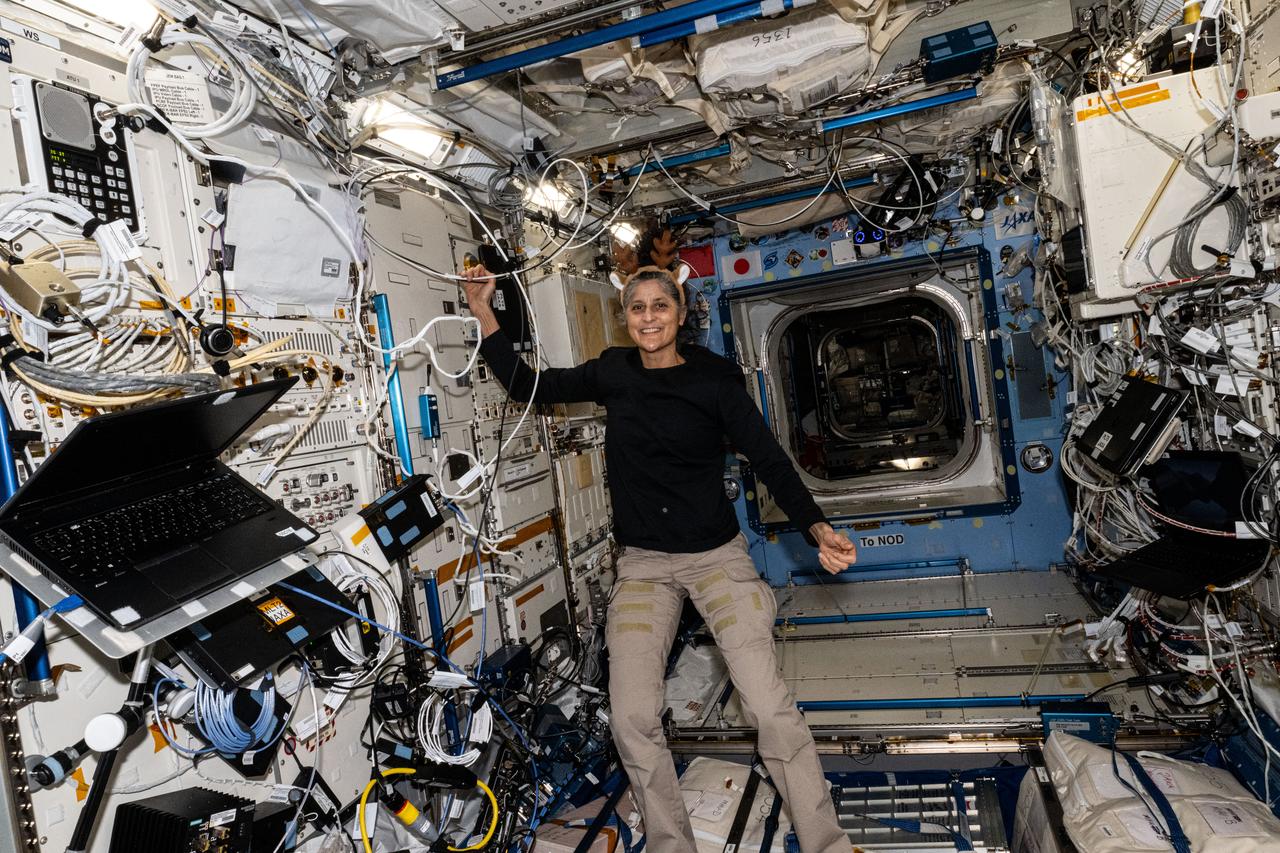
iss072e403385 (Dec. 24, 2024) --- NASA astronaut and Expedition 72 Commander Suni Williams checks research components inside the Kibo laboratory module's Advanced Plant Habitat aboard the International Space Station.
Astronaut Suni Williams checks research components inside the Kibo laboratory module
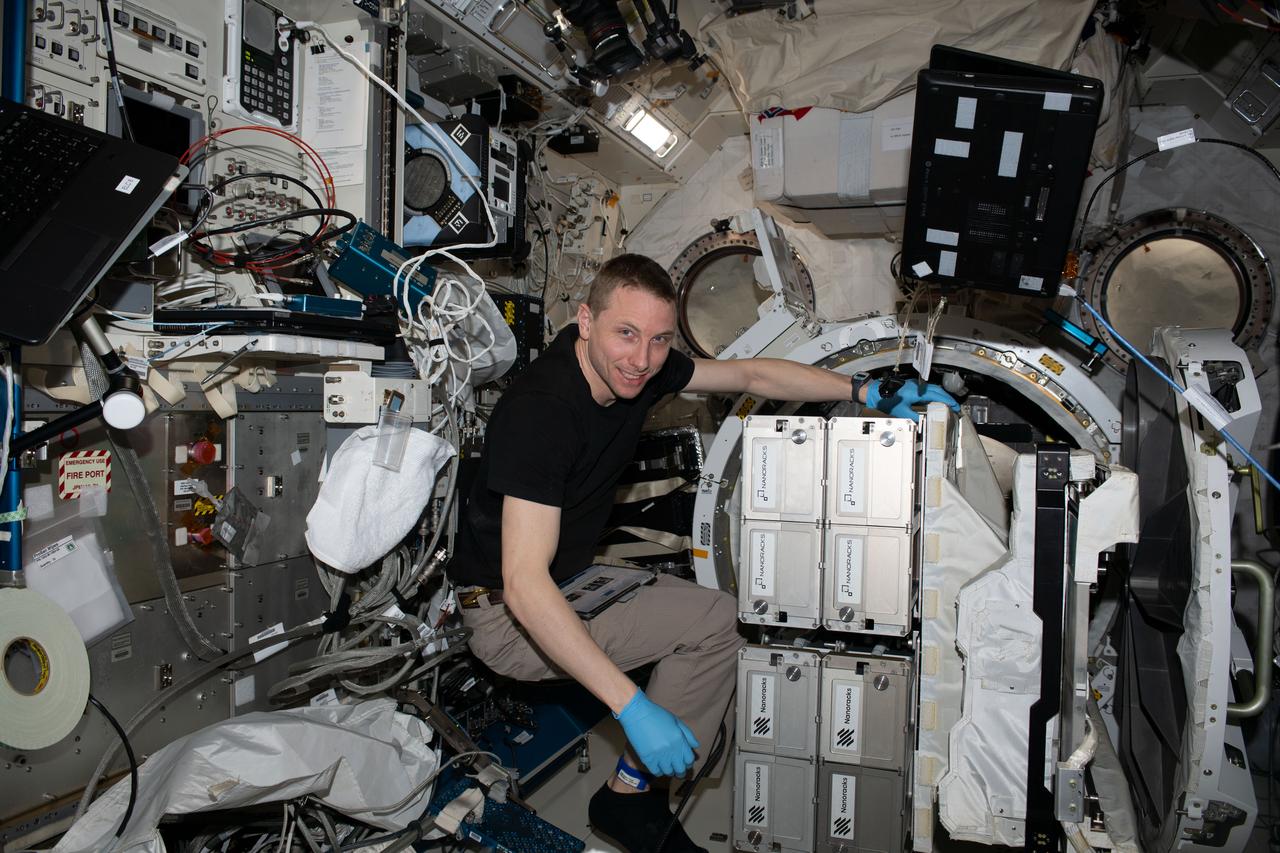
iss069e030663 (July 10, 2023) --- NASA astronaut and Expedition 69 Flight Engineer Woody Hoburg removes the NanoRacks CubeSat Deployer from the Kibo laboratory module's airlock.
Hoburg removing the Nanoracks Cubesat Deployer from the Kibo Laboratory Module A/L
iss072e861697 (March 28, 2025) --- NASA astronaut and Expedition 72 Flight Engineer Nichole Ayers opens the hatch to the Kibo laboratory module's airlock aboard the International Space Station.
Astronaut Nichole Ayers opens the hatch to the Kibo laboratory module's airlock
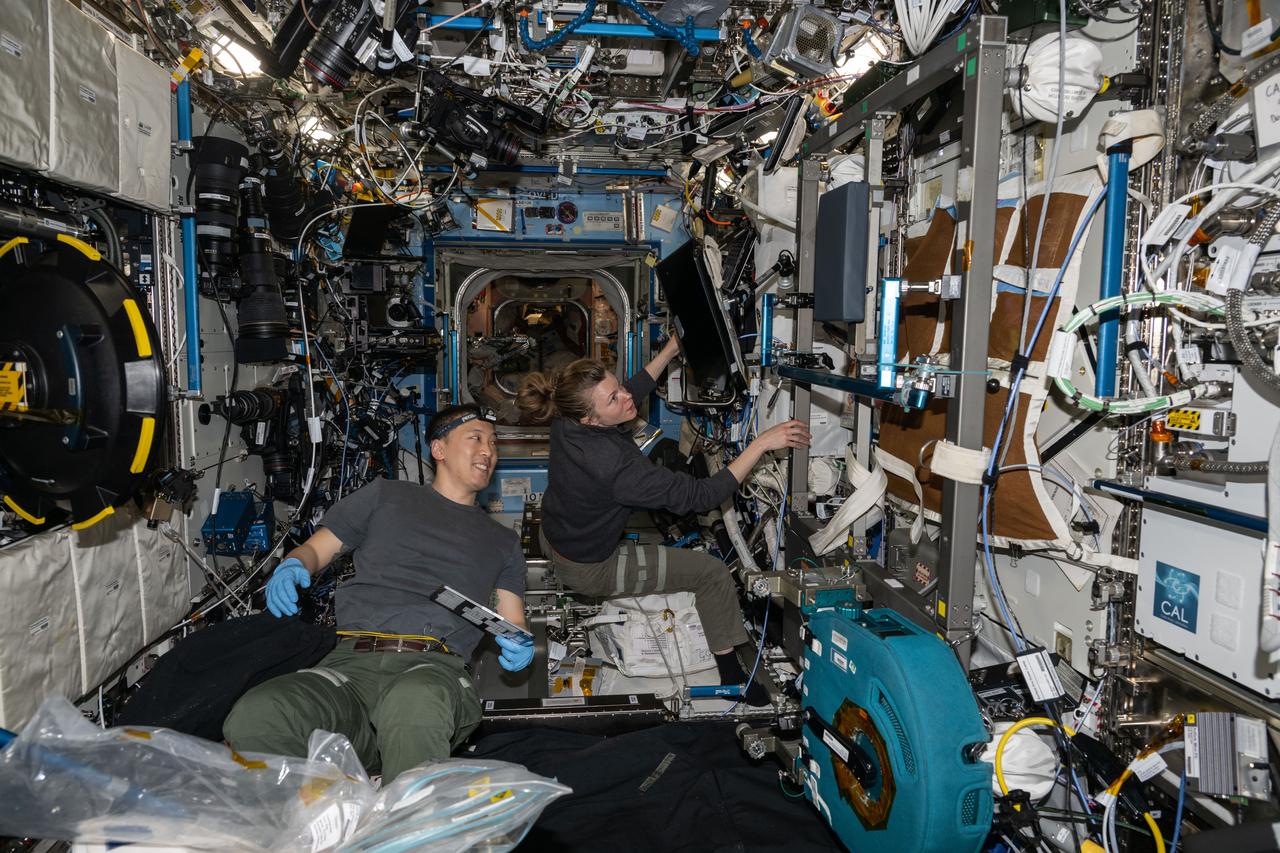
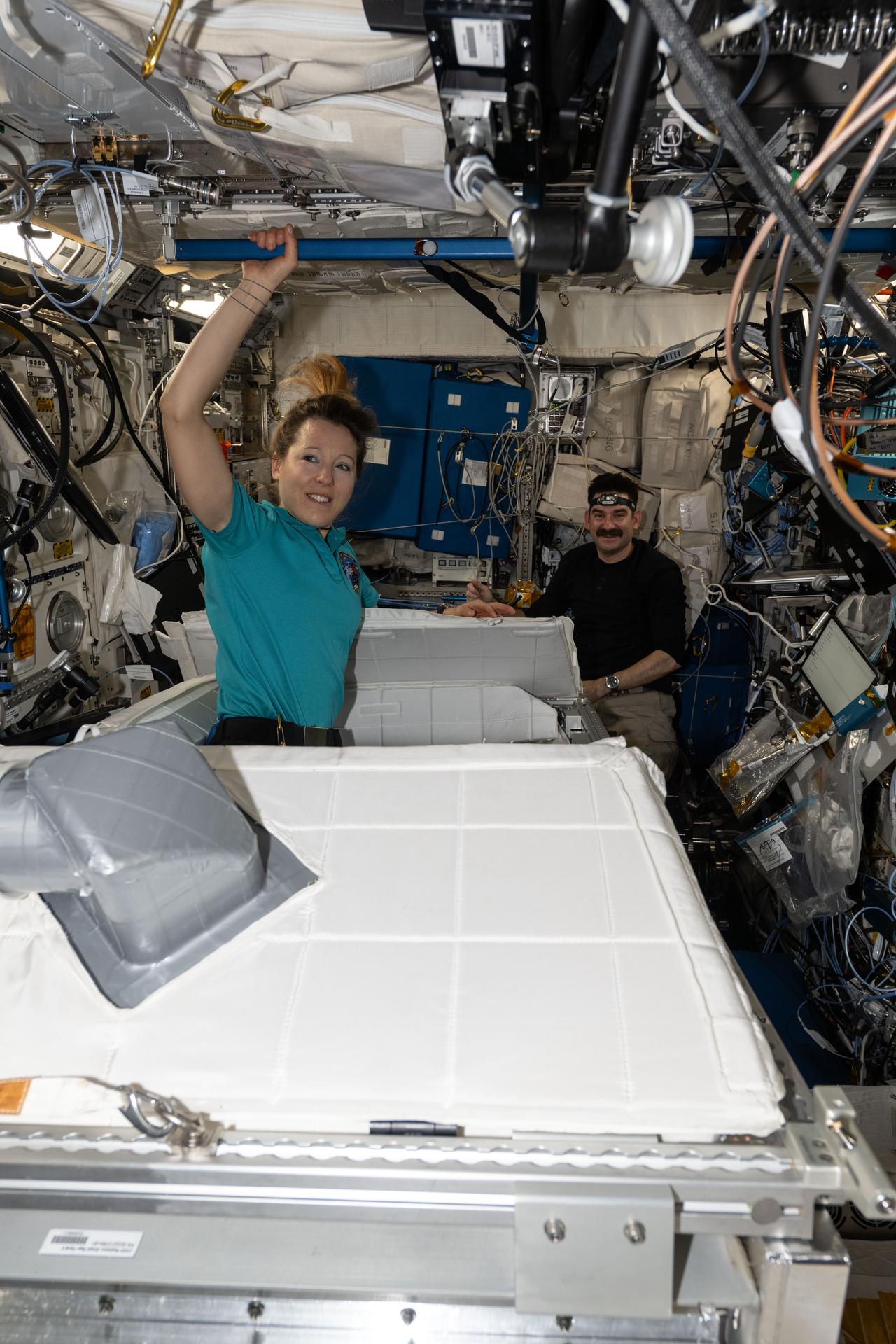
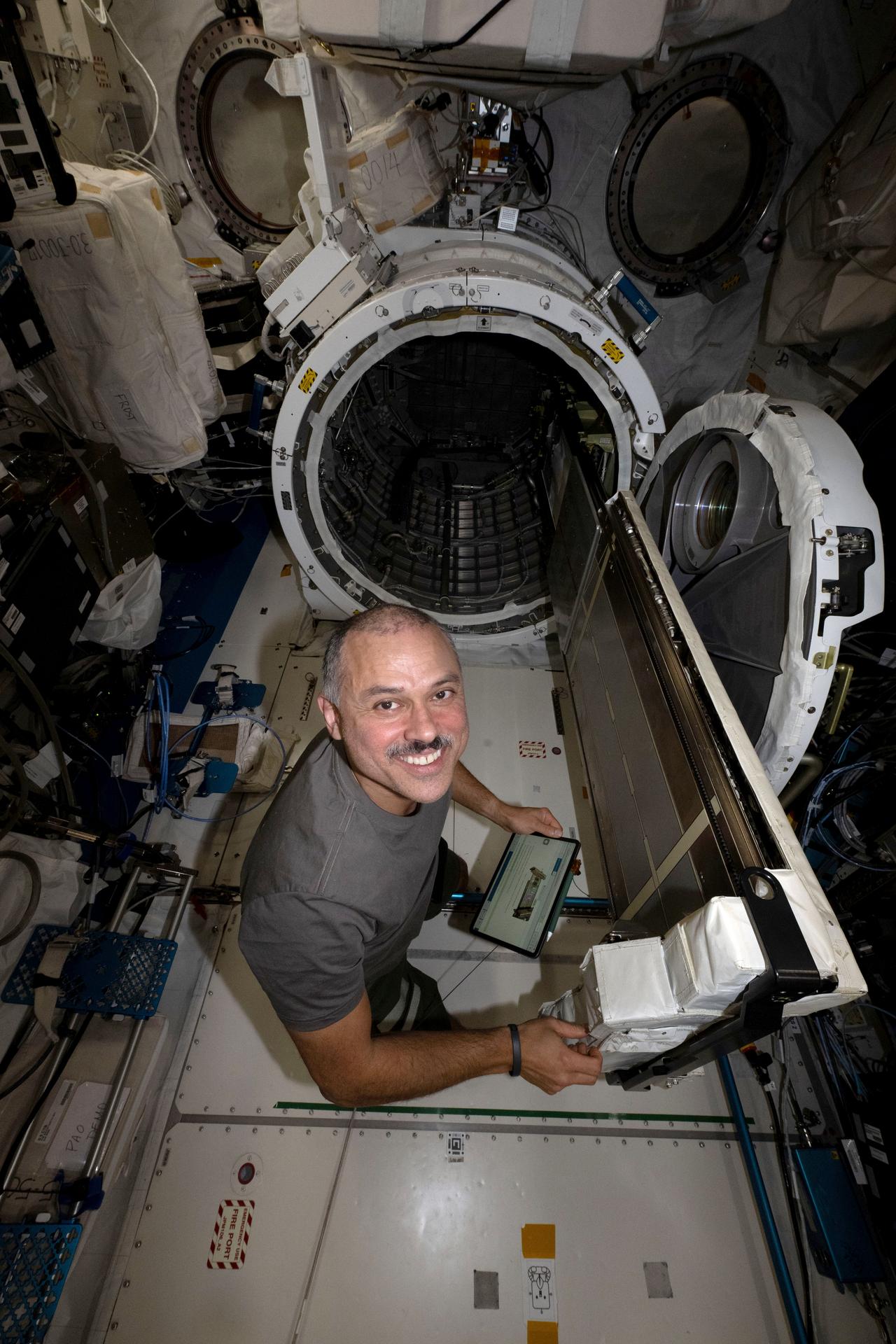
iss073e0546282 (Aug. 26, 2025) --- Expedition 73 Flight Engineers Jonny Kim and Zena Cardman, both NASA astronauts, work together inside the International Space Station's Destiny laboratory module on science maintenance activities.
Expedition 73 Flight Engineers work together inside the Destiny laboratory module
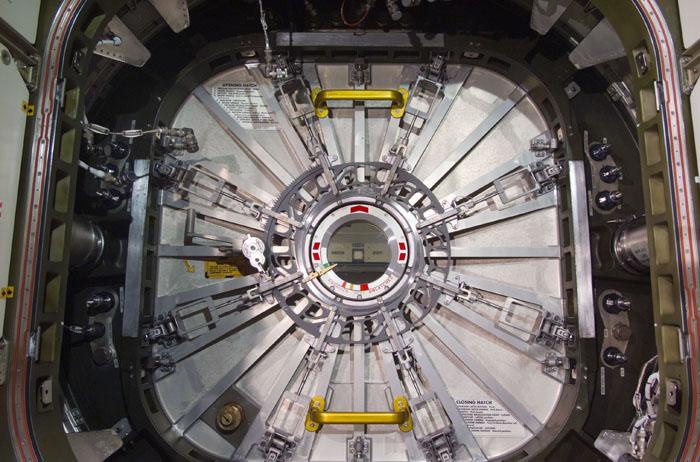
STS98-E-5114 (11 February 2001) --- This medium close-up shot, photographed with a digital still camera, shows Unity's closed hatch to the newly delivered Destiny laboratory.  The crews of Atlantis and the International Space Station opened the laboratory, shortly after this photo was made on Feb. 11, and the astronauts and cosmonauts spent the first full day of what are planned to be years of work ahead inside the orbiting science and command center. Station commander William M. (Bill) Shepherd opened the Destiny hatch, and he and shuttle commander Kenneth D. Cockrell ventured inside at 8:38 a.m. (CST), Feb. 11.  As depicted in subsequent digital images in this series, members of both crews went to work quickly inside the new module, activating air systems, fire extinguishers, alarm systems, computers and internal communications. The crew also continued equipment transfers from the shuttle to the station.
Hatch leading into U.S. Laboratory / Destiny module
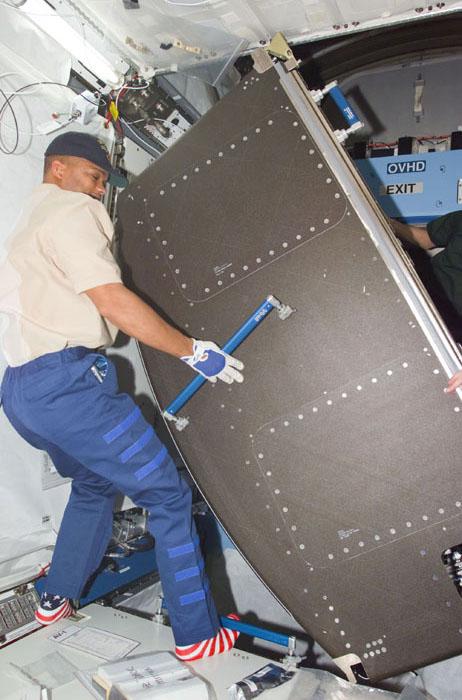
STS98-E-5157 (11 February 2001) ---  Astronaut Robert L. Curbeam, STS-98 mission specialist, installs some of the fixtures in the newly attached Destiny  laboratory onboard the International Space Station (ISS).  After the Destiny hatch was opened early in the day, members of both crews went to work quickly inside the new module, activating air systems, fire extinguishers, alarm systems, computers and internal communications. The crews also took some photos and continued equipment transfers from the shuttle to the station. The scene was taken with a digital still camera.
MS Curbeam with rack in U.S. Laboratory /Destiny module
ISS002-E-5493 (31 March 2001) --- Astronaut James S. Voss, Expedition Two flight engineer, studies the Earth from the very advantageous perspective of the nadir window in the U.S. Laboratory / Destiny module of the International Space Station (ISS).  The image was recorded with a digital still camera.
View of Voss at photo quality window in Destiny Laboratory module
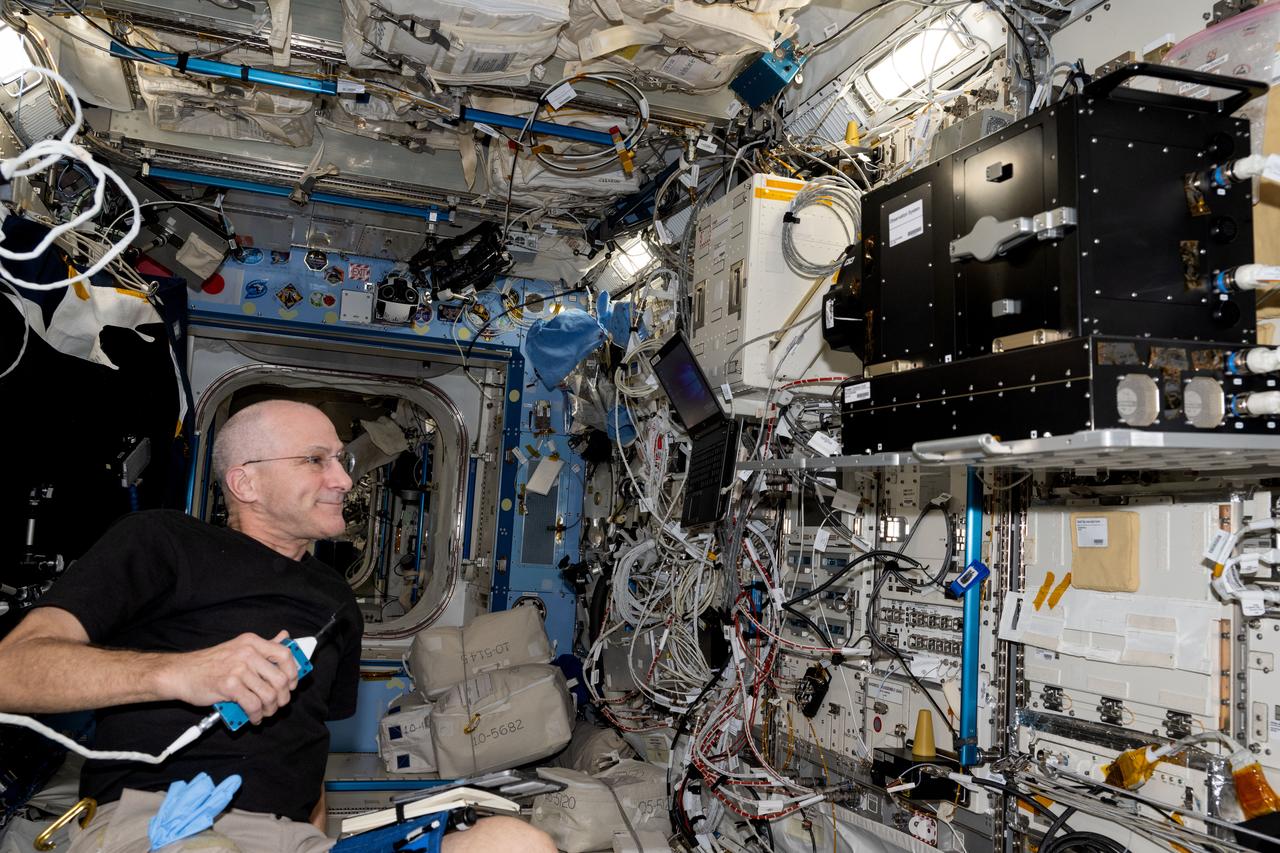
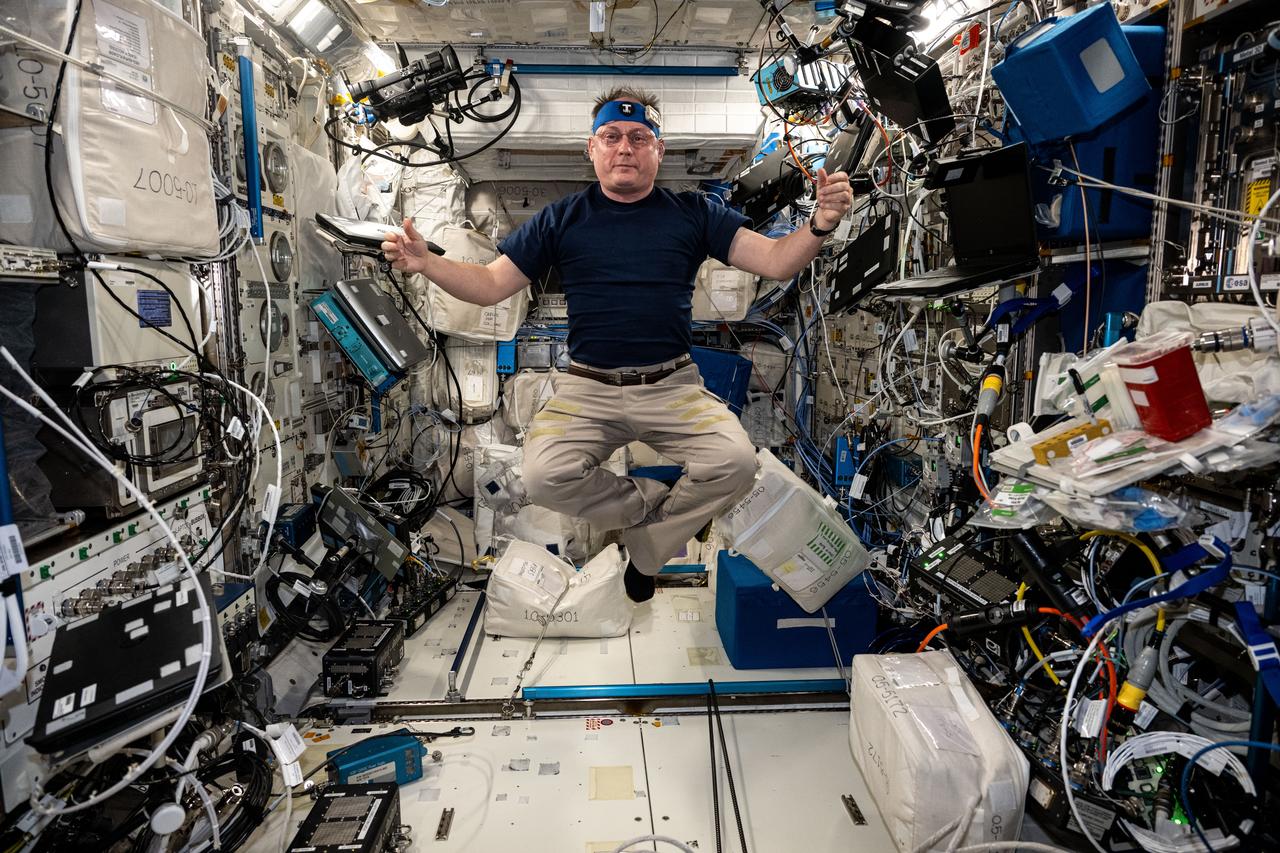
iss072e661836 (Feb. 28, 2025) --- NASA astronaut and Expedition 72 Flight Engineer Don Pettit poses for a portrait inside the International Space Station's Kibo laboratory module. Attached to Pettit's legs are a notebook and a variety of tools used for research and maintenance operations aboard the orbital outpost.
Astronaut Don Pettit poses for a portrait inside the Kibo laboratory module
iss072e033530 (Oct. 10, 2024) --- NASA astronaut and Expedition 72 Flight Engineer Don Pettit works inside the Kibo laboratory module checking out biology imaging hardware, the Tele-Luminescence Analysis System (TELLAS), that can detect space-caused inflammatory changes to tissues and genes in organisms.
Astronaut Don Pettit works inside the Kibo laboratory module
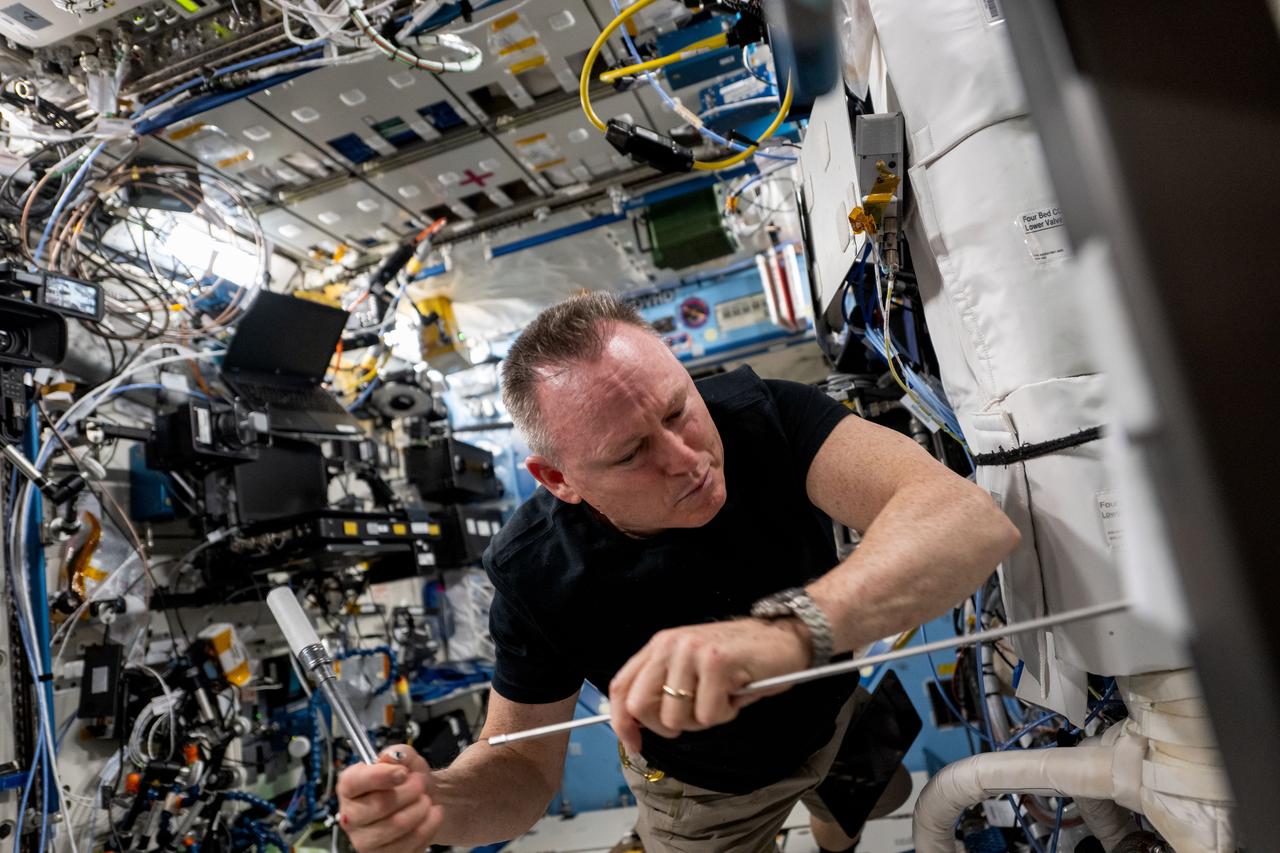
iss073e0416805 (July 25, 2025) --- NASA astronaut and Expedition 73 Flight Engineer Jonny Kim performs maintenance on the Destiny laboratory module's fluid servicer system used to maintain and repair rack water lines and systems throughout the International Space Station.
NASA astronaut Jonny Kim performs maintenance in the Destiny laboratory module
iss073e0420867 (Aug. 2, 2025) --- From left, JAXA (Japan Aerospace Exploration Agency) astronauts Takuya Onishi and Kimiya Yui, Expedition 73 Commander and Flight Engineer respectively, are pictured during crew familiarization activities inside the International Space Station's Kibo laboratory module.
JAXA astronauts Takuya Onishi and Kimiya Yui inside the Kibo laboratory module
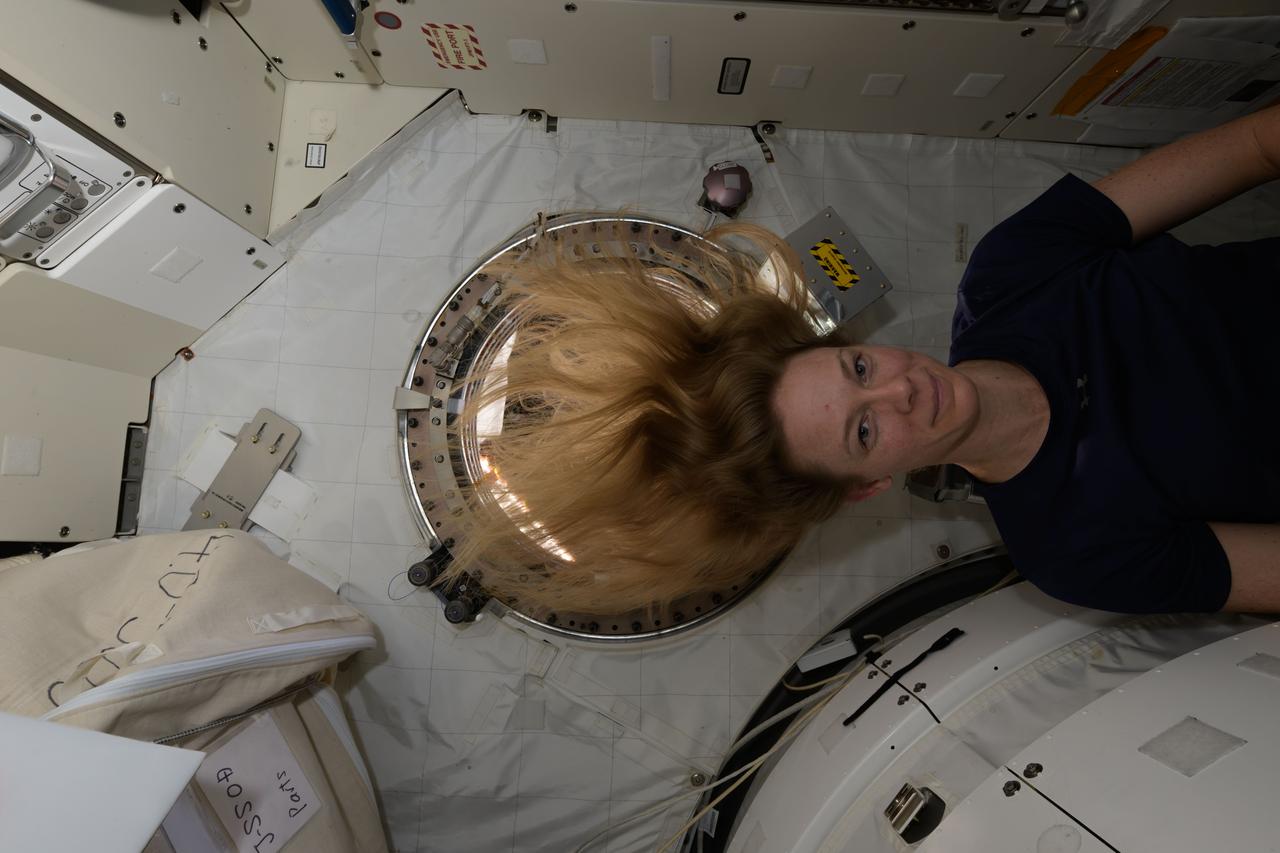
iss073e0420910 (Aug. 3, 2025) --- NASA astronaut and Expedition 73 Flight Engineer Mike Fincke poses for a portrait inside the International Space Station's Columbus laboratory module during research operations to learn how the body maintains its core temperature in microgravity.
NASA astronaut Mike Fincke poses for a portrait inside the Columbus laboratory module
iss073e0545108 (Aug. 26, 2025) --- Expedition 73 Flight Engineers (clockwise from top) Zena Cardman, Jonny Kim, and Mike Fincke, all three NASA astronauts, and Kimita Yui from JAXA (Japan Aerospace Exploration Agency) gather together inside the Kibo laboratory module prior to a conference with officials on the ground.
Expedition 73 Flight Engineers gather together inside the Kibo laboratory module
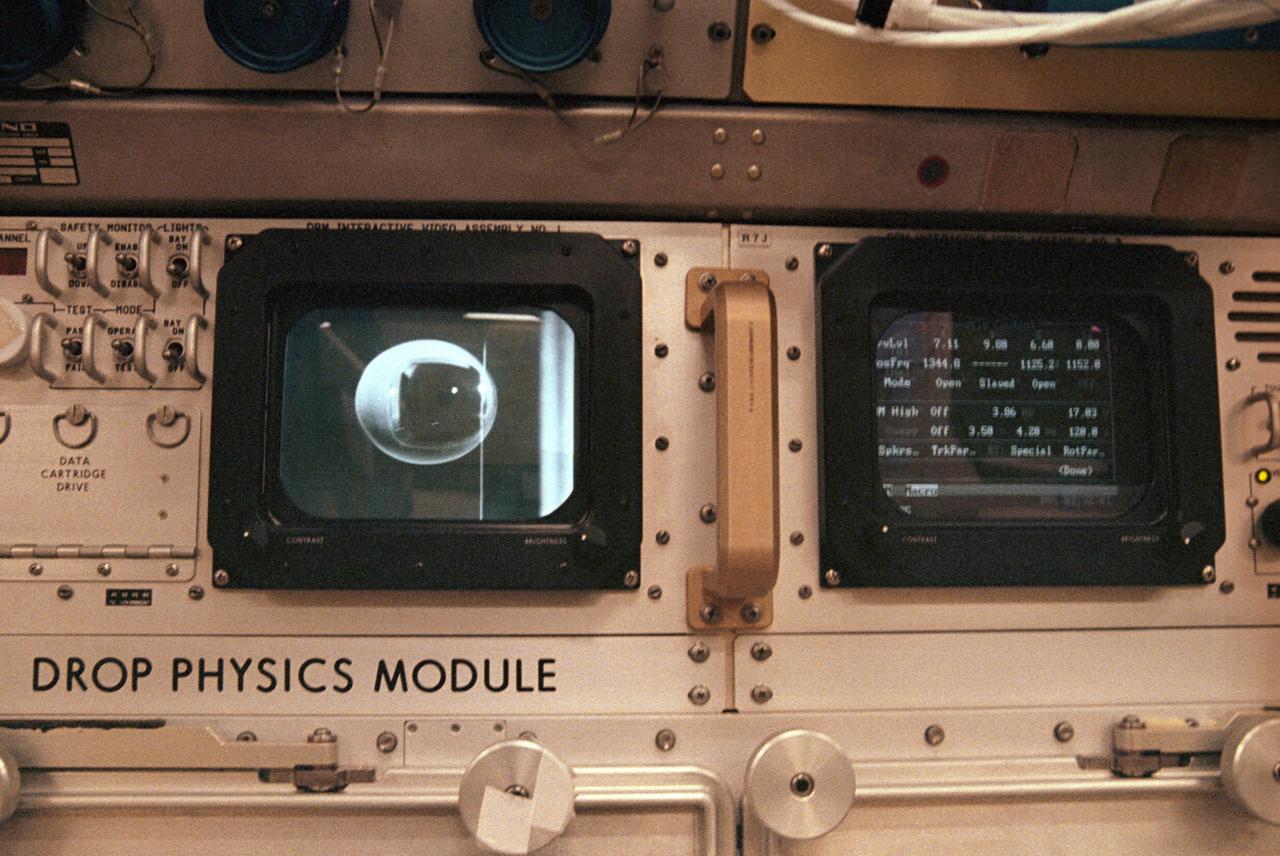
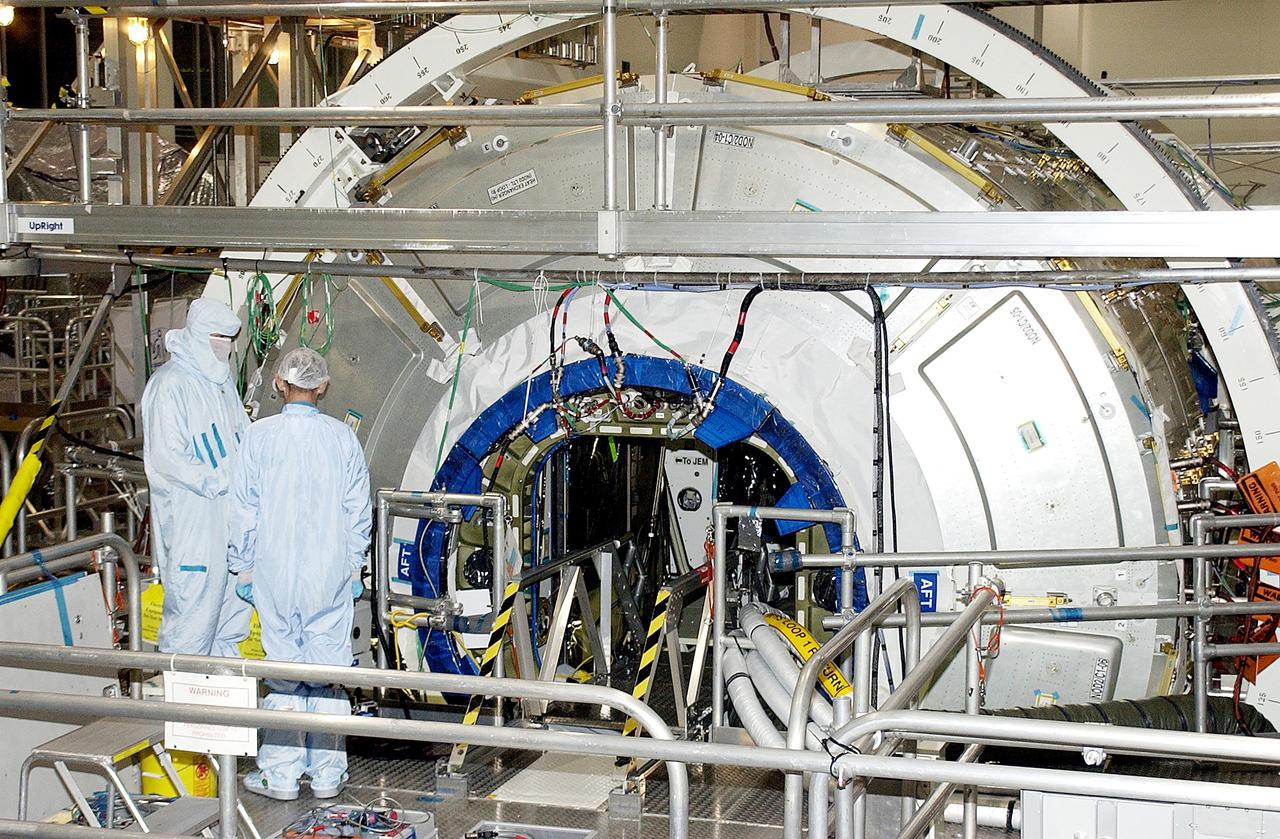
The first United States Microgravity Laboratory (USML-1) was one of NASA's science and technology programs that provided scientists an opportunity to research various scientific investigations in a weightlessness environment inside the Spacelab module. It also provided demonstrations of new equipment to help prepare for advanced microgravity research and processing aboard the Space Station. The USML-1 flew in orbit for extended periods, providing greater opportunities for research in materials science, fluid dynamics, biotechnology (crystal growth), and combustion science. This is a close-up view of the Drop Physics Module (DPM) in the USML science laboratory. The DPM was dedicated to the detailed study of the dynamics of fluid drops in microgravity: their equilibrium shapes, the dynamics of their flows, and their stable and chaotic behaviors. It also demonstrated a technique known as containerless processing. The DPM and microgravity combine to remove the effects of the container, such as chemical contamination and shape, on the sample being studied. Sound waves, generating acoustic forces, were used to suspend a sample in microgravity and to hold a sample of free drops away from the walls of the experiment chamber, which isolated the sample from potentially harmful external influences. The DPM gave scientists the opportunity to test theories of classical fluid physics, which have not been confirmed by experiments conducted on Earth. This image is a close-up view of the DPM. The USML-1 flew aboard the STS-50 mission on June 1992, and was managed by the Marshall Space Flight Center.
Spacelab
STS98-E-5137 (11 February 2001) --- Astronauts Thomas D. Jones (foreground), STS-98 mission specialist,  and William M. Shepherd, Expedition One mission commander, participate in an impromptu photo shoot onboard the newly opened Destiny laboratory on the International Space Station (ISS).  After Shepherd opened the Destiny hatch, he and astronaut Kenneth D. Cockrell (out of frame) ventured inside at 8:38 a.m. (CST), February 11, 2001.  As depicted in subsequent digital images in this series, members of both crews went to work quickly inside the new module, activating air systems, fire extinguishers, alarm systems, computers and internal communications. The crew also took some photos and continued equipment transfers from the shuttle to the station.
MS Jones in U.S. Laboratory / Destiny module
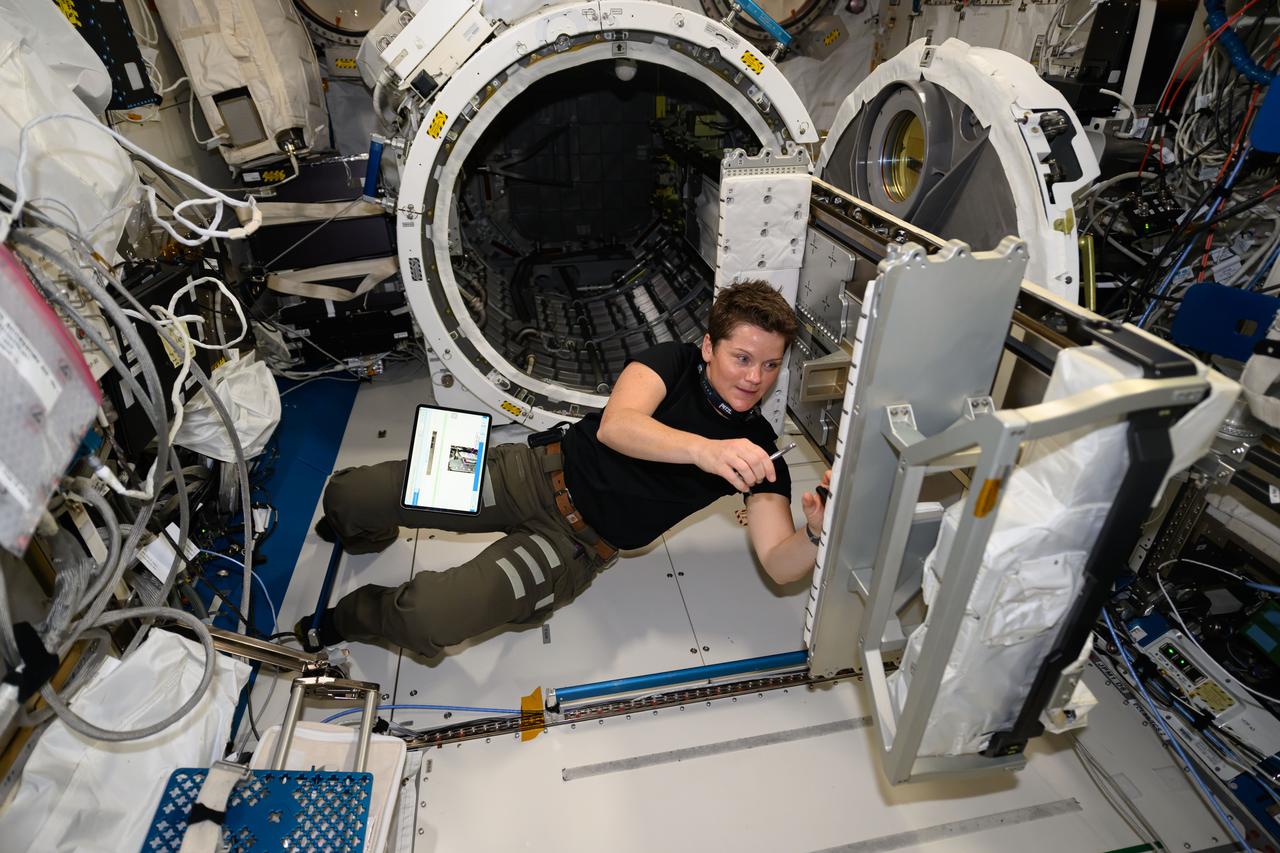
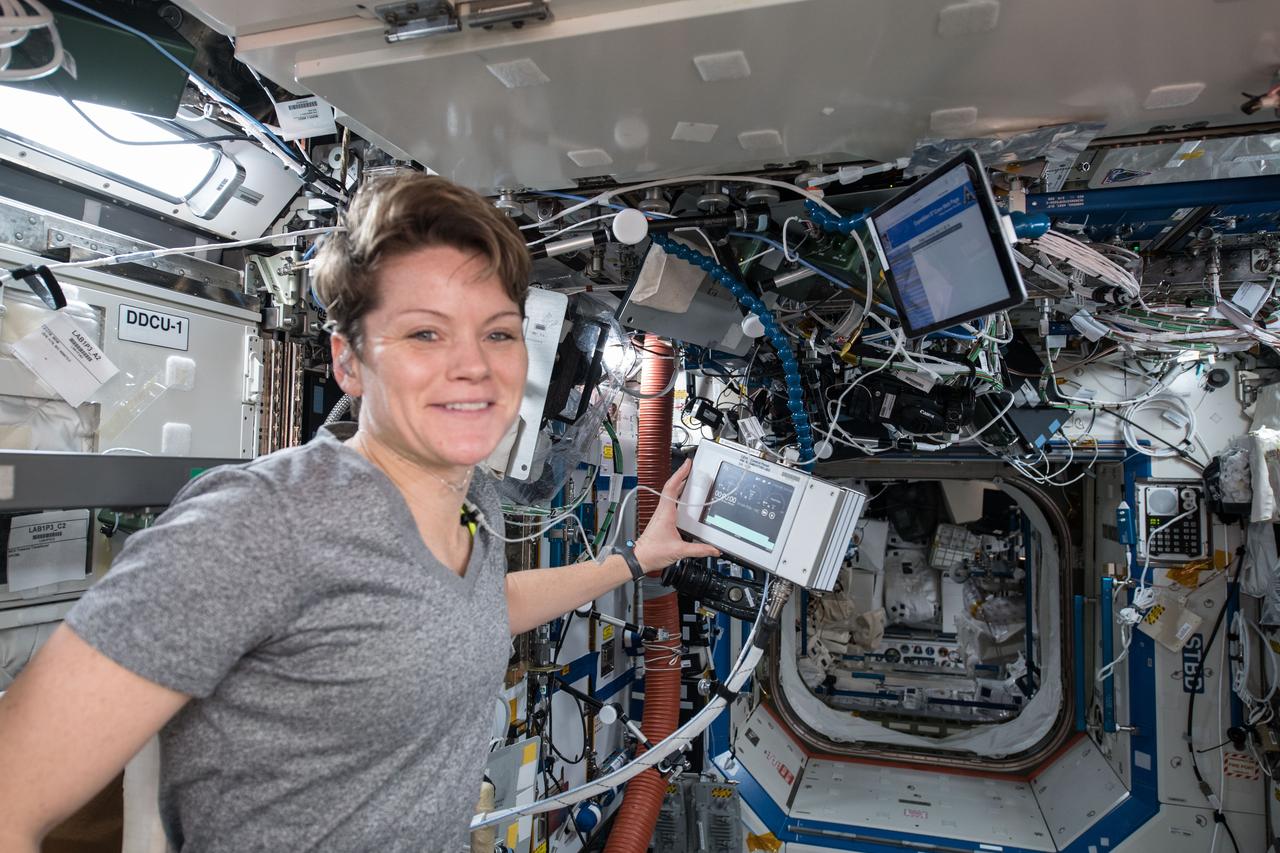
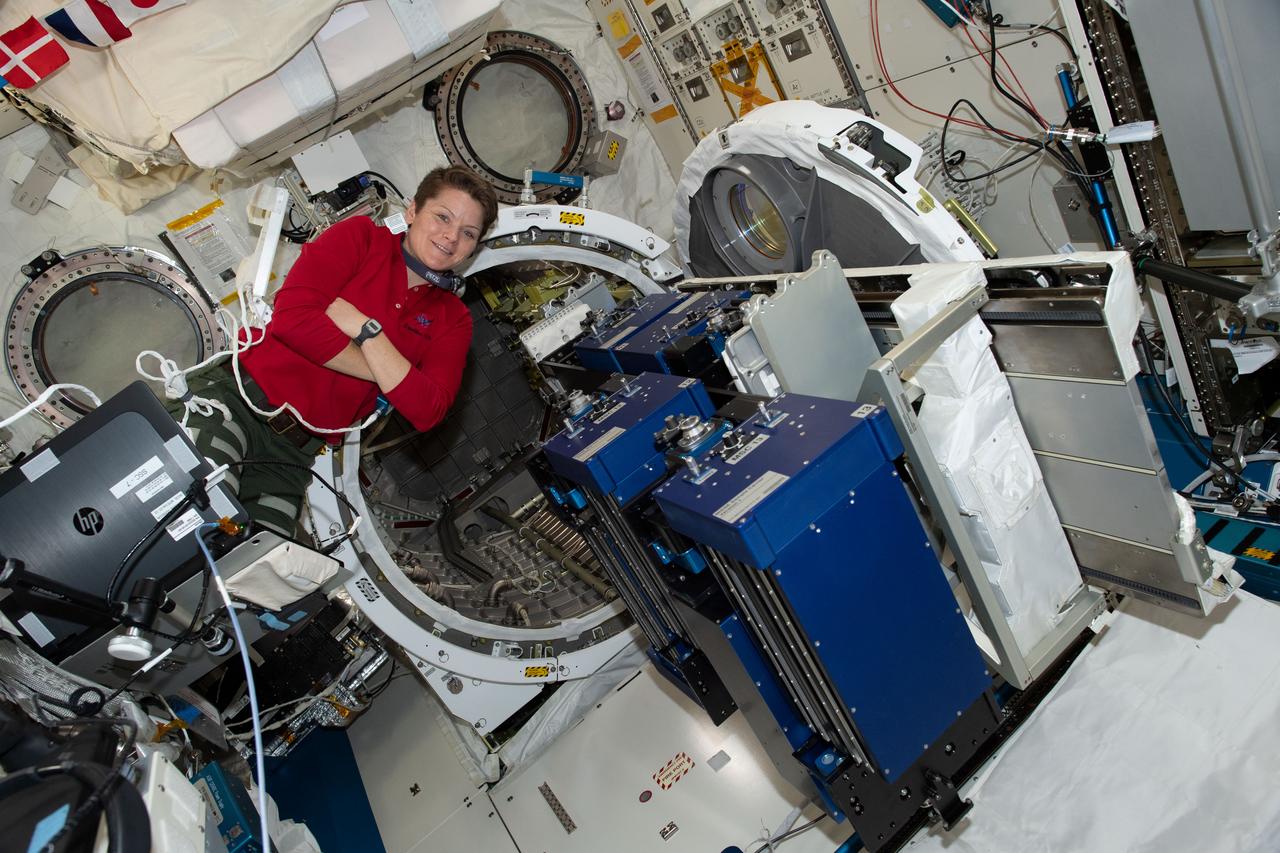
iss072e808737 (March 21, 2025) --- NASA astronaut and Expedition 72 Flight Engineer Anne McClain works on hardware maintenance tasks inside the International Space Station's Kibo laboratory module. Behind McClain is Kibo's airlock where experiment hardware such as external exposure investigations and CubeSats are staged before being placed outside the orbiting lab into the vacuum of space.
Astronaut Anne McClain hardware maintenance tasks inside the Kibo laboratory module
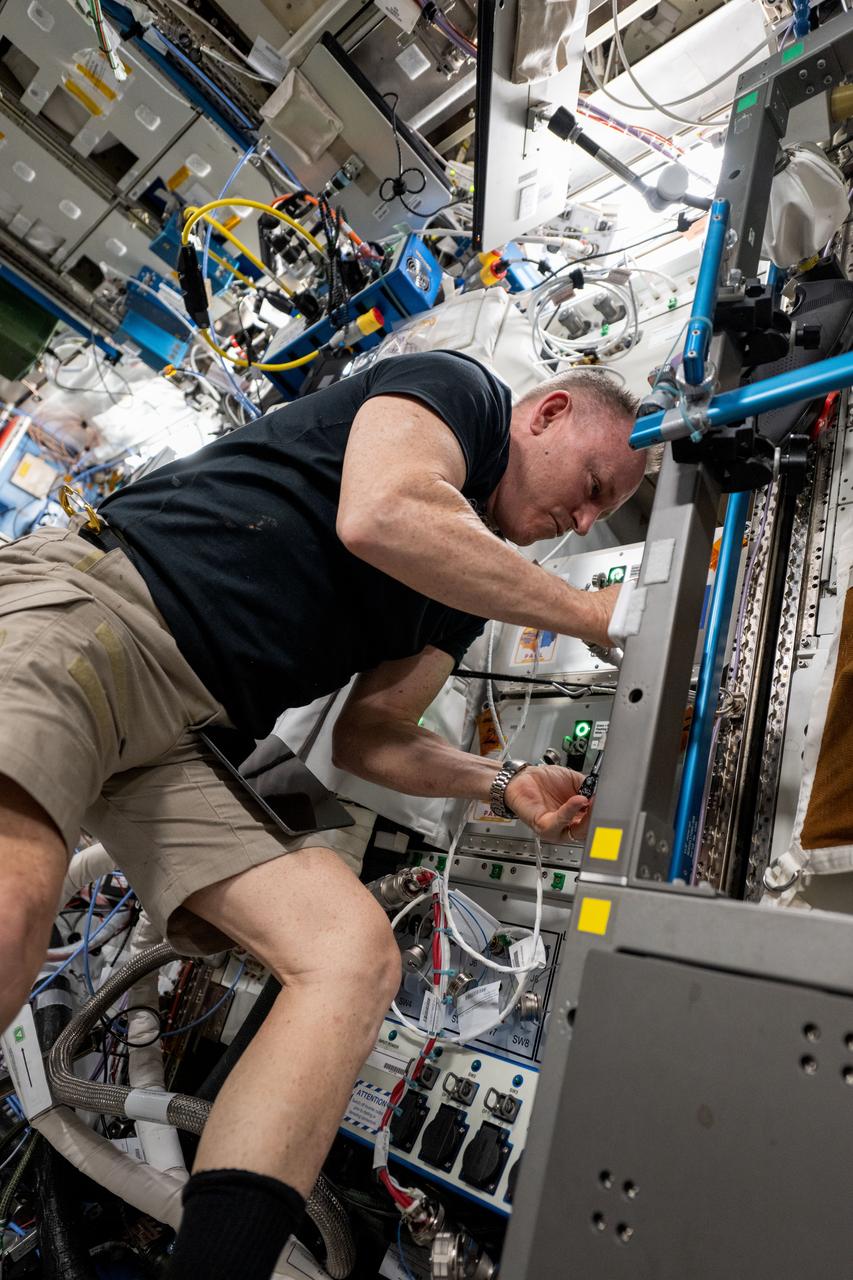
iss072e145969 (Nov. 6, 2024) --- NASA astronaut and Expedition 72 Flight Engineer Butch Wilmore installs the Powered Ascent Utility Locker-2 (PAUL-2) in an EXPRESS rack aboard the International Space Station's Destiny laboratory module. PAUL-2 was launched aboard the SpaceX Dragon cargo spacecraft and can provide power and temeperature control for experiments packed inside Dragon during its trip to the orbital outpost.
Astronaut Butch Wilmore installs science hardware inside the Destiny laboratory module
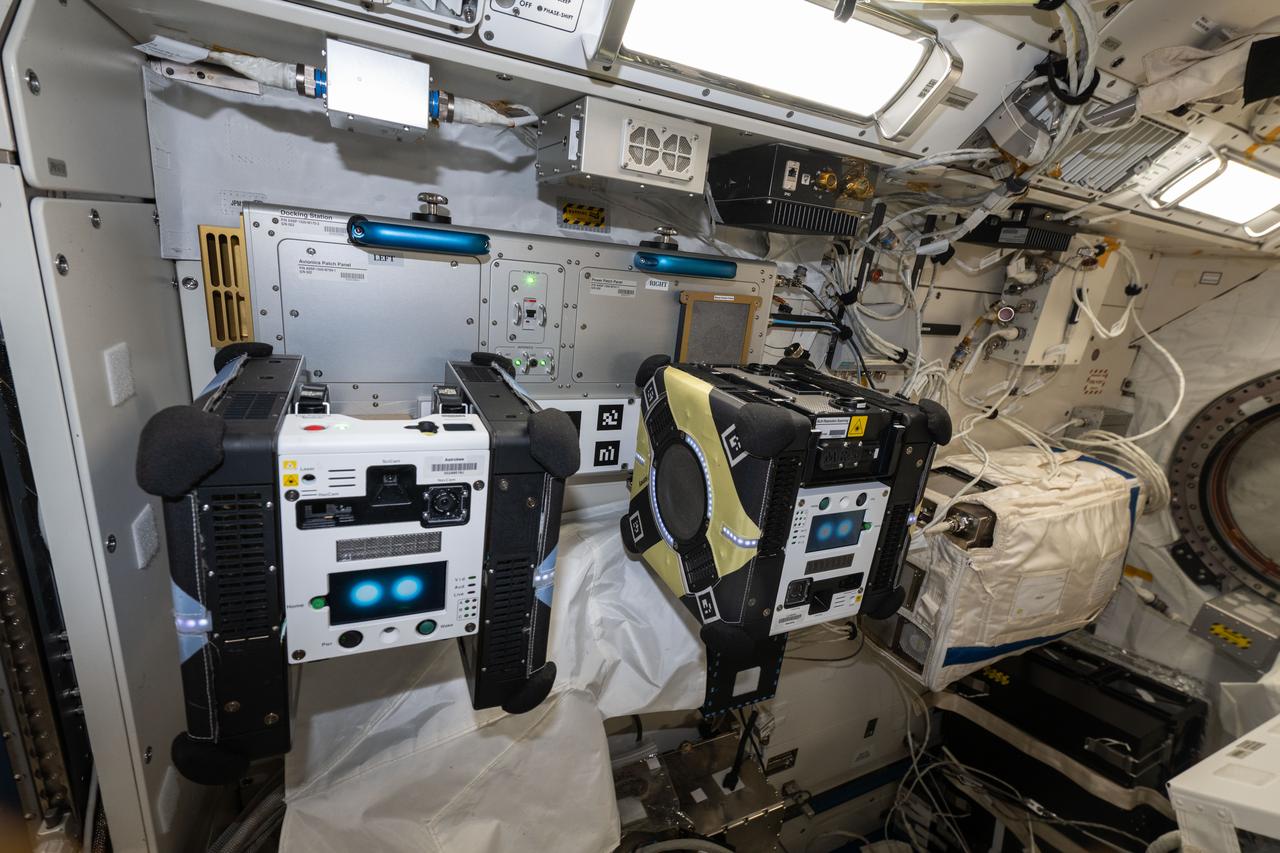
iss073e0098590 (May 26, 2025) --- A pair of Astrobee robotic free-flyers are pictured docked to ports inside the International Space Station's Kibo laboratory module. The cube-shaped, toaster-sized robots are being tested for their ability to autonomously navigate aboard the orbital outpost and conduct routine maintenance and monitoring duties enabling the crew to focus on science and engineering duties.
A pair of Astrobee robotic free-flyers are pictured inside the Kibo laboratory module
iss072e145964 (Nov. 6, 2024) --- NASA astronaut and Expedition 72 Flight Engineer Butch Wilmore installs the Powered Ascent Utility Locker-2 (PAUL-2) in an EXPRESS rack aboard the International Space Station's Destiny laboratory module. PAUL-2 was launched aboard the SpaceX Dragon cargo spacecraft and can provide power and temeperature control for experiments packed inside Dragon during its trip to the orbital outpost.
Astronaut Butch Wilmore installs science hardware inside the Destiny laboratory module
iss073e0982912 (Oct. 28, 2025) --- NASA astronaut and Expedition 73 Flight Engineer Zena Cardman works inside the International Space Station's Kibo laboratory module. Cardman was repairing a computer hard drive inside the Multi-use Variable-g Platform-02—a research device that can generate artificial gravity to study how microbes, plants, cells, protein crystals, and more might grow in different gravity environments including the Moon and Mars.
NASA astronaut Zena Cardman works inside the Kibo laboratory module
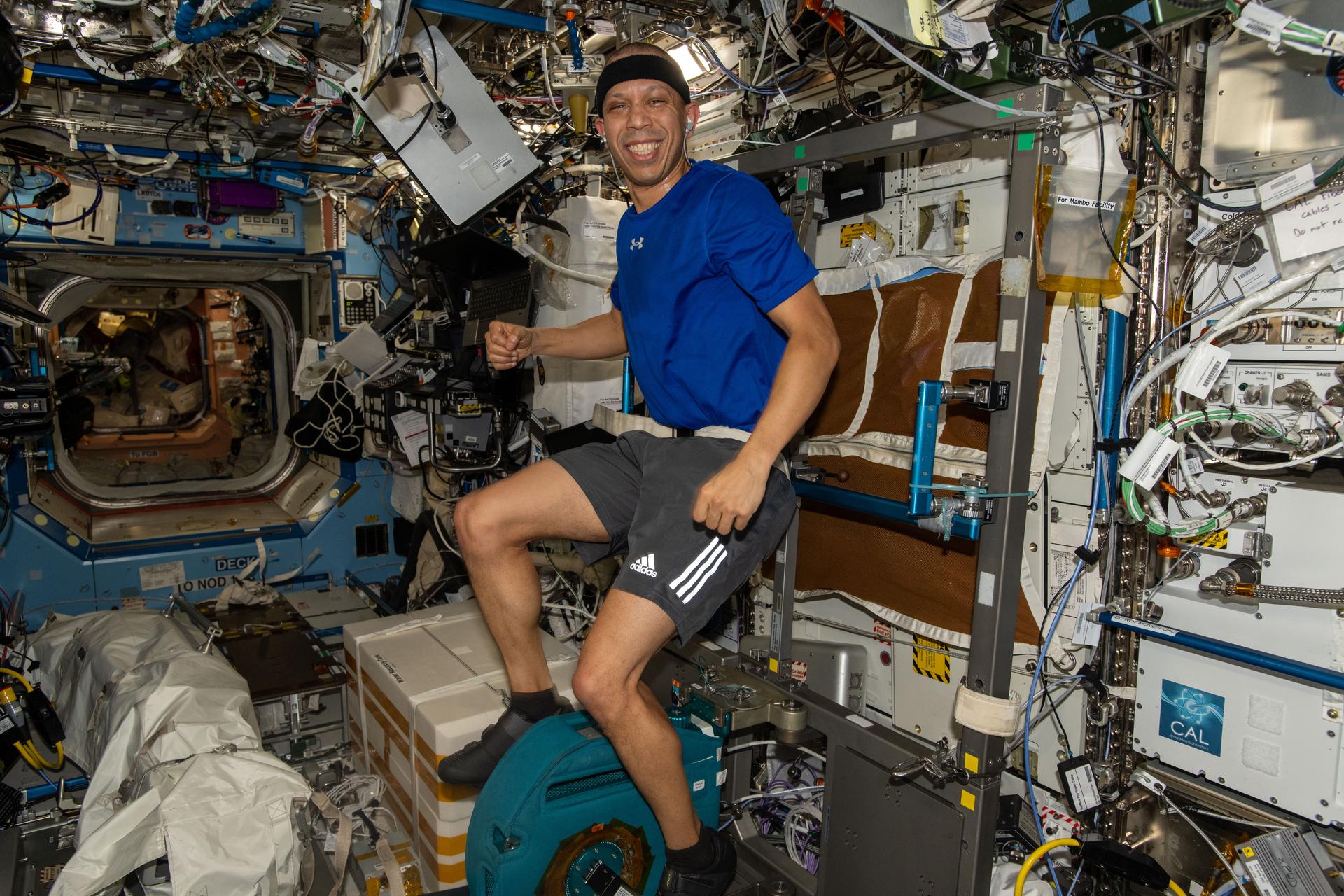
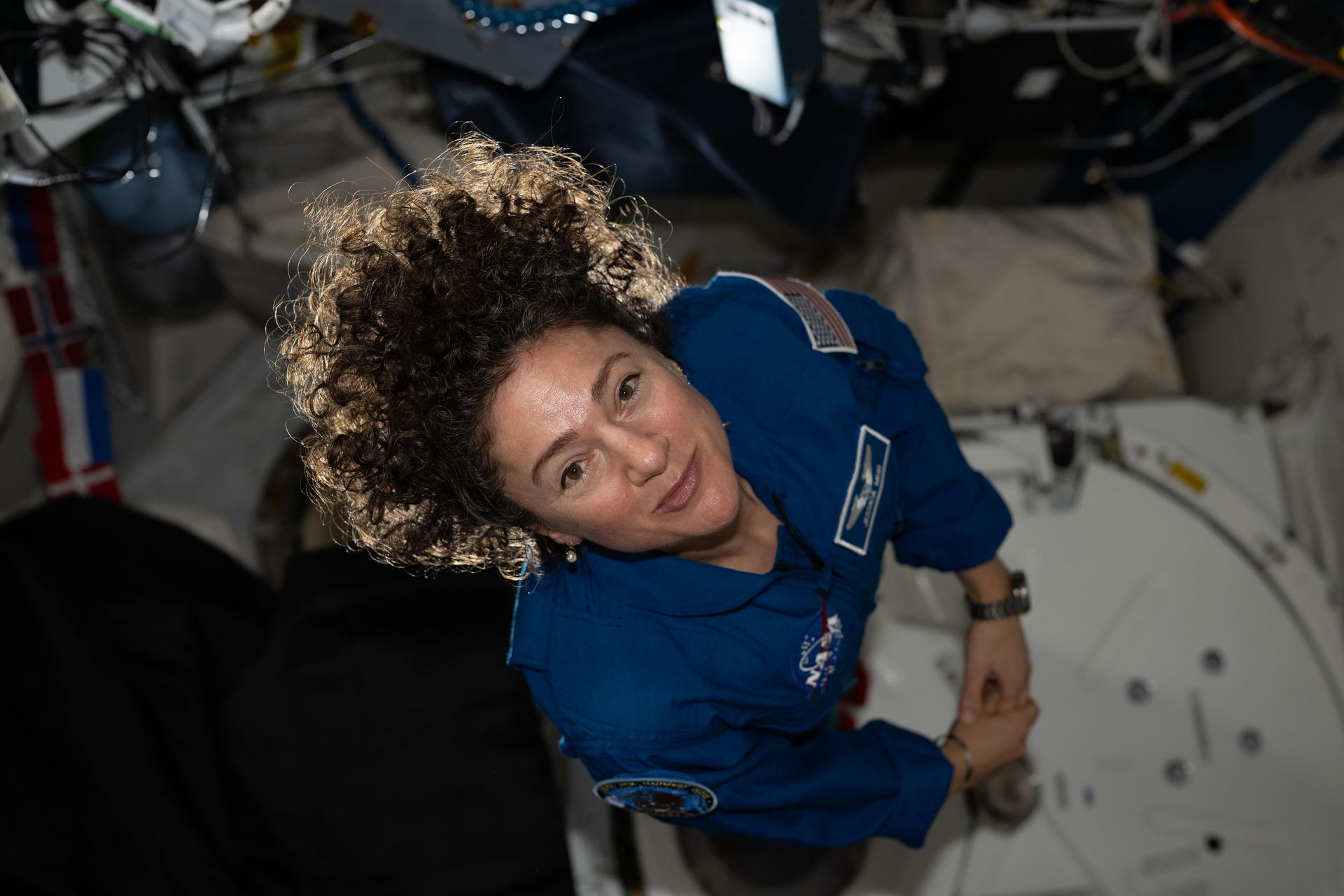
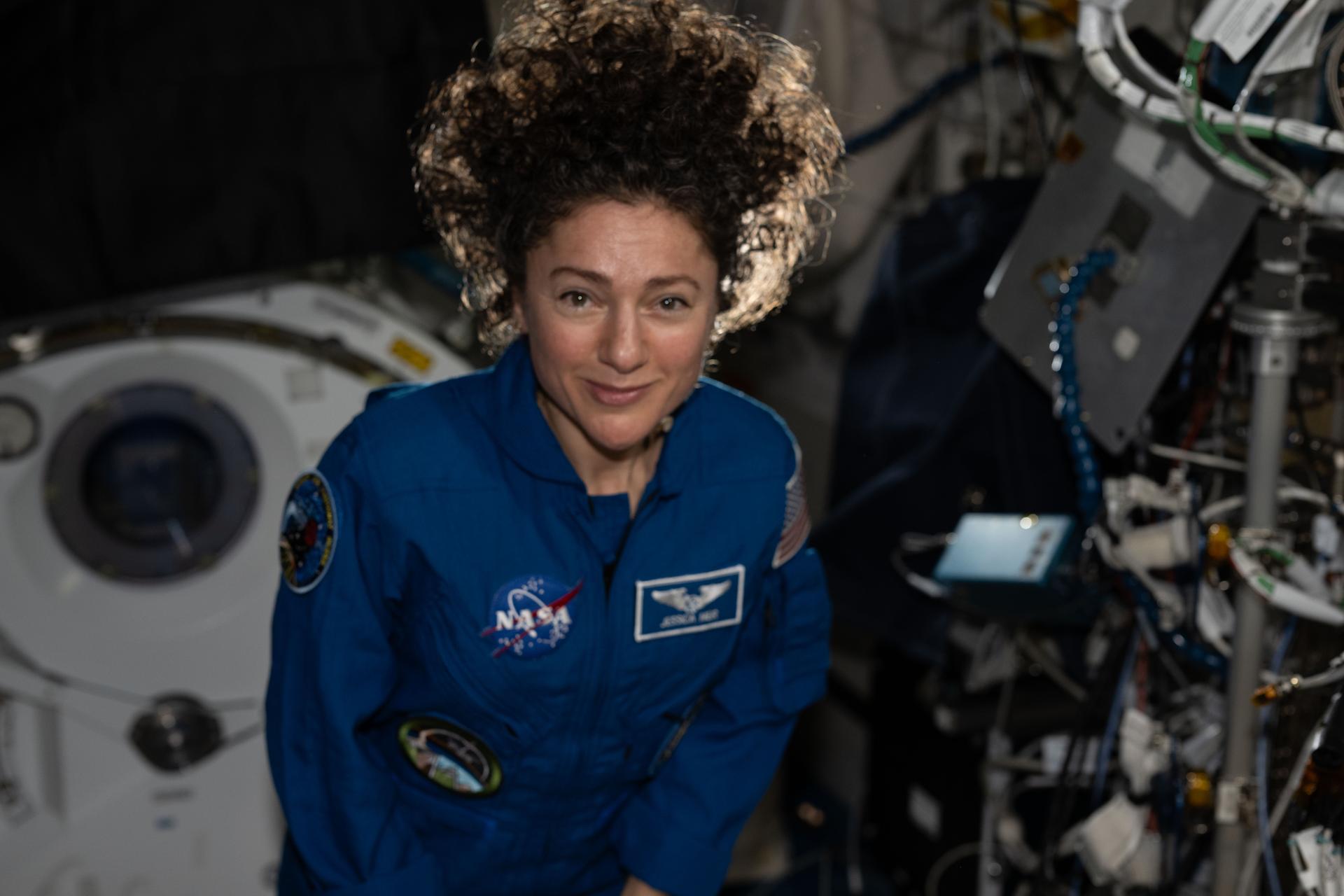
iss057e132459 (Dec. 7, 2018) --- NASA astronaut Anne McClain is pictured exercising aboard the International Space Station inside the U.S. Destiny laboratory module.
NASA astronaut Anne McClain
iss058e001000 (Dec. 26, 2018) --- NASA astronaut and Expedition 58 Flight Engineer Anne McClain works inside Japan's Kibo laboratory module installing the Material Transfer Tray before inserting it into the module's airlock.
NASA Astronaut Anne McClain Conducts Space Science and Station Maintenance
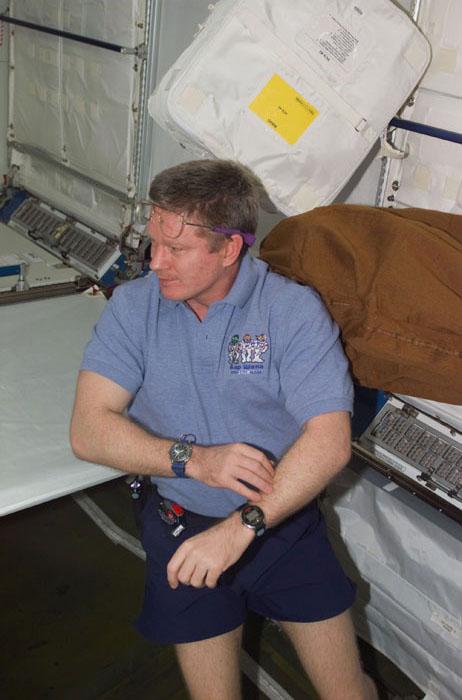
STS98-E-5160 (11 February 2001) --- Astronaut William M. (Bill) Shepherd,  Expedition One commander, surveys the interior of the newly attached Destiny laboratory onboard the International Space Station (ISS).  After the Destiny hatch was opened early in the day, members of both crews went to work quickly inside the new module, activating air systems, fire extinguishers, alarm systems, computers and internal communications. The crews also took some photos and continued equipment transfers from the shuttle to the station. The scene was taken with a digital still camera.
Expedition One CDR Shepherd in U.S. Laboratory / Destiny module
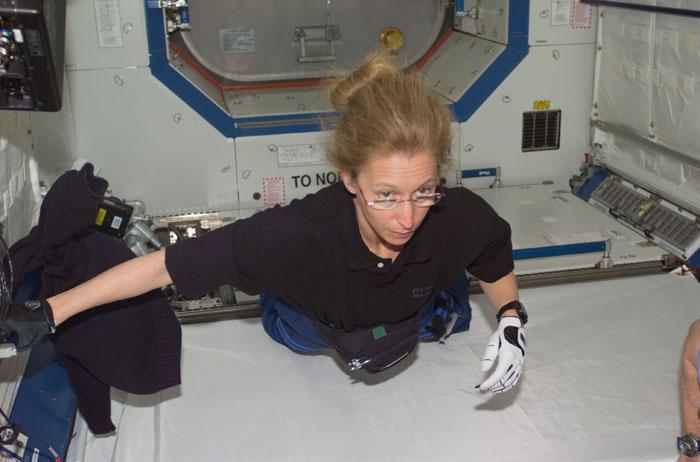
STS98-E-5161 (11 February 2001) --- Astronaut Marsha S. Ivins, STS-98 mission specialist, floats into the newly attached Destiny laboratory onboard the International Space Station (ISS).  After the Destiny hatch was opened early in the day, members of both crews went to work quickly inside the new module, activating air systems, fire extinguishers, alarm systems, computers and internal communications. The crews also took some photos and continued equipment transfers from the shuttle to the station. The scene was taken with a digital still camera.
MS Ivins floats through U.S. Laboratory / Destiny module
STS98-E-5159 (11 February 2001) ---  Astronaut Mark L. Polansky, STS-98 pilot, works inside the newly attached Destiny laboratory onboard the International Space Station (ISS).  After the Destiny hatch was opened early in the day, members of both the shuttle and station crews went to work quickly inside the new module, activating air systems, fire extinguishers, alarm systems, computers and internal communications. The crews also took some photos and continued equipment transfers from the shuttle to the station. The scene was taken with a digital still camera.
STS-98 and Expedition One crew with rack in U.S. Laboratory / Destiny module
iss073e0030301 (May 13, 2025) --- JAXA (Japan Aerospace Exploration Agency) astronaut and Expedition 73 Commander Takuya Onishi swaps research hardware inside the Kibo laboratory module's solid combustion experiment module. Combustion research aboard the International Space Station helps researchers understand how fuels burn in space, design safer spacecraft, develop new materials, and more aboard the orbital outpost.
JAXA astronaut Takuya Onishi swaps combustion research hardware inside the Kibo laboratory module
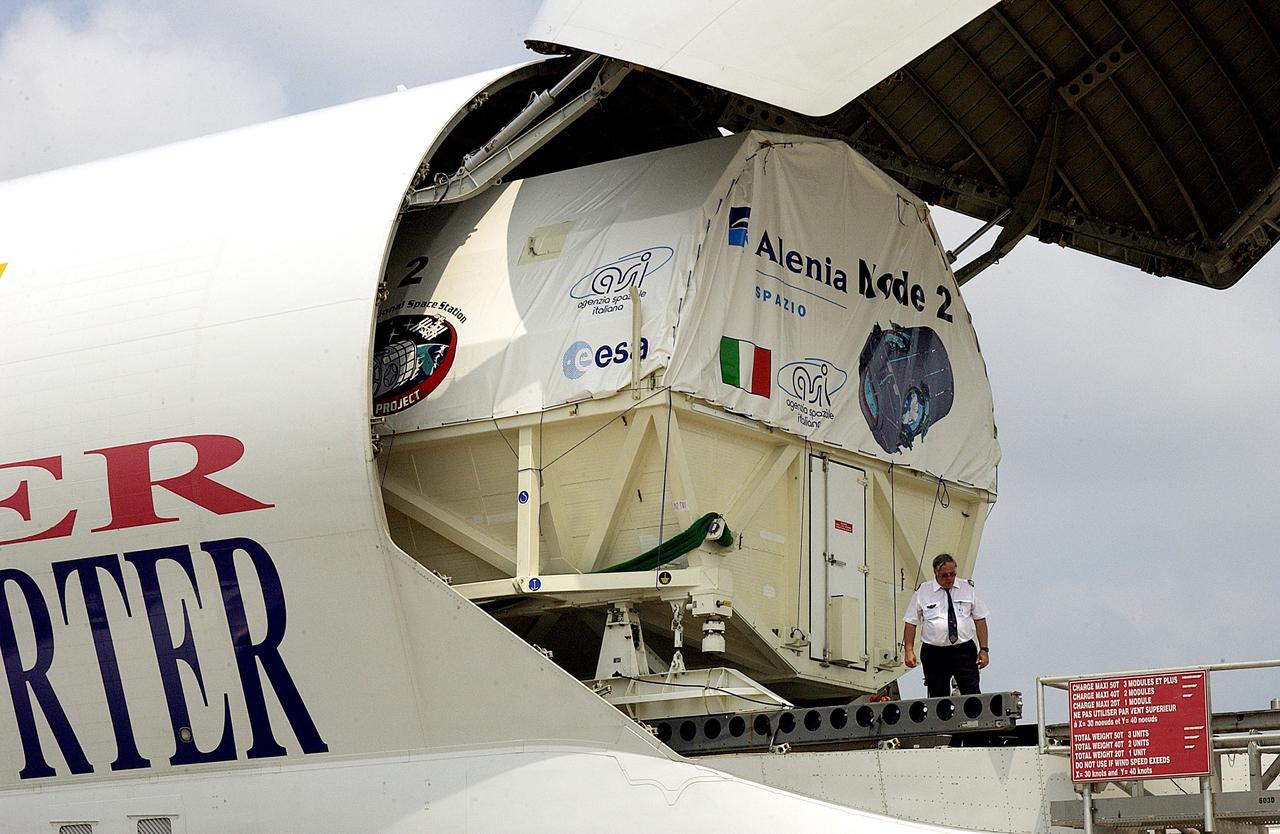
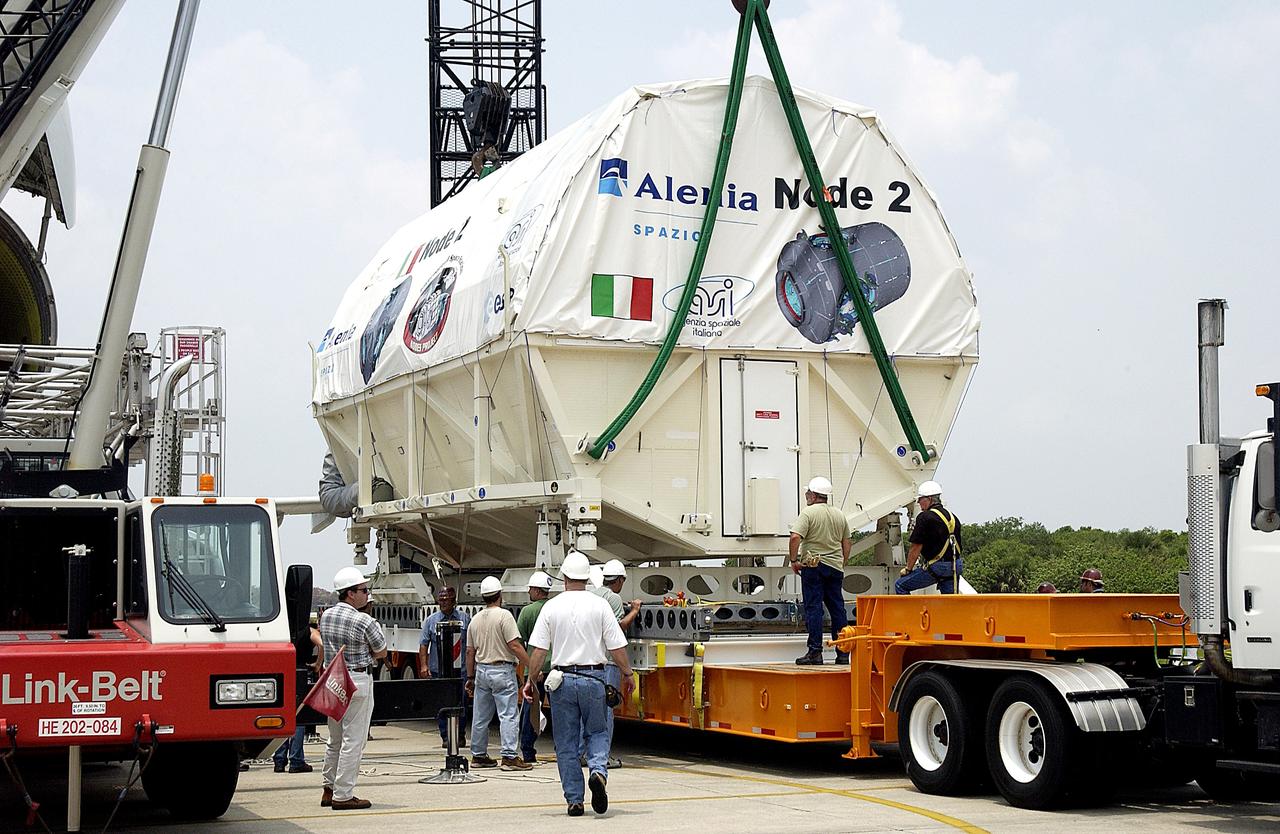
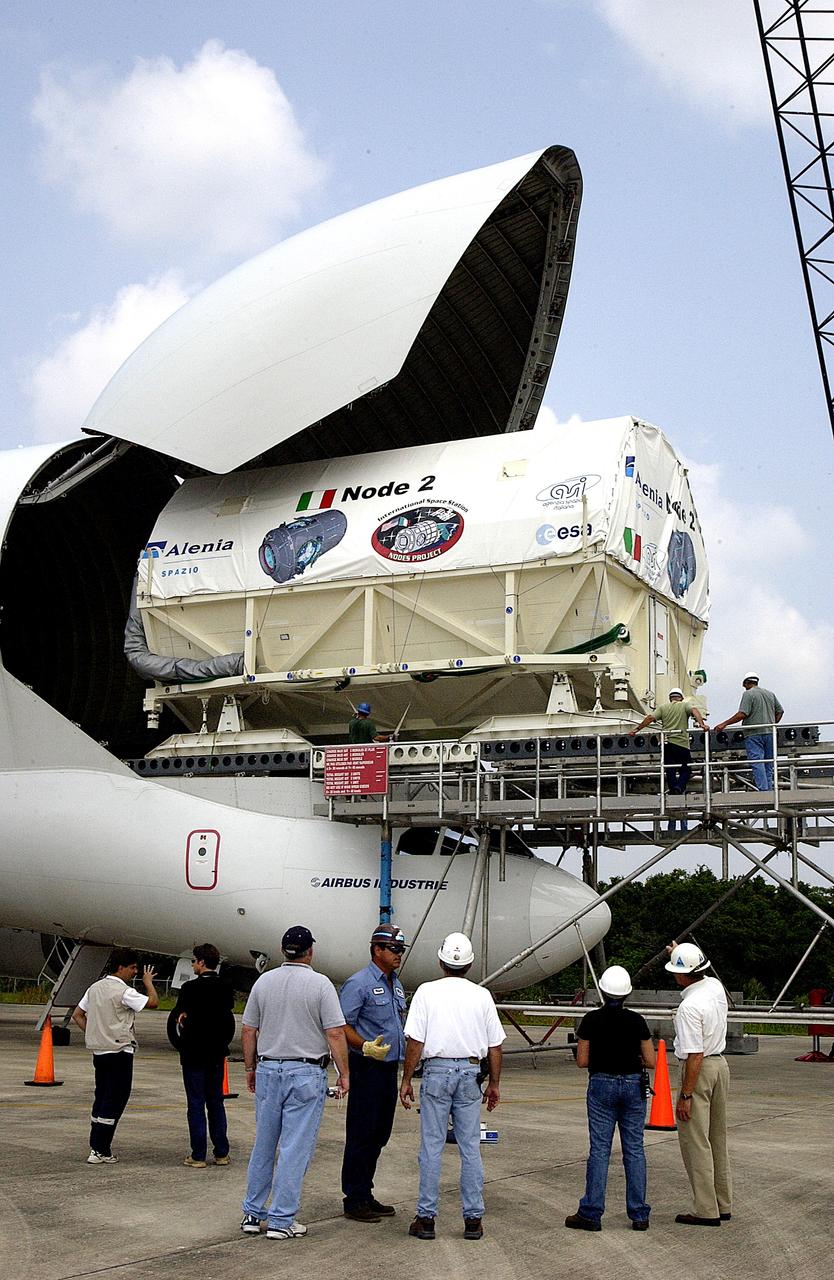
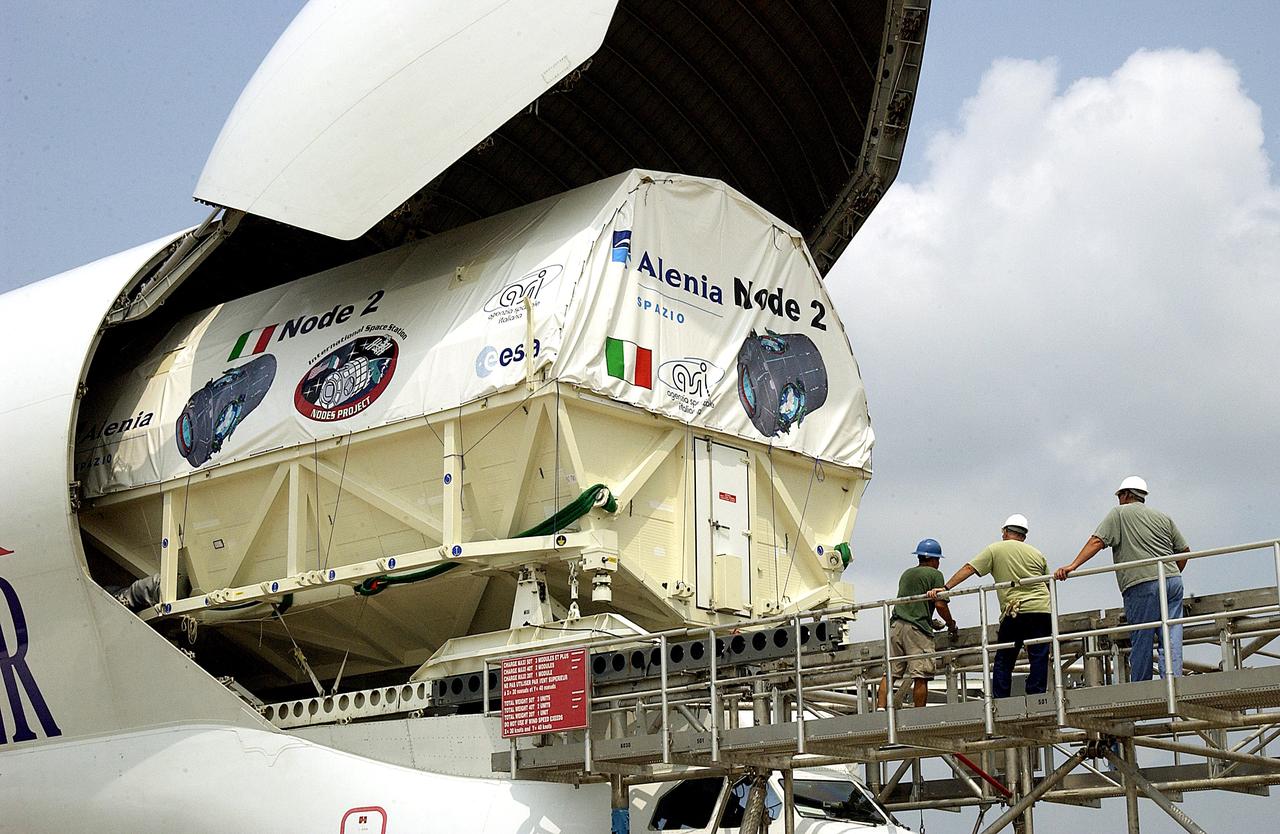
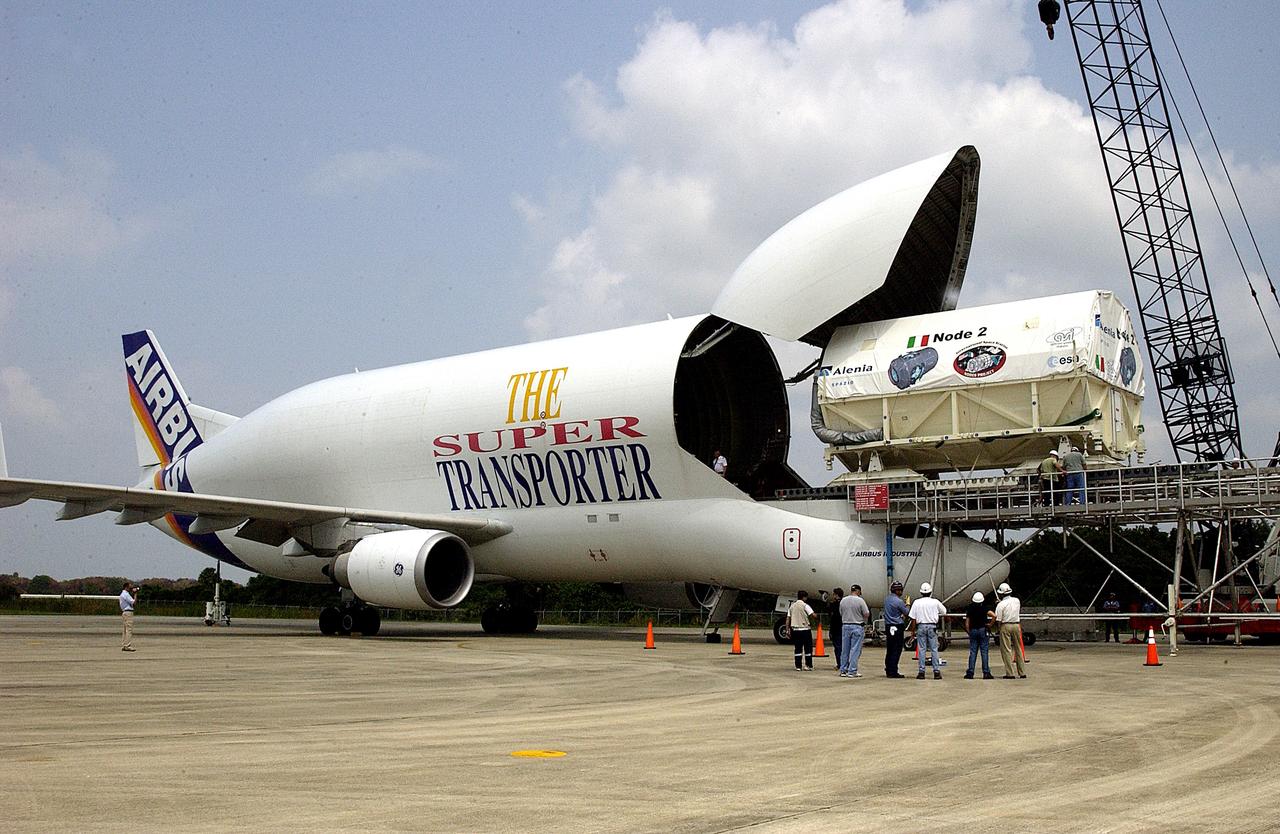
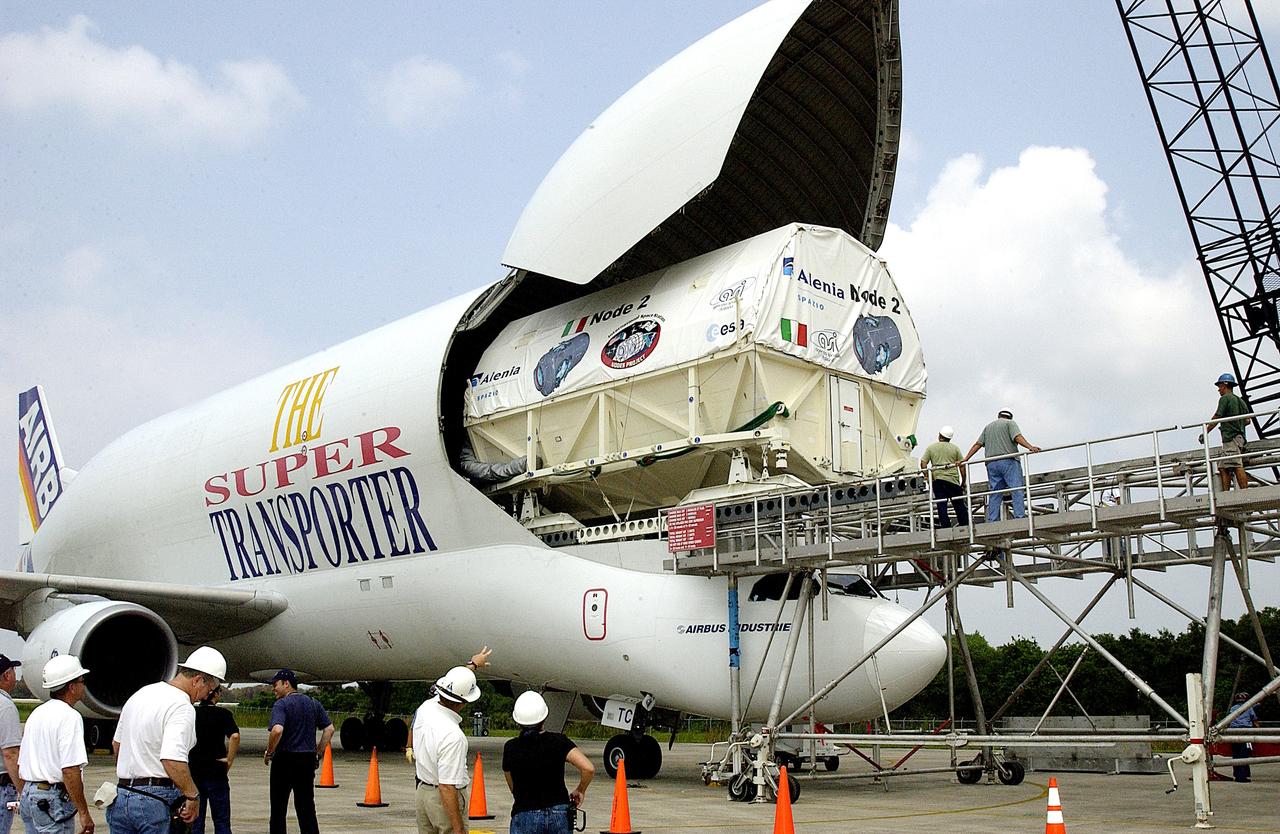
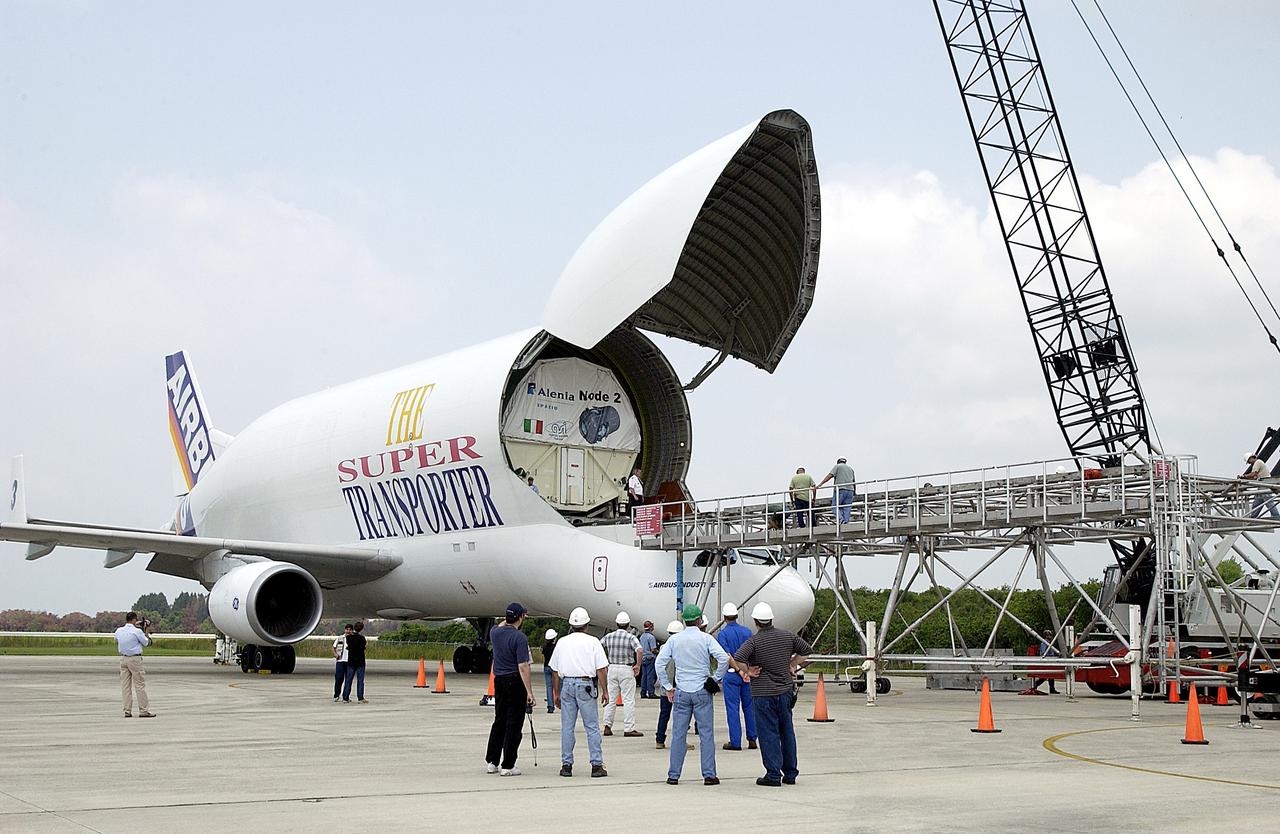
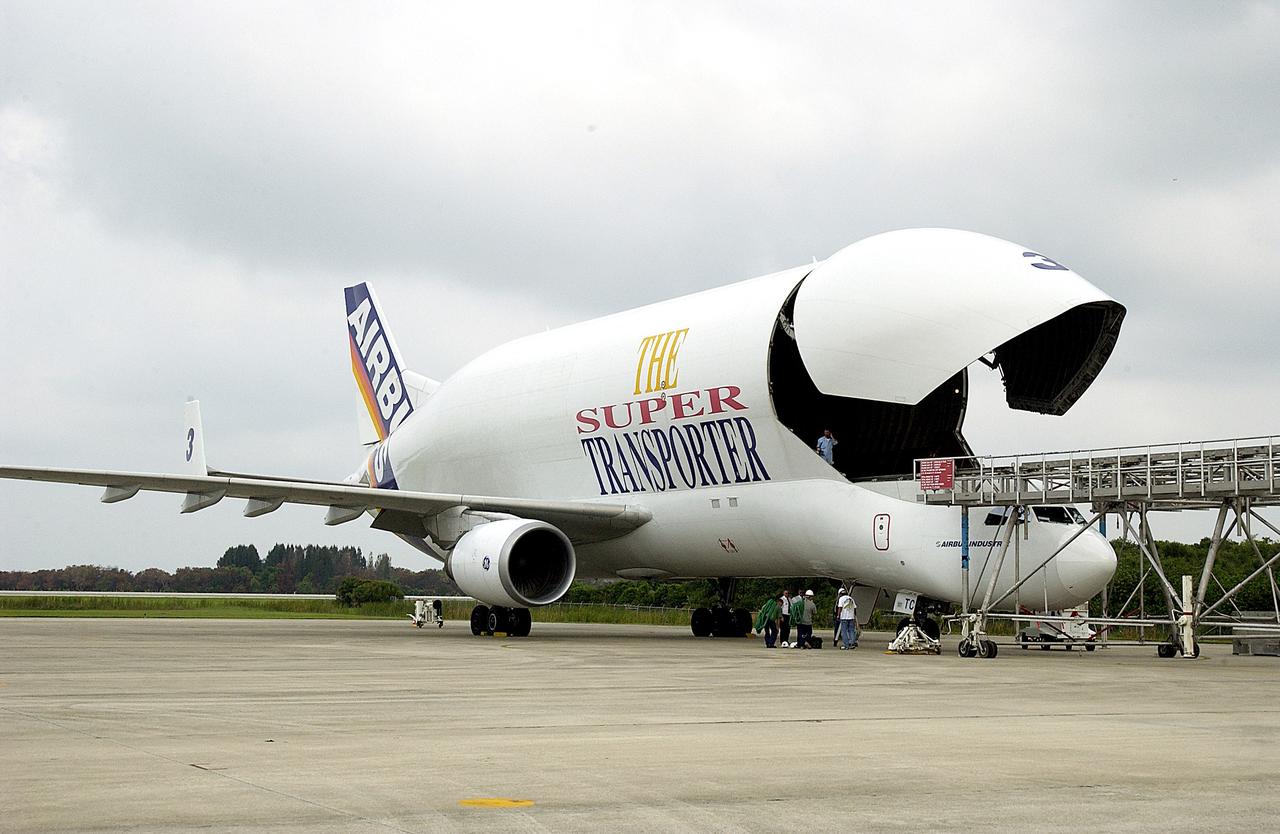
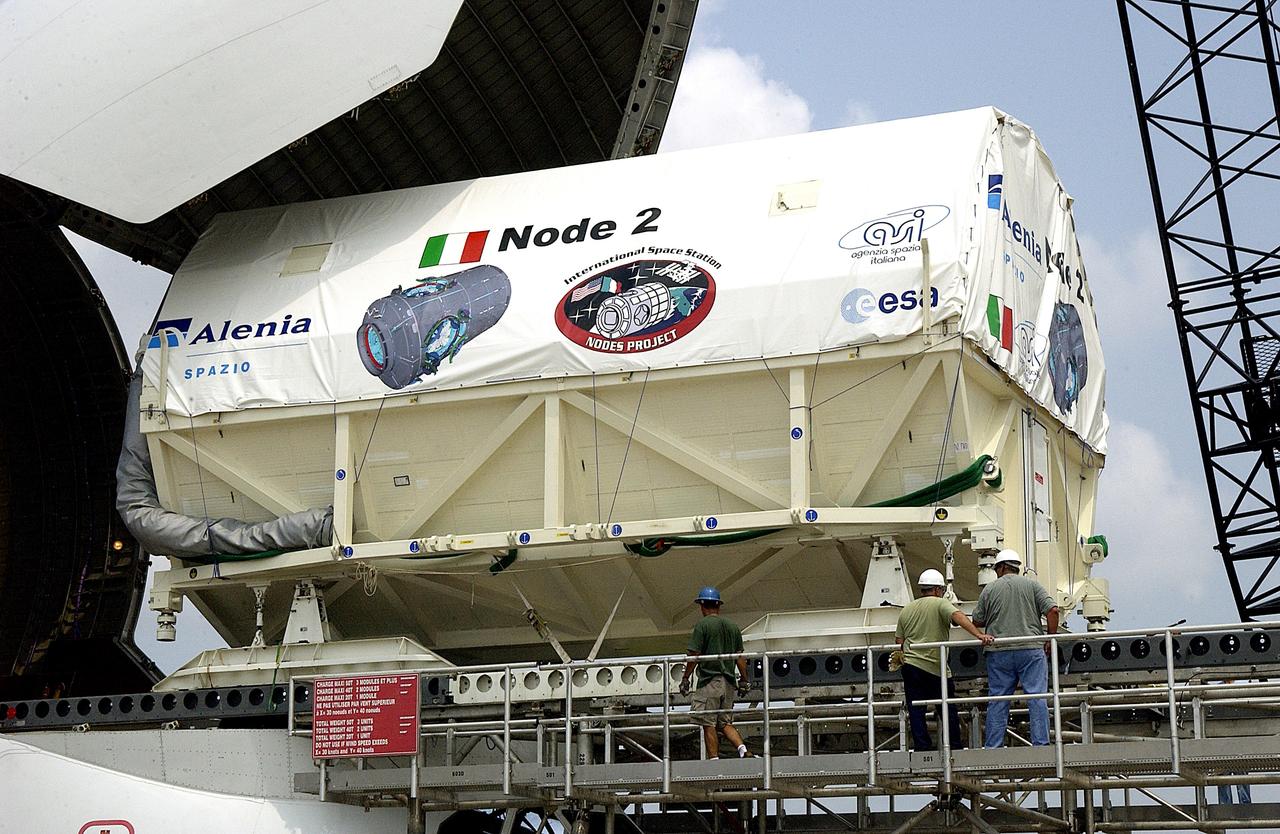
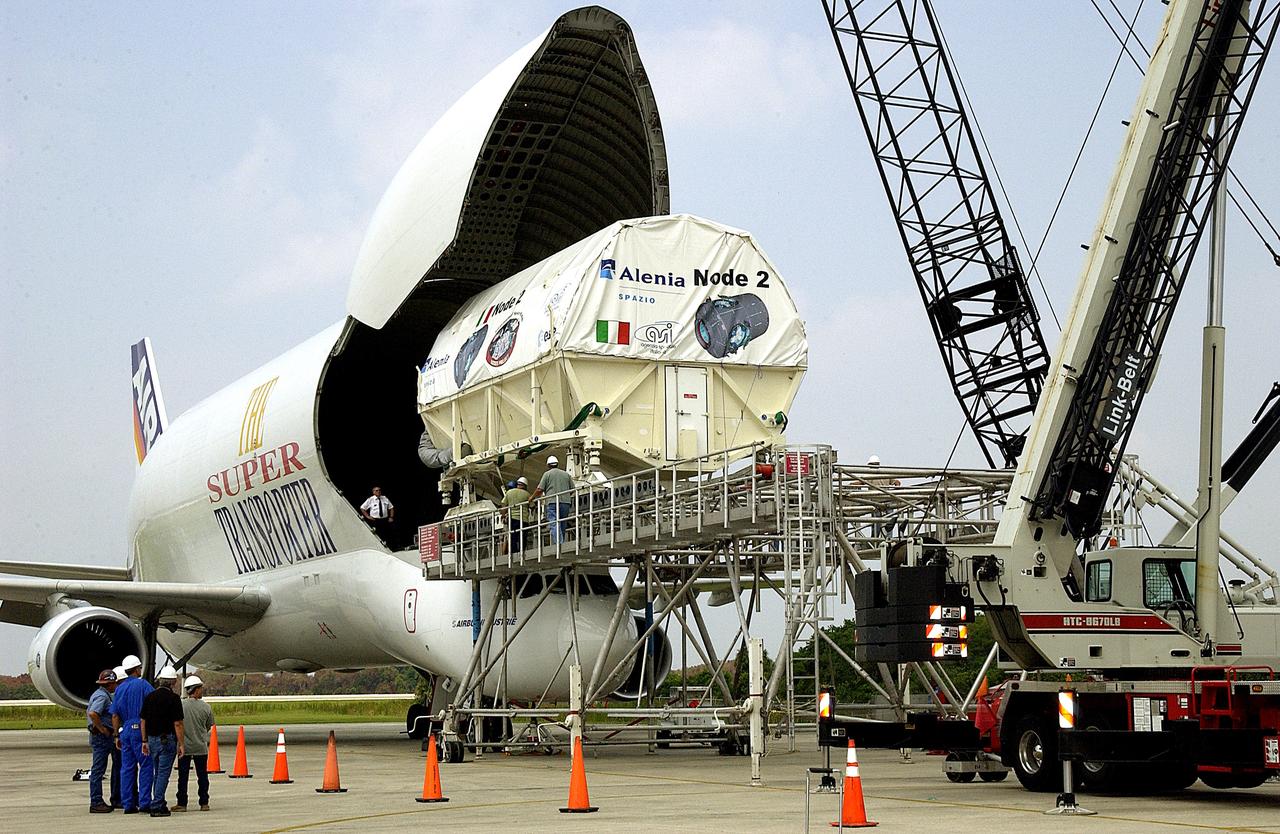
KENNEDY SPACE CENTER, FLA. - At the Shuttle Landing Facility, the nose of the Beluga aircraft is open to offload the Italian-built module, U.S. Node 2, for the International Space Station.  The second of three Station connecting modules, Node 2 attaches to the end of the U.S. Lab and provides attach locations for the Japanese laboratory, European laboratory, the Centrifuge Accommodation Module and, later, Multipurpose Logistics Modules. It will provide the primary docking location for the Shuttle when a pressurized mating adapter is attached to Node 2.  Installation of the module will complete  the U.S. Core of the ISS.  Node 2 is the designated payload for mission STS-120.  No orbiter or launch date has been determined yet.
KENNEDY SPACE CENTER, FLA. - At the Shuttle Landing Facility, the nose of the Beluga aircraft is open to offload the Italian-built module, U.S. Node 2, for the International Space Station. The second of three Station connecting modules, Node 2 attaches to the end of the U.S. Lab and provides attach locations for the Japanese laboratory, European laboratory, the Centrifuge Accommodation Module and, later, Multipurpose Logistics Modules. It will provide the primary docking location for the Shuttle when a pressurized mating adapter is attached to Node 2. Installation of the module will complete the U.S. Core of the ISS. Node 2 is the designated payload for mission STS-120. No orbiter or launch date has been determined yet.
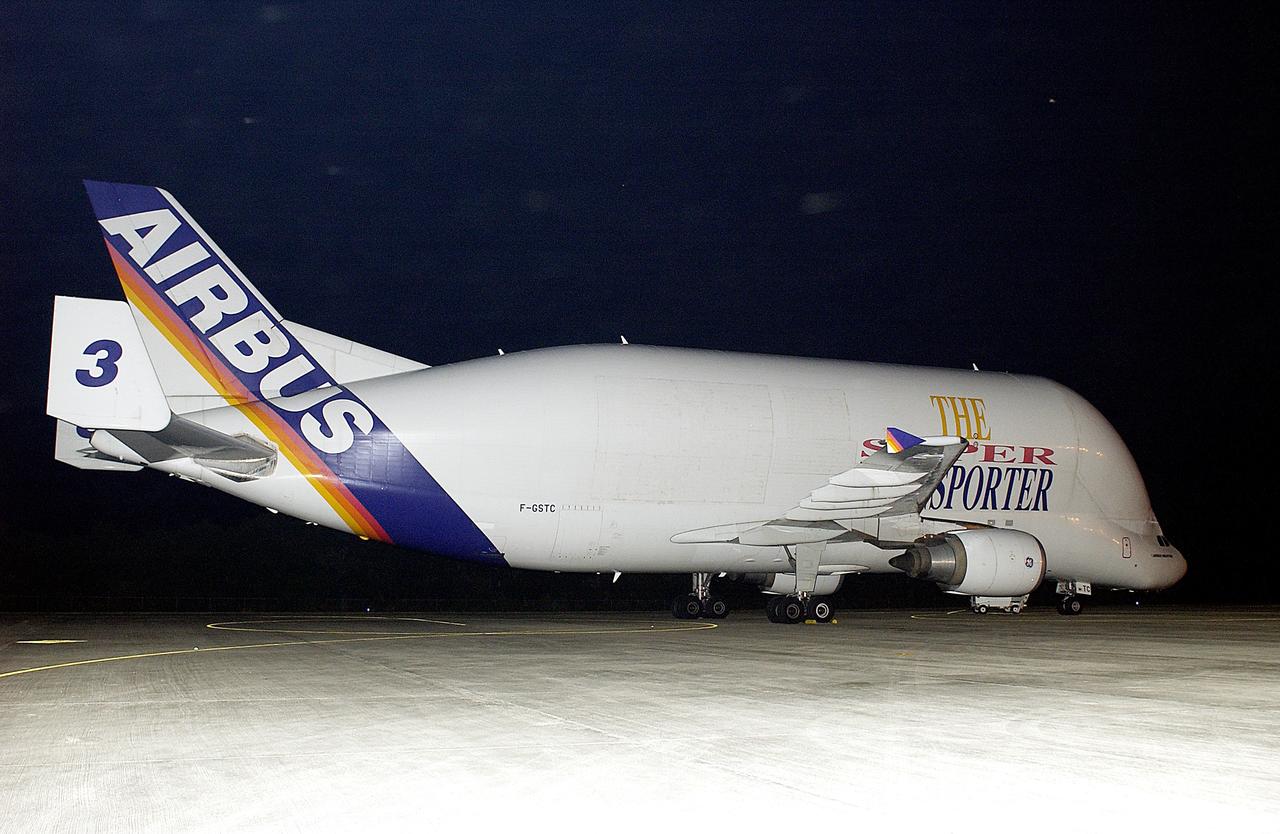
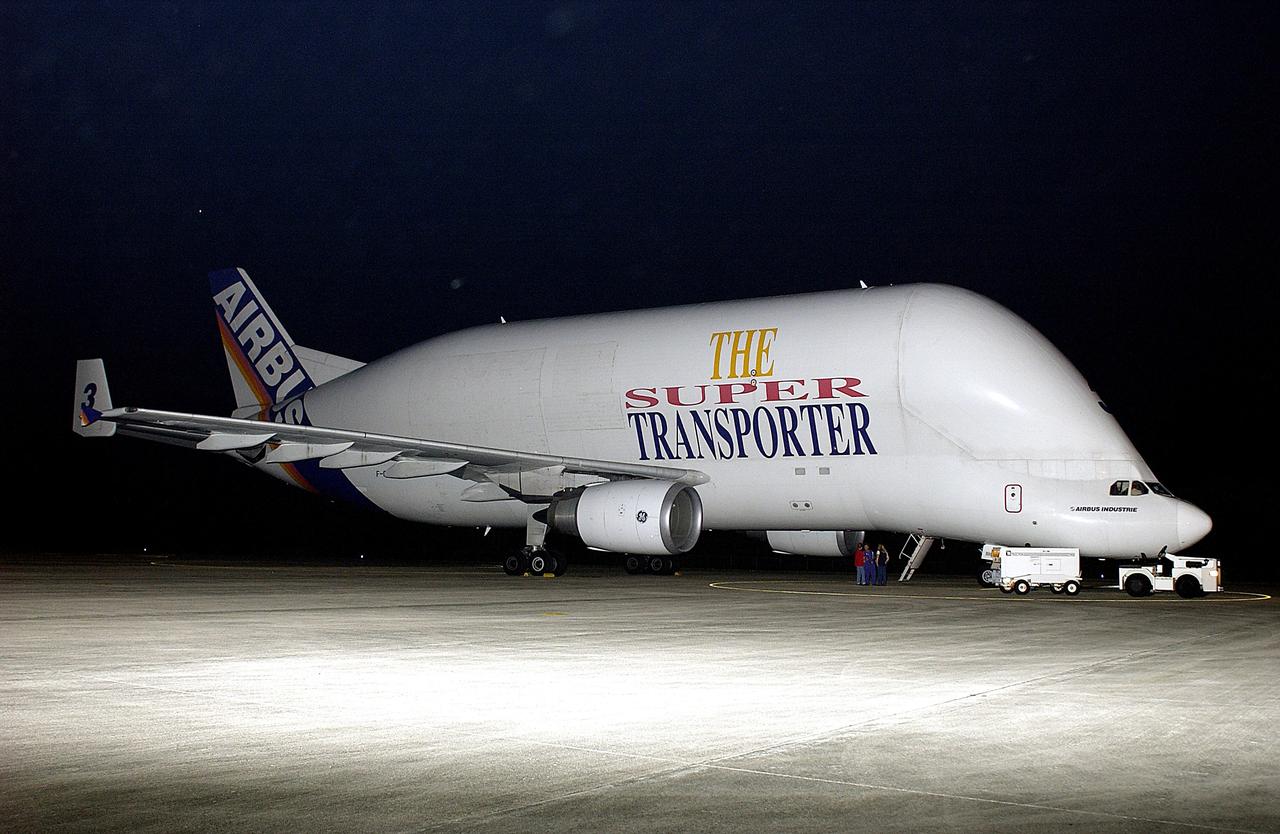
KKENNEDY SPACE CENTER, FLA. -  A Beluga aircraft arrives at the Shuttle Landing Facility with its cargo of the Italian-built module, U.S. Node 2, for the International Space Station.  The second of three Station connecting modules, Node 2 attaches to the end of the U.S. Lab and provides attach locations for the Japanese laboratory, European laboratory, the Centrifuge Accommodation Module and, later, Multipurpose Logistics Modules. It will provide the primary docking location for the Shuttle when a pressurized mating adapter is attached to Node 2.  Installation of the module will complete  the U.S. Core of the ISS.  Node 2 is the designated payload for mission STS-120.  No orbiter or launch date has been determined yet.
KKENNEDY SPACE CENTER, FLA. - A Beluga aircraft arrives at the Shuttle Landing Facility with its cargo of the Italian-built module, U.S. Node 2, for the International Space Station. The second of three Station connecting modules, Node 2 attaches to the end of the U.S. Lab and provides attach locations for the Japanese laboratory, European laboratory, the Centrifuge Accommodation Module and, later, Multipurpose Logistics Modules. It will provide the primary docking location for the Shuttle when a pressurized mating adapter is attached to Node 2. Installation of the module will complete the U.S. Core of the ISS. Node 2 is the designated payload for mission STS-120. No orbiter or launch date has been determined yet.
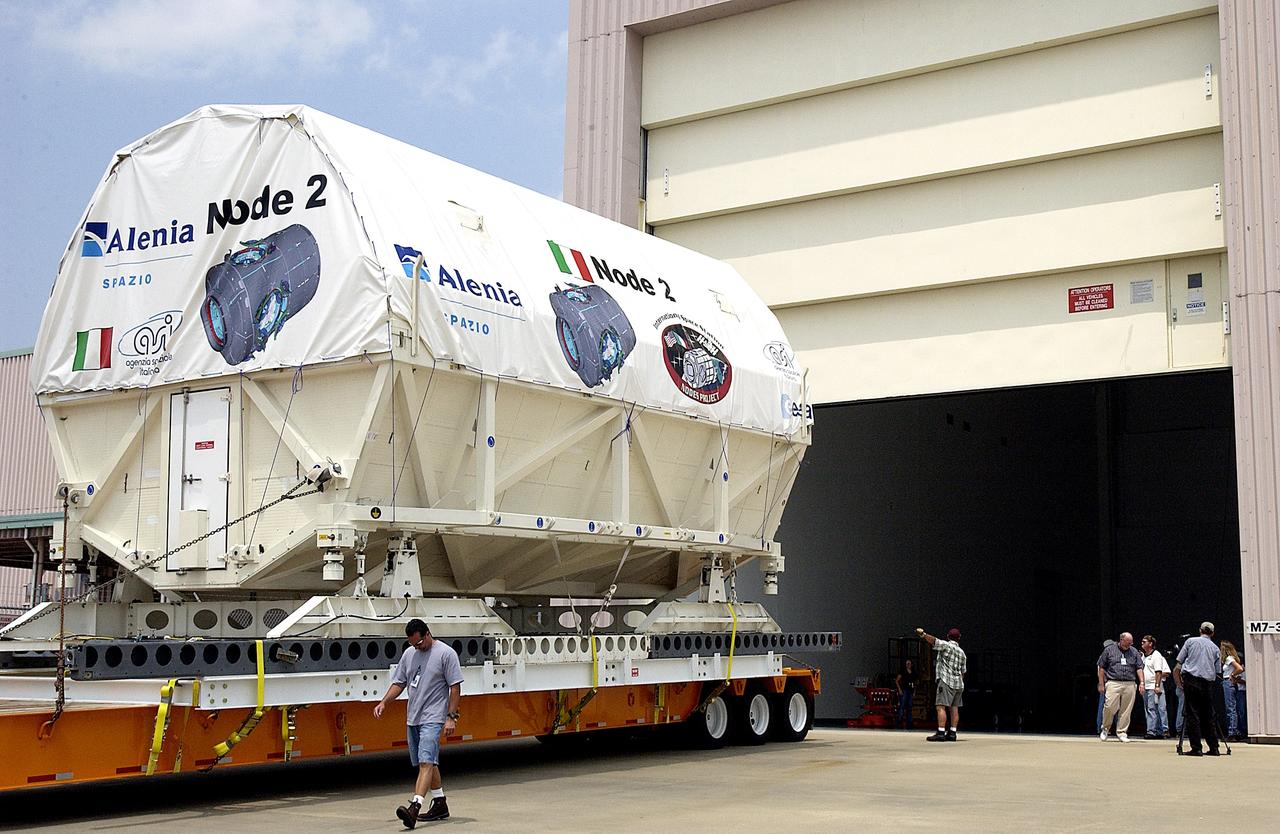
KENNEDY SPACE CENTER, FLA. -  The Italian-built module, U.S. Node 2, is moved into the Space Station Processing Facility. The second of three connecting modules on the International Space Station, Node 2 attaches to the end of the U.S. Lab and provides attach locations for the Japanese laboratory, European laboratory, the Centrifuge Accommodation Module and, later, Multipurpose Logistics Modules. It will provide the primary docking location for the Shuttle when a pressurized mating adapter is attached to Node 2.  Installation of the module will complete  the U.S. Core of the ISS.  Node 2 is the designated payload for mission STS-120.  No orbiter or launch date has been determined yet.
KENNEDY SPACE CENTER, FLA. - The Italian-built module, U.S. Node 2, is moved into the Space Station Processing Facility. The second of three connecting modules on the International Space Station, Node 2 attaches to the end of the U.S. Lab and provides attach locations for the Japanese laboratory, European laboratory, the Centrifuge Accommodation Module and, later, Multipurpose Logistics Modules. It will provide the primary docking location for the Shuttle when a pressurized mating adapter is attached to Node 2. Installation of the module will complete the U.S. Core of the ISS. Node 2 is the designated payload for mission STS-120. No orbiter or launch date has been determined yet.
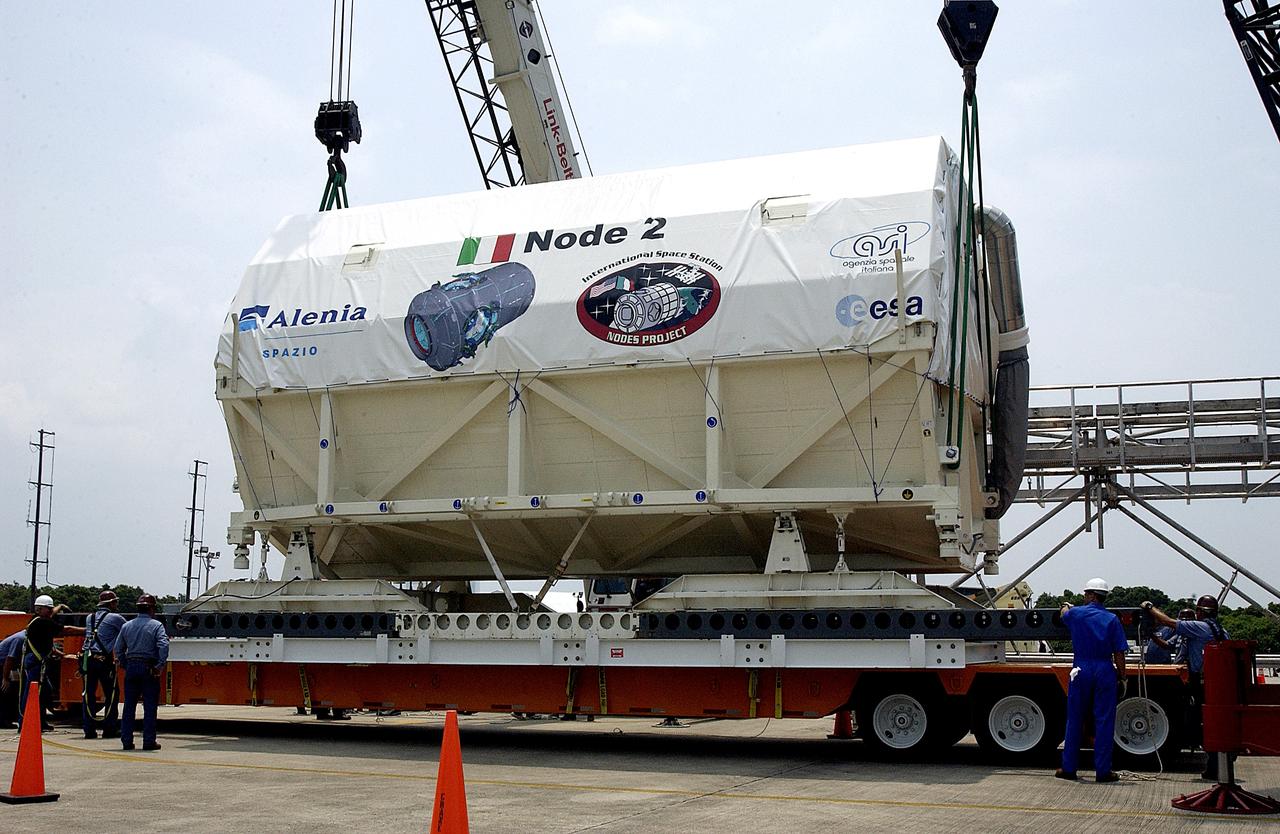
KENNEDY SPACE CENTER, FLA. -  The Italian-built module, U.S. Node 2, is lowered onto a transporter after its arrival at the Shuttle Landing Facility.  It will be taken to the Space Station Processing Facility.  The second of three connecting modules on the International Space Station, Node 2 attaches to the end of the U.S. Lab and provides attach locations for the Japanese laboratory, European laboratory, the Centrifuge Accommodation Module and, later, Multipurpose Logistics Modules. It will provide the primary docking location for the Shuttle when a pressurized mating adapter is attached to Node 2.  Installation of the module will complete  the U.S. Core of the ISS.  Node 2 is the designated payload for mission STS-120.  No orbiter or launch date has been determined yet.
KENNEDY SPACE CENTER, FLA. - The Italian-built module, U.S. Node 2, is lowered onto a transporter after its arrival at the Shuttle Landing Facility. It will be taken to the Space Station Processing Facility. The second of three connecting modules on the International Space Station, Node 2 attaches to the end of the U.S. Lab and provides attach locations for the Japanese laboratory, European laboratory, the Centrifuge Accommodation Module and, later, Multipurpose Logistics Modules. It will provide the primary docking location for the Shuttle when a pressurized mating adapter is attached to Node 2. Installation of the module will complete the U.S. Core of the ISS. Node 2 is the designated payload for mission STS-120. No orbiter or launch date has been determined yet.
KENNEDY SPACE CENTER, FLA. - The Italian-built module, U.S. Node 2, for the International Space Station is offloaded from a Beluga at the Shuttle Landing Facility. The second of three Station connecting modules, Node 2 attaches to the end of the U.S. Lab and provides attach locations for the Japanese laboratory, European laboratory, the Centrifuge Accommodation Module and, later, Multipurpose Logistics Modules. It will provide the primary docking location for the Shuttle when a pressurized mating adapter is attached to Node 2.  Installation of the module will complete  the U.S. Core of the ISS.  Node 2 is the designated payload for mission STS-120.  No orbiter or launch date has been determined yet.
KENNEDY SPACE CENTER, FLA. - The Italian-built module, U.S. Node 2, for the International Space Station is offloaded from a Beluga at the Shuttle Landing Facility. The second of three Station connecting modules, Node 2 attaches to the end of the U.S. Lab and provides attach locations for the Japanese laboratory, European laboratory, the Centrifuge Accommodation Module and, later, Multipurpose Logistics Modules. It will provide the primary docking location for the Shuttle when a pressurized mating adapter is attached to Node 2. Installation of the module will complete the U.S. Core of the ISS. Node 2 is the designated payload for mission STS-120. No orbiter or launch date has been determined yet.
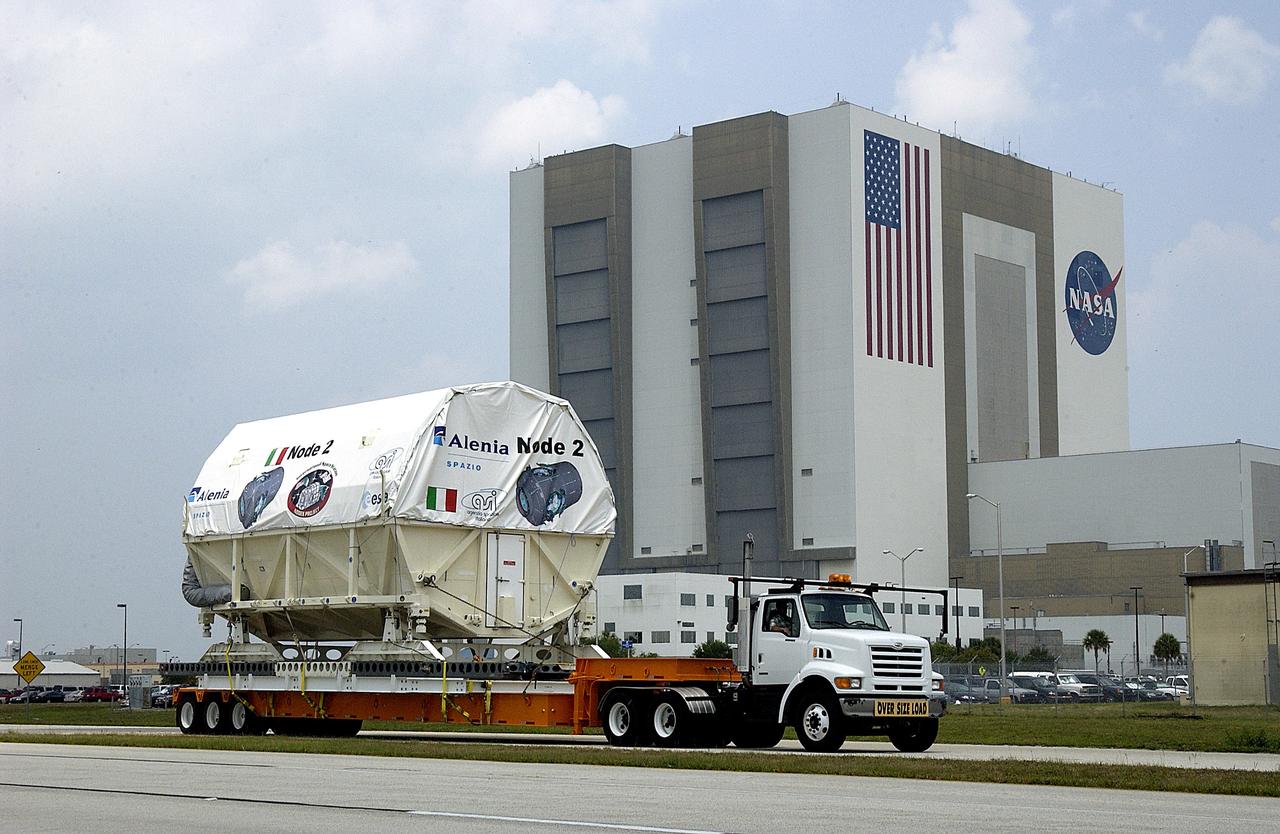
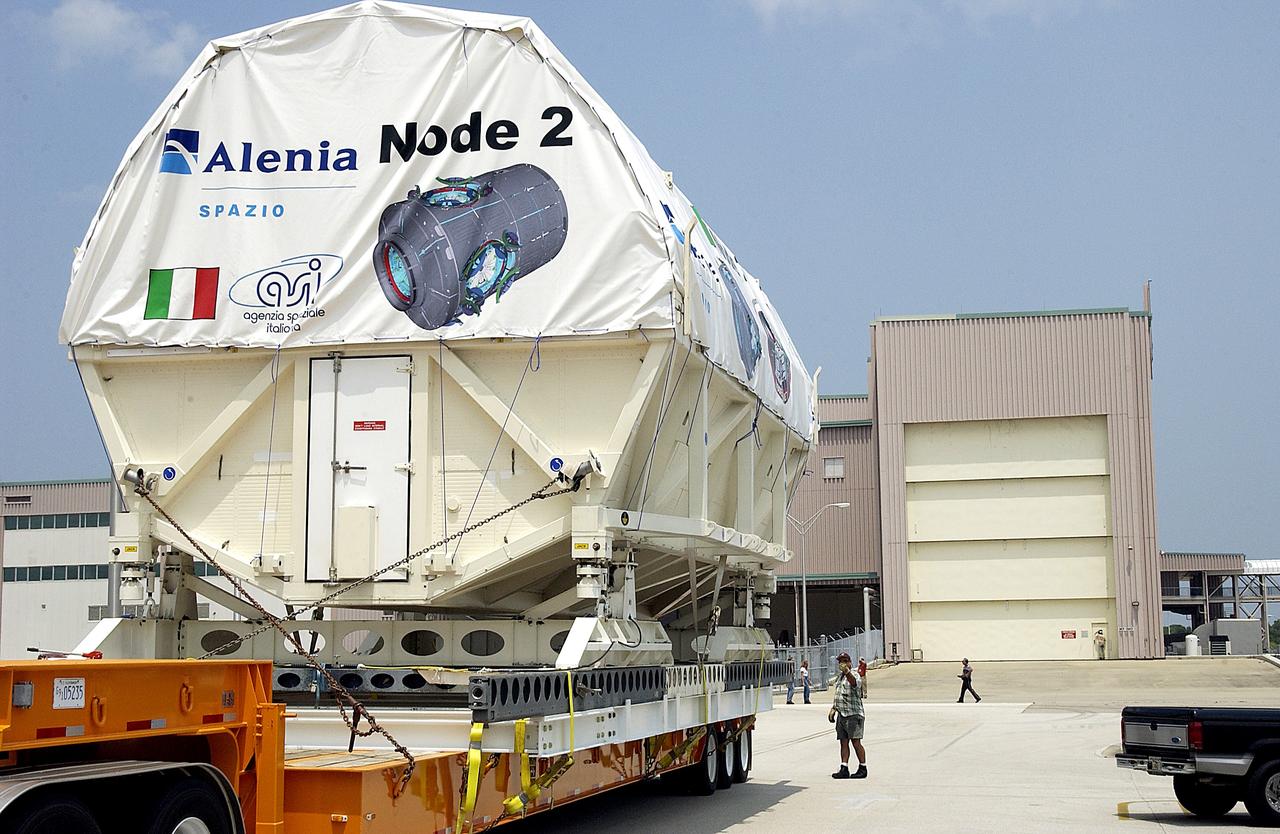
KENNEDY SPACE CENTER, FLA. -  The Italian-built module, U.S. Node 2, moves past the Vehicle Assembly Building as it is transferred to the Space Station Processing Facility. The second of three connecting modules on the International Space Station, Node 2 attaches to the end of the U.S. Lab and provides attach locations for the Japanese laboratory, European laboratory, the Centrifuge Accommodation Module and, later, Multipurpose Logistics Modules. It will provide the primary docking location for the Shuttle when a pressurized mating adapter is attached to Node 2.  Installation of the module will complete  the U.S. Core of the ISS.  Node 2 is the designated payload for mission STS-120.  No orbiter or launch date has been determined yet.
KENNEDY SPACE CENTER, FLA. - The Italian-built module, U.S. Node 2, moves past the Vehicle Assembly Building as it is transferred to the Space Station Processing Facility. The second of three connecting modules on the International Space Station, Node 2 attaches to the end of the U.S. Lab and provides attach locations for the Japanese laboratory, European laboratory, the Centrifuge Accommodation Module and, later, Multipurpose Logistics Modules. It will provide the primary docking location for the Shuttle when a pressurized mating adapter is attached to Node 2. Installation of the module will complete the U.S. Core of the ISS. Node 2 is the designated payload for mission STS-120. No orbiter or launch date has been determined yet.
KENNEDY SPACE CENTER, FLA. - The Italian-built module, U.S. Node 2, for the International Space Station is offloaded from a Beluga aircraft at the Shuttle Landing Facility. The second of three Station connecting modules, Node 2 attaches to the end of the U.S. Lab and provides attach locations for the Japanese laboratory, European laboratory, the Centrifuge Accommodation Module and, later, Multipurpose Logistics Modules. It will provide the primary docking location for the Shuttle when a pressurized mating adapter is attached to Node 2.  Installation of the module will complete  the U.S. Core of the ISS.  Node 2 is the designated payload for mission STS-120.  No orbiter or launch date has been determined yet.
KENNEDY SPACE CENTER, FLA. - The Italian-built module, U.S. Node 2, for the International Space Station is offloaded from a Beluga aircraft at the Shuttle Landing Facility. The second of three Station connecting modules, Node 2 attaches to the end of the U.S. Lab and provides attach locations for the Japanese laboratory, European laboratory, the Centrifuge Accommodation Module and, later, Multipurpose Logistics Modules. It will provide the primary docking location for the Shuttle when a pressurized mating adapter is attached to Node 2. Installation of the module will complete the U.S. Core of the ISS. Node 2 is the designated payload for mission STS-120. No orbiter or launch date has been determined yet.
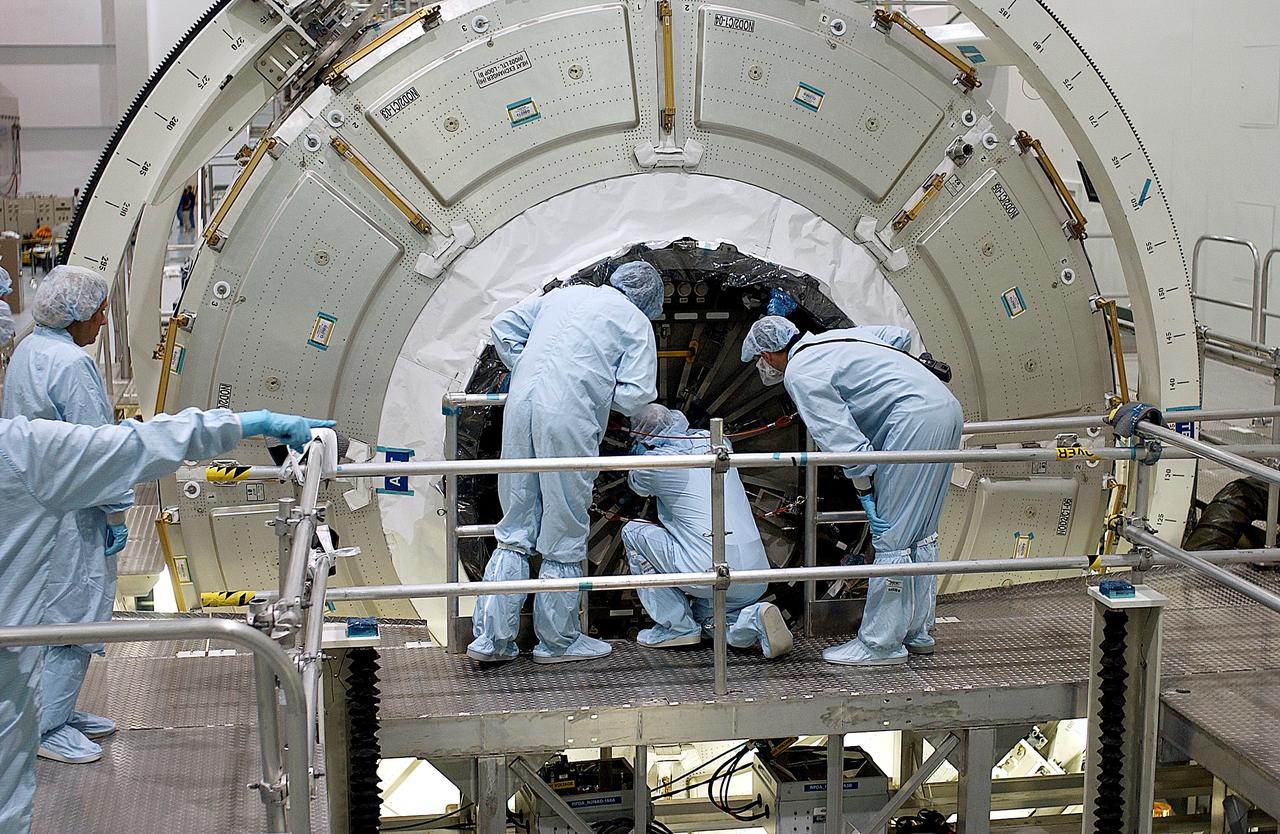
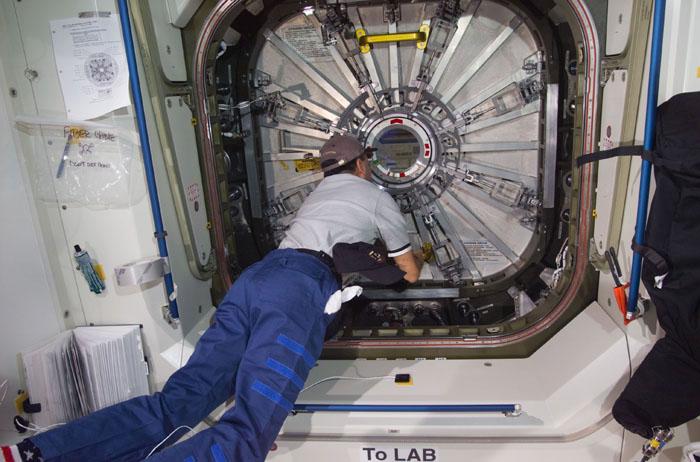
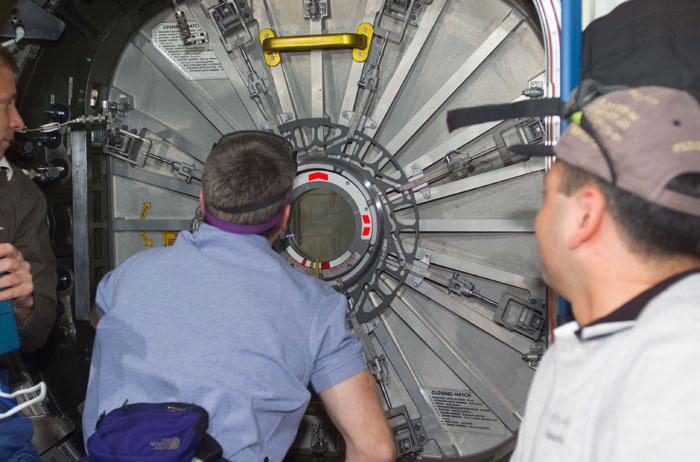
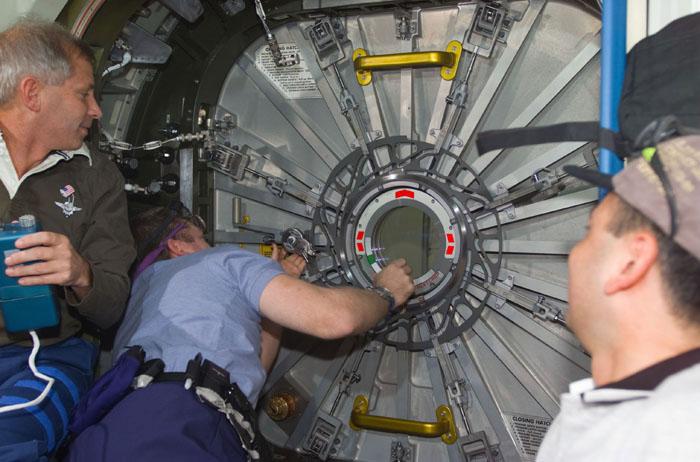
KENNEDY SPACE CENTER, FLA. -  Workers in the Space Station Processing Facility attempt to open the hatch on the Italian-built Node 2, a future element of the International Space Station.  Node 2 arrived at KSC June 1.  The second of three Station connecting modules, the module  attaches to the end of the U.S. Lab and provides attach locations for the Japanese laboratory, European laboratory, the Centrifuge Accommodation Module and, later, Multipurpose Logistics Modules. It will provide the primary docking location for the Shuttle when a pressurized mating adapter is attached to Node 2.  Installation of the module will complete  the U.S. Core of the ISS.  Node 2 is the designated payload for mission STS-120.  No orbiter or launch date has been determined yet.
KENNEDY SPACE CENTER, FLA. - Workers in the Space Station Processing Facility attempt to open the hatch on the Italian-built Node 2, a future element of the International Space Station. Node 2 arrived at KSC June 1. The second of three Station connecting modules, the module attaches to the end of the U.S. Lab and provides attach locations for the Japanese laboratory, European laboratory, the Centrifuge Accommodation Module and, later, Multipurpose Logistics Modules. It will provide the primary docking location for the Shuttle when a pressurized mating adapter is attached to Node 2. Installation of the module will complete the U.S. Core of the ISS. Node 2 is the designated payload for mission STS-120. No orbiter or launch date has been determined yet.
KENNEDY SPACE CENTER, FLA. - The Italian-built module, U.S. Node 2, for the International Space Station is offloaded from a Beluga aircraft at the Shuttle Landing Facility. The second of three Station connecting modules, Node 2 attaches to the end of the U.S. Lab and provides attach locations for the Japanese laboratory, European laboratory, the Centrifuge Accommodation Module and, later, Multipurpose Logistics Modules. It will provide the primary docking location for the Shuttle when a pressurized mating adapter is attached to Node 2.  Installation of the module will complete  the U.S. Core of the ISS.  Node 2 is the designated payload for mission STS-120.  No orbiter or launch date has been determined yet.
KENNEDY SPACE CENTER, FLA. - The Italian-built module, U.S. Node 2, for the International Space Station is offloaded from a Beluga aircraft at the Shuttle Landing Facility. The second of three Station connecting modules, Node 2 attaches to the end of the U.S. Lab and provides attach locations for the Japanese laboratory, European laboratory, the Centrifuge Accommodation Module and, later, Multipurpose Logistics Modules. It will provide the primary docking location for the Shuttle when a pressurized mating adapter is attached to Node 2. Installation of the module will complete the U.S. Core of the ISS. Node 2 is the designated payload for mission STS-120. No orbiter or launch date has been determined yet.
KENNEDY SPACE CENTER, FLA. - The Italian-built module, U.S. Node 2, for the International Space Station is offloaded from a Beluga at the Shuttle Landing Facility. The second of three Station connecting modules, Node 2 attaches to the end of the U.S. Lab and provides attach locations for the Japanese laboratory, European laboratory, the Centrifuge Accommodation Module and, later, Multipurpose Logistics Modules. It will provide the primary docking location for the Shuttle when a pressurized mating adapter is attached to Node 2.  Installation of the module will complete  the U.S. Core of the ISS.  Node 2 is the designated payload for mission STS-120.  No orbiter or launch date has been determined yet.
KENNEDY SPACE CENTER, FLA. - The Italian-built module, U.S. Node 2, for the International Space Station is offloaded from a Beluga at the Shuttle Landing Facility. The second of three Station connecting modules, Node 2 attaches to the end of the U.S. Lab and provides attach locations for the Japanese laboratory, European laboratory, the Centrifuge Accommodation Module and, later, Multipurpose Logistics Modules. It will provide the primary docking location for the Shuttle when a pressurized mating adapter is attached to Node 2. Installation of the module will complete the U.S. Core of the ISS. Node 2 is the designated payload for mission STS-120. No orbiter or launch date has been determined yet.
KENNEDY SPACE CENTER, FLA. - The Italian-built module, U.S. Node 2, for the International Space Station is offloaded from a Beluga aircraft at the Shuttle Landing Facility. The second of three Station connecting modules, Node 2 attaches to the end of the U.S. Lab and provides attach locations for the Japanese laboratory, European laboratory, the Centrifuge Accommodation Module and, later, Multipurpose Logistics Modules. It will provide the primary docking location for the Shuttle when a pressurized mating adapter is attached to Node 2.  Installation of the module will complete  the U.S. Core of the ISS.  Node 2 is the designated payload for mission STS-120.  No orbiter or launch date has been determined yet.
KENNEDY SPACE CENTER, FLA. - The Italian-built module, U.S. Node 2, for the International Space Station is offloaded from a Beluga aircraft at the Shuttle Landing Facility. The second of three Station connecting modules, Node 2 attaches to the end of the U.S. Lab and provides attach locations for the Japanese laboratory, European laboratory, the Centrifuge Accommodation Module and, later, Multipurpose Logistics Modules. It will provide the primary docking location for the Shuttle when a pressurized mating adapter is attached to Node 2. Installation of the module will complete the U.S. Core of the ISS. Node 2 is the designated payload for mission STS-120. No orbiter or launch date has been determined yet.
KENNEDY SPACE CENTER, FLA. - The Italian-built module, U.S. Node 2, for the International Space Station is offloaded from a Beluga aircraft at the Shuttle Landing Facility. The second of three Station connecting modules, Node 2 attaches to the end of the U.S. Lab and provides attach locations for the Japanese laboratory, European laboratory, the Centrifuge Accommodation Module and, later, Multipurpose Logistics Modules. It will provide the primary docking location for the Shuttle when a pressurized mating adapter is attached to Node 2.  Installation of the module will complete  the U.S. Core of the ISS.  Node 2 is the designated payload for mission STS-120.  No orbiter or launch date has been determined yet.
KENNEDY SPACE CENTER, FLA. - The Italian-built module, U.S. Node 2, for the International Space Station is offloaded from a Beluga aircraft at the Shuttle Landing Facility. The second of three Station connecting modules, Node 2 attaches to the end of the U.S. Lab and provides attach locations for the Japanese laboratory, European laboratory, the Centrifuge Accommodation Module and, later, Multipurpose Logistics Modules. It will provide the primary docking location for the Shuttle when a pressurized mating adapter is attached to Node 2. Installation of the module will complete the U.S. Core of the ISS. Node 2 is the designated payload for mission STS-120. No orbiter or launch date has been determined yet.
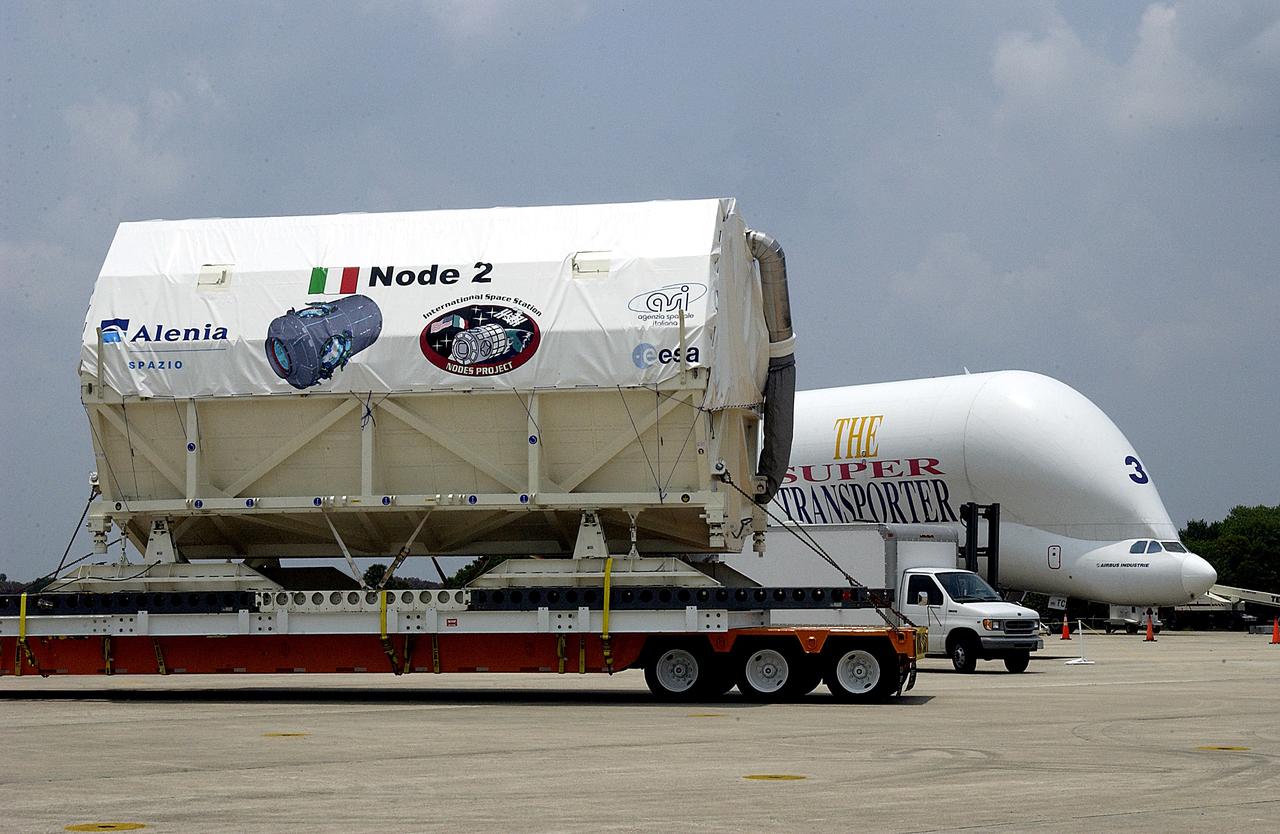
KENNEDY SPACE CENTER, FLA. -  The Italian-built module, U.S. Node 2, moves past the Beluga aircraft that brought it to KSC as it is transferred to the Space Station Processing Facility. The second of three connecting modules on the International Space Station, Node 2 attaches to the end of the U.S. Lab and provides attach locations for the Japanese laboratory, European laboratory, the Centrifuge Accommodation Module and, later, Multipurpose Logistics Modules. It will provide the primary docking location for the Shuttle when a pressurized mating adapter is attached to Node 2.  Installation of the module will complete  the U.S. Core of the ISS.  Node 2 is the designated payload for mission STS-120.  No orbiter or launch date has been determined yet.
KENNEDY SPACE CENTER, FLA. - The Italian-built module, U.S. Node 2, moves past the Beluga aircraft that brought it to KSC as it is transferred to the Space Station Processing Facility. The second of three connecting modules on the International Space Station, Node 2 attaches to the end of the U.S. Lab and provides attach locations for the Japanese laboratory, European laboratory, the Centrifuge Accommodation Module and, later, Multipurpose Logistics Modules. It will provide the primary docking location for the Shuttle when a pressurized mating adapter is attached to Node 2. Installation of the module will complete the U.S. Core of the ISS. Node 2 is the designated payload for mission STS-120. No orbiter or launch date has been determined yet.
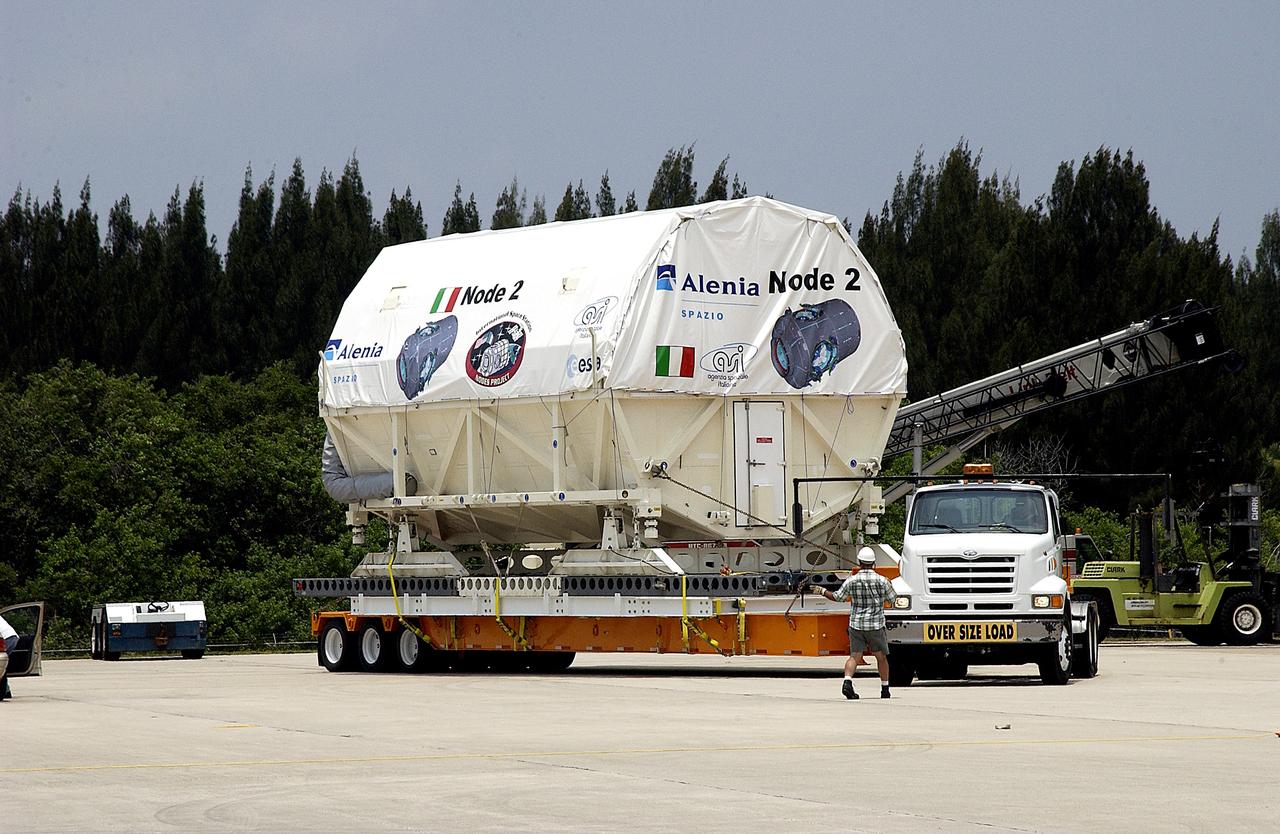
KENNEDY SPACE CENTER, FLA. -  The Italian-built module, U.S. Node 2, is secured on a transporter after its arrival at the Shuttle Landing Facility.  It will be taken to the Space Station Processing Facility.  The second of three connecting modules on the International Space Station, Node 2 attaches to the end of the U.S. Lab and provides attach locations for the Japanese laboratory, European laboratory, the Centrifuge Accommodation Module and, later, Multipurpose Logistics Modules. It will provide the primary docking location for the Shuttle when a pressurized mating adapter is attached to Node 2.  Installation of the module will complete  the U.S. Core of the ISS.  Node 2 is the designated payload for mission STS-120.  No orbiter or launch date has been determined yet.
KENNEDY SPACE CENTER, FLA. - The Italian-built module, U.S. Node 2, is secured on a transporter after its arrival at the Shuttle Landing Facility. It will be taken to the Space Station Processing Facility. The second of three connecting modules on the International Space Station, Node 2 attaches to the end of the U.S. Lab and provides attach locations for the Japanese laboratory, European laboratory, the Centrifuge Accommodation Module and, later, Multipurpose Logistics Modules. It will provide the primary docking location for the Shuttle when a pressurized mating adapter is attached to Node 2. Installation of the module will complete the U.S. Core of the ISS. Node 2 is the designated payload for mission STS-120. No orbiter or launch date has been determined yet.
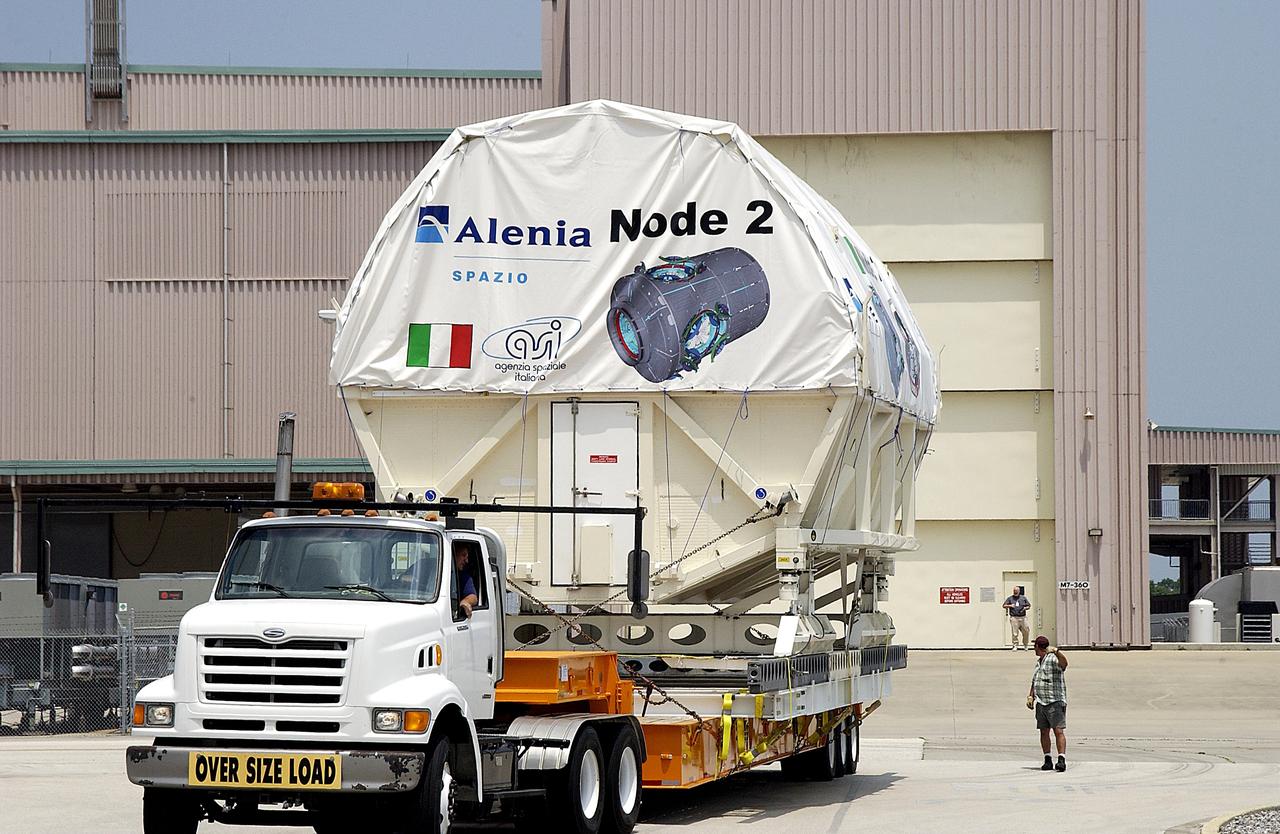
KENNEDY SPACE CENTER, FLA. -  The Italian-built module, U.S. Node 2, begins its transfer from  the Shuttle Landing Facility to the Space Station Processing Facility.  The second of three connecting modules on the International Space Station, Node 2 attaches to the end of the U.S. Lab and provides attach locations for the Japanese laboratory, European laboratory, the Centrifuge Accommodation Module and, later, Multipurpose Logistics Modules. It will provide the primary docking location for the Shuttle when a pressurized mating adapter is attached to Node 2.  Installation of the module will complete  the U.S. Core of the ISS.  Node 2 is the designated payload for mission STS-120.  No orbiter or launch date has been determined yet.
KENNEDY SPACE CENTER, FLA. - The Italian-built module, U.S. Node 2, begins its transfer from the Shuttle Landing Facility to the Space Station Processing Facility. The second of three connecting modules on the International Space Station, Node 2 attaches to the end of the U.S. Lab and provides attach locations for the Japanese laboratory, European laboratory, the Centrifuge Accommodation Module and, later, Multipurpose Logistics Modules. It will provide the primary docking location for the Shuttle when a pressurized mating adapter is attached to Node 2. Installation of the module will complete the U.S. Core of the ISS. Node 2 is the designated payload for mission STS-120. No orbiter or launch date has been determined yet.
KENNEDY SPACE CENTER, FLA. -  The Italian-built module, U.S. Node 2, nears the Space Station Processing Facility after its move from the Shuttle Landing Facility. The second of three connecting modules on the International Space Station, Node 2 attaches to the end of the U.S. Lab and provides attach locations for the Japanese laboratory, European laboratory, the Centrifuge Accommodation Module and, later, Multipurpose Logistics Modules. It will provide the primary docking location for the Shuttle when a pressurized mating adapter is attached to Node 2.  Installation of the module will complete  the U.S. Core of the ISS.  Node 2 is the designated payload for mission STS-120.  No orbiter or launch date has been determined yet.
KENNEDY SPACE CENTER, FLA. - The Italian-built module, U.S. Node 2, nears the Space Station Processing Facility after its move from the Shuttle Landing Facility. The second of three connecting modules on the International Space Station, Node 2 attaches to the end of the U.S. Lab and provides attach locations for the Japanese laboratory, European laboratory, the Centrifuge Accommodation Module and, later, Multipurpose Logistics Modules. It will provide the primary docking location for the Shuttle when a pressurized mating adapter is attached to Node 2. Installation of the module will complete the U.S. Core of the ISS. Node 2 is the designated payload for mission STS-120. No orbiter or launch date has been determined yet.
KENNEDY SPACE CENTER, FLA. -  Workers in the Space Station Processing Facility look over the hatch on the Italian-built Node 2, a future element of the International Space Station.  Node 2 arrived at KSC June 1.  The second of three Station connecting modules, the module  attaches to the end of the U.S. Lab and provides attach locations for the Japanese laboratory, European laboratory, the Centrifuge Accommodation Module and, later, Multipurpose Logistics Modules. It will provide the primary docking location for the Shuttle when a pressurized mating adapter is attached to Node 2.  Installation of the module will complete  the U.S. Core of the ISS.  Node 2 is the designated payload for mission STS-120.  No orbiter or launch date has been determined yet.
KENNEDY SPACE CENTER, FLA. - Workers in the Space Station Processing Facility look over the hatch on the Italian-built Node 2, a future element of the International Space Station. Node 2 arrived at KSC June 1. The second of three Station connecting modules, the module attaches to the end of the U.S. Lab and provides attach locations for the Japanese laboratory, European laboratory, the Centrifuge Accommodation Module and, later, Multipurpose Logistics Modules. It will provide the primary docking location for the Shuttle when a pressurized mating adapter is attached to Node 2. Installation of the module will complete the U.S. Core of the ISS. Node 2 is the designated payload for mission STS-120. No orbiter or launch date has been determined yet.
KENNEDY SPACE CENTER, FLA. - The Italian-built module, U.S. Node 2, for the International Space Station is offloaded from a Beluga at the Shuttle Landing Facility. The second of three Station connecting modules, Node 2 attaches to the end of the U.S. Lab and provides attach locations for the Japanese laboratory, European laboratory, the Centrifuge Accommodation Module and, later, Multipurpose Logistics Modules. It will provide the primary docking location for the Shuttle when a pressurized mating adapter is attached to Node 2.  Installation of the module will complete  the U.S. Core of the ISS.  Node 2 is the designated payload for mission STS-120.  No orbiter or launch date has been determined yet.
KENNEDY SPACE CENTER, FLA. - The Italian-built module, U.S. Node 2, for the International Space Station is offloaded from a Beluga at the Shuttle Landing Facility. The second of three Station connecting modules, Node 2 attaches to the end of the U.S. Lab and provides attach locations for the Japanese laboratory, European laboratory, the Centrifuge Accommodation Module and, later, Multipurpose Logistics Modules. It will provide the primary docking location for the Shuttle when a pressurized mating adapter is attached to Node 2. Installation of the module will complete the U.S. Core of the ISS. Node 2 is the designated payload for mission STS-120. No orbiter or launch date has been determined yet.
KENNEDY SPACE CENTER, FLA. - A Beluga aircraft arrives at the Shuttle Landing Facility with its cargo of the Italian-built module, U.S. Node 2, for the International Space Station.  The second of three Station connecting modules, Node 2 attaches to the end of the U.S. Lab and provides attach locations for the Japanese laboratory, European laboratory, the Centrifuge Accommodation Module and, later, Multipurpose Logistics Modules. It will provide the primary docking location for the Shuttle when a pressurized mating adapter is attached to Node 2.  Installation of the module will complete  the U.S. Core of the ISS.  Node 2 is the designated payload for mission STS-120.  No orbiter or launch date has been determined yet.
KENNEDY SPACE CENTER, FLA. - A Beluga aircraft arrives at the Shuttle Landing Facility with its cargo of the Italian-built module, U.S. Node 2, for the International Space Station. The second of three Station connecting modules, Node 2 attaches to the end of the U.S. Lab and provides attach locations for the Japanese laboratory, European laboratory, the Centrifuge Accommodation Module and, later, Multipurpose Logistics Modules. It will provide the primary docking location for the Shuttle when a pressurized mating adapter is attached to Node 2. Installation of the module will complete the U.S. Core of the ISS. Node 2 is the designated payload for mission STS-120. No orbiter or launch date has been determined yet.
KENNEDY SPACE CENTER, FLA. - The Italian-built module, U.S. Node 2, for the International Space Station is offloaded from a Beluga aircraft at the Shuttle Landing Facility.  The second of three Station connecting modules, Node 2 attaches to the end of the U.S. Lab and provides attach locations for the Japanese laboratory, European laboratory, the Centrifuge Accommodation Module and, later, Multipurpose Logistics Modules. It will provide the primary docking location for the Shuttle when a pressurized mating adapter is attached to Node 2.  Installation of the module will complete  the U.S. Core of the ISS.  Node 2 is the designated payload for mission STS-120.  No orbiter or launch date has been determined yet.
KENNEDY SPACE CENTER, FLA. - The Italian-built module, U.S. Node 2, for the International Space Station is offloaded from a Beluga aircraft at the Shuttle Landing Facility. The second of three Station connecting modules, Node 2 attaches to the end of the U.S. Lab and provides attach locations for the Japanese laboratory, European laboratory, the Centrifuge Accommodation Module and, later, Multipurpose Logistics Modules. It will provide the primary docking location for the Shuttle when a pressurized mating adapter is attached to Node 2. Installation of the module will complete the U.S. Core of the ISS. Node 2 is the designated payload for mission STS-120. No orbiter or launch date has been determined yet.
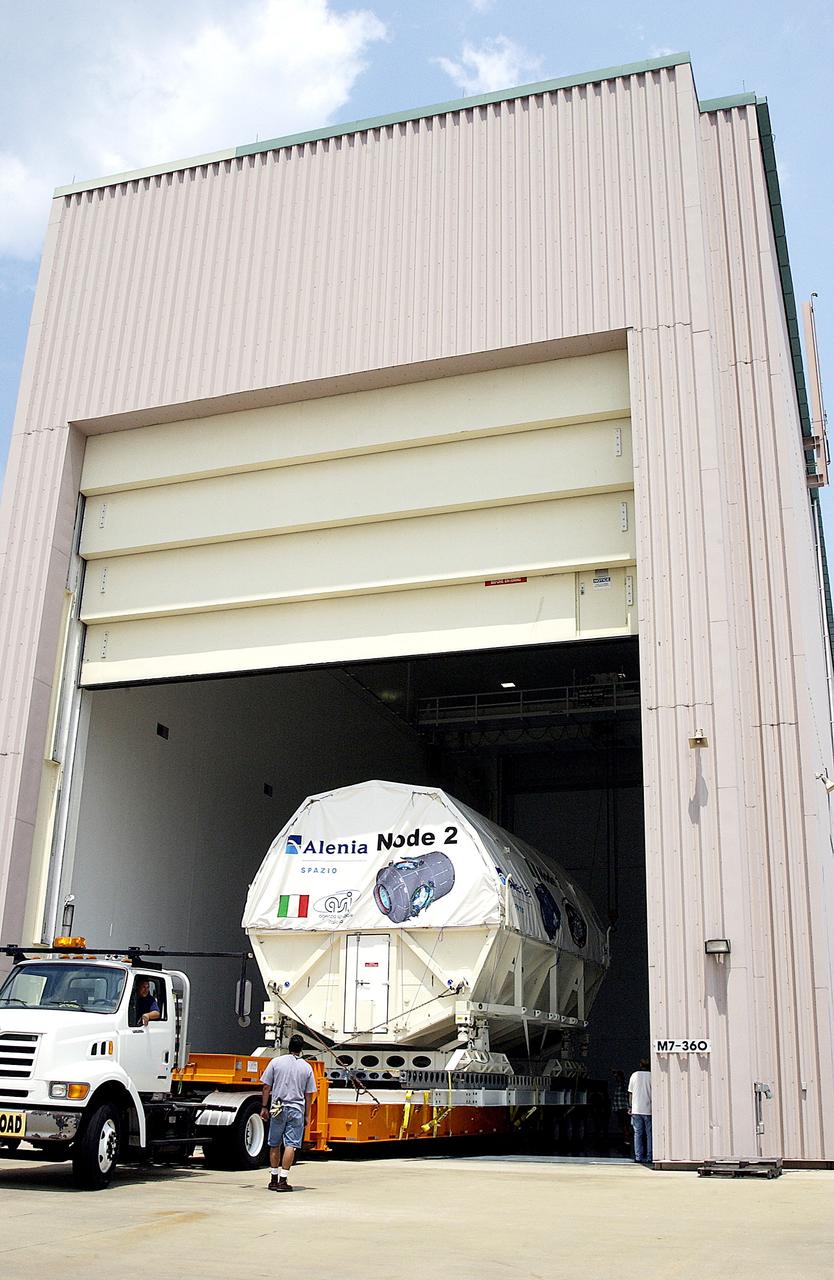
KENNEDY SPACE CENTER, FLA. -  The Italian-built module, U.S. Node 2, waits at the Space Station Processing Facility for the door to open. The second of three connecting modules on the International Space Station, Node 2 attaches to the end of the U.S. Lab and provides attach locations for the Japanese laboratory, European laboratory, the Centrifuge Accommodation Module and, later, Multipurpose Logistics Modules. It will provide the primary docking location for the Shuttle when a pressurized mating adapter is attached to Node 2.  Installation of the module will complete  the U.S. Core of the ISS.  Node 2 is the designated payload for mission STS-120.  No orbiter or launch date has been determined yet.
KENNEDY SPACE CENTER, FLA. - The Italian-built module, U.S. Node 2, waits at the Space Station Processing Facility for the door to open. The second of three connecting modules on the International Space Station, Node 2 attaches to the end of the U.S. Lab and provides attach locations for the Japanese laboratory, European laboratory, the Centrifuge Accommodation Module and, later, Multipurpose Logistics Modules. It will provide the primary docking location for the Shuttle when a pressurized mating adapter is attached to Node 2. Installation of the module will complete the U.S. Core of the ISS. Node 2 is the designated payload for mission STS-120. No orbiter or launch date has been determined yet.
KENNEDY SPACE CENTER, FLA. - The Italian-built module, U.S. Node 2, for the International Space Station after offloading from a Beluga aircraft at the Shuttle Landing Facility. The second of three Station connecting modules, Node 2 attaches to the end of the U.S. Lab and provides attach locations for the Japanese laboratory, European laboratory, the Centrifuge Accommodation Module and, later, Multipurpose Logistics Modules. It will provide the primary docking location for the Shuttle when a pressurized mating adapter is attached to Node 2.  Installation of the module will complete  the U.S. Core of the ISS.  Node 2 is the designated payload for mission STS-120.  No orbiter or launch date has been determined yet.
KENNEDY SPACE CENTER, FLA. - The Italian-built module, U.S. Node 2, for the International Space Station after offloading from a Beluga aircraft at the Shuttle Landing Facility. The second of three Station connecting modules, Node 2 attaches to the end of the U.S. Lab and provides attach locations for the Japanese laboratory, European laboratory, the Centrifuge Accommodation Module and, later, Multipurpose Logistics Modules. It will provide the primary docking location for the Shuttle when a pressurized mating adapter is attached to Node 2. Installation of the module will complete the U.S. Core of the ISS. Node 2 is the designated payload for mission STS-120. No orbiter or launch date has been determined yet.
KENNEDY SPACE CENTER, FLA. -  The Italian-built module, U.S. Node 2, arrives at the Space Station Processing Facility after its move from the Shuttle Landing Facility. The second of three connecting modules on the International Space Station, Node 2 attaches to the end of the U.S. Lab and provides attach locations for the Japanese laboratory, European laboratory, the Centrifuge Accommodation Module and, later, Multipurpose Logistics Modules. It will provide the primary docking location for the Shuttle when a pressurized mating adapter is attached to Node 2.  Installation of the module will complete  the U.S. Core of the ISS.  Node 2 is the designated payload for mission STS-120.  No orbiter or launch date has been determined yet.
KENNEDY SPACE CENTER, FLA. - The Italian-built module, U.S. Node 2, arrives at the Space Station Processing Facility after its move from the Shuttle Landing Facility. The second of three connecting modules on the International Space Station, Node 2 attaches to the end of the U.S. Lab and provides attach locations for the Japanese laboratory, European laboratory, the Centrifuge Accommodation Module and, later, Multipurpose Logistics Modules. It will provide the primary docking location for the Shuttle when a pressurized mating adapter is attached to Node 2. Installation of the module will complete the U.S. Core of the ISS. Node 2 is the designated payload for mission STS-120. No orbiter or launch date has been determined yet.
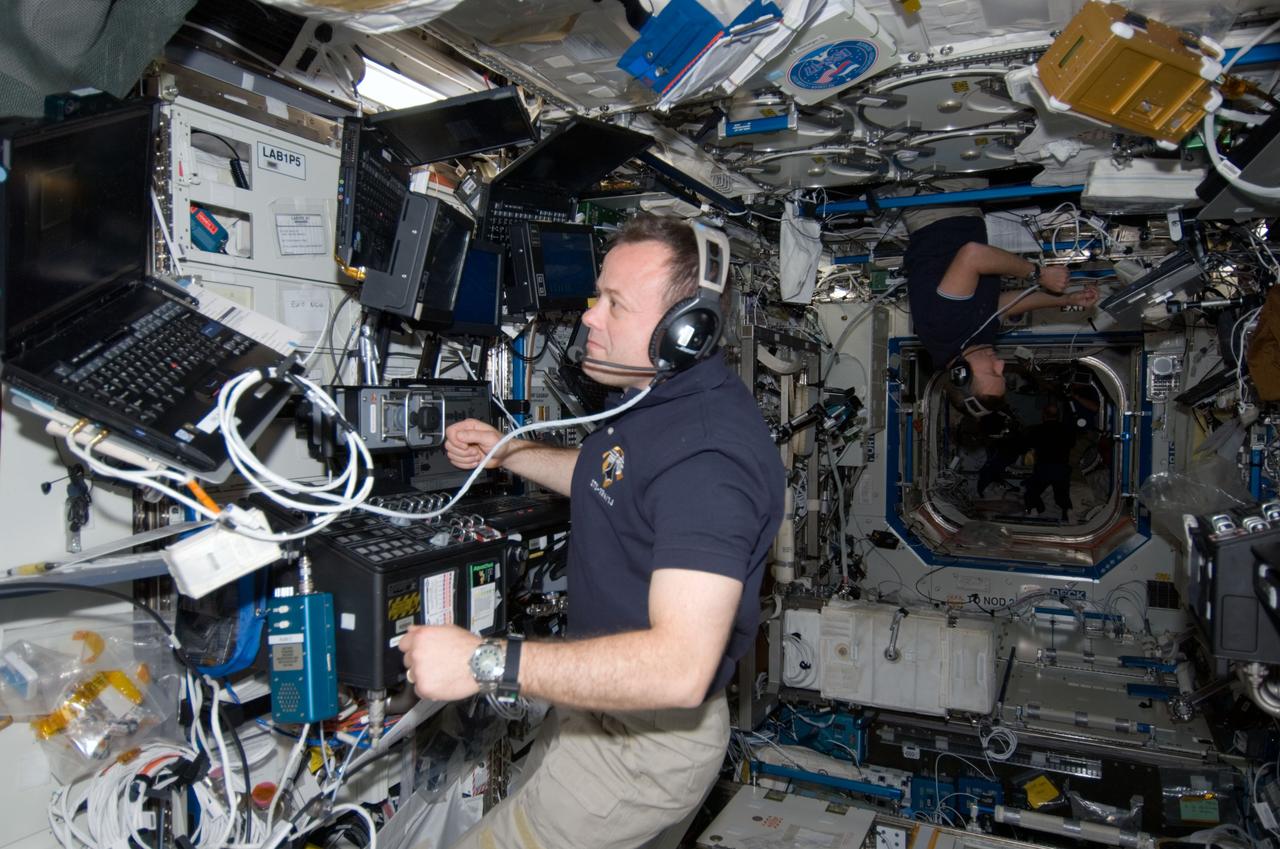
S124-E-009836 (10 June 2008) --- Astronaut Ron Garan, STS-124 mission specialist, uses a communication system in the Destiny laboratory of the International Space Station while Space Shuttle Discovery is docked with the station.
Garan in Destiny laboratory module
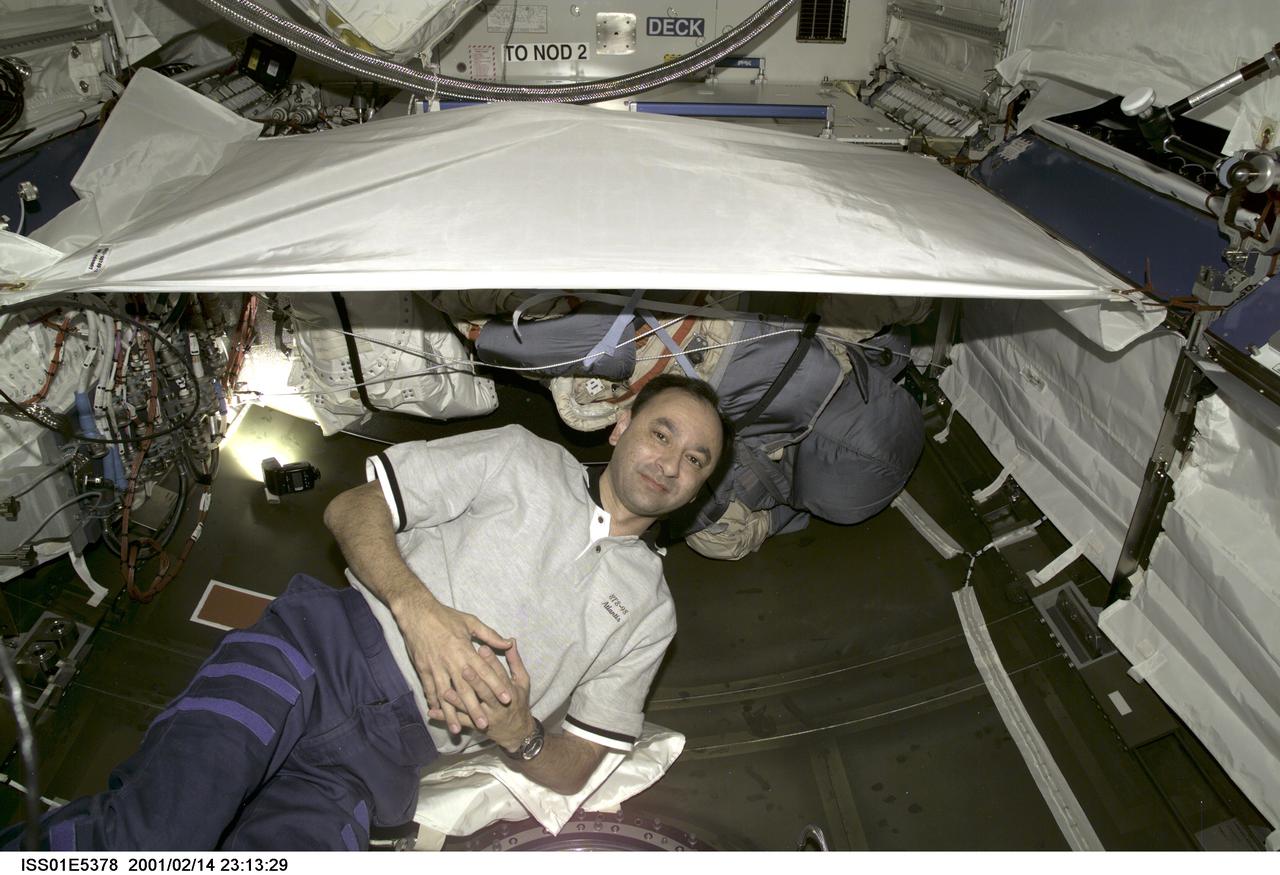
ISS01-E-5378 (14 February 2001) --- Astronaut Mark L. Polansky is pictured in the new Destiny laboratory.  The STS-98 and Expedition One crews have been busy in the lab since its hatch was opened earlier in the week.  This photo was taken with a digital still camera.
Polansky in Destiny laboratory module
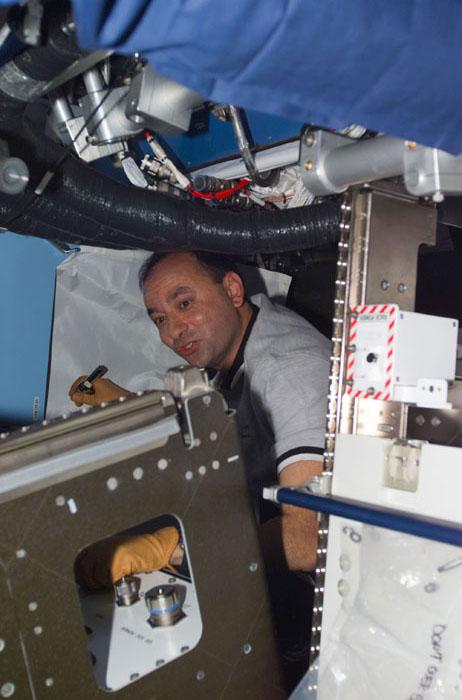
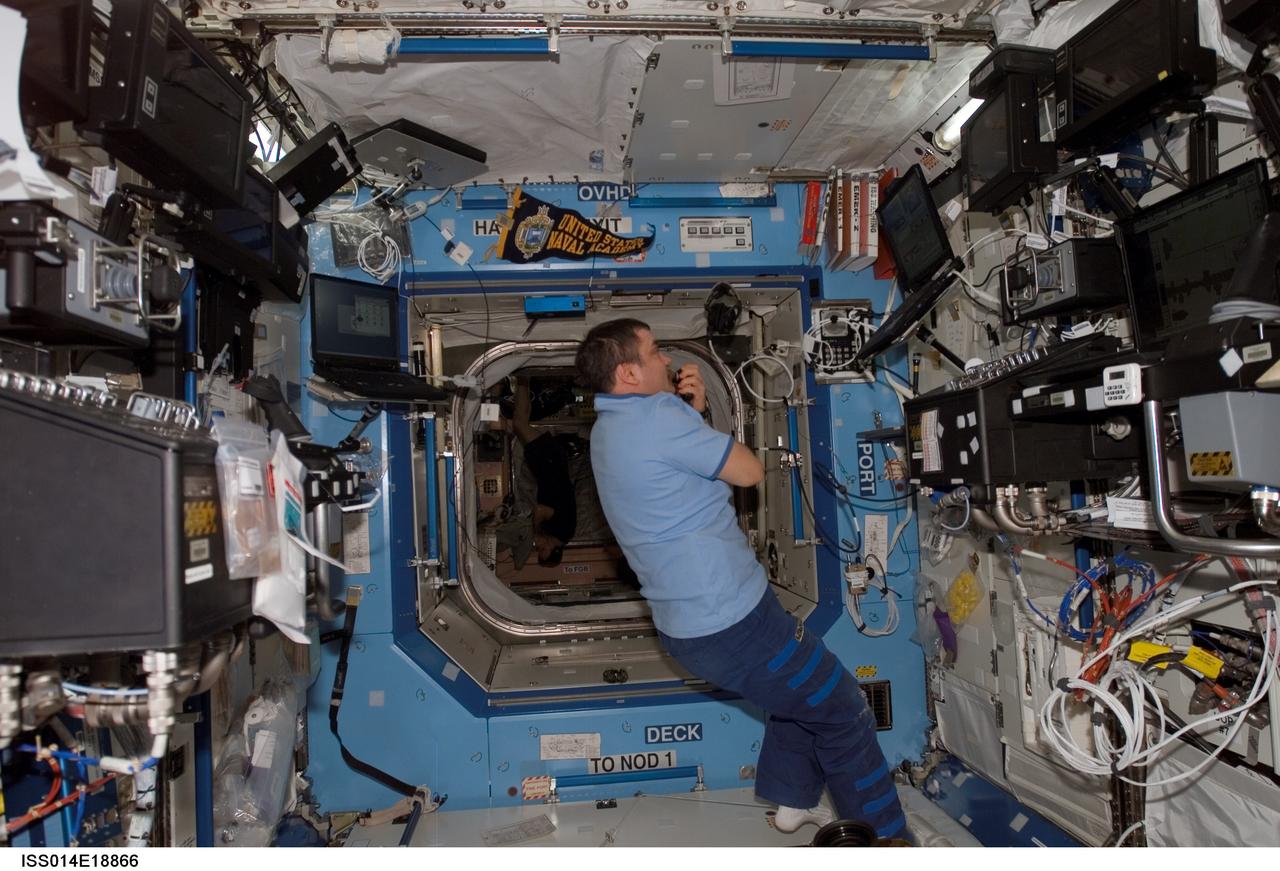
ISS014-E-18866 (3 April 2007) --- Cosmonaut Mikhail Tyurin, Expedition 14 flight engineer representing Russia's Federal Space Agency, uses a communication system in the Destiny laboratory of the International Space Station.
Tyurin in the Destiny laboratory module.
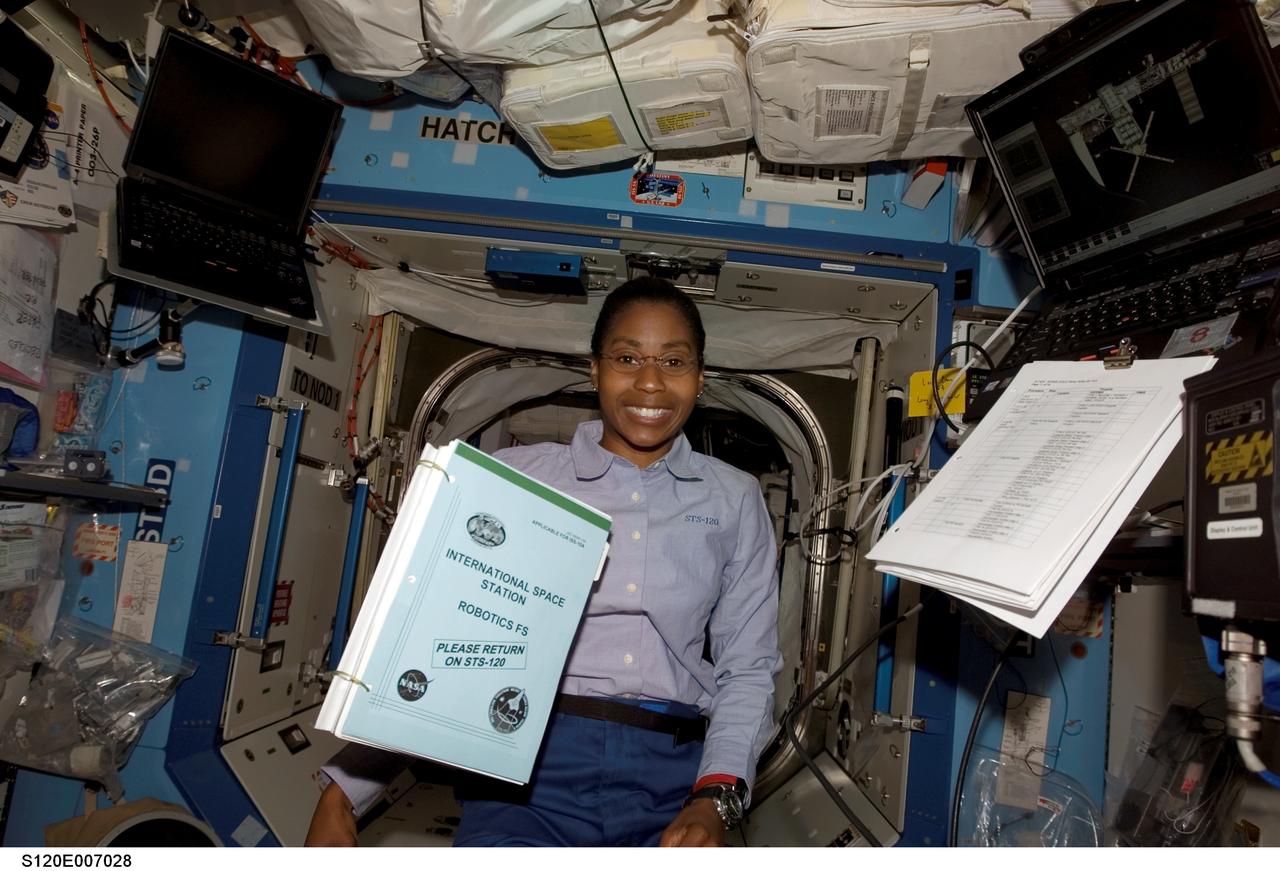
S120-E-007028 (28 Oct. 2007) --- Astronaut Stephanie Wilson, STS-120 mission specialist, poses for a photo as a procedures handbook floats freely nearby in the Destiny laboratory of the International Space Station.
Wilson in Destiny laboratory module
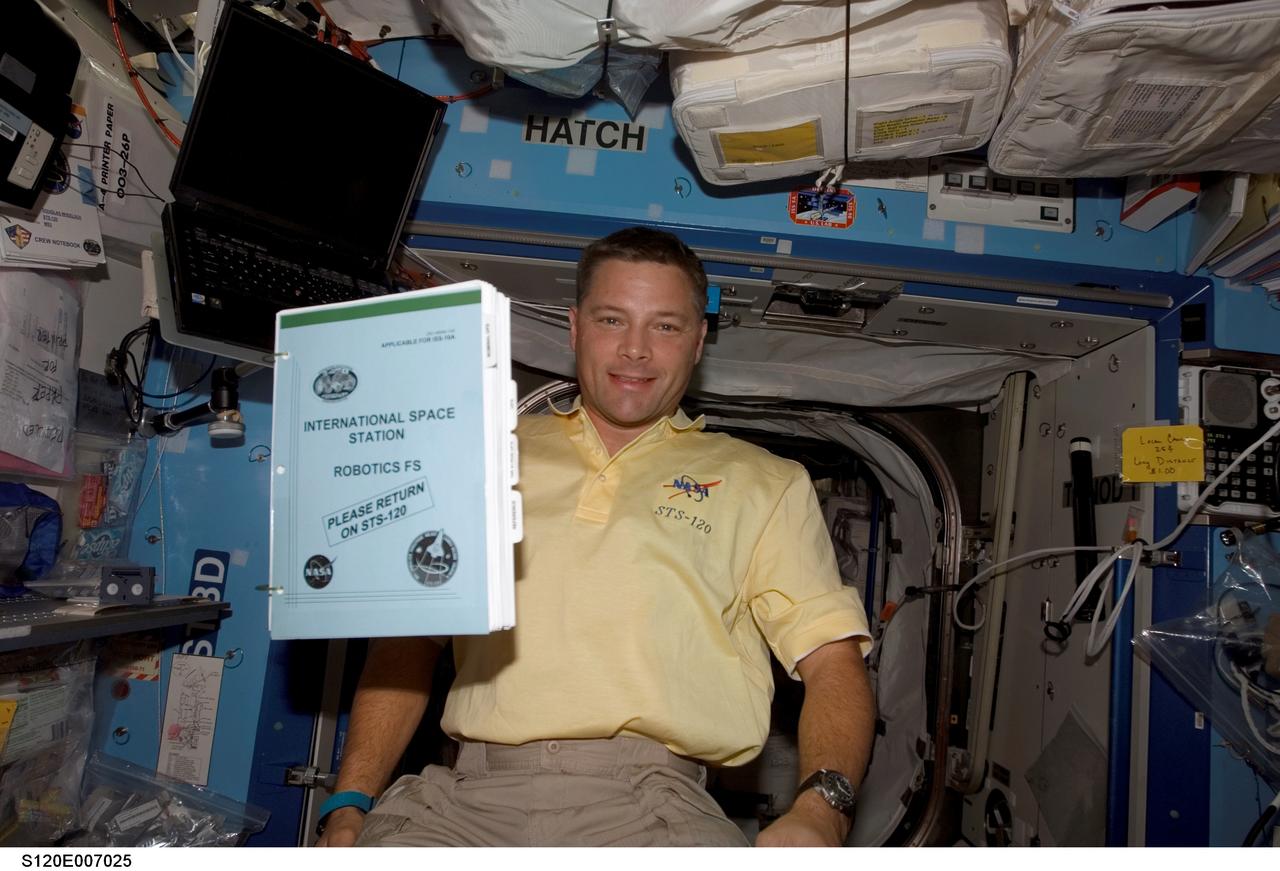
S120-E-007025 (28 Oct. 2007) --- Astronaut Doug Wheelock, STS-120 mission specialist, poses for a photo as a procedures handbook floats freely nearby in the Destiny laboratory of the International Space Station.
Wheelock in Destiny laboratory module
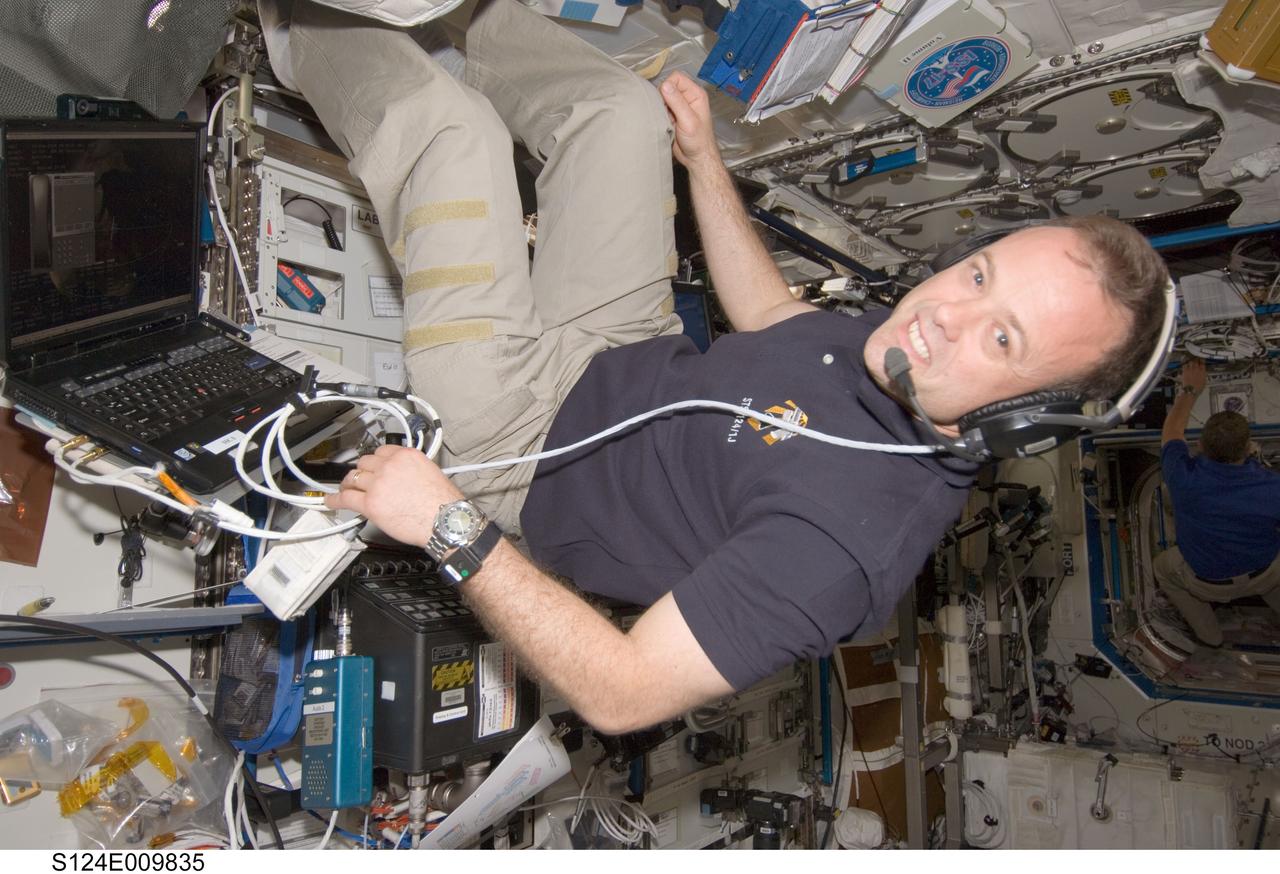
S124-E-009835 (10 June 2008) --- Astronaut Ron Garan, STS-124 mission specialist, takes a moment for a photo as he uses a communication system in the Destiny laboratory of the International Space Station while Space Shuttle Discovery is docked with the station.
Garan in Destiny laboratory module
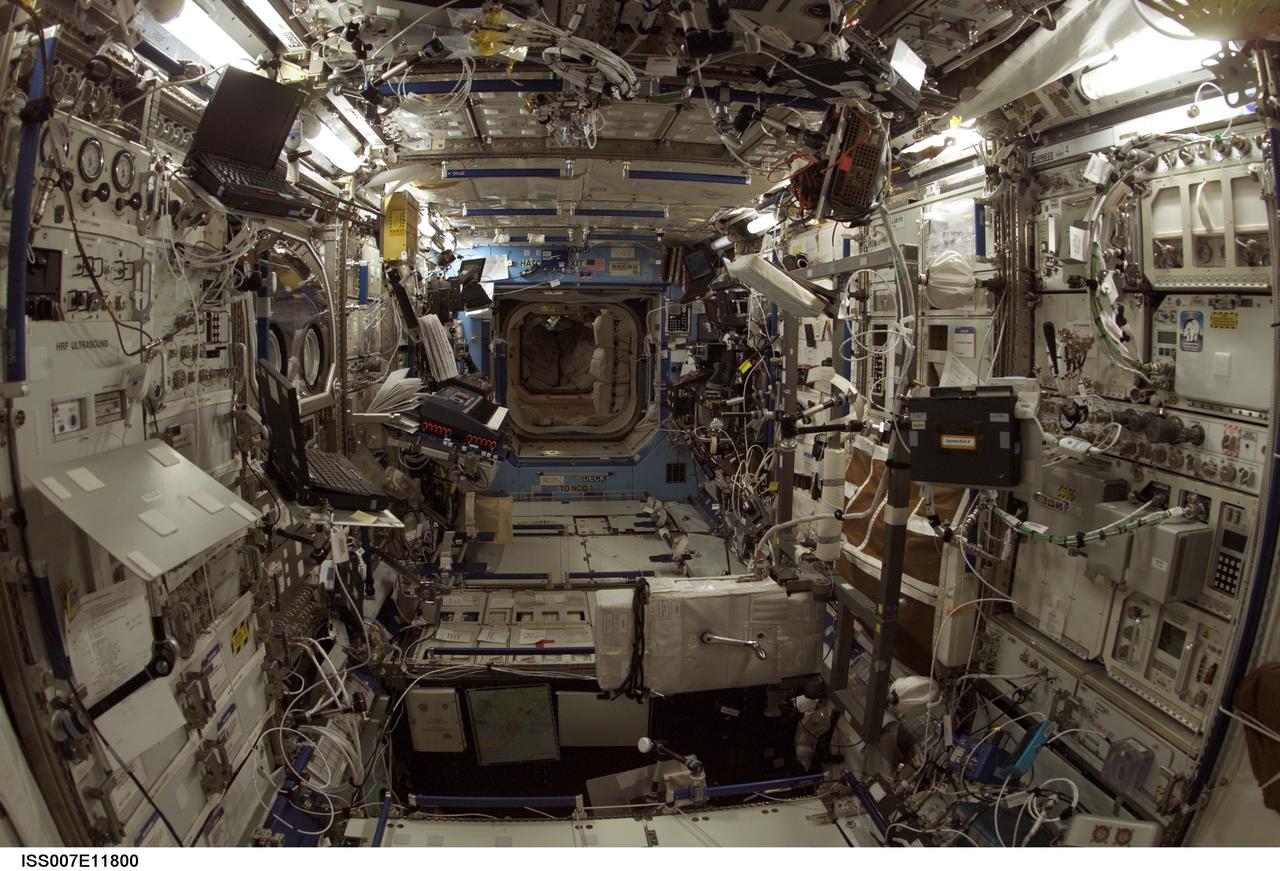
ISS007-E-11800 (3 August 2003) --- Interior view of the Destiny laboratory on the International Space Station (ISS) during the Expedition 7 mission.
View into the Destiny laboratory module
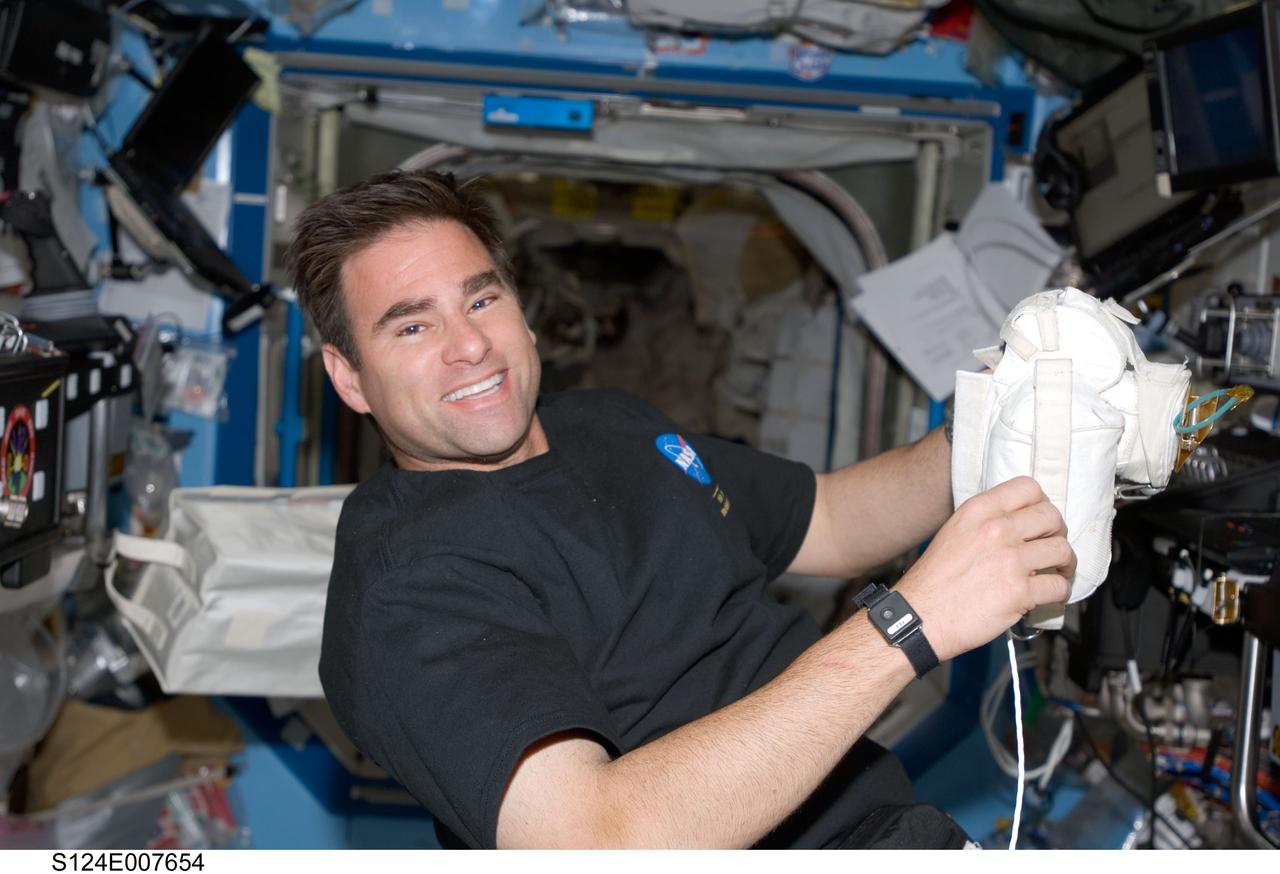
S124-E-007654 (7 June 2008) --- Astronaut Greg Chamitoff, Expedition 17 flight engineer, takes a moment for a photo as he works in the Destiny laboratory of the International Space Station while Space Shuttle Discovery is docked with the station.
Chamitoff in Destiny laboratory module
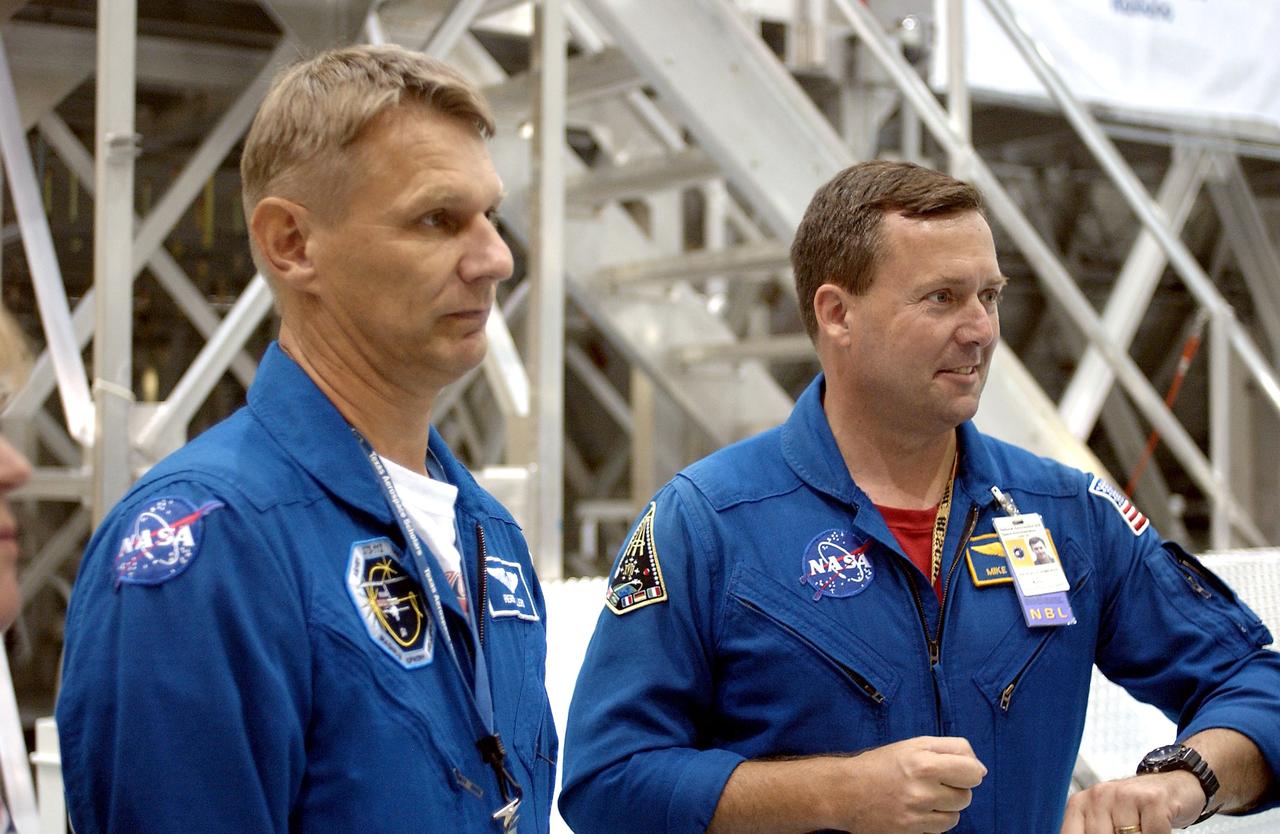
KENNEDY SPACE CENTER, FLA. -   STS-120 Mission Specialists Piers Sellers and Michael Foreman are in the Space Station Processing Facility for hardware familiarization.  The mission will deliver the second of three Station connecting modules, Node 2, which attaches to the end of U.S. Lab.  It will provide attach locations for the Japanese laboratory, European laboratory, the Centrifuge Accommodation Module and later Multi-Purpose Logistics Modules.  The addition of Node 2 will complete the U.S. core of the International Space Station.
KENNEDY SPACE CENTER, FLA. - STS-120 Mission Specialists Piers Sellers and Michael Foreman are in the Space Station Processing Facility for hardware familiarization. The mission will deliver the second of three Station connecting modules, Node 2, which attaches to the end of U.S. Lab. It will provide attach locations for the Japanese laboratory, European laboratory, the Centrifuge Accommodation Module and later Multi-Purpose Logistics Modules. The addition of Node 2 will complete the U.S. core of the International Space Station.
KENNEDY SPACE CENTER, FLA. - The  U.S. Node 2 is undergoing a Multi-Element Integrated Test (MEIT) in the Space Station Processing Facility.  Node 2 attaches to the end of the U.S. Lab on the ISS and provides attach locations for the Japanese laboratory, European laboratory, the Centrifuge Accommodation Module and, eventually, Multipurpose Logistics Modules. It will provide the primary docking location for the Shuttle when a pressurized mating adapter is attached to Node 2.  Installation of the module will complete the U.S. Core of the ISS.
KENNEDY SPACE CENTER, FLA. - The U.S. Node 2 is undergoing a Multi-Element Integrated Test (MEIT) in the Space Station Processing Facility. Node 2 attaches to the end of the U.S. Lab on the ISS and provides attach locations for the Japanese laboratory, European laboratory, the Centrifuge Accommodation Module and, eventually, Multipurpose Logistics Modules. It will provide the primary docking location for the Shuttle when a pressurized mating adapter is attached to Node 2. Installation of the module will complete the U.S. Core of the ISS.
STS98-E-5120 (11 February 2001) --- This digital still camera shot shows Expedition One commander William M. (Bill) Shepherd looking through the  portal on Unity's closed hatch to the newly attached Destiny laboratory. (Note: Astronauts Kenneth D. Cockrell and Mark L. Polansky appear at the left and right edges, respectively, but could possibly be cropped out in some views). The crews of Atlantis and the International Space Station opened the laboratory shortly after this photo was made on February 11; and the astronauts and cosmonauts spent the first full day of what are planned to be years of work ahead inside the orbiting science and command center. Shepherd opened the Destiny hatch, and he and shuttle commander Cockrell ventured inside at 8:38 a.m. (CST), Feb. 11.  As depicted in subsequent digital images in this series, members of both crews went to work quickly inside the new module, activating air systems, fire extinguishers, alarm systems, computers and internal communications. The crew also continued equipment transfers from the shuttle to the station.
Astronaut Shepherd looks in hatch at U.S. Laboratory / Destiny module
STS98-E-5121 (11 February 2001) --- This digital still camera shot shows Expedition One commander William M. (Bill) Shepherd looking through the observation port on Unity's closed hatch to the newly attached Destiny laboratory.  Astronauts Kenneth D. Cockrell and Mark L. Polansky appear at the left and right edges, respectively. The crews of Atlantis and the International Space Station opened the laboratory shortly after this photo was made on Feb. 11, and the astronauts and cosmonauts spent the first full day of what are planned to be years of work ahead inside the orbiting science and command center. Shepherd opened the Destiny hatch, and he and shuttle commander Cockrell ventured inside at 8:38 a.m. (CST), Feb. 11.  As depicted in subsequent digital images in this series, members of both crews went to work quickly inside the new module, activating air systems, fire extinguishers, alarm systems, computers and internal communications. The crew also continued equipment transfers from the shuttle to the station.
CDR Shepherd looks in hatch at U.S. Laboratory / Destiny module
STS98-E-5115 (11 February 2001) --- This medium  shot, photographed with a digital still camera, shows STS-98 pilot  Mark L. Polansky looking through the observation port on Unity's closed hatch to the newly attached Destiny laboratory.  The crews of Atlantis and the International Space Station opened the laboratory shortly after this photo was made on Feb. 11; and the astronauts and cosmonauts spent the first full day of what are planned to be years of work ahead inside the orbiting science and command center. Station commander William M. (Bill) Shepherd opened the Destiny hatch, and he and shuttle commander Kenneth D. Cockrell ventured inside at 8:38 a.m. (CST), Feb. 11.  As depicted in subsequent digital images in this series, members of both crews went to work quickly inside the new module, activating air systems, fire extinguishers, alarm systems, computers and internal communications. The crew also continued equipment transfers from the shuttle to the station.
PLT Polansky looks through hatch at U.S. Laboratory / Destiny module
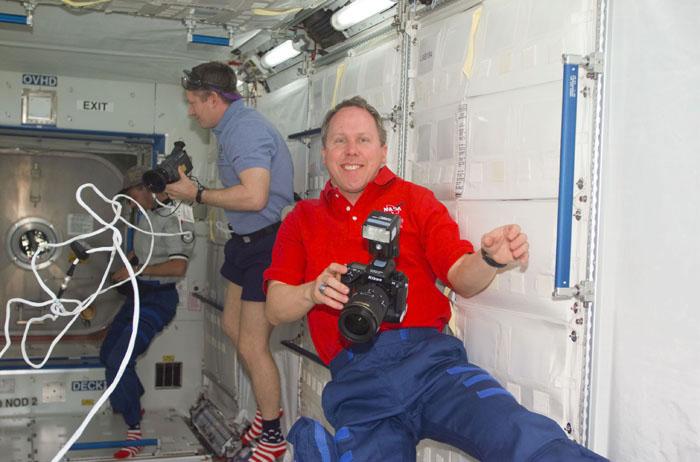
STS98-E-5138 (11 February 2001) --- Cosmonaut Sergei K. Krikalev, Expedition One flight engineer, takes still photographs onboard the newly opened Destiny laboratory on the International Space Station (ISS).  After astronaut William M. (Bill) Shepherd, Expedition One commander, opened the Destiny hatch, he and astronaut Kenneth D. Cockrell (out of frame) ventured inside at 8:38 a.m. (CST), February 11, 2001.  As depicted in subsequent digital images in this series, members of both crews went to work quickly inside the new module, activating air systems, fire extinguishers, alarm systems, computers and internal communications. The crew also took some photos and continued equipment transfers from the shuttle to the station.
Cosmonaut Krikalev takes photos in U.S. Laboratory /Destiny module
KENNEDY SPACE CENTER, FLA. -   In the Space Station Processing Facility, STS-120 Mission Specialist Michael Foreman looks over the Japanese Experiment Module (JEM) Pressurized Module. Known as Kibo, the JEM consists of six components: two research facilities -- the Pressurized Module and Exposed Facility; a Logistics Module attached to each of them; a Remote Manipulator System; and an Inter-Orbit Communication System unit. Kibo also has a scientific airlock through which experiments are transferred and exposed to the external environment of space. The various components of JEM will be assembled in space over the course of three Space Shuttle missions.  The STS-120 mission will deliver the second of three Station connecting modules, Node 2, which attaches to the end of U.S. Lab.  It will provide attach locations for the Japanese laboratory, European laboratory, the Centrifuge Accommodation Module and later Multi-Purpose Logistics Modules.  The addition of Node 2 will complete the U.S. core of the International Space Station.
KENNEDY SPACE CENTER, FLA. - In the Space Station Processing Facility, STS-120 Mission Specialist Michael Foreman looks over the Japanese Experiment Module (JEM) Pressurized Module. Known as Kibo, the JEM consists of six components: two research facilities -- the Pressurized Module and Exposed Facility; a Logistics Module attached to each of them; a Remote Manipulator System; and an Inter-Orbit Communication System unit. Kibo also has a scientific airlock through which experiments are transferred and exposed to the external environment of space. The various components of JEM will be assembled in space over the course of three Space Shuttle missions. The STS-120 mission will deliver the second of three Station connecting modules, Node 2, which attaches to the end of U.S. Lab. It will provide attach locations for the Japanese laboratory, European laboratory, the Centrifuge Accommodation Module and later Multi-Purpose Logistics Modules. The addition of Node 2 will complete the U.S. core of the International Space Station.
KENNEDY SPACE CENTER, FLA. -  In the Space Station Processing Facility, STS-120 Mission Specialist Piers Sellers looks over the Japanese Experiment Module (JEM) Pressurized Module. Known as Kibo, the JEM consists of six components: two research facilities -- the Pressurized Module and Exposed Facility; a Logistics Module attached to each of them; a Remote Manipulator System; and an Inter-Orbit Communication System unit. Kibo also has a scientific airlock through which experiments are transferred and exposed to the external environment of space. The various components of JEM will be assembled in space over the course of three Space Shuttle missions.   The STS-120 mission will deliver the second of three Station connecting modules, Node 2, which attaches to the end of U.S. Lab.  It will provide attach locations for the Japanese laboratory, European laboratory, the Centrifuge Accommodation Module and later Multi-Purpose Logistics Modules.  The addition of Node 2 will complete the U.S. core of the International Space Station.
KENNEDY SPACE CENTER, FLA. - In the Space Station Processing Facility, STS-120 Mission Specialist Piers Sellers looks over the Japanese Experiment Module (JEM) Pressurized Module. Known as Kibo, the JEM consists of six components: two research facilities -- the Pressurized Module and Exposed Facility; a Logistics Module attached to each of them; a Remote Manipulator System; and an Inter-Orbit Communication System unit. Kibo also has a scientific airlock through which experiments are transferred and exposed to the external environment of space. The various components of JEM will be assembled in space over the course of three Space Shuttle missions. The STS-120 mission will deliver the second of three Station connecting modules, Node 2, which attaches to the end of U.S. Lab. It will provide attach locations for the Japanese laboratory, European laboratory, the Centrifuge Accommodation Module and later Multi-Purpose Logistics Modules. The addition of Node 2 will complete the U.S. core of the International Space Station.
KENNEDY SPACE CENTER, FLA. -    Members of the STS-114 crew take a look at the Japanese Experiment Module (JEM) pressure module in the Space Station Processing Facility.  A research laboratory, the pressurized module is the first element of the JEM, named "Kibo" (Hope), to be delivered to KSC.   The National Space Development Agency of Japan (NASDA) developed the laboratory at the Tsukuba Space Center near Tokyo and is Japan's primary contribution to the Station. The JEM also includes an exposed facility (platform) for space environment experiments, a robotic manipulator system, and two logistics modules. The various JEM components will be  assembled in space over the course of three Shuttle missions.
KENNEDY SPACE CENTER, FLA. - Members of the STS-114 crew take a look at the Japanese Experiment Module (JEM) pressure module in the Space Station Processing Facility. A research laboratory, the pressurized module is the first element of the JEM, named "Kibo" (Hope), to be delivered to KSC. The National Space Development Agency of Japan (NASDA) developed the laboratory at the Tsukuba Space Center near Tokyo and is Japan's primary contribution to the Station. The JEM also includes an exposed facility (platform) for space environment experiments, a robotic manipulator system, and two logistics modules. The various JEM components will be assembled in space over the course of three Shuttle missions.
KENNEDY SPACE CENTER, FLA. - The U.S. Node 2 is unveiled after its arrival in the Space Station Processing Facility.  The second of three Station connecting modules, the Italian-built Node 2 attaches to the end of the U.S. Lab and provides attach locations for the Japanese laboratory, European laboratory, the Centrifuge Accommodation Module and, later, Multipurpose Logistics Modules. It will provide the primary docking location for the Shuttle when a pressurized mating adapter is attached to Node 2.  Installation of the module will complete  the U.S. Core of the ISS.  Node 2 is the designated payload for mission STS-120.  No orbiter or launch date has been determined yet.
KENNEDY SPACE CENTER, FLA. - The U.S. Node 2 is unveiled after its arrival in the Space Station Processing Facility. The second of three Station connecting modules, the Italian-built Node 2 attaches to the end of the U.S. Lab and provides attach locations for the Japanese laboratory, European laboratory, the Centrifuge Accommodation Module and, later, Multipurpose Logistics Modules. It will provide the primary docking location for the Shuttle when a pressurized mating adapter is attached to Node 2. Installation of the module will complete the U.S. Core of the ISS. Node 2 is the designated payload for mission STS-120. No orbiter or launch date has been determined yet.
KENNEDY SPACE CENTER, FLA. - An overhead crane in the Space Station Processing Facility carries the U.S. Node 2 across the floor to a workstand.  The second of three connecting modules on the International Space Station, the Italian-built Node 2 attaches to the end of the U.S. Lab and provides attach locations for the Japanese laboratory, European laboratory, the Centrifuge Accommodation Module and, later, Multipurpose Logistics Modules. It will provide the primary docking location for the Shuttle when a pressurized mating adapter is attached to Node 2.  Installation of the module will complete  the U.S. Core of the ISS.  Node 2 is the designated payload for mission STS-120.  No orbiter or launch date has been determined yet.
KENNEDY SPACE CENTER, FLA. - An overhead crane in the Space Station Processing Facility carries the U.S. Node 2 across the floor to a workstand. The second of three connecting modules on the International Space Station, the Italian-built Node 2 attaches to the end of the U.S. Lab and provides attach locations for the Japanese laboratory, European laboratory, the Centrifuge Accommodation Module and, later, Multipurpose Logistics Modules. It will provide the primary docking location for the Shuttle when a pressurized mating adapter is attached to Node 2. Installation of the module will complete the U.S. Core of the ISS. Node 2 is the designated payload for mission STS-120. No orbiter or launch date has been determined yet.
KENNEDY SPACE CENTER, FLA. - The U.S. Node 2 is moved toward a workstand in the Space Station Processing Facility.  The second of three connecting modules on the International Space Station, the Italian-built Node 2 attaches to the end of the U.S. Lab and provides attach locations for the Japanese laboratory, European laboratory, the Centrifuge Accommodation Module and, later, Multipurpose Logistics Modules. It will provide the primary docking location for the Shuttle when a pressurized mating adapter is attached to Node 2.  Installation of the module will complete  the U.S. Core of the ISS.  Node 2 is the designated payload for mission STS-120.  No orbiter or launch date has been determined yet.
KENNEDY SPACE CENTER, FLA. - The U.S. Node 2 is moved toward a workstand in the Space Station Processing Facility. The second of three connecting modules on the International Space Station, the Italian-built Node 2 attaches to the end of the U.S. Lab and provides attach locations for the Japanese laboratory, European laboratory, the Centrifuge Accommodation Module and, later, Multipurpose Logistics Modules. It will provide the primary docking location for the Shuttle when a pressurized mating adapter is attached to Node 2. Installation of the module will complete the U.S. Core of the ISS. Node 2 is the designated payload for mission STS-120. No orbiter or launch date has been determined yet.
KENNEDY SPACE CENTER, FLA. - An overhead crane in the Space Station Processing Facility is attached to the U.S. Node 2 to lift it out of its shipping container.  The node will be moved to a workstand.  The second of three connecting modules on the International Space Station, the Italian-built Node 2 attaches to the end of the U.S. Lab and provides attach locations for the Japanese laboratory, European laboratory, the Centrifuge Accommodation Module and, later, Multipurpose Logistics Modules. It will provide the primary docking location for the Shuttle when a pressurized mating adapter is attached to Node 2.  Installation of the module will complete  the U.S. Core of the ISS.  Node 2 is the designated payload for mission STS-120.  No orbiter or launch date has been determined yet.
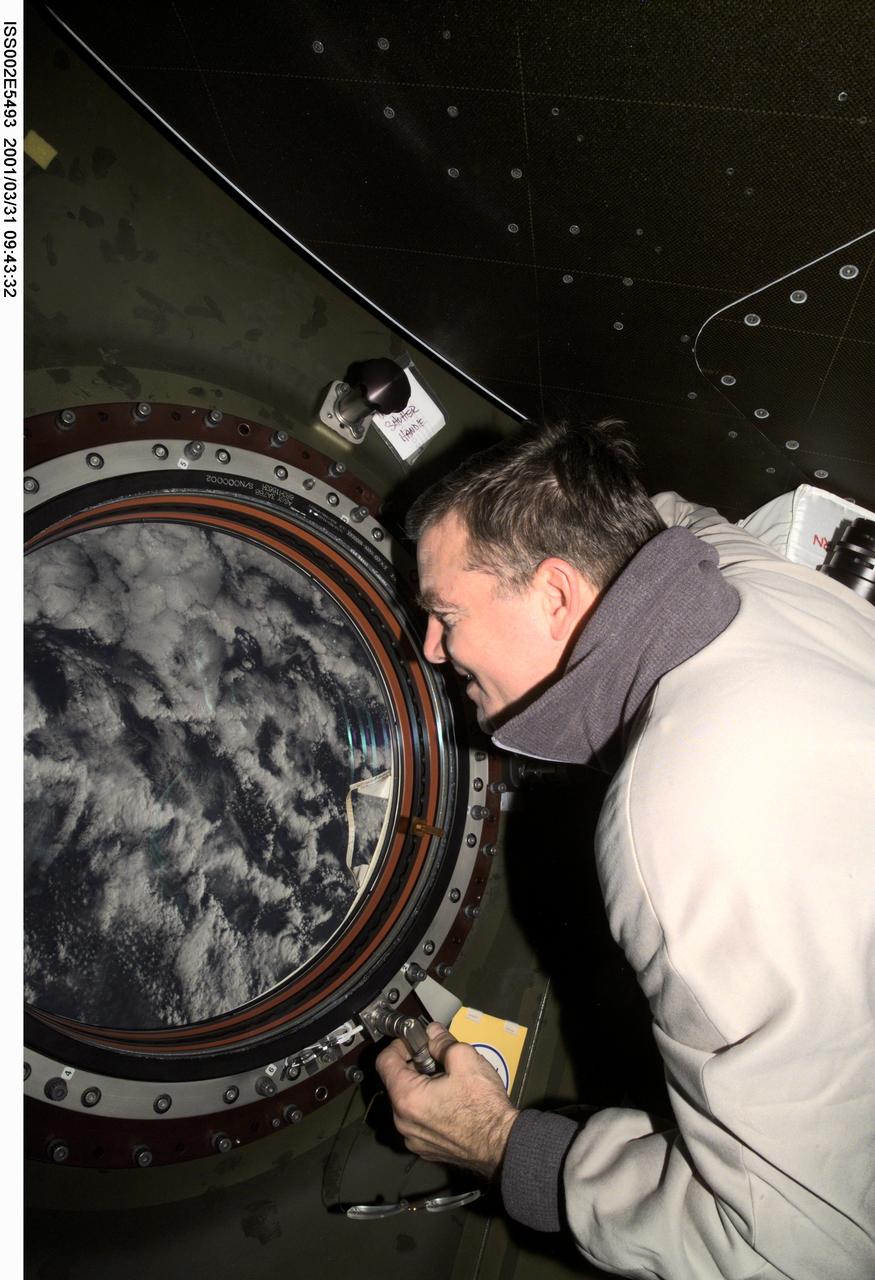
KENNEDY SPACE CENTER, FLA. - An overhead crane in the Space Station Processing Facility is attached to the U.S. Node 2 to lift it out of its shipping container. The node will be moved to a workstand. The second of three connecting modules on the International Space Station, the Italian-built Node 2 attaches to the end of the U.S. Lab and provides attach locations for the Japanese laboratory, European laboratory, the Centrifuge Accommodation Module and, later, Multipurpose Logistics Modules. It will provide the primary docking location for the Shuttle when a pressurized mating adapter is attached to Node 2. Installation of the module will complete the U.S. Core of the ISS. Node 2 is the designated payload for mission STS-120. No orbiter or launch date has been determined yet.
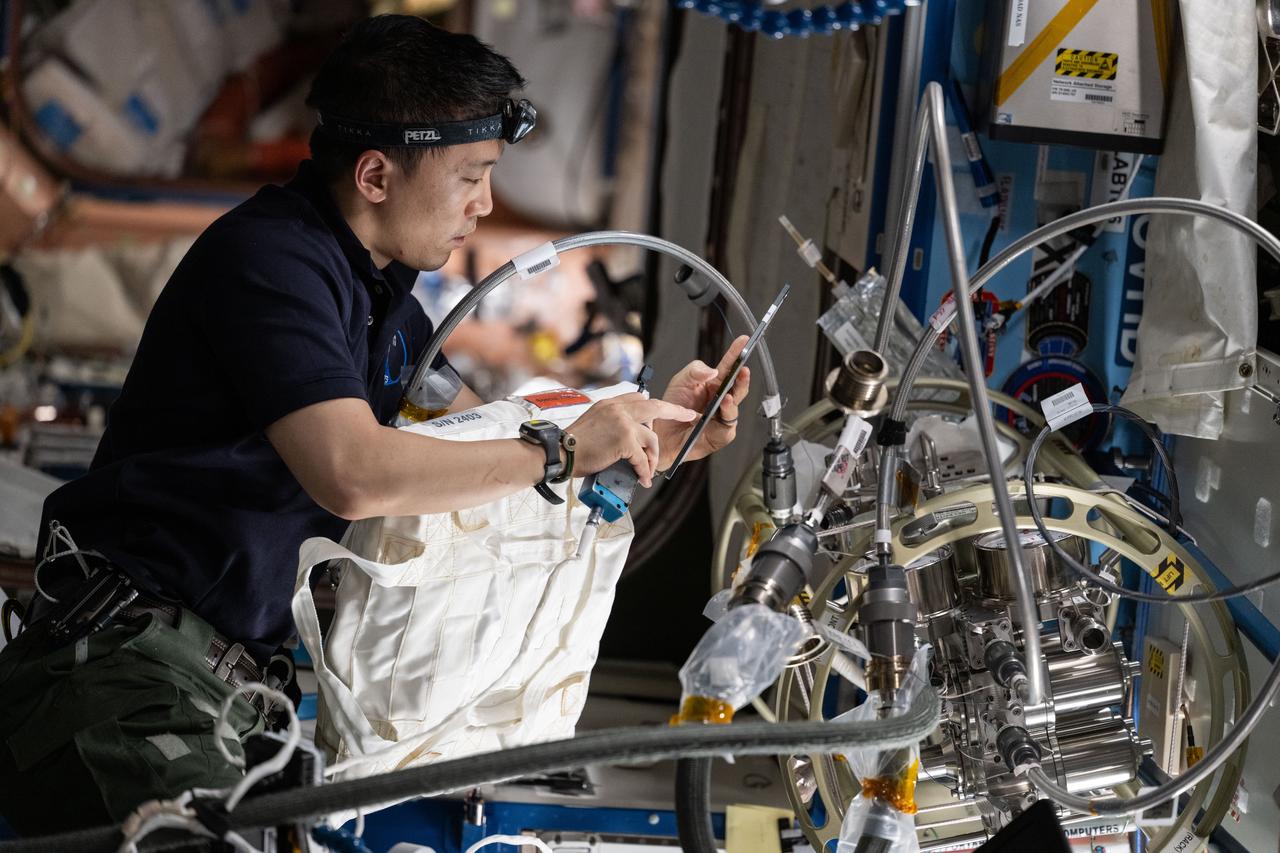
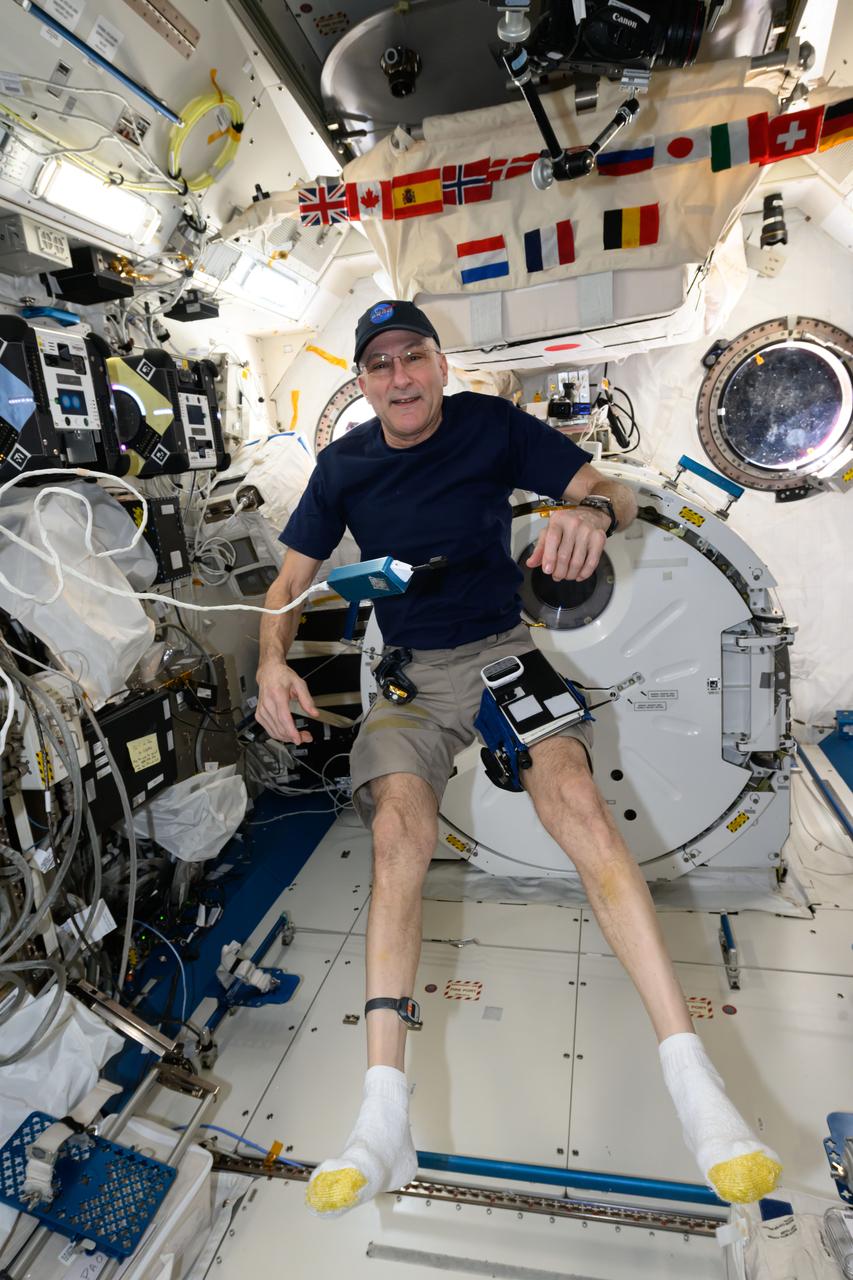
KENNEDY SPACE CENTER, FLA. -  Astronaut Soichi Noguchi (left), with the National Space Development Agency of Japan (NASDA), works at a console during a Multi-Element Integrated Test (MEIT) of the U.S. Node 2 and the Japanese Experiment Module (JEM) in the Space Station Processing Facility.  The JEM, developed by NASDA, is Japan's primary contribution to the Station. It will enhance the unique research capabilities of the orbiting complex by providing an additional environment for astronauts to conduct science experiments. Noguchi is assigned to mission STS-114 as a mission specialist.  Node 2 provides attach locations for the Japanese laboratory, as well as European laboratory, the Centrifuge Accommodation Module and, eventually, Multipurpose Logistics Modules.  Installation of the module will complete the U.S. Core of the ISS.
KENNEDY SPACE CENTER, FLA. - Astronaut Soichi Noguchi (left), with the National Space Development Agency of Japan (NASDA), works at a console during a Multi-Element Integrated Test (MEIT) of the U.S. Node 2 and the Japanese Experiment Module (JEM) in the Space Station Processing Facility. The JEM, developed by NASDA, is Japan's primary contribution to the Station. It will enhance the unique research capabilities of the orbiting complex by providing an additional environment for astronauts to conduct science experiments. Noguchi is assigned to mission STS-114 as a mission specialist. Node 2 provides attach locations for the Japanese laboratory, as well as European laboratory, the Centrifuge Accommodation Module and, eventually, Multipurpose Logistics Modules. Installation of the module will complete the U.S. Core of the ISS.
KENNEDY SPACE CENTER, FLA. - An overhead crane in the Space Station Processing Facility lifts the U.S. Node 2 out of its shipping container.  The node will be moved to a workstand.  The second of three connecting modules on the International Space Station, the Italian-built Node 2 attaches to the end of the U.S. Lab and provides attach locations for the Japanese laboratory, European laboratory, the Centrifuge Accommodation Module and, later, Multipurpose Logistics Modules. It will provide the primary docking location for the Shuttle when a pressurized mating adapter is attached to Node 2.  Installation of the module will complete  the U.S. Core of the ISS.  Node 2 is the designated payload for mission STS-120.  No orbiter or launch date has been determined yet.
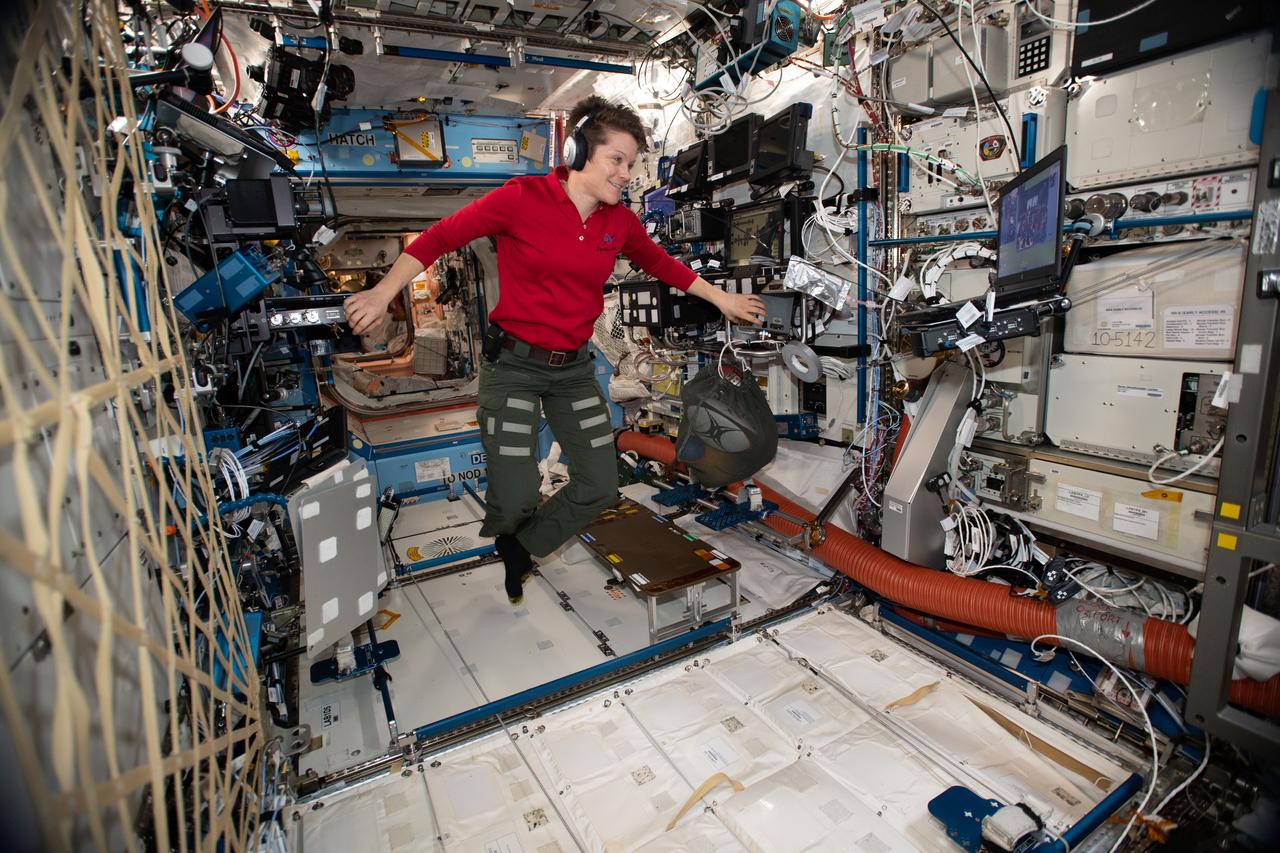
KENNEDY SPACE CENTER, FLA. - An overhead crane in the Space Station Processing Facility lifts the U.S. Node 2 out of its shipping container. The node will be moved to a workstand. The second of three connecting modules on the International Space Station, the Italian-built Node 2 attaches to the end of the U.S. Lab and provides attach locations for the Japanese laboratory, European laboratory, the Centrifuge Accommodation Module and, later, Multipurpose Logistics Modules. It will provide the primary docking location for the Shuttle when a pressurized mating adapter is attached to Node 2. Installation of the module will complete the U.S. Core of the ISS. Node 2 is the designated payload for mission STS-120. No orbiter or launch date has been determined yet.
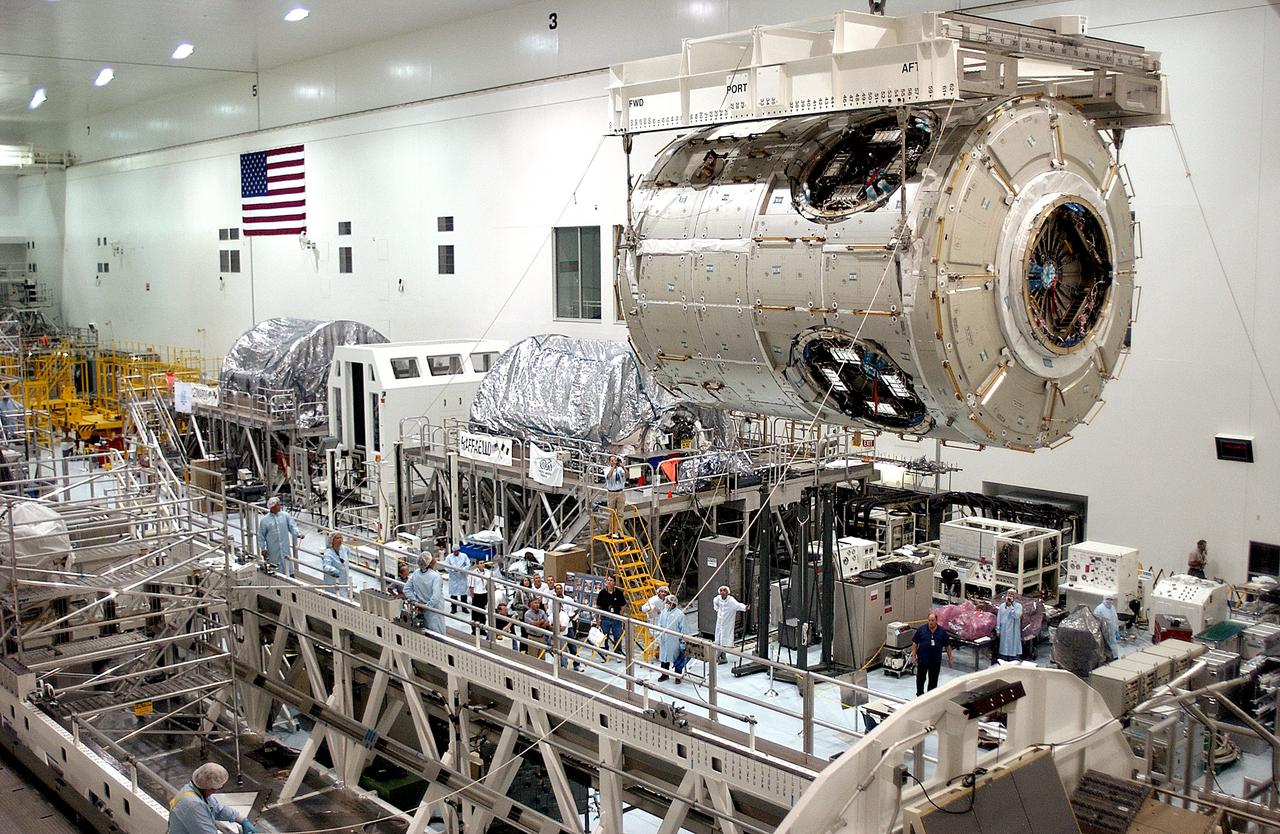
KENNEDY SPACE CENTER, FLA. - The U.S. Node 2 moves toward a workstand in the Space Station Processing Facility.  The second of three connecting modules on the International Space Station, the Italian-built Node 2 attaches to the end of the U.S. Lab and provides attach locations for the Japanese laboratory, European laboratory, the Centrifuge Accommodation Module and, later, Multipurpose Logistics Modules. It will provide the primary docking location for the Shuttle when a pressurized mating adapter is attached to Node 2.  Installation of the module will complete  the U.S. Core of the ISS.  Node 2 is the designated payload for mission STS-120.  No orbiter or launch date has been determined yet.
KENNEDY SPACE CENTER, FLA. - The U.S. Node 2 moves toward a workstand in the Space Station Processing Facility. The second of three connecting modules on the International Space Station, the Italian-built Node 2 attaches to the end of the U.S. Lab and provides attach locations for the Japanese laboratory, European laboratory, the Centrifuge Accommodation Module and, later, Multipurpose Logistics Modules. It will provide the primary docking location for the Shuttle when a pressurized mating adapter is attached to Node 2. Installation of the module will complete the U.S. Core of the ISS. Node 2 is the designated payload for mission STS-120. No orbiter or launch date has been determined yet.
KENNEDY SPACE CENTER, FLA. -  The inside of the Italian-built Node 2 looks pristine after opening of the hatch.  A future element of the International Space Station,  Node 2 arrived at KSC June 1.  The second of three Station connecting modules, Node 2 attaches to the end of the U.S. Lab and provides attach locations for the Japanese laboratory, European laboratory, the Centrifuge Accommodation Module and, later, Multipurpose Logistics Modules. It will provide the primary docking location for the Shuttle when a pressurized mating adapter is attached to Node 2.  Installation of the module will complete  the U.S. Core of the ISS.  Node 2 is the designated payload for mission STS-120.  No orbiter or launch date has been determined yet.
KENNEDY SPACE CENTER, FLA. - The inside of the Italian-built Node 2 looks pristine after opening of the hatch. A future element of the International Space Station, Node 2 arrived at KSC June 1. The second of three Station connecting modules, Node 2 attaches to the end of the U.S. Lab and provides attach locations for the Japanese laboratory, European laboratory, the Centrifuge Accommodation Module and, later, Multipurpose Logistics Modules. It will provide the primary docking location for the Shuttle when a pressurized mating adapter is attached to Node 2. Installation of the module will complete the U.S. Core of the ISS. Node 2 is the designated payload for mission STS-120. No orbiter or launch date has been determined yet.
KENNEDY SPACE CENTER, FLA. -  The U.S. Node 2 is lowered onto a workstand in the Space Station Processing Facility.  The second of three connecting modules on the International Space Station, the Italian-built Node 2 attaches to the end of the U.S. Lab and provides attach locations for the Japanese laboratory, European laboratory, the Centrifuge Accommodation Module and, later, Multipurpose Logistics Modules. It will provide the primary docking location for the Shuttle when a pressurized mating adapter is attached to Node 2.  Installation of the module will complete  the U.S. Core of the ISS.  Node 2 is the designated payload for mission STS-120.  No orbiter or launch date has been determined yet.
KENNEDY SPACE CENTER, FLA. - The U.S. Node 2 is lowered onto a workstand in the Space Station Processing Facility. The second of three connecting modules on the International Space Station, the Italian-built Node 2 attaches to the end of the U.S. Lab and provides attach locations for the Japanese laboratory, European laboratory, the Centrifuge Accommodation Module and, later, Multipurpose Logistics Modules. It will provide the primary docking location for the Shuttle when a pressurized mating adapter is attached to Node 2. Installation of the module will complete the U.S. Core of the ISS. Node 2 is the designated payload for mission STS-120. No orbiter or launch date has been determined yet.
KENNEDY SPACE CENTER, FLA. -  In the Space Station Processing Facility, astronaut Soichi Noguchi (right), with the National Space Development Agency of Japan (NASDA), stands inside the Japanese Experiment Module (JEM) that is undergoing a Multi-Element Integrated Test (MEIT) with the U.S. Node 2.  The JEM, developed by NASDA, is Japan's primary contribution to the Station. It will enhance the unique research capabilities of the orbiting complex by providing an additional environment for astronauts to conduct science experiments. Noguchi is assigned to mission STS-114 as a mission specialist.  Node 2 provides attach locations for the Japanese laboratory, as well as European laboratory, the Centrifuge Accommodation Module and, eventually, Multipurpose Logistics Modules.  Installation of the module will complete the U.S. Core of the ISS.
KENNEDY SPACE CENTER, FLA. - In the Space Station Processing Facility, astronaut Soichi Noguchi (right), with the National Space Development Agency of Japan (NASDA), stands inside the Japanese Experiment Module (JEM) that is undergoing a Multi-Element Integrated Test (MEIT) with the U.S. Node 2. The JEM, developed by NASDA, is Japan's primary contribution to the Station. It will enhance the unique research capabilities of the orbiting complex by providing an additional environment for astronauts to conduct science experiments. Noguchi is assigned to mission STS-114 as a mission specialist. Node 2 provides attach locations for the Japanese laboratory, as well as European laboratory, the Centrifuge Accommodation Module and, eventually, Multipurpose Logistics Modules. Installation of the module will complete the U.S. Core of the ISS.
KENNEDY SPACE CENTER, FLA. - An overhead crane in the Space Station Processing Facility moves the U.S. Node 2 across the floor to a workstand.  The second of three connecting modules on the International Space Station, the Italian-built Node 2 attaches to the end of the U.S. Lab and provides attach locations for the Japanese laboratory, European laboratory, the Centrifuge Accommodation Module and, later, Multipurpose Logistics Modules. It will provide the primary docking location for the Shuttle when a pressurized mating adapter is attached to Node 2.  Installation of the module will complete  the U.S. Core of the ISS.  Node 2 is the designated payload for mission STS-120.  No orbiter or launch date has been determined yet.
KENNEDY SPACE CENTER, FLA. - An overhead crane in the Space Station Processing Facility moves the U.S. Node 2 across the floor to a workstand. The second of three connecting modules on the International Space Station, the Italian-built Node 2 attaches to the end of the U.S. Lab and provides attach locations for the Japanese laboratory, European laboratory, the Centrifuge Accommodation Module and, later, Multipurpose Logistics Modules. It will provide the primary docking location for the Shuttle when a pressurized mating adapter is attached to Node 2. Installation of the module will complete the U.S. Core of the ISS. Node 2 is the designated payload for mission STS-120. No orbiter or launch date has been determined yet.