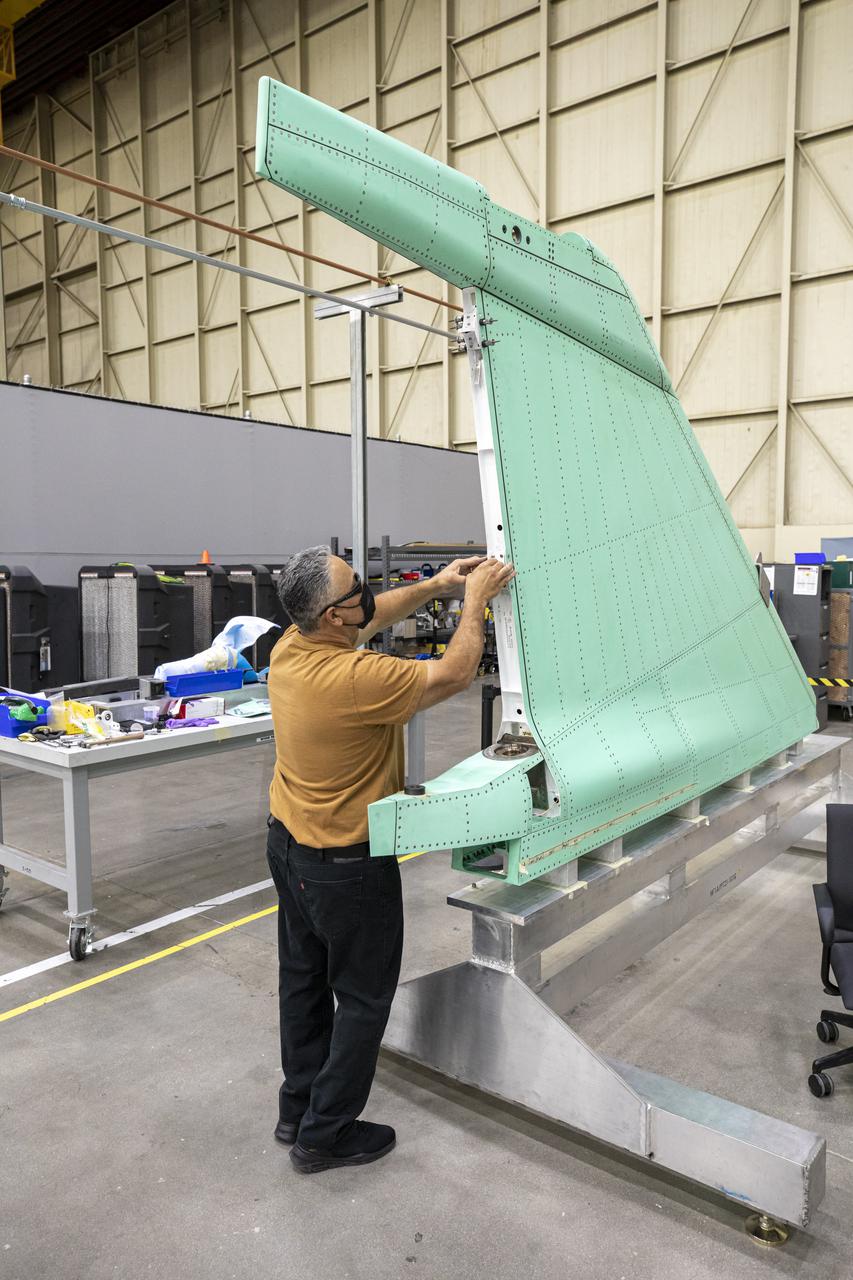
A technician is shown working on the X-59 vertical tail prior to installation at Lockheed Martin Skunk Works in Palmdale, California. The aircraft will fly to demonstrate the ability to fly supersonic while reducing the loud sonic boom to a quiet sonic thump. Lockheed Martin Photography By Garry Tice 1011 Lockheed Way, Palmdale, Ca. 93599 Event: SEG 530 Vertical Tail, Landing Gear Bay Doors Date: 4/28/2021
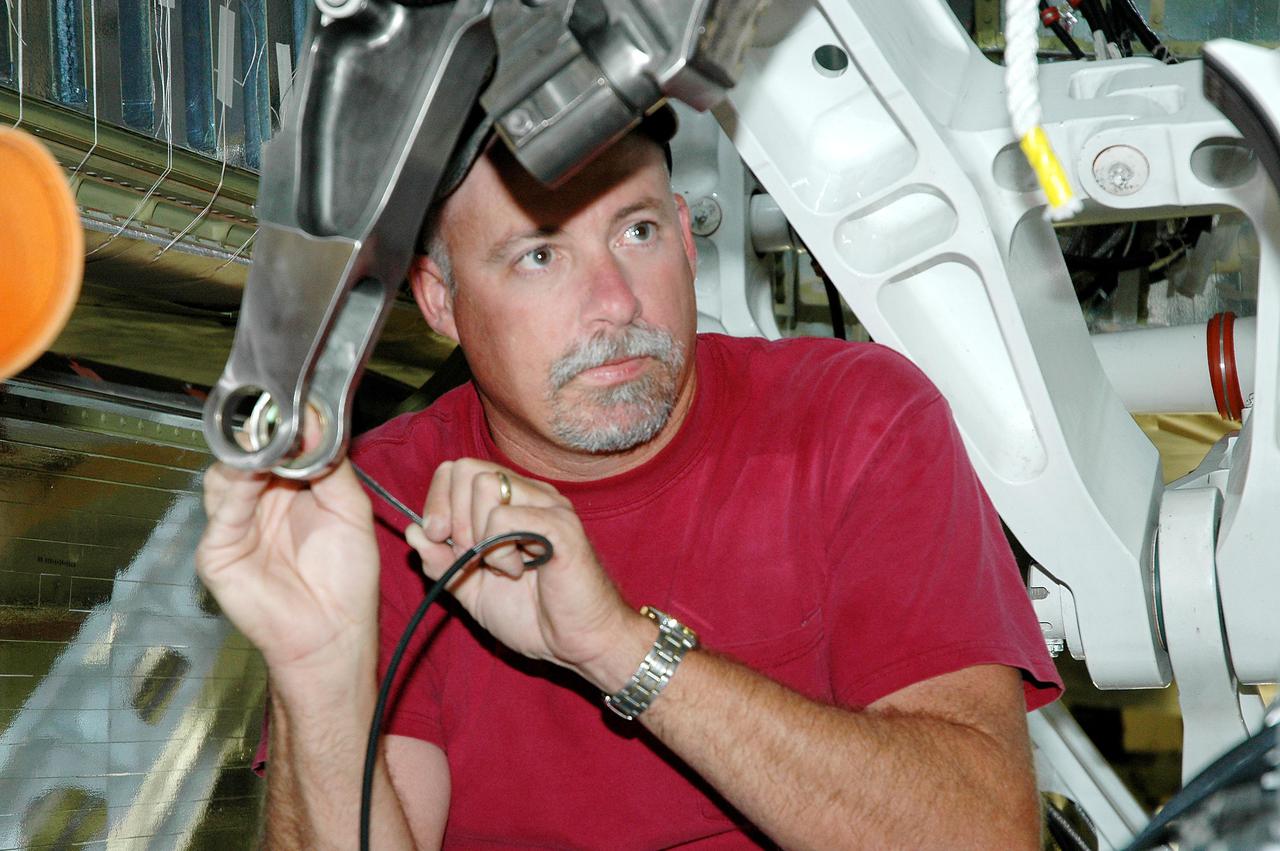
KENNEDY SPACE CENTER, FLA. - On Orbiter Atlantis in NASA’s Orbiter Processing Facility, bay 1, Scott Minnick, lead inspector for micro inspection team, inspects the area where the retract link assembly would be installed on the right-hand main landing gear. Last week a small crack was found on the right-hand assembly. To lower the main landing gear, a mechanical linkage released by each gear actuates the doors to the open position. The landing gear reach the full-down and extended position with 10 seconds and are locked in the down position by spring-loaded downlock bungees Atlantis is scheduled to launch in September 2005 on the second Return to Flight mission, STS-121.
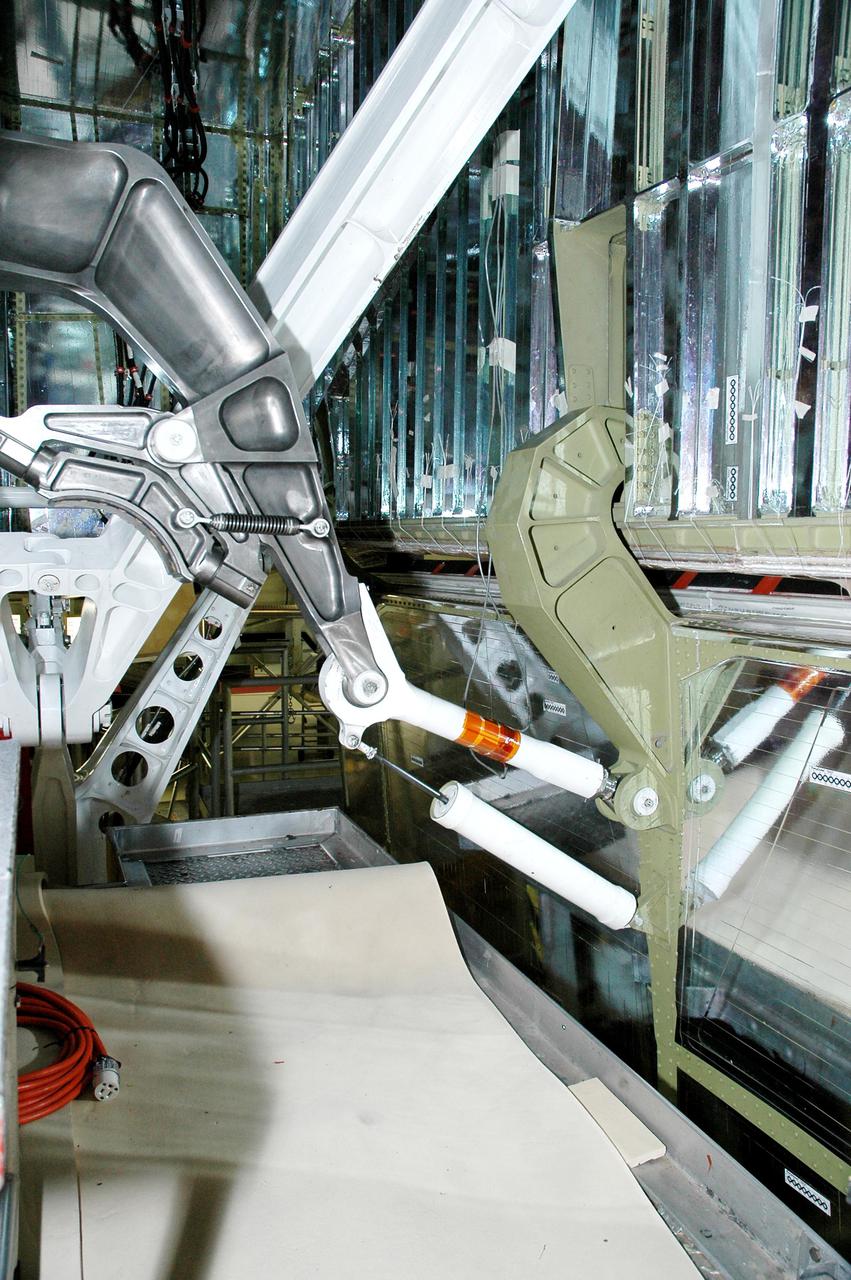
KENNEDY SPACE CENTER, FLA. - On Orbiter Atlantis in NASA’s Orbiter Processing Facility, bay 1, a retract link assembly (upper and lower white rods) is on the left-hand main landing gear. Last week a small crack was found on the right-hand assembly. To lower the main landing gear, a mechanical linkage released by each gear actuates the doors to the open position. The landing gear reach the full-down and extended position with 10 seconds and are locked in the down position by spring-loaded downlock bungees Atlantis is scheduled to launch in September 2005 on the second Return to Flight mission, STS-121.
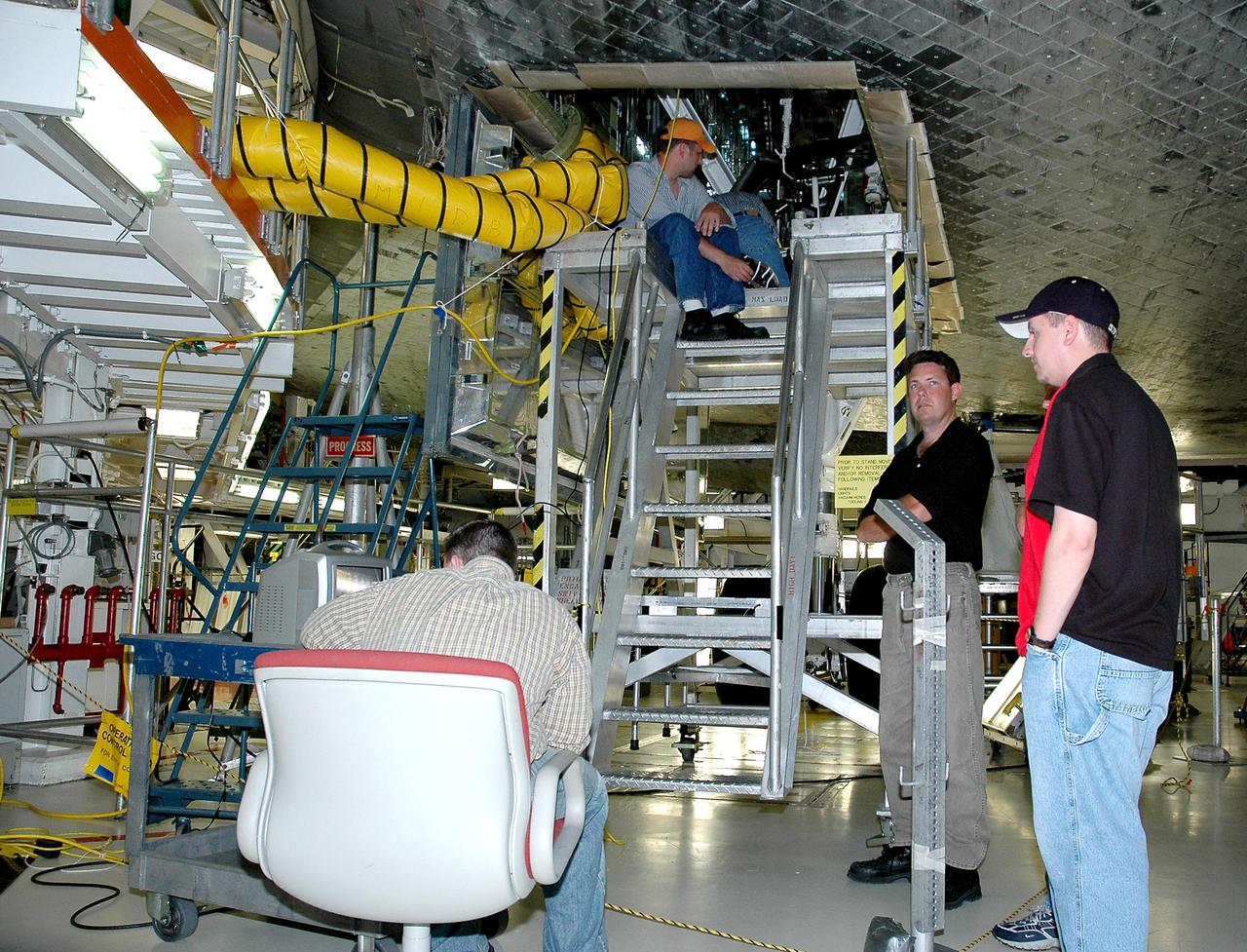
KENNEDY SPACE CENTER, FLA. - On Orbiter Atlantis in NASA’s Orbiter Processing Facility, bay 1, Charles Wassen, orbiter inspector, on steps in the open door of the main landing gear helps with boroscope inspection on the retract link assembly. At left in the chair, Dave Rumpf, materials and processing engineer, observes results on a monitor. At right are Jessie McEnulty (in hat), mechanisms engineer, and Tony Glass, orbiter inspector, a member of the micro inspection team. To lower the main landing gear, a mechanical linkage released by each gear actuates the doors to the open position. The landing gear reach the full-down and extended position with 10 seconds and are locked in the down position by spring-loaded downlock bungees Atlantis is scheduled to launch in September 2005 on the second Return to Flight mission, STS-121.
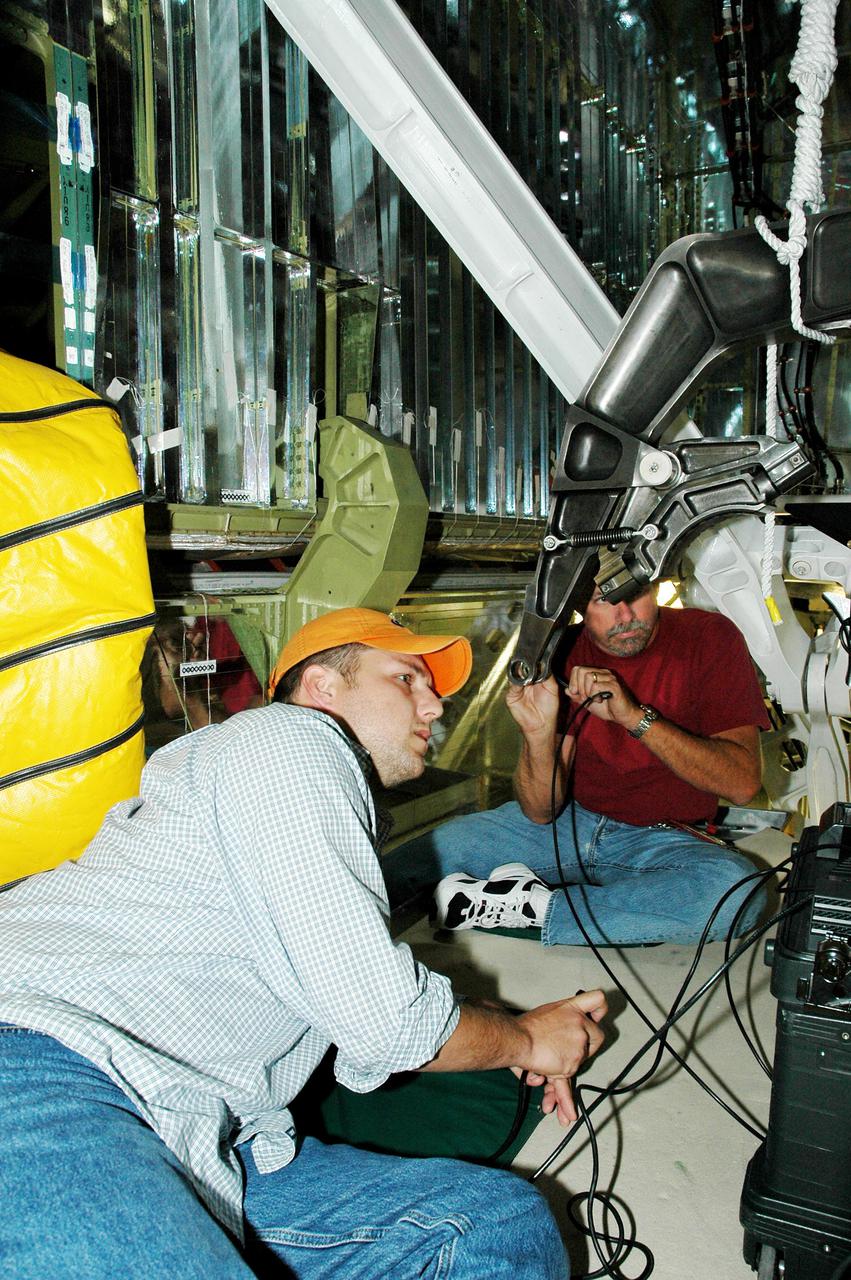
KENNEDY SPACE CENTER, FLA. - On Orbiter Atlantis in NASA’s Orbiter Processing Facility, bay 1, the retract link assembly on the right-hand main landing gear has been removed and will be replaced. Performing boroscope inspection are Charles Wassen, orbiter inspector, and Scott Minnick, lead inspector for micro inspection team. Last week a small crack was found on the right-hand assembly. To lower the main landing gear, a mechanical linkage released by each gear actuates the doors to the open position. The landing gear reach the full-down and extended position with 10 seconds and are locked in the down position by spring-loaded downlock bungees Atlantis is scheduled to launch in September 2005 on the second Return to Flight mission, STS-121.
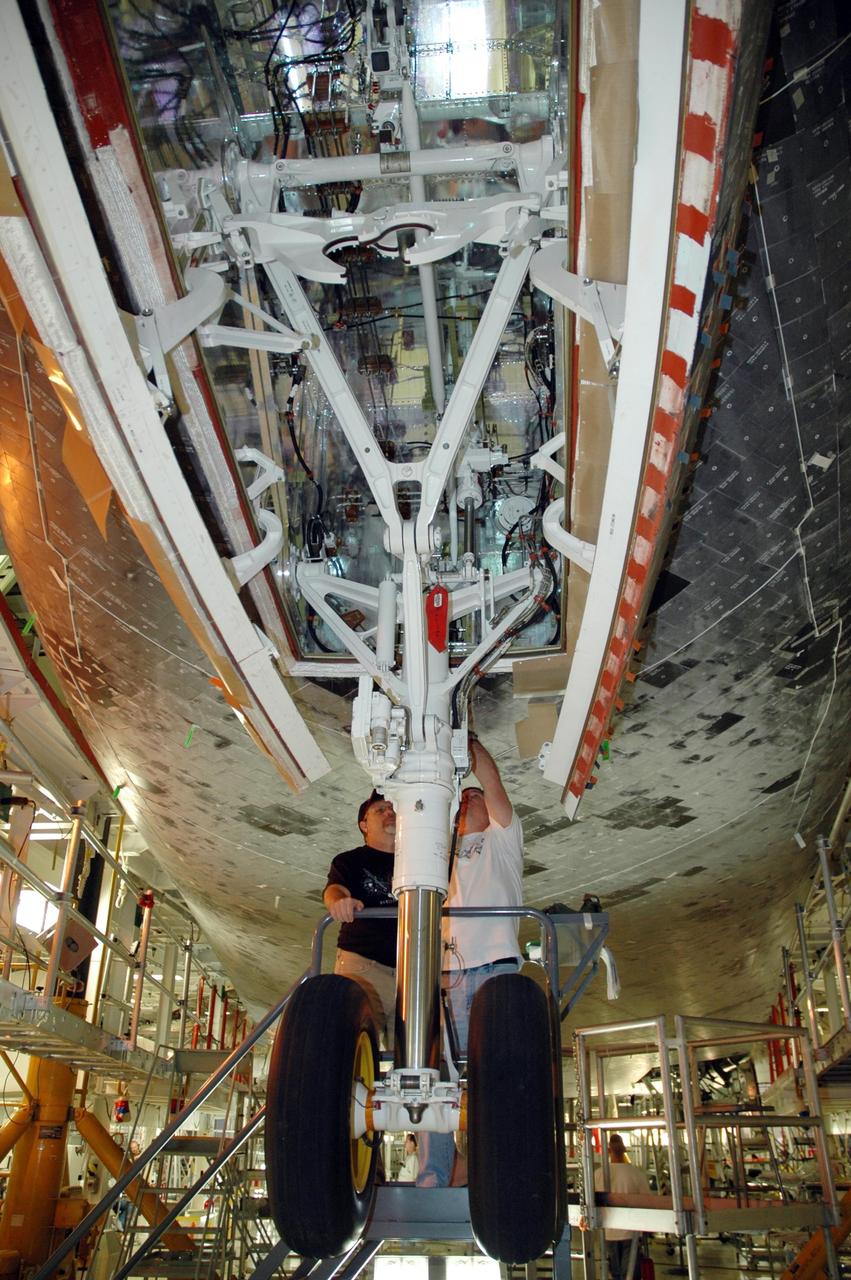
KENNEDY SPACE CENTER, FLA. -- In the Orbiter Processing Facility bay 2, technicians work around the attach point for the external tank near Endeavour's landing gear. The orbiter is scheduled to fly on mission STS-118 to the International Space Station in the summer of 2007. Photo credit: NASA/Jack Pfaller
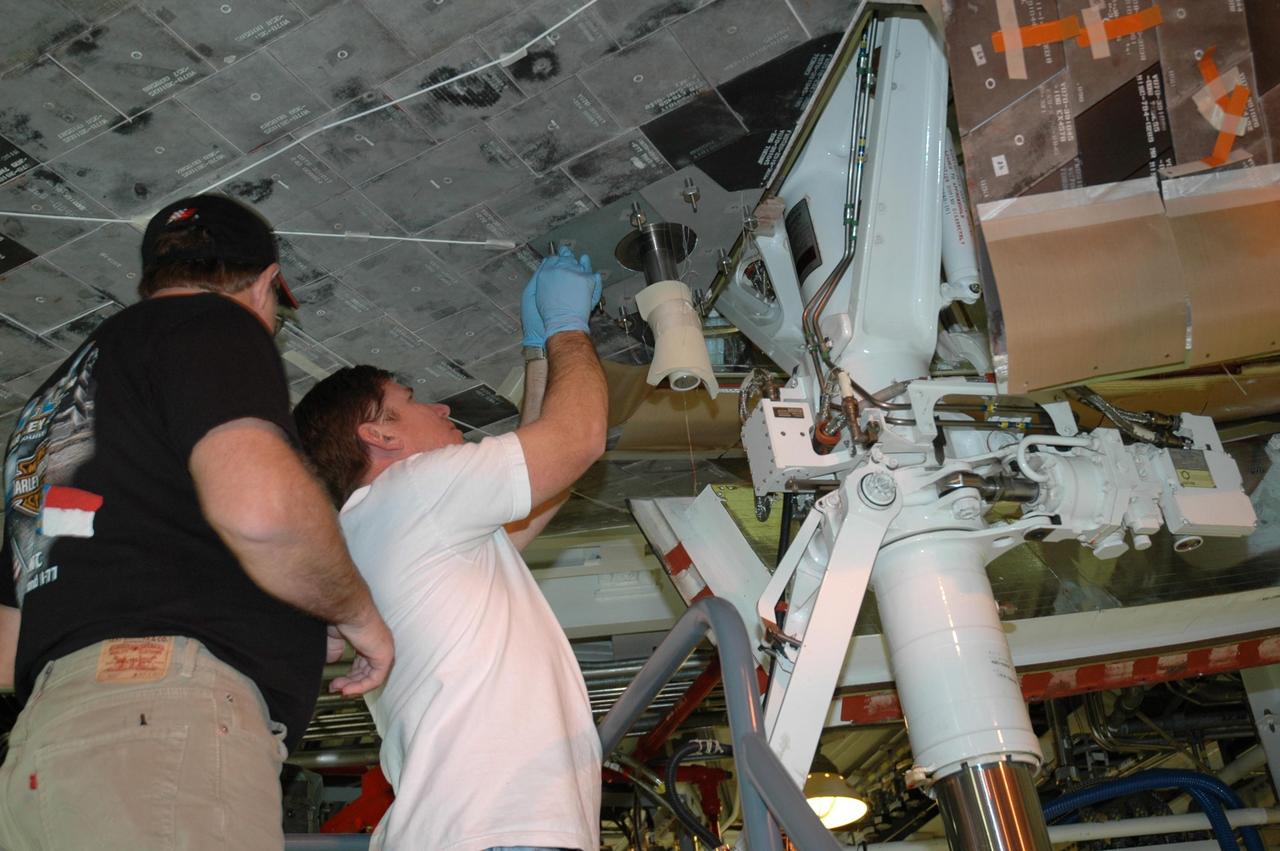
KENNEDY SPACE CENTER, FLA. -- In the Orbiter Processing Facility bay 2, technicians work around the attach point for the external tank near Endeavour's landing gear. The orbiter is scheduled to fly on mission STS-118 to the International Space Station in the summer of 2007. Photo credit: NASA/Jack Pfaller
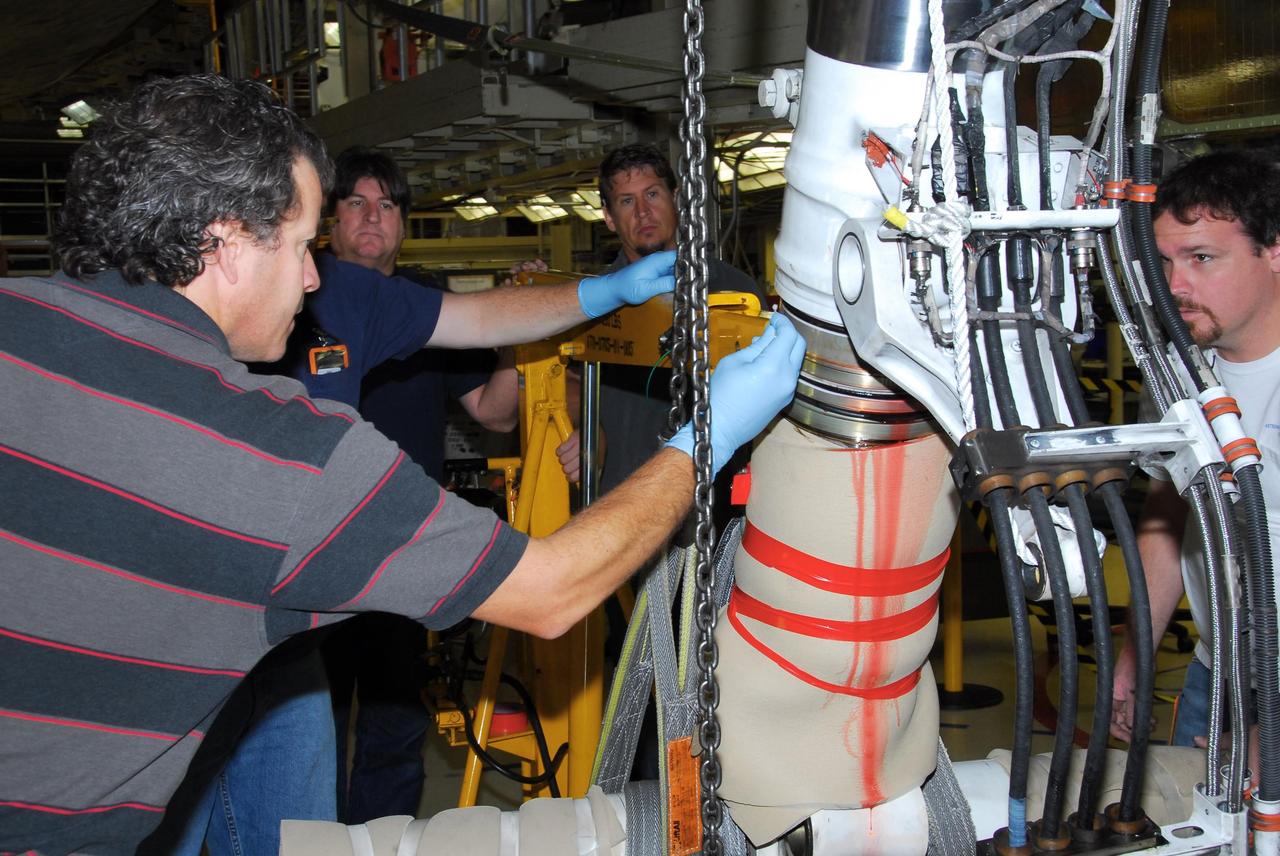
KENNEDY SPACE CENTER, FLA. -- In Orbiter Processing Facility bay 3, United Space Alliance and B.F. Goodrich technicians begin work on the starboard landing gear assembly of space shuttle Discovery. They will replace a leaking dynamic seal in Discovery's right main-gear strut. The struts act as shock absorbers during the shuttle's landing. Engineers determined the observed leak of hydraulic fluid in the main landing gear strut exceeded specification and could not be reduced to an acceptable rate. Removing the strut and replacing seals require disconnecting and replacing the brakes and tires, disconnecting and reconnecting instruments and other requirements to allow access to the strut. Discovery had been scheduled to roll over Sept. 19 from its processing hangar to the Vehicle Assembly Building. A new rollover date will be set after technicians determine how long replacing the seal will take. Photo credit: NASA/George Shelton
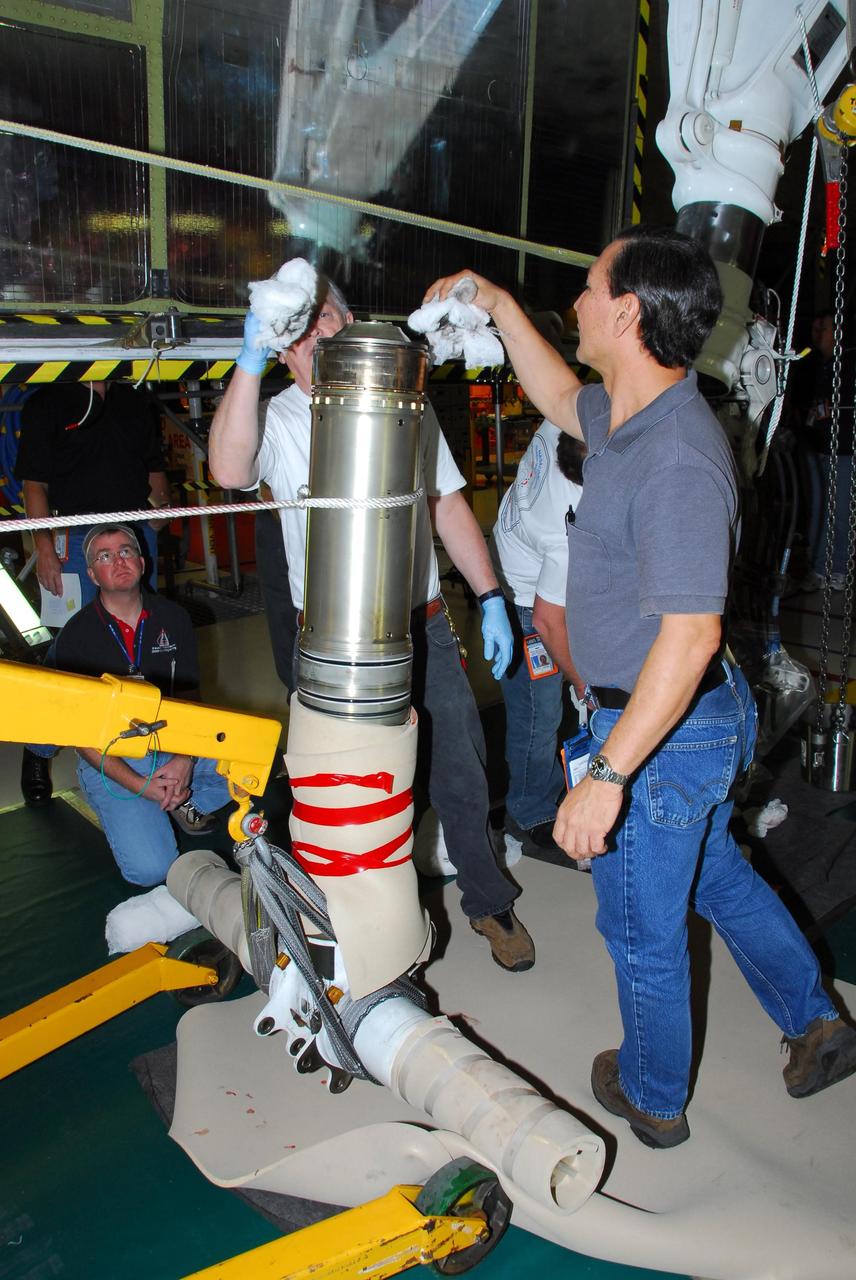
KENNEDY SPACE CENTER, FLA. -- In Orbiter Processing Facility bay 3, United Space Alliance and B.F. Goodrich technicians work on the starboard landing gear assembly of space shuttle Discovery. They will replace a leaking dynamic seal in Discovery's right main-gear strut. The struts act as shock absorbers during the shuttle's landing. Engineers determined the observed leak of hydraulic fluid in the main landing gear strut exceeded specification and could not be reduced to an acceptable rate. Removing the strut and replacing seals require disconnecting and replacing the brakes and tires, disconnecting and reconnecting instruments and other requirements to allow access to the strut. Discovery had been scheduled to roll over Sept. 19 from its processing hangar to the Vehicle Assembly Building. A new rollover date will be set after technicians determine how long replacing the seal will take. Photo credit: NASA/George Shelton

KENNEDY SPACE CENTER, FLA. -- In Orbiter Processing Facility bay 3, United Space Alliance and B.F. Goodrich technicians begin work on the starboard landing gear assembly of space shuttle Discovery. They will replace a leaking dynamic seal in Discovery's right main-gear strut. The struts act as shock absorbers during the shuttle's landing. Engineers determined the observed leak of hydraulic fluid in the main landing gear strut exceeded specification and could not be reduced to an acceptable rate. Removing the strut and replacing seals require disconnecting and replacing the brakes and tires, disconnecting and reconnecting instruments and other requirements to allow access to the strut. Discovery had been scheduled to roll over Sept. 19 from its processing hangar to the Vehicle Assembly Building. A new rollover date will be set after technicians determine how long replacing the seal will take. Photo credit: NASA/George Shelton
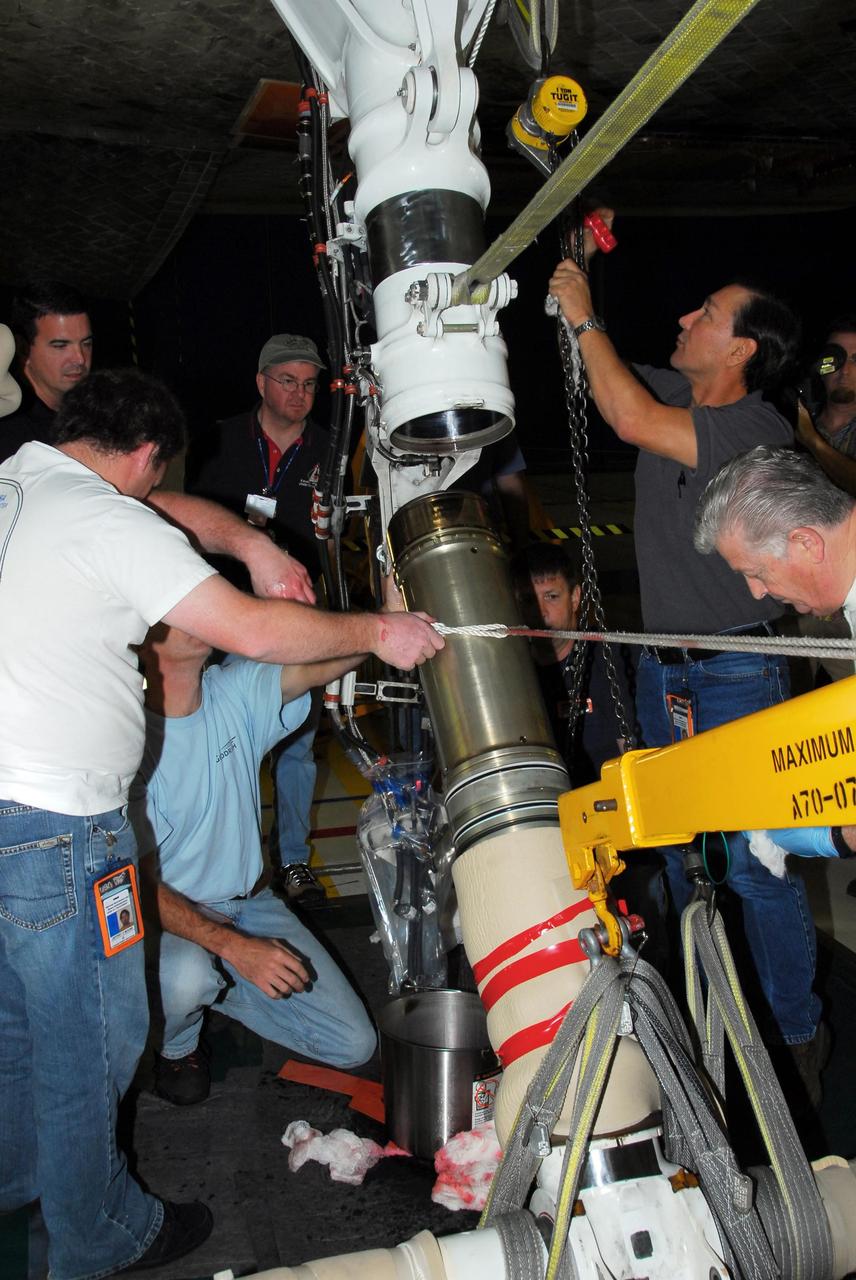
KENNEDY SPACE CENTER, FLA. -- In Orbiter Processing Facility bay 3, United Space Alliance and B.F. Goodrich technicians work on the starboard landing gear assembly of space shuttle Discovery. They will replace a leaking dynamic seal in Discovery's right main-gear strut. The struts act as shock absorbers during the shuttle's landing. Engineers determined the observed leak of hydraulic fluid in the main landing gear strut exceeded specification and could not be reduced to an acceptable rate. Removing the strut and replacing seals require disconnecting and replacing the brakes and tires, disconnecting and reconnecting instruments and other requirements to allow access to the strut. Discovery had been scheduled to roll over Sept. 19 from its processing hangar to the Vehicle Assembly Building. A new rollover date will be set after technicians determine how long replacing the seal will take. Photo credit: NASA/George Shelton
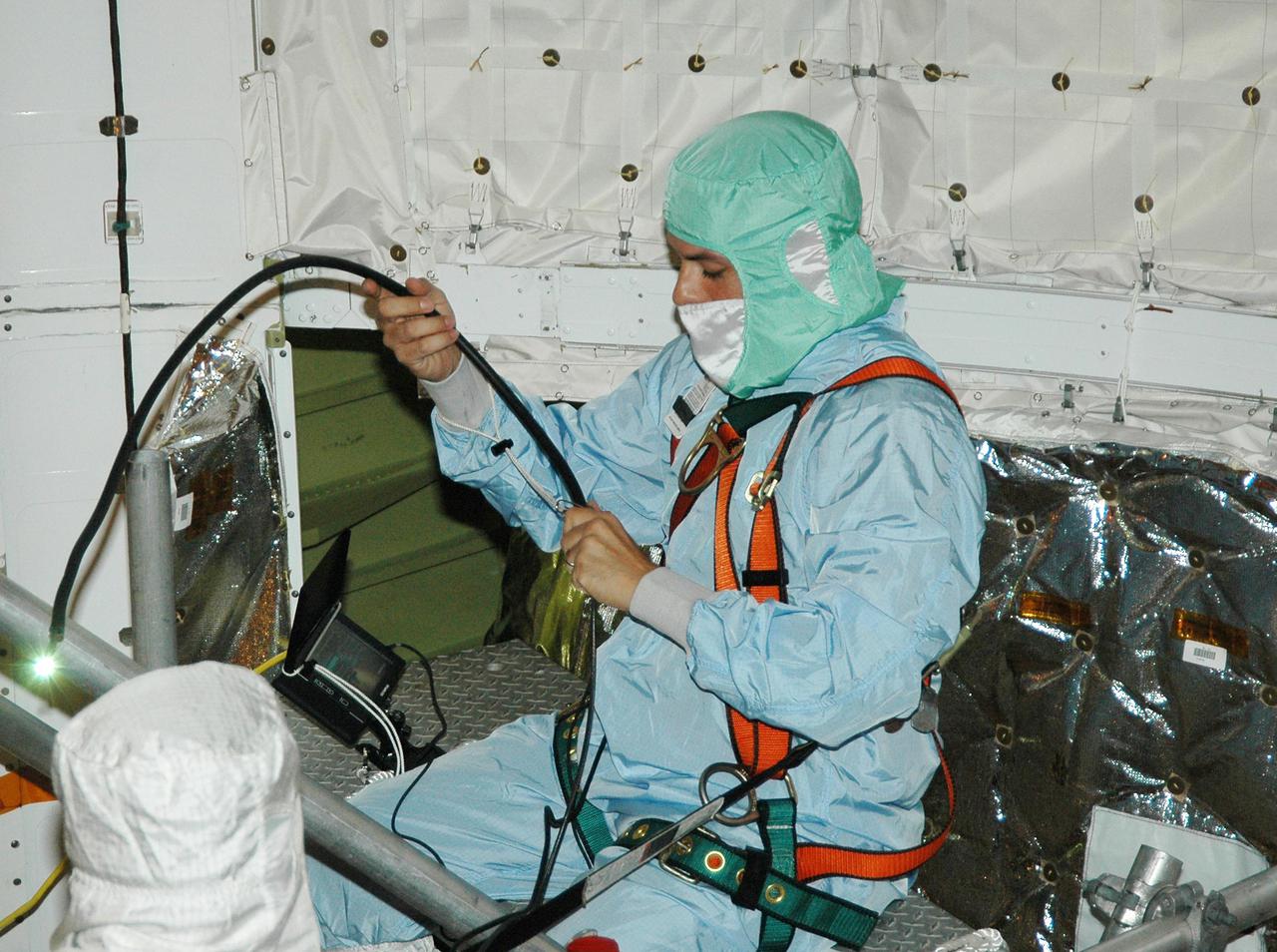
KENNEDY SPACE CENTER, FLA. - At Launch Complex 39B, a technician in Space Shuttle Discovery's payload bay prepares a borescope for an inspection of the retract link assembly on the orbiter's main landing gear door. The inspection is a precautionary measure after a small crack was found in a retract link assembly on the right-hand main landing gear on orbiter Atlantis. An initial review of the closeout photos of the link assembly on Discovery did not reveal any cracks. Discovery is scheduled to return the Space Shuttle fleet to operational status on mission STS-114. This additional work does not impact the launch planning window of July 13-31.
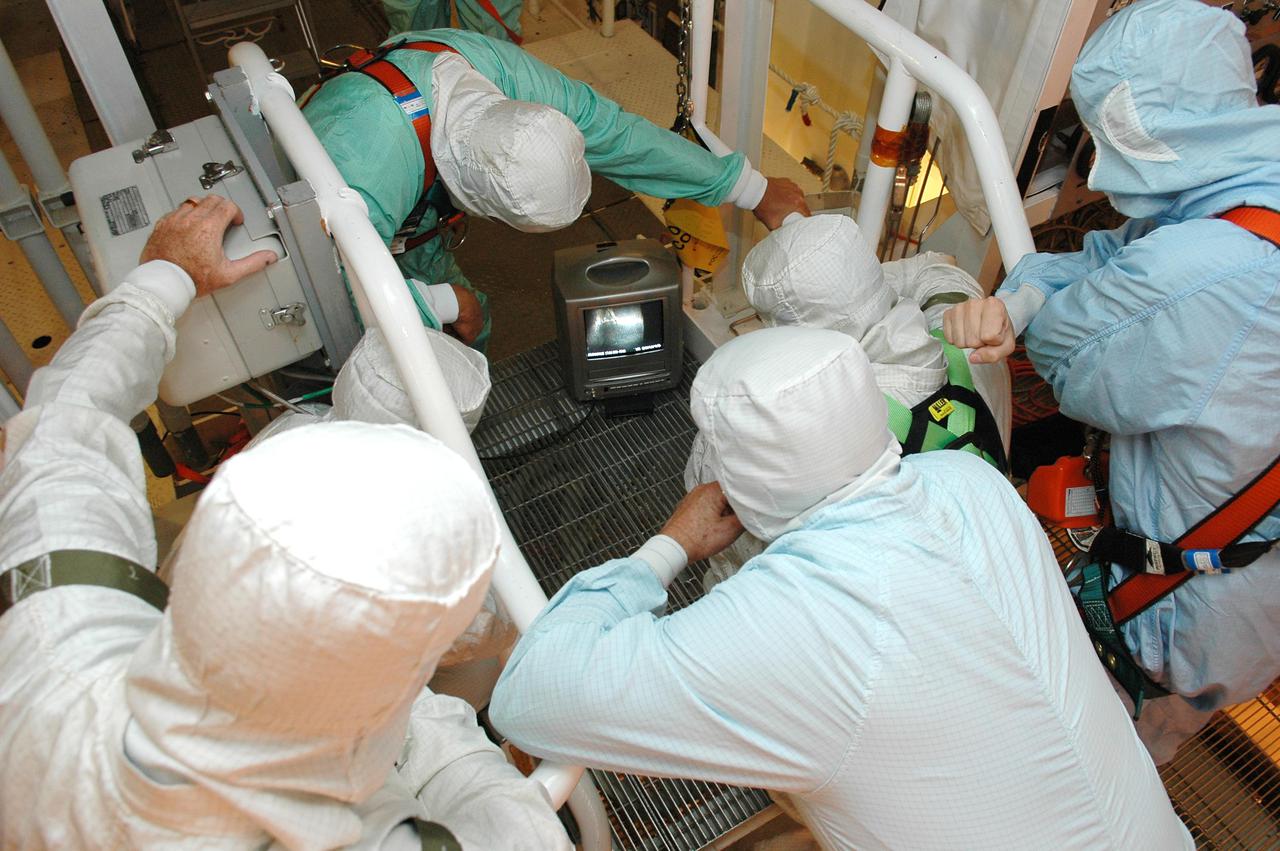
KENNEDY SPACE CENTER, FLA. - At Launch Complex 39B, technicians in Space Shuttle Discovery's payload bay perform a borescope inspection of the retract link assembly on the orbiter's main landing gear door. The inspection is a precautionary measure after a small crack was found in a retract link assembly on the right-hand main landing gear on orbiter Atlantis. An initial review of the closeout photos of the link assembly on Discovery did not reveal any cracks. Discovery is scheduled to return the Space Shuttle fleet to operational status on mission STS-114. This additional work does not impact the launch planning window of July 13-31.
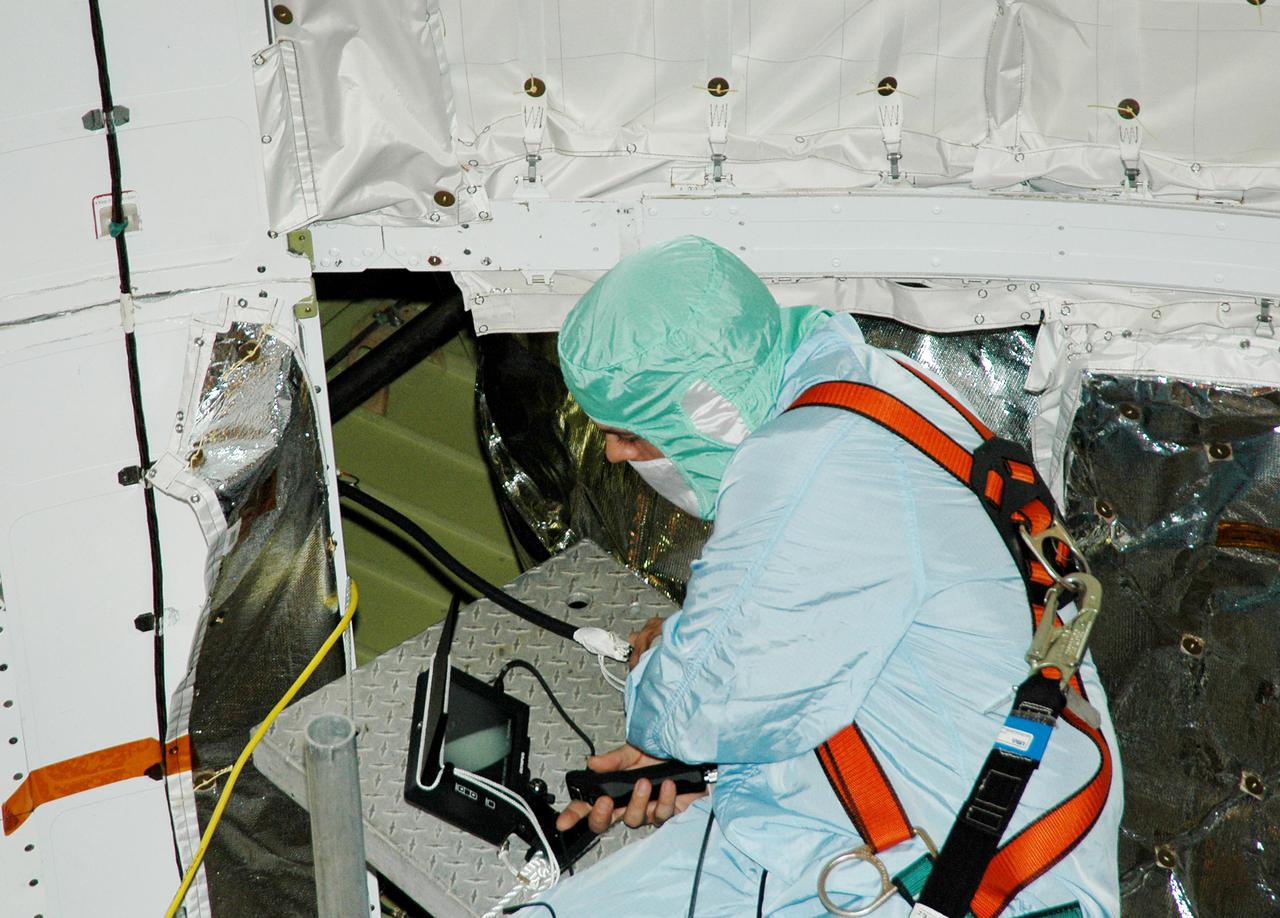
KENNEDY SPACE CENTER, FLA. - At Launch Complex 39B, a technician in Space Shuttle Discovery's payload bay performs a borescope inspection of the retract link assembly on the orbiter's main landing gear door. The inspection is a precautionary measure after a small crack was found in a retract link assembly on the right-hand main landing gear on orbiter Atlantis. An initial review of the closeout photos of the link assembly on Discovery did not reveal any cracks. Discovery is scheduled to return the Space Shuttle fleet to operational status on mission STS-114. This additional work does not impact the launch planning window of July 13-31.
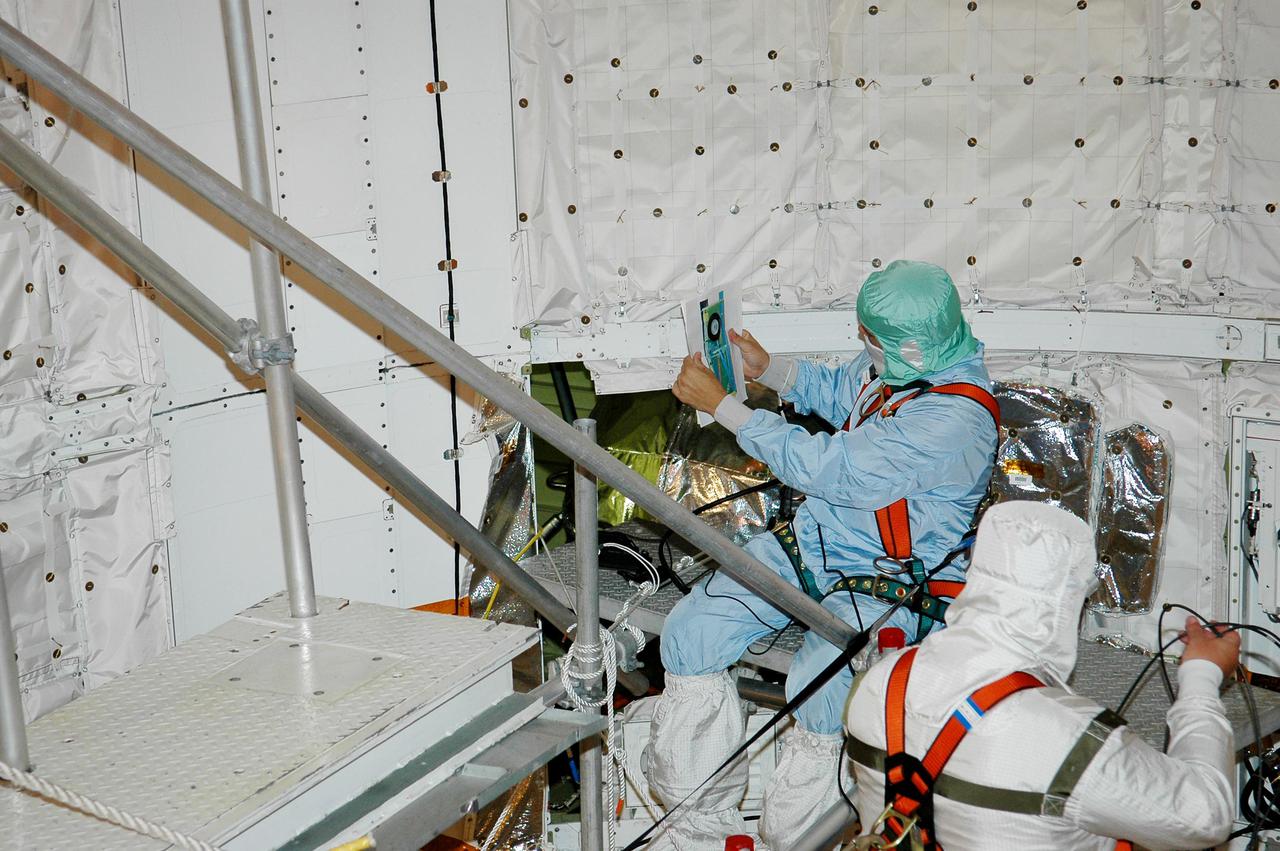
KENNEDY SPACE CENTER, FLA. - At Launch Complex 39B, a technician in Space Shuttle Discovery's payload bay studies a photo of the retract link assembly on the orbiter's main landing gear door prior to conducting a borescope inspection. The inspection is a precautionary measure after a small crack was found in a retract link assembly on the right-hand main landing gear on orbiter Atlantis. An initial review of the closeout photos of the link assembly on Discovery did not reveal any cracks. Discovery is scheduled to return the Space Shuttle fleet to operational status on mission STS-114. This additional work does not impact the launch planning window of July 13-31.
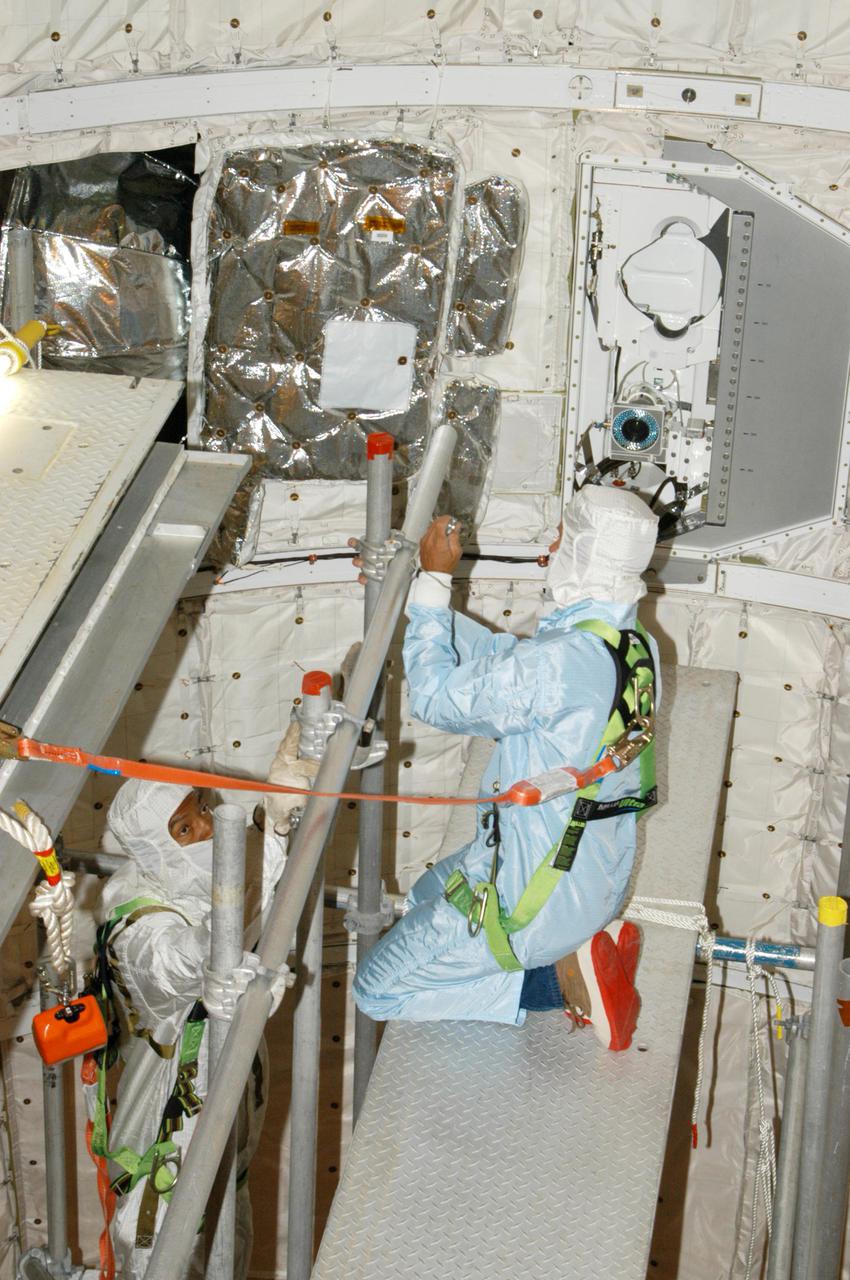
KENNEDY SPACE CENTER, FLA. - At Launch Complex 39B, technicians construct a platform in Space Shuttle Discovery's payload bay to support an upcoming borescope inspection of the retract link assembly on the orbiter's main landing gear door. The inspection is a precautionary measure after a small crack was found in a retract link assembly on the right-hand main landing gear on orbiter Atlantis. An initial review of the closeout photos of the link assembly on Discovery did not reveal any cracks. Discovery is scheduled to return the Space Shuttle fleet to operational status on mission STS-114. This additional work does not impact the launch planning window of July 13-31.
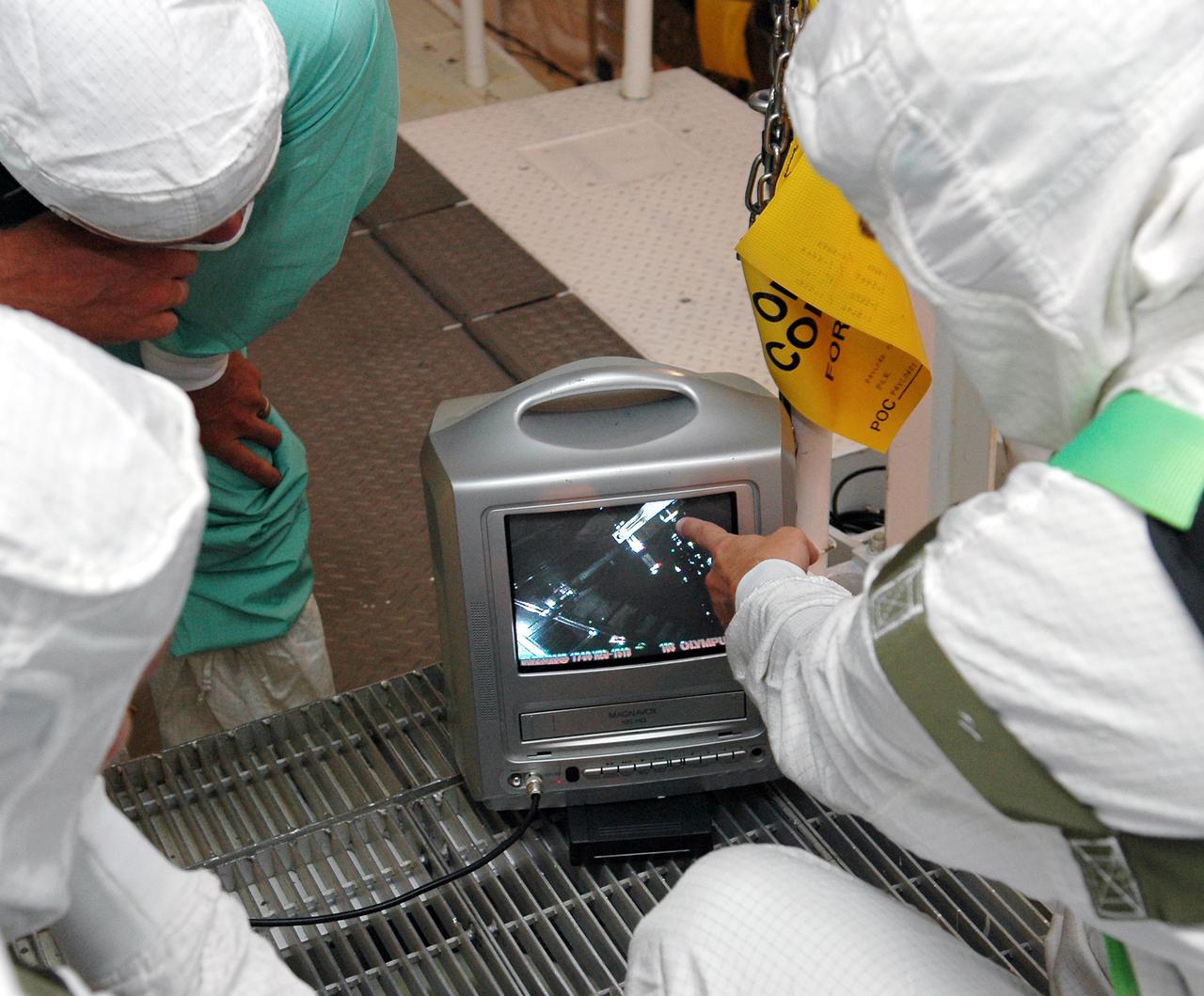
KENNEDY SPACE CENTER, FLA. - At Launch Complex 39B, technicians in Space Shuttle Discovery's payload bay monitor the images received during a borescope inspection of the retract link assembly on the orbiter's main landing gear door. The inspection is a precautionary measure after a small crack was found in a retract link assembly on the right-hand main landing gear on orbiter Atlantis. An initial review of the closeout photos of the link assembly on Discovery did not reveal any cracks. Discovery is scheduled to return the Space Shuttle fleet to operational status on mission STS-114. This additional work does not impact the launch planning window of July 13-31.
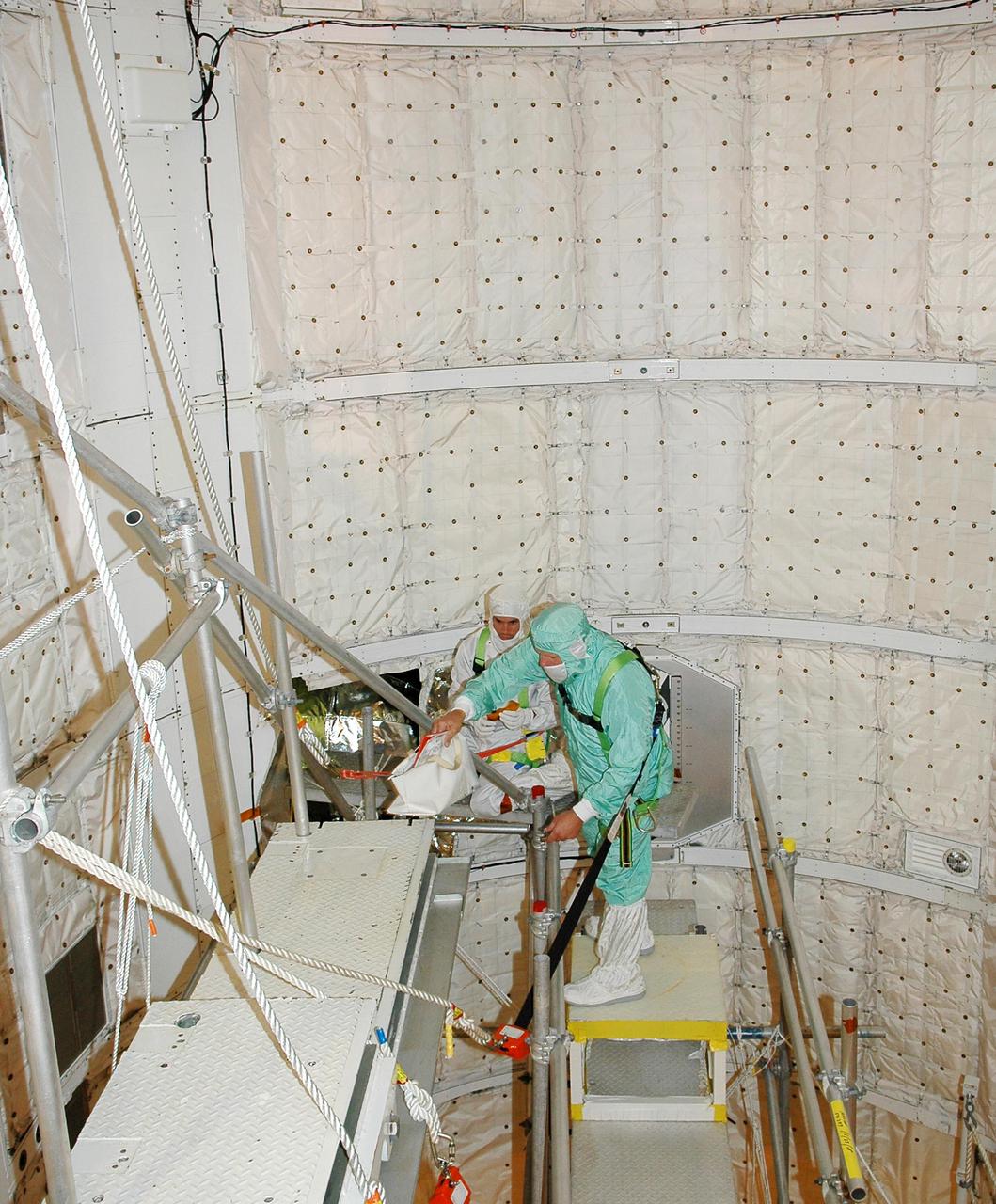
KENNEDY SPACE CENTER, FLA. - At Launch Complex 39B, technicians enter Space Shuttle Discovery's payload bay and prepare to conduct a borescope inspection of the retract link assembly on the orbiter's main landing gear door. The inspection is a precautionary measure after a small crack was found in a retract link assembly on the right-hand main landing gear on orbiter Atlantis. An initial review of the closeout photos of the link assembly on Discovery did not reveal any cracks. Discovery is scheduled to return the Space Shuttle fleet to operational status on mission STS-114. This additional work does not impact the launch planning window of July 13-31.
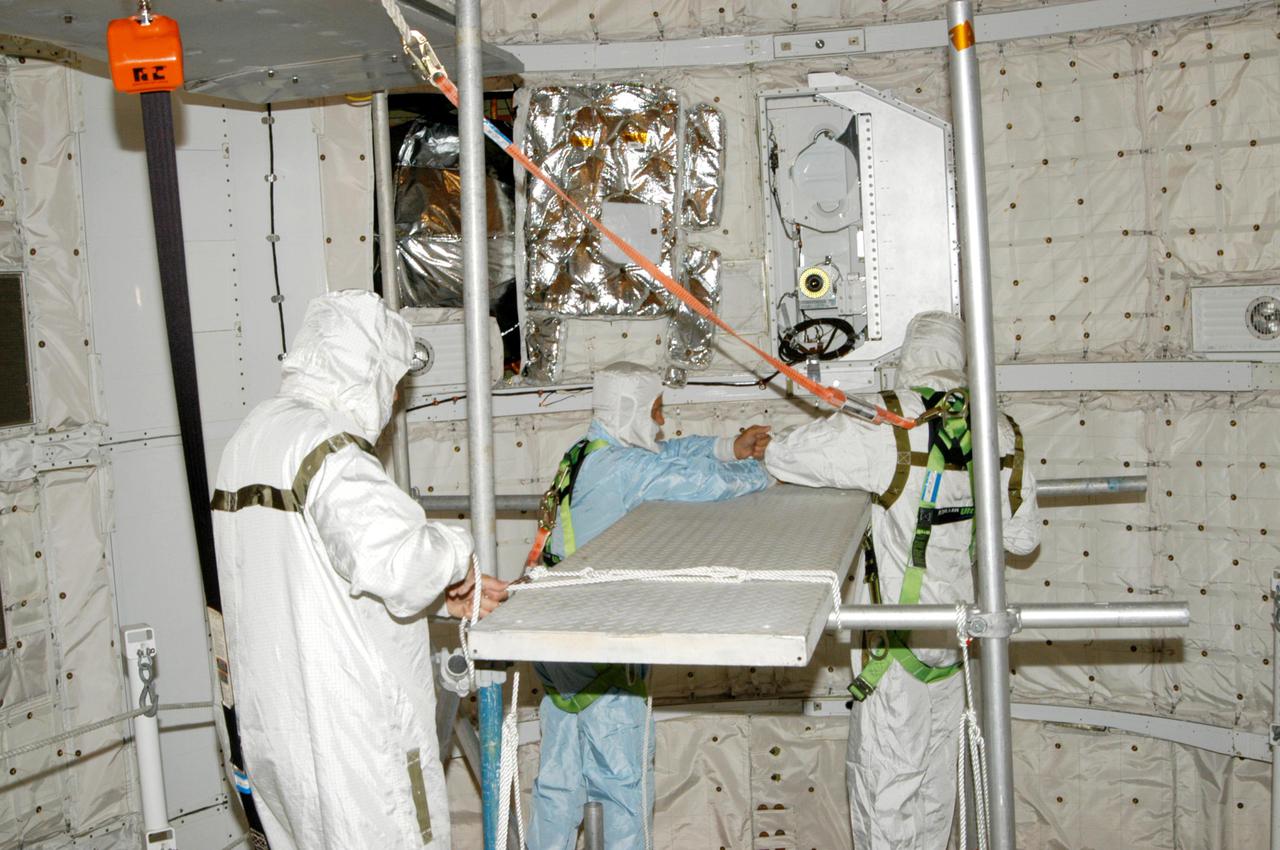
KENNEDY SPACE CENTER, FLA. - At Launch Complex 39B, technicians construct a platform in Space Shuttle Discovery's payload bay to support an upcoming borescope inspection of the retract link assembly on the orbiter's main landing gear door. The inspection is a precautionary measure after a small crack was found in a retract link assembly on the right-hand main landing gear on orbiter Atlantis. An initial review of the closeout photos of the link assembly on Discovery did not reveal any cracks. Discovery is scheduled to return the Space Shuttle fleet to operational status on mission STS-114. This additional work does not impact the launch planning window of July 13-31.
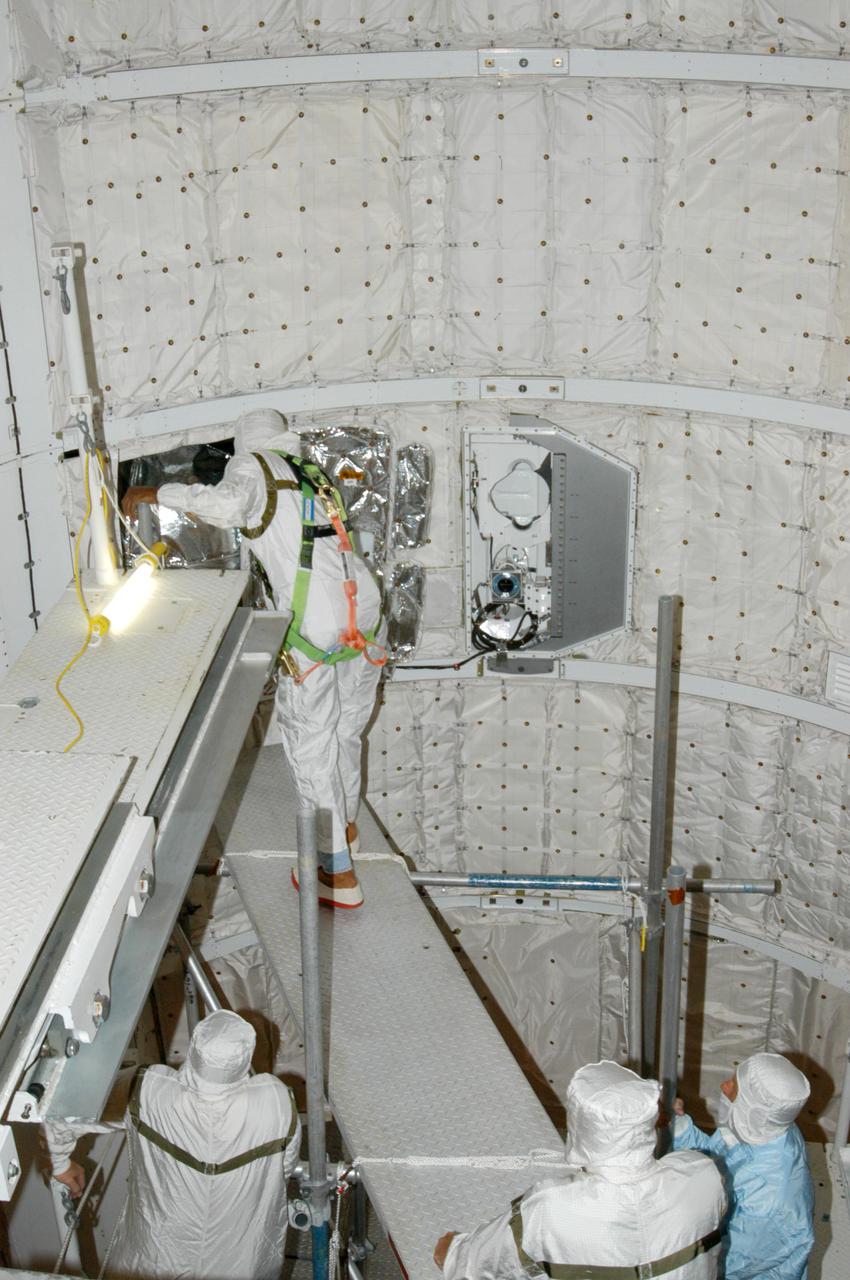
KENNEDY SPACE CENTER, FLA. - At Launch Complex 39B, technicians construct a platform in Space Shuttle Discovery's payload bay to support an upcoming borescope inspection of the retract link assembly on the orbiter's main landing gear door. The inspection is a precautionary measure after a small crack was found in a retract link assembly on the right-hand main landing gear on orbiter Atlantis. An initial review of the closeout photos of the link assembly on Discovery did not reveal any cracks. Discovery is scheduled to return the Space Shuttle fleet to operational status on mission STS-114. This additional work does not impact the launch planning window of July 13-31.
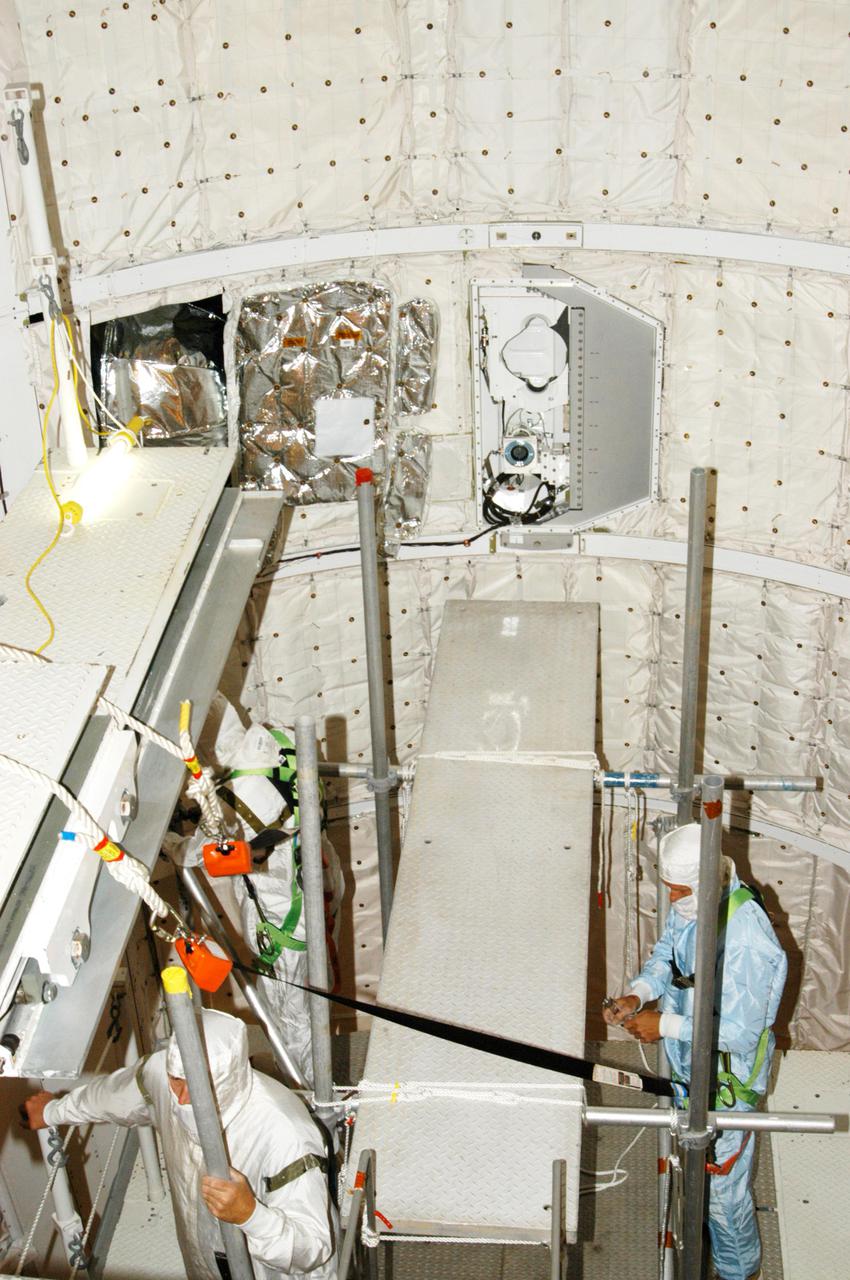
KENNEDY SPACE CENTER, FLA. - At Launch Complex 39B, technicians construct a platform in Space Shuttle Discovery's payload bay to support an upcoming borescope inspection of the retract link assembly on the orbiter's main landing gear door. The inspection is a precautionary measure after a small crack was found in a retract link assembly on the right-hand main landing gear on orbiter Atlantis. An initial review of the closeout photos of the link assembly on Discovery did not reveal any cracks. Discovery is scheduled to return the Space Shuttle fleet to operational status on mission STS-114. This additional work does not impact the launch planning window of July 13-31.
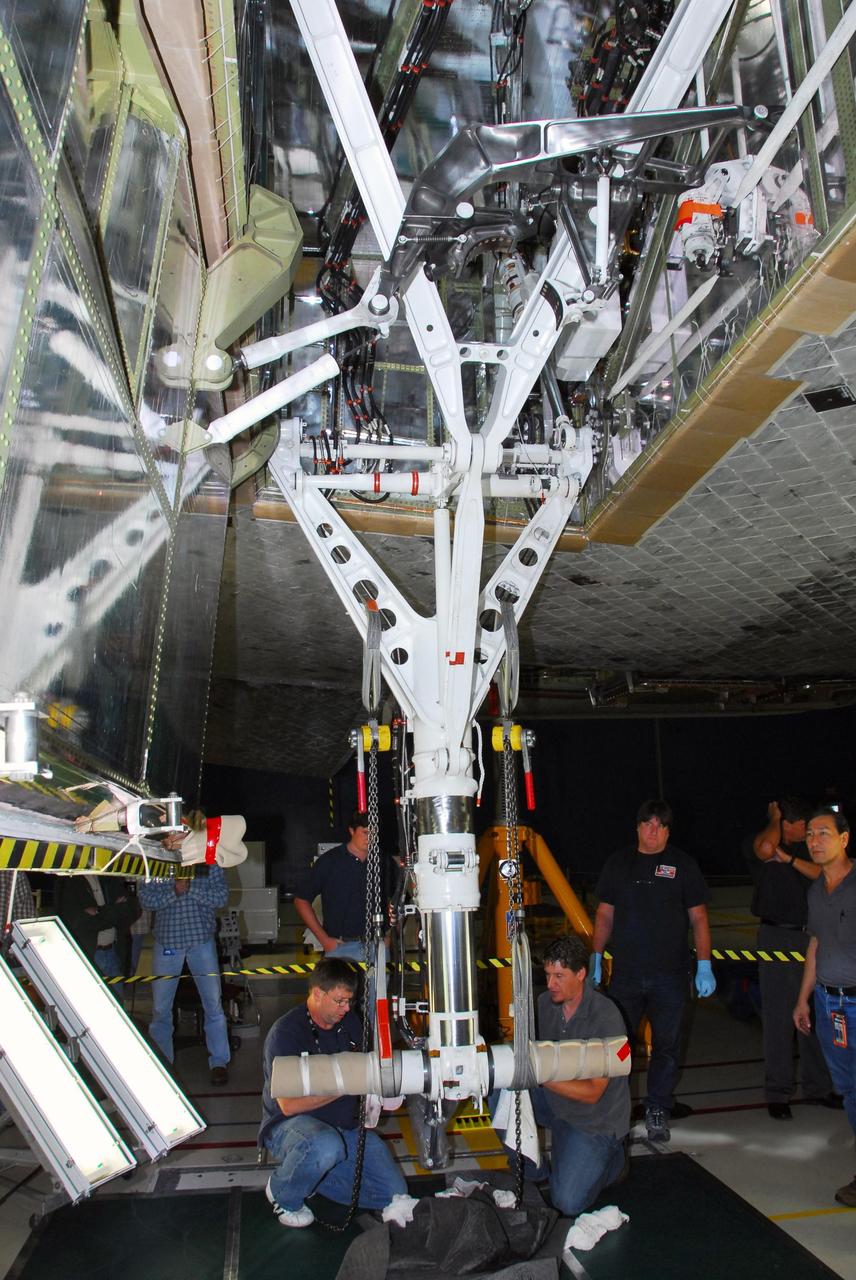
KENNEDY SPACE CENTER, FLA. -- In bay 3 of the Orbiter Processing Facility, United Space Alliance technicians make final adjustments on space shuttle Discovery's starboard landing gear. The components were removed in order to replace a hydraulic seal in the right main-gear strut. Engineers determined an observed leak of hydraulic fluid in the main landing gear strut exceeded specification and could not be reduced to an acceptable rate. Thus, the leaky seal and three other seals were replaced. Prior to discovery of the leak, the vehicle had been scheduled to roll over Sept. 19 from the OPF to the Vehicle Assembly Building. A new rollover date will be set for Discovery, which is targeted for launch on Oct. 23. Photo credit: NASA/George Shelton
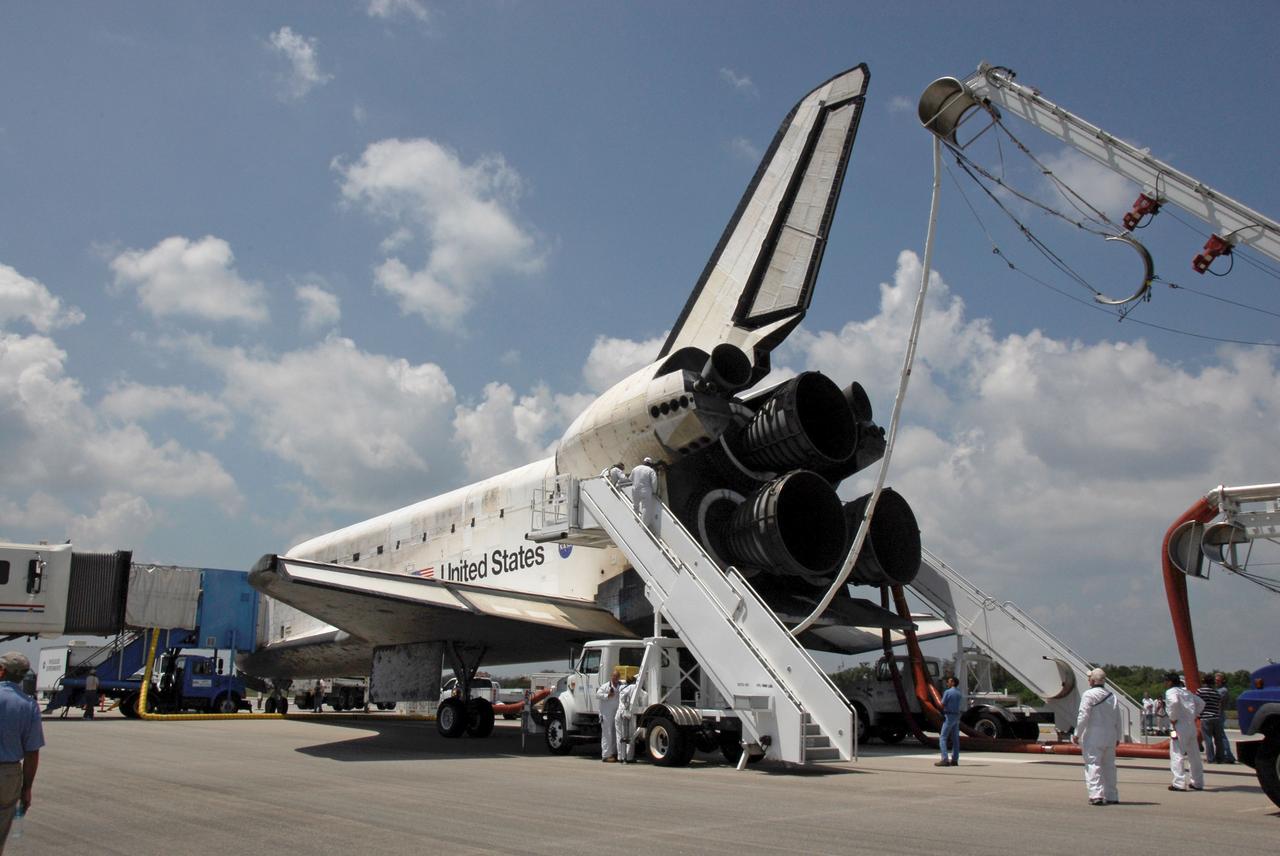
STS124-S-071 (14 June 2008) --- After landing on runway 15 at NASA's Kennedy Space Center, space shuttle Discovery is purged -- providing cool and humidified air conditioning to the payload bay and other cavities to remove any residual explosive or toxic fumes -- while still on the runway. Cooling transfer to ground services occurs at about the same time, allowing onboard cooling to be shut down. When it is determined that the area in and around the orbiter is safe, the crew prepares for departure from the orbiter. The main landing gear touched down at 11:15:19 a.m. (EDT) on June 14, 2008. The nose landing gear touched down at 11:15:30 a.m. and wheel stop was at 11:16:19 a.m. During the mission, Discovery's crew installed the Japan Aerospace Exploration Agency's large Kibo laboratory and its remote manipulator system leaving a larger space station and one with increased science capabilities.

KENNEDY SPACE CENTER, FLA. -- In bay 3 of the Orbiter Processing Facility, a technician replaces a hydraulic seal in space shuttle Discovery's right main-gear strut. Engineers determined an observed leak of hydraulic fluid in the main landing gear strut exceeded specification and could not be reduced to an acceptable rate. Thus, the leaky seal and three other seals were replaced. Prior to discovery of the leak, the vehicle had been scheduled to roll over Sept. 19 from the OPF to the Vehicle Assembly Building. A new rollover date will be set for Discovery, which is targeted for launch on Oct. 23. Photo credit: NASA/George Shelton
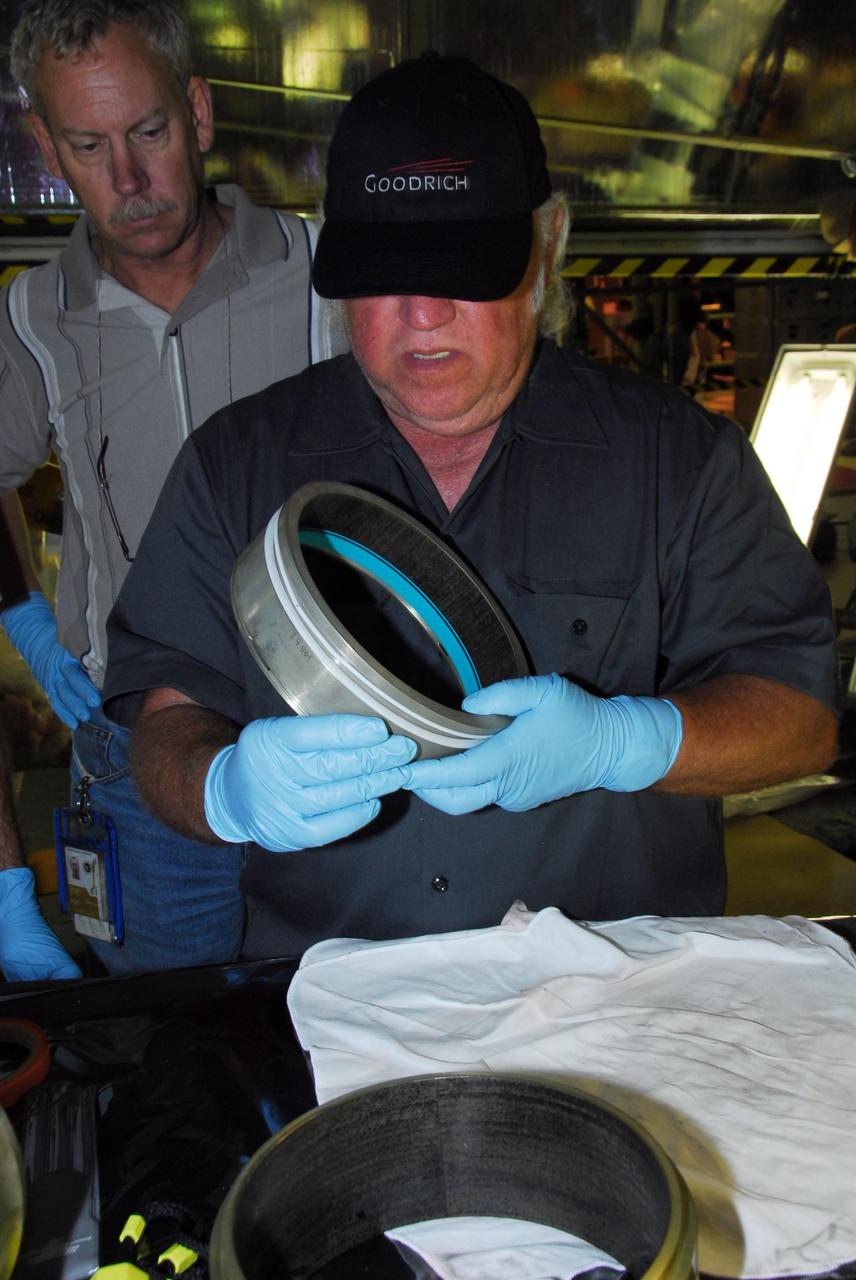
KENNEDY SPACE CENTER, FLA. -- In bay 3 of the Orbiter Processing Facility, B.F. Goodrich technician David Cobb checks the hydraulic seal he replaced in space shuttle Discovery's right main-gear strut. Engineers determined an observed leak of hydraulic fluid in the main landing gear strut exceeded specification and could not be reduced to an acceptable rate. Thus, the leaky seal and three other seals were replaced. Prior to discovery of the leak, the vehicle had been scheduled to roll over Sept. 19 from the OPF to the Vehicle Assembly Building. A new rollover date will be set for Discovery, which is targeted for launch on Oct. 23. Photo credit: NASA/George Shelton
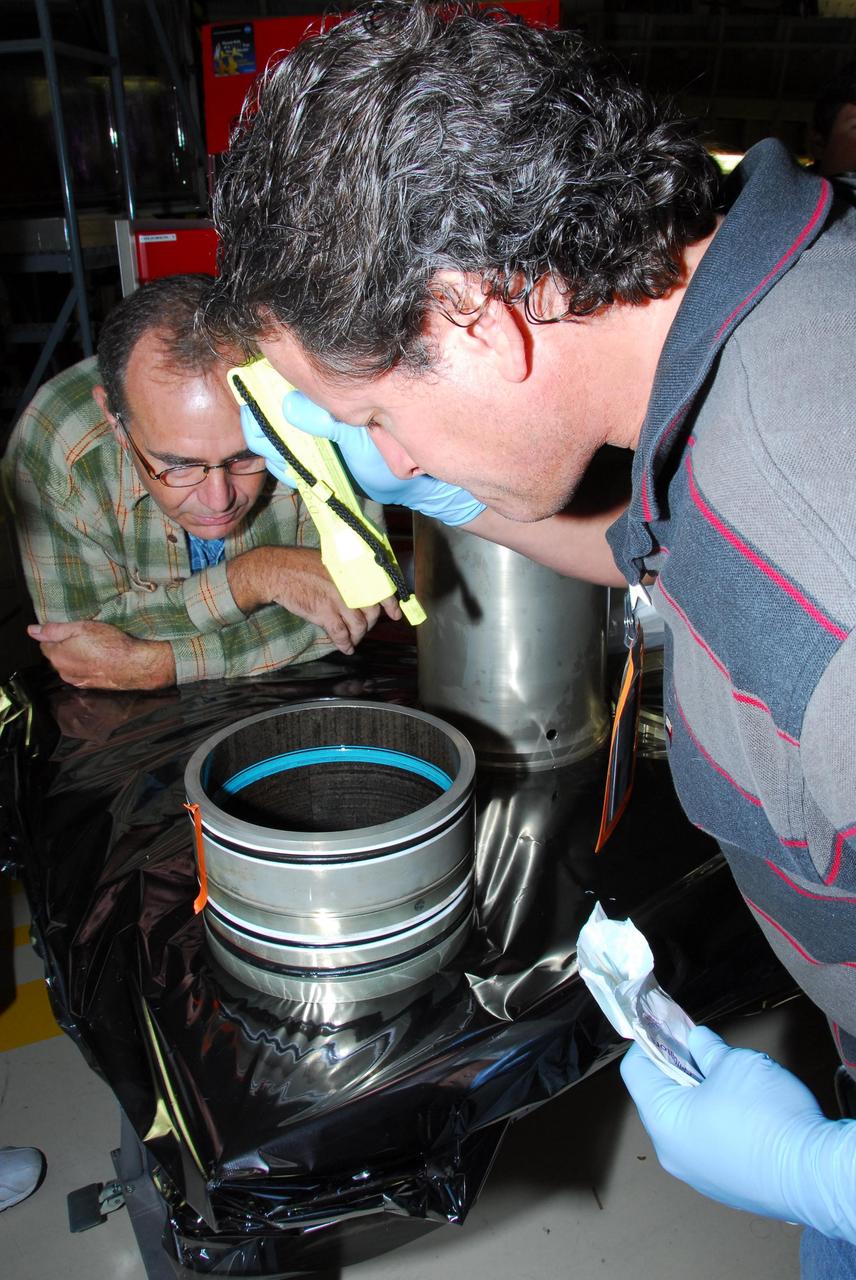
KENNEDY SPACE CENTER, FLA. -- In Orbiter Processing Facility bay 3, United Space Alliance and B.F. Goodrich technicians look inside part of space shuttle Discovery's right main-gear strut where a leaking seal has been found. The struts act as shock absorbers during the shuttle's landing. The seal will be replaced. Engineers determined the observed leak of hydraulic fluid in the main landing gear strut exceeded specification and could not be reduced to an acceptable rate. Removing the strut and replacing seals require disconnecting and replacing the brakes and tires, disconnecting and reconnecting instruments and other requirements to allow access to the strut. Discovery had been scheduled to roll over Sept. 19 from its processing hangar to the Vehicle Assembly Building. A new rollover date will be set after technicians determine how long replacing the seal will take. Photo credit: NASA/George Shelton

KENNEDY SPACE CENTER, FLA. -- In Orbiter Processing Facility bay 3, United Space Alliance and B.F. Goodrich technicians remove part of space shuttle Discovery's right main-gear strut where a leaking seal has been found. They will replace the seal. The struts act as shock absorbers during the shuttle's landing. Engineers determined the observed leak of hydraulic fluid in the main landing gear strut exceeded specification and could not be reduced to an acceptable rate. Removing the strut and replacing seals require disconnecting and replacing the brakes and tires, disconnecting and reconnecting instruments and other requirements to allow access to the strut. Discovery had been scheduled to roll over Sept. 19 from its processing hangar to the Vehicle Assembly Building. A new rollover date will be set after technicians determine how long replacing the seal will take. Photo credit: NASA/George Shelton
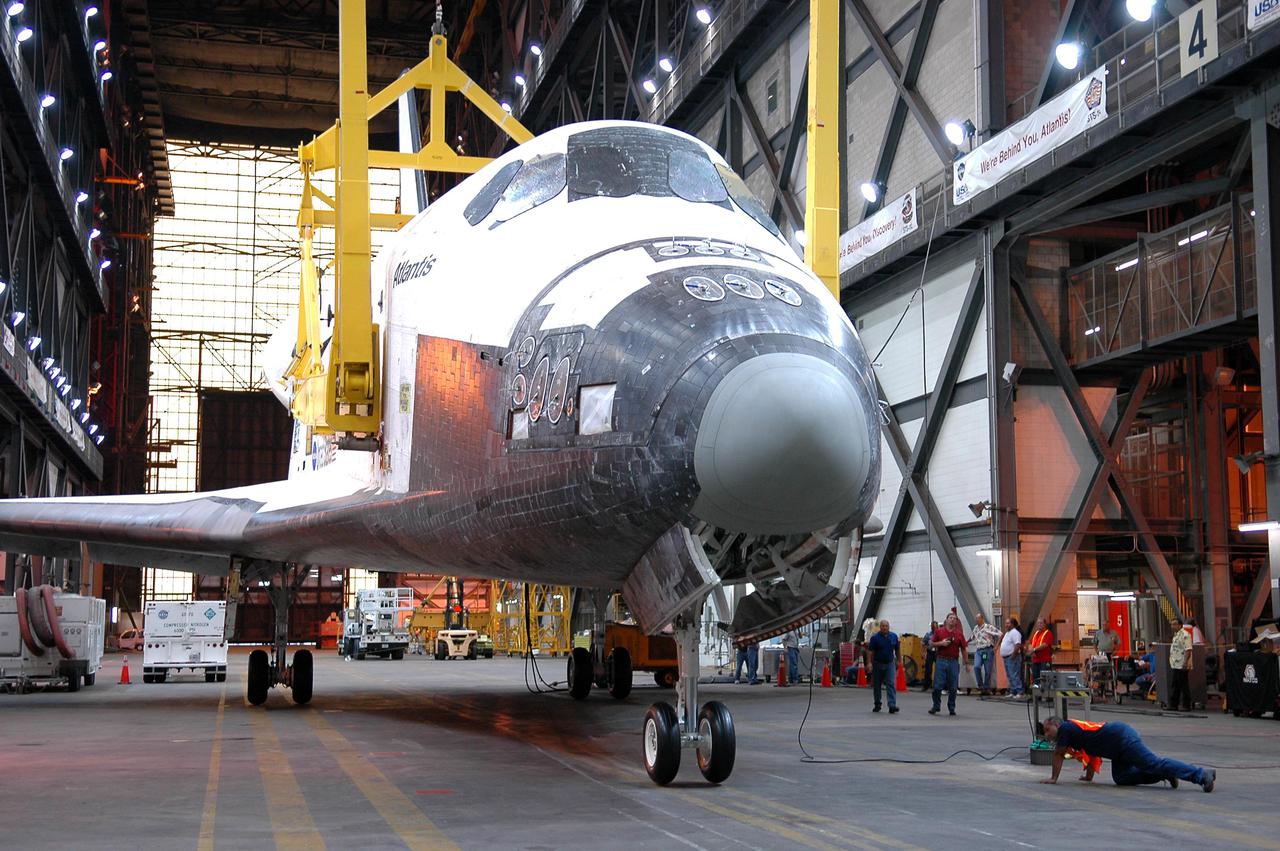
KENNEDY SPACE CENTER, FLA. - In the Vehicle Assembly Building (VAB), Space Shuttle Atlantis rests on its landing gear on the floor of the transfer aisle. The vehicle was just demated from its External Tank_Solid Rocket Booster stack in one of the VAB's high bays. The orbiter will be rolled back to Orbiter Processing Facility bay 1 where processing will begin for mission STS-115, the 19th flight to the International Space Station. The tank, ET-120, is the first redesigned ET to arrive at KSC and will undergo further testing before Return to Flight mission STS-121 next year.
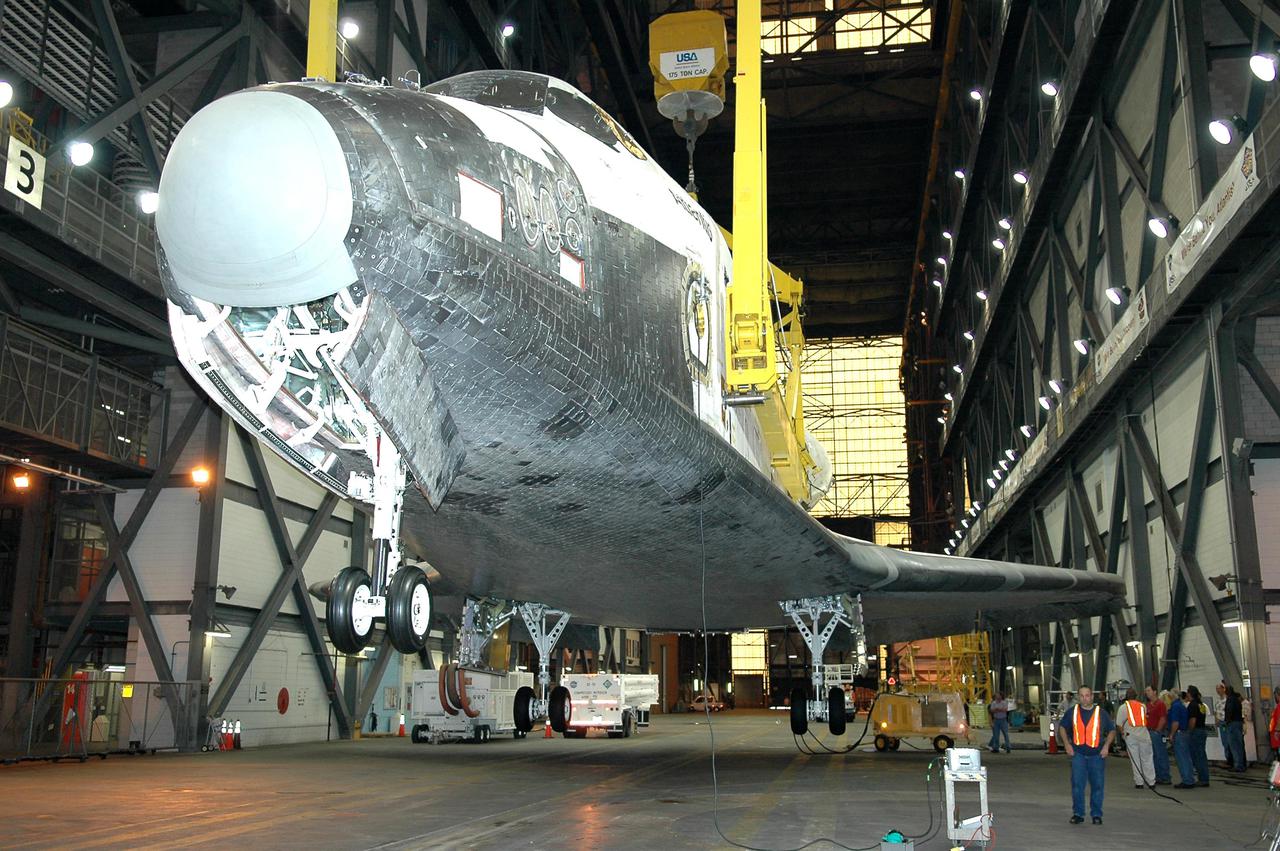
KENNEDY SPACE CENTER, FLA. - In the Vehicle Assembly Building (VAB), the landing gear of Space Shuttle Atlantis is lowered before the orbiter comes to rest on the floor of the transfer aisle. The vehicle was just demated from its External Tank_Solid Rocket Booster stack in one of the VAB's high bays. The orbiter will be rolled back to Orbiter Processing Facility bay 1 where processing will begin for mission STS-115, the 19th flight to the International Space Station. The tank, ET-120, is the first redesigned ET to arrive at KSC and will undergo further testing before Return to Flight mission STS-121 next year.
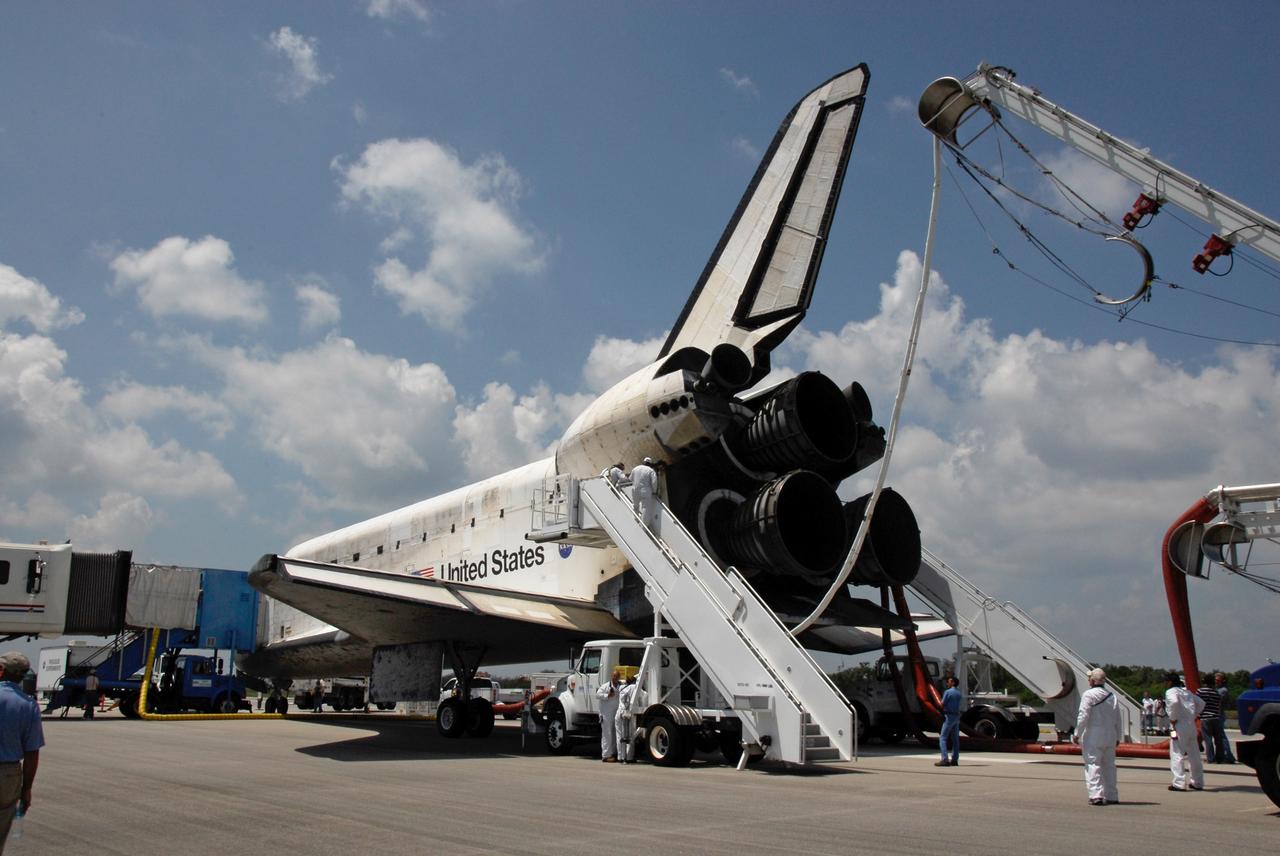
CAPE CANAVERAL, Fla. – After landing on Runway 15 at NASA's Kennedy Space Center, space shuttle Discovery is purged -- providing cool and humidified air conditioning to the payload bay and other cavities to remove any residual explosive or toxic fumes – while still on the runway. Cooling transfer to ground services occurs at about the same time, allowing onboard cooling to be shut down. When it is determined that the area in and around the orbiter is safe, the crew prepares for departure from the orbiter. The 69th landing at Kennedy ended the STS-124 mission, a 14-day flight to the International Space Station. The main landing gear touched down at 11:15:19 a.m. EDT. The nose landing gear touched down at 11:15:30 a.m. and wheel stop was at 11:16:19 a.m. The mission completed 5.7 million miles. The STS-124 mission delivered the Japan Aerospace Exploration Agency's large Japanese Pressurized Module and its remote manipulator system to the space station. Photo credit: NASA/Kim Shiflett
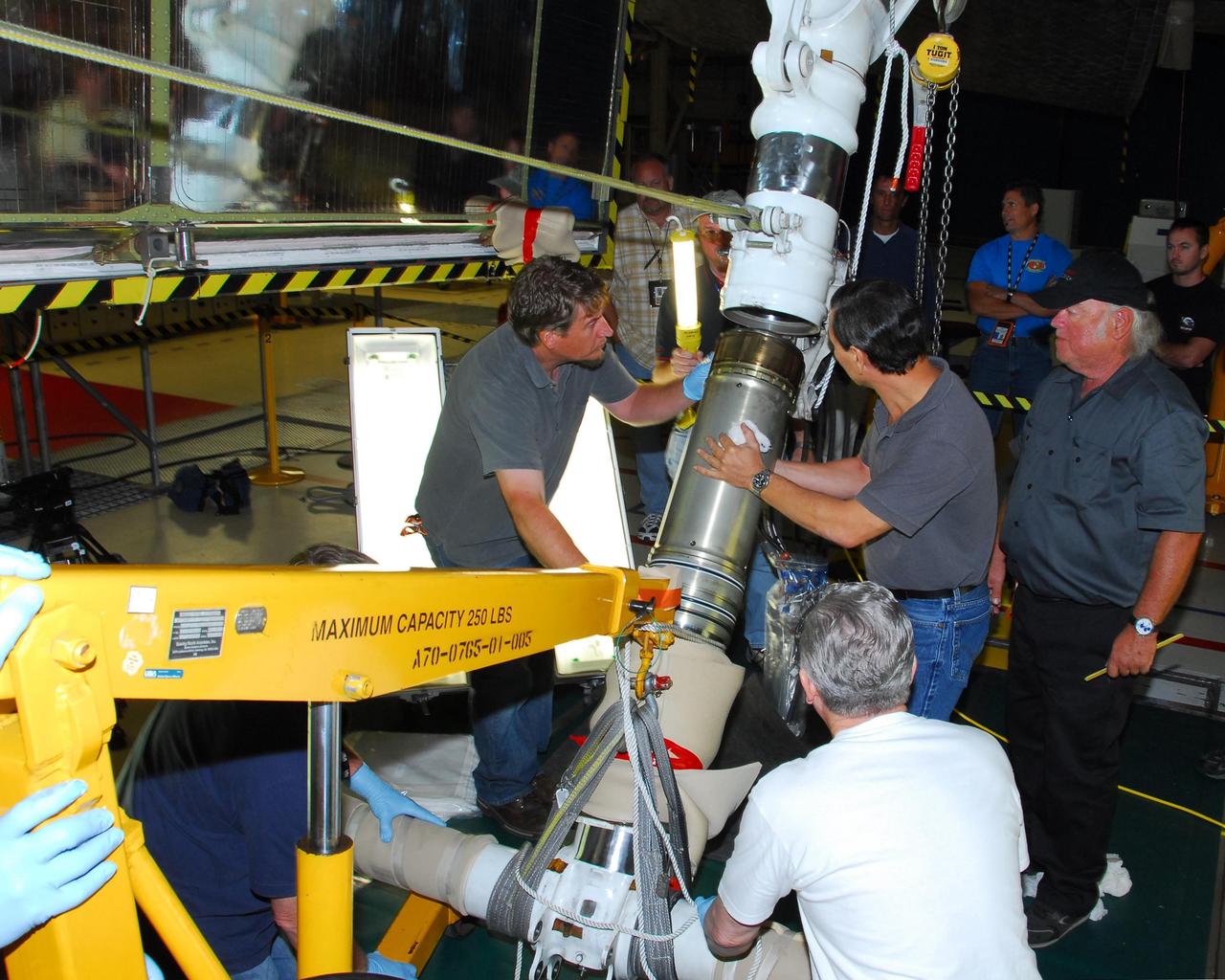
KENNEDY SPACE CENTER, FLA. --In bay 3 of the Orbiter Processing Facility, United Space Alliance technicians reassemble space shuttle Discovery's right main-gear strut back together. The components were removed in order to replace a hydraulic seal inside. Engineers determined an observed leak of hydraulic fluid in the main landing gear strut exceeded specification and could not be reduced to an acceptable rate. Thus, the leaky seal and three other seals were replaced. Prior to discovery of the leak, the vehicle had been scheduled to roll over Sept. 19 from the OPF to the Vehicle Assembly Building. A new rollover date will be set for Discovery, which is targeted for launch on Oct. 23. Photo credit: NASA/George Shelton
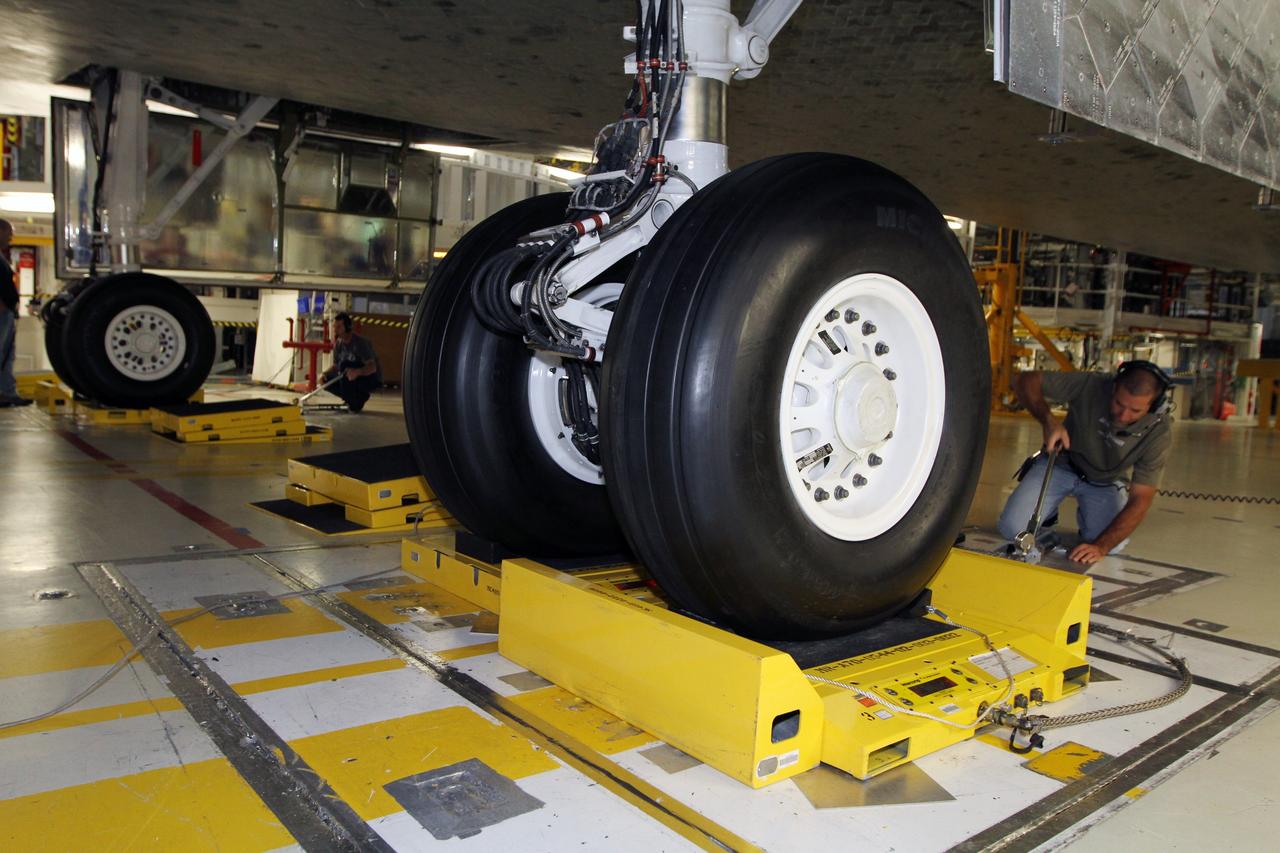
CAPE CANAVERAL, Fla. - Working at the main landing gear, a technician supports weight and center-of-gravity checks of space shuttle Atlantis in Orbiter Processing Facility Bay 1 at NASA’s Kennedy Space Center in Florida. The work is part of the Space Shuttle Program’s transition and retirement processing of the shuttle fleet. A groundbreaking was held Jan. 18, 2012, for Atlantis' future home, a 65,000-square-foot exhibit hall in Shuttle Plaza at the Kennedy Space Center Visitor Complex. Atlantis is scheduled to roll over to the visitor complex during November in preparation for the exhibit's grand opening in July 2013. For more information, visit http://www.nasa.gov/transition. Photo credit: NASA/Kim Shiflett
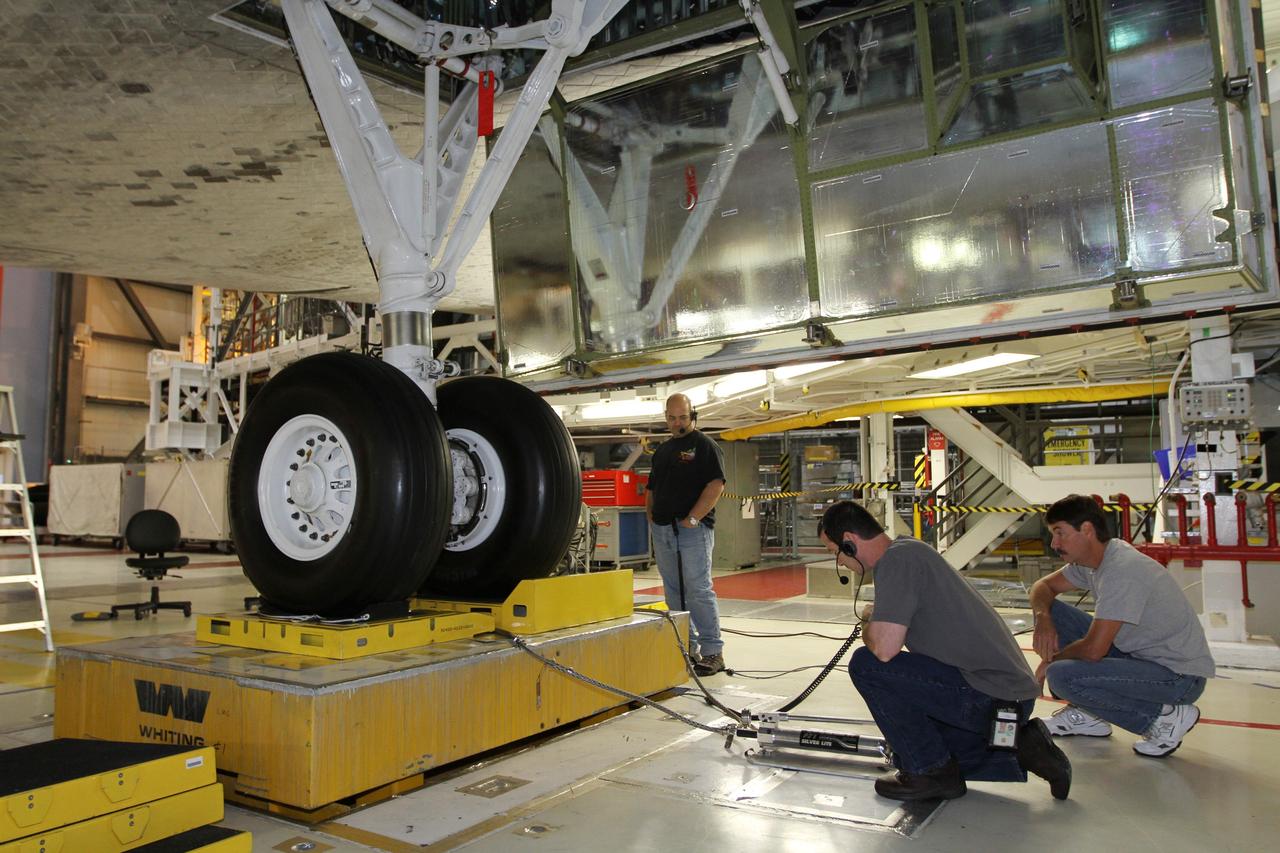
CAPE CANAVERAL, Fla. - Working at the main landing gear, technicians complete weight and center-of-gravity checks of space shuttle Atlantis in Orbiter Processing Facility Bay 1 at NASA’s Kennedy Space Center in Florida. The work is part of the Space Shuttle Program’s transition and retirement processing of the shuttle fleet. A groundbreaking was held Jan. 18, 2012, for Atlantis' future home, a 65,000-square-foot exhibit hall in Shuttle Plaza at the Kennedy Space Center Visitor Complex. Atlantis is scheduled to roll over to the visitor complex during November in preparation for the exhibit's grand opening in July 2013. For more information, visit http://www.nasa.gov/transition. Photo credit: NASA/Kim Shiflett
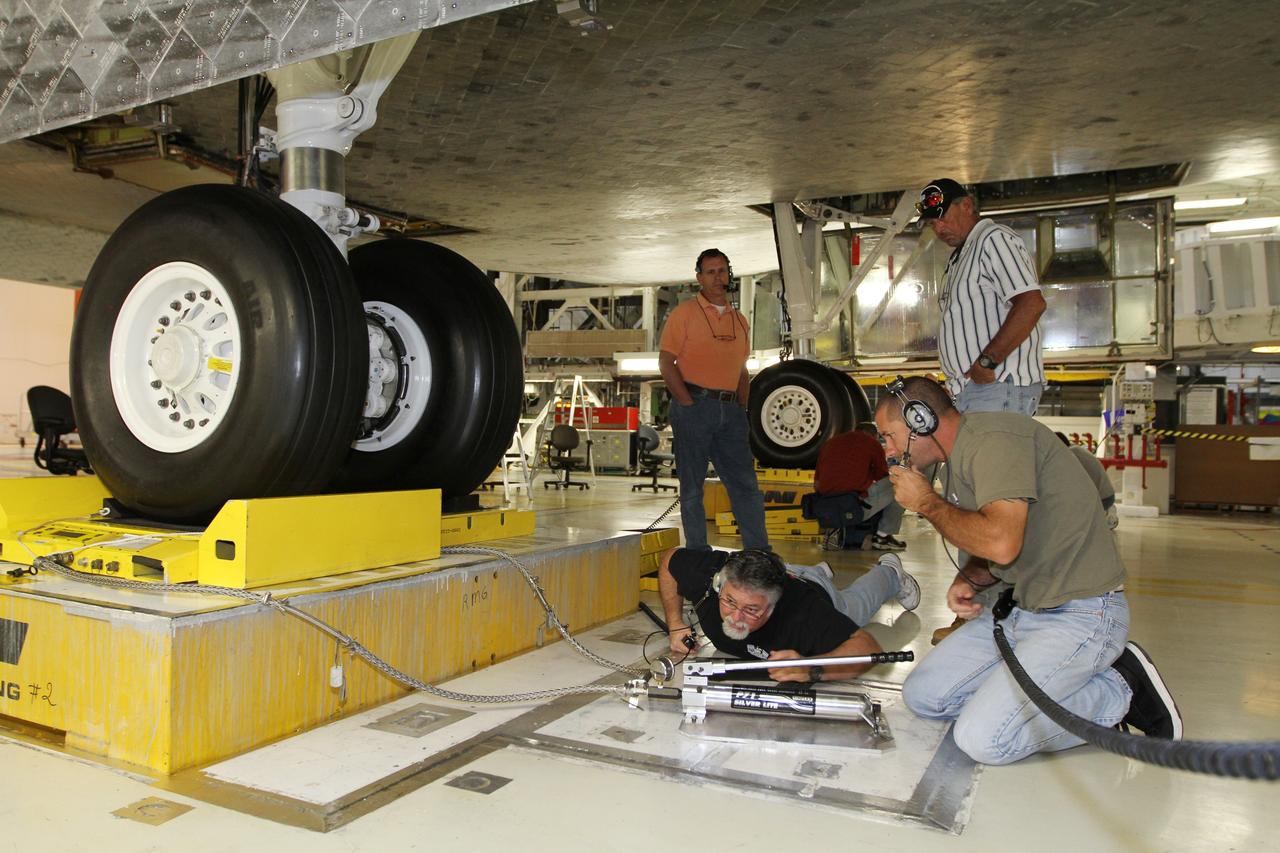
CAPE CANAVERAL, Fla. - Working at the main landing gear, technicians complete weight and center-of-gravity checks of space shuttle Atlantis in Orbiter Processing Facility Bay 1 at NASA’s Kennedy Space Center in Florida. The work is part of the Space Shuttle Program’s transition and retirement processing of the shuttle fleet. A groundbreaking was held Jan. 18, 2012, for Atlantis' future home, a 65,000-square-foot exhibit hall in Shuttle Plaza at the Kennedy Space Center Visitor Complex. Atlantis is scheduled to roll over to the visitor complex during November in preparation for the exhibit's grand opening in July 2013. For more information, visit http://www.nasa.gov/transition. Photo credit: NASA/Kim Shiflett
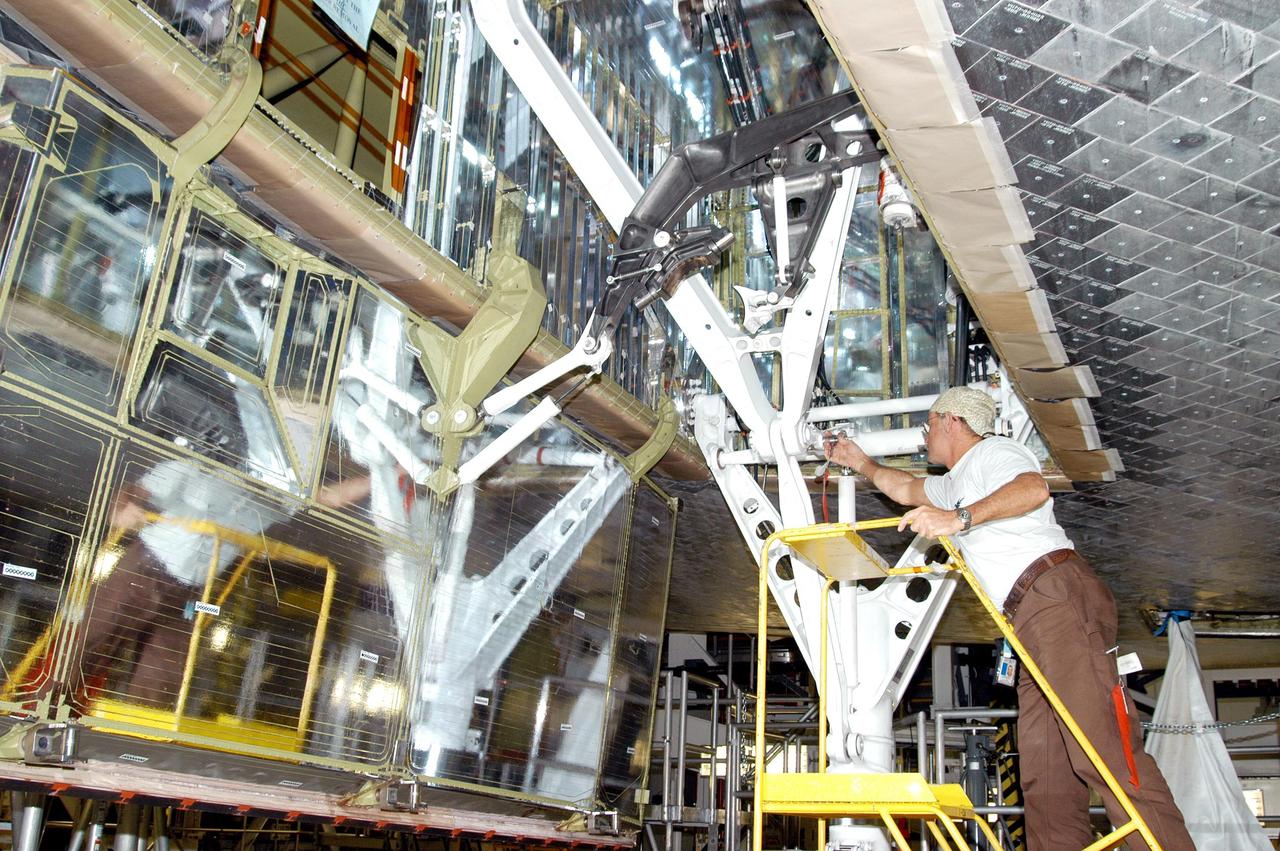
KENNEDY SPACE CENTER, FLA. - Workers in the Orbiter Processing Facility prepare the wheel bay to stow Atlantis’ landing gear in preparation for the expected impact of Hurricane Frances on Saturday. Other preparations at KSC include powering down the Space Shuttle orbiters, and closing their payload bay doors. Workers are also taking precautions against flooding by moving spacecraft hardware off the ground and sandbagging facilities. The Orbiter Processing Facility is constructed of concrete and steel and was designed to withstand winds of 105 mph. The Vehicle Assembly Building is constructed of concrete and steel and was designed to withstand winds of 125 mph. Other payload and flight hardware support facilities can endure winds of 110 mph. Launch pads and the Payload Hazardous Servicing Facility can withstand 125-mph winds.
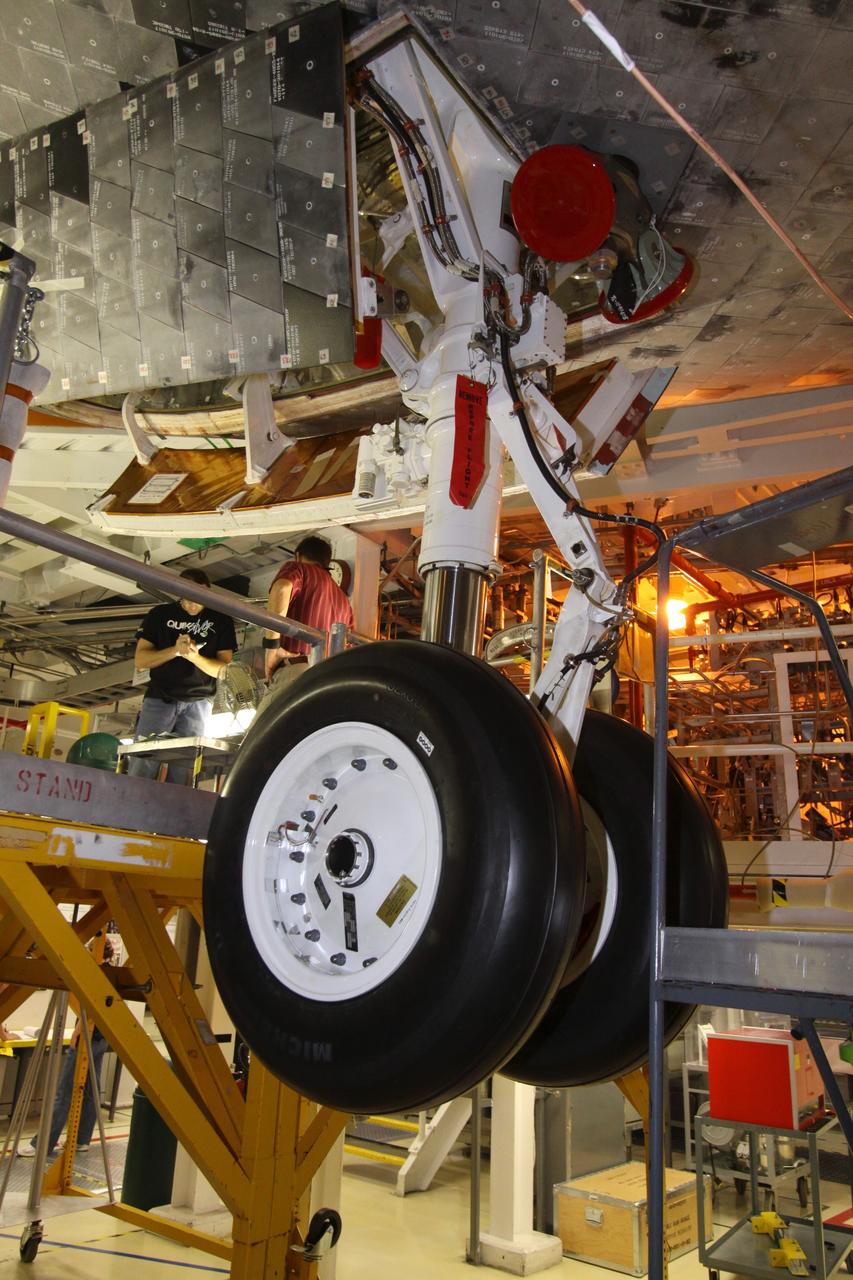
CAPE CANAVERAL, Fla. – In Orbiter Processing Facility-2 at NASA's Kennedy Space Center in Florida, workers verify that the processing of space shuttle Endeavour is complete, its payload bay doors are closed, and it is ready for its move to the Vehicle Assembly Building. This close-up is of Endeavour's nose-wheel landing gear and tires. The move, or "rollover," is targeted for Dec. 12. The Tranquility module, the payload for Endeavour's STS-130 mission to the International Space Station, will be installed in the payload bay after the shuttle has reached the pad. Endeavour's launch is targeted for Feb. 4, 2010. For information on the STS-130 mission and crew, visit http://www.nasa.gov/mission_pages/shuttle/shuttlemissions/sts130/index.html. Photo credit: NASA/Jack Pfaller
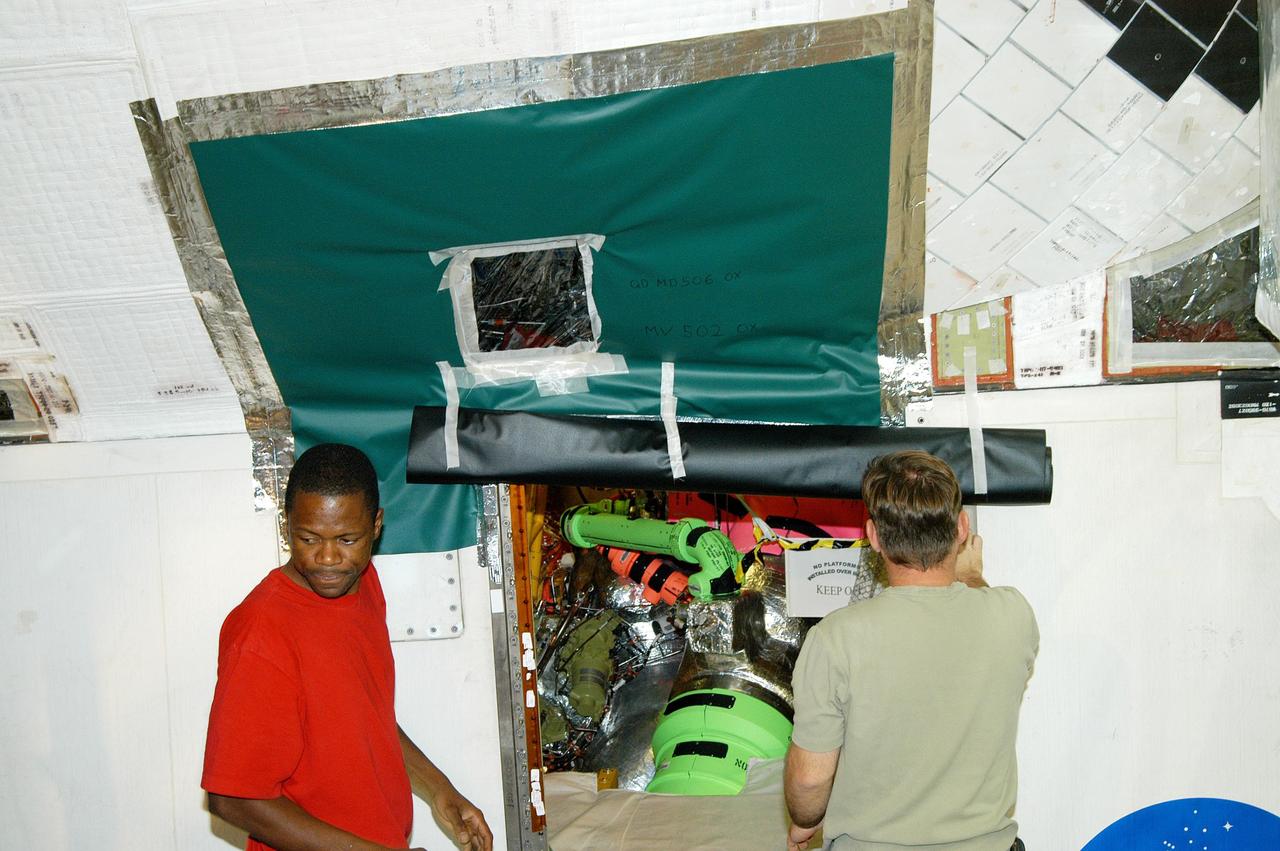
KENNEDY SPACE CENTER, FLA. - Workers in the Orbiter Processing Facility cover up areas of Atlantis, preparing for the expected impact of Hurricane Frances on Saturday. Other preparations at KSC include powering down the Space Shuttle orbiters, closing the payload bay doors and stowing the landing gear. Workers are also taking precautions against flooding by moving spacecraft hardware off the ground and sandbagging facilities. The Orbiter Processing Facility is constructed of concrete and steel and was designed to withstand winds of 105 mph. The Vehicle Assembly Building is constructed of concrete and steel and was designed to withstand winds of 125 mph. Other payload and flight hardware support facilities can endure winds of 110 mph. Launch pads and the Payload Hazardous Servicing Facility can withstand 125-mph winds.
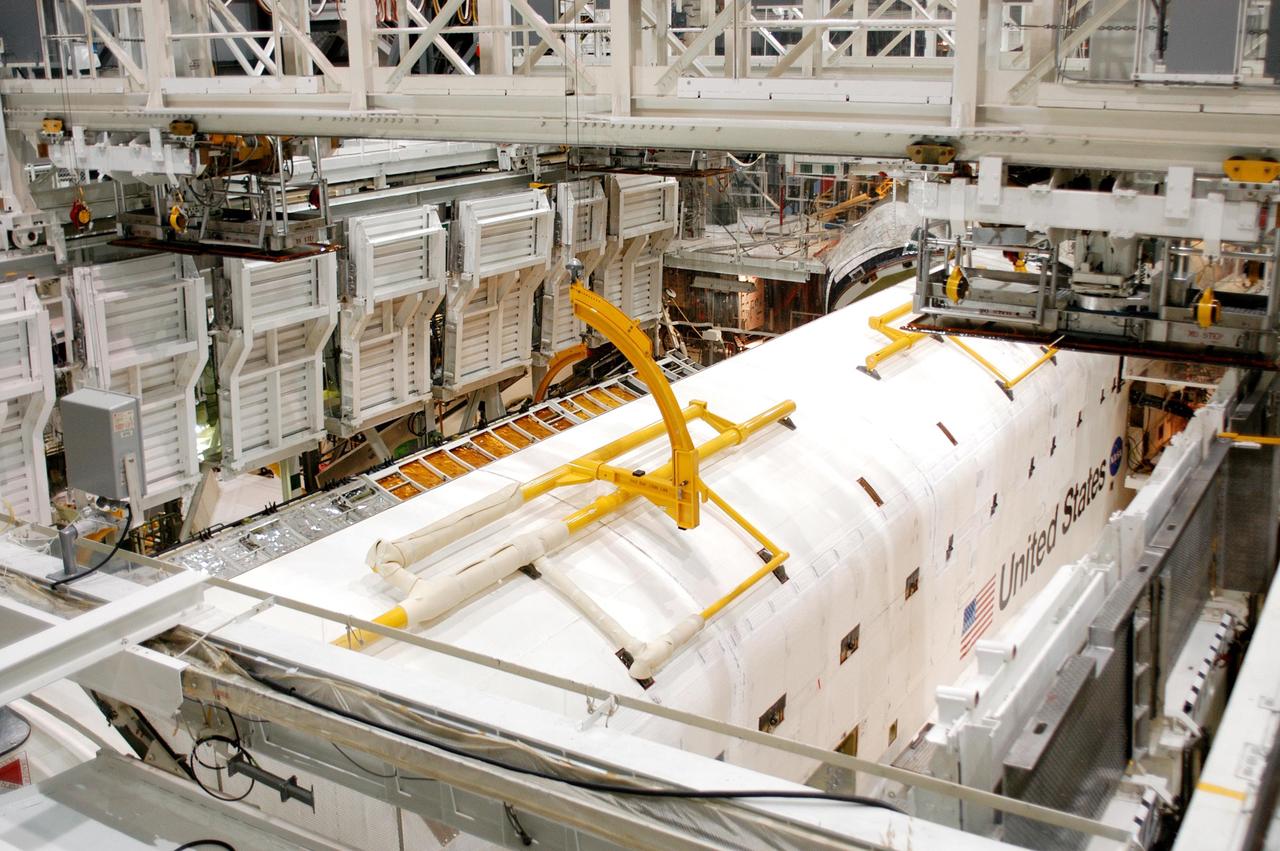
KENNEDY SPACE CENTER, FLA. - In the Orbiter Processing Facility, the payload bay doors on Atlantis are being closed in preparation for the expected impact of Hurricane Frances on Saturday. Other preparations at KSC include powering down the Space Shuttle orbiters and stowing the landing gear. Workers are also taking precautions against flooding by moving spacecraft hardware off the ground and sandbagging facilities. The Orbiter Processing Facility is constructed of concrete and steel and was designed to withstand winds of 105 mph. The Vehicle Assembly Building is constructed of concrete and steel and was designed to withstand winds of 125 mph. Other payload and flight hardware support facilities can endure winds of 110 mph. Launch pads and the Payload Hazardous Servicing Facility can withstand 125-mph winds.
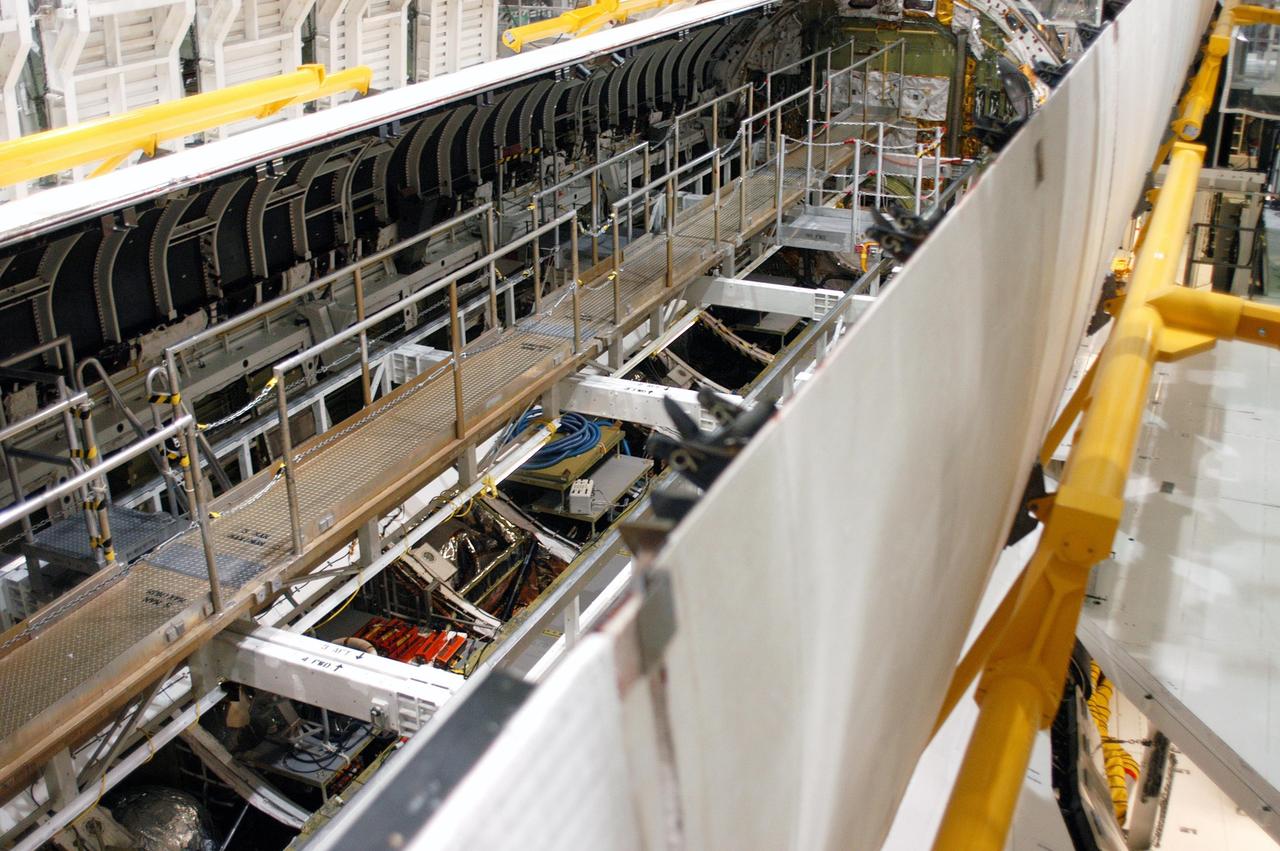
KENNEDY SPACE CENTER, FLA. - In the Orbiter Processing Facility, the payload bay doors on Atlantis are being closed in preparation for the expected impact of Hurricane Frances on Saturday. Other preparations at KSC include powering down the Space Shuttle orbiters and stowing the landing gear. Workers are also taking precautions against flooding by moving spacecraft hardware off the ground and sandbagging facilities. The Orbiter Processing Facility is constructed of concrete and steel and was designed to withstand winds of 105 mph. The Vehicle Assembly Building is constructed of concrete and steel and was designed to withstand winds of 125 mph. Other payload and flight hardware support facilities can endure winds of 110 mph. Launch pads and the Payload Hazardous Servicing Facility can withstand 125-mph winds.
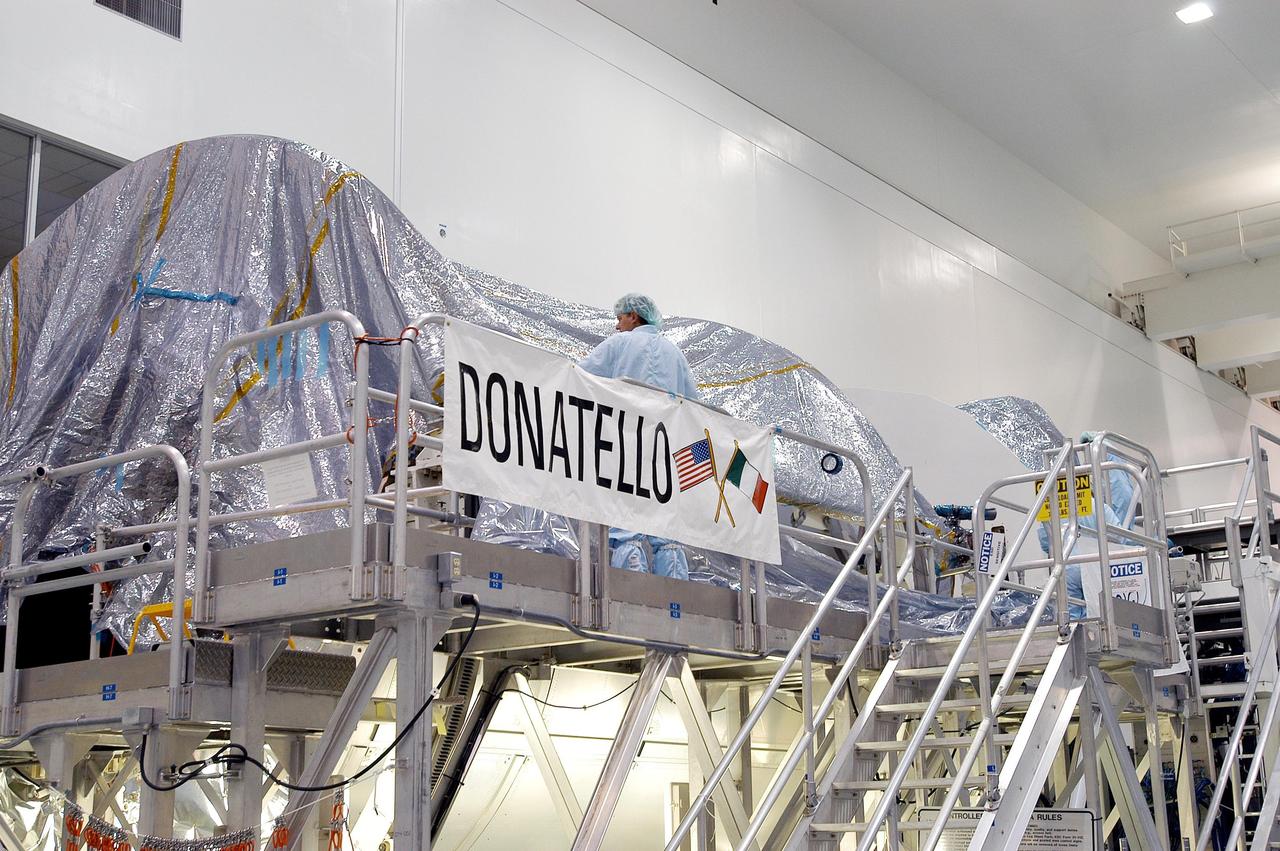
KENNEDY SPACE CENTER, FLA. - In the Space Station Processing Facility, workers cover with plastic the Multi-Purpose Logistics Module Donatello in preparation for the expected impact of Hurricane Frances on Saturday. Other modules and equipment are being covered as well. Workers also have powered down the Space Shuttle orbiters, closed their payload bay doors and stowed the landing gear. They are also taking precautions against flooding by moving spacecraft hardware off the ground and sandbagging facilities. The SSPF can withstand sustained winds of 110 mph and wind gusts up to 132 mph. The Orbiter Processing Facility is constructed of concrete and steel and was designed to withstand winds of 105 mph. The Vehicle Assembly Building is constructed of concrete and steel and was designed to withstand winds of 125 mph. Other payload and flight hardware support facilities can endure winds of 110 mph. Launch pads and the Payload Hazardous Servicing Facility can withstand 125-mph winds.
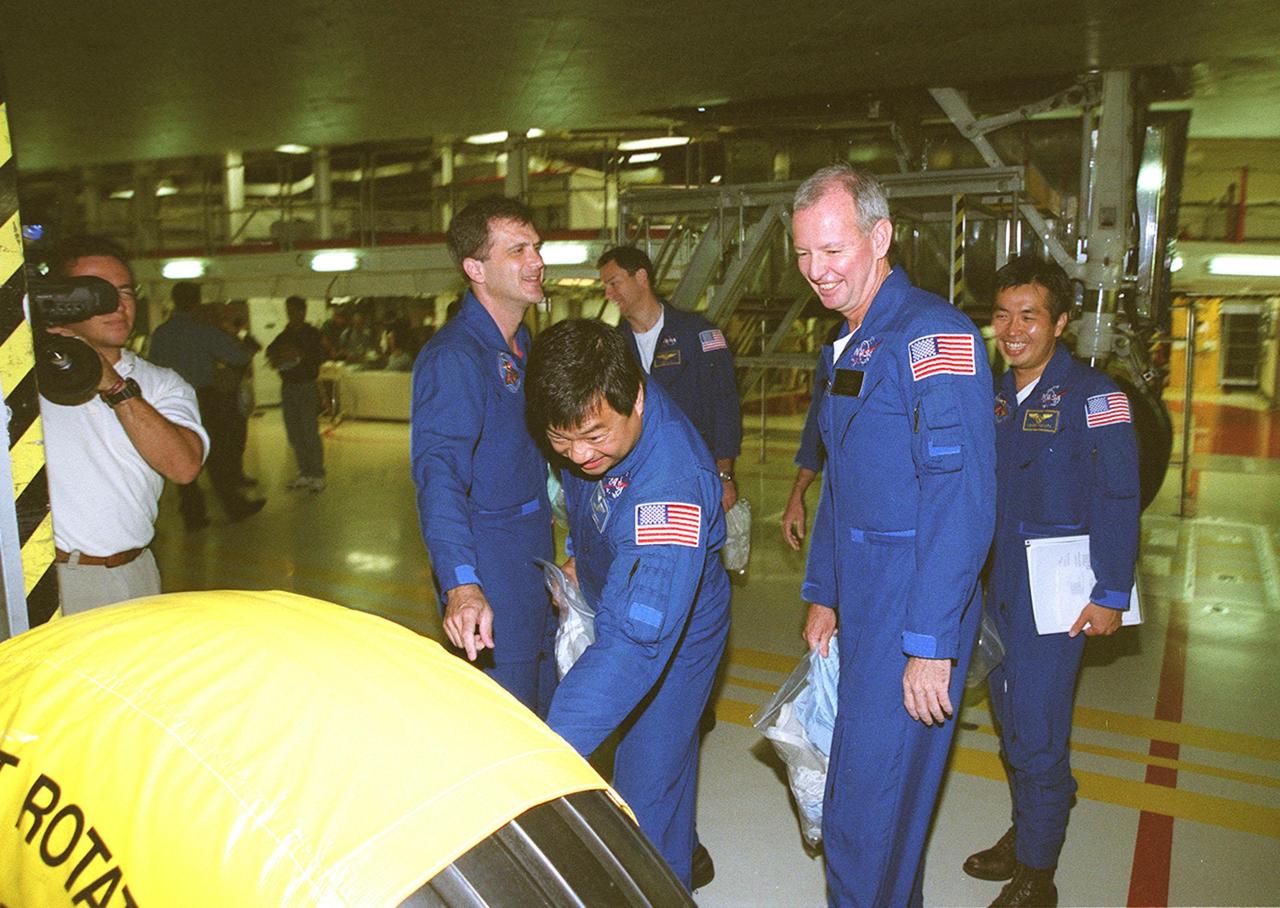
KENNEDY SPACE CENTER, FLA. -- Members of the STS-92 crew look over a tire on the landing gear of orbiter Discovery in the Orbiter Processing Facility bay 1. From left to right are Mission Specialists Jeff Wisoff (pointing) and Leroy Chiao, Commander Brian Duffy and Mission Specialist Koichi Wakata, who is with the Japanese space agency. Standing behind them is Mission Specialist Michael Lopez-Alegria. The crew is at KSC to take part in Crew Equipment Interface Test activities. Others taking part are Pilot Pam Melroy and Mission Specialist Bill McArthur. STS-92 is scheduled to launch Oct. 5 on Shuttle Discovery from Launch Pad 39A on the fifth flight to the International Space Station. Discovery will carry the Integrated Truss Structure (ITS) Z1, Pressurized Mating Adapter 3 (PMA-3), Ku-band Communications System, and Control Moment Gyros (CMGs)
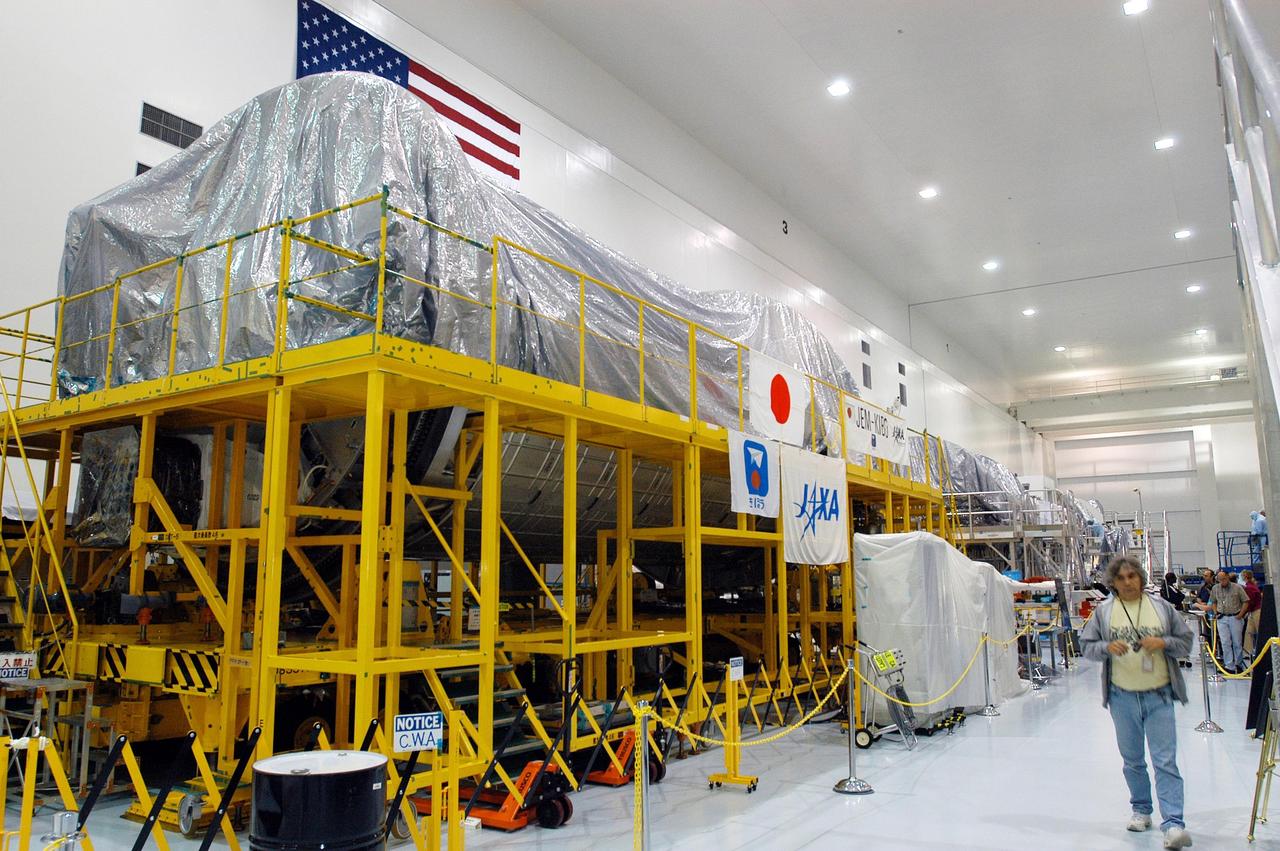
KENNEDY SPACE CENTER, FLA. - In the Space Station Processing Facility, modules wrapped in plastic line one wall. The modules and equipment are being covered in preparation for the expected impact of Hurricane Frances on Saturday. KSC workers also have powered down the Space Shuttle orbiters, closed their payload bay doors and stowed the landing gear. They are also taking precautions against flooding by moving spacecraft hardware off the ground and sandbagging facilities. The SSPF can withstand sustained winds of 110 mph and wind gusts up to 132 mph. The Orbiter Processing Facility is constructed of concrete and steel and was designed to withstand winds of 105 mph. The Vehicle Assembly Building is constructed of concrete and steel and was designed to withstand winds of 125 mph. Other payload and flight hardware support facilities can endure winds of 110 mph. Launch pads and the Payload Hazardous Servicing Facility can withstand 125-mph winds.
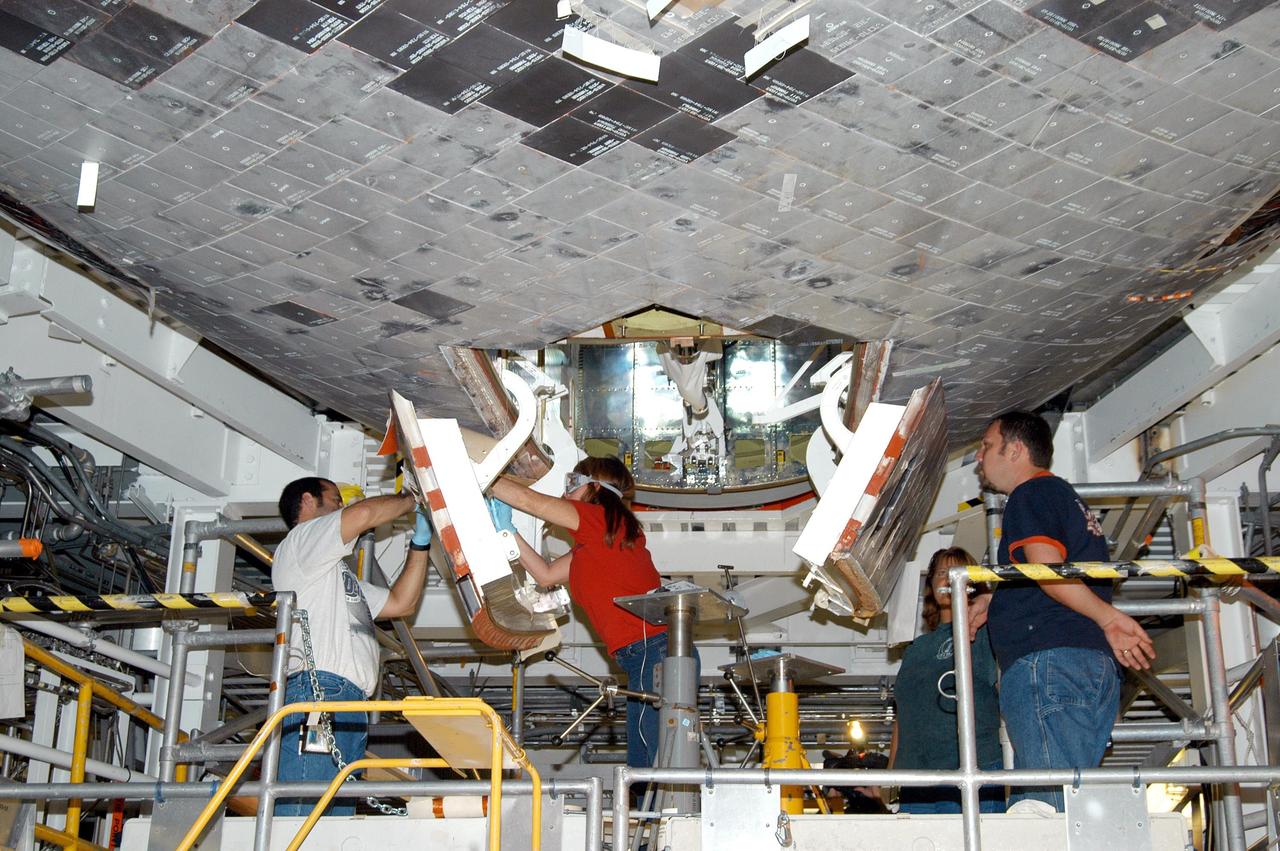
KENNEDY SPACE CENTER, FLA. - Workers in the Orbiter Processing Facility prepare to close the nose wheel doors on Atlantis in preparation for the expected impact of Hurricane Frances on Saturday. Preparations at KSC include powering down the Space Shuttle orbiters, closing their payload bay doors and stowing their landing gear. They are also taking precautions against flooding by moving spacecraft hardware off the ground and sandbagging facilities. The Orbiter Processing Facility is constructed of concrete and steel and was designed to withstand winds of 105 mph. The Vehicle Assembly Building is constructed of concrete and steel and was designed to withstand winds of 125 mph. Other payload and flight hardware support facilities can endure winds of 110 mph. Launch pads and the Payload Hazardous Servicing Facility can withstand 125-mph winds.
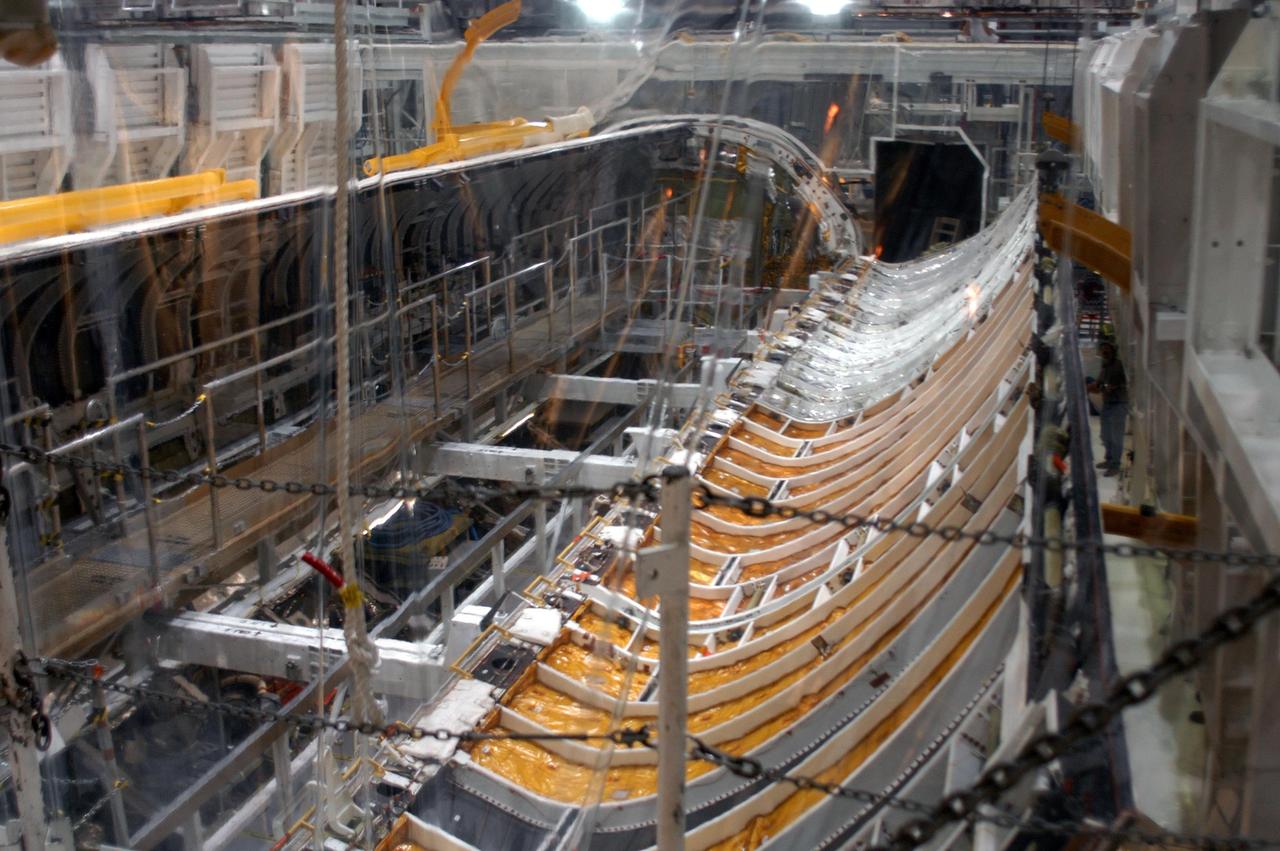
KENNEDY SPACE CENTER, FLA. - In the Orbiter Processing Facility, the payload bay doors on Atlantis are being closed in preparation for the expected impact of Hurricane Frances on Saturday. Other preparations at KSC include powering down the Space Shuttle orbiters and stowing the landing gear. Workers are also taking precautions against flooding by moving spacecraft hardware off the ground and sandbagging facilities. The Orbiter Processing Facility is constructed of concrete and steel and was designed to withstand winds of 105 mph. The Vehicle Assembly Building is constructed of concrete and steel and was designed to withstand winds of 125 mph. Other payload and flight hardware support facilities can endure winds of 110 mph. Launch pads and the Payload Hazardous Servicing Facility can withstand 125-mph winds.
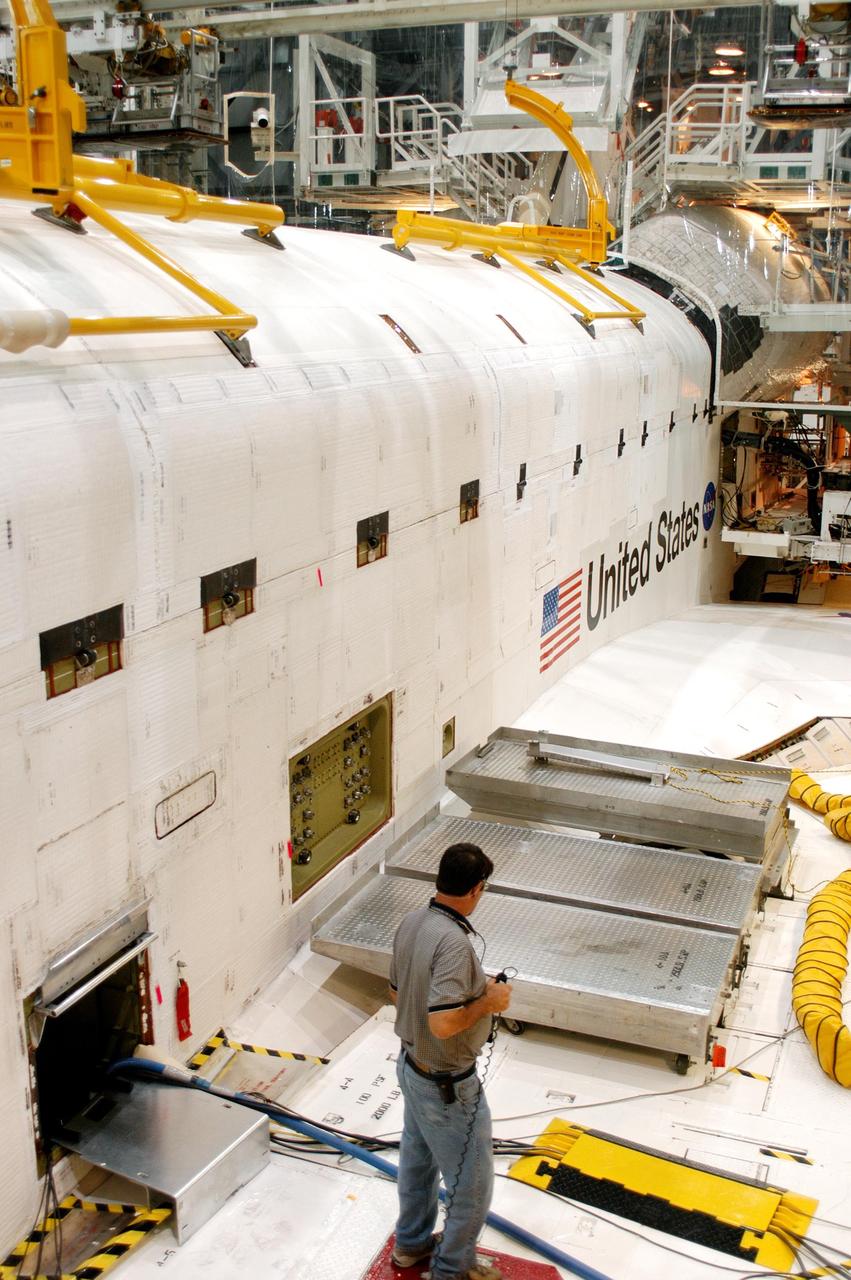
KENNEDY SPACE CENTER, FLA. - In the Orbiter Processing Facility, a worker checks out part of Atlantis after payload bay doors were closed in preparation for the expected impact of Hurricane Frances on Saturday. Other preparations at KSC include powering down the Space Shuttle orbiters and stowing the landing gear. Workers are also taking precautions against flooding by moving spacecraft hardware off the ground and sandbagging facilities. The Orbiter Processing Facility is constructed of concrete and steel and was designed to withstand winds of 105 mph. The Vehicle Assembly Building is constructed of concrete and steel and was designed to withstand winds of 125 mph. Other payload and flight hardware support facilities can endure winds of 110 mph. Launch pads and the Payload Hazardous Servicing Facility can withstand 125-mph winds.

KENNEDY SPACE CENTER, FLA. - Workers in the Orbiter Processing Facility prepare to stow the landing gear on the orbiter Atlantis in preparation for the expected impact of Hurricane Frances on Saturday. Other preparations at KSC include powering down the Space Shuttle orbiters, and closing their payload bay doors. Workers are also taking precautions against flooding by moving spacecraft hardware off the ground and sandbagging facilities. The Orbiter Processing Facility is constructed of concrete and steel and was designed to withstand winds of 105 mph. The Vehicle Assembly Building is constructed of concrete and steel and was designed to withstand winds of 125 mph. Other payload and flight hardware support facilities can endure winds of 110 mph. Launch pads and the Payload Hazardous Servicing Facility can withstand 125-mph winds.
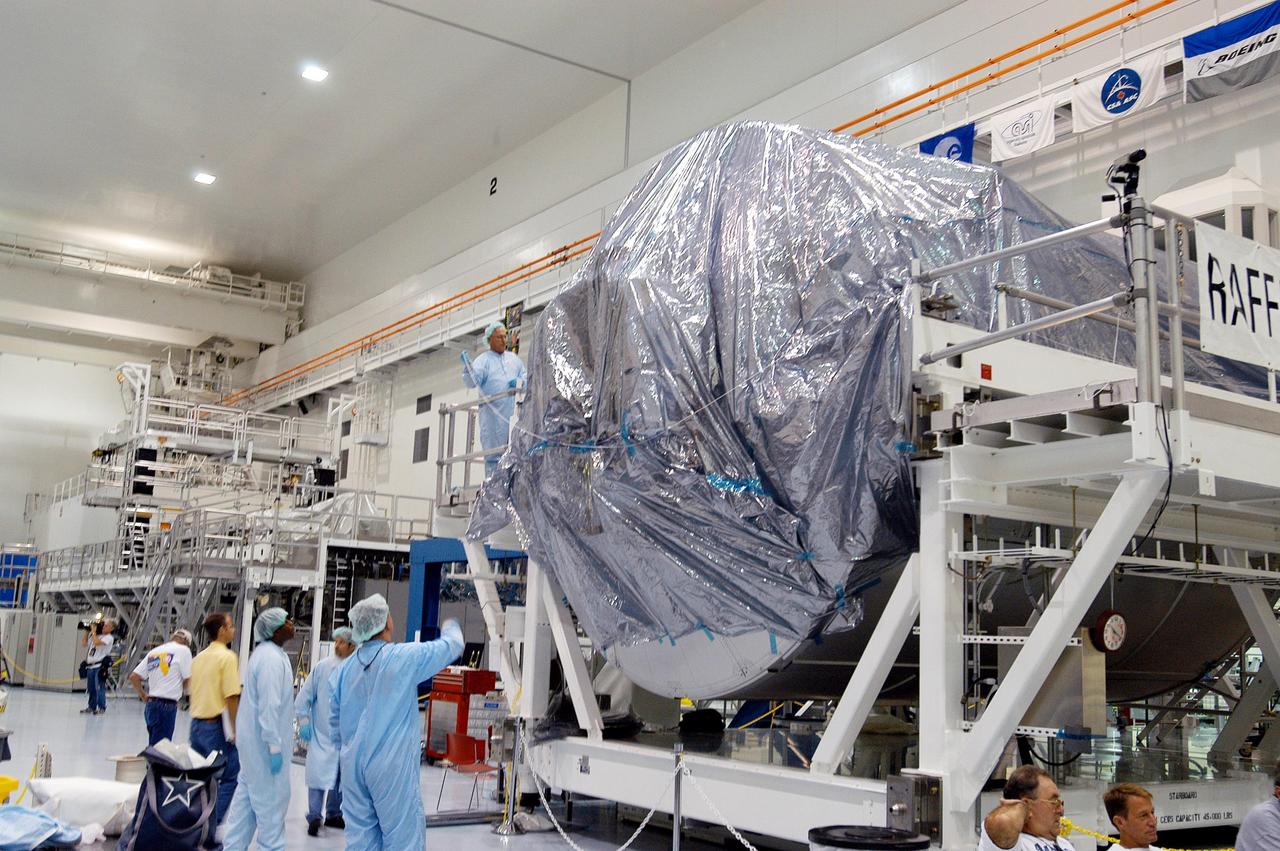
KENNEDY SPACE CENTER, FLA. - In the Space Station Processing Facility, workers cover with plastic the Multi-Purpose Logistics Module Raffaello in preparation for the expected impact of Hurricane Frances on Saturday. Other modules and equipment are being covered as well. Workers also have powered down the Space Shuttle orbiters, closed their payload bay doors and stowed the landing gear. They are also taking precautions against flooding by moving spacecraft hardware off the ground and sandbagging facilities. The SSPF can withstand sustained winds of 110 mph and wind gusts up to 132 mph. The Orbiter Processing Facility is constructed of concrete and steel and was designed to withstand winds of 105 mph. The Vehicle Assembly Building is constructed of concrete and steel and was designed to withstand winds of 125 mph. Other payload and flight hardware support facilities can endure winds of 110 mph. Launch pads and the Payload Hazardous Servicing Facility can withstand 125-mph winds.
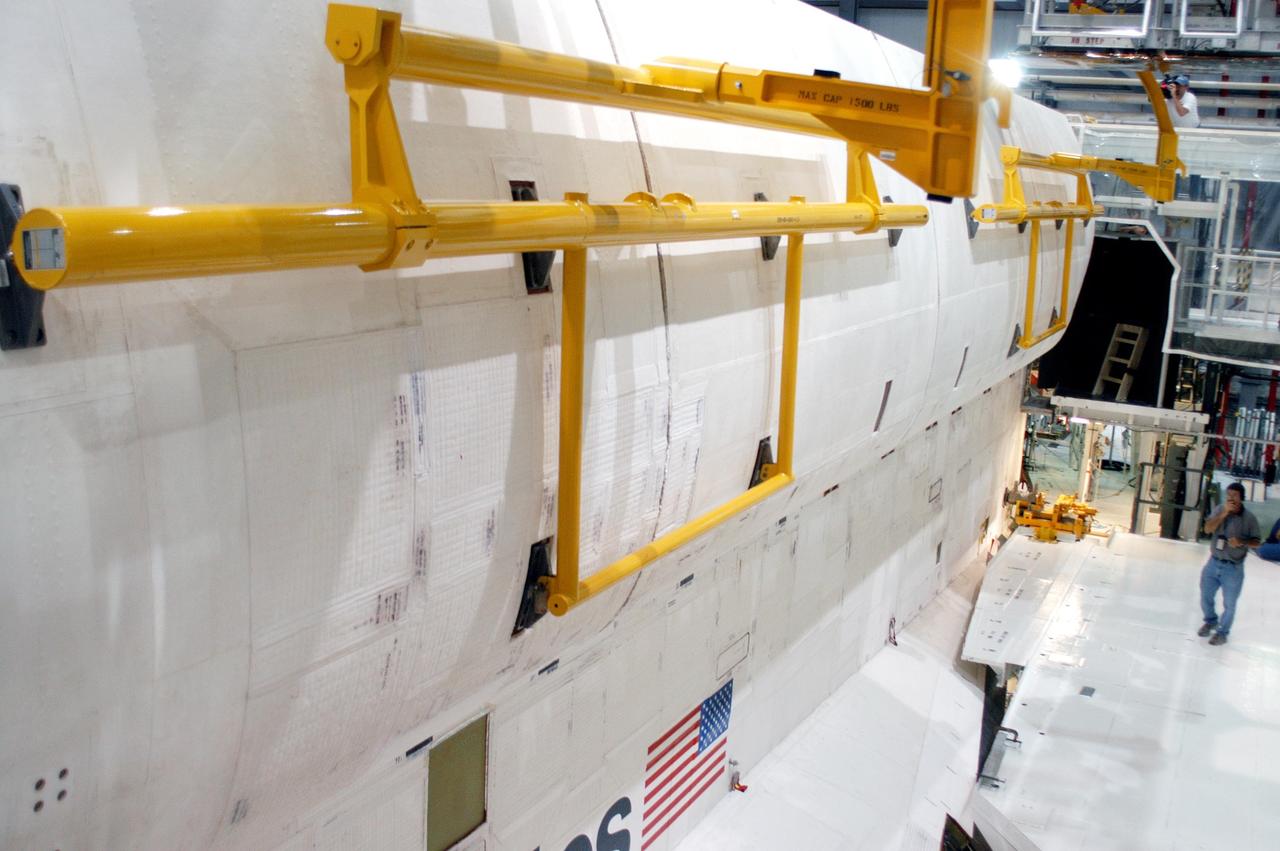
KENNEDY SPACE CENTER, FLA. - In the Orbiter Processing Facility, the payload bay doors on Atlantis are being closed in preparation for the expected impact of Hurricane Frances on Saturday. Other preparations at KSC include powering down the Space Shuttle orbiters and stowing the landing gear. Workers are also taking precautions against flooding by moving spacecraft hardware off the ground and sandbagging facilities. The Orbiter Processing Facility is constructed of concrete and steel and was designed to withstand winds of 105 mph. The Vehicle Assembly Building is constructed of concrete and steel and was designed to withstand winds of 125 mph. Other payload and flight hardware support facilities can endure winds of 110 mph. Launch pads and the Payload Hazardous Servicing Facility can withstand 125-mph winds.
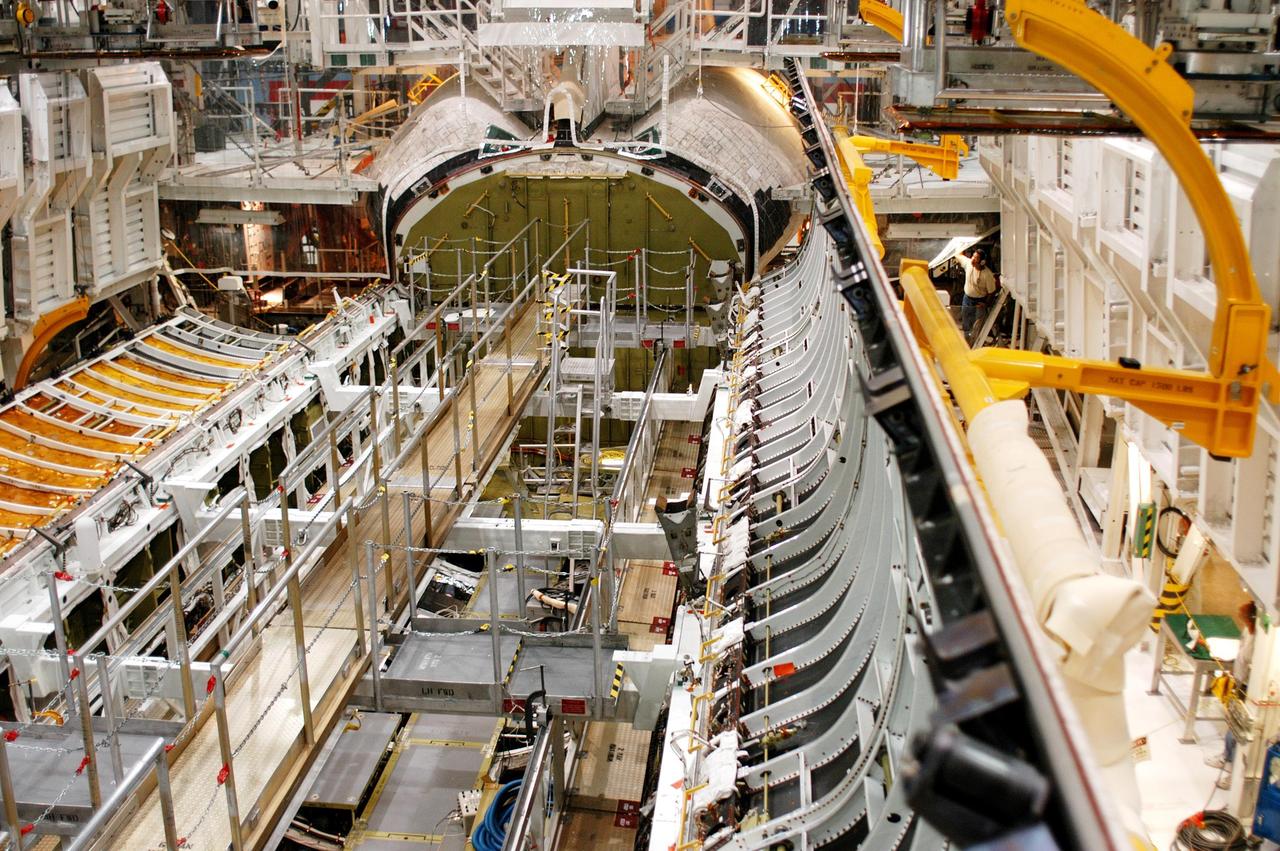
KENNEDY SPACE CENTER, FLA. - In the Orbiter Processing Facility, workers prepare to close the payload bay doors on Atlantis in preparation for the expected impact of Hurricane Frances on Saturday. Other preparations at KSC include powering down the Space Shuttle orbiters and stowing the landing gear. Workers are also taking precautions against flooding by moving spacecraft hardware off the ground and sandbagging facilities. The Orbiter Processing Facility is constructed of concrete and steel and was designed to withstand winds of 105 mph. The Vehicle Assembly Building is constructed of concrete and steel and was designed to withstand winds of 125 mph. Other payload and flight hardware support facilities can endure winds of 110 mph. Launch pads and the Payload Hazardous Servicing Facility can withstand 125-mph winds.

KENNEDY SPACE CENTER, FLA. -- Members of the STS-92 crew look over a tire on the landing gear of orbiter Discovery in the Orbiter Processing Facility bay 1. From left to right are Mission Specialists Jeff Wisoff (pointing) and Leroy Chiao, Commander Brian Duffy and Mission Specialist Koichi Wakata, who is with the Japanese space agency. Standing behind them is Mission Specialist Michael Lopez-Alegria. The crew is at KSC to take part in Crew Equipment Interface Test activities. Others taking part are Pilot Pam Melroy and Mission Specialist Bill McArthur. STS-92 is scheduled to launch Oct. 5 on Shuttle Discovery from Launch Pad 39A on the fifth flight to the International Space Station. Discovery will carry the Integrated Truss Structure (ITS) Z1, Pressurized Mating Adapter 3 (PMA-3), Ku-band Communications System, and Control Moment Gyros (CMGs)
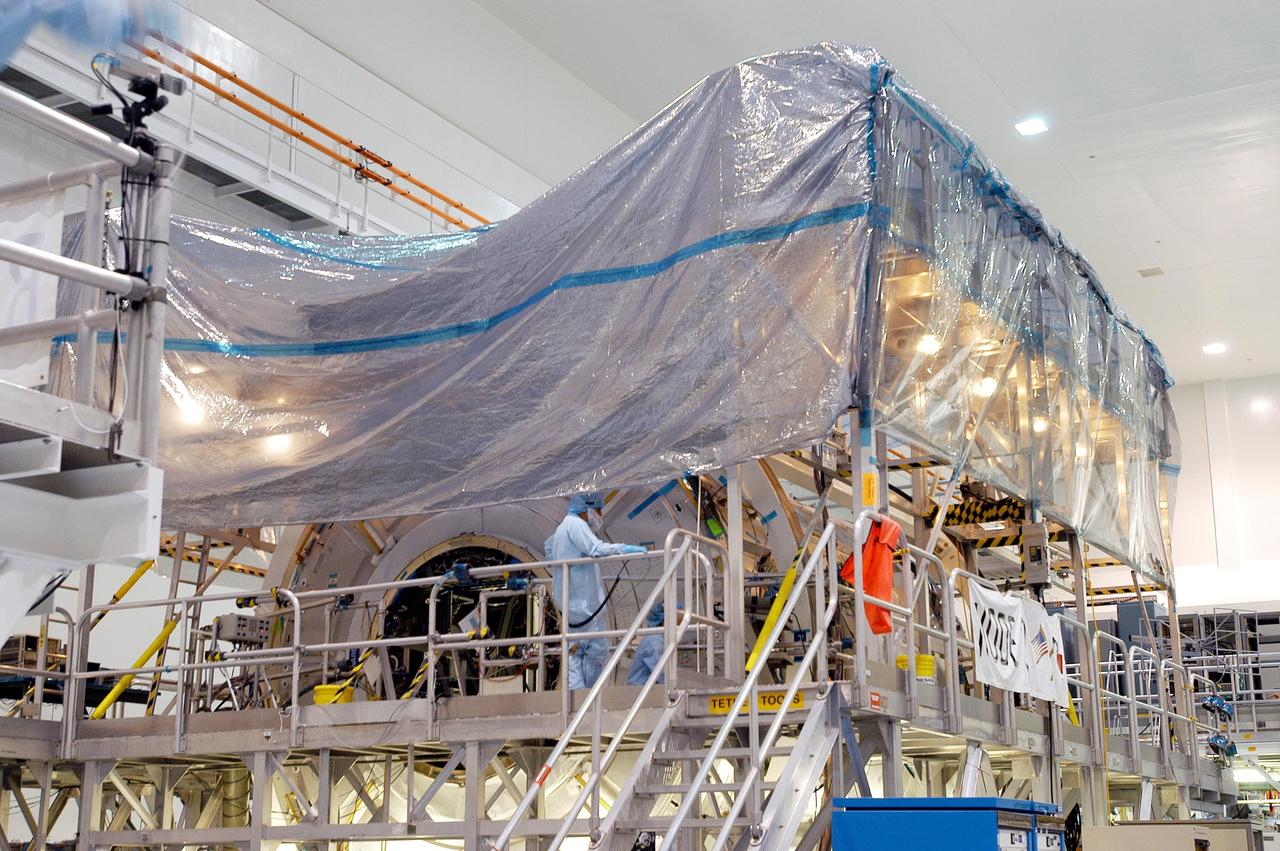
KENNEDY SPACE CENTER, FLA. - In the Space Station Processing Facility, workers cover with plastic the U.S. Node 2 in preparation for the expected impact of Hurricane Frances on Saturday. Other modules and equipment are being covered as well. Workers also have powered down the Space Shuttle orbiters, closed their payload bay doors and stowed the landing gear. They are also taking precautions against flooding by moving spacecraft hardware off the ground and sandbagging facilities. The SSPF can withstand sustained winds of 110 mph and wind gusts up to 132 mph. The Orbiter Processing Facility is constructed of concrete and steel and was designed to withstand winds of 105 mph. The Vehicle Assembly Building is constructed of concrete and steel and was designed to withstand winds of 125 mph. Other payload and flight hardware support facilities can endure winds of 110 mph. Launch pads and the Payload Hazardous Servicing Facility can withstand 125-mph winds.
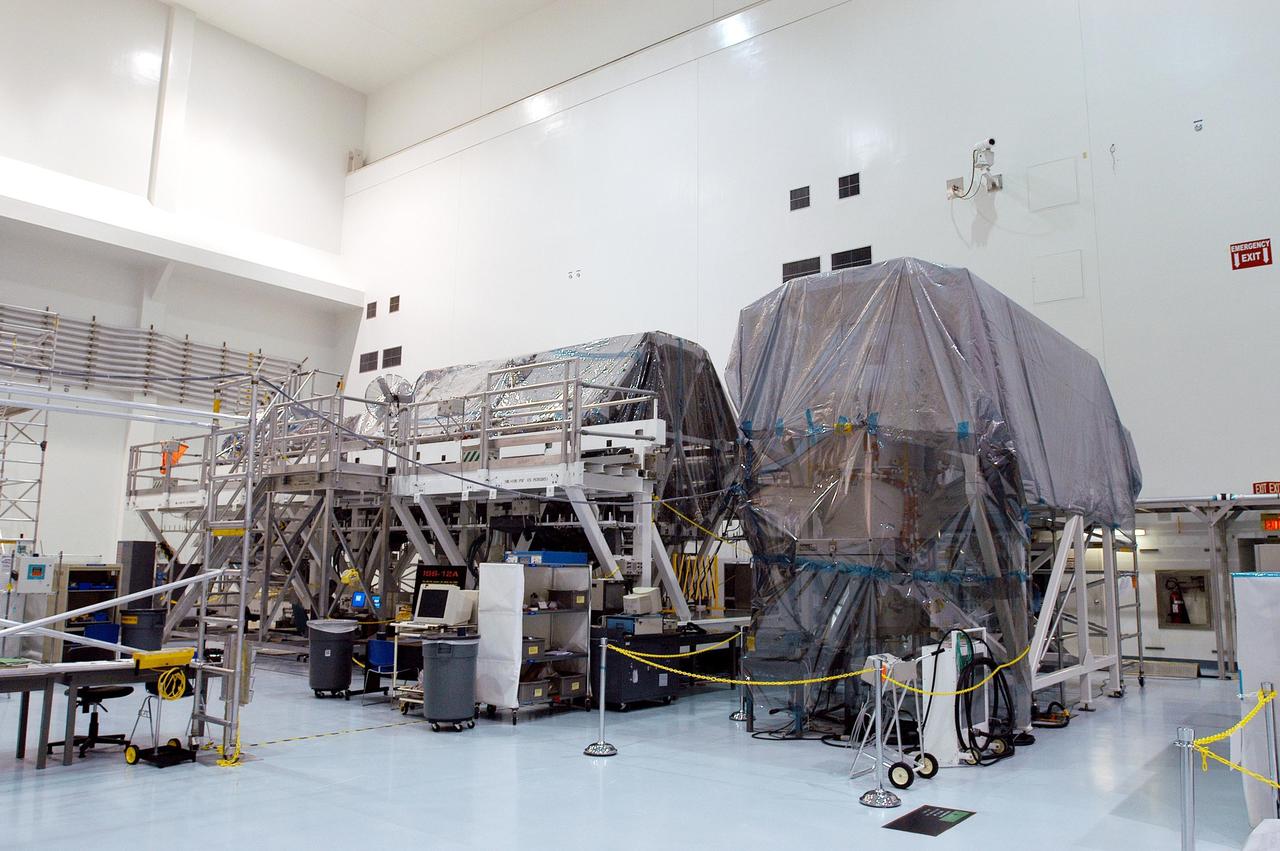
KENNEDY SPACE CENTER, FLA. - In the Space Station Processing Facility, modules and equipment are being covered in plastic in preparation for the expected impact of Hurricane Frances on Saturday. KSC workers also have powered down the Space Shuttle orbiters, closed their payload bay doors and stowed the landing gear. They are also taking precautions against flooding by moving spacecraft hardware off the ground and sandbagging facilities. The SSPF can withstand sustained winds of 110 mph and wind gusts up to 132 mph. The Orbiter Processing Facility is constructed of concrete and steel and was designed to withstand winds of 105 mph. The Vehicle Assembly Building is constructed of concrete and steel and was designed to withstand winds of 125 mph. Other payload and flight hardware support facilities can endure winds of 110 mph. Launch pads and the Payload Hazardous Servicing Facility can withstand 125-mph winds.
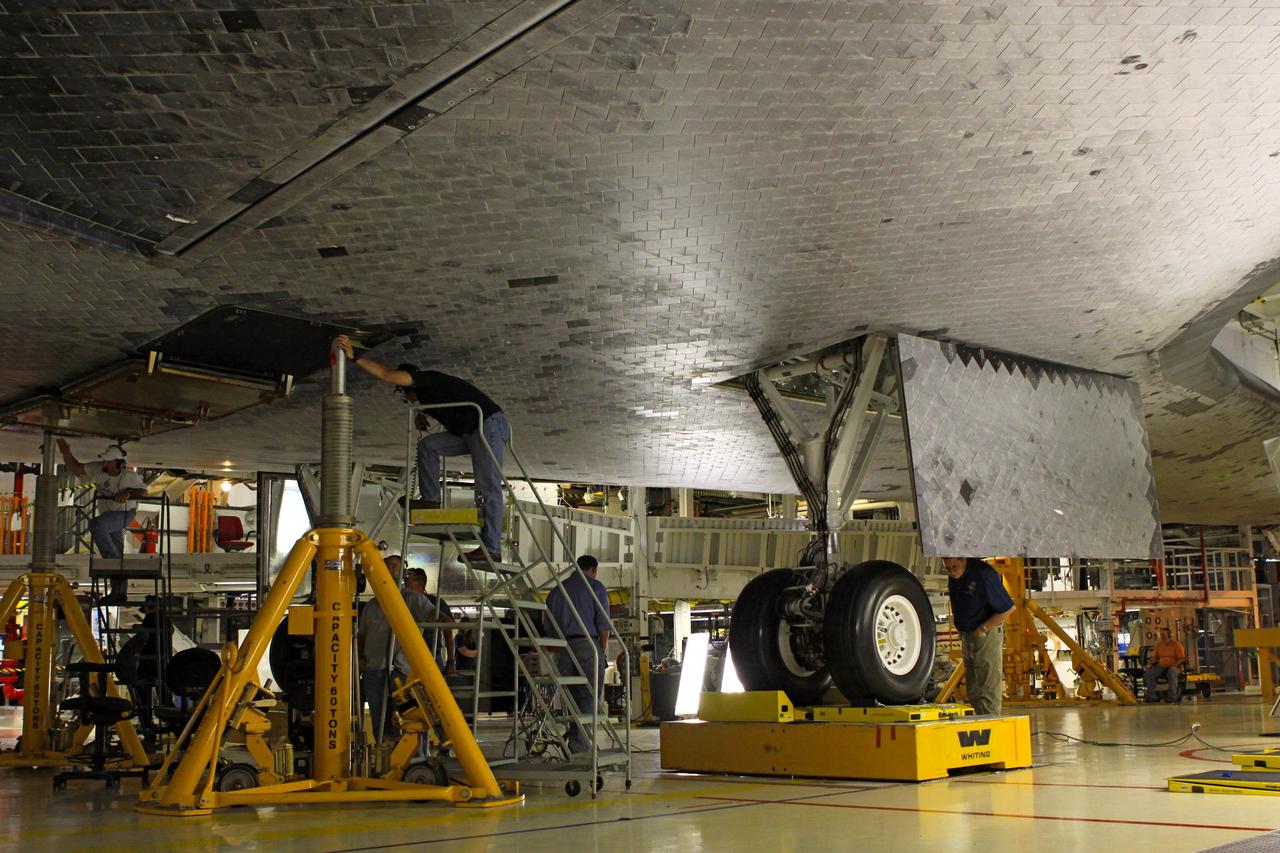
CAPE CANAVERAL, Fla. – Looking along the under belly toward the main landing gear of the space shuttle Endeavour, United Space Alliance technicians complete weight and center of gravity checks in Bay 2 of the Orbiter Processing Facility at NASA’s Kennedy Space Center in Florida. The work is part of Transition and Retirement of the remaining space shuttles, Endeavour and Atlantis. Endeavour is being prepared for public display at the California Science Center in Los Angeles. Its ferry flight to California is targeted for mid-September. Endeavour was the last space shuttle added to NASA’s orbiter fleet. Over the course of its 19-year career, Endeavour spent 299 days in space during 25 missions. For more information, visit http://www.nasa.gov/transition Photo credit: NASA/ Jim Grossmann

KENNEDY SPACE CENTER, FLA. - Workers in the Orbiter Processing Facility prepare the orbiter Atlantis and related equipment for the expected impact of Hurricane Frances on Saturday. Preparations at KSC include powering down the Space Shuttle orbiters, closing their payload bay doors and stowing their landing gear. They are also taking precautions against flooding by moving spacecraft hardware off the ground and sandbagging facilities. The Orbiter Processing Facility is constructed of concrete and steel and was designed to withstand winds of 105 mph. The Vehicle Assembly Building is constructed of concrete and steel and was designed to withstand winds of 125 mph. Other payload and flight hardware support facilities can endure winds of 110 mph. Launch pads and the Payload Hazardous Servicing Facility can withstand 125-mph winds.
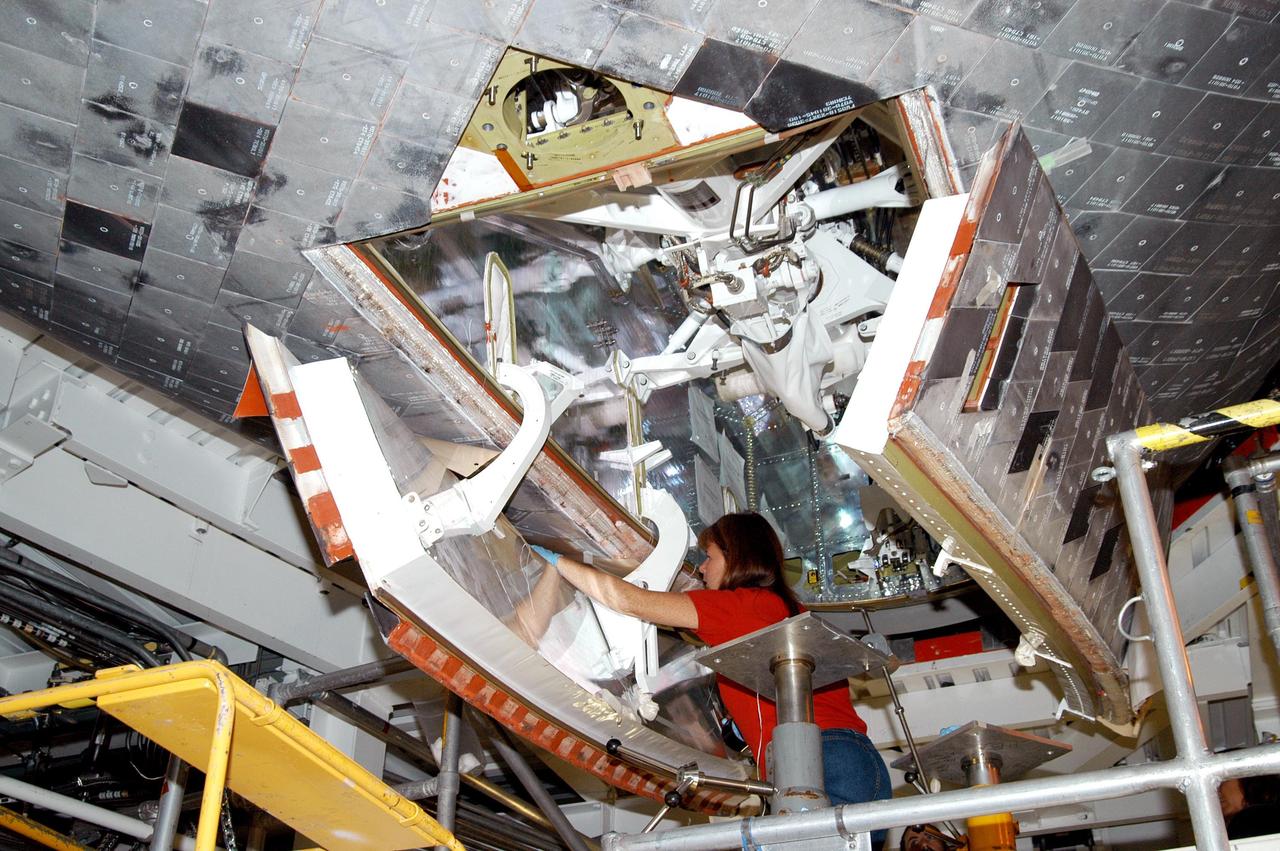
KENNEDY SPACE CENTER, FLA. - Workers in the Orbiter Processing Facility prepare to close the nose wheel doors on Atlantis in preparation for the expected impact of Hurricane Frances on Saturday. Preparations at KSC include powering down the Space Shuttle orbiters, closing their payload bay doors and stowing their landing gear. They are also taking precautions against flooding by moving spacecraft hardware off the ground and sandbagging facilities. The Orbiter Processing Facility is constructed of concrete and steel and was designed to withstand winds of 105 mph. The Vehicle Assembly Building is constructed of concrete and steel and was designed to withstand winds of 125 mph. Other payload and flight hardware support facilities can endure winds of 110 mph. Launch pads and the Payload Hazardous Servicing Facility can withstand 125-mph winds.
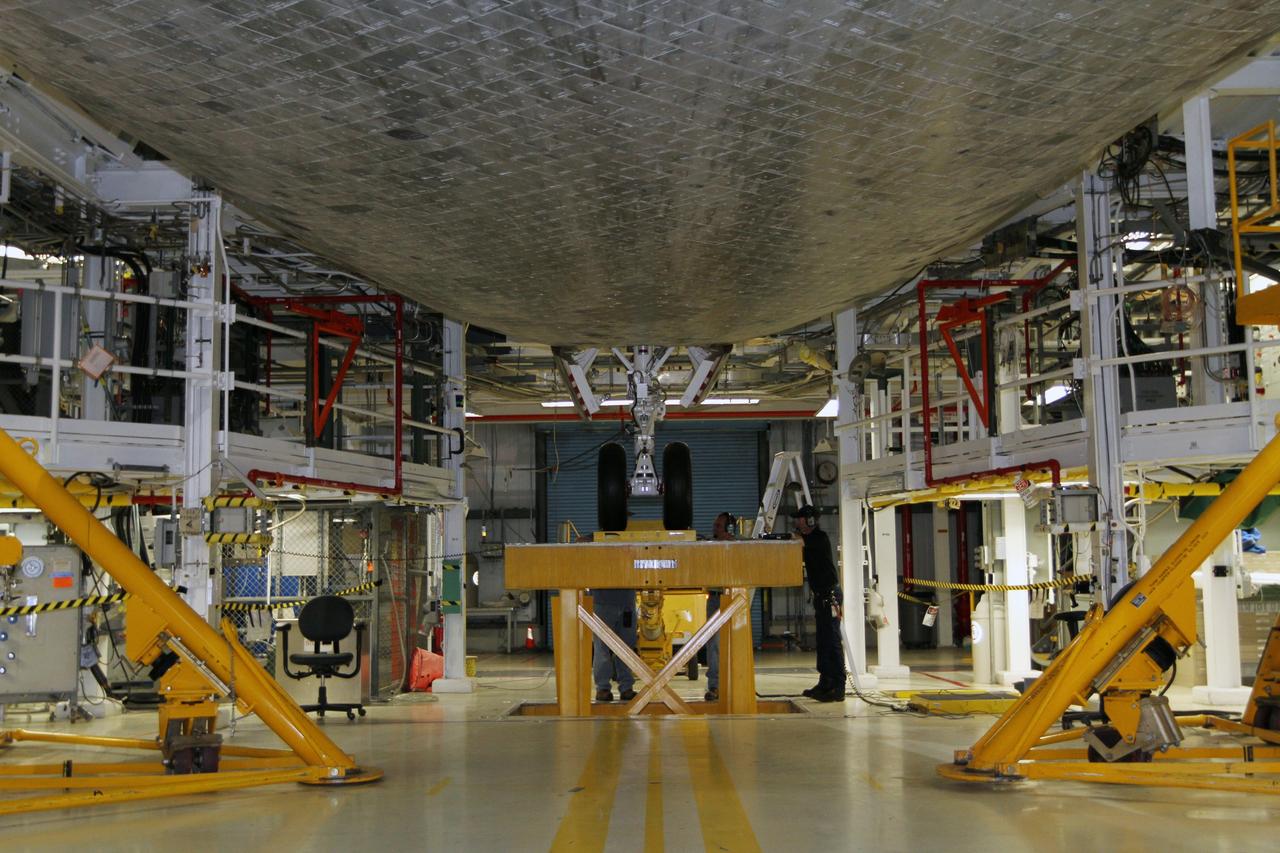
CAPE CANAVERAL, Fla. - Looking along the underbelly toward the nose landing gear of space shuttle Atlantis, technicians complete weight and center-of-gravity checks in Orbiter Processing Facility Bay 1 at NASA’s Kennedy Space Center in Florida. The work is part of the Space Shuttle Program’s transition and retirement processing of the shuttle fleet. A groundbreaking was held Jan. 18, 2012, for Atlantis' future home, a 65,000-square-foot exhibit hall in Shuttle Plaza at the Kennedy Space Center Visitor Complex. Atlantis is scheduled to roll over to the visitor complex during November in preparation for the exhibit's grand opening in July 2013. For more information, visit http://www.nasa.gov/transition. Photo credit: NASA/Kim Shiflett
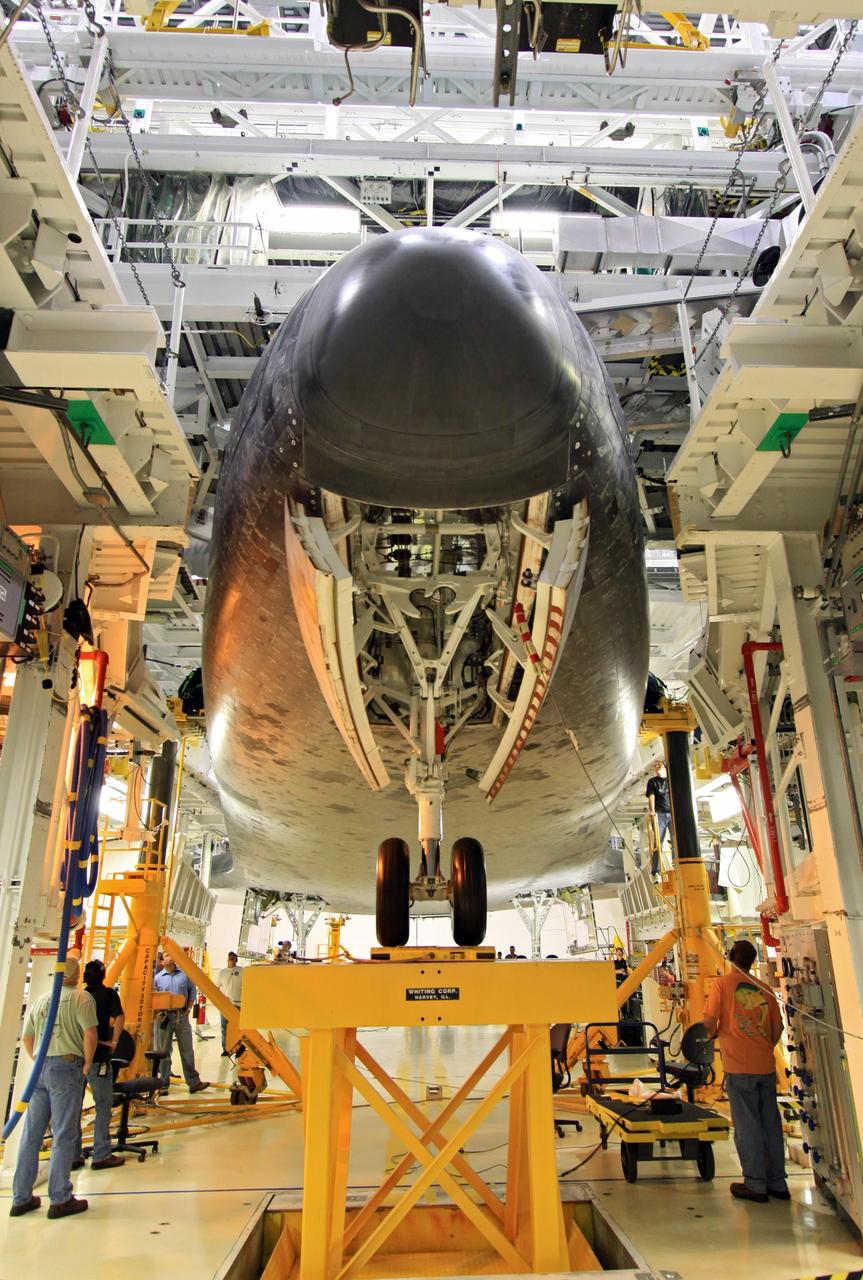
CAPE CANAVERAL, Fla. – Looking along the nose landing gear of the space shuttle Endeavour, United Space Alliance technicians complete weight and center of gravity checks in Bay 2 of the Orbiter Processing Facility at NASA’s Kennedy Space Center in Florida. The work is part of Transition and Retirement of the remaining space shuttles, Endeavour and Atlantis. Endeavour is being prepared for public display at the California Science Center in Los Angeles. Its ferry flight to California is targeted for mid-September. Endeavour was the last space shuttle added to NASA’s orbiter fleet. Over the course of its 19-year career, Endeavour spent 299 days in space during 25 missions. For more information, visit http://www.nasa.gov/transition Photo credit: NASA/ Jim Grossmann
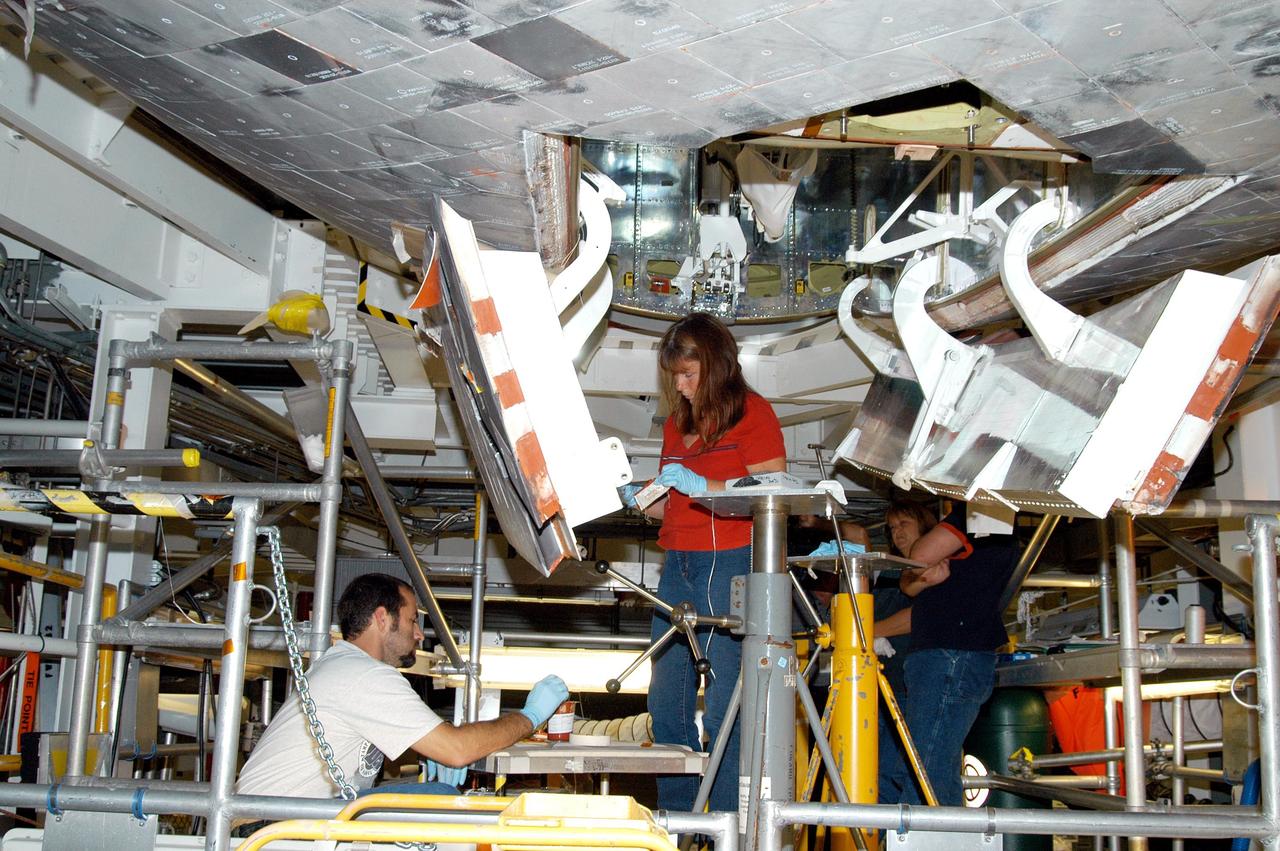
KENNEDY SPACE CENTER, FLA. - Workers in the Orbiter Processing Facility prepare to close the nose wheel doors on Atlantis in preparation for the expected impact of Hurricane Frances on Saturday. Preparations at KSC include powering down the Space Shuttle orbiters, closing their payload bay doors and stowing their landing gear. They are also taking precautions against flooding by moving spacecraft hardware off the ground and sandbagging facilities. The Orbiter Processing Facility is constructed of concrete and steel and was designed to withstand winds of 105 mph. The Vehicle Assembly Building is constructed of concrete and steel and was designed to withstand winds of 125 mph. Other payload and flight hardware support facilities can endure winds of 110 mph. Launch pads and the Payload Hazardous Servicing Facility can withstand 125-mph winds.
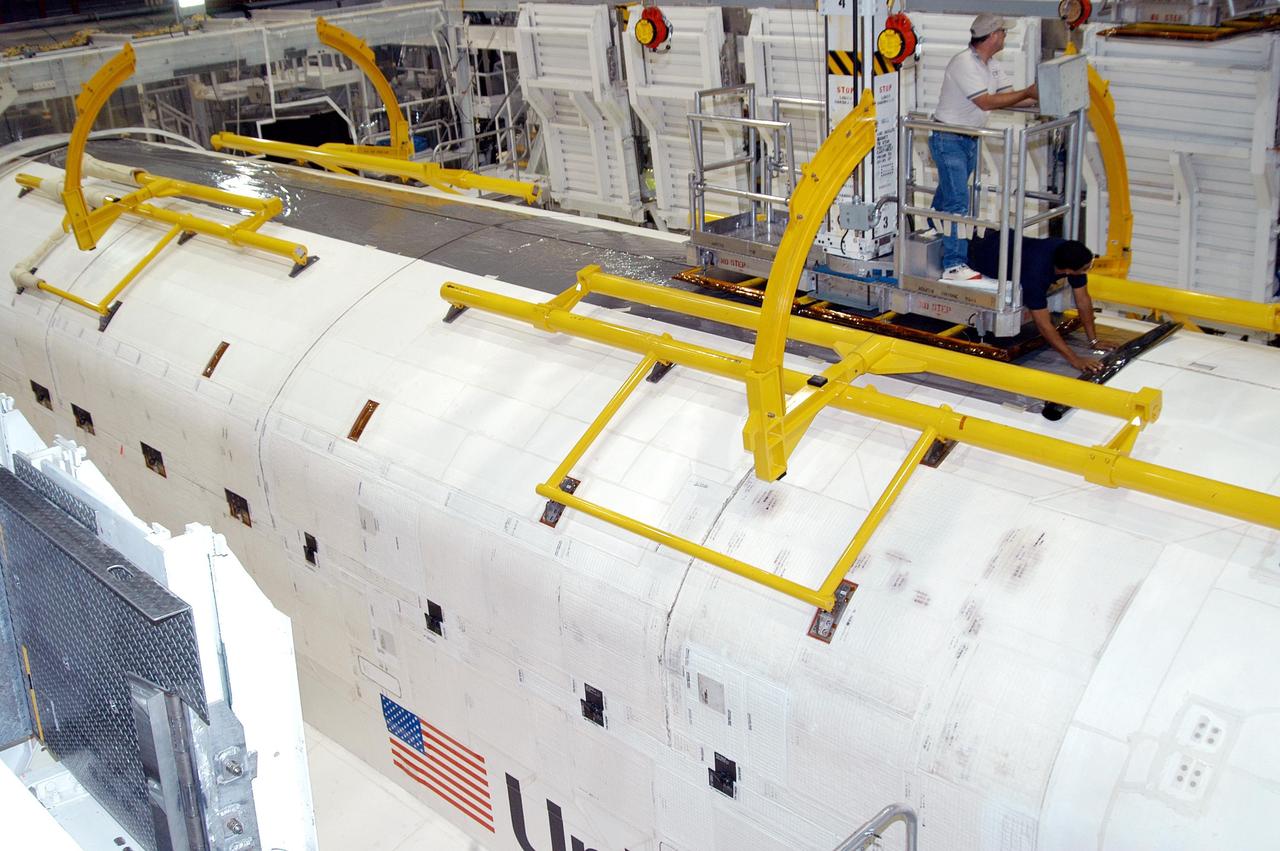
KENNEDY SPACE CENTER, FLA. - Workers in the Orbiter Processing Facility finish Hurricane preparations on the payload bay doors of Atlantis. Preparing for the expected impact of Hurricane Frances on Saturday, workers also powered down the Space Shuttle orbiters, and stowed the landing gear. They are also taking precautions against flooding by moving spacecraft hardware off the ground and sandbagging facilities. The Orbiter Processing Facility is constructed of concrete and steel and was designed to withstand winds of 105 mph. The Vehicle Assembly Building is constructed of concrete and steel and was designed to withstand winds of 125 mph. Other payload and flight hardware support facilities can endure winds of 110 mph. Launch pads and the Payload Hazardous Servicing Facility can withstand 125-mph winds.
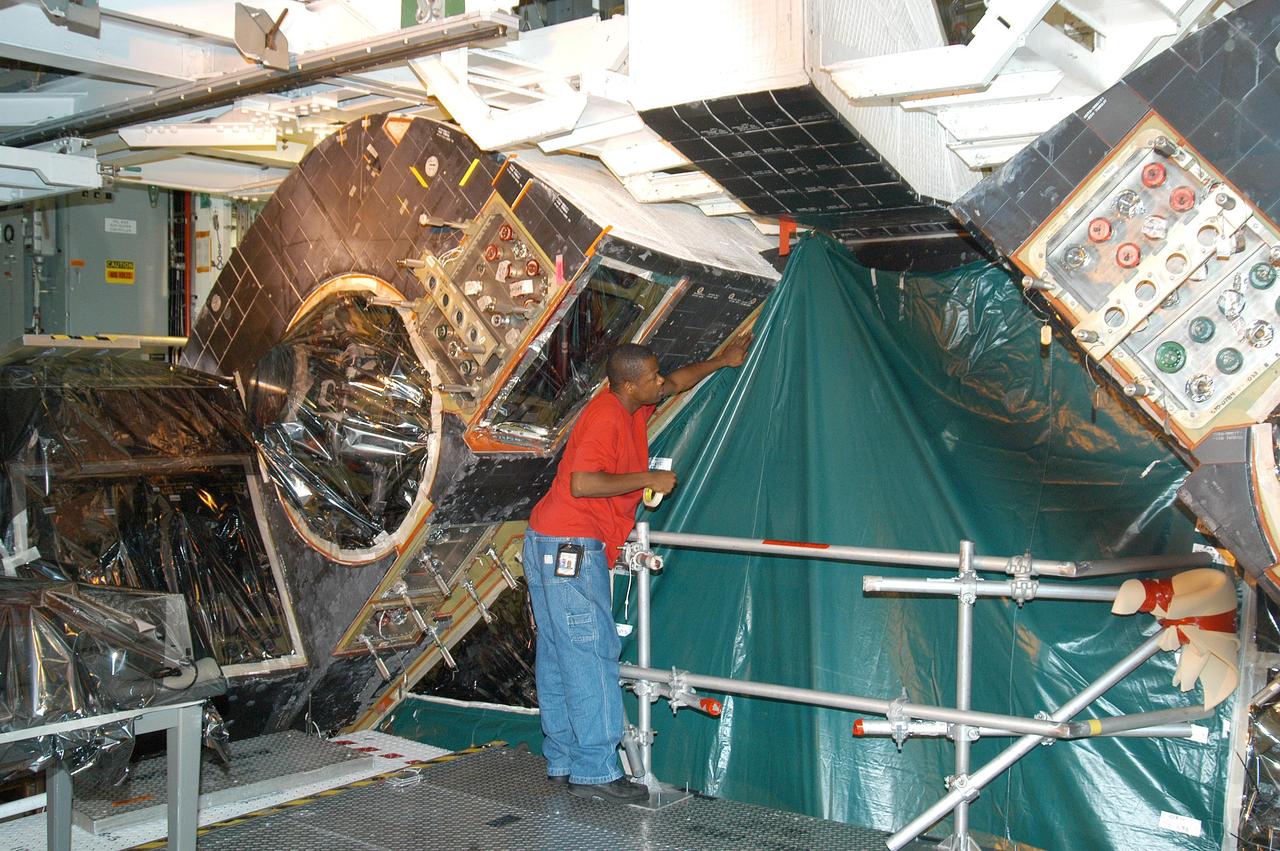
KENNEDY SPACE CENTER, FLA. - Workers in the Orbiter Processing Facility cover up areas of Atlantis with plastic, preparing for the expected impact of Hurricane Frances on Saturday. Other preparations at KSC include powering down the Space Shuttle orbiters, closing the payload bay doors and stowing the landing gear. Workers are also taking precautions against flooding by moving spacecraft hardware off the ground and sandbagging facilities. The Orbiter Processing Facility is constructed of concrete and steel and was designed to withstand winds of 105 mph. The Vehicle Assembly Building is constructed of concrete and steel and was designed to withstand winds of 125 mph. Other payload and flight hardware support facilities can endure winds of 110 mph. Launch pads and the Payload Hazardous Servicing Facility can withstand 125-mph winds.

KENNEDY SPACE CENTER, FLA. - Workers in the Orbiter Processing Facility cover up areas of Atlantis with plastic, preparing for the expected impact of Hurricane Frances on Saturday. Other preparations at KSC include powering down the Space Shuttle orbiters, closing the payload bay doors and stowing the landing gear. Workers are also taking precautions against flooding by moving spacecraft hardware off the ground and sandbagging facilities. The Orbiter Processing Facility is constructed of concrete and steel and was designed to withstand winds of 105 mph. The Vehicle Assembly Building is constructed of concrete and steel and was designed to withstand winds of 125 mph. Other payload and flight hardware support facilities can endure winds of 110 mph. Launch pads and the Payload Hazardous Servicing Facility can withstand 125-mph winds.
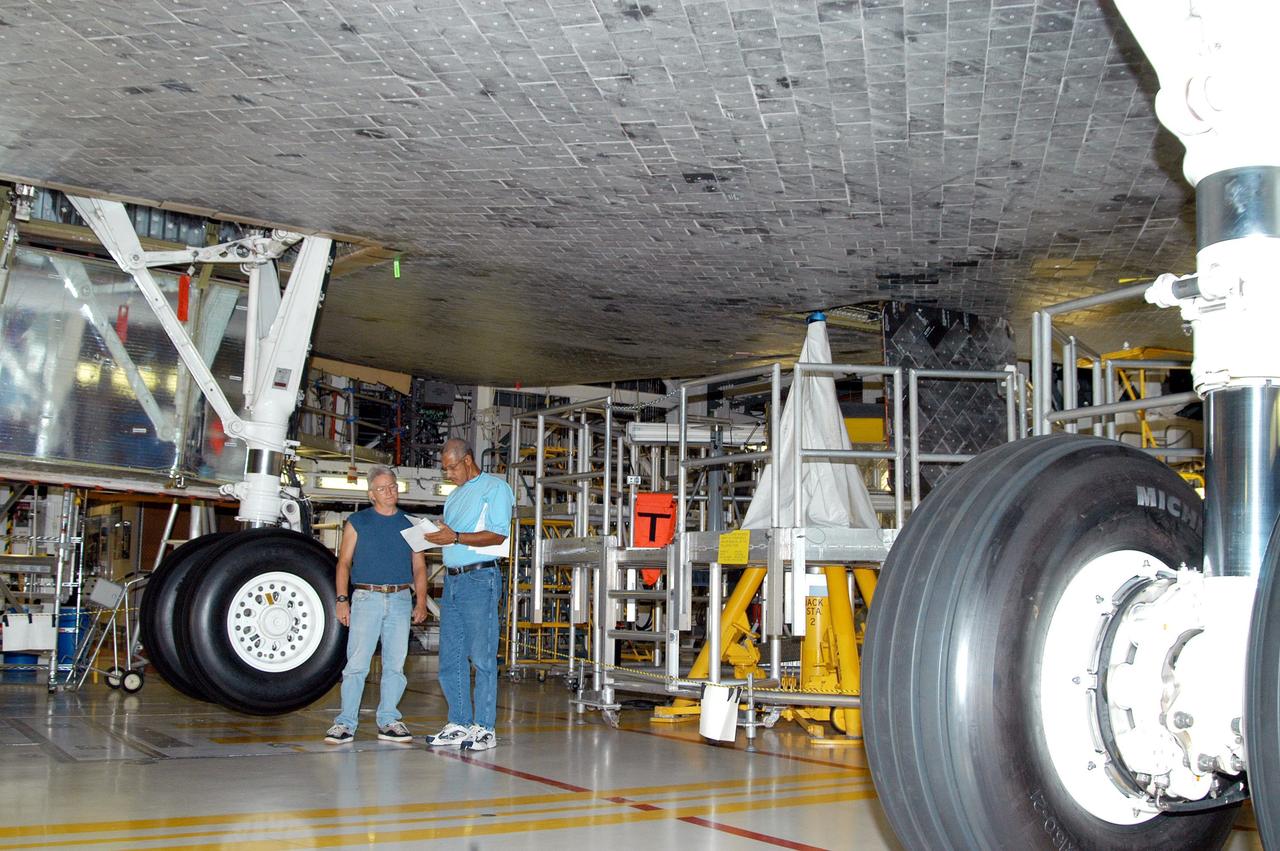
KENNEDY SPACE CENTER, FLA. - Workers in the Orbiter Processing Facility prepare to stow the landing gear on the orbiter Atlantis in preparation for the expected impact of Hurricane Frances on Saturday. Other preparations at KSC include powering down the Space Shuttle orbiters, and closing their payload bay doors. Workers are also taking precautions against flooding by moving spacecraft hardware off the ground and sandbagging facilities. The Orbiter Processing Facility is constructed of concrete and steel and was designed to withstand winds of 105 mph. The Vehicle Assembly Building is constructed of concrete and steel and was designed to withstand winds of 125 mph. Other payload and flight hardware support facilities can endure winds of 110 mph. Launch pads and the Payload Hazardous Servicing Facility can withstand 125-mph winds.
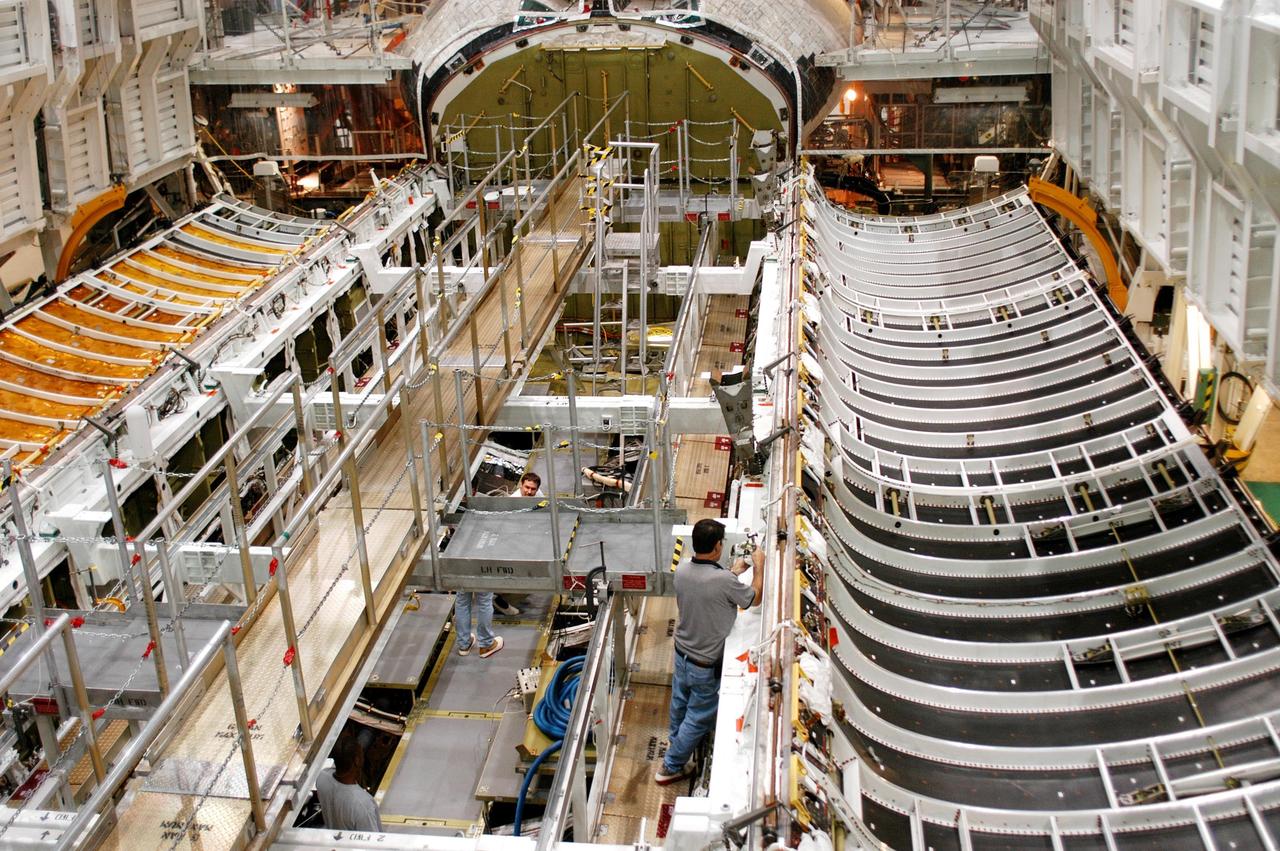
KENNEDY SPACE CENTER, FLA. - In the Orbiter Processing Facility, workers prepare to close the payload bay doors on Atlantis in preparation for the expected impact of Hurricane Frances on Saturday. Other preparations at KSC include powering down the Space Shuttle orbiters and stowing the landing gear. Workers are also taking precautions against flooding by moving spacecraft hardware off the ground and sandbagging facilities. The Orbiter Processing Facility is constructed of concrete and steel and was designed to withstand winds of 105 mph. The Vehicle Assembly Building is constructed of concrete and steel and was designed to withstand winds of 125 mph. Other payload and flight hardware support facilities can endure winds of 110 mph. Launch pads and the Payload Hazardous Servicing Facility can withstand 125-mph winds.
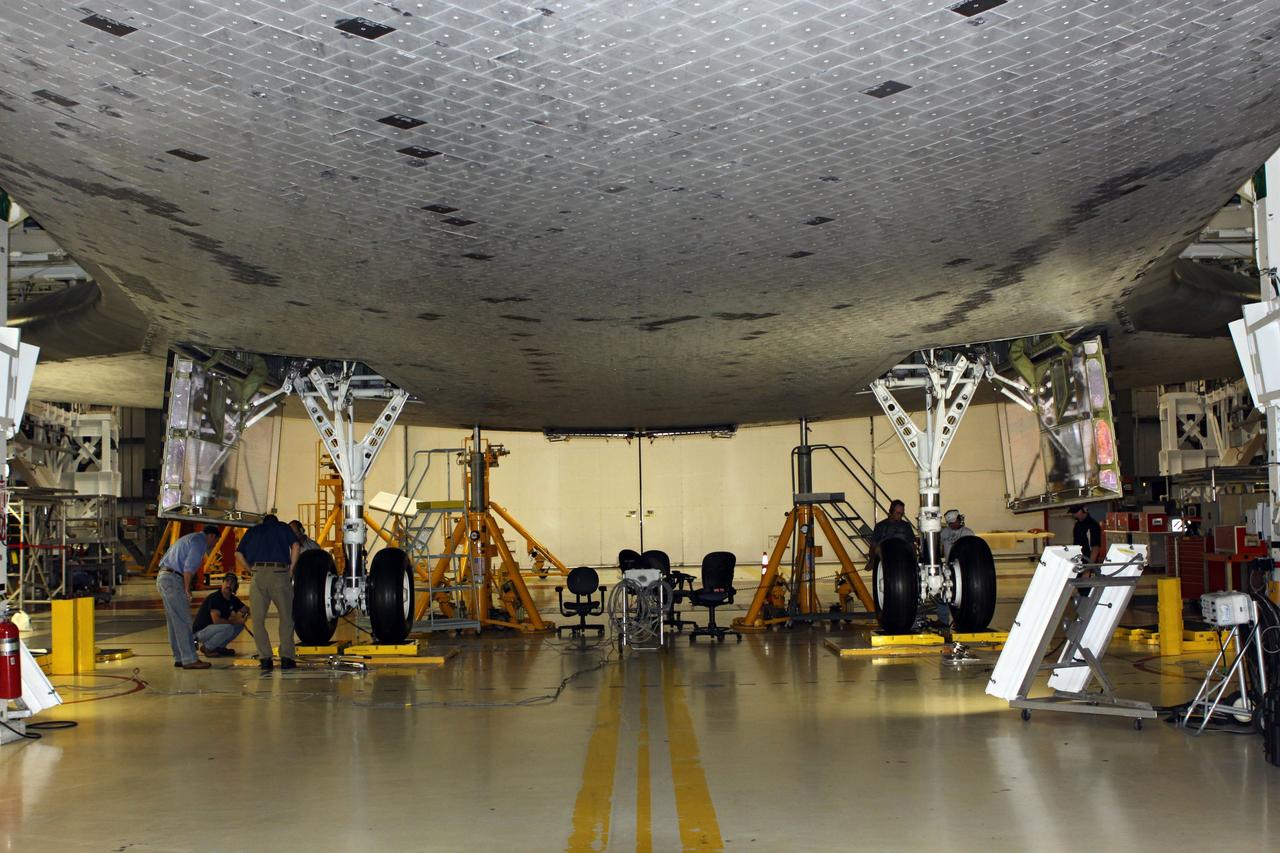
CAPE CANAVERAL, Fla. – Looking along the under belly of the space shuttle Endeavour toward its main landing gear, United Space Alliance technicians complete weight and center of gravity checks in Bay 2 of the Orbiter Processing Facility at NASA’s Kennedy Space Center in Florida. The work is part of Transition and Retirement of the remaining space shuttles, Endeavour and Atlantis. Endeavour is being prepared for public display at the California Science Center in Los Angeles. Its ferry flight to California is targeted for mid-September. Endeavour was the last space shuttle added to NASA’s orbiter fleet. Over the course of its 19-year career, Endeavour spent 299 days in space during 25 missions. For more information, visit http://www.nasa.gov/transition Photo credit: NASA/ Jim Grossmann
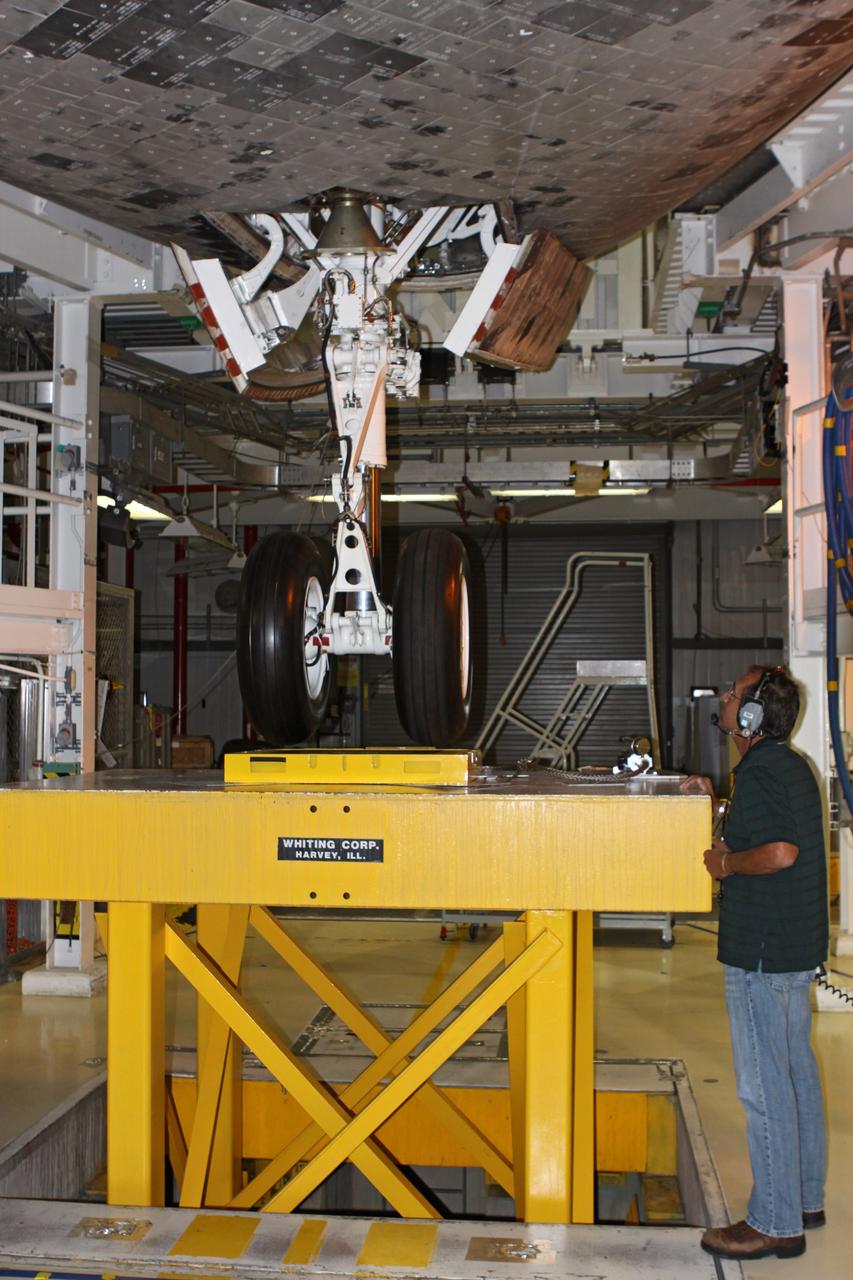
CAPE CANAVERAL, Fla. – In Orbiter Processing Facility Bay 2 at NASA’s Kennedy Space Center in Florida, a United Space Alliance technician monitors the nose landing gear during weight and center of gravity checks on the space shuttle Endeavour. The work is part of Transition and Retirement of the remaining space shuttles, Endeavour and Atlantis. Endeavour is being prepared for public display at the California Science Center in Los Angeles. Its ferry flight to California is targeted for mid-September. Endeavour was the last space shuttle added to NASA’s orbiter fleet. Over the course of its 19-year career, Endeavour spent 299 days in space during 25 missions. For more information, visit http://www.nasa.gov/transition Photo credit: NASA/ Jim Grossmann
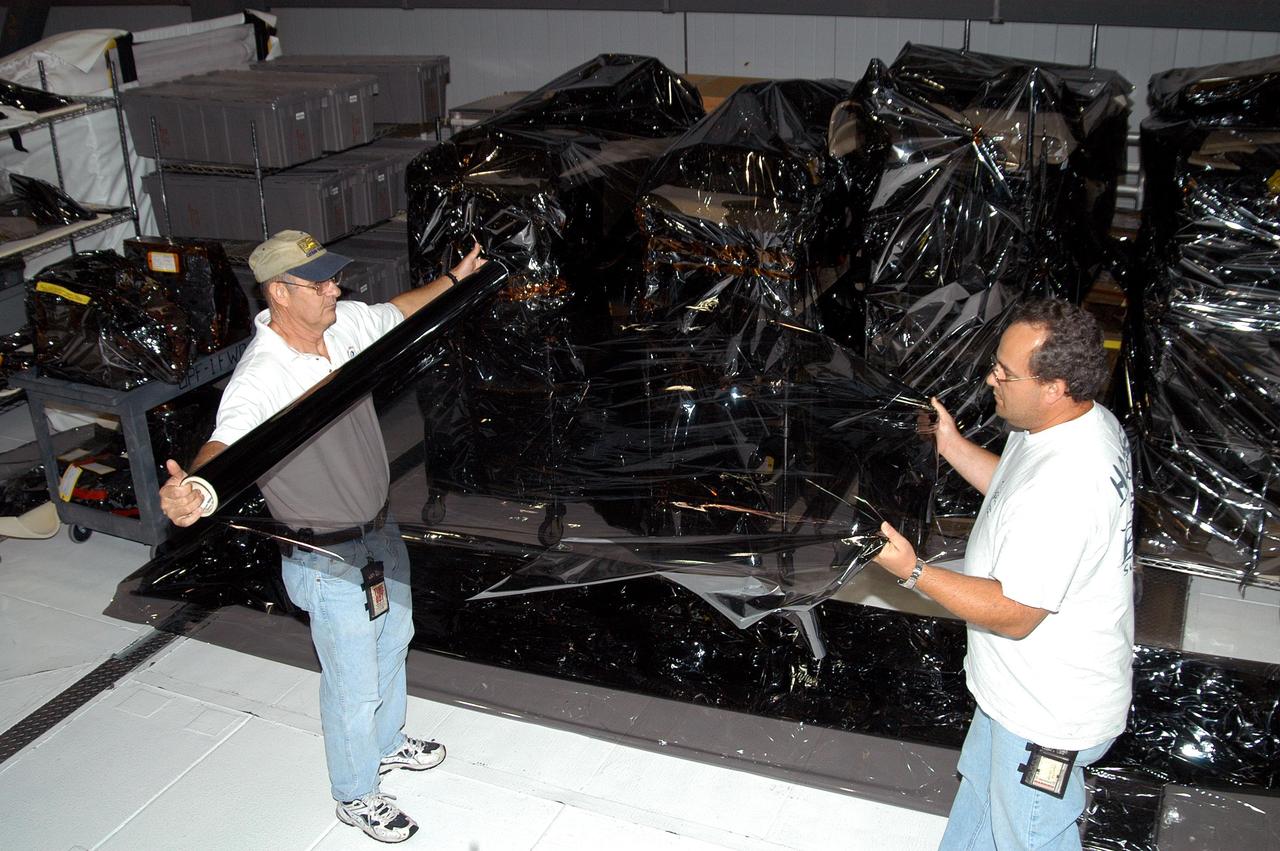
KENNEDY SPACE CENTER, FLA. - Workers in the Orbiter Processing Facility unwrap plastic for use in covering equipment as part of preparations for the expected impact of Hurricane Frances on Saturday. Other preparations at KSC include powering down the Space Shuttle orbiters, closing the payload bay doors and stowing the landing gear. Workers are also taking precautions against flooding by moving spacecraft hardware off the ground and sandbagging facilities. The Orbiter Processing Facility is constructed of concrete and steel and was designed to withstand winds of 105 mph. The Vehicle Assembly Building is constructed of concrete and steel and was designed to withstand winds of 125 mph. Other payload and flight hardware support facilities can endure winds of 110 mph. Launch pads and the Payload Hazardous Servicing Facility can withstand 125-mph winds.
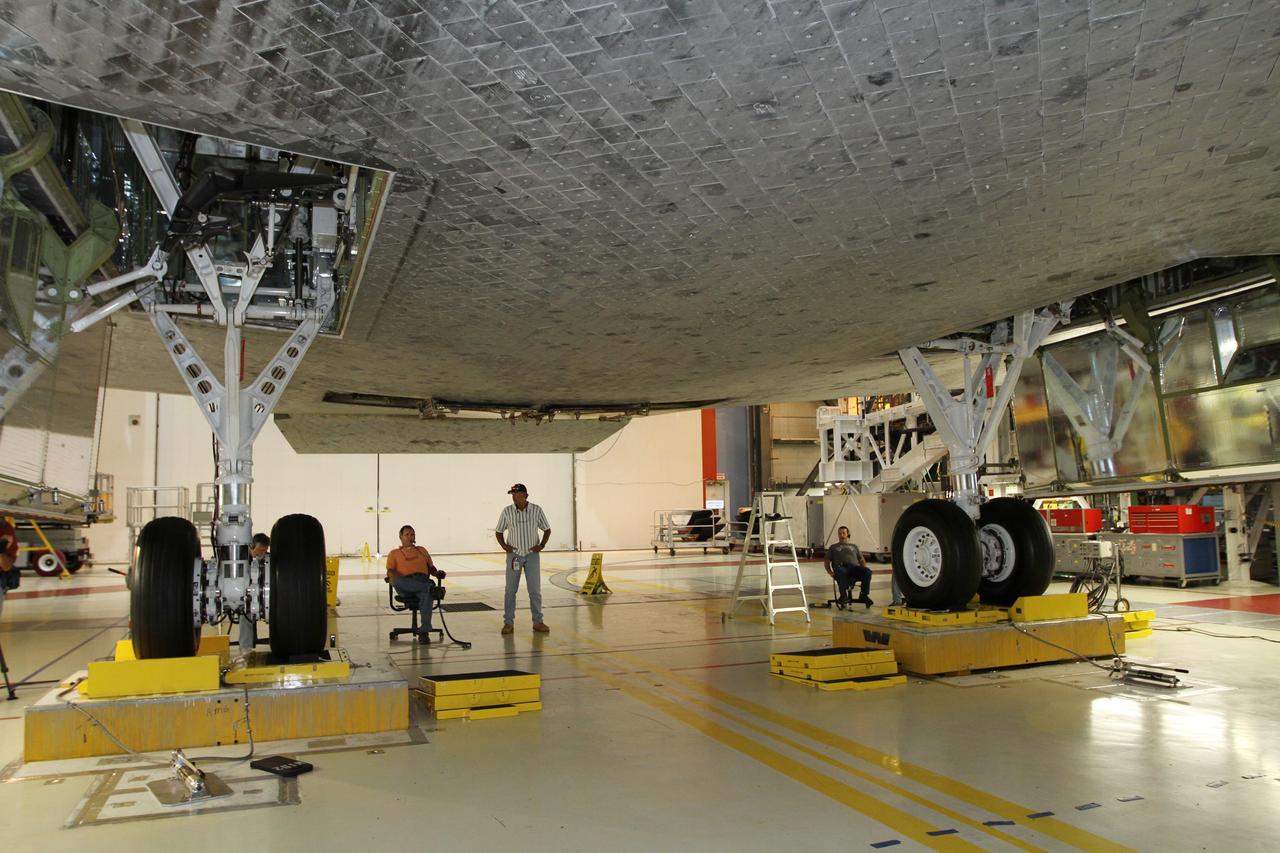
CAPE CANAVERAL, Fla. - Looking along the underbelly toward the main landing gear of the space shuttle Atlantis, technicians monitor weight and center-of-gravity checks in Orbiter Processing Facility Bay 1 at NASA’s Kennedy Space Center in Florida. The work is part of the Space Shuttle Program’s transition and retirement processing of the shuttle fleet. A groundbreaking was held Jan. 18, 2012, for Atlantis' future home, a 65,000-square-foot exhibit hall in Shuttle Plaza at the Kennedy Space Center Visitor Complex. Atlantis is scheduled to roll over to the visitor complex during November in preparation for the exhibit's grand opening in July 2013. For more information, visit http://www.nasa.gov/transition. Photo credit: NASA/Kim Shiflett
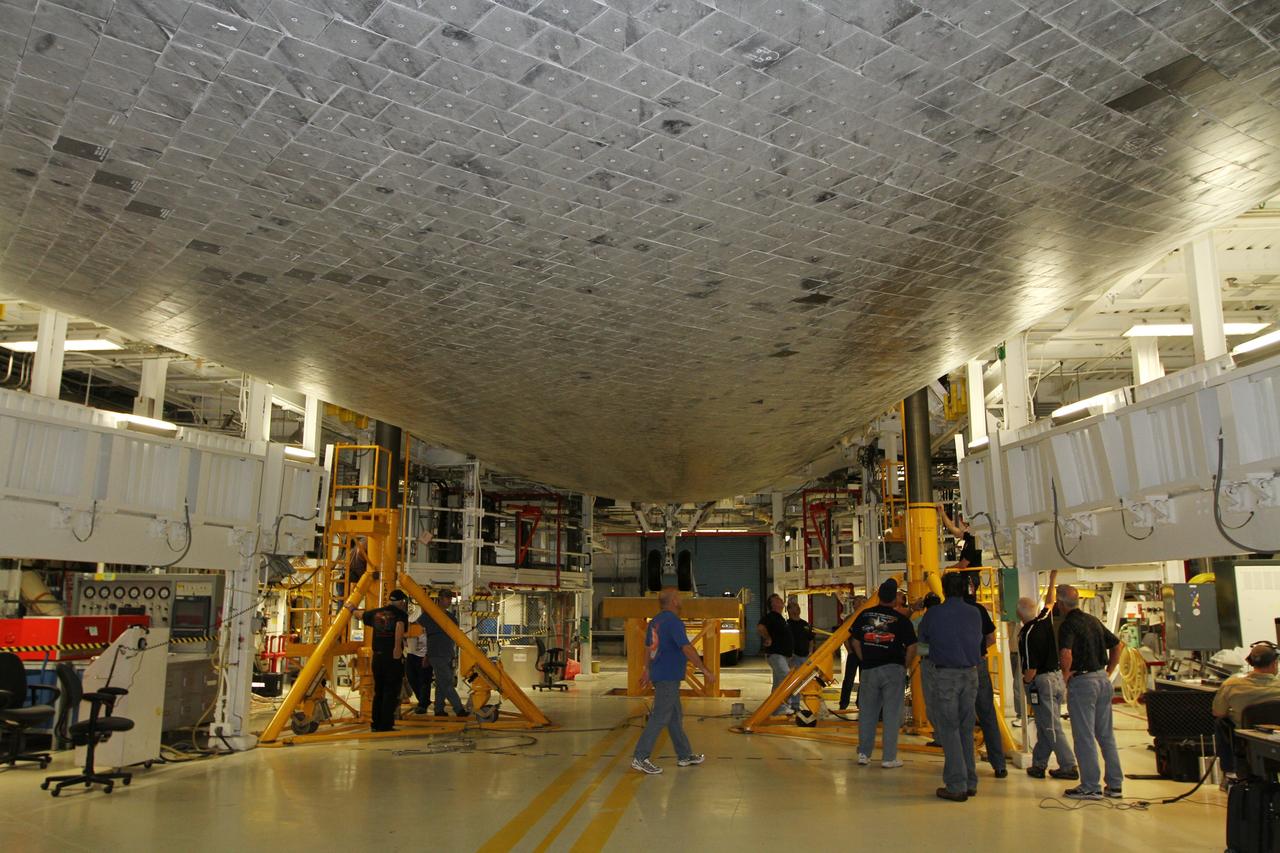
CAPE CANAVERAL, Fla. - Looking along the underbelly toward the nose landing gear of space shuttle Atlantis, technicians complete weight and center-of-gravity checks in Orbiter Processing Facility Bay 1 at NASA’s Kennedy Space Center in Florida. The work is part of the Space Shuttle Program’s transition and retirement processing of the shuttle fleet. A groundbreaking was held Jan. 18, 2012, for Atlantis' future home, a 65,000-square-foot exhibit hall in Shuttle Plaza at the Kennedy Space Center Visitor Complex. Atlantis is scheduled to roll over to the visitor complex during November in preparation for the exhibit's grand opening in July 2013. For more information, visit http://www.nasa.gov/transition. Photo credit: NASA/Kim Shiflett
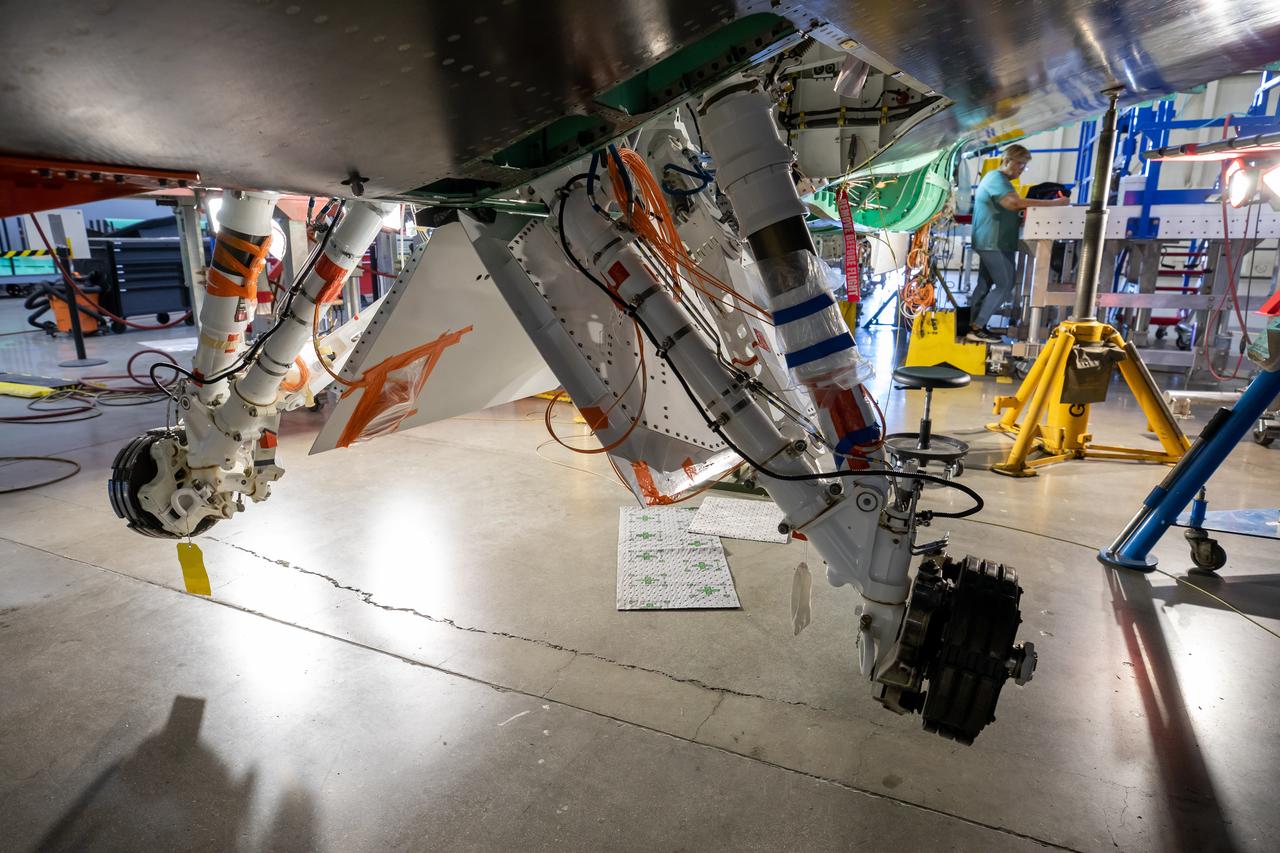
The Quesst team has repurposed the landing gear from an F-16 Fighting Falcon aircraft and is working on adjusting the fit onto the X-59 airplane. This is part of NASA’s Quesst mission which plans to help enable commercial supersonic air travel over land.
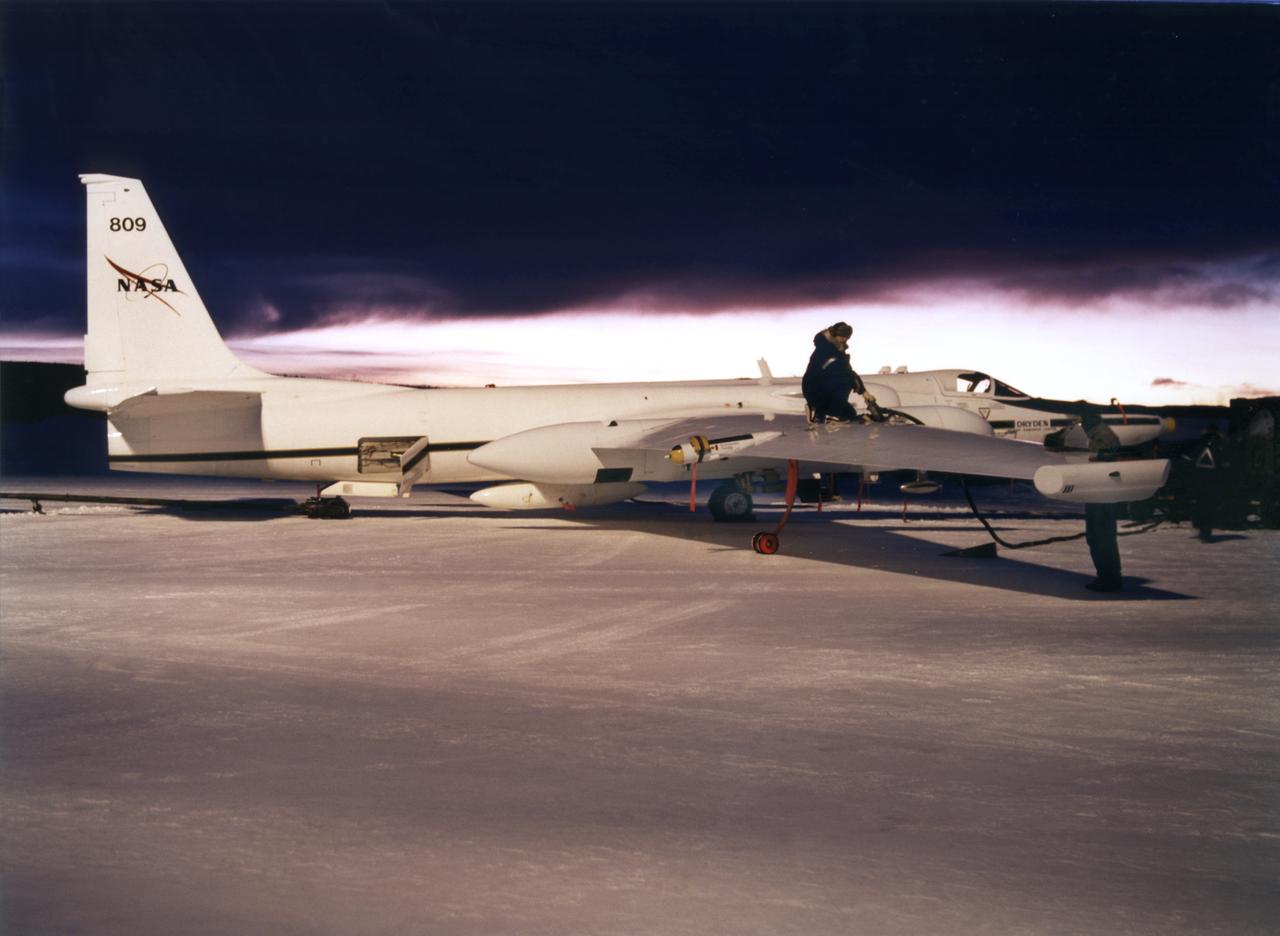
ER-2s bearing tail numbers 806 and 809 are used as airborne science platforms by NASA's Dryden Flight Research Center. The aircraft are platforms for a variety of high-altitude science missions flown over various parts of the world. They are also used for earth science and atmospheric sensor research and development, satellite calibration and data validation. The ER-2s are capable of carrying a maximum payload of 2,600 pounds of experiments in a nose bay, the main equipment bay behind the cockpit, two wing-mounted superpods and small underbody and trailing edges. Most ER-2 missions last about six hours with ranges of about 2,200 nautical miles. The aircraft typically fly at altitudes above 65,000 feet. On November 19, 1998, an ER-2 set a world record for medium weight aircraft reaching an altitude of 68,700 feet. The aircraft is 63 feet long, with a wingspan of 104 feet. The top of the vertical tail is 16 feet above ground when the aircraft is on the bicycle-type landing gear. Cruising speeds are 410 knots, or 467 miles per hour, at altitude. A single General Electric F-118 turbofan engine rated at 17,000 pounds thrust powers the ER-2.

ER-2 tail number 809, is one of two Airborne Science ER-2s used as science platforms by Dryden. The aircraft are platforms for a variety of high-altitude science missions flown over various parts of the world. They are also used for earth science and atmospheric sensor research and development, satellite calibration and data validation. The ER-2s are capable of carrying a maximum payload of 2,600 pounds of experiments in a nose bay, the main equipment bay behind the cockpit, two wing-mounted superpods and small underbody and trailing edges. Most ER-2 missions last about six hours with ranges of about 2,200 nautical miles. The aircraft typically fly at altitudes above 65,000 feet. On November 19, 1998, the ER-2 set a world record for medium weight aircraft reaching an altitude of 68,700 feet. The aircraft is 63 feet long, with a wingspan of 104 feet. The top of the vertical tail is 16 feet above ground when the aircraft is on the bicycle-type landing gear. Cruising speeds are 410 knots, or 467 miles per hour, at altitude. A single General Electric F118 turbofan engine rated at 17,000 pounds thrust powers the ER-2.

ER-2 tail number 806, is one of two Airborne Science ER-2s used as science platforms by Dryden. The aircraft are platforms for a variety of high-altitude science missions flown over various parts of the world. They are also used for earth science and atmospheric sensor research and development, satellite calibration and data validation. The ER-2s are capable of carrying a maximum payload of 2,600 pounds of experiments in a nose bay, the main equipment bay behind the cockpit, two wing-mounted superpods and small underbody and trailing edges. Most ER-2 missions last about six hours with ranges of about 2,200 nautical miles. The aircraft typically fly at altitudes above 65,000 feet. On November 19, 1998, the ER-2 set a world record for medium weight aircraft reaching an altitude of 68,700 feet. The aircraft is 63 feet long, with a wingspan of 104 feet. The top of the vertical tail is 16 feet above ground when the aircraft is on the bicycle-type landing gear. Cruising speeds are 410 knots, or 467 miles per hour, at altitude. A single General Electric F-118 turbofan engine rated at 17,000 pounds thrust powers the ER-2.

ER-2 tail number 806, is one of two Airborne Science ER-2s used as science platforms by Dryden. The aircraft are platforms for a variety of high-altitude science missions flown over various parts of the world. They are also used for earth science and atmospheric sensor research and development, satellite calibration and data validation. The ER-2s are capable of carrying a maximum payload of 2,600 pounds of experiments in a nose bay, the main equipment bay behind the cockpit, two wing-mounted superpods and small underbody and trailing edges. Most ER-2 missions last about six hours with ranges of about 2,200 nautical miles. The aircraft typically fly at altitudes above 65,000 feet. On November 19, 1998, the ER-2 set a world record for medium weight aircraft reaching an altitude of 68,700 feet. The aircraft is 63 feet long, with a wingspan of 104 feet. The top of the vertical tail is 16 feet above ground when the aircraft is on the bicycle-type landing gear. Cruising speeds are 410 knots, or 467 miles per hour, at altitude. A single General Electric F-118 turbofan engine rated at 17,000 pounds thrust powers the ER-2.
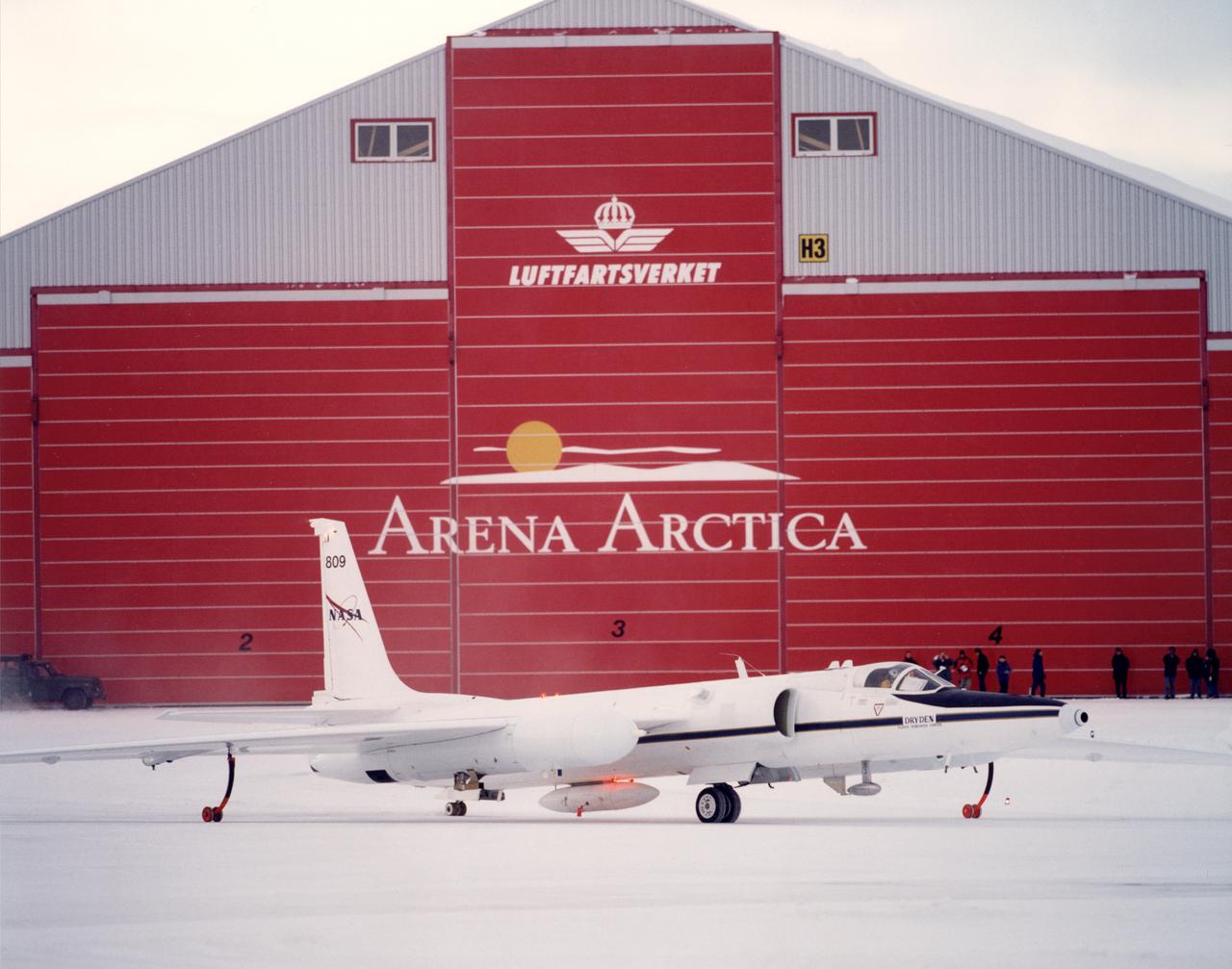
ER-2s bearing tail numbers 806 and 809 are used as airborne science platforms by NASA's Dryden Flight Research Center. The aircraft are platforms for a variety of high-altitude science missions flown over various parts of the world. They are also used for earth science and atmospheric sensor research and development, satellite calibration and data validation. The ER-2s are capable of carrying a maximum payload of 2,600 pounds of experiments in a nose bay, the main equipment bay behind the cockpit, two wing-mounted superpods and small underbody and trailing edges. Most ER-2 missions last about six hours with ranges of about 2,200 nautical miles. The aircraft typically fly at altitudes above 65,000 feet. On November 19, 1998, an ER-2 set a world record for medium weight aircraft reaching an altitude of 68,700 feet. The aircraft is 63 feet long, with a wingspan of 104 feet. The top of the vertical tail is 16 feet above ground when the aircraft is on the bicycle-type landing gear. Cruising speeds are 410 knots, or 467 miles per hour, at altitude. A single General Electric F-118 turbofan engine rated at 17,000 pounds thrust powers the ER-2.

ER-2s bearing tail numbers 806 and 809 are used as airborne science platforms by NASA's Dryden Flight Research Center. The aircraft are platforms for a variety of high-altitude science missions flown over various parts of the world. They are also used for earth science and atmospheric sensor research and development, satellite calibration and data validation. The ER-2s are capable of carrying a maximum payload of 2,600 pounds of experiments in a nose bay, the main equipment bay behind the cockpit, two wing-mounted superpods and small underbody and trailing edges. Most ER-2 missions last about six hours with ranges of about 2,200 nautical miles. The aircraft typically fly at altitudes above 65,000 feet. On November 19, 1998, an ER-2 set a world record for medium weight aircraft reaching an altitude of 68,700 feet. The aircraft is 63 feet long, with a wingspan of 104 feet. The top of the vertical tail is 16 feet above ground when the aircraft is on the bicycle-type landing gear. Cruising speeds are 410 knots, or 467 miles per hour, at altitude. A single General Electric F-118 turbofan engine rated at 17,000 pounds thrust powers the ER-2.
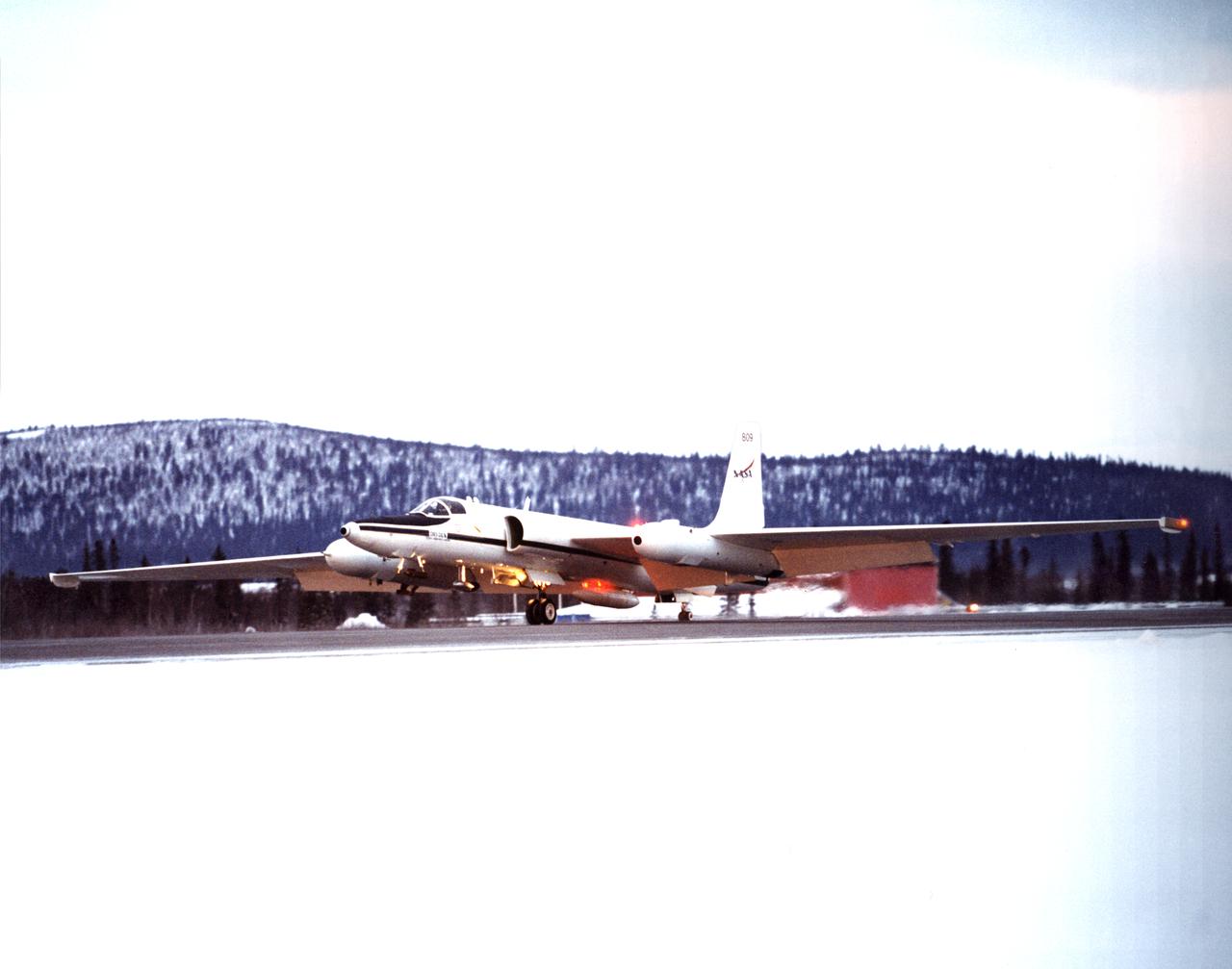
ER-2s bearing tail numbers 806 and 809 are used as airborne science platforms by NASA's Dryden Flight Research Center. The aircraft are platforms for a variety of high-altitude science missions flown over various parts of the world. They are also used for earth science and atmospheric sensor research and development, satellite calibration and data validation. The ER-2s are capable of carrying a maximum payload of 2,600 pounds of experiments in a nose bay, the main equipment bay behind the cockpit, two wing-mounted superpods and small underbody and trailing edges. Most ER-2 missions last about six hours with ranges of about 2,200 nautical miles. The aircraft typically fly at altitudes above 65,000 feet. On November 19, 1998, an ER-2 set a world record for medium weight aircraft reaching an altitude of 68,700 feet. The aircraft is 63 feet long, with a wingspan of 104 feet. The top of the vertical tail is 16 feet above ground when the aircraft is on the bicycle-type landing gear. Cruising speeds are 410 knots, or 467 miles per hour, at altitude. A single General Electric F-118 turbofan engine rated at 17,000 pounds thrust powers the ER-2.
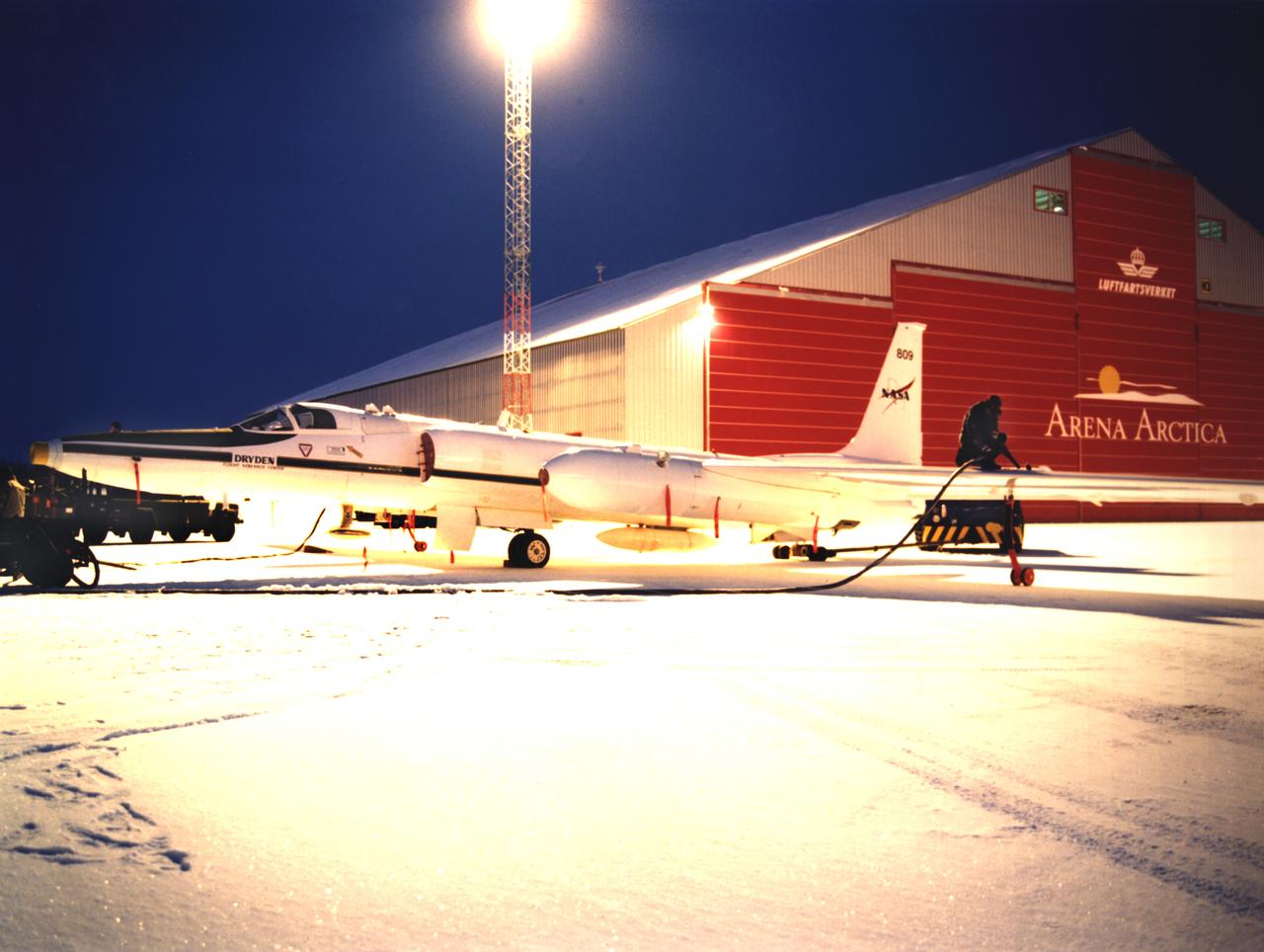
ER-2s bearing tail numbers 806 and 809 are used as airborne science platforms by NASA's Dryden Flight Research Center. The aircraft are platforms for a variety of high-altitude science missions flown over various parts of the world. They are also used for earth science and atmospheric sensor research and development, satellite calibration and data validation. The ER-2s are capable of carrying a maximum payload of 2,600 pounds of experiments in a nose bay, the main equipment bay behind the cockpit, two wing-mounted superpods and small underbody and trailing edges. Most ER-2 missions last about six hours with ranges of about 2,200 nautical miles. The aircraft typically fly at altitudes above 65,000 feet. On November 19, 1998, an ER-2 set a world record for medium weight aircraft reaching an altitude of 68,700 feet. The aircraft is 63 feet long, with a wingspan of 104 feet. The top of the vertical tail is 16 feet above ground when the aircraft is on the bicycle-type landing gear. Cruising speeds are 410 knots, or 467 miles per hour, at altitude. A single General Electric F-118 turbofan engine rated at 17,000 pounds thrust powers the ER-2.
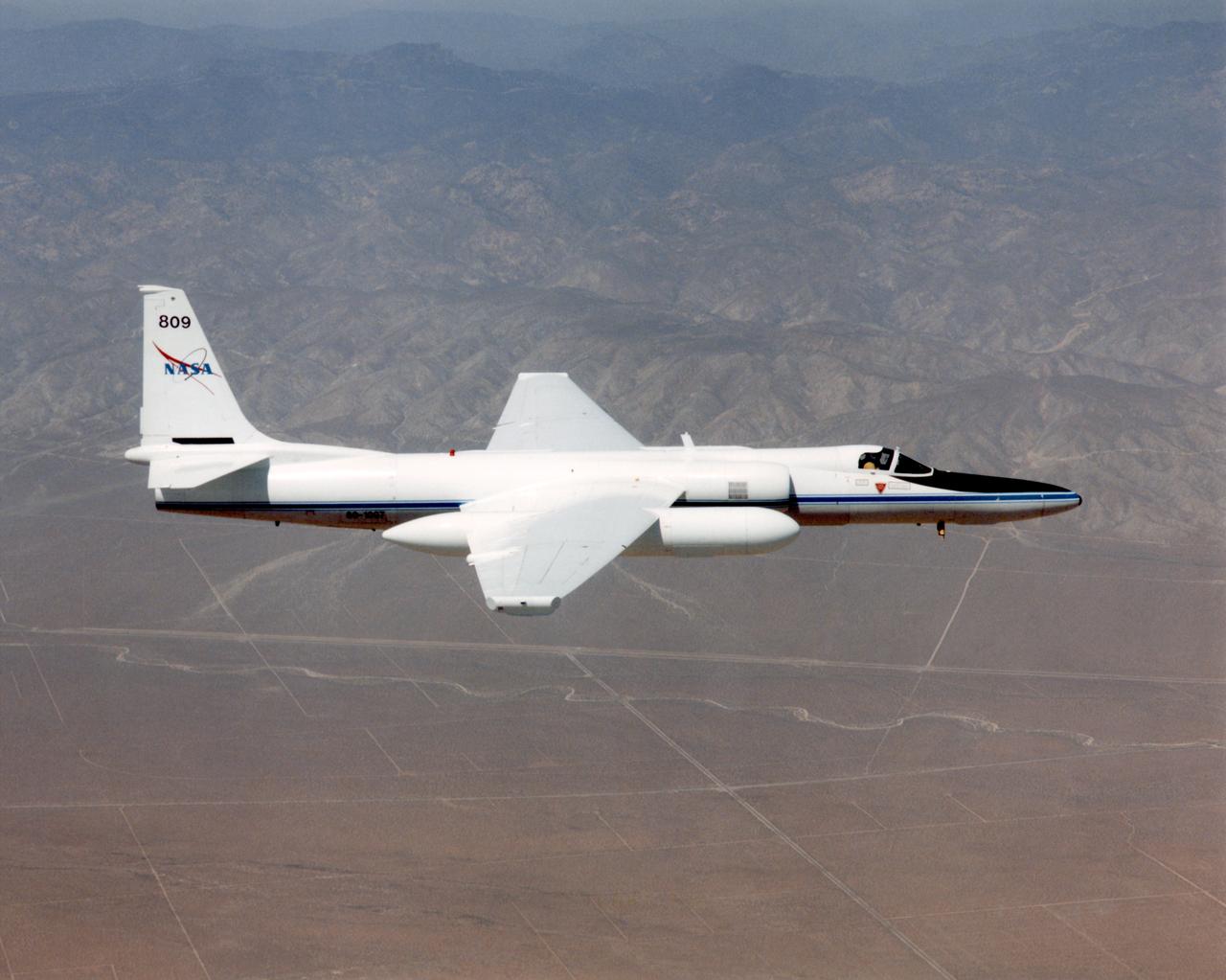
ER-2C tail number 809, was one of two Airborne Science ER-2Cs used as science platforms by Dryden. The aircraft were platforms for a variety of high-altitude science missions flown over various parts of the world. They were also used for earth science and atmospheric sensor research and development, satellite calibration and data validation. The ER-2Cs were capable of carrying a maximum payload of 2,600 pounds of experiments in a nose bay, the main equipment bay behind the cockpit, two wing-mounted superpods and small underbody and trailing edges. Most ER-2C missions lasted about six hours with ranges of about 2,200 nautical miles. The aircraft typically flew at altitudes above 65,000 feet. On November 19, 1998, the ER-2C set a world record for medium weight aircraft reaching an altitude of 68,700 feet. The aircraft was 63 feet long, with a wingspan of 104 feet. The top of the vertical tail was 16 feet above ground when the aircraft was on the bicycle-type landing gear. Cruising speeds were 410 knots, or 467 miles per hour, at altitude. A single General Electric F-118 turbofan engine rated at 17,000 pounds thrust powers the ER-2C.

ER-2 tail number 806, is one of two Airborne Science ER-2s used as science platforms by Dryden. The aircraft are platforms for a variety of high-altitude science missions flown over various parts of the world. They are also used for earth science and atmospheric sensor research and development, satellite calibration and data validation. The ER-2s are capable of carrying a maximum payload of 2,600 pounds of experiments in a nose bay, the main equipment bay behind the cockpit, two wing-mounted superpods and small underbody and trailing edges. Most ER-2 missions last about six hours with ranges of about 2,200 nautical miles. The aircraft typically fly at altitudes above 65,000 feet. On November 19, 1998, the ER-2 set a world record for medium weight aircraft reaching an altitude of 68,700 feet. The aircraft is 63 feet long, with a wingspan of 104 feet. The top of the vertical tail is 16 feet above ground when the aircraft is on the bicycle-type landing gear. Cruising speeds are 410 knots, or 467 miles per hour, at altitude. A single General Electric F-118 turbofan engine rated at 17,000 pounds thrust powers the ER-2.
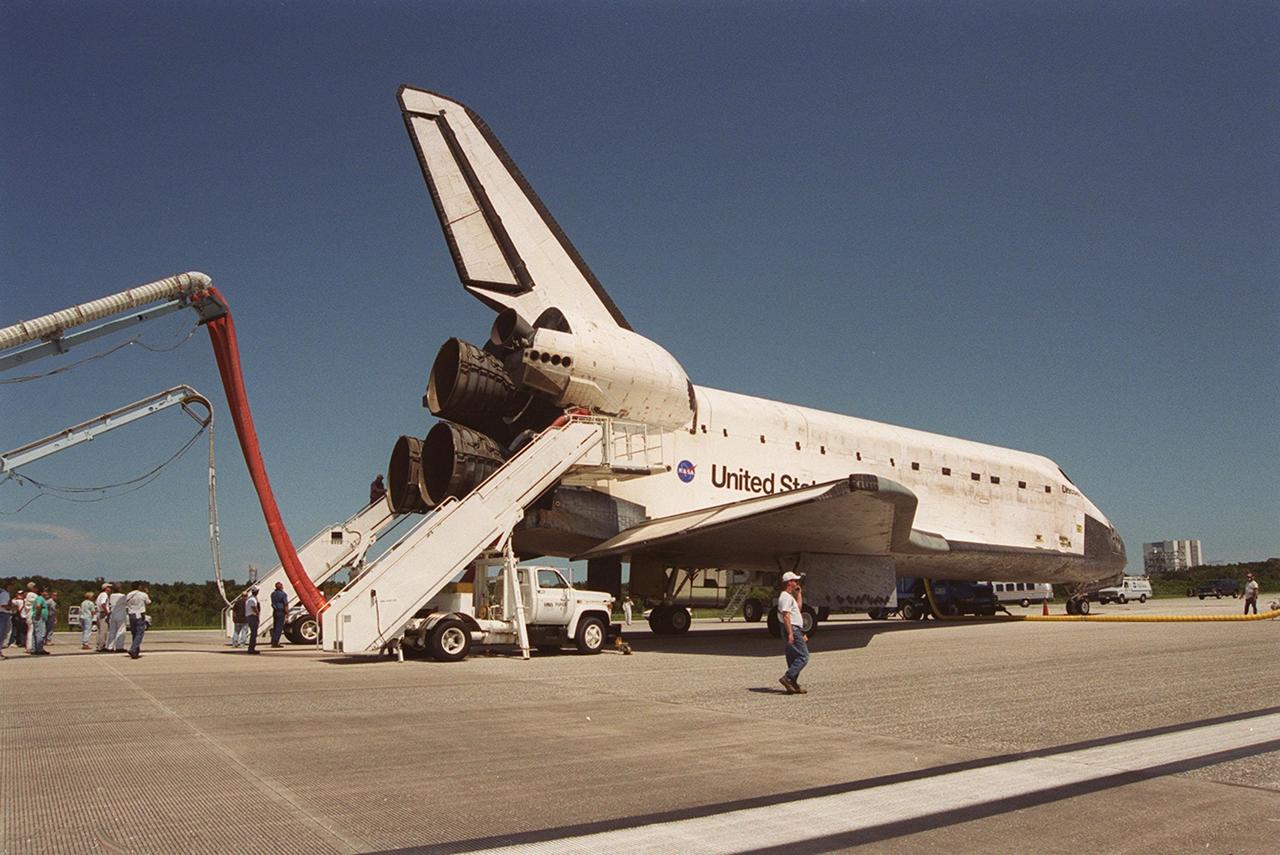
KENNEDY SPACE CENTER, Fla. -- On KSC’s Shuttle Landing Facility runway 15 following mission STS-105, orbiter Discovery undergoes safing operations such as being checked for toxic or hazardous gases, and having purge air introduced to cool the vehicle and humidified air conditioning to the payload bay and other cavities to remove any residual explosive or toxic fumes that may be present. The operations include preparing the orbiter for ground tow operations, installing switch guards and removing data packages from any onboard experiments. Main gear touchdown was at 2:22:58 p.m. EDT; wheel stop, at 2:24:06 p.m. EDT. The 11-day, 21-hour, 12-minute mission accomplished the goals set for the 11th flight to the International Space Station: swapout of the resident Station crew; delivery of equipment, supplies and scientific experiments; and installation of the Early Ammonia Servicer and heater cables for the S0 truss on the Station. Discovery traveled 4.3 million miles on its 30th flight into space, the 106th mission of the Space Shuttle program. Out of five missions in 2001, the landing was the first to occur in daylight at KSC
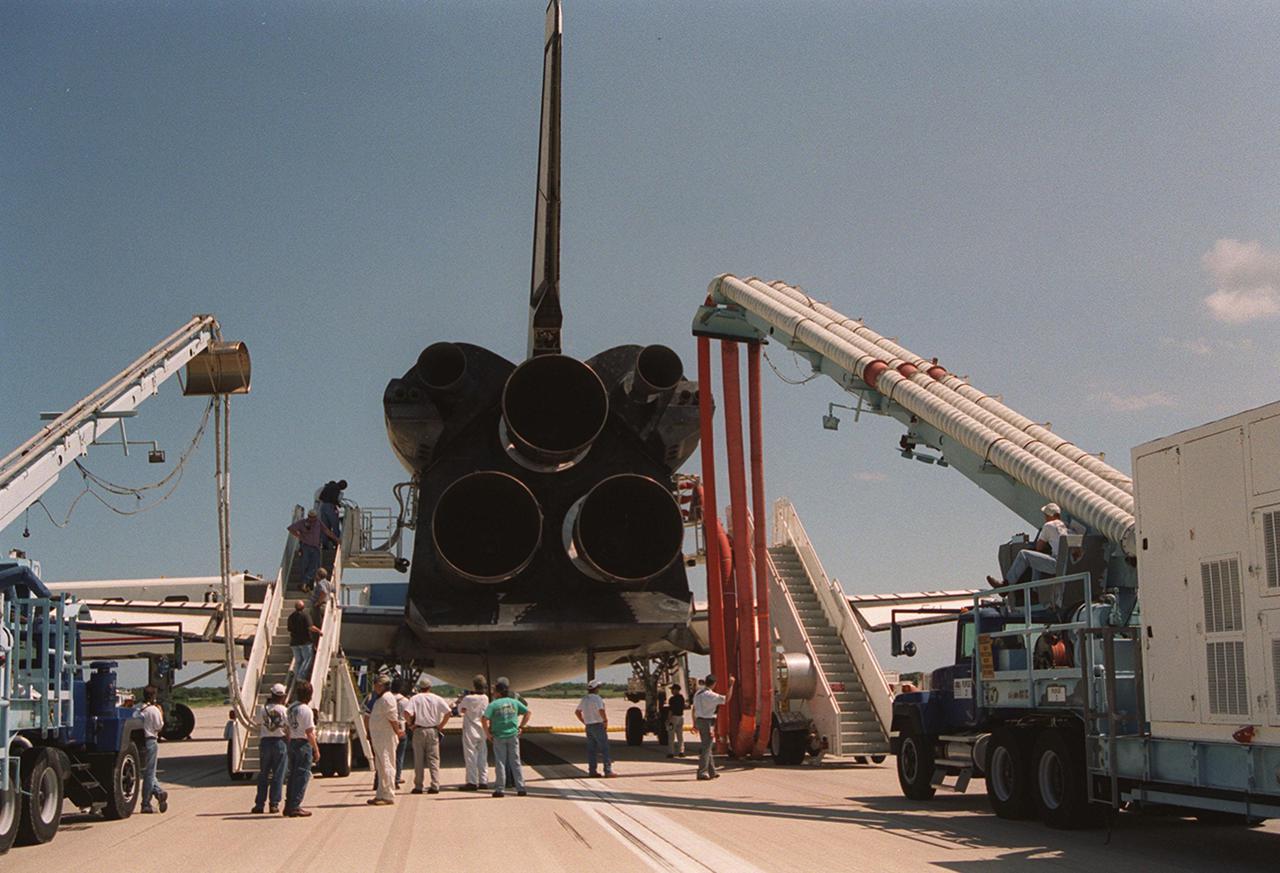
KENNEDY SPACE CENTER, Fla. -- On KSC’s Shuttle Landing Facility runway 15 following mission STS-105, orbiter Discovery undergoes safing operations such as being checked for toxic or hazardous gases, and having purge air introduced to cool the vehicle and humidified air conditioning to the payload bay and other cavities to remove any residual explosive or toxic fumes that may be present. The operations include preparing the orbiter for ground tow operations, installing switch guards and removing data packages from any onboard experiments. Main gear touchdown was at 2:22:58 p.m. EDT; wheel stop, at 2:24:06 p.m. EDT. The 11-day, 21-hour, 12-minute mission accomplished the goals set for the 11th flight to the International Space Station: swapout of the resident Station crew; delivery of equipment, supplies and scientific experiments; and installation of the Early Ammonia Servicer and heater cables for the S0 truss on the Station. Discovery traveled 4.3 million miles on its 30th flight into space, the 106th mission of the Space Shuttle program. Out of five missions in 2001, the landing was the first to occur in daylight at KSC
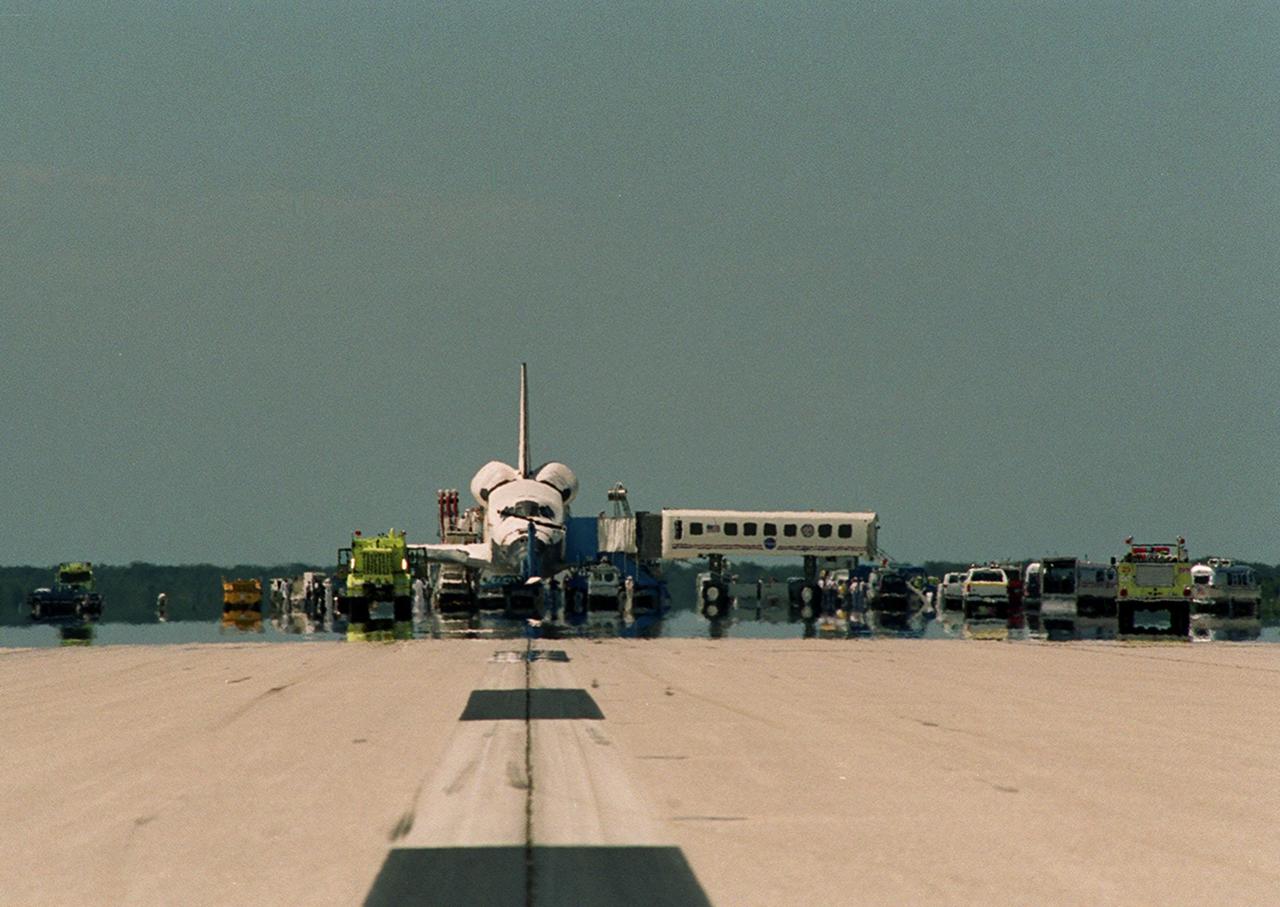
KENNEDY SPACE CENTER, Fla. -- On KSC’s Shuttle Landing Facility runway 15 following mission STS-105, specially designed vehicles and a team of up to 150 trained personnel gather around Discovery for safing operations, checking for toxic or hazardous gases, and introducing purge air to cool the vehicle and humidified air conditioning to the payload bay and other cavities to remove any residual explosive or toxic fumes that may be present. Some personnel will assist the STS-105 and Expedition Two crews in disembarking from the orbiter via the Crew Transfer Vehicle (at right). KSC support personnel will prepare the orbiter for ground tow operations, installing switch guards and removing data packages from any onboard experiments. Main gear touchdown was at 2:22:58 p.m. EDT; wheel stop, at 2:24:06 p.m. EDT. The 11-day, 21-hour, 12-minute mission accomplished the goals set for the 11th flight to the International Space Station: swapout of the resident Station crew; delivery of equipment, supplies and scientific experiments; and installation of the Early Ammonia Servicer and heater cables for the S0 truss on the Station. Discovery traveled 4.3 million miles on its 30th flight into space, the 106th mission of the Space Shuttle program. Out of five missions in 2001, the landing was the first to occur in daylight at KSC

KENNEDY SPACE CENTER, Fla. -- On KSC’s Shuttle Landing Facility runway 15 following mission STS-105, orbiter Discovery undergoes safing operations such as being checked for toxic or hazardous gases, and having purge air introduced to cool the vehicle and humidified air conditioning to the payload bay and other cavities to remove any residual explosive or toxic fumes that may be present. The operations include preparing the orbiter for ground tow operations, installing switch guards and removing data packages from any onboard experiments. Main gear touchdown was at 2:22:58 p.m. EDT; wheel stop, at 2:24:06 p.m. EDT. The 11-day, 21-hour, 12-minute mission accomplished the goals set for the 11th flight to the International Space Station: swapout of the resident Station crew; delivery of equipment, supplies and scientific experiments; and installation of the Early Ammonia Servicer and heater cables for the S0 truss on the Station. Discovery traveled 4.3 million miles on its 30th flight into space, the 106th mission of the Space Shuttle program. Out of five missions in 2001, the landing was the first to occur in daylight at KSC
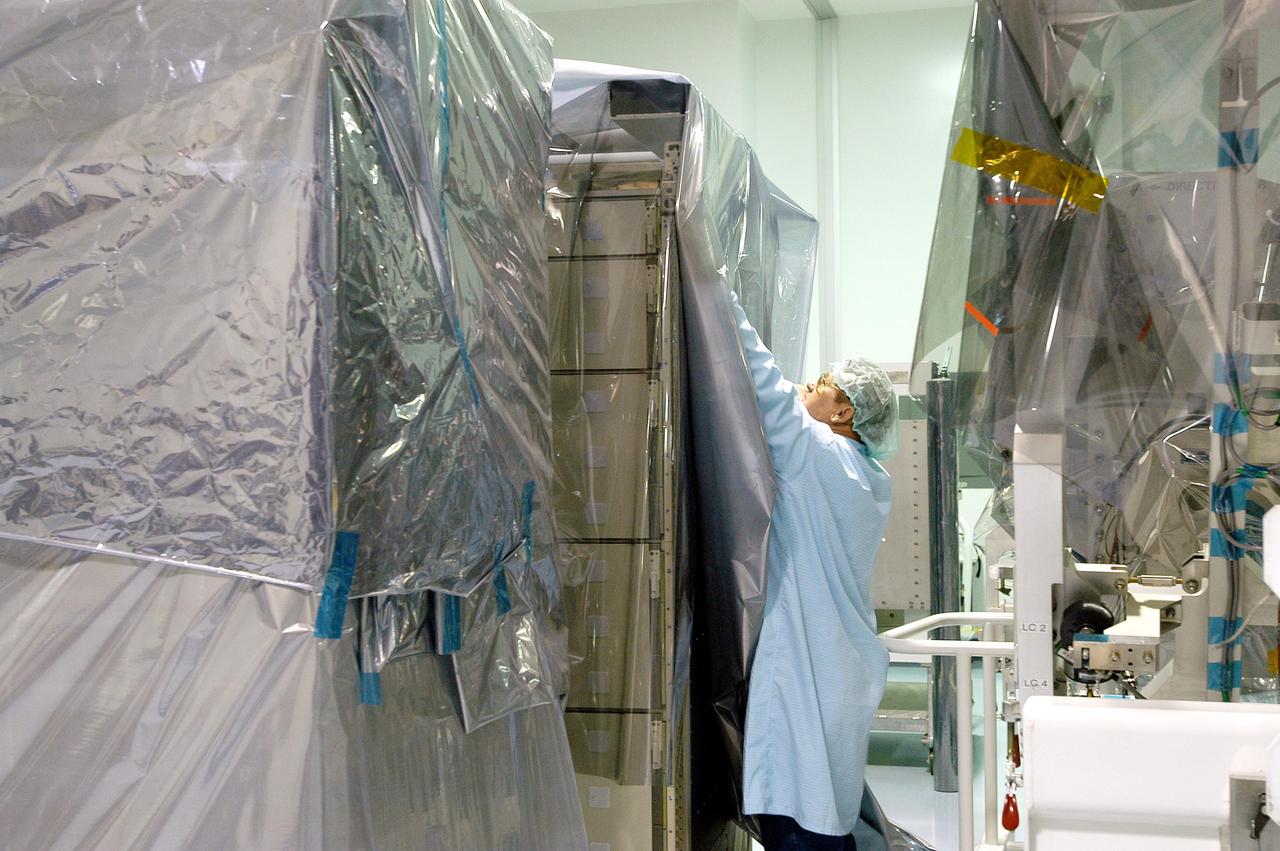
KENNEDY SPACE CENTER, FLA. - In the Space Station Processing Facility, a worker wraps equipment in plastic in preparation for the expected impact of Hurricane Frances on Saturday. The various modules in the SSPF, such as the Japanese Experiment Module, U.S. Node 2 and Multi-Purpose Logistics Modules, are being covered as well. KSC workers also have powered down the Space Shuttle orbiters, closed their payload bay doors and stowed the landing gear. They are also taking precautions against flooding by moving spacecraft hardware off the ground and sandbagging facilities. The SSPF can withstand sustained winds of 110 mph and wind gusts up to 132 mph. The Orbiter Processing Facility is constructed of concrete and steel and was designed to withstand winds of 105 mph. The Vehicle Assembly Building is constructed of concrete and steel and was designed to withstand winds of 125 mph. Other payload and flight hardware support facilities can endure winds of 110 mph. Launch pads and the Payload Hazardous Servicing Facility can withstand 125-mph winds.
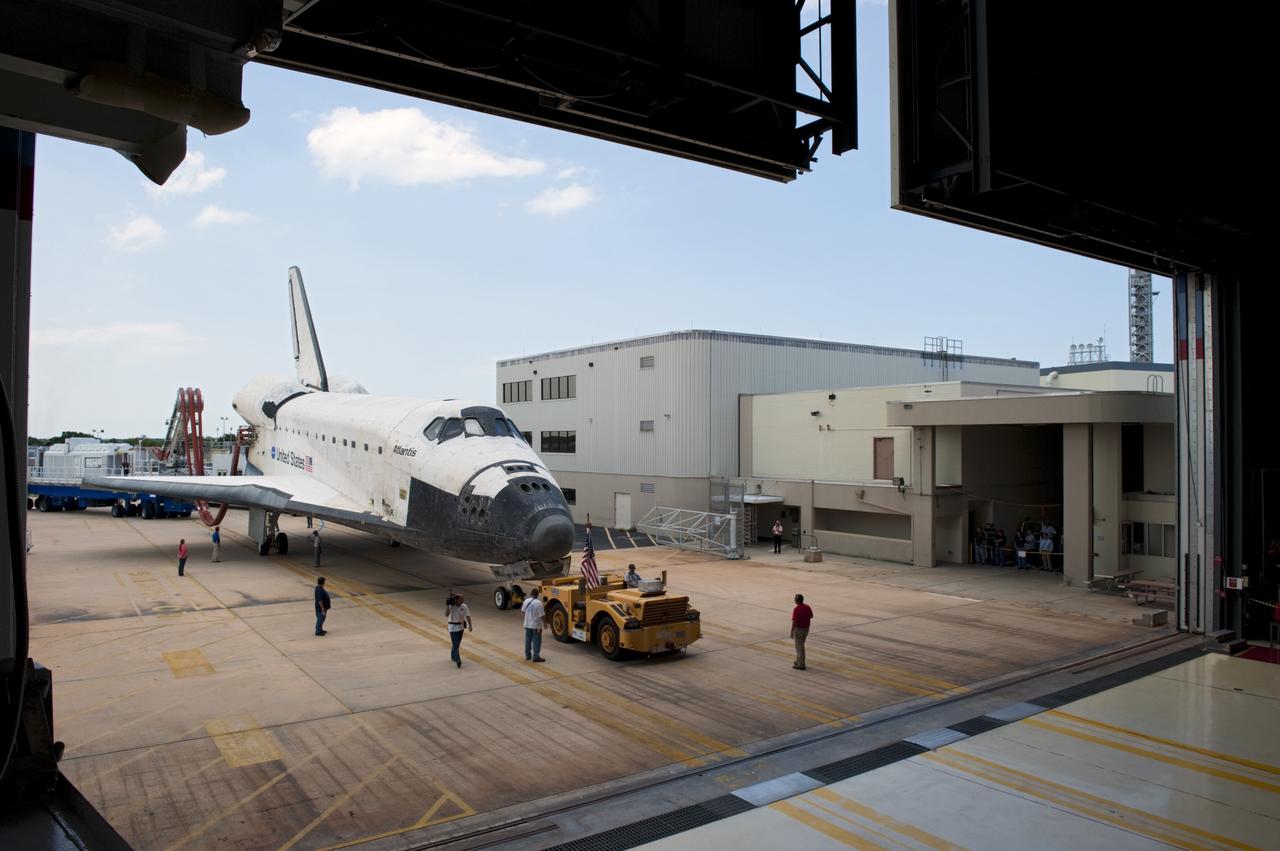
CAPE CANAVERAL, Fla. -- A "towback" vehicle slowly pulls space shuttle Atlantis toward the empty bay of Orbiter Processing Facility-2 at NASA's Kennedy Space Center in Florida. A purge unit that pumps conditioned air into a shuttle after landing is connected to Atlantis' aft end. Once inside the processing facility, Atlantis will be prepared for future public display at Kennedy's Visitor Complex. Atlantis' final return from space at 5:57 a.m. EDT concluded the STS-135 mission, secured the space shuttle fleet's place in history and brought a close to America's Space Shuttle Program. Main gear touchdown was at 5:57:00 a.m. EDT, followed by nose gear touchdown at 5:57:20 a.m., and wheelstop at 5:57:54 a.m. On board were STS-135 Commander Chris Ferguson, Pilot Doug Hurley, and Mission Specialists Sandra Magnus and Rex Walheim. On the 37th shuttle mission to the International Space Station, STS-135 delivered the Raffaello multi-purpose logistics module filled with more than 9,400 pounds of spare parts, equipment and supplies that will sustain station operations for the next year. STS-135 was the 33rd and final flight for Atlantis, which has spent 307 days in space, orbited Earth 4,848 times and traveled 125,935,769 miles, and also the final mission of the Space Shuttle Program. For more information, visit www.nasa.gov/mission_pages/shuttle/shuttlemissions/sts135/index.html. Photo credit: NASA/Kim Shiflett
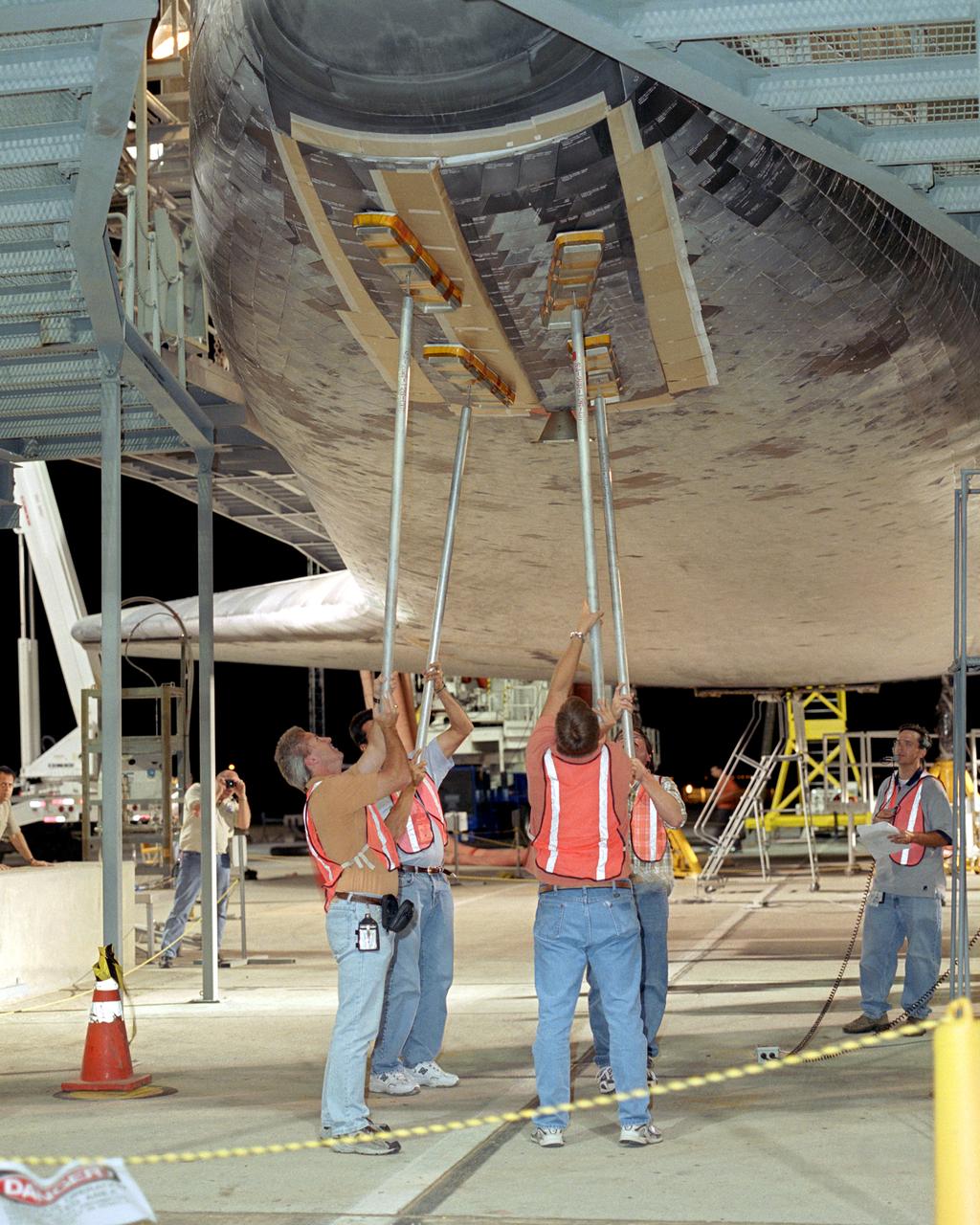
Closing the landing gear doors is one of the final servicing steps before lifting of the Space Shuttle Discovery and mating it to NASA's 747 can begin. After being raised in the gantry-like Mate-Demate Device (MDD), Discovery will be mounted on NASA's modified Boeing 747 Shuttle Carrier Aircraft, or SCA, for the return flight to the Kennedy Space Center in Florida. Space Shuttle Discovery landed safely at NASA's Dryden Flight Research Center at Edwards Air Force Base in California at 5:11:22 a.m. PDT, August 9, 2005, following the very successful 14-day STS-114 return to flight mission. During their two weeks in space, Commander Eileen Collins and her six crewmates tested out new safety procedures and delivered supplies and equipment the International Space Station. Discovery spent two weeks in space, where the crew demonstrated new methods to inspect and repair the Shuttle in orbit. The crew also delivered supplies, outfitted and performed maintenance on the International Space Station. A number of these tasks were conducted during three spacewalks. In an unprecedented event, spacewalkers were called upon to remove protruding gap fillers from the heat shield on Discovery's underbelly. In other spacewalk activities, astronauts installed an external platform onto the Station's Quest Airlock and replaced one of the orbital outpost's Control Moment Gyroscopes. Inside the Station, the STS-114 crew conducted joint operations with the Expedition 11 crew. They unloaded fresh supplies from the Shuttle and the Raffaello Multi-Purpose Logistics Module. Before Discovery undocked, the crews filled Raffeallo with unneeded items and returned to Shuttle payload bay. Discovery launched on July 26 and spent almost 14 days on orbit.

Event: Horizontal Stabilator Install The Low Boom Flight Demonstrator manufacturing team installed the horizontal stabilizers to the aircraft. These are used along with the flight control computers to keep the airplane flying safely and providing the pitch control so that the pilot can fly the missions envisioned for the X-59

Event: Horizontal Stabilator Install The Low Boom Flight Demonstrator manufacturing team installed the horizontal stabilizers to the aircraft. These are used along with the flight control computers to keep the airplane flying safely and providing the pitch control so that the pilot can fly the missions envisioned for the X-59.
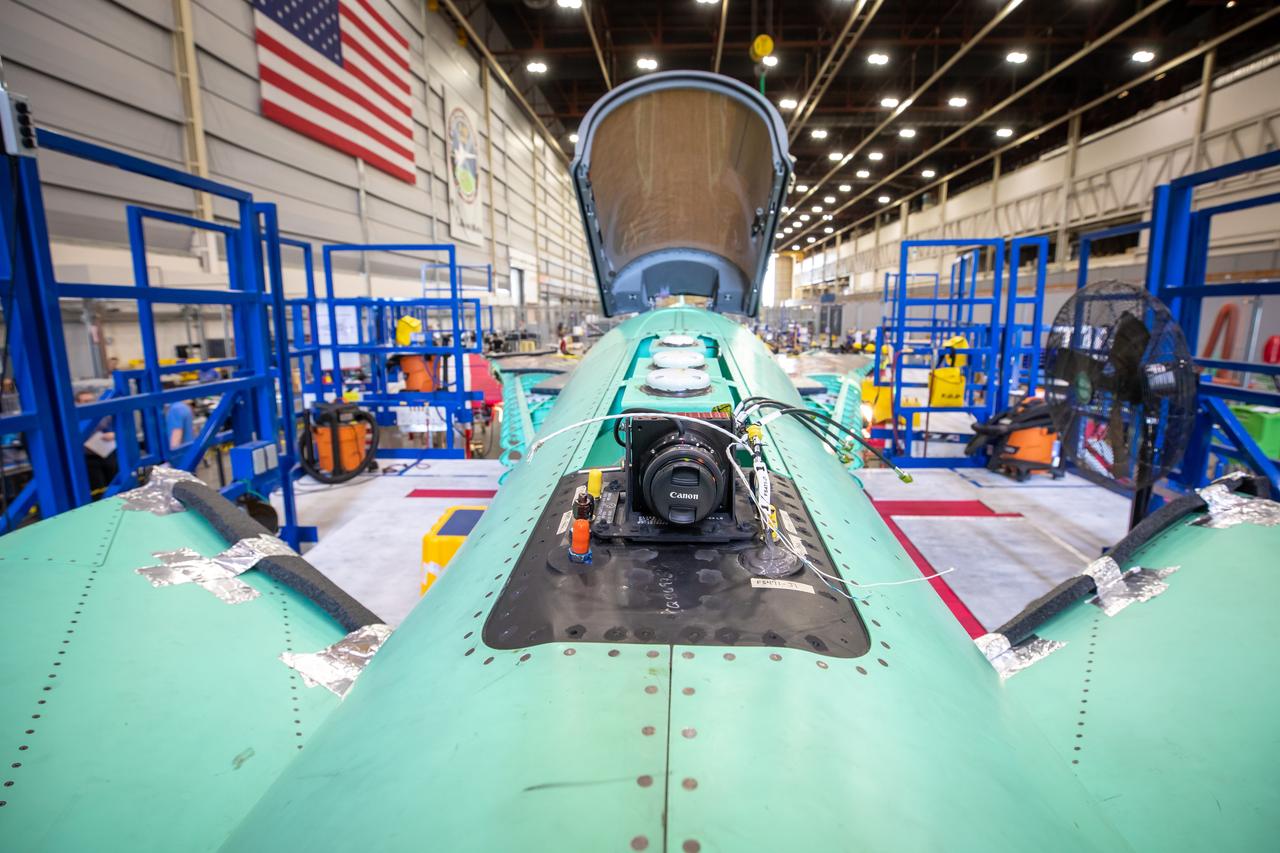
Event: Horizontal Stabilator Install A close up of the camera from the X-59’s eXternal Vision System. This camera is on the top of the X-59, but there will also be one on the belly of the aircraft. This visuals from this camera will be displayed on a 4K monitor for the pilot. As part of the supersonic shaping technology, the X-plane will not have a forward-facing window in the cockpit.

Event: Horizontal Stabilator Install The Low Boom Flight Demonstrator manufacturing team installed the horizontal stabilizers to the aircraft. These are used along with the flight control computers to keep the airplane flying safely and providing the pitch control so that the pilot can fly the missions envisioned for the X-59.

Event: Horizontal Stabilator Install The Low Boom Flight Demonstrator manufacturing team installed the horizontal stabilizers to the aircraft. These are used along with the flight control computers to keep the airplane flying safely and providing the pitch control so that the pilot can fly the missions envisioned for the X-59.
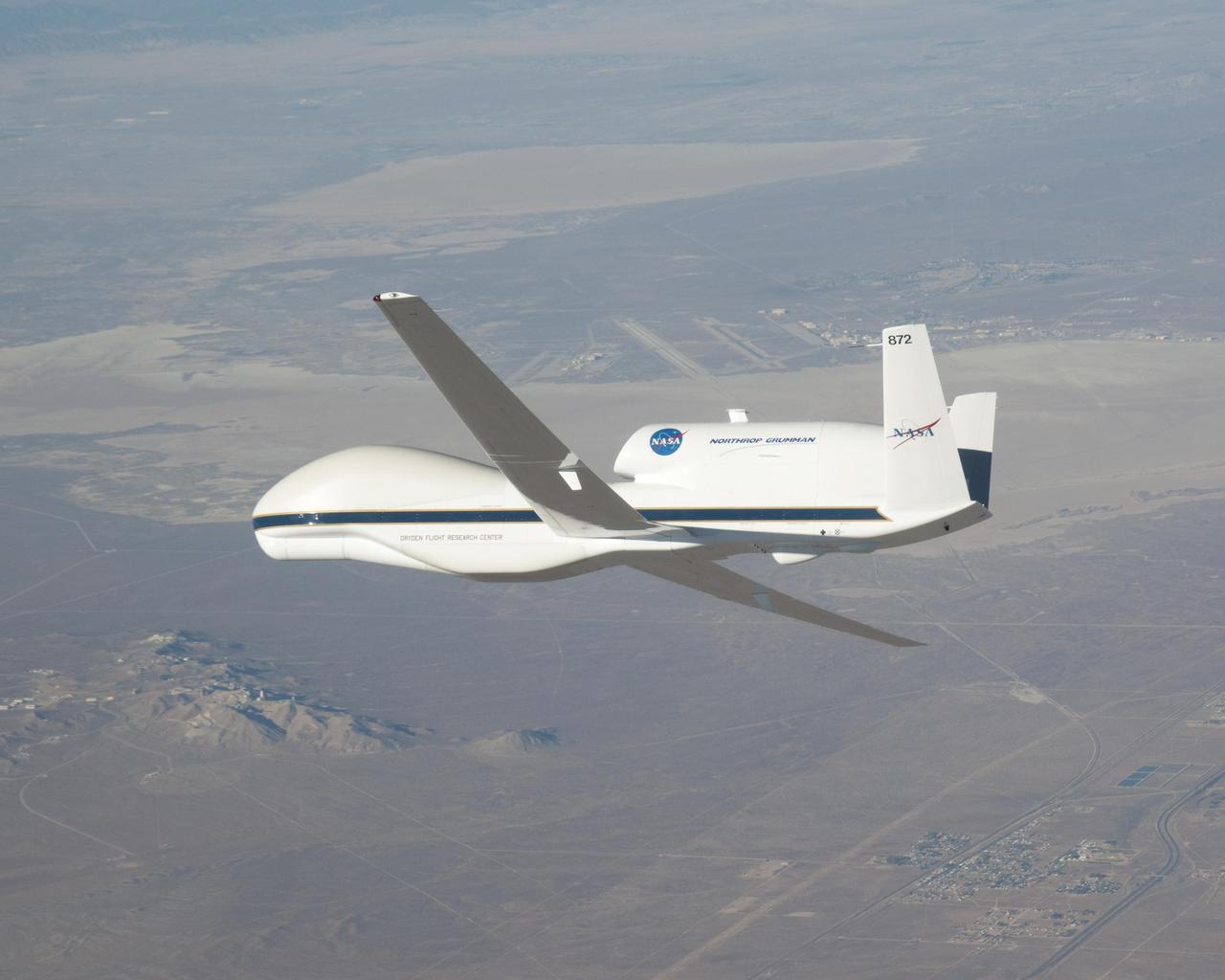
NASA image acquired October 23, 2009. At NASA’s Dryden Research Center in California, a group of engineers, scientists, and aviation technicians have set up camp in a noisy, chilly hangar on Edwards Air Force base. For the past two weeks, they have been working to mount equipment—from HD video cameras to ozone sensors—onto NASA’s Global Hawk, a remote-controlled airplane that can fly for up to 30 hours at altitudes up to 65,000 feet. The team is gearing up for the Global Hawk Pacific campaign, a series of four or five scientific research flights that will take the Global Hawk over the Pacific Ocean and Arctic regions. The 44-foot-long aircraft, with its comically large nose and 116-foot wingspan is pictured in the photograph above, banking for landing over Rogers Dry Lake in California at the end of a test flight on October 23, 2009. The long wings carry the plane’s fuel, and the bulbous nose is one of the payload bays, which house the science instruments. For the Global Hawk Pacific campaign, the robotic aircraft will carry ten science instruments that will sample the chemical composition of air in the troposphere (the atmospheric layer closest to Earth) and the stratosphere (the layer above the troposphere). The mission will also observe clouds and aerosol particles in the troposphere. The primary purpose of the mission is to collect observations that can be used to check the accuracy of simultaneous observations collected by NASA’s Aura satellite. Co-lead scientist Paul Newman from Goddard Space Flight Center is writing about the ground-breaking mission for the Earth Observatory’s Notes from the Field blog. NASA Photograph by Carla Thomas. <b><a href="http://www.nasa.gov/centers/goddard/home/index.html" rel="nofollow">NASA Goddard Space Flight Center</a></b> is home to the nation's largest organization of combined scientists, engineers and technologists that build spacecraft, instruments and new technology to study the Earth, the sun, our solar system, and the universe. To learn more about this image go to: <a href="http://earthobservatory.nasa.gov/IOTD/view.php?id=43291" rel="nofollow">earthobservatory.nasa.gov/IOTD/view.php?id=43291</a>