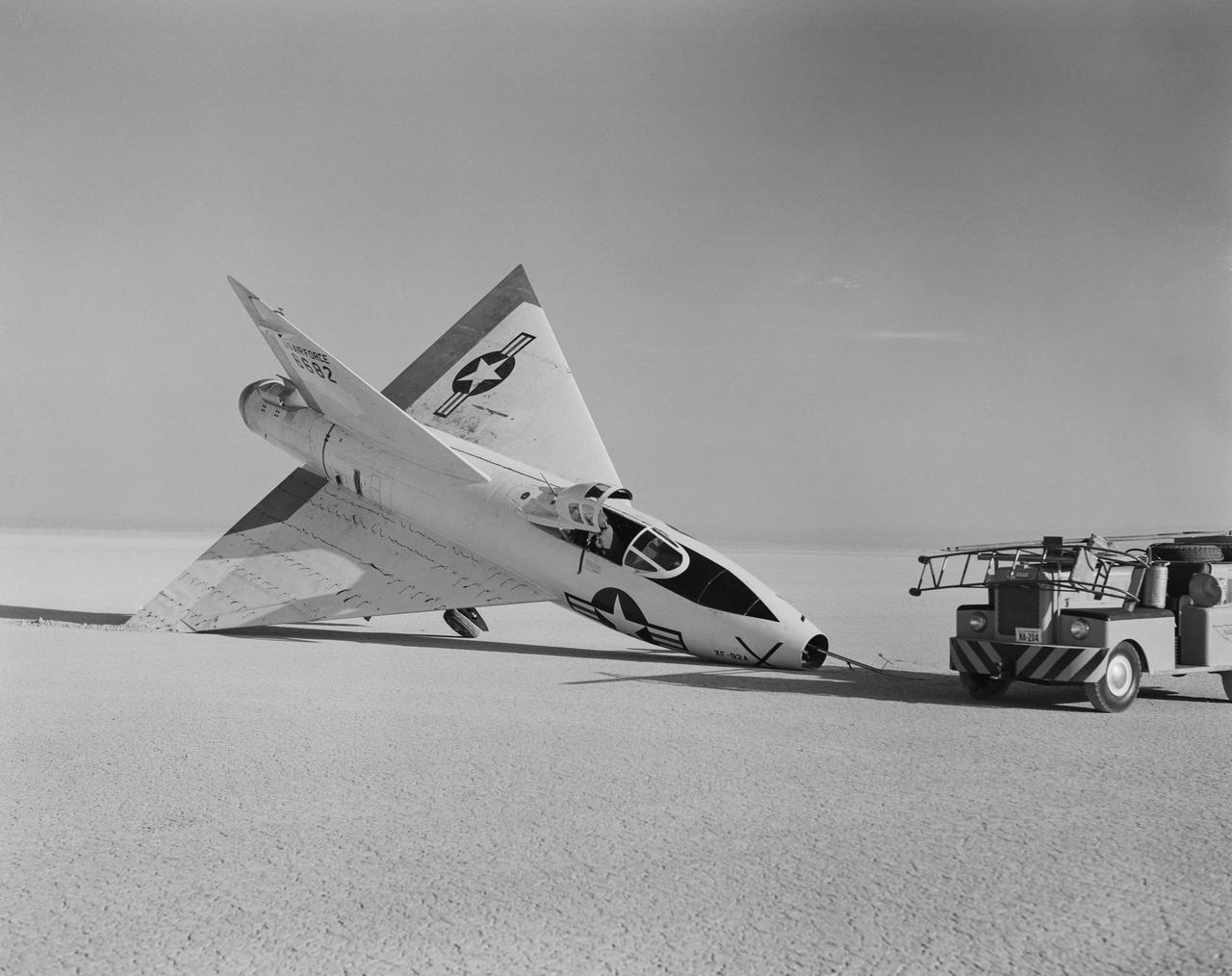
The XF-92A, which had a minor landing mishap in 1953, was the concept for the first delta wing fighter in the U.S. inventory, the F-102.
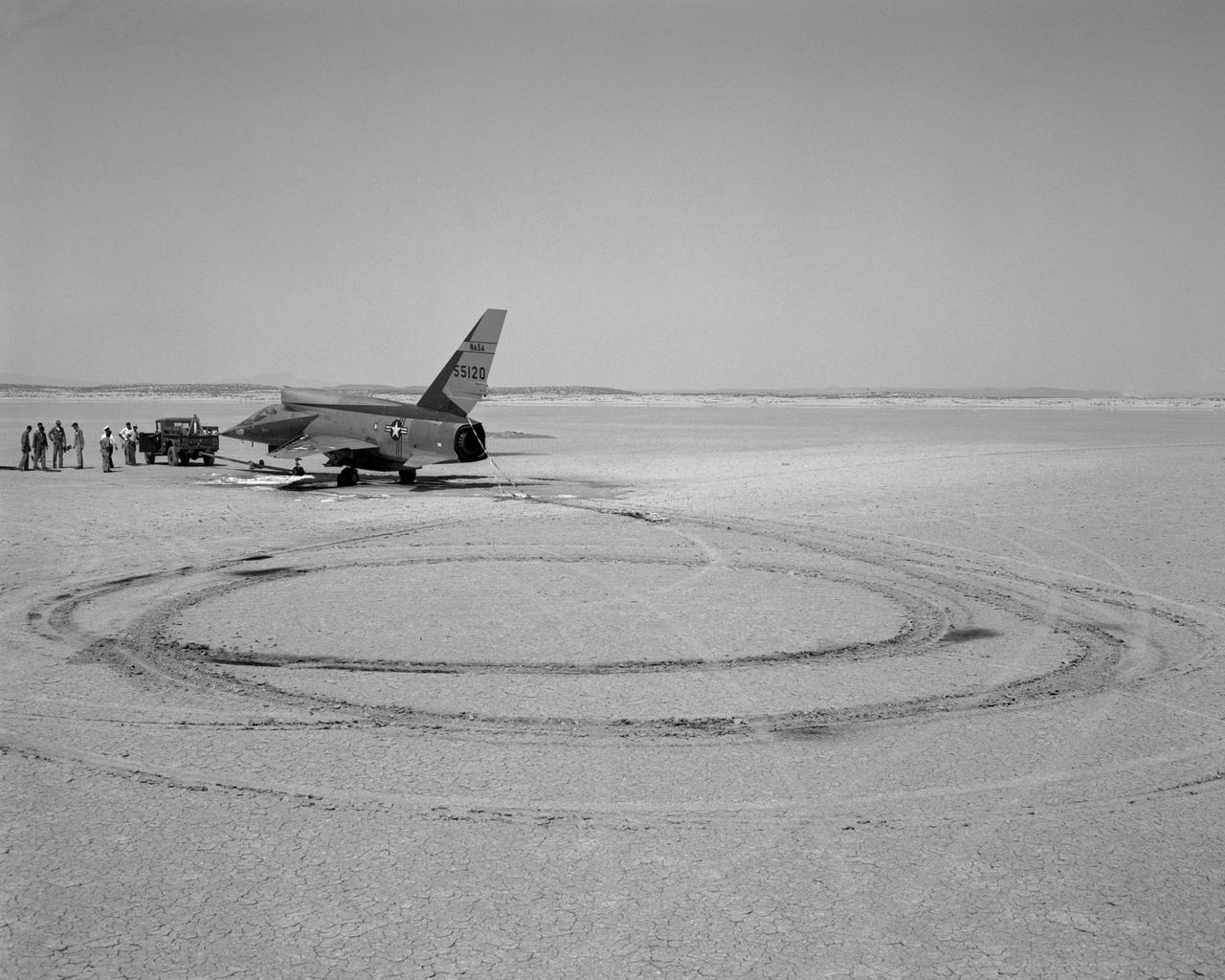
F-107A ground loop landing mishap. Sept. 1, 1959
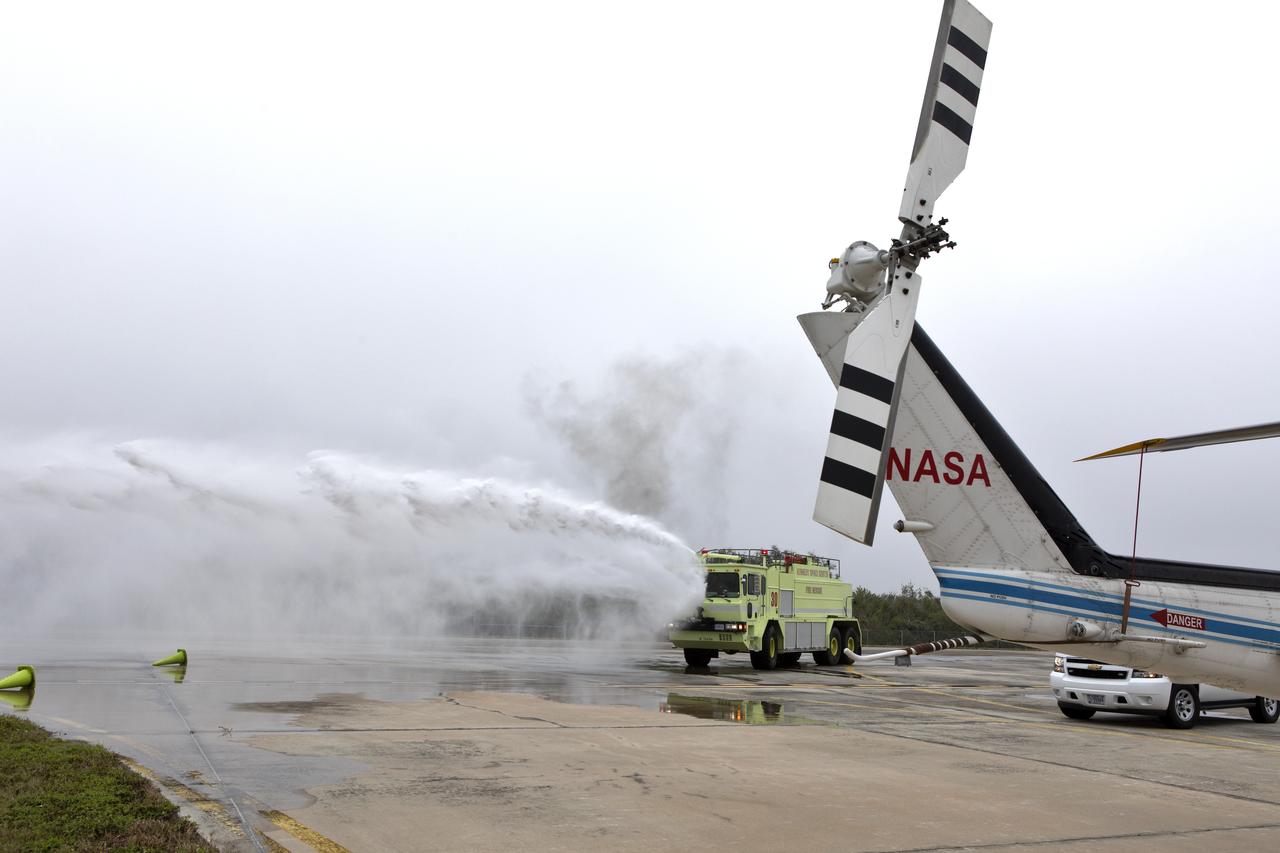
An Aircraft Mishap Preparedness and Contingency Plan is underway at the Shuttle Landing Facility at NASA's Kennedy Space Center in Florida. The center's Flight Operations rehearsed a helicopter crash-landing to test new and updated emergency procedures. The operation was designed to validate several updated techniques the center's first responders would follow, should they ever need to rescue a crew in case of a real accident. The mishap exercise took place at the center's Shuttle Landing Facility.
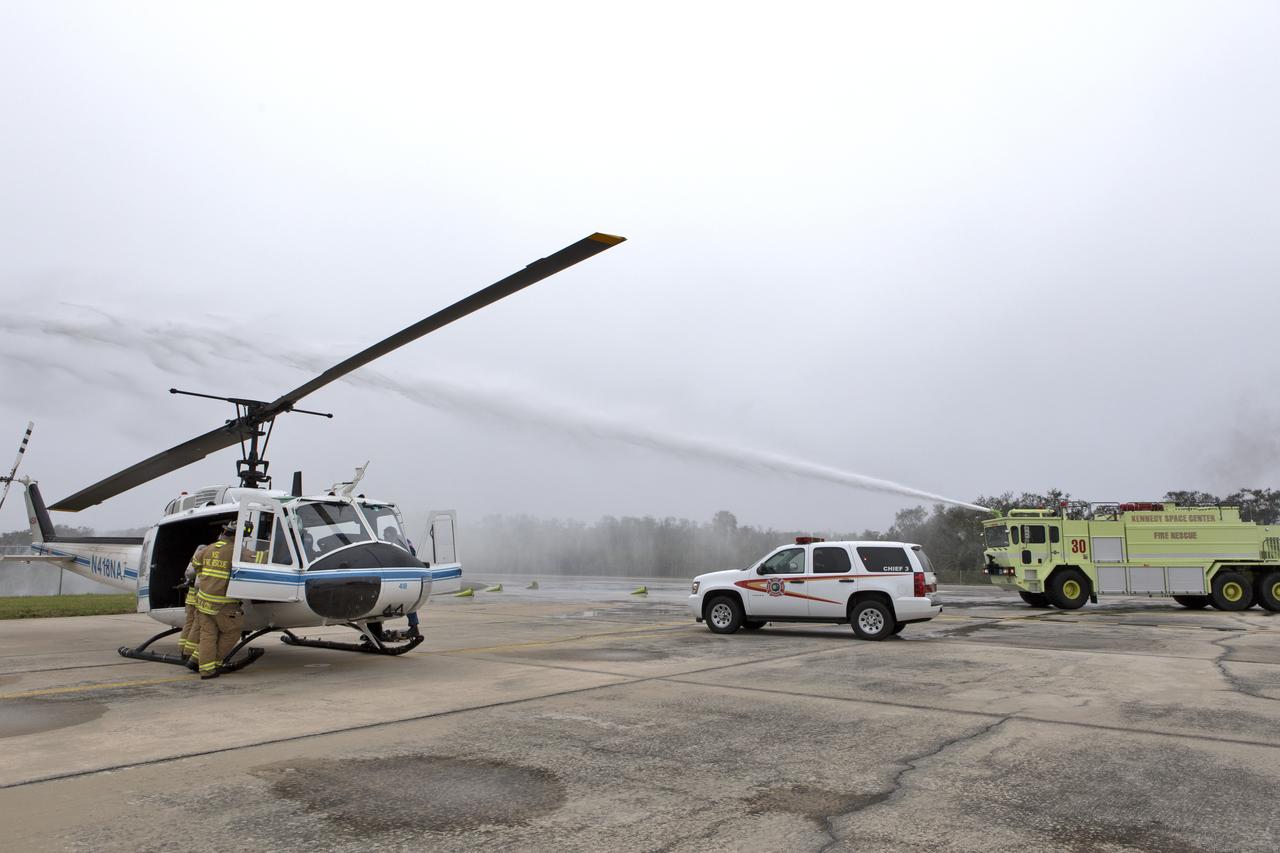
An Aircraft Mishap Preparedness and Contingency Plan is underway at the Shuttle Landing Facility at NASA's Kennedy Space Center in Florida. The center's Flight Operations rehearsed a helicopter crash-landing to test new and updated emergency procedures. The operation was designed to validate several updated techniques the center's first responders would follow, should they ever need to rescue a crew in case of a real accident. The mishap exercise took place at the center's Shuttle Landing Facility.

Members of NASA Kennedy Space Center's Flight Operations team participate in a rehearsal of a helicopter crash-landing to test new and updated emergency procedures. Called the Aircraft Mishap Preparedness and Contingency Plan, the operation was designed to validate several updated techniques the center's first responders would follow, should they ever need to rescue a crew in case of a real accident. The mishap exercise took place at the center's Shuttle Landing Facility.
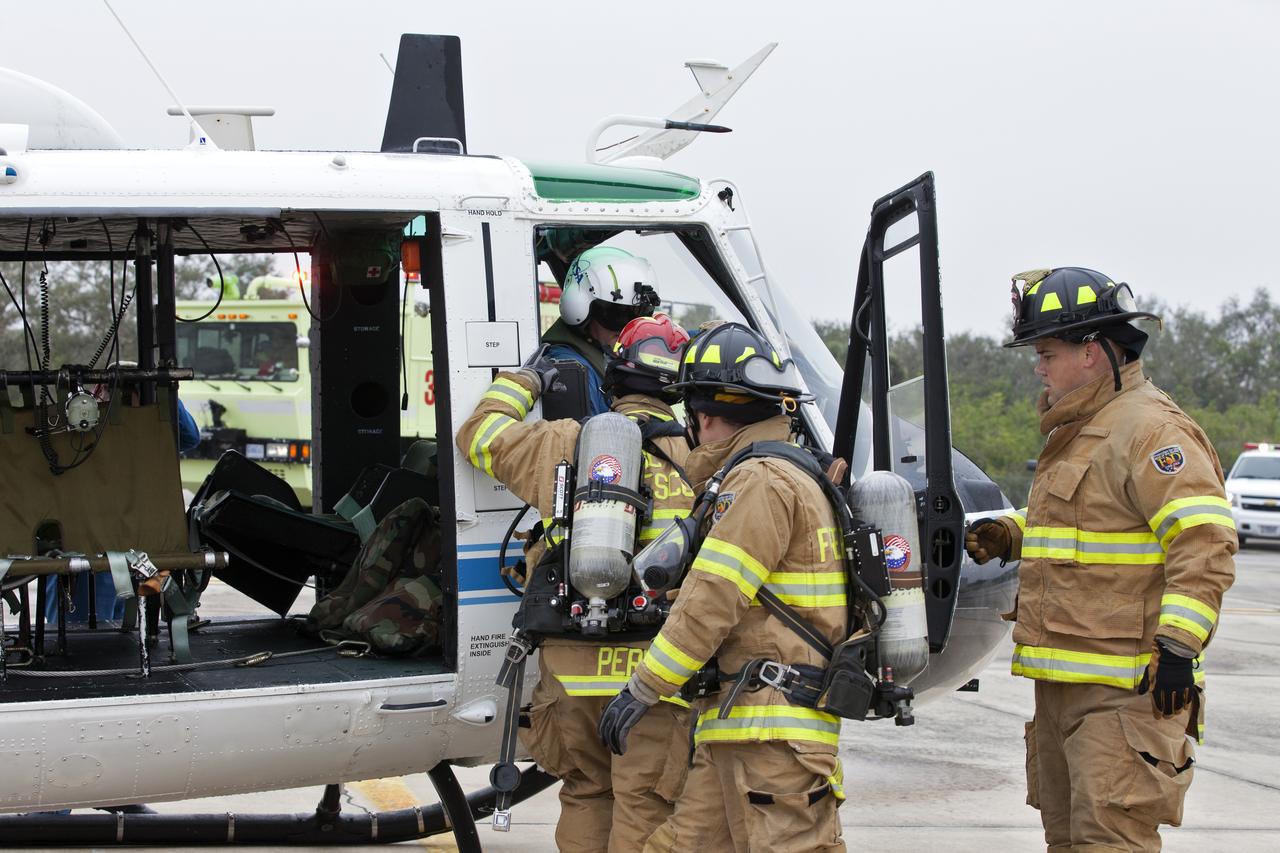
Members of NASA Kennedy Space Center's Flight Operations team participate in a rehearsal of a helicopter crash-landing to test new and updated emergency procedures. Called the Aircraft Mishap Preparedness and Contingency Plan, the operation was designed to validate several updated techniques the center's first responders would follow, should they ever need to rescue a crew in case of a real accident. The mishap exercise took place at the center's Shuttle Landing Facility.
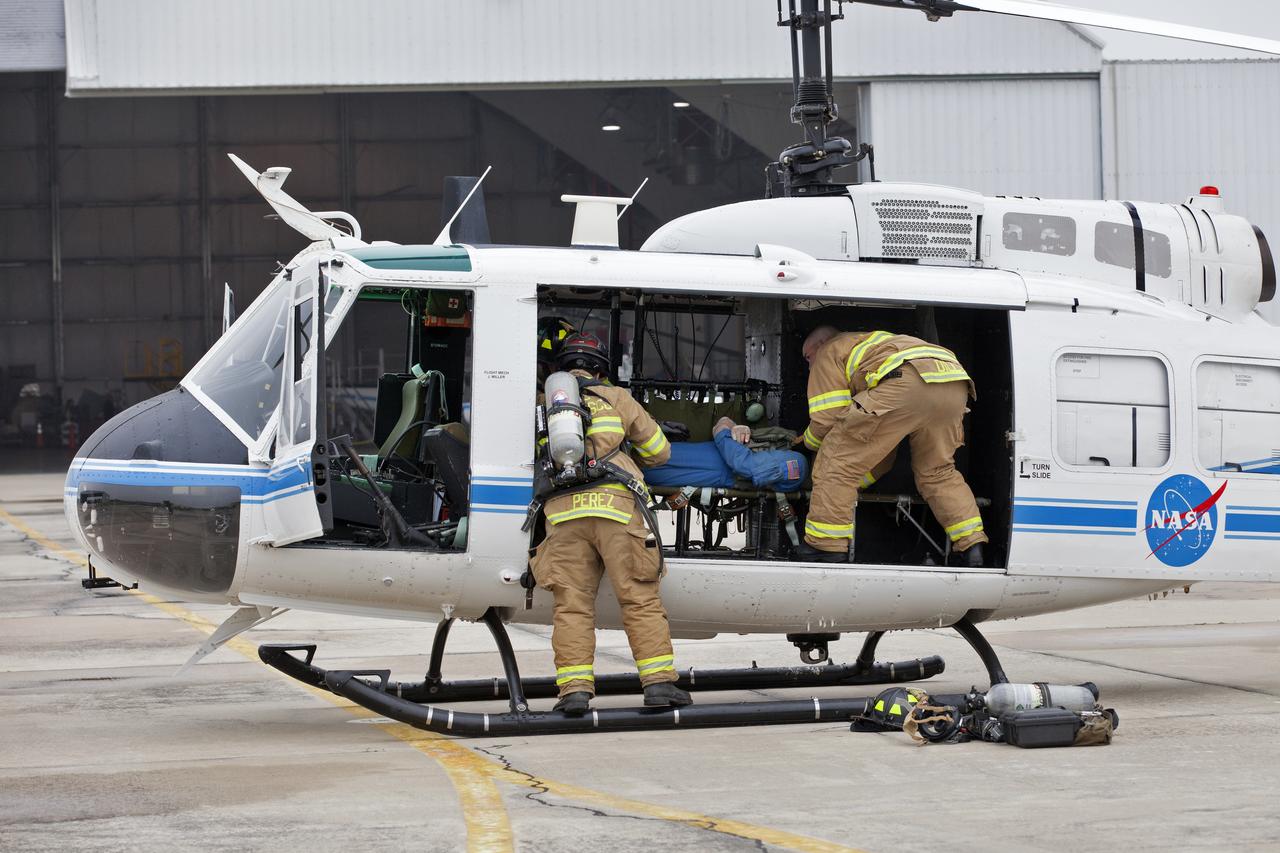
Members of NASA Kennedy Space Center's Flight Operations team participate in a rehearsal of a helicopter crash-landing to test new and updated emergency procedures. Called the Aircraft Mishap Preparedness and Contingency Plan, the operation was designed to validate several updated techniques the center's first responders would follow, should they ever need to rescue a crew in case of a real accident. The mishap exercise took place at the center's Shuttle Landing Facility.
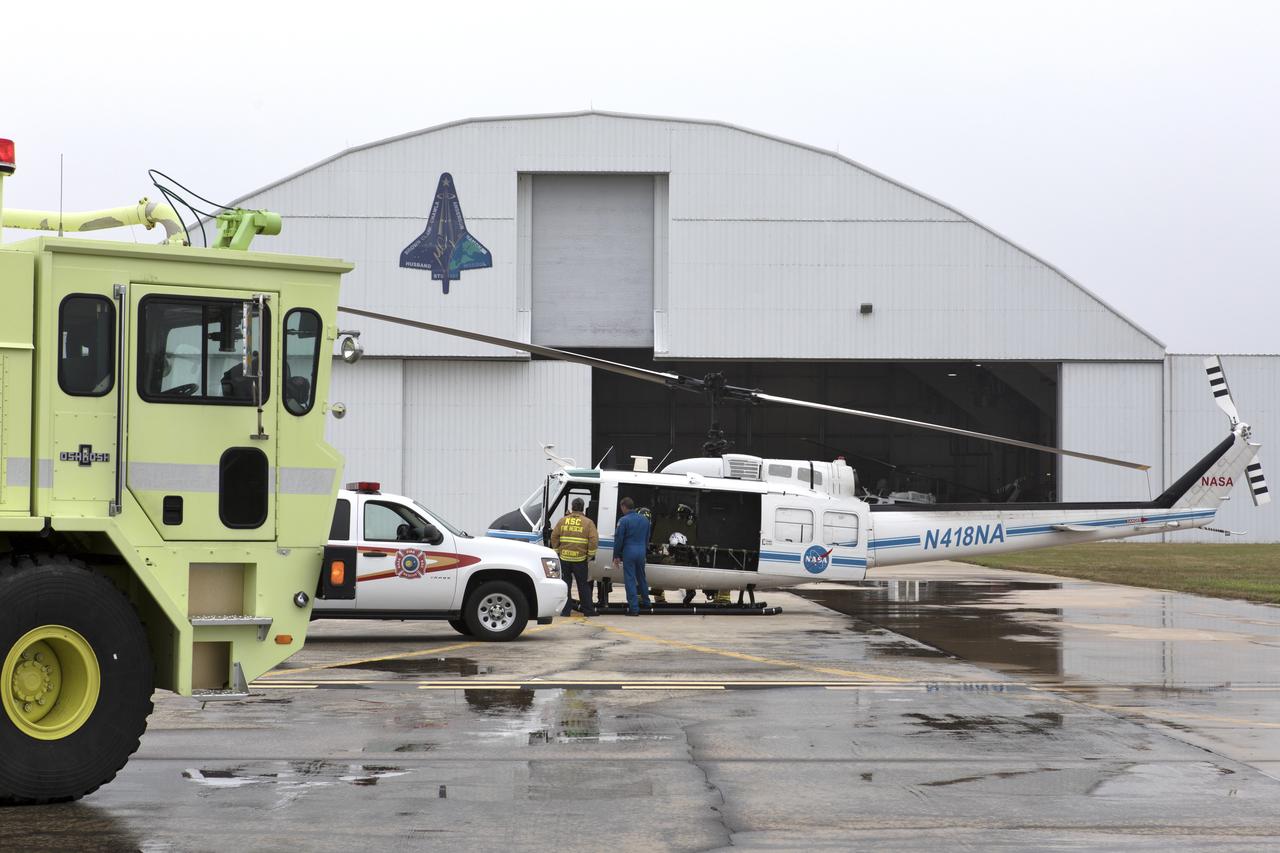
Members of NASA Kennedy Space Center's Flight Operations team prepare for a rehearsal of a helicopter crash-landing to test new and updated emergency procedures. Called the Aircraft Mishap Preparedness and Contingency Plan, the operation was designed to validate several updated techniques the center's first responders would follow, should they ever need to rescue a crew in case of a real accident. The mishap exercise took place at the center's Shuttle Landing Facility.

Members of NASA Kennedy Space Center's Flight Operations team prepare for a rehearsal of a helicopter crash-landing to test new and updated emergency procedures. Called the Aircraft Mishap Preparedness and Contingency Plan, the operation was designed to validate several updated techniques the center's first responders would follow, should they ever need to rescue a crew in case of a real accident. The mishap exercise took place at the center's Shuttle Landing Facility.
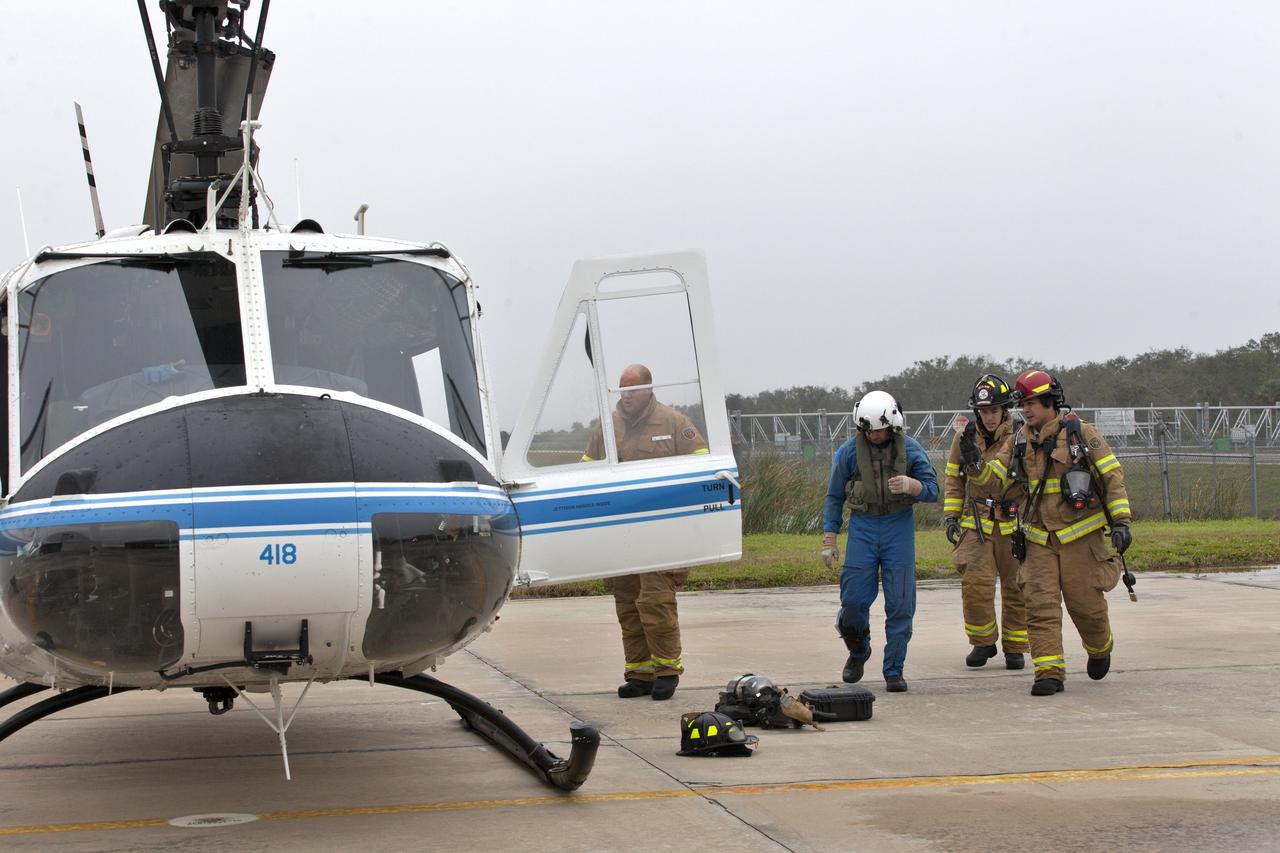
Members of NASA Kennedy Space Center's Flight Operations team participate in a rehearsal of a helicopter crash-landing to test new and updated emergency procedures. Called the Aircraft Mishap Preparedness and Contingency Plan, the operation was designed to validate several updated techniques the center's first responders would follow, should they ever need to rescue a crew in case of a real accident. The mishap exercise took place at the center's Shuttle Landing Facility.
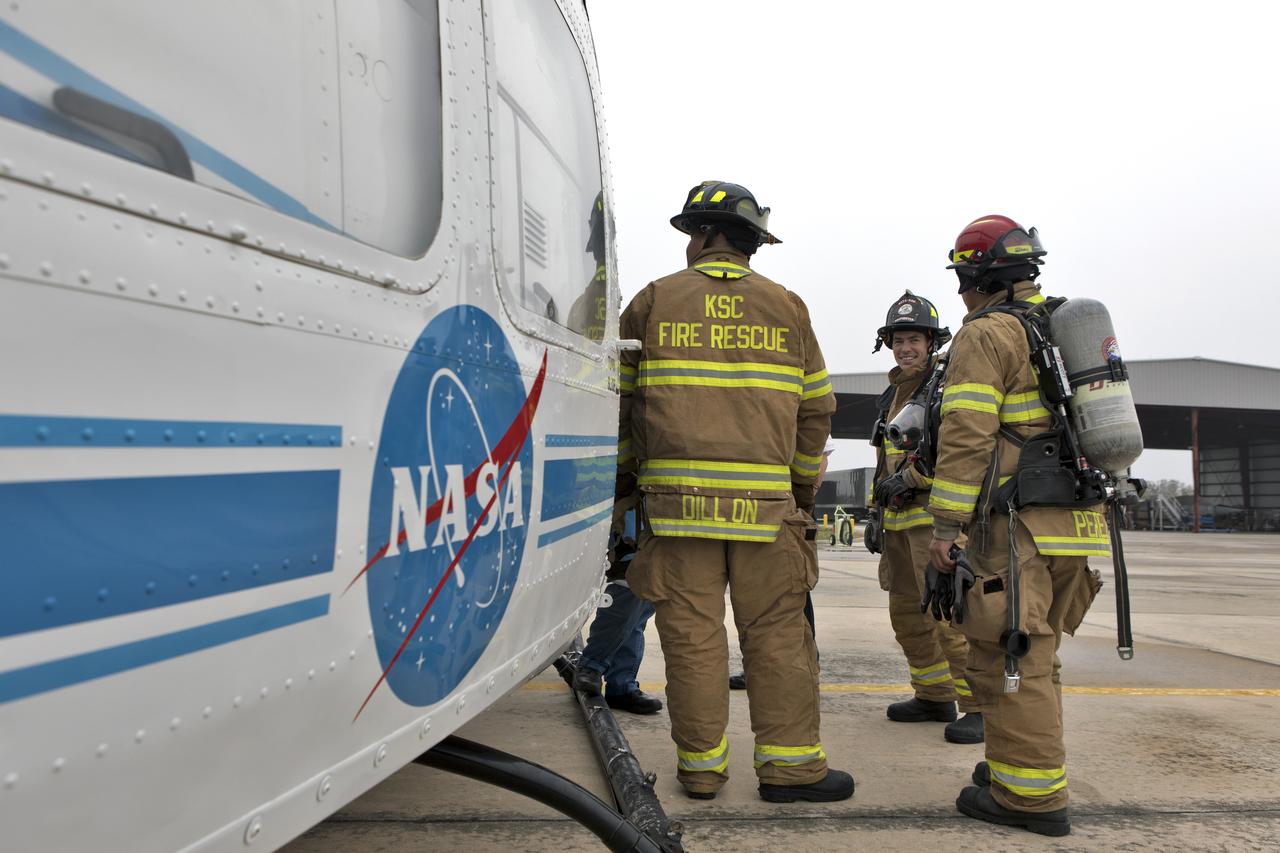
Members of NASA Kennedy Space Center's Flight Operations team prepare for a rehearsal of a helicopter crash-landing to test new and updated emergency procedures. Called the Aircraft Mishap Preparedness and Contingency Plan, the operation was designed to validate several updated techniques the center's first responders would follow, should they ever need to rescue a crew in case of a real accident. The mishap exercise took place at the center's Shuttle Landing Facility.
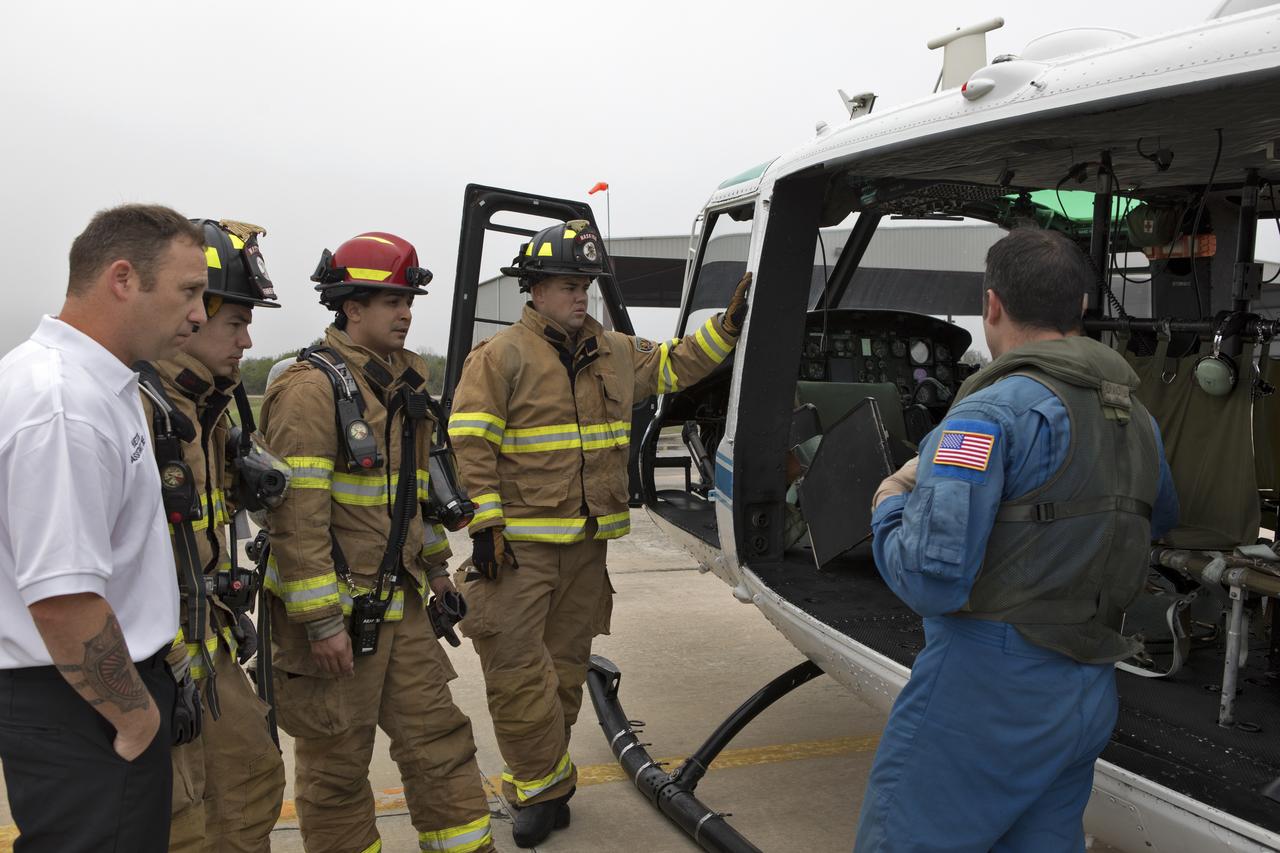
NASA Kennedy Space Center's Flight Operations team reviews procedures before beginning a rehearsal of a helicopter crash-landing to test new and updated emergency procedures. Called the Aircraft Mishap Preparedness and Contingency Plan, the operation was designed to validate several updated techniques the center's first responders would follow, should they ever need to rescue a crew in case of a real accident. The mishap exercise took place at the center's Shuttle Landing Facility.
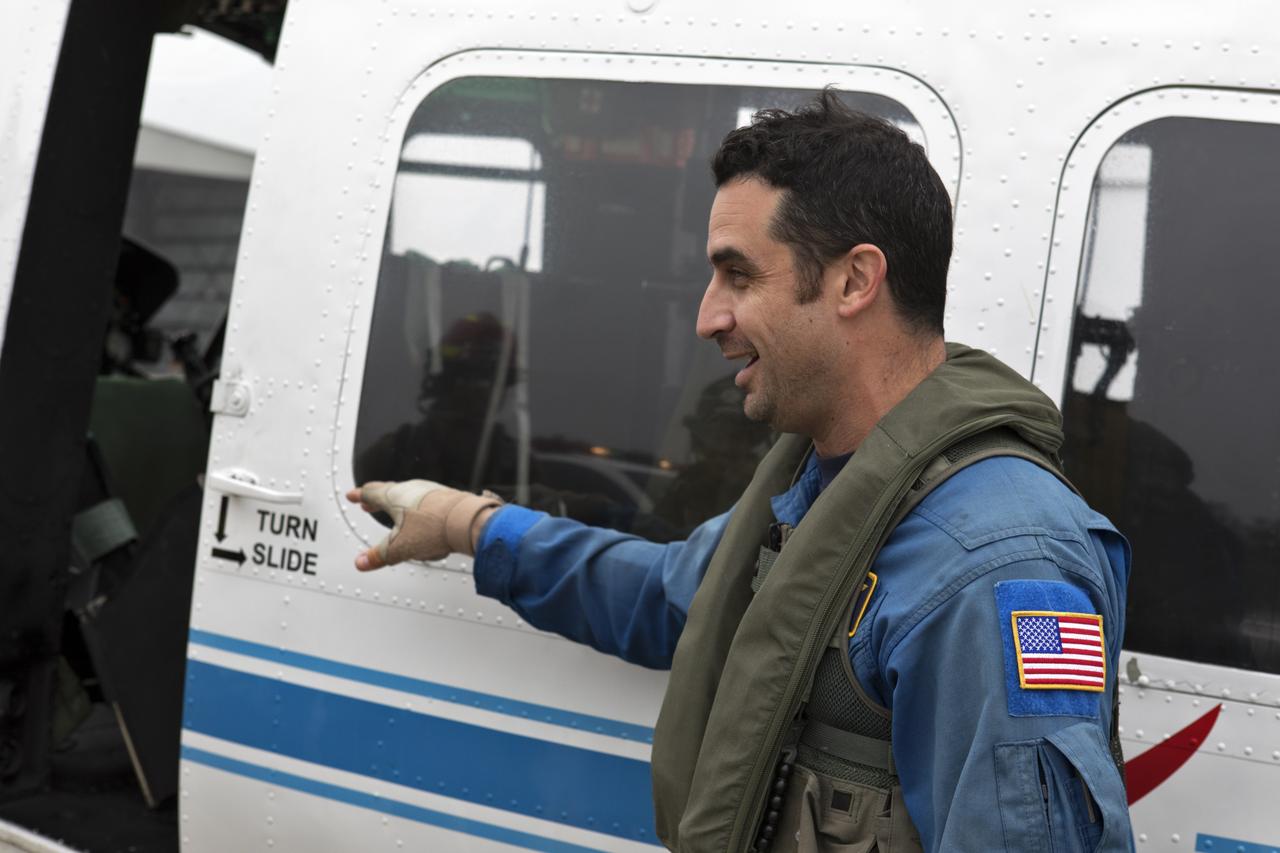
A member of NASA Kennedy Space Center's Flight Operations team prepares for a rehearsal of a helicopter crash-landing to test new and updated emergency procedures. Called the Aircraft Mishap Preparedness and Contingency Plan, the operation was designed to validate several updated techniques the center's first responders would follow, should they ever need to rescue a crew in case of a real accident. The mishap exercise took place at the center's Shuttle Landing Facility.
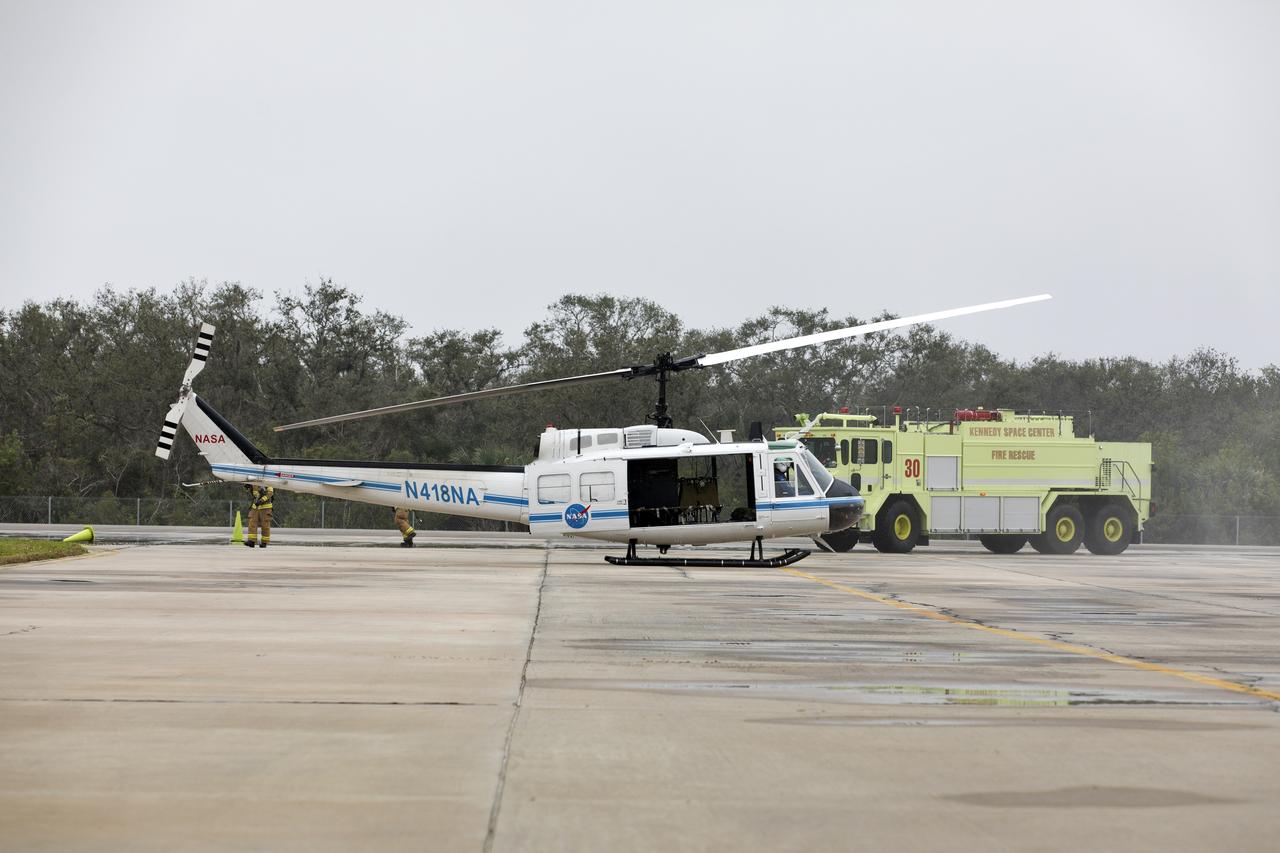
NASA Kennedy Space Center's Flight Operations prepares to rehearse a helicopter crash-landing to test new and updated emergency procedures. Called the Aircraft Mishap Preparedness and Contingency Plan, the operation was designed to validate several updated techniques the center's first responders would follow, should they ever need to rescue a crew in case of a real accident. The mishap exercise took place at the center's Shuttle Landing Facility.
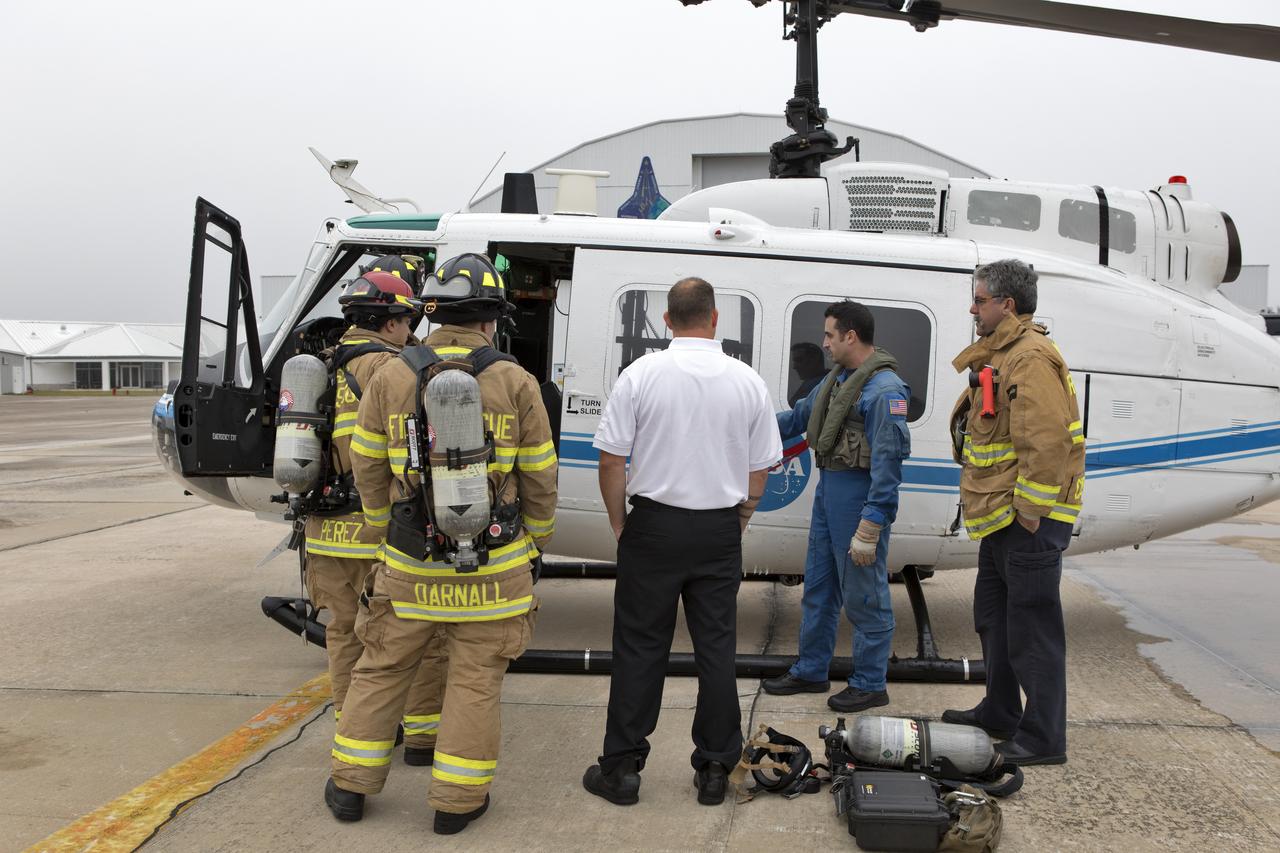
NASA Kennedy Space Center's Flight Operations team reviews procedures before beginning a rehearsal of a helicopter crash-landing to test new and updated emergency procedures. Called the Aircraft Mishap Preparedness and Contingency Plan, the operation was designed to validate several updated techniques the center's first responders would follow, should they ever need to rescue a crew in case of a real accident. The mishap exercise took place at the center's Shuttle Landing Facility.
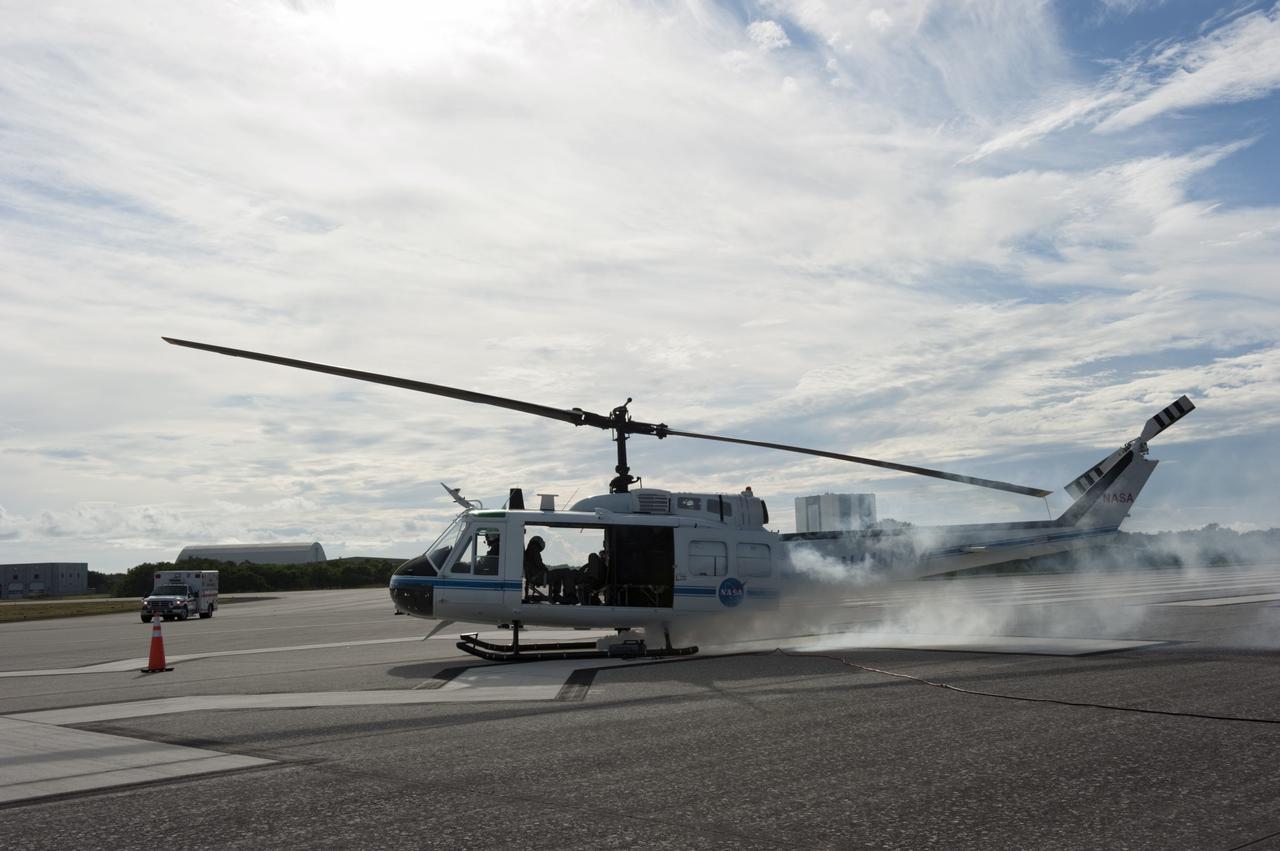
CAPE CANAVERAL, Fla. -- Smoke billows from a Huey II helicopter supporting the aviation safety exercise during Emergency Response Safety Training at the Shuttle Landing Facility, Runway 33, at NASA’s Kennedy Space Center in Florida. The simulated helicopter mishap exercise was conducted to evaluate emergency response and mishap investigations of aircraft at Kennedy. Participants included Air Rescue Fire Fighters, Flight Operations, Disaster Preparedness, Security, and Safety. NASA mandates simulated aviation safety training take place every two years. Photo credit: NASA/Kim Shiflett
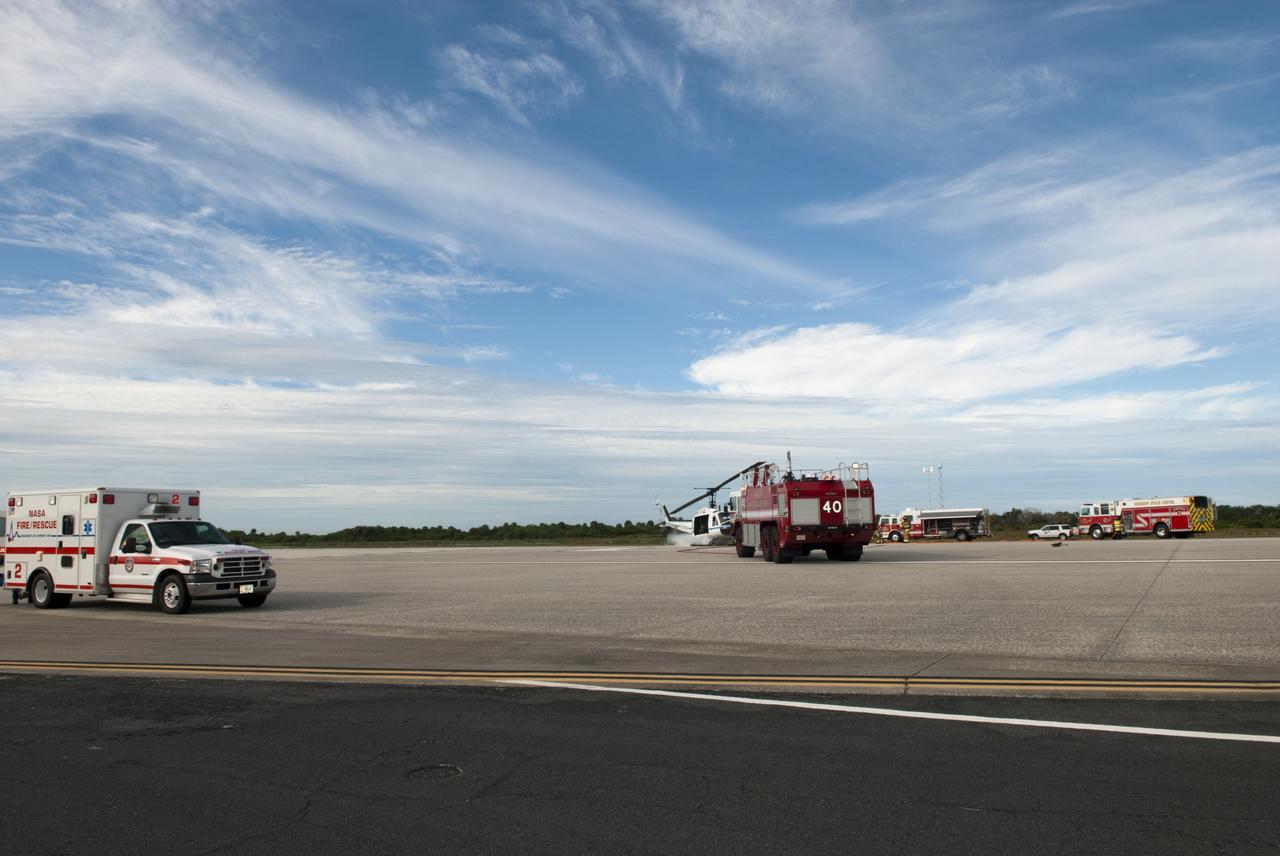
CAPE CANAVERAL, Fla. -- An ambulance and several NASA Fire Rescue Services vehicles arrive to assist a Huey II helicopter participating in the aviation safety exercise during Emergency Response Safety Training at the Shuttle Landing Facility, Runway 33, at NASA’s Kennedy Space Center in Florida. The simulated helicopter mishap exercise was conducted to evaluate emergency response and mishap investigations of aircraft at Kennedy. Participants included Air Rescue Fire Fighters, Flight Operations, Disaster Preparedness, Security, and Safety. NASA mandates simulated aviation safety training take place every two years. Photo credit: NASA/Kim Shiflett
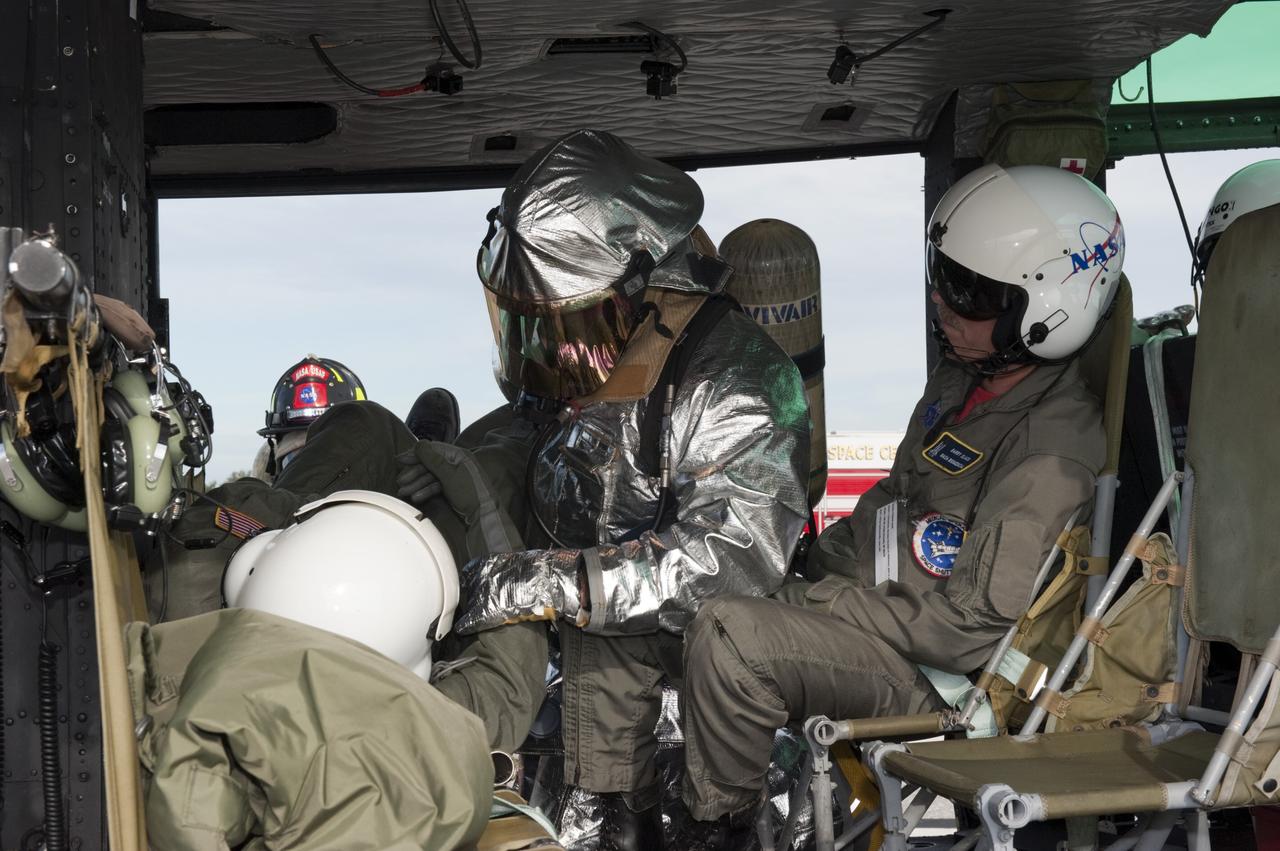
CAPE CANAVERAL, Fla. -- NASA Fire Rescue personnel assist volunteers portraying injured Huey II helicopter crew members participating in the aviation safety exercise during Emergency Response Safety Training at the Shuttle Landing Facility, Runway 33, at NASA’s Kennedy Space Center in Florida. The simulated helicopter mishap exercise was conducted to evaluate emergency response and mishap investigations of aircraft at Kennedy. Participants included Air Rescue Fire Fighters, Flight Operations, Disaster Preparedness, Security, and Safety. NASA mandates simulated aviation safety training take place every two years. Photo credit: NASA/Kim Shiflett
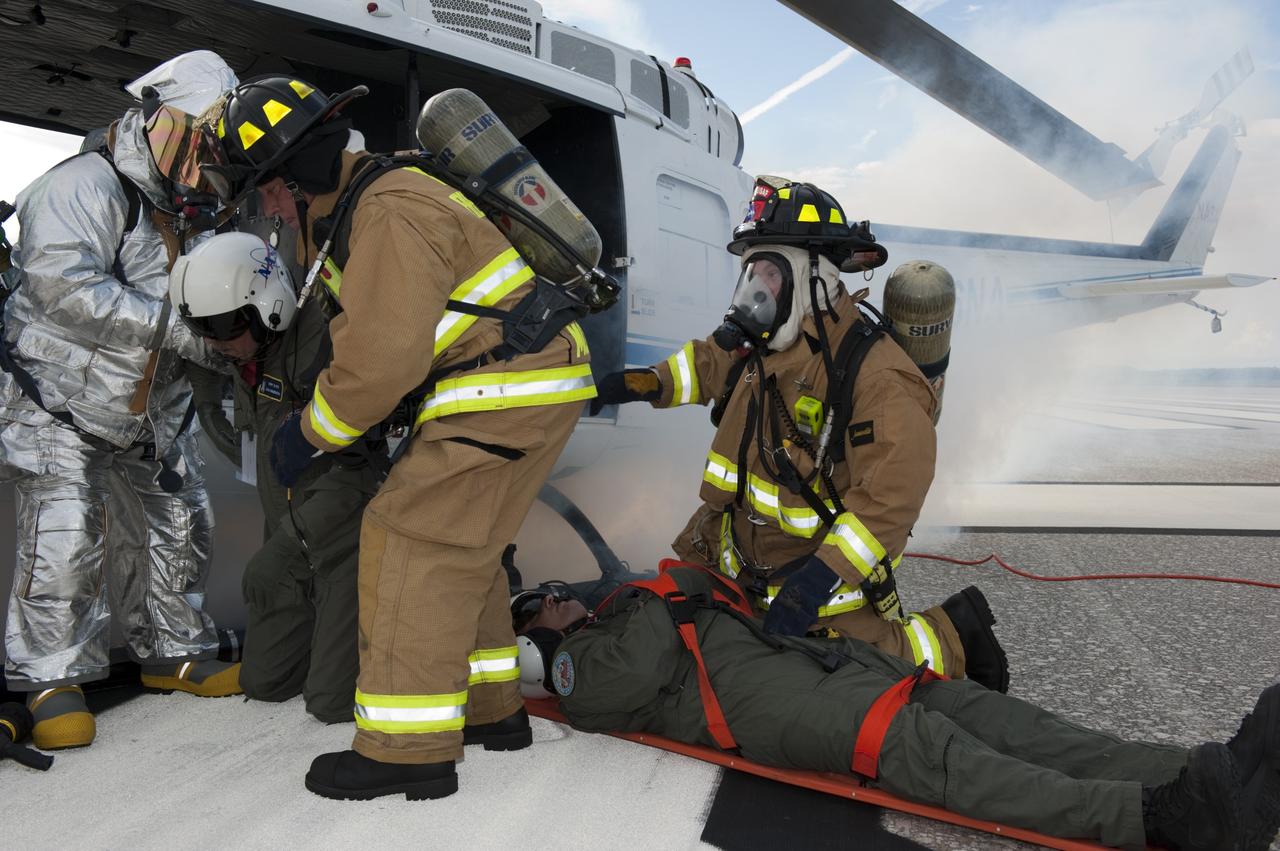
CAPE CANAVERAL, Fla. -- NASA Fire Rescue personnel assist volunteers portraying injured Huey II helicopter crew members participating in the aviation safety exercise during Emergency Response Safety Training at the Shuttle Landing Facility, Runway 33, at NASA’s Kennedy Space Center in Florida. The simulated helicopter mishap exercise was conducted to evaluate emergency response and mishap investigations of aircraft at Kennedy. Participants included Air Rescue Fire Fighters, Flight Operations, Disaster Preparedness, Security, and Safety. NASA mandates simulated aviation safety training take place every two years. Photo credit: NASA/Kim Shiflett
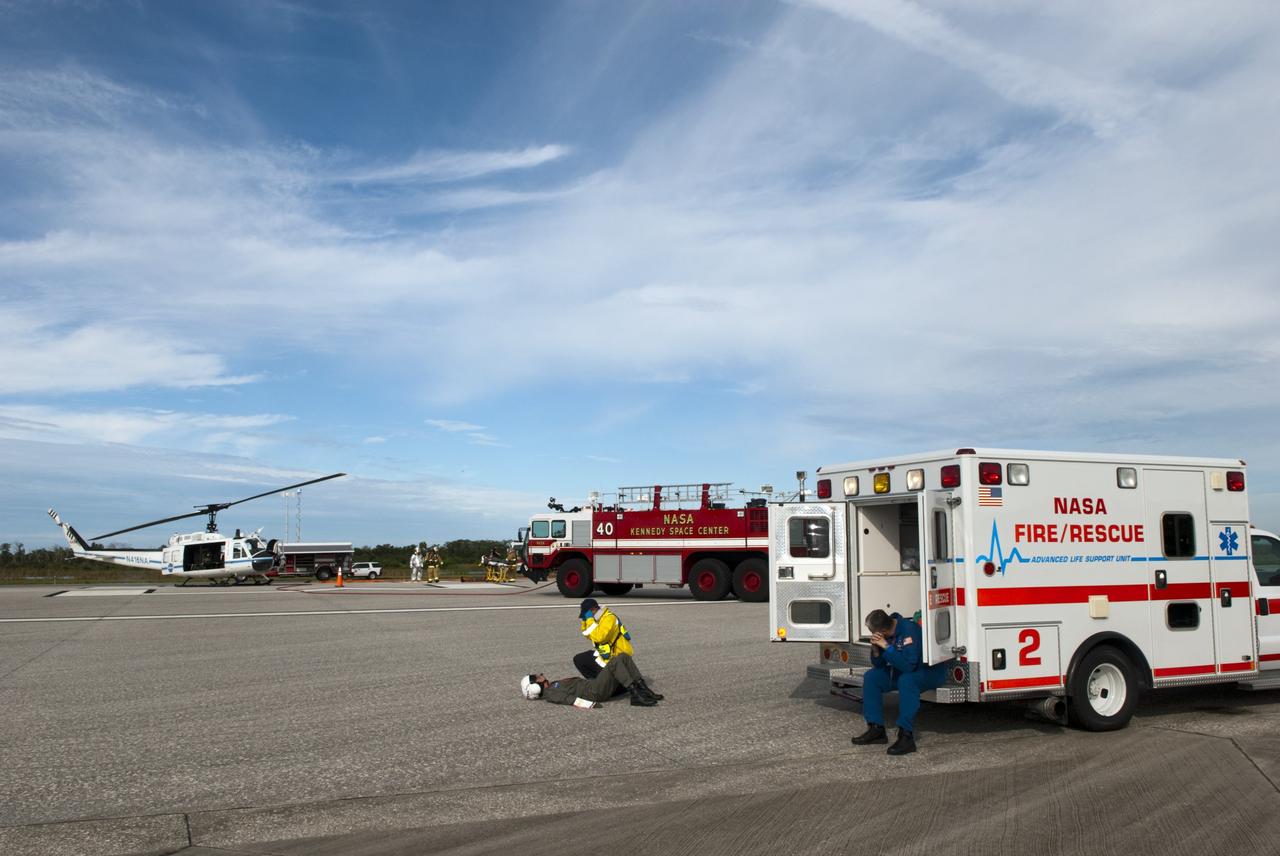
CAPE CANAVERAL, Fla. -- Volunteers portraying injured Huey II helicopter crew members are assisted by NASA Fire Rescue personnel in support of the aviation safety exercise during Emergency Response Safety Training at the Shuttle Landing Facility, Runway 33, at NASA’s Kennedy Space Center in Florida. The simulated helicopter mishap exercise was conducted to evaluate emergency response and mishap investigations of aircraft at Kennedy. Participants included Air Rescue Fire Fighters, Flight Operations, Disaster Preparedness, Security, and Safety. NASA mandates simulated aviation safety training take place every two years. Photo credit: NASA/Kim Shiflett
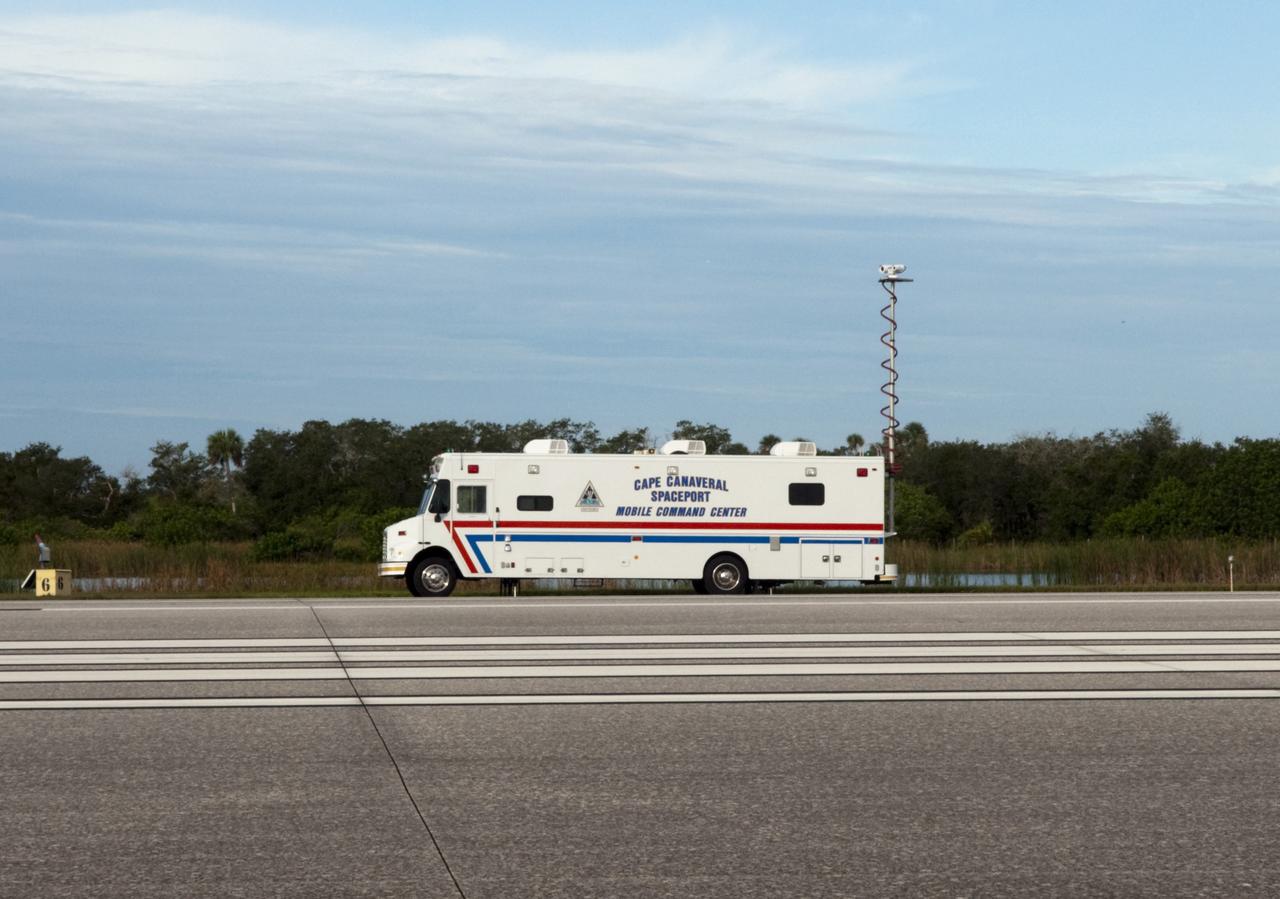
CAPE CANAVERAL, Fla. -- The Cape Canaveral Spaceport Mobile Command Center vehicle participates in the aviation safety exercise during Emergency Response Safety Training at the Shuttle Landing Facility, Runway 33, at NASA’s Kennedy Space Center in Florida. The simulated helicopter mishap exercise was conducted to evaluate emergency response and mishap investigations of aircraft at Kennedy. Participants included Air Rescue Fire Fighters, Flight Operations, Disaster Preparedness, Security, and Safety. NASA mandates simulated aviation safety training take place every two years. Photo credit: NASA/Kim Shiflett
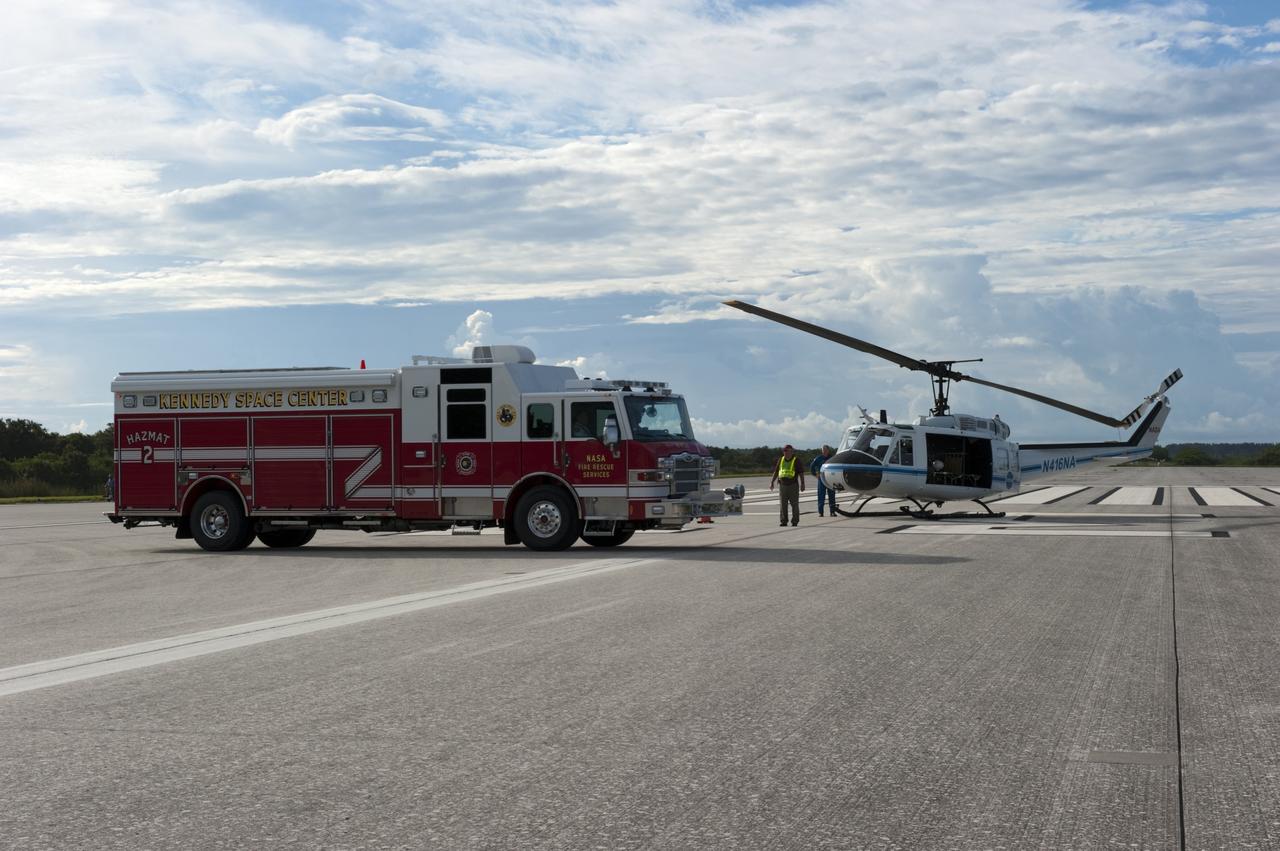
CAPE CANAVERAL, Fla. -- A NASA Fire Rescue Services vehicle and a Huey II helicopter support the aviation safety exercise during Emergency Response Safety Training at the Shuttle Landing Facility, Runway 33, at NASA’s Kennedy Space Center in Florida. The simulated helicopter mishap exercise was conducted to evaluate emergency response and mishap investigations of aircraft at Kennedy. Participants included Air Rescue Fire Fighters, Flight Operations, Disaster Preparedness, Security, and Safety. NASA mandates simulated aviation safety training take place every two years. Photo credit: NASA/Kim Shiflett
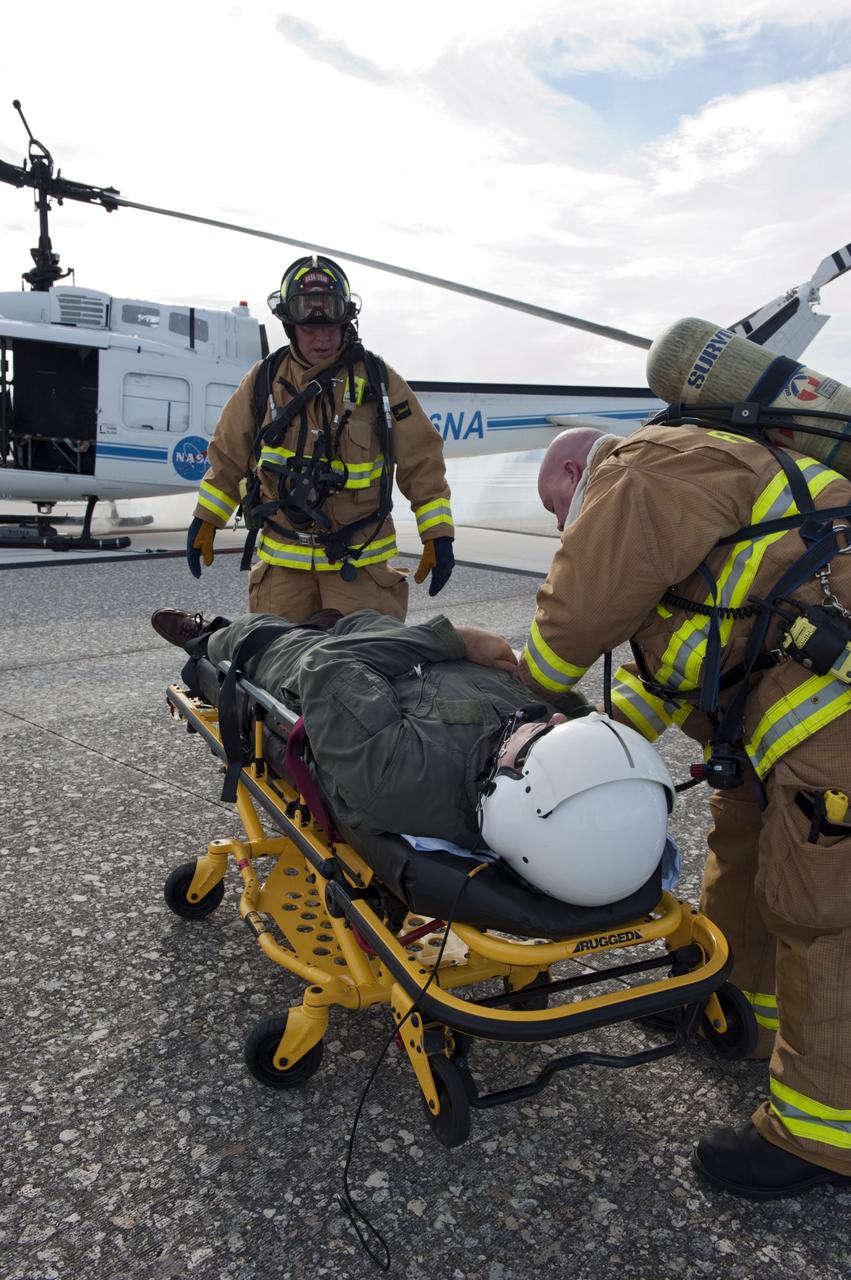
CAPE CANAVERAL, Fla. -- NASA Fire Rescue personnel assist volunteers portraying injured Huey II helicopter crew members participating in the aviation safety exercise during Emergency Response Safety Training at the Shuttle Landing Facility, Runway 33, at NASA’s Kennedy Space Center in Florida. The simulated helicopter mishap exercise was conducted to evaluate emergency response and mishap investigations of aircraft at Kennedy. Participants included Air Rescue Fire Fighters, Flight Operations, Disaster Preparedness, Security, and Safety. NASA mandates simulated aviation safety training take place every two years. Photo credit: NASA/Kim Shiflett
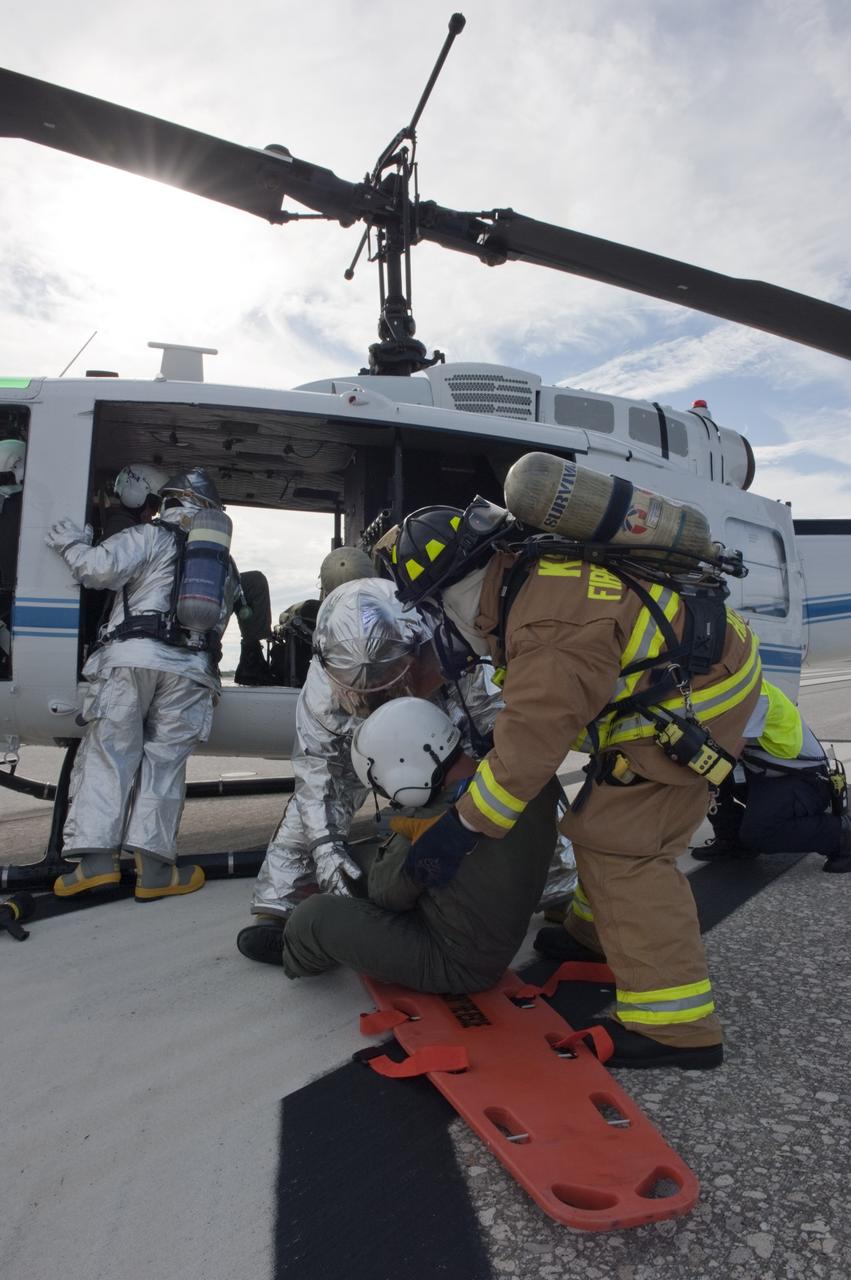
CAPE CANAVERAL, Fla. -- NASA Fire Rescue personnel assist volunteers portraying injured Huey II helicopter crew members participating in the aviation safety exercise during Emergency Response Safety Training at the Shuttle Landing Facility, Runway 33, at NASA’s Kennedy Space Center in Florida. The simulated helicopter mishap exercise was conducted to evaluate emergency response and mishap investigations of aircraft at Kennedy. Participants included Air Rescue Fire Fighters, Flight Operations, Disaster Preparedness, Security, and Safety. NASA mandates simulated aviation safety training take place every two years. Photo credit: NASA/Kim Shiflett
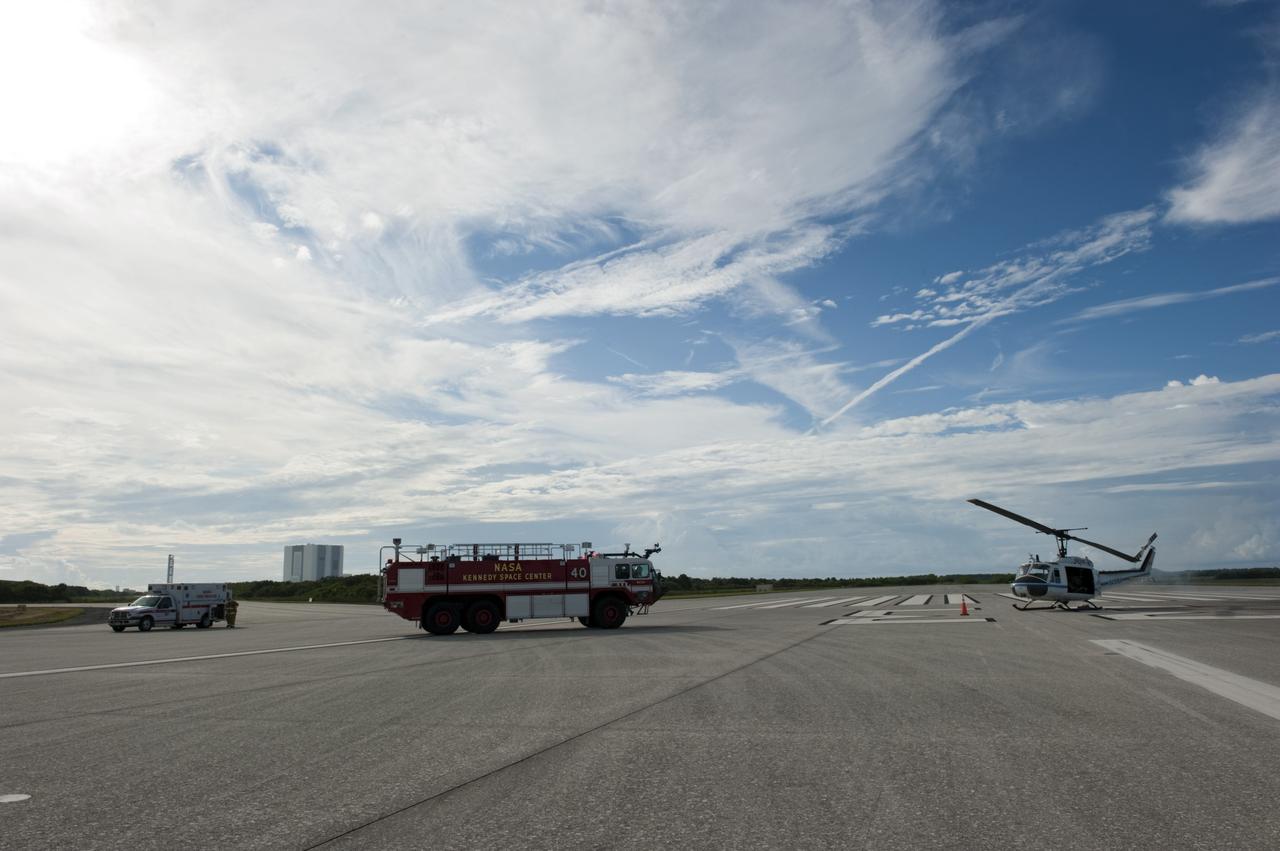
CAPE CANAVERAL, Fla. -- A NASA Fire Rescue Services vehicle, ambulance and Huey II helicopter take part in the aviation safety exercise during Emergency Response Safety Training at the Shuttle Landing Facility, Runway 33, at NASA’s Kennedy Space Center in Florida. The simulated helicopter mishap exercise was conducted to evaluate emergency response and mishap investigations of aircraft at Kennedy. Participants included Air Rescue Fire Fighters, Flight Operations, Disaster Preparedness, Security, and Safety. NASA mandates simulated aviation safety training take place every two years. Photo credit: NASA/Kim Shiflett

CAPE CANAVERAL, Fla. -- NASA Fire Rescue personnel assist a volunteer portraying an injured Huey II helicopter crew member participating in the aviation safety exercise during Emergency Response Safety Training at the Shuttle Landing Facility, Runway 33, at NASA’s Kennedy Space Center in Florida. The simulated helicopter mishap exercise was conducted to evaluate emergency response and mishap investigations of aircraft at Kennedy. Participants included Air Rescue Fire Fighters, Flight Operations, Disaster Preparedness, Security, and Safety. NASA mandates simulated aviation safety training take place every two years. Photo credit: NASA/Kim Shiflett
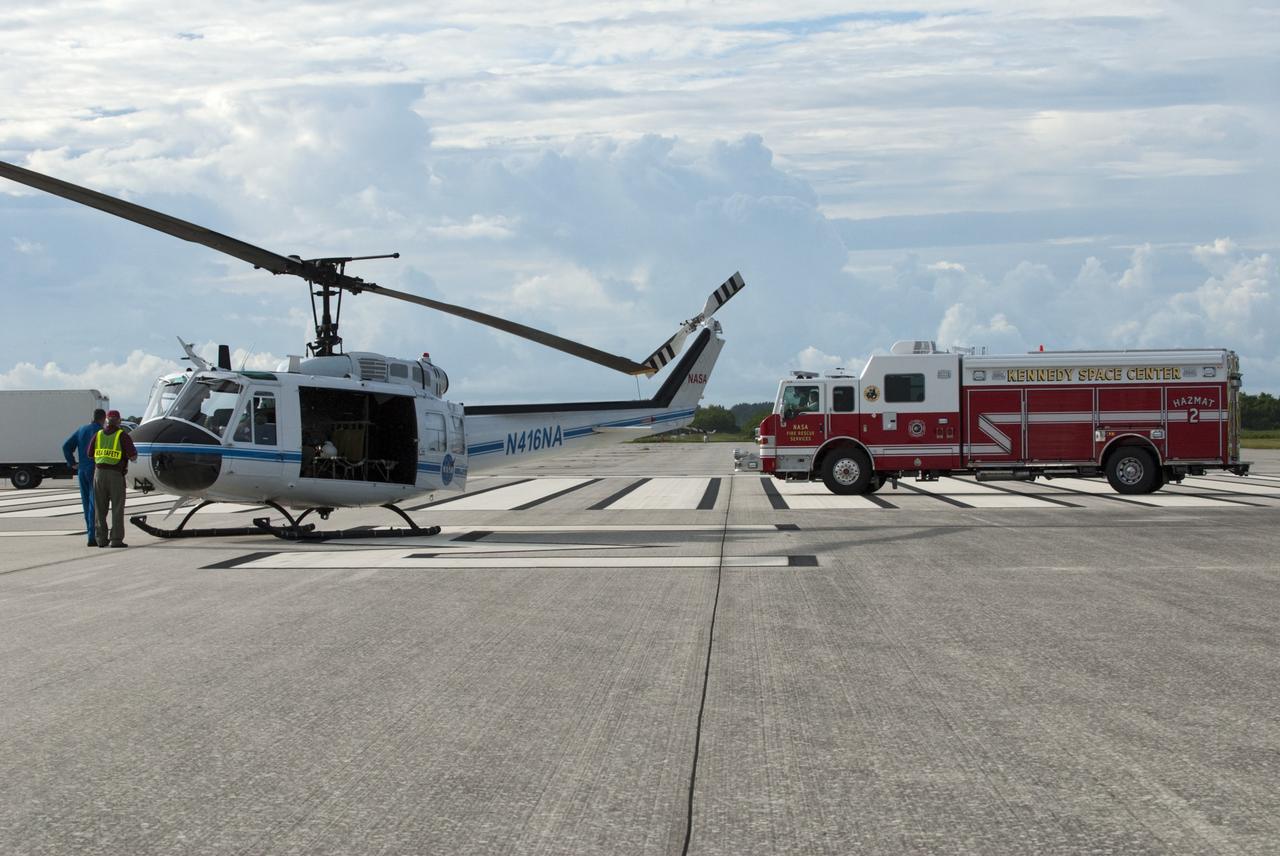
CAPE CANAVERAL, Fla. -- Volunteers, portraying their individual roles, stand beside a NASA Fire Rescue Services vehicle and a Huey II helicopter in support of the aviation safety exercise during Emergency Response Safety Training at the Shuttle Landing Facility, Runway 33, at NASA’s Kennedy Space Center in Florida. The simulated helicopter mishap exercise was conducted to evaluate emergency response and mishap investigations of aircraft at Kennedy. Participants included Air Rescue Fire Fighters, Flight Operations, Disaster Preparedness, Security, and Safety. NASA mandates simulated aviation safety training take place every two years. Photo credit: NASA/Kim Shiflett
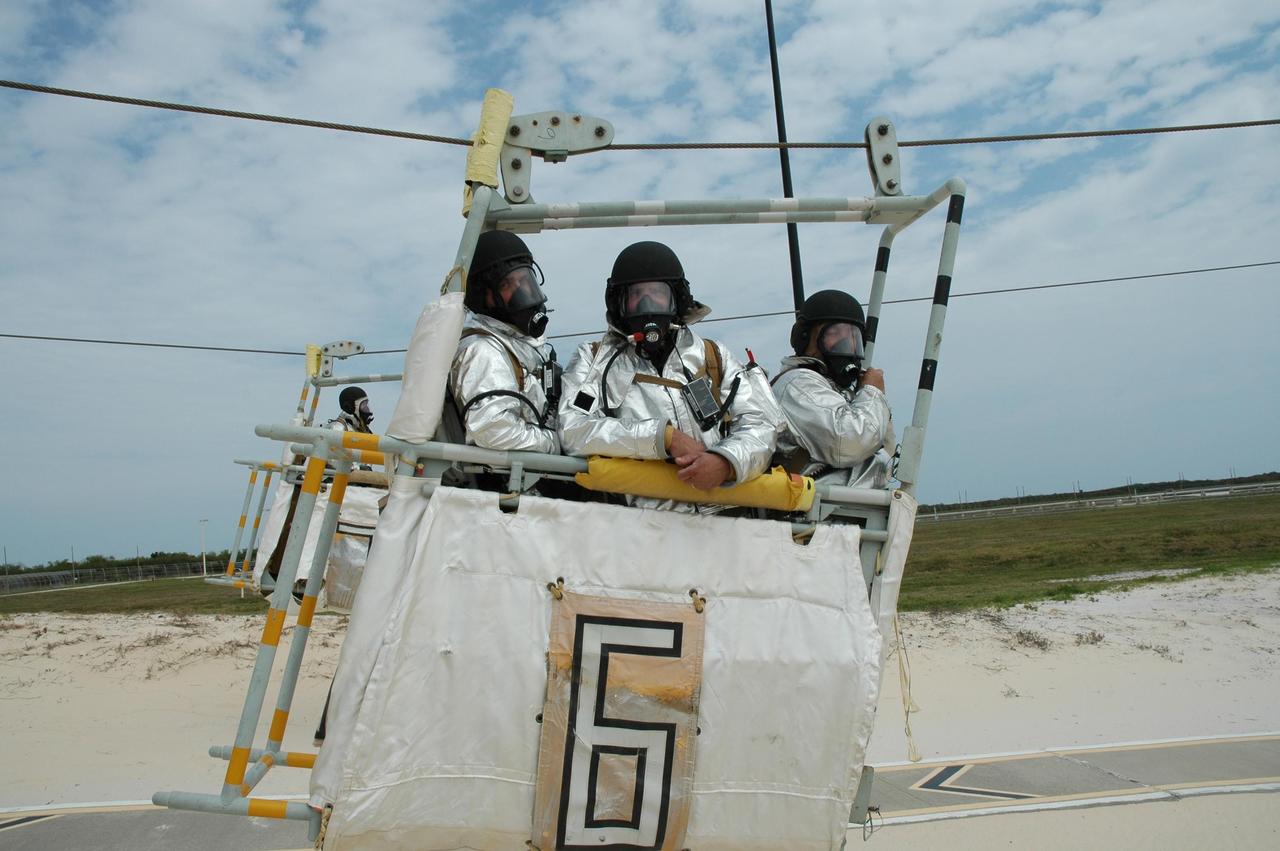
KENNEDY SPACE CENTER, FLA. -- During the second stage of a simulated emergency, known as Mode 4, part of the KSC fire rescue team in a slidewire basket arrive at the landing site. The emergency exercise began at the 195-foot level of Launch Pad 39A. The KSC rescue teams are practicing emergency procedures in the unlikely scenario of a mishap on the pad during a launch sequence. The exercises are standard training procedures to assess and prepare emergency personnel, procedures and hardware. Photo credit: NASA/Jim Grossmann
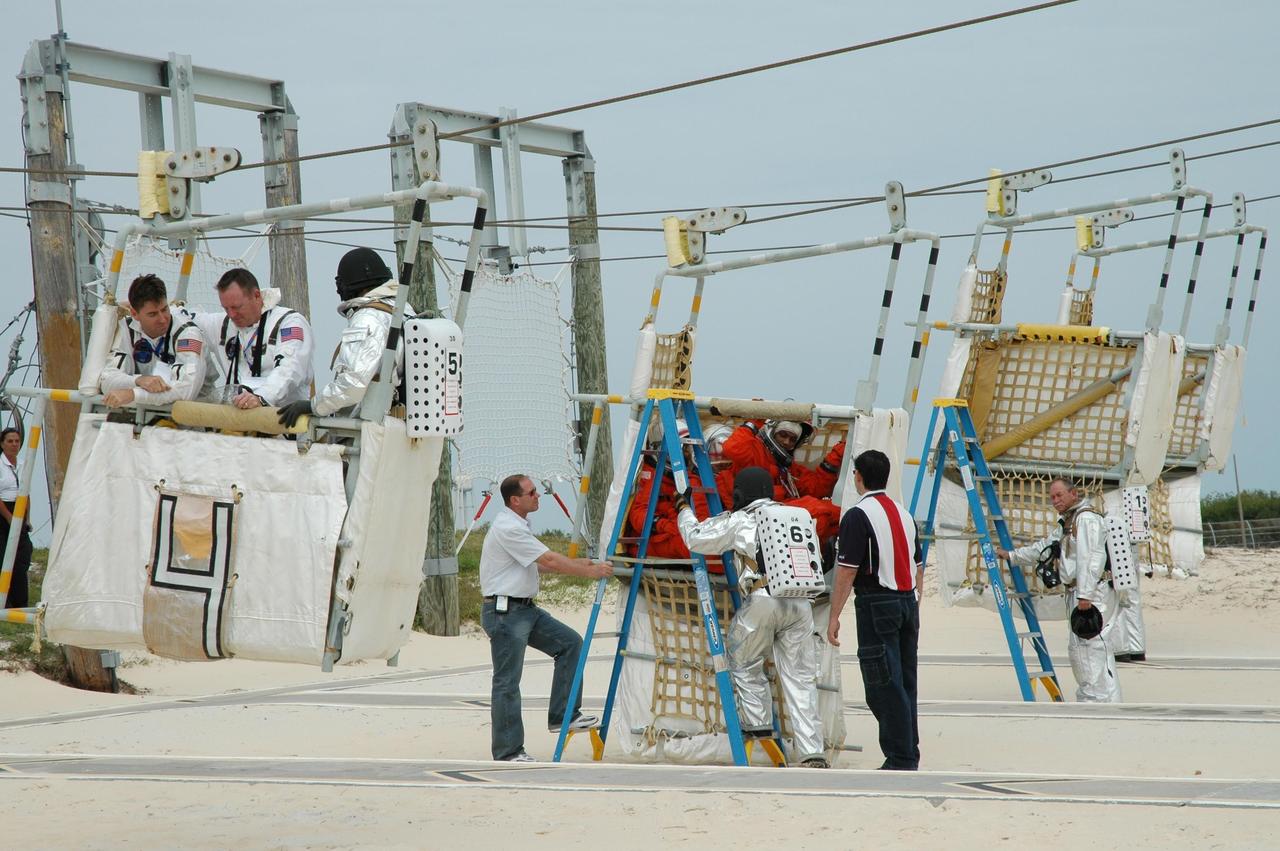
KENNEDY SPACE CENTER, FLA. -- During the second stage of a simulated emergency, known as Mode 4, KSC personnel dressed in astronauts' launch-and-entry suits are helped by the fire rescue team at the slidewire basket landing site. The emergency exercise began at the 195-foot level of Launch Pad 39A. The KSC rescue teams are practicing emergency procedures in the unlikely scenario of a mishap on the pad during a launch sequence. The exercises are standard training procedures to assess and prepare emergency personnel, procedures and hardware. Photo credit: NASA/Jim Grossmann
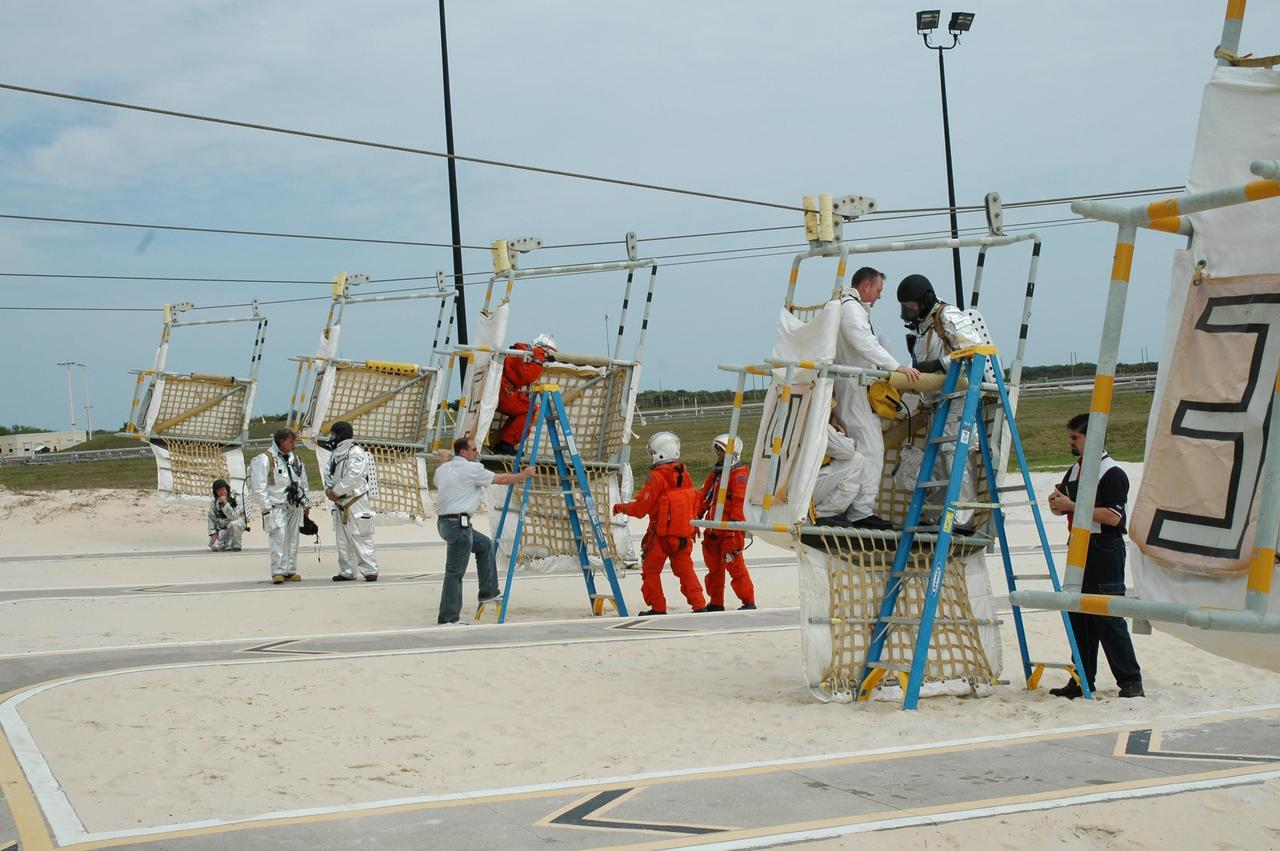
KENNEDY SPACE CENTER, FLA. -- During the second stage of a simulated emergency, known as Mode 4, KSC personnel dressed in astronauts' launch-and-entry suits are helped by the fire rescue team at the slidewire basket landing site. The emergency exercise began at the 195-foot level of Launch Pad 39A. The KSC rescue teams are practicing emergency procedures in the unlikely scenario of a mishap on the pad during a launch sequence. The exercises are standard training procedures to assess and prepare emergency personnel, procedures and hardware. Photo credit: NASA/Jim Grossmann

KENNEDY SPACE CENTER, FLA. -- During the second stage of a simulated emergency, known as Mode 4, part of the KSC fire rescue team helps an "injured" astronaut, portrayed by a KSC worker. The team is helping the worker out of a slidewire basket at the landing site. The emergency exercise began at the 195-foot level of Launch Pad 39A. The KSC rescue teams are practicing emergency procedures in the unlikely scenario of a mishap on the pad during a launch sequence. The exercises are standard training procedures to assess and prepare emergency personnel, procedures and hardware. Photo credit: NASA/Jim Grossmann
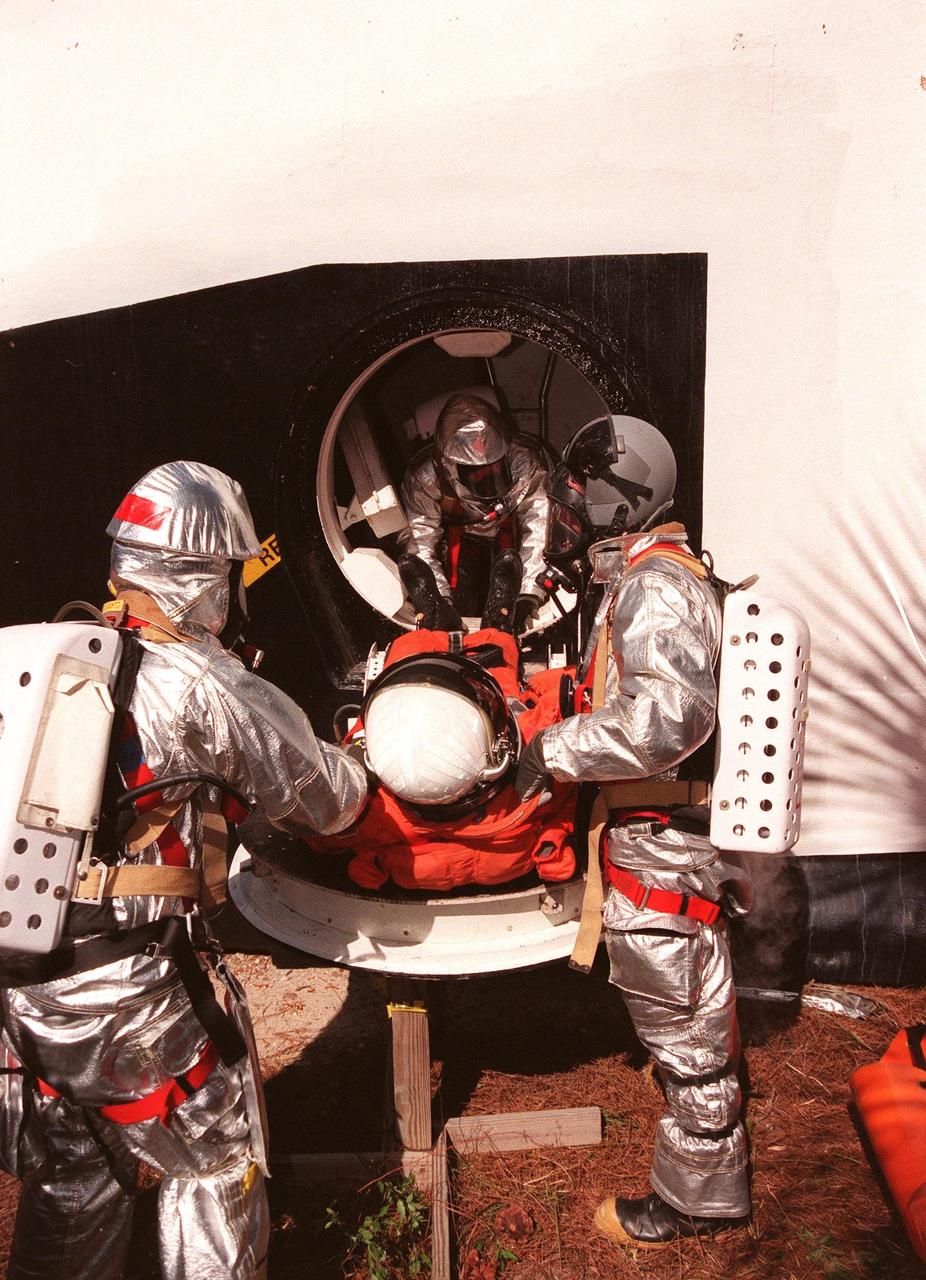
KENNEDY SPACE CENTER, FLA. -- During a simulated rescue mission in the woods near the Shuttle Landing Facility, the KSC response team removes a Shuttle "crew" member from the mock orbiter. The response team is training for the unlikely scenario of a Shuttle mishap at the SLF. The Mode 7 simulation of an astronaut rescue exercises all aspects of command and control, search and rescue, and medical procedures required for a successful rescue. The remote location of the mock-up prevents a totally land-based crew rescue, and calls on a NASA UH-1 helicopter to locate the site and four Air Force HH-60 helicopters to drop emergency equipment and fire/rescue workers to prepare the "crew" for preliminary triage. The helicopters later are used to remove the crew five astronaut candidates, one representative from the Vehicle Integration Test office, and one fire/rescue worker. The exercise concluded with airlifted "patients" arriving safely in the emergency rooms of participating area hospitals
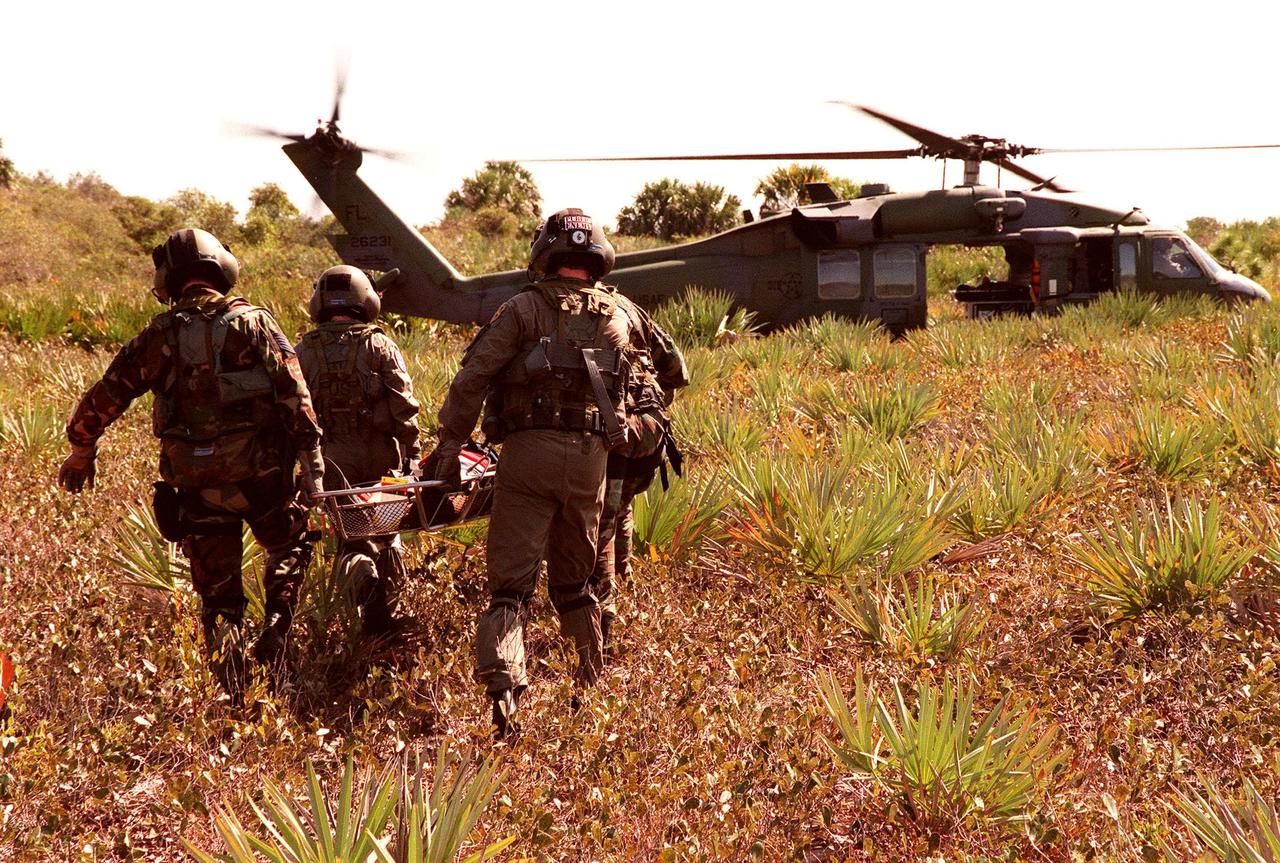
KENNEDY SPACE CENTER, FLA. -- During a simulated rescue mission in the woods near the Shuttle Landing Facility (SLF), the KSC response team practices carrying an injured crew member to an Air Force HH-60 helicopter for transport to a local hospital. The response team is training for the unlikely scenario of a Shuttle mishap at the SLF. The Mode 7 simulation of an astronaut rescue exercises all aspects of command and control, search and rescue, and medical procedures required for a successful rescue. The remote location of the mock-up prevents a totally land-based crew rescue, and calls on a NASA UH-1 helicopter to locate the site and four Air Force HH-60 helicopters to reach the site, drop emergency equipment and later remove the "crew" five astronaut candidates, one representative from the Vehicle Integration Test office, and one fire/rescue worker. The exercise will conclude with airlifted "patients" arriving safely in the emergency rooms of participating area hospitals
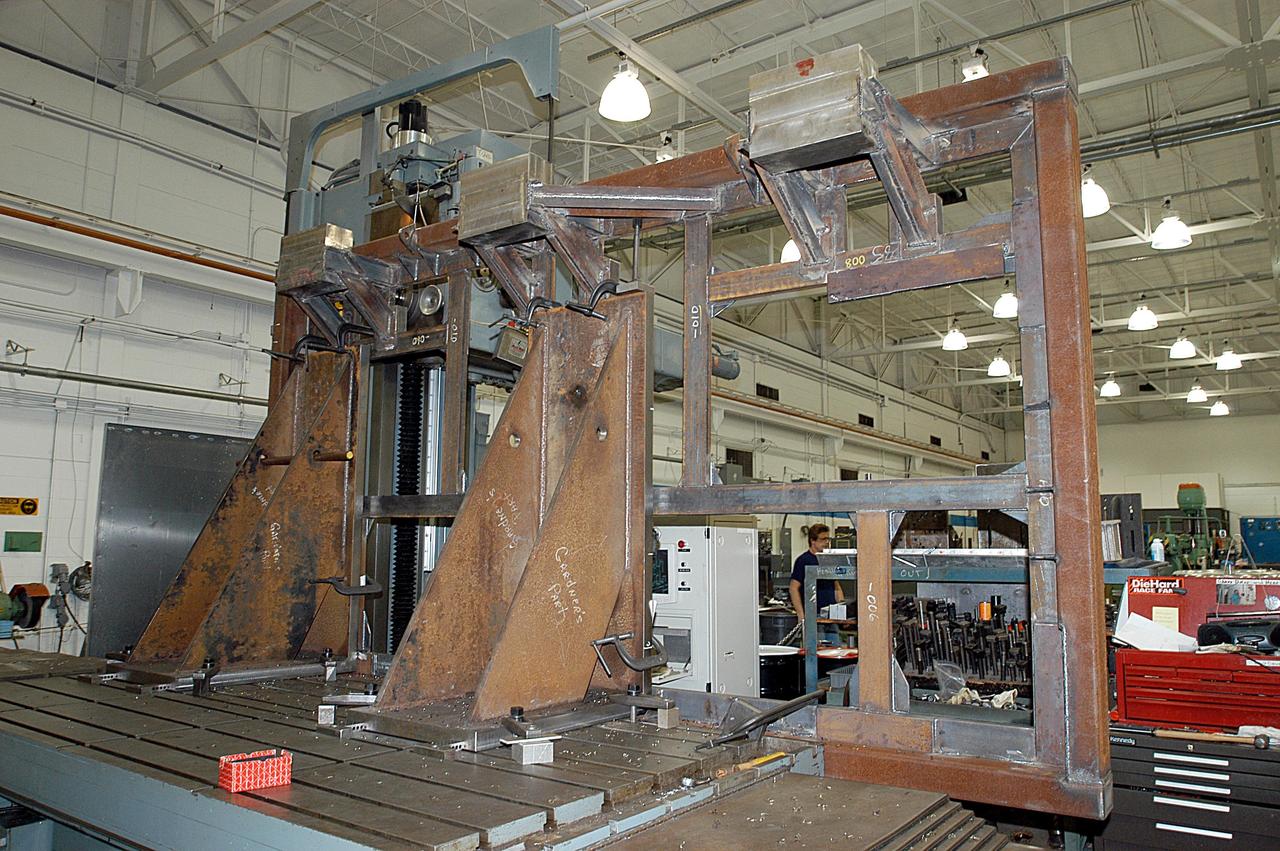
KENNEDY SPACE CENTER, FLA. -- A main landing gear door mounting fixture in the Launch Equipment Shop is being used to support the Columbia mishap investigation. A simulated orbiter wing and several test panels, along with sections of Space Shuttle orbiter Enterprise (OV-101), will be transferred to the Southwest Research Institute for testing after Thermal Protection System (TPS) tile installation is complete. The testing has been requested by the Columbia Accident Investigation Board. For this initiative, sections of Enterprise were borrowed from the Smithsonian Institution's Air and Space Museum where the orbiter is being stored at the Washington Dulles International Airport. Enterprise was the first orbiter built in the Shuttle fleet and was used to conduct the Approach and Landing Test Program before the first powered Shuttle flight.
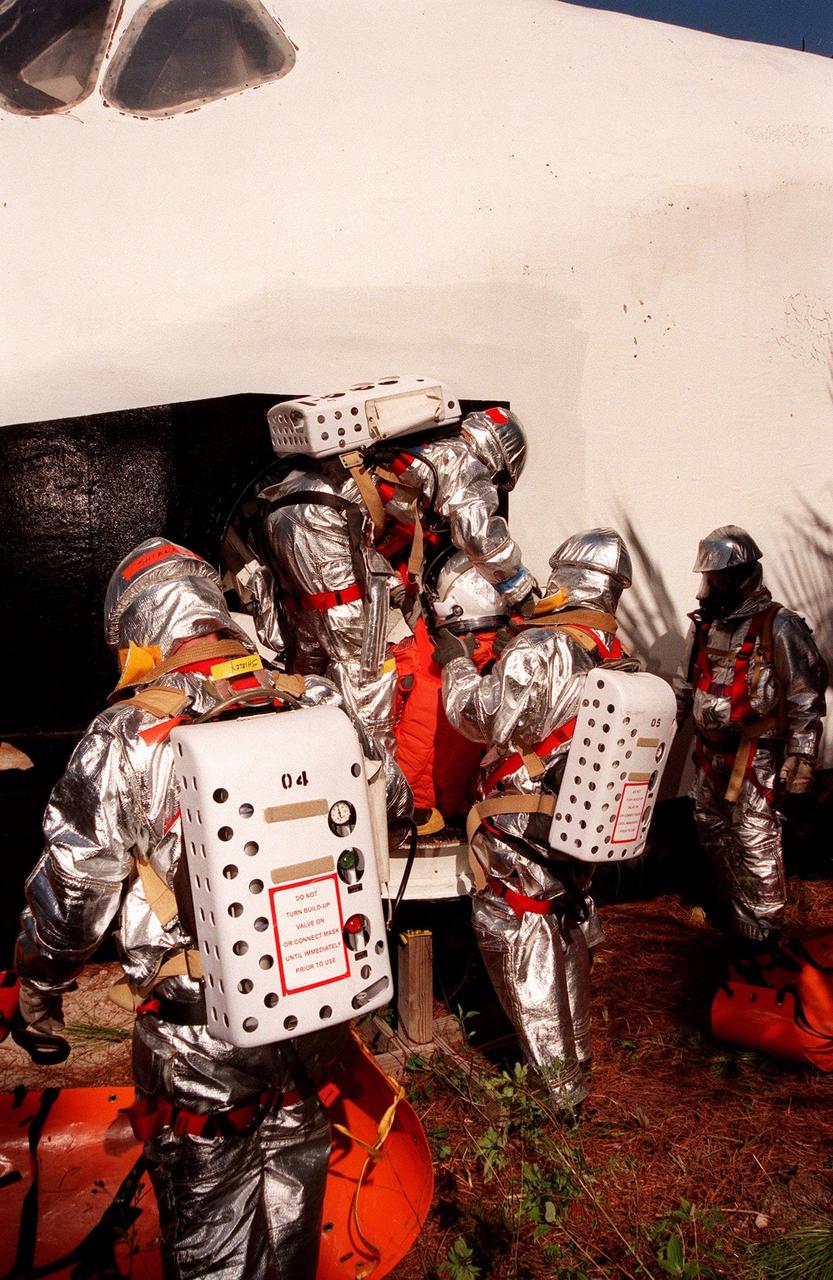
During a simulated rescue mission in the woods near the Shuttle Landing Facility (SLF), the KSC response team removes a crew member from a mock Shuttle. The response team is training for the unlikely scenario of a Shuttle mishap at the SLF. The Mode 7 simulation of an astronaut rescue exercises all aspects of command and control, search and rescue, and medical procedures required for a successful rescue. The remote location of the mock-up prevents a totally land-based crew rescue, and calls on a NASA UH-1 helicopter to locate the site and four Air Force HH-60 helicopters to drop emergency equipment and fire/rescue workers to prepare the "crew" for preliminary triage. The helicopters later are used to remove the crew five astronaut candidates, one representative from the Vehicle Integration Test office, and one fire/rescue worker. The exercise concluded with airlifted "patients" arriving safely in the emergency rooms of participating area hospitals
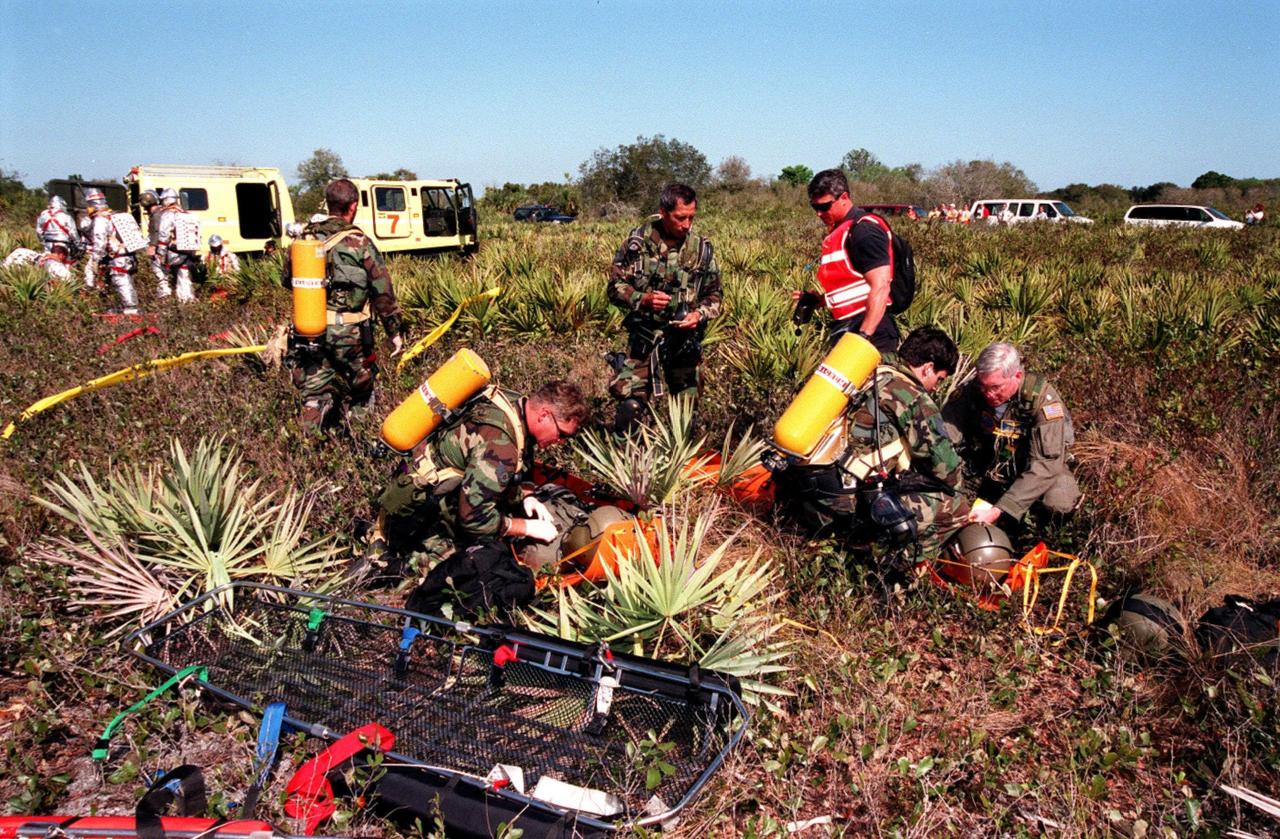
KENNEDY SPACE CENTER, FLA. -- In the simulated rescue mission, the KSC response team takes part in the unlikely scenario of a Shuttle mishap at the Shuttle Landing Facility. The Mode 7 simulation of an astronaut rescue exercised all aspects of command and control, search and rescue, and medical procedures required for a successful rescue. The remote location of the mock-up prevents a totally land-based crew rescue, and calls on a NASA UH-1 helicopter to locate the site and four Air Force HH-60 helicopters to drop emergency equipment and fire/rescue workers to prepare the "crew" for preliminary triage. The helicopters later are used to remove the crew five astronaut candidates, one representative from the Vehicle Integration Test office, and one fire/rescue worker. The exercise concluded with airlifted "patients" arriving safely in the emergency rooms of participating area hospitals.
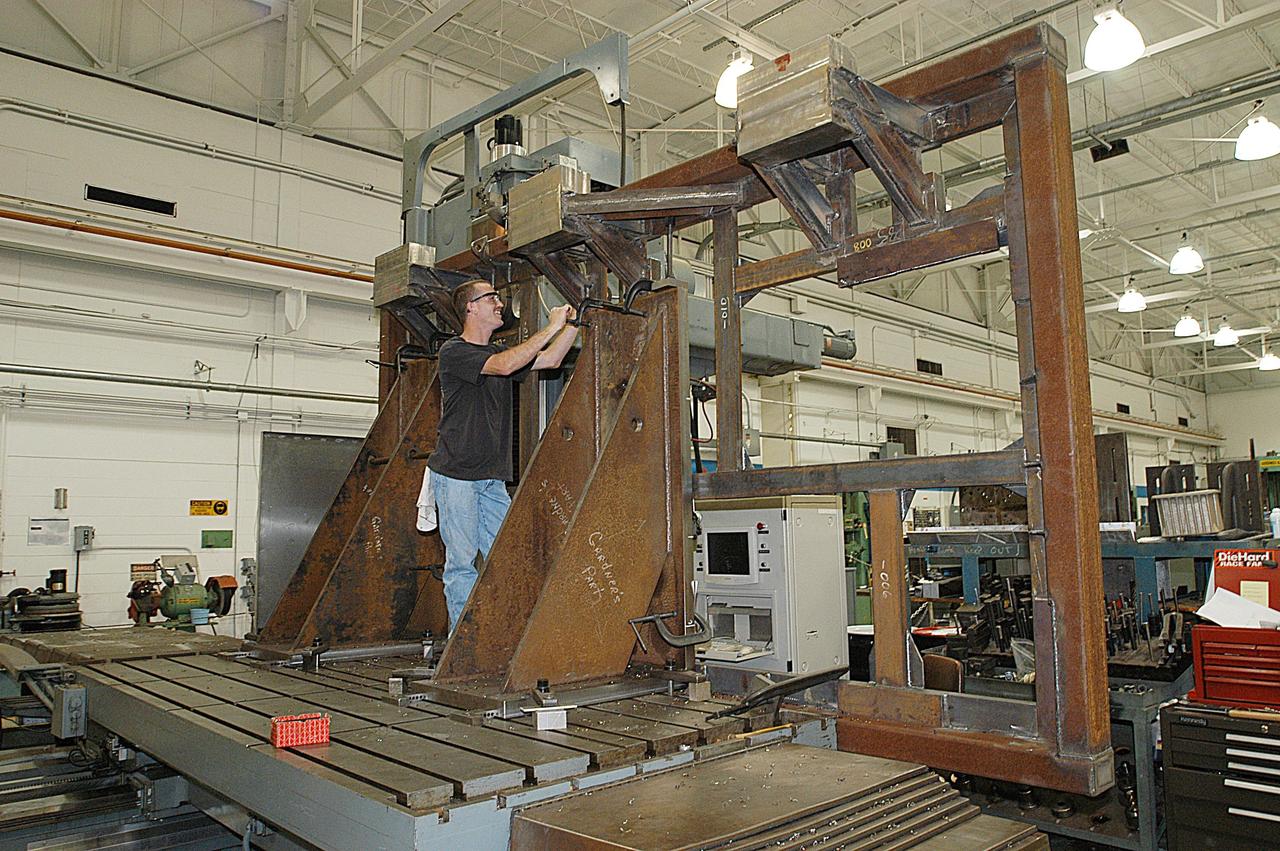
KENNEDY SPACE CENTER, FLA. -- United Space Alliance technician Matt Boonstra works on a main landing gear door mounting fixture in the Launch Equipment Shop. The fixture is being used to support the Columbia mishap investigation. A simulated orbiter wing and several test panels, along with sections of Space Shuttle orbiter Enterprise (OV-101), will be transferred to the Southwest Research Institute for testing after Thermal Protection System (TPS) tile installation on them is complete. The testing has been requested by the Columbia Accident Investigation Board. For this initiative, sections of Enterprise were borrowed from the Smithsonian Institution's Air and Space Museum where the orbiter is being stored at the Washington Dulles International Airport. Enterprise was the first orbiter built in the Shuttle fleet and was used to conduct the Approach and Landing Test Program before the first powered Shuttle flight.
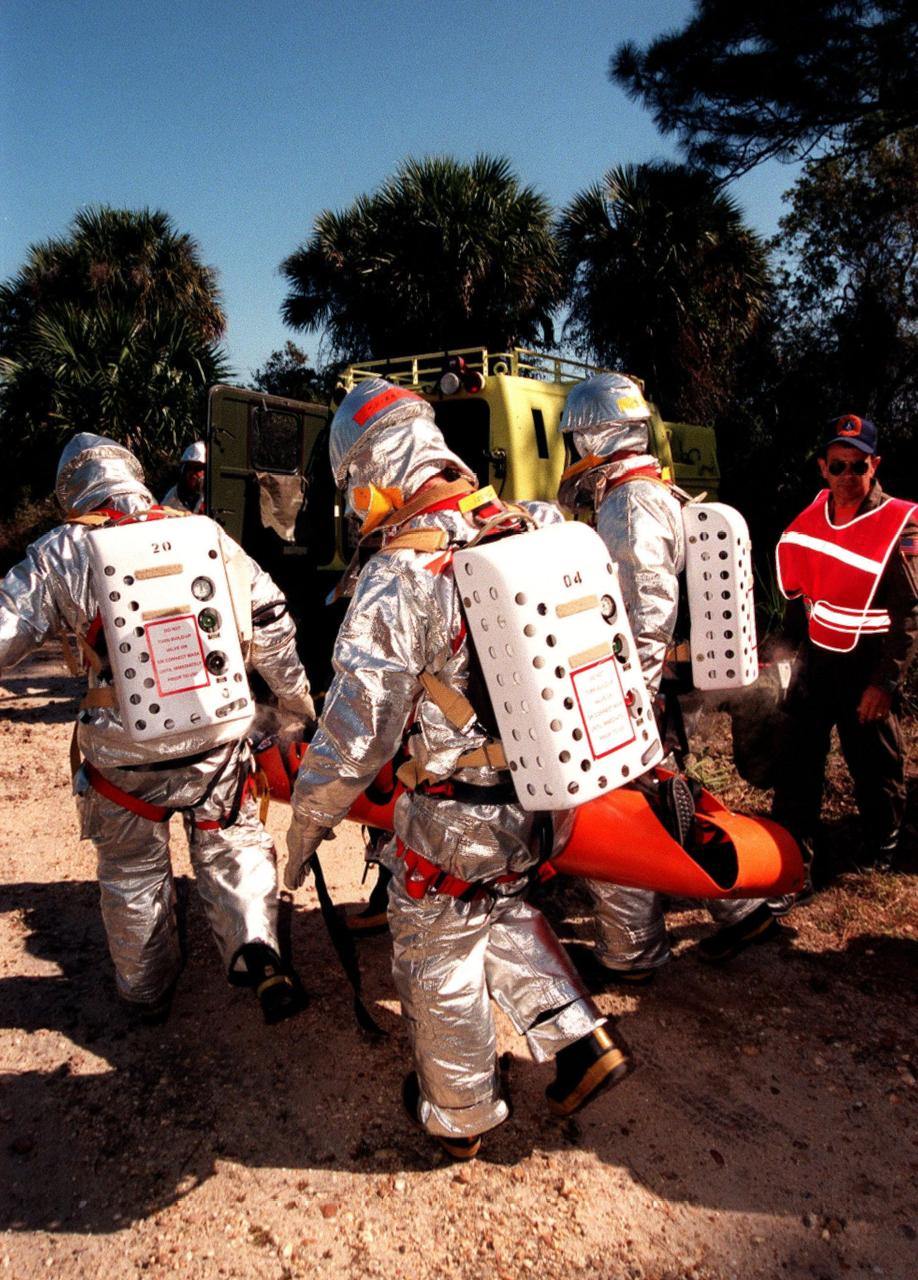
KENNEDY SPACE CENTER, FLA. -- In the woods next to the Shuttle Landing Facility (SLF), the KSC response team takes part in training for the unlikely scenario of a Shuttle mishap at the SLF. The Mode 7 simulation of an astronaut rescue exercises all aspects of command and control, search and rescue, and medical procedures required for a successful rescue. The remote location of the mock-up prevents a totally land-based crew rescue, and calls on a NASA UH-1 helicopter to locate the site and four Air Force HH-60 helicopters to drop emergency equipment and fire/rescue workers to prepare the "crew" for preliminary triage. The helicopters later are used to remove the crew five astronaut candidates, one representative from the Vehicle Integration Test office, and one fire/rescue worker. The exercise concluded with airlifted "patients" arriving safely in the emergency rooms of participating area hospitals
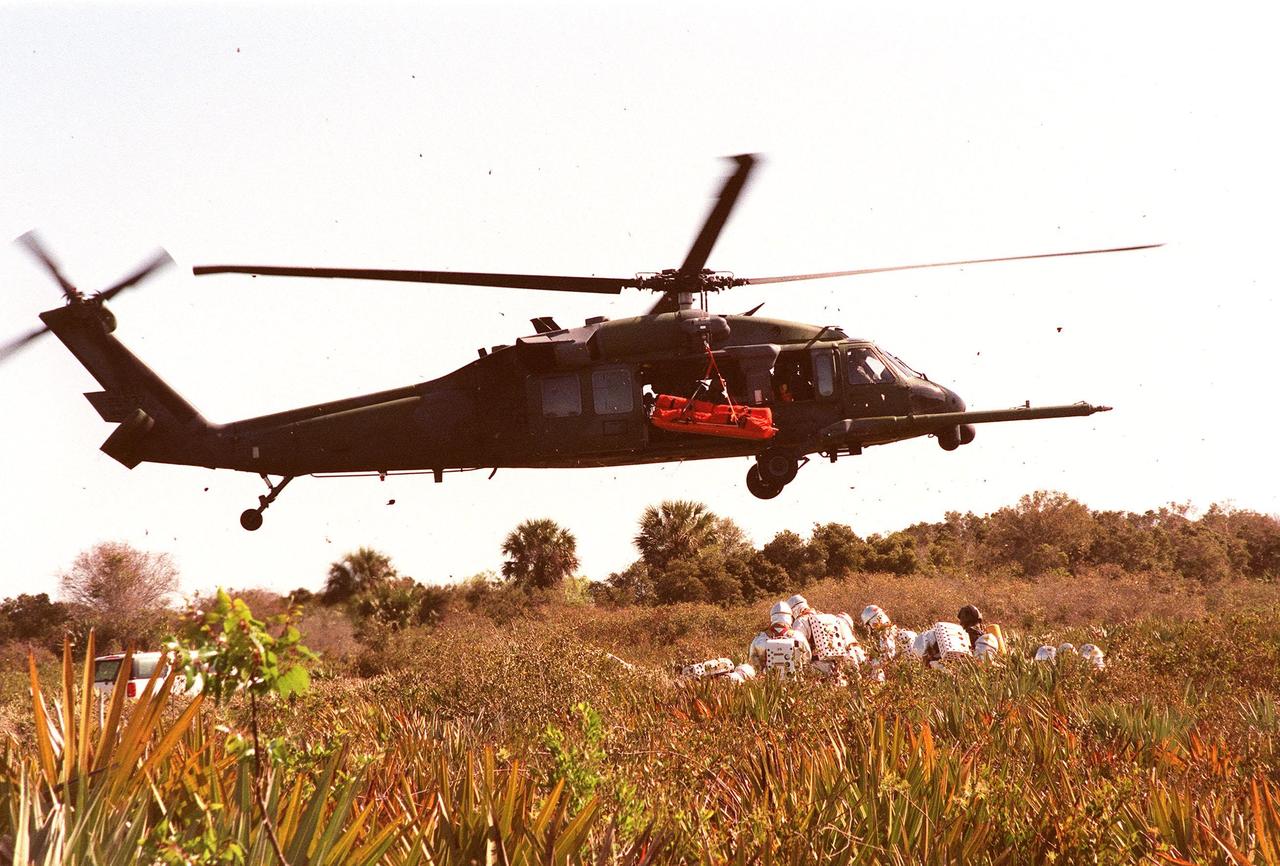
KENNEDY SPACE CENTER, FLA. -- During a simulated rescue mission in the woods near the Shuttle Landing Facility (SLF), the KSC response team practices lifting an injured crew member to an Air Force HH-60 helicopter for transport to a local hospital. The response team is training for the unlikely scenario of a Shuttle mishap at the SLF. The Mode 7 simulation of an astronaut rescue exercises all aspects of command and control, search and rescue, and medical procedures required for a successful rescue. The remote location of the mock-up prevents a totally land-based crew rescue, and calls on a NASA UH-1 helicopter to locate the site and four Air Force HH-60 helicopters to reach and prepare the "crew" five astronaut candidates, one representative from the Vehicle Integration Test office, and one fire/rescue worker for preliminary triage. The exercise will conclude with airlifted "patients" arriving safely in the emergency rooms of participating area hospitals
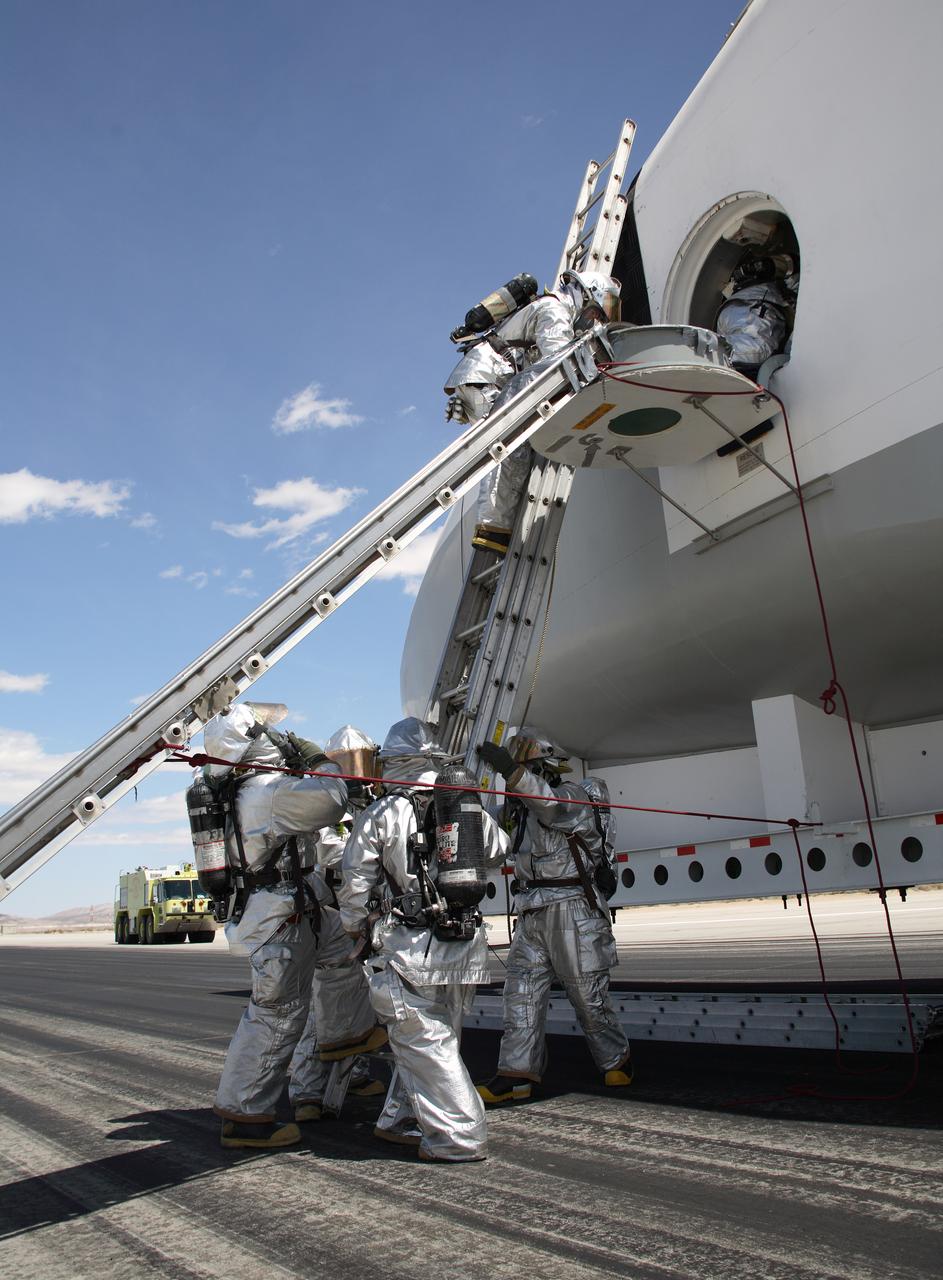
Air Force fire/rescue crew enter the space shuttle cabin mockup hatch to evacuate the shuttle crew during a shuttle rescue training exercise at Edwards AFB. (USAF photo # 070505-F-1287F-118)
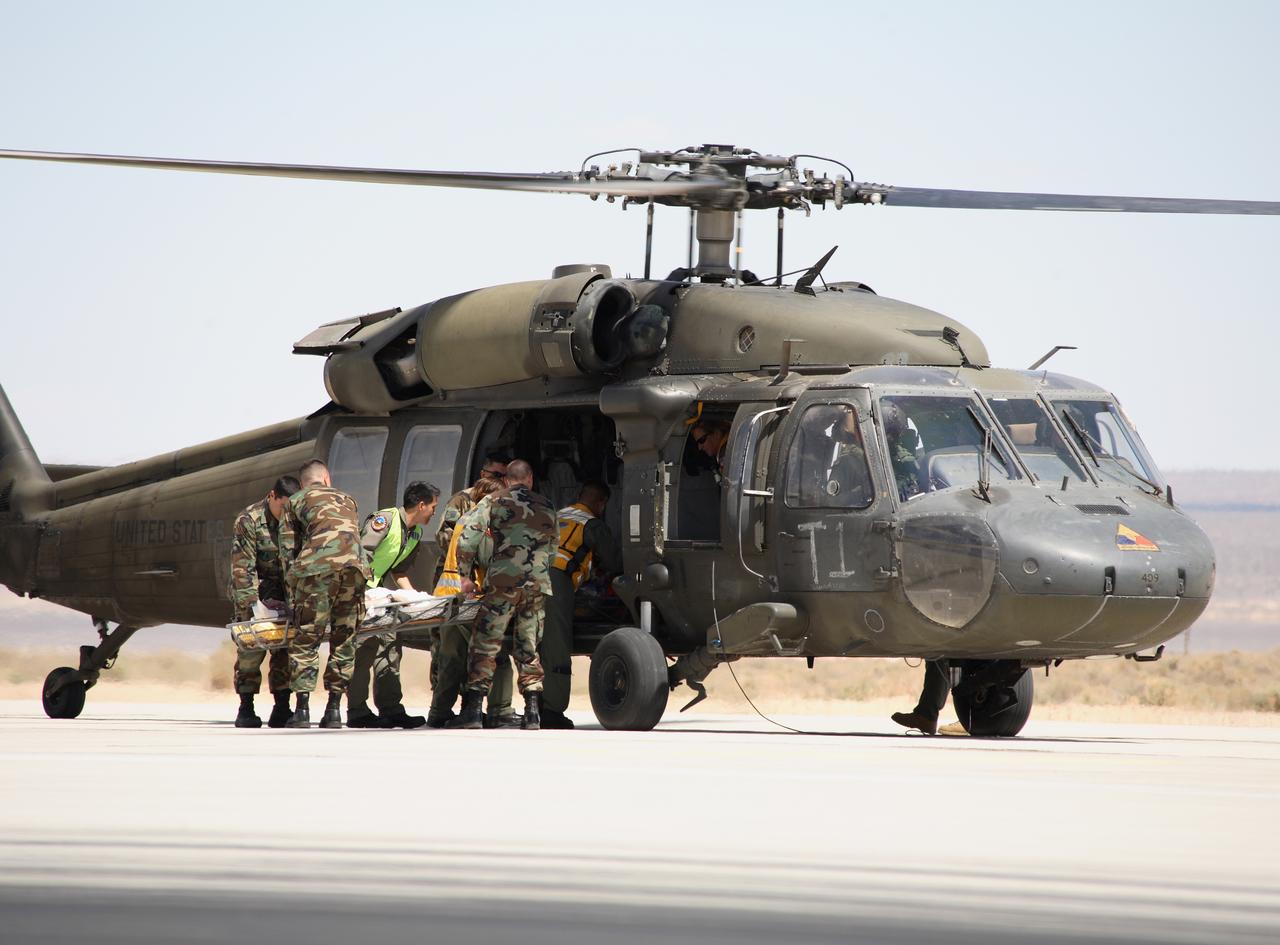
Air Force rescue team members load the volunteer "injured astronaut" on a stretcher into a Blackhawk helicopter for evacuation to a hospital during the exercise. (USAF photo # 070505-F-1287F-166)
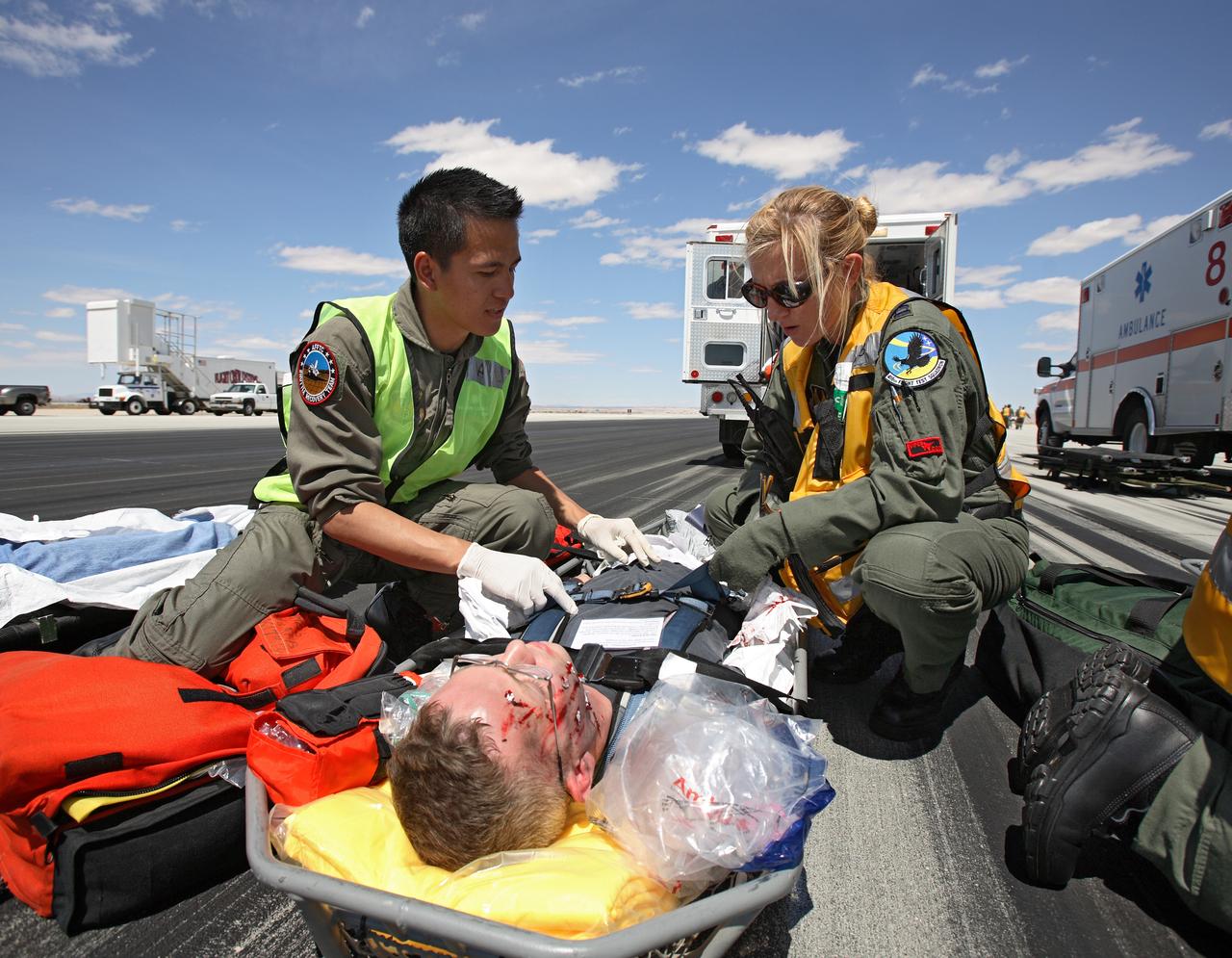
Complete with makeup to simulate facial injuries, a volunteer "astronaut" is tended to by aeromedical rescue staff after evacuation from the shuttle mockup. (USAF photo # 070505-F-1287F-145)
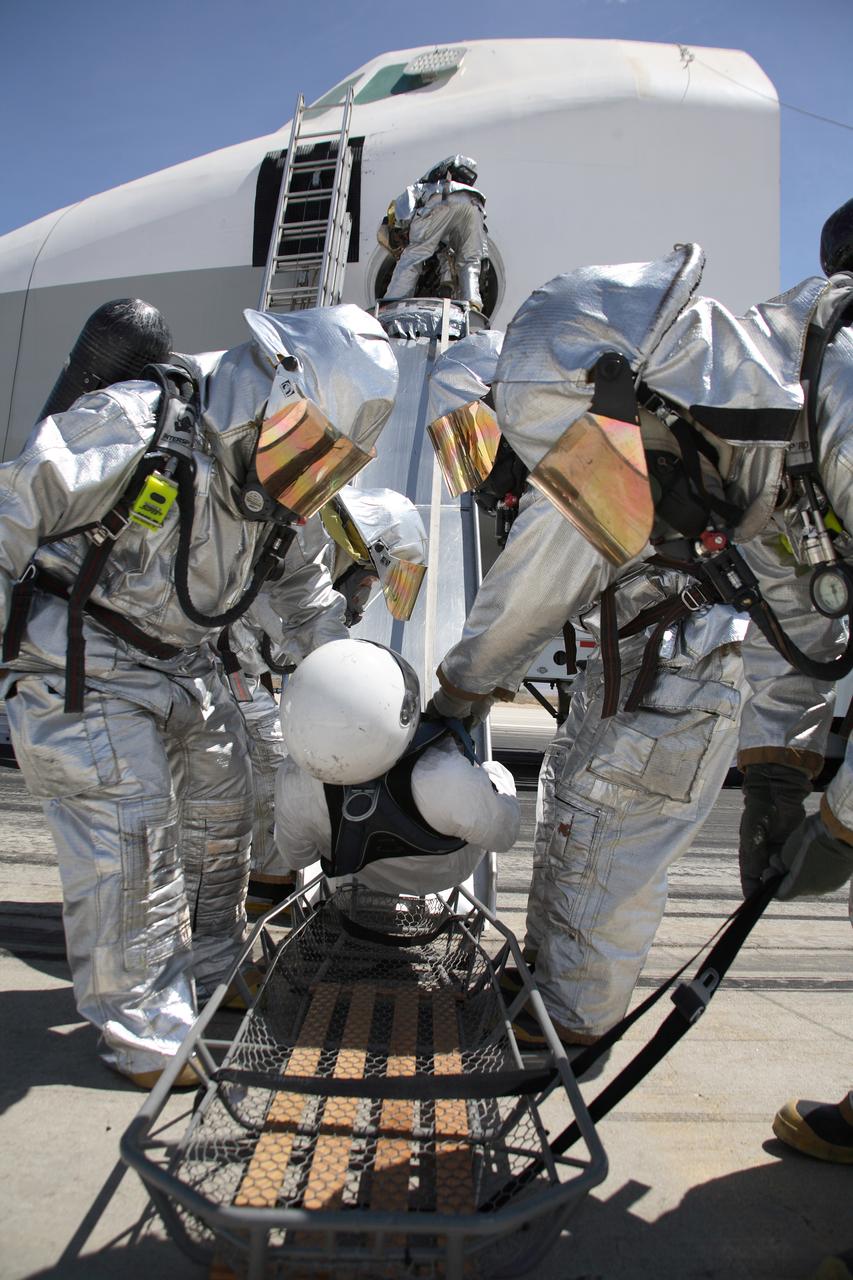
Air Force fire/rescue crew place a volunteer "injured astronaut" on a stretcher after exiting the shuttle cabin mockup during the training exercise. (USAF photo # 070505-F-1287F-126)
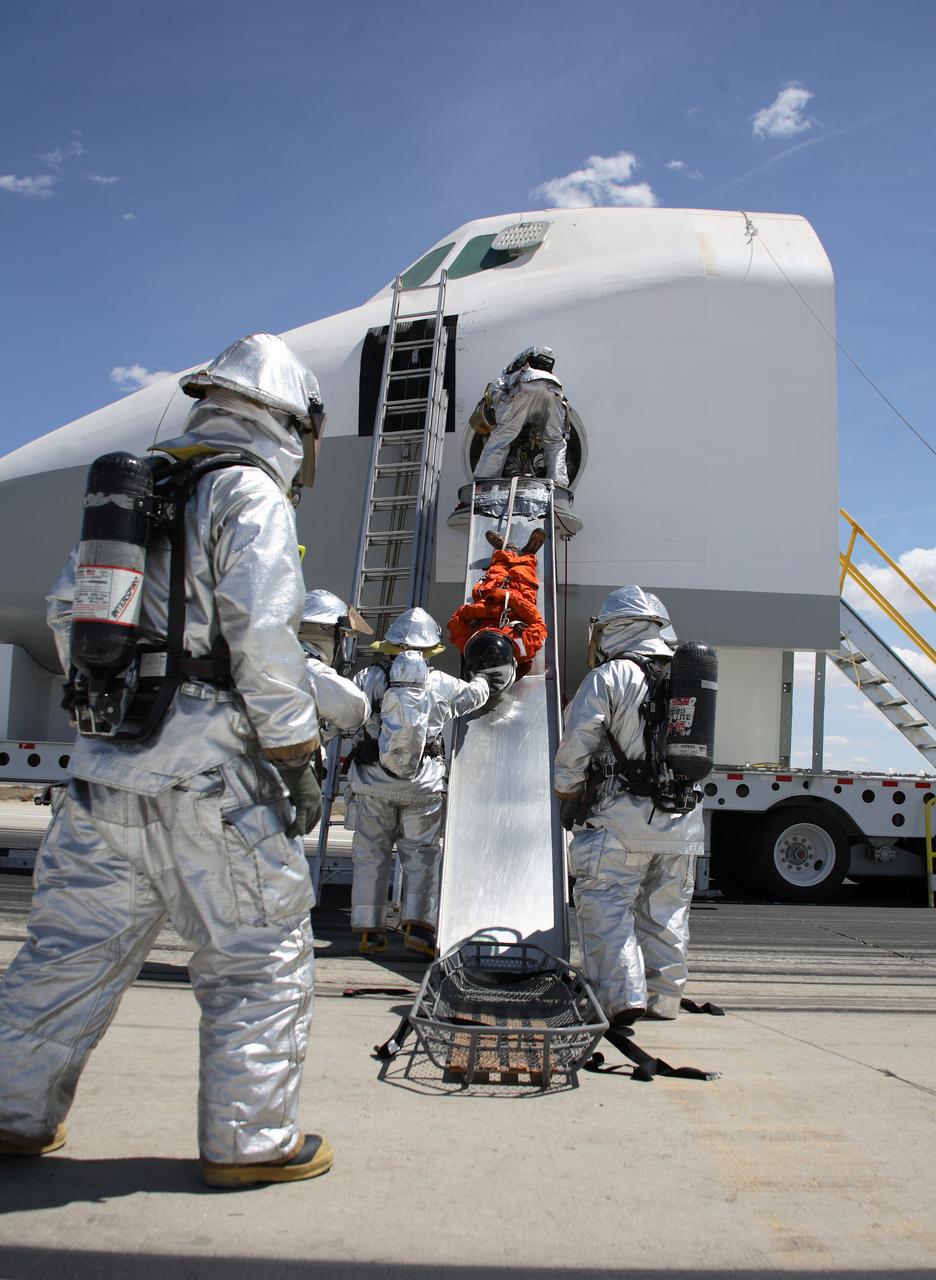
Clad in thermal protection suits, fire/rescue crew aid a volunteer "Injured astronaut" to a head-first ride down the exit slide from the shuttle cabin mockup. (USAF photo # 070505-F-1287F-132)
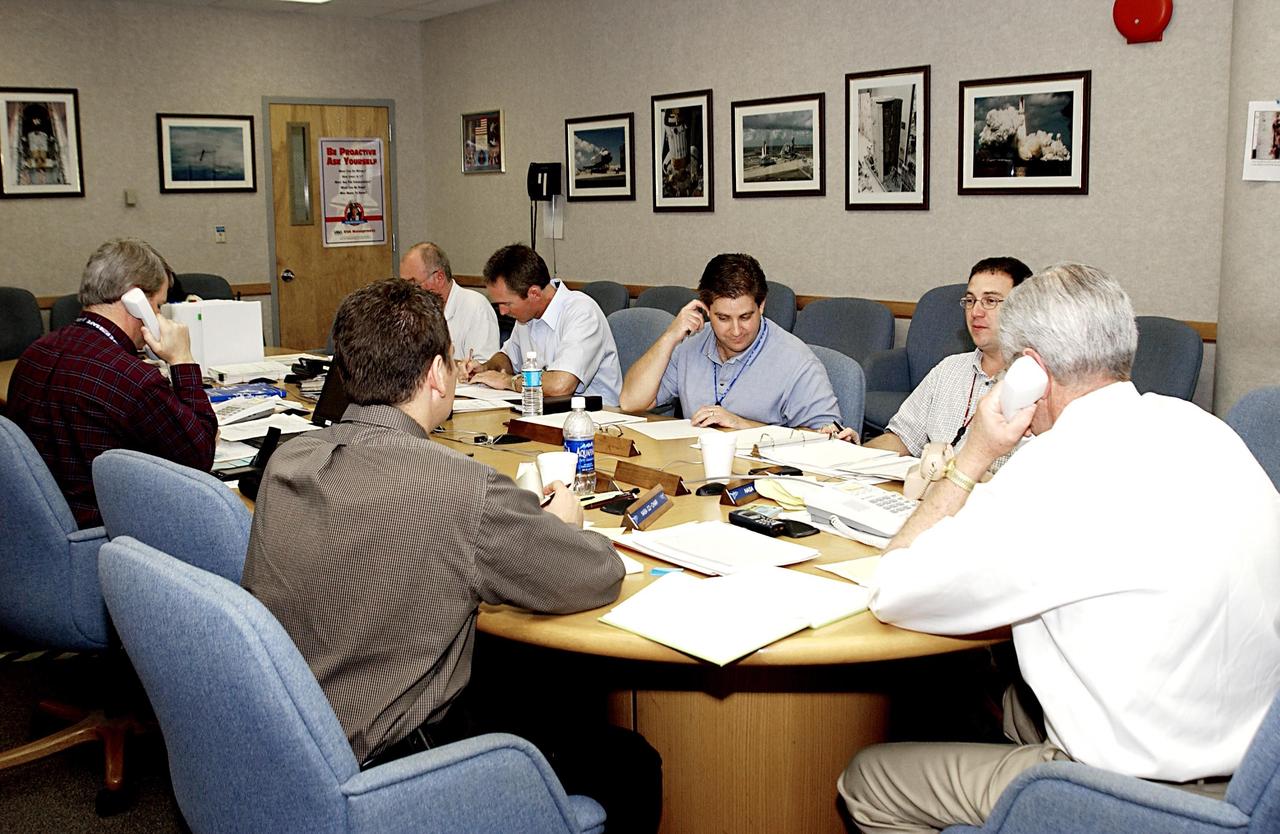
KENNEDY SPACE CENTER, FLA. -- Members of the Recovery Management Team at KSC are at work in the Operations Support Building. They are part of the investigation into the accident that claimed orbiter Columbia and her crew of seven on Feb. 1, 2003, over East Texas as they returned to Earth after a 16-day research mission. Seated around the table (clockwise from far left) are Chris Hasselbring, Landing Operations, USA (co-chair of the Response Management Team); Don Maxwell, Safety, United Space Alliance (USA); Russ DeLoach, chief, Shuttle Mission Assurance Branch, NASA; George Jacobs, Shuttle Engineering; Jeff Campbell, Shuttle Engineering; Denny Gagen, Landing Recovery Manager (second co-chair of the team); and Dave Rainer, Launch and Landing Operations. The team is coordinating KSC technical support and assets to the Mishap Investigation Team in Barksdale, La., and providing support for the Recovery teams in Los Angeles, Texas, New Mexico, Arizona and California. In addition, the team is following up on local leads pertaining to potential debris in the KSC area. .
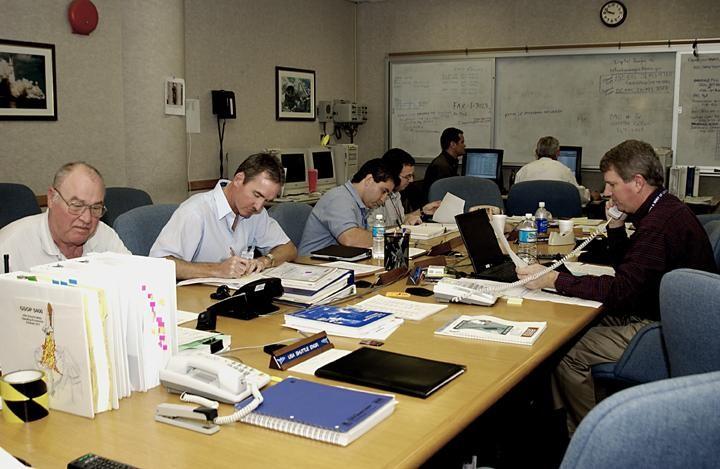
KENNEDY SPACE CENTER, FLA. -- Members of the Recovery Management Team at KSC are at work in the Operations Support Building. They are part of the investigation into the accident that claimed orbiter Columbia and her crew of seven on Feb. 1, 2003, over East Texas as they returned to Earth after a 16-day research mission. From left around the table are Don Maxwell, Safety, United Space Alliance (USA); Russ DeLoach, chief, Shuttle Mission Assurance Branch, NASA; George Jacobs, Shuttle Engineering; Jeff Campbell, Shuttle Engineering; Dave Rainer, Launch and Landing Operations; and the two co-chairs of the Response Management Team, Denny Gagen, Landing Recovery Manager, and Chris Hasselbring, Landing Operations, USA. The team is coordinating KSC technical support and assets to the Mishap Investigation Team in Barksdale, La., and providing support for the Recovery teams in Los Angeles, Texas, New Mexico, Arizona and California. In addition, the team is following up on local leads pertaining to potential debris in the KSC area. .
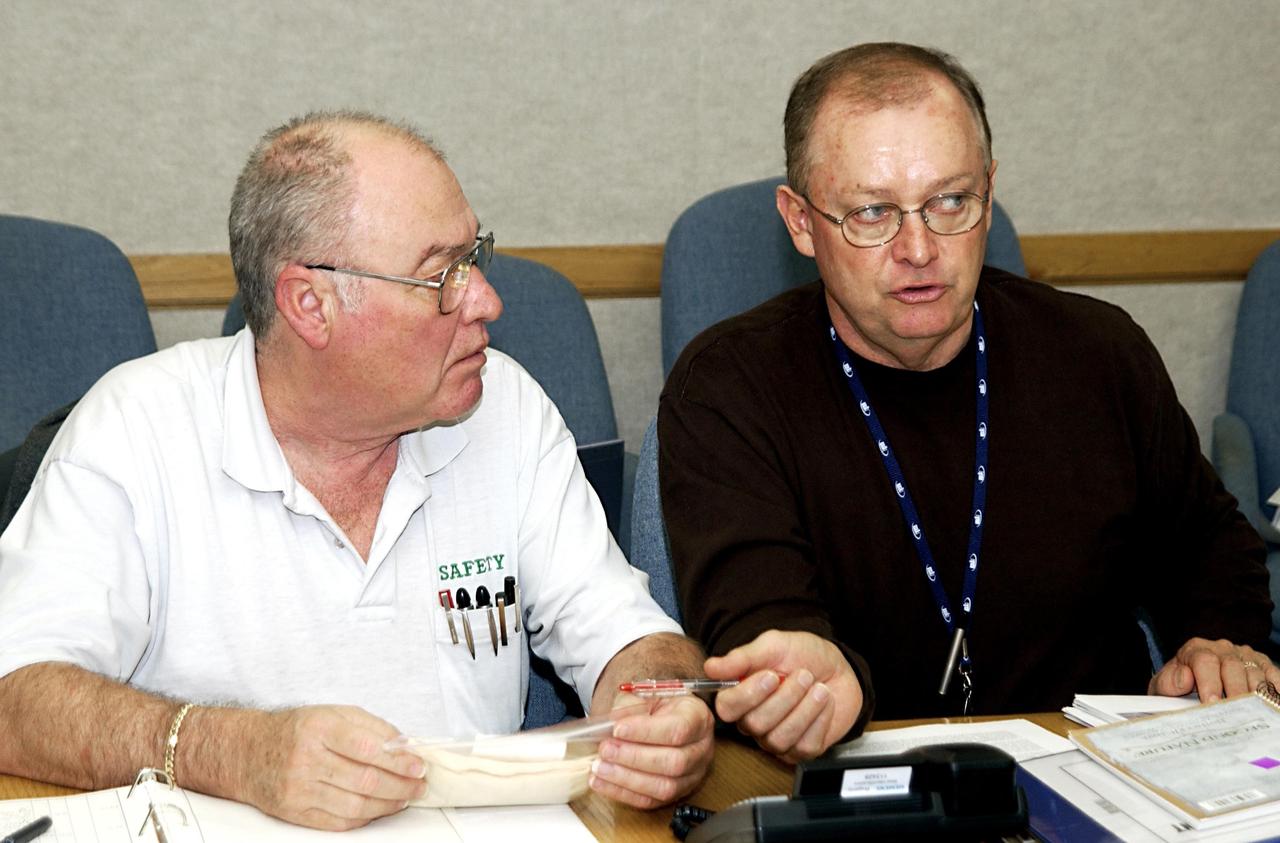
KENNEDY SPACE CENTER, FLA. - Two members of the Recovery Management Team at KSC are at work in the Operations Support Building. At left is Don Maxwell, Safety, United Space Alliance, and at right is Larry Ulmer, Safety, NASA. They are part of the investigation into the accident that claimed orbiter Columbia and her crew of seven on Feb. 1, 2003, over East Texas as they returned to Earth after a 16-day research mission. Other team members are Russ DeLoach, chief, Shuttle Mission Assurance Branch, NASA; George Jacobs, Shuttle Engineering; Jeff Campbell, Shuttle Engineering; Dave Rainer, Launch and Landing Operations; and the two co-chairs of the Response Management Team, Denny Gagen, Landing Recovery Manager, and Chris Hasselbring, Landing Operations, USA. The team is coordinating KSC technical support and assets to the Mishap Investigation Team in Barksdale, La., and providing support for the Recovery teams in Los Angeles, Texas, New Mexico, Arizona and California. In addition, the team is following up on local leads pertaining to potential debris in the KSC area. .
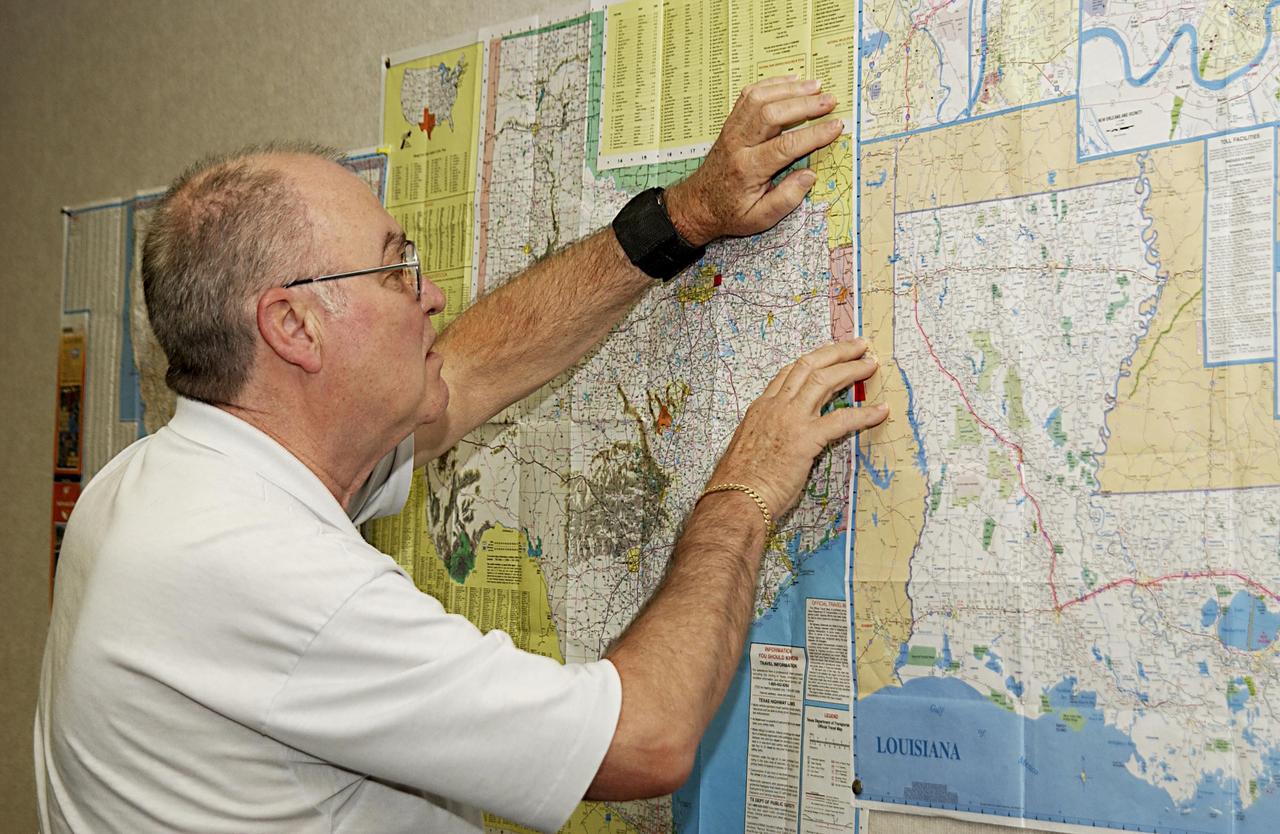
KENNEDY SPACE CENTER, FLA. - Don Maxwell, Safety, United Space Alliance, checks a map of Texas during a meeting of the Recovery Management Team at KSC. The team is part of the investigation into the accident that claimed orbiter Columbia and her crew of seven on Feb. 1, 2003, over East Texas as they returned to Earth after a 16-day research mission. Other team members are Russ DeLoach, chief, Shuttle Mission Assurance Branch, NASA; George Jacobs, Shuttle Engineering; Jeff Campbell, Shuttle Engineering; Dave Rainer, Launch and Landing Operations; the two co-chairs of the Response Management Team, Denny Gagen, Landing Recovery Manager, Chris Hasselbring, Landing Operations, USA; and Larry Ulmer, Safety, NASA. The team is coordinating KSC technical support and assets to the Mishap Investigation Team in Barksdale, La., and providing support for the Recovery teams in Los Angeles, Texas, New Mexico, Arizona and California. In addition, the team is following up on local leads pertaining to potential debris in the KSC area. .
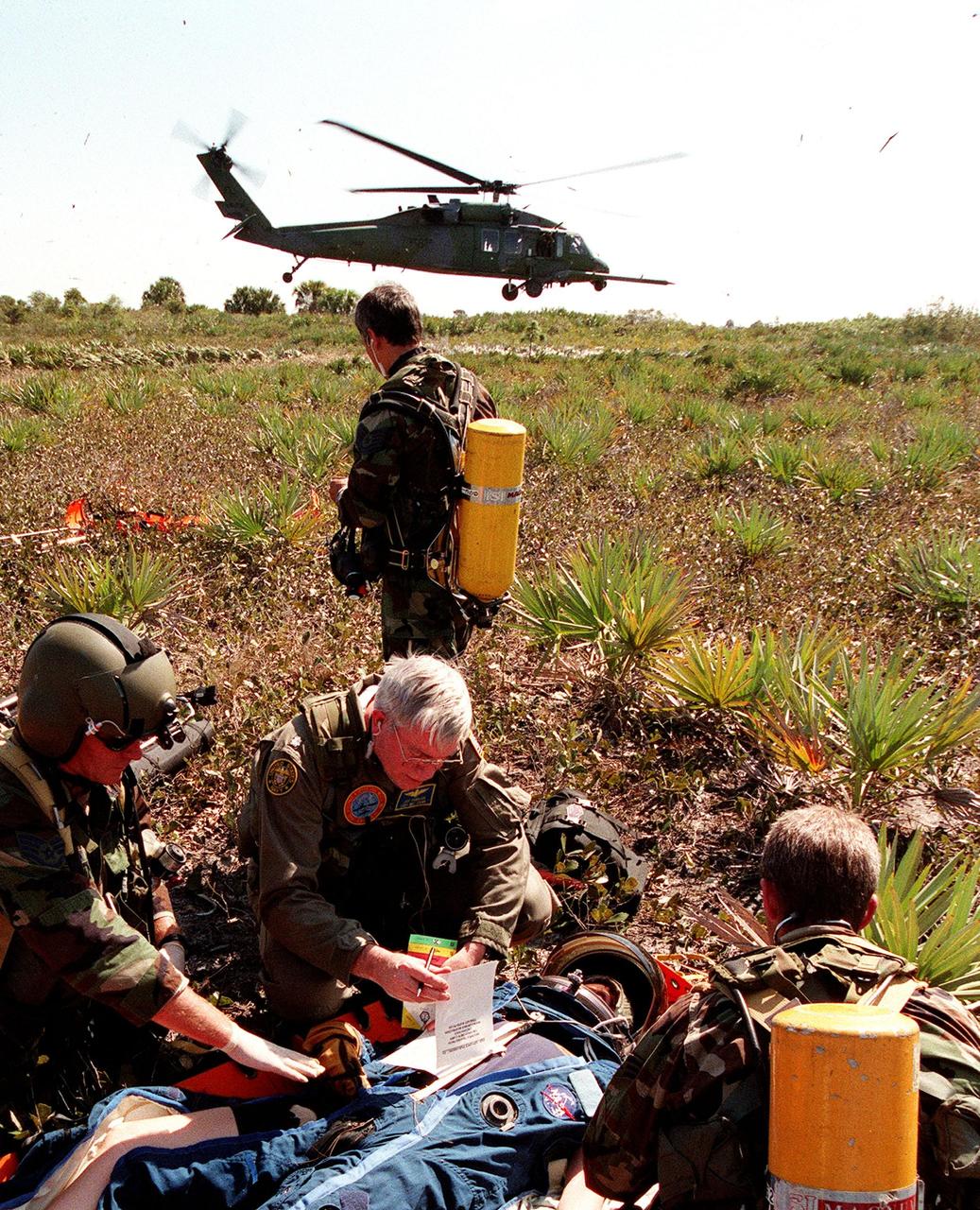
KENNEDY SPACE CENTER, FLA. -- During a simulated rescue mission in the woods near the Shuttle Landing Facility (SLF), the KSC response team practices stabilizing an injured crew member before transport to a local hospital by an Air Force HH-60 helicopter. The response team is training for the unlikely scenario of a Shuttle mishap at the SLF. The Mode 7 simulation of an astronaut rescue exercises all aspects of command and control, search and rescue, and medical procedures required for a successful rescue. The remote location of the mock-up prevents a totally land-based crew rescue, and calls on a NASA UH-1 helicopter to locate the site and four HH-60 helicopters to drop emergency equipment and fire/rescue workers to prepare the "crew" for preliminary triage. The helicopters are then used to remove the crew five astronaut candidates, one representative from the Vehicle Integration Test office, and one fire/rescue worker. The exercise will conclude with airlifted "patients" arriving safely in the emergency rooms of participating area hospitals
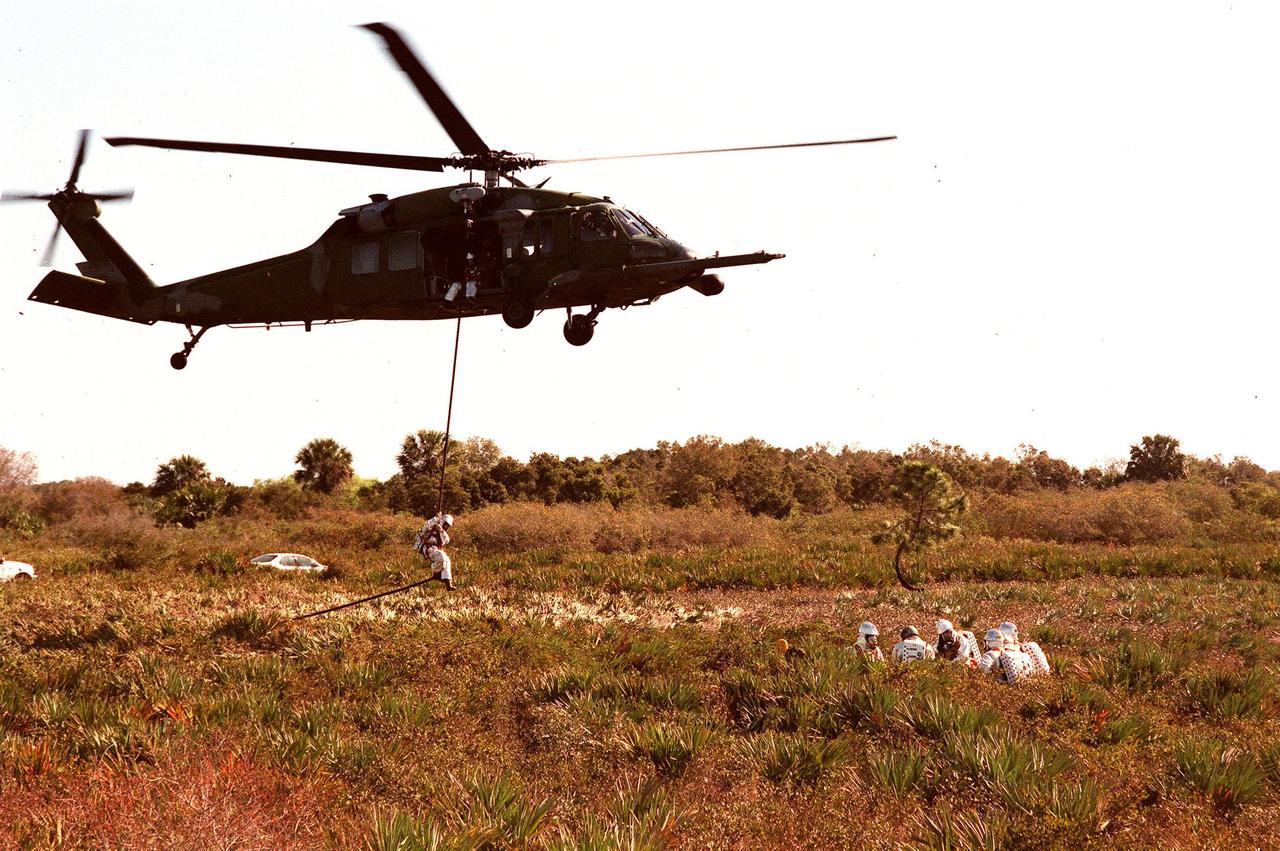
KENNEDY SPACE CENTER, FLA. -- During a simulated rescue mission in the woods near the Shuttle Landing Facility (SLF), a fire/rescue worker practices disembarking from an Air Force HH-60 helicopter. The KSC response team is training for the unlikely scenario of a Shuttle mishap at the SLF. The Mode 7 simulation of an astronaut rescue exercises all aspects of command and control, search and rescue, and medical procedures required for a successful rescue. The remote location of the mock-up prevents a totally land-based crew rescue, and calls on a NASA UH-1 helicopter to locate the site and four Air Force HH-60 helicopters to drop emergency equipment and fire/rescue workers to prepare the "crew" for preliminary traige. The helicopters are used later to remove the crew five astronaut candidates, one representative from the Vehicle Integration Test office, and one fire/rescue worker. The exercise will conclude with airlifted "patients" arriving safely in the emergency rooms of participating area hospitals
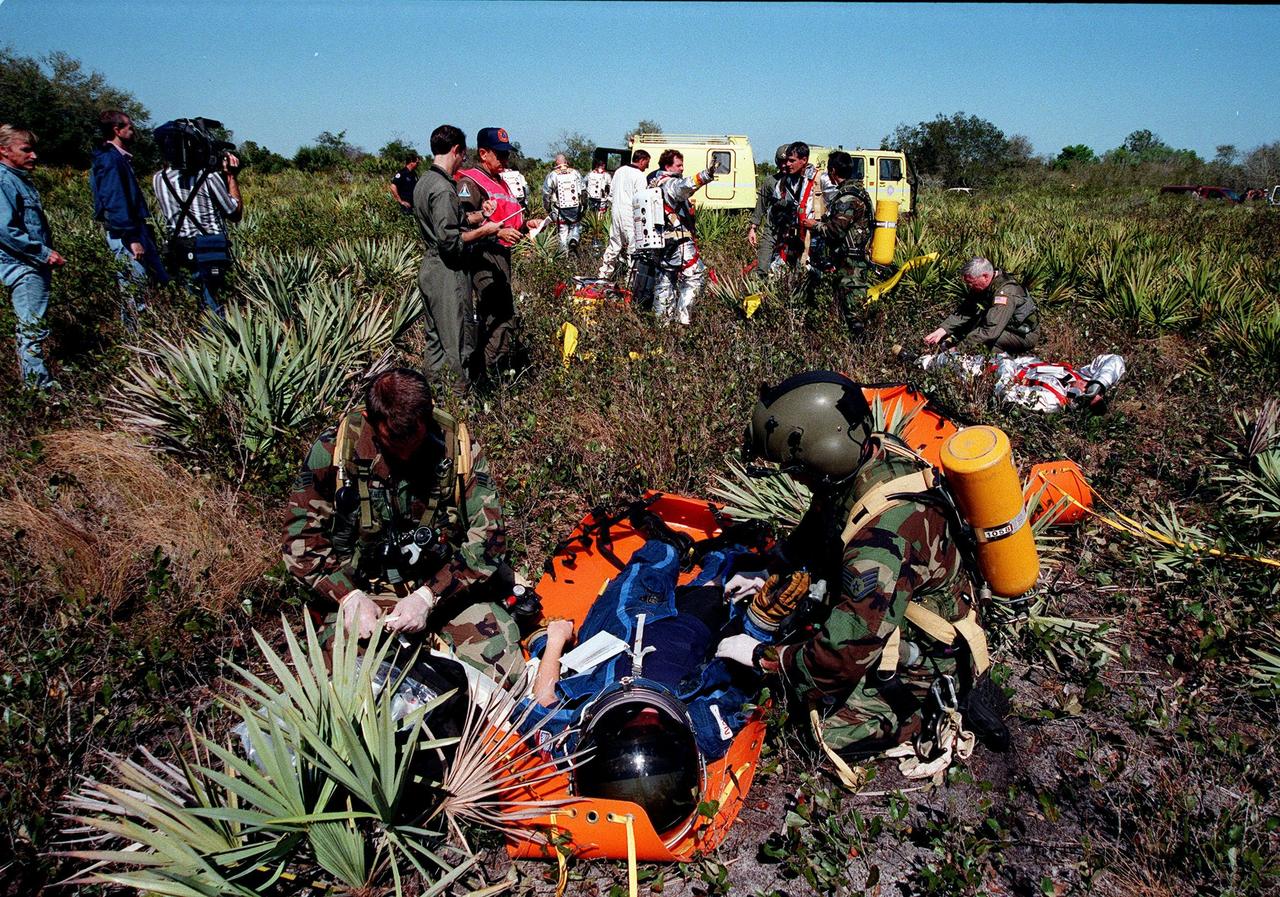
KENNEDY SPACE CENTER, FLA. -- During a simulated rescue mission in the woods near the Shuttle Landing Facility (SLF), the KSC response team practices stabilizing an injured crew member before transport to a local hospital by helicopter. The response team is training for the unlikely scenario of a Shuttle mishap at the SLF. The Mode 7 simulation of an astronaut rescue exercises all aspects of command and control, search and rescue, and medical procedures required for a successful rescue. The remote location of the mock-up prevents a totally land-based crew rescue, and calls on a NASA UH-1 helicopter to locate the site and four Air Force HH-60 helicopters to drop emergency equipment and fire/rescue workers who will prepare the "crew" for preliminary triage. The helicopters later will help remove the crew five astronaut candidates, one representative from the Vehicle Integration Test office, and one fire/rescue worker. The exercise will conclude with airlifted "patients" arriving safely in the emergency rooms of participating area hospitals