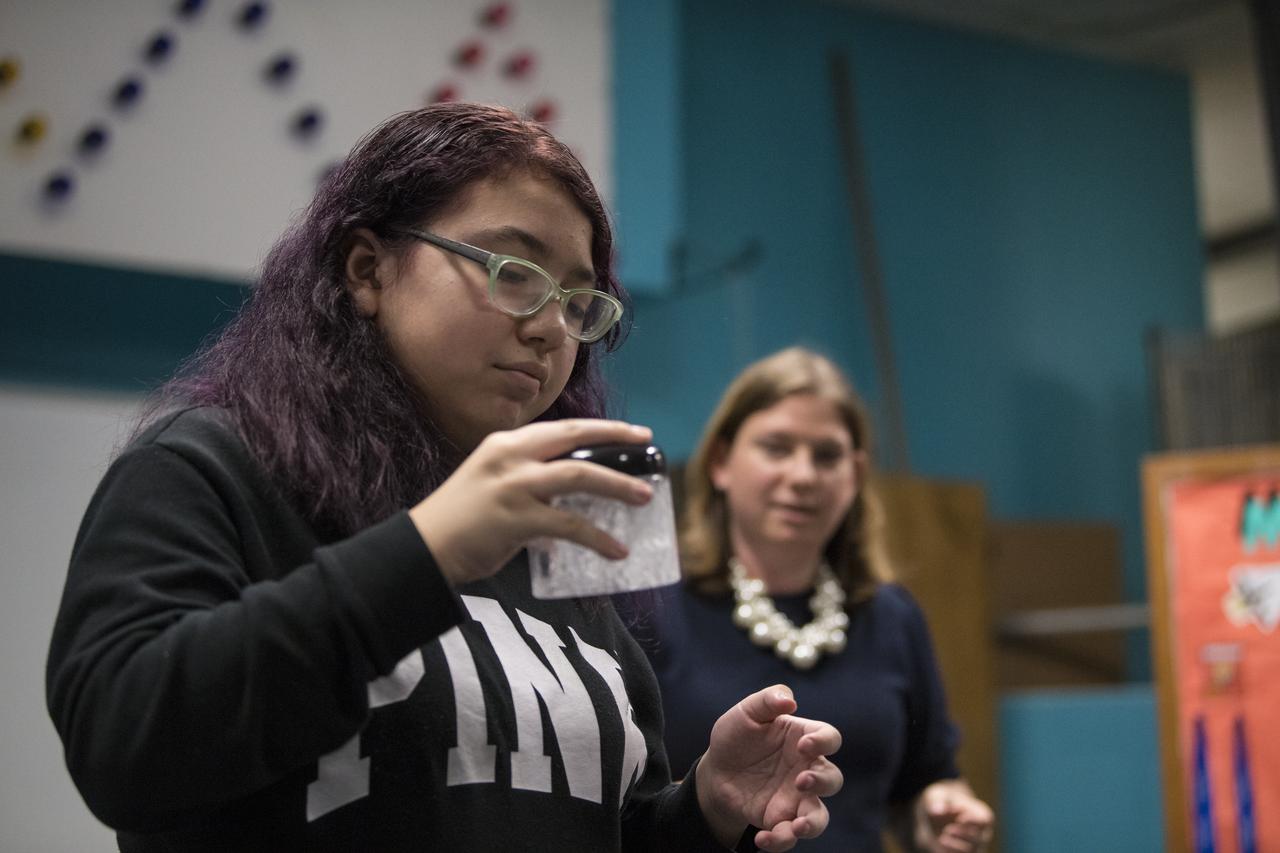
A student shakes a glass of water with an Alka-Seltzer tab in it while conducting an experiment on effervescence, Friday, May 3, 2019 at the Challenger Center in Lanham, MD. NASA astronaut Ricky Arnold helped them carry out the experiment which he also conducted during his 197 day mission onboard the International Space Station (ISS) during Expeditions 55/56. Photo Credit: (NASA/Aubrey Gemignani)
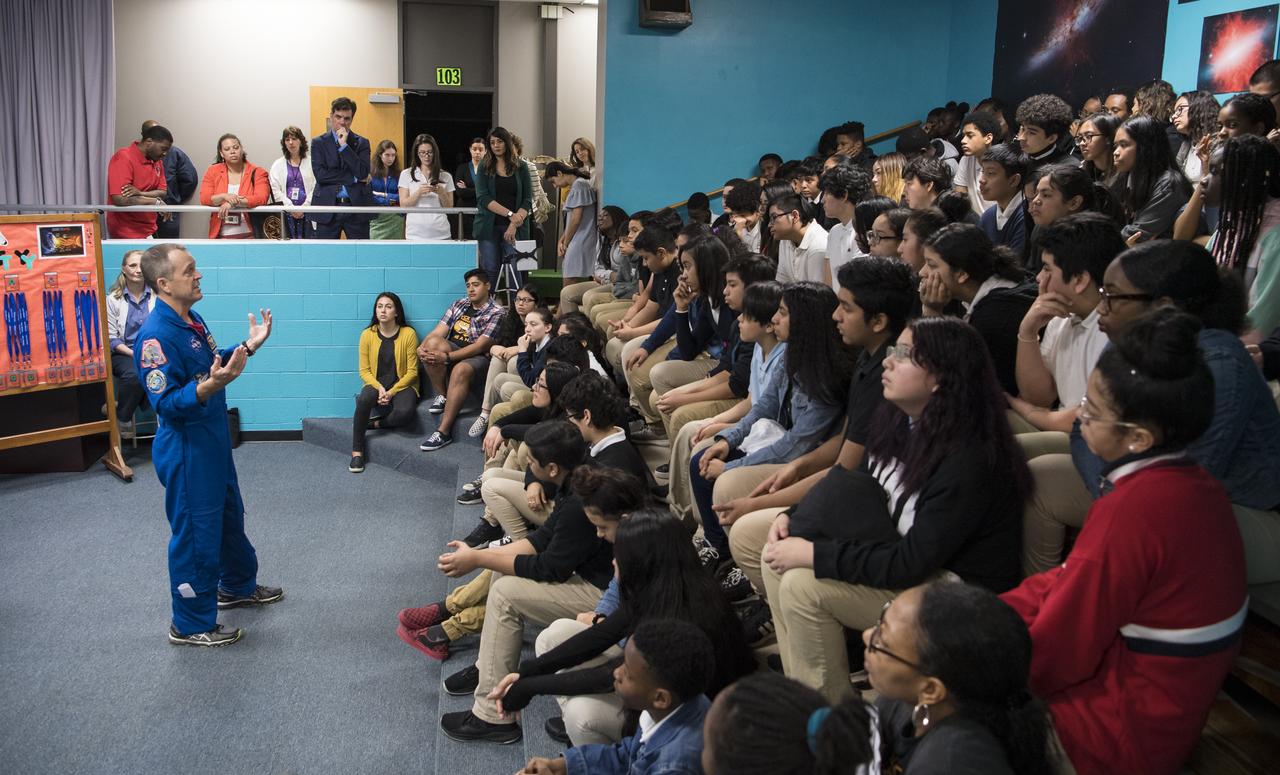
NASA astronaut Ricky Arnold speaks about his time onboard the International Space Station (ISS) during Expeditions 55 and 56, Friday, May 3, 2019 at the Challenger Center in Lanham, MD. During Expedition 55/56, Arnold completed three spacewalks for a total of 19.5 hours outside the space station, and concluded his 197 day mission when he landed in a remote area near the town of Zhezkazgan, Kazakhstan in Oct. 2018. He also flew to the space station on shuttle mission STS-119 to deliver the final pair of power-generating solar array wings. Photo Credit: (NASA/Aubrey Gemignani)
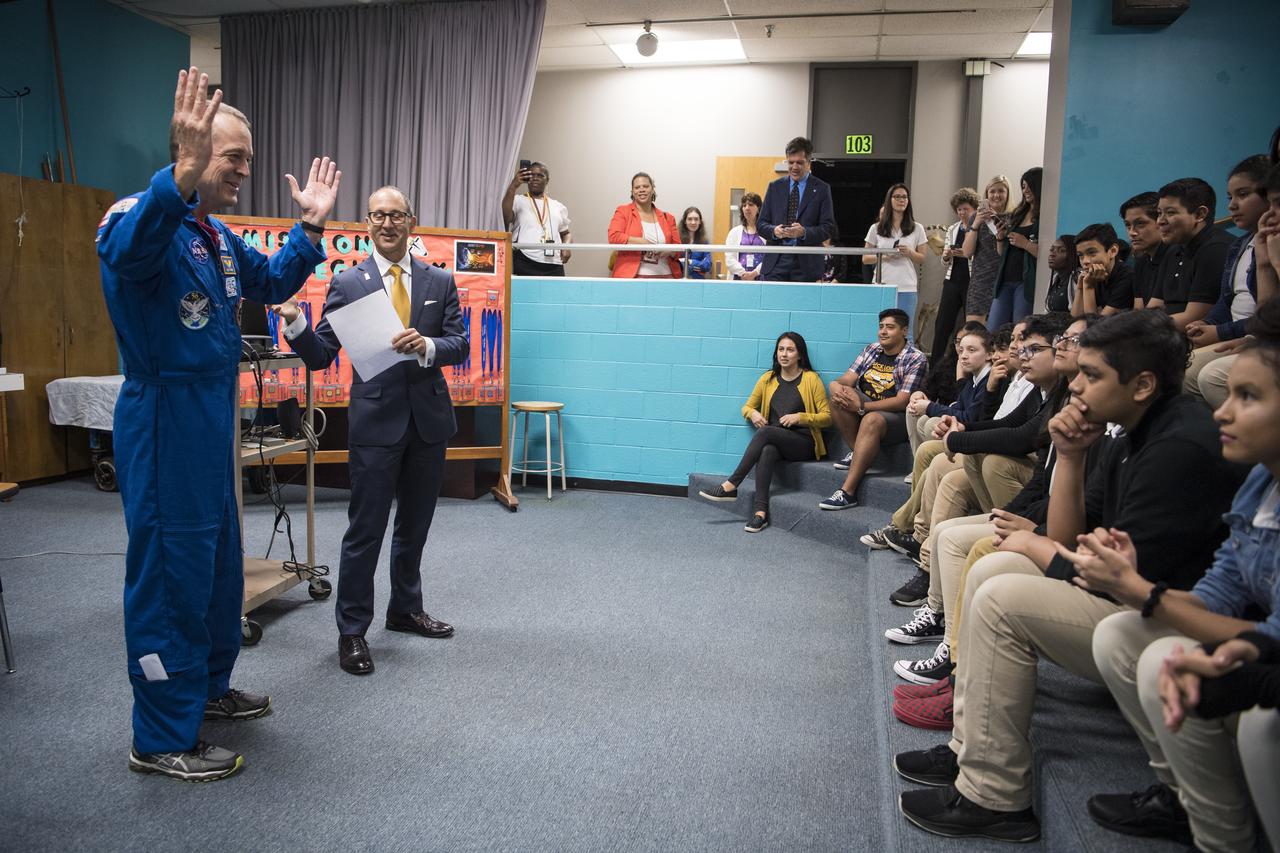
NASA astronaut Ricky Arnold is introduced to speak about his time onboard the International Space Station (ISS) during Expeditions 55 and 56, Friday, May 3, 2019 at the Challenger Center in Lanham, MD. During Expedition 55/56, Arnold completed three spacewalks for a total of 19.5 hours outside the space station, and concluded his 197 day mission when he landed in a remote area near the town of Zhezkazgan, Kazakhstan in Oct. 2018. He also flew to the space station on shuttle mission STS-119 to deliver the final pair of power-generating solar array wings. Photo Credit: (NASA/Aubrey Gemignani)
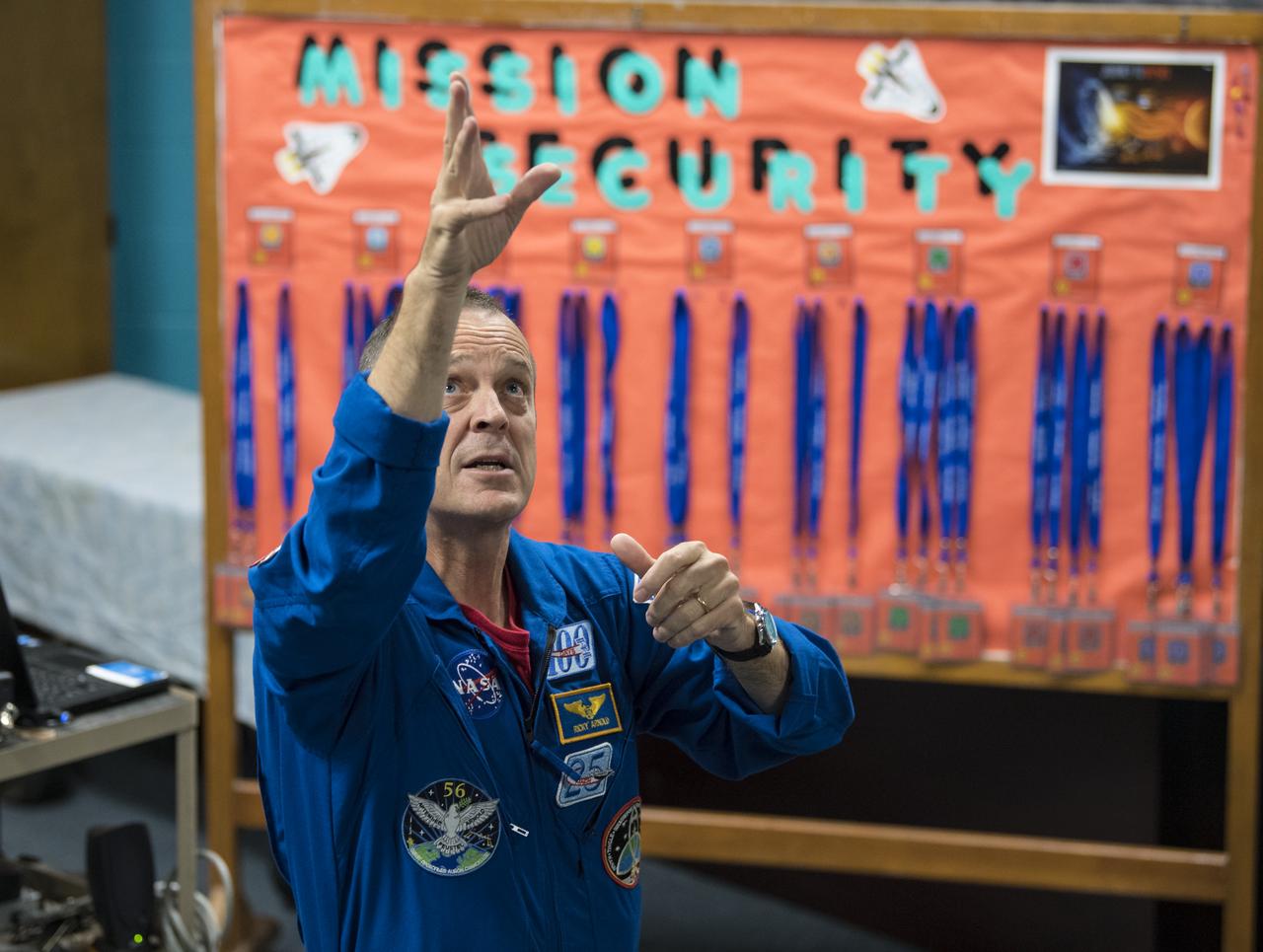
NASA astronaut Ricky Arnold speaks about his time onboard the International Space Station (ISS) during Expeditions 55 and 56, Friday, May 3, 2019 at the Challenger Center in Lanham, MD. During Expedition 55/56, Arnold completed three spacewalks for a total of 19.5 hours outside the space station, and concluded his 197 day mission when he landed in a remote area near the town of Zhezkazgan, Kazakhstan in Oct. 2018. He also flew to the space station on shuttle mission STS-119 to deliver the final pair of power-generating solar array wings. Photo Credit: (NASA/Aubrey Gemignani)
NASA astronaut Ricky Arnold speaks about his time onboard the International Space Station (ISS) during Expeditions 55 and 56, Friday, May 3, 2019 at the Challenger Center in Lanham, MD. During Expedition 55/56, Arnold completed three spacewalks for a total of 19.5 hours outside the space station, and concluded his 197 day mission when he landed in a remote area near the town of Zhezkazgan, Kazakhstan in Oct. 2018. He also flew to the space station on shuttle mission STS-119 to deliver the final pair of power-generating solar array wings. Photo Credit: (NASA/Aubrey Gemignani)
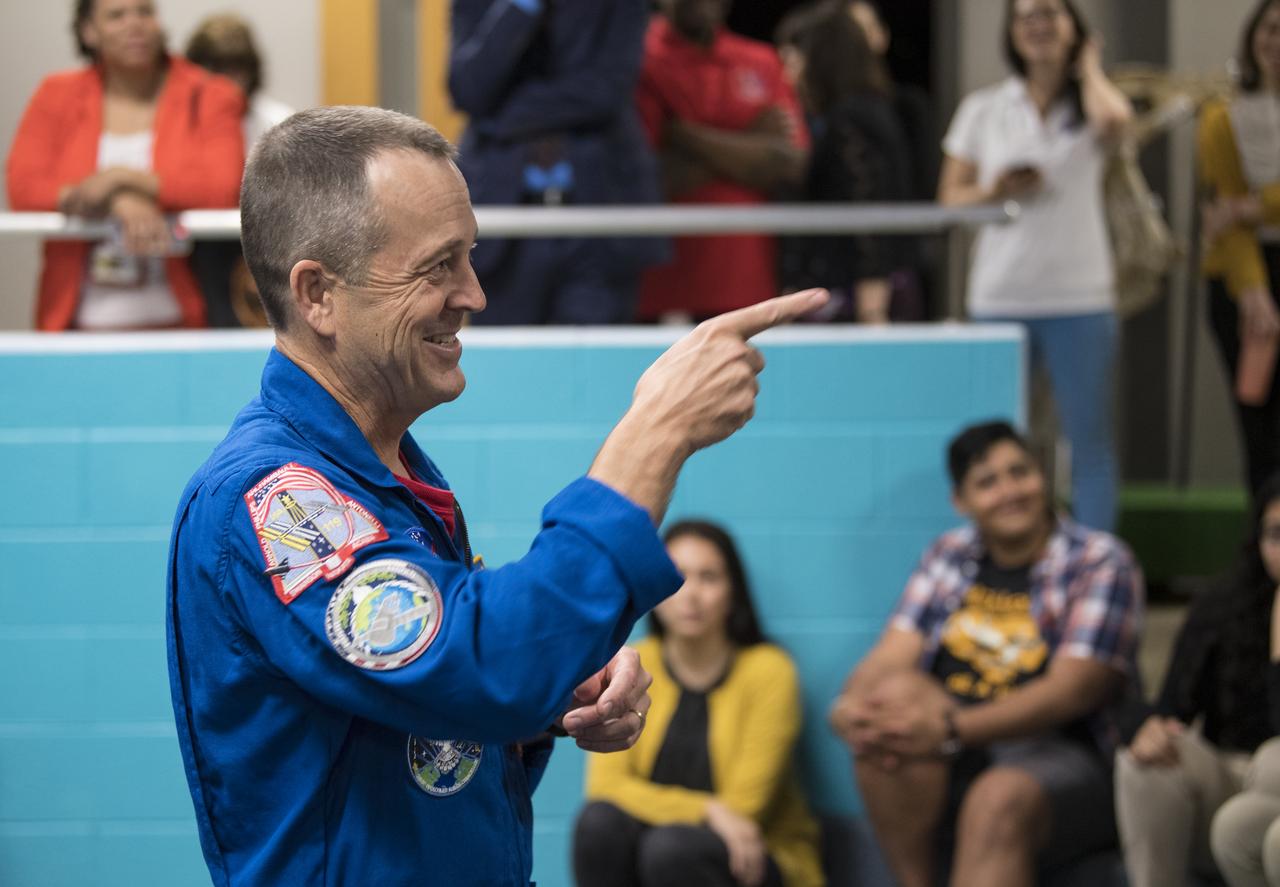
NASA astronaut Ricky Arnold speaks about his time onboard the International Space Station (ISS) during Expeditions 55 and 56, Friday, May 3, 2019 at the Challenger Center in Lanham, MD. During Expedition 55/56, Arnold completed three spacewalks for a total of 19.5 hours outside the space station, and concluded his 197 day mission when he landed in a remote area near the town of Zhezkazgan, Kazakhstan in Oct. 2018. He also flew to the space station on shuttle mission STS-119 to deliver the final pair of power-generating solar array wings. Photo Credit: (NASA/Aubrey Gemignani)
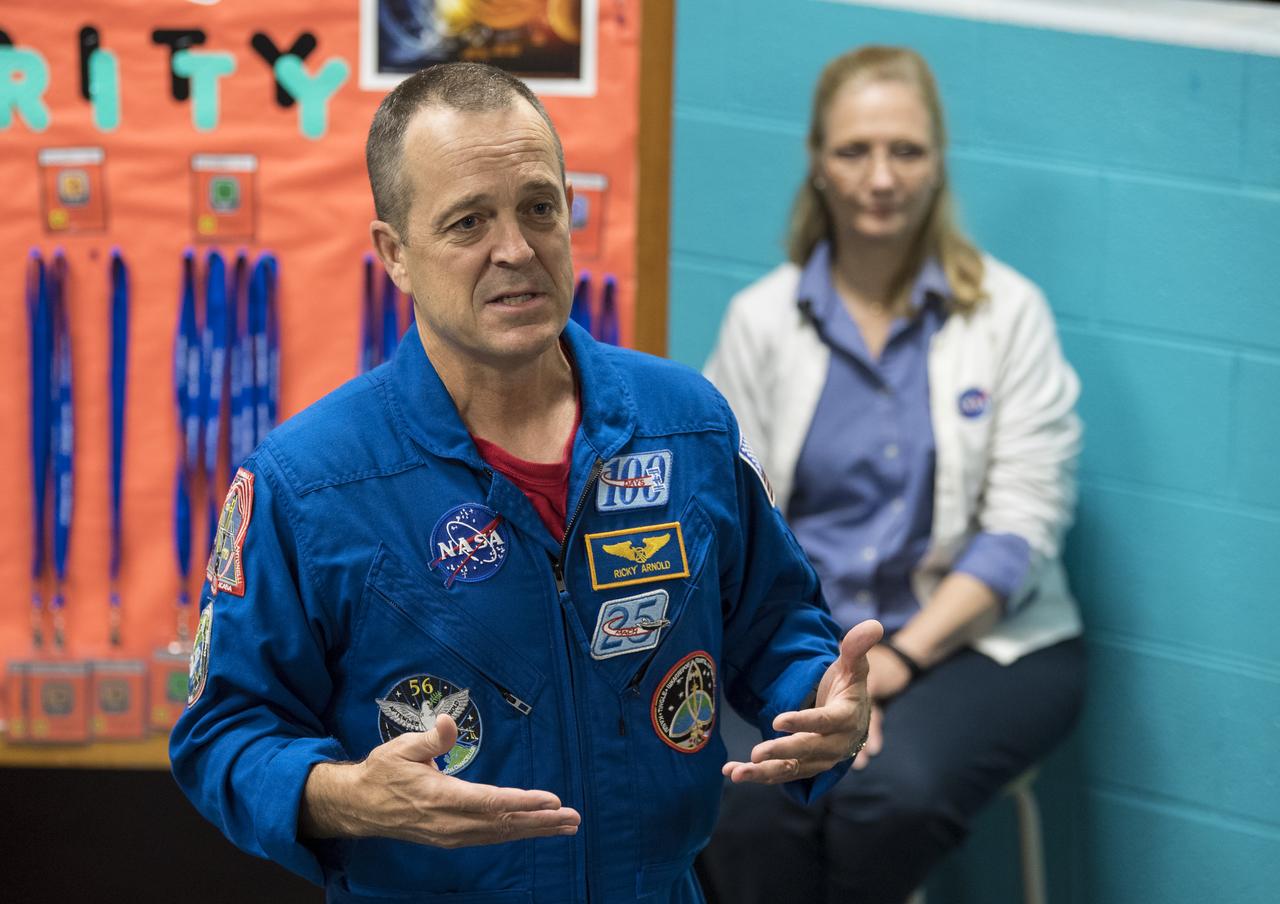
NASA astronaut Ricky Arnold speaks about his time onboard the International Space Station (ISS) during Expeditions 55 and 56, Friday, May 3, 2019 at the Challenger Center in Lanham, MD. During Expedition 55/56, Arnold completed three spacewalks for a total of 19.5 hours outside the space station, and concluded his 197 day mission when he landed in a remote area near the town of Zhezkazgan, Kazakhstan in Oct. 2018. He also flew to the space station on shuttle mission STS-119 to deliver the final pair of power-generating solar array wings. Photo Credit: (NASA/Aubrey Gemignani)
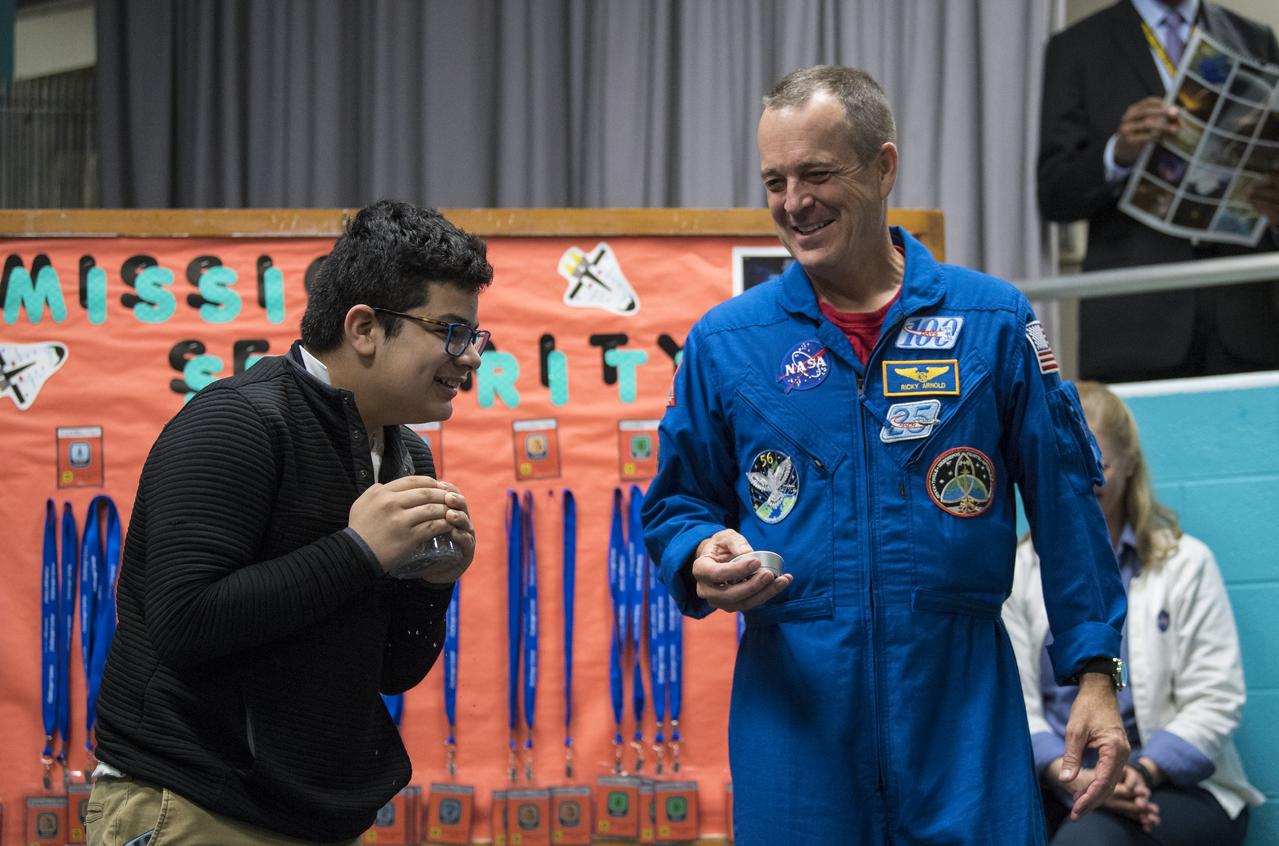
NASA astronaut Ricky Arnold watches a timer while students conduct an experiment on effervescence, Friday, May 3, 2019 at the Challenger Center in Lanham, MD. During Expedition 55/56, Arnold completed three spacewalks for a total of 19.5 hours outside the International Space Station (ISS), and concluded his 197 day mission when he landed in a remote area near the town of Zhezkazgan, Kazakhstan in Oct. 2018. He also flew to the space station on shuttle mission STS-119 to deliver the final pair of power-generating solar array wings. Photo Credit: (NASA/Aubrey Gemignani)
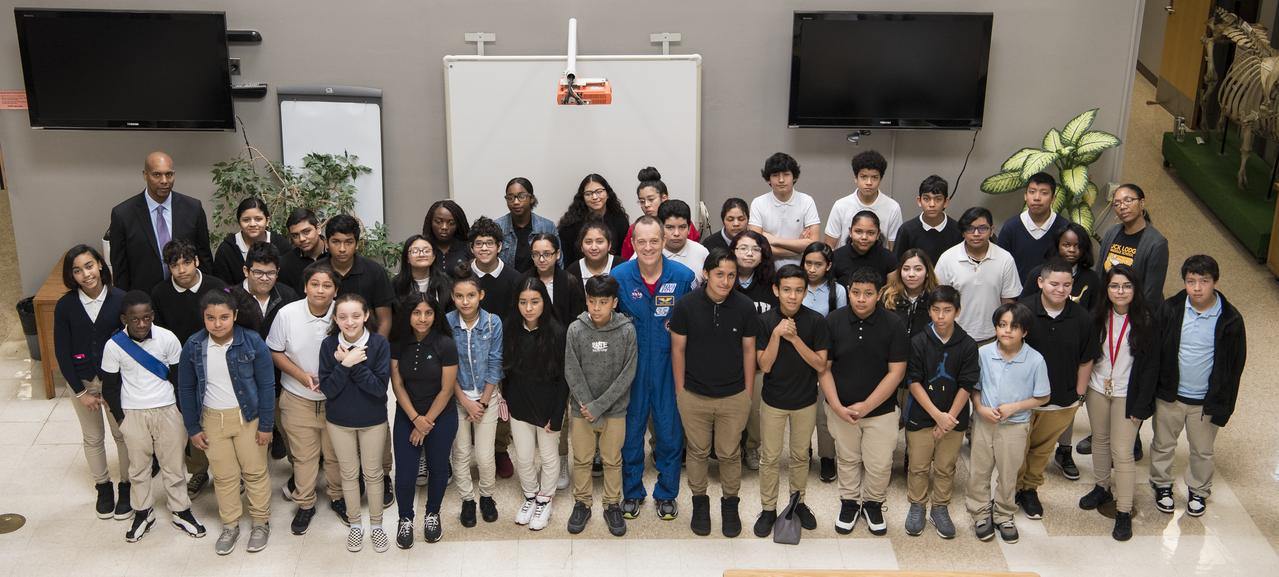
NASA astronaut Ricky Arnold poses for a photo with students after speaking with them about his time onboard the International Space Station (ISS) during Expeditions 55 and 56, Friday, May 3, 2019 in Lanham, MD. During Expedition 55/56, Arnold completed three spacewalks for a total of 19.5 hours outside the space station, and concluded his 197 day mission when he landed in a remote area near the town of Zhezkazgan, Kazakhstan in Oct. 2018. He also flew to the space station on shuttle mission STS-119 to deliver the final pair of power-generating solar array wings. Photo Credit: (NASA/Aubrey Gemignani)
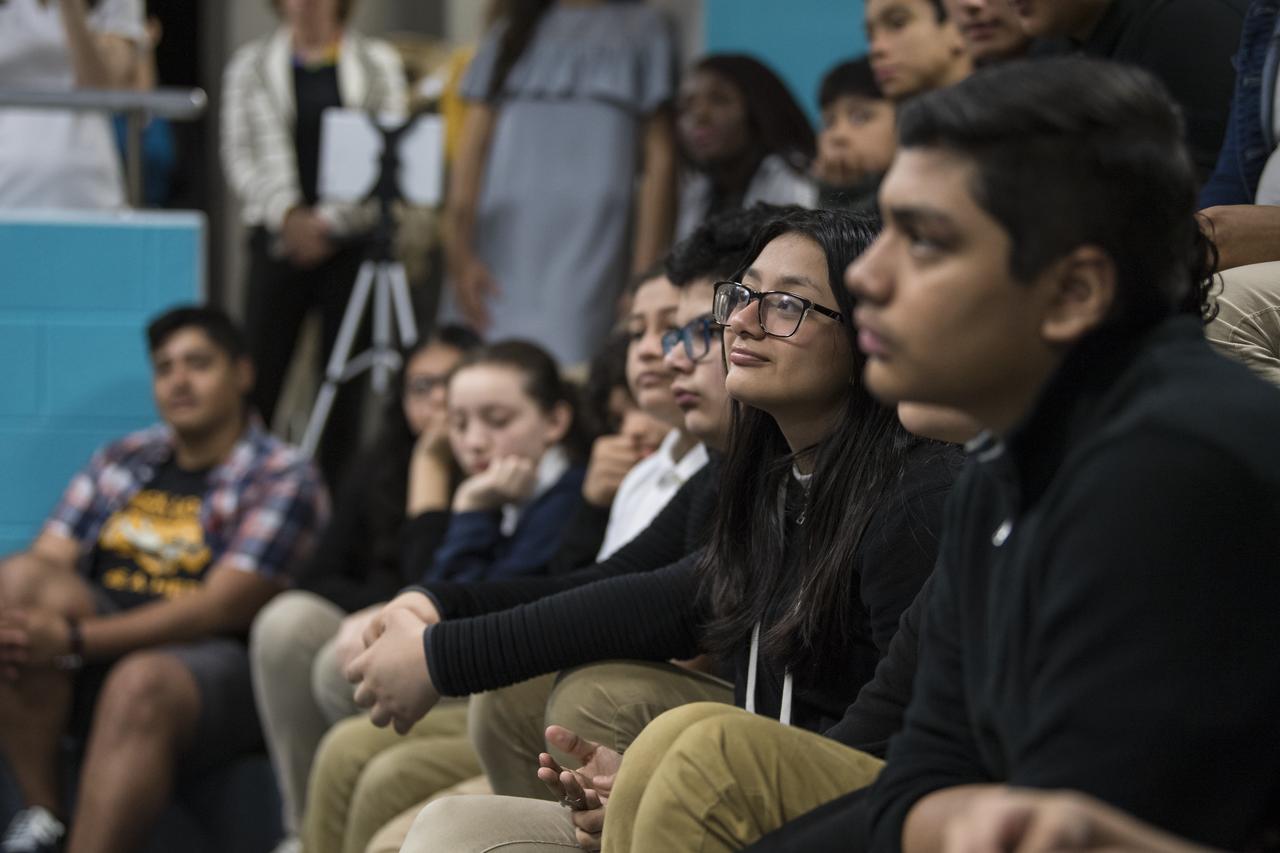
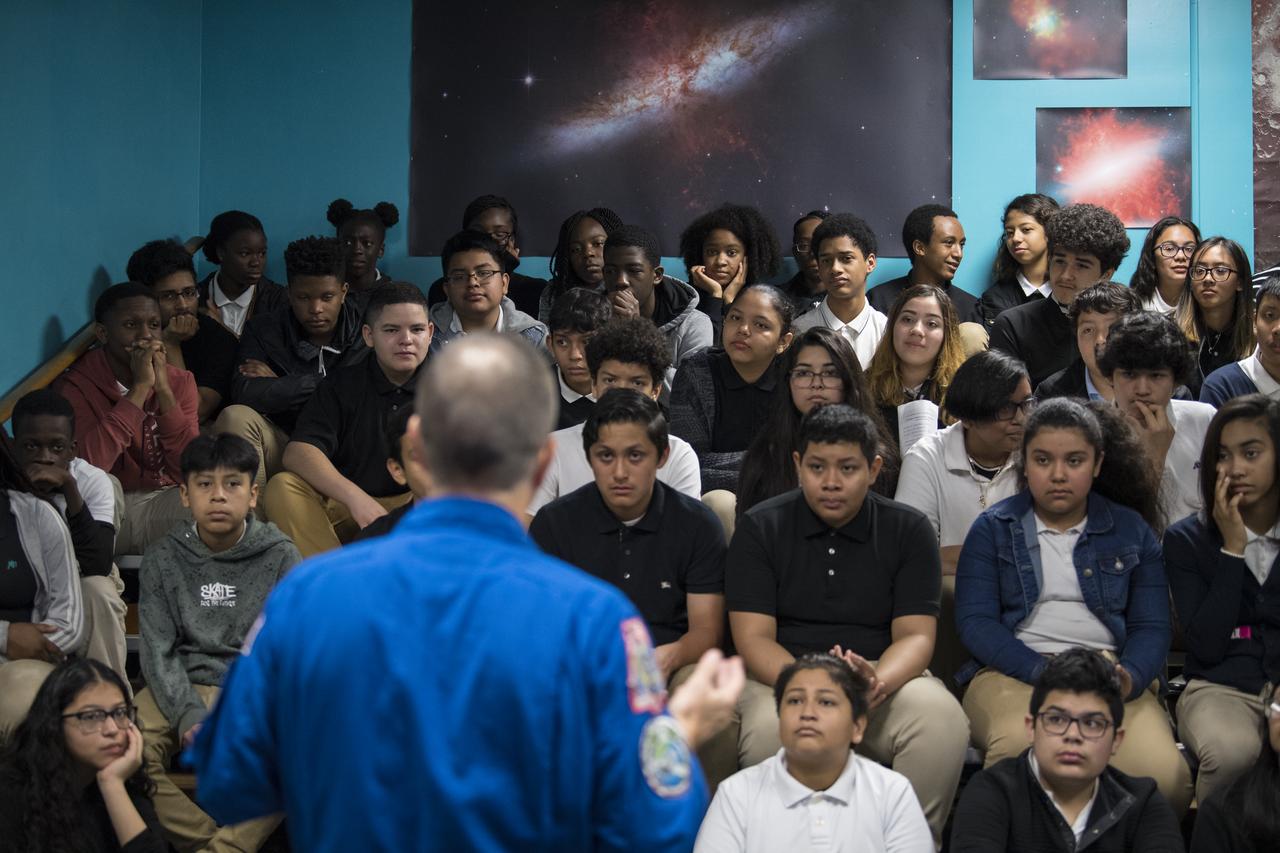
Students are seen in the audience as NASA astronaut Ricky Arnold speaks about his time onboard the International Space Station (ISS) during Expeditions 55 and 56, Friday, May 3, 2019 at the Challenger Center in Lanham, MD. During Expedition 55/56, Arnold completed three spacewalks for a total of 19.5 hours outside the space station, and concluded his 197 day mission when he landed in a remote area near the town of Zhezkazgan, Kazakhstan in Oct. 2018. He also flew to the space station on shuttle mission STS-119 to deliver the final pair of power-generating solar array wings. Photo Credit: (NASA/Aubrey Gemignani)
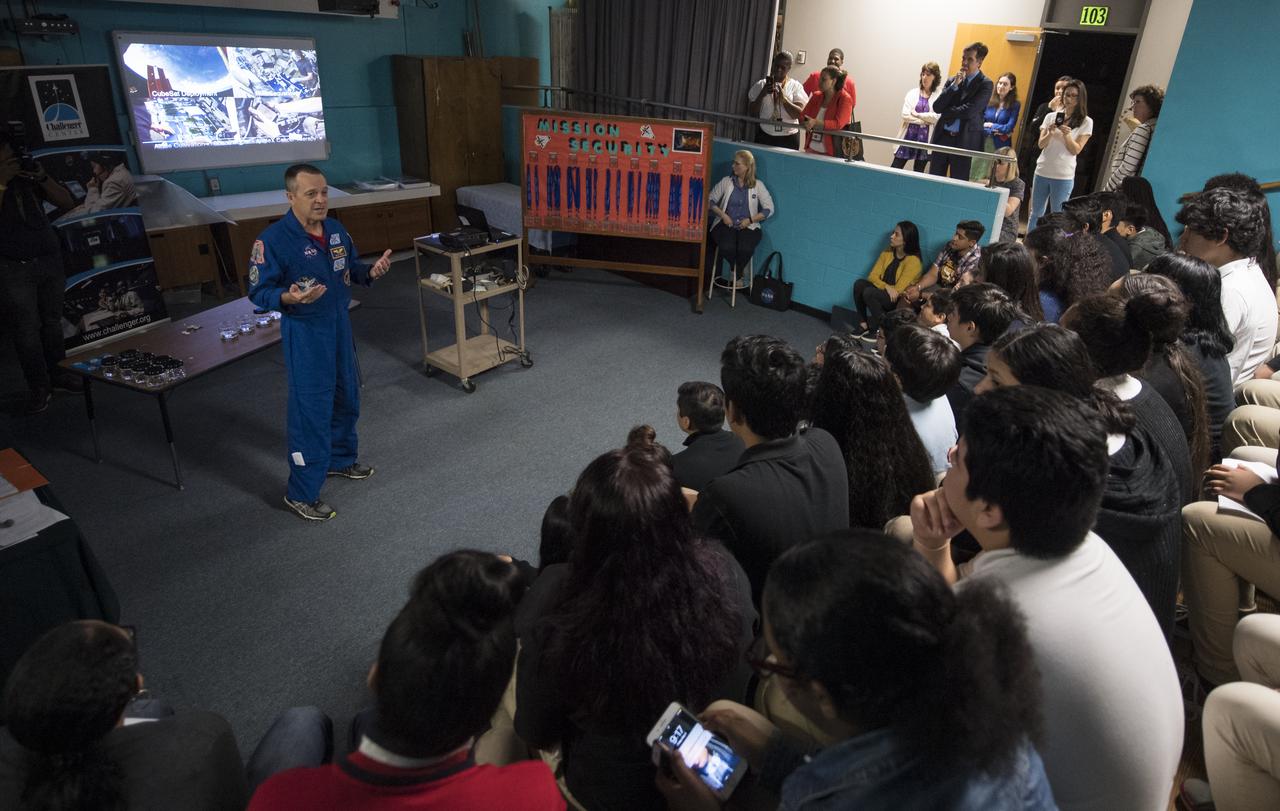
NASA astronaut Ricky Arnold speaks about his time onboard the International Space Station (ISS) during Expeditions 55 and 56, Friday, May 3, 2019 at the Challenger Center in Lanham, MD. During Expedition 55/56, Arnold completed three spacewalks for a total of 19.5 hours outside the space station, and concluded his 197 day mission when he landed in a remote area near the town of Zhezkazgan, Kazakhstan in Oct. 2018. He also flew to the space station on shuttle mission STS-119 to deliver the final pair of power-generating solar array wings. Photo Credit: (NASA/Aubrey Gemignani)
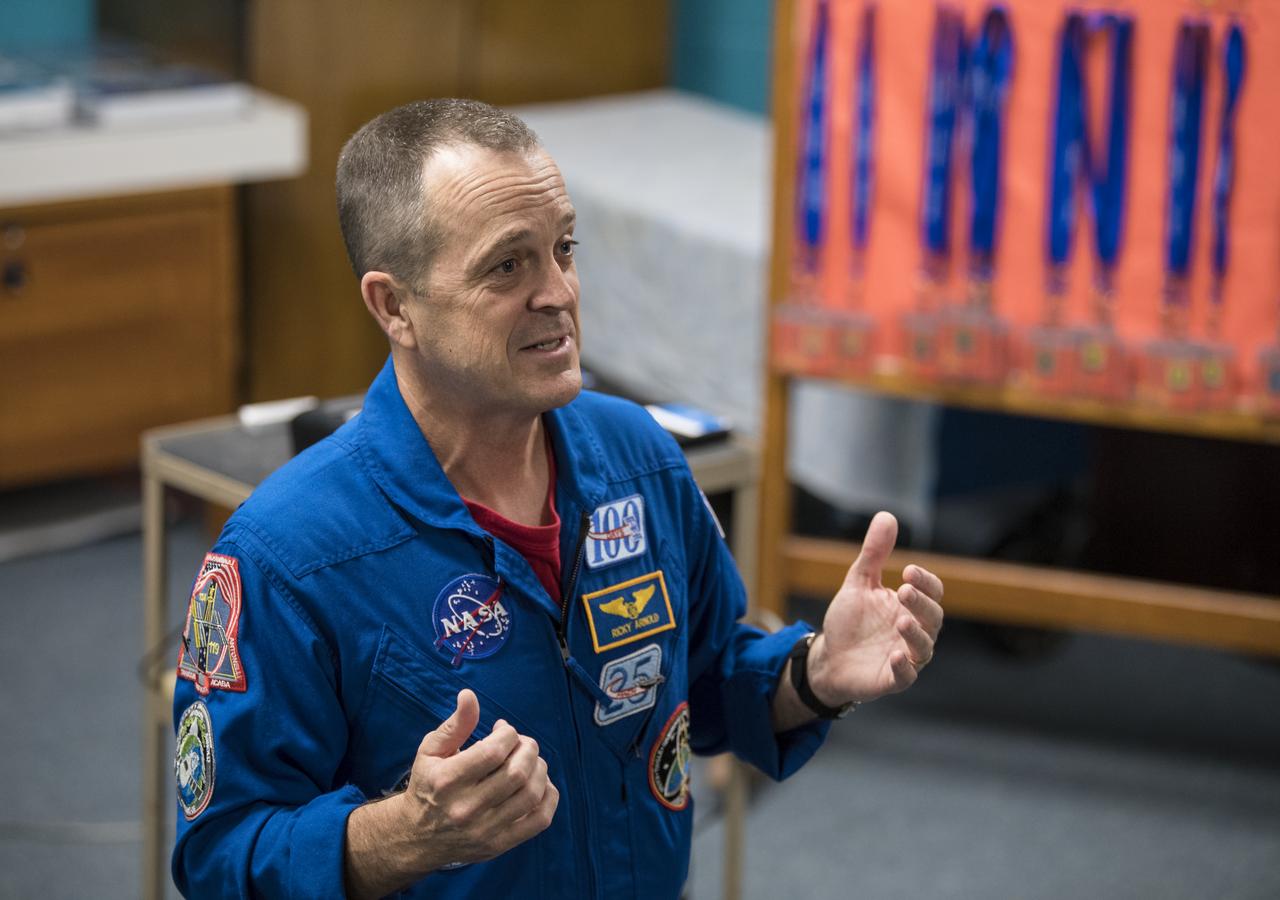
NASA astronaut Ricky Arnold speaks about his time onboard the International Space Station (ISS) during Expeditions 55 and 56, Friday, May 3, 2019 at the Challenger Center in Lanham, MD. During Expedition 55/56, Arnold completed three spacewalks for a total of 19.5 hours outside the space station, and concluded his 197 day mission when he landed in a remote area near the town of Zhezkazgan, Kazakhstan in Oct. 2018. He also flew to the space station on shuttle mission STS-119 to deliver the final pair of power-generating solar array wings. Photo Credit: (NASA/Aubrey Gemignani)
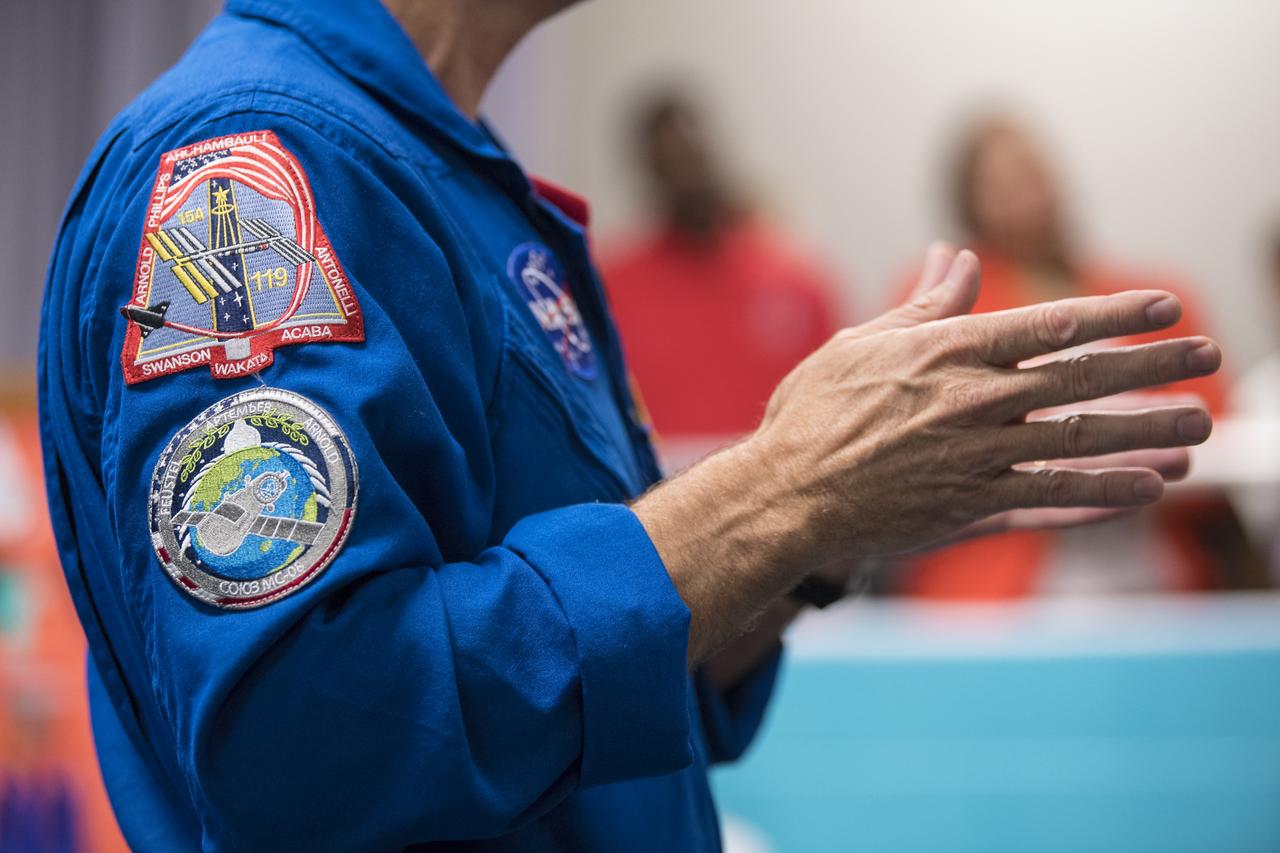
NASA astronaut Ricky Arnold speaks about his time onboard the International Space Station (ISS) during Expeditions 55 and 56, Friday, May 3, 2019 at the Challenger Center in Lanham, MD. During Expedition 55/56, Arnold completed three spacewalks for a total of 19.5 hours outside the space station, and concluded his 197 day mission when he landed in a remote area near the town of Zhezkazgan, Kazakhstan in Oct. 2018. He also flew to the space station on shuttle mission STS-119 to deliver the final pair of power-generating solar array wings. Photo Credit: (NASA/Aubrey Gemignani)
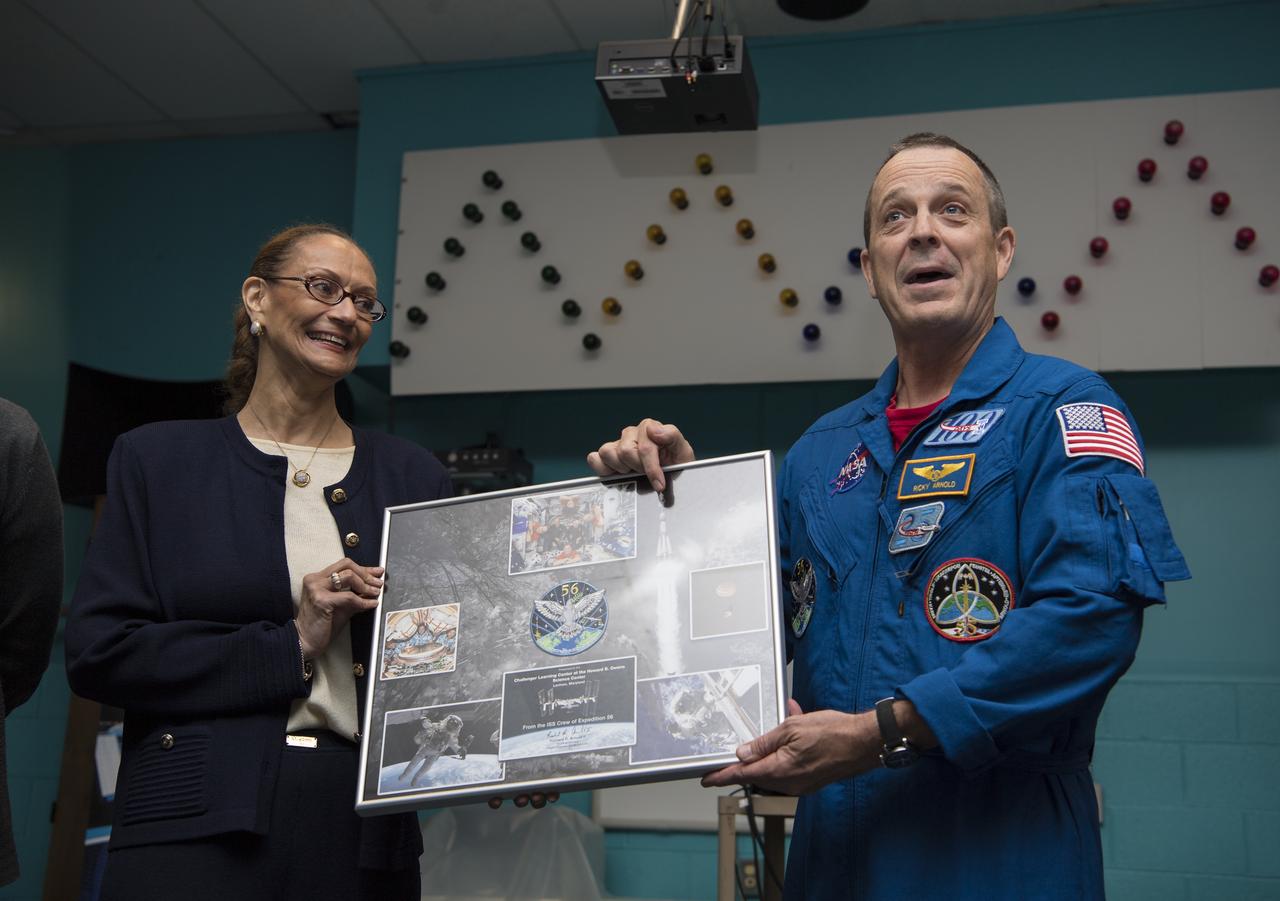
NASA astronaut Ricky Arnold presents the Challenger Center with a montage of images from his time onboard the International Space Station (ISS) during Expeditions 55 and 56, Friday, May 3, 2019 in Lanham, MD. During Expedition 55/56, Arnold completed three spacewalks for a total of 19.5 hours outside the space station, and concluded his 197 day mission when he landed in a remote area near the town of Zhezkazgan, Kazakhstan in Oct. 2018. He also flew to the space station on shuttle mission STS-119 to deliver the final pair of power-generating solar array wings. Photo Credit: (NASA/Aubrey Gemignani)
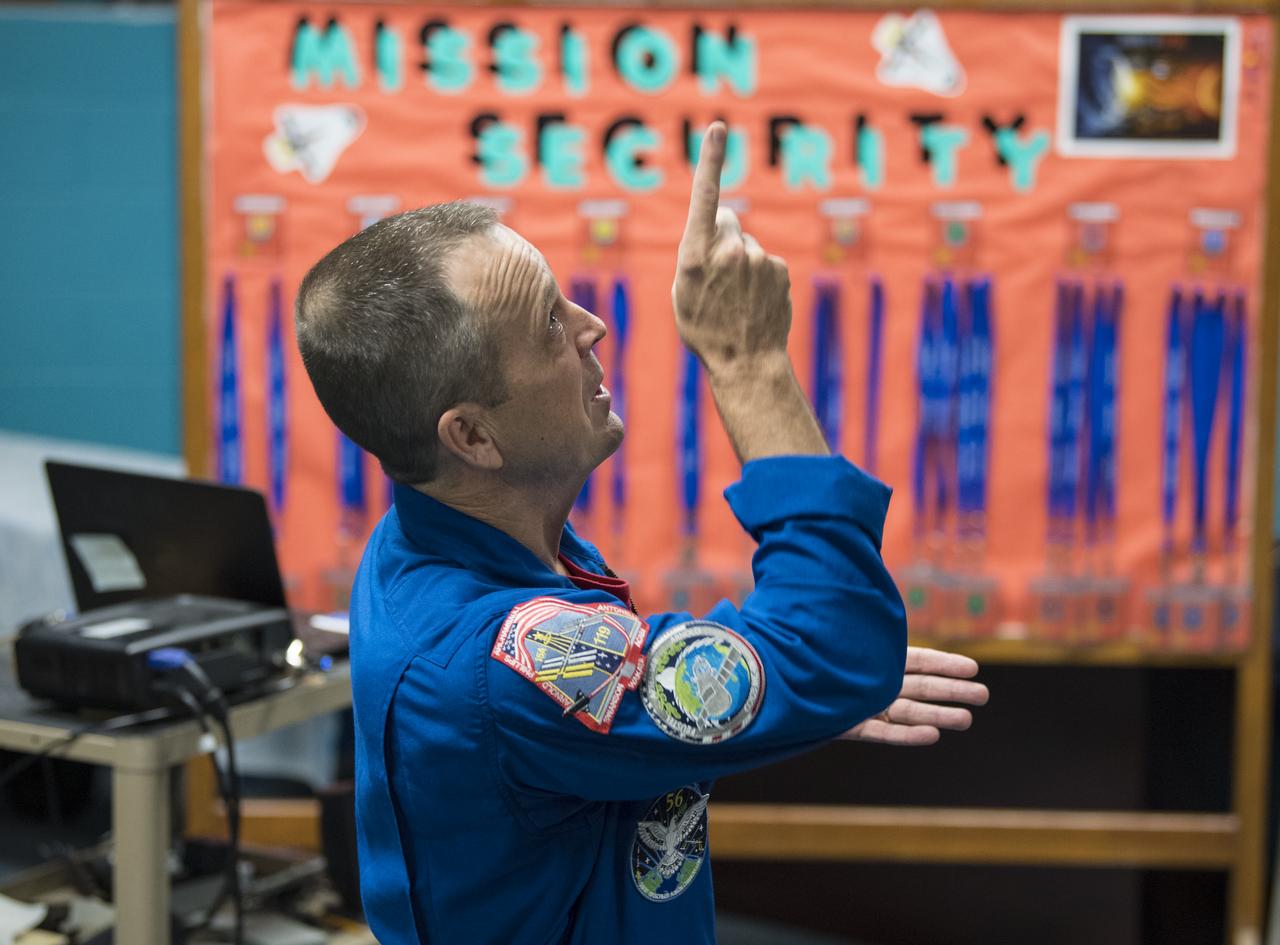
NASA astronaut Ricky Arnold speaks about his time onboard the International Space Station (ISS) during Expeditions 55 and 56, Friday, May 3, 2019 at the Challenger Center in Lanham, MD. During Expedition 55/56, Arnold completed three spacewalks for a total of 19.5 hours outside the space station, and concluded his 197 day mission when he landed in a remote area near the town of Zhezkazgan, Kazakhstan in Oct. 2018. He also flew to the space station on shuttle mission STS-119 to deliver the final pair of power-generating solar array wings. Photo Credit: (NASA/Aubrey Gemignani)
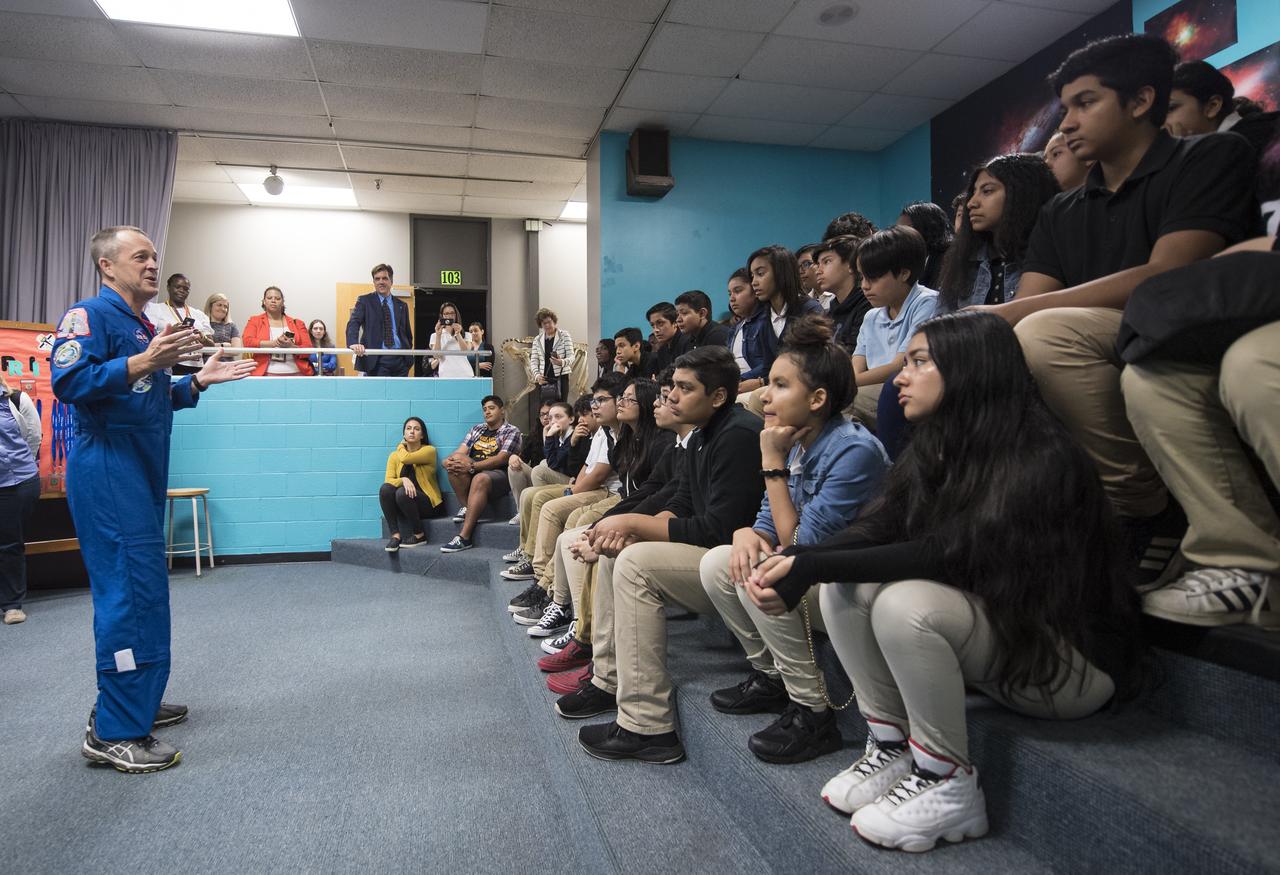
NASA astronaut Ricky Arnold speaks about his time onboard the International Space Station (ISS) during Expeditions 55 and 56, Friday, May 3, 2019 at the Challenger Center in Lanham, MD. During Expedition 55/56, Arnold completed three spacewalks for a total of 19.5 hours outside the space station, and concluded his 197 day mission when he landed in a remote area near the town of Zhezkazgan, Kazakhstan in Oct. 2018. He also flew to the space station on shuttle mission STS-119 to deliver the final pair of power-generating solar array wings. Photo Credit: (NASA/Aubrey Gemignani)
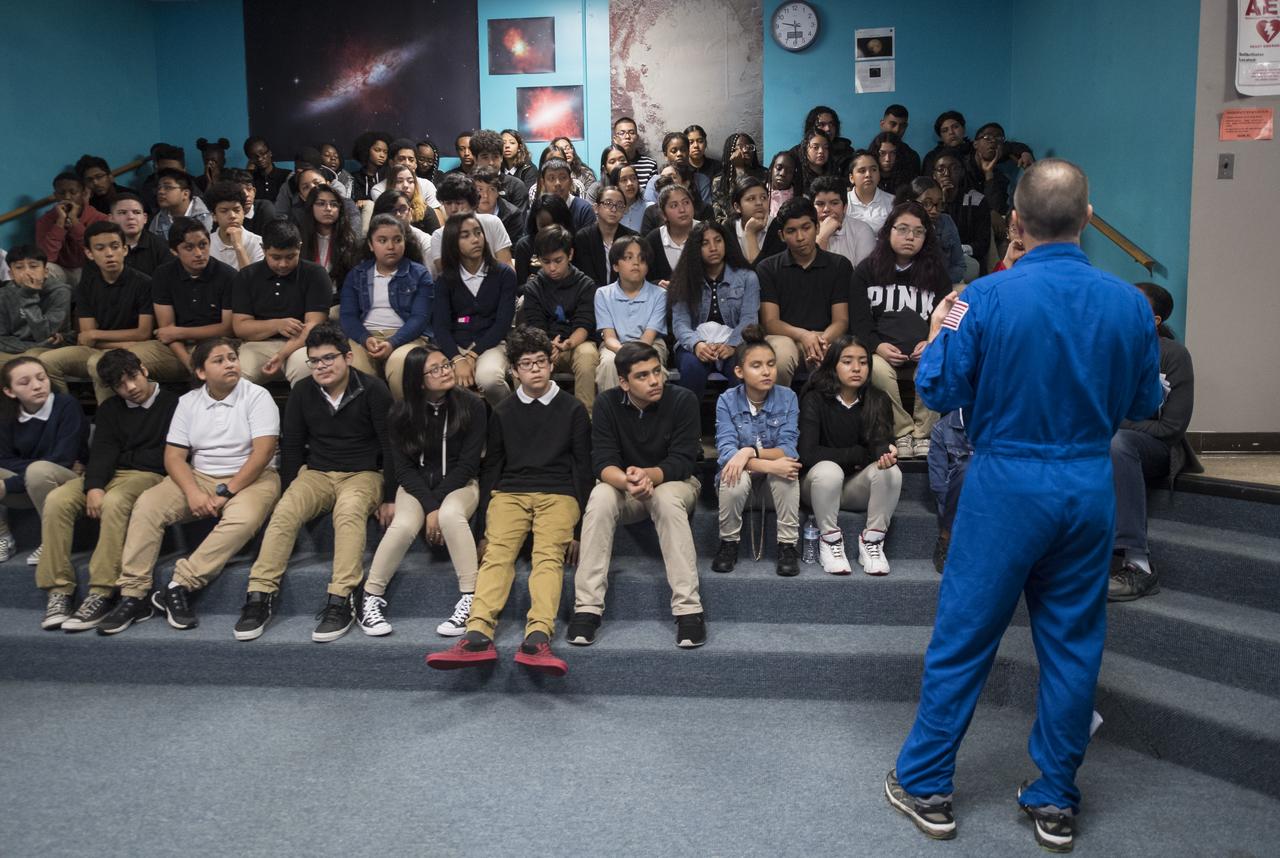
NASA astronaut Ricky Arnold speaks about his time onboard the International Space Station (ISS) during Expeditions 55 and 56, Friday, May 3, 2019 at the Challenger Center in Lanham, MD. During Expedition 55/56, Arnold completed three spacewalks for a total of 19.5 hours outside the space station, and concluded his 197 day mission when he landed in a remote area near the town of Zhezkazgan, Kazakhstan in Oct. 2018. He also flew to the space station on shuttle mission STS-119 to deliver the final pair of power-generating solar array wings. Photo Credit: (NASA/Aubrey Gemignani)
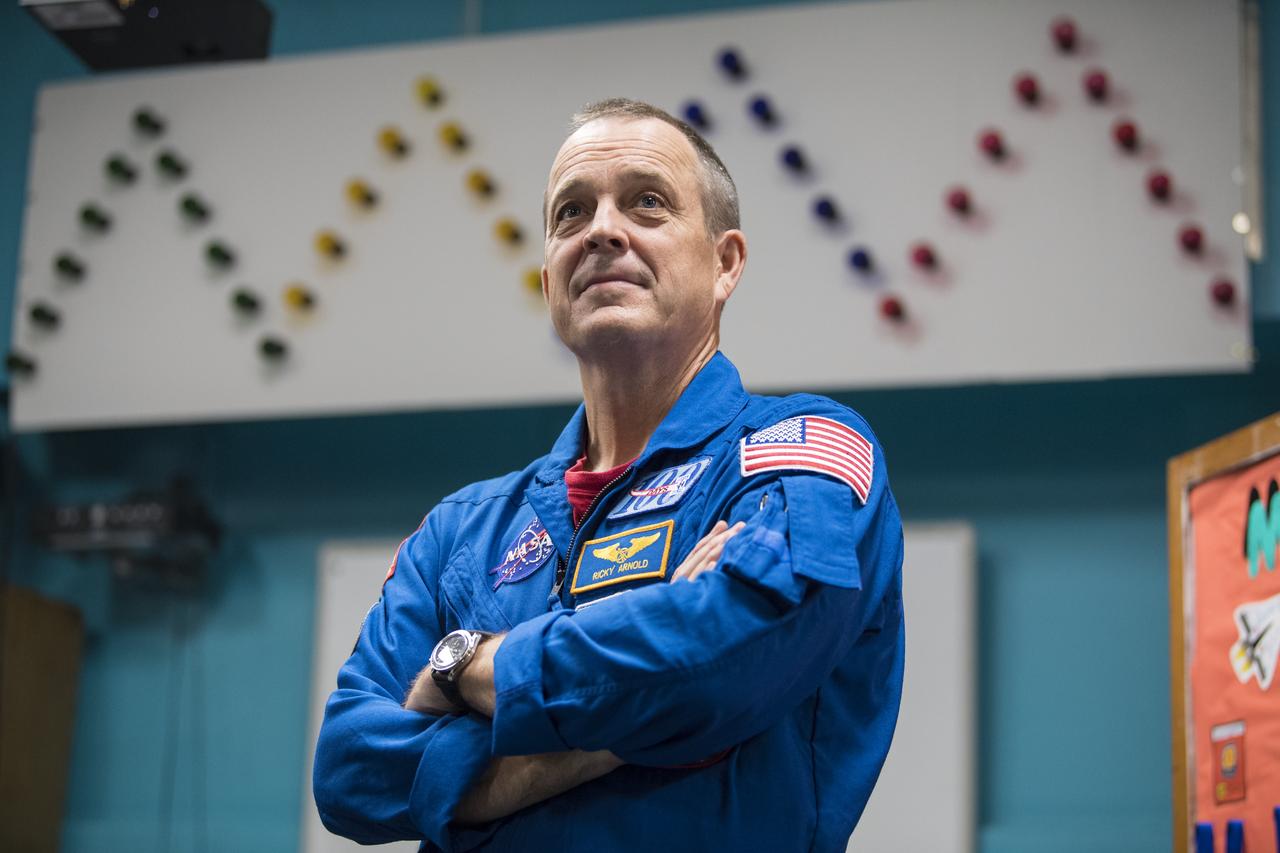
NASA astronaut Ricky Arnold is seen during a talk about his time onboard the International Space Station (ISS) during Expeditions 55 and 56, Friday, May 3, 2019 at the Challenger Center in Lanham, MD. During Expedition 55/56, Arnold completed three spacewalks for a total of 19.5 hours outside the space station, and concluded his 197 day mission when he landed in a remote area near the town of Zhezkazgan, Kazakhstan in Oct. 2018. He also flew to the space station on shuttle mission STS-119 to deliver the final pair of power-generating solar array wings. Photo Credit: (NASA/Aubrey Gemignani)
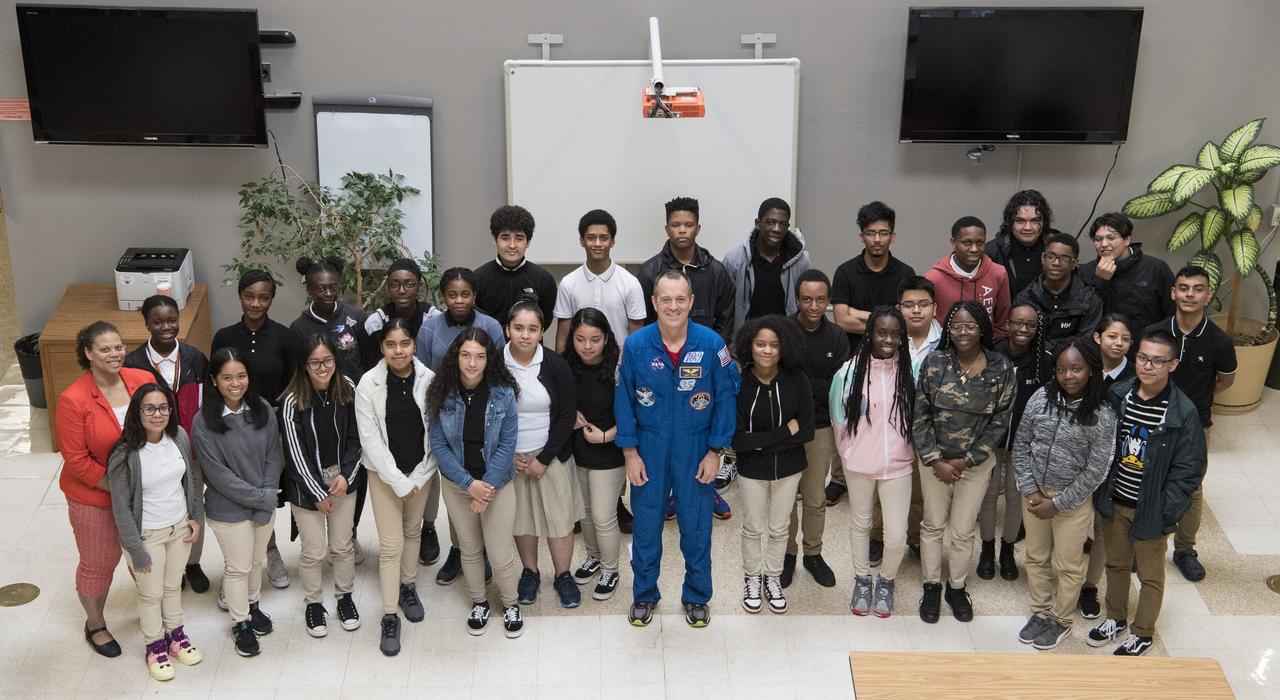
NASA astronaut Ricky Arnold poses for a photo with students after speaking with them about his time onboard the International Space Station (ISS) during Expeditions 55 and 56, Friday, May 3, 2019 in Lanham, MD. During Expedition 55/56, Arnold completed three spacewalks for a total of 19.5 hours outside the space station, and concluded his 197 day mission when he landed in a remote area near the town of Zhezkazgan, Kazakhstan in Oct. 2018. He also flew to the space station on shuttle mission STS-119 to deliver the final pair of power-generating solar array wings. Photo Credit: (NASA/Aubrey Gemignani)
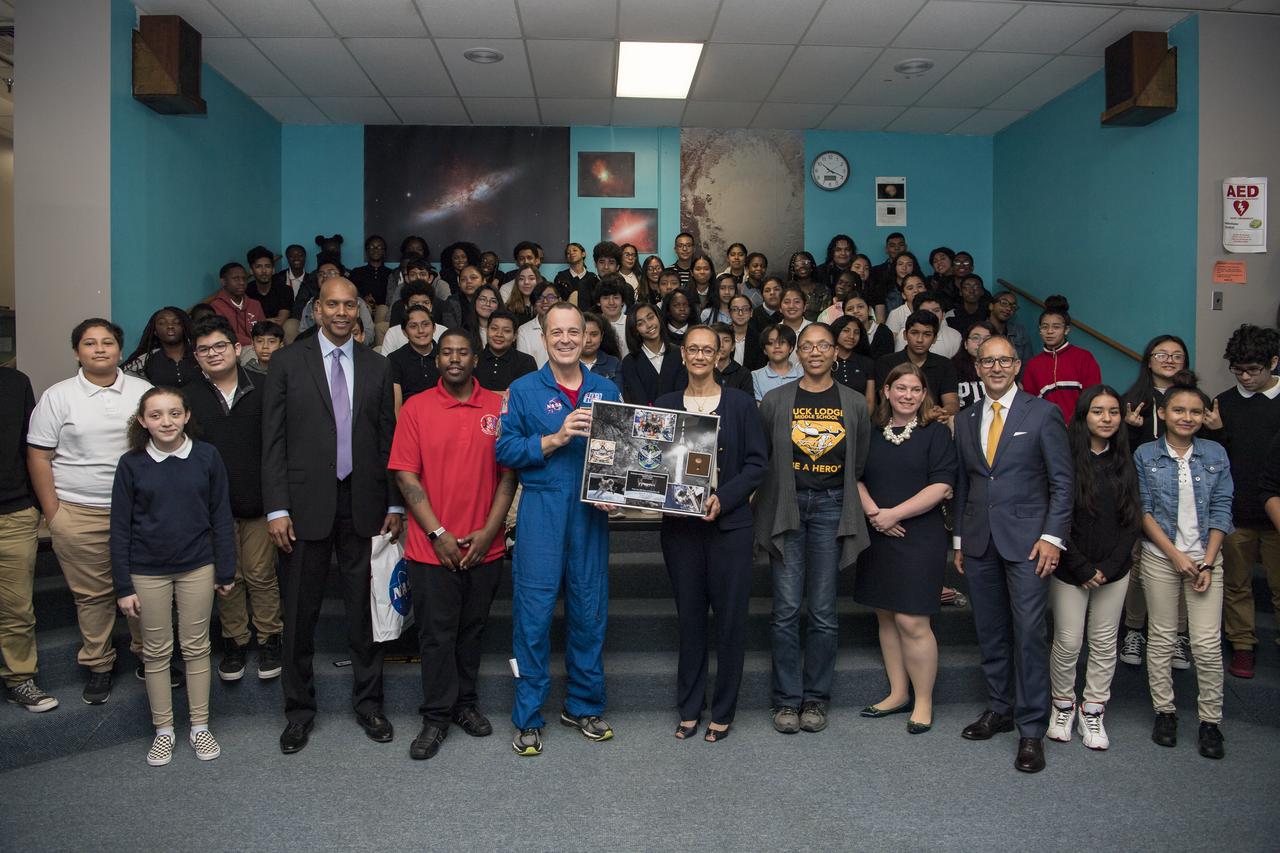
NASA astronaut Ricky Arnold poses for a photo after presenting the Challenger Center with a montage of images from his time onboard the International Space Station (ISS) during Expeditions 55 and 56, Friday, May 3, 2019 in Lanham, MD. During Expedition 55/56, Arnold completed three spacewalks for a total of 19.5 hours outside the space station, and concluded his 197 day mission when he landed in a remote area near the town of Zhezkazgan, Kazakhstan in Oct. 2018. He also flew to the space station on shuttle mission STS-119 to deliver the final pair of power-generating solar array wings. Photo Credit: (NASA/Aubrey Gemignani)
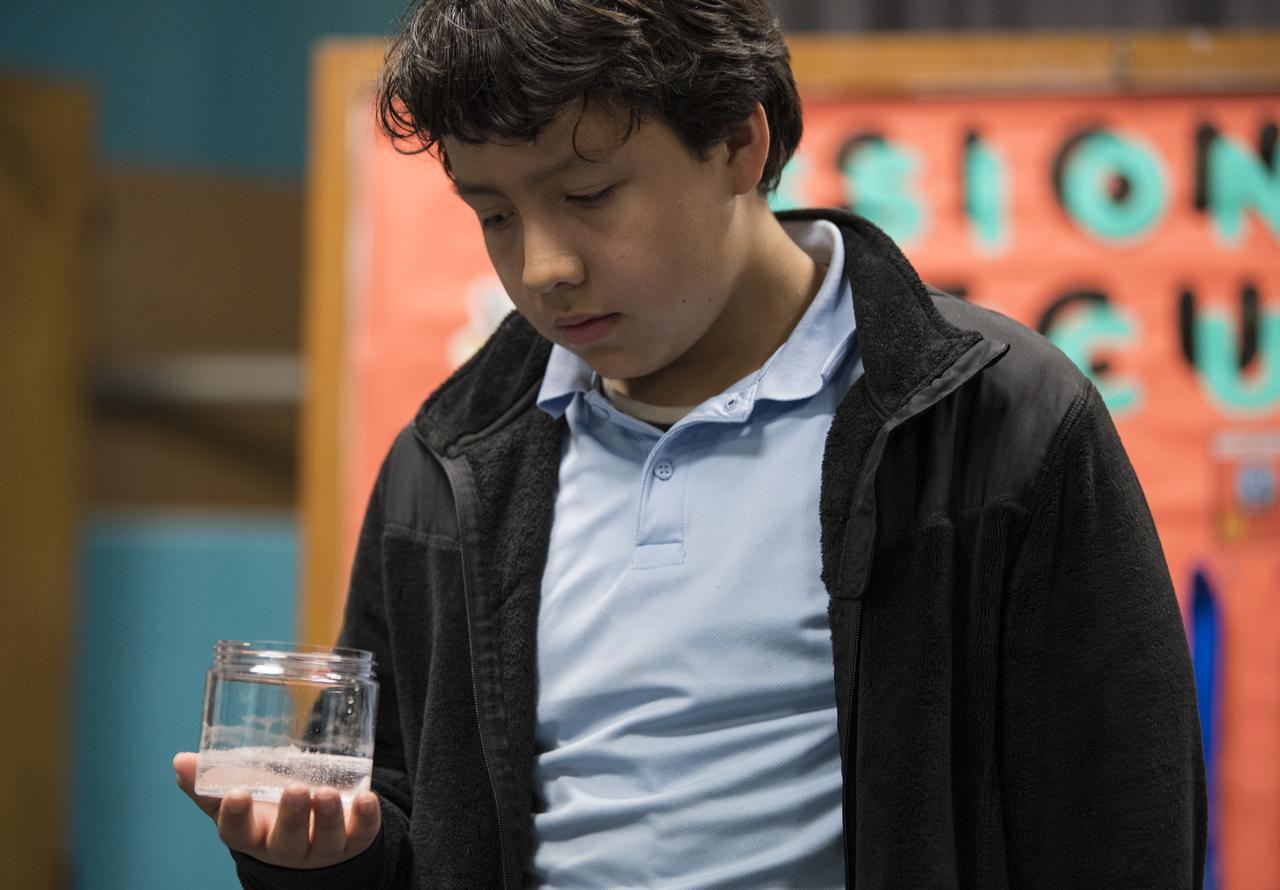
A student observes a glass of water with an Alka-Seltzer tab in it while conducting an experiment on effervescence, Friday, May 3, 2019 at the Challenger Center in Lanham, MD. NASA astronaut Ricky Arnold helped them carry out the experiment which he also conducted during his 197 day mission onboard the International Space Station (ISS) during Expeditions 55/56. Photo Credit: (NASA/Aubrey Gemignani)
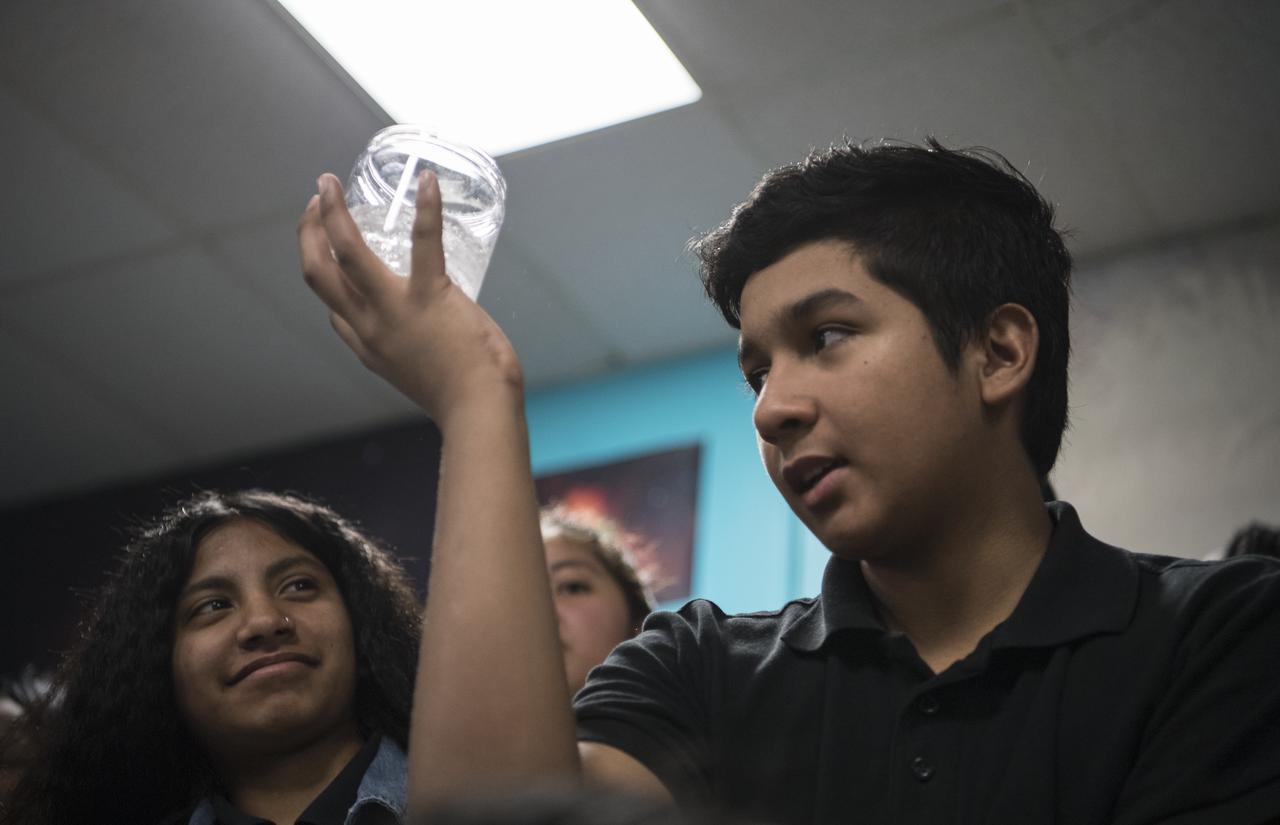
A student holds up a glass of water with an Alka-Seltzer tab in it while conducting an experiment on effervescence, Friday, May 3, 2019 at the Challenger Center in Lanham, MD. NASA astronaut Ricky Arnold helped them carry out the experiment which he also conducted during his 197 day mission onboard the International Space Station (ISS) during Expeditions 55/56. Photo Credit: (NASA/Aubrey Gemignani)
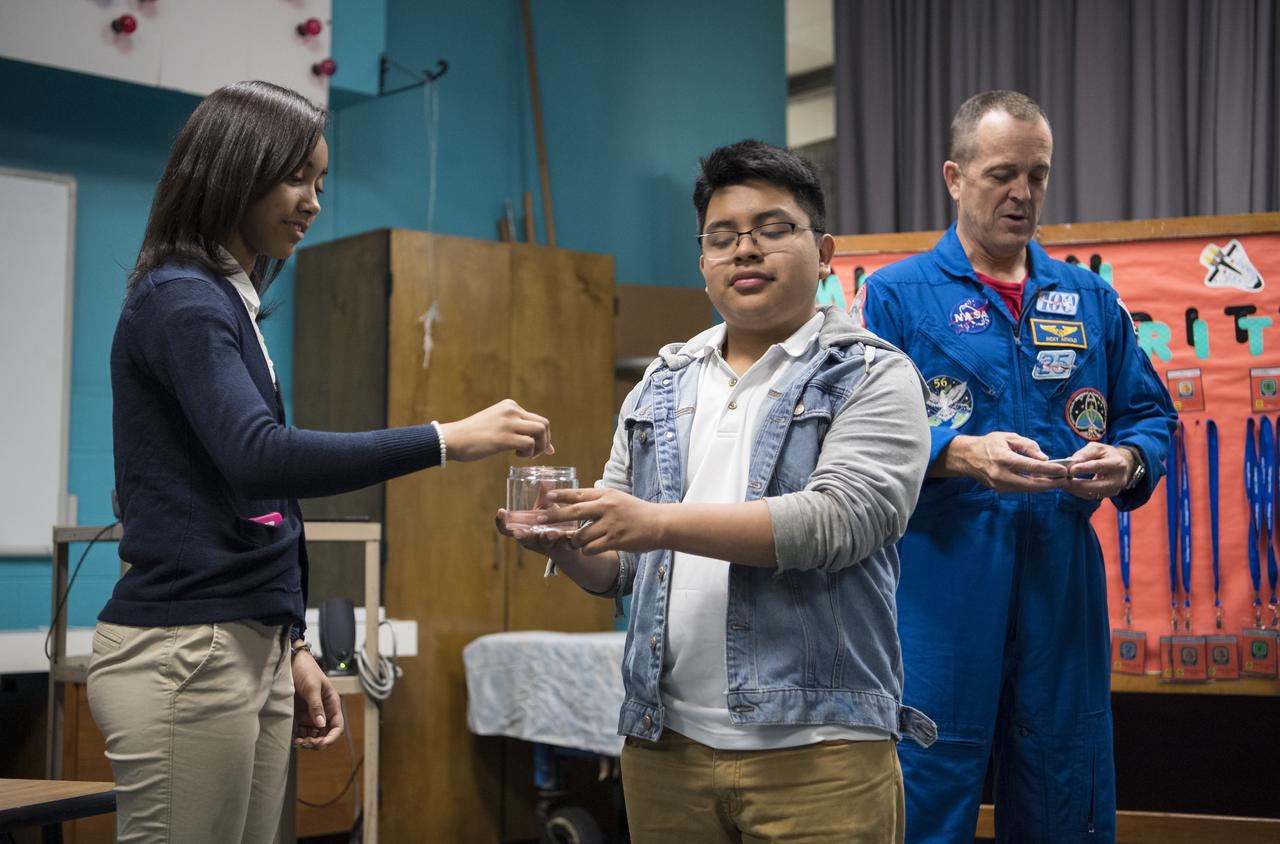
NASA astronaut Ricky Arnold watches a timer while students conduct an experiment on effervescence, Friday, May 3, 2019 at the Challenger Center in Lanham, MD. During Expedition 55/56, Arnold completed three spacewalks for a total of 19.5 hours outside the International Space Station (ISS), and concluded his 197 day mission when he landed in a remote area near the town of Zhezkazgan, Kazakhstan in Oct. 2018. He also flew to the space station on shuttle mission STS-119 to deliver the final pair of power-generating solar array wings. Photo Credit: (NASA/Aubrey Gemignani)
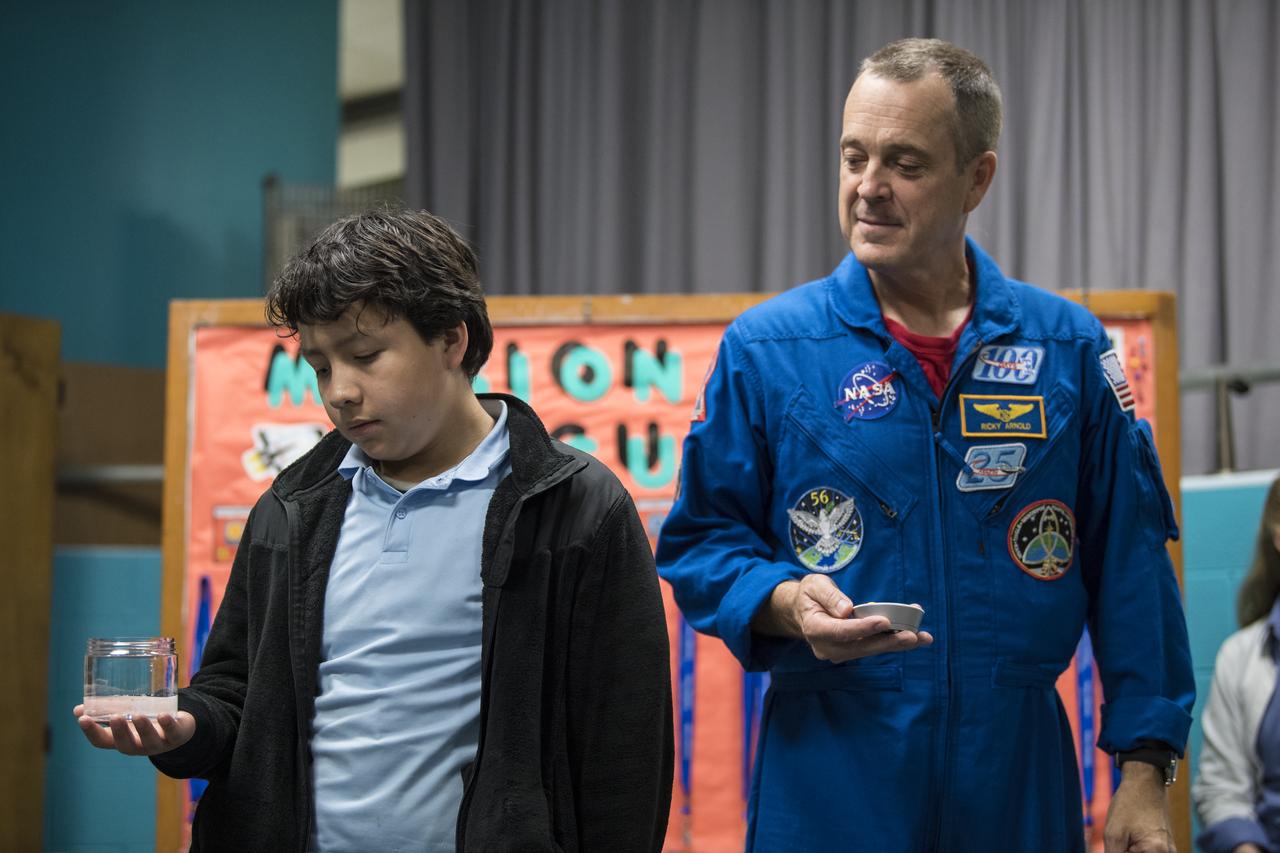
NASA astronaut Ricky Arnold watches a timer while students conduct an experiment on effervescence, Friday, May 3, 2019 at the Challenger Center in Lanham, MD. During Expedition 55/56, Arnold completed three spacewalks for a total of 19.5 hours outside the International Space Station (ISS), and concluded his 197 day mission when he landed in a remote area near the town of Zhezkazgan, Kazakhstan in Oct. 2018. He also flew to the space station on shuttle mission STS-119 to deliver the final pair of power-generating solar array wings. Photo Credit: (NASA/Aubrey Gemignani)
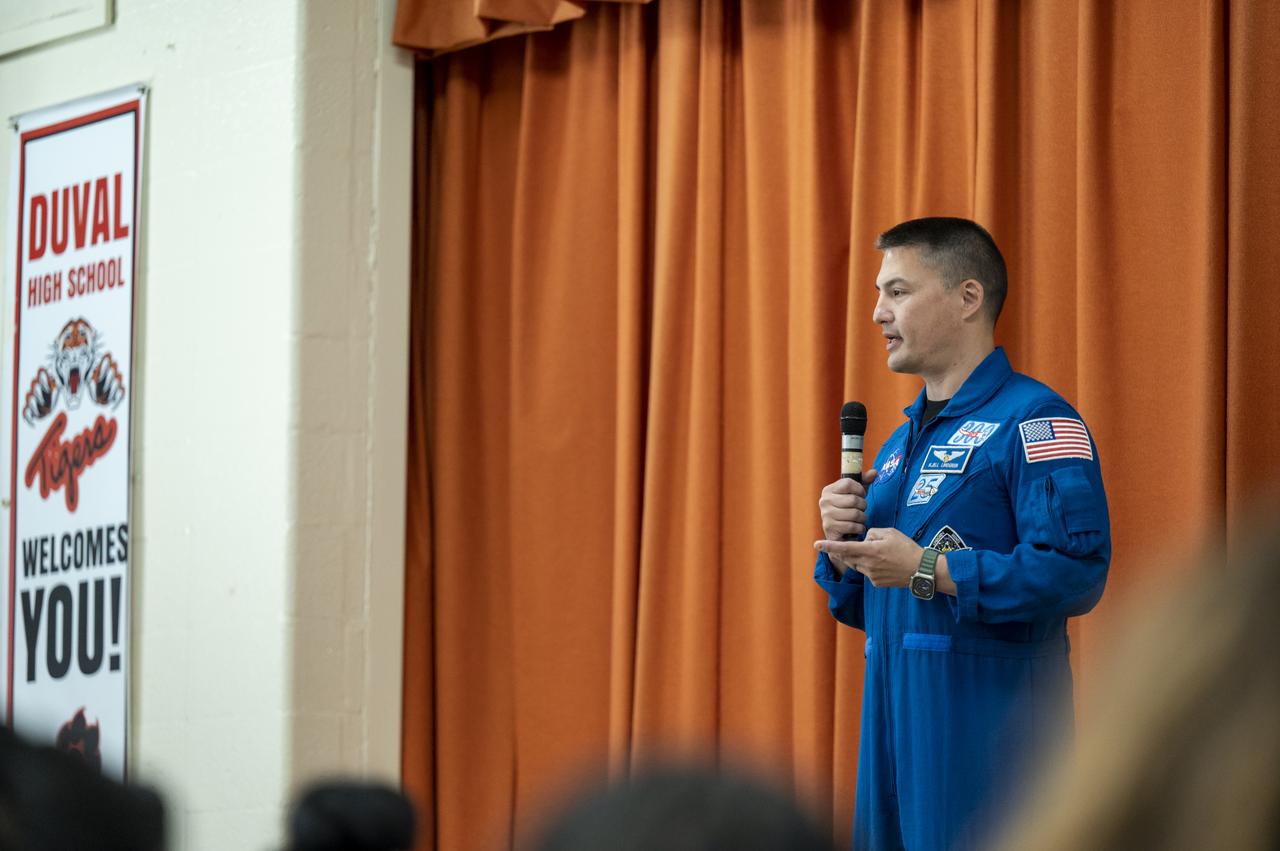
NASA astronaut Kjell Lindgren speaks with students during a STEM event at DuVal High School, Thursday, March 30, 2023, in Lanham, Maryland. Lindgren spent 170 days in space as part of Expeditions 67 and 68 aboard the International Space Station. Photo Credit: (NASA/Keegan Barber)
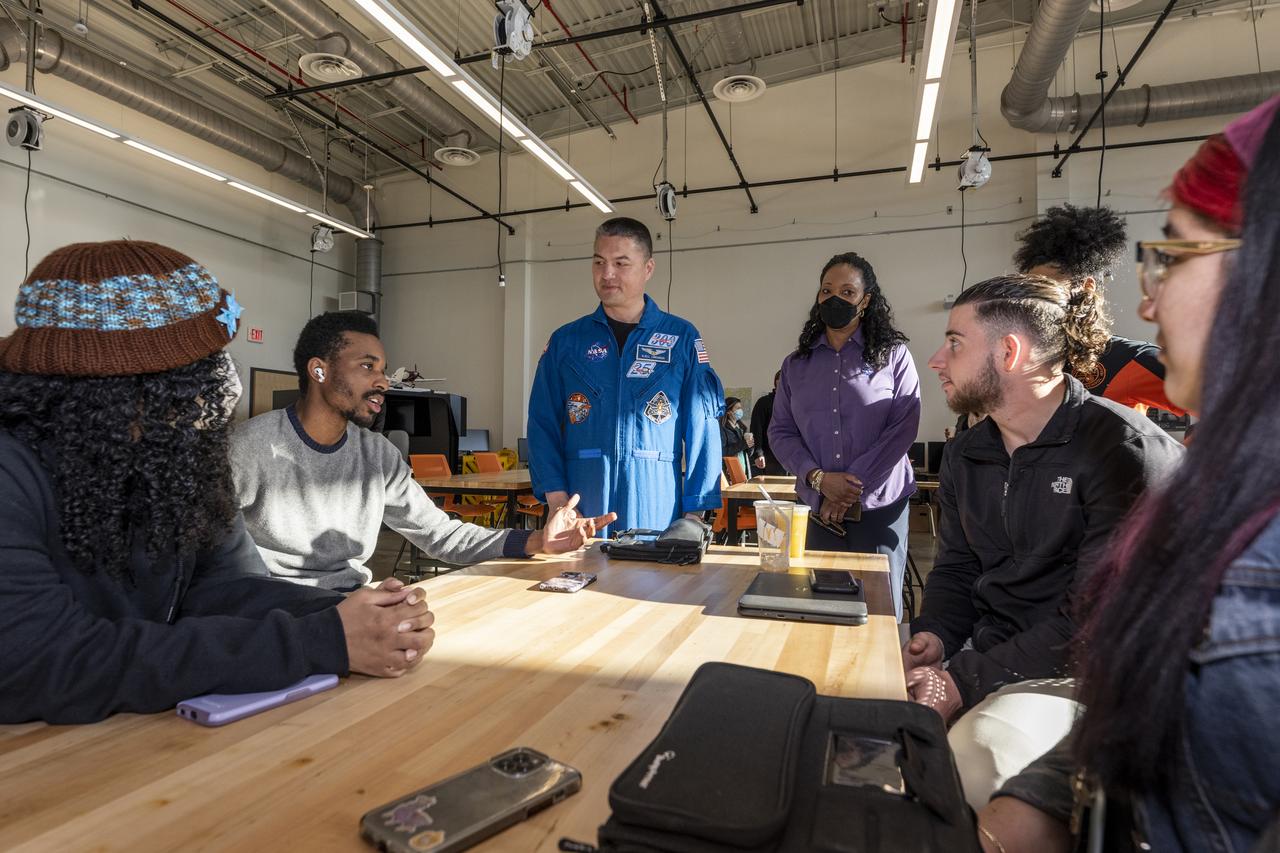
NASA astronaut Kjell Lindgren meets with students and faculty prior to a STEM event at DuVal High School, Thursday, March 30, 2023, in Lanham, Maryland. Lindgren spent 170 days in space as part of Expeditions 67 and 68 aboard the International Space Station. Photo Credit: (NASA/Keegan Barber)
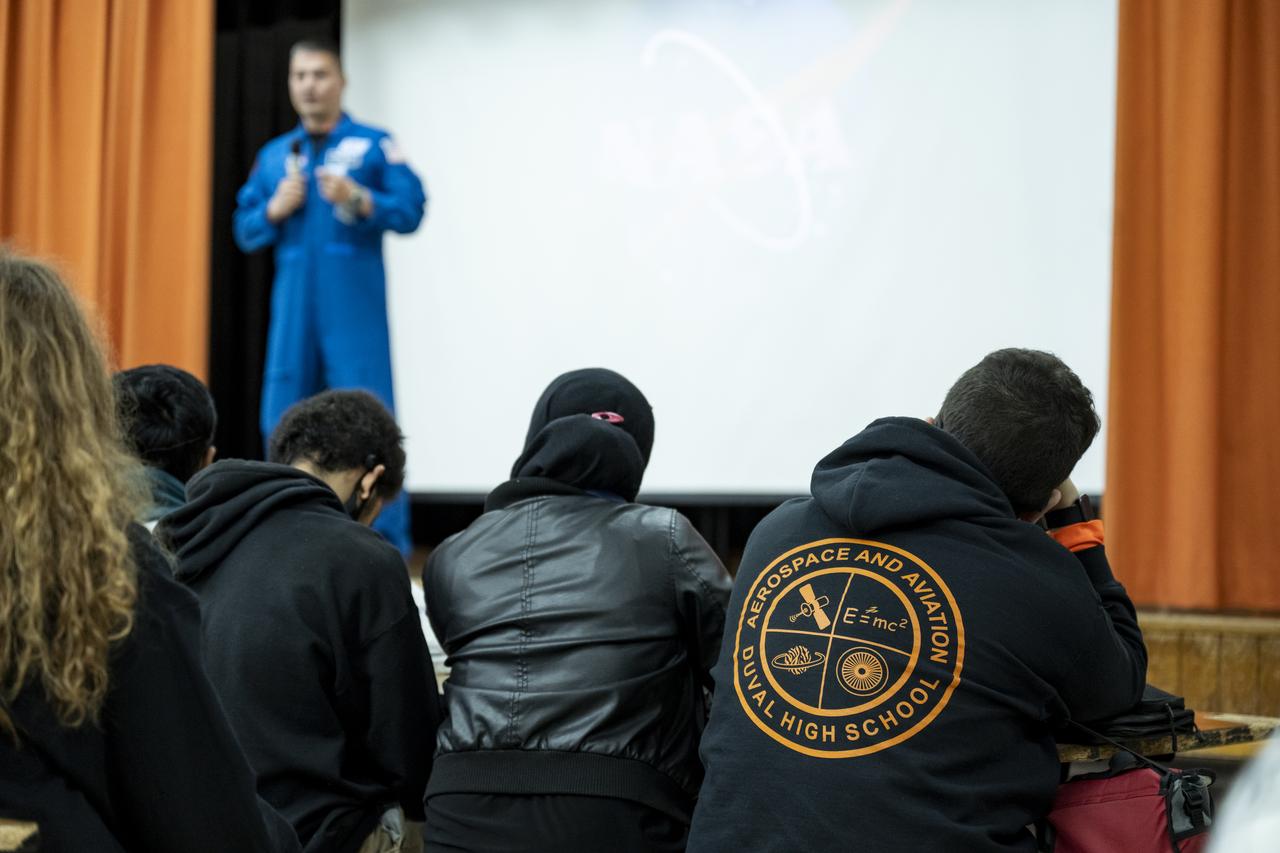
NASA astronaut Kjell Lindgren speaks with students during a STEM event at DuVal High School, Thursday, March 30, 2023, in Lanham, Maryland. Lindgren spent 170 days in space as part of Expeditions 67 and 68 aboard the International Space Station. Photo Credit: (NASA/Keegan Barber)
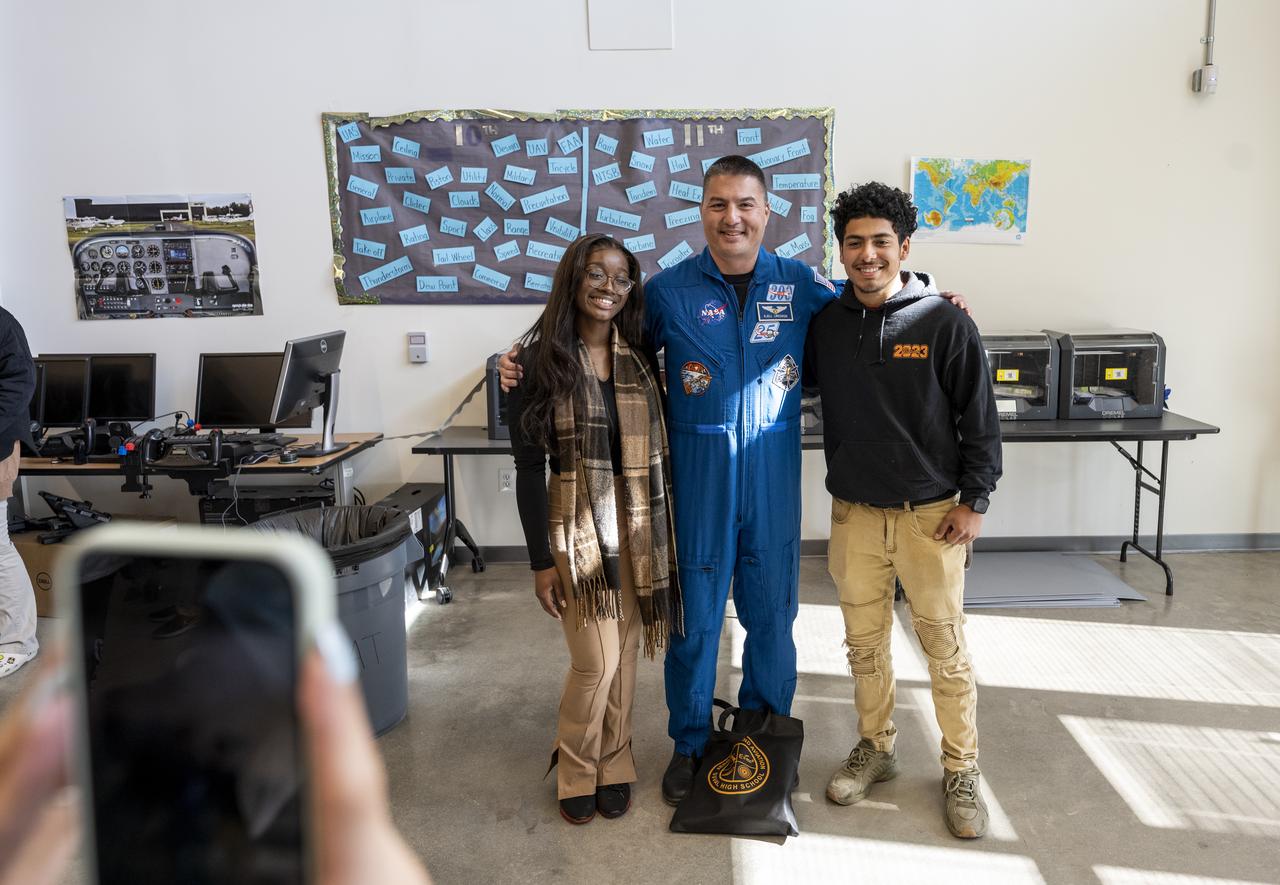
NASA astronaut Kjell Lindgren poses for photos with students following a STEM event at DuVal High School, Thursday, March 30, 2023, in Lanham, Maryland. Lindgren spent 170 days in space as part of Expeditions 67 and 68 aboard the International Space Station. Photo Credit: (NASA/Keegan Barber)
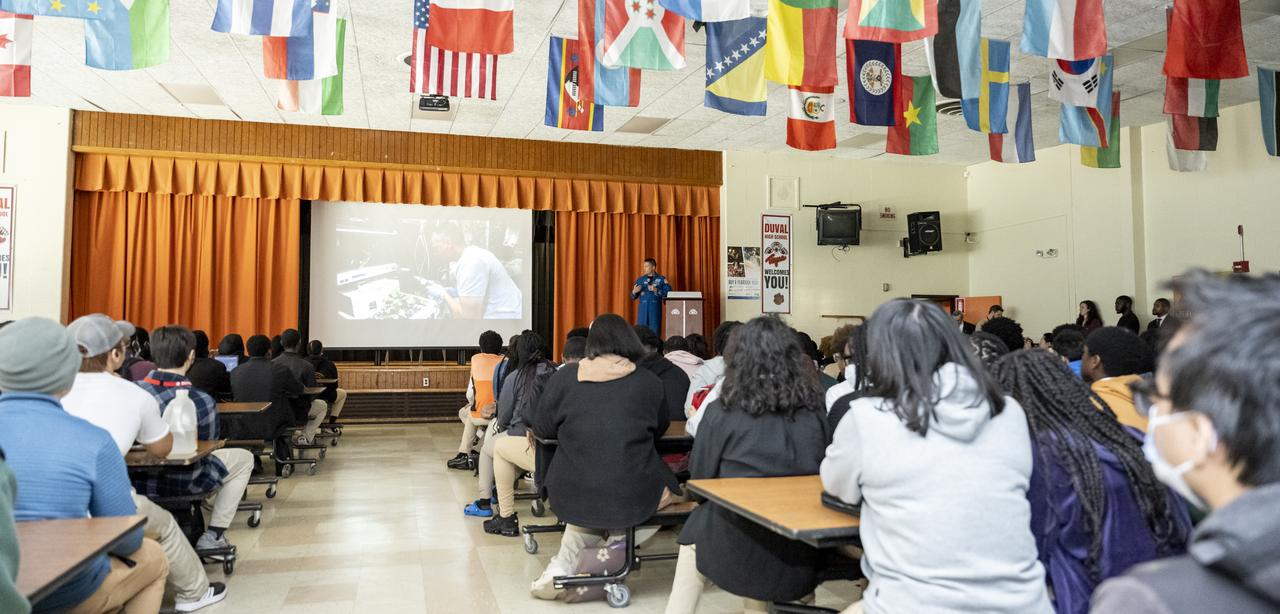
NASA astronaut Kjell Lindgren speaks with students during a STEM event at DuVal High School, Thursday, March 30, 2023, in Lanham, Maryland. Lindgren spent 170 days in space as part of Expeditions 67 and 68 aboard the International Space Station. Photo Credit: (NASA/Keegan Barber)
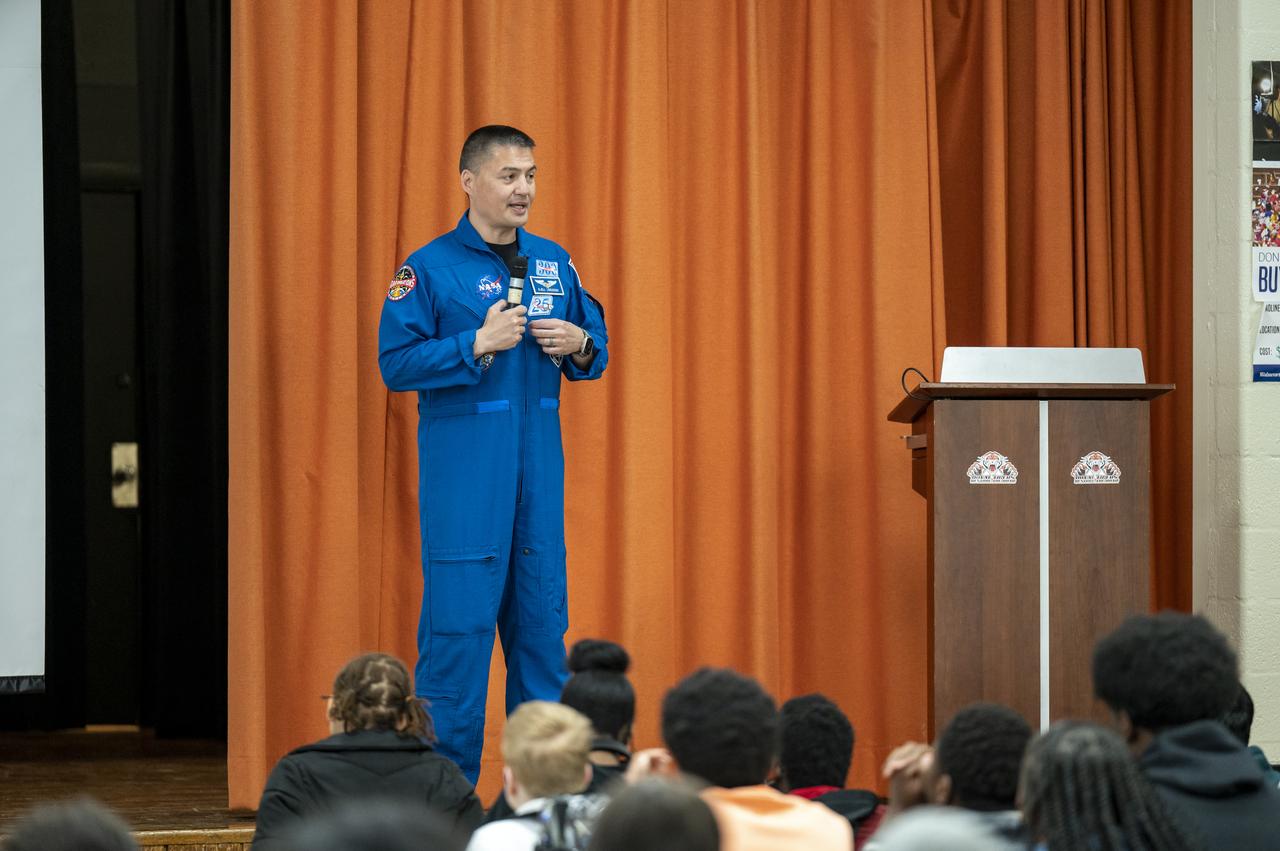
NASA astronaut Kjell Lindgren speaks with students during a STEM event at DuVal High School, Thursday, March 30, 2023, in Lanham, Maryland. Lindgren spent 170 days in space as part of Expeditions 67 and 68 aboard the International Space Station. Photo Credit: (NASA/Keegan Barber)
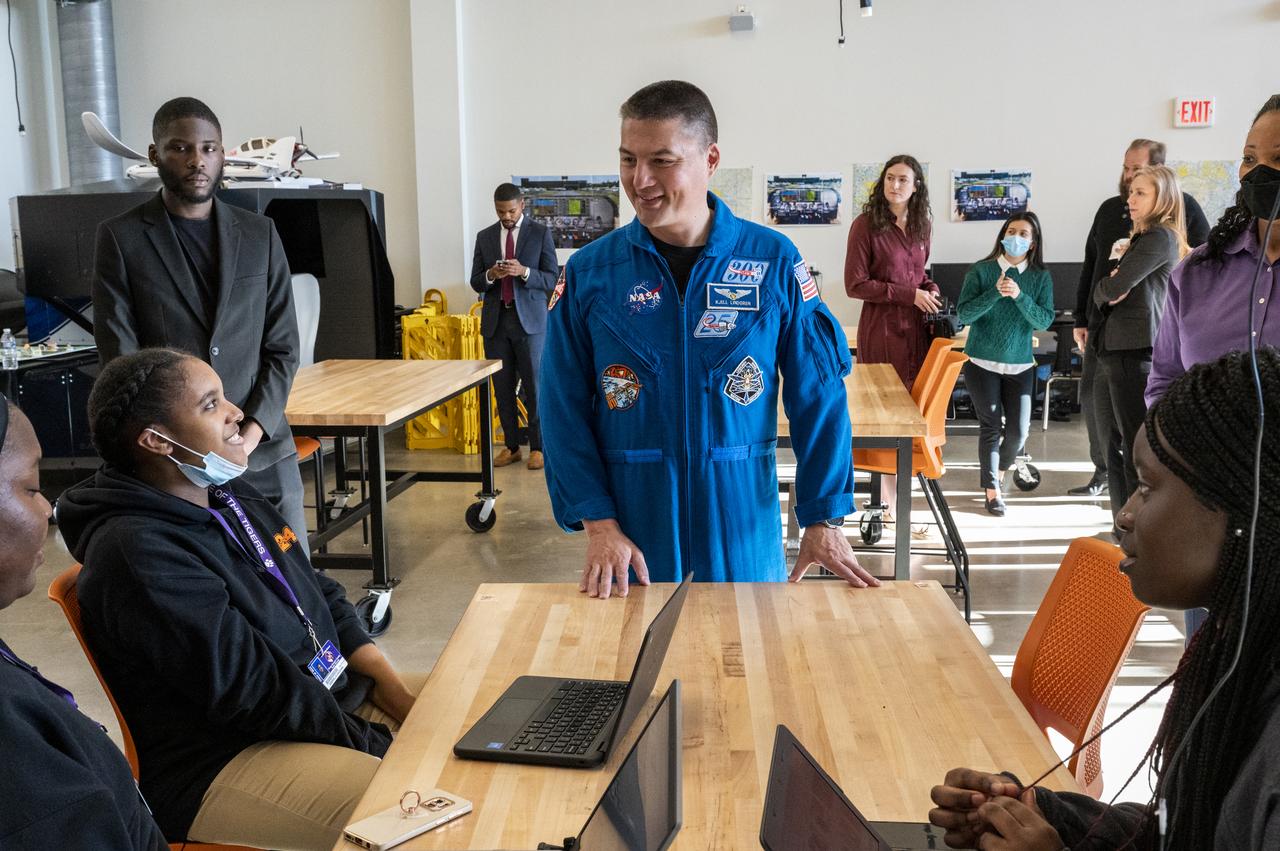
NASA astronaut Kjell Lindgren meets with students and faculty prior to a STEM event at DuVal High School, Thursday, March 30, 2023, in Lanham, Maryland. Lindgren spent 170 days in space as part of Expeditions 67 and 68 aboard the International Space Station. Photo Credit: (NASA/Keegan Barber)
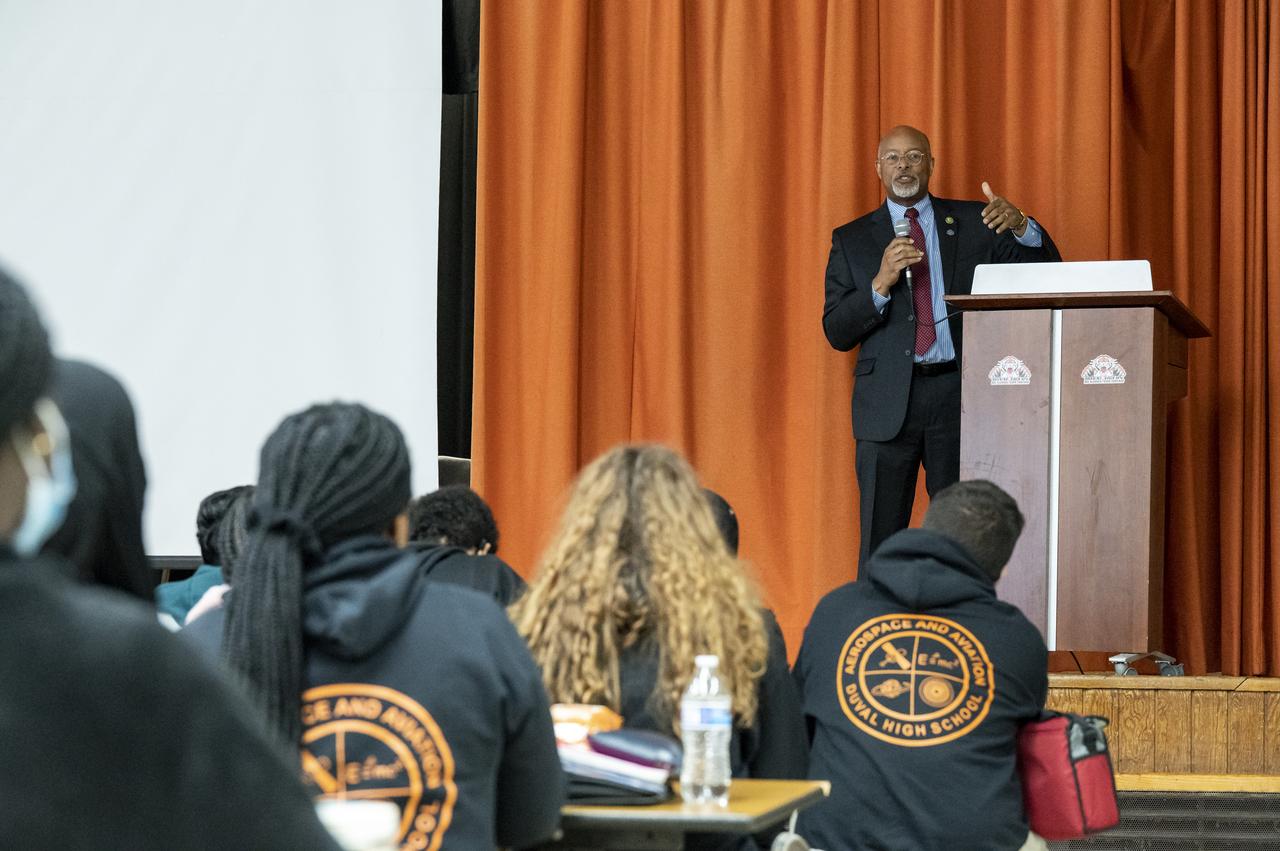
Congressman Glenn Ivey (D-Md.) speaks with students during a STEM event at DuVal High School, Thursday, March 30, 2023, in Lanham, Maryland. Lindgren spent 170 days in space as part of Expeditions 67 and 68 aboard the International Space Station. Photo Credit: (NASA/Keegan Barber)
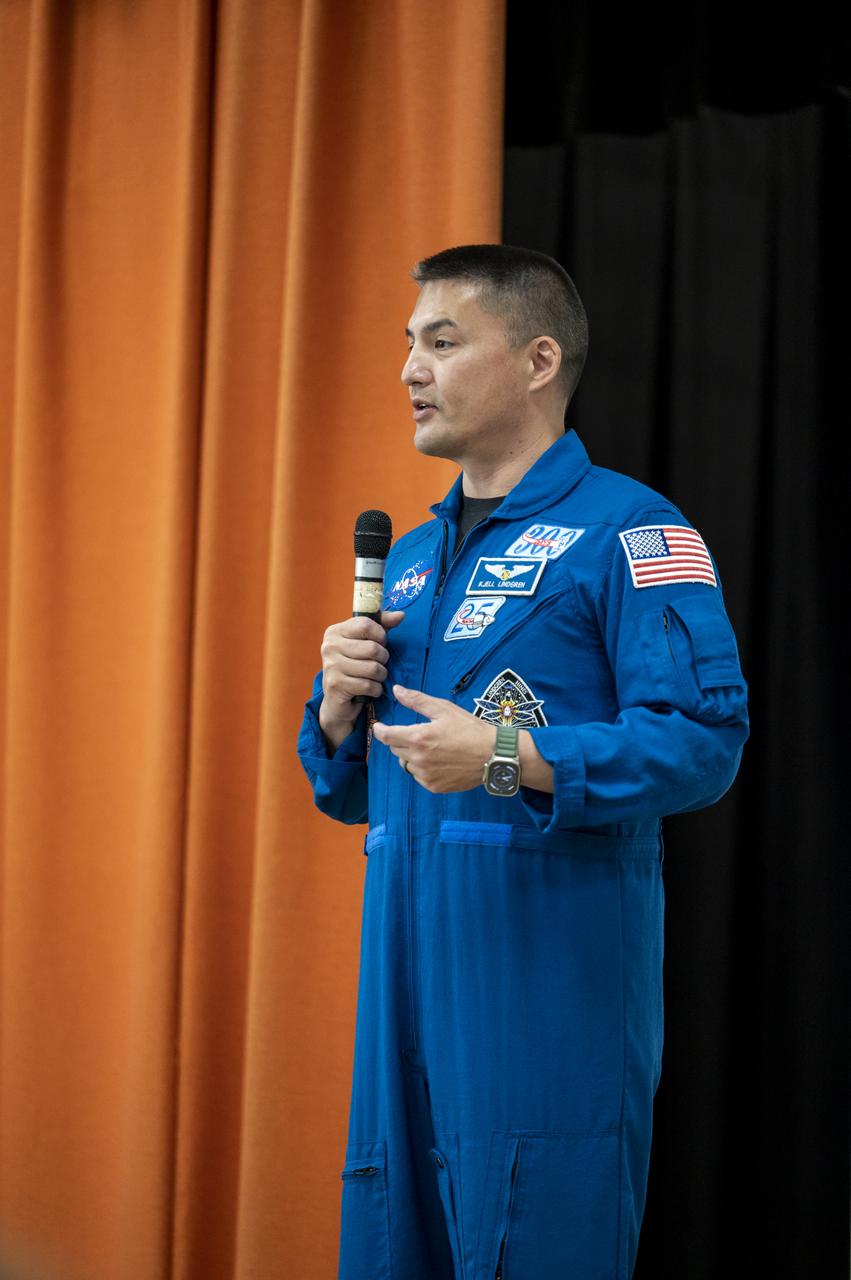
NASA astronaut Kjell Lindgren speaks with students during a STEM event at DuVal High School, Thursday, March 30, 2023, in Lanham, Maryland. Lindgren spent 170 days in space as part of Expeditions 67 and 68 aboard the International Space Station. Photo Credit: (NASA/Keegan Barber)
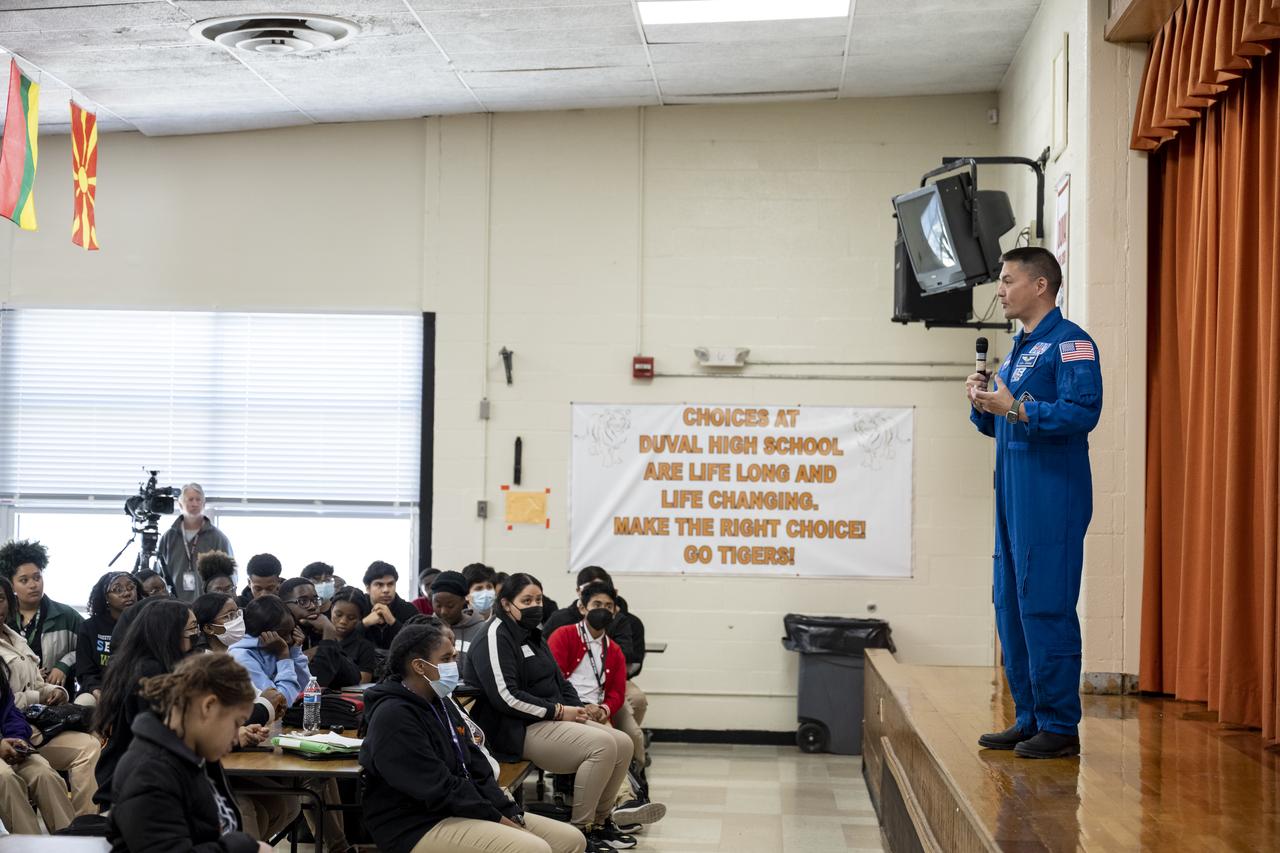
NASA astronaut Kjell Lindgren speaks with students during a STEM event at DuVal High School, Thursday, March 30, 2023, in Lanham, Maryland. Lindgren spent 170 days in space as part of Expeditions 67 and 68 aboard the International Space Station. Photo Credit: (NASA/Keegan Barber)

NASA astronaut Kjell Lindgren, left, and Congressman Glenn Ivey (D-Md.), right, meet with students and faculty prior to a STEM event at DuVal High School, Thursday, March 30, 2023, in Lanham, Maryland. Lindgren spent 170 days in space as part of Expeditions 67 and 68 aboard the International Space Station. Photo Credit: (NASA/Keegan Barber)
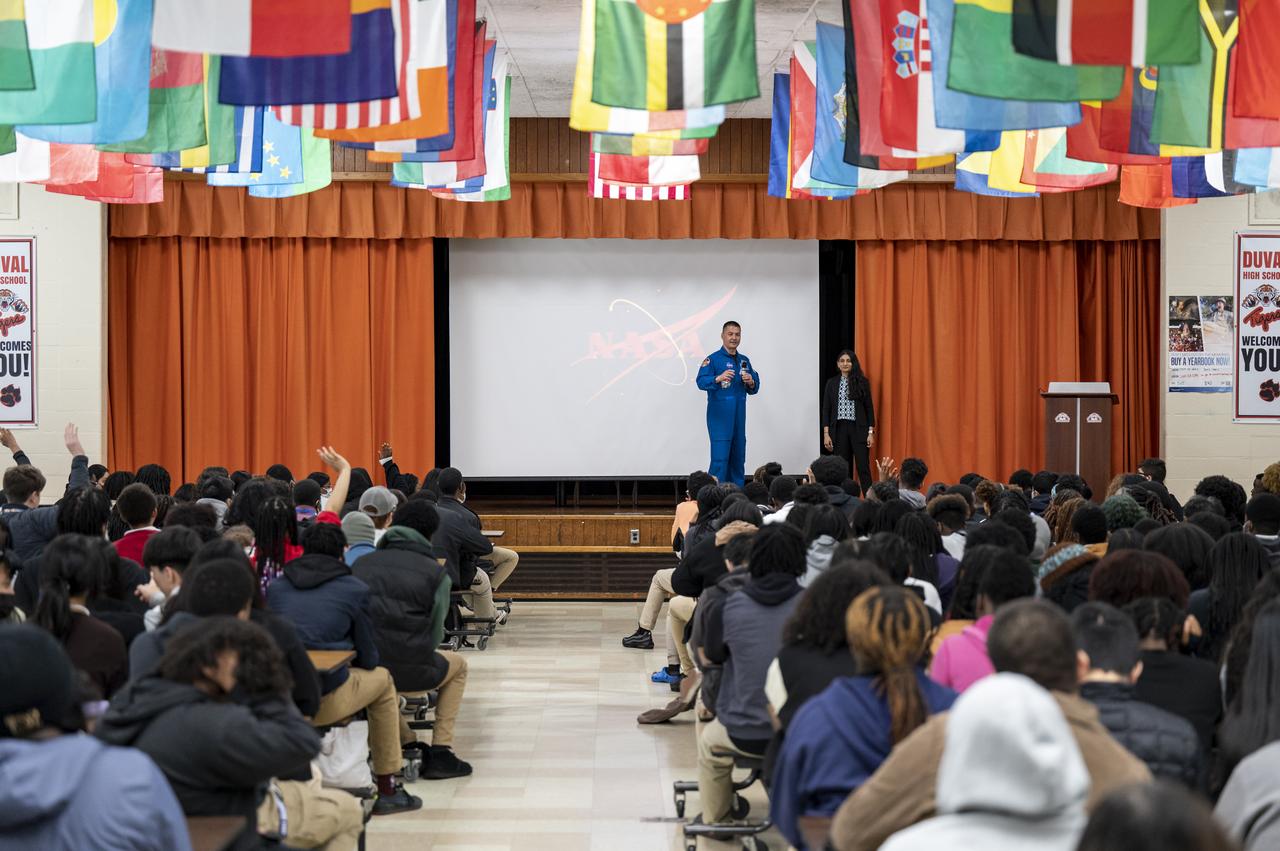
NASA astronaut Kjell Lindgren, left, and NASA Associate Chief Scientist for Exploration and Applied Research in the Office of the Chief Scientist Dr. Mamta Patel Nagaraja, right, answer questions from students during a STEM event at DuVal High School, Thursday, March 30, 2023, in Lanham, Maryland. Lindgren spent 170 days in space as part of Expeditions 67 and 68 aboard the International Space Station. Photo Credit: (NASA/Keegan Barber)
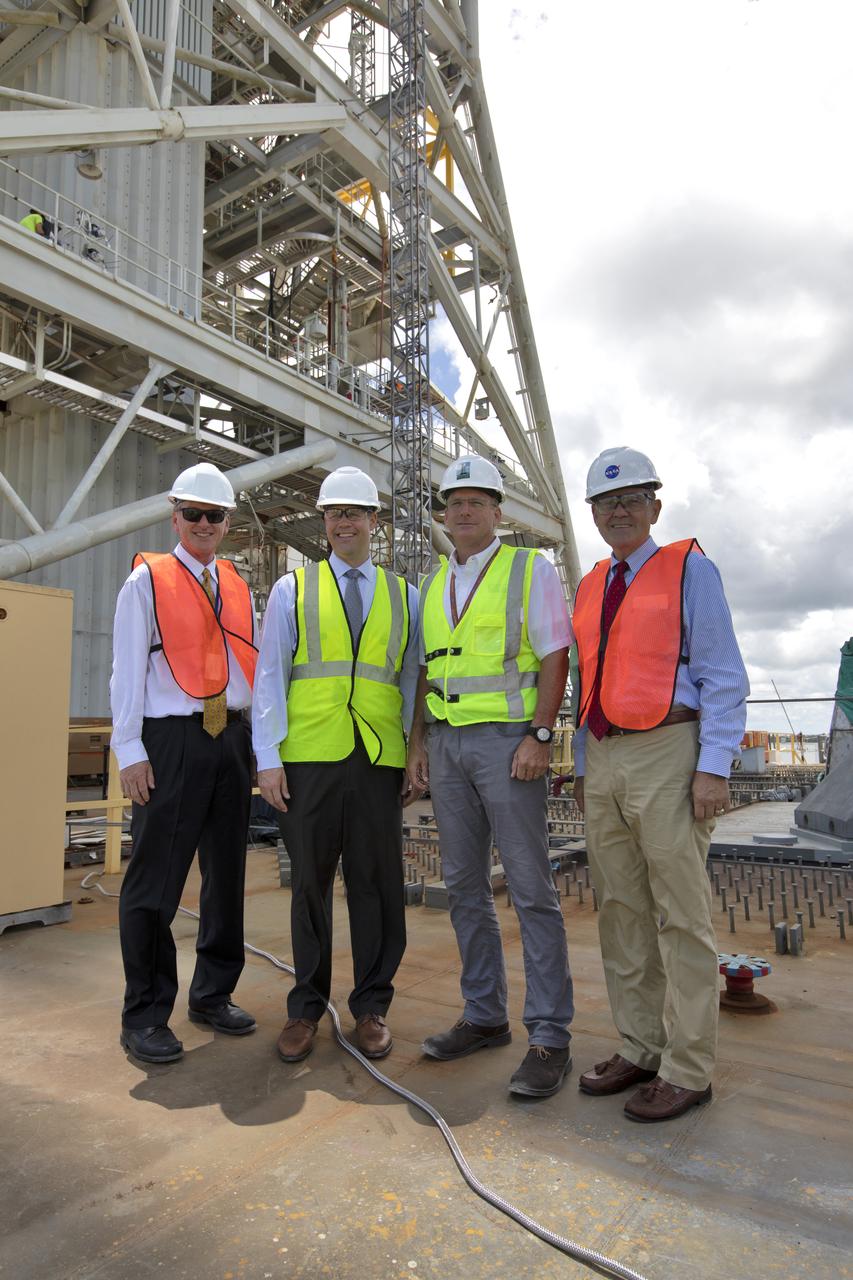
NASA Administrator Jim Bridenstine (second from left) is briefed on testing of the mobile launcher that will support the agency's Space Launch System rocket and Orion spacecraft that will liftoff on trips to the Moon, Mars and deep space. From the left, are Mike Bolger, Exploration Ground Systems program manager, Bridenstine, Cliff Lanham, Mobile Launcher Project Manager, and Center Director Bob Cabana. Bridenstine made his first official visit to the NASA's Kennedy Space Center on Aug. 6 and 7, 2018.
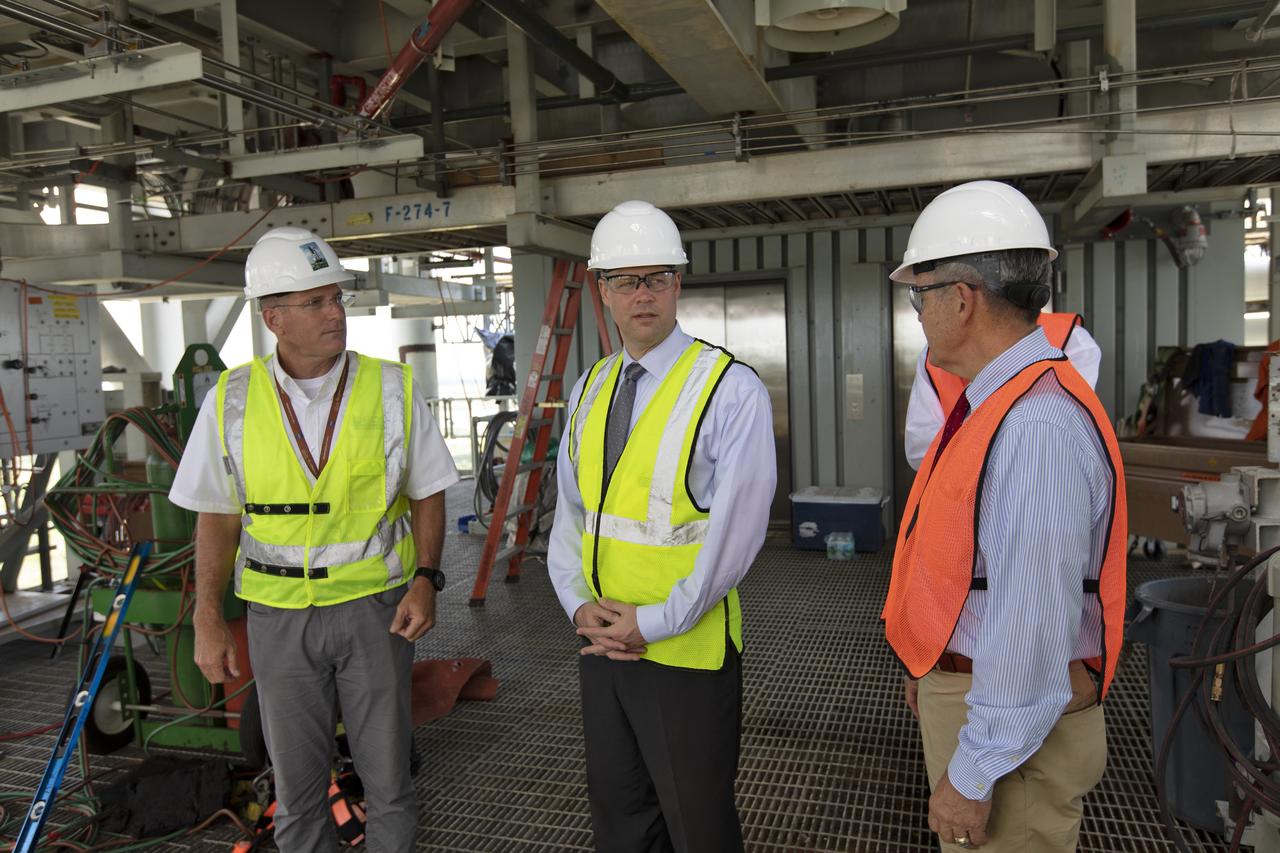
NASA Administrator Jim Bridenstine (center) is briefed by Cliff Lanham, Mobile Launcher Project Manager (left) and Kennedy Space Center Director Bob Cabana on testing of the mobile launcher that will support the agency's Space Launch System rocket and Orion spacecraft that will liftoff on trips to the Moon, Mars and deep space. Bridenstine made his first official visit to the NASA's Florida spaceport on Aug. 6 and 7, 2018.
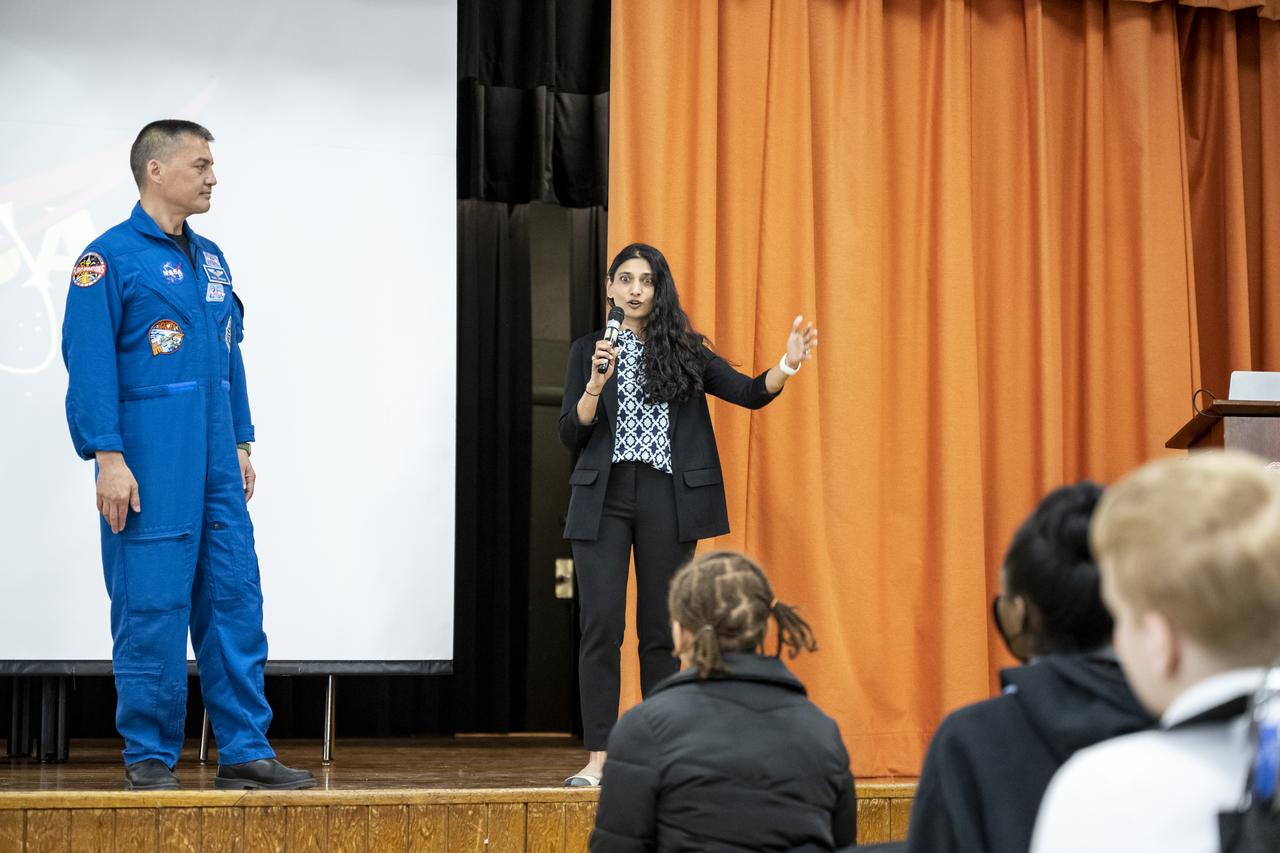
NASA astronaut Kjell Lindgren, left, and NASA Associate Chief Scientist for Exploration and Applied Research in the Office of the Chief Scientist Dr. Mamta Patel Nagaraja, right, answer questions from students during a STEM event at DuVal High School, Thursday, March 30, 2023, in Lanham, Maryland. Lindgren spent 170 days in space as part of Expeditions 67 and 68 aboard the International Space Station. Photo Credit: (NASA/Keegan Barber)
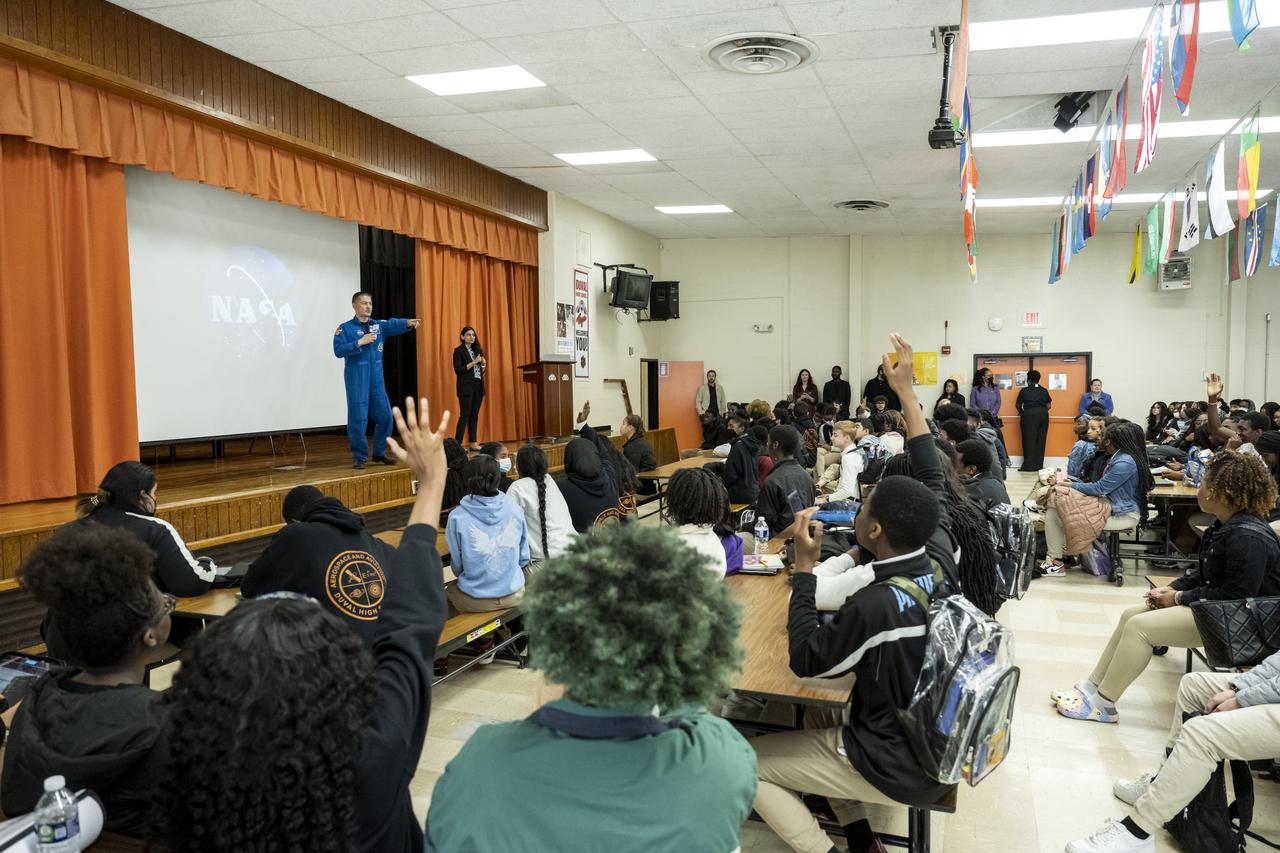
NASA astronaut Kjell Lindgren, left, and NASA Associate Chief Scientist for Exploration and Applied Research in the Office of the Chief Scientist Dr. Mamta Patel Nagaraja, right, answer questions from students during a STEM event at DuVal High School, Thursday, March 30, 2023, in Lanham, Maryland. Lindgren spent 170 days in space as part of Expeditions 67 and 68 aboard the International Space Station. Photo Credit: (NASA/Keegan Barber)

NASA astronaut Kjell Lindgren, left, and Congressman Glenn Ivey (D-Md.), right, speak with students during a STEM event at DuVal High School, Thursday, March 30, 2023, in Lanham, Maryland. Lindgren spent 170 days in space as part of Expeditions 67 and 68 aboard the International Space Station. Photo Credit: (NASA/Keegan Barber)
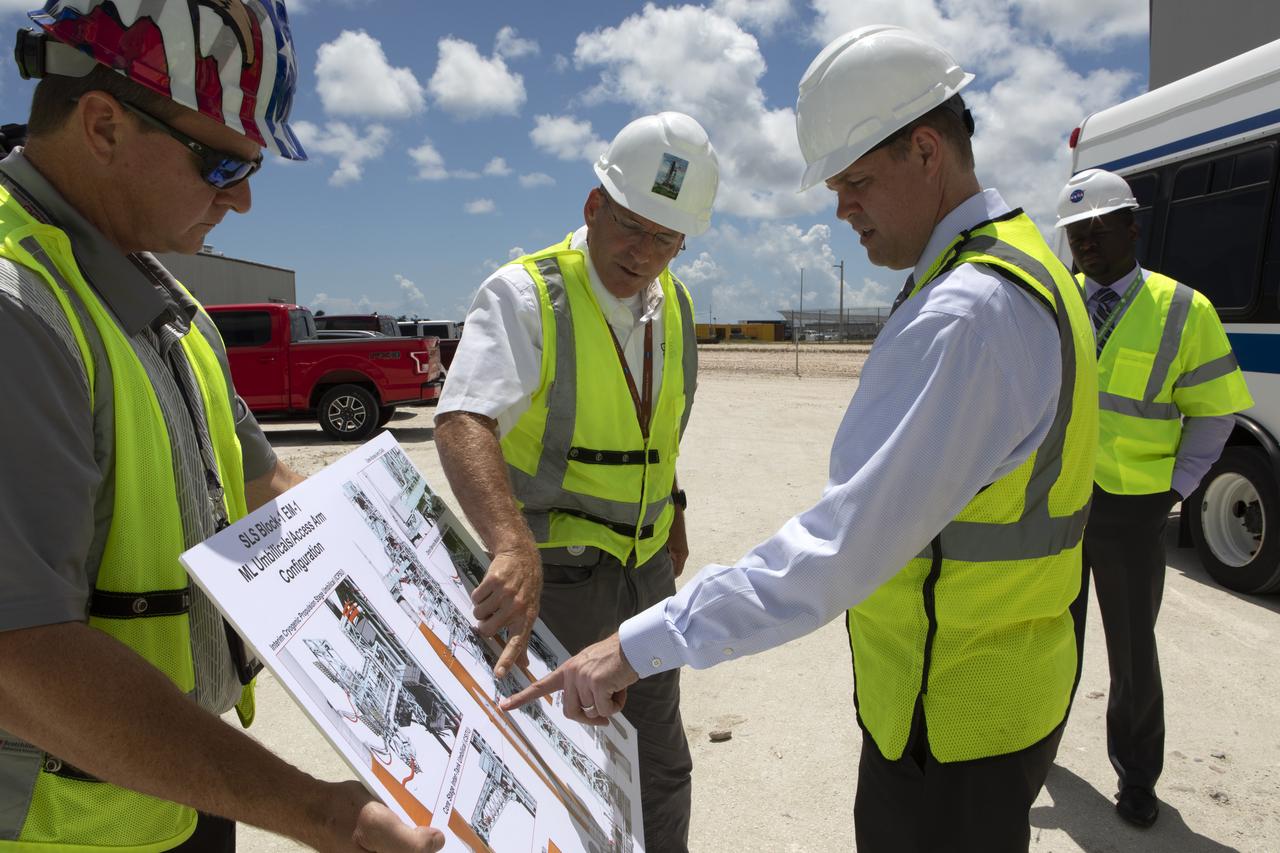
NASA Administrator Jim Bridenstine (right) is briefed by Cliff Lanham, Mobile Launcher Project Manager (center), on testing of the mobile launcher that will support the agency's Space Launch System rocket and Orion spacecraft that will liftoff for trips to the Moon, Mars and deep space. Bridenstine made his first official visit to the NASA's Florida spaceport on Aug. 6 and 7, 2018.

NASA Administrator Jim Bridenstine (left) is briefed by Cliff Lanham, Mobile Launcher Project Manager (center), on testing of the mobile launcher that will support the agency's Space Launch System rocket and Orion spacecraft that will liftoff on trips to the Moon, Mars and deep space. Bridenstine made his first official visit to the NASA's Kennedy Space Center on Aug. 6 and 7, 2018.
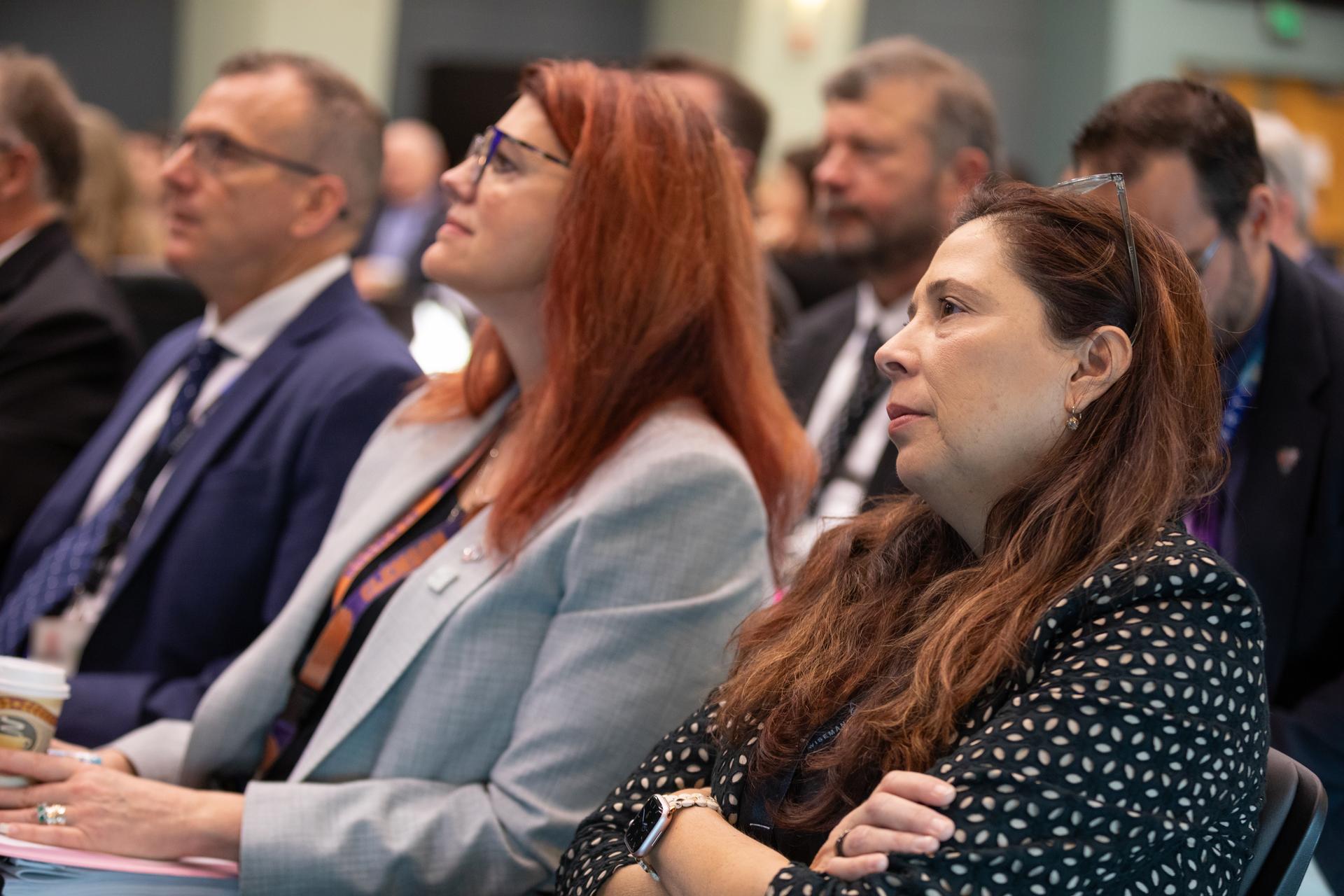
From left, Cliff Lanham, deputy manager, Exploration Ground Systems; Charlie Blackwell-Thompson, launch director, Exploration Ground Systems Program; and Lili Villarreal, Artemis II landing and recovery director in Exploration Ground Systems Program at NASA’s Kennedy Space Center in Florida, participate in the Artemis II Flight Readiness Review with NASA leadership on Wednesday, March 11, 2026, at NASA Kennedy. The review is an assessment of the readiness of NASA’s SLS (Space Launch System) rocket and Orion spacecraft to support the Artemis II test flight as four astronauts journey around the Moon and return to Earth.

From left, Shawn Quinn, manager, Exploration Ground Systems Program; Cliff Lanham, deputy manager, Exploration Ground Systems; and Charlie Blackwell-Thompson, launch director, Exploration Ground Systems Program Program at NASA’s Kennedy Space Center in Florida, participate in the Artemis II Flight Readiness Review with NASA leadership on Wednesday, March 11, 2026, at NASA Kennedy. The review is an assessment of the readiness of NASA’s SLS (Space Launch System) rocket and Orion spacecraft to support the Artemis II test flight as four astronauts journey around the Moon and return to Earth.
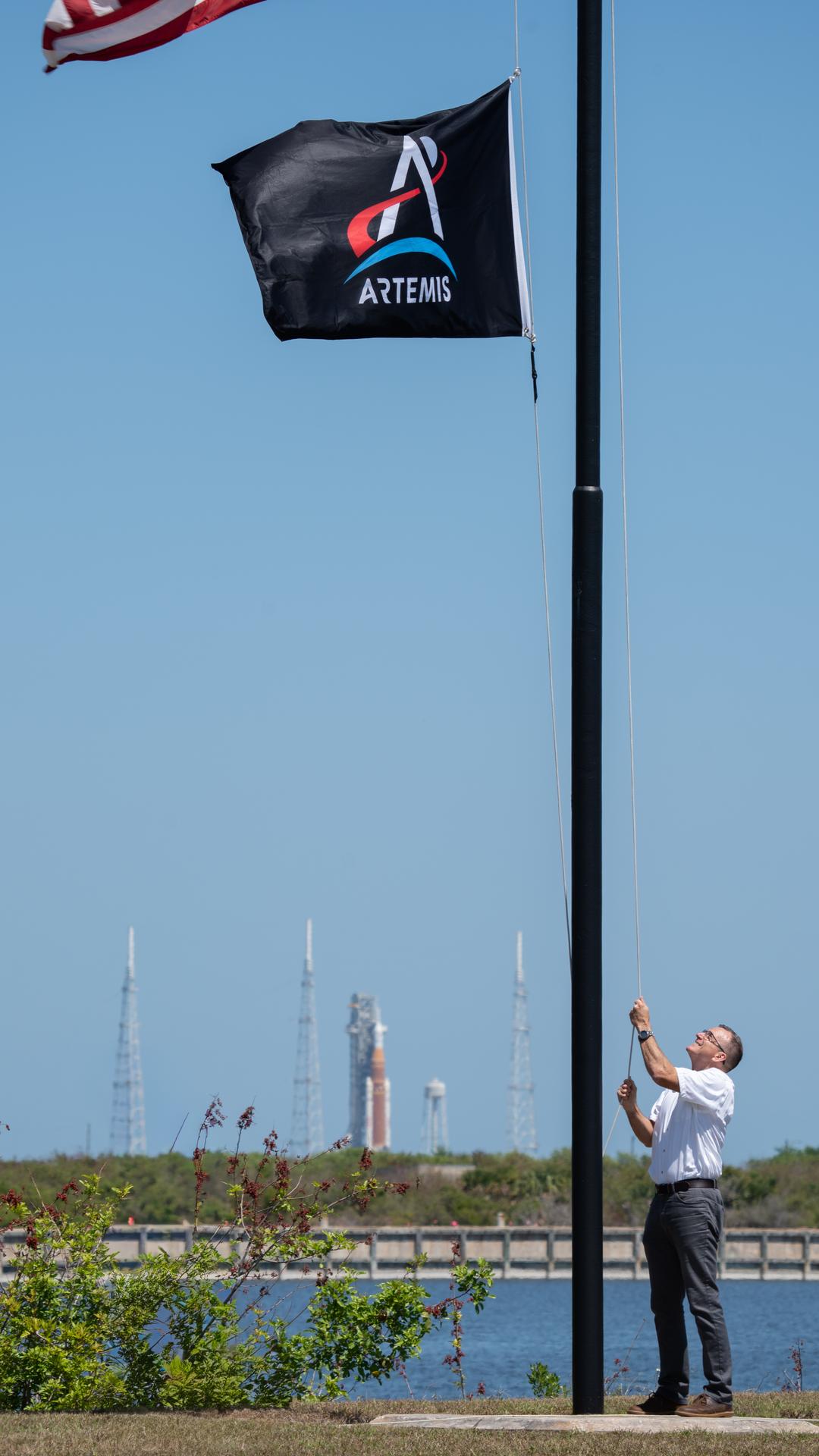
Cliff Lanham, deputy manager, Exploration Ground Systems Program raises the Artemis flag near the countdown clock at the NASA News Center at NASA’s Kennedy Space Center in Florida on Friday, March 27, 2026. The Artemis II test flight mission will take Artemis II Commander Reid Wiseman, Pilot Victor Glover, and Mission Specialist Christina Koch from NASA, and Mission Specialist Jeremy Hansen from the CSA (Canadian Space Agency) on a 10-day journey around the Moon and back aboard NASA’s SLS (Space Launch System) rocket and Orion spacecraft from Launch Complex 39B no earlier than 6:24 p.m. EDT on Wednesday, April 1.
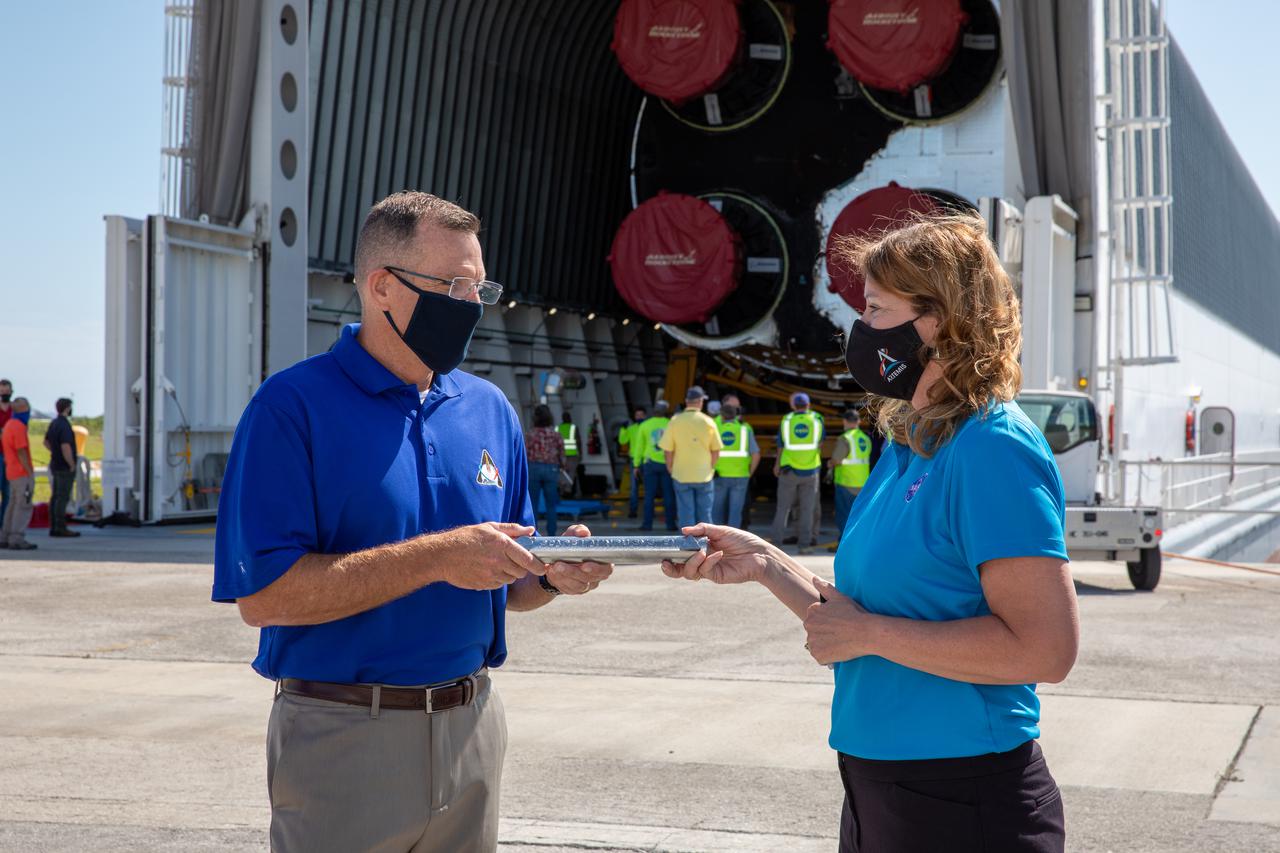
Space Launch System (SLS) Stages Manager Julie Bassler, right, celebrates the arrival of the SLS core stage by symbolically “passing the baton” to Exploration Ground Systems’ (EGS) Senior Vehicle Operations Manager Cliff Lanham on April 28, 2021, at NASA’s Kennedy Space Center in Florida. Journeying from the agency’s Stennis Space Center in Mississippi aboard the Pegasus barge, the core stage arrived at the Florida spaceport on April 27 to be processed for flight by EGS. It is the final piece of Artemis hardware to arrive at Kennedy and will be offloaded and moved to the Vehicle Assembly Building, where it will be prepared for integration atop the mobile launcher with the completed stack of solid rocket boosters ahead of the Artemis I launch. The first in a series of increasingly complex missions, Artemis I will test SLS and Orion as an integrated system prior to crewed flights to the Moon.

Space Launch System (SLS) Stages Manager Julie Bassler, right, celebrates the arrival of the SLS core stage by symbolically “passing the baton” to Exploration Ground Systems’ (EGS) Senior Vehicle Operations Manager Cliff Lanham on April 28, 2021, at NASA’s Kennedy Space Center in Florida. Journeying from the agency’s Stennis Space Center in Mississippi aboard the Pegasus barge, the core stage arrived at the Florida spaceport on April 27 to be processed for flight by EGS. It is the final piece of Artemis hardware to arrive at Kennedy and will be offloaded and moved to the Vehicle Assembly Building, where it will be prepared for integration atop the mobile launcher with the completed stack of solid rocket boosters ahead of the Artemis I launch. The first in a series of increasingly complex missions, Artemis I will test SLS and Orion as an integrated system prior to crewed flights to the Moon.
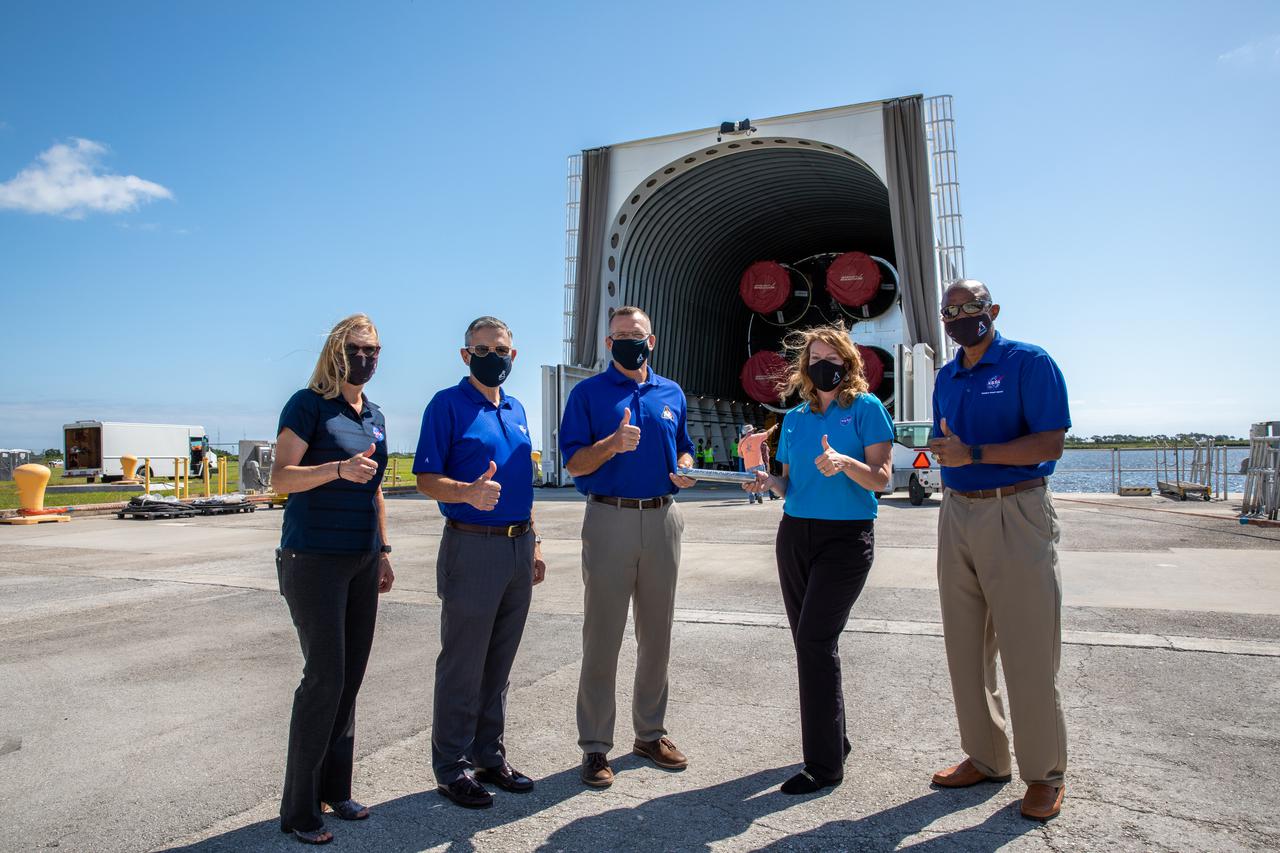
From left, Kennedy Space Center Deputy Director Janet Petro, Director Bob Cabana, Exploration Ground Systems’ (EGS) Senior Vehicle Operations Manager Cliff Lanham, Space Launch System (SLS) Stages Manager Julie Bassler, and Associate Director, Technical, Kelvin Manning celebrate the arrival of the SLS core stage on April 28, 2021, with a symbolic “passing of the baton” from the SLS program to EGS. Journeying from NASA’s Stennis Space Center in Mississippi aboard the Pegasus barge, the core stage arrived at the Florida spaceport on April 27 to be processed for flight by EGS. It is the final piece of Artemis hardware to arrive at Kennedy and will be offloaded and moved to the Vehicle Assembly Building, where it will be prepared for integration atop the mobile launcher with the completed stack of solid rocket boosters ahead of the Artemis I launch. The first in a series of increasingly complex missions, Artemis I will test SLS and Orion as an integrated system prior to crewed flights to the Moon.
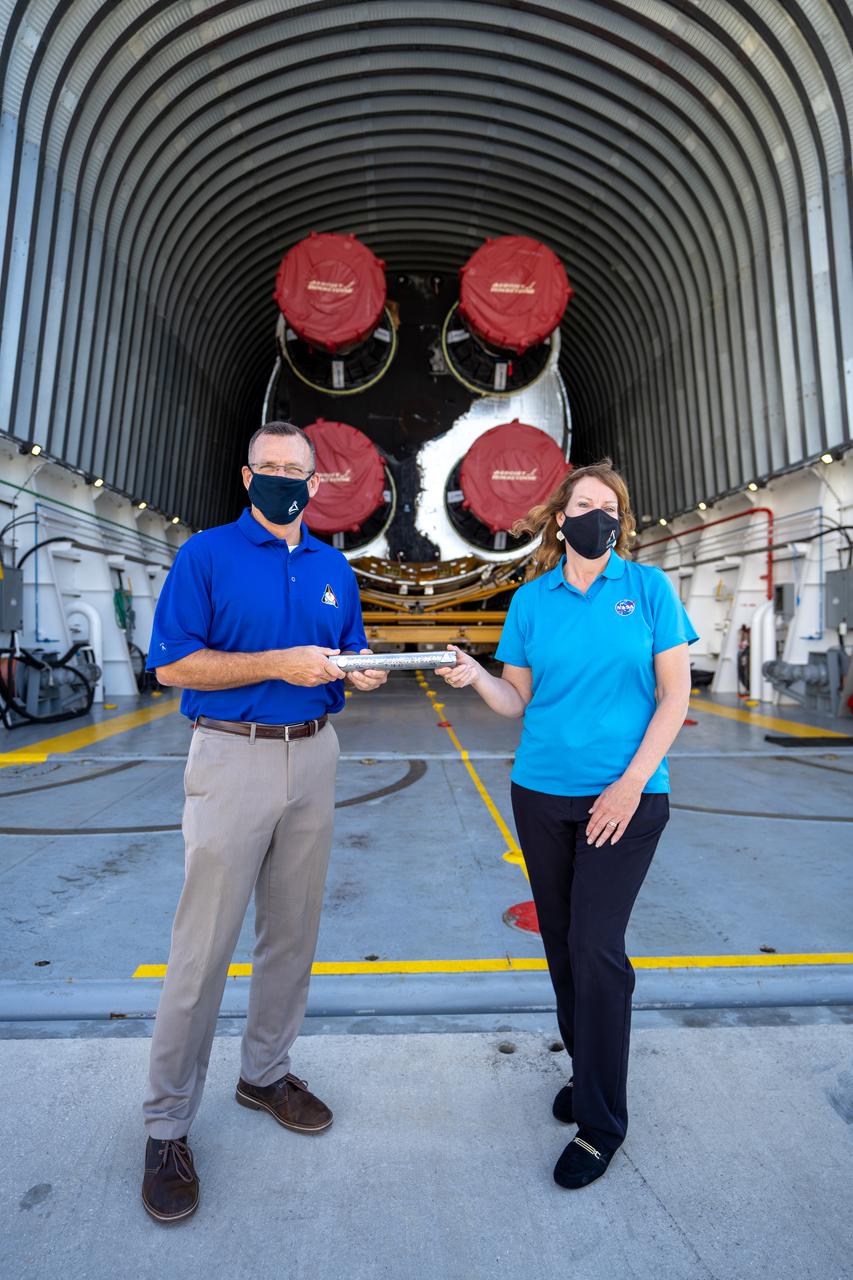
Space Launch System (SLS) Stages Manager Julie Bassler, right, celebrates the arrival of the SLS core stage by symbolically “passing the baton” to Exploration Ground Systems’ (EGS) Senior Vehicle Operations Manager Cliff Lanham on April 28, 2021, at NASA’s Kennedy Space Center in Florida. Journeying from the agency’s Stennis Space Center in Mississippi aboard the Pegasus barge, the core stage arrived at the Florida spaceport on April 27 to be processed for flight by EGS. It is the final piece of Artemis hardware to arrive at Kennedy and will be offloaded and moved to the Vehicle Assembly Building, where it will be prepared for integration atop the mobile launcher with the completed stack of solid rocket boosters ahead of the Artemis I launch. The first in a series of increasingly complex missions, Artemis I will test SLS and Orion as an integrated system prior to crewed flights to the Moon.
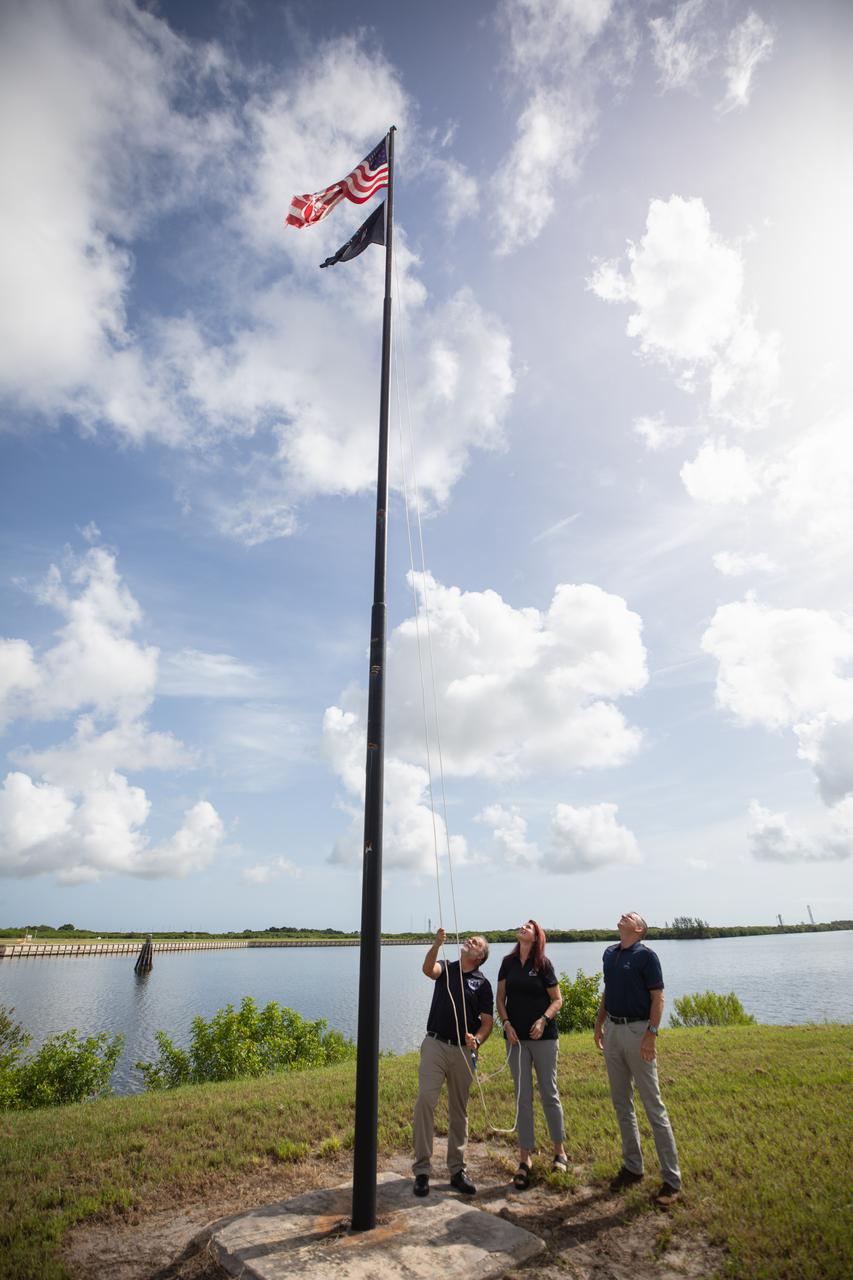
From left to right, Shawn Quinn, manager, Exploration Ground Systems; Charlie Blackwell-Thompson, Artemis launch director, Exploration Ground Systems; and Cliff Lanham, senior vehicle operations manager, Exploration Ground Systems, raise the Artemis flag near the countdown clock at NASA’s Kennedy Space Center in Florida on Monday, July 22, 2024. The flag raising marks the arrival of NASA’s massive SLS (Space Launch System) core stage via the agency’s Pegasus barge from NASA’s Michoud Assembly Facility in New Orleans. The core stage will help power SLS when it launches four astronauts around the Moon for the first crewed flight of SLS and the Orion spacecraft during the Artemis II test flight.
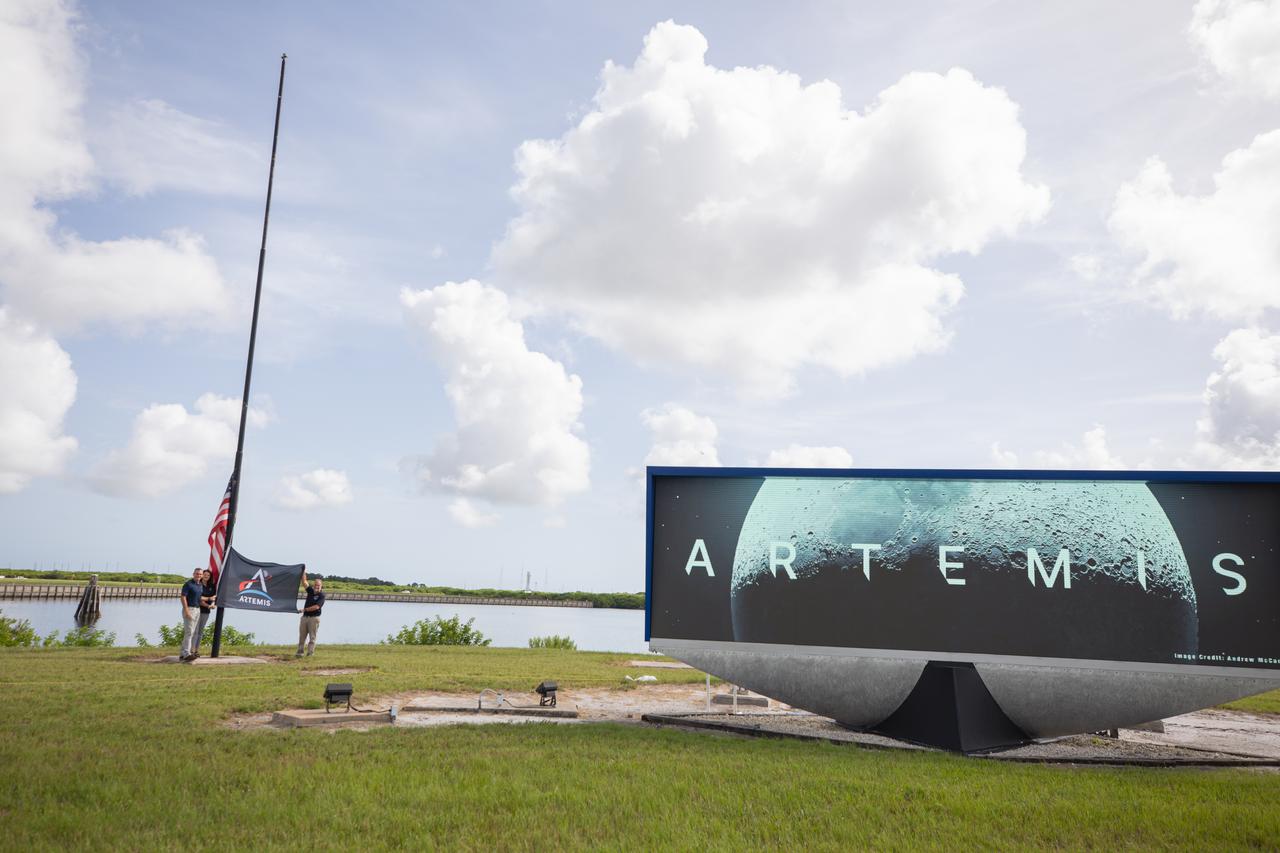
From left to right, Cliff Lanham, senior vehicle operations manager, Exploration Ground Systems; Charlie Blackwell-Thompson, Artemis launch director, Exploration Ground Systems; and Shawn Quinn, manager, Exploration Ground Systems, prepare to raise the Artemis flag near the countdown clock at NASA’s Kennedy Space Center in Florida on Monday, July 22, 2024. The flag raising marks the arrival of NASA’s massive SLS (Space Launch System) core stage via the agency’s Pegasus barge from NASA’s Michoud Assembly Facility in New Orleans. The core stage will help power SLS when it launches four astronauts around the Moon for the first crewed flight of SLS and the Orion spacecraft during the Artemis II test flight.
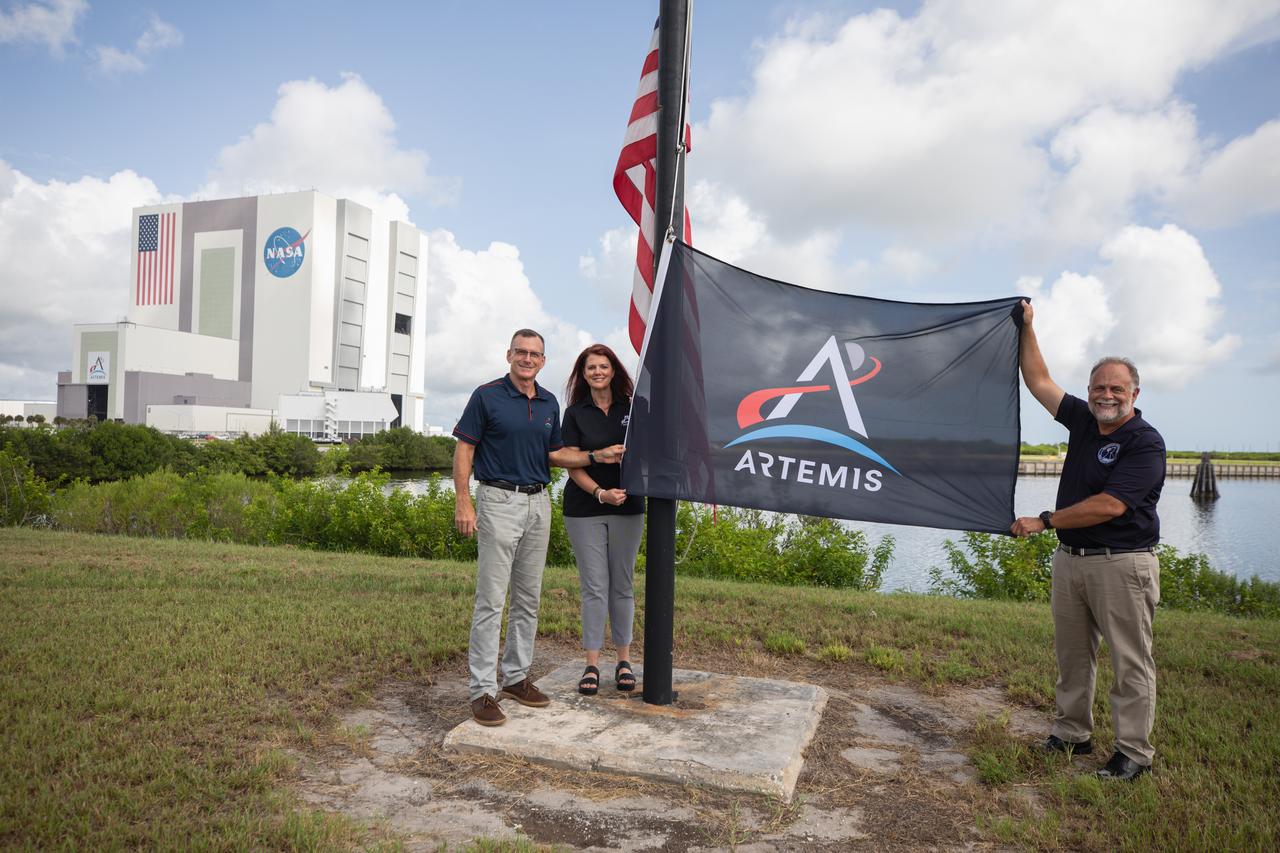
From left to right, Cliff Lanham, senior vehicle operations manager, Exploration Ground Systems; Charlie Blackwell-Thompson, Artemis launch director, Exploration Ground Systems; and Shawn Quinn, manager, Exploration Ground Systems, prepare to raise the Artemis flag near the countdown clock at NASA’s Kennedy Space Center in Florida on Monday, July 22, 2024. The flag raising marks the arrival of NASA’s massive SLS (Space Launch System) core stage via the agency’s Pegasus barge from NASA’s Michoud Assembly Facility in New Orleans. The core stage will help power SLS when it launches four astronauts around the Moon for the first crewed flight of SLS and the Orion spacecraft during the Artemis II test flight.
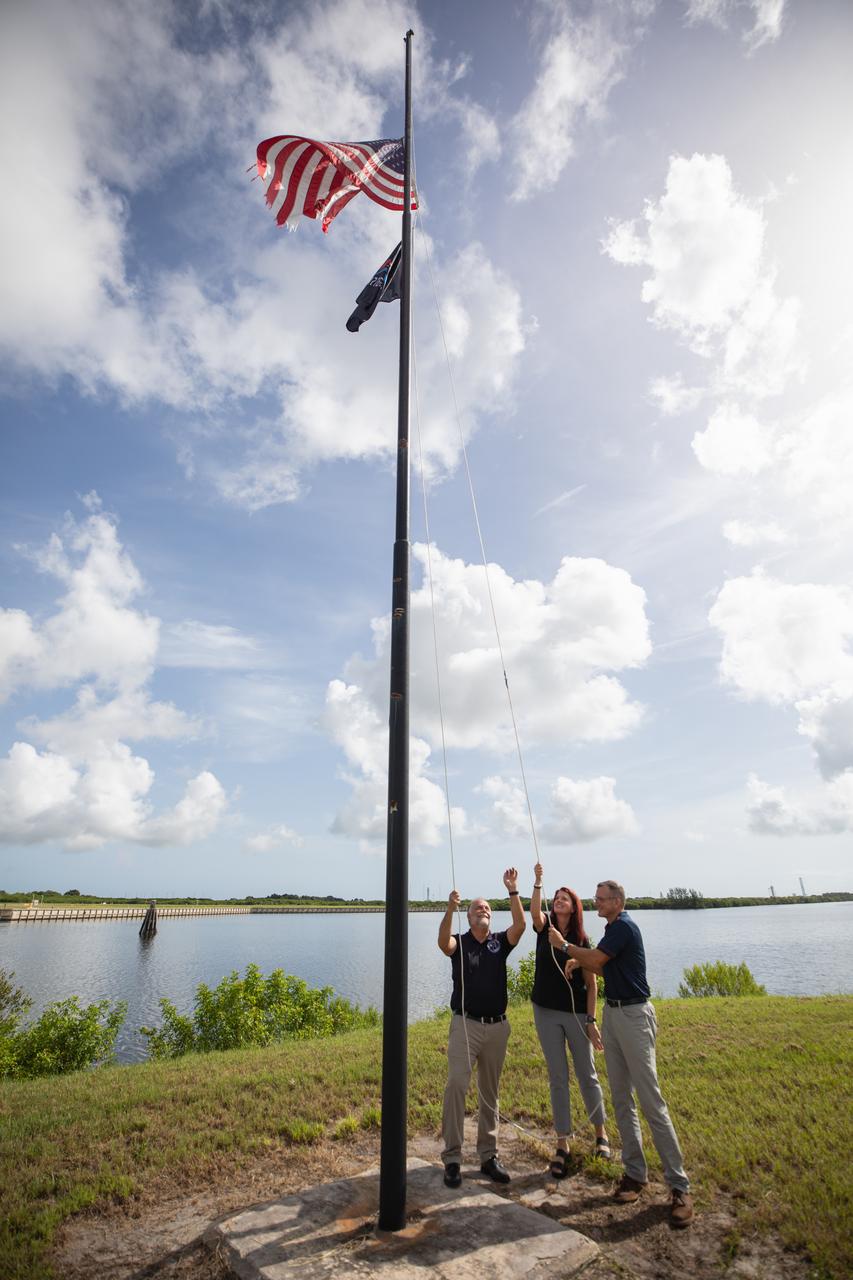
From left to right, Shawn Quinn, manager, Exploration Ground Systems; Charlie Blackwell-Thompson, Artemis launch director, Exploration Ground Systems; and Cliff Lanham, senior vehicle operations manager, Exploration Ground Systems, raise the Artemis flag near the countdown clock at NASA’s Kennedy Space Center in Florida on Monday, July 22, 2024. The flag raising marks the arrival of NASA’s massive SLS (Space Launch System) core stage via the agency’s Pegasus barge from NASA’s Michoud Assembly Facility in New Orleans. The core stage will help power SLS when it launches four astronauts around the Moon for the first crewed flight of SLS and the Orion spacecraft during the Artemis II test flight.
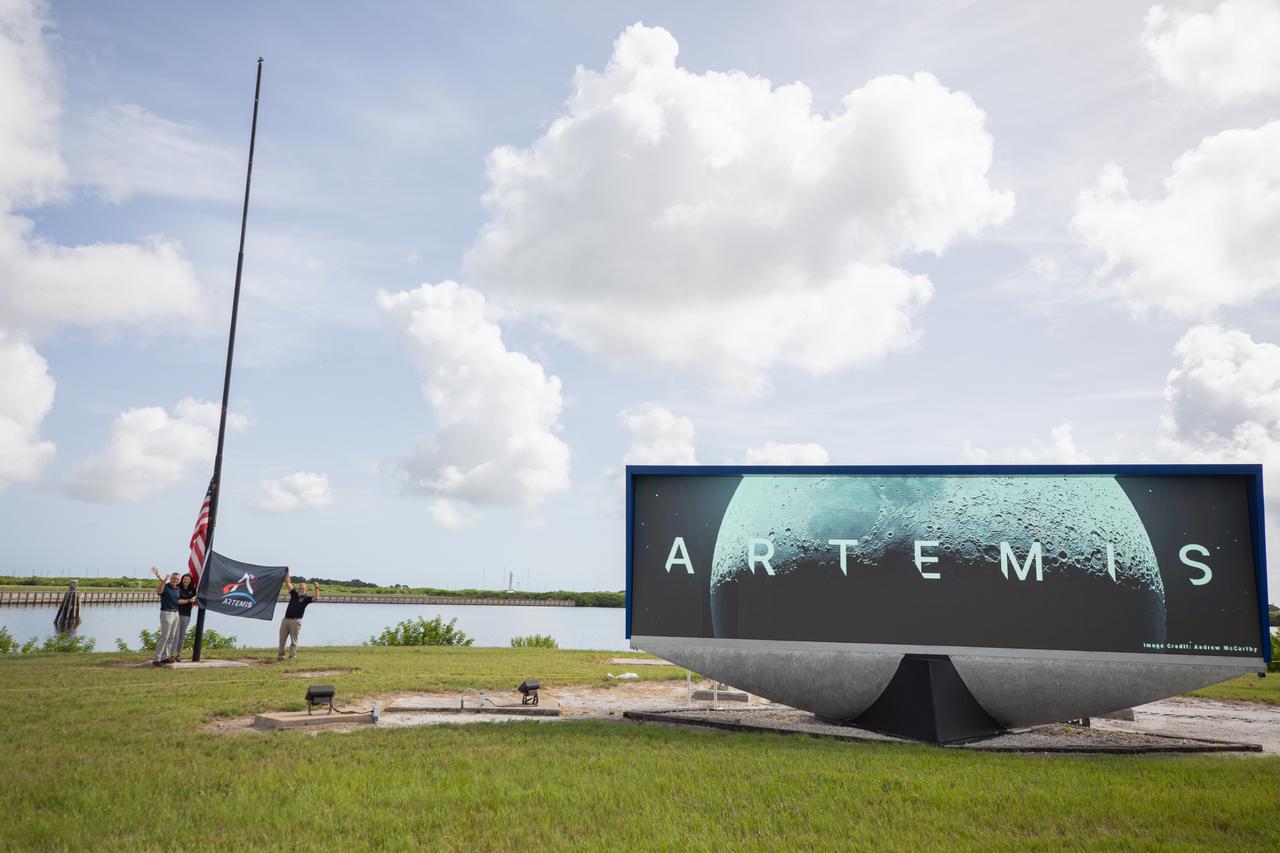
From left to right, Cliff Lanham, senior vehicle operations manager, Exploration Ground Systems; Charlie Blackwell-Thompson, Artemis launch director, Exploration Ground Systems; and Shawn Quinn, manager, Exploration Ground Systems, prepare to raise the Artemis flag near the countdown clock at NASA’s Kennedy Space Center in Florida on Monday, July 22, 2024. The flag raising marks the arrival of NASA’s massive SLS (Space Launch System) core stage via the agency’s Pegasus barge from NASA’s Michoud Assembly Facility in New Orleans. The core stage will help power SLS when it launches four astronauts around the Moon for the first crewed flight of SLS and the Orion spacecraft during the Artemis II test flight.
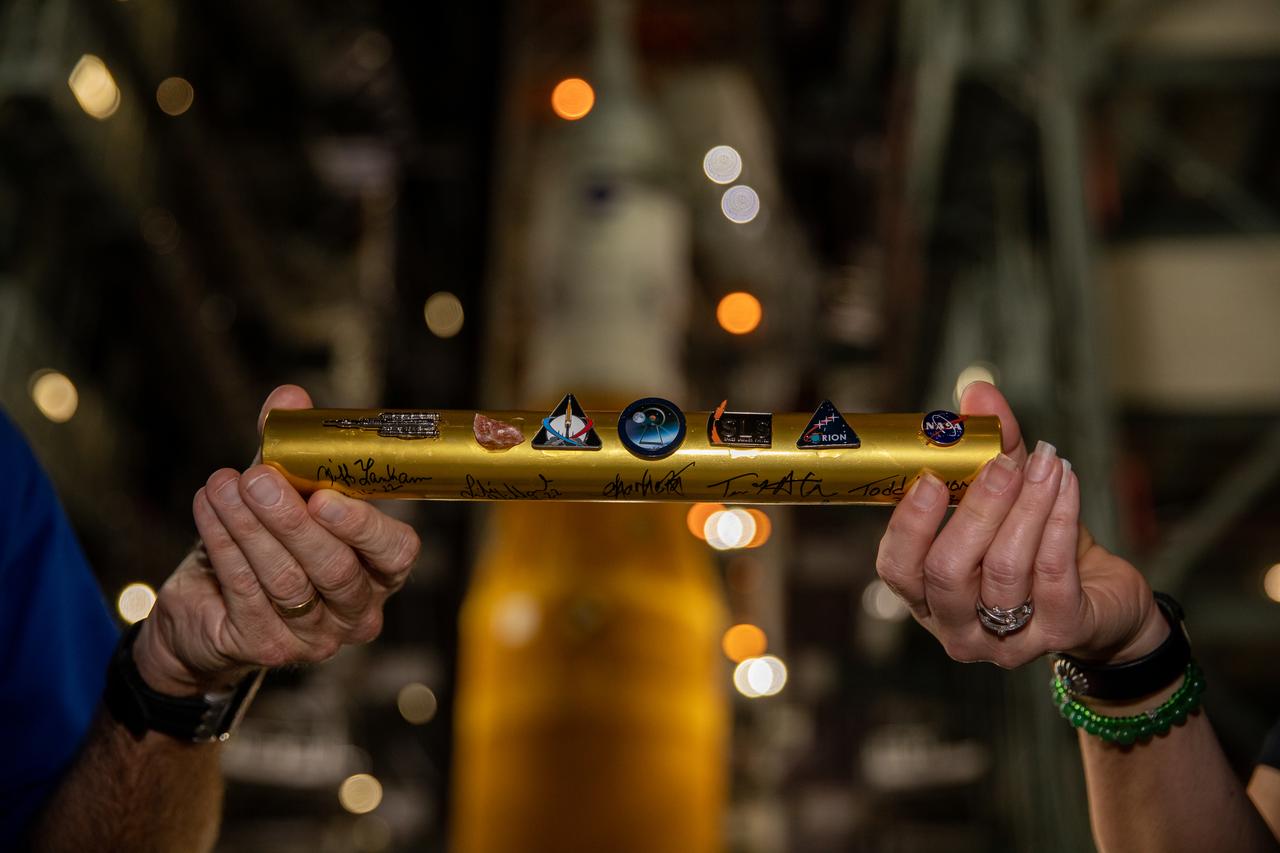
Cliff Lanham, ground operations manager with NASA’s Exploration Ground Systems, hands off the baton to Charlie Blackwell-Thompson, Artemis I launch director, inside the Vehicle Assembly building at NASA’s Kennedy Space Center in Florida on Aug. 15, 2022. NASA’s Space Launch System (SLS) rocket, with the agency’s Orion spacecraft atop, is targeted to start its rollout to Launch Pad 39B on Aug. 16 at approximately 9 p.m., in preparation for the Artemis I launch – set for no earlier than Aug. 29. Artemis I will be the first integrated test of the SLS and Orion. In later missions, NASA will land the first woman and the first person of color on the Moon, paving the way for a long-term lunar presence and serving as a steppingstone on the way to Mars.
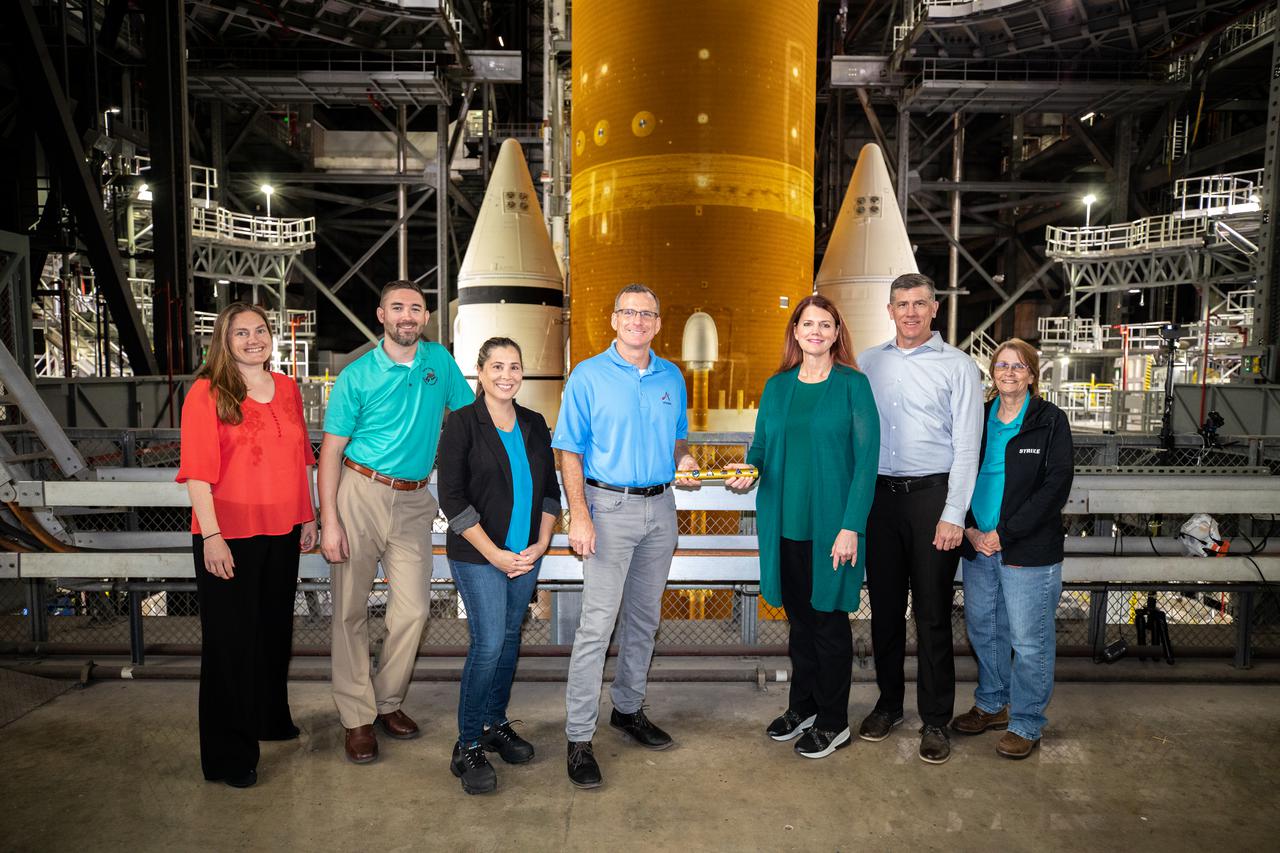
Cliff Lanham, fourth from left, ground operations manager with Exploration Ground Systems (EGS), passes the baton to Charlie Blackwell-Thompson, Artemis I launch director, inside the Vehicle Assembly Building at NASA’s Kennedy Space Center in Florida on March 16, 2022. Joining them from left, are Stacey Bagg, Matt Czech, and Liliana Villareal, with EGS. Next to Blackwell-Thomson are Jeremy Graeber, deputy launch director, and Teresa Annulis. The Space Launch System (SLS) and Orion will make the trek to Launch Complex 39B for a wet dress rehearsal ahead of launch atop the crawler-transporter 2. Artemis I will be the first integrated test of the SLS and Orion spacecraft. In later missions, NASA will land the first woman and the first person of color on the surface of the Moon, paving the way for a long-term lunar presence and serving as a steppingstone on the way to Mars.

From left to right, Shawn Quinn, manager, Exploration Ground Systems; Charlie Blackwell-Thompson, Artemis launch director, Exploration Ground Systems; and Cliff Lanham, senior vehicle operations manager, Exploration Ground Systems, raise the Artemis flag near the countdown clock at NASA’s Kennedy Space Center in Florida on Monday, July 22, 2024. The flag raising marks the arrival of NASA’s massive SLS (Space Launch System) core stage via the agency’s Pegasus barge from NASA’s Michoud Assembly Facility in New Orleans. The core stage will help power SLS when it launches four astronauts around the Moon for the first crewed flight of SLS and the Orion spacecraft during the Artemis II test flight.
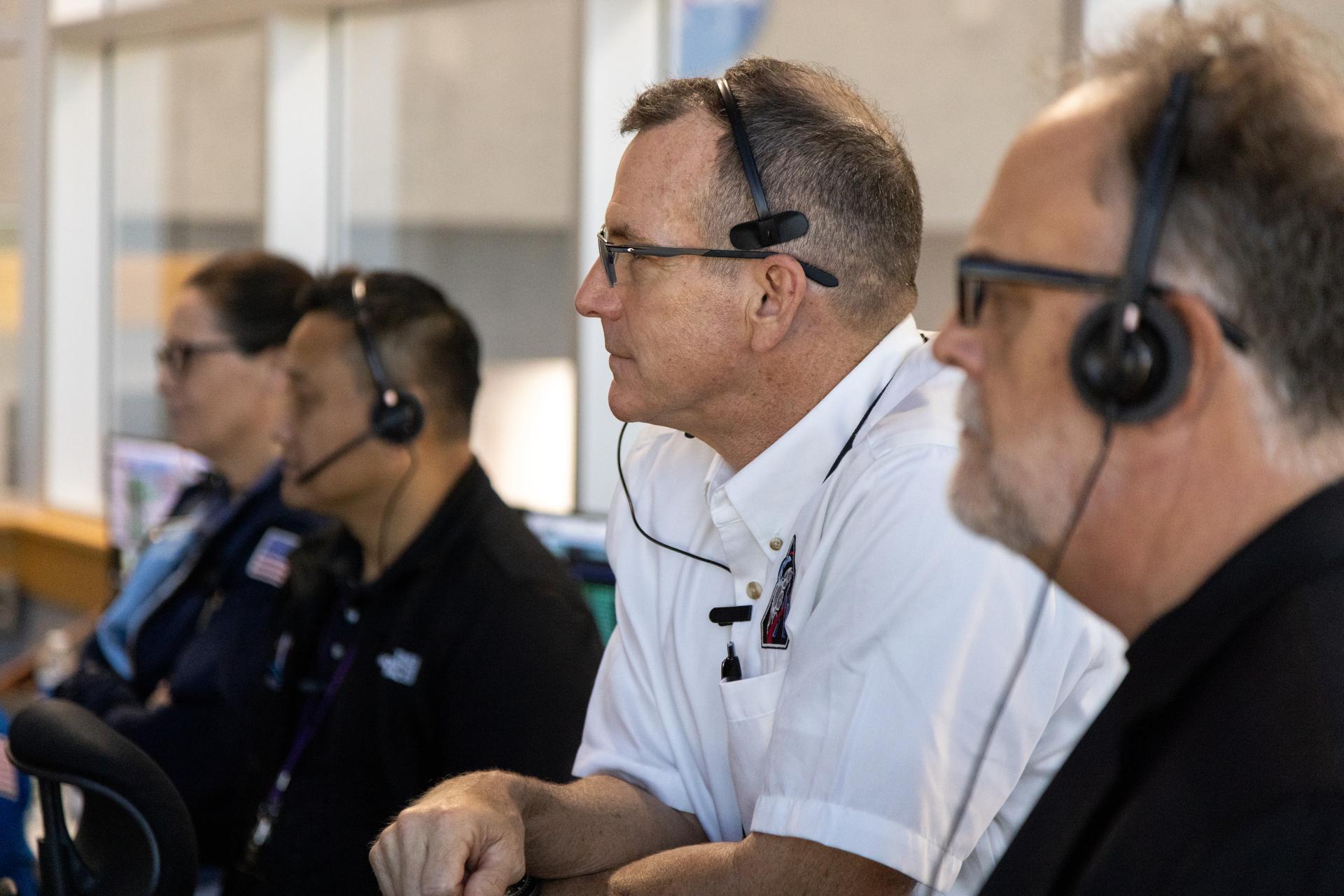
From right, Shawn Quinn NASA’s Exploration Ground Systems program manager; Cliff Lanham, NASA’s Exploration Ground Systems deputy program manager; and Howard Hu, Orion program manager, monitor the progress of a countdown demonstration test with Artemis II crewmembers NASA astronauts Reid Wiseman, commander; Victor Glover, pilot; Christina Koch, mission specialist; and CSA (Canadian Space Agency) astronaut Jeremy Hansen, mission specialist onboard their Orion spacecraft from Firing Room 1 of the Rocco A. Petrone Launch Control Center, Saturday, Dec. 20, 2025, at NASA’s Kennedy Space Center in Florida. For this operation, the Artemis II crew and launch teams are simulating the launch day timeline including suit-up, walkout, and spacecraft ingress and egress. Through the Artemis campaign, NASA will send astronauts to explore the Moon for scientific discovery, economic benefits, and to build the foundation for the first crewed missions to Mars, for the benefit of all.
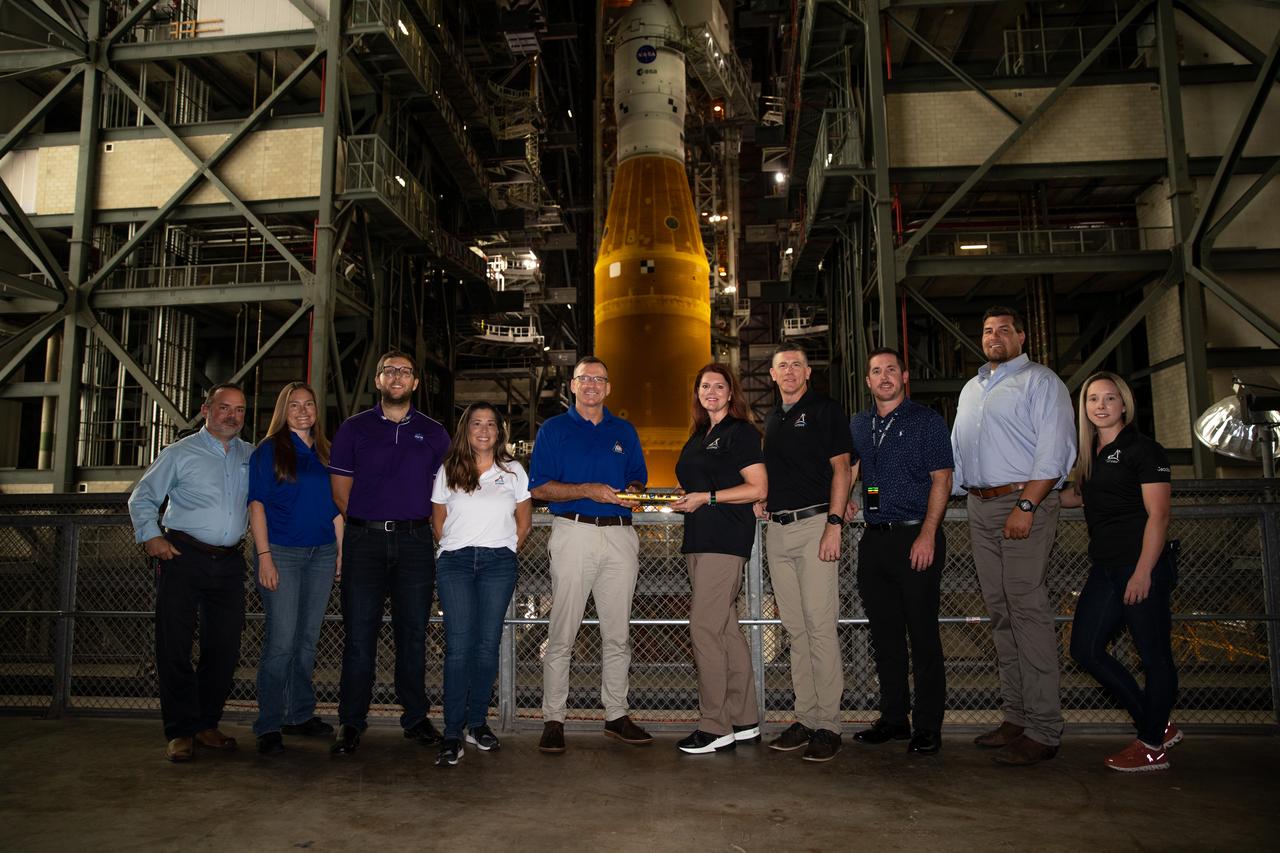
Cliff Lanham, fifth from the left, ground operations manager with NASA’s Exploration Ground Systems (EGS), hands off the baton to Charlie Blackwell-Thompson, Artemis I launch director, inside the Vehicle Assembly building at NASA’s Kennedy Space Center in Florida on Aug. 15, 2022. Also pictured are members of Kennedy’s EGS and Artemis launch teams. NASA’s Space Launch System (SLS) rocket, with the agency’s Orion spacecraft atop, is targeted to start its rollout to Launch Pad 39B on Aug. 16 at approximately 9 p.m., in preparation for the Artemis I launch – set for no earlier than Aug. 29. Artemis I will be the first integrated test of the SLS and Orion. In later missions, NASA will land the first woman and the first person of color on the Moon, paving the way for a long-term lunar presence and serving as a steppingstone on the way to Mars.
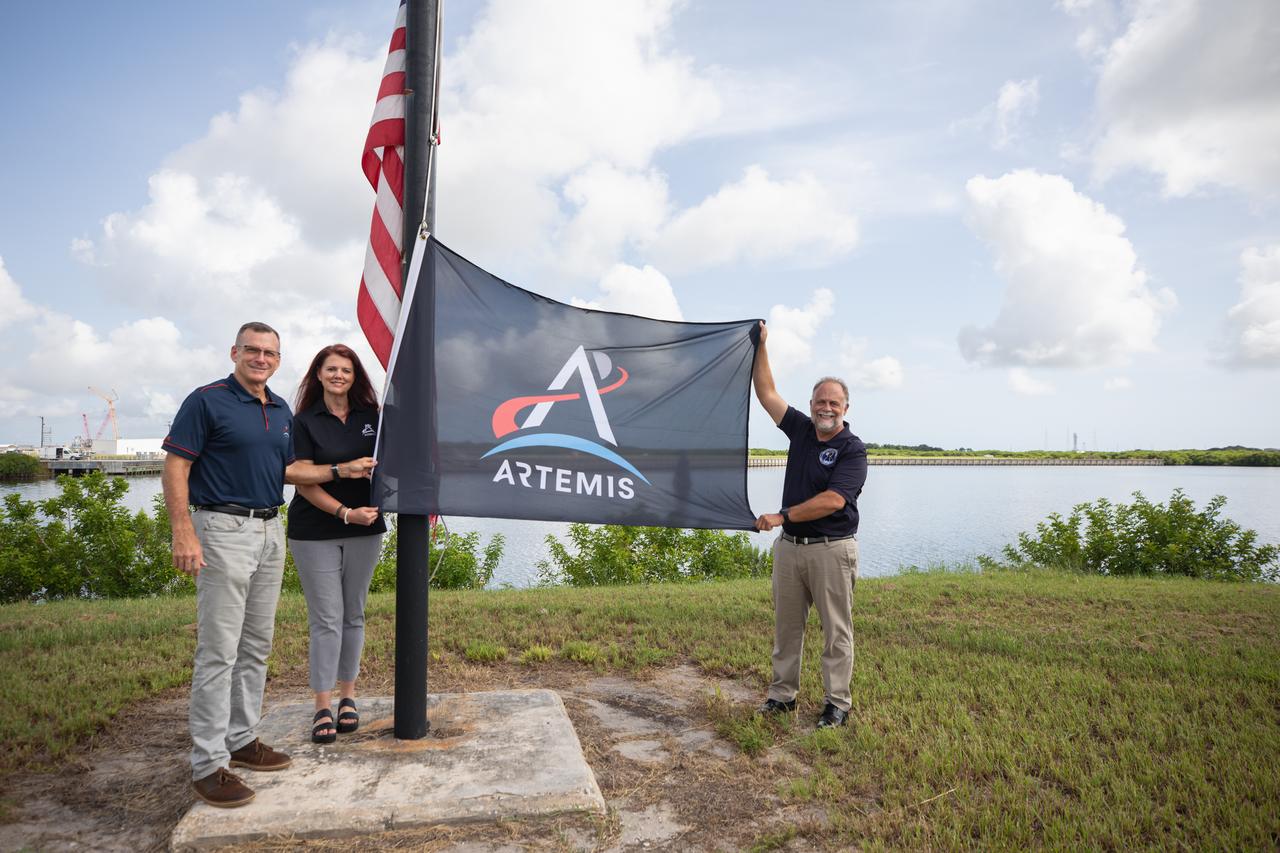
From left to right, Cliff Lanham, senior vehicle operations manager, Exploration Ground Systems; Charlie Blackwell-Thompson, Artemis launch director, Exploration Ground Systems; and Shawn Quinn, manager, Exploration Ground Systems, prepare to raise the Artemis flag near the countdown clock at NASA’s Kennedy Space Center in Florida on Monday, July 22, 2024. The flag raising marks the arrival of NASA’s massive SLS (Space Launch System) core stage via the agency’s Pegasus barge from NASA’s Michoud Assembly Facility in New Orleans. The core stage will help power SLS when it launches four astronauts around the Moon for the first crewed flight of SLS and the Orion spacecraft during the Artemis II test flight.
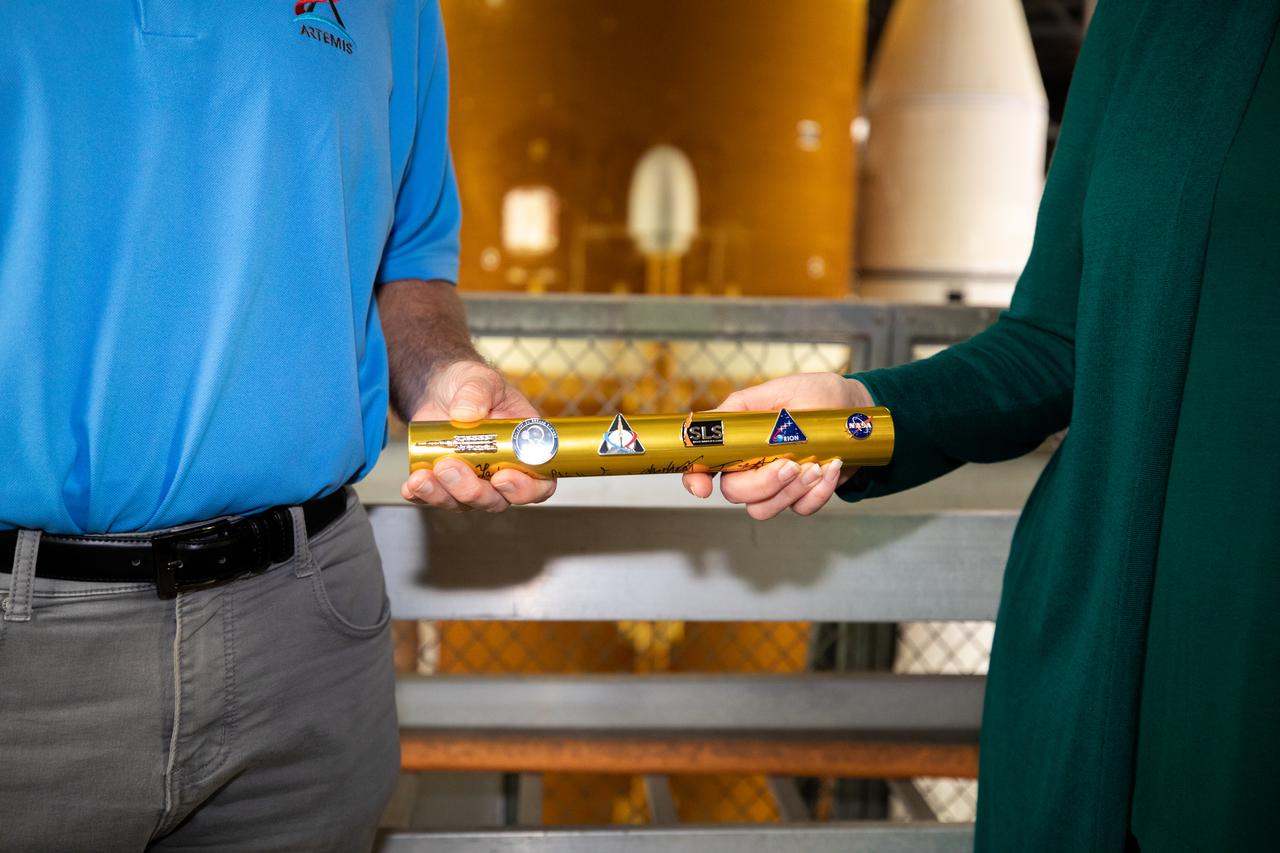
A baton is passed from Cliff Lanham, at left, ground operations manager with Exploration Ground Systems, to Charlie Blackwell-Thompson, Artemis I launch director, inside the Vehicle Assembly Building at NASA’s Kennedy Space Center in Florida on March 16, 2022. Behind them is the Artemis I Space Launch System (SLS) with the Orion spacecraft atop on the mobile launcher. The SLS and Orion will make the trek to Launch Complex 39B for a wet dress rehearsal ahead of launch atop the crawler-transporter 2. Artemis I will be the first integrated test of the SLS and Orion spacecraft. In later missions, NASA will land the first woman and the first person of color on the surface of the Moon, paving the way for a long-term lunar presence and serving as a steppingstone on the way to Mars.

Cliff Lanham, at left, ground operations manager with Exploration Ground Systems, passes the baton to Charlie Blackwell-Thompson, Artemis I launch director, inside the Vehicle Assembly Building at NASA’s Kennedy Space Center in Florida on March 16, 2022. Behind them is the Artemis I Space Launch System (SLS) with the Orion spacecraft atop on the mobile launcher. The SLS and Orion will make the trek to Launch Complex 39B for a wet dress rehearsal ahead of launch atop the crawler-transporter 2. Artemis I will be the first integrated test of the SLS and Orion spacecraft. In later missions, NASA will land the first woman and the first person of color on the surface of the Moon, paving the way for a long-term lunar presence and serving as a steppingstone on the way to Mars.
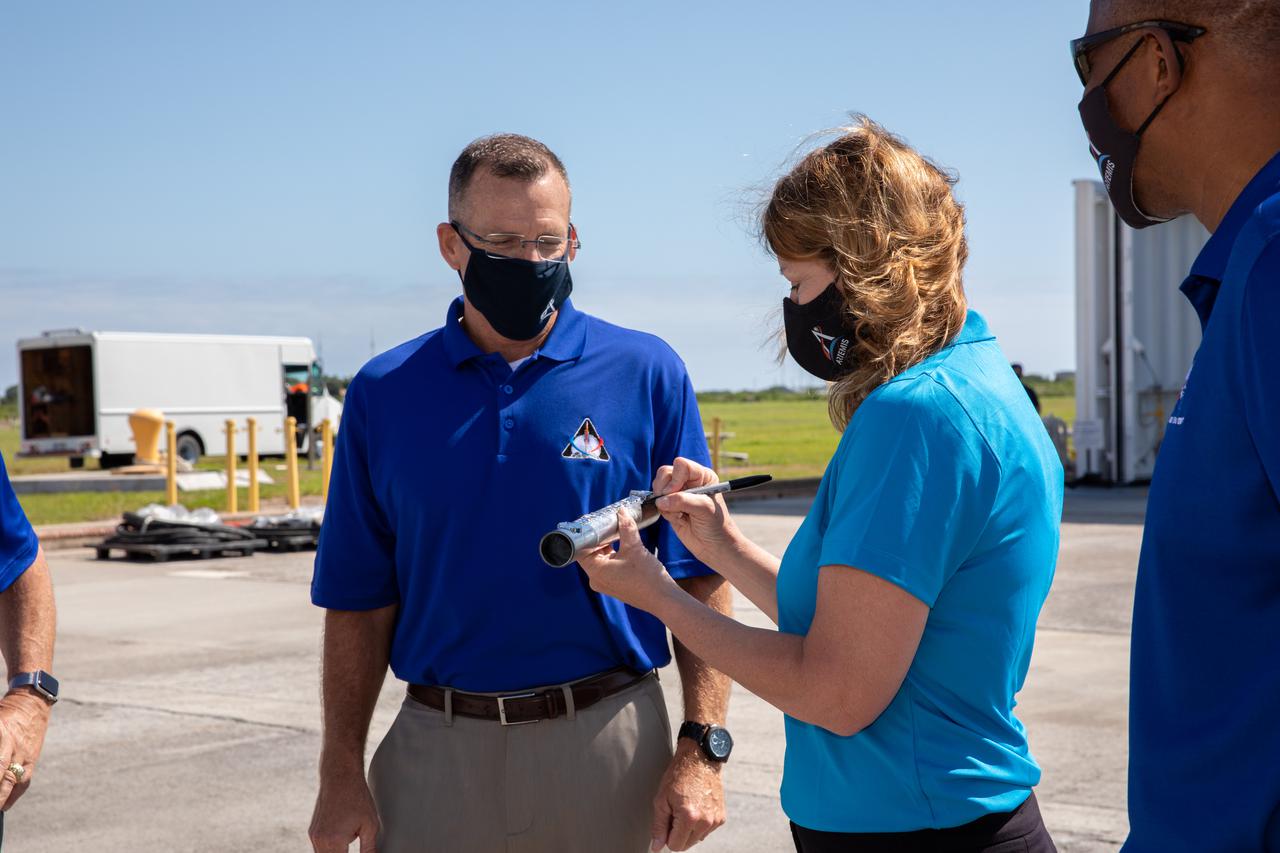
Space Launch System (SLS) Stages Manager Julie Bassler, right, celebrates the arrival of the SLS core stage by symbolically “passing the baton” to Exploration Ground Systems’ (EGS) Senior Vehicle Operations Manager Cliff Lanham on April 28, 2021, at NASA’s Kennedy Space Center in Florida. Journeying from the agency’s Stennis Space Center in Mississippi aboard the Pegasus barge, the core stage arrived at the Florida spaceport on April 27 to be processed for flight by EGS. It is the final piece of Artemis hardware to arrive at Kennedy and will be offloaded and moved to the Vehicle Assembly Building, where it will be prepared for integration atop the mobile launcher with the completed stack of solid rocket boosters ahead of the Artemis I launch. The first in a series of increasingly complex missions, Artemis I will test SLS and Orion as an integrated system prior to crewed flights to the Moon.
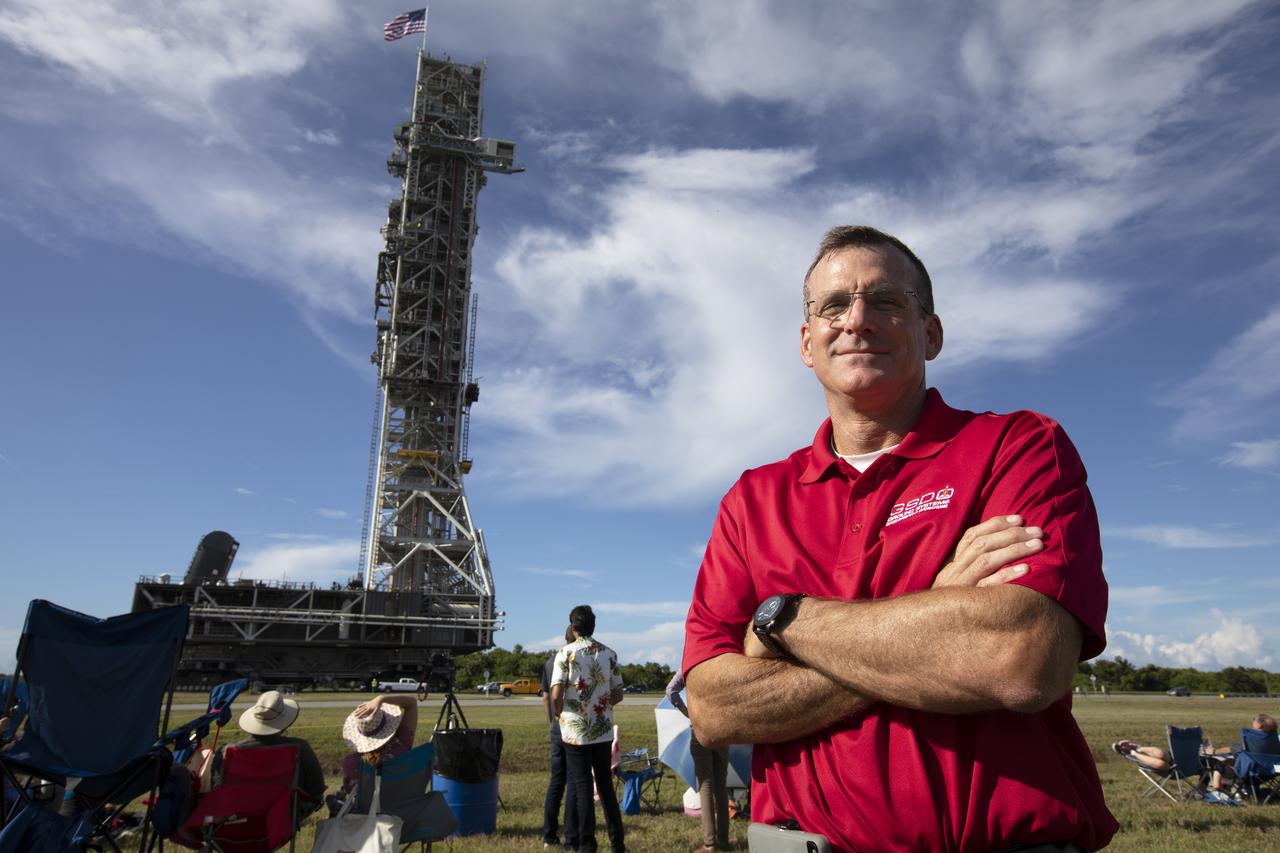
Cliff Lanham, NASA project manager for the mobile launcher, takes a break to attend the employee event for the mobile launcher move to the Vehicle Assembly Building (VAB) on Sept. 7, 2018, at NASA's Kennedy Space Center in Florida. The mobile launcher, atop crawler-transporter 2, began its trek from Launch Pad 39B along the crawlerway after undergoing a fit check and several days of systems testing with the pad. This is the first time that the modified mobile launcher made the trip to the pad. The 380-foot-tall mobile launcher is equipped with the crew access arm and several umbilicals that will provide power, environmental control, pneumatics, communication and electrical connections to the agency's Space Launch System and Orion spacecraft. The mobile launcher will spend seven months in the VAB undergoing testing. Exploration Ground Systems is preparing the ground systems necessary to launch SLS and Orion on Exploration Mission-1, missions to the Moon and on to Mars.
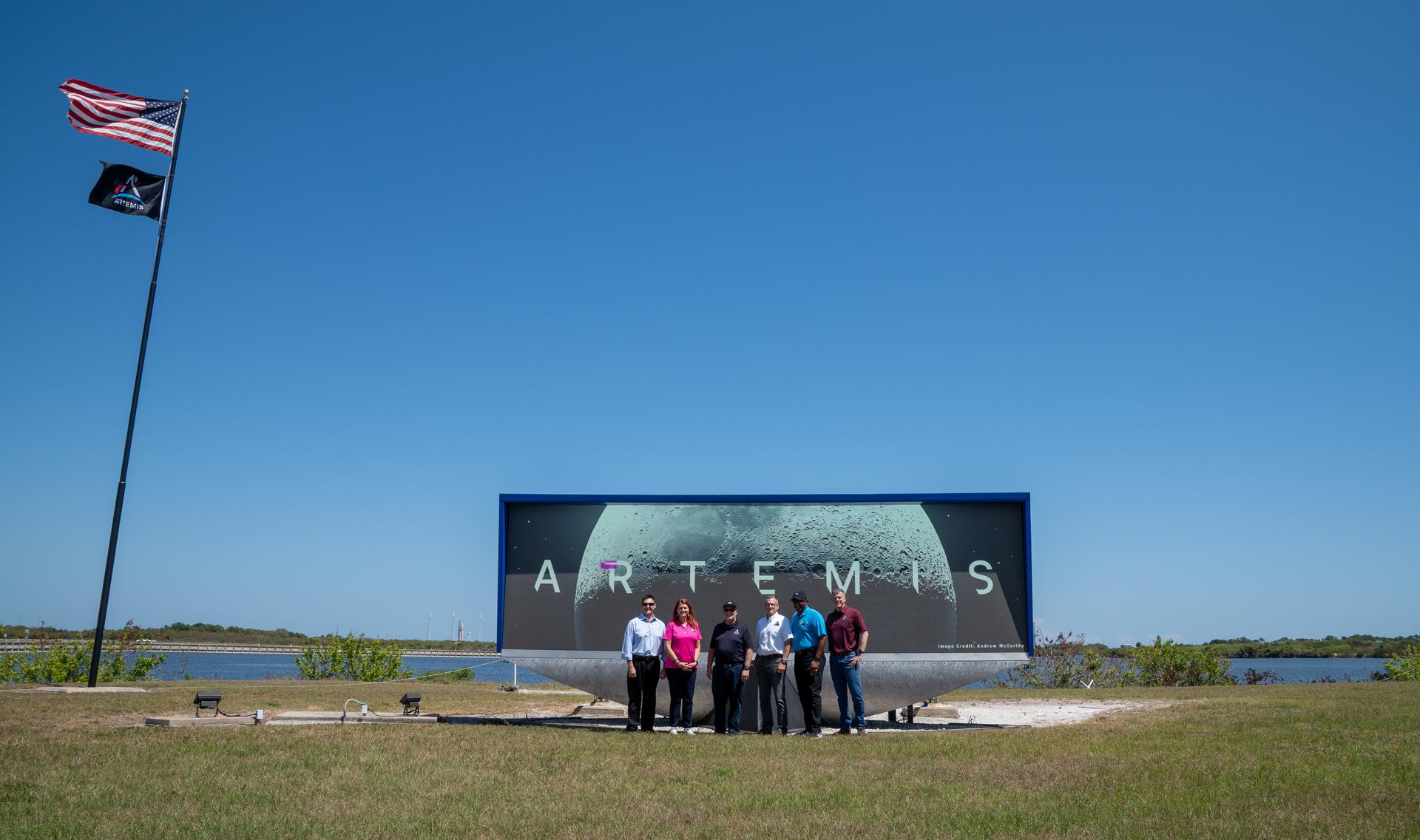
Robert Yaskovic, associate manager, Exploration Ground Systems Program; Charlie Blackwell-Thompson, Artemis II launch director; Shawn Quinn, manager, Exploration Ground Systems Program; Cliff Lanham, deputy manager, Exploration Ground Systems Program; NASA Kennedy Space Center Deputy Director Kelvin Manning; and Jeremy Graeber, assistant launch director, Exploration Ground Systems Program raise the Artemis flag near the countdown clock at the NASA News Center at NASA’s Kennedy Space Center in Florida on Friday, March 27, 2026. The Artemis II test flight mission will take Artemis II Commander Reid Wiseman, Pilot Victor Glover, and Mission Specialist Christina Koch from NASA, and Mission Specialist Jeremy Hansen from the CSA (Canadian Space Agency) on a 10-day journey around the Moon and back aboard NASA’s SLS (Space Launch System) rocket and Orion spacecraft from Launch Complex 39B no earlier than 6:24 p.m. EDT on Wednesday, April 1.
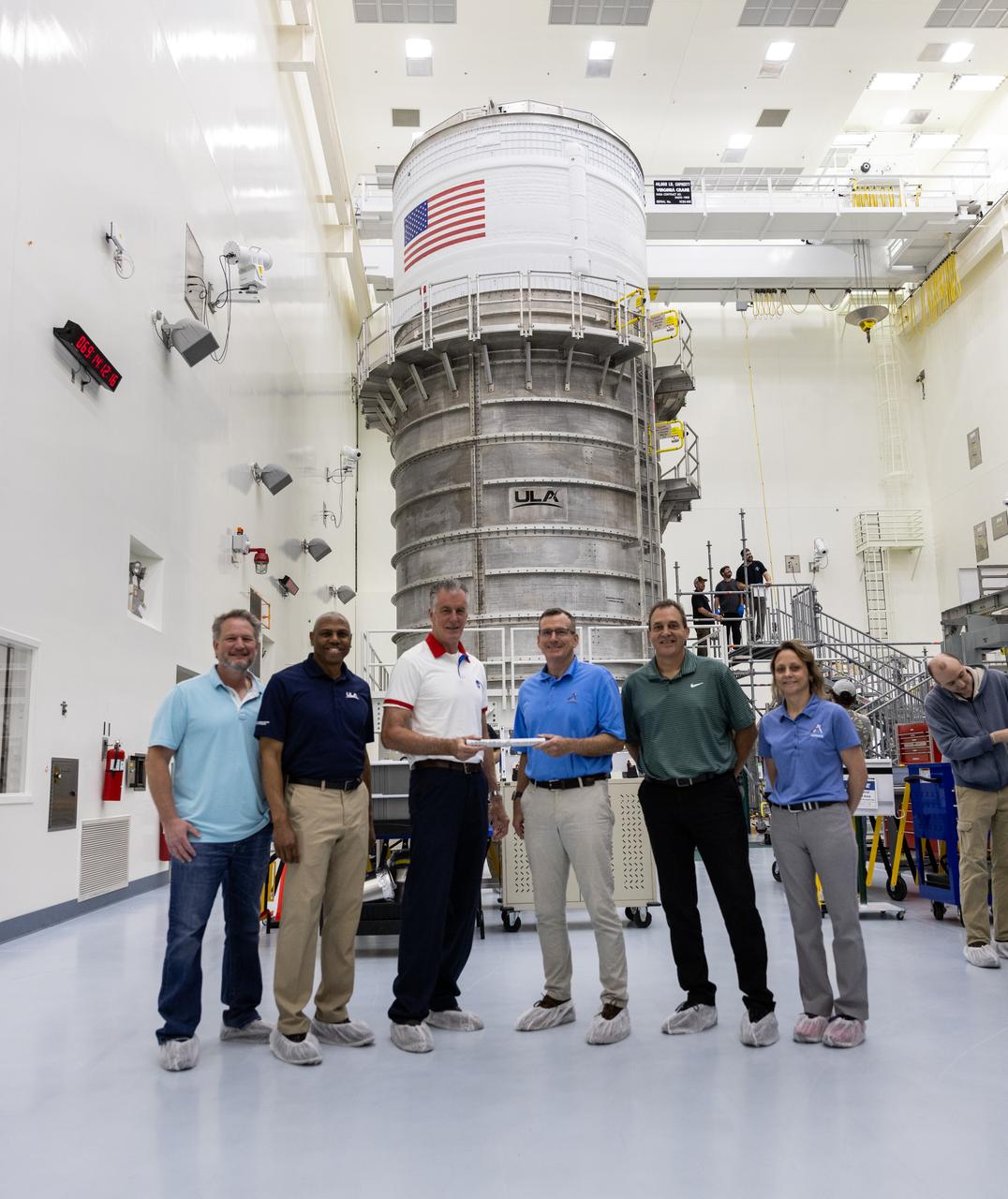
Managers from NASA and industry partners for NASA’s SLS (Space Launch System) rocket upper stage hand off the baton to managers from the agency’s Exploration Ground Systems (EGS) are shown with the SLS interim cryogenic propulsion stage inside the Multi-Payload Processing Facility at NASA’s Kennedy Space Center in Florida on Monday, March 10, 2025, after being transported from United Launch Alliance’s (ULA) Delta Operations Center at nearby Cape Canaveral Space Force Station. From left to right are Jim Bonato, ICPS Mission Manager, ULA; Ron Fortson, Director and General Manager, ULA; Chris Calfee, Spacecraft/Payload Integration and Evolution element manager, SLS; Cliff Lanham, senior vehicle operations manager, EGS; Todd Lamond, Strategic Planning and Integration, Amentum; and Natasha Wiest, Interim Director, Boeing Core Stage Integrated Product Team; The interim cryogenic propulsion stage is a liquid oxygen and liquid hydrogen-based system that will fire its RL10 engine to give the Orion spacecraft the big in-space push needed to fly around the Moon and back.
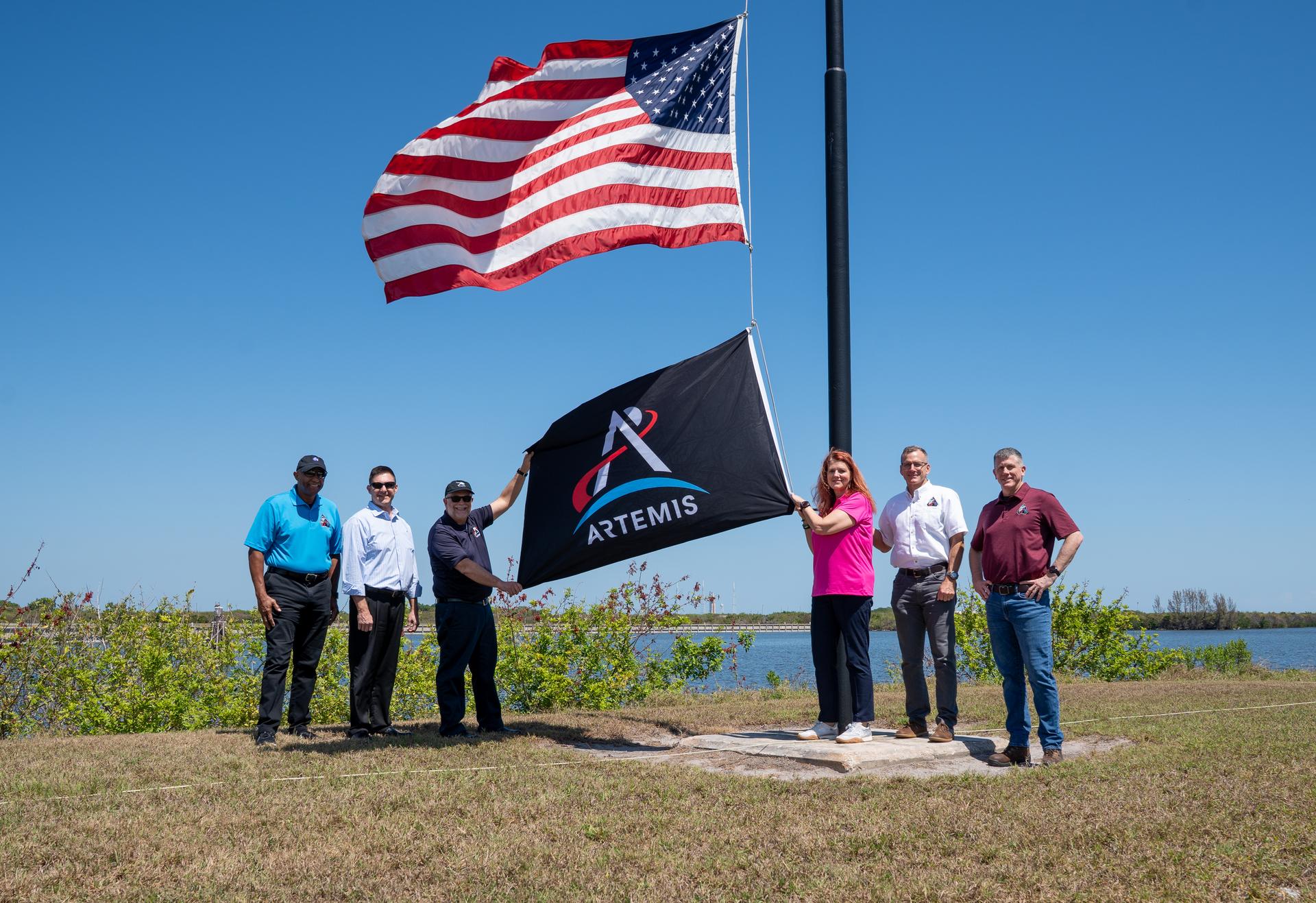
From left, NASA Kennedy Space Center Deputy Director Kelvin Manning; Robert Yaskovic, associate manager, Exploration Ground Systems Program; Shawn Quinn, manager, Exploration Ground Systems Program; Charlie Blackwell-Thompson, Artemis II launch director; Cliff Lanham, deputy manager, Exploration Ground Systems Program; and Jeremy Graeber, assistant launch director, Exploration Ground Systems Program raise the Artemis flag near the countdown clock at the NASA News Center at NASA’s Kennedy Space Center in Florida on Friday, March 27, 2026. The Artemis II test flight mission will take Artemis II Commander Reid Wiseman, Pilot Victor Glover, and Mission Specialist Christina Koch from NASA, and Mission Specialist Jeremy Hansen from the CSA (Canadian Space Agency) on a 10-day journey around the Moon and back aboard NASA’s SLS (Space Launch System) rocket and Orion spacecraft from Launch Complex 39B no earlier than 6:24 p.m. EDT on Wednesday, April 1.
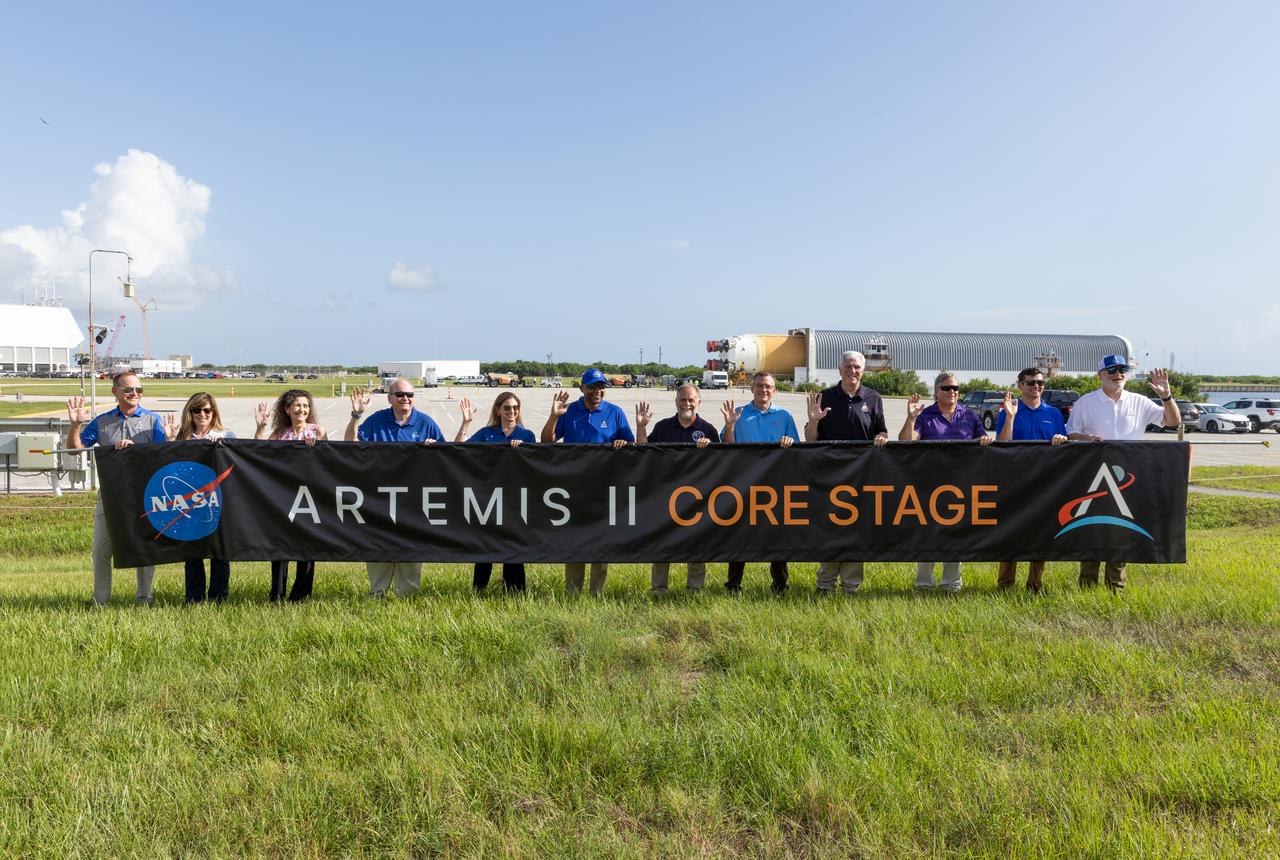
From left, John Ramsey, chief transformation officer for Jacobs; Jennifer Kunz, associate director, technical, NASA’s Kennedy Space Center; Lorna Kenna, vice president and general manager, Jacobs; Burt Summerfield, associate director, management, NASA Kennedy; Catherine Koerner, associate administrator for NASA’s Exploration Systems Development Mission Directorate; Kelvin Manning, deputy director, NASA Kennedy; Shawn Quinn, manager, NASA’s Exploration Ground Systems; Cliff Lanham, senior vehicle operations manager, NASA’s Exploration Ground Systems; Matthew Ramsey, Artemis II mission manager; Paul Hudson, Jacobs senior vehicle engineer; Jay Grow, Boeing’s associate chief engineer for Space Launch System Launch Operations; and Bill Muddle, lead RS-25 field engineer at Aerojet Rocketdyne, hold a banner to celebrate the arrival of the Artemis II SLS (Space Launch System) core stage at NASA’s Kennedy Space Center on Wednesday, July 24, 2024. Journeying from NASA’s Michoud Assembly Facility in New Orleans aboard the Pegasus barge, the core stage arrived at the Florida spaceport on July 23, 2024, to be processed for flight by NASA’s Exploration Ground Systems Program.

From left, NASA Kennedy Space Center Deputy Director Kelvin Manning; Robert Yaskovic, associate manager, Exploration Ground Systems Program; Shawn Quinn, manager, Exploration Ground Systems Program; Charlie Blackwell-Thompson, Artemis II launch director; Cliff Lanham, deputy manager, Exploration Ground Systems Program; and Jeremy Graeber, assistant launch director, Exploration Ground Systems Program raise the Artemis flag near the countdown clock at the NASA News Center at NASA’s Kennedy Space Center in Florida on Friday, March 27, 2026. The Artemis II test flight mission will take Artemis II Commander Reid Wiseman, Pilot Victor Glover, and Mission Specialist Christina Koch from NASA, and Mission Specialist Jeremy Hansen from the CSA (Canadian Space Agency) on a 10-day journey around the Moon and back aboard NASA’s SLS (Space Launch System) rocket and Orion spacecraft from Launch Complex 39B no earlier than 6:24 p.m. EDT on Wednesday, April 1.
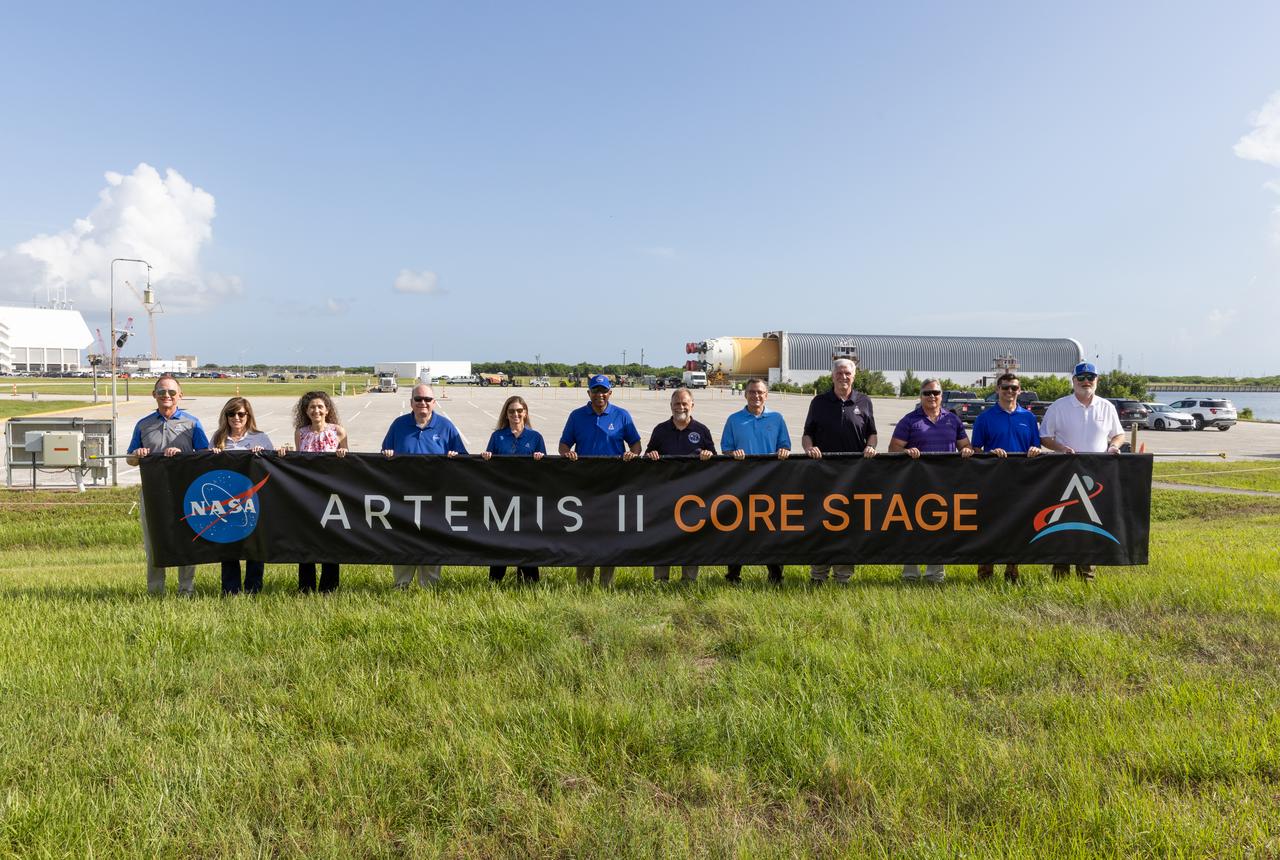
From left, John Ramsey, chief transformation officer for Jacobs; Jennifer Kunz, associate director, technical, NASA’s Kennedy Space Center; Lorna Kenna, vice president and general manager, Jacobs; Burt Summerfield, associate director, management, NASA Kennedy; Catherine Koerner, associate administrator for NASA’s Exploration Systems Development Mission Directorate; Kelvin Manning, deputy director, NASA Kennedy; Shawn Quinn, manager, NASA’s Exploration Ground Systems; Cliff Lanham, senior vehicle operations manager, NASA’s Exploration Ground Systems; Matthew Ramsey, Artemis II mission manager; Paul Hudson, Jacobs senior vehicle engineer; Jay Grow, Boeing’s associate chief engineer for Space Launch System Launch Operations; and Bill Muddle, lead RS-25 field engineer at Aerojet Rocketdyne, hold a banner to celebrate the arrival of the Artemis II SLS (Space Launch System) core stage at NASA’s Kennedy Space Center on Wednesday, July 24, 2024. Journeying from NASA’s Michoud Assembly Facility in New Orleans aboard the Pegasus barge, the core stage arrived at the Florida spaceport on July 23, 2024, to be processed for flight by NASA’s Exploration Ground Systems Program.
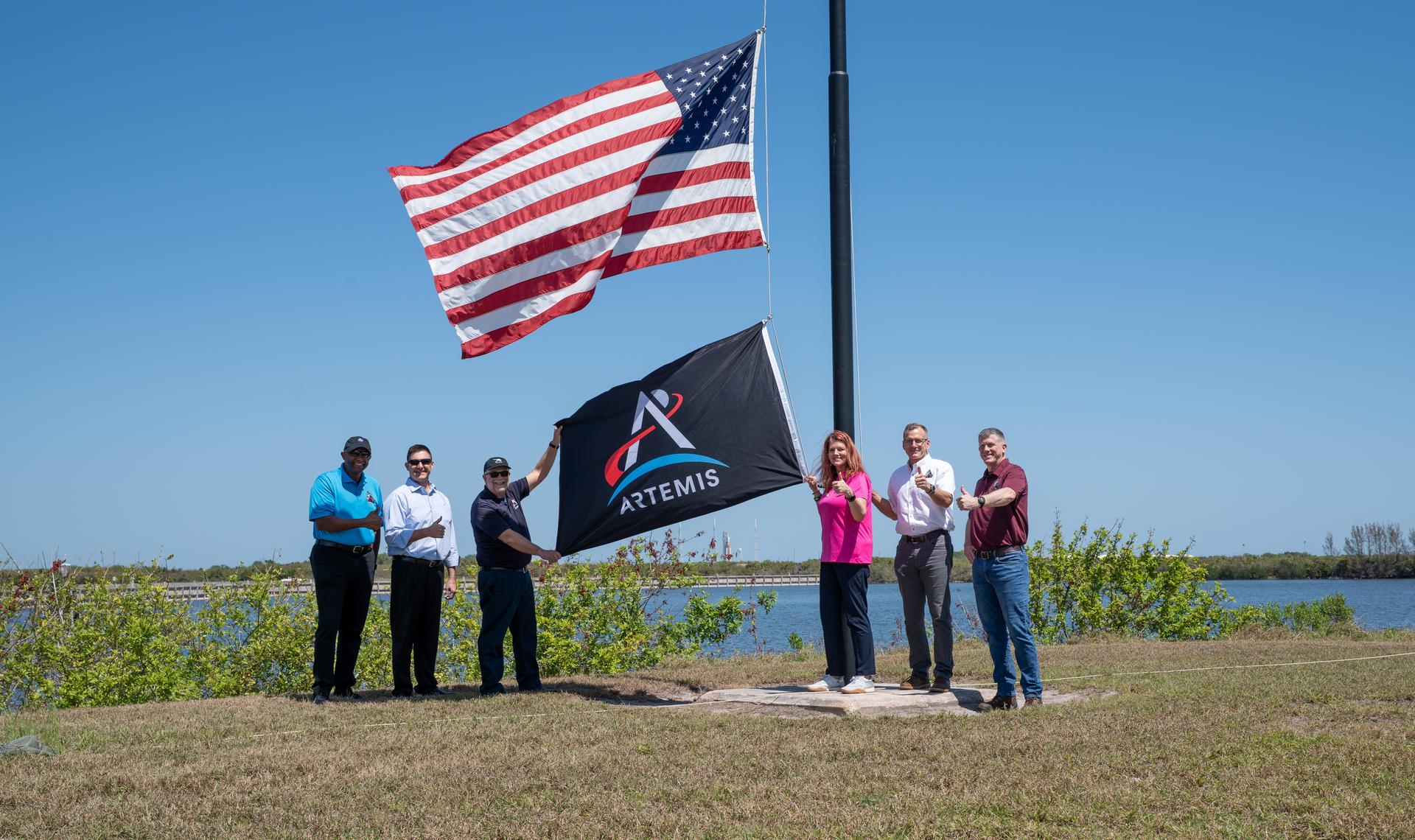
From left, NASA Kennedy Space Center Deputy Director Kelvin Manning; Robert Yaskovic, associate manager, Exploration Ground Systems Program; Shawn Quinn, manager, Exploration Ground Systems Program; Charlie Blackwell-Thompson, Artemis II launch director; Cliff Lanham, deputy manager, Exploration Ground Systems Program; and Jeremy Graeber, assistant launch director, Exploration Ground Systems Program raise the Artemis flag near the countdown clock at the NASA News Center at NASA’s Kennedy Space Center in Florida on Friday, March 27, 2026. The Artemis II test flight mission will take Artemis II Commander Reid Wiseman, Pilot Victor Glover, and Mission Specialist Christina Koch from NASA, and Mission Specialist Jeremy Hansen from the CSA (Canadian Space Agency) on a 10-day journey around the Moon and back aboard NASA’s SLS (Space Launch System) rocket and Orion spacecraft from Launch Complex 39B no earlier than 6:24 p.m. EDT on Wednesday, April 1.
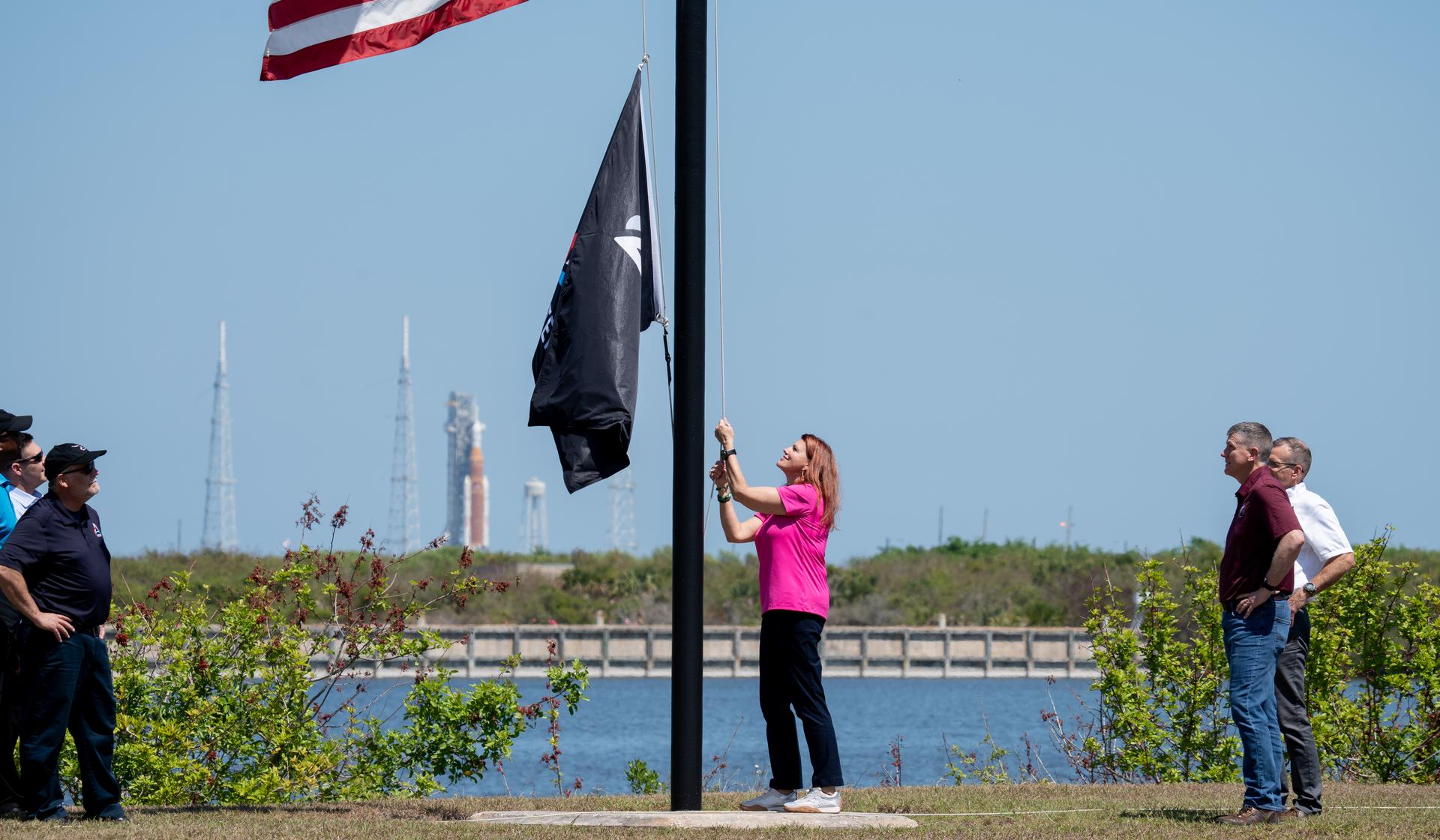
From left, NASA Kennedy Space Center Deputy Director Kelvin Manning; Robert Yaskovic, associate manager, Exploration Ground Systems Program; Shawn Quinn, manager, Exploration Ground Systems Program; Charlie Blackwell-Thompson, Artemis II launch director; Cliff Lanham, deputy manager, Exploration Ground Systems Program; and Jeremy Graeber, assistant launch director, Exploration Ground Systems Program raise the Artemis flag near the countdown clock at the NASA News Center at NASA’s Kennedy Space Center in Florida on Friday, March 27, 2026. The Artemis II test flight mission will take Artemis II Commander Reid Wiseman, Pilot Victor Glover, and Mission Specialist Christina Koch from NASA, and Mission Specialist Jeremy Hansen from the CSA (Canadian Space Agency) on a 10-day journey around the Moon and back aboard NASA’s SLS (Space Launch System) rocket and Orion spacecraft from Launch Complex 39B no earlier than 6:24 p.m. EDT on Wednesday, April 1.