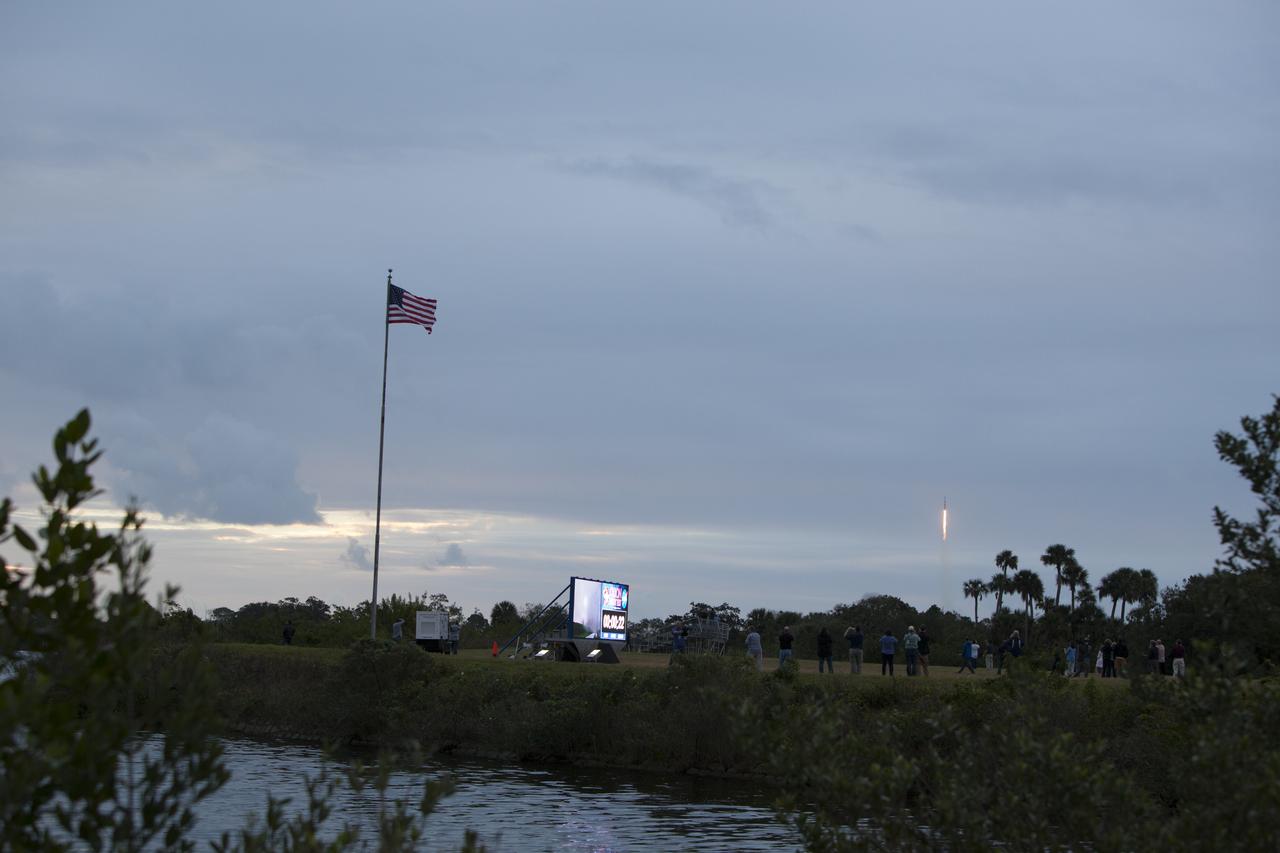
A Delta IV Heavy rocket lifts off from Space Launch Complex 37 at Cape Canaveral Air Force Station in Florida carrying NASA's Orion spacecraft on an unpiloted flight test to Earth orbit. In the foreground is the newly upgraded countdown clock at the spaceport's Press Site. Liftoff was at 7:05 a.m. EST. During the two-orbit, four-and-a-half hour mission, engineers will evaluate the systems critical to crew safety, the launch abort system, the heat shield and the parachute system.
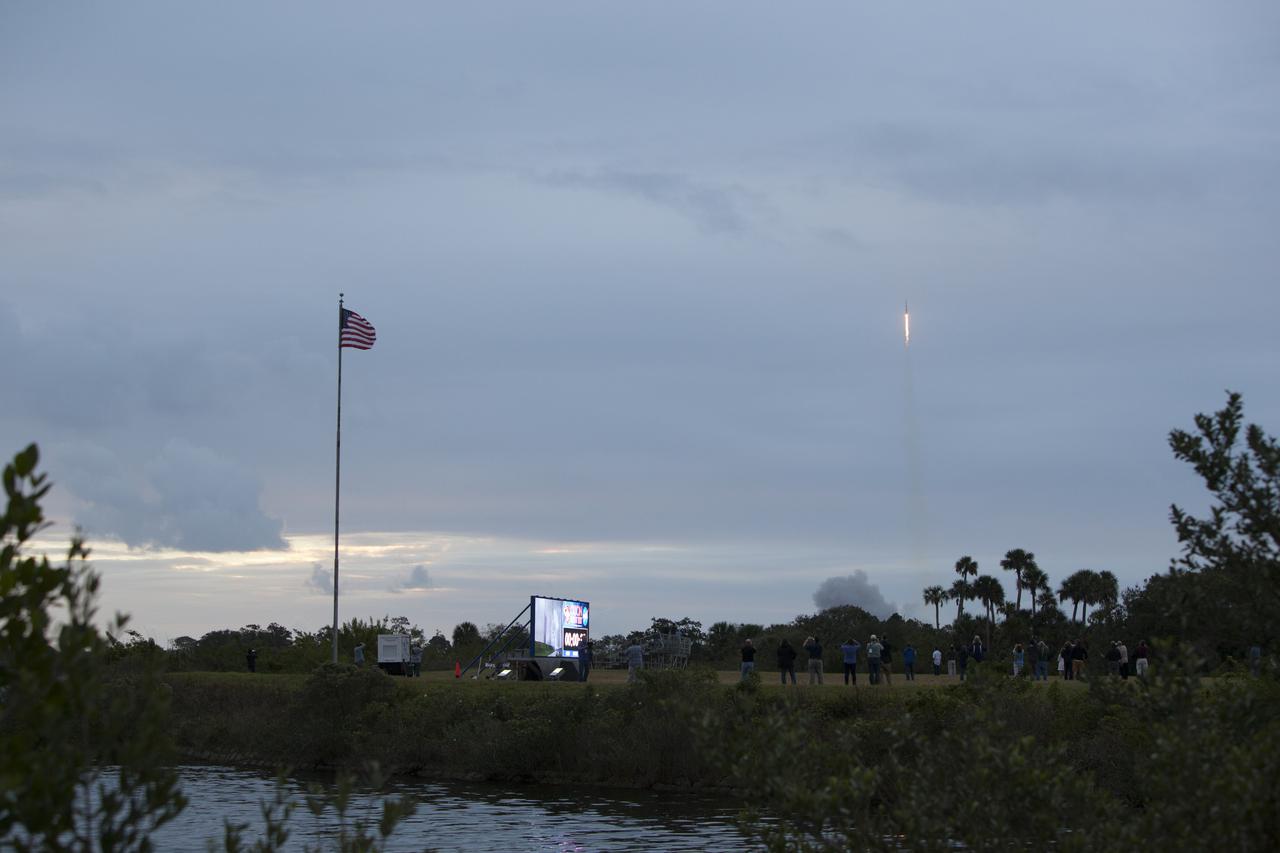
A Delta IV Heavy rocket lifts off from Space Launch Complex 37 at Cape Canaveral Air Force Station in Florida carrying NASA's Orion spacecraft on an unpiloted flight test to Earth orbit. In the foreground is the newly upgraded countdown clock at the spaceport's Press Site. Liftoff was at 7:05 a.m. EST. During the two-orbit, four-and-a-half hour mission, engineers will evaluate the systems critical to crew safety, the launch abort system, the heat shield and the parachute system.
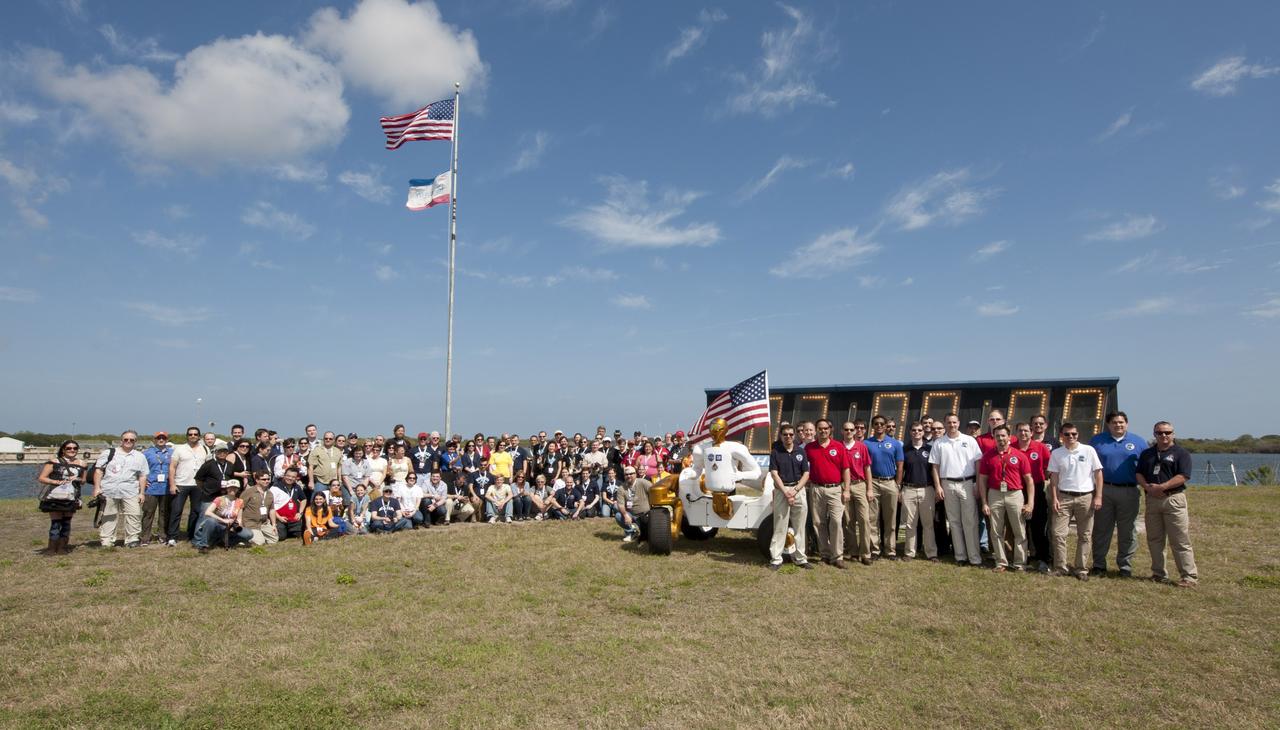
NASA Tweetup participants along with NASA engineers and Robonaut 2 stand at the launch clock, Thursday, Feb. 24, 2011, prior to the launch of the space shuttle Discovery (STS-133) at Kennedy Space Center in Cape Canaveral, Fla. During the 11-day mission, Discovery will deliver the Italian-built Permanent Multipurpose Module (PMM) and Express Logistics Carrier 4 (ELC4) along with another Robonaut 2, which will become the first humanoid robot in space. Discovery, on its 39th and final flight, is NASA's most flown shuttle. Photo Credit: (NASA/Paul E. Alers)
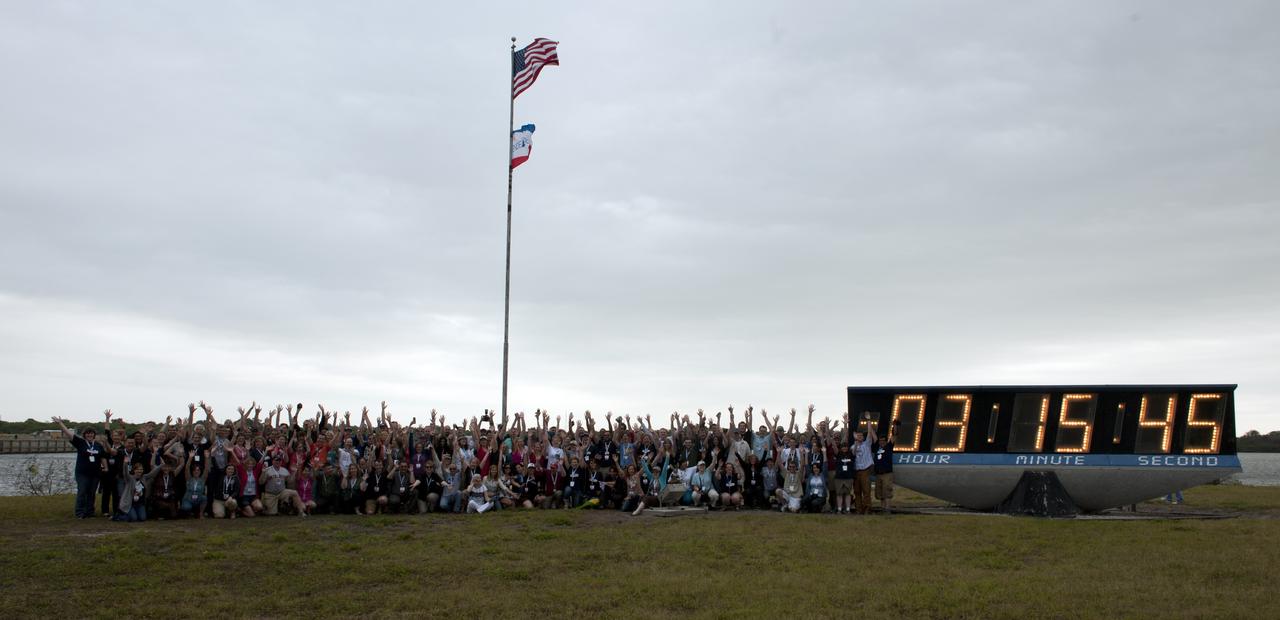
NASA Twitter followers, who particiapted in the STS-134 Tweetup are seen together by the launch clock, Friday, April 29, 2011, at Kennedy Space Center in Cape Canaveral, Fla. About 150 NASA Twitter followers attended the event. Later the group will watch the launch of Endeavour as it heads to the International Space Station on a 14-day mission to deliver the Alpha Magnetic Spectrometer (AMS) and spare parts including two S-band communications antennas, a high-pressure gas tank and additional spare parts for Dextre. Liftoff is targeted for 3:47 pm. Photo Credit: (NASA/Paul E. Alers)
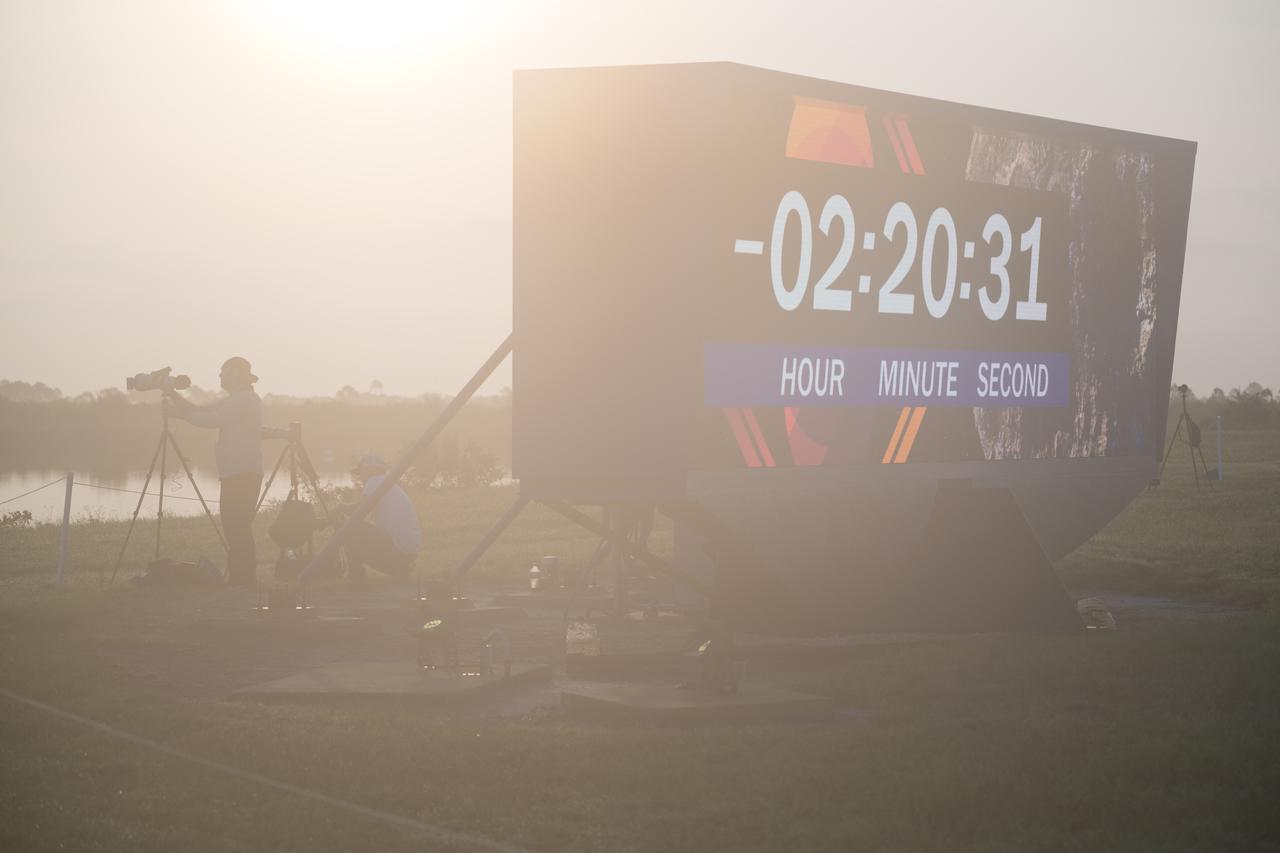
The countdown clock is seen as preparations continue for the launch of a SpaceX Falcon Heavy rocket with the Psyche spacecraft onboard from Launch Complex 39A, Friday, Oct. 13, 2023, at NASA’s Kennedy Space Center in Florida. NASA’s Psyche spacecraft will travel to a metal-rich asteroid by the same name orbiting the Sun between Mars and Jupiter to study it’s composition. The spacecraft also carries the agency's Deep Space Optical Communications technology demonstration, which will test laser communications beyond the Moon. Photo Credit: (NASA/Aubrey Gemignani)
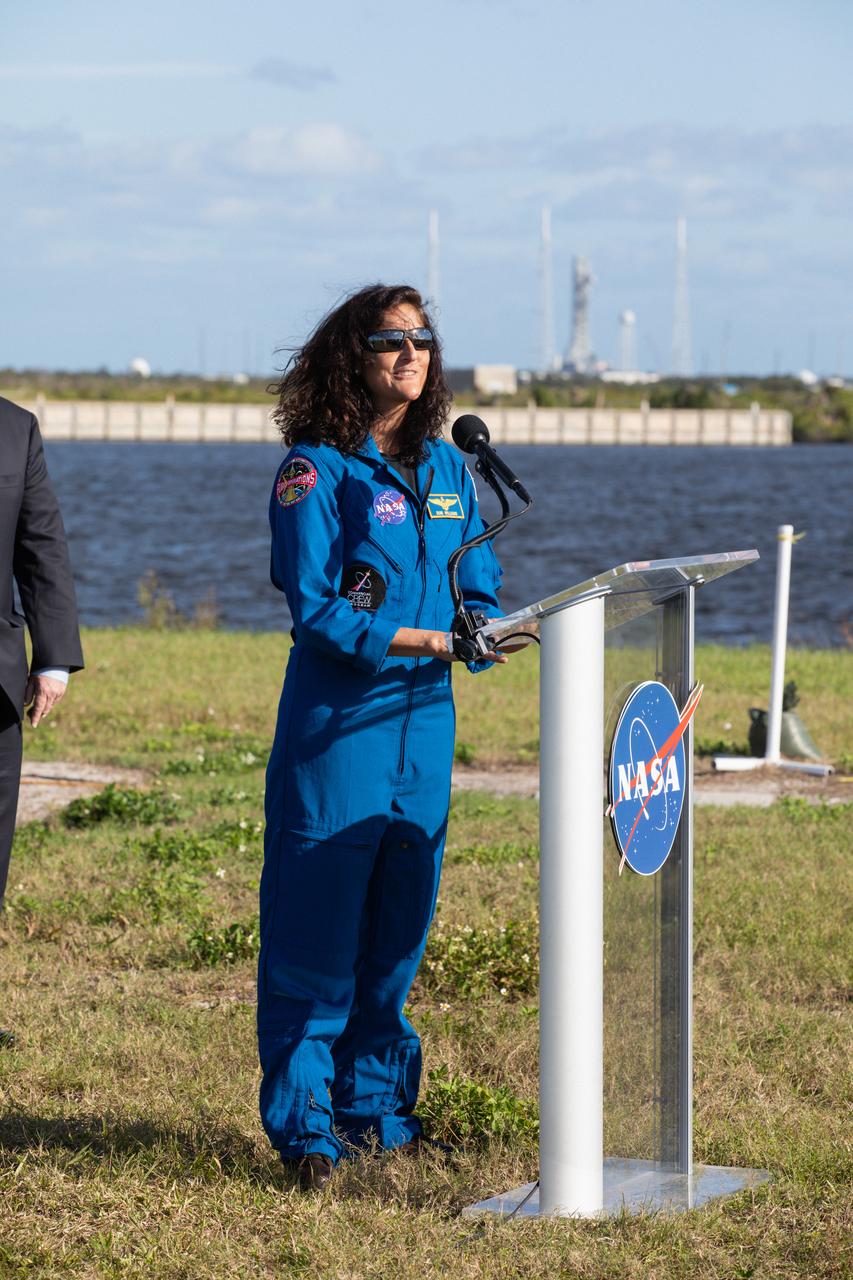
Suni Williams, NASA astronaut, participates in a Boeing Orbital Flight Test media briefing near the countdown clock at the Florida spaceport on Dec. 19, 2019. Boeing’s CST-100 Starliner spacecraft will launch atop a United Launch Alliance Atlas V rocket from Space Launch Complex 41 at Cape Canaveral Air Force Station. The uncrewed Orbital Flight Test will be the Starliner’s first flight to the International Space Station for NASA’s Commercial Crew Program.
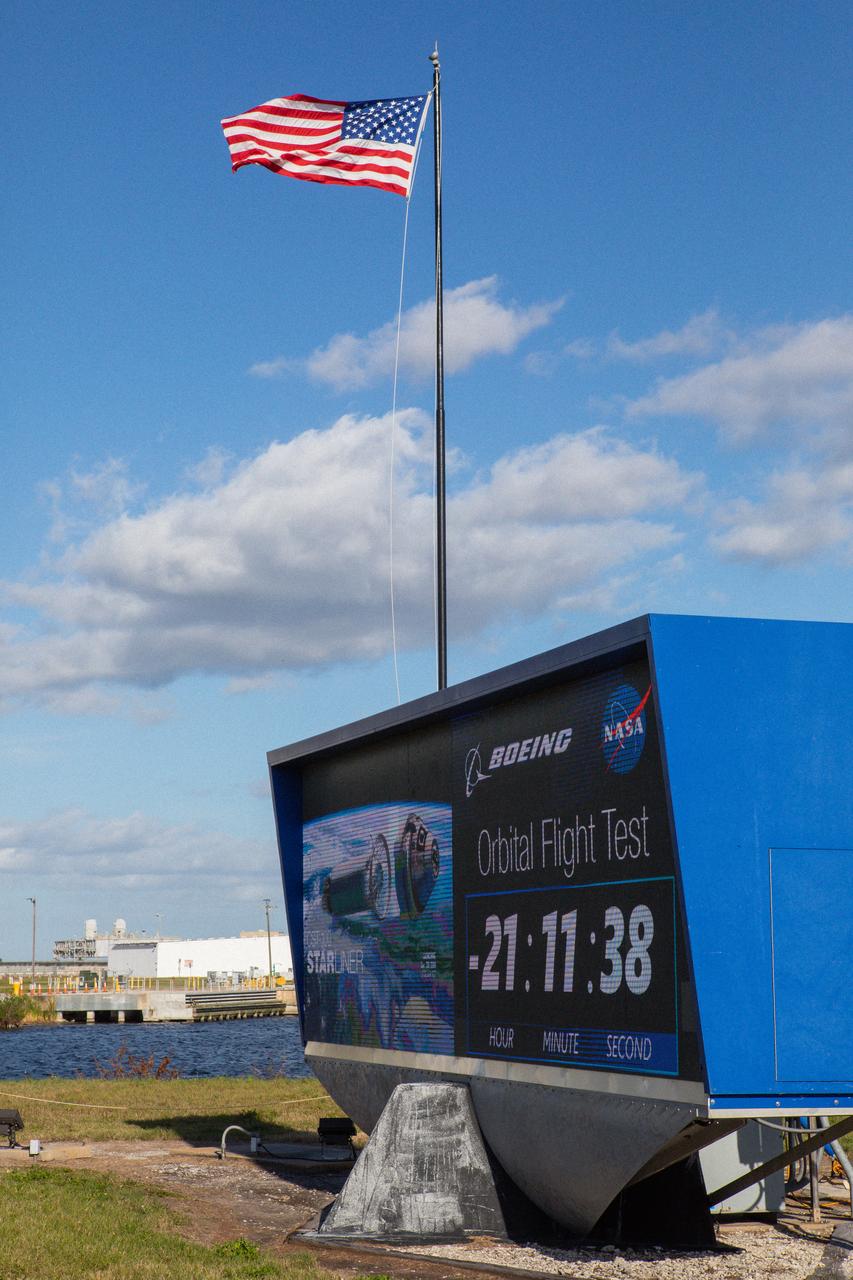
The countdown clock at NASA’s Kennedy Space Center in Florida is photographed during a Boeing Orbital Flight Test media briefing on Dec. 19, 2019. Boeing’s CST-100 Starliner spacecraft will launch atop a United Launch Alliance Atlas V rocket from Space Launch Complex 41 at Cape Canaveral Air Force Station. The uncrewed Orbital Flight Test will be the Starliner’s first flight to the International Space Station for NASA’s Commercial Crew Program.
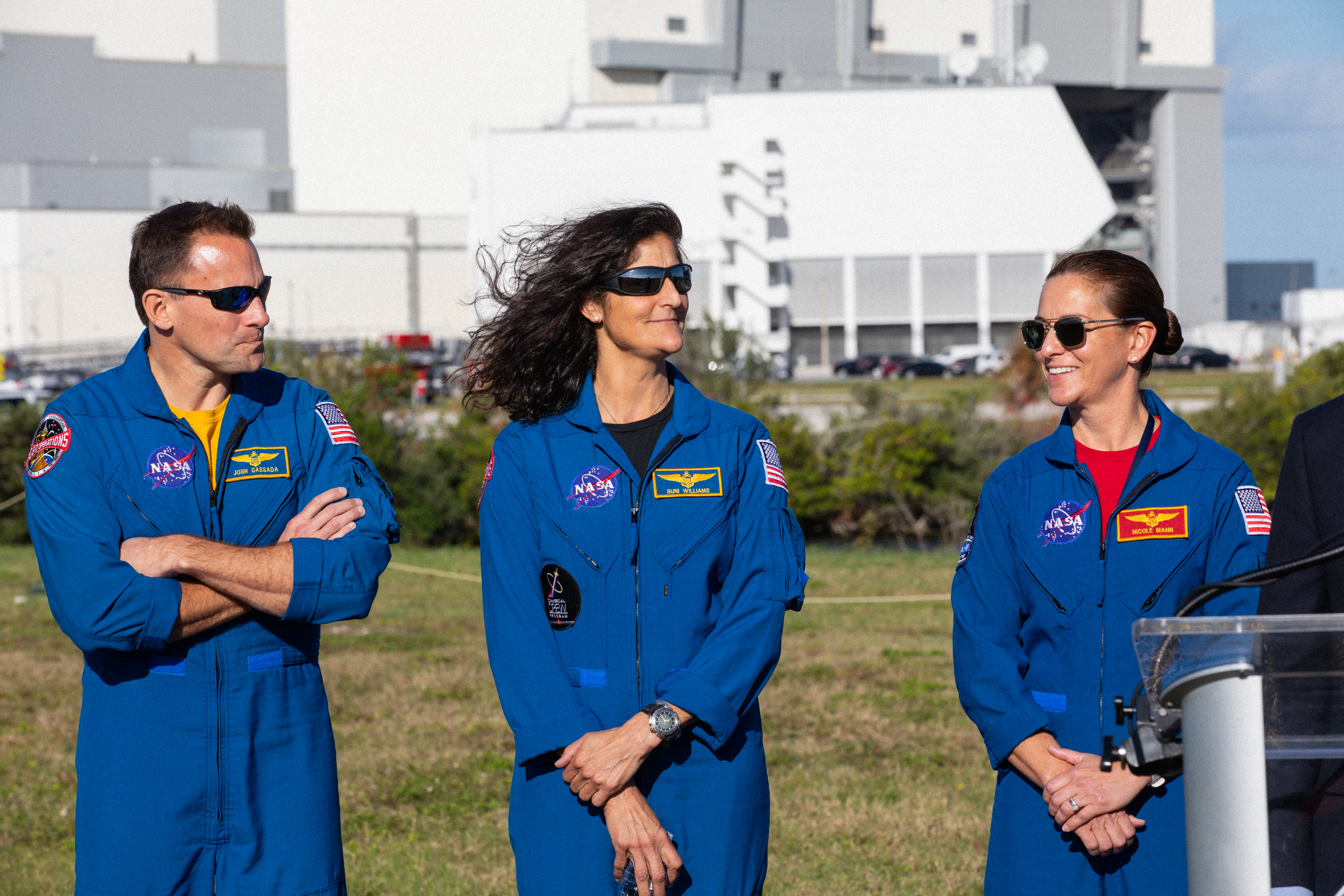
From left, NASA astronauts Josh Cassada, Suni Williams and Nicole Mann participate in a Boeing Orbital Flight Test media briefing near the countdown clock at the Florida spaceport on Dec. 19, 2019. Boeing’s CST-100 Starliner spacecraft will launch atop a United Launch Alliance Atlas V rocket from Space Launch Complex 41 at Cape Canaveral Air Force Station. The uncrewed Orbital Flight Test will be the Starliner’s first flight to the International Space Station for NASA’s Commercial Crew Program.
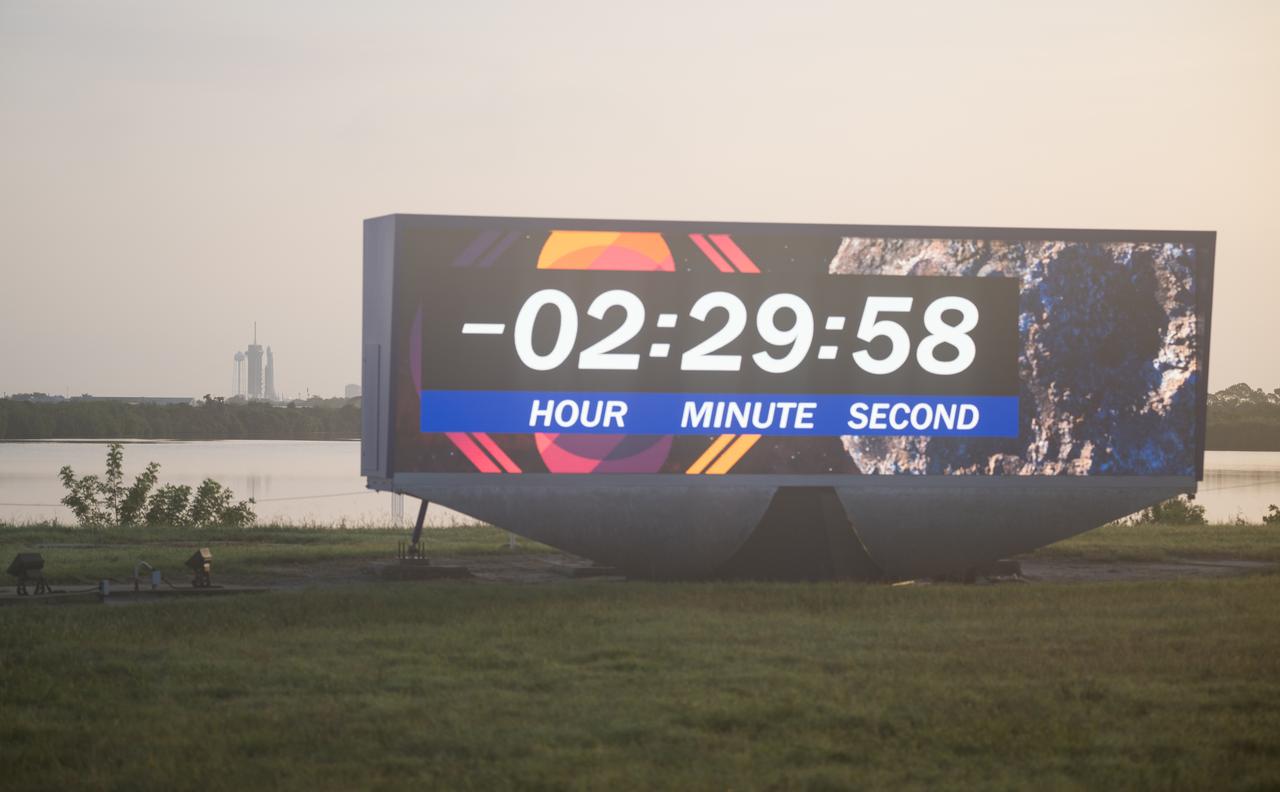
A SpaceX Falcon Heavy rocket with the Psyche spacecraft onboard is seen at Launch Complex 39A next to the countdown clock, as preparations continue for the Psyche mission, Friday, Oct. 13, 2023, at NASA’s Kennedy Space Center in Florida. NASA’s Psyche spacecraft will travel to a metal-rich asteroid by the same name orbiting the Sun between Mars and Jupiter to study it’s composition. The spacecraft also carries the agency's Deep Space Optical Communications technology demonstration, which will test laser communications beyond the Moon. Photo Credit: (NASA/Aubrey Gemignani)
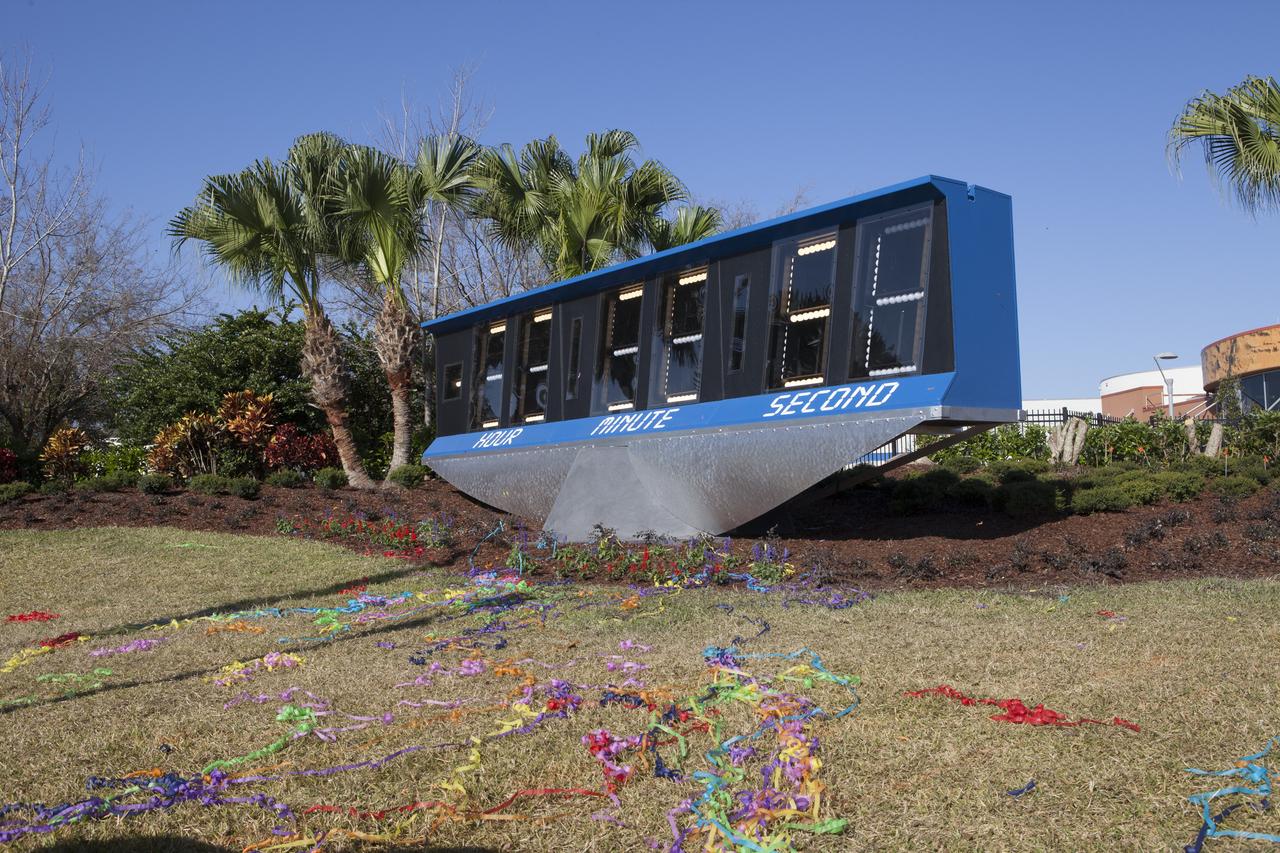
Confetti is launched as the spaceport's historic countdown clock is dedicated as the newest display at the Kennedy Space Center Visitor Complex. Now located at the entrance to the visitor complex, the spaceport's historic countdown clock was used starting with the launch of Apollo 12 on Nov. 14, 1969. Originally set up at the space center's Press Site, the clock operated through the final space shuttle mission, STS-135, launched on July 8, 2011. The old countdown clock was replaced in 2014 with a modern light emitting diode, or LED, display.
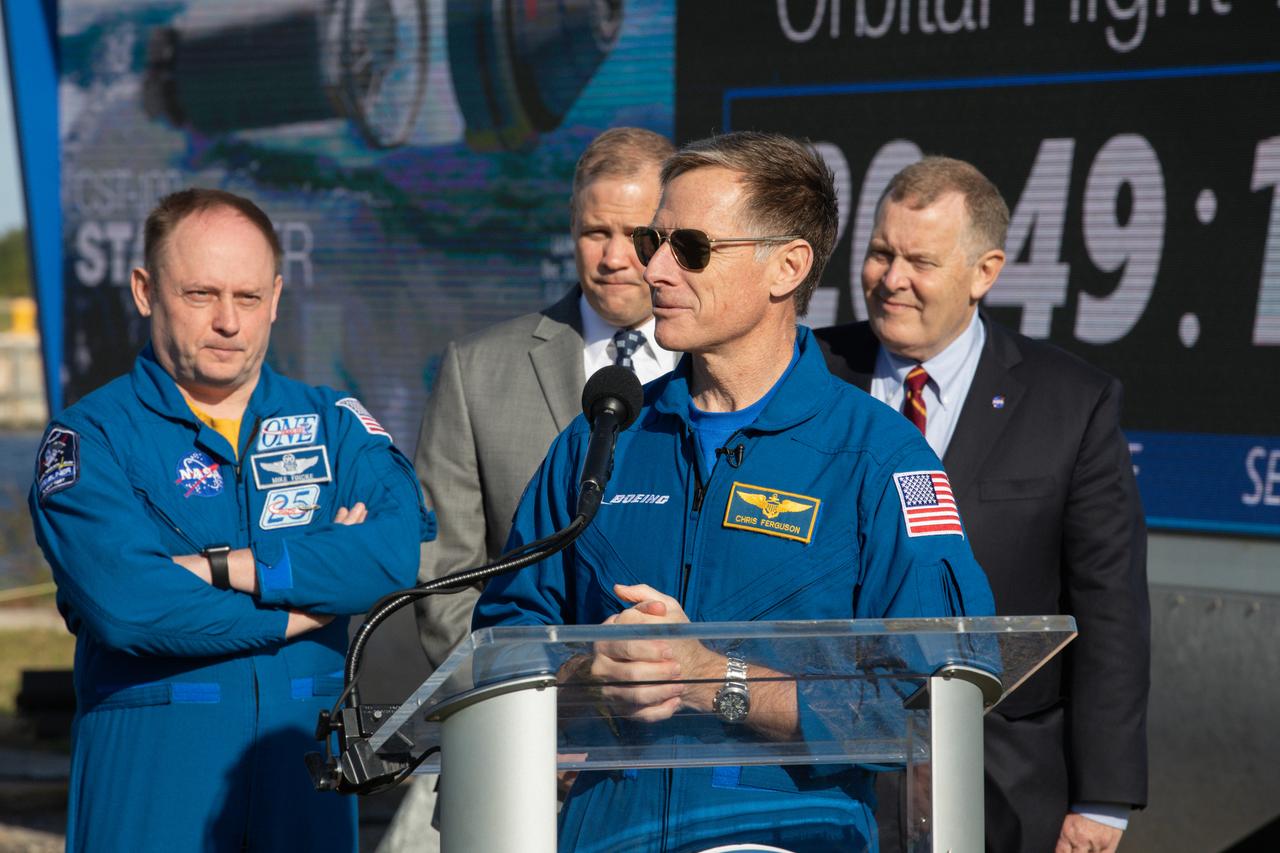
Chris Ferguson, Boeing astronaut, participates in a Boeing Orbital Flight Test media briefing near the countdown clock at the Florida spaceport on Dec. 19, 2019. In the background from left to right are NASA astronaut Mike Finke, NASA Administrator Jim Bridenstine and Deputy Administrator Jim Morhard. Boeing’s CST-100 Starliner spacecraft will launch atop a United Launch Alliance Atlas V rocket from Space Launch Complex 41 at Cape Canaveral Air Force Station. The uncrewed Orbital Flight Test will be the Starliner’s first flight to the International Space Station for NASA’s Commercial Crew Program.

Bob Cabana, Kennedy Space Center director, participates in a Boeing Orbital Flight Test media briefing near the countdown clock at the Florida spaceport on Dec. 19, 2019. In the background from left to right are NASA astronaut Nicole Mann, Boeing astronaut Chris Ferguson and NASA astronaut Mike Finke. Boeing’s CST-100 Starliner spacecraft will launch atop a United Launch Alliance Atlas V rocket from Space Launch Complex 41 at Cape Canaveral Air Force Station. The uncrewed Orbital Flight Test will be the Starliner’s first flight to the International Space Station for NASA’s Commercial Crew Program.
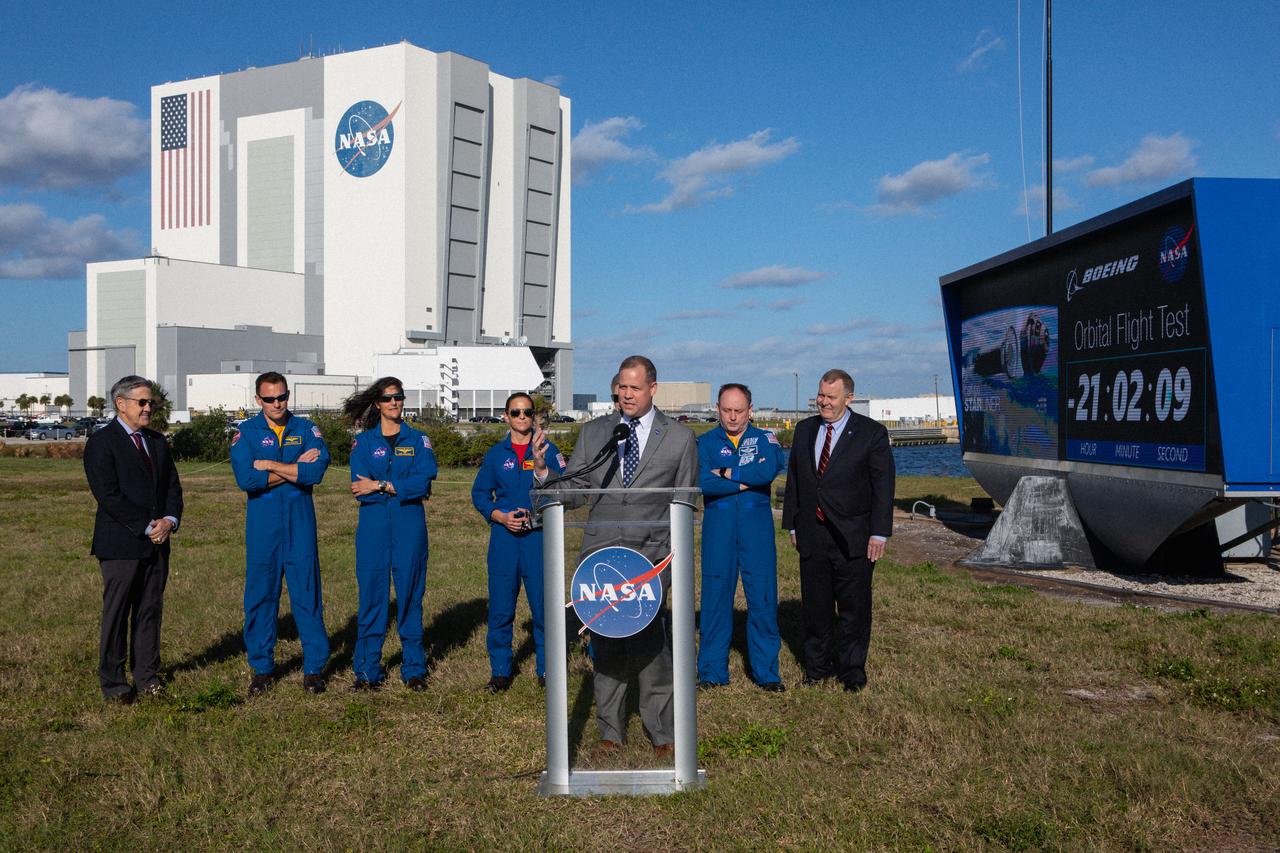
Jim Bridenstine, NASA administrator, participates in a Boeing Orbital Flight Test media briefing near the countdown clock at the Florida spaceport on Dec. 19, 2019. In the background from left to right are Kennedy Space Center Director Bob Cabana; NASA astronauts Josh Cassada, Suni Williams, Nicole Mann and Mike Finke; and NASA Deputy Administrator Jim Morhard. Boeing’s CST-100 Starliner spacecraft will launch atop a United Launch Alliance Atlas V rocket from Space Launch Complex 41 at Cape Canaveral Air Force Station. The uncrewed Orbital Flight Test will be the Starliner’s first flight to the International Space Station for NASA’s Commercial Crew Program.
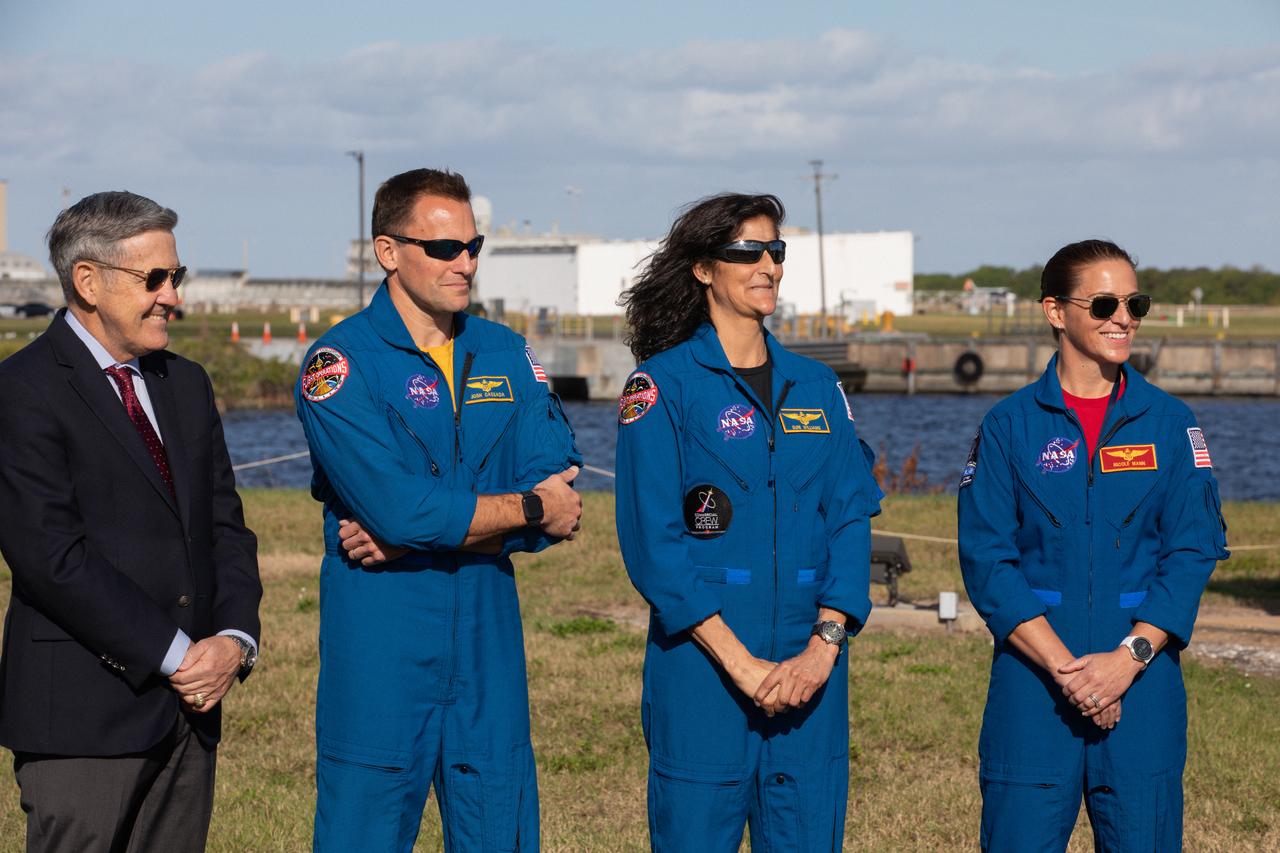
From left, Kennedy Space Center Director Bob Cabana and NASA astronauts Josh Cassada, Suni Williams and Nicole Mann participate in a Boeing Orbital Flight Test media briefing near the countdown clock at the Florida spaceport on Dec. 19, 2019. Boeing’s CST-100 Starliner spacecraft will launch atop a United Launch Alliance Atlas V rocket from Space Launch Complex 41 at Cape Canaveral Air Force Station. The uncrewed Orbital Flight Test will be the Starliner’s first flight to the International Space Station for NASA’s Commercial Crew Program.
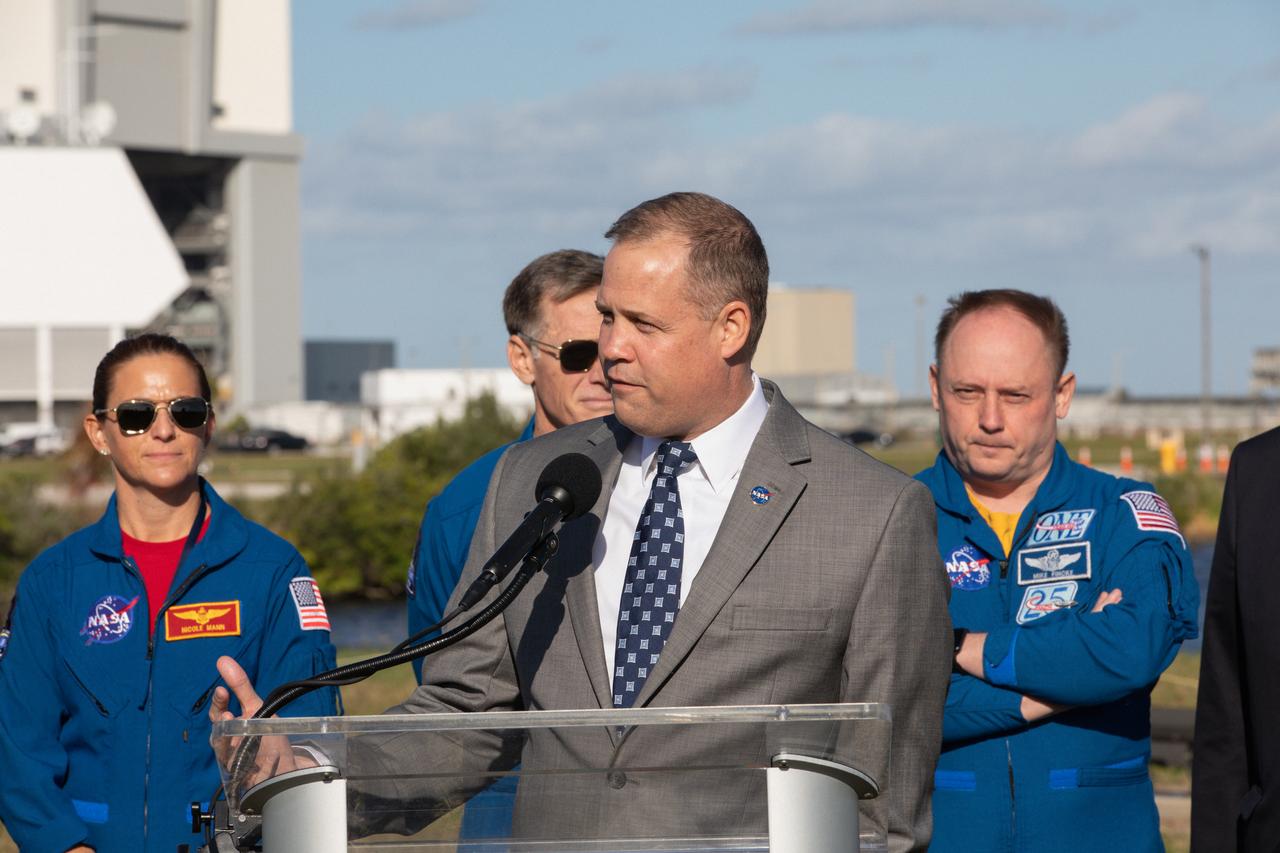
Jim Bridenstine, NASA administrator, participates in a Boeing Orbital Flight Test media briefing near the countdown clock at the Florida spaceport on Dec. 19, 2019. In the background from left to right are NASA astronaut Nicole Mann, Boeing astronaut Chris Ferguson and NASA astronaut Mike Finke. Boeing’s CST-100 Starliner spacecraft will launch atop a United Launch Alliance Atlas V rocket from Space Launch Complex 41 at Cape Canaveral Air Force Station. The uncrewed Orbital Flight Test will be the Starliner’s first flight to the International Space Station for NASA’s Commercial Crew Program.
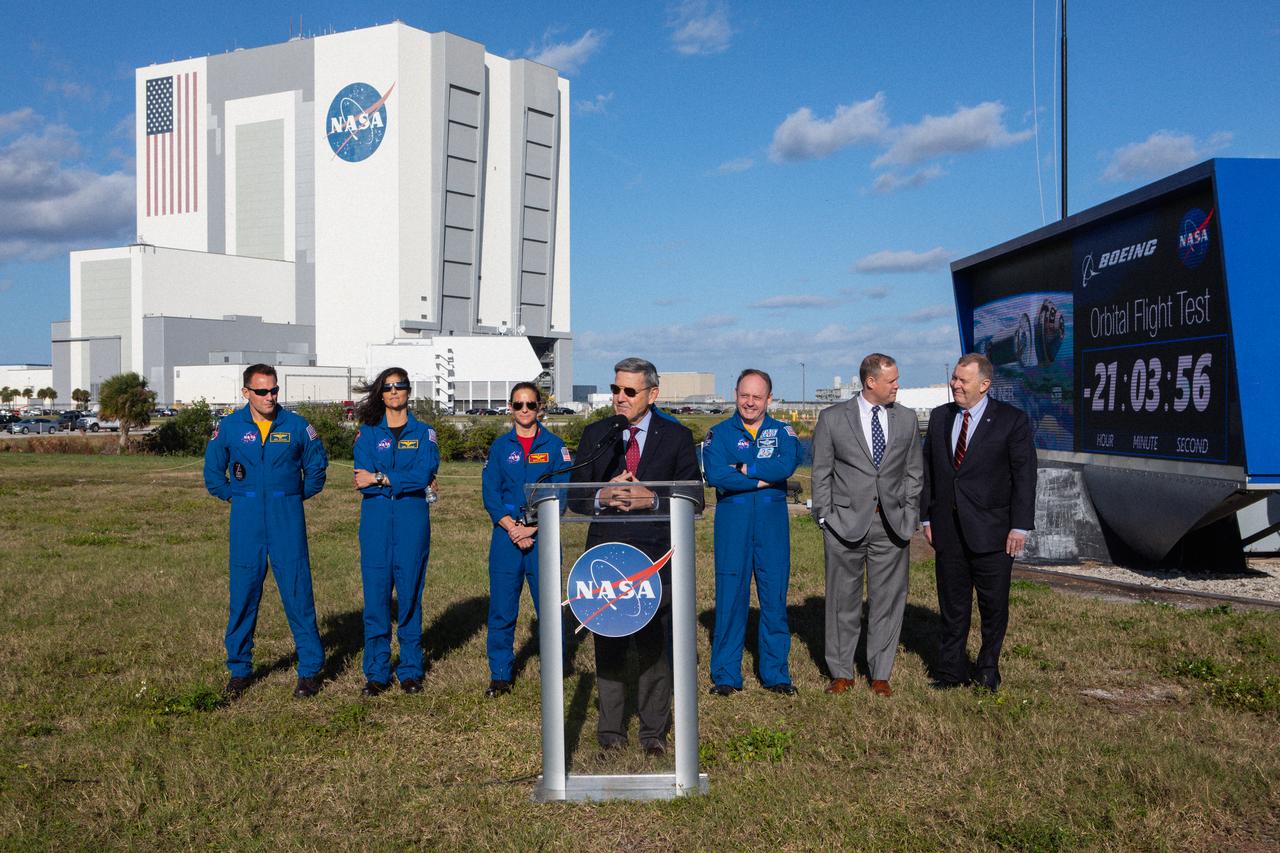
Bob Cabana, Kennedy Space Center director, participates in a Boeing Orbital Flight Test media briefing near the countdown clock at the Florida spaceport on Dec. 19, 2019. In the background from left to right are NASA astronauts Josh Cassada, Suni Williams, Nicole Mann and Mike Finke; NASA Administrator Jim Bridenstine; and Deputy Administrator Jim Morhard. Boeing’s CST-100 Starliner spacecraft will launch atop a United Launch Alliance Atlas V rocket from Space Launch Complex 41 at Cape Canaveral Air Force Station. The uncrewed Orbital Flight Test will be the Starliner’s first flight to the International Space Station for NASA’s Commercial Crew Program.
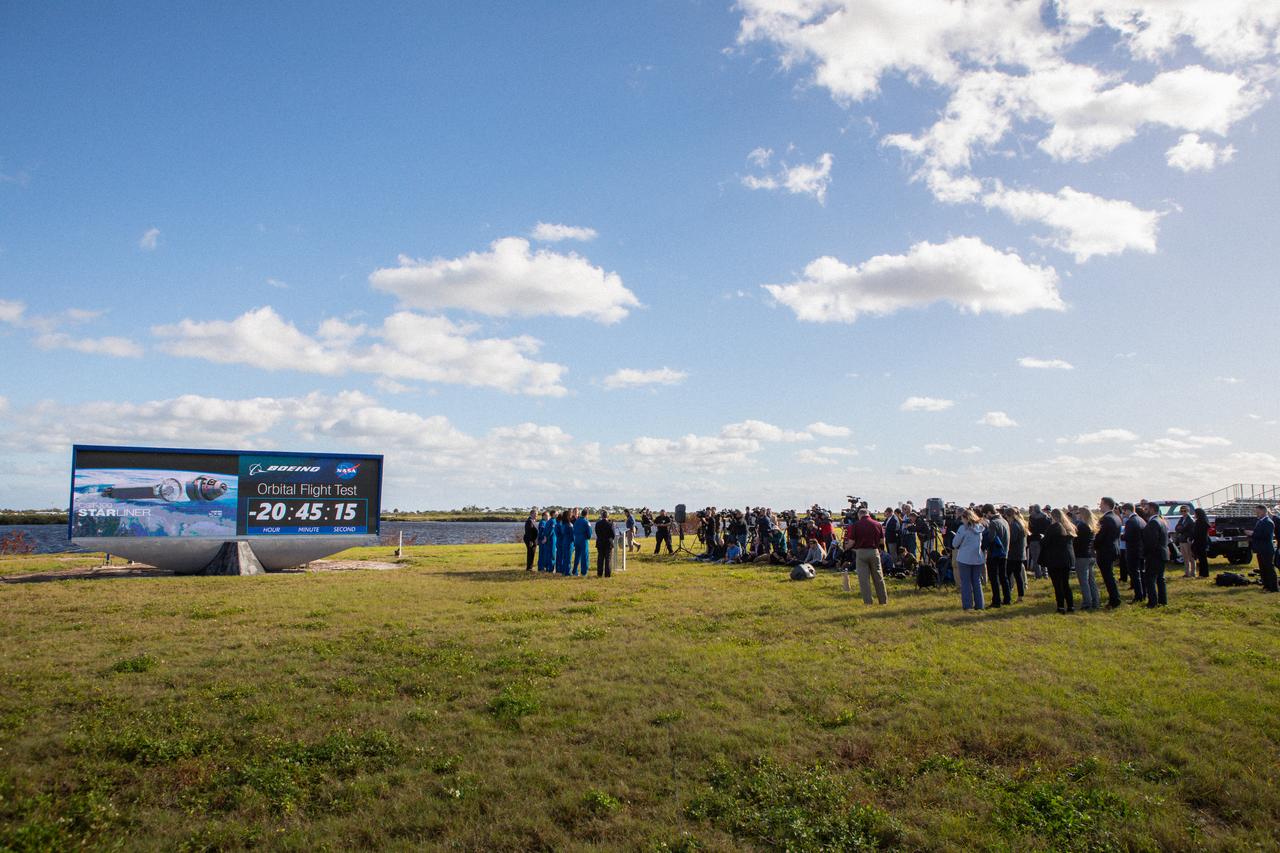
NASA Administrator Jim Bridenstine, Kennedy Space Center Director Bob Cabana, and astronauts representing NASA and Boeing participate in a Boeing Orbital Flight Test media briefing near the countdown clock at the Florida spaceport on Dec. 19, 2019. Boeing’s CST-100 Starliner spacecraft will launch atop a United Launch Alliance Atlas V rocket from Space Launch Complex 41 at Cape Canaveral Air Force Station. The uncrewed Orbital Flight Test will be the Starliner’s first flight to the International Space Station for NASA’s Commercial Crew Program.
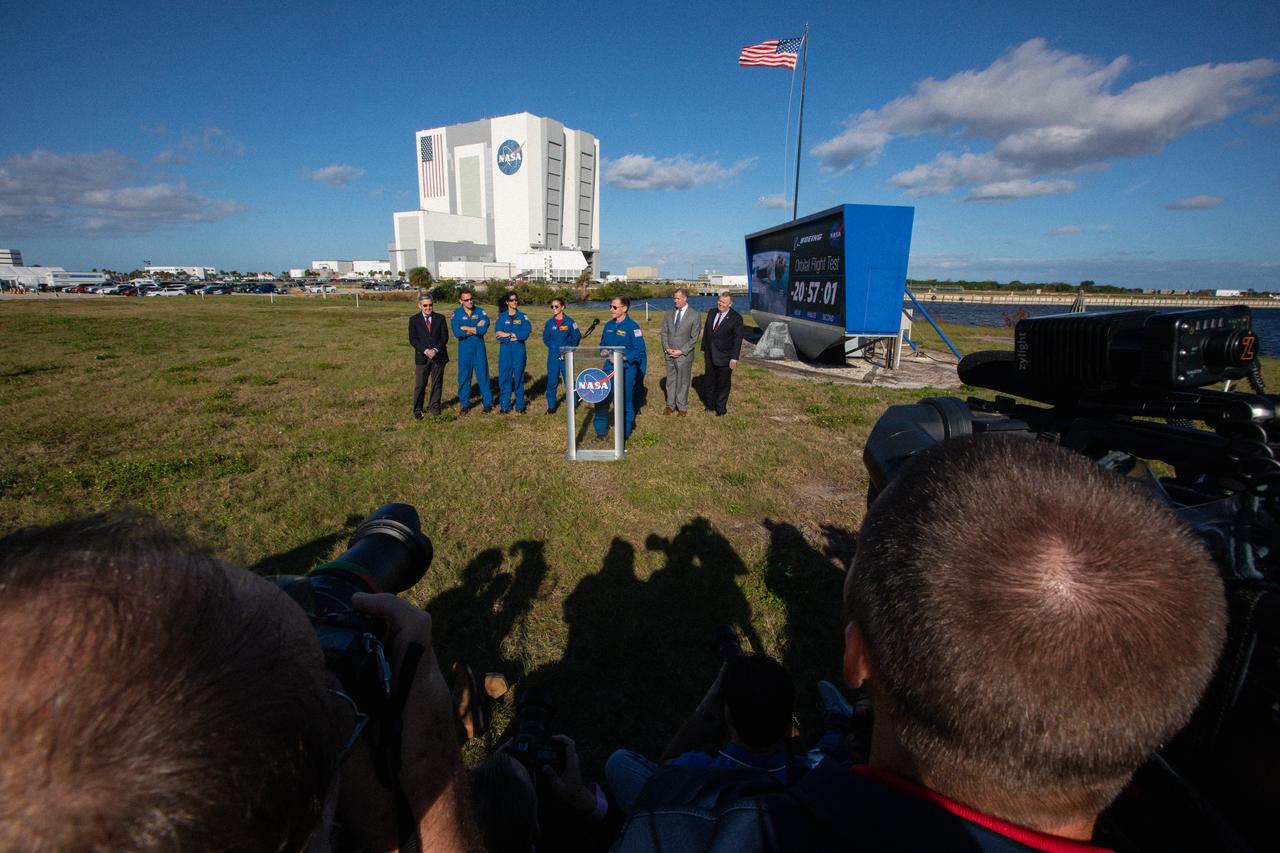
Chris Ferguson, Boeing astronaut, participates in a Boeing Orbital Flight Test media briefing near the countdown clock at the Florida spaceport on Dec. 19, 2019. In the background from left to right are Kennedy Space Center Director Bob Cabana; NASA astronauts Josh Cassada, Suni Williams and Nicole Mann; NASA Administrator Jim Bridenstine; and Deputy Administrator Jim Morhard. Boeing’s CST-100 Starliner spacecraft will launch atop a United Launch Alliance Atlas V rocket from Space Launch Complex 41 at Cape Canaveral Air Force Station. The uncrewed Orbital Flight Test will be the Starliner’s first flight to the International Space Station for NASA’s Commercial Crew Program.
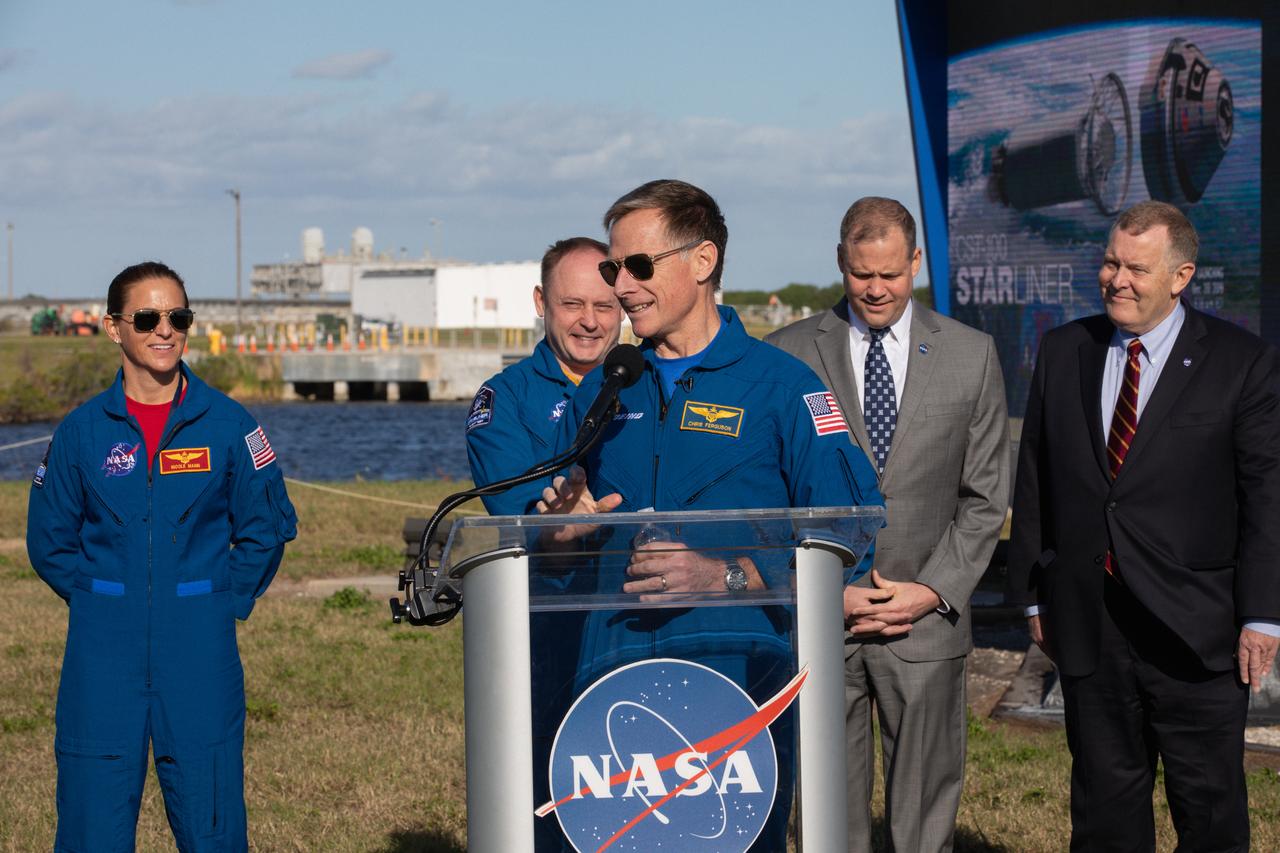
Chris Ferguson, Boeing astronaut, participates in a Boeing Orbital Flight Test media briefing near the countdown clock at the Florida spaceport on Dec. 19, 2019. In the background from left to right are NASA astronauts Nicole Mann and Mike Finke, NASA Administrator Jim Bridenstine and Deputy Administrator Jim Morhard. Boeing’s CST-100 Starliner spacecraft will launch atop a United Launch Alliance Atlas V rocket from Space Launch Complex 41 at Cape Canaveral Air Force Station. The uncrewed Orbital Flight Test will be the Starliner’s first flight to the International Space Station for NASA’s Commercial Crew Program.
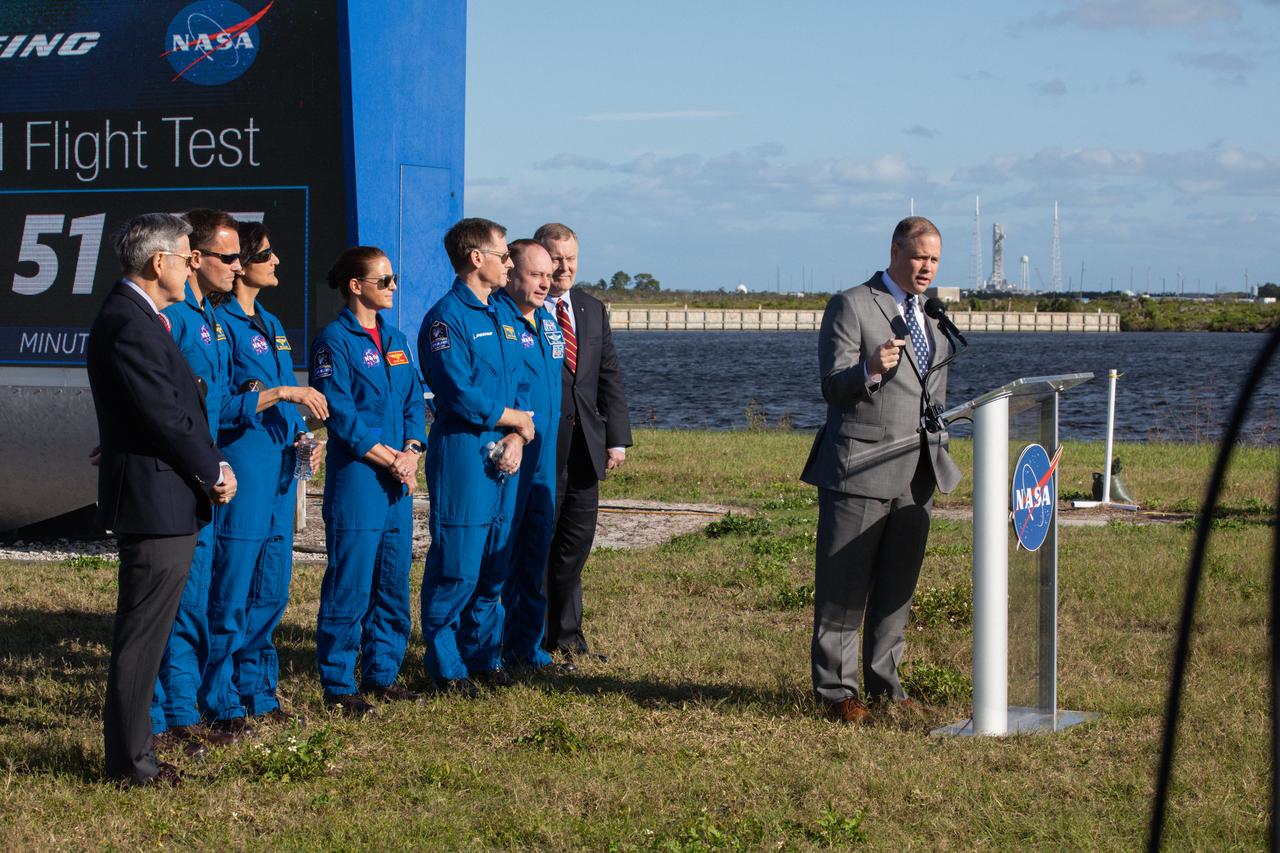
Jim Bridenstine, NASA administrator, participates in a Boeing Orbital Flight Test media briefing near the countdown clock at the Florida spaceport on Dec. 19, 2019. In the background from left to right are Cabana; NASA astronauts Josh Cassada, Suni Williams and Nicole Mann; Boeing astronaut Chris Ferguson; NASA astronaut Mike Finke; and NASA Deputy Administrator Jim Morhard. Boeing’s CST-100 Starliner spacecraft will launch atop a United Launch Alliance Atlas V rocket from Space Launch Complex 41 at Cape Canaveral Air Force Station. The uncrewed Orbital Flight Test will be the Starliner’s first flight to the International Space Station for NASA’s Commercial Crew Program.
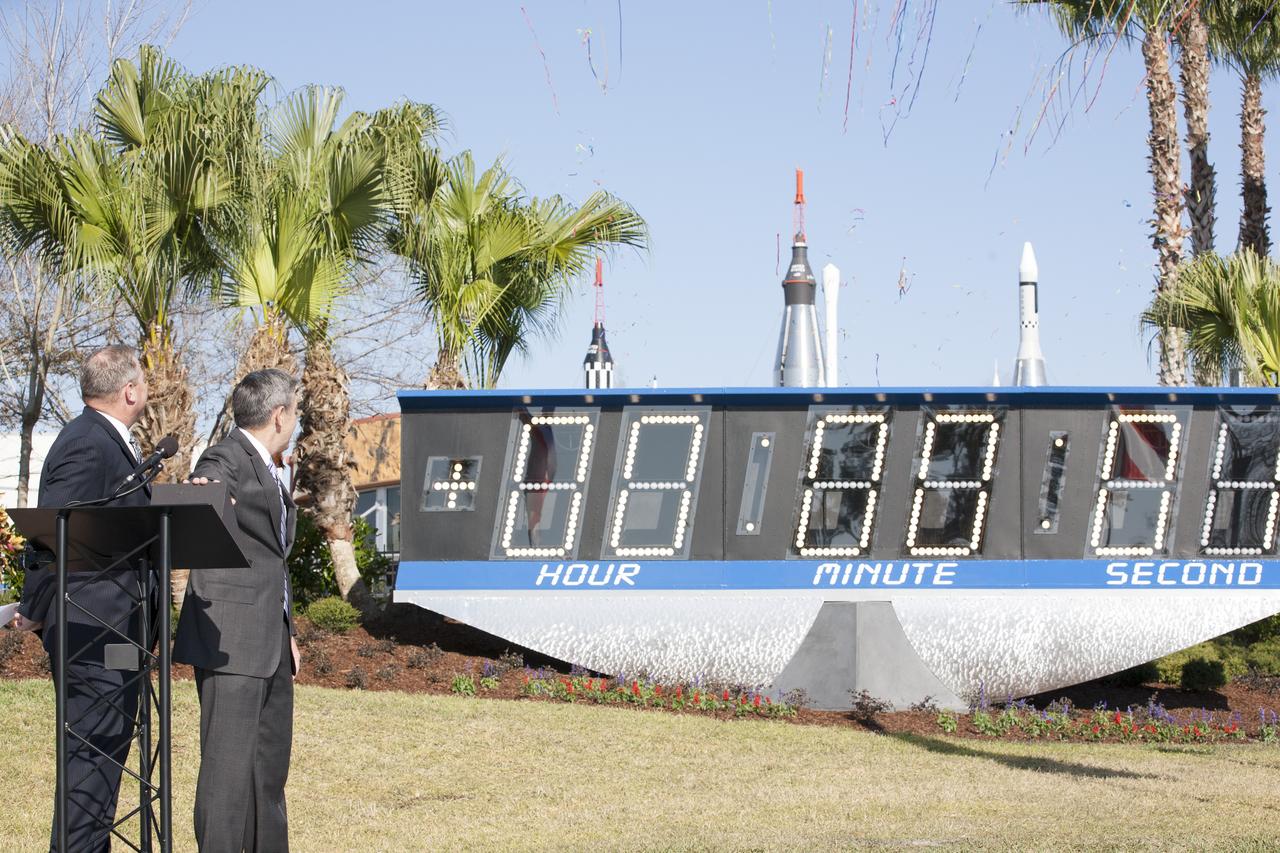
Therrin Protze, chief operating officer of the Kennedy Space Center Visitor Complex, left, and center director Bob Cabana watch as confetti was launched as the spaceport's historic countdown clock is dedicated as the newest display at the entrance to Kennedy's visitor complex. The spaceport's historic countdown clock was used beginning with the launch of Apollo 12 on Nov. 14, 1969. Originally set up at the space center's Press Site, the clock was used through the final space shuttle mission, STS-135, launched on July 8, 2011. The old countdown clock was replaced in 2014 with a modern light emitting diode, or LED, display.
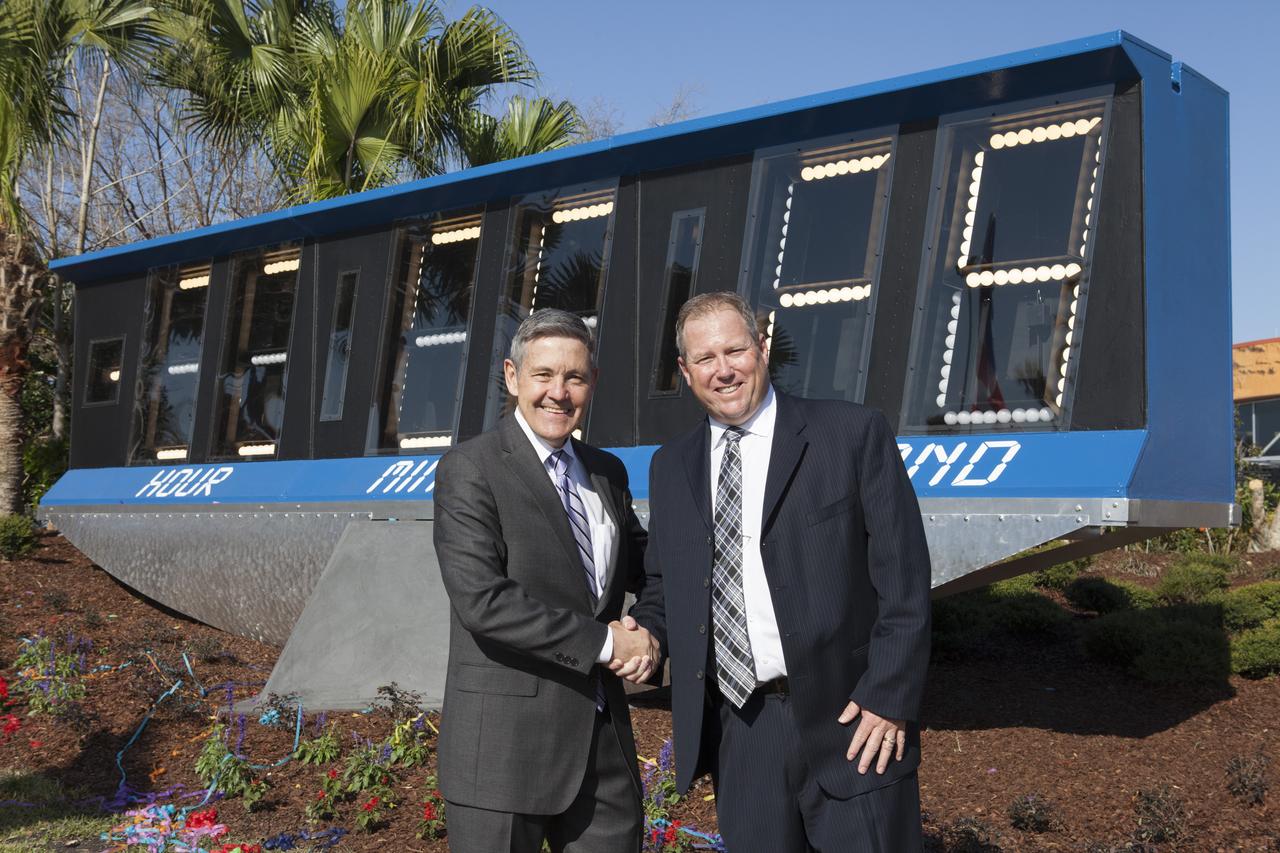
Kennedy Space Center Director Bob Cabana, left, and Therrin Protze, chief operating officer of Kennedy's Visitor Complex, celebrate the dedication of the spaceport's historic countdown clock as the newest display at the center's visitor complex. Now located at the entrance to the visitor complex, the spaceport's historic countdown clock was used starting with the launch of Apollo 12 on Nov. 14, 1969. Originally set up at the space center's Press Site, the clock operated through the final space shuttle mission, STS-135, launched on July 8, 2011. The old countdown clock was replaced in 2014 with a modern light emitting diode, or LED, display.
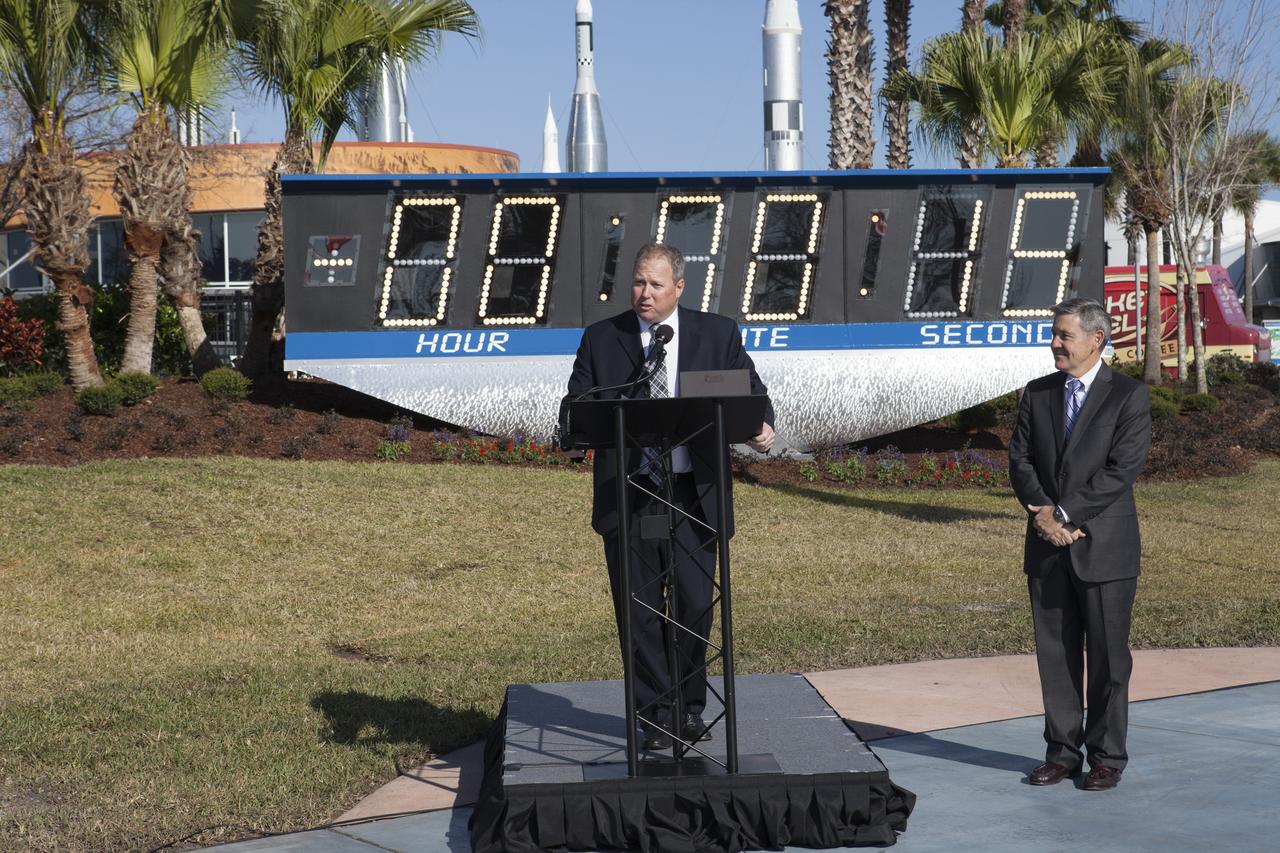
Therrin Protze, chief operating officer of the Kennedy Space Center Visitor Complex, speaks at the dedication of the center's historic countdown clock. To the right is space center director Bob Cabana. Now located at the entrance to the visitor complex, the spaceport's historic countdown clock was used starting with the launch of Apollo 12 on Nov. 14, 1969. Originally set up at the space center's Press Site, the clock was used through the final space shuttle mission, STS-135, launched on July 8, 2011. The old countdown clock was replaced in 2014 with a modern light emitting diode, or LED, display.
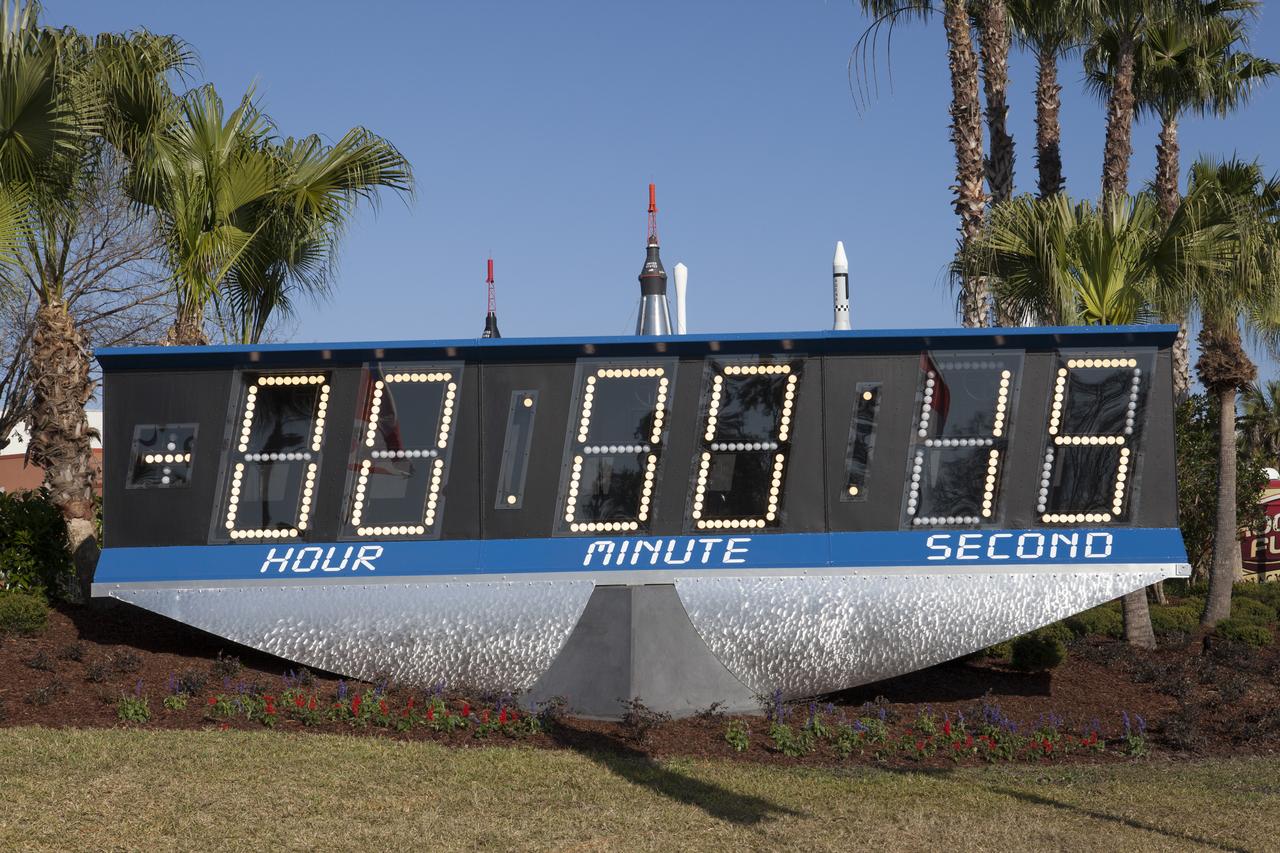
The newest display at the Kennedy Space Center Visitor Complex is the spaceport's historic countdown clock. It is now located at the entrance to the visitor complex. The clock was set up at the space center's Press Site and used from the launch of Apollo 12 on Nov. 14, 1969 to the final space shuttle mission, STS-135, launched on July 8, 2011. The old countdown clock was replaced in 2014 with a modern light emitting diode, or LED, display.
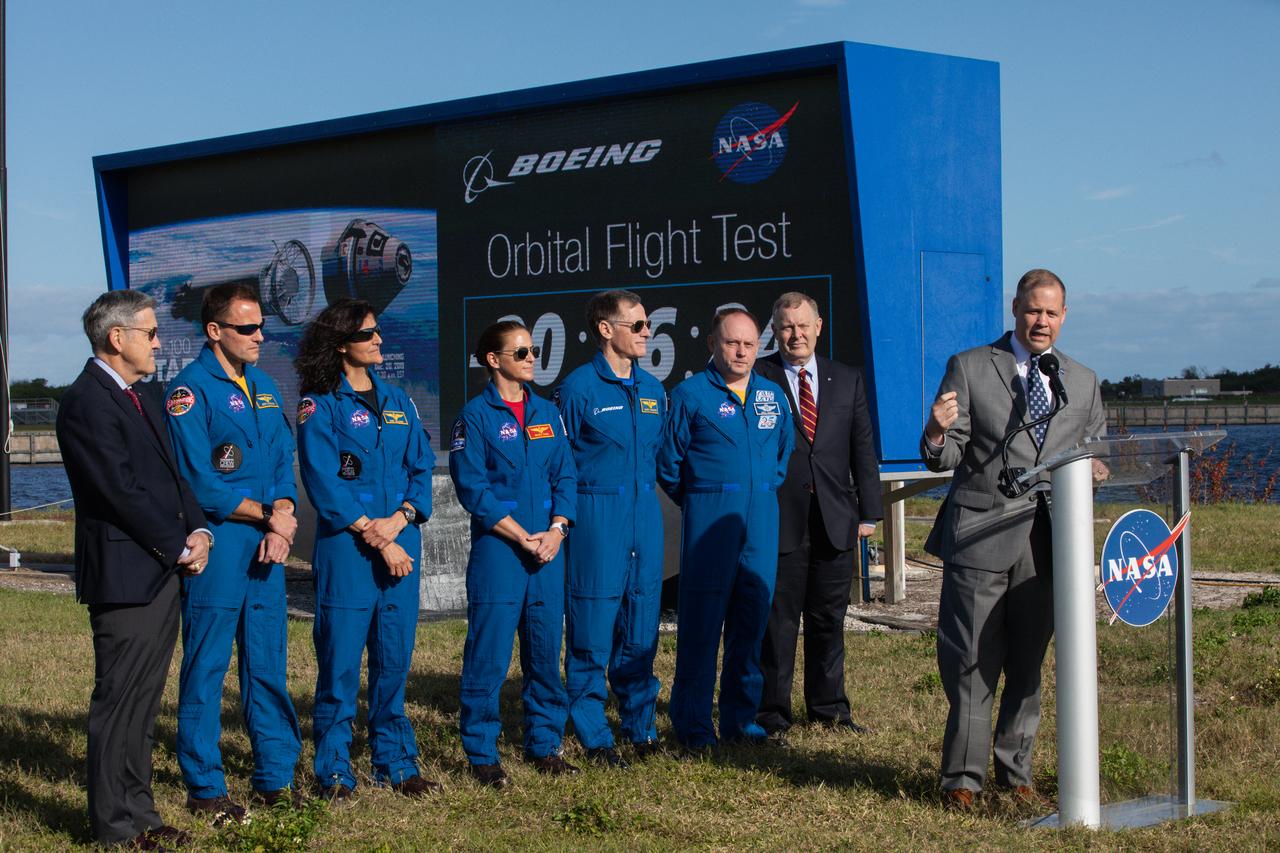
NASA Administrator Jim Bridenstine, Kennedy Space Center Director Bob Cabana, and astronauts representing NASA and Boeing participate in a Boeing Orbital Flight Test media briefing near the countdown clock at the Florida spaceport on Dec. 19, 2019. From left to right are Cabana; NASA astronauts Josh Cassada, Suni Williams and Nicole Mann; Boeing astronaut Chris Ferguson; NASA astronaut Mike Finke; NASA Deputy Administrator Jim Morhard; and Bridenstine. Boeing’s CST-100 Starliner spacecraft will launch atop a United Launch Alliance Atlas V rocket from Space Launch Complex 41 at Cape Canaveral Air Force Station. The uncrewed Orbital Flight Test will be the Starliner’s first flight to the International Space Station for NASA’s Commercial Crew Program.
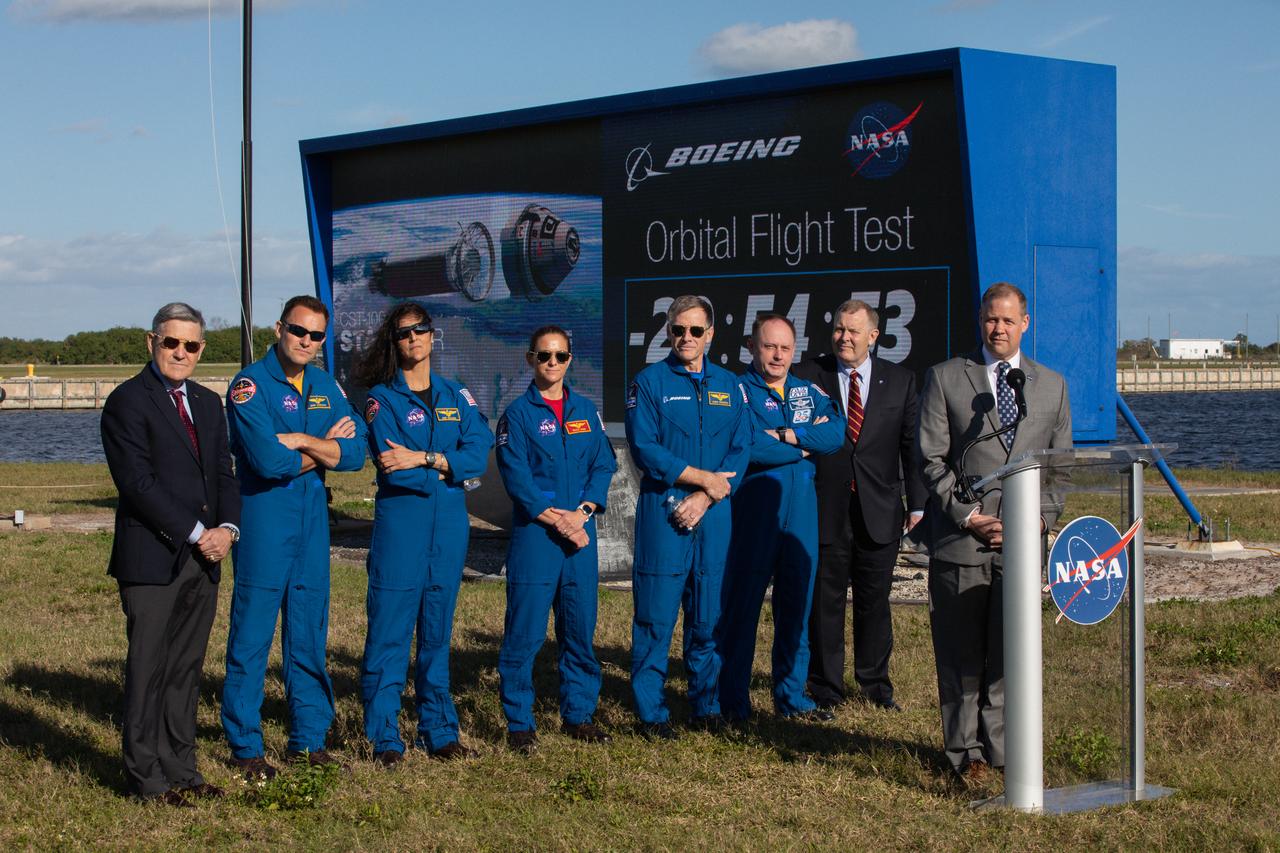
NASA Administrator Jim Bridenstine, Kennedy Space Center Director Bob Cabana, and astronauts representing NASA and Boeing participate in a Boeing Orbital Flight Test media briefing near the countdown clock at the Florida spaceport on Dec. 19, 2019. From left to right are Cabana; NASA astronauts Josh Cassada, Suni Williams and Nicole Mann; Boeing astronaut Chris Ferguson; NASA astronaut Mike Finke; NASA Deputy Administrator Jim Morhard; and Bridenstine. Boeing’s CST-100 Starliner spacecraft will launch atop a United Launch Alliance Atlas V rocket from Space Launch Complex 41 at Cape Canaveral Air Force Station. The uncrewed Orbital Flight Test will be the Starliner’s first flight to the International Space Station for NASA’s Commercial Crew Program.

NASA Administrator Jim Bridenstine, Kennedy Space Center Director Bob Cabana, and astronauts representing NASA and Boeing participate in a Boeing Orbital Flight Test media briefing near the countdown clock at the Florida spaceport on Dec. 19, 2019. From left to right are Cabana; NASA astronauts Josh Cassada, Suni Williams and Nicole Mann; Boeing astronaut Chris Ferguson; NASA astronaut Mike Finke; NASA Deputy Administrator Jim Morhard; and Bridenstine. Boeing’s CST-100 Starliner spacecraft will launch atop a United Launch Alliance Atlas V rocket from Space Launch Complex 41 at Cape Canaveral Air Force Station. The uncrewed Orbital Flight Test will be the Starliner’s first flight to the International Space Station for NASA’s Commercial Crew Program.
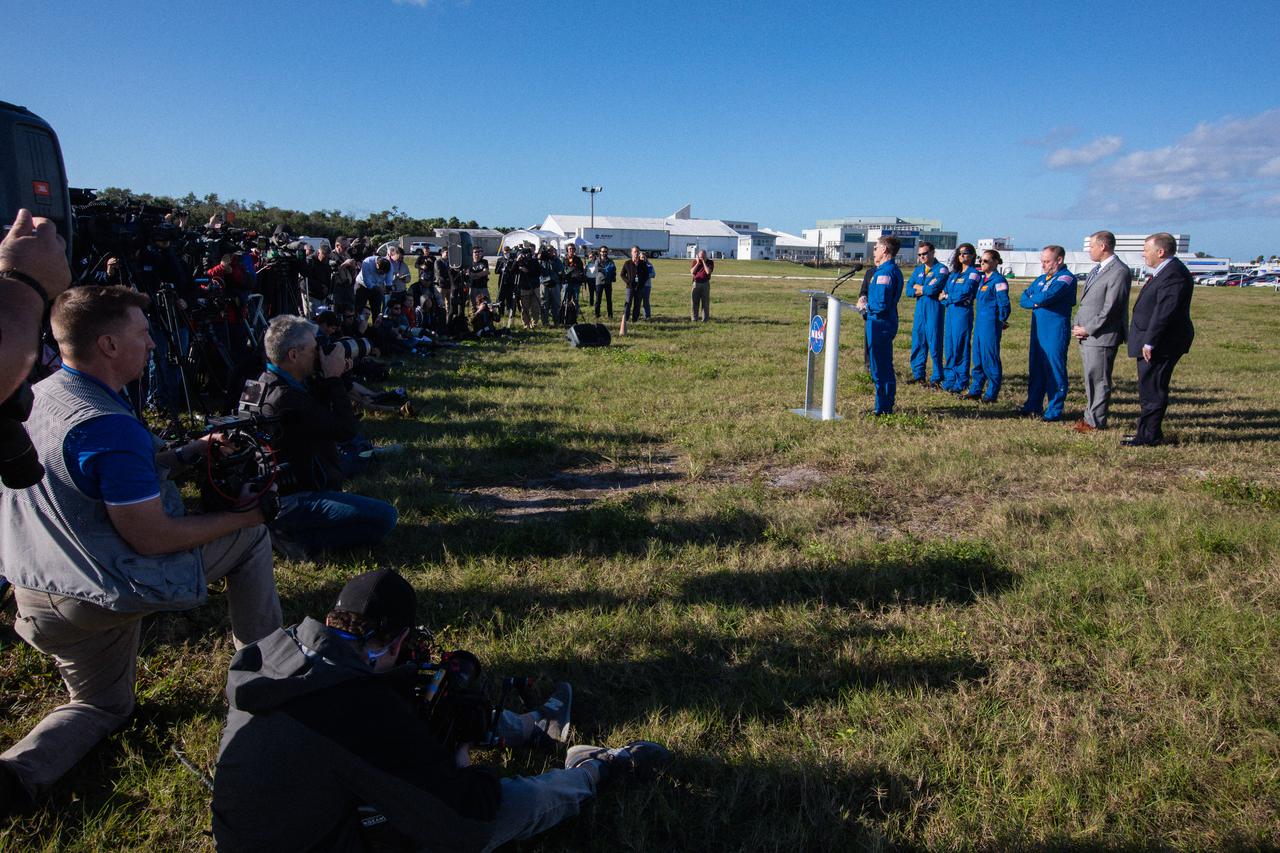
Chris Ferguson, Boeing astronaut, participates in a Boeing Orbital Flight Test media briefing near the countdown clock at the Florida spaceport on Dec. 19, 2019. In the background from left to right are Kennedy Space Center Director Bob Cabana; NASA astronauts Josh Cassada, Suni Williams, Nicole Mann and Mike Finke; NASA Administrator Jim Bridenstine; and Deputy Administrator Jim Morhard. Boeing’s CST-100 Starliner spacecraft will launch atop a United Launch Alliance Atlas V rocket from Space Launch Complex 41 at Cape Canaveral Air Force Station. The uncrewed Orbital Flight Test will be the Starliner’s first flight to the International Space Station for NASA’s Commercial Crew Program.
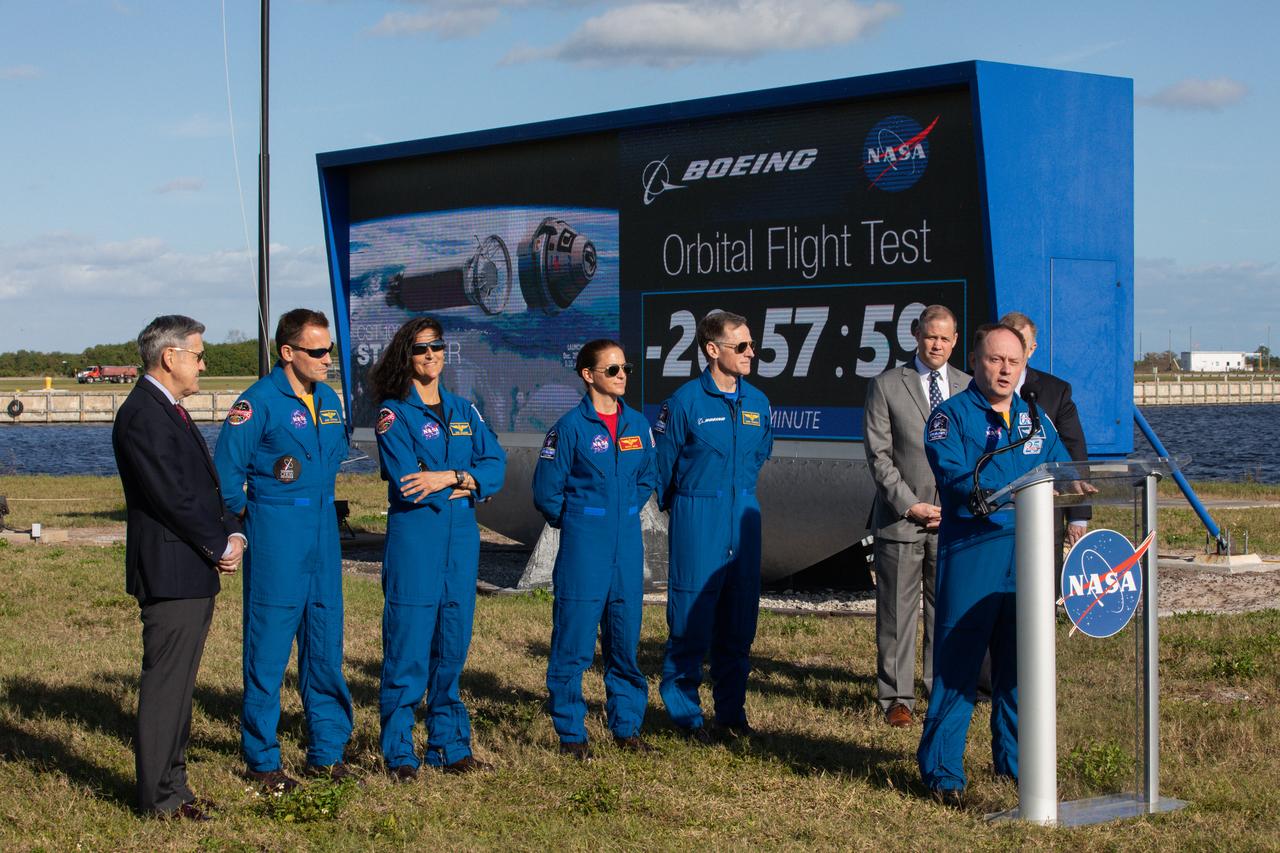
Mike Finke, NASA astronaut, participates in a Boeing Orbital Flight Test media briefing near the countdown clock at the Florida spaceport on Dec. 19, 2019. In the background from left to right are Kennedy Space Center Director Bob Cabana; NASA astronauts Josh Cassada, Suni Williams and Nicole Mann; Boeing astronaut Chris Ferguson; NASA Administrator Jim Bridenstine; and Deputy Administrator Jim Morhard. Boeing’s CST-100 Starliner spacecraft will launch atop a United Launch Alliance Atlas V rocket from Space Launch Complex 41 at Cape Canaveral Air Force Station. The uncrewed Orbital Flight Test will be the Starliner’s first flight to the International Space Station for NASA’s Commercial Crew Program.
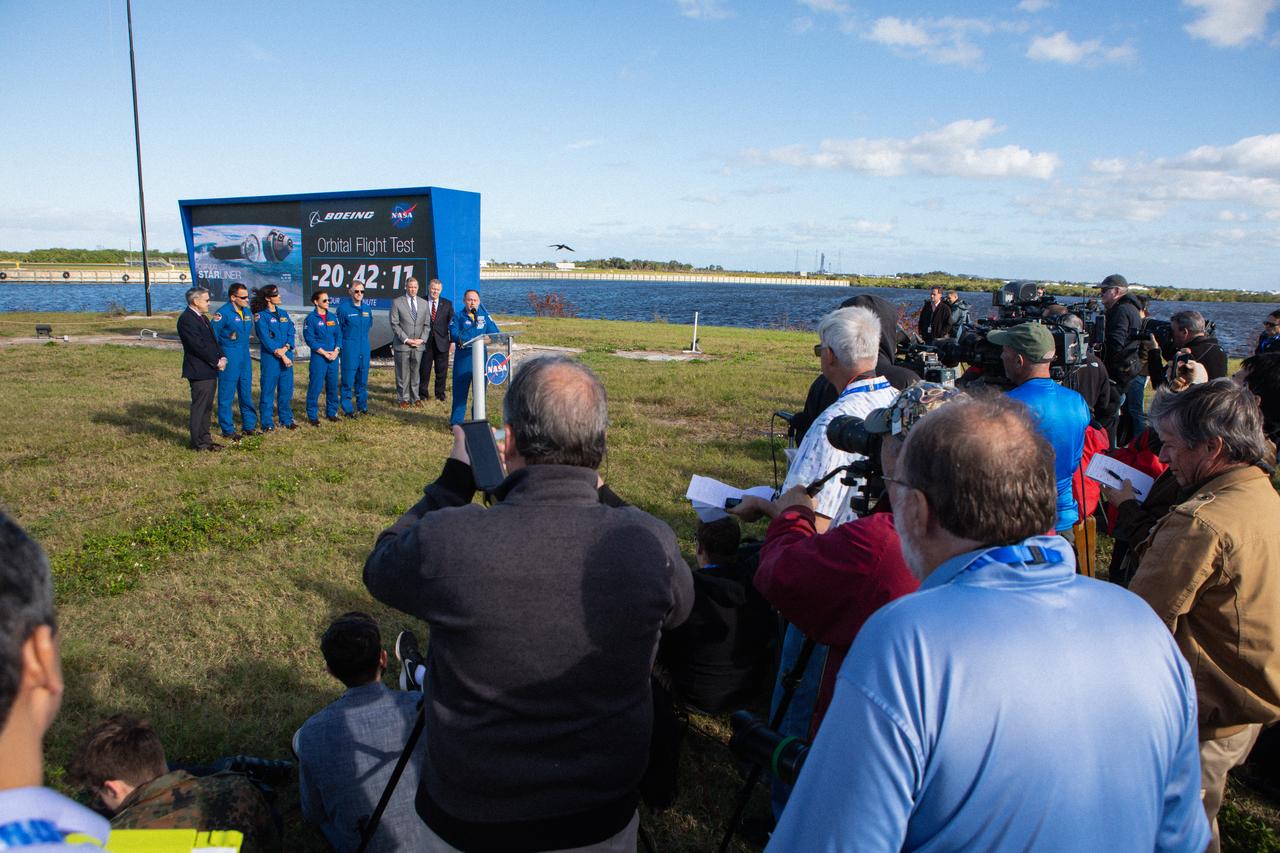
NASA Administrator Jim Bridenstine, Kennedy Space Center Director Bob Cabana, and astronauts representing NASA and Boeing participate in a Boeing Orbital Flight Test media briefing near the countdown clock at the Florida spaceport on Dec. 19, 2019. From left to right are Cabana; NASA astronauts Josh Cassada, Suni Williams and Nicole Mann; Boeing astronaut Chris Ferguson; Bridenstine; NASA Deputy Administrator Jim Morhard; and NASA astronaut Mike Finke. Boeing’s CST-100 Starliner spacecraft will launch atop a United Launch Alliance Atlas V rocket from Space Launch Complex 41 at Cape Canaveral Air Force Station. The uncrewed Orbital Flight Test will be the Starliner’s first flight to the International Space Station for NASA’s Commercial Crew Program.
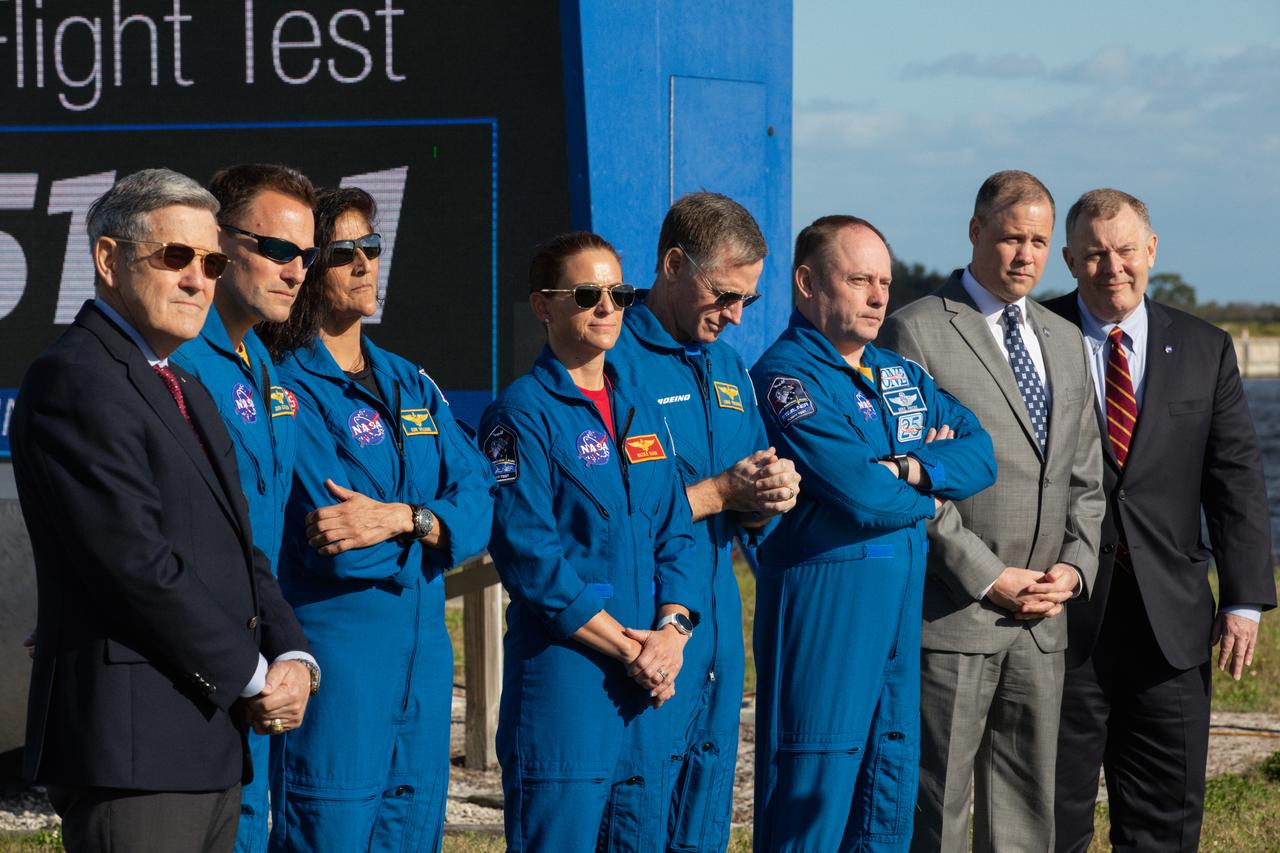
NASA Administrator Jim Bridenstine, Kennedy Space Center Director Bob Cabana, and astronauts representing NASA and Boeing participate in a Boeing Orbital Flight Test media briefing near the countdown clock at the Florida spaceport on Dec. 19, 2019. From left to right are Cabana; NASA astronauts Josh Cassada, Suni Williams and Nicole Mann; Boeing astronaut Chris Ferguson; NASA astronaut Mike Finke; Bridenstine; and NASA Deputy Administrator Jim Morhard. Boeing’s CST-100 Starliner spacecraft will launch atop a United Launch Alliance Atlas V rocket from Space Launch Complex 41 at Cape Canaveral Air Force Station. The uncrewed Orbital Flight Test will be the Starliner’s first flight to the International Space Station for NASA’s Commercial Crew Program.
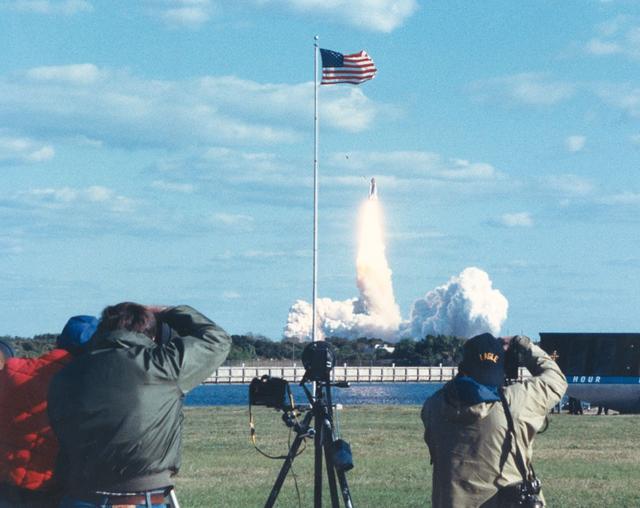
Launch of STS-27, December 2, 1988. Note how the shuttle is framed by the Flag Pole (left) and the Clock (right)
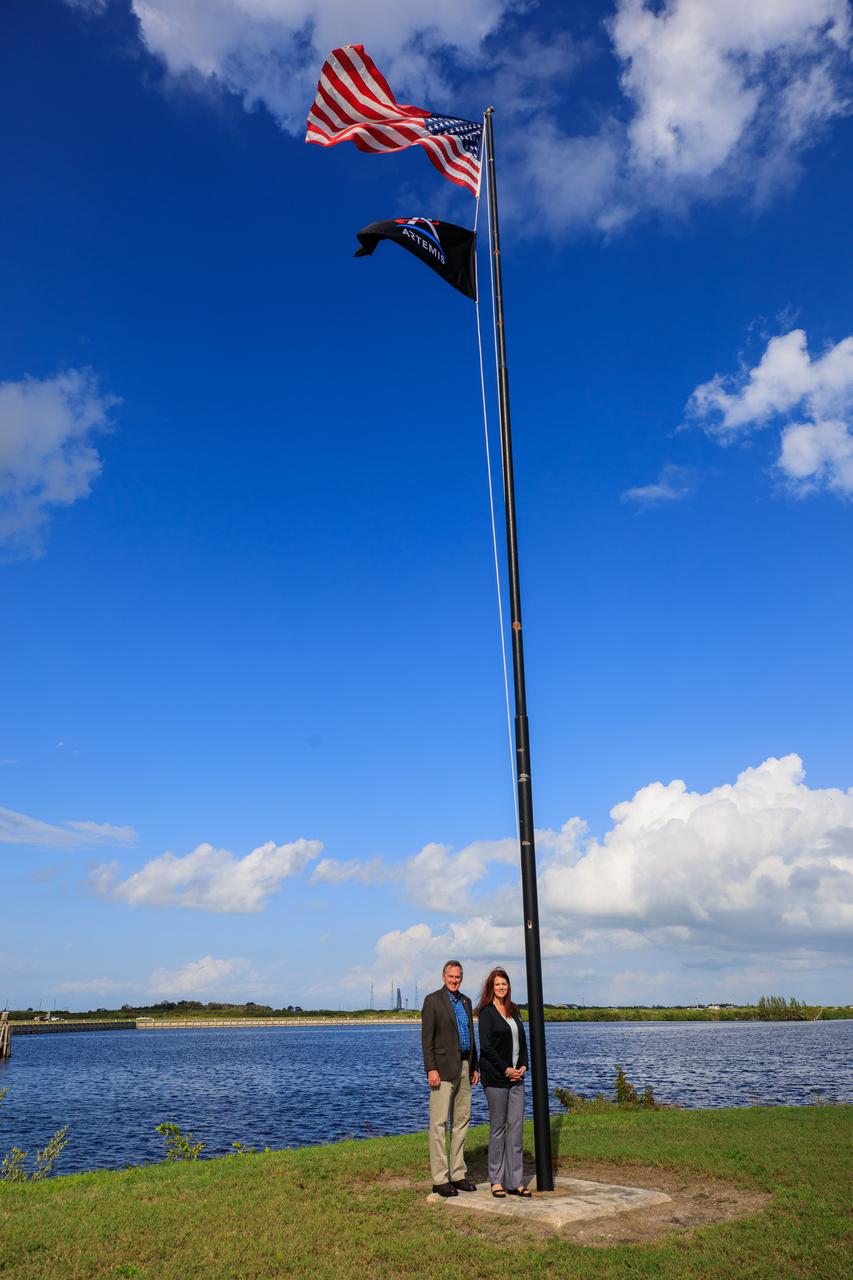
Exploration Ground Systems Manager Mike Bolger (left) and Artemis I Launch Director Charlie Blackwell-Thompson (right) raise the Artemis flag near the countdown clock at NASA’s Kennedy Space Center in Florida on Nov. 14, 2022. NASA’s Space Launch System (SLS) rocket and Orion spacecraft can be seen in the background at Kennedy’s Launch Pad 39B. The uncrewed Artemis I flight will be the first integrated test of the agency’s SLS rocket and Orion spacecraft and is scheduled to launch Wednesday, Nov. 16. The primary goal of Artemis I is to thoroughly test the integrated systems before crewed missions by launching Orion atop the SLS rocket, operating the spacecraft in a deep space environment, testing Orion’s heat shield, and recovering the crew module after reentry, descent, and splashdown. During the flight, Orion will launch atop the world’s most powerful rocket and fly farther than any human-rated spacecraft has ever flown, paving the way for human deep space exploration and demonstrating our commitment and capability to extend human presence to the Moon and beyond.
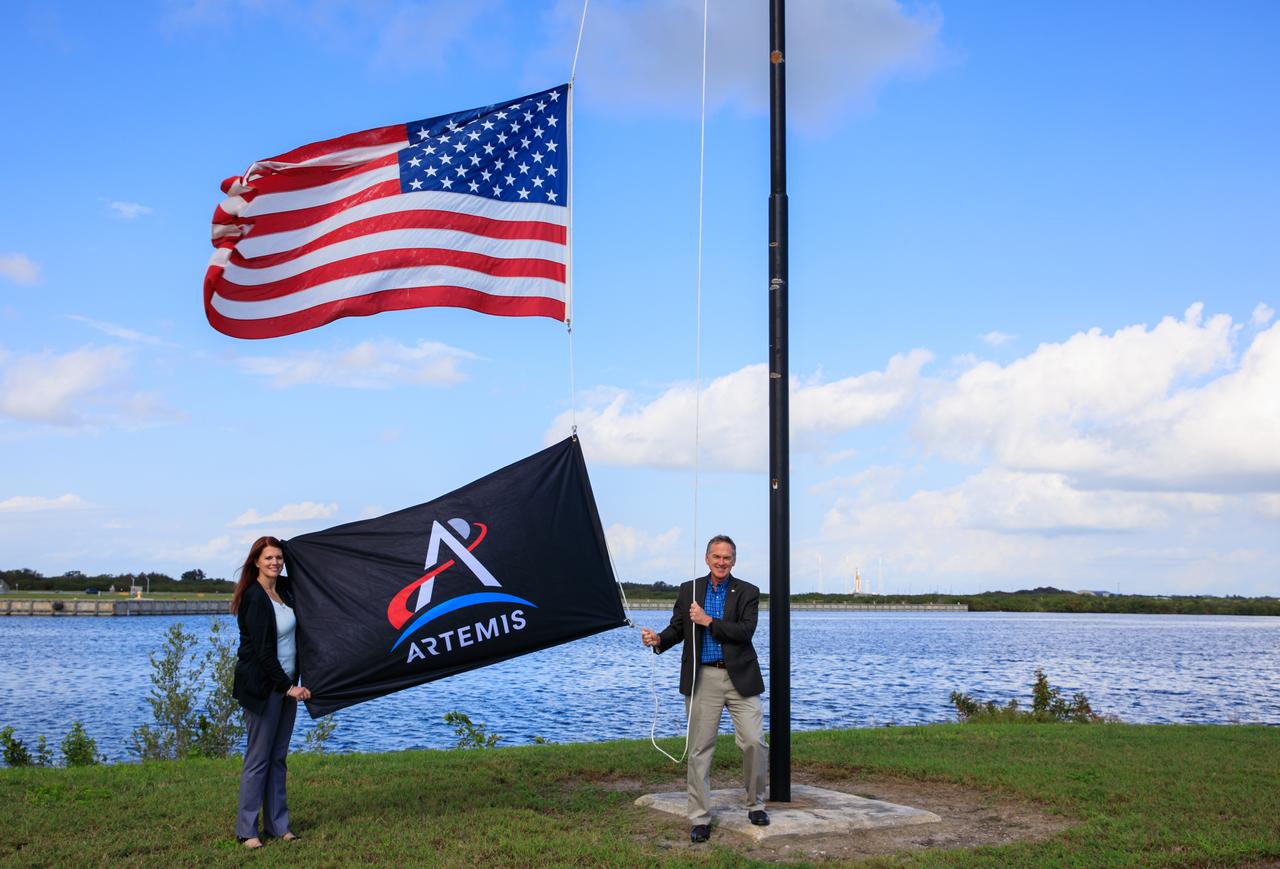
Artemis I Launch Director Charlie Blackwell-Thompson (left) and Exploration Ground Systems Manager Mike Bolger (right) raise the Artemis flag near the countdown clock at NASA’s Kennedy Space Center in Florida on Nov. 14, 2022. NASA’s Space Launch System (SLS) rocket and Orion spacecraft can be seen in the background at Kennedy’s Launch Pad 39B. The uncrewed Artemis I flight will be the first integrated test of the agency’s SLS rocket and Orion spacecraft and is scheduled to launch Wednesday, Nov. 16. The primary goal of Artemis I is to thoroughly test the integrated systems before crewed missions by launching Orion atop the SLS rocket, operating the spacecraft in a deep space environment, testing Orion’s heat shield, and recovering the crew module after reentry, descent, and splashdown. During the flight, Orion will launch atop the world’s most powerful rocket and fly farther than any human-rated spacecraft has ever flown, paving the way for human deep space exploration and demonstrating our commitment and capability to extend human presence to the Moon and beyond.
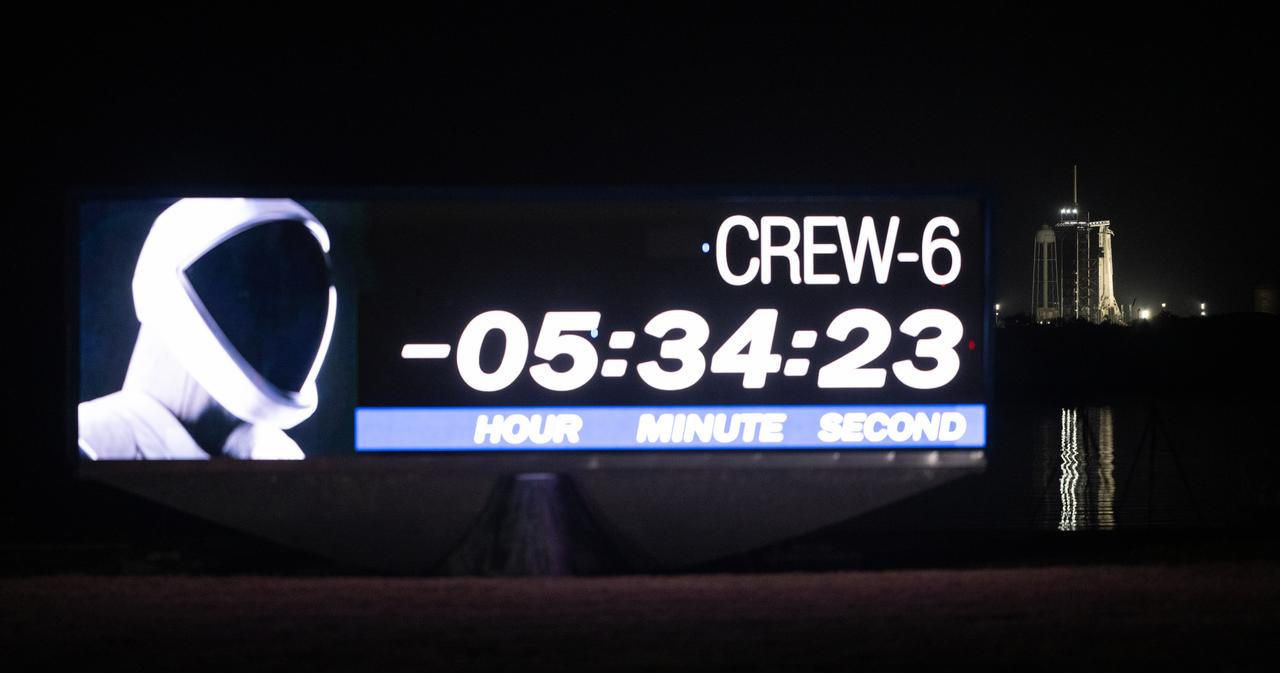
A SpaceX Falcon 9 rocket with the company's Dragon spacecraft on top is seen on the launch pad at Launch Complex 39A next to the countdown clock at the press site as preparations continue for the Crew-6 mission, Sunday, Feb. 26, 2023, at NASA’s Kennedy Space Center in Florida. NASA’s SpaceX Crew-6 mission is the sixth crew rotation mission of the SpaceX Crew Dragon spacecraft and Falcon 9 rocket to the International Space Station as part of the agency’s Commercial Crew Program. NASA astronauts Stephen Bowen and Warren "Woody" Hoburg, UAE (United Arab Emirates) astronaut Sultan Alneyadi, and Roscosmos cosmonaut Andrey Fedyaev are scheduled to launch at 1:45 a.m. EST on Feb. 27, from Launch Complex 39A at the Kennedy Space Center. Photo Credit: (NASA/Joel Kowsky)
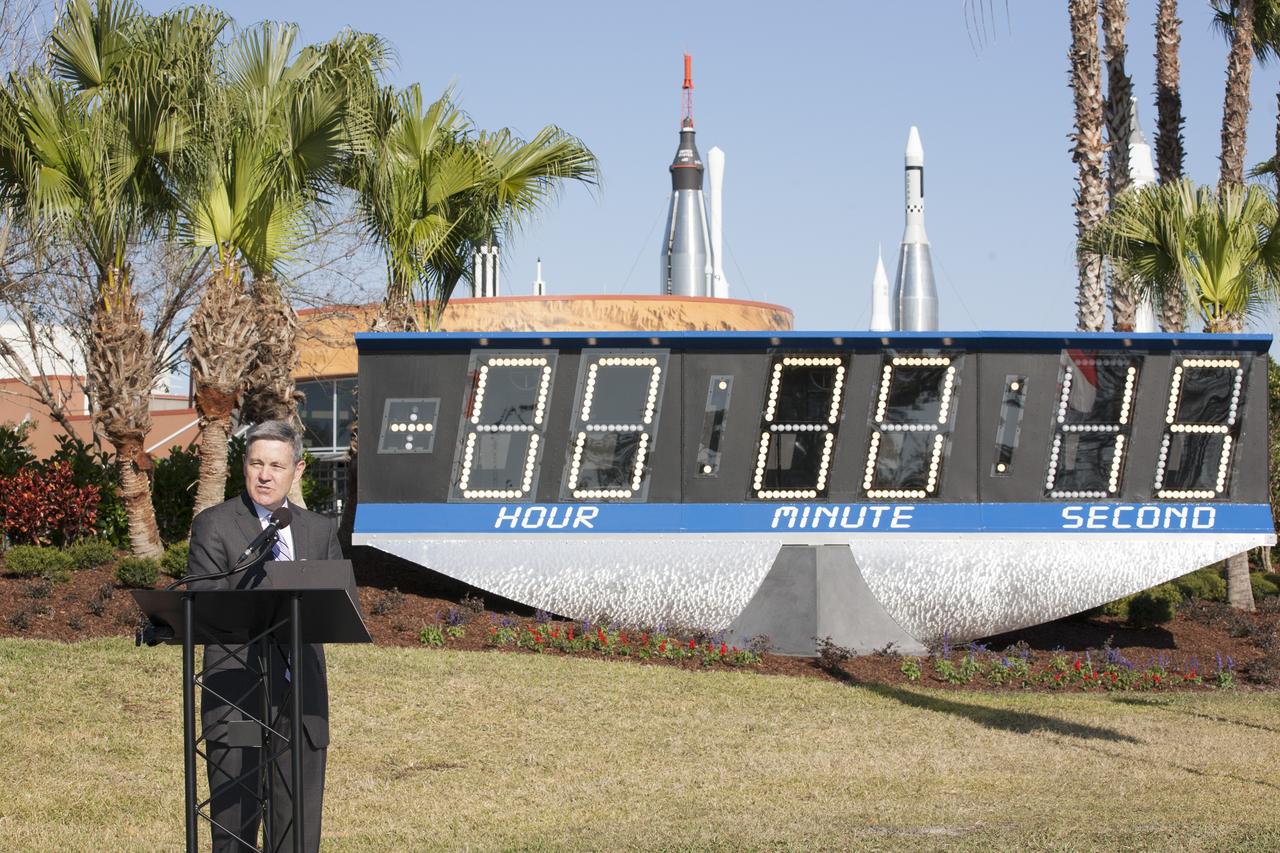
Kennedy Space Center Director Bob Cabana speaks at the dedication of the newest display at the entrance to the center's visitor complex. The historic countdown clock was originally set up at the space center's Press Site and was used from the launch of Apollo 12 on Nov. 14, 1969 to the final space shuttle mission, STS-135, launched on July 8, 2011. The old countdown clock was replaced in 2014 with a modern light emitting diode, or LED, display.
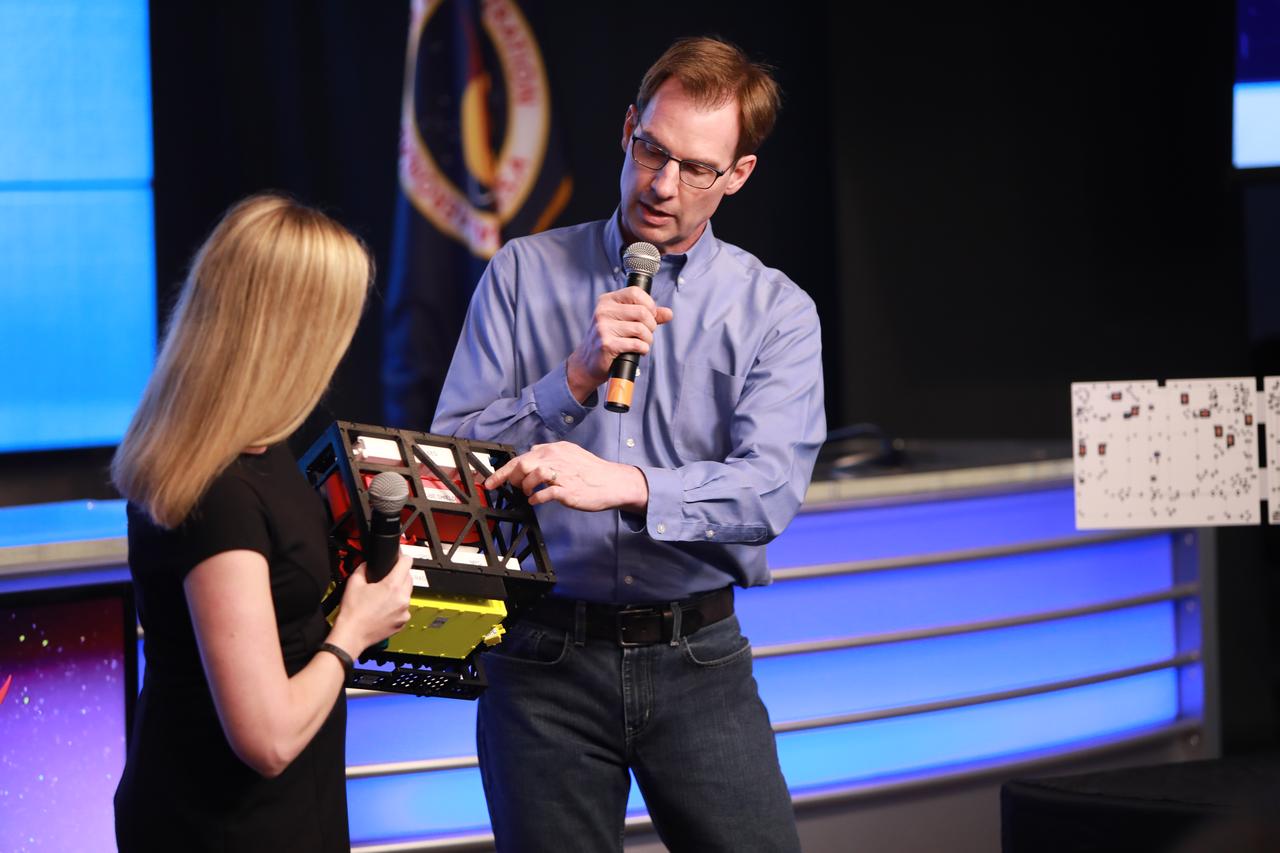
Todd Ely (right), principal investigator for NASA’s Deep Space Atomic Clock, and Deputy Principal Investigator Jill Seubert (left), both from NASA’s Jet Propulsion Laboratory in Pasadena, California, explain the payload during a NASA prelaunch technology TV broadcast for the Space Test Program-2 (STP-2) mission at the agency’s Kennedy Space Center in Florida on June 23, 2019. The new space clock could improve how we navigate on the Moon, to Mars and beyond. The space clock is one of four NASA payloads scheduled to launch on a SpaceX Falcon Heavy rocket from Launch Complex 39A beginning at 11:30 p.m. EDT on June 24, 2019. STP-2 is managed by the U.S. Air Force Space and Missile Systems Center.
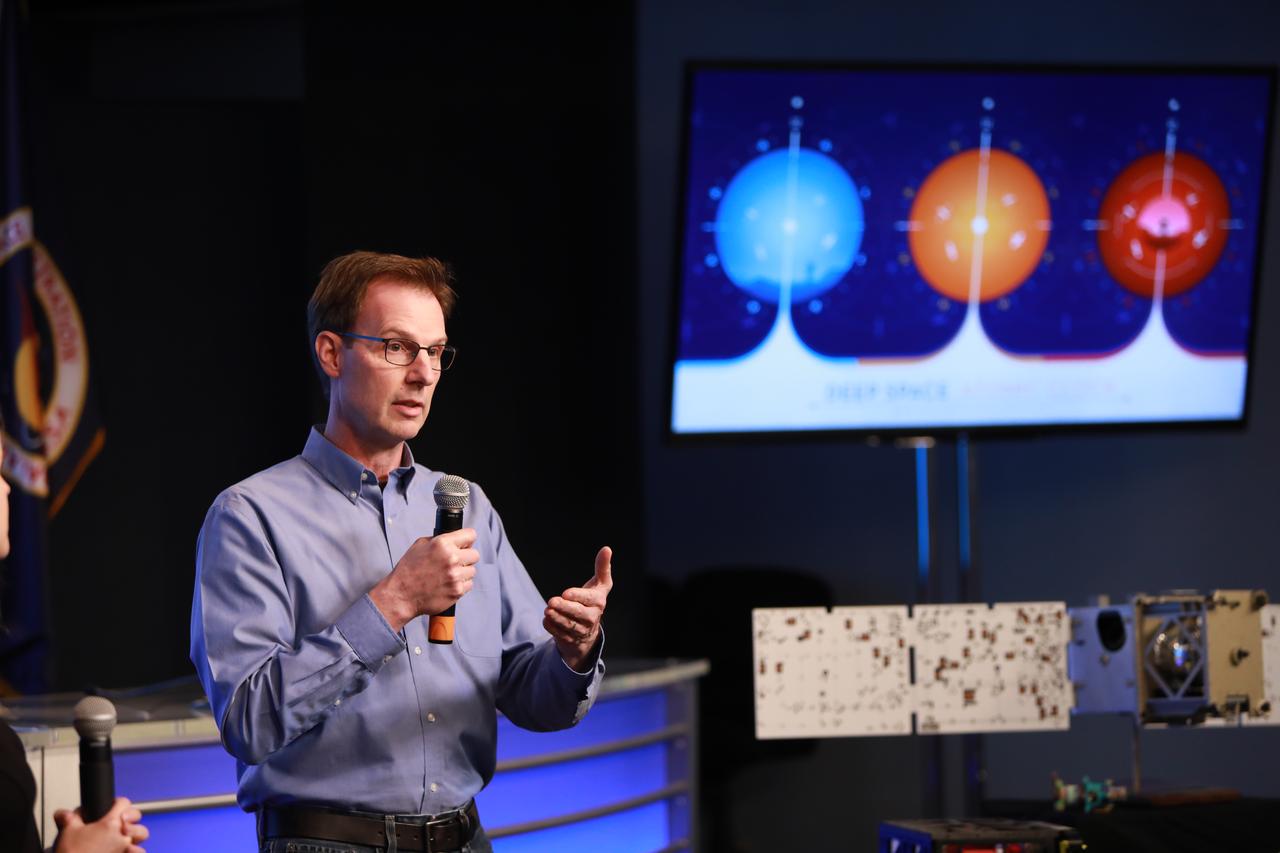
Todd Ely, principal investigator for NASA’s Deep Space Atomic Clock, from NASA’s Jet Propulsion Laboratory in Pasadena, California, explains the payload during a NASA prelaunch technology TV broadcast for the Space Test Program-2 (STP-2) mission at the agency’s Kennedy Space Center in Florida on June 23, 2019. The new space clock could improve how we navigate on the Moon, to Mars and beyond. The space clock is one of four NASA payloads scheduled to launch on a SpaceX Falcon Heavy rocket from Launch Complex 39A beginning at 11:30 p.m. EDT on June 24, 2019. STP-2 is managed by the U.S. Air Force Space and Missile Systems Center.
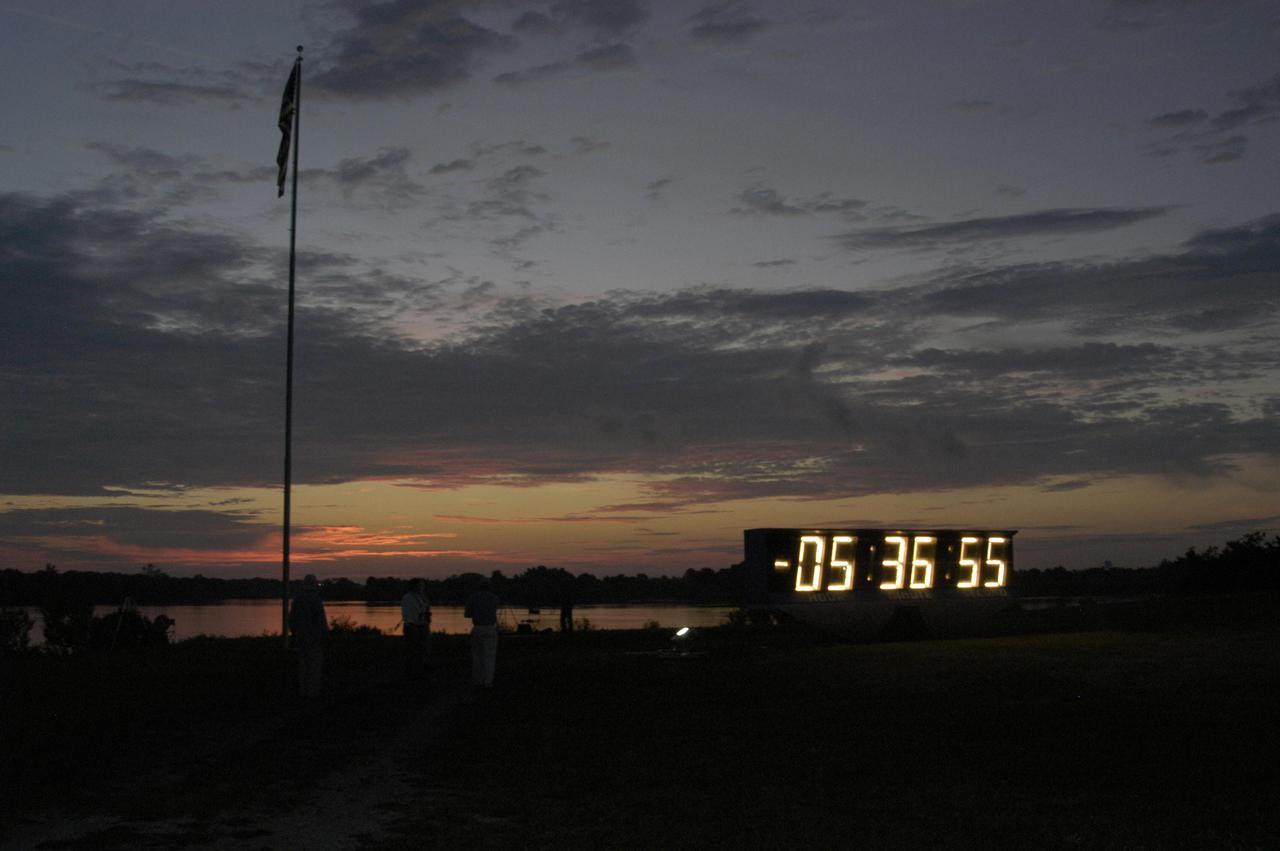
KENNEDY SPACE CENTER, FLA. - The countdown clock at NASA Kennedy Space Center glows in the dark as a hint of dawn creeps over the horizon. The clock counts down the hours until launch of Space Shuttle Discovery on Return to Flight mission STS-114 to the International Space Station. This is the first Space Shuttle flight since the loss of Columbia, STS-107, on Feb. 1, 2003. Launch is scheduled for 3:51 p.m. EDT from Launch Pad 39B. The 12-day mission is expected to end with touchdown at NASA Kennedy Space Center’s Shuttle Landing Facility at 11:06 a.m. July 25.
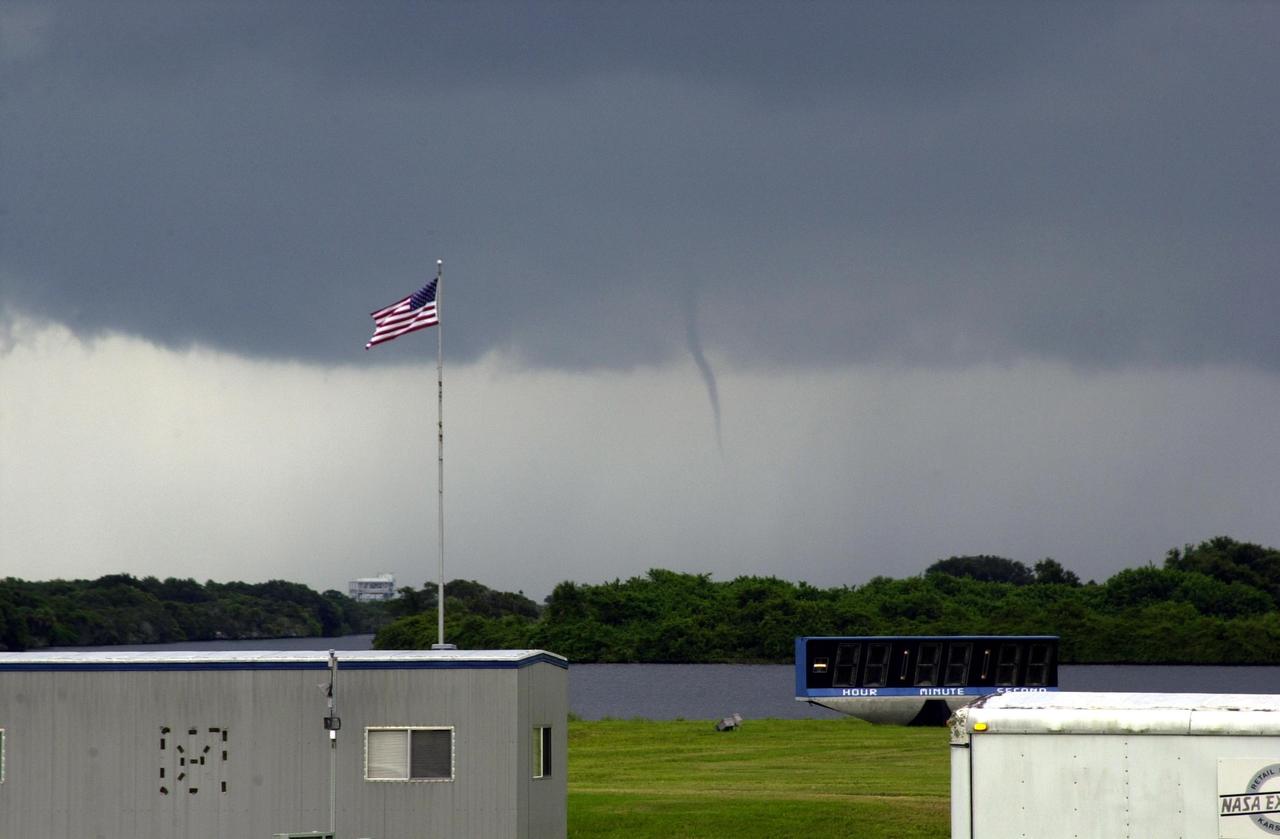
KENNEDY SPACE CENTER, FLA. -- A small water spout forms east of Launch Complex 39, Kennedy Space Center. The American flag is flying at the Press Site, near the mission countdown clock.

Jill Seubert, deputy principal investigator, from NASA’s Jet Propulsion Laboratory in Pasadena, California, explains the payload during a NASA prelaunch technology TV broadcast for the Space Test Program-2 (STP-2) mission at the agency’s Kennedy Space Center in Florida on June 23, 2019. The new space clock could improve how we navigate on the Moon, to Mars and beyond. The space clock is one of four NASA payloads scheduled to launch on a SpaceX Falcon Heavy rocket from Launch Complex 39A beginning at 11:30 p.m. EDT on June 24, 2019. STP-2 is managed by the U.S. Air Force Space and Missile Systems Center.

Jill Seubert, deputy principal investigator, from NASA’s Jet Propulsion Laboratory in Pasadena, California, explains the payload during a NASA prelaunch technology TV broadcast for the Space Test Program-2 (STP-2) mission at the agency’s Kennedy Space Center in Florida on June 23, 2019. The new space clock could improve how we navigate on the Moon, to Mars and beyond. The space clock is one of four NASA payloads scheduled to launch on a SpaceX Falcon Heavy rocket from Launch Complex 39A beginning at 11:30 p.m. EDT on June 24, 2019. STP-2 is managed by the U.S. Air Force Space and Missile Systems Center.
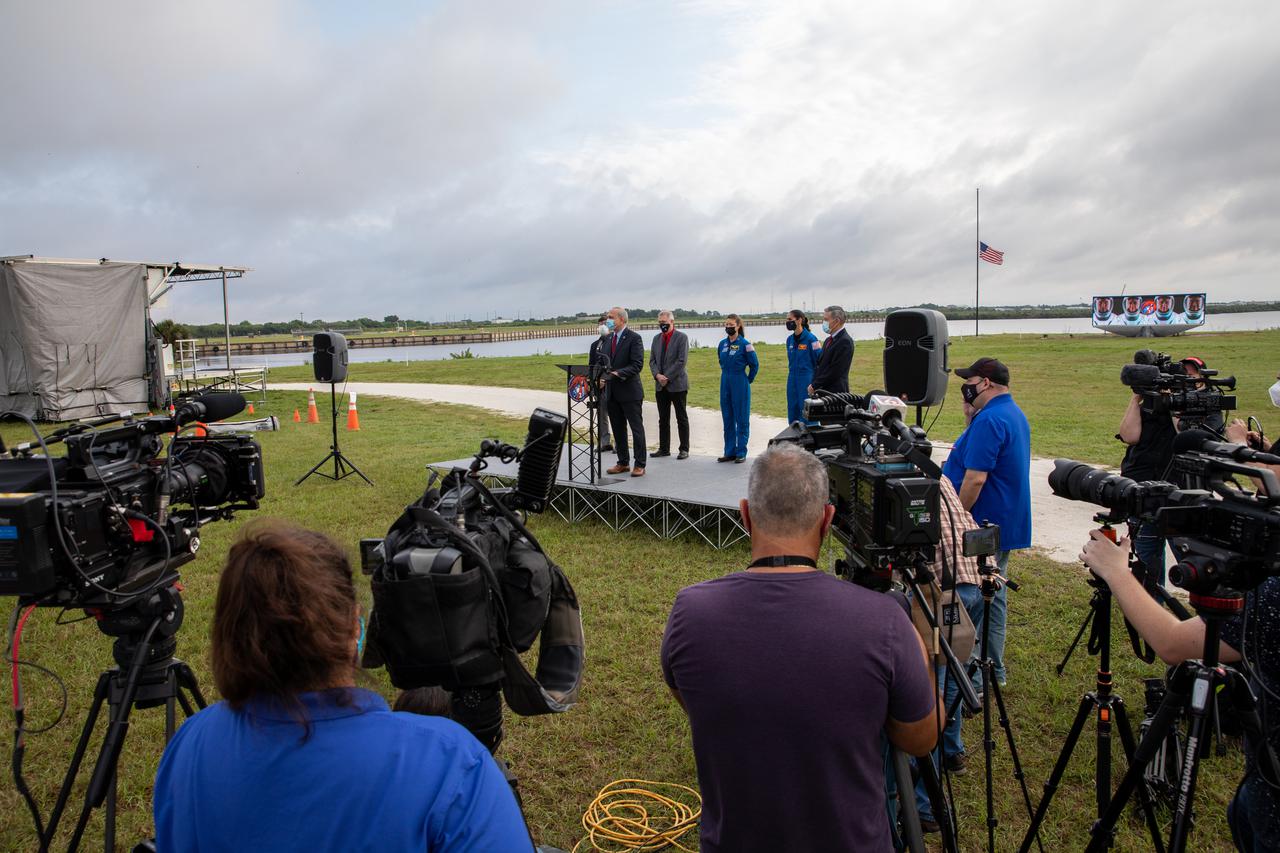
Members of the news media attend a press briefing April 21, 2021, near the Press Site countdown clock at NASA’s Kennedy Space Center in Florida ahead of the agency’s SpaceX Crew-2 launch. Crew-2 is the second regular crew mission of a U.S. commercial spacecraft with astronauts to the International Space Station as part of NASA’s Commercial Crew Program. The SpaceX Crew Dragon Endeavour capsule will launch atop the company’s Falcon 9 rocket from Launch Complex 39A to the space station for a six-month science mission. Liftoff is targeted for Friday, April 23, at 5:49 a.m. EDT.
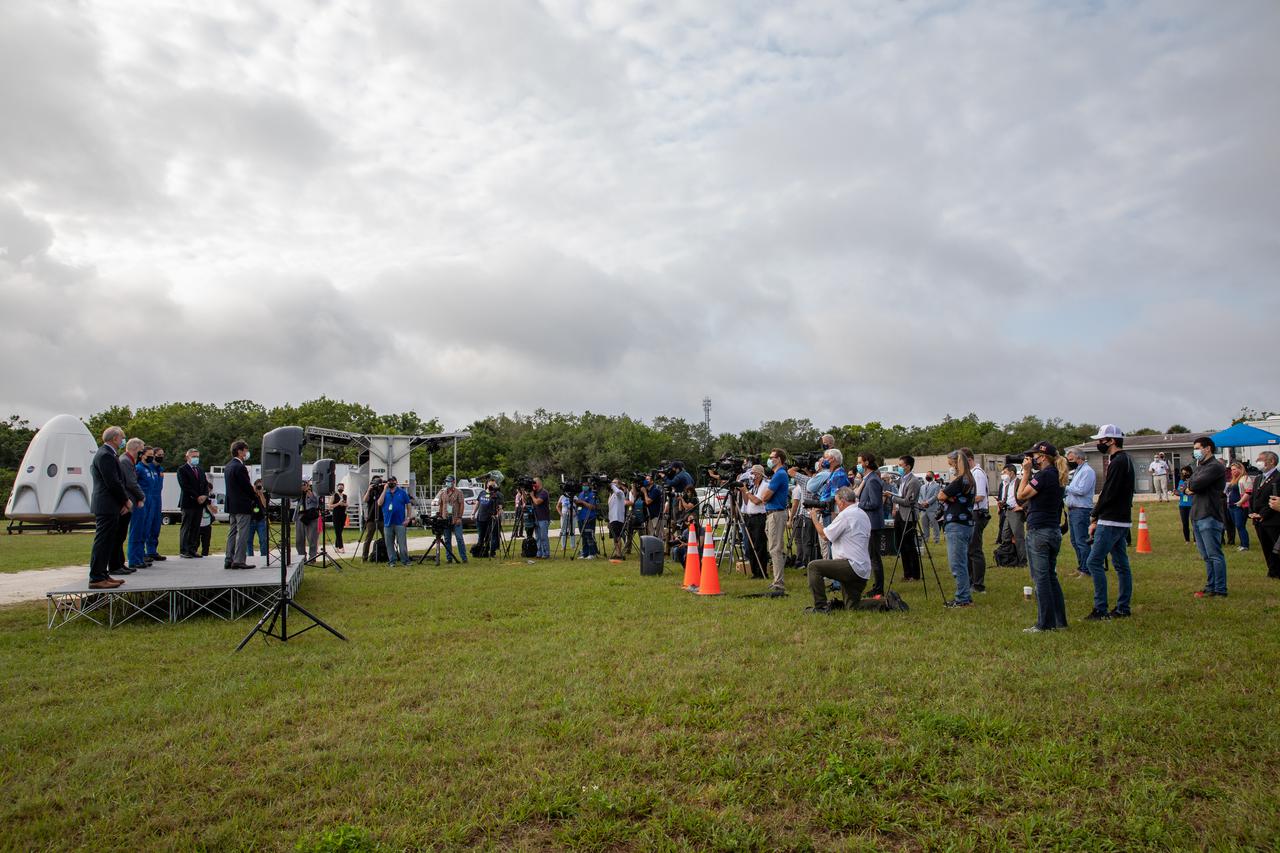
Members of the news media attend a press briefing April 21, 2021, near the Press Site countdown clock at NASA’s Kennedy Space Center in Florida ahead of the agency’s SpaceX Crew-2 launch. Crew-2 is the second regular crew mission of a U.S. commercial spacecraft with astronauts to the International Space Station as part of NASA’s Commercial Crew Program. The SpaceX Crew Dragon Endeavour capsule will launch atop the company’s Falcon 9 rocket from Launch Complex 39A to the space station for a six-month science mission. Liftoff is targeted for Friday, April 23, at 5:49 a.m. EDT.
Members of the news media attend a press briefing April 21, 2021, near the Press Site countdown clock at NASA’s Kennedy Space Center in Florida ahead of the agency’s SpaceX Crew-2 launch. Crew-2 is the second regular crew mission of a U.S. commercial spacecraft with astronauts to the International Space Station as part of NASA’s Commercial Crew Program. The SpaceX Crew Dragon Endeavour capsule will launch atop the company’s Falcon 9 rocket from Launch Complex 39A to the space station for a six-month science mission. Liftoff is targeted for Friday, April 23, at 5:49 a.m. EDT.
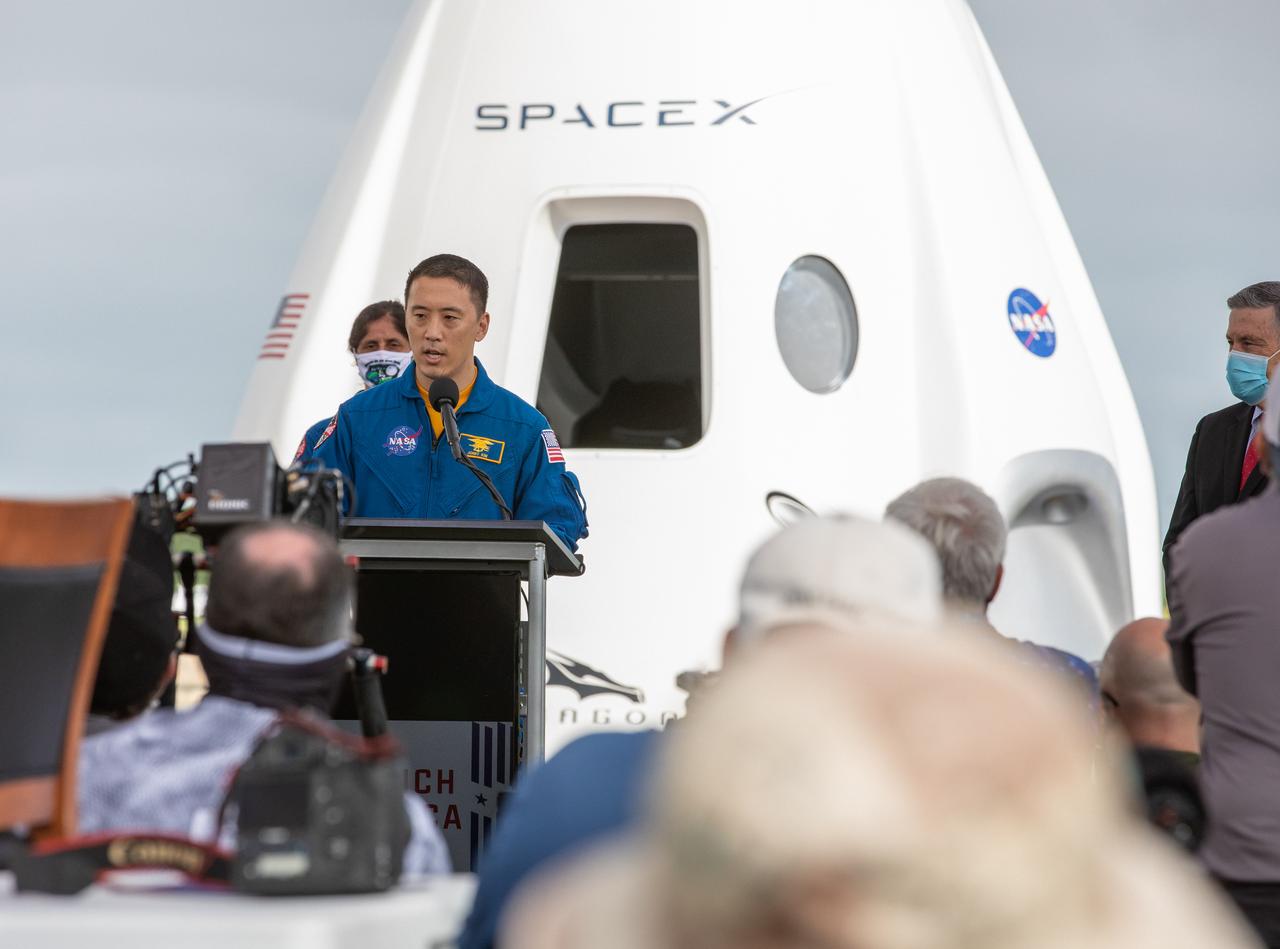
NASA astronaut Jonny Kim, speaks during a press briefing Nov. 13, 2020, near the Press Site countdown clock at the agency’s Kennedy Space Center in Florida ahead of NASA’s SpaceX Crew-1 launch. Behind him is a mock-up of the SpaceX Crew Dragon capsule. Crew-1 is the first regular crew mission of a U.S. commercial spacecraft with astronauts to the International Space Station as part of NASA’s Commercial Crew Program. The SpaceX Crew Dragon Resilience capsule will launch atop the company’s Falcon 9 rocket from Launch Complex 39A to the space station for a six-month science mission.
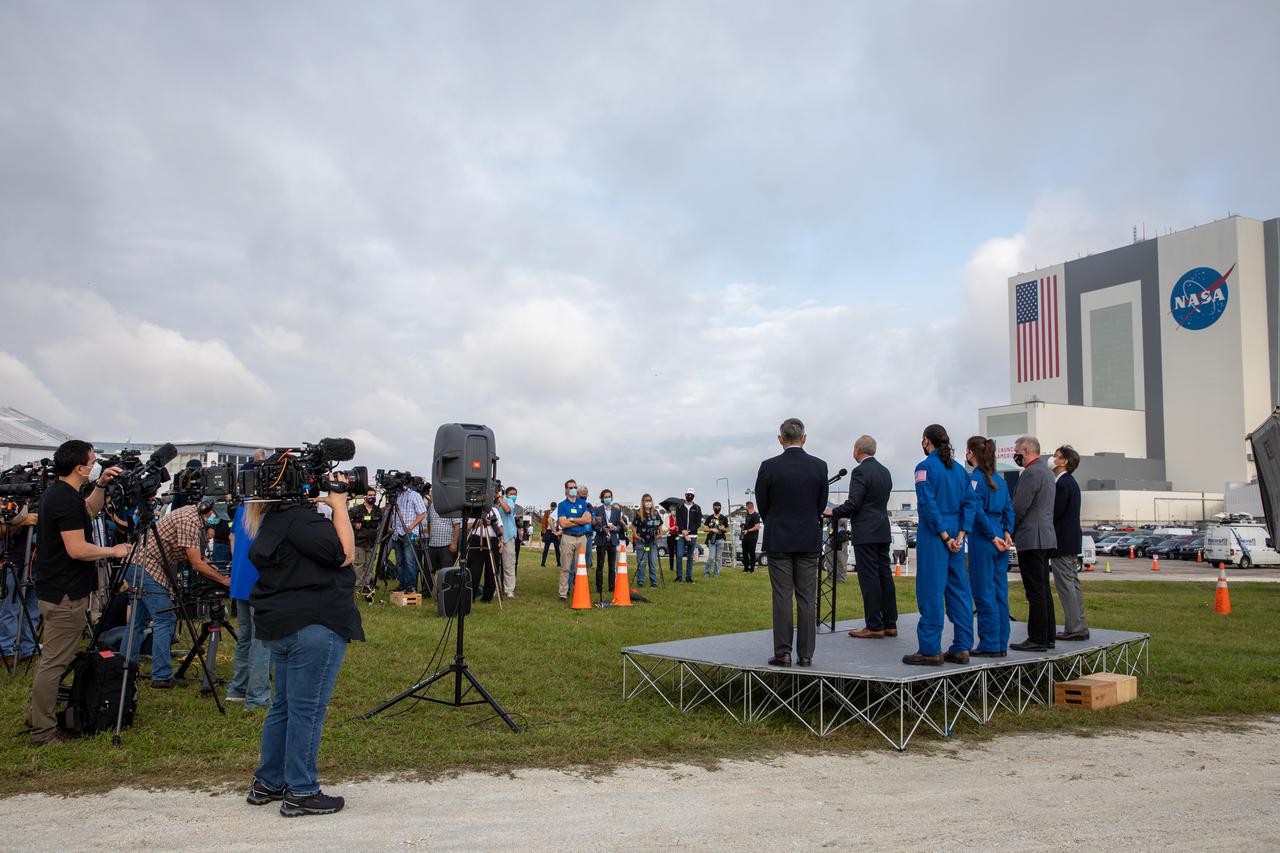
Members of the news media attend a press briefing April 21, 2021, near the Press Site countdown clock at NASA’s Kennedy Space Center in Florida ahead of the agency’s SpaceX Crew-2 launch. Crew-2 is the second regular crew mission of a U.S. commercial spacecraft with astronauts to the International Space Station as part of NASA’s Commercial Crew Program. The SpaceX Crew Dragon Endeavour capsule will launch atop the company’s Falcon 9 rocket from Launch Complex 39A to the space station for a six-month science mission. Liftoff is targeted for Friday, April 23, at 5:49 a.m. EDT.
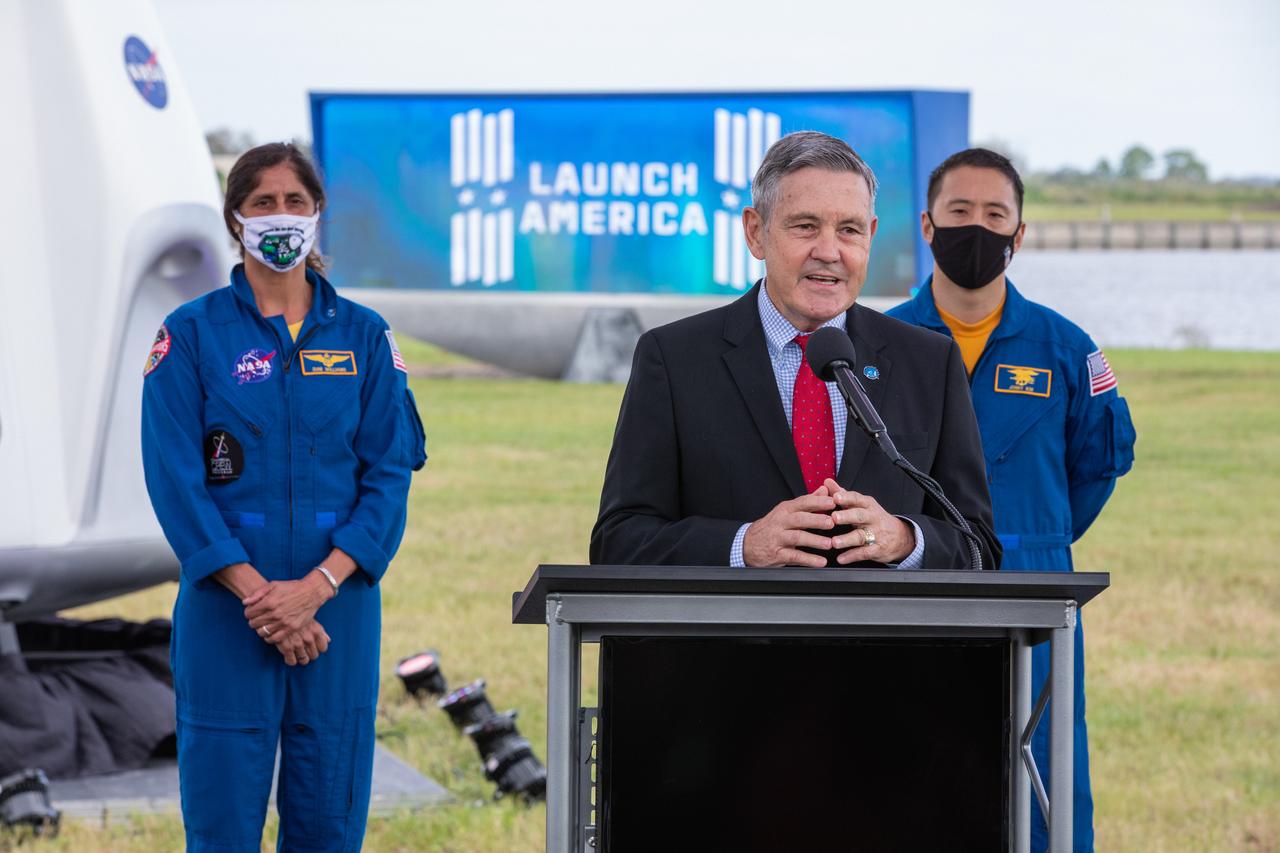
Kennedy Space Center Director Bob Cabana speaks during a press briefing Nov. 13, 2020, near the Press Site countdown clock at the agency’s Kennedy Space Center in Florida ahead of NASA’s SpaceX Crew-1 launch. Behind him are NASA astronaut Sunita Williams, at left, and NASA astronaut Jonny Kim. Crew-1 is the first regular crew mission of a U.S. commercial spacecraft with astronauts to the International Space Station as part of NASA’s Commercial Crew Program. The SpaceX Crew Dragon Resilience capsule will launch atop the company’s Falcon 9 rocket from Launch Complex 39A to the space station for a six-month science mission.
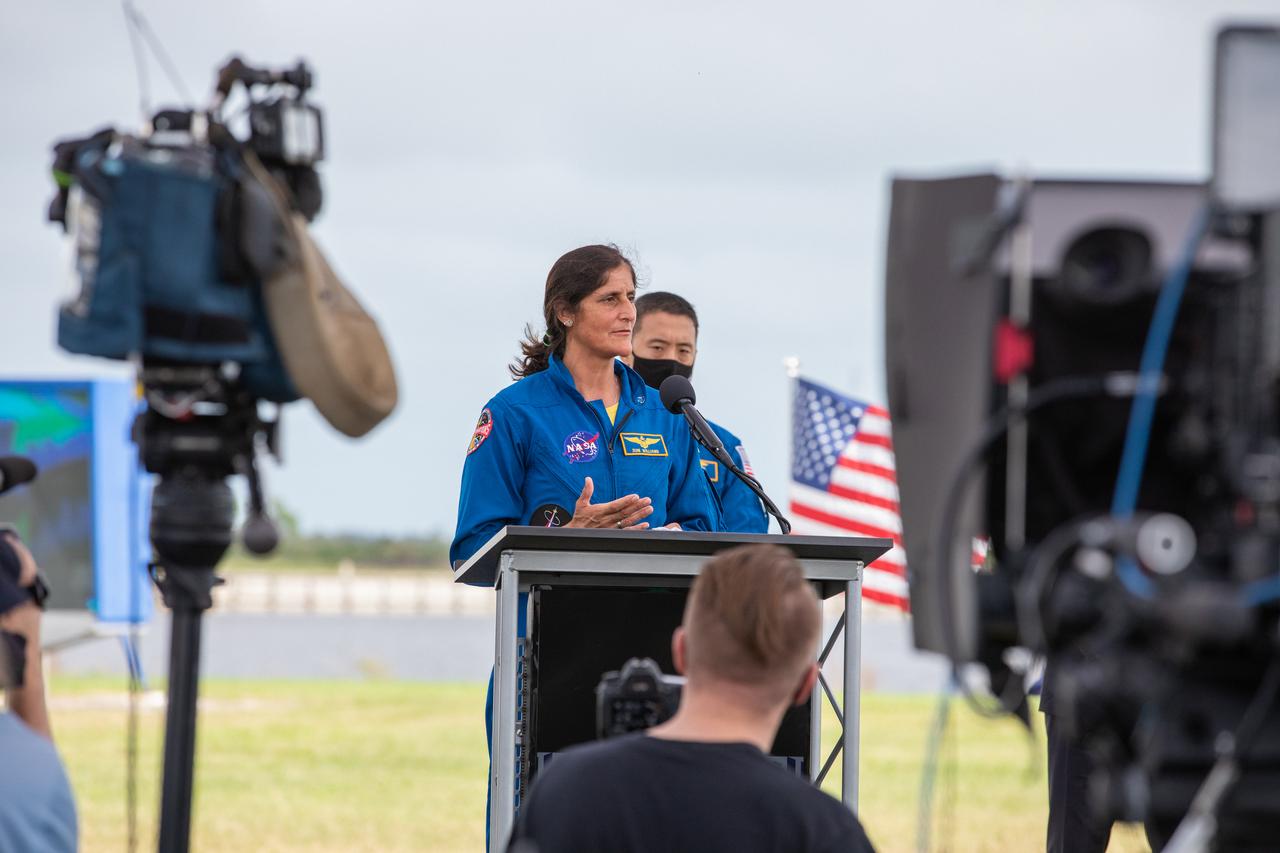
NASA astronaut Sunita Williams, speaks during a press briefing Nov. 13, 2020, near the Press Site countdown clock at the agency’s Kennedy Space Center in Florida ahead of NASA’s SpaceX Crew-1 launch. Behind him is a mock-up of the SpaceX Crew Dragon capsule. Crew-1 is the first regular crew mission of a U.S. commercial spacecraft with astronauts to the International Space Station as part of NASA’s Commercial Crew Program. The SpaceX Crew Dragon Resilience capsule will launch atop the company’s Falcon 9 rocket from Launch Complex 39A to the space station for a six-month science mission.
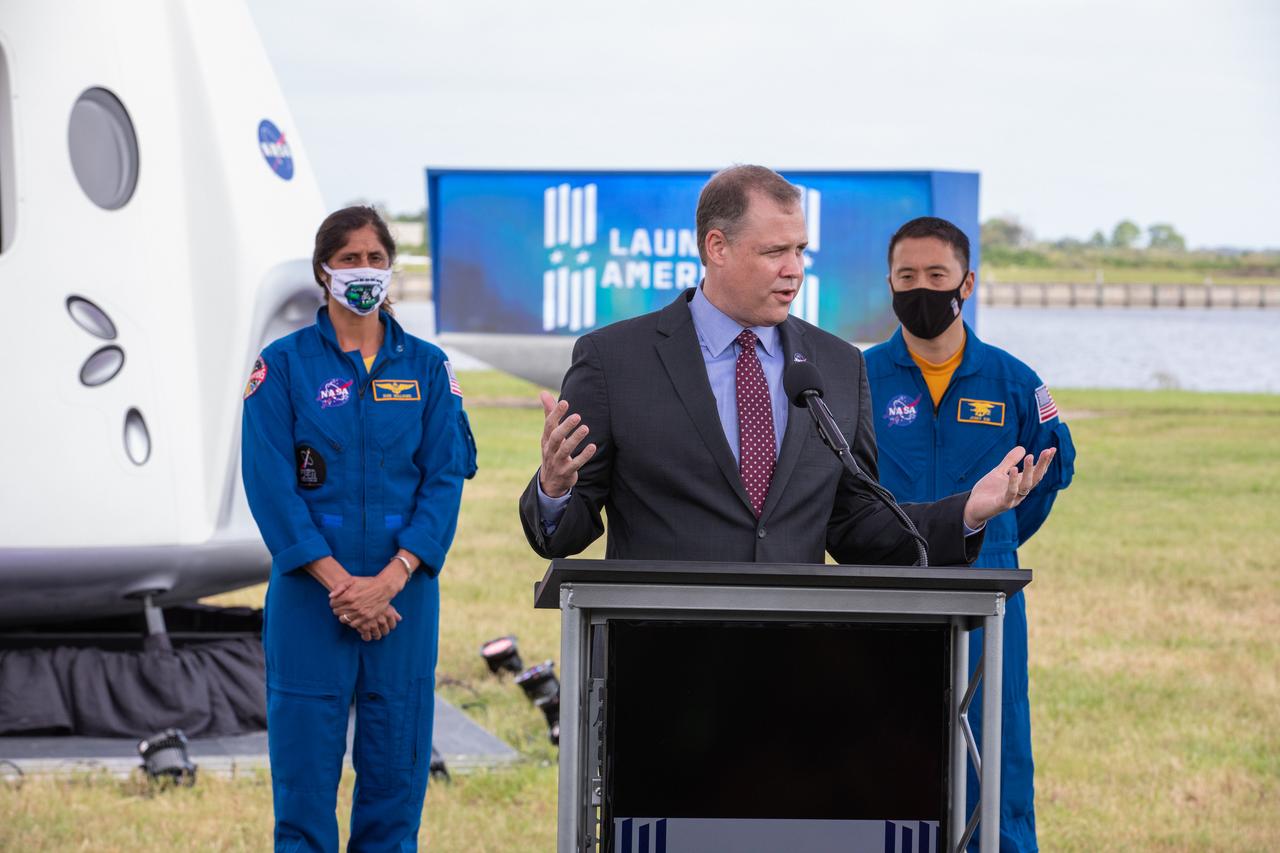
NASA Administrator Jim Bridenstine speaks during a press briefing Nov. 13, 2020, near the Press Site countdown clock at the agency’s Kennedy Space Center in Florida ahead of NASA’s SpaceX Crew-1 launch. Behind him, from left are NASA astronaut Sunita Williams, and NASA astronaut Jonny Kim. Crew-1 is the first regular crew mission of a U.S. commercial spacecraft with astronauts to the International Space Station as part of NASA’s Commercial Crew Program. The SpaceX Crew Dragon Resilience capsule will launch atop the company’s Falcon 9 rocket from Launch Complex 39A to the space station for a six-month science mission.
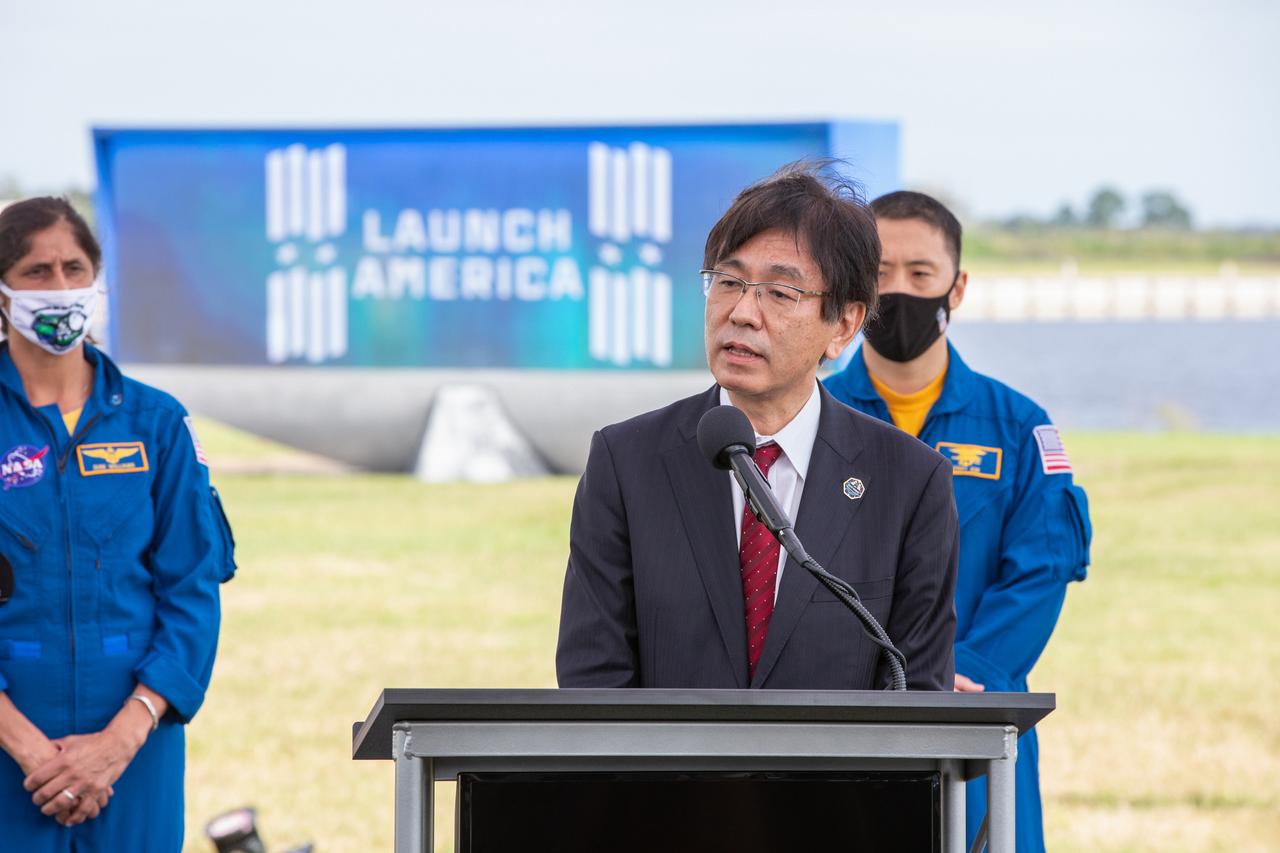
Hiroshi Sasaki, vice president and director general, JAXA’s Human Spaceflight, speaks during a press briefing Nov. 13, 2020, near the Press Site countdown clock at the agency’s Kennedy Space Center in Florida ahead of NASA’s SpaceX Crew-1 launch. Behind him, from left are NASA astronaut Sunita Williams, and NASA astronaut Jonny Kim. Crew-1 is the first regular crew mission of a U.S. commercial spacecraft with astronauts to the International Space Station as part of NASA’s Commercial Crew Program. The SpaceX Crew Dragon Resilience capsule will launch atop the company’s Falcon 9 rocket from Launch Complex 39A to the space station for a six-month science mission.
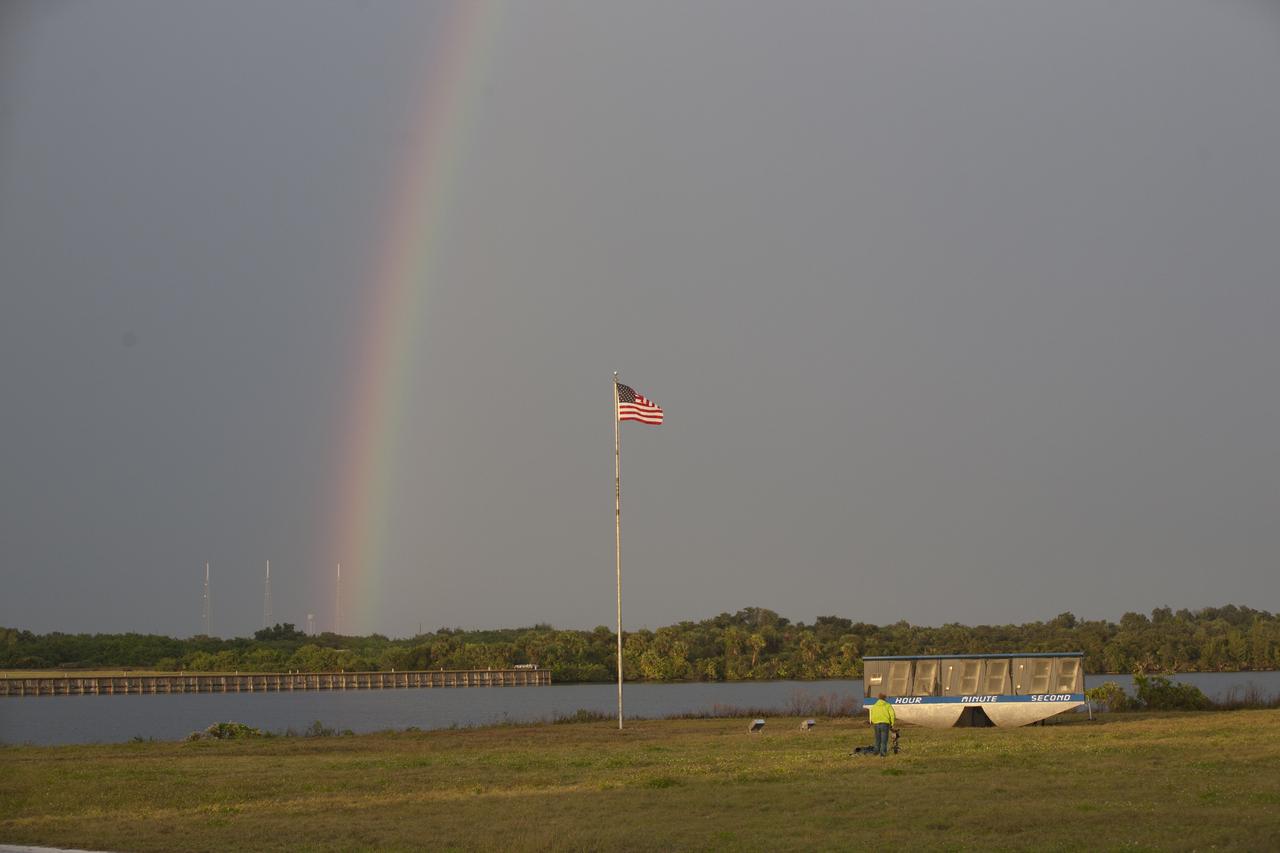
As rain showers dissipate, a rainbow appeared over the Kennedy Space Center's Press Site and turn basin. In the foreground is the historic countdown clock. In the background, is Launch Pad 39B where agency's Space Launch System will launch astronauts aboard the Orion spacecraft to deep-space destinations such as an asteroid and Mars.
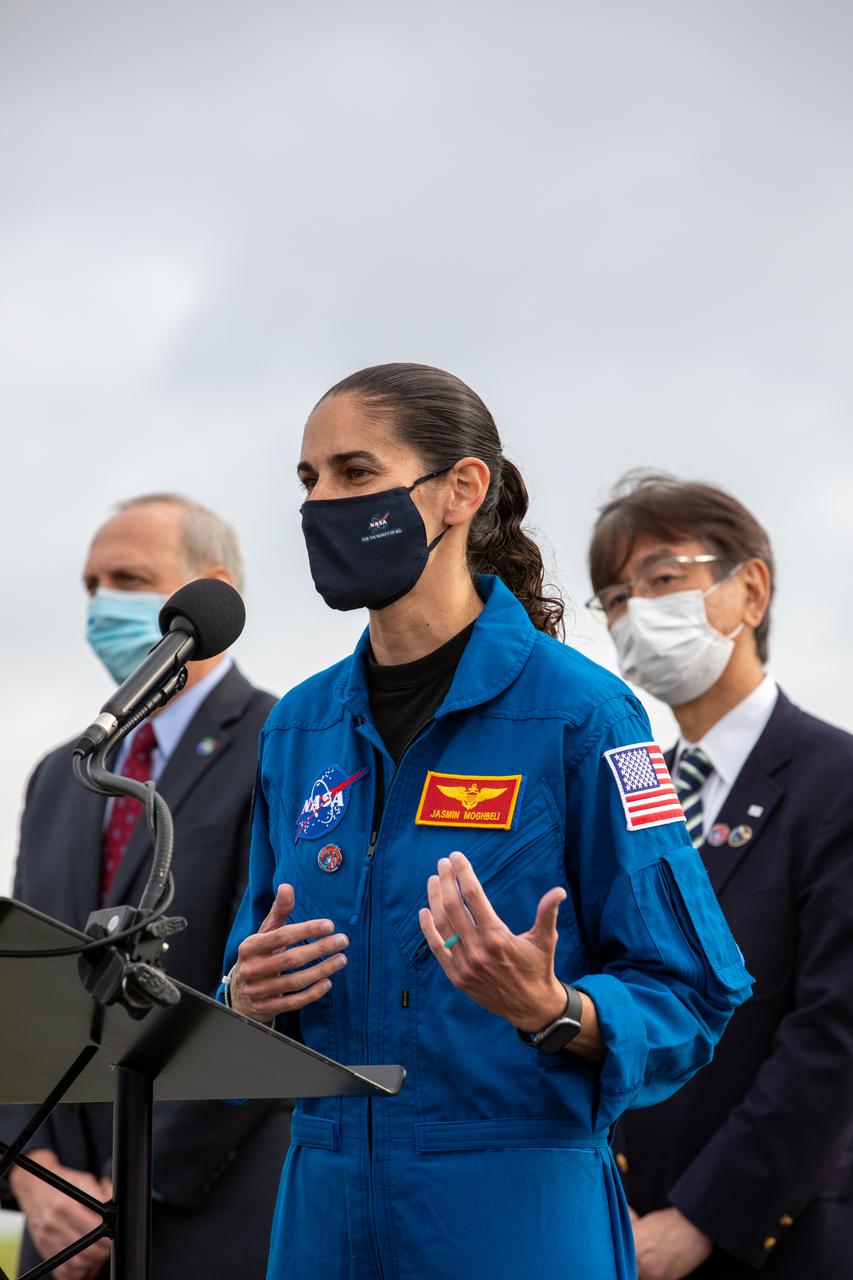
NASA astronaut Jasmin Moghbeli addresses members of the news media during a press briefing April 21, 2021, near the Press Site countdown clock at NASA’s Kennedy Space Center in Florida ahead of the agency’s SpaceX Crew-2 launch. NASA astronauts Shane Kimbrough and Megan McArthur, JAXA astronaut Akihiko Hoshide, and ESA astronaut Thomas Pesquet will fly on Crew-2, the second crew rotation mission to the International Space Station as part of NASA’s Commercial Crew Program. They will launch aboard SpaceX’s Crew Dragon spacecraft, named Endeavour, powered by the company’s Falcon 9 rocket. Liftoff is set for Friday, April 23, at 5:49 a.m. EDT.
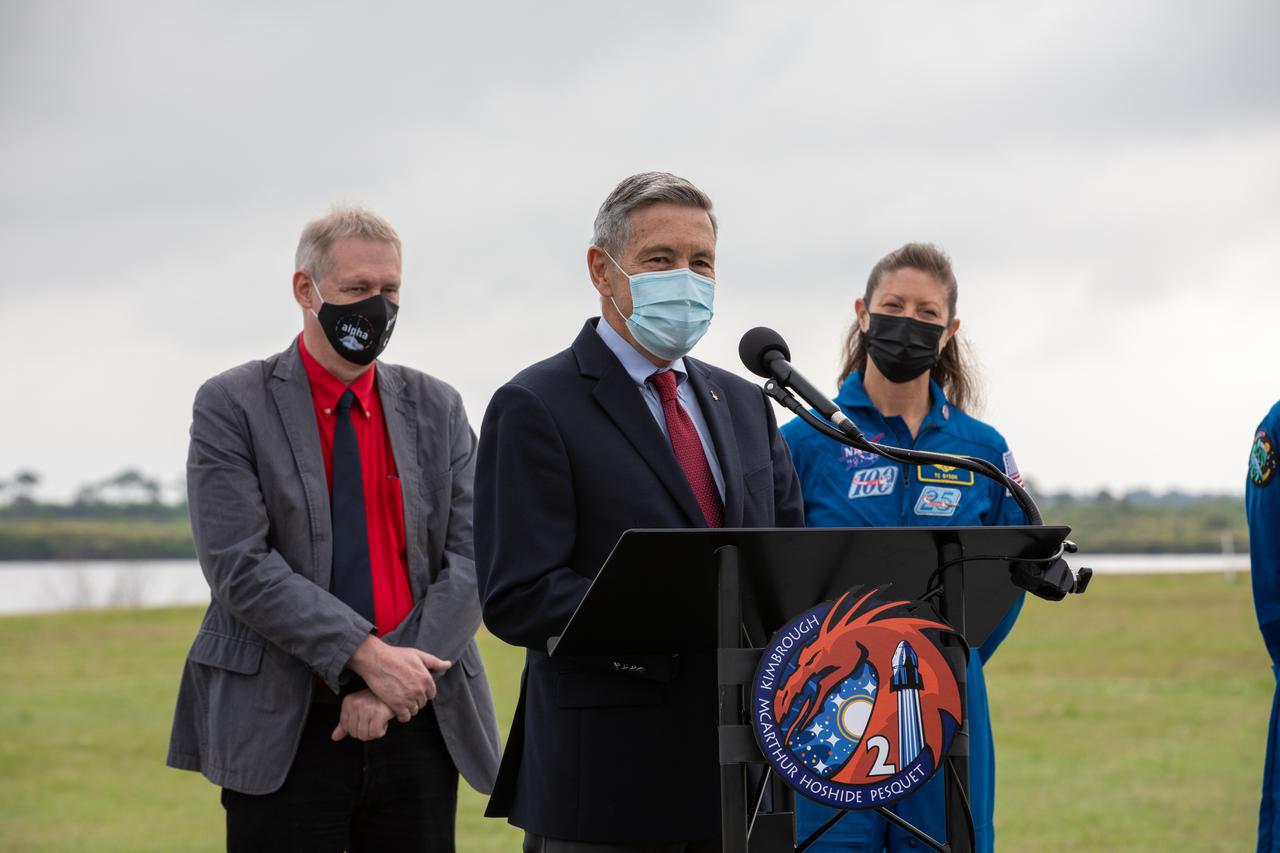
Kennedy Space Center Director Bob Cabana addresses members of the news media during a press briefing April 21, 2021, near the Press Site countdown clock at Kennedy ahead of the agency’s SpaceX Crew-2 launch. NASA astronauts Shane Kimbrough and Megan McArthur, JAXA astronaut Akihiko Hoshide, and ESA astronaut Thomas Pesquet will fly on Crew-2, the second crew rotation mission to the International Space Station as part of NASA’s Commercial Crew Program. They will launch aboard SpaceX’s Crew Dragon spacecraft, named Endeavour, powered by the company’s Falcon 9 rocket. Liftoff is set for Friday, April 23, at 5:49 a.m. EDT.
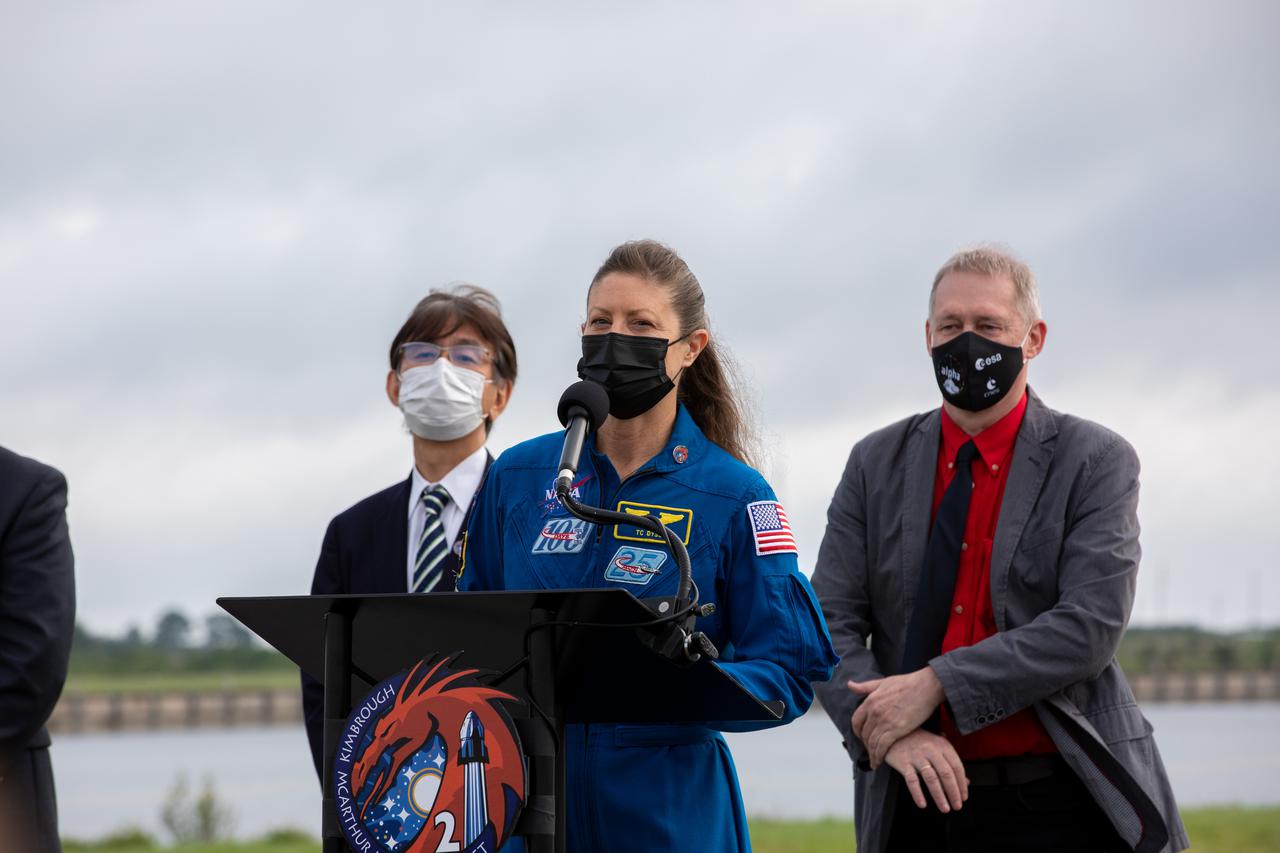
NASA astronaut Tracy Caldwell Dyson addresses members of the news media during a press briefing April 21, 2021, near the Press Site countdown clock at NASA’s Kennedy Space Center in Florida ahead of the agency’s SpaceX Crew-2 launch. NASA astronauts Shane Kimbrough and Megan McArthur, JAXA astronaut Akihiko Hoshide, and ESA astronaut Thomas Pesquet will fly on Crew-2, the second crew rotation mission to the International Space Station as part of NASA’s Commercial Crew Program. They will launch aboard SpaceX’s Crew Dragon spacecraft, named Endeavour, powered by the company’s Falcon 9 rocket. Liftoff is set for Friday, April 23, at 5:49 a.m. EDT.
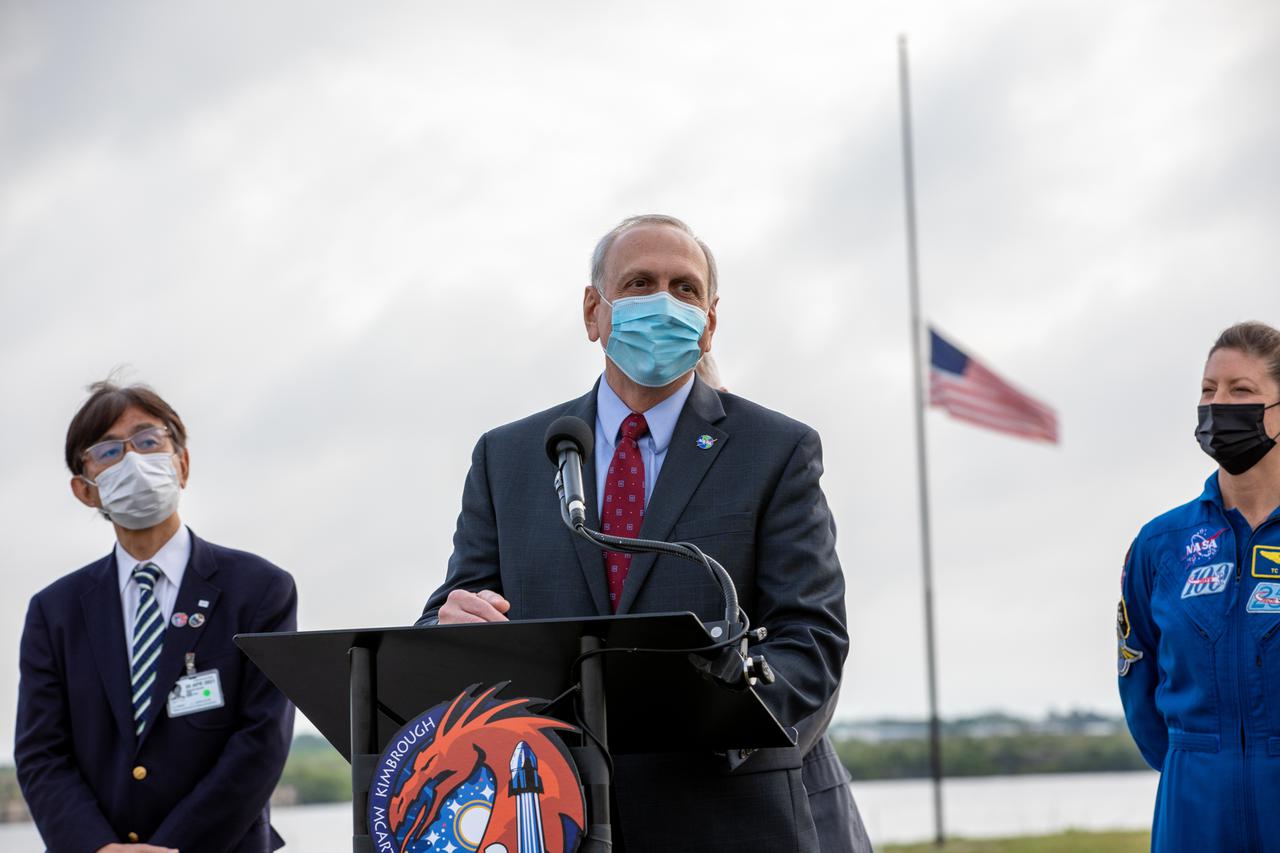
Steve Jurczyk, acting NASA administrator, addresses members of the news media during a press briefing April 21, 2021, near the Press Site countdown clock at NASA’s Kennedy Space Center in Florida ahead of the agency’s SpaceX Crew-2 launch. NASA astronauts Shane Kimbrough and Megan McArthur, JAXA astronaut Akihiko Hoshide, and ESA astronaut Thomas Pesquet will fly on Crew-2, the second crew rotation mission to the International Space Station as part of NASA’s Commercial Crew Program. They will launch aboard SpaceX’s Crew Dragon spacecraft, named Endeavour, powered by the company’s Falcon 9 rocket. Liftoff is set for Friday, April 23, at 5:49 a.m. EDT.
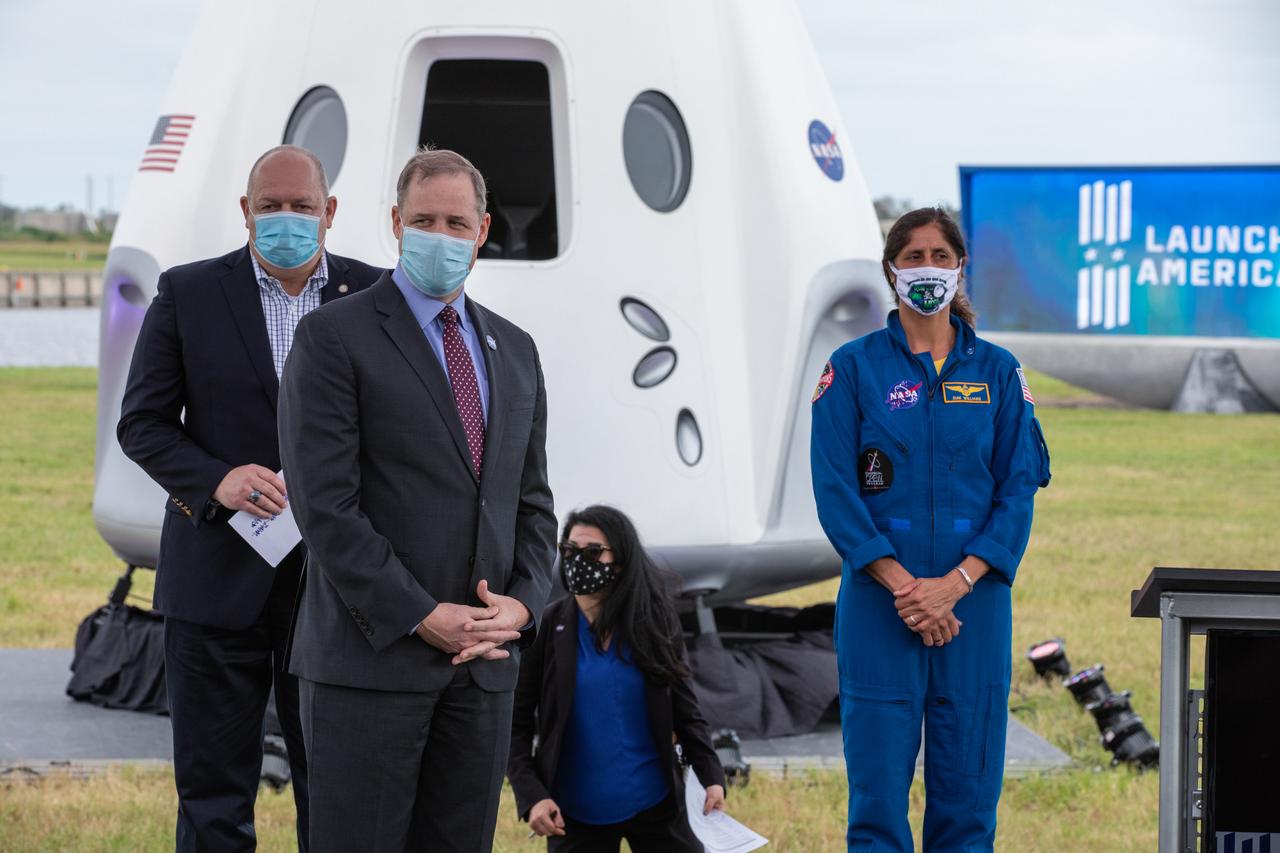
NASA Administrator Jim Bridenstine, center, prepares to speak during a press briefing Nov. 13, 2020, near the Press Site countdown clock at the agency’s Kennedy Space Center in Florida. Behind him, from left are Steve Dickson, administrator, Federal Aviation Administration, and NASA astronaut Sunita Williams. Crew-1 is the first regular crew mission of a U.S. commercial spacecraft with astronauts to the International Space Station as part of NASA’s Commercial Crew Program. The SpaceX Crew Dragon Resilience capsule will launch atop the company’s Falcon 9 rocket from Launch Complex 39A to the space station for a six-month science mission.
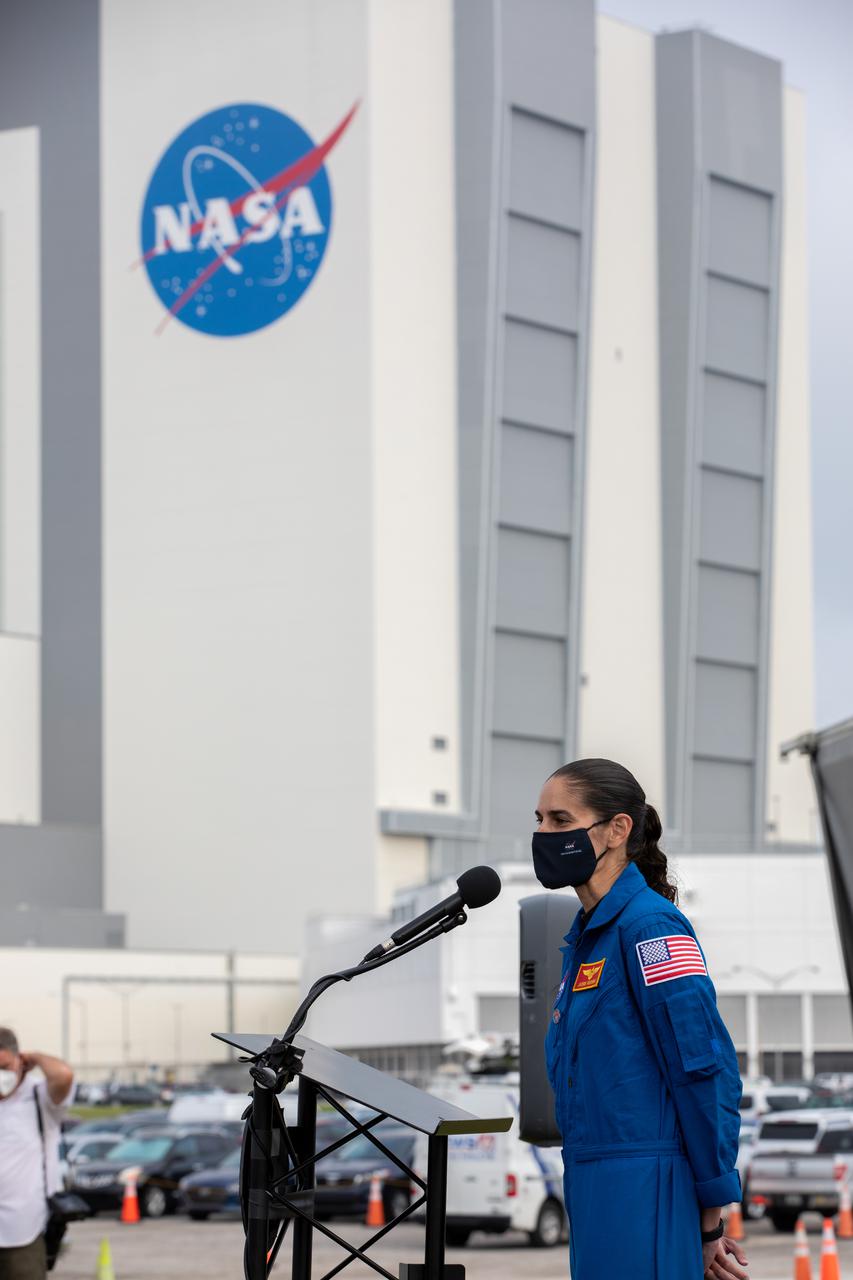
NASA astronaut Jasmin Moghbeli addresses members of the news media during a press briefing April 21, 2021, near the Press Site countdown clock at NASA’s Kennedy Space Center in Florida ahead of the agency’s SpaceX Crew-2 launch. NASA astronauts Shane Kimbrough and Megan McArthur, JAXA astronaut Akihiko Hoshide, and ESA astronaut Thomas Pesquet will fly on Crew-2, the second crew rotation mission to the International Space Station as part of NASA’s Commercial Crew Program. They will launch aboard SpaceX’s Crew Dragon spacecraft, named Endeavour, powered by the company’s Falcon 9 rocket. Liftoff is set for Friday, April 23, at 5:49 a.m. EDT.
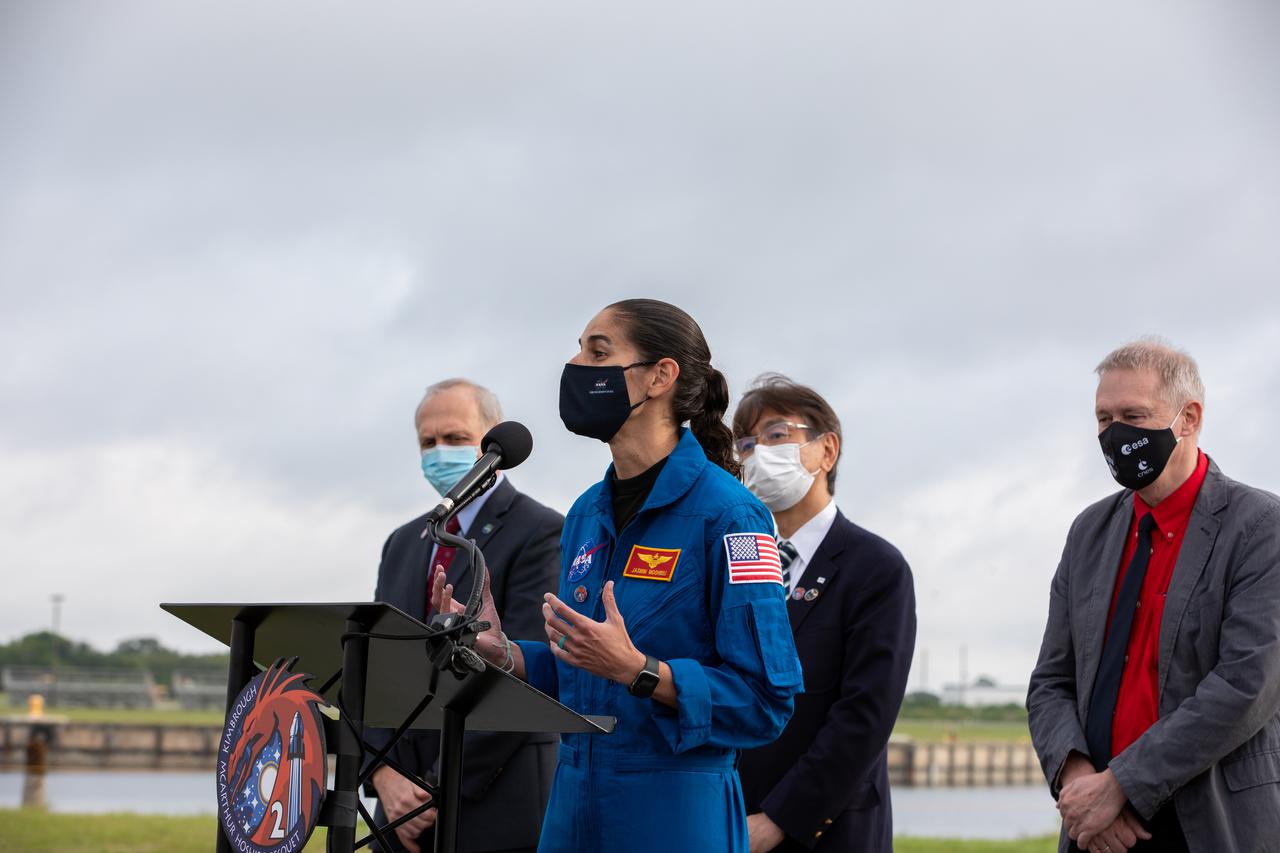
NASA astronaut Jasmin Moghbeli addresses members of the news media during a press briefing April 21, 2021, near the Press Site countdown clock at NASA’s Kennedy Space Center in Florida ahead of the agency’s SpaceX Crew-2 launch. NASA astronauts Shane Kimbrough and Megan McArthur, JAXA astronaut Akihiko Hoshide, and ESA astronaut Thomas Pesquet will fly on Crew-2, the second crew rotation mission to the International Space Station as part of NASA’s Commercial Crew Program. They will launch aboard SpaceX’s Crew Dragon spacecraft, named Endeavour, powered by the company’s Falcon 9 rocket. Liftoff is set for Friday, April 23, at 5:49 a.m. EDT.
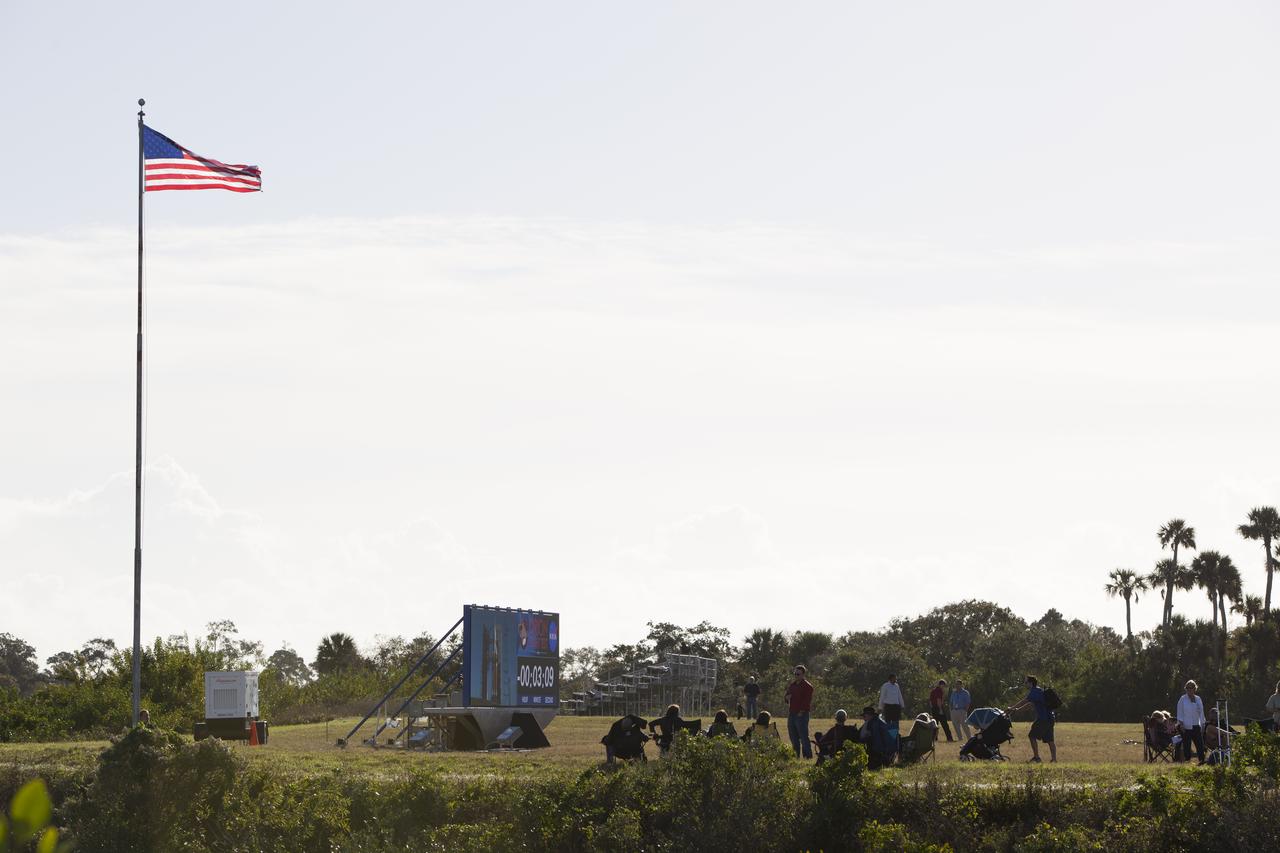
At NASA's Kennedy Space Center in Florida, the new countdown clock at the spaceport's Press Site is used for the first time as preparations were underway for the Orion Flight Test. News media representatives gather in anticipation of the launch of NASA's Orion spacecraft atop a United Launch Alliance Delta IV Heavy rocket.

STS-45 Mission Commander Charlie Bolden, Jr., is glad to be back in Florida and ready for the launch of the 46th Shuttle Mission. Bolden and six fellow crew members arrived at KSC's landing strip after the Countdown Clock had already stated ticking toward liftoff of the Space Shuttle Atlantis from Pad 39-A.
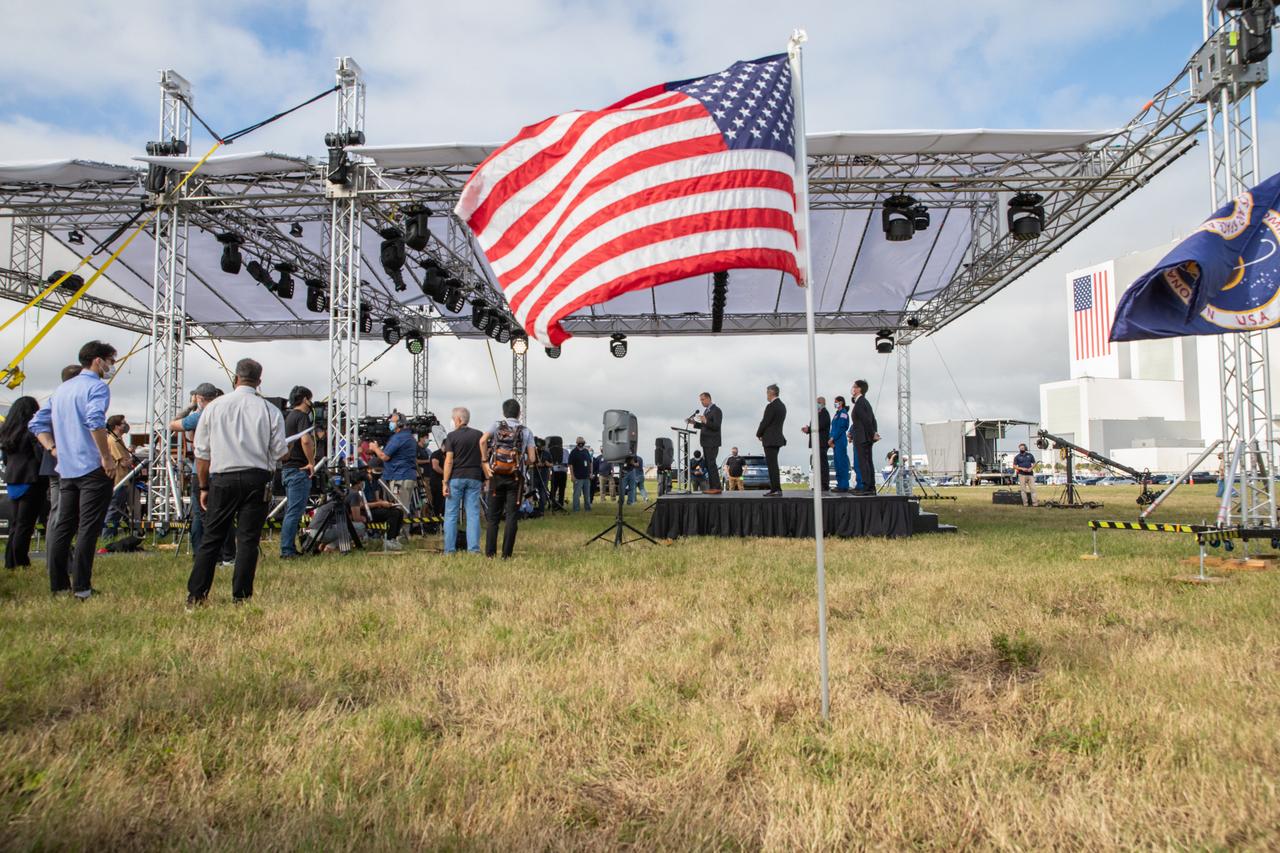
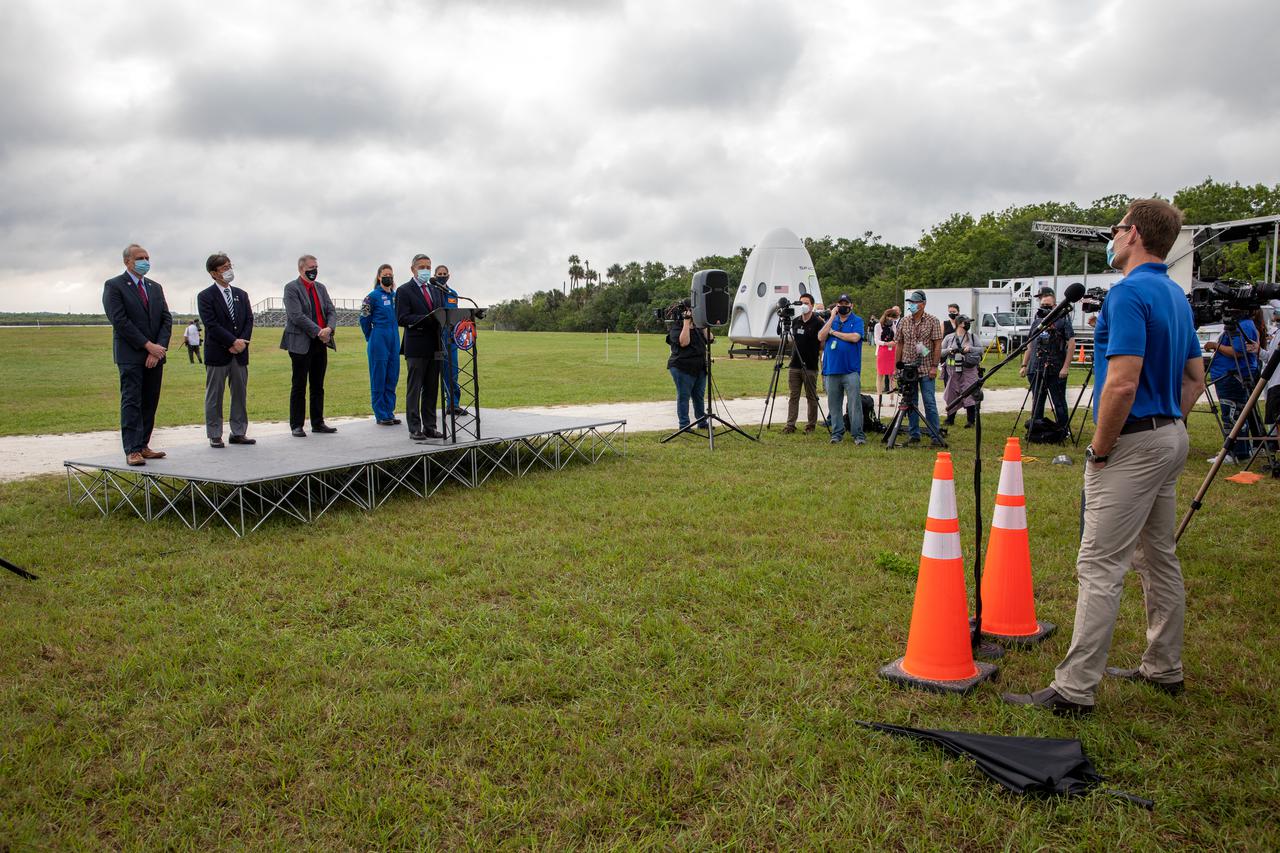
Members of the news media attend a press briefing Nov. 13, 2020, near the Press Site countdown clock at NASA’s Kennedy Space Center in Florida ahead of the agency’s SpaceX Crew-1 launch. Participating in the briefing, on the raised platform, are NASA Administrator Jim Bridenstine; Steve Dickson, administrator, Federal Aviation Administration; Kennedy Center Director Bob Cabana; Hiroshi Sasaki, vice president and director general, JAXA’s Human Spaceflight Technology Directorate; NASA astronaut Jonny Kim; and NASA astronaut Sunita Williams. Crew-1 is the first regular crew mission of a U.S. commercial spacecraft with astronauts to the International Space Station as part of NASA’s Commercial Crew Program. The SpaceX Crew Dragon Resilience capsule will launch atop the company’s Falcon 9 rocket from Launch Complex 39A to the space station for a six-month science mission.
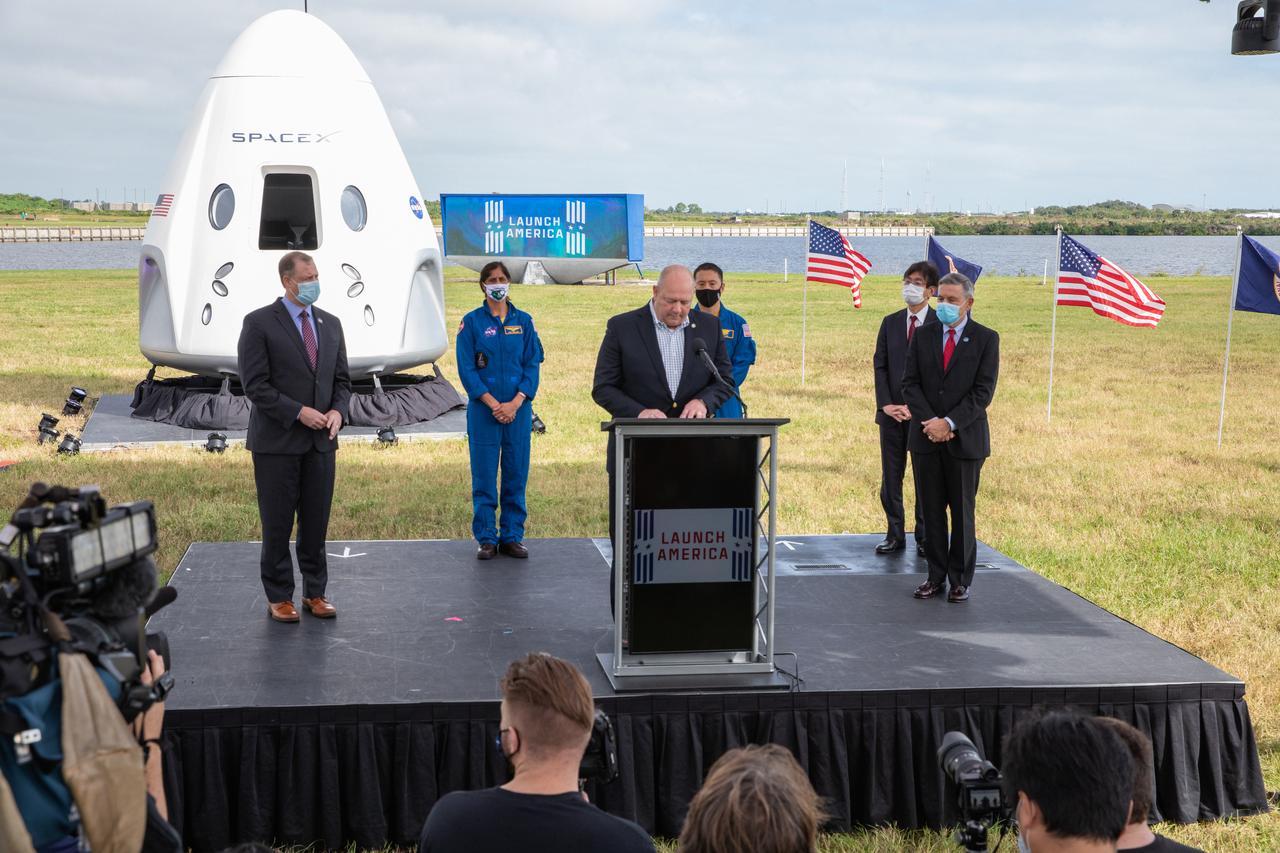
Steve Dickson, administrator, Federal Aviation Administration, speaks during a press briefing Nov. 13, 2020, near the Press Site countdown clock at the agency’s Kennedy Space Center in Florida ahead of NASA’s SpaceX Crew-1 launch. Behind him, from left are NASA Administrator Jim Bridenstine, NASA astronaut Sunita Williams, NASA astronaut Jonny Kim, Hiroshi Sasaki, vice president and director general, JAXA’s Human Spaceflight, and Kennedy Space Center Director Bob Cabana. Crew-1 is the first regular crew mission of a U.S. commercial spacecraft with astronauts to the International Space Station as part of NASA’s Commercial Crew Program. The SpaceX Crew Dragon Resilience capsule will launch atop the company’s Falcon 9 rocket from Launch Complex 39A to the space station for a six-month science mission.
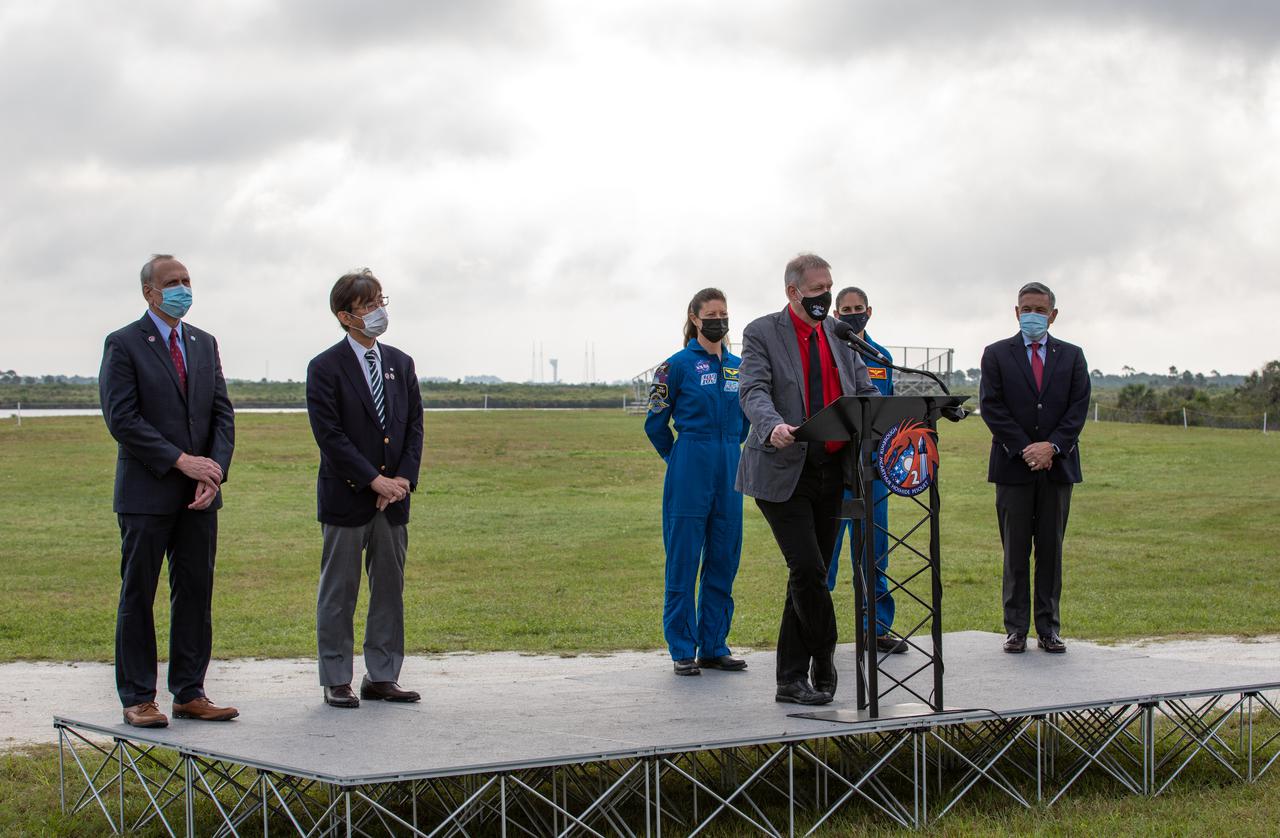
Frank de Winne, manager, International Space Station Program, ESA, addresses members of the news media during a press briefing April 21, 2021, near the Press Site countdown clock at NASA’s Kennedy Space Center in Florida ahead of the agency’s SpaceX Crew-2 launch. NASA astronauts Shane Kimbrough and Megan McArthur, JAXA astronaut Akihiko Hoshide, and ESA astronaut Thomas Pesquet will fly on Crew-2, the second crew rotation mission to the International Space Station as part of NASA’s Commercial Crew Program. They will launch aboard SpaceX’s Crew Dragon spacecraft, named Endeavour, powered by the company’s Falcon 9 rocket. Liftoff is set for Friday, April 23, at 5:49 a.m. EDT.
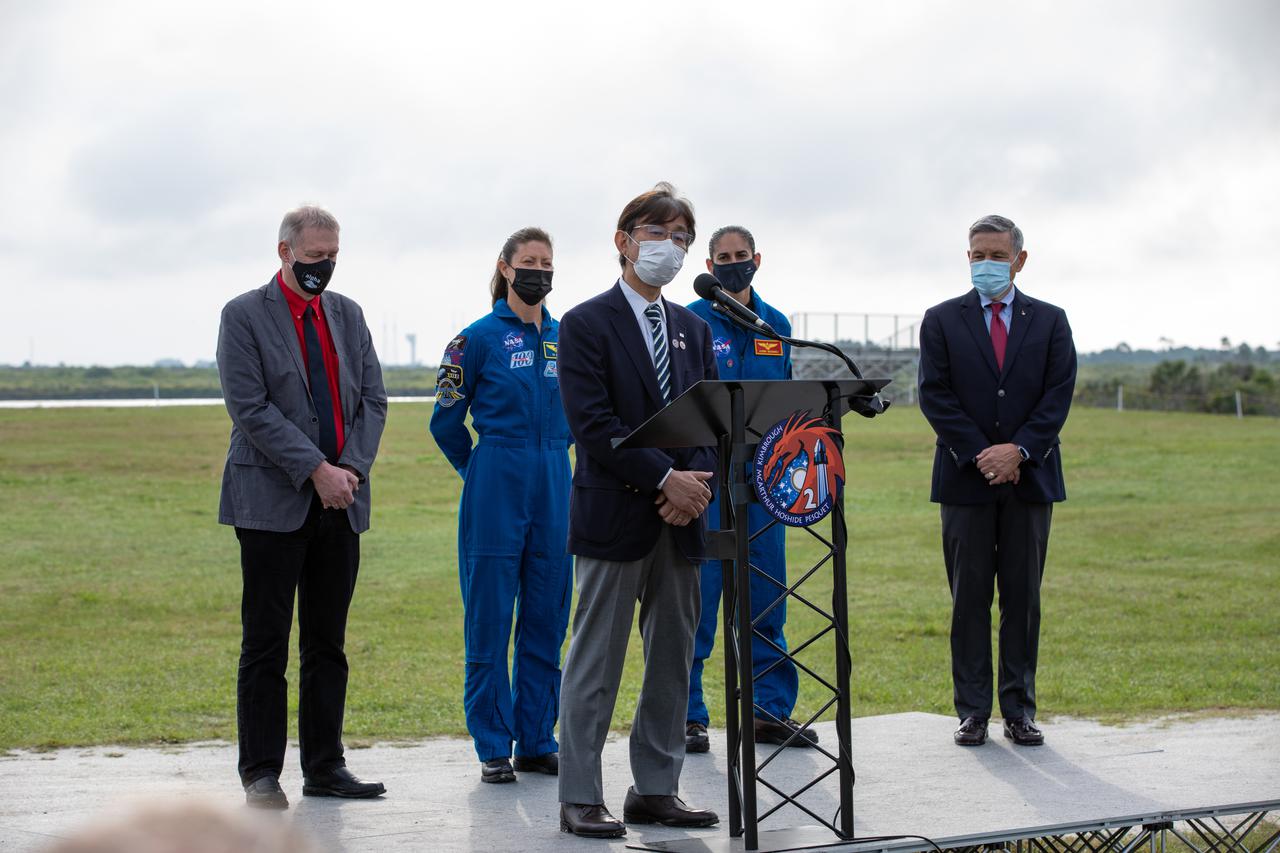
Hiroshi Sasaki, vice president and director general, JAXA’s Human Spaceflight Technology Directorate, addresses members of the news media during a press briefing April 21, 2021, near the Press Site countdown clock at NASA’s Kennedy Space Center in Florida ahead of the agency’s SpaceX Crew-2 launch. NASA astronauts Shane Kimbrough and Megan McArthur, JAXA astronaut Akihiko Hoshide, and ESA astronaut Thomas Pesquet will fly on Crew-2, the second crew rotation mission to the International Space Station as part of NASA’s Commercial Crew Program. They will launch aboard SpaceX’s Crew Dragon spacecraft, named Endeavour, powered by the company’s Falcon 9 rocket. Liftoff is set for Friday, April 23, at 5:49 a.m. EDT.
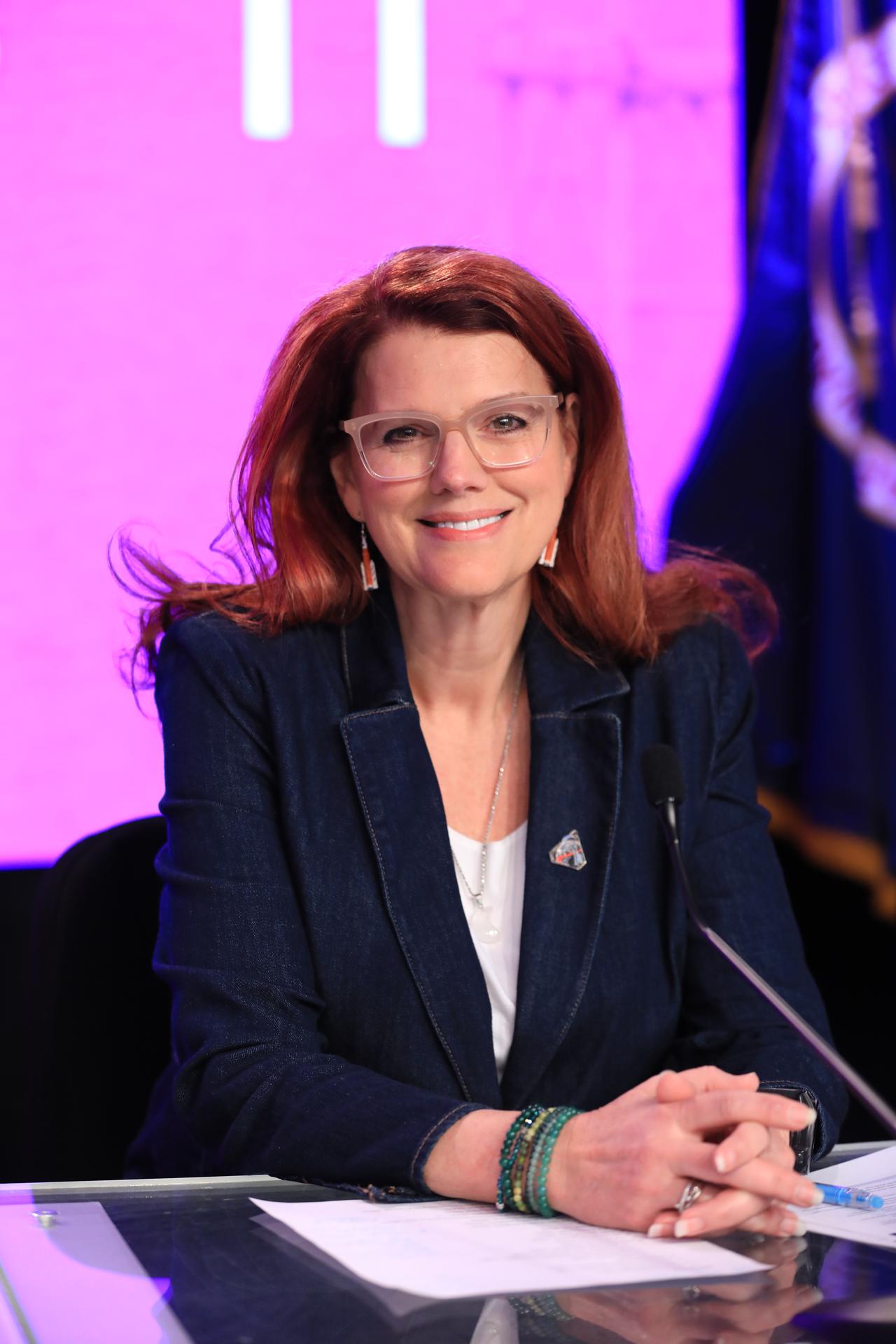
Charlie Blackwell-Thompson, launch director, Exploration Ground Systems Program, participates in a news conference on Tuesday, Feb. 3, 2026, to discuss the completion of Artemis II wet dress rehearsal at NASA’s Kennedy Space Center in Florida. The wet dress rehearsal allows the Artemis II launch team to run through operations to load propellant, conduct a full launch countdown, demonstrate the ability to recycle the countdown clock, and drain the tanks to practice timelines and procedures for launch.
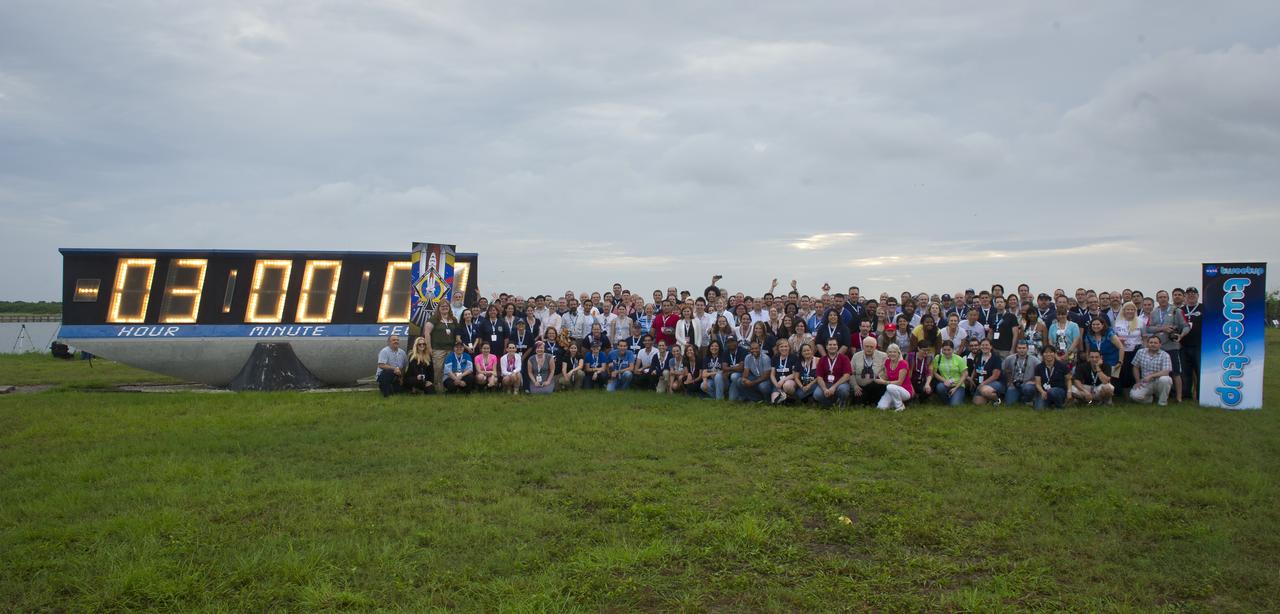
NASA Tweetup participants stand at the launch clock, Friday, July 8, 2011, prior to the launch of the space shuttle Atlantis (STS-135) at Kennedy Space Center in Cape Canaveral, Fla. Space shuttle Atlantis is set to launch on the final flight of the shuttle program on a 12-day mission to the International Space Station. The STS-135 crew will carry the Raffaello multipurpose logistics module containing supplies and spare parts for the space station. Photo Credit: (NASA/Paul E. Alers)
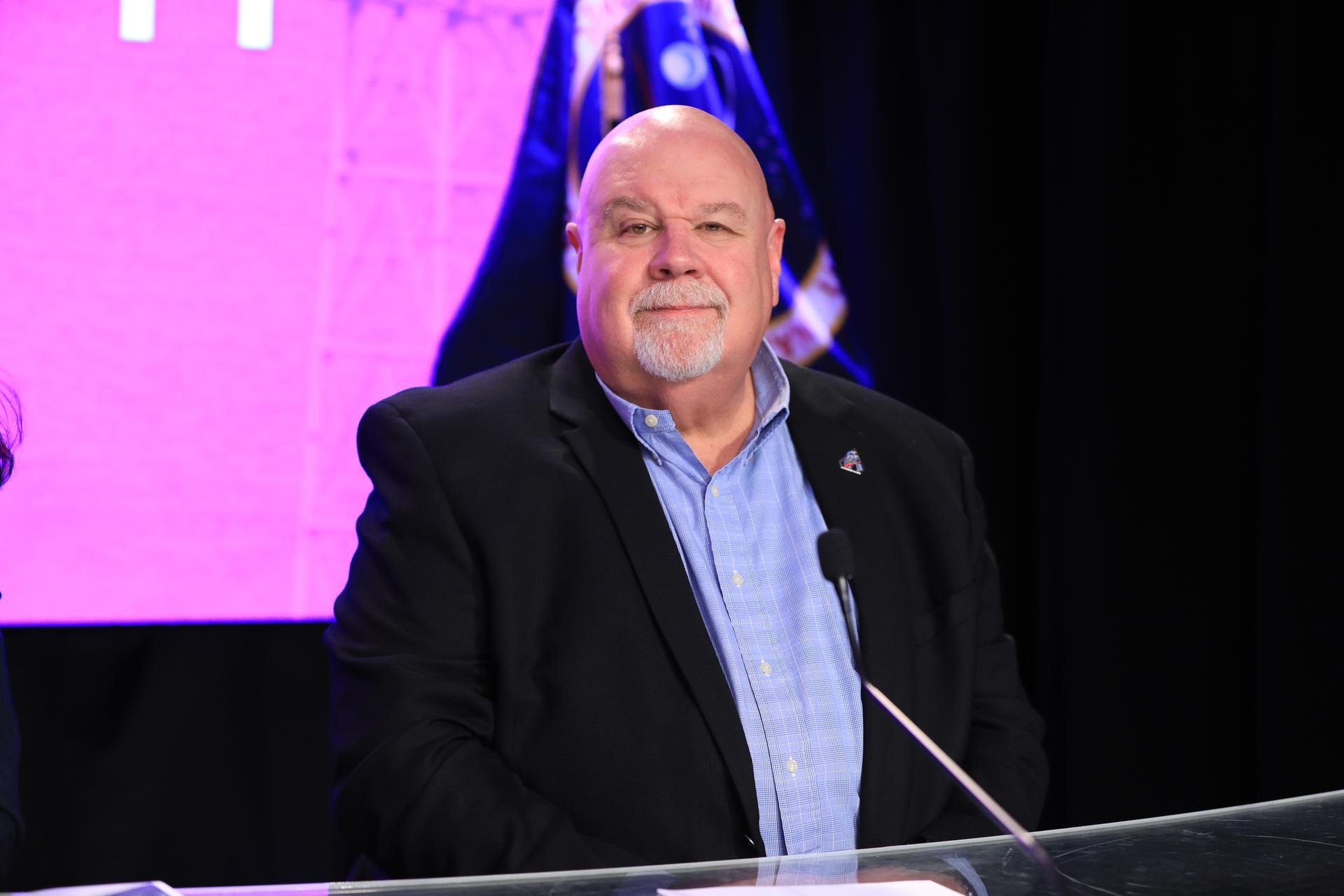
John Honeycutt, chair, Artemis II mission management team, participates in a news conference on Tuesday, Feb. 3, 2026, to discuss the completion of Artemis II wet dress rehearsal at NASA’s Kennedy Space Center in Florida. The wet dress rehearsal allows the Artemis II launch team to run through operations to load propellant, conduct a full launch countdown, demonstrate the ability to recycle the countdown clock, and drain the tanks to practice timelines and procedures for launch.
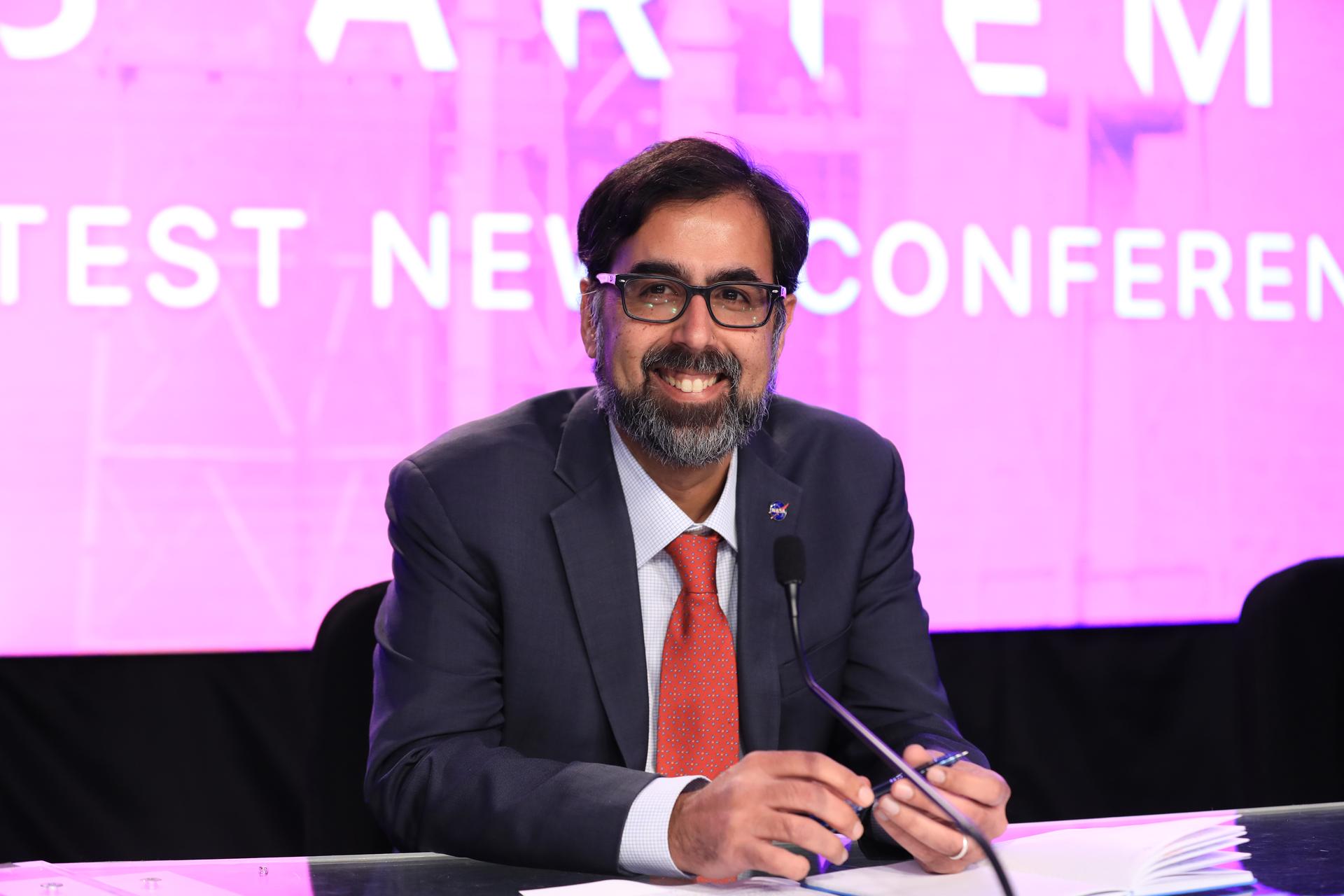
NASA Associate Administrator Amit Kshatriya participates in a news conference on Tuesday, Feb. 3, 2026, to discuss the completion of Artemis II wet dress rehearsal at NASA’s Kennedy Space Center in Florida. The wet dress rehearsal allows the Artemis II launch team to run through operations to load propellant, conduct a full launch countdown, demonstrate the ability to recycle the countdown clock, and drain the tanks to practice timelines and procedures for launch.

CAPE CANAVERAL, Fla. – As rain showers dissipate, a rainbow appeared over the Kennedy Space Center's Press Site and turn basin. In the foreground is the historic countdown clock. In the background, is Launch Pad 39B where agency's Space Launch System will launch astronauts aboard the Orion spacecraft to deep-space destinations such as an asteroid and Mars. For more information, visit http://www.nasa.gov/kennedy Photo credit: NASA/Kim Shiflett

A group of students and their chaperones gather for a photo at the launch countdown clock near the News Center at NASA’s Kennedy Space Center in Florida on Oct. 6, 2022. The middle-school students, from the Boys and Girls Clubs of the Flathead Indian Reservation in Montana, are visiting the space center with the Students to Launch program. Students to Launch is engages students in STEM (science, technology, engineering and mathematics) and creates awareness of careers in the space program.
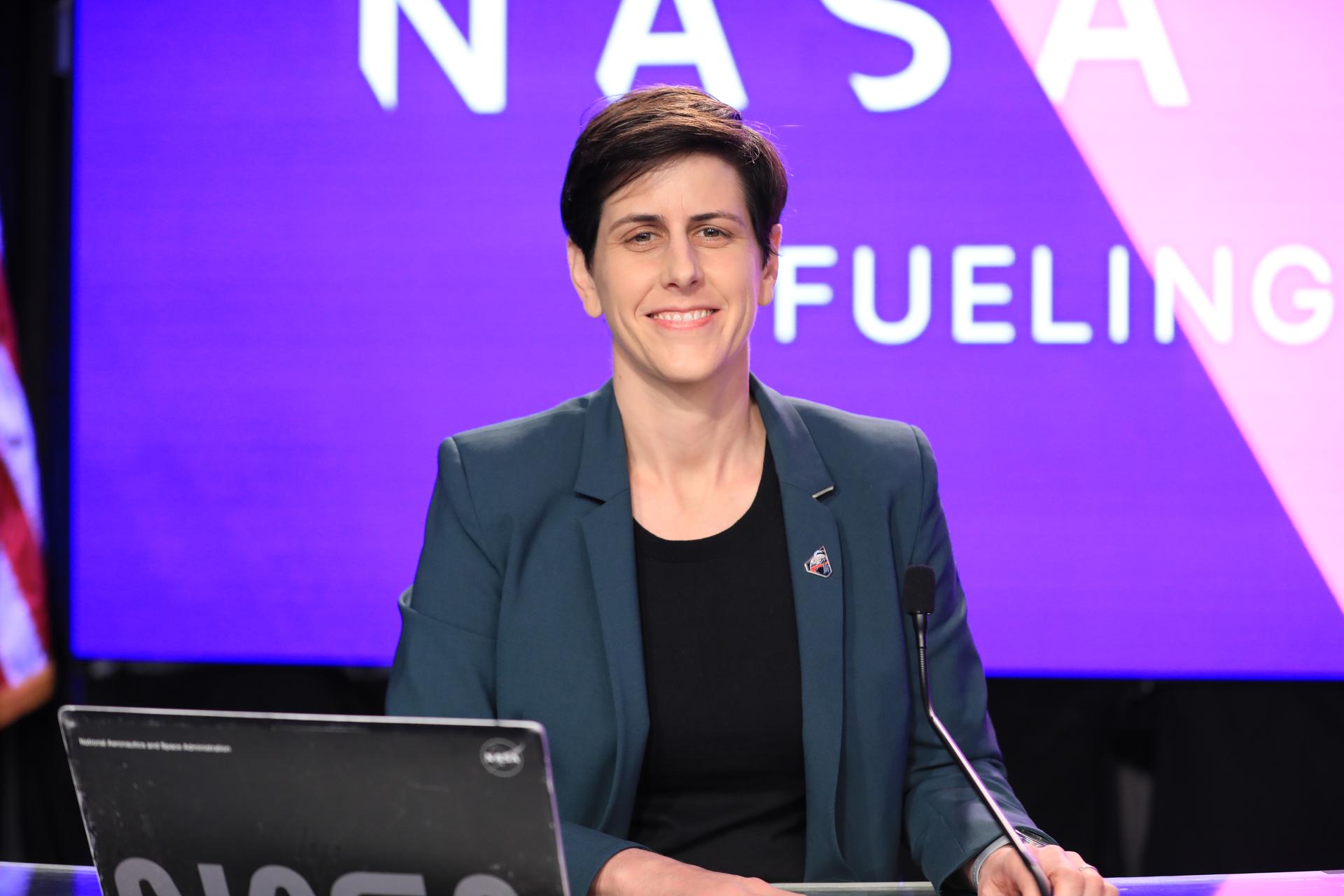
Rachel Kraft, NASA Communications, participates in a news conference on Tuesday, Feb. 3, 2026, to discuss the completion of Artemis II wet dress rehearsal at NASA’s Kennedy Space Center in Florida. The wet dress rehearsal allows the Artemis II launch team to run through operations to load propellant, conduct a full launch countdown, demonstrate the ability to recycle the countdown clock, and drain the tanks to practice timelines and procedures for launch.
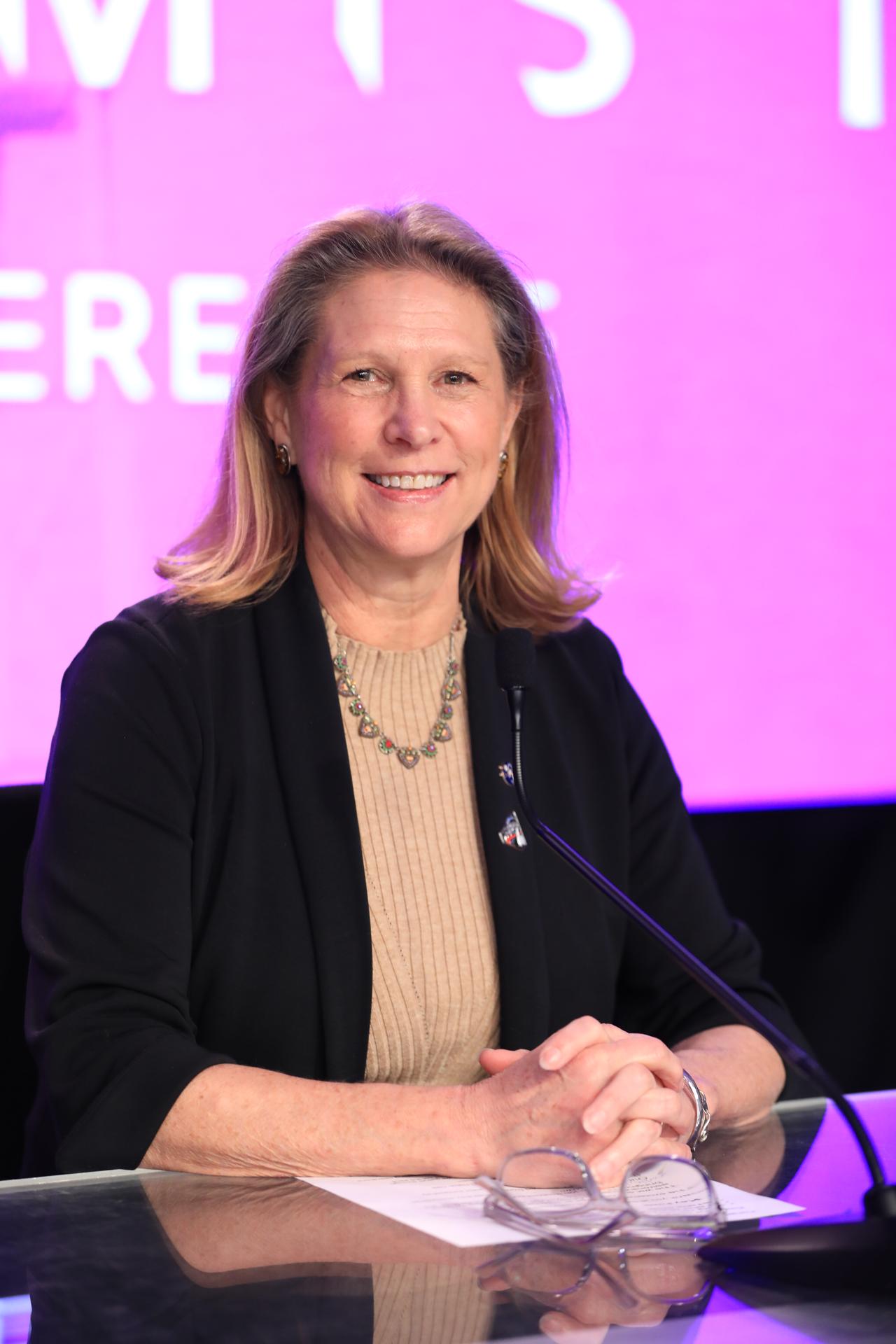
Lori Glaze, acting associate administrator for Exploration Systems Development Mission Directorate, participates in a news conference on Tuesday, Feb. 3, 2026, to discuss the completion of Artemis II wet dress rehearsal at NASA’s Kennedy Space Center in Florida. The wet dress rehearsal allows the Artemis II launch team to run through operations to load propellant, conduct a full launch countdown, demonstrate the ability to recycle the countdown clock, and drain the tanks to practice timelines and procedures for launch.
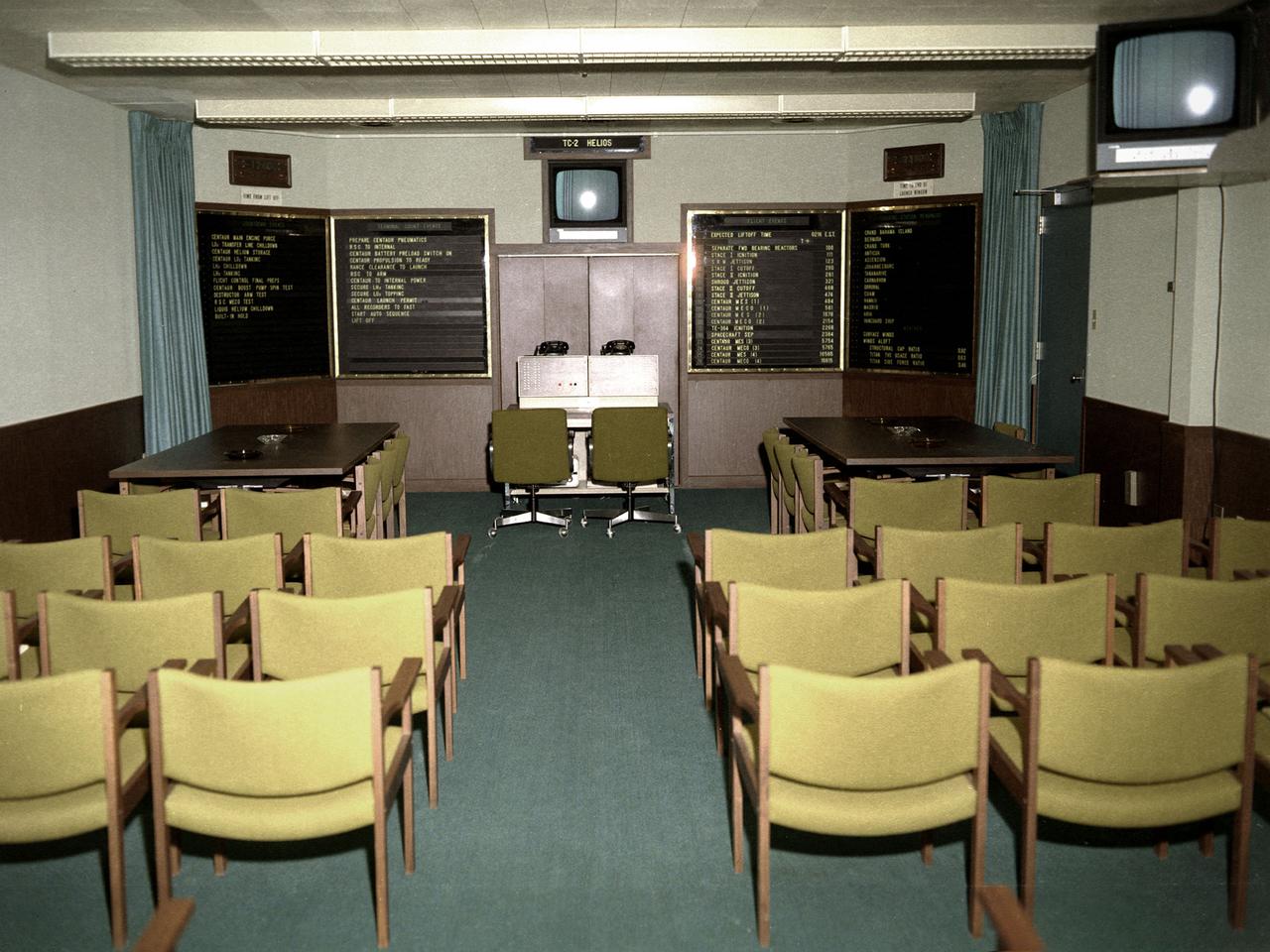
A Centaur rocket control room in the Development Engineering Building (DEB) at the National Aeronautics and Space Administration (NASA) Lewis Research Center in Cleveland, Ohio. The DEB, completed in the mid-1960s, provided office space for several hundred development engineers outside the center’s main gate. The location of the DEB emphasized the development staff’s separation from the research side of the laboratory. This control room at Lewis was directly linked to Cape Kennedy. The Lewis staff in Cleveland could monitor and back up the Lewis launch team in the actual control room at the Cape. This photograph was taken during the preparations for the Titan-Centaur-Helios launch on December 10, 1974. The panels to the left listed the countdown events for the Centaur rocket. The launch countdown clock can be seen above these panels. The two panels on the right listed events predicted to occur during the flight and the availability of the tracking stations. The clock above the panels indicated the time remaining before the launch window expired. The Launch Vehicles Division was created in 1969 to manage the launches of all Centaur and Agena rockets. The Launch Vehicles Division worked with the engineers to design the payload in a manner that ensured that its size and weight were within Centaur’s parameters. They also developed the proper trajectory analysis for the launch. These trajectories often had to be adjusted if the launch did not occur on the planned date.

Teams from NASA’s Exploration Ground Systems and Space Launch System (SLS) practice SLS booster stacking with pathfinders inside Kennedy Space Center’s Vehicle Assembly Building on Nov. 19, 2019. Using overhead cranes and booster handling activities, the teams focused on procedures for mating a center segment onto a cylinder that simulated another segment. The exercise was performed around the clock, operating three shifts per day. SLS will launch the first woman and next man to the Moon by 2024 through the Artemis program.
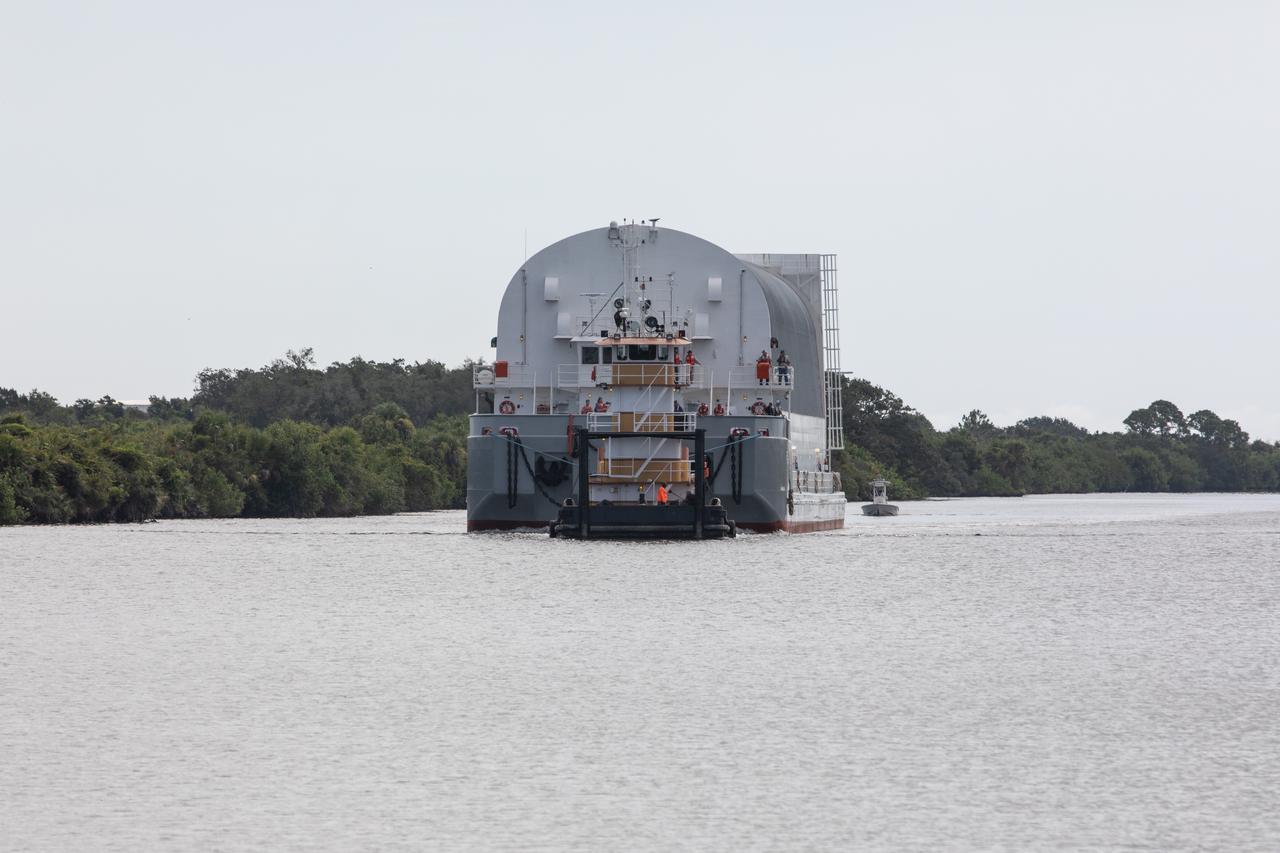
Behind the iconic countdown clock at NASA’s Kennedy Space Center in Florida, the agency’s Pegasus barge completes its 900-mile journey from NASA’s Michoud Assembly Facility in New Orleans carrying the powerful SLS (Space Launch System) core stage on Tuesday, July 23, 2024. Teams with NASA's Exploration Ground Systems (EGS) will offload the rocket stage and transfer it to the spaceport’s Vehicle Assembly Building to prepare it for integration atop the mobile launcher ahead of the Artemis II launch.
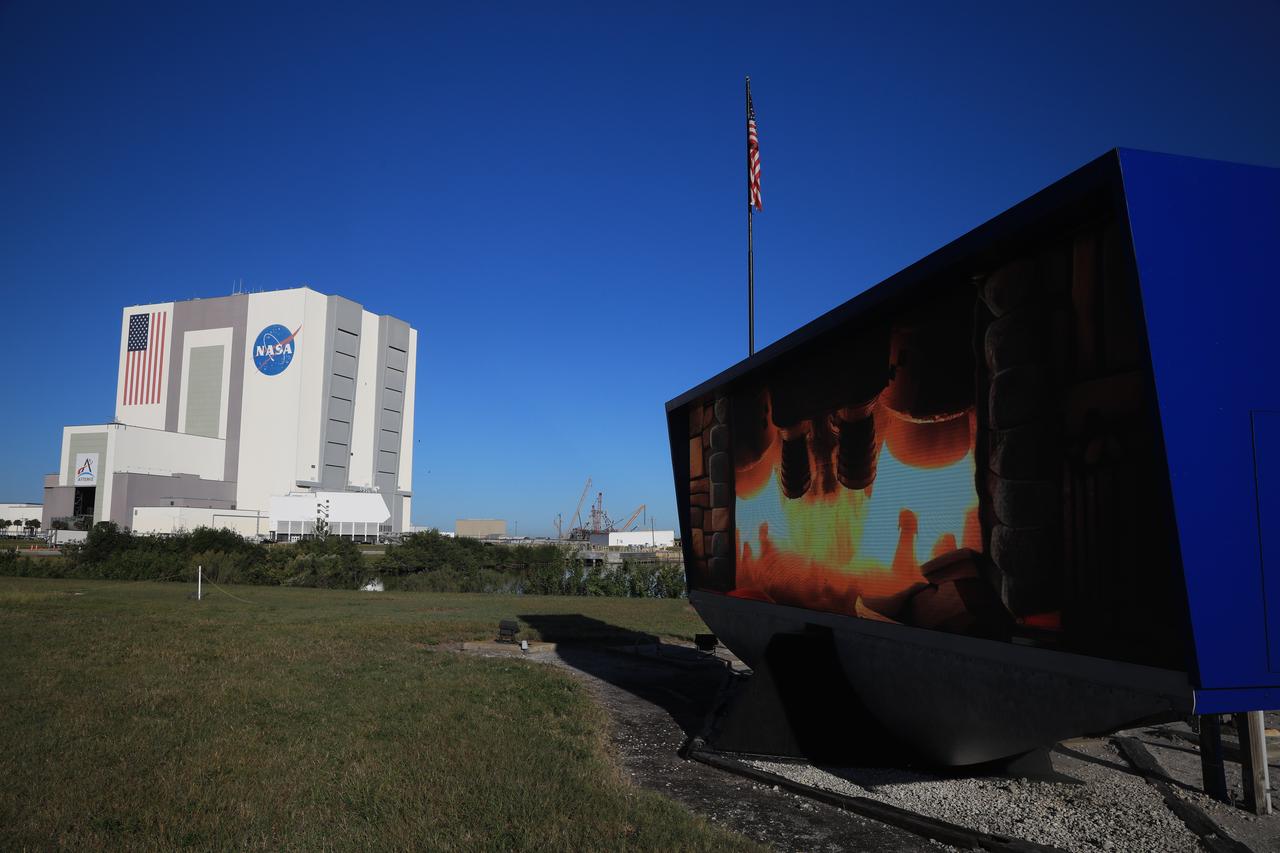
NASA’s SLS (Space Launch System) rocket that launched Artemis I on a mission around the Moon and back becomes a “rocket engine fireplace” back drop video on the historic countdown clock at the NASA News Center at the agency’s Kennedy Space Center on Tuesday, Nov. 26, 2024. The fireplace showcases the SLS rocket’s four RS-25 engines and a pair of solid rocket boosters.

Teams from NASA’s Exploration Ground Systems and Space Launch System (SLS) practice SLS booster stacking with pathfinders inside Kennedy Space Center’s Vehicle Assembly Building on Nov. 19, 2019. Using overhead cranes and booster handling activities, the teams focused on procedures for mating a center segment onto a cylinder that simulated another segment. The exercise was performed around the clock, operating three shifts per day. SLS will launch the first woman and next man to the Moon by 2024 through the Artemis program.

Teams from NASA’s Exploration Ground Systems and Space Launch System (SLS) practice SLS booster stacking with pathfinders inside Kennedy Space Center’s Vehicle Assembly Building on Nov. 19, 2019. Using overhead cranes and booster handling activities, the teams focused on procedures for mating a center segment onto a cylinder that simulated another segment. The exercise was performed around the clock, operating three shifts per day. SLS will launch the first woman and next man to the Moon by 2024 through the Artemis program.

Teams from NASA’s Exploration Ground Systems and Space Launch System (SLS) practice SLS booster stacking with pathfinders inside Kennedy Space Center’s Vehicle Assembly Building on Nov. 19, 2019. Using overhead cranes and booster handling activities, the teams focused on procedures for mating a center segment onto a cylinder that simulated another segment. The exercise was performed around the clock, operating three shifts per day. SLS will launch the first woman and next man to the Moon by 2024 through the Artemis program.

Teams from NASA’s Exploration Ground Systems and Space Launch System (SLS) practice SLS booster stacking with pathfinders inside Kennedy Space Center’s Vehicle Assembly Building on Nov. 19, 2019. Using overhead cranes and booster handling activities, the teams focused on procedures for mating a center segment onto a cylinder that simulated another segment. The exercise was performed around the clock, operating three shifts per day. SLS will launch the first woman and next man to the Moon by 2024 through the Artemis program.

Teams from NASA’s Exploration Ground Systems and Space Launch System (SLS) practice SLS booster stacking with pathfinders inside Kennedy Space Center’s Vehicle Assembly Building on Nov. 19, 2019. Using overhead cranes and booster handling activities, the teams focused on procedures for mating a center segment onto a cylinder that simulated another segment. The exercise was performed around the clock, operating three shifts per day. SLS will launch the first woman and next man to the Moon by 2024 through the Artemis program.
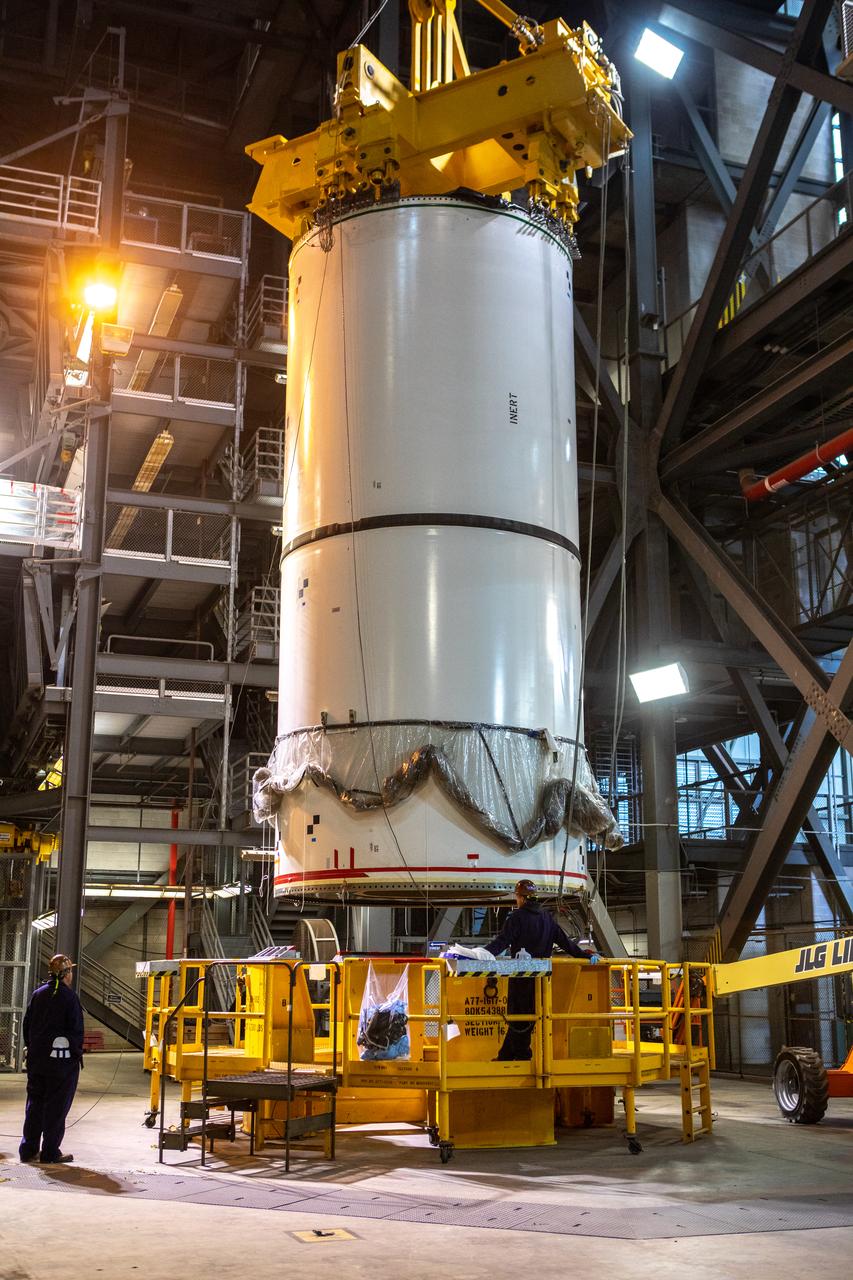
Teams from NASA’s Exploration Ground Systems and Space Launch System (SLS) practice SLS booster stacking with pathfinders inside Kennedy Space Center’s Vehicle Assembly Building on Nov. 19, 2019. Using overhead cranes and booster handling activities, the teams focused on procedures for mating a center segment onto a cylinder that simulated another segment. The exercise was performed around the clock, operating three shifts per day. SLS will launch the first woman and next man to the Moon by 2024 through the Artemis program.

Teams from NASA’s Exploration Ground Systems and Space Launch System (SLS) practice SLS booster stacking with pathfinders inside Kennedy Space Center’s Vehicle Assembly Building on Nov. 19, 2019. Using overhead cranes and booster handling activities, the teams focused on procedures for mating a center segment onto a cylinder that simulated another segment. The exercise was performed around the clock, operating three shifts per day. SLS will launch the first woman and next man to the Moon by 2024 through the Artemis program.
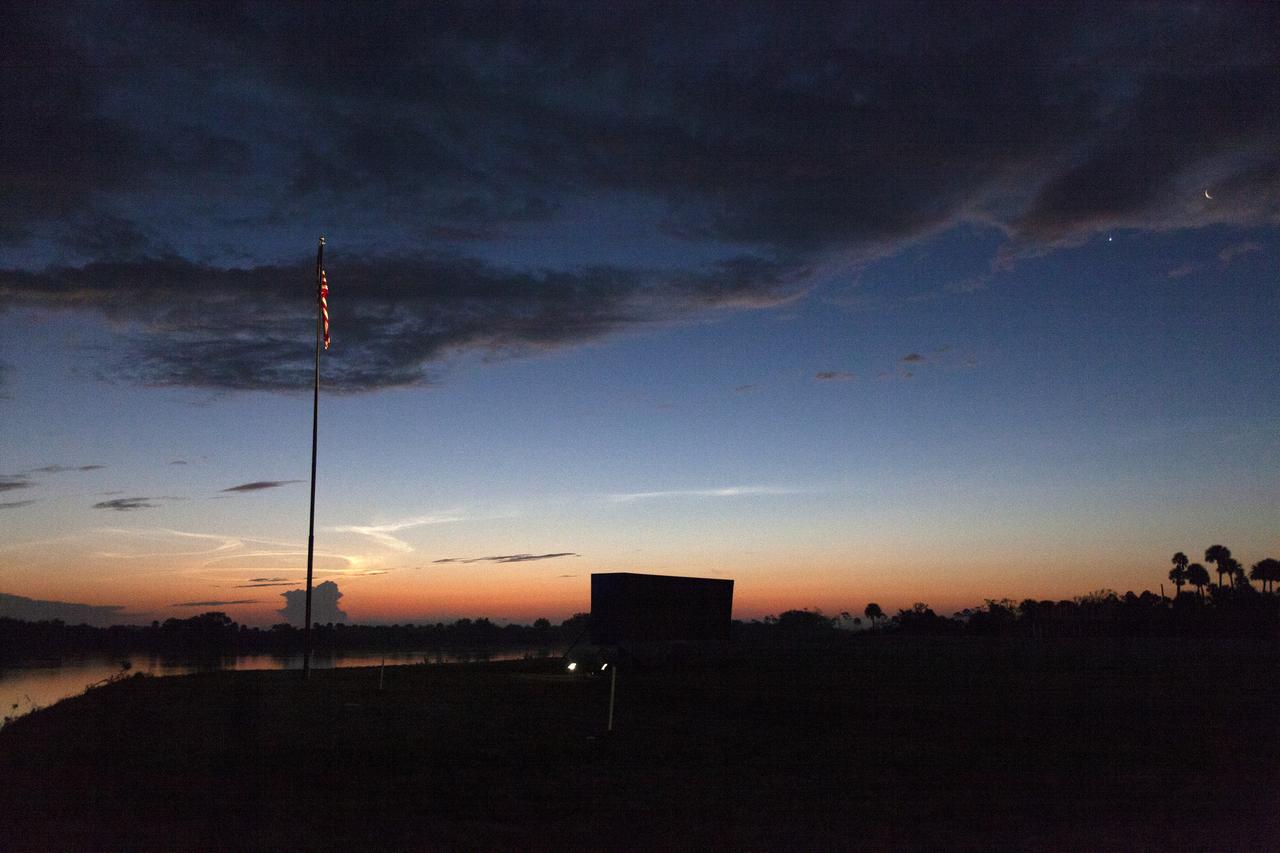
A sunrise serves as the backdrop for the countdown clock and American Flag near the Press Site at NASA’s Kennedy Space Center in Florida following the successful launch of SpaceX’s uncrewed Demo-1 flight test from Launch Complex 39A on March 2, 2019. The company’s Crew Dragon spacecraft lifted off atop a Falcon 9 rocket and traveled to the International Space Station, where it validated end-to-end systems and capabilities in preparation for certification to fly crew.
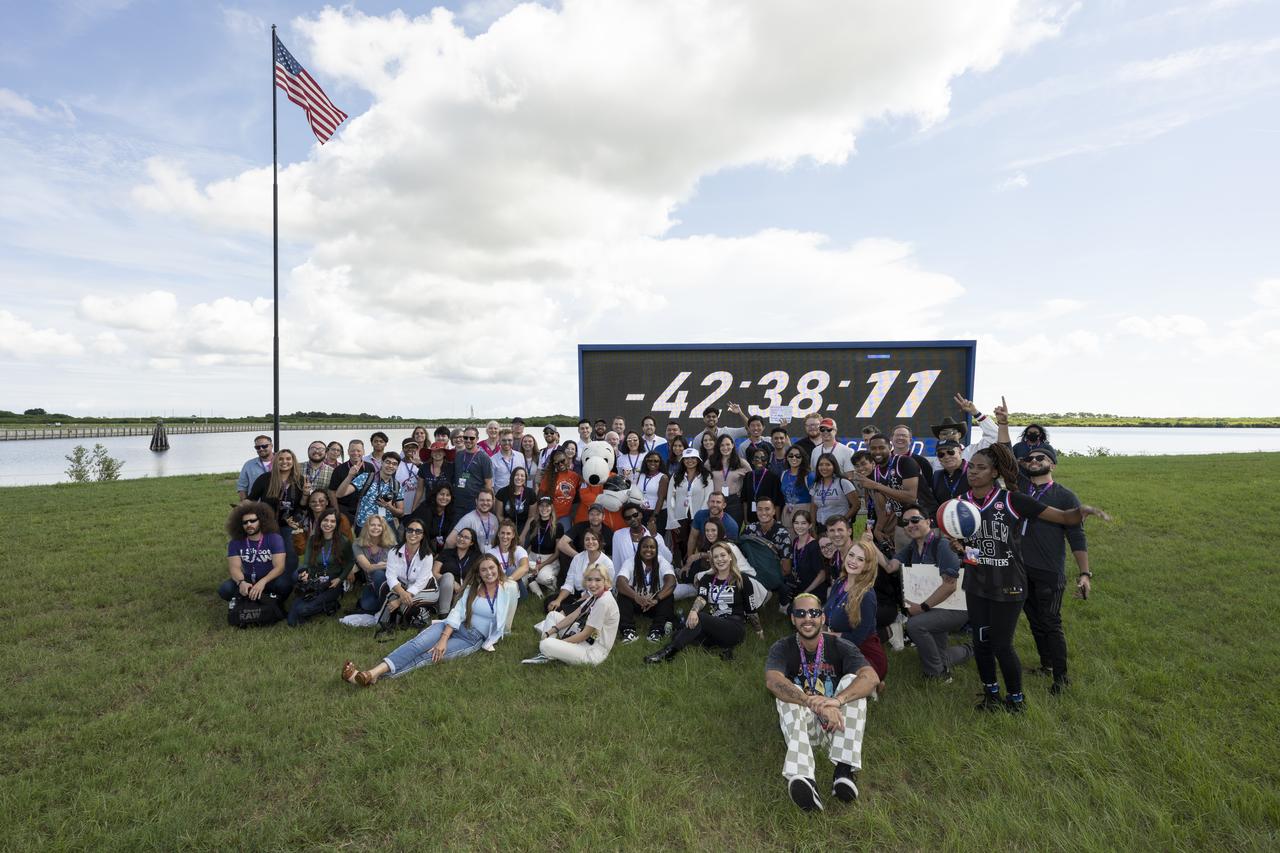
NASA Social attendees pose for a picture with Snoopy at the Press Site countdown clock, Saturday, Aug. 27, 2022, at NASA’s Kennedy Space Center in Florida. NASA’s Artemis I flight test is the first integrated flight test of the agency’s deep space exploration systems: the Orion spacecraft, Space Launch System (SLS) rocket, and ground systems. Launch of the uncrewed flight test is targeted for no earlier than Aug. 29 at 8:33 a.m. ET. Photo Credit: (NASA/Keegan Barber)
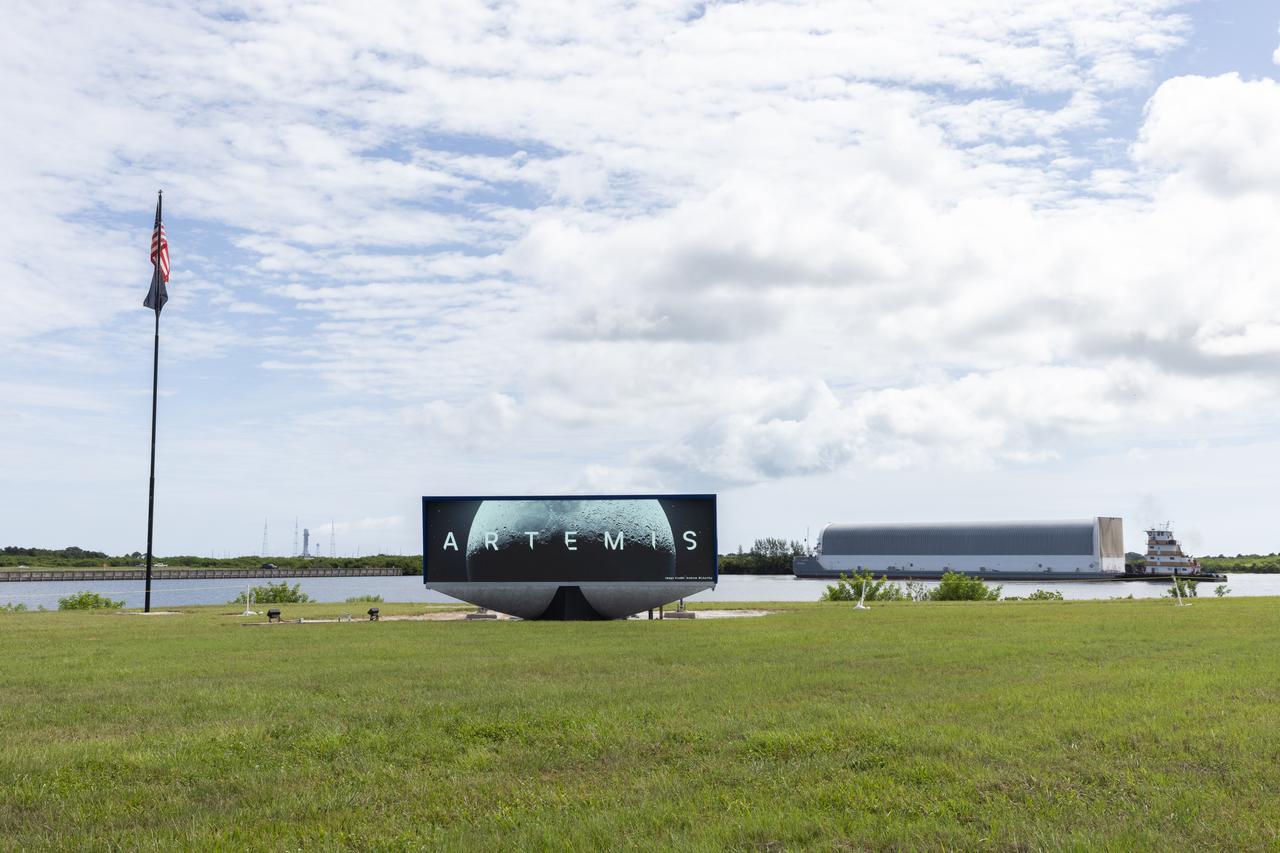
Behind the iconic countdown clock at NASA’s Kennedy Space Center in Florida, the agency’s Pegasus barge completes its 900-mile journey from NASA’s Michoud Assembly Facility in New Orleans carrying the powerful SLS (Space Launch System) core stage on Tuesday, July 23, 2024. Teams with Exploration Ground Systems (EGS) will offload the rocket stage and transfer it to the spaceport’s Vehicle Assembly Building to prepare it for integration atop the mobile launcher ahead of the Artemis II launch.

Teams from NASA’s Exploration Ground Systems and Space Launch System (SLS) practice SLS booster stacking with pathfinders inside Kennedy Space Center’s Vehicle Assembly Building on Nov. 19, 2019. Using overhead cranes and booster handling activities, the teams focused on procedures for mating a center segment onto a cylinder that simulated another segment. The exercise was performed around the clock, operating three shifts per day. SLS will launch the first woman and next man to the Moon by 2024 through the Artemis program.
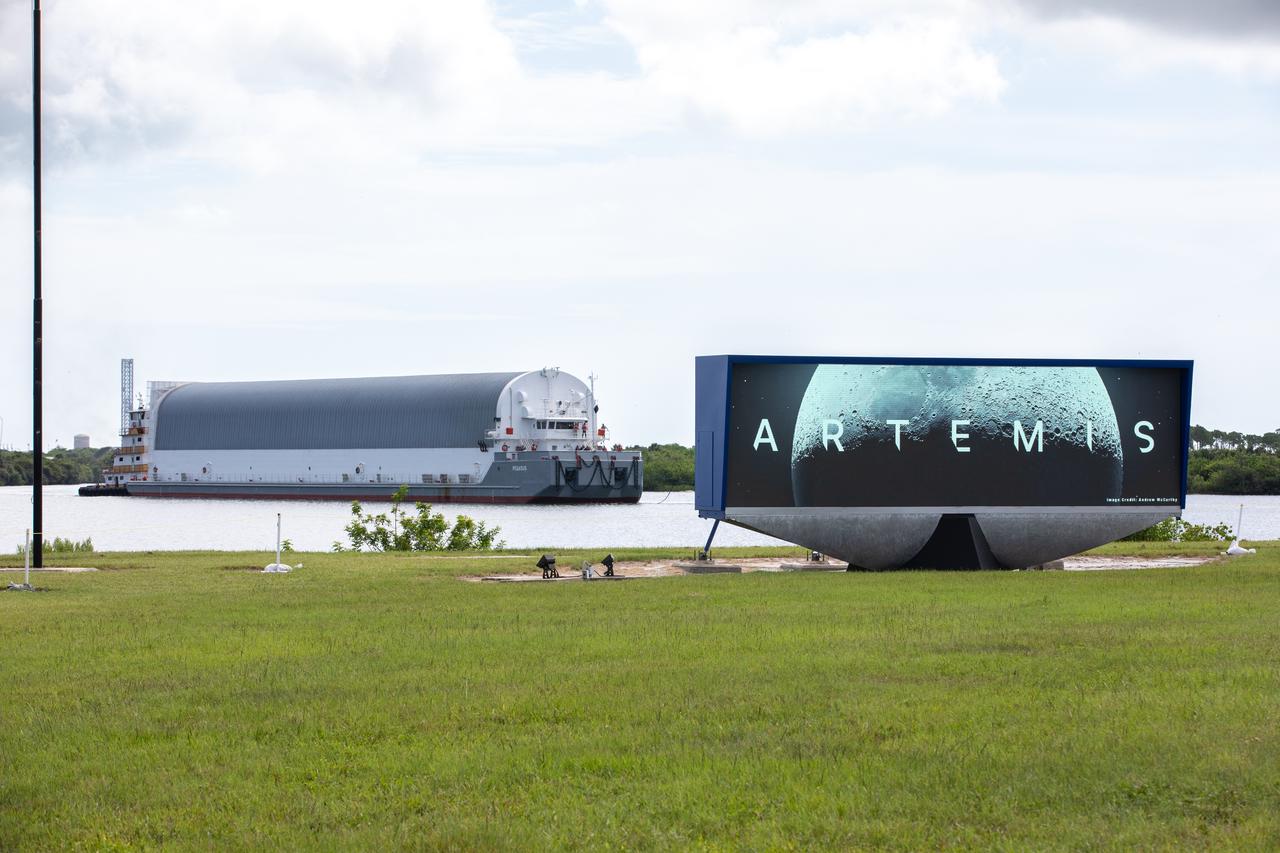
Behind the iconic countdown clock at NASA’s Kennedy Space Center in Florida, the agency’s Pegasus barge completes its 900-mile journey from NASA’s Michoud Assembly Facility in New Orleans carrying the powerful SLS (Space Launch System) core stage on Tuesday, July 23, 2024. Teams with Exploration Ground Systems (EGS) will offload the rocket stage and transfer it to the spaceport’s Vehicle Assembly Building to prepare it for integration atop the mobile launcher ahead of the Artemis II launch.
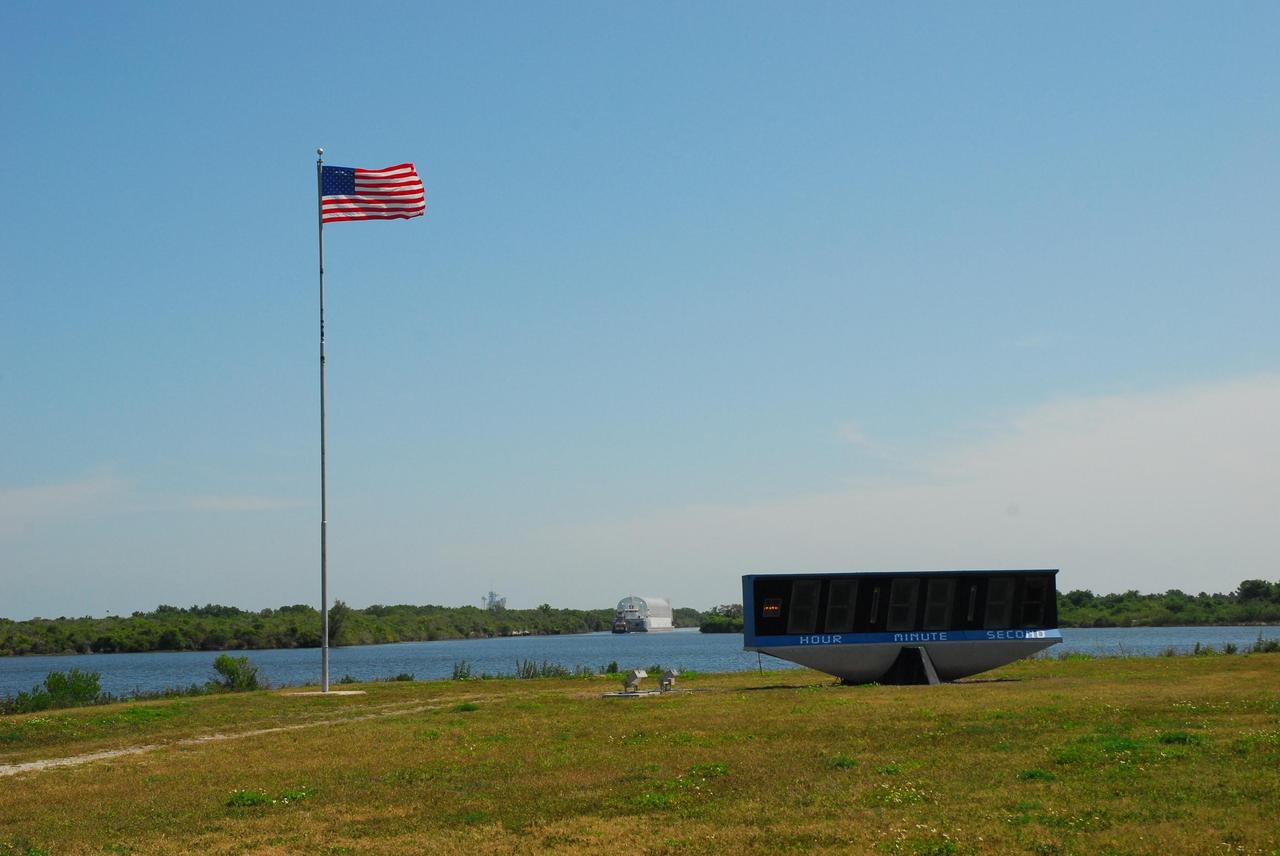
KENNEDY SPACE CENTER, FLA. -- The Pegasus barge is towed into the turn basin in the Launch Complex 39 Area. In the foreground are the U.S. flag and launch countdown clock near the NASA News Center. The barge's cargo is the external tank prepared for mission STS-118 by the Michoud Assembly Facility near New Orleans. After docking, the tank will eventually be offloaded and moved to the Vehicle Assembly Building.. Photo credit: Jack Pfaller
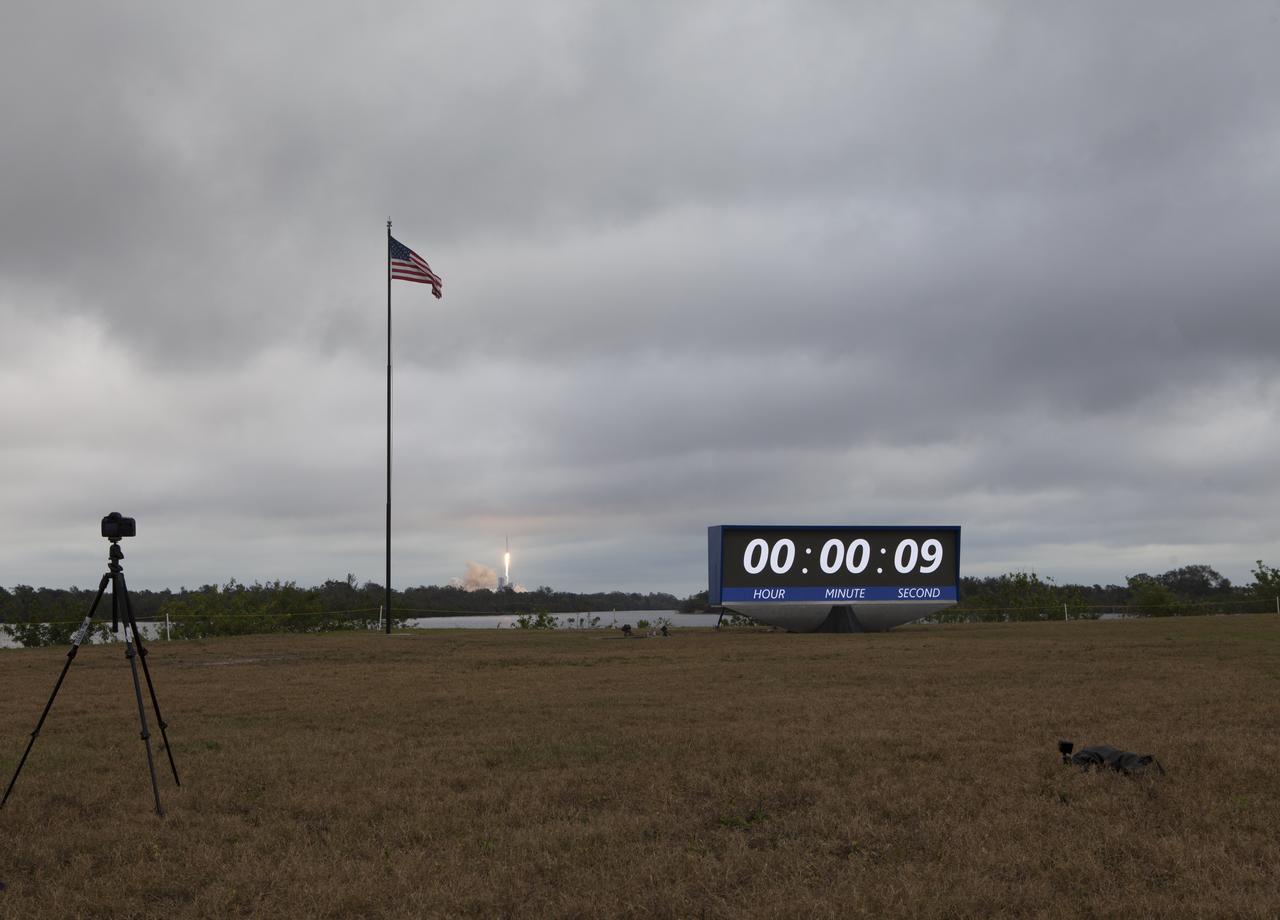
With the countdown clock at the NASA Kenney Space Center Press Site in the foreground, a SpaceX Falcon 9 rocket lifts off from Launch Complex 39A at the Florida spaceport. It was the company's 10th commercial resupply services mission to the International Space Station. Liftoff was at 9:39 a.m. EST from the historic launch site now operated by SpaceX under a property agreement with NASA. The Dragon spacecraft will deliver about 5,500 pounds of supplies, such as the Stratospheric Aerosol and Gas Experiment (SAGE) III instrument to further study ozone in the atmosphere.

NASA Administrator Bill Nelson poses for a picture with Snoopy at the Press Site countdown clock, Saturday, Aug. 27, 2022, at NASA’s Kennedy Space Center in Florida. NASA’s Artemis I flight test is the first integrated flight test of the agency’s deep space exploration systems: the Orion spacecraft, Space Launch System (SLS) rocket, and ground systems. Launch of the uncrewed flight test is targeted for no earlier than Aug. 29 at 8:33 a.m. ET. Photo Credit: (NASA/Keegan Barber)
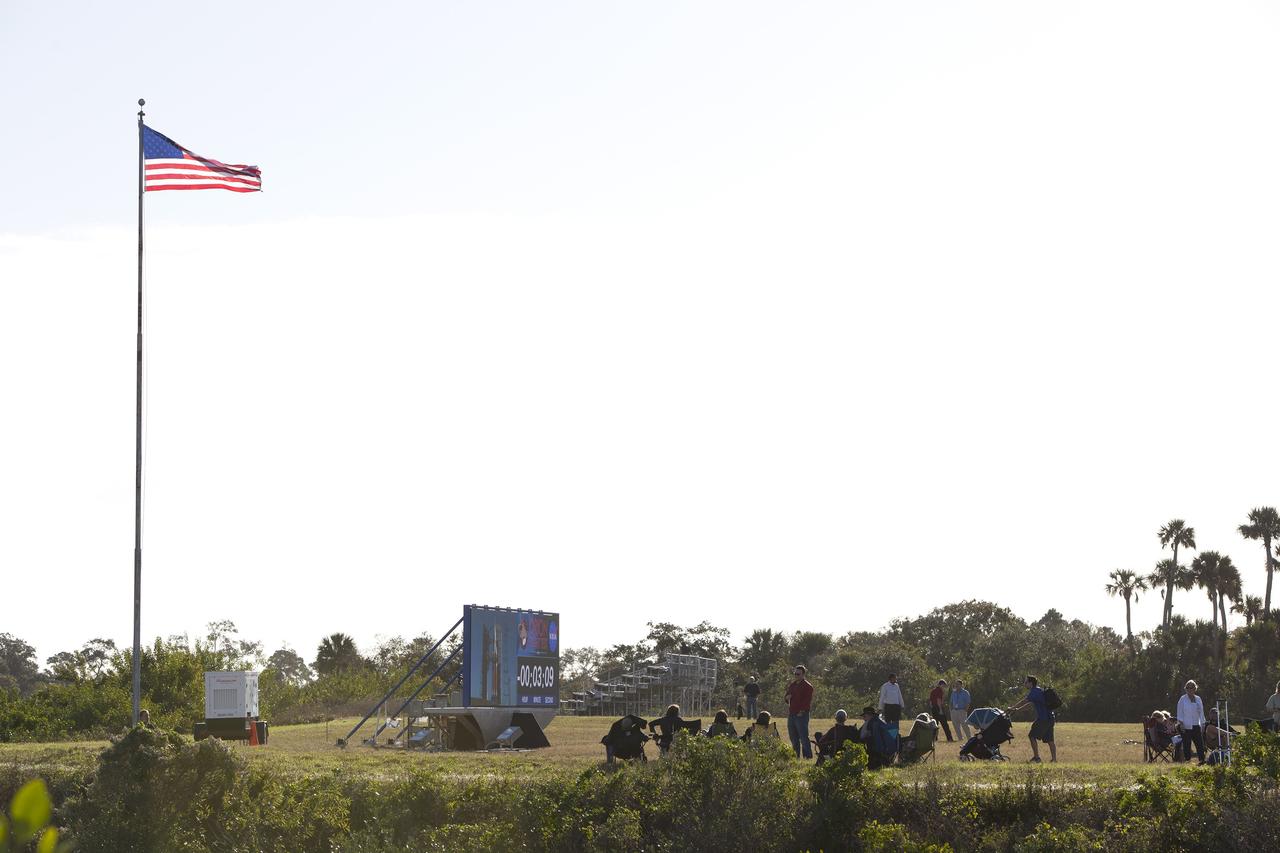
CAPE CANAVERAL, Fla. – At NASA's Kennedy Space Center in Florida, the new countdown clock at the spaceport's Press Site is used for the first time as preparations were underway for the Orion Flight Test. News media representatives gather in anticipation of the launch of NASA's Orion spacecraft atop a United Launch Alliance Delta IV Heavy rocket. For more information, visit www.nasa.gov/orion Photo credit: NASA/Frankie Martin
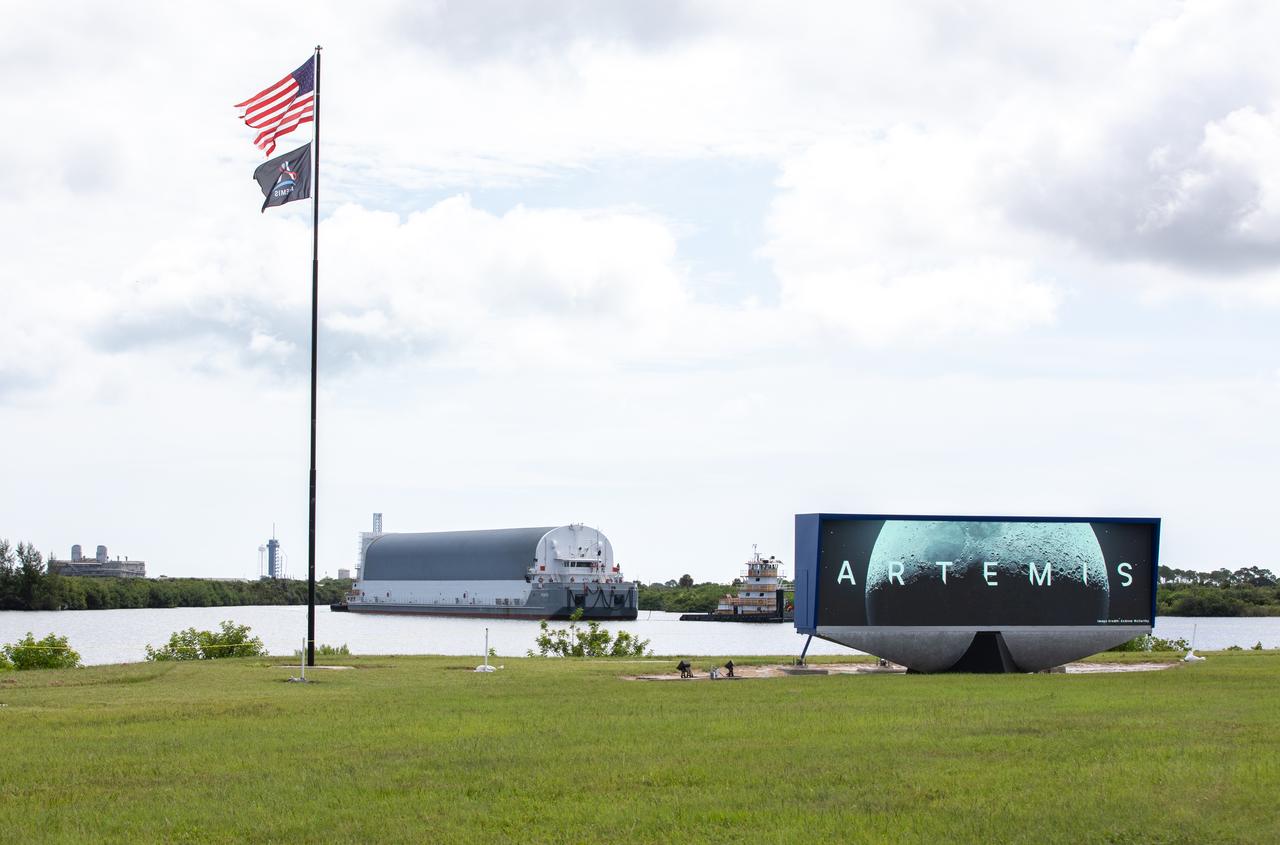
Behind the iconic countdown clock at NASA’s Kennedy Space Center in Florida, the agency’s Pegasus barge completes its 900-mile journey from NASA’s Michoud Assembly Facility in New Orleans carrying the powerful SLS (Space Launch System) core stage on Tuesday, July 23, 2024. Teams with NASA's Exploration Ground Systems (EGS) will offload the rocket stage and transfer it to the spaceport’s Vehicle Assembly Building to prepare it for integration atop the mobile launcher ahead of the Artemis II launch.
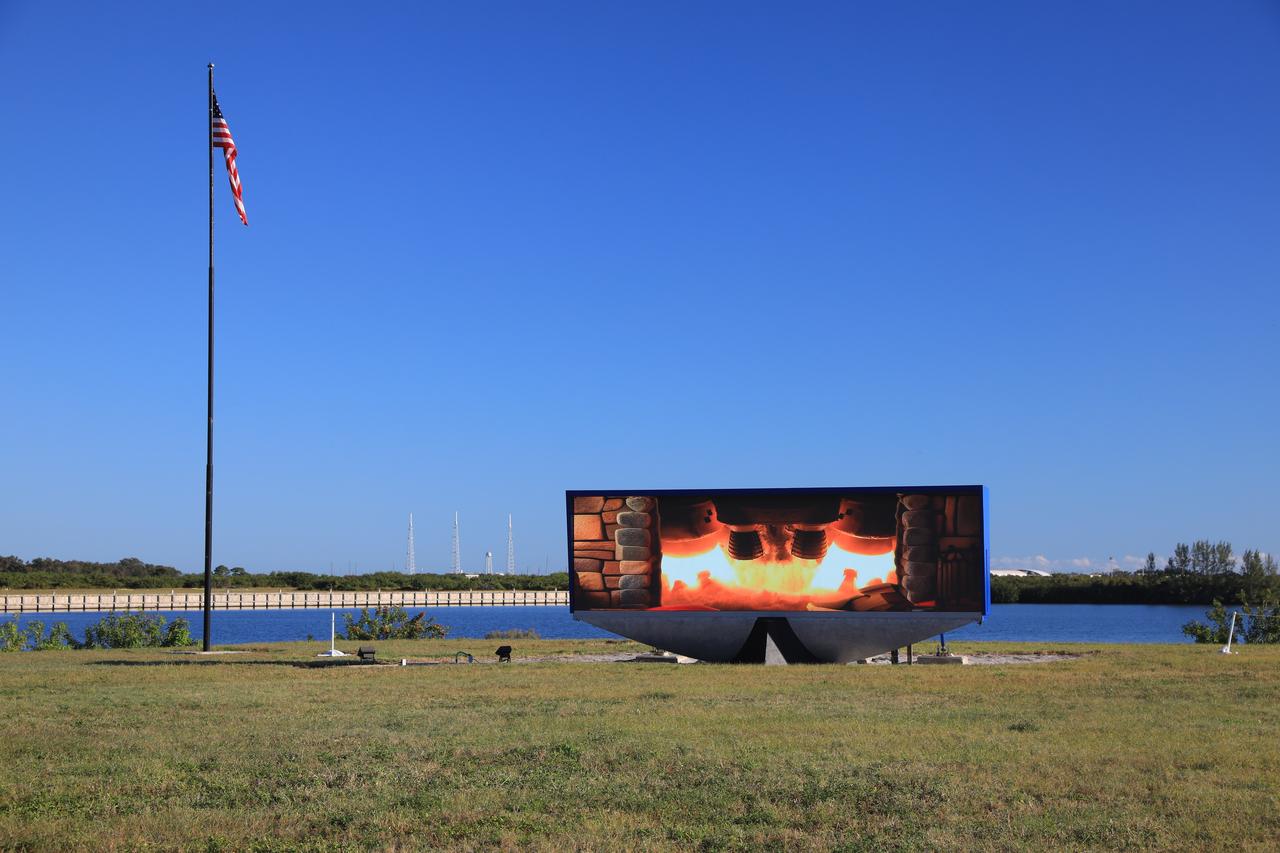
NASA’s SLS (Space Launch System) rocket that launched Artemis I on a mission around the Moon and back becomes a “rocket engine fireplace” back drop video on the historic countdown clock at the NASA News Center at the agency’s Kennedy Space Center on Tuesday, Nov. 26, 2024. The fireplace showcases the SLS rocket’s four RS-25 engines and a pair of solid rocket boosters.
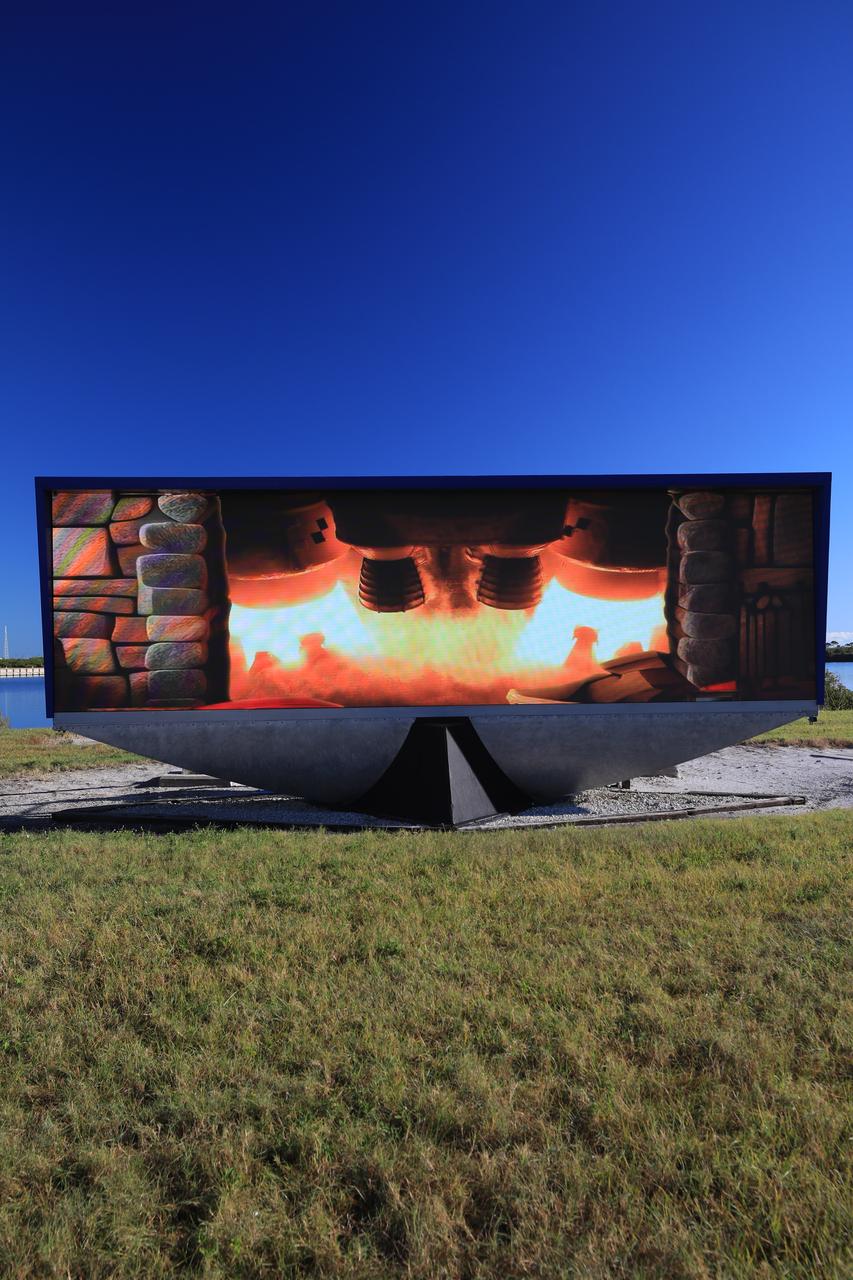
NASA’s SLS (Space Launch System) rocket that launched Artemis I on a mission around the Moon and back becomes a “rocket engine fireplace” back drop video on the historic countdown clock at the NASA News Center at the agency’s Kennedy Space Center on Tuesday, Nov. 26, 2024. The fireplace showcases the SLS rocket’s four RS-25 engines and a pair of solid rocket boosters.
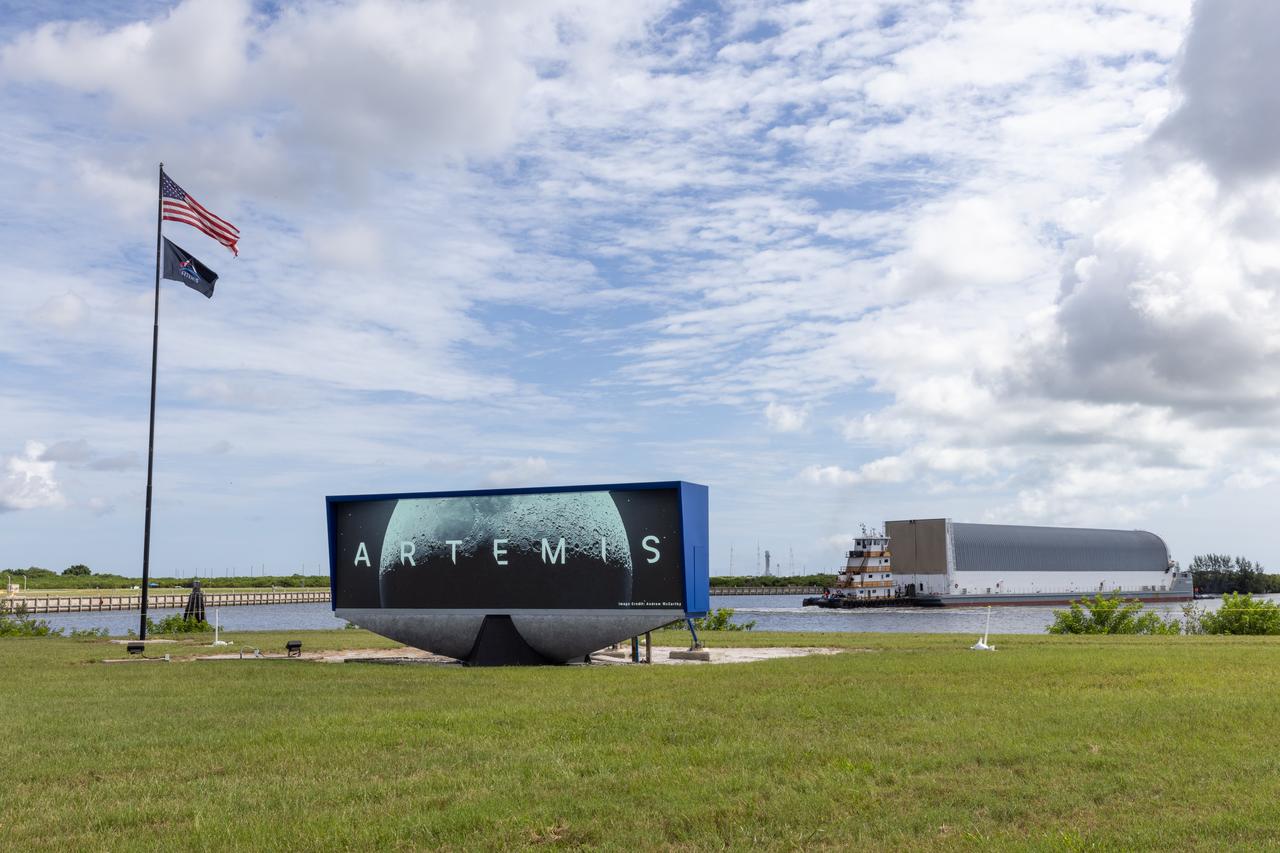
Behind the iconic countdown clock at NASA’s Kennedy Space Center in Florida, the agency’s Pegasus barge completes its 900-mile journey from NASA’s Michoud Assembly Facility in New Orleans carrying the powerful SLS (Space Launch System) core stage on Tuesday, July 23, 2024. Teams with Exploration Ground Systems (EGS) will offload the rocket stage and transfer it to the spaceport’s Vehicle Assembly Building to prepare it for integration atop the mobile launcher ahead of the Artemis II launch.
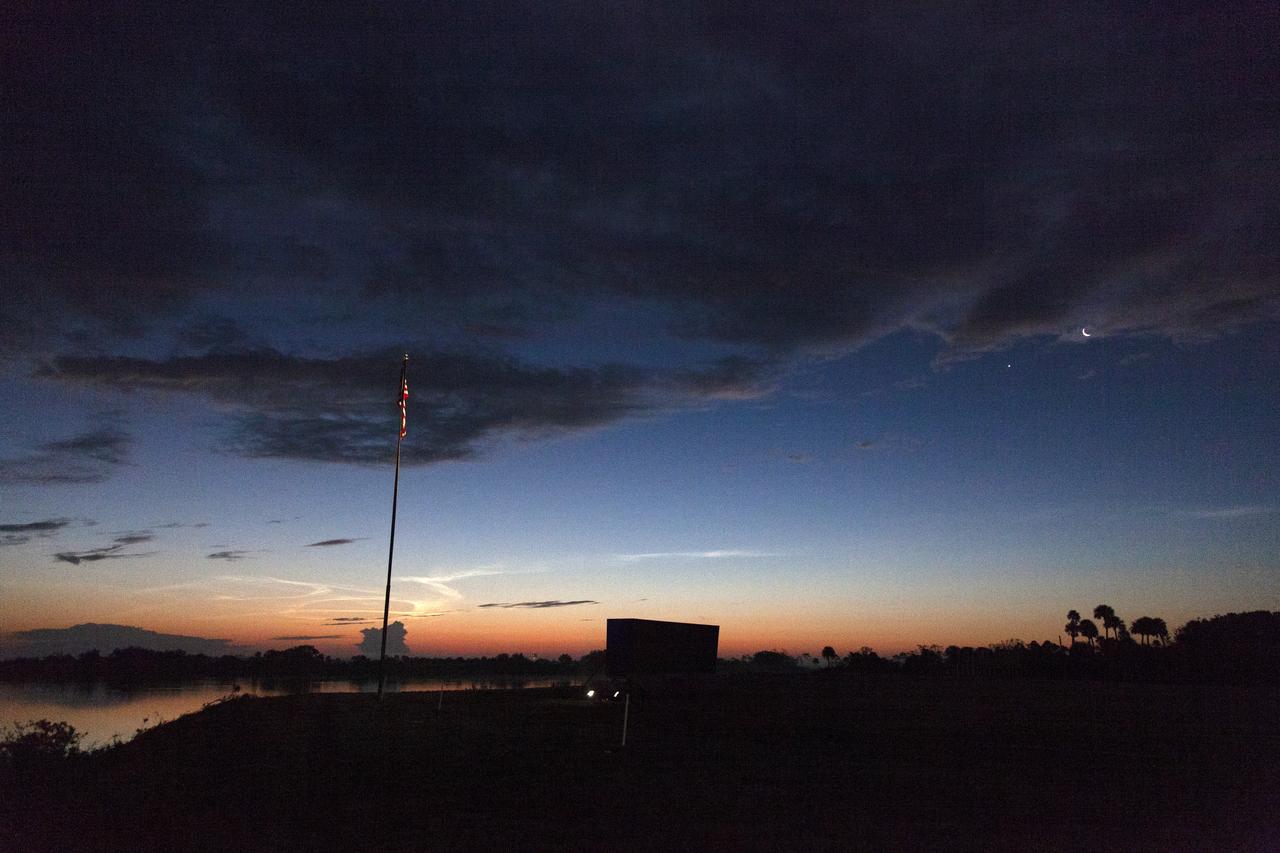
A sunrise serves as the backdrop for the countdown clock and American Flag near the Press Site at NASA’s Kennedy Space Center in Florida following the successful launch of SpaceX’s uncrewed Demo-1 flight test from Launch Complex 39A on March 2, 2019. The company’s Crew Dragon spacecraft lifted off atop a Falcon 9 rocket and traveled to the International Space Station, where it validated end-to-end systems and capabilities in preparation for certification to fly crew.
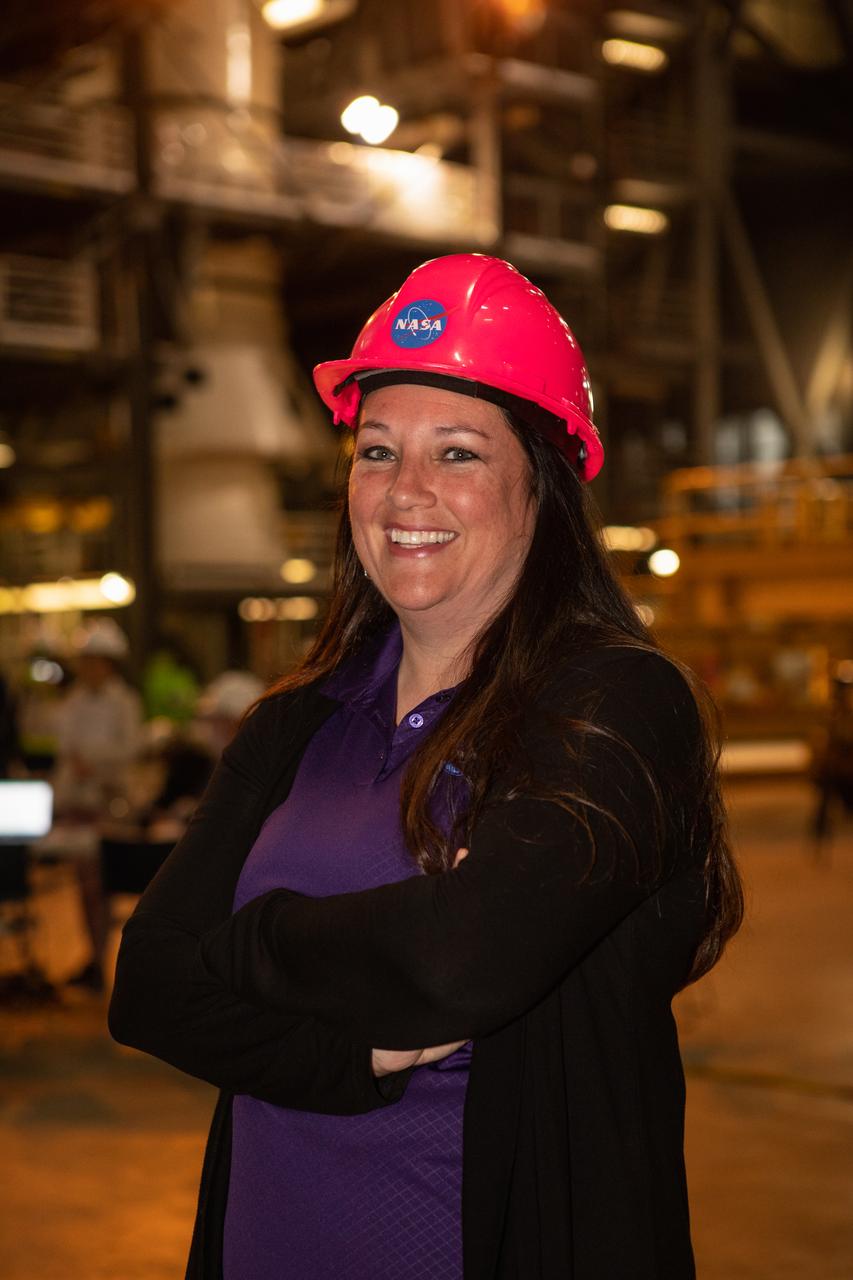
NASA Vehicle Assembly Building (VAB) Element Operations Manager Elizabeth Kline stands inside the VAB’s high bay 4 in front of mockups of the Space Launch System (SLS) booster segments on Nov. 19, 2019. Teams from NASA’s Exploration Ground Systems and SLS practiced booster segment mate, training around the clock from Nov. 18 through Nov. 20. SLS will launch the first woman and next man to the Moon by 2024 through the Artemis program.
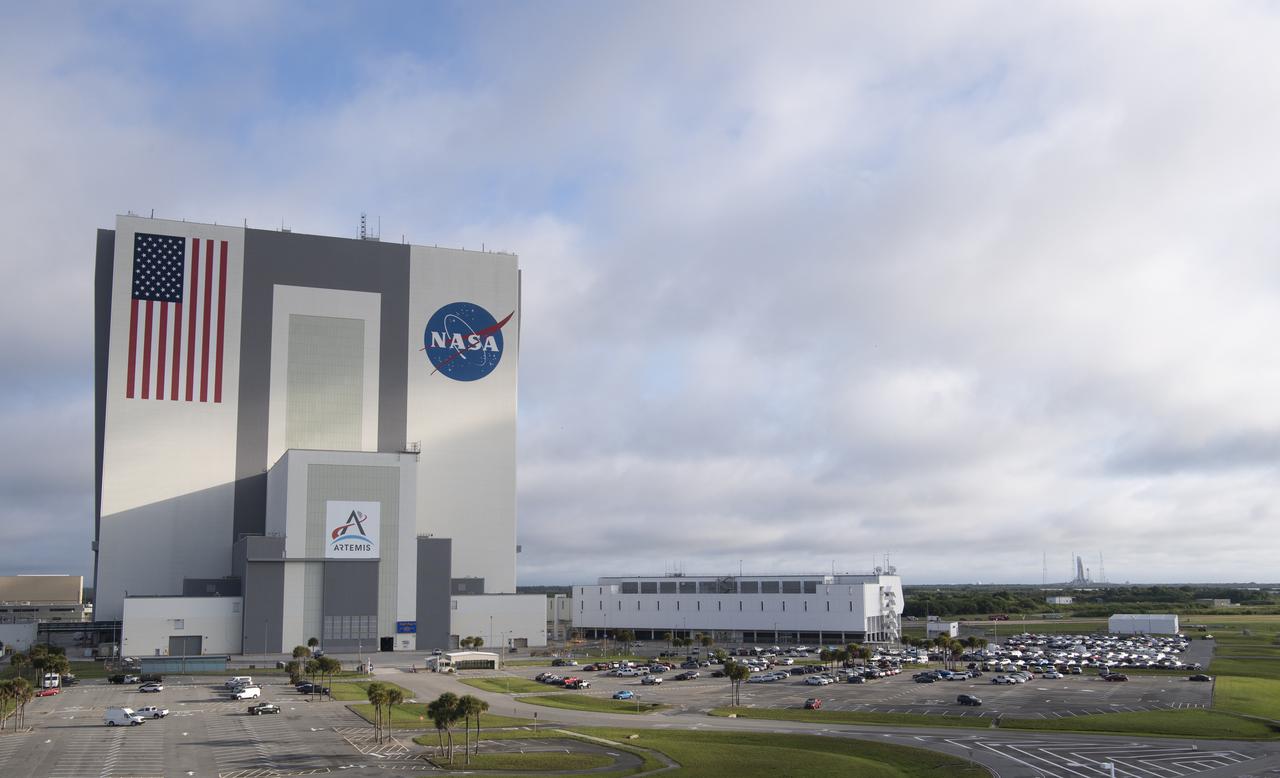
NASA’s Space Launch System (SLS) rocket with the Orion spacecraft aboard is seen atop a mobile launcher at Launch Complex 39Bin this view of the Vehicle Assembly Building and the Rocco A. Petrone Launch Control Center, Sunday, April 3, 2022, as the Artemis I launch team conducts the wet dress rehearsal test at NASA’s Kennedy Space Center in Florida. Ahead of NASA’s Artemis I flight test, the wet dress rehearsal will run the Artemis I launch team through operations to load propellant, conduct a full launch countdown, demonstrate the ability to recycle the countdown clock, and drain the tanks to practice timelines and procedures for launch. Photo Credit: (NASA/Joel Kowsky)