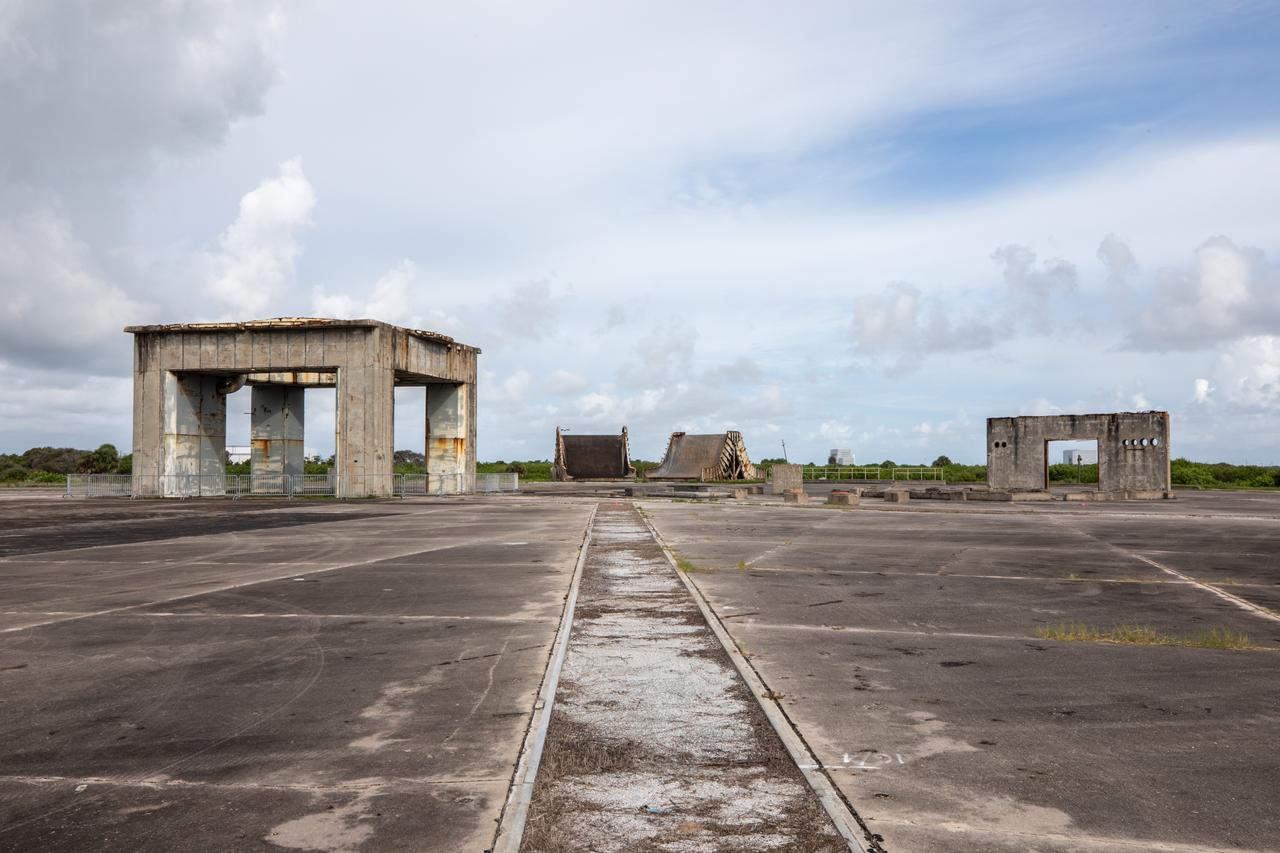
A view of the launch pedestal (at left) still standing at Launch Complex 34 at Cape Canaveral Space Force Station in Florida on July 22, 2020. In the background are two flame deflectors. Work will soon begin to perform environmental contamination removal on the pedestal and the ground area surrounding the launch complex.
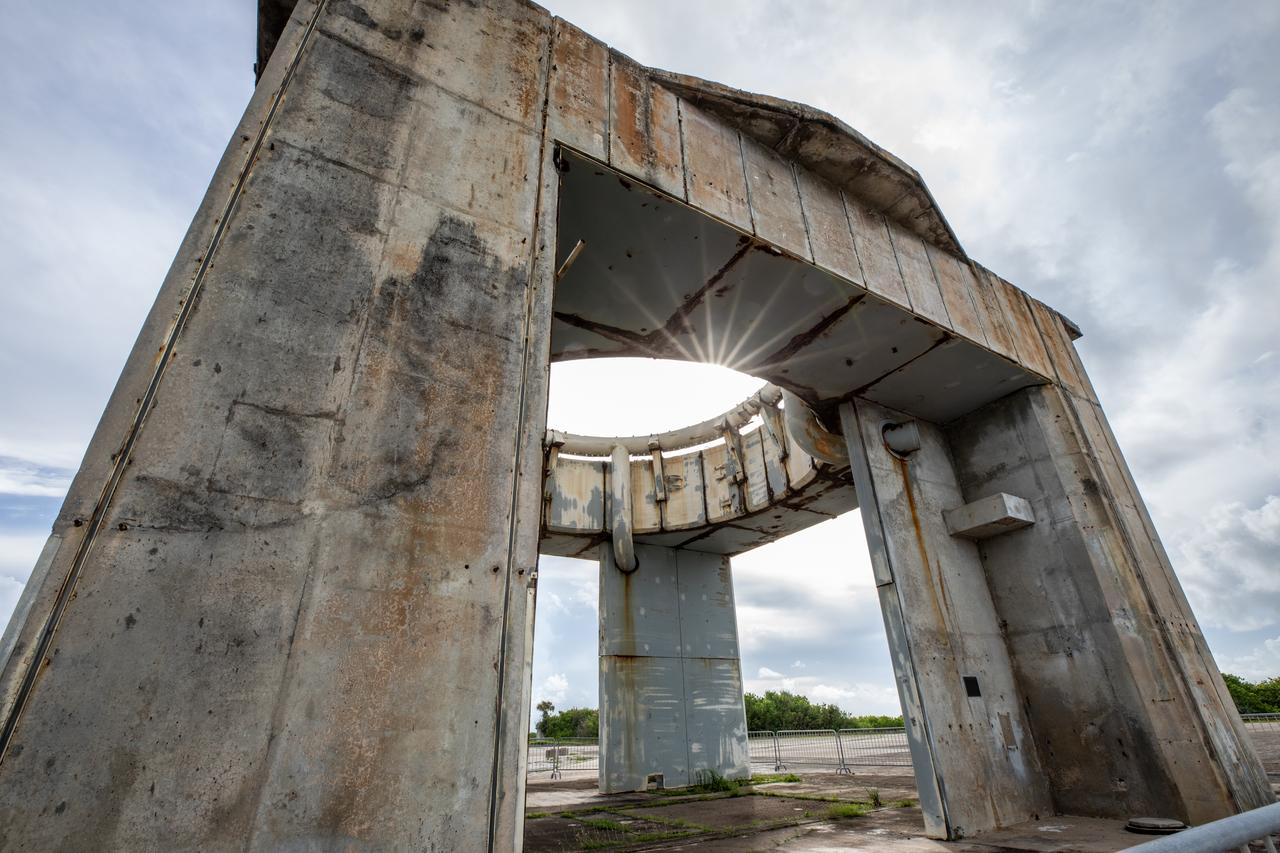
A close-up view of the launch pedestal still standing at Launch Complex 34 at Cape Canaveral Space Force Station in Florida on July 22, 2020. Work will soon begin to perform environmental contamination removal on the pedestal and the ground area surrounding the launch complex.
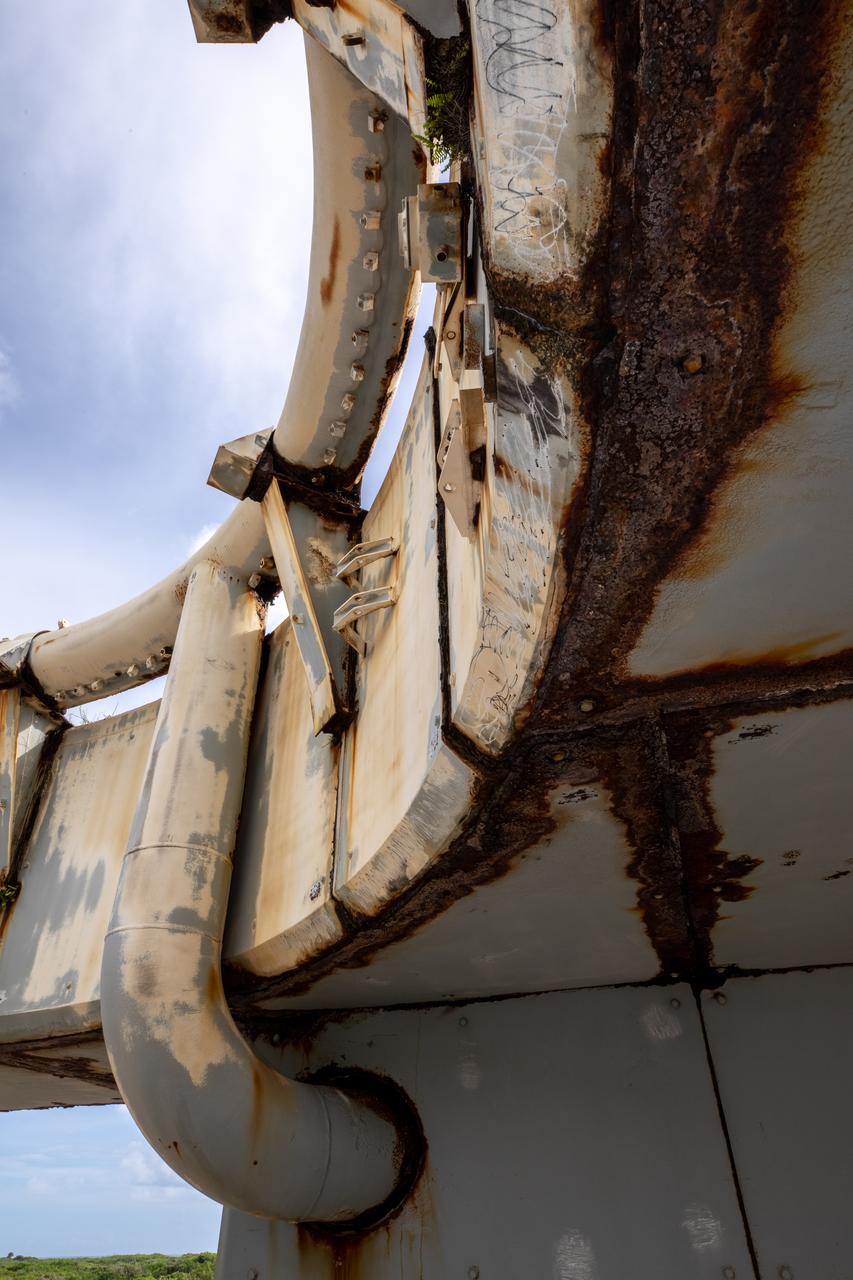
A close-up view of a portion of the launch pedestal still standing at Launch Complex 34 at Cape Canaveral Space Force Station in Florida on July 22, 2020. Work will soon begin to perform environmental contamination removal on the pedestal and the ground area surrounding the launch complex.
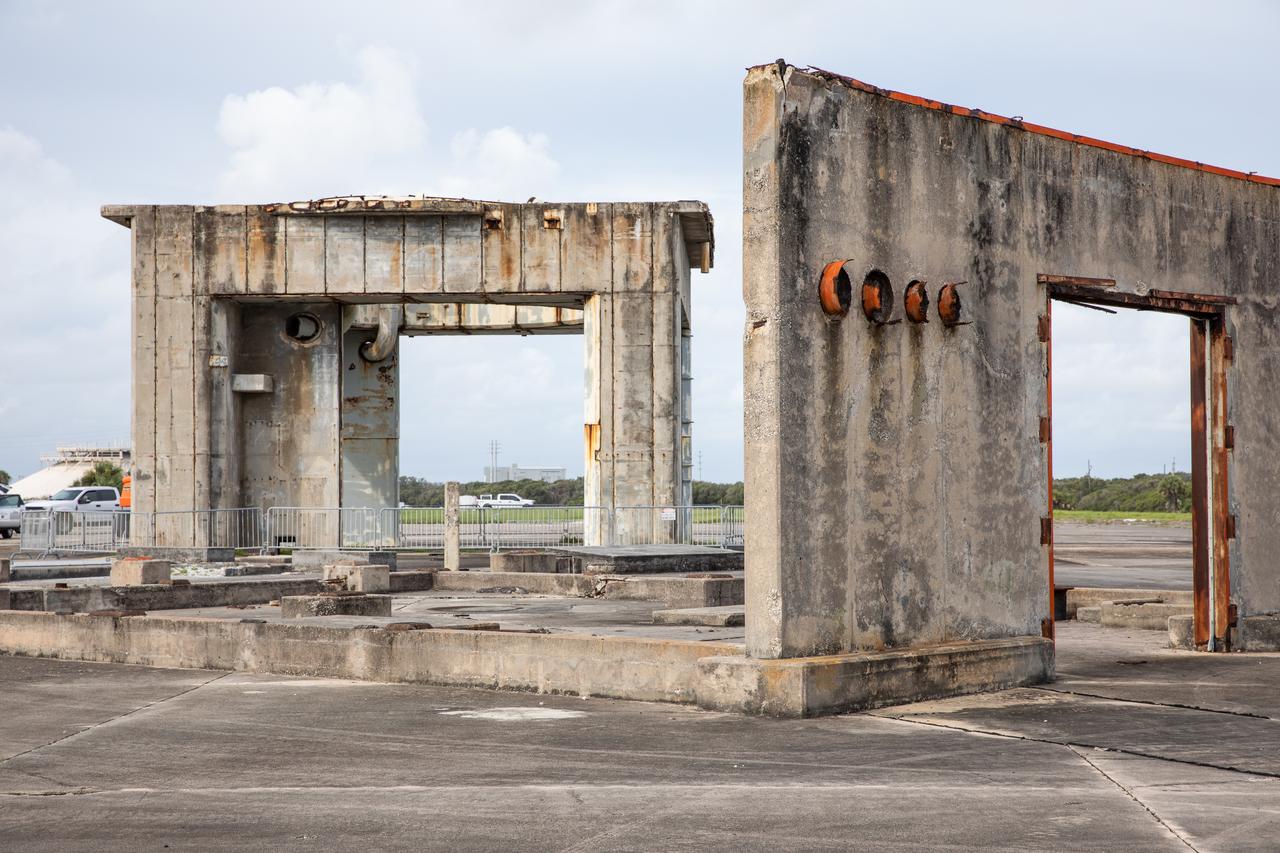
A close-up view of the launch pedestal and a support structure still standing at Launch Complex 34 at Cape Canaveral Space Force Station in Florida on July 22, 2020. Work will soon begin to perform environmental contamination removal on the pedestal and the ground area surrounding the launch complex.
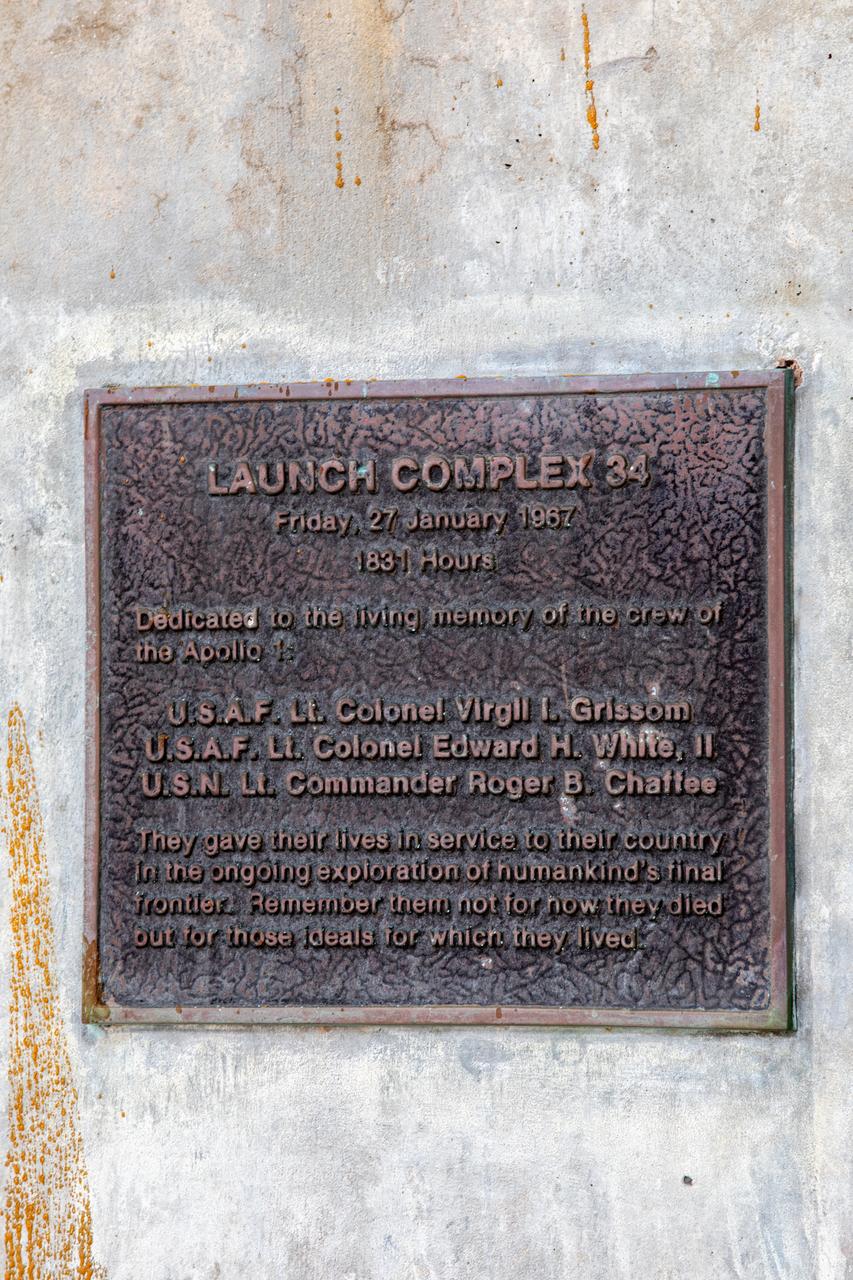
A close-up view of the historic marker on the launch pedestal still standing at Launch Complex 34 at Cape Canaveral Space Force Station in Florida on July 22, 2020. Work will soon begin to perform environmental contamination removal on the pedestal and the ground area surrounding the launch complex.
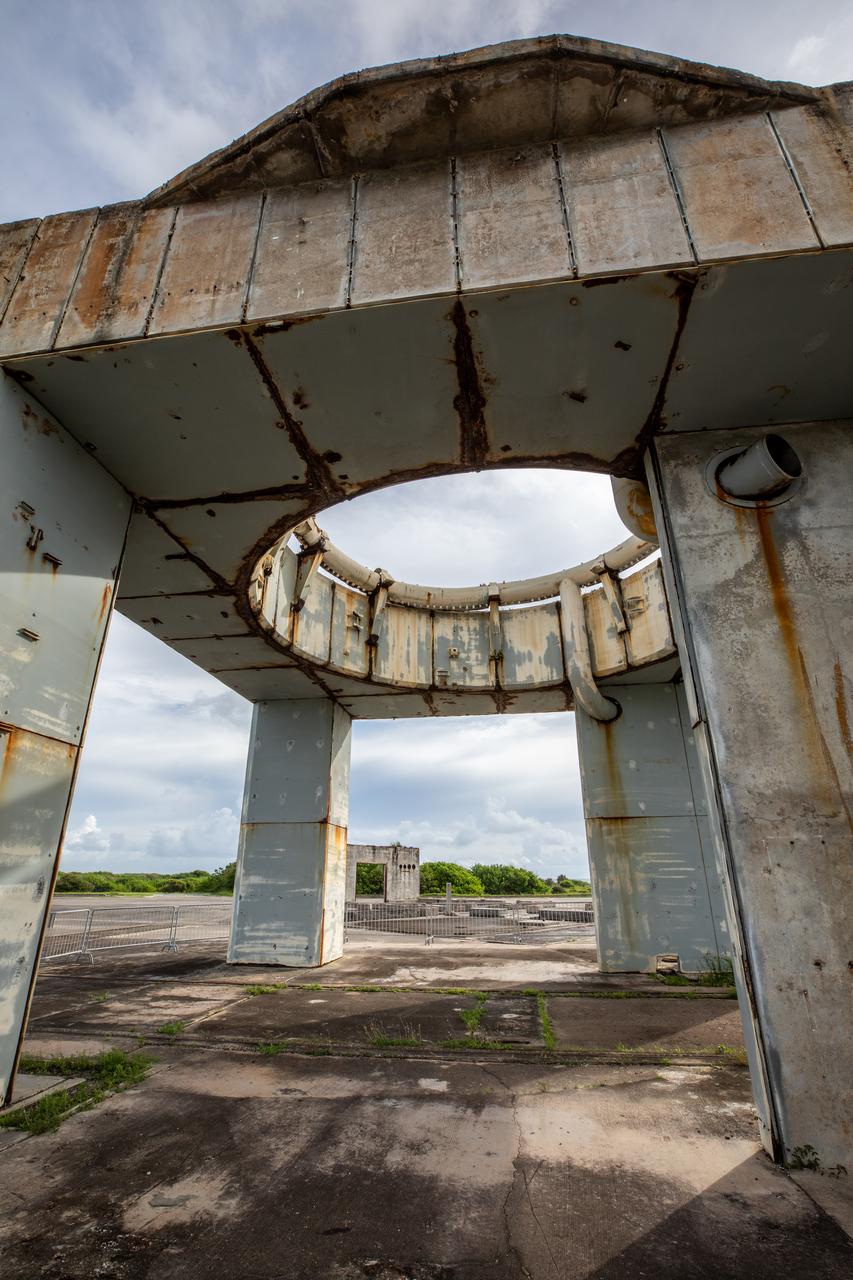
A close-up view of the launch pedestal still standing at Launch Complex 34 at Cape Canaveral Space Force Station in Florida on July 22, 2020. Work will soon begin to perform environmental contamination removal on the pedestal and the ground area surrounding the launch complex.
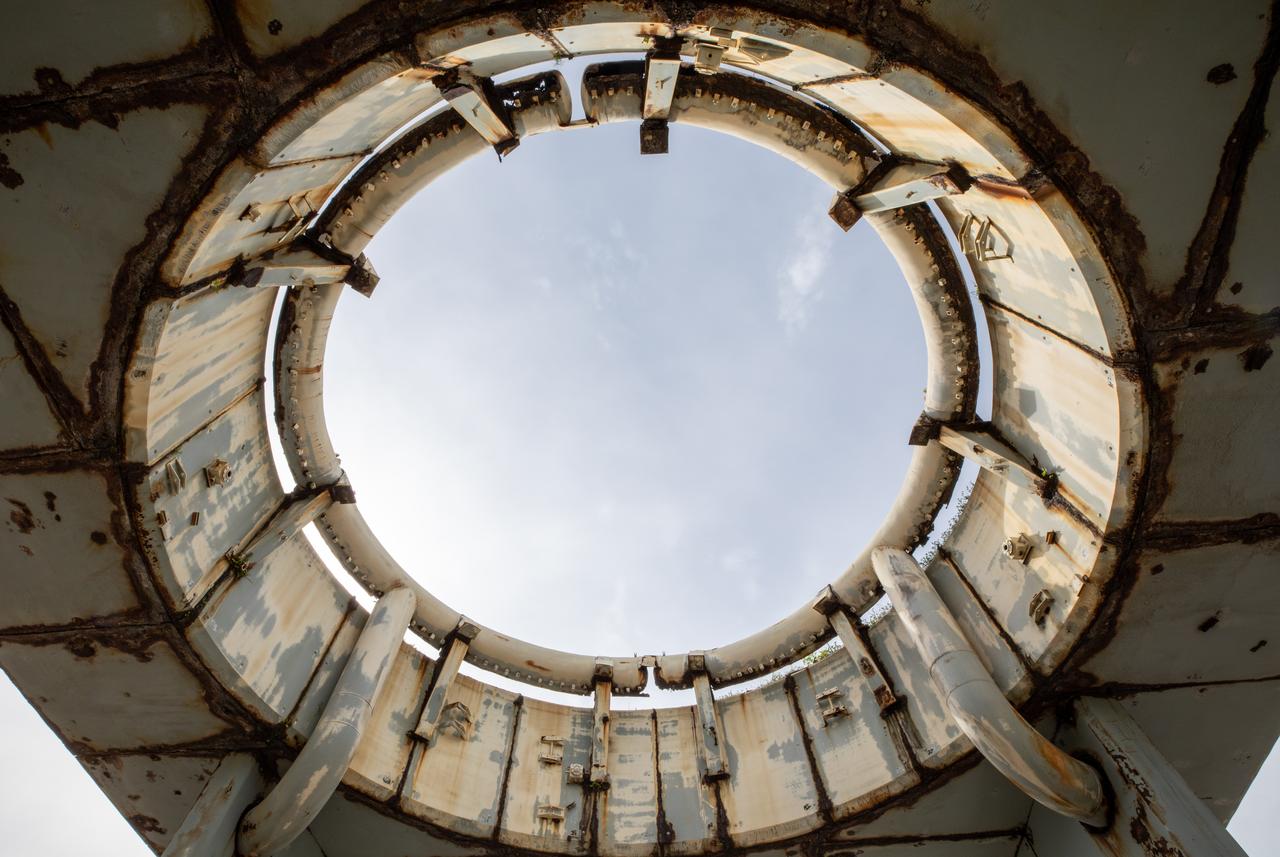
A view looking up from inside the launch pedestal still standing at Launch Complex 34 at Cape Canaveral Space Force Station in Florida on July 22, 2020. Work will soon begin to perform environmental contamination removal on the pedestal and the ground area surrounding the launch complex.
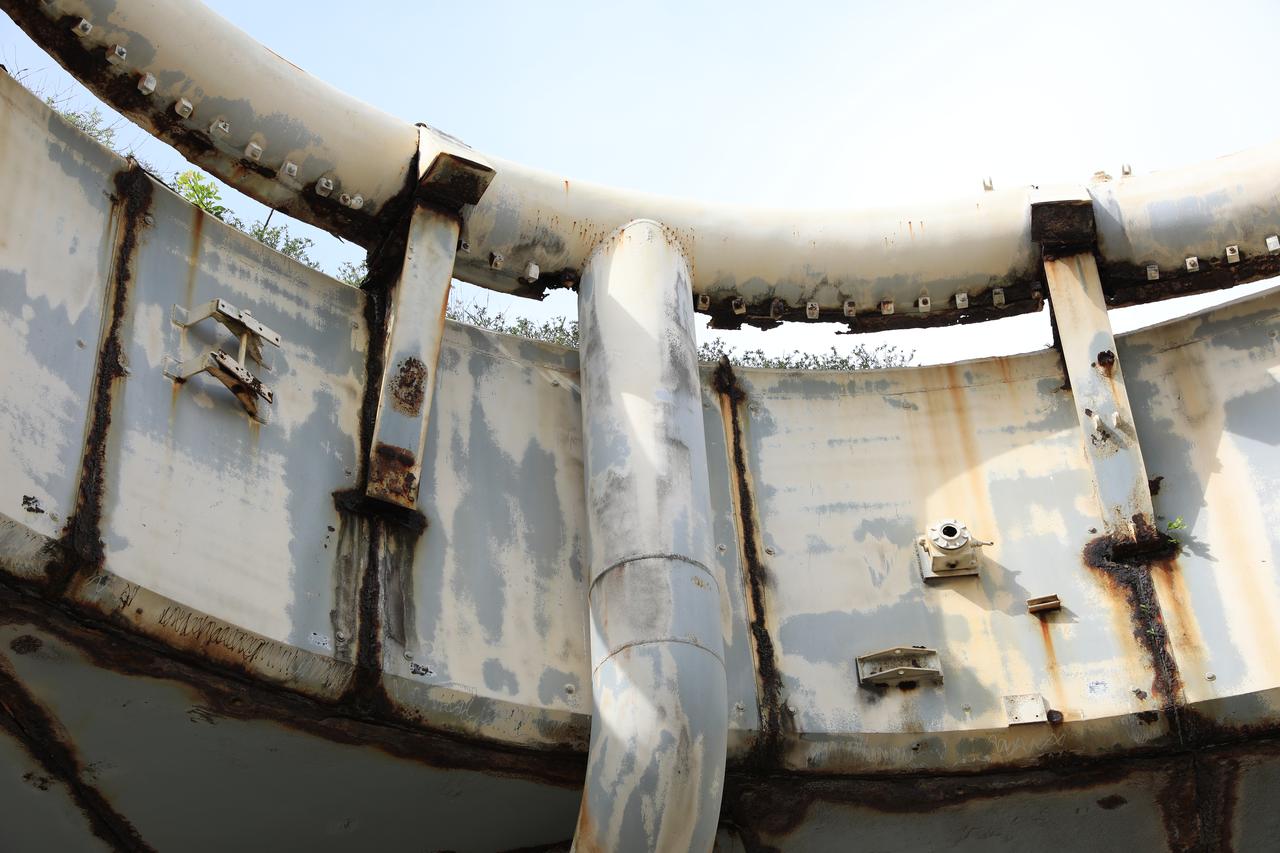
A view looking up from inside the launch pedestal still standing at Launch Complex 34 at Cape Canaveral Space Force Station in Florida on July 22, 2020. Work will soon begin to perform environmental contamination removal on the pedestal and the ground area surrounding the launch complex.
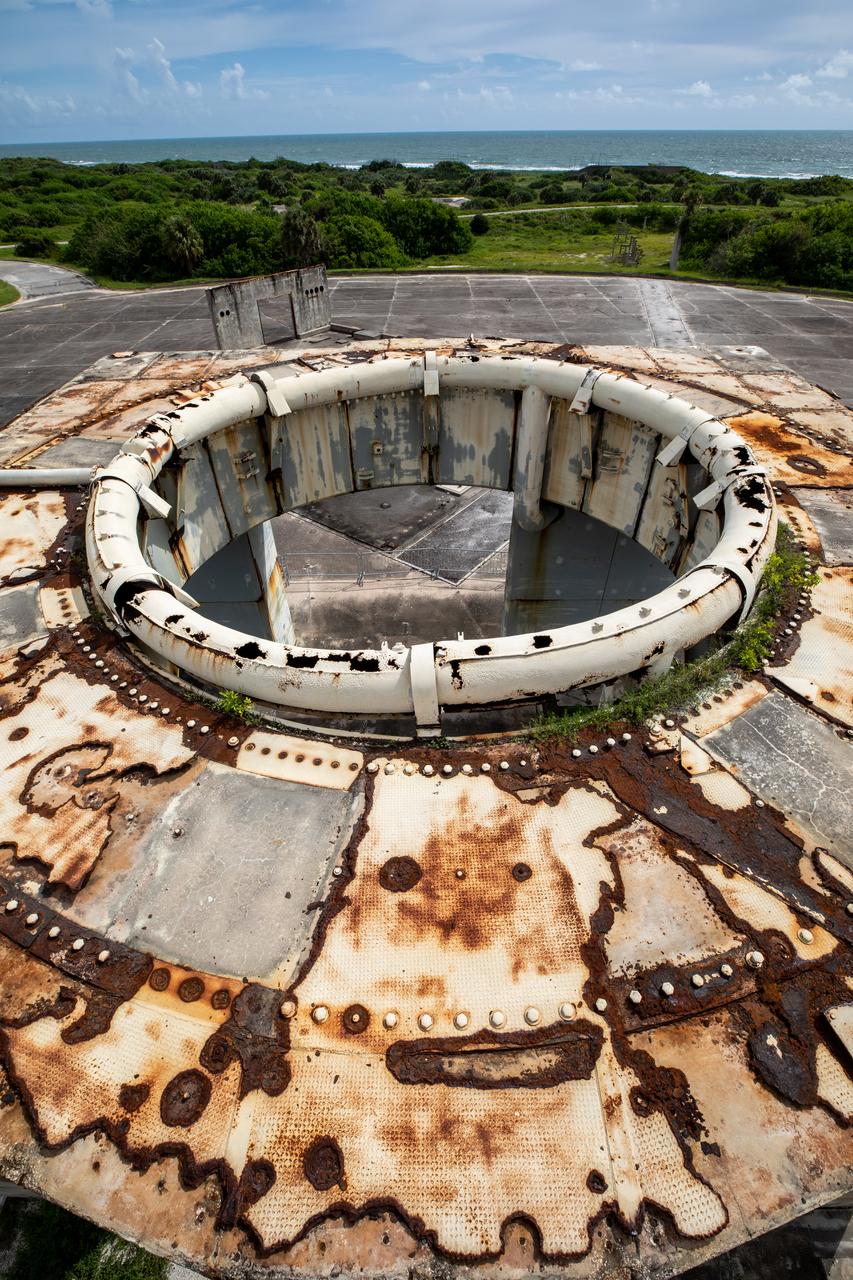
A view of the top of the launch pedestal still standing at Launch Complex 34 at Cape Canaveral Space Force Station in Florida on July 22, 2020. Work will soon begin to perform environmental contamination removal on the pedestal and the ground area surrounding the launch complex.
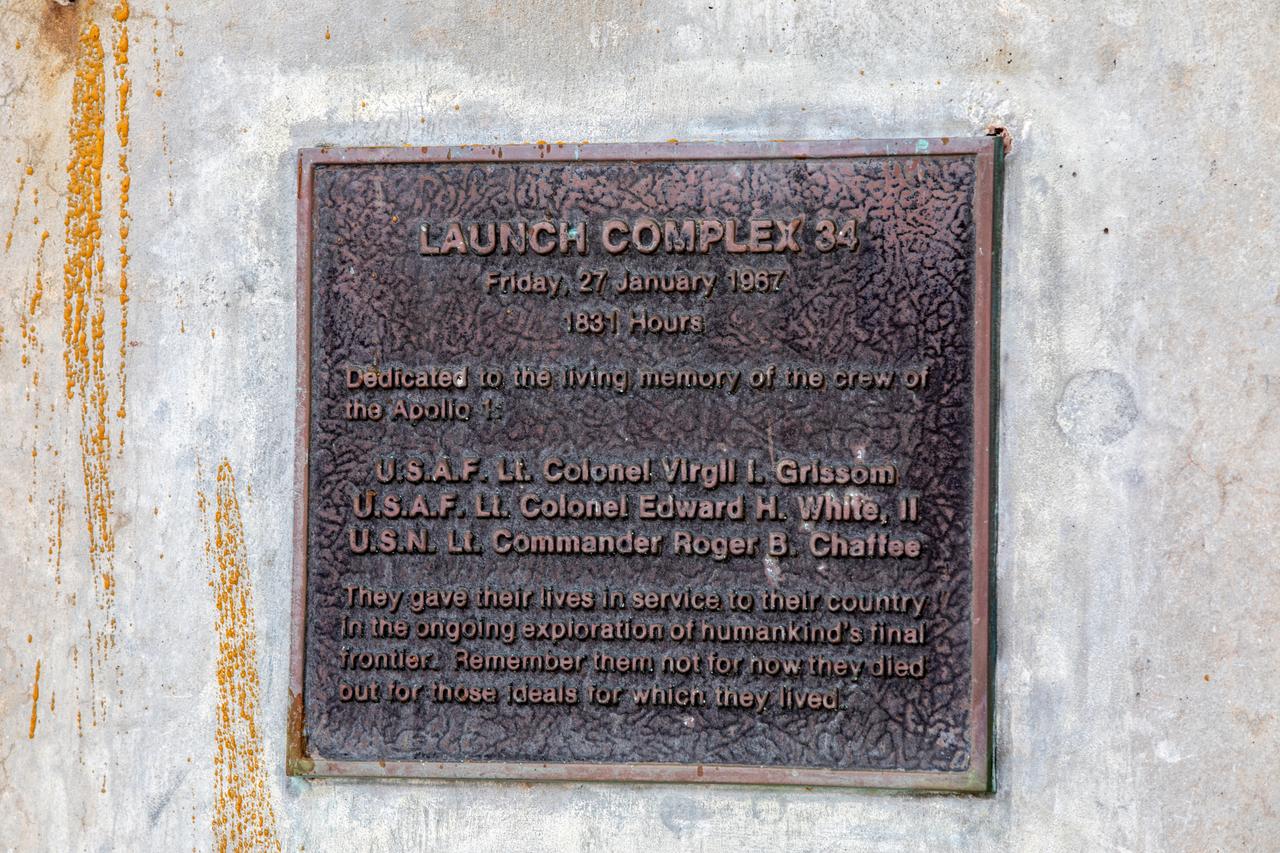
A close-up view of the historic marker on the launch pedestal still standing at Launch Complex 34 at Cape Canaveral Space Force Station in Florida on July 22, 2020. Work will soon begin to perform environmental contamination removal on the pedestal and the ground area surrounding the launch complex.
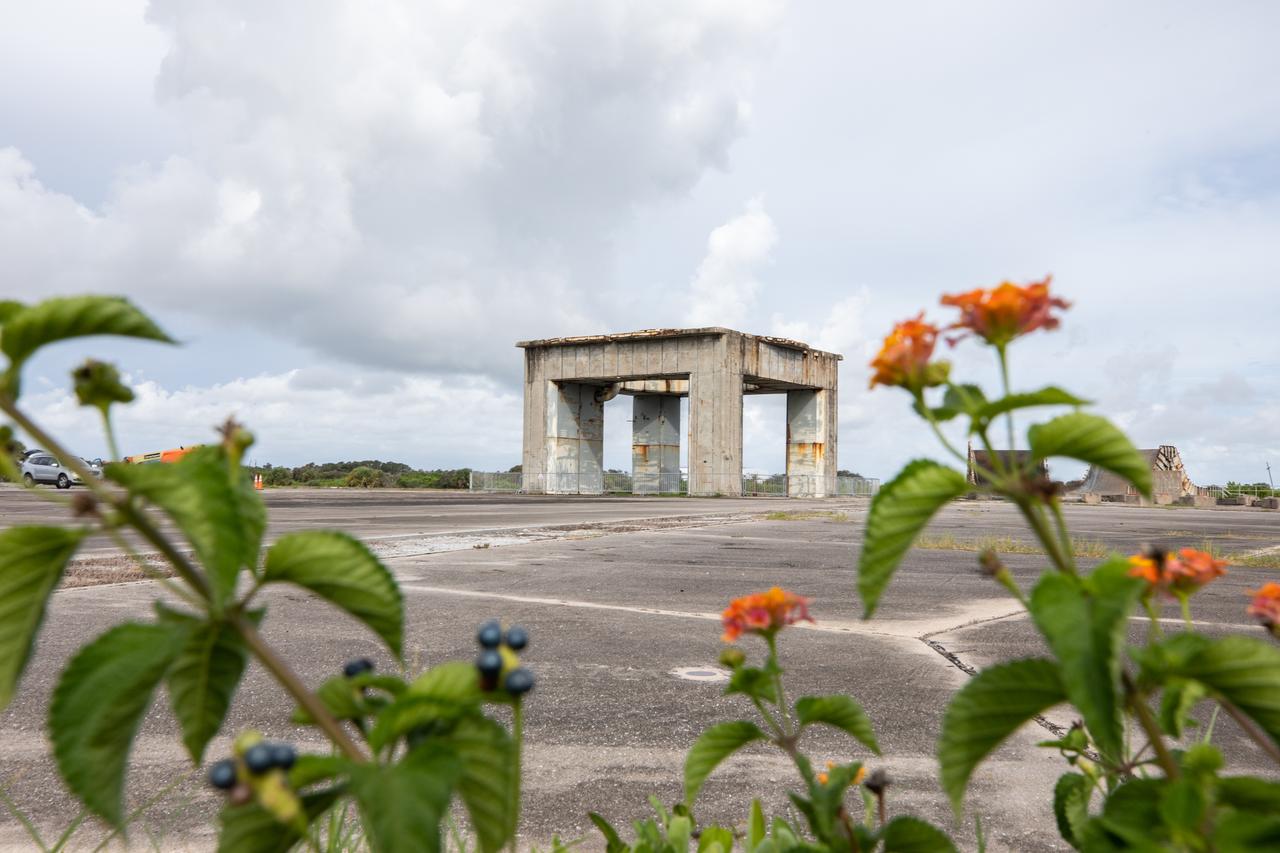
A view of the launch pedestal still standing at Launch Complex 34 with wildflowers in the foreground at Cape Canaveral Space Force Station in Florida on July 22, 2020. Work will soon begin to perform environmental contamination removal on the pedestal and the ground area surrounding the launch complex.
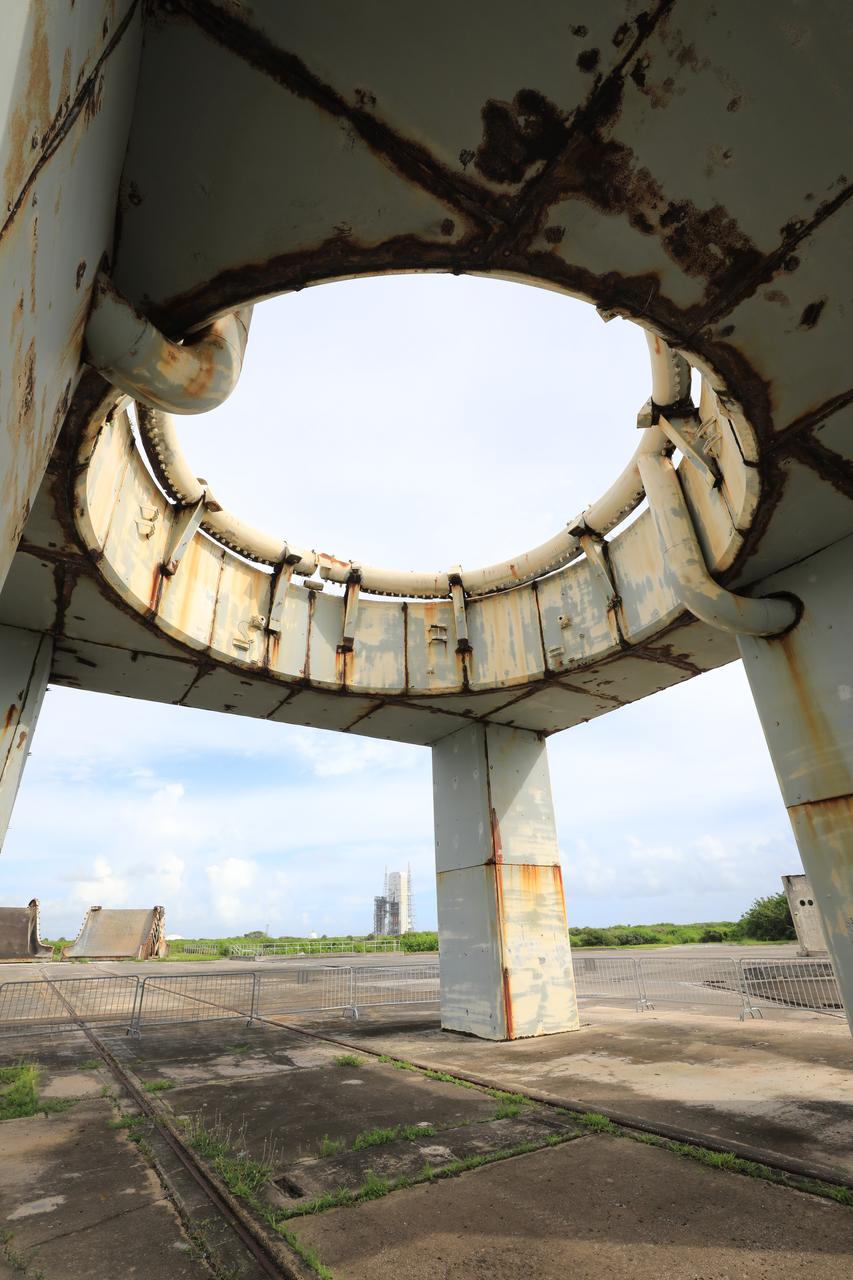
A view looking up from inside the launch pedestal still standing at Launch Complex 34 at Cape Canaveral Space Force Station in Florida on July 22, 2020. Work will soon begin to perform environmental contamination removal on the pedestal and the ground area surrounding the launch complex.
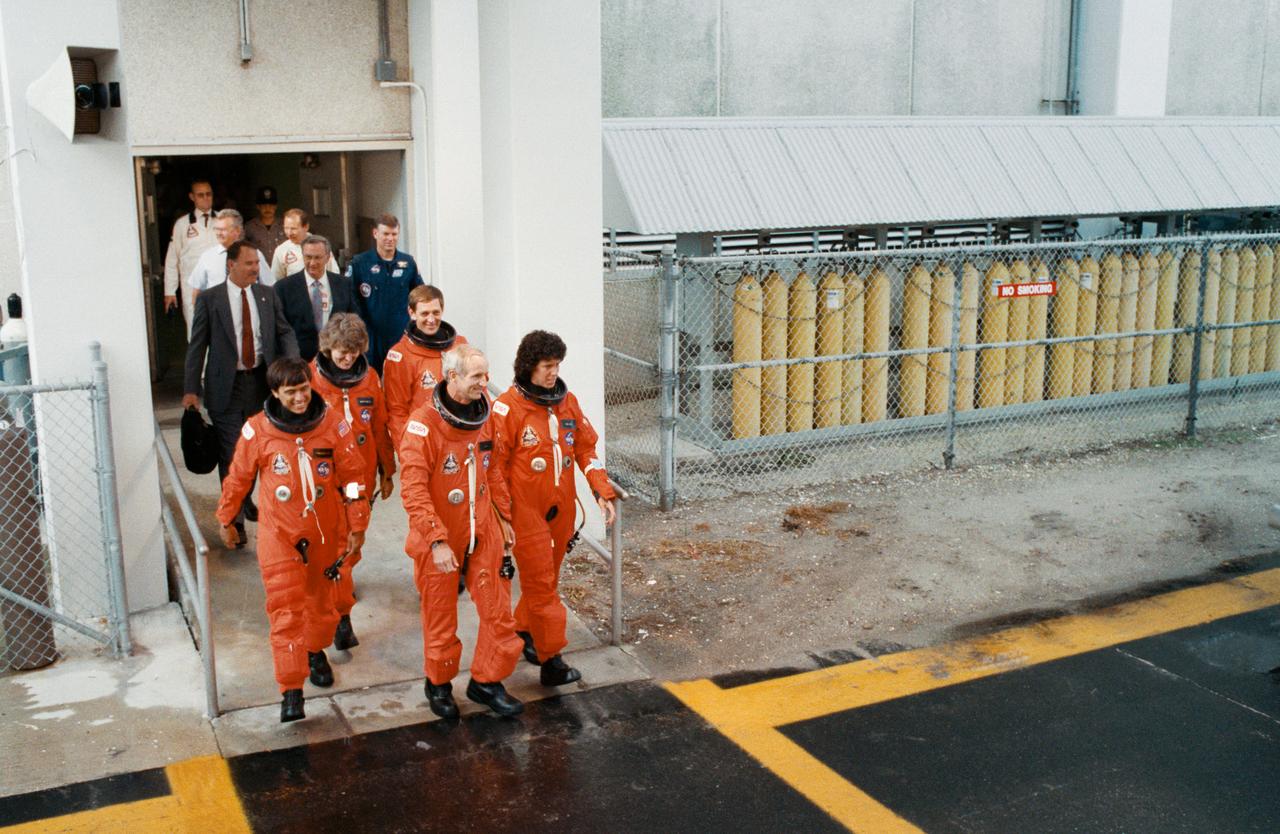
STS-34 crewmembers leave the Kennedy Space Center (KSC) Operations and Checkout (O&C) Building. Crewmembers will then board a vehicle which will carry them to Launch Complex (LC) Pad 39B. Crewmembers, wearing orange launch and entry suits (LESs), are (left to right) Mission Specialist (MS) Franklin R. Chang-Diaz, MS Shannon W. Lucid, Pilot Michael J. McCulley, Commander Donald E. Williams, and MS Ellen S. Baker. Following the crewmembers are (dark clothing, left to right) Donald R. Puddy, Olan J. Bertrand, and astronaut Michael L. Coats of JSC.
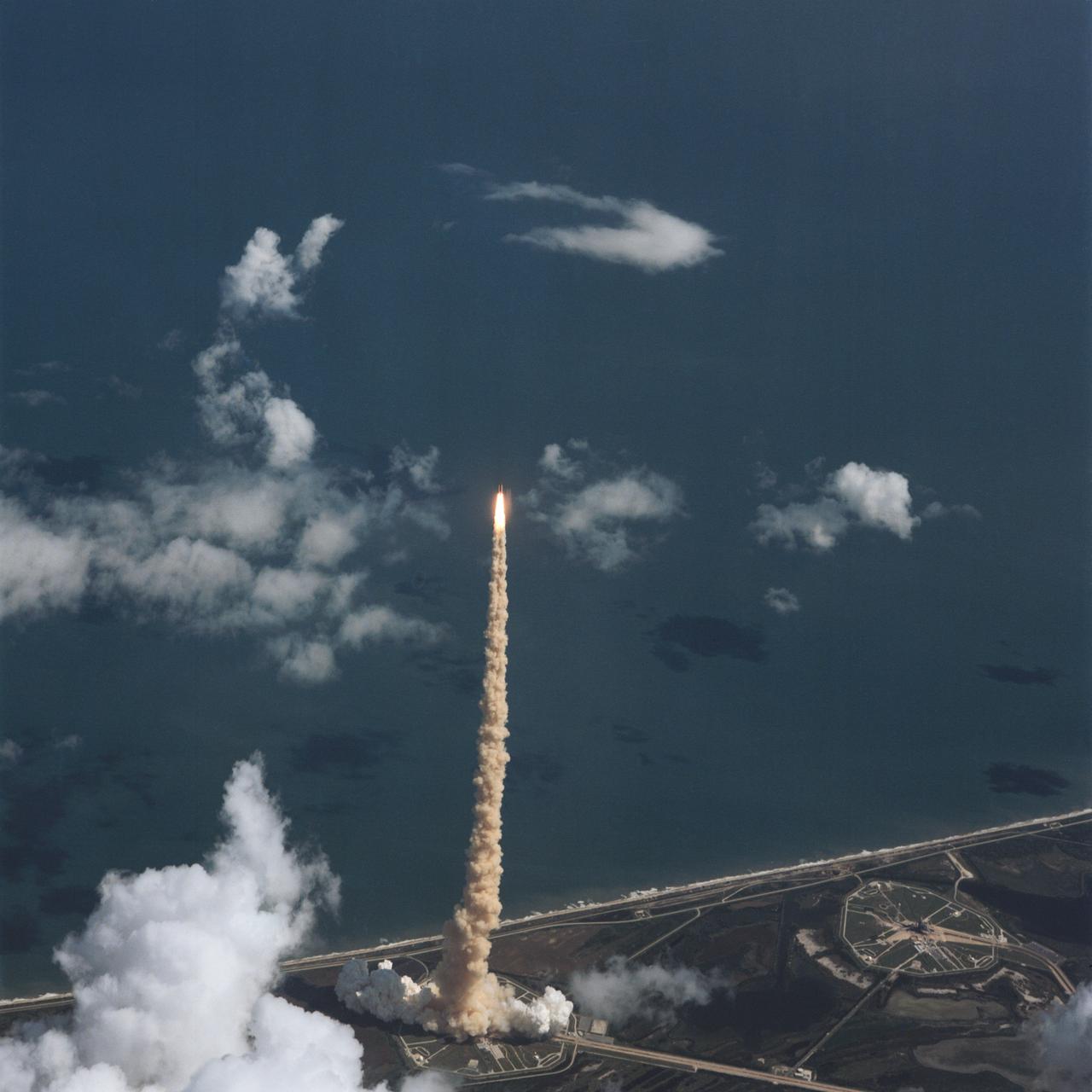
STS-34 Atlantis, Orbiter Vehicle (OV) 104, lifts off from Kennedy Space Center (KSC) Launch Complex (LC) Pad 39B at 12:53:39:983 pm Eastern Daylight Time (EDT). This aerial view shows OV-104, its external tank (ET), and two solid rocket boosters (SRBs) rising high above LC Pad 39B atop a plume of exhaust smoke. Atlantic Ocean is visible in the background. The liftoff marks the beginning of a five-day mission in space.
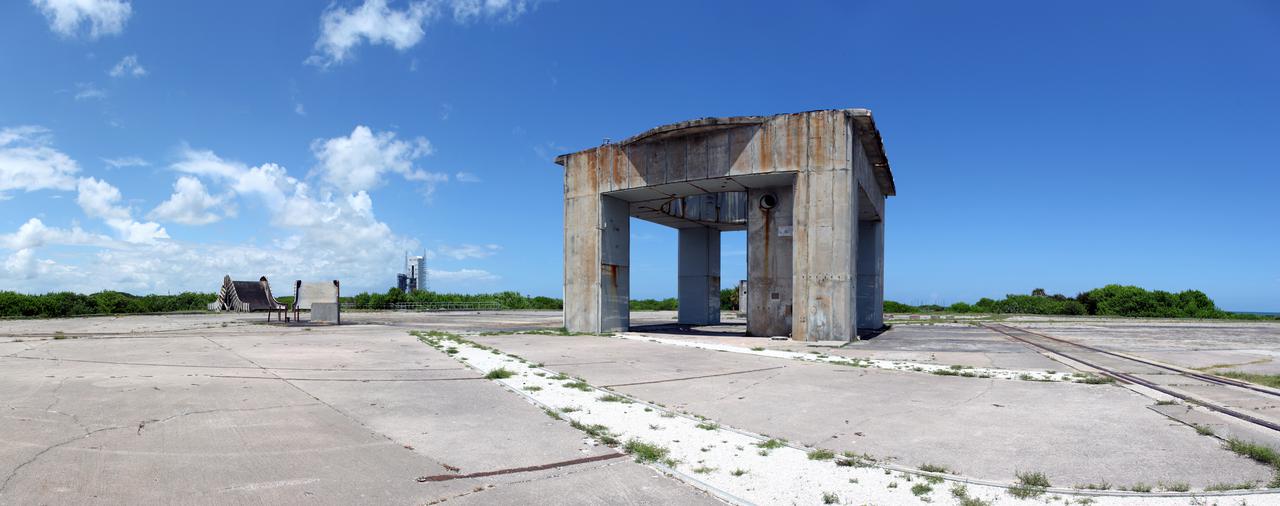
CAPE CANAVERAL, Fla. -- At Cape Canaveral Air Force Station in Florida stands the Launch Complex-34 launch platform. During the Apollo Program, Complex-34 was the site of the first Saturn I and Saturn IB launches, as well as the tragic fire in which the Apollo 1 astronauts lost their lives. Apollo 7, the first crewed Apollo flight, was the last to launch from Complex-34. Subsequent Apollo mission launched from NASA Kennedy Space Center's Launch Complex 39. Photo credit: NASA_Frankie Martin
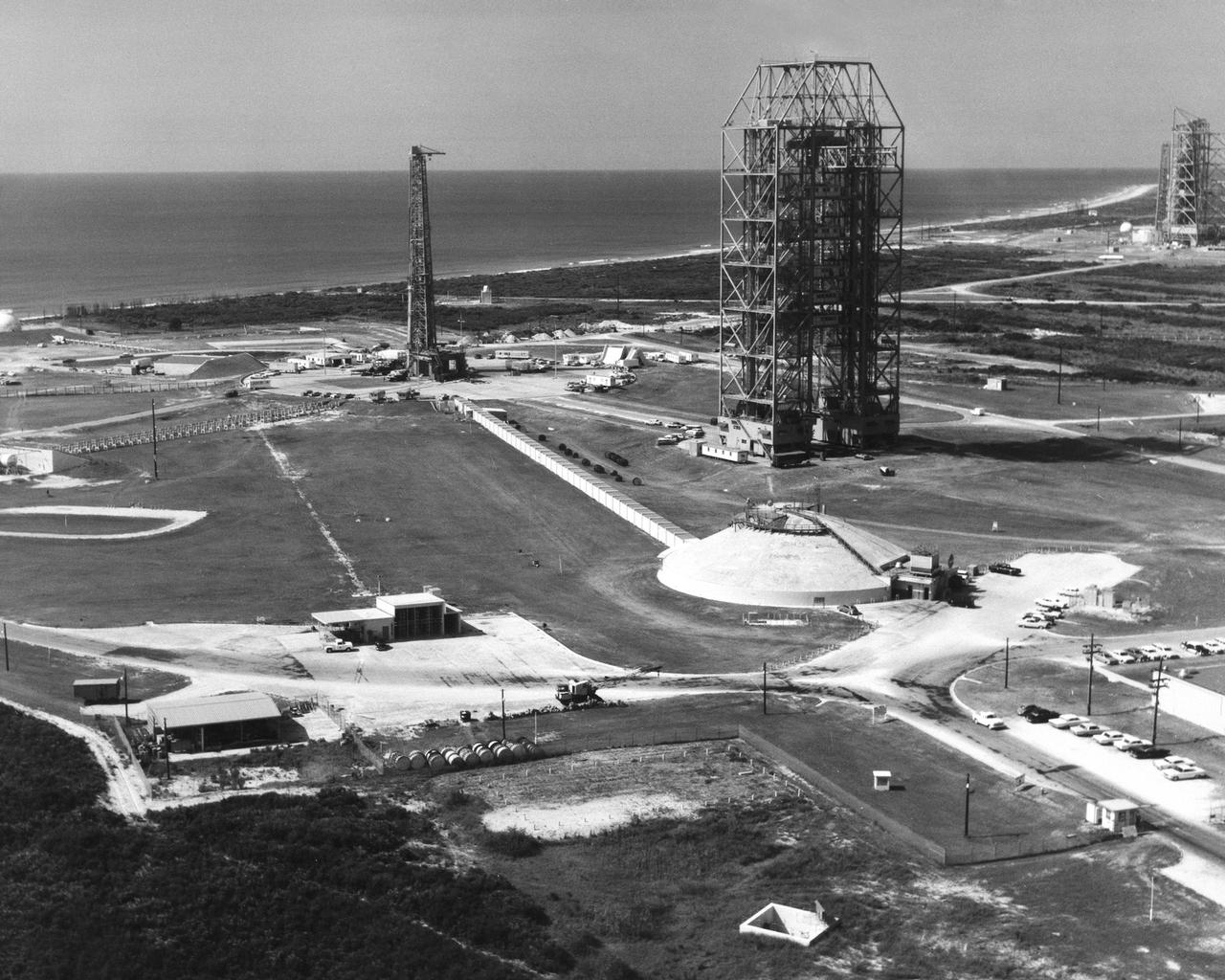
CAPE CANAVERAL, Fla. – Aerial, Launch Complex 34. Photo credit: NASA
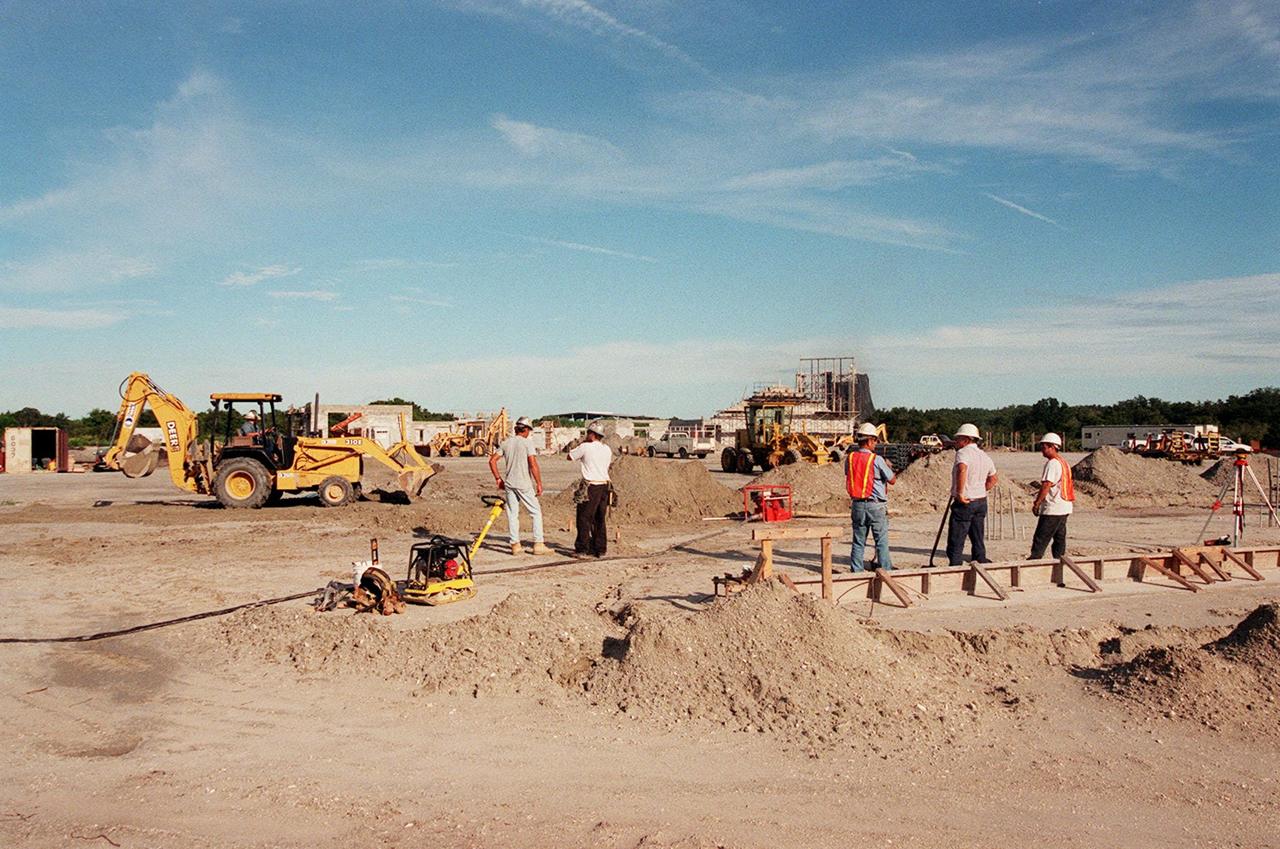
Construction is under way for the X-33/X-34 hangar complex near the Shuttle Landing Facility at KSC. The Reusable Launch Vehicle (RLV) complex will include facilities for related ground support equipment and administrative/ technical support. It will be available to accommodate the Space Shuttle; the X-34 RLV technology demonstrator; the L-1011 carrier aircraft for Pegasus and X-34; and other RLV and X-vehicle programs. The complex is jointly funded by the Spaceport Florida Authority, NASA's Space Shuttle Program and KSC. The facility will be operational in early 2000
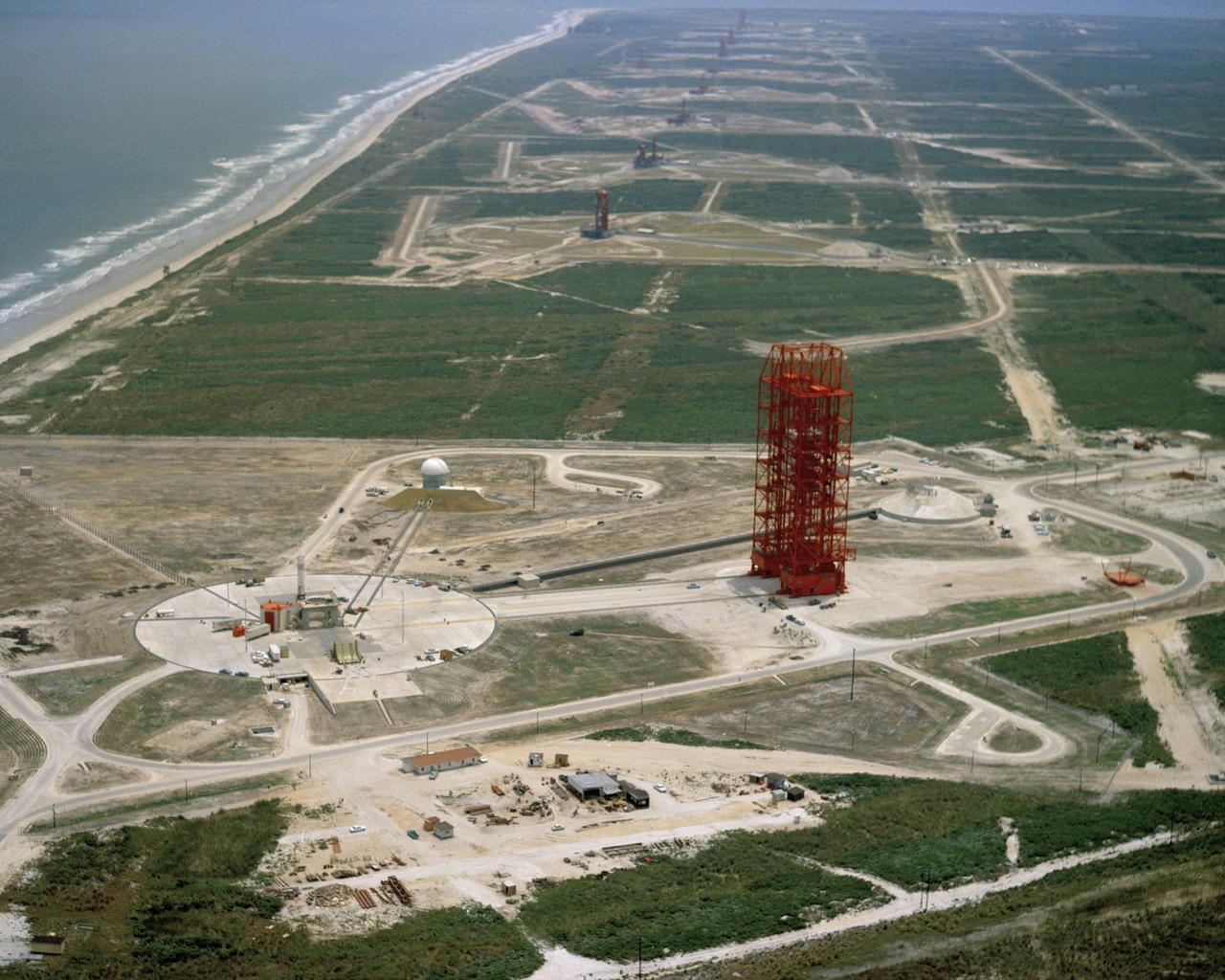
AERIAL PHOTO SHOWING COMPLEX 34 AND OTHER LAUNCH PADS IN BACKGROUND CCMTA NASA-LOD
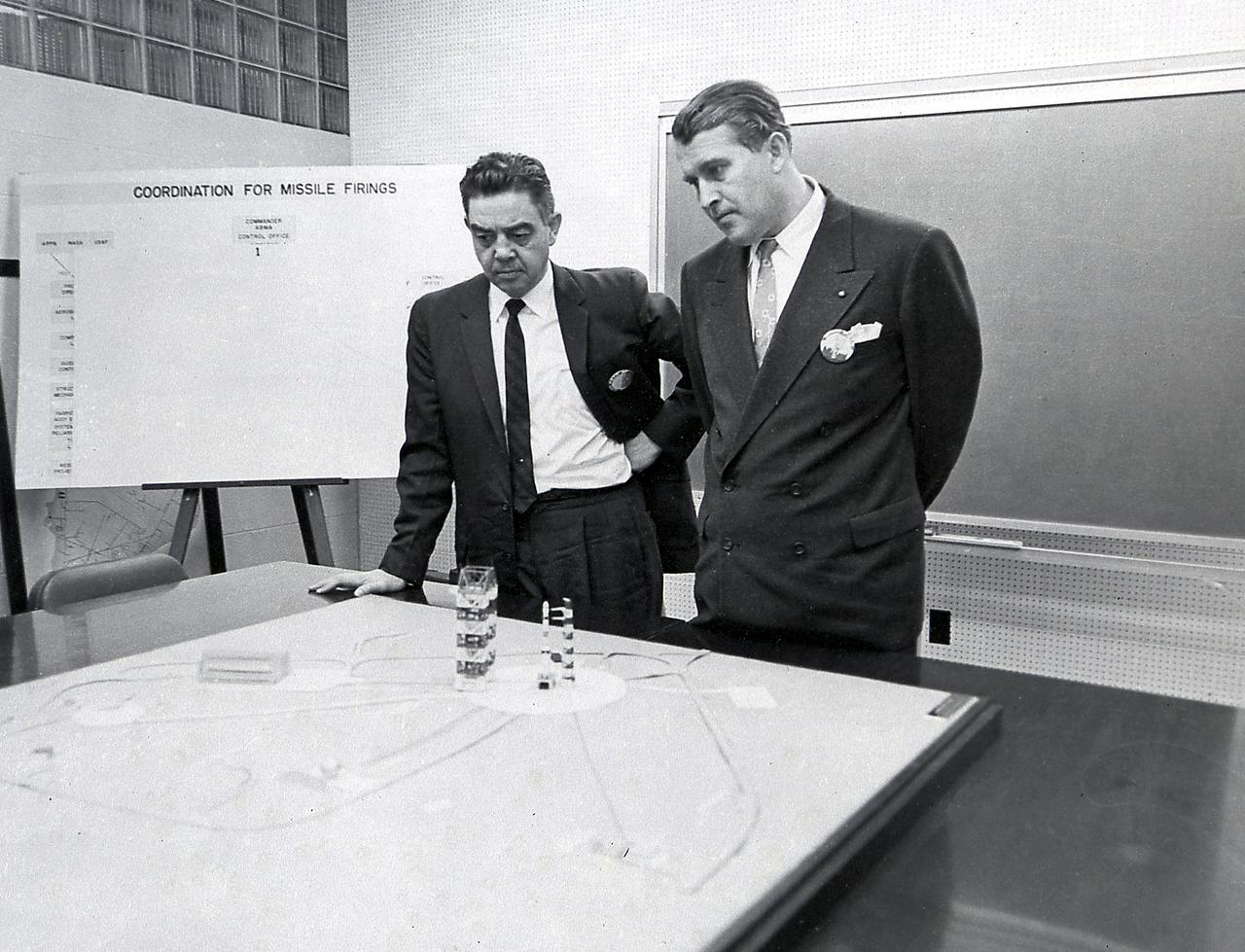
Dr. von Braun and Don Ostrander, head of the Launch Vehicle Program of the NASA Headquarters look at a model of the Saturn I launch complex 34.
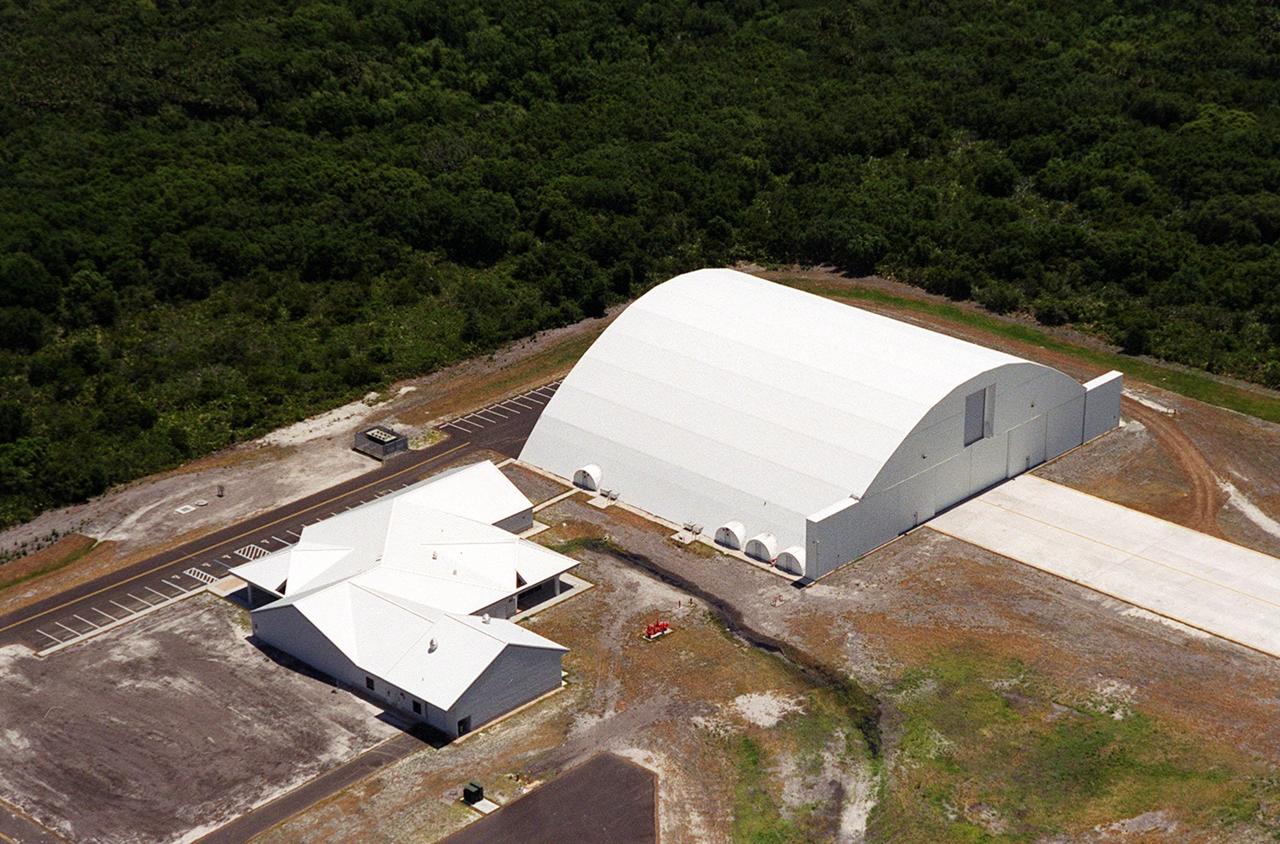
This closeup photo shows the Reusable Launch Vehicle (RLV) Support Complex at Kennedy Space Center. At right is a multi-purpose hangar and to the left is a building for related ground support equipment and administrative/ technical support. The complex is situated at the Shuttle Landing Facility. The RLV complex will be available to accommodate the Space Shuttle; the X-34 RLV technology demonstrator; the L-1011 carrier aircraft for Pegasus and X-34; and other RLV and X-vehicle programs. The complex is jointly funded by the Spaceport Florida Authority, NASA’s Space Shuttle Program and KSC
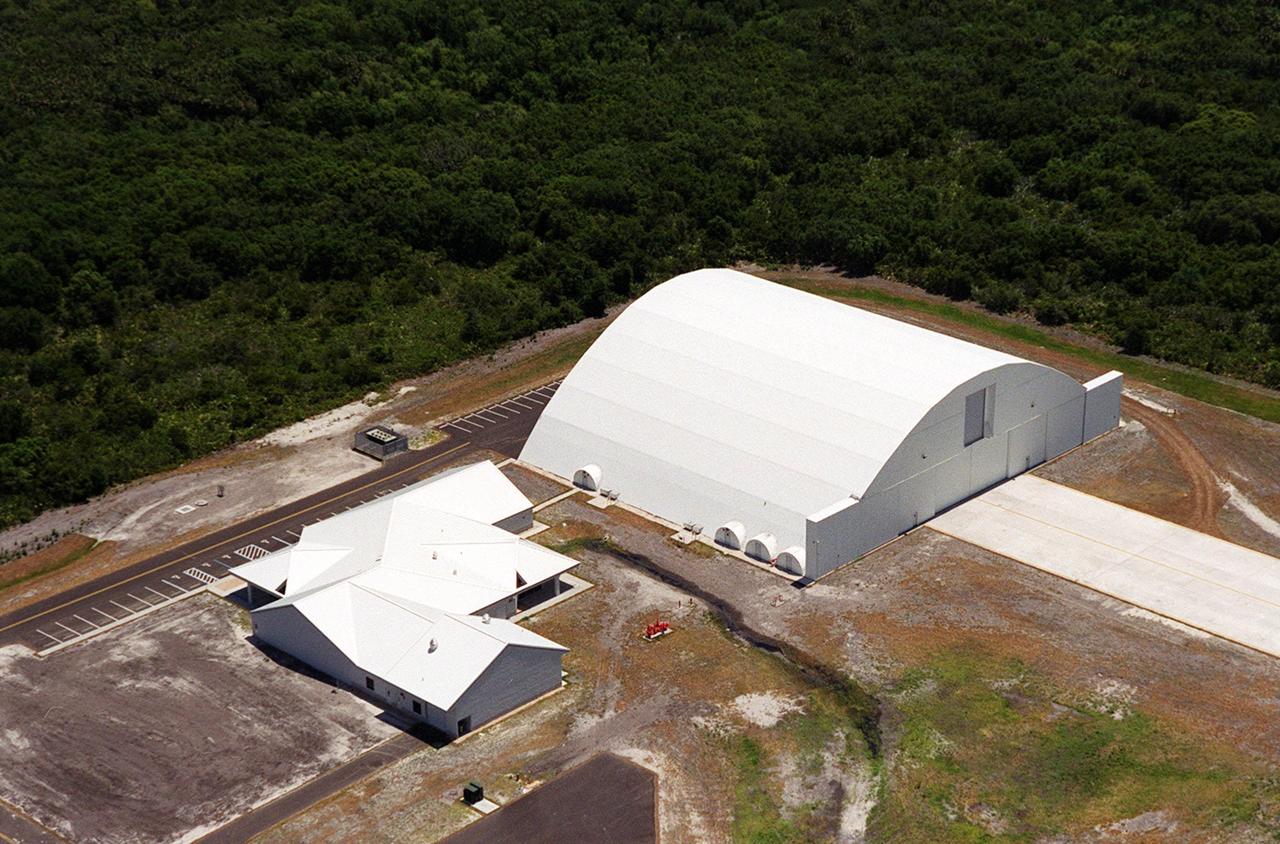
This closeup photo shows the Reusable Launch Vehicle (RLV) Support Complex at Kennedy Space Center. At right is a multi-purpose hangar and to the left is a building for related ground support equipment and administrative/ technical support. The complex is situated at the Shuttle Landing Facility. The RLV complex will be available to accommodate the Space Shuttle; the X-34 RLV technology demonstrator; the L-1011 carrier aircraft for Pegasus and X-34; and other RLV and X-vehicle programs. The complex is jointly funded by the Spaceport Florida Authority, NASA’s Space Shuttle Program and KSC
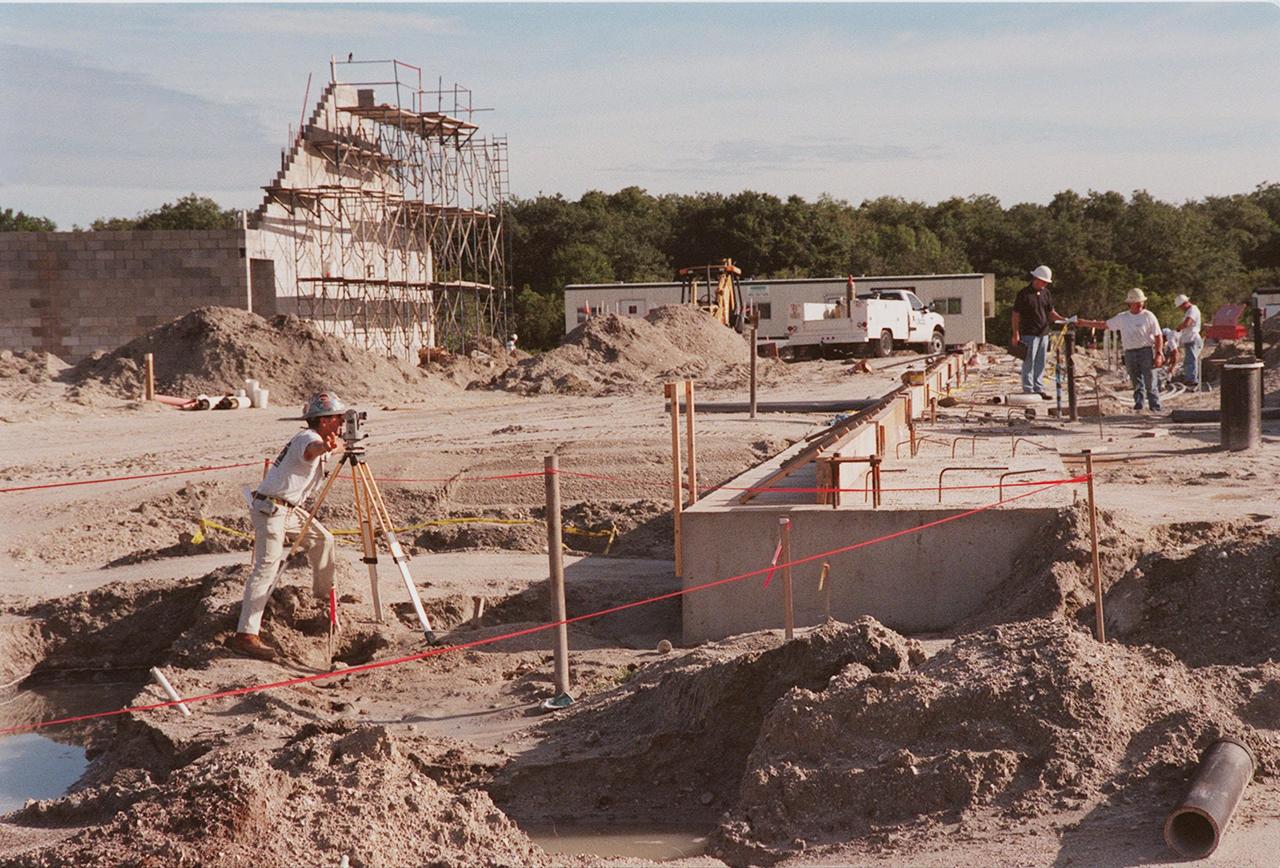
At the construction site of the Reusable Launch Vehicle (RLV) complex at KSC, workers take measurements for one of the buildings. Located near the Shuttle Landing Facility, the complex will include facilities for related ground support equipment and administrative/ technical support. It will be available to accommodate the Space Shuttle; the X-34 RLV technology demonstrator; the L-1011 carrier aircraft for Pegasus and X-34; and other RLV and X-vehicle programs. The complex is jointly funded by the Spaceport Florida Authority, NASA's Space Shuttle Program and KSC. The facility will be operational in early 2000

At the construction site of the Reusable Launch Vehicle (RLV) complex at KSC, a worker takes a measurement. Located near the Shuttle Landing Facility, the complex will include facilities for related ground support equipment and administrative/ technical support. It will be available to accommodate the Space Shuttle; the X-34 RLV technology demonstrator; the L-1011 carrier aircraft for Pegasus and X-34; and other RLV and X-vehicle programs. The complex is jointly funded by the Spaceport Florida Authority, NASA's Space Shuttle Program and KSC. The facility will be operational in early 2000
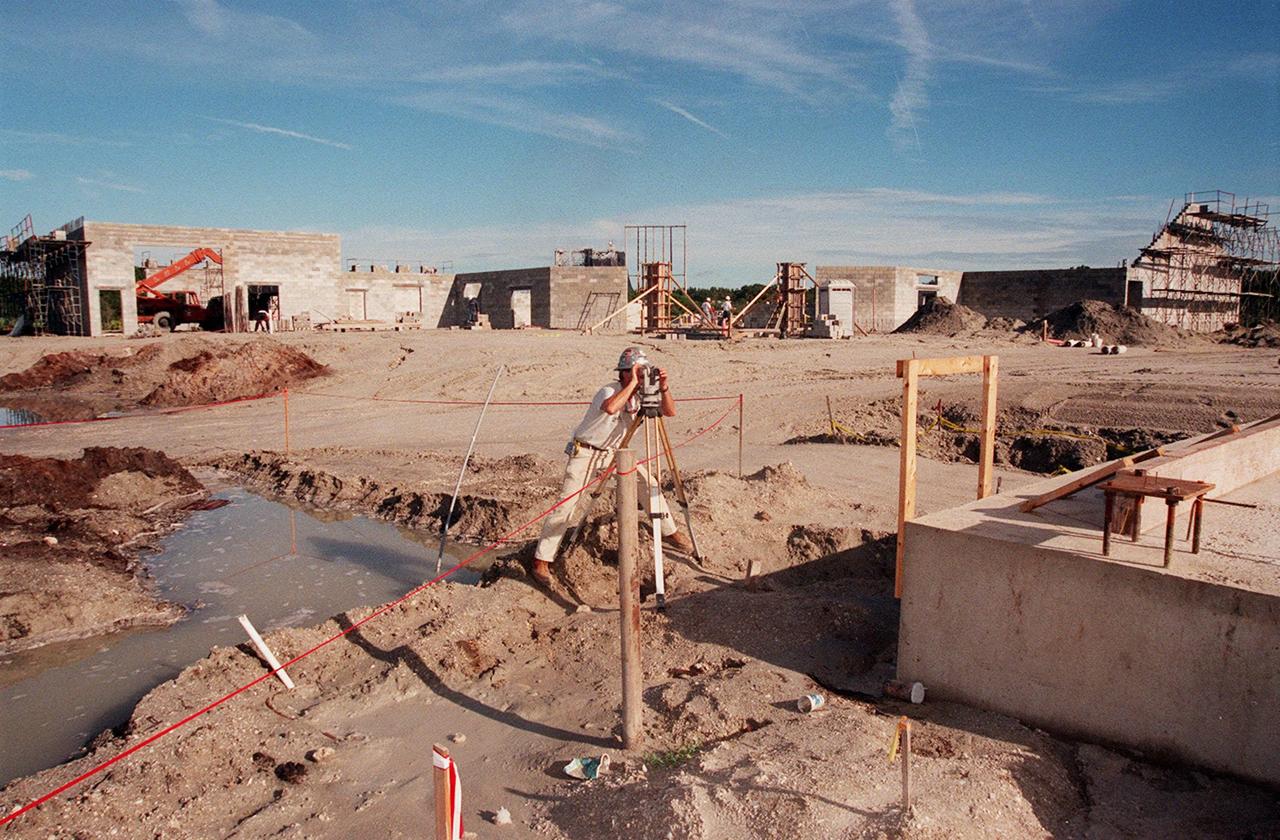
A worker takes a measurement for construction of the Reusable Launch Vehicle (RLV) complex at KSC. Located near the Shuttle Landing Facility, the complex will include facilities for related ground support equipment and administrative/ technical support. It will be available to accommodate the Space Shuttle; the X-34 RLV technology demonstrator; the L-1011 carrier aircraft for Pegasus and X-34; and other RLV and X-vehicle programs. The complex is jointly funded by the Spaceport Florida Authority, NASA's Space Shuttle Program and KSC. The facility will be operational in early 2000
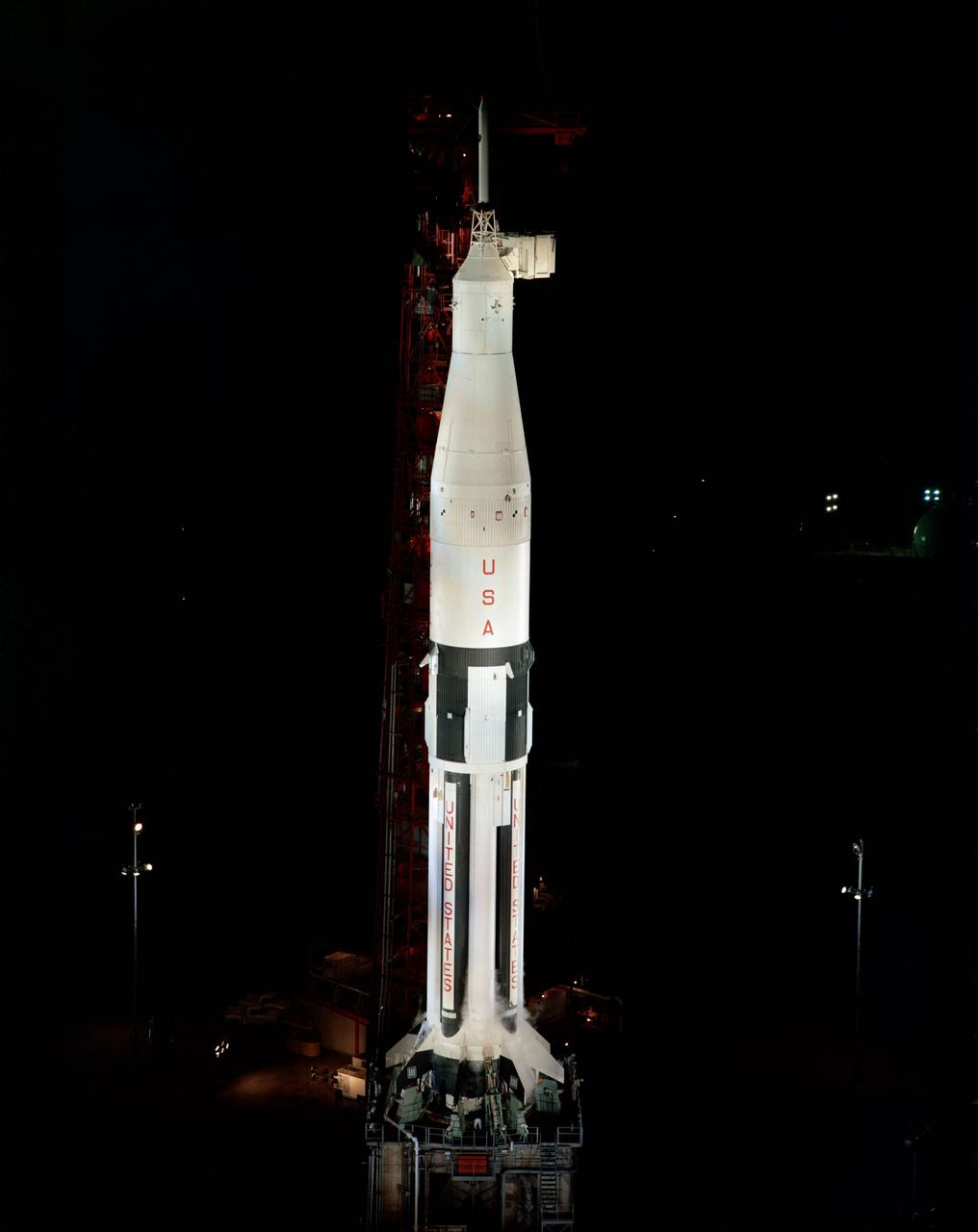
Apollo Spacecraft 009 atop the Saturn 1B launch vehicle is seen at Launch Complex 34 during the Saturn 1B countdown demonstration. Preparations are continuing for the Apollo Saturn 201 Test Flight. CAPE KENNEDY, FL CN
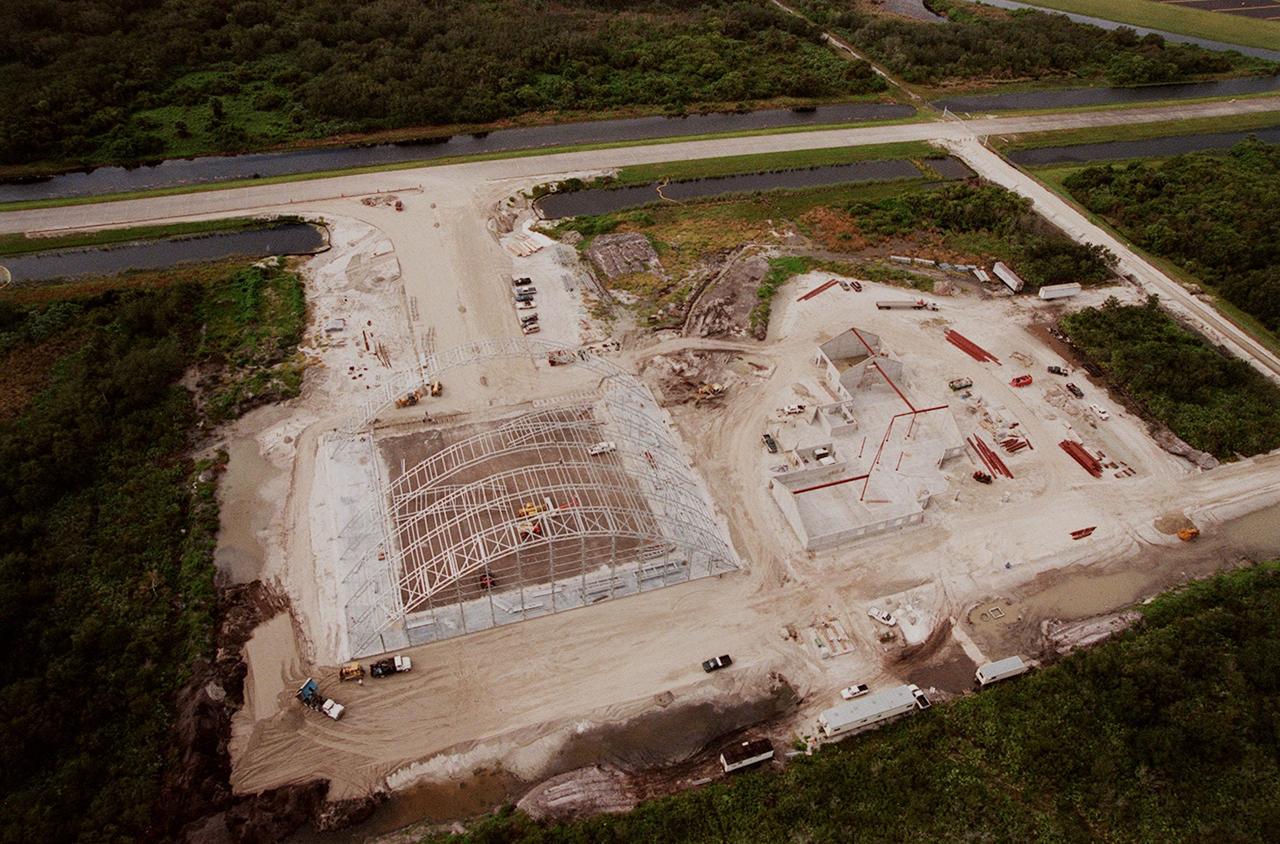
Construction continues on an $8 million Reusable Launch Vehicle (RLV) Support Complex at Kennedy Space Center. At left is a multi-purpose hangar and at right a building for related ground support equipment and administrative/ technical support. The complex is situated at the Shuttle Landing Facility (upper right). Near the top of the photo is the tow-way. The RLV complex will be available to accommodate the Space Shuttle; the X-34 RLV technology demonstrator; the L-1011 carrier aircraft for Pegasus and X-34; and other RLV and X-vehicle programs. The complex is jointly funded by the Spaceport Florida Authority, NASA's Space Shuttle Program and KSC. The facility will be operational in early 2000
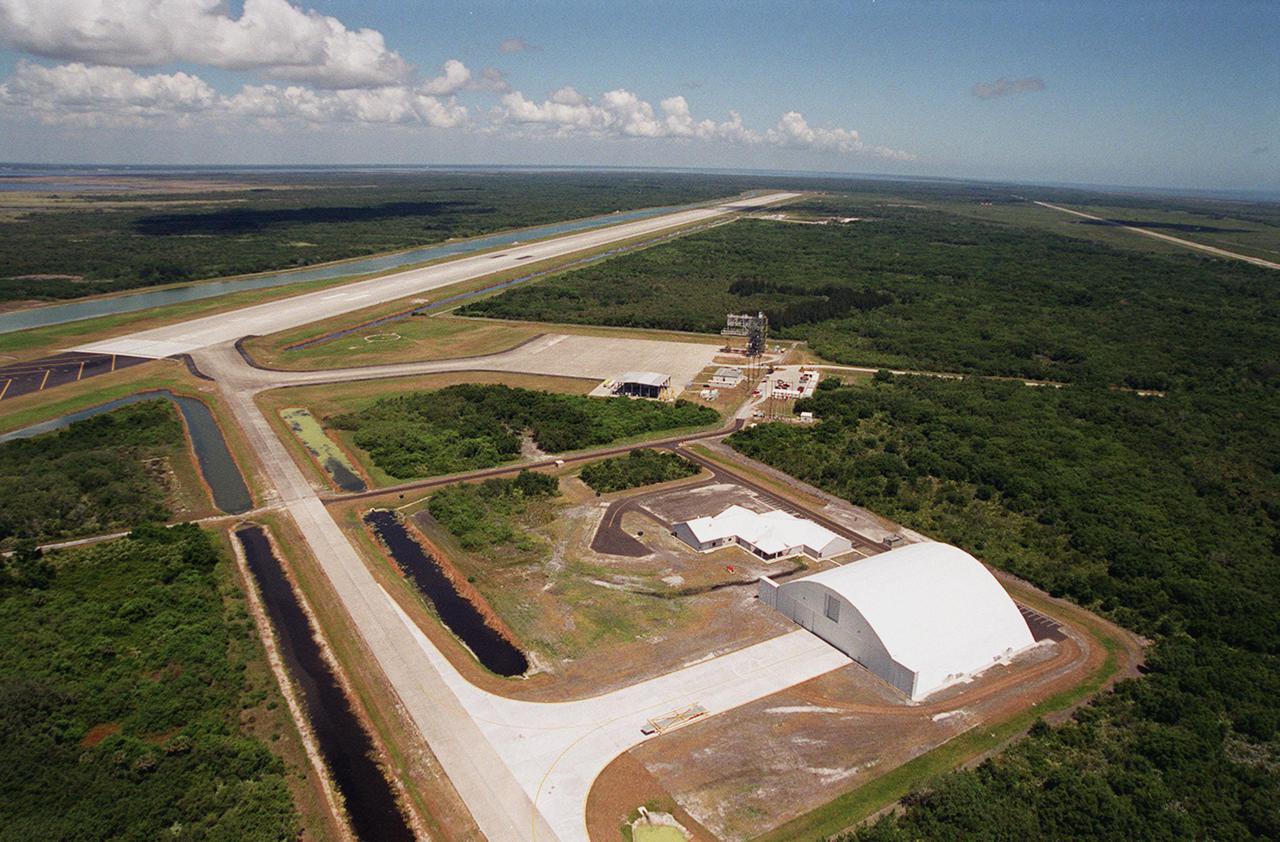
In the foreground of this aerial photo is the Reusable Launch Vehicle (RLV) Support Complex at Kennedy Space Center. At right is a multi-purpose hangar and to its left is a building for related ground support equipment and administrative_ technical support. The complex is situated at the Shuttle Landing Facility (center). At the upper left is the runway. The RLV complex will be available to accommodate the Space Shuttle; the X-34 RLV technology demonstrator; the L-1011 carrier aircraft for Pegasus and X-34; and other RLV and X-vehicle programs. The complex is jointly funded by the Spaceport Florida Authority, NASA’s Space Shuttle Program and KSC
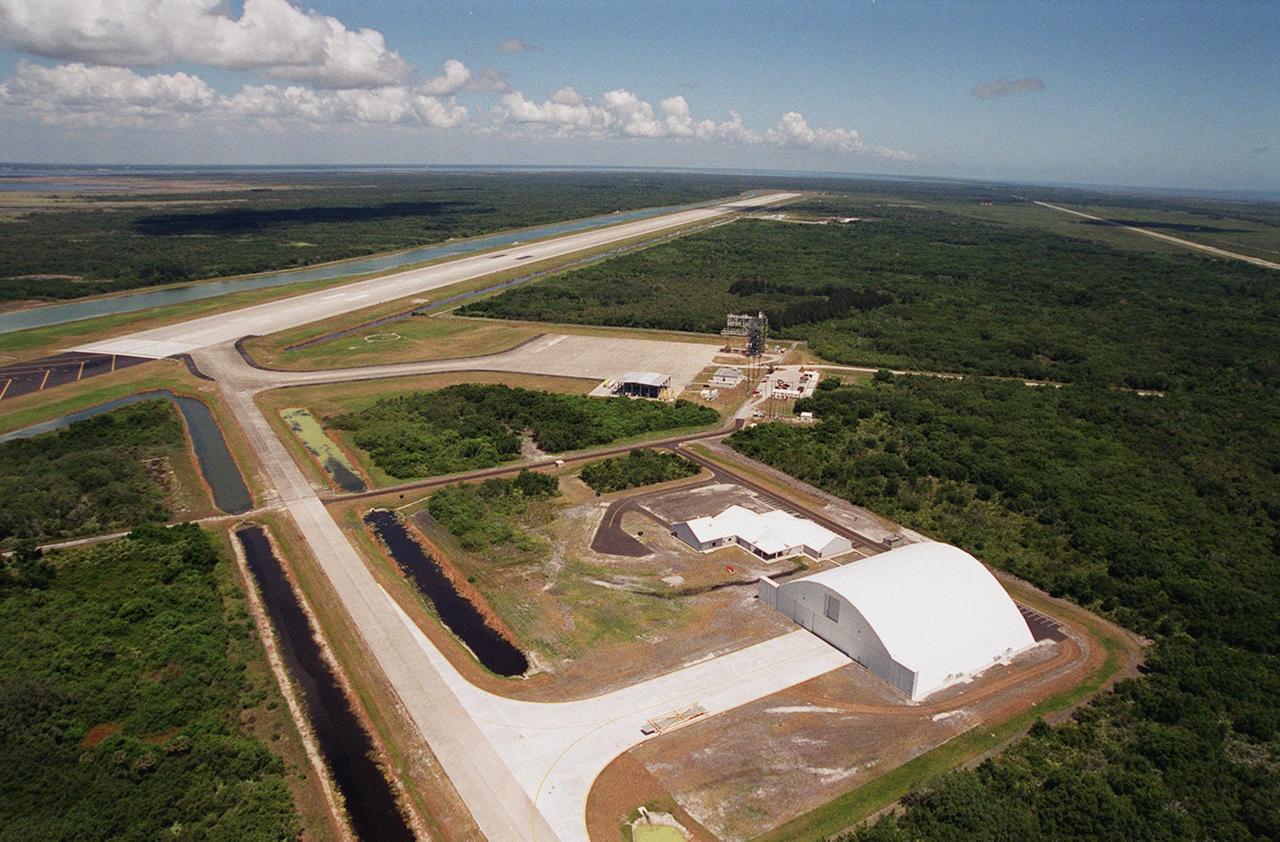
In the foreground of this aerial photo is the Reusable Launch Vehicle (RLV) Support Complex at Kennedy Space Center. At right is a multi-purpose hangar and to its left is a building for related ground support equipment and administrative/ technical support. The complex is situated at the Shuttle Landing Facility (center). At the upper left is the runway. The RLV complex will be available to accommodate the Space Shuttle; the X-34 RLV technology demonstrator; the L-1011 carrier aircraft for Pegasus and X-34; and other RLV and X-vehicle programs. The complex is jointly funded by the Spaceport Florida Authority, NASA’s Space Shuttle Program and KSC
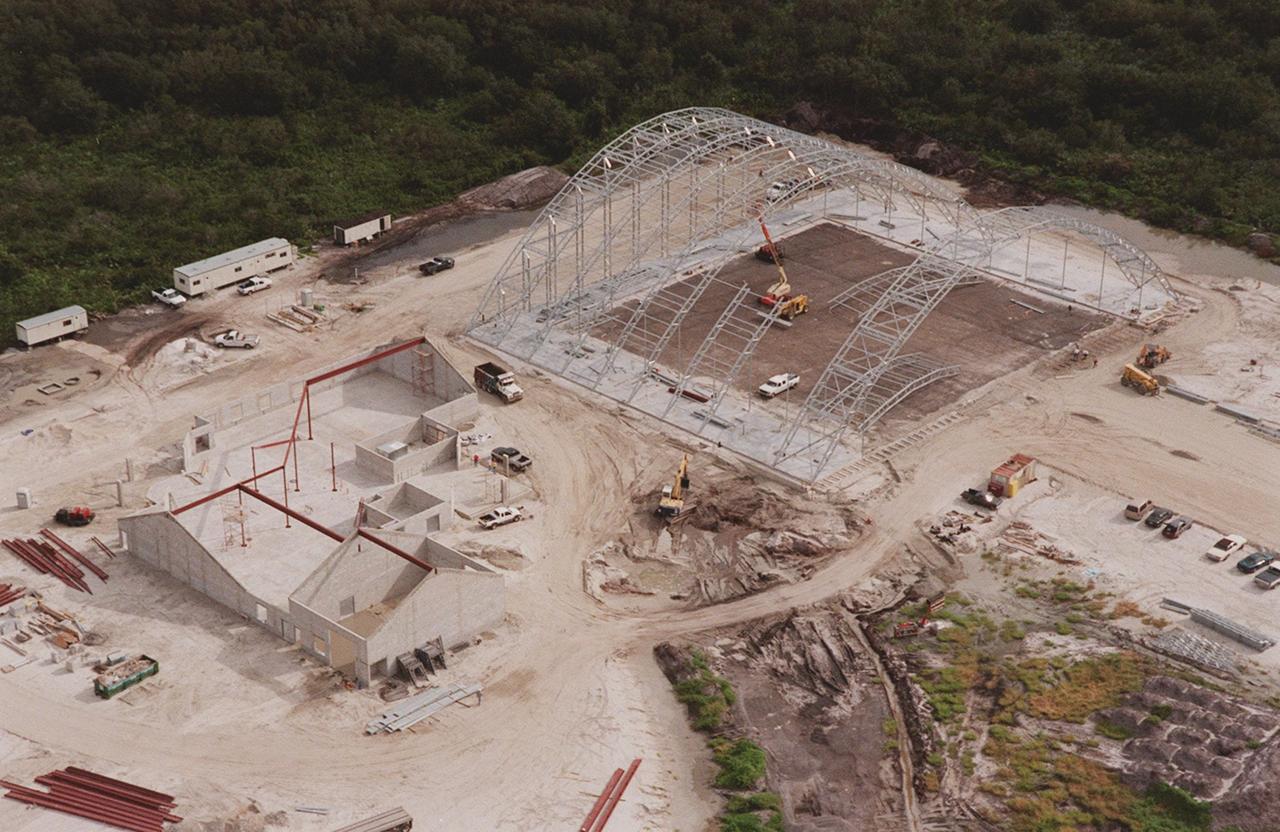
An aerial closeup view reveals the ongoing construction of an $8 million Reusable Launch Vehicle (RLV) Support Complex at Kennedy Space Center. At right is a multi-purpose hangar and at left a building for related ground support equipment and administrative/ technical support. The complex is situated at the Shuttle Landing Facility. Near the top of the photo can be seen the tow-way. The RLV complex will be available to accommodate the Space Shuttle; the X-34 RLV technology demonstrator; the L-1011 carrier aircraft for Pegasus and X-34; and other RLV and X-vehicle programs. The complex is jointly funded by the Spaceport Florida Authority, NASA's Space Shuttle Program and KSC. The facility will be operational in early 2000
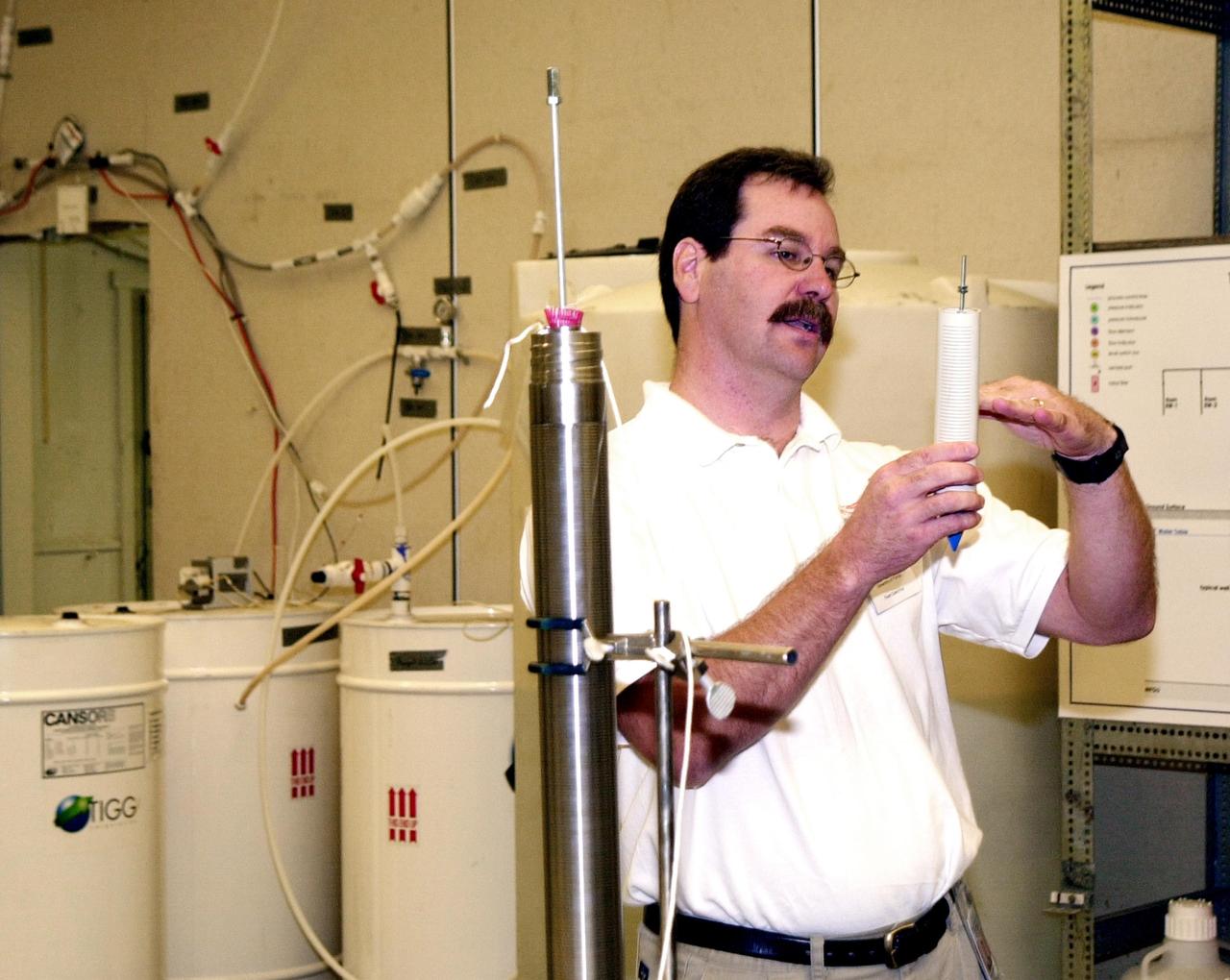
KENNEDY SPACE CENTER, FLA. - New methods of environmental cleanup are explained to government and business representatives, scientists and engineers during a presentation at Launch Complex 34-A, Cape Canaveral Spaceport. Making the presentation is Mike Annable with the University of Florida.
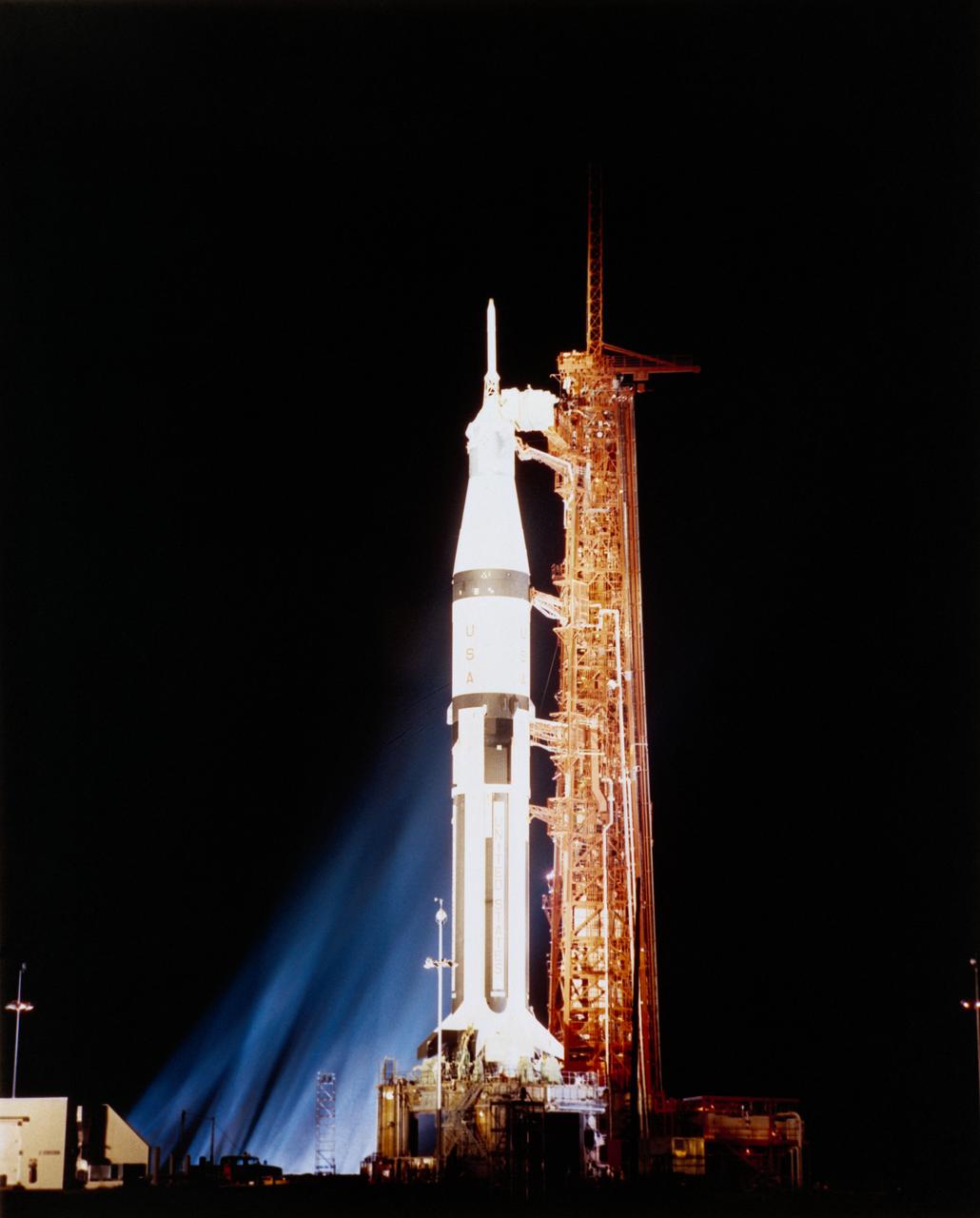
S68-50712 (16 Sept. 1968) --- Nighttime view of Launch Complex 34, Kennedy Space Center, showing the Apollo 7 (Spacecraft 101/Saturn 205) stack on pad.
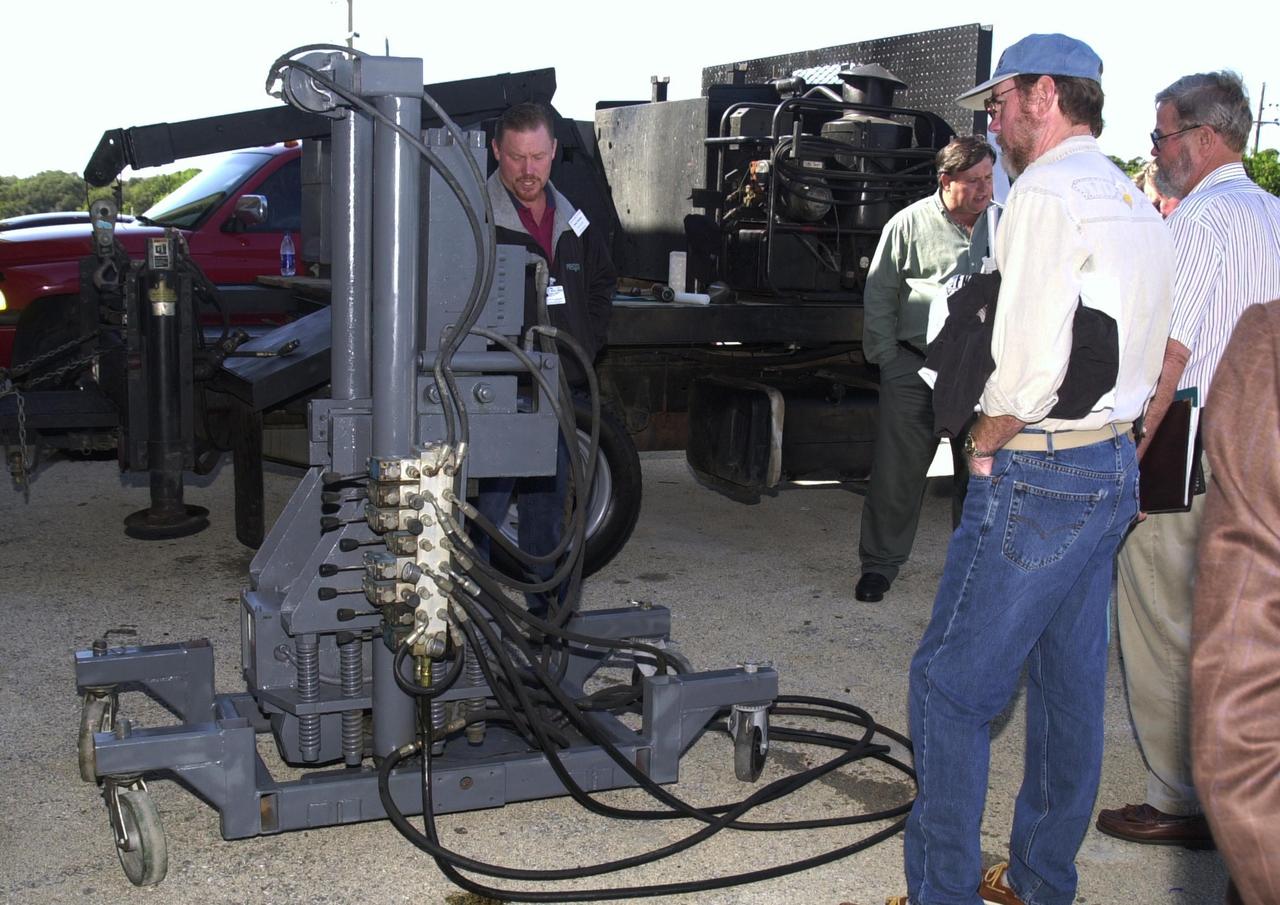
KENNEDY SPACE CENTER, FLA. - A touring group of national and international participants look over some Precision Sampling's drilling rig, new equipment being used for environmental cleanup at Launch Complex 34-A, Cape Canaveral Spaceport.

KENNEDY SPACE CENTER, FLA. -- Apollo 7 crew member Donn F. Eisele relaxes during suiting up prior to today's space vehicle emergency egress tests conducted at Cape Kennedy's Launch Complex 34.
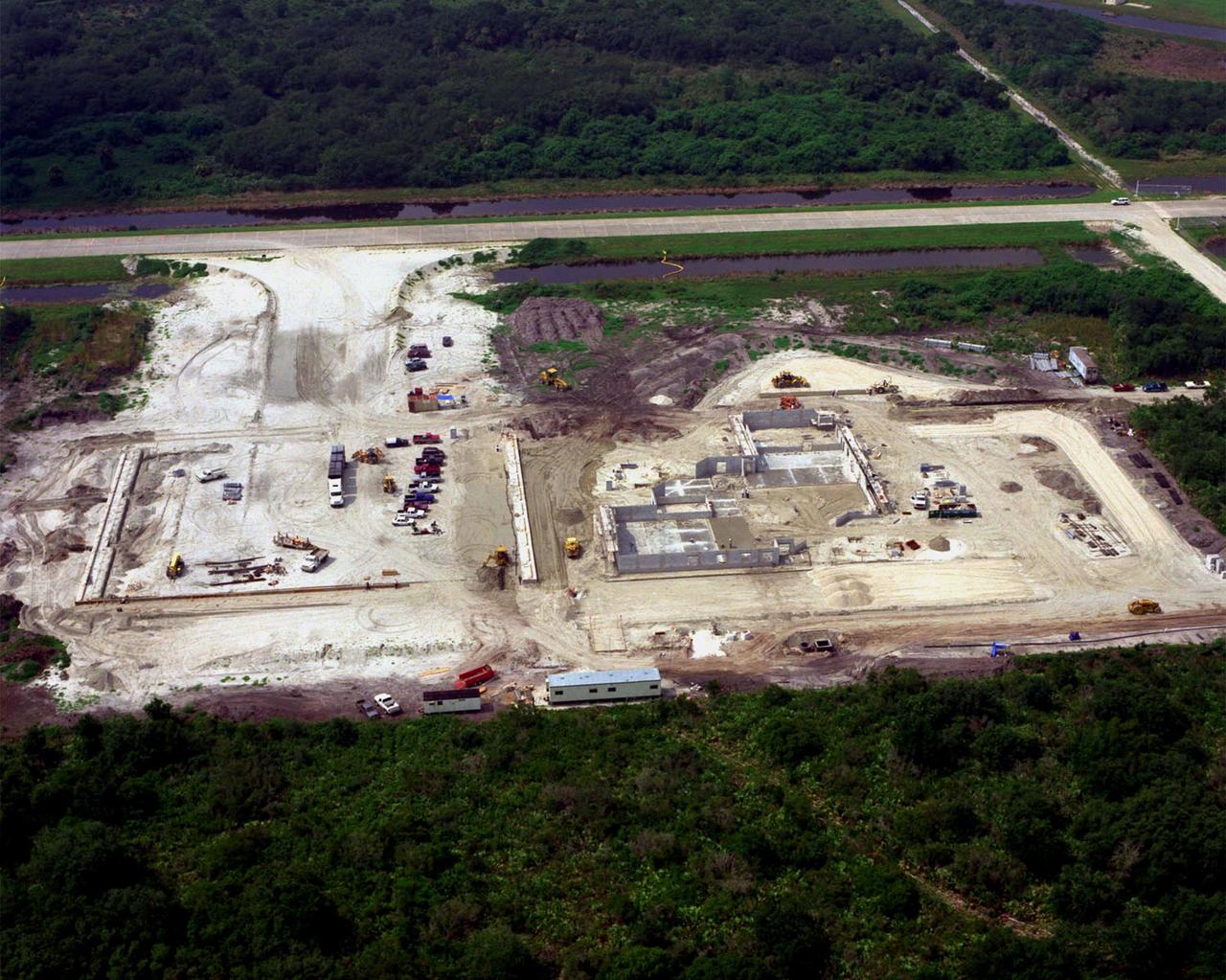
Looking southwest, this view shows ongoing construction of a multi-purpose hangar, which is part of the $8 million Reusable Launch Vehicle (RLV) Support Complex at Kennedy Space Center. Edging the construction is Sharkey Road, which parallels the landing strip of the Shuttle Landing Facility nearby. The RLV complex will include facilities for related ground support equipment and administrative/ technical support. It will be available to accommodate the Space Shuttle; the X-34 RLV technology demonstrator; the L-1011 carrier aircraft for Pegasus and X-34; and other RLV and X-vehicle programs. The complex is jointly funded by the Spaceport Florida Authority, NASA's Space Shuttle Program and KSC. The facility will be operational in early 2000.
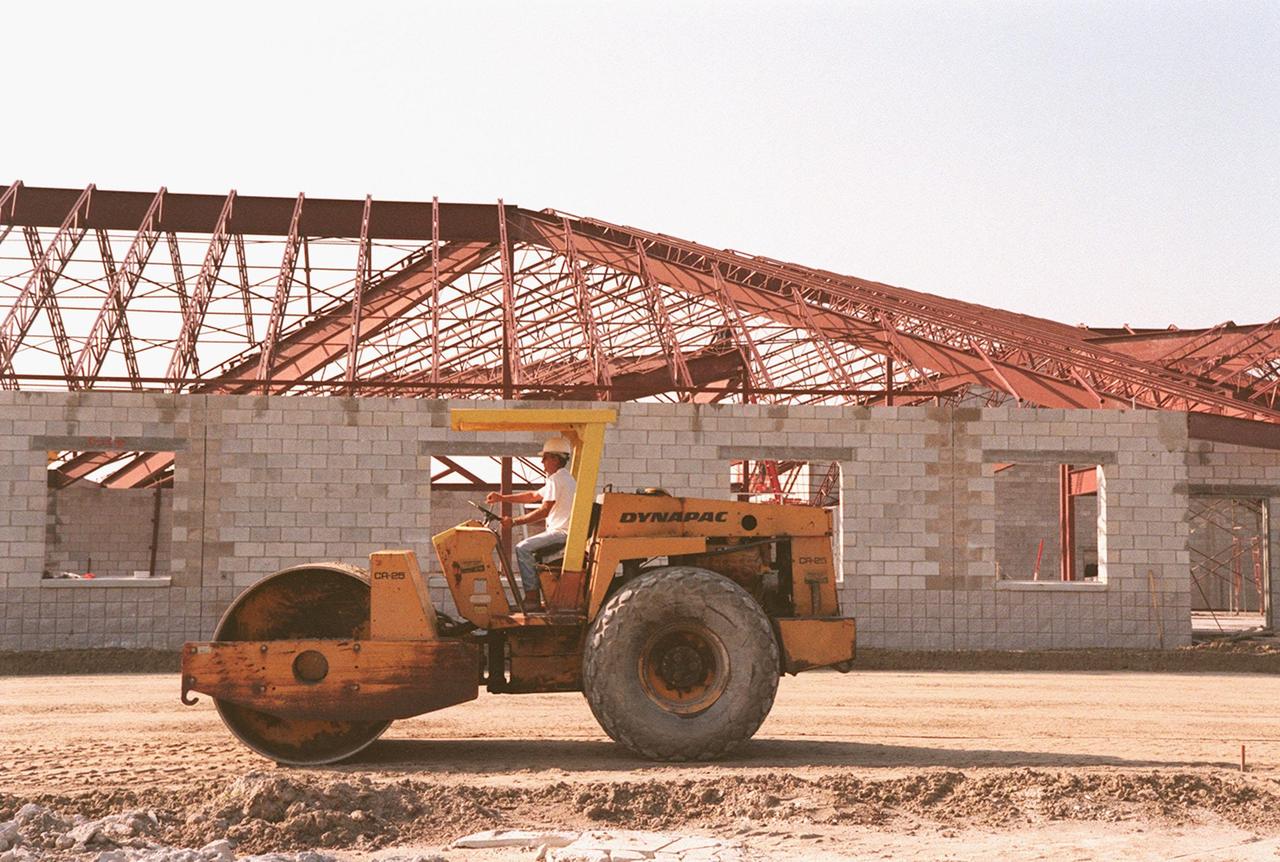
A steam roller packs down the ground next to construction of a support building, part of the $8 million Reusable Launch Vehicle (RLV) Support Complex at Kennedy Space Center. The RLV complex, which includes a multi-purpose hangar and the building to be used for related ground support equipment and administrative/technical support, will be available to accommodate the Space Shuttle; the X-34 RLV technology demonstrator; the L-1011 carrier aircraft for Pegasus and X-34; and other RLV and X-vehicle programs. The complex is jointly funded by the Spaceport Florida Authority, NASA's Space Shuttle Program and KSC. The facility will be operational in early 2000
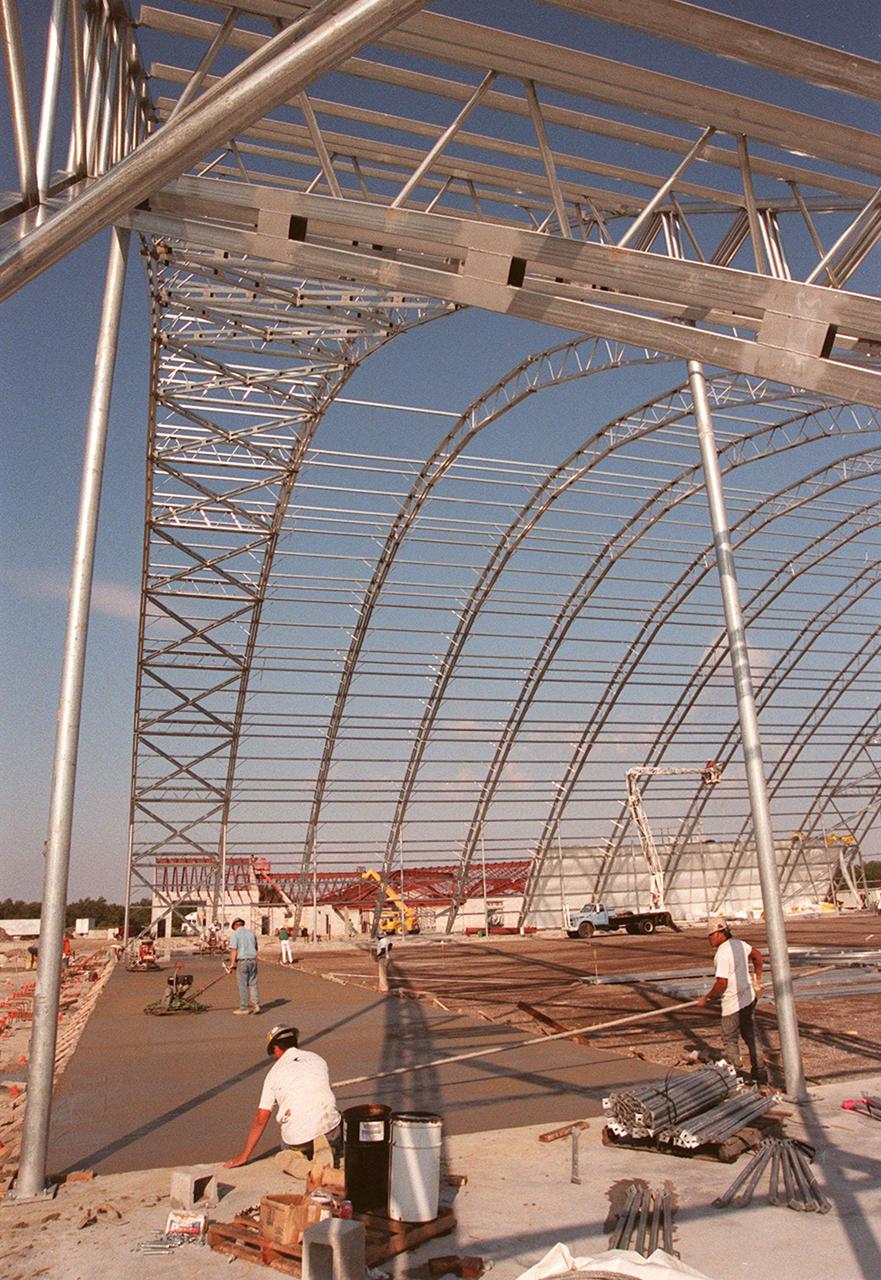
Work continues on construction of the multi-purpose hangar at the site of the $8 million Reusable Launch Vehicle (RLV) Support Complex at Kennedy Space Center. In the background can be seen the new construction for the building that will house related ground support equipment and administrative/technical support. The RLV complex will be available to accommodate the Space Shuttle; the X-34 RLV technology demonstrator; the L-1011 carrier aircraft for Pegasus and X-34; and other RLV and X-vehicle programs. The complex is jointly funded by the Spaceport Florida Authority, NASA's Space Shuttle Program and KSC. The facility will be operational in early 2000
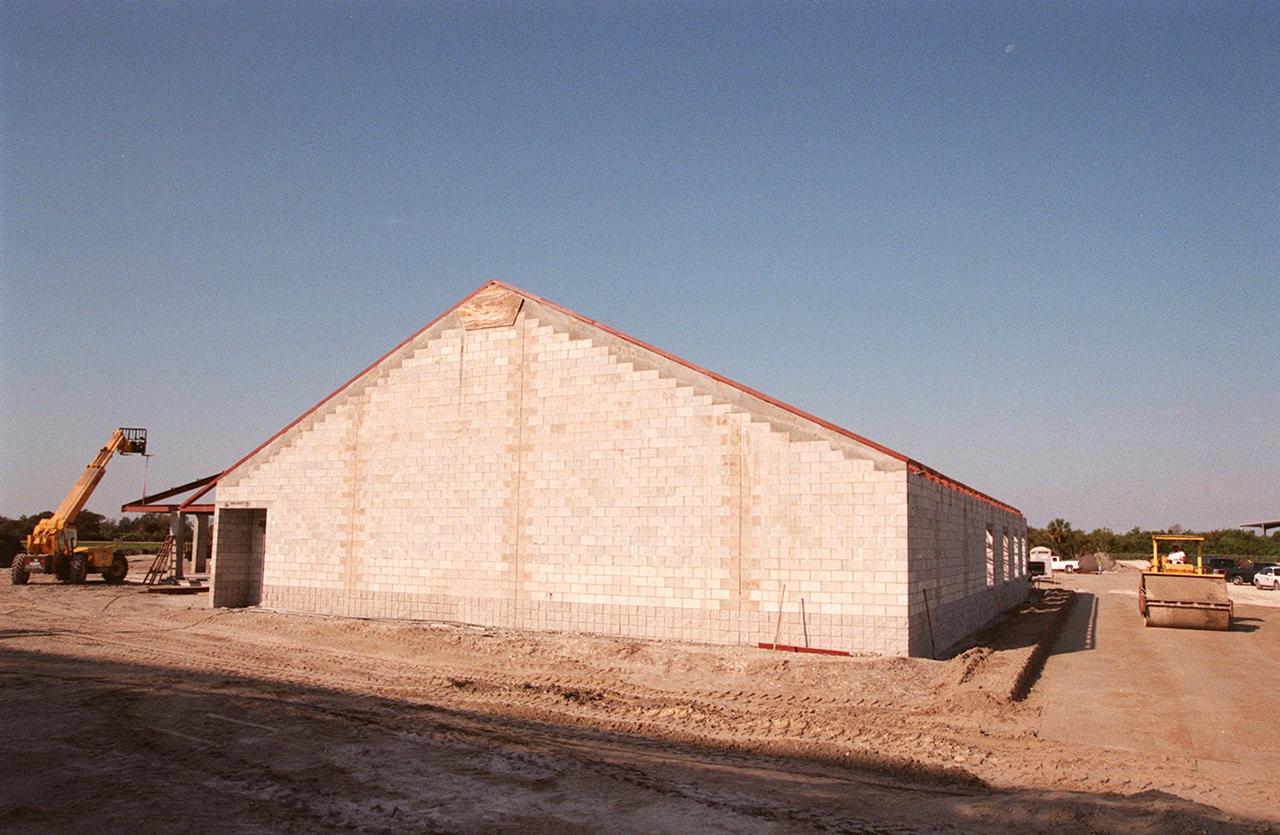
The support building at the $8 million Reusable Launch Vehicle (RLV) Support Complex at Kennedy Space Center takes form. It will house related ground support equipment and administrative/technical support. The RLV complex includes a multi-purpose hangar that will be available to accommodate the Space Shuttle; the X-34 RLV technology demonstrator; the L-1011 carrier aircraft for Pegasus and X-34; and other RLV and X-vehicle programs. The complex is jointly funded by the Spaceport Florida Authority, NASA's Space Shuttle Program and KSC. The facility will be operational in early 2000
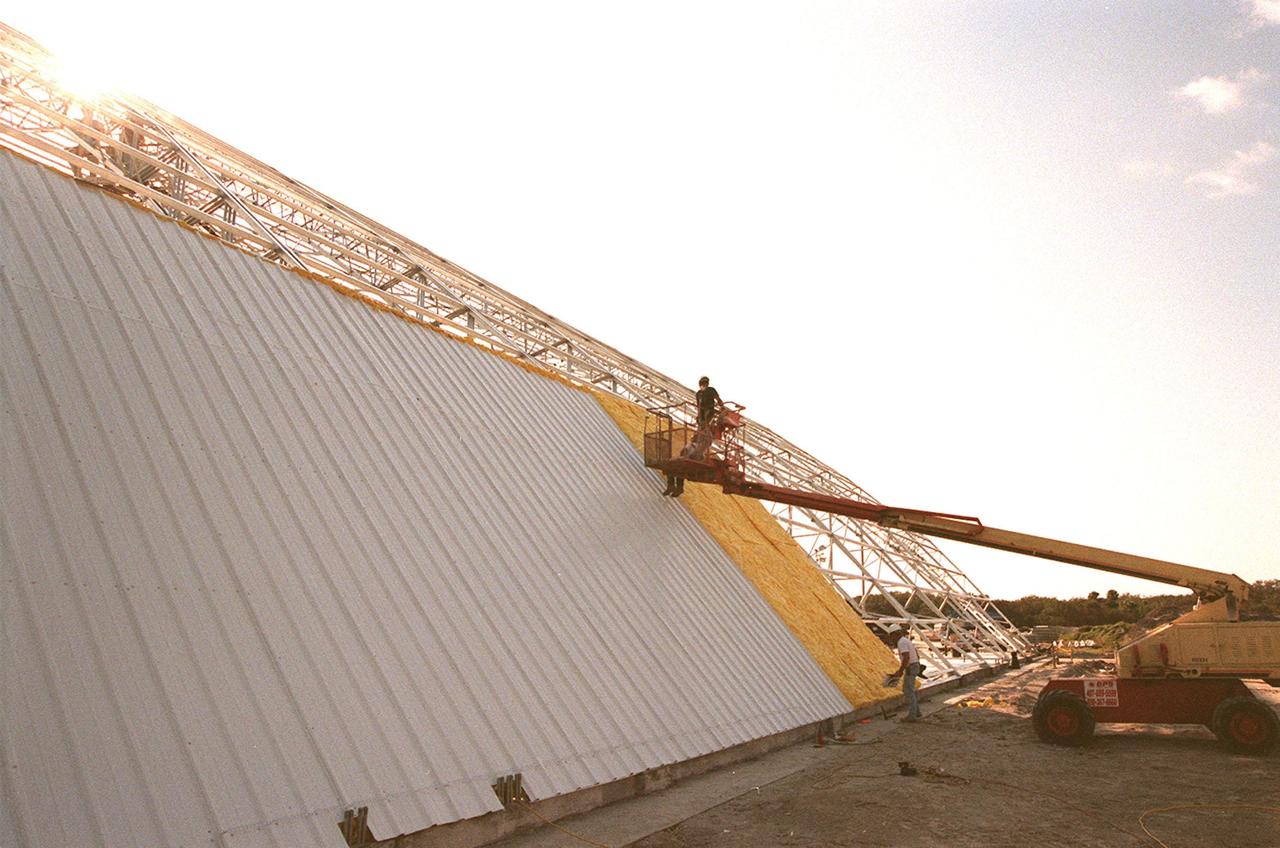
Workers place the first roof panels on the multi-purpose hangar at the site of the $8 million Reusable Launch Vehicle (RLV) Support Complex at Kennedy Space Center. The RLV complex, which includes the hangar and a building for related ground support equipment and administrative/technical support, will be available to accommodate the Space Shuttle; the X-34 RLV technology demonstrator; the L-1011 carrier aircraft for Pegasus and X-34; and other RLV and X-vehicle programs. The complex is jointly funded by the Spaceport Florida Authority, NASA's Space Shuttle Program and KSC. The facility will be operational in early 2000
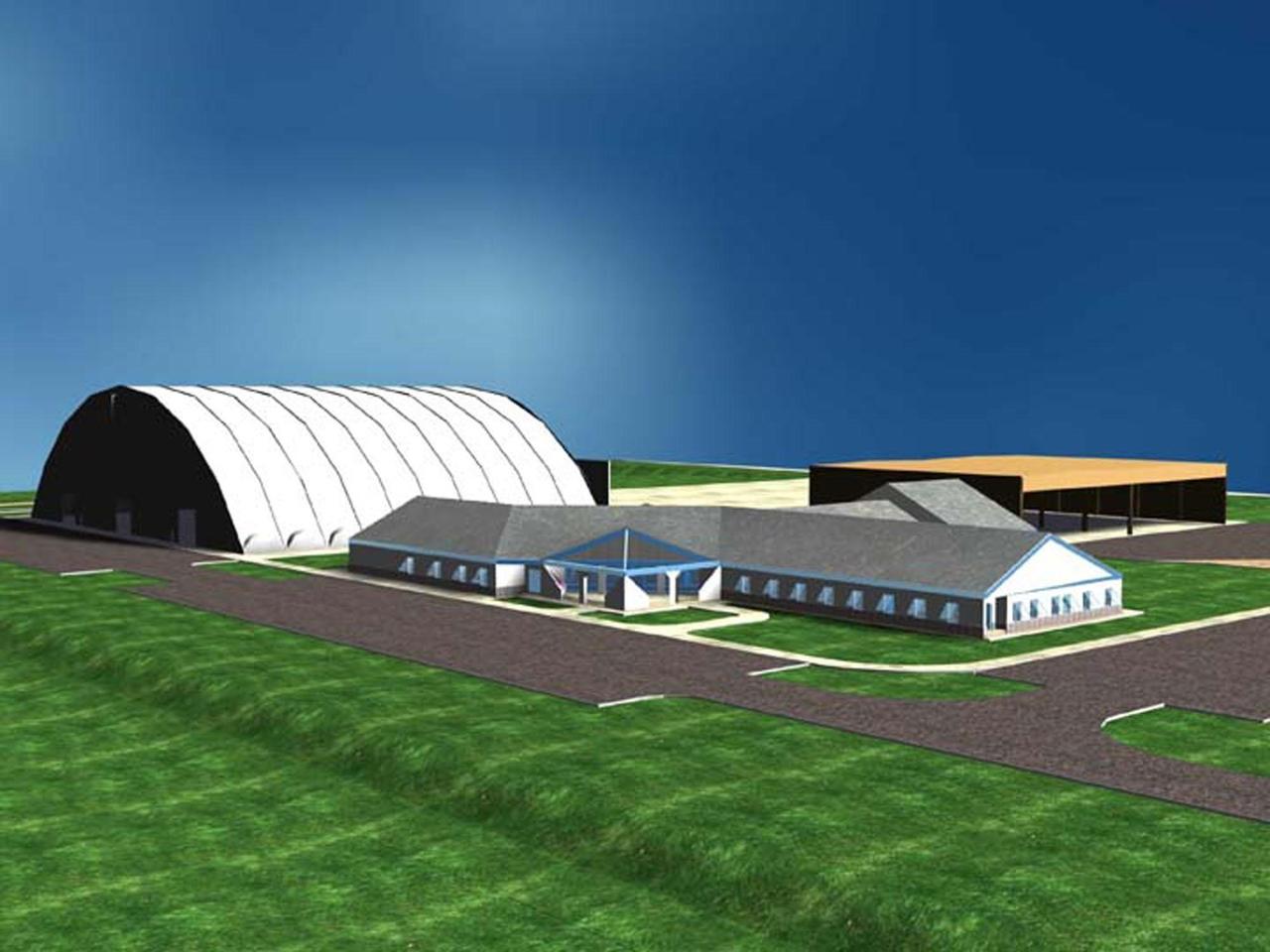
An artist's rendering shows the $8-million Reusable Launch Vehicle (RLV) Support Complex planned for the Shuttle Landing Facility (SLF) at Kennedy Space Center. The ground breaking took place today. To be located at the tow-way adjacent to the SLF, the complex will include a multi-purpose RLV hangar and adjacent facilities for related ground support equipment and administrative/technical support. It will be available to accommodate the Space Shuttle, the X-34 RLV technology demonstrator, the L-1011 carrier aircraft for Pegasus and X-34, and other RLV and X-vehicle programs. The complex is jointly funded by the Spaceport Florida Authority, NASA's Space Shuttle Program and KSC. The facility will be operational in early 2000
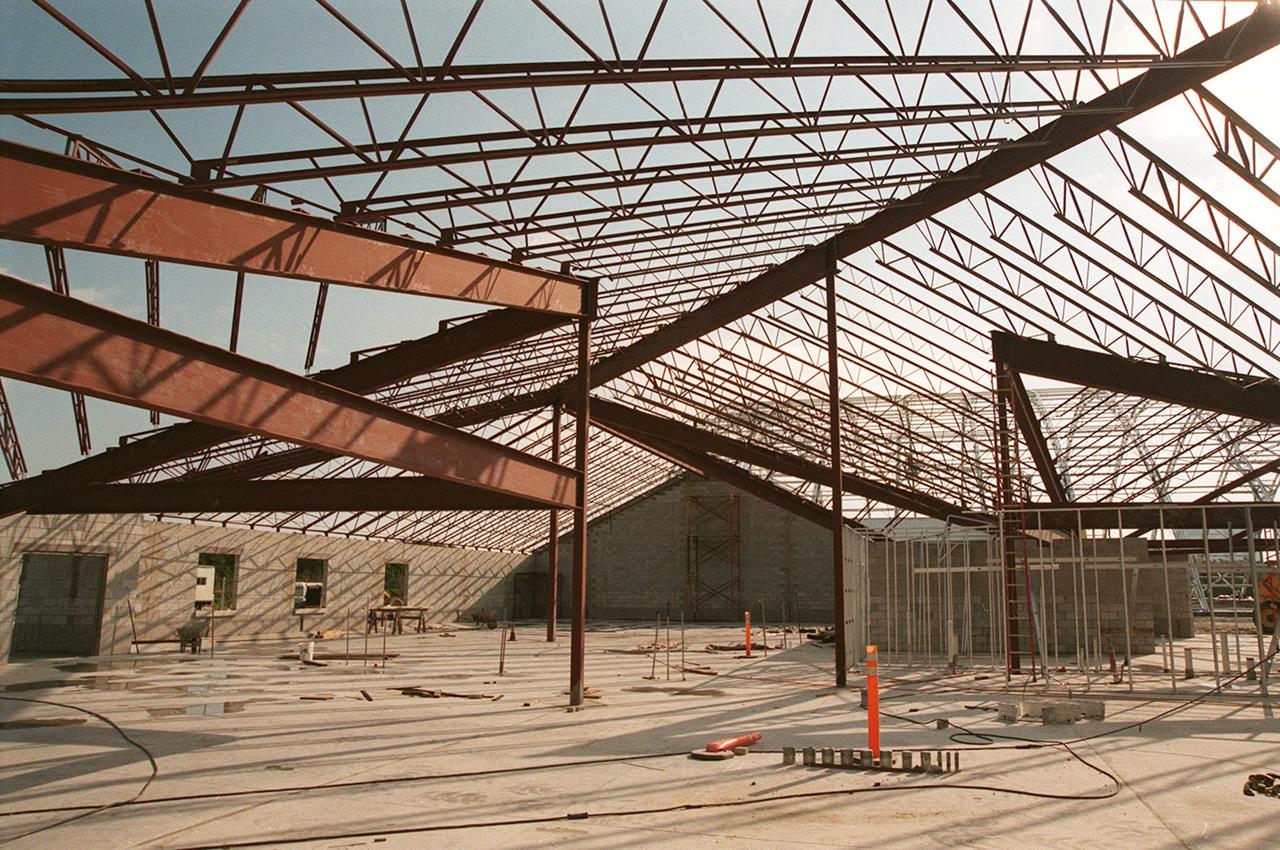
Girders overhead cast shadows on the walls and floor of a support building under construction, part of the new $8 million Reusable Launch Vehicle (RLV) Support Complex at Kennedy Space Center. The building is to be used for related ground support equipment and administrative/technical support. The RLV complex also includes a multi-purpose hangar. The complex will be available to accommodate the Space Shuttle; the X-34 RLV technology demonstrator; the L-1011 carrier aircraft for Pegasus and X-34; and other RLV and X-vehicle programs. The facility, jointly funded by the Spaceport Florida Authority, NASA's Space Shuttle Program and KSC, will be operational in early 2000
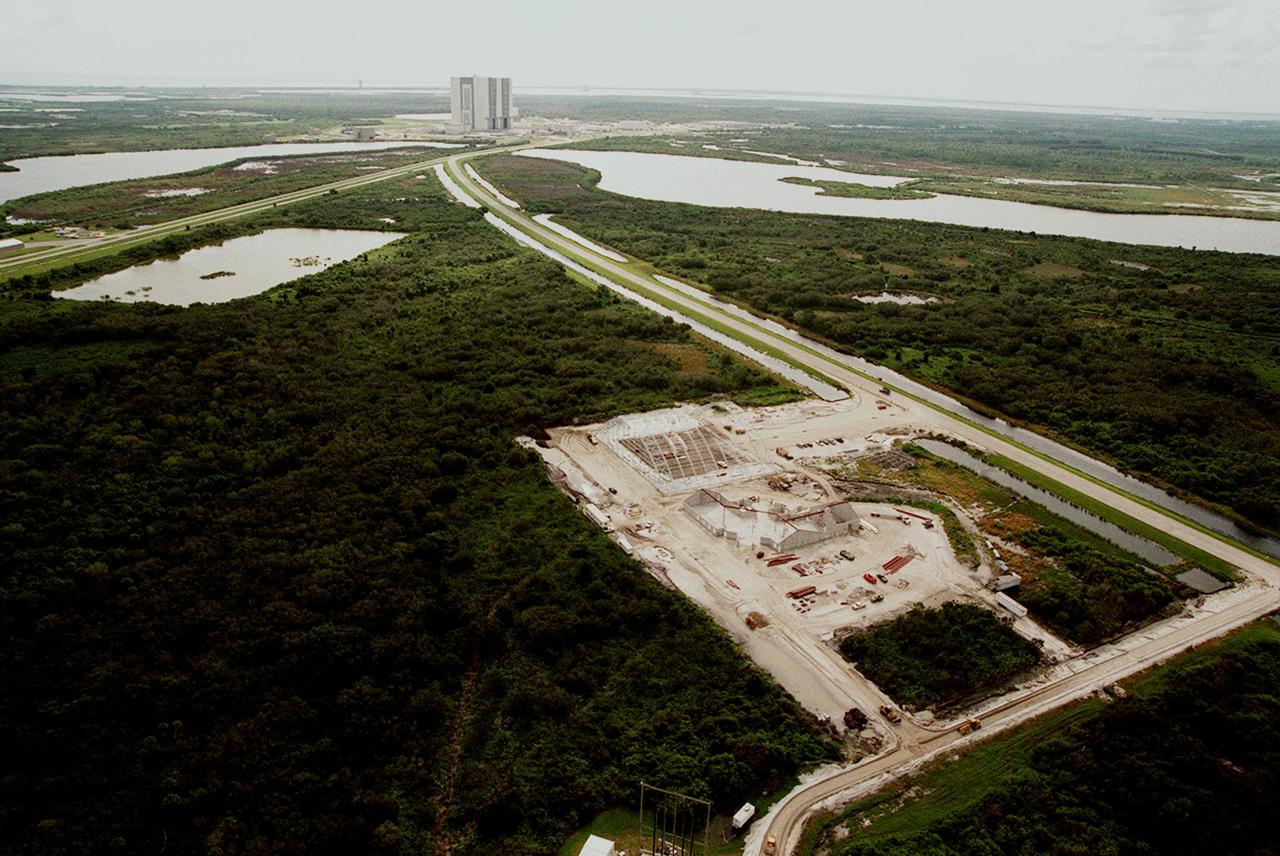
An aerial view reveals (foreground) the ongoing construction of an $8 million Reusable Launch Vehicle (RLV) Support Complex at Kennedy Space Center. At left is a multi-purpose hangar and at right a building for related ground support equipment and administrative/ technical support. In the background is the Vehicle Assembly Building. The road at right is the tow-way. The RLV complex will be available to accommodate the Space Shuttle; the X-34 RLV technology demonstrator; the L-1011 carrier aircraft for Pegasus and X-34; and other RLV and X-vehicle programs. The complex is jointly funded by the Spaceport Florida Authority, NASA's Space Shuttle Program and KSC. The facility will be operational in early 2000.
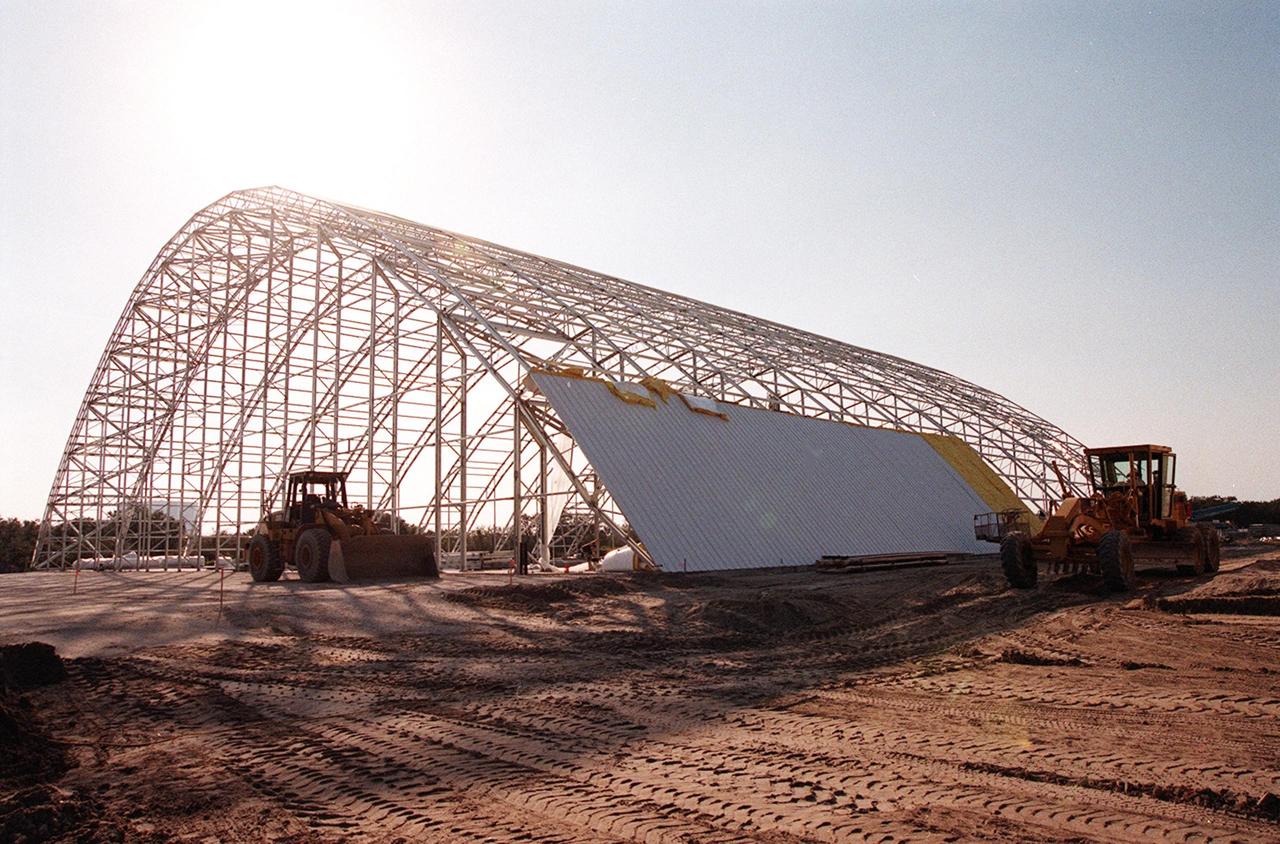
The first roof panels are placed on the multi-purpose hangar at the site of the $8 million Reusable Launch Vehicle (RLV) Support Complex at Kennedy Space Center. The RLV complex, which includes the hangar and a building for related ground support equipment and administrative/technical support, will be available to accommodate the Space Shuttle; the X-34 RLV technology demonstrator; the L-1011 carrier aircraft for Pegasus and X-34; and other RLV and X-vehicle programs. The complex is jointly funded by the Spaceport Florida Authority, NASA's Space Shuttle Program and KSC. The facility will be operational in early 2000
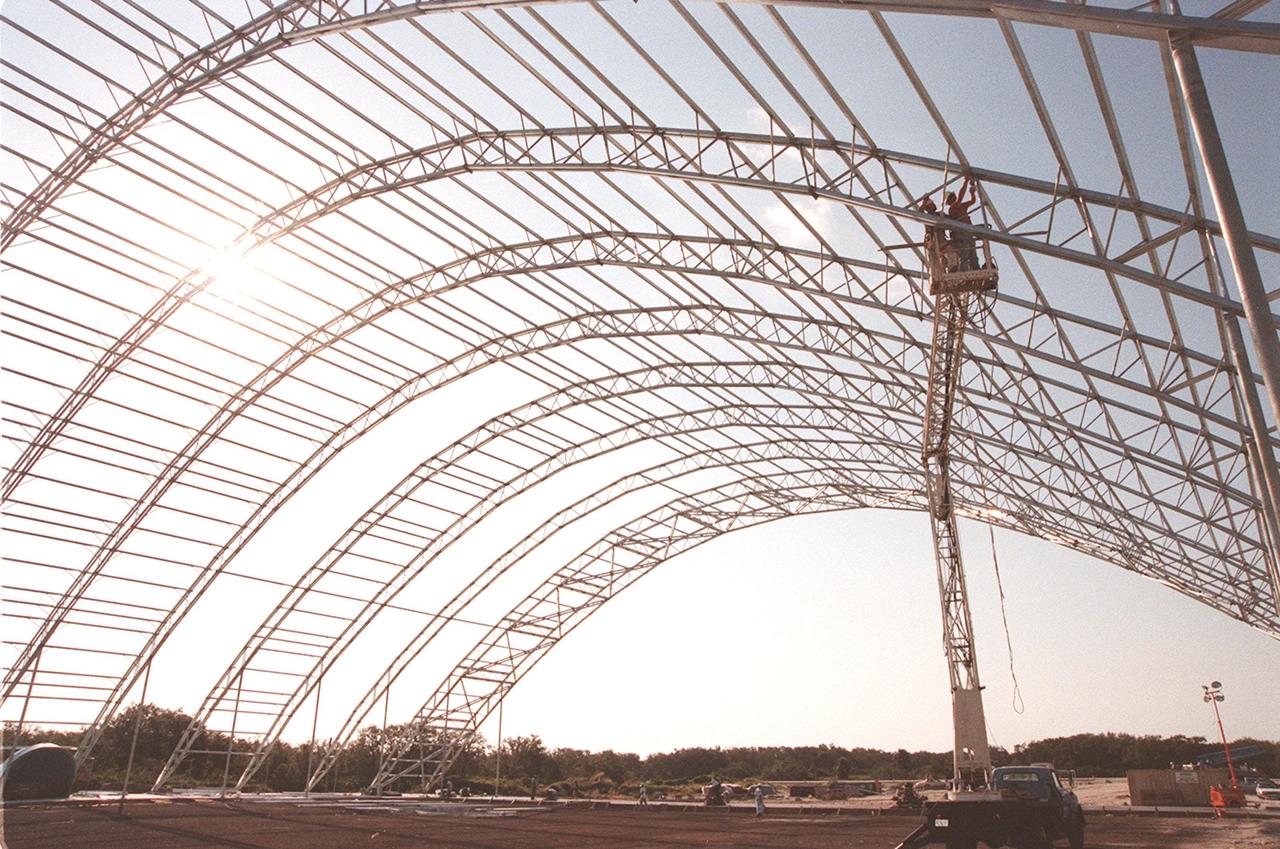
Work continues on the construction of the roof for the multi-purpose hangar at the site of the $8 million Reusable Launch Vehicle (RLV) Support Complex at Kennedy Space Center. In the background can be seen the new construction for the building that will house related ground support equipment and administrative/technical support. The RLV complex will be available to accommodate the Space Shuttle; the X-34 RLV technology demonstrator; the L-1011 carrier aircraft for Pegasus and X-34; and other RLV and X-vehicle programs. The complex is jointly funded by the Spaceport Florida Authority, NASA's Space Shuttle Program and KSC. The facility will be operational in early 2000
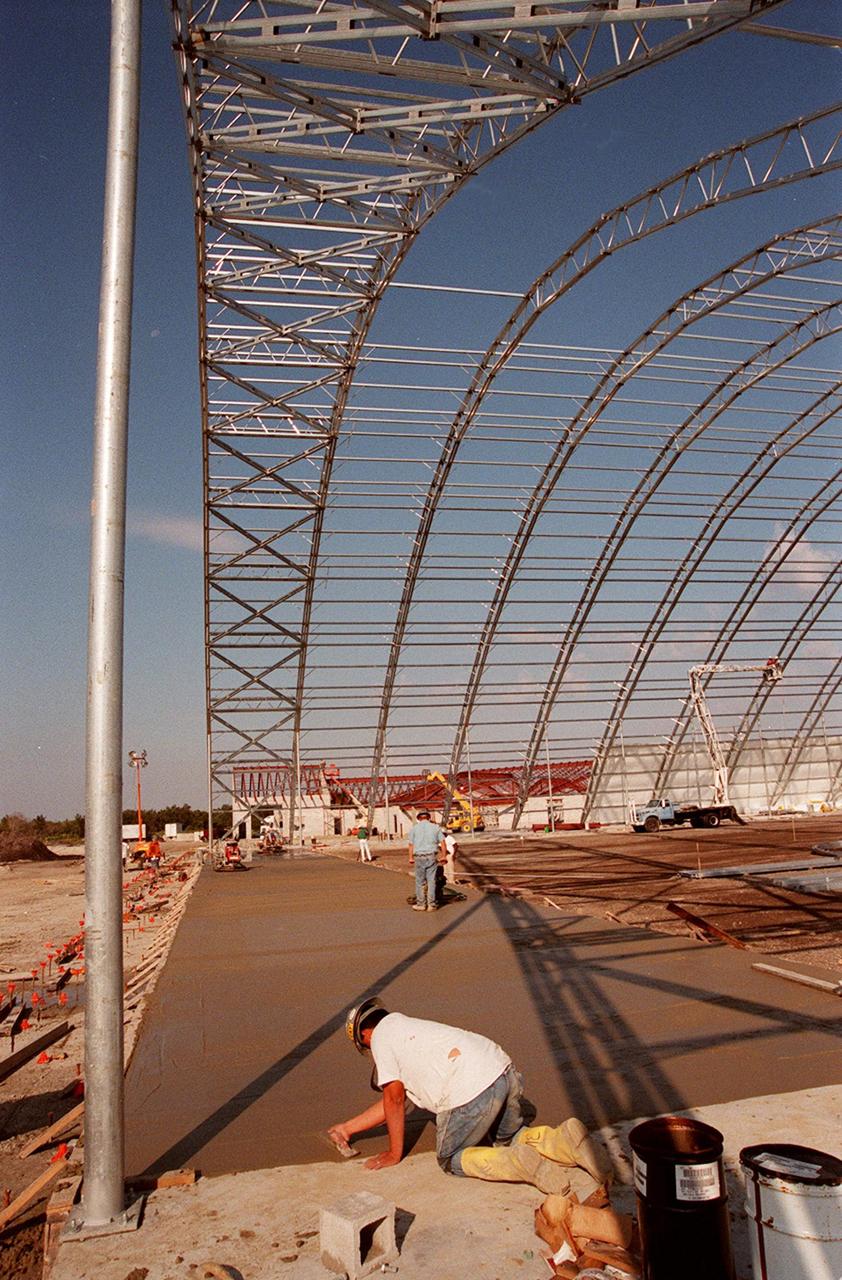
A worker smoothes the recently poured foundation of the multi-purpose hangar at the site of the $8 million Reusable Launch Vehicle (RLV) Support Complex at Kennedy Space Center. In the background can be seen the new construction for the building that will house related ground support equipment and administrative/technical support. The RLV complex will be available to accommodate the Space Shuttle; the X-34 RLV technology demonstrator; the L-1011 carrier aircraft for Pegasus and X-34; and other RLV and X-vehicle programs. The complex is jointly funded by the Spaceport Florida Authority, NASA's Space Shuttle Program and KSC. The facility will be operational in early 2000
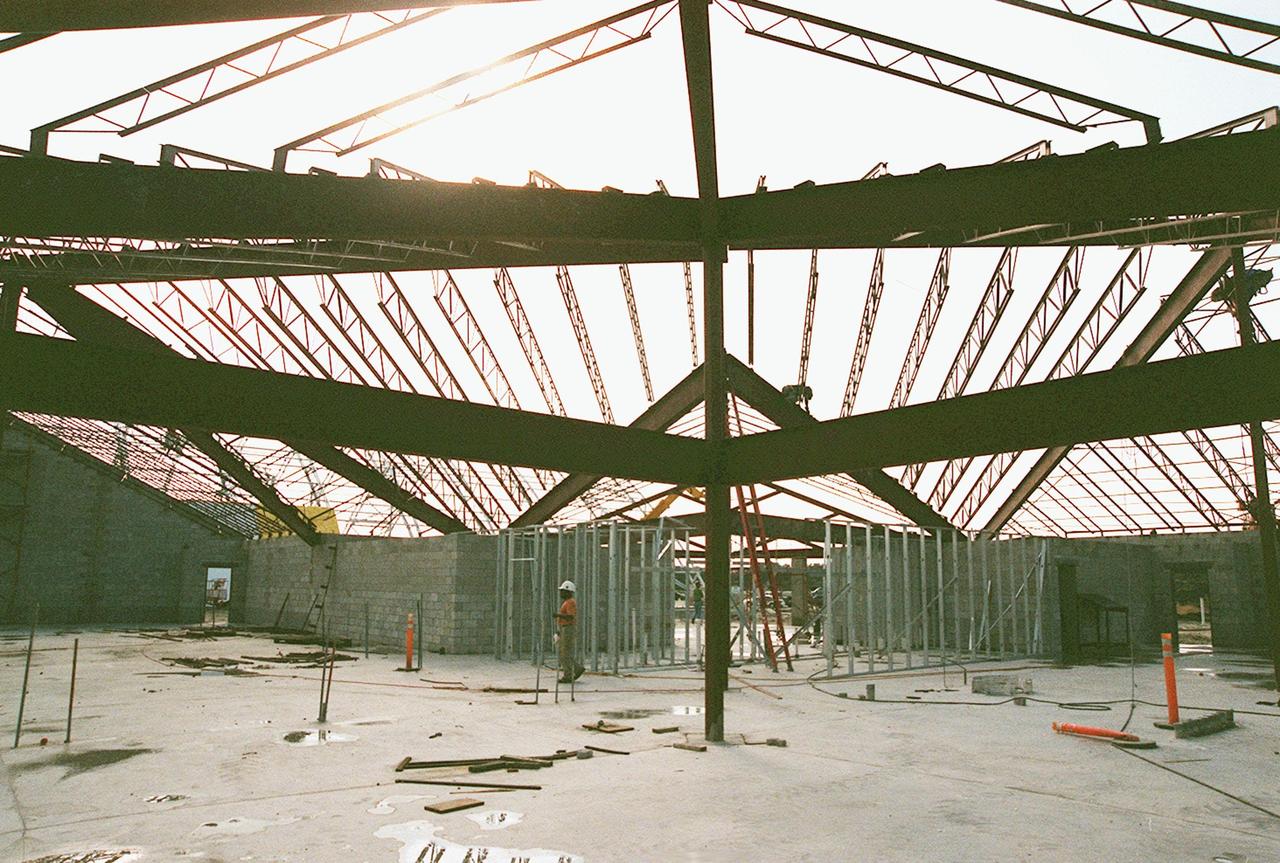
Construction continues on the $8 million Reusable Launch Vehicle (RLV) Support Complex at Kennedy Space Center. Shown is the interior of the building to be used for related ground support equipment and administrative/technical support. The RLV complex also includes a multi-purpose hangar. The complex will be available to accommodate the Space Shuttle; the X-34 RLV technology demonstrator; the L-1011 carrier aircraft for Pegasus and X-34; and other RLV and X-vehicle programs. The facility, jointly funded by the Spaceport Florida Authority, NASA's Space Shuttle Program and KSC, will be operational in early 2000
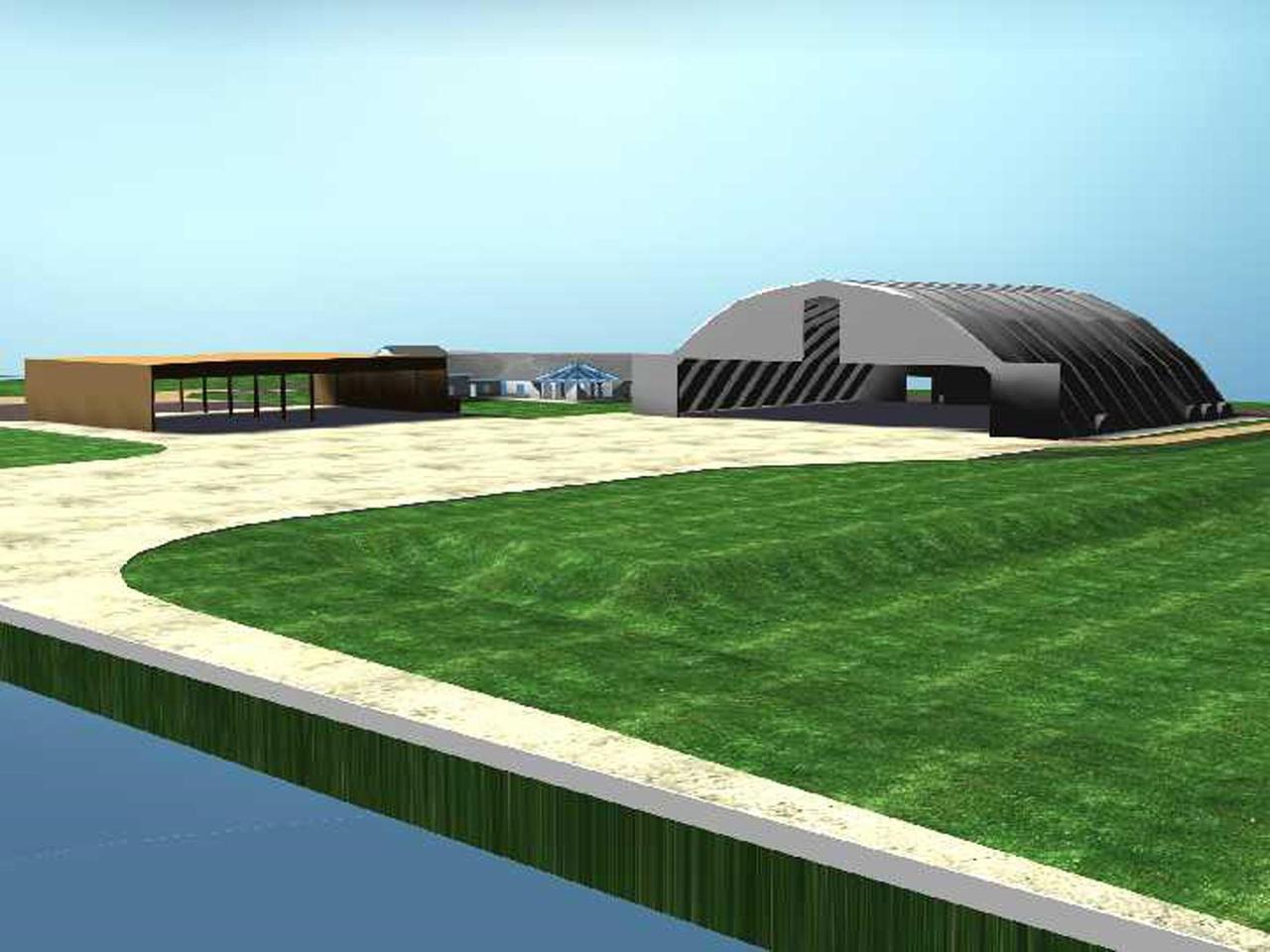
An artist's rendering shows the $8-million Reusable Launch Vehicle (RLV) Support Complex planned for the Shuttle Landing Facility (SLF) at Kennedy Space Center. The ground breaking took place today. To be located at the tow-way adjacent to the SLF, the complex will include a multi-purpose RLV hangar and adjacent facilities for related ground support equipment and administrative/technical support. It will be available to accommodate the Space Shuttle, the X-34 RLV technology demonstrator, the L-1011 carrier aircraft for Pegasus and X-34, and other RLV and X-vehicle programs. The complex is jointly funded by the Spaceport Florida Authority, NASA's Space Shuttle Program and KSC. The facility will be operational in early 2000

Construction workers are silhouetted against the sky as they work on the girders of a support building, part of the new $8 million Reusable Launch Vehicle (RLV) Support Complex at Kennedy Space Center. The building is to be used for related ground support equipment and administrative/technical support. The RLV complex also includes a multi-purpose hangar. The complex will be available to accommodate the Space Shuttle; the X-34 RLV technology demonstrator; the L-1011 carrier aircraft for Pegasus and X-34; and other RLV and X-vehicle programs. The facility, jointly funded by the Spaceport Florida Authority, NASA's Space Shuttle Program and KSC, will be operational in early 2000
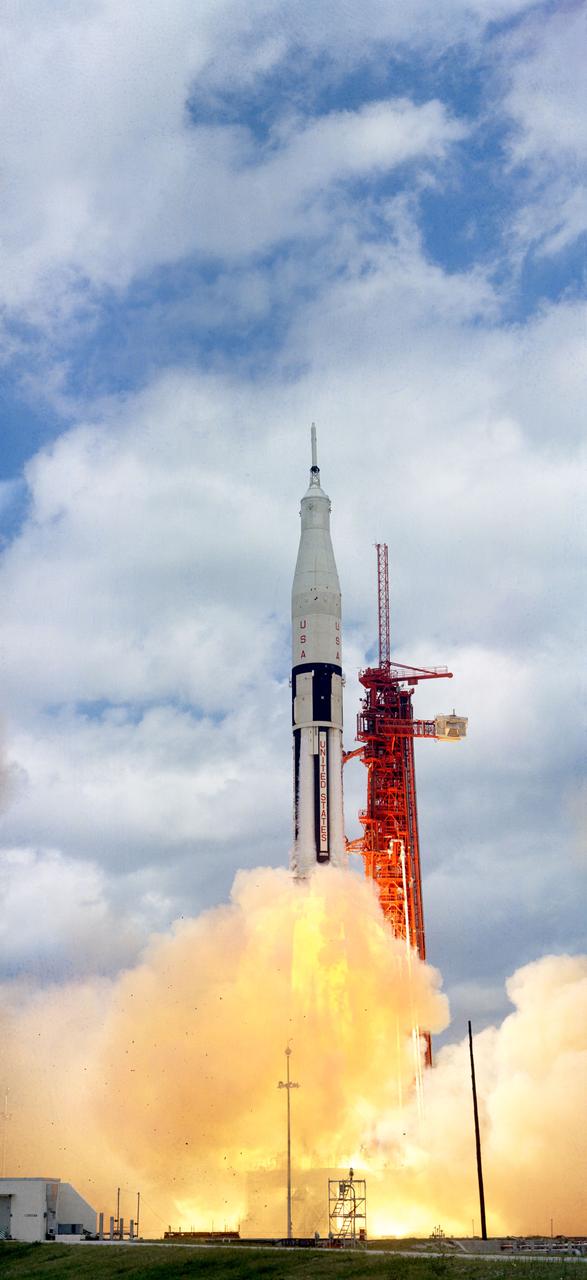
A/S Mission 202 was launched from the KSC Launch Complex (LC)-34 at 12:15 p.m., 08/25/1966. The mission was a step toward qualifying the Apollo Command and Service Modules (CSM)'s and the uprated Saturn I launch vehicle for manned flight. KSC, FL

KENNEDY SPACE CENTER, FLA. -- More than 600 accredited newsmen at Press Site #2 covered this morning's launch of Apollo 7, carying astronauts Walter M. Schirra Jr., Donn F. Eisele and Walter Cunningham from Launch Complex 34.
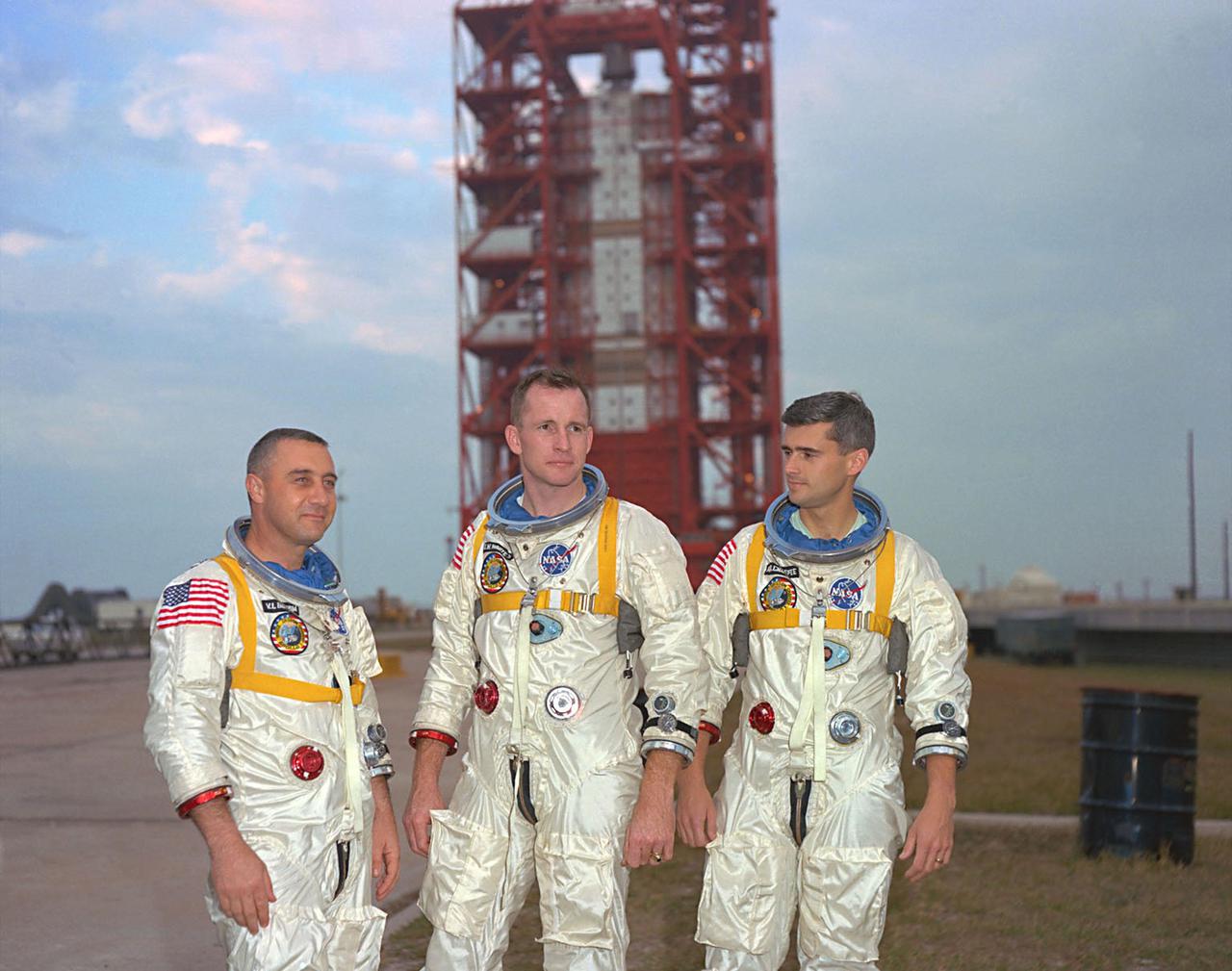
KENNEDY SPACE CENTER, FLA. -- Astronauts, left to right, Gus Grissom, Ed White, and Roger Chaffee, pose in front of Launch Complex 34 which is housing their Saturn 1 launch vehicle. The astronauts are scheduled for the Apollo Saturn 204 (Apollo 1) mission.
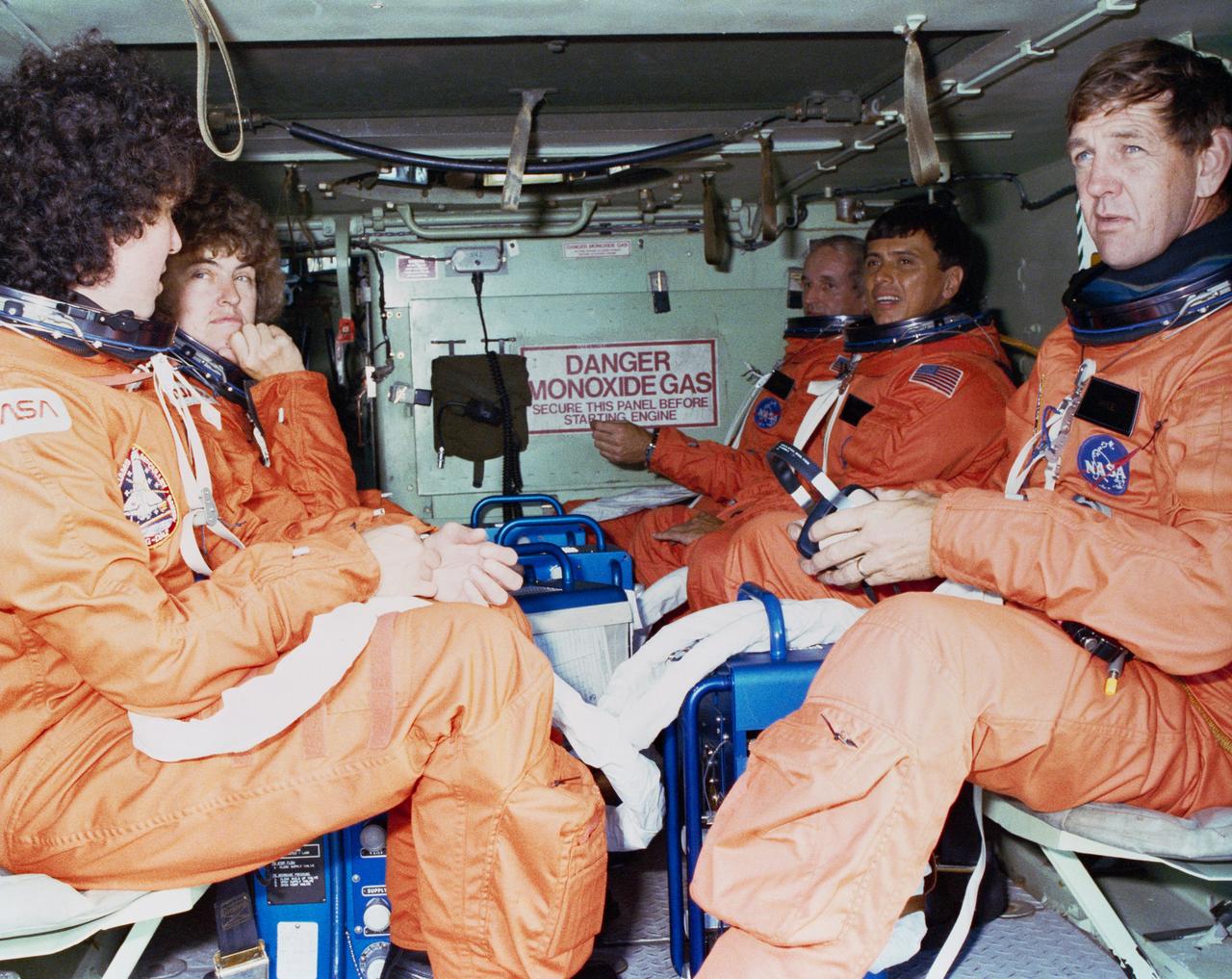
STS-34 crewmembers sit in M1-13 Armored Personnel Carrier (APC) during emergency egress training at KSC's shuttle landing facility (SLF) prior to terminal countdown demonstration test (TCDT) activities. Wearing launch and entry suits (LESs), are (from left) Mission Specialist (MS) Ellen S. Baker, MS Shannon W. Lucid, Commander Donald E. Williams (right side, in back), MS Franklin R. Chang-Diaz, and Pilot Michael J. McCulley (holding headset). View provided by KSC with alternate number KSC-89PC-871.
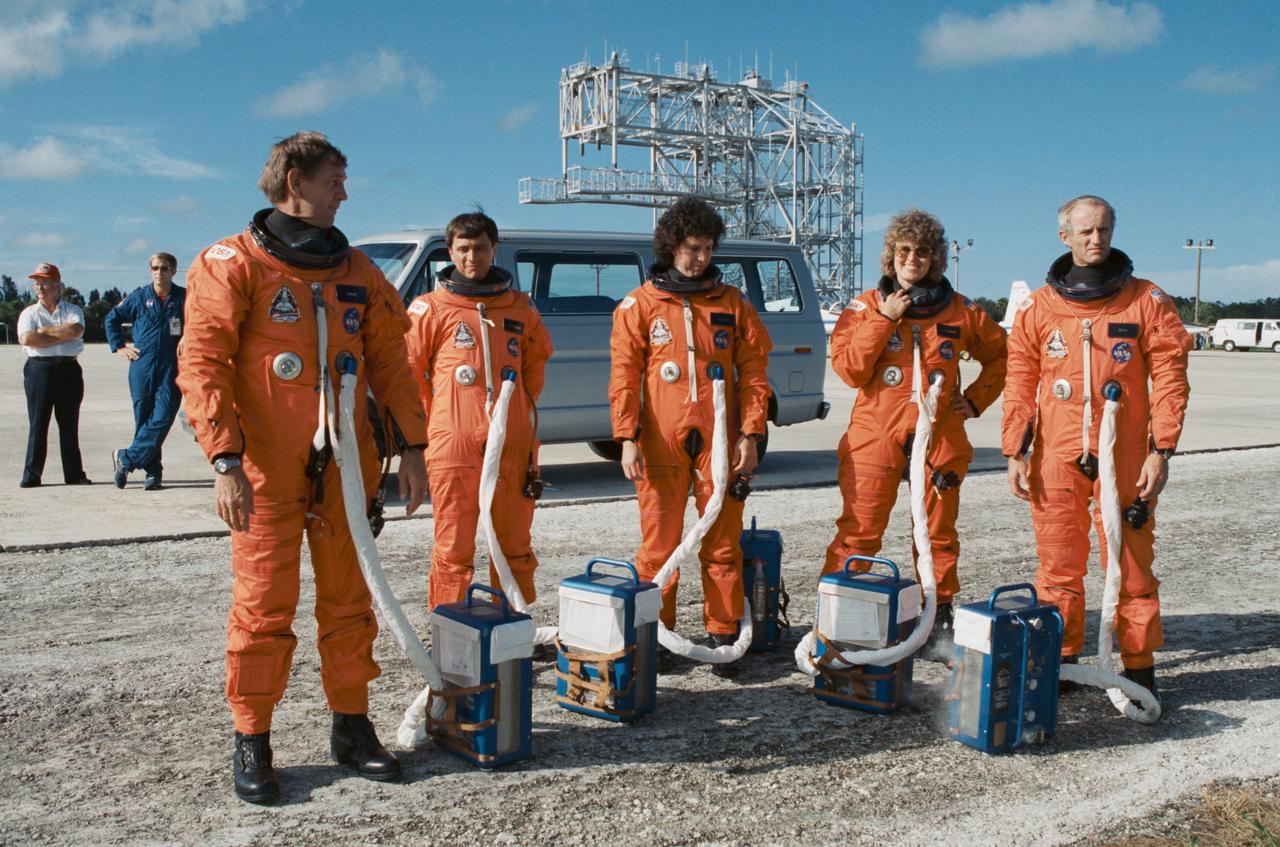
S89-45249 (13 Sept 1989) --- The astronaut crewmembers for NASA's STS-34 mission prepare to participate in emergency egress training in their partially pressurized flight suits with attached cooling packs at the Shuttle landing facility. Left to right are Astronauts Michael J. McCulley, pilot; Franklin R. Chang-Diaz, Ellen S. Baker and Shannon W. Lucid, all mission specialists; and Donald E. Williams, mission commander. The five were at the Kennedy Space Center (KSC) primarily to participate in the Terminal Countdown Demonstration Test (TCDT). The Space Shuttle Atlantis is scheduled to be launched October 12. Primary payload for the five-day mission is the spacecraft Galileo which will be deployed in space begin its journey to Jupiter.
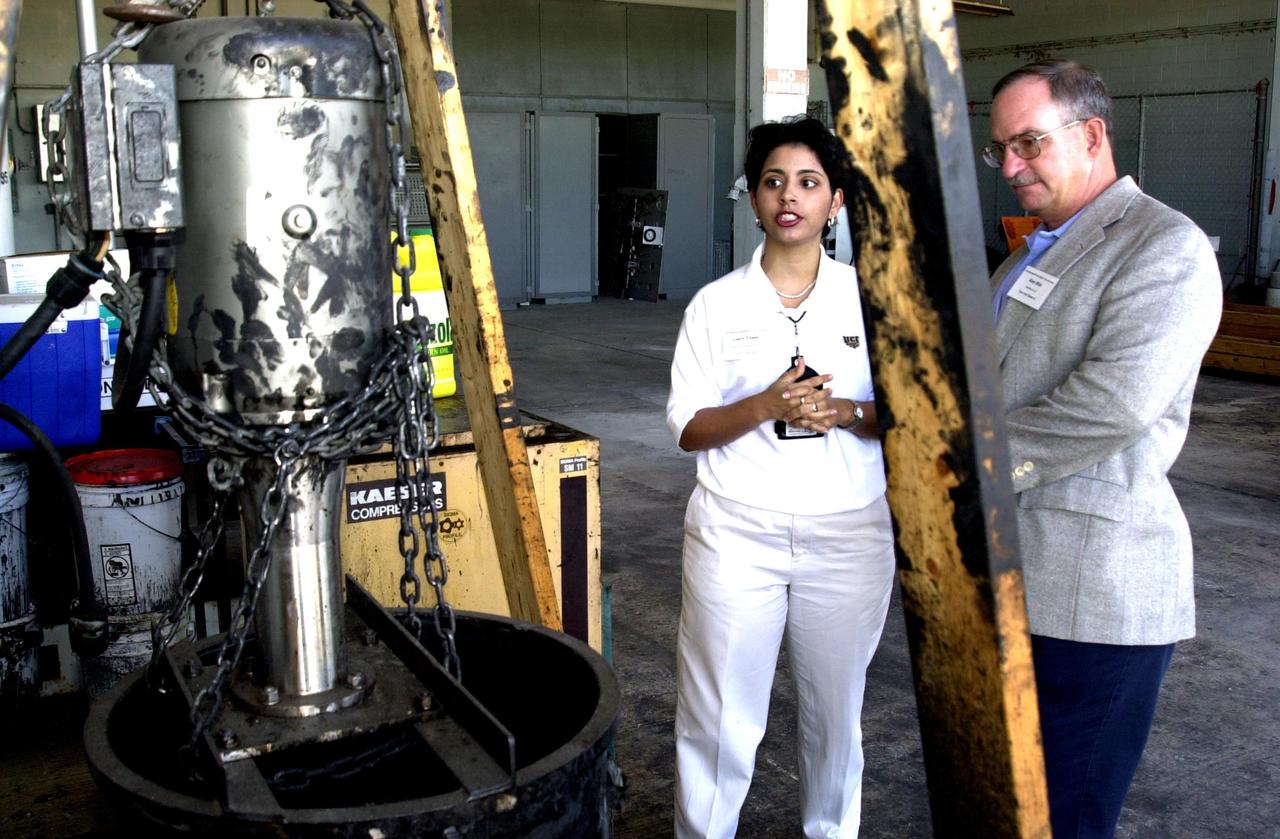
KENNEDY SPACE CENTER, FLA. -- New methods of environmental cleanup are explained during a presentation to government and business representatives, scientists and engineers at Launch Complex 34-A, Cape Canaveral Spaceport. At left is Laura Filipek, a University of Central Florida graduate chemistry student involved in the science.
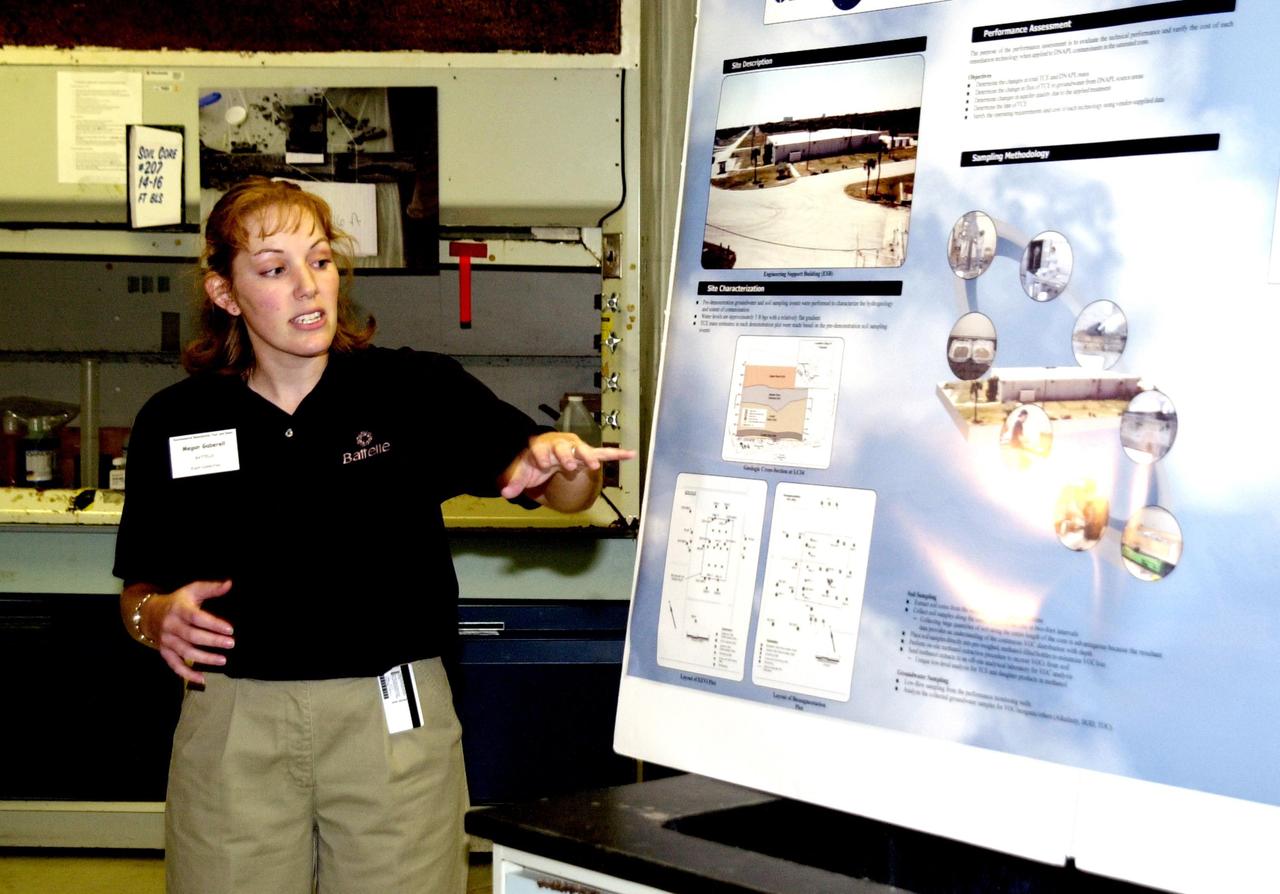
KENNEDY SPACE CENTER, FLA. - New methods of environmental cleanup are explained to government and business representatives, scientists and engineers during a presentation at Launch Complex 34-A, Cape Canaveral Spaceport. Making the presentation is Megan Gaberell with Battelle Memorial Institute.
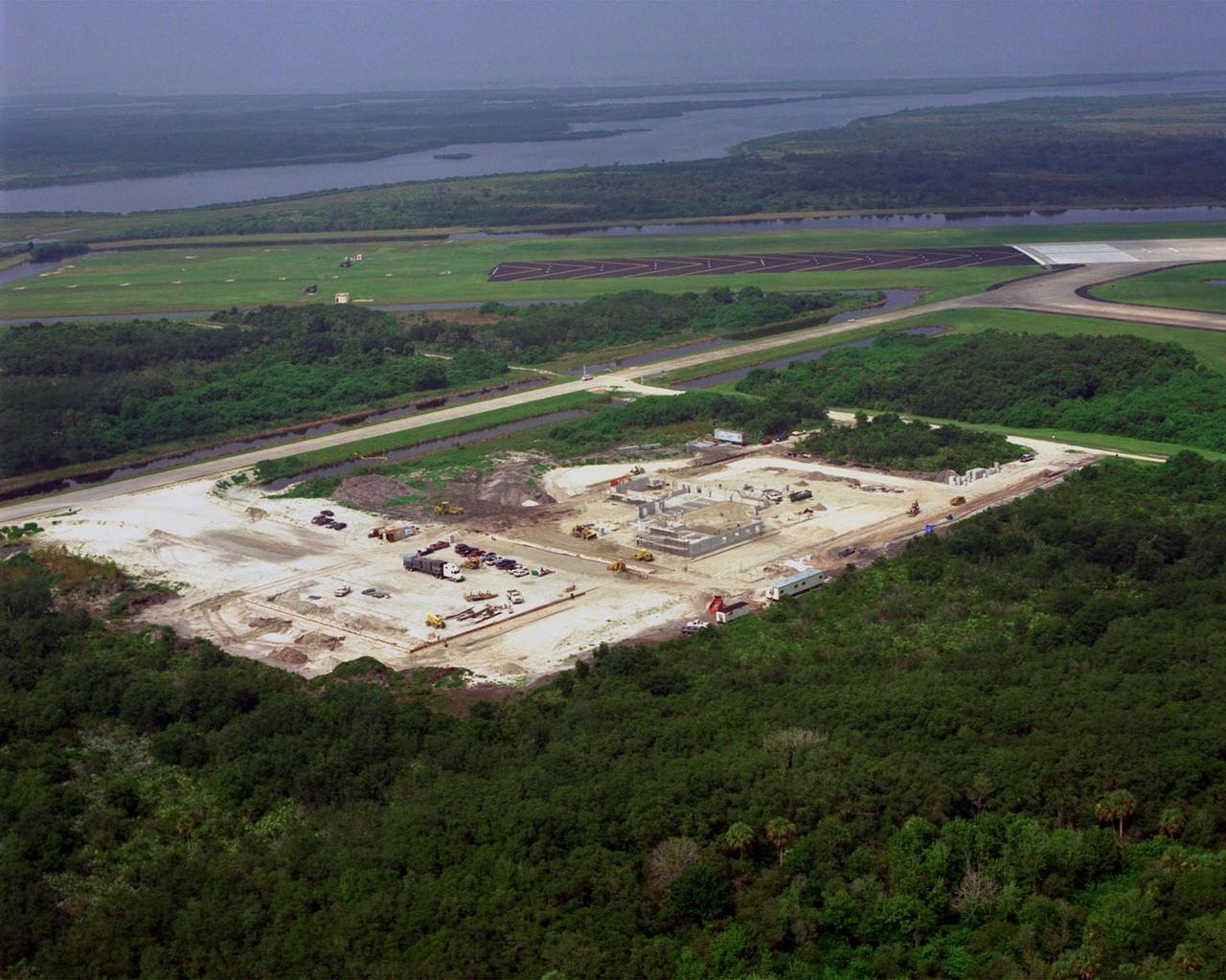
An aerial view shows the early construction of a multi-purpose hangar, which is part of the $8 million Reusable Launch Vehicle (RLV) Support Complex at Kennedy Space Center. In the background, toward the west, is Banana Creek, flowing into the Indian River Lagoon, and below it the Shuttle Landing Facility's landing strip. The RLV complex will also include facilities for related ground support equipment and administrative/ technical support. It will be available to accommodate the Space Shuttle; the X-34 RLV technology demonstrator; the L-1011 carrier aircraft for Pegasus and X-34; and other RLV and X-vehicle programs. The complex is jointly funded by the Spaceport Florida Authority, NASA's Space Shuttle Program and KSC. The facility will be operational in early 2000
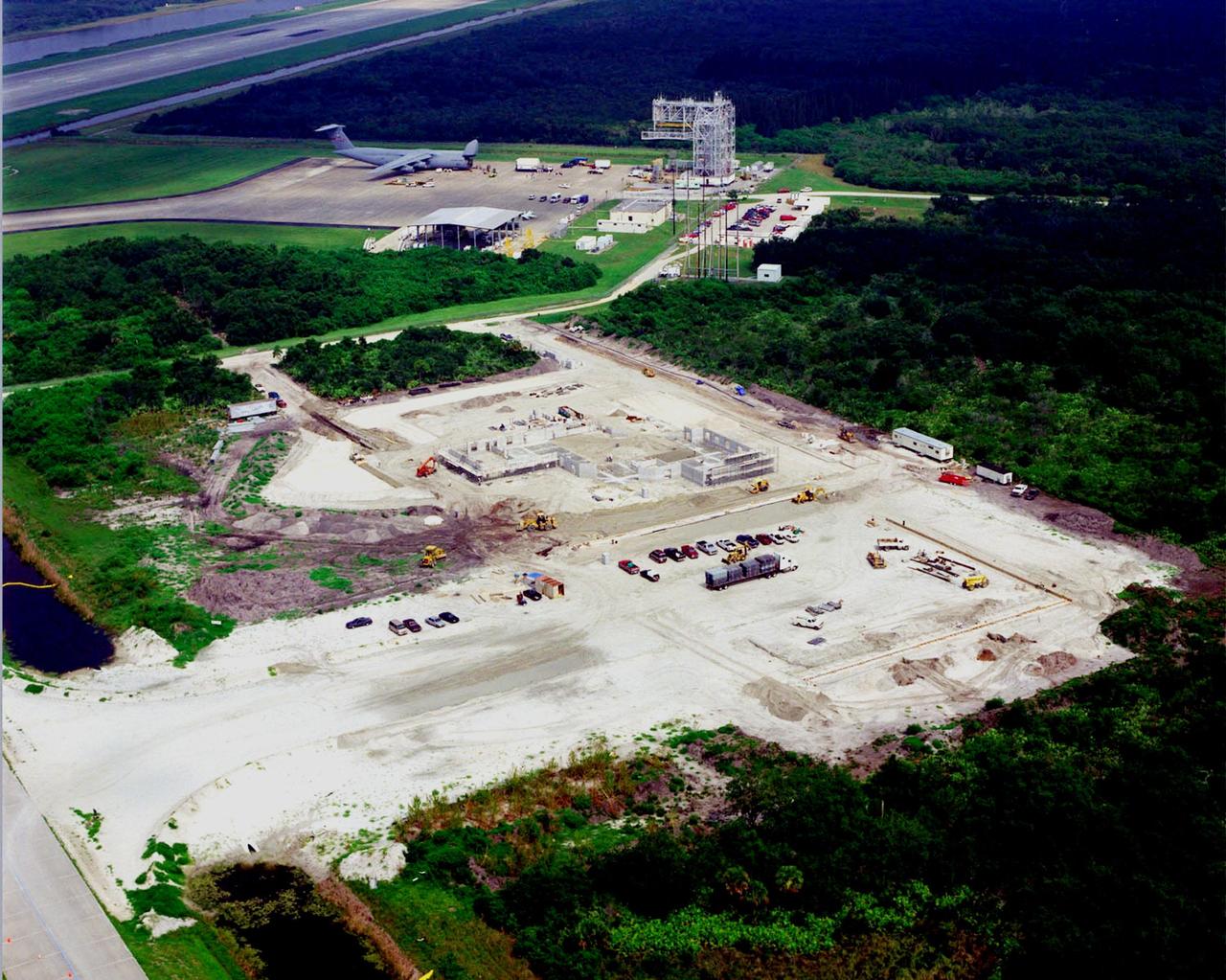
This aerial view shows the construction of a multi-purpose hangar, which is part of the $8 million Reusable Launch Vehicle (RLV) Support Complex at Kennedy Space Center. In the background is the Shuttle Landing Facility, with (left) a C-5 air cargo plane, the offloaded canister in front of it containing the Multi-Purpose Logistics Module Raffaello, and (right) the mate/demate tower that is used when an orbiter is transported to and from KSC atop a modified Boeing 747. The RLV complex will also include facilities for related ground support equipment and administrative/ technical support. It will be available to accommodate the Space Shuttle; the X-34 RLV technology demonstrator; the L-1011 carrier aircraft for Pegasus and X-34; and other RLV and X-vehicle programs. The complex is jointly funded by the Spaceport Florida Authority, NASA's Space Shuttle Program and KSC. The facility will be operational in early 2000.
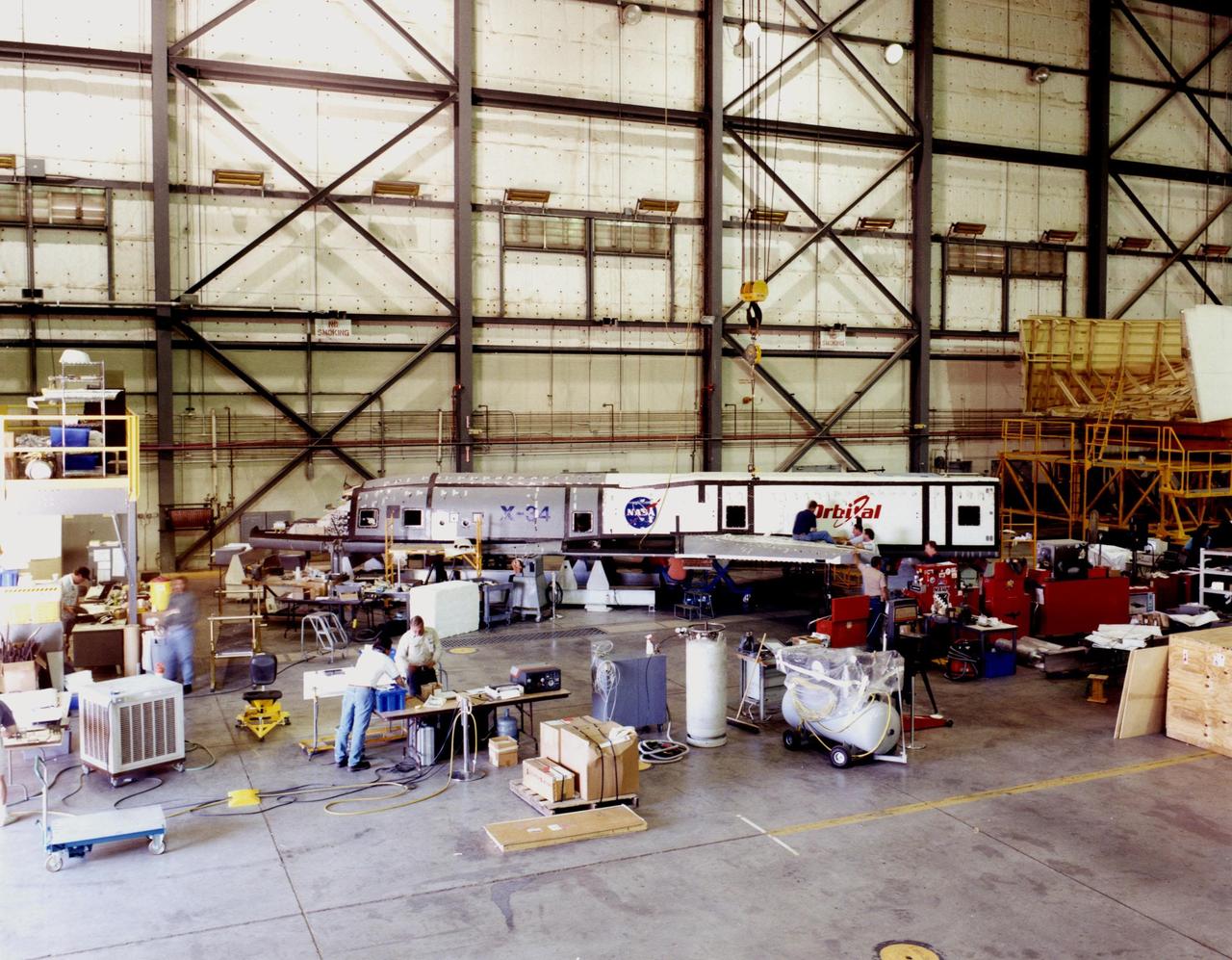
The modified X-34, known as A-1A, rests in the background of the Dryden Flight Research Center at Edwards Air Force Base, Calif., while an integrated team of KSC, Dryden Flight Research Center and Orbital Sciences Corporation engineers and technicians bring the X-34 A-1A vehicle closer to test flight readiness. Since September, eight NASA engineering technicians from KSC's Engineering Prototype Lab have assisted in the complex process of converting the X-34 A-1 vehicle from captive carry status to unpowered flight status, the A-1A. The X-34 is 58.3 feet long, 27.7 feet wide from wing tip to wing tip, and 11.5 feet tall from the bottom of the fuselage to the top of the tail. The autonomously operated technology demonstrator will be air-launched from an L-1011 airplane and should be capable of flying eight times the speed of sound, reaching an altitude of 250,000 feet. The X-34 Project is managed by NASA's Marshall Space Flight Center in Huntsville, Ala
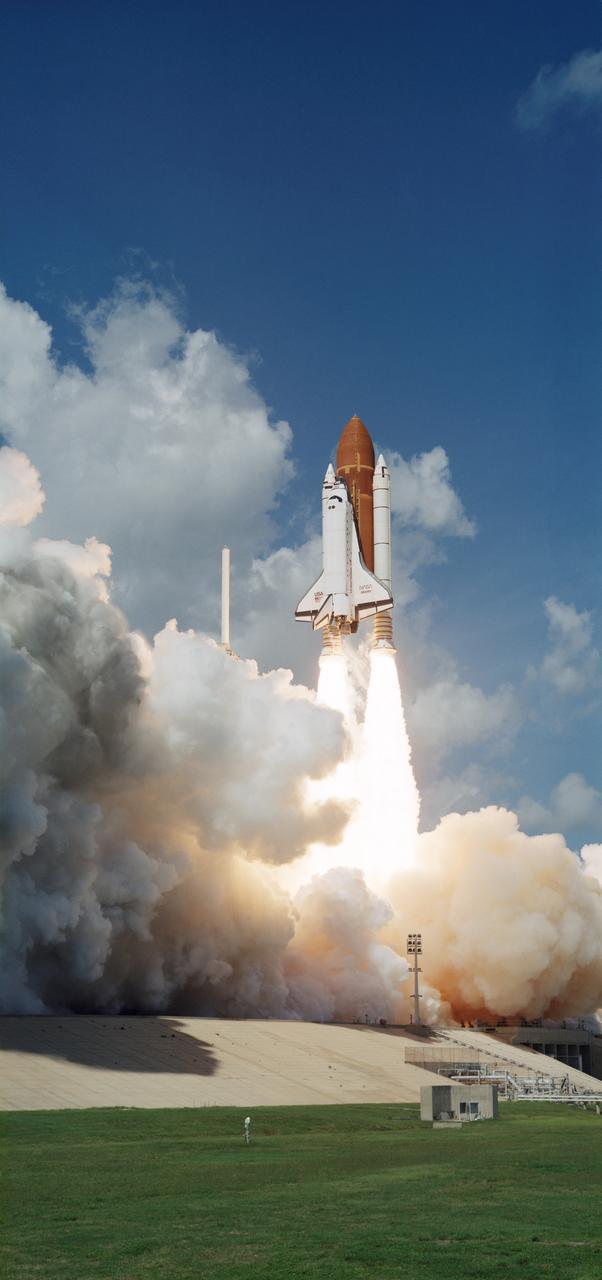
STS034-S-023 (18 Oct. 1989) --- The STS-34 Space Shuttle Atlantis lifts off from Kennedy Space Center’s launch pad 39-B at l2:53:39 p.m. (EDT) on Oct. 18, 1989, marking the beginning of a five-day mission in space. Atlantis carries a crew of five and the spacecraft Galileo. The Jupiter-bound probe will be deployed from Atlantis some six hours after launch. The journey to the giant planet is expected to take over six years. Crewmembers for the mission are astronauts Donald E. Williams, Michael J. McCulley, Shannon W. Lucid, Franklin R. Chang-Diaz and Ellen S. Baker. The scene was recorded with a 70mm camera.
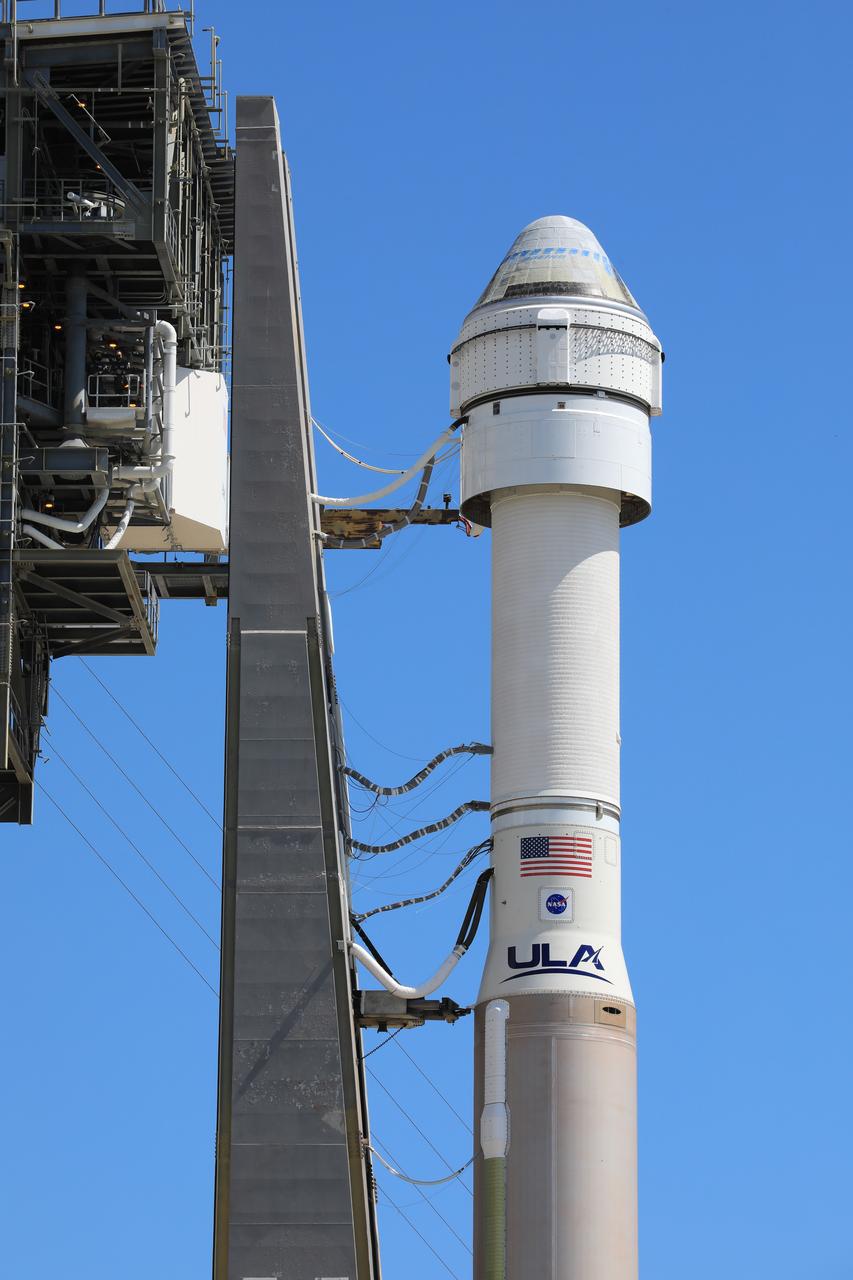
Boeing’s Starliner spacecraft atop the United Launch Alliance Atlas V rocket is seen on the launch pad of Space Launch Complex-41 at Cape Canaveral Space Force Station in Florida on Saturday, May 4, 2024, ahead of NASA’s Boeing Crew Flight Test. As part of the agency’s Commercial Crew Program, NASA astronauts Butch Wilmore and Suni Williams are the first to launch to the International Space Station aboard Boeing’s Starliner spacecraft. Liftoff is scheduled for 10:34 p.m. ET Monday, May 6.
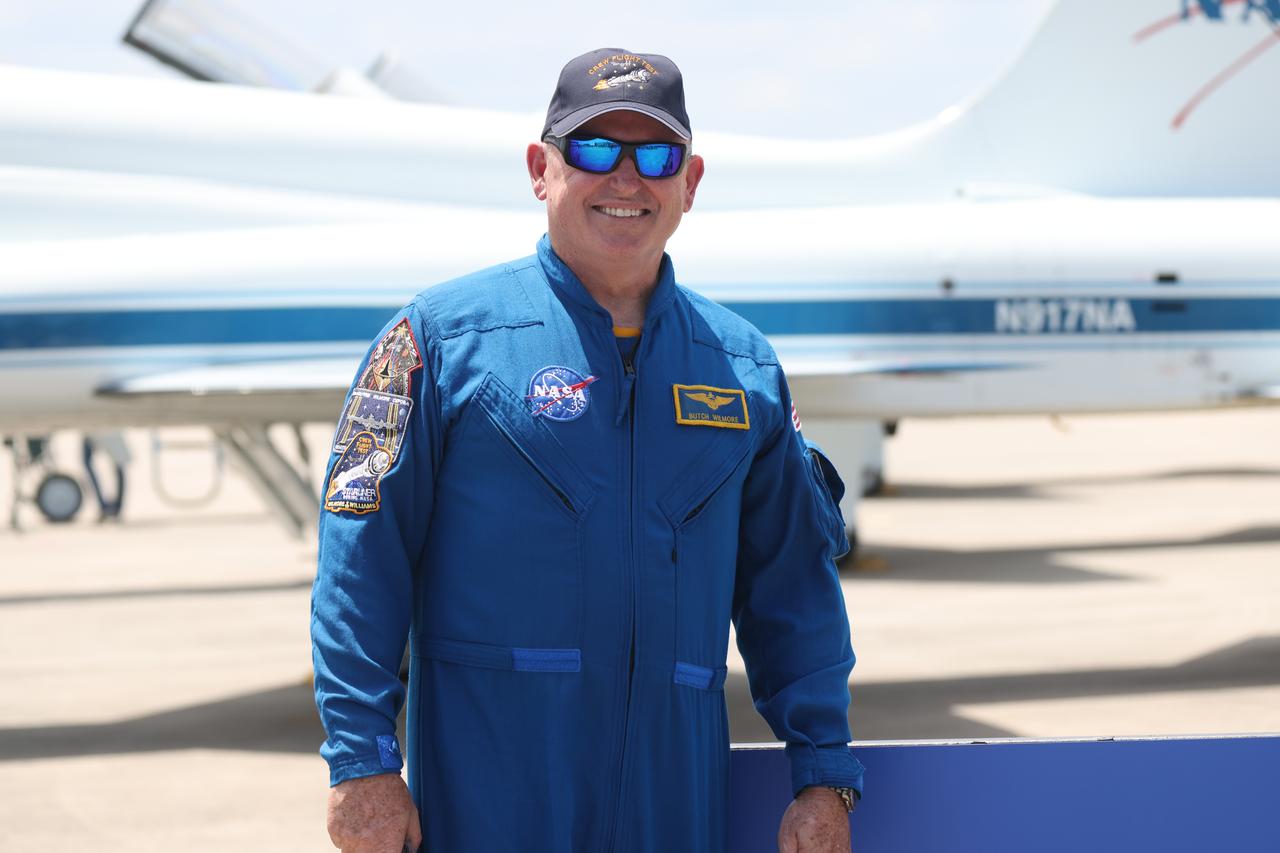
NASA astronauts Butch Wilmore poses for photos at the Launch and Landing Facility at NASA’s Kennedy Space Center in Florida following his arrival for the agency’s Boeing Crew Flight Test. As part of the agency’s Commercial Crew Program, Williams and Wilmore are the first crew to launch aboard Boeing’s Starliner spacecraft atop a United Launch Alliance Atlas V rocket from Space Launch Complex-41 at Cape Canaveral Space Force Station in Florida. Liftoff is scheduled for 10:34 p.m. ET on Monday, May 6.
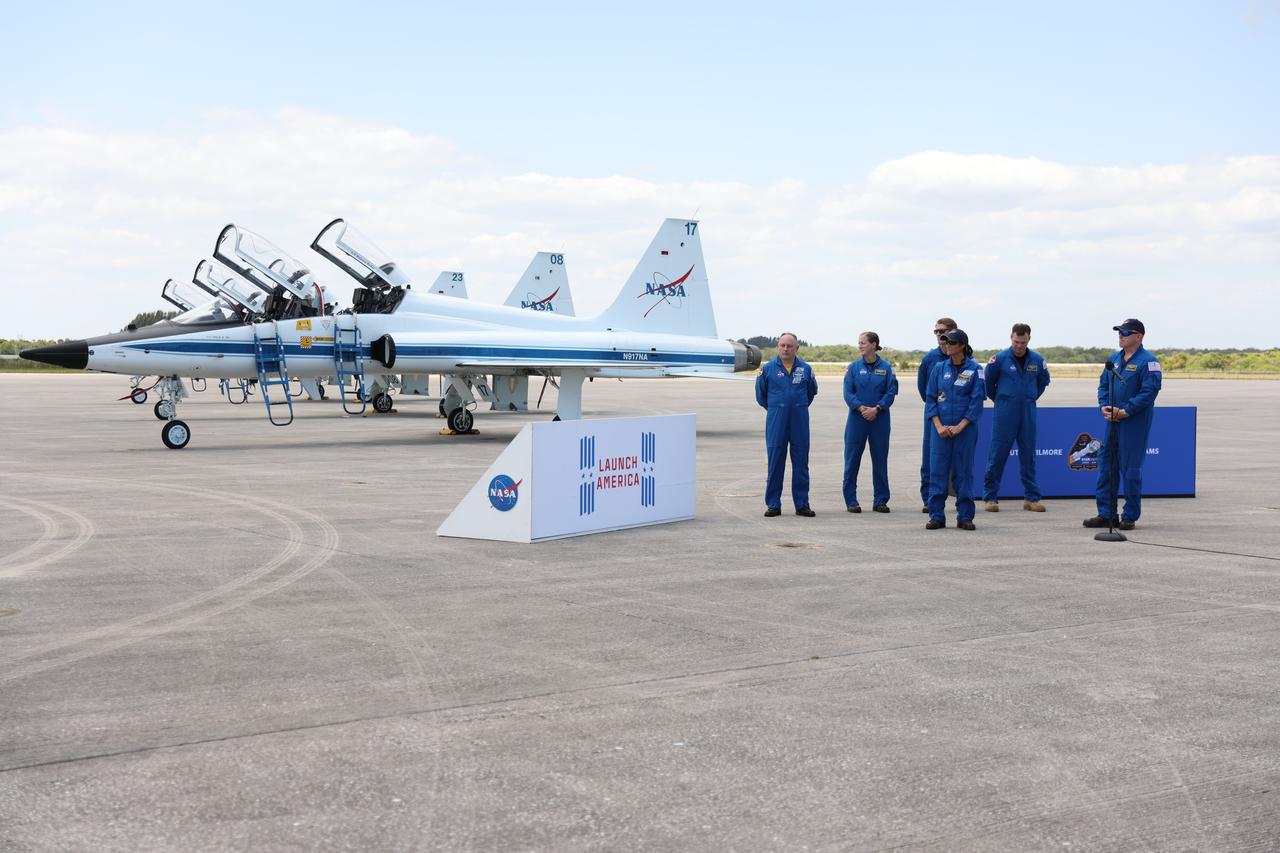
NASA astronauts pose for photos at the Launch and Landing Facility at NASA’s Kennedy Space Center in Florida following their arrival for the agency’s Boeing Crew Flight Test. As part of the agency’s Commercial Crew Program, NASA astronauts Suni Williams and Butch Wilmore are the first crew to launch aboard Boeing’s Starliner spacecraft atop a United Launch Alliance Atlas V rocket from Space Launch Complex-41 at Cape Canaveral Space Force Station in Florida. Liftoff is scheduled for 10:34 p.m. ET on Monday, May 6.
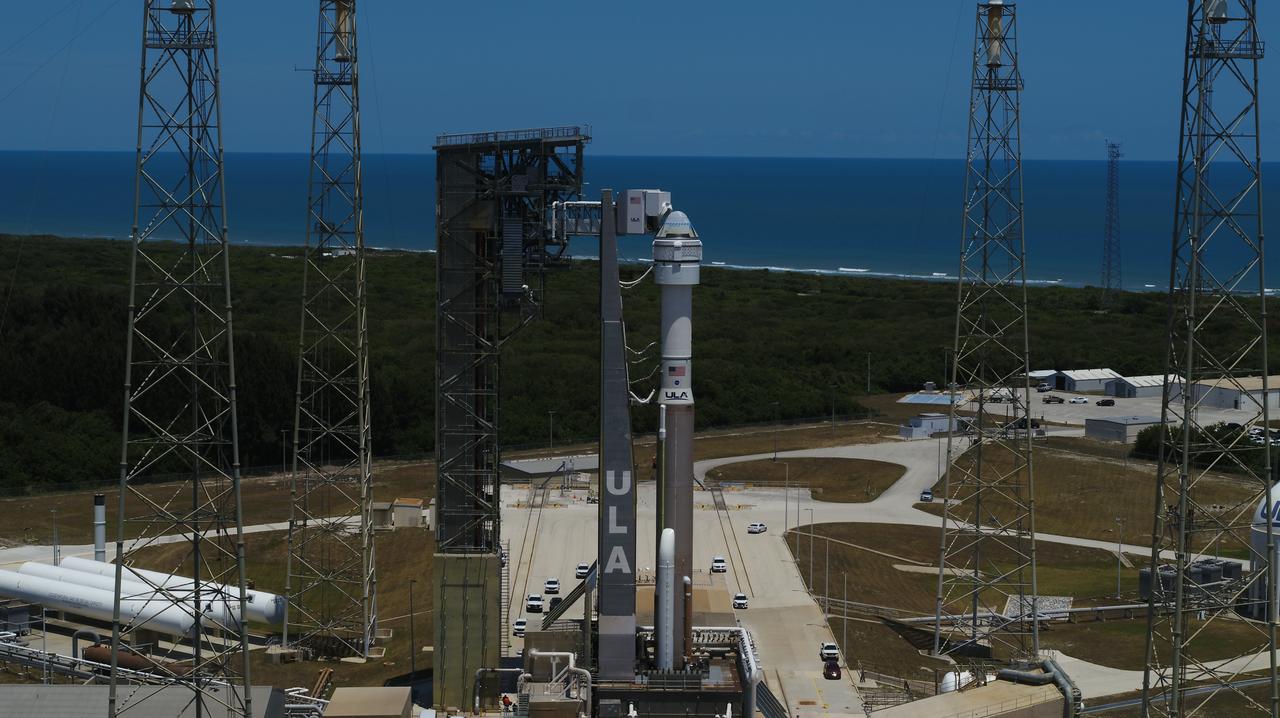
Boeing’s Starliner spacecraft atop the United Launch Alliance Atlas V rocket is seen on the launch pad of Space Launch Complex-41 at Cape Canaveral Space Force Station in Florida on Saturday, May 4, 2024, ahead of NASA’s Boeing Crew Flight Test. As part of the agency’s Commercial Crew Program, NASA astronauts Butch Wilmore and Suni Williams are the first to launch to the International Space Station aboard Boeing’s Starliner spacecraft. Liftoff is scheduled for 10:34 p.m. ET Monday, May 6.
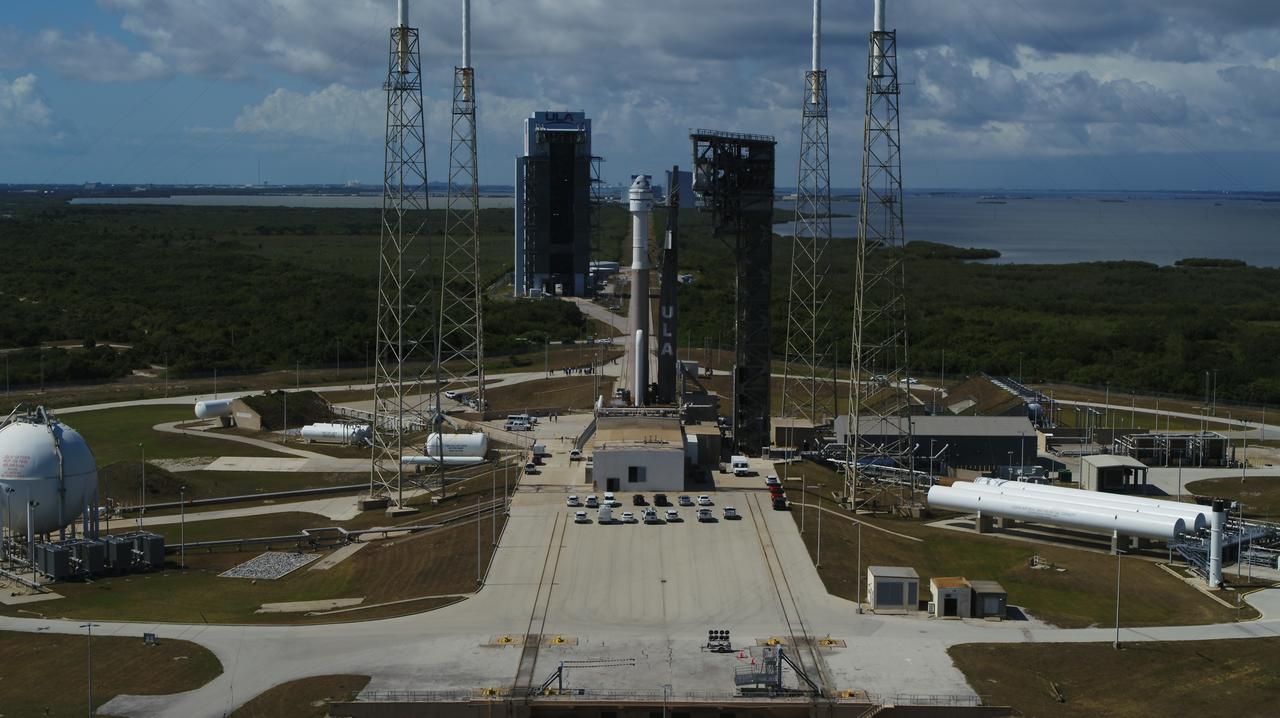
Boeing’s Starliner spacecraft atop the United Launch Alliance Atlas V rocket is seen on the launch pad of Space Launch Complex-41 at Cape Canaveral Space Force Station in Florida on Saturday, May 4, 2024, ahead of NASA’s Boeing Crew Flight Test. As part of the agency’s Commercial Crew Program, NASA astronauts Butch Wilmore and Suni Williams are the first to launch to the International Space Station aboard Boeing’s Starliner spacecraft. Liftoff is scheduled for 10:34 p.m. ET Monday, May 6.
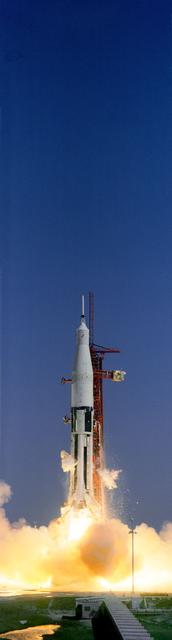
A/S 201 was launched from the Kennedy Space Center Launch Complex 34 at 11:12 a.m., 02/26/1966. The instrumented Apollo Command and Service Module, and, a spacecraft Lunar Excursion Module Adapter, was successfully launched on the unmanned suborbital mission by the Saturn 1B to check spacecraft launch vehicle mechanical compatibility and to test the spacecraft heat shield in a high-velocity re-entry mode. CAPE KENNEDY, FL
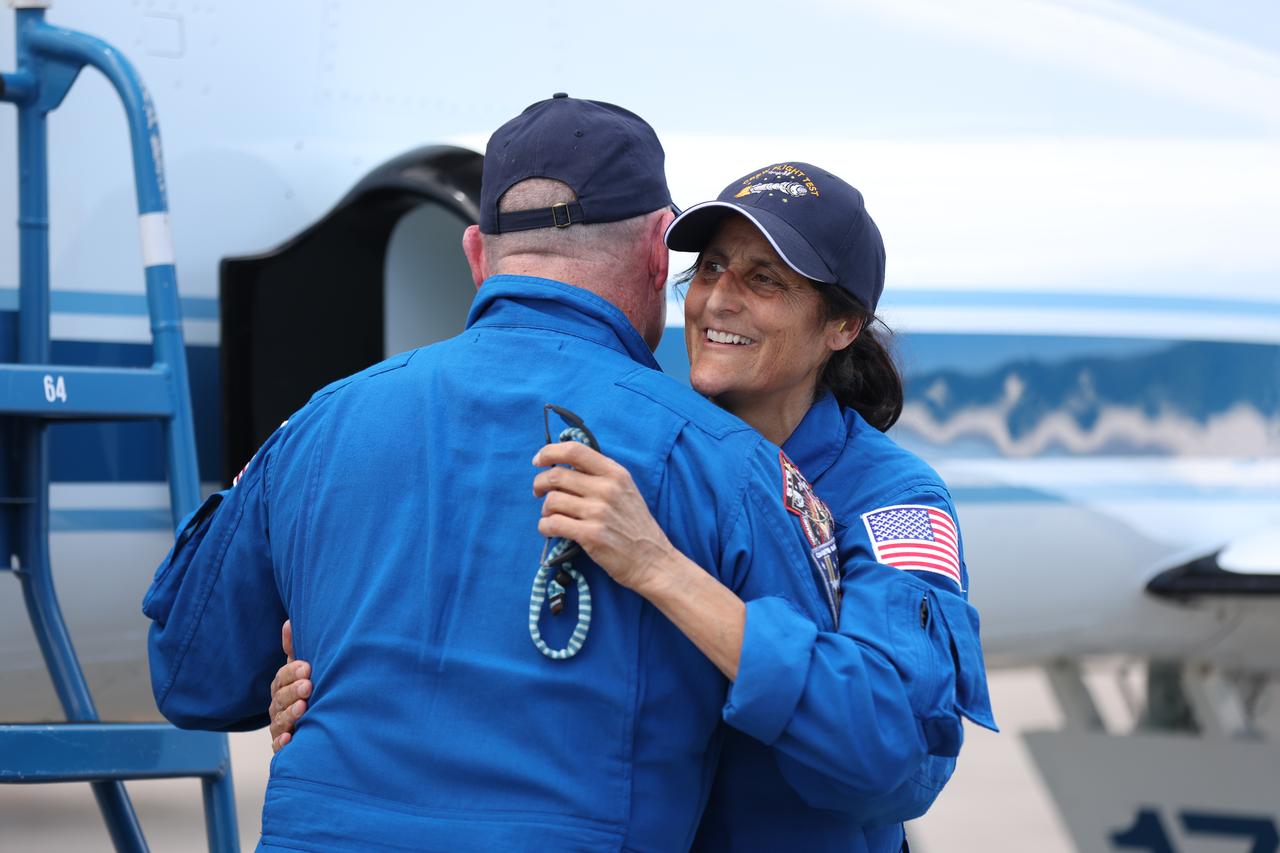
NASA astronauts Butch Wilmore and Suni Williams hug at the Launch and Landing Facility at NASA’s Kennedy Space Center in Florida following their arrival for the agency’s Boeing Crew Flight Test. As part of the agency’s Commercial Crew Program, Williams and Wilmore are the first crew to launch aboard Boeing’s Starliner spacecraft atop a United Launch Alliance Atlas V rocket from Space Launch Complex-41 at Cape Canaveral Space Force Station in Florida. Liftoff is scheduled for 10:34 p.m. ET on Monday, May 6.
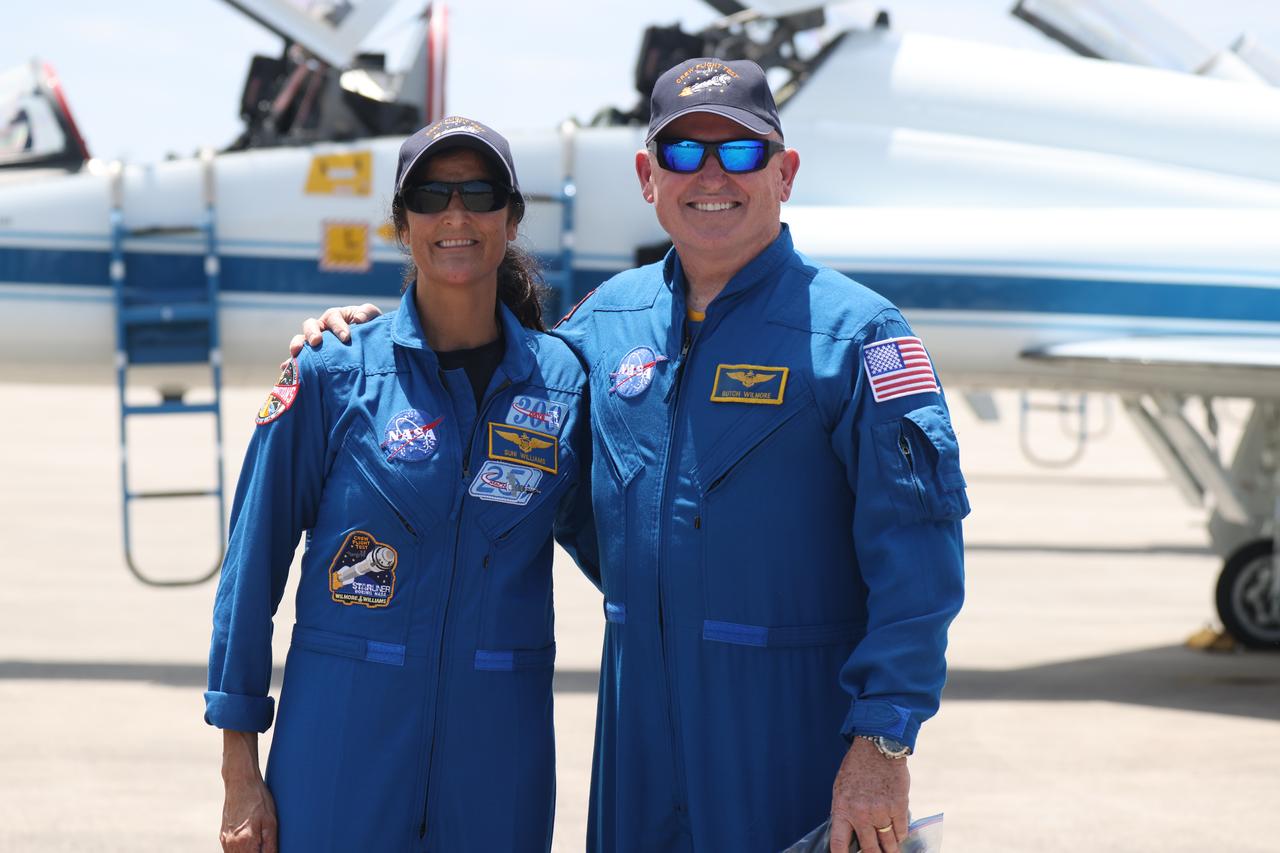
NASA astronauts Butch Wilmore and Suni Williams pose for photos at the Launch and Landing Facility at NASA’s Kennedy Space Center in Florida following their arrival for the agency’s Boeing Crew Flight Test. As part of the agency’s Commercial Crew Program, Williams and Wilmore are the first crew to launch aboard Boeing’s Starliner spacecraft atop a United Launch Alliance Atlas V rocket from Space Launch Complex-41 at Cape Canaveral Space Force Station in Florida. Liftoff is scheduled for 10:34 p.m. ET on Monday, May 6.
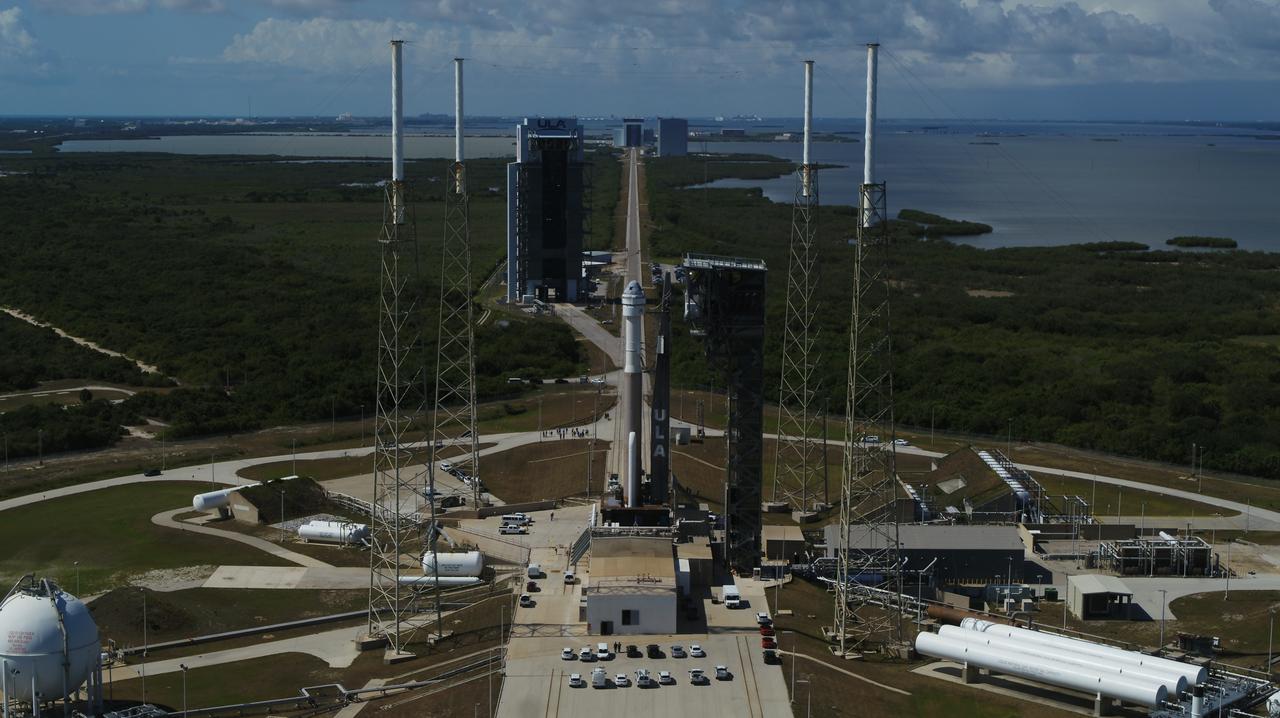
Boeing’s Starliner spacecraft atop the United Launch Alliance Atlas V rocket is seen on the launch pad of Space Launch Complex-41 at Cape Canaveral Space Force Station in Florida on Saturday, May 4, 2024, ahead of NASA’s Boeing Crew Flight Test. As part of the agency’s Commercial Crew Program, NASA astronauts Butch Wilmore and Suni Williams are the first to launch to the International Space Station aboard Boeing’s Starliner spacecraft. Liftoff is scheduled for 10:34 p.m. ET Monday, May 6.
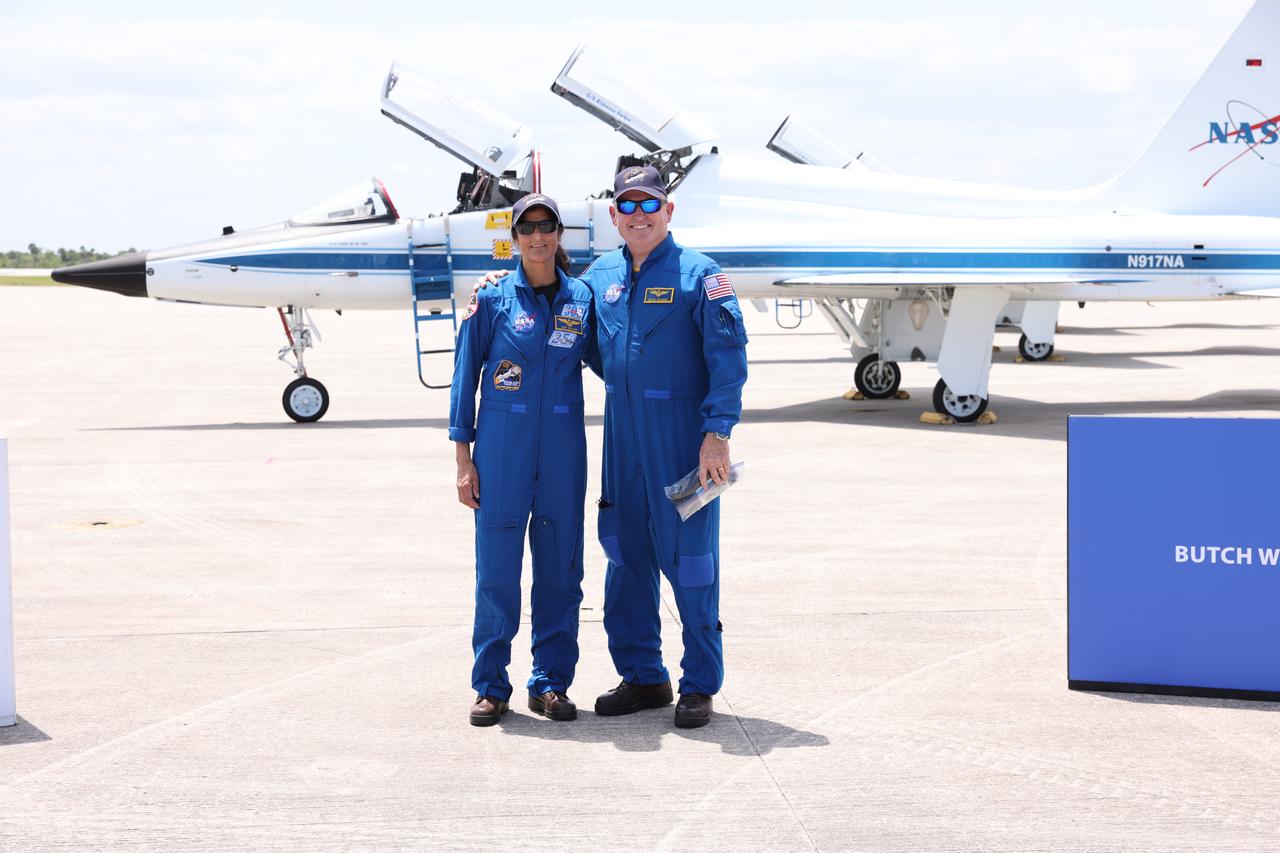
NASA astronauts Butch Wilmore and Suni Williams pose for photos at the Launch and Landing Facility at NASA’s Kennedy Space Center in Florida following their arrival for the agency’s Boeing Crew Flight Test. As part of the agency’s Commercial Crew Program, Williams and Wilmore are the first crew to launch aboard Boeing’s Starliner spacecraft atop a United Launch Alliance Atlas V rocket from Space Launch Complex-41 at Cape Canaveral Space Force Station in Florida. Liftoff is scheduled for 10:34 p.m. ET on Monday, May 6.
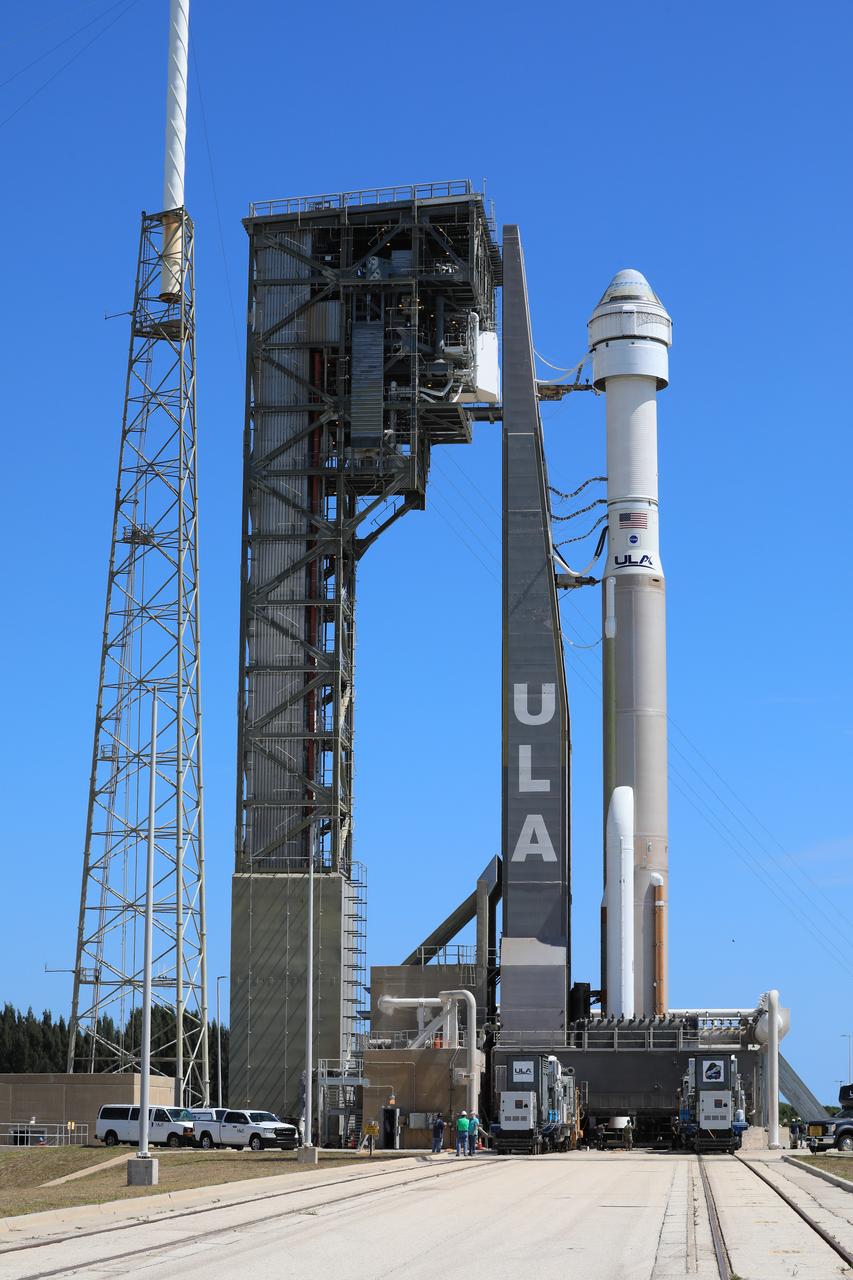
Boeing’s Starliner spacecraft atop the United Launch Alliance Atlas V rocket is seen on the launch pad of Space Launch Complex-41 at Cape Canaveral Space Force Station in Florida on Saturday, May 4, 2024, ahead of NASA’s Boeing Crew Flight Test. As part of the agency’s Commercial Crew Program, NASA astronauts Butch Wilmore and Suni Williams are the first to launch to the International Space Station aboard Boeing’s Starliner spacecraft. Liftoff is scheduled for 10:34 p.m. ET Monday, May 6.
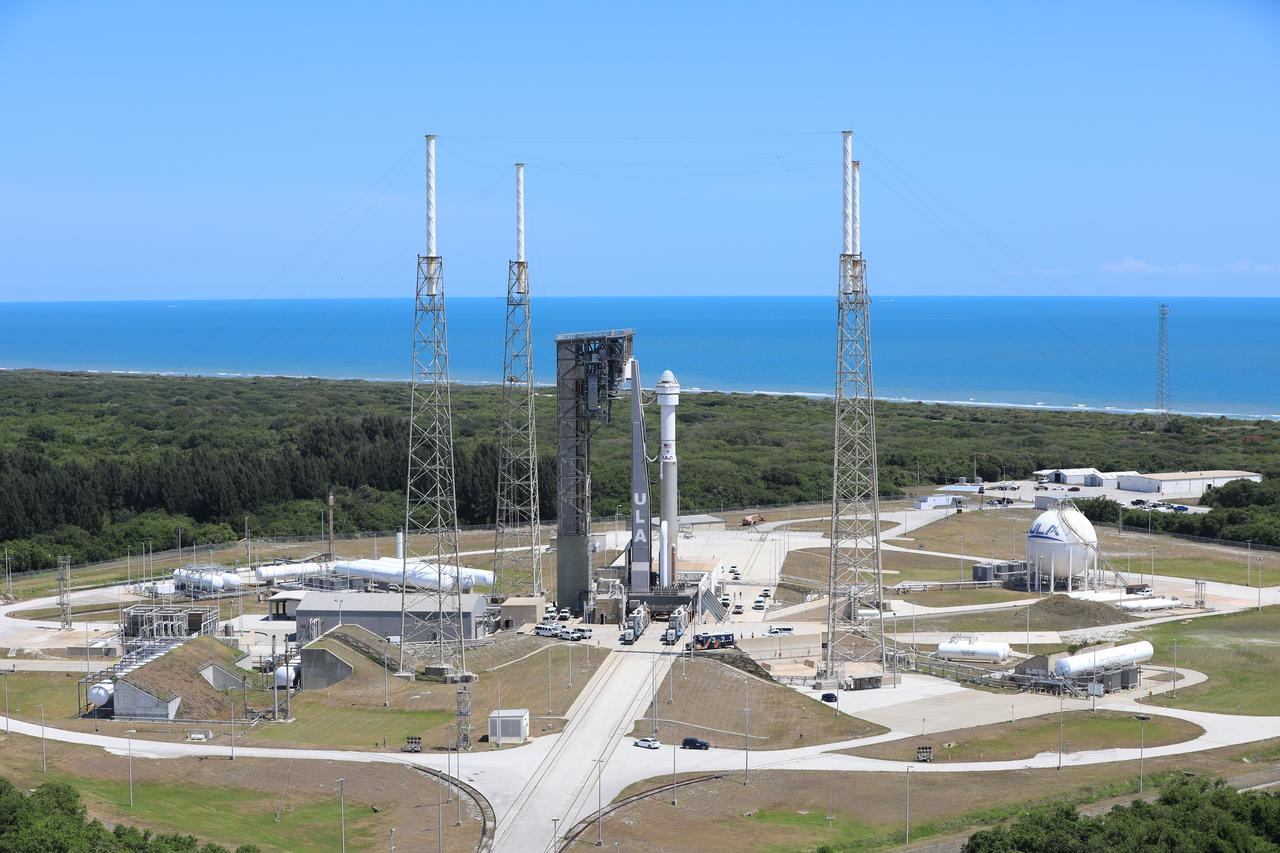
Boeing’s Starliner spacecraft atop the United Launch Alliance Atlas V rocket is seen on the launch pad of Space Launch Complex-41 at Cape Canaveral Space Force Station in Florida on Saturday, May 4, 2024, ahead of NASA’s Boeing Crew Flight Test. As part of the agency’s Commercial Crew Program, NASA astronauts Butch Wilmore and Suni Williams are the first to launch to the International Space Station aboard Boeing’s Starliner spacecraft. Liftoff is scheduled for 10:34 p.m. ET Monday, May 6.
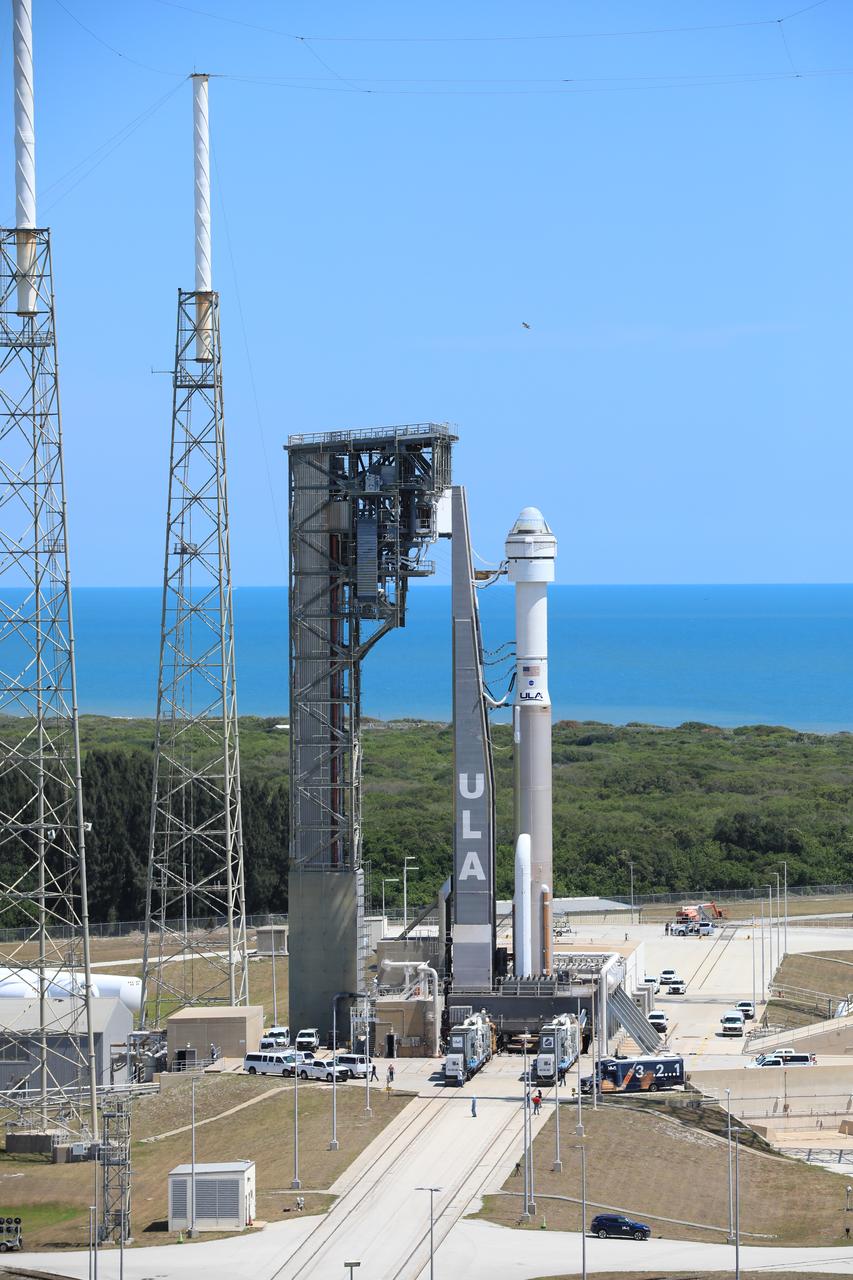
Boeing’s Starliner spacecraft atop the United Launch Alliance Atlas V rocket is seen on the launch pad of Space Launch Complex-41 at Cape Canaveral Space Force Station in Florida on Saturday, May 4, 2024, ahead of NASA’s Boeing Crew Flight Test. As part of the agency’s Commercial Crew Program, NASA astronauts Butch Wilmore and Suni Williams are the first to launch to the International Space Station aboard Boeing’s Starliner spacecraft. Liftoff is scheduled for 10:34 p.m. ET Monday, May 6.
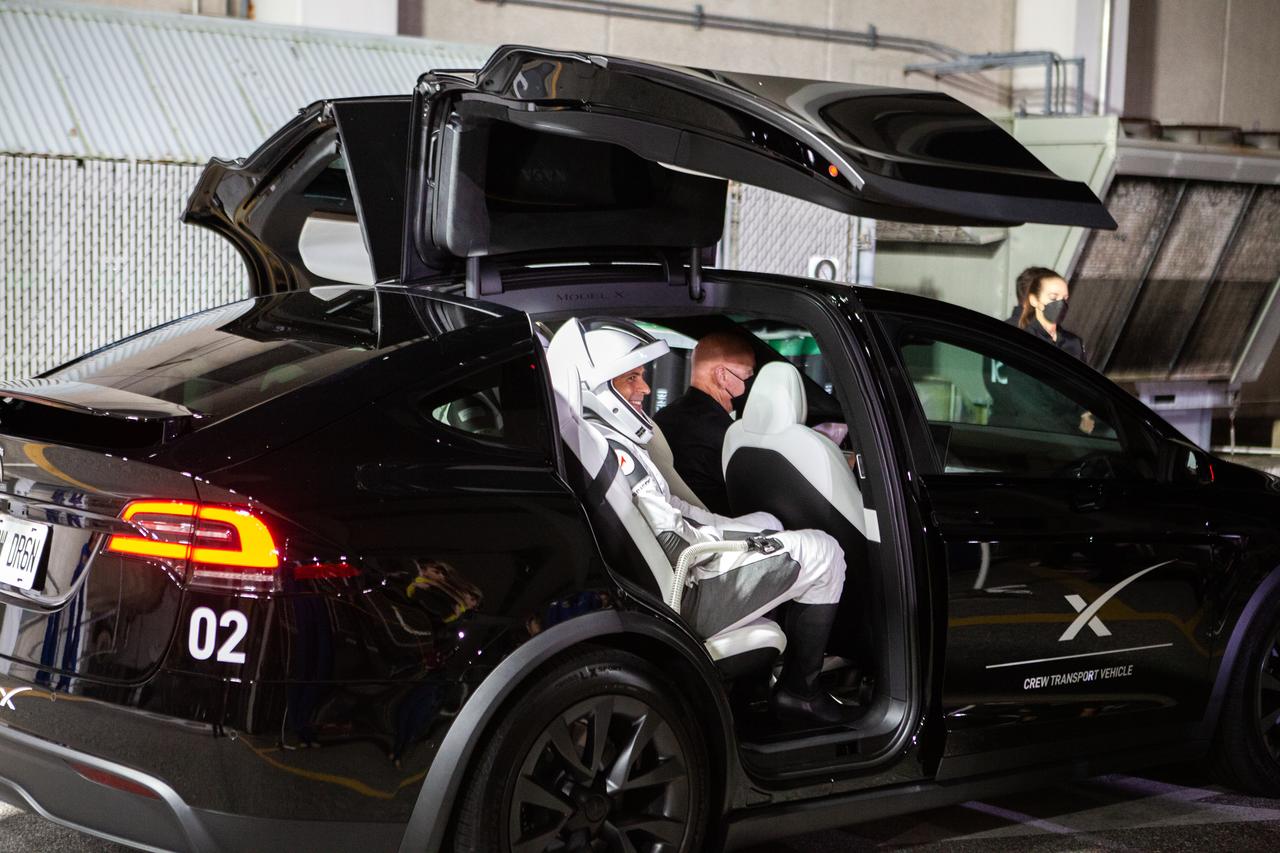
In view outside the Neil Armstrong Operations and Checkout Building at NASA’s Kennedy Space Center in Florida on March 1, 2023, SpaceX Crew-6 astronauts board the first of two Tesla vehicles that will transport NASA’s them to Launch Complex 39A for launch to the International Space Station. Launch of the Dragon spacecraft Endeavour atop the Falcon 9 rocket is targeted for 12:34 a.m. EST on March 2 from Launch Complex 39A. Crew-6 is the sixth crew rotation mission with SpaceX to the station, and the seventh flight of Dragon with people as part of the agency’s Commercial Crew Program.
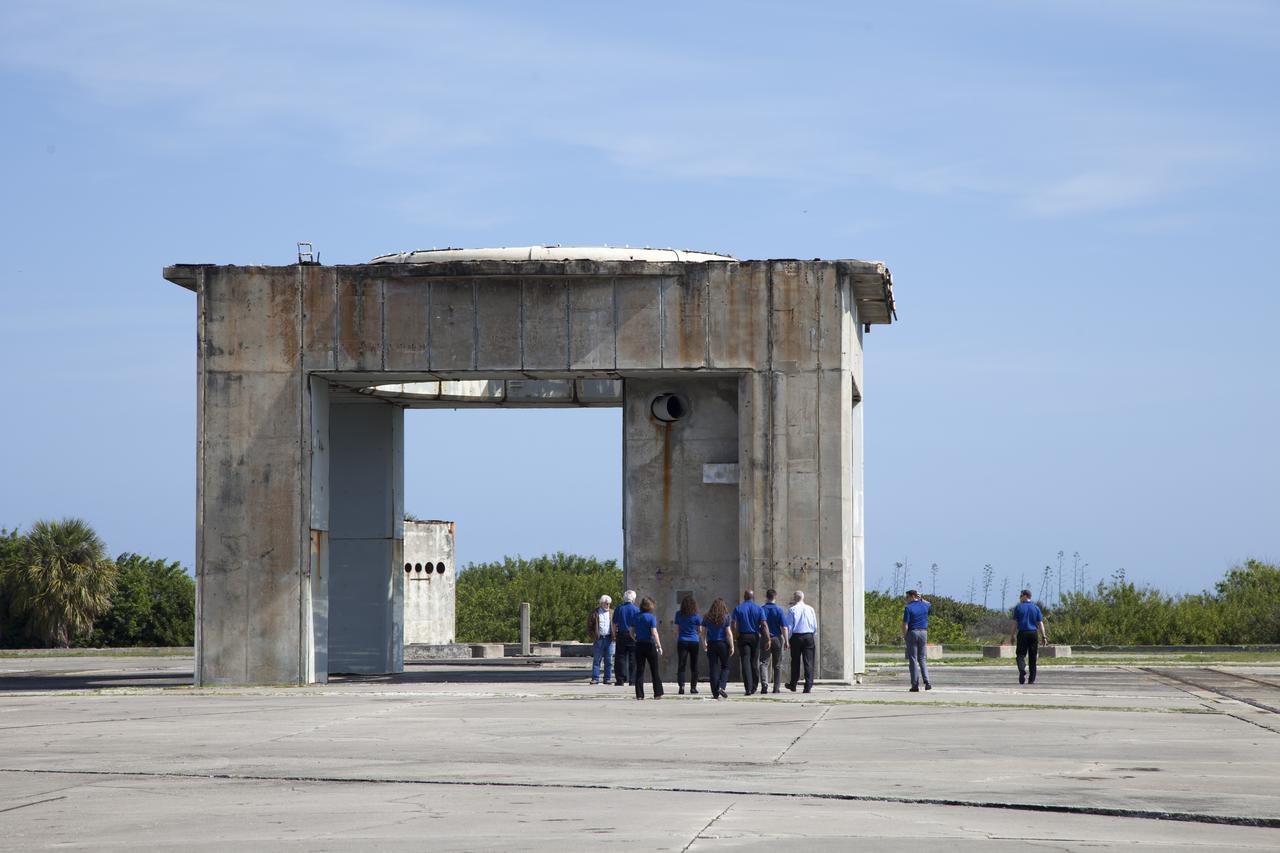
CAPE CANAVERAL, Fla. – NASA astronaut candidates survey Launch Complex 34 at Cape Canaveral Air Force Station in Florida, adjacent to NASA's Kennedy Space Center. Complex 34 was the sight of NASA's first astronaut fatalities when the crew of Apollo 1, Gus Grissom, Ed White and Roger Chaffee, died in a fire inside their Apollo capsule during testing at the pad. The astronaut class of 2013 was selected by NASA after an extensive year-and-a-half search. The new group will help the agency push the boundaries of exploration and travel to new destinations in the solar system. To learn more about the astronaut class of 2013, visit: http://www.nasa.gov/astronauts/2013astroclass.html Photo credit: NASA/Frankie Martin
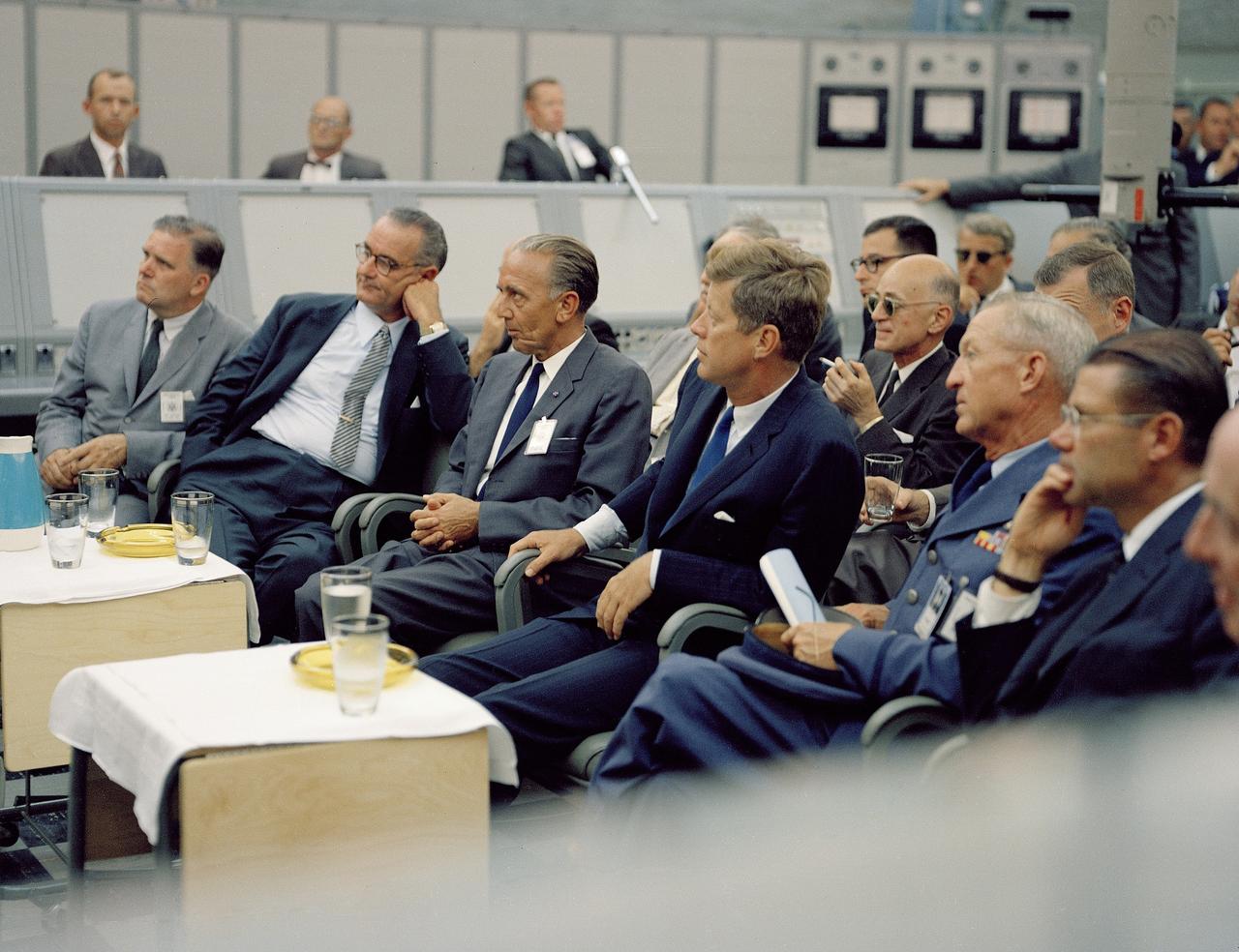
CAPE CANAVERAL, Fla. -- In the blockhouse of Launch Complex 34 at the Cape Canaveral Missile Test Annex in Florida, President John F. Kennedy is briefed on NASA's future plans. Seated, from the left, are NASA Administrator James E. Webb, Vice President Lyndon B. Johnson, Launch Operations Center Director Kurt H. Debus and Kennedy. Photo Credit: NASA
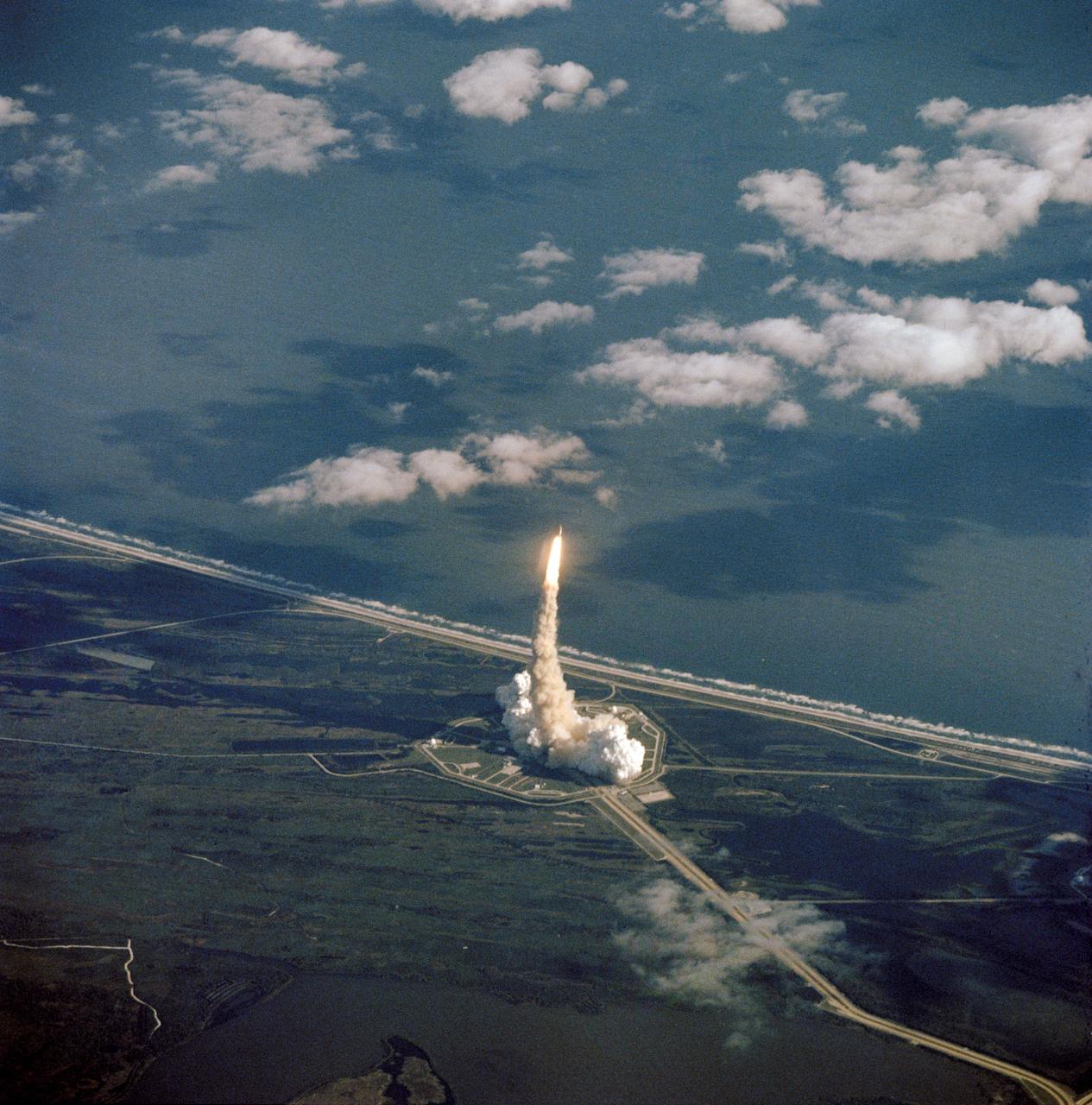
STS027-S-006 (2 Dec. 1988) --- A good portion of the Kennedy Space Center launch complex 39 and the Atlantic Ocean form the backdrop for the beginning stages of Atlantis' return trip to space. The scene was captured with a hand-held 70mm camera aimed through the windows of a NASA shuttle training aircraft piloted by astronaut Daniel C. Brandenstein, chief of Johnson Space Center?s astronaut office. Launch occurred at 9:30:34 a.m. (EST), Dec. 2, 1988. Photo credit: NASA
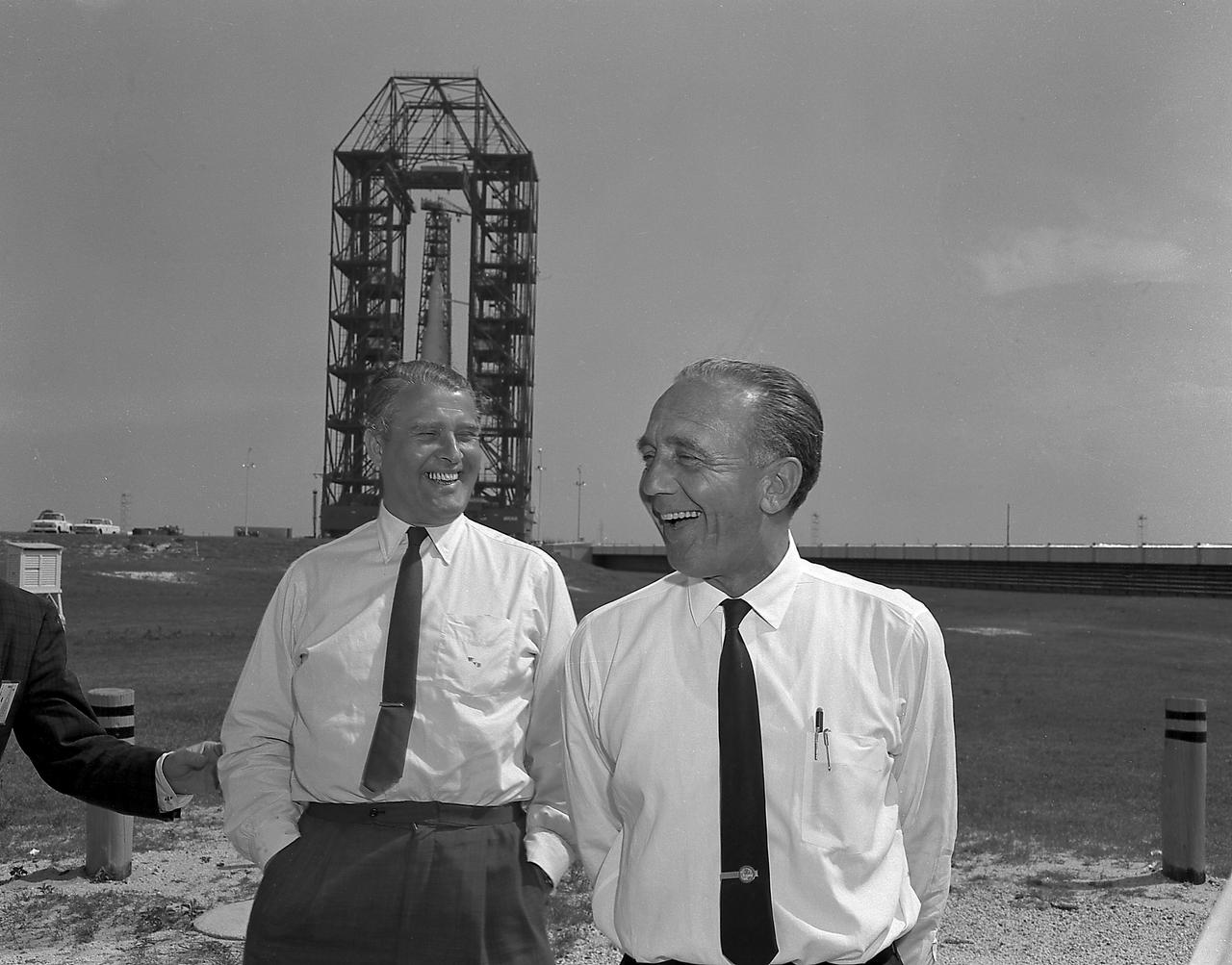
Dr. von Braun, Director of the Marshall Space Flight Center (MSFC), and Dr. Debus, Director of the Launch Operations Center, at Complex 34 prior to the Launch of the SA-4 (the fourth flight of Saturn I), March 28, 1963. The mission conducted the second "Project Highwater" experiment, which the upper stage ejected 30,000 gallons of ballast water in the upper atmosphere for a physics experiment.
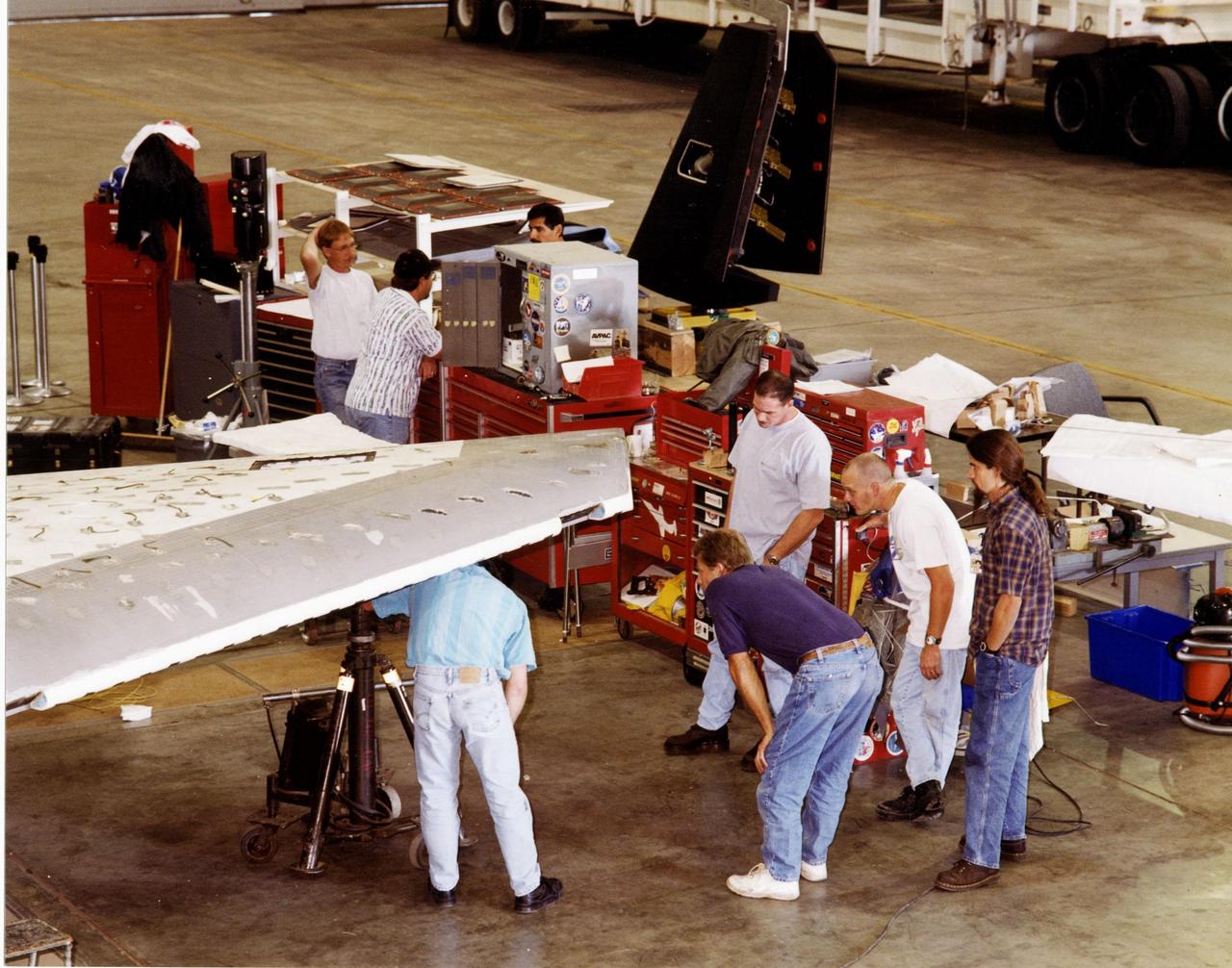
Two of KSC's X-34 technicians (far right), David Rowell and Roger Cartier, look at work being done on the modified A-1A at Dryden Flight Research Center, Calif. Since September, eight NASA engineering technicians from KSC's Engineering Prototype Lab have assisted Orbital Sciences Corporation and NASA's Dryden Flight Research Center in the complex process of converting the X-34 A-1 vehicle from captive carry status to unpowered flight status, the A-1A. The other KSC technicians are Kevin Boughner, Mike Dininny, Mike Lane, Jerry Moscoso, James Niehoff Jr. and Bryan Taylor. The X-34 is 58.3 feet long, 27.7 feet wide from wing tip to wing tip, and 11.5 feet tall from the bottom of the fuselage to the top of the tail. The autonomously operated technology demonstrator will be air-launched from an L-1011 airplane and should be capable of flying eight times the speed of sound, reaching an altitude of 250,000 feet. The X-34 Project is managed by NASA's Marshall Space Flight Center in Huntsville, Ala
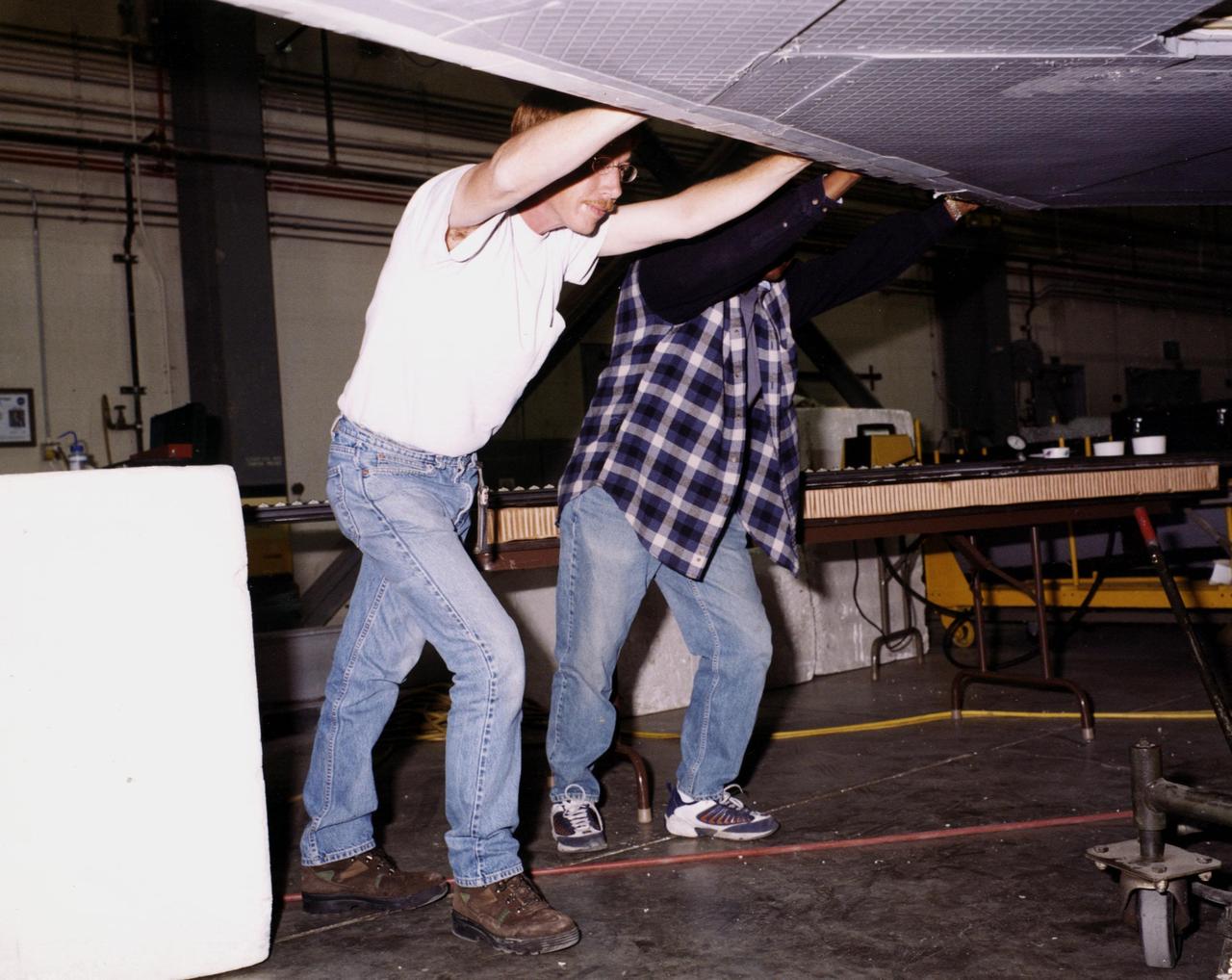
At Dryden Flight Research Center, Calif., KSC technician James Niehoff Jr. (left) helps attach the wing of the modified X-34, known as A-1A. Niehoff is one of eight NASA engineering technicians from KSC's Engineering Prototype Lab who have assisted Orbital Sciences Corporation and Dryden in the complex process of converting the X-34 A-1 vehicle from captive carry status to unpowered flight status, the A-1A. The other KSC technicians are Kevin Boughner, Roger Cartier, Mike Dininny, Mike Lane, Jerry Moscoso, David Rowell and Bryan Taylor. The X-34 is 58.3 feet long, 27.7 feet wide from wing tip to wing tip, and 11.5 feet tall from the bottom of the fuselage to the top of the tail. The autonomously operated technology demonstrator will be air-launched from an L-1011 airplane and should be capable of flying eight times the speed of sound, reaching an altitude of 250,000 feet. The X-34 Project is managed by NASA's Marshall Space Flight Center in Huntsville, Ala
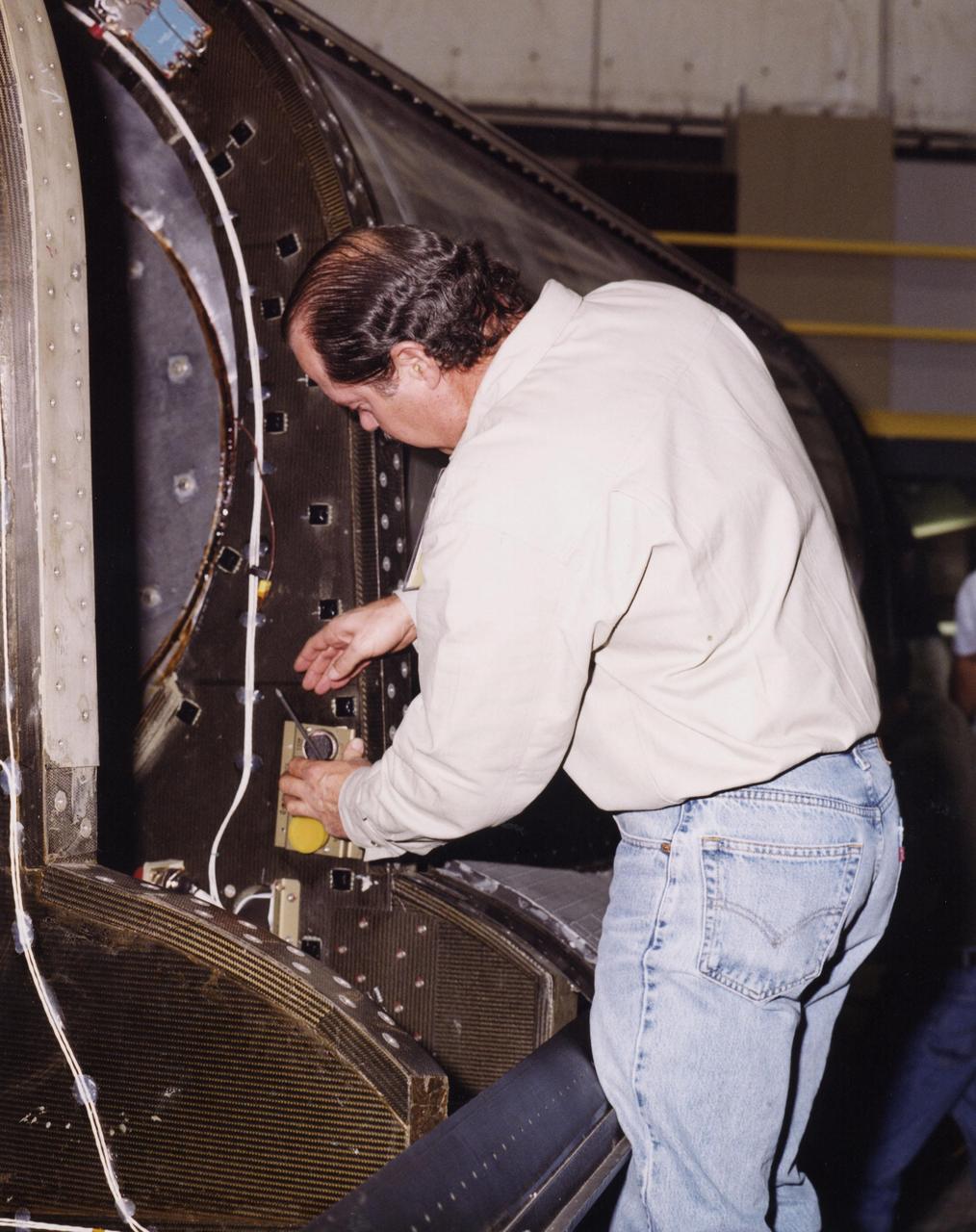
At Dryden Flight Research Center, Calif., KSC technician Bryan Taylor makes an adjustment on the modified X-34, known as A-1A. Taylor is one of eight NASA engineering technicians from KSC's Engineering Prototype Lab who have assisted Orbital Sciences Corporation and Dryden in the complex process of converting the X-34 A-1 vehicle from captive carry status to unpowered flight status, the A-1A. The other KSC technicians are Kevin Boughner, Roger Cartier, Mike Dininny, Mike Lane, Jerry Moscoso, James Niehoff Jr. and David Rowell. The X-34 is 58.3 feet long, 27.7 feet wide from wing tip to wing tip, and 11.5 feet tall from the bottom of the fuselage to the top of the tail. The autonomously operated technology demonstrator will be air-launched from an L-1011 airplane and should be capable of flying eight times the speed of sound, reaching an altitude of 250,000 feet. The X-34 Project is managed by NASA's Marshall Space Flight Center in Huntsville, Ala
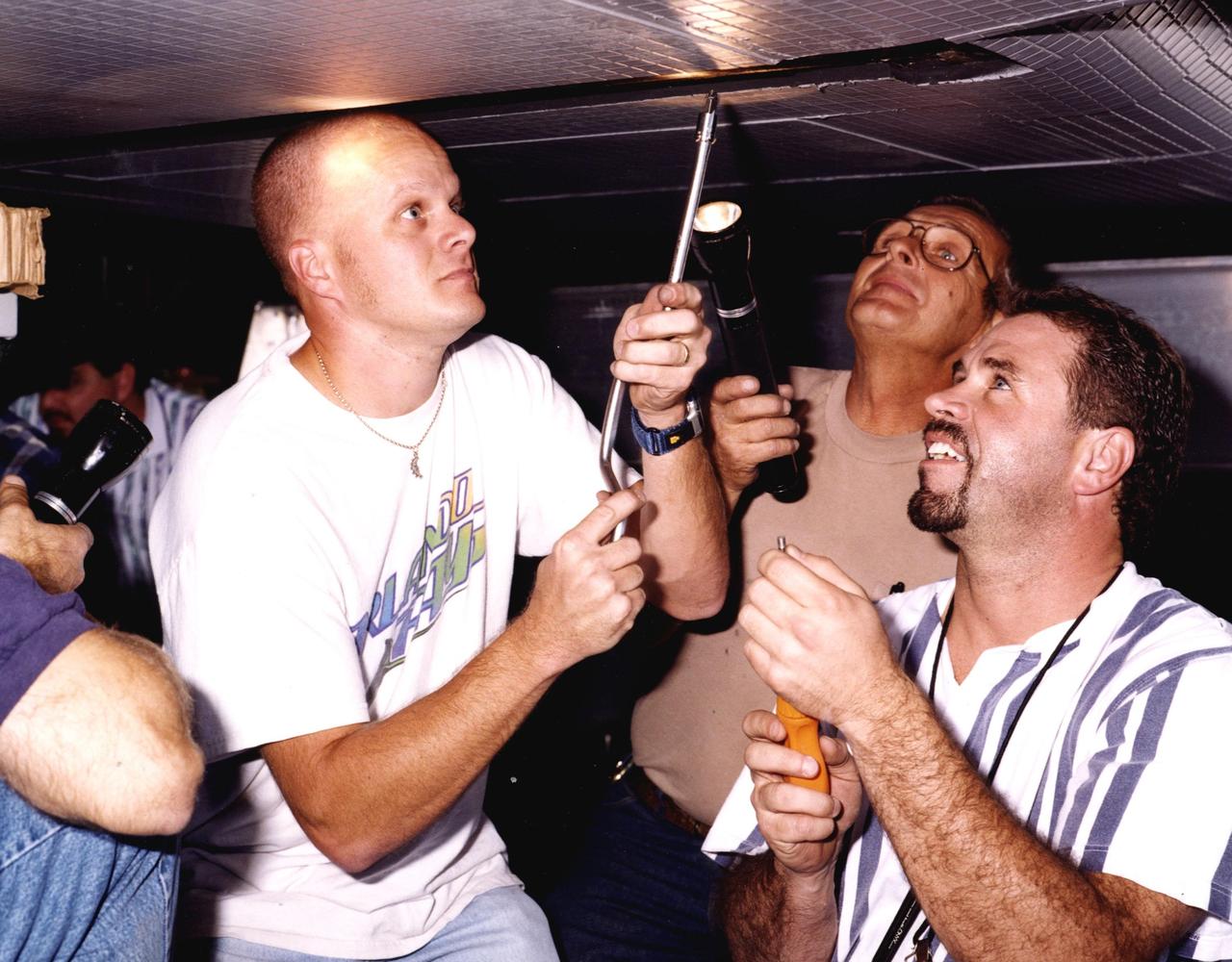
KSC technician David Rowell works on the wing of the modified X-34, known as A-1A, at the Dryden Flight Research Center, Calif. Looking on are Art Cape, with Dryden, and Mike Brainard, with Orbital Sciences Corporation. Rowell is one of eight NASA engineering technicians from KSC's Engineering Prototype Lab who have assisted Orbital and Dryden in the complex process of converting the X-34 A-1 vehicle from captive carry status to unpowered flight status, the A-1A. The other KSC technicians are Kevin Boughner, Roger Cartier, Mike Dininny, Mike Lane, Jerry Moscoso, James Niehoff Jr. and Bryan Taylor. The X-34 is 58.3 feet long, 27.7 feet wide from wing tip to wing tip, and 11.5 feet tall from the bottom of the fuselage to the top of the tail. The autonomously operated technology demonstrator will be air-launched from an L-1011 airplane and should be capable of flying eight times the speed of sound, reaching an altitude of 250,000 feet. The X-34 Project is managed by NASA's Marshall Space Flight Center in Huntsville, Ala
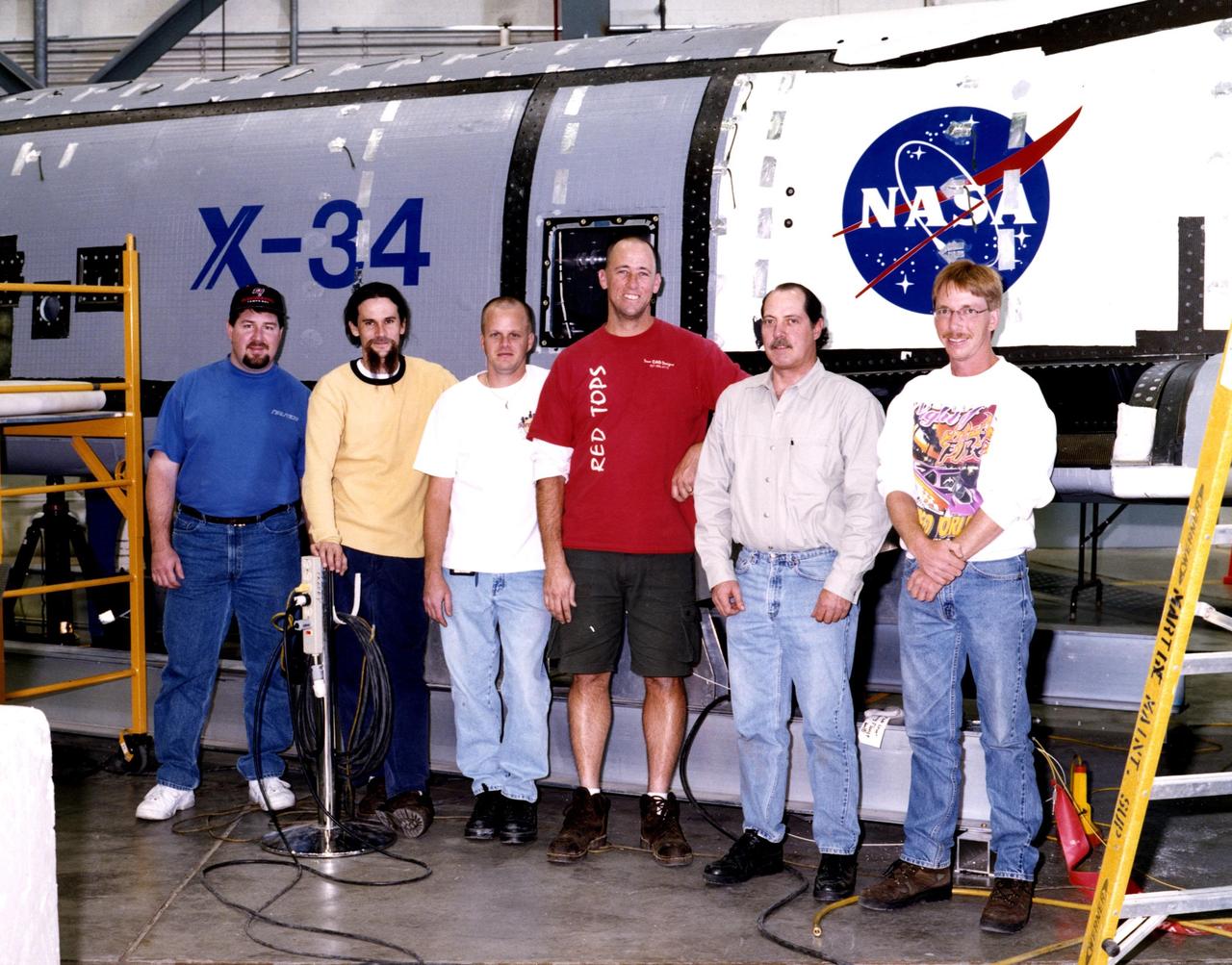
Six of the KSC workers who supported recent X-34 modifications pose in front of the modified A-1A vehicle at Edwards Air Force Base, Calif. From left are Mike Lane, Roger Cartier, Dave Rowell, Mike Dininny, Bryan Taylor and James Niehoff Jr. Not shown are Kevin Boughner and Jerry Moscoso. Since September, the eight NASA engineering technicians from KSC's Engineering Prototype Lab have assisted Orbital Sciences Corporation and NASA's Dryden Flight Research Center in the complex process of converting the X-34 A-1 vehicle from captive carry status to unpowered flight status, known as A-1A. The X-34 is 58.3 feet long, 27.7 feet wide from wing tip to wing tip, and 11.5 feet tall from the bottom of the fuselage to the top of the tail. The autonomously operated technology demonstrator will be air-launched from an L-1011 airplane and should be capable of flying eight times the speed of sound, reaching an altitude of 250,000 feet. The X-34 Project is managed by NASA's Marshall Space Flight Center in Huntsville, Ala
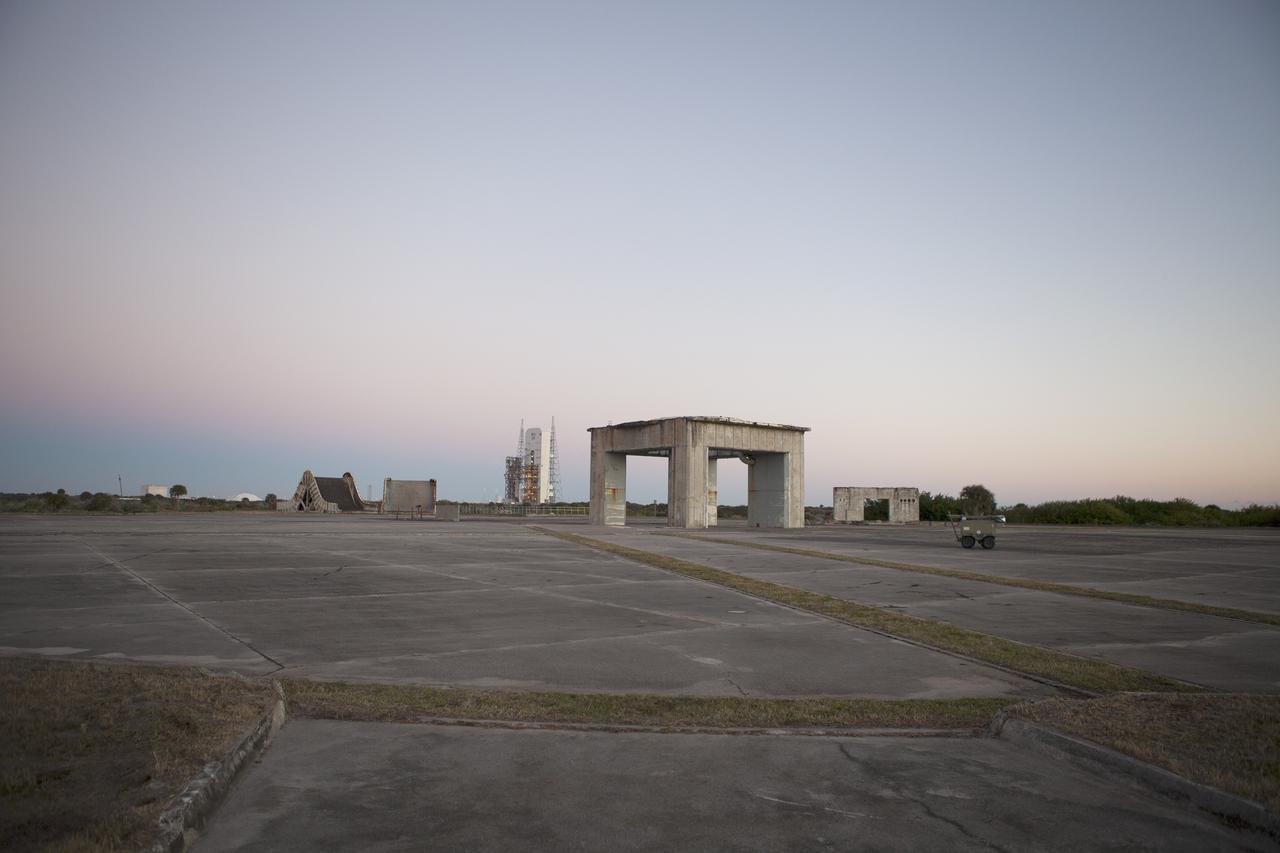
CAPE CANAVERAL, Fla. – The past intersects with the future on Cape Canaveral Air Force Station in Florida. In the foreground is what remains of historic Launch Pad 34 in the distance behind it is Space Launch Complex 37 whence NASA's Orion spacecraft made its first flight test. On this day in 1967, a fire erupted on the Pad 34 during a preflight test, taking the lives of the Apollo 1 crew, NASA astronauts Virgil Grissom, Edward White and Roger Chaffee. To learn more about Apollo 1 and the crew, visit http://www.nasa.gov/mission_pages/apollo/missions/apollo1.html. To learn more about Orion, visit http://www.nasa.gov/exploration/systems/orion/. Photo credit: NASA/Ben Smegelsky
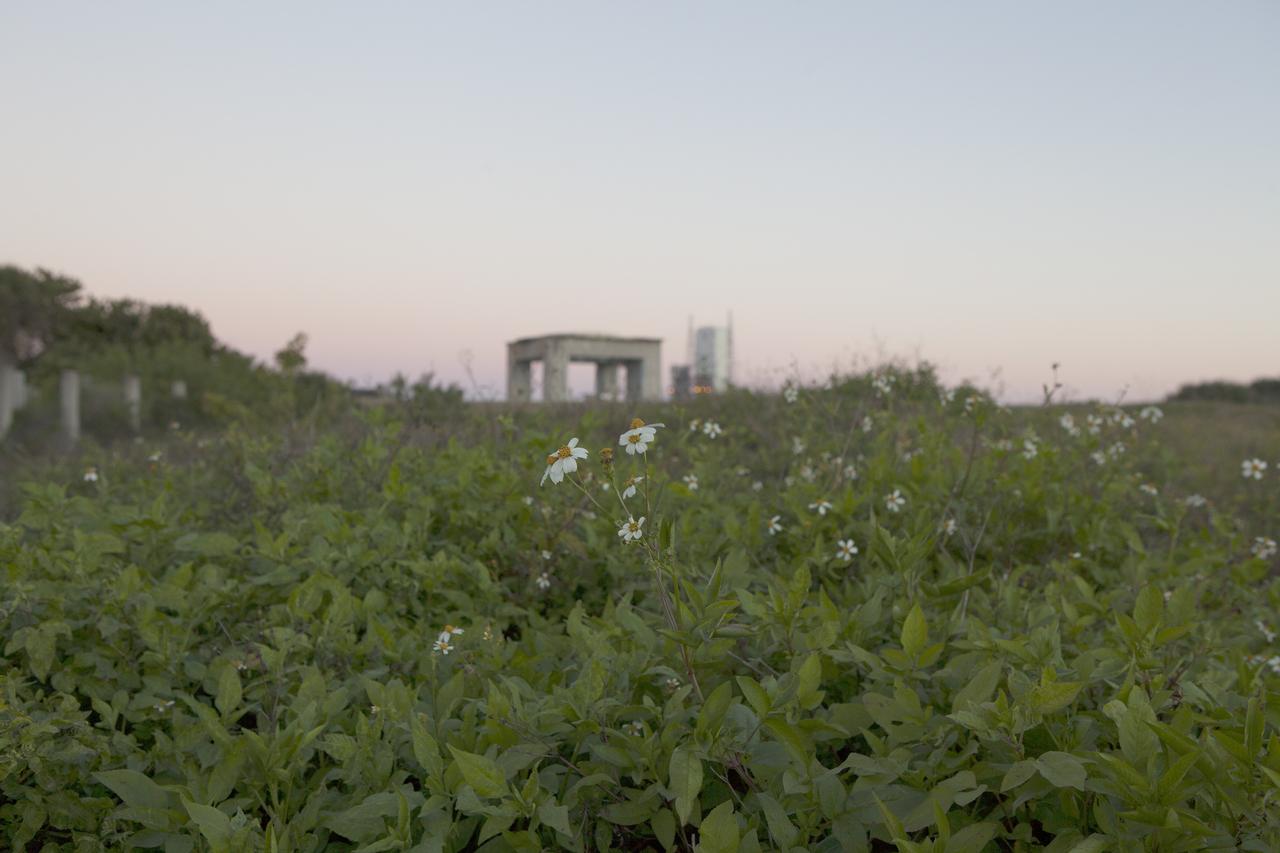
CAPE CANAVERAL, Fla. – The past intersects with the future on Cape Canaveral Air Force Station in Florida. In the foreground is what remains of historic Launch Pad 34 in the distance behind it is Space Launch Complex 37 whence NASA's Orion spacecraft made its first flight test. On this day in 1967, a fire erupted on the Pad 34 during a preflight test, taking the lives of the Apollo 1 crew, NASA astronauts Virgil Grissom, Edward White and Roger Chaffee. To learn more about Apollo 1 and the crew, visit http://www.nasa.gov/mission_pages/apollo/missions/apollo1.html. To learn more about Orion, visit http://www.nasa.gov/exploration/systems/orion/. Photo credit: NASA/Ben Smegelsky
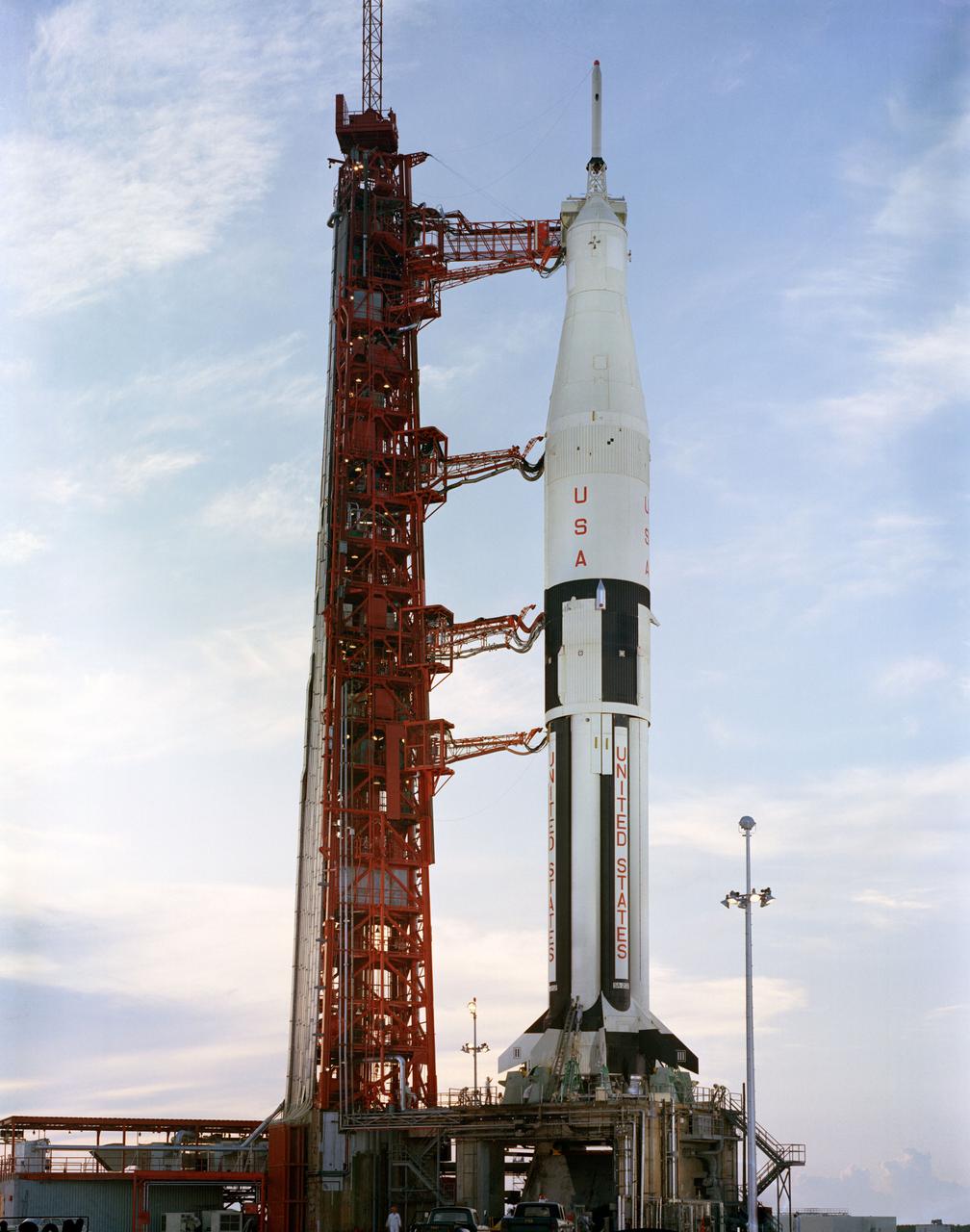
Scene at the LC-34 during an A/S 202 Prelaunch Alert. The mission was a step toward qualifying the Apollo Command and Service Modules (CSM) and the uprated Saturn I Launch Vehicle for manned flight. KSC, FL
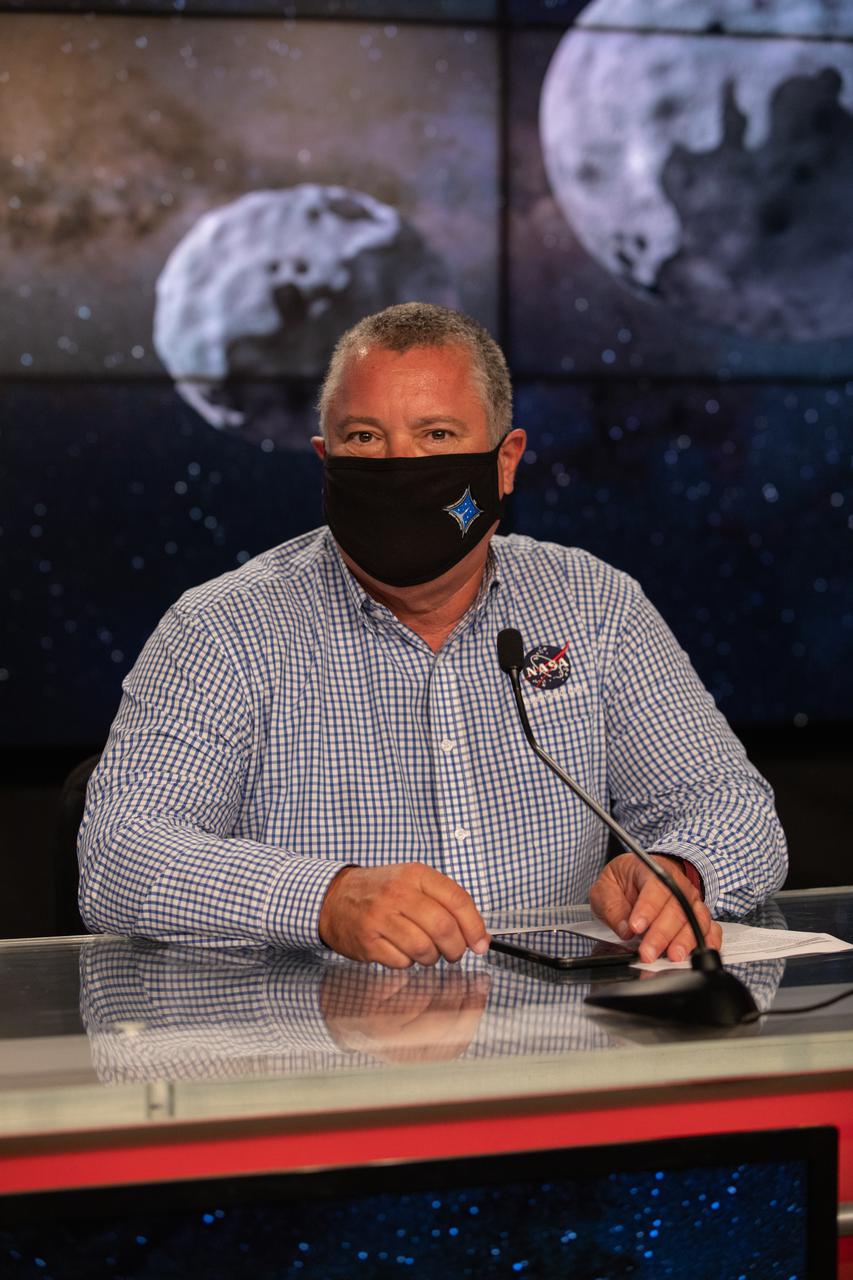
Omar Baez, Lucy Launch Director, NASA’s Launch Services Program, speaks during a prelaunch news conference for the Lucy mission held inside the TV Auditorium at NASA’s Kennedy Space Center in Florida on Oct. 13, 2021. The mission is targeted to launch at 5:34 a.m. EDT Saturday, Oct. 16, on a United Launch Alliance Atlas V 401 rocket from Space Launch Complex 41 at Cape Canaveral Space Force Station. NASA’s Launch Services Program, based at Kennedy, is managing the launch. Lucy is the first space mission to study the Trojan asteroids, which hold vital clues to the formation of our solar system.
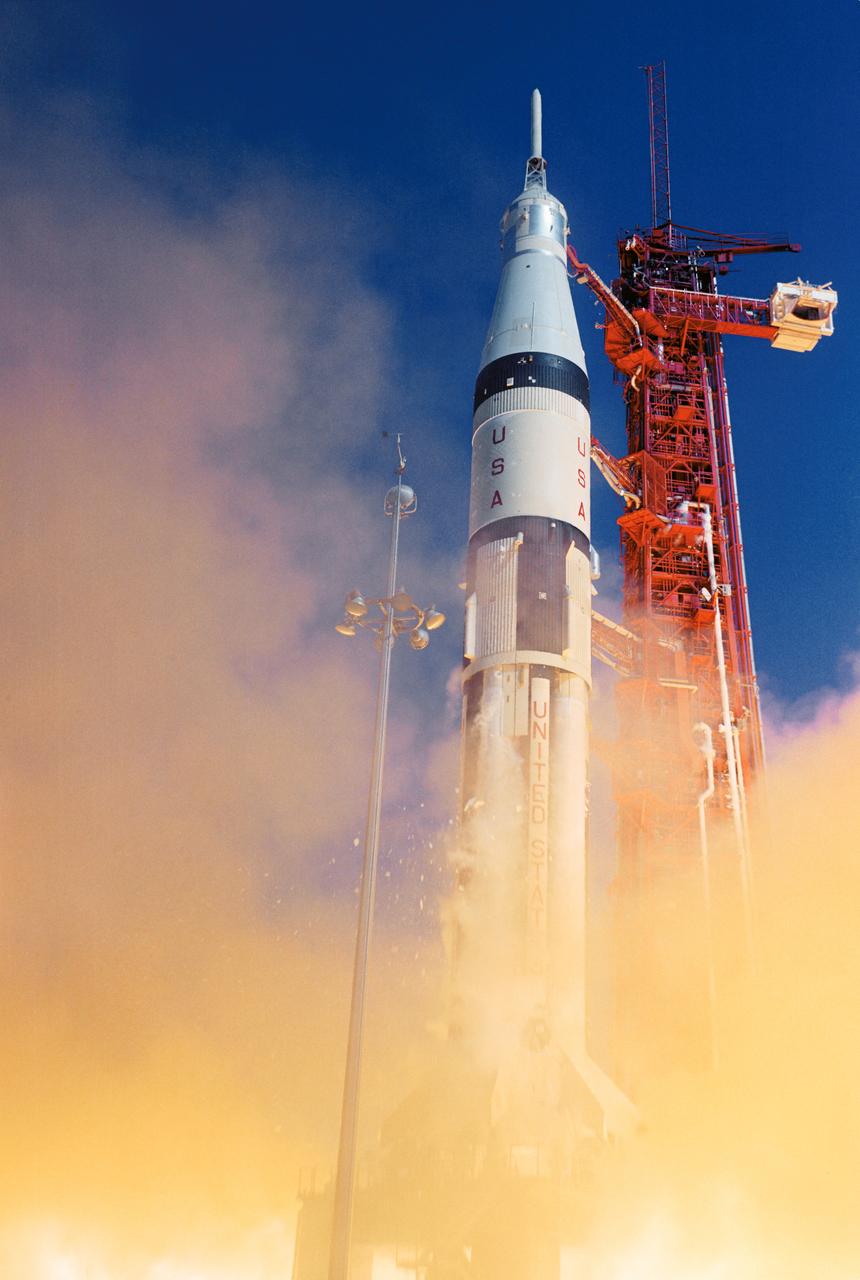
Apollo 7 lifts off from Cape Kennedy Launch Complex 34 at 11:03 A.M., EDT. The astronauts aboard, for the first manned lunar orbital mission, are Astronauts Walter M. Schirra,Jr. Commander; Donn F. Eisele, Command Module Pilot; and Walter Cunningham, Lunar Module Pilot. Original photo number was KSC-68PC-185.
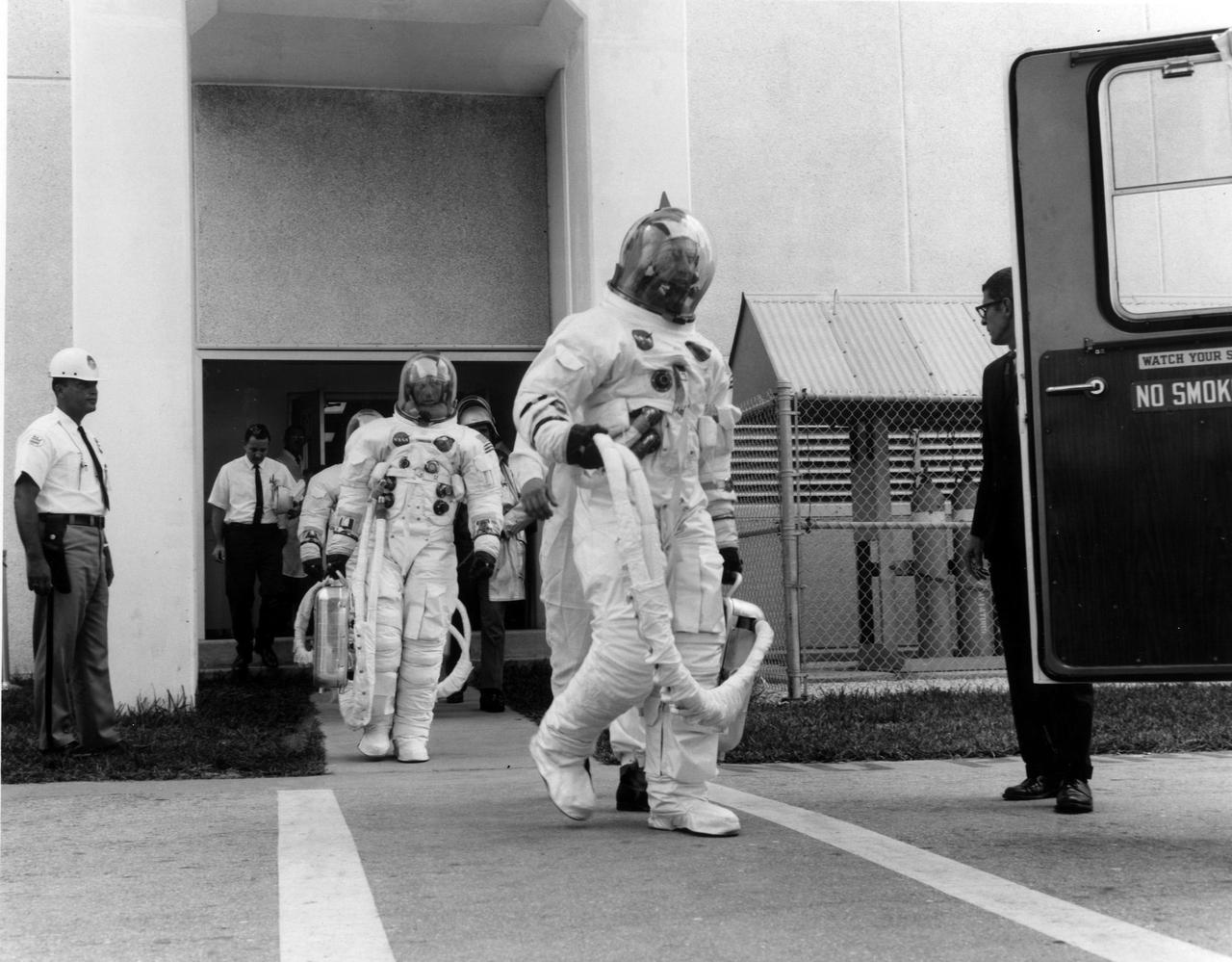
KENNEDY SPACE CENTER, FLA. -- Apollo 7 prime crew members, front to back, Donn F. Eisele, Walter M. Schirra Jr. and Walter Cunningham, leave the Kennedy Space Center's Manned Spacecraft Operations Building for a 20-minute ride in a transfer van to Cape Kennedy's Launch Complex 34, where they participated in a Space Vehicle Emergency Egress Test. The trio will pilot the National Aeronautics and Space Administration's first manned Apollo mission.
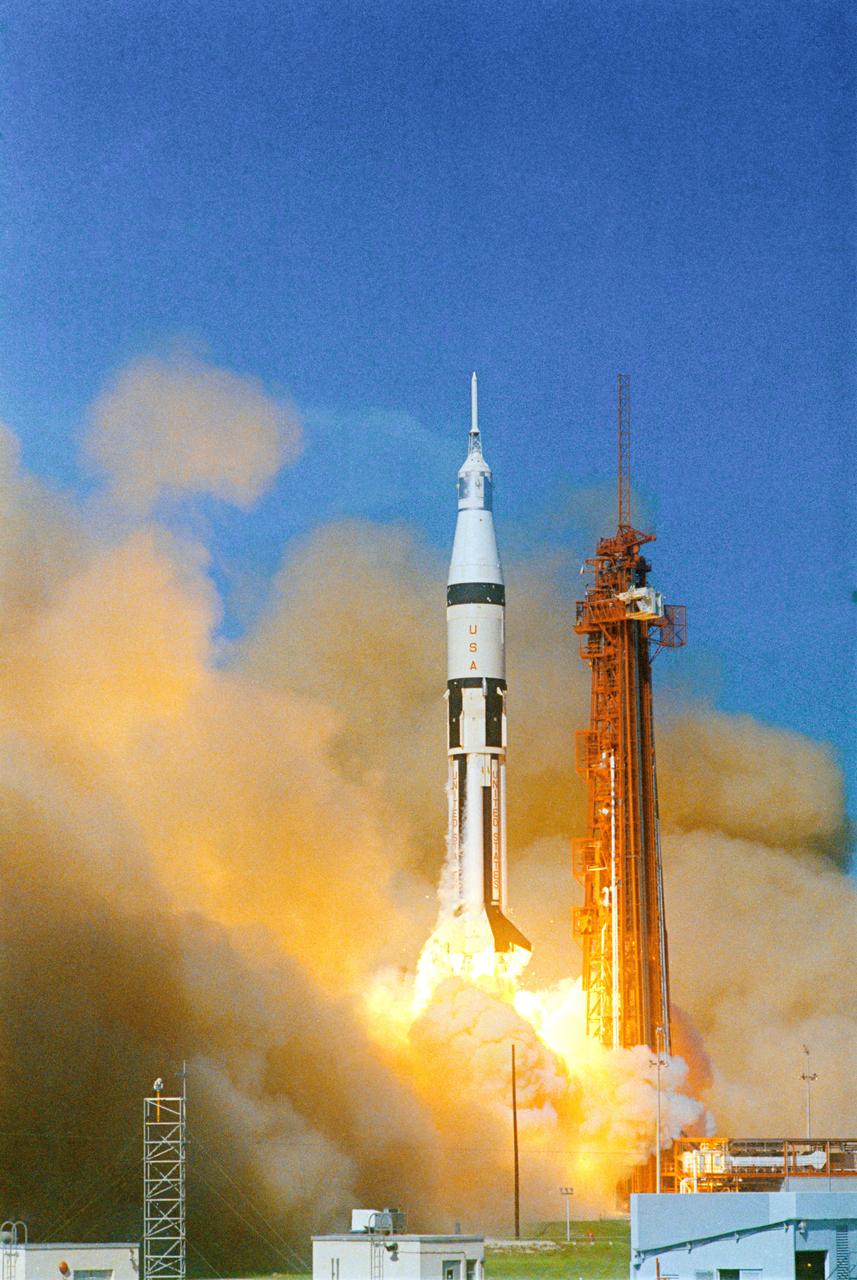
Apollo 7 lifts off from Cape Kennedy Launch Complex 34 at 11:03 A.M., EDT. The astronauts aboard, for the first manned lunar orbital mission, are Astronauts Walter M. Schirra,Jr. Commander; Donn F. Eisele, Command Module Pilot; and Walter Cunningham, Lunar Module Pilot. Original photo number was KSC-68PC-182.
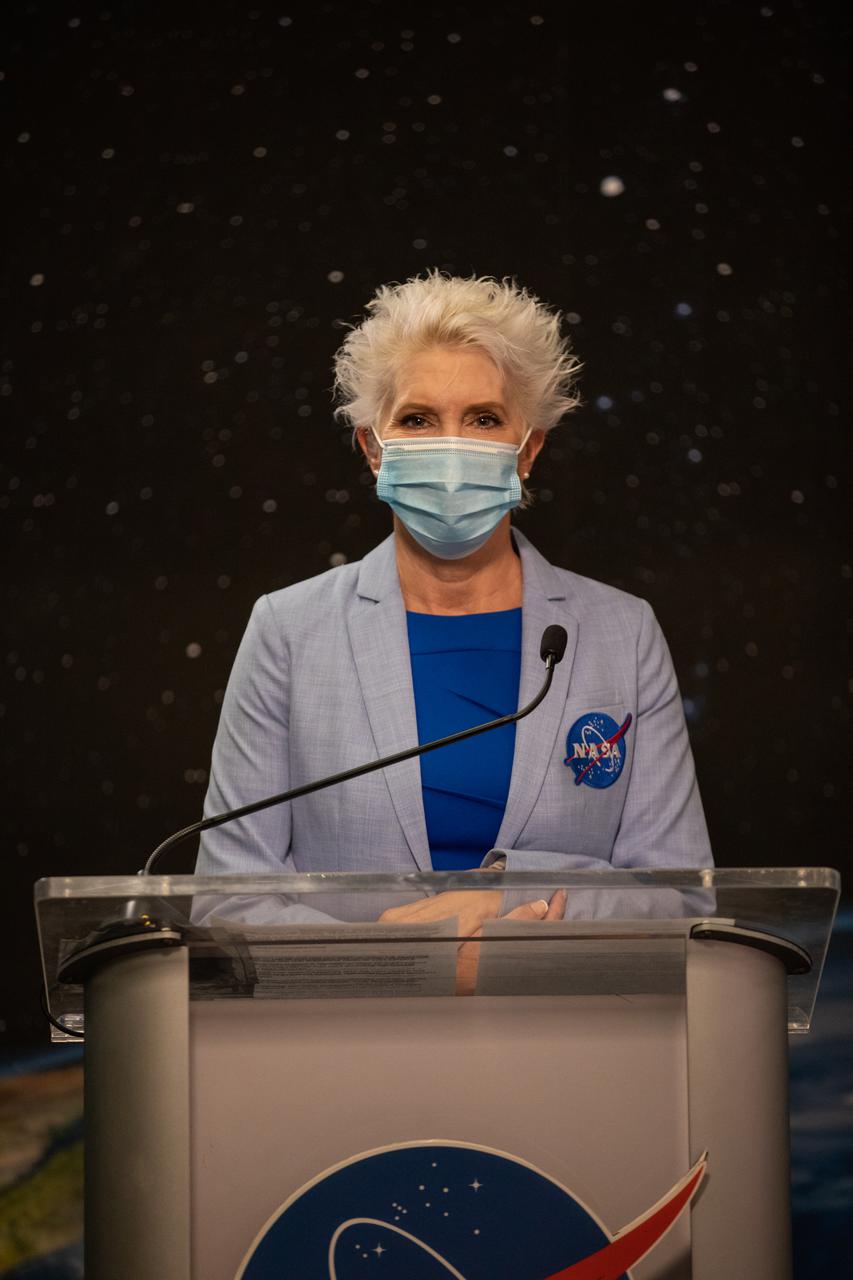
Tammy Long, NASA Communications, addresses the audience during a prelaunch news conference for the Lucy mission held inside the TV Auditorium at NASA’s Kennedy Space Center in Florida on Oct. 13, 2021. The mission is targeted to launch at 5:34 a.m. EDT Saturday, Oct. 16, on a United Launch Alliance Atlas V 401 rocket from Space Launch Complex 41 at Cape Canaveral Space Force Station. NASA’s Launch Services Program, based at Kennedy, is managing the launch. Lucy is the first space mission to study the Trojan asteroids, which hold vital clues to the formation of our solar system.
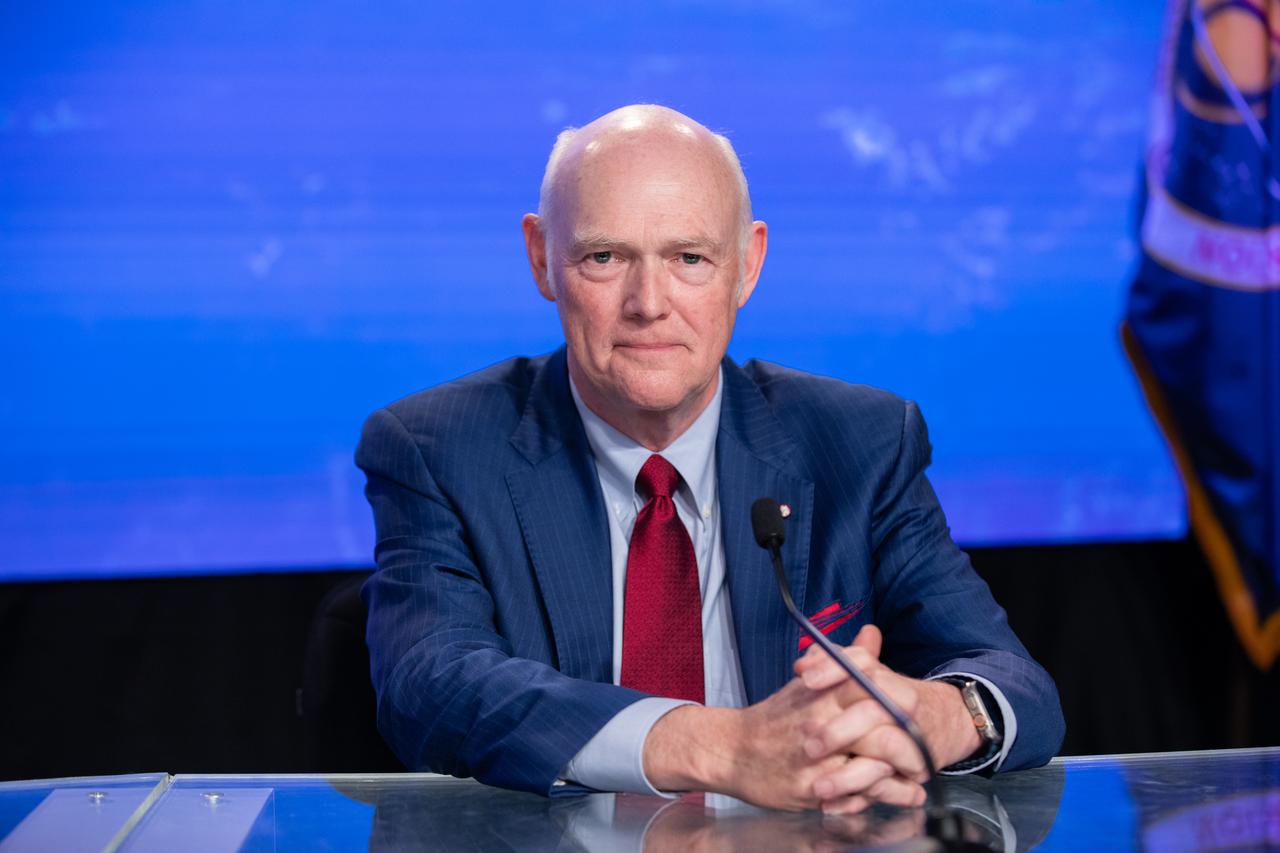
ULA (United Launch Alliance) President and CEO Tory Bruno is photographed during a news conference held on Monday, May 6, 2024, at the agency’s Kennedy Space Center in Florida following the first launch attempt of NASA’s Boeing Crew Flight Test. As part of the agency’s Commercial Crew Program, the first crewed launch to the International Space Station aboard Boeing’s Starliner spacecraft atop a United Launch Alliance Atlas V rocket from Space Launch Complex-41 at nearby Cape Canaveral Space Force Station was targeted for 10:34 p.m. ET but scrubbed for the day.
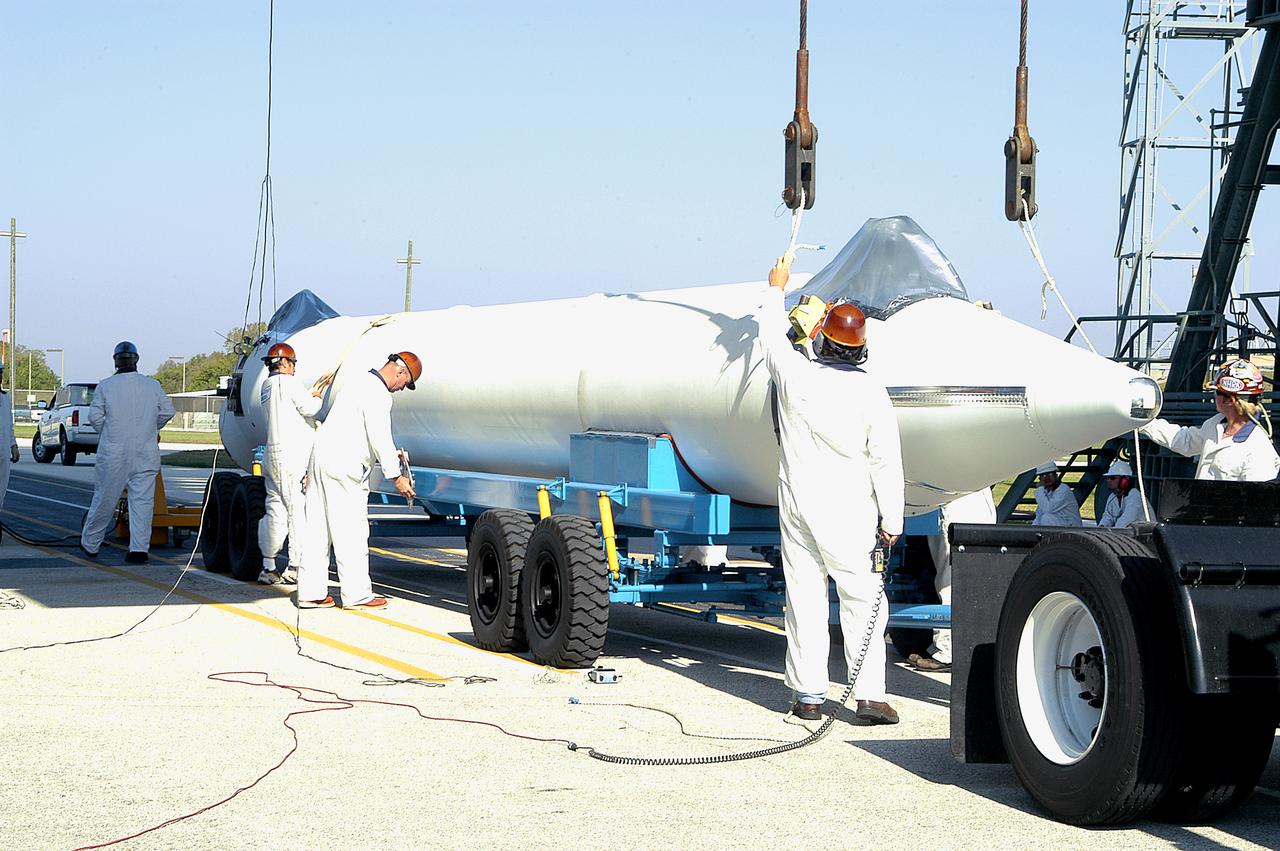
A booster rocket arrives at Launch Complex 17-B, Cape Canaveral Air Force Station. It is one of nine solid rocket boosters being erected and mated to the Delta II rocket for launch of the Space Infrared Telescope Facility. The second stage will later be hoisted atop the first stage. SIRTF will obtain images and spectra by detecting the infrared energy, or heat, radiated by objects in space. Most of this infrared radiation is blocked by the Earth's atmosphere and cannot be observed from the ground. Consisting of an 0.85-meter telescope and three cryogenically cooled science instruments, SIRTF is one of NASA's largest infrared telescopes to be launched. SIRTF is scheduled for launch April 15 at 4:34:07 a.m. EDT.
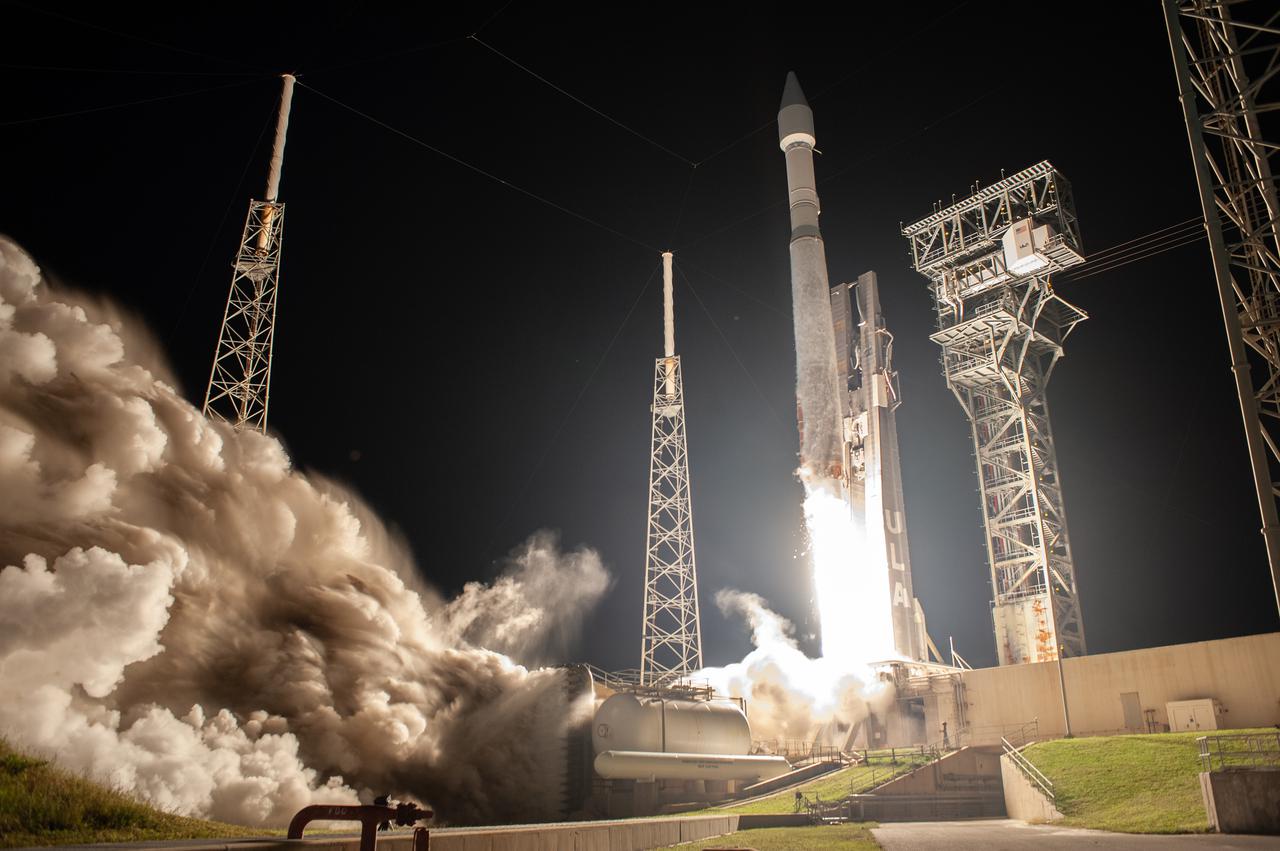
A United Launch Alliance V 401 rocket, with NASA’s Lucy spacecraft atop, powers off the pad at Cape Canaveral Space Force Station’s Space Launch Complex 41 in Florida at 5:34 a.m. EDT on Saturday, Oct. 16, 2021. The launch was managed by NASA’s Launch Services Program, based at Kennedy Space Center. Lucy will embark on a 12-year primary mission to explore a record-breaking number of asteroids, including the Jupiter Trojan asteroids. Named after a fossilized human ancestor whose skeleton provided discoverers insight into humanity’s evolution, the Lucy mission will do much of the same, providing scientists and researchers a look into the origins of our solar system.
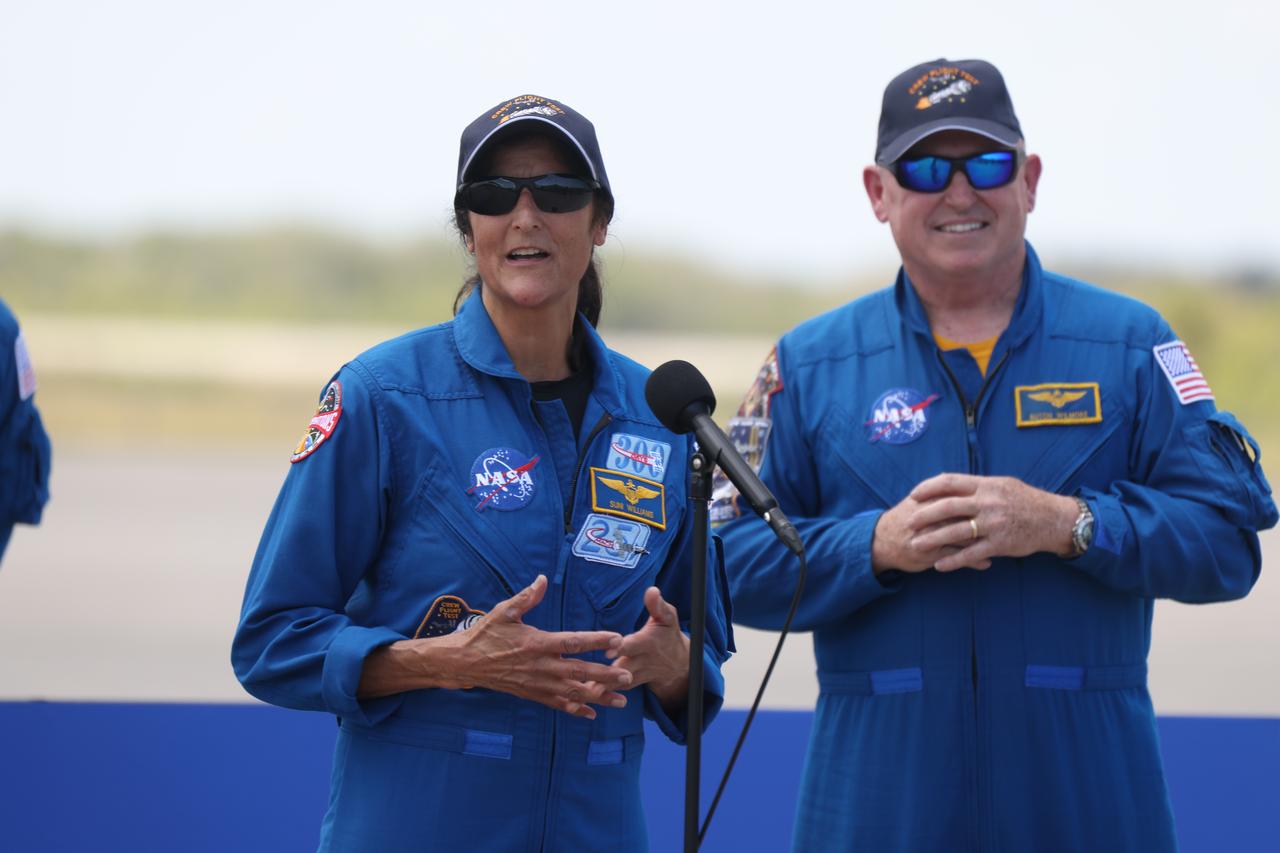
NASA astronauts Butch Wilmore and Suni Williams deliver remarks to members of the news media at the Launch and Landing Facility at NASA’s Kennedy Space Center in Florida following their arrival for the agency’s Boeing Crew Flight Test. As part of the agency’s Commercial Crew Program, Williams and Wilmore are the first crew to launch aboard Boeing’s Starliner spacecraft atop a United Launch Alliance Atlas V rocket from Space Launch Complex-41 at Cape Canaveral Space Force Station in Florida. Liftoff is scheduled for 10:34 p.m. ET on Monday, May 6.
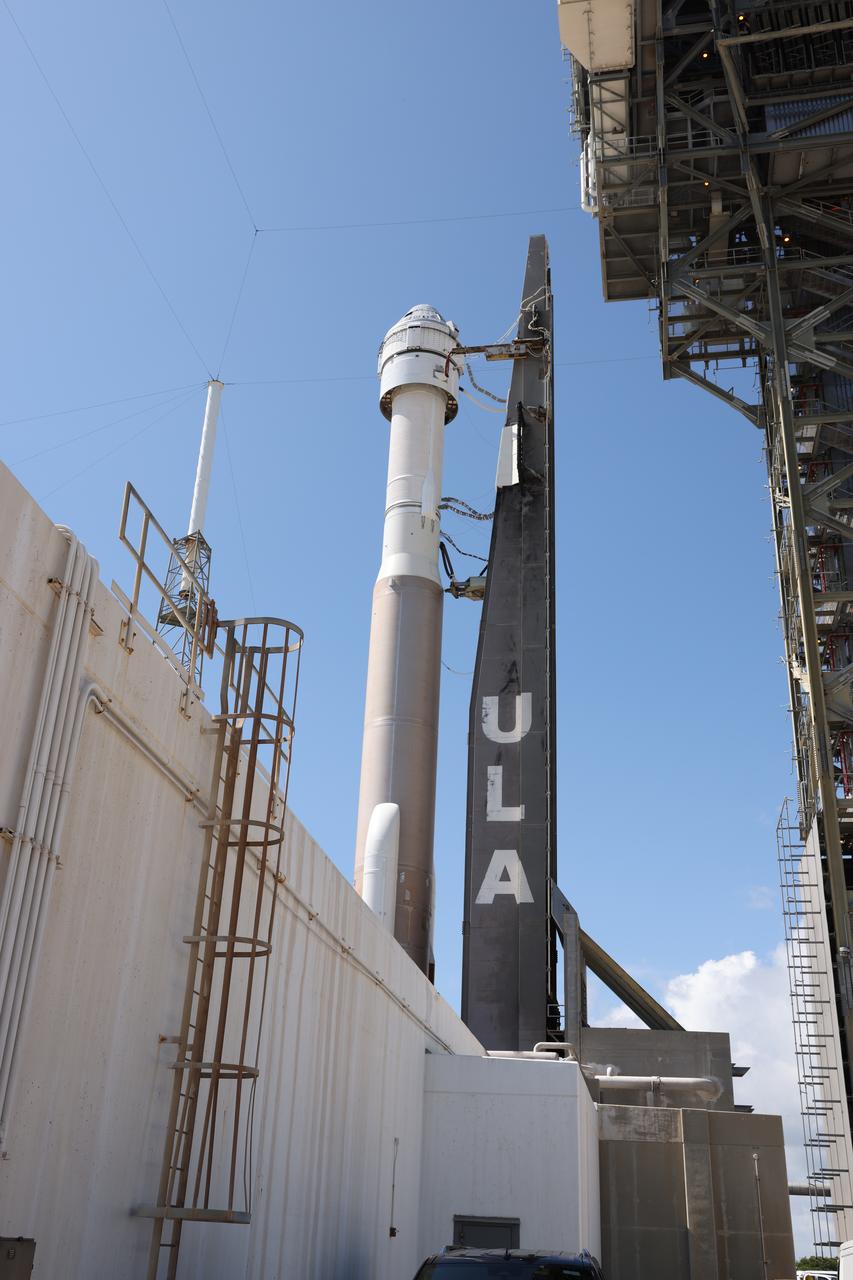
Boeing’s Starliner spacecraft atop the United Launch Alliance Atlas V rocket rolls out from the Vertical Integration Facility to the launch pad of Space Launch Complex-41 at Cape Canaveral Space Force Station in Florida on Saturday, May 4, 2024, ahead of NASA’s Boeing Crew Flight Test. As part of the agency’s Commercial Crew Program, NASA astronauts Butch Wilmore and Suni Williams are the first to launch to the International Space Station aboard Boeing’s Starliner spacecraft. Liftoff is scheduled for 10:34 p.m. ET Monday, May 6.

A United Launch Alliance V 401 rocket, with NASA’s Lucy spacecraft atop, powers off the pad at Cape Canaveral Space Force Station’s Space Launch Complex 41 in Florida at 5:34 a.m. EDT on Saturday, Oct. 16, 2021. The launch was managed by NASA’s Launch Services Program, based at Kennedy Space Center. Lucy will embark on a 12-year primary mission to explore a record-breaking number of asteroids, including the Jupiter Trojan asteroids. Named after a fossilized human ancestor whose skeleton provided discoverers insight into humanity’s evolution, the Lucy mission will do much of the same, providing scientists and researchers a look into the origins of our solar system.
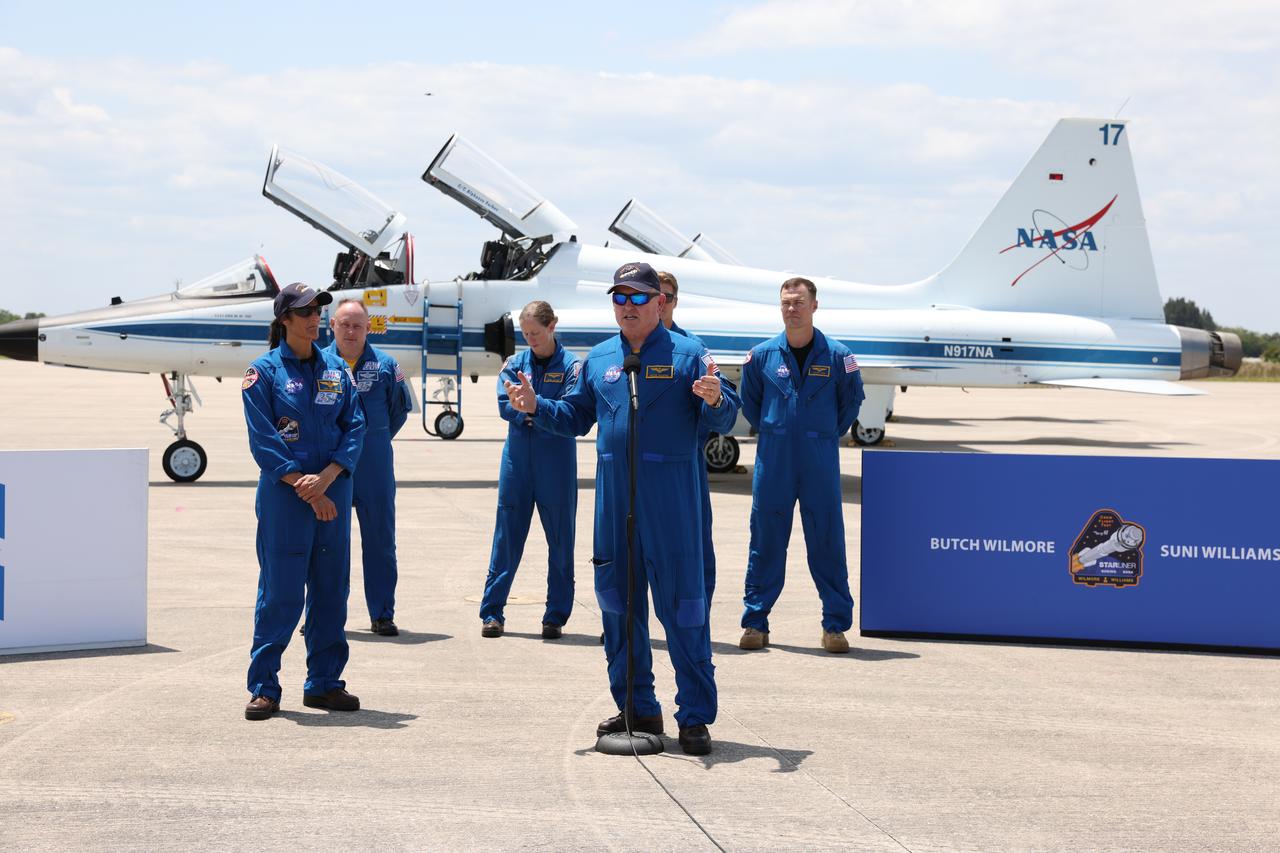
NASA astronaut Butch Wilmore delivers remarks to members of the news media at the Launch and Landing Facility at the NASA’s Kennedy Space Center in Florida following his arrival for the agency’s Boeing Crew Flight Test. As part of the agency’s Commercial Crew Program, Wilmore is joined by NASA astronaut Suni Williams as the first crew to launch aboard Boeing’s Starliner spacecraft atop a United Launch Alliance Atlas V rocket from Space Launch Complex-41 at Cape Canaveral Space Force Station in Florida. Liftoff is scheduled for 10:34 p.m. ET on Monday, May 6.
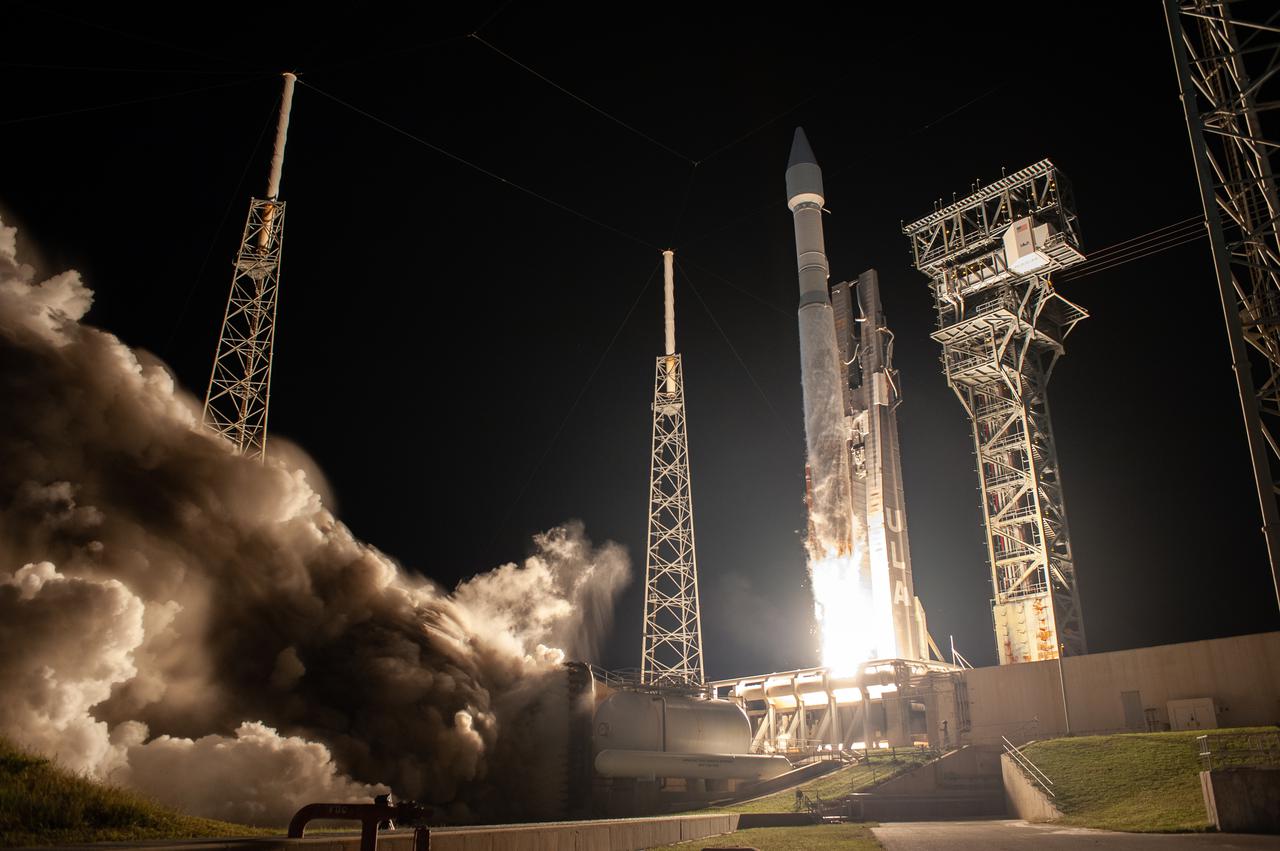
A United Launch Alliance V 401 rocket, with NASA’s Lucy spacecraft atop, powers off the pad at Cape Canaveral Space Force Station’s Space Launch Complex 41 in Florida at 5:34 a.m. EDT on Saturday, Oct. 16, 2021. The launch was managed by NASA’s Launch Services Program, based at Kennedy Space Center. Lucy will embark on a 12-year primary mission to explore a record-breaking number of asteroids, including the Jupiter Trojan asteroids. Named after a fossilized human ancestor whose skeleton provided discoverers insight into humanity’s evolution, the Lucy mission will do much of the same, providing scientists and researchers a look into the origins of our solar system.
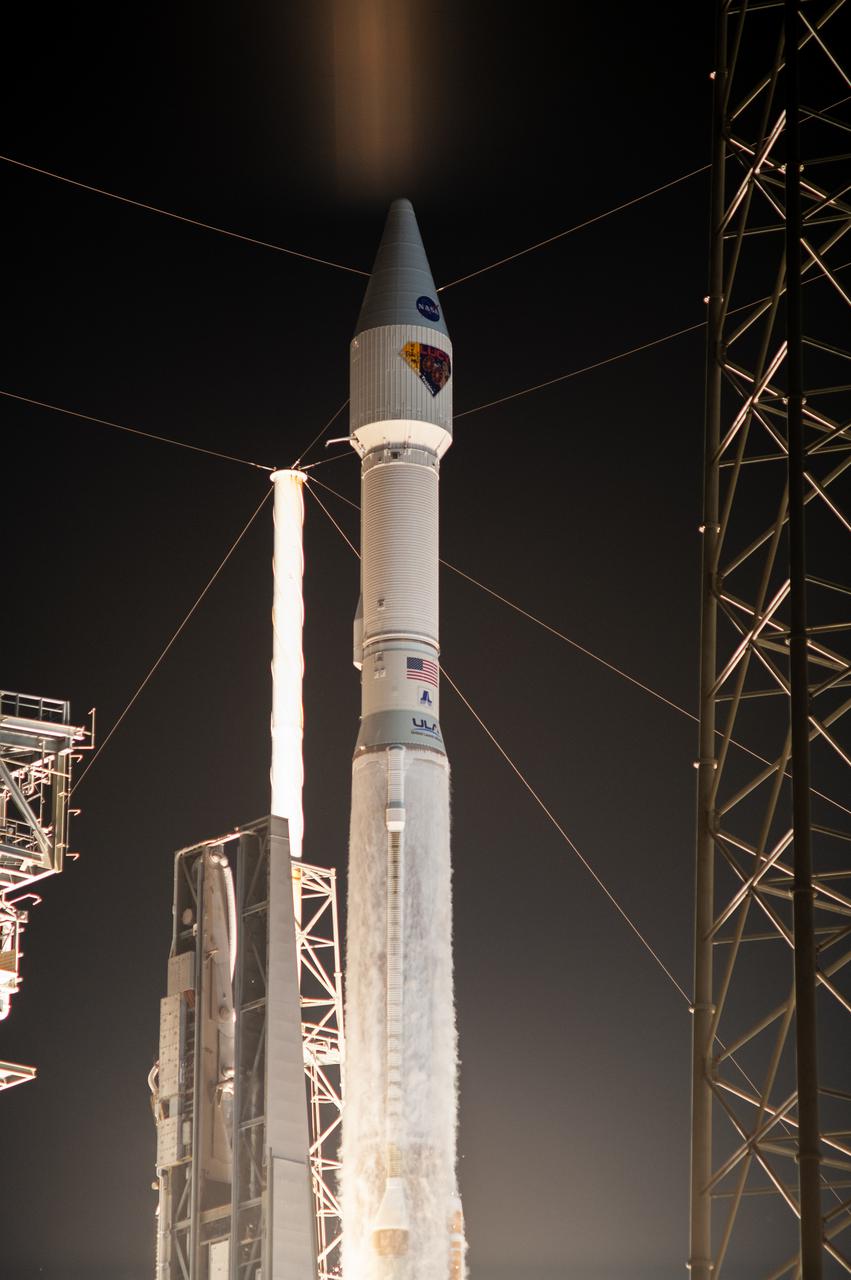
A United Launch Alliance V 401 rocket, with NASA’s Lucy spacecraft atop, powers off the pad at Cape Canaveral Space Force Station’s Space Launch Complex 41 in Florida at 5:34 a.m. EDT on Saturday, Oct. 16, 2021. The launch was managed by NASA’s Launch Services Program, based at Kennedy Space Center. Lucy will embark on a 12-year primary mission to explore a record-breaking number of asteroids, including the Jupiter Trojan asteroids. Named after a fossilized human ancestor whose skeleton provided discoverers insight into humanity’s evolution, the Lucy mission will do much of the same, providing scientists and researchers a look into the origins of our solar system.
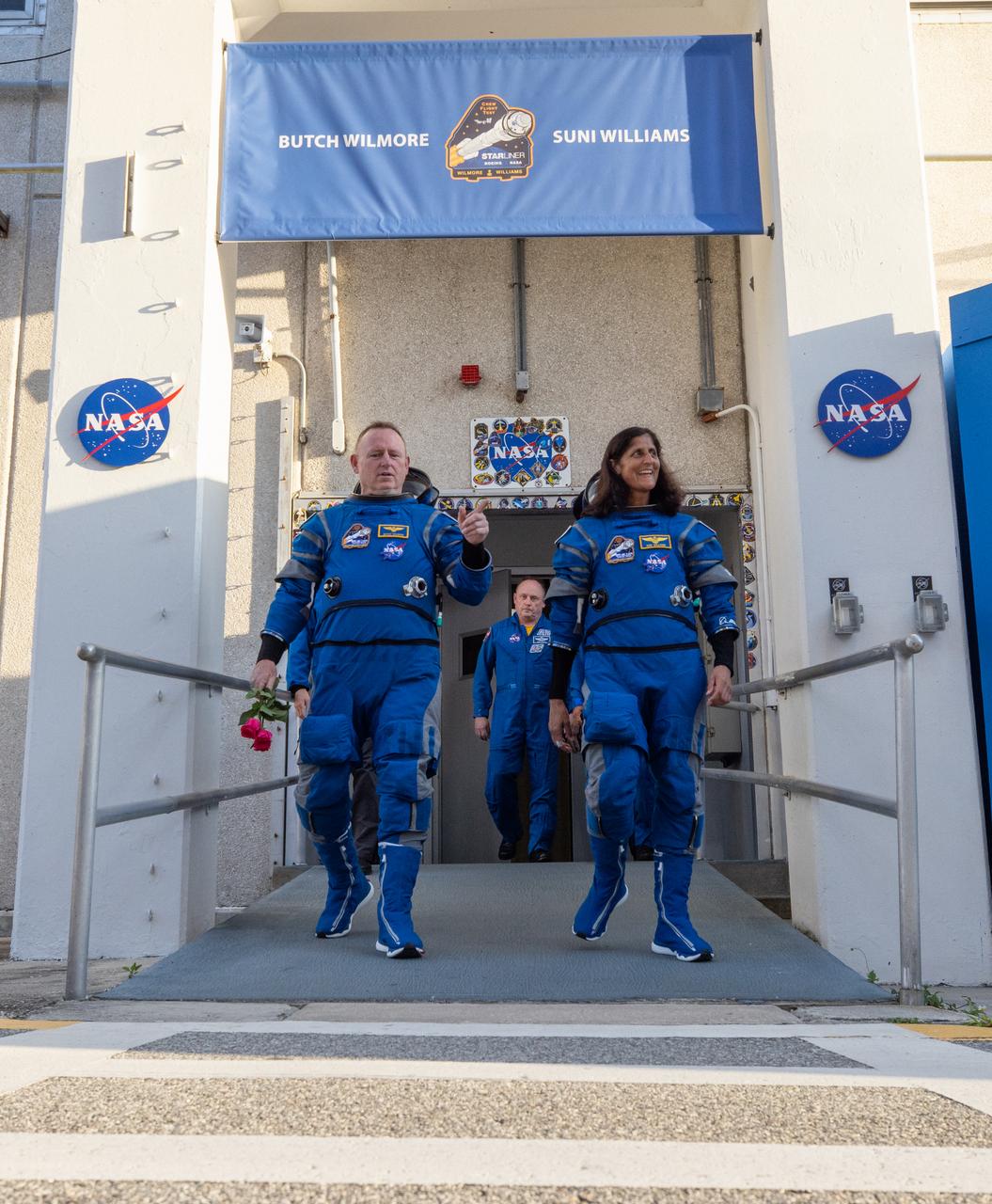
During the first launch attempt of NASA’s Boeing Crew Flight Test, NASA astronauts Butch Wilmore and Suni Williams walk out of the Neil A. Armstrong Operations and Checkout Building on Monday, May 6, 2024, at the agency’s Kennedy Space Center in Florida. As part of the agency’s Commercial Crew Program, the first crewed launch to the International Space Station aboard Boeing’s Starliner spacecraft atop a United Launch Alliance Atlas V rocket from Space Launch Complex-41 at nearby Cape Canaveral Space Force Station was targeted for 10:34 p.m. ET but scrubbed for the day.
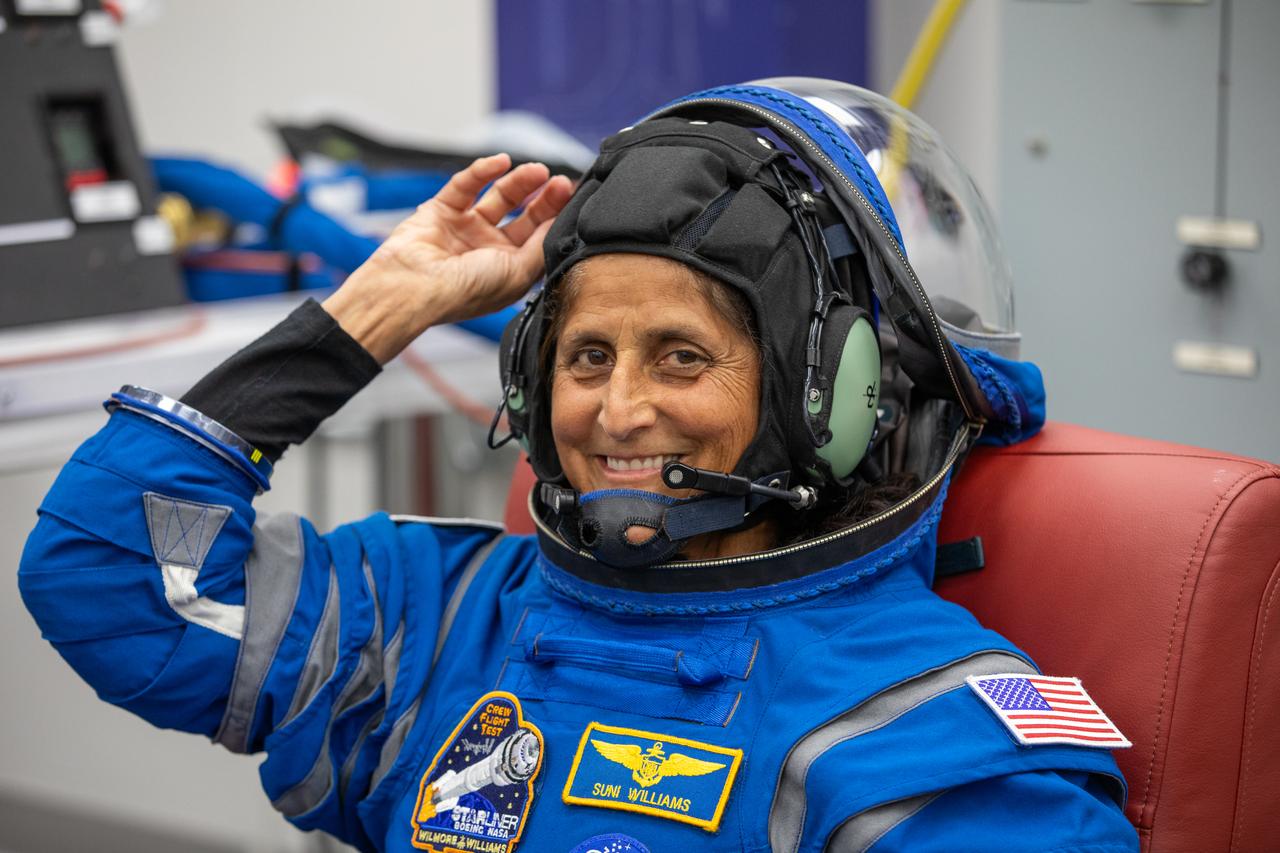
During the first launch attempt of NASA’s Boeing Crew Flight Test, NASA astronaut Suni Williams is photographed inside the crew suit-up room in the Neil A. Armstrong Operations and Checkout Building at NASA’s Kennedy Space Center in Florida on Monday, May 6, 2024. As part of the agency’s Commercial Crew Program, the first crewed launch to the International Space Station aboard Boeing’s Starliner spacecraft atop a United Launch Alliance Atlas V rocket from Space Launch Complex-41 at nearby Cape Canaveral Space Force Station was targeted for 10:34 p.m. ET but scrubbed for the day.