
AUGUST 23, 1961 LAUNCH OF NASA AGENA RANGER 1 FROM PAD 12.
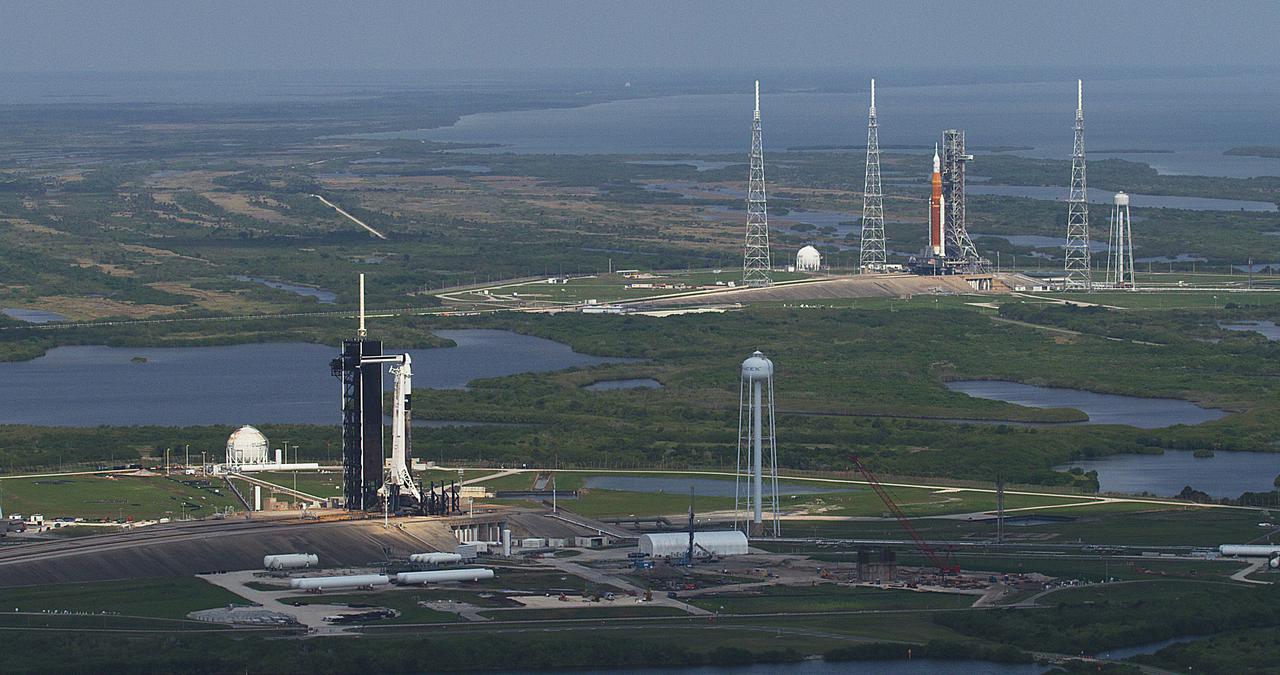
SpaceX’s Axiom-1 is in the foreground on Launch Pad 39A with NASA’s Artemis I in the background on Launch Pad 39B on April 6, 2022. This is the first time two totally different types of rockets and spacecraft designed to carry humans are on the sister pads at the same time—but it won’t be the last as NASA’s Kennedy Space Center in Florida continues to grow as a multi-user spaceport to launch both government and commercial rockets.
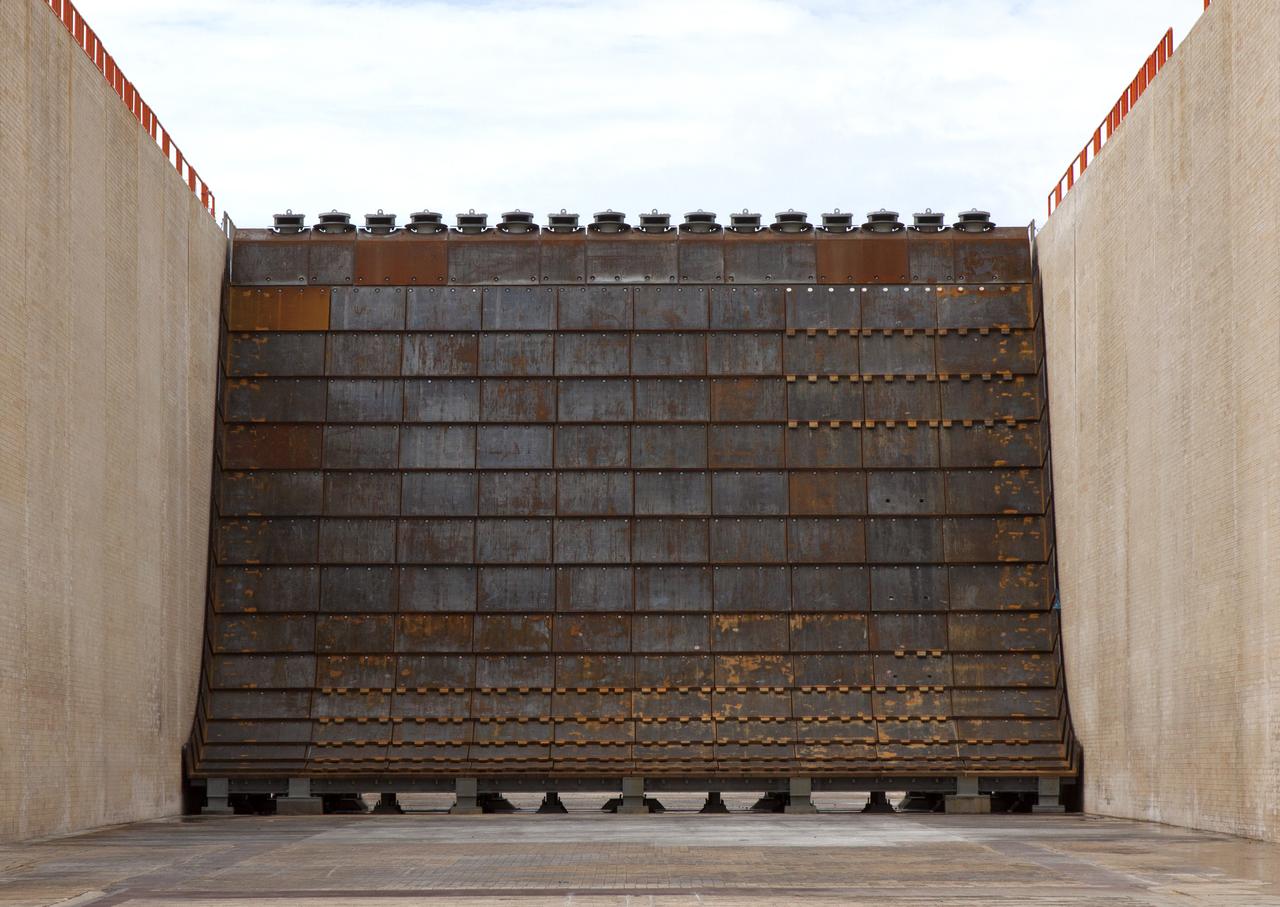
Construction is complete on the main flame deflector in the flame trench at Launch Complex 39B at NASA's Kennedy Space Center in Florida. The flame deflector will safely deflect the plume exhaust from NASA's Space Launch System rocket during launch. It will divert the rocket's exhaust, pressure and intense heat to the north at liftoff. The Exploration Ground Systems Program at Kennedy is refurbishing the pad to support the launch of the SLS rocket and Orion on Exploration Mission-1, and helping to transform the space center into a multi-user spaceport.
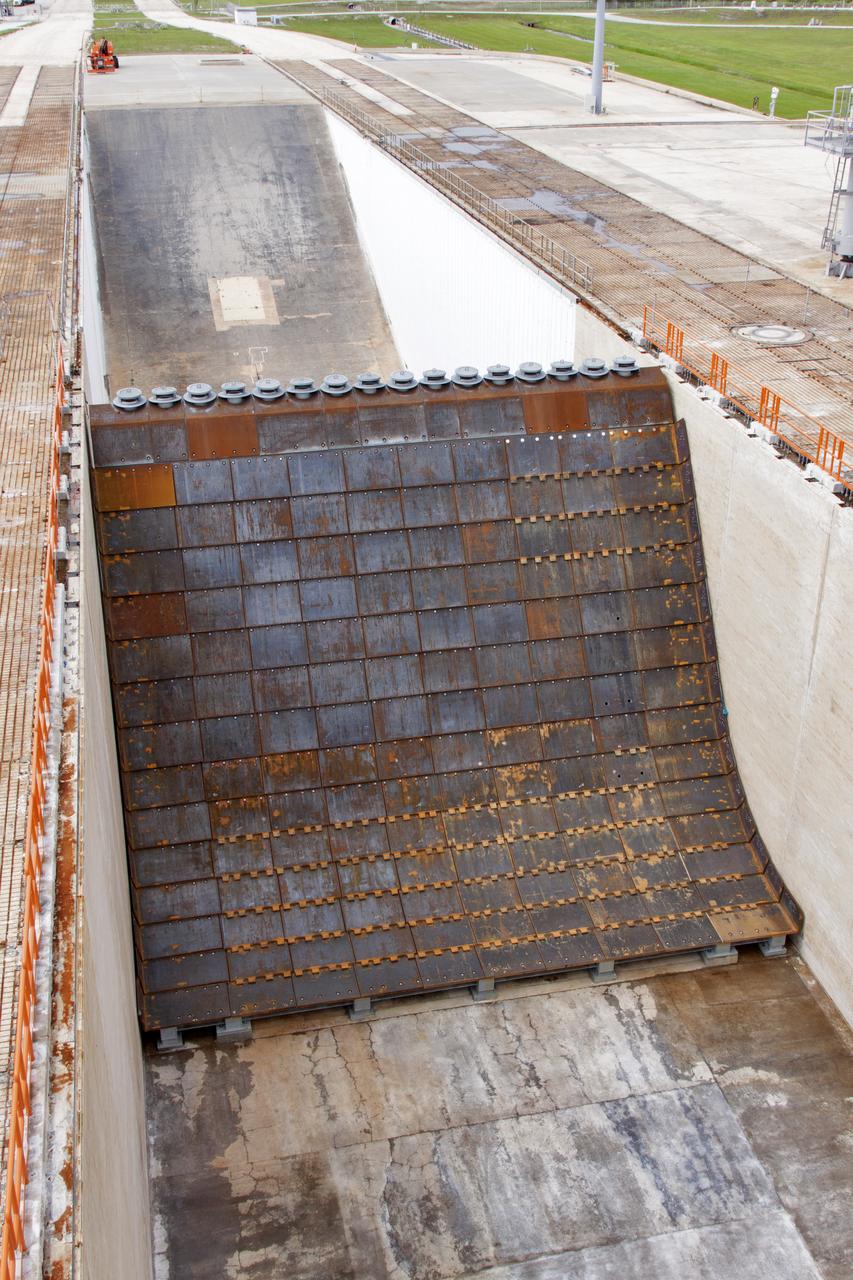
Construction is complete on the main flame deflector in the flame trench at Launch Complex 39B at NASA's Kennedy Space Center in Florida. The flame deflector will safely deflect the plume exhaust from NASA's Space Launch System rocket during launch. It will divert the rocket's exhaust, pressure and intense heat to the north at liftoff. The Exploration Ground Systems Program at Kennedy is refurbishing the pad to support the launch of the SLS rocket and Orion on Exploration Mission-1, and helping to transform the space center into a multi-user spaceport.
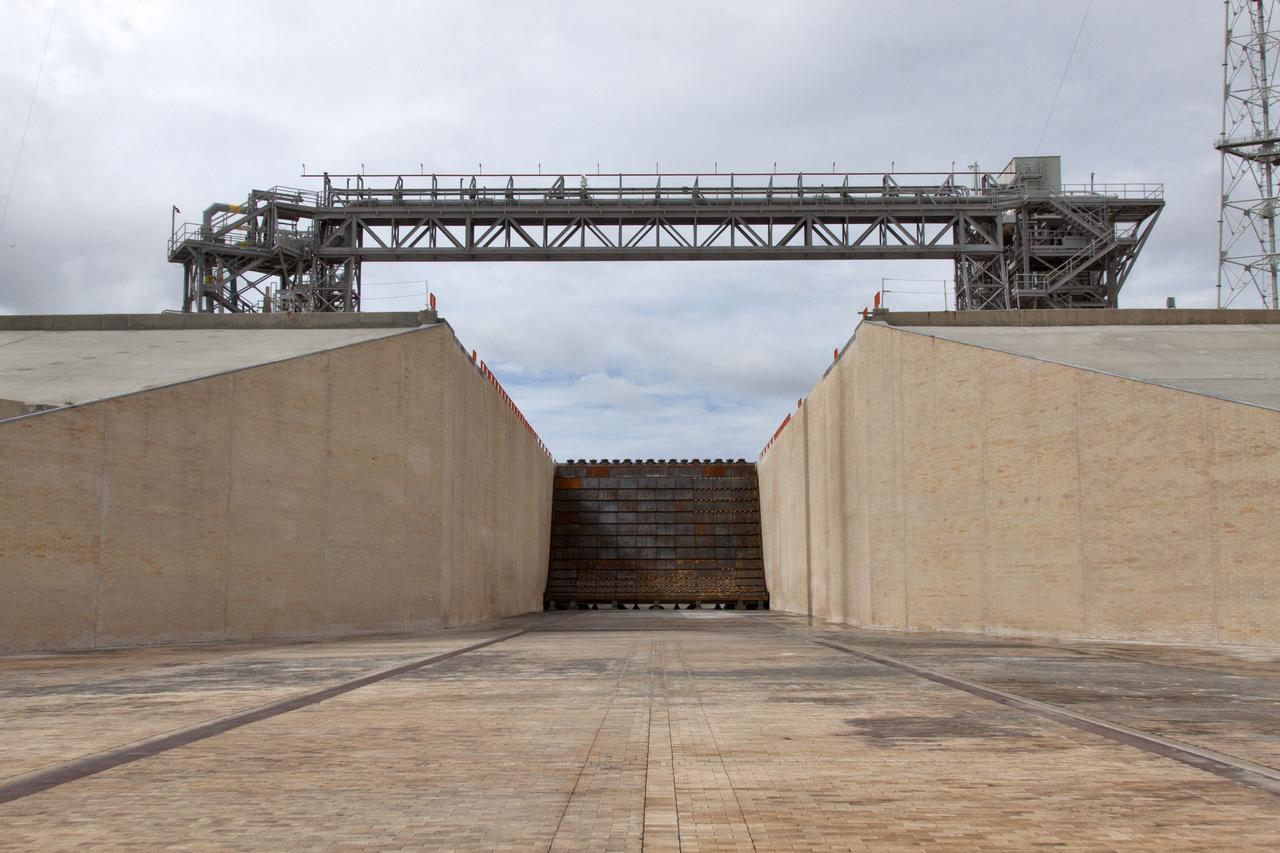
Construction is complete on the main flame deflector in the flame trench at Launch Complex 39B at NASA's Kennedy Space Center in Florida. The flame deflector will safely deflect the plume exhaust from NASA's Space Launch System rocket during launch. It will divert the rocket's exhaust, pressure and intense heat to the north at liftoff. The Exploration Ground Systems Program at Kennedy is refurbishing the pad to support the launch of the SLS rocket and Orion on Exploration Mission-1, and helping to transform the space center into a multi-user spaceport.
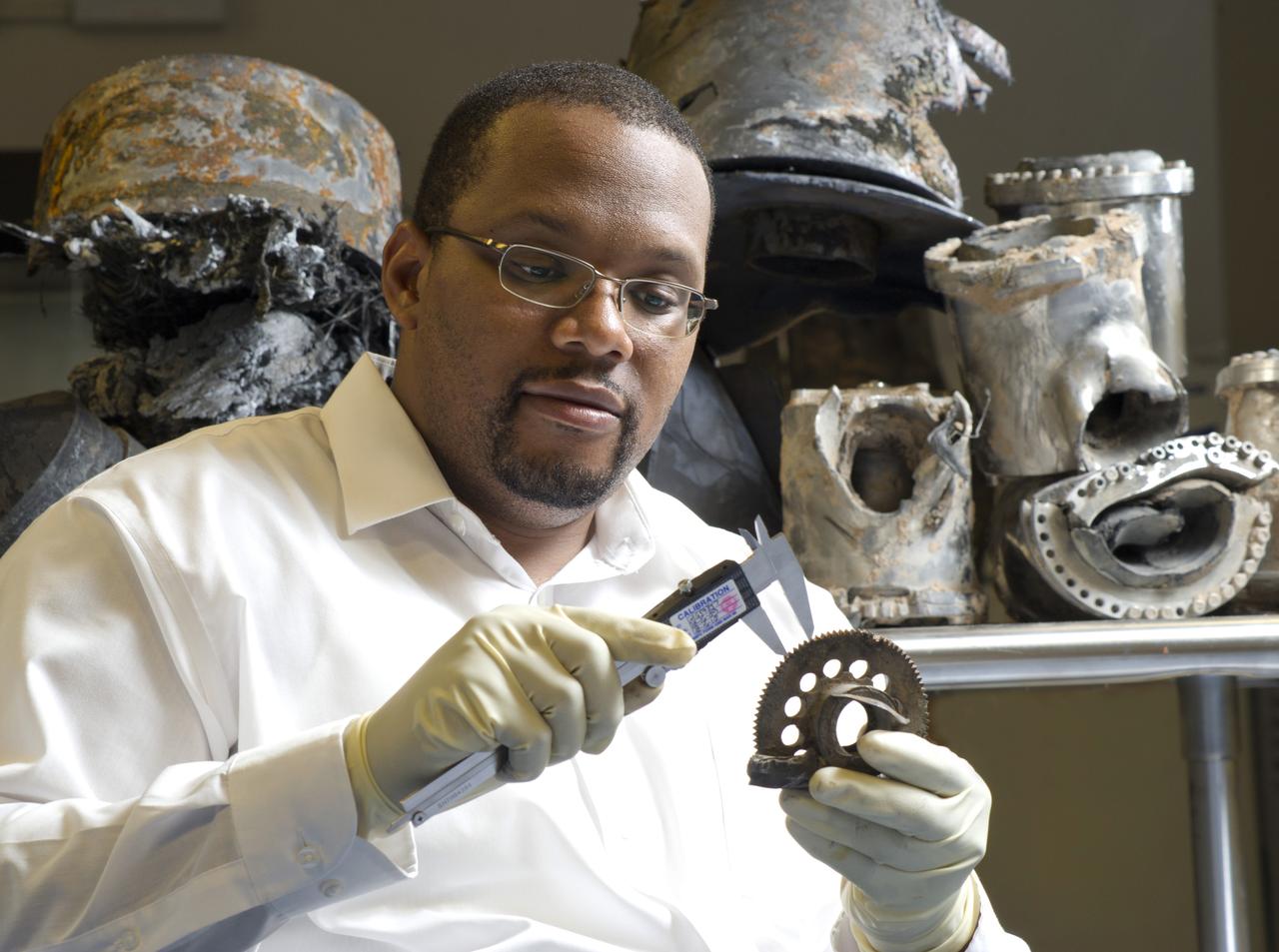
MARVIN BARNES, NASA MSFC ER52 SOLID PROPULSION, SEPARATION AND MANEUVERING SYSTEMS BRANCH, INSPECTS POST-FLIGHT ORION LAUNCH ABORT SYSTEM (LAS) PAD ABORT 1 (PA-1) HARDWARE
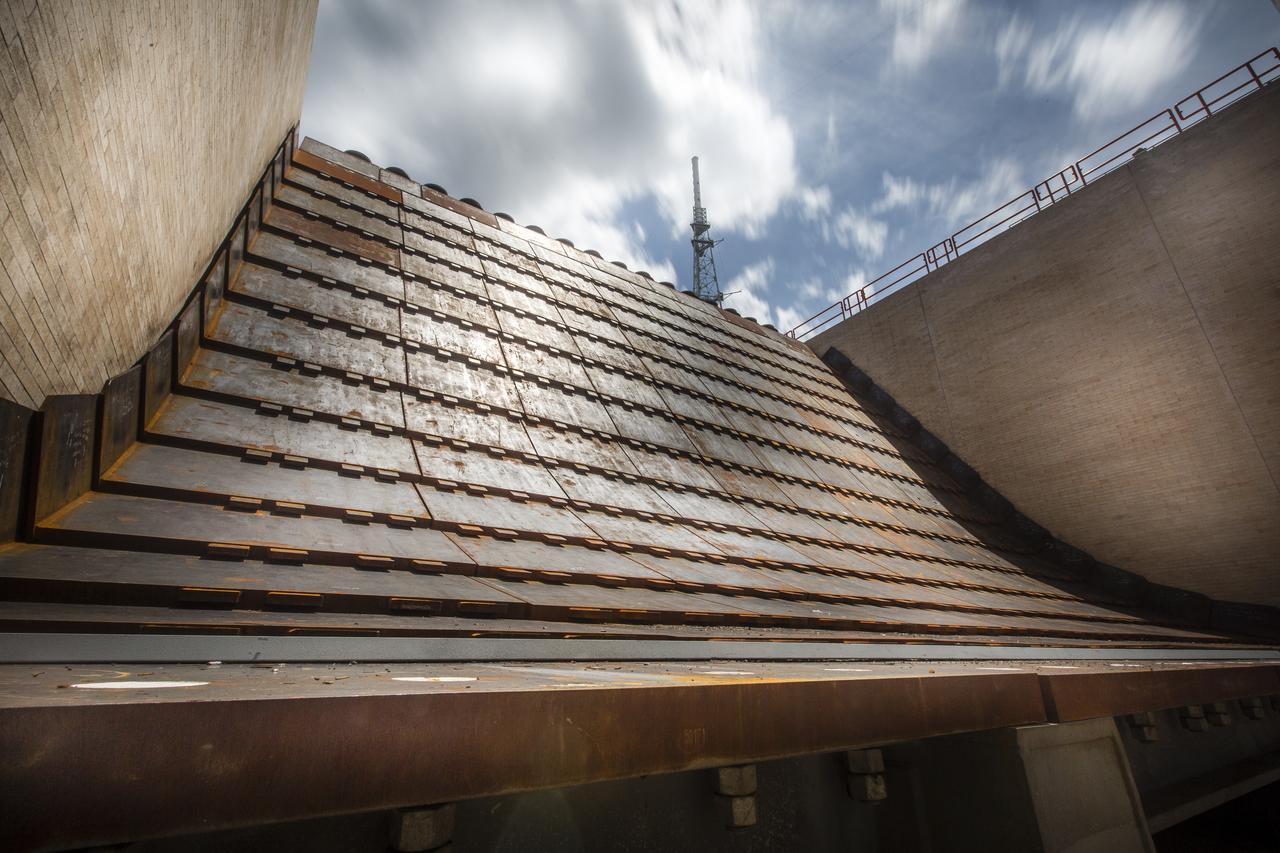
A close-up view of the flame trench and flame deflector at Launch Pad 39B at NASA's Kennedy Space Center in Florida on July 26, 2018. The launch pad has undergone upgrades and modifications to accommodate NASA's Space Launch System and Orion spacecraft for Exploration Mission-1 and other deep space missions. New heat-resistant bricks have been installed on the walls and a new flame deflector is in place. The clean pad concept is designed to support NASA and commercial launch providers at the multi-user spaceport.
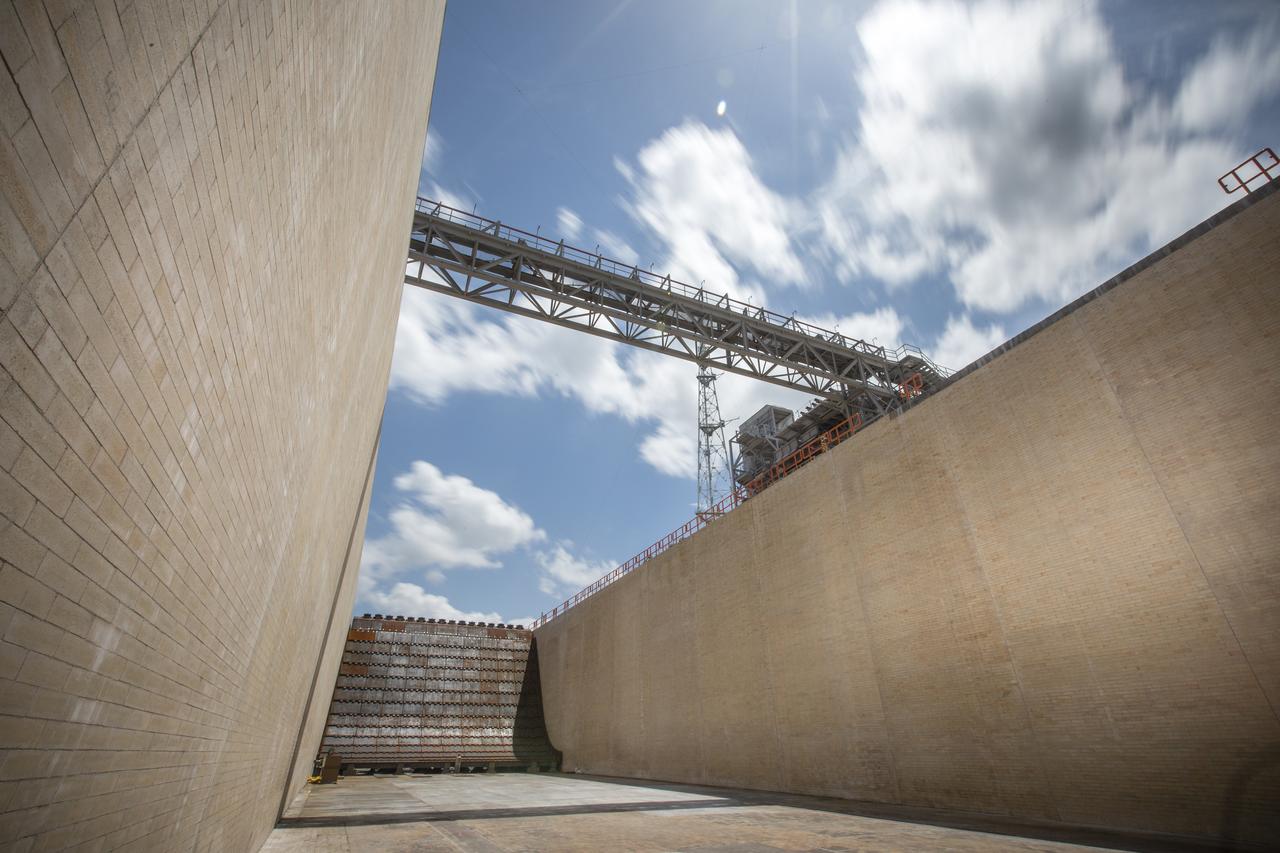
A close-up view of the flame trench and flame deflector at Launch Pad 39B at NASA's Kennedy Space Center in Florida on July 26, 2018. The launch pad has undergone upgrades and modifications to accommodate NASA's Space Launch System and Orion spacecraft for Exploration Mission-1 and other deep space missions. New heat-resistant bricks have been installed on the walls and a new flame deflector is in place. The clean pad concept is designed to support NASA and commercial launch providers at the multi-user spaceport.
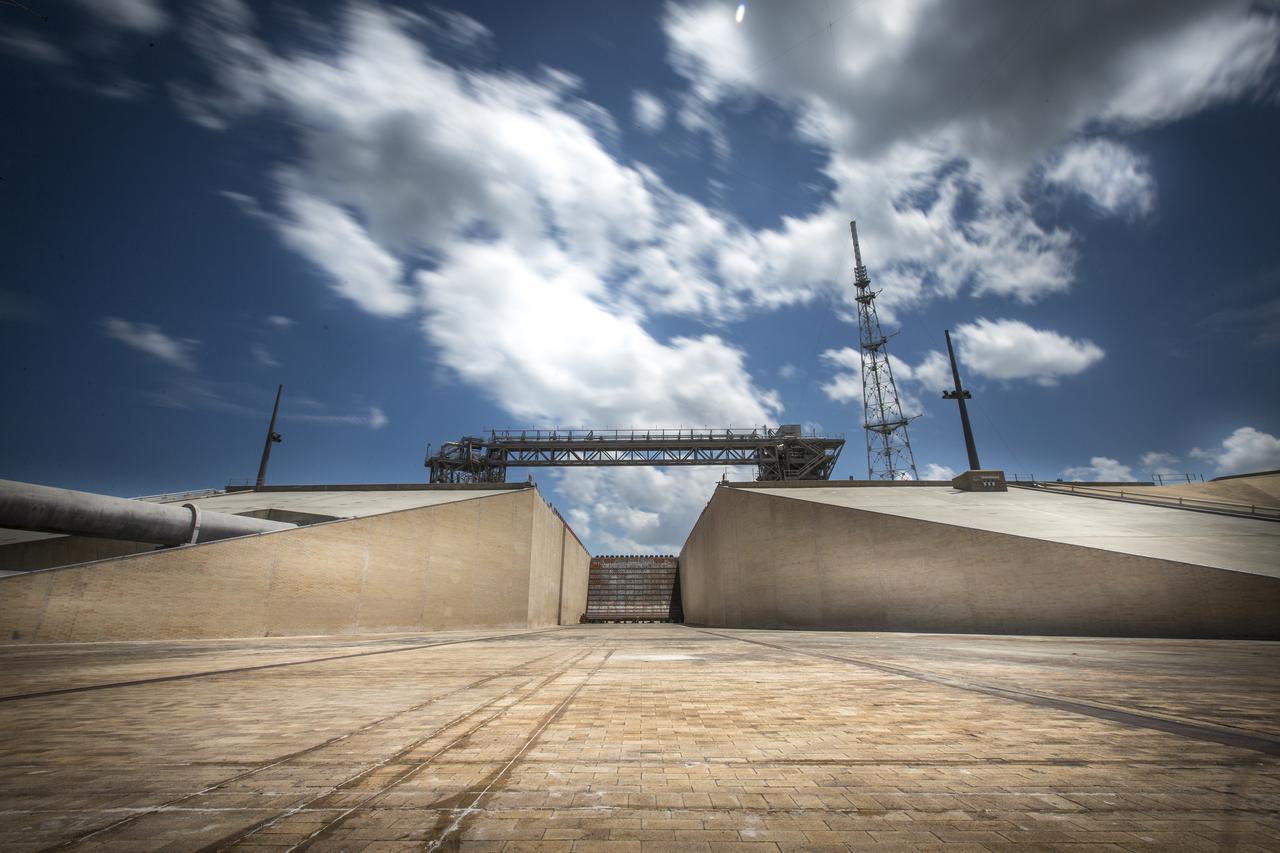
The flame trench and flame deflector are in view at Launch Pad 39B at NASA's Kennedy Space Center in Florida on July 26, 2018. The launch pad has undergone upgrades and modifications to accommodate NASA's Space Launch System and Orion spacecraft for Exploration Mission-1 and other deep space missions. New heat-resistant bricks have been installed on the walls and a new flame deflector is in place. The clean pad concept is designed to support NASA and commercial launch providers at the multi-user spaceport.
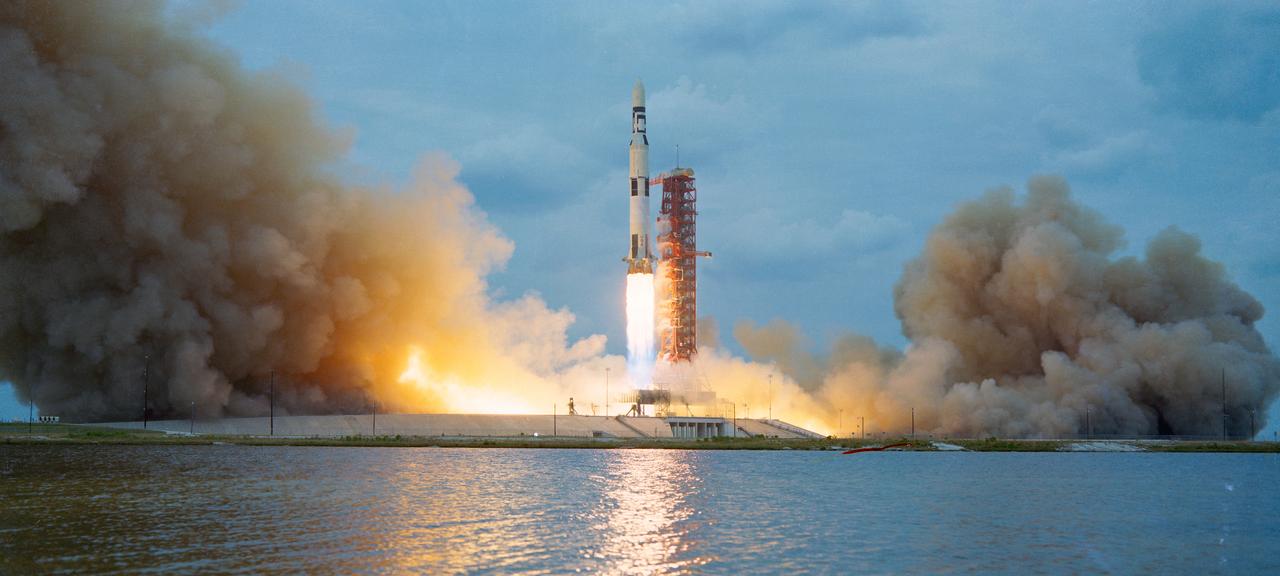
S73-26912 (14 May 1973) --- The unmanned Skylab 1/Saturn V space vehicle is launched from Pad A, Launch Complex 39, Kennedy Space Center, Florida, at 12:00 noon (EDT), May 14, 1973, to place the Skylab space station cluster in Earth orbit. The Skylab 1 payload included four of the five major components of the space station Orbital Workshop, Apollo Telescope Mount, Multiple Docking Adapter, and Airlock Module. In addition to the payload, the Skylab 1/Saturn V second (S-11) stage. The fifth major component of the space station, the Command Service Module with the Skylab 2 crew aboard, was launched at a later date by a Saturn 1B from Pad B. Photo credit: NASA
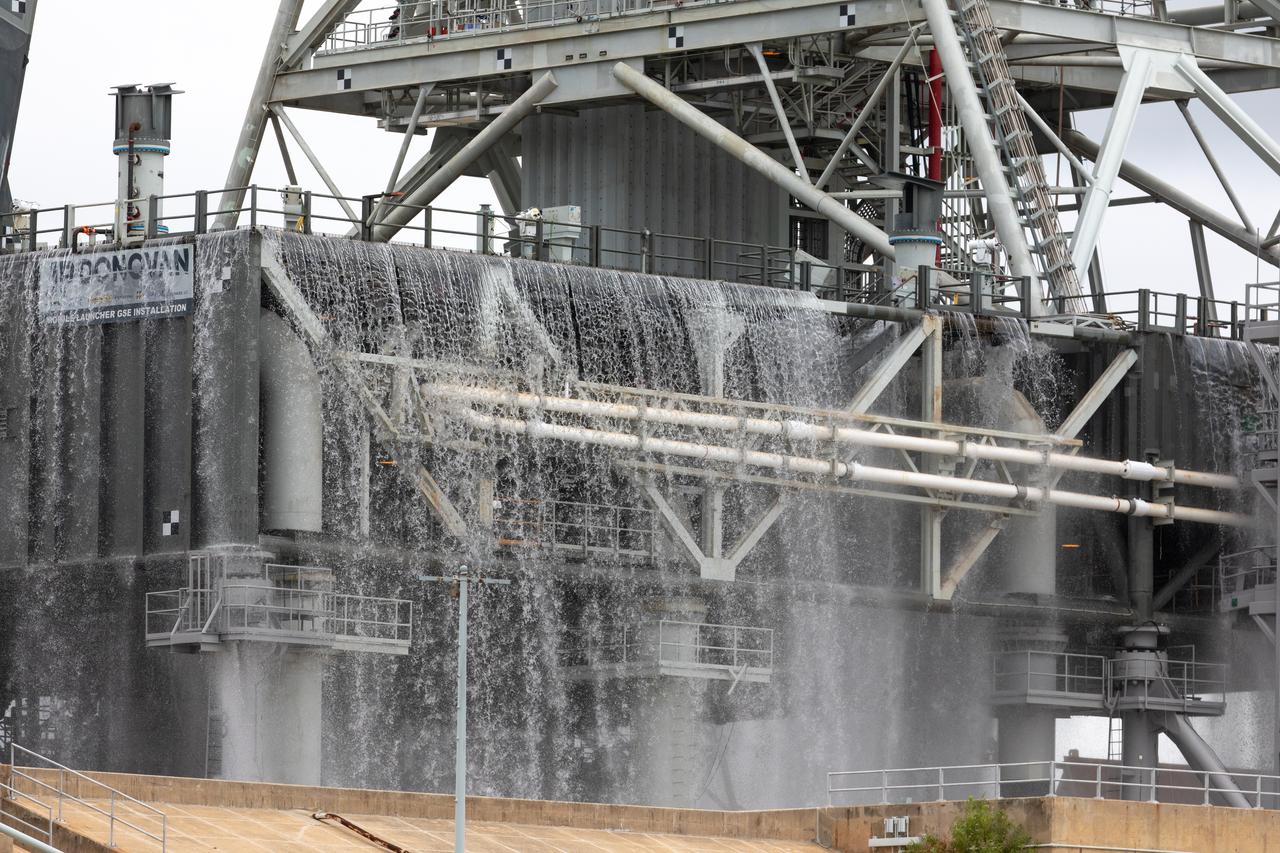
A flow test of the Ignition Overpressure Protection and Sound Suppression water deluge system is underway on the mobile launcher at Launch Pad 39B at NASA's Kennedy Space Center in Florida, on July 25, 2019. The testing is part of a series of tests that Exploration Ground System is doing to verify the system is ready for the new Space Launch System rocket. Modifications were made to the pad after a previous wet flow test, increasing the performance of the system. During the launch of Artemis 1 and subsequent missions, this water deluge system will release about 450,000 gallons of water across the mobile launcher and Flame Deflector to reduce the extreme heat and energy generated by the rocket during ignition and liftoff.
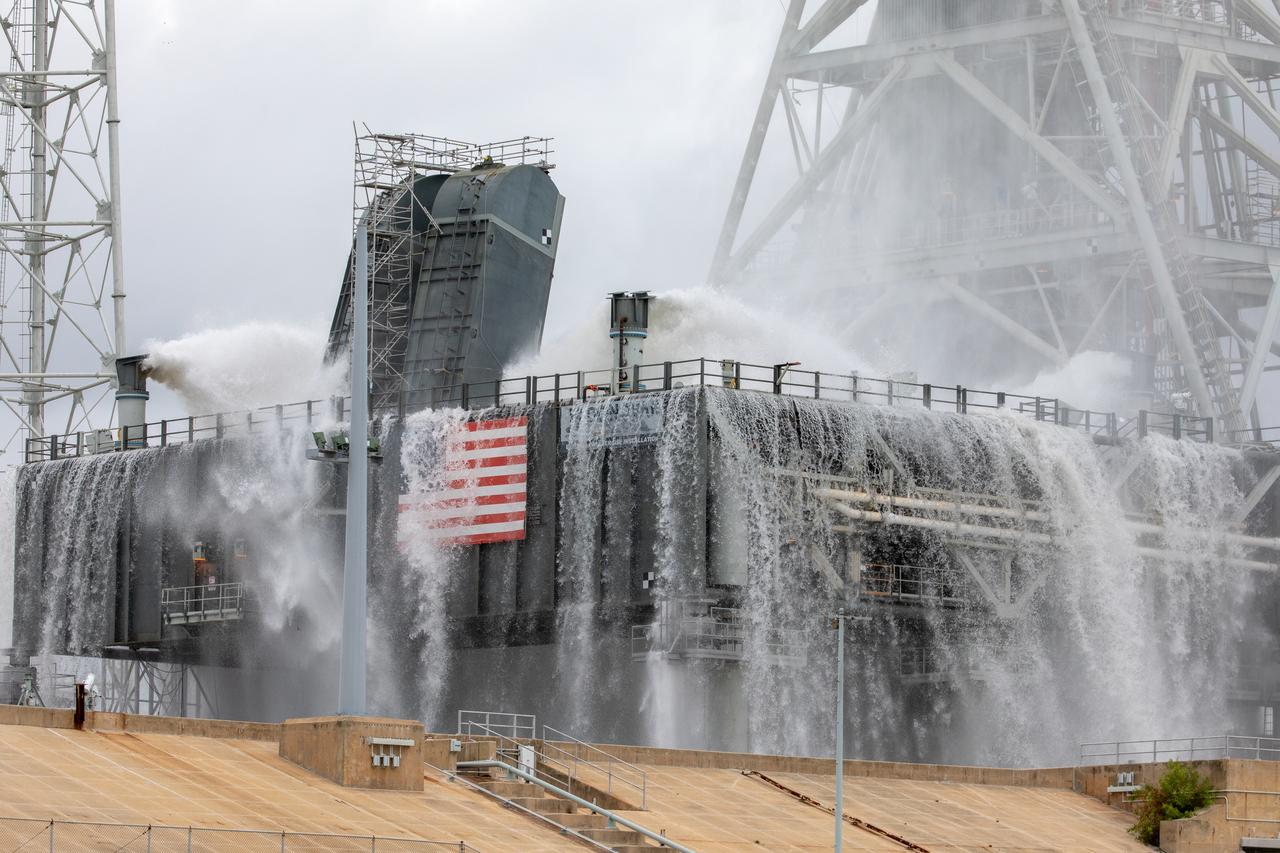
A flow test of the Ignition Overpressure Protection and Sound Suppression water deluge system is underway on the mobile launcher at Launch Pad 39B at NASA's Kennedy Space Center in Florida, on July 25, 2019. The testing is part of a series of tests that Exploration Ground System is doing to verify the system is ready for the new Space Launch System rocket. Modifications were made to the pad after a previous wet flow test, increasing the performance of the system. During the launch of Artemis 1 and subsequent missions, this water deluge system will release about 450,000 gallons of water across the mobile launcher and Flame Deflector to reduce the extreme heat and energy generated by the rocket during ignition and liftoff.
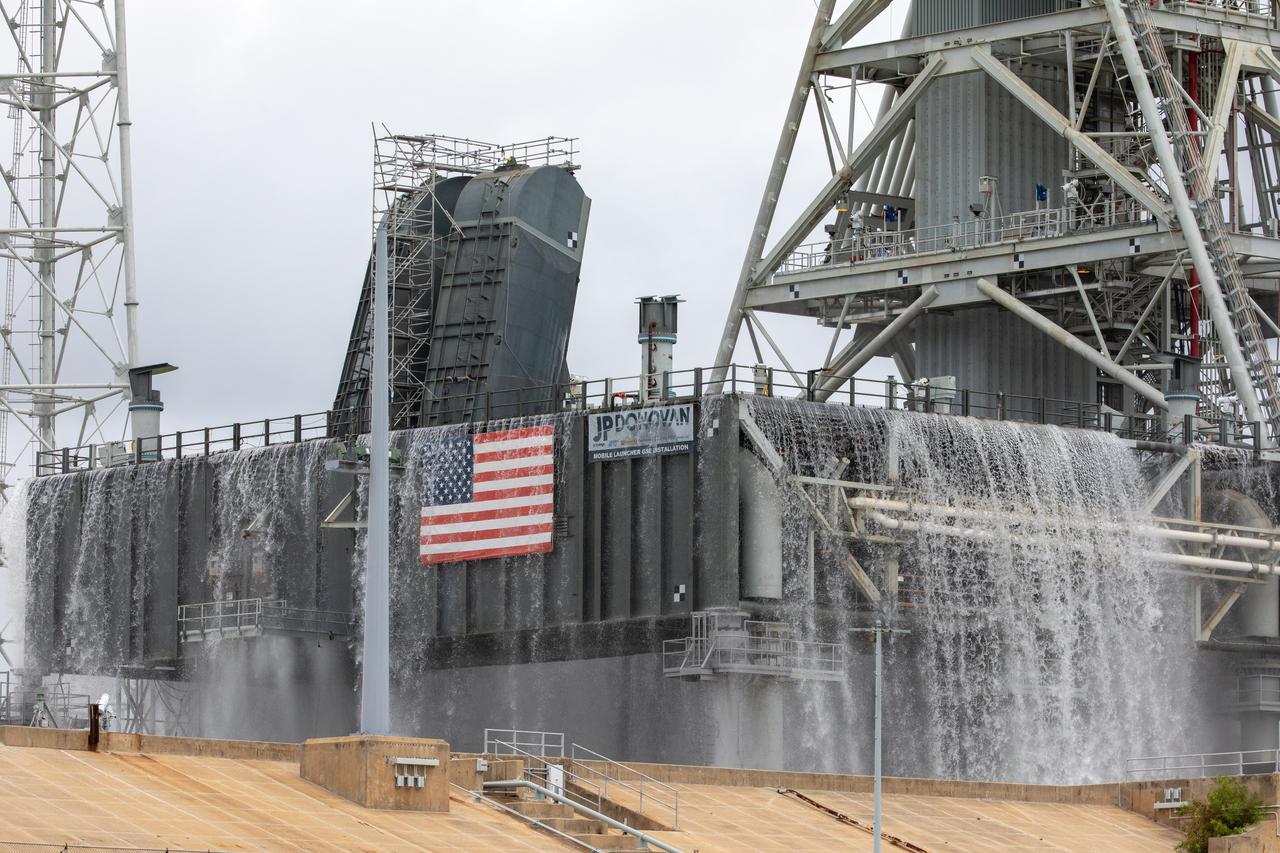
A flow test of the Ignition Overpressure Protection and Sound Suppression water deluge system is underway on the mobile launcher at Launch Pad 39B at NASA's Kennedy Space Center in Florida, on July 25, 2019. The testing is part of a series of tests that Exploration Ground System is doing to verify the system is ready for the new Space Launch System rocket. Modifications were made to the pad after a previous wet flow test, increasing the performance of the system. During the launch of Artemis 1 and subsequent missions, this water deluge system will release about 450,000 gallons of water across the mobile launcher and Flame Deflector to reduce the extreme heat and energy generated by the rocket during ignition and liftoff.
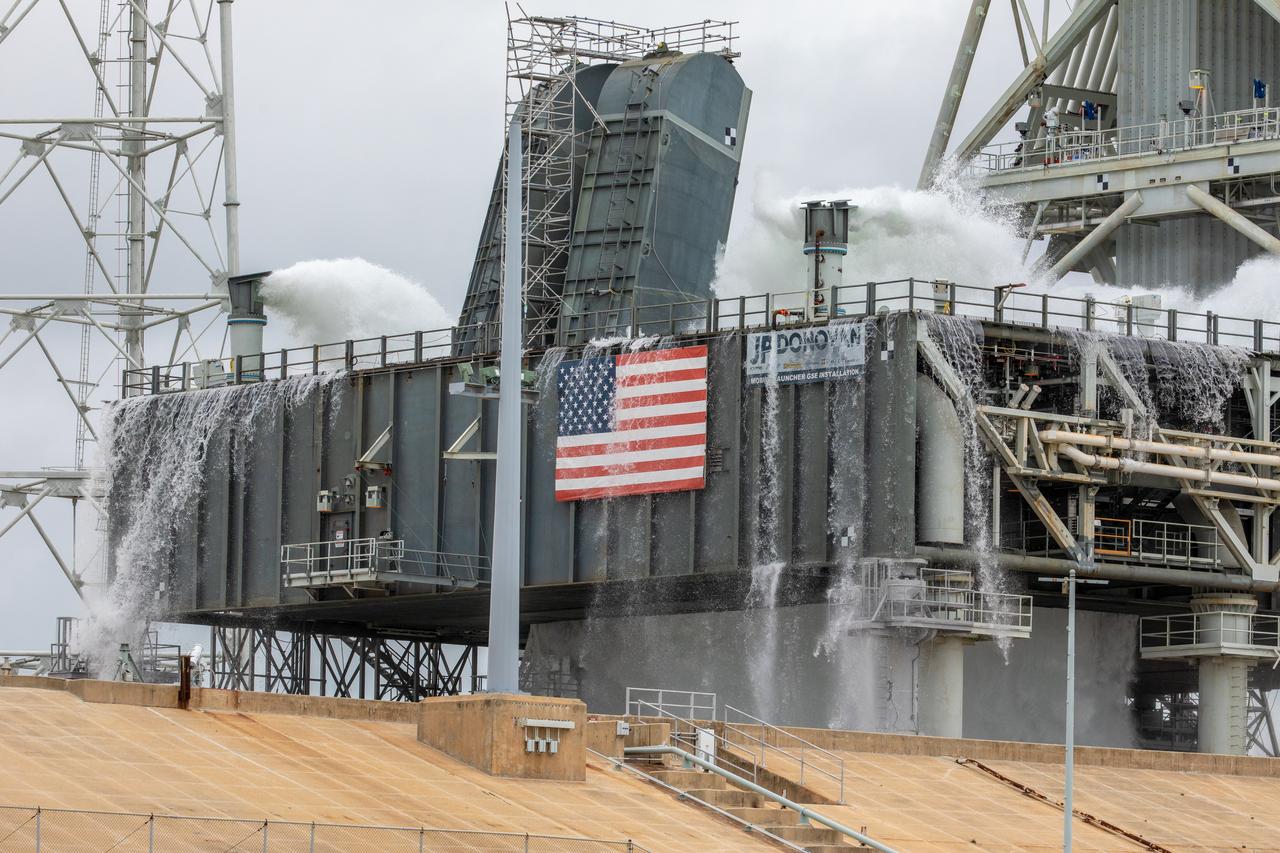
A flow test of the Ignition Overpressure Protection and Sound Suppression water deluge system begins on the mobile launcher at Launch Pad 39B at NASA's Kennedy Space Center in Florida, on July 25, 2019. The testing is part of a series of tests that Exploration Ground System is doing to verify the system is ready for the new Space Launch System rocket. Modifications were made to the pad after a previous wet flow test, increasing the performance of the system. During the launch of Artemis 1 and subsequent missions, this water deluge system will release about 450,000 gallons of water across the mobile launcher and Flame Deflector to reduce the extreme heat and energy generated by the rocket during ignition and liftoff.

A flow test of the Ignition Overpressure Protection and Sound Suppression water deluge system is underway on the mobile launcher at Launch Pad 39B at NASA's Kennedy Space Center in Florida, on July 25, 2019. The testing is part of a series of tests that Exploration Ground System is doing to verify the system is ready for the new Space Launch System rocket. Modifications were made to the pad after a previous wet flow test, increasing the performance of the system. During the launch of Artemis 1 and subsequent missions, this water deluge system will release about 450,000 gallons of water across the mobile launcher and Flame Deflector to reduce the extreme heat and energy generated by the rocket during ignition and liftoff.
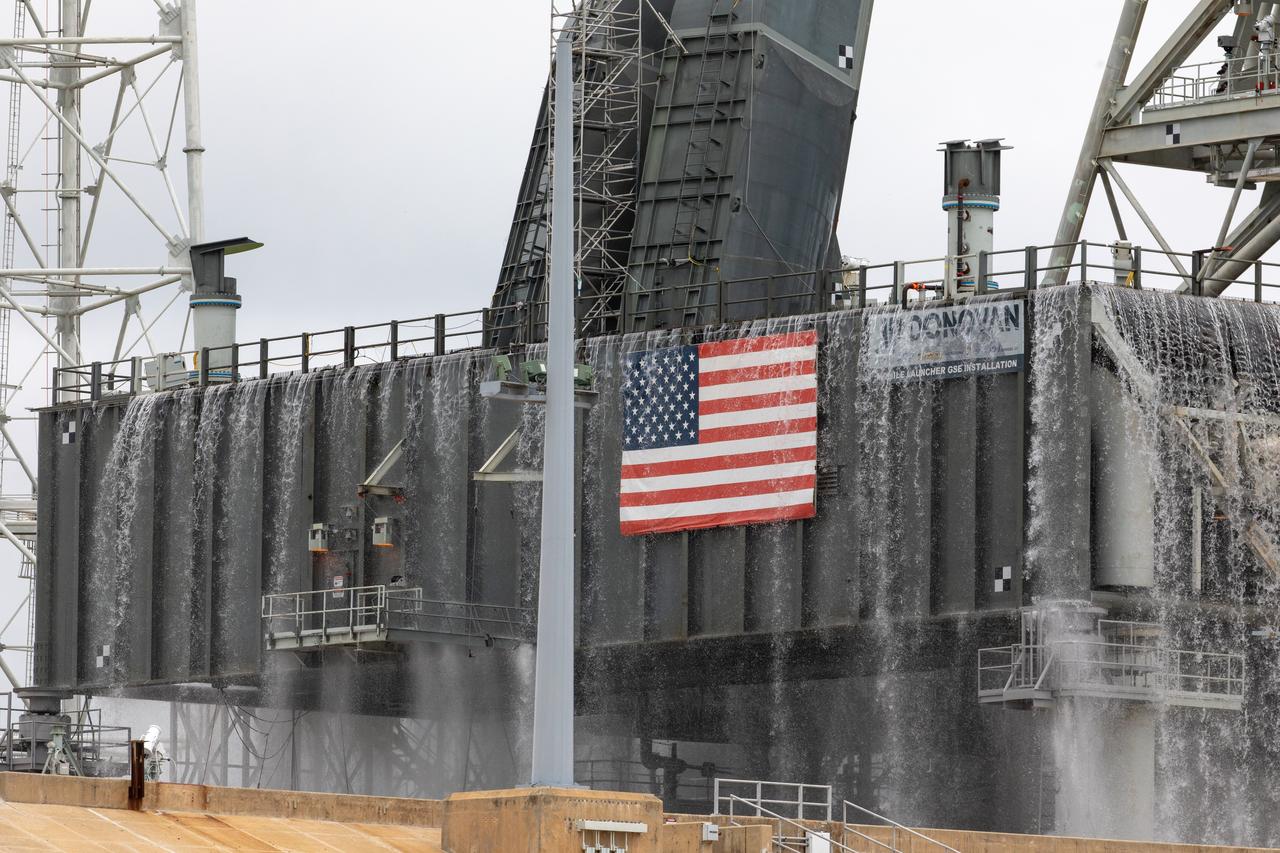
A flow test of the Ignition Overpressure Protection and Sound Suppression water deluge system is underway on the mobile launcher at Launch Pad 39B at NASA's Kennedy Space Center in Florida, on July 25, 2019. The testing is part of a series of tests that Exploration Ground System is doing to verify the system is ready for the new Space Launch System rocket. Modifications were made to the pad after a previous wet flow test, increasing the performance of the system. During the launch of Artemis 1 and subsequent missions, this water deluge system will release about 450,000 gallons of water across the mobile launcher and Flame Deflector to reduce the extreme heat and energy generated by the rocket during ignition and liftoff.
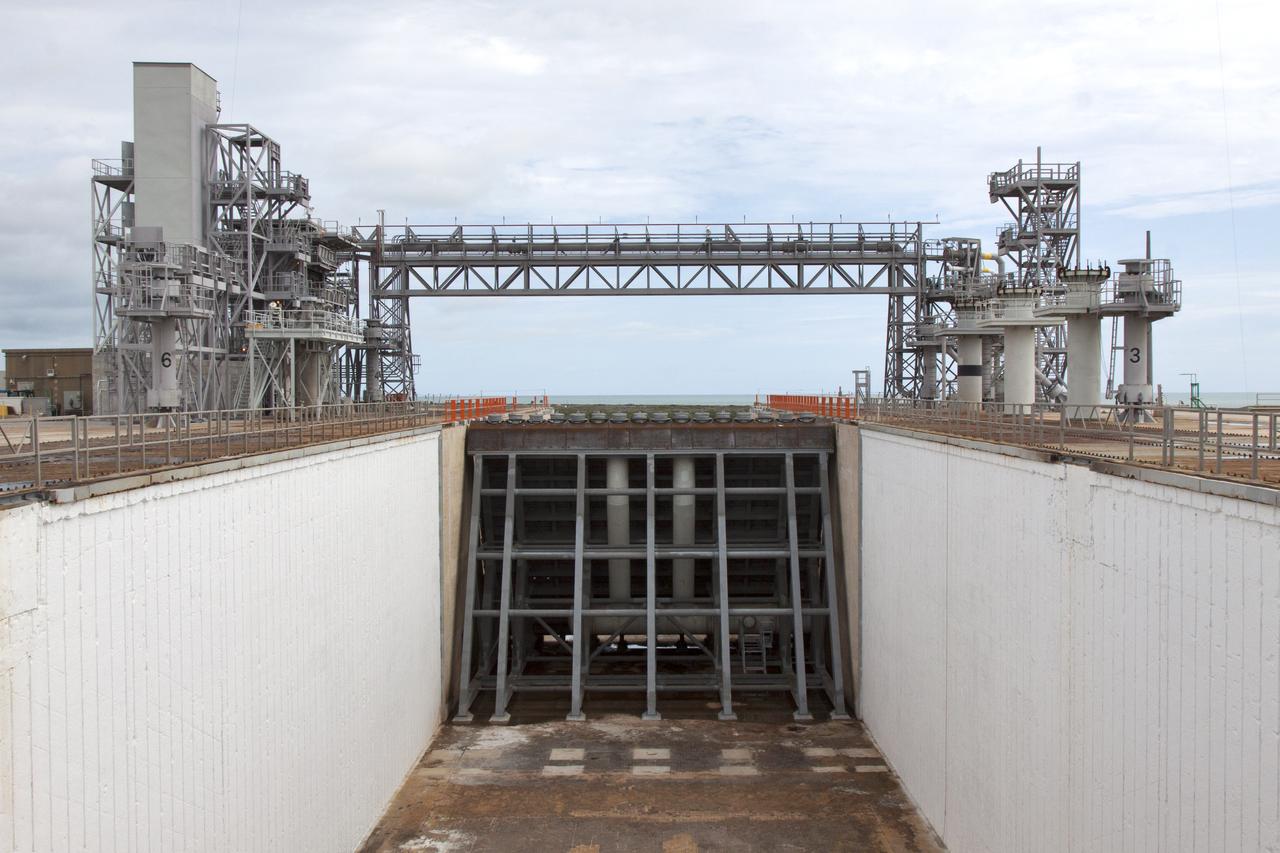
Construction is complete on the main flame deflector in the flame trench at Launch Complex 39B at NASA's Kennedy Space Center in Florida. The flame deflector will safely deflect the plume exhaust from NASA's Space Launch System rocket during launch. It will divert the rocket's exhaust, pressure and intense heat to the north at liftoff. In view is the south side of the main flame deflector. The Exploration Ground Systems Program at Kennedy is refurbishing the pad to support the launch of the SLS rocket and Orion on Exploration Mission-1, and helping to transform the space center into a multi-user spaceport.

S73-25140 (16 April 1973) --- A ground-level view of Pad A, Launch Complex 39, Kennedy Space Center, Florida, showing the 341-feet tall Skylab 1/Saturn V space vehicle on the pad soon after being rolled out from the Vehicle Assembly Building (VAB). The vehicle is composed of the Saturn V first (S-1C) stage, the Apollo Telescope Mount (ATM), the Multiple Docking Adapter (MDA), the Airlock Module (AM), and the Orbital Workshop (OWS). Photo credit: NASA
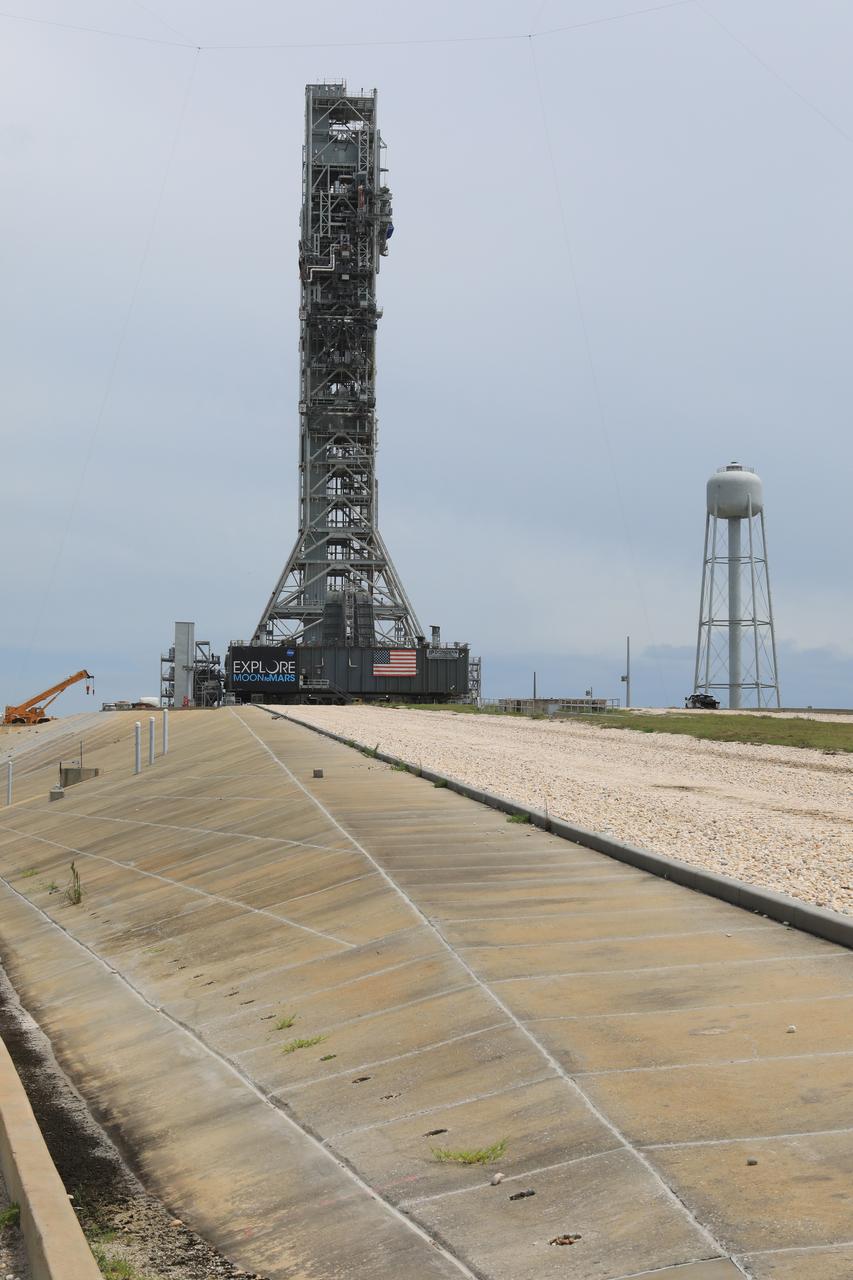
After successfully arriving at Kennedy Space Center’s Launch Complex 39B, Exploration Ground Systems’ mobile launcher is photographed at the pad surface on June 28, 2019. The mobile launcher began its final solo trek to the pad at midnight on June 27, departing from NASA’s Vehicle Assembly Building. The mobile launcher will remain at the pad over the summer, undergoing final testing and checkouts. Its next roll to the pad will be with the agency’s Space Launch System rocket and Orion in preparation for the launch of Artemis 1.
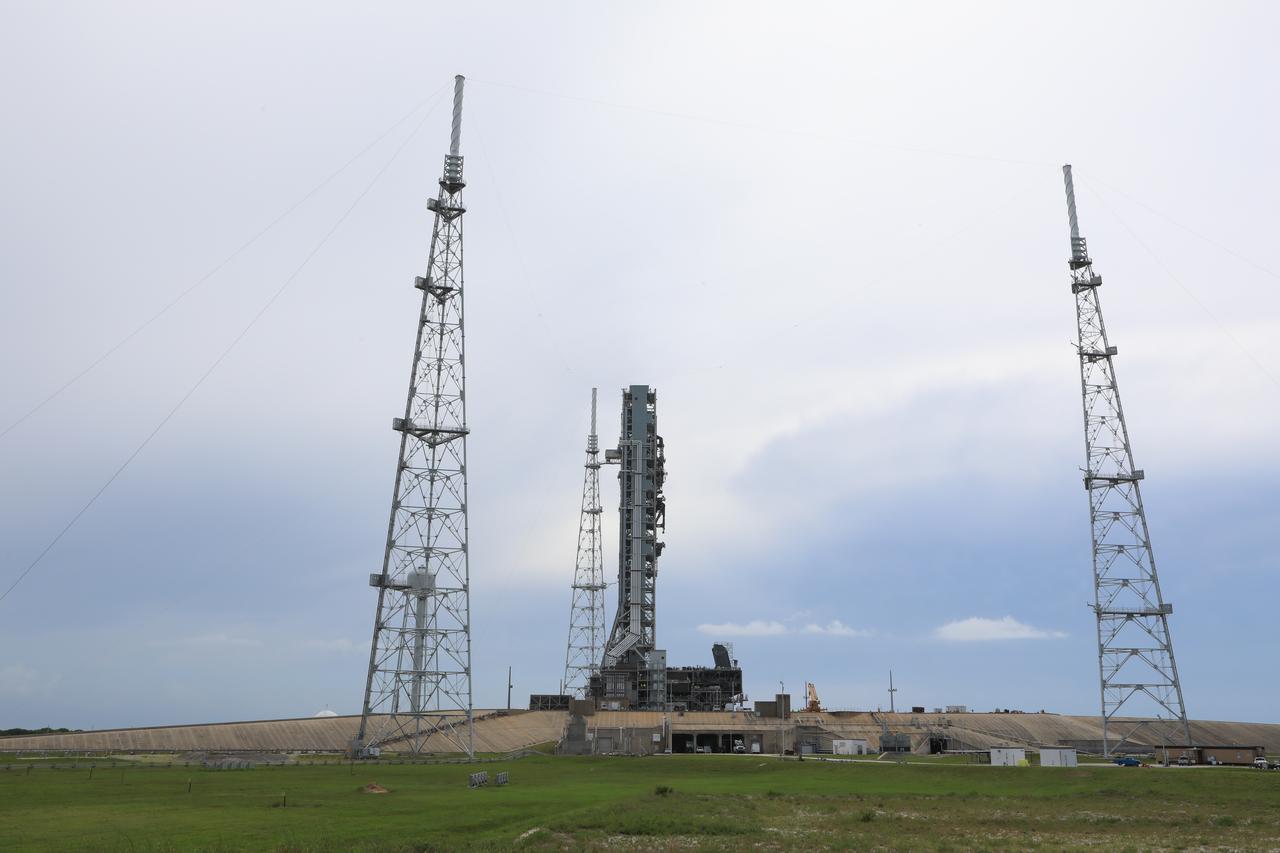
After successfully arriving at Kennedy Space Center’s Launch Complex 39B, Exploration Ground Systems’ mobile launcher is photographed at the pad surface on June 28, 2019. The mobile launcher began its final solo trek to the pad at midnight on June 27, departing from NASA’s Vehicle Assembly Building. The mobile launcher will remain at the pad over the summer, undergoing final testing and checkouts. Its next roll to the pad will be with the agency’s Space Launch System rocket and Orion in preparation for the launch of Artemis 1.
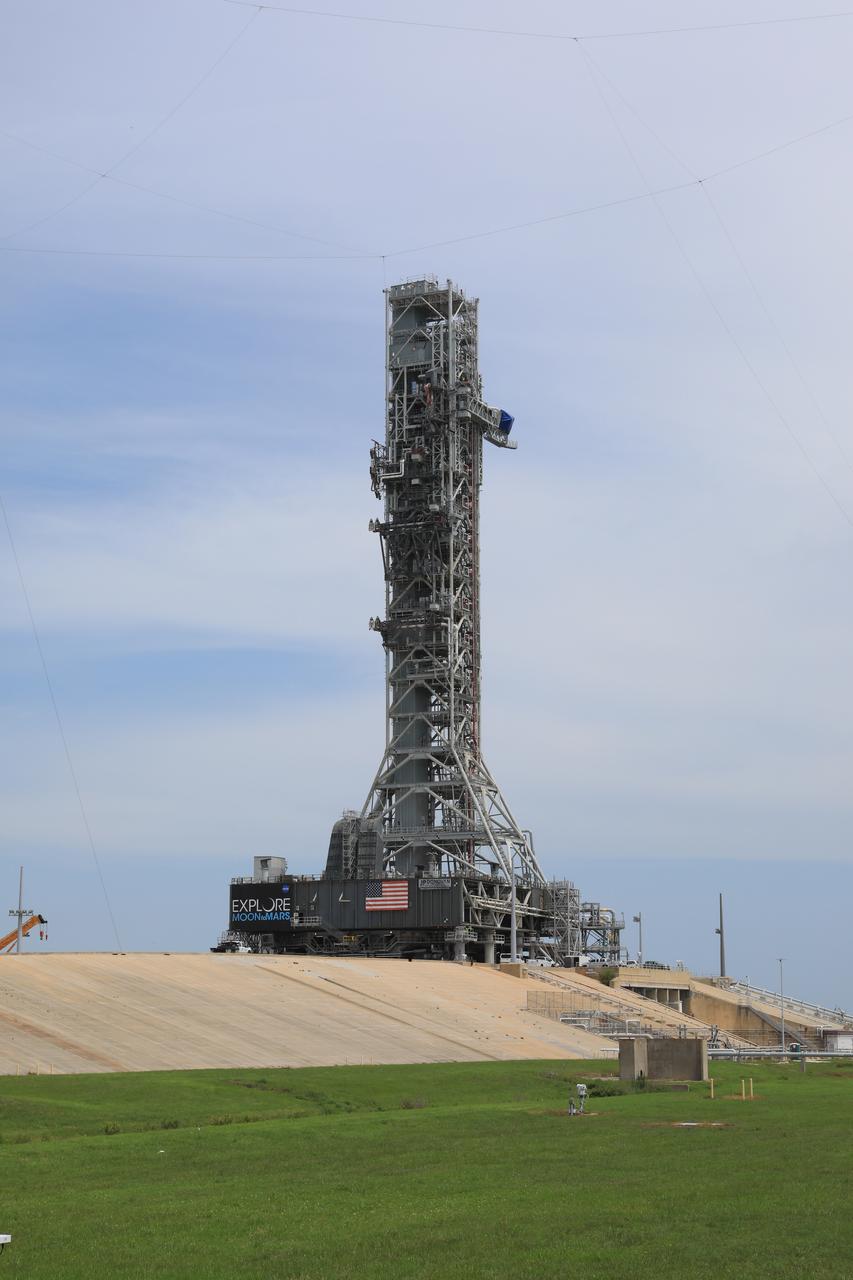
After successfully arriving at Kennedy Space Center’s Launch Complex 39B, Exploration Ground Systems’ mobile launcher is photographed at the pad surface on June 28, 2019. The mobile launcher began its final solo trek to the pad at midnight on June 27, departing from NASA’s Vehicle Assembly Building. The mobile launcher will remain at the pad over the summer, undergoing final testing and checkouts. Its next roll to the pad will be with the agency’s Space Launch System rocket and Orion in preparation for the launch of Artemis 1.
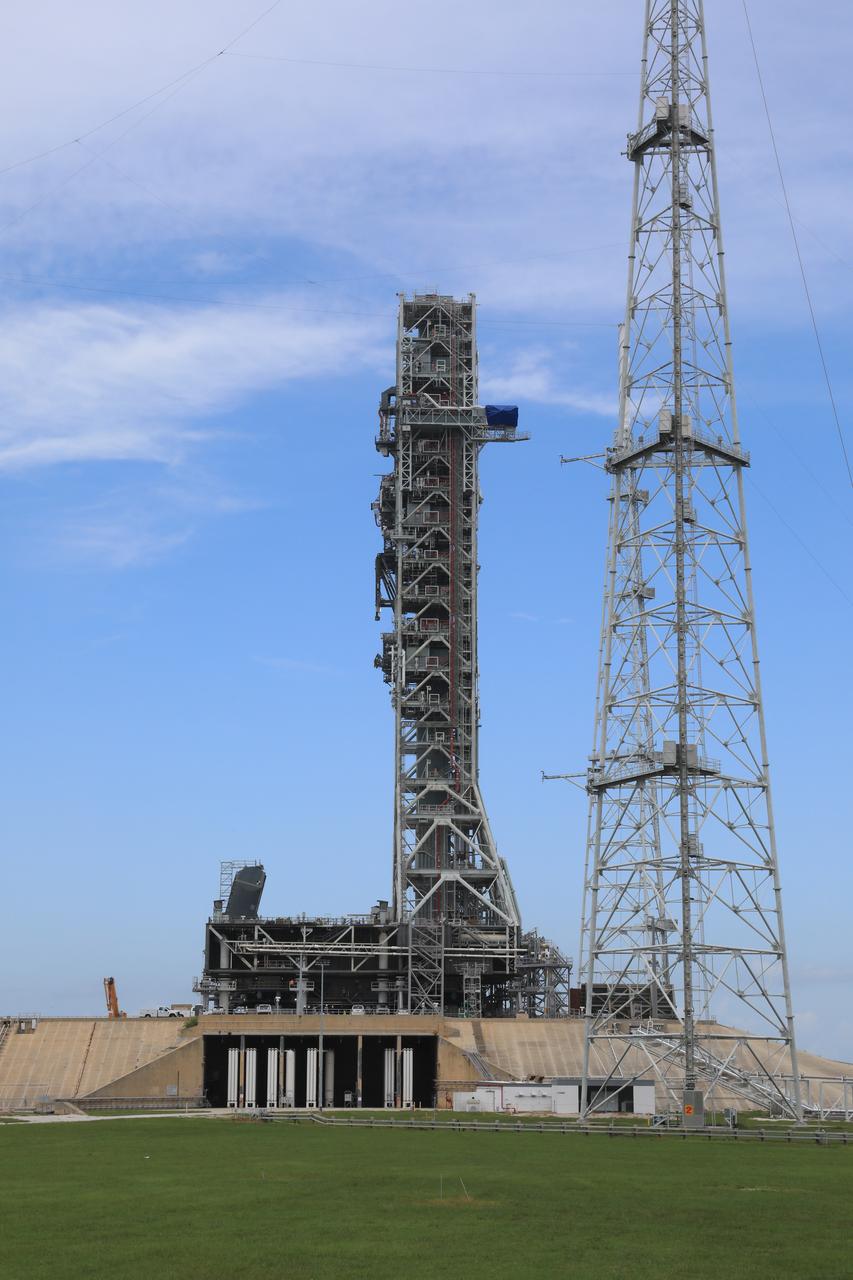
After successfully arriving at Kennedy Space Center’s Launch Complex 39B, Exploration Ground Systems’ mobile launcher is photographed at the pad surface on June 28, 2019. The mobile launcher began its final solo trek to the pad at midnight on June 27, departing from NASA’s Vehicle Assembly Building. The mobile launcher will remain at the pad over the summer, undergoing final testing and checkouts. Its next roll to the pad will be with the agency’s Space Launch System rocket and Orion in preparation for the launch of Artemis 1.
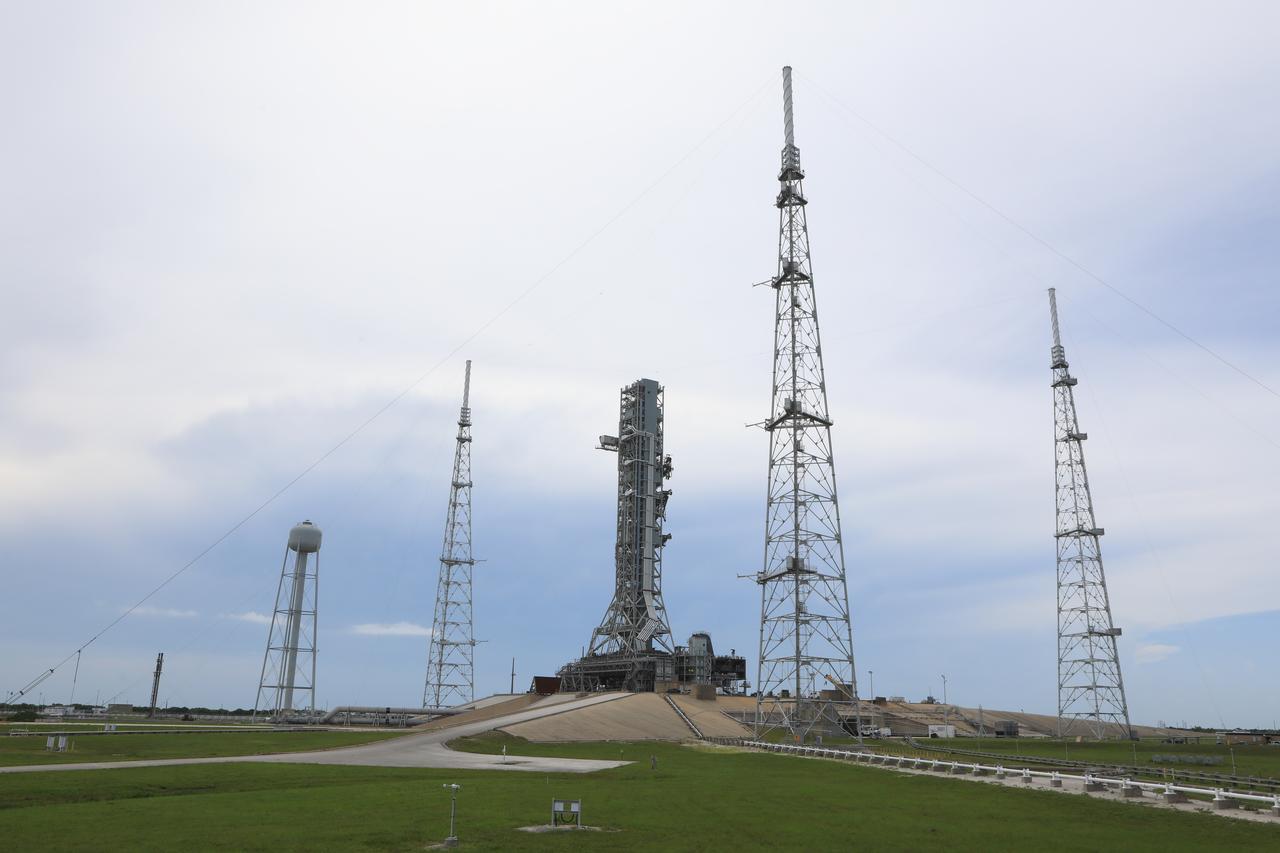
After successfully arriving at Kennedy Space Center’s Launch Complex 39B, Exploration Ground Systems’ mobile launcher is photographed at the pad surface on June 28, 2019. The mobile launcher began its final solo trek to the pad at midnight on June 27, departing from NASA’s Vehicle Assembly Building. The mobile launcher will remain at the pad over the summer, undergoing final testing and checkouts. Its next roll to the pad will be with the agency’s Space Launch System rocket and Orion in preparation for the launch of Artemis 1.
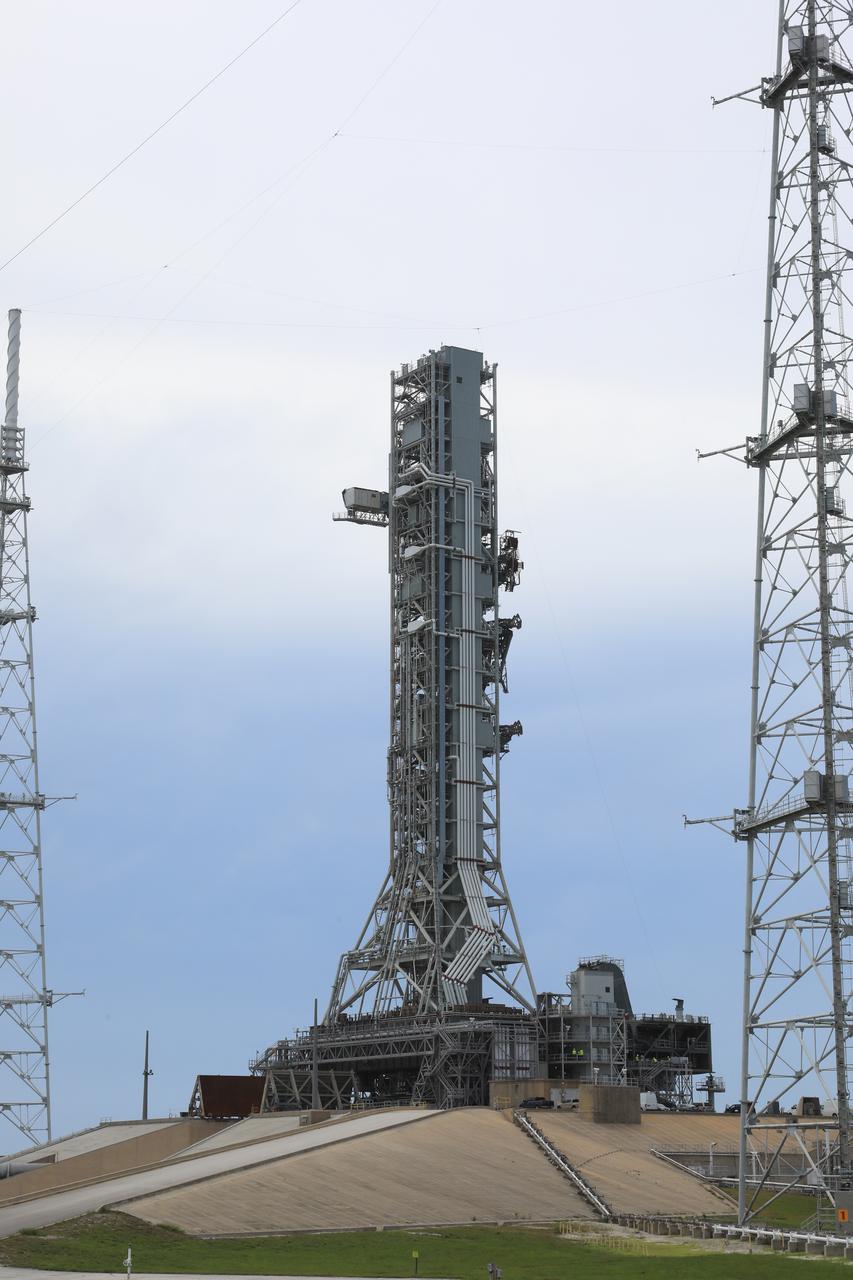
After successfully arriving at Kennedy Space Center’s Launch Complex 39B, Exploration Ground Systems’ mobile launcher is photographed at the pad surface on June 28, 2019. The mobile launcher began its final solo trek to the pad at midnight on June 27, departing from NASA’s Vehicle Assembly Building. The mobile launcher will remain at the pad over the summer, undergoing final testing and checkouts. Its next roll to the pad will be with the agency’s Space Launch System rocket and Orion in preparation for the launch of Artemis 1.
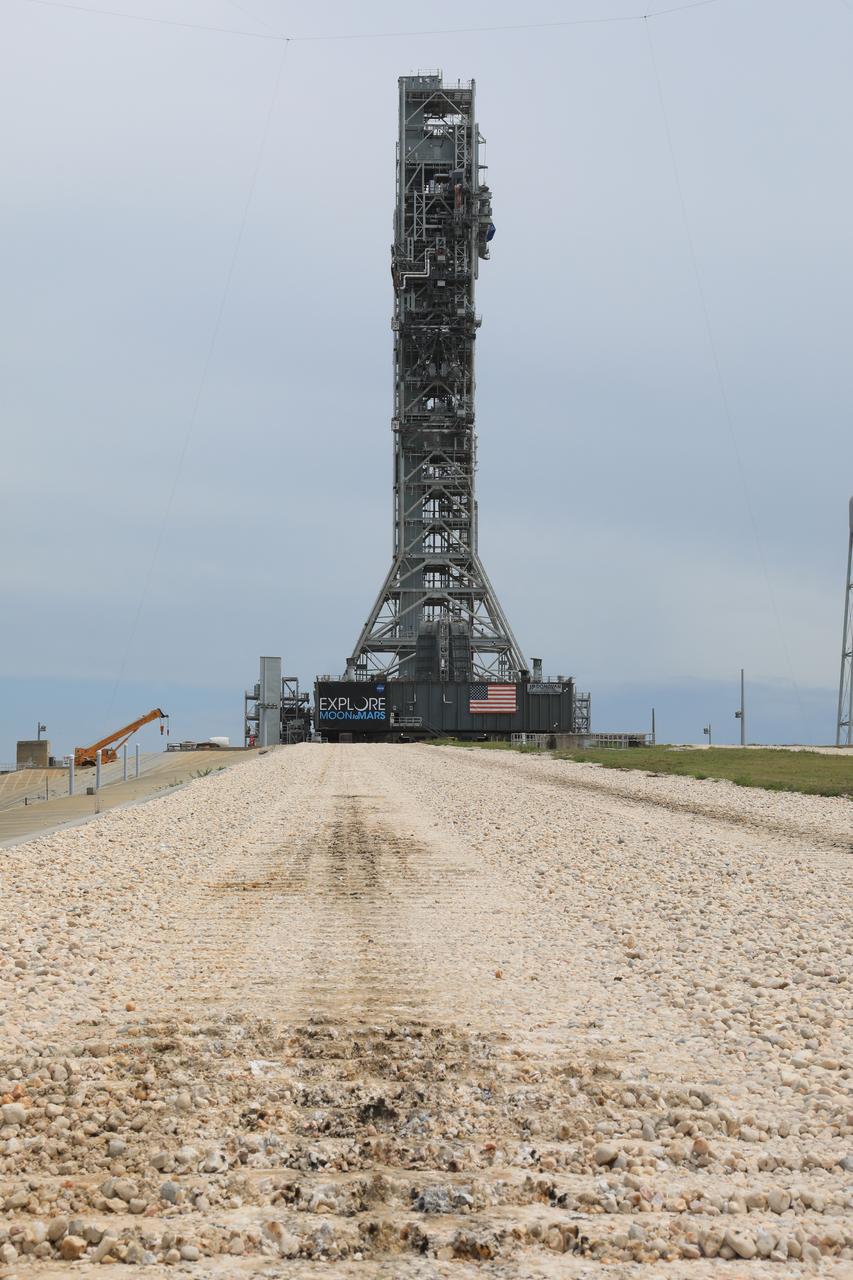
After successfully arriving at Kennedy Space Center’s Launch Complex 39B, Exploration Ground Systems’ mobile launcher is photographed at the pad surface on June 28, 2019. The mobile launcher began its final solo trek to the pad at midnight on June 27, departing from NASA’s Vehicle Assembly Building. The mobile launcher will remain at the pad over the summer, undergoing final testing and checkouts. Its next roll to the pad will be with the agency’s Space Launch System rocket and Orion in preparation for the launch of Artemis 1.
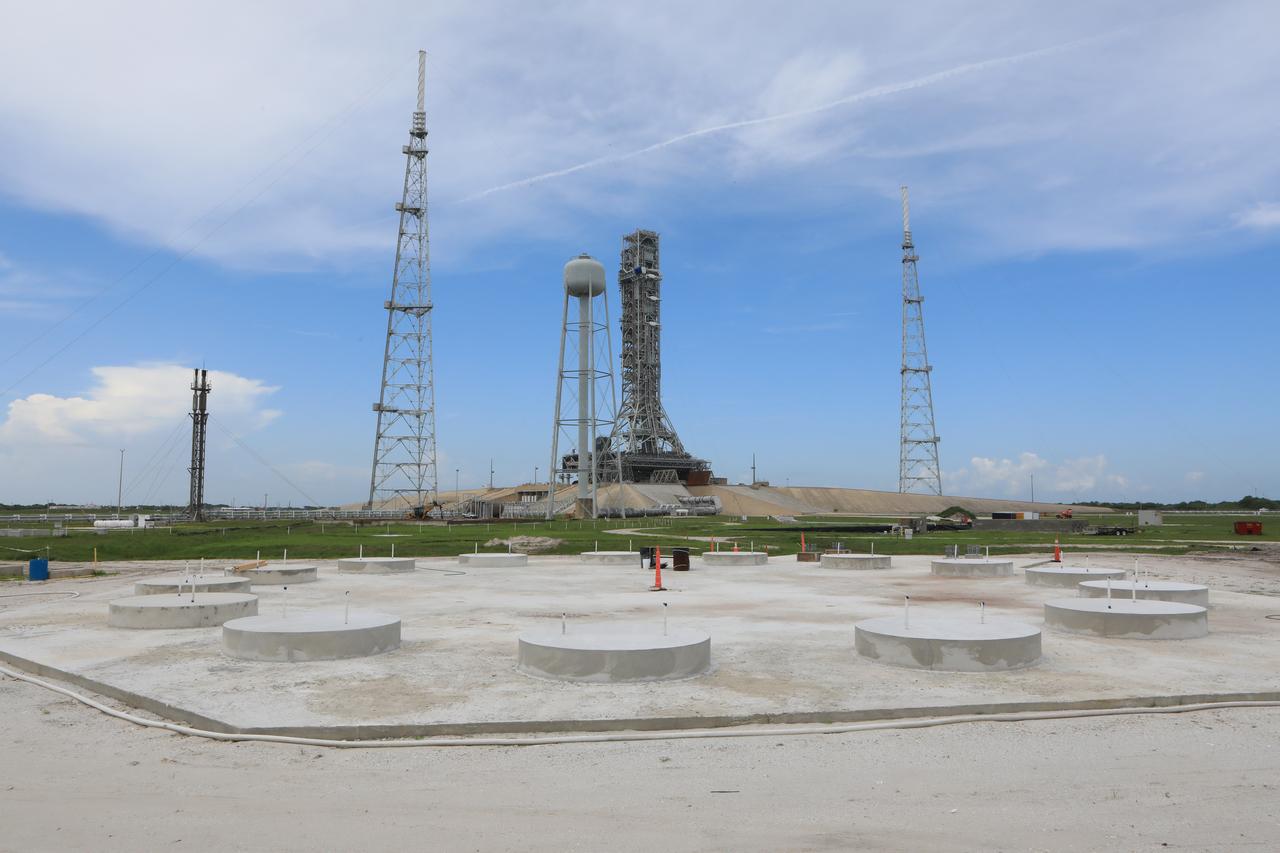
After successfully arriving at Kennedy Space Center’s Launch Complex 39B, Exploration Ground Systems’ mobile launcher is photographed at the pad surface on June 28, 2019. The mobile launcher began its final solo trek to the pad at midnight on June 27, departing from NASA’s Vehicle Assembly Building. The mobile launcher will remain at the pad over the summer, undergoing final testing and checkouts. Its next roll to the pad will be with the agency’s Space Launch System rocket and Orion in preparation for the launch of Artemis 1.
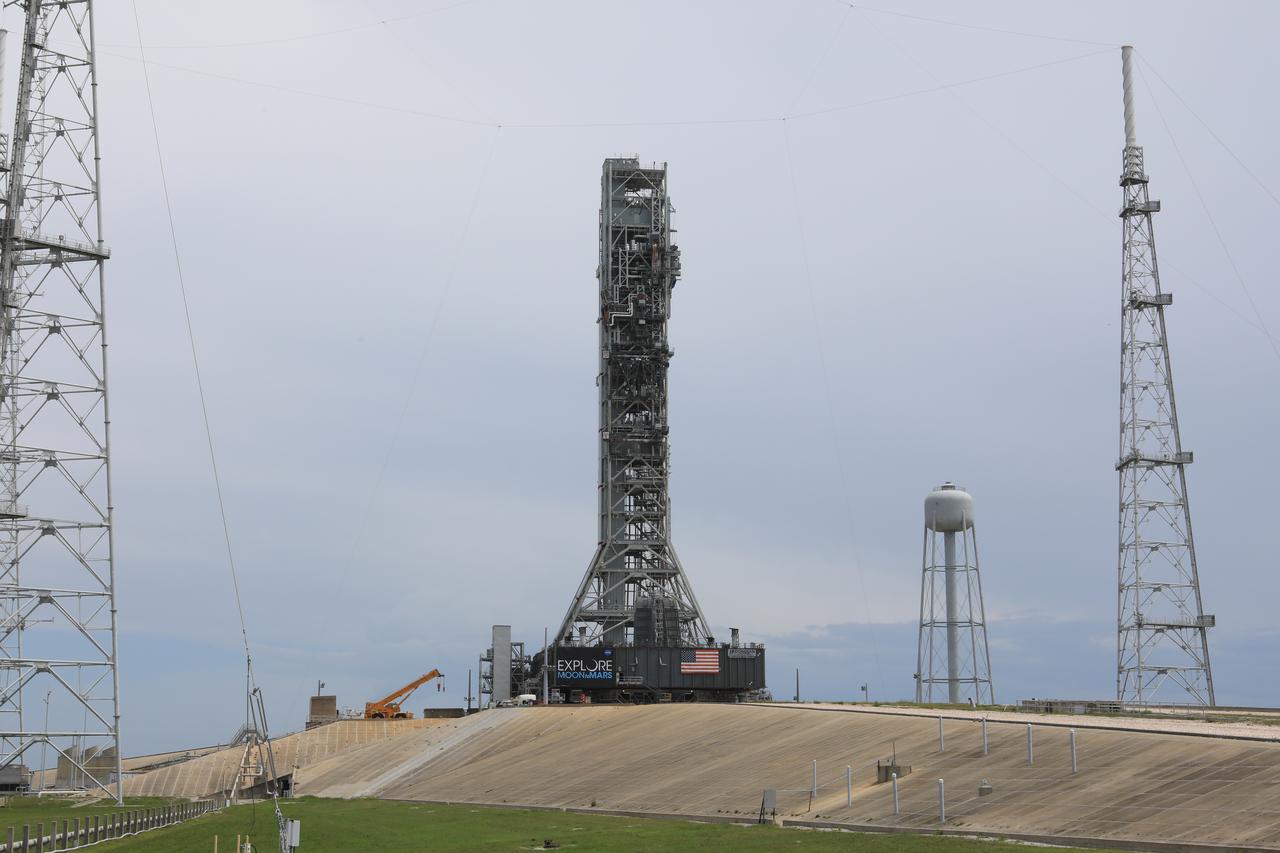
After successfully arriving at Kennedy Space Center’s Launch Complex 39B, Exploration Ground Systems’ mobile launcher is photographed at the pad surface on June 28, 2019. The mobile launcher began its final solo trek to the pad at midnight on June 27, departing from NASA’s Vehicle Assembly Building. The mobile launcher will remain at the pad over the summer, undergoing final testing and checkouts. Its next roll to the pad will be with the agency’s Space Launch System rocket and Orion in preparation for the launch of Artemis 1.
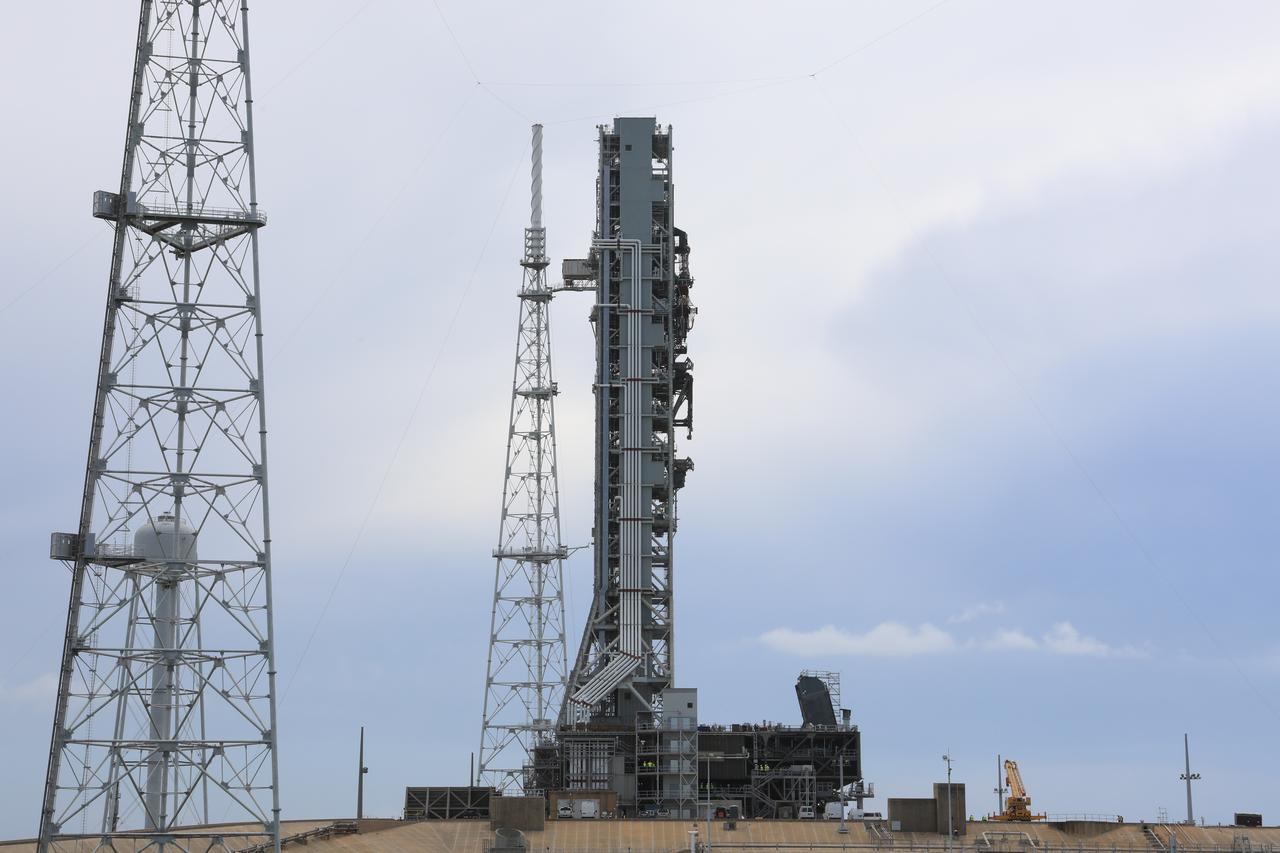
After successfully arriving at Kennedy Space Center’s Launch Complex 39B, Exploration Ground Systems’ mobile launcher is photographed at the pad surface on June 28, 2019. The mobile launcher began its final solo trek to the pad at midnight on June 27, departing from NASA’s Vehicle Assembly Building. The mobile launcher will remain at the pad over the summer, undergoing final testing and checkouts. Its next roll to the pad will be with the agency’s Space Launch System rocket and Orion in preparation for the launch of Artemis 1.

After successfully arriving at Kennedy Space Center’s Launch Complex 39B, Exploration Ground Systems’ mobile launcher is photographed at the pad surface on June 28, 2019. The mobile launcher began its final solo trek to the pad at midnight on June 27, departing from NASA’s Vehicle Assembly Building. The mobile launcher will remain at the pad over the summer, undergoing final testing and checkouts. Its next roll to the pad will be with the agency’s Space Launch System rocket and Orion in preparation for the launch of Artemis 1.
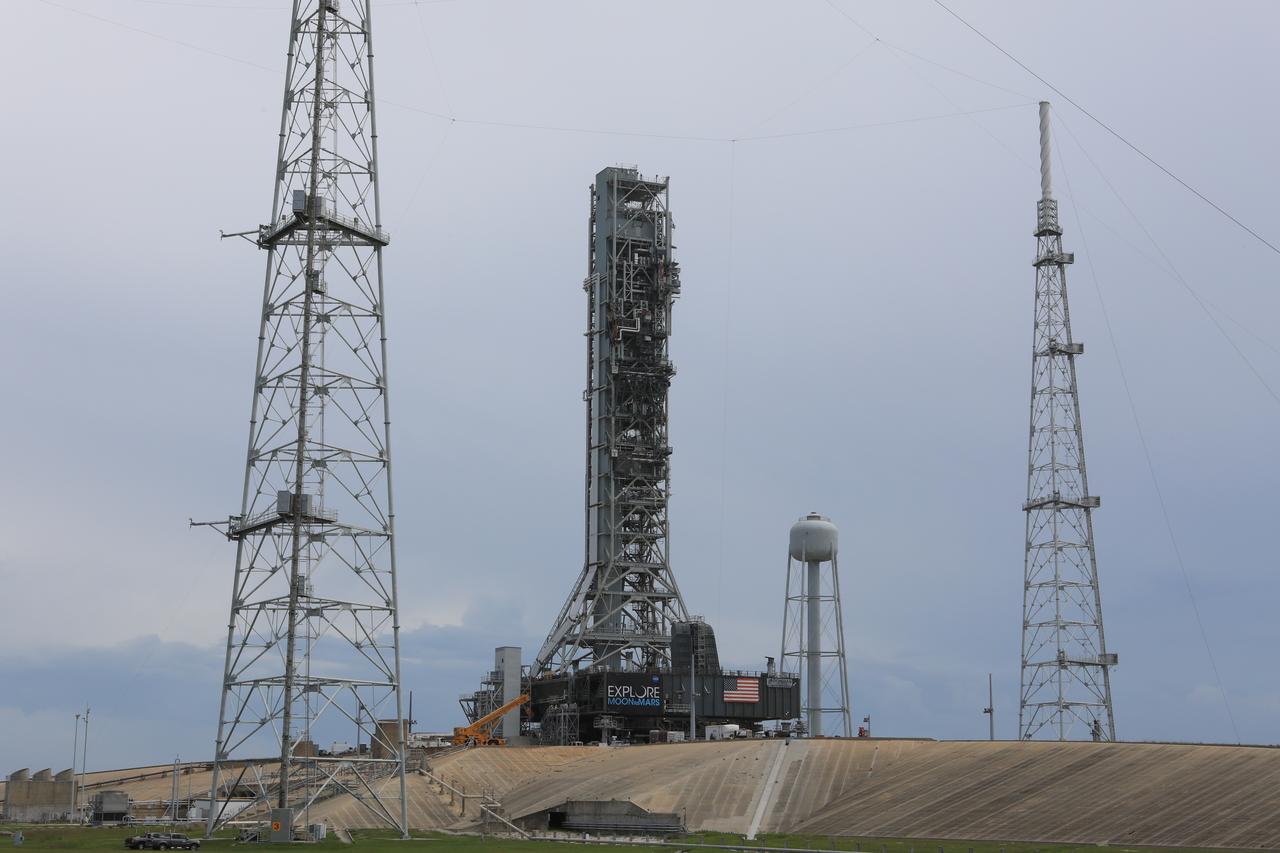
After successfully arriving at Kennedy Space Center’s Launch Complex 39B, Exploration Ground Systems’ mobile launcher is photographed at the pad surface on June 28, 2019. The mobile launcher began its final solo trek to the pad at midnight on June 27, departing from NASA’s Vehicle Assembly Building. The mobile launcher will remain at the pad over the summer, undergoing final testing and checkouts. Its next roll to the pad will be with the agency’s Space Launch System rocket and Orion in preparation for the launch of Artemis 1.
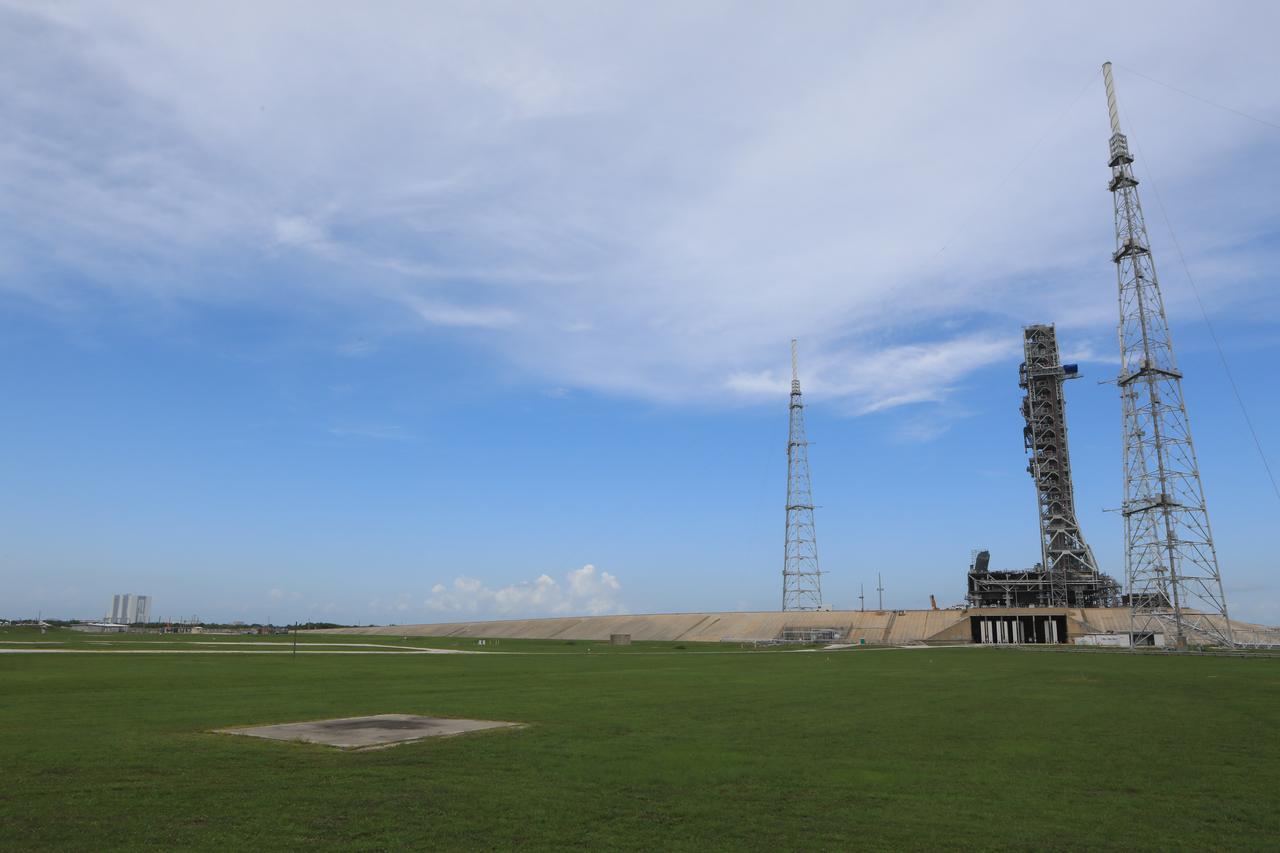
After successfully arriving at Kennedy Space Center’s Launch Complex 39B, Exploration Ground Systems’ mobile launcher is photographed at the pad surface on June 28, 2019. The mobile launcher began its final solo trek to the pad at midnight on June 27, departing from NASA’s Vehicle Assembly Building. The mobile launcher will remain at the pad over the summer, undergoing final testing and checkouts. Its next roll to the pad will be with the agency’s Space Launch System rocket and Orion in preparation for the launch of Artemis 1.
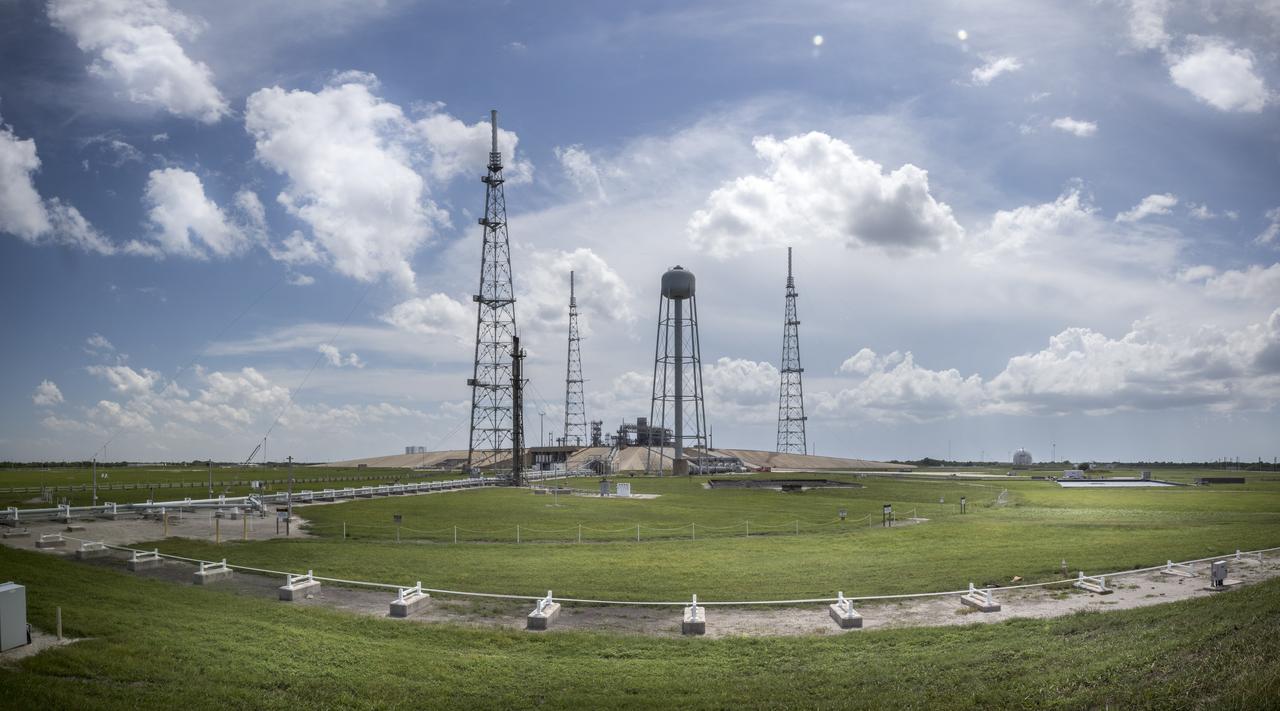
A full view of Launch Pad 39B at NASA's Kennedy Space Center in Florida on July 26, 2018. The launch pad has undergone upgrades and modifications to accommodate NASA's Space Launch System and Orion spacecraft for Exploration Mission-1 and other deep space missions. New heat-resistant bricks have been installed on the walls and a new flame deflector is in place. In view are the three lightning protection system towers and water tank. The clean pad concept is designed to support NASA and commercial launch providers at the multi-user spaceport.
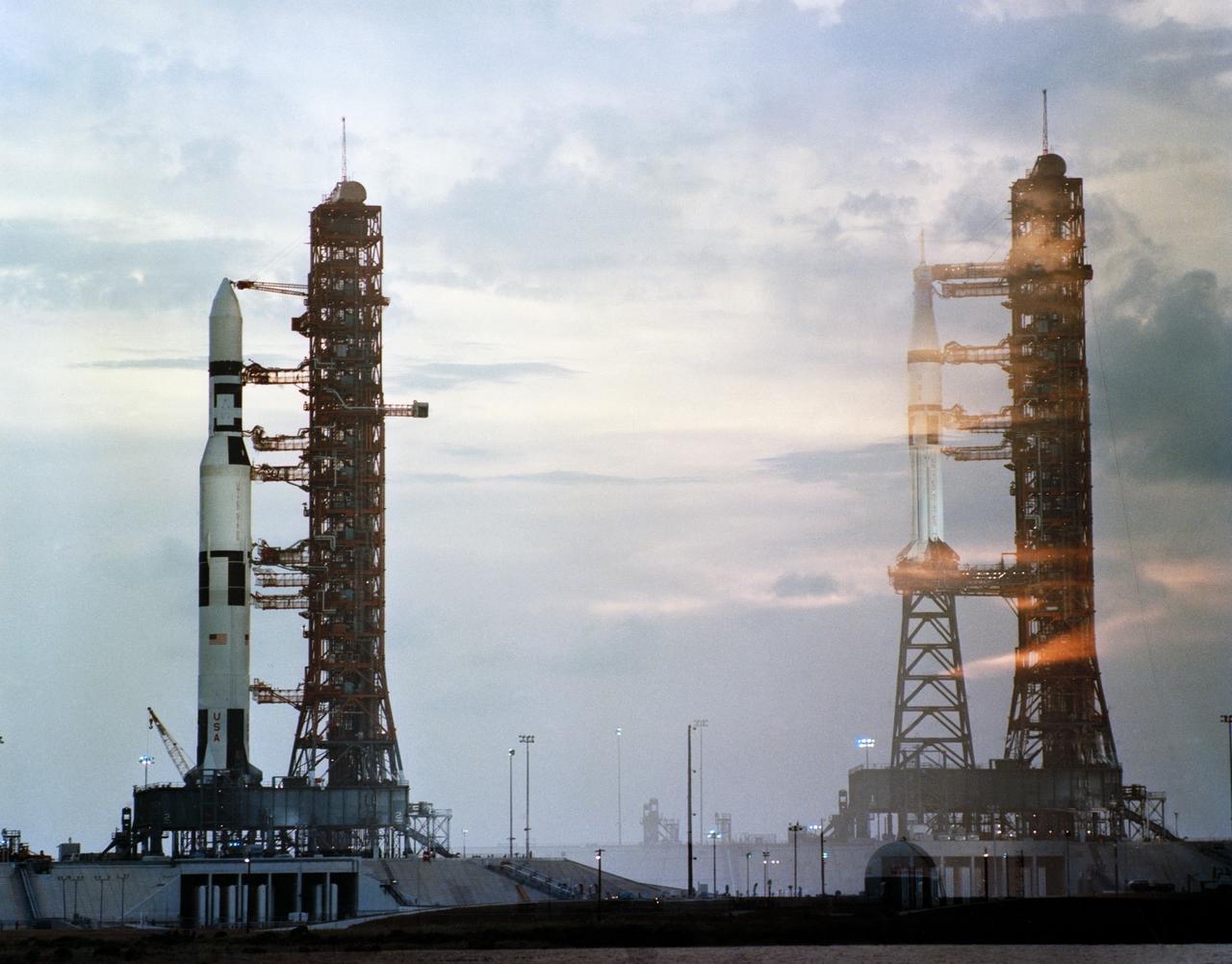
S73-25654 (7 May 1973) --- A deliberate double exposure to help illustrate the comparative sizes and configurations of the Skylab 1 and Skylab 2 space vehicles at Launch Complex 39, Kennedy Space Center, Florida. The double exposure creates an illusion that the rockets are side by side, though actually they are one and a half miles apart. The Skylab 1/ Saturn 1B space vehicle on Pad A is on the left. On the right is the Skylab 2/ Saturn 1B space vehicle on Pad B. The Skylab 1 payload is the space station cluster. The Skylab 2 payload will be an Apollo Command/Service Module (CSM) with astronauts Charles Conrad Jr., Joseph P. Kerwin and Paul J. Weitz aboard. The Saturn V launch vehicle is composed of a Saturn V first (S-1C) stage, a Saturn V second (S-11) stage, and the Skylab payload. The Saturn 1B launch vehicle consists of a Saturn 1B first (S-1B) stage, a Saturn 1B second (S-1VB) stage, and the CSM payload including its launch escape system. Photo credit: NASA
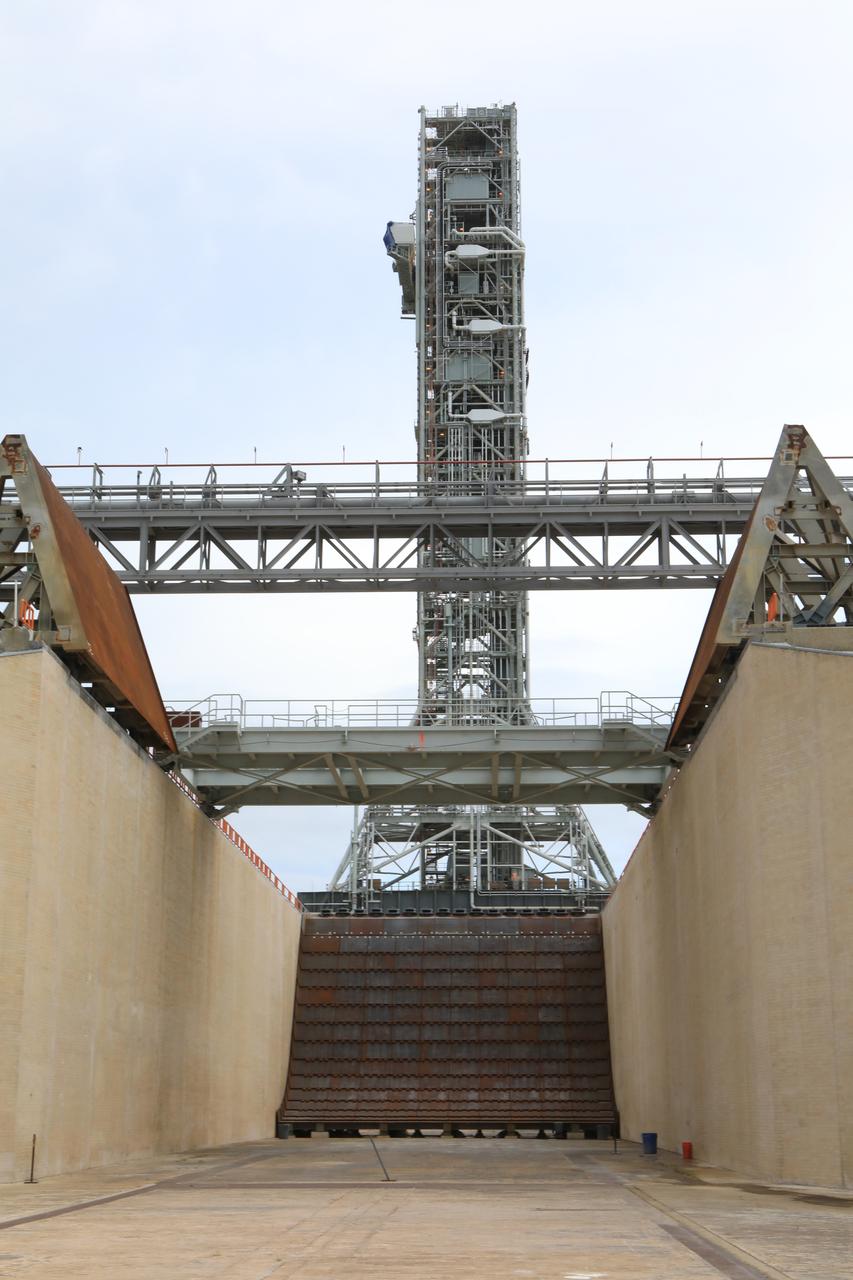
In this view from the flame trench at Kennedy Space Center’s Launch Complex 39B in Florida, Exploration Ground Systems’ mobile launcher can be seen on the pad surface on June 28, 2019. The mobile launcher began its final solo trek – atop crawler-transporter 2 – to the pad at midnight on June 27, departing from NASA’s Vehicle Assembly Building and continuing up to the pad surface on June 28. The mobile launcher will remain at the pad over the summer, undergoing final testing and checkouts. Its next roll to the pad will be with the agency’s Space Launch System rocket and Orion in preparation for the launch of Artemis 1.
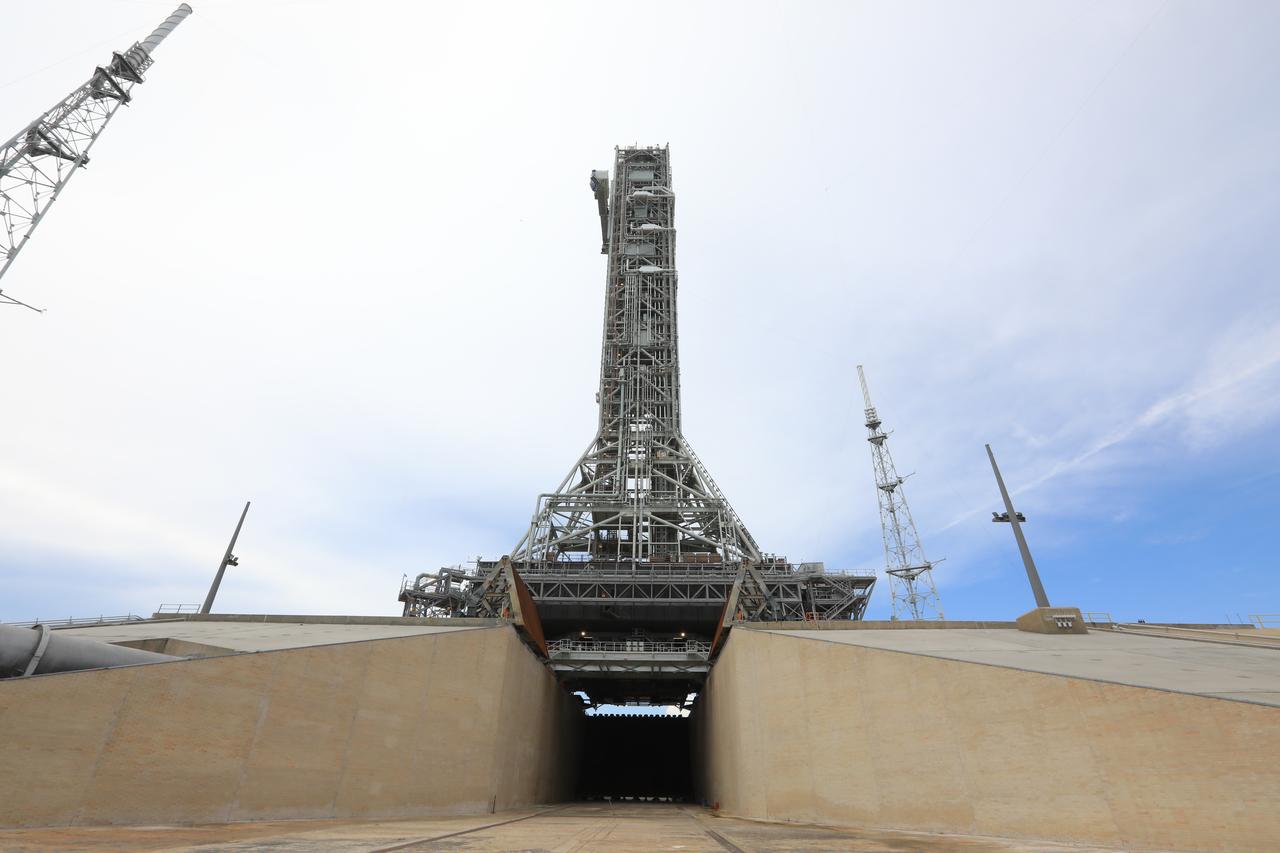
In this view from the flame trench at Kennedy Space Center’s Launch Complex 39B in Florida, Exploration Ground Systems’ mobile launcher can be seen on the pad surface on June 28, 2019. The mobile launcher began its final solo trek – atop crawler-transporter 2 – to the pad at midnight on June 27, departing from NASA’s Vehicle Assembly Building and continuing up to the pad surface on June 28. The mobile launcher will remain at the pad over the summer, undergoing final testing and checkouts. Its next roll to the pad will be with the agency’s Space Launch System rocket and Orion in preparation for the launch of Artemis 1.
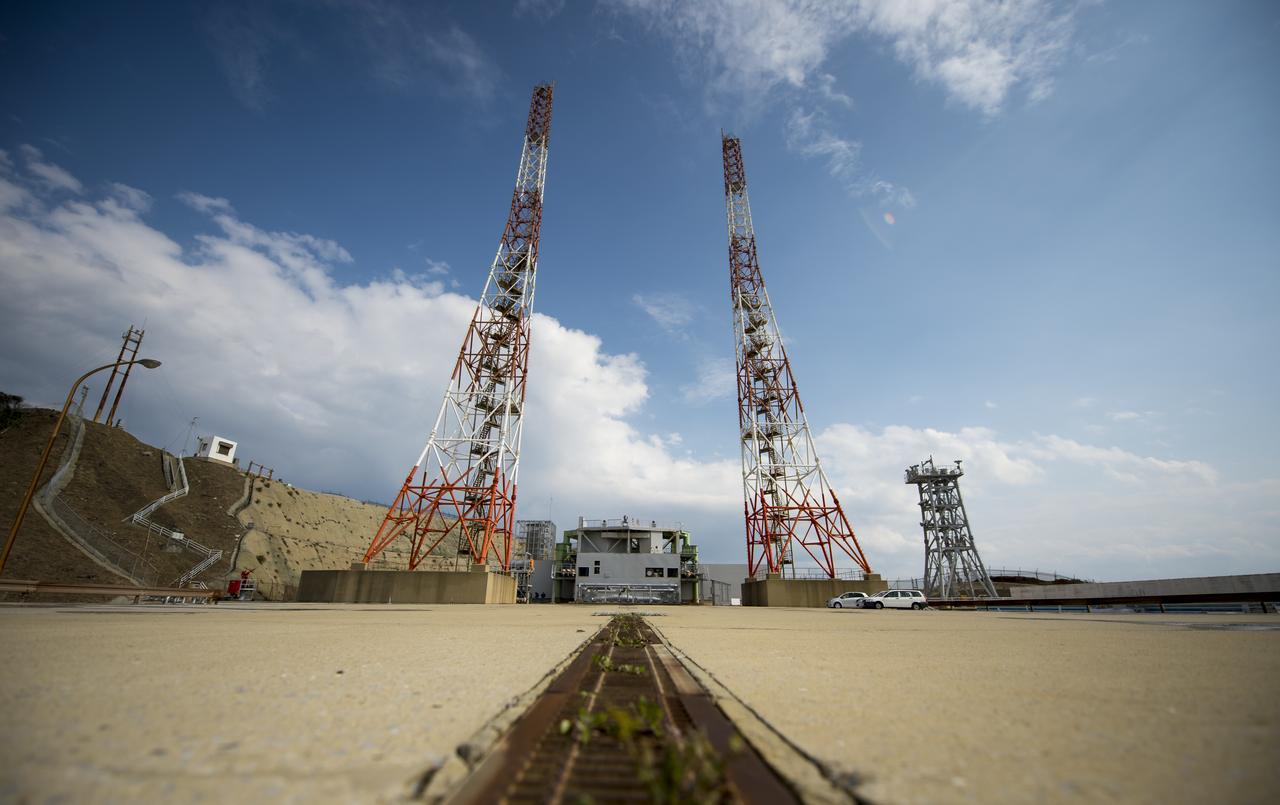
Launch pad 1 is seen at the Tanegashima Space Center (TNSC) on Monday, Feb. 24, 2014 in Tanegashima, Japan. A Japanese H-IIA rocket carrying the NASA-Japan Aerospace Exploration Agency (JAXA), Global Precipitation Measurement (GPM) Core Observatory is planned for launch from pad 1 on Feb. 28, 2014. Once launched, the GPM spacecraft will collect information that unifies data from an international network of existing and future satellites to map global rainfall and snowfall every three hours. Photo Credit: (NASA/Bill Ingalls)
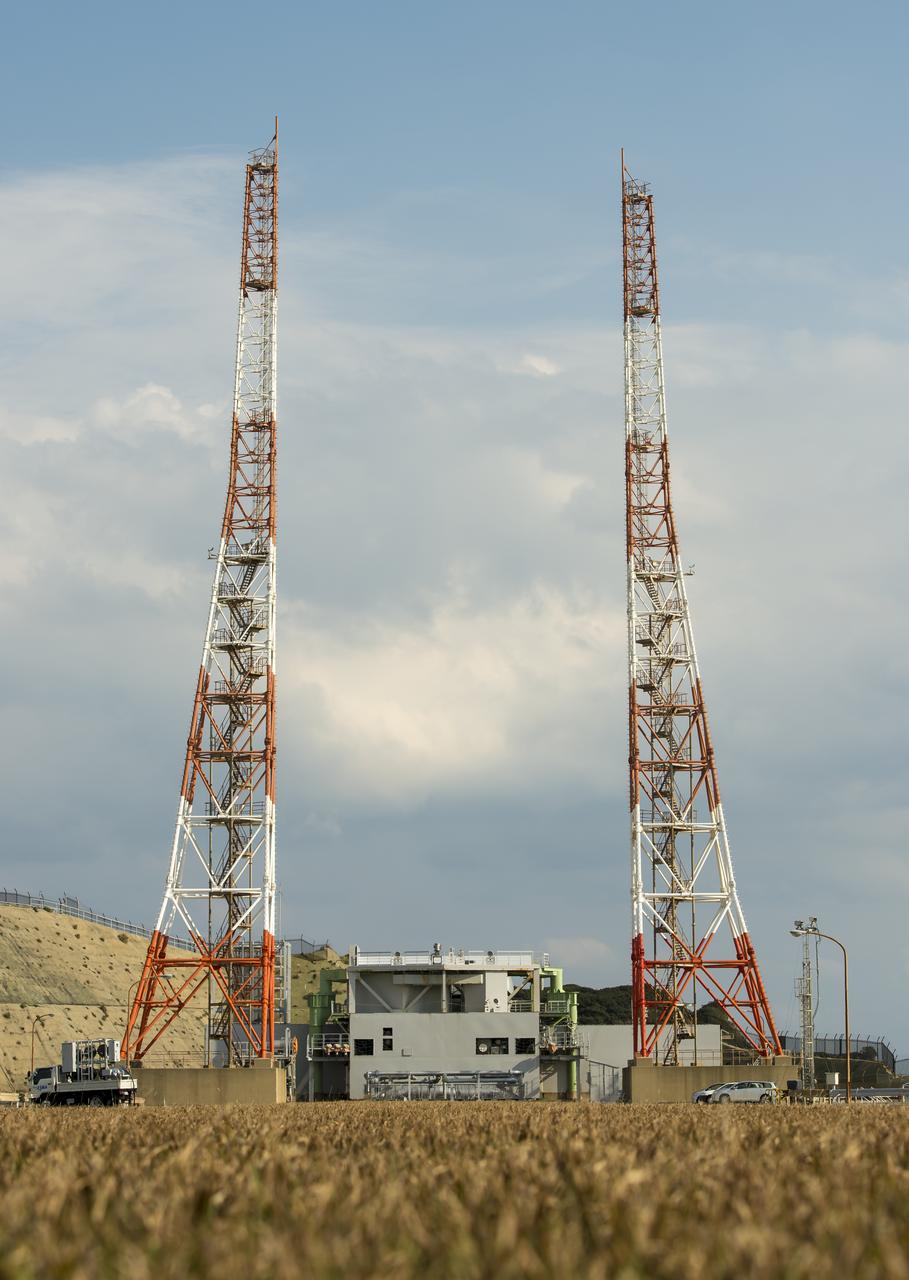
Launch pad 1 is seen at the Tanegashima Space Center (TNSC) on Monday, Feb. 24, 2014 in Tanegashima, Japan. A Japanese H-IIA rocket carrying the NASA-Japan Aerospace Exploration Agency (JAXA), Global Precipitation Measurement (GPM) Core Observatory is planned for launch from pad 1 on Feb. 28, 2014. Once launched, the GPM spacecraft will collect information that unifies data from an international network of existing and future satellites to map global rainfall and snowfall every three hours. Photo Credit: (NASA/Bill Ingalls)
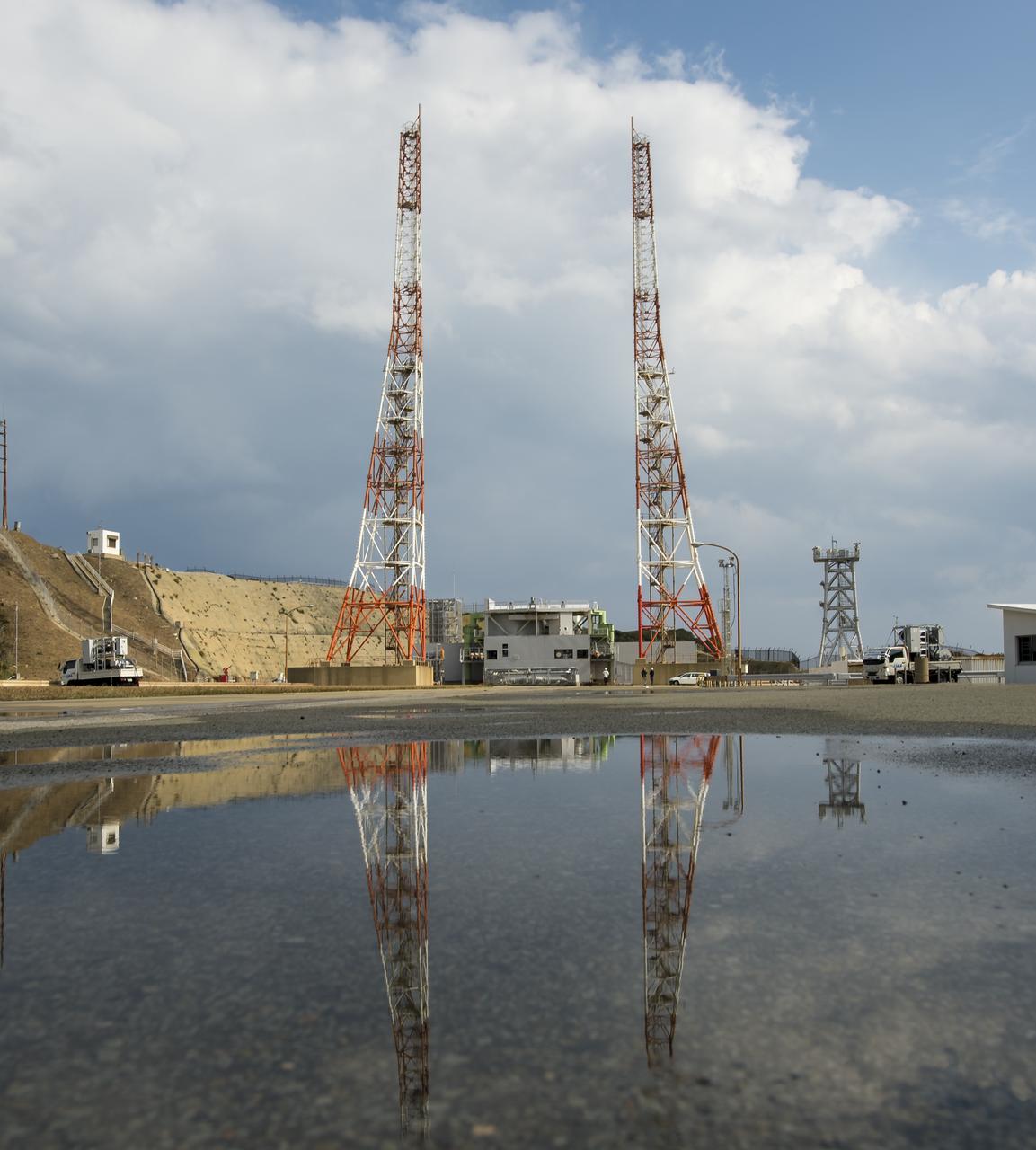
Launch pad 1 is seen at the Tanegashima Space Center (TNSC) on Monday, Feb. 24, 2014 in Tanegashima, Japan. A Japanese H-IIA rocket carrying the NASA-Japan Aerospace Exploration Agency (JAXA), Global Precipitation Measurement (GPM) Core Observatory is planned for launch from pad 1 on Feb. 28, 2014. Once launched, the GPM spacecraft will collect information that unifies data from an international network of existing and future satellites to map global rainfall and snowfall every three hours. Photo Credit: (NASA/Bill Ingalls)
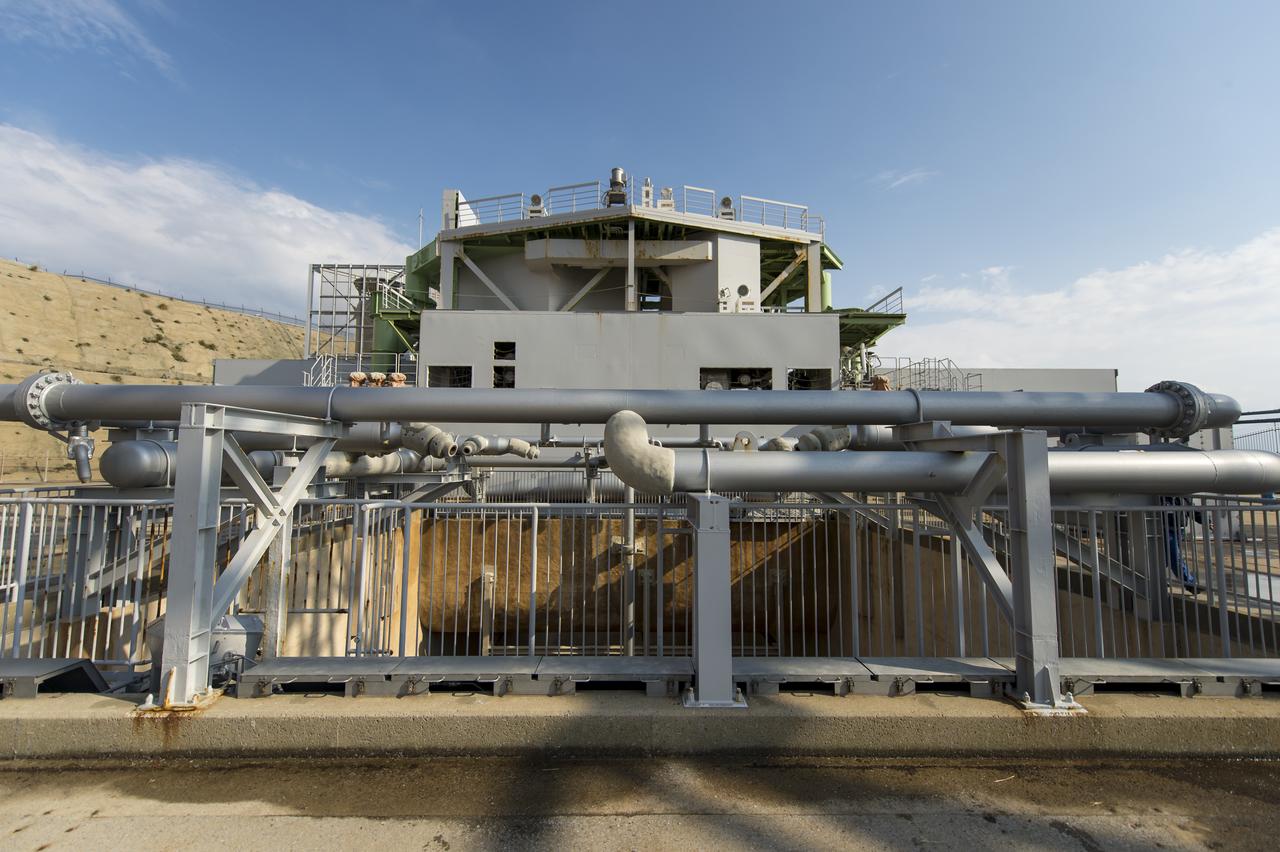
Launch pad 1 is seen at the Tanegashima Space Center (TNSC) on Monday, Feb. 24, 2014 in Tanegashima, Japan. A Japanese H-IIA rocket carrying the NASA-Japan Aerospace Exploration Agency (JAXA), Global Precipitation Measurement (GPM) Core Observatory is planned for launch from pad 1 on Feb. 28, 2014. Once launched, the GPM spacecraft will collect information that unifies data from an international network of existing and future satellites to map global rainfall and snowfall every three hours. Photo Credit: (NASA/Bill Ingalls)
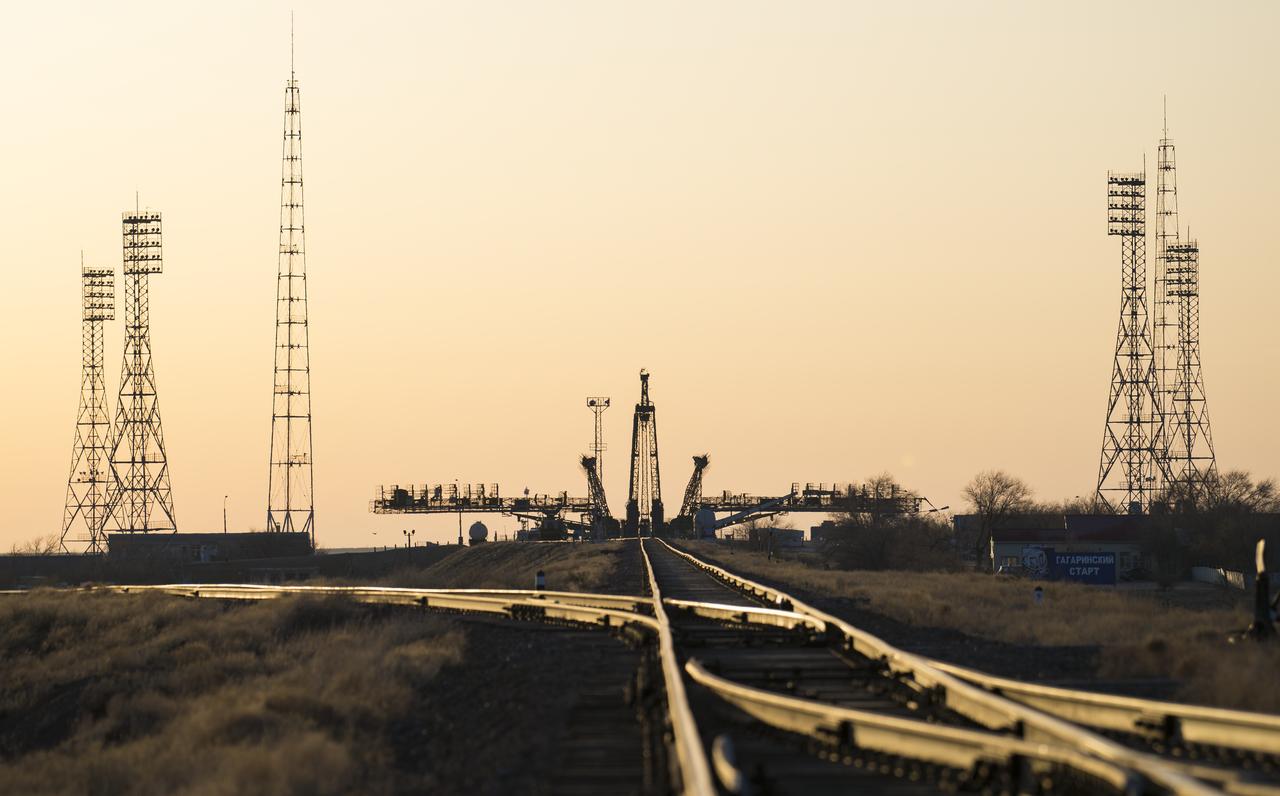
Launch Pad 1 is seen as the Soyuz MS-04 spacecraft is rolled out to the launch pad by train on Monday, April 17, 2017 at the Baikonur Cosmodrome in Kazakhstan. Launch of the Soyuz rocket is scheduled for April 20 and will carry Expedition 51 Soyuz Commander Fyodor Yurchikhin of Roscosmos and Flight Engineer Jack Fischer of NASA into orbit to begin their four and a half month mission on the International Space Station.Photo Credit: (NASA/Aubrey Gemignani)
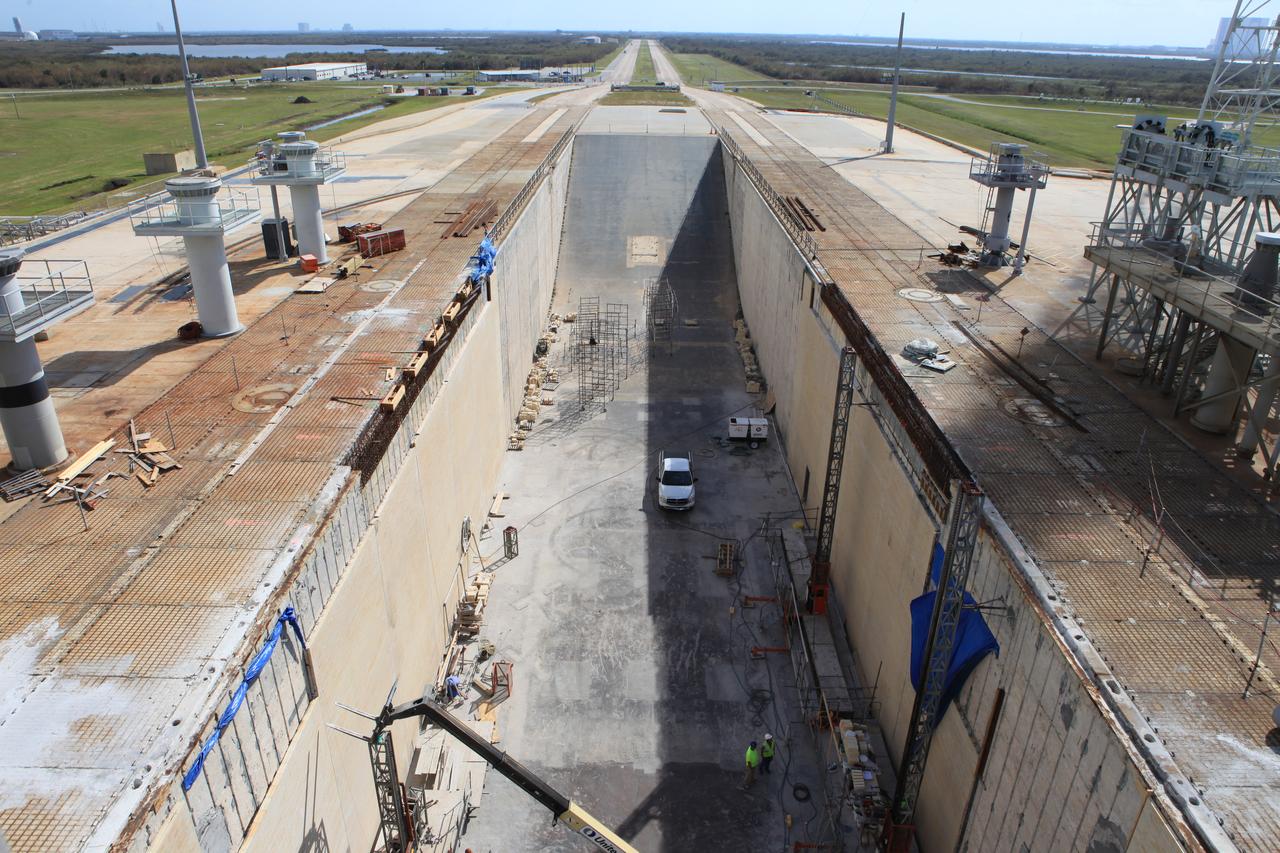
Progress on the new brick walls of the north side of the flame trench at Launch Pad 39B is seen in a view from the top of the pad at NASA’s Kennedy Space Center in Florida. Construction workers with J.P. Donovan of Rockledge, Florida, continue to install new heat-resistant bricks on the concrete walls. The Pad B flame trench is being refurbished to support the launch of NASA’s Space Launch System rocket. The Ground Systems Development and Operations (GSDO) Program at Kennedy is helping transform the space center into a multi-user spaceport and prepare for Exploration Mission 1, deep-space missions, and the journey to Mars. For more information about GSDO, visit: http://www.nasa.gov/groundsystems.
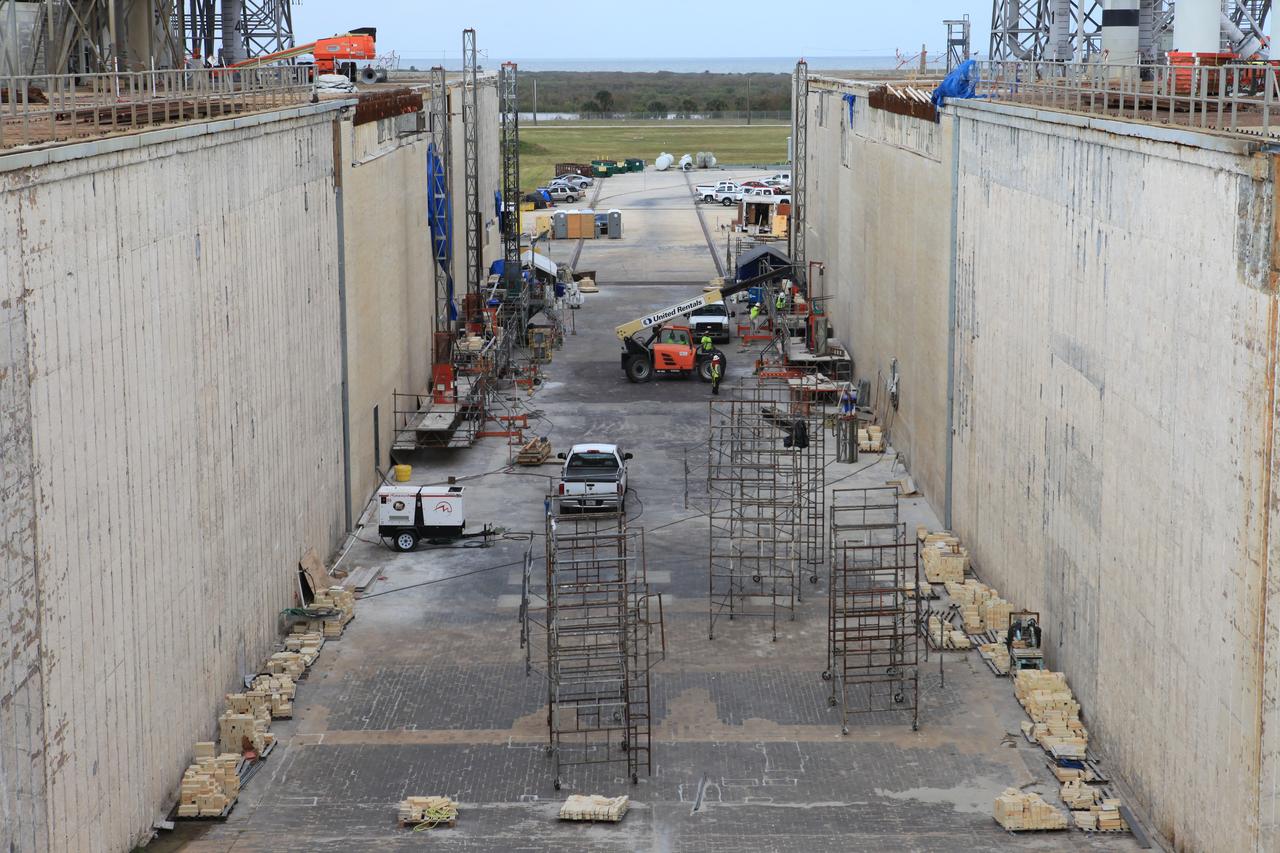
Progress on the new brick walls of the north side of the flame trench at Launch Pad 39B is seen in a view from the top of the pad at NASA’s Kennedy Space Center in Florida. Construction workers with J.P. Donovan of Rockledge, Florida, continue to install new heat-resistant bricks on the concrete walls. The Pad B flame trench is being refurbished to support the launch of NASA’s Space Launch System rocket. The Ground Systems Development and Operations (GSDO) Program at Kennedy is helping transform the space center into a multi-user spaceport and prepare for Exploration Mission 1, deep-space missions, and the journey to Mars. For more information about GSDO, visit: http://www.nasa.gov/groundsystems.
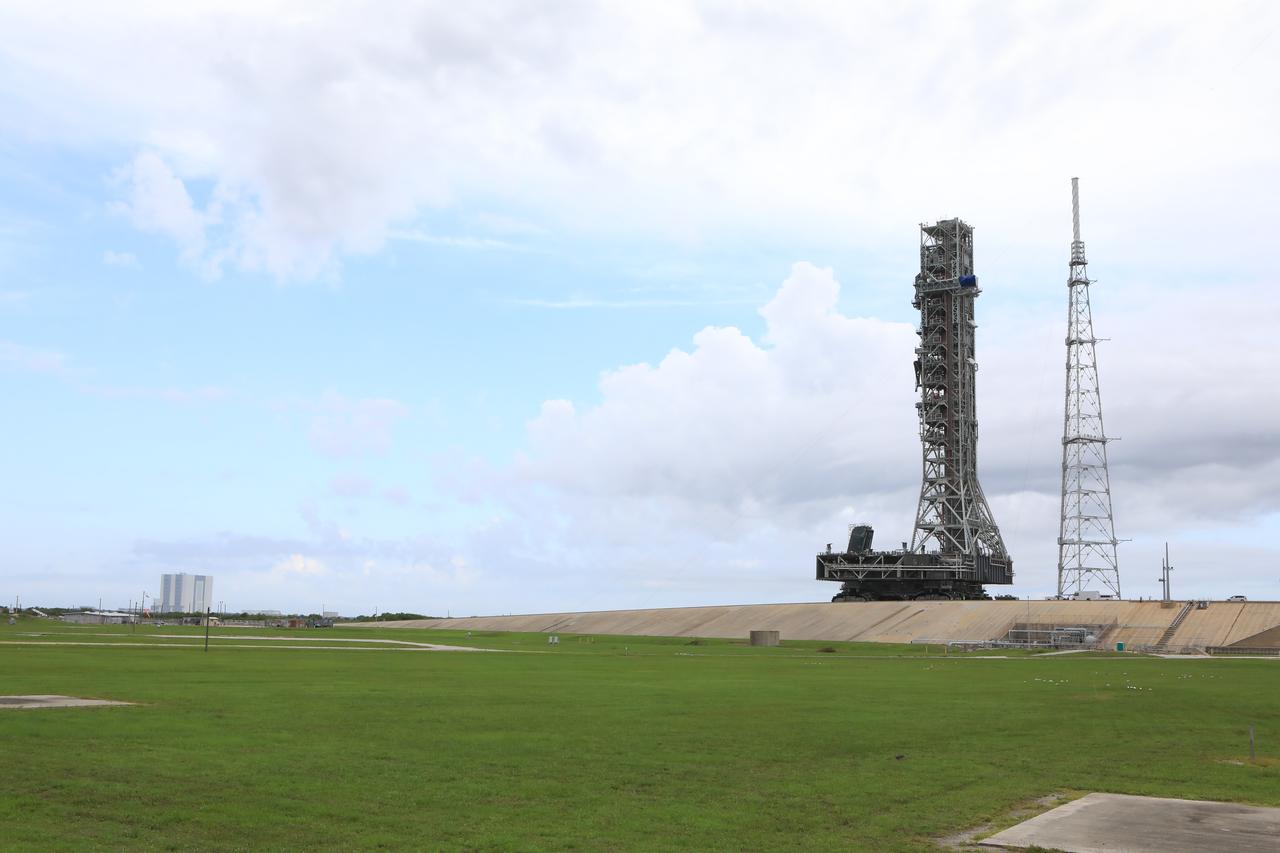
After successfully arriving at Kennedy Space Center’s Launch Complex 39B, Exploration Ground Systems’ mobile launcher is photographed at the pad surface atop crawler-transporter 2 on June 28, 2019. The mobile launcher began its final solo trek to the pad at midnight on June 27, departing from NASA’s Vehicle Assembly Building. The mobile launcher will remain at the pad over the summer, undergoing final testing and checkouts. Its next roll to the pad will be with the agency’s Space Launch System rocket and Orion in preparation for the launch of Artemis 1.
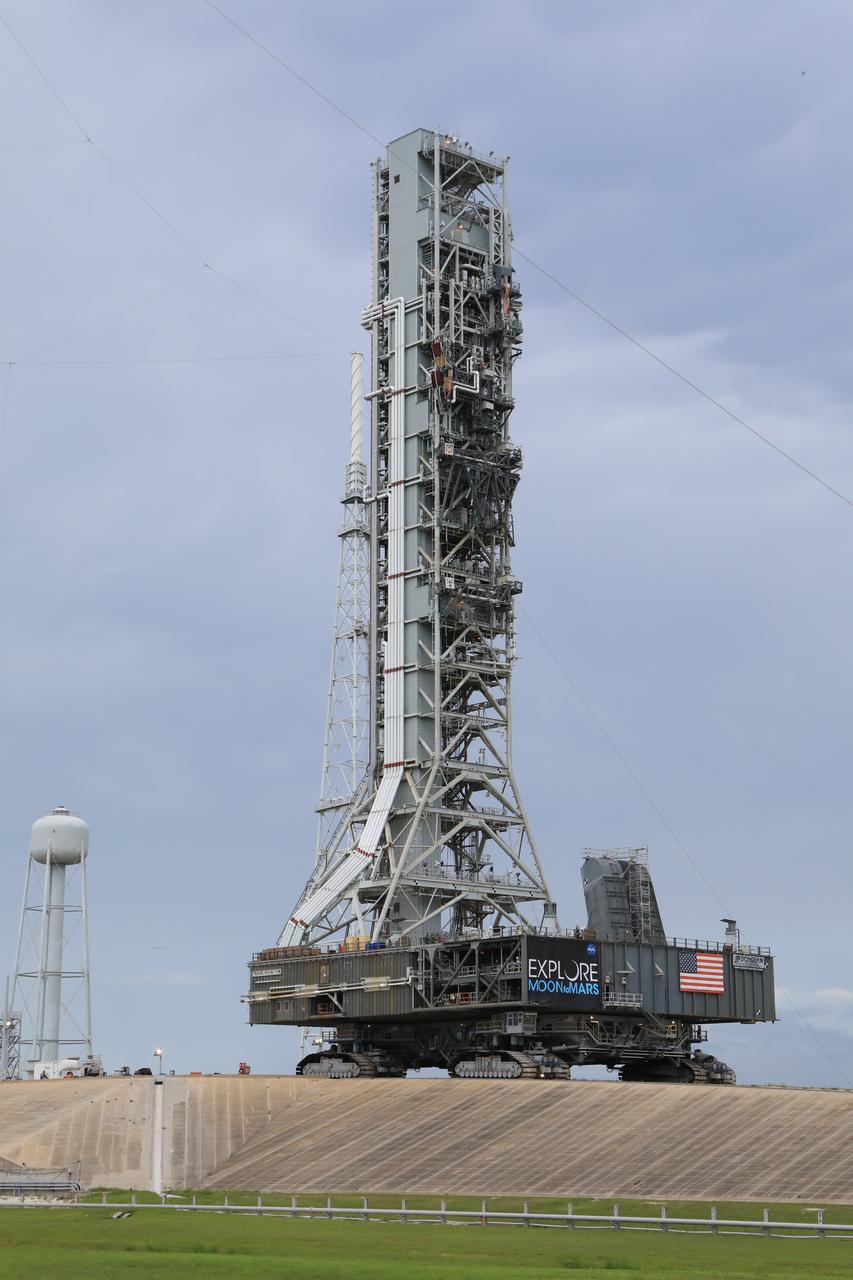
After successfully arriving at Kennedy Space Center’s Launch Complex 39B, Exploration Ground Systems’ mobile launcher is photographed at the pad surface atop crawler-transporter 2 on June 28, 2019. The mobile launcher began its final solo trek to the pad at midnight on June 27, departing from NASA’s Vehicle Assembly Building. The mobile launcher will remain at the pad over the summer, undergoing final testing and checkouts. Its next roll to the pad will be with the agency’s Space Launch System rocket and Orion in preparation for the launch of Artemis 1.
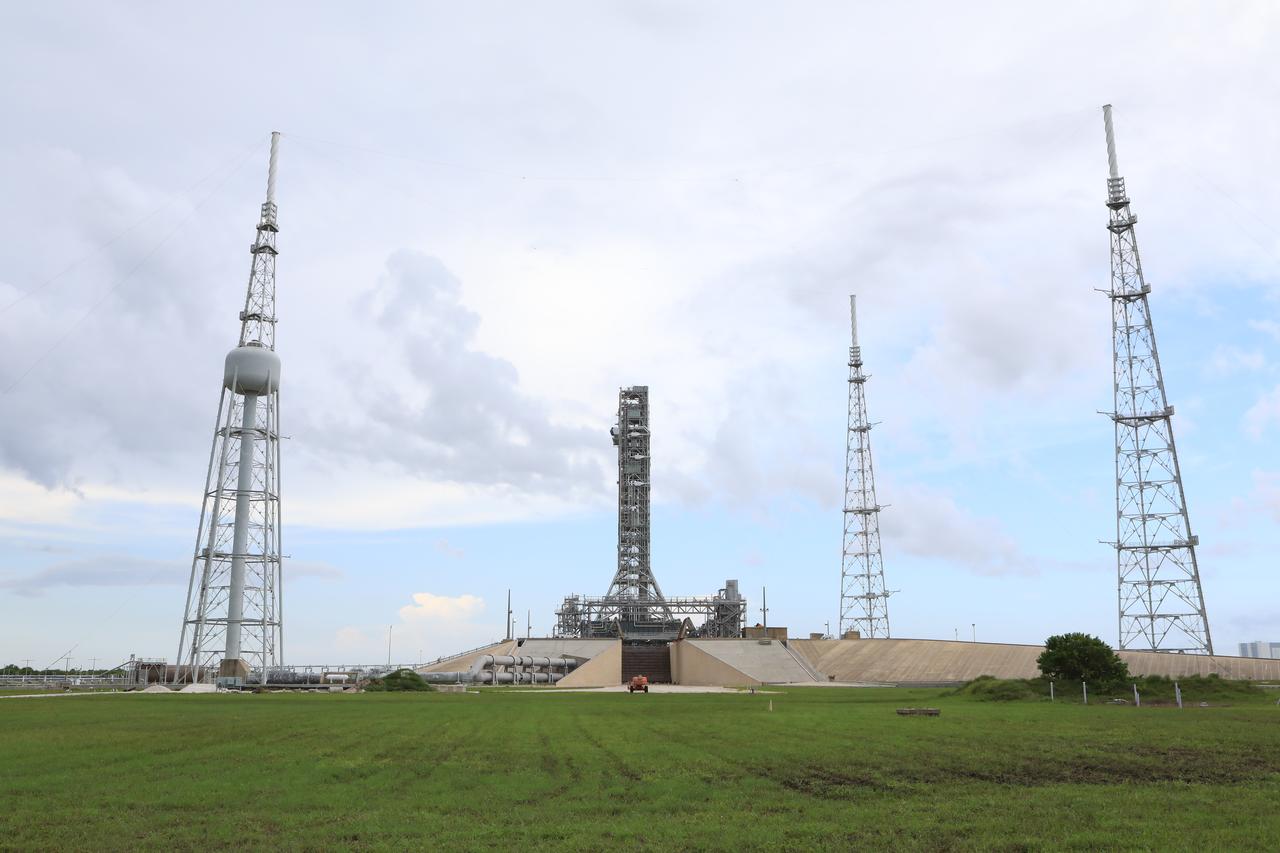
After successfully arriving at Kennedy Space Center’s Launch Complex 39B, Exploration Ground Systems’ mobile launcher is photographed at the pad surface atop crawler-transporter 2 on June 28, 2019. The mobile launcher began its final solo trek to the pad at midnight on June 27, departing from NASA’s Vehicle Assembly Building. The mobile launcher will remain at the pad over the summer, undergoing final testing and checkouts. Its next roll to the pad will be with the agency’s Space Launch System rocket and Orion in preparation for the launch of Artemis 1.
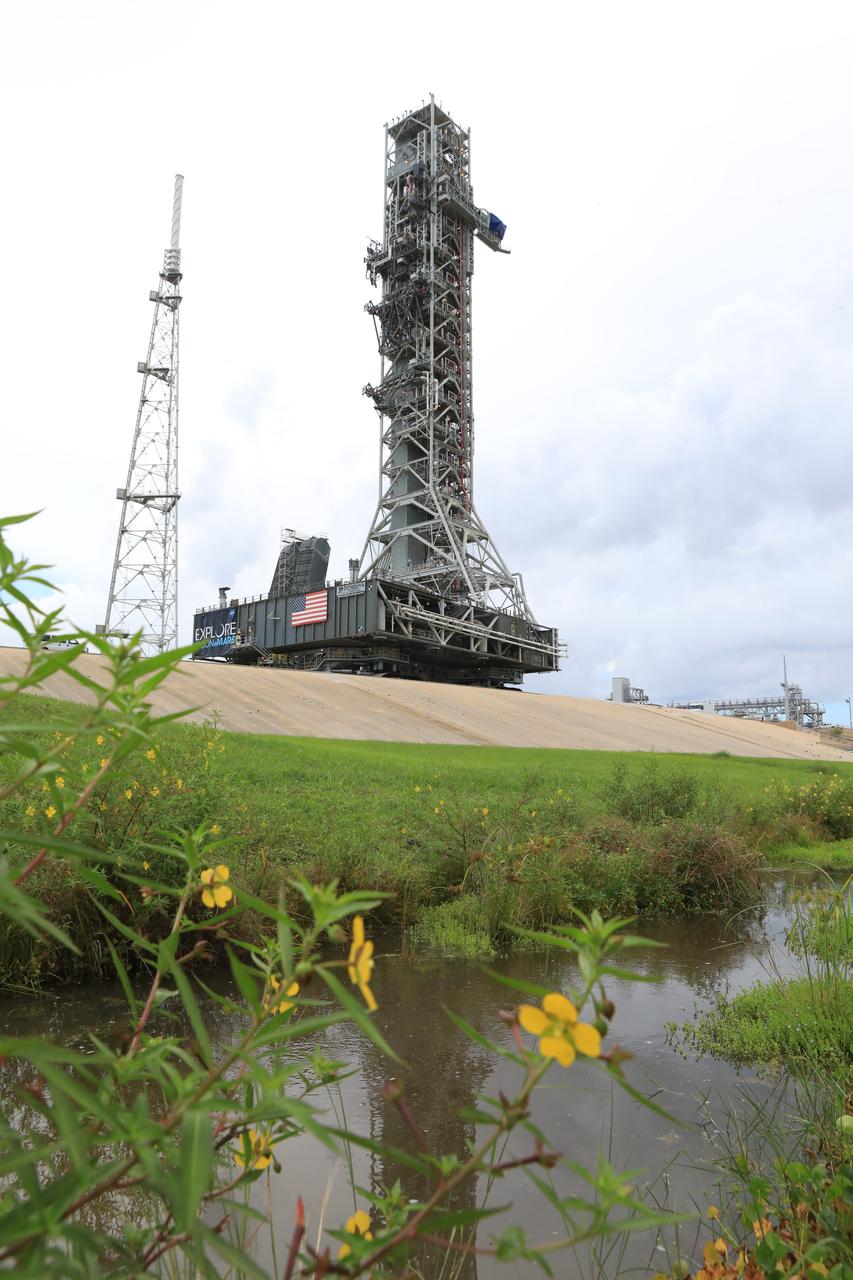
After successfully arriving at Kennedy Space Center’s Launch Complex 39B, Exploration Ground Systems’ mobile launcher is photographed at the pad surface atop crawler-transporter 2 on June 28, 2019. The mobile launcher began its final solo trek to the pad at midnight on June 27, departing from NASA’s Vehicle Assembly Building. The mobile launcher will remain at the pad over the summer, undergoing final testing and checkouts. Its next roll to the pad will be with the agency’s Space Launch System rocket and Orion in preparation for the launch of Artemis 1.
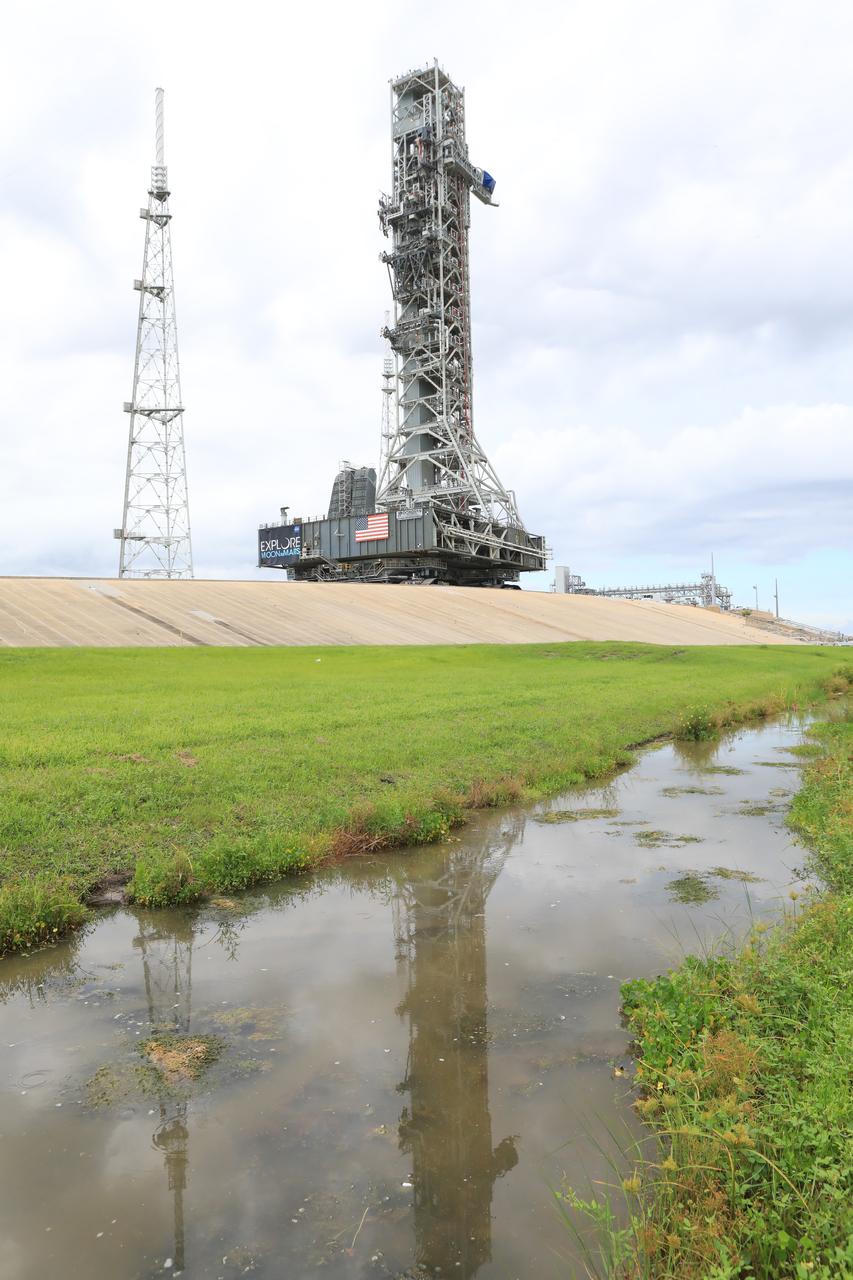
After successfully arriving at Kennedy Space Center’s Launch Complex 39B, Exploration Ground Systems’ mobile launcher is photographed at the pad surface atop crawler-transporter 2 on June 28, 2019. The mobile launcher began its final solo trek to the pad at midnight on June 27, departing from NASA’s Vehicle Assembly Building. The mobile launcher will remain at the pad over the summer, undergoing final testing and checkouts. Its next roll to the pad will be with the agency’s Space Launch System rocket and Orion in preparation for the launch of Artemis 1.
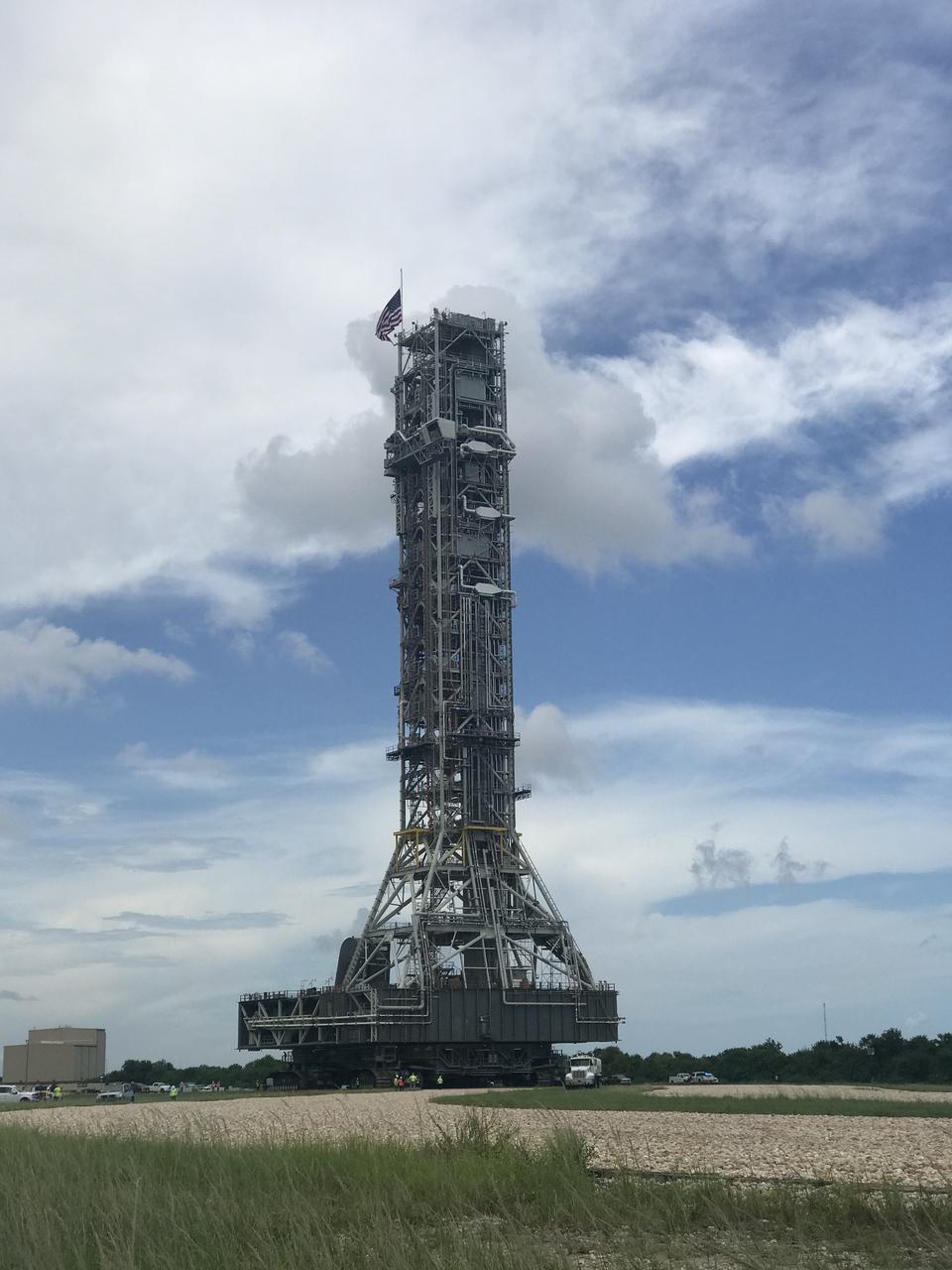
NASA's mobile launcher (ML) atop crawler-transporter 2 begins its trek to Launch Pad 39B on Aug. 30, 2018, at the agency's Kennedy Space Center in Florida. The ML will undergo a fit check on the surface of the pad, followed by several days of systems testing. The 380-foot-tall mobile launcher is equipped with the crew access arm and several umbilicals that will provide power, environmental control, pneumatics, communication and electrical connections to NASA's Space Launch System (SLS) and Orion spacecraft. Exploration Ground Systems is preparing the ground systems necessary to launch SLS and Orion on Exploration Mission-1, missions to the Moon and on to Mars.
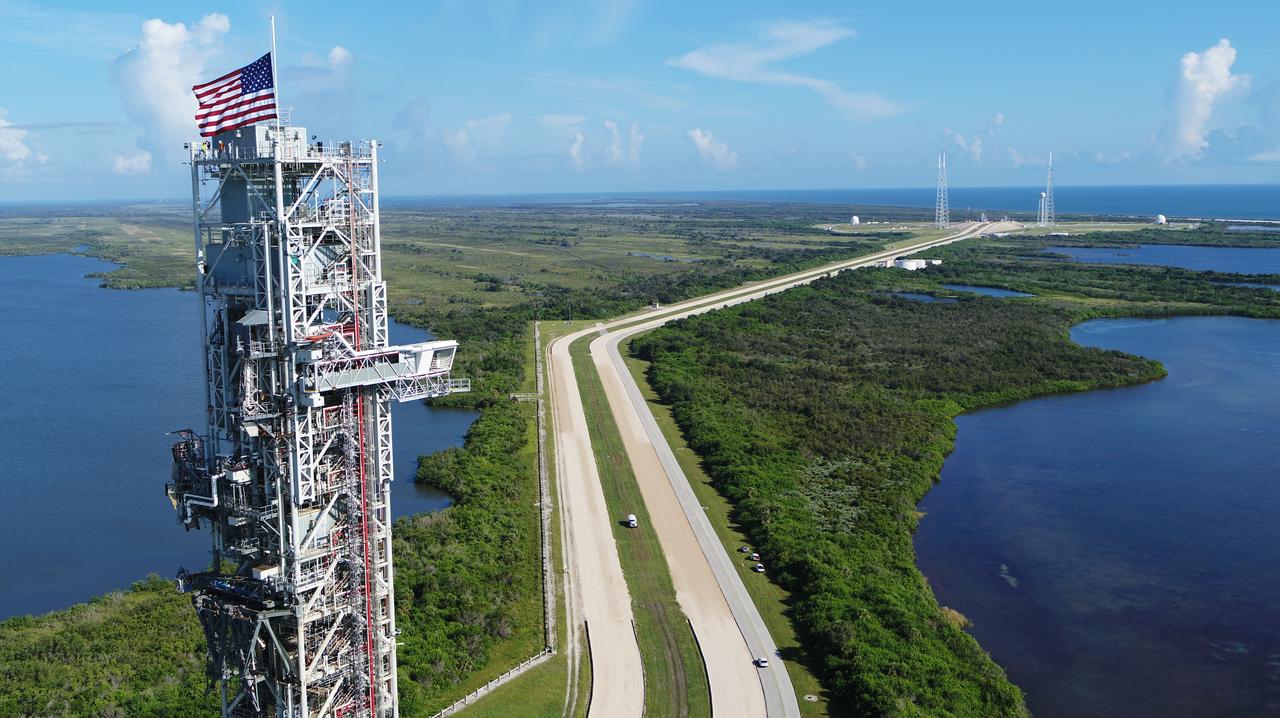
An aerial view of NASA's mobile launcher (ML) atop crawler-transporter 2 as it moves along the crawlerway to Launch Pad 39B on Aug. 31, 2018, at the agency's Kennedy Space Center in Florida. In view on top of the ML is the American flag. The ML will undergo a fit check on the surface of the pad, followed by several days of systems testing. The 380-foot-tall mobile launcher is equipped with the crew access arm and several umbilicals that will provide power, environmental control, pneumatics, communication and electrical connections to NASA's Space Launch System (SLS) and Orion spacecraft. Exploration Ground Systems is preparing the ground systems necessary to launch SLS and Orion on Exploration Mission-1, missions to the Moon and on to Mars.
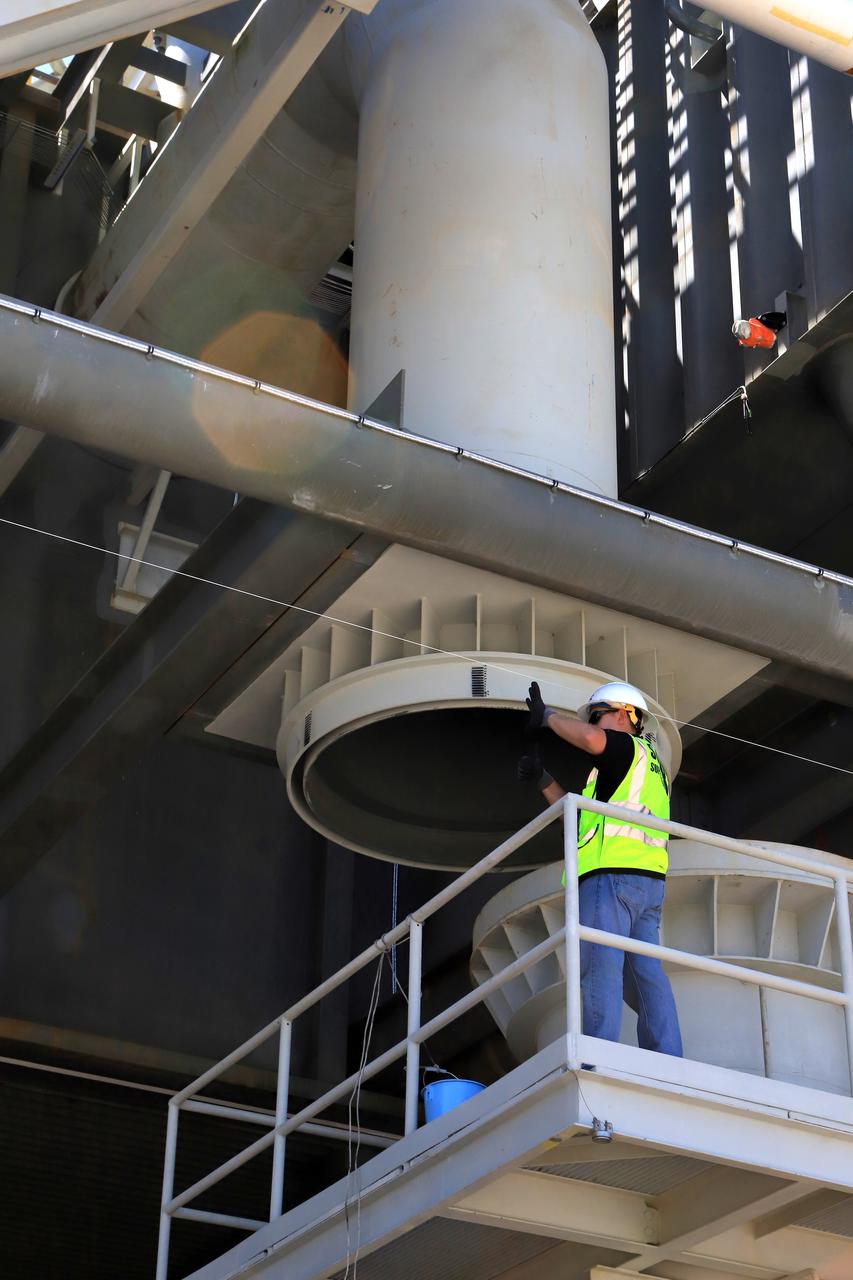
A technician watches as the ignition overpressure water system pipe on the mobile launcher slowly aligns with the pipe on the ground system at Launch Pad 39B at NASA's Kennedy Space Center in Florida, on Aug. 31, 2018. The ML, atop crawler-transporter 2, made the trek along the crawlerway to the pad for a fit check and several days of systems testing. The 380-foot-tall mobile launcher is equipped with the crew access arm and several umbilicals that will provide power, environmental control, pneumatics, communication and electrical connections to NASA's Space Launch System (SLS) and Orion spacecraft. Exploration Ground Systems is preparing the ground systems necessary to launch SLS and Orion on Exploration Mission-1, missions to the Moon and on to Mars.
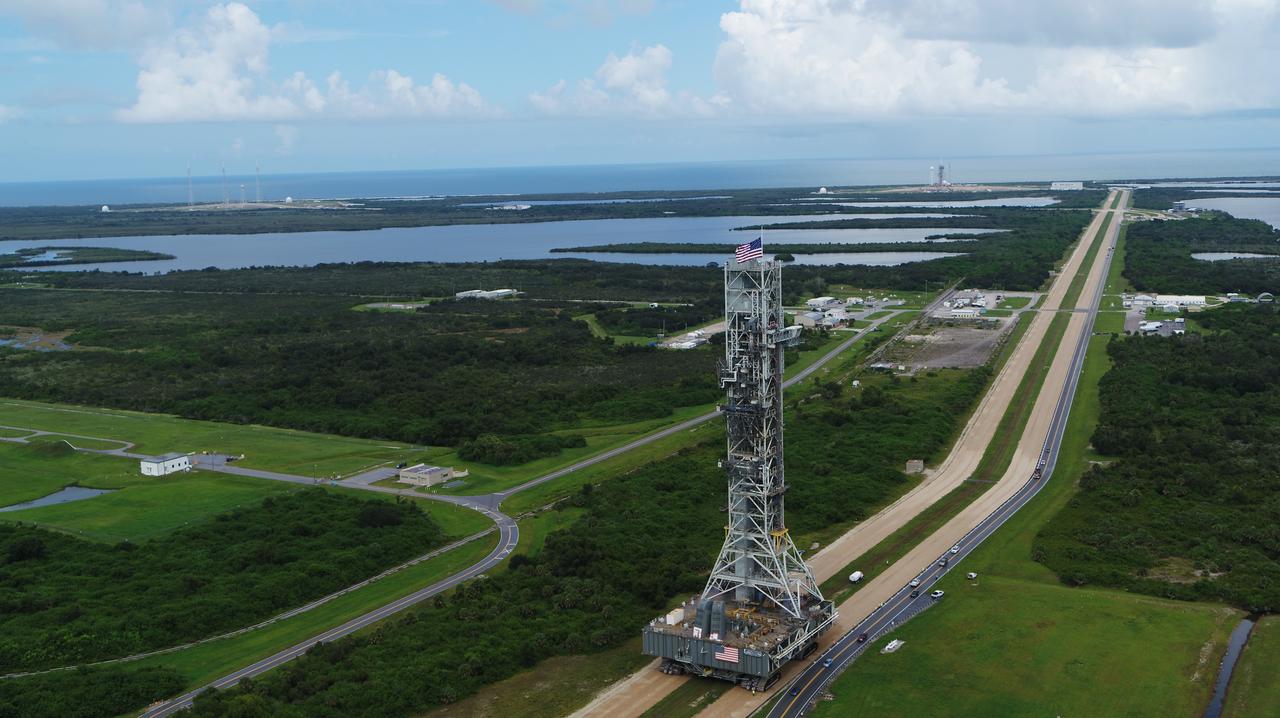
An aerial view of NASA's mobile launcher (ML) atop crawler-transporter 2 as it moves along the crawlerway to Launch Pad 39B on Aug. 30, 2018, at the agency's Kennedy Space Center in Florida. The ML will undergo a fit check on the surface of the pad, followed by several days of systems testing. The 380-foot-tall mobile launcher is equipped with the crew access arm and several umbilicals that will provide power, environmental control, pneumatics, communication and electrical connections to NASA's Space Launch System (SLS) and Orion spacecraft. Exploration Ground Systems is preparing the ground systems necessary to launch SLS and Orion on Exploration Mission-1, missions to the Moon and on to Mars.
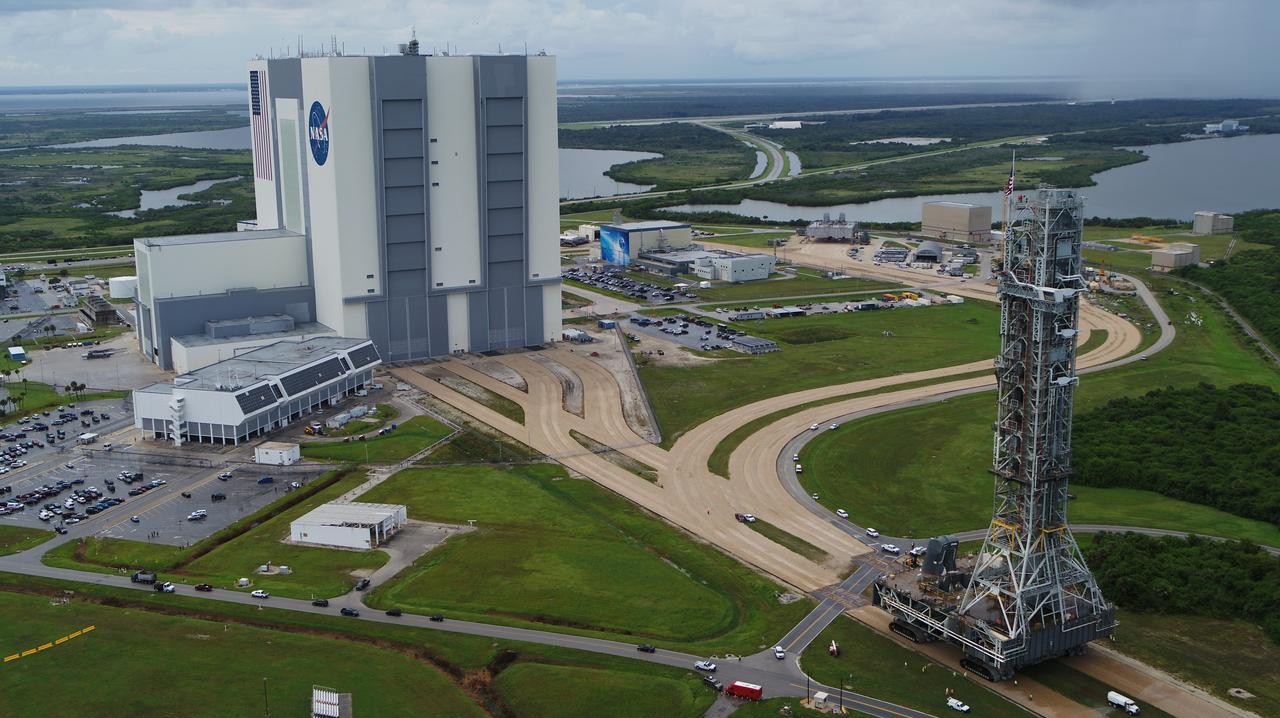
An aerial view of NASA's mobile launcher (ML) atop crawler-transporter 2 as it begins its trek to Launch Pad 39B on Aug. 30, 2018, at the agency's Kennedy Space Center in Florida. The ML will undergo a fit check on the surface of the pad, followed by several days of systems testing. The 380-foot-tall mobile launcher is equipped with the crew access arm and several umbilicals that will provide power, environmental control, pneumatics, communication and electrical connections to NASA's Space Launch System (SLS) and Orion spacecraft. Exploration Ground Systems is preparing the ground systems necessary to launch SLS and Orion on Exploration Mission-1, missions to the Moon and on to Mars.
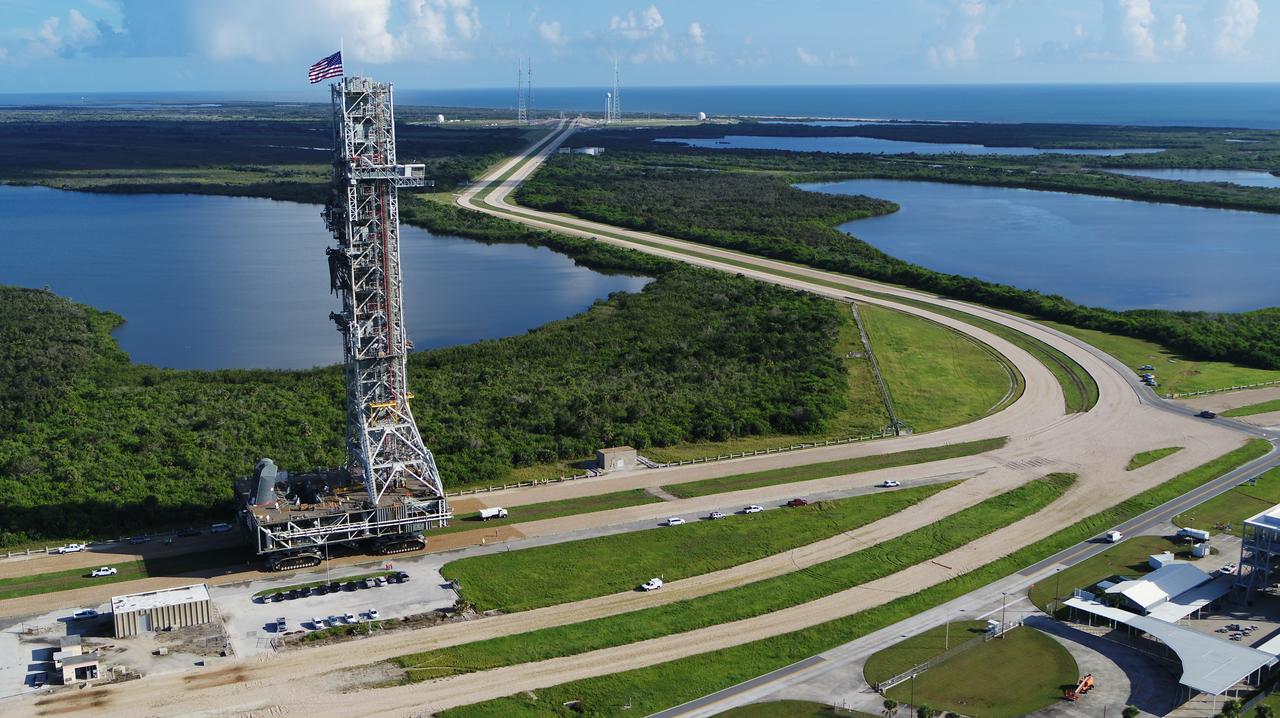
An aerial view of NASA's mobile launcher (ML) atop crawler-transporter 2 as it moves along the crawlerway to Launch Pad 39B on Aug. 31, 2018, at the agency's Kennedy Space Center in Florida. The ML will undergo a fit check on the surface of the pad, followed by several days of systems testing. The 380-foot-tall mobile launcher is equipped with the crew access arm and several umbilicals that will provide power, environmental control, pneumatics, communication and electrical connections to NASA's Space Launch System (SLS) and Orion spacecraft. Exploration Ground Systems is preparing the ground systems necessary to launch SLS and Orion on Exploration Mission-1, missions to the Moon and on to Mars.
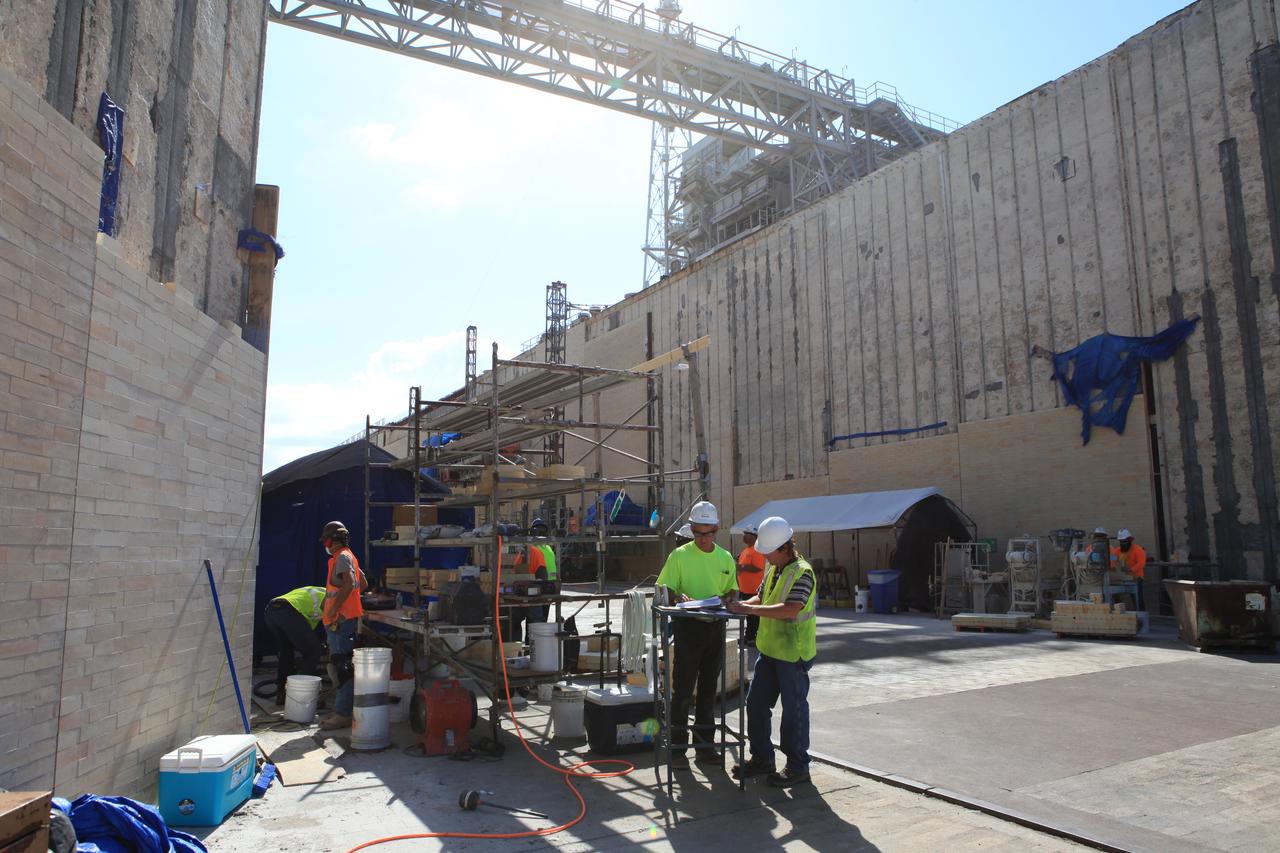
Progress continues on the new flame trench at Launch Pad 39B at NASA's Kennedy Space Center in Florida. Construction workers with J.P. Donovan of Rockledge, Florida, prepare new heat-resistant bricks for installation on the north side of the flame trench. The Pad B flame trench is being refurbished to support the launch of NASA’s Space Launch System rocket. The Ground Systems Development and Operations (GSDO) Program at Kennedy is helping transform the space center into a multi-user spaceport and prepare for Exploration Mission 1, deep space missions, and NASA's Journey to Mars. For more information about GSDO, visit: http://www.nasa.gov/groundsystems.
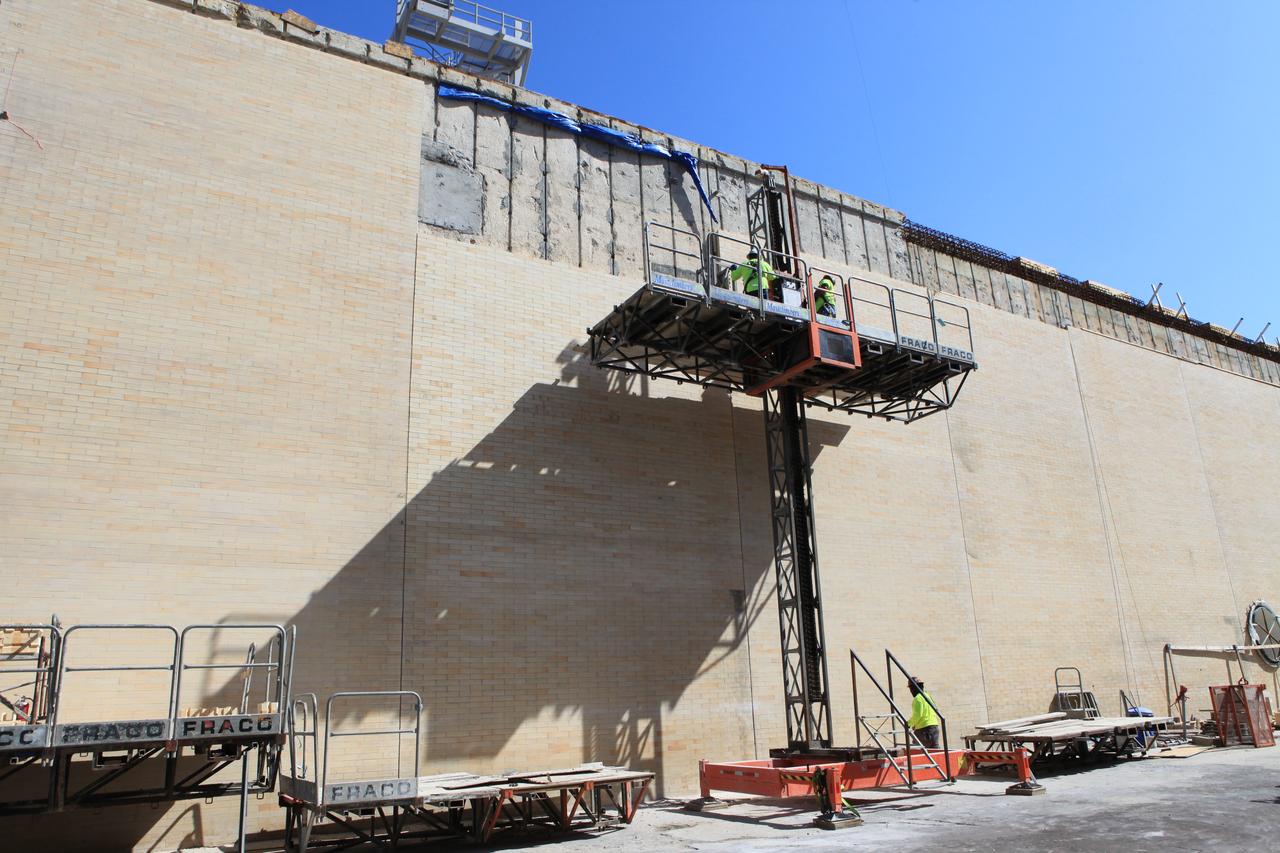
Progress continues on the new flame trench at Launch Pad 39B at NASA's Kennedy Space Center in Florida. Construction workers with J.P. Donovan of Rockledge, Florida, are on an elevated work stand to install new heat-resistant bricks on the north side of the flame trench. The Pad B flame trench is being refurbished to support the launch of NASA’s Space Launch System rocket. The Ground Systems Development and Operations (GSDO) Program at Kennedy is helping transform the space center into a multi-user spaceport and prepare for Exploration Mission 1, deep space missions, and NASA's Journey to Mars. For more information about GSDO, visit: http://www.nasa.gov/groundsystems.
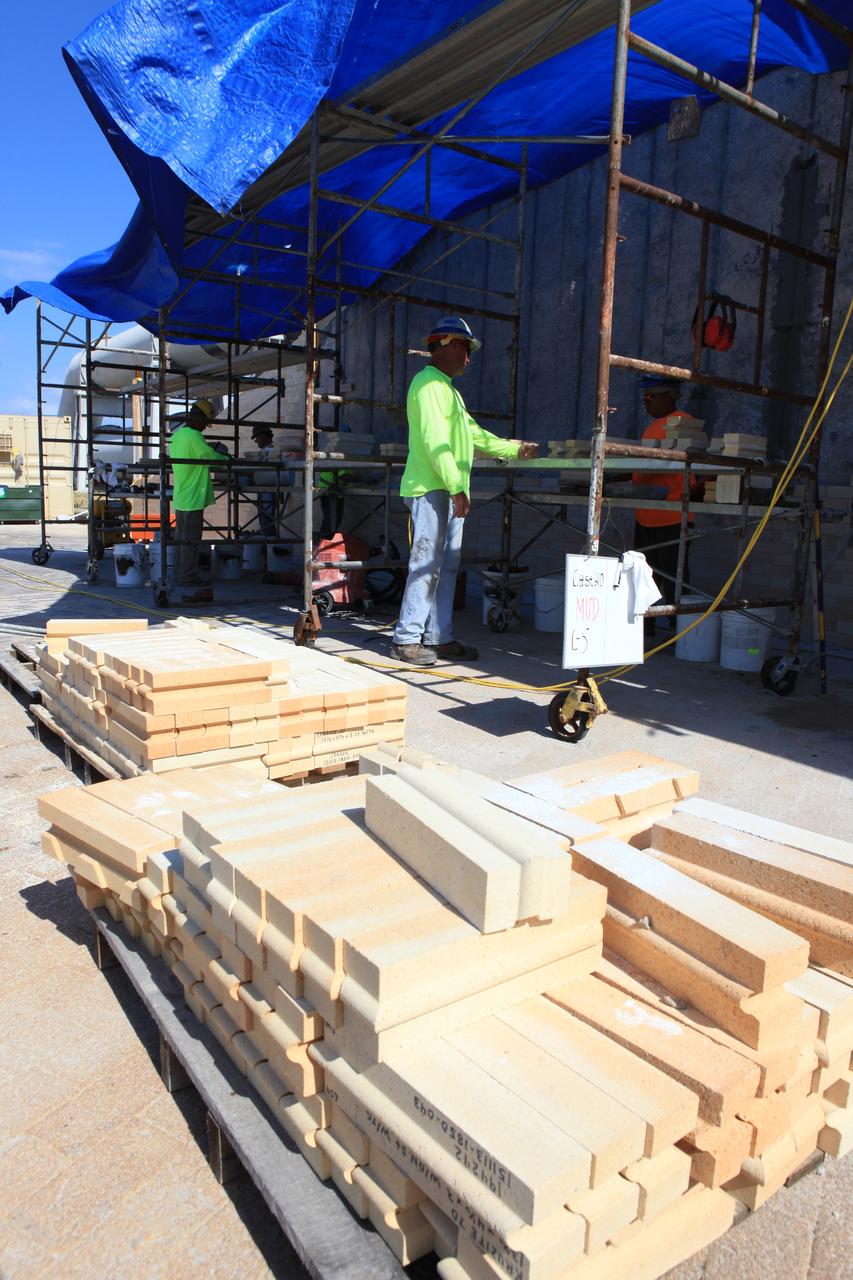
Progress continues on the new flame trench at Launch Pad 39B at NASA's Kennedy Space Center in Florida. Construction workers with J.P. Donovan of Rockledge, Florida, prepare new heat-resistant bricks for installation on the north side of the flame trench. The Pad B flame trench is being refurbished to support the launch of NASA’s Space Launch System rocket. The Ground Systems Development and Operations (GSDO) Program at Kennedy is helping transform the space center into a multi-user spaceport and prepare for Exploration Mission 1, deep space missions, and NASA's Journey to Mars. For more information about GSDO, visit: http://www.nasa.gov/groundsystems.
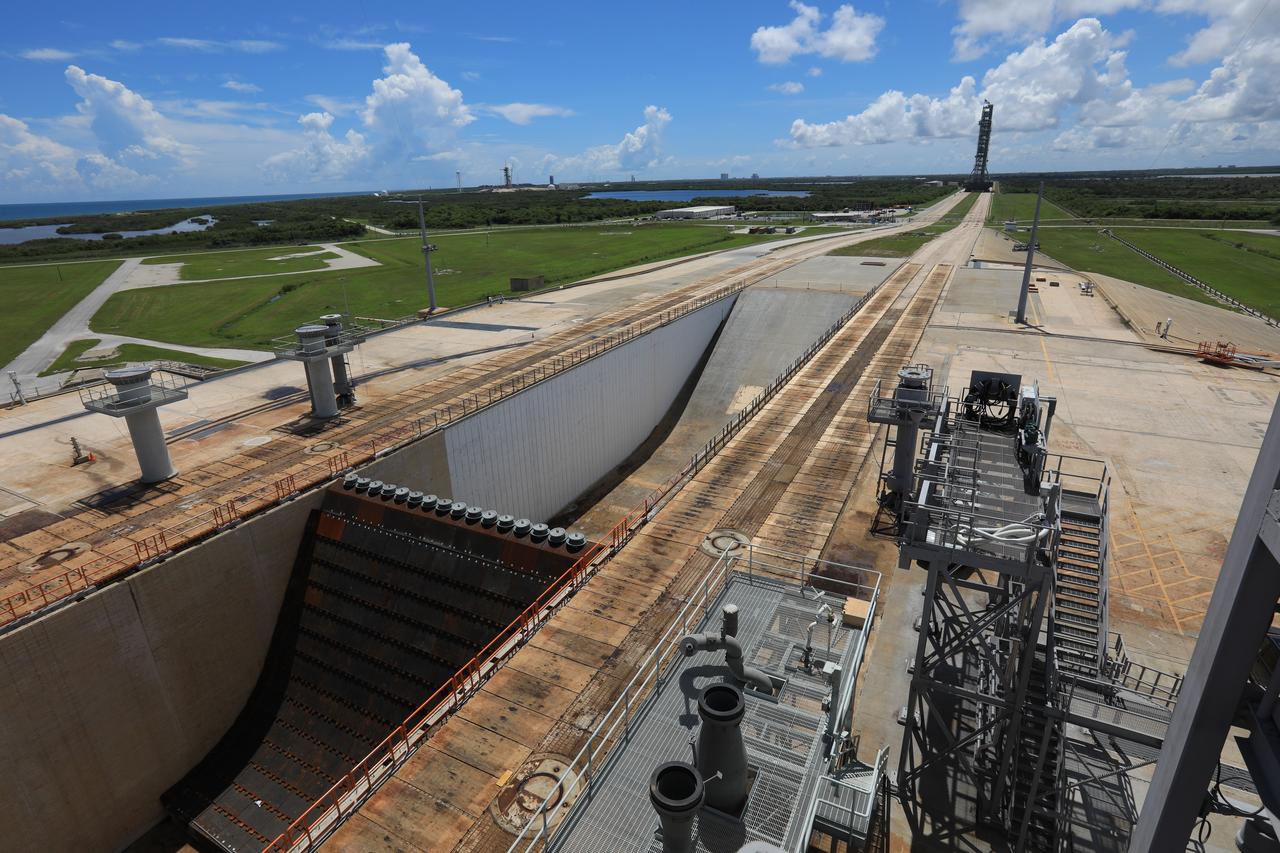
NASA's mobile launcher atop crawler-transporter 2 begins its trek off of Launch Pad 39B on Sept. 7, 2018, at NASA's Kennedy Space Center in Florida. After undergoing a fit check and several days of systems testing with the pad, the mobile launcher is on its way to the Vehicle Assembly Building. This is the first time that the modified mobile launcher made the trip to the pad. The 380-foot-tall mobile launcher is equipped with the crew access arm and several umbilicals that will provide power, environmental control. Pneumatics, communication and electrical connections to the agency's Space Launch System and Orion spacecraft. Exploration Ground Systems is preparing the ground systems necessary to launch SLS and Orion on Exploration Mission-1, missions to the Moon and on to Mars.
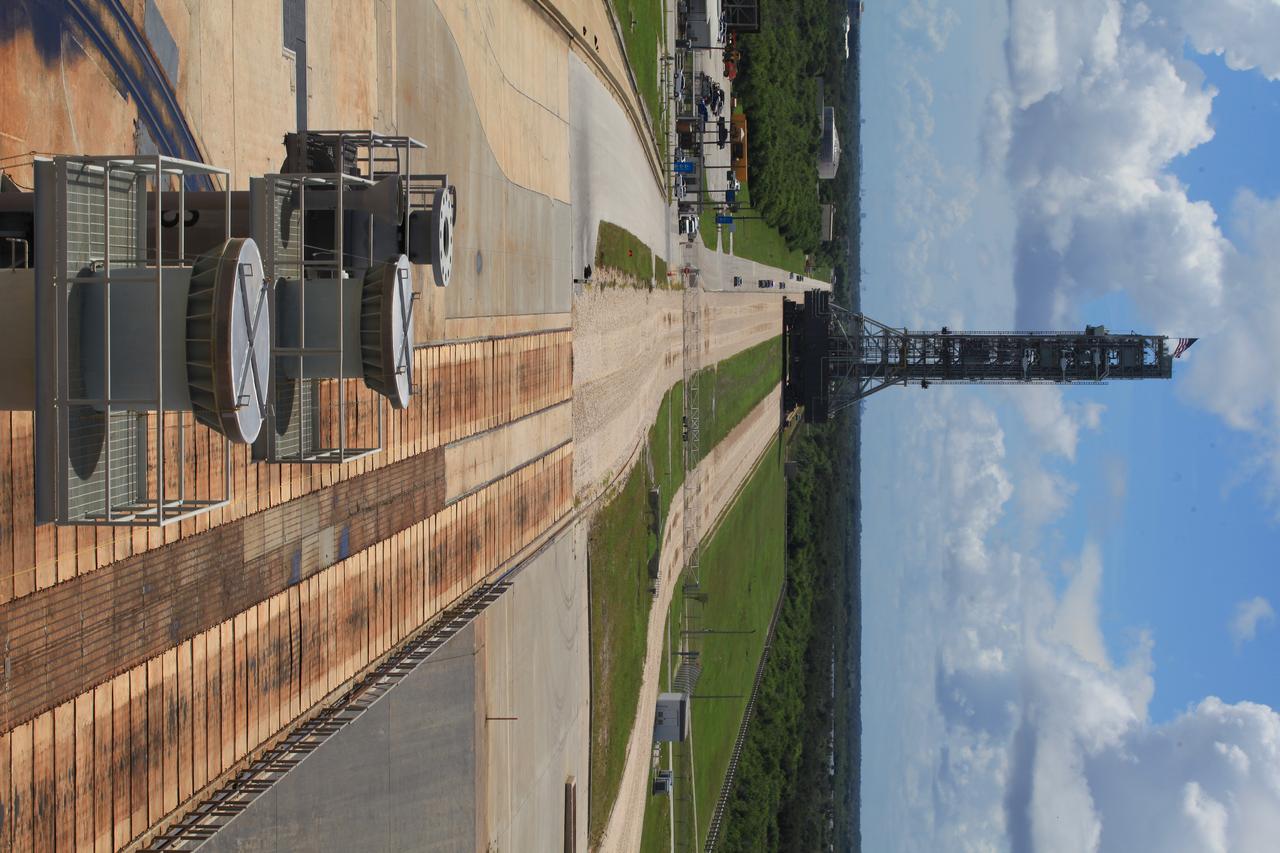
NASA's mobile launcher atop crawler-transporter 2 begins its trek off of Launch Pad 39B on Sept. 7, 2018, at NASA's Kennedy Space Center in Florida. After undergoing a fit check and several days of systems testing with the pad, the mobile launcher is on its way to the Vehicle Assembly Building. This is the first time that the modified mobile launcher made the trip to the pad. The 380-foot-tall mobile launcher is equipped with the crew access arm and several umbilicals that will provide power, environmental control. Pneumatics, communication and electrical connections to the agency's Space Launch System and Orion spacecraft. Exploration Ground Systems is preparing the ground systems necessary to launch SLS and Orion on Exploration Mission-1, missions to the Moon and on to Mars.
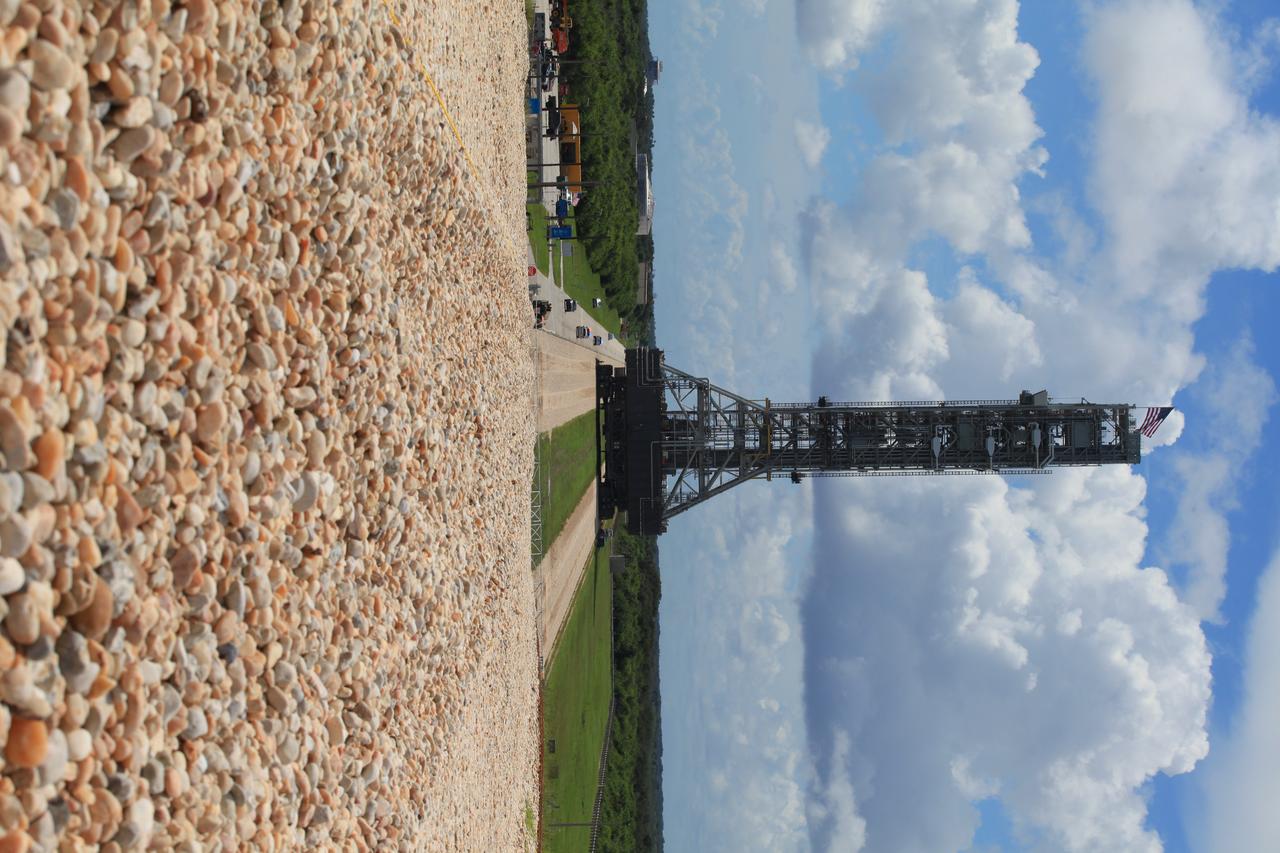
NASA's mobile launcher atop crawler-transporter 2 begins its trek off of Launch Pad 39B on Sept. 7, 2018, at NASA's Kennedy Space Center in Florida. After undergoing a fit check and several days of systems testing with the pad, the mobile launcher is on its way to the Vehicle Assembly Building. This is the first time that the modified mobile launcher made the trip to the pad. The 380-foot-tall mobile launcher is equipped with the crew access arm and several umbilicals that will provide power, environmental control. Pneumatics, communication and electrical connections to the agency's Space Launch System and Orion spacecraft. Exploration Ground Systems is preparing the ground systems necessary to launch SLS and Orion on Exploration Mission-1, missions to the Moon and on to Mars.
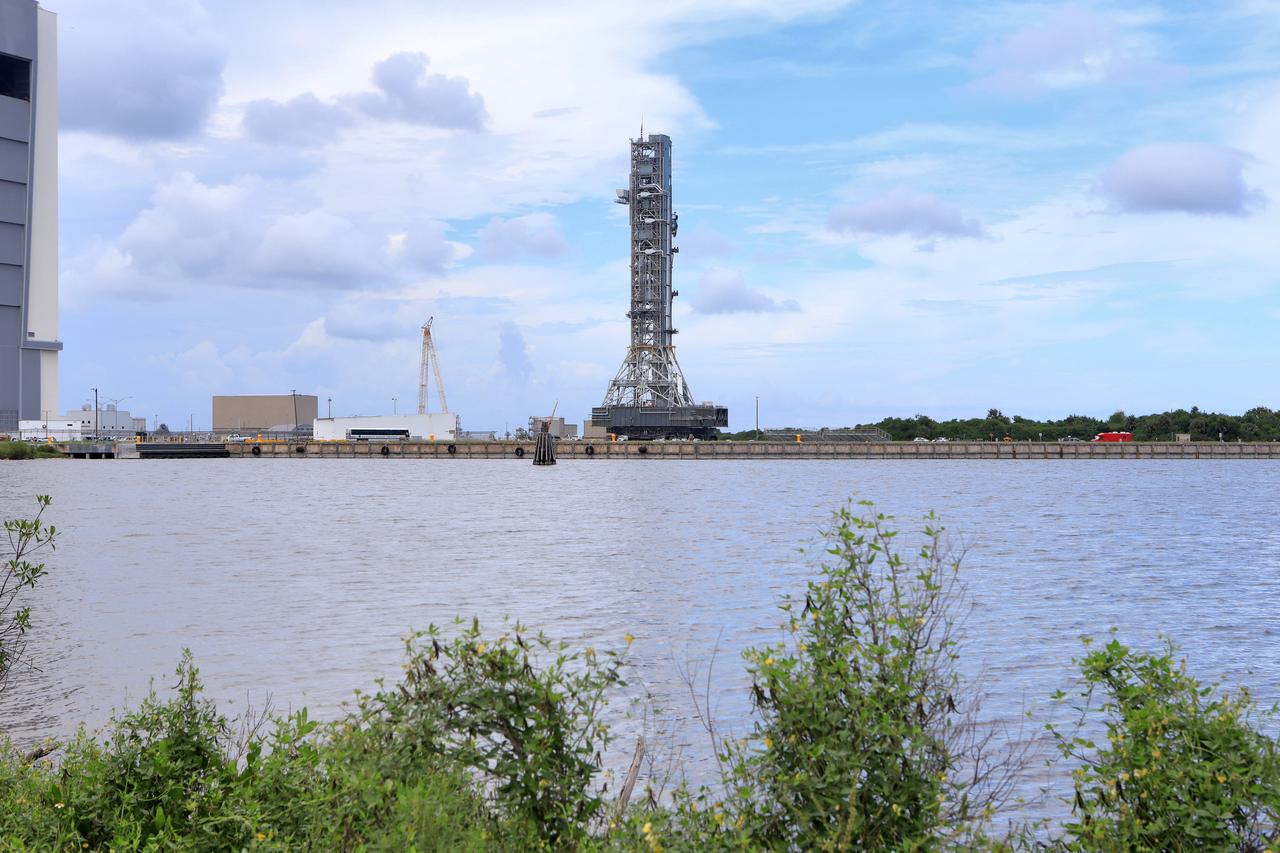
NASA's crawler-transporter 2 (CT-2) with the mobile launcher (ML) atop begins its trek along the crawlerway to Launch Pad 39B on Aug. 30, 2018, at the agency's Kennedy Space Center in Florida. CT-2 will move the ML up to the surface of the pad where it will undergo a fit check, followed by several days of systems testing. The 380-foot-tall mobile launcher is equipped with the crew access arm and several umbilicals that will provide power, environmental control, pneumatics, communication and electrical connections to NASA's Space Launch System (SLS) and Orion spacecraft. Exploration Ground Systems is preparing the ground systems necessary to launch SLS and Orion on Exploration Mission-1, missions to the Moon and on to Mars.
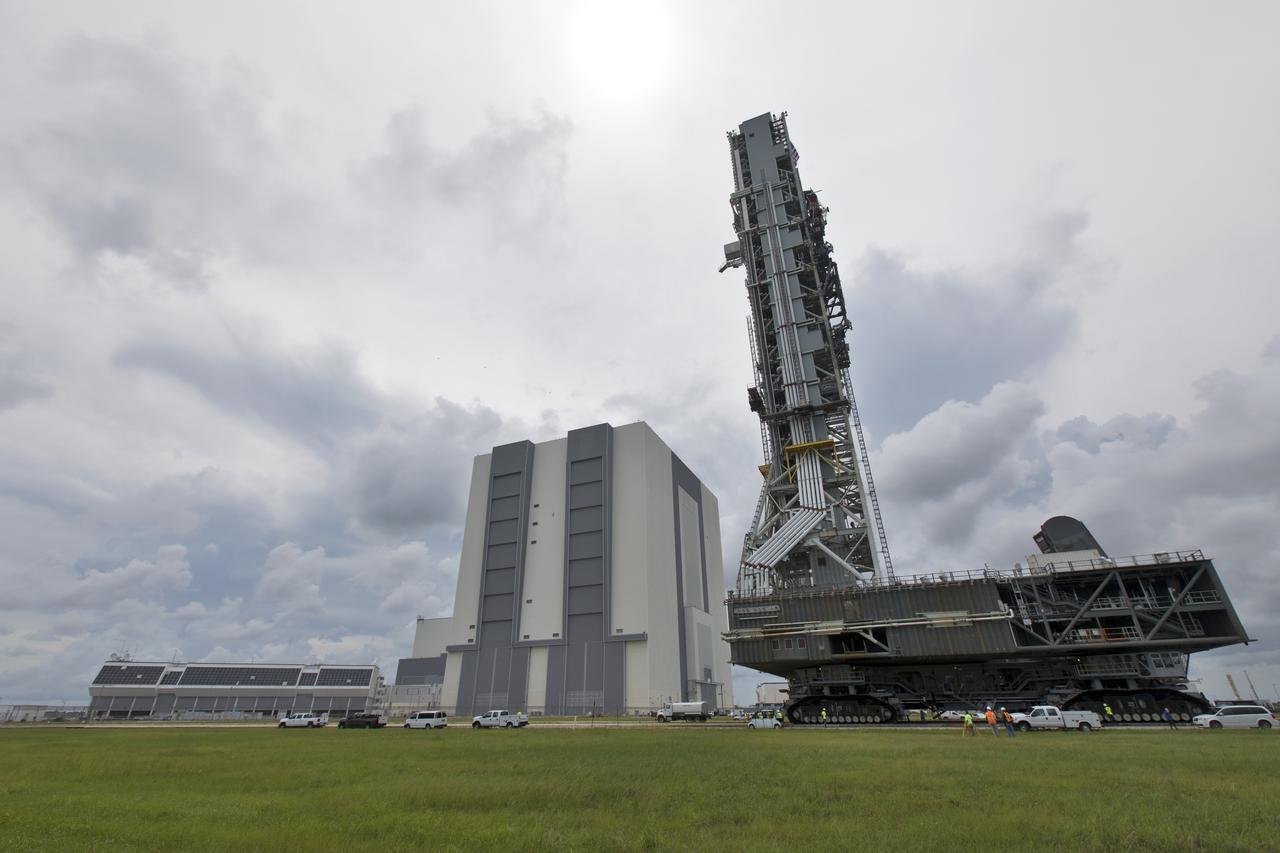
NASA's mobile launcher (ML) atop crawler-transporter 2 (CT-2) moves along the crawlerway on its trek to Launch Pad 39B on Aug. 31, 2018, at the agency's Kennedy Space Center in Florida. CT-2 will move the ML up to the surface of the pad where it will undergo a fit check, followed by several days of systems testing. The 380-foot-tall mobile launcher is equipped with the crew access arm and several umbilicals that will provide power, environmental control, pneumatics, communication and electrical connections to NASA's Space Launch System (SLS) and Orion spacecraft. Exploration Ground Systems is preparing the ground systems necessary to launch SLS and Orion on Exploration Mission-1, missions to the Moon and on to Mars.
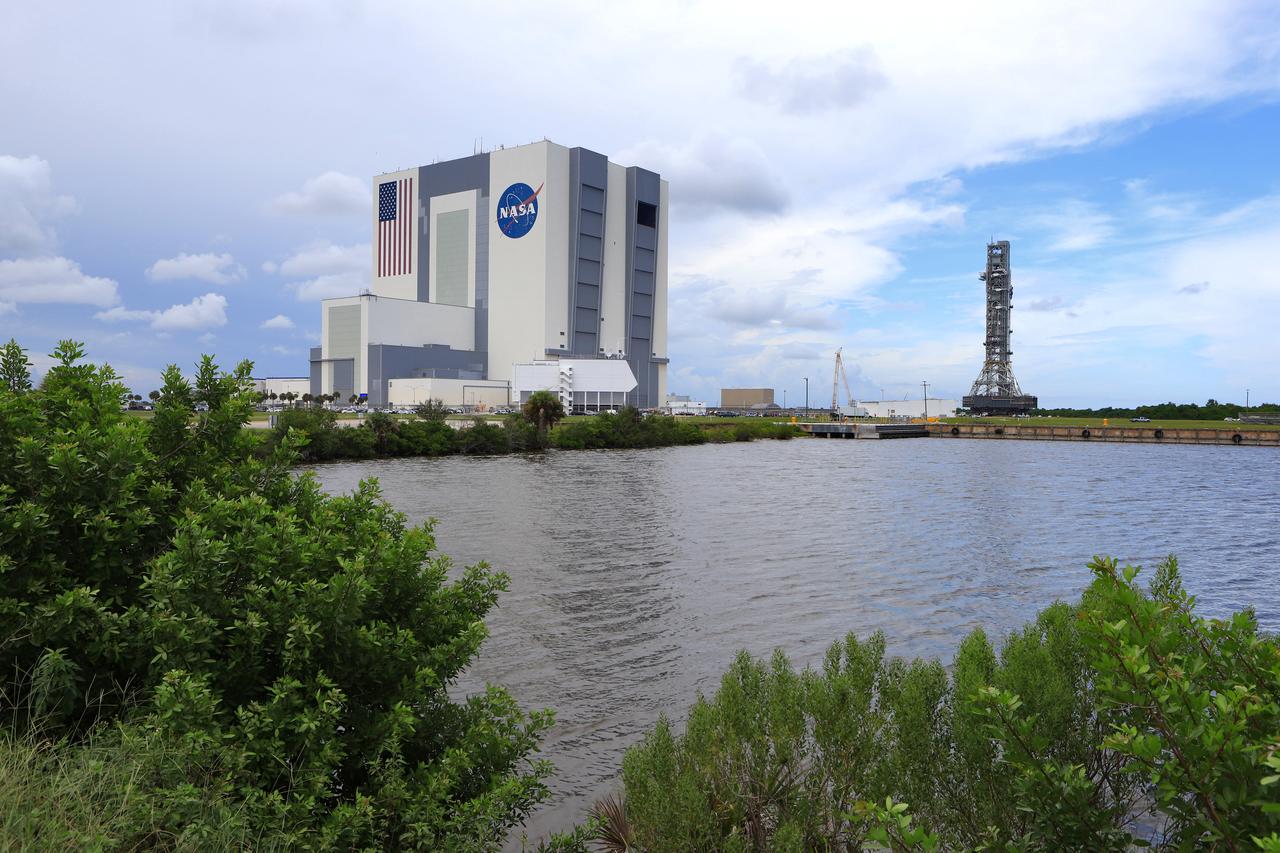
NASA's crawler-transporter 2 (CT-2) with the mobile launcher (ML) atop begins its trek along the crawlerway to Launch Pad 39B on Aug. 30, 2018, at the agency's Kennedy Space Center in Florida. At left is the iconic Vehicle Assembly Building. CT-2 will move the ML up to the surface of the pad where it will undergo a fit check, followed by several days of systems testing. The 380-foot-tall mobile launcher is equipped with the crew access arm and several umbilicals that will provide power, environmental control, pneumatics, communication and electrical connections to NASA's Space Launch System (SLS) and Orion spacecraft. Exploration Ground Systems is preparing the ground systems necessary to launch SLS and Orion on Exploration Mission-1, missions to the Moon and on to Mars.
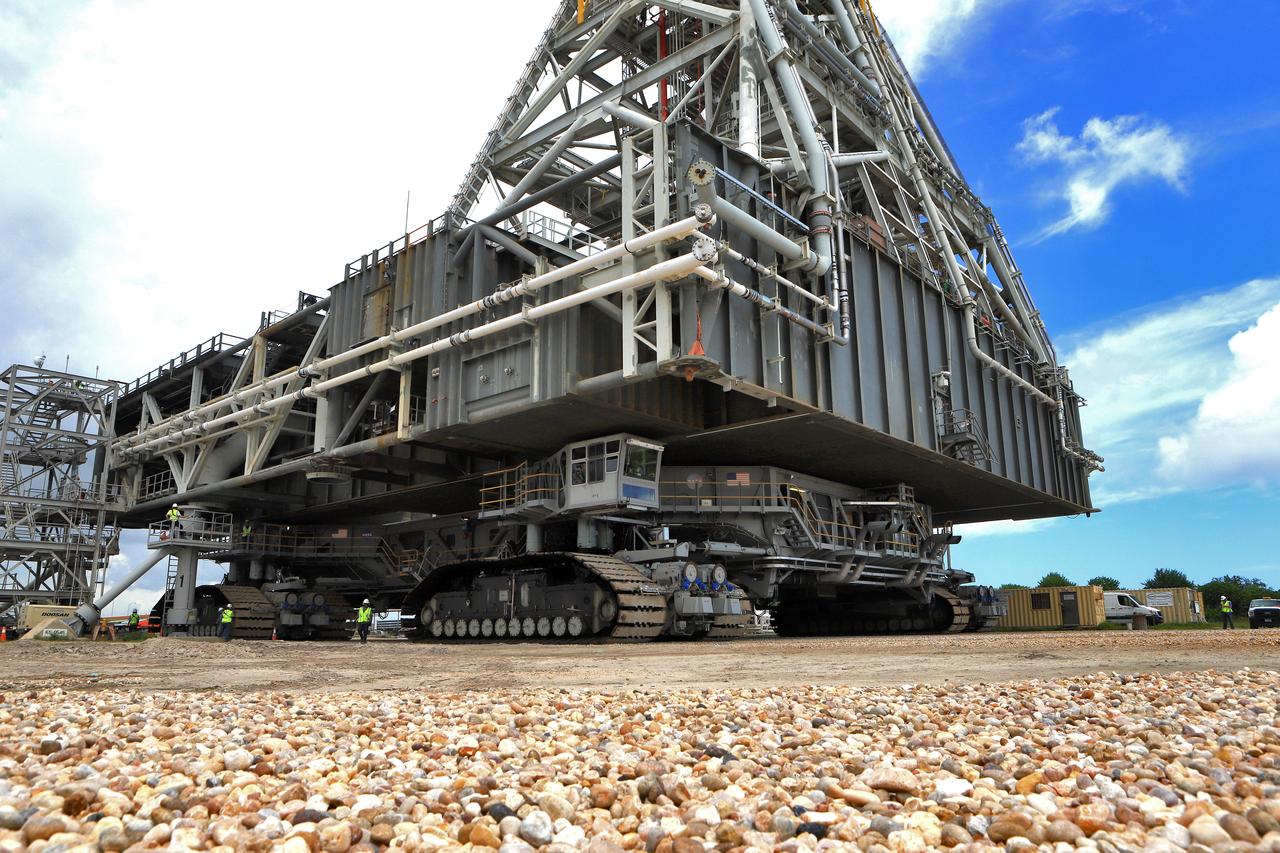
A close-up view of NASA's crawler-transporter 2 (CT-2) with the mobile launcher (ML) atop as it slowly moves along the crawlerway on its trek to Launch Pad 39B on Aug. 30, 2018, at the agency's Kennedy Space Center in Florida. CT-2 will move the ML up to the surface of the pad where it will undergo a fit check, followed by several days of systems testing. The 380-foot-tall mobile launcher is equipped with the crew access arm and several umbilicals that will provide power, environmental control, pneumatics, communication and electrical connections to NASA's Space Launch System (SLS) and Orion spacecraft. Exploration Ground Systems is preparing the ground systems necessary to launch SLS and Orion on Exploration Mission-1, missions to the Moon and on to Mars.
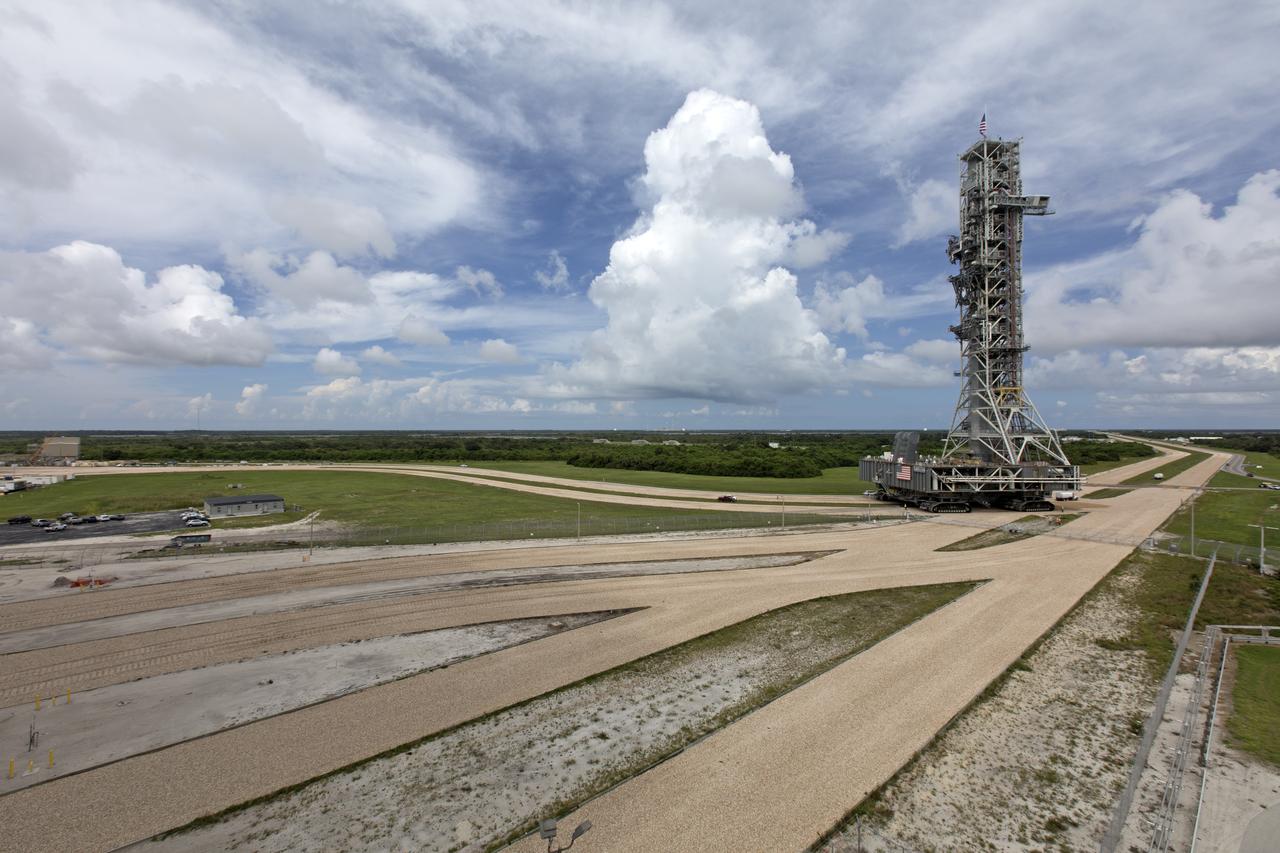
NASA's mobile launcher (ML) atop crawler-transporter 2 (CT-2) moves along the crawlerway on its trek to Launch Pad 39B on Aug. 31, 2018, at the agency's Kennedy Space Center in Florida. CT-2 will move the ML up to the surface of the pad where it will undergo a fit check, followed by several days of systems testing. The 380-foot-tall mobile launcher is equipped with the crew access arm and several umbilicals that will provide power, environmental control, pneumatics, communication and electrical connections to NASA's Space Launch System (SLS) and Orion spacecraft. Exploration Ground Systems is preparing the ground systems necessary to launch SLS and Orion on Exploration Mission-1, missions to the Moon and on to Mars.
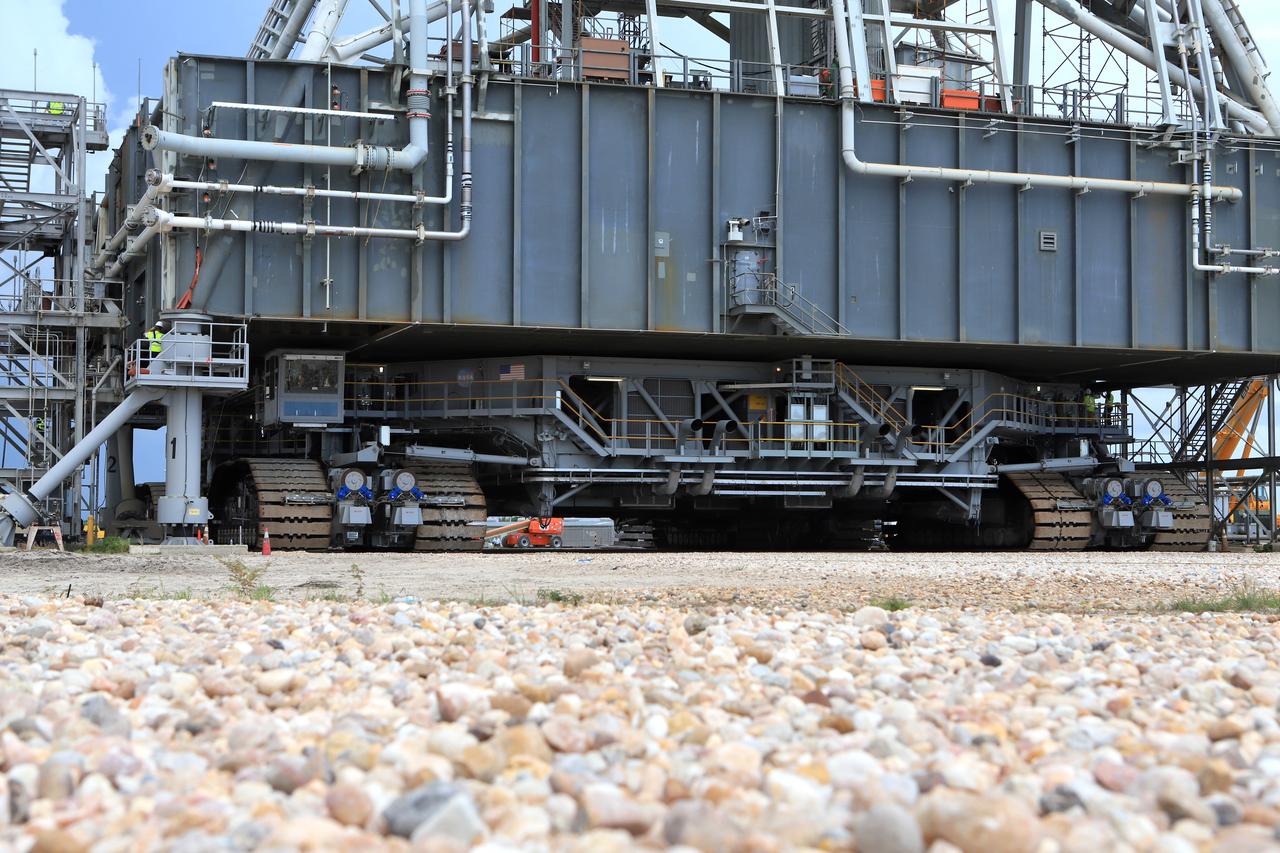
A close-up view of NASA's crawler-transporter 2 (CT-2) with the mobile launcher (ML) atop as it slowly moves along the crawlerway on its trek to Launch Pad 39B on Aug. 30, 2018, at the agency's Kennedy Space Center in Florida. CT-2 will move the ML up to the surface of the pad where it will undergo a fit check, followed by several days of systems testing. The 380-foot-tall mobile launcher is equipped with the crew access arm and several umbilicals that will provide power, environmental control, pneumatics, communication and electrical connections to NASA's Space Launch System (SLS) and Orion spacecraft. Exploration Ground Systems is preparing the ground systems necessary to launch SLS and Orion on Exploration Mission-1, missions to the Moon and on to Mars.
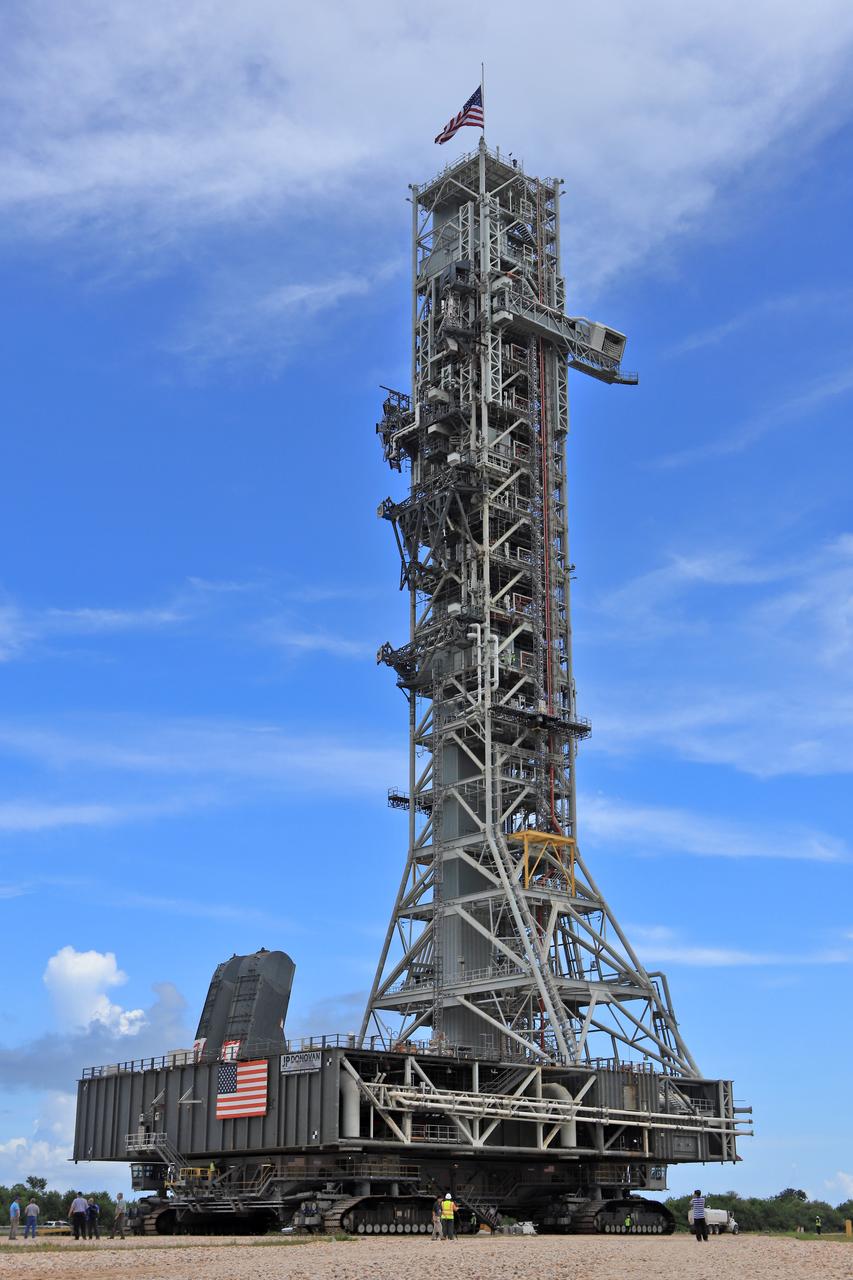
NASA's crawler-transporter 2 (CT-2) with the mobile launcher (ML) atop slowly moves along the crawlerway on its trek to Launch Pad 39B on Aug. 30, 2018, at the agency's Kennedy Space Center in Florida. CT-2 will move the ML up to the surface of the pad where it will undergo a fit check, followed by several days of systems testing. The 380-foot-tall mobile launcher is equipped with the crew access arm and several umbilicals that will provide power, environmental control, pneumatics, communication and electrical connections to NASA's Space Launch System (SLS) and Orion spacecraft. Exploration Ground Systems is preparing the ground systems necessary to launch SLS and Orion on Exploration Mission-1, missions to the Moon and on to Mars.
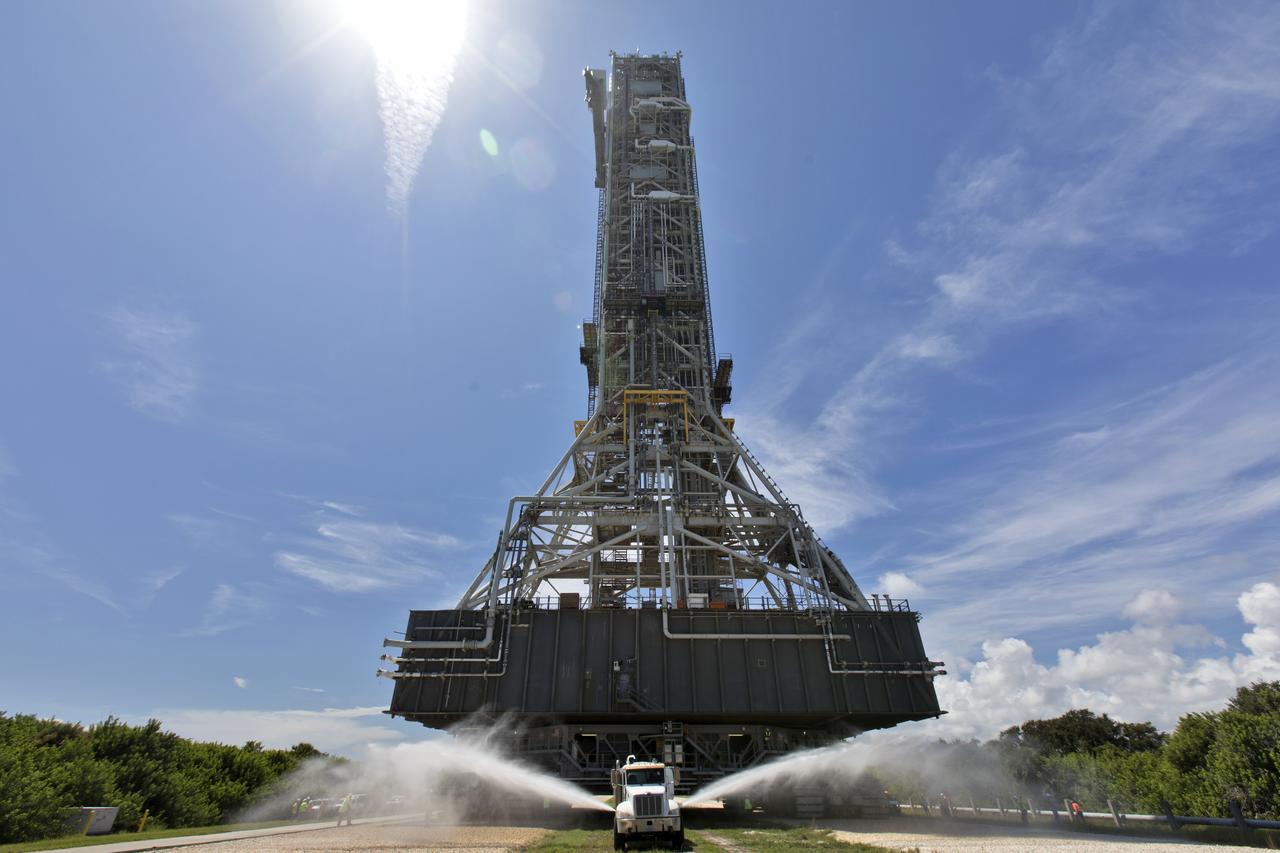
A truck sprays water to reduce the dust as NASA's crawler-transporter 2 (CT-2) with the mobile launcher (ML) atop slowly moves along the crawlerway on its trek to Launch Pad 39B on Aug. 31, 2018, at the agency's Kennedy Space Center in Florida. CT-2 will move the ML up to the surface of the pad where it will undergo a fit check, followed by several days of systems testing. The 380-foot-tall mobile launcher is equipped with the crew access arm and several umbilicals that will provide power, environmental control, pneumatics, communication and electrical connections to NASA's Space Launch System (SLS) and Orion spacecraft. Exploration Ground Systems is preparing the ground systems necessary to launch SLS and Orion on Exploration Mission-1, missions to the Moon and on to Mars.
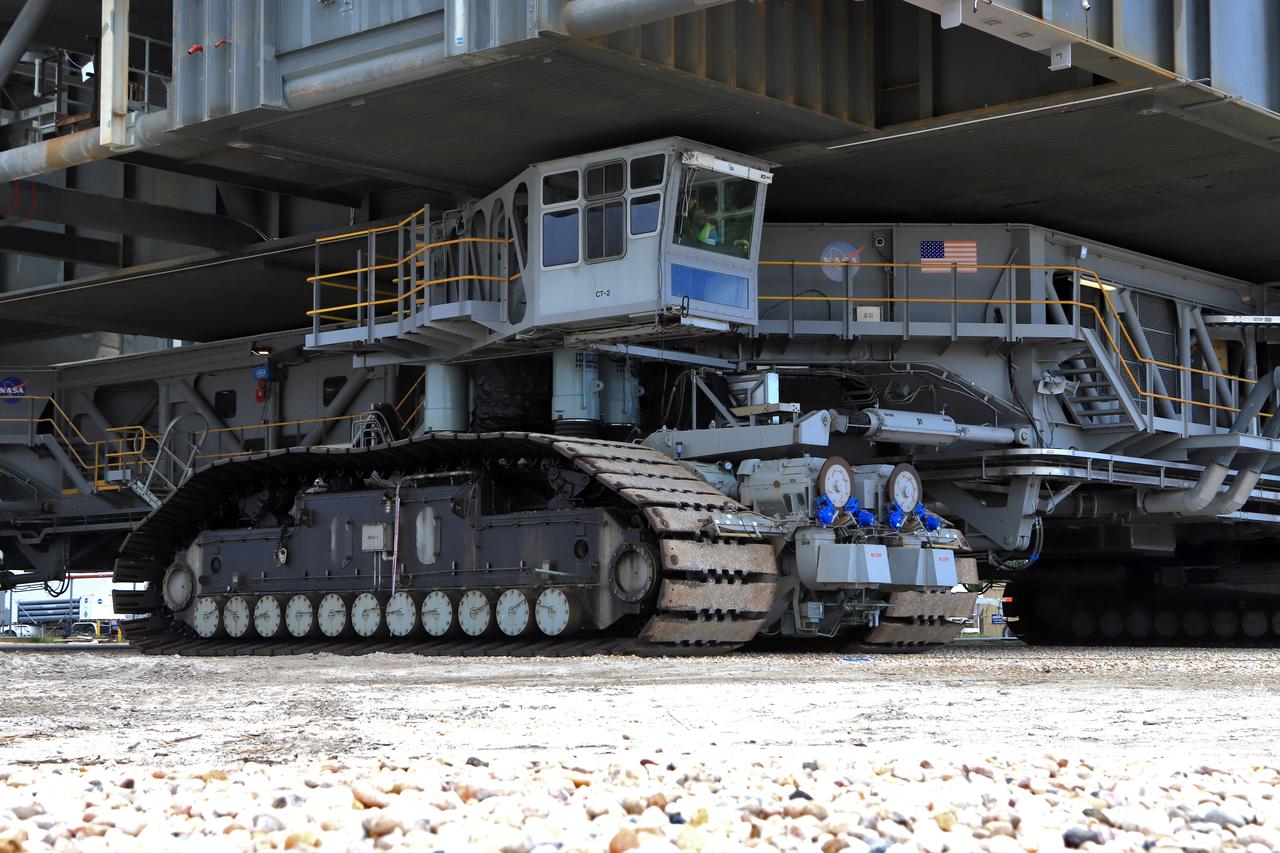
A close-up view of NASA's crawler-transporter 2 (CT-2) with the mobile launcher (ML) atop as it slowly moves along the crawlerway on its trek to Launch Pad 39B on Aug. 30, 2018, at the agency's Kennedy Space Center in Florida. CT-2 will move the ML up to the surface of the pad where it will undergo a fit check, followed by several days of systems testing. The 380-foot-tall mobile launcher is equipped with the crew access arm and several umbilicals that will provide power, environmental control, pneumatics, communication and electrical connections to NASA's Space Launch System (SLS) and Orion spacecraft. Exploration Ground Systems is preparing the ground systems necessary to launch SLS and Orion on Exploration Mission-1, missions to the Moon and on to Mars.
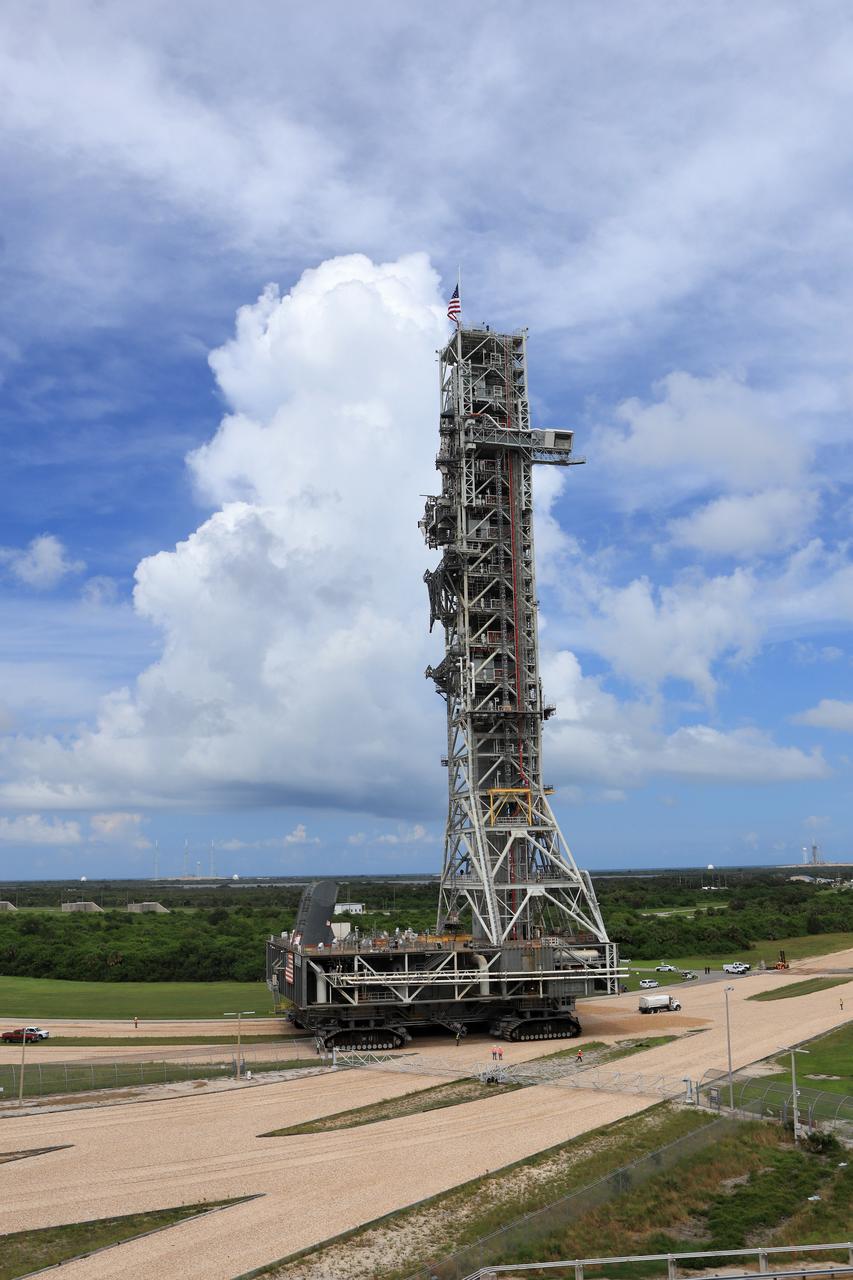
NASA's mobile launcher (ML) atop crawler-transporter 2 (CT-2) moves along the crawlerway on its trek to Launch Pad 39B on Aug. 31, 2018, at the agency's Kennedy Space Center in Florida. CT-2 will move the ML up to the surface of the pad where it will undergo a fit check, followed by several days of systems testing. The 380-foot-tall mobile launcher is equipped with the crew access arm and several umbilicals that will provide power, environmental control, pneumatics, communication and electrical connections to NASA's Space Launch System (SLS) and Orion spacecraft. Exploration Ground Systems is preparing the ground systems necessary to launch SLS and Orion on Exploration Mission-1, missions to the Moon and on to Mars.
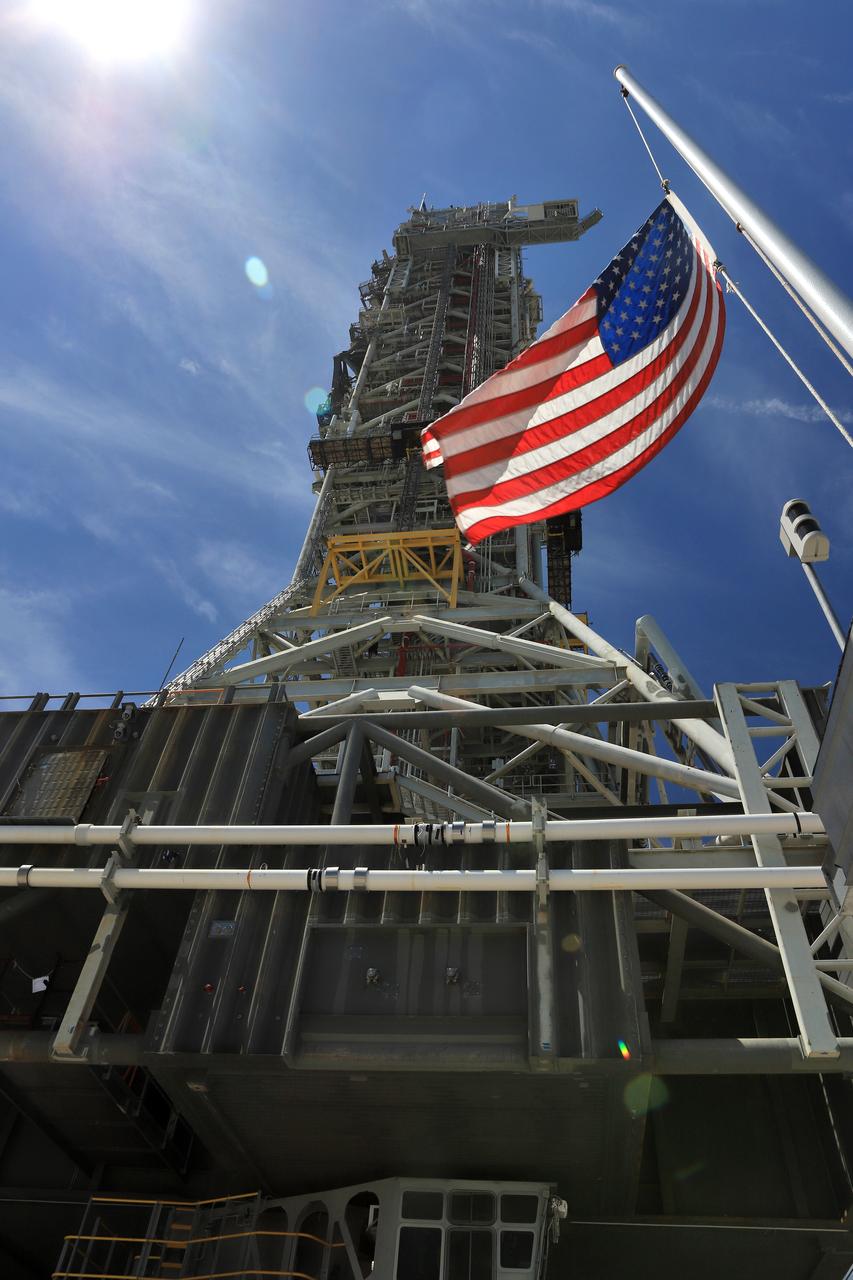
The American flag is in view as NASA's crawler-transporter 2 (CT-2) with the mobile launcher (ML) atop slowly moves along the crawlerway on its trek to Launch Pad 39B on Aug. 31, 2018, at the agency's Kennedy Space Center in Florida. CT-2 will move the ML up to the surface of the pad where it will undergo a fit check, followed by several days of systems testing. The 380-foot-tall mobile launcher is equipped with the crew access arm and several umbilicals that will provide power, environmental control, pneumatics, communication and electrical connections to NASA's Space Launch System (SLS) and Orion spacecraft. Exploration Ground Systems is preparing the ground systems necessary to launch SLS and Orion on Exploration Mission-1, missions to the Moon and on to Mars.
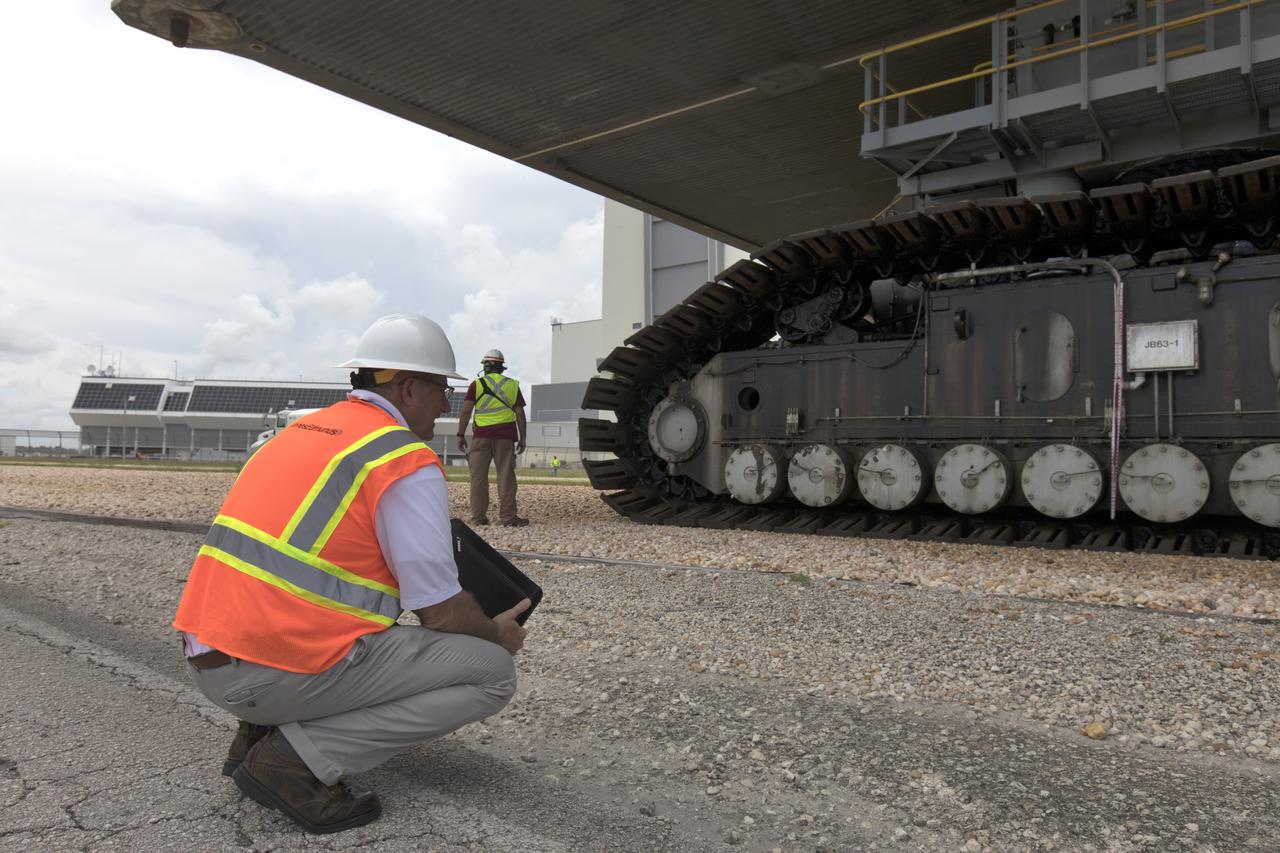
Members of the crawler team watch as NASA's mobile launcher (ML) atop crawler-transporter 2 (CT-2) moves along the crawlerway on its trek to Launch Pad 39B on Aug. 31, 2018, at the agency's Kennedy Space Center in Florida. CT-2 will move the ML up to the surface of the pad where it will undergo a fit check, followed by several days of systems testing. The 380-foot-tall mobile launcher is equipped with the crew access arm and several umbilicals that will provide power, environmental control, pneumatics, communication and electrical connections to NASA's Space Launch System (SLS) and Orion spacecraft. Exploration Ground Systems is preparing the ground systems necessary to launch SLS and Orion on Exploration Mission-1, missions to the Moon and on to Mars.
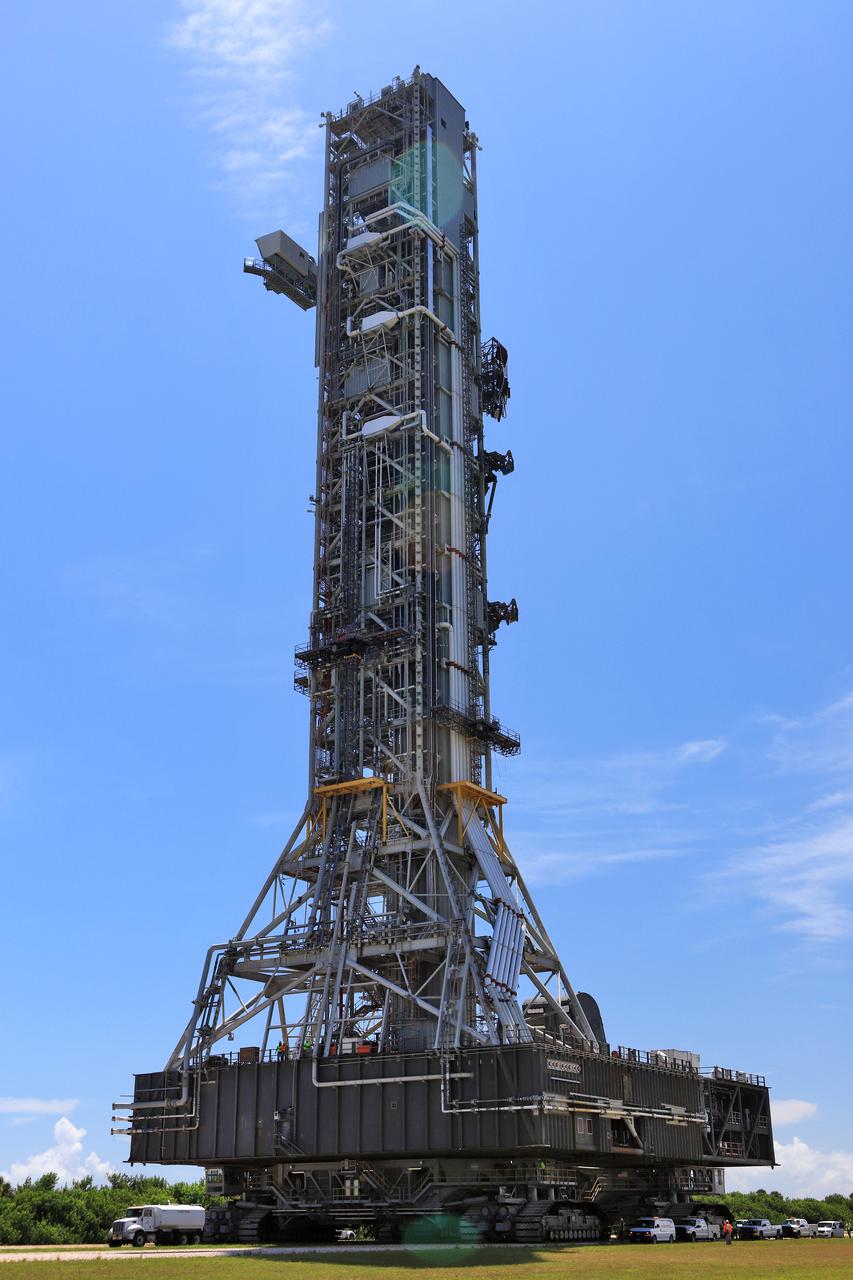
NASA's crawler-transporter 2 (CT-2) with the mobile launcher (ML) atop slowly moves along the crawlerway on its trek to Launch Pad 39B on Aug. 31, 2018, at the agency's Kennedy Space Center in Florida. CT-2 will move the ML up to the surface of the pad where it will undergo a fit check, followed by several days of systems testing. The 380-foot-tall mobile launcher is equipped with the crew access arm and several umbilicals that will provide power, environmental control, pneumatics, communication and electrical connections to NASA's Space Launch System (SLS) and Orion spacecraft. Exploration Ground Systems is preparing the ground systems necessary to launch SLS and Orion on Exploration Mission-1, missions to the Moon and on to Mars.
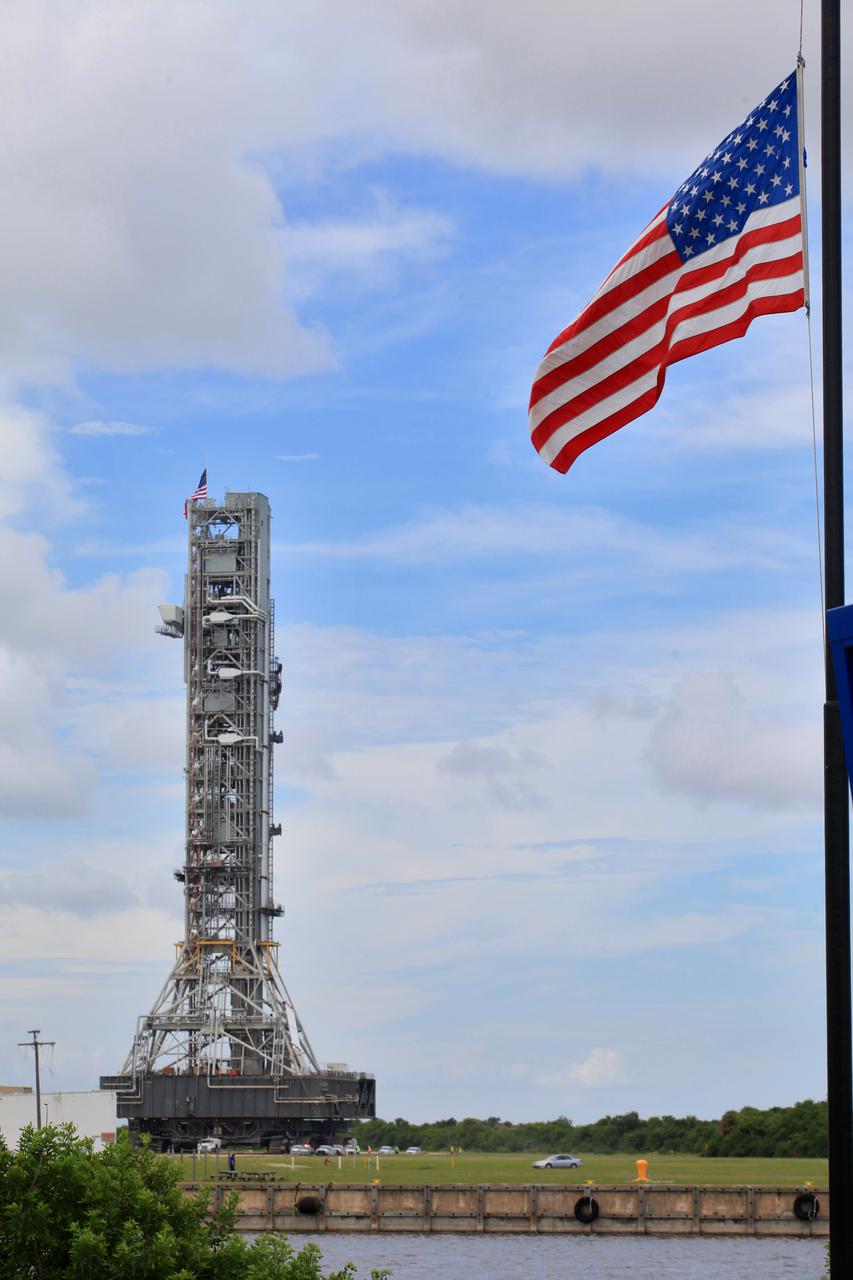
NASA's mobile launcher (ML) atop crawler-transporter 2 (CT-2) moves along the crawlerway on its trek to Launch Pad 39B on Aug. 30, 2018, at the agency's Kennedy Space Center in Florida. CT-2 will move the ML up to the surface of the pad where it will undergo a fit check, followed by several days of systems testing. The 380-foot-tall mobile launcher is equipped with the crew access arm and several umbilicals that will provide power, environmental control, pneumatics, communication and electrical connections to NASA's Space Launch System (SLS) and Orion spacecraft. Exploration Ground Systems is preparing the ground systems necessary to launch SLS and Orion on Exploration Mission-1, missions to the Moon and on to Mars.
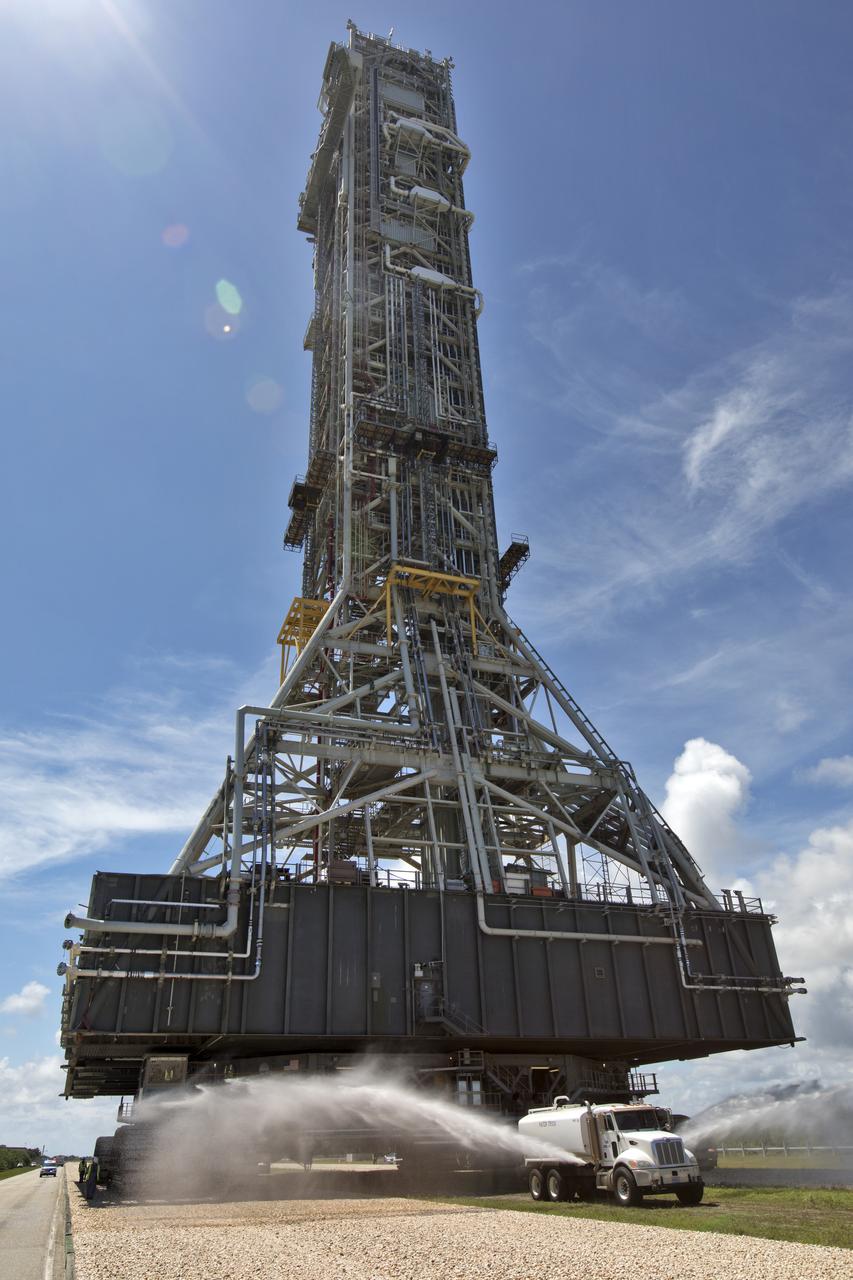
A truck sprays water to reduce the dust as NASA's crawler-transporter 2 (CT-2) with the mobile launcher (ML) atop slowly moves along the crawlerway on its trek to Launch Pad 39B on Aug. 31, 2018, at the agency's Kennedy Space Center in Florida. CT-2 will move the ML up to the surface of the pad where it will undergo a fit check, followed by several days of systems testing. The 380-foot-tall mobile launcher is equipped with the crew access arm and several umbilicals that will provide power, environmental control, pneumatics, communication and electrical connections to NASA's Space Launch System (SLS) and Orion spacecraft. Exploration Ground Systems is preparing the ground systems necessary to launch SLS and Orion on Exploration Mission-1, missions to the Moon and on to Mars.
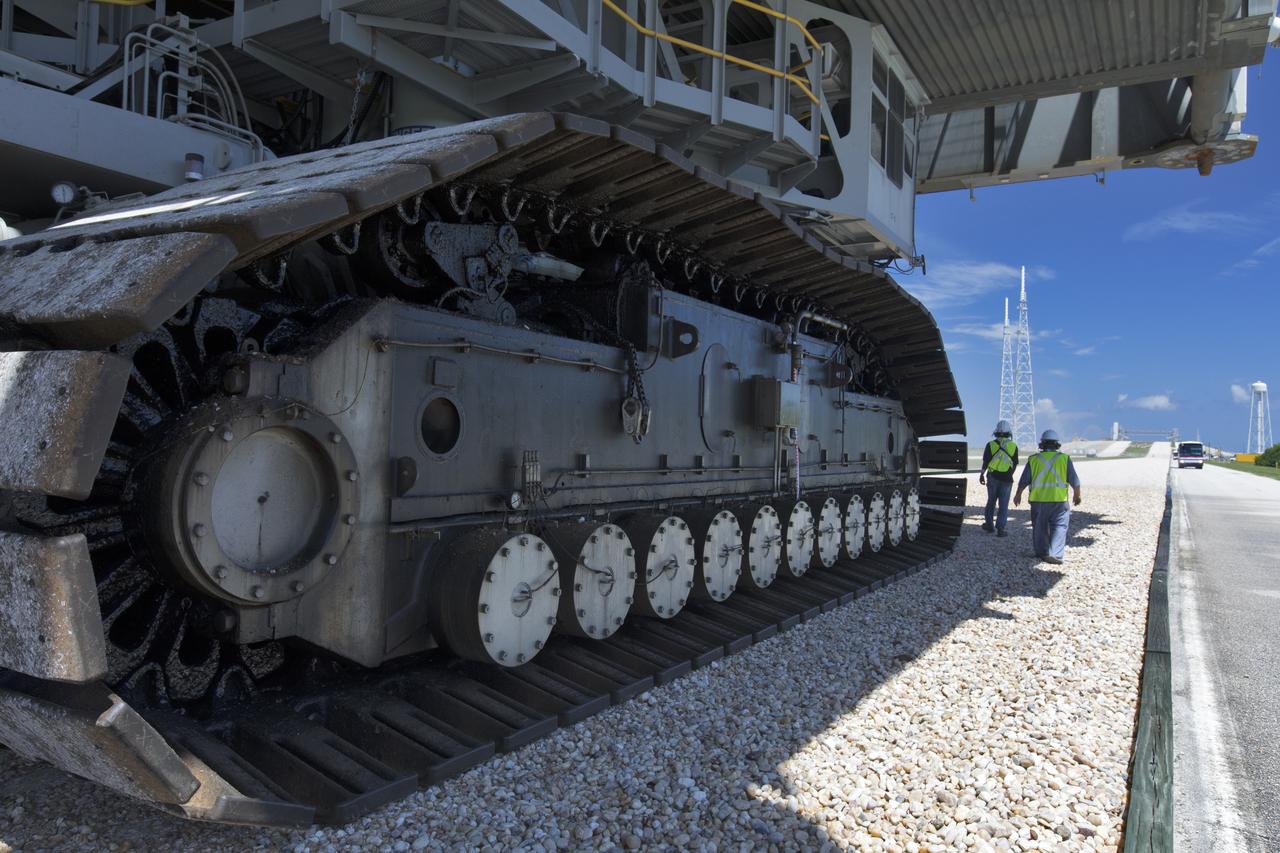
A close-up view of NASA's crawler-transporter 2 (CT-2) with the mobile launcher (ML) atop as it slowly moves along the crawlerway on its trek to Launch Pad 39B on Aug. 31, 2018, at the agency's Kennedy Space Center in Florida. CT-2 will move the ML up to the surface of the pad where it will undergo a fit check, followed by several days of systems testing. The 380-foot-tall mobile launcher is equipped with the crew access arm and several umbilicals that will provide power, environmental control, pneumatics, communication and electrical connections to NASA's Space Launch System (SLS) and Orion spacecraft. Exploration Ground Systems is preparing the ground systems necessary to launch SLS and Orion on Exploration Mission-1, missions to the Moon and on to Mars.
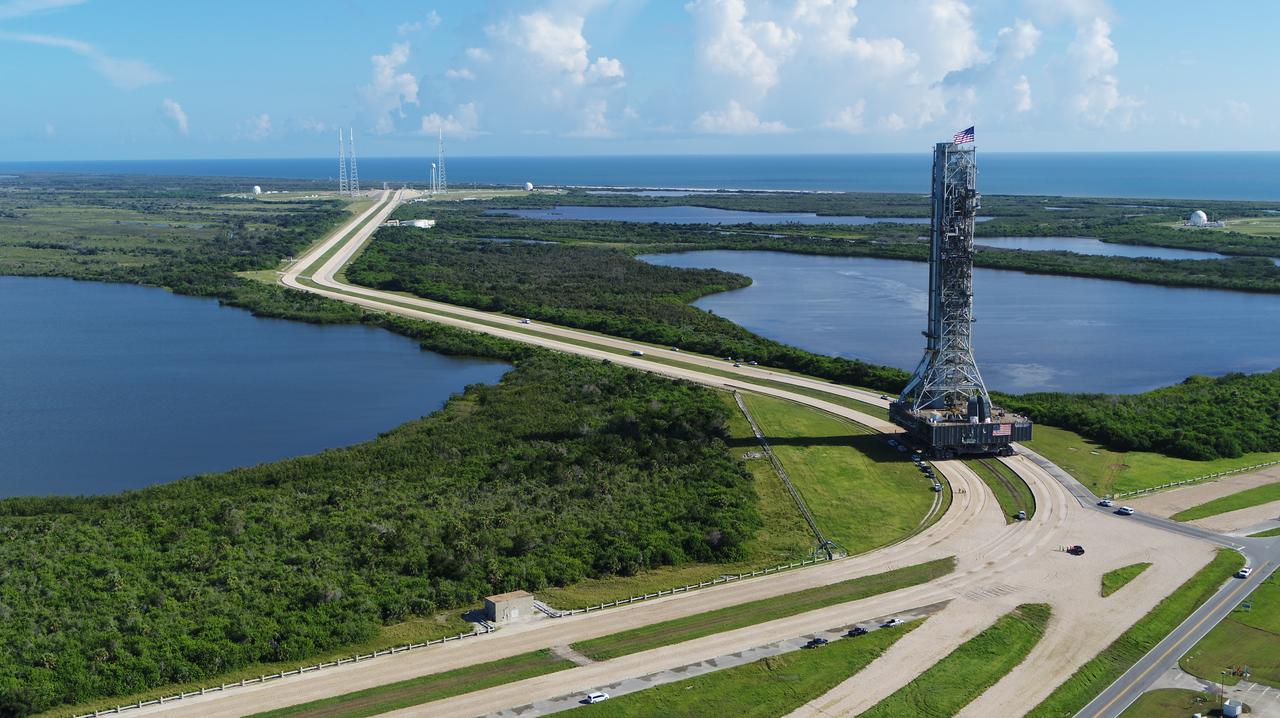
An aerial view of NASA's mobile launcher (ML) atop crawler-transporter 2 as it moves along the crawlerway, making the turn to Launch Pad 39B on Aug. 31, 2018, at the agency's Kennedy Space Center in Florida. In view on top of the ML is the American flag. The ML will undergo a fit check on the surface of the pad, followed by several days of systems testing. The 380-foot-tall mobile launcher is equipped with the crew access arm and several umbilicals that will provide power, environmental control, pneumatics, communication and electrical connections to NASA's Space Launch System (SLS) and Orion spacecraft. Exploration Ground Systems is preparing the ground systems necessary to launch SLS and Orion on Exploration Mission-1, missions to the Moon and on to Mars.
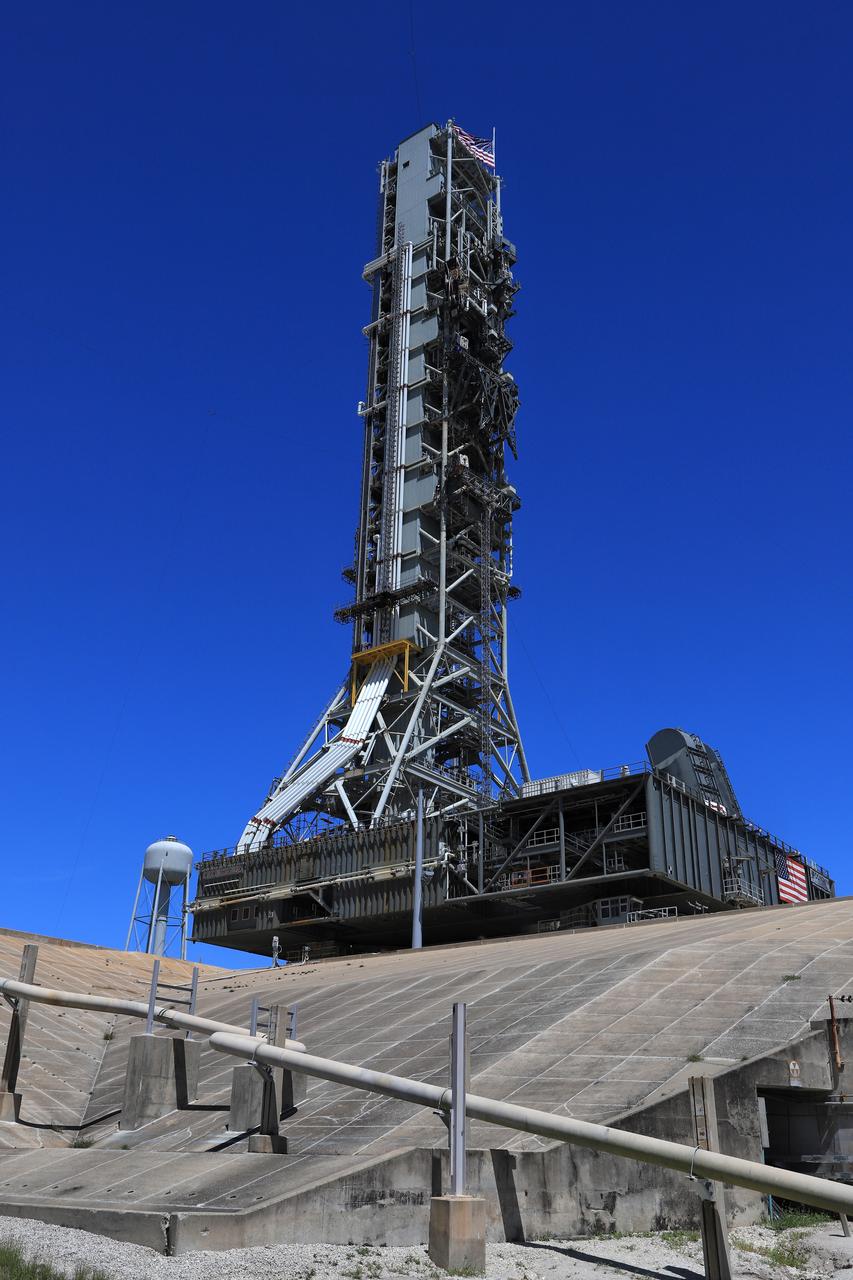
NASA's mobile launcher (ML) atop crawler-transporter 2 arrives at the top of Launch Pad 39B on Aug. 31, 2018, at the agency's Kennedy Space Center in Florida. The ML will undergo a fit check, followed by several days of systems testing. The 380-foot-tall mobile launcher is equipped with the crew access arm and several umbilicals that will provide power, environmental control, pneumatics, communication and electrical connections to NASA's Space Launch System (SLS) and Orion spacecraft. Exploration Ground Systems is preparing the ground systems necessary to launch SLS and Orion on Exploration Mission-1, missions to the Moon and on to Mars.
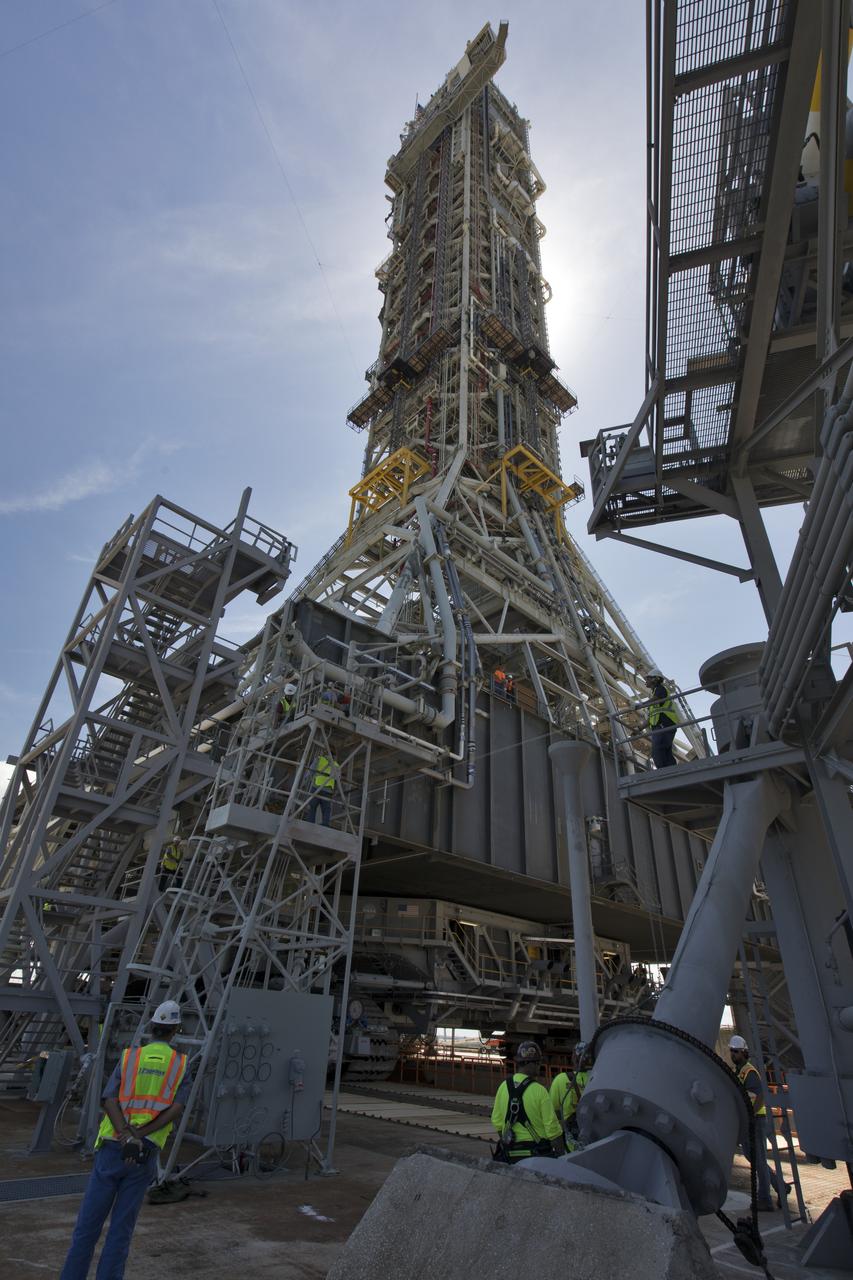
Crawler-transporter 2, with NASA's mobile launcher atop, is stopped at the top of Launch Pad 39B on Aug. 31, 2018, at NASA's Kennedy Space Center in Florida. The ML will undergo a fit check, followed by several days of systems testing. The 380-foot-tall mobile launcher is equipped with the crew access arm and several umbilicals that will provide power, environmental control, pneumatics, communication and electrical connections to NASA's Space Launch System (SLS) and Orion spacecraft. Exploration Ground Systems is preparing the ground systems necessary to launch SLS and Orion on Exploration Mission-1, missions to the Moon and on to Mars.
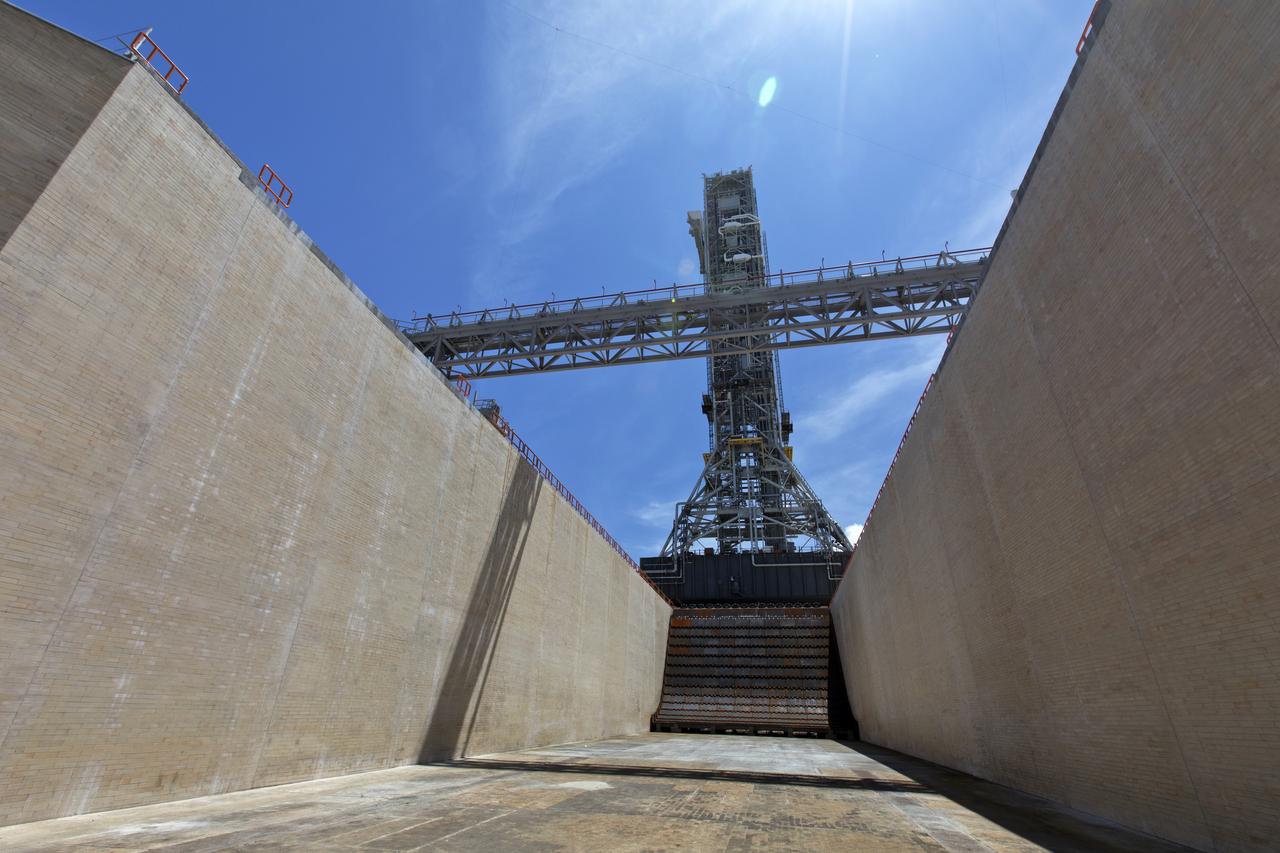
With a view of the flame trench and flame deflector below, NASA's mobile launcher (ML) atop crawler-transporter 2 arrives at Launch Pad 39B on Aug. 31, 2018, at the agency's Kennedy Space Center in Florida. The ML will undergo a fit check, followed by several days of systems testing. The 380-foot-tall mobile launcher is equipped with the crew access arm and several umbilicals that will provide power, environmental control, pneumatics, communication and electrical connections to NASA's Space Launch System (SLS) and Orion spacecraft. Exploration Ground Systems is preparing the ground systems necessary to launch SLS and Orion on Exploration Mission-1, missions to the Moon and on to Mars.
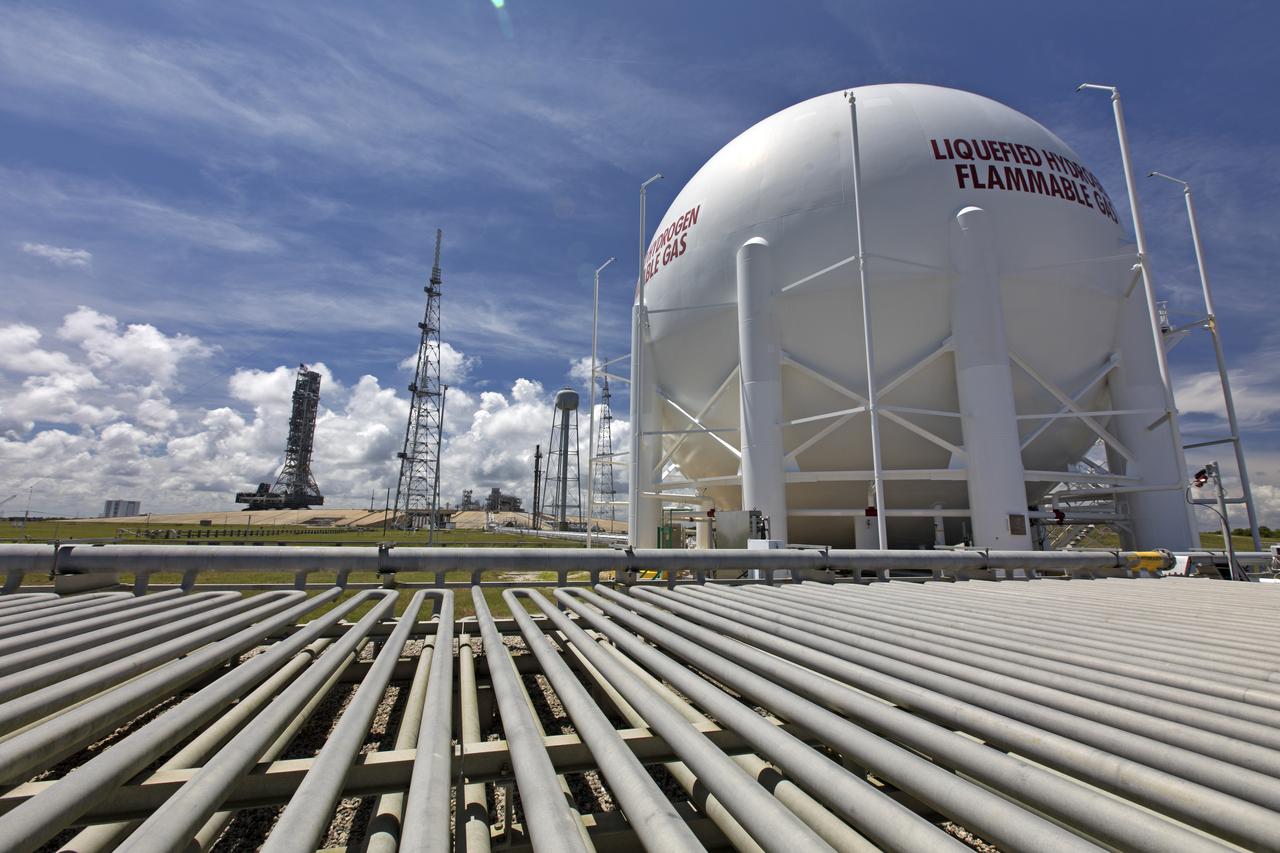
A liquid hydrogen storage tank is in view as NASA's mobile launcher (ML) atop crawler-transporter 2 makes its way up the ramp at Launch Pad 39B on Aug. 31, 2018, at the agency's Kennedy Space Center in Florida. The ML will undergo a fit check, followed by several days of systems testing. The 380-foot-tall mobile launcher is equipped with the crew access arm and several umbilicals that will provide power, environmental control, pneumatics, communication and electrical connections to NASA's Space Launch System (SLS) and Orion spacecraft. Exploration Ground Systems is preparing the ground systems necessary to launch SLS and Orion on Exploration Mission-1, missions to the Moon and on to Mars.
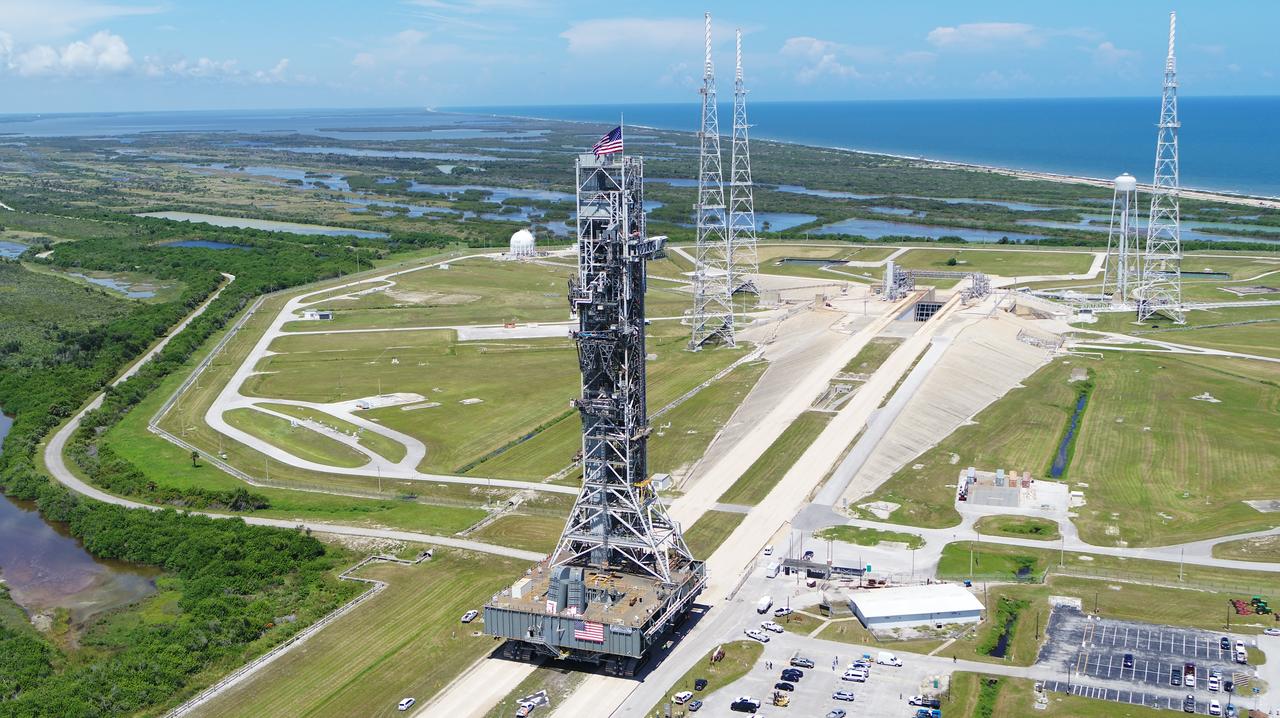
NASA's mobile launcher (ML) atop crawler-transporter 2 arrives at Launch Pad 39B on Aug. 31, 2018, at the agency's Kennedy Space Center in Florida. The ML will undergo a fit check, followed by several days of systems testing. The 380-foot-tall mobile launcher is equipped with the crew access arm and several umbilicals that will provide power, environmental control, pneumatics, communication and electrical connections to NASA's Space Launch System (SLS) and Orion spacecraft. Exploration Ground Systems is preparing the ground systems necessary to launch SLS and Orion on Exploration Mission-1, missions to the Moon and on to Mars.
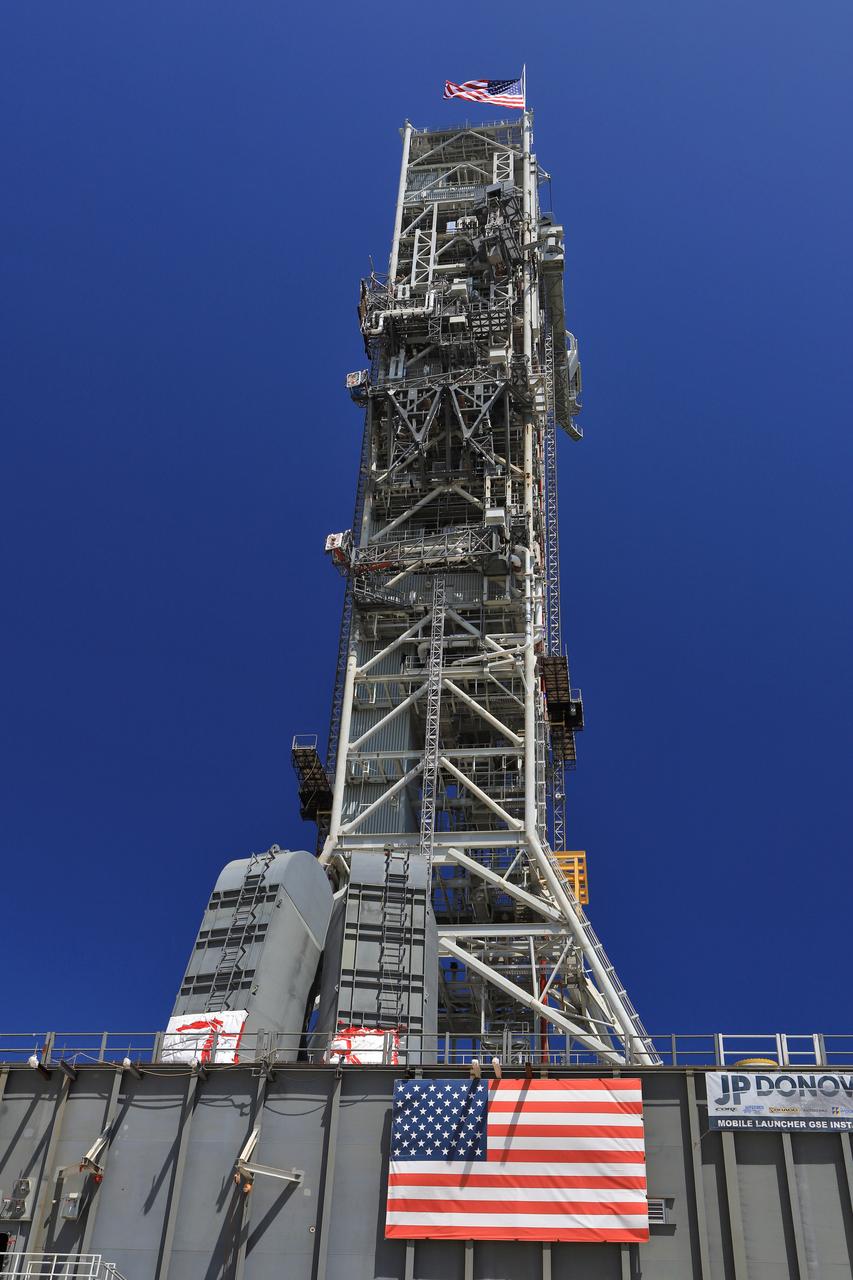
A bright blue sky serves as a backdrop as NASA's mobile launcher (ML) atop crawler-transporter 2 arrives at Launch Pad 39B on Aug. 31, 2018, at the agency's Kennedy Space Center in Florida. The ML will undergo a fit check, followed by several days of systems testing. The 380-foot-tall mobile launcher is equipped with the crew access arm and several umbilicals that will provide power, environmental control, pneumatics, communication and electrical connections to NASA's Space Launch System (SLS) and Orion spacecraft. Exploration Ground Systems is preparing the ground systems necessary to launch SLS and Orion on Exploration Mission-1, missions to the Moon and on to Mars.

NASA's mobile launcher (ML) atop crawler-transporter 2 arrives at Launch Pad 39B on Aug. 31, 2018, at the agency's Kennedy Space Center in Florida. The ML will undergo a fit check, followed by several days of systems testing. The 380-foot-tall mobile launcher is equipped with the crew access arm and several umbilicals that will provide power, environmental control, pneumatics, communication and electrical connections to NASA's Space Launch System (SLS) and Orion spacecraft. Exploration Ground Systems is preparing the ground systems necessary to launch SLS and Orion on Exploration Mission-1, missions to the Moon and on to Mars.
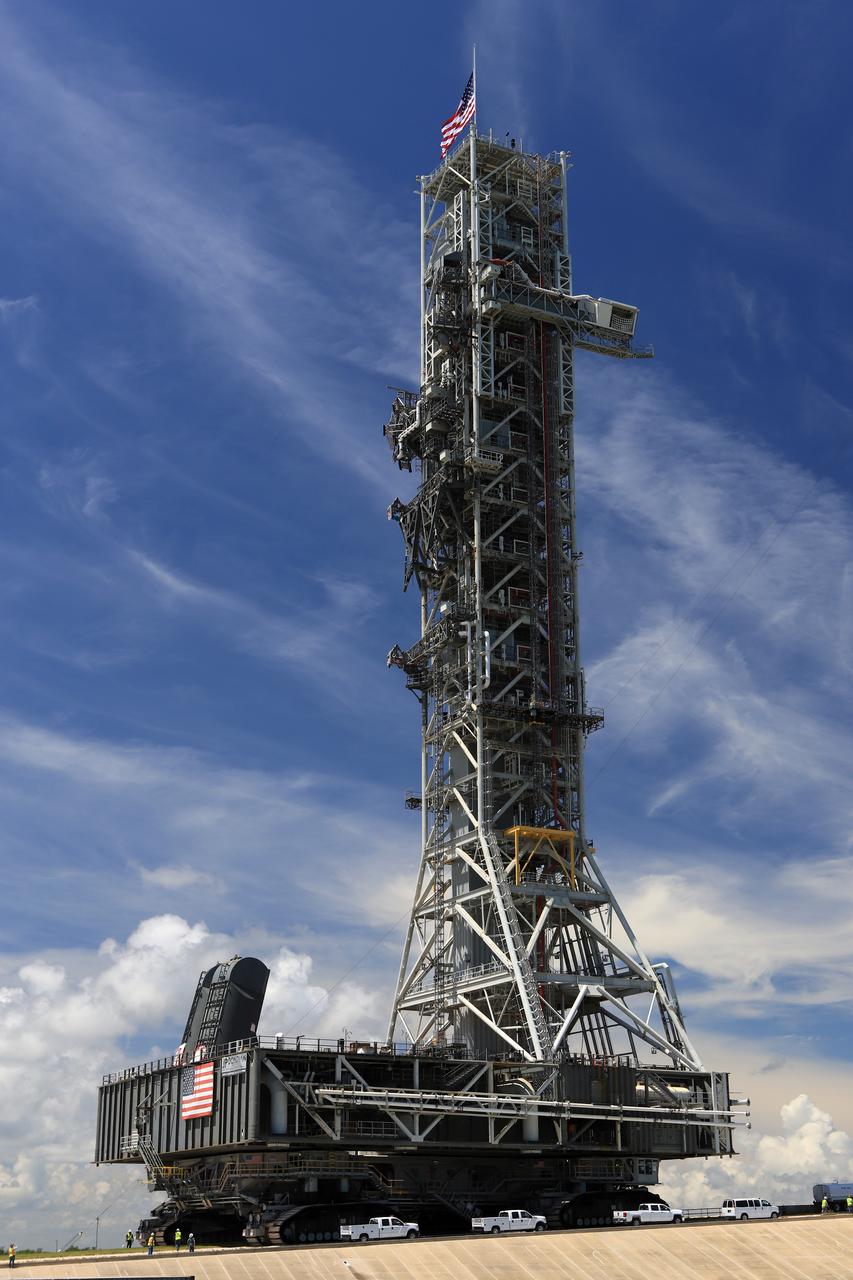
NASA's mobile launcher (ML) atop crawler-transporter 2 arrives at Launch Pad 39B on Aug. 31, 2018, at the agency's Kennedy Space Center in Florida. The ML will undergo a fit check, followed by several days of systems testing. The 380-foot-tall mobile launcher is equipped with the crew access arm and several umbilicals that will provide power, environmental control, pneumatics, communication and electrical connections to NASA's Space Launch System (SLS) and Orion spacecraft. Exploration Ground Systems is preparing the ground systems necessary to launch SLS and Orion on Exploration Mission-1, missions to the Moon and on to Mars.
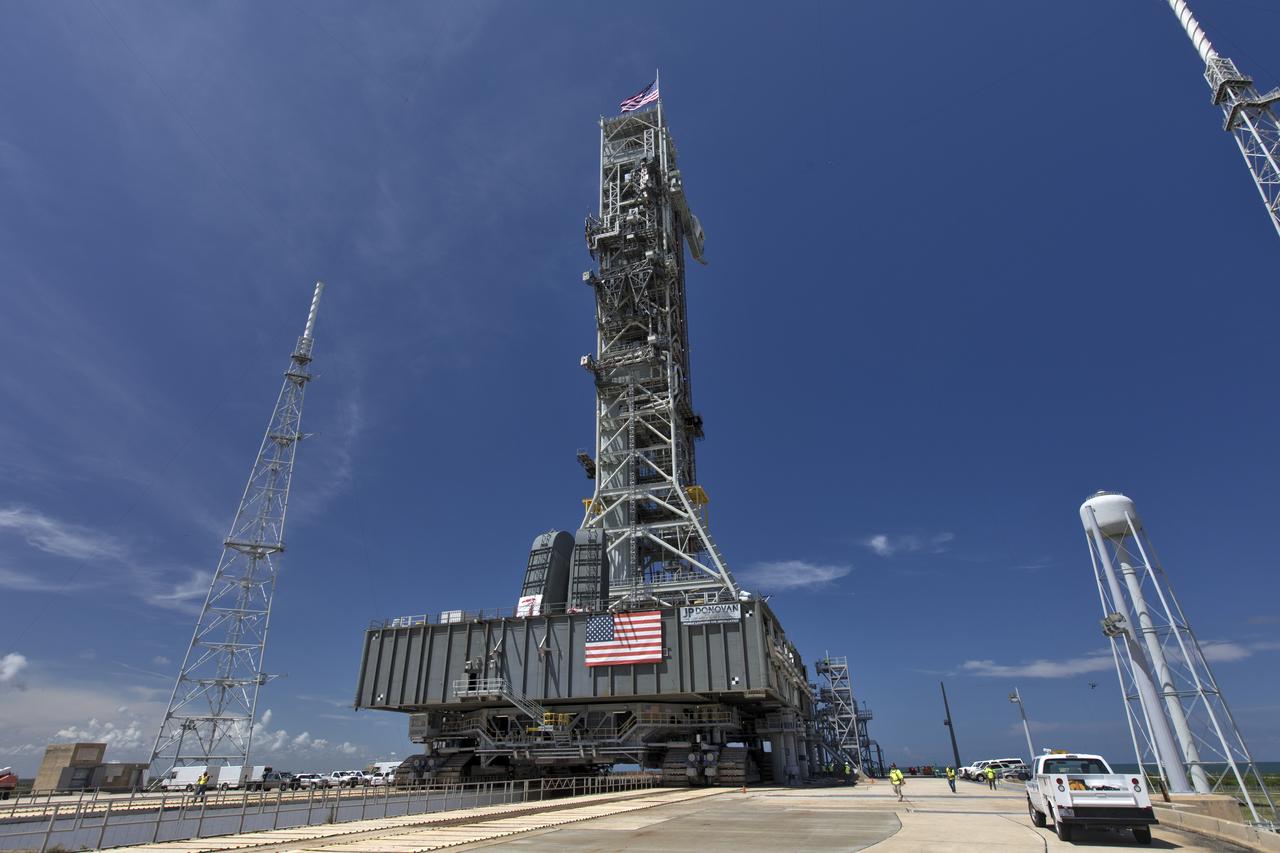
NASA's mobile launcher (ML) atop crawler-transporter 2 arrives at the top of Launch Pad 39B on Aug. 31, 2018, at the agency's Kennedy Space Center in Florida. The ML will undergo a fit check, followed by several days of systems testing. The 380-foot-tall mobile launcher is equipped with the crew access arm and several umbilicals that will provide power, environmental control, pneumatics, communication and electrical connections to NASA's Space Launch System (SLS) and Orion spacecraft. Exploration Ground Systems is preparing the ground systems necessary to launch SLS and Orion on Exploration Mission-1, missions to the Moon and on to Mars.
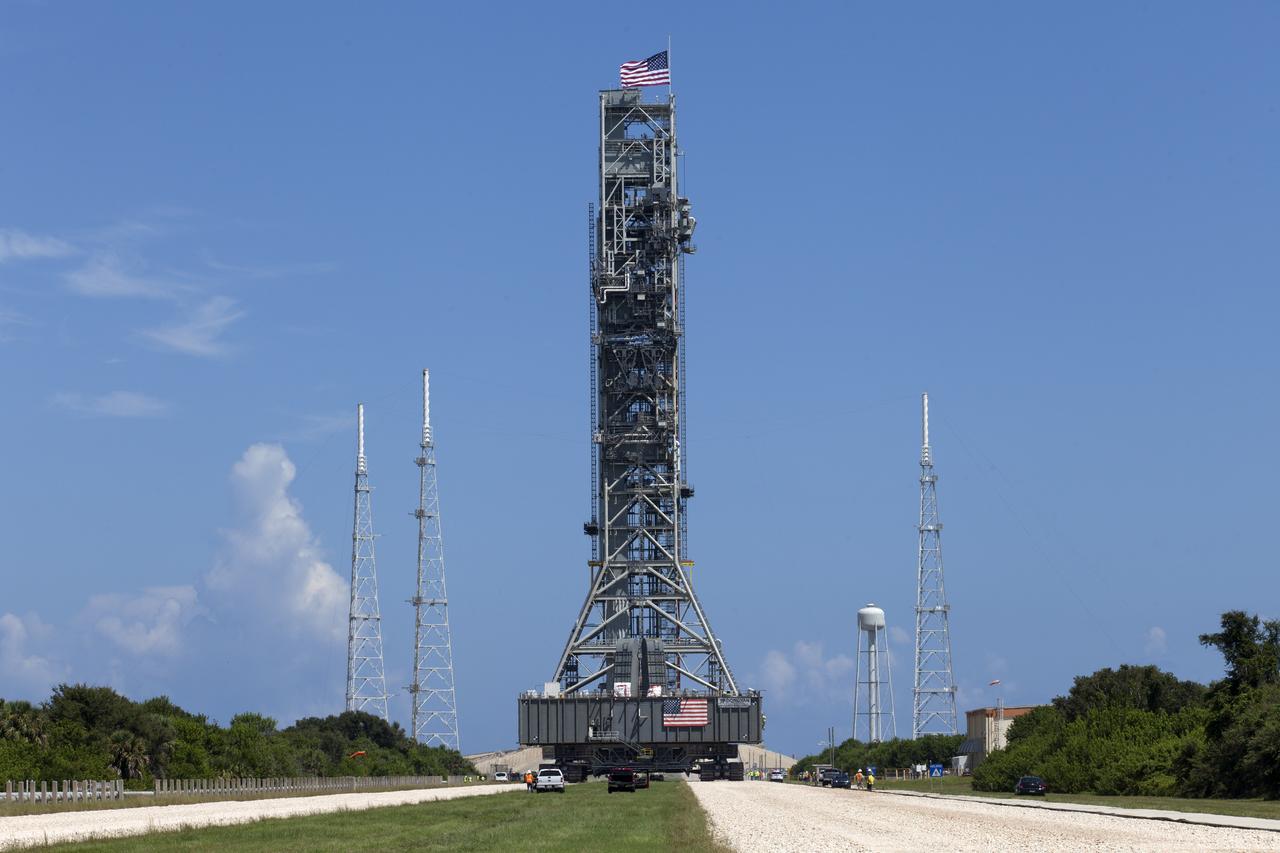
NASA's mobile launcher (ML) atop crawler-transporter 2 arrives at Launch Pad 39B on Aug. 31, 2018, at the agency's Kennedy Space Center in Florida. The ML will undergo a fit check, followed by several days of systems testing. The 380-foot-tall mobile launcher is equipped with the crew access arm and several umbilicals that will provide power, environmental control, pneumatics, communication and electrical connections to NASA's Space Launch System (SLS) and Orion spacecraft. Exploration Ground Systems is preparing the ground systems necessary to launch SLS and Orion on Exploration Mission-1, missions to the Moon and on to Mars.
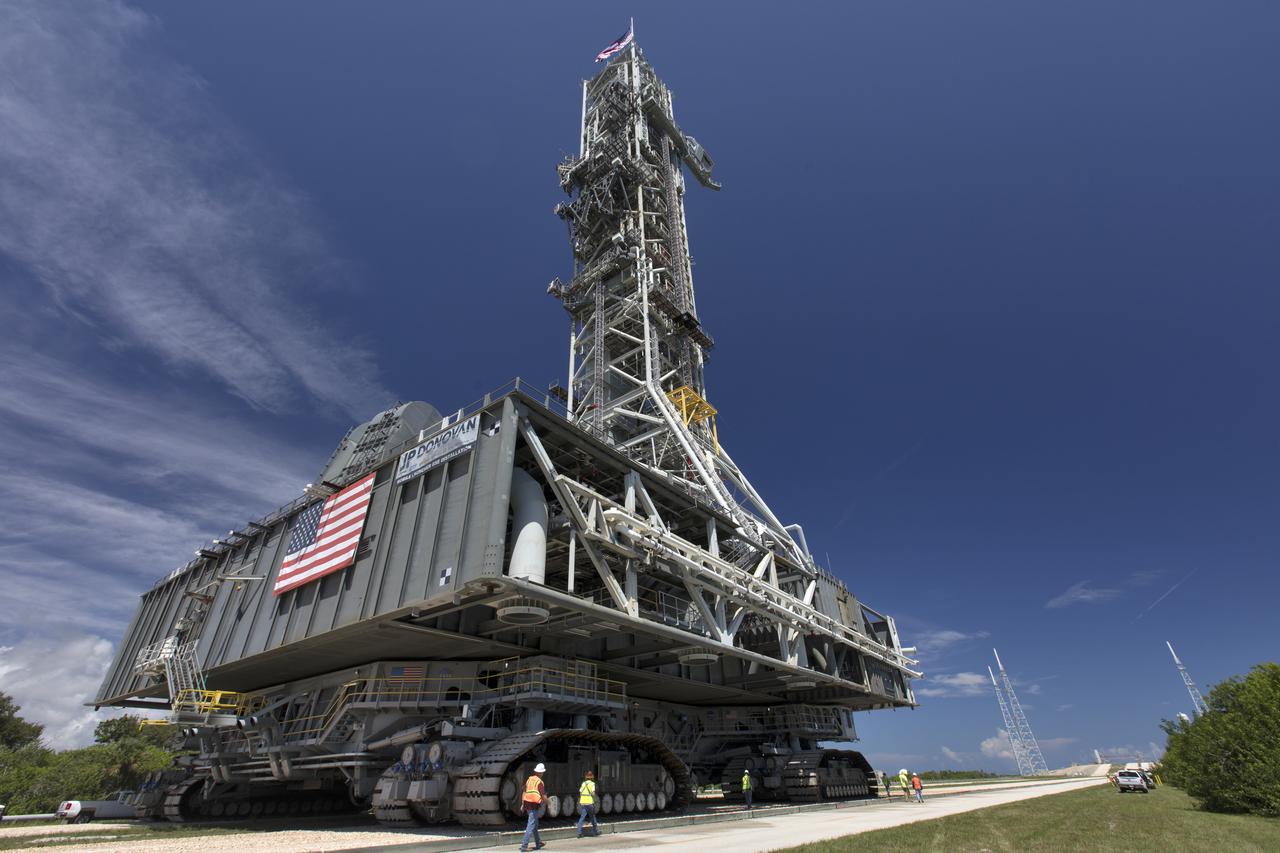
NASA's mobile launcher (ML) atop crawler-transporter 2 approaches Launch Pad 39B on Aug. 31, 2018, at the agency's Kennedy Space Center in Florida. The ML will undergo a fit check, followed by several days of systems testing. The 380-foot-tall mobile launcher is equipped with the crew access arm and several umbilicals that will provide power, environmental control, pneumatics, communication and electrical connections to NASA's Space Launch System (SLS) and Orion spacecraft. Exploration Ground Systems is preparing the ground systems necessary to launch SLS and Orion on Exploration Mission-1, missions to the Moon and on to Mars.
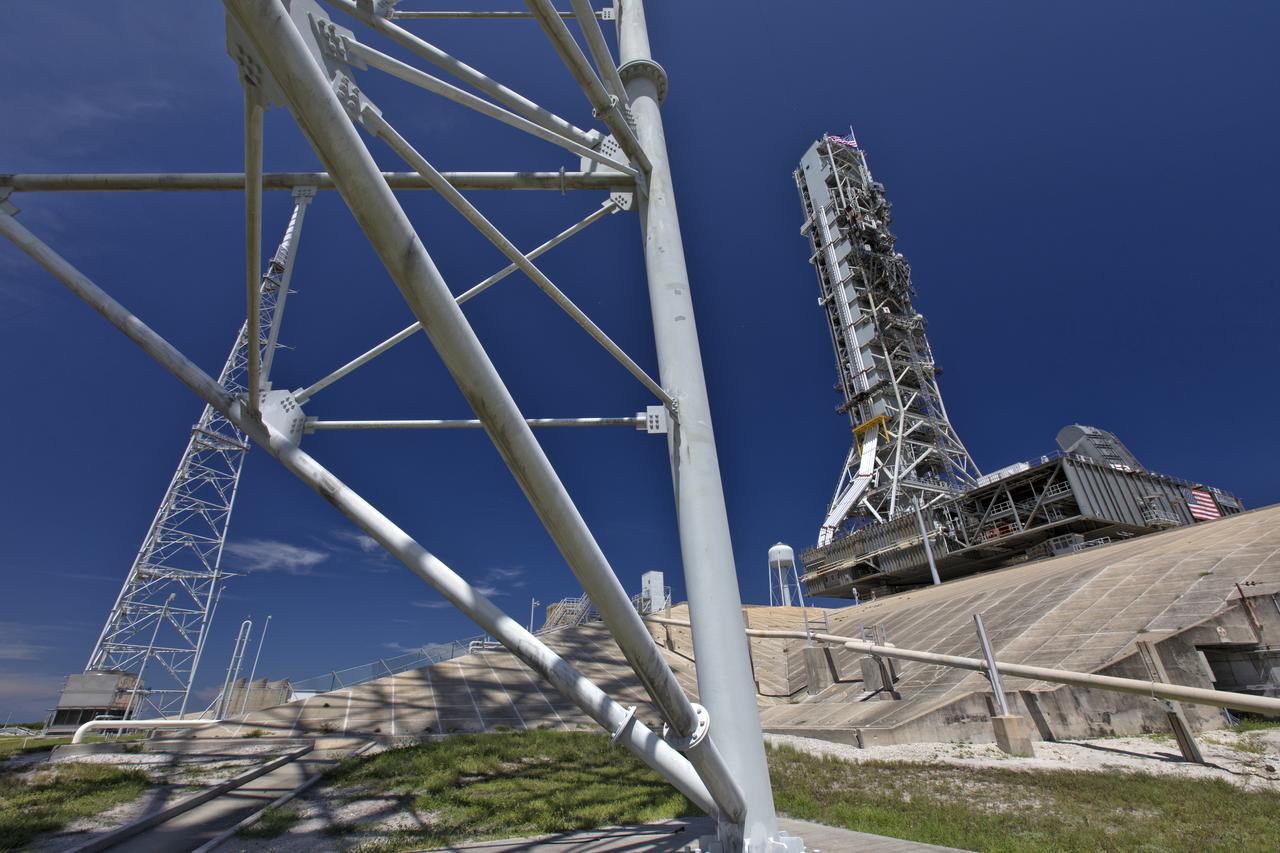
NASA's mobile launcher (ML) atop crawler-transporter 2 arrives at the top of Launch Pad 39B on Aug. 31, 2018, at the agency's Kennedy Space Center in Florida. The ML will undergo a fit check, followed by several days of systems testing. The 380-foot-tall mobile launcher is equipped with the crew access arm and several umbilicals that will provide power, environmental control, pneumatics, communication and electrical connections to NASA's Space Launch System (SLS) and Orion spacecraft. Exploration Ground Systems is preparing the ground systems necessary to launch SLS and Orion on Exploration Mission-1, missions to the Moon and on to Mars.
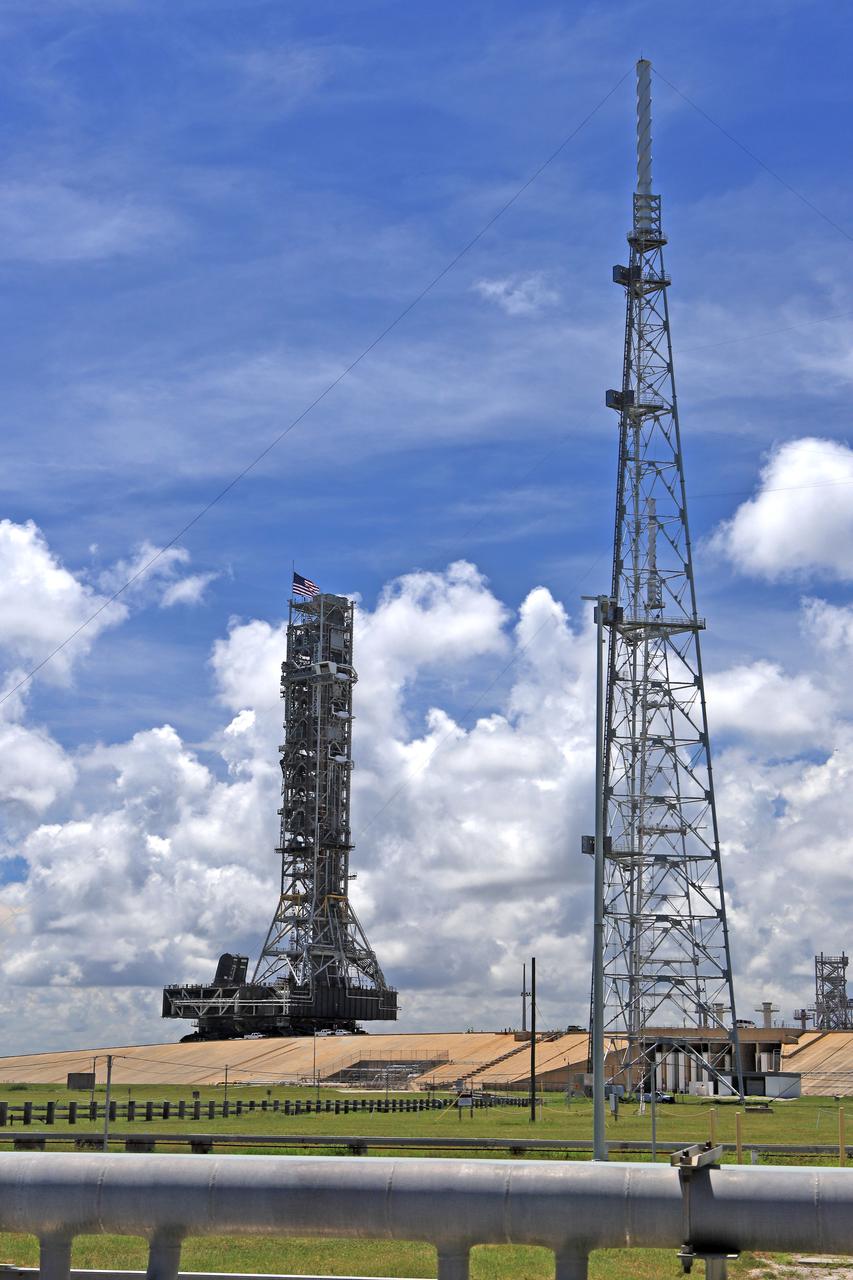
The crawler-transporter 2, with NASA's mobile launcher atop, makes its way up the ramp to the top of Launch Pad 39B at NASA's Kennedy Space Center in Florida, on Aug. 31, 2018. The ML will undergo a fit check, followed by several days of systems testing. The 380-foot-tall mobile launcher is equipped with the crew access arm and several umbilicals that will provide power, environmental control, pneumatics, communication and electrical connections to NASA's Space Launch System (SLS) and Orion spacecraft. Exploration Ground Systems is preparing the ground systems necessary to launch SLS and Orion on Exploration Mission-1, missions to the Moon and on to Mars.
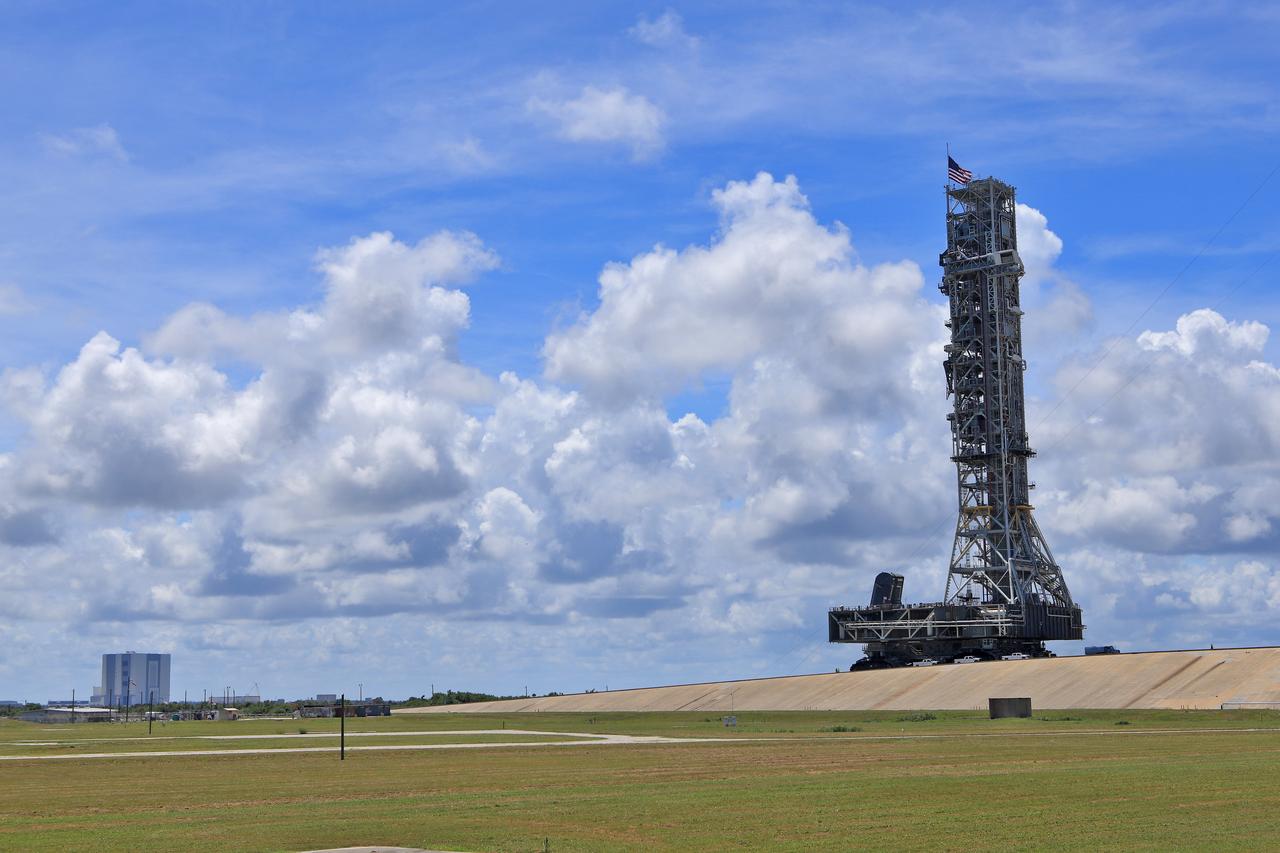
The crawler-transporter 2, with NASA's mobile launcher atop, makes its way up the ramp to the top of Launch Pad 39B at NASA's Kennedy Space Center in Florida, on Aug. 31, 2018. The ML will undergo a fit check, followed by several days of systems testing. The 380-foot-tall mobile launcher is equipped with the crew access arm and several umbilicals that will provide power, environmental control, pneumatics, communication and electrical connections to NASA's Space Launch System (SLS) and Orion spacecraft. Exploration Ground Systems is preparing the ground systems necessary to launch SLS and Orion on Exploration Mission-1, missions to the Moon and on to Mars.
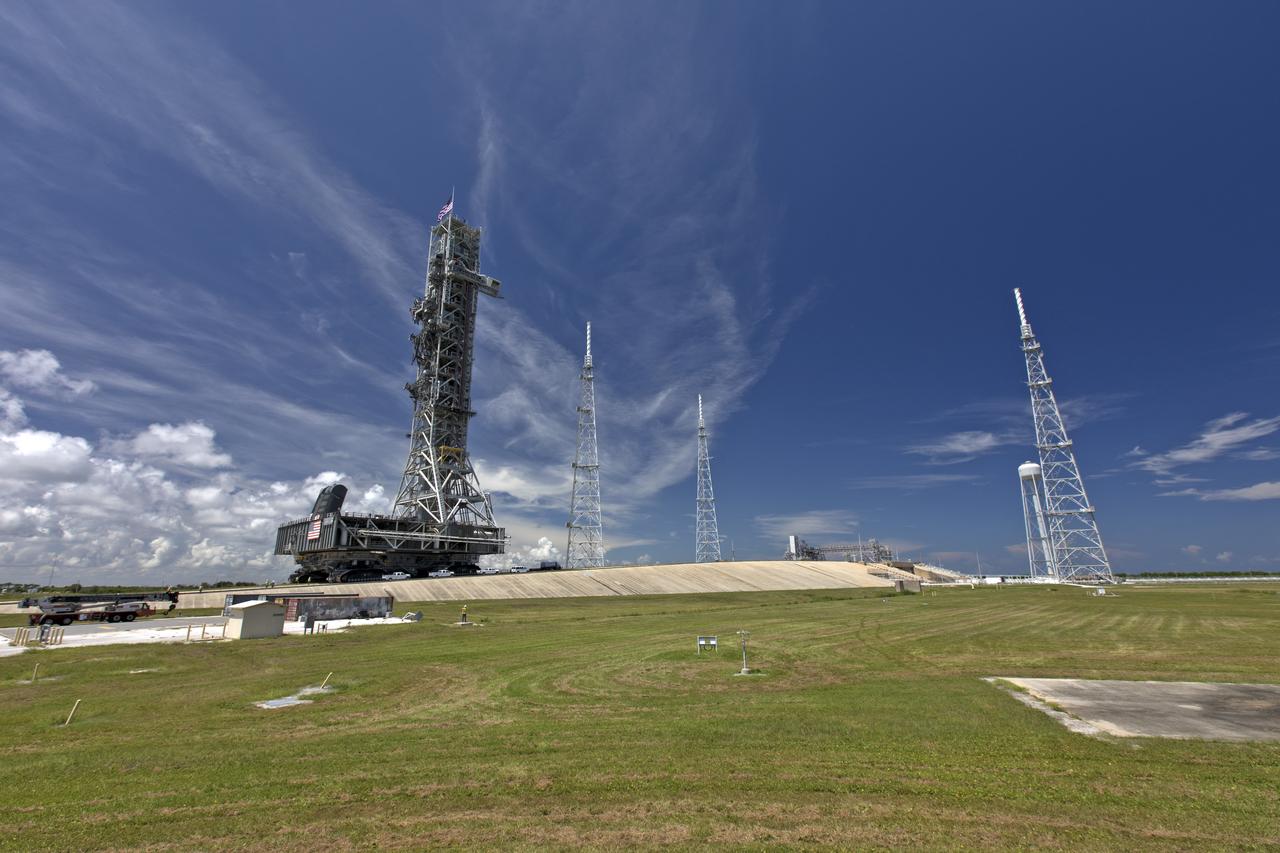
The crawler-transporter 2, with NASA's mobile launcher atop, makes its way up the ramp to the top of Launch Pad 39B at NASA's Kennedy Space Center in Florida, on Aug. 31, 2018. The ML will undergo a fit check, followed by several days of systems testing. The 380-foot-tall mobile launcher is equipped with the crew access arm and several umbilicals that will provide power, environmental control, pneumatics, communication and electrical connections to NASA's Space Launch System (SLS) and Orion spacecraft. Exploration Ground Systems is preparing the ground systems necessary to launch SLS and Orion on Exploration Mission-1, missions to the Moon and on to Mars.
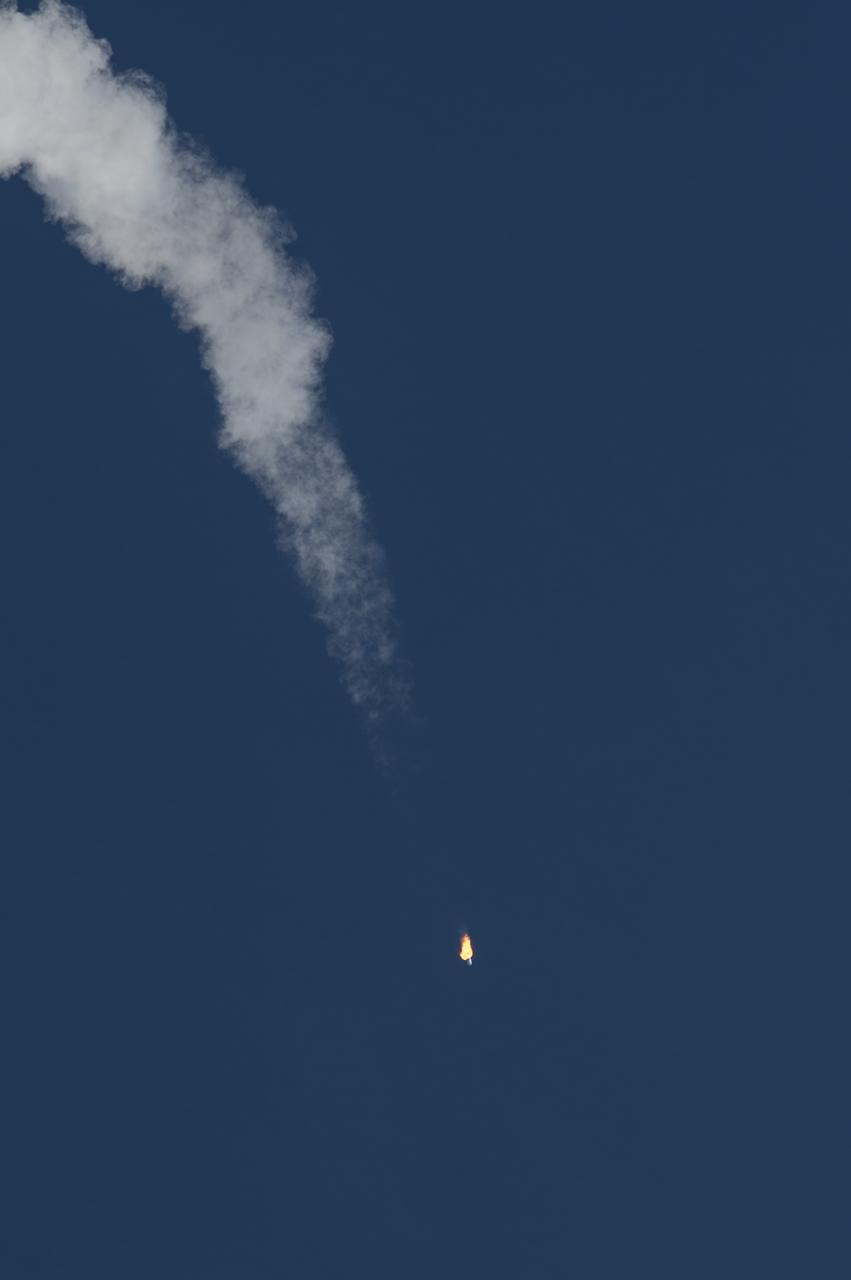
An Orbital Sciences Corporation Antares rocket is seen as it launches from Pad-0A at NASA's Wallops Flight Facility, Thursday, January 9, 2014, Wallops Island, VA. Antares is carrying the Cygnus spacecraft on a cargo resupply mission to the International Space Station. The Orbital-1 mission is Orbital Sciences' first contracted cargo delivery flight to the space station for NASA. Cygnus is carrying science experiments, crew provisions, spare parts and other hardware to the space station. Photo Credit: (NASA/Bill Ingalls)
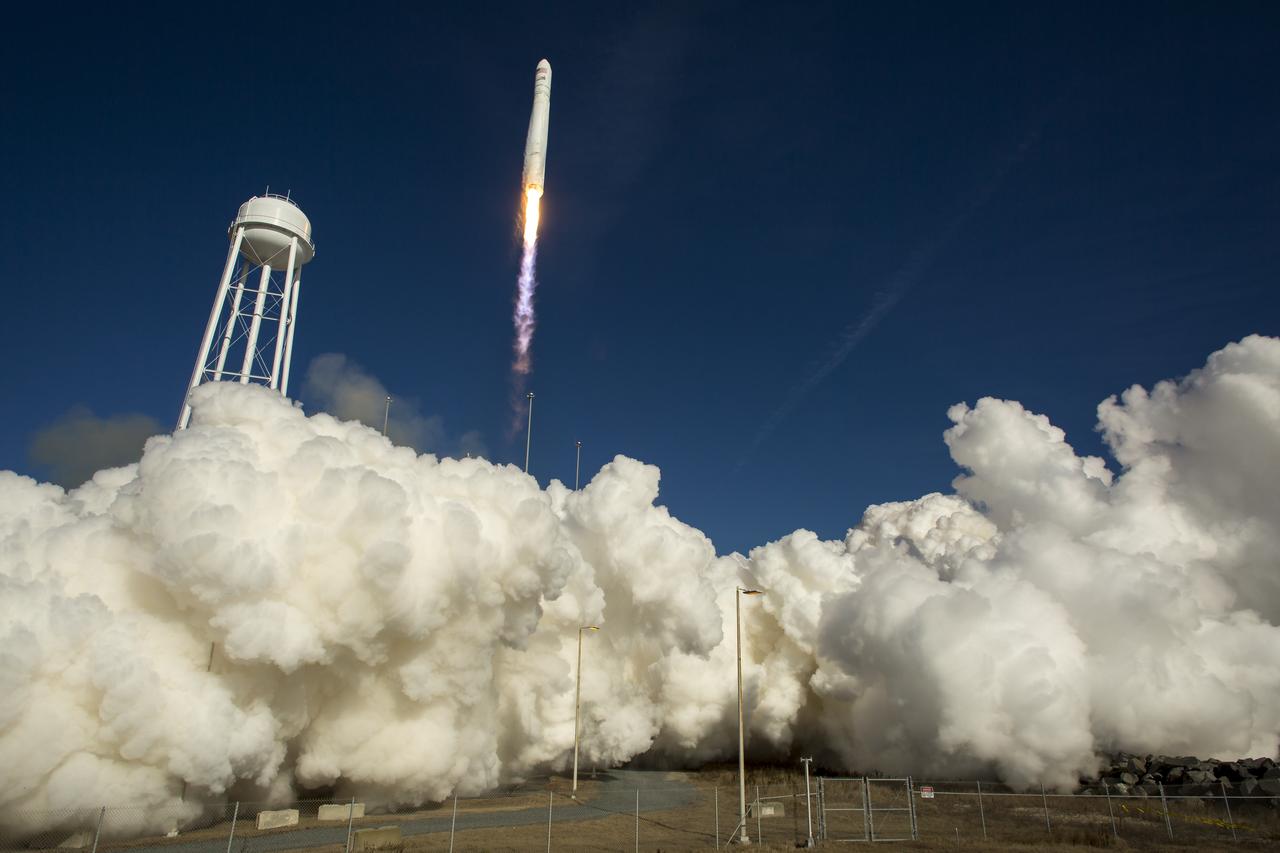
An Orbital Sciences Corporation Antares rocket is seen as it launches from Pad-0A at NASA's Wallops Flight Facility, Thursday, January 9, 2014, Wallops Island, VA. Antares is carrying the Cygnus spacecraft on a cargo resupply mission to the International Space Station. The Orbital-1 mission is Orbital Sciences' first contracted cargo delivery flight to the space station for NASA. Cygnus is carrying science experiments, crew provisions, spare parts and other hardware to the space station. Photo Credit: (NASA/Bill Ingalls)
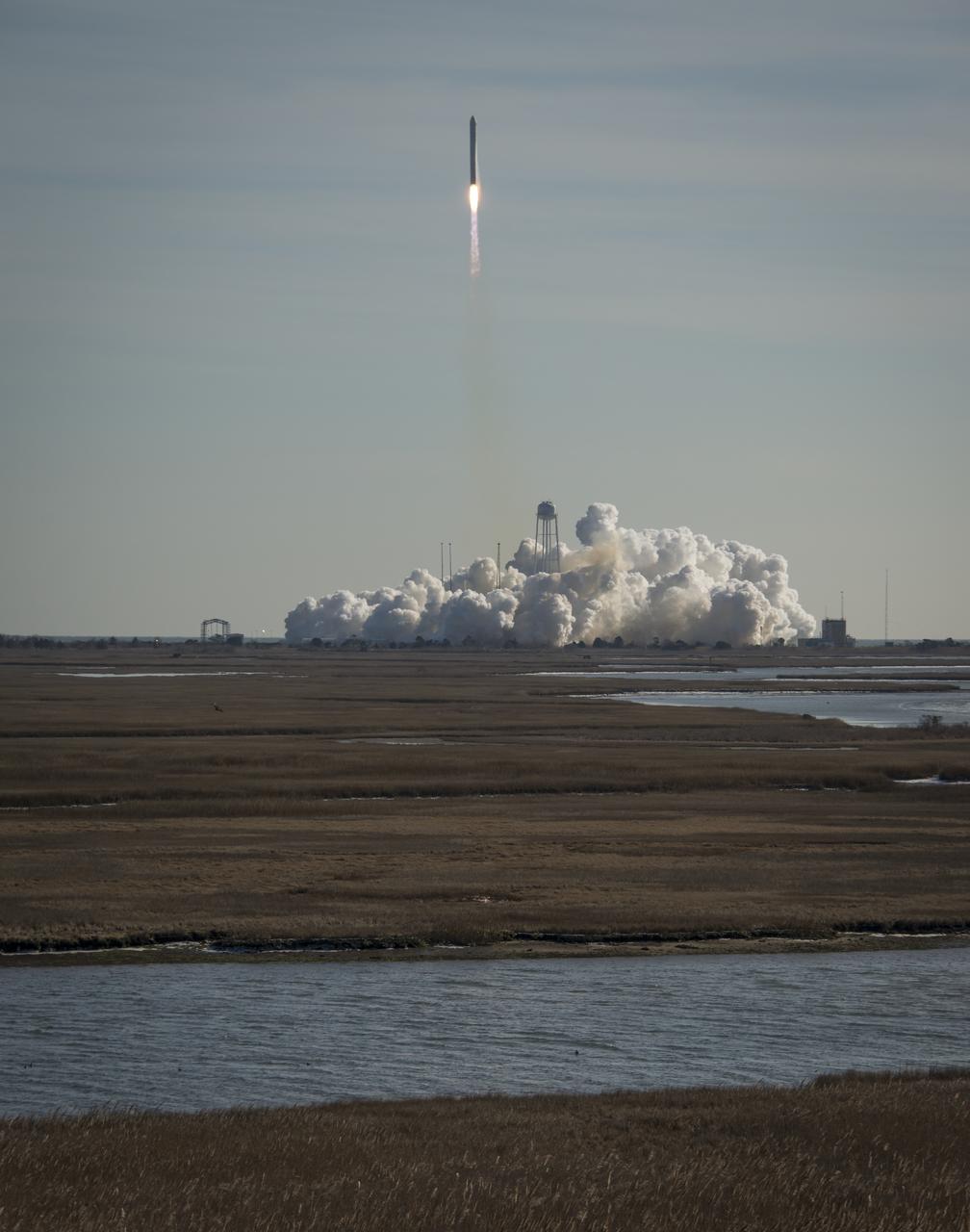
An Orbital Sciences Corporation Antares rocket is seen as it launches from Pad-0A at NASA's Wallops Flight Facility, Thursday, January 9, 2014, Wallops Island, VA. Antares is carrying the Cygnus spacecraft on a cargo resupply mission to the International Space Station. The Orbital-1 mission is Orbital Sciences' first contracted cargo delivery flight to the space station for NASA. Cygnus is carrying science experiments, crew provisions, spare parts and other hardware to the space station. Photo Credit: (NASA/Bill Ingalls)
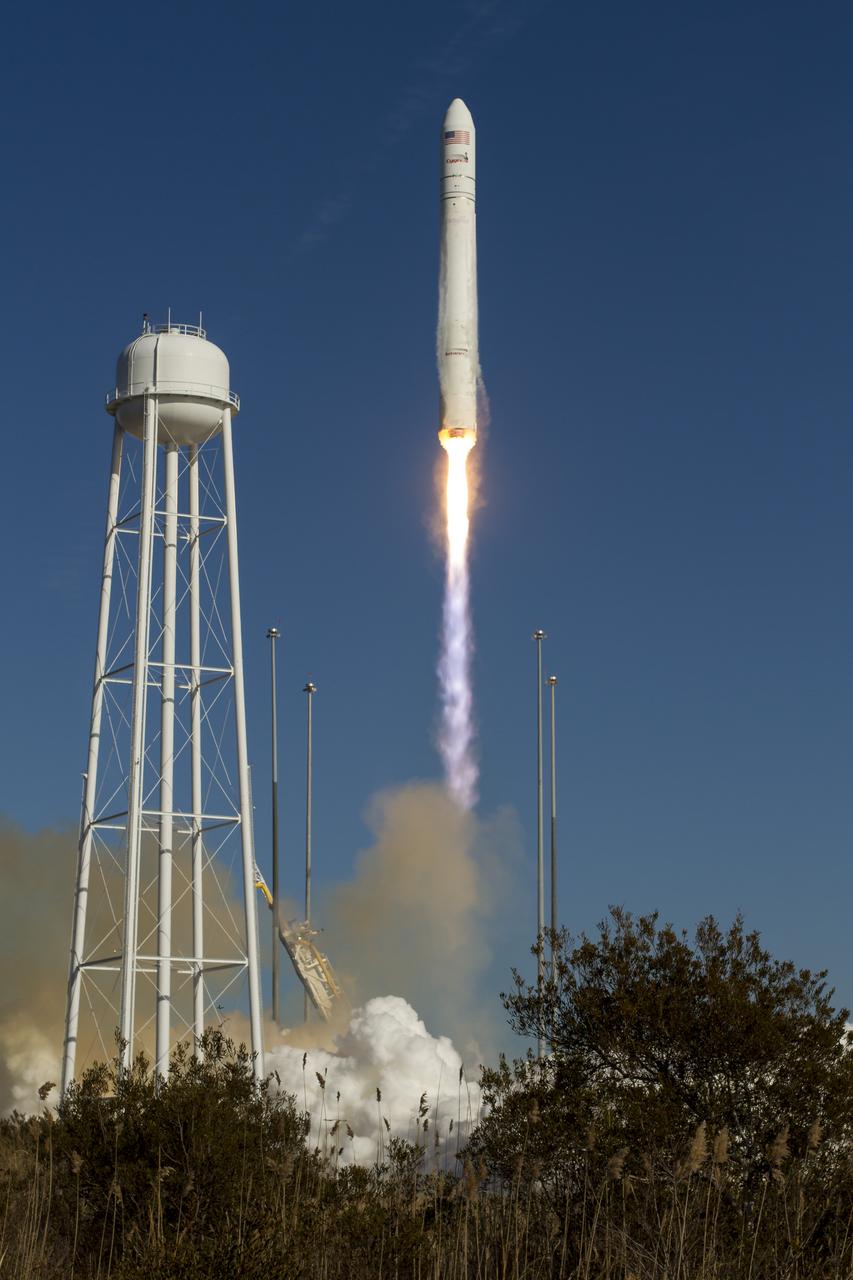
An Orbital Sciences Corporation Antares rocket is seen as it launches from Pad-0A at NASA's Wallops Flight Facility, Thursday, January 9, 2014, Wallops Island, VA. Antares is carrying the Cygnus spacecraft on a cargo resupply mission to the International Space Station. The Orbital-1 mission is Orbital Sciences' first contracted cargo delivery flight to the space station for NASA. Cygnus is carrying science experiments, crew provisions, spare parts and other hardware to the space station. Photo Credit: (NASA/Bill Ingalls)
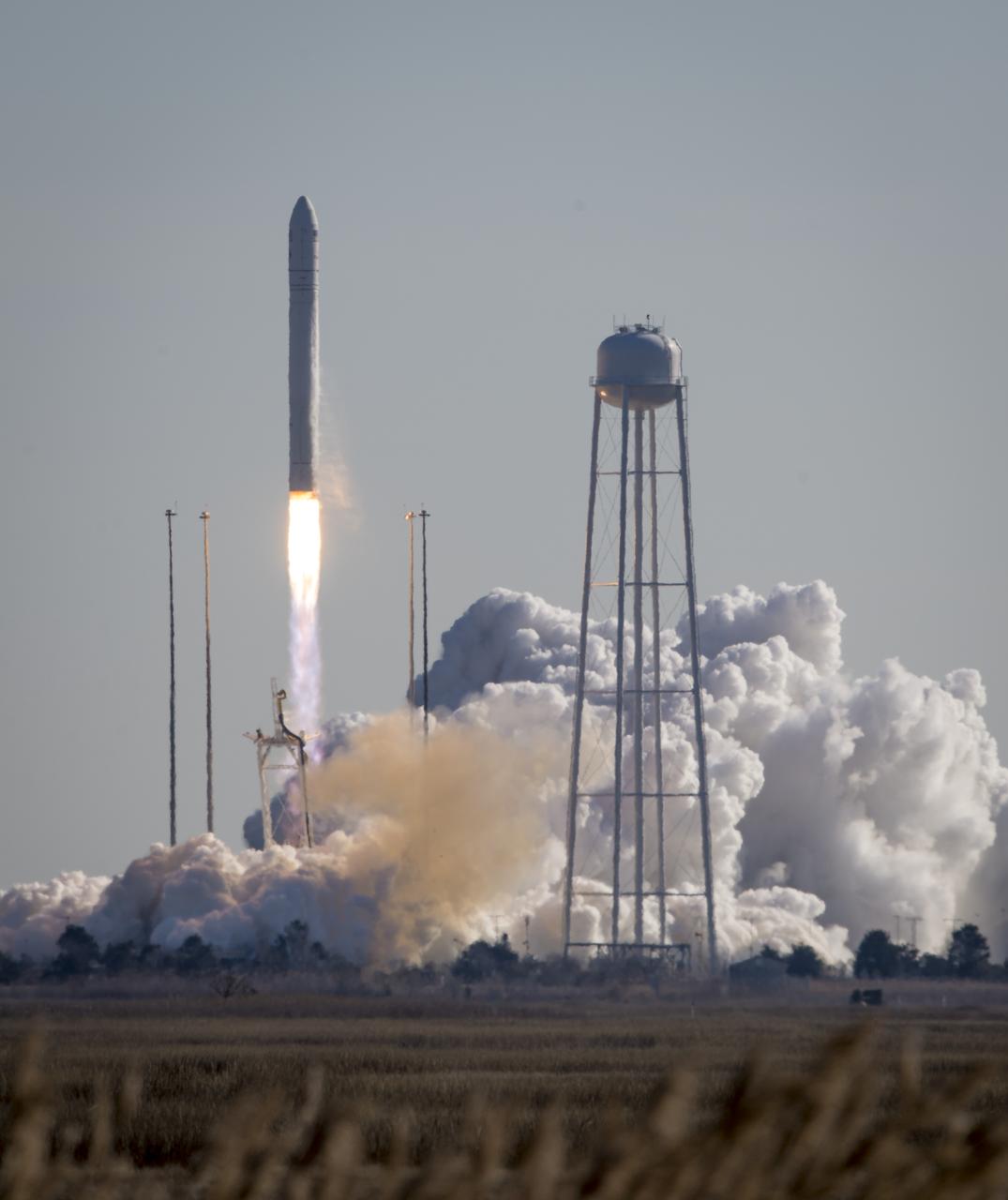
An Orbital Sciences Corporation Antares rocket is seen as it launches from Pad-0A at NASA's Wallops Flight Facility, Thursday, January 9, 2014, Wallops Island, VA. Antares is carrying the Cygnus spacecraft on a cargo resupply mission to the International Space Station. The Orbital-1 mission is Orbital Sciences' first contracted cargo delivery flight to the space station for NASA. Cygnus is carrying science experiments, crew provisions, spare parts and other hardware to the space station. Photo Credit: (NASA/Bill Ingalls)
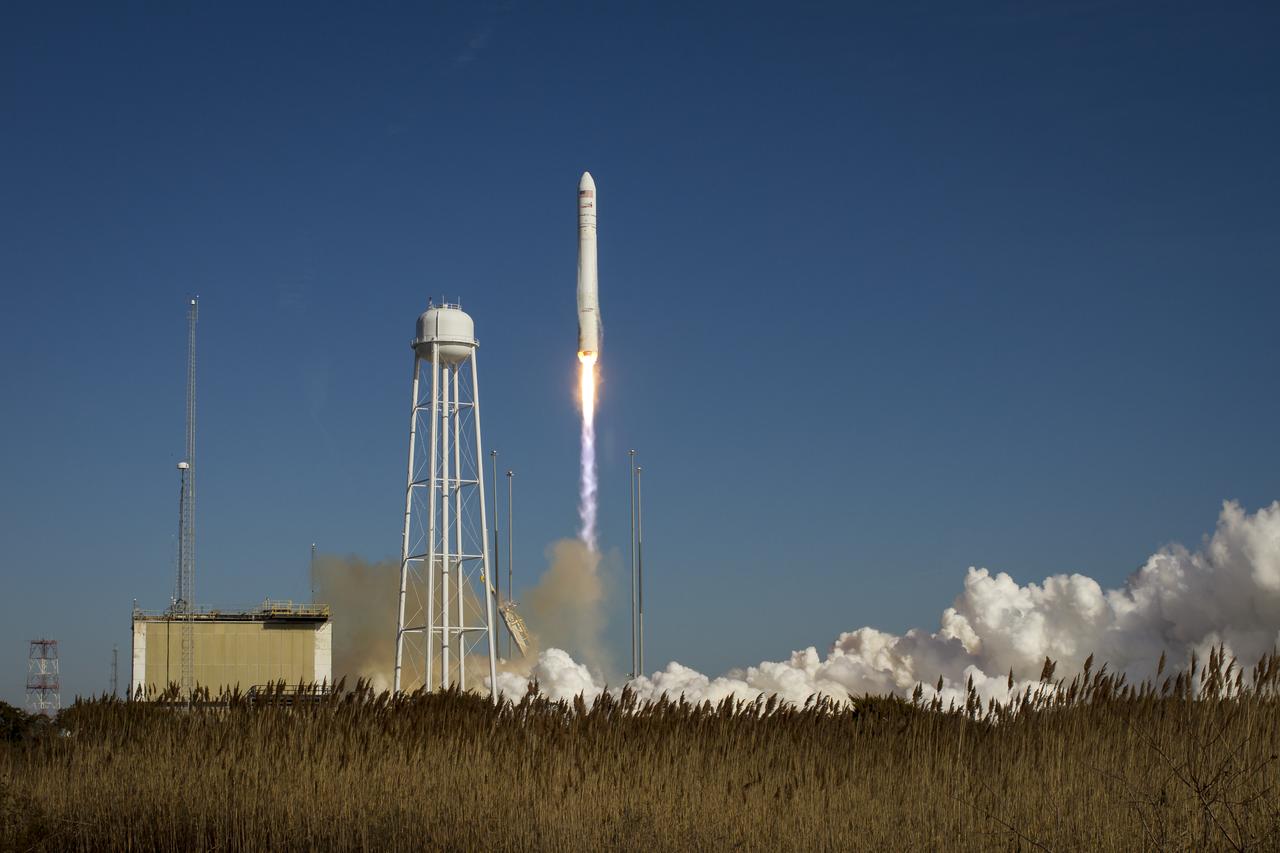
An Orbital Sciences Corporation Antares rocket is seen as it launches from Pad-0A at NASA's Wallops Flight Facility, Thursday, January 9, 2014, Wallops Island, VA. Antares is carrying the Cygnus spacecraft on a cargo resupply mission to the International Space Station. The Orbital-1 mission is Orbital Sciences' first contracted cargo delivery flight to the space station for NASA. Cygnus is carrying science experiments, crew provisions, spare parts and other hardware to the space station. Photo Credit: (NASA/Bill Ingalls)
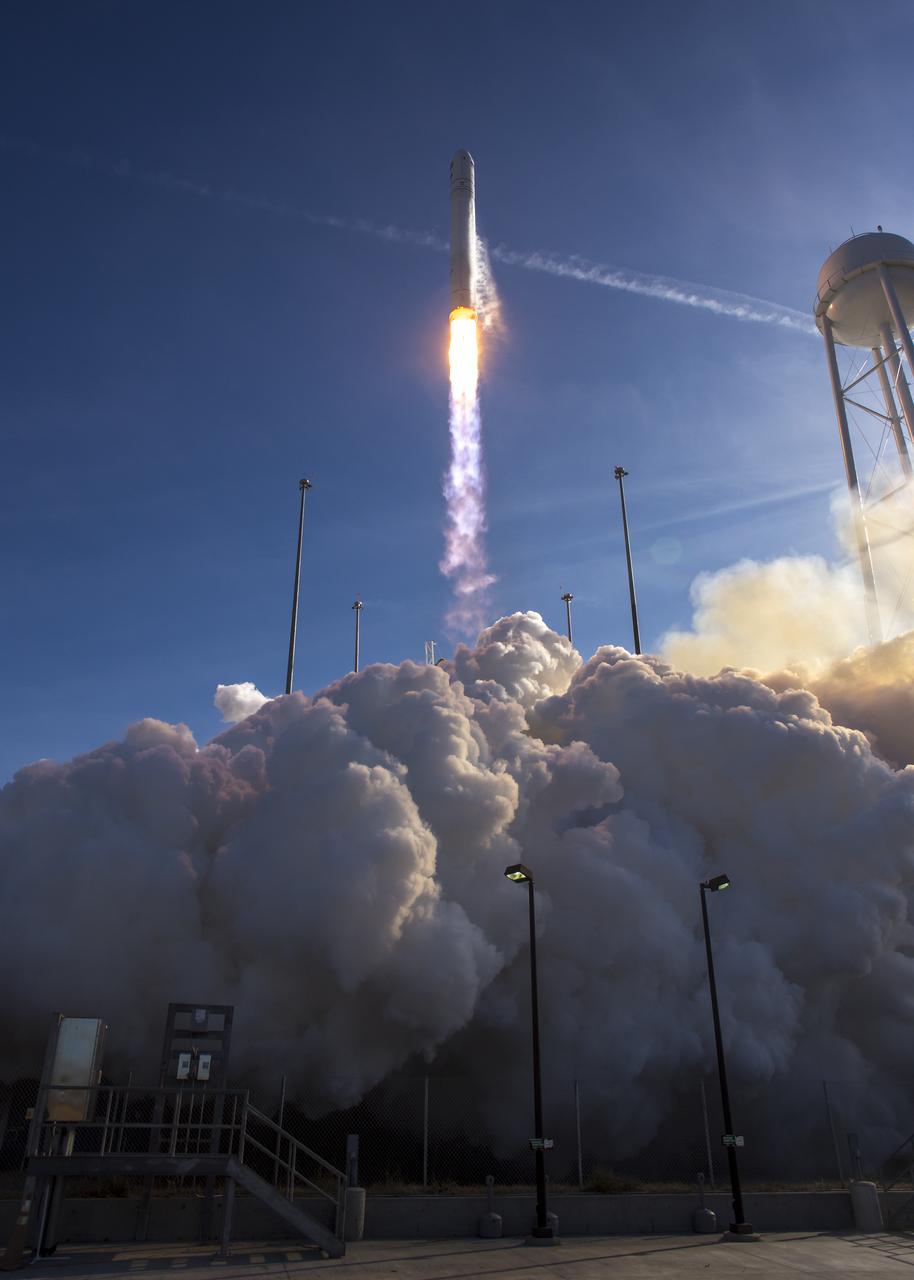
An Orbital Sciences Corporation Antares rocket is seen as it launches from Pad-0A at NASA's Wallops Flight Facility, Thursday, January 9, 2014, Wallops Island, VA. Antares is carrying the Cygnus spacecraft on a cargo resupply mission to the International Space Station. The Orbital-1 mission is Orbital Sciences' first contracted cargo delivery flight to the space station for NASA. Cygnus is carrying science experiments, crew provisions, spare parts and other hardware to the space station. Photo Credit: (NASA/Bill Ingalls)
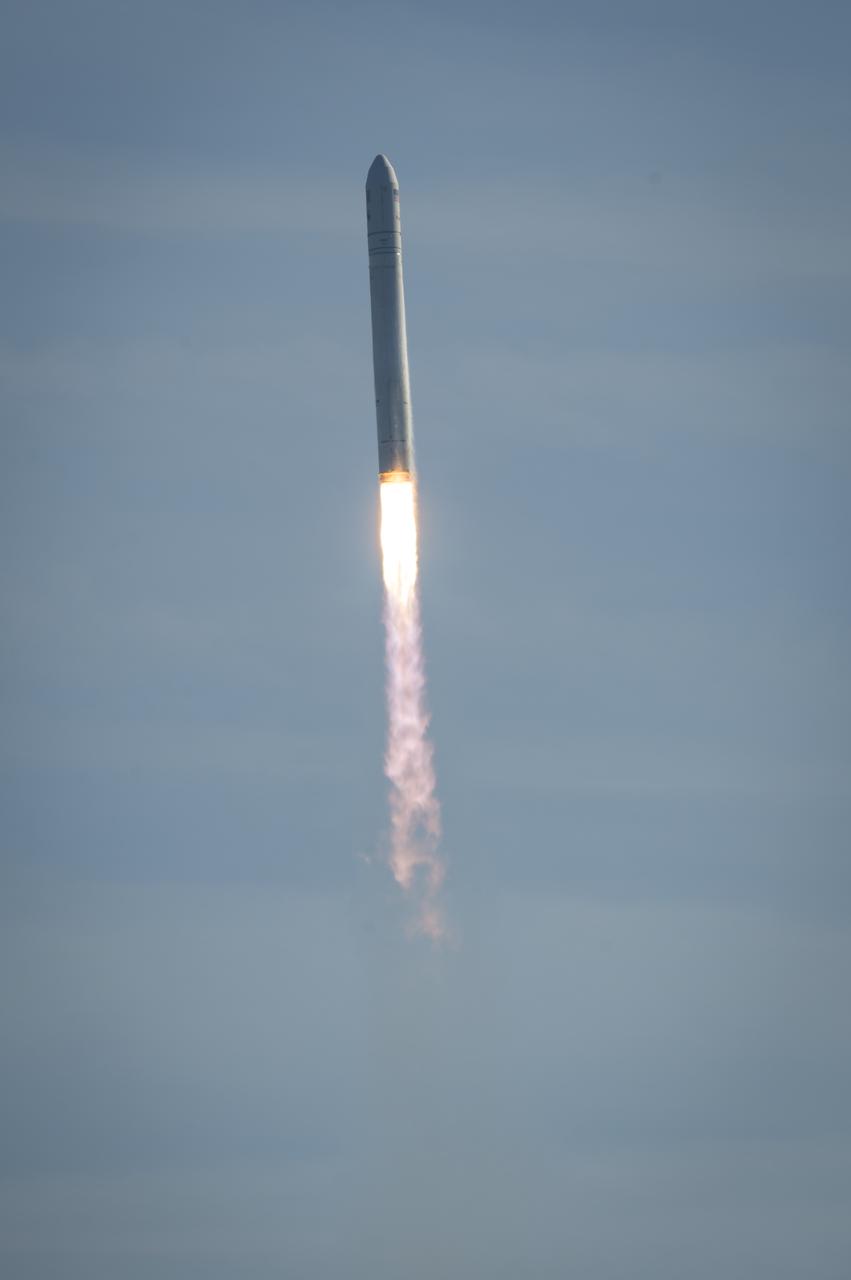
An Orbital Sciences Corporation Antares rocket is seen as it launches from Pad-0A at NASA's Wallops Flight Facility, Thursday, January 9, 2014, Wallops Island, VA. Antares is carrying the Cygnus spacecraft on a cargo resupply mission to the International Space Station. The Orbital-1 mission is Orbital Sciences' first contracted cargo delivery flight to the space station for NASA. Cygnus is carrying science experiments, crew provisions, spare parts and other hardware to the space station. Photo Credit: (NASA/Bill Ingalls)
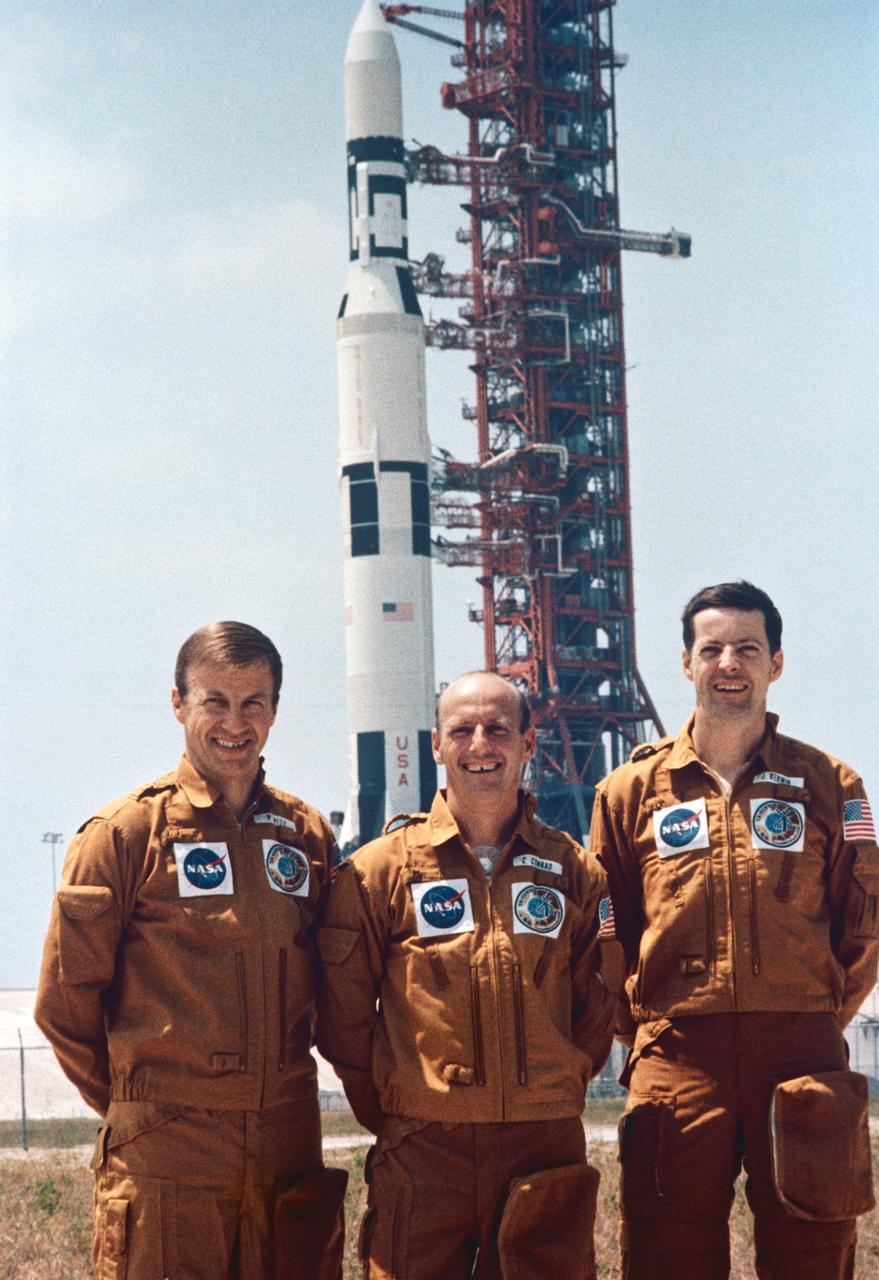
S73-25902 (4 May 1973) --- The three prime crew members of the first manned Skylab mission (Skylab 2) are photographed at Launch Complex 39, Kennedy Space Center, during preflight activity. They are, left to right, astronaut Paul J. Weitz, pilot; astronaut Charles Conrad Jr., commander; and scientist-astronaut Joseph P. Kerwin, science pilot. In the background is the Skylab 1/Saturn V space vehicle with its Skylab space station payload on Pad A. Photo credit: NASA