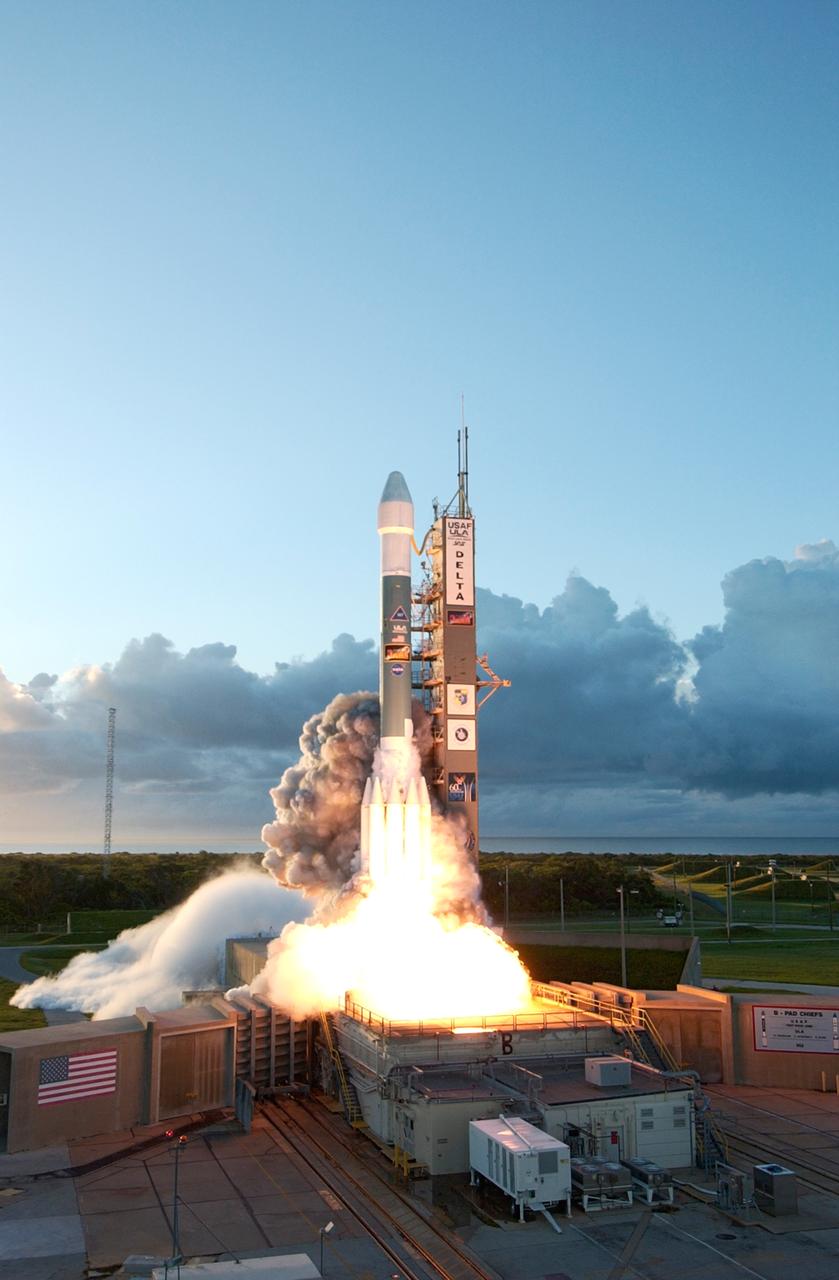
Against a backdrop of clouds on the horizon, the Delta II rocket carrying NASA's Dawn spacecraft rises from the smoke and fire on the launch pad to begin its 1.7-billion-mile journey through the inner solar system to study a pair of asteroids. Liftoff was at 7:34 a.m. EDT from Pad 17-B at Cape Canaveral Air Force Station. Dawn is the ninth mission in NASA's Discovery Program. The spacecraft will be the first to orbit two planetary bodies, asteroid Vesta and dwarf planet Ceres, during a single mission. Vesta and Ceres lie in the asteroid belt between Mars and Jupiter. It is also NASA's first purely scientific mission powered by three solar electric ion propulsion engines.
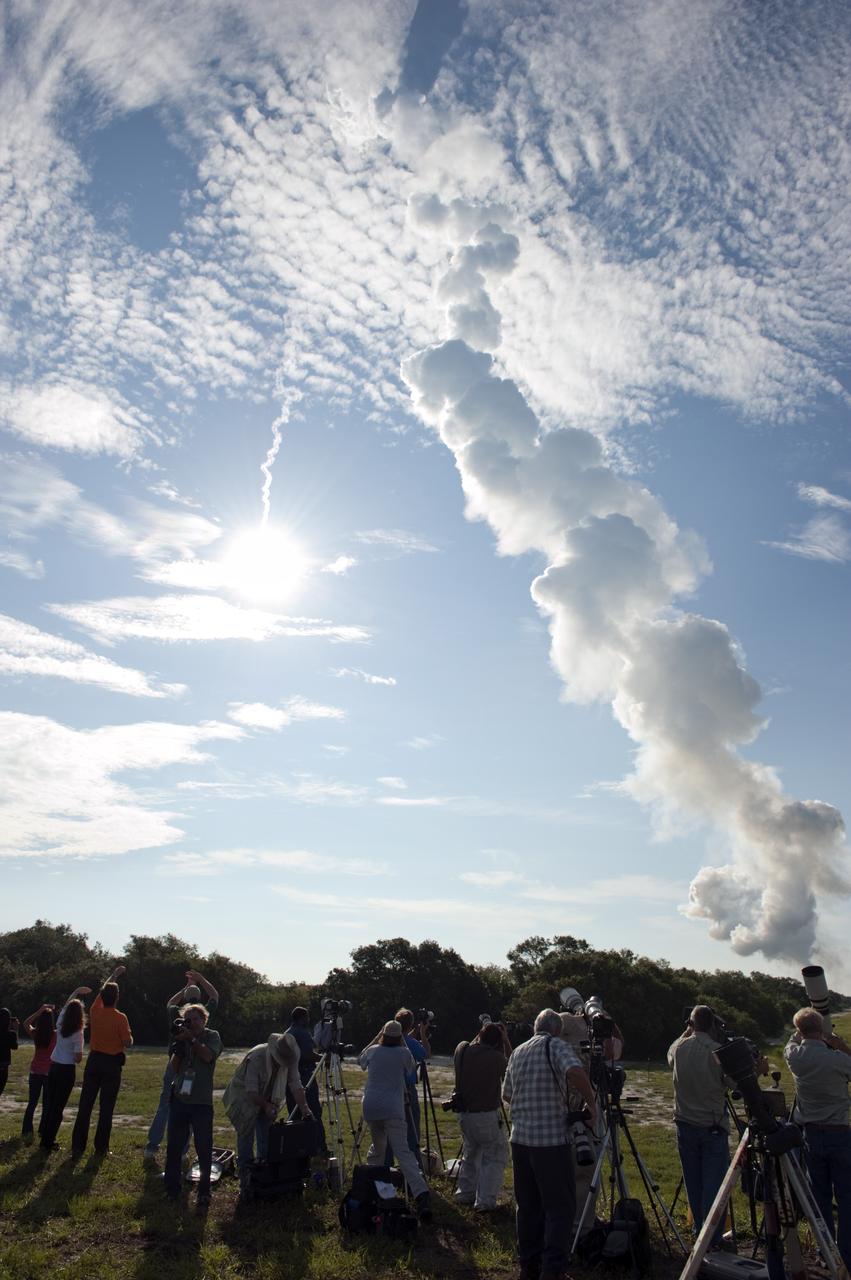
CAPE CANAVERAL, Fla. – Sun reflects off the United Launch Alliance Delta II Heavy rocket launching NASA’s Gravity Recovery and Interior Laboratory (GRAIL) mission into space as media representatives at Press Site 1 near Space Launch Complex 17B on Cape Canaveral Air Force Station in Florida capture the moment. Liftoff was at 9:08:52 a.m. EDT Sept.10. GRAIL-A will separate from the second stage of the rocket at about one hour, 21 minutes after liftoff, followed by GRAIL-B at 90 minutes after launch. The spacecraft are embarking on a three-month journey to reach the moon. GRAIL will fly twin spacecraft in tandem around the moon to precisely measure and map variations in the moon's gravitational field. The mission will provide the most accurate global gravity field to date for any planet, including Earth. This detailed information will reveal differences in the density of the moon's crust and mantle and will help answer fundamental questions about the moon's internal structure, thermal evolution, and history of collisions with asteroids. The aim is to map the moon's gravity field so completely that future moon vehicles can safely navigate anywhere on the moon’s surface. For more information, visit http://www.nasa.gov/grail. Photo credit: NASA/ Kim Shiflett
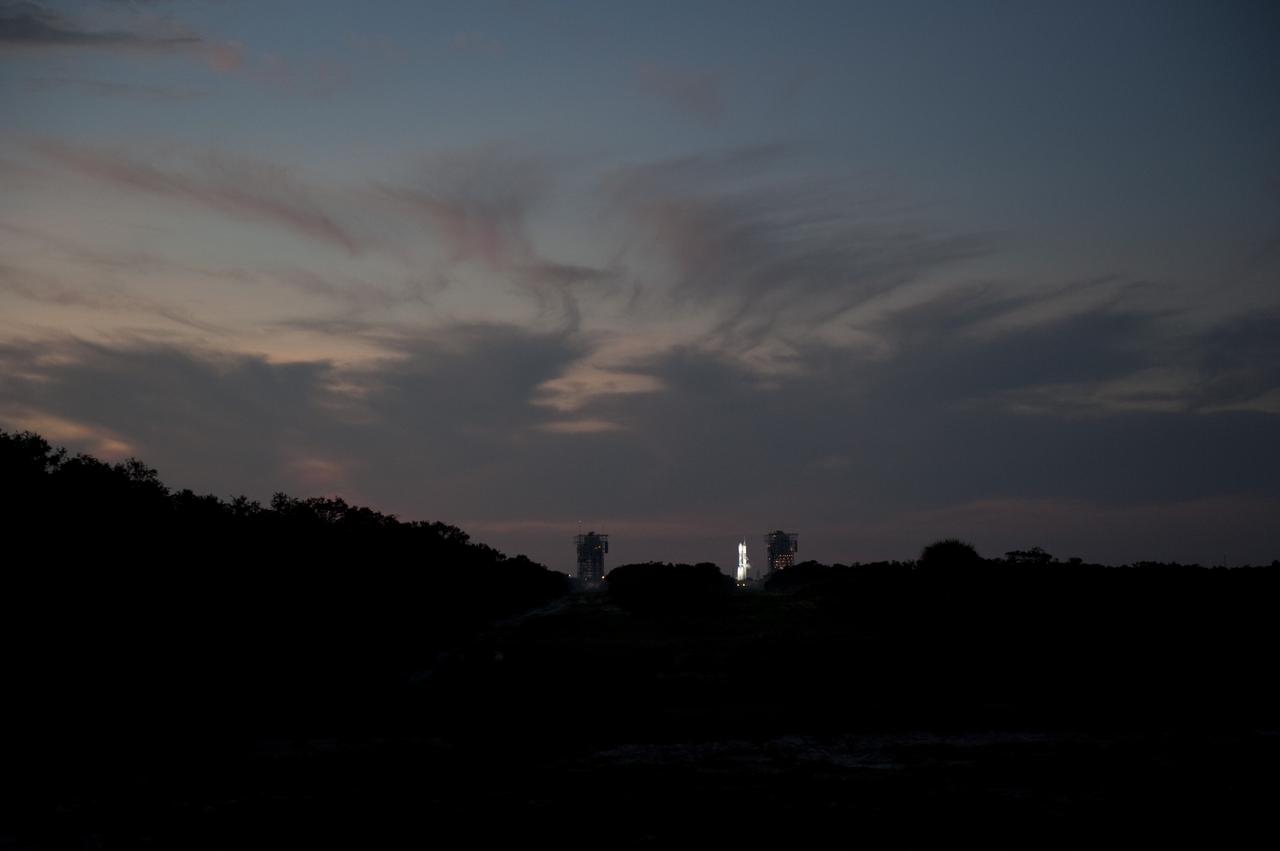
CAPE CANAVERAL, Fla. – As the sun rises, in the distance, spotlights illuminate the United Launch Alliance Delta II Heavy rocket that will launch NASA’s twin Gravity Recovery and Interior Laboratory (GRAIL) mission from Space Launch Complex 17B on Cape Canaveral Air Force Station in Florida. Liftoff is scheduled for 9:08:52 a.m. EDT Sept.10. GRAIL will fly twin spacecraft in tandem around the moon to precisely measure and map variations in the moon's gravitational field. The mission will provide the most accurate global gravity field to date for any planet, including Earth. This detailed information will reveal differences in the density of the moon's crust and mantle and will help answer fundamental questions about the moon's internal structure, thermal evolution, and history of collisions with asteroids. The aim is to map the moon's gravity field so completely that future moon vehicles can safely navigate anywhere on the moon’s surface. For more information, visit http://www.nasa.gov/grail. Photo credit: NASA/ Kim Shiflett
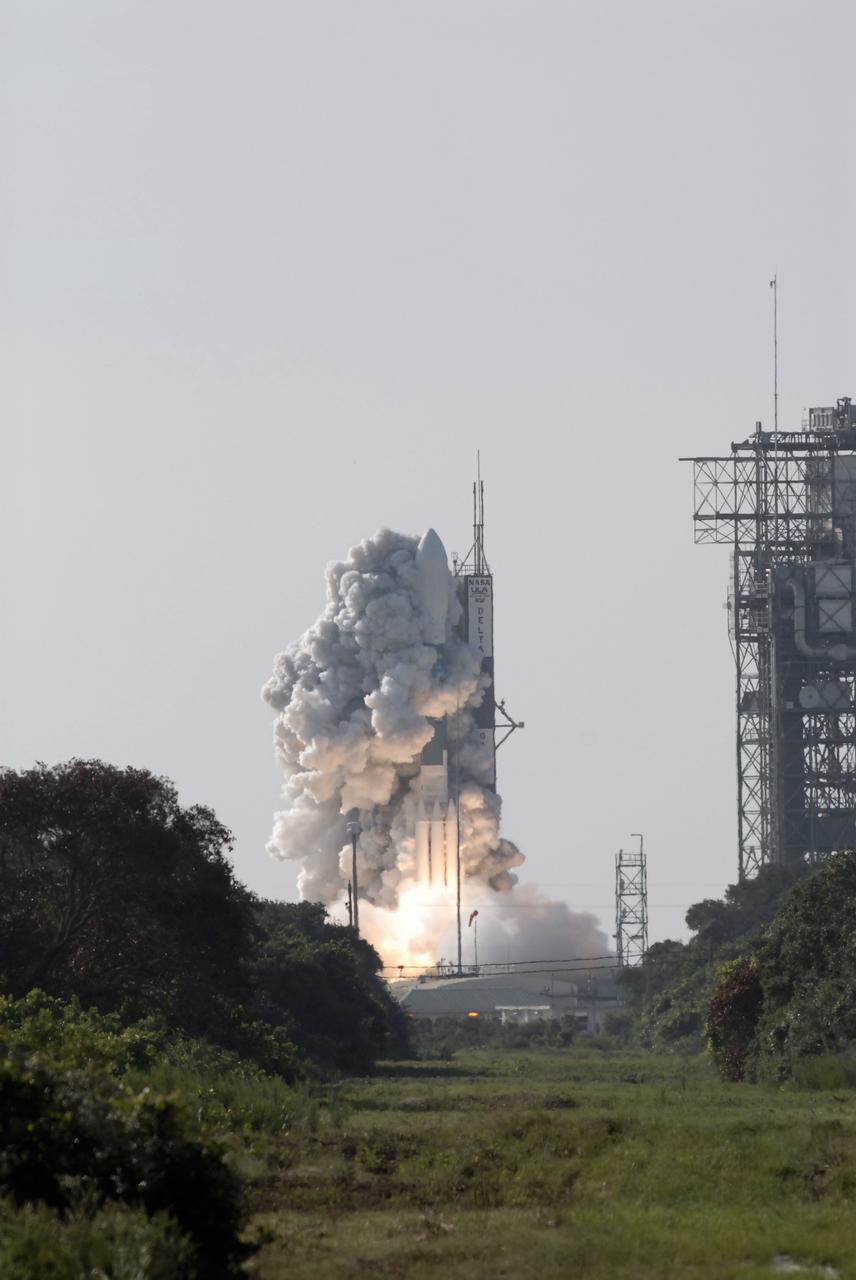
CAPE CANAVERAL, Fla. – Rising from fire and smoke, the United Launch Alliance Delta II Heavy rocket lifted off at 9:08 a.m. EDT Sept. 10 from Space Launch Complex 17B on Cape Canaveral Air Force Station in Florida carrying NASA’s twin Gravity Recovery and Interior Laboratory (GRAIL) mission to the moon. GRAIL will fly twin spacecraft in tandem around the moon to precisely measure and map variations in the moon's gravitational field. The mission will provide the most accurate global gravity field to date for any planet, including Earth. This detailed information will reveal differences in the density of the moon's crust and mantle and will help answer fundamental questions about the moon's internal structure, thermal evolution, and history of collisions with asteroids. The aim is to map the moon's gravity field so completely that future moon vehicles can safely navigate anywhere on the moon’s surface. For more information, visit http://www.nasa.gov/grail. Photo credit: NASA/Kim Shiflett
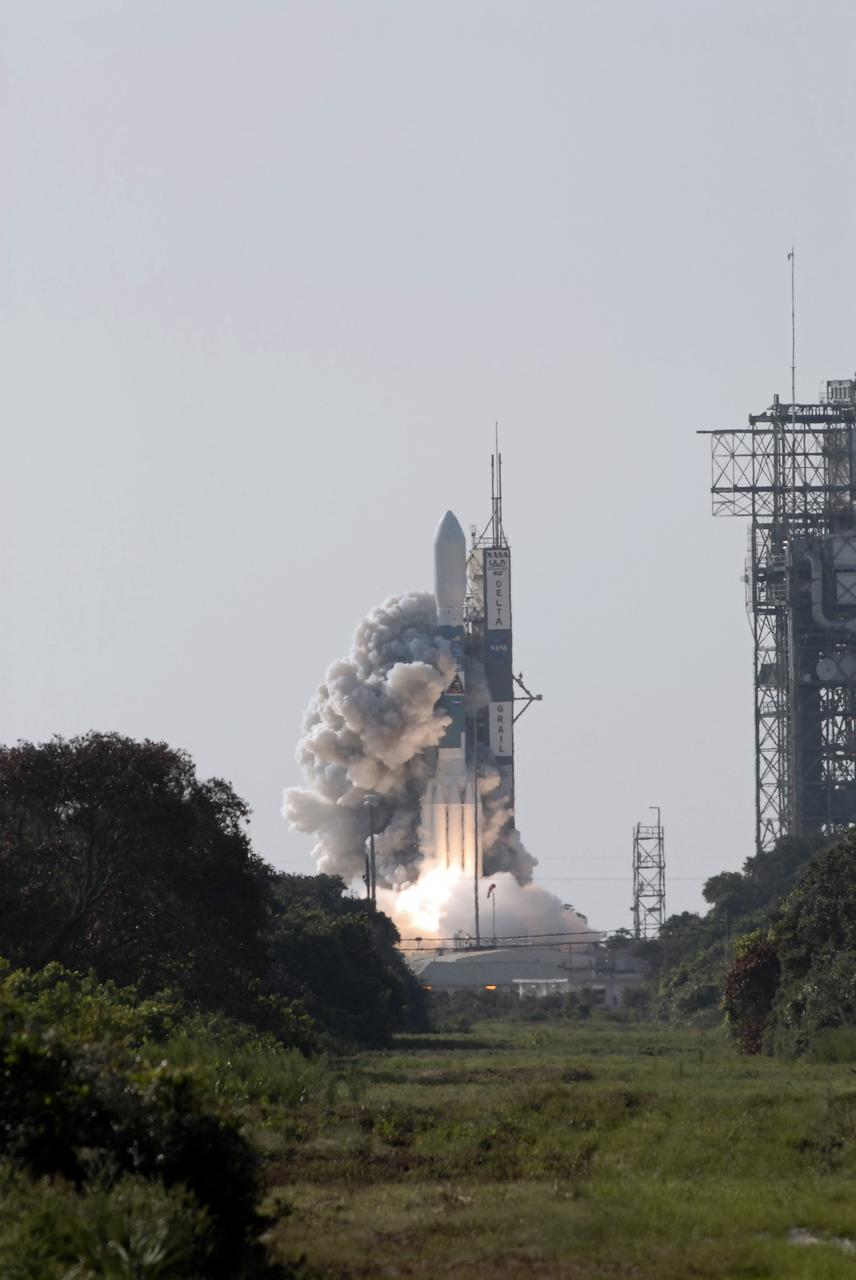
CAPE CANAVERAL, Fla. – Rising from fire and smoke, the United Launch Alliance Delta II Heavy rocket lifted off at 9:08 a.m. EDT Sept. 10 from Space Launch Complex 17B on Cape Canaveral Air Force Station in Florida carrying NASA’s twin Gravity Recovery and Interior Laboratory (GRAIL) mission to the moon. GRAIL will fly twin spacecraft in tandem around the moon to precisely measure and map variations in the moon's gravitational field. The mission will provide the most accurate global gravity field to date for any planet, including Earth. This detailed information will reveal differences in the density of the moon's crust and mantle and will help answer fundamental questions about the moon's internal structure, thermal evolution, and history of collisions with asteroids. The aim is to map the moon's gravity field so completely that future moon vehicles can safely navigate anywhere on the moon’s surface. For more information, visit http://www.nasa.gov/grail. Photo credit: NASA/Kim Shiflett
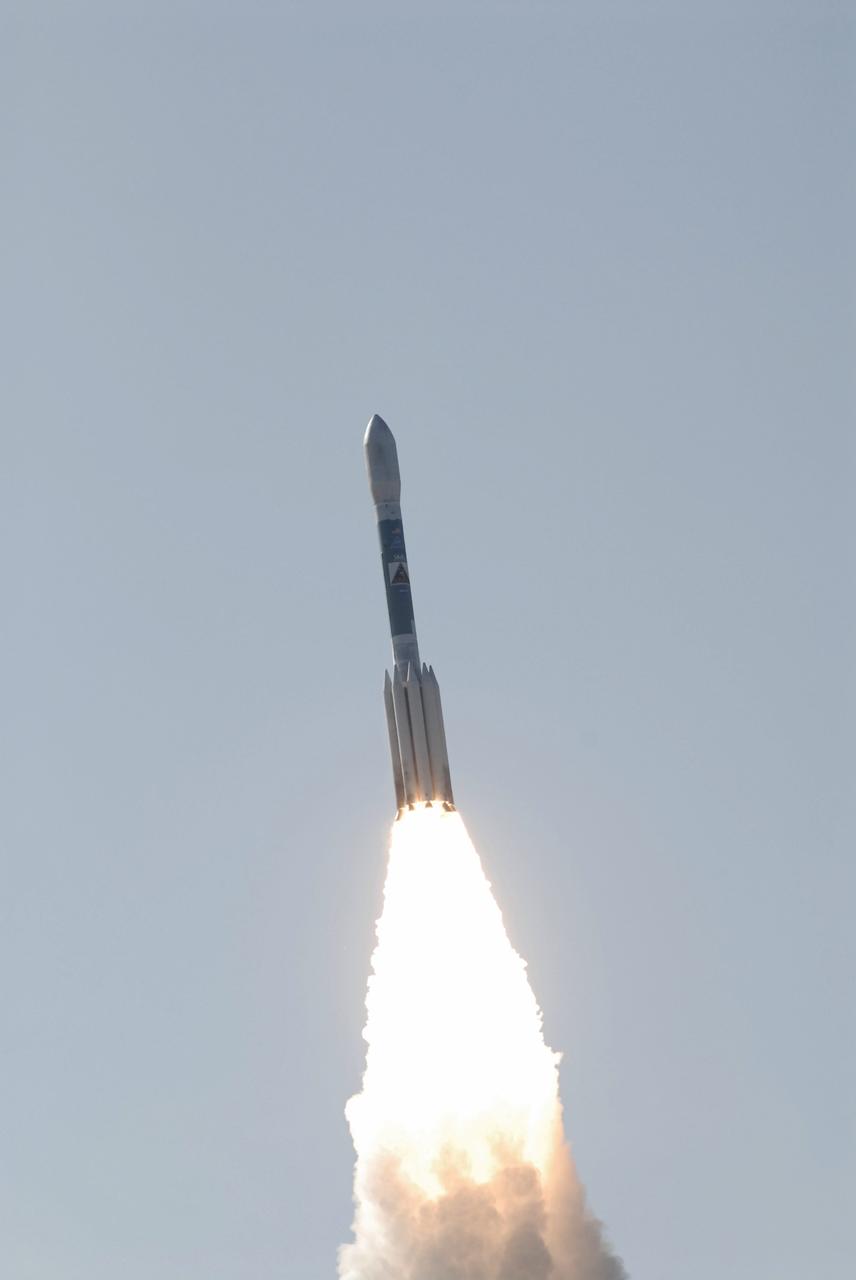
CAPE CANAVERAL, Fla. – With a clear blue sky for a background, the United Launch Alliance Delta II Heavy rocket is propelled skyward after lifting off at 9:08 a.m. EDT Sept. 10 from Space Launch Complex 17B on Cape Canaveral Air Force Station in Florida. The Delta II is carrying NASA’s twin Gravity Recovery and Interior Laboratory (GRAIL) mission to the moon. GRAIL will fly twin spacecraft in tandem around the moon to precisely measure and map variations in the moon's gravitational field. The mission will provide the most accurate global gravity field to date for any planet, including Earth. This detailed information will reveal differences in the density of the moon's crust and mantle and will help answer fundamental questions about the moon's internal structure, thermal evolution, and history of collisions with asteroids. The aim is to map the moon's gravity field so completely that future moon vehicles can safely navigate anywhere on the moon’s surface. For more information, visit http://www.nasa.gov/grail. Photo credit: NASA/Kim Shiflett
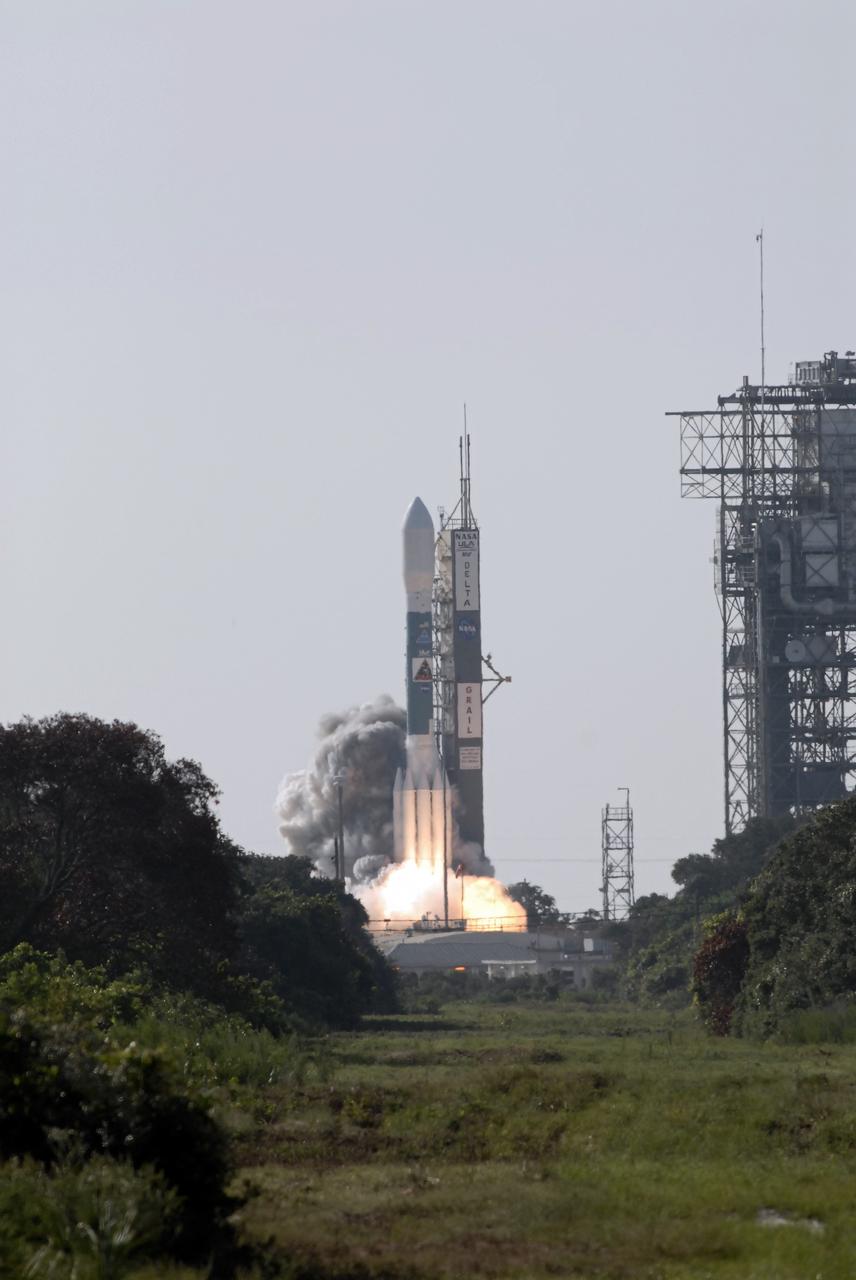
CAPE CANAVERAL, Fla. – The United Launch Alliance Delta II Heavy rocket lifted off at 9:08 a.m. EDT Sept. 10 from Space Launch Complex 17B on Cape Canaveral Air Force Station in Florida carrying NASA’s twin Gravity Recovery and Interior Laboratory (GRAIL) mission to the moon. GRAIL will fly twin spacecraft in tandem around the moon to precisely measure and map variations in the moon's gravitational field. The mission will provide the most accurate global gravity field to date for any planet, including Earth. This detailed information will reveal differences in the density of the moon's crust and mantle and will help answer fundamental questions about the moon's internal structure, thermal evolution, and history of collisions with asteroids. The aim is to map the moon's gravity field so completely that future moon vehicles can safely navigate anywhere on the moon’s surface. For more information, visit http://www.nasa.gov/grail. Photo credit: NASA/Kim Shiflett
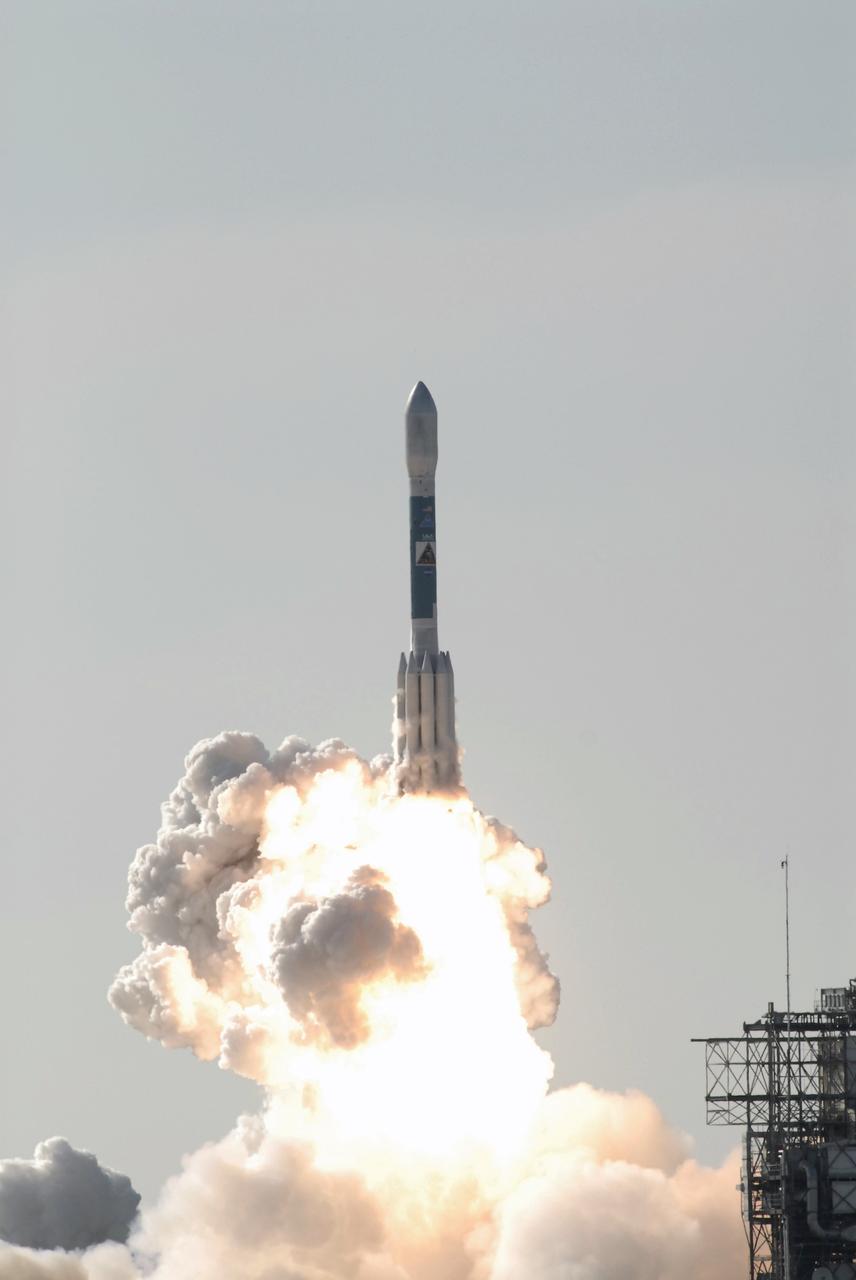
CAPE CANAVERAL, Fla. – Rising from fire and smoke, the United Launch Alliance Delta II Heavy rocket lifted off at 9:08 a.m. EDT Sept. 10 from Space Launch Complex 17B on Cape Canaveral Air Force Station in Florida carrying NASA’s twin Gravity Recovery and Interior Laboratory (GRAIL) mission to the moon. GRAIL will fly twin spacecraft in tandem around the moon to precisely measure and map variations in the moon's gravitational field. The mission will provide the most accurate global gravity field to date for any planet, including Earth. This detailed information will reveal differences in the density of the moon's crust and mantle and will help answer fundamental questions about the moon's internal structure, thermal evolution, and history of collisions with asteroids. The aim is to map the moon's gravity field so completely that future moon vehicles can safely navigate anywhere on the moon’s surface. For more information, visit http://www.nasa.gov/grail. Photo credit: NASA/Kim Shiflett
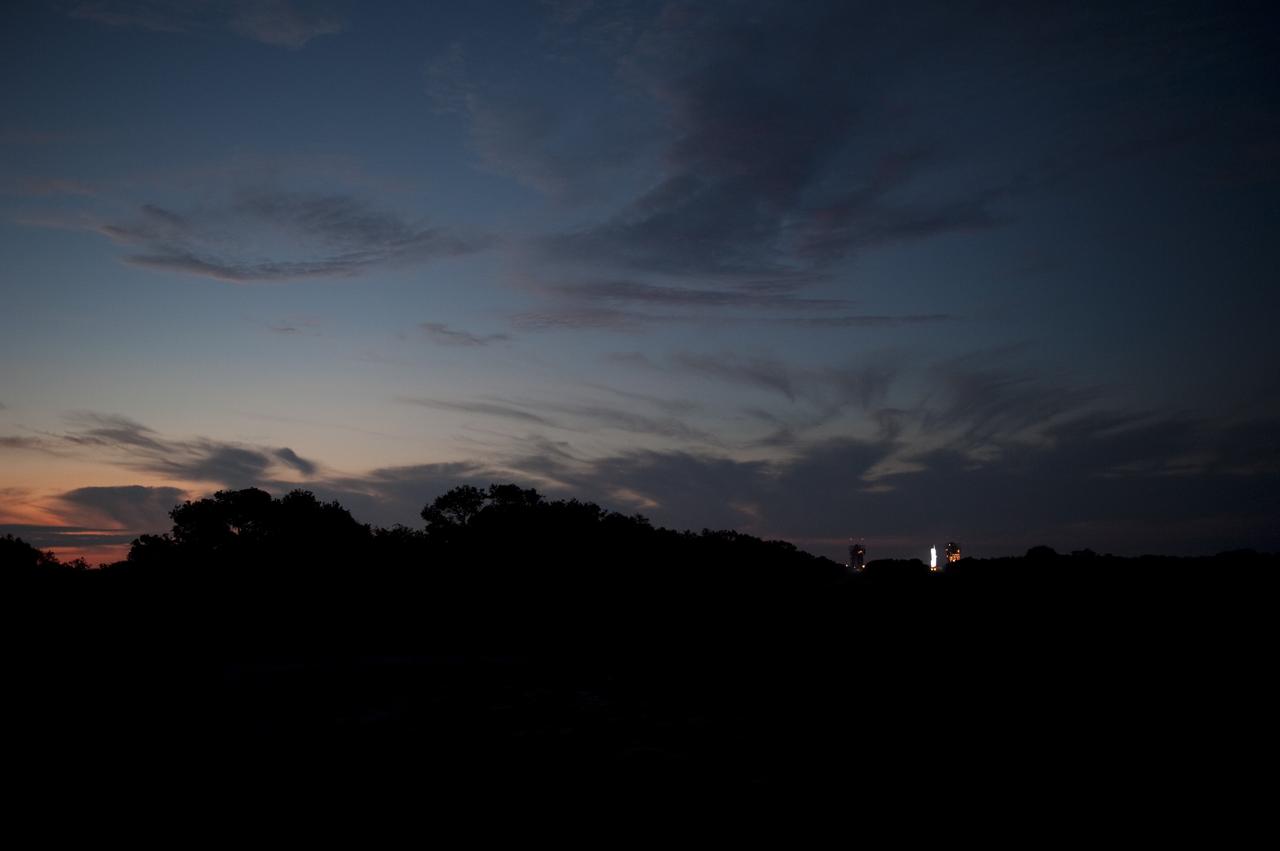
CAPE CANAVERAL, Fla. – As the sun rises, in the distance, spotlights illuminate the United Launch Alliance Delta II Heavy rocket that will launch NASA’s twin Gravity Recovery and Interior Laboratory (GRAIL) mission from Space Launch Complex 17B on Cape Canaveral Air Force Station in Florida. Liftoff is scheduled for 9:08:52 a.m. EDT Sept.10. GRAIL will fly twin spacecraft in tandem around the moon to precisely measure and map variations in the moon's gravitational field. The mission will provide the most accurate global gravity field to date for any planet, including Earth. This detailed information will reveal differences in the density of the moon's crust and mantle and will help answer fundamental questions about the moon's internal structure, thermal evolution, and history of collisions with asteroids. The aim is to map the moon's gravity field so completely that future moon vehicles can safely navigate anywhere on the moon’s surface. For more information, visit http://www.nasa.gov/grail. Photo credit: NASA/ Kim Shiflett
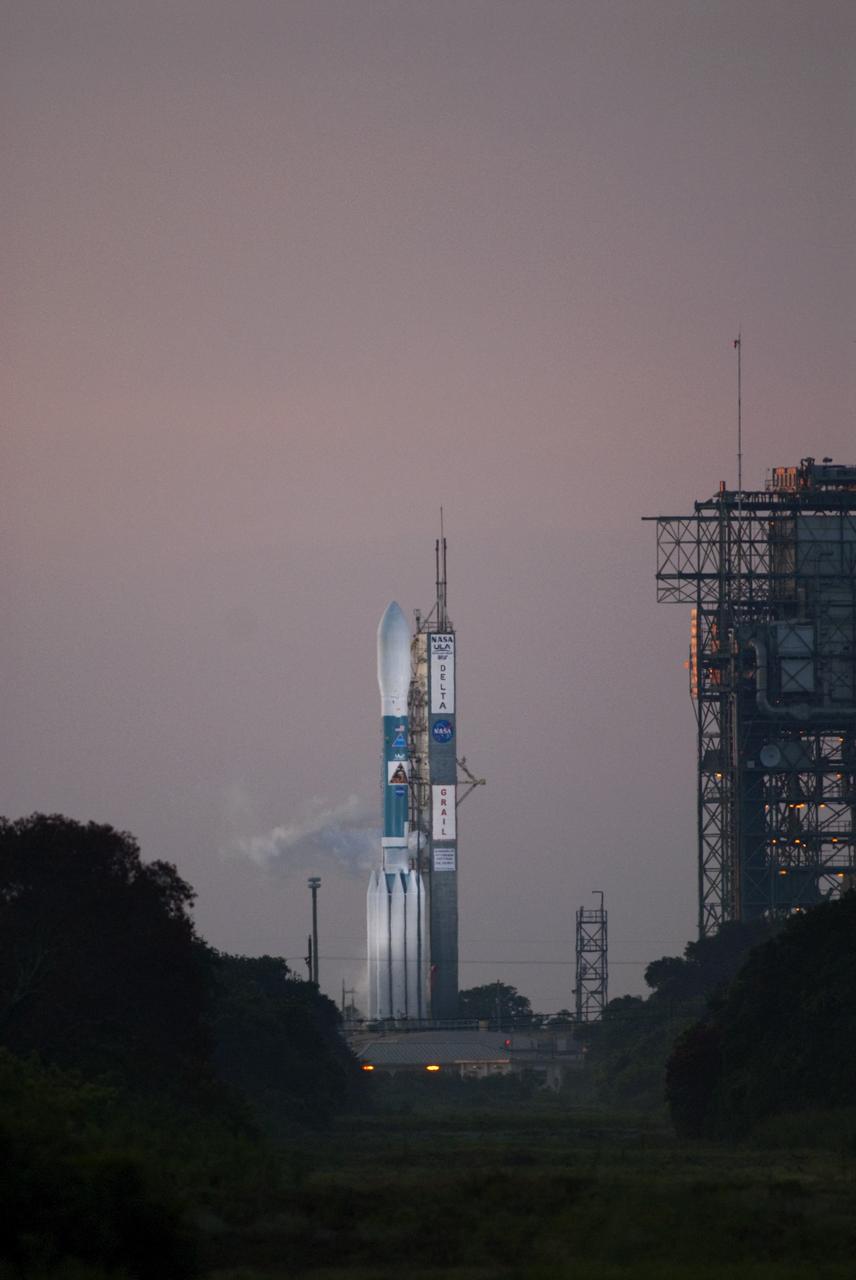
CAPE CANAVERAL, Fla. – Surrounded by an early morning sky, the United Launch Alliance Delta II Heavy rocket sits on Space Launch Complex 17B on Cape Canaveral Air Force Station in Florida as it waits to launch NASA’s twin Gravity Recovery and Interior Laboratory (GRAIL) mission to the moon. GRAIL will fly twin spacecraft in tandem around the moon to precisely measure and map variations in the moon's gravitational field. The mission will provide the most accurate global gravity field to date for any planet, including Earth. This detailed information will reveal differences in the density of the moon's crust and mantle and will help answer fundamental questions about the moon's internal structure, thermal evolution, and history of collisions with asteroids. The aim is to map the moon's gravity field so completely that future moon vehicles can safely navigate anywhere on the moon’s surface. For more information, visit http://www.nasa.gov/grail. Photo credit: NASA/Kim Shiflett
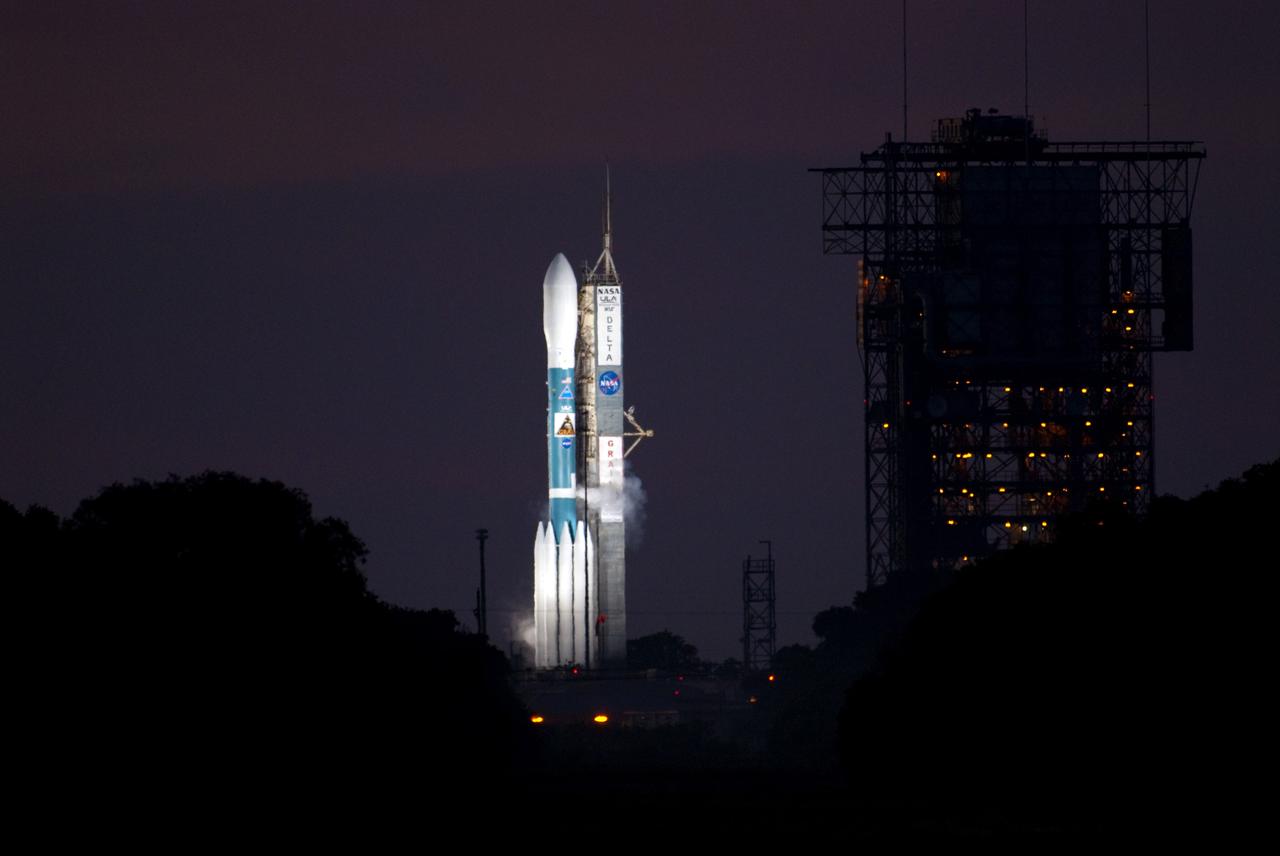
CAPE CANAVERAL, Fla. – Bathed in light against an early morning sky, the United Launch Alliance Delta II Heavy rocket sits on Space Launch Complex 17B on Cape Canaveral Air Force Station in Florida as it waits to launch NASA’s twin Gravity Recovery and Interior Laboratory (GRAIL) mission to the moon. GRAIL will fly twin spacecraft in tandem around the moon to precisely measure and map variations in the moon's gravitational field. The mission will provide the most accurate global gravity field to date for any planet, including Earth. This detailed information will reveal differences in the density of the moon's crust and mantle and will help answer fundamental questions about the moon's internal structure, thermal evolution, and history of collisions with asteroids. The aim is to map the moon's gravity field so completely that future moon vehicles can safely navigate anywhere on the moon’s surface. For more information, visit http://www.nasa.gov/grail. Photo credit: NASA/Kim Shiflett
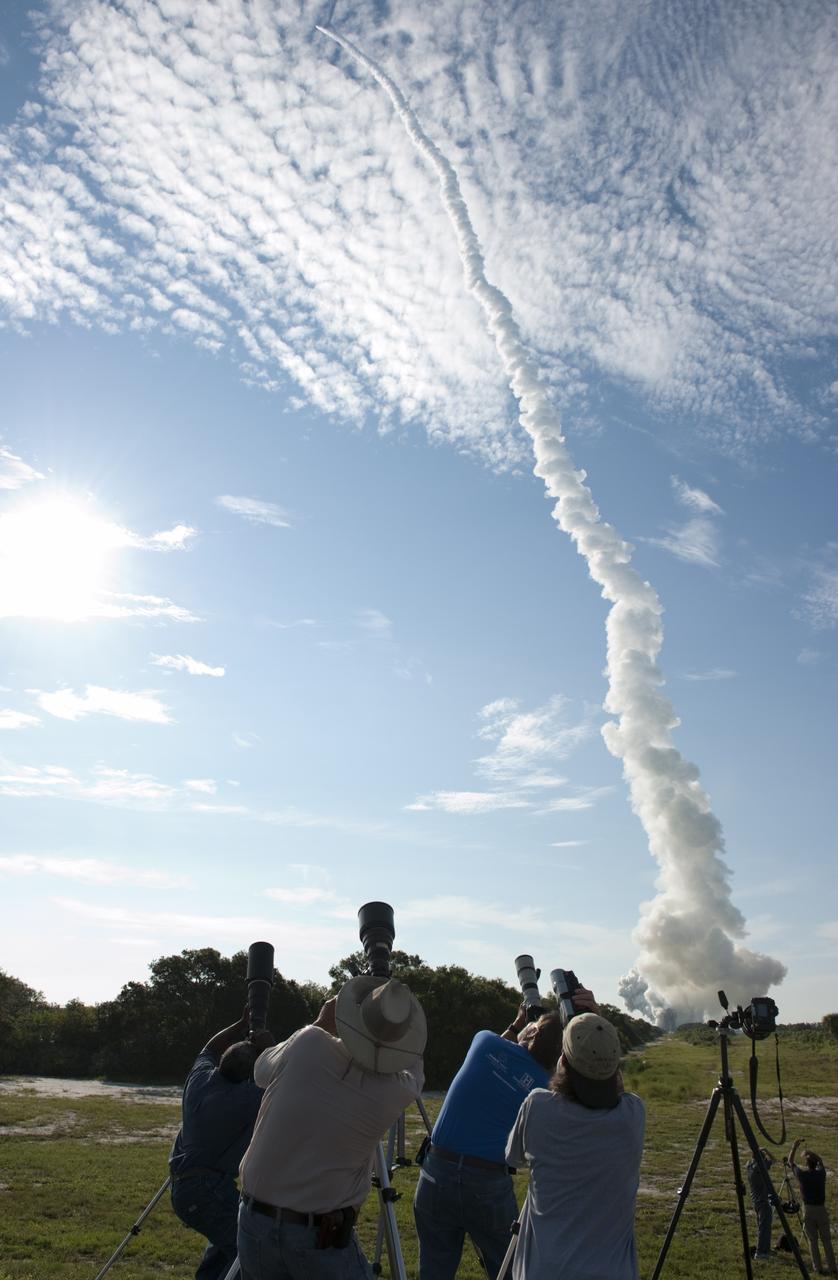
CAPE CANAVERAL, Fla. – Plumes of smoke trail the United Launch Alliance Delta II Heavy rocket launching NASA’s Gravity Recovery and Interior Laboratory (GRAIL) mission into space as media representatives at Press Site 1 near Space Launch Complex 17B on Cape Canaveral Air Force Station in Florida photograph it. Liftoff was at 9:08:52 a.m. EDT Sept.10. GRAIL-A will separate from the second stage of the rocket at about one hour, 21 minutes after liftoff, followed by GRAIL-B at 90 minutes after launch. The spacecraft are embarking on a three-month journey to reach the moon. GRAIL will fly twin spacecraft in tandem around the moon to precisely measure and map variations in the moon's gravitational field. The mission will provide the most accurate global gravity field to date for any planet, including Earth. This detailed information will reveal differences in the density of the moon's crust and mantle and will help answer fundamental questions about the moon's internal structure, thermal evolution, and history of collisions with asteroids. The aim is to map the moon's gravity field so completely that future moon vehicles can safely navigate anywhere on the moon’s surface. For more information, visit http://www.nasa.gov/grail. Photo credit: NASA/ Kim Shiflett
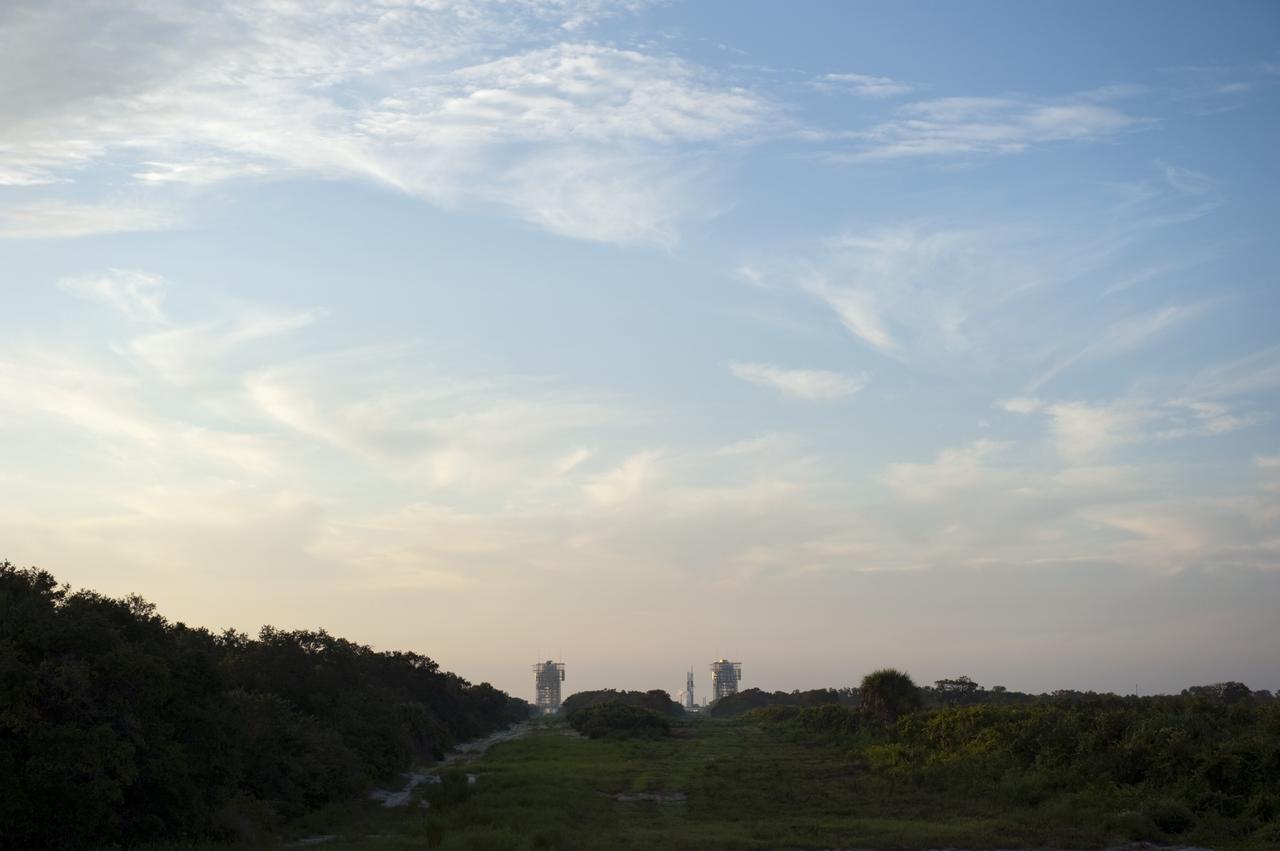
CAPE CANAVERAL, Fla. – An early morning sky illuminates the United Launch Alliance Delta II Heavy rocket that will launch NASA’s twin Gravity Recovery and Interior Laboratory (GRAIL) mission from Space Launch Complex 17B on Cape Canaveral Air Force Station in Florida. Liftoff is scheduled for 9:08:52 a.m. EDT Sept.10. GRAIL will fly twin spacecraft in tandem around the moon to precisely measure and map variations in the moon's gravitational field. The mission will provide the most accurate global gravity field to date for any planet, including Earth. This detailed information will reveal differences in the density of the moon's crust and mantle and will help answer fundamental questions about the moon's internal structure, thermal evolution, and history of collisions with asteroids. The aim is to map the moon's gravity field so completely that future moon vehicles can safely navigate anywhere on the moon’s surface. For more information, visit http://www.nasa.gov/grail. Photo credit: NASA/ Kim Shiflett
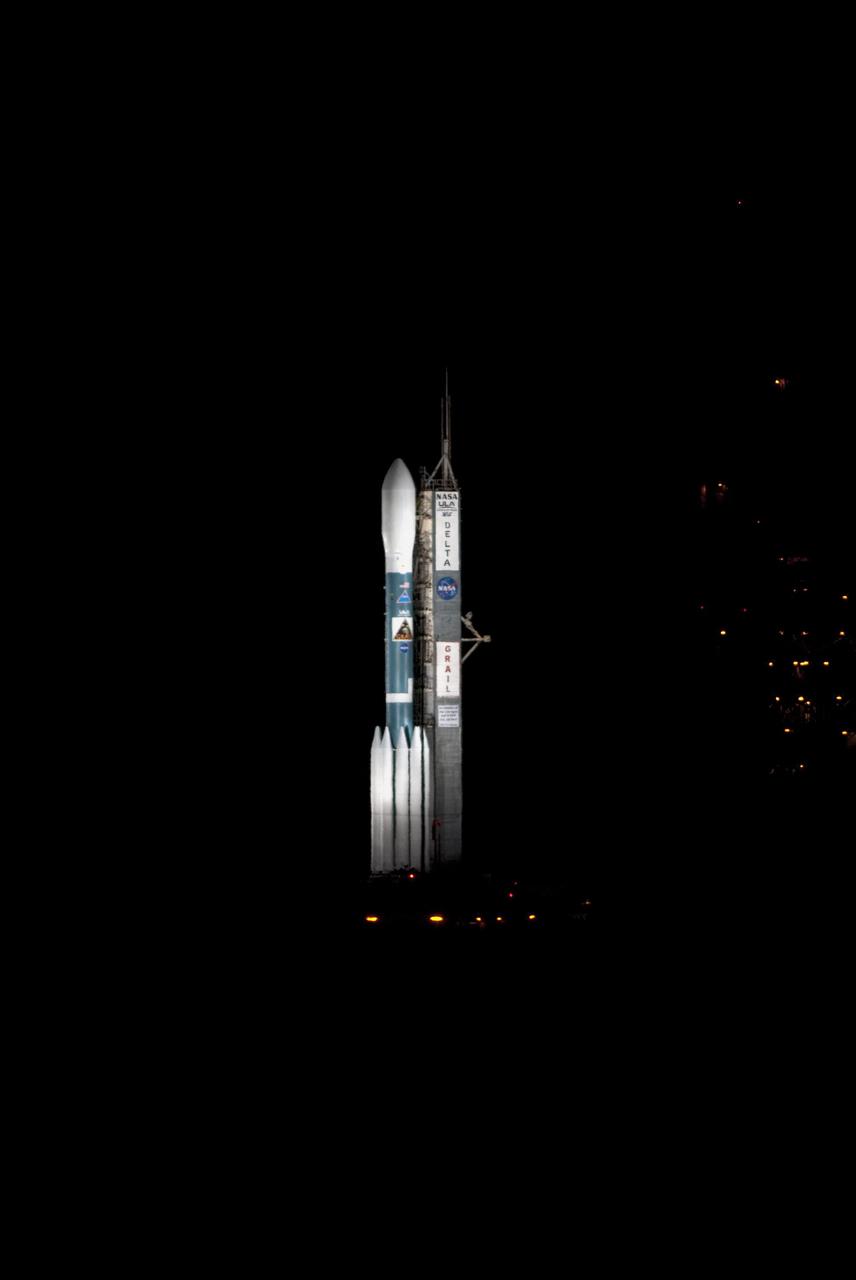
CAPE CANAVERAL, Fla. – Surrounded by an early morning sky, the United Launch Alliance Delta II Heavy rocket sits on Space Launch Complex 17B on Cape Canaveral Air Force Station in Florida as it waits to launch NASA’s twin Gravity Recovery and Interior Laboratory (GRAIL) mission to the moon. GRAIL will fly twin spacecraft in tandem around the moon to precisely measure and map variations in the moon's gravitational field. The mission will provide the most accurate global gravity field to date for any planet, including Earth. This detailed information will reveal differences in the density of the moon's crust and mantle and will help answer fundamental questions about the moon's internal structure, thermal evolution, and history of collisions with asteroids. The aim is to map the moon's gravity field so completely that future moon vehicles can safely navigate anywhere on the moon’s surface. For more information, visit http://www.nasa.gov/grail. Photo credit: NASA/Kim Shiflett
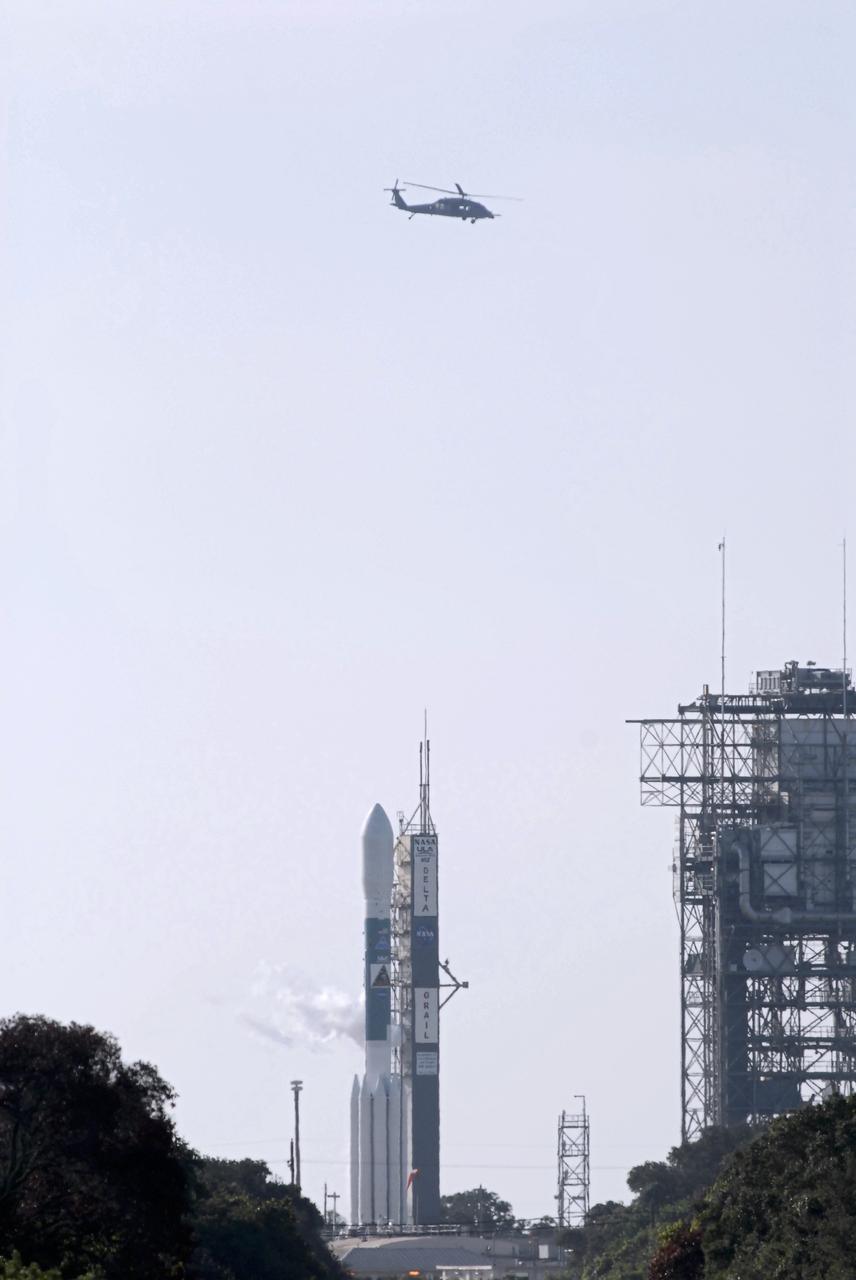
CAPE CANAVERAL, Fla. – A U.S. Air Force helicopter flies overhead as the United Launch Alliance Delta II Heavy rocket sits on Space Launch Complex 17B on Cape Canaveral Air Force Station in Florida waiting to launch NASA’s twin Gravity Recovery and Interior Laboratory (GRAIL) mission to the moon. GRAIL will fly twin spacecraft in tandem around the moon to precisely measure and map variations in the moon's gravitational field. The mission will provide the most accurate global gravity field to date for any planet, including Earth. This detailed information will reveal differences in the density of the moon's crust and mantle and will help answer fundamental questions about the moon's internal structure, thermal evolution, and history of collisions with asteroids. The aim is to map the moon's gravity field so completely that future moon vehicles can safely navigate anywhere on the moon’s surface. For more information, visit http://www.nasa.gov/grail. Photo credit: NASA/Kim Shiflett

At Cape Canaveral Air Force Station, clouds of smoke encompass the Delta II rocket with NASA's THEMIS spacecraft aboard as it blasts off Pad 17-B, in sight of the Atlantic Ocean, at 6:01 p.m. EST. THEMIS, an acronym for Time History of Events and Macroscale Interactions during Substorms, consists of five identical probes that will track violent, colorful eruptions near the North Pole. This will be the largest number of scientific satellites NASA has ever launched into orbit aboard a single rocket. The THEMIS mission aims to unravel the mystery behind auroral substorms, an avalanche of magnetic energy powered by the solar wind that intensifies the northern and southern lights. The mission will investigate what causes auroras in the Earth’s atmosphere to dramatically change from slowly shimmering waves of light to wildly shifting streaks of bright color.
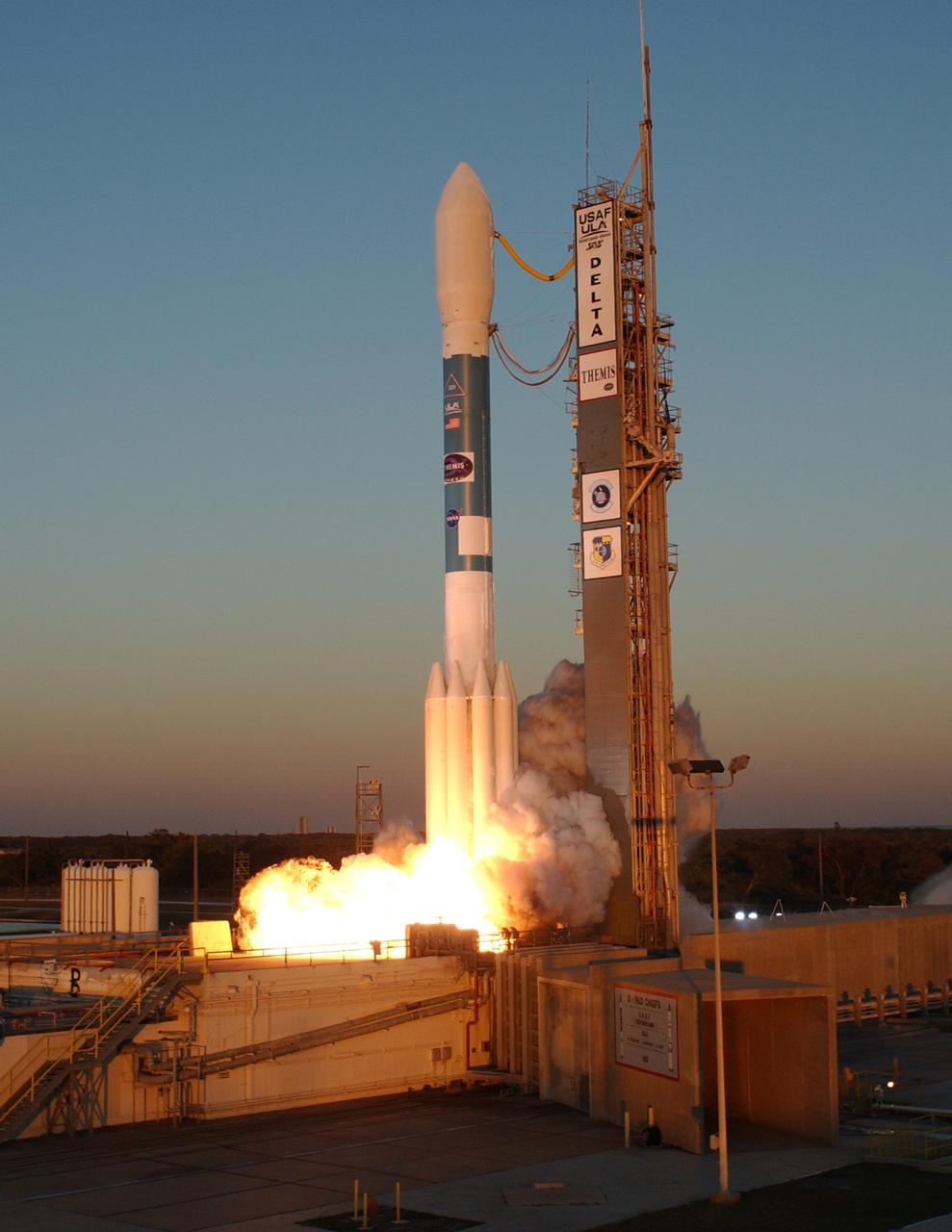
Amid billows of smoke, the Delta II rocket with NASA's THEMIS spacecraft aboard blasts off Pad 17-B at Cape Canaveral Air Force Station at 6:01 p.m. EST. THEMIS, an acronym for Time History of Events and Macroscale Interactions during Substorms, consists of five identical probes that will track violent, colorful eruptions near the North Pole. This will be the largest number of scientific satellites NASA has ever launched into orbit aboard a single rocket. The THEMIS mission aims to unravel the mystery behind auroral substorms, an avalanche of magnetic energy powered by the solar wind that intensifies the northern and southern lights. The mission will investigate what causes auroras in the Earth’s atmosphere to dramatically change from slowly shimmering waves of light to wildly shifting streaks of bright color.
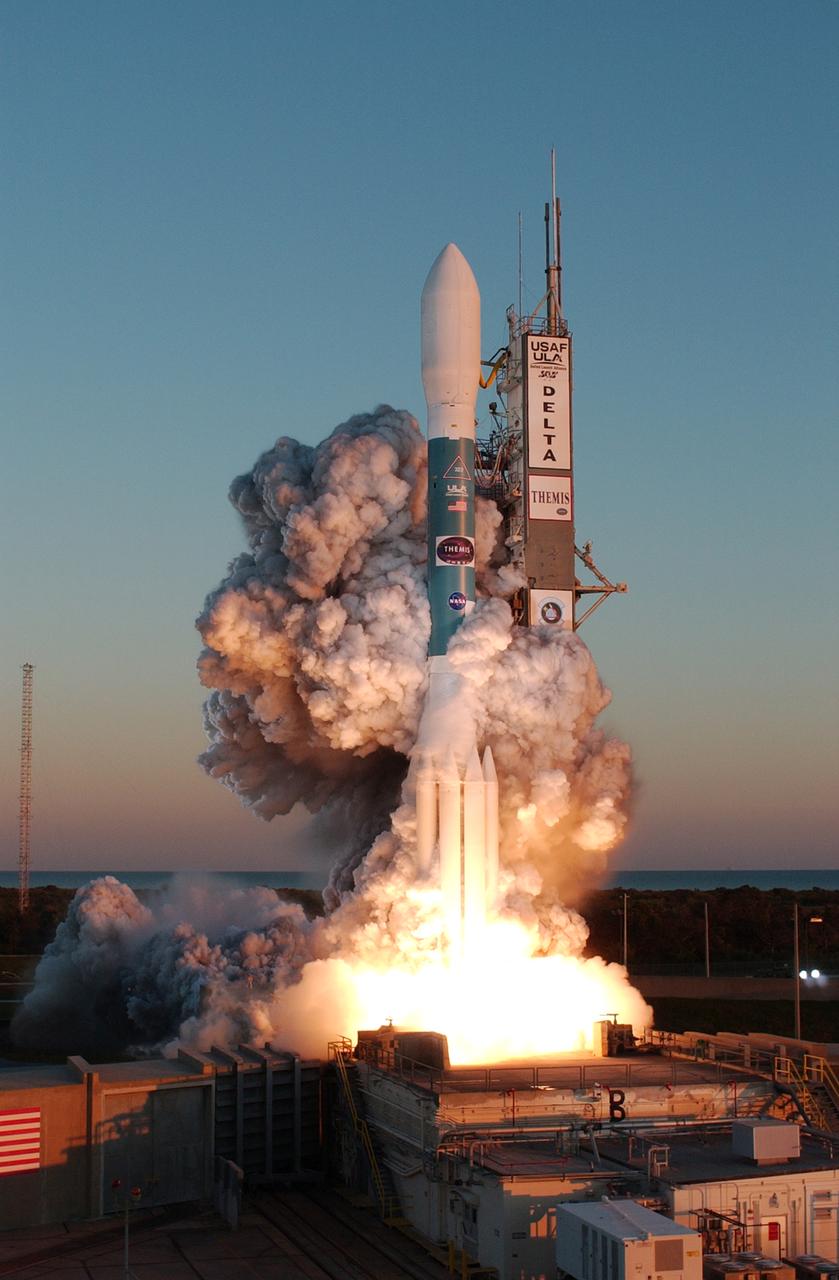
At Cape Canaveral Air Force Station, clouds of smoke form around the Delta II rocket with NASA's THEMIS spacecraft aboard as it blasts off Pad 17-B at 6:01 p.m. EST. THEMIS, an acronym for Time History of Events and Macroscale Interactions during Substorms, consists of five identical probes that will track violent, colorful eruptions near the North Pole. This will be the largest number of scientific satellites NASA has ever launched into orbit aboard a single rocket. The THEMIS mission aims to unravel the mystery behind auroral substorms, an avalanche of magnetic energy powered by the solar wind that intensifies the northern and southern lights. The mission will investigate what causes auroras in the Earth’s atmosphere to dramatically change from slowly shimmering waves of light to wildly shifting streaks of bright color.

At Cape Canaveral Air Force Station, the Delta II rocket with NASA's THEMIS spacecraft aboard begins its ascent from Pad 17-B, in sight of the Atlantic Ocean, at 6:01 p.m. EST. THEMIS, an acronym for Time History of Events and Macroscale Interactions during Substorms, consists of five identical probes that will track violent, colorful eruptions near the North Pole. This will be the largest number of scientific satellites NASA has ever launched into orbit aboard a single rocket. The THEMIS mission aims to unravel the mystery behind auroral substorms, an avalanche of magnetic energy powered by the solar wind that intensifies the northern and southern lights. The mission will investigate what causes auroras in the Earth’s atmosphere to dramatically change from slowly shimmering waves of light to wildly shifting streaks of bright color.
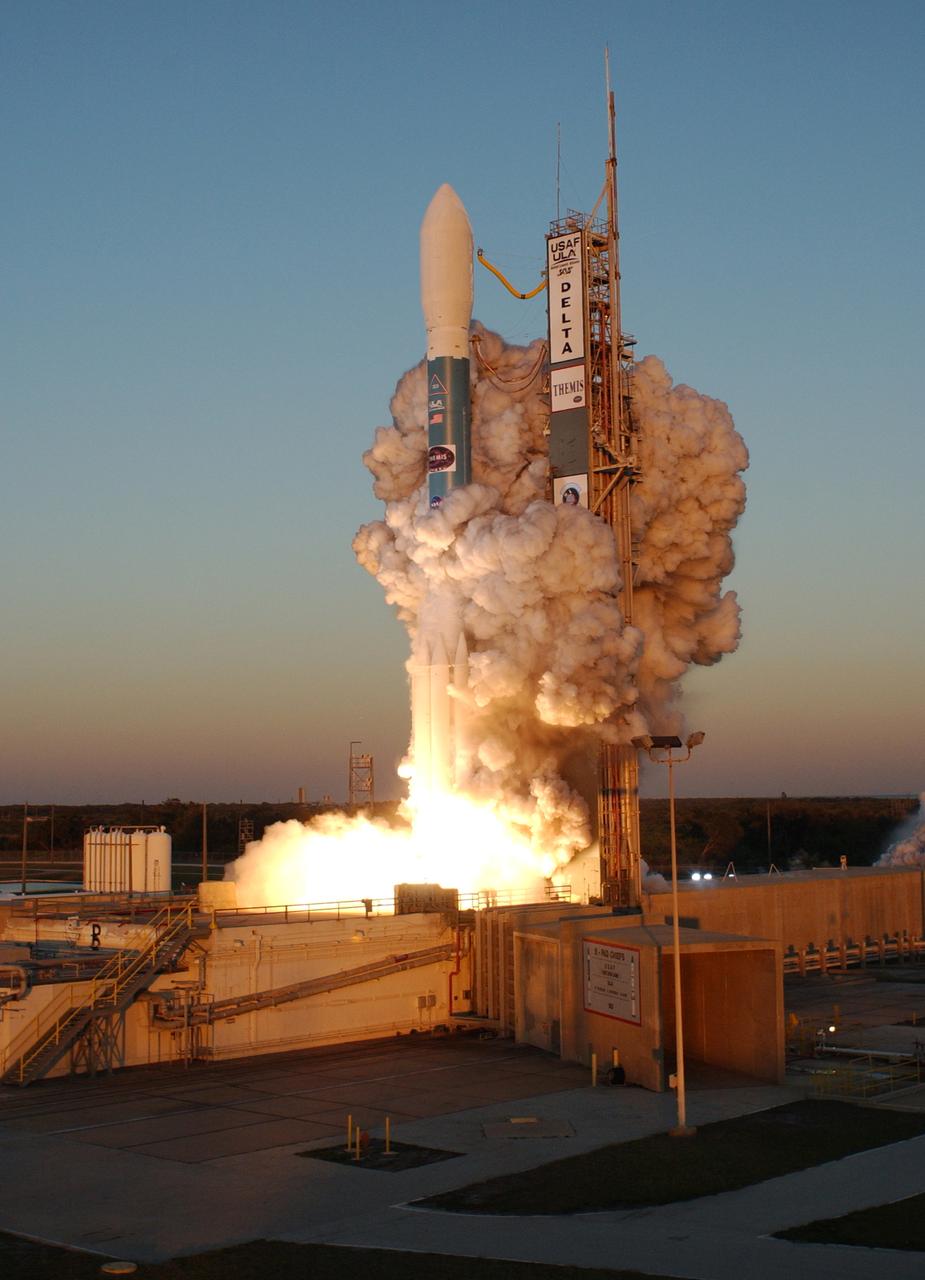
Clouds of smoke encompass the Delta II rocket with NASA's THEMIS spacecraft aboard as it blasts off Pad 17-B at Cape Canaveral Air Force Station at 6:01 p.m. EST. THEMIS, an acronym for Time History of Events and Macroscale Interactions during Substorms, consists of five identical probes that will track violent, colorful eruptions near the North Pole. This will be the largest number of scientific satellites NASA has ever launched into orbit aboard a single rocket. The THEMIS mission aims to unravel the mystery behind auroral substorms, an avalanche of magnetic energy powered by the solar wind that intensifies the northern and southern lights. The mission will investigate what causes auroras in the Earth’s atmosphere to dramatically change from slowly shimmering waves of light to wildly shifting streaks of bright color

At Cape Canaveral Air Force Station, clouds of smoke envelop the Delta II rocket with NASA's THEMIS spacecraft aboard as it blasts off Pad 17-B at 6:01 p.m. EST. THEMIS, an acronym for Time History of Events and Macroscale Interactions during Substorms, consists of five identical probes that will track violent, colorful eruptions near the North Pole. This will be the largest number of scientific satellites NASA has ever launched into orbit aboard a single rocket. The THEMIS mission aims to unravel the mystery behind auroral substorms, an avalanche of magnetic energy powered by the solar wind that intensifies the northern and southern lights. The mission will investigate what causes auroras in the Earth’s atmosphere to dramatically change from slowly shimmering waves of light to wildly shifting streaks of bright color.
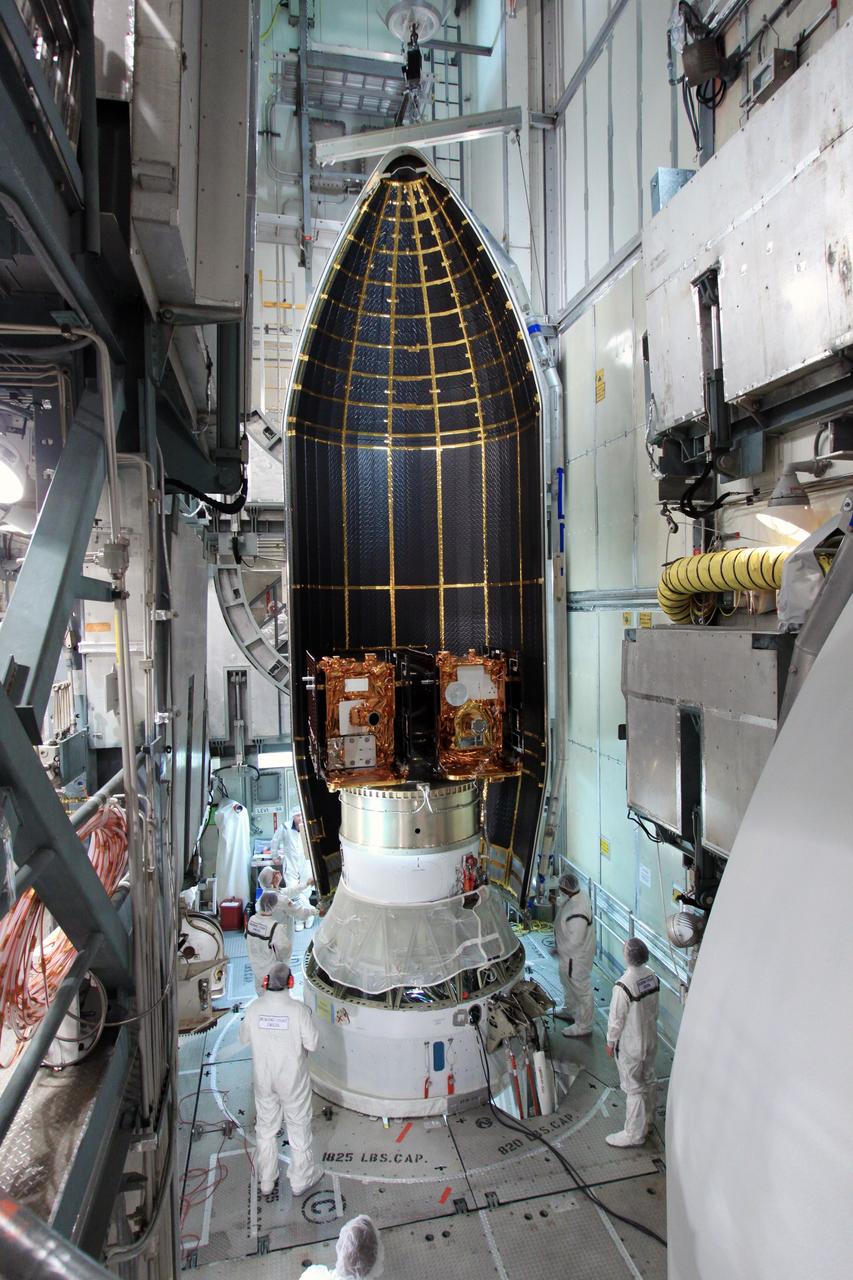
CAPE CANAVERAL, Fla. -- At Space Launch Complex 17B on Cape Canaveral Air Force Station in Florida, spacecraft technicians monitor the movement of a section of the clamshell-shaped Delta payload fairing as it encloses NASA's twin Gravity Recovery and Interior Laboratory spacecraft. The fairing will protect the spacecraft from the impact of aerodynamic pressure and heating during ascent and will be jettisoned once the spacecraft is outside the Earth's atmosphere. Launch aboard a United Launch Alliance Delta II rocket from Pad 17B is scheduled for Sept. 8. The spacecraft will fly in tandem orbits around the moon for several months to measure its gravity field. GRAIL's primary science objectives are to determine the structure of the lunar interior, from crust to core, and to advance understanding of the thermal evolution of the moon. For more information, visit http://www.nasa.gov/grail. Photo credit: NASA/Jim Grossmann
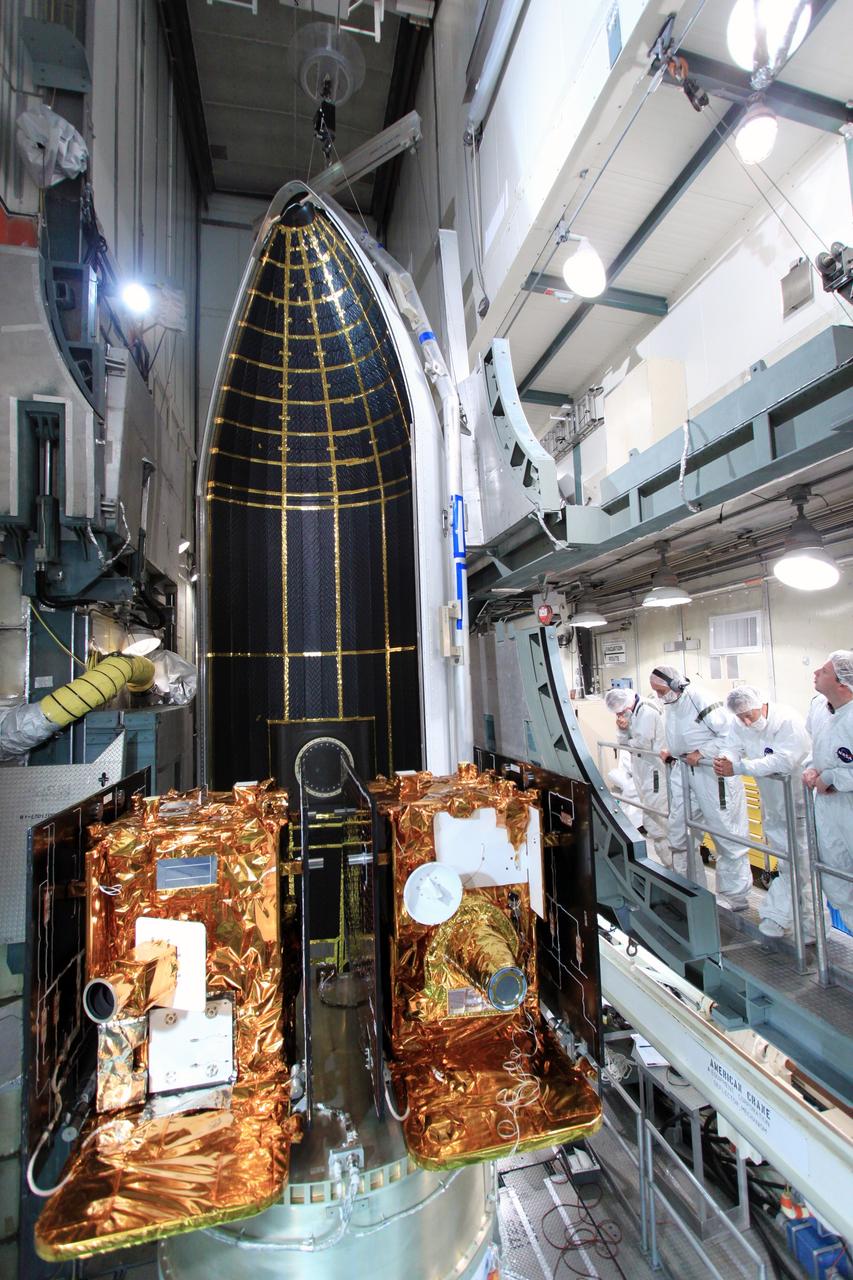
CAPE CANAVERAL, Fla. -- At Space Launch Complex 17B on Cape Canaveral Air Force Station in Florida, a section of the clamshell-shaped Delta payload fairing moves into place to enclose NASA's twin Gravity Recovery and Interior Laboratory spacecraft. The fairing will protect the spacecraft from the impact of aerodynamic pressure and heating during ascent and will be jettisoned once the spacecraft is outside the Earth's atmosphere. Launch aboard a United Launch Alliance Delta II rocket from Pad 17B is scheduled for Sept. 8. The spacecraft will fly in tandem orbits around the moon for several months to measure its gravity field. GRAIL's primary science objectives are to determine the structure of the lunar interior, from crust to core, and to advance understanding of the thermal evolution of the moon. For more information, visit http://www.nasa.gov/grail. Photo credit: NASA/Jim Grossmann
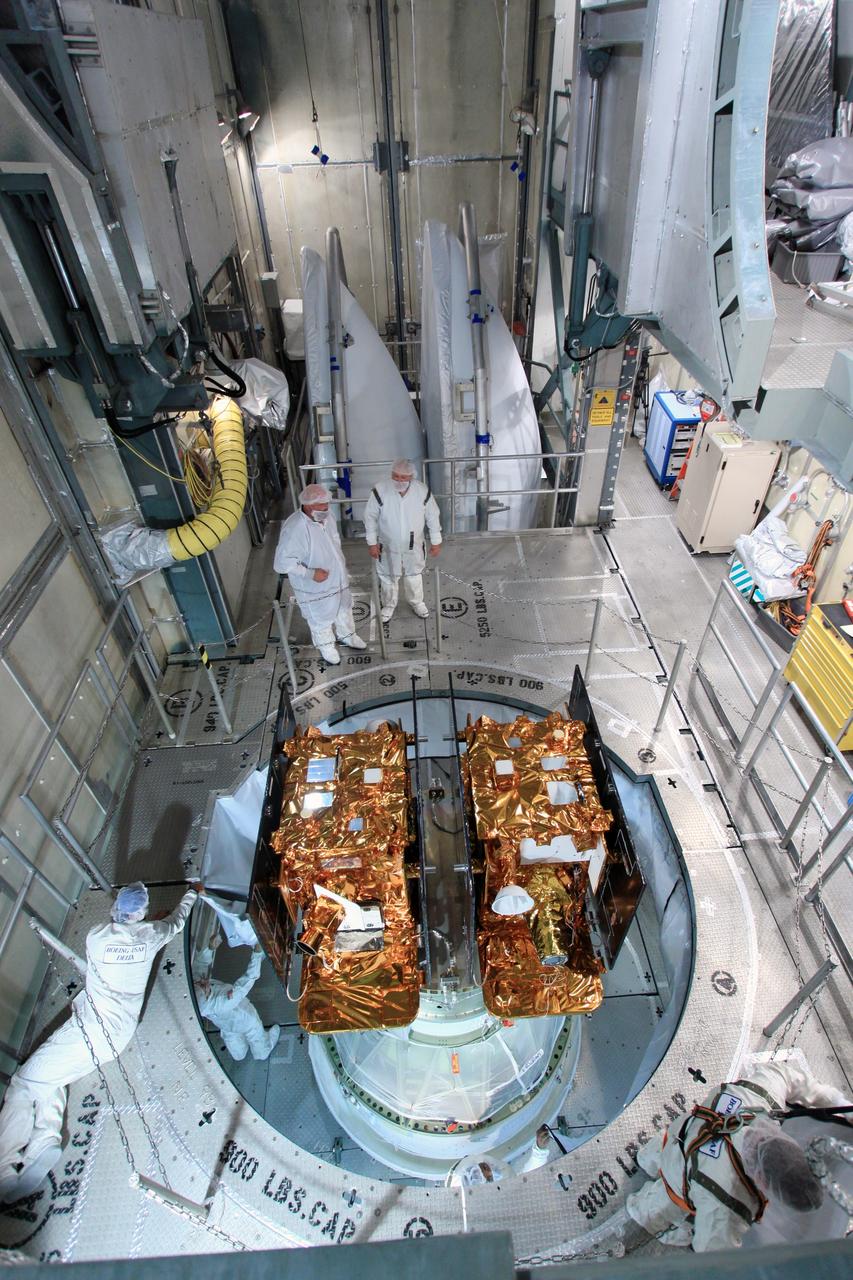
CAPE CANAVERAL, Fla. -- At Space Launch Complex 17B on Cape Canaveral Air Force Station in Florida, NASA's twin Gravity Recovery and Interior Laboratory spacecraft are uncovered and ready for enclosure in the Delta payload fairing. The fairing will protect the spacecraft from the impact of aerodynamic pressure and heating during ascent and will be jettisoned once the spacecraft is outside the Earth's atmosphere. Launch aboard a United Launch Alliance Delta II rocket from Pad 17B is scheduled for Sept. 8. The spacecraft will fly in tandem orbits around the moon for several months to measure its gravity field. GRAIL's primary science objectives are to determine the structure of the lunar interior, from crust to core, and to advance understanding of the thermal evolution of the moon. For more information, visit http://www.nasa.gov/grail. Photo credit: NASA/Jim Grossmann
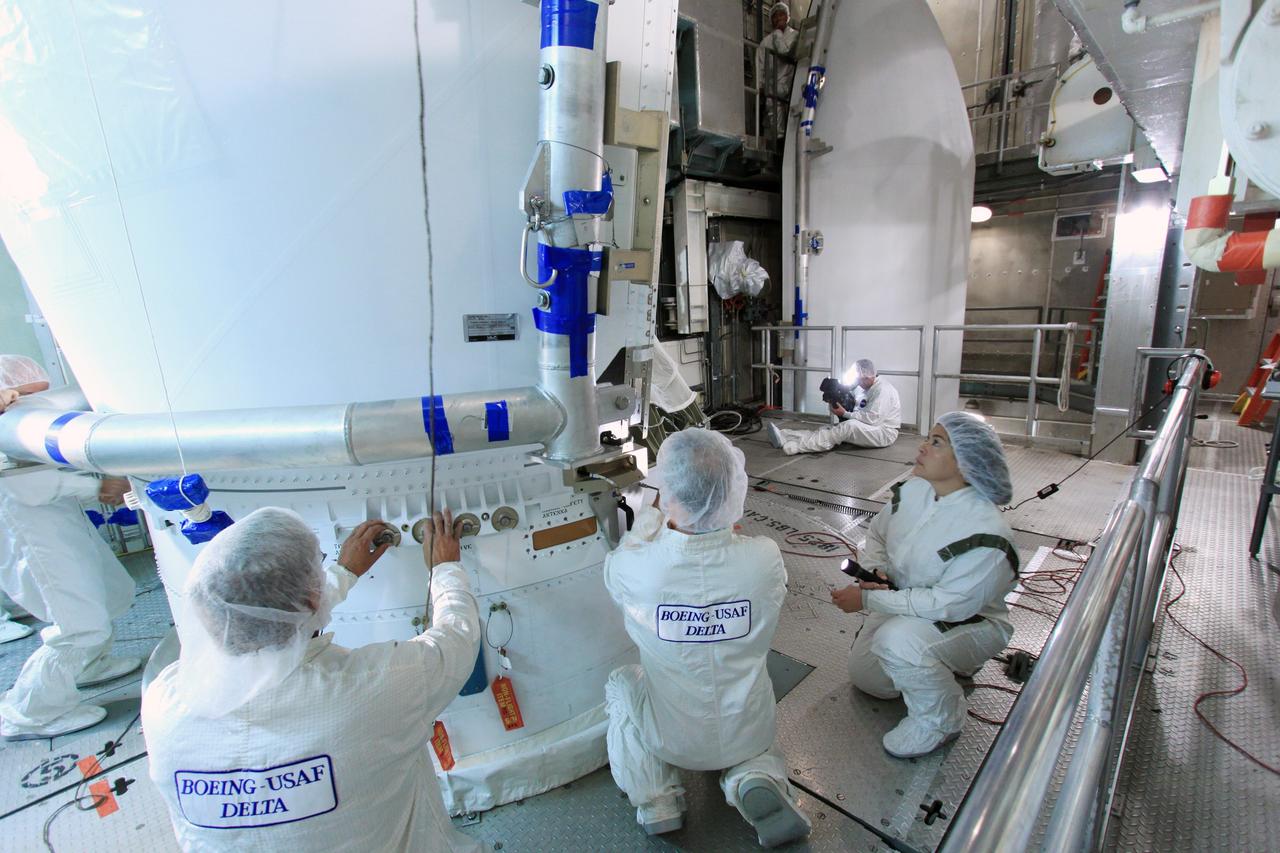
CAPE CANAVERAL, Fla. -- At Space Launch Complex 17B on Cape Canaveral Air Force Station in Florida, spacecraft technicians dressed in clean room attire, known as "bunny" suits, secure half of the clamshell-shaped Delta payload fairing around NASA's twin Gravity Recovery and Interior Laboratory spacecraft. The fairing will protect the spacecraft from the impact of aerodynamic pressure and heating during ascent and will be jettisoned once the spacecraft is outside the Earth's atmosphere. Launch aboard a United Launch Alliance Delta II rocket from Pad 17B is scheduled for Sept. 8. The spacecraft will fly in tandem orbits around the moon for several months to measure its gravity field. GRAIL's primary science objectives are to determine the structure of the lunar interior, from crust to core, and to advance understanding of the thermal evolution of the moon. For more information, visit http://www.nasa.gov/grail. Photo credit: NASA/Jim Grossmann
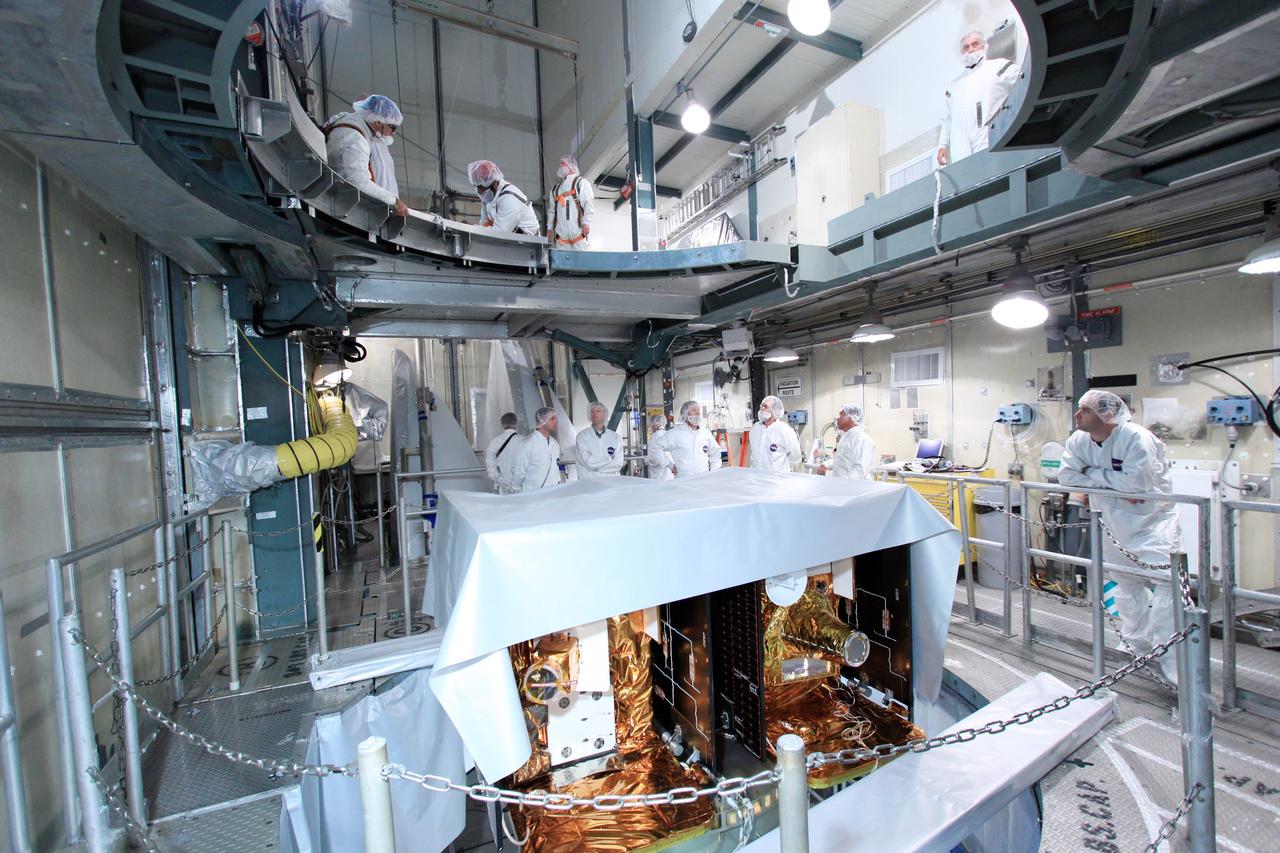
CAPE CANAVERAL, Fla. -- At Space Launch Complex 17B on Cape Canaveral Air Force Station in Florida, spacecraft technicians dressed in clean room attire, known as "bunny" suits, prepare to enclose NASA's twin Gravity Recovery and Interior Laboratory spacecraft in the Delta payload fairing. The fairing will protect the spacecraft from the impact of aerodynamic pressure and heating during ascent and will be jettisoned once the spacecraft is outside the Earth's atmosphere. Launch aboard a United Launch Alliance Delta II rocket from Pad 17B is scheduled for Sept. 8. The spacecraft will fly in tandem orbits around the moon for several months to measure its gravity field. GRAIL's primary science objectives are to determine the structure of the lunar interior, from crust to core, and to advance understanding of the thermal evolution of the moon. For more information, visit http://www.nasa.gov/grail. Photo credit: NASA/Jim Grossmann
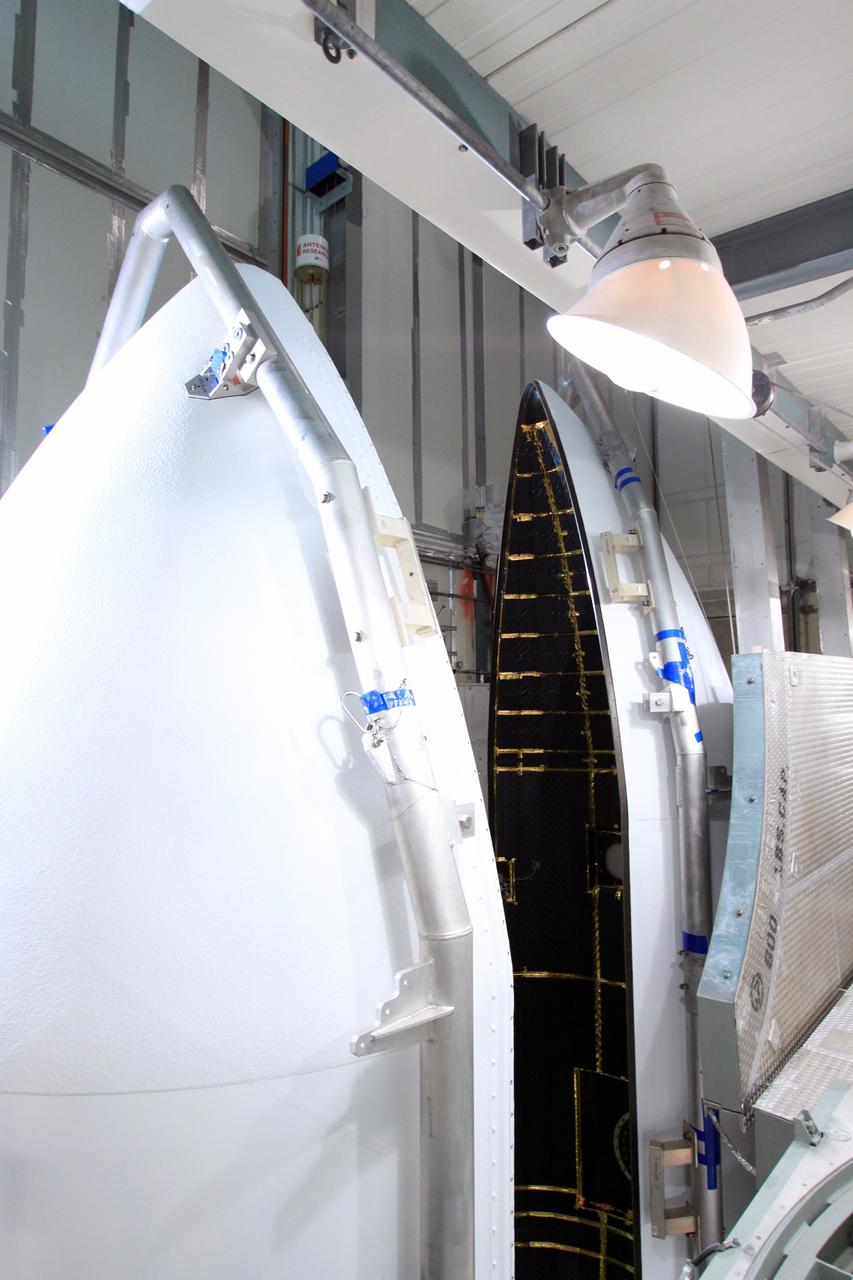
CAPE CANAVERAL, Fla. -- At Space Launch Complex 17B on Cape Canaveral Air Force Station in Florida, the sections of the clamshell-shaped Delta payload fairing close in around NASA's twin Gravity Recovery and Interior Laboratory spacecraft. The fairing will protect the spacecraft from the impact of aerodynamic pressure and heating during ascent and will be jettisoned once the spacecraft is outside the Earth's atmosphere. Launch aboard a United Launch Alliance Delta II rocket from Pad 17B is scheduled for Sept. 8. The spacecraft will fly in tandem orbits around the moon for several months to measure its gravity field. GRAIL's primary science objectives are to determine the structure of the lunar interior, from crust to core, and to advance understanding of the thermal evolution of the moon. For more information, visit http://www.nasa.gov/grail. Photo credit: NASA/Jim Grossmann
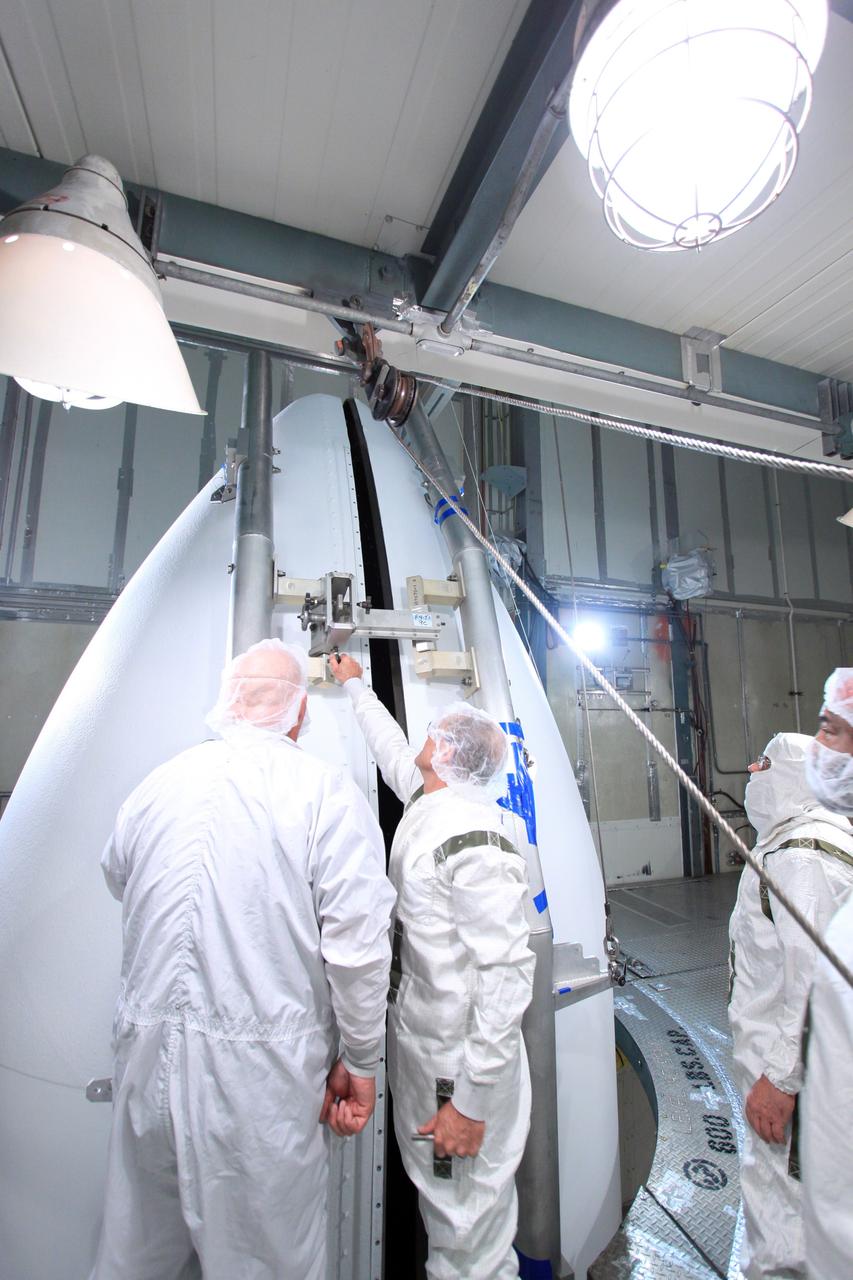
CAPE CANAVERAL, Fla. -- At Space Launch Complex 17B on Cape Canaveral Air Force Station in Florida, spacecraft technicians secure the sections of the clamshell-shaped Delta payload fairing around NASA's twin Gravity Recovery and Interior Laboratory spacecraft. The fairing will protect the spacecraft from the impact of aerodynamic pressure and heating during ascent and will be jettisoned once the spacecraft is outside the Earth's atmosphere. Launch aboard a United Launch Alliance Delta II rocket from Pad 17B is scheduled for Sept. 8. The spacecraft will fly in tandem orbits around the moon for several months to measure its gravity field. GRAIL's primary science objectives are to determine the structure of the lunar interior, from crust to core, and to advance understanding of the thermal evolution of the moon. For more information, visit http://www.nasa.gov/grail. Photo credit: NASA/Jim Grossmann
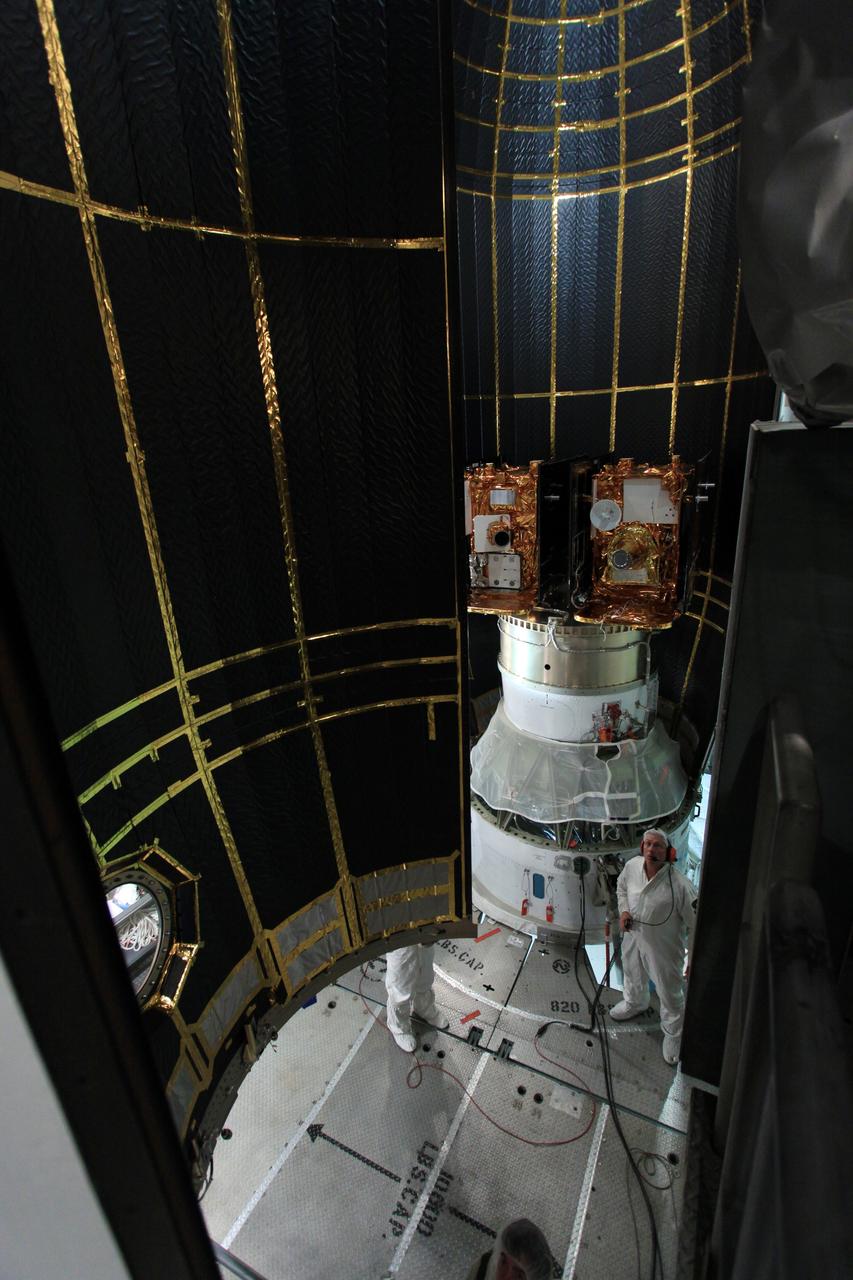
CAPE CANAVERAL, Fla. -- At Space Launch Complex 17B on Cape Canaveral Air Force Station in Florida, the second half of the clamshell-shaped Delta payload fairing swings into place around NASA's twin Gravity Recovery and Interior Laboratory spacecraft under the scrutiny of a spacecraft technician. The fairing will protect the spacecraft from the impact of aerodynamic pressure and heating during ascent and will be jettisoned once the spacecraft is outside the Earth's atmosphere. Launch aboard a United Launch Alliance Delta II rocket from Pad 17B is scheduled for Sept. 8. The spacecraft will fly in tandem orbits around the moon for several months to measure its gravity field. GRAIL's primary science objectives are to determine the structure of the lunar interior, from crust to core, and to advance understanding of the thermal evolution of the moon. For more information, visit http://www.nasa.gov/grail. Photo credit: NASA/Jim Grossmann
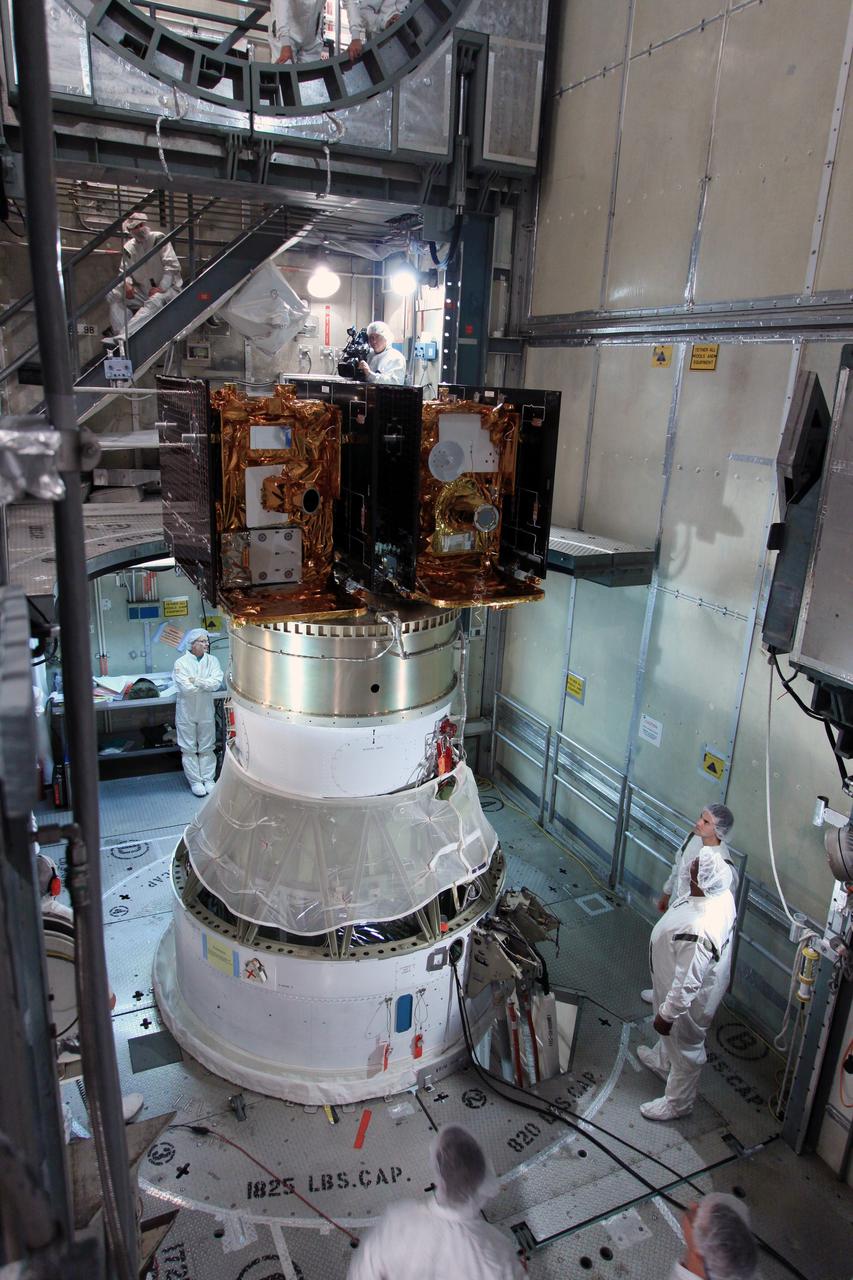
CAPE CANAVERAL, Fla. -- At Space Launch Complex 17B on Cape Canaveral Air Force Station in Florida, NASA's twin Gravity Recovery and Interior Laboratory spacecraft are secured atop a Delta II rocket awaiting enclosure in the Delta payload fairing. The fairing will protect the spacecraft from the impact of aerodynamic pressure and heating during ascent and will be jettisoned once the spacecraft is outside the Earth's atmosphere. Launch aboard a United Launch Alliance Delta II rocket from Pad 17B is scheduled for Sept. 8. The spacecraft will fly in tandem orbits around the moon for several months to measure its gravity field. GRAIL's primary science objectives are to determine the structure of the lunar interior, from crust to core, and to advance understanding of the thermal evolution of the moon. For more information, visit http://www.nasa.gov/grail. Photo credit: NASA/Jim Grossmann
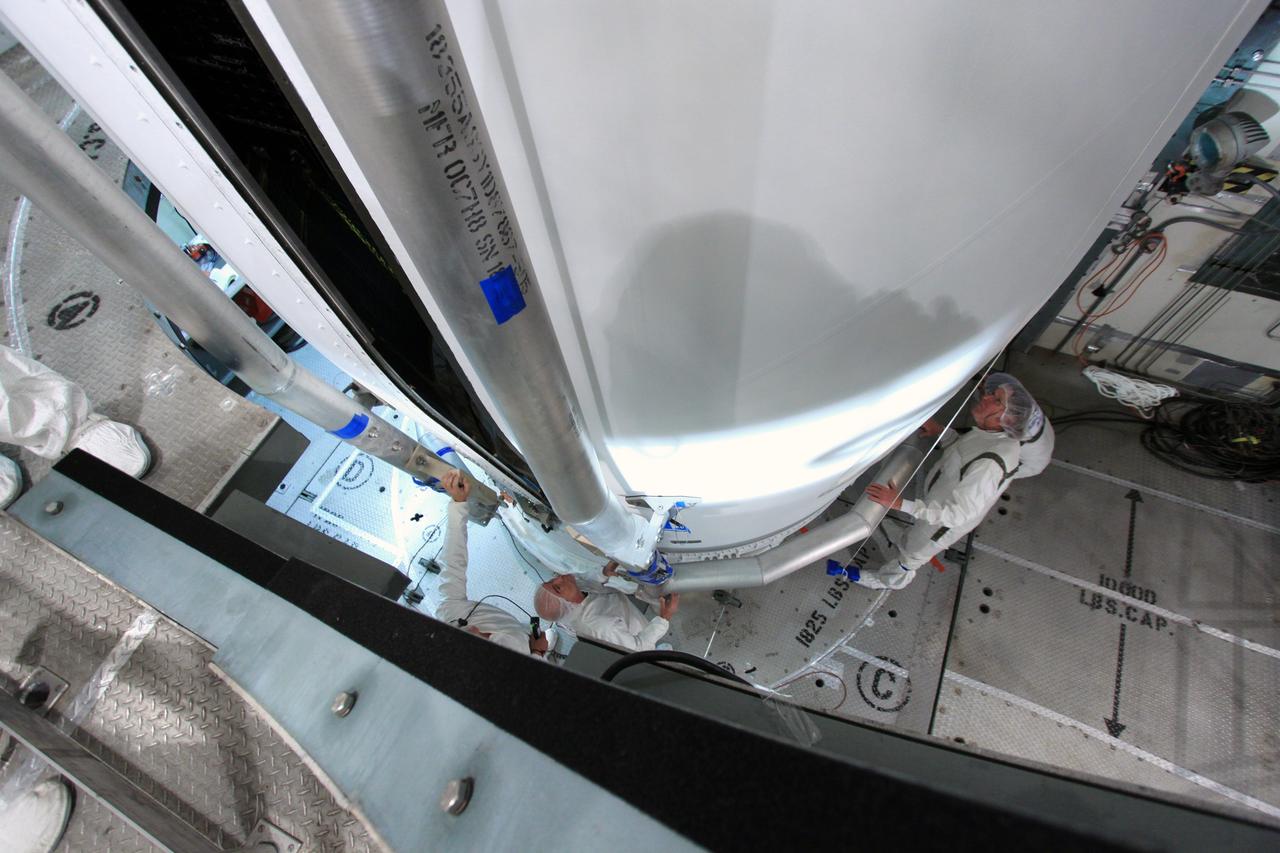
CAPE CANAVERAL, Fla. -- At Space Launch Complex 17B on Cape Canaveral Air Force Station in Florida, this spacecraft technician may be the last person to glimpse NASA's twin Gravity Recovery and Interior Laboratory spacecraft as the sections of the Delta payload fairing close around them. The fairing will protect the spacecraft from the impact of aerodynamic pressure and heating during ascent and will be jettisoned once the spacecraft is outside the Earth's atmosphere. Launch aboard a United Launch Alliance Delta II rocket from Pad 17B is scheduled for Sept. 8. The spacecraft will fly in tandem orbits around the moon for several months to measure its gravity field. GRAIL's primary science objectives are to determine the structure of the lunar interior, from crust to core, and to advance understanding of the thermal evolution of the moon. For more information, visit http://www.nasa.gov/grail. Photo credit: NASA/Jim Grossmann
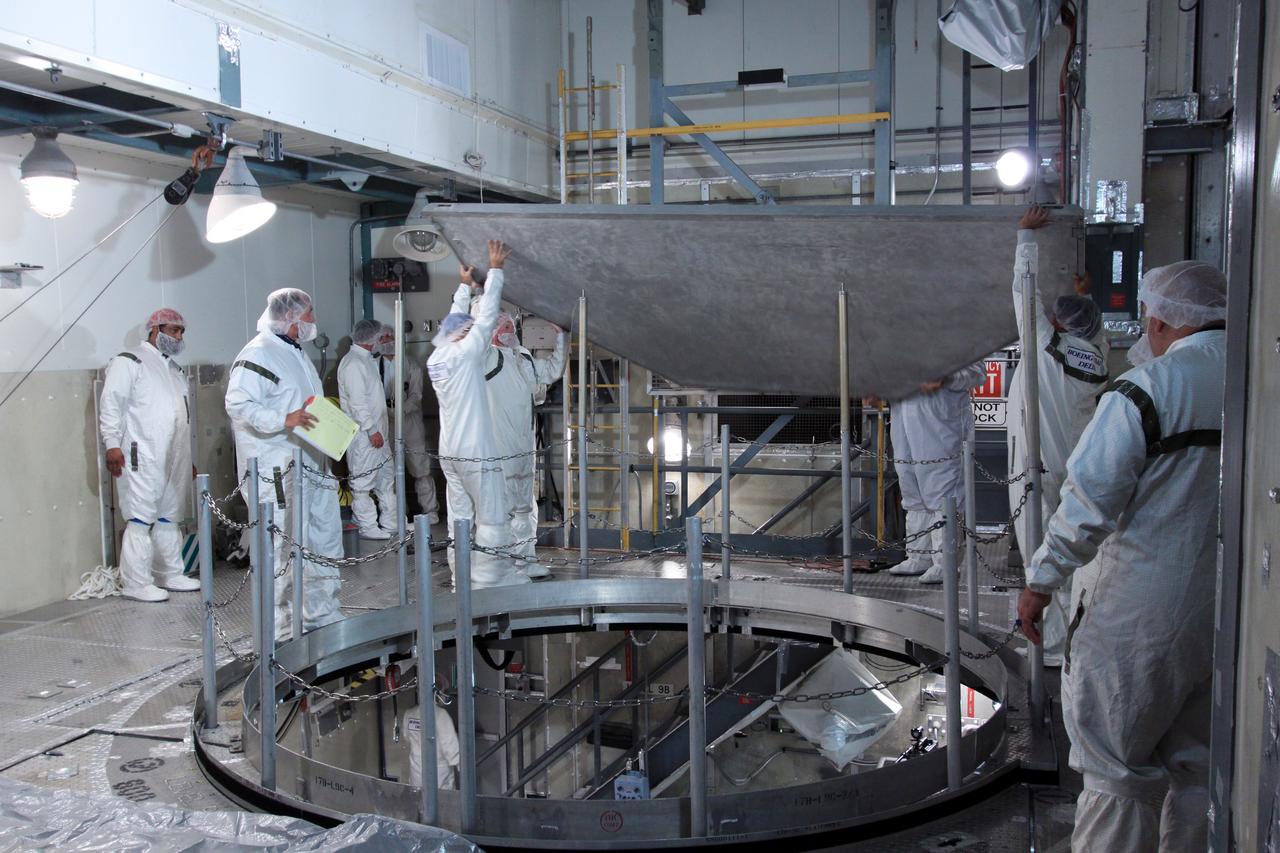
CAPE CANAVERAL, Fla. -- At Space Launch Complex 17B on Cape Canaveral Air Force Station in Florida, preparations are under way to enclose NASA's twin Gravity Recovery and Interior Laboratory spacecraft in the Delta payload fairing. The fairing will protect the spacecraft from the impact of aerodynamic pressure and heating during ascent and will be jettisoned once the spacecraft is outside the Earth's atmosphere. Launch aboard a United Launch Alliance Delta II rocket from Pad 17B is scheduled for Sept. 8. The spacecraft will fly in tandem orbits around the moon for several months to measure its gravity field. GRAIL's primary science objectives are to determine the structure of the lunar interior, from crust to core, and to advance understanding of the thermal evolution of the moon. For more information, visit http://www.nasa.gov/grail. Photo credit: NASA/Jim Grossmann
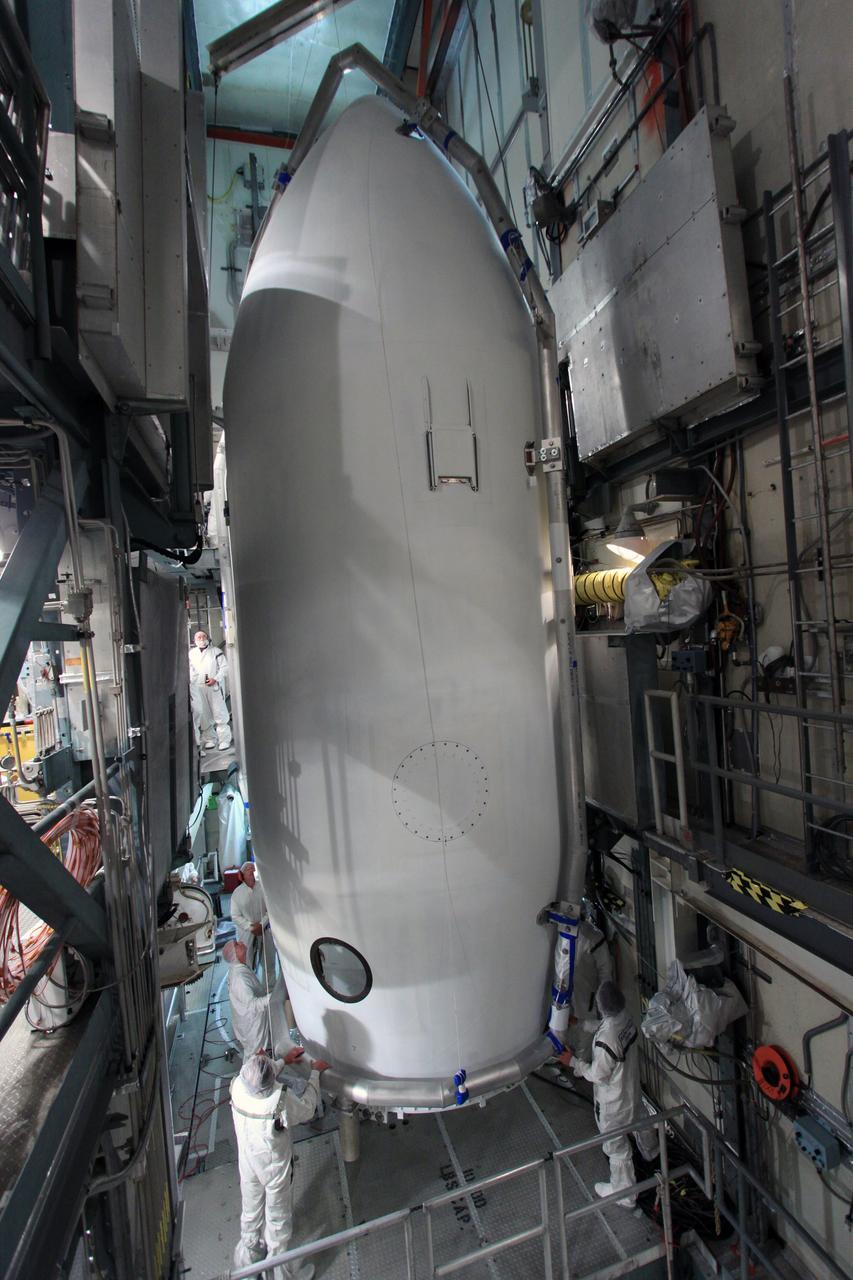
CAPE CANAVERAL, Fla. -- At Space Launch Complex 17B on Cape Canaveral Air Force Station in Florida, the sections of the Delta payload fairing form a protective cocoon around NASA's twin Gravity Recovery and Interior Laboratory spacecraft. The fairing will protect the spacecraft from the impact of aerodynamic pressure and heating during ascent and will be jettisoned once the spacecraft is outside the Earth's atmosphere. Launch aboard a United Launch Alliance Delta II rocket from Pad 17B is scheduled for Sept. 8. The spacecraft will fly in tandem orbits around the moon for several months to measure its gravity field. GRAIL's primary science objectives are to determine the structure of the lunar interior, from crust to core, and to advance understanding of the thermal evolution of the moon. For more information, visit http://www.nasa.gov/grail. Photo credit: NASA/Jim Grossmann
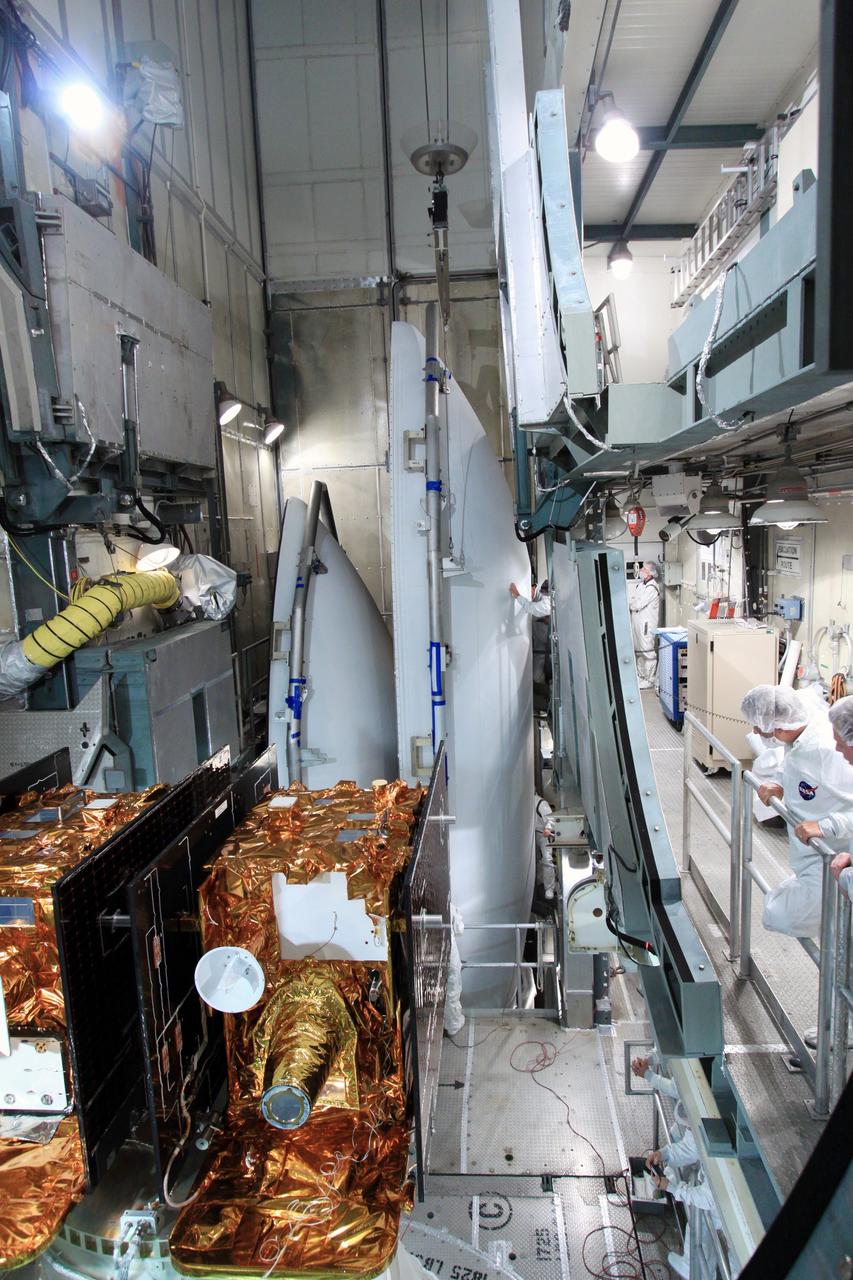
CAPE CANAVERAL, Fla. -- At Space Launch Complex 17B on Cape Canaveral Air Force Station in Florida, sections of the clamshell-shaped Delta payload fairing, in the background, are ready to enclose NASA's twin Gravity Recovery and Interior Laboratory spacecraft. The fairing will protect the spacecraft from the impact of aerodynamic pressure and heating during ascent and will be jettisoned once the spacecraft is outside the Earth's atmosphere. Launch aboard a United Launch Alliance Delta II rocket from Pad 17B is scheduled for Sept. 8. The spacecraft will fly in tandem orbits around the moon for several months to measure its gravity field. GRAIL's primary science objectives are to determine the structure of the lunar interior, from crust to core, and to advance understanding of the thermal evolution of the moon. For more information, visit http://www.nasa.gov/grail. Photo credit: NASA/Jim Grossmann
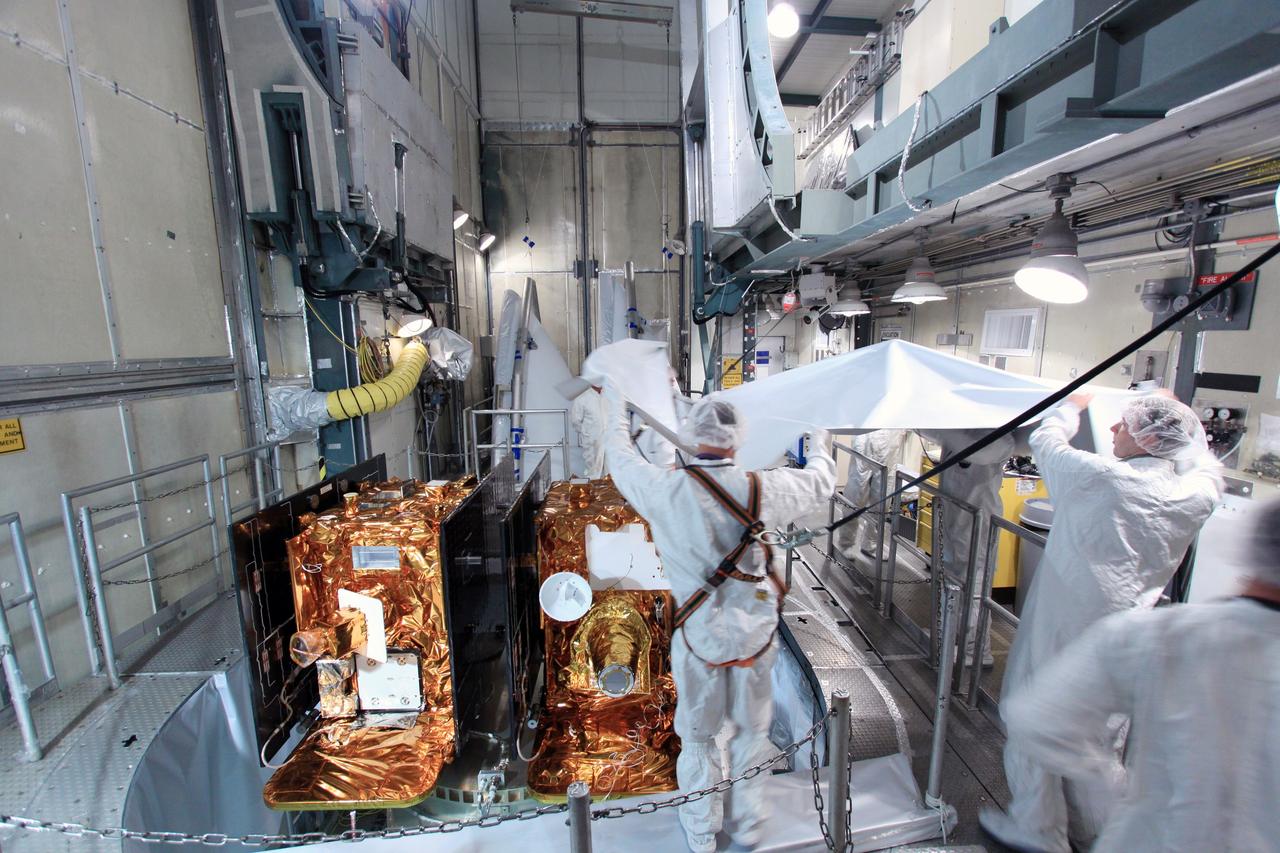
CAPE CANAVERAL, Fla. -- At Space Launch Complex 17B on Cape Canaveral Air Force Station in Florida, spacecraft technicians dressed in clean room attire, known as "bunny" suits, uncover NASA's twin Gravity Recovery and Interior Laboratory spacecraft during preparations to enclose it in the Delta payload fairing. The fairing will protect the spacecraft from the impact of aerodynamic pressure and heating during ascent and will be jettisoned once the spacecraft is outside the Earth's atmosphere. Launch aboard a United Launch Alliance Delta II rocket from Pad 17B is scheduled for Sept. 8. The spacecraft will fly in tandem orbits around the moon for several months to measure its gravity field. GRAIL's primary science objectives are to determine the structure of the lunar interior, from crust to core, and to advance understanding of the thermal evolution of the moon. For more information, visit http://www.nasa.gov/grail. Photo credit: NASA/Jim Grossmann
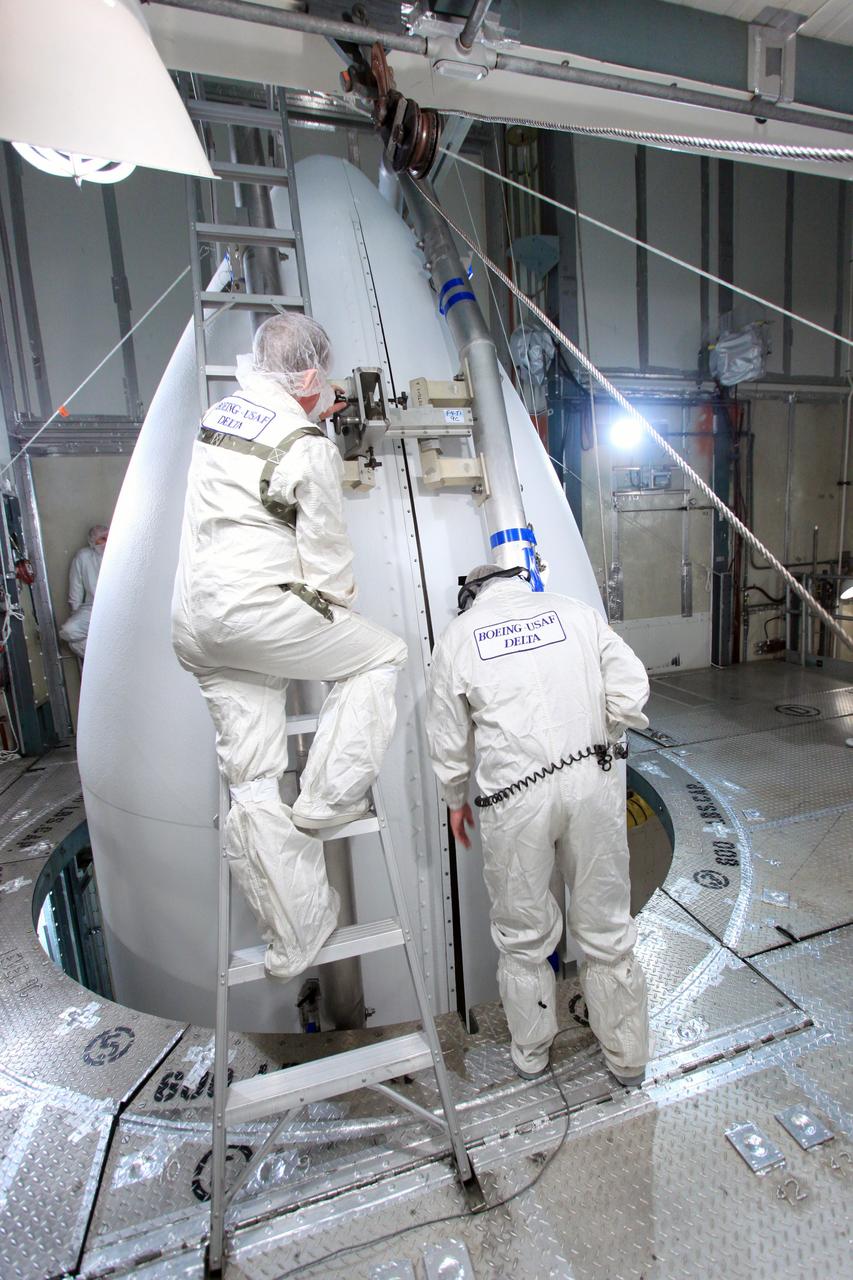
CAPE CANAVERAL, Fla. -- At Space Launch Complex 17B on Cape Canaveral Air Force Station in Florida, NASA's twin Gravity Recovery and Interior Laboratory spacecraft are hidden from view as spacecraft technicians secure the sections of the clamshell-shaped Delta payload fairing around them. The fairing will protect the spacecraft from the impact of aerodynamic pressure and heating during ascent and will be jettisoned once the spacecraft is outside the Earth's atmosphere. Launch aboard a United Launch Alliance Delta II rocket from Pad 17B is scheduled for Sept. 8. The spacecraft will fly in tandem orbits around the moon for several months to measure its gravity field. GRAIL's primary science objectives are to determine the structure of the lunar interior, from crust to core, and to advance understanding of the thermal evolution of the moon. For more information, visit http://www.nasa.gov/grail. Photo credit: NASA/Jim Grossmann
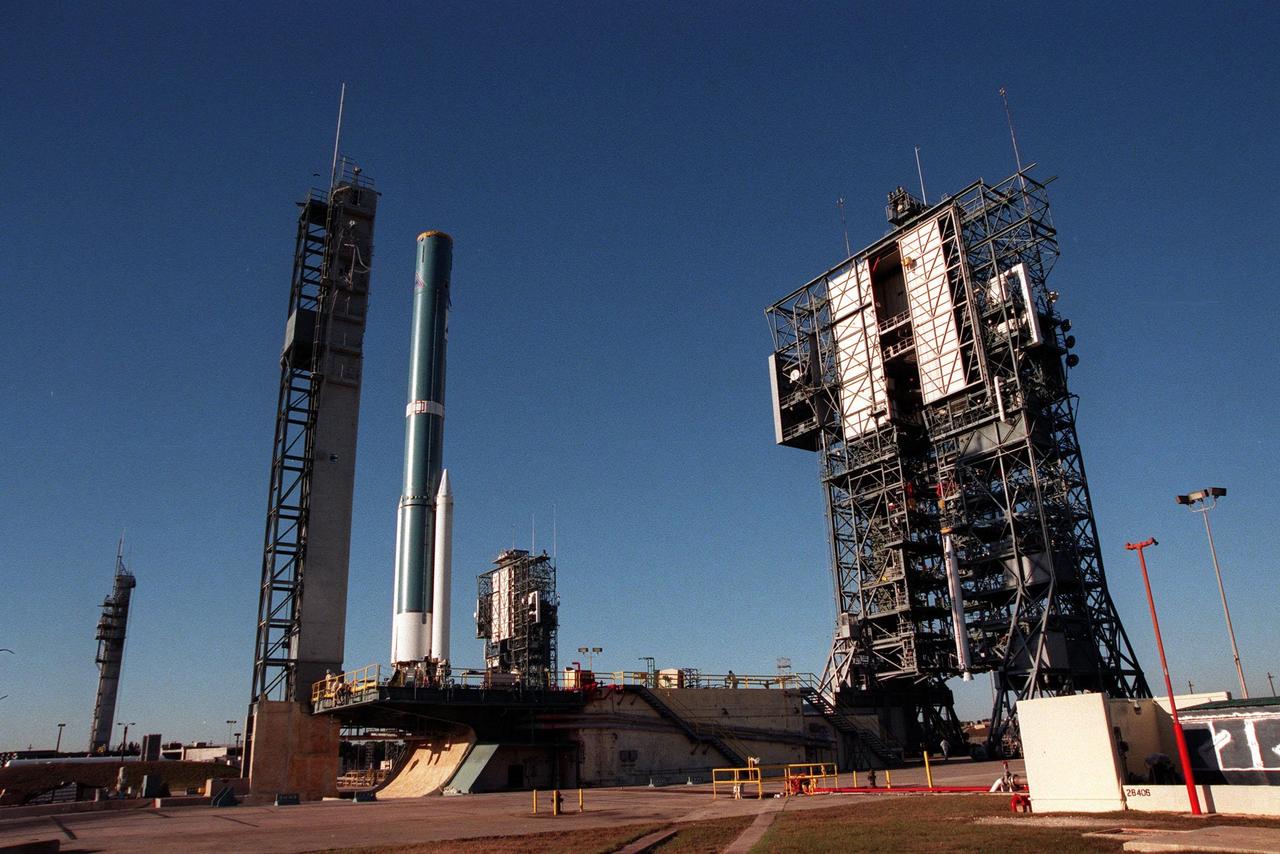
A Boeing Delta II rocket sits on Launch Pad 17A (left), Cape Canaveral Air Station, before mating with its final Solid Rocket Booster, in the tower at right. In the background is Pad 17B with its two launch tower components. The Delta II rocket will carry the Stardust satellite into space for a close encounter with the comet Wild 2 in January 2004. Using a medium called aerogel, Stardust will capture comet particles flying off the nucleus of the comet, plus collect interstellar dust for later analysis. The collected samples will return to Earth in a Sample Return Capsule to be jettisoned as Stardust swings by Earth in January 2006. Stardust is scheduled to be launched on Feb. 6, 1999
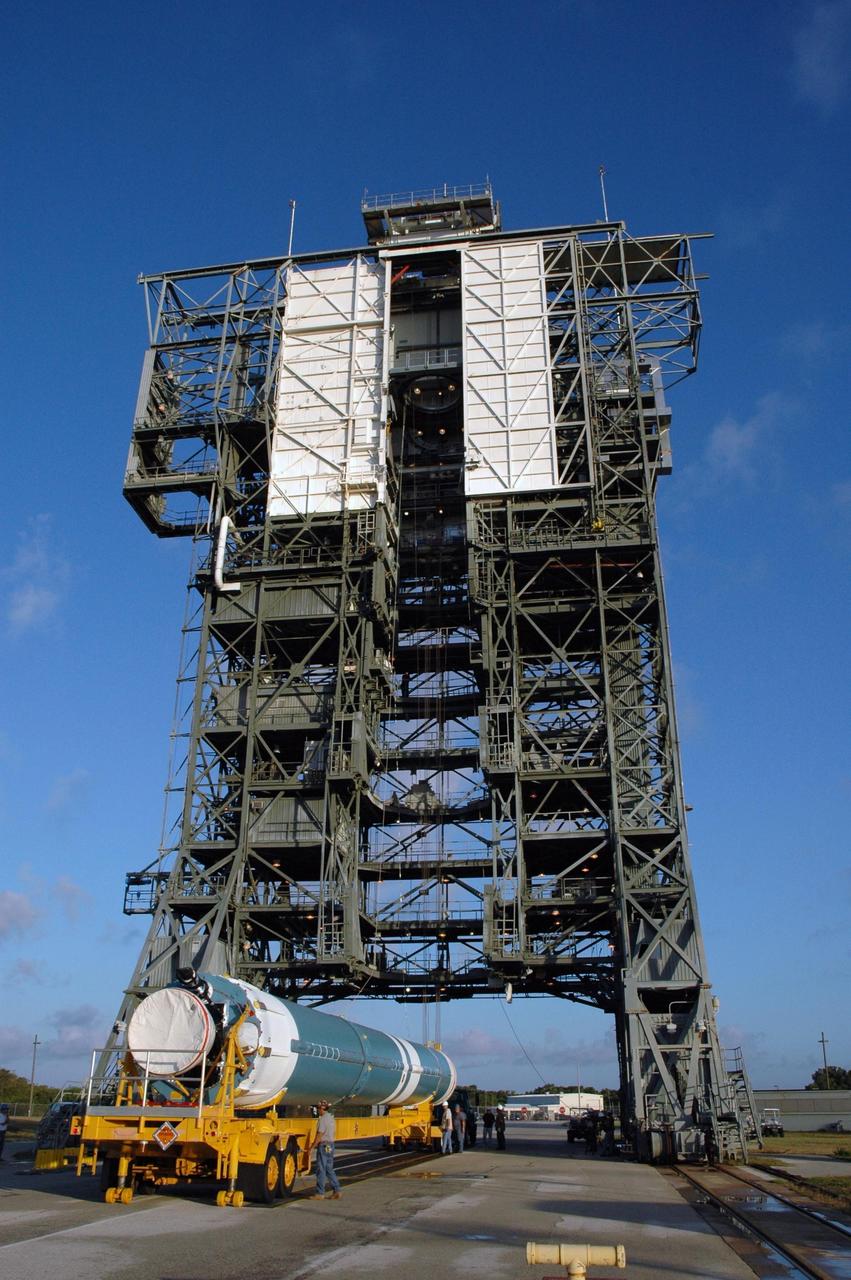
KENNEDY SPACE CENTER, FLA. - The first stage of the Boeing Delta II rocket, slated to launch NASA's Solar Terrestrial Relations Observatory (STEREO), arrives at Pad 17B on Cape Canaveral Air Force Station. Preparations are under way for a liftoff no earlier than July 22. STEREO consists of two spacecraft whose mission is the first to take measurements of the sun and solar wind in 3-D. This new view will improve our understanding of space weather and its impact on the Earth. Photo credit: NASA/Jim Grossmann
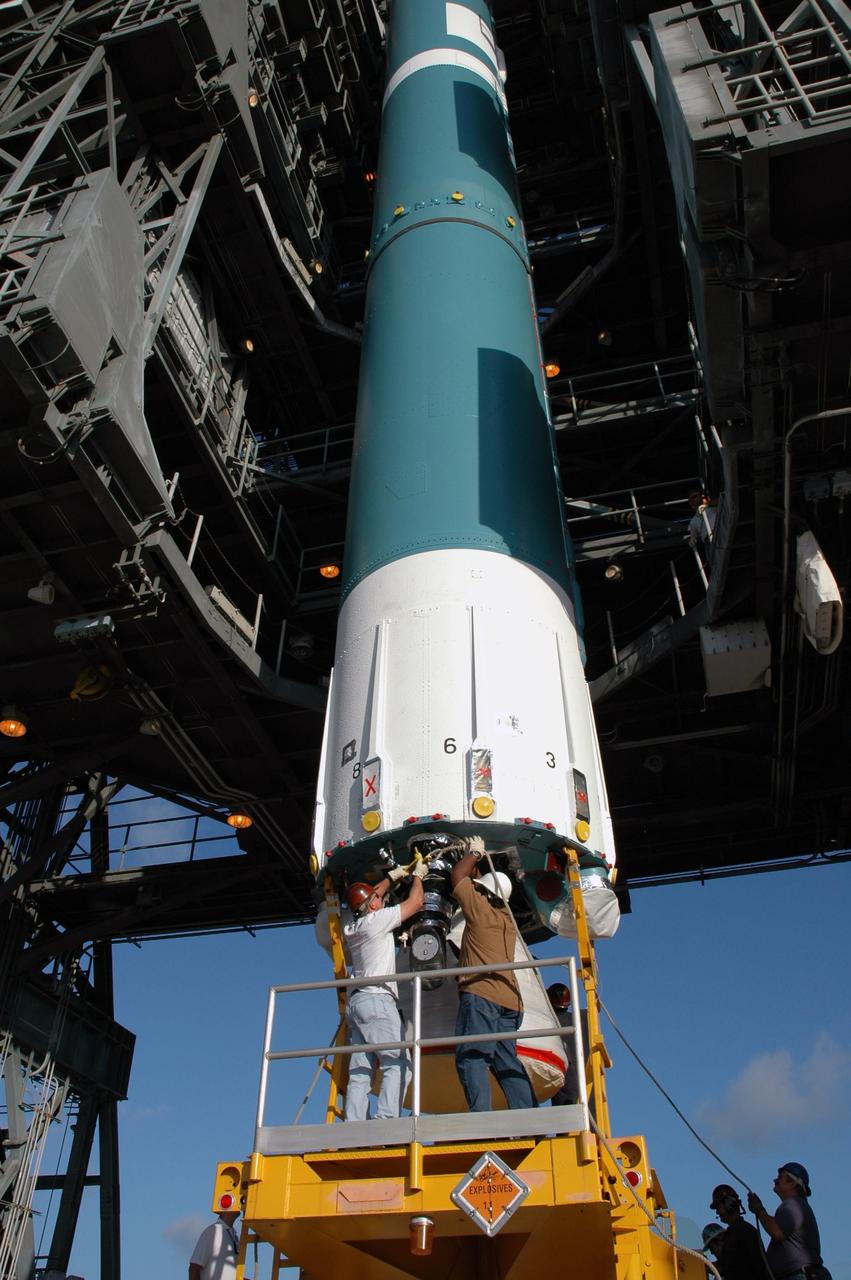
KENNEDY SPACE CENTER, FLA. - Workers prepare the first stage of the Boeing Delta II rocket, slated to launch NASA's Solar Terrestrial Relations Observatory (STEREO), for installation into the mobile service tower at Pad 17B on Cape Canaveral Air Force Station. Preparations are under way for a liftoff no earlier than July 22. STEREO consists of two spacecraft whose mission is the first to take measurements of the sun and solar wind in 3-D. This new view will improve our understanding of space weather and its impact on the Earth. Photo credit: NASA/Jim Grossmann
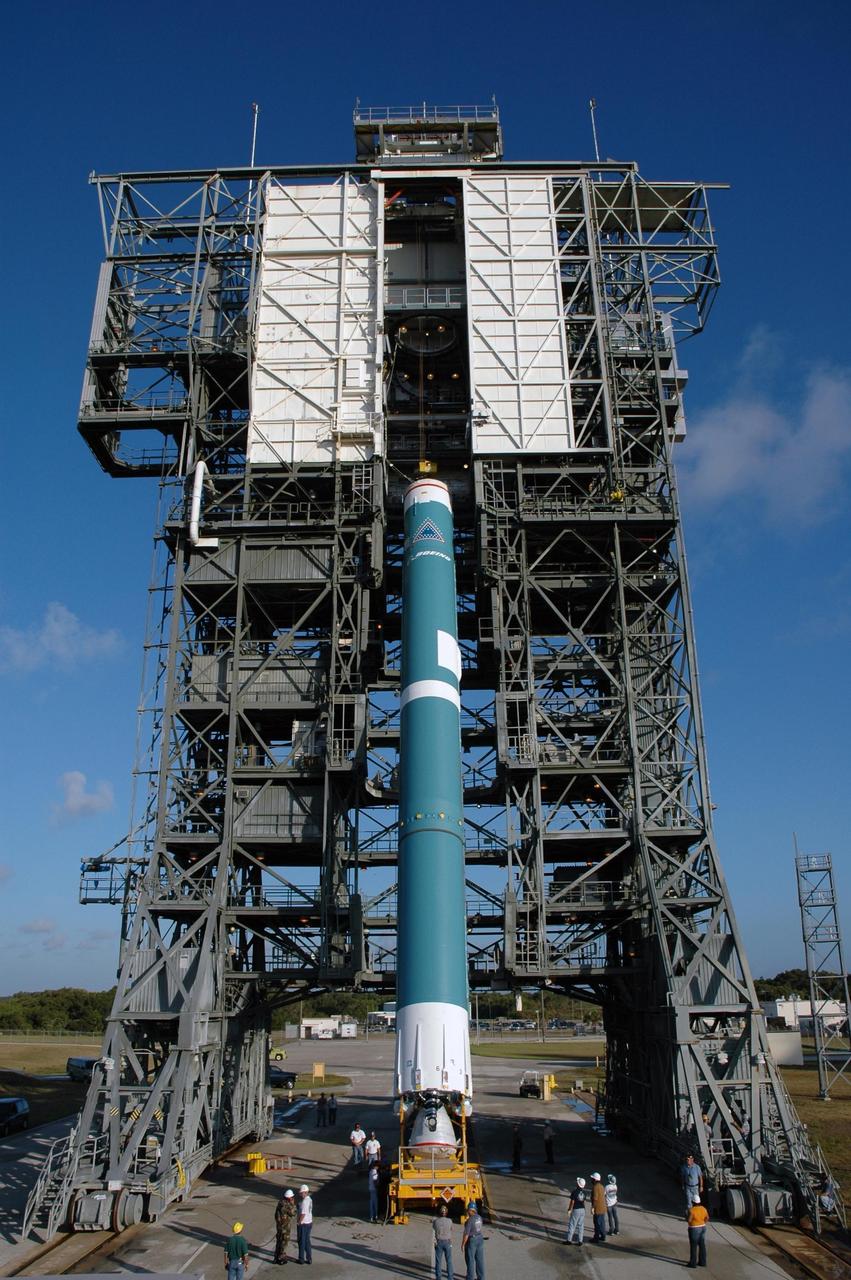
KENNEDY SPACE CENTER, FLA. - The first stage of the Boeing Delta II rocket, slated to launch NASA's Solar Terrestrial Relations Observatory (STEREO), is lifted into a vertical position for installation into the mobile service tower at Pad 17B on Cape Canaveral Air Force Station. Preparations are under way for a liftoff no earlier than July 22. STEREO consists of two spacecraft whose mission is the first to take measurements of the sun and solar wind in 3-D. This new view will improve our understanding of space weather and its impact on the Earth. Photo credit: NASA/Jim Grossmann
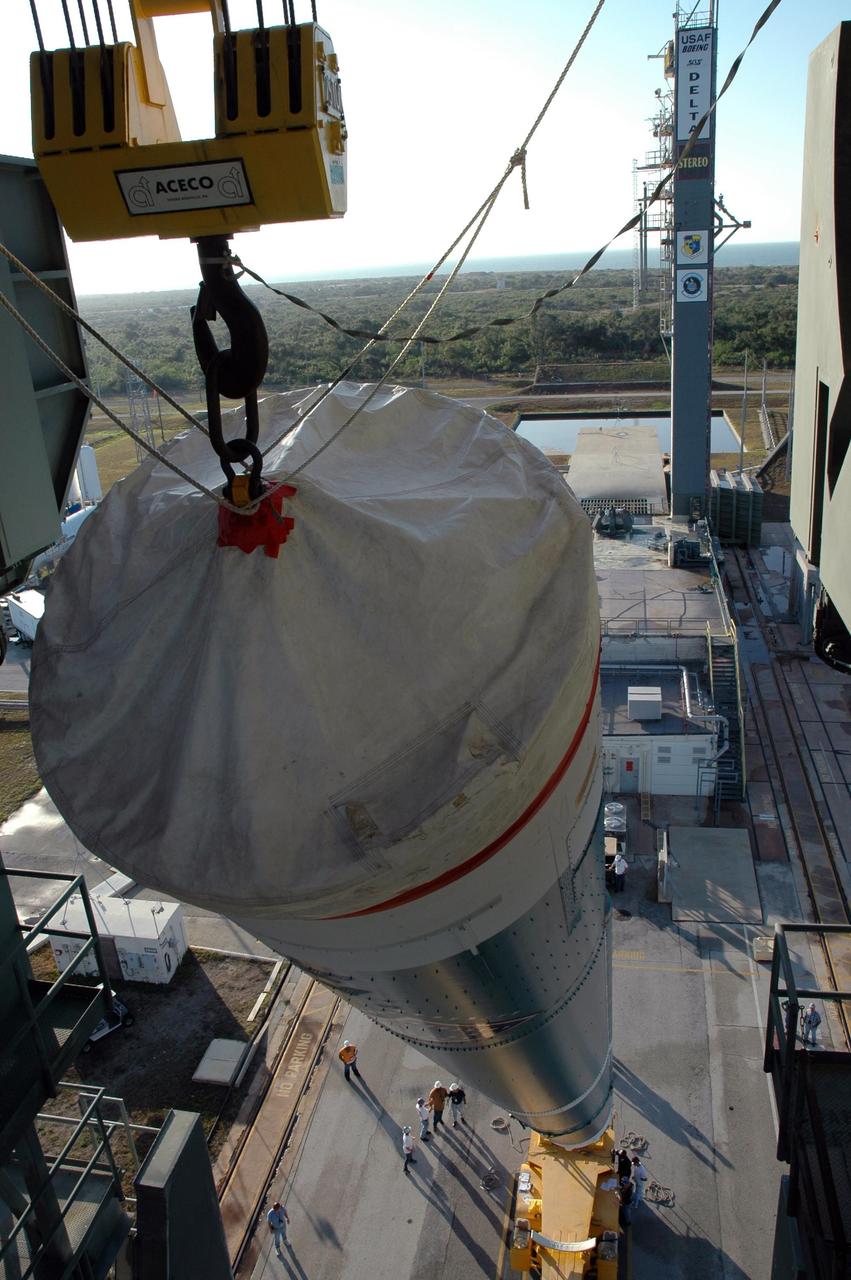
KENNEDY SPACE CENTER, FLA. - The first stage of the Boeing Delta II rocket, slated to launch NASA's Solar Terrestrial Relations Observatory (STEREO), is lifted into a vertical position for installation into the mobile service tower at Pad 17B on Cape Canaveral Air Force Station. Preparations are under way for a liftoff no earlier than July 22. STEREO consists of two spacecraft whose mission is the first to take measurements of the sun and solar wind in 3-D. This new view will improve our understanding of space weather and its impact on the Earth. Photo credit: NASA/Jim Grossmann
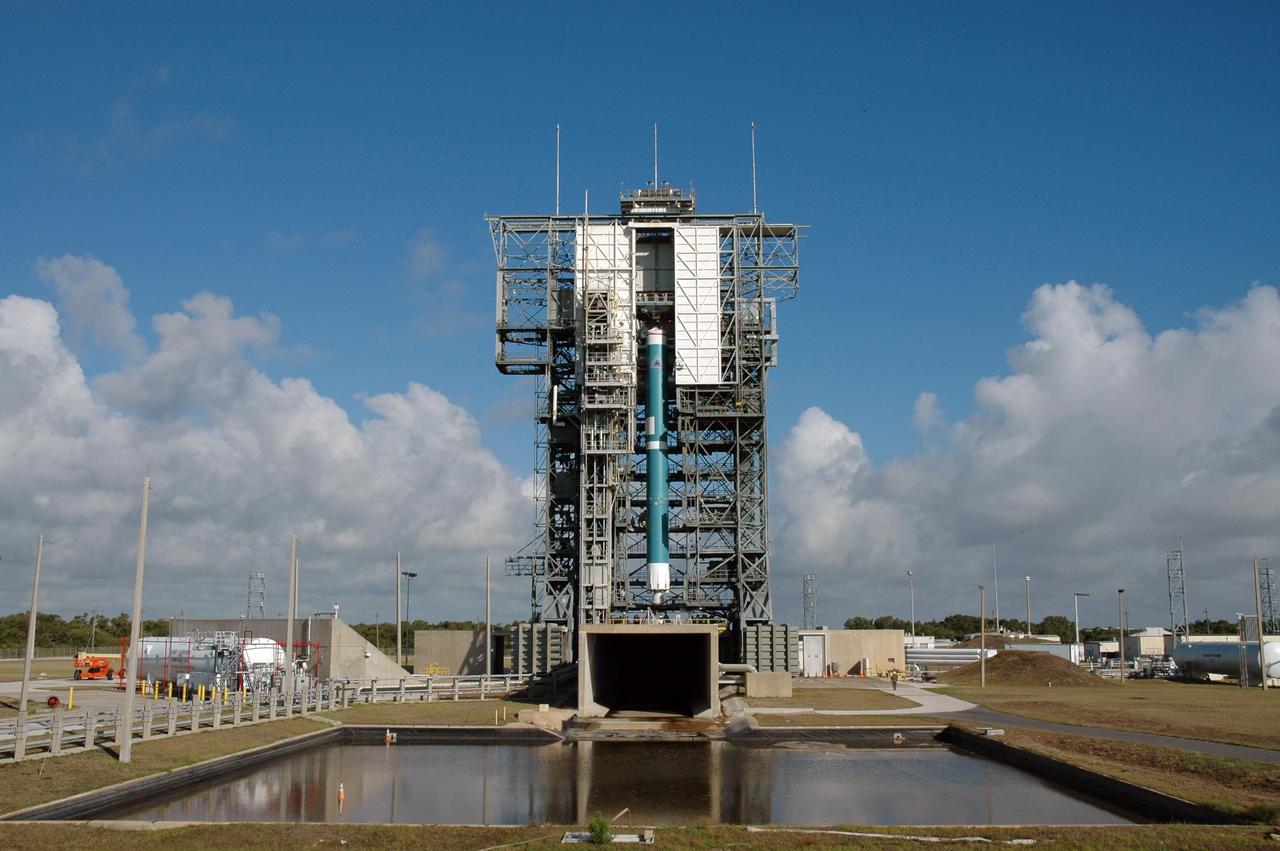
KENNEDY SPACE CENTER, FLA. - The first stage of the Boeing Delta II rocket, slated to launch NASA's Solar Terrestrial Relations Observatory (STEREO), is in position in the mobile service tower at Pad 17B on Cape Canaveral Air Force Station for stacking with the rocket's other stages. Preparations are under way for a liftoff no earlier than July 22. STEREO consists of two spacecraft whose mission is the first to take measurements of the sun and solar wind in 3-D. This new view will improve our understanding of space weather and its impact on the Earth. Photo credit: NASA/Jim Grossmann
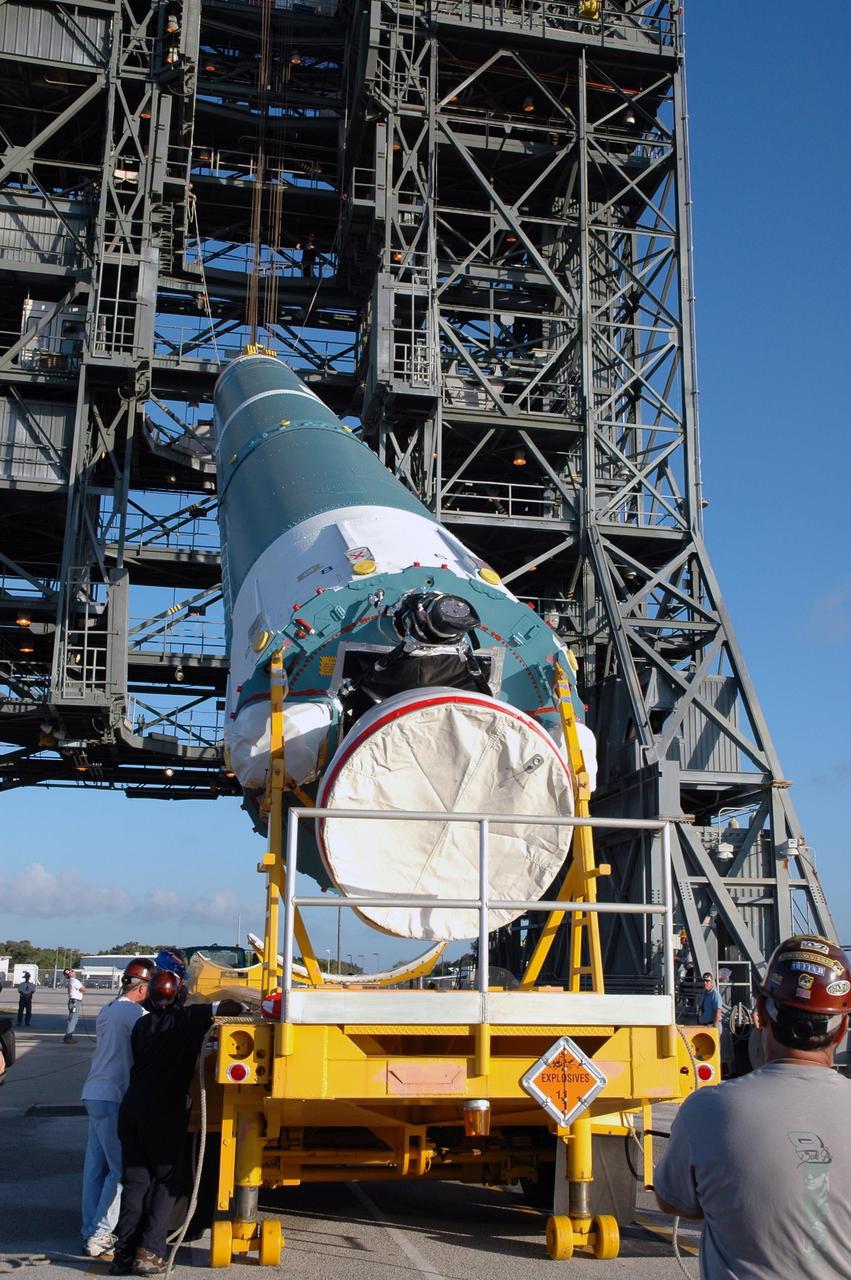
KENNEDY SPACE CENTER, FLA. - Workers supervise the lift of the first stage of the Boeing Delta II rocket, slated to launch NASA's Solar Terrestrial Relations Observatory (STEREO), into the mobile service tower at Pad 17B on Cape Canaveral Air Force Station. Preparations are under way for a liftoff no earlier than July 22. STEREO consists of two spacecraft whose mission is the first to take measurements of the sun and solar wind in 3-D. This new view will improve our understanding of space weather and its impact on the Earth. Photo credit: NASA/Jim Grossmann
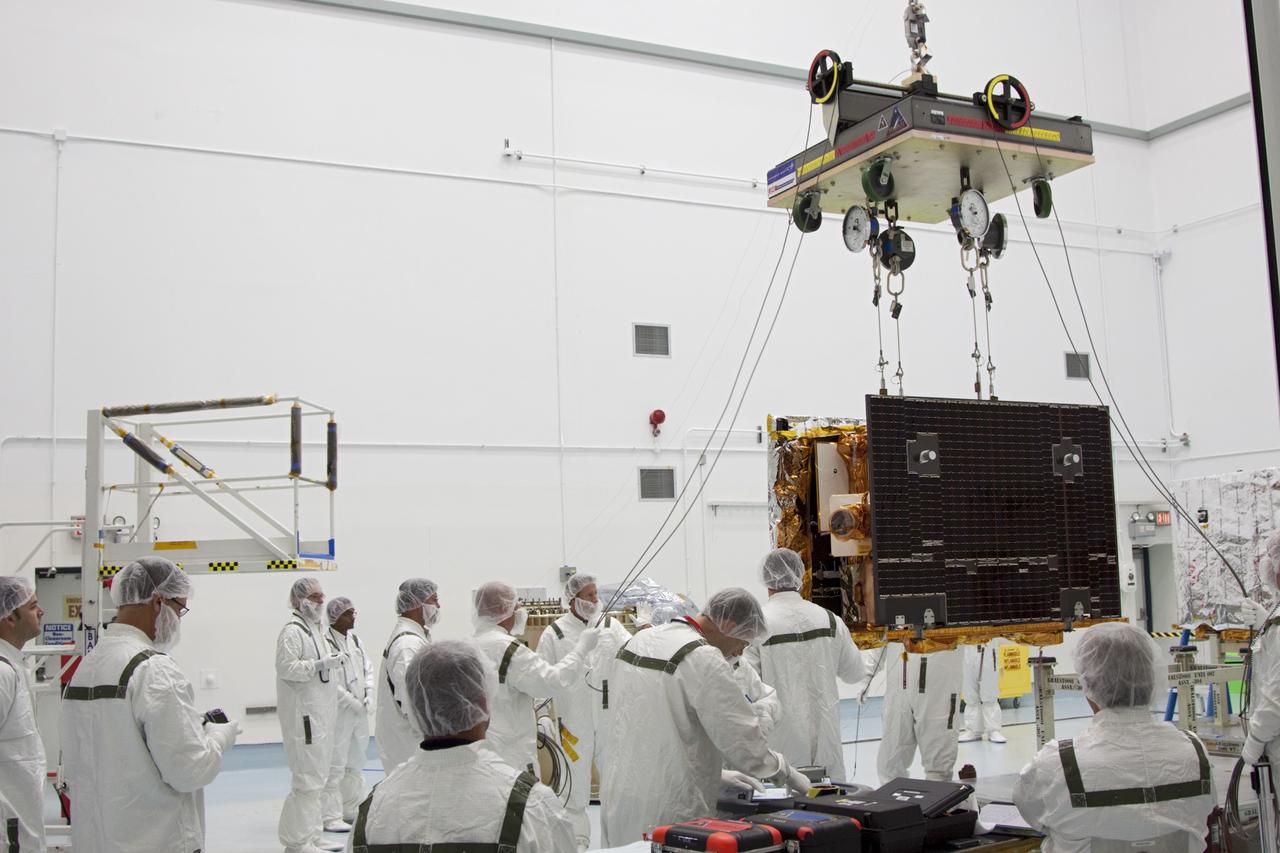
CAPE CANAVERAL, Fla. -- At Astrotech Space Operation's payload processing facility in Titusville, Fla., Lockheed Martin technicians lift NASA's Gravity Recovery and Interior Laboratory-B (GRAIL-B) lunar probe from its workstand. After the twin GRAIL spacecraft are attached to their spacecraft adapter ring in their side-by-side launch configuration, they will be transported to the launch pad. GRAIL will fly in tandem orbits around the moon for several months to measure its gravity field. GRAIL's primary science objectives are to determine the structure of the lunar interior, from crust to core, and to advance understanding of the thermal evolution of the moon. Launch aboard a United Launch Alliance Delta II rocket from Space Launch Complex 17B on Cape Canaveral Air Force Station is scheduled for Sept. 8. For more information, visit http://www.nasa.gov/grail. Photo credit: NASA/Jim Grossmann
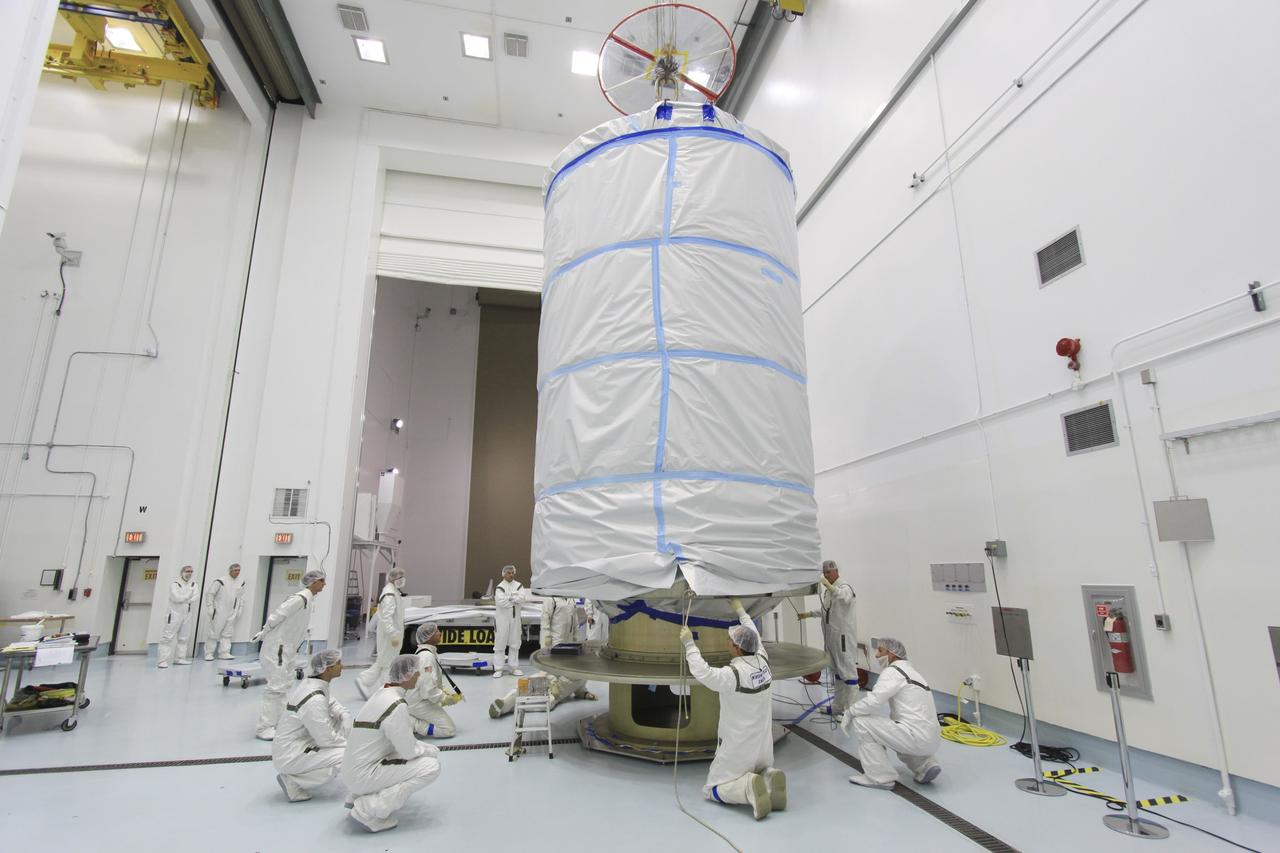
CAPE CANAVERAL, Fla. -- At Astrotech Space Operation's payload processing facility in Titusville, Fla., a protective canister encases NASA's twin Gravity Recovery and Interior Laboratory spacecraft. Preparations are under way to transport the lunar probes, attached to a spacecraft adapter ring in their side-by-side launch configuration, to the launch pad. The spacecraft will fly in tandem orbits around the moon for several months to measure its gravity field. GRAIL's primary science objectives are to determine the structure of the lunar interior, from crust to core, and to advance understanding of the thermal evolution of the moon. Launch aboard a United Launch Alliance Delta II rocket from Space Launch Complex 17B on Cape Canaveral Air Force Station is scheduled for Sept. 8. For more information, visit http://www.nasa.gov/grail. Photo credit: NASA/Jim Grossmann

CAPE CANAVERAL, Fla. -- At Astrotech Space Operation's payload processing facility in Titusville, Fla., Lockheed Martin technicians make final adjustment to NASA's Gravity Recovery and Interior Laboratory-A (GRAIL-A) lunar probe before it is secured to the spacecraft adapter ring. GRAIL-B is secured to the ring, at left. After the twin GRAIL spacecraft are attached to the adapter ring in their side-by-side launch configuration, they will be transported to the launch pad. GRAIL will fly in tandem orbits around the moon for several months to measure its gravity field. GRAIL's primary science objectives are to determine the structure of the lunar interior, from crust to core, and to advance understanding of the thermal evolution of the moon. Launch aboard a United Launch Alliance Delta II rocket from Space Launch Complex 17B on Cape Canaveral Air Force Station is scheduled for Sept. 8. For more information, visit http://www.nasa.gov/grail. Photo credit: NASA/Jim Grossmann
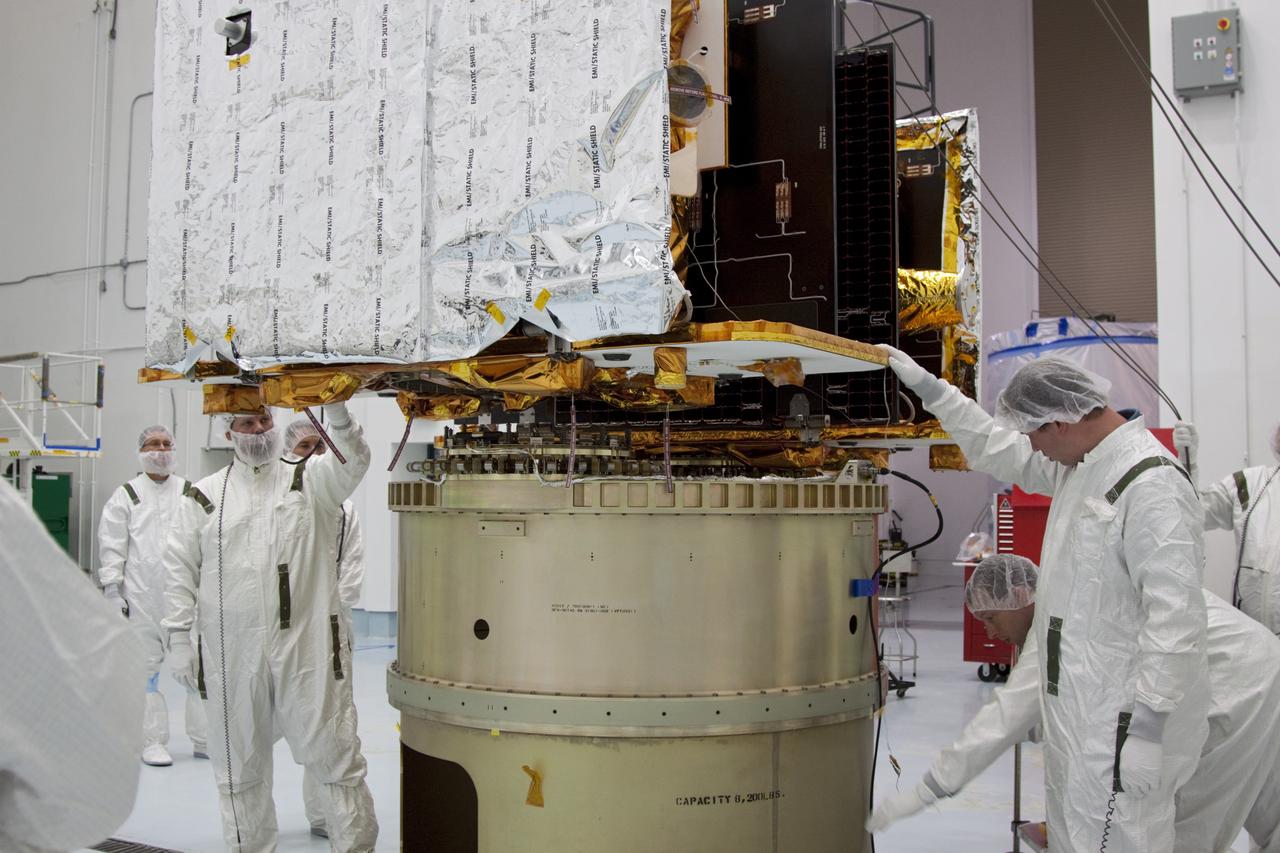
CAPE CANAVERAL, Fla. -- At Astrotech Space Operation's payload processing facility in Titusville, Fla., Lockheed Martin technicians verify that NASA's Gravity Recovery and Interior Laboratory-A (GRAIL-A) lunar probe is lowered into the correct position on the spacecraft adapter ring. After the twin GRAIL spacecraft are attached to the adapter ring in their side-by-side launch configuration, they will be transported to the launch pad. GRAIL will fly in tandem orbits around the moon for several months to measure its gravity field. GRAIL's primary science objectives are to determine the structure of the lunar interior, from crust to core, and to advance understanding of the thermal evolution of the moon. Launch aboard a United Launch Alliance Delta II rocket from Space Launch Complex 17B on Cape Canaveral Air Force Station is scheduled for Sept. 8. For more information, visit http://www.nasa.gov/grail. Photo credit: NASA/Jim Grossmann
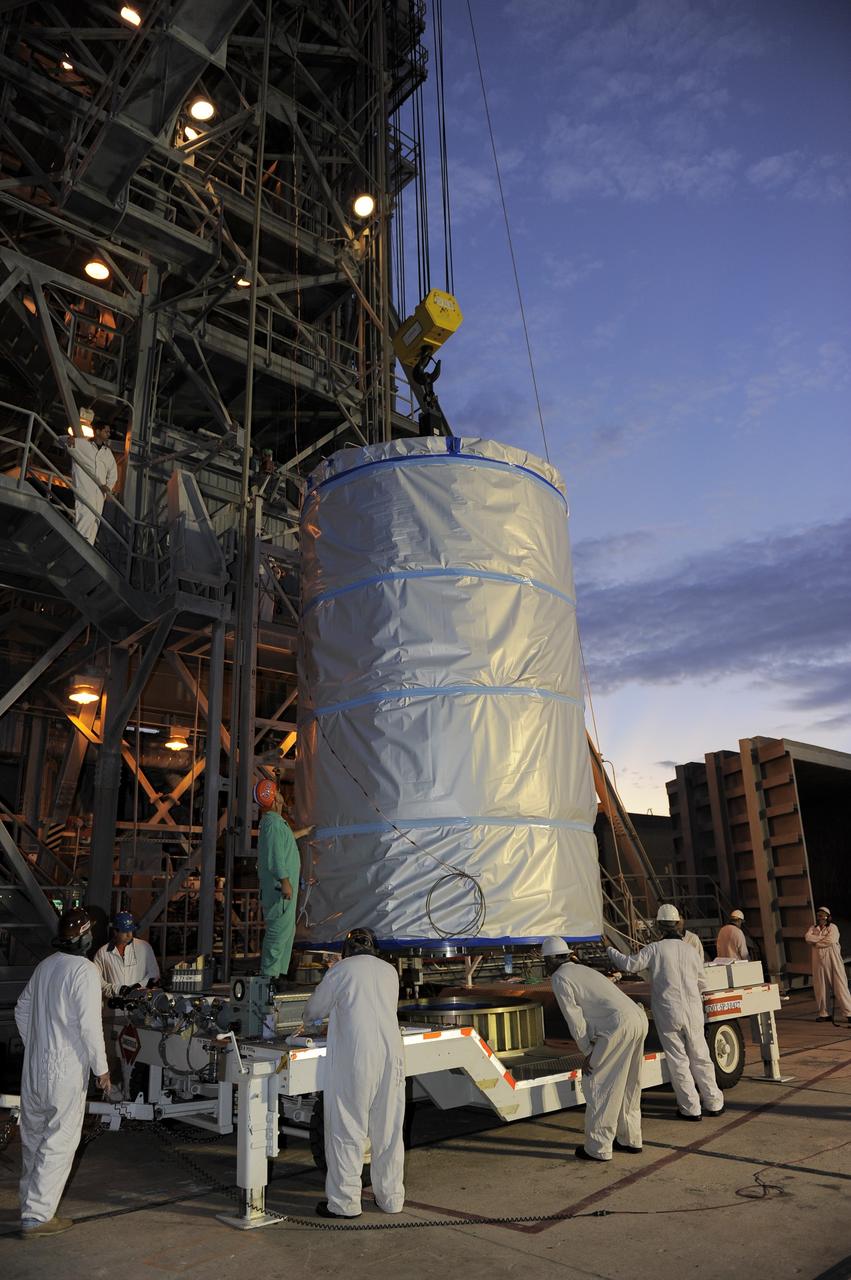
CAPE CANAVERAL, Fla. -- NASA's twin Gravity Recovery and Interior Laboratory (GRAIL) spacecraft are lifted to the top of their launch pad at Space Launch Complex 17B at Cape Canaveral Air Force Station in Florida. The lunar probes are attached to a spacecraft adapter ring in their side-by-side launch configuration and wrapped in plastic to prevent contamination outside the clean room in the Astrotech Space Operation's payload processing facility in Titusville, Fla. The spacecraft will fly in tandem orbits around the moon for several months to measure its gravity field. GRAIL's primary science objectives are to determine the structure of the lunar interior, from crust to core, and to advance understanding of the thermal evolution of the moon. Launch aboard a United Launch Alliance Delta II rocket is scheduled for Sept. 8. For more information, visit www.nasa.gov/grail. Photo credit: NASA/Kim Shiflett
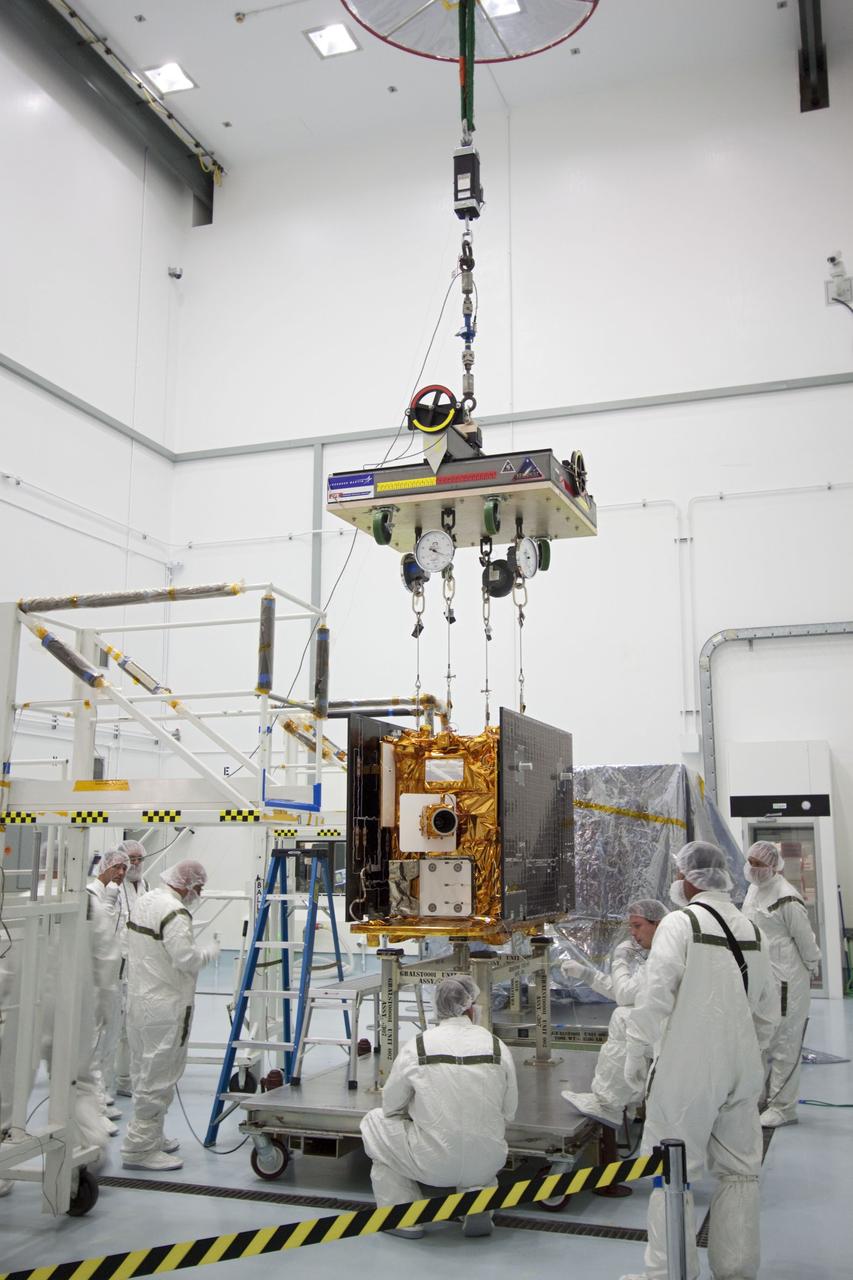
CAPE CANAVERAL, Fla. -- At Astrotech Space Operation's payload processing facility in Titusville, Fla., a portable scale lifts one of NASA's twin Gravity Recovery and Interior Laboratory lunar spacecraft from its workstand. The scale will record the exact weight of the spacecraft before they are stacked in their launch configuration in preparation for transport to the launch pad. GRAIL will fly in tandem orbits around the moon for several months to measure its gravity field. GRAIL's primary science objectives are to determine the structure of the lunar interior, from crust to core, and to advance understanding of the thermal evolution of the moon. Launch aboard a United Launch Alliance Delta II rocket from Space Launch Complex 17B on Cape Canaveral Air Force Station is scheduled for Sept. 8. For more information, visit http://www.nasa.gov/grail. Photo credit: NASA/Jim Grossmann
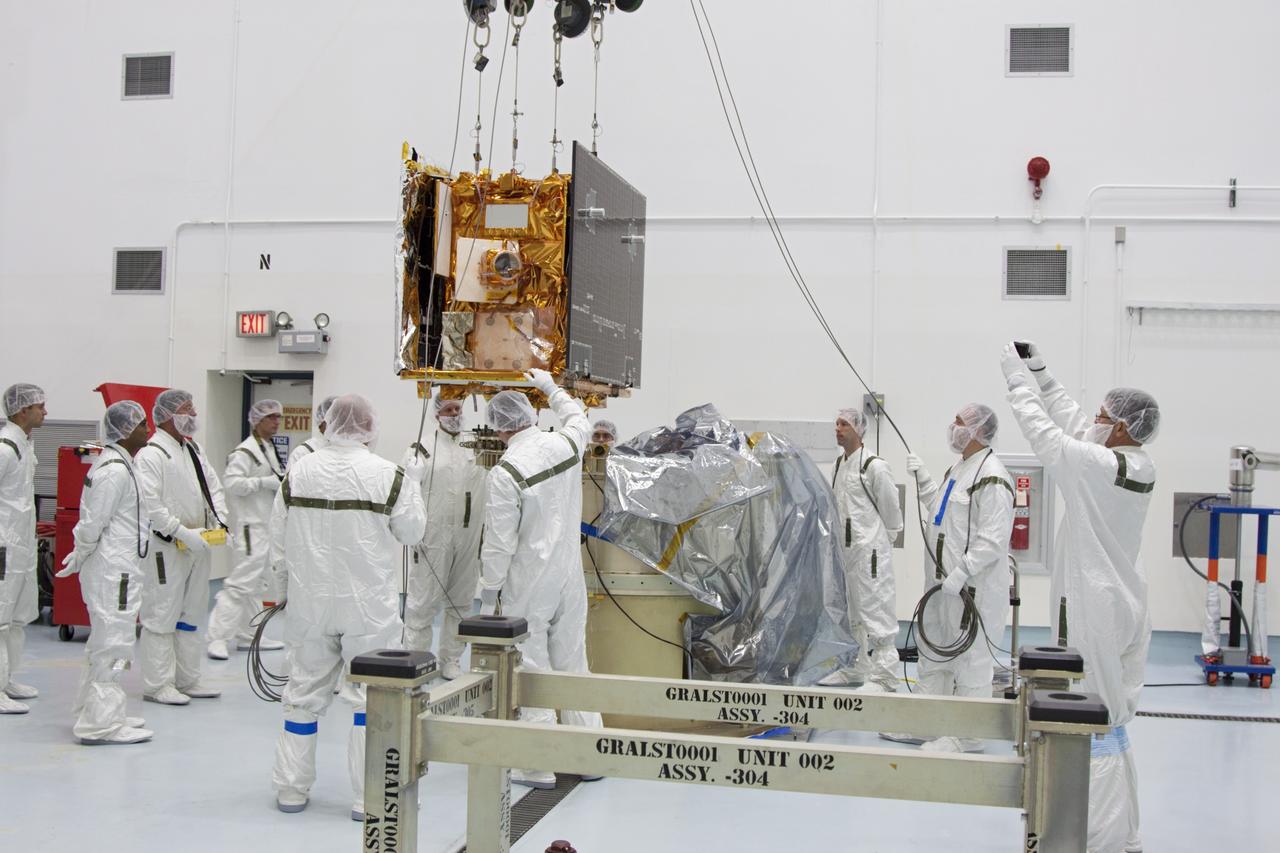
CAPE CANAVERAL, Fla. -- At Astrotech Space Operation's payload processing facility in Titusville, Fla., Lockheed Martin technicians lower NASA's Gravity Recovery and Interior Laboratory-B (GRAIL-B) lunar probe into position on the spacecraft adapter ring. After the twin GRAIL spacecraft are attached to the adapter ring in their side-by-side launch configuration, they will be transported to the launch pad. GRAIL will fly in tandem orbits around the moon for several months to measure its gravity field. GRAIL's primary science objectives are to determine the structure of the lunar interior, from crust to core, and to advance understanding of the thermal evolution of the moon. Launch aboard a United Launch Alliance Delta II rocket from Space Launch Complex 17B on Cape Canaveral Air Force Station is scheduled for Sept. 8. For more information, visit http://www.nasa.gov/grail. Photo credit: NASA/Jim Grossmann
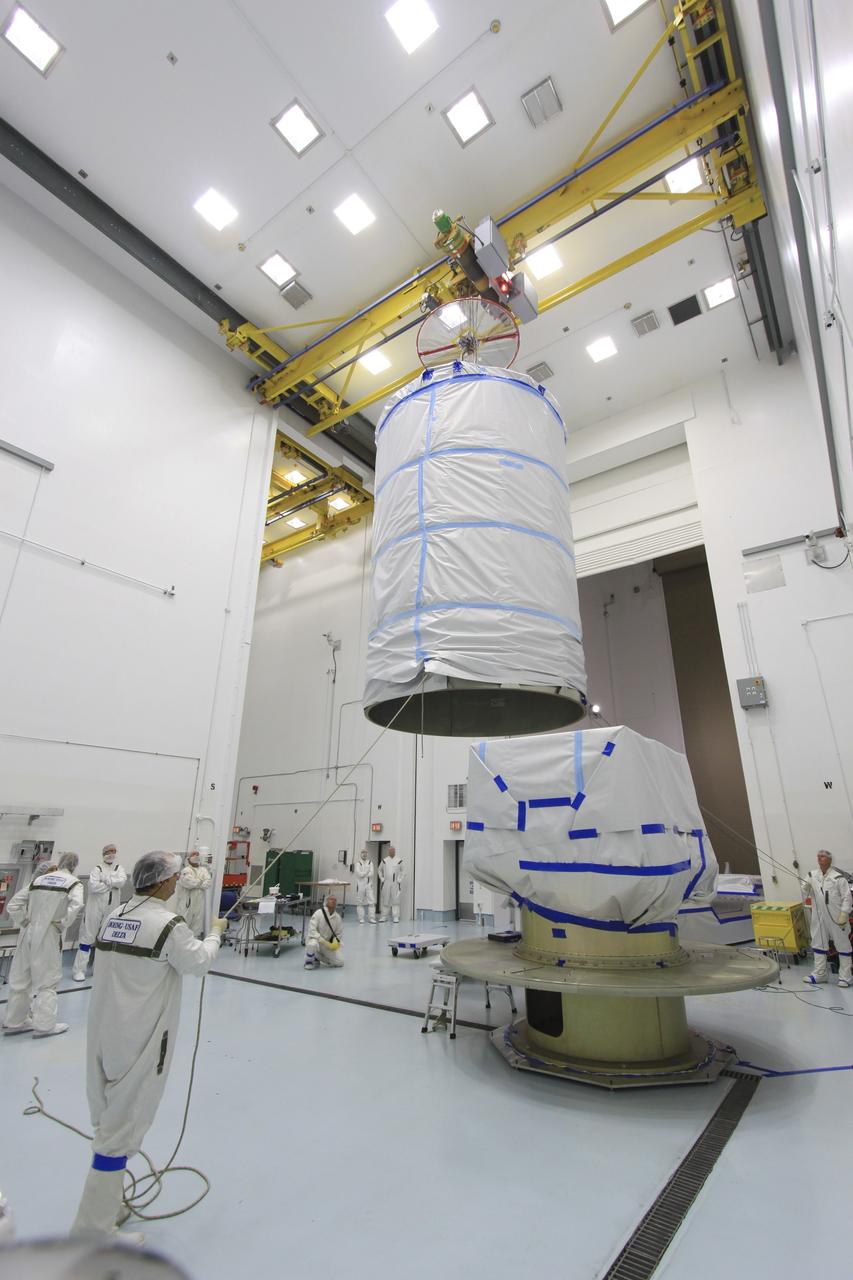
CAPE CANAVERAL, Fla. -- At Astrotech Space Operation's payload processing facility in Titusville, Fla., a crane lowers a protective canister toward NASA's twin Gravity Recovery and Interior Laboratory spacecraft during preparations to transport them to the launch pad. The lunar probes are attached to a spacecraft adapter ring in their side-by-side launch configuration and wrapped in plastic to prevent contamination outside the clean room. The spacecraft will fly in tandem orbits around the moon for several months to measure its gravity field. GRAIL's primary science objectives are to determine the structure of the lunar interior, from crust to core, and to advance understanding of the thermal evolution of the moon. Launch aboard a United Launch Alliance Delta II rocket from Space Launch Complex 17B on Cape Canaveral Air Force Station is scheduled for Sept. 8. For more information, visit http://www.nasa.gov/grail. Photo credit: NASA/Jim Grossmann
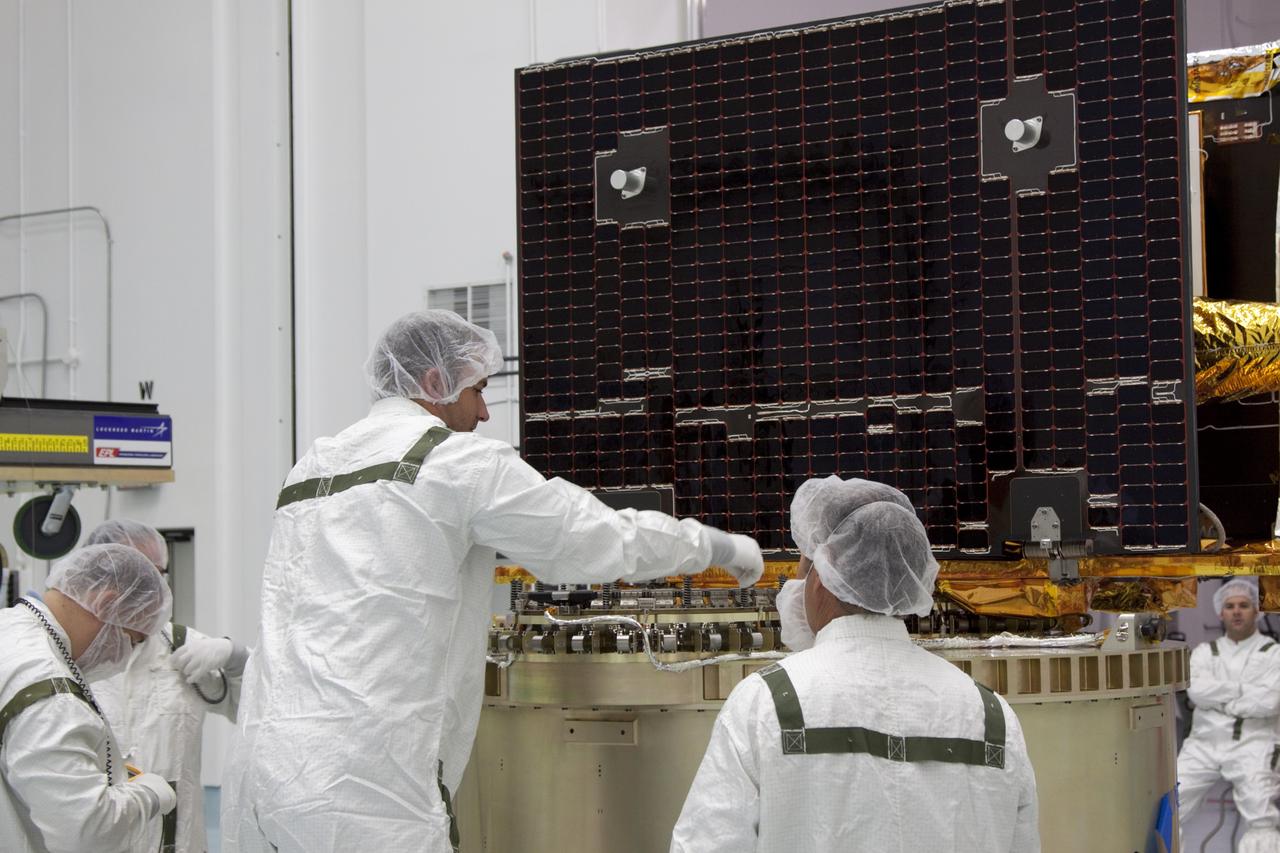
CAPE CANAVERAL, Fla. -- At Astrotech Space Operation's payload processing facility in Titusville, Fla., a Lockheed Martin technician secures NASA's Gravity Recovery and Interior Laboratory-B (GRAIL-B) lunar probe on the spacecraft adapter ring. After the twin GRAIL spacecraft are attached to the adapter ring in their side-by-side launch configuration, they will be transported to the launch pad. GRAIL will fly in tandem orbits around the moon for several months to measure its gravity field. GRAIL's primary science objectives are to determine the structure of the lunar interior, from crust to core, and to advance understanding of the thermal evolution of the moon. Launch aboard a United Launch Alliance Delta II rocket from Space Launch Complex 17B on Cape Canaveral Air Force Station is scheduled for Sept. 8. For more information, visit http://www.nasa.gov/grail. Photo credit: NASA/Jim Grossmann
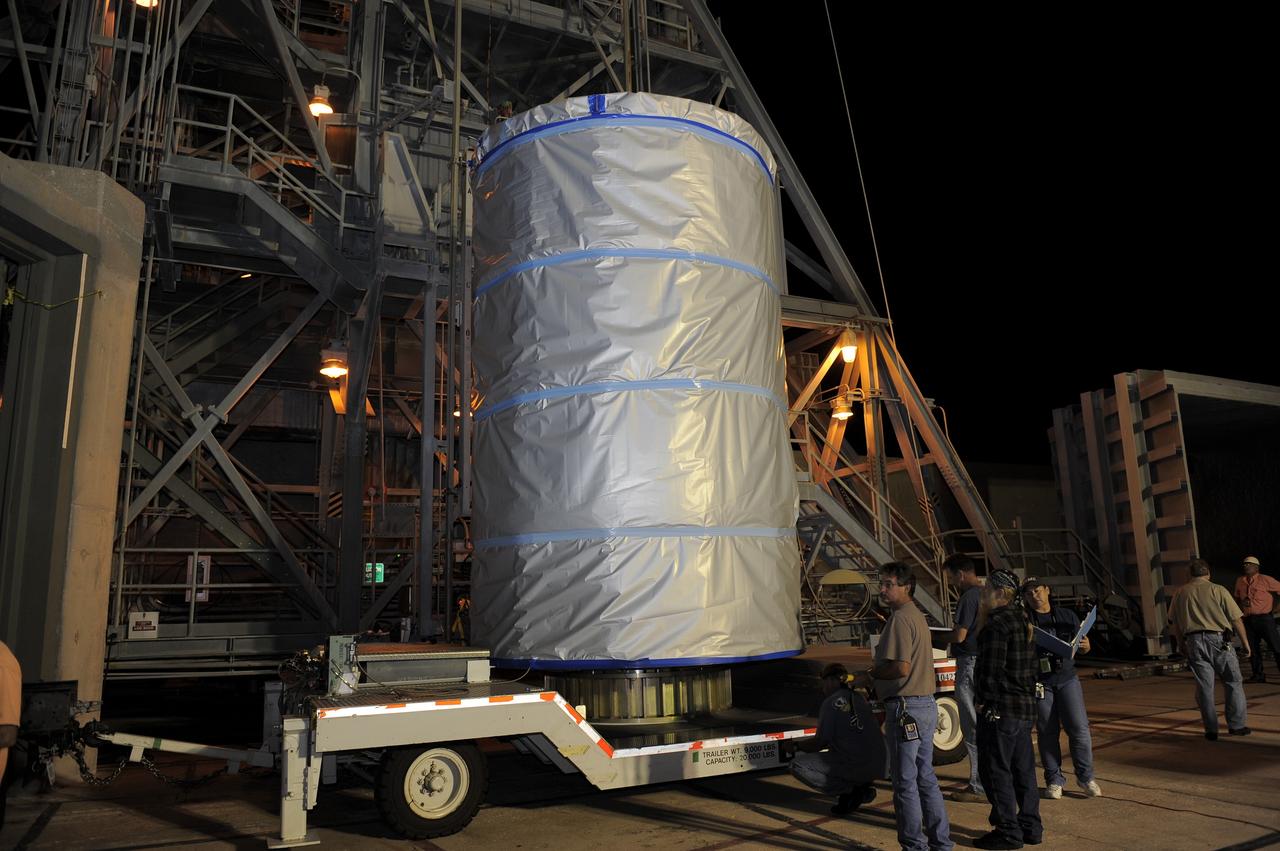
CAPE CANAVERAL, Fla. -- NASA's twin Gravity Recovery and Interior Laboratory (GRAIL) spacecraft will be lifted to the top of their launch pad at Space Launch Complex 17B at Cape Canaveral Air Force Station in Florida. The lunar probes are attached to a spacecraft adapter ring in their side-by-side launch configuration and wrapped in plastic to prevent contamination outside the clean room in the Astrotech Space Operation's payload processing facility in Titusville, Fla. The spacecraft will fly in tandem orbits around the moon for several months to measure its gravity field. GRAIL's primary science objectives are to determine the structure of the lunar interior, from crust to core, and to advance understanding of the thermal evolution of the moon. Launch aboard a United Launch Alliance Delta II rocket is scheduled for Sept. 8. For more information, visit www.nasa.gov/grail. Photo credit: NASA/Kim Shiflett
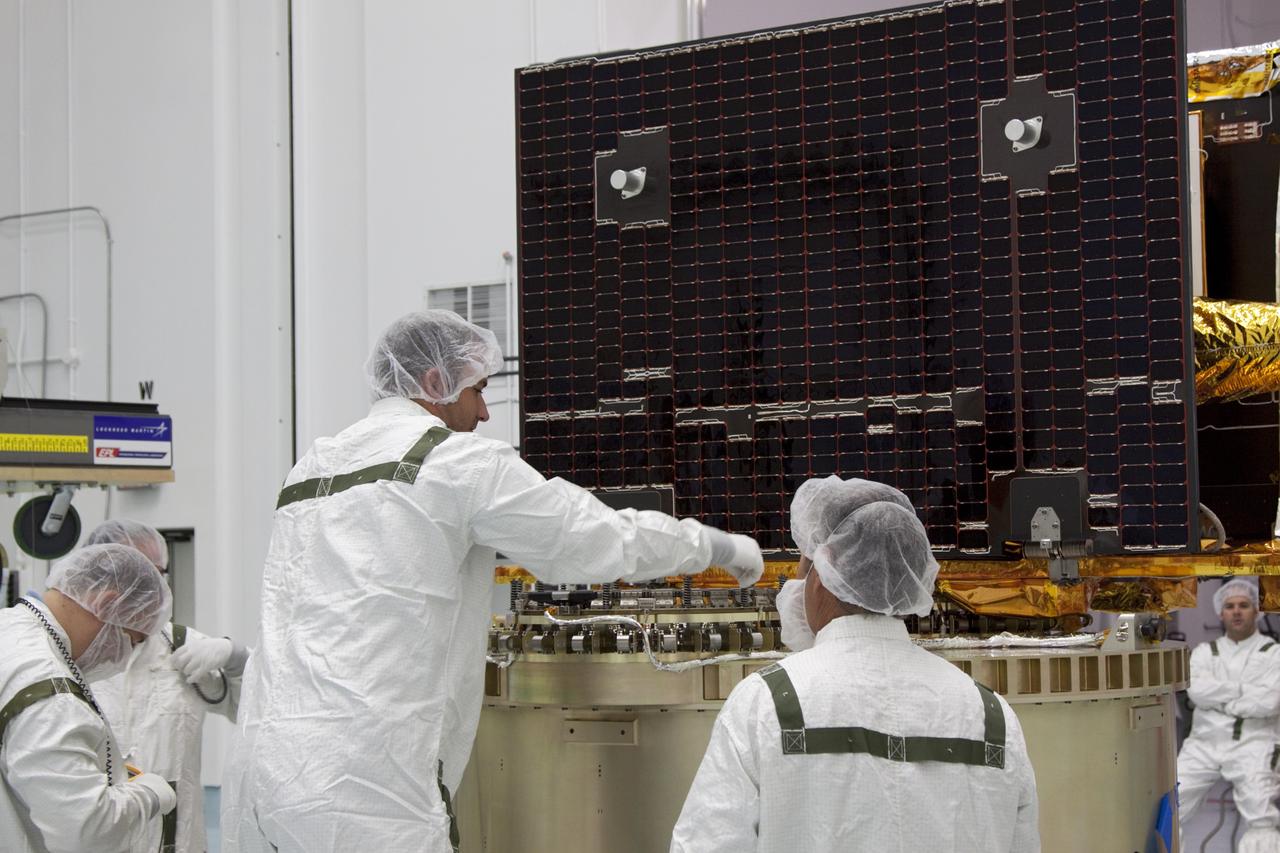
CAPE CANAVERAL, Fla. -- At Astrotech Space Operation's payload processing facility in Titusville, Fla., NASA's Gravity Recovery and Interior Laboratory-B (GRAIL-B) lunar probe is secured on the spacecraft adapter ring. After the twin GRAIL spacecraft are attached to the adapter ring in their side-by-side launch configuration, they will be transported to the launch pad. GRAIL will fly in tandem orbits around the moon for several months to measure its gravity field. GRAIL's primary science objectives are to determine the structure of the lunar interior, from crust to core, and to advance understanding of the thermal evolution of the moon. Launch aboard a United Launch Alliance Delta II rocket from Space Launch Complex 17B on Cape Canaveral Air Force Station is scheduled for Sept. 8. For more information, visit http://www.nasa.gov/grail. Photo credit: NASA/Jim Grossmann

CAPE CANAVERAL, Fla. -- NASA's twin Gravity Recovery and Interior Laboratory lunar spacecraft are attached to the spacecraft adapter ring in their launch configuration in Astrotech Space Operation's payload processing facility in Titusville, Fla. Preparations are under way to transport the lunar probes to the launch pad. GRAIL will fly in tandem orbits around the moon for several months to measure its gravity field. GRAIL's primary science objectives are to determine the structure of the lunar interior, from crust to core, and to advance understanding of the thermal evolution of the moon. Launch aboard a United Launch Alliance Delta II rocket from Space Launch Complex 17B on Cape Canaveral Air Force Station is scheduled for Sept. 8. For more information, visit http://www.nasa.gov/grail. Photo credit: NASA/Jim Grossmann
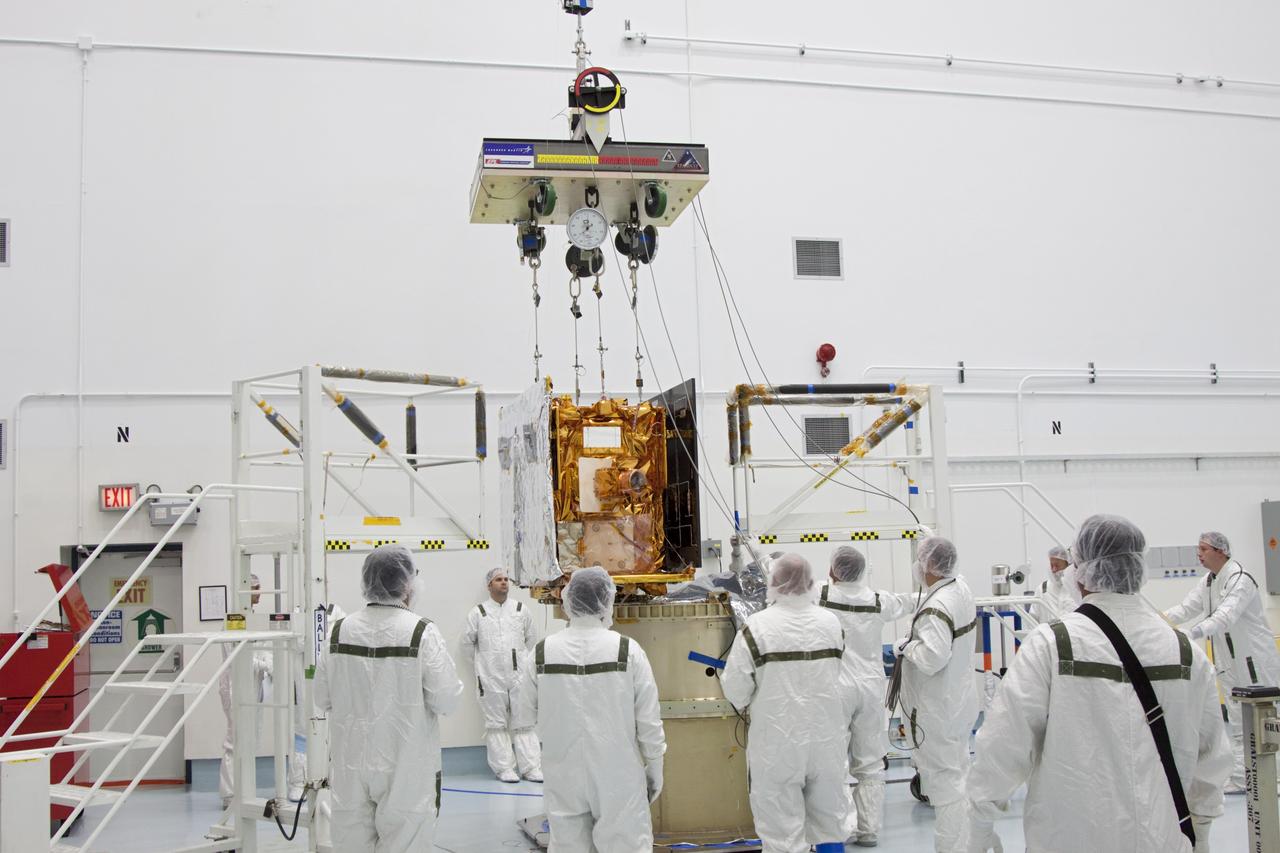
CAPE CANAVERAL, Fla. -- At Astrotech Space Operation's payload processing facility in Titusville, Fla., the lifting device is detached from NASA's Gravity Recovery and Interior Laboratory-B (GRAIL-B) lunar probe following its placement on the spacecraft adapter ring. After the twin GRAIL spacecraft are attached to the adapter ring in their side-by-side launch configuration, they will be transported to the launch pad. GRAIL will fly in tandem orbits around the moon for several months to measure its gravity field. GRAIL's primary science objectives are to determine the structure of the lunar interior, from crust to core, and to advance understanding of the thermal evolution of the moon. Launch aboard a United Launch Alliance Delta II rocket from Space Launch Complex 17B on Cape Canaveral Air Force Station is scheduled for Sept. 8. For more information, visit http://www.nasa.gov/grail. Photo credit: NASA/Jim Grossmann
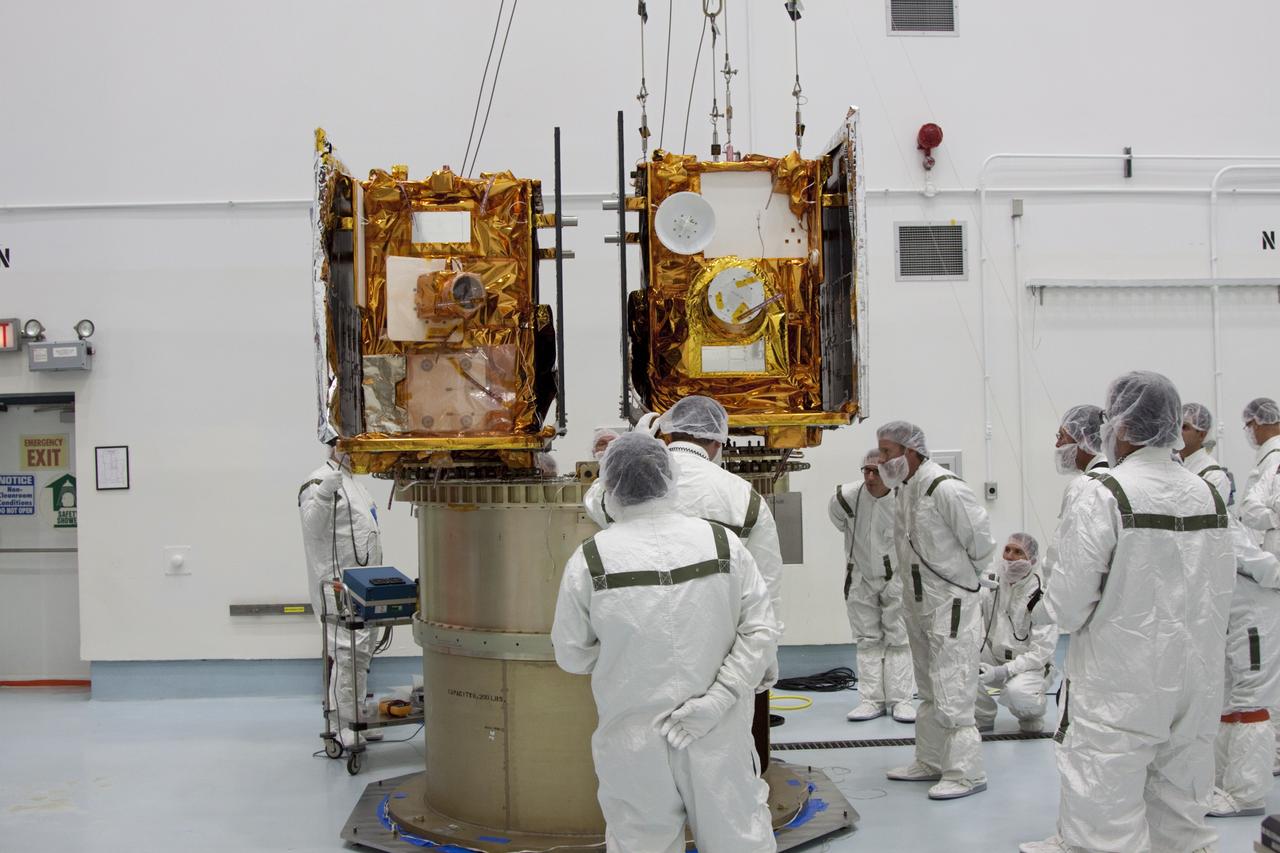
CAPE CANAVERAL, Fla. -- At Astrotech Space Operation's payload processing facility in Titusville, Fla., Lockheed Martin technicians monitor the placement of NASA's Gravity Recovery and Interior Laboratory-A (GRAIL-A) lunar probe on the spacecraft adapter ring. GRAIL-B is already secured to the ring, at left. After the twin GRAIL spacecraft are attached to the adapter ring in their side-by-side launch configuration, they will be transported to the launch pad. GRAIL will fly in tandem orbits around the moon for several months to measure its gravity field. GRAIL's primary science objectives are to determine the structure of the lunar interior, from crust to core, and to advance understanding of the thermal evolution of the moon. Launch aboard a United Launch Alliance Delta II rocket from Space Launch Complex 17B on Cape Canaveral Air Force Station is scheduled for Sept. 8. For more information, visit http://www.nasa.gov/grail. Photo credit: NASA/Jim Grossmann
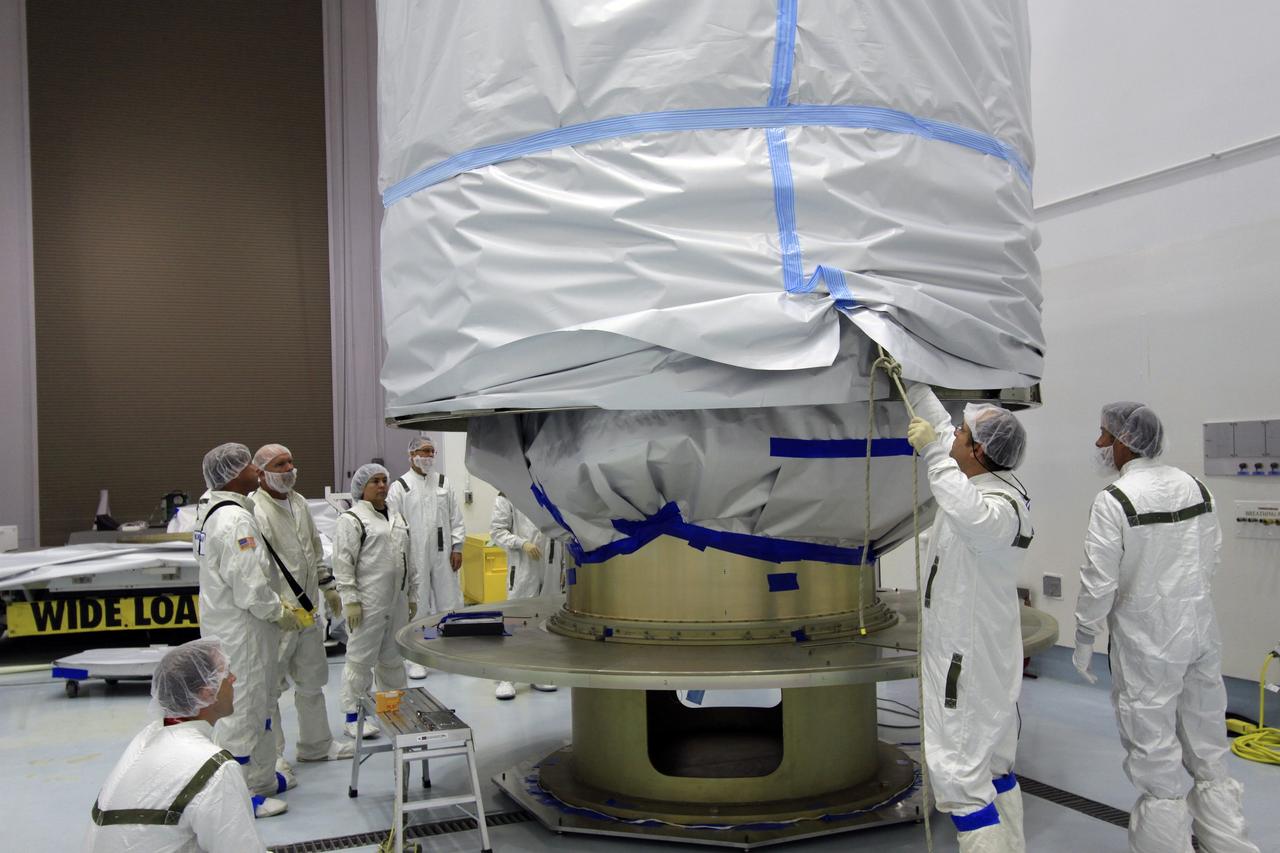
CAPE CANAVERAL, Fla. -- At Astrotech Space Operation's payload processing facility in Titusville, Fla., a protective canister is lowered around NASA's twin Gravity Recovery and Interior Laboratory spacecraft during preparations to transport them to the launch pad. The lunar probes are attached to a spacecraft adapter ring in their side-by-side launch configuration and wrapped in plastic to prevent contamination outside the clean room. The spacecraft will fly in tandem orbits around the moon for several months to measure its gravity field. GRAIL's primary science objectives are to determine the structure of the lunar interior, from crust to core, and to advance understanding of the thermal evolution of the moon. Launch aboard a United Launch Alliance Delta II rocket from Space Launch Complex 17B on Cape Canaveral Air Force Station is scheduled for Sept. 8. For more information, visit http://www.nasa.gov/grail. Photo credit: NASA/Jim Grossmann
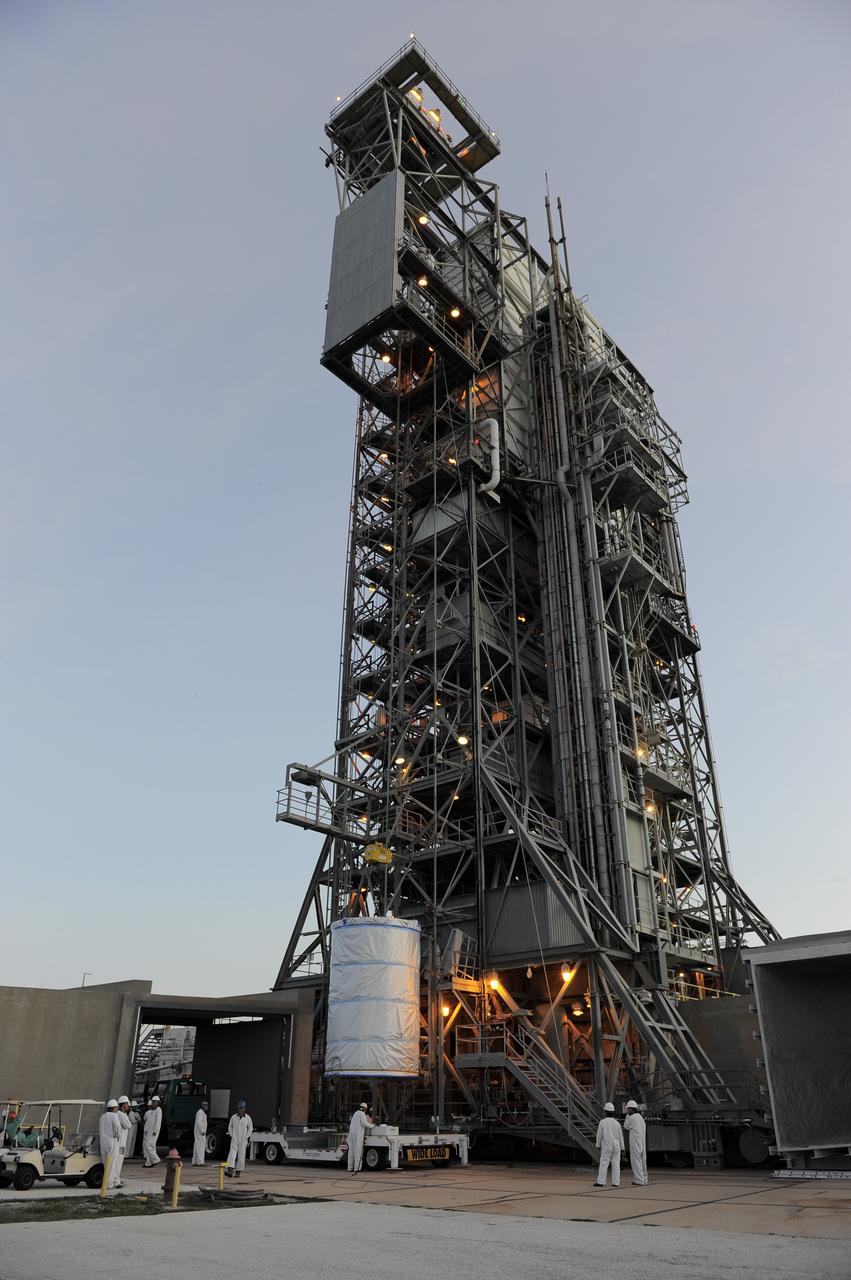
CAPE CANAVERAL, Fla. -- NASA's twin Gravity Recovery and Interior Laboratory (GRAIL) spacecraft are lifted to the top of their launch pad at Space Launch Complex 17B at Cape Canaveral Air Force Station in Florida. The lunar probes are attached to a spacecraft adapter ring in their side-by-side launch configuration and wrapped in plastic to prevent contamination outside the clean room in the Astrotech Space Operation's payload processing facility in Titusville, Fla. The spacecraft will fly in tandem orbits around the moon for several months to measure its gravity field. GRAIL's primary science objectives are to determine the structure of the lunar interior, from crust to core, and to advance understanding of the thermal evolution of the moon. Launch aboard a United Launch Alliance Delta II rocket is scheduled for Sept. 8. For more information, visit www.nasa.gov/grail. Photo credit: NASA/Kim Shiflett
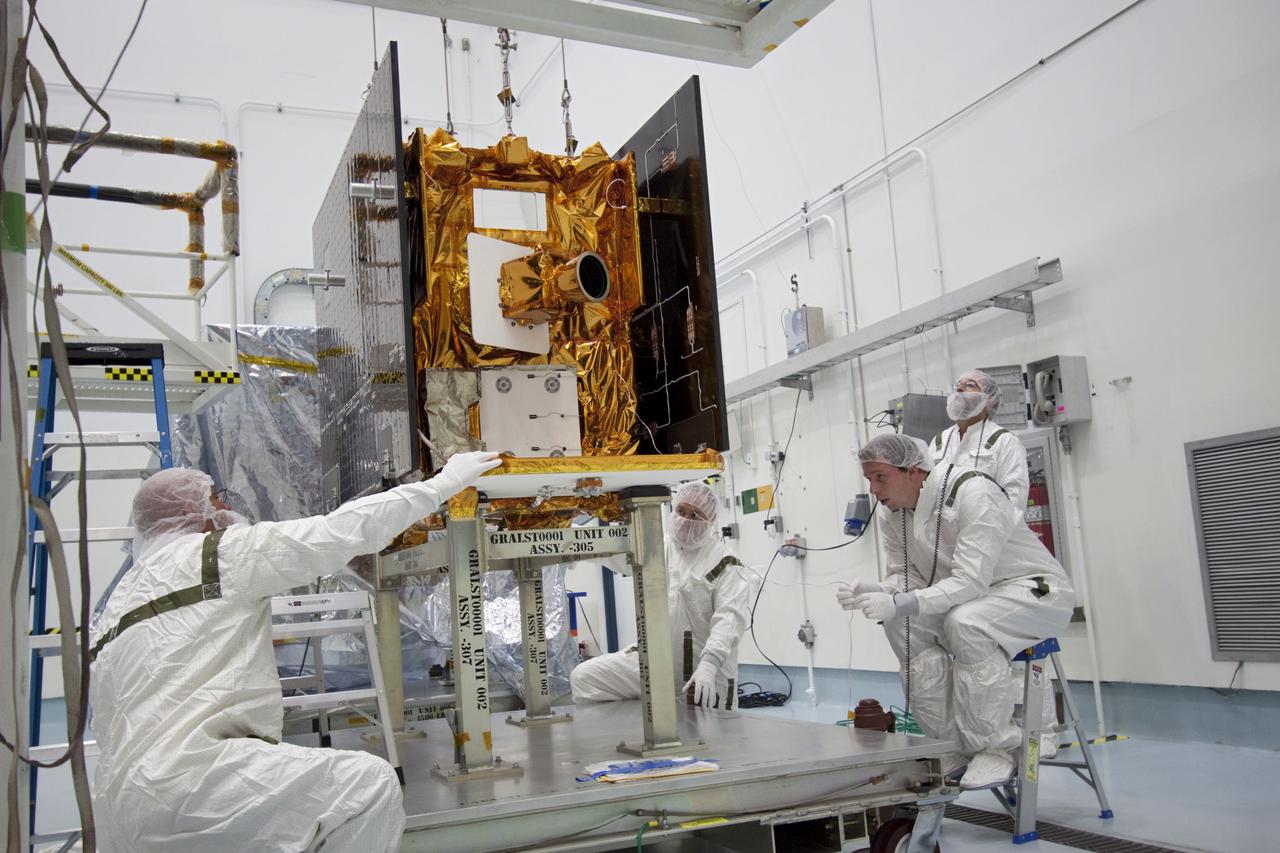
CAPE CANAVERAL, Fla. -- At Astrotech Space Operation's payload processing facility in Titusville, Fla., Lockheed Martin technicians secure a portable scale to one of NASA's twin Gravity Recovery and Interior Laboratory lunar spacecraft. The spacecraft will be lifted and weighed before they are stacked in their launch configuration in preparation for transport to the launch pad. GRAIL will fly in tandem orbits around the moon for several months to measure its gravity field. GRAIL's primary science objectives are to determine the structure of the lunar interior, from crust to core, and to advance understanding of the thermal evolution of the moon. Launch aboard a United Launch Alliance Delta II rocket from Space Launch Complex 17B on Cape Canaveral Air Force Station is scheduled for Sept. 8. For more information, visit http://www.nasa.gov/grail. Photo credit: NASA/Jim Grossmann
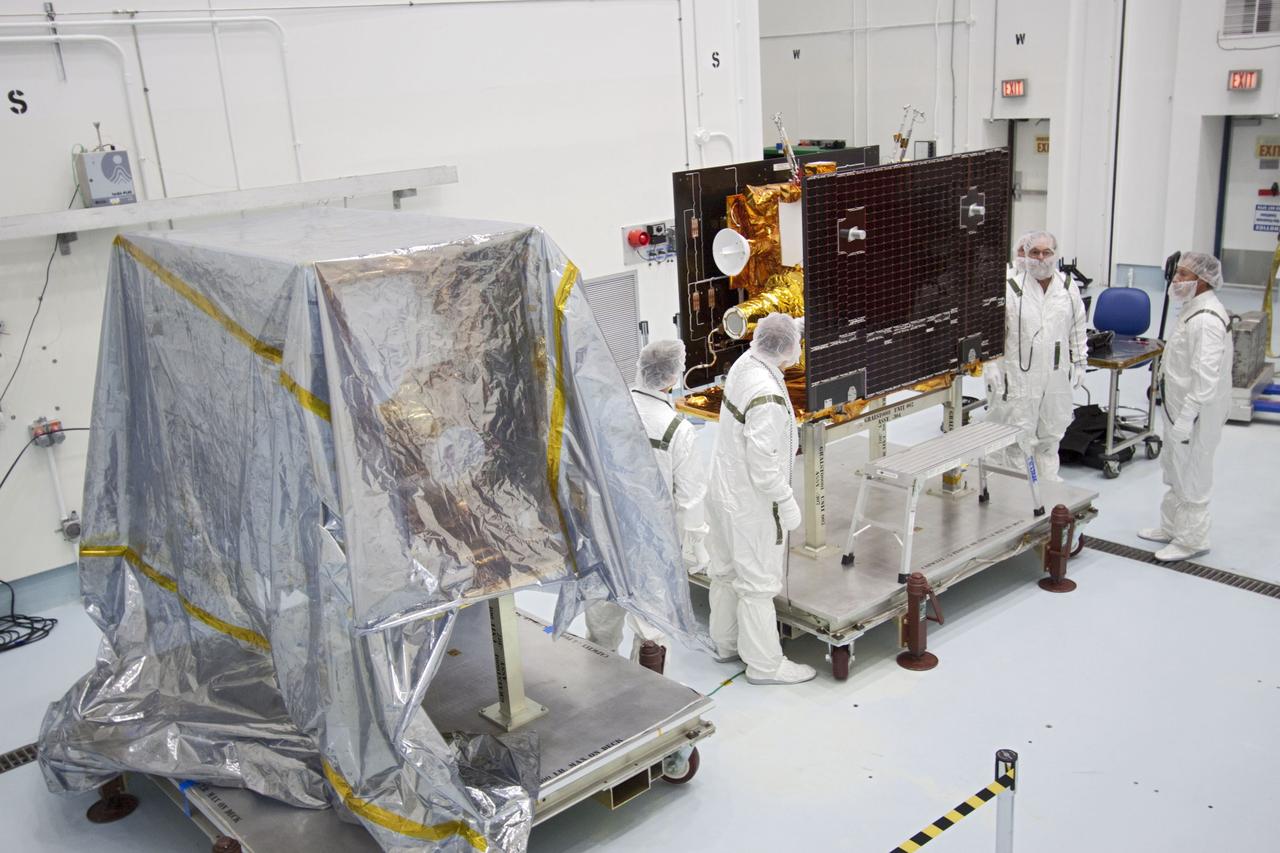
CAPE CANAVERAL, Fla. -- At Astrotech Space Operation's payload processing facility in Titusville, Fla., Lockheed Martin technicians determine the readiness of one of NASA's twin Gravity Recovery and Interior Laboratory lunar spacecraft before the spacecraft are stacked in their launch configuration in preparation for transport to the launch pad. GRAIL will fly in tandem orbits around the moon for several months to measure its gravity field. GRAIL's primary science objectives are to determine the structure of the lunar interior, from crust to core, and to advance understanding of the thermal evolution of the moon. Launch aboard a United Launch Alliance Delta II rocket from Space Launch Complex 17B on Cape Canaveral Air Force Station is scheduled for Sept. 8. For more information, visit http://www.nasa.gov/grail. Photo credit: NASA/Jim Grossmann
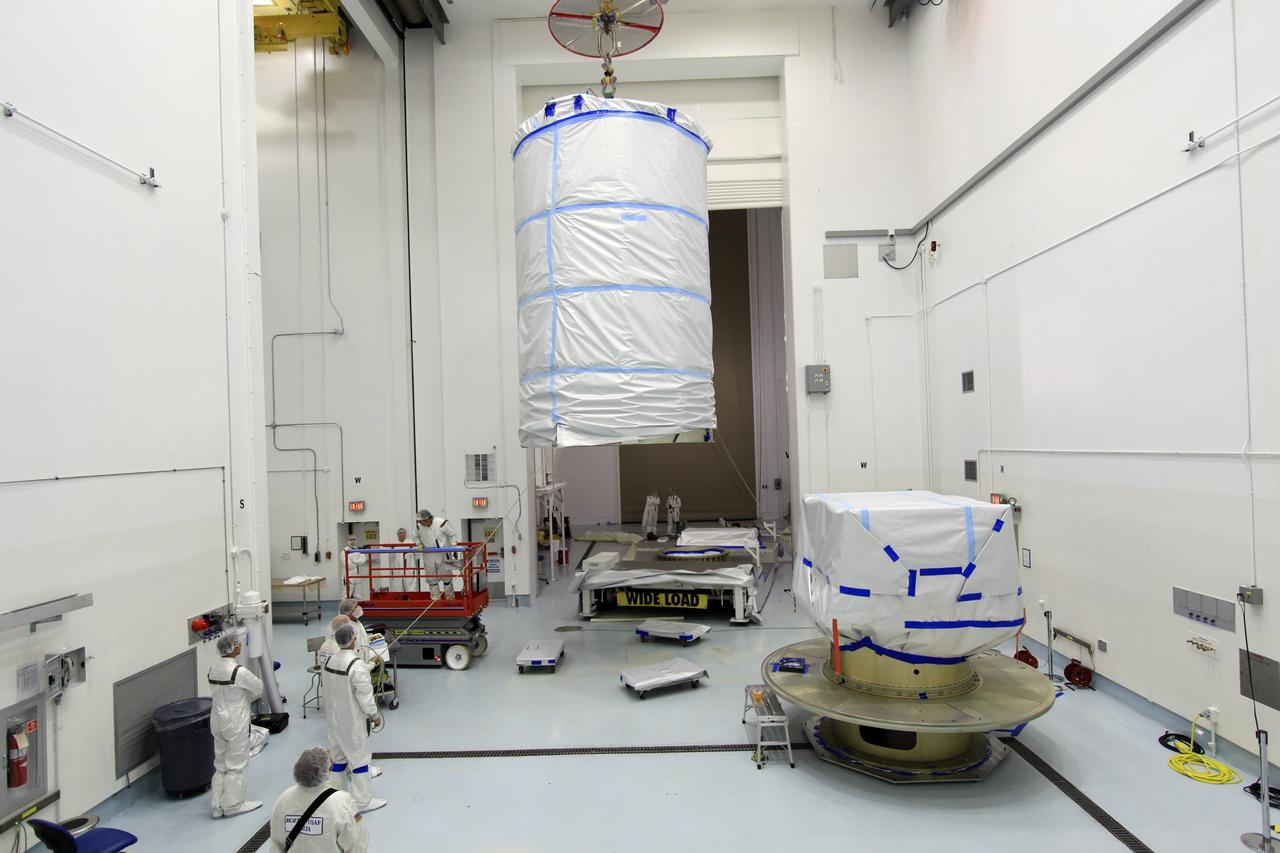
CAPE CANAVERAL, Fla. -- At Astrotech Space Operation's payload processing facility in Titusville, Fla., a crane lifts the protective canister that will enclose NASA's twin Gravity Recovery and Interior Laboratory spacecraft, at right, during transport to the launch pad. The lunar probes are attached to a spacecraft adapter ring in their side-by-side launch configuration and wrapped in plastic to prevent contamination outside the clean room. The spacecraft will fly in tandem orbits around the moon for several months to measure its gravity field. GRAIL's primary science objectives are to determine the structure of the lunar interior, from crust to core, and to advance understanding of the thermal evolution of the moon. Launch aboard a United Launch Alliance Delta II rocket from Space Launch Complex 17B on Cape Canaveral Air Force Station is scheduled for Sept. 8. For more information, visit http://www.nasa.gov/grail. Photo credit: NASA/Jim Grossmann
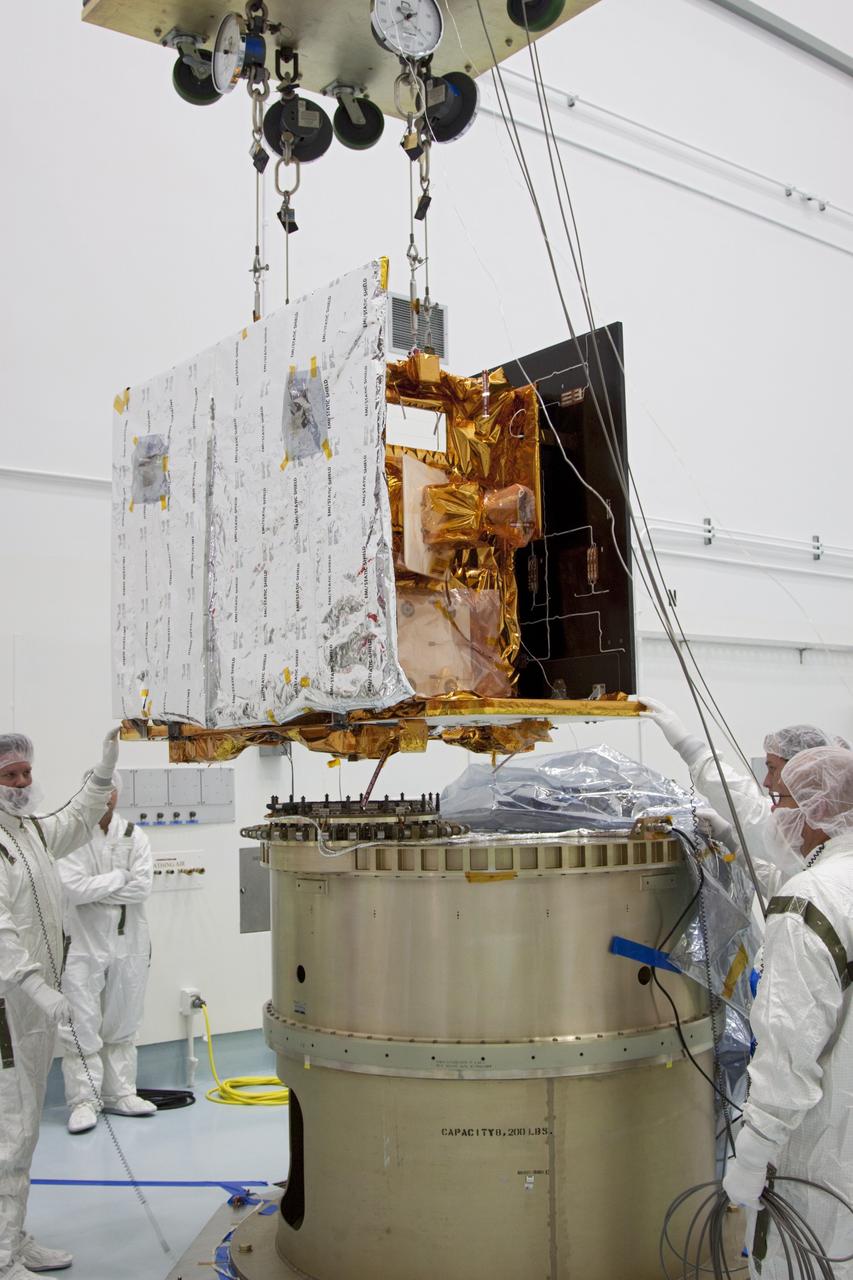
CAPE CANAVERAL, Fla. -- At Astrotech Space Operation's payload processing facility in Titusville, Fla., NASA's Gravity Recovery and Interior Laboratory-B (GRAIL-B) lunar probe is lowered toward the spacecraft adapter ring. After the twin GRAIL spacecraft are attached to the adapter ring in their side-by-side launch configuration, they will be transported to the launch pad. GRAIL will fly in tandem orbits around the moon for several months to measure its gravity field. GRAIL's primary science objectives are to determine the structure of the lunar interior, from crust to core, and to advance understanding of the thermal evolution of the moon. Launch aboard a United Launch Alliance Delta II rocket from Space Launch Complex 17B on Cape Canaveral Air Force Station is scheduled for Sept. 8. For more information, visit http://www.nasa.gov/grail. Photo credit: NASA/Jim Grossmann
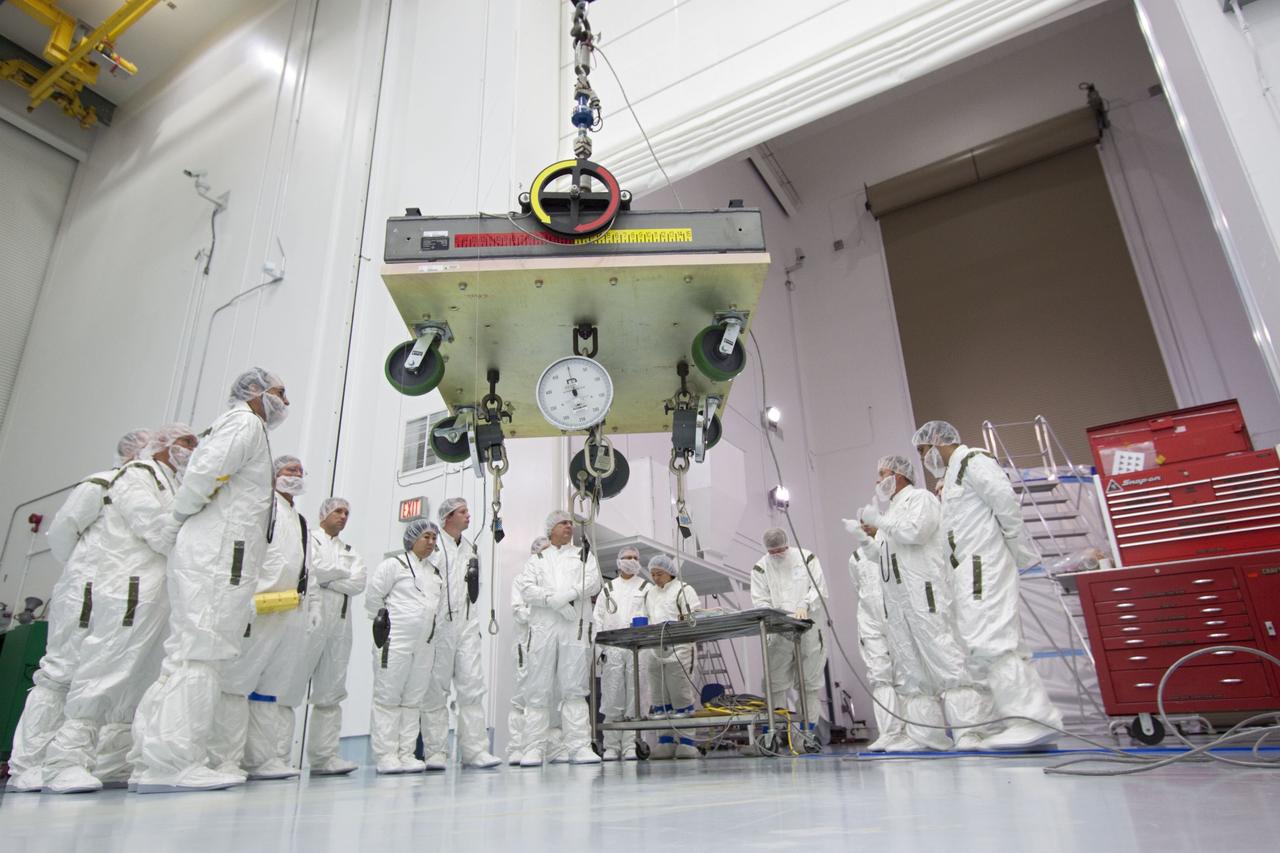
CAPE CANAVERAL, Fla. -- At Astrotech Space Operation's payload processing facility in Titusville, Fla., Lockheed Martin technicians review procedures for weighing one of NASA's twin Gravity Recovery and Interior Laboratory lunar spacecraft before the spacecraft are stacked in their launch configuration in preparation for transport to the launch pad. GRAIL will fly in tandem orbits around the moon for several months to measure its gravity field. GRAIL's primary science objectives are to determine the structure of the lunar interior, from crust to core, and to advance understanding of the thermal evolution of the moon. Launch aboard a United Launch Alliance Delta II rocket from Space Launch Complex 17B on Cape Canaveral Air Force Station is scheduled for Sept. 8. For more information, visit http://www.nasa.gov/grail. Photo credit: NASA/Jim Grossmann
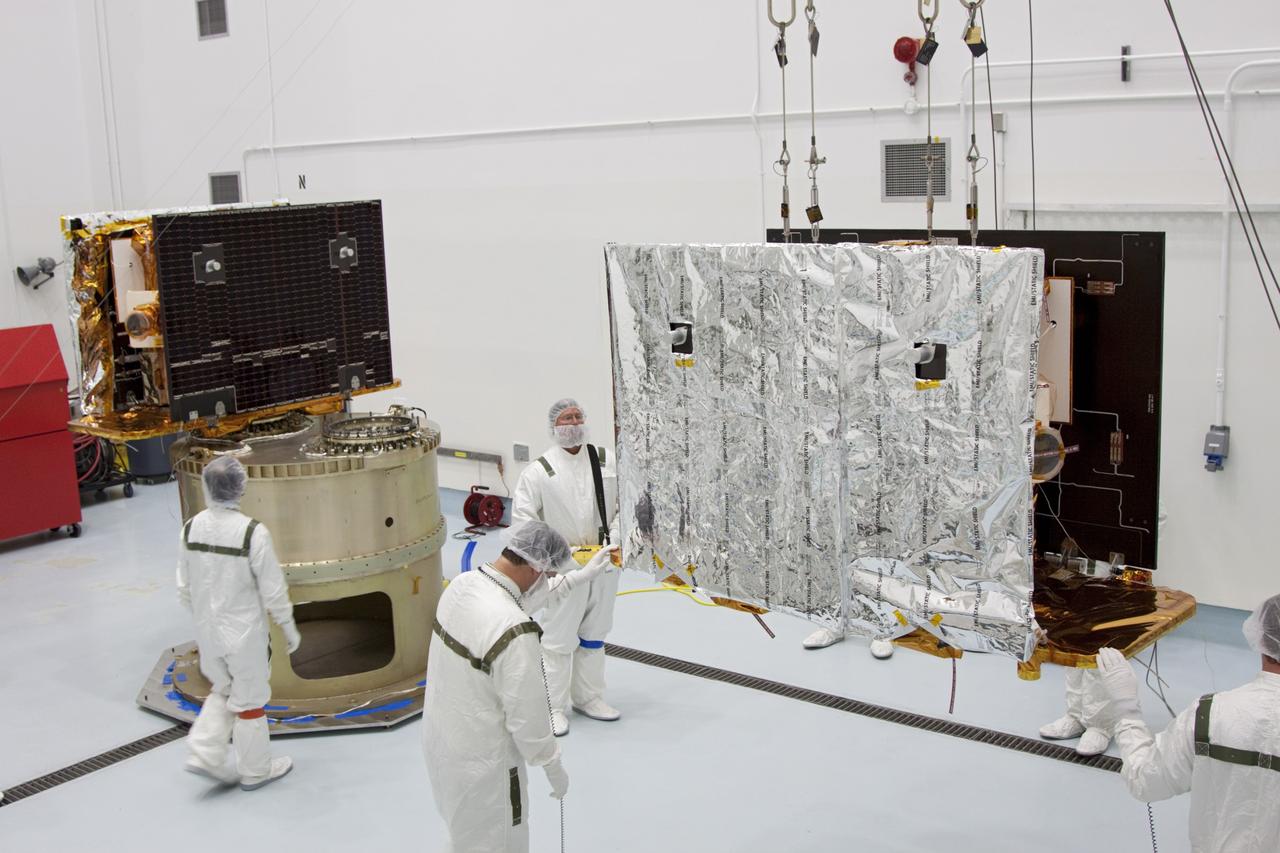
CAPE CANAVERAL, Fla. -- At Astrotech Space Operation's payload processing facility in Titusville, Fla., NASA's Gravity Recovery and Interior Laboratory-A (GRAIL-A) lunar probe moves across the clean room toward the spacecraft adapter ring, at left, where GRAIL-B is already secured. After the twin GRAIL spacecraft are attached to the adapter ring in their side-by-side launch configuration, they will be transported to the launch pad. GRAIL will fly in tandem orbits around the moon for several months to measure its gravity field. GRAIL's primary science objectives are to determine the structure of the lunar interior, from crust to core, and to advance understanding of the thermal evolution of the moon. Launch aboard a United Launch Alliance Delta II rocket from Space Launch Complex 17B on Cape Canaveral Air Force Station is scheduled for Sept. 8. For more information, visit http://www.nasa.gov/grail. Photo credit: NASA/Jim Grossmann
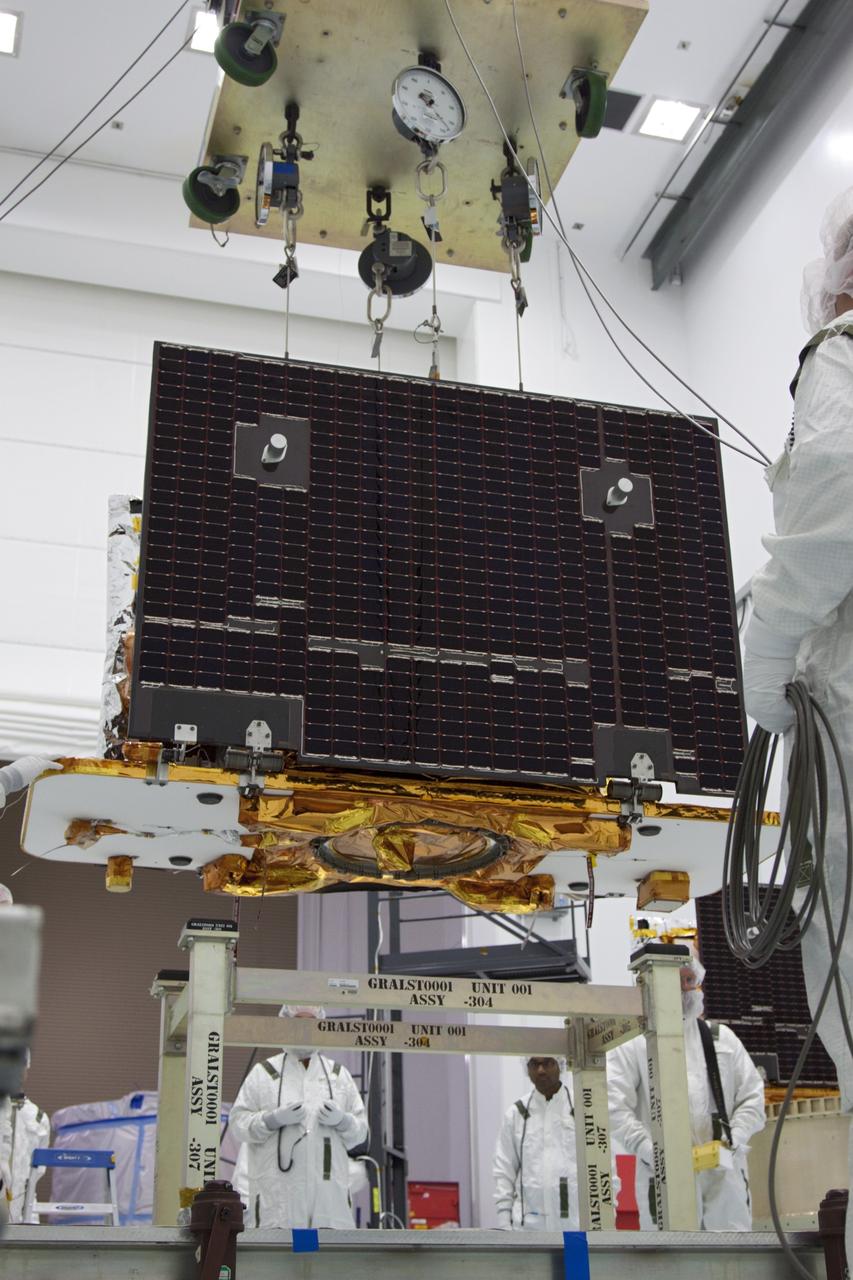
CAPE CANAVERAL, Fla. -- At Astrotech Space Operation's payload processing facility in Titusville, Fla., NASA's Gravity Recovery and Interior Laboratory-A (GRAIL-A) lunar probe is lifted from its workstand. After the twin GRAIL spacecraft are attached to the adapter ring in their side-by-side launch configuration, they will be transported to the launch pad. GRAIL will fly in tandem orbits around the moon for several months to measure its gravity field. GRAIL's primary science objectives are to determine the structure of the lunar interior, from crust to core, and to advance understanding of the thermal evolution of the moon. Launch aboard a United Launch Alliance Delta II rocket from Space Launch Complex 17B on Cape Canaveral Air Force Station is scheduled for Sept. 8. For more information, visit http://www.nasa.gov/grail. Photo credit: NASA/Jim Grossmann
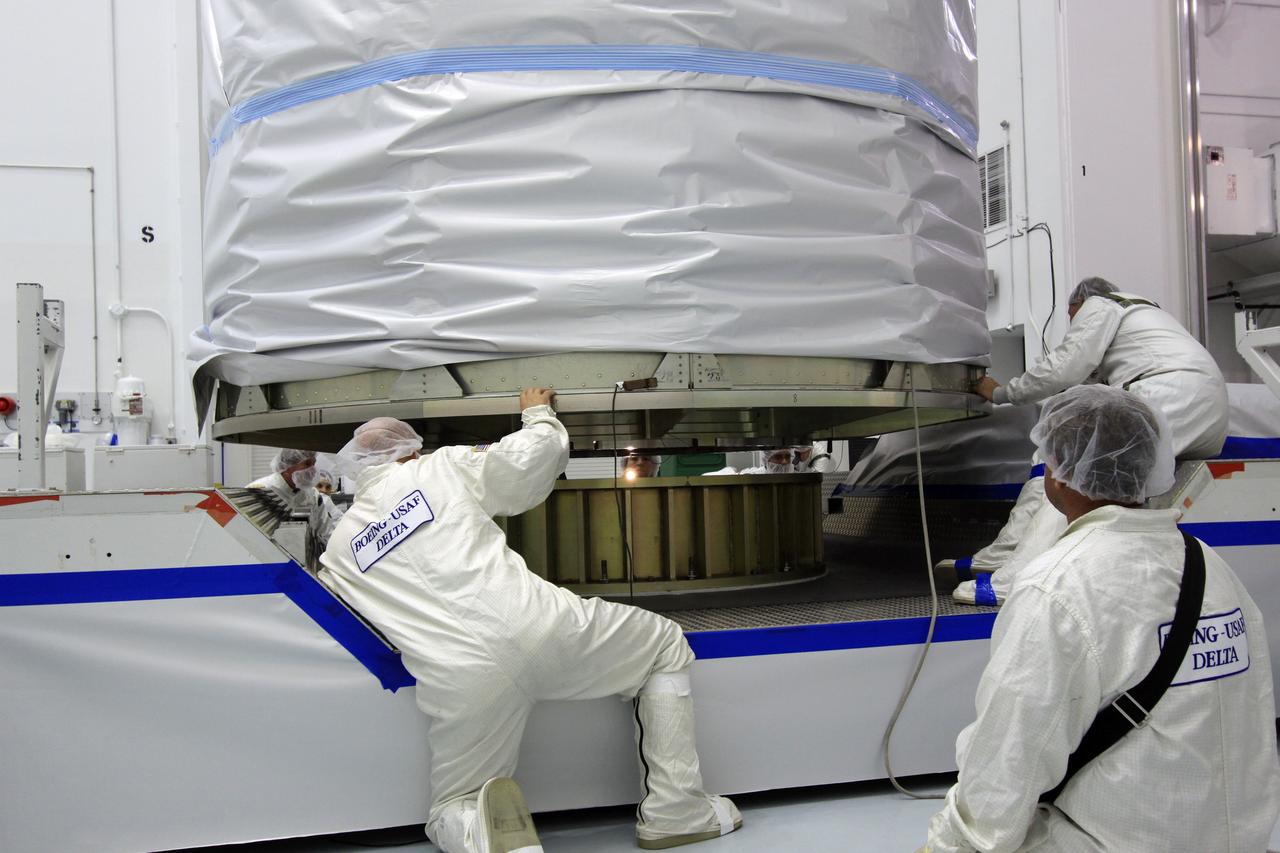
CAPE CANAVERAL, Fla. -- At Astrotech Space Operation's payload processing facility in Titusville, Fla., Lockheed Martin technicians guide the protective canister enclosing NASA's twin Gravity Recovery and Interior Laboratory spacecraft into place on a transportation pallet. Preparations are under way to move the lunar probes, attached to a spacecraft adapter ring in their side-by-side launch configuration, to the launch pad. The spacecraft will fly in tandem orbits around the moon for several months to measure its gravity field. GRAIL's primary science objectives are to determine the structure of the lunar interior, from crust to core, and to advance understanding of the thermal evolution of the moon. Launch aboard a United Launch Alliance Delta II rocket from Space Launch Complex 17B on Cape Canaveral Air Force Station is scheduled for Sept. 8. For more information, visit http://www.nasa.gov/grail. Photo credit: NASA/Jim Grossmann
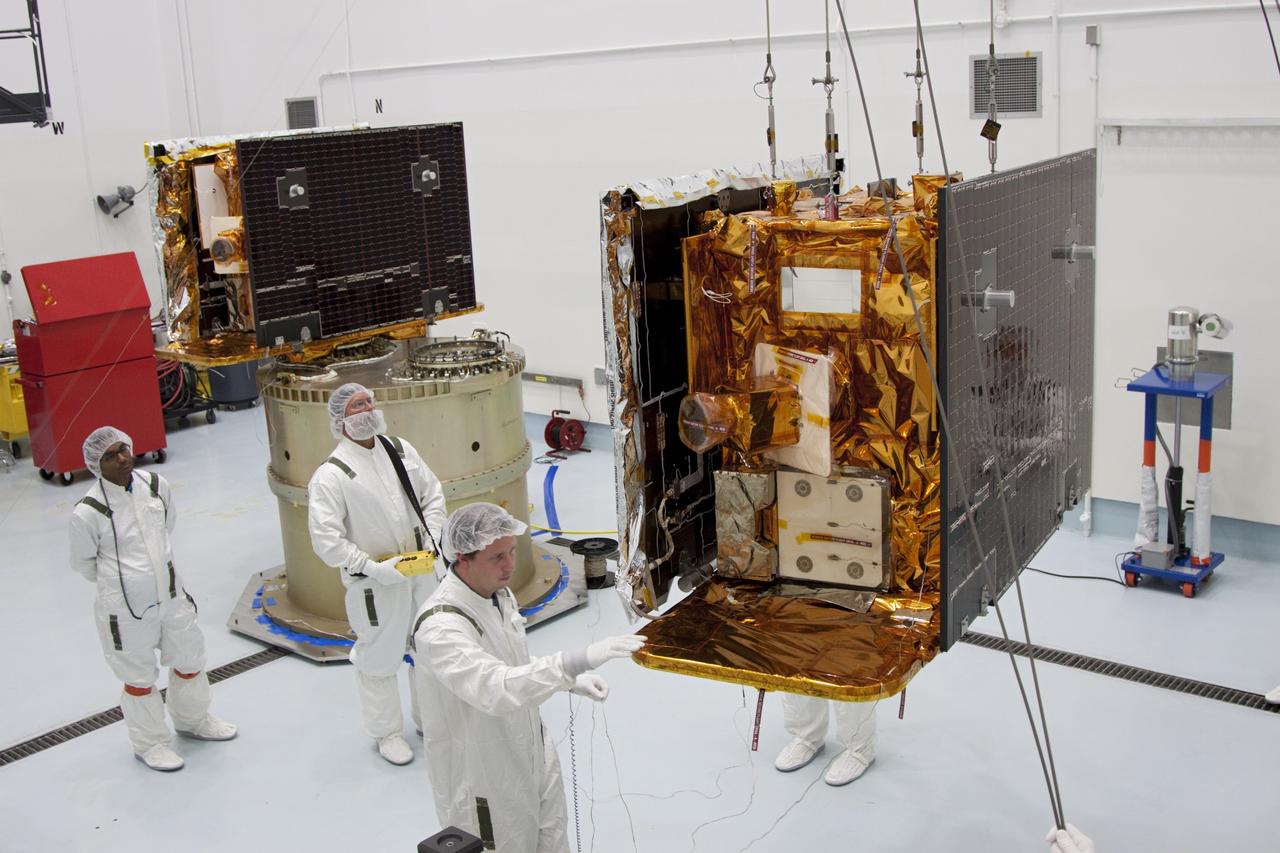
CAPE CANAVERAL, Fla. -- At Astrotech Space Operation's payload processing facility in Titusville, Fla., NASA's Gravity Recovery and Interior Laboratory-A (GRAIL-A) lunar probe is lifted from its workstand and across the clean room toward the spacecraft adapter ring, at left, where GRAIL-B is already secured. After the twin GRAIL spacecraft are attached to the adapter ring in their side-by-side launch configuration, they will be transported to the launch pad. GRAIL will fly in tandem orbits around the moon for several months to measure its gravity field. GRAIL's primary science objectives are to determine the structure of the lunar interior, from crust to core, and to advance understanding of the thermal evolution of the moon. Launch aboard a United Launch Alliance Delta II rocket from Space Launch Complex 17B on Cape Canaveral Air Force Station is scheduled for Sept. 8. For more information, visit http://www.nasa.gov/grail. Photo credit: NASA/Jim Grossmann
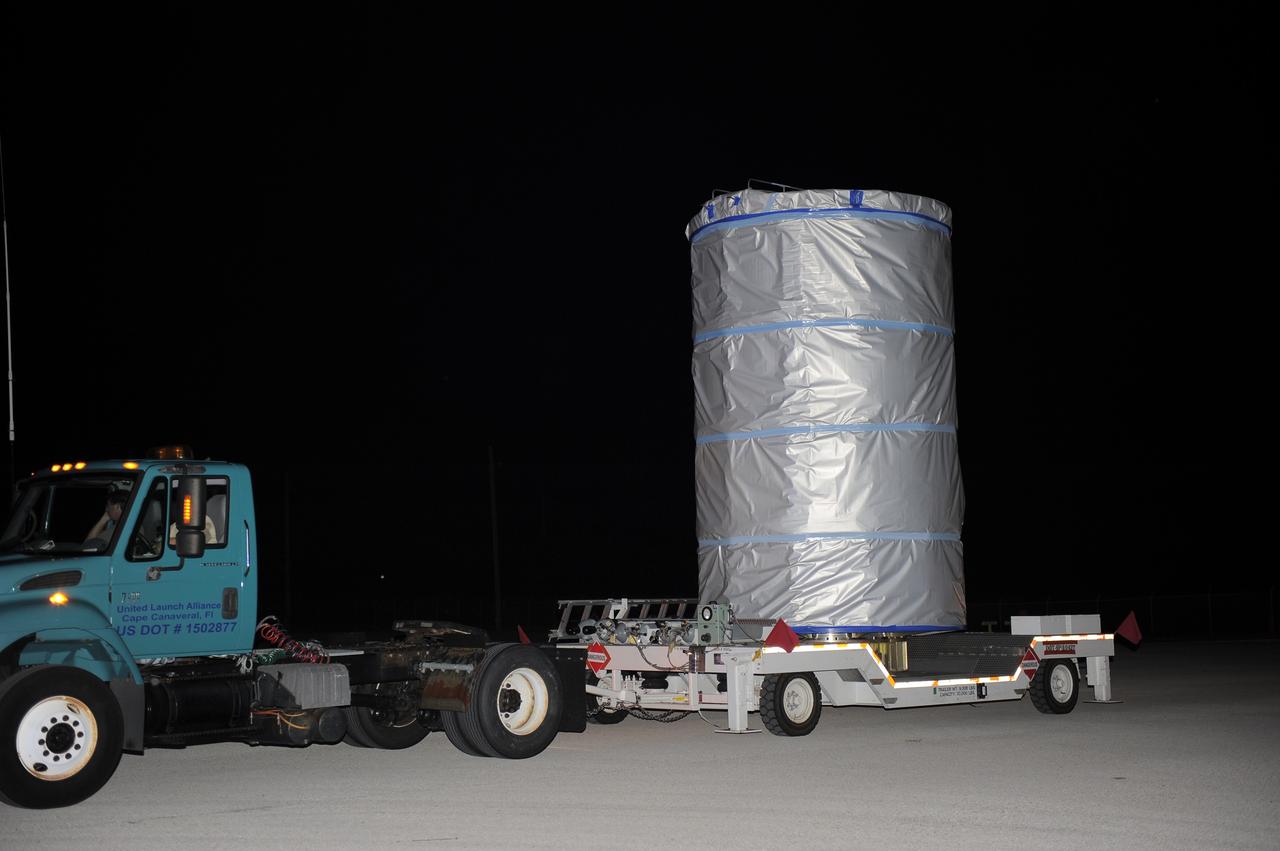
CAPE CANAVERAL, Fla. -- NASA's twin Gravity Recovery and Interior Laboratory (GRAIL) spacecraft are transported from the Astrotech Space Operation's payload processing facility in Titusville, Fla., to their launch pad at Space Launch Complex 17B at Cape Canaveral Air Force Station in Florida. The lunar probes are attached to a spacecraft adapter ring in their side-by-side launch configuration and wrapped in plastic to prevent contamination outside the clean room. The spacecraft will fly in tandem orbits around the moon for several months to measure its gravity field. GRAIL's primary science objectives are to determine the structure of the lunar interior, from crust to core, and to advance understanding of the thermal evolution of the moon. Launch aboard a United Launch Alliance Delta II rocket is scheduled for Sept. 8. For more information, visit www.nasa.gov/grail. Photo credit: NASA/Kim Shiflett
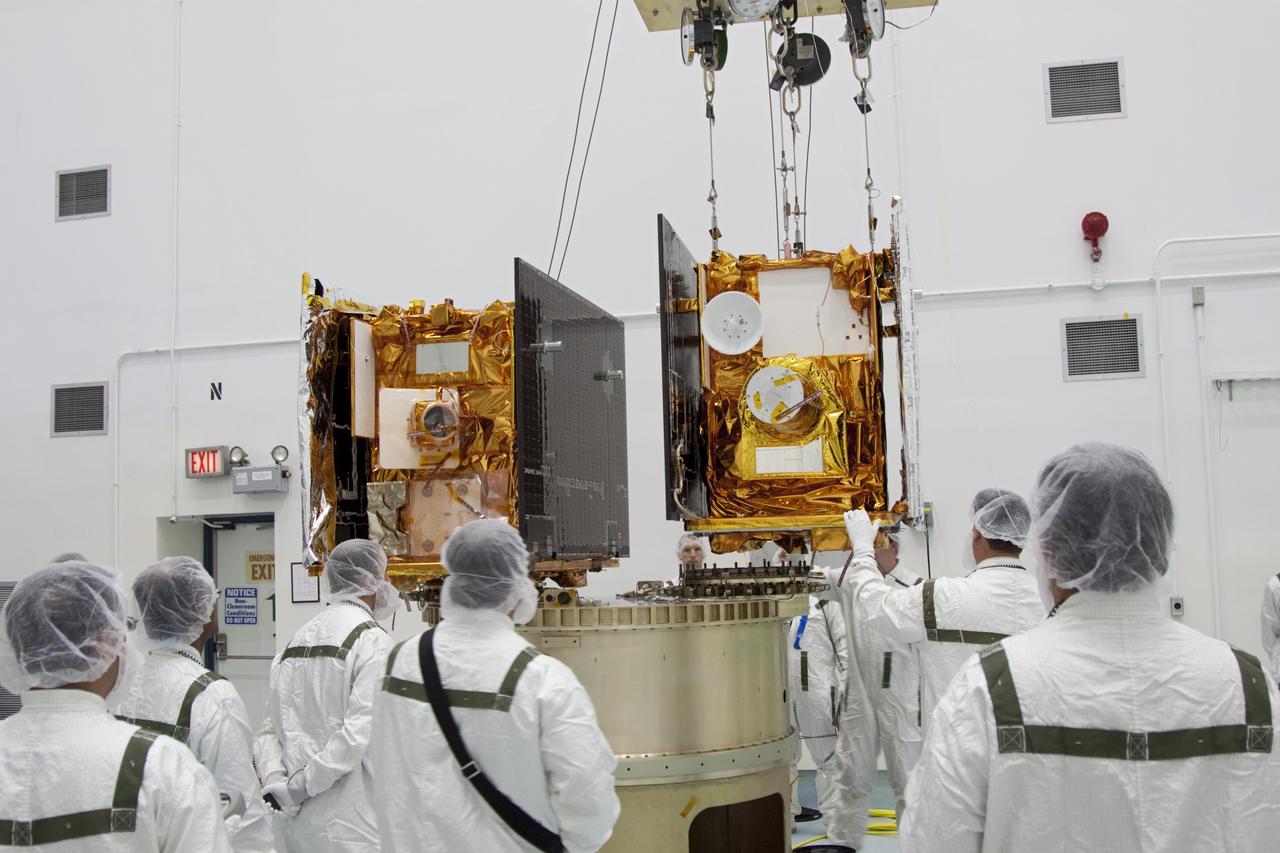
CAPE CANAVERAL, Fla. -- At Astrotech Space Operation's payload processing facility in Titusville, Fla., NASA's Gravity Recovery and Interior Laboratory-A (GRAIL-A) lunar probe us lowered toward the spacecraft adapter ring. GRAIL-B is already secured to the ring, at left. After the twin GRAIL spacecraft are attached to the adapter ring in their side-by-side launch configuration, they will be transported to the launch pad. GRAIL will fly in tandem orbits around the moon for several months to measure its gravity field. GRAIL's primary science objectives are to determine the structure of the lunar interior, from crust to core, and to advance understanding of the thermal evolution of the moon. Launch aboard a United Launch Alliance Delta II rocket from Space Launch Complex 17B on Cape Canaveral Air Force Station is scheduled for Sept. 8. For more information, visit http://www.nasa.gov/grail. Photo credit: NASA/Jim Grossmann
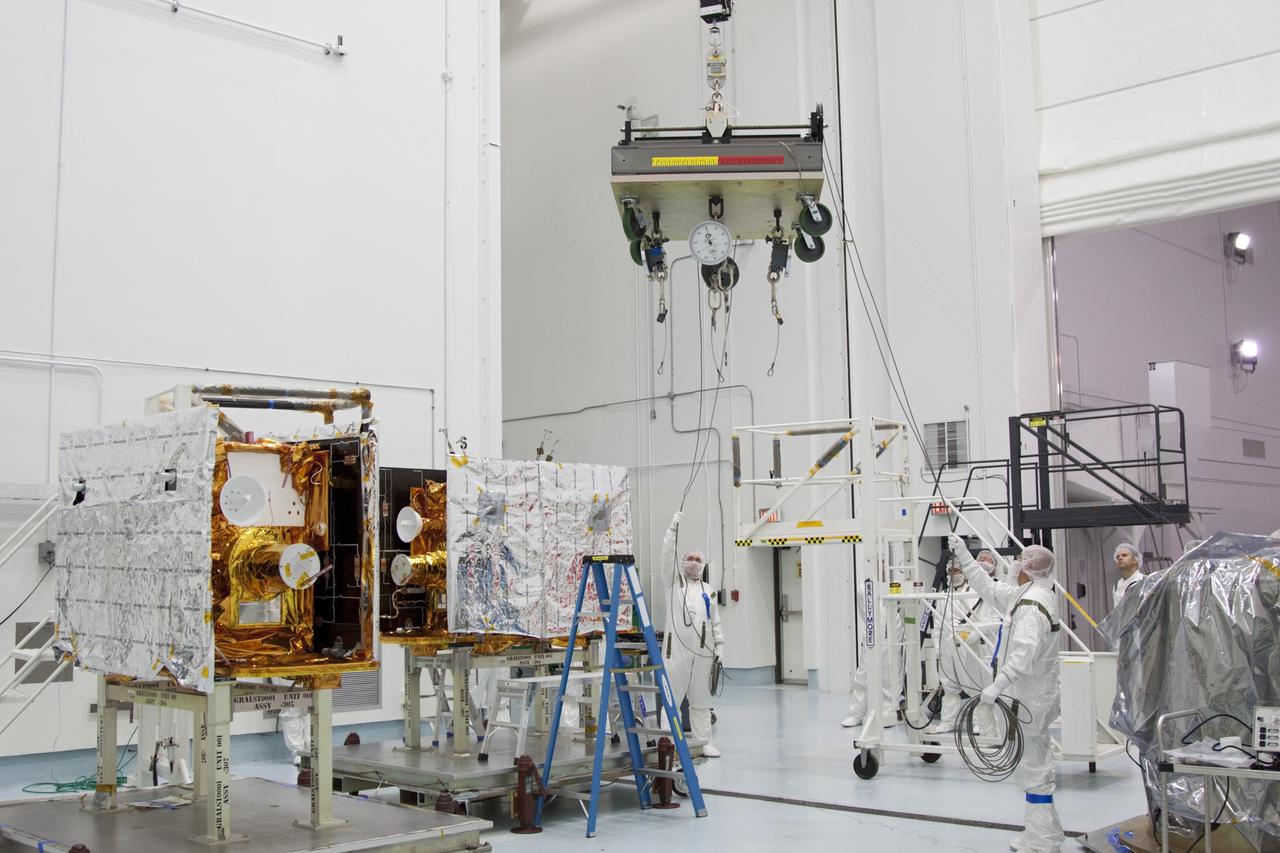
CAPE CANAVERAL, Fla. -- At Astrotech Space Operation's payload processing facility in Titusville, Fla., Lockheed Martin technicians move a lifting device toward NASA's Gravity Recovery and Interior Laboratory-B (GRAIL-B) lunar probe. At left is GRAIL-A. After the twin GRAIL spacecraft are attached to the spacecraft adapter ring in their side-by-side launch configuration, they will be transported to the launch pad. GRAIL will fly in tandem orbits around the moon for several months to measure its gravity field. GRAIL's primary science objectives are to determine the structure of the lunar interior, from crust to core, and to advance understanding of the thermal evolution of the moon. Launch aboard a United Launch Alliance Delta II rocket from Space Launch Complex 17B on Cape Canaveral Air Force Station is scheduled for Sept. 8. For more information, visit http://www.nasa.gov/grail. Photo credit: NASA/Jim Grossmann
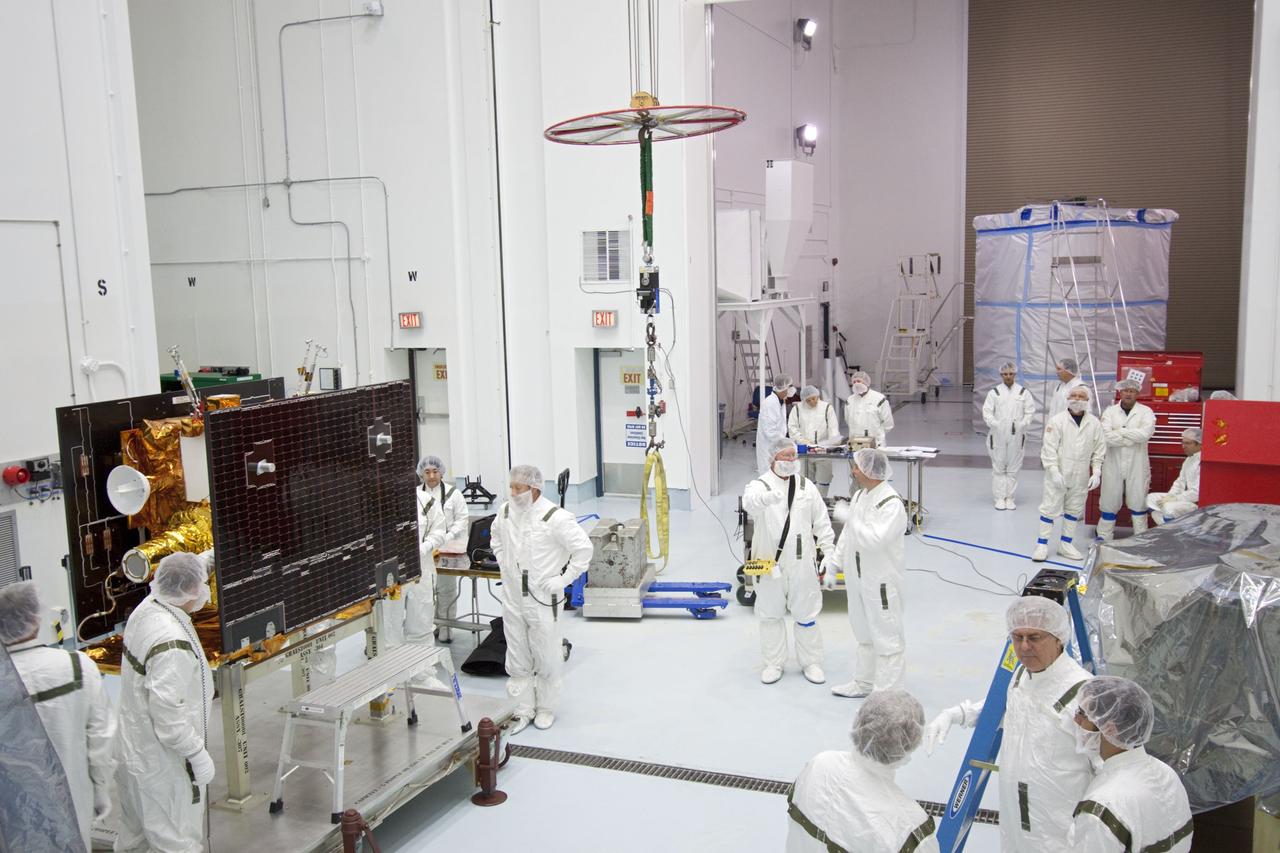
CAPE CANAVERAL, Fla. -- At Astrotech Space Operation's payload processing facility in Titusville, Fla., preparations are under way to determine the weight of one of NASA's twin Gravity Recovery and Interior Laboratory lunar spacecraft before the spacecraft are stacked in their launch configuration in readiness for transport to the launch pad. GRAIL will fly in tandem orbits around the moon for several months to measure its gravity field. GRAIL's primary science objectives are to determine the structure of the lunar interior, from crust to core, and to advance understanding of the thermal evolution of the moon. Launch aboard a United Launch Alliance Delta II rocket from Space Launch Complex 17B on Cape Canaveral Air Force Station is scheduled for Sept. 8. For more information, visit http://www.nasa.gov/grail. Photo credit: NASA/Jim Grossmann
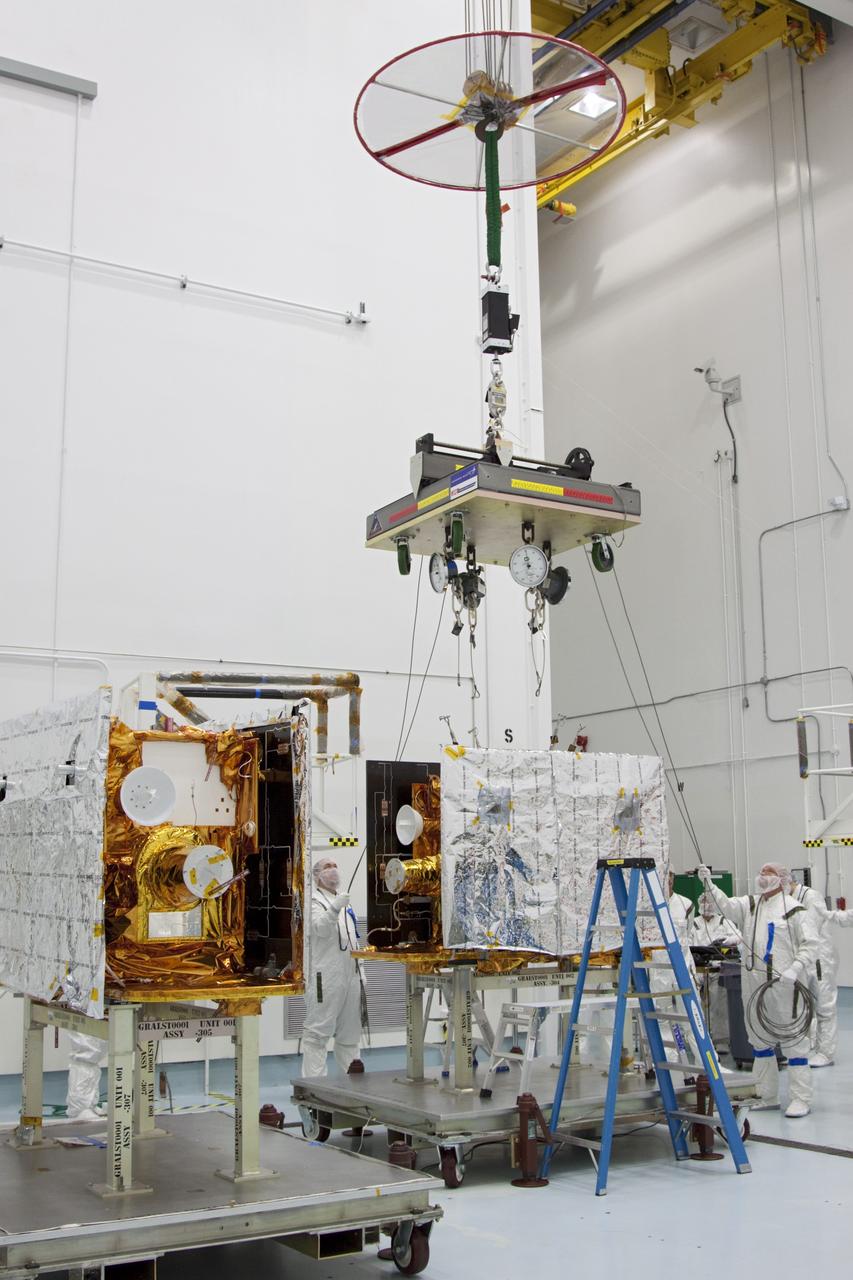
CAPE CANAVERAL, Fla. -- At Astrotech Space Operation's payload processing facility in Titusville, Fla., a lifting device moves into position over NASA's Gravity Recovery and Interior Laboratory-B (GRAIL-B) lunar probe. At left is GRAIL-A. After the twin GRAIL spacecraft are attached to the spacecraft adapter ring in their side-by-side launch configuration, they will be transported to the launch pad. GRAIL will fly in tandem orbits around the moon for several months to measure its gravity field. GRAIL's primary science objectives are to determine the structure of the lunar interior, from crust to core, and to advance understanding of the thermal evolution of the moon. Launch aboard a United Launch Alliance Delta II rocket from Space Launch Complex 17B on Cape Canaveral Air Force Station is scheduled for Sept. 8. For more information, visit http://www.nasa.gov/grail. Photo credit: NASA/Jim Grossmann
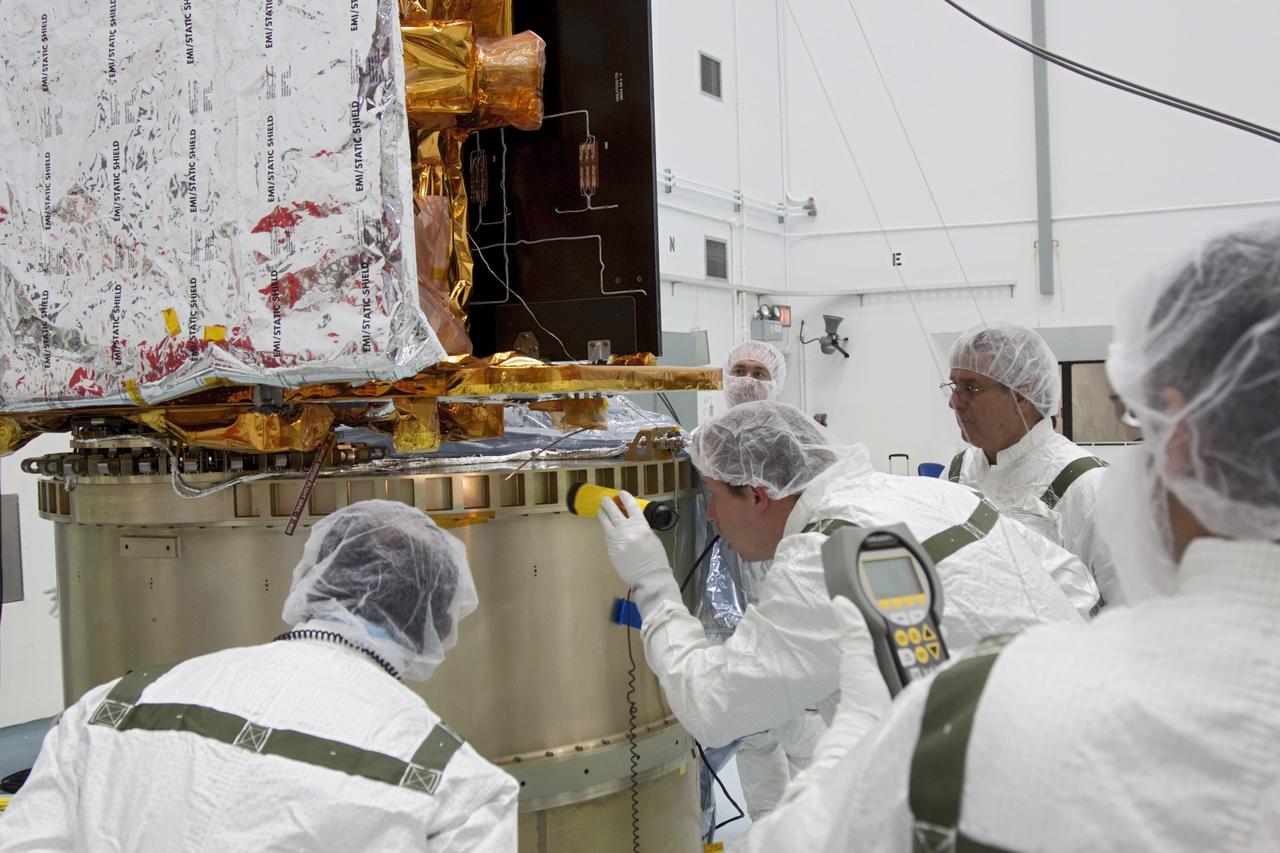
CAPE CANAVERAL, Fla. -- At Astrotech Space Operation's payload processing facility in Titusville, Fla., Lockheed Martin technicians verify that NASA's Gravity Recovery and Interior Laboratory-B (GRAIL-B) lunar probe is in the correct position on the spacecraft adapter ring. After the twin GRAIL spacecraft are attached to the adapter ring in their side-by-side launch configuration, they will be transported to the launch pad. GRAIL will fly in tandem orbits around the moon for several months to measure its gravity field. GRAIL's primary science objectives are to determine the structure of the lunar interior, from crust to core, and to advance understanding of the thermal evolution of the moon. Launch aboard a United Launch Alliance Delta II rocket from Space Launch Complex 17B on Cape Canaveral Air Force Station is scheduled for Sept. 8. For more information, visit http://www.nasa.gov/grail. Photo credit: NASA/Jim Grossmann
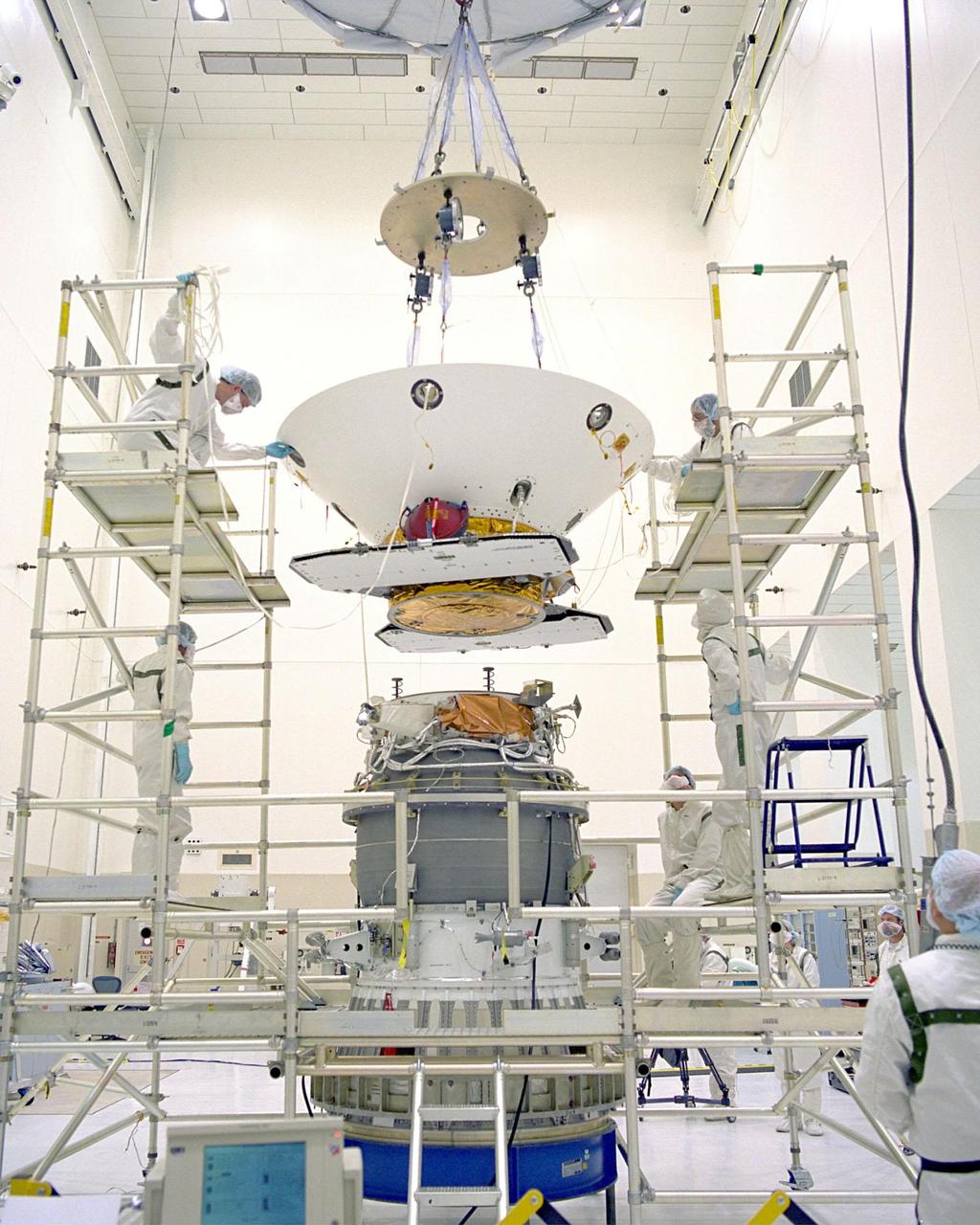
In the Spacecraft Assembly and Encapsulation Facility-2 (SAEF-2), the <a href="http://www-pao.ksc.nasa.gov/kscpao/captions/subjects/mars.htm"><b>Mars Polar Lander</b></a> is lowered onto the third stage of the Boeing Delta II rocket before it is transported to Launch Pad 17B, Cape Canaveral Air Station. The lander, which will be launched on Jan. 3, 1999, is a solar-powered spacecraft designed to touch down on the Martian surface near the northern-most boundary of the south pole in order to study the water cycle there. The lander also will help scientists learn more about climate change and current resources on Mars, studying such things as frost, dust, water vapor and condensates in the Martian atmosphere. It is the second spacecraft to be launched in a pair of Mars '98 missions. The first is the Mars Climate Orbiter, which was launched aboard a Delta II rocket from Launch Complex 17A on Dec. 11, 1998
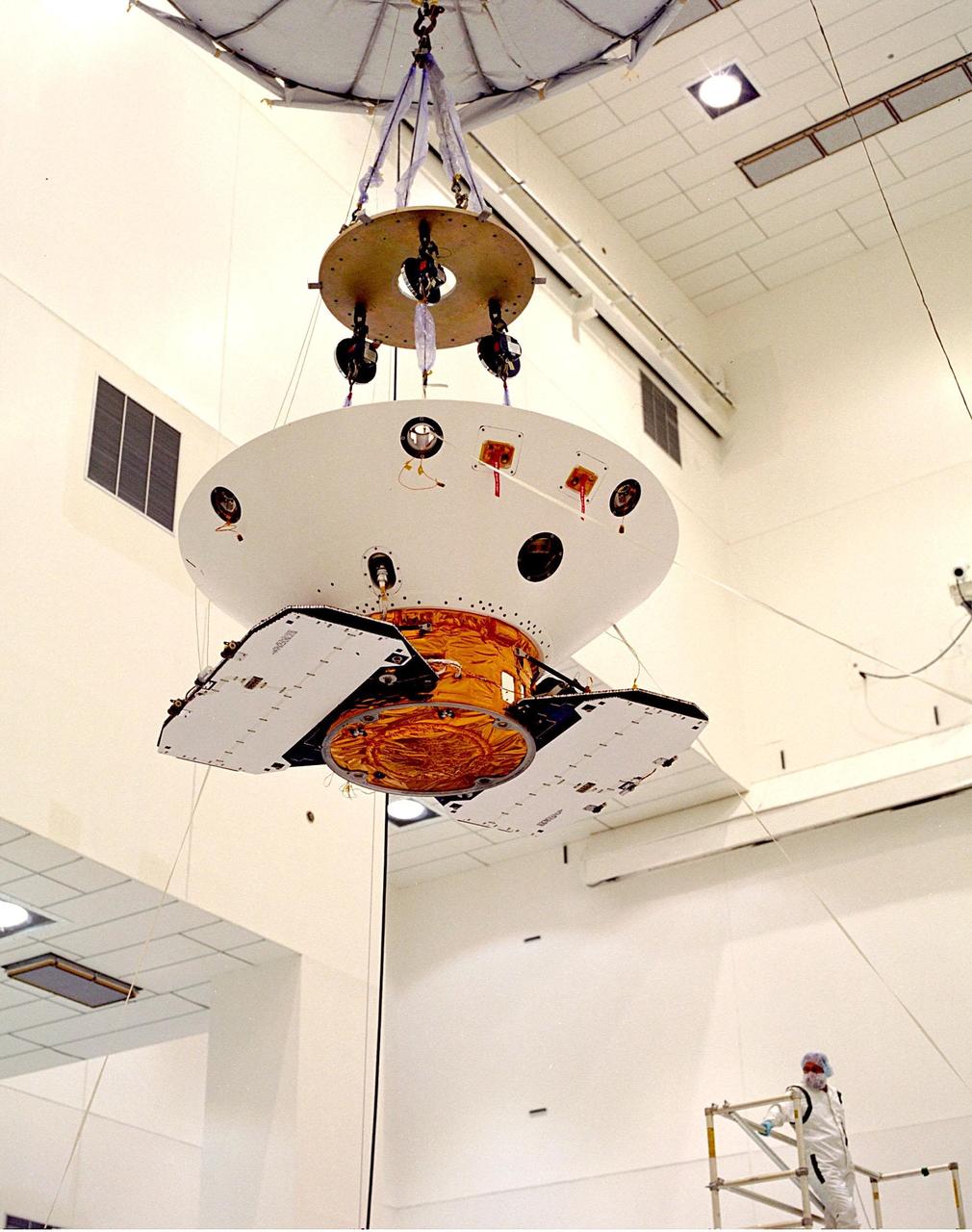
KENNEDY SPACE CENTER, FLA. -- The Mars Polar Lander is suspended from a crane in the Spacecraft Assembly and Encapsulation Facility-2 (SAEF-2) before being lowered to a workstand. There it will be mated to the third stage of the Boeing Delta II rocket before it is transported to Launch Pad 17B, Cape Canaveral Air Station. The lander, which will be launched on Jan. 3, 1999, is a solar-powered spacecraft designed to touch down on the Martian surface near the northern-most boundary of the south pole in order to study the water cycle there. The lander also will help scientists learn more about climate change and current resources on Mars, studying such things as frost, dust, water vapor and condensates in the Martian atmosphere. It is the second spacecraft to be launched in a pair of Mars '98 missions. The first is the Mars Climate Orbiter, which was launched aboard a Delta II rocket from Launch Complex 17A on Dec. 11, 1998

CAPE CANAVERAL, Fla. -- This 3-D image shows NASA's twin Gravity Recovery and Interior Laboratory lunar spacecraft attached to the spacecraft adapter ring in their launch configuration in Astrotech Space Operation's payload processing facility in Titusville, Fla. To view this image, use green and magenta 3-D glasses. Preparations are under way to transport the lunar probes to the launch pad. GRAIL will fly in tandem orbits around the moon for several months to measure its gravity field. GRAIL's primary science objectives are to determine the structure of the lunar interior, from crust to core, and to advance understanding of the thermal evolution of the moon. Launch aboard a United Launch Alliance Delta II rocket from Space Launch Complex 17B on Cape Canaveral Air Force Station is scheduled for Sept. 8. For more information, visit http://www.nasa.gov/grail. Photo credit: NASA/Frankie Martin
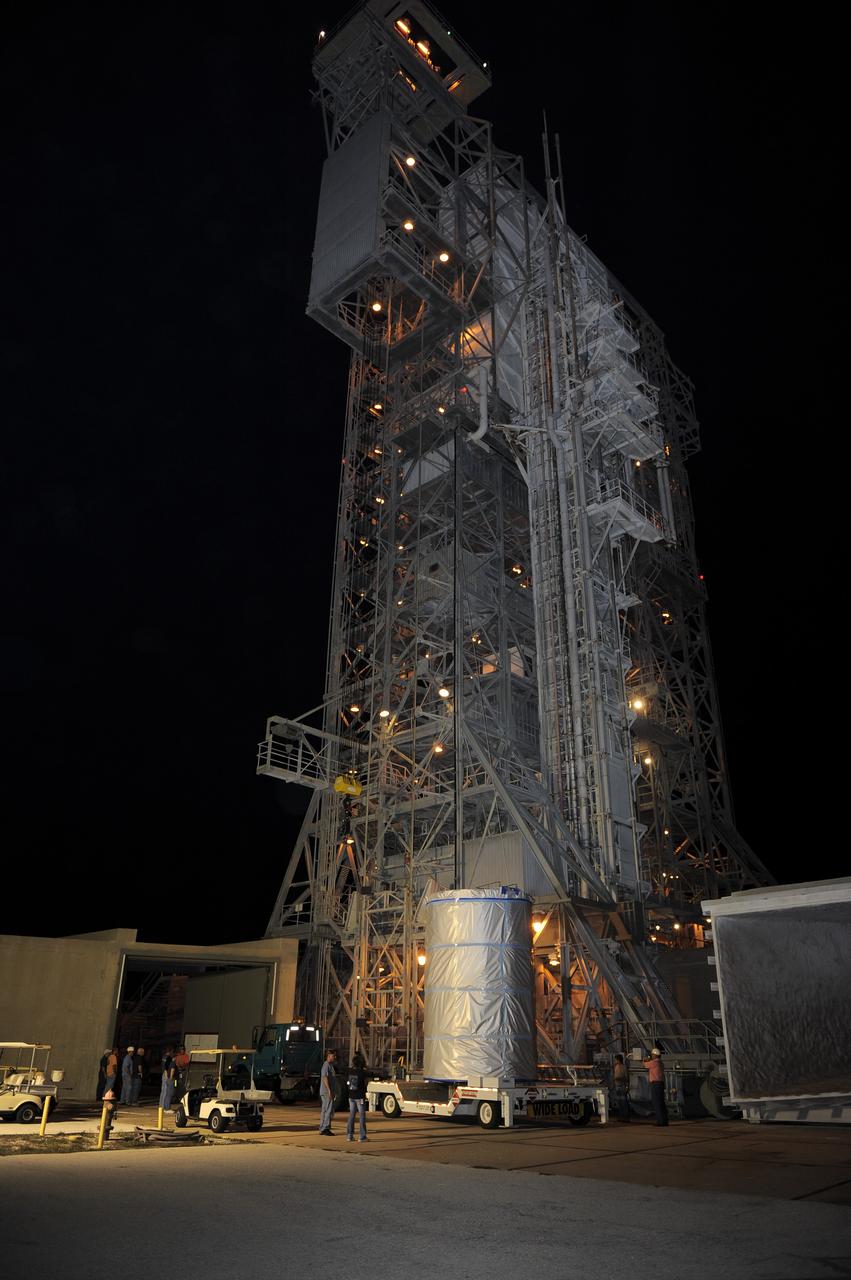
CAPE CANAVERAL, Fla. -- NASA's twin Gravity Recovery and Interior Laboratory (GRAIL) spacecraft arrives at their launch pad at Space Launch Complex 17B at Cape Canaveral Air Force Station in Florida. The lunar probes are attached to a spacecraft adapter ring in their side-by-side launch configuration and wrapped in plastic to prevent contamination outside the clean room in the Astrotech Space Operation's payload processing facility in Titusville, Fla. The spacecraft will fly in tandem orbits around the moon for several months to measure its gravity field. GRAIL's primary science objectives are to determine the structure of the lunar interior, from crust to core, and to advance understanding of the thermal evolution of the moon. Launch aboard a United Launch Alliance Delta II rocket is scheduled for Sept. 8. For more information, visit www.nasa.gov/grail. Photo credit: NASA/Kim Shiflett
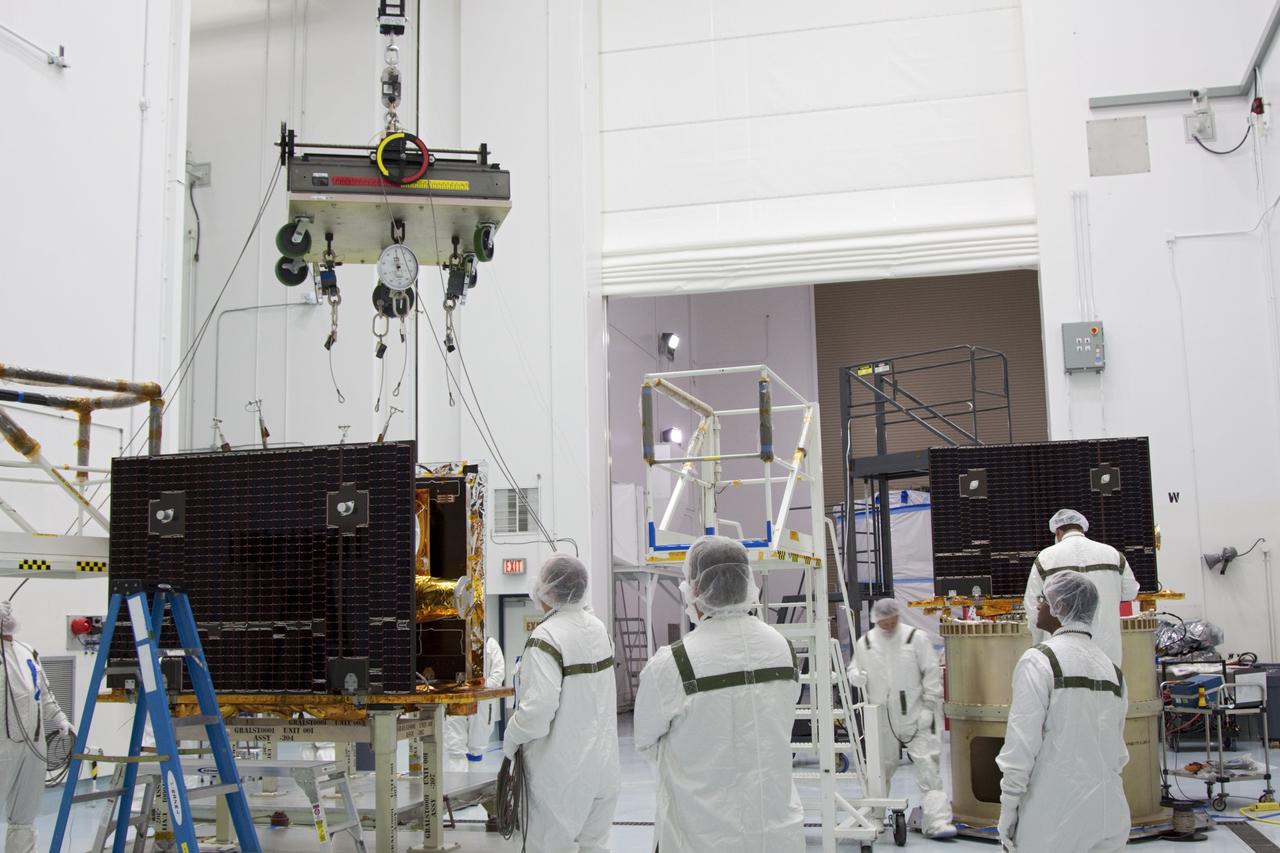
CAPE CANAVERAL, Fla. -- At Astrotech Space Operation's payload processing facility in Titusville, Fla., the lifting device moves toward NASA's Gravity Recovery and Interior Laboratory-A (GRAIL-A) lunar probe. The spacecraft will be transferred to the spacecraft adapter ring, at right, where GRAIL-B is being secured. After the twin spacecraft are attached to the adapter ring in their side-by-side launch configuration, they will be transported to the launch pad. GRAIL will fly in tandem orbits around the moon for several months to measure its gravity field. GRAIL's primary science objectives are to determine the structure of the lunar interior, from crust to core, and to advance understanding of the thermal evolution of the moon. Launch aboard a United Launch Alliance Delta II rocket from Space Launch Complex 17B on Cape Canaveral Air Force Station is scheduled for Sept. 8. For more information, visit http://www.nasa.gov/grail. Photo credit: NASA/Jim Grossmann
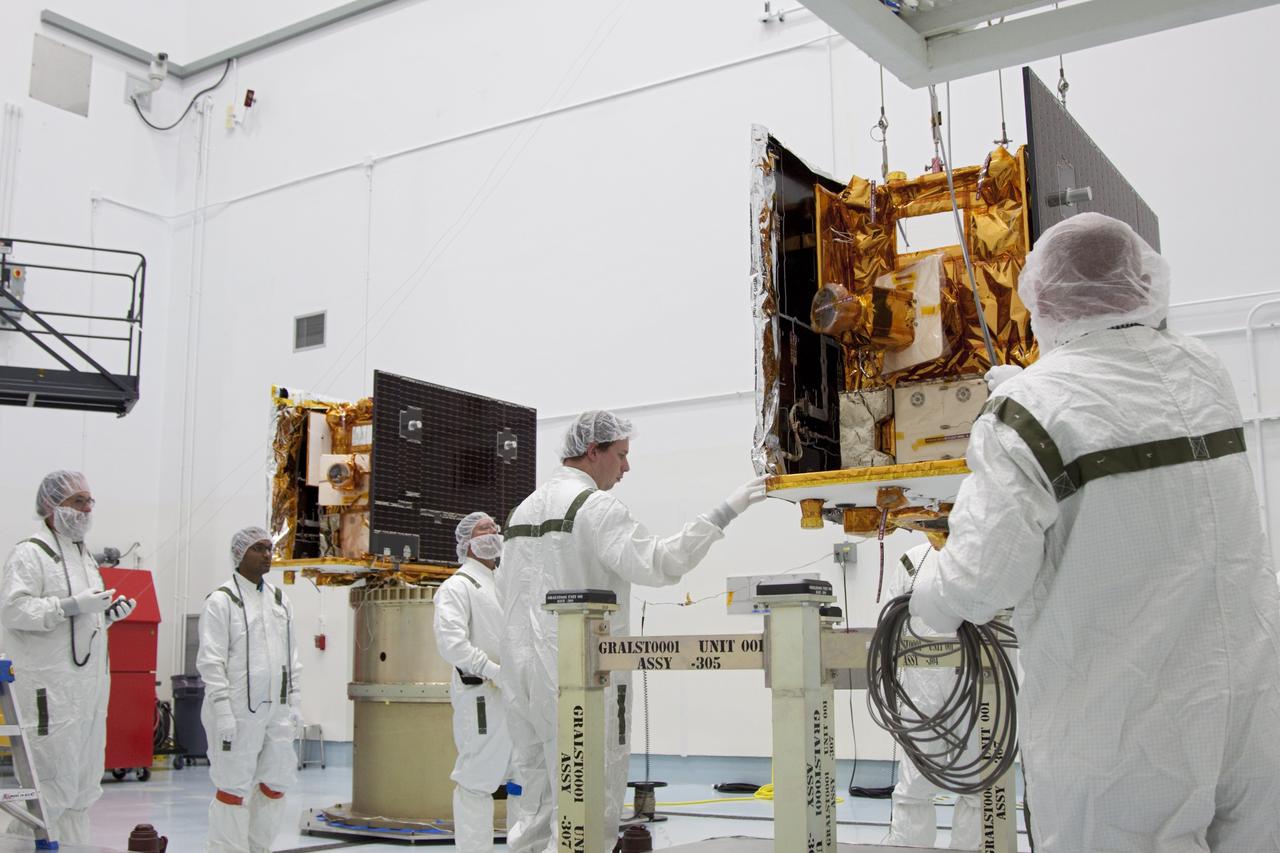
CAPE CANAVERAL, Fla. -- At Astrotech Space Operation's payload processing facility in Titusville, Fla., NASA's Gravity Recovery and Interior Laboratory-A (GRAIL-A) lunar probe is lifted from its workstand. The spacecraft will be transferred to the spacecraft adapter ring, at left, where GRAIL-B is already secured. After the twin GRAIL spacecraft are attached to the adapter ring in their side-by-side launch configuration, they will be transported to the launch pad. GRAIL will fly in tandem orbits around the moon for several months to measure its gravity field. GRAIL's primary science objectives are to determine the structure of the lunar interior, from crust to core, and to advance understanding of the thermal evolution of the moon. Launch aboard a United Launch Alliance Delta II rocket from Space Launch Complex 17B on Cape Canaveral Air Force Station is scheduled for Sept. 8. For more information, visit http://www.nasa.gov/grail. Photo credit: NASA/Jim Grossmann
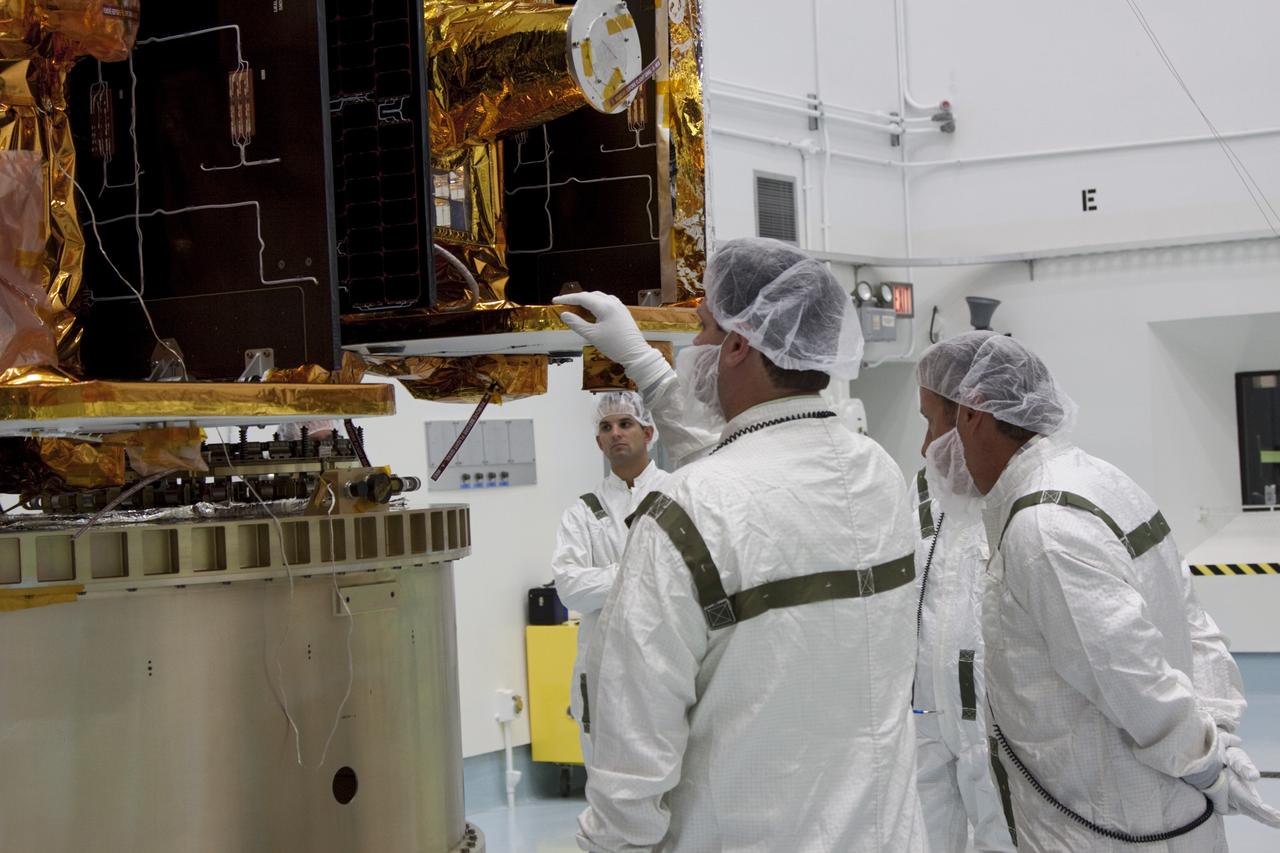
CAPE CANAVERAL, Fla. -- At Astrotech Space Operation's payload processing facility in Titusville, Fla., Lockheed Martin technicians verify that NASA's Gravity Recovery and Interior Laboratory-A (GRAIL-A) lunar probe is positioned correctly on the spacecraft adapter ring. After the twin GRAIL spacecraft are attached to the adapter ring in their side-by-side launch configuration, they will be transported to the launch pad. GRAIL will fly in tandem orbits around the moon for several months to measure its gravity field. GRAIL's primary science objectives are to determine the structure of the lunar interior, from crust to core, and to advance understanding of the thermal evolution of the moon. Launch aboard a United Launch Alliance Delta II rocket from Space Launch Complex 17B on Cape Canaveral Air Force Station is scheduled for Sept. 8. For more information, visit http://www.nasa.gov/grail. Photo credit: NASA/Jim Grossmann
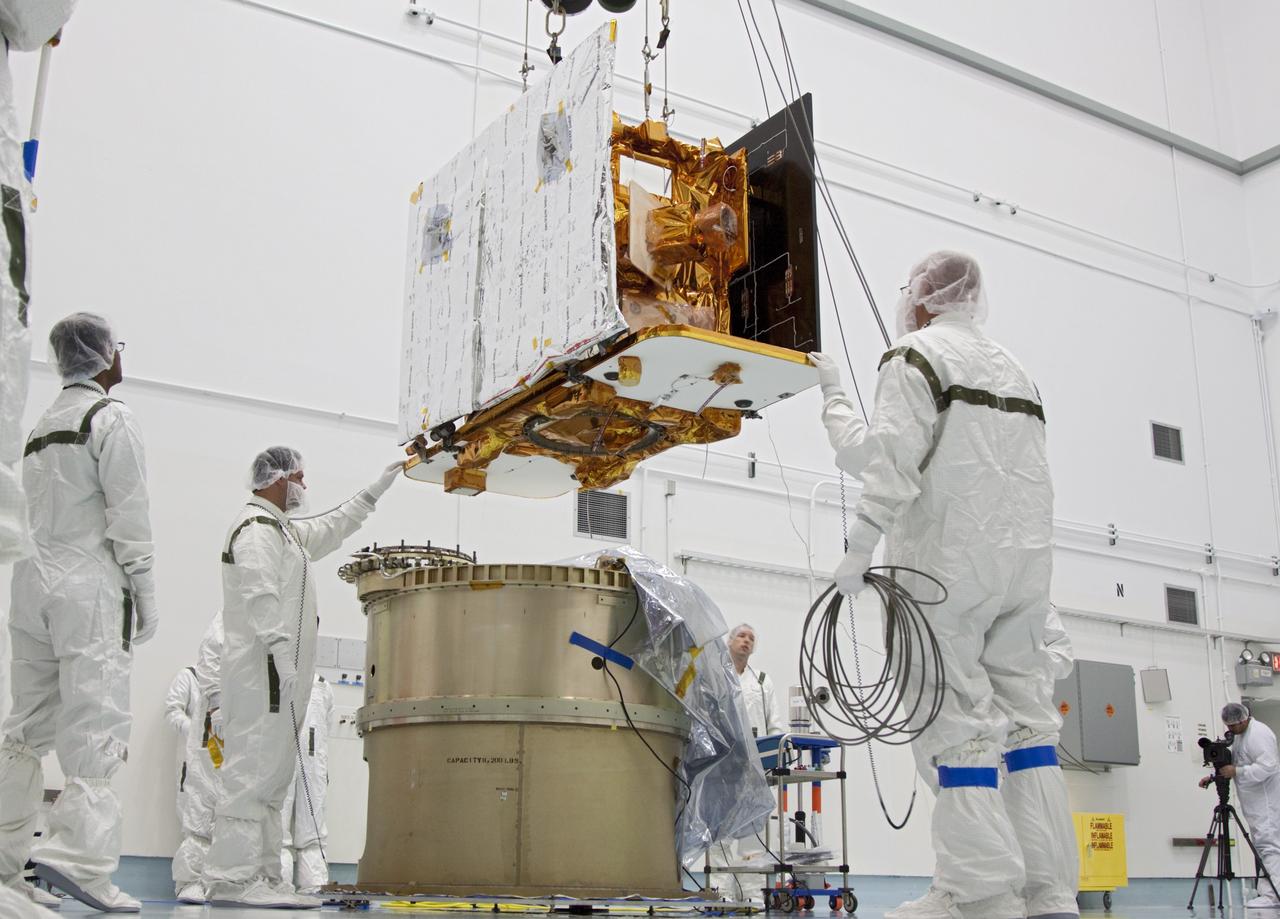
CAPE CANAVERAL, Fla. -- At Astrotech Space Operation's payload processing facility in Titusville, Fla., Lockheed Martin technicians lower NASA's Gravity Recovery and Interior Laboratory-B (GRAIL-B) lunar probe toward the spacecraft adapter ring. After the twin GRAIL spacecraft are attached to the adapter ring in their side-by-side launch configuration, they will be transported to the launch pad. GRAIL will fly in tandem orbits around the moon for several months to measure its gravity field. GRAIL's primary science objectives are to determine the structure of the lunar interior, from crust to core, and to advance understanding of the thermal evolution of the moon. Launch aboard a United Launch Alliance Delta II rocket from Space Launch Complex 17B on Cape Canaveral Air Force Station is scheduled for Sept. 8. For more information, visit http://www.nasa.gov/grail. Photo credit: NASA/Jim Grossmann
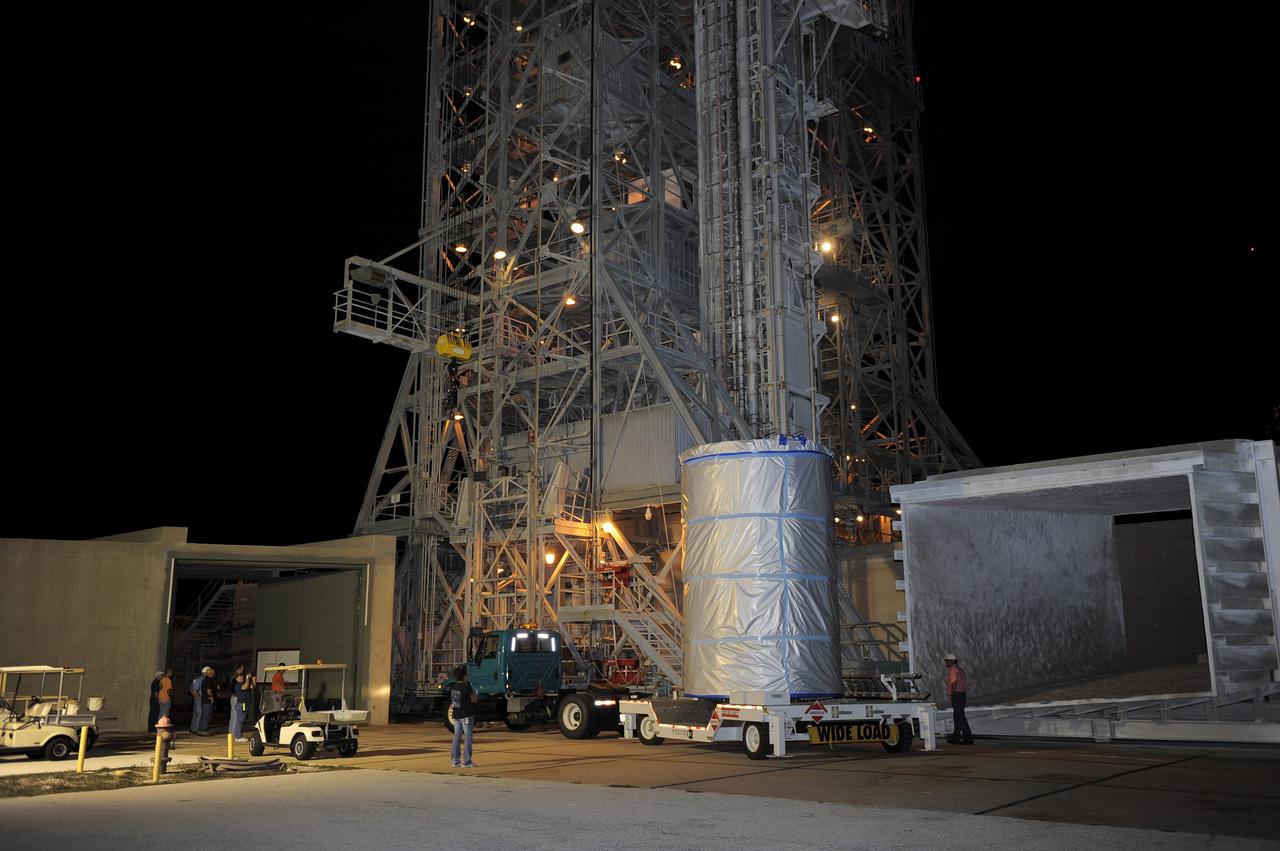
CAPE CANAVERAL, Fla. -- NASA's twin Gravity Recovery and Interior Laboratory (GRAIL) spacecraft arrives at their launch pad at Space Launch Complex 17B at Cape Canaveral Air Force Station in Florida. The lunar probes are attached to a spacecraft adapter ring in their side-by-side launch configuration and wrapped in plastic to prevent contamination outside the clean room in the Astrotech Space Operation's payload processing facility in Titusville, Fla. The spacecraft will fly in tandem orbits around the moon for several months to measure its gravity field. GRAIL's primary science objectives are to determine the structure of the lunar interior, from crust to core, and to advance understanding of the thermal evolution of the moon. Launch aboard a United Launch Alliance Delta II rocket is scheduled for Sept. 8. For more information, visit www.nasa.gov/grail. Photo credit: NASA/Kim Shiflett
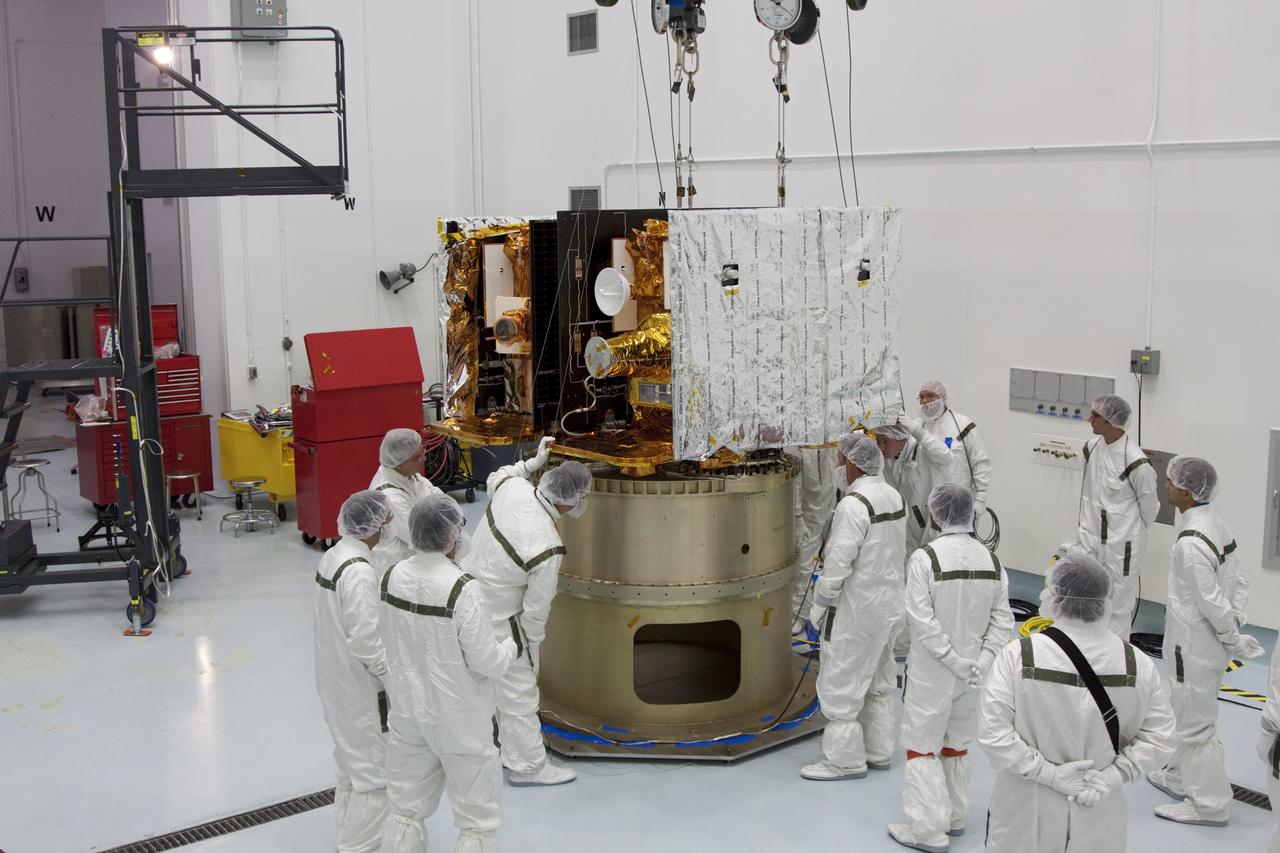
CAPE CANAVERAL, Fla. -- At Astrotech Space Operation's payload processing facility in Titusville, Fla., Lockheed Martin technicians monitor the placement of NASA's Gravity Recovery and Interior Laboratory-A (GRAIL-A) lunar probe on the spacecraft adapter ring. GRAIL-B is already secured to the ring, at left. After the twin GRAIL spacecraft are attached to the adapter ring in their side-by-side launch configuration, they will be transported to the launch pad. GRAIL will fly in tandem orbits around the moon for several months to measure its gravity field. GRAIL's primary science objectives are to determine the structure of the lunar interior, from crust to core, and to advance understanding of the thermal evolution of the moon. Launch aboard a United Launch Alliance Delta II rocket from Space Launch Complex 17B on Cape Canaveral Air Force Station is scheduled for Sept. 8. For more information, visit http://www.nasa.gov/grail. Photo credit: NASA/Jim Grossmann
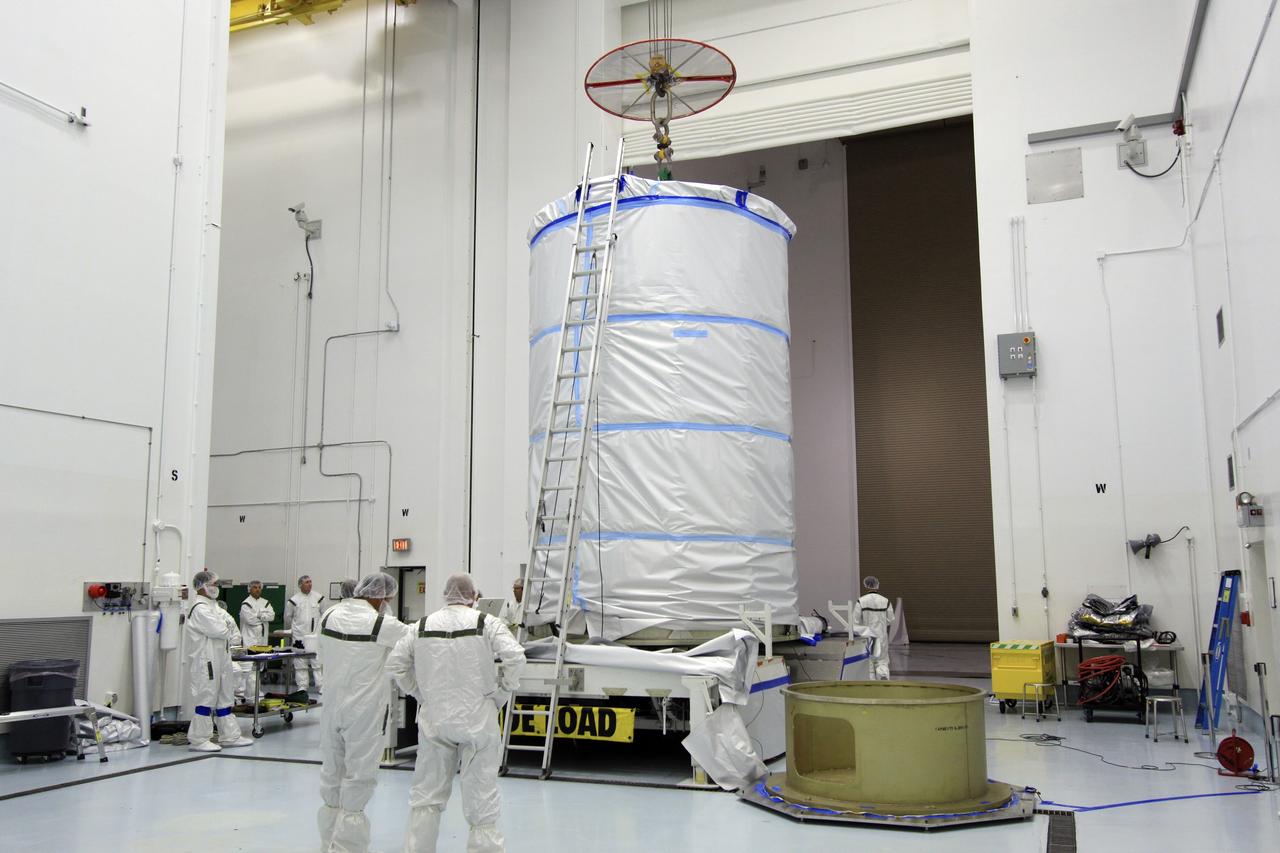
CAPE CANAVERAL, Fla. -- At Astrotech Space Operation's payload processing facility in Titusville, Fla., the protective canister enclosing NASA's twin Gravity Recovery and Interior Laboratory spacecraft is secured on a transportation pallet. Preparations are under way to move the lunar probes, attached to a spacecraft adapter ring in their side-by-side launch configuration, to the launch pad. The spacecraft will fly in tandem orbits around the moon for several months to measure its gravity field. GRAIL's primary science objectives are to determine the structure of the lunar interior, from crust to core, and to advance understanding of the thermal evolution of the moon. Launch aboard a United Launch Alliance Delta II rocket from Space Launch Complex 17B on Cape Canaveral Air Force Station is scheduled for Sept. 8. For more information, visit http://www.nasa.gov/grail. Photo credit: NASA/Jim Grossmann
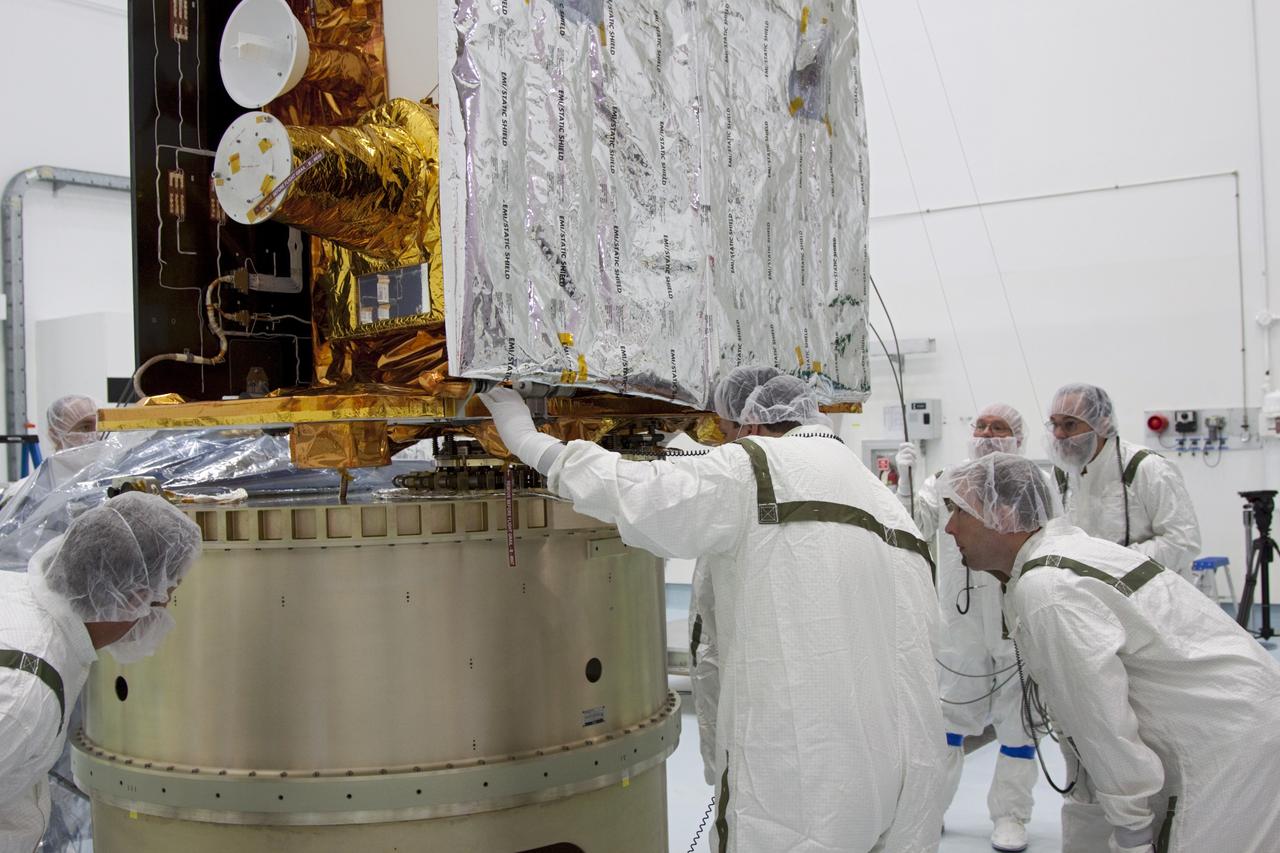
CAPE CANAVERAL, Fla. -- At Astrotech Space Operation's payload processing facility in Titusville, Fla., Lockheed Martin technicians position NASA's Gravity Recovery and Interior Laboratory-B (GRAIL-B) lunar probe on the spacecraft adapter ring. After the twin GRAIL spacecraft are attached to the adapter ring in their side-by-side launch configuration, they will be transported to the launch pad. GRAIL will fly in tandem orbits around the moon for several months to measure its gravity field. GRAIL's primary science objectives are to determine the structure of the lunar interior, from crust to core, and to advance understanding of the thermal evolution of the moon. Launch aboard a United Launch Alliance Delta II rocket from Space Launch Complex 17B on Cape Canaveral Air Force Station is scheduled for Sept. 8. For more information, visit http://www.nasa.gov/grail. Photo credit: NASA/Jim Grossmann
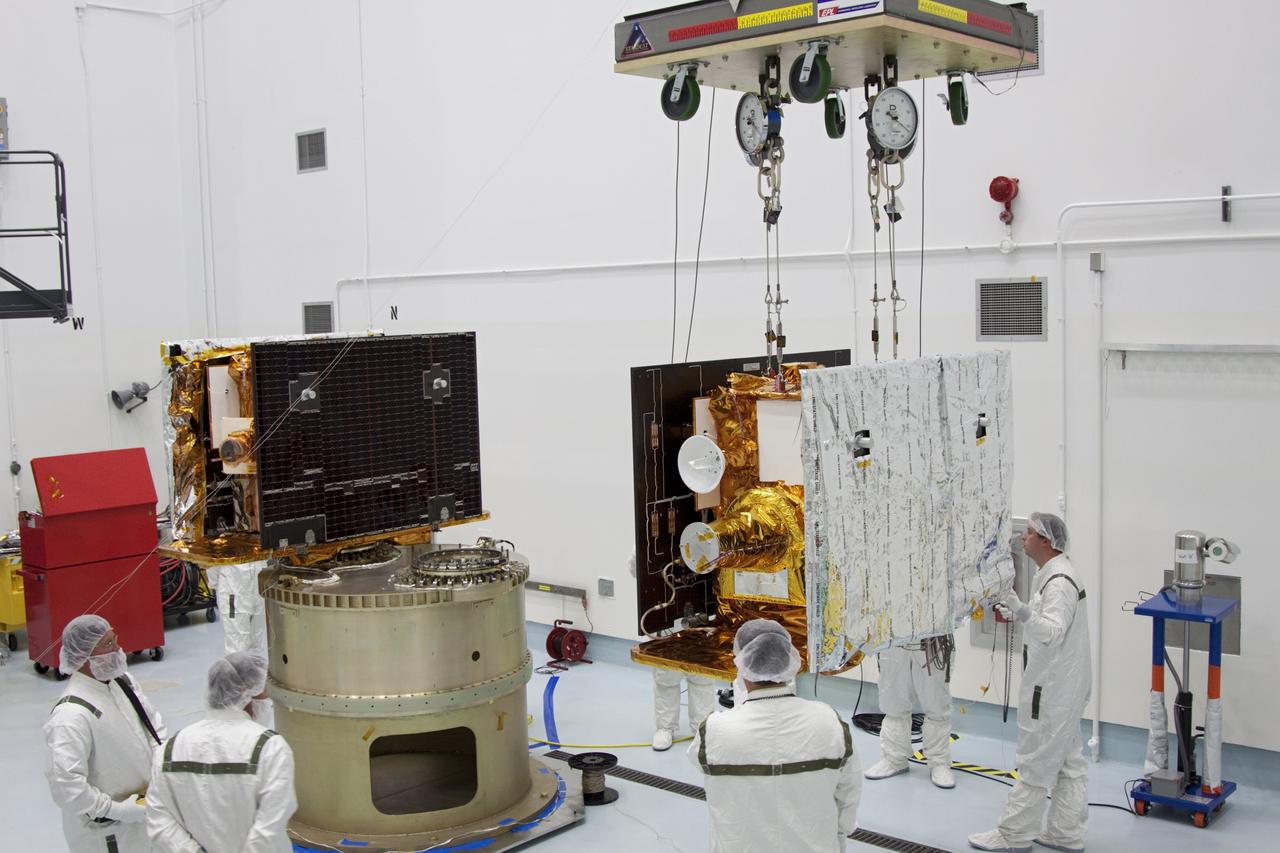
CAPE CANAVERAL, Fla. -- At Astrotech Space Operation's payload processing facility in Titusville, Fla., NASA's Gravity Recovery and Interior Laboratory-A (GRAIL-A) lunar probe slowly approaches the spacecraft adapter ring, at left, where GRAIL-B is already secured. After the twin GRAIL spacecraft are attached to the adapter ring in their side-by-side launch configuration, they will be transported to the launch pad. GRAIL will fly in tandem orbits around the moon for several months to measure its gravity field. GRAIL's primary science objectives are to determine the structure of the lunar interior, from crust to core, and to advance understanding of the thermal evolution of the moon. Launch aboard a United Launch Alliance Delta II rocket from Space Launch Complex 17B on Cape Canaveral Air Force Station is scheduled for Sept. 8. For more information, visit http://www.nasa.gov/grail. Photo credit: NASA/Jim Grossmann

CAPE CANAVERAL, Fla. -- At Astrotech Space Operation's payload processing facility in Titusville, Fla., Lockheed Martin technicians adjust the position of NASA's Gravity Recovery and Interior Laboratory-A (GRAIL-A) lunar probe on the spacecraft adapter ring. GRAIL-B is already secured to the ring, at left. After the twin GRAIL spacecraft are attached to the adapter ring in their side-by-side launch configuration, they will be transported to the launch pad. GRAIL will fly in tandem orbits around the moon for several months to measure its gravity field. GRAIL's primary science objectives are to determine the structure of the lunar interior, from crust to core, and to advance understanding of the thermal evolution of the moon. Launch aboard a United Launch Alliance Delta II rocket from Space Launch Complex 17B on Cape Canaveral Air Force Station is scheduled for Sept. 8. For more information, visit http://www.nasa.gov/grail. Photo credit: NASA/Jim Grossmann
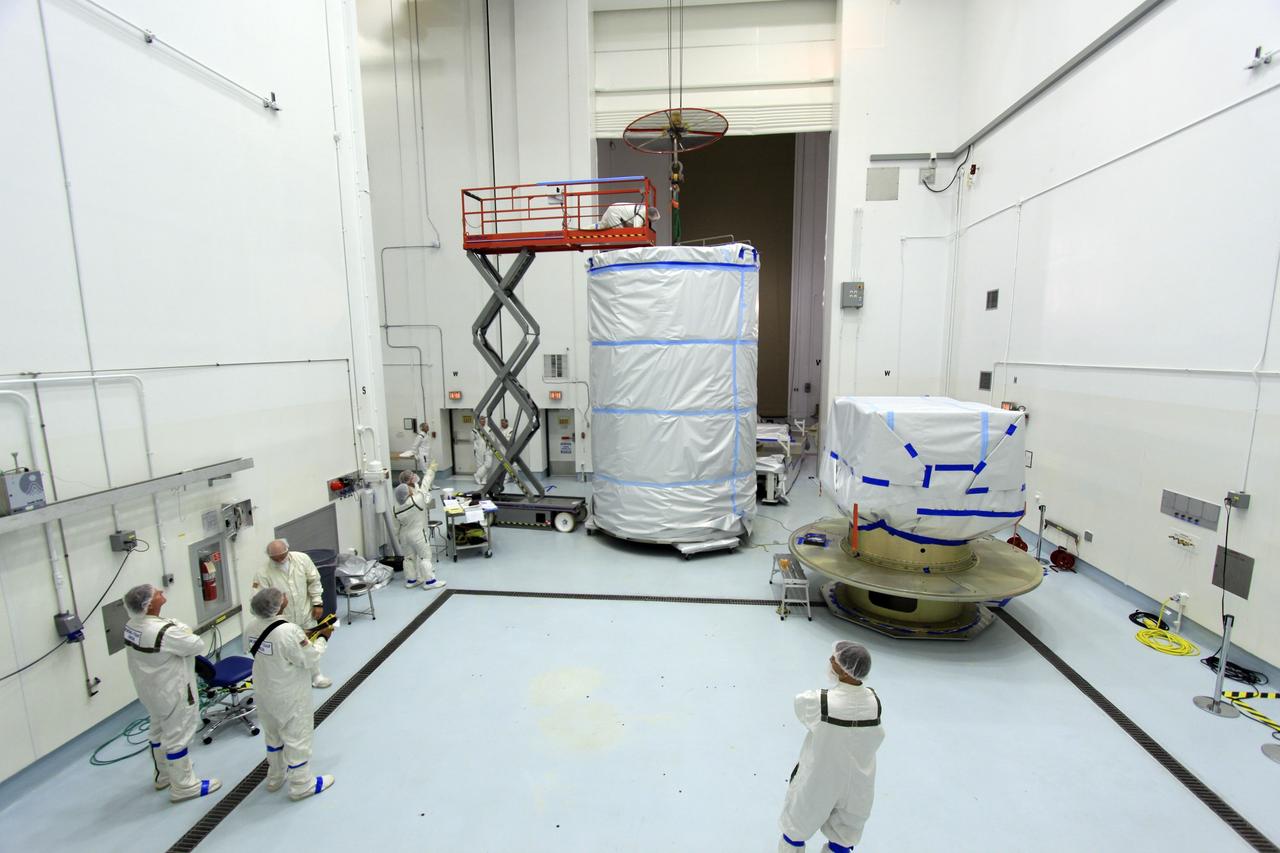
CAPE CANAVERAL, Fla. -- At Astrotech Space Operation's payload processing facility in Titusville, Fla., preparations are under way to enclose NASA's twin Gravity Recovery and Interior Laboratory spacecraft, at right, in a protective canister for transport to the launch pad. The lunar probes are attached to a spacecraft adapter ring in their side-by-side launch configuration and wrapped in plastic to prevent contamination outside the clean room. The spacecraft will fly in tandem orbits around the moon for several months to measure its gravity field. GRAIL's primary science objectives are to determine the structure of the lunar interior, from crust to core, and to advance understanding of the thermal evolution of the moon. Launch aboard a United Launch Alliance Delta II rocket from Space Launch Complex 17B on Cape Canaveral Air Force Station is scheduled for Sept. 8. For more information, visit http://www.nasa.gov/grail. Photo credit: NASA/Jim Grossmann
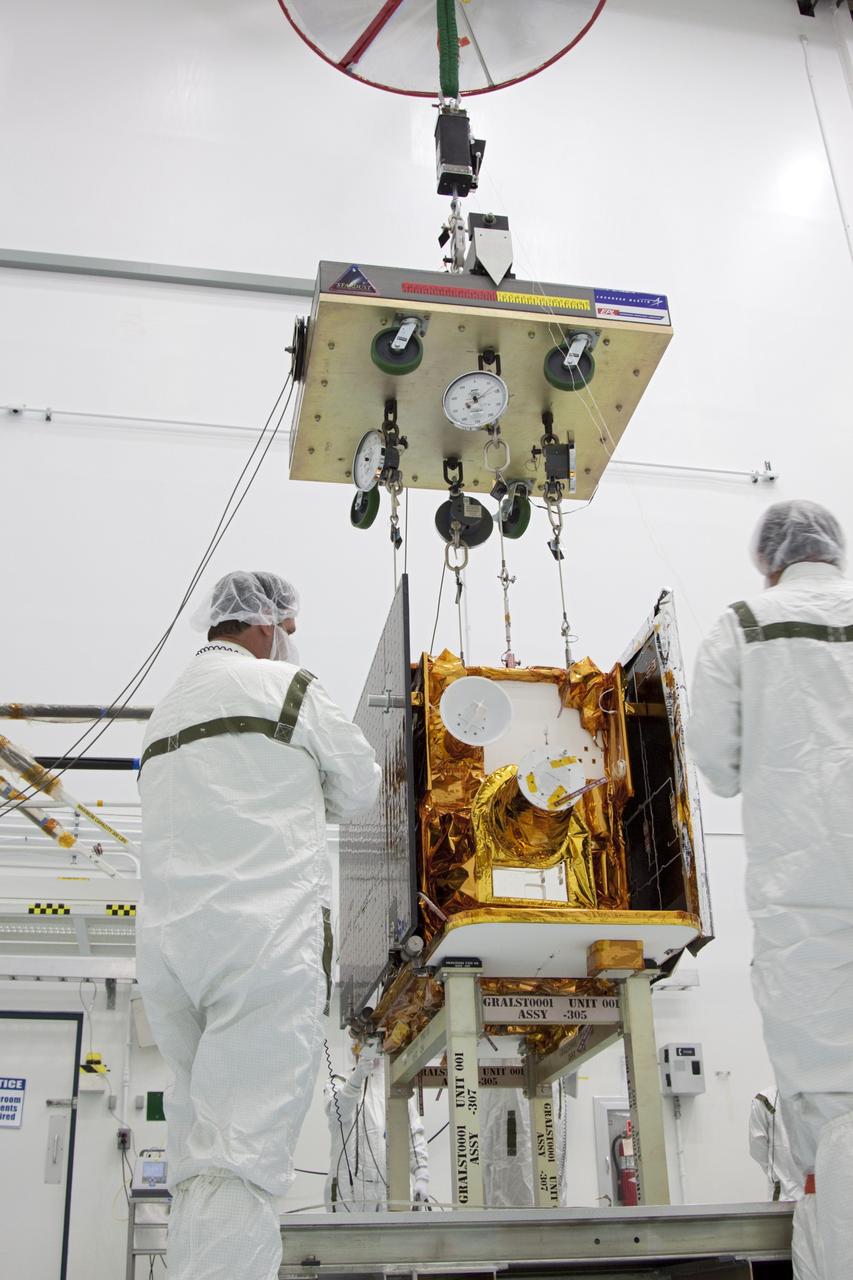
CAPE CANAVERAL, Fla. -- At Astrotech Space Operation's payload processing facility in Titusville, Fla., a lifting device is attached to NASA's Gravity Recovery and Interior Laboratory-A (GRAIL-A) lunar probe to move it from its workstand. After the twin GRAIL spacecraft are attached to the adapter ring in their side-by-side launch configuration, they will be transported to the launch pad. GRAIL will fly in tandem orbits around the moon for several months to measure its gravity field. GRAIL's primary science objectives are to determine the structure of the lunar interior, from crust to core, and to advance understanding of the thermal evolution of the moon. Launch aboard a United Launch Alliance Delta II rocket from Space Launch Complex 17B on Cape Canaveral Air Force Station is scheduled for Sept. 8. For more information, visit http://www.nasa.gov/grail. Photo credit: NASA/Jim Grossmann
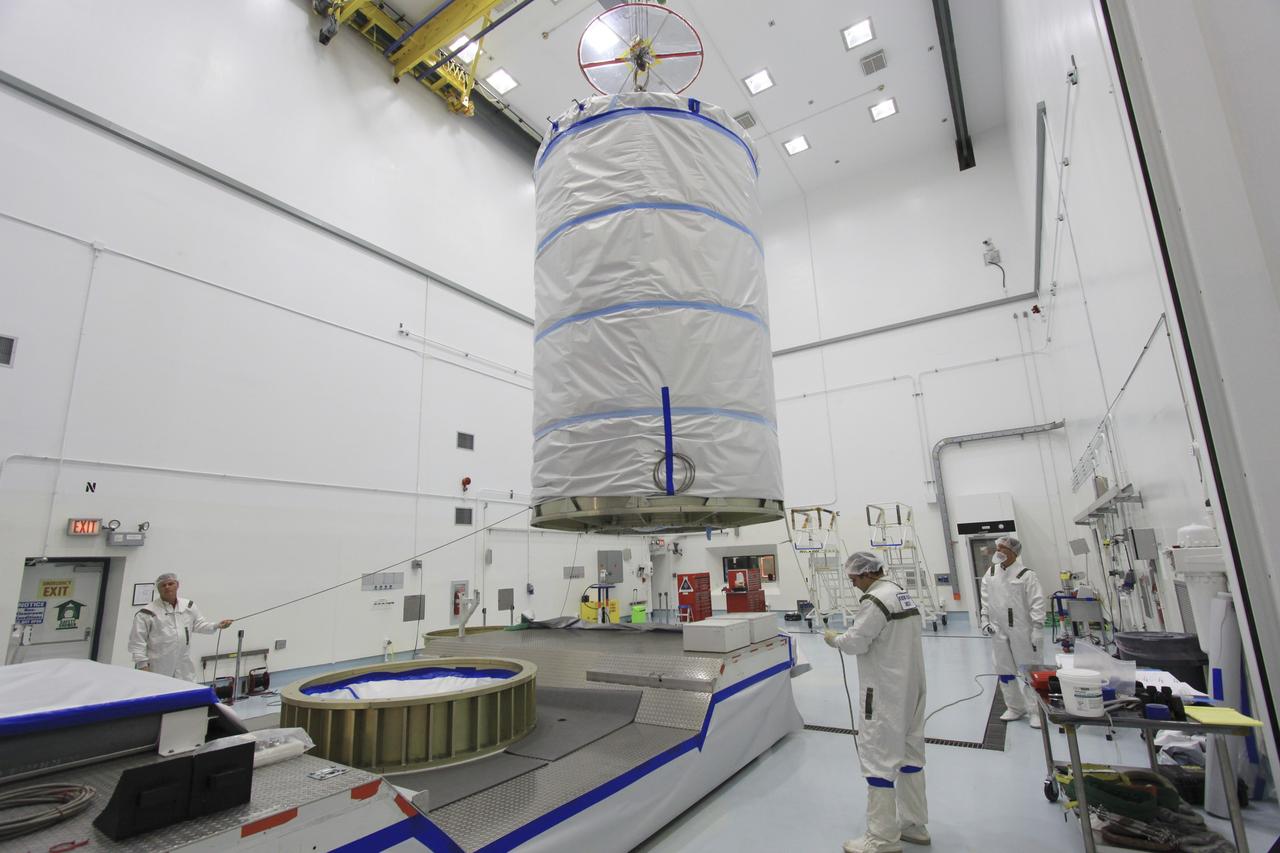
CAPE CANAVERAL, Fla. -- At Astrotech Space Operation's payload processing facility in Titusville, Fla., a protective canister enclosing NASA's twin Gravity Recovery and Interior Laboratory spacecraft is lifted toward a transportation pallet. Preparations are under way to move the lunar probes, attached to a spacecraft adapter ring in their side-by-side launch configuration, to the launch pad. The spacecraft will fly in tandem orbits around the moon for several months to measure its gravity field. GRAIL's primary science objectives are to determine the structure of the lunar interior, from crust to core, and to advance understanding of the thermal evolution of the moon. Launch aboard a United Launch Alliance Delta II rocket from Space Launch Complex 17B on Cape Canaveral Air Force Station is scheduled for Sept. 8. For more information, visit http://www.nasa.gov/grail. Photo credit: NASA/Jim Grossmann
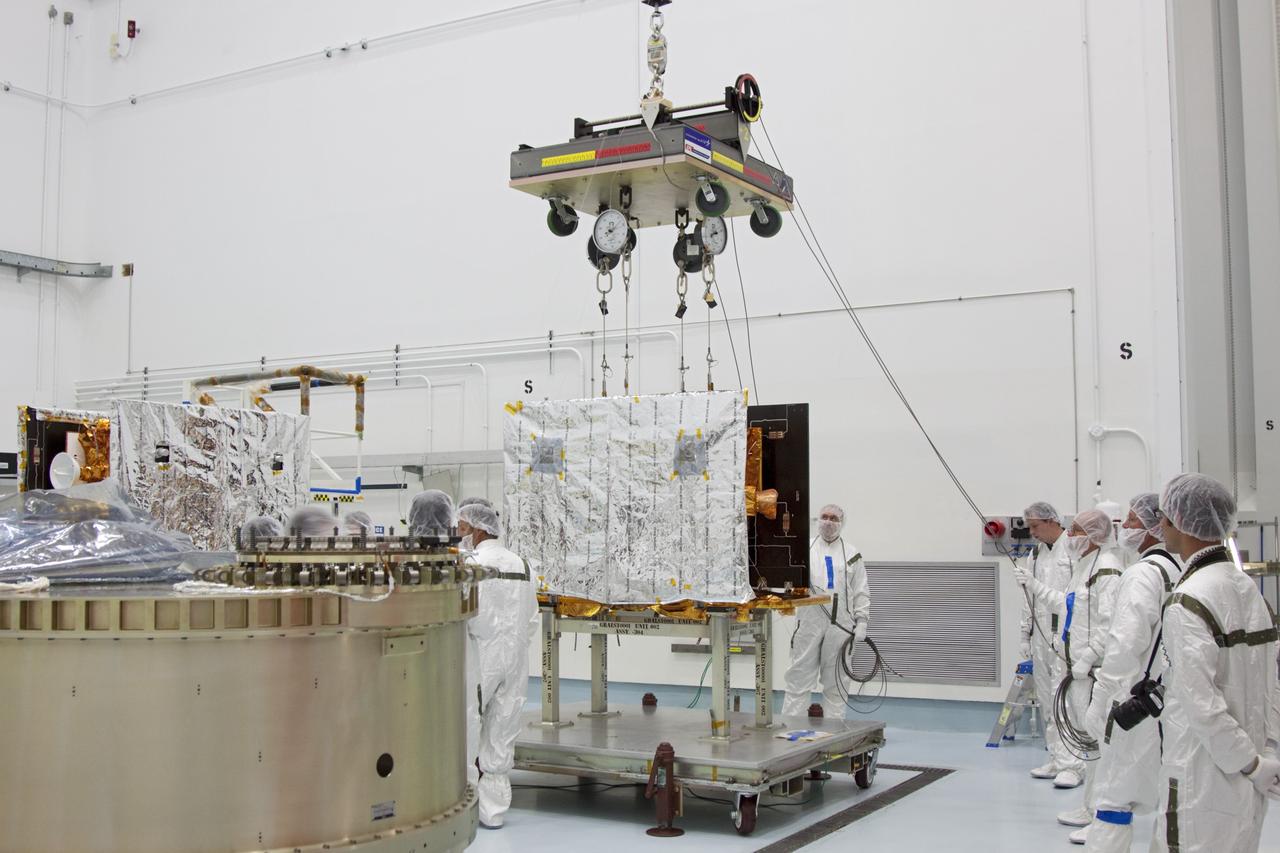
CAPE CANAVERAL, Fla. -- At Astrotech Space Operation's payload processing facility in Titusville, Fla., a lifting device is lowered toward NASA's Gravity Recovery and Interior Laboratory-B (GRAIL-B) lunar probe. At left is GRAIL-A. After the twin GRAIL spacecraft are attached to the spacecraft adapter ring in their side-by-side launch configuration, they will be transported to the launch pad. GRAIL will fly in tandem orbits around the moon for several months to measure its gravity field. GRAIL's primary science objectives are to determine the structure of the lunar interior, from crust to core, and to advance understanding of the thermal evolution of the moon. Launch aboard a United Launch Alliance Delta II rocket from Space Launch Complex 17B on Cape Canaveral Air Force Station is scheduled for Sept. 8. For more information, visit http://www.nasa.gov/grail. Photo credit: NASA/Jim Grossmann
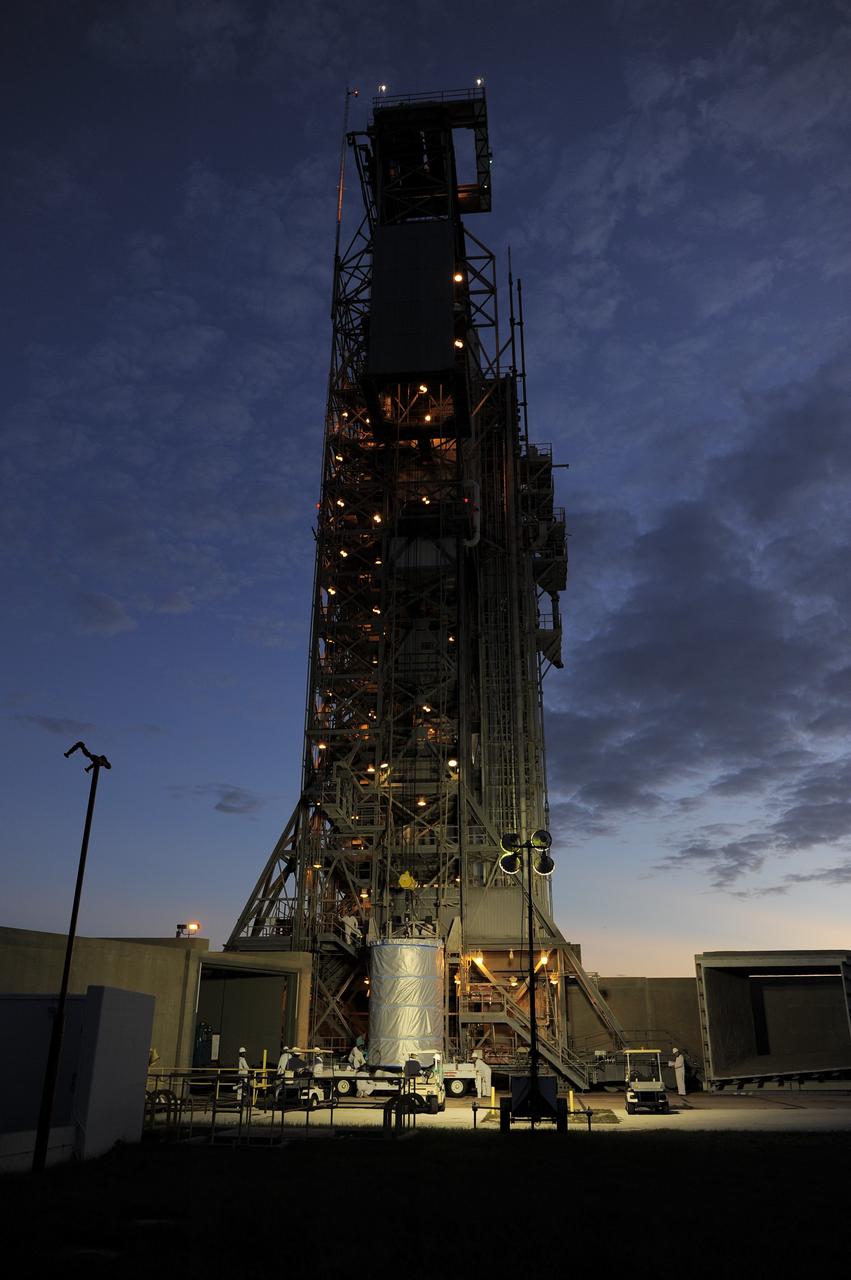
CAPE CANAVERAL, Fla. -- NASA's twin Gravity Recovery and Interior Laboratory (GRAIL) spacecraft are lifted to the top of their launch pad at Space Launch Complex 17B at Cape Canaveral Air Force Station in Florida. The lunar probes are attached to a spacecraft adapter ring in their side-by-side launch configuration and wrapped in plastic to prevent contamination outside the clean room in the Astrotech Space Operation's payload processing facility in Titusville, Fla. The spacecraft will fly in tandem orbits around the moon for several months to measure its gravity field. GRAIL's primary science objectives are to determine the structure of the lunar interior, from crust to core, and to advance understanding of the thermal evolution of the moon. Launch aboard a United Launch Alliance Delta II rocket is scheduled for Sept. 8. For more information, visit www.nasa.gov/grail. Photo credit: NASA/Kim Shiflett
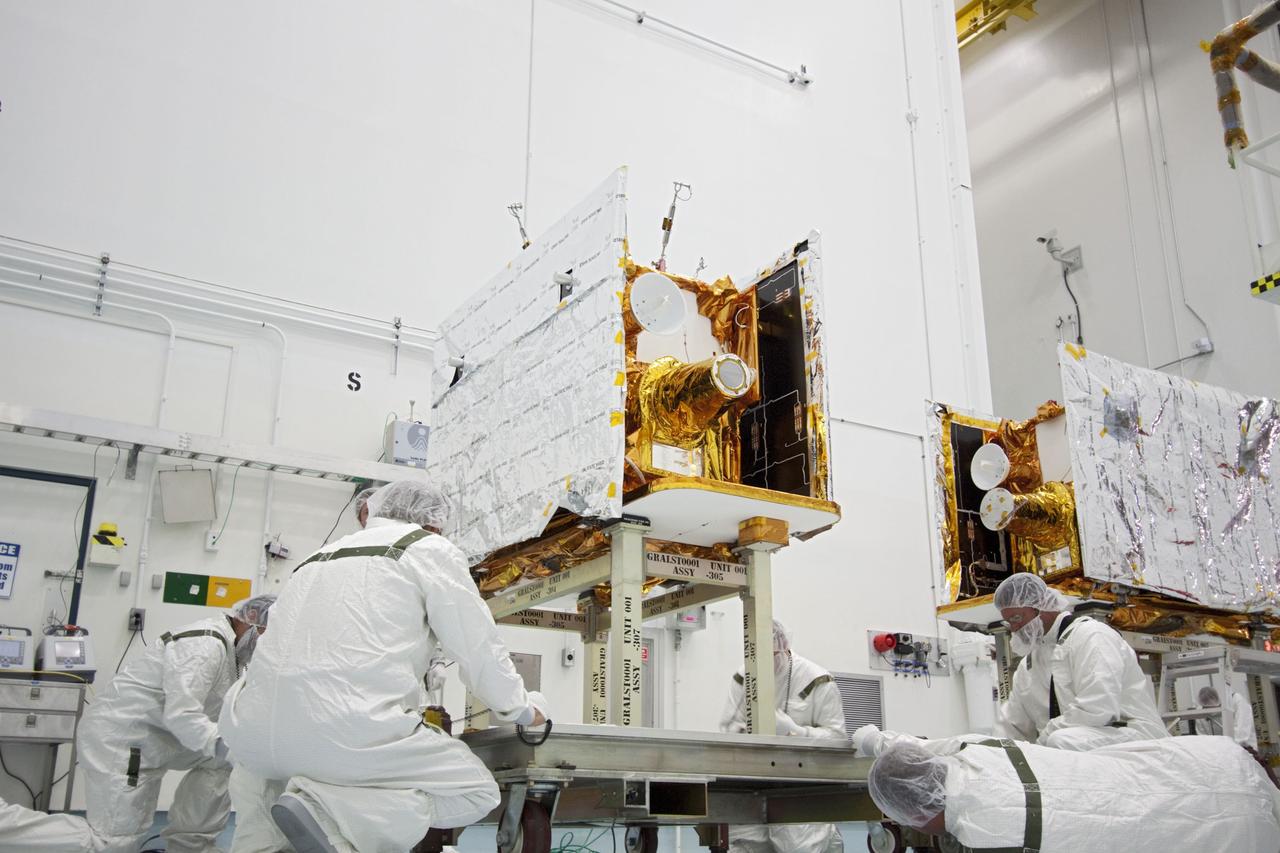
CAPE CANAVERAL, Fla. -- At Astrotech Space Operation's payload processing facility in Titusville, Fla., preparations are under way to stack NASA's twin Gravity Recovery and Interior Laboratory lunar spacecraft in their launch configuration on the spacecraft adapter ring for transport to the launch pad. GRAIL will fly in tandem orbits around the moon for several months to measure its gravity field. GRAIL's primary science objectives are to determine the structure of the lunar interior, from crust to core, and to advance understanding of the thermal evolution of the moon. Launch aboard a United Launch Alliance Delta II rocket from Space Launch Complex 17B on Cape Canaveral Air Force Station is scheduled for Sept. 8. For more information, visit http://www.nasa.gov/grail. Photo credit: NASA/Jim Grossmann
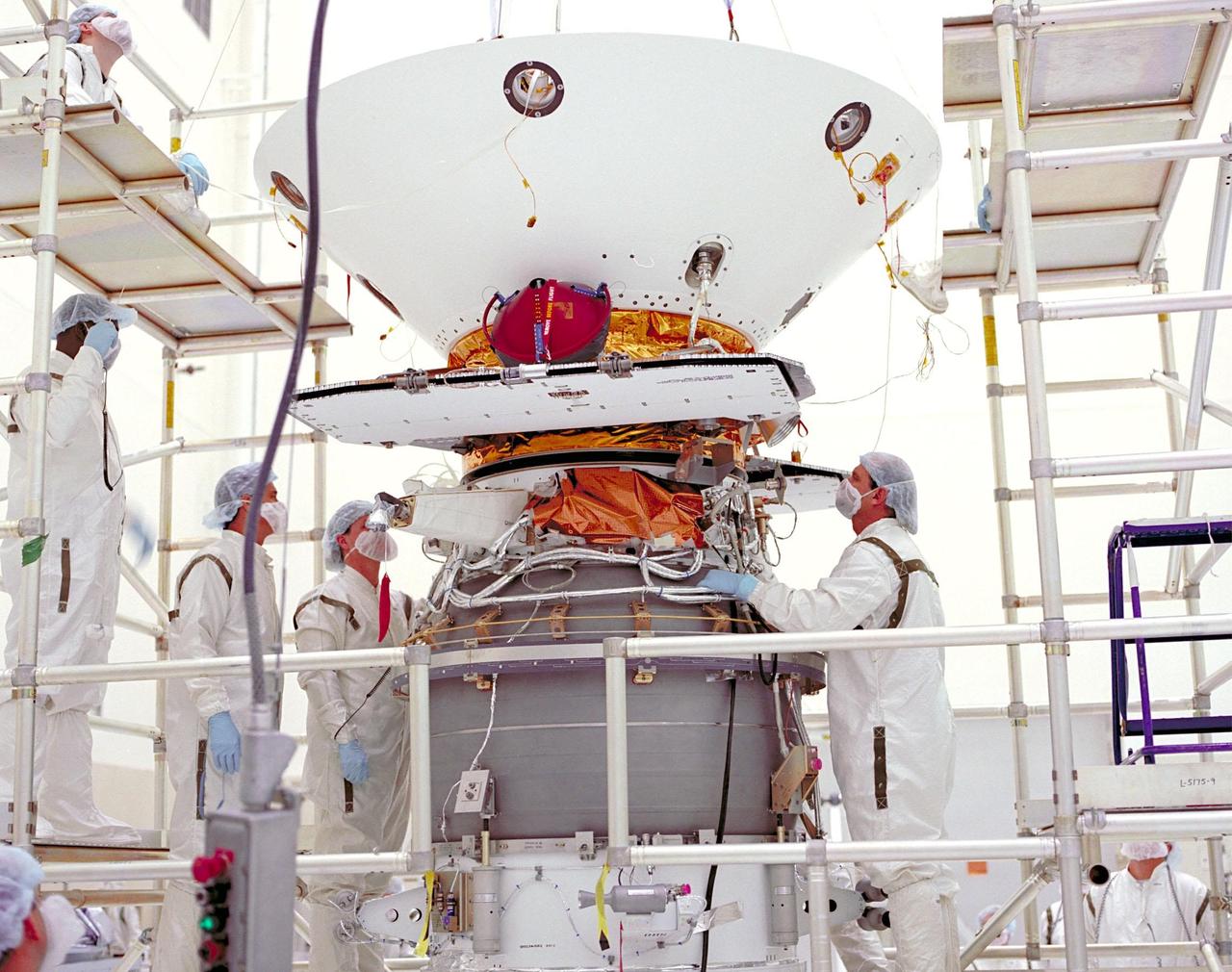
KENNEDY SPACE CENTER, FLA. -- In the Spacecraft Assembly and Encapsulation Facility-2 (SAEF-2), workers mate the Mars Polar Lander to the third stage of the Boeing Delta II rocket before it is transported to Launch Pad 17B, Cape Canaveral Air Station. The lander, which will be launched on Jan. 3, 1999, is a solar-powered spacecraft designed to touch down on the Martian surface near the northern-most boundary of the south pole in order to study the water cycle there. The lander also will help scientists learn more about climate change and current resources on Mars, studying such things as frost, dust, water vapor and condensates in the Martian atmosphere. It is the second spacecraft to be launched in a pair of Mars '98 missions. The first is the Mars Climate Orbiter, which was launched aboard a Delta II rocket from Launch Complex 17A on Dec. 11, 1998
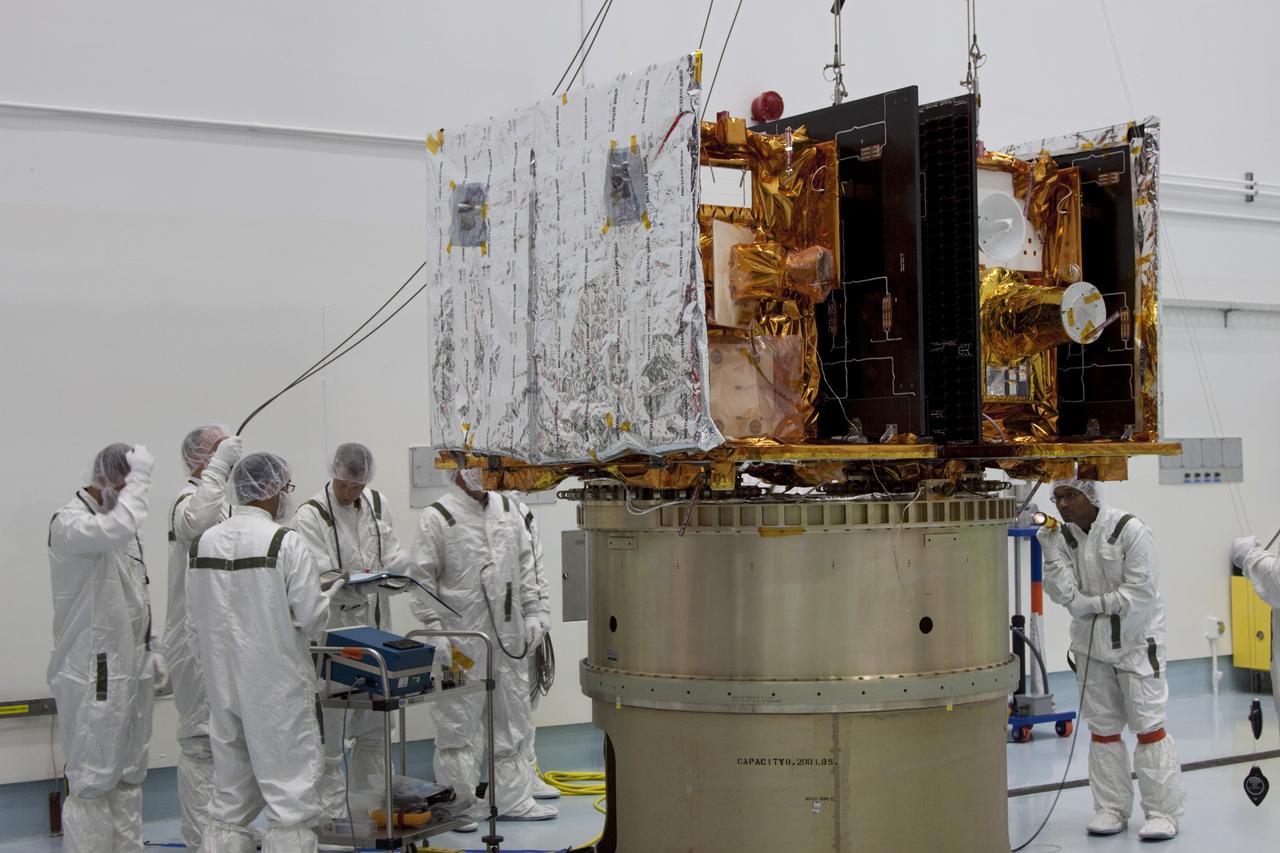
CAPE CANAVERAL, Fla. -- At Astrotech Space Operation's payload processing facility in Titusville, Fla., Lockheed Martin technicians verify that NASA's Gravity Recovery and Interior Laboratory-A (GRAIL-A) lunar probe is in position and ready to be secured to the spacecraft adapter ring. GRAIL-B is secured to the ring, at left. After the twin GRAIL spacecraft are attached to the adapter ring in their side-by-side launch configuration, they will be transported to the launch pad. GRAIL will fly in tandem orbits around the moon for several months to measure its gravity field. GRAIL's primary science objectives are to determine the structure of the lunar interior, from crust to core, and to advance understanding of the thermal evolution of the moon. Launch aboard a United Launch Alliance Delta II rocket from Space Launch Complex 17B on Cape Canaveral Air Force Station is scheduled for Sept. 8. For more information, visit http://www.nasa.gov/grail. Photo credit: NASA/Jim Grossmann
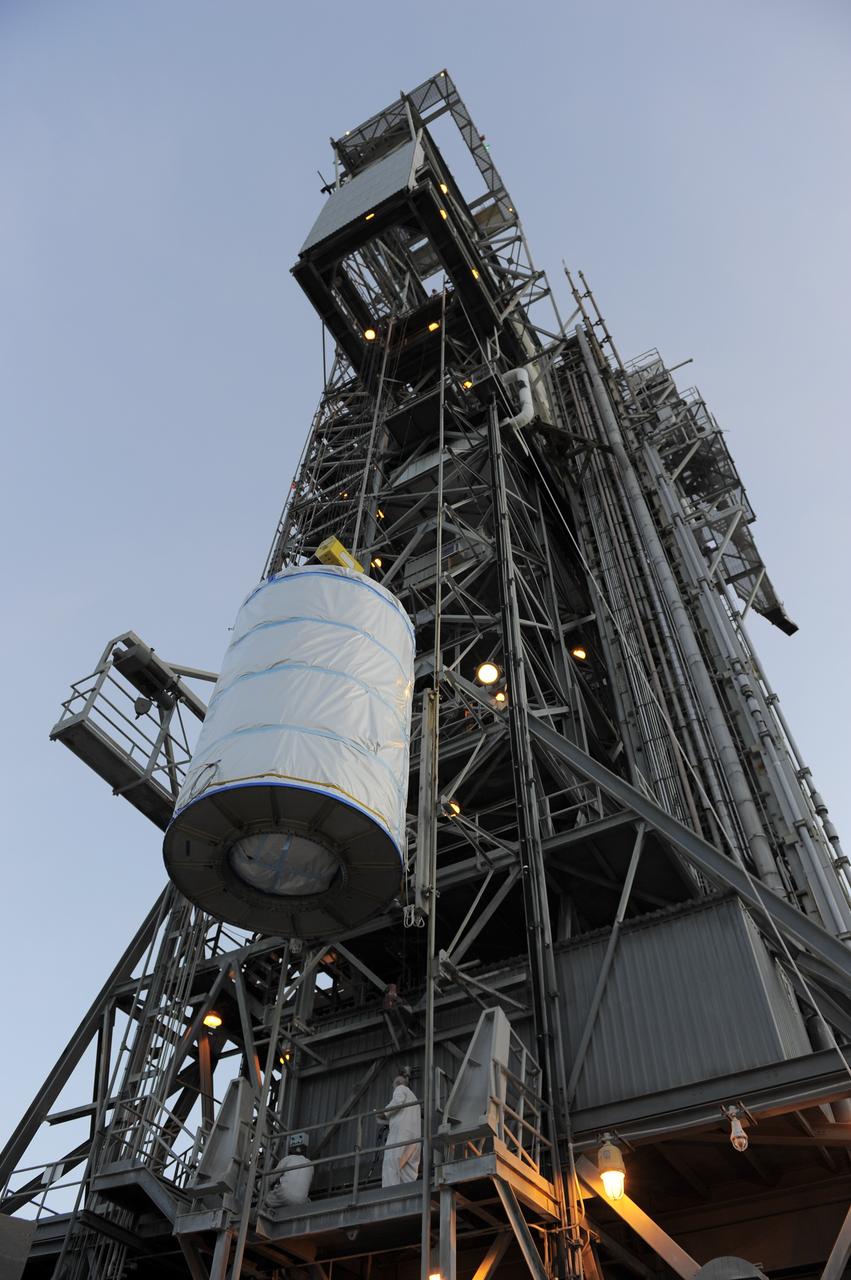
CAPE CANAVERAL, Fla. -- NASA's twin Gravity Recovery and Interior Laboratory (GRAIL) spacecraft are lifted to the top of their launch pad at Space Launch Complex 17B at Cape Canaveral Air Force Station in Florida. The lunar probes are attached to a spacecraft adapter ring in their side-by-side launch configuration and wrapped in plastic to prevent contamination outside the clean room in the Astrotech Space Operation's payload processing facility in Titusville, Fla. The spacecraft will fly in tandem orbits around the moon for several months to measure its gravity field. GRAIL's primary science objectives are to determine the structure of the lunar interior, from crust to core, and to advance understanding of the thermal evolution of the moon. Launch aboard a United Launch Alliance Delta II rocket is scheduled for Sept. 8. For more information, visit www.nasa.gov/grail. Photo credit: NASA/Kim Shiflett
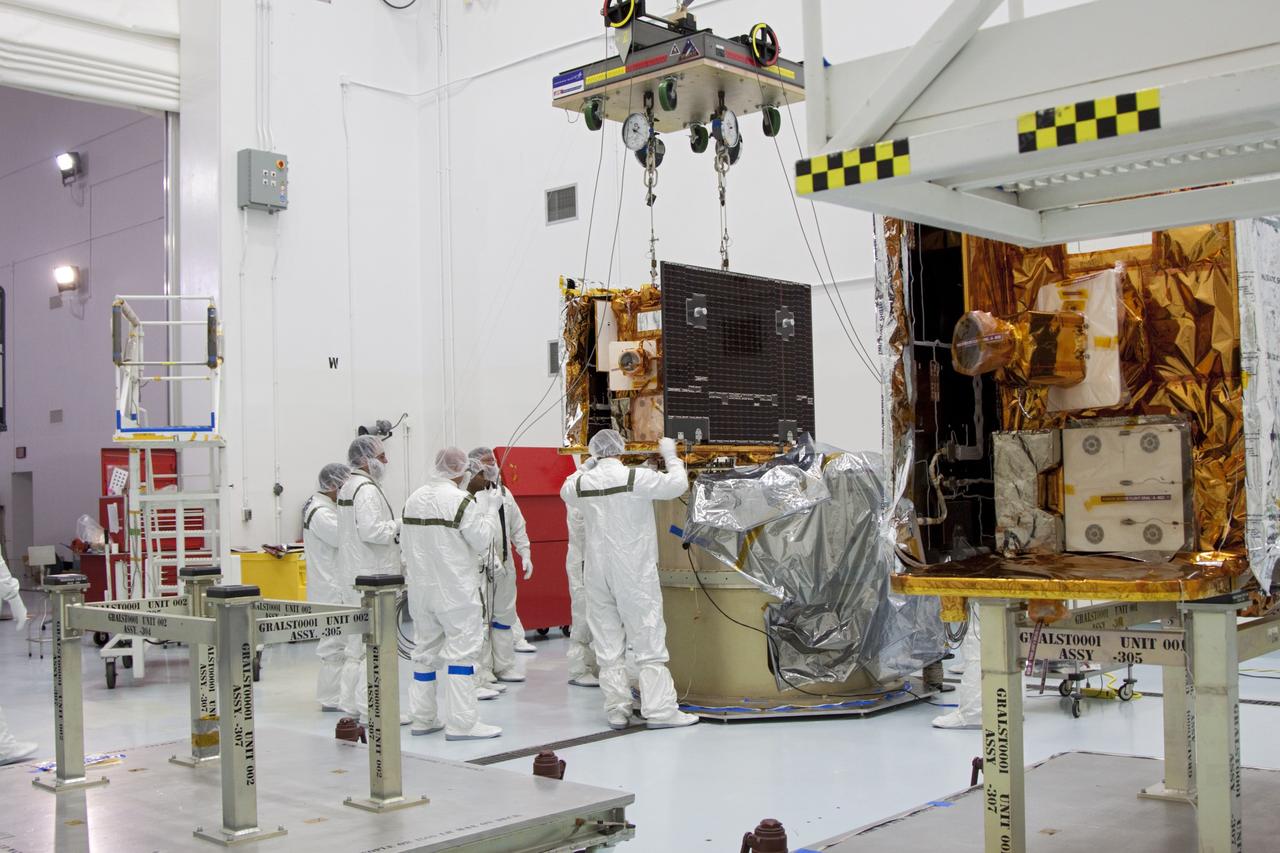
CAPE CANAVERAL, Fla. -- At Astrotech Space Operation's payload processing facility in Titusville, Fla., NASA's Gravity Recovery and Interior Laboratory-B (GRAIL-B) lunar probe comes to rest on the spacecraft adapter ring. At right is GRAIL-A. After the twin GRAIL spacecraft are attached to the adapter ring in their side-by-side launch configuration, they will be transported to the launch pad. GRAIL will fly in tandem orbits around the moon for several months to measure its gravity field. GRAIL's primary science objectives are to determine the structure of the lunar interior, from crust to core, and to advance understanding of the thermal evolution of the moon. Launch aboard a United Launch Alliance Delta II rocket from Space Launch Complex 17B on Cape Canaveral Air Force Station is scheduled for Sept. 8. For more information, visit http://www.nasa.gov/grail. Photo credit: NASA/Jim Grossmann
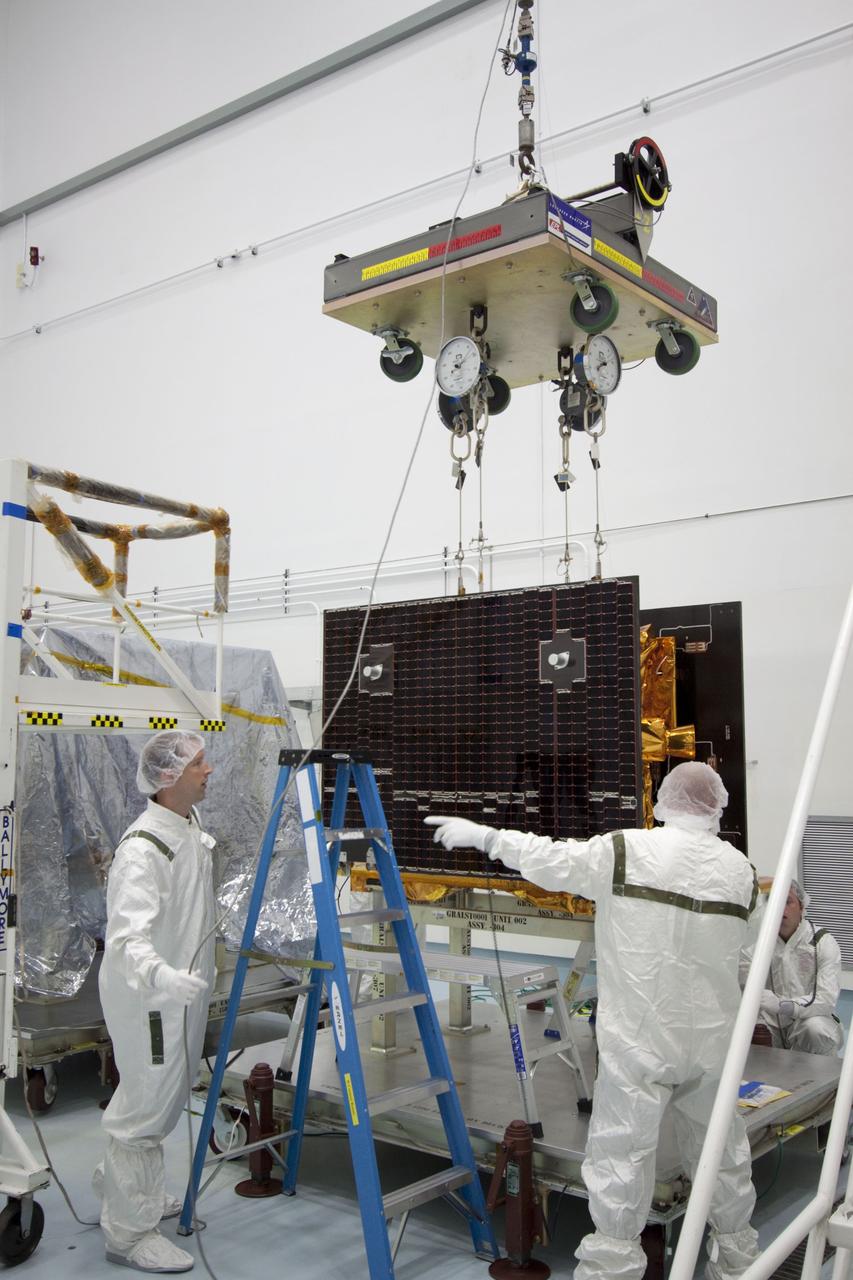
CAPE CANAVERAL, Fla. -- At Astrotech Space Operation's payload processing facility in Titusville, Fla., Lockheed Martin technicians move a portable scale toward one of NASA's twin Gravity Recovery and Interior Laboratory lunar spacecraft. The spacecraft will be lifted and weighed before they are stacked in their launch configuration in preparation for transport to the launch pad. GRAIL will fly in tandem orbits around the moon for several months to measure its gravity field. GRAIL's primary science objectives are to determine the structure of the lunar interior, from crust to core, and to advance understanding of the thermal evolution of the moon. Launch aboard a United Launch Alliance Delta II rocket from Space Launch Complex 17B on Cape Canaveral Air Force Station is scheduled for Sept. 8. For more information, visit http://www.nasa.gov/grail. Photo credit: NASA/Jim Grossmann
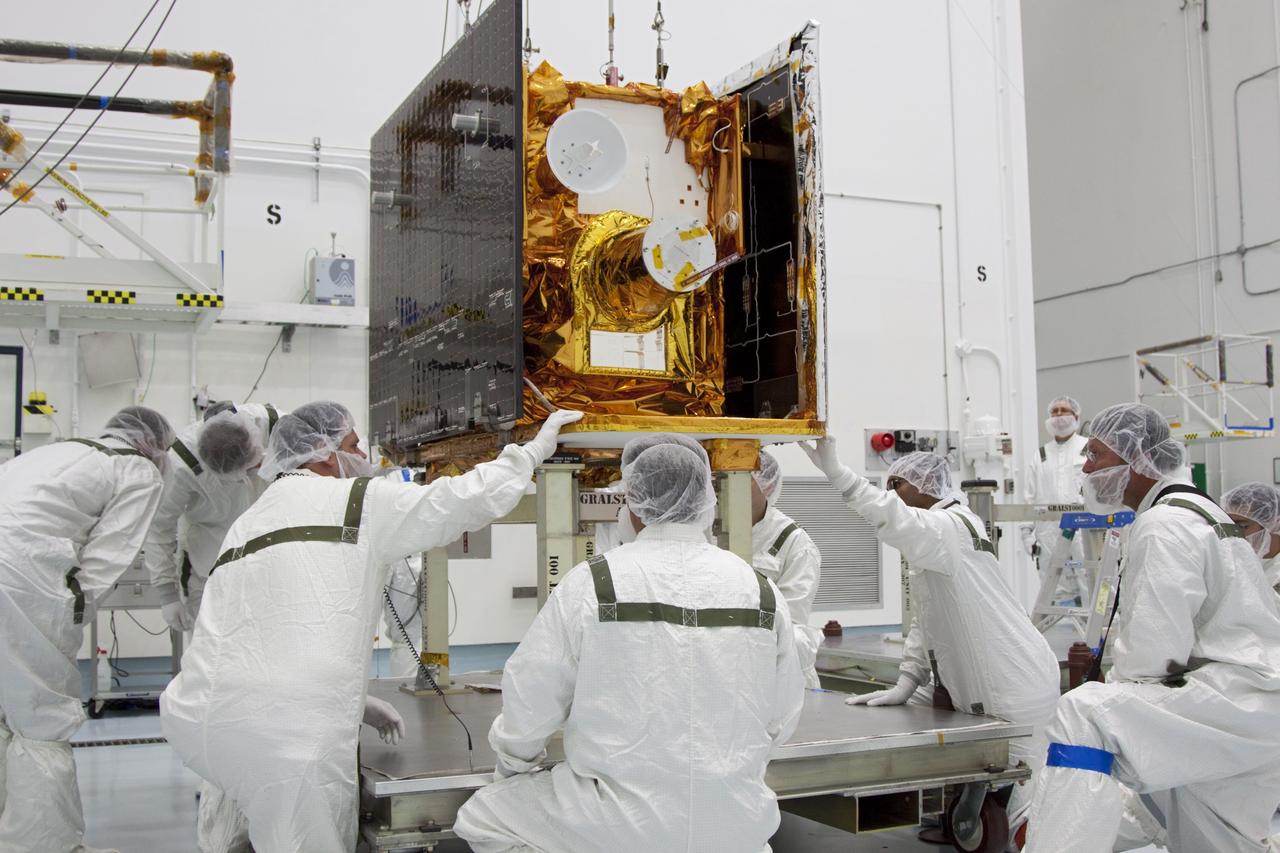
CAPE CANAVERAL, Fla. -- At Astrotech Space Operation's payload processing facility in Titusville, Fla., Lockheed Martin technicians verify that NASA's Gravity Recovery and Interior Laboratory-A (GRAIL-A) lunar probe is lifted carefully from its workstand. After the twin GRAIL spacecraft are attached to the adapter ring in their side-by-side launch configuration, they will be transported to the launch pad. GRAIL will fly in tandem orbits around the moon for several months to measure its gravity field. GRAIL's primary science objectives are to determine the structure of the lunar interior, from crust to core, and to advance understanding of the thermal evolution of the moon. Launch aboard a United Launch Alliance Delta II rocket from Space Launch Complex 17B on Cape Canaveral Air Force Station is scheduled for Sept. 8. For more information, visit http://www.nasa.gov/grail. Photo credit: NASA/Jim Grossmann