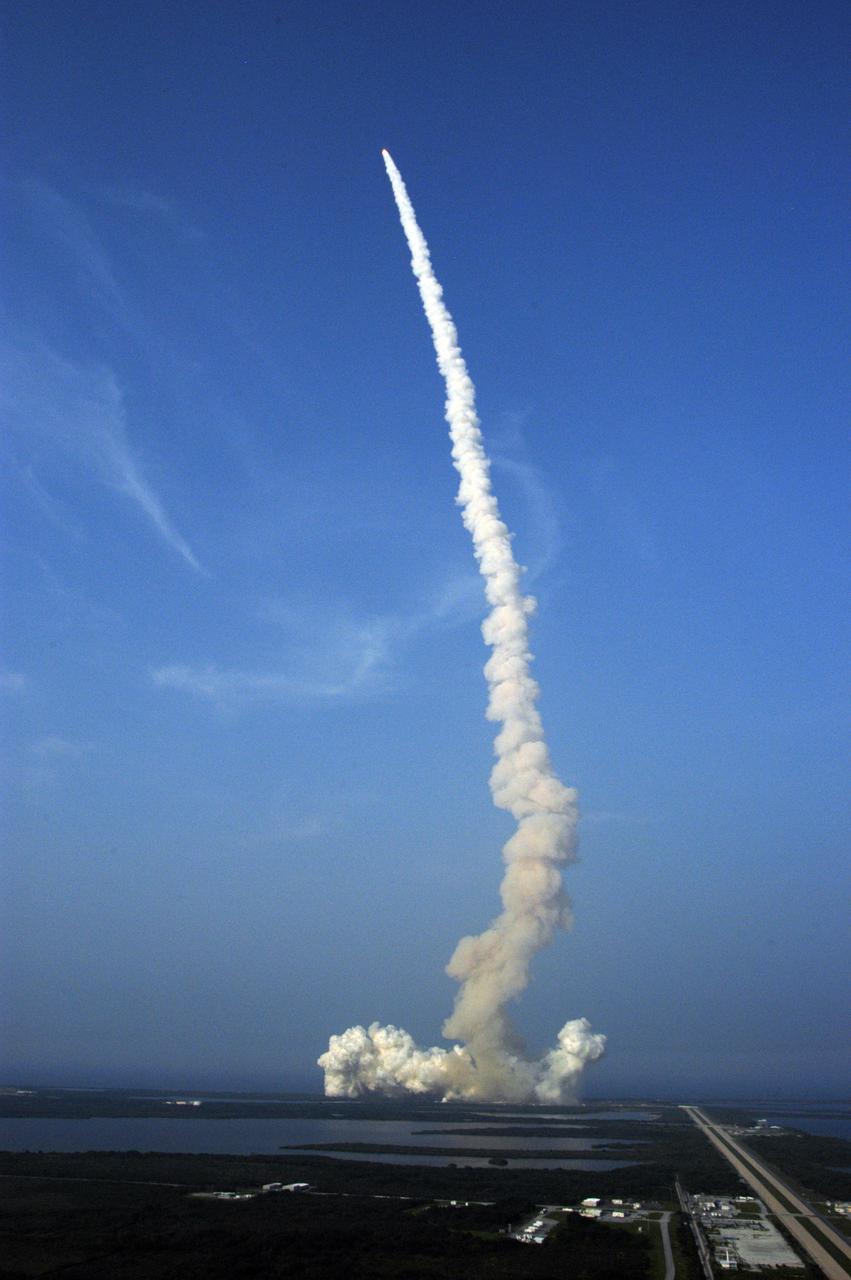
Space Shuttle Endeavour paints the still-blue evening sky as it leaves Earth behind on its journey into space on mission STS-118. Liftoff from Launch Pad 39A was on time at 6:36 p.m. EDT. The mission is the 22nd shuttle flight to the International Space Station. It will continue space station construction by delivering a third starboard truss segment, S5, and other payloads such as the SPACEHAB module and the external stowage platform 3. The 11-day mission may be extended to as many as 14 depending on the test of the Station-to-Shuttle Power Transfer System that will allow the docked shuttle to draw electrical power from the station and extend its visits to the orbiting lab.
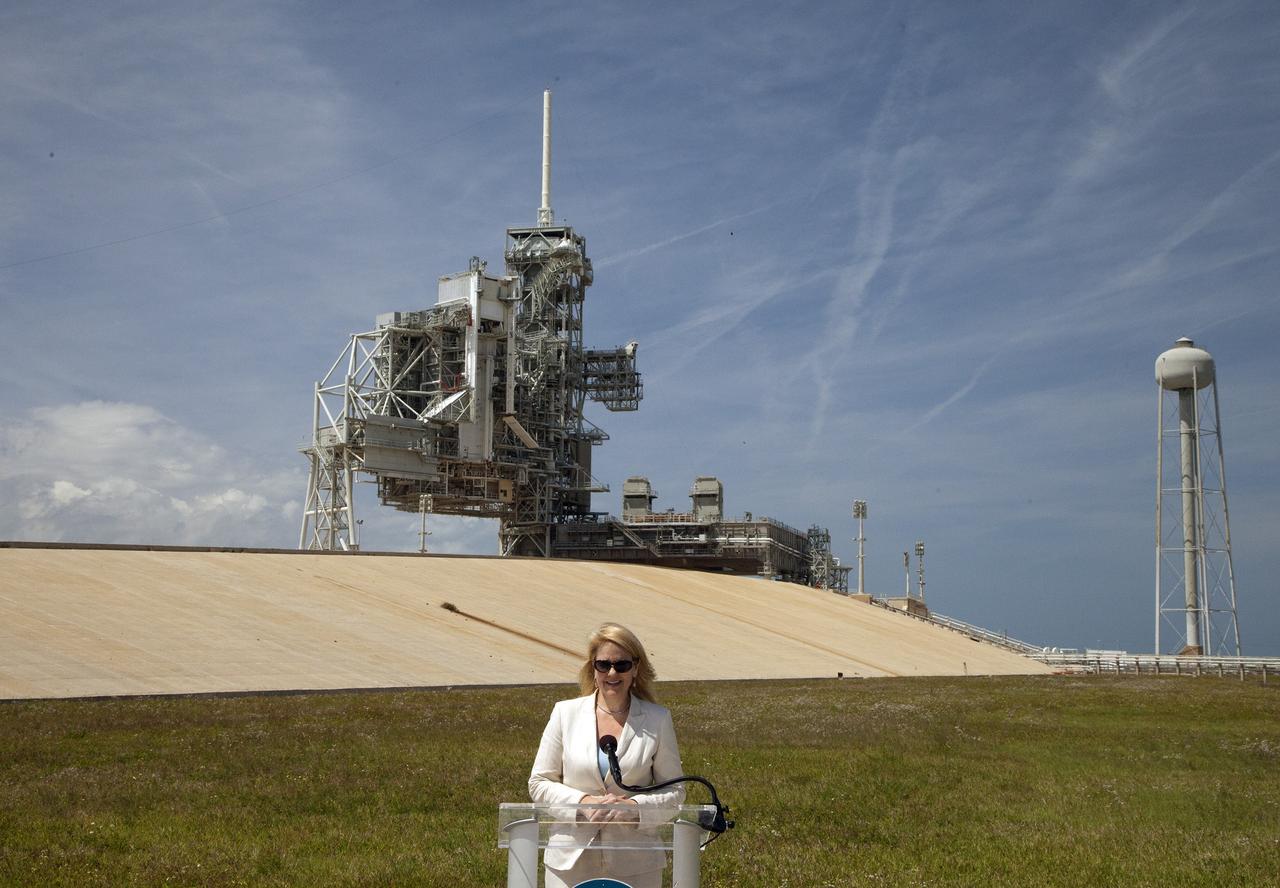
CAPE CANAVERAL, Fla. -- At Kennedy Space Center's Launch Pad 39A, Gwynne Shotwell, president and chief operating officer of Space Exploration Technologies SpaceX of Hawthorne, Calif., announces that NASA has just signed a lease agreement with SpaceX for use and operation of Launch Complex 39A. SpaceX will use Launch Complex 39A for rockets such as the Falcon Heavy, currently under development. Both launch pad 39A and 39B were originally built for the Apollo/Saturn V rockets that launched American astronauts on their historic journeys to the moon and later modified to support the 30-year shuttle program. Pad 39B is now being modified by NASA to support the Space Launch System SLS rocket boosting the Orion spacecraft part of the agency’s plan to explore beyond low-Earth orbit. To learn more about Launch Pad 39A visit: http://www.nasa.gov/mission_pages/shuttle/launch/launch-complex39-toc.html Photo credit: NASA/Dan Casper
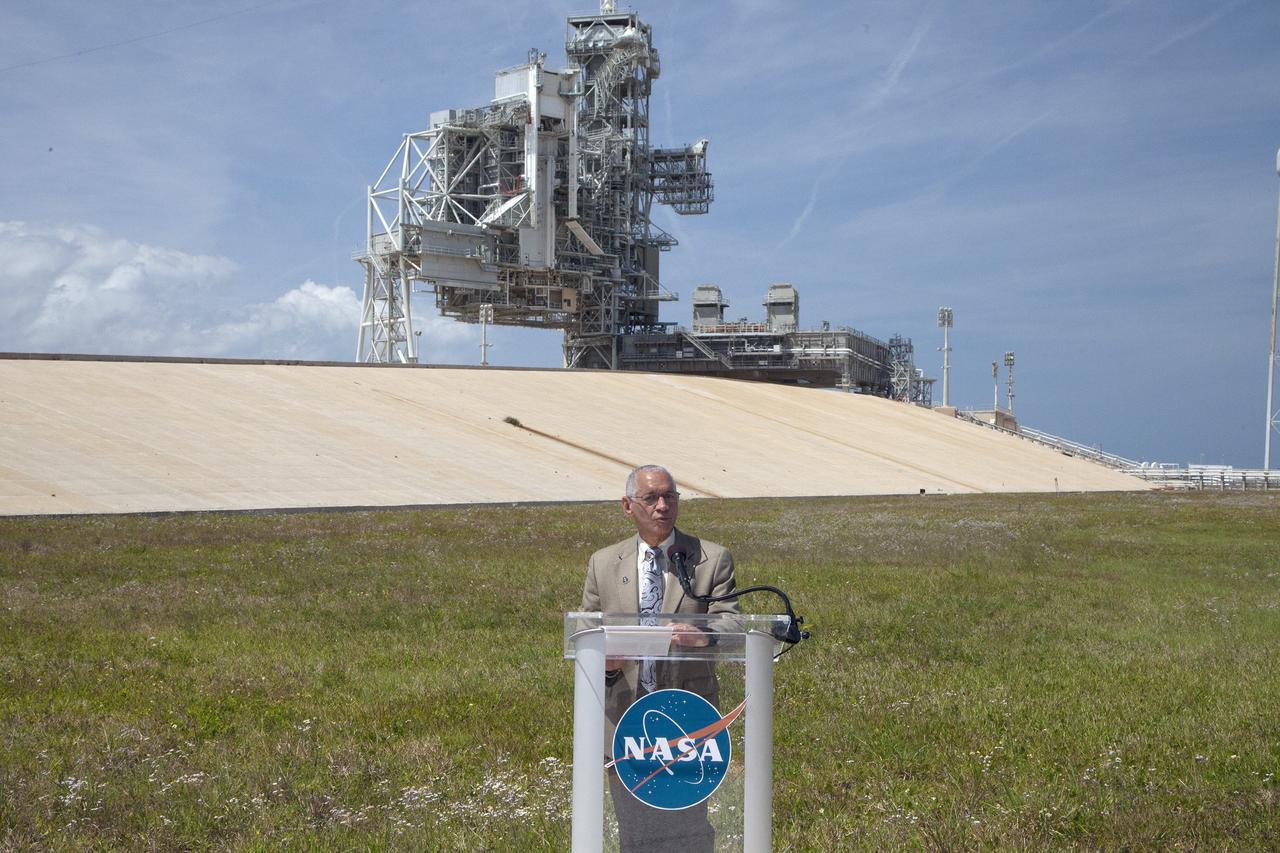
CAPE CANAVERAL, Fla. -- At Kennedy Space Center Launch Pad 39A, NASA Administrator Charlie Bolden announces that NASA has just signed a lease agreement with Space Exploration Technologies SpaceX of Hawthorne, Calif., for use and operation of Launch Complex 39A. SpaceX will use Launch Complex 39A for rockets such as the Falcon Heavy, currently under development. Both launch pad 39A and 39B were originally built for the Apollo/Saturn V rockets that launched American astronauts on their historic journeys to the moon and later modified to support the 30-year shuttle program. Pad 39B is now being modified by NASA to support the Space Launch System SLS rocket boosting the Orion spacecraft part of the agency’s plan to explore beyond low-Earth orbit. To learn more about Launch Pad 39A visit: http://www.nasa.gov/mission_pages/shuttle/launch/launch-complex39-toc.html Photo credit: NASA/Dan Casper
CAPE CANAVERAL, Fla. -- At Kennedy Space Center Launch Pad 39A, NASA Administrator Charlie Bolden announces that NASA has just signed a lease agreement with Space Exploration Technologies SpaceX of Hawthorne, Calif., for use and operation of Launch Complex 39A. SpaceX will use Launch Complex 39A for rockets such as the Falcon Heavy, currently under development. Both launch pad 39A and 39B were originally built for the Apollo/Saturn V rockets that launched American astronauts on their historic journeys to the moon and later modified to support the 30-year shuttle program. Pad 39B is now being modified by NASA to support the Space Launch System SLS rocket boosting the Orion spacecraft part of the agency’s plan to explore beyond low-Earth orbit. To learn more about Launch Pad 39A visit: http://www.nasa.gov/mission_pages/shuttle/launch/launch-complex39-toc.html Photo credit: NASA/Dan Casper
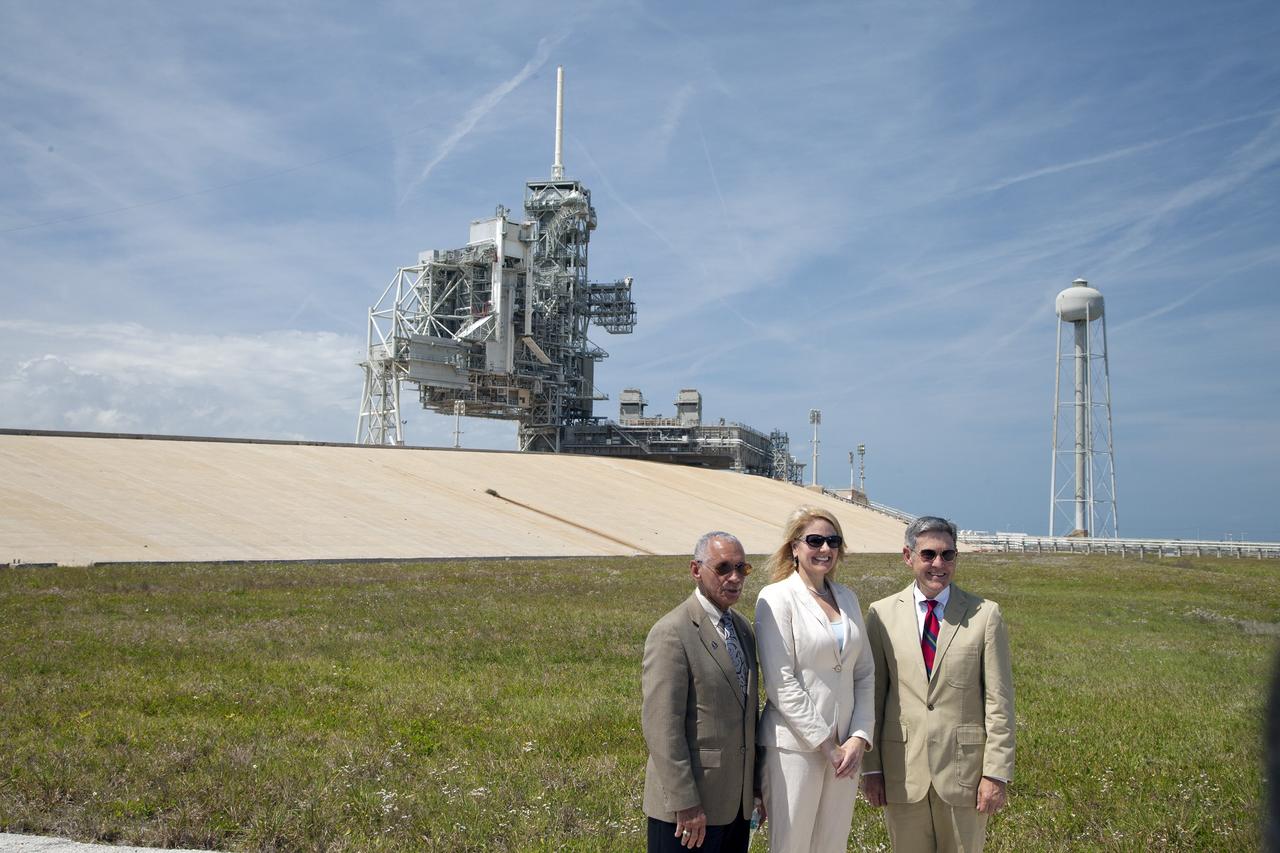
CAPE CANAVERAL, Fla. -- At Kennedy Space Center's Launch Pad 39A, from the left, NASA Administrator Charlie Bolden, Gwynne Shotwell, president and chief operating officer of Space Exploration Technologies SpaceX and Kennedy Space Center Director Bob Cabana pose in from the of the historic launch complex after announcing that NASA has just signed a lease agreement with SpaceX for use and operation of Launch Complex 39A. SpaceX will use Launch Complex 39A for rockets such as the Falcon Heavy, currently under development. Both launch pad 39A and 39B were originally built for the Apollo/Saturn V rockets that launched American astronauts on their historic journeys to the moon and later modified to support the 30-year shuttle program. Pad 39B is now being modified by NASA to support the Space Launch System SLS rocket boosting the Orion spacecraft part of the agency’s plan to explore beyond low-Earth orbit. To learn more about Launch Pad 39A visit: http://www.nasa.gov/mission_pages/shuttle/launch/launch-complex39-toc.html Photo credit: NASA/Dan Casper
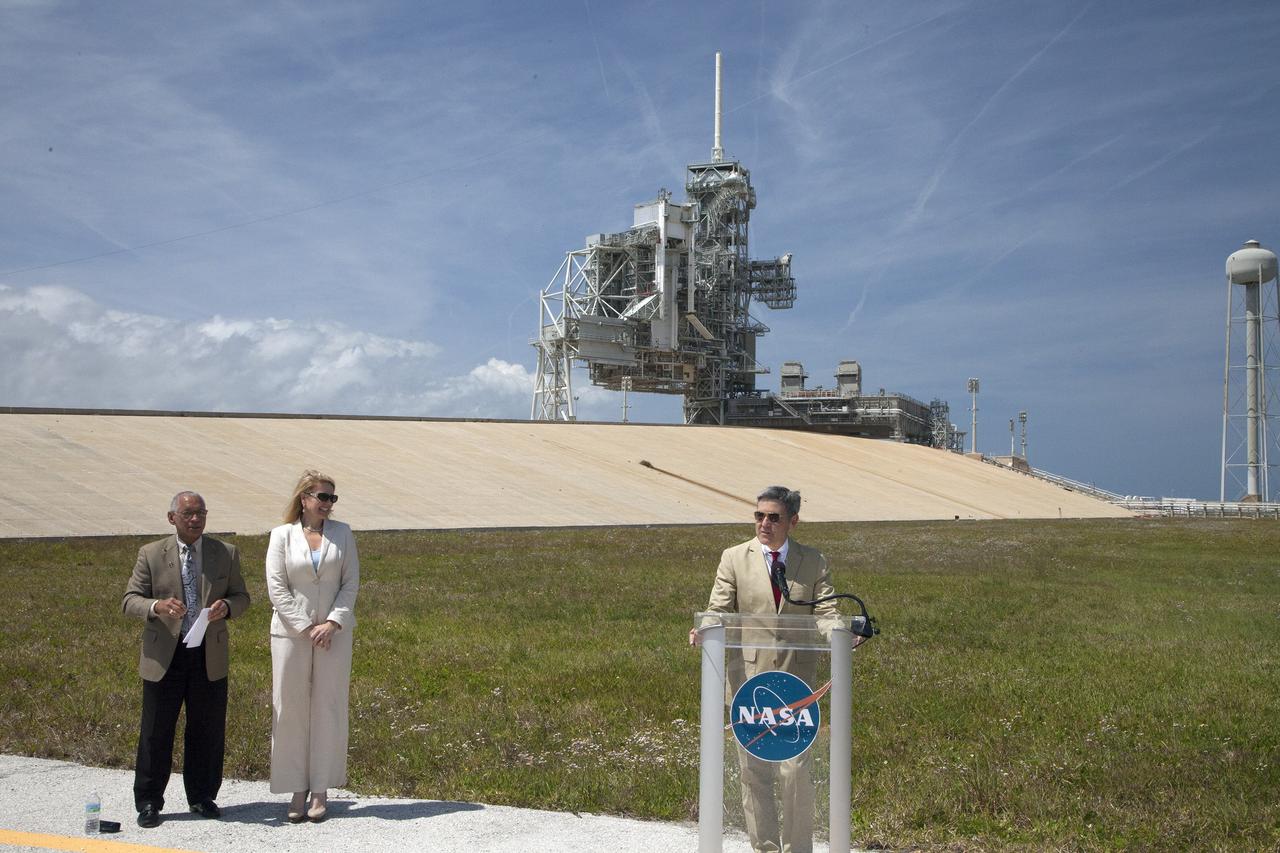
CAPE CANAVERAL, Fla. -- At Kennedy Space Center's Launch Pad 39A, center director Bob Cabana announces that NASA has just signed a lease agreement with Space Exploration Technologies SpaceX of Hawthorne, Calif., for use and operation of Launch Complex 39A. NASA Administrator Charlie Bolden, left, and Gwynne Shotwell, president and chief operating officer of SpaceX, look on. SpaceX will use Launch Complex 39A for rockets such as the Falcon Heavy, currently under development. Both launch pad 39A and 39B were originally built for the Apollo/Saturn V rockets that launched American astronauts on their historic journeys to the moon and later modified to support the 30-year shuttle program. Pad 39B is now being modified by NASA to support the Space Launch System SLS rocket boosting the Orion spacecraft part of the agency’s plan to explore beyond low-Earth orbit. To learn more about Launch Pad 39A visit: http://www.nasa.gov/mission_pages/shuttle/launch/launch-complex39-toc.html Photo credit: NASA/Dan Casper
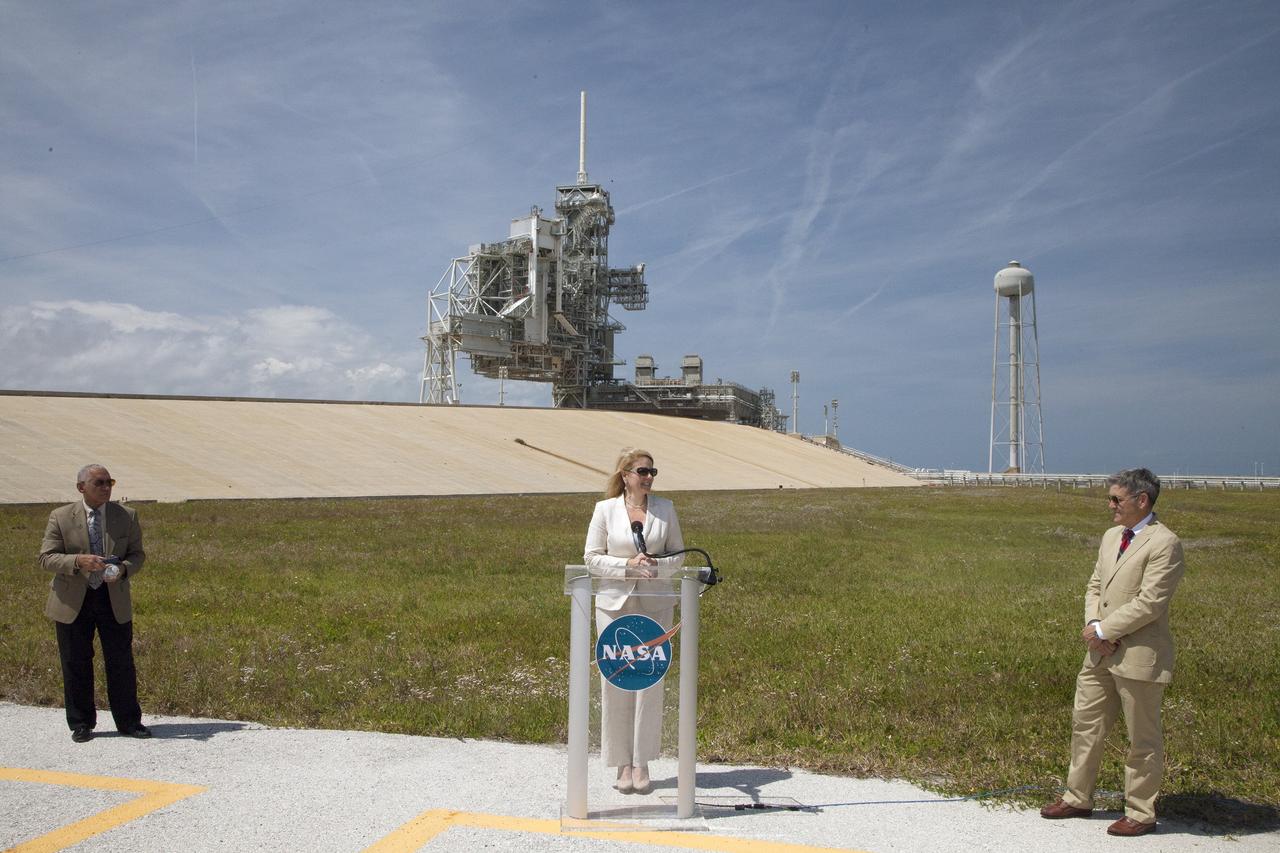
CAPE CANAVERAL, Fla. -- At Kennedy Space Center's Launch Pad 39A, Gwynne Shotwell, president and chief operating officer of Space Exploration Technologies SpaceX of Hawthorne, Calif., announces that NASA has just signed a lease agreement with SpaceX for use and operation of Launch Complex 39A. NASA Administrator Charlie Bolden, left, and Kennedy Space Center Director Bob Cabana listen. SpaceX will use Launch Complex 39A for rockets such as the Falcon Heavy, currently under development. Both launch pad 39A and 39B were originally built for the Apollo/Saturn V rockets that launched American astronauts on their historic journeys to the moon and later modified to support the 30-year shuttle program. Pad 39B is now being modified by NASA to support the Space Launch System SLS rocket boosting the Orion spacecraft part of the agency’s plan to explore beyond low-Earth orbit. To learn more about Launch Pad 39A visit: http://www.nasa.gov/mission_pages/shuttle/launch/launch-complex39-toc.html Photo credit: NASA/Dan Casper
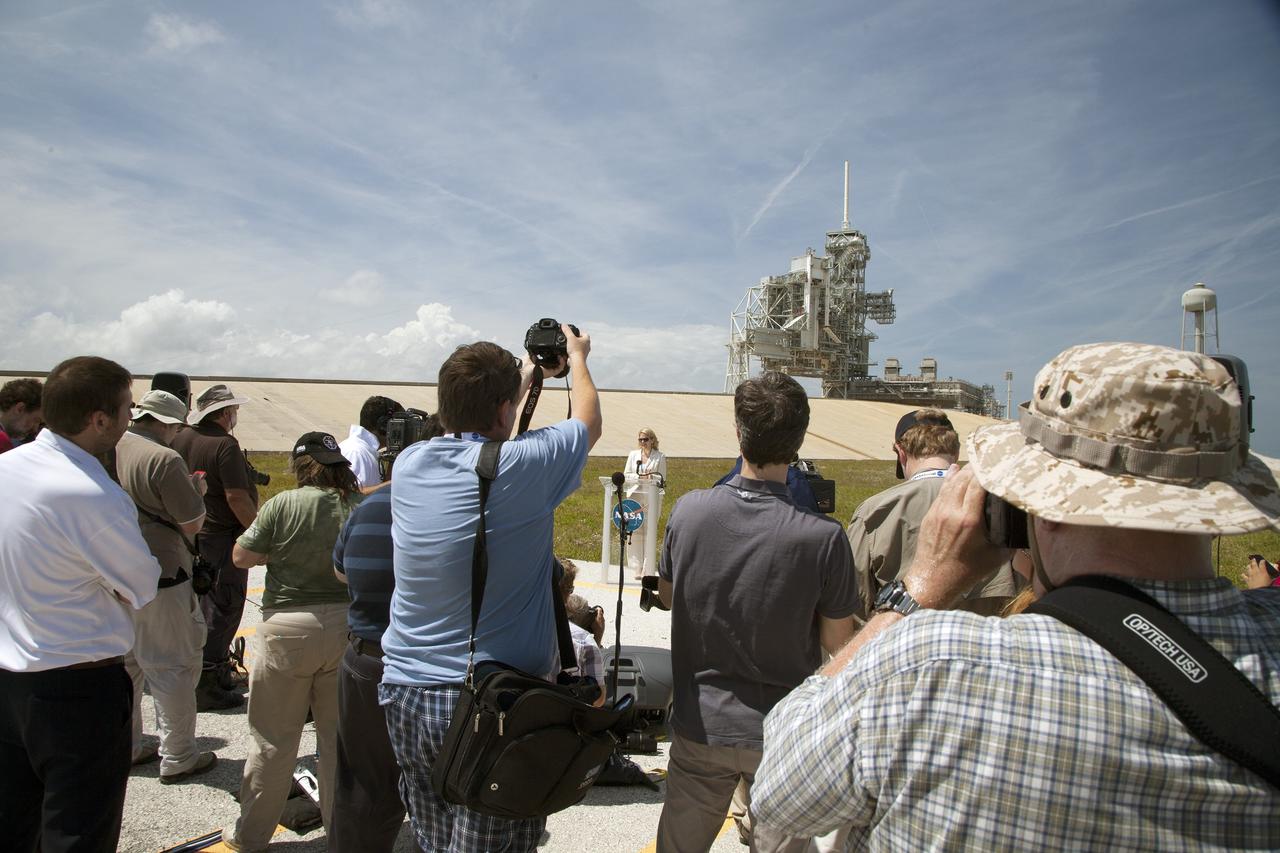
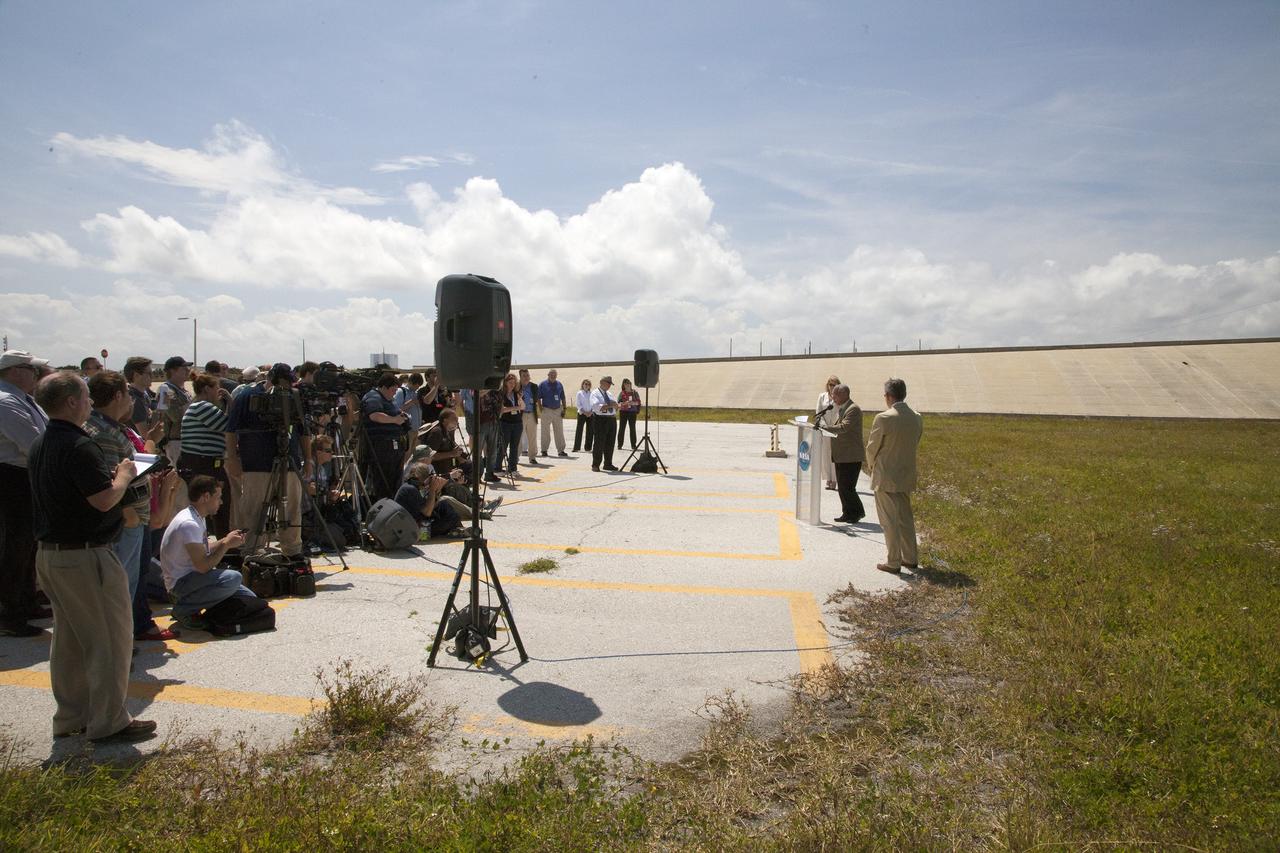
CAPE CANAVERAL, Fla. -- At Kennedy Space Center's Launch Pad 39A, Gwynne Shotwell, president and chief operating officer of Space Exploration Technologies SpaceX of Hawthorne, Calif., speaks to members of the news media announcing that NASA has just signed a lease agreement with SpaceX for use and operation of Launch Complex 39A. SpaceX will use Launch Complex 39A for rockets such as the Falcon Heavy, currently under development. Both launch pad 39A and 39B were originally built for the Apollo/Saturn V rockets that launched American astronauts on their historic journeys to the moon and later modified to support the 30-year shuttle program. Pad 39B is now being modified by NASA to support the Space Launch System SLS rocket boosting the Orion spacecraft part of the agency’s plan to explore beyond low-Earth orbit. To learn more about Launch Pad 39A visit: http://www.nasa.gov/mission_pages/shuttle/launch/launch-complex39-toc.html Photo credit: NASA/Dan Casper
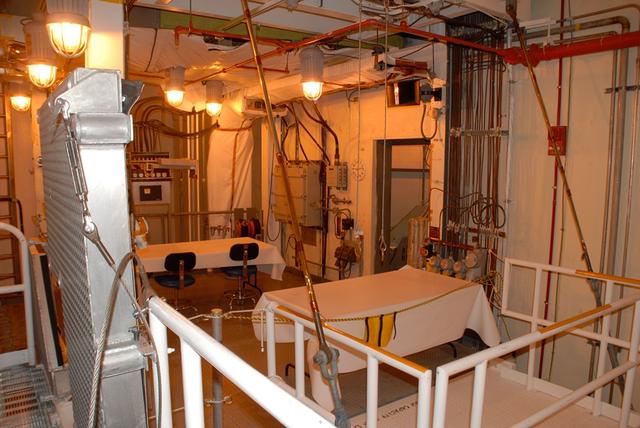
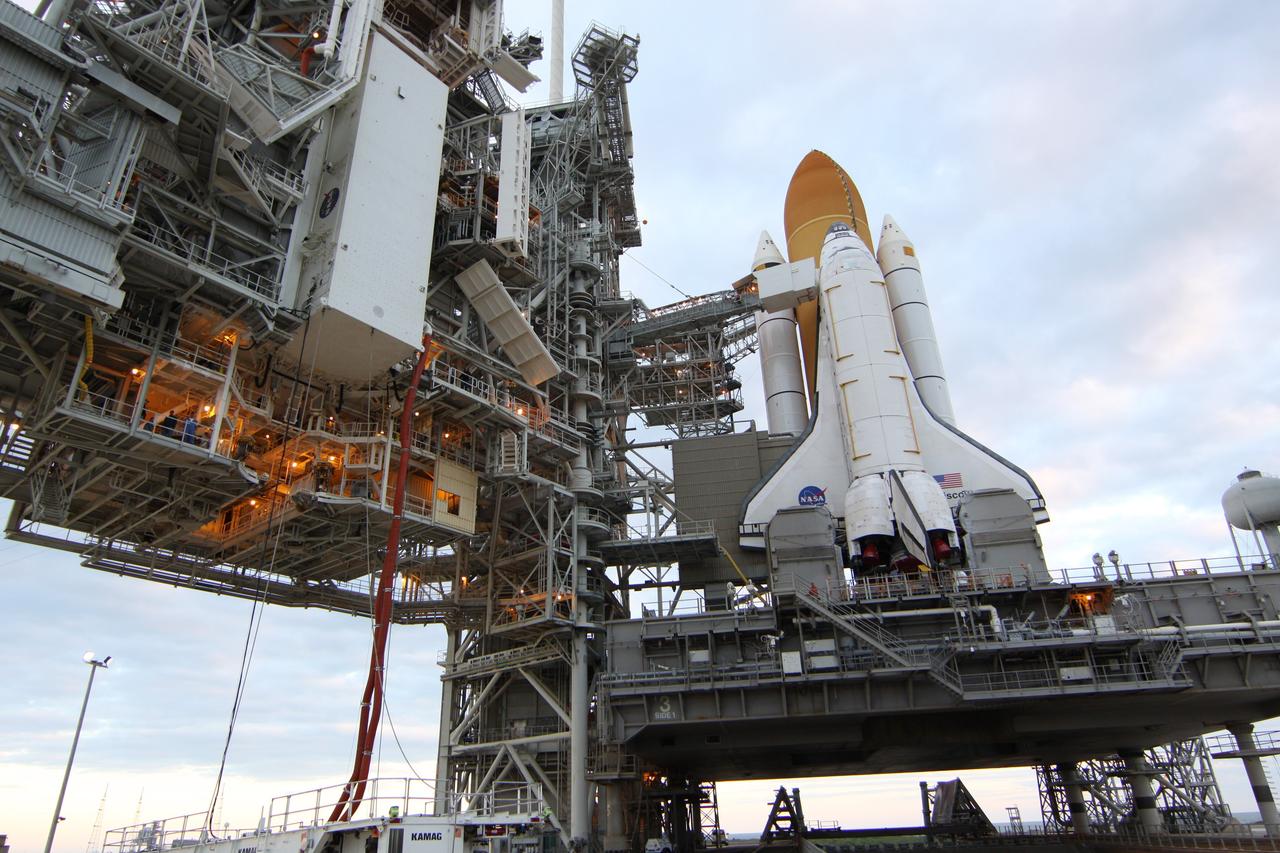
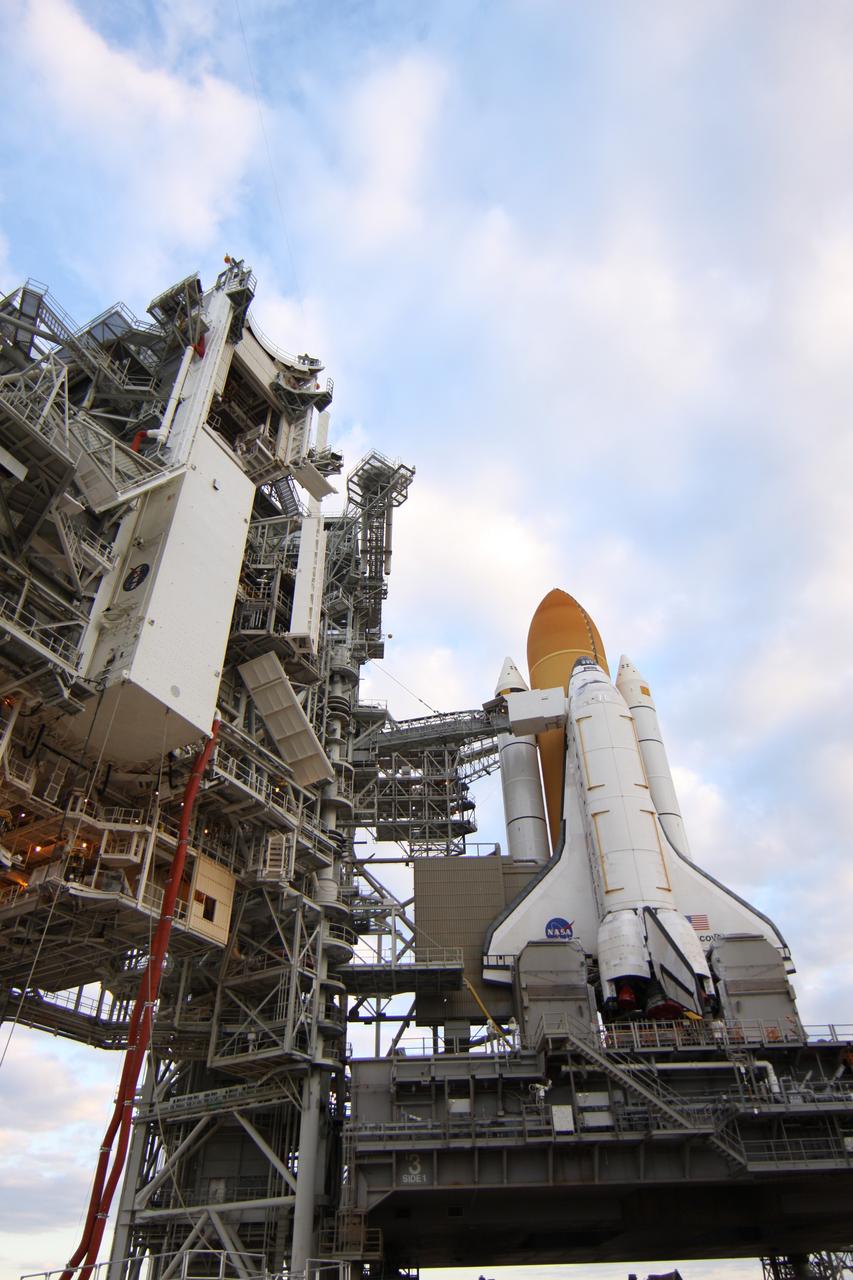
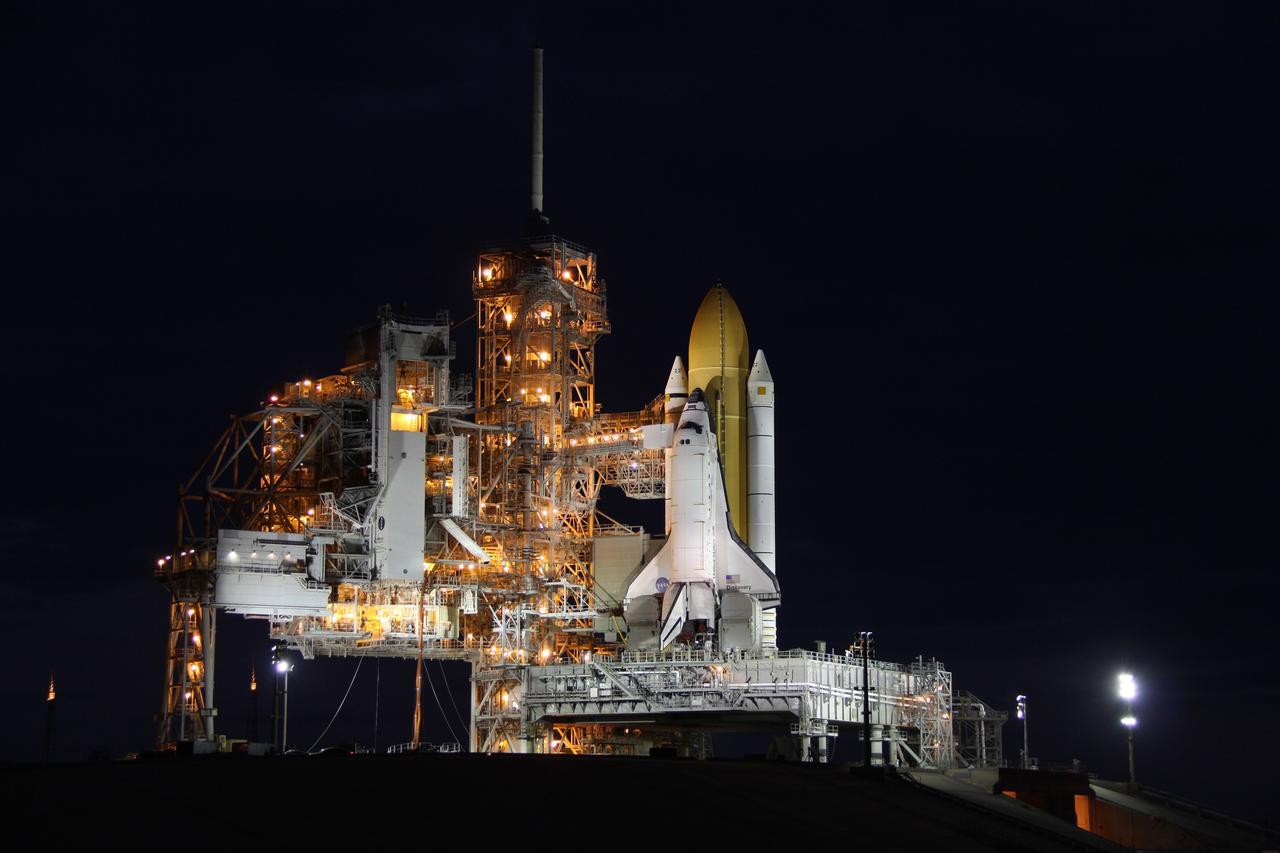
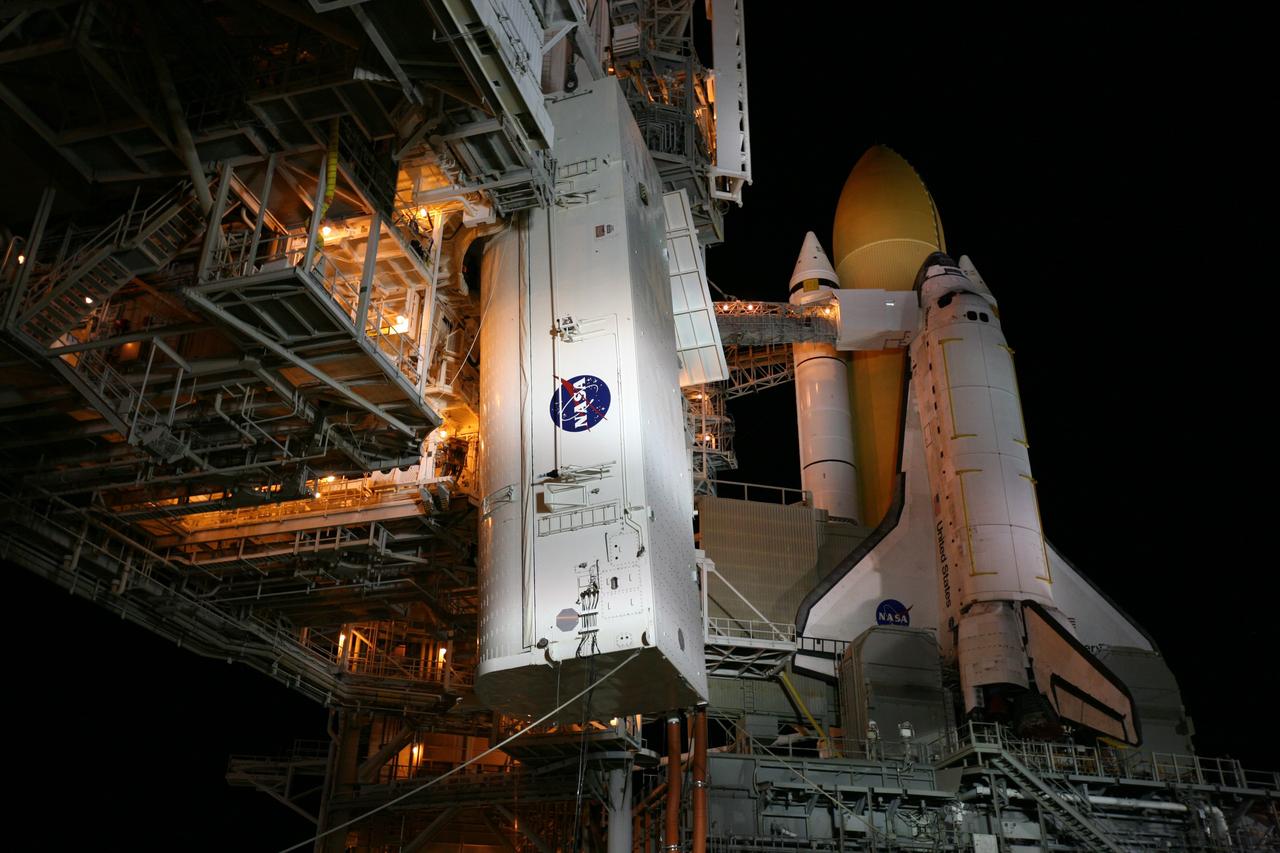
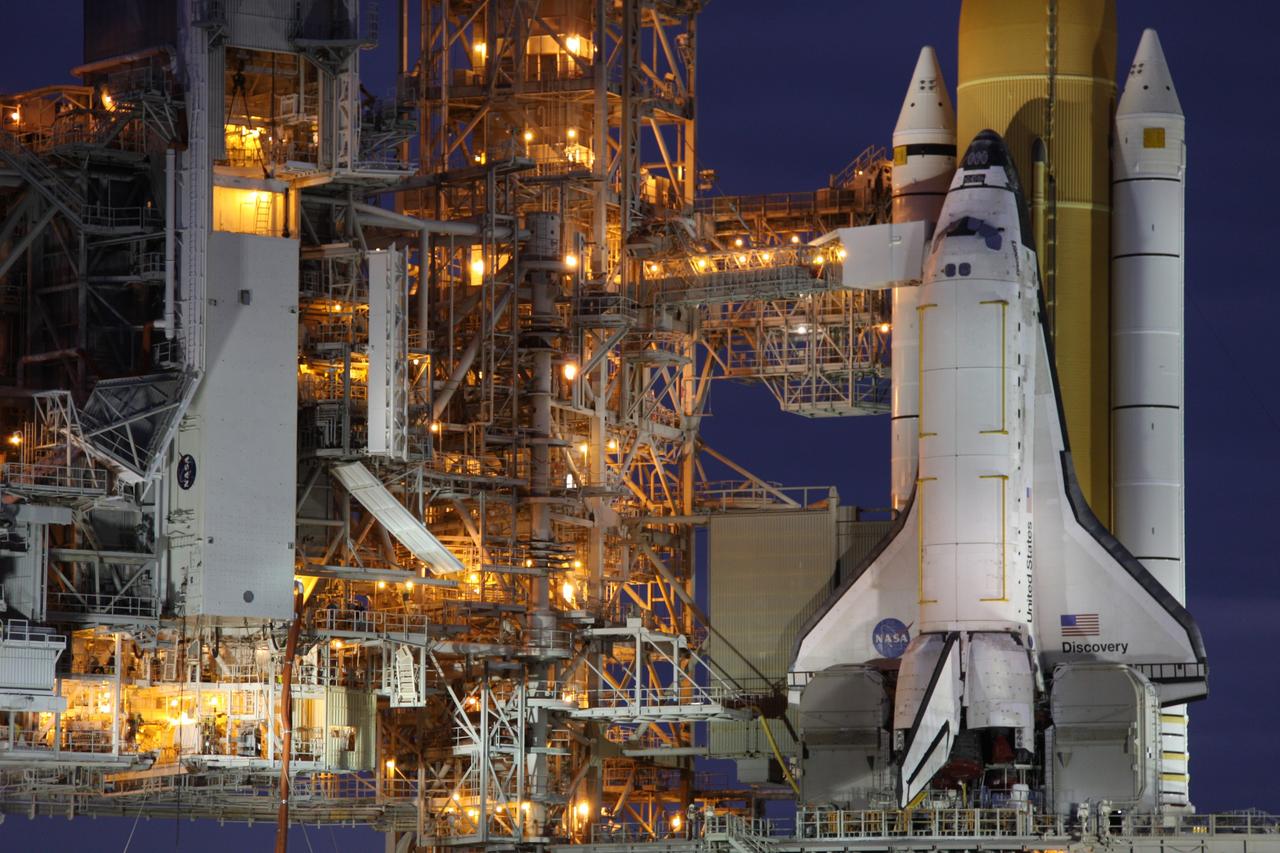
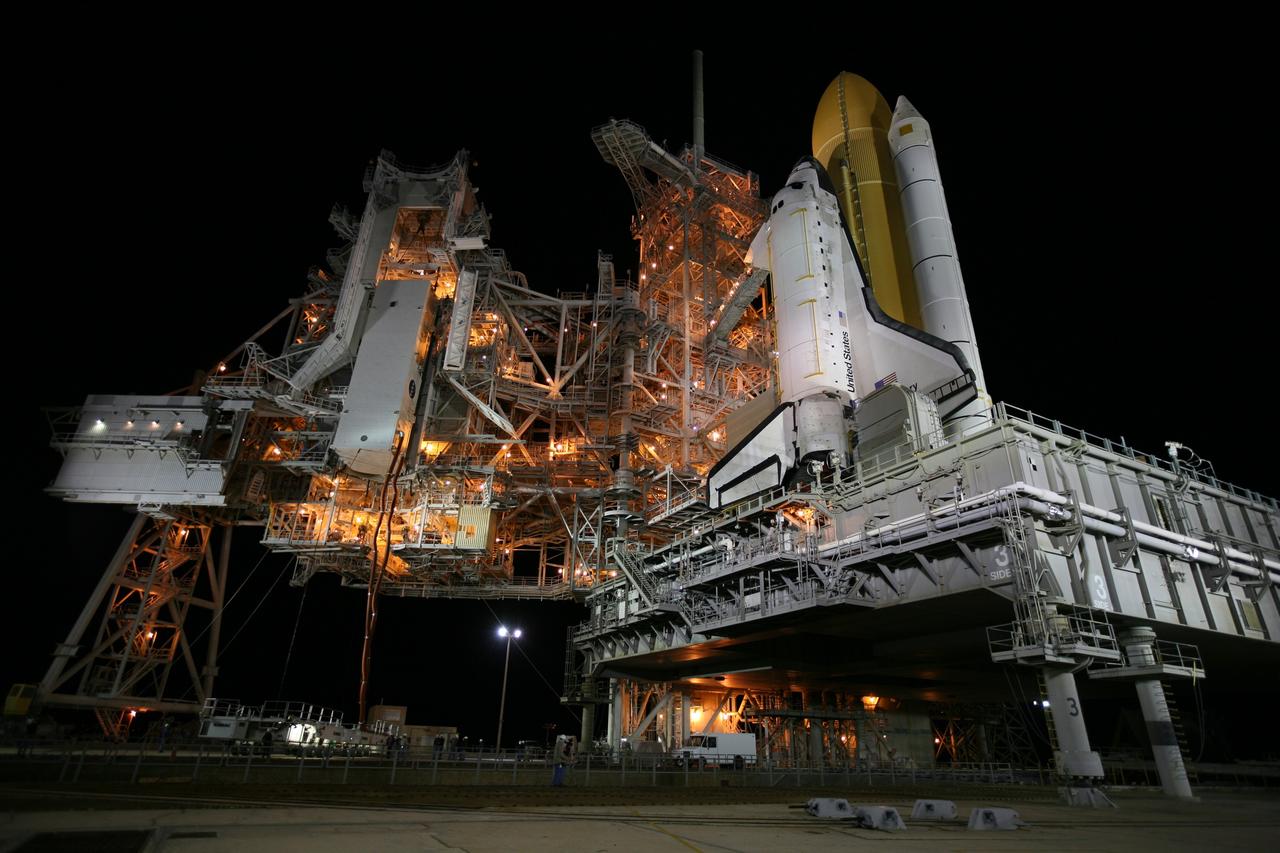
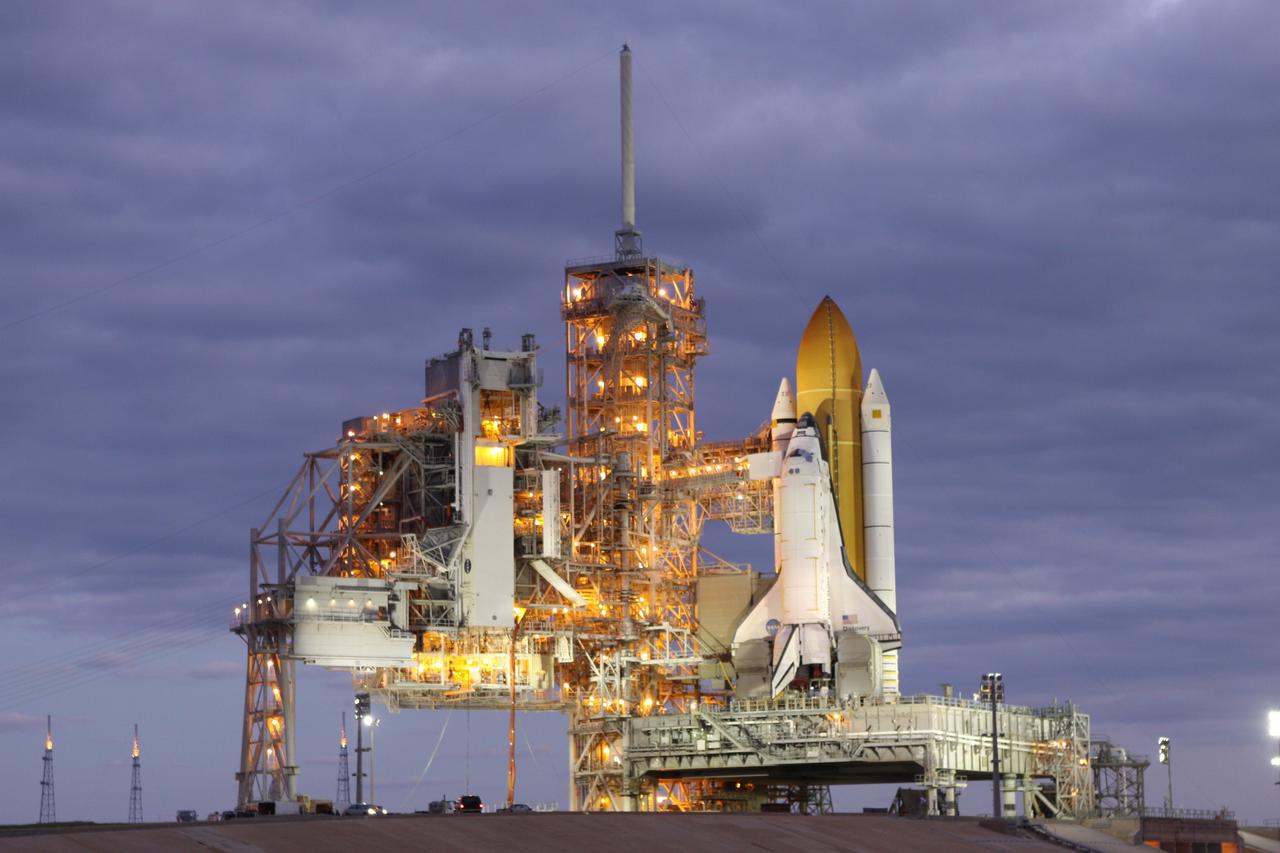
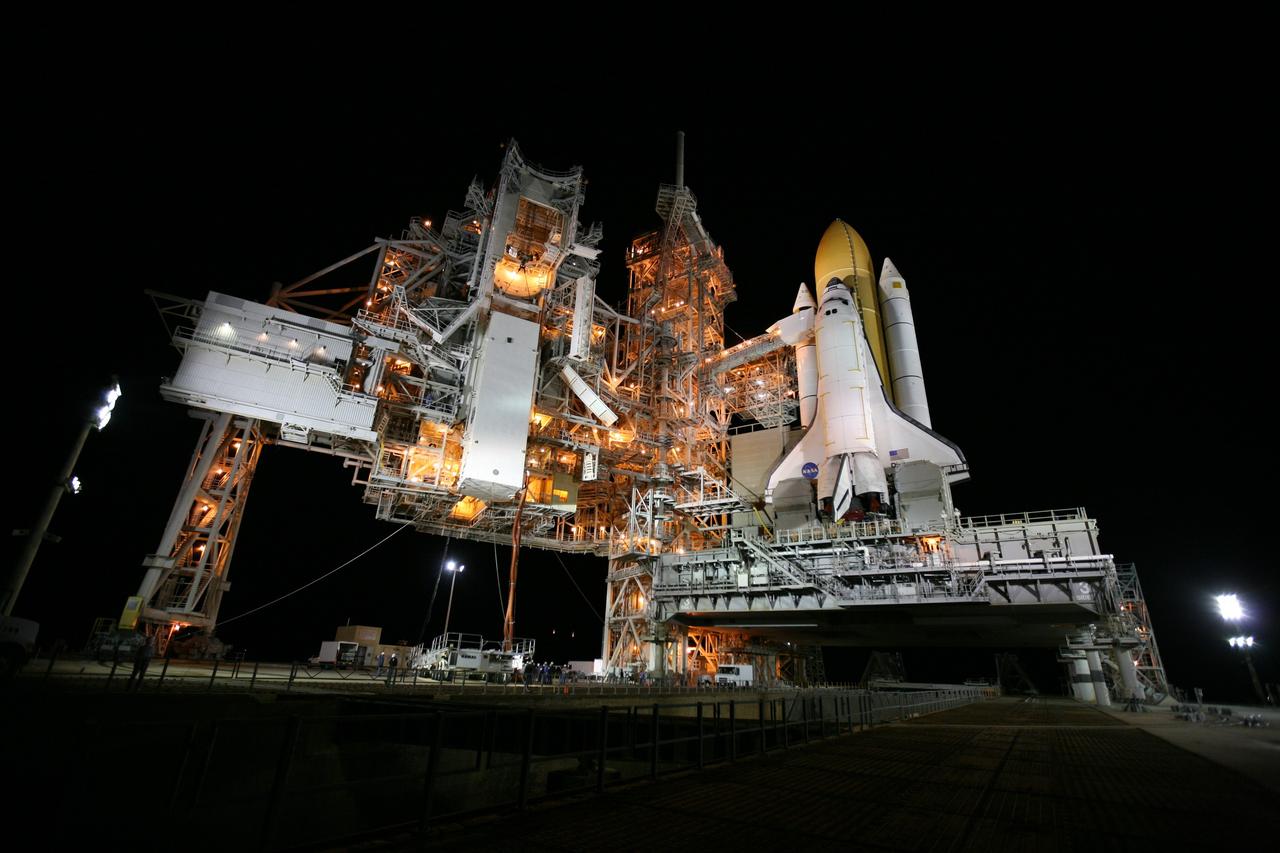
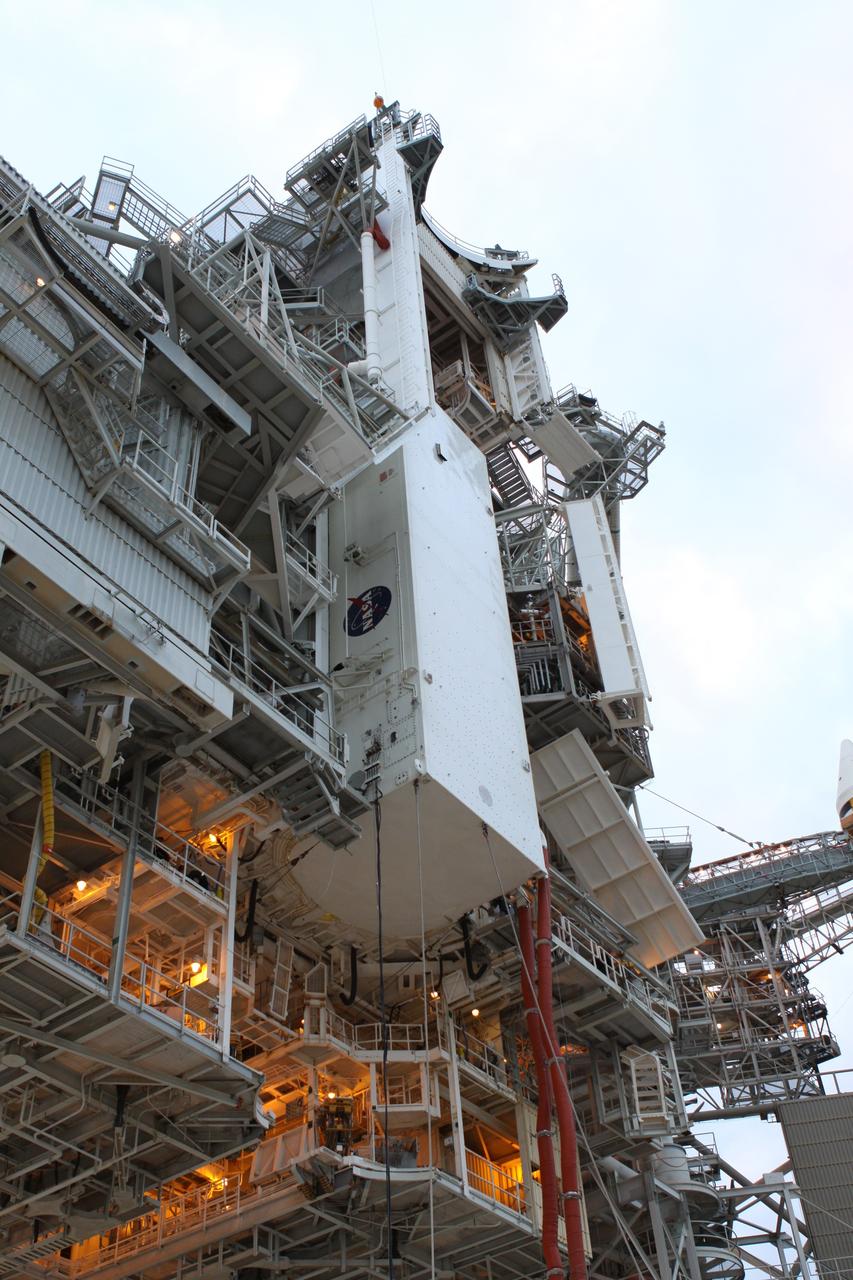
Interior view of Launch Pad 39A
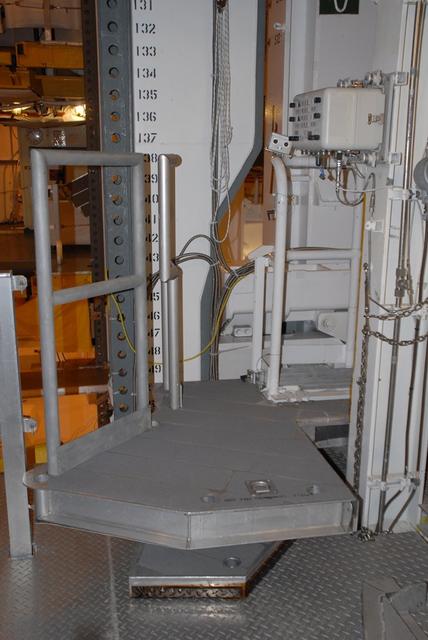
Interior view of Launch Pad 39A
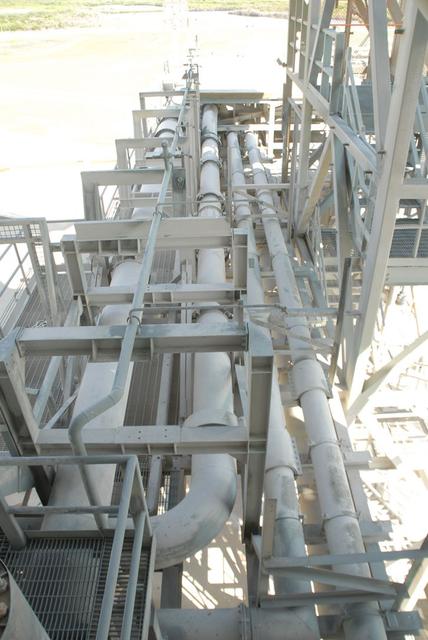
Interior view of Launch Pad 39A
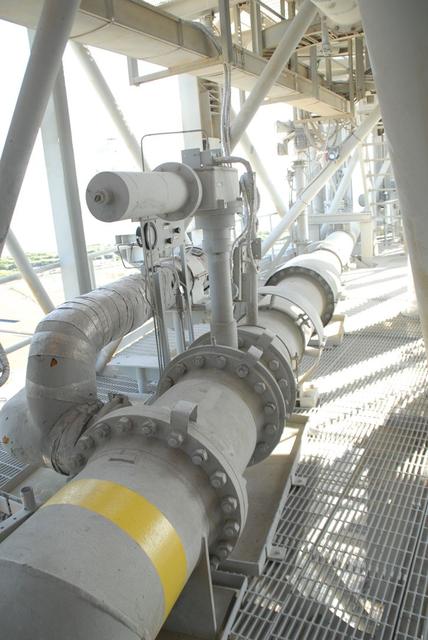
Interior view of Launch Pad 39A
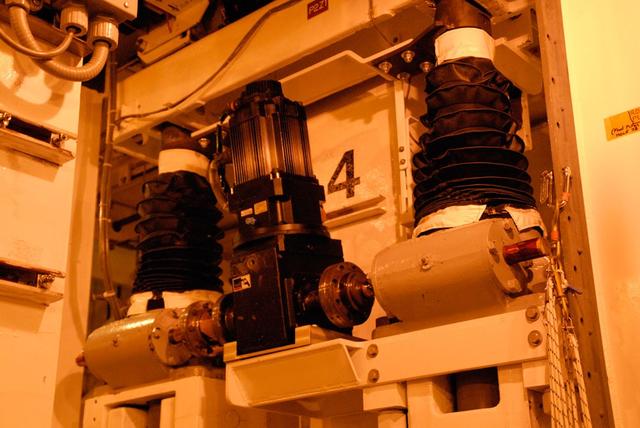
Interior view of Launch Pad 39A
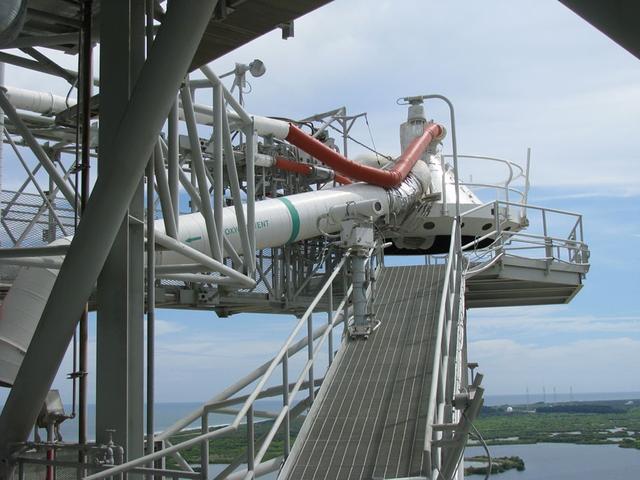
Interior view of Launch Pad 39A
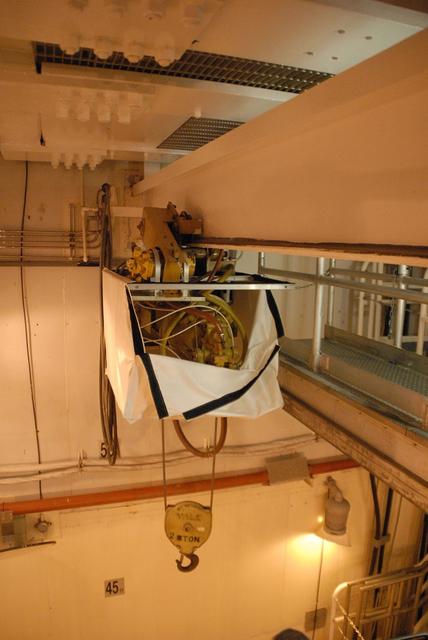
Interior view of Launch Pad 39A
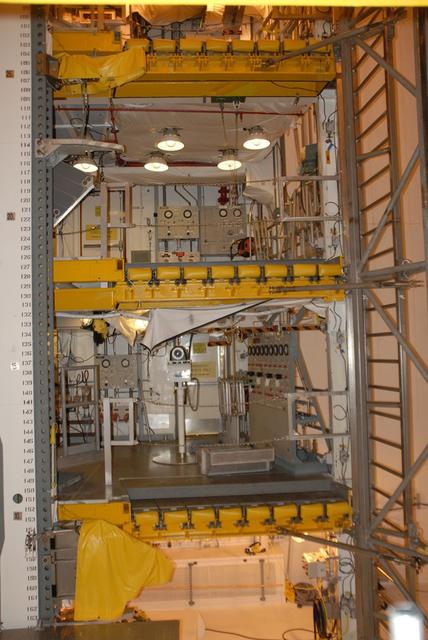
Interior view of Launch Pad 39A
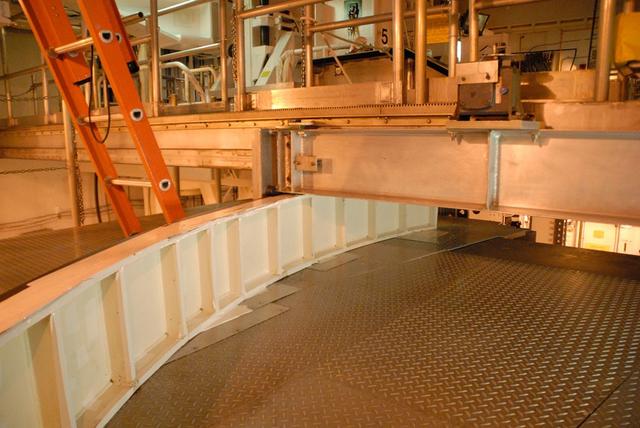
Interior view of Launch Pad 39A
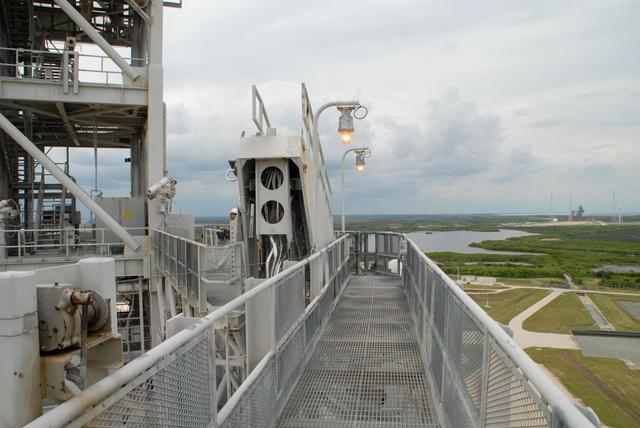
Interior view of Launch Pad 39A
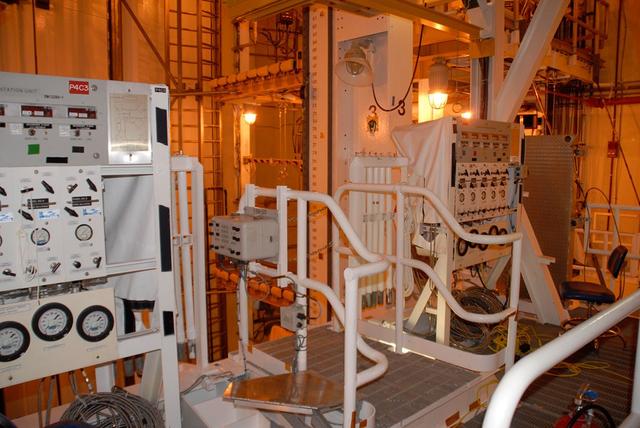
Interior view of Launch Pad 39A
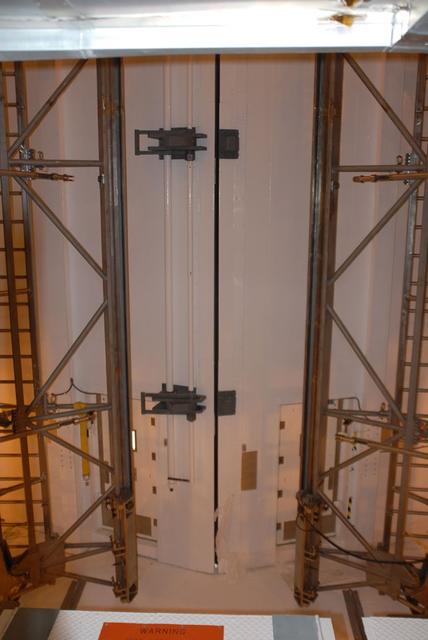
Interior view of Launch Pad 39A
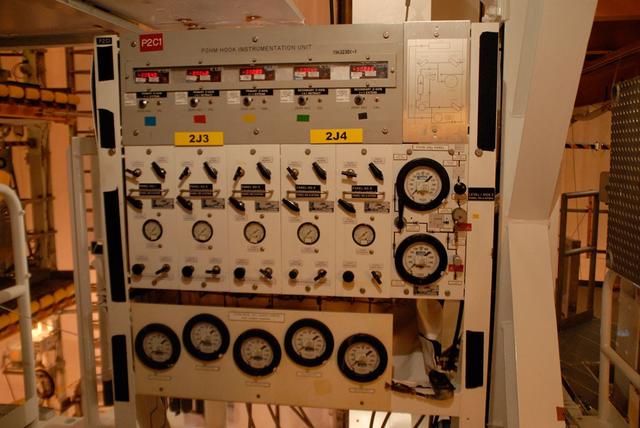
Interior view of Launch Pad 39A
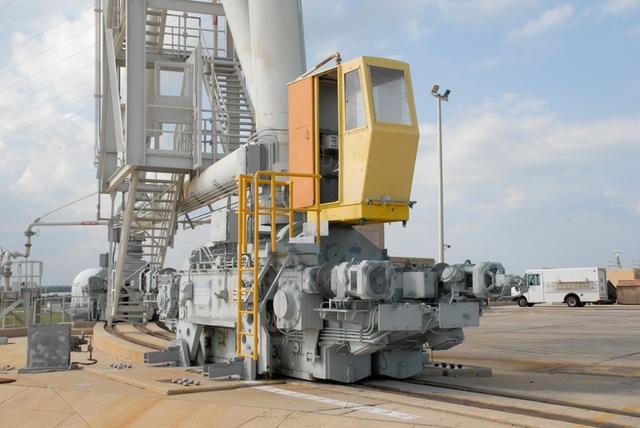
Interior view of Launch Pad 39A
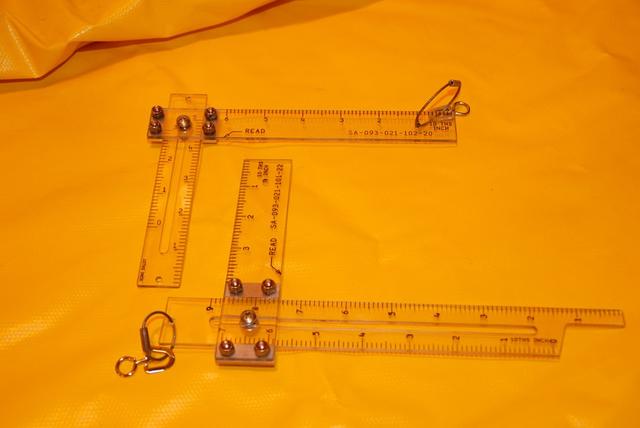
Interior view of Launch Pad 39A
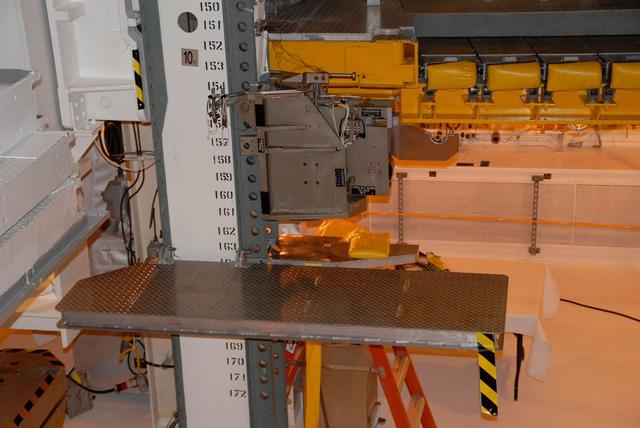
Interior view of Launch Pad 39A
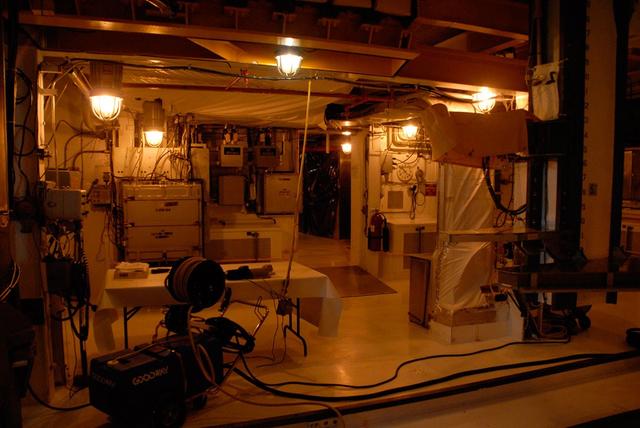
Interior view of Launch Pad 39A
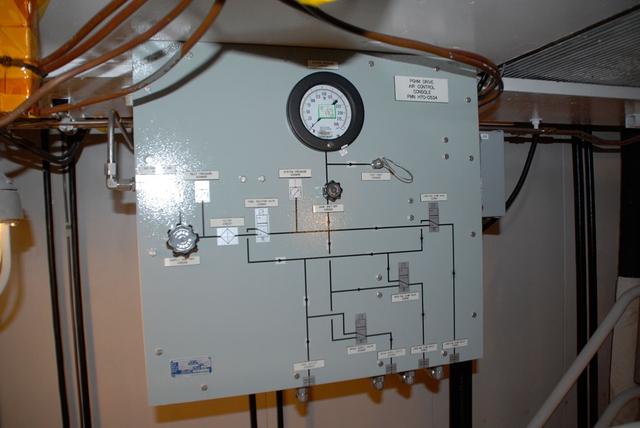
Interior view of Launch Pad 39A
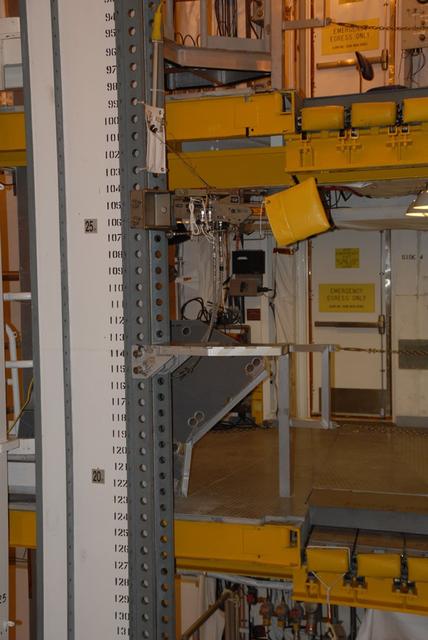
Interior view of Launch Pad 39A
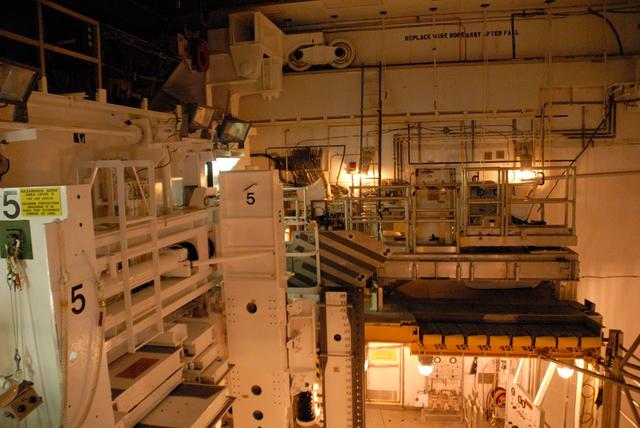
Interior view of Launch Pad 39A
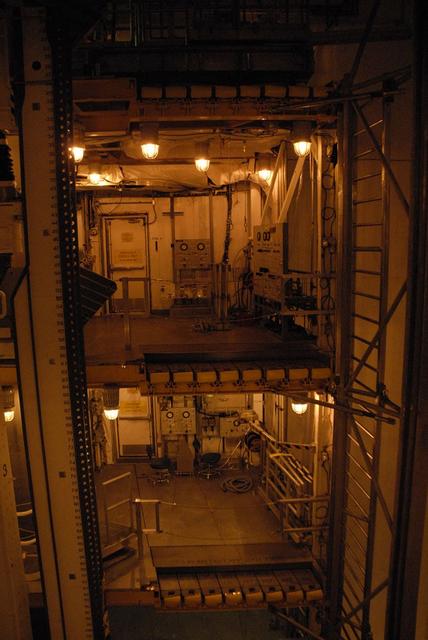
Interior view of Launch Pad 39A
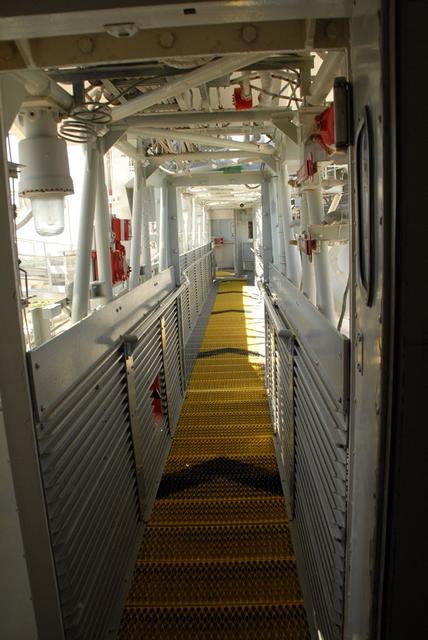
Interior view of Launch Pad 39A
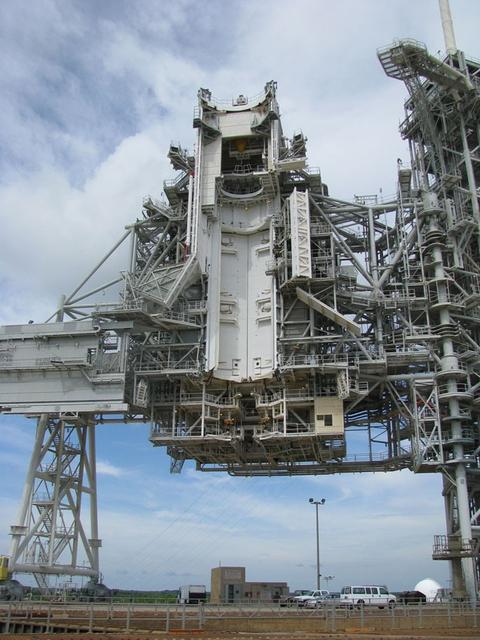
Interior view of Launch Pad 39A
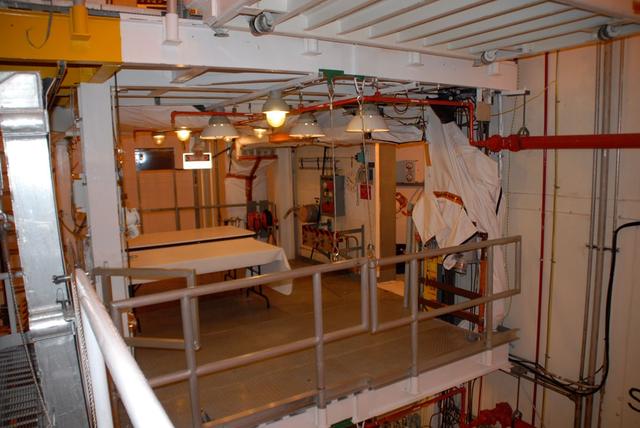
Interior view of Launch Pad 39A
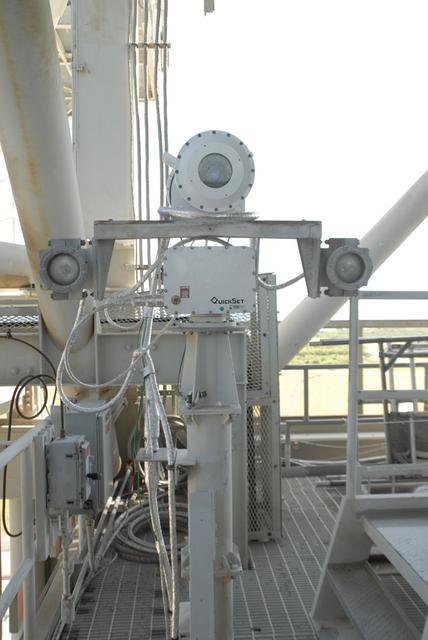
Interior view of Launch Pad 39A
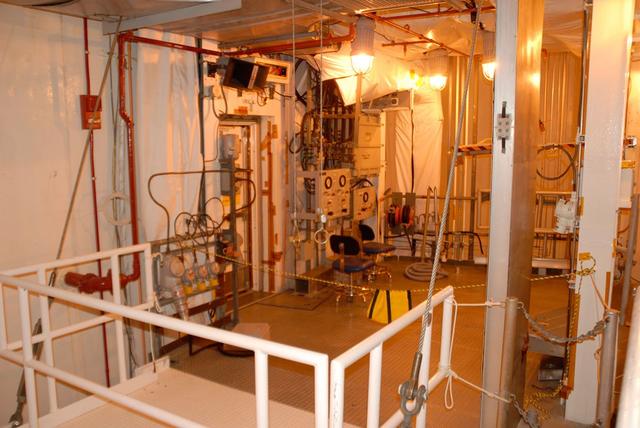
Interior view of Launch Pad 39A
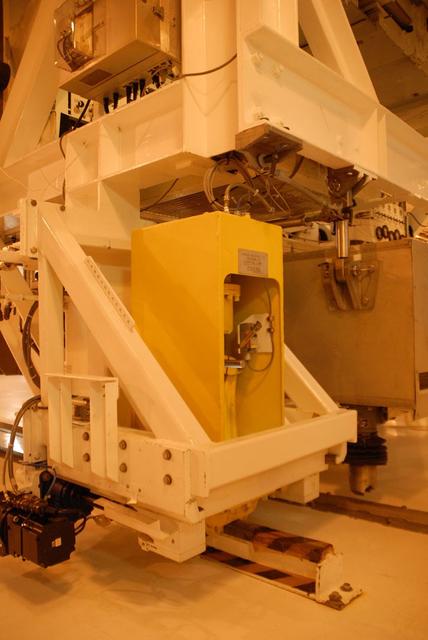
Interior view of Launch Pad 39A
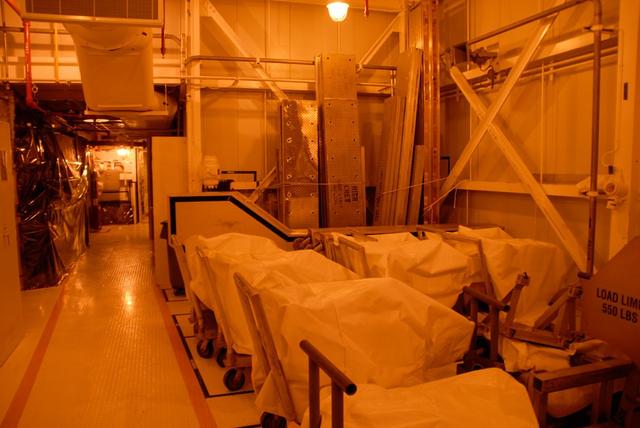
Interior view of Launch Pad 39A
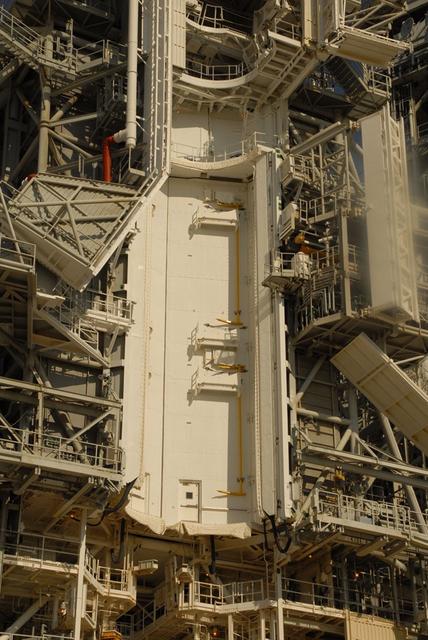
Interior view of Launch Pad 39A
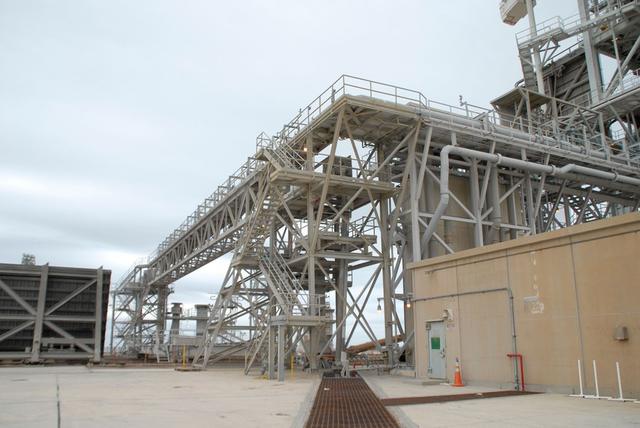
Interior view of Launch Pad 39A
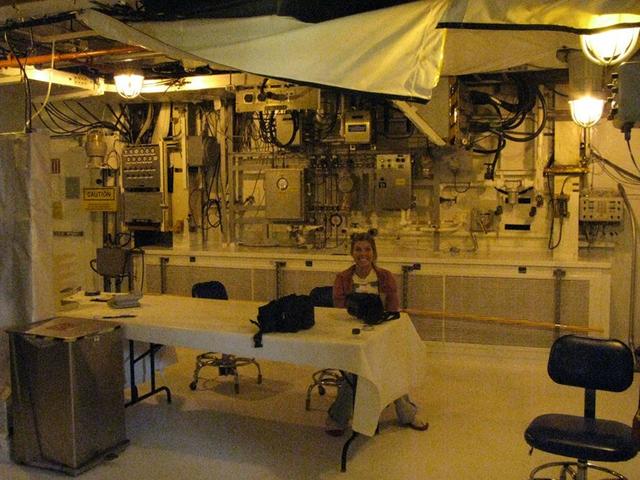
Interior view of Launch Pad 39A
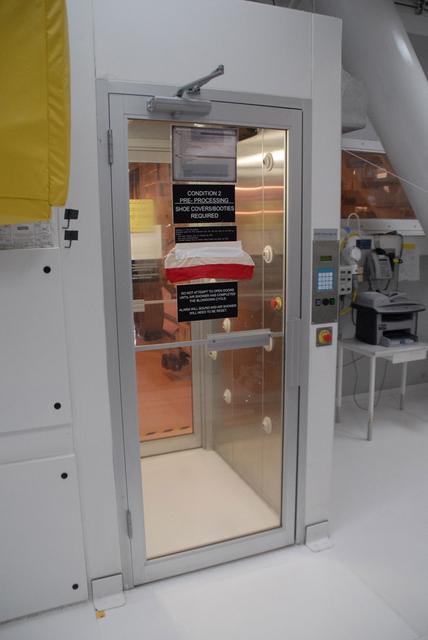
Interior view of Launch Pad 39A
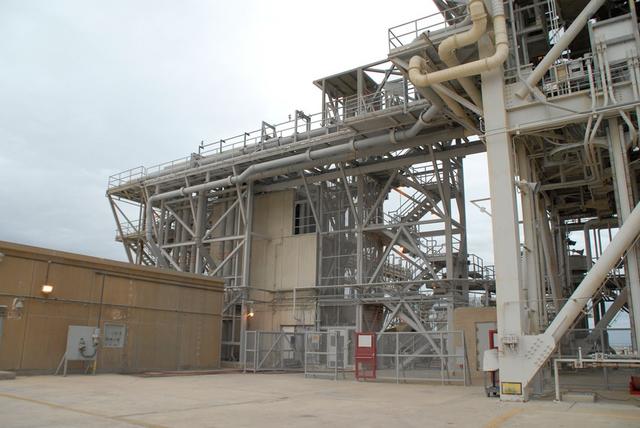
Interior view of Launch Pad 39A
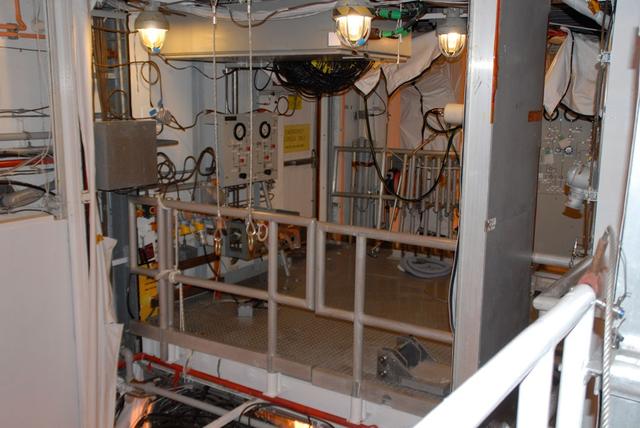
Interior view of Launch Pad 39A
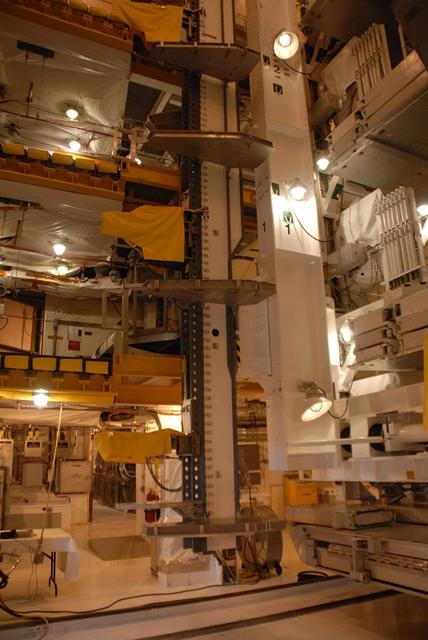
Interior view of Launch Pad 39A
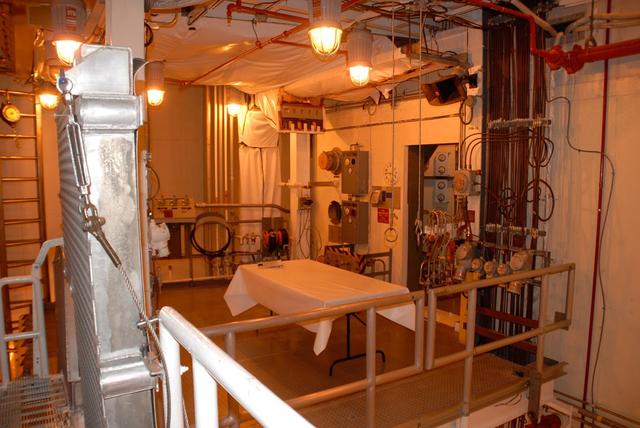
Interior view of Launch Pad 39A
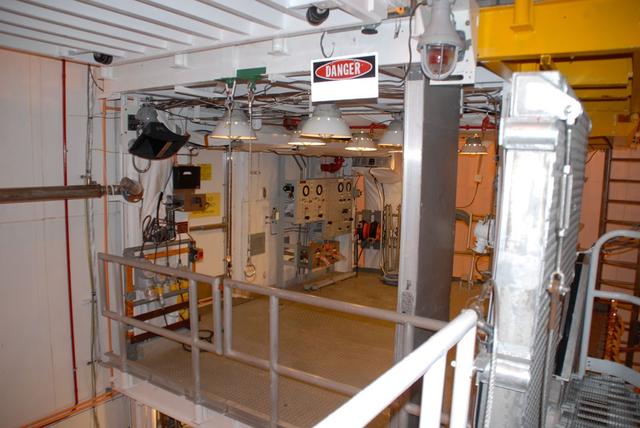
Interior view of Launch Pad 39A
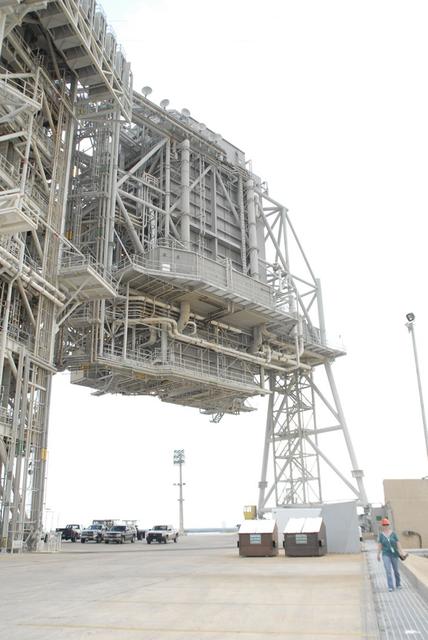
Interior view of Launch Pad 39A
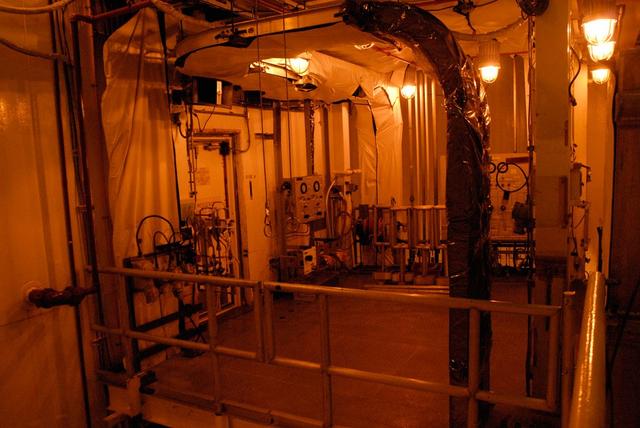
Interior view of Launch Pad 39A
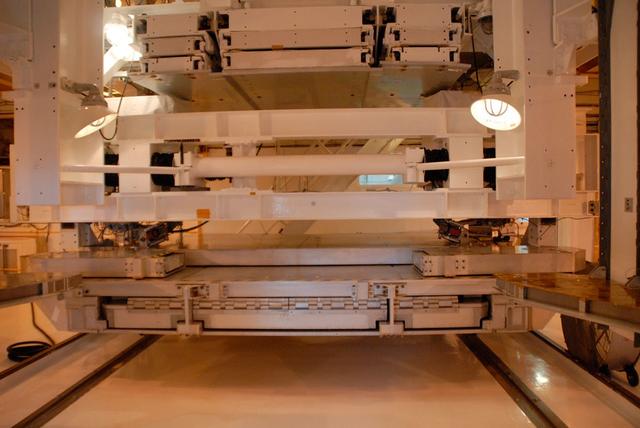
Interior view of Launch Pad 39A
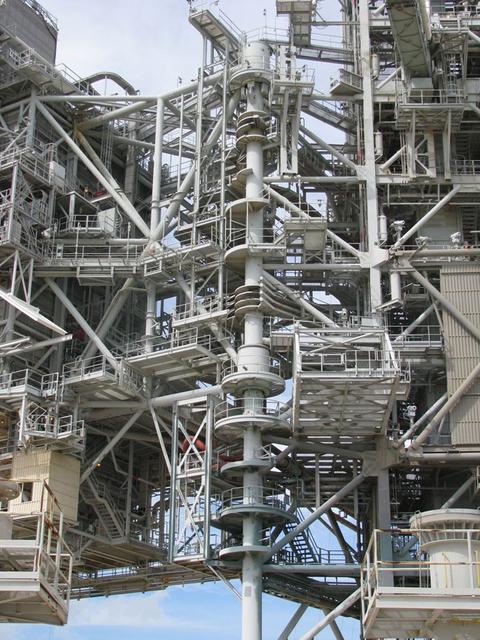
Interior view of Launch Pad 39A
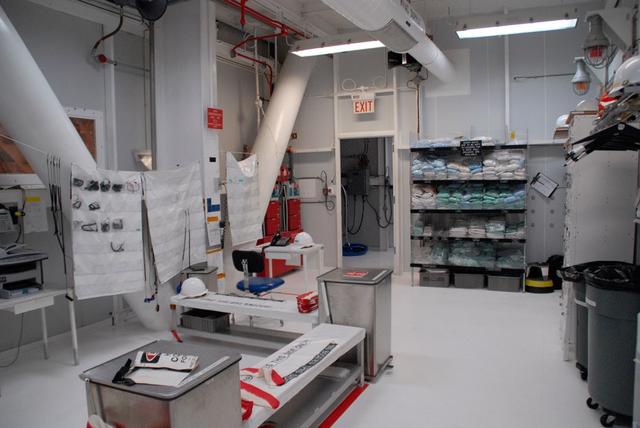
Interior view of Launch Pad 39A
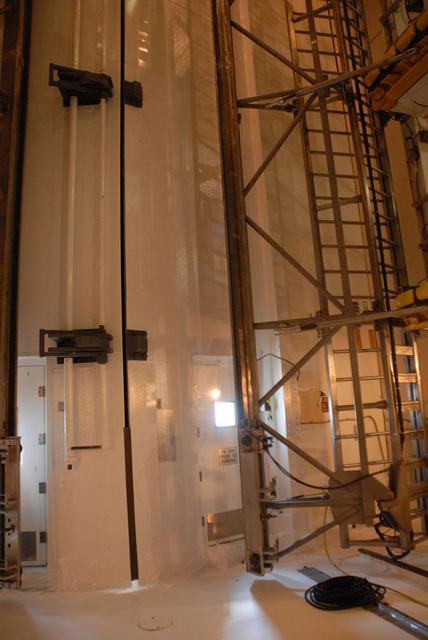
Interior view of Launch Pad 39A
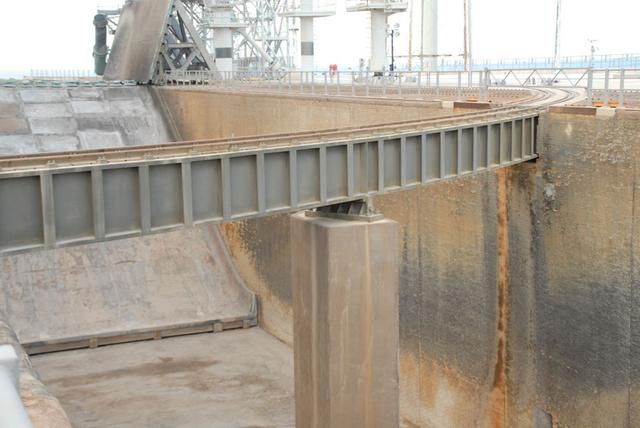
Interior view of Launch Pad 39A
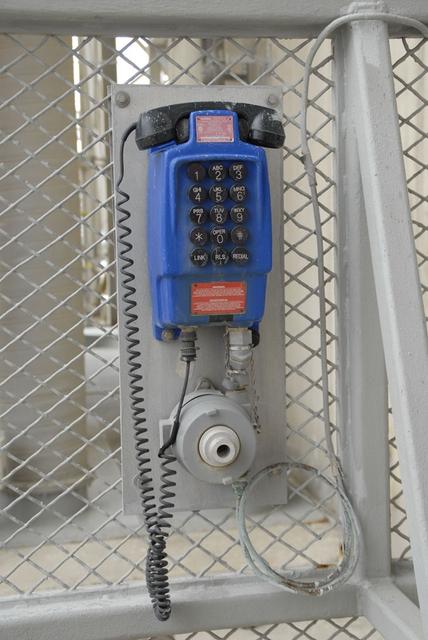
Interior view of Launch Pad 39A
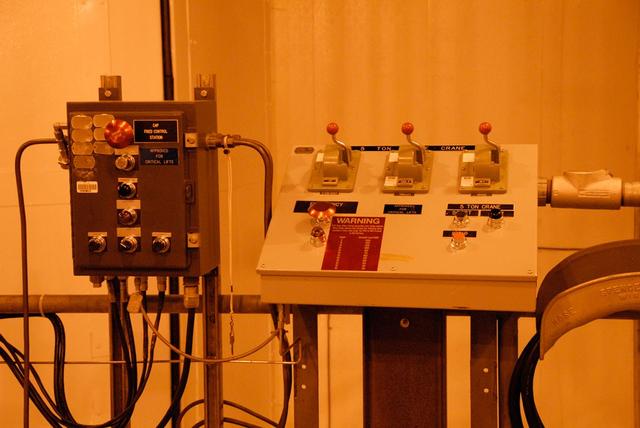
Interior view of Launch Pad 39A
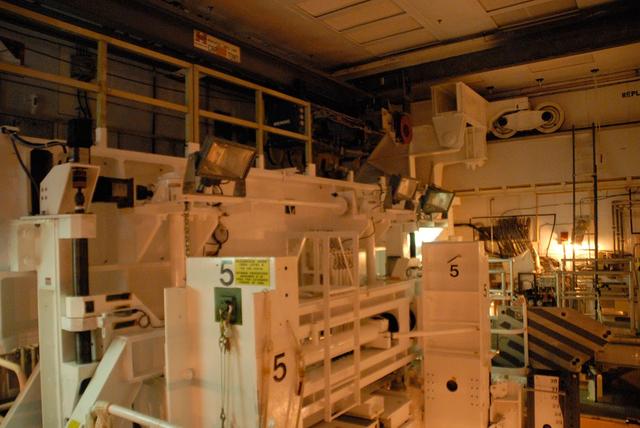
Interior view of Launch Pad 39A
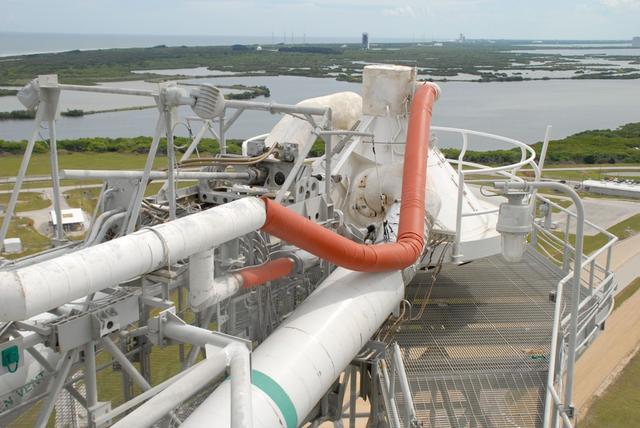
Interior view of Launch Pad 39A
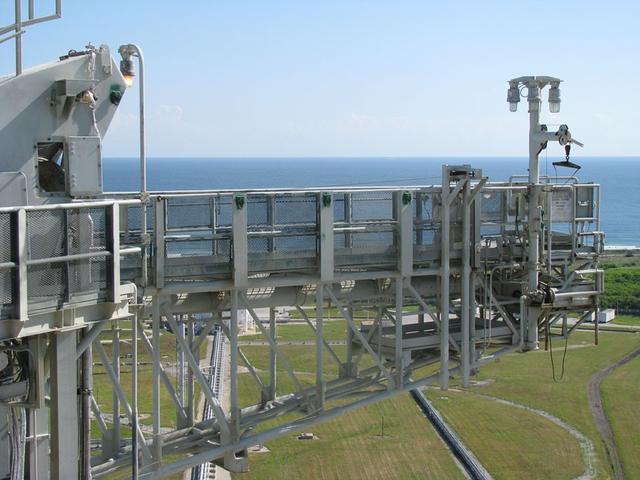
Interior view of Launch Pad 39A
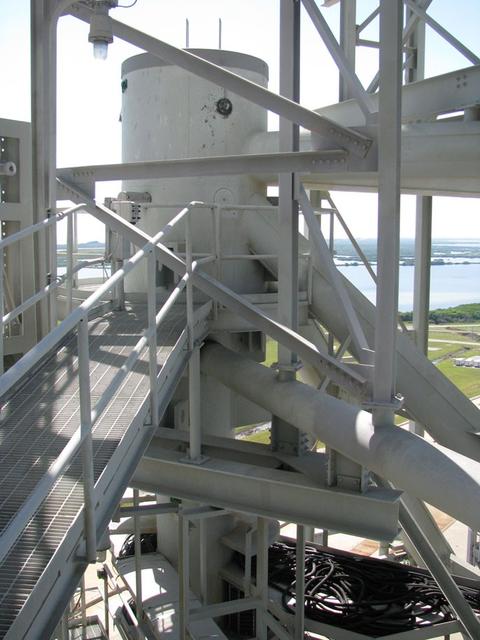
Interior view of Launch Pad 39A
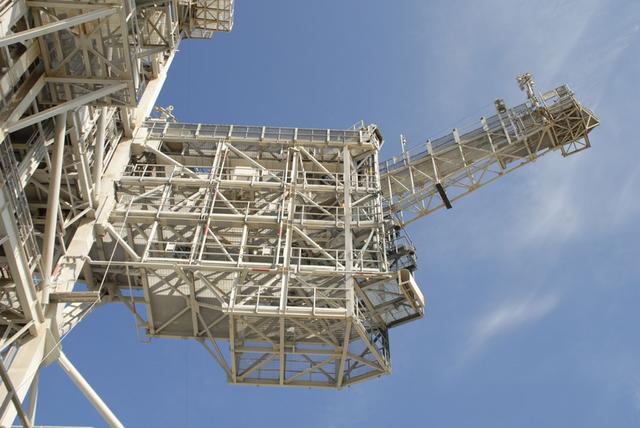
Interior view of Launch Pad 39A
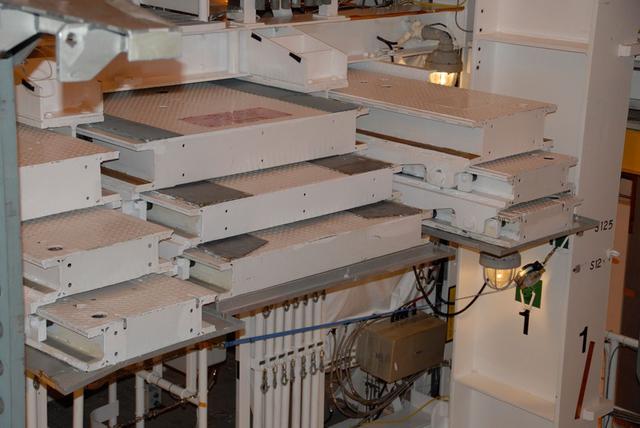
Interior view of Launch Pad 39A
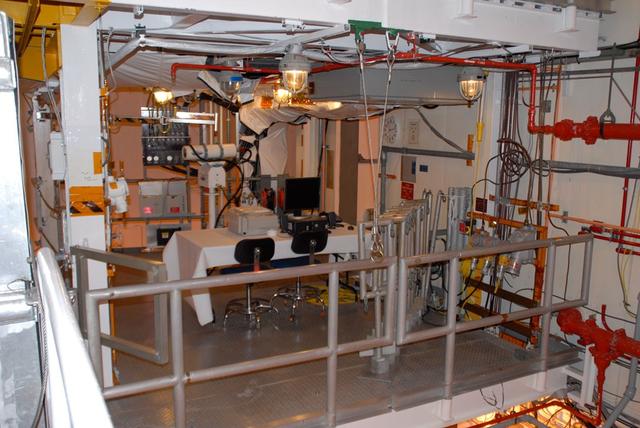
Interior view of Launch Pad 39A
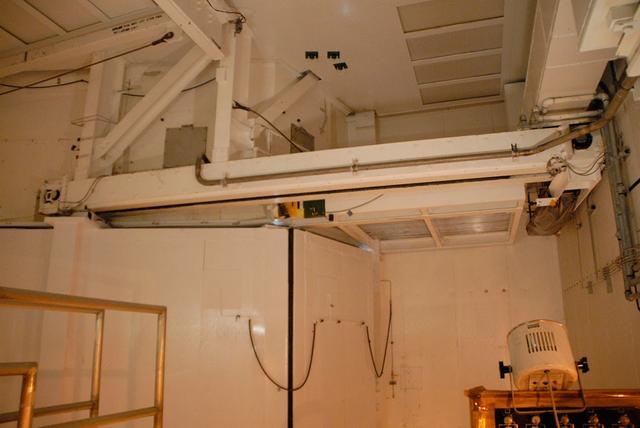
Interior view of Launch Pad 39A
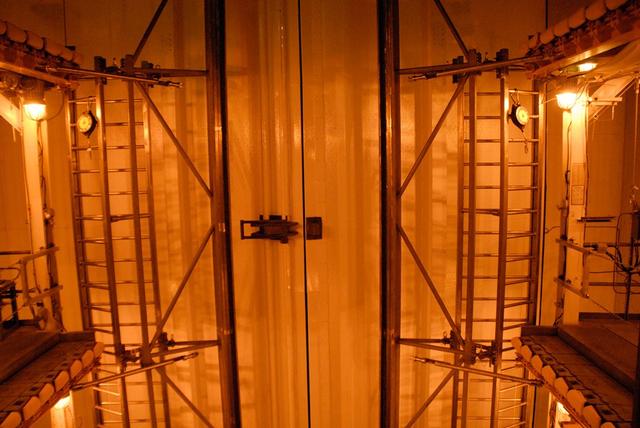
Interior view of Launch Pad 39A
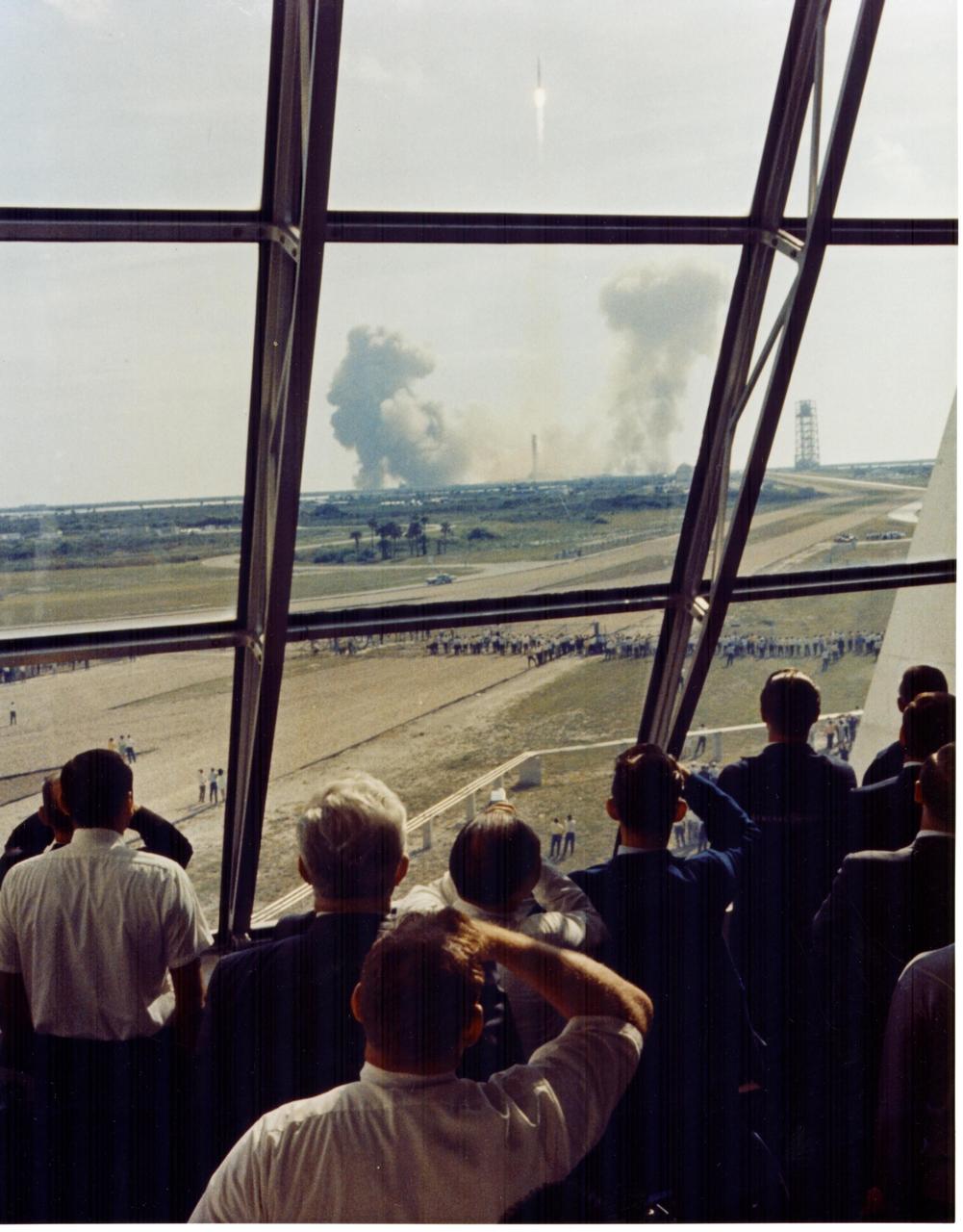
KENNEDY SPACE CENTER, FLA. - Personnel within the Launch Control Center watch the Apollo 11 liftoff from Launch Complex 39A today at the start of the historic lunar landing mission. The LCC is located three-and-one-half miles from the launch pad.
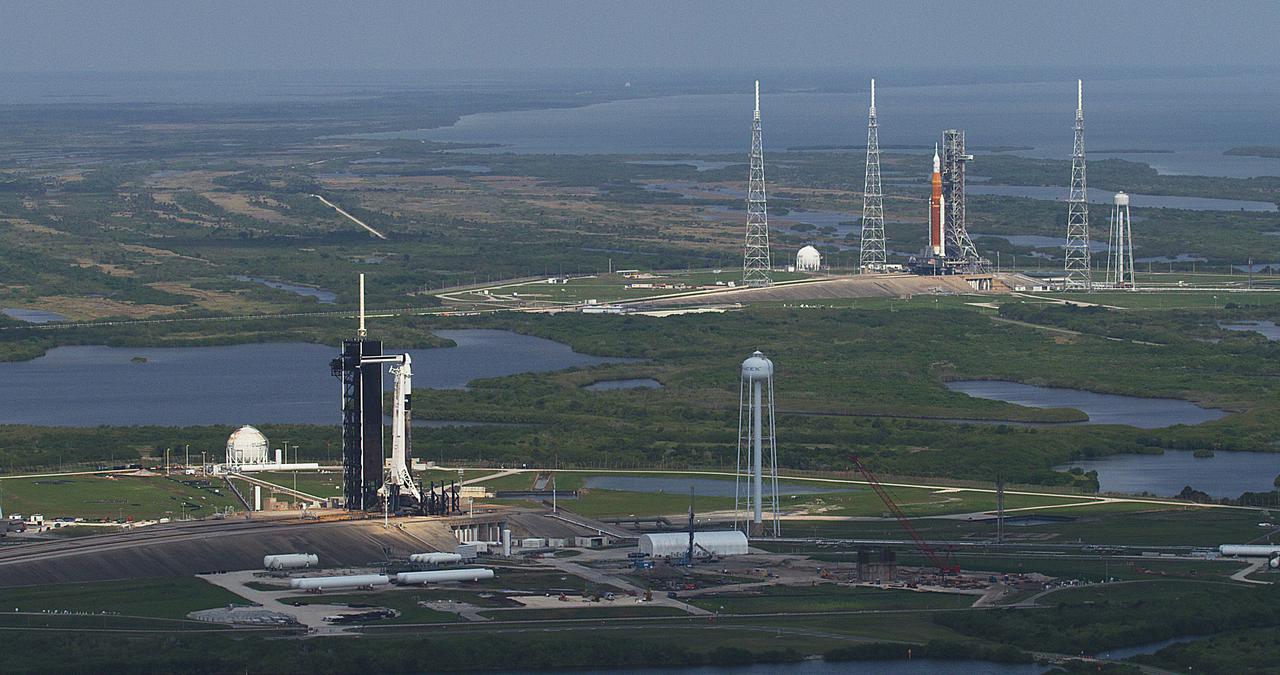
SpaceX’s Axiom-1 is in the foreground on Launch Pad 39A with NASA’s Artemis I in the background on Launch Pad 39B on April 6, 2022. This is the first time two totally different types of rockets and spacecraft designed to carry humans are on the sister pads at the same time—but it won’t be the last as NASA’s Kennedy Space Center in Florida continues to grow as a multi-user spaceport to launch both government and commercial rockets.
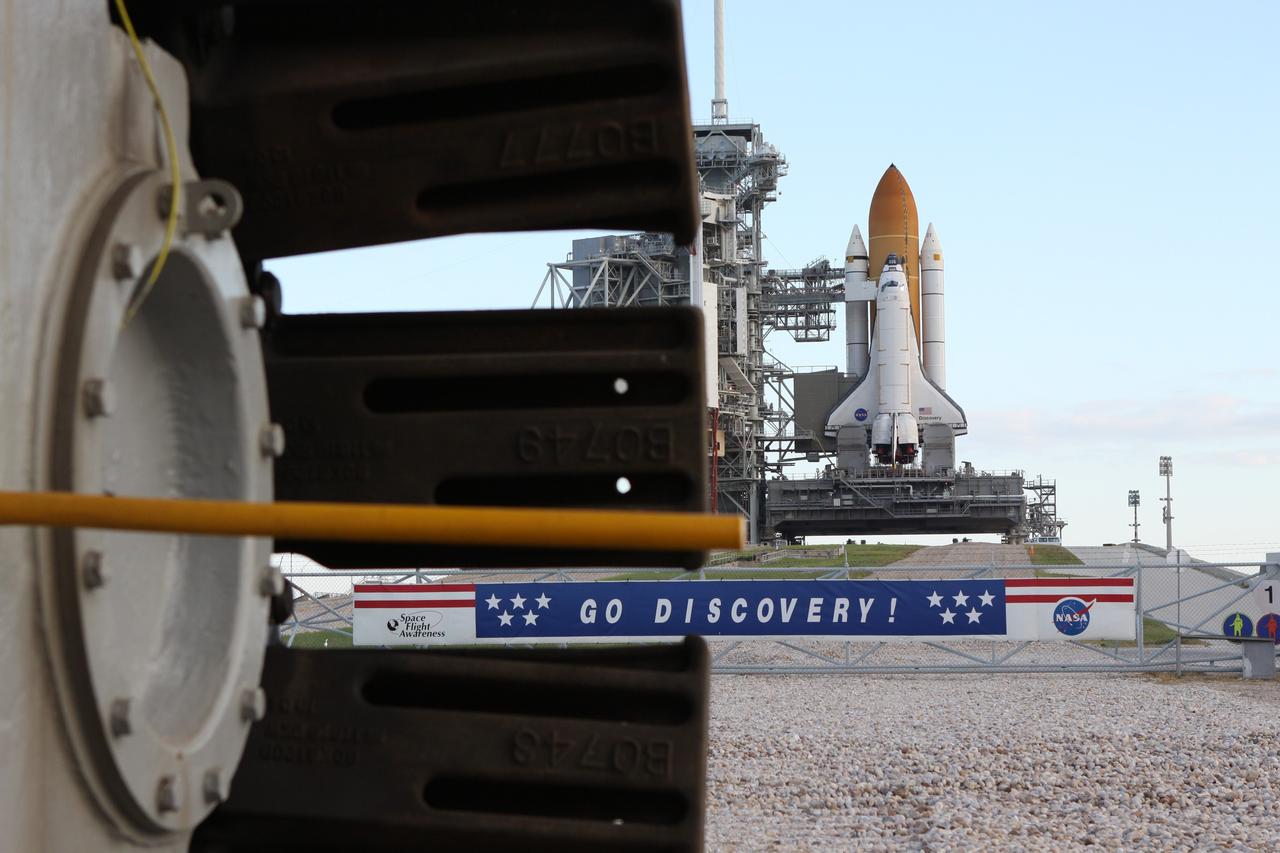
CAPE CANAVERAL, Fla. -- At NASA's Kennedy Space Center in Florida, the STS-133 payload canister now is in the rotating service structure on Launch Pad 39A. A sign hanging on the fence in front of the pad entrance supporting space shuttle Discovery is seen through the tred from a crawler-transporter. The payload then will be moved into space shuttle Discovery's payload bay. Discovery and its STS-133 crew will deliver the Permanent Multipurpose Module, packed with supplies and critical spare parts, as well as Robonaut 2, the dexterous humanoid astronaut helper, to the International Space Station. Launch is targeted for 4:40 p.m. EDT, Nov. 1. Photo credit: NASA/Troy Cryder
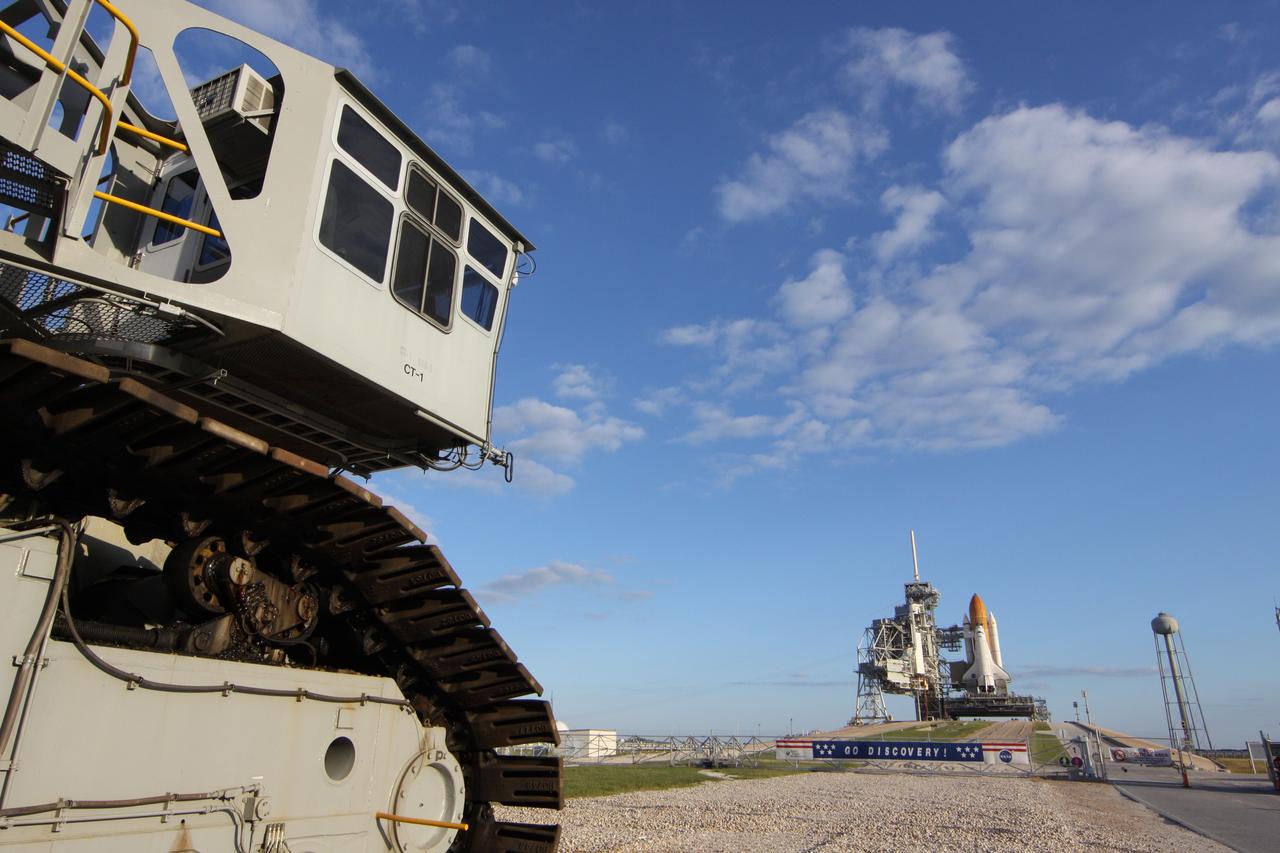
CAPE CANAVERAL, Fla. -- At NASA's Kennedy Space Center in Florida, the STS-133 payload canister now is in the rotating service structure on Launch Pad 39A. A crawler-transporter sits to the left of a sign hanging on the fence in front of the pad entrance supporting space shuttle Discovery. The payload then will be moved into space shuttle Discovery's payload bay. Discovery and its STS-133 crew will deliver the Permanent Multipurpose Module, packed with supplies and critical spare parts, as well as Robonaut 2, the dexterous humanoid astronaut helper, to the International Space Station. Launch is targeted for 4:40 p.m. EDT, Nov. 1. Photo credit: NASA/Troy Cryder
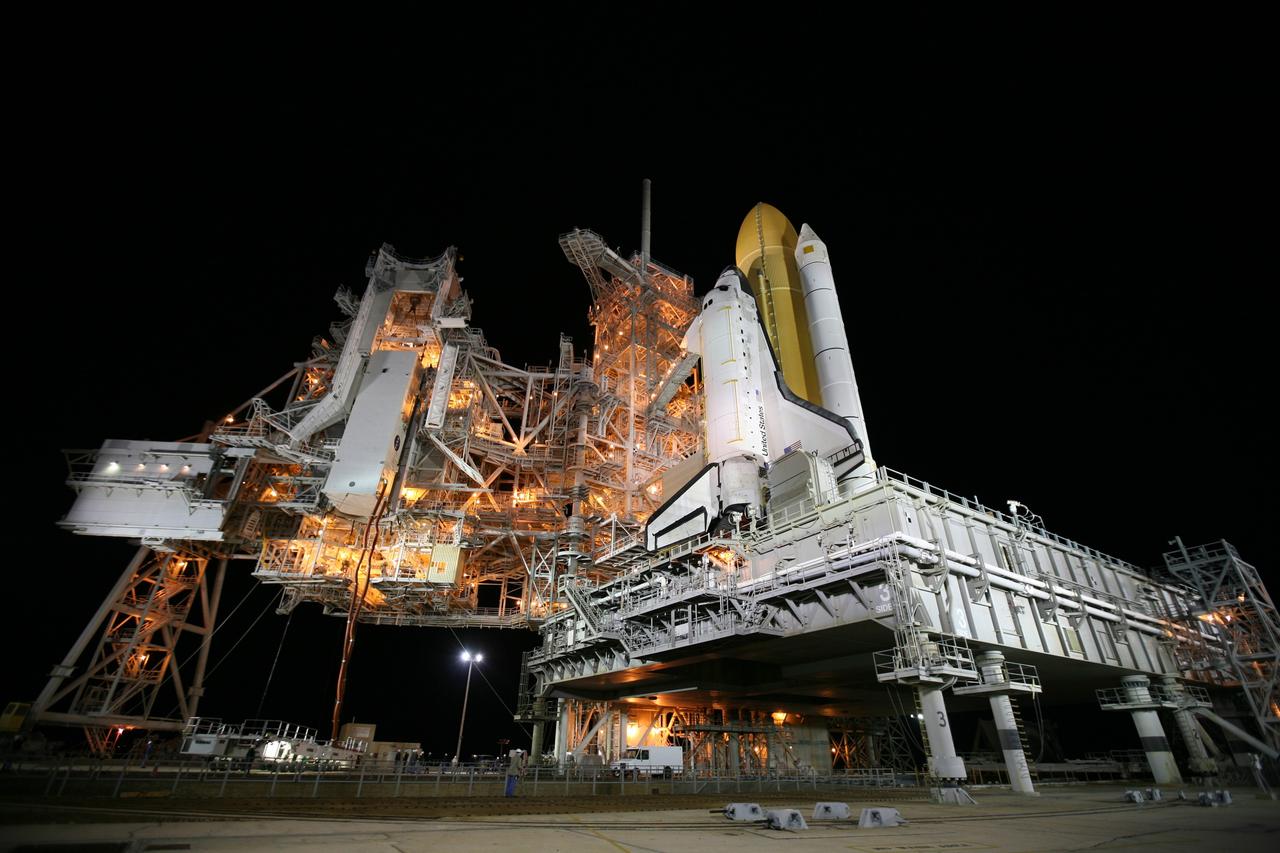
CAPE CANAVERAL, Fla. -- At NASA's Kennedy Space Center in Florida, the STS-133 payload canister is lifted into the rotating service structure on Launch Pad 39A. The payload then will be moved into space shuttle Discovery's payload bay. Discovery and its STS-133 crew will deliver the Permanent Multipurpose Module, packed with supplies and critical spare parts, as well as Robonaut 2, the dexterous humanoid astronaut helper, to the International Space Station. Launch is targeted for 4:40 p.m. EDT, Nov. 1. Photo credit: NASA/Amanda Diller
CAPE CANAVERAL, Fla. -- At NASA's Kennedy Space Center in Florida, the STS-133 payload canister now is in the rotating service structure on Launch Pad 39A. The payload then will be moved into space shuttle Discovery's payload bay. Discovery and its STS-133 crew will deliver the Permanent Multipurpose Module, packed with supplies and critical spare parts, as well as Robonaut 2, the dexterous humanoid astronaut helper, to the International Space Station. Launch is targeted for 4:40 p.m. EDT, Nov. 1. Photo credit: NASA/Troy Cryder
CAPE CANAVERAL, Fla. -- At NASA's Kennedy Space Center in Florida, the STS-133 payload canister now is in the rotating service structure on Launch Pad 39A. The payload then will be moved into space shuttle Discovery's payload bay. Discovery and its STS-133 crew will deliver the Permanent Multipurpose Module, packed with supplies and critical spare parts, as well as Robonaut 2, the dexterous humanoid astronaut helper, to the International Space Station. Launch is targeted for 4:40 p.m. EDT, Nov. 1. Photo credit: NASA/Troy Cryder
CAPE CANAVERAL, Fla. -- At NASA's Kennedy Space Center in Florida, the STS-133 payload canister is lifted into the rotating service structure on Launch Pad 39A. The payload then will be moved into space shuttle Discovery's payload bay. Discovery and its STS-133 crew will deliver the Permanent Multipurpose Module, packed with supplies and critical spare parts, as well as Robonaut 2, the dexterous humanoid astronaut helper, to the International Space Station. Launch is targeted for 4:40 p.m. EDT, Nov. 1. Photo credit: NASA/Troy Cryder
CAPE CANAVERAL, Fla. -- At NASA's Kennedy Space Center in Florida, the STS-133 payload canister is lifted into the rotating service structure on Launch Pad 39A. The payload then will be moved into space shuttle Discovery's payload bay. Discovery and its STS-133 crew will deliver the Permanent Multipurpose Module, packed with supplies and critical spare parts, as well as Robonaut 2, the dexterous humanoid astronaut helper, to the International Space Station. Launch is targeted for 4:40 p.m. EDT, Nov. 1. Photo credit: NASA/Amanda Diller
CAPE CANAVERAL, Fla. -- At NASA's Kennedy Space Center in Florida, the STS-133 payload canister is lifted into the rotating service structure on Launch Pad 39A. The payload then will be moved into space shuttle Discovery's payload bay. Discovery and its STS-133 crew will deliver the Permanent Multipurpose Module, packed with supplies and critical spare parts, as well as Robonaut 2, the dexterous humanoid astronaut helper, to the International Space Station. Launch is targeted for 4:40 p.m. EDT, Nov. 1. Photo credit: NASA/Troy Cryder
CAPE CANAVERAL, Fla. -- At NASA's Kennedy Space Center in Florida, the STS-133 payload canister is lifted into the rotating service structure on Launch Pad 39A. The payload then will be moved into space shuttle Discovery's payload bay. Discovery and its STS-133 crew will deliver the Permanent Multipurpose Module, packed with supplies and critical spare parts, as well as Robonaut 2, the dexterous humanoid astronaut helper, to the International Space Station. Launch is targeted for 4:40 p.m. EDT, Nov. 1. Photo credit: NASA/Amanda Diller
CAPE CANAVERAL, Fla. -- At NASA's Kennedy Space Center in Florida, the STS-133 payload canister is lifted into the rotating service structure on Launch Pad 39A. The payload then will be moved into space shuttle Discovery's payload bay. Discovery and its STS-133 crew will deliver the Permanent Multipurpose Module, packed with supplies and critical spare parts, as well as Robonaut 2, the dexterous humanoid astronaut helper, to the International Space Station. Launch is targeted for 4:40 p.m. EDT, Nov. 1. Photo credit: NASA/Troy Cryder
CAPE CANAVERAL, Fla. -- At NASA's Kennedy Space Center in Florida, the STS-133 payload canister is lifted into the rotating service structure on Launch Pad 39A. The payload then will be moved into space shuttle Discovery's payload bay. Discovery and its STS-133 crew will deliver the Permanent Multipurpose Module, packed with supplies and critical spare parts, as well as Robonaut 2, the dexterous humanoid astronaut helper, to the International Space Station. Launch is targeted for 4:40 p.m. EDT, Nov. 1. Photo credit: NASA/Amanda Diller
CAPE CANAVERAL, Fla. -- At NASA's Kennedy Space Center in Florida, the STS-133 payload canister now is in the rotating service structure on Launch Pad 39A. The payload then will be moved into space shuttle Discovery's payload bay. Discovery and its STS-133 crew will deliver the Permanent Multipurpose Module, packed with supplies and critical spare parts, as well as Robonaut 2, the dexterous humanoid astronaut helper, to the International Space Station. Launch is targeted for 4:40 p.m. EDT, Nov. 1. Photo credit: NASA/Troy Cryder
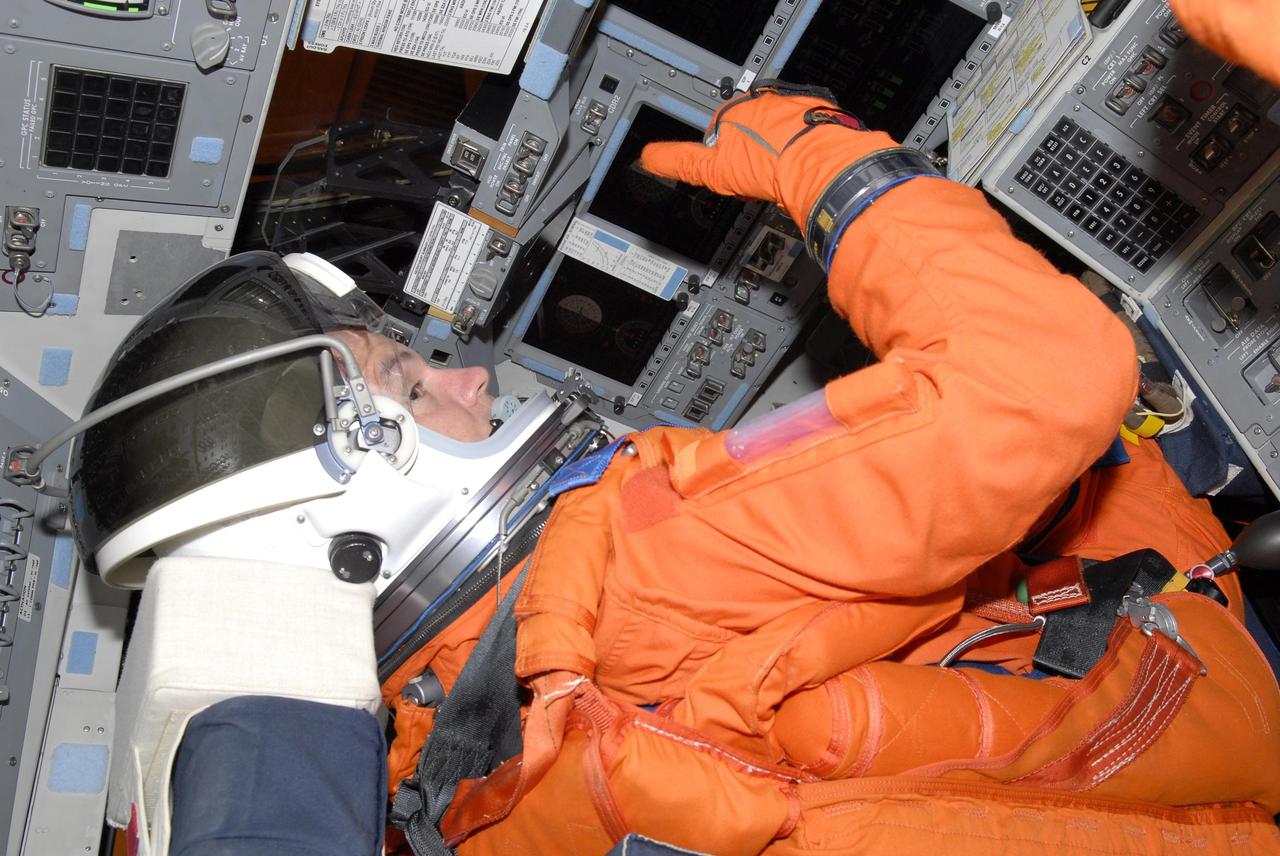
KENNEDY SPACE CENTER, FLA. -- Mission STS-117 Commander Rick Sturckow sits in the cockpit of Space Shuttle Atlantis at Launch Pad 39A to participate in a simulated launch countdown that is part of the prelaunch preparations known as terminal demonstration countdown test (TCDT). The TCDT also includes M-113 armored personnel carrier training and payload familiarization. The STS-117 mission is No. 21 to the International Space Station. Mission payloads aboard Atlantis include the S3/S4 integrated truss structure, a third set of solar arrays and batteries. The crew of six astronauts will install the truss to continue assembly of the station. Launch is scheduled for no earlier than March 15. Photo credit: NASA/Kim Shiflett.
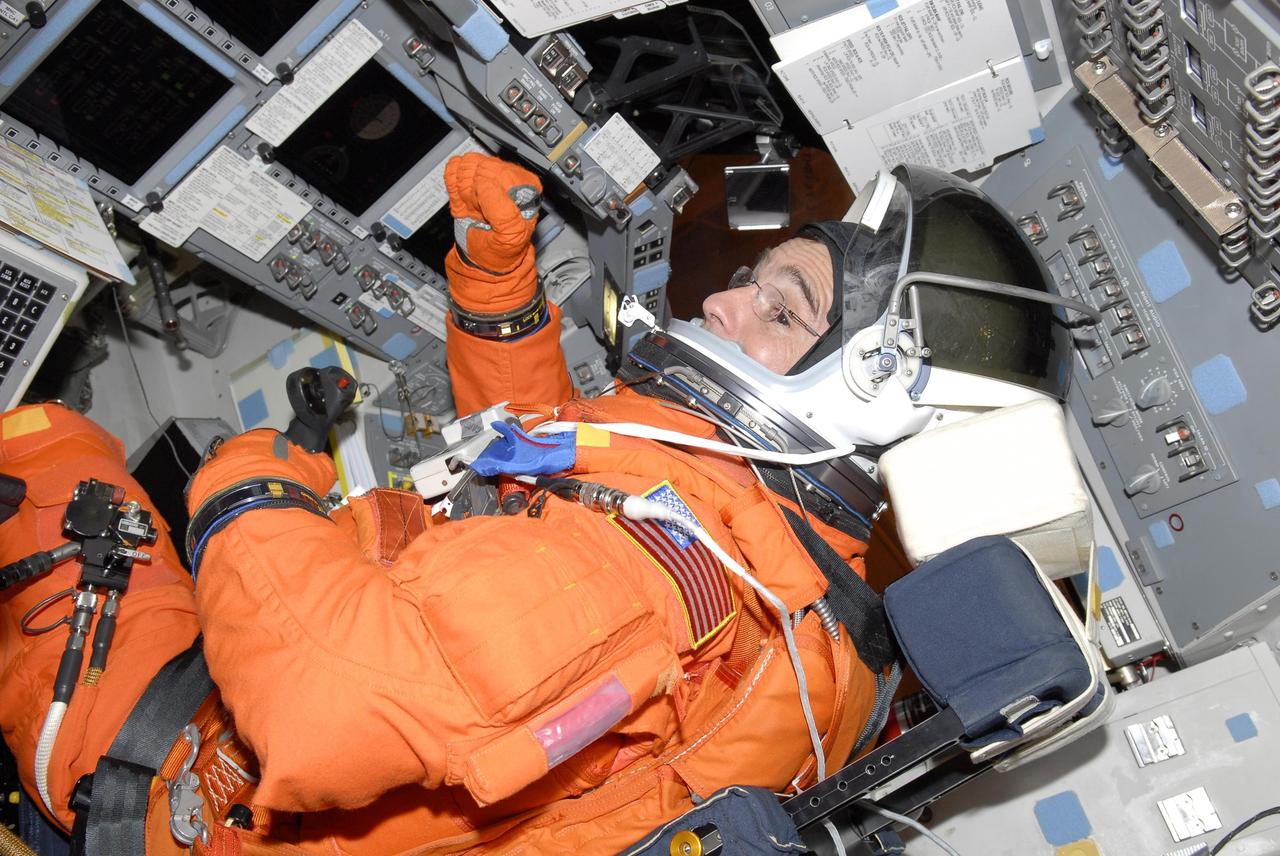
KENNEDY SPACE CENTER, FLA. -- Mission STS-117 Pilot Lee Archambault sits in the cockpit of Space Shuttle Atlantis at Launch Pad 39A to participate in a simulated launch countdown that is part of the prelaunch preparations known as terminal countdown demonstration test (TCDT). The TCDT also includes M-113 armored personnel carrier training and payload familiarization. The STS-117 mission is No. 21 to the International Space Station. Mission payloads aboard Atlantis include the S3/S4 integrated truss structure, a third set of solar arrays and batteries. The crew of six astronauts will install the truss to continue assembly of the station. Launch is scheduled for no earlier than March 15. Photo credit: NASA/Kim Shiflett.
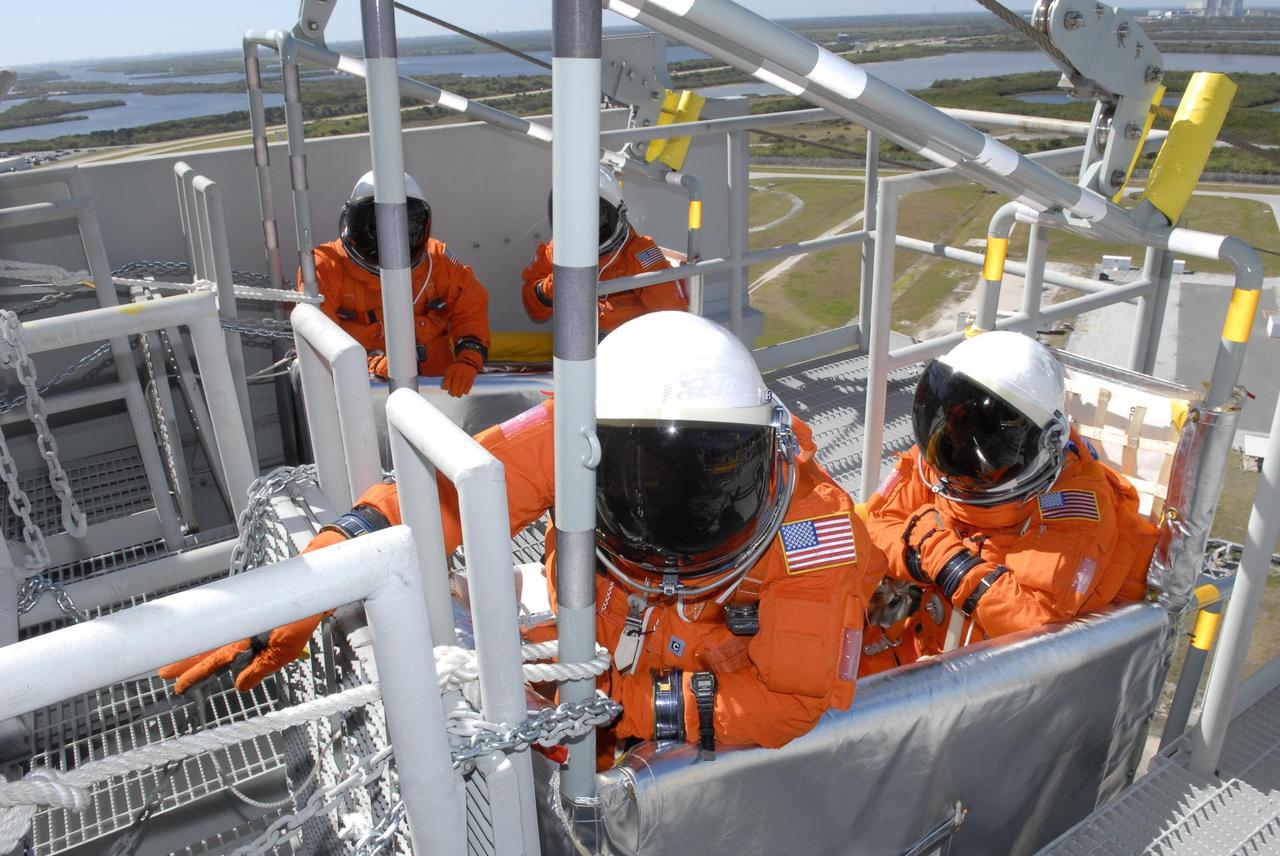
KENNEDY SPACE CENTER, FLA. -- From the 195-foot level of the fixed service structure on Launch Pad 39A, STS-117 Mission Specialists Patrick Forrester (front) and Steven Swanson sit in a slidewire basket, part of the emergency egress system. They and other crew members are practicing the emergency egress procedure to get off the pad, part of the prelaunch preparations known as terminal countdown demonstration test (TCDT). The TCDT also includes M-113 armored personnel carrier training and payload familiarization. The STS-117 mission is No. 21 to the International Space Station. Mission payloads aboard Atlantis include the S3/S4 integrated truss structure, a third set of solar arrays and batteries. The crew of six astronauts will install the truss to continue assembly of the station. Launch is scheduled for no earlier than March 15. Photo credit: NASA/Kim Shiflett.
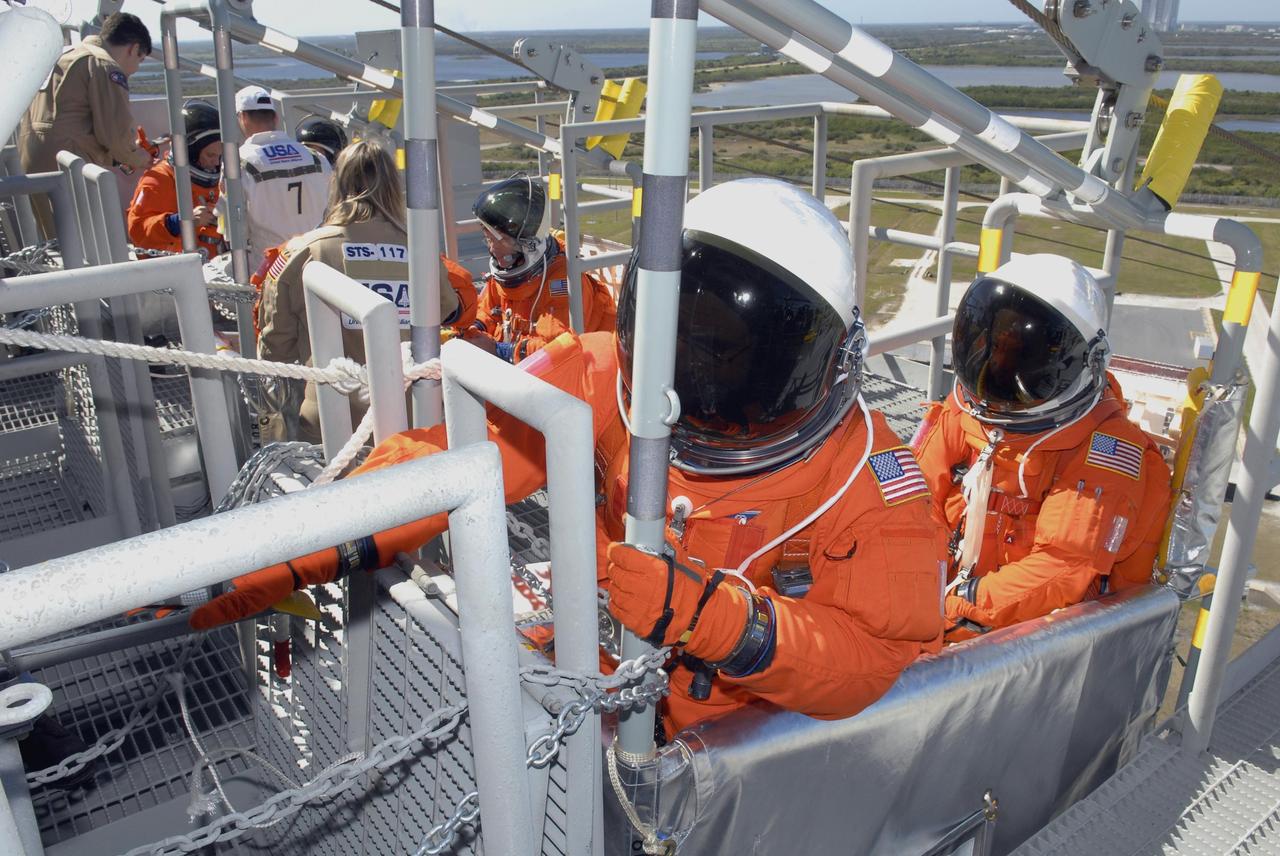
KENNEDY SPACE CENTER, FLA. -- From the 195-foot level of the fixed service structure on Launch Pad 39A, STS-117 Pilot Lee Archambault (front) and Commander Rick Sturckow sit in a slidewire basket, part of the emergency egress system. They and other crew members are practicing the emergency egress procedure to get off the pad, part of the prelaunch preparations known as terminal countdown demonstration test. The TCDT also includes M-113 armored personnel carrier training and payload familiarization. The STS-117 mission is No. 21 to the International Space Station. Mission payloads aboard Atlantis include the S3/S4 integrated truss structure, a third set of solar arrays and batteries. The crew of six astronauts will install the truss to continue assembly of the station. Launch is scheduled for no earlier than March 15. Photo credit: NASA/Kim Shiflett.
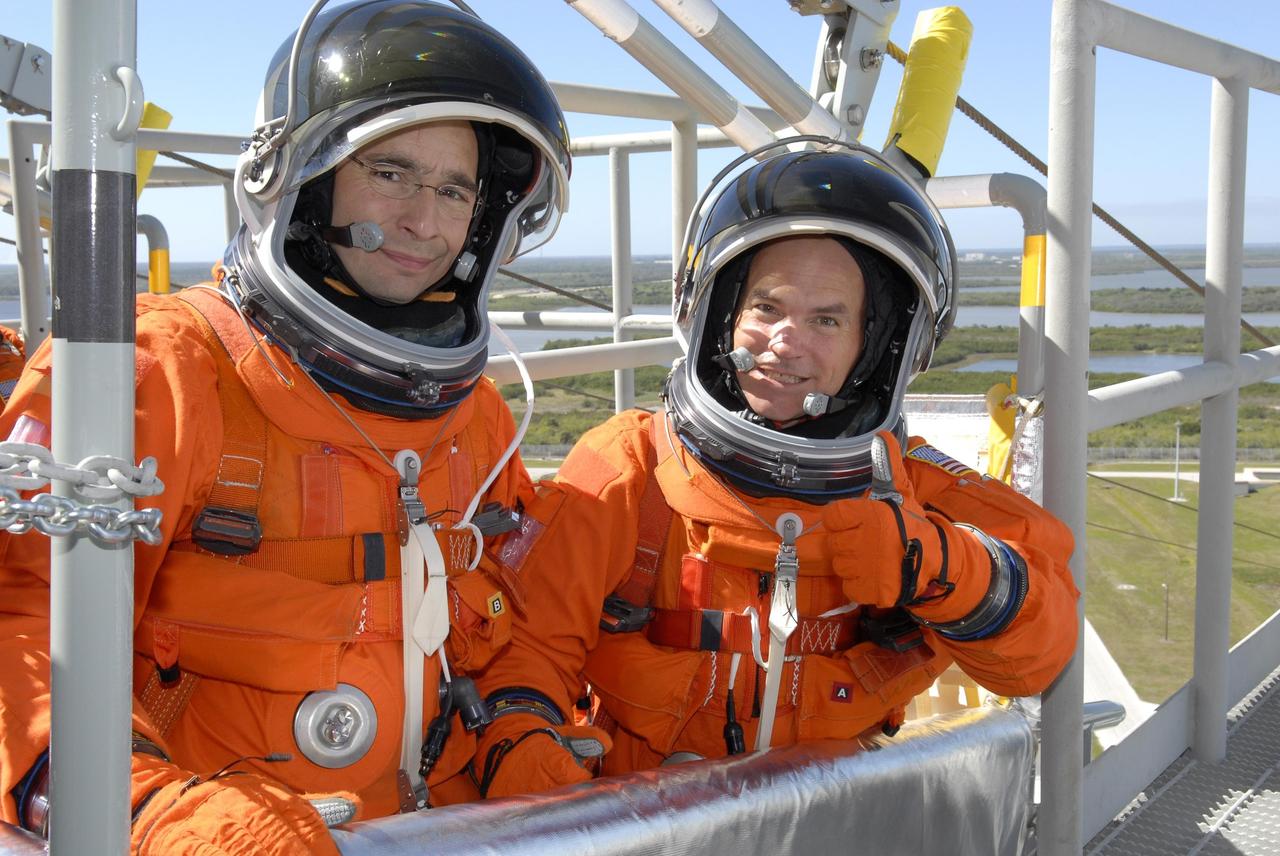
KENNEDY SPACE CENTER, FLA. -- Mission STS-117 Commander Rick Sturckow (right) gives a thumbs up after he and Pilot Lee Archambault practice emergency egress procedures in a slidewire basket at the 195-foot level of the fixed service structure on Launch Pad 39A. They and other crew members are practicing the emergency egress procedure to get off the pad, part of the prelaunch preparations known as terminal countdown demonstration test (TCDT). The TCDT also includes M-113 armored personnel carrier training and payload familiarization. The STS-117 mission is No. 21 to the International Space Station. Mission payloads aboard Atlantis include the S3/S4 integrated truss structure, a third set of solar arrays and batteries. The crew of six astronauts will install the truss to continue assembly of the station. Launch is scheduled for no earlier than March 15. Photo credit: NASA/Kim Shiflett.
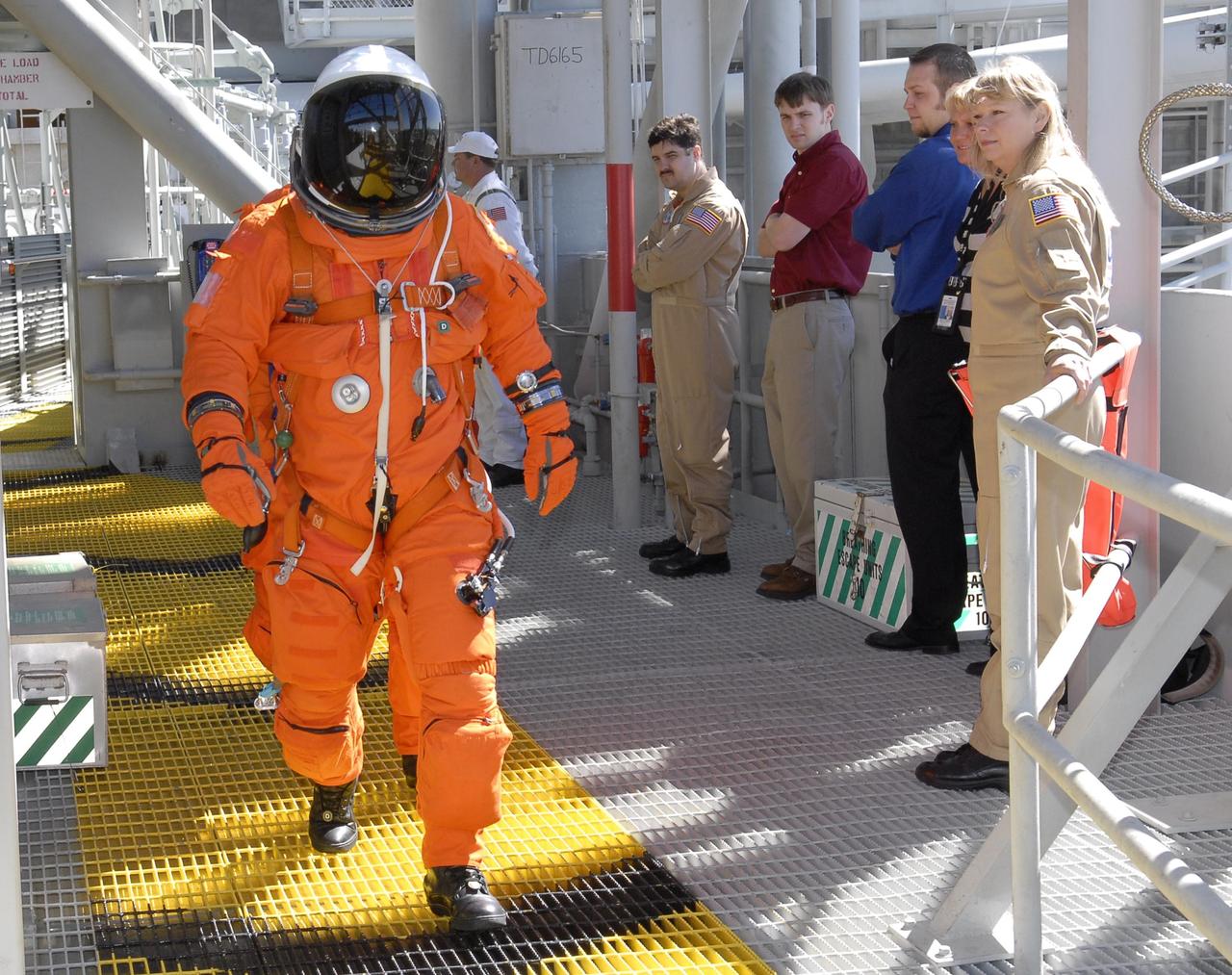
KENNEDY SPACE CENTER, FLA. -- On the 195-foot level of the fixed service structure on Launch Pad 39A, STS-117 Mission Specialists Steven Swanson and Patrick Forrester (directly behind him) head for the slidewire baskets. They and other crew members are practicing the emergency egress procedure to get off the pad, part of the prelaunch preparations known as terminal countdown demonstration test (TCDT). The TCDT also includes M-113 armored personnel carrier training and payload familiarization. The STS-117 mission is No. 21 to the International Space Station. Mission payloads aboard Atlantis include the S3/S4 integrated truss structure, a third set of solar arrays and batteries. The crew of six astronauts will install the truss to continue assembly of the station. Launch is scheduled for no earlier than March 15. Photo credit: NASA/Kim Shiflett.
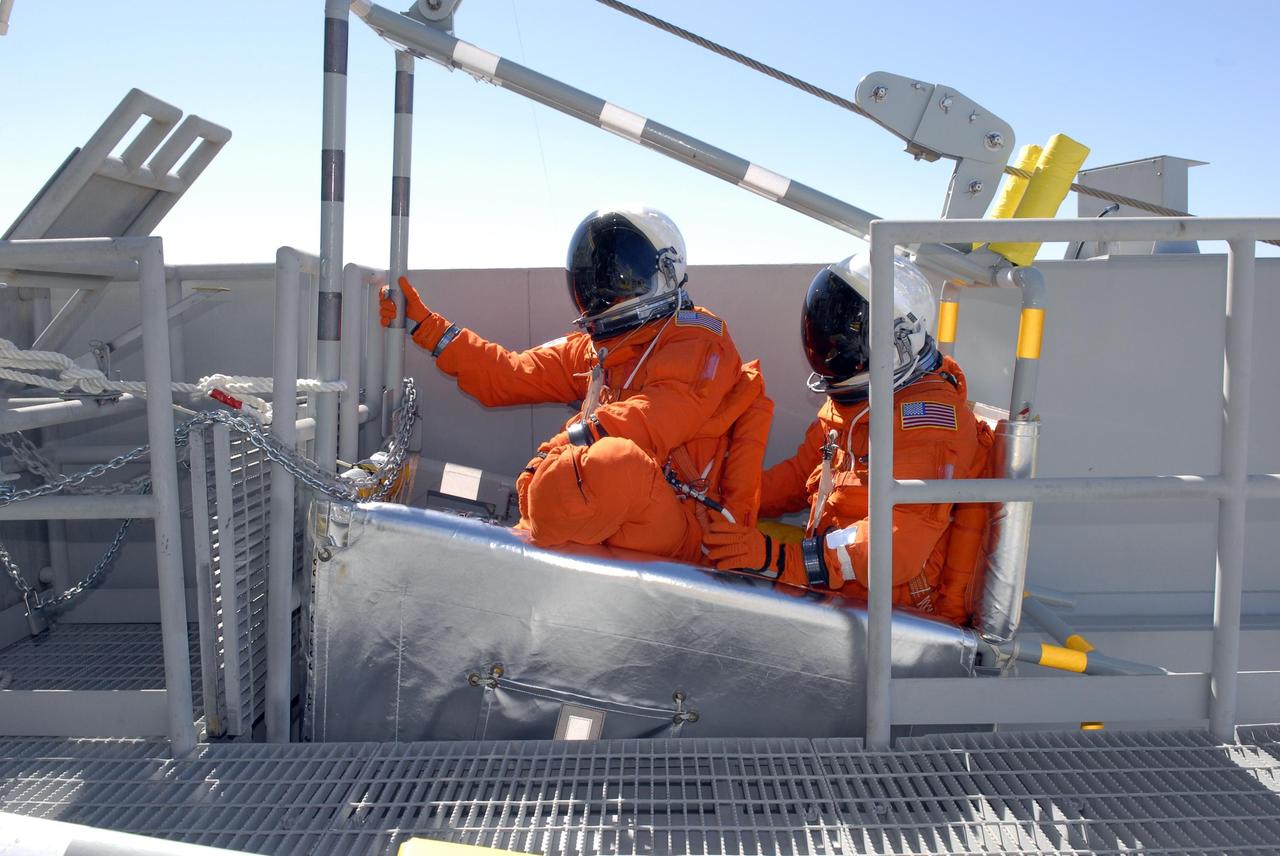
KENNEDY SPACE CENTER, FLA. -- From the 195-foot level of the fixed service structure on Launch Pad 39A, STS-117 Mission Specialists Danny Olivas (front) and James Reilly sit in a slidewire basket, part of the emergency egress system. They and other crew members are practicing the emergency egress procedure to get off the pad, part of the prelaunch preparations known as terminal countdown demonstration test (TCDT). The TCDT also includes M-113 armored personnel carrier training and payload familiarization. The STS-117 mission is No. 21 to the International Space Station. Mission payloads aboard Atlantis include the S3/S4 integrated truss structure, a third set of solar arrays and batteries. The crew of six astronauts will install the truss to continue assembly of the station. Launch is scheduled for no earlier than March 15. Photo credit: NASA/Kim Shiflett.
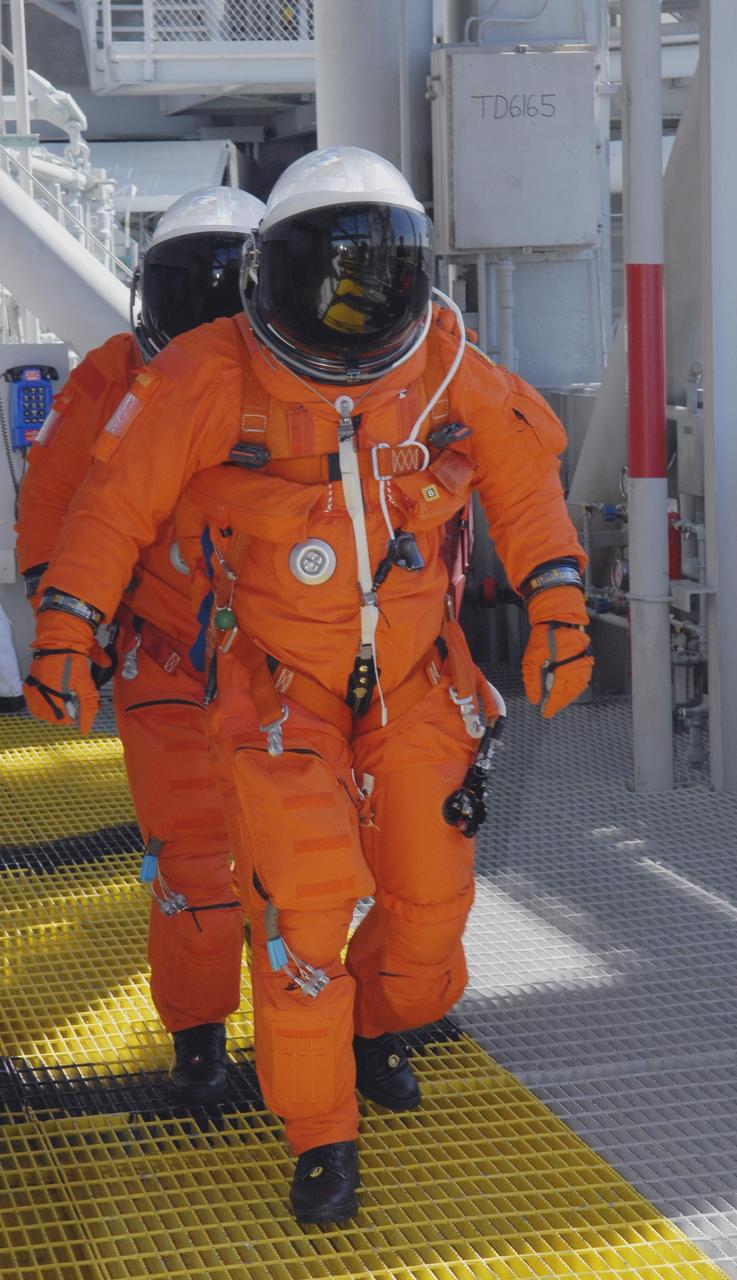
KENNEDY SPACE CENTER, FLA. -- On the 195-foot level of the fixed service structure on Launch Pad 39A, STS-117 Pilot Lee Archambault (front) and Commander Rick Sturckow head for the slidewire baskets. They and other crew members are practicing the emergency egress procedure to get off the pad, part of the prelaunch preparations known as terminal countdown demonstration test (TCDT). The TCDT also includes M-113 armored personnel carrier training and payload familiarization. The STS-117 mission is No. 21 to the International Space Station. Mission payloads aboard Atlantis include the S3/S4 integrated truss structure, a third set of solar arrays and batteries. The crew of six astronauts will install the truss to continue assembly of the station. Launch is scheduled for no earlier than March 15. Photo credit: NASA/Kim Shiflett.
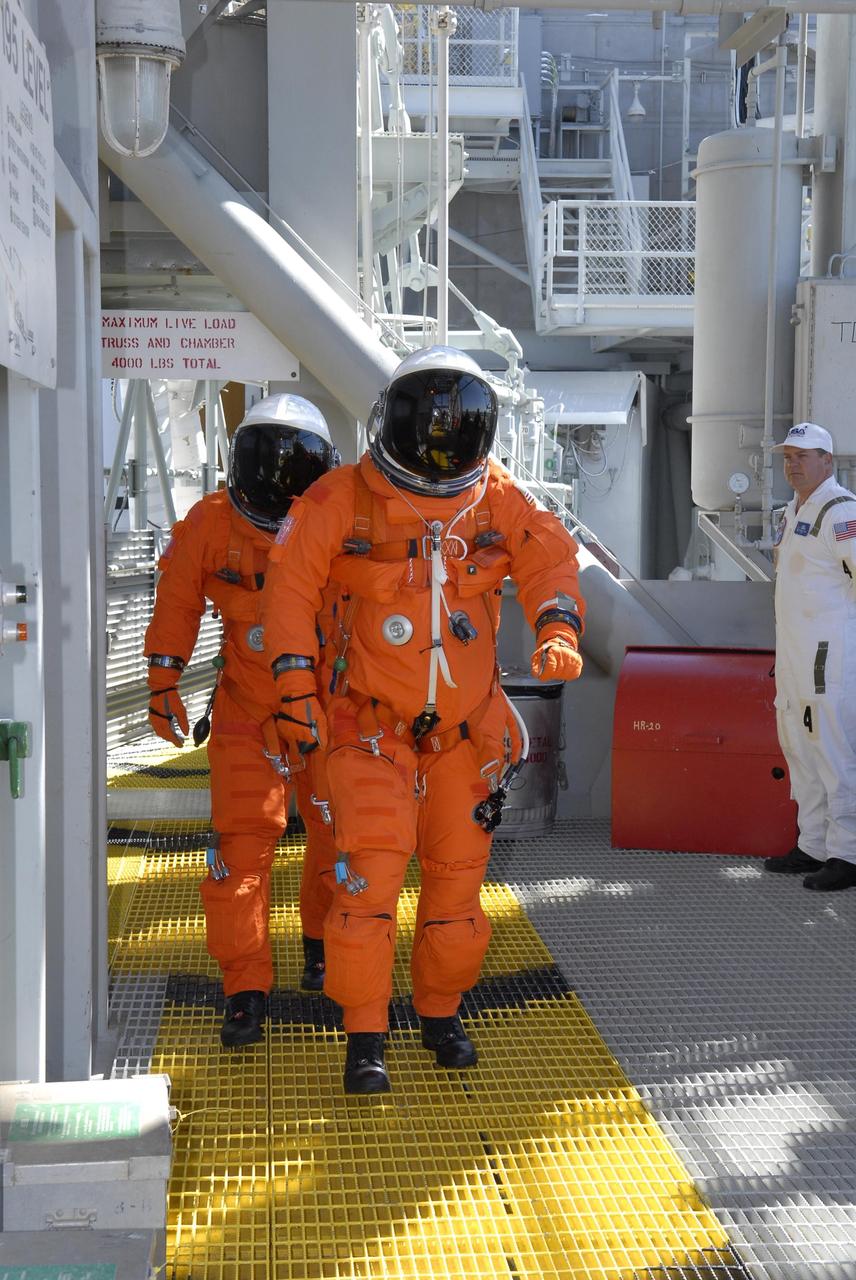
KENNEDY SPACE CENTER, FLA. -- On the 195-foot level of the fixed service structure on Launch Pad 39A, STS-117 Mission Specialists James Reilly (front) and Danny Olivas head for the slidewire baskets. They and other crew members are practicing the emergency egress procedure to get off the pad, part of the prelaunch preparations known as terminal countdown demonstration test (TCDT). The TCDT also includes M-113 armored personnel carrier training and payload familiarization. The STS-117 mission is No. 21 to the International Space Station. Mission payloads aboard Atlantis include the S3/S4 integrated truss structure, a third set of solar arrays and batteries. The crew of six astronauts will install the truss to continue assembly of the station. Launch is scheduled for no earlier than March 15. Photo credit: NASA/Kim Shiflett.
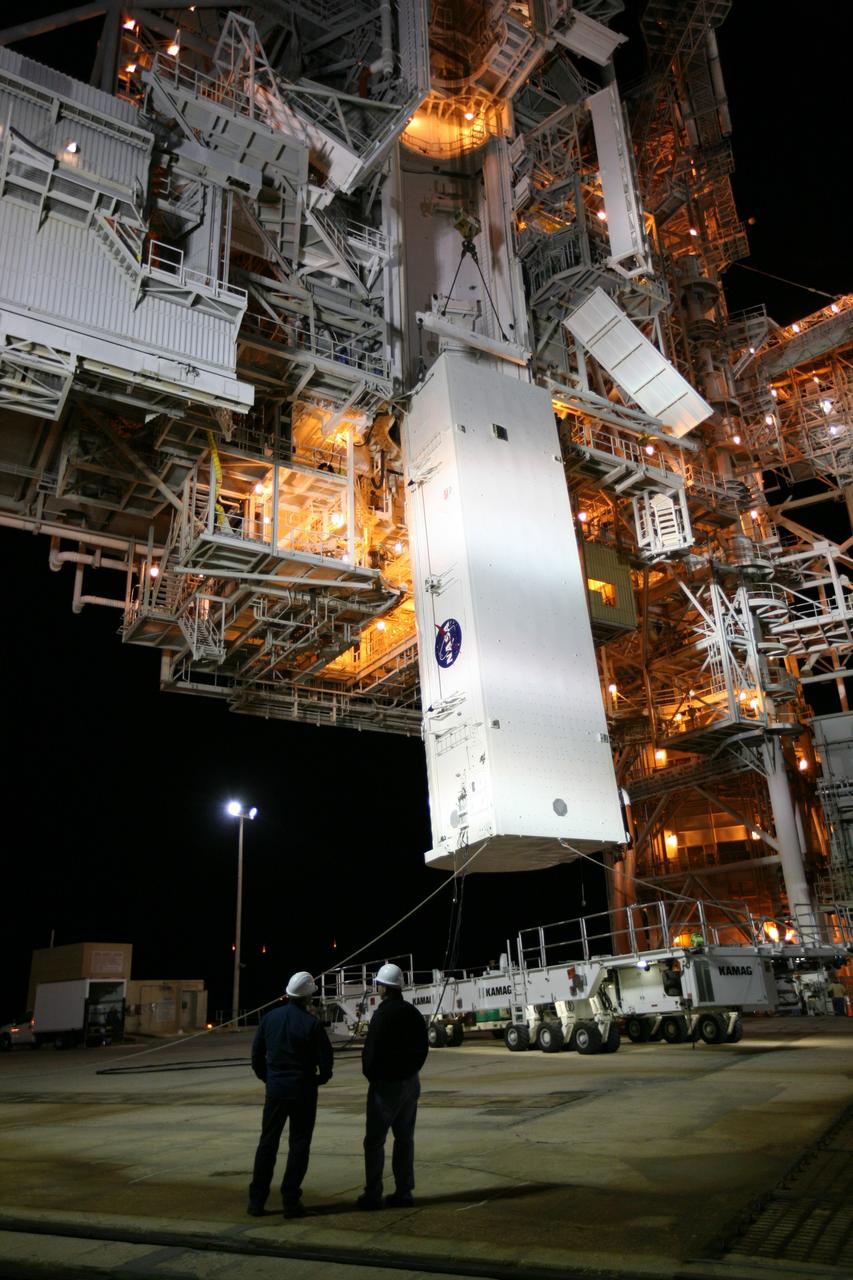
CAPE CANAVERAL, Fla. -- At NASA's Kennedy Space Center in Florida, workers begin the process of lifting the STS-133 payload canister off its transport vehicle toward the rotating service structure on Launch Pad 39A. The payload then will be moved into space shuttle Discovery's payload bay. Discovery and its STS-133 crew will deliver the Permanent Multipurpose Module, packed with supplies and critical spare parts, as well as Robonaut 2, the dexterous humanoid astronaut helper, to the International Space Station. Launch is targeted for 4:40 p.m. EDT, Nov. 1. Photo credit: NASA/Amanda Diller
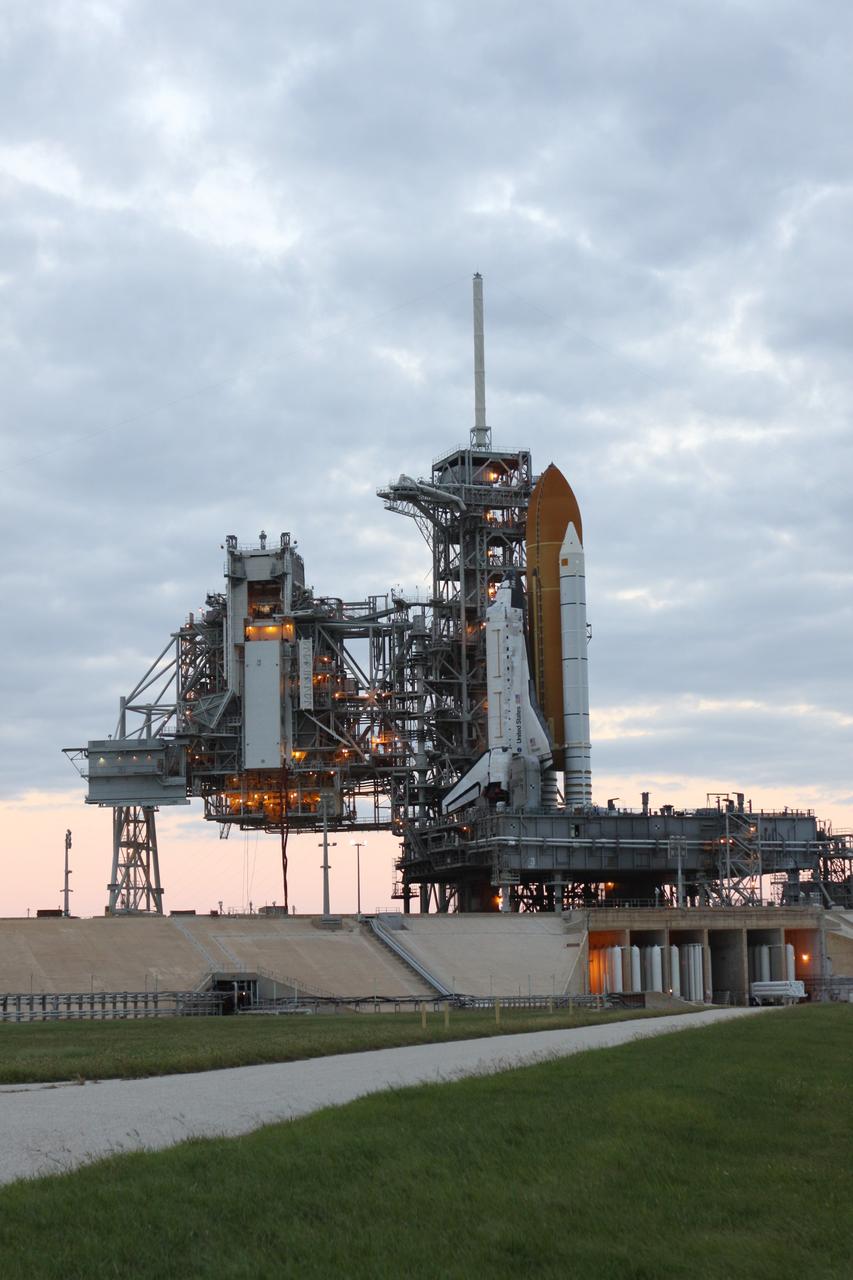
CAPE CANAVERAL, Fla. -- As dawn approaches at NASA's Kennedy Space Center in Florida, the STS-133 payload canister now is in the rotating service structure on Launch Pad 39A. The payload then will be moved into space shuttle Discovery's payload bay. Discovery and its STS-133 crew will deliver the Permanent Multipurpose Module, packed with supplies and critical spare parts, as well as Robonaut 2, the dexterous humanoid astronaut helper, to the International Space Station. Launch is targeted for 4:40 p.m. EDT, Nov. 1. Photo credit: NASA/Troy Cryder
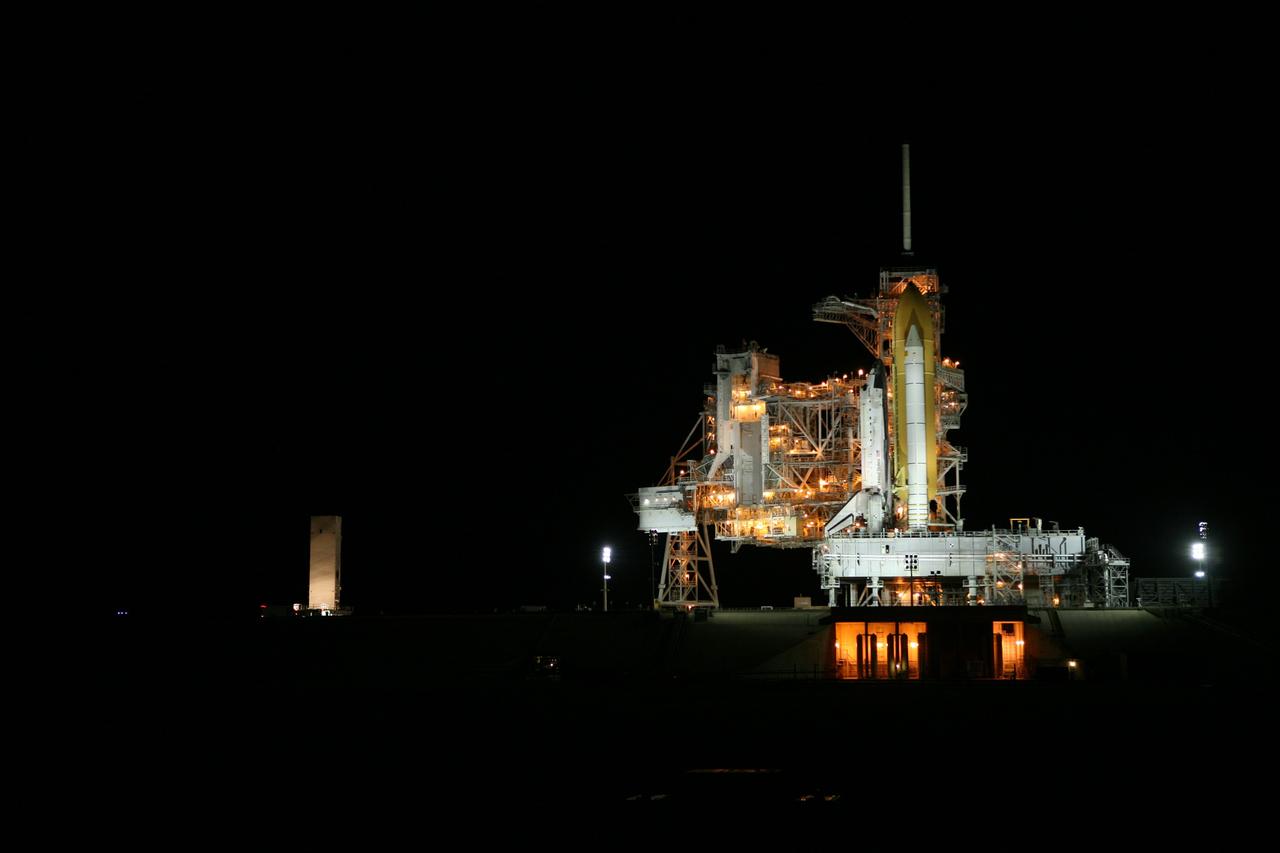
CAPE CANAVERAL, Fla. -- At NASA's Kennedy Space Center in Florida, the STS-133 payload canister approaches Launch Pad 39A where it will be lifted into the rotating service structure. The payload then will be moved into space shuttle Discovery's payload bay. Discovery and its STS-133 crew will deliver the Permanent Multipurpose Module, packed with supplies and critical spare parts, as well as Robonaut 2, the dexterous humanoid astronaut helper, to the International Space Station. Launch is targeted for 4:40 p.m. EDT, Nov. 1. Photo credit: NASA/Amanda Diller
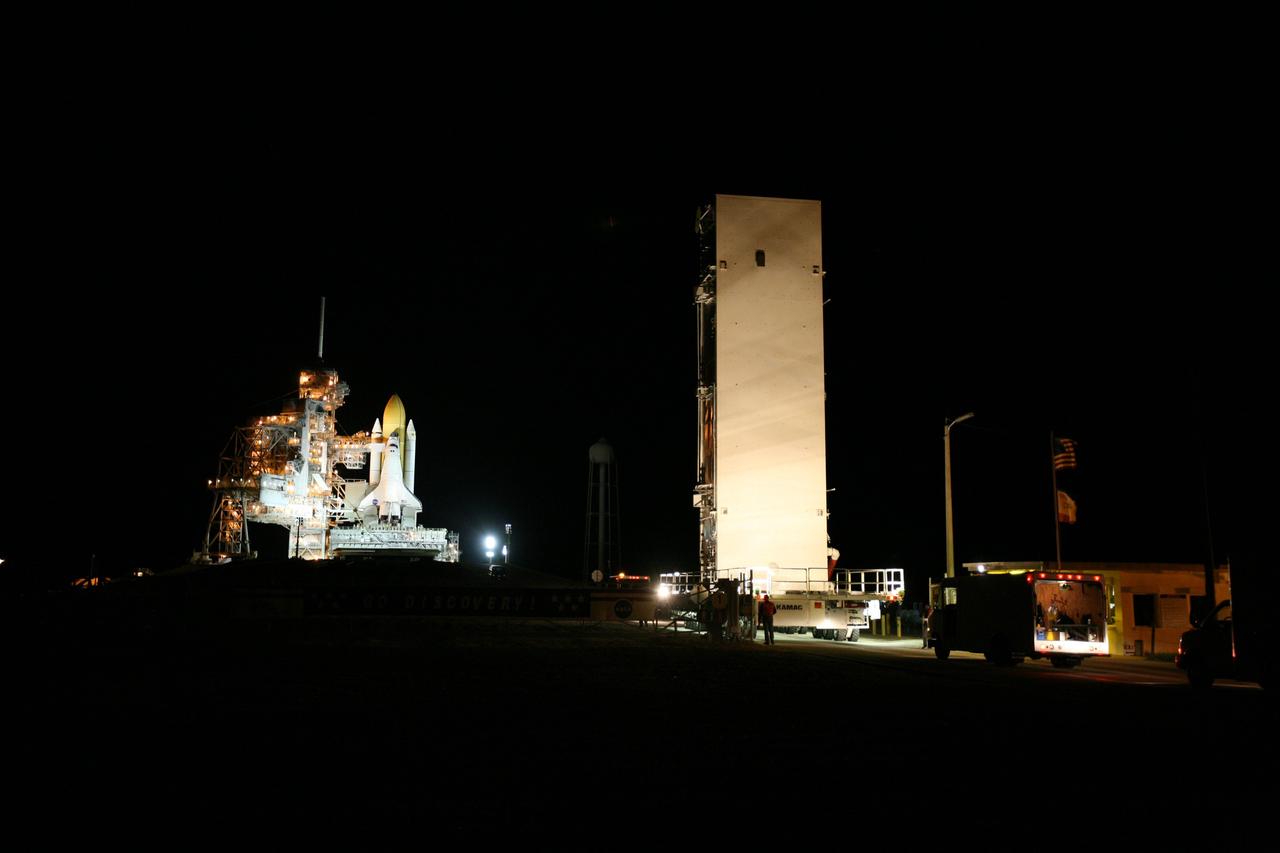
CAPE CANAVERAL, Fla. -- At NASA's Kennedy Space Center in Florida, the STS-133 payload canister approaches Launch Pad 39A where it will be lifted into the rotating service structure. The payload then will be moved into space shuttle Discovery's payload bay. Discovery and its STS-133 crew will deliver the Permanent Multipurpose Module, packed with supplies and critical spare parts, as well as Robonaut 2, the dexterous humanoid astronaut helper, to the International Space Station. Launch is targeted for 4:40 p.m. EDT, Nov. 1. Photo credit: NASA/Amanda Diller
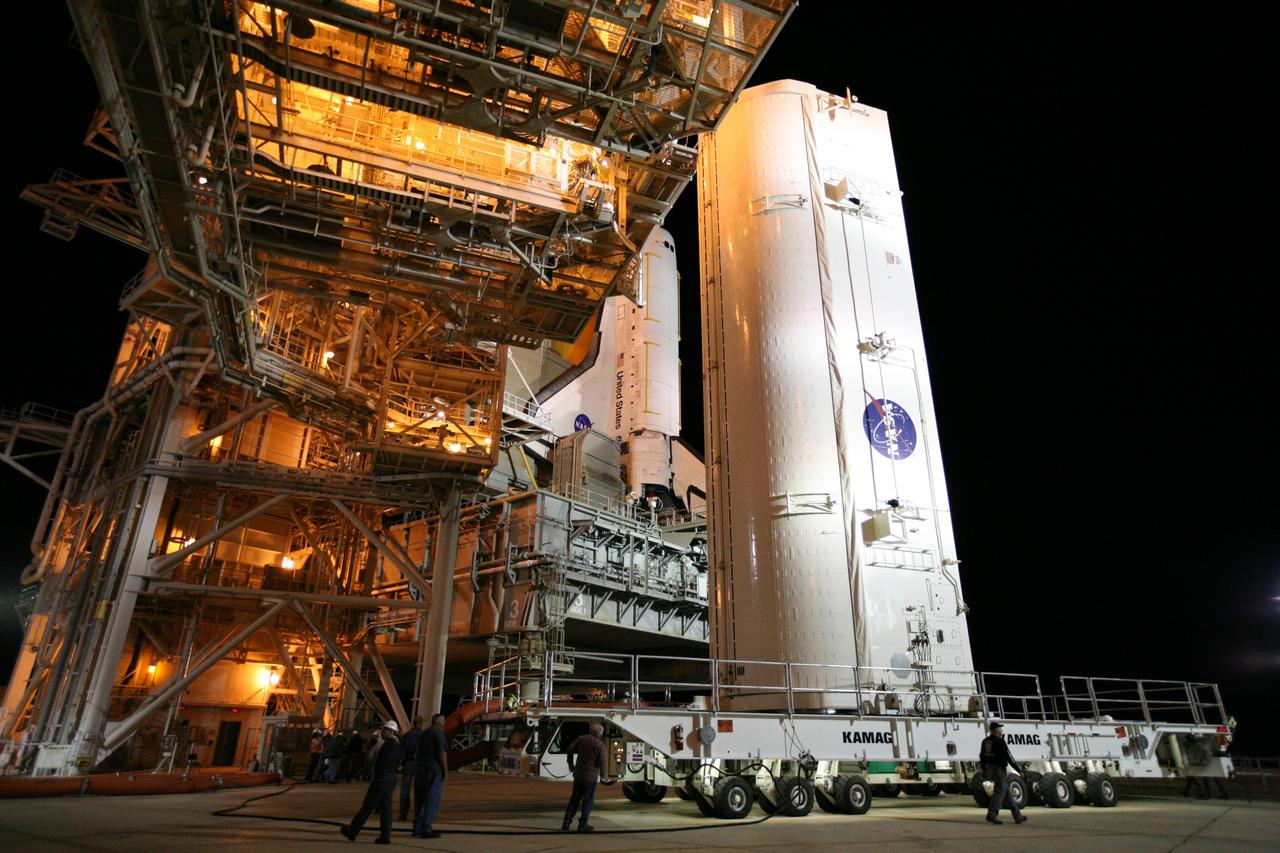
CAPE CANAVERAL, Fla. -- At NASA's Kennedy Space Center in Florida, workers monitor the arrival of the STS-133 payload canister to Launch Pad 39A where it will be lifted into the rotating service structure. The payload then will be moved into space shuttle Discovery's payload bay. Discovery and its STS-133 crew will deliver the Permanent Multipurpose Module, packed with supplies and critical spare parts, as well as Robonaut 2, the dexterous humanoid astronaut helper, to the International Space Station. Launch is targeted for 4:40 p.m. EDT, Nov. 1. Photo credit: NASA/Amanda Diller
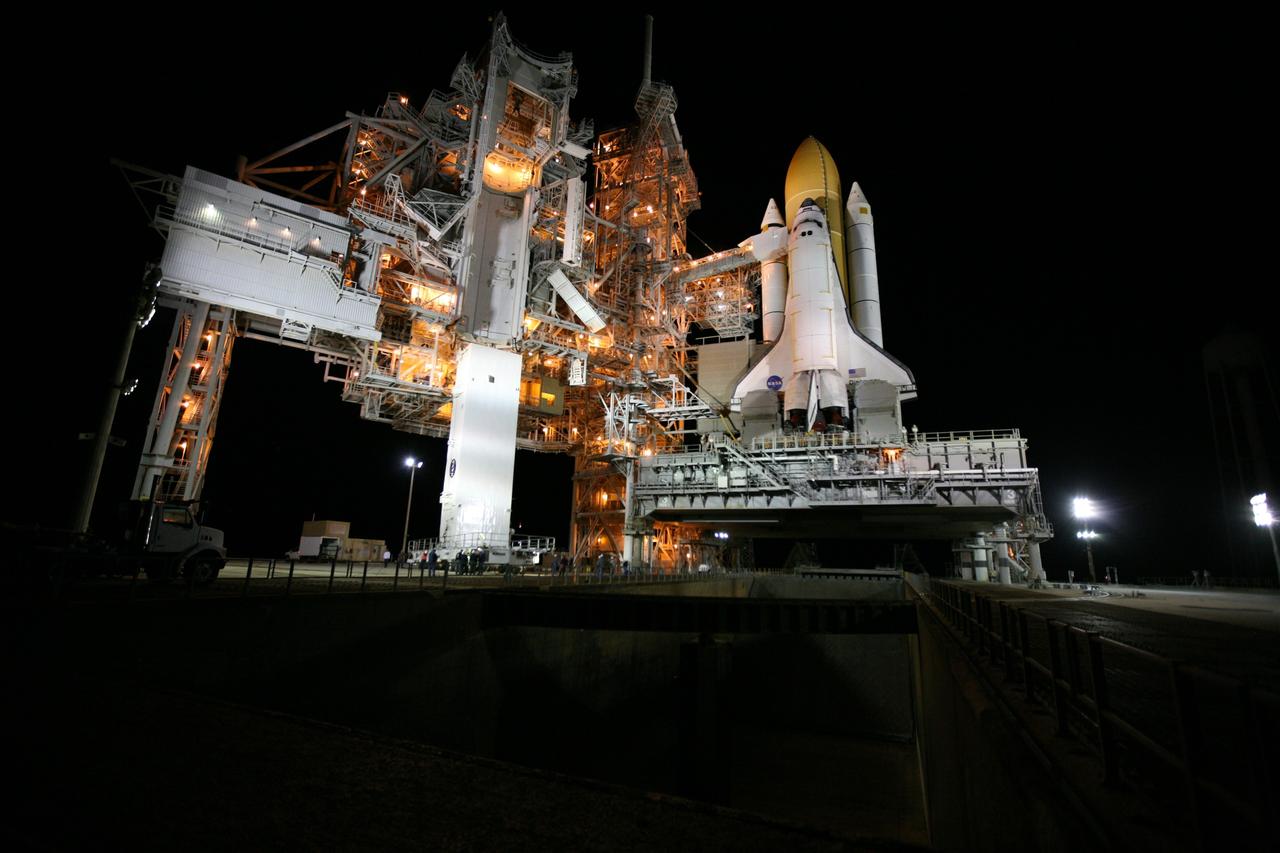
CAPE CANAVERAL, Fla. -- At NASA's Kennedy Space Center in Florida, workers monitor the arrival of the STS-133 payload canister to Launch Pad 39A where it will be lifted into the rotating service structure. The payload then will be moved into space shuttle Discovery's payload bay. Discovery and its STS-133 crew will deliver the Permanent Multipurpose Module, packed with supplies and critical spare parts, as well as Robonaut 2, the dexterous humanoid astronaut helper, to the International Space Station. Launch is targeted for 4:40 p.m. EDT, Nov. 1. Photo credit: NASA/Amanda Diller
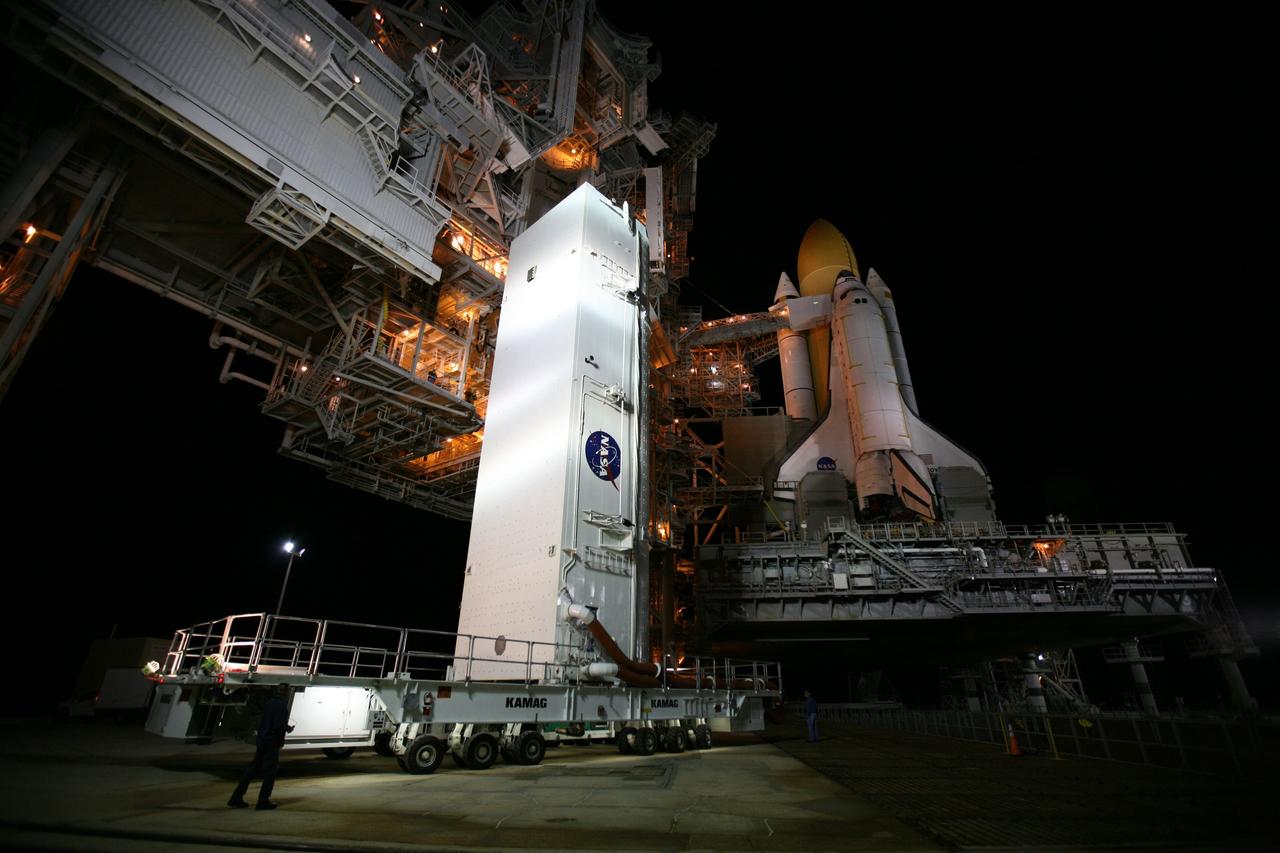
CAPE CANAVERAL, Fla. -- At NASA's Kennedy Space Center in Florida, the STS-133 payload canister approaches Launch Pad 39A where it will be lifted into the rotating service structure. The payload then will be moved into space shuttle Discovery's payload bay. Discovery and its STS-133 crew will deliver the Permanent Multipurpose Module, packed with supplies and critical spare parts, as well as Robonaut 2, the dexterous humanoid astronaut helper, to the International Space Station. Launch is targeted for 4:40 p.m. EDT, Nov. 1. Photo credit: NASA/Amanda Diller
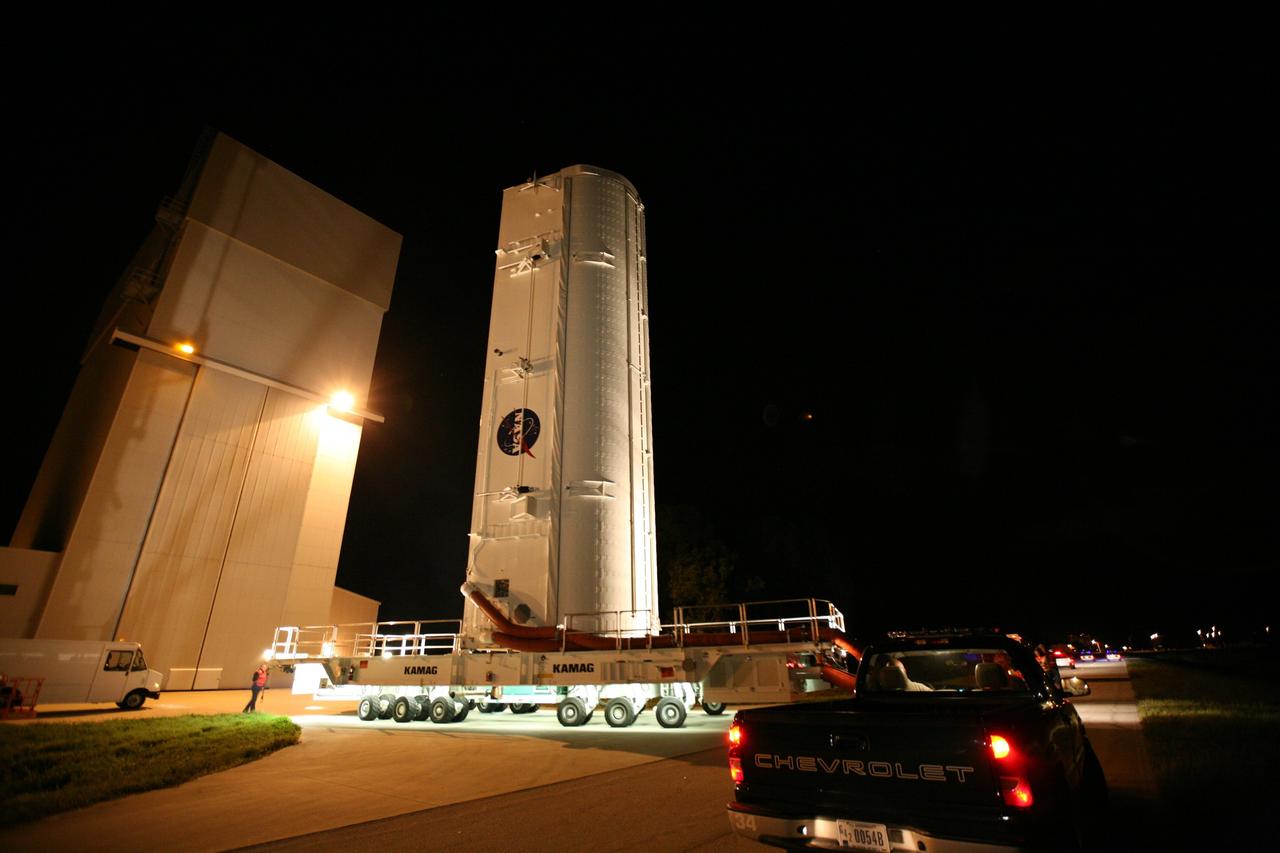
CAPE CANAVERAL, Fla. -- At NASA's Kennedy Space Center in Florida, the STS-133 payload canister leaves the Canister Rotation Facility on a transport vehicle headed for Launch Pad 39A where it will be lifted into the rotating service structure. The payload then will be moved into space shuttle Discovery's payload bay. Discovery and its STS-133 crew will deliver the Permanent Multipurpose Module, packed with supplies and critical spare parts, as well as Robonaut 2, the dexterous humanoid astronaut helper, to the International Space Station. Launch is targeted for 4:40 p.m. EDT, Nov. 1. Photo credit: NASA/Amanda Diller
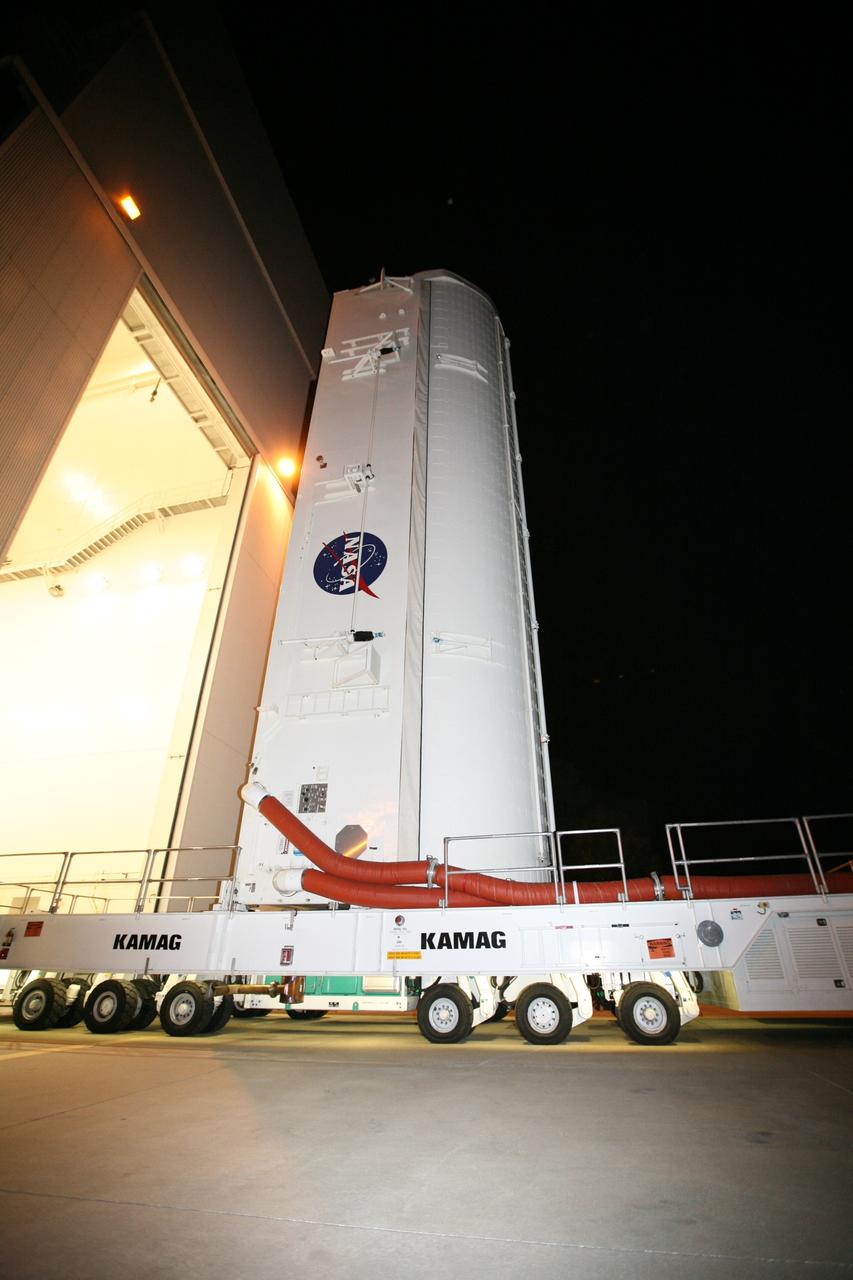
CAPE CANAVERAL, Fla. -- At NASA's Kennedy Space Center in Florida, the STS-133 payload canister leaves the Canister Rotation Facility on a transport vehicle headed for Launch Pad 39A where it will be lifted into the rotating service structure. The payload then will be moved into space shuttle Discovery's payload bay. Discovery and its STS-133 crew will deliver the Permanent Multipurpose Module, packed with supplies and critical spare parts, as well as Robonaut 2, the dexterous humanoid astronaut helper, to the International Space Station. Launch is targeted for 4:40 p.m. EDT, Nov. 1. Photo credit: NASA/Amanda Diller
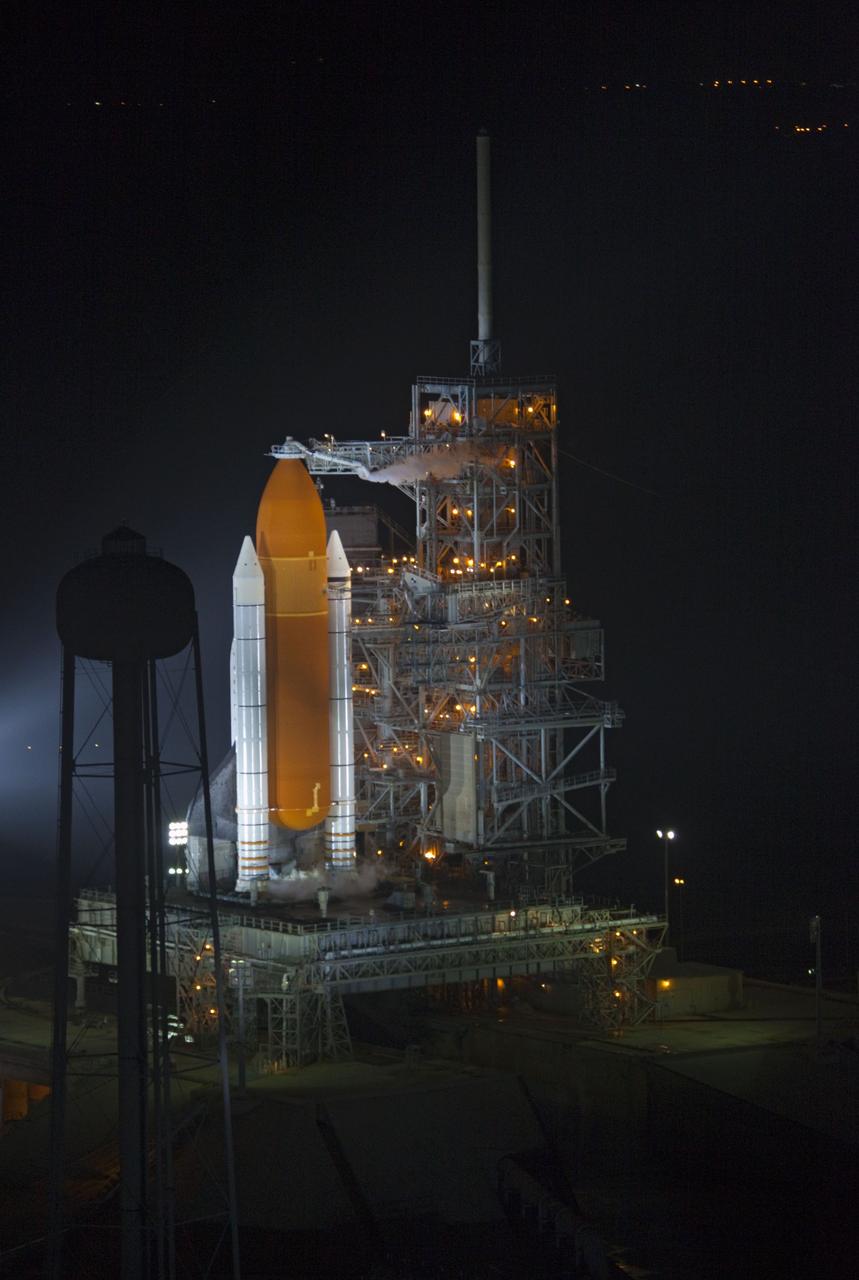
CAPE CANAVERAL, Fla. -- A NASA helicopter circles space shuttle Atlantis on Launch Pad 39A prior to launch on the STS-135 mission. To the right of the shuttle, the fixed service structure which is normally closed around the shuttle now is open for liftoff. At left of the pad is the 300,000-gallon water tower that provides the water used for sound suppression on the pad during liftoff. Atlantis and its crew of four -- Commander Chris Ferguson, Pilot Doug Hurley and Mission Specialists Sandy Magnus and Rex Walheim -- are scheduled to lift off at 11:26 a.m. EDT on July 8 to deliver the Raffaello multi-purpose logistics module packed with supplies and spare parts to the International Space Station. Atlantis also will fly the Robotic Refueling Mission experiment that will investigate the potential for robotically refueling existing satellites in orbit. In addition, Atlantis will return with a failed ammonia pump module to help NASA better understand the failure mechanism and improve pump designs for future systems. STS-135 will be the 33rd flight of Atlantis, the 37th shuttle mission to the space station, and the 135th and final mission of NASA's Space Shuttle Program. For more information, visit www.nasa.gov/mission_pages/shuttle/shuttlemissions/sts135/index.html. Photo credit: NASA/Frank Michaux
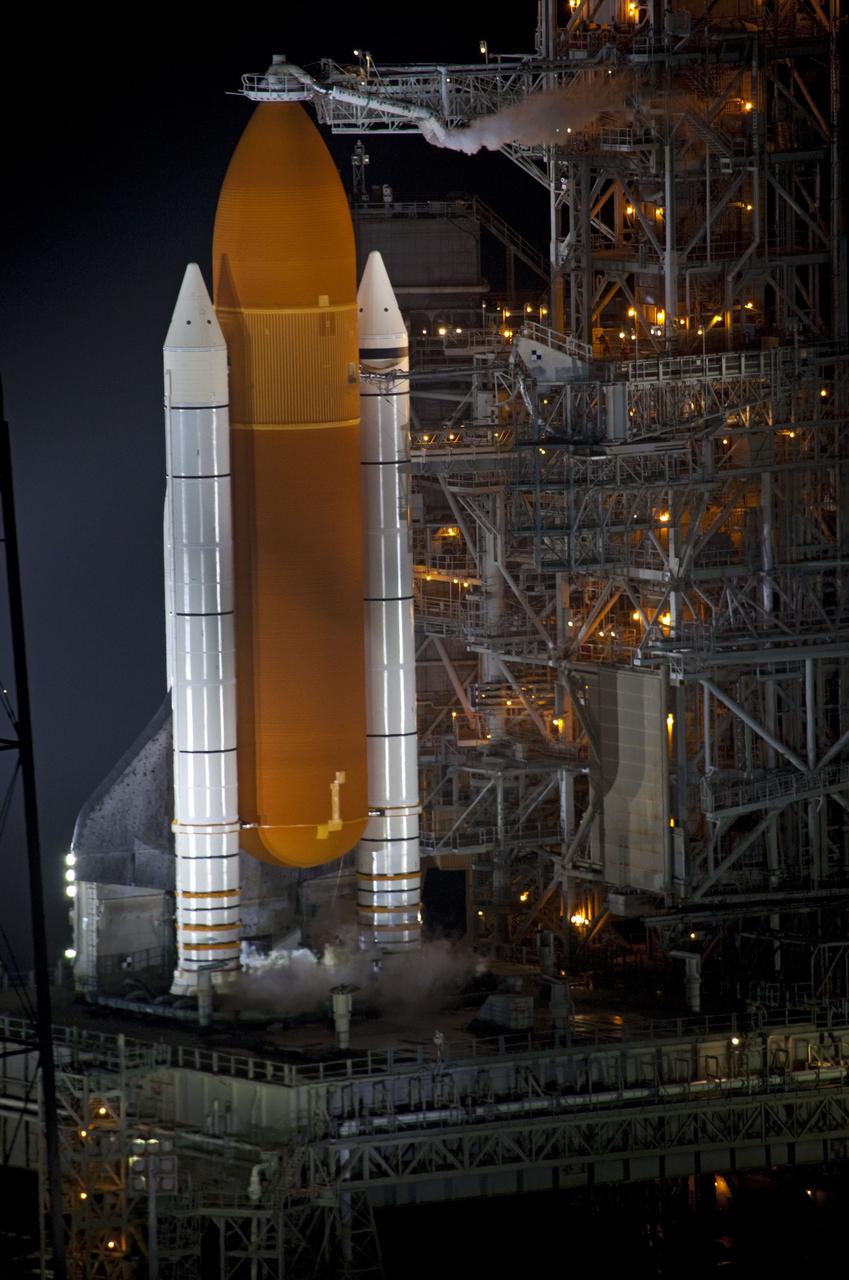
CAPE CANAVERAL, Fla. -- A NASA helicopter circles space shuttle Atlantis on Launch Pad 39A prior to launch on the STS-135 mission. To the right of the shuttle, the fixed service structure which is normally closed around the shuttle now is open for liftoff. At left of the pad is the 300,000-gallon water tower that provides the water used for sound suppression on the pad during liftoff. Atlantis and its crew of four -- Commander Chris Ferguson, Pilot Doug Hurley and Mission Specialists Sandy Magnus and Rex Walheim -- are scheduled to lift off at 11:26 a.m. EDT on July 8 to deliver the Raffaello multi-purpose logistics module packed with supplies and spare parts to the International Space Station. Atlantis also will fly the Robotic Refueling Mission experiment that will investigate the potential for robotically refueling existing satellites in orbit. In addition, Atlantis will return with a failed ammonia pump module to help NASA better understand the failure mechanism and improve pump designs for future systems. STS-135 will be the 33rd flight of Atlantis, the 37th shuttle mission to the space station, and the 135th and final mission of NASA's Space Shuttle Program. For more information, visit www.nasa.gov/mission_pages/shuttle/shuttlemissions/sts135/index.html. Photo credit: NASA/Frank Michaux
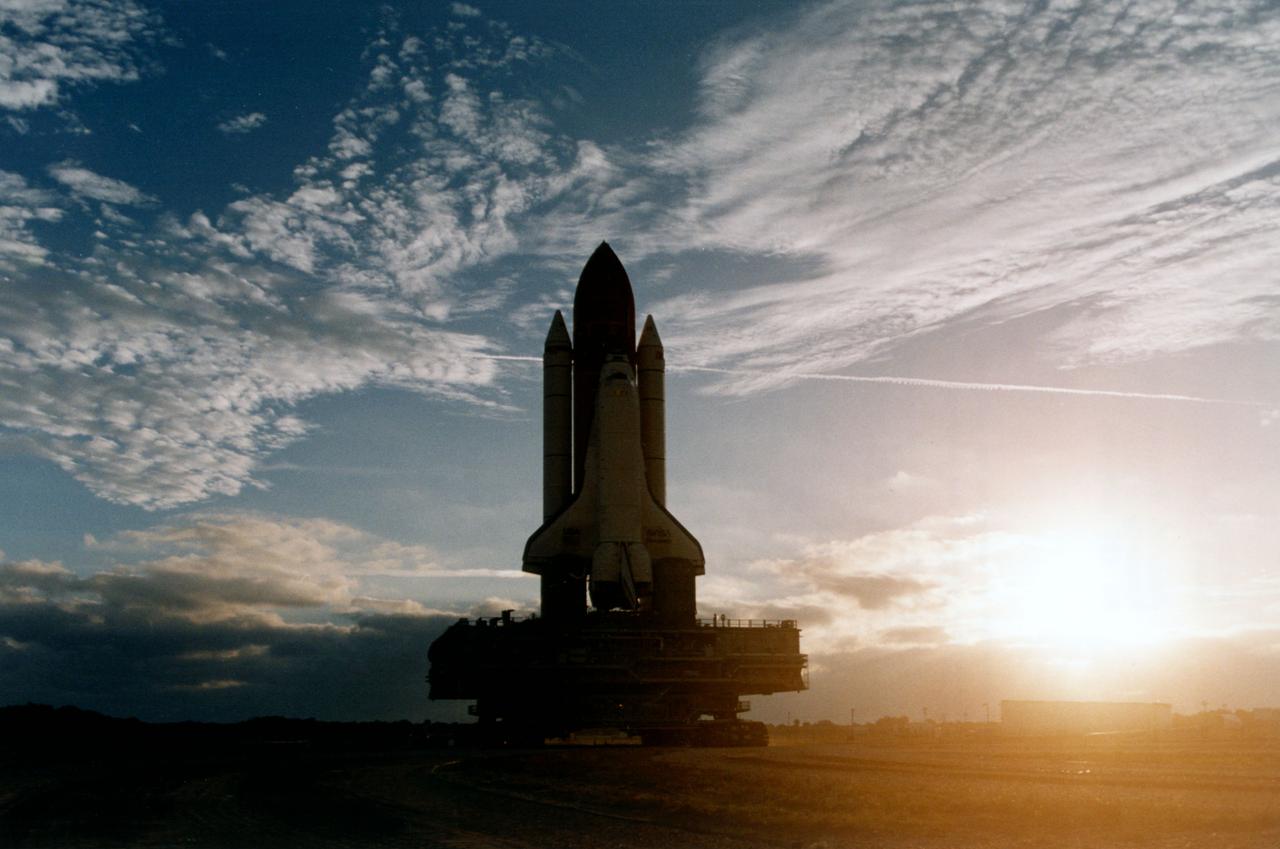
KENNEDY SPACE CENTER, FLORIDA STS-82 PREPARATIONS VIEW --- Scattered clouds at dawn provide the backdrop for the Space Shuttle Discovery as it moves along the Kennedy Space Center (KSC) Crawlerway toward Launch Pad 39A in preparation for the STS-82 mission. The Space Shuttle is on a mobile launch platform, and the entire assemblage is being carried by a large tracked vehicle called the Crawler Transporter. A seven-member crew of astronauts will perform the second servicing of the orbiting Hubble Space Telescope (HST) during the scheduled ten-day STS-82 flight. Launch is currently targeted for February 11, 1997.
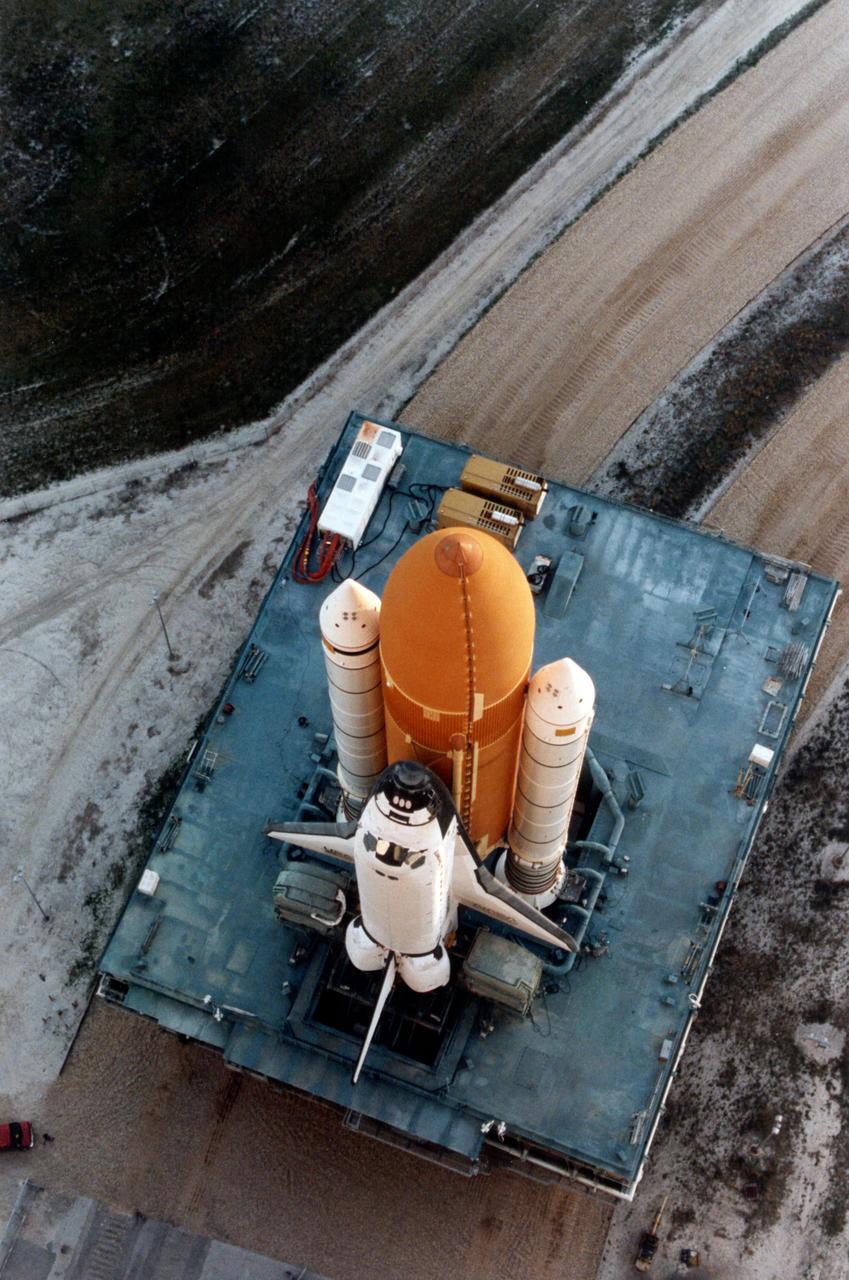
KENNEDY SPACE CENTER, FLORIDA STS-82 ROLL-OUT VIEW --- After departing the Vehicle Assembly Building (VAB), the Space Shuttle Discovery moves slowly - about one mile per hour - along the Kennedy Space Center (KSC) Crawlerway toward Launch Pad 39A in preparation for the STS-82 mission. The Shuttle is on a mobile launch platform, and the entire assemblage is being carried by a large tracked vehicle called the Crawler Transporter. A seven-member crew of astronauts will perform the second servicing of the orbiting Hubble Space Telescope (HST) during the scheduled ten-day STS-82 flight. Launch is currently targeted for February 11, 1997.
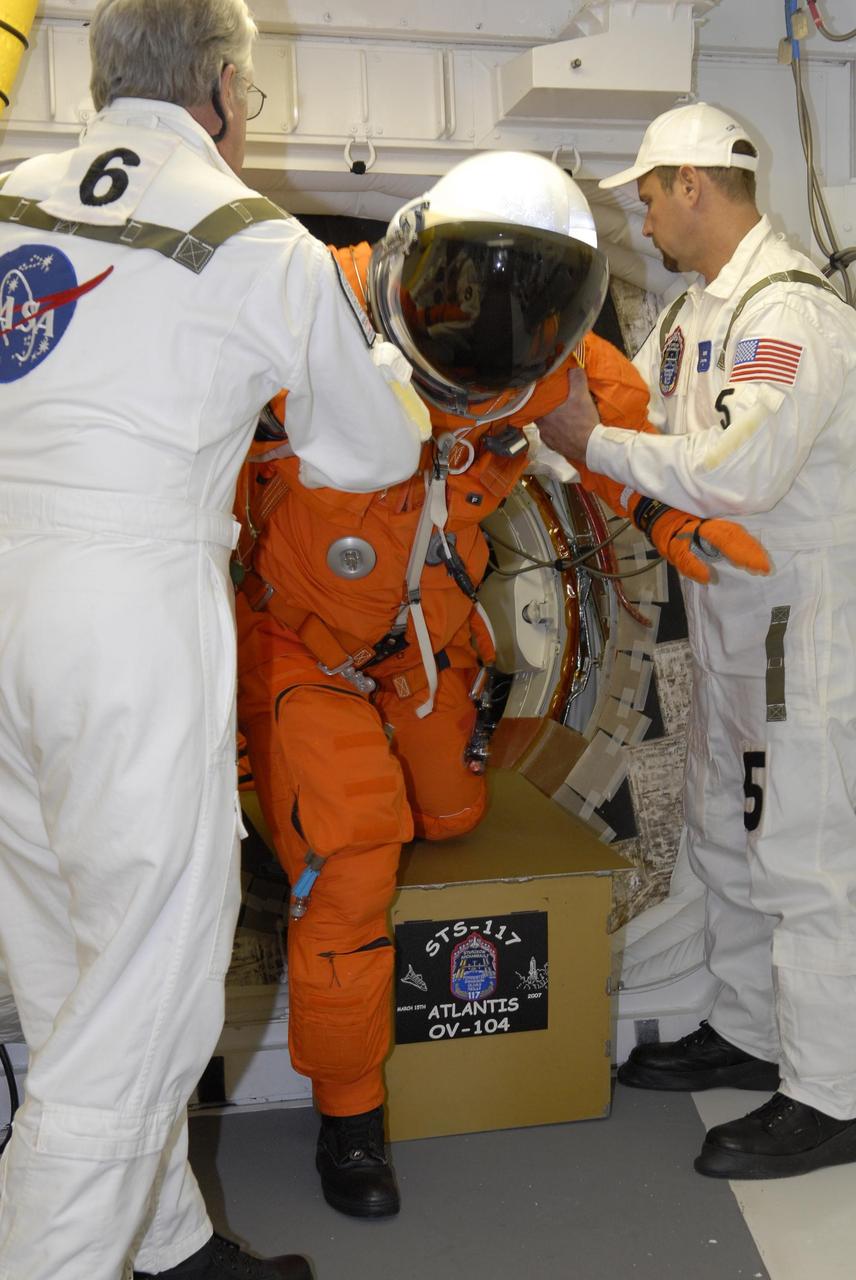
KENNEDY SPACE CENTER, FLA. -- Mission STS-117 Mission Specialist James Reilly egresses from Space Shuttle Atlantis at Launch Pad 39A after participating in a simulated launch countdown that is part of the prelaunch preparations known as terminal demonstration countdown test (TCDT). The TCDT also includes M-113 armored personnel carrier training and payload familiarization. The STS-117 mission is No. 21 to the International Space Station. Mission payloads aboard Atlantis include the S3/S4 integrated truss structure, a third set of solar arrays and batteries. The crew of six astronauts will install the truss to continue assembly of the station. Launch is scheduled for no earlier than March 15. Photo credit: NASA/Kim Shiflett.