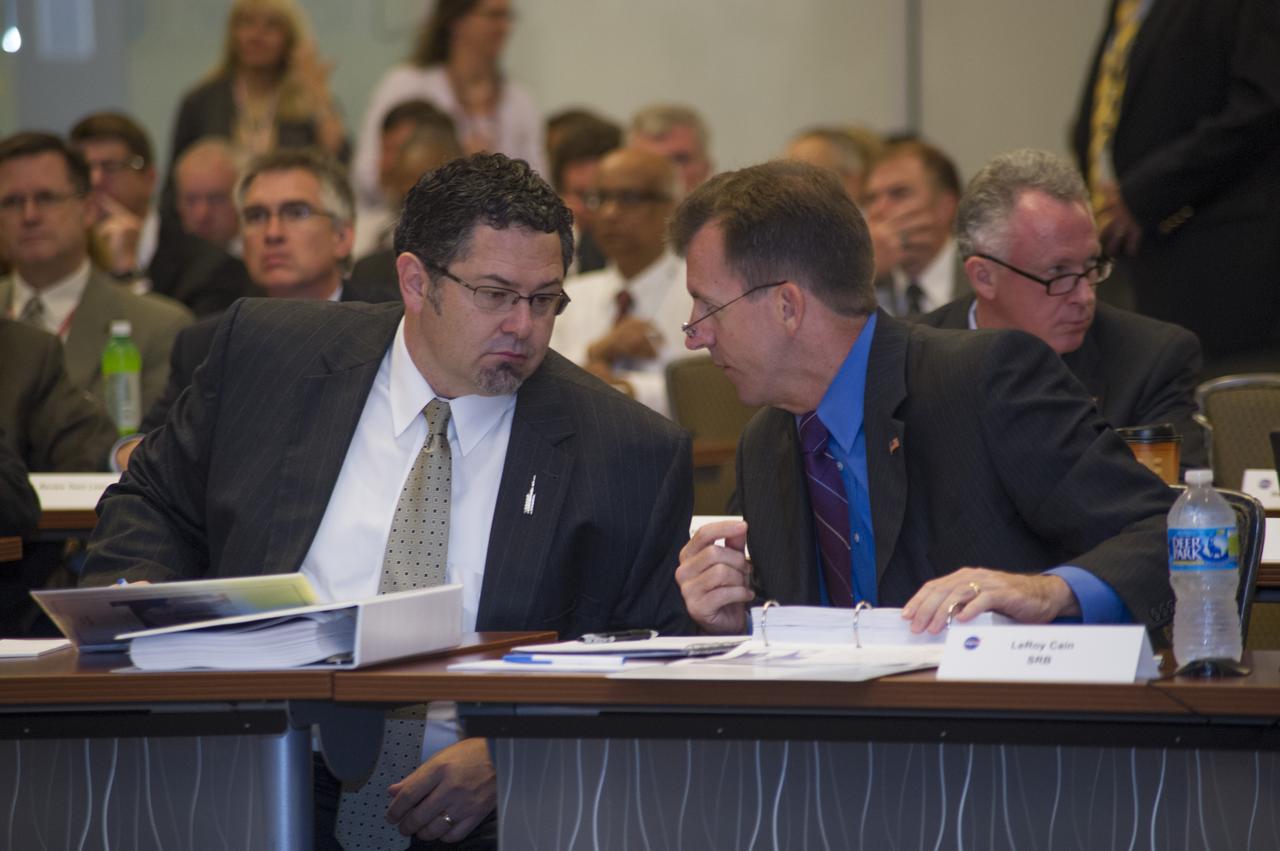
TODD MAY, LEFT, MANAGER OF THE SLS PROGRAM AT THE MARSHALL CENTER, DISCUSSES THE ROCKET'S SPECIFICATIONS WITH LEROY CAIN, WHO HEADS THE INDEPENDENT STANDING REVIEW BOARD FOR SLS, DURING THE SLS PROGRAM'S PRELIMINARY DESIGN REVIEW. THE REVIEW KICKED OFF JUNE 18-19
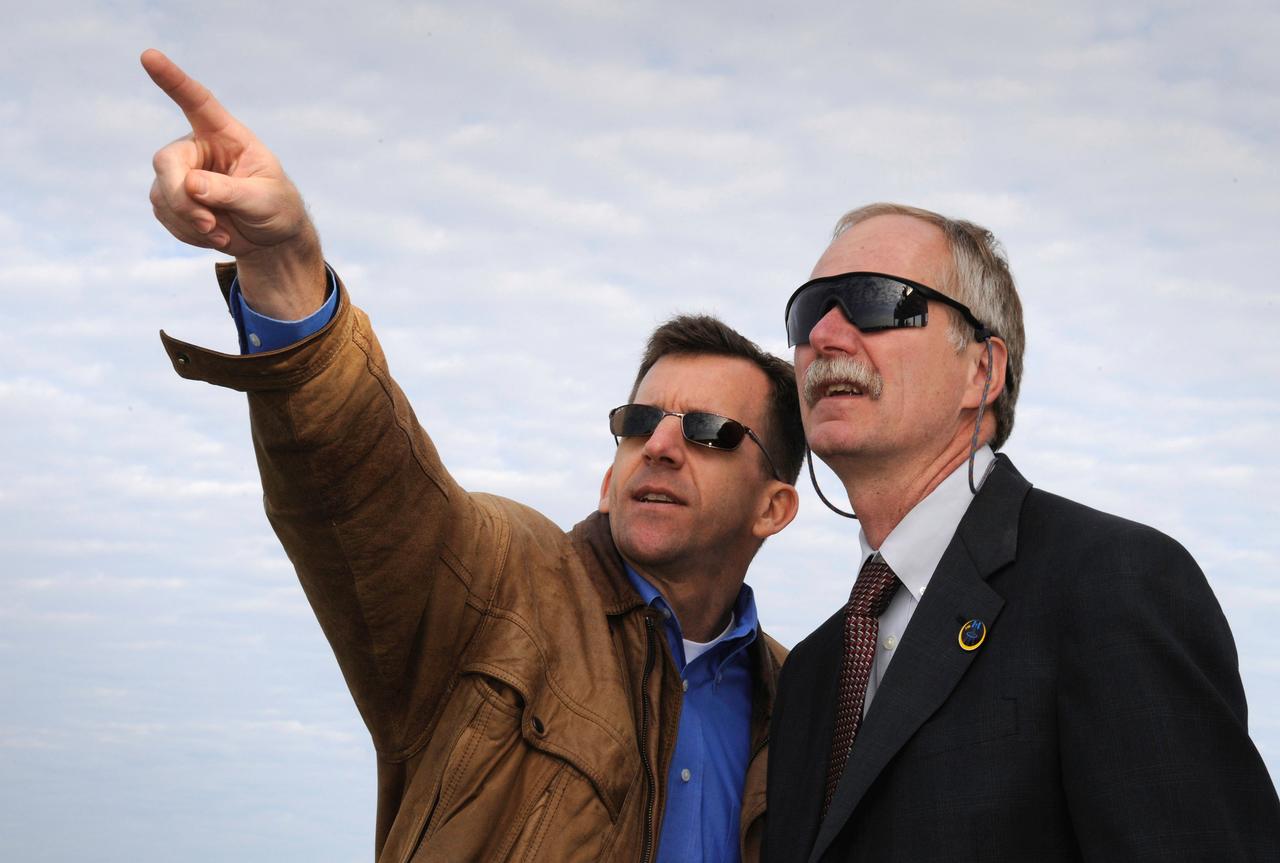
NASA Manager for Launch Integration, Leroy Cain, left, and NASA Associate Administrator for Space Operations, William H. Gerstenmaier watch as the The space shuttle Atlantis (STS-122) lands at the Shuttle Landing Facility, 9:07a.m., Wednesday, Feb. 20, 2008 at Kennedy Space Center, Fla. completing delivery of the European Space Agency’s (ESA) Columbus laboratory to the International Space Station. Photo Credit: (NASA/Bill Ingalls)
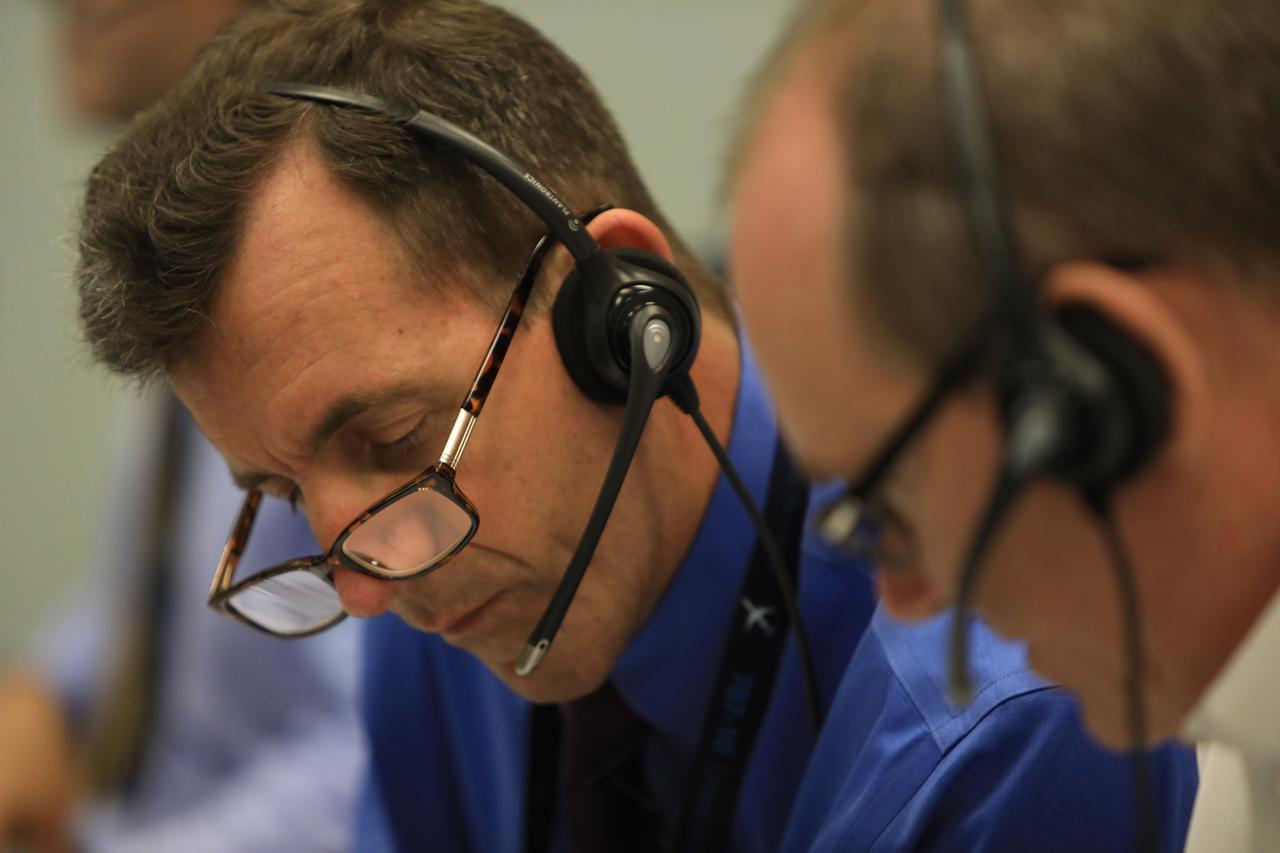
As part of the joint team that will launch Boeing’s CST-100 Starliner on a United Launch Alliance Atlas V rocket in Boeing’s Orbital Flight Test (OFT), Boeing Spacecraft Mission Director LeRoy Cain participated in a successful Integrated Crew Exercise on Feb. 12. NASA, ULA, Boeing and Department of Defense personnel executed a mock countdown that practiced fueling the rocket and operating on the unique launch day timeline that features a four-hour built-in hold at the T-minus 4 minute mark. OFT is Boeing’s uncrewed flight test of Starliner and part of NASA’s Commercial Crew Program, which will return human spaceflight launches into low-Earth orbit from U.S. soil.
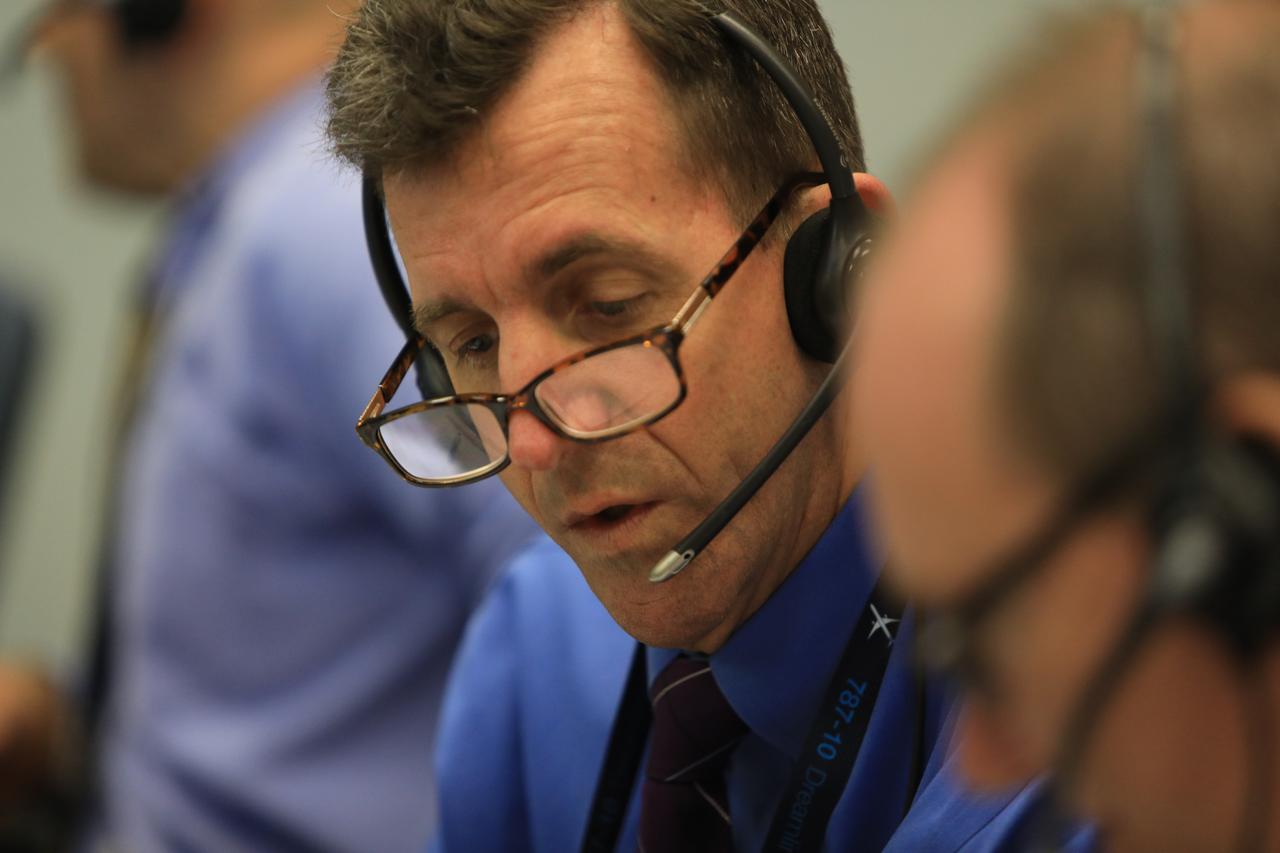
As part of the joint team that will launch Boeing’s CST-100 Starliner on a United Launch Alliance Atlas V rocket in Boeing’s Orbital Flight Test (OFT), Boeing Spacecraft Mission Director LeRoy Cain participated in a successful Integrated Crew Exercise on Feb. 12. NASA, ULA, Boeing and Department of Defense personnel executed a mock countdown that practiced fueling the rocket and operating on the unique launch day timeline that features a four-hour built-in hold at the T-minus 4 minute mark. OFT is Boeing’s uncrewed flight test of Starliner and part of NASA’s Commercial Crew Program, which will return human spaceflight launches into low-Earth orbit from U.S. soil.
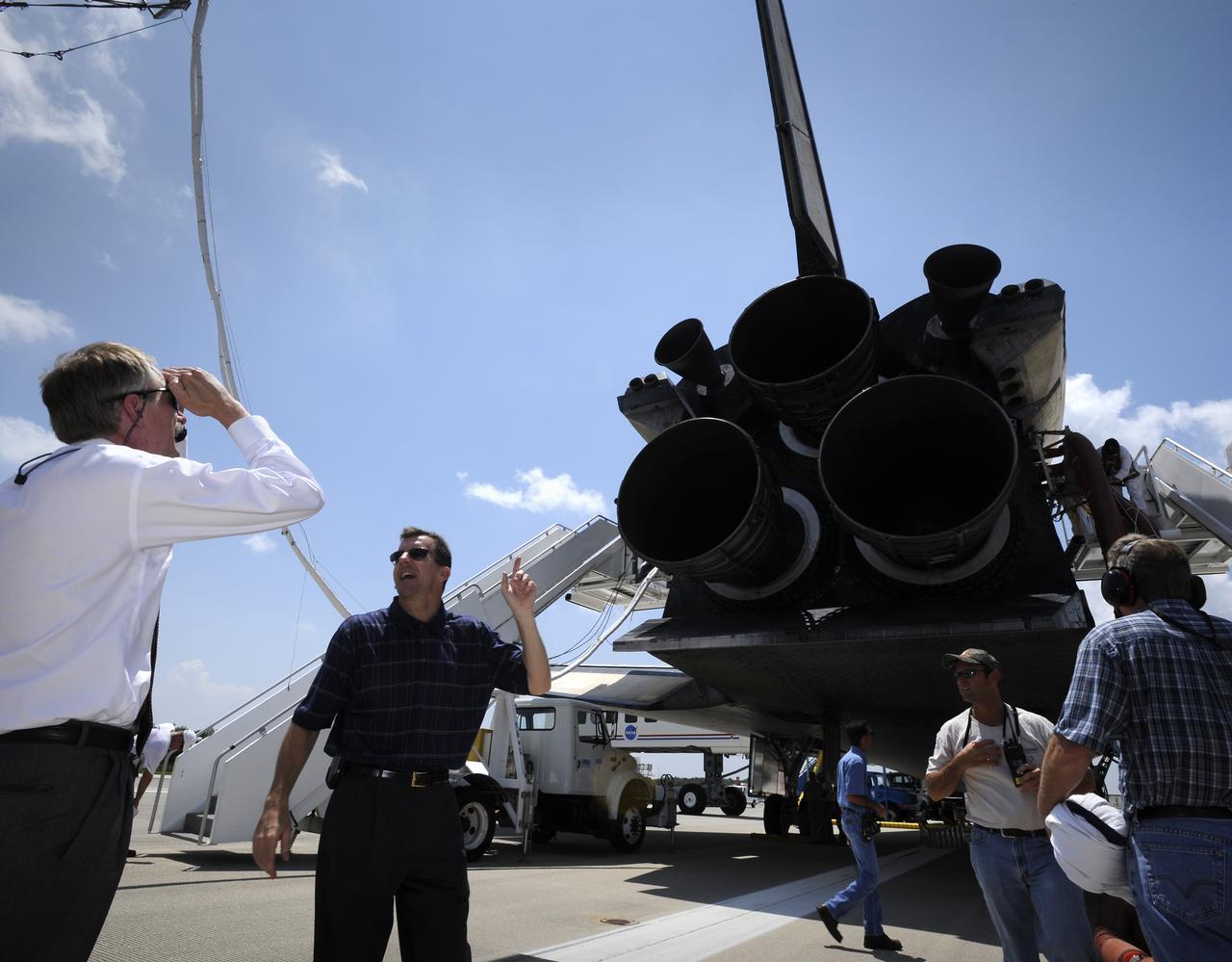
NASA Deputy Shuttle Program Manager LeRoy Cain points out a portion of the space shuttle Discovery to NASA Associate Administrator for Space Operations Bill Gerstenmaier, left, during a walk around shortly after Discovery touched down at 11:15 a.m., Saturday, June 14, 2008, at the Kennedy Space Center in Cape Canaveral, Florida. During the 14-day STS-124 mission Discovery's crew installed the Japan Aerospace Exploration Agency's large Kibo laboratory and its remote manipulator system leaving a larger space station and one with increased science capabilities. Discovery also brought home NASA astronaut Garrett Reisman after his 3 month mission onboard the International Space Station. Photo Credit: (NASA/Bill Ingalls)
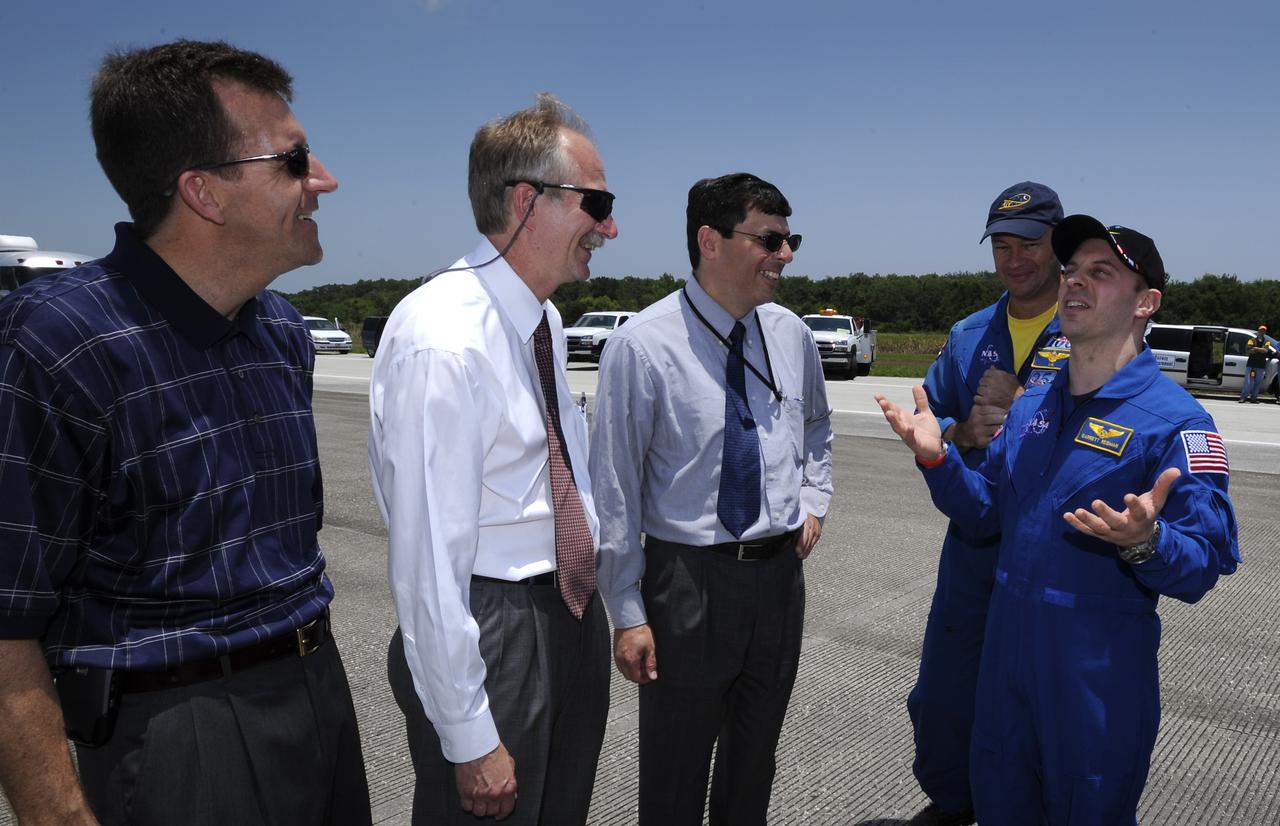
NASA Astronaut Garrett Reisman, right, jokes with NASA Associate Administrator Chris Scolese, 2nd from right, NASA Associate Administrator for Space Operations Bill Gerstenmaier, 3rd from right and NASA Deputy Shuttle Program Manager LeRoy Cain as NASA Astronaut Michael Lopez-Alegria looks on. Reisman spent 3 months in space onboard the the International Space Station. Reisman landed onboard the space shuttle Discovery along with the crew of the STS-124 mission. Discovery touched down at 11:15 a.m. EDT, Saturday, June 14, 2008, at the Kennedy Space Center in Florida. Photo Credit: (NASA/Bill Ingalls)
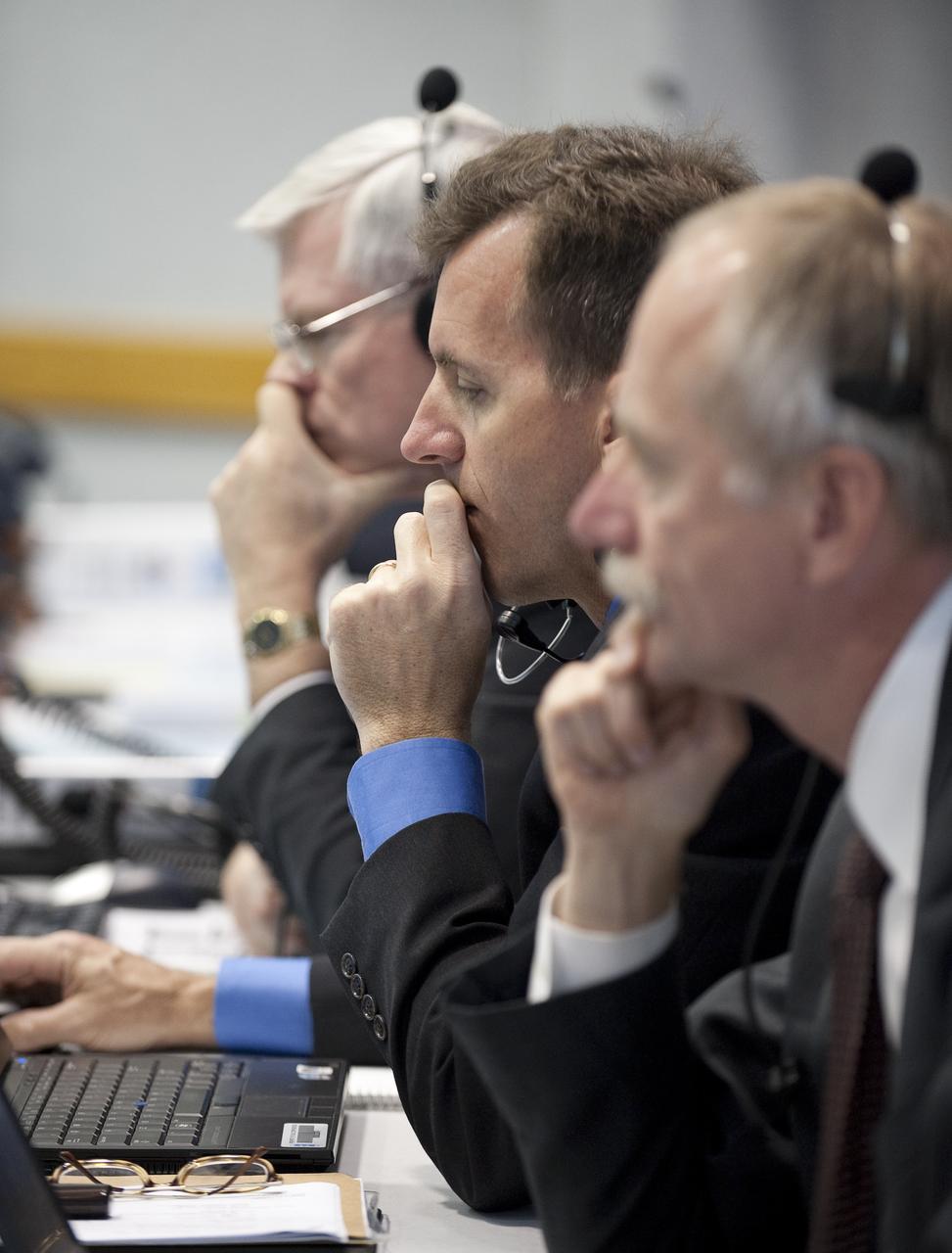
LeRoy E. Cain, NASA manager of Launch Integration, center and other NASA mission managers, monitor the countdown to launch of the space shuttle Atlantis from firing room four of the NASA Kennedy Space Center, Monday, Nov. 16, 2009, Cape Canaveral, Fla. Space shuttle Atlantis and its six-member crew began the 11-day STS-129 mission to the International Space Station. The shuttle will transport spare hardware to the outpost and return a station crew member who spent more than two months in space. Photo Credit: (NASA/Bill Ingalls)
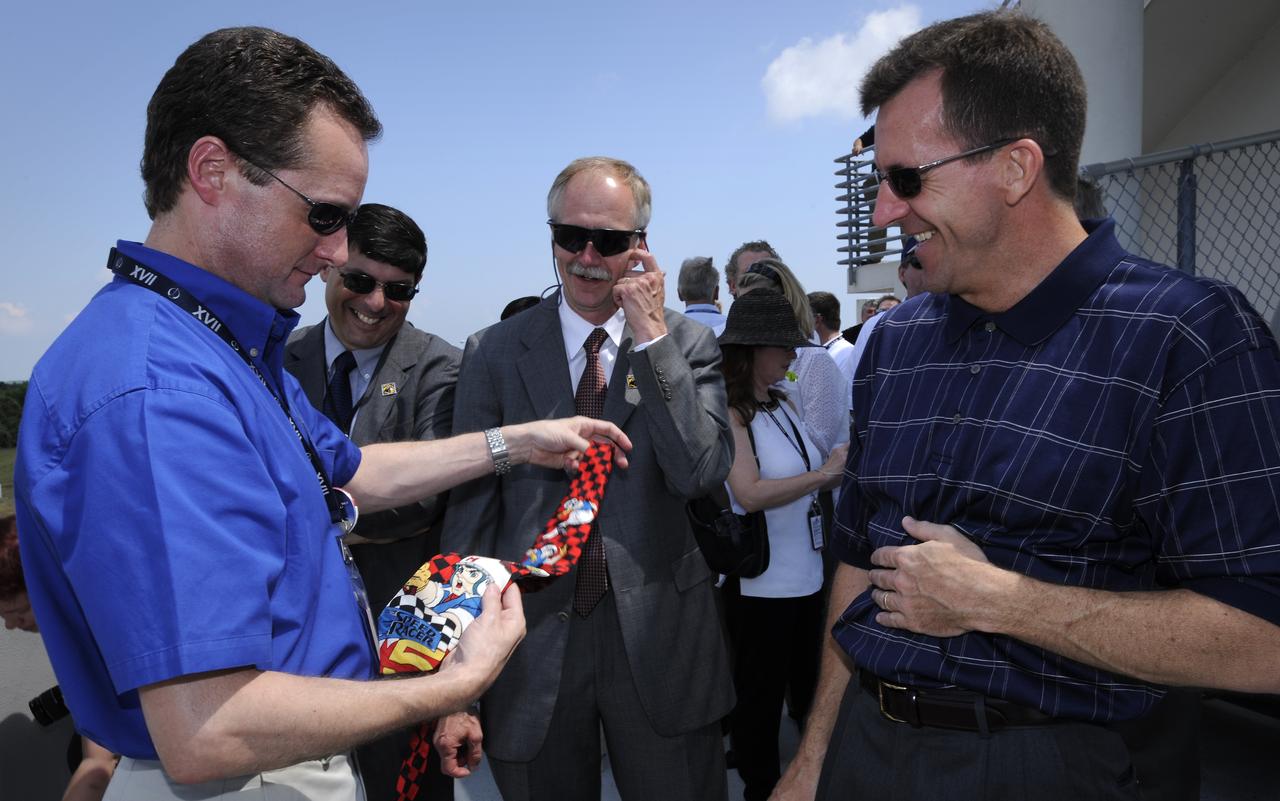
NASA Lead Shuttle Flight Director for STS-124 Matt Abbott, left, shows his lucky launch and landing tie to NASA Associate Administrator Chris Scolese, 2nd from left, NASA Associate Administrator for Space Operations Bill Gerstenmaier, 3rd from left, and NASA Deputy Shuttle Program Manager LeRoy Cain shortly after the space shuttle Discovery touched down at 11:15 a.m., Saturday, June 14, 2008, at the Kennedy Space Center in Cape Canaveral, Florida. During the 14-day STS-124 mission Discovery's crew installed the Japan Aerospace Exploration Agency's large Kibo laboratory and its remote manipulator system leaving a larger space station and one with increased science capabilities. Photo Credit: (NASA/Bill Ingalls)
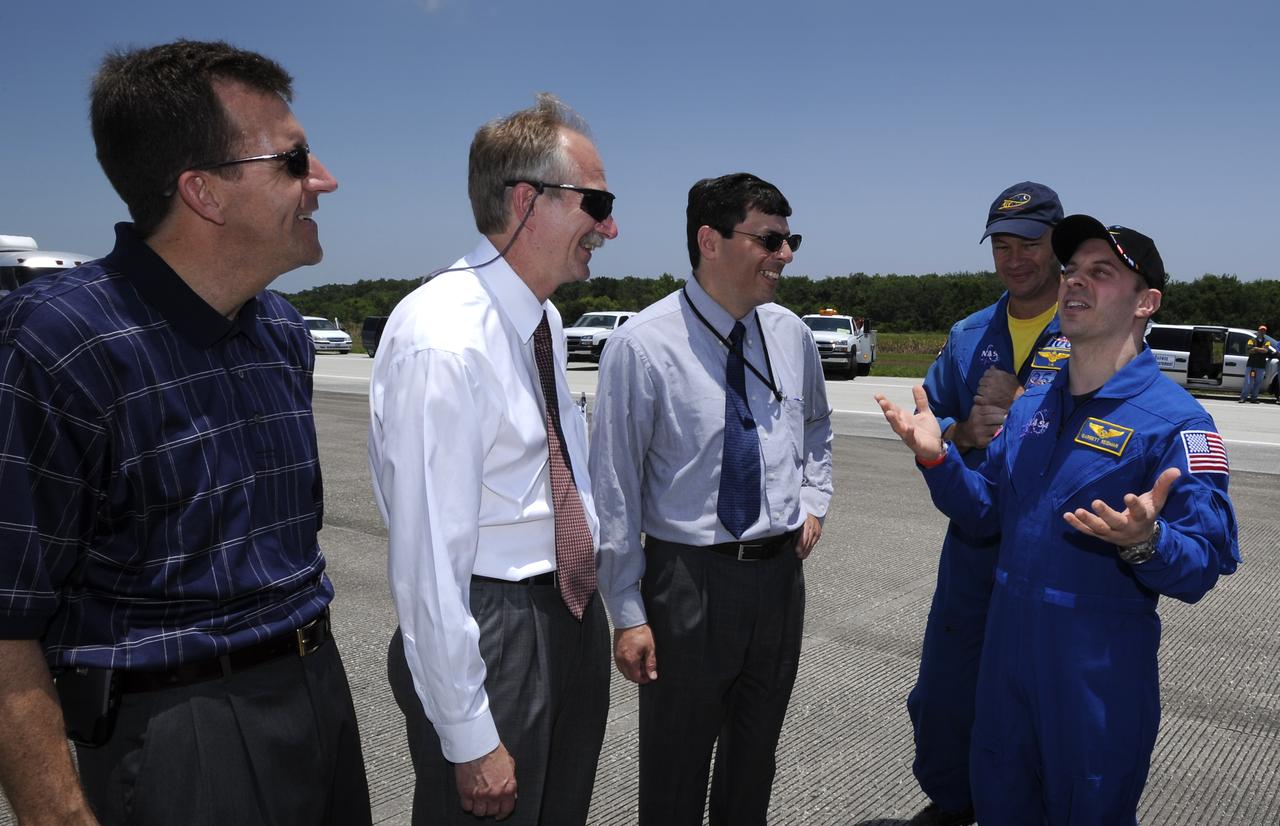
NASA Astronaut Garrett Reisman, right, jokes with NASA Associate Administrator Chris Scolese, 2nd from right, NASA Associate Administrator for Space Operations Bill Gerstenmaier, 3rd from right and NASA Deputy Shuttle Program Manager LeRoy Cain as NASA Astronaut Michael Lopez-Alegria looks on shortly after landing onboard the space shuttle Discovery. Discovery touched down at 11:15 a.m., Saturday, June 14, 2008, at the Kennedy Space Center in Cape Canaveral, Florida. Onboard Discovery with Reisman was the crew of the STS-124 mission, NASA astronauts Mark Kelly, commander; Ken Ham, pilot; Mike Fossum, Ron Garan, Karen Nyberg and Japan Aerospace Exploration Agency astronaut Akihiko Hoshide, all mission specialists. Photo Credit: (NASA/Bill Ingalls)
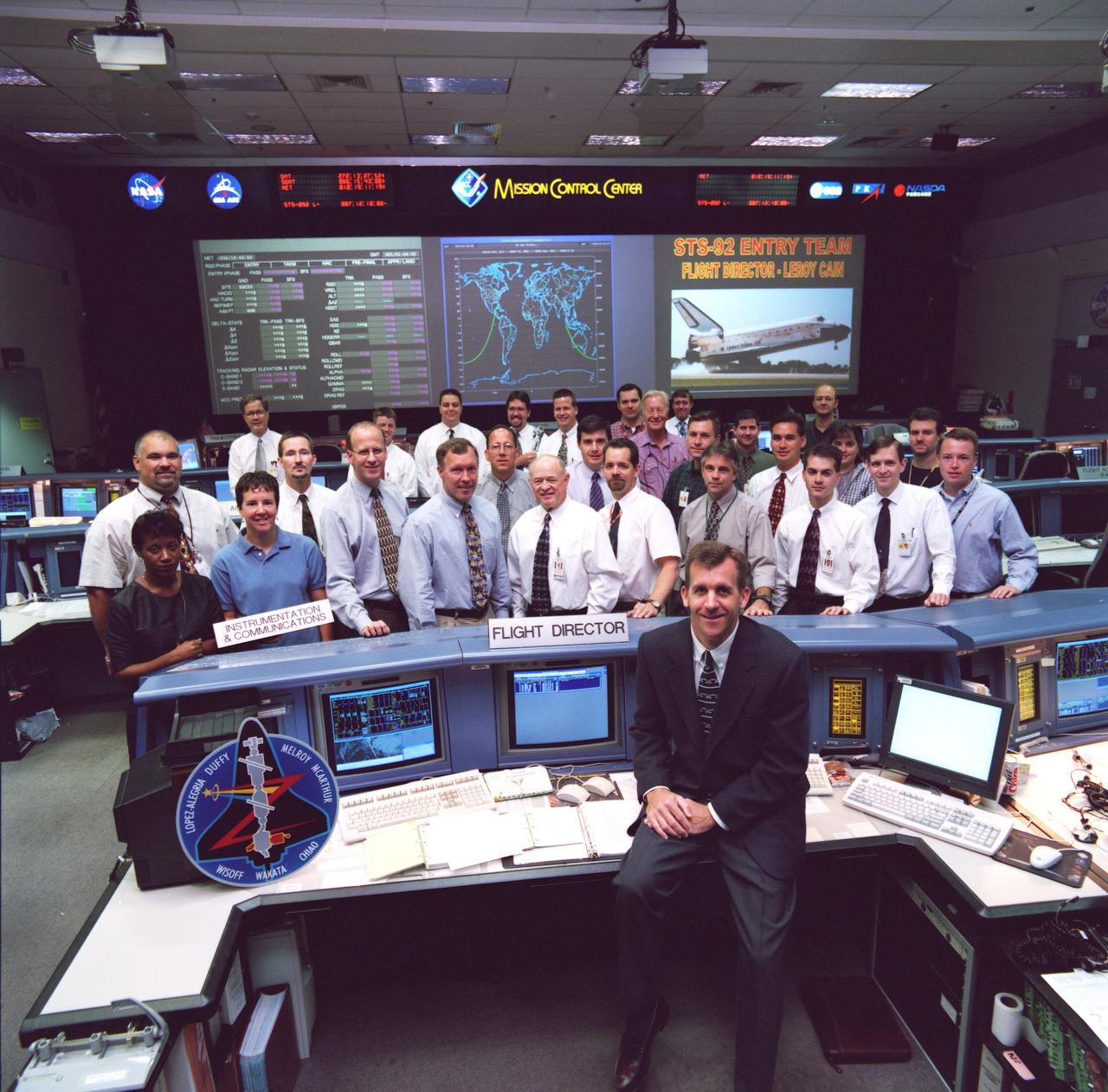
JSC2000-06401 (October 2000) --- LeRoy Cain (foreground), entry flight director for the STS-92 mission, poses with the 30-odd flight controllers who support his shift.
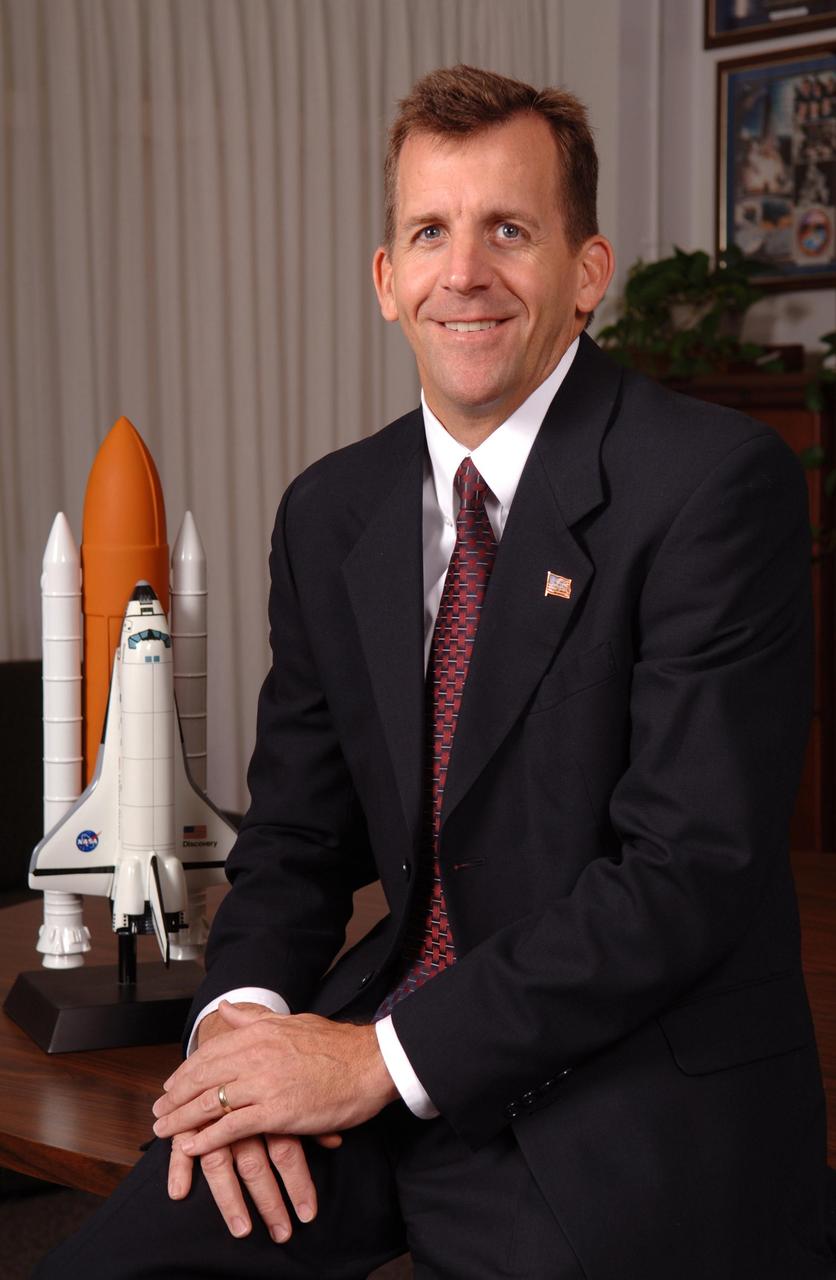
KENNEDY SPACE CENTER, FLA. -- Official portrait of LeRoy E. Cain, who has served as the manager of Space Shuttle Launch Integration at NASA's Kennedy Space Center since November 2005.
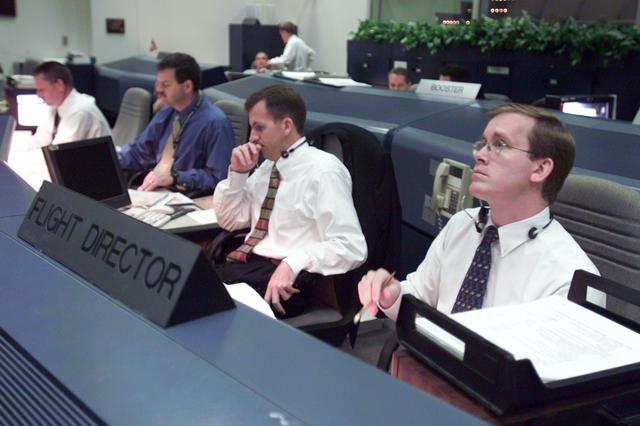
JSC2001-E-12118 (19 April 2001) --- Left to right, astronaut Christopher J. (Gus) Loria, astronaut Scott D. Altman, flight director LeRoy Cain and flight director John Shannon keep up with STS-100 pre-launch activities from their consoles in the shuttle flight control room in Houston's Mission Control Center (MCC). Altman is ascent spacecraft communicator (CAPCOM) and is assisted by Loria, CAPCOM specializing in weather issues. Cain is ascent flight director.
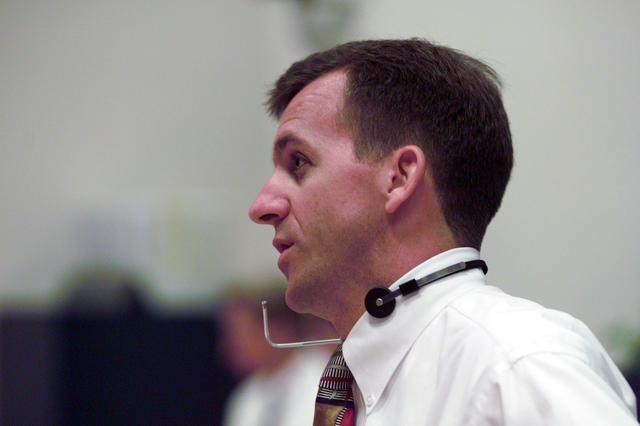
JSC2001-E-12116 (19 April 2001) --- LeRoy Cain, at the Flight Director console, peruses information on large screens in front of the flight control room in the Johnson Space Center's Mission Control Center (MCC) as countdown for the Space Shuttle Endeavour launch of STS-100 continues several hundred miles away in Florida. Cain is both ascent and entry flight director for the flight.
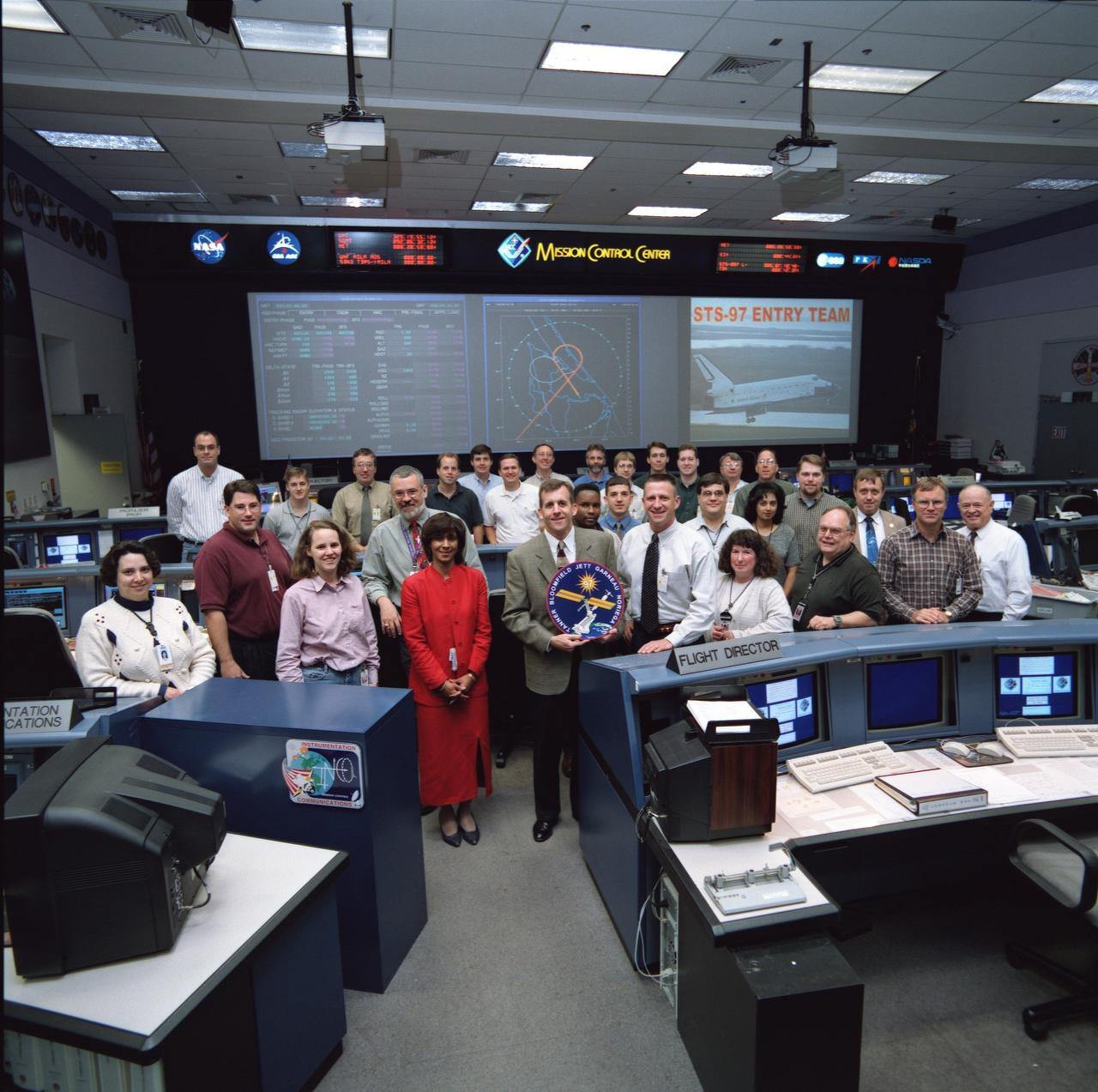
JSC2000-07303 (24 November 2000) --- The 30-odd flight controllers supporting the STS-97 entry shift pose for a pre-flight group portrait in the shuttle flight control room in Houston's Mission Control Center (JSC). Entry flight director LeRoy Cain (front center) holds a mission logo.
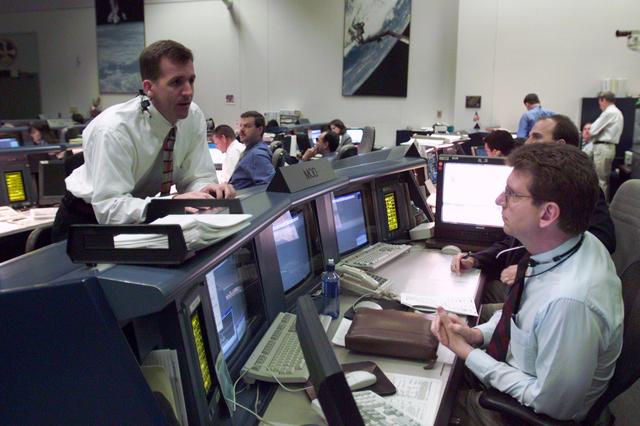
JSC2001-E-12120 (19 April 2001) --- STS-100 ascent flight director LeRoy Cain (left) leans over the Mission Operations Directorate (MOD) console for a word with Jeffrey Bantle in the shuttle flight control room of Houston's Mission Control Center (MCC). Six astronauts and a cosmonaut, meanwhile, were strapped into their seats in the crew cabin of the Space Shuttle Endeavour several hundred miles away in Florida.
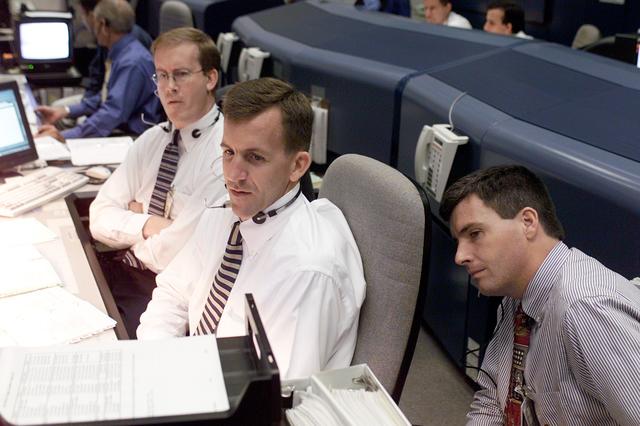
JSC2001-E-25520 (22 August 2001) --- Flight directors John Shannon (left), LeRoy Cain, and Steve Stich monitor data at their consoles in the shuttle flight control room (WFCR) in Houston’s Mission Control Center (MCC). At the time this photo was taken the Space Shuttle Discovery was about to land at Kennedy Space Center, Florida, to mark the end of a successful mission to the International Space Station (ISS).
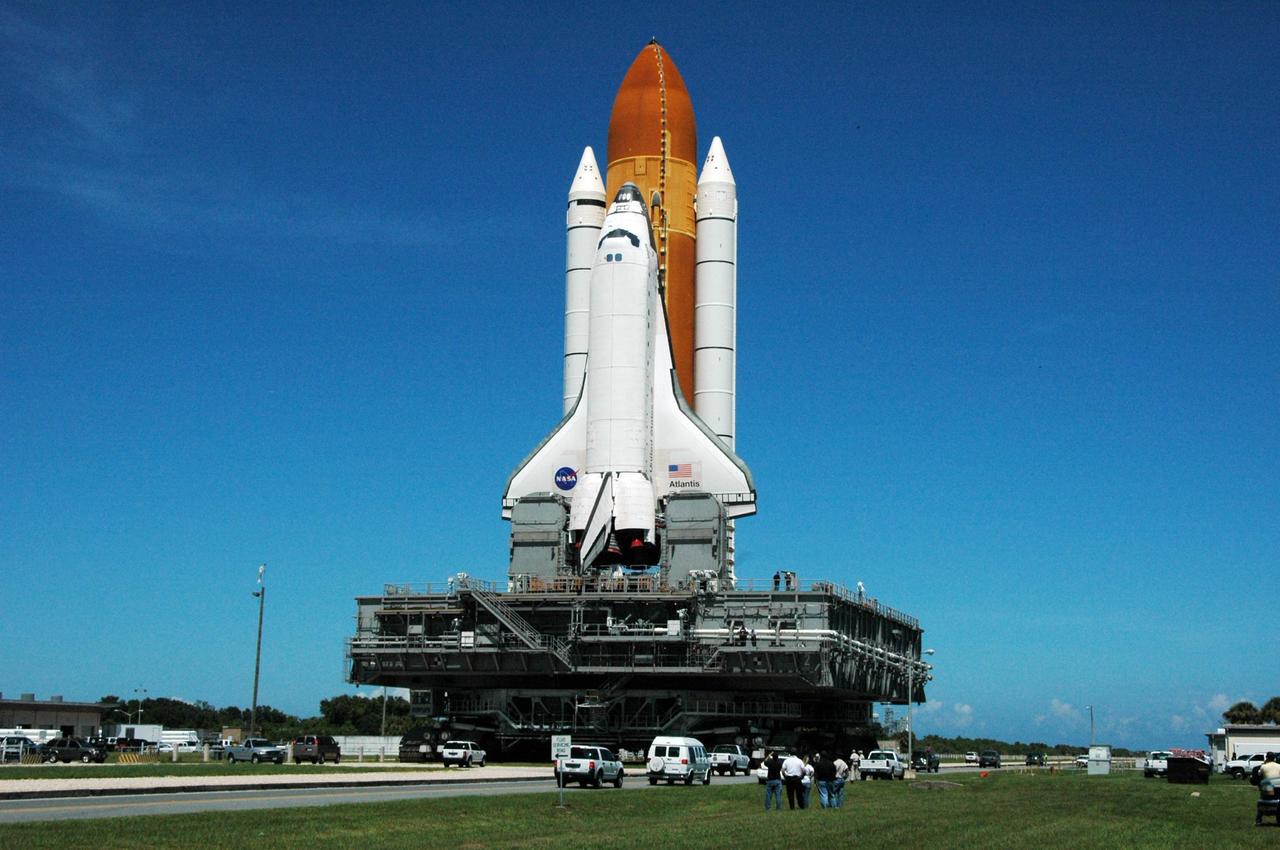
KENNEDY SPACE CENTER, FLA. - On the crawlerway, Space Shuttle Atlantis reverses direction and begins rolling back out to Launch Pad 39B. It had been moved off the launch pad due to concerns about the impact of Tropical Storm Ernesto, expected within 24 hours. The forecast of lesser winds expected from Ernesto and its projected direction convinced Launch Integration Manager LeRoy Cain and Shuttle Launch Director Mike Leinbach to return the shuttle to the launch pad. Photo credit: NASA/Ken Thornsley
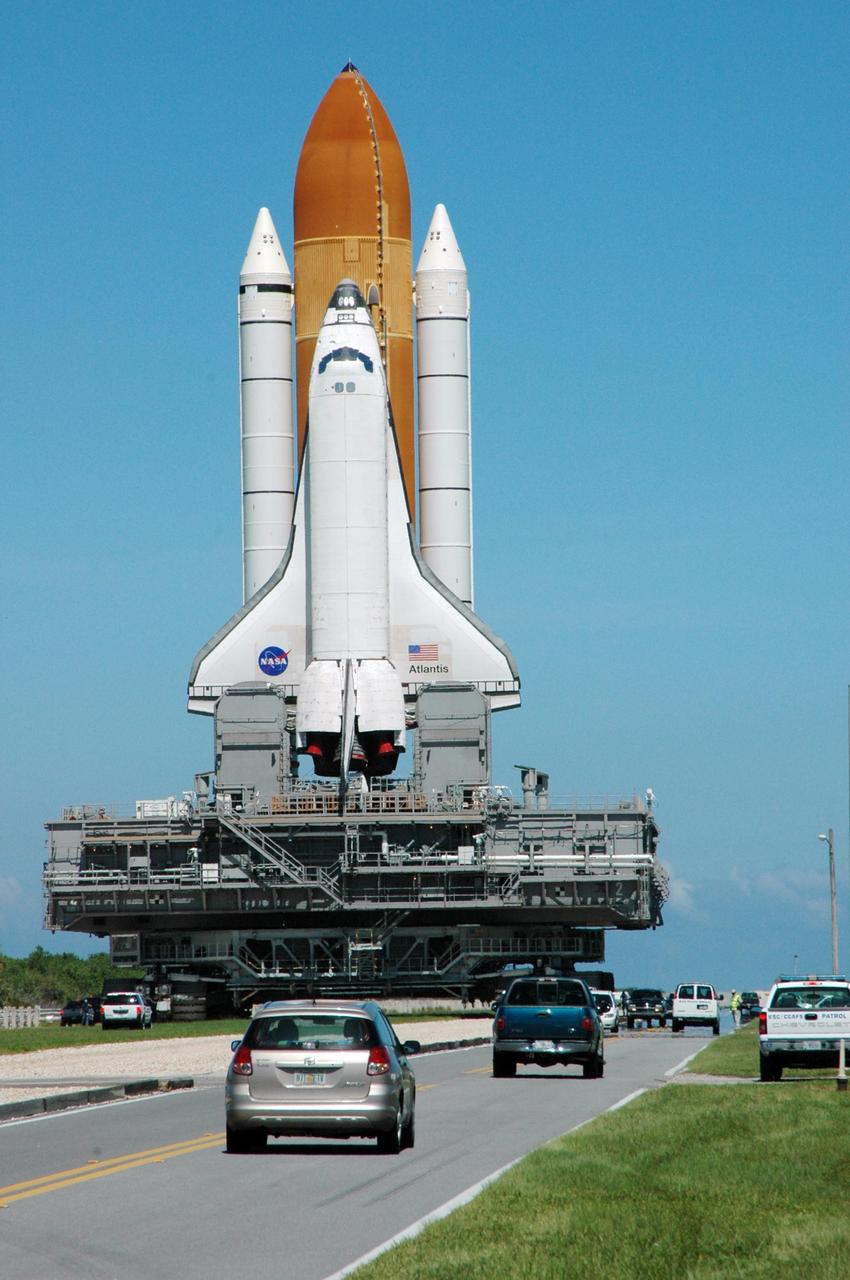
KENNEDY SPACE CENTER, FLA. - Space Shuttle Atlantis reverses direction and begins rolling back out to Launch Pad 39B. It had been moved off the launch pad due to concerns about the impact of Tropical Storm Ernesto, expected within 24 hours. The forecast of lesser winds expected from Ernesto and its projected direction convinced Launch Integration Manager LeRoy Cain and Shuttle Launch Director Mike Leinbach to return the shuttle to the launch pad Photo credit: NASA/Ken Thornsley
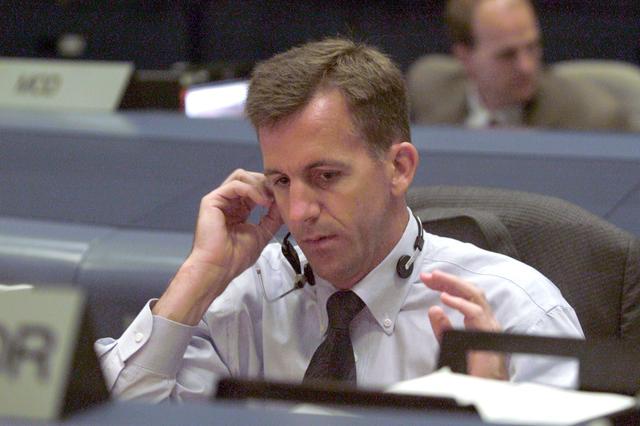
JSC2001-E-21328 (12 July 2001) --- Flight director LeRoy Cain directs his attention to data related to the Space Shuttle Atlantis and its impending launch from the Kennedy Space Center (KSC) several hundred miles away from this Houston setting at the Johnson Space Center's Mission Control Center (MCC). As soon as the vehicle cleared the tower in Florida, the Houston-based team of flight controllers took over the ground control of the flight.
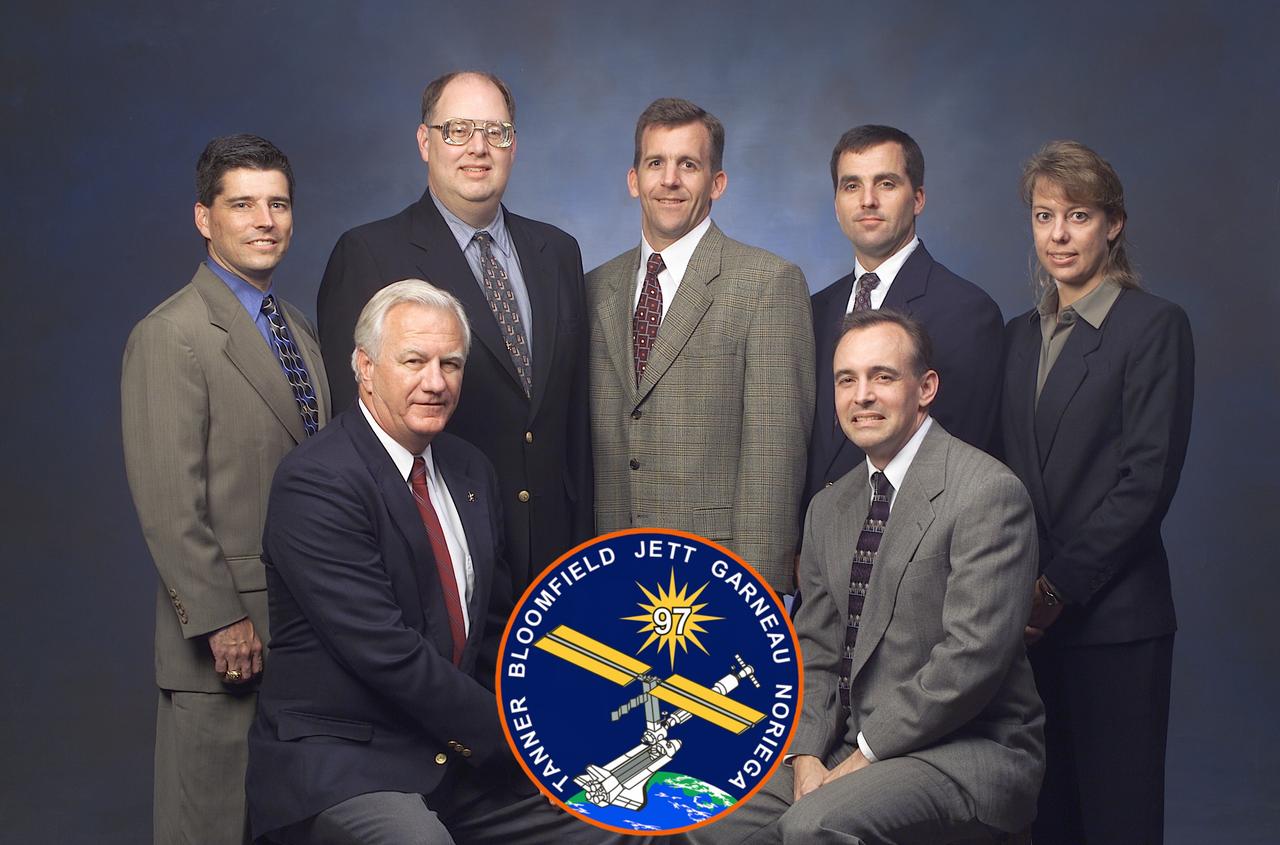
JSC2000-E-29413 (November 2000) --- Flight directors (FD) for the STS-97 mission pose for a pre-flight group portrait with the mission's insignia. Front row: Lead FD Bill Reeves (left), and Jeff Hanley. Back row, from the left: John Curry, Wayne Hale, LeRoy Cain, Paul Hill and Kelly Beck.
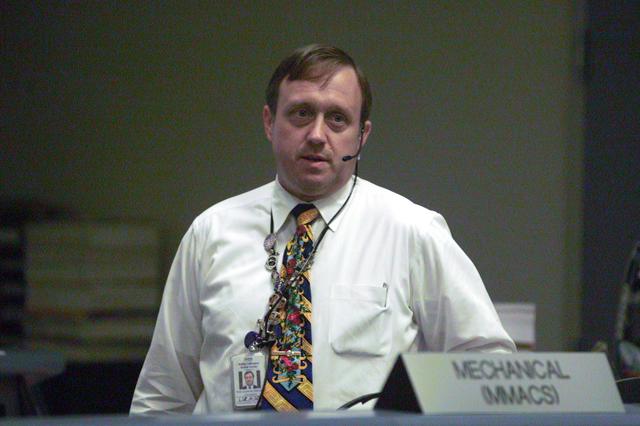
JSC2001-E-12141 (19 April 2001) --- William M. (Bill) Foster, one of the Ground Controllers (GC) for ascent in the flight control room in the Johnson Space Center's Mission Control Center (MCC), discusses a data communications issue with Flight Director LeRoy Cain (not shown) over the voice loops. He is standing in front of the Mechanical (MMACS) console, which is directly behind the GC console, as he faces the rear of the room to talk with Flight.
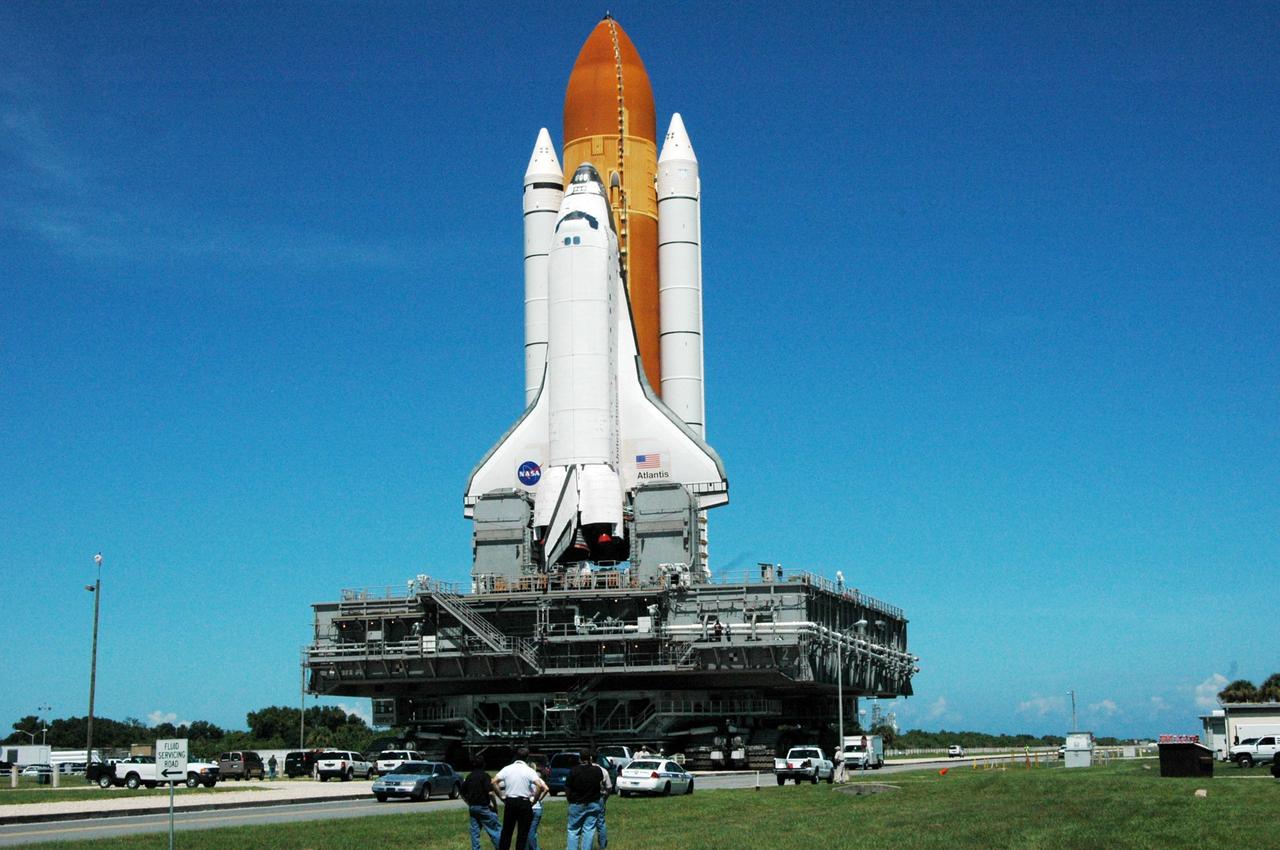
KENNEDY SPACE CENTER, FLA. - Space Shuttle Atlantis reverses direction and begins rolling back out to Launch Pad 39B. It had been moved off the launch pad due to concerns about the impact of Tropical Storm Ernesto, expected within 24 hours. The forecast of lesser winds expected from Ernesto and its projected direction convinced Launch Integration Manager LeRoy Cain and Shuttle Launch Director Mike Leinbach to return the shuttle to the launch pad. Photo credit: NASA/Ken Thornsley
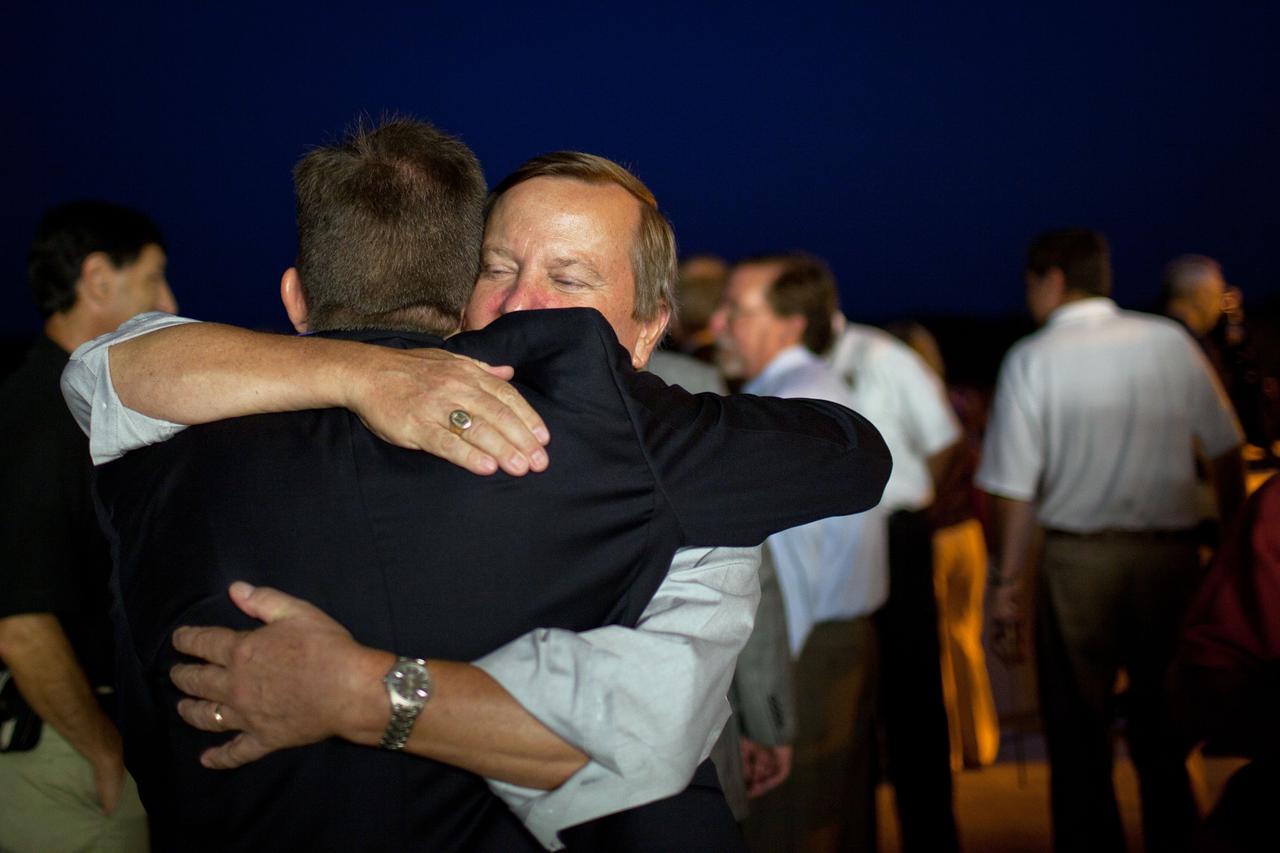
JSC2011-E-067691 (21 July 2011) --- Shuttle launch director Mike Leinbach, facing camera, hugs LeRoy Cain, deputy space shuttle program manager, after the space shuttle Atlantis landed on July 21 at the Kennedy Space Center in Florida. The landing completed STS-135, the final mission of the Space Shuttle Program. Photo credit: NASA/Houston Chronicle, Smiley N. Pool
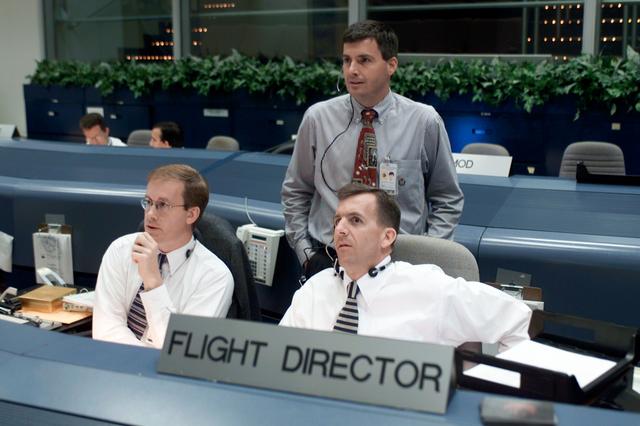
JSC2001-E-25512 (22 August 2001) --- Flight directors John Shannon (left), Steve Stich, and LeRoy Cain watch the large screens from their consoles in the shuttle flight control room (WFCR) in Houston’s Mission Control Center (MCC). At the time this photo was taken the Space Shuttle Discovery was about to land at Kennedy Space Center, Florida, to mark the end of a successful mission to the International Space Station (ISS).
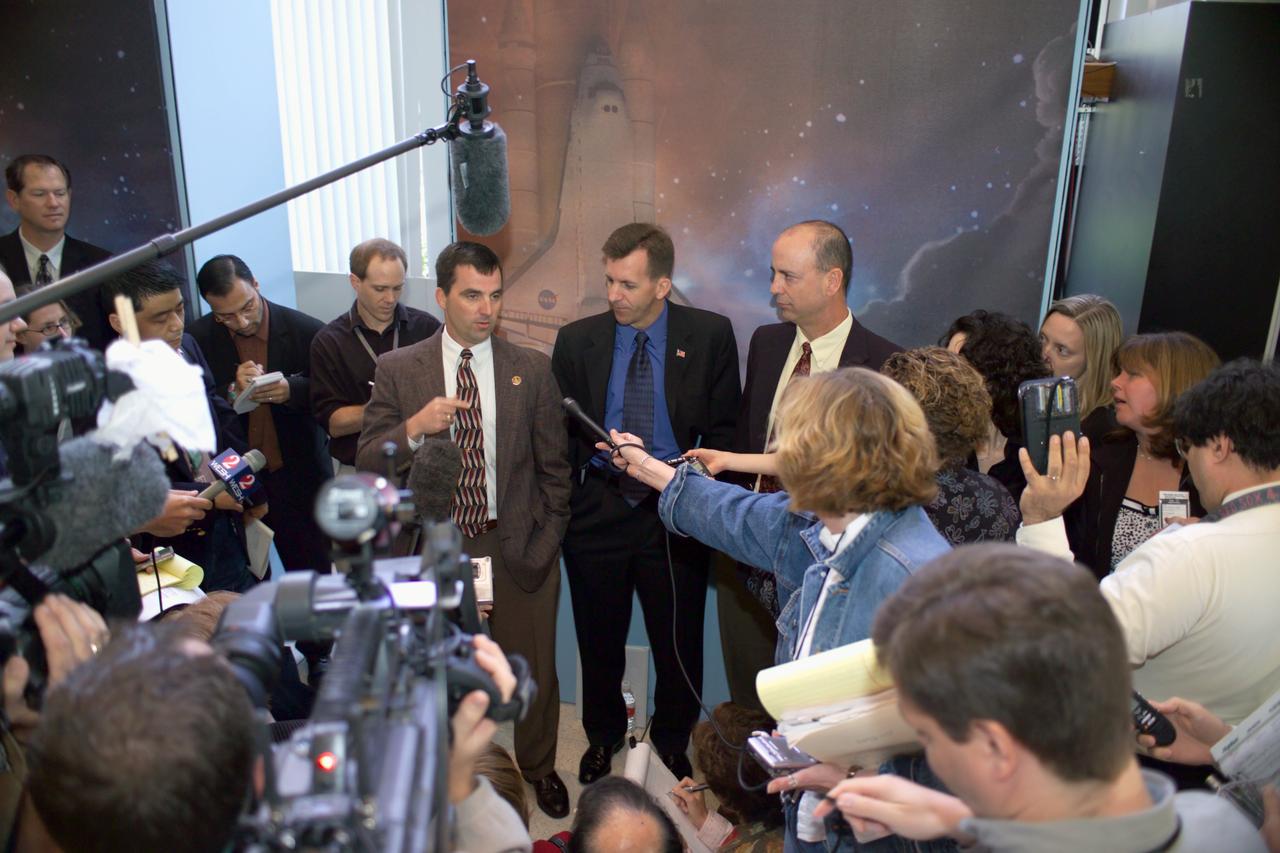
JSC2005-E-14182 (7 April 2005) --- Paul Hill (left center), STS-114 Lead Shuttle Flight Director; LeRoy Cain, Ascent/Entry Flight Director; and Mark Ferring, Lead ISS Flight Director, speak with various news media representatives following an STS-114 preflight press briefing in the Teague Auditorium at the Johnson Space Center (JSC).
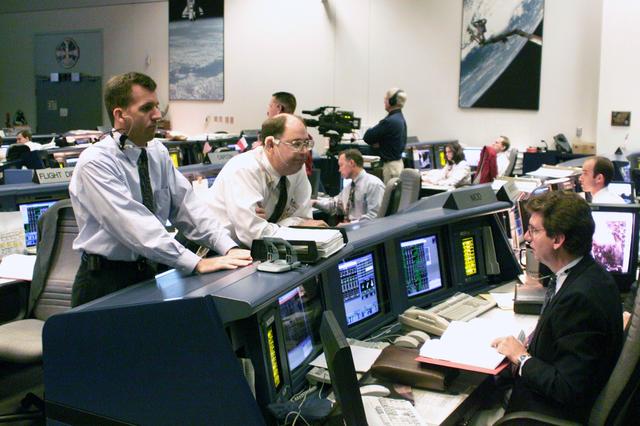
JSC2000-E-22288 (8 September2000) --- In Houston's Mission Control Center, flight directors LeRoy Cain, from left foreground, Wayne Hale and Jeffrey Bantle await the launch of the Space Shuttle Atlantis in Florida. The flight director console is on the left side of the frame. Bantle is seated at the Missions Operations Directorate (MOD) console. Once the shuttle clears the launch tower in Florida, the "baton" gets handed off to the flight controllers in Houston.
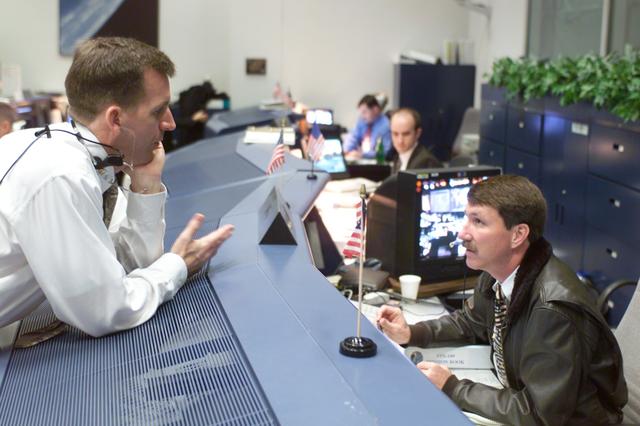
JSC2002-E-08157 (1 March 2002) --- Astronaut Kent V. Rominger (seated), and LeRoy Cain are photographed at the Mission Operation Directorate (MOD) console in the shuttle flight control room (WFCR) in Houston's Mission Control Center (MCC). Several hundred miles away in Florida, the STS-109 crewmembers were awaiting countdown in the crew cabin of the Space Shuttle Columbia on the launch pad at the Kennedy Space Center (KSC). As soon as the vehicle cleared the tower in Florida, the Houston-based team of flight controllers took over the ground control of the mission. Rominger is the Deputy Director of the Flight Crew Operations Directorate (FCOD) and was the STS-109 FCOD management representative in the MCC. Cain was the Weather Flight Director for the mission’s ascent phase, coordinating weather issues for lead Ascent Flight Director John Shannon (out of frame).
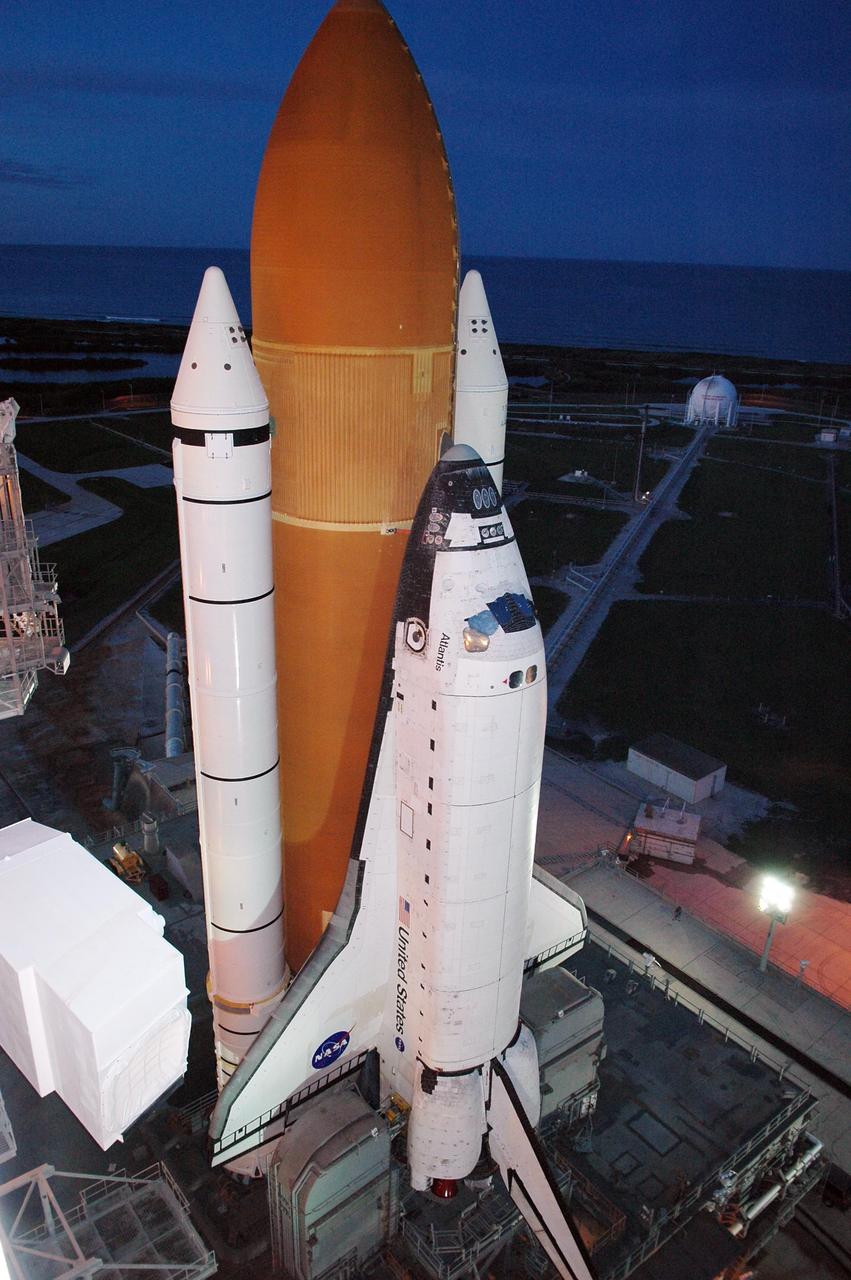
KENNEDY SPACE CENTER, FLA. - After sunset, Space Shuttle Atlantis is bathed in light from the fixed service structure on Launch Pad 39B. At left is the White Room, which is situated on the end of the orbiter access arm and moved into place for the crew to enter the shuttle. The shuttle had been moved off the launch pad due to concerns about the impact of Tropical Storm Ernesto, expected within 24 hours. The forecast of lesser winds expected from Ernesto and its projected direction convinced Launch Integration Manager LeRoy Cain and Shuttle Launch Director Mike Leinbach to return the shuttle to the launch pad. Photo credit: NASA/Kim Shiflett
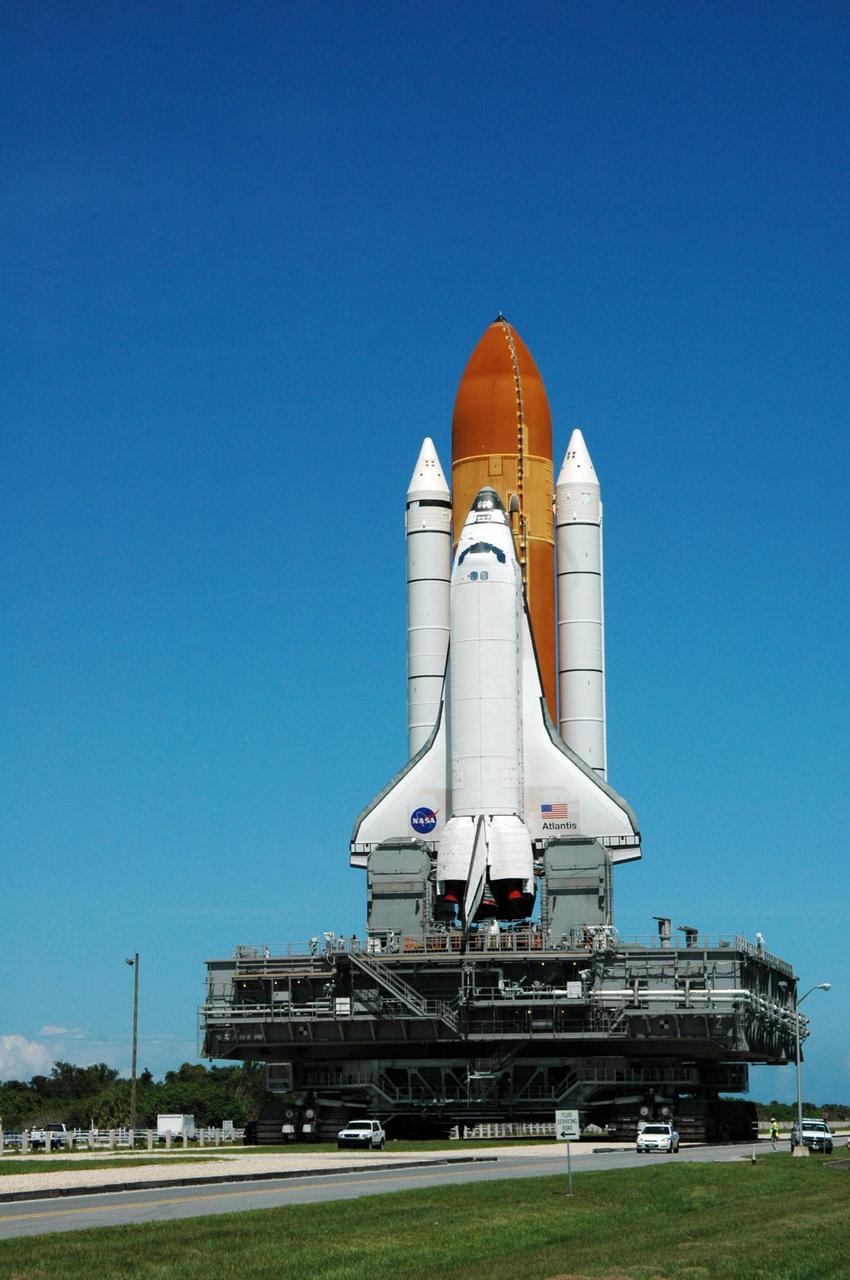
KENNEDY SPACE CENTER, FLA. - Space Shuttle Atlantis continues its slow crawl toward the Vehicle Assembly Building from Launch Pad 39B. The rollback was a safety precaution as the area waits for the arrival of Tropical Storm Ernesto. The storm was forecast to be bringing 58-mph to 70-mph winds in the next 24 hours. After this photo was taken, a revised forecast of lesser winds expected from Ernesto and its projected direction convinced Launch Integration Manager LeRoy Cain and Shuttle Launch Director Mike Leinbach to return the shuttle to the launch pad. Photo credit: NASA/Ken Thornsley
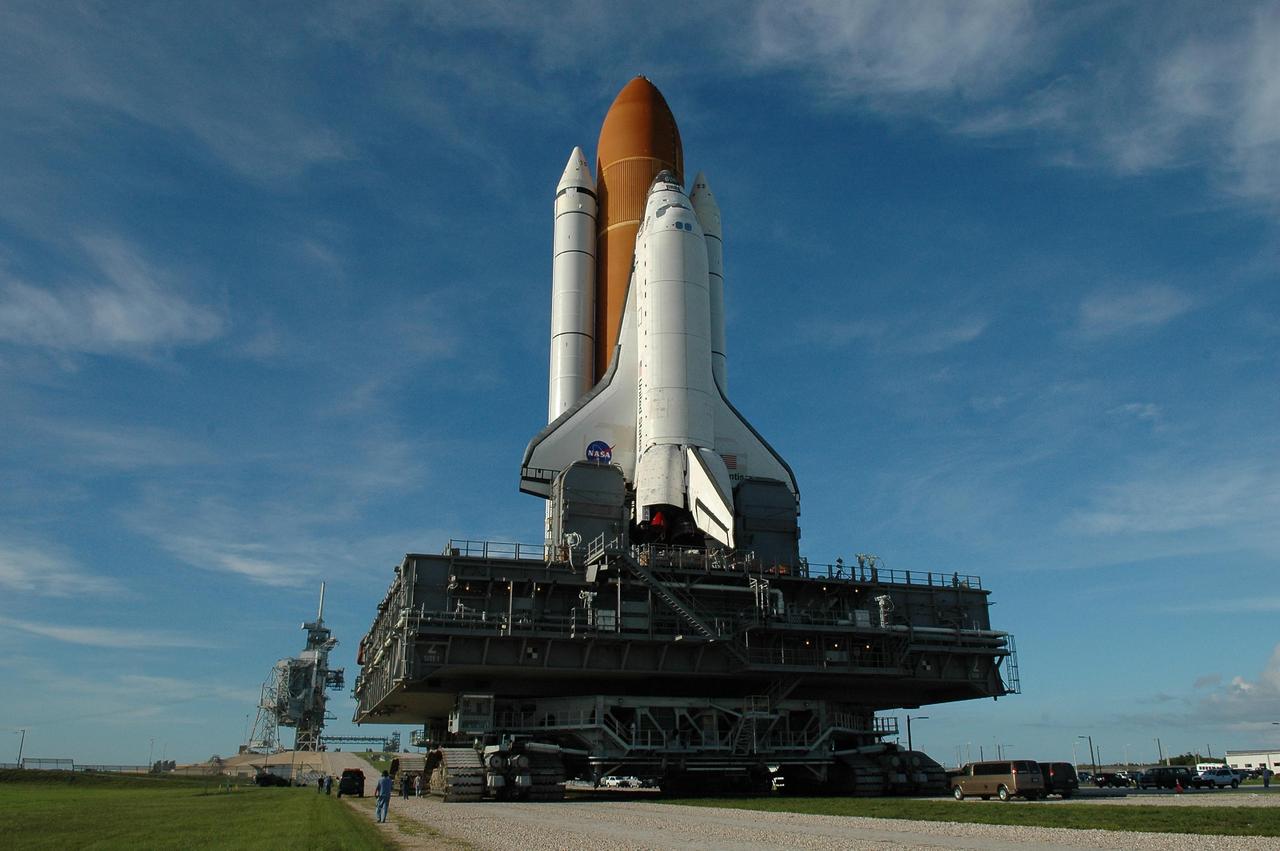
KENNEDY SPACE CENTER, FLA. - After reversing its direction to the Vehicle Assembly Building, Space Shuttle Atlantis nears Launch Pad 39B. The shuttle is returning to Launch Pad 39B, in the background, after rolling back to the Vehicle Assembly Building due to concerns about the impact of Tropical Storm Ernesto. However, before reaching the VAB, the forecast of lesser winds expected from Ernesto and its projected direction convinced Launch Integration Manager LeRoy Cain and Shuttle Launch Director Mike Leinbach to return the shuttle to the launch pad. Photo credit: NASA/Kim Shiflett
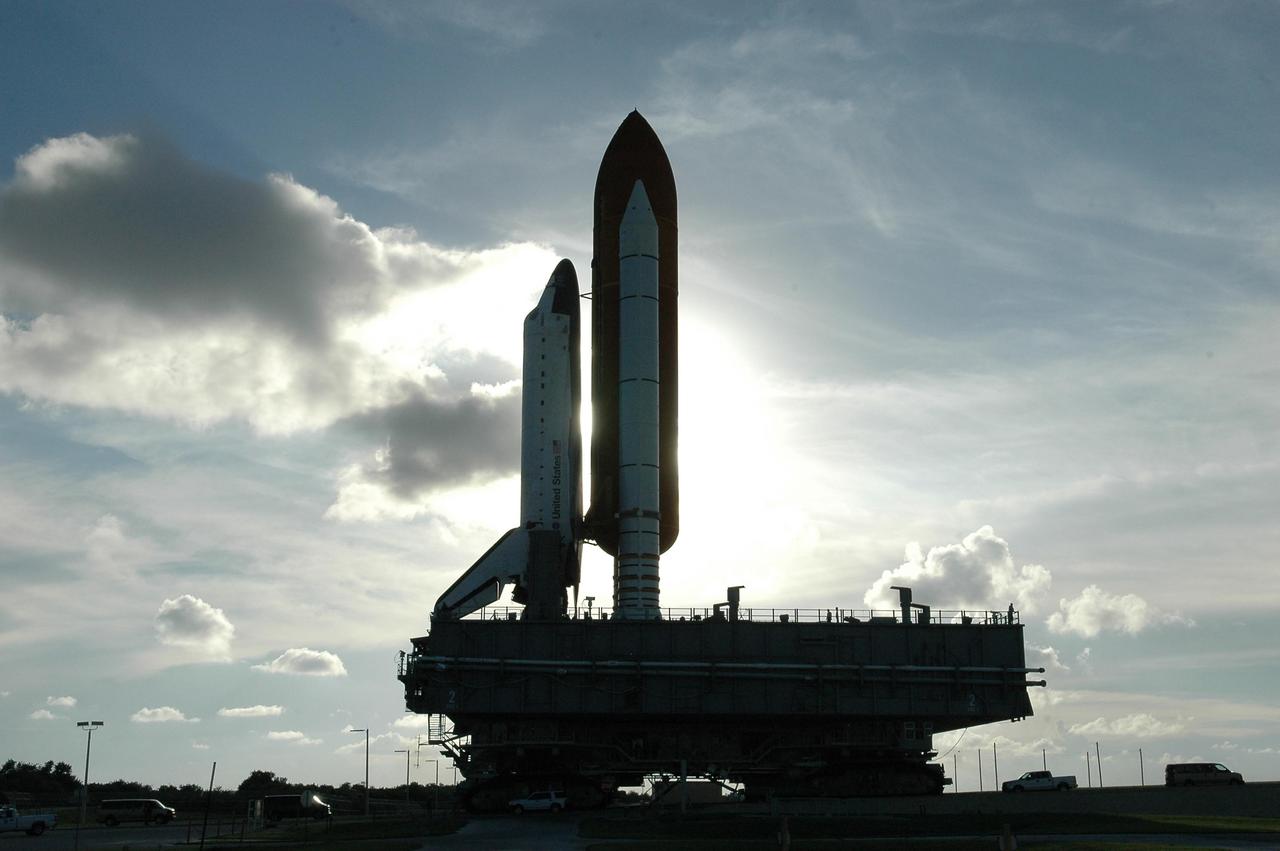
KENNEDY SPACE CENTER, FLA. - Dark clouds silhouette Space Shuttle Atlantis as it rolls back to Launch Pad 39B atop the crawler-transporter. The shuttle had been moved off the launch pad due to concerns about the impact of Tropical Storm Ernesto, expected within 24 hours. The forecast of lesser winds expected from Ernesto and its projected direction convinced Launch Integration Manager LeRoy Cain and Shuttle Launch Director Mike Leinbach to return the shuttle to the launch pad. Photo credit: NASA/Kim Shiflett
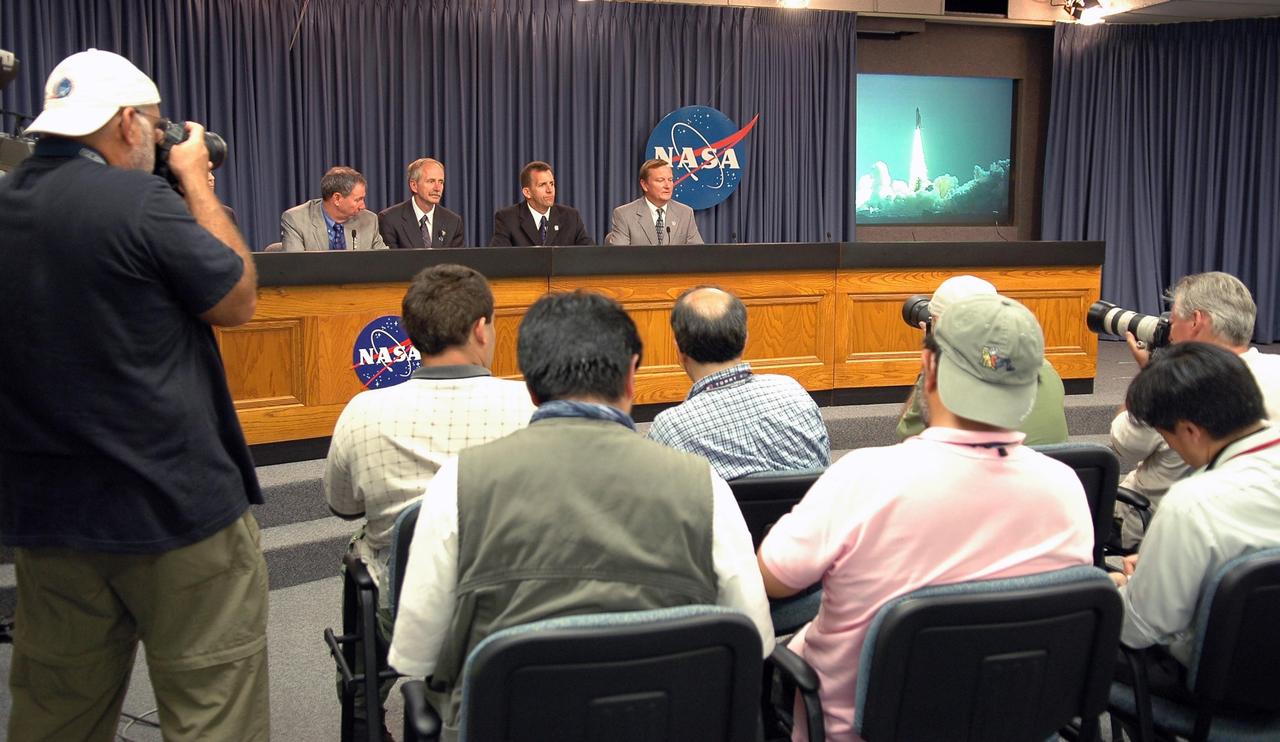
KENNEDY SPACE CENTER, FLA. - Following the successful launch of Space Shuttle Atlantis on mission STS-115, NASA Administrator Michael Griffin, Associate Administrator for Space Operations Mission William Gerstenmaier, Launch Integration Director LeRoy Cain and Shuttle Launch Director Mike Leinbach respond to questions from the media during a post-launch press conference. Mission STS-115 is the 116th space shuttle flight, the 27th flight for orbiter Atlantis, and the 19th U.S. flight to the International Space Station. STS-115 is scheduled to last 11 days with a planned landing at KSC. Photo credit: NASA/Kim Shiflett
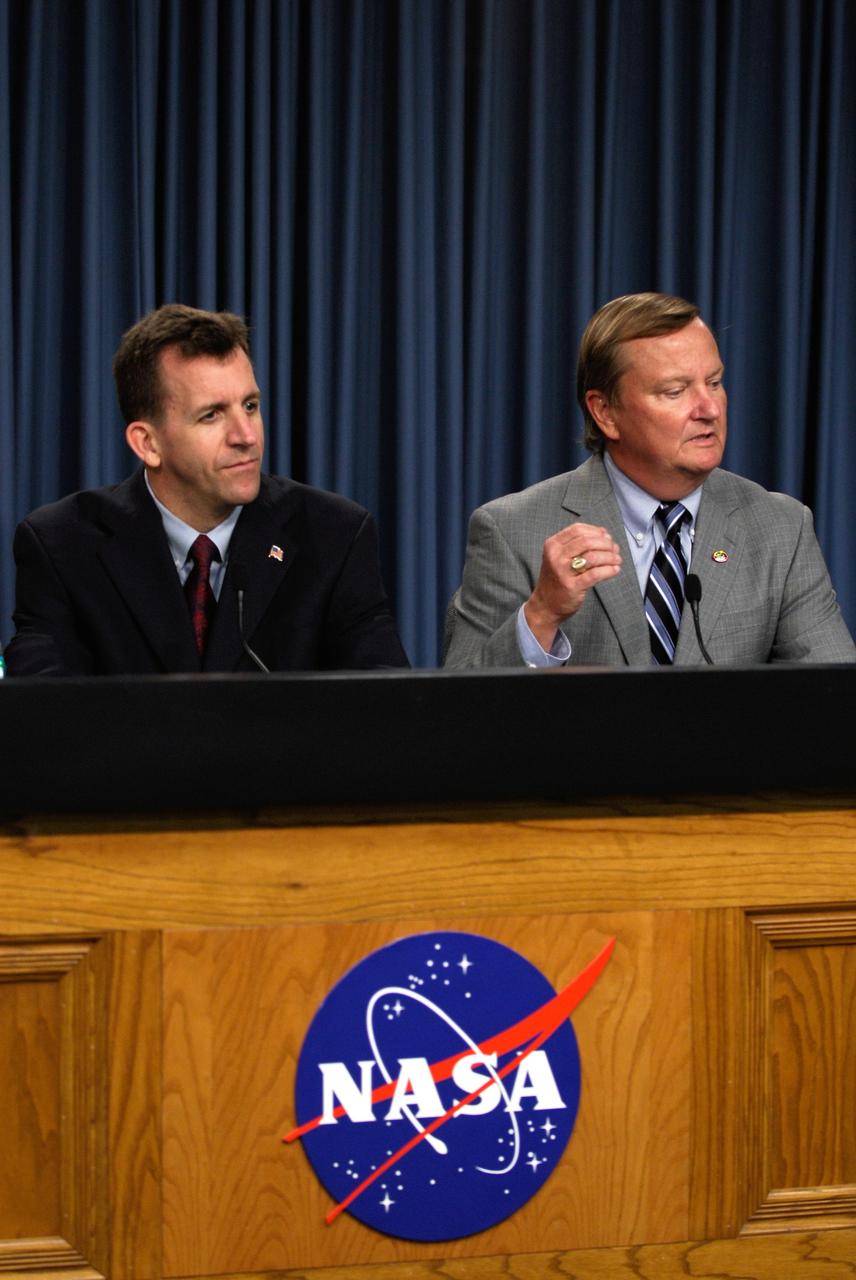
CAPE CANAVERAL, Fla. --- After the successful landing of space shuttle Endeavour to conclude the STS-123 mission, NASA officials hold a media briefing. The participants are, left to right, LeRoy Cain, chair of the mission management team; and Mike Leinbach, NASA space shuttle launch director. Endeavour landed on the second opportunity, on orbit 250, at 8:39:08 p.m. EDT. The STS-123 mission delivered the first segment of the Japan Aerospace Exploration Agency's Kibo laboratory and the Canadian Space Agency's two-armed robotic system, known as Dextre. Photo credit: NASA/Kim Shiflett
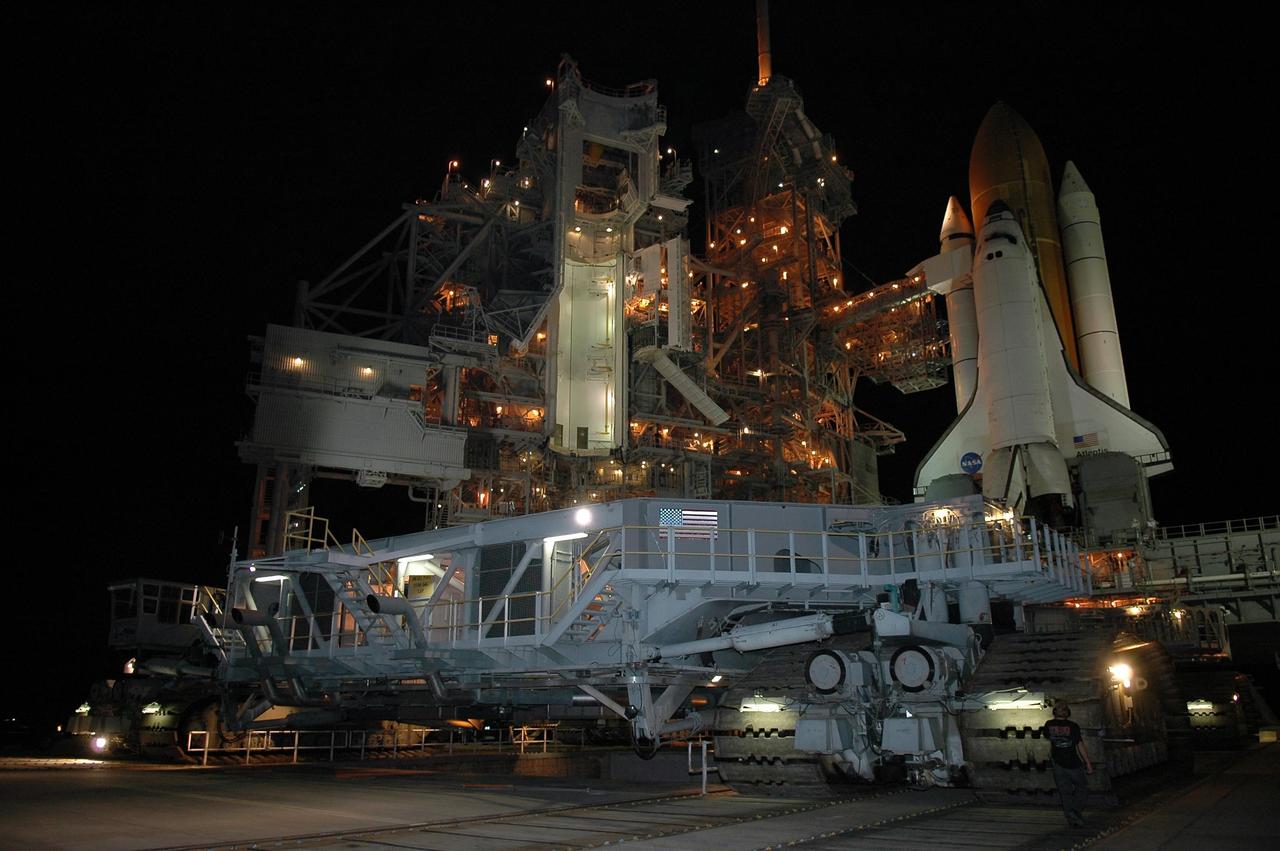
KENNEDY SPACE CENTER, FLA. - The crawler-transporter that carried Space Shuttle Atlantis and the mobile launcher platform back to Launch Pad 39B begins moving out from under the platform. It will return to its parking spot near the Vehicle Assembly Building. The shuttle had been moved off the launch pad due to concerns about the impact of Tropical Storm Ernesto, expected within 24 hours. The forecast of lesser winds expected from Ernesto and its projected direction convinced Launch Integration Manager LeRoy Cain and Shuttle Launch Director Mike Leinbach to return the shuttle to the launch pad. Photo credit: NASA/Kim Shiflett
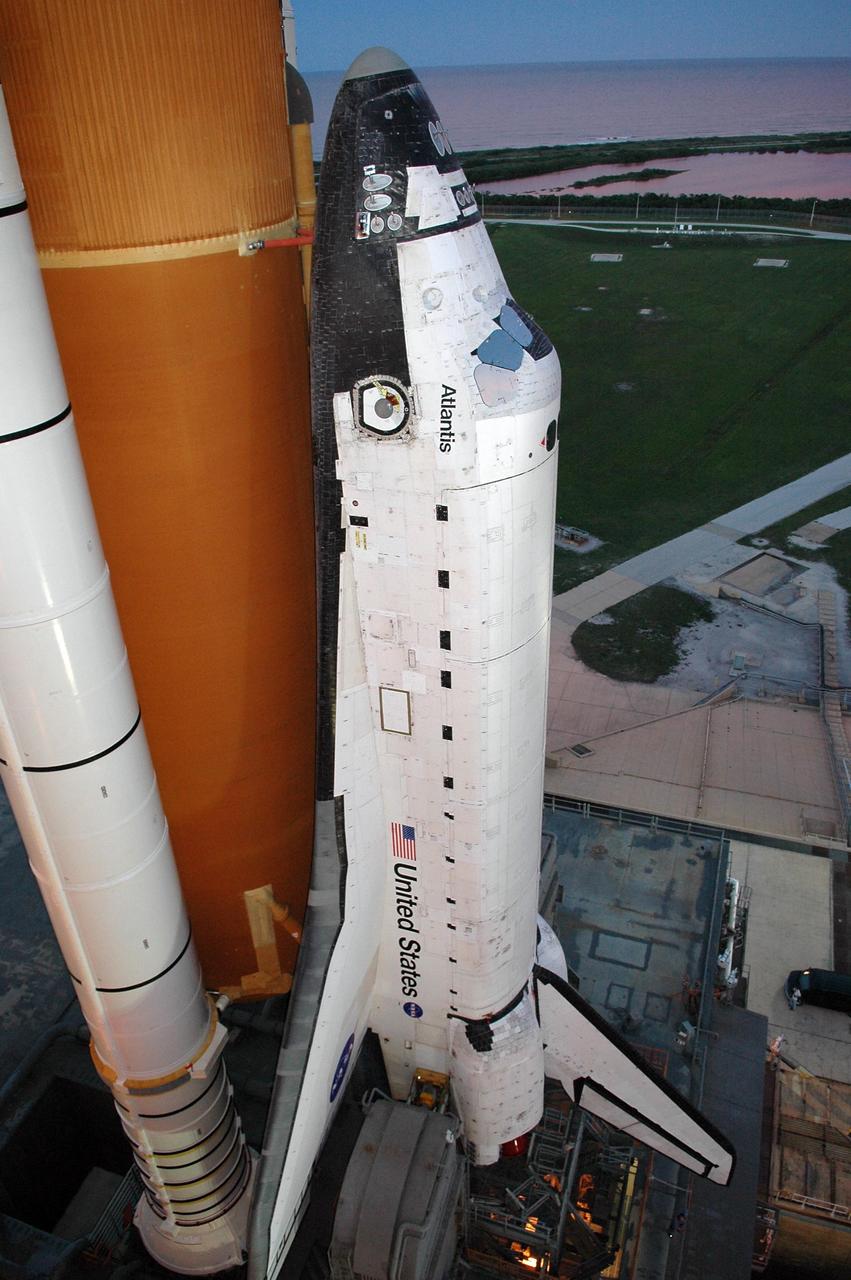
KENNEDY SPACE CENTER, FLA. - Space Shuttle Atlantis is hard down on the launch pad after rolling back to Launch Pad 39B. The Atlantic Ocean and lagoon water in the background reflect the glowing light of a setting sun. The shuttle had been moved off the launch pad due to concerns about the impact of Tropical Storm Ernesto, expected within 24 hours. The forecast of lesser winds expected from Ernesto and its projected direction convinced Launch Integration Manager LeRoy Cain and Shuttle Launch Director Mike Leinbach to return the shuttle to the launch pad. Photo credit: NASA/Kim Shiflett
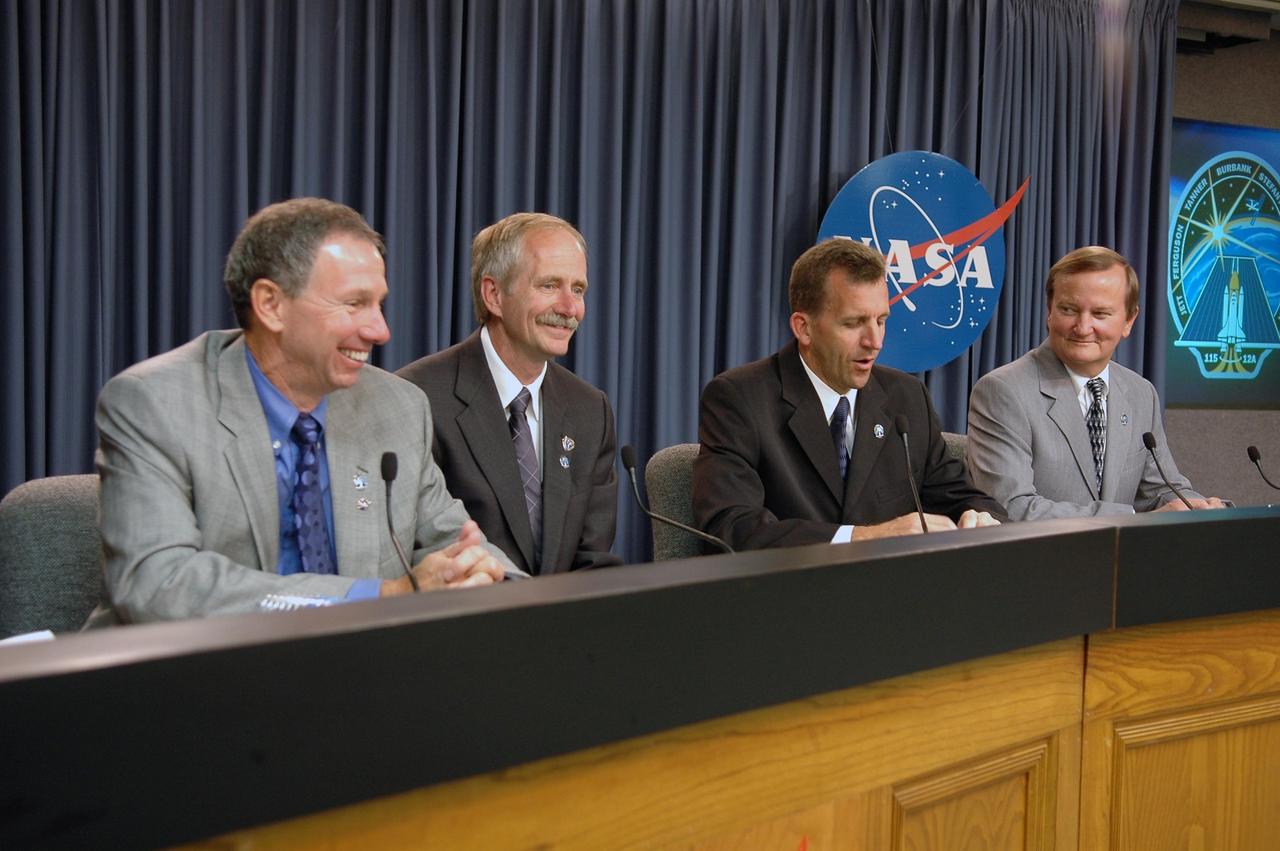
KENNEDY SPACE CENTER, FLA. - NASA and KSC officials discuss the successful launch of Space Shuttle Atlantis on mission STS-115 at a press conference at NASA's Kennedy Space Center. From left are NASA Administrator Michael Griffin, Associate Administrator for Space Operations Mission William Gerstenmaier, Launch Integration Director LeRoy Cain and Shuttle Launch Director Mike Leinbach.Mission STS-115 is the 116th space shuttle flight, the 27th flight for orbiter Atlantis, and the 19th U.S. flight to the International Space Station. STS-115 is scheduled to last 11 days with a planned landing at KSC. Photo credit: NASA/Kim Shiflett
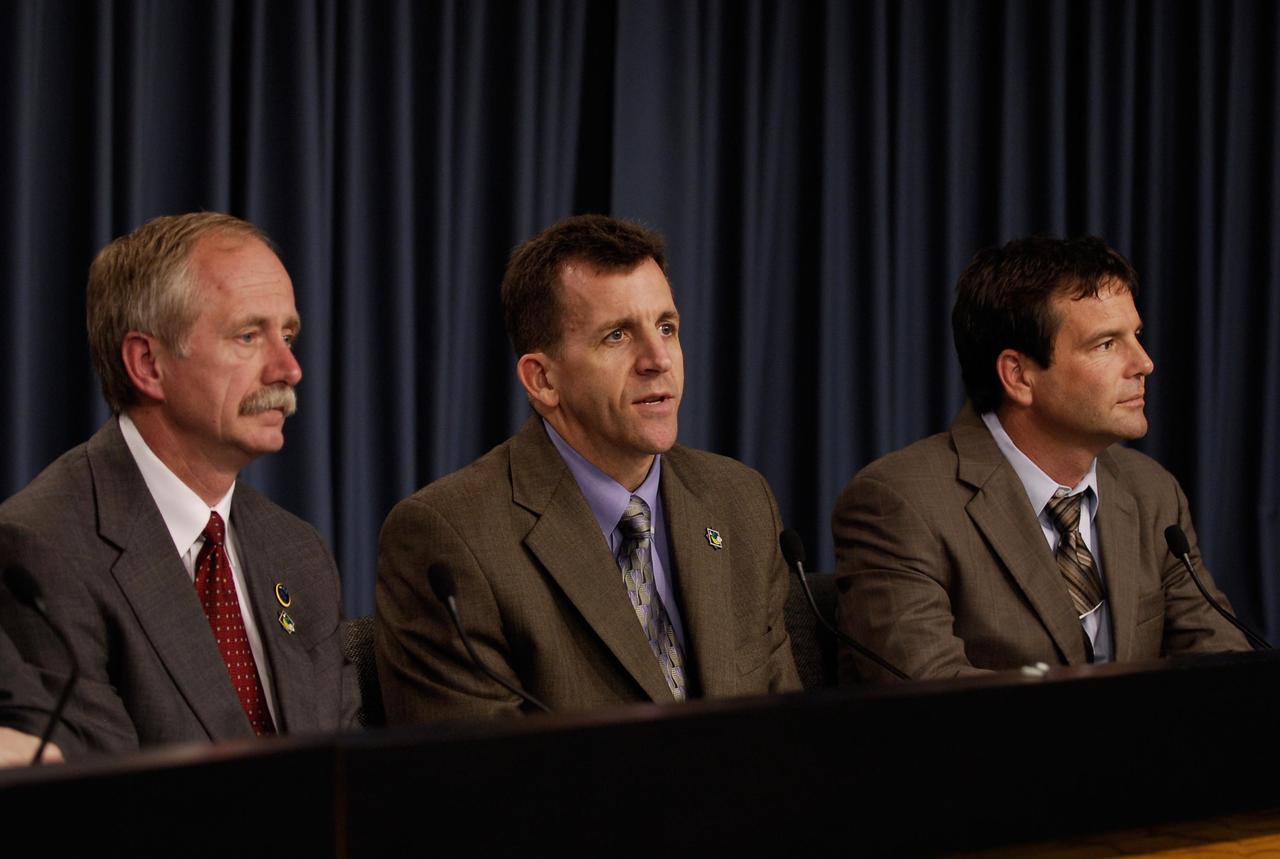
KENNEDY SPACE CENTER, FLA. -- Following the successful launch of space shuttle Atlantis on mission STS-122, NASA VIPs appear at a news conference to give their views about the launch and mission. Seen here are Associate Administrator for Space Operations Bill Gerstenmaier, Director of Mission Launch Integration LeRoy Cain and STS-122 Launch Director Doug Lyons. Also on the dais but not pictured are NASA Administrator Michael Griffin and European Space Agency Director General Jean-Jacques Dordain. During the 11-day mission, the crew's prime objective is to attach the Columbus laboratory to the Harmony module, adding to the station's size and capabilities. Photo credit: NASA/Kim Shiflett
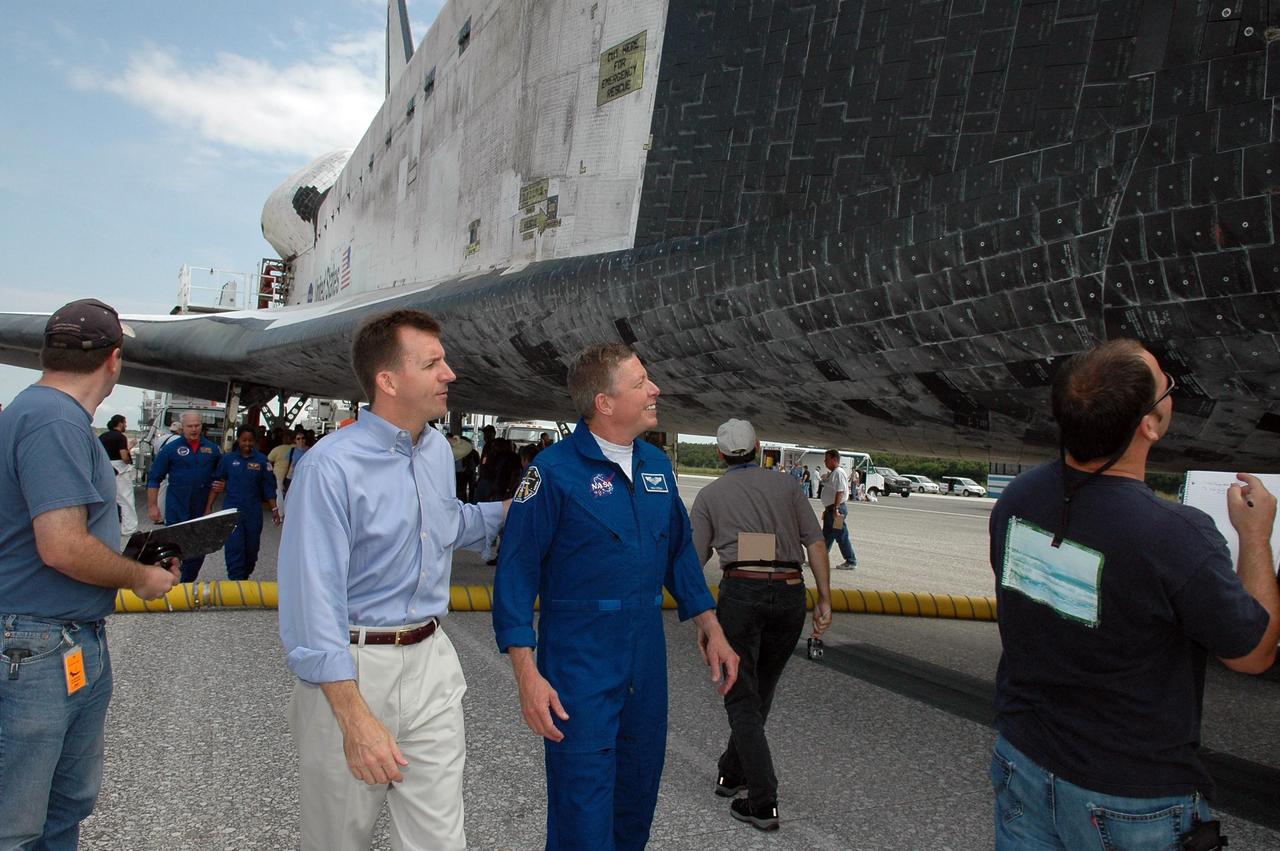
KENNEDY SPACE CENTER, FLA. - LeRoy Cain, manager of Shuttle Launch Integration, and Michael Fossum, STS-121 mission specialist, take a look at the orbiter Discovery during the traditional post-flight walk-around after the landing. Discovery's smooth and perfect landing was on time at 9:14 a.m. EDT on Runway 15 of NASA's Shuttle Landing Facility after traveling 5.3 million miles on 202 orbits. Mission elapsed time was 12 days, 18 hours, 37 minutes and 54 seconds. The landing is the 62nd at Kennedy Space Center and the 32nd for Discovery. Photo credit: NASA/Kim Shiflett
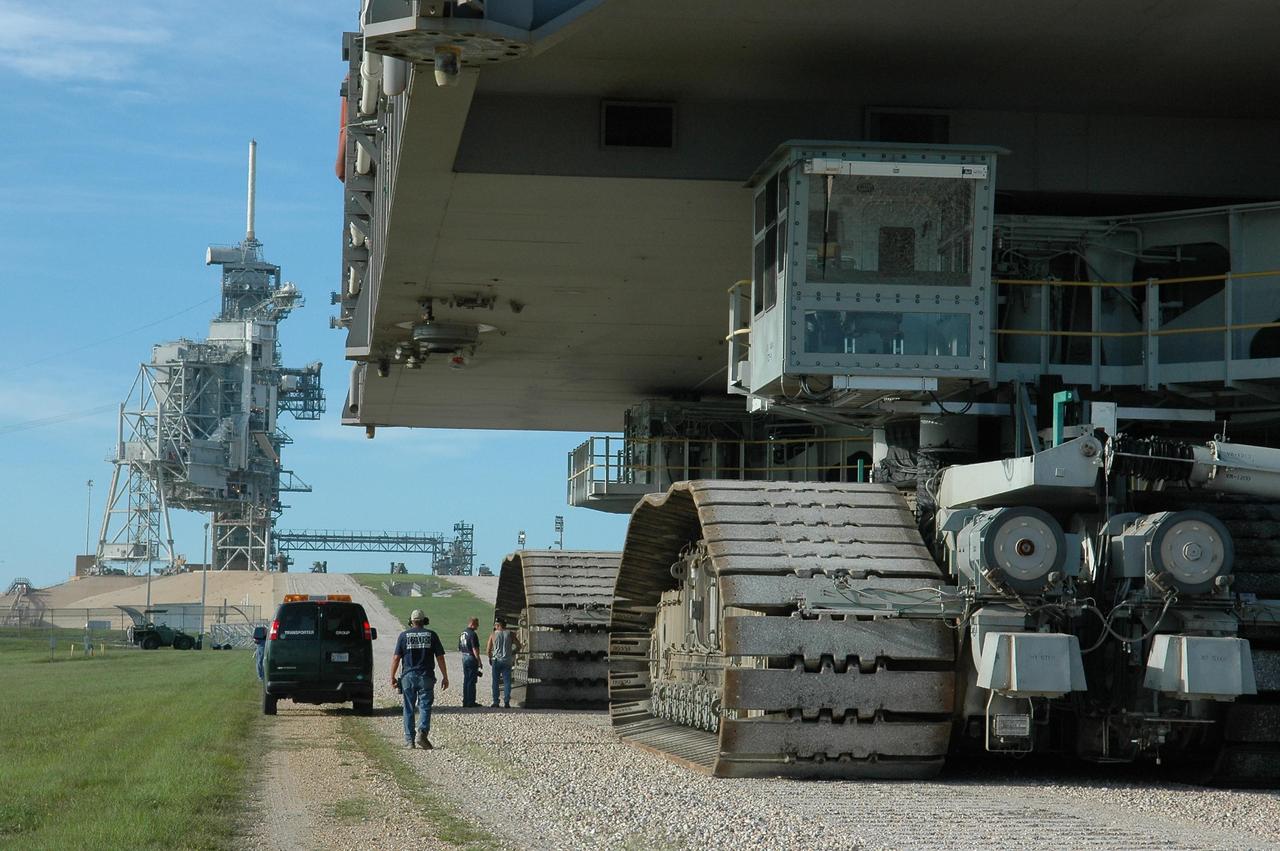
KENNEDY SPACE CENTER, FLA. - The relative diminutive size of a vehicle and workers alongside the crawler-transporter reveal the immensity of the mobile launcher platform-Space Shuttle Atlantis stack above. The crawler is 20 feet tall; the platform is 25 feet high. The shuttle is returning to Launch Pad 39B, in the background, after rolling back to the Vehicle Assembly Building due to concerns about the impact of Tropical Storm Ernesto. However, before reaching the VAB, the forecast of lesser winds expected from Ernesto and its projected direction convinced Launch Integration Manager LeRoy Cain and Shuttle Launch Director Mike Leinbach to return the shuttle to the launch pad. Photo credit: NASA/Kim Shiflett
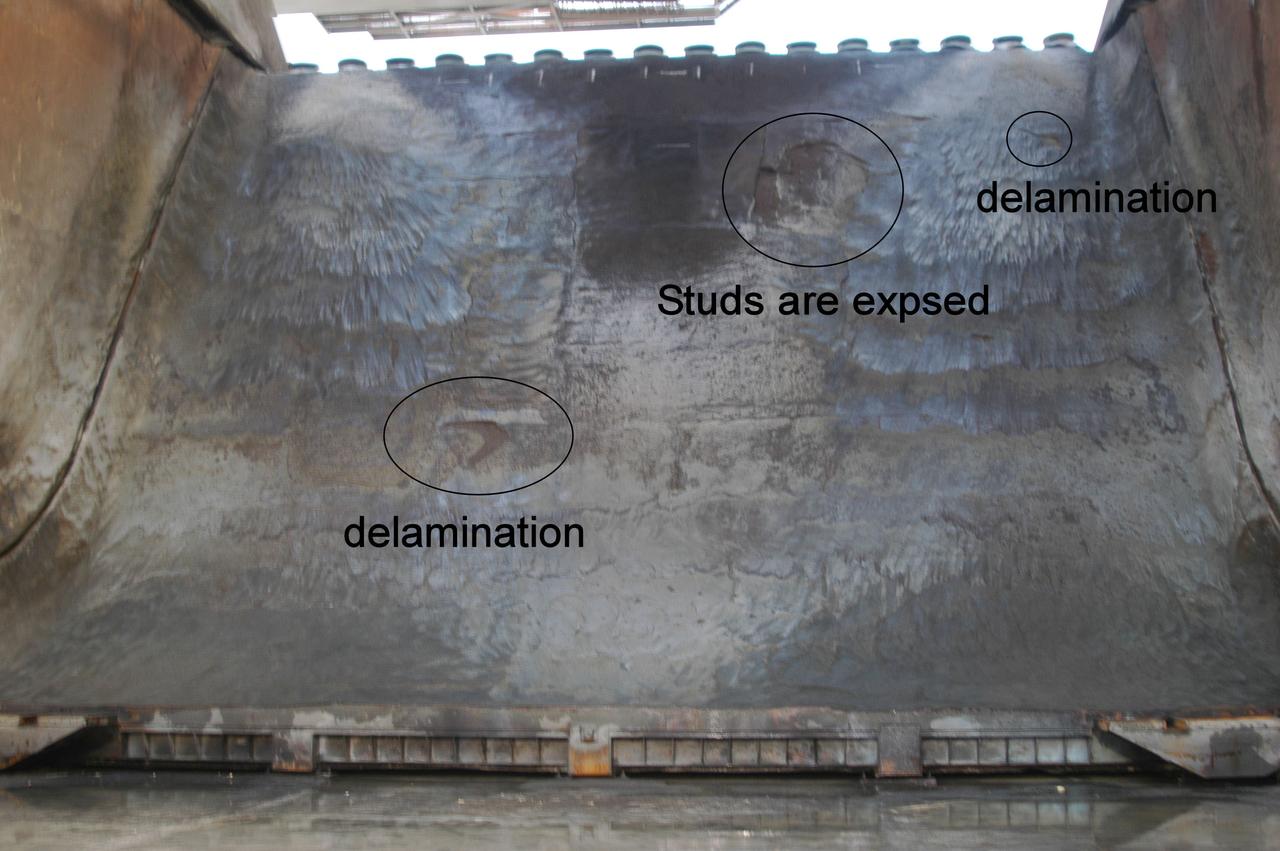
JSC2009-E-119287 (11 May 2009) --- A medium close still shot of the flame trench area at Launch Pad 39A at the Kennedy Space Center has been marked to indicate three different areas where minor damage was detected during STS-125 post-launch inspections. Two areas of delaminating flank a area where studs are partially exposed. While speaking during a press briefing, LeRoy Cain, deputy program manager for STS, showed this visual but expressed that NASA has no major concern over the damage at this time.
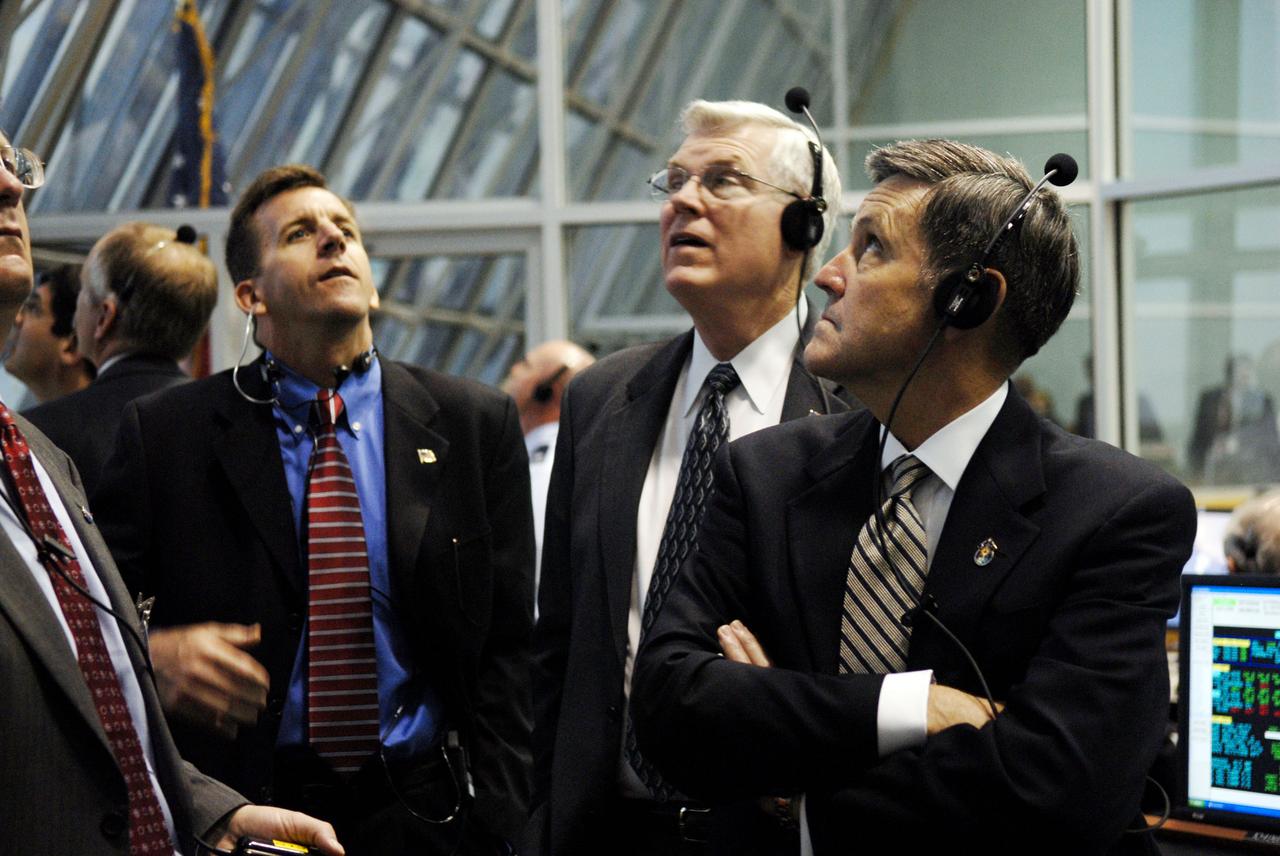
STS129-S-057 (16 Nov. 2009) --- From left, LeRoy Cain, NASA's deputy manager, Space Shuttle Program; Michael Coats, director of NASA's Johnson Space Center; and Bob Cabana, director of NASA's Kennedy Space Center, watch the launch of Space Shuttle Atlantis from the Operations Management Room, a glass partitioned area overlooking the main floor of Firing Room 4, in Kennedy's Launch Control Center. Liftoff of Atlantis from Launch Pad 39A on its STS-129 mission to the International Space Station came at 2:28 p.m. (EST) Nov. 16, 2009.
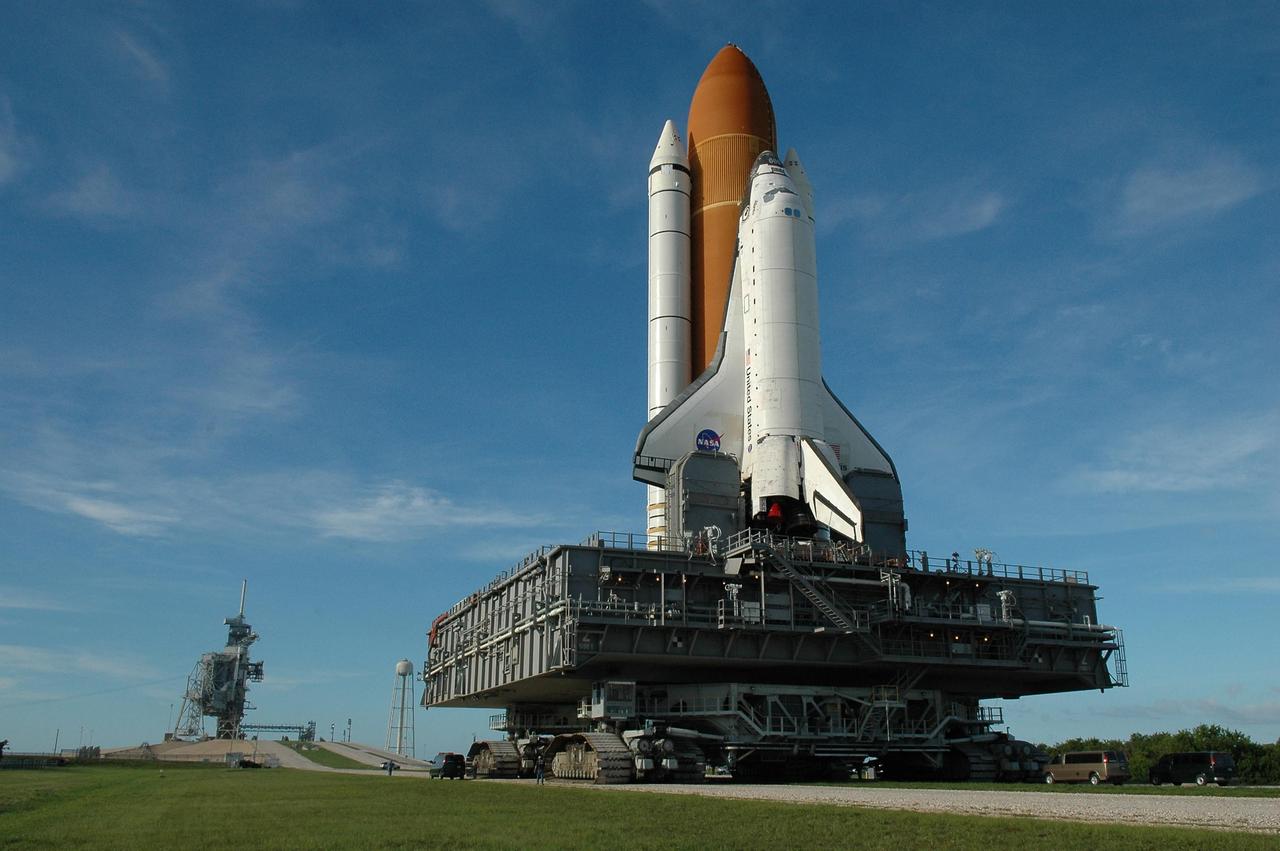
KENNEDY SPACE CENTER, FLA. - After reversing its direction to the Vehicle Assembly Building, Space Shuttle Atlantis nears Launch Pad 39B. The shuttle had been moved off the launch pad due to concerns about the impact of Tropical Storm Ernesto, expected within 24 hours. The forecast of lesser winds expected from Ernesto and its projected direction convinced Launch Integration Manager LeRoy Cain and Shuttle Launch Director Mike Leinbach to return the shuttle to the launch pad. Photo credit: NASA/Kim Shiflett
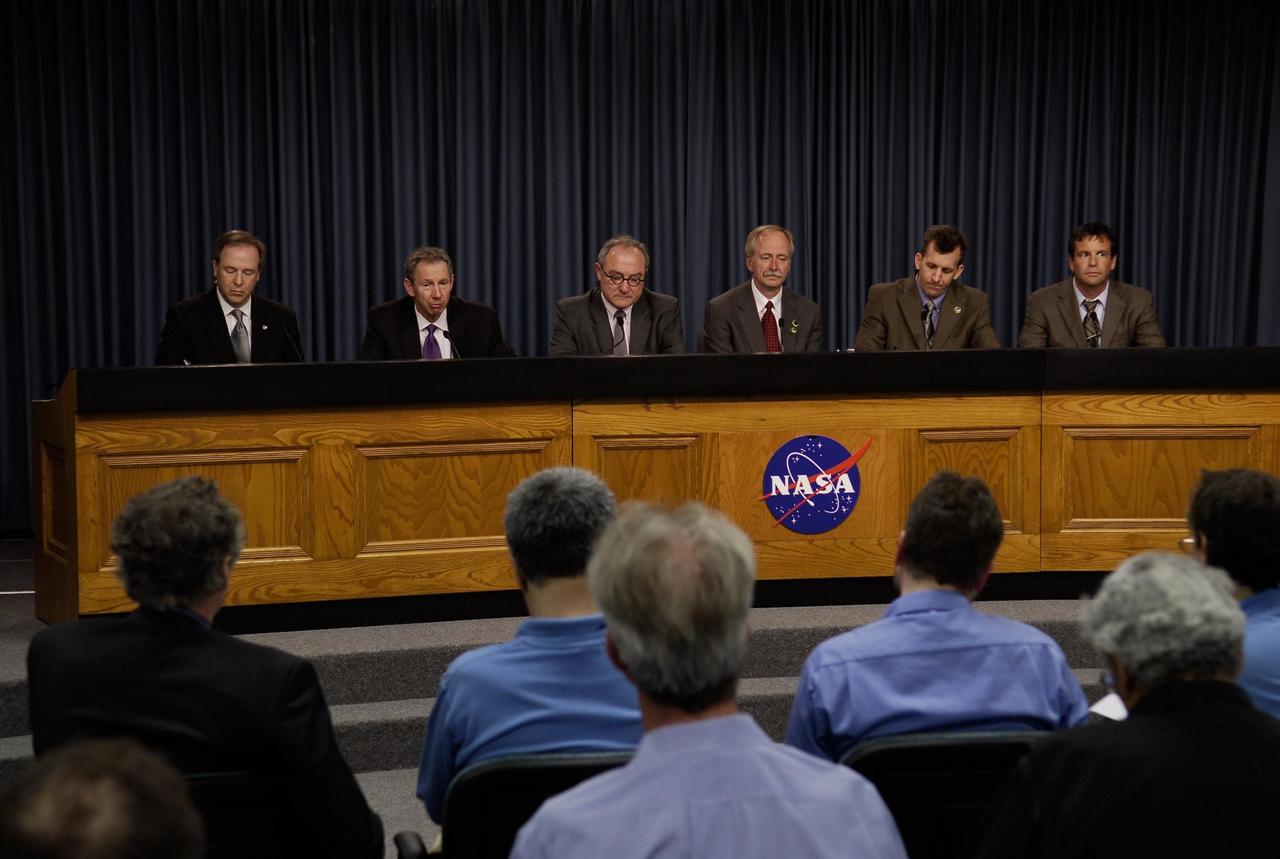
KENNEDY SPACE CENTER, FLA. -- Following the successful launch of space shuttle Atlantis on mission STS-122, NASA VIPs appear at a news conference to give their views about the launch and mission. From left are NASA Assistant Administrator for Public Affairs David Mould, NASA Administrator Michael Griffin, European Space Agency Director General Jean-Jacques Dordain, Associate Administrator for Space Operations Bill Gerstenmaier, Director of Mission Launch Integration LeRoy Cain and STS-122 Launch Director Doug Lyons. During the 11-day mission, the crew's prime objective is to attach the Columbus laboratory to the Harmony module, adding to the station's size and capabilities. Photo credit: NASA/Kim Shiflett
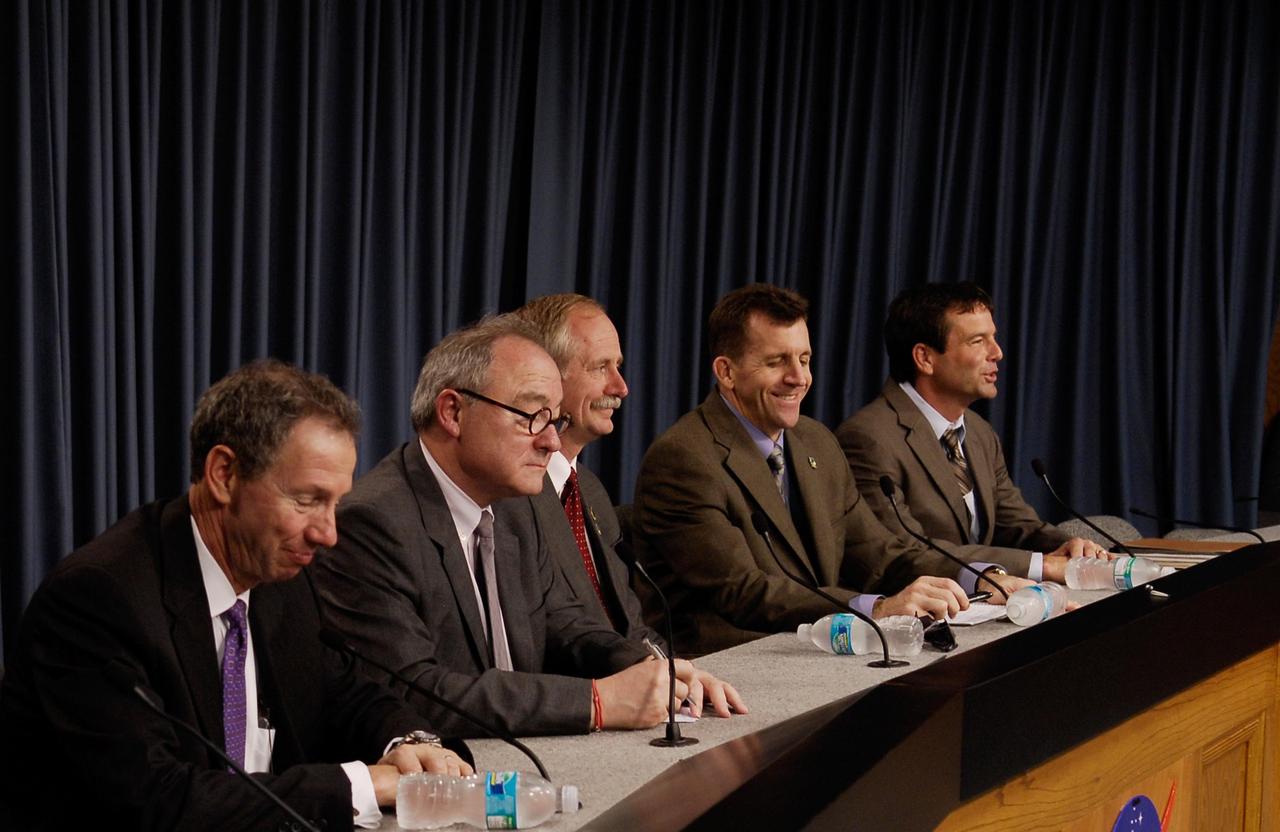
KENNEDY SPACE CENTER, FLA. -- Following the successful launch of space shuttle Atlantis on mission STS-122, NASA VIPs appear at a news conference to give their views about the launch and mission. From left are NASA Administrator Michael Griffin, European Space Agency Director General Jean-Jacques Dordain, Associate Administrator for Space Operations Bill Gerstenmaier, Director of Mission Launch Integration LeRoy Cain and STS-122 Launch Director Doug Lyons. During the 11-day mission, the crew's prime objective is to attach the Columbus laboratory to the Harmony module, adding to the station's size and capabilities. Photo credit: NASA/Kim Shiflett

As part of the joint team that will launch Boeing’s CST-100 Starliner on a United Launch Alliance Atlas V rocket in Boeing’s Orbital Flight Test (OFT), Eugene “Trip” Healey, NASA Mission Manager for OFT, participated in a successful Integrated Crew Exercise on Feb. 12. NASA, ULA, Boeing and Department of Defense personnel executed a mock countdown that practiced fueling the rocket and operating on the unique launch day timeline that features a four-hour built-in hold at the T-minus 4 minute mark. OFT is Boeing’s uncrewed flight test of Starliner and part of NASA’s Commercial Crew Program, which will return human spaceflight launches into low-Earth orbit from U.S. soil.
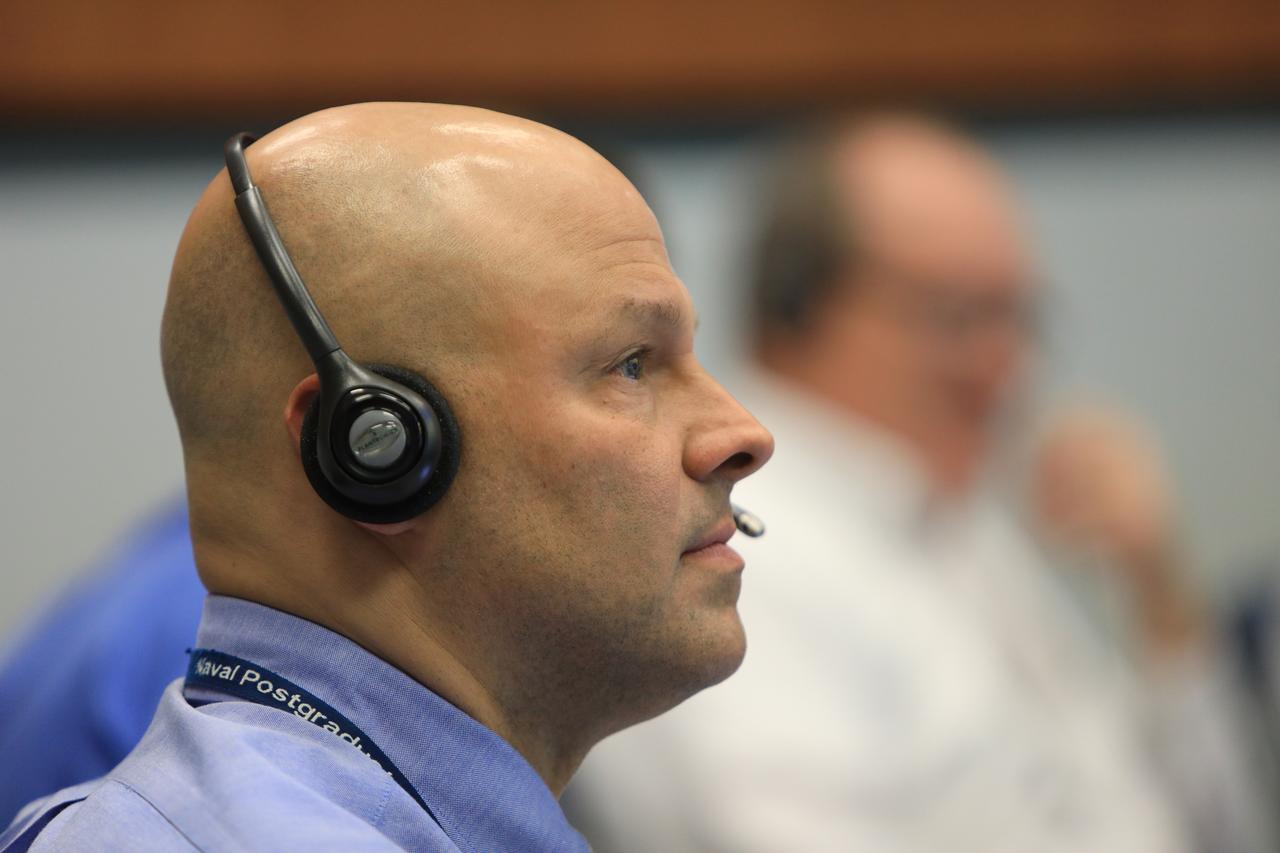
As part of the joint team that will launch Boeing’s CST-100 Starliner on a United Launch Alliance Atlas V rocket in Boeing’s Orbital Flight Test (OFT), NASA Operations Integration Manager Michael Hess participated in a successful Integrated Crew Exercise on Feb. 12. NASA, ULA, Boeing and Department of Defense personnel executed a mock countdown that practiced fueling the rocket and operating on the unique launch day timeline that features a four-hour built-in hold at the T-minus 4 minute mark. OFT is Boeing’s uncrewed flight test of Starliner and part of NASA’s Commercial Crew Program, which will return human spaceflight launches into low-Earth orbit from U.S. soil.
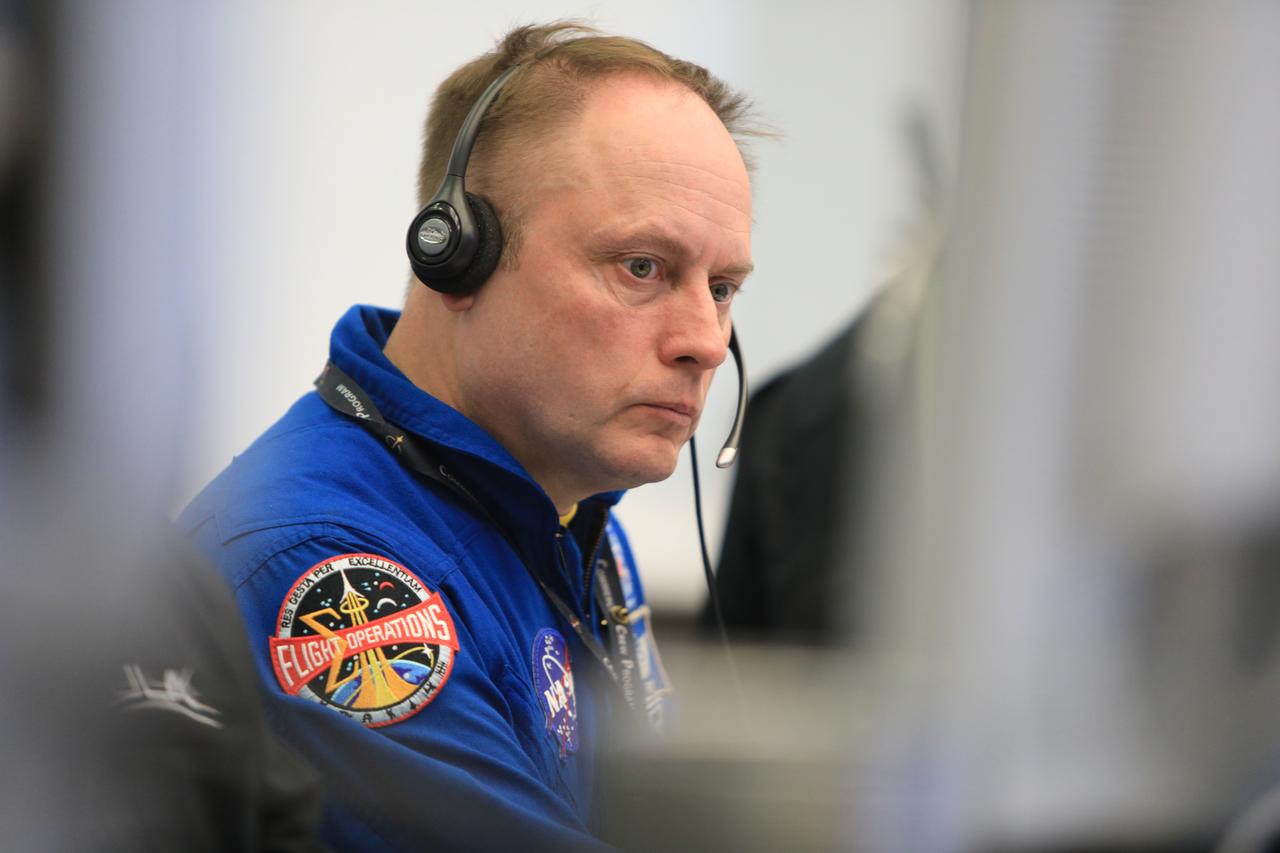
Along with the joint team that will launch the United Launch Alliance (ULA) Atlas V rocket and Boeing’s CST-100 Starliner in Boeing’s Orbital Flight Test, NASA astronaut Michael Fincke participated in a successful Integrated Crew Exercise on Feb. 12. NASA, ULA, Boeing and Department of Defense personnel executed a mock countdown that practiced fueling the rocket and operating on the unique launch day timeline that features a four-hour built-in hold at the T-minus 4 minute mark. Fincke will fly on Boeing’s Crew Flight Test (CFT), scheduled to launch no earlier than August 2019. OFT and CFT are Boeing’s uncrewed and crewed flight tests of Starliner and part of NASA’s Commercial Crew Program, which will return human spaceflight launches into low-Earth orbit from U.S. soil.

As part of the joint team that will launch Boeing’s CST-100 Starliner on a United Launch Alliance (ULA) Atlas V rocket in Boeing’s Orbital Flight Test (OFT), Boeing Spacecraft Launch Conductor Louis Atchison participated in a successful Integrated Crew Exercise on Feb. 12. NASA, ULA, Boeing and Department of Defense personnel executed a mock countdown that practiced fueling the rocket and operating on the unique launch day timeline that features a four-hour built-in hold at the T-minus 4 minute mark. OFT is Boeing’s uncrewed flight test of Starliner and part of NASA’s Commercial Crew Program, which will return human spaceflight launches into low-Earth orbit from U.S. soil.
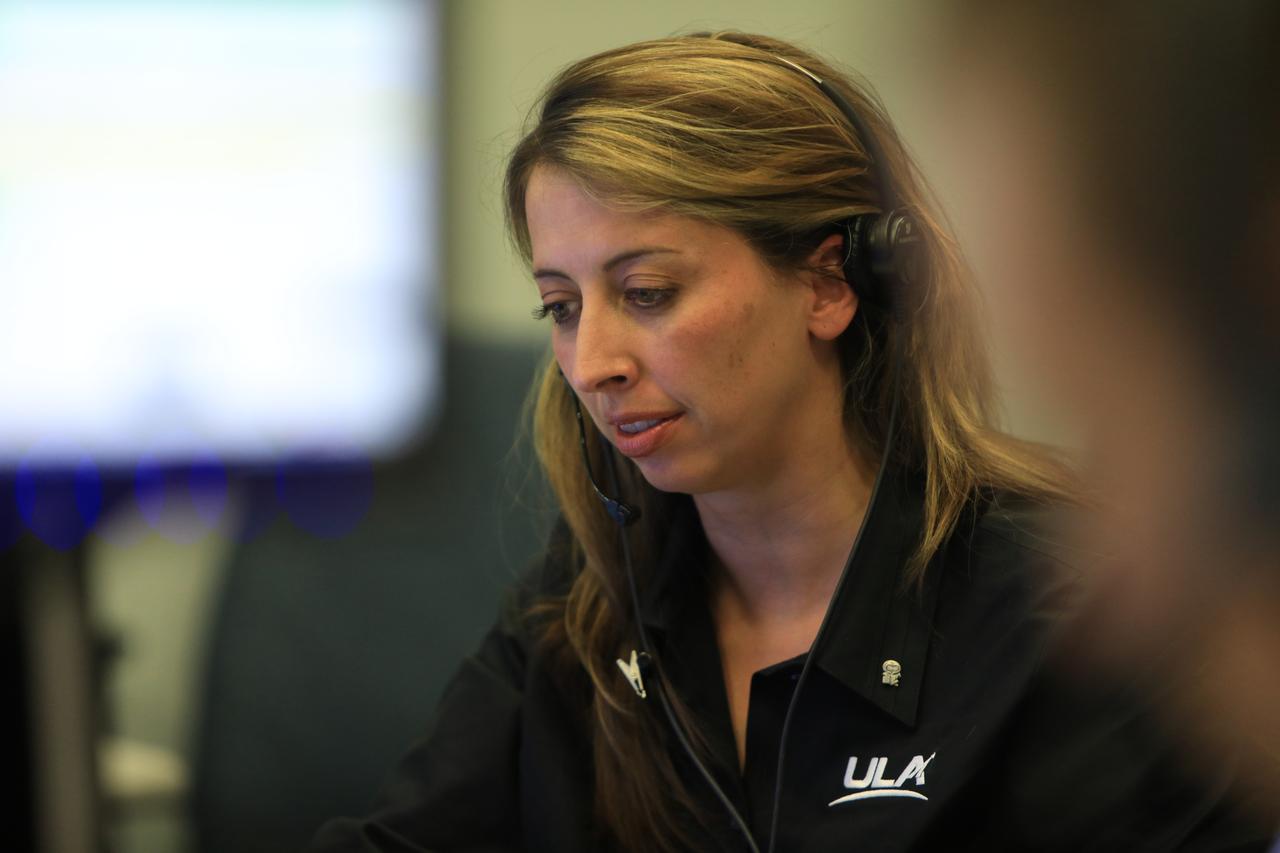
Boeing OFT Game Day Profiles
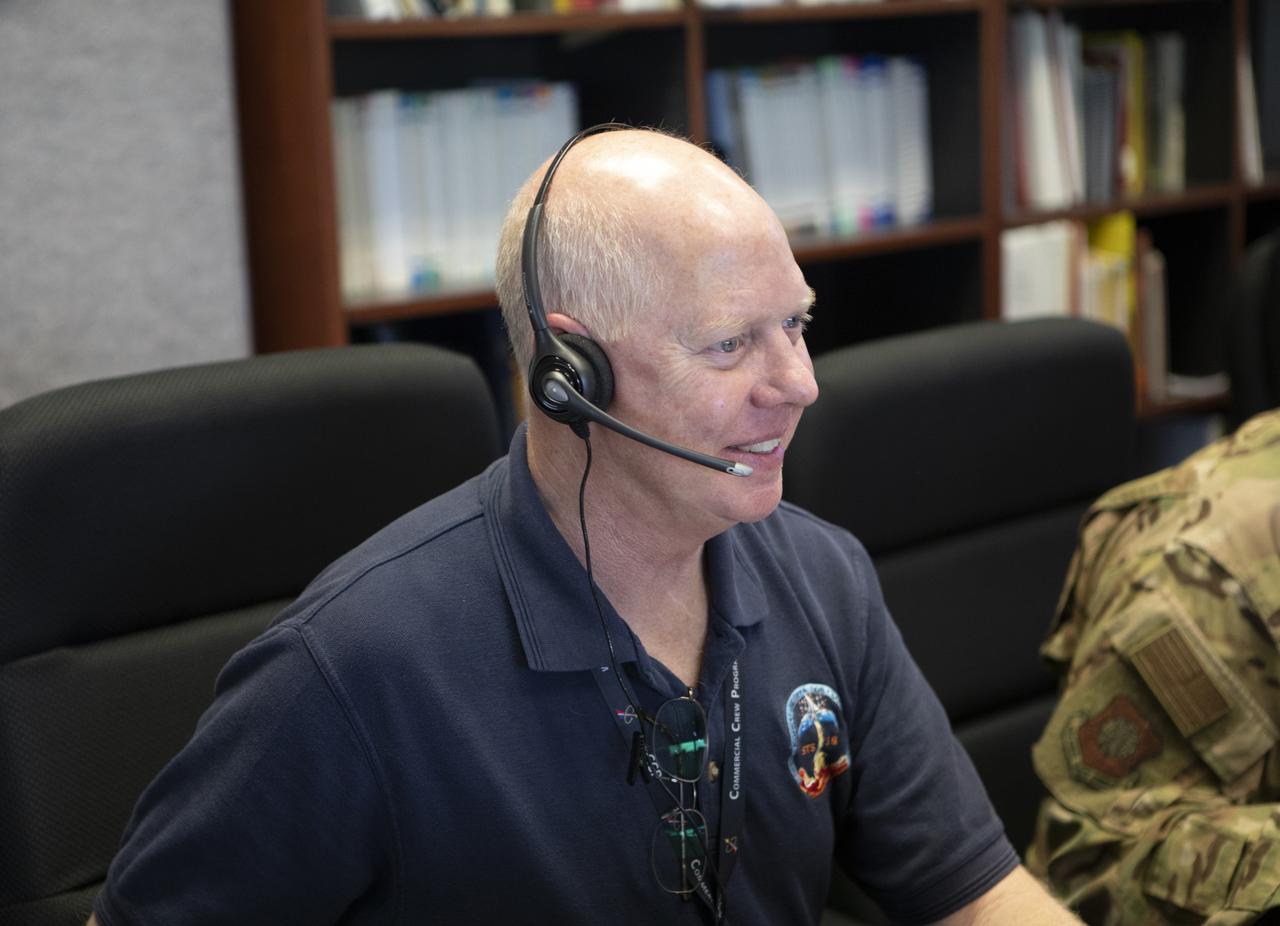
As part of the joint team that will launch Boeing’s CST-100 Starliner on a United Launch Alliance (ULA) Atlas V rocket in Boeing’s Orbital Flight Test (OFT), Steve Payne, Launch Integration Manager for NASA’s Commercial Crew Program, participated in a successful Integrated Crew Exercise on Feb. 12. NASA, ULA, Boeing and Department of Defense personnel executed a mock countdown that practiced fueling the rocket and operating on the unique launch day timeline that features a four-hour built-in hold at the T-minus 4 minute mark. OFT is Boeing’s uncrewed flight test of Starliner and part of NASA’s Commercial Crew Program, which will return human spaceflight launches into low-Earth orbit from U.S. soil.
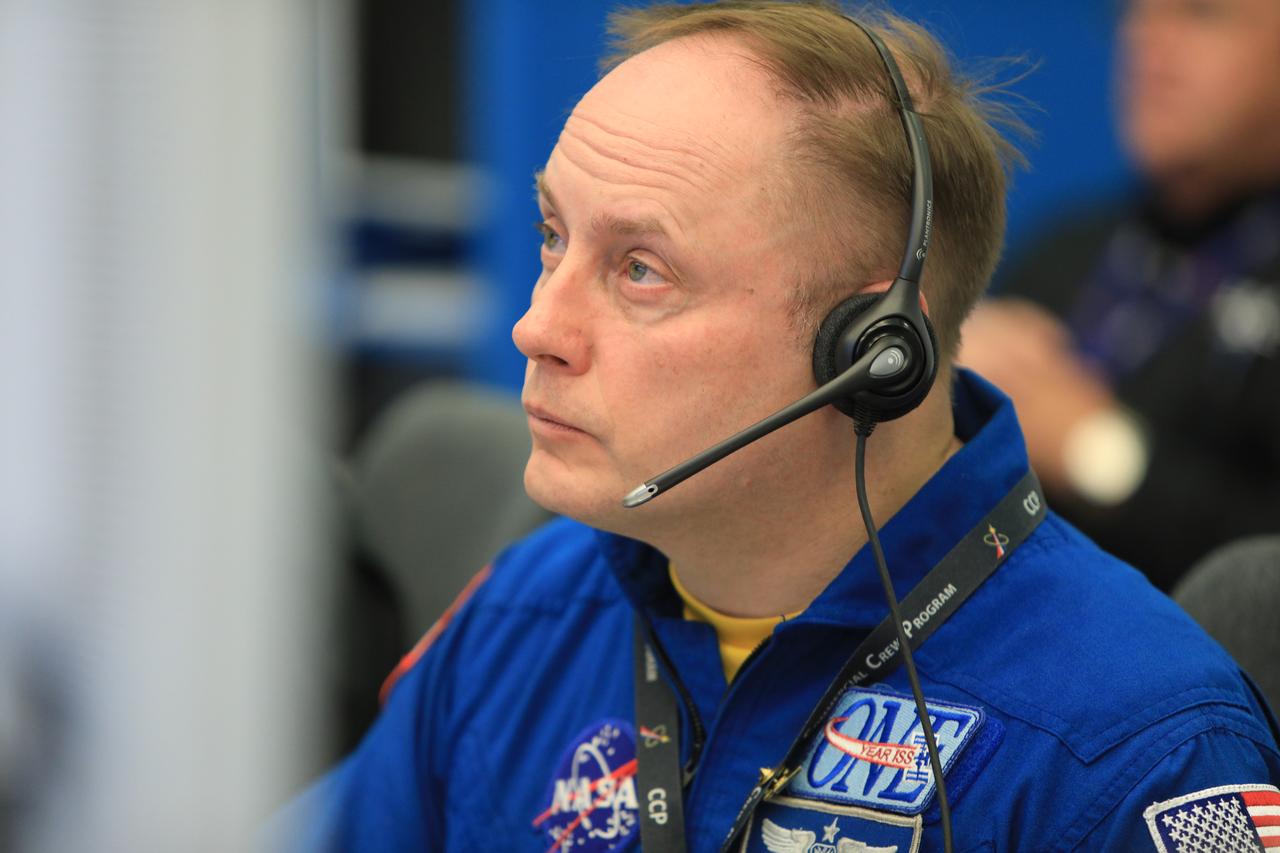
Along with the joint team that will launch the United Launch Alliance (ULA) Atlas V rocket and Boeing’s CST-100 Starliner in Boeing’s Orbital Flight Test, NASA astronaut Michael Fincke participated in a successful Integrated Crew Exercise on Feb. 12. NASA, ULA, Boeing and Department of Defense personnel executed a mock countdown that practiced fueling the rocket and operating on the unique launch day timeline that features a four-hour built-in hold at the T-minus 4 minute mark. Fincke will fly on Boeing’s Crew Flight Test (CFT), scheduled to launch no earlier than August 2019. OFT and CFT are Boeing’s uncrewed and crewed flight tests of Starliner and part of NASA’s Commercial Crew Program, which will return human spaceflight launches into low-Earth orbit from U.S. soil.
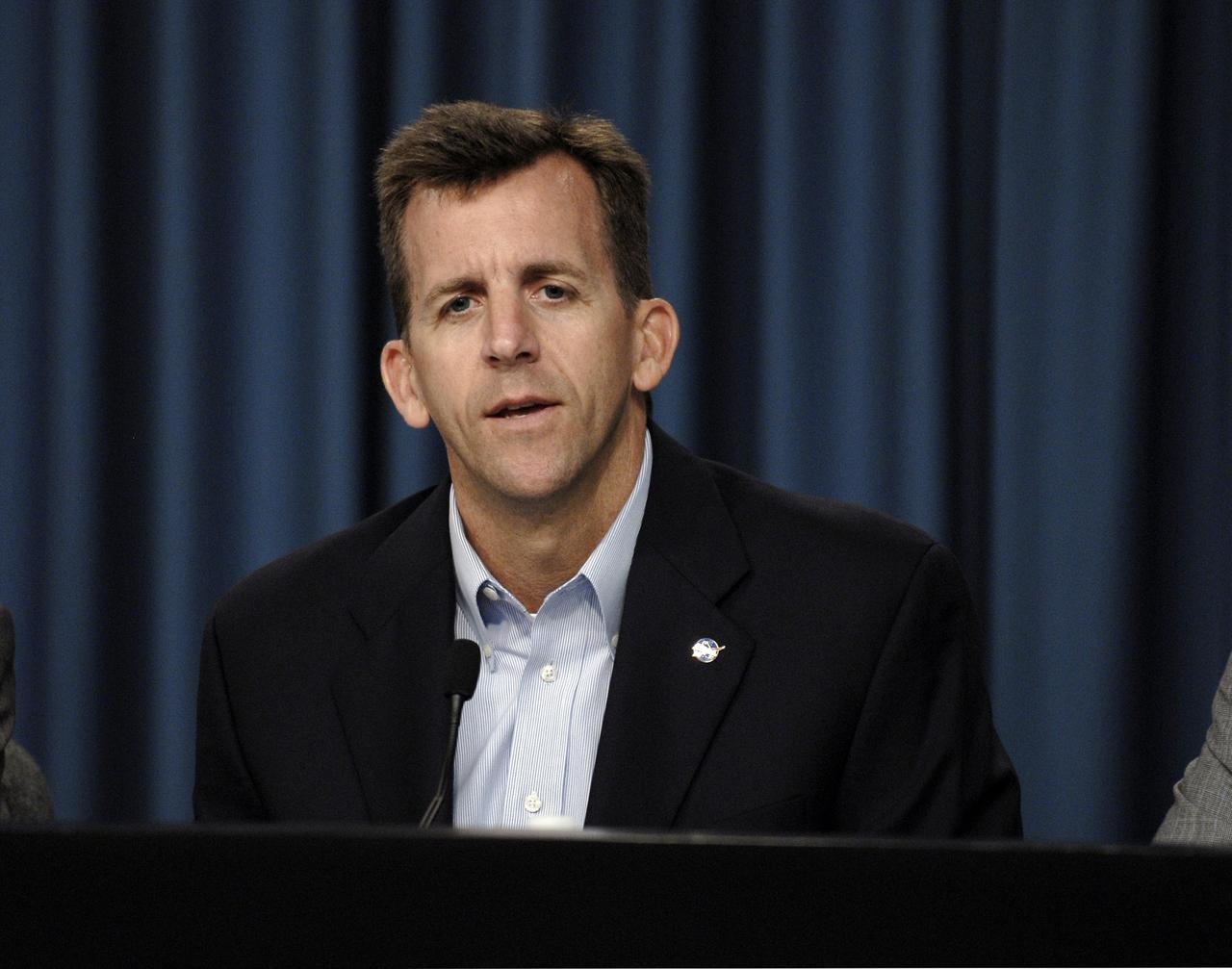
CAPE CANAVERAL, Fla. – At NASA's Kennedy Space Center in Florida, NASA Deputy Manager of Space Shuttle Program LeRoy Cain takes questions from the media during a news conference following landing of the space shuttle Discovery STS-119 mission to the International Space Station. Main gear touchdown was at 3:13:17 p.m. EDT. Nose gear touchdown was at 3:13:40 p.m. and wheels stop was at 3:14:45 p.m. Discovery delivered the final pair of large power-generating solar array wings and the S6 truss segment. The mission was the 28th flight to the station, the 36th flight of Discovery and the 125th in the Space Shuttle Program, as well as the 70th landing at Kennedy. Photo credit: NASA/Kim Shiflett
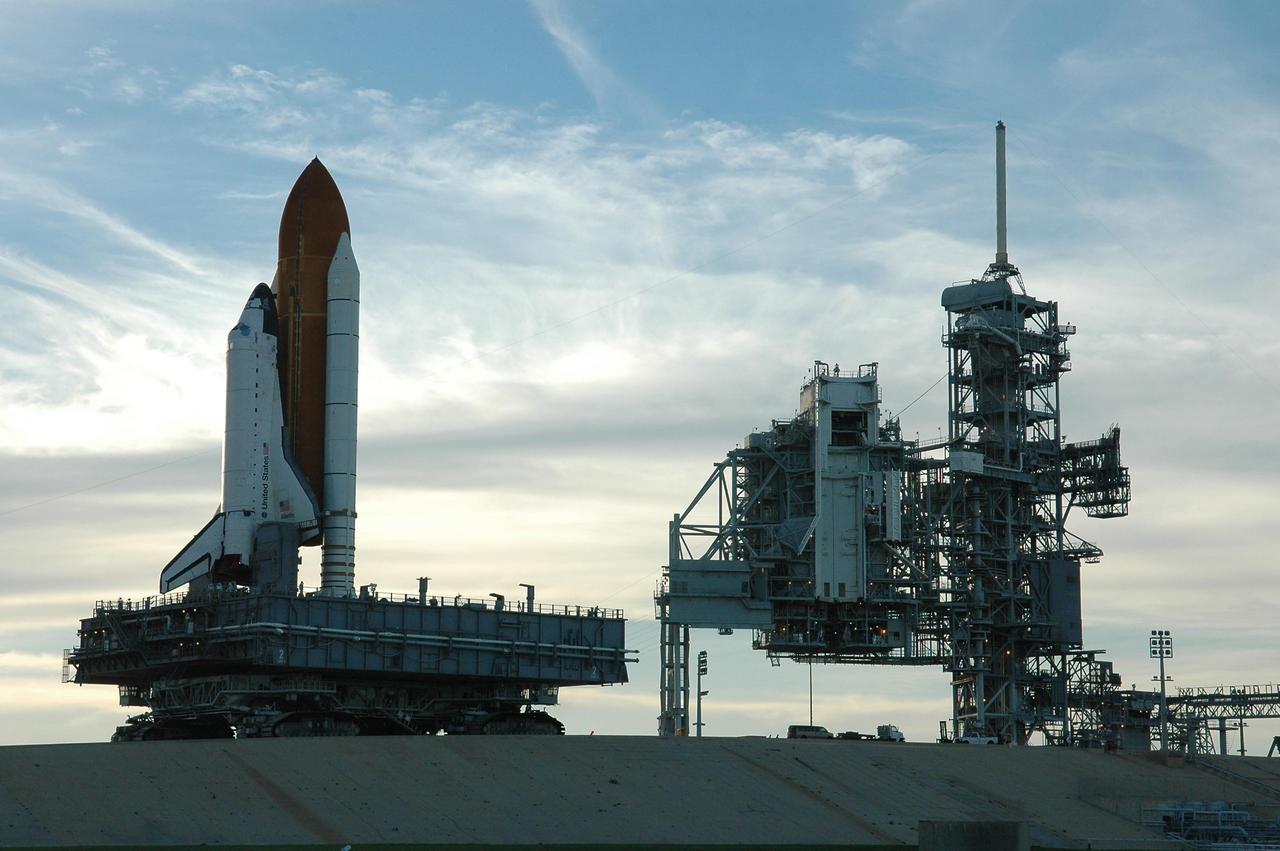
KENNEDY SPACE CENTER, FLA. - Space Shuttle Atlantis rolls up the ramp to Launch Pad 39B atop the crawler-transporter. The crawler has a leveling system designed to keep the top of the space shuttle vertical while negotiating the 5-percent grade leading to the top of the launch pad. Also, a laser docking system provides almost pinpoint accuracy when the crawler and mobile launcher platform are positioned at the launch pad. At right are the open rotating service structure and the fixed service structure topped by the 80-foot lightning mast. The shuttle had been moved off the launch pad due to concerns about the impact of Tropical Storm Ernesto, expected within 24 hours. The forecast of lesser winds expected from Ernesto and its projected direction convinced Launch Integration Manager LeRoy Cain and Shuttle Launch Director Mike Leinbach to return the shuttle to the launch pad. Photo credit: NASA/Kim Shiflett
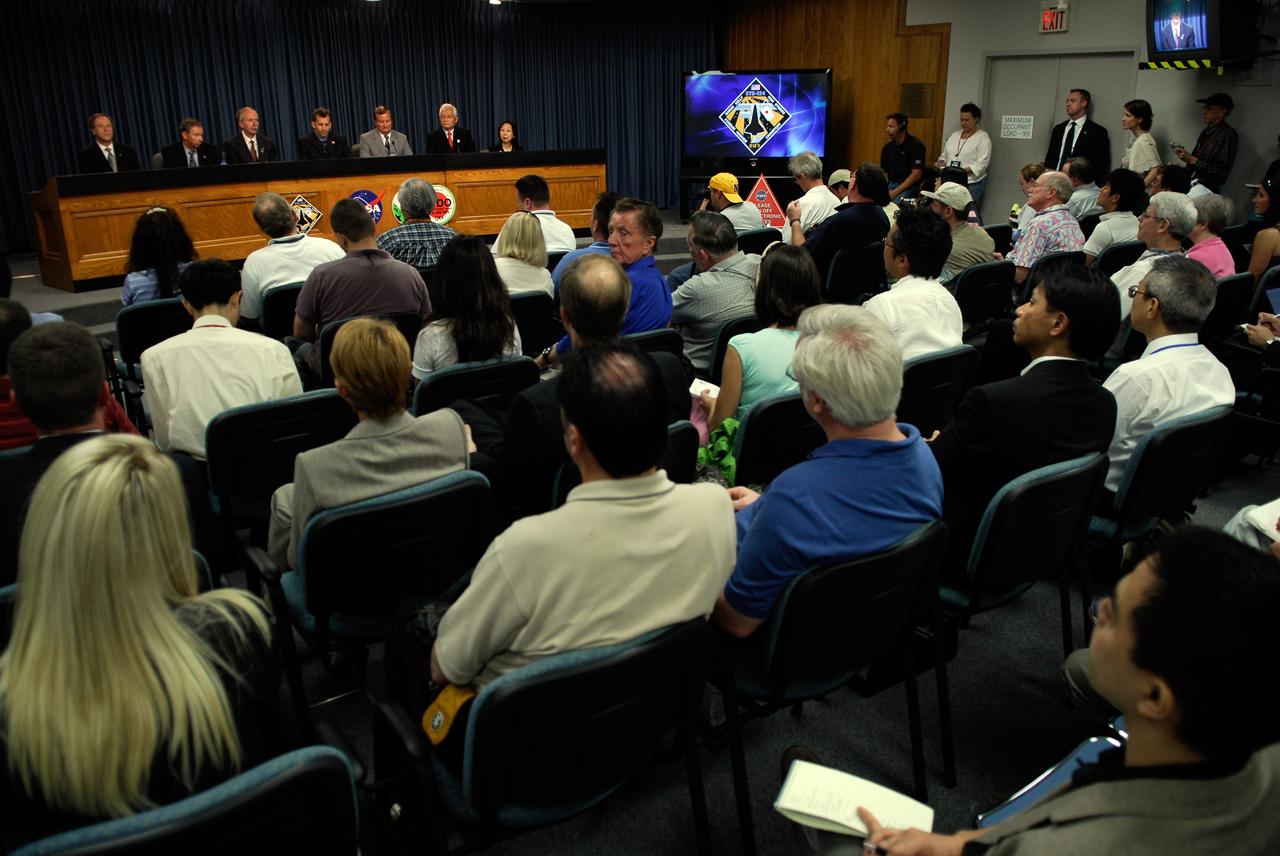
CAPE CANAVERAL, Fla. -- The media fill the NASA's News Center television studio for a news conference with key NASA personnel following the successful launch of space shuttle Discovery on the STS-124 mission. On the stage are (left to right) Public Affairs Officer David Mould as moderator, NASA Administrator Michael Griffin, Associate Administrator for Space Operations Bill Gerstenmaier, Director of Mission Launch Integration LeRoy Cain, Shuttle Launch Director Mike Leinbach, Japan Aerospace Exploration Agency President Dr. Keiji Tachikawa and an interpreter. The STS-124 mission is the 26th in the assembly of the space station. It is the second of three flights launching components to complete the Japan Aerospace Exploration Agency's Kibo laboratory. The shuttle crew will install Kibo's large Japanese Pressurized Module and its remote manipulator system, or RMS. The 14-day flight includes three spacewalks. Photo credit: NASAKim Shiflett
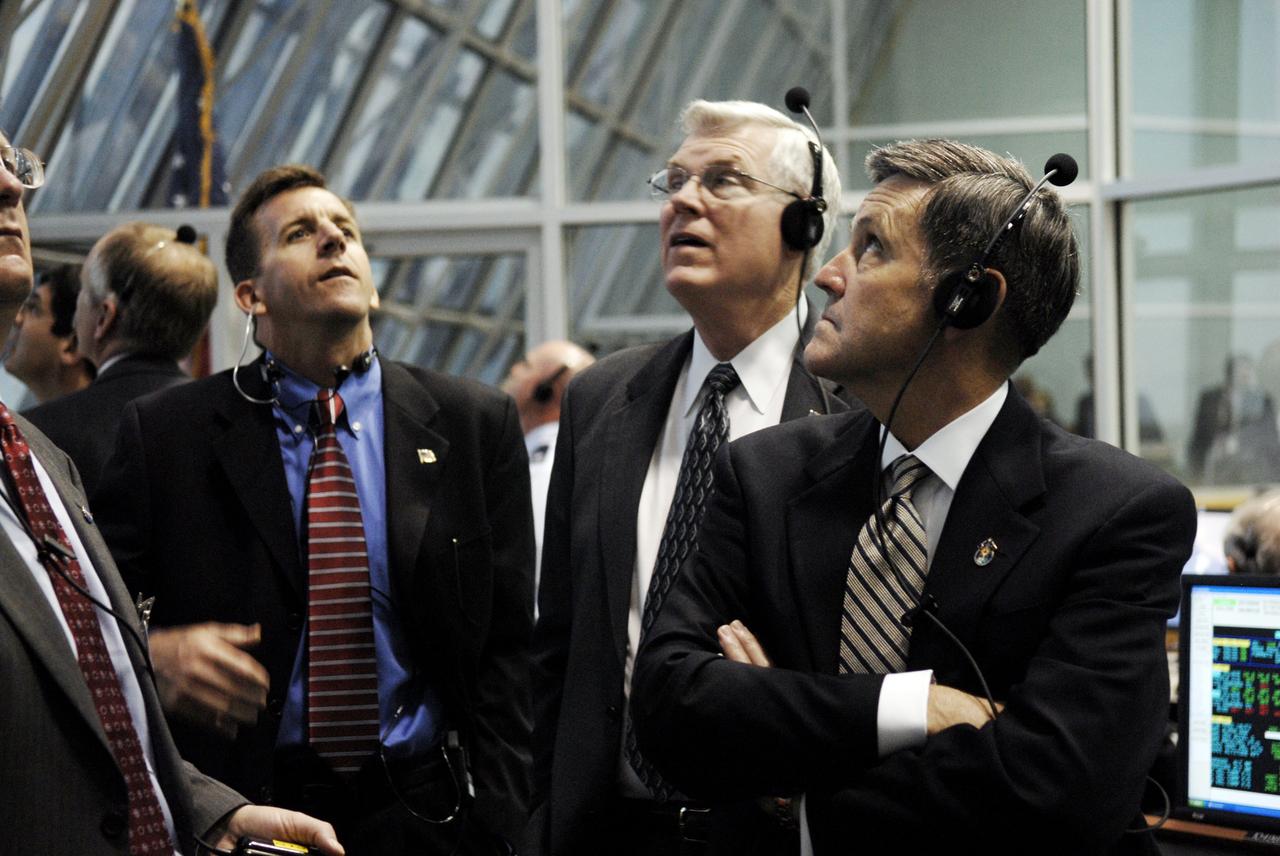
CAPE CANAVERAL, Fla. - From left, LeRoy Cain, NASA's deputy manager, Space Shuttle Program; Michael Coats, director of NASA's Johnson Space Center; and Bob Cabana, director of NASA's Kennedy Space Center, watch the launch of space shuttle Atlantis from the Operations Management Room, a glass partitioned area overlooking the main floor of Firing Room 4, in Kennedy's Launch Control Center. Liftoff of Atlantis from Launch Pad 39A on its STS-129 mission to the International Space Station came at 2:28 p.m. EST Nov. 16. For information on the STS-129 mission and crew, visit http://www.nasa.gov/mission_pages/shuttle/shuttlemissions/sts129/index.html. Photo credit: NASA/Kim Shiflett
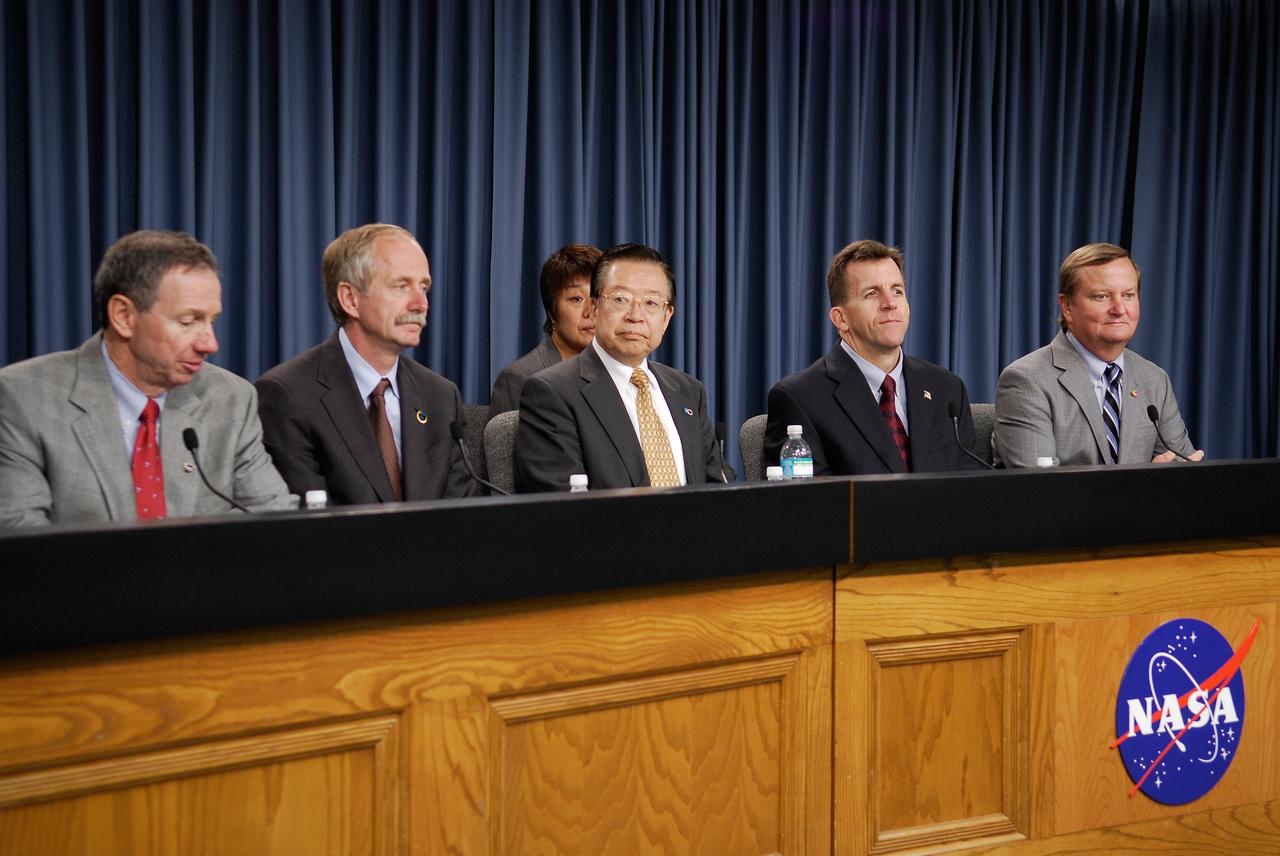
CAPE CANAVERAL, Fla. --- After the successful landing of space shuttle Endeavour to conclude the STS-123 mission, NASA officials hold a media briefing. The participants are, left to right, Michael Griffin, NASA administrator; Bill Gerstenmaier, NASA associate administrator for Space Operations; Kaoru Mamiya, Japan Aerospace Exploration Agency vice president; LeRoy Cain, chair of the mission management team; and Mike Leinbach, NASA space shuttle launch director. Endeavour landed on the second opportunity, on orbit 250, at 8:39:08 p.m. EDT. The STS-123 mission delivered the first segment of the Japan Aerospace Exploration Agency's Kibo laboratory and the Canadian Space Agency's two-armed robotic system, known as Dextre. Photo credit: NASA/Kim Shiflett
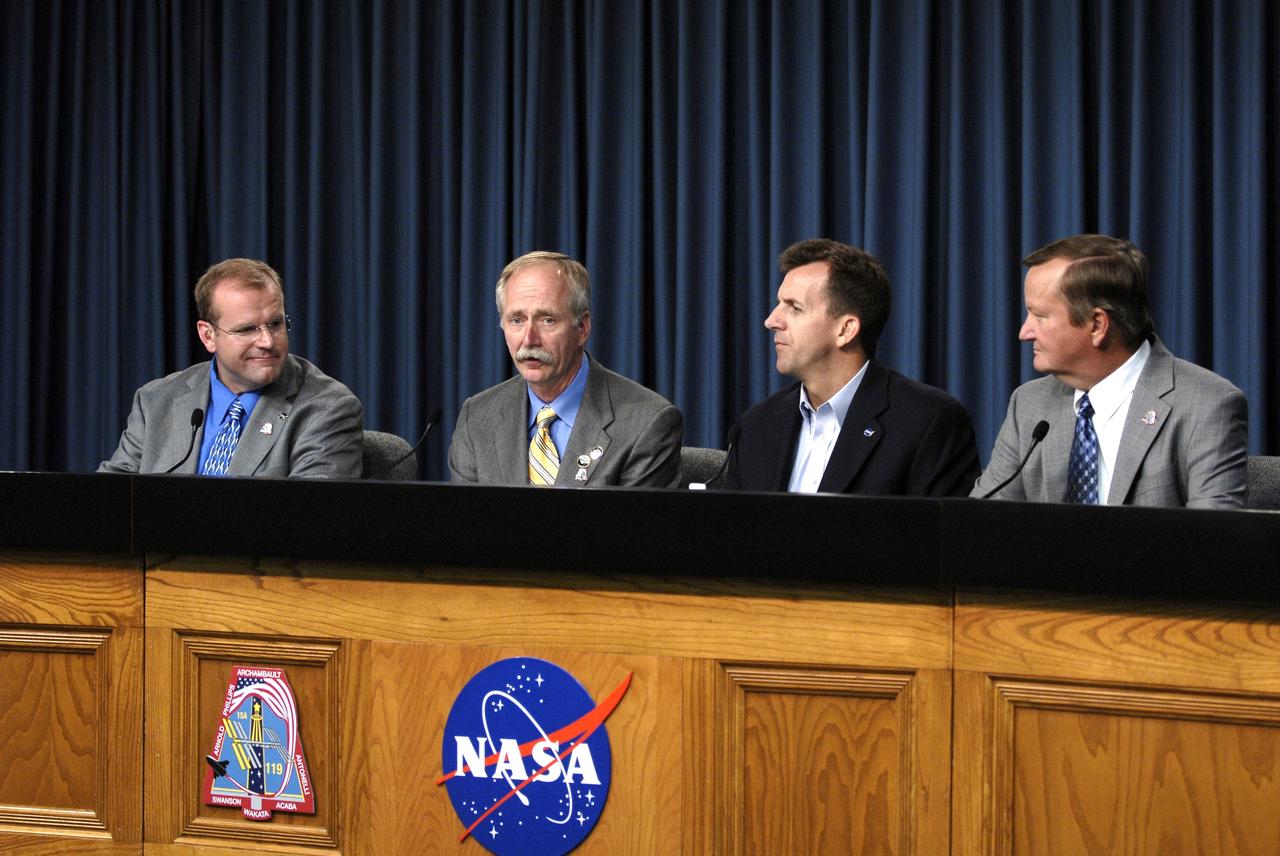
CAPE CANAVERAL, Fla. – At NASA's Kennedy Space Center in Florida, NASA managers participate in a news conference following landing of the space shuttle Discovery STS-119 mission to the International Space Station. From left are NASA Kennedy Space Center News Chief Allard Beutel, NASA Associate Administrator for Space Operations Bill Gerstenmaier, NASA Deputy Manager of Space Shuttle Program LeRoy Cain and NASA Shuttle Launch Director Mike Leinbach. Main gear touchdown was at 3:13:17 p.m. EDT. Nose gear touchdown was at 3:13:40 p.m. and wheels stop was at 3:14:45 p.m. Discovery delivered the final pair of large power-generating solar array wings and the S6 truss segment. The mission was the 28th flight to the station, the 36th flight of Discovery and the 125th in the Space Shuttle Program, as well as the 70th landing at Kennedy. Photo credit: NASA/Kim Shiflett
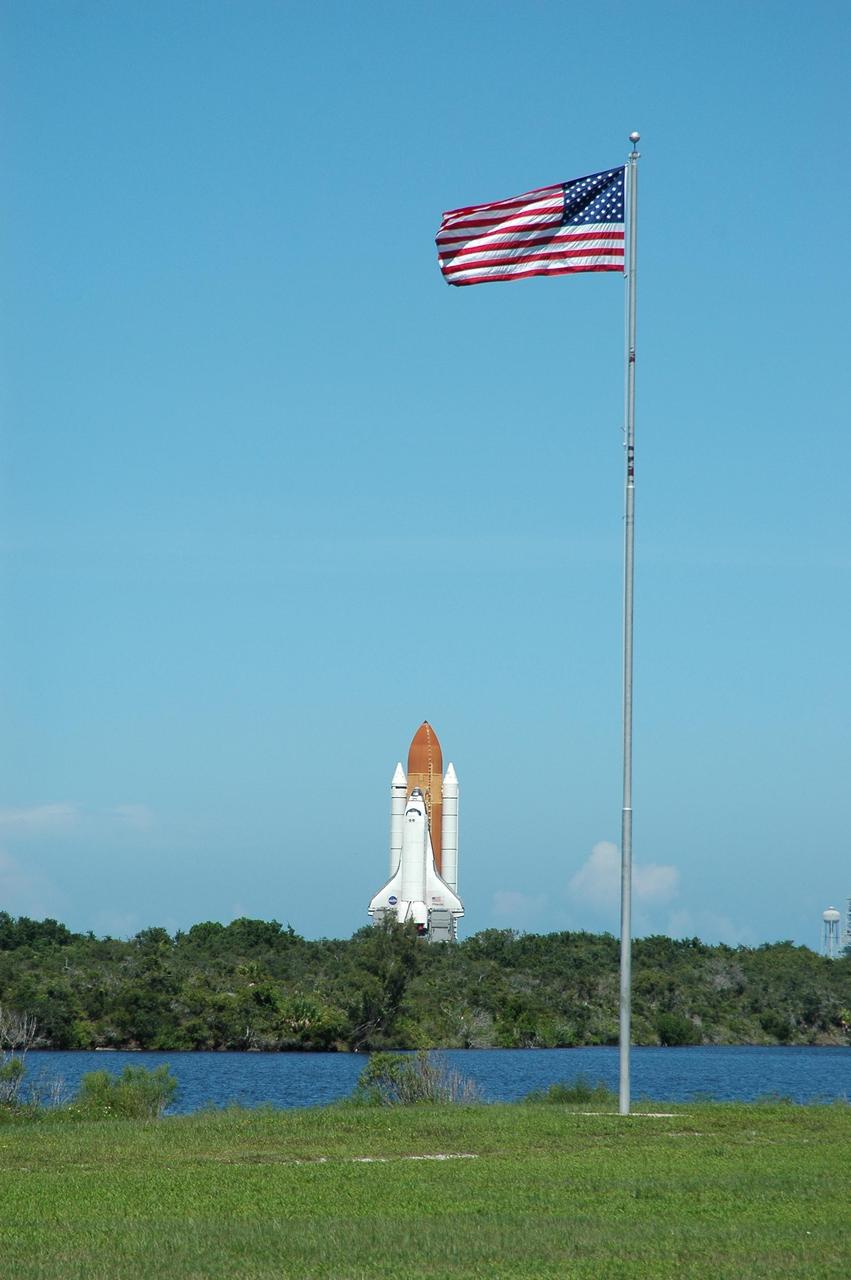
KENNEDY SPACE CENTER, FLA. - Viewed from the NASA News Center across the turn basin in the Launch Complex 39 Area, Space Shuttle Atlantis continues its slow crawl toward the Vehicle Assembly Building from Launch Pad 39B. After this photo was taken, the decision was made to return the shuttle to the launch pad. The rollback was a safety precaution as the area waits for the arrival of Tropical Storm Ernesto. The storm was forecast to be bringing 58-mph to 70-mph winds in the next 24 hours. The revised forecast of lesser winds expected from Ernesto and its projected direction convinced Launch Integration Manager LeRoy Cain and Shuttle Launch Director Mike Leinbach to return the shuttle to the launch pad. Photo credit: NASA/Kim Shiflett
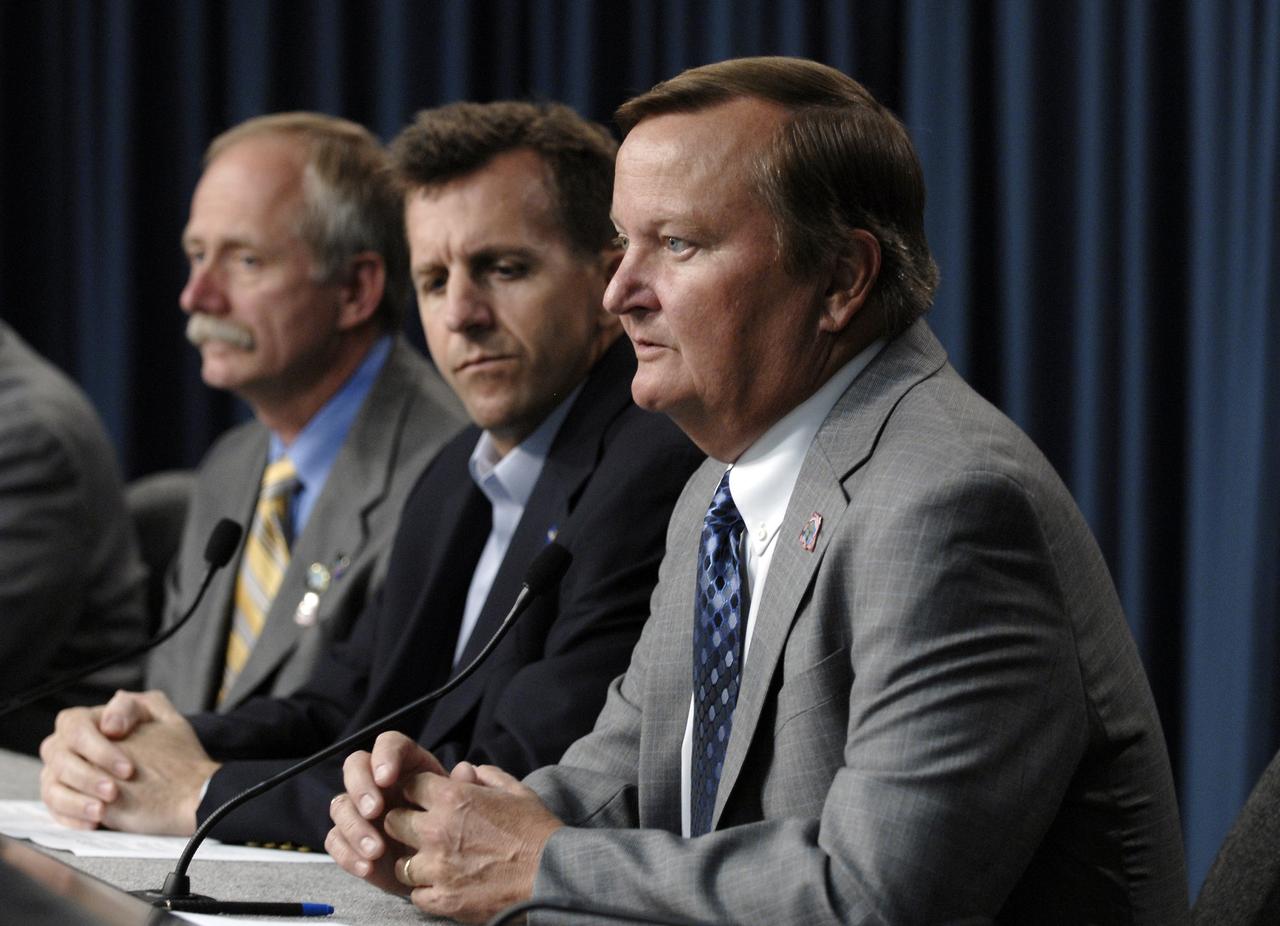
CAPE CANAVERAL, Fla. – At NASA's Kennedy Space Center in Florida, NASA Deputy Manager of Space Shuttle Program LeRoy Cain takes questions from the media during a news conference following landing of the space shuttle Discovery STS-119 mission to the International Space Station. Main gear touchdown was at 3:13:17 p.m. EDT. Nose gear touchdown was at 3:13:40 p.m. and wheels stop was at 3:14:45 p.m. Discovery delivered the final pair of large power-generating solar array wings and the S6 truss segment. The mission was the 28th flight to the station, the 36th flight of Discovery and the 125th in the Space Shuttle Program, as well as the 70th landing at Kennedy. Photo credit: NASA/Kim Shiflett
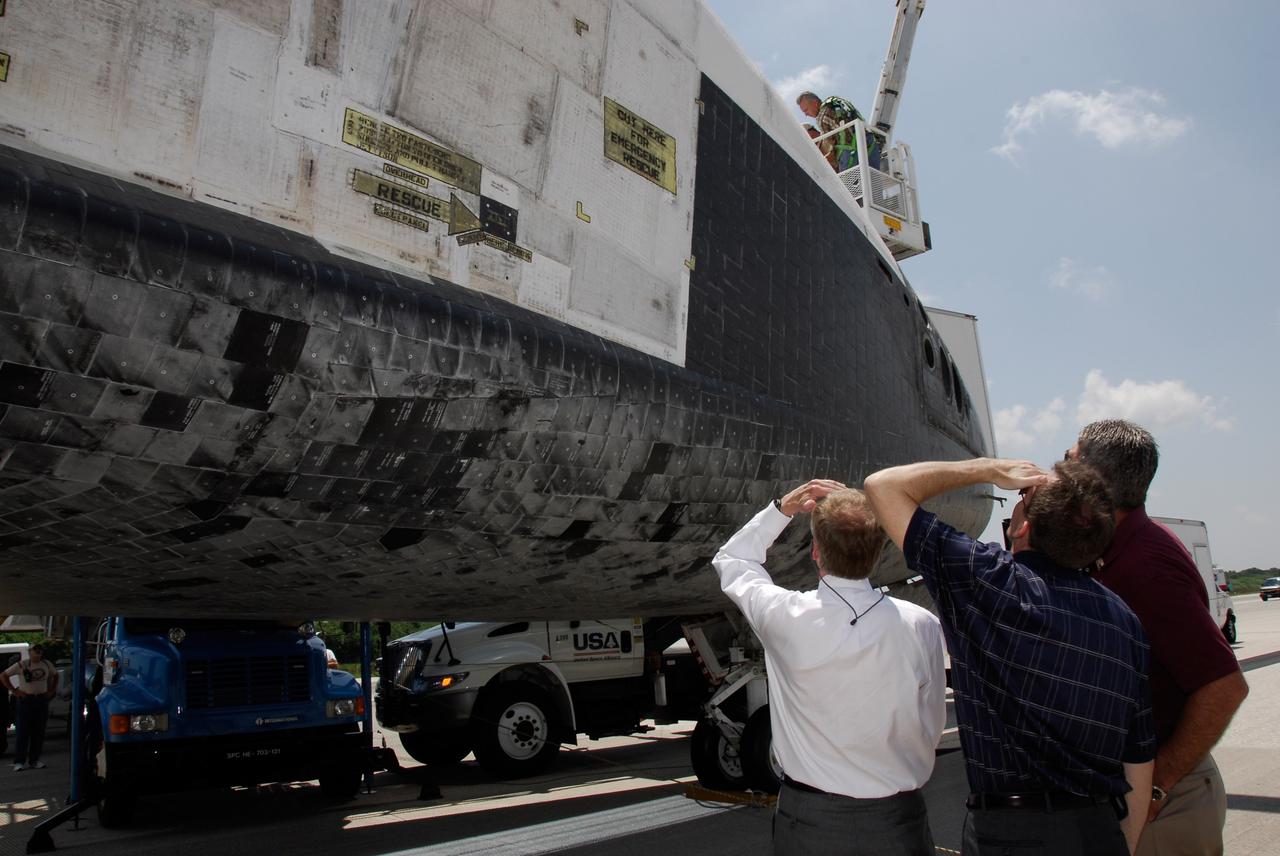
CAPE CANAVERAL, Fla. – After space shuttle Discovery's landing on Runway 15 at NASA's Kennedy Space Center, NASA VIPs take a close look at the orbiter. From left are Associate Administrator for Space Operations Bill Gerstenmaier, Director of Mission Launch Integration LeRoy Cain and Center Director Bill Parsons. Discovery's landing ended the STS-124 mission, a 14-day flight to the International Space Station. The main landing gear touched down at 11:15:19 a.m. EDT. The nose landing gear touched down at 11:15:30 a.m. and wheel stop was at 11:16:19 a.m. The mission completed 5.7 million miles. The STS-124 mission delivered the Japan Aerospace Exploration Agency's large Japanese Pressurized Module and its remote manipulator system to the space station. Photo credit: NASA/Kim Shiflett
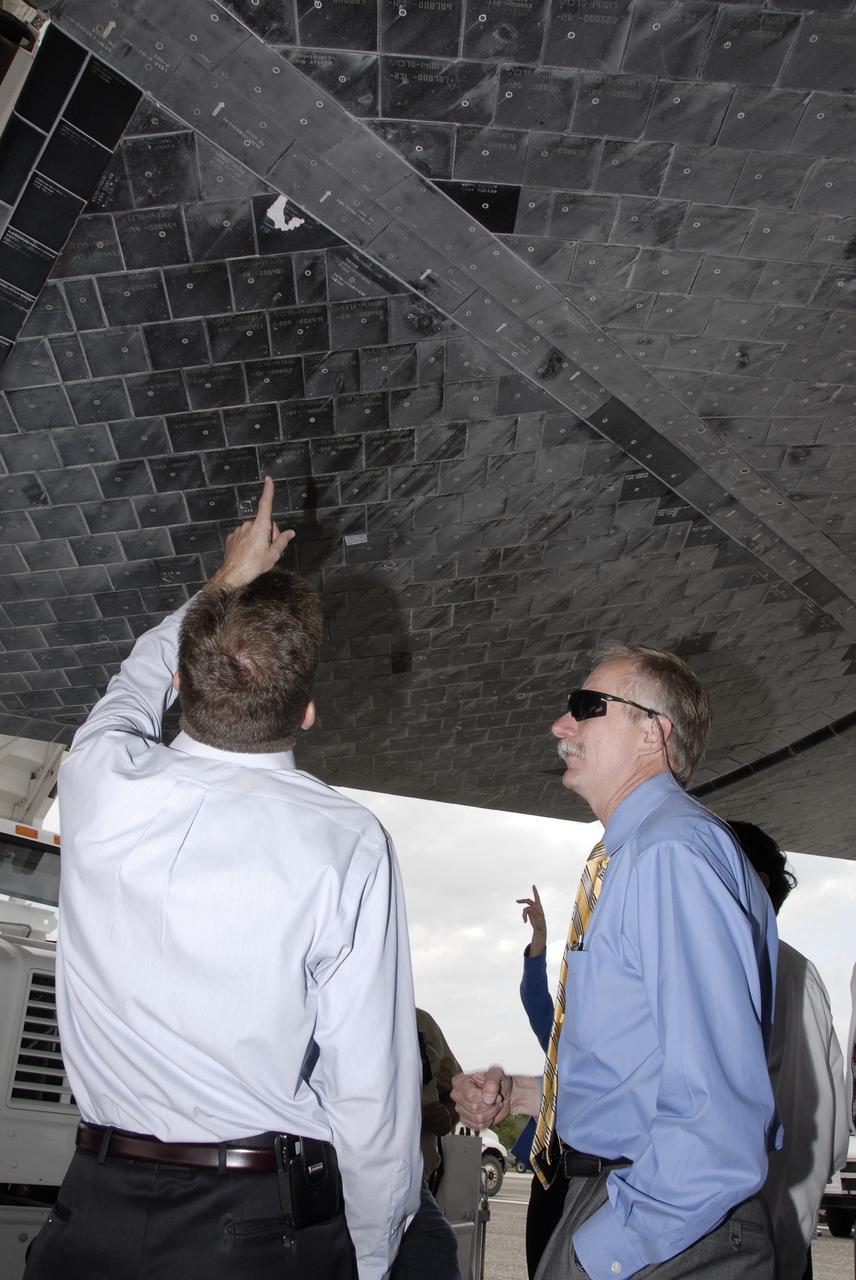
CAPE CANAVERAL, Fla. – NASA Deputy Manager of Space Shuttle Program LeRoy Cain and NASA Associate Administrator for Space Operations Bill Gerstenmaier inspect the thermal protection system tile beneath space shuttle Discovery following touchdown on Runway 15 at NASA's Kennedy Space Center in Florida. Discovery’s landing completed the 13-day, 5.3-million mile journey on the STS-119 mission to the International Space Station. Main gear touchdown was at 3:13:17 p.m. EDT. Nose gear touchdown was at 3:13:40 p.m. and wheels stop was at 3:14:45 p.m. Discovery delivered the final pair of large power-generating solar array wings and the S6 truss segment. The mission was the 28th flight to the station, the 36th flight of Discovery and the 125th in the Space Shuttle Program, as well as the 70th landing at Kennedy. Photo credit: NASA/Kim Shiflett
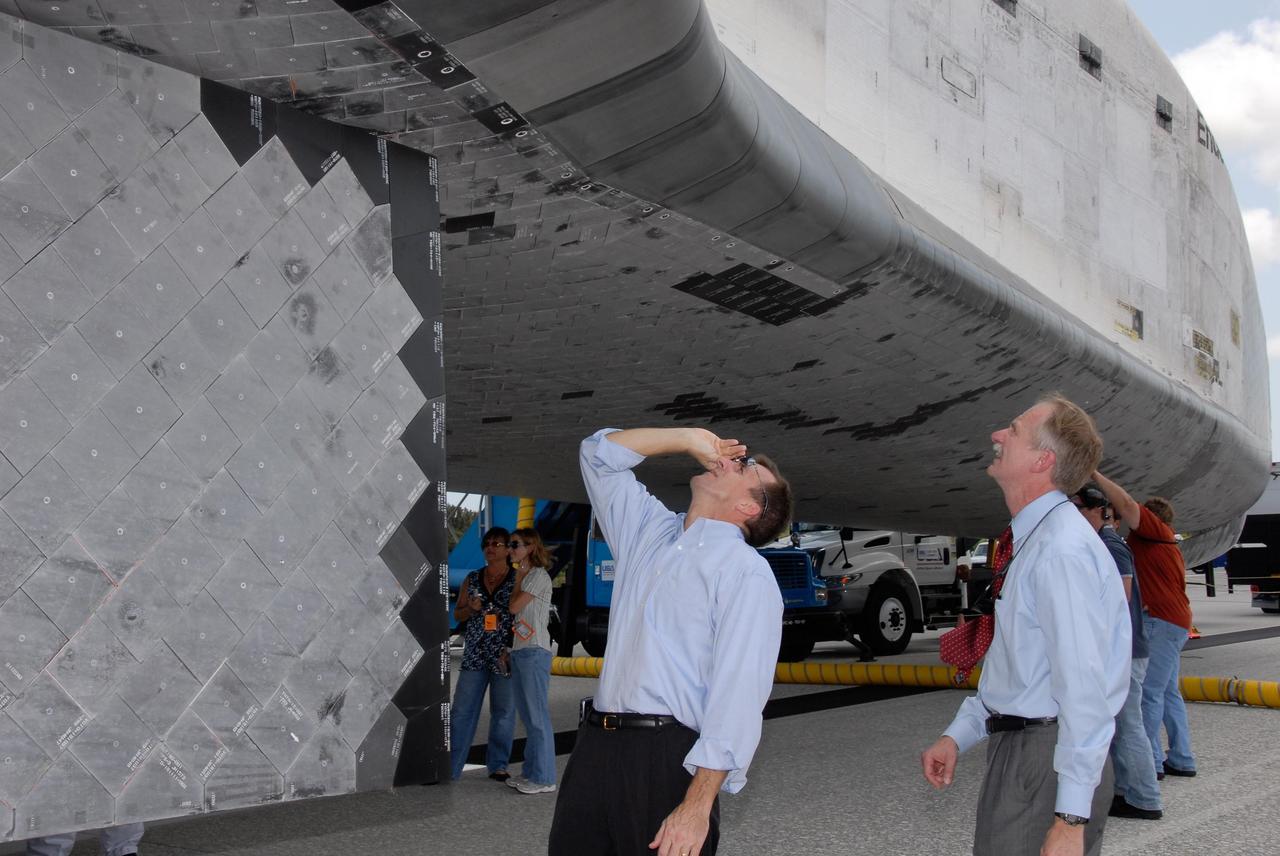
KENNEDY SPACE CENTER, FLA. -- On the Shuttle Landing Facility at NASA's Kennedy Space Center, Mission Launch Integration Director Leroy Cain (left) and Associate Administrator for NASA Space Operations William Gerstenmaier get a closer look at the wing leading edge under Endeavour. The orbiter is just returned from mission STS-118, which began Aug. 8. The crew installed a new gyroscope, an external spare parts platform and another truss segment to the expanding station. Endeavour's main gear touched down at 12:32:16 p.m. EDT. Nose gear touchdown was at 12:32:29 p.m. and wheel stop was at 12:33:20 p.m. Endeavour landed on orbit 201. STS-118 was the 119th space shuttle flight, the 22nd flight to the station, the 20th flight for Endeavour and the second of four missions planned for 2007. This was the 65th landing of an orbiter at Kennedy. Photo credit: NASA/Kim Shiflett
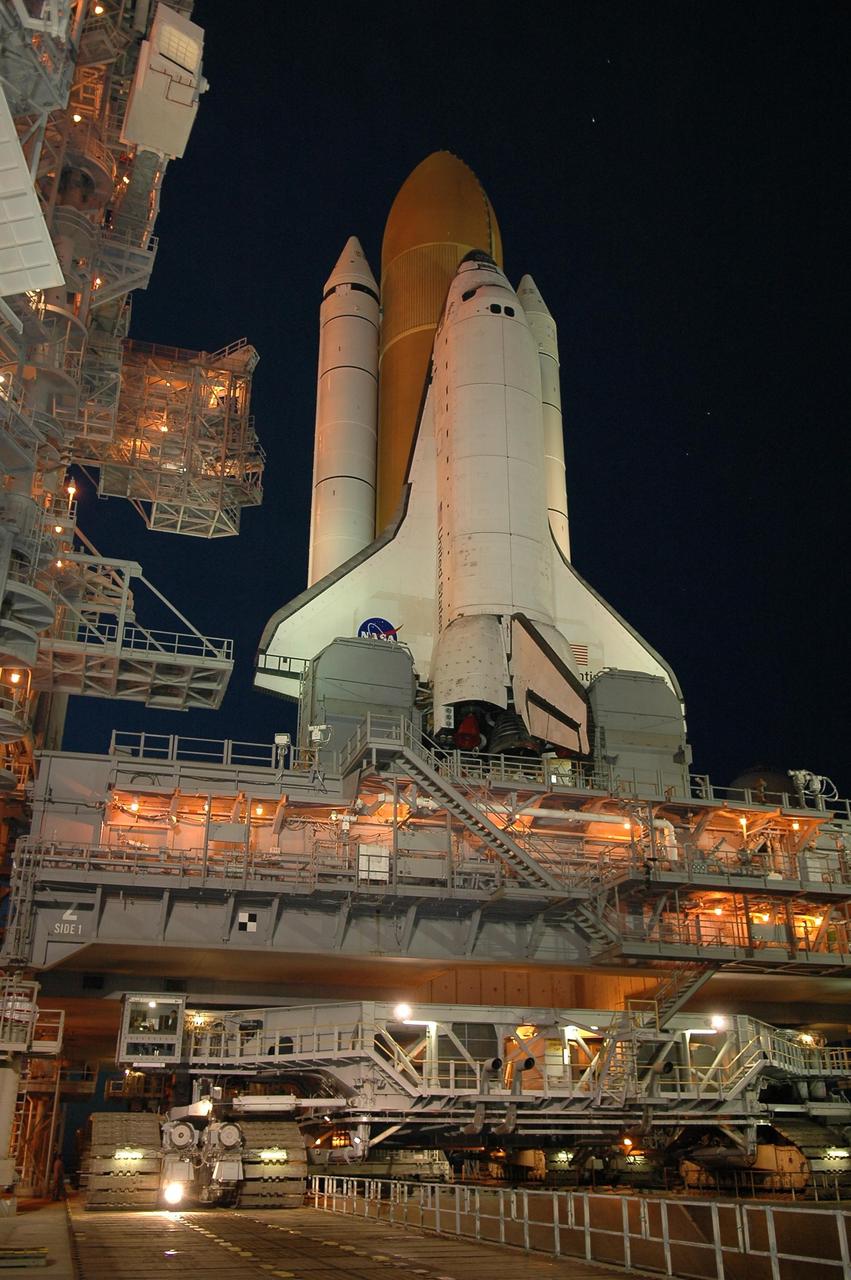
KENNEDY SPACE CENTER, FLA. - After sunset, Space Shuttle Atlantis is bathed in light from the fixed service structure on Launch Pad 39B. Seen on either side of Atlantis' engine nozzles are the tail masts, which provide several umbilical connections to the orbiter, including a liquid-oxygen line through one and a liquid-hydrogen line through another. Below the mobile launcher platform, on which Atlantis rests, is the crawler-transporter beginning to move away from the platform. The shuttle had been moved off the launch pad due to concerns about the impact of Tropical Storm Ernesto, expected within 24 hours. The forecast of lesser winds expected from Ernesto and its projected direction convinced Launch Integration Manager LeRoy Cain and Shuttle Launch Director Mike Leinbach to return the shuttle to the launch pad. Photo credit: NASA/Kim Shiflett
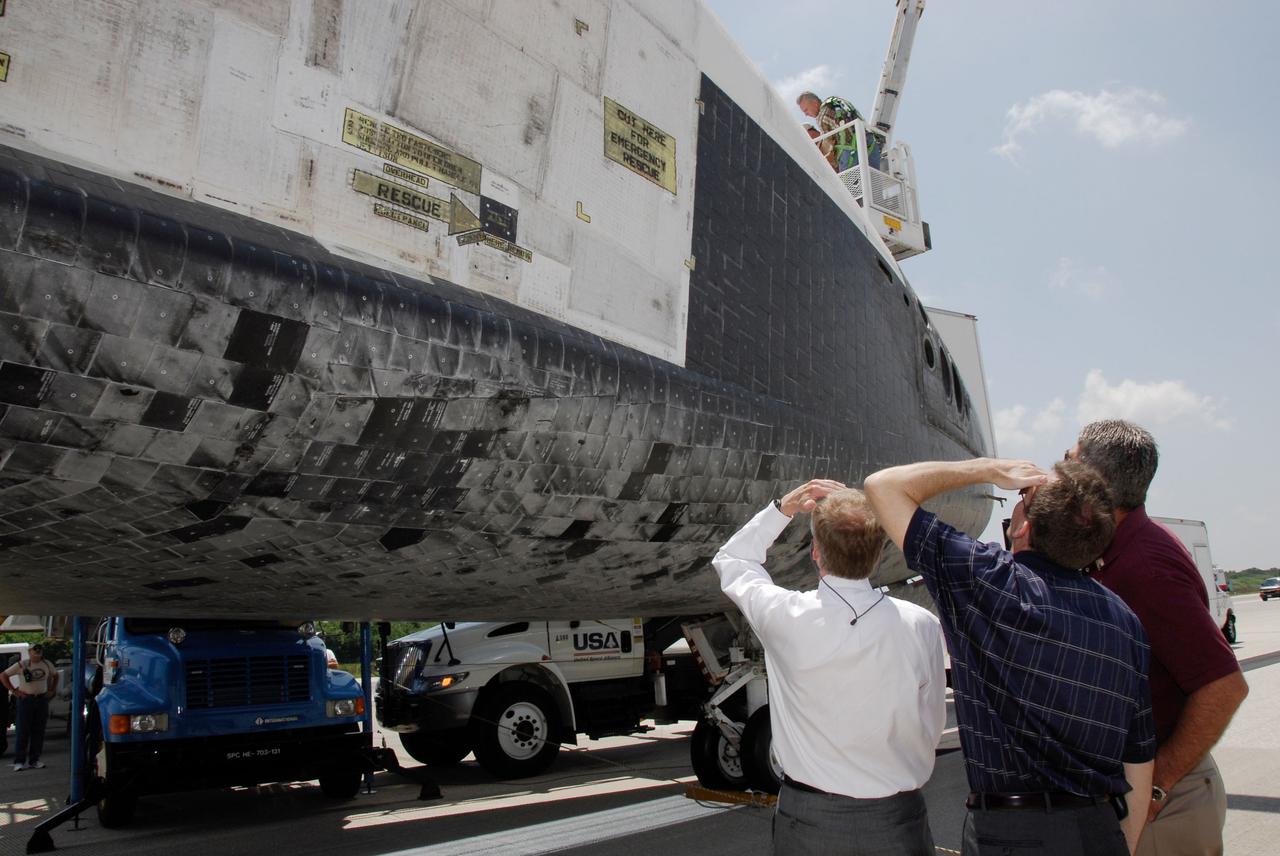
STS124-S-073 (14 June 2008) --- After Space Shuttle Discovery's landing on runway 15 at NASA's Kennedy Space Center (KSC), NASA VIPs take a close look at the orbiter. From the left are Bill Gerstenmaier, NASA associate administrator for Space Operations; LeRoy Cain, NASA deputy shuttle program manager; and KSC Director Bill Parsons. Discovery's landing ended the STS-124 mission, a 14-day flight to the International Space Station. The main landing gear touched down at 11:15:19 a.m. (EDT) on June 14, 2008. The nose landing gear touched down at 11:15:30 a.m. and wheel stop was at 11:16:19 a.m. During the mission, Discovery's crew installed the Japan Aerospace Exploration Agency's large Kibo laboratory and its remote manipulator system leaving a larger space station and one with increased science capabilities.
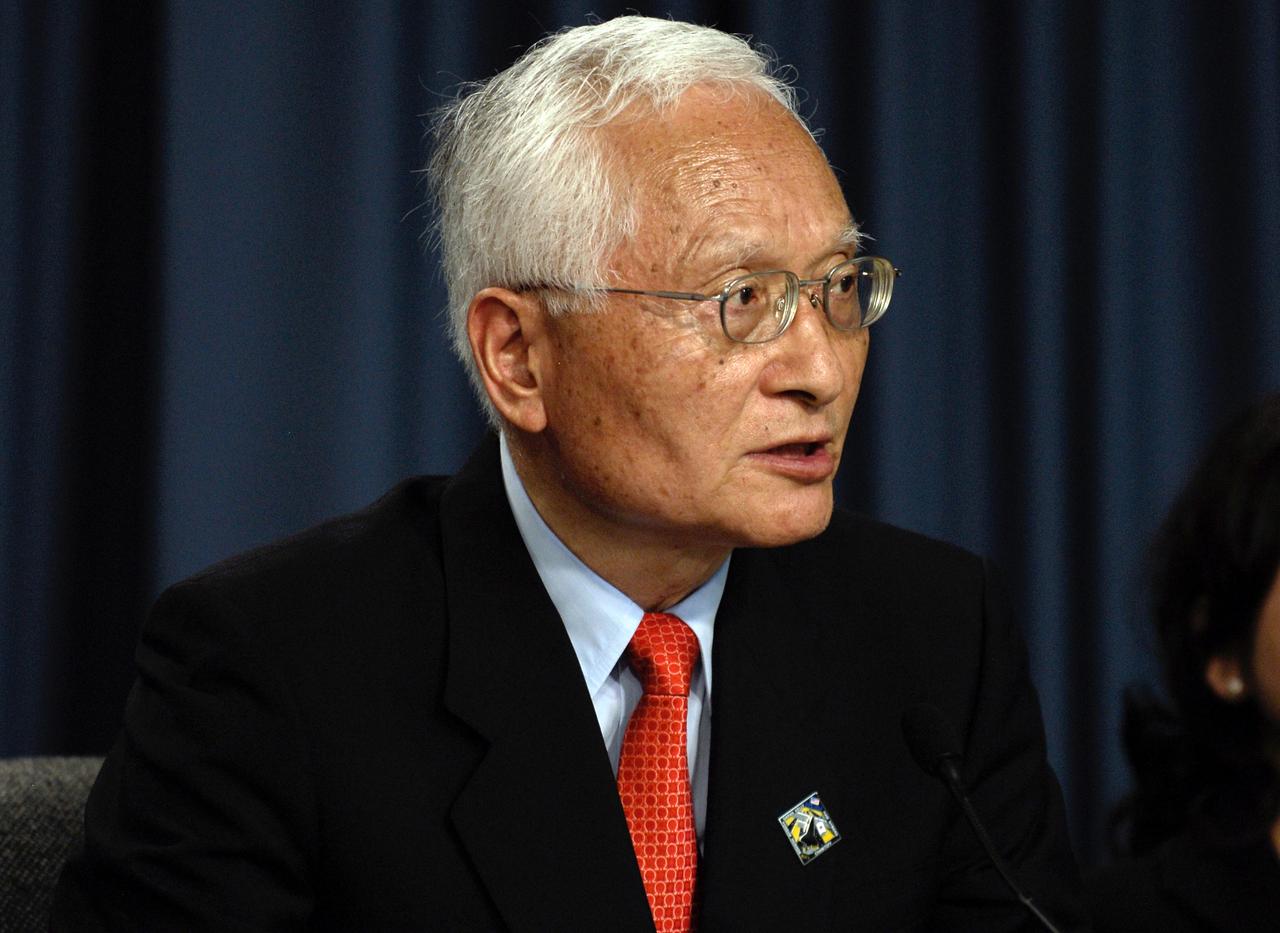
CAPE CANAVERAL, Fla. -- Japan Aerospace Exploration Agency President Dr. Keiji Tachikawa talks to the media during a news conference in NASA's News Center television studio following the successful launch of space shuttle Discovery on the STS-124 mission. Others who participated were NASA Administrator Michael Griffin, Associate Administrator for Space Operations Bill Gerstenmaier, Director of Mission Launch Integration LeRoy Cain and Shuttle Launch Director Mike Leinbach. The STS-124 mission is the 26th in the assembly of the space station. It is the second of three flights launching components to complete the Japan Aerospace Exploration Agency's Kibo laboratory. The shuttle crew will install Kibo's large Japanese Pressurized Module and its remote manipulator system, or RMS. The 14-day flight includes three spacewalks. Photo credit: NASAKim Shiflett
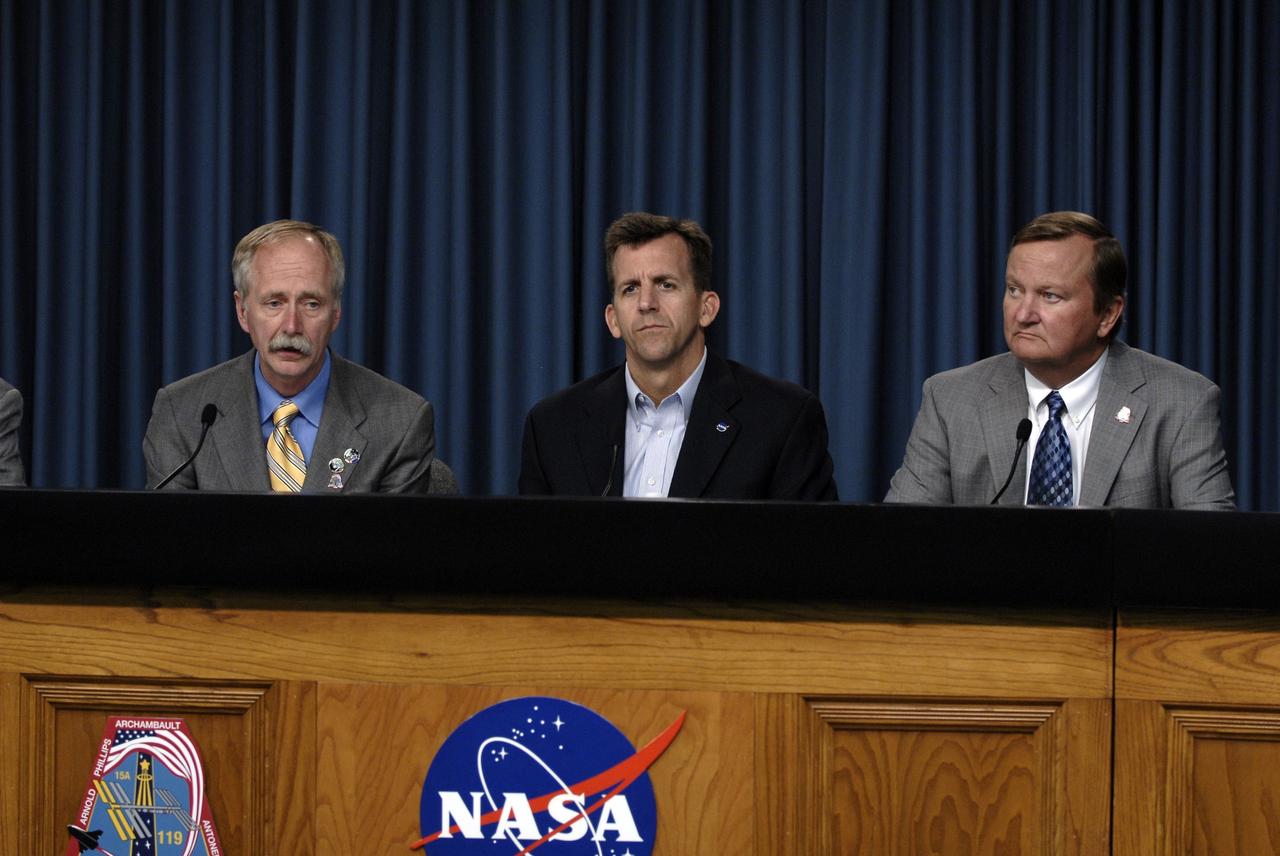
CAPE CANAVERAL, Fla. – At NASA's Kennedy Space Center in Florida, NASA managers address the media during a news conference following landing of the space shuttle Discovery STS-119 mission to the International Space Station. From left are NASA Associate Administrator for Space Operations Bill Gerstenmaier, NASA Deputy Manager of Space Shuttle Program LeRoy Cain and NASA Shuttle Launch Director Mike Leinbach. Main gear touchdown was at 3:13:17 p.m. EDT. Nose gear touchdown was at 3:13:40 p.m. and wheels stop was at 3:14:45 p.m. Discovery delivered the final pair of large power-generating solar array wings and the S6 truss segment. The mission was the 28th flight to the station, the 36th flight of Discovery and the 125th in the Space Shuttle Program, as well as the 70th landing at Kennedy. Photo credit: NASA/Kim Shiflett
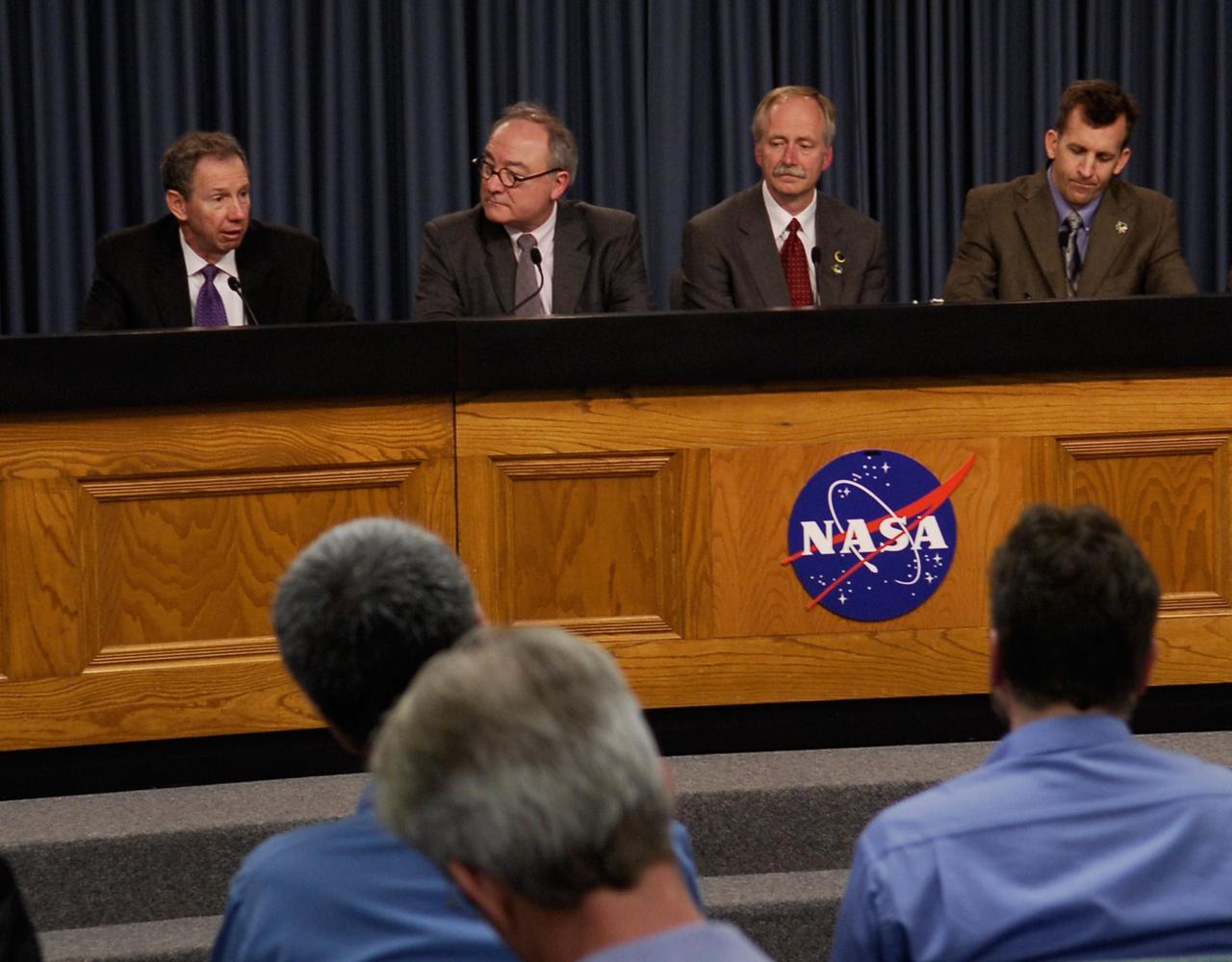
KENNEDY SPACE CENTER, FLA. -- Following the successful launch of space shuttle Atlantis on mission STS-122, NASA Administrator Michael Griffin tells the media at a news conference that the European Space Agency's (ESA) Columbus laboratory will bring a truly international capability to the International Space Station. Also seen on the dais are ESA's Director General Jean-Jacques Dordain, Associate Administrator for Space Operations Bill Gerstenmaier and Director of Mission Launch Integration LeRoy Cain. Not pictured but present at the conference is STS-122 Launch Director Doug Lyons. During the 11-day mission, the crew's prime objective is to attach the Columbus laboratory to the Harmony module, adding to the station's size and capabilities. Photo credit: NASA/Kim Shiflett
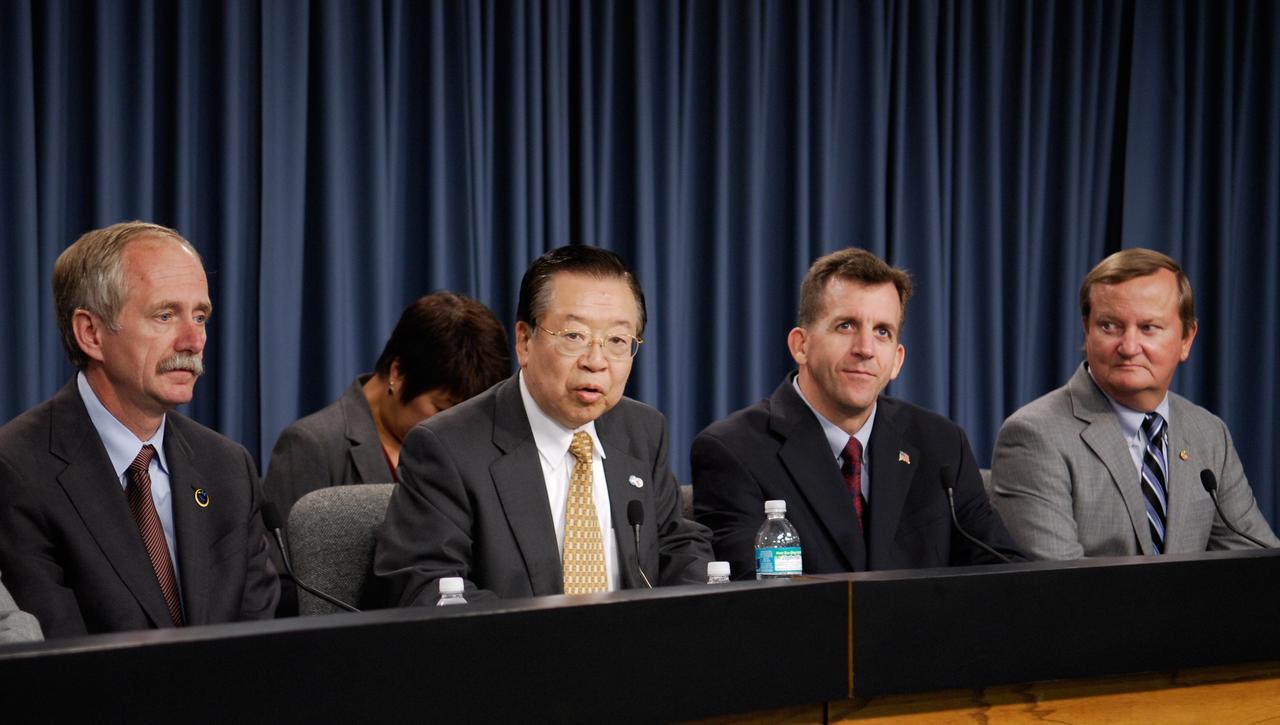
CAPE CANAVERAL, Fla. --- After the successful landing of space shuttle Endeavour to conclude the STS-123 mission, NASA officials hold a media briefing. The participants are, left to right, Bill Gerstenmaier, NASA associate administrator for Space Operations; Kaoru Mamiya, Japan Aerospace Exploration Agency vice president; LeRoy Cain, chair of the mission management team; and Mike Leinbach, NASA space shuttle launch director. Endeavour landed on the second opportunity, on orbit 250, at 8:39:08 p.m. EDT. The STS-123 mission delivered the first segment of the Japan Aerospace Exploration Agency's Kibo laboratory and the Canadian Space Agency's two-armed robotic system, known as Dextre. Photo credit: NASA/Kim Shiflett
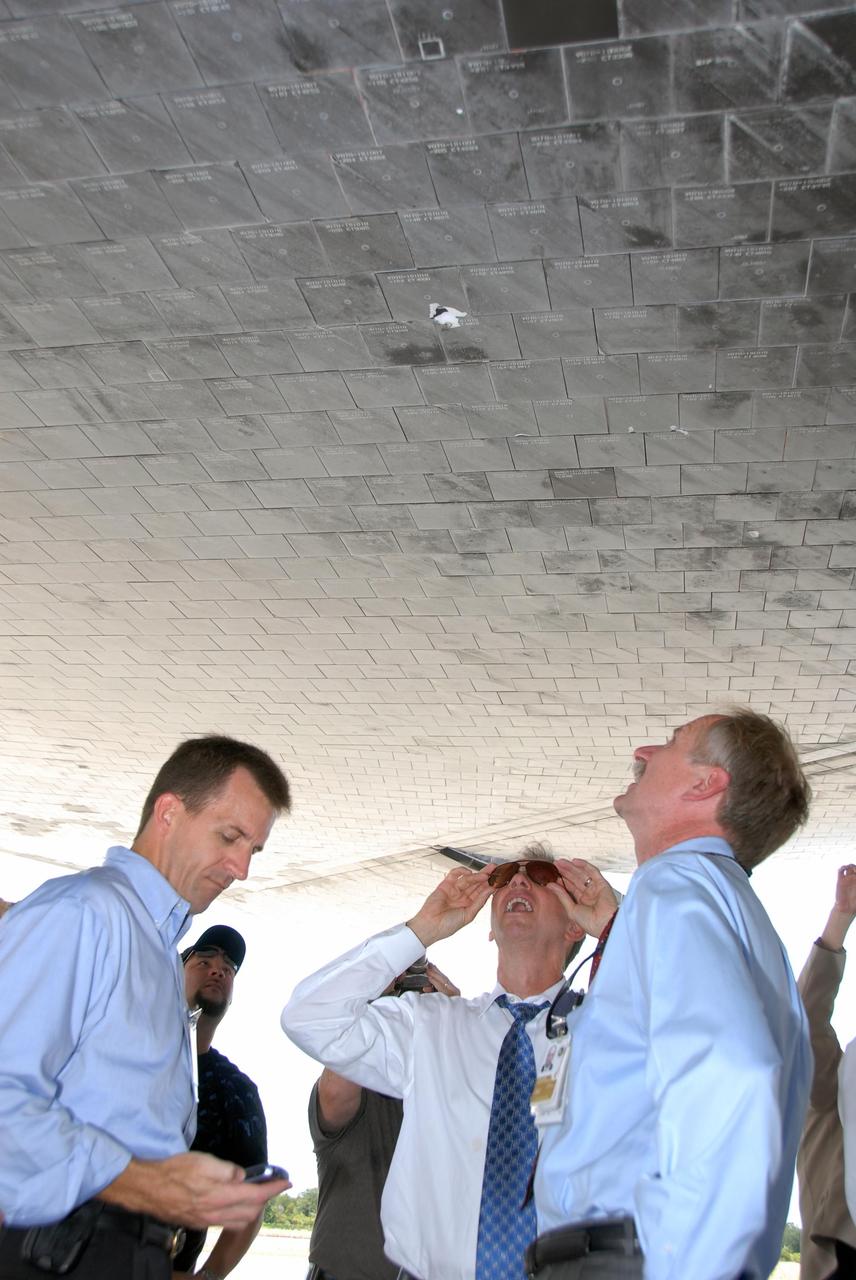
KENNEDY SPACE CENTER, FLA. -- On the Shuttle Landing Facility at NASA's Kennedy Space Center, Mission Launch Integration Director Leroy Cain, NASA Administrator Mike Griffin and Associate Administrator for NASA Space Operations William Gerstenmaier get a closer look at the damaged tiles on the underside of Endeavour. The damage to the tiles occurred from a piece of foam on the external tank during launch of Space Shuttle Endeavour on mission STS-118 on Aug. 8. After extensive engineering analysis of such images and testing on the ground, the Mission Management Team decided the tile did not pose a risk to the crew during re-entry. Endeavour landed safely at 12:32 p.m. EDT at NASA's Kennedy Space Center after a 13-day mission to the International Space Station. The STS-118 mission installed a new gyroscope, an external spare parts platform and another truss segment to the expanding station. Photo credit: NASA/Kim Shiflett
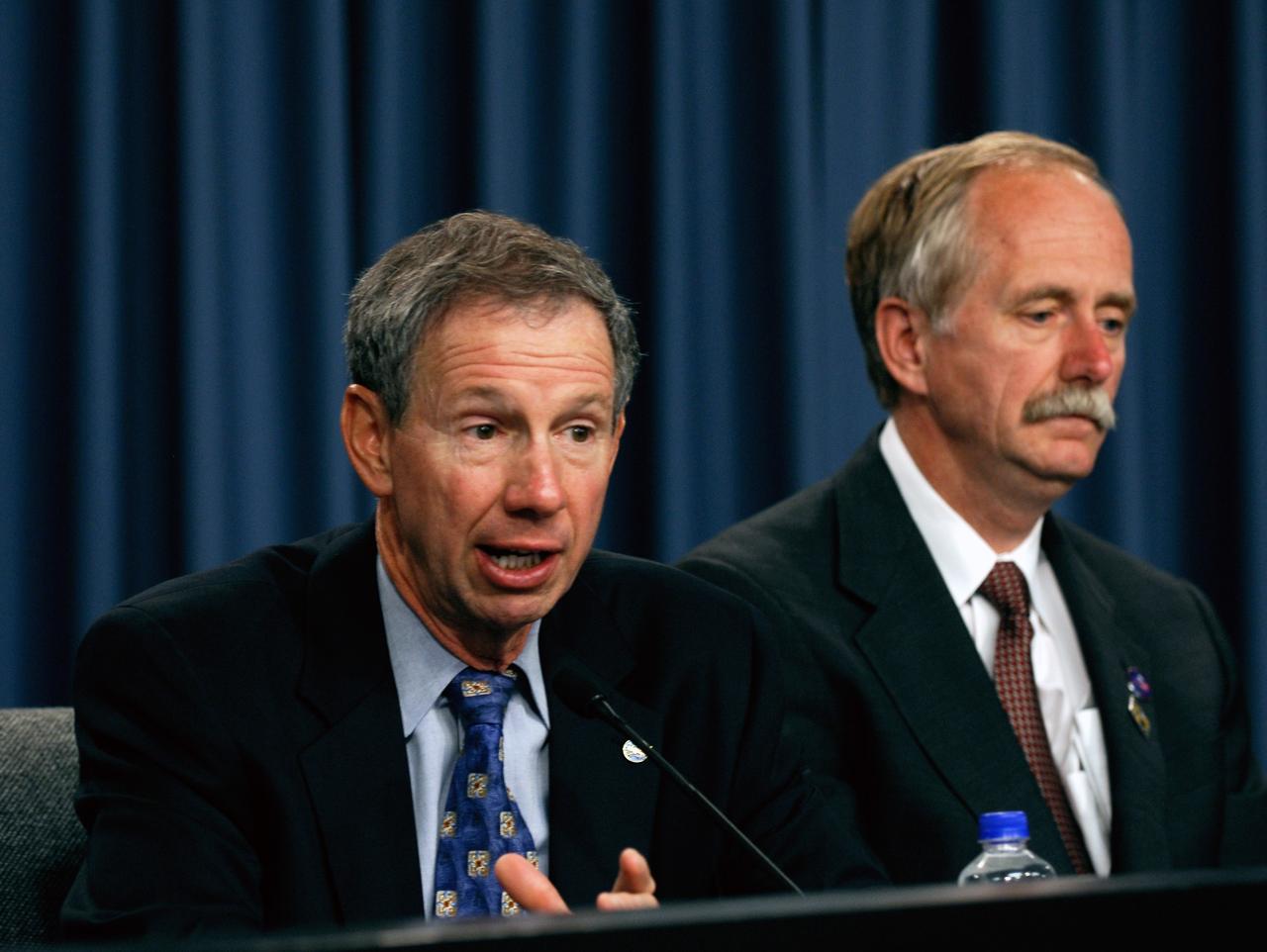
CAPE CANAVERAL, Fla. -- NASA Administrator Michael Griffin responds to a question from the media during a news conference in NASA's News Center television studio following the successful launch of space shuttle Discovery on the STS-124 mission. At right is Associate Administrator for Space Operations Bill Gerstenmaier. Others who participated were Director of Mission Launch Integration LeRoy Cain, Shuttle Launch Director Mike Leinbach and Japan Aerospace Exploration Agency President Dr. Keiji Tachikawa. The STS-124 mission is the 26th in the assembly of the space station. It is the second of three flights launching components to complete the Japan Aerospace Exploration Agency's Kibo laboratory. The shuttle crew will install Kibo's large Japanese Pressurized Module and its remote manipulator system, or RMS. The 14-day flight includes three spacewalks. Photo credit: NASAKim Shiflett
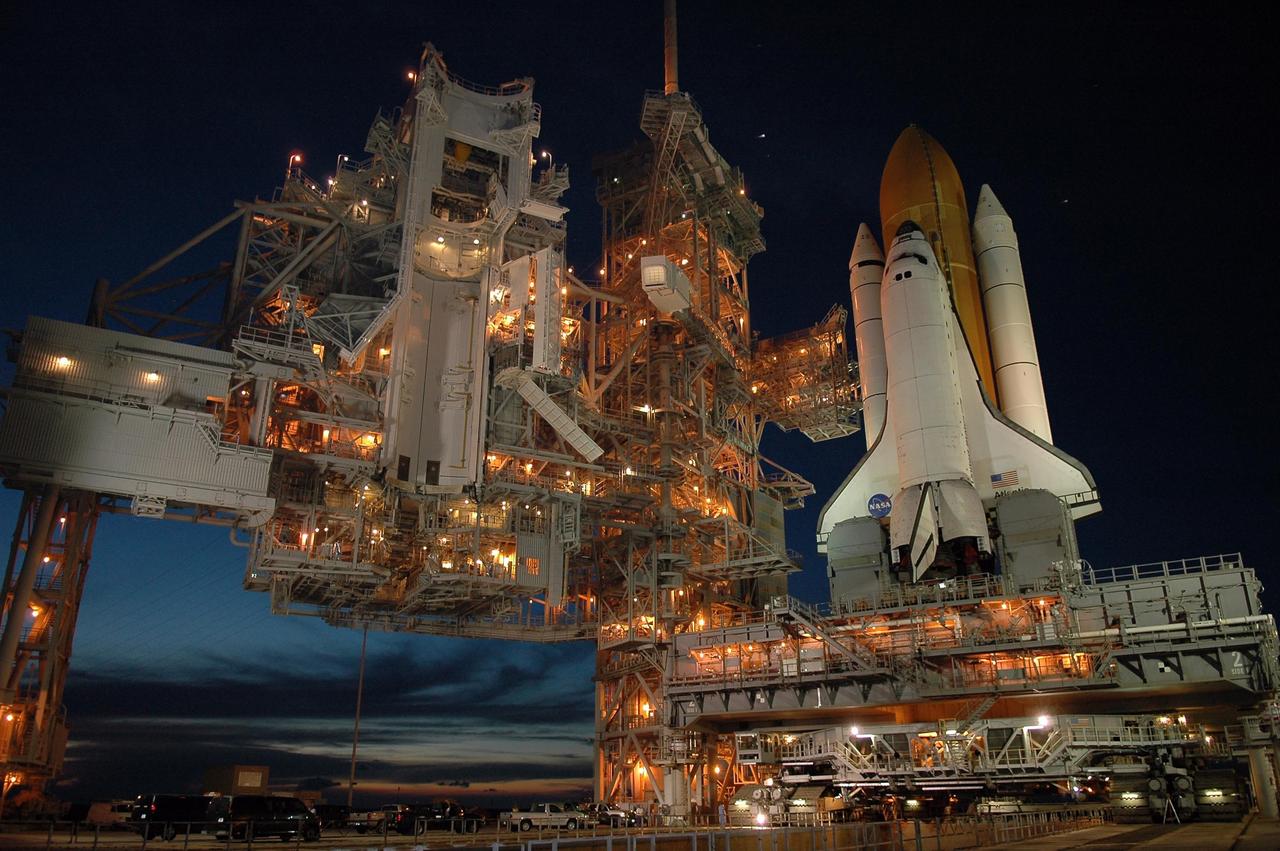
KENNEDY SPACE CENTER, FLA. - After sunset, Space Shuttle Atlantis is bathed in light from the fixed service structure on Launch Pad 39B. Seen on either side of Atlantis' engine nozzles are the tail masts, which provide several umbilical connections to the orbiter, including a liquid-oxygen line through one and a liquid-hydrogen line through another. Below the mobile launcher platform, on which Atlantis rests, is the crawler-transporter beginning to move away from the platform. The shuttle had been moved off the launch pad due to concerns about the impact of Tropical Storm Ernesto, expected within 24 hours. The forecast of lesser winds expected from Ernesto and its projected direction convinced Launch Integration Manager LeRoy Cain and Shuttle Launch Director Mike Leinbach to return the shuttle to the launch pad. Photo credit: NASA/Kim Shiflett
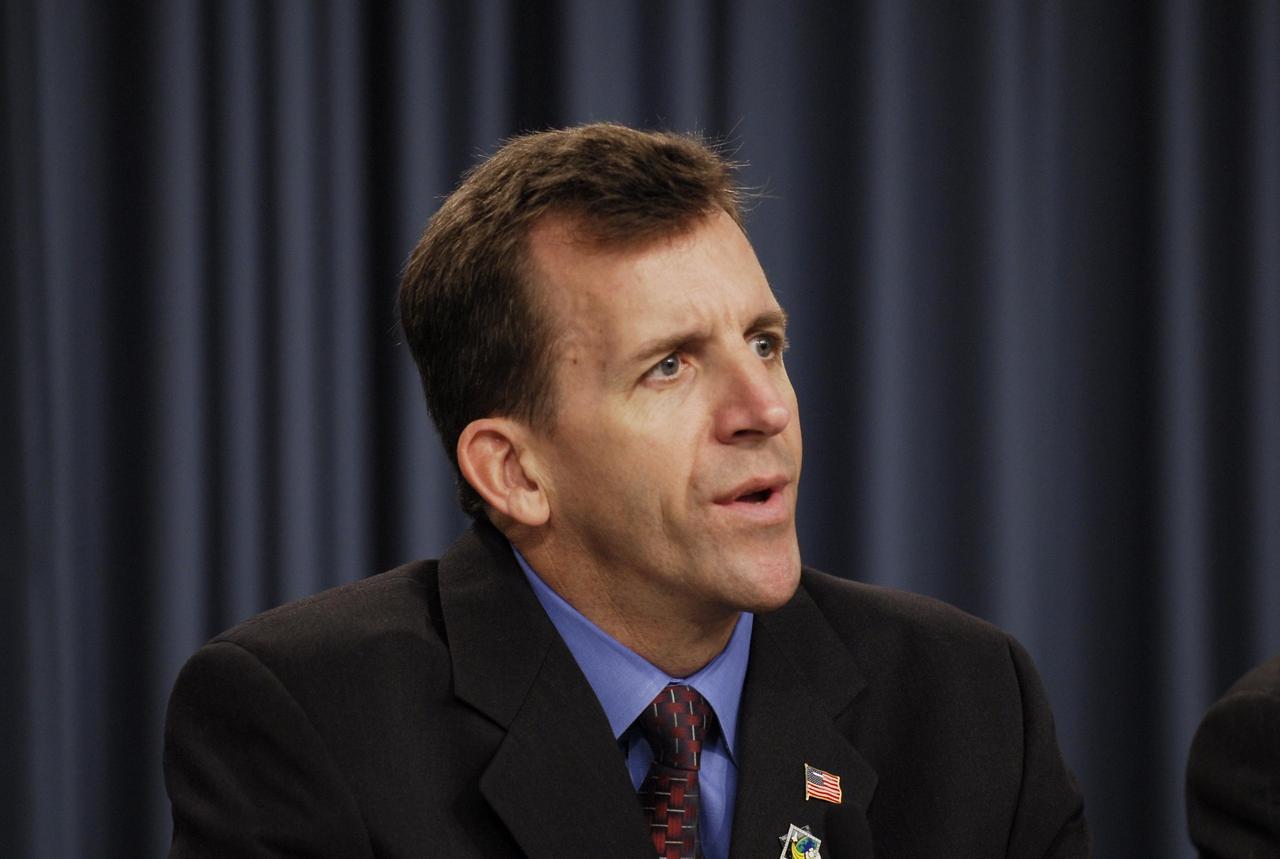
KENNEDY SPACE CENTER, FLA. -- LeRoy Cain, the Mission Management Team chairman, participates in a news briefing following the conclusion of a team meeting. The meeting followed the morning's launch scrub caused by problems experienced with the space shuttle Atlantis STS-122 external tank's engine cutoff sensor system during tanking for the second launch attempt. An announcement was made during the briefing that the STS-122 launch is postponed to no earlier than Jan. 2, 2008, to give the team time to resolve the system's problems. Atlantis will carry the Columbus Laboratory, the European Space Agency's largest contribution to the construction of the International Space Station. It will support scientific and technological research in a microgravity environment. Permanently attached to the Harmony node of the space station, the laboratory will carry out experiments in materials science, fluid physics and biosciences, as well as perform a number of technological applications. Photo credit: NASA/Kim Shiflett
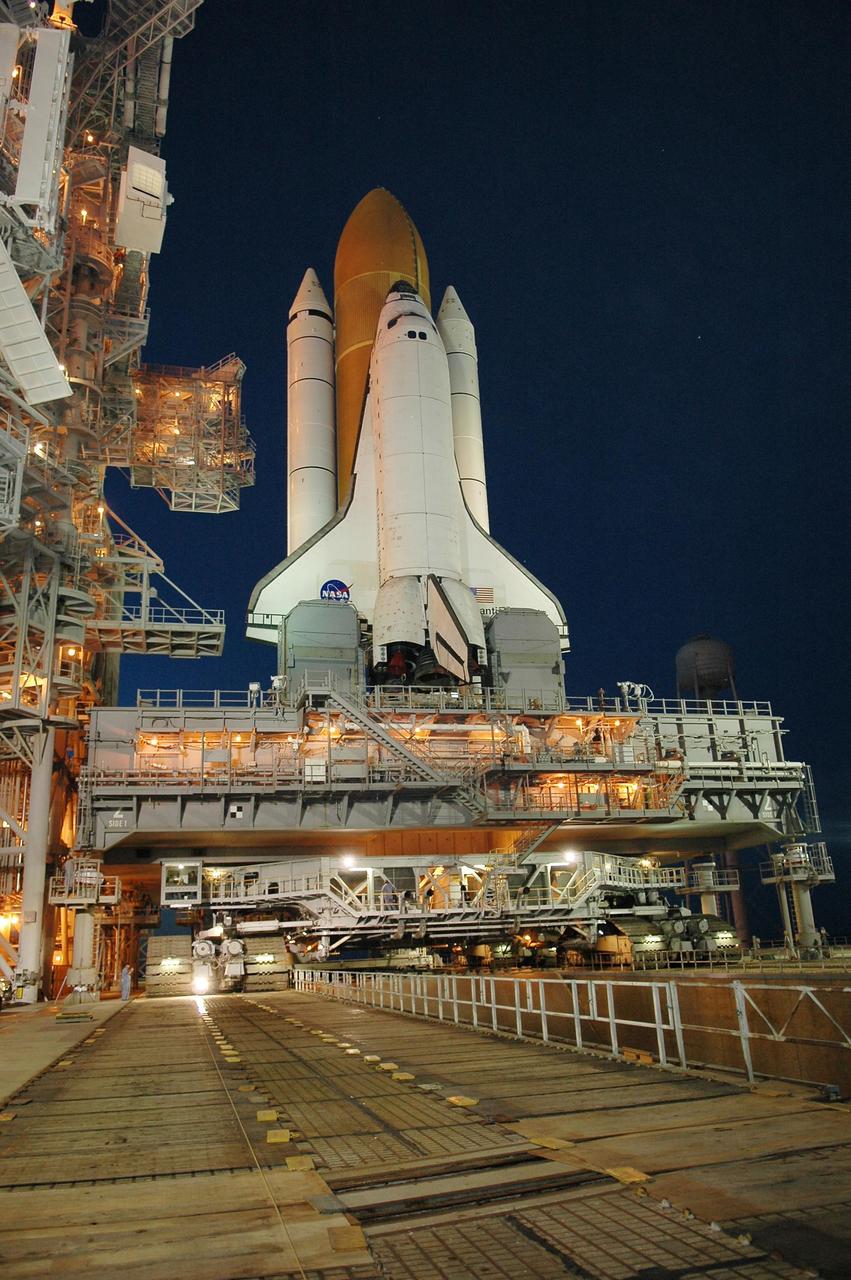
KENNEDY SPACE CENTER, FLA. - After sunset, Space Shuttle Atlantis is bathed in light from the fixed service structure on Launch Pad 39B. Seen on either side of Atlantis' engine nozzles are the tail masts, which provide several umbilical connections to the orbiter, including a liquid-oxygen line through one and a liquid-hydrogen line through another. The shuttle had been moved off the launch pad due to concerns about the impact of Tropical Storm Ernesto, expected within 24 hours. The forecast of lesser winds expected from Ernesto and its projected direction convinced Launch Integration Manager LeRoy Cain and Shuttle Launch Director Mike Leinbach to return the shuttle to the launch pad. Photo credit: NASA/Kim Shiflett
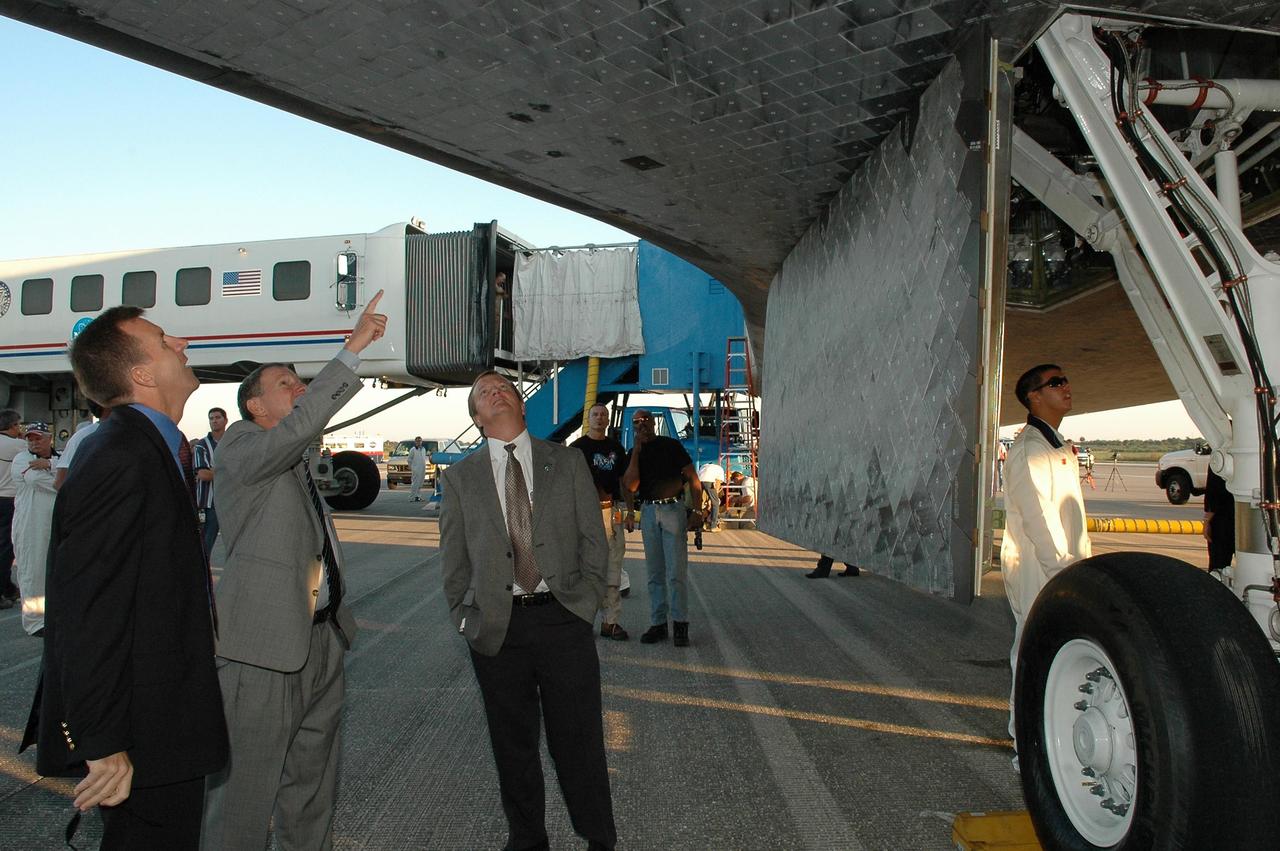
KENNEDY SPACE CENTER, FLA. - Before welcoming the STS-115 crew on their return from space, NASA officials look at the underside of the orbiter Atlantis on the Shuttle Landing Facility. From left are Mission Launch Integration Director LeRoy Cain, NASA Administrator Michael Griffin and Shuttle Launch Director Mike Leinbach. During the mission, astronauts completed three spacewalks to attach the P3/P4 integrated truss structure to the International Space Station. Main gear touchdown was at 6:21:30 a.m. EDT. Nose gear touchdown was at 6:21:36 a.m. and wheel stop was at 6:22:16 a.m. At touchdown -- nominally about 2,500 ft. beyond the runway threshold -- the orbiter is traveling at a speed ranging from 213 to 226 mph. Atlantis traveled 4.9 million miles, landing on orbit 187. Mission elapsed time was 11 days, 19 hours, six minutes. This is the 15th night landing at KSC and the 23rd night landing overall. Photo credit: NASA/Kim Shiflett
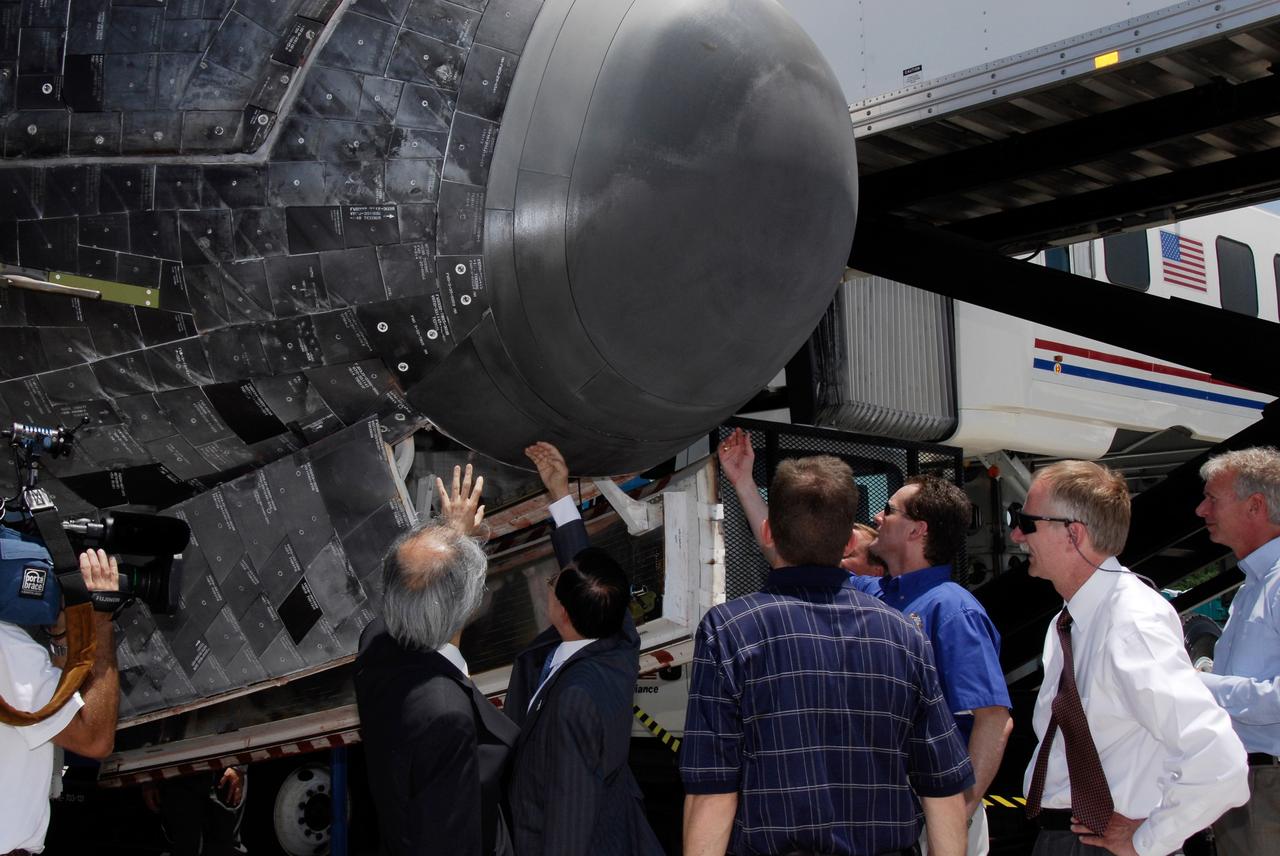
CAPE CANAVERAL, Fla. – NASA and Japanese VIPs try to sense any heat still resident in the nose cone of space shuttle Discovery after its landing on Runway 15 at NASA's Kennedy Space Center. From left are the Japan Aerospace Exploration Agency's Director of Program Management and Integration Yuichi Yamaura and Vice President Kaoru Mamiya, Kennedy's Director of Mission Launch Integration LeRoy Cain and NASA Associate Administrator for Space Operations Bill Gerstenmaier (white shirt). Discovery's landing ended the STS-124 mission, a 14-day flight to the International Space Station. The main landing gear touched down at 11:15:19 a.m. EDT. The nose landing gear touched down at 11:15:30 a.m. and wheel stop was at 11:16:19 a.m. The mission completed 5.7 million miles. The STS-124 mission delivered the Japan Aerospace Exploration Agency's large Japanese Pressurized Module and its remote manipulator system to the space station. Photo credit: NASA/Kim Shiflett
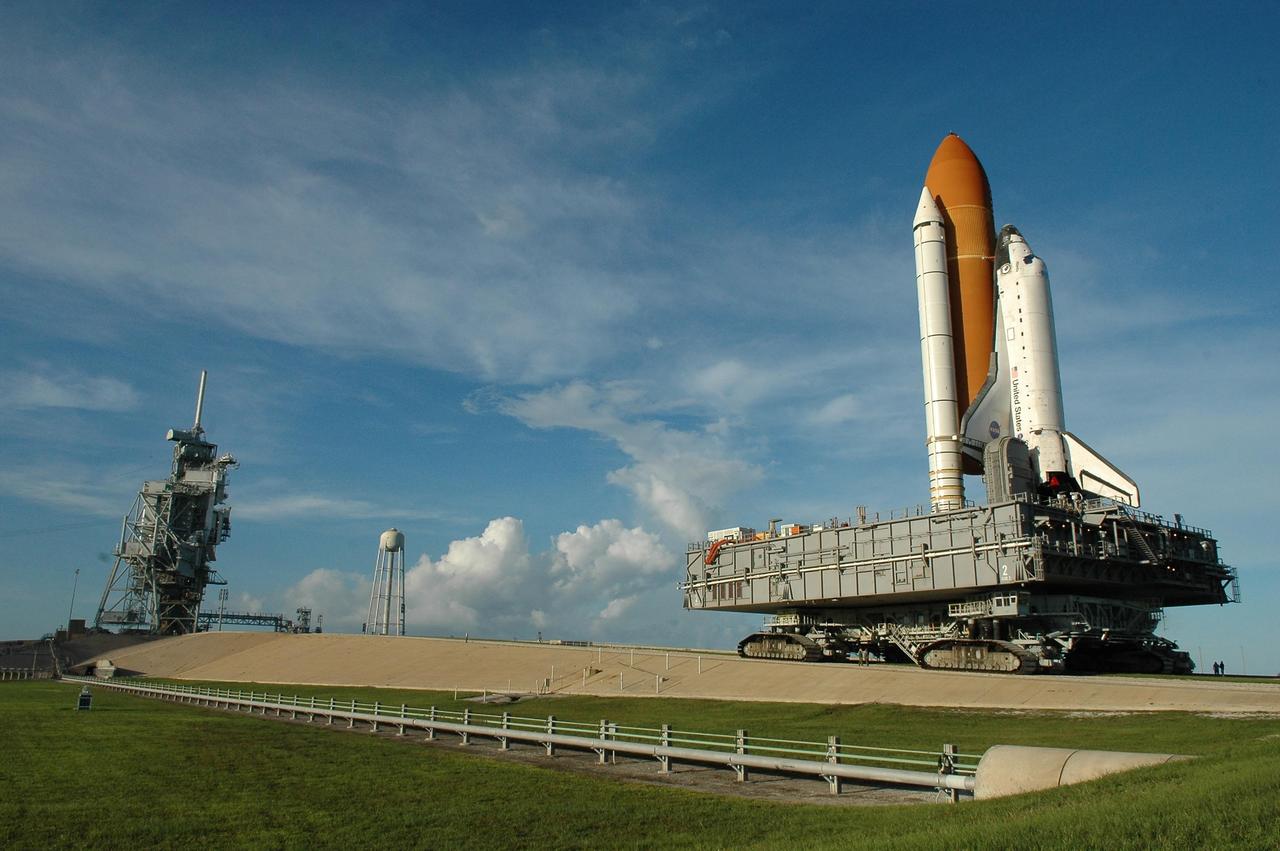
KENNEDY SPACE CENTER, FLA. - A late-day sun spotlights Space Shuttle Atlantis as it rolls up the ramp to Launch Pad 39B atop the crawler-transporter. The crawler has a leveling system designed to keep the top of the space shuttle vertical while negotiating the 5-percent grade leading to the top of the launch pad. Also, a laser docking system provides almost pinpoint accuracy when the crawler and mobile launcher platform are positioned at the launch pad. At left are the open rotating service structure and the fixed service structure topped by the 80-foot lightning mast. The shuttle had been moved off the launch pad due to concerns about the impact of Tropical Storm Ernesto, expected within 24 hours. The forecast of lesser winds expected from Ernesto and its projected direction convinced Launch Integration Manager LeRoy Cain and Shuttle Launch Director Mike Leinbach to return the shuttle to the launch pad. Photo credit: NASA/Kim Shiflett
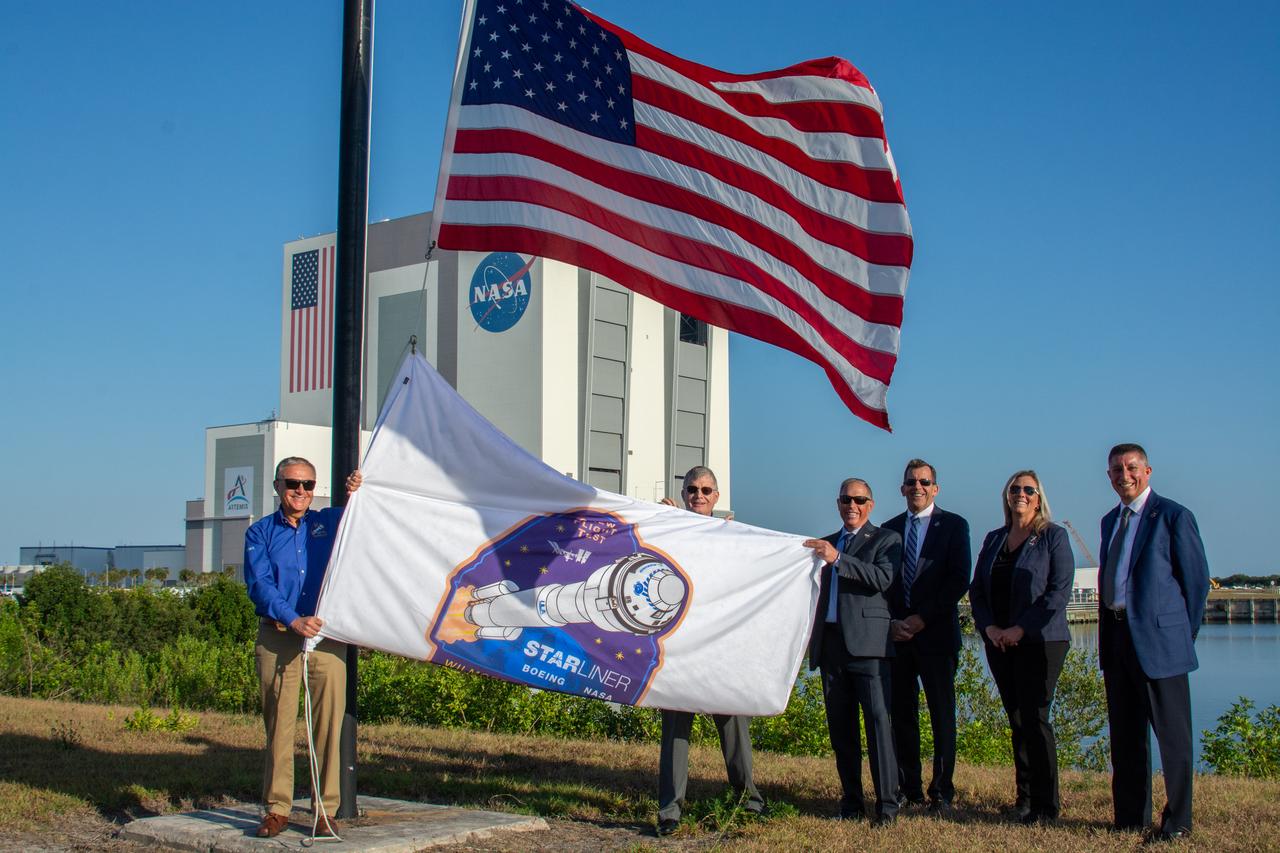
From left to right, Rami Intriago, Boeing Starliner resident office manager, NASA’s Kennedy Space Center Commercial Crew Program; Steve Stich, manager, NASA’s Commercial Crew Program; Mark Nappi, vice president and manager, Boeing Commercial Crew Program; Leroy Cain, mission integration and operations manager, Boeing’s Commercial Crew Program; Dana Hutcherson, deputy manager, NASA’s Commercial Crew Program; and Richard Jones, deputy manager, NASA’s Johnson Space Center Commercial Crew Program, prepare to raise NASA’s Boeing Crew Flight Test flag on Thursday, April 25, 2024, near the countdown clock at the Press Site at the Florida spaceport. As part of the agency’s Commercial Crew Program, NASA astronauts Butch Wilmore and Suni Williams are the first to launch to the International Space Station aboard Boeing’s Starliner spacecraft atop a United Launch Alliance Atlas V rocket from Space Launch Complex-41 at nearby Cape Canaveral Space Force Station. Liftoff is scheduled for 10:34 p.m. ET on Monday, May 6.
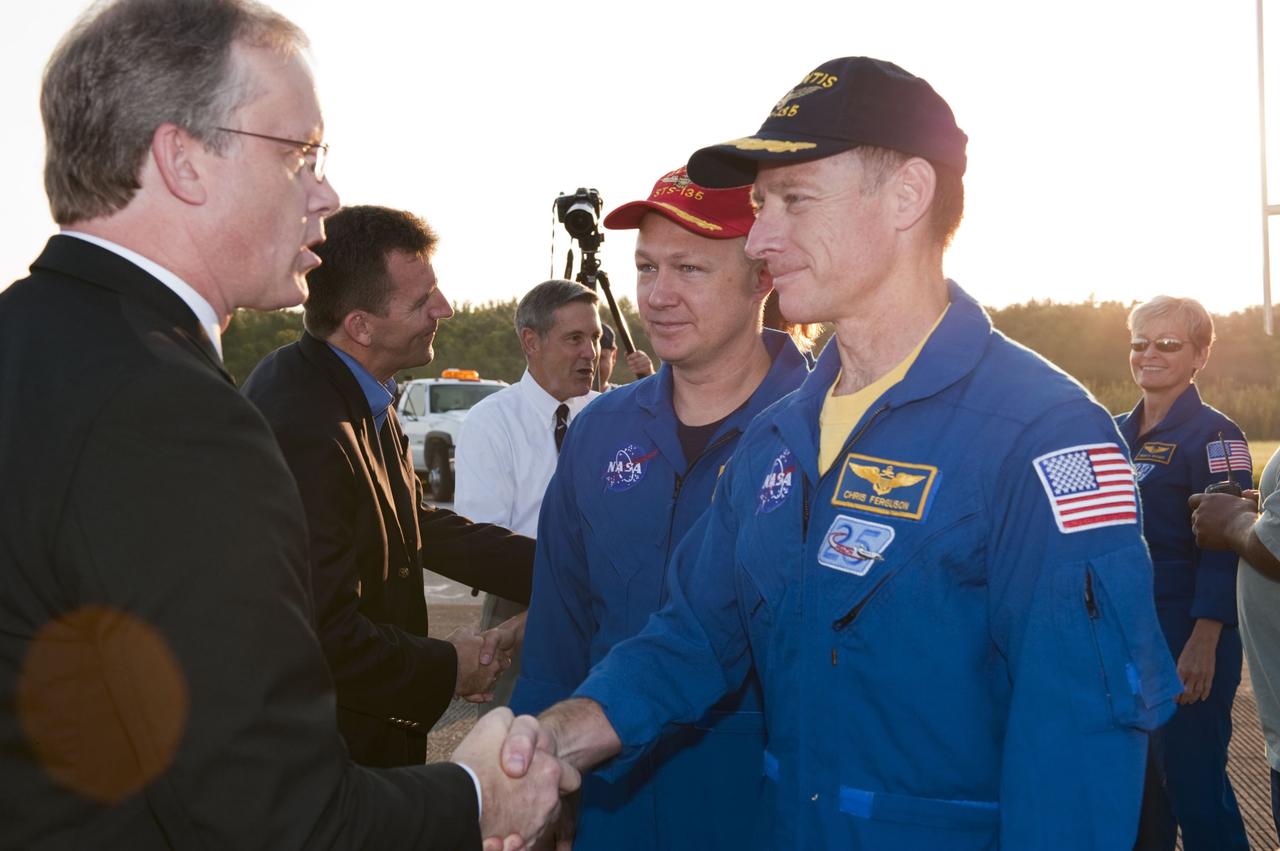
CAPE CANAVERAL, Fla. -- STS-135 Commander Chris Ferguson, front right, and Pilot Doug Hurley are congratulated by Space Shuttle Program Manager John Shannon, front left, Space Shuttle Program Deputy Manager LeRoy Cain, and NASA Kennedy Space Center Director Bob Cabana on their successful mission to the International Space Station. Four astronauts brought space shuttle Atlantis home to the Shuttle Landing Facility's Runway 15 at NASA's Kennedy Space Center in Florida at 5:57 a.m. EDT bringing a close NASA's Space Shuttle Program. Atlantis' final return from space completed a 13-day, 5.2-million-mile journey to the International Space Station. STS-135 delivered spare parts, equipment and supplies in the Raffaello multi-purpose logistics module that will sustain station operations for the next year. STS-135 was the 33rd and final flight for Atlantis, which has spent 307 days in space, orbited Earth 4,848 times and traveled 125,935,769 miles. For more information visit, www.nasa.gov/mission_pages/shuttle/shuttlemissions/sts135/index.html. Photo credit: NASA/Kim Shiflett
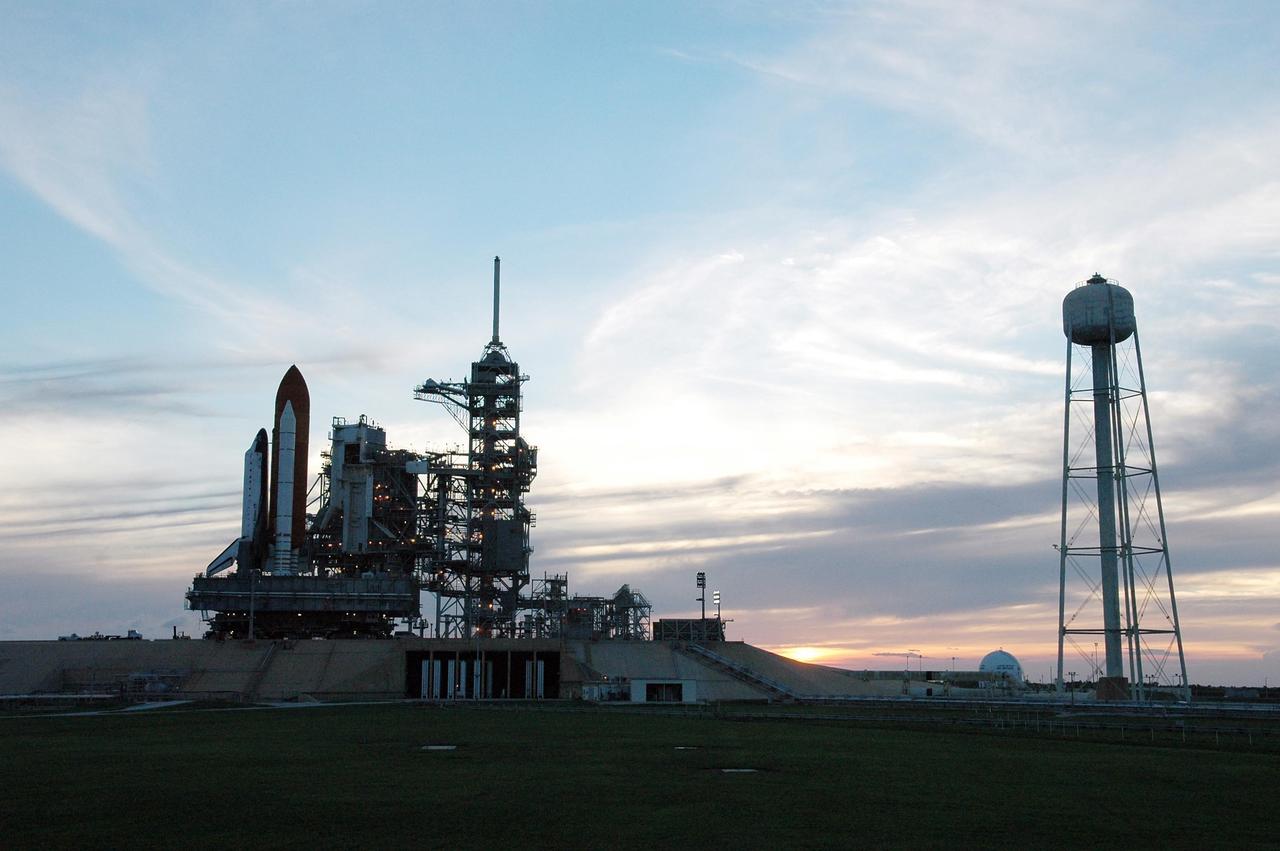
KENNEDY SPACE CENTER, FLA. - Silhouetted against a setting sun, Space Shuttle Atlantis rolls near to its launch position on Launch Pad 39B. It is being moved by a crawler-transporter. The crawler has a laser docking system that provides almost pinpoint accuracy when the crawler and mobile launcher platform are positioned at the launch pad. At right of the shuttle is the fixed service structure topped by the 80-foot lightning mast. At far right is the 300,000-tallon water tank that releases its contents prior to ignition of the shuttle's engines at liftoff. The process is part of the sound suppression water system. The shuttle had been moved off the launch pad due to concerns about the impact of Tropical Storm Ernesto, expected within 24 hours. The forecast of lesser winds expected from Ernesto and its projected direction convinced Launch Integration Manager LeRoy Cain and Shuttle Launch Director Mike Leinbach to return the shuttle to the launch pad. Photo credit: NASA/Kim Shiflett

KENNEDY SPACE CENTER, FLA. - A late-day sun spotlights Space Shuttle Atlantis as it rolls up the ramp to Launch Pad 39B atop the crawler-transporter. The crawler has a leveling system designed to keep the top of the space shuttle vertical while negotiating the 5-percent grade leading to the top of the launch pad. Also, a laser docking system provides almost pinpoint accuracy when the crawler and mobile launcher platform are positioned at the launch pad. At left are the open rotating service structure and the fixed service structure topped by the 80-foot lightning mast. The shuttle had been moved off the launch pad due to concerns about the impact of Tropical Storm Ernesto, expected within 24 hours. The forecast of lesser winds expected from Ernesto and its projected direction convinced Launch Integration Manager LeRoy Cain and Shuttle Launch Director Mike Leinbach to return the shuttle to the launch pad. Photo credit: NASA/Kim Shiflett
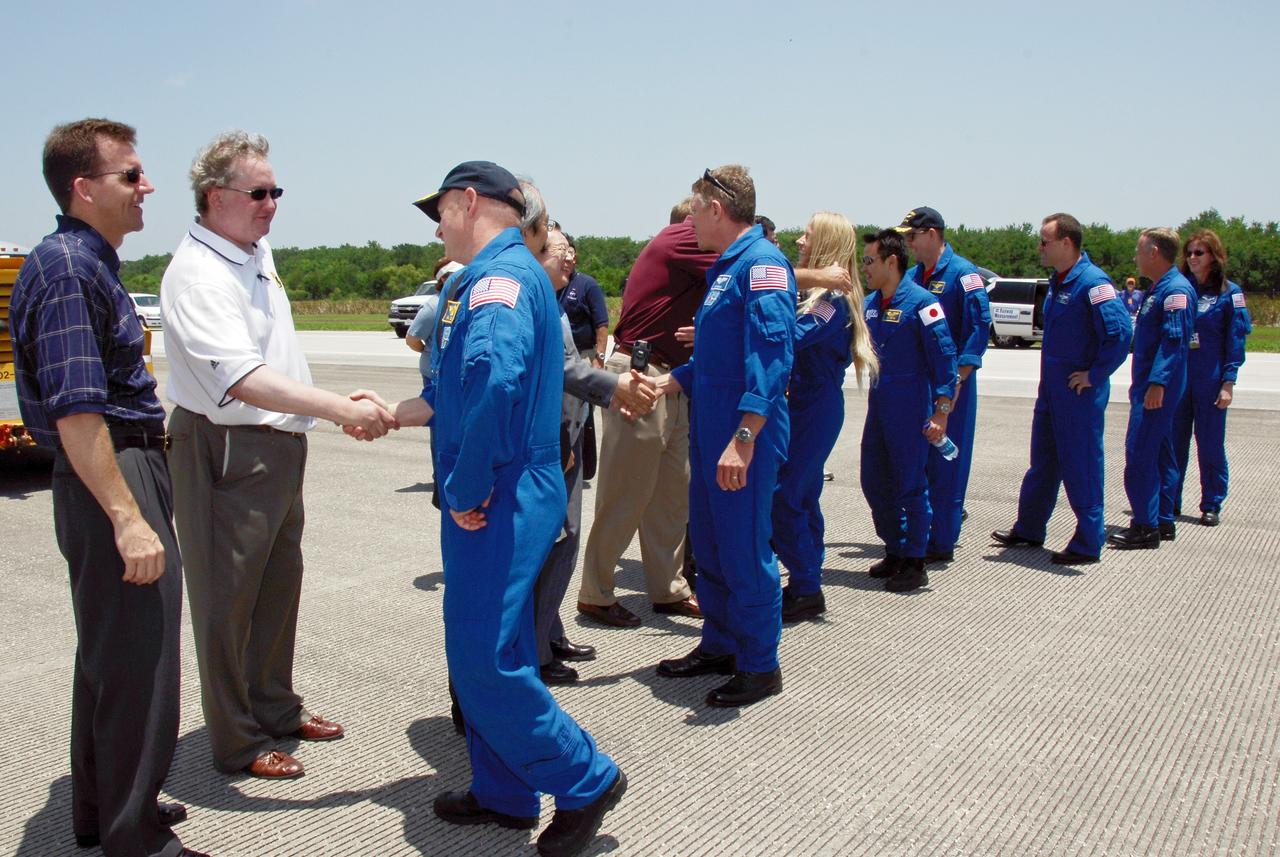
CAPE CANAVERAL, Fla. – After the successful STS-124 mission and landing on Runway 15 at NASA's Kennedy Space Center, the crew members are greeted by the Director of Mission Launch Integration LeRoy Cain( far left), the Japan Aerospace Exploration Agency's Director of Program Management and Integration Yuichi Yamaura and Vice President Kaoru Mamiya (center) and Center Director Bill Parsons (right). The crew members, from left, are Commander Mark Kelly, Mission Specialists Mike Fossum, Karen Nyberg and Akihiko Hoshide, Pilot Ken Ham and Mission Specialist Ron Garan. Other astronauts accompany them. Space shuttle Discovery's main landing gear touched down at 11:15:19 a.m. EDT on Runway 15. The nose landing gear touched down at 11:15:30 a.m. and wheel stop was at 11:16:19 a.m. The mission completed 5.7 million miles. The STS-124 mission delivered the Japan Aerospace Exploration Agency's large Japanese Pressurized Module and its remote manipulator system to the space station. Photo credit: NASA/Kim Shiflett
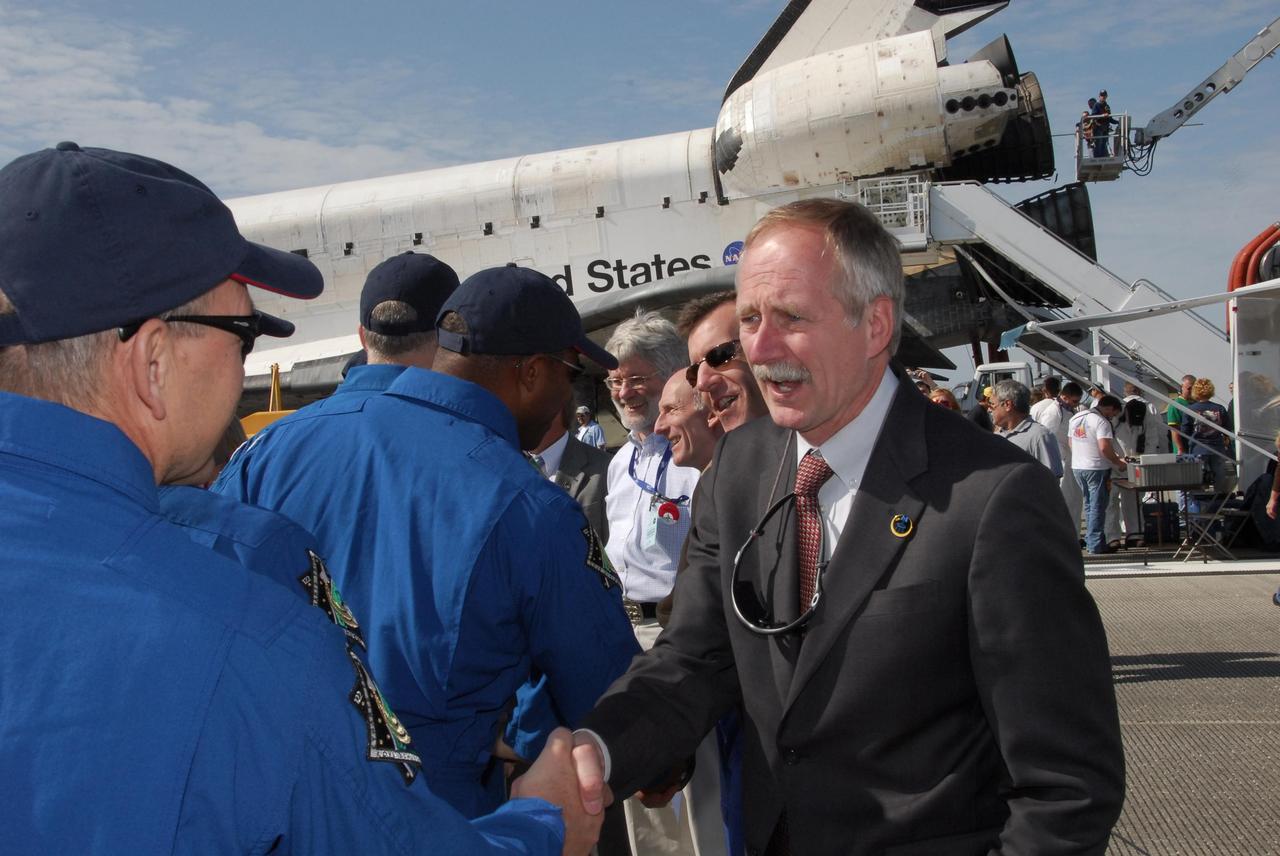
KENNEDY SPACE CENTER, FLA. -- After exiting the crew transport vehicle, STS-122 crew members are greeted by NASA Associate Administrator for Space Operations William Gerstenmaier (right) and Director of Mission Launch Integration LeRoy Cain (second from right). After a round trip of nearly 5.3 million miles, space shuttle Atlantis and crew returned to Earth with a landing at 9:07 a.m. EST. The shuttle landed on orbit 202 to complete the 13-day STS-122 mission. Main gear touchdown was 9:07:10 a.m. Nose gear touchdown was 9:07:20 a.m. Wheel stop was at 9:08:08 a.m. Mission elapsed time was 12 days, 18 hours, 21 minutes and 44 seconds. During the mission, Atlantis' crew installed the new Columbus laboratory, leaving a larger space station and one with increased science capabilities. The Columbus Research Module adds nearly 1,000 cubic feet of habitable volume and affords room for 10 experiment racks, each an independent science lab. Photo credit: NASA/Jack Pfaller

CAPE CANAVERAL, Fla. – NASA Astronaut Garrett Reisman, right, jokes with NASA Associate Administrator Chris Scolese, 2nd from right, NASA Associate Administrator for Space Operations Bill Gerstenmaier, 3rd from right, and NASA Deputy Shuttle Program Manager LeRoy Cain as NASA Astronaut Michael Lopez-Alegria looks on. Reisman spent 3 months in space onboard the International Space Station. Space Shuttle Discovery touched down on runway 15 of the Shuttle Landing Facility at NASA's Kennedy Space Center, concluding the 14-day, STS-124 mission to the International Space Station. Onboard were NASA astronauts Mark Kelly, commander; Ken Ham, pilot; Mike Fossum, Ron Garan, Karen Nyberg, Garrett Reisman and Japan Aerospace Exploration Agency astronaut Akihiko Hoshide, all mission specialists. The main landing gear touched down at 11:15:19 a.m. (EDT) on June 14, 2008. The nose landing gear touched down at 11:15:30 a.m. and wheel stop was at 11:16:19 a.m. During the mission, Discovery's crew installed the Japan Aerospace Exploration Agency's large Kibo laboratory and its remote manipulator system leaving a larger space station and one with increased science capabilities. Photo Credit: NASA/Bill Ingalls
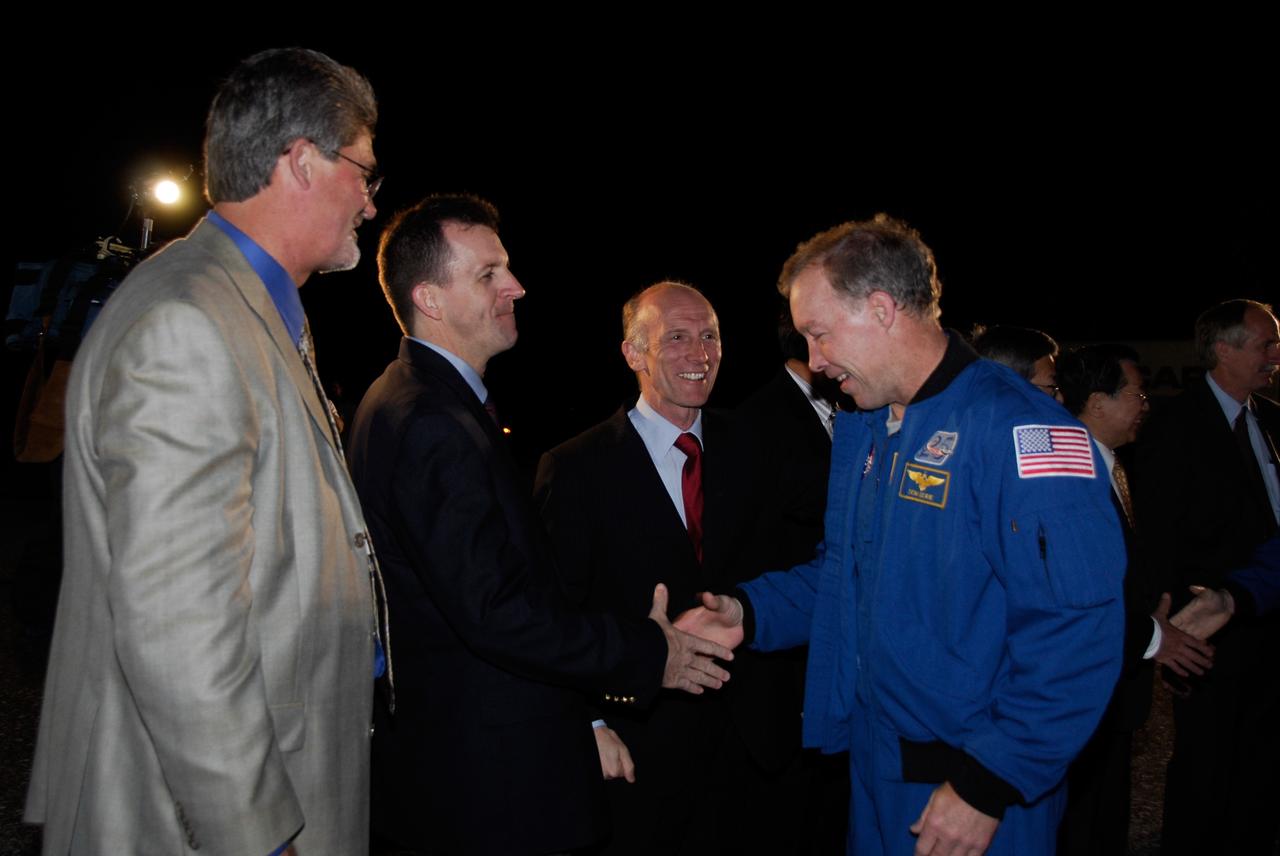
CAPE CANAVERAL, Fla. --- STS-123 Commander Dominic Gorie, right, shakes hands with LeRoy Cain, chair of the mission management team, at NASA Kennedy Space Center's Shuttle Landing Facility. At left is Kennedy Space Center Director Bill Parsons. Space shuttle Endeavour landed on Runway 15 to end the STS-123 mission, a 16-day flight to the International Space Station. This was the 16th night landing at Kennedy. The main landing gear touched down at 8:39:08 p.m. EDT. The nose landing gear touched down at 8:39:17 p.m. and wheel stop was at 8:40:41 p.m. The mission completed nearly 6.6 million miles. The landing was on the second opportunity after the first was waved off due to unstable weather in the Kennedy Space Center area. The STS-123 mission delivered the first segment of the Japan Aerospace Exploration Agency's Kibo laboratory and the Canadian Space Agency's two-armed robotic system, known as Dextre. Photo credit: NASA/Kim Shiflett
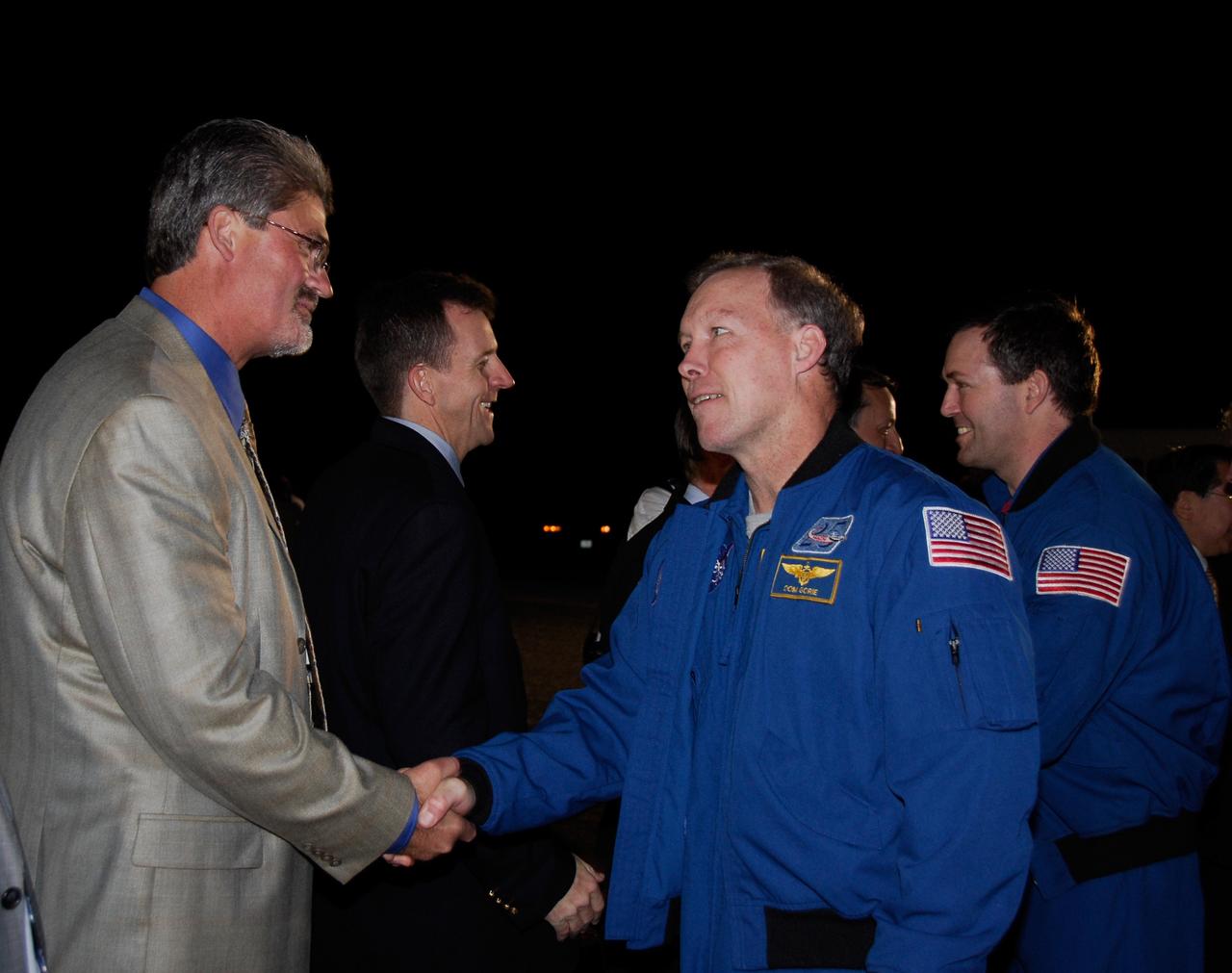
CAPE CANAVERAL, Fla. --- STS-123 Commander Dominic Gorie, right front, is greeted by Kennedy Space Center Director Bill Parsons at NASA Kennedy Space Center's Shuttle Landing Facility. Behind them, LeRoy Cain, chair of the mission management team, welcomes Mission Specialist Mike Foreman. Space shuttle Endeavour landed on Runway 15 to end the STS-123 mission, a 16-day flight to the International Space Station. This was the 16th night landing at Kennedy. The main landing gear touched down at 8:39:08 p.m. EDT. The nose landing gear touched down at 8:39:17 p.m. and wheel stop was at 8:40:41 p.m. The mission completed nearly 6.6 million miles. The landing was on the second opportunity after the first was waved off due to unstable weather in the Kennedy Space Center area. The STS-123 mission delivered the first segment of the Japan Aerospace Exploration Agency's Kibo laboratory and the Canadian Space Agency's two-armed robotic system, known as Dextre. Photo credit: NASA/Kim Shiflett
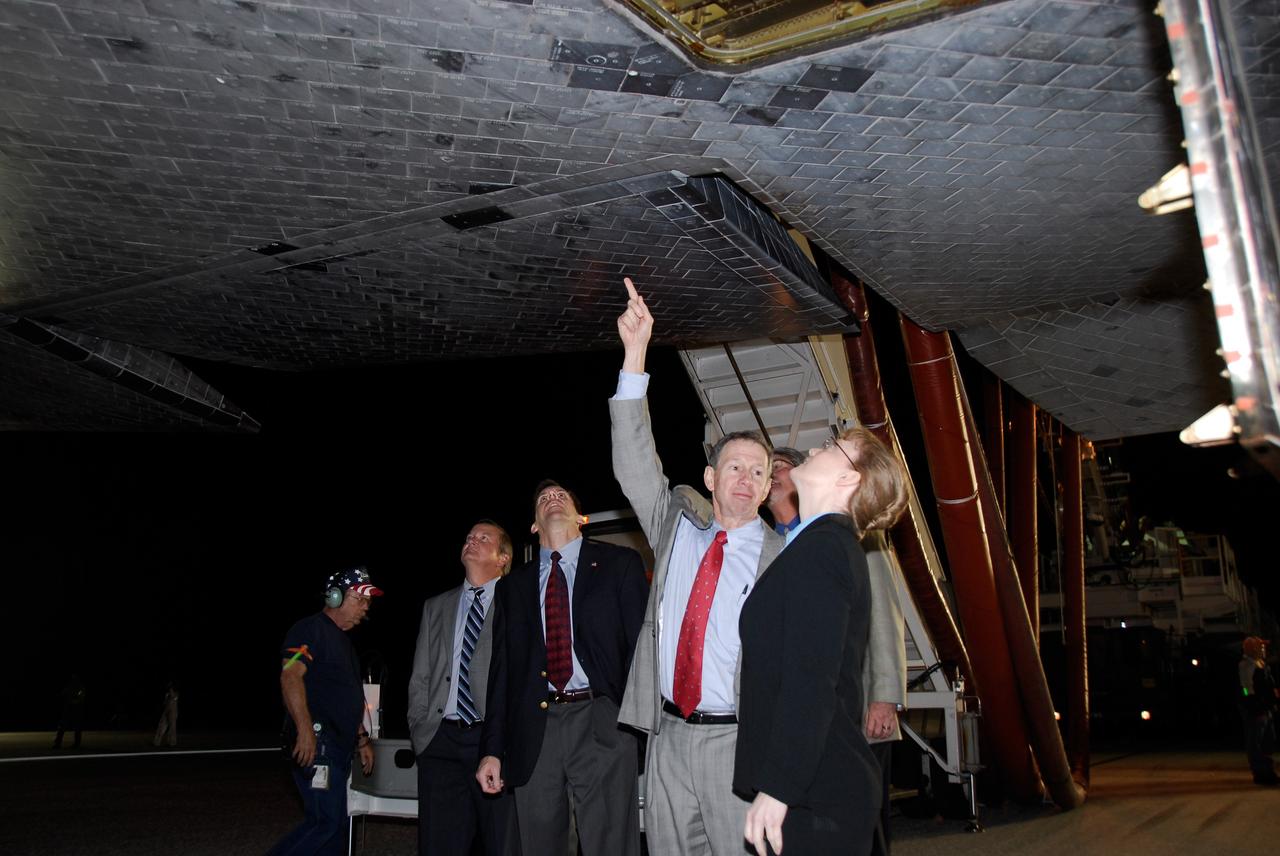
CAPE CANAVERAL, Fla. --- NASA managers examine the thermal protection system tile under space shuttle Endeavour on Runway 15 at Kennedy Space Center's Shuttle Landing Facility at the end of the STS-123 mission, a 16-day flight to the International Space Station. From left are a member of the convoy crew, Shuttle Launch Director Mike Leinbach, Mission Management Team Chairman LeRoy Cain, NASA Administrator Mike Griffin and NASA Deputy Administrator Shana Dale. Behind them is Kennedy Space Center Director Bill Parsons. This was the 16th night landing at Kennedy. The main landing gear touched down at 8:39:08 p.m. EDT. The nose landing gear touched down at 8:39:17 p.m. and wheel stop was at 8:40:41 p.m. The mission completed nearly 6.6 million miles. The landing was on the second opportunity after the first was waved off due to unstable weather in the Kennedy Space Center area. The STS-123 mission delivered the first segment of the Japan Aerospace Exploration Agency's Kibo laboratory and the Canadian Space Agency's two-armed robotic system, known as Dextre. Photo credit: NASA/Kim Shiflett
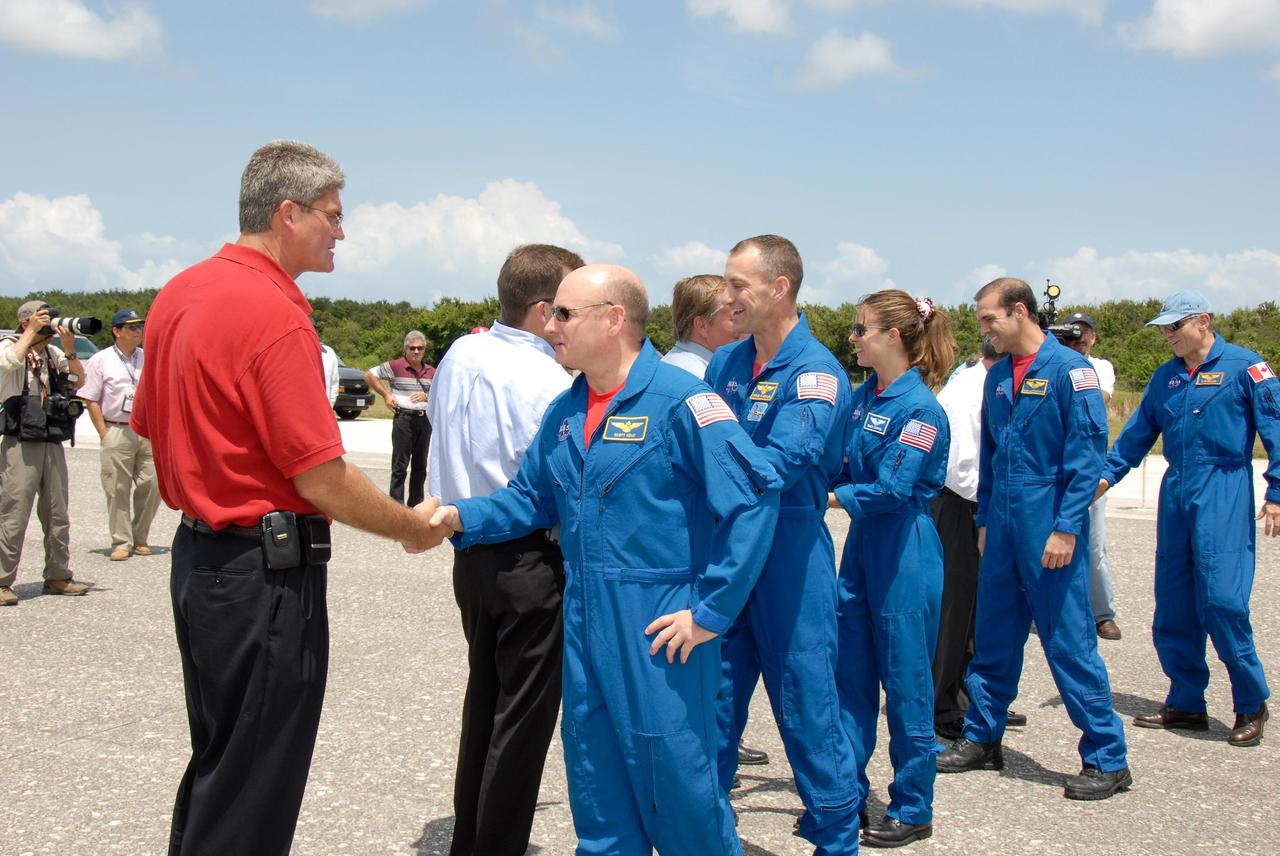
KENNEDY SPACE CENTER, FLA. -- The STS-118 crew is welcomed back to Earth by NASA officials after completing mission STS-118. From left are KSC Director Bill Parsons, Mission Launch Integration Director Leroy Cain, Commander Scott Kelly, Shuttle Launch Director Mike Leinbach, Pilot Charlie Hobaugh, and Mission Specialists Tracy Caldwell, Rick Mastracchio and Canadian astronaut Dave Williams. NASA Administrator Mike Griffin also greeted the astronauts. On the mission, the crew installed a new gyroscope, an external spare parts platform and another truss segment to the expanding station. Endeavour's main gear touched down at 12:32:16 p.m. EDT. Nose gear touchdown was at 12:32:29 p.m. and wheel stop was at 12:33:20 p.m. Endeavour landed on orbit 201. STS-118 was the 119th space shuttle flight, the 22nd flight to the station, the 20th flight for Endeavour and the second of four missions planned for 2007. This was the 65th landing of an orbiter at Kennedy. Photo credit: NASA/Kim Shiflett
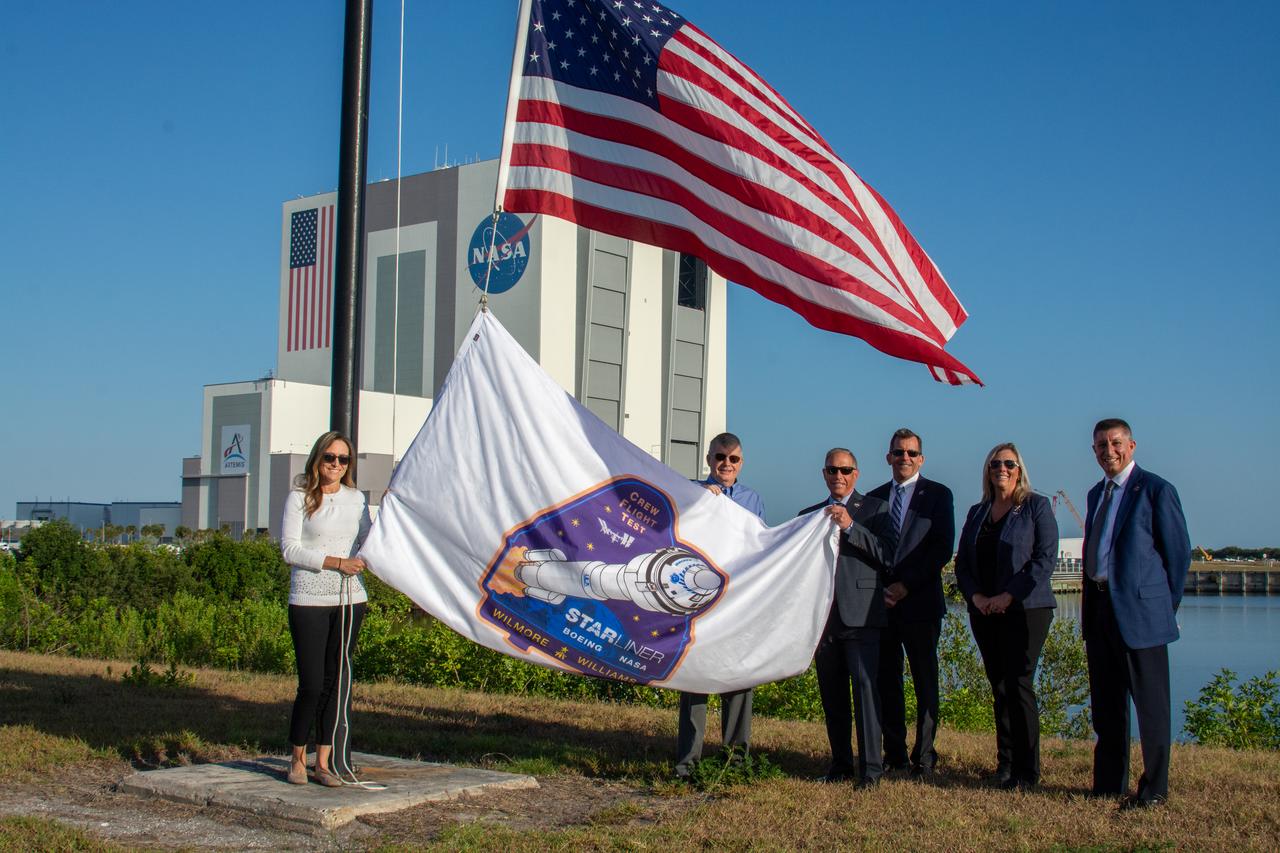
From left to right, Courtney Stern, ground and mission operations recovery/rescue, NASA Kennedy Space Center Commercial Crew Program; Steve Stich, manager, NASA’s Commercial Crew Program; Mark Nappi, vice president and manager, Boeing Commercial Crew Program; Leroy Cain, mission integration and operations manager, Boeing’s Commercial Crew Program; Dana Hutcherson, deputy manager, NASA’s Commercial Crew Program; and Richard Jones, deputy manager, NASA’s Commercial Crew Program, prepare to raise the NASA’s Boeing Crew Flight Test flag on Thursday, April 25, 2024, near the countdown clock at the Press Site at the Florida spaceport. As part of the agency’s Commercial Crew Program, NASA astronauts Butch Wilmore and Suni Williams are the first to launch to the International Space Station aboard Boeing’s Starliner spacecraft atop a United Launch Alliance Atlas V rocket from nearby Space Launch Complex-41 at Cape Canaveral Space Force Station. Liftoff is scheduled for 10:34 p.m. ET on Monday, May 6.
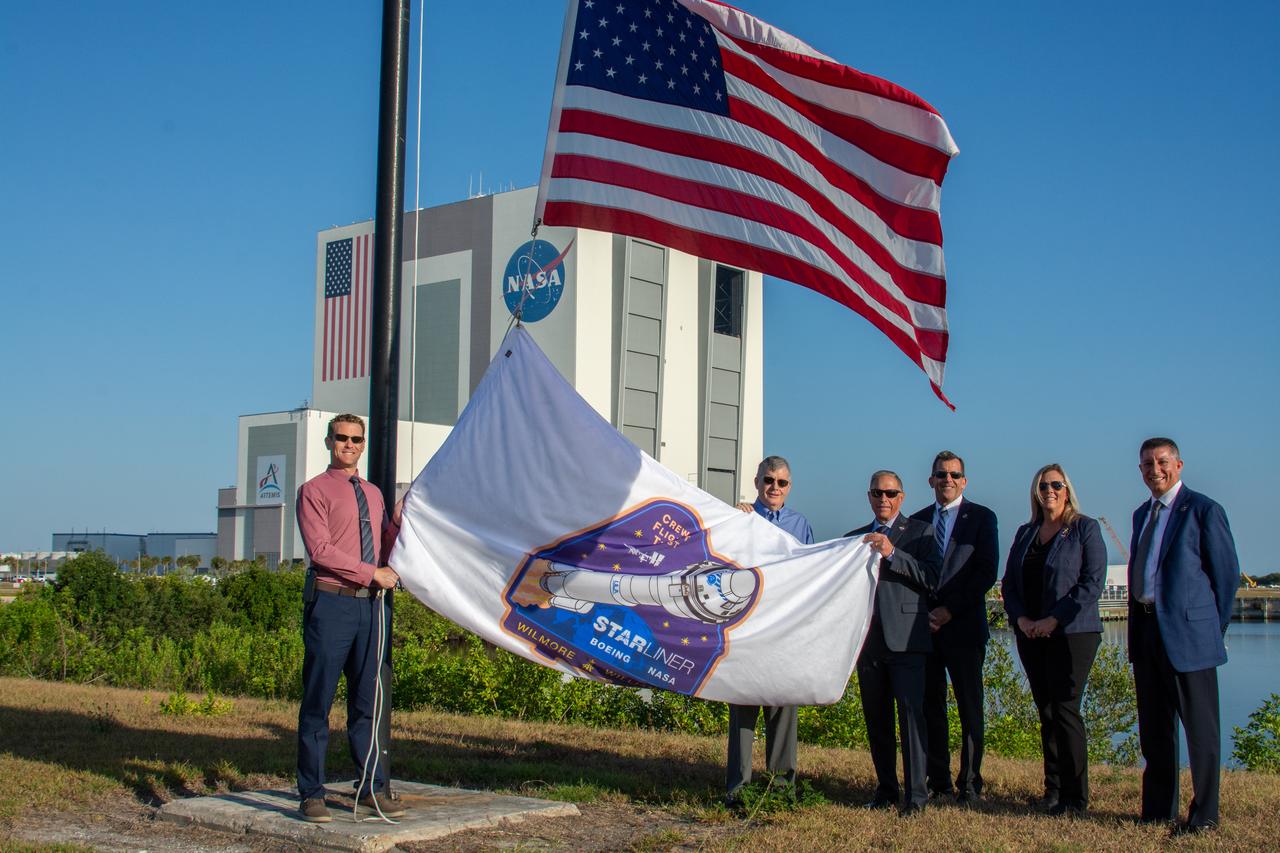
From left to right, Ian Kappes, deputy launch vehicle office manager, NASA Kennedy Space Center Commercial Crew Program; Steve Stich, manager, NASA’s Commercial Crew Program; Mark Nappi, vice president and program manager, Boeing Commercial Crew Program; Leroy Cain, mission integration and operations manager, Boeing’s Commercial Crew Program; Dana Hutcherson, deputy program manager, NASA’s Commercial Crew Program; and Richard Jones, deputy program manager, NASA’s Commercial Crew Program, prepare to raise NASA’s Boeing Crew Flight Test flag on Thursday, April 25, 2024, near the countdown clock at the Press Site at the Florida spaceport. As part of the agency’s Commercial Crew Program, NASA astronauts Butch Wilmore and Suni Williams are the first to launch to the International Space Station aboard Boeing’s Starliner spacecraft atop a United Launch Alliance Atlas V rocket from Space Launch Complex-41 at nearby Cape Canaveral Space Force Station. Liftoff is scheduled for 10:34 p.m. ET on Monday, May 6.
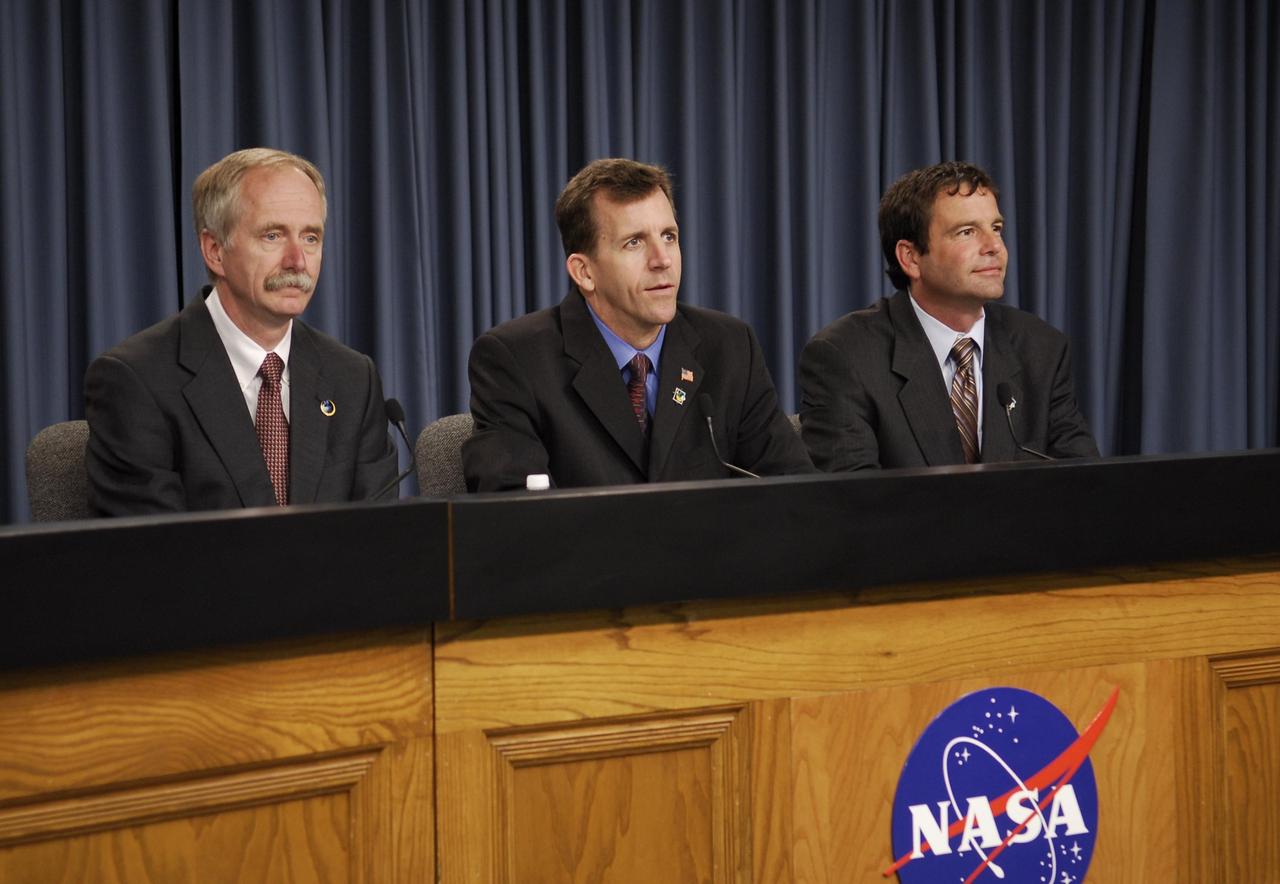
KENNEDY SPACE CENTER, FLA. -- Members of the Mission Management Team, or MMT, participate in a news briefing following the conclusion of the team's meeting. The meeting followed the morning's launch scrub of the space shuttle Atlantis STS-122 mission caused by problems experienced with the external tank's engine cutoff sensor system during tanking for the second launch attempt. From left are Bill Gerstenmaier, associate administrator for Space Operations; LeRoy Cain, MMT chairman; and Doug Lyons, STS-122 launch director. An announcement was made during the briefing that the STS-122 launch is postponed to no earlier than Jan. 2, 2008, to give the team time to resolve the system's problems. Atlantis will carry the Columbus Laboratory, the European Space Agency's largest contribution to the construction of the International Space Station. It will support scientific and technological research in a microgravity environment. Permanently attached to the Harmony node of the space station, the laboratory will carry out experiments in materials science, fluid physics and biosciences, as well as perform a number of technological applications. Photo credit: NASA/Kim Shiflett
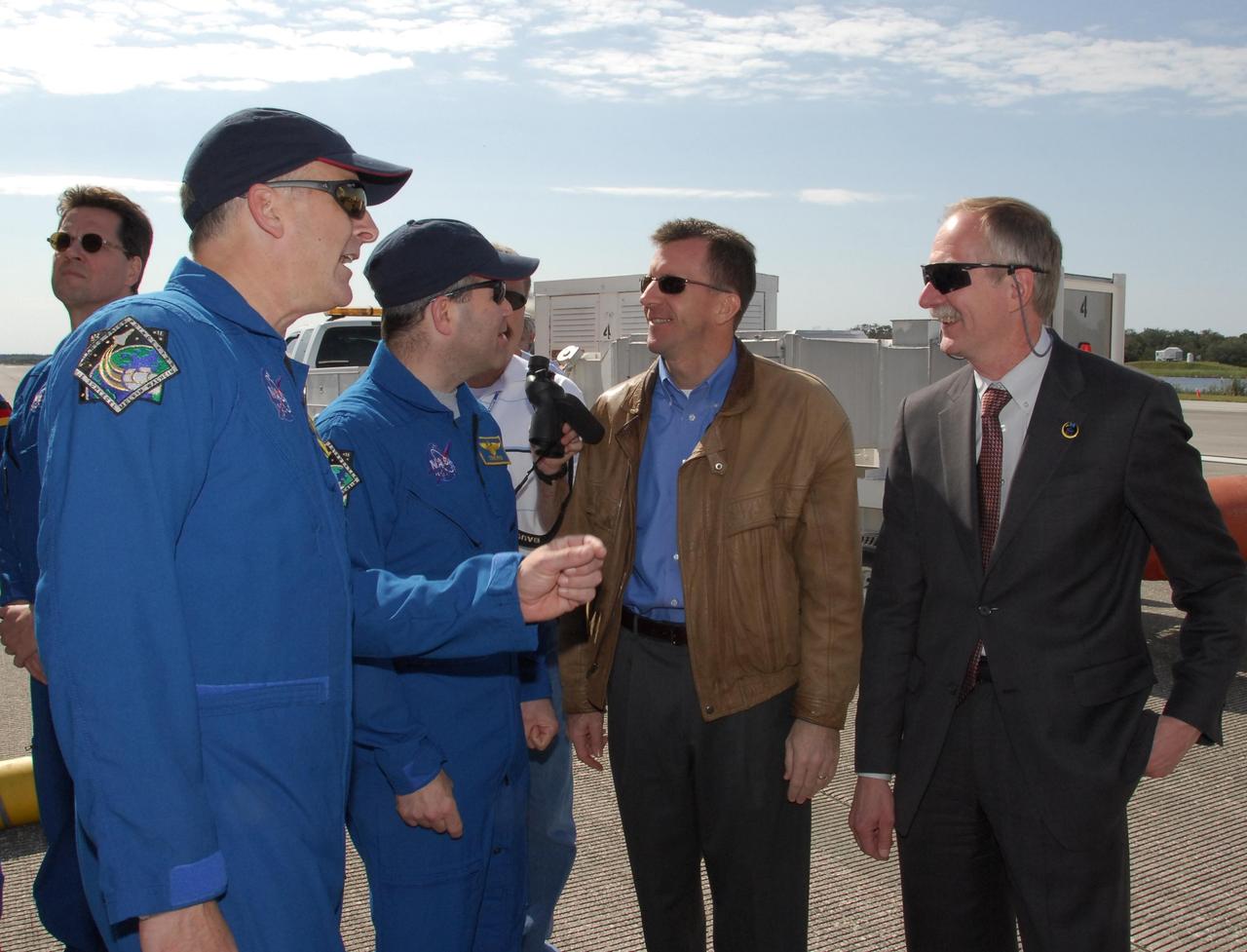
KENNEDY SPACE CENTER, FLA. -- After exiting the crew transport vehicle, STS-122 Pilot Alan Poindexter (left) and Commander Steve Frick talk to Director of Mission Launch Integration LeRoy Cain and NASA Associate Administrator for Space Operations William Gerstenmaier. After a round trip of nearly 5.3 million miles, space shuttle Atlantis and crew returned to Earth with a landing at 9:07 a.m. EST. The shuttle landed on orbit 202 to complete the 13-day STS-122 mission. Main gear touchdown was 9:07:10 a.m. Nose gear touchdown was 9:07:20 a.m. Wheel stop was at 9:08:08 a.m. Mission elapsed time was 12 days, 18 hours, 21 minutes and 44 seconds. During the mission, Atlantis' crew installed the new Columbus laboratory, leaving a larger space station and one with increased science capabilities. The Columbus Research Module adds nearly 1,000 cubic feet of habitable volume and affords room for 10 experiment racks, each an independent science lab. Photo credit: NASA/Jack Pfaller
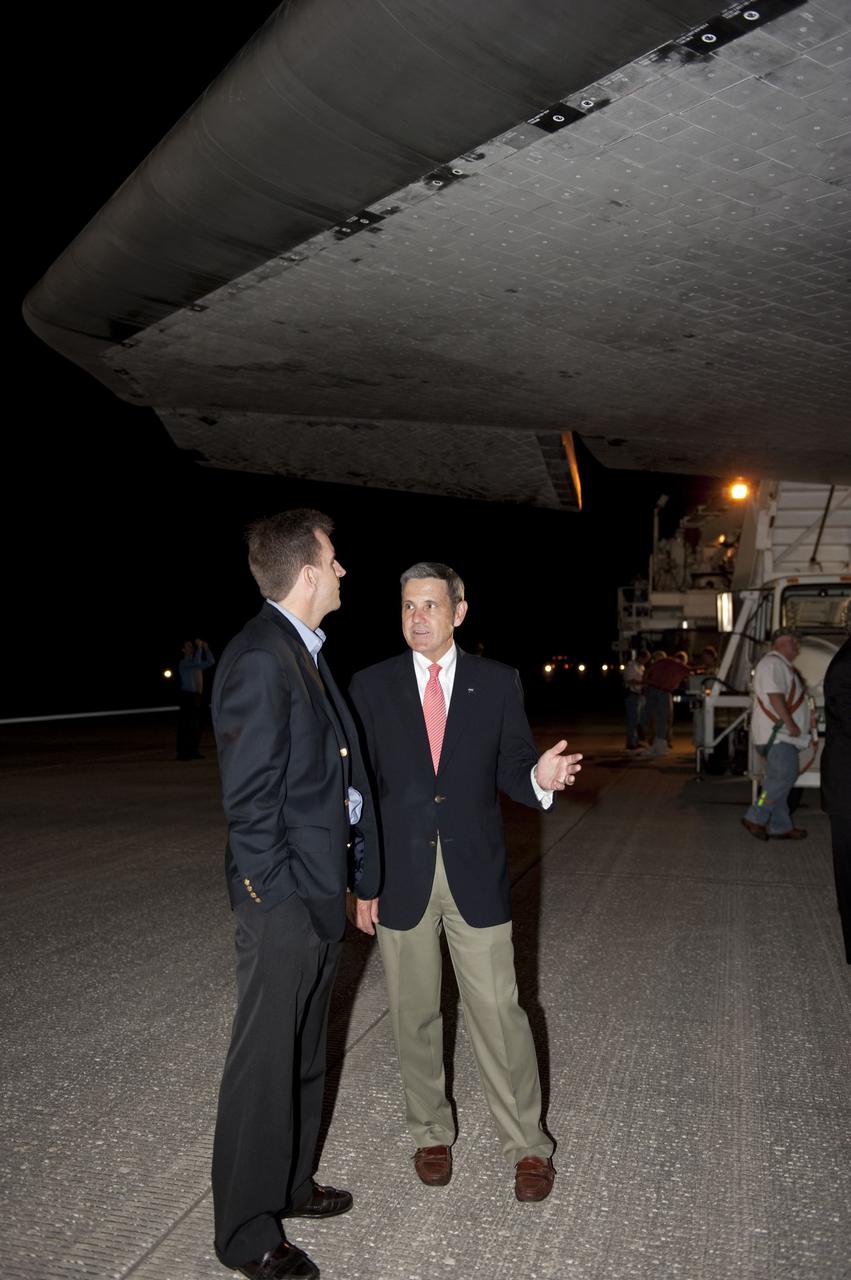
CAPE CANAVERAL, Fla. -- NASA's Deputy Manager for the Space Shuttle Program Leroy Cain, left, and Kennedy Center Director Bob Cabana chat underneath the belly of space shuttle Endeavour following the vehicle's successful trip home. Endeavour's final return from space completed the 16-day, 6.5-million-mile STS-134 mission. Main gear touchdown on the Shuttle Landing Facility's Runway 15 was at 2:34:51 a.m. EDT, followed by nose gear touchdown at 2:35:04 a.m., and wheelstop at 2:35:36 a.m. STS-134 delivered the Alpha Magnetic Spectrometer-2 (AMS) and the Express Logistics Carrier-3 (ELC-3) to the International Space Station. AMS will help researchers understand the origin of the universe and search for evidence of dark matter, strange matter and antimatter from the station. ELC-3 carried spare parts that will sustain station operations once the shuttles are retired from service. STS-134 was the 25th and final flight for Endeavour, which spent 299 days in space, orbited Earth 4,671 times and traveled 122,883,151 miles. Photo credit: NASA/Kim Shiflett
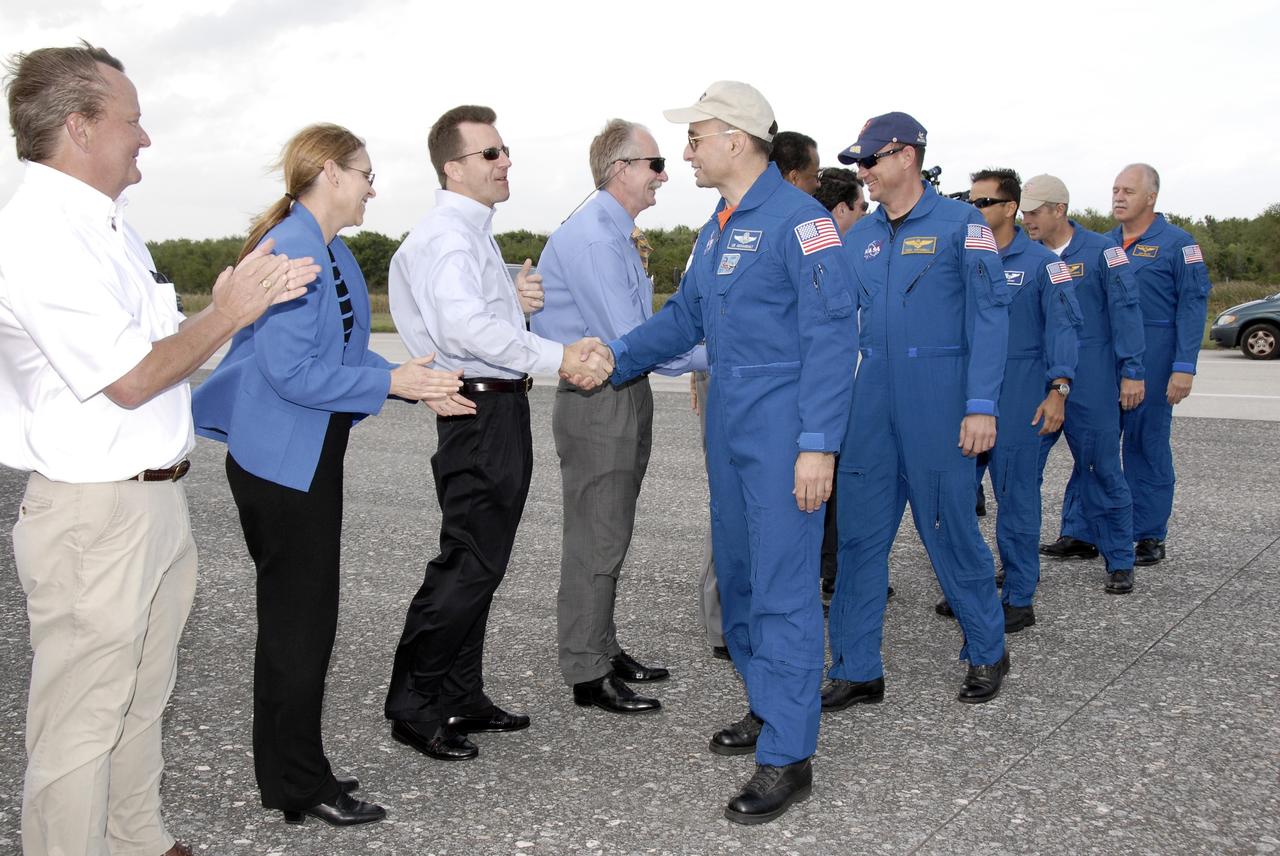
CAPE CANAVERAL, Fla. – STS-119 Commander Lee Archambault shakes hands with NASA Deputy Manager of Space Shuttle Program LeRoy Cain (third from left) as Pilot Tony Antonelli, behind him, is greeted by NASA Associate Administrator for Space Operations Bill Gerstenmaier. Shuttle Launch Director Mike Leinbach, left, and Kennedy Space Center Deputy Director Janet Petro also await their turns to welcome the crew home. Space shuttle Discovery’s landing completed the 13-day, 5.3-million mile journey of the STS-119 mission to the International Space Station. Main gear touchdown was at 3:13:17 p.m. EDT. Nose gear touchdown was at 3:13:40 p.m. and wheels stop was at 3:14:45 p.m. Discovery delivered the final pair of large power-generating solar array wings and the S6 truss segment. The mission was the 28th flight to the station, the 36th flight of Discovery and the 125th in the Space Shuttle Program, as well as the 70th landing at Kennedy. Photo credit: NASA/Kim Shiflett
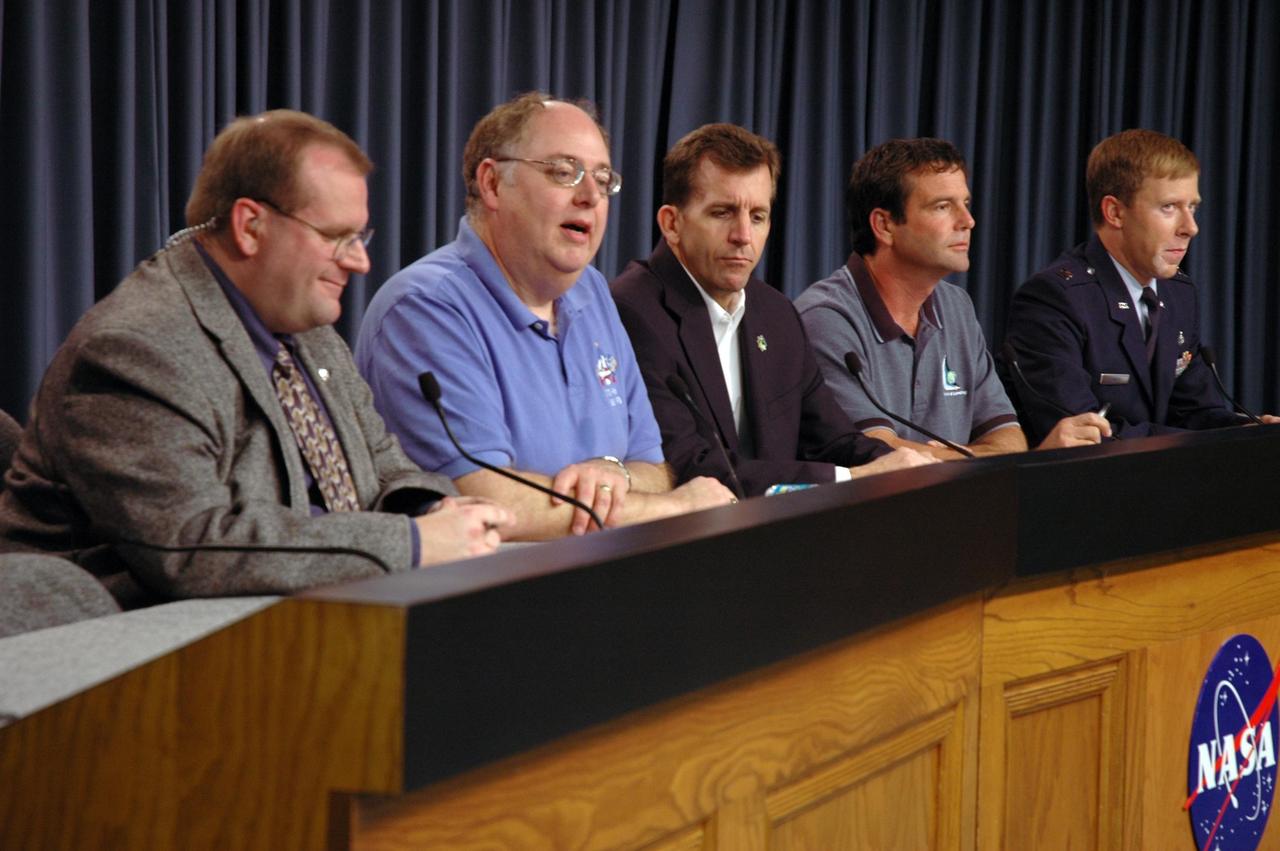
KENNEDY SPACE CENTER, FLA. -- Members of the Mission Management Team, or MMT, participate in a news briefing following the conclusion of the team's meeting. The meeting continued the discussion of the problems experienced with the space shuttle Atlantis STS-122 external tank's engine cutoff sensor system that arose during tanking on Dec. 6. From left are Allard Beutel, Kennedy Space Center news chief and briefing moderator; Wayne Hale, Space Shuttle Program manager; LeRoy Cain, MMT chairman; Doug Lyons, STS-122 launch director; and U.S. Air Force Capt. Chris Lovett, 45th Weather Squadron. An announcement was made during the briefing that the STS-122 launch, originally set for Dec. 6, was rescheduled to 3:21 p.m. Dec. 9. Atlantis will carry the Columbus Laboratory, the European Space Agency's largest contribution to the construction of the International Space Station. It will support scientific and technological research in a microgravity environment. Permanently attached to the Harmony node of the space station, the laboratory will carry out experiments in materials science, fluid physics and biosciences, as well as perform a number of technological applications. Photo credit: NASA/Cory Huston
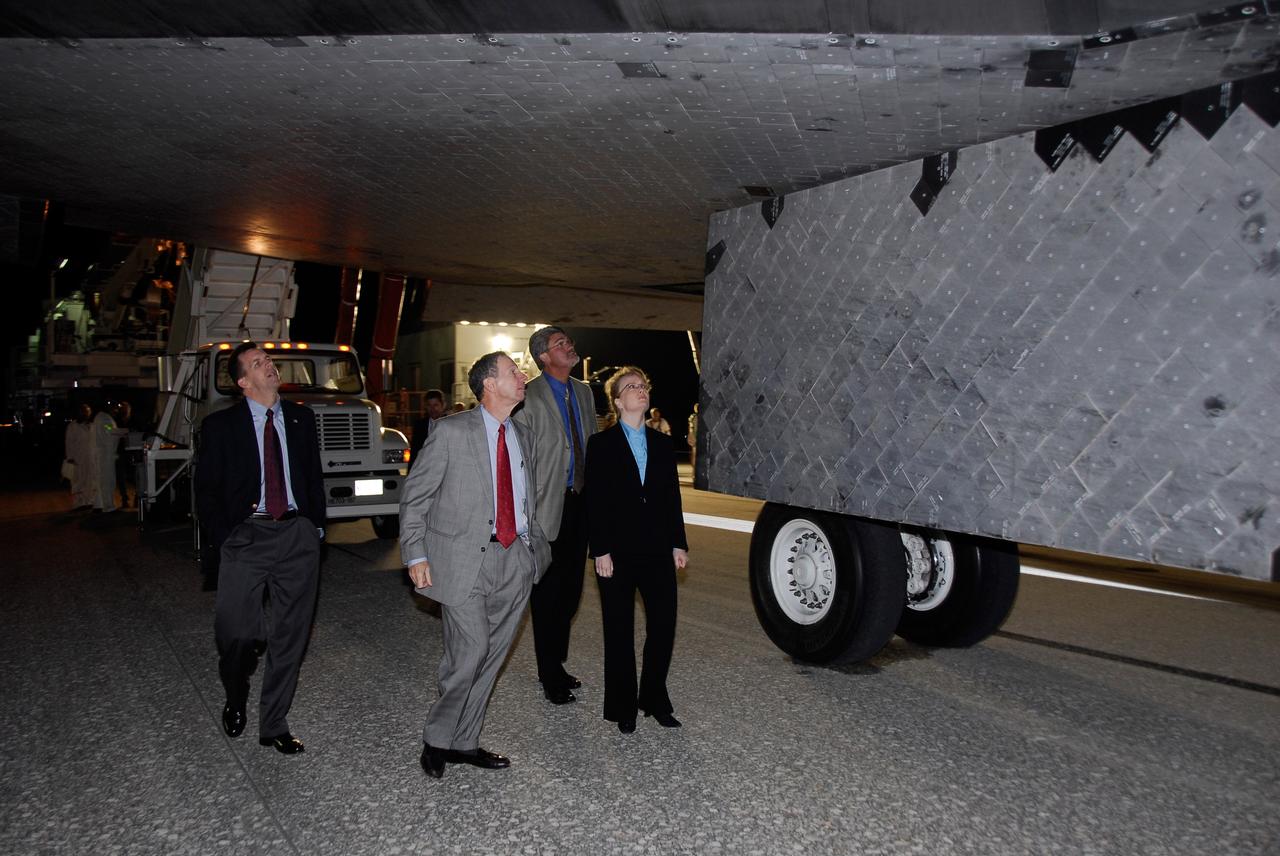
CAPE CANAVERAL, Fla. --- NASA managers examine the thermal protection system tile under space shuttle Endeavour on Runway 15 at Kennedy Space Center's Shuttle Landing Facility at the end of the STS-123 mission, a 16-day flight to the International Space Station. From left are Mission Management Team Chairman LeRoy Cain, NASA Administrator Mike Griffin, Kennedy Space Center Director Bill Parsons and NASA Deputy Administrator Shana Dale. This was the 16th night landing at Kennedy. The main landing gear touched down at 8:39:08 p.m. EDT. The nose landing gear touched down at 8:39:17 p.m. and wheel stop was at 8:40:41 p.m. The mission completed nearly 6.6 million miles. The landing was on the second opportunity after the first was waved off due to unstable weather in the Kennedy Space Center area. The STS-123 mission delivered the first segment of the Japan Aerospace Exploration Agency's Kibo laboratory and the Canadian Space Agency's two-armed robotic system, known as Dextre. Photo credit: NASA/Kim Shiflett
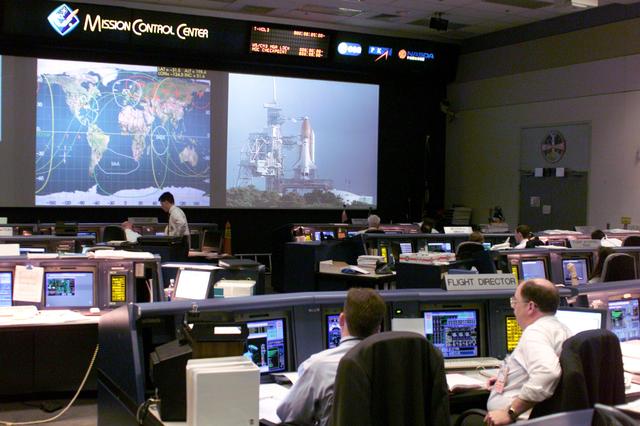
JSC2000-E-22286 (8 September 2000) --- An overall shot in Houston's Mission Control Center (MCC) shows flight controllers awaiting the launch of the Space Shuttle Atlantis from the Kennedy Space Center (KSC) in Florida. The vehicle later launched on schedule, at 8:46 a.m. (EDT), September 8, 2000, as the Johnson Space Center (JSC) flight control team took the baton from KSC's launch controllers. According to flight director Bill Reeves, "The picture referenced was taken less than an hour before launch for STS-106, before we changed the front screens for ascent operations. Wayne Hale (in glasses) is the Flight director for ascent and LeRoy Cain seated to his left was serving as "Weather Flight" for Wayne. The console in the front right corner of the room next to the screens is the Ground Control position, where I was supporting at this time. The man with white hair is Norn Talbott, who will be retiring after this flight with more than 35 years at NASA. Ray Grossman is next to him, who is training to take his place on the GC Ascent Team. I am in fron of and slightly to the right of Ray. As you can see by the boxes at the consoel behind us (Mechanical), we come well prepared for all contingencies, including donuts for early morning shifts. We were on console by 2:00 am central time for the 7:45 am launch." Reference: https://spaceflight.nasa.gov/feedback/expert/answer/mcc/sts-106/09_14_09_35_19.html
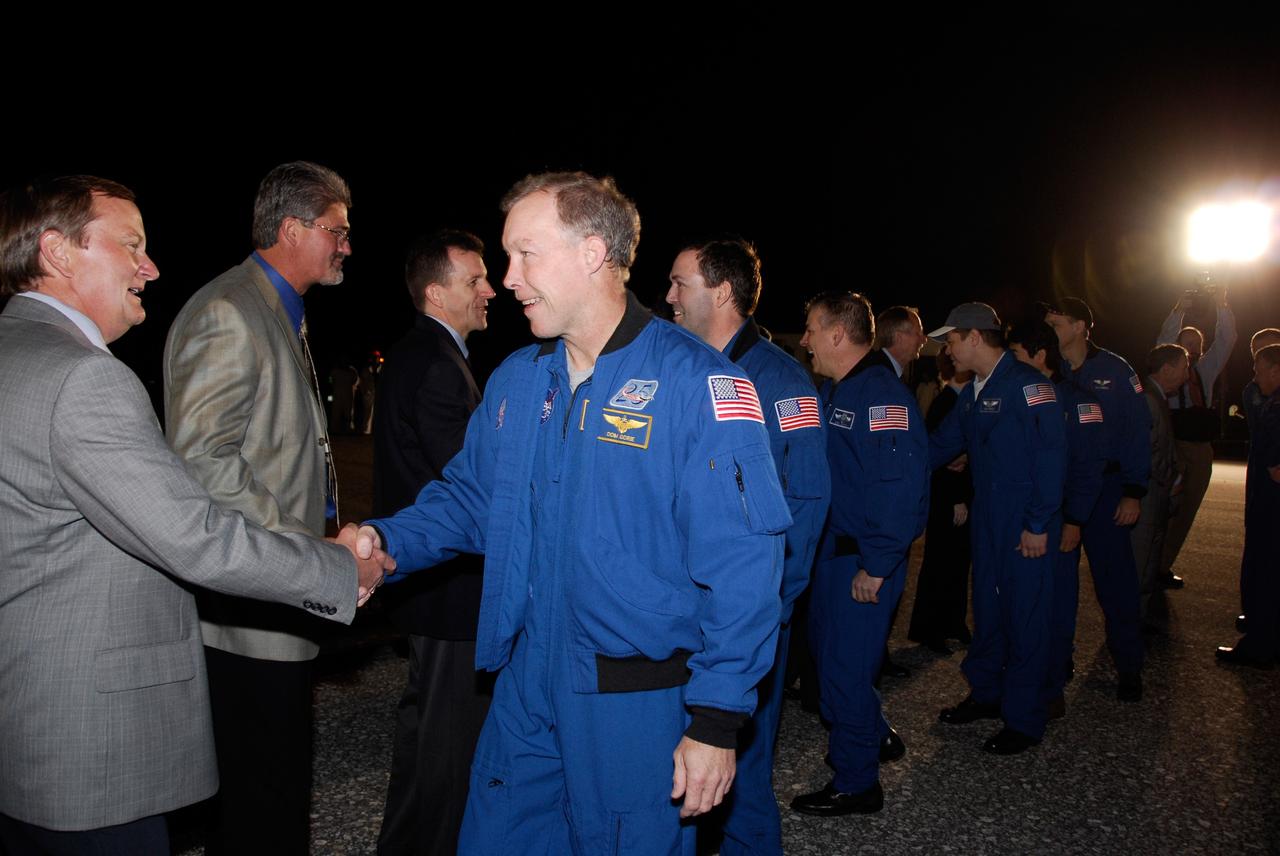
CAPE CANAVERAL, Fla. --- The STS-123 crewmembers are greeted by NASA VIPs and guests at NASA Kennedy Space Center's Shuttle Landing Facility. From left, in the blue flight suits, are Commander Dominic Gorie, Mission Specialist Mike Foreman, Pilot Gregory H. Johnson, and Mission Specialists Robert L. Behnken, Takao Doi of the Japan Aerospace Exploration Agency, and Rick Linnehan. From left, the NASA managers in the back row are Space Shuttle Launch Director Mike Leinbach, Kennedy Space Center Director Bill Parsons, and Chairman of Mission Management Team LeRoy Cain. Space shuttle Endeavour landed on Runway 15 at NASA Kennedy Space Center's Shuttle Landing Facility to end the STS-123 mission, a 16-day flight to the International Space Station. This was the 16th night landing at Kennedy. The main landing gear touched down at 8:39:08 p.m. EDT. The nose landing gear touched down at 8:39:17 p.m. and wheel stop was at 8:40:41 p.m. The mission completed nearly 6.6 million miles. The landing was on the second opportunity after the first was waved off due to unstable weather in the Kennedy Space Center area. The STS-123 mission delivered the first segment of the Japan Aerospace Exploration Agency's Kibo laboratory and the Canadian Space Agency's two-armed robotic system, known as Dextre. Photo credit: NASA/Kim Shiflett