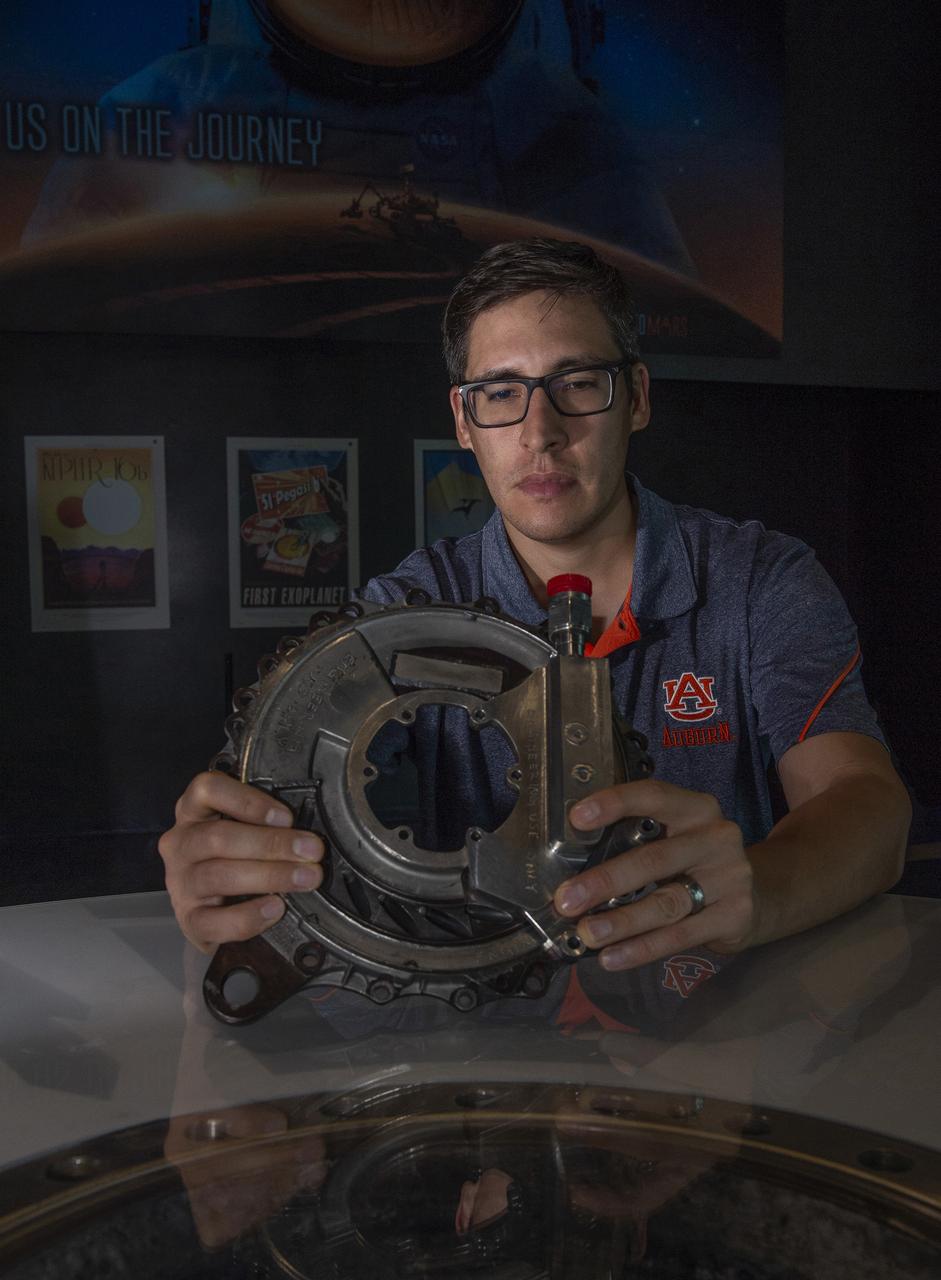
Leonardo Barreda inspects SLS Core Stage Thruster Vector Control Hardware.
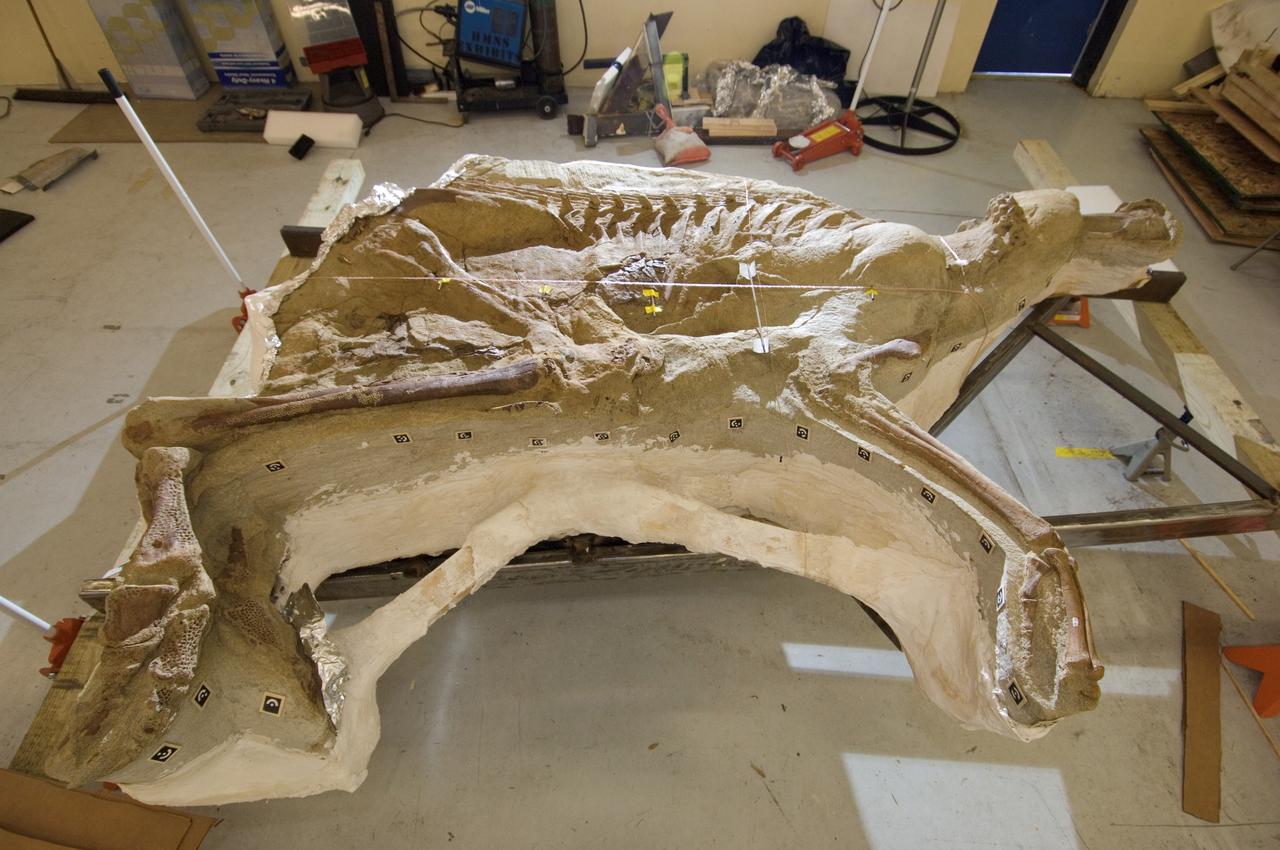
Documentation of NASA's partnership with the Houston Museum of Natural Science and Montana's Great Plains Dinosaur Museum to provide an insulated facility at Ellington Field in which the Leonardo Project Team was able to X-ray Leonardo, a 77 million year old dinosaur fossil. View of the Brachylophosaurus fossil called Leonardo.
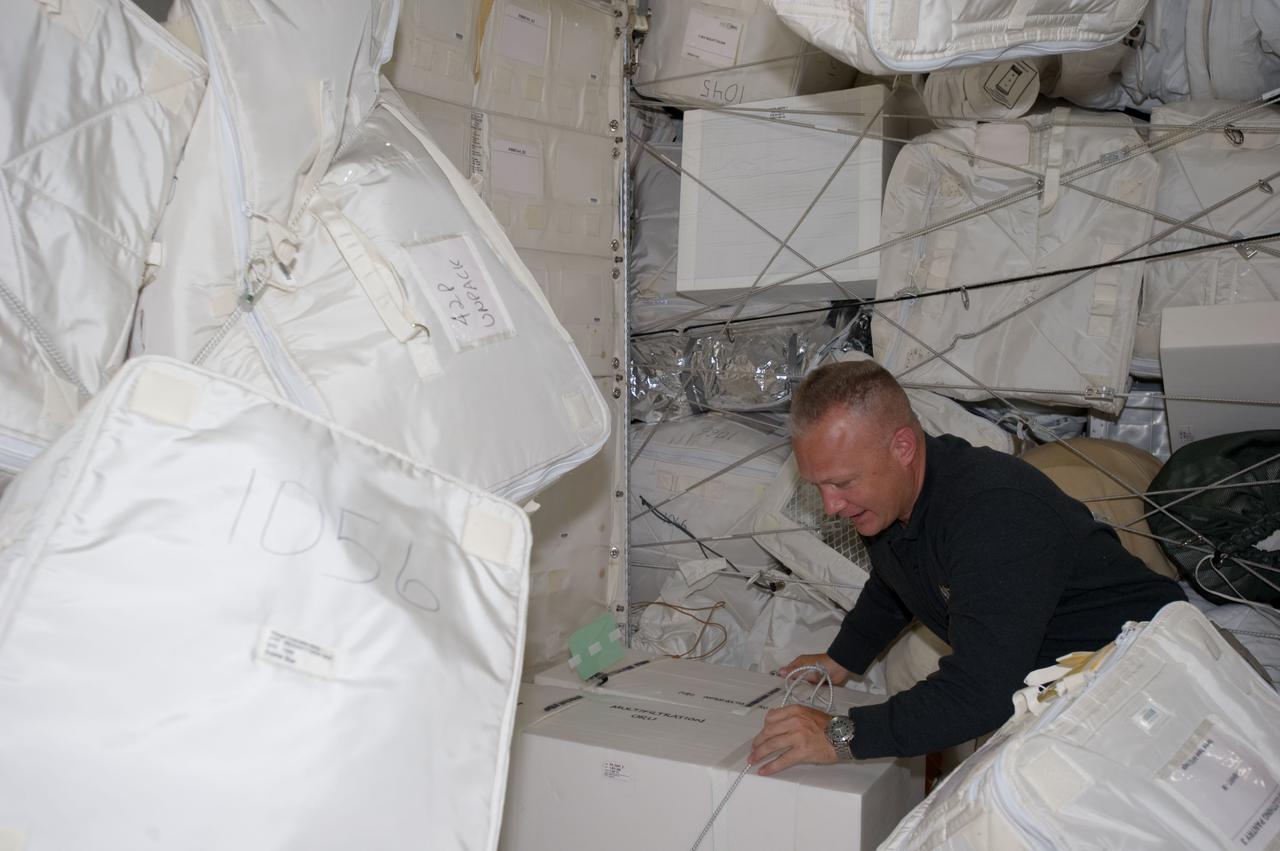
S135-E-007441 (11 July 2011) --- NASA astronaut Doug Hurley, STS-135 pilot, moves around supplies and equipment in the Leonardo Permanent Multipurpose Module (PMM) during the fourth day of flight for Atlantis' four person crew. This module is a component that joined the International Space Station complex after it was flown into space aboard the space shuttle Discovery on STS-133. Photo credit: NASA
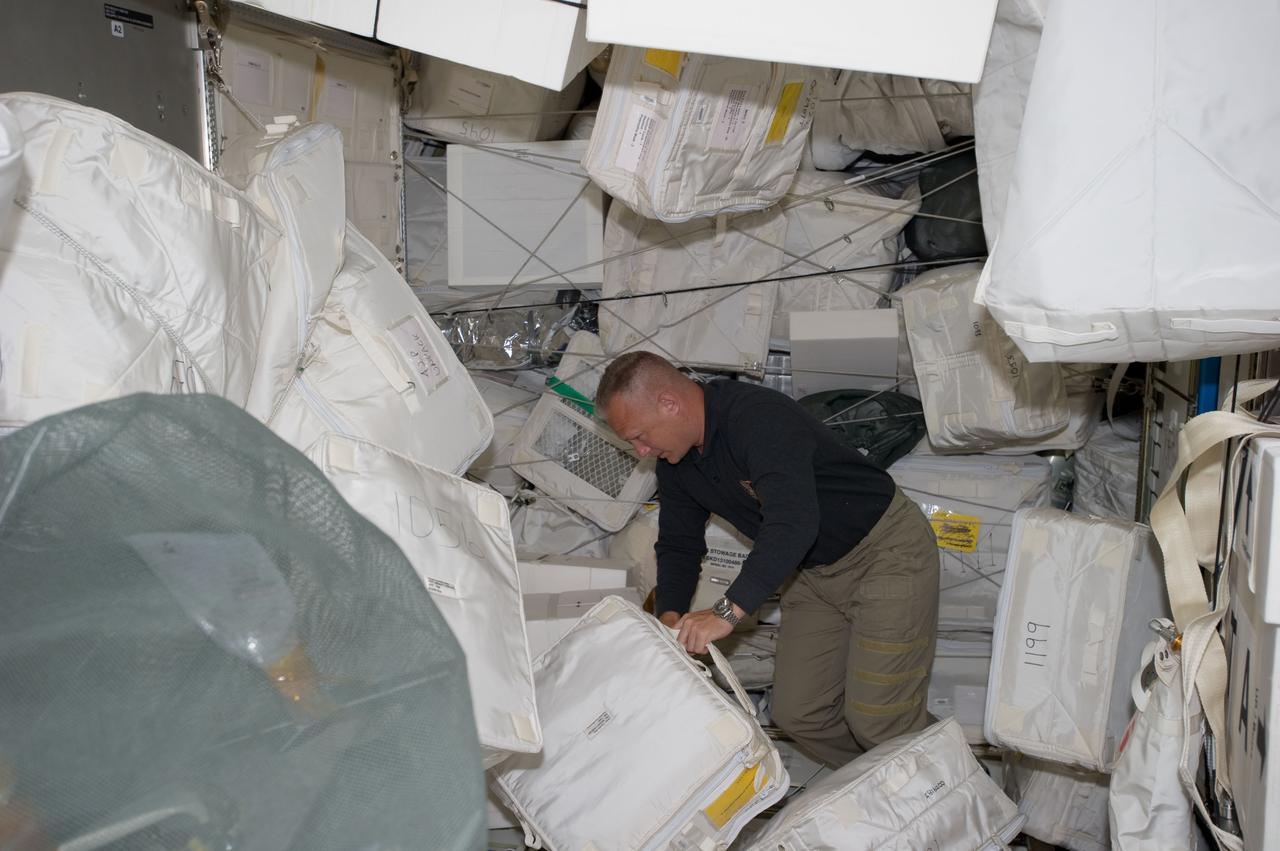
S135-E-007437 (11 July 2011) --- NASA astronaut Doug Hurley, STS-135 pilot, moves around supplies and equipment in the Leonardo Permanent Multipurpose Module (PMM) during the fourth day of flight for Atlantis' four person crew. This module is a component that joined the International Space Station complex after it was flown into space aboard the space shuttle Discovery on STS-133. Photo credit: NASA
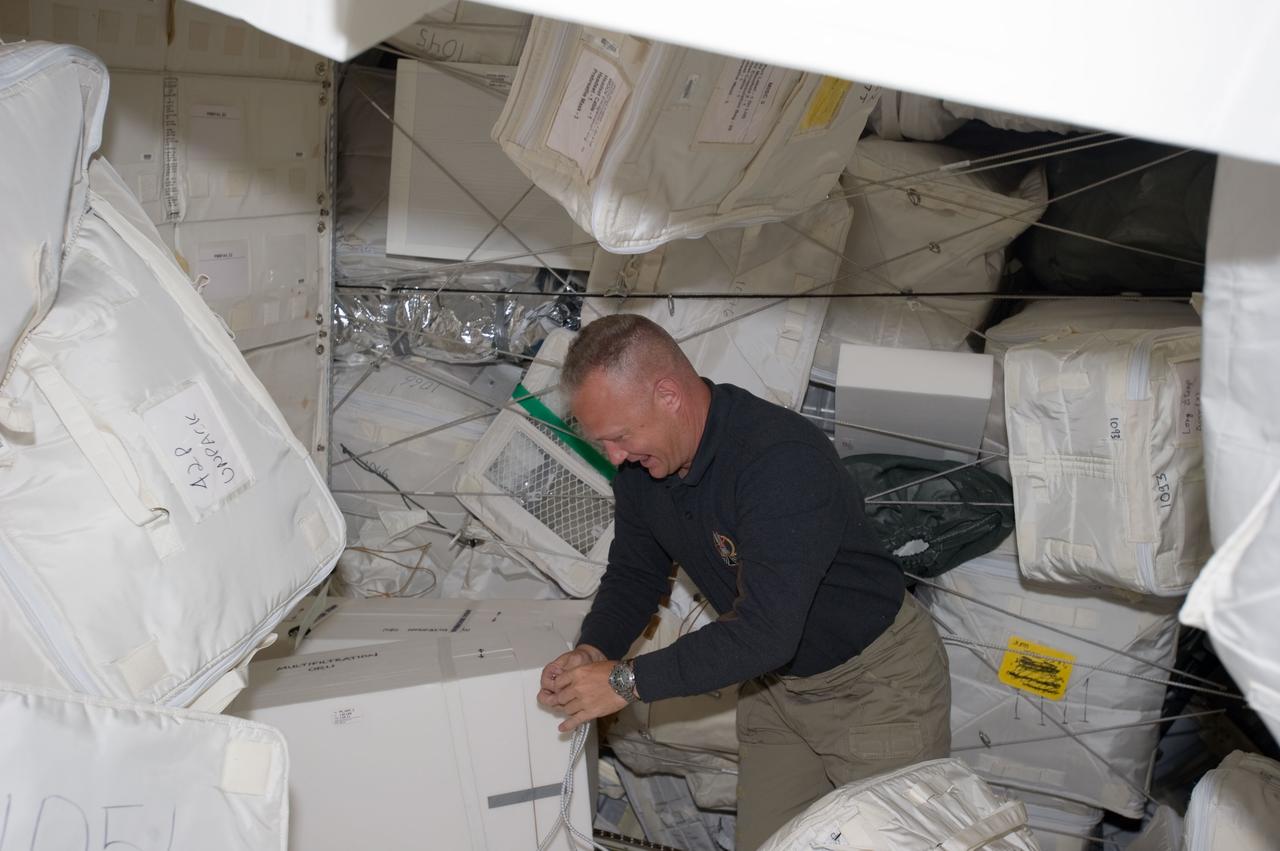
S135-E-007439 (11 July 2011) --- NASA astronaut Doug Hurley, STS-135 pilot, moves around supplies and equipment in the Leonardo Permanent Multipurpose Module (PMM) during the fourth day of flight for Atlantis' four person crew. This module is a component that joined the International Space Station complex after it was flown into space aboard the space shuttle Discovery on STS-133. Photo credit: NASA
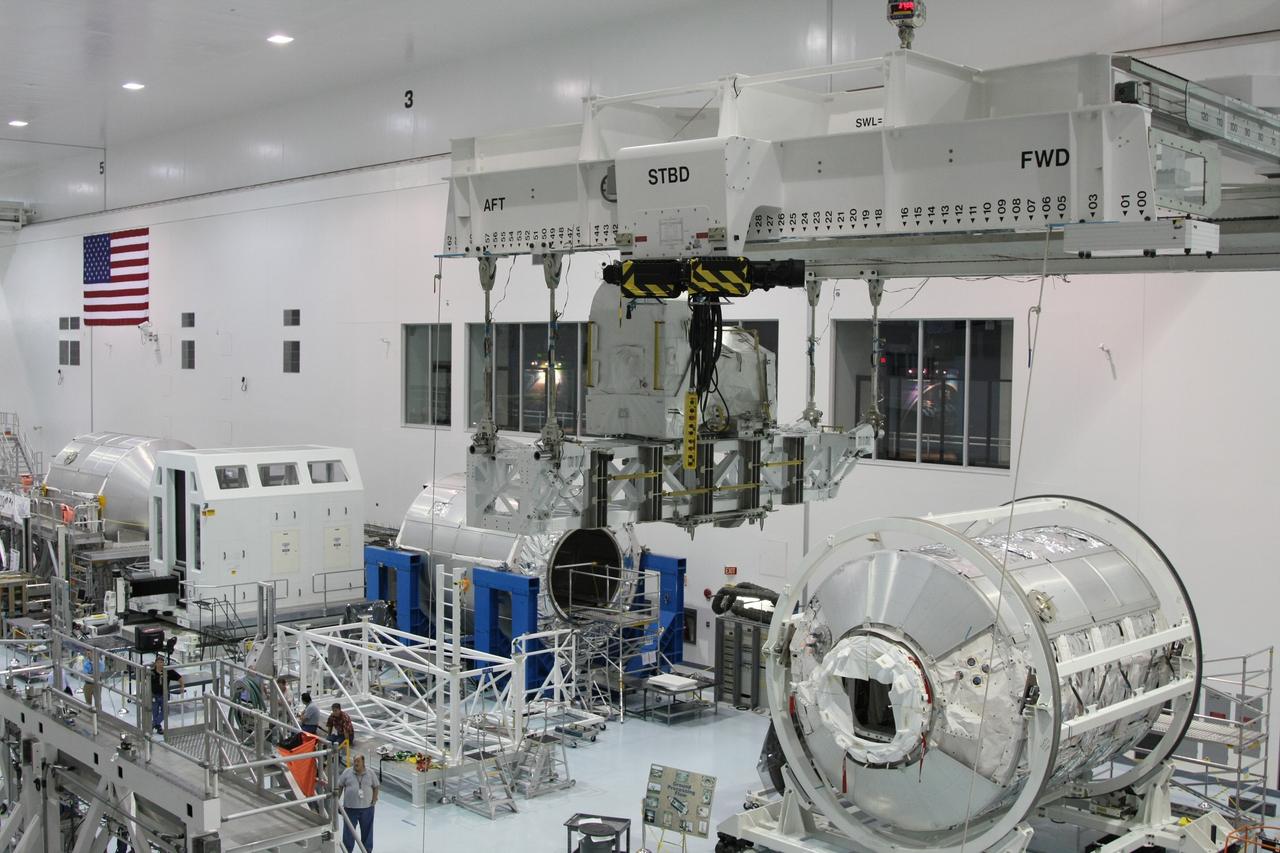
CAPE CANAVERAL, Fla. - The Lightweight Multi-Purpose Experiment Support Structure Carrier with the flexible hose rotary coupler is moved across the Space Station Processing Facility at NASA's Kennedy Space Center in Florida. It will be installed in the payload canister. The carrier is part of space shuttle Endeavour's payload on the STS-126 mission to the International Space Station. Endeavour will also carry the Multi-Purpose Logistics Module Leonardo holding supplies and equipment, including additional crew quarters, equipment for the regenerative life support system and spare hardware. Endeavour is targeted for launch on Nov. 14. Photo credit: NASA/Dimitri Gerondidakis
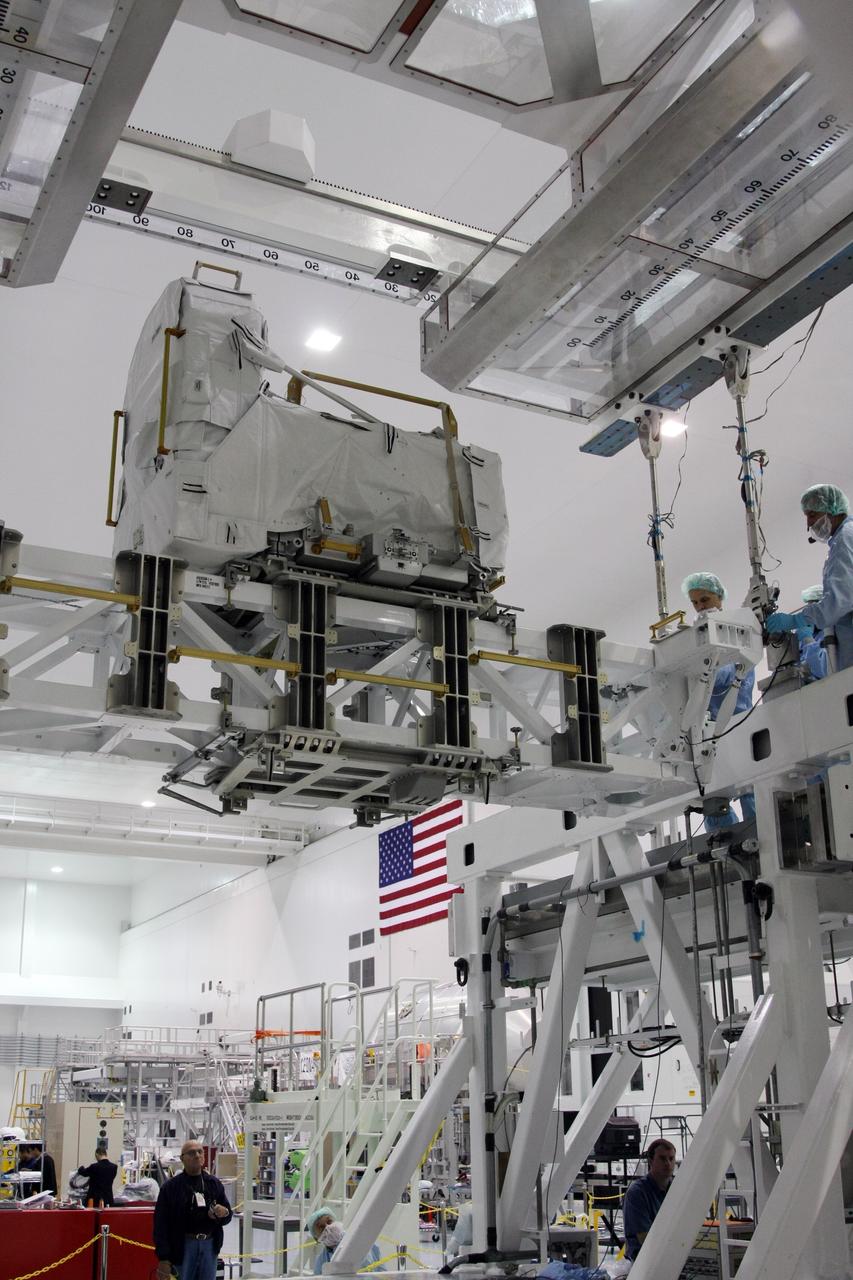
CAPE CANAVERAL, Fla. - The Lightweight Multi-Purpose Experiment Support Structure Carrier with the flexible hose rotary coupler is moved across the Space Station Processing Facility at NASA's Kennedy Space Center in Florida. It will be installed in the payload canister. The carrier is part of space shuttle Endeavour's payload on the STS-126 mission to the International Space Station. Endeavour will also carry the Multi-Purpose Logistics Module Leonardo holding supplies and equipment, including additional crew quarters, equipment for the regenerative life support system and spare hardware. Endeavour is targeted for launch on Nov. 14. Photo credit: NASA/Dimitri Gerondidakis
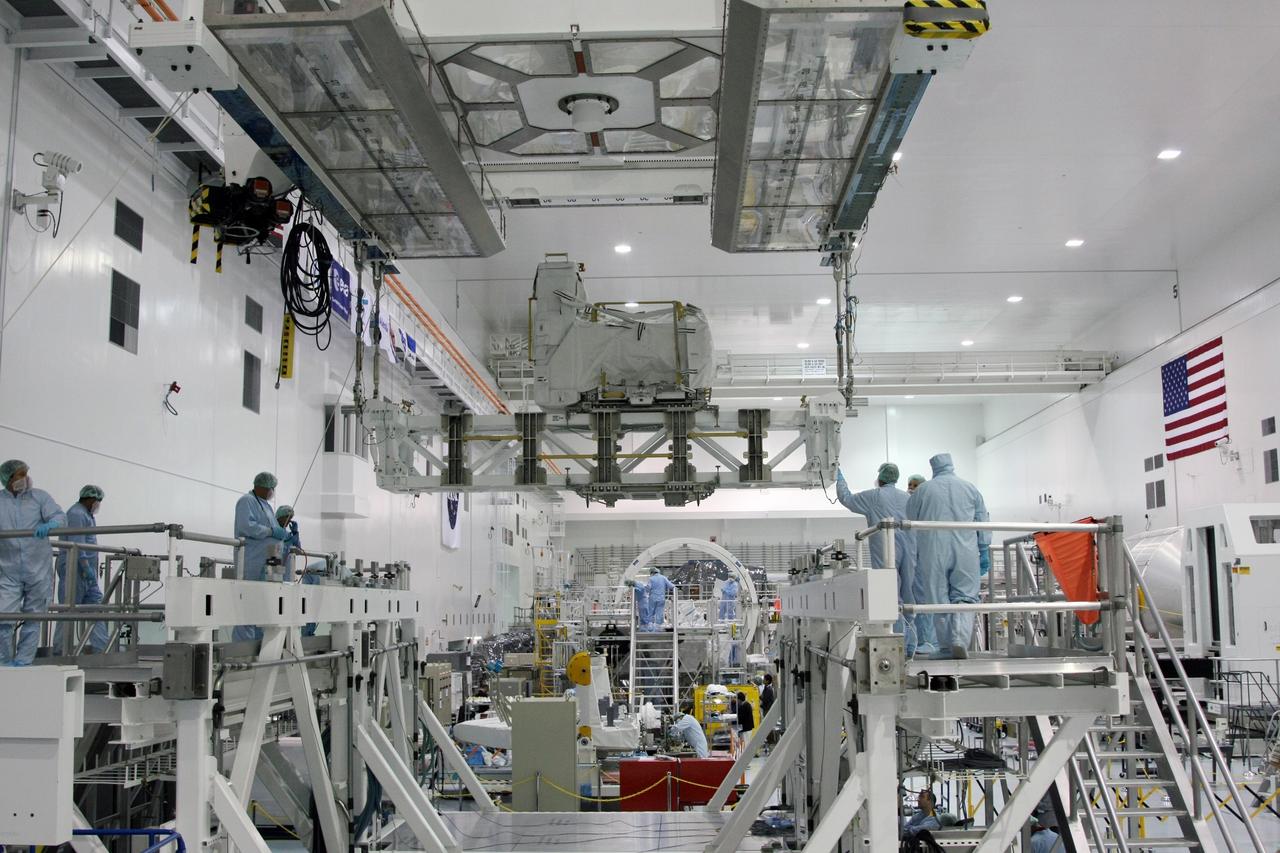
CAPE CANAVERAL, Fla. - The Lightweight Multi-Purpose Experiment Support Structure Carrier with the flexible hose rotary coupler is moved across the Space Station Processing Facility at NASA's Kennedy Space Center in Florida. It will be installed in the payload canister. The carrier is part of space shuttle Endeavour's payload on the STS-126 mission to the International Space Station. Endeavour will also carry the Multi-Purpose Logistics Module Leonardo holding supplies and equipment, including additional crew quarters, equipment for the regenerative life support system and spare hardware. Endeavour is targeted for launch on Nov. 14. Photo credit: NASA/Dimitri Gerondidakis
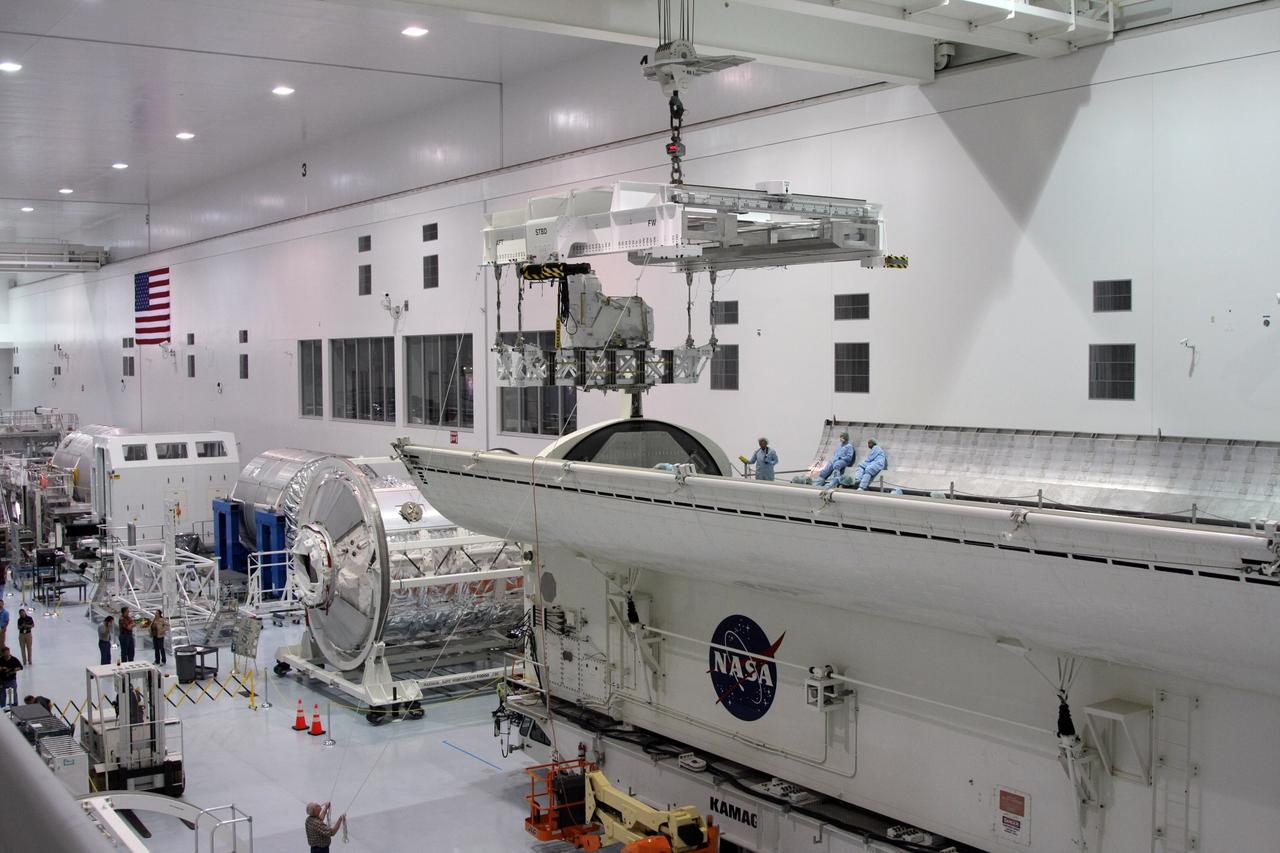
CAPE CANAVERAL, Fla. - The Lightweight Multi-Purpose Experiment Support Structure Carrier with the flexible hose rotary coupler is moved above the payload canister in the Space Station Processing Facility at NASA's Kennedy Space Center in Florida. The carrier is part of space shuttle Endeavour's payload on the STS-126 mission to the International Space Station. Endeavour will also carry the Multi-Purpose Logistics Module Leonardo holding supplies and equipment, including additional crew quarters, equipment for the regenerative life support system and spare hardware. Endeavour is targeted for launch on Nov. 14. Photo credit: NASA/Dimitri Gerondidakis
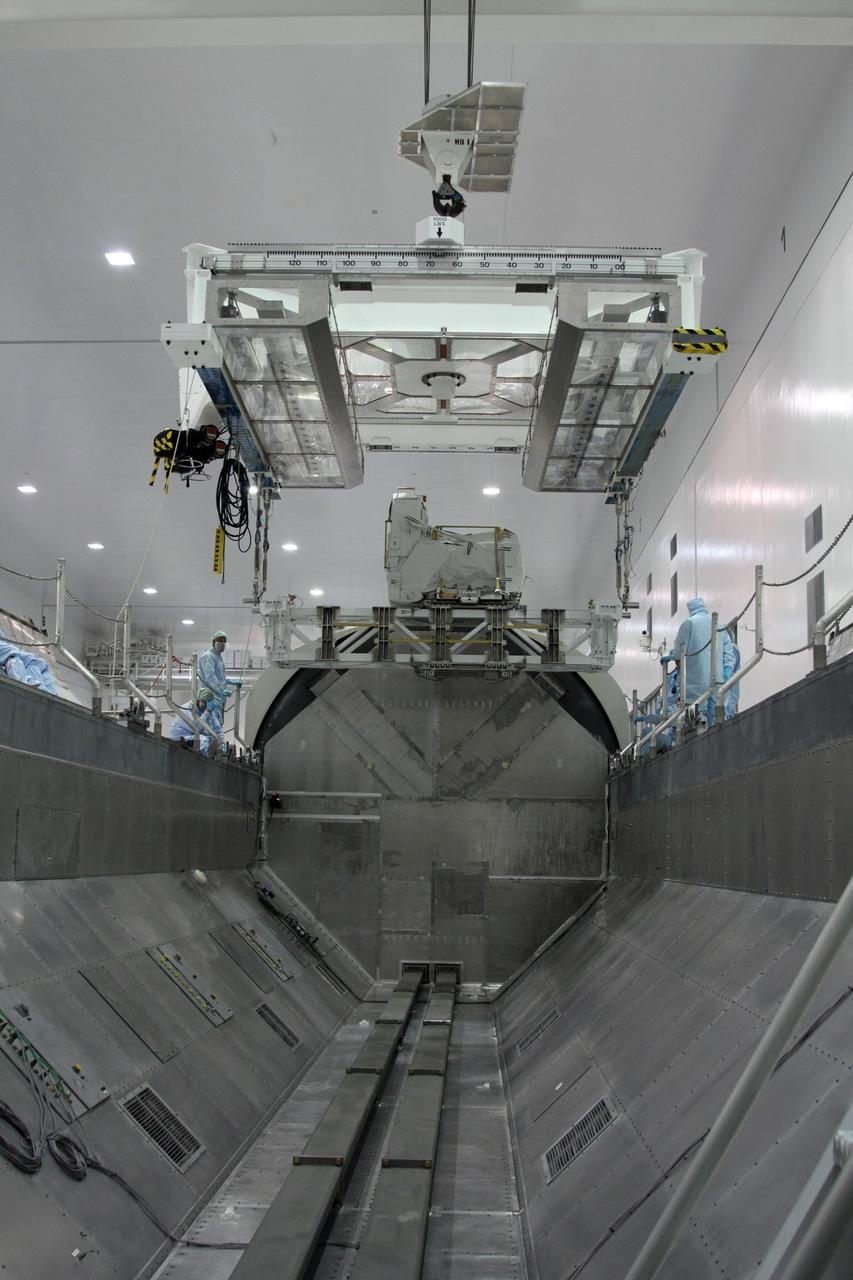
CAPE CANAVERAL, Fla. - The Lightweight Multi-Purpose Experiment Support Structure Carrier with the flexible hose rotary coupler is lowered into the payload canister in the Space Station Processing Facility at NASA's Kennedy Space Center in Florida. The carrier is part of space shuttle Endeavour's payload on the STS-126 mission to the International Space Station. Endeavour will also carry the Multi-Purpose Logistics Module Leonardo holding supplies and equipment, including additional crew quarters, equipment for the regenerative life support system and spare hardware. Endeavour is targeted for launch on Nov. 14. Photo credit: NASA/Dimitri Gerondidakis

CAPE CANAVERAL, Fla. - The Lightweight Multi-Purpose Experiment Support Structure Carrier with the flexible hose rotary coupler is installed in the payload canister in the Space Station Processing Facility at NASA's Kennedy Space Center in Florida. The carrier is part of space shuttle Endeavour's payload on the STS-126 mission to the International Space Station. Endeavour will also carry the Multi-Purpose Logistics Module Leonardo holding supplies and equipment, including additional crew quarters, equipment for the regenerative life support system and spare hardware. Endeavour is targeted for launch on Nov. 14. Photo credit: NASA/Dimitri Gerondidakis

CAPE CANAVERAL, Fla. - The Lightweight Multi-Purpose Experiment Support Structure Carrier with the flexible hose rotary coupler is weighed in the Space Station Processing Facility at NASA's Kennedy Space Center in Florida. The carrier is part of space shuttle Endeavour's payload on the STS-126 mission to the International Space Station. Endeavour will also carry the Multi-Purpose Logistics Module Leonardo holding supplies and equipment, including additional crew quarters, equipment for the regenerative life support system and spare hardware. Endeavour is targeted for launch on Nov. 14. Photo credit: NASA/Dimitri Gerondidakis
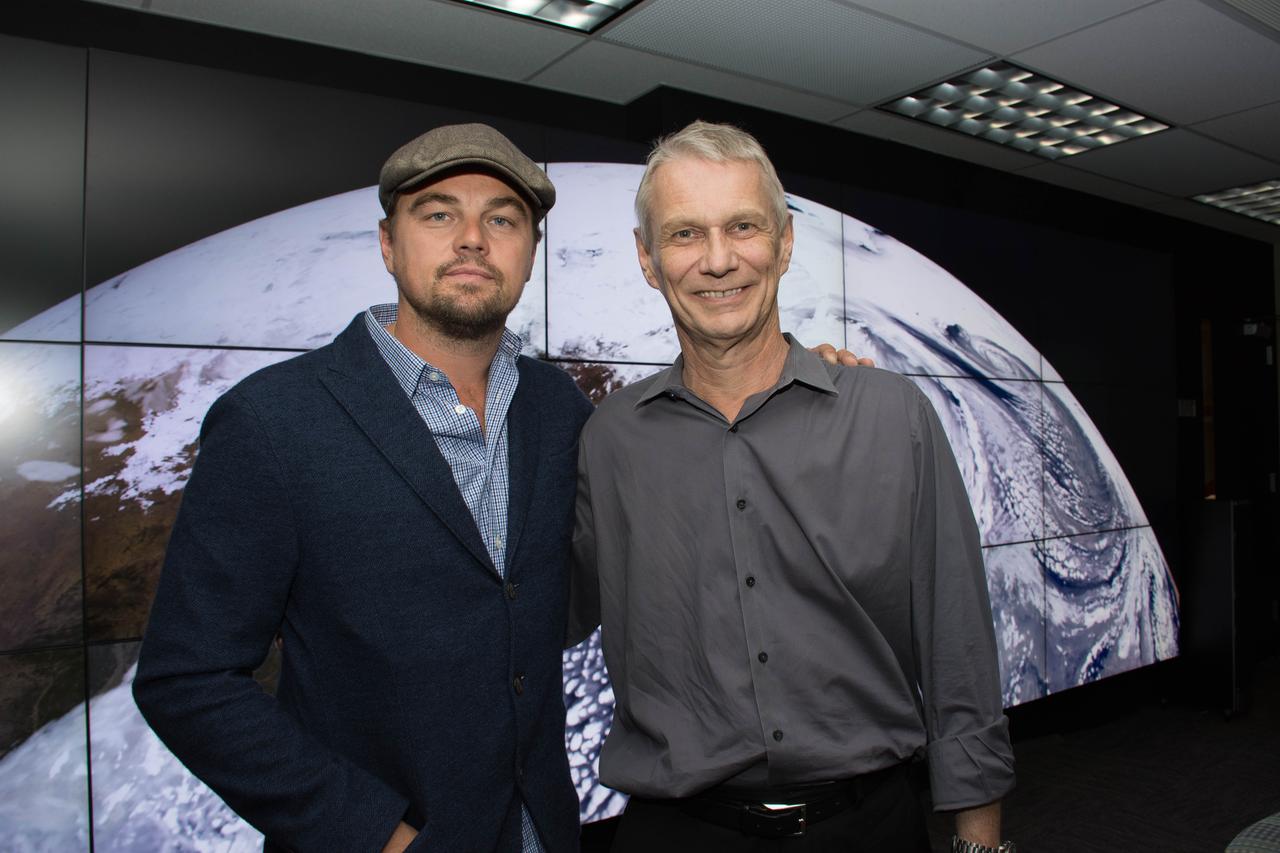
Academy Award®- winning actor and environmental activist Leonardo DiCaprio visited NASA’s Goddard Space Flight Center in Greenbelt, Maryland on Saturday, April 23, 2016. During his visit, Mr. DiCaprio interviewed Dr. Piers Sellers, an Earth scientist, former astronaut and current deputy director of Goddard’s Sciences and Exploration Directorate. The two discussed the different missions NASA has underway to study changes in the Earth’s atmosphere, water and land masses for a climate change documentary that Mr. DiCaprio has in production. Using a wall-size, high-definition display system that shows visual representations based on actual science data, Mr. DiCaprio and Dr. Sellers discussed data results from NASA’s fleet of satellites in Earth’s orbit. During his visit, Mr. DiCaprio also visited the facility holding NASA’s James Webb Space Telescope that is being developed as a large infrared telescope with a 6.5-meter primary mirror. The telescope will be launched on an Ariane 5 rocket from French Guiana in October of 2018, and will be a premier observatory of the next decade, serving thousands of astronomers worldwide. Credit: NASA/Goddard/Rebecca Roth <b><a href="http://www.nasa.gov/audience/formedia/features/MP_Photo_Guidelines.html" rel="nofollow">NASA image use policy.</a></b> <b><a href="http://www.nasa.gov/centers/goddard/home/index.html" rel="nofollow">NASA Goddard Space Flight Center</a></b> enables NASA’s mission through four scientific endeavors: Earth Science, Heliophysics, Solar System Exploration, and Astrophysics. Goddard plays a leading role in NASA’s accomplishments by contributing compelling scientific knowledge to advance the Agency’s mission. <b>Follow us on <a href="http://twitter.com/NASAGoddardPix" rel="nofollow">Twitter</a></b> <b>Like us on <a href="http://www.facebook.com/pages/Greenbelt-MD/NASA-Goddard/395013845897?ref=tsd" rel="nofollow">Facebook</a></b> <b>Find us on <a href="http://instagrid.me/nasagoddard/?vm=grid" rel="nofollow">Instagram</a></b>
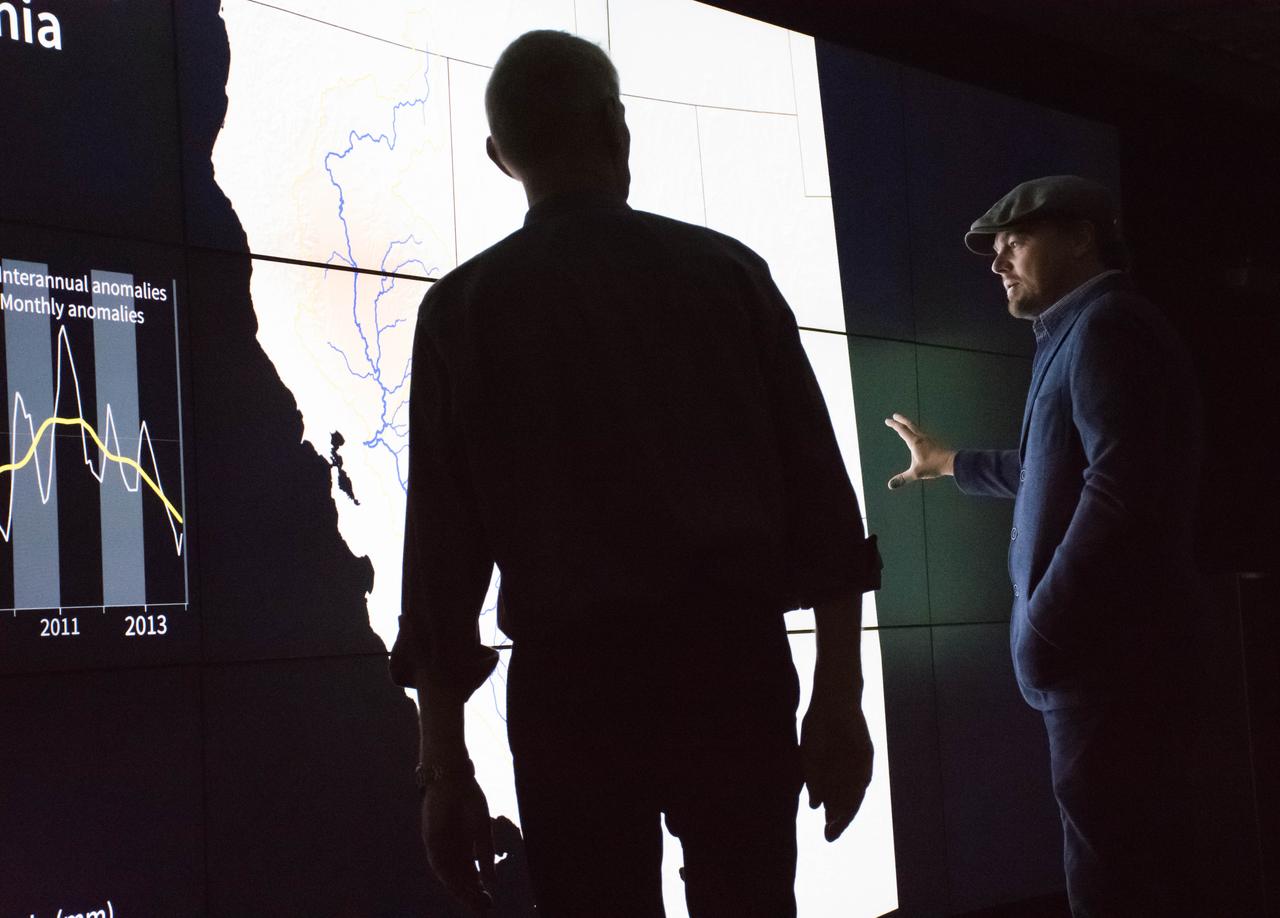
Academy Award®- winning actor and environmental activist Leonardo DiCaprio visited NASA’s Goddard Space Flight Center in Greenbelt, Maryland on Saturday, April 23, 2016. During his visit, Mr. DiCaprio interviewed Dr. Piers Sellers, an Earth scientist, former astronaut and current deputy director of Goddard’s Sciences and Exploration Directorate. The two discussed the different missions NASA has underway to study changes in the Earth’s atmosphere, water and land masses for a climate change documentary that Mr. DiCaprio has in production. Using a wall-size, high-definition display system that shows visual representations based on actual science data, Mr. DiCaprio and Dr. Sellers discussed data results from NASA’s fleet of satellites in Earth’s orbit. During his visit, Mr. DiCaprio also visited the facility holding NASA’s James Webb Space Telescope that is being developed as a large infrared telescope with a 6.5-meter primary mirror. The telescope will be launched on an Ariane 5 rocket from French Guiana in October of 2018, and will be a premier observatory of the next decade, serving thousands of astronomers worldwide. Credit: NASA/Goddard/Rebecca Roth <b><a href="http://www.nasa.gov/audience/formedia/features/MP_Photo_Guidelines.html" rel="nofollow">NASA image use policy.</a></b> <b><a href="http://www.nasa.gov/centers/goddard/home/index.html" rel="nofollow">NASA Goddard Space Flight Center</a></b> enables NASA’s mission through four scientific endeavors: Earth Science, Heliophysics, Solar System Exploration, and Astrophysics. Goddard plays a leading role in NASA’s accomplishments by contributing compelling scientific knowledge to advance the Agency’s mission. <b>Follow us on <a href="http://twitter.com/NASAGoddardPix" rel="nofollow">Twitter</a></b> <b>Like us on <a href="http://www.facebook.com/pages/Greenbelt-MD/NASA-Goddard/395013845897?ref=tsd" rel="nofollow">Facebook</a></b> <b>Find us on <a href="http://instagrid.me/nasagoddard/?vm=grid" rel="nofollow">Instagram</a></b>
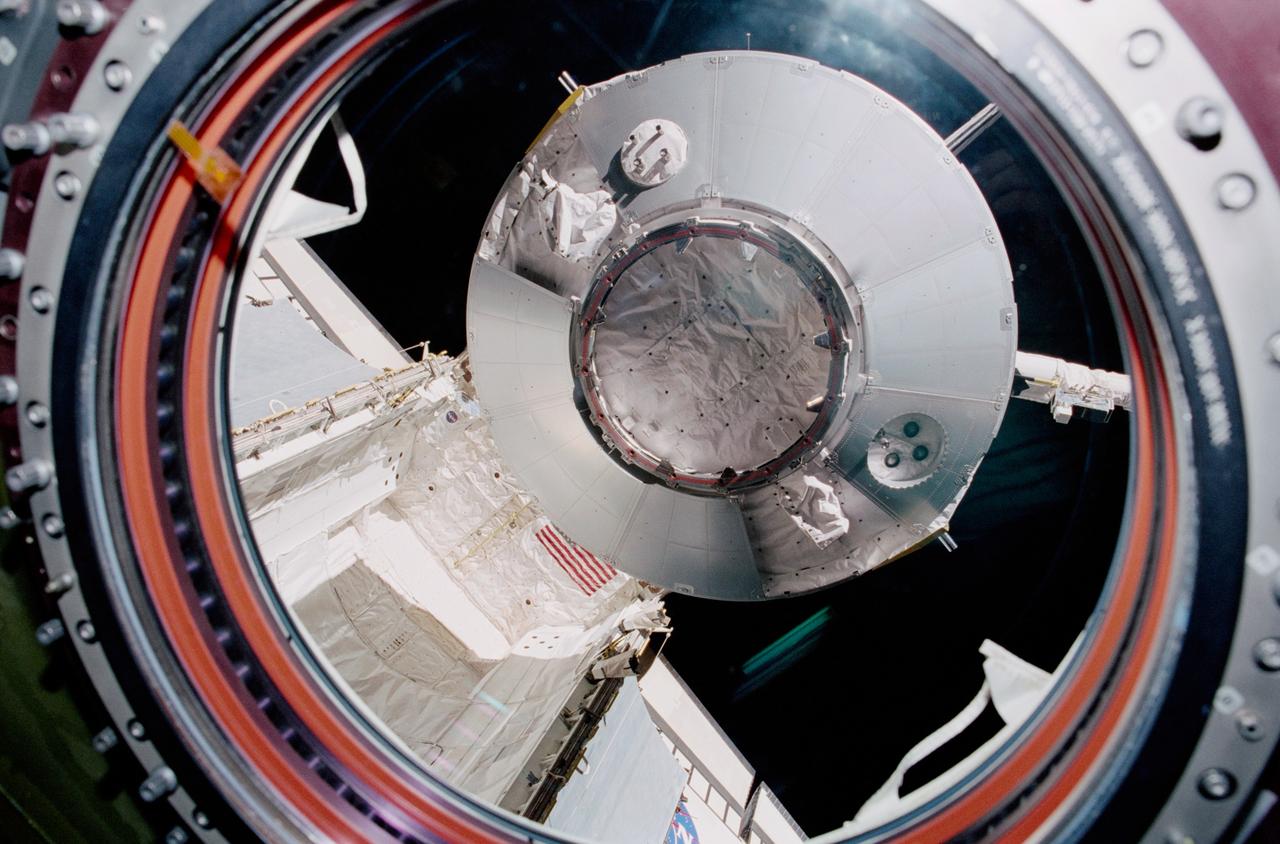
STS102-340-028 (8-21 March 2001) --- The Leonardo Multi-Purpose Logistics Module (MPLM) is photographed by a crew member through an International Space Station (ISS) window. Leonardo which was built by the Italian Space Agency (ASI), is the first of three such pressurized modules that will serve as the International Space Station’s “moving vans,” carrying laboratory racks filled with equipment, experiments and supplies to and from the station aboard the space shuttle.
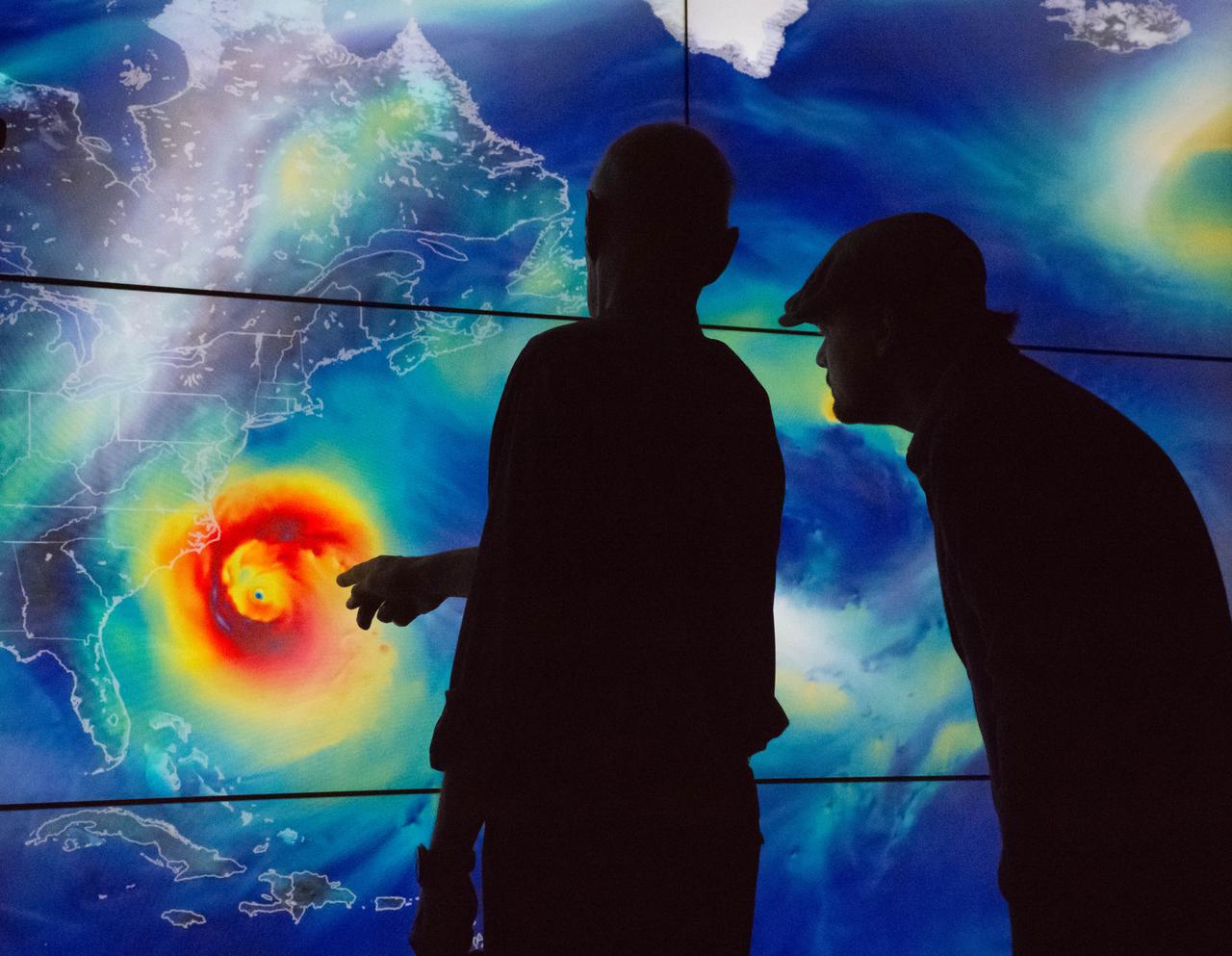
Academy Award®- winning actor and environmental activist Leonardo DiCaprio visited NASA’s Goddard Space Flight Center in Greenbelt, Maryland on Saturday, April 23, 2016. During his visit, Mr. DiCaprio interviewed Dr. Piers Sellers, an Earth scientist, former astronaut and current deputy director of Goddard’s Sciences and Exploration Directorate. The two discussed the different missions NASA has underway to study changes in the Earth’s atmosphere, water and land masses for a climate change documentary that Mr. DiCaprio has in production. Using a wall-size, high-definition display system that shows visual representations based on actual science data, Mr. DiCaprio and Dr. Sellers discussed data results from NASA’s fleet of satellites in Earth’s orbit. The visual shows Hurricane Sandy. The visual uses data from Goddard Earth Observing System Model, Version 5 (GEOS-5) to simulate surface wind speeds across the Atlantic during Sandy’s lifecycle. <a href="http://svs.gsfc.nasa.gov/cgi-bin/details.cgi?aid=30465" rel="nofollow">svs.gsfc.nasa.gov/cgi-bin/details.cgi?aid=30465</a> During his visit, Mr. DiCaprio also visited the facility holding NASA’s James Webb Space Telescope that is being developed as a large infrared telescope with a 6.5-meter primary mirror. The telescope will be launched on an Ariane 5 rocket from French Guiana in October of 2018, and will be a premier observatory of the next decade, serving thousands of astronomers worldwide. Credit: NASA/Goddard/Rebecca Roth <b><a href="http://www.nasa.gov/audience/formedia/features/MP_Photo_Guidelines.html" rel="nofollow">NASA image use policy.</a></b> <b><a href="http://www.nasa.gov/centers/goddard/home/index.html" rel="nofollow">NASA Goddard Space Flight Center</a></b> enables NASA’s mission through four scientific endeavors: Earth Science, Heliophysics, Solar System Exploration, and Astrophysics. Goddard plays a leading role in NASA’s accomplishments by contributing compelling scientific knowledge to advance the Agency’s mission. <b>Follow us on <a href="http://twitter.com/NASAGoddardPix" rel="nofollow">Twitter</a></b> <b>Like us on <a href="http://www.facebook.com/pages/Greenbelt-MD/NASA-Goddard/395013845897?ref=tsd" rel="nofollow">Facebook</a></b> <b>Find us on <a href="http://instagrid.me/nasagoddard/?vm=grid" rel="nofollow">Instagram</a></b>
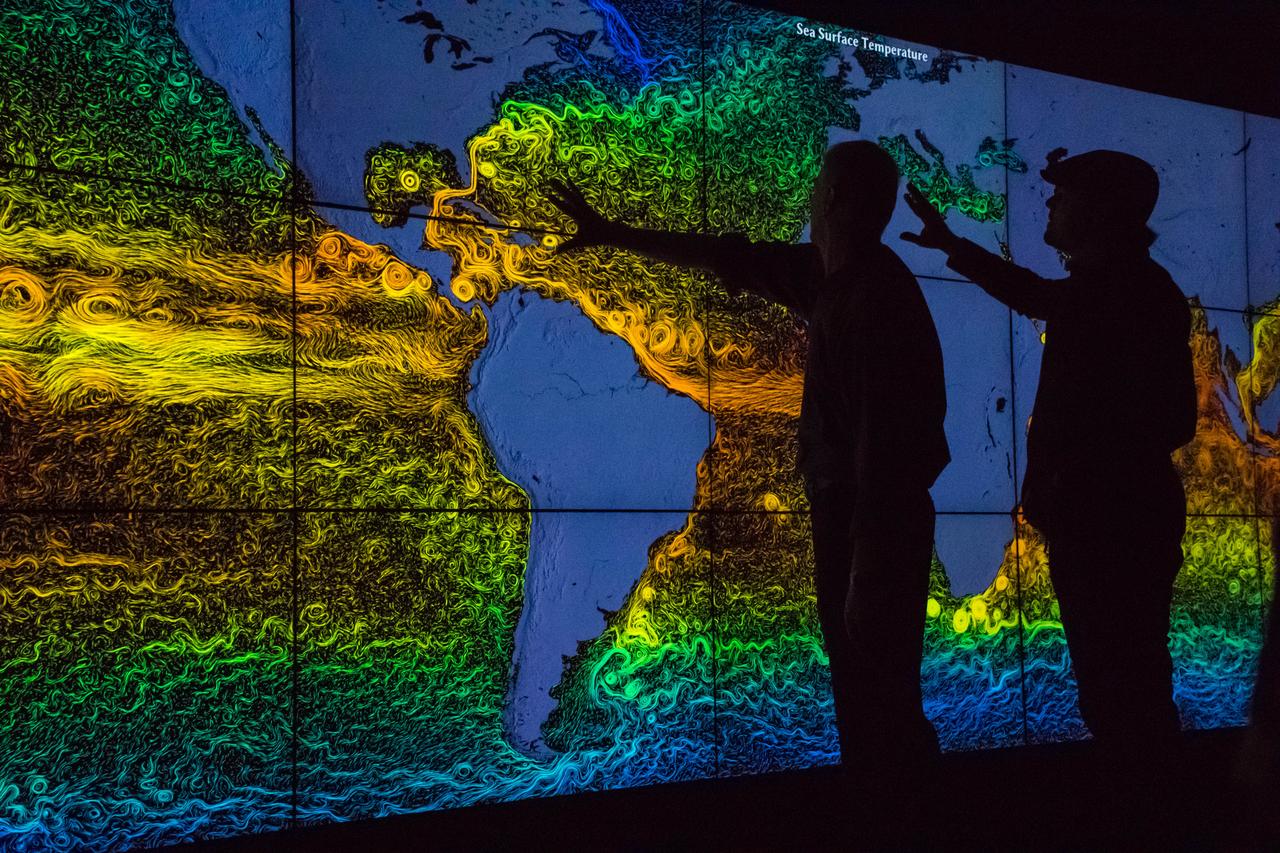
Academy Award®- winning actor and environmental activist Leonardo DiCaprio visited NASA’s Goddard Space Flight Center in Greenbelt, Maryland on Saturday, April 23, 2016. During his visit, Mr. DiCaprio interviewed Dr. Piers Sellers, an Earth scientist, former astronaut and current deputy director of Goddard’s Sciences and Exploration Directorate. The two discussed the different missions NASA has underway to study changes in the Earth’s atmosphere, water and land masses for a climate change documentary that Mr. DiCaprio has in production. Using a wall-size, high-definition display system that shows visual representations based on actual science data, Mr. DiCaprio and Dr. Sellers discussed data results from NASA’s fleet of satellites in Earth’s orbit. The background image showing global sea surface circulation colored by temperature where reds are warm areas (32 degrees Celsius) and blues are cold regions (0 degrees Celsius). The data used for this visual is a joint MIT/JPL project called Estimating the Circulation and Climate of the Ocean, Phase II (ECCO2). For more info on this visual, <a href="http://svs.gsfc.nasa.gov/cgi-bin/details.cgi?aid=3912" rel="nofollow">svs.gsfc.nasa.gov/cgi-bin/details.cgi?aid=3912</a> During his visit, Mr. DiCaprio also visited the facility holding NASA’s James Webb Space Telescope that is being developed as a large infrared telescope with a 6.5-meter primary mirror. The telescope will be launched on an Ariane 5 rocket from French Guiana in October of 2018, and will be a premier observatory of the next decade, serving thousands of astronomers worldwide. Credit: NASA/Goddard/Rebecca Roth <b><a href="http://www.nasa.gov/audience/formedia/features/MP_Photo_Guidelines.html" rel="nofollow">NASA image use policy.</a></b> <b><a href="http://www.nasa.gov/centers/goddard/home/index.html" rel="nofollow">NASA Goddard Space Flight Center</a></b> enables NASA’s mission through four scientific endeavors: Earth Science, Heliophysics, Solar System Exploration, and Astrophysics. Goddard plays a leading role in NASA’s accomplishments by contributing compelling scientific knowledge to advance the Agency’s mission. <b>Follow us on <a href="http://twitter.com/NASAGoddardPix" rel="nofollow">Twitter</a></b> <b>Like us on <a href="http://www.facebook.com/pages/Greenbelt-MD/NASA-Goddard/395013845897?ref=tsd" rel="nofollow">Facebook</a></b> <b>Find us on <a href="http://instagrid.me/nasagoddard/?vm=grid" rel="nofollow">Instagram</a></b>
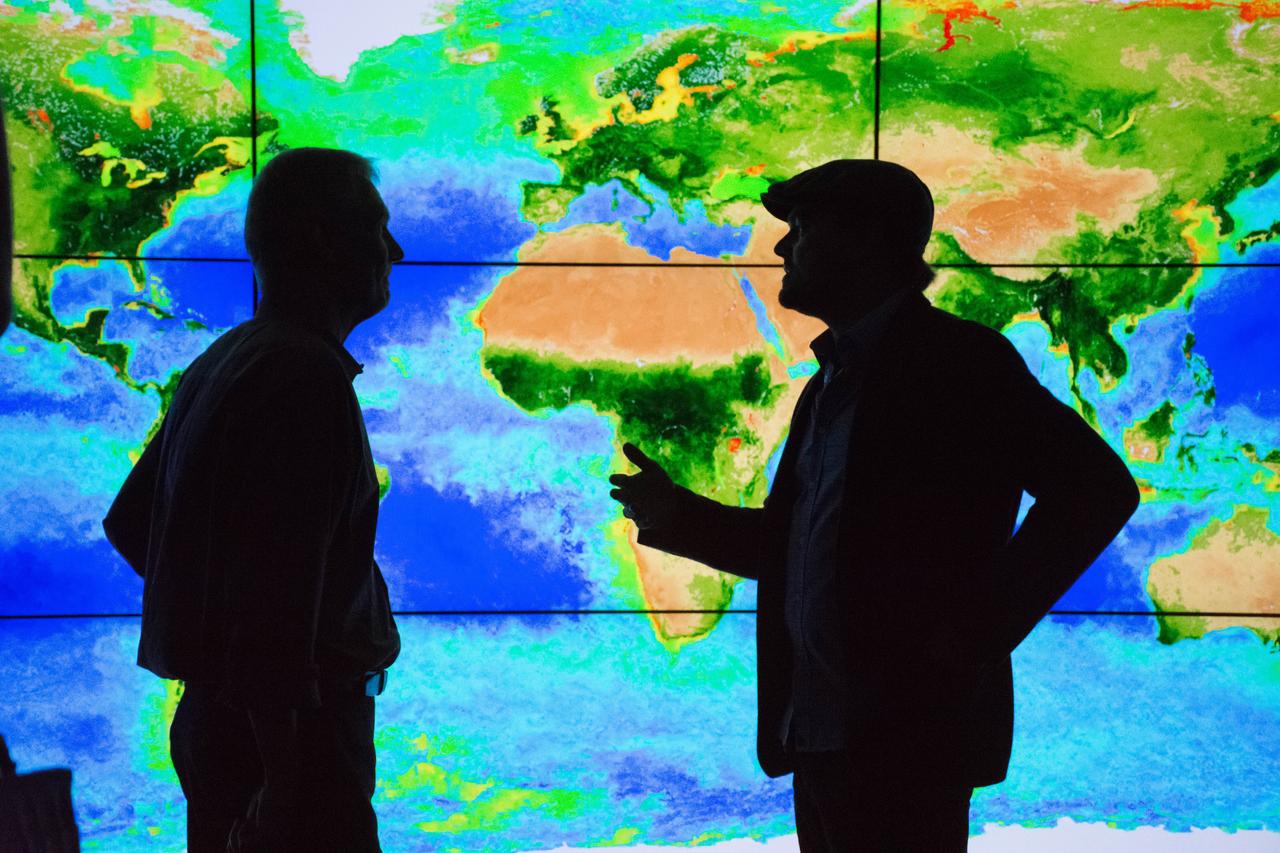
Academy Award®- winning actor and environmental activist Leonardo DiCaprio visited NASA’s Goddard Space Flight Center in Greenbelt, Maryland on Saturday, April 23, 2016. During his visit, Mr. DiCaprio interviewed Dr. Piers Sellers, an Earth scientist, former astronaut and current deputy director of Goddard’s Sciences and Exploration Directorate. The two discussed the different missions NASA has underway to study changes in the Earth’s atmosphere, water and land masses for a climate change documentary that Mr. DiCaprio has in production. Using a wall-size, high-definition display system that shows visual representations based on actual science data, Mr. DiCaprio and Dr. Sellers discussed data results from NASA’s fleet of satellites in Earth’s orbit. The background visual shows the biosphere with data from a NASA satellite instrument called the Sea-viewing Wide Field-of-View Sensor (SeaWiFS). <a href="http://svs.gsfc.nasa.gov/cgi-bin/details.cgi?aid=10704" rel="nofollow">svs.gsfc.nasa.gov/cgi-bin/details.cgi?aid=10704</a> During his visit, Mr. DiCaprio also visited the facility holding NASA’s James Webb Space Telescope that is being developed as a large infrared telescope with a 6.5-meter primary mirror. The telescope will be launched on an Ariane 5 rocket from French Guiana in October of 2018, and will be a premier observatory of the next decade, serving thousands of astronomers worldwide. Credit: NASA/Goddard/Rebecca Roth <b><a href="http://www.nasa.gov/audience/formedia/features/MP_Photo_Guidelines.html" rel="nofollow">NASA image use policy.</a></b> <b><a href="http://www.nasa.gov/centers/goddard/home/index.html" rel="nofollow">NASA Goddard Space Flight Center</a></b> enables NASA’s mission through four scientific endeavors: Earth Science, Heliophysics, Solar System Exploration, and Astrophysics. Goddard plays a leading role in NASA’s accomplishments by contributing compelling scientific knowledge to advance the Agency’s mission. <b>Follow us on <a href="http://twitter.com/NASAGoddardPix" rel="nofollow">Twitter</a></b> <b>Like us on <a href="http://www.facebook.com/pages/Greenbelt-MD/NASA-Goddard/395013845897?ref=tsd" rel="nofollow">Facebook</a></b> <b>Find us on <a href="http://instagrid.me/nasagoddard/?vm=grid" rel="nofollow">Instagram</a></b>
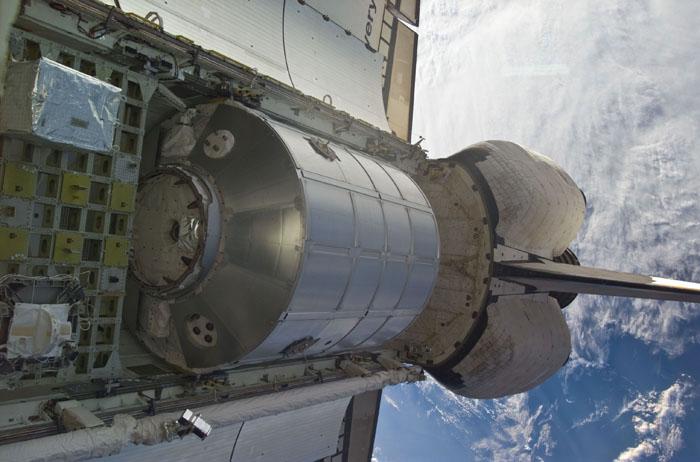
STS102-E-5095 (10 March 2001) --- The Leonardo Multi Purpose Logistics Module rests in Discovery's payload bay in this view taken from the station by a crew member using a digital still camera.
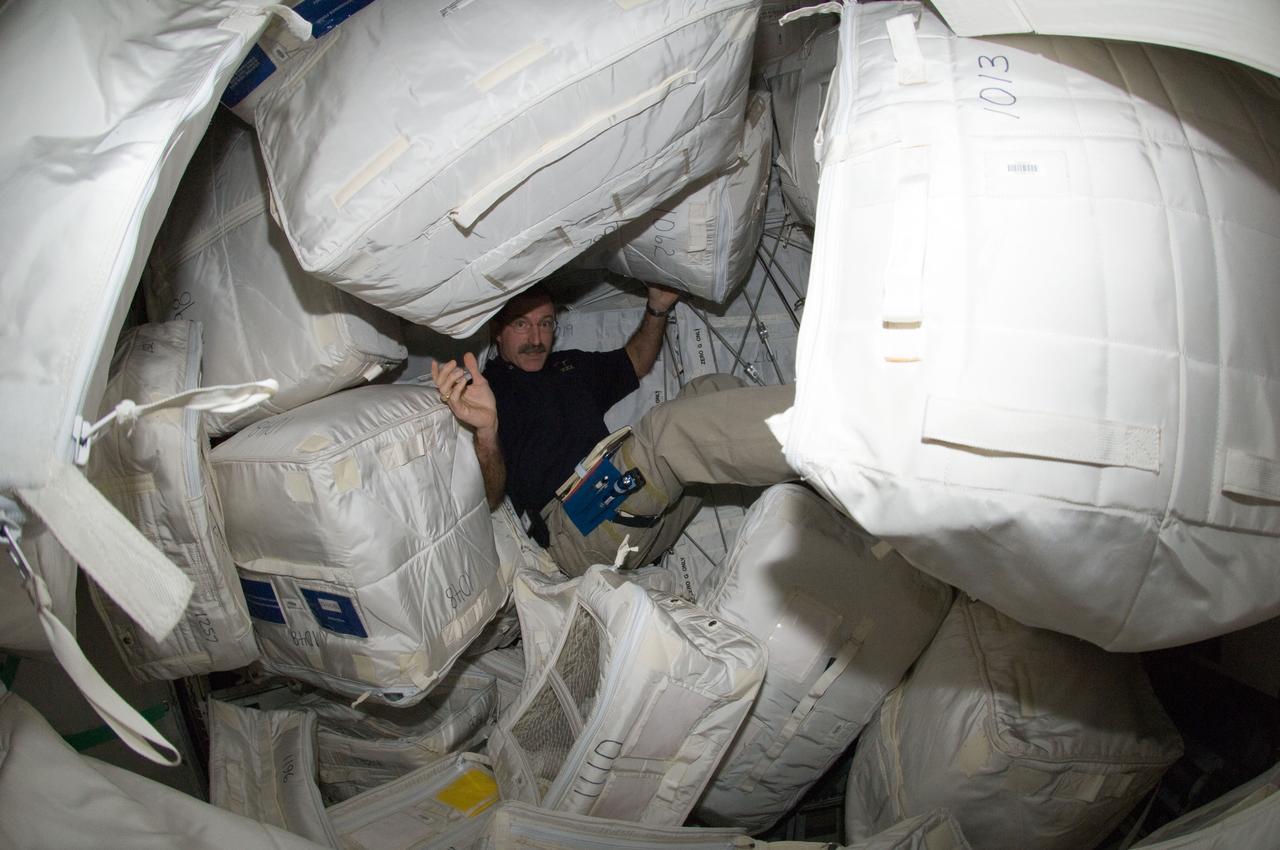
ISS030-E-115935 (2 March 2012) --- NASA astronaut Dan Burbank, Expedition 30 commander, is pictured among stowage containers in the Leonardo Permanent Multipurpose Module (PMM) of the International Space Station.
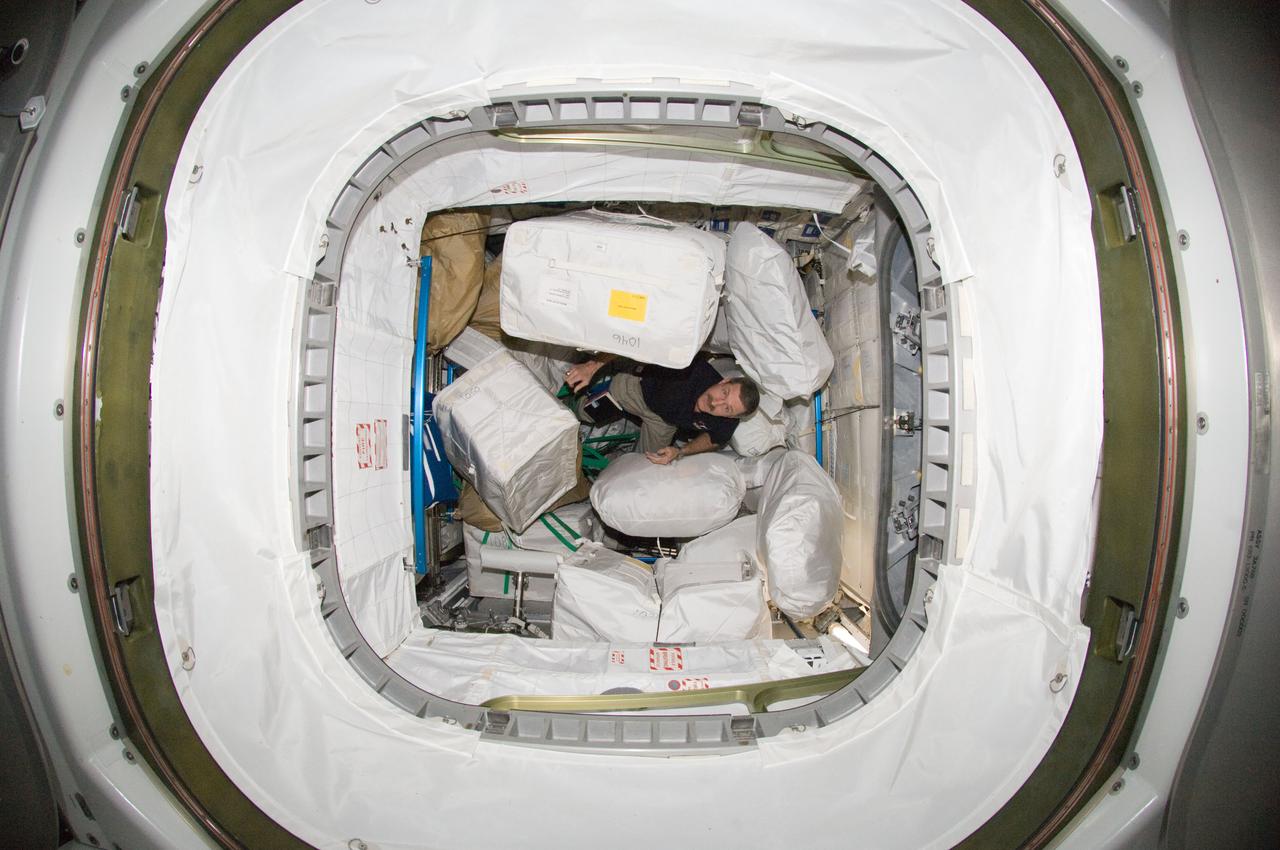
ISS030-E-115930 (2 March 2012) --- NASA astronaut Dan Burbank, Expedition 30 commander, is pictured among stowage containers in the Leonardo Permanent Multipurpose Module (PMM) of the International Space Station.
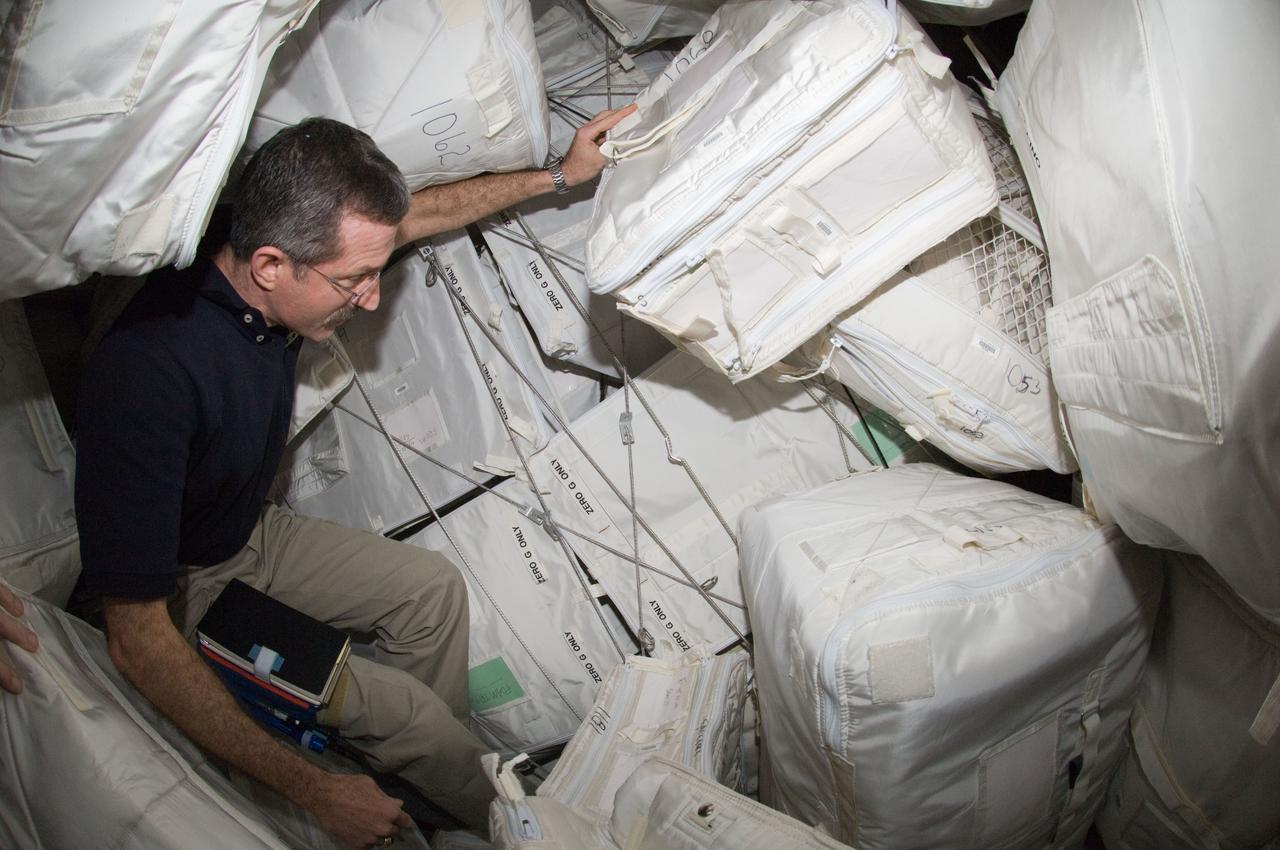
ISS030-E-115939 (2 March 2012) --- NASA astronaut Dan Burbank, Expedition 30 commander, is pictured among stowage containers in the Leonardo Permanent Multipurpose Module (PMM) of the International Space Station.
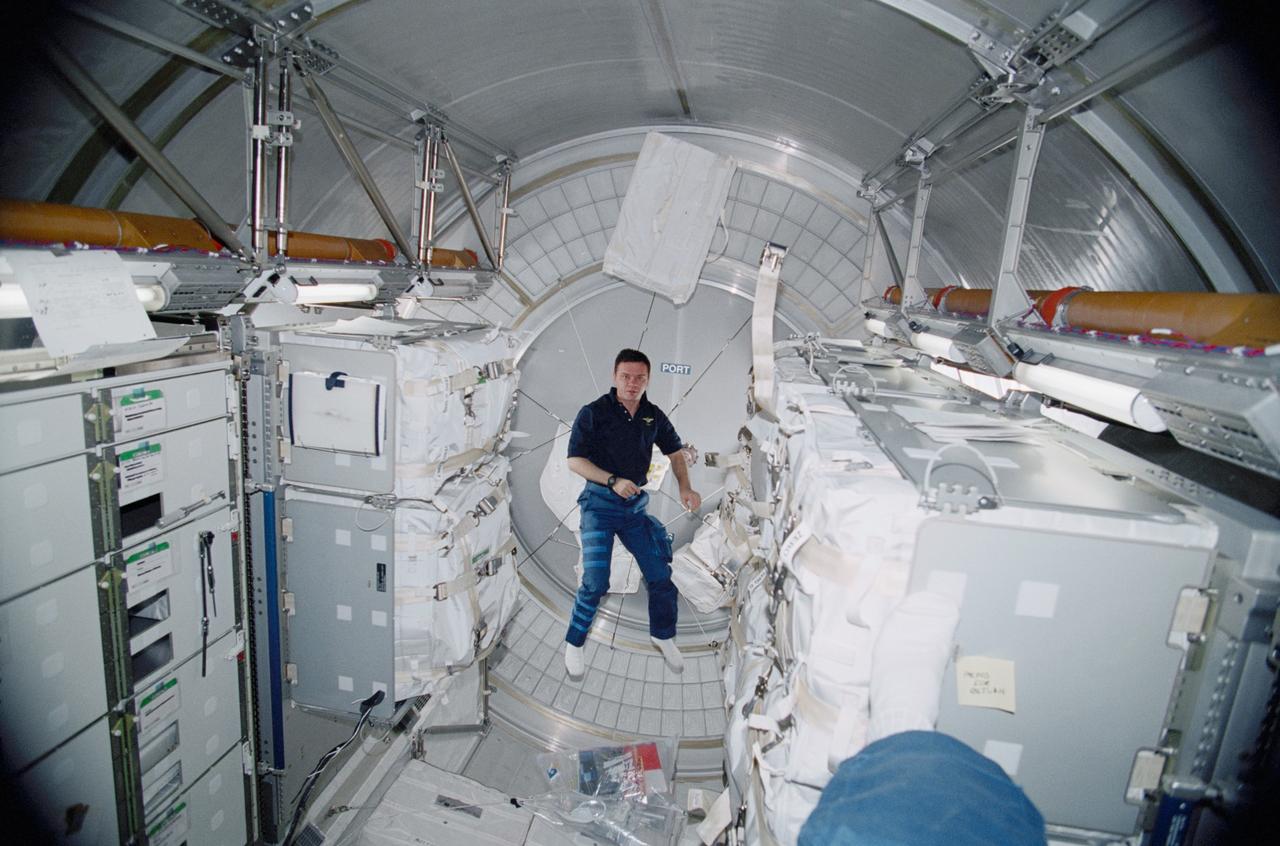
STS102-343-008 (8 - 21 March 2001) --- Cosmonaut Yuri P. Gidzenko is dwarfed by transient hardware aboard Leonardo, the Italian Space Agency-built Multipurpose Logistics Module (MPLM). Gidzenko has been aboard the International Space Station (ISS) since early November of 2000, but he will be returning to Earth with the STS-102 astronauts and the MPLM in a few days.
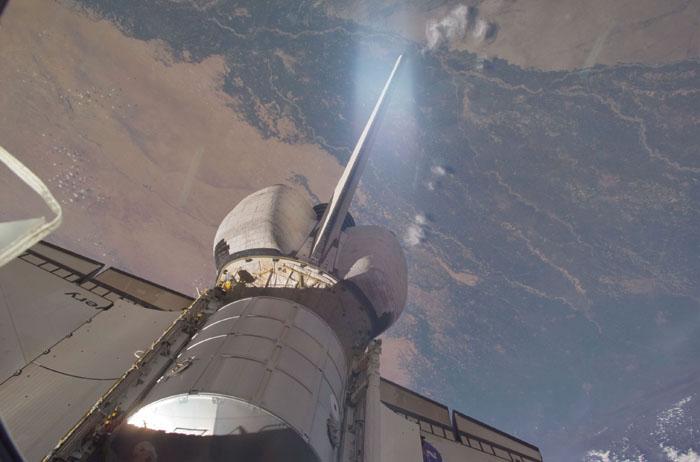
STS102-E-5111 (10 March 2001) --- An out-the-window view of the Leonardo Multi Purpose Logistics Module resting in Discovery's payload bay was recorded with a digital still camera from the International Space Station (ISS) Earth is in the background.
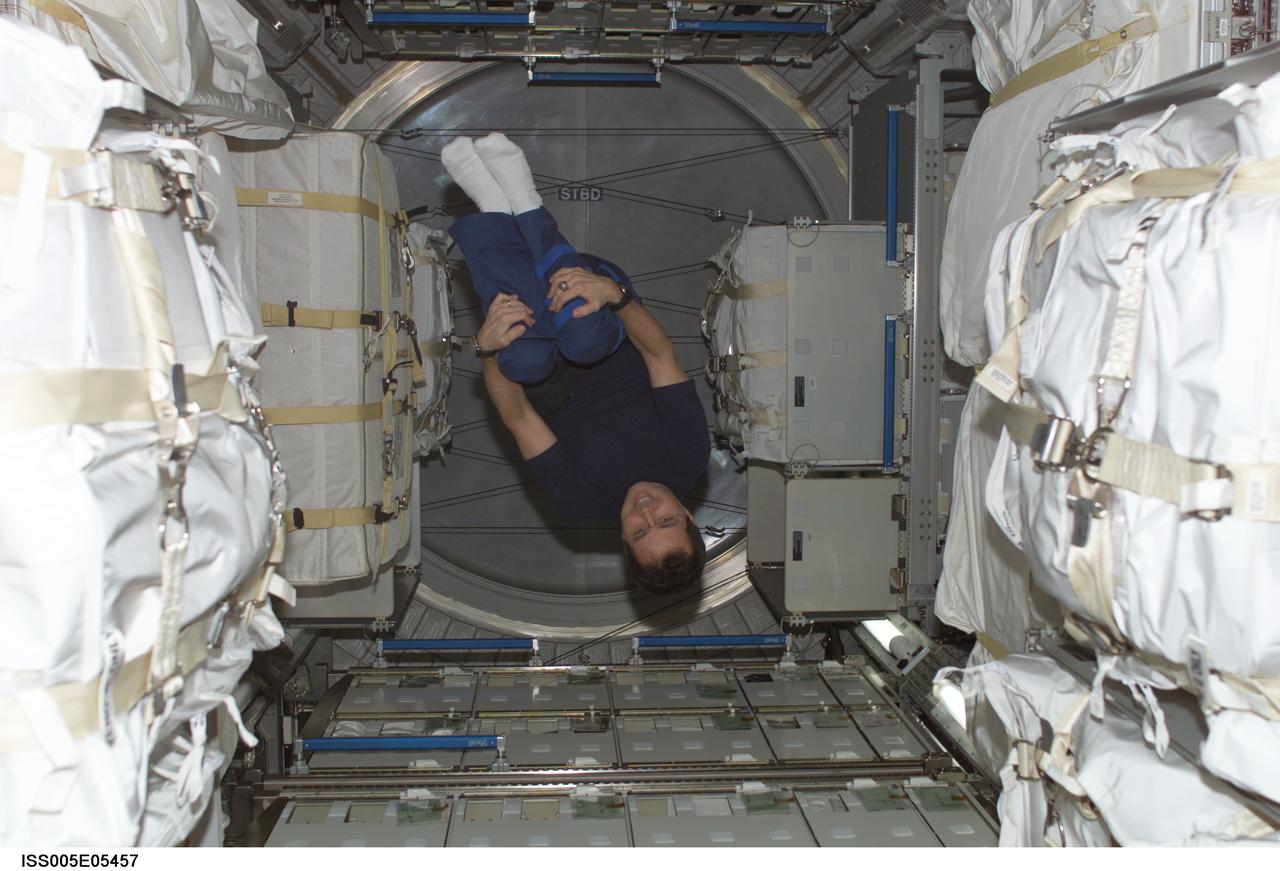
ISS005-E-05457 (June 2002) --- Astronaut Daniel W. Bursch, Expedition Four flight engineer, floats in the Leonardo Multi-Purpose Logistics Module (MPLM). Leonardo is one of three Multi-Purpose Logistics Modules built by the Italian Space Agency that serve as pressurized, reusable cargo carriers to ferry supplies, equipment and experiments between the ground and the space station.
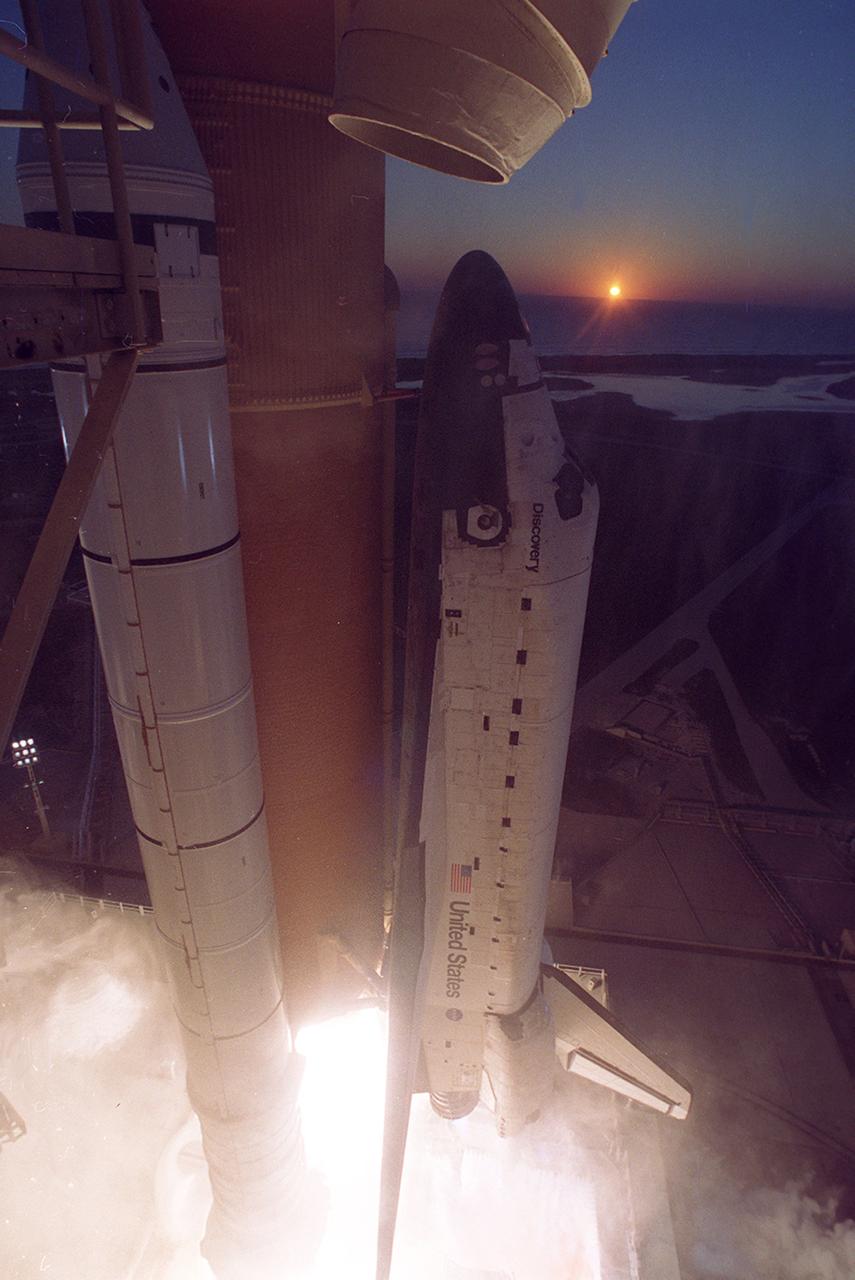
The Space Shuttle Discovery, STS-102 mission, clears launch pad 39B at the Kennedy Space Center as the sun peers over the Atlantic Ocean on March 8, 2001. STS-102's primary cargo was the Leonardo, the Italian Space Agency built Multipurpose Logistics Module (MPLM). The Leonardo MPLM is the first of three such pressurized modules that will serve as the International Space Station's (ISS') moving vans, carrying laboratory racks filled with equipment, experiments, and supplies to and from the Station aboard the Space Shuttle. The cylindrical module is approximately 21-feet long and 15- feet in diameter, weighing almost 4.5 tons. It can carry up to 10 tons of cargo in 16 standard Space Station equipment racks. Of the 16 racks the module can carry, 5 can be furnished with power, data, and fluid to support refrigerators or freezers. In order to function as an attached station module as well as a cargo transport, the logistics module also includes components that provide life support, fire detection and suppression, electrical distribution, and computer functions. NASA's 103rd overall flight and the eighth assembly flight, STS-102 was also the first flight involved with Expedition Crew rotation. The Expedition Two crew was delivered to the station while Expedition One was returned home to Earth.
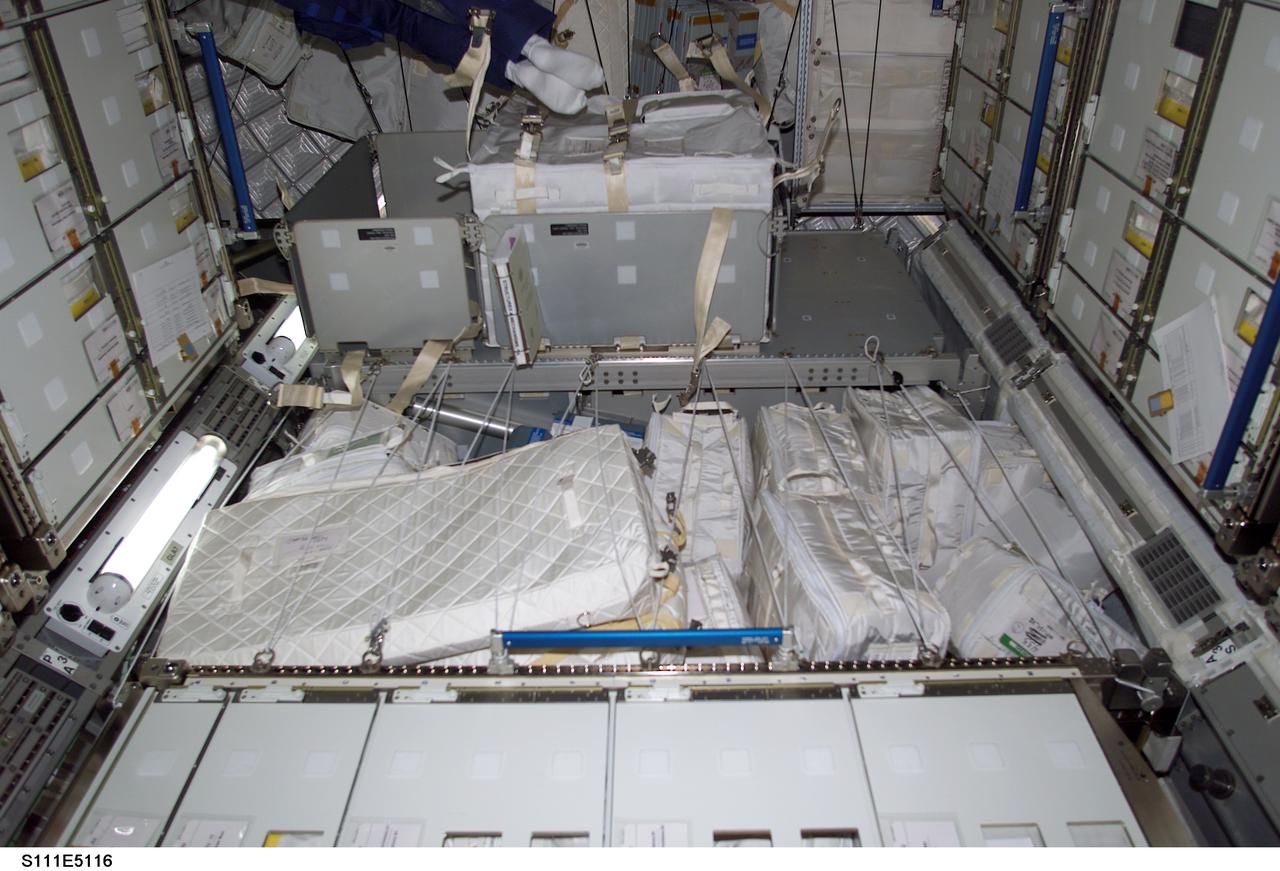
STS111-E-5116 (9 June 2002) --- One of the STS-111 crewmembers took this interior view of the Leonardo Multi-Purpose Logistics Module (MPLM). Leonardo was unberthed from the payload bay of the Space Shuttle Endeavour on June 8, 2002 by astronaut Kenneth D. Cockrell, STS-111 mission commander, operating the shuttle’s robotic arm to move the module to the International Space Station’s (ISS) Unity node. Leonardo’s installation was completed at 9:28 a.m. (CDT). Leonardo is one of three Multi-Purpose Logistics Modules built by the Italian Space Agency that serve as pressurized, reusable cargo carriers to ferry supplies, equipment and experiments between the ground and the space station.
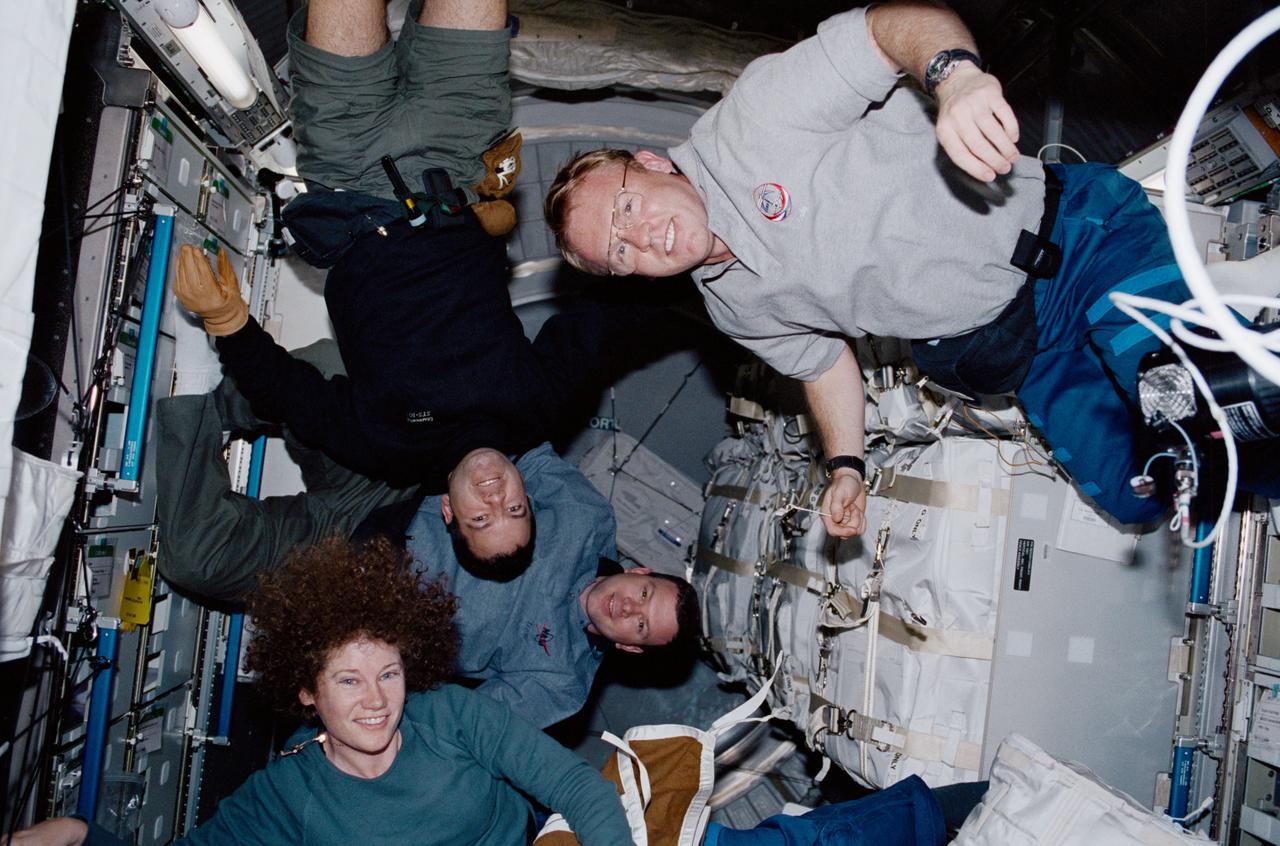
STS102-346-035 (8 - 21 March 2001) --- Four STS-102 crew members participate in the movement of supplies inside Leonardo, the Italian Space Agency-built Multipurpose Logistics Module (MPLM). Clockwise from lower left are astronauts Susan J. Helms, STS-102 mission specialist and Expedition Two flight engineer; James M. Kelly, STS-102 pilot; and Paul W. Richards and Andrew S.W. Thomas, both STS-102 mission specialists.
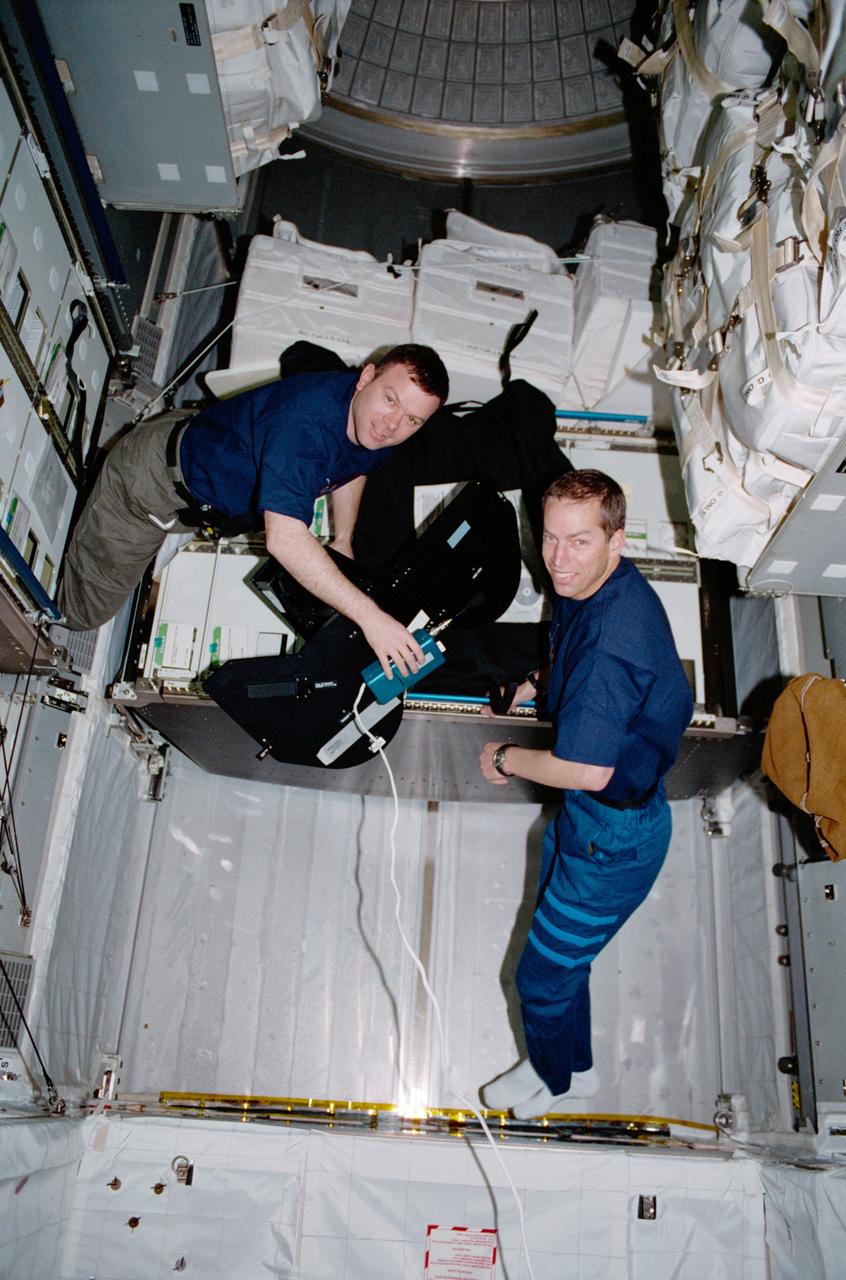
Pilot James M. Kelly (left) and Commander James D. Wetherbee for the STS-102 mission, participate in the movement of supplies inside Leonardo, the Italian Space Agency built Multipurpose Logistics Module (MPLM). In this particular photograph, the two are handling a film magazine for the IMAX cargo bay camera. The primary cargo of the STS-102 mission, the Leonardo MPLM is the first of three such pressurized modules that will serve as the International Space Station's (ISS') moving vans, carrying laboratory racks filled with equipment, experiments, and supplies to and from the Station aboard the Space Shuttle. The cylindrical module is approximately 21-feet long and 15- feet in diameter, weighing almost 4.5 tons. It can carry up to 10 tons of cargo in 16 standard Space Station equipment racks. Of the 16 racks the module can carry, 5 can be furnished with power, data, and fluid to support refrigerators or freezers. In order to function as an attached station module as well as a cargo transport, the logistics module also includes components that provide life support, fire detection and suppression, electrical distribution, and computer functions. The eighth station assembly flight, the STS-102 mission also served as a crew rotation flight. It delivered the Expedition Two crew to the Station and returned the Expedition One crew back to Earth.
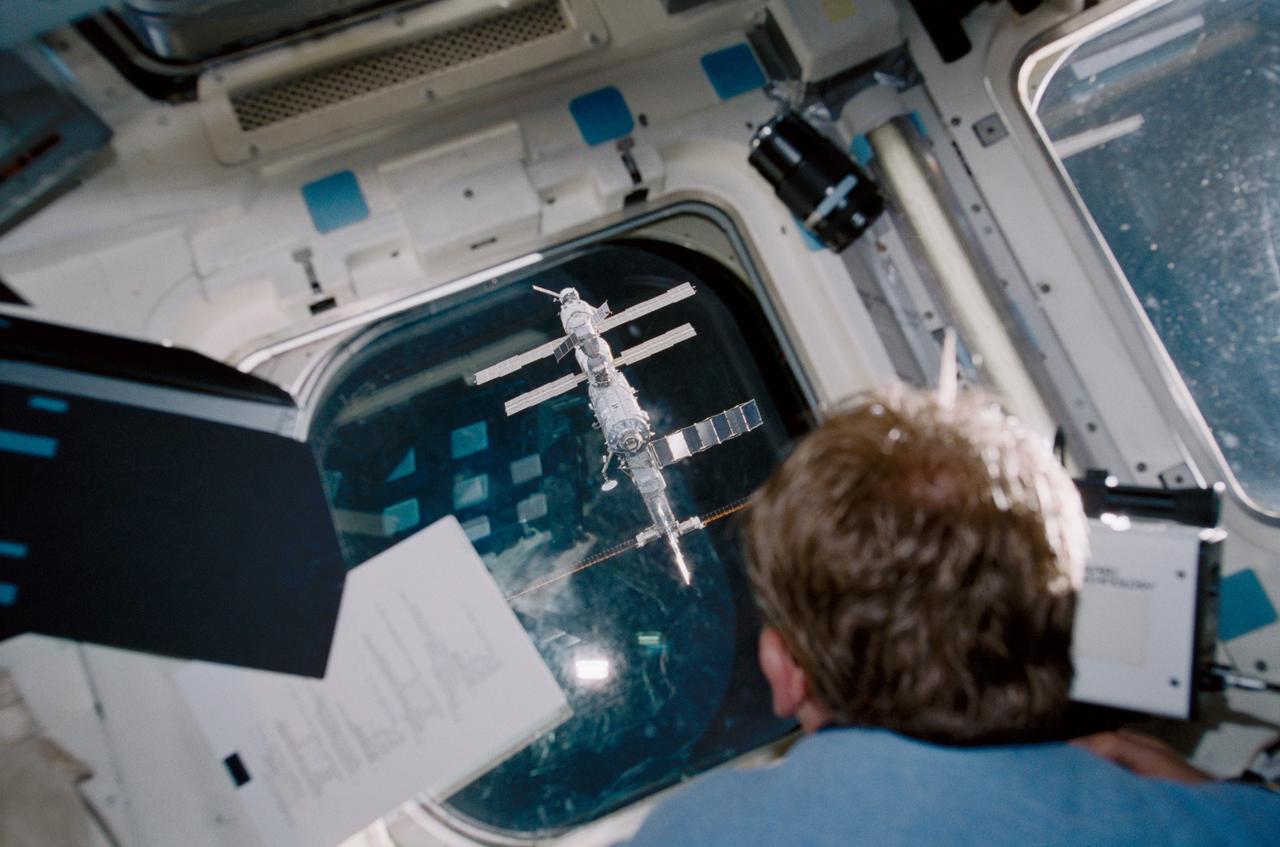
STS-102 astronaut and mission specialist, Andrew S.W. Thomas, gazes through an aft window of the Space Shuttle Orbiter Discovery as it approaches the docking bay of the International Space Station (ISS). Launched March 8, 2001, STS-102's primary cargo was the Leonardo, the Italian Space Agency-built Multipurpose Logistics Module (MPLM). The Leonardo MPLM is the first of three such pressurized modules that will serve as the ISS's moving vans, carrying laboratory racks filled with equipment, experiments, and supplies to and from the Station aboard the Space Shuttle. The cylindrical module is approximately 21-feet long and 15- feet in diameter, weighing almost 4.5 tons. It can carry up to 10 tons of cargo in 16 standard Space Station equipment racks. Of the 16 racks the module can carry, 5 can be furnished with power, data, and fluid to support refrigerators or freezers. In order to function as an attached station module as well as a cargo transport, the logistics module also includes components that provide life support, fire detection and suppression, electrical distribution, and computer functions. NASA's 103rd overall mission and the 8th Space Station Assembly Flight, STS-102 mission also served as a crew rotation flight. It delivered the Expedition Two crew to the Station and returned the Expedition One crew back to Earth.
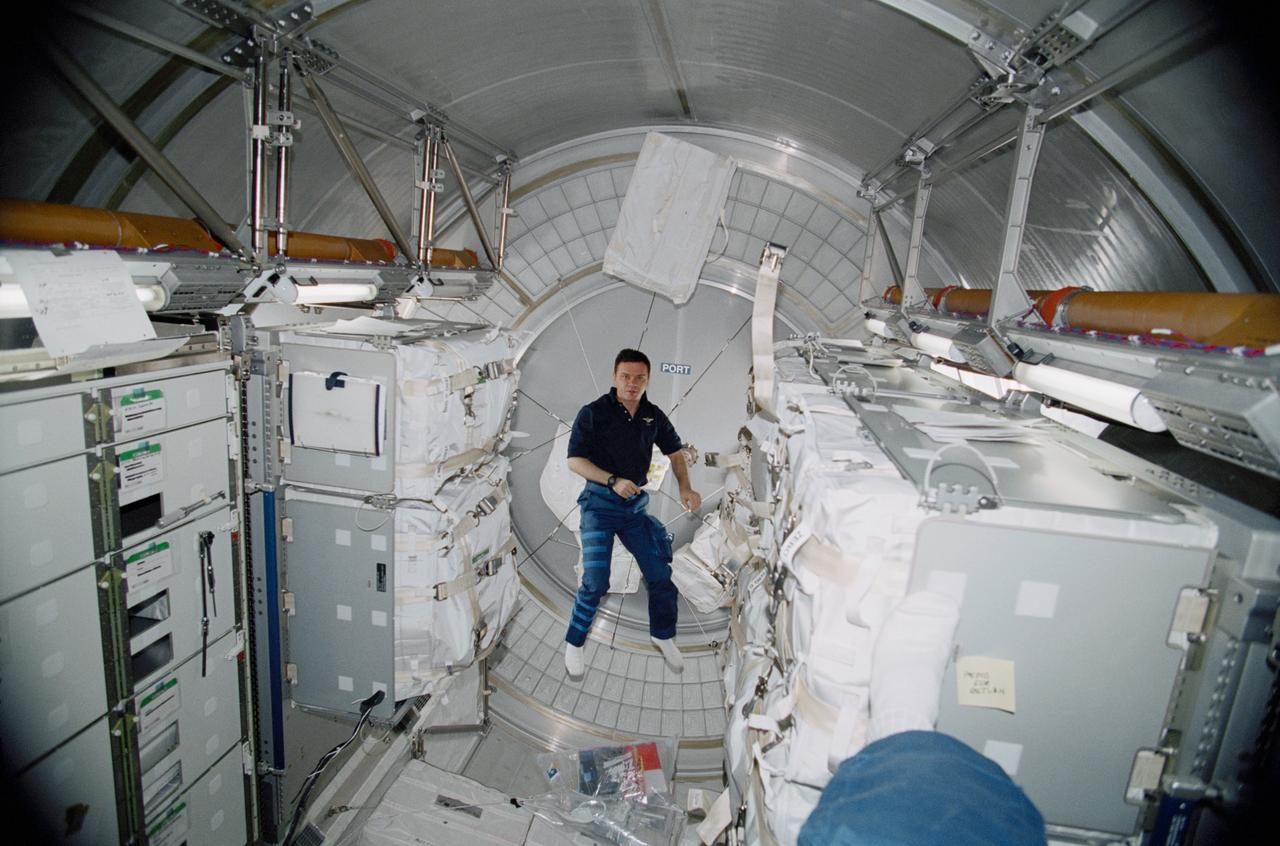
A crewmember of Expedition One, cosmonaut Yuri P. Gidzenko, is dwarfed by transient hardware aboard Leonardo, the Italian Space Agency-built Multi-Purpose Logistics Module (MPLM), a primary cargo of the STS-102 mission. The Leonardo MPLM is the first of three such pressurized modules that will serve as the International Space Station's (ISS's) moving vans, carrying laboratory racks filled with equipment, experiments and supplies to and from the Space Station aboard the Space Shuttle. The cylindrical module is approximately 21-feet long and 15- feet in diameter, weighing almost 4.5 tons. It can carry up to 10 tons of cargo into 16 standard Space Station equipment racks. Of the 16 racks the module can carry, 5 can be furnished with power, data, and fluid to support refrigerators or freezers. In order to function as an attached station module as well as a cargo transport, the logistics module also includes components that provide life support, fire detection and suppression, electrical distribution, and computer functions. The eighth Shuttle mission to visit the ISS, the STS-102 mission served as a crew rotation flight. It delivered the Expedition Two crew to the Station and returned the Expedition One crew back to Earth.
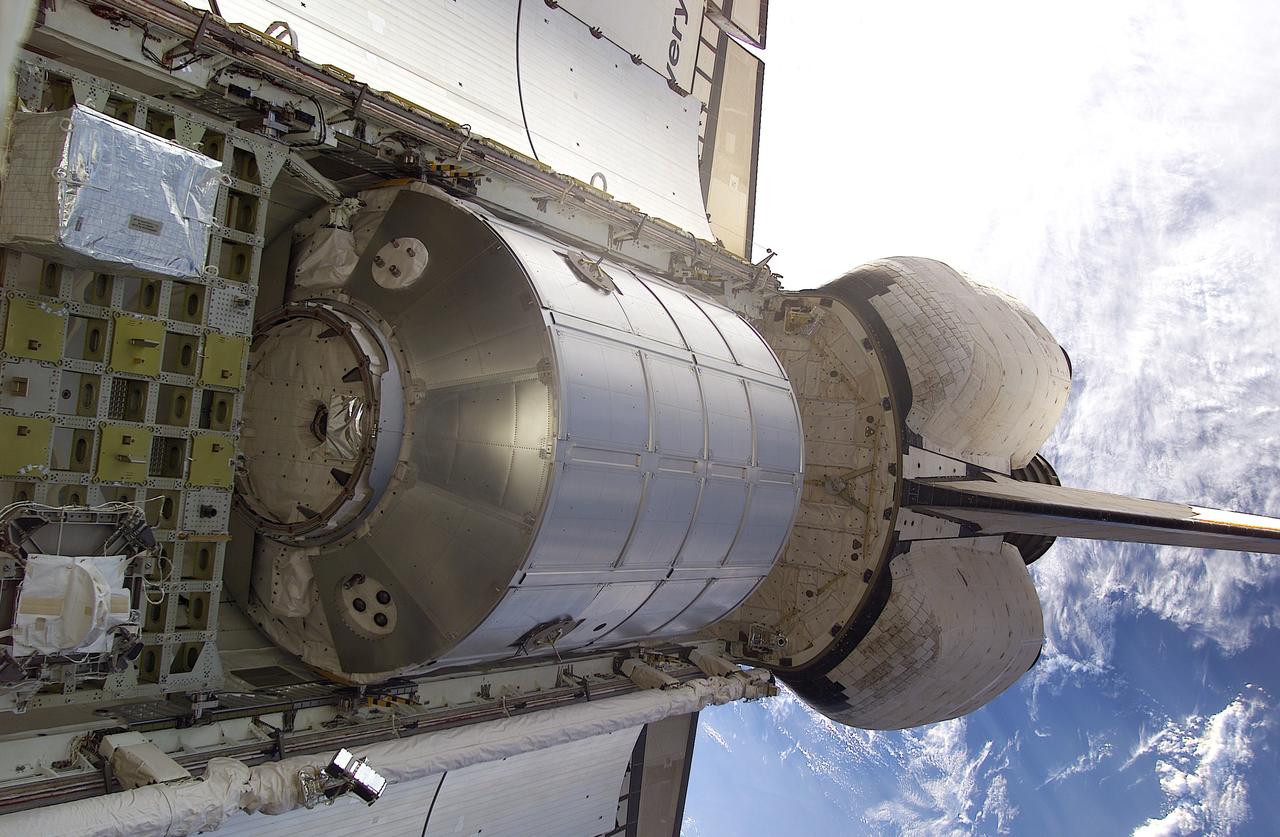
This in-orbit close up shows the Italian Space Agency-built multipurpose Logistics Module (MPLM), Leonardo, the primary cargo of the STS-102 mission, resting in the payload bay of the Space Shuttle Orbiter Discovery. The Leonardo MPLM is the first of three such pressurized modules that will serve as the International Space Station's (ISS') moving vans, carrying laboratory racks filled with equipment, experiments, and supplies to and from the Station aboard the Space Shuttle. The cylindrical module is approximately 21-feet long and 15- feet in diameter, weighing almost 4.5 tons. It can carry up to 10 tons of cargo in 16 standard Space Station equipment racks. Of the 16 racks the module can carry, 5 can be furnished with power, data, and fluid to support refrigerators or freezers. In order to function as an attached station module as well as a cargo transport, the logistics module also includes components that provide life support, fire detection and suppression, electrical distribution, and computer functions. The eighth station assembly flight and NASA's 103rd overall flight, STS-102 launched March 8, 2001 for an almost 13 day mission.

jsc2024e065170 (10/3/2024) --- The Nanolab Astrobeat Principal Investigator Dr. Leonardo Barilaro poses with the Nanoracks team in Houston, Texas. Image courtesy of Dr. Leonardo Barilaro, The Malta College of Arts, Science & Technology..
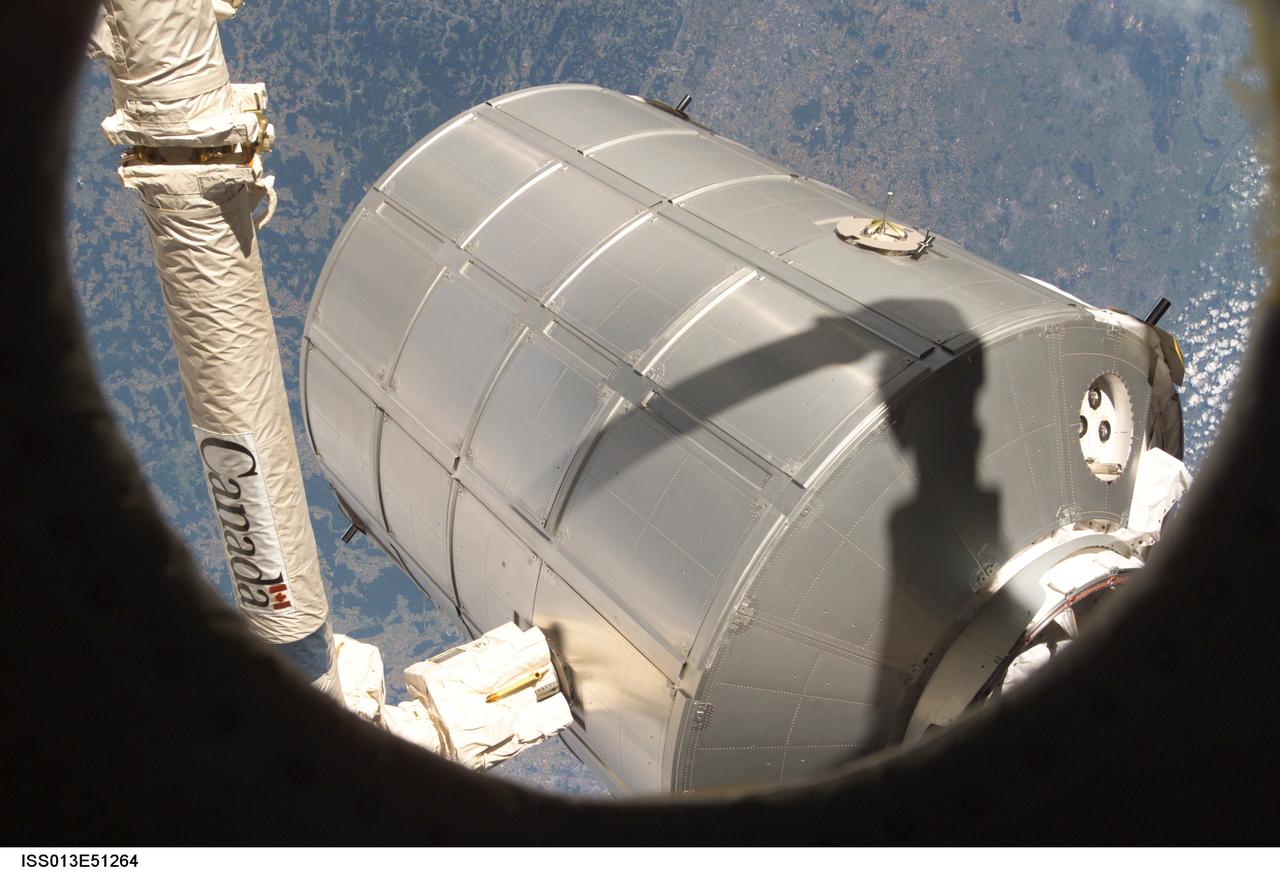
ISS013-E-51264 (14 July 2006) --- Canadarm2 or the Space Station Remote Manipulator System (SSRMS) arm grasps the Italian-built Multi-Purpose Logistics Module Leonardo to place it back in Discovery's cargo bay. On the other end of the arm, inside the shirt sleeve environment of the Destiny laboratory on the International Space Station, astronauts Stephanie D. Wilson and Lisa M. Nowak, STS-121 mission specialists, were in control of the transfer. The MPLM was being moved from its temporary parking place on the station's Unity node to the payload bay of Discovery for the return trip to Earth.
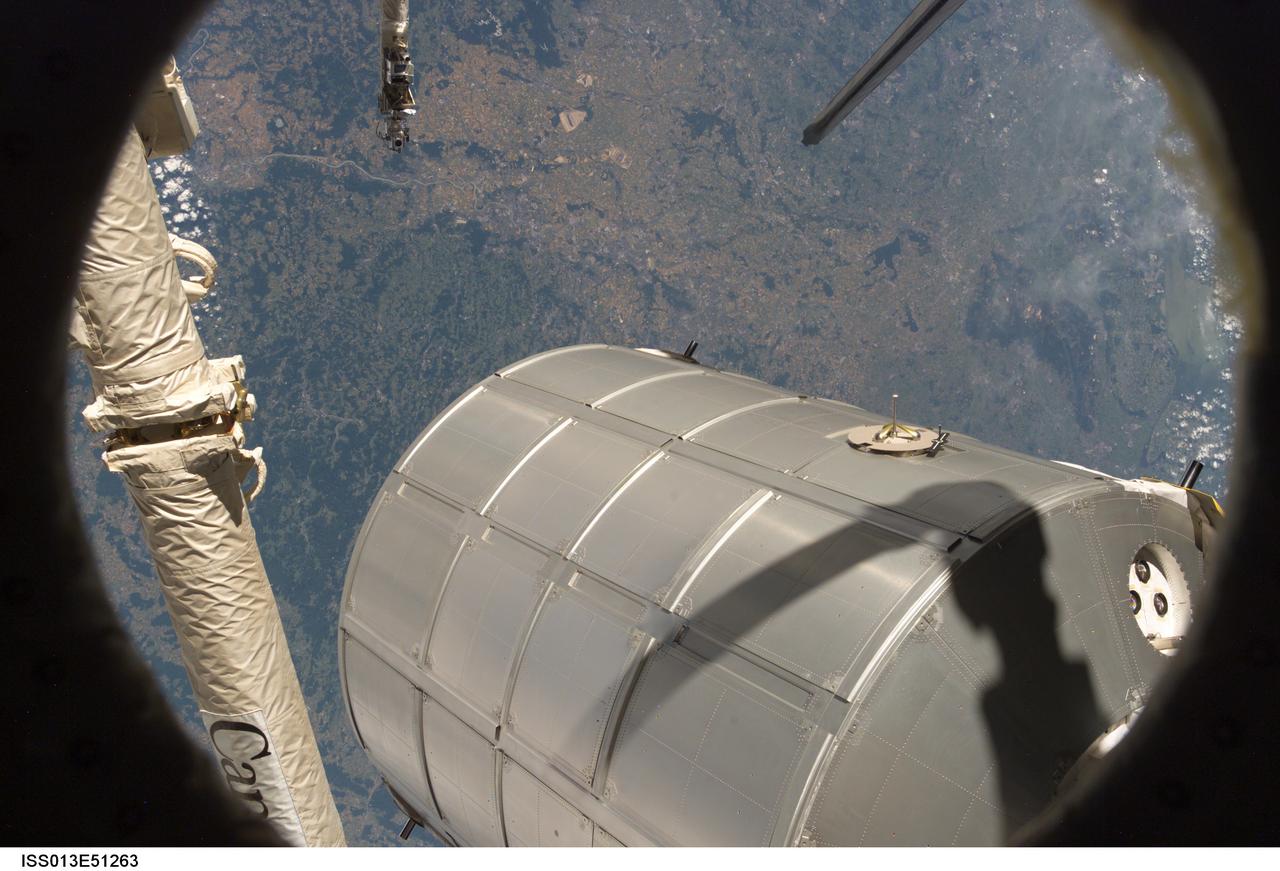
ISS013-E-51263 (14 July 2006) --- Canadarm2 or the Space Station Remote Manipulator System (SSRMS) arm grasps the Italian-built Multi-Purpose Logistics Module Leonardo to place it back in Discovery's cargo bay. On the other end of the arm, inside the shirt sleeve environment of the Destiny laboratory on the International Space Station, astronauts Stephanie D. Wilson and Lisa M. Nowak, STS-121 mission specialists, were in control of the transfer. The MPLM was being moved from its temporary parking place on the station's Unity node to the payload bay of Discovery for the return trip to Earth.
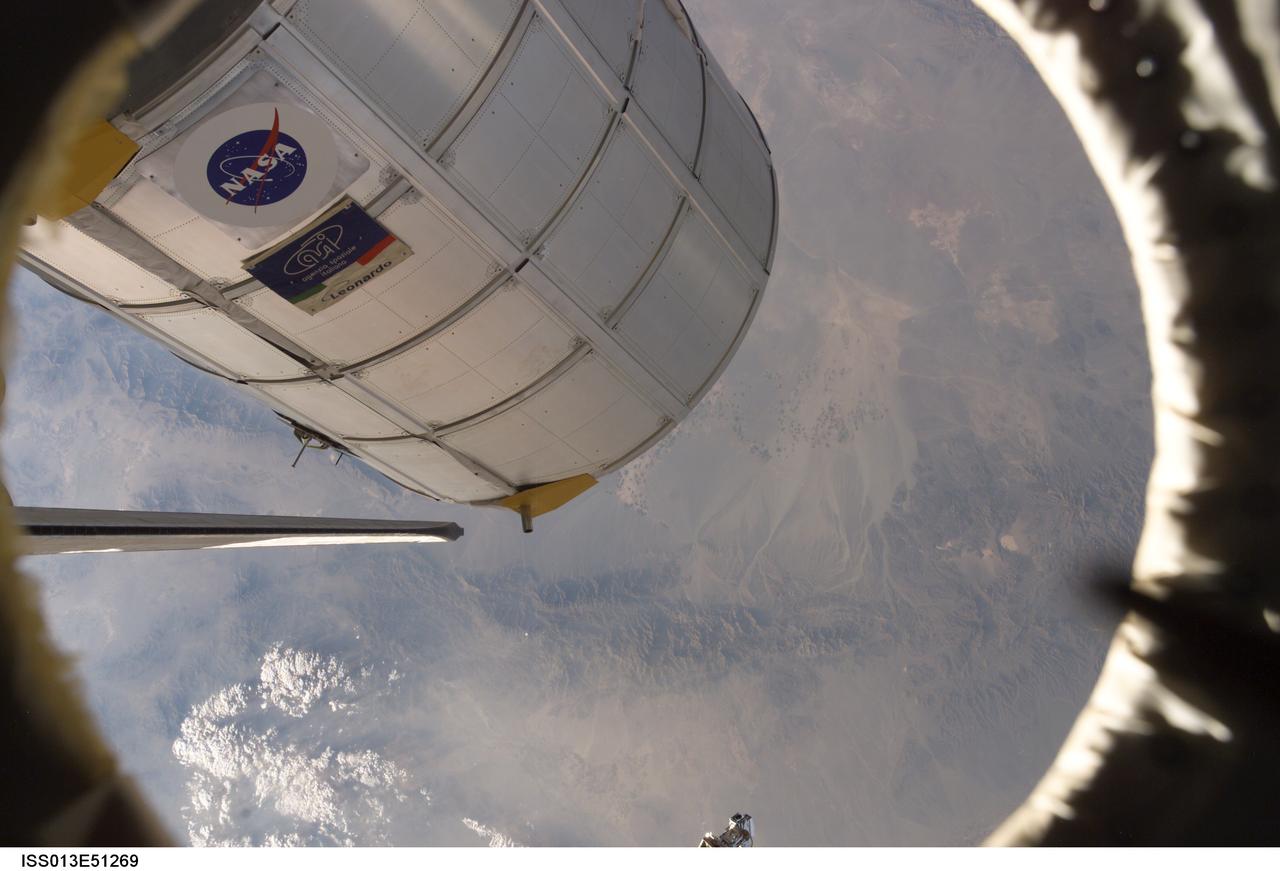
ISS013-E-51269 (14 July 2006) --- Canadarm2 or the Space Station Remote Manipulator System (SSRMS) arm (out of frame) grasps the Italian-built Multi-Purpose Logistics Module Leonardo to place it back in Discovery's cargo bay. On the other end of the arm, inside the shirt sleeve environment of the Destiny laboratory on the International Space Station, astronauts Stephanie D. Wilson and Lisa M. Nowak, STS-121 mission specialists, were in control of the transfer. The MPLM was being moved from its temporary parking place on the station's Unity node to the payload bay of Discovery for the return trip to Earth. Discovery's vertical stabilizer is at left.
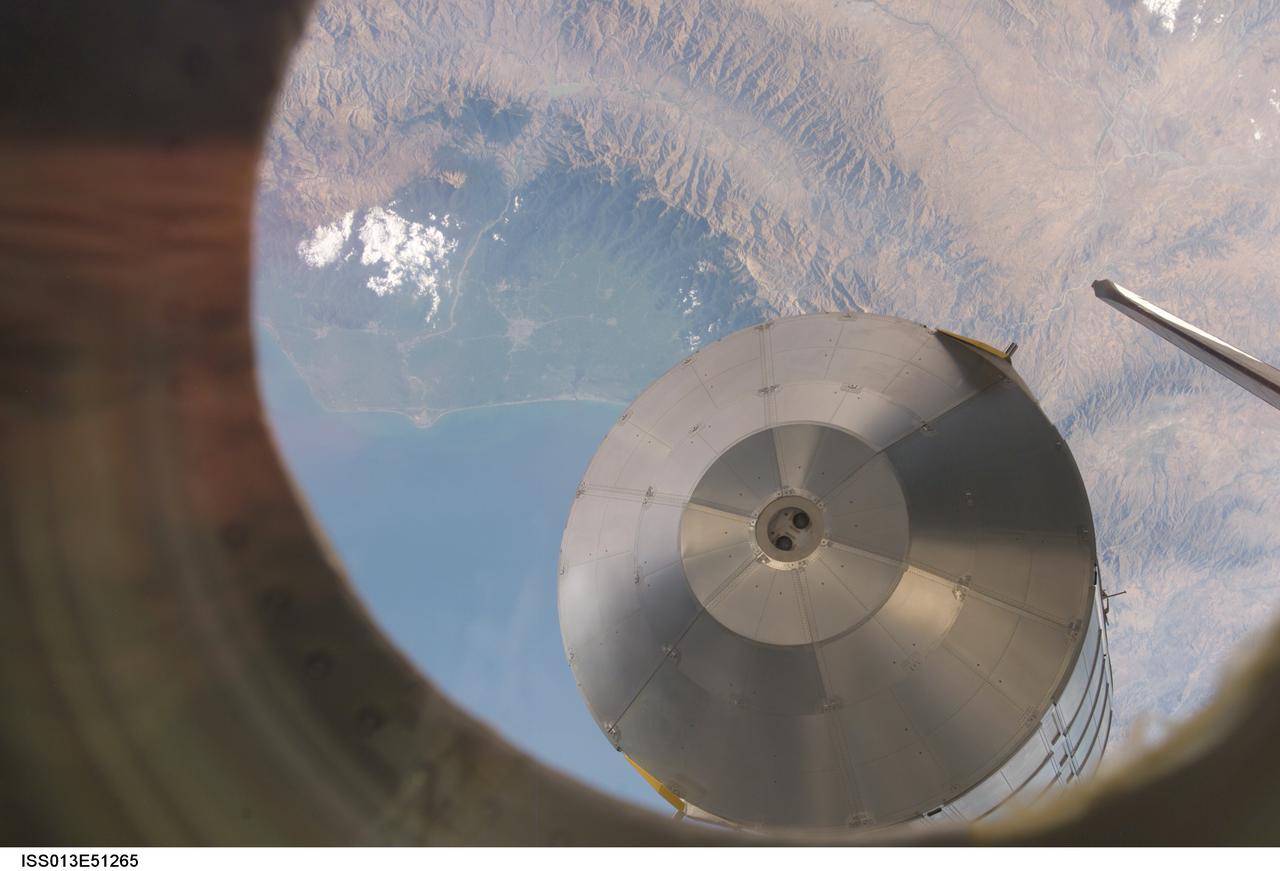
ISS013-E-51265 (14 July 2006) --- Canadarm2 or the Space Station Remote Manipulator System (SSRMS) arm (out of frame) grasps the Italian-built Multi-Purpose Logistics Module Leonardo to place it back in Discovery's cargo bay. On the other end of the arm, inside the shirt sleeve environment of the Destiny laboratory on the International Space Station, astronauts Stephanie D. Wilson and Lisa M. Nowak, STS-121 mission specialists, were in control of the transfer. The MPLM was being moved from its temporary parking place on the station's Unity node to the payload bay of Discovery for the return trip to Earth.
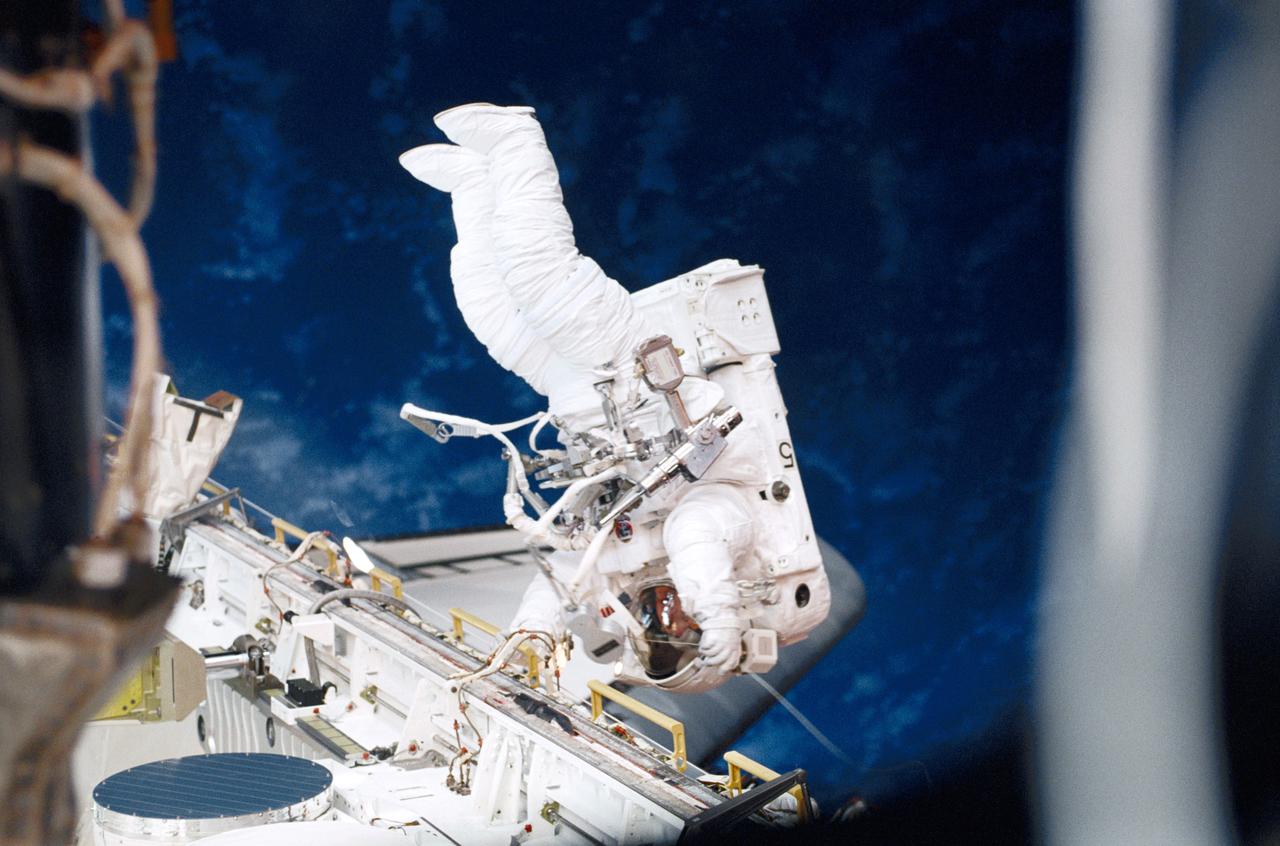
STS-102 mission astronaut Susan J. Helms translates along the longerons of the Space Shuttle Discovery during the first of two space walks. During this walk, the Pressurized Mating Adapter 3 was prepared for repositioning from the Unity Module's Earth-facing berth to its port-side berth to make room for the Leonardo multipurpose Logistics Module (MPLM), supplied by the Italian Space Agency. The Leonardo MPLM is the first of three such pressurized modules that will serve as the International Space Station's (ISS') moving vans, carrying laboratory racks filled with equipment, experiments, and supplies to and from the Station aboard the Space Shuttle. The cylindrical module is approximately 21-feet long and 15- feet in diameter, weighing almost 4.5 tons. It can carry up to 10 tons of cargo in 16 standard Space Station equipment racks. Of the 16 racks the module can carry, 5 can be furnished with power, data, and fluid to support refrigerators or freezers. In order to function as an attached station module as well as a cargo transport, the logistics module also includes components that provide life support, fire detection and suppression, electrical distribution, and computer functions. NASA's 103rd overall mission and the 8th Space Station Assembly Flight, STS-102 mission also served as a crew rotation flight. It delivered the Expedition Two crew to the Station and returned the Expedition One crew back to Earth.

jsc2024e065171 (10/3/2024) --- Nanolab Astrobeat logo. Image courtesy of Dr. Leonardo Barilaro, The Malta College of Arts, Science & Technology.

STS-102 mission astronauts James S. Voss and James D. Weatherbee share a congratulatory handshake as the Space Shuttle Orbiter Discovery successfully docks with the International Space Station (ISS). Photographed from left to right are: Astronauts Susan J. Helms, mission specialist; James S. Voss, Expedition 2 crew member; James D. Weatherbee, mission commander; Andrew S.W. Thomas, mission specialist; and nearly out of frame is James M. Kelley, Pilot. Launched March 8, 2001, STS-102's primary cargo was the Leonardo, the Italian Space Agency-built Multipurpose Logistics Module (MPLM). The Leonardo MPLM is the first of three such pressurized modules that will serve as ISS' moving vans, carrying laboratory racks filled with equipment, experiments, and supplies to and from the Station aboard the Space Shuttle. The cylindrical module is approximately 21-feet long and 15- feet in diameter, weighing almost 4.5 tons. It can carry up to 10 tons of cargo in 16 standard Space Station equipment racks. Of the 16 racks the module can carry, 5 can be furnished with power, data, and fluid to support refrigerators or freezers. In order to function as an attached station module as well as a cargo transport, the logistics module also includes components that provide life support, fire detection and suppression, electrical distribution, and computer functions. NASA's 103rd overall mission and the 8th Space Station Assembly Flight, STS-102 mission also served as a crew rotation flight. It delivered the Expedition Two crew to the Station and returned the Expedition One crew back to Earth.
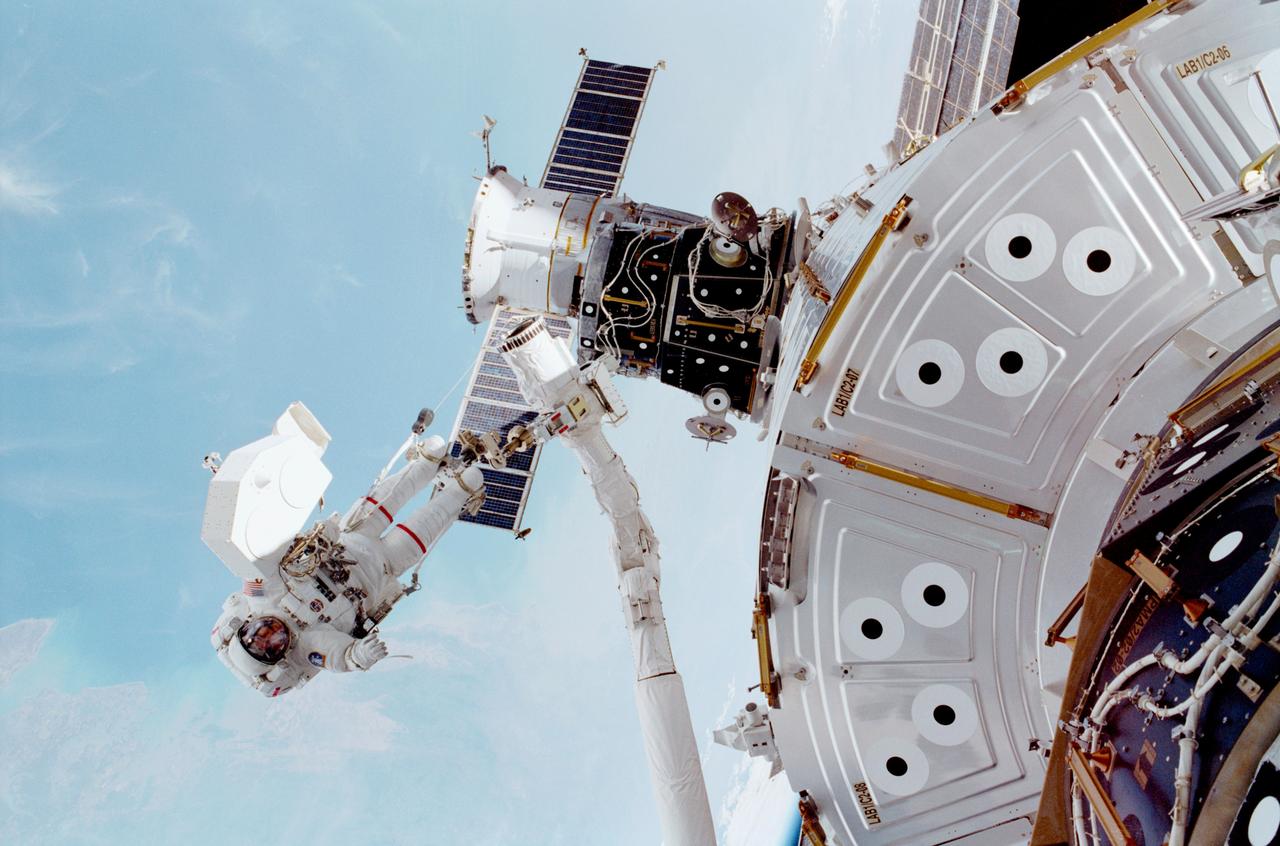
STS-102 astronaut and mission specialist James S. Voss works outside Destiny, the U.S. Laboratory (shown in lower frame) on the International Space Station (ISS), while anchored to the Remote Manipulator System (RMS) robotic arm on the Space Shuttle Discovery during the first of two space walks. During this space walk, the longest to date in space shuttle history, Voss in tandem with Susan Helms (out of frame), prepared the Pressurized Mating Adapter 3 for repositioning from the Unity Module's Earth-facing berth to its port-side berth to make room for the Leonardo Multipurpose Logistics Module (MPLM) supplied by the Italian Space Agency. The The Leonardo MPLM is the first of three such pressurized modules that will serve as the ISS' moving vans, carrying laboratory racks filled with equipment, experiments, and supplies to and from the Station aboard the Space Shuttle. The cylindrical module is approximately 21-feet long and 15- feet in diameter, weighing almost 4.5 tons. It can carry up to 10 tons of cargo in 16 standard Space Station equipment racks. Of the 16 racks the module can carry, 5 can be furnished with power, data, and fluid to support refrigerators or freezers. In order to function as an attached station module as well as a cargo transport, the logistics module also includes components that provide life support, fire detection and suppression, electrical distribution, and computer functions. Launched on May 8, 2001 for nearly 13 days in space, the STS-102 mission was the 8th spacecraft assembly flight to the ISS and NASA's 103rd overall mission. The mission also served as a crew rotation flight. It delivered the Expedition Two crew to the Station and returned the Expedition One crew back to Earth.
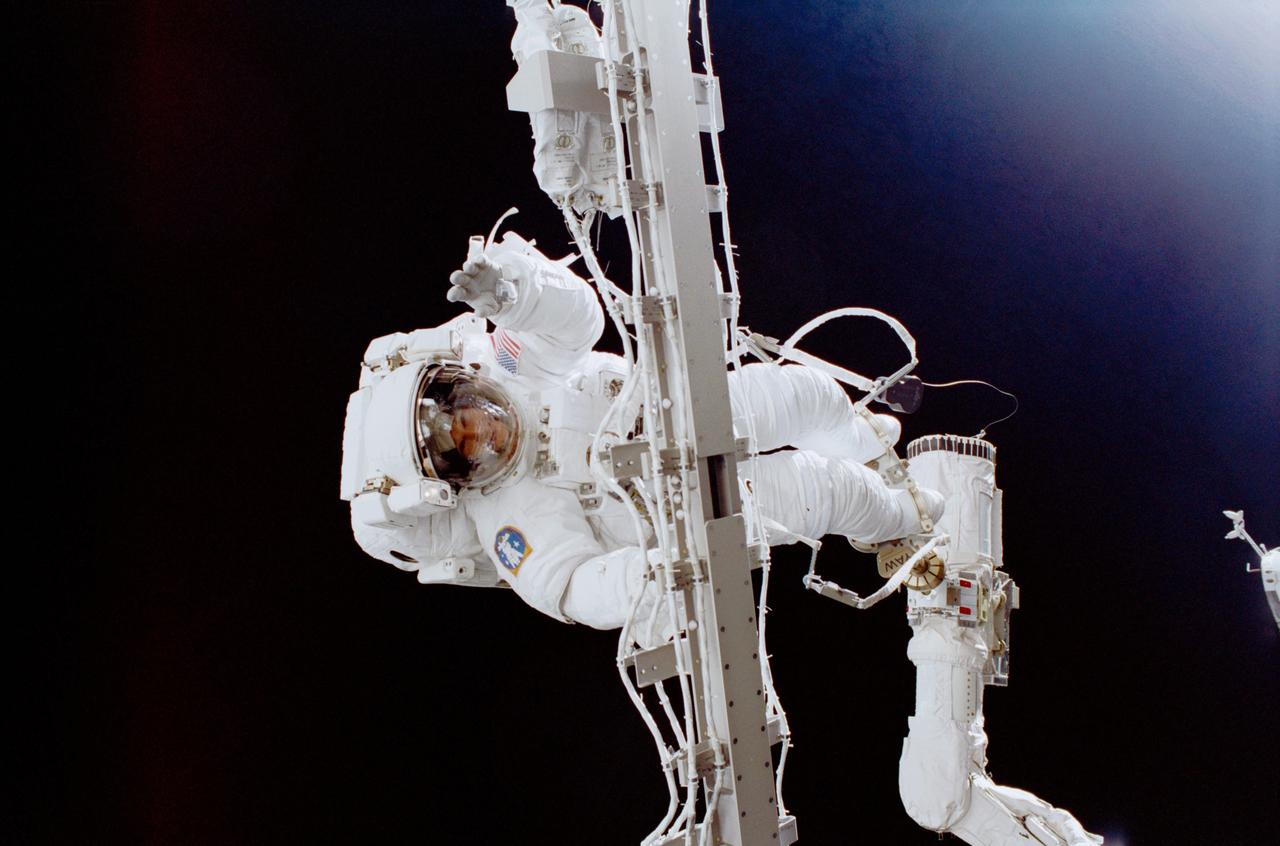
STS-102 mission astronaut Susan J. Helms works outside the International Space Station (ISS) while holding onto a rigid umbilical and her feet anchored to the Remote Manipulator System (RMS) robotic arm on the Space Shuttle Discovery during the first of two space walks. During this space walk, the longest to date in space shuttle history, Helms in tandem with James S. Voss (out of frame), prepared the Pressurized Mating Adapter 3 for repositioning from the Unity Module's Earth-facing berth to its port-side berth to make room for the Leonardo Multipurpose Logistics Module (MPLM) supplied by the Italian Space Agency. The Leonardo MPLM is the first of three such pressurized modules that will serve as the ISS's moving vans, carrying laboratory racks filled with equipment, experiments, and supplies to and from the Station aboard the Space Shuttle. The cylindrical module is approximately 21-feet long and 15- feet in diameter, weighing almost 4.5 tons. It can carry up to 10 tons of cargo in 16 standard Space Station equipment racks. Of the 16 racks the module can carry, 5 can be furnished with power, data, and fluid to support refrigerators or freezers. In order to function as an attached station module as well as a cargo transport, the logistics module also includes components that provide life support, fire detection and suppression, electrical distribution, and computer functions. Launched on May 8, 2001 for nearly 13 days in space, STS-102 mission was the 8th spacecraft assembly flight to the ISS and NASA's 103rd overall mission. The mission also served as a crew rotation flight. It delivered the Expedition Two crew to the Station and returned the Expedition One crew back to Earth.

Astronaut Paul W. Richards, STS-102 mission specialist, works in the cargo bay of the Space Shuttle Discovery during the second of two scheduled space walks. Richards, along with astronaut Andy Thomas, spent 6.5 hours outside the International Space Station (ISS), continuing work to outfit the station and prepare for delivery of its robotic arm. STS-102 delivered the first Multipurpose Logistics Modules (MPLM) named Leonardo, which was filled with equipment and supplies to outfit the U.S. Destiny Laboratory Module. The Leonardo MPLM is the first of three such pressurized modules that will serve as the ISS' moving vans, carrying laboratory racks filled with equipment, experiments, and supplies to and from the Station aboard the Space Shuttle. The cylindrical module is approximately 21-feet long and 15- feet in diameter, weighing almost 4.5 tons. It can carry up to 10 tons of cargo in 16 standard Space Station equipment racks. Of the 16 racks the module can carry, 5 can be furnished with power, data, and fluid to support refrigerators or freezers. In order to function as an attached station module as well as a cargo transport, the logistics module also includes components that provide life support, fire detection and suppression, electrical distribution, and computer functions. NASA's 103rd overall mission and the 8th Space Station Assembly Flight, STS-102 mission also served as a crew rotation flight. It delivered the Expedition Two crew to the Station and returned the Expedition One crew back to Earth.

ISS028-E-018516 (24 July 2011) --- Japan Aerospace Exploration Agency astronaut Satoshi Furukawa, Expedition 28 flight engineer, is surrounded by storage containers while working in the permanent multi-purpose module (PMM) of the International Space Station.
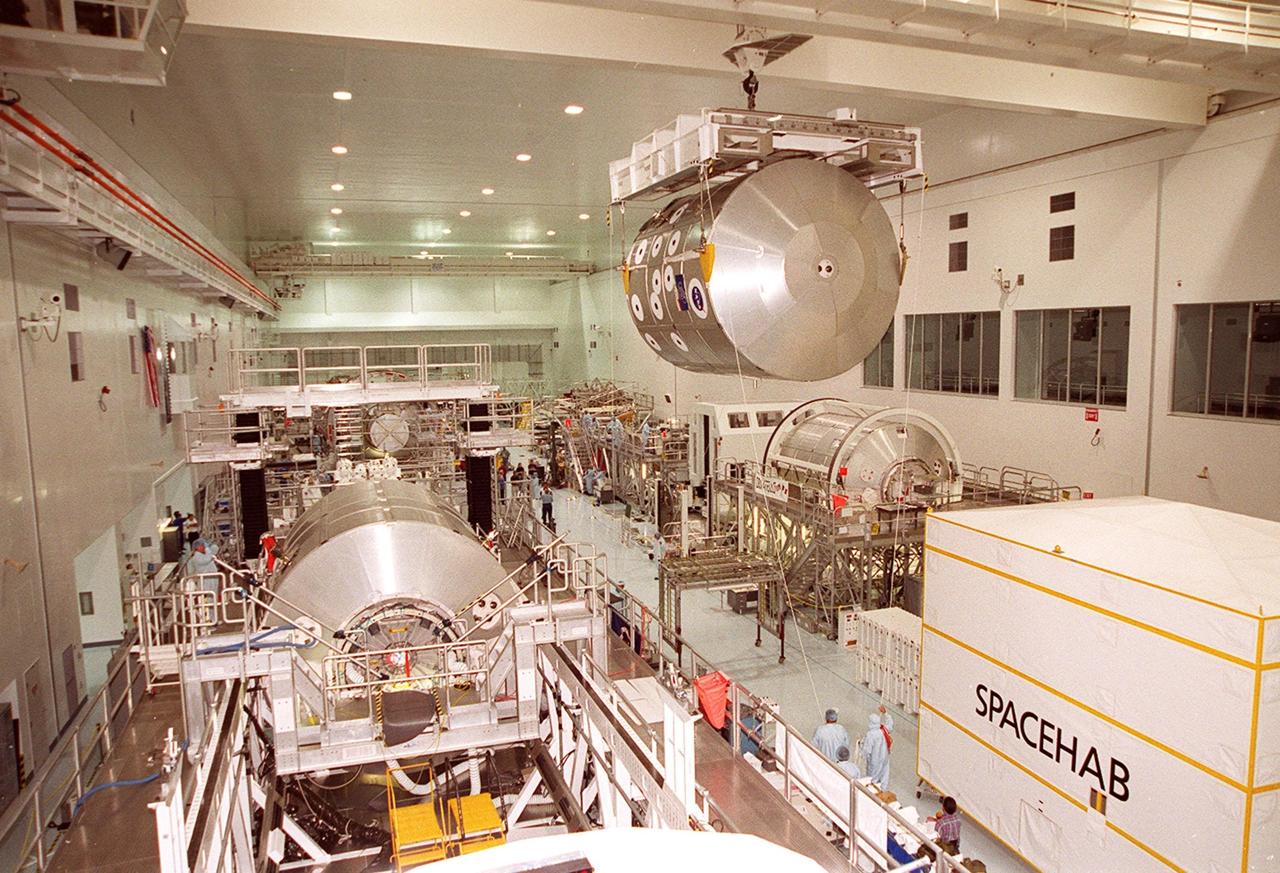
KENNEDY SPACE CENTER, FLA. -- In the Space Station Processing Facility, an overhead crane carries the Multi-Purpose Logistics Module Leonardo across the room. Leonardo will be placed on a workstand and prepared for a future launch to the International Space Station. Leonardo is one of three MPLMs that are being used as cargo vans to carry supplies, equipment and research racks to the Space Station and back to KSC. Leonardo recently returned from its maiden voyage to the Station on mission STS-102
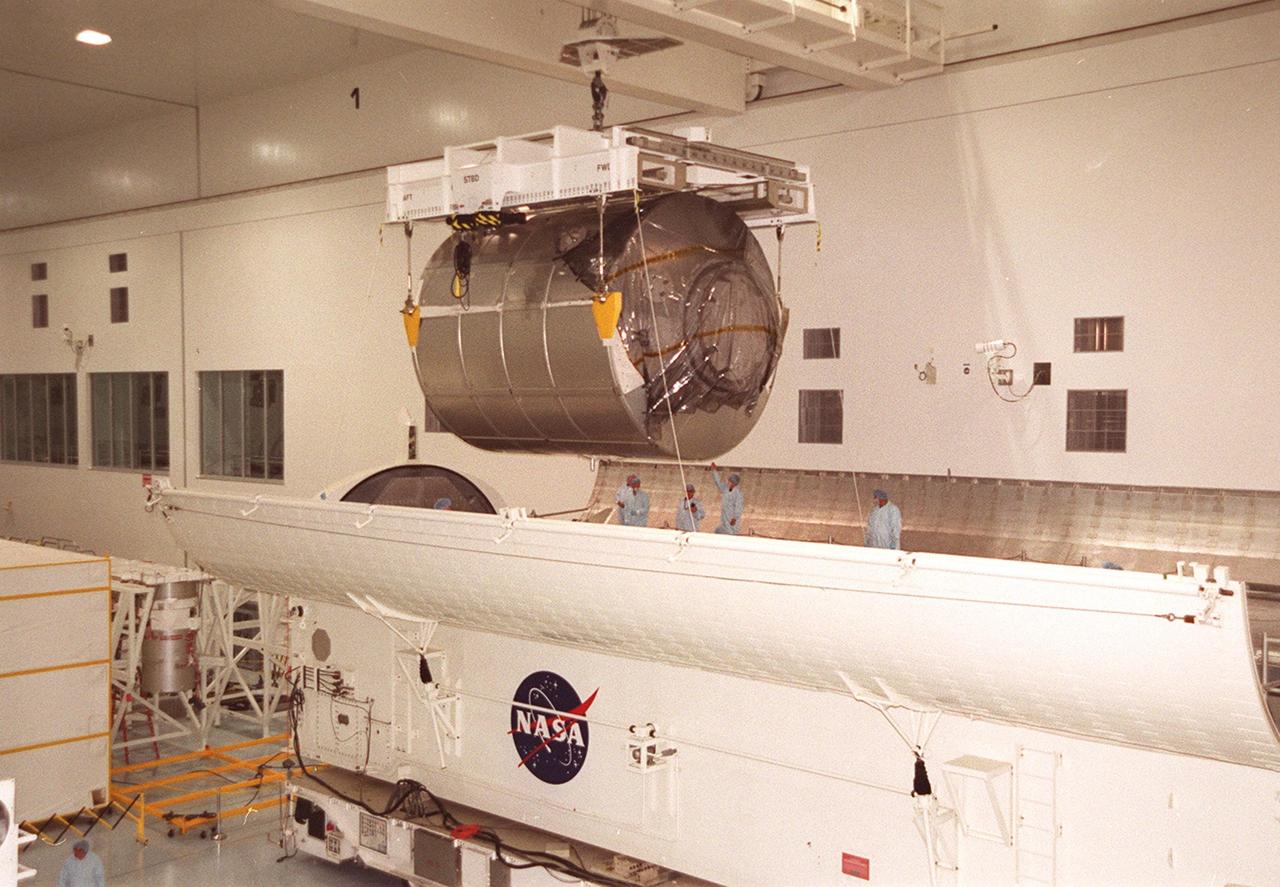
KENNEDY SPACE CENTER, FLA. -- In the Space Station Processing Facility, the Multi-Purpose Logistics Module Leonardo is lifted out of the payload canister that transported it from the Orbiter Processing Facility bay 2. Leonardo will be placed on a workstand and prepared for a future launch to the International Space Station. Leonardo is one of three MPLMs that are being used as cargo vans to carry supplies, equipment and research racks to the Space Station and back to KSC. Leonardo recently returned from its maiden voyage to the Station on mission STS-102
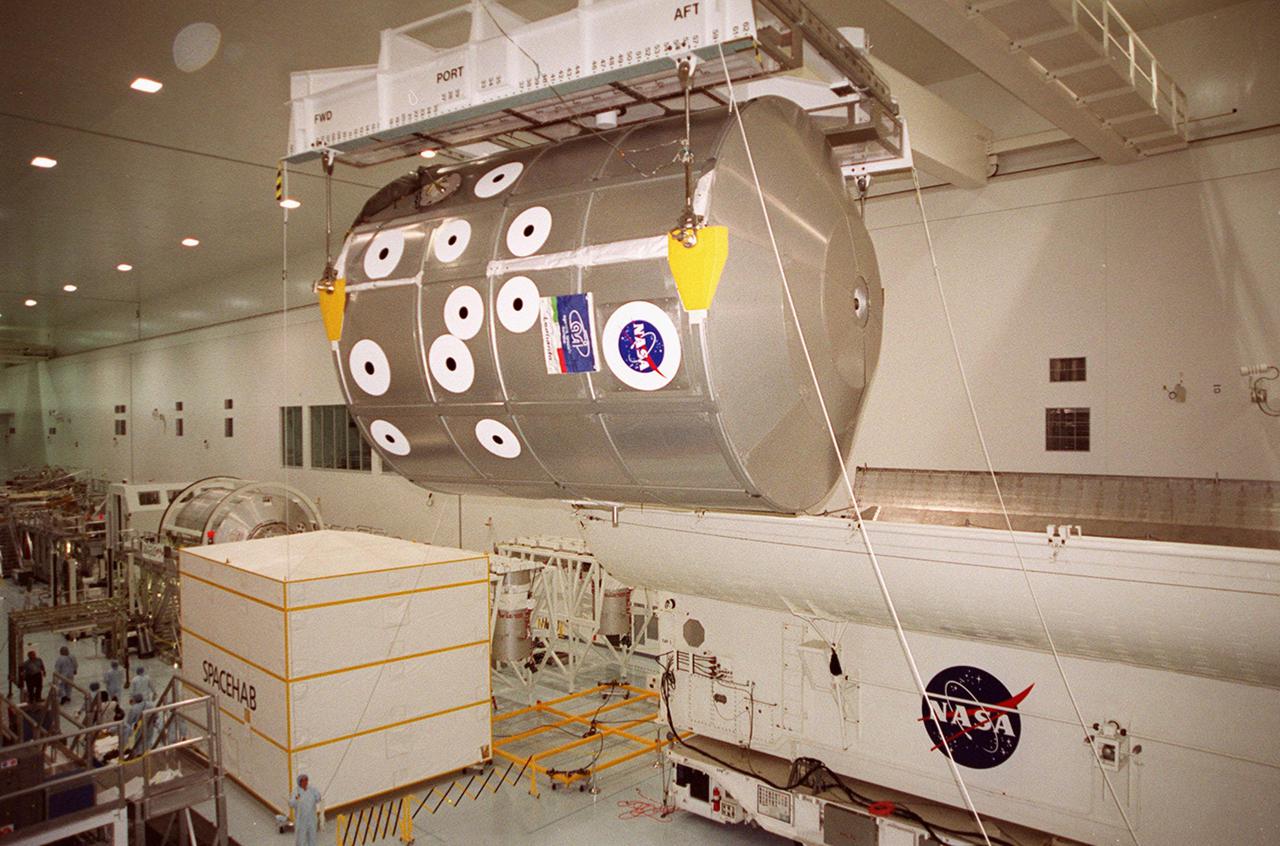
KENNEDY SPACE CENTER, FLA. -- In the Space Station Processing Facility, an overhead crane lifts the Multi-Purpose Logistics Module Leonardo out of the payload canister that transported it from the Orbiter Processing Facility bay 2. Leonardo will be placed on a workstand and prepared for a future launch to the International Space Station. Leonardo is one of three MPLMs that are being used as cargo vans to carry supplies, equipment and research racks to the Space Station and back to KSC. Leonardo recently returned from its maiden voyage to the Station on mission STS-102
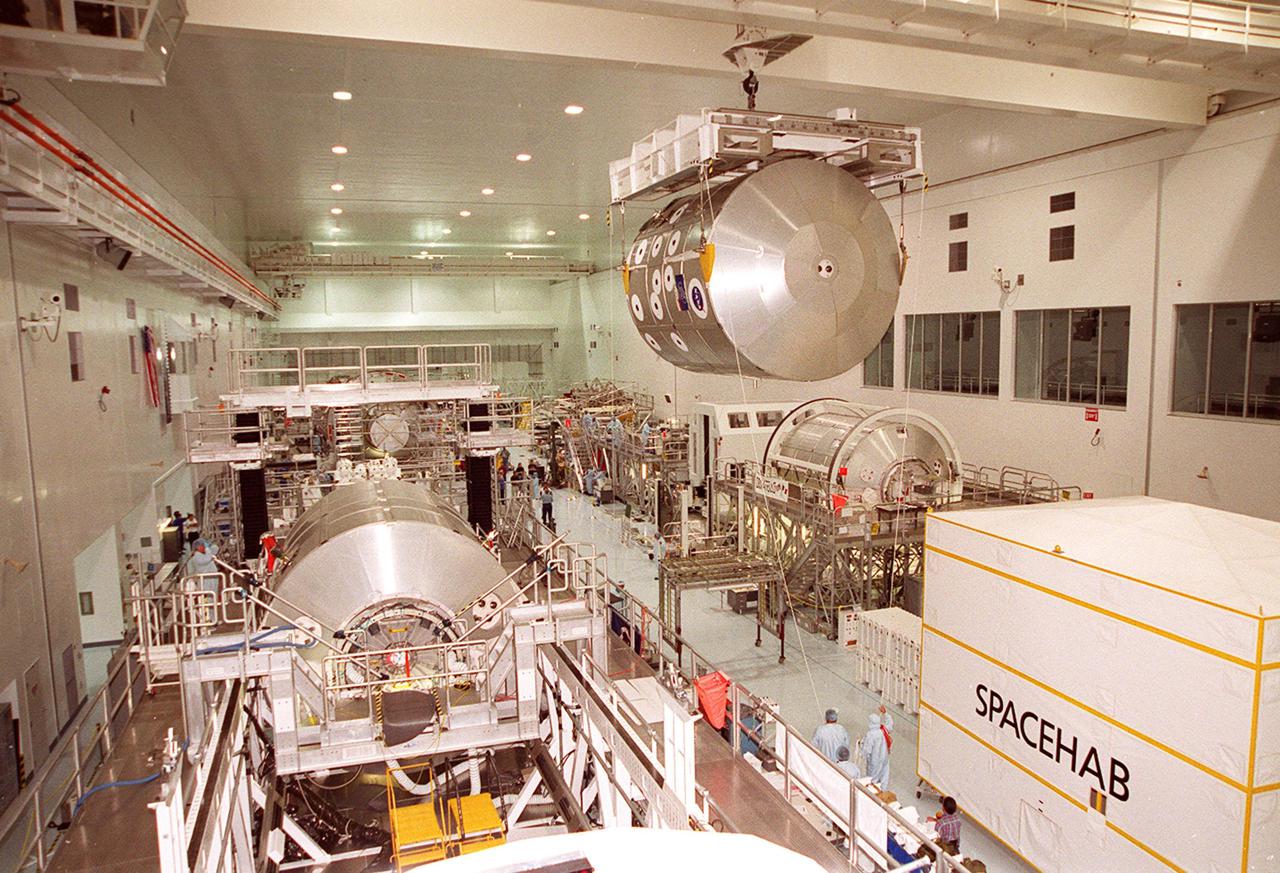
KENNEDY SPACE CENTER, FLA. -- In the Space Station Processing Facility, an overhead crane carries the Multi-Purpose Logistics Module Leonardo across the room. Leonardo will be placed on a workstand and prepared for a future launch to the International Space Station. Leonardo is one of three MPLMs that are being used as cargo vans to carry supplies, equipment and research racks to the Space Station and back to KSC. Leonardo recently returned from its maiden voyage to the Station on mission STS-102
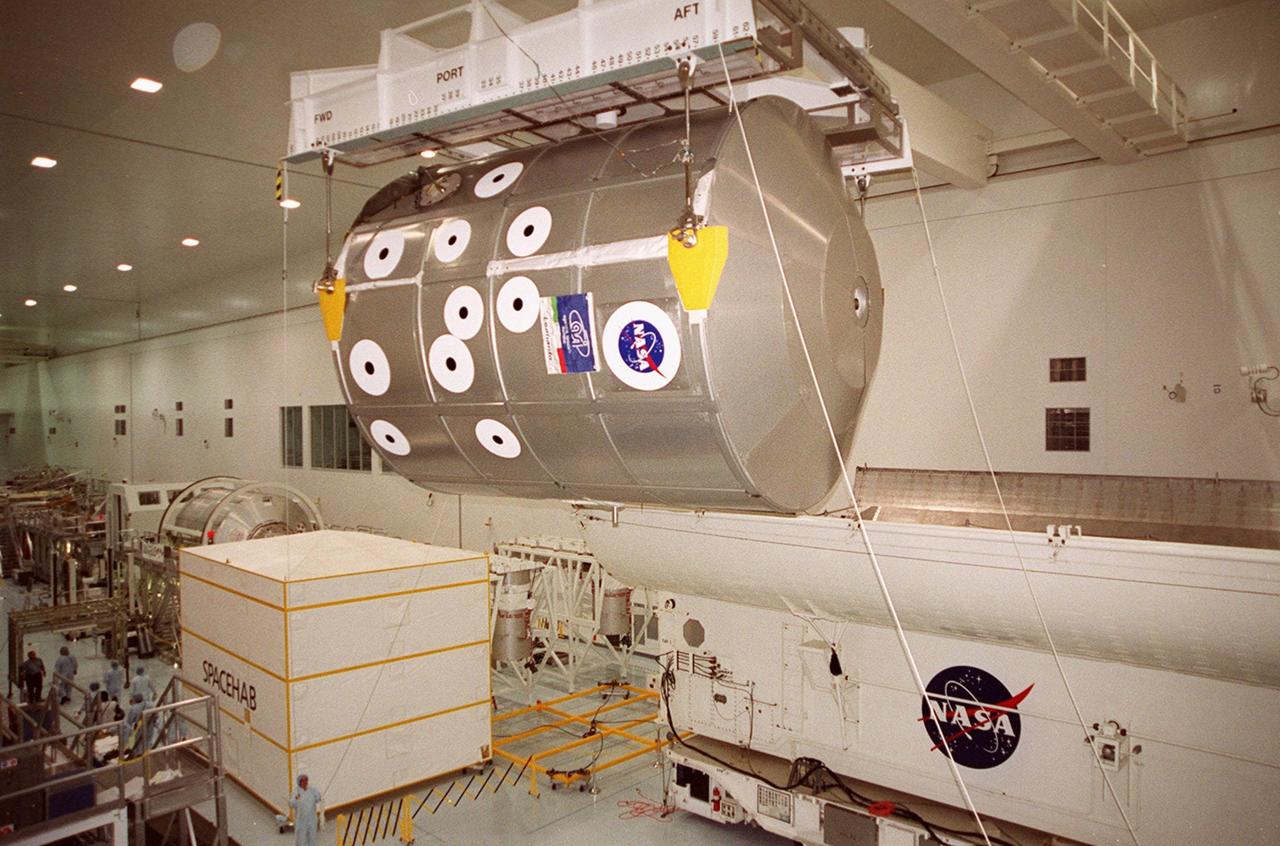
KENNEDY SPACE CENTER, FLA. -- In the Space Station Processing Facility, an overhead crane lifts the Multi-Purpose Logistics Module Leonardo out of the payload canister that transported it from the Orbiter Processing Facility bay 2. Leonardo will be placed on a workstand and prepared for a future launch to the International Space Station. Leonardo is one of three MPLMs that are being used as cargo vans to carry supplies, equipment and research racks to the Space Station and back to KSC. Leonardo recently returned from its maiden voyage to the Station on mission STS-102
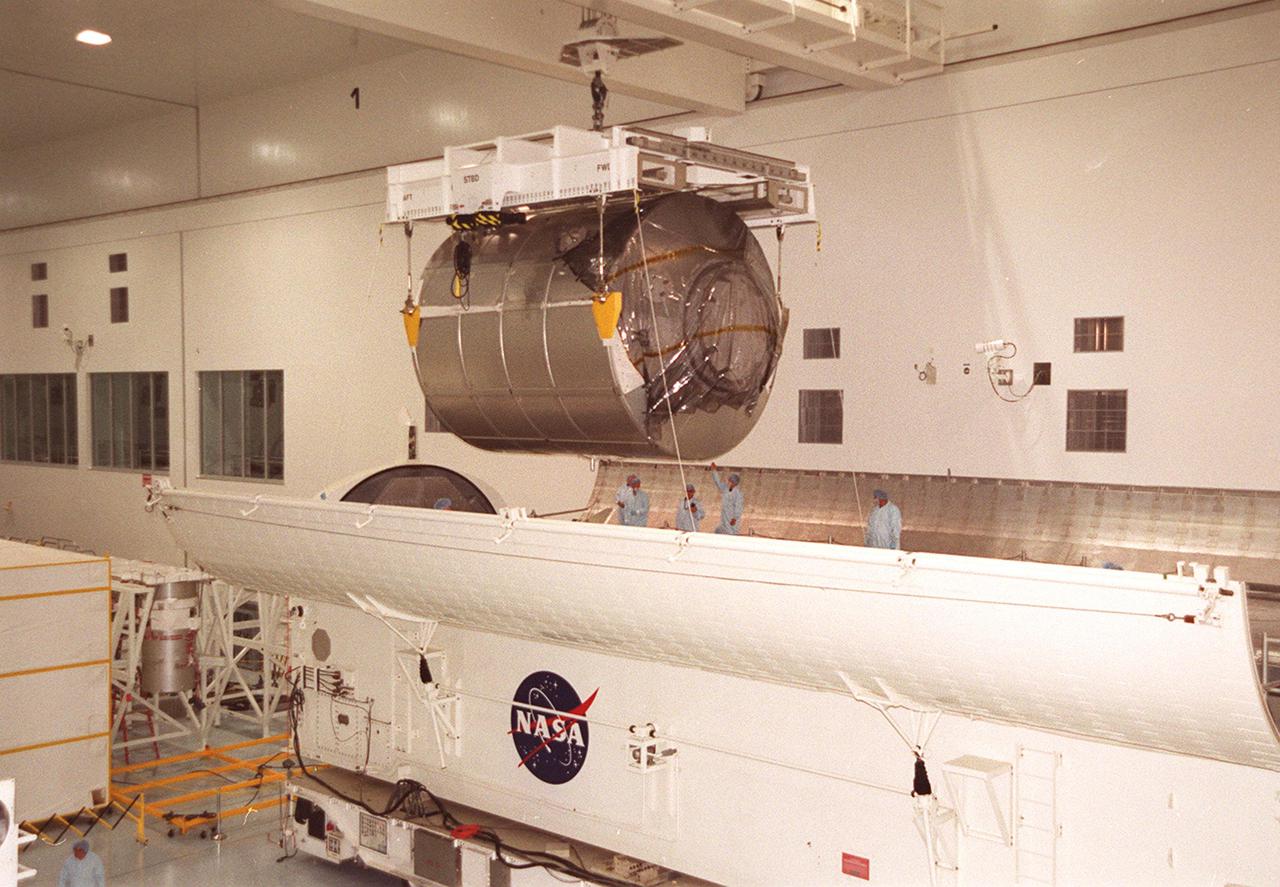
KENNEDY SPACE CENTER, FLA. -- In the Space Station Processing Facility, the Multi-Purpose Logistics Module Leonardo is lifted out of the payload canister that transported it from the Orbiter Processing Facility bay 2. Leonardo will be placed on a workstand and prepared for a future launch to the International Space Station. Leonardo is one of three MPLMs that are being used as cargo vans to carry supplies, equipment and research racks to the Space Station and back to KSC. Leonardo recently returned from its maiden voyage to the Station on mission STS-102
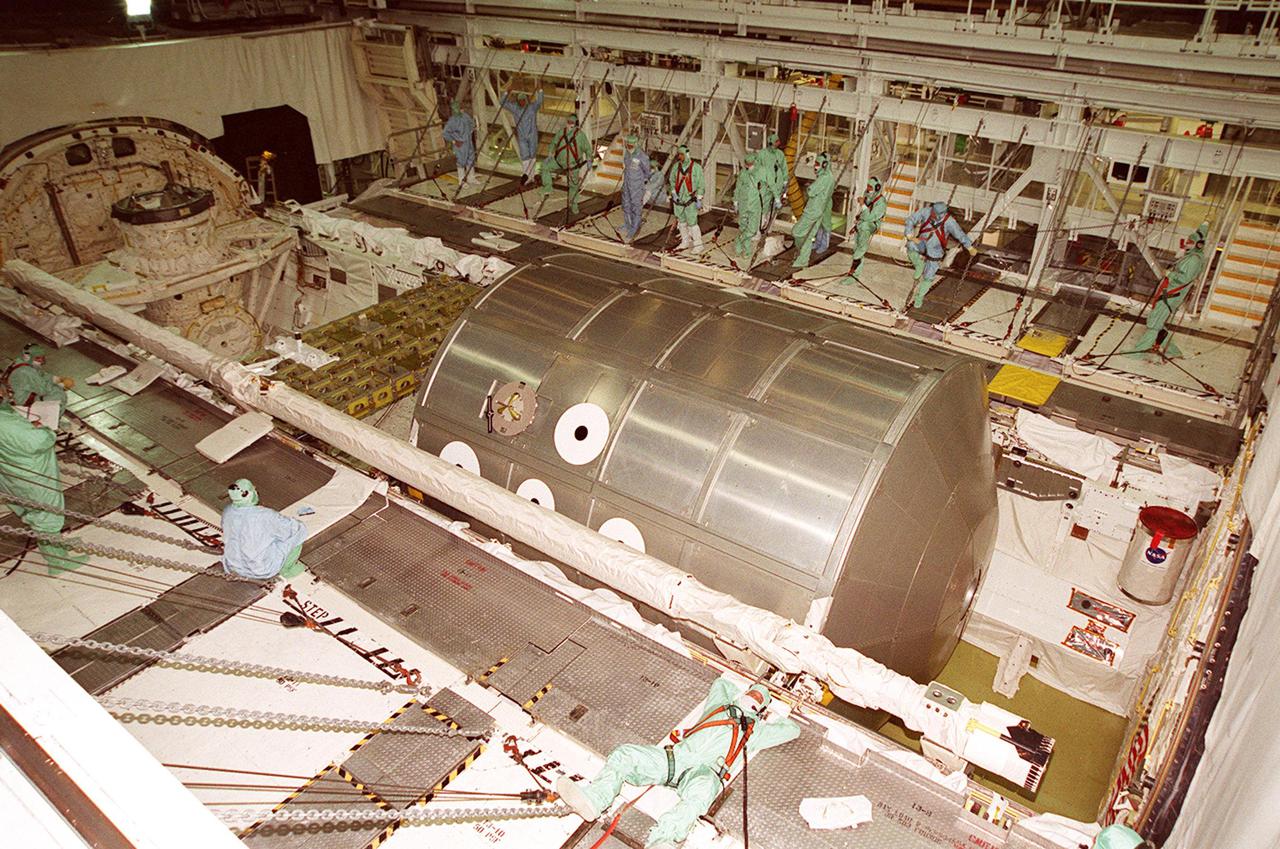
KENNEDY SPACE CENTER, FLA. -- In the Orbiter Processing Facility bay 2, Discovery’s payload bay doors are open to reveal the Multi-Purpose Logistics Module Leonardo, which has just returned from its first round trip to the International Space Station on mission STS-102. Behind it to the left is the integrated cargo carrier. Attached to the length of the payload bay, in front of Leonardo, is the robotic arm that was used to remove and position Leonardo on the ISS. Leonardo will be lifted from the payload bay and transferred to the SSPF to prepare it for future missions. The MPLM serves as a cargo van, carrying equipment and supplies to the Space Station
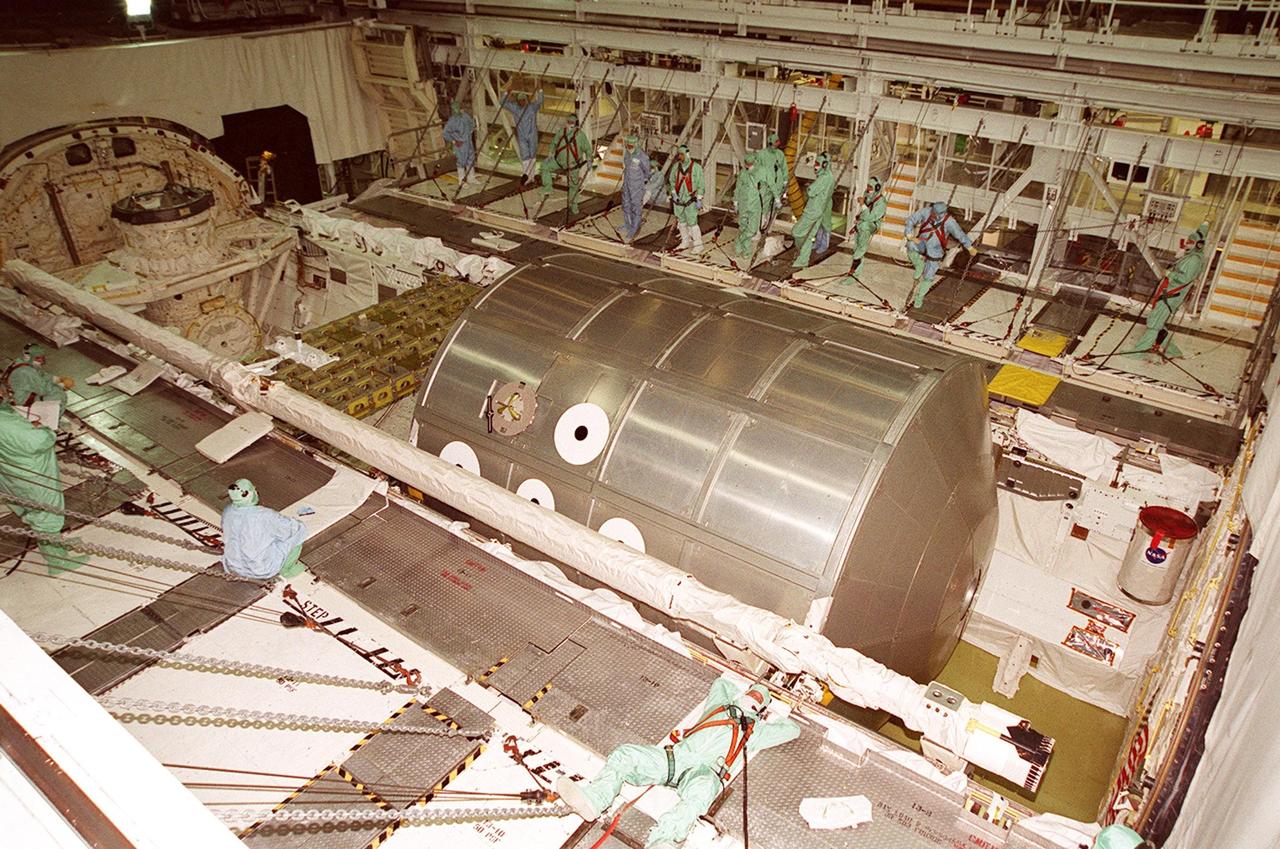
KENNEDY SPACE CENTER, FLA. -- In the Orbiter Processing Facility bay 2, Discovery’s payload bay doors are open to reveal the Multi-Purpose Logistics Module Leonardo, which has just returned from its first round trip to the International Space Station on mission STS-102. Behind it to the left is the integrated cargo carrier. Attached to the length of the payload bay, in front of Leonardo, is the robotic arm that was used to remove and position Leonardo on the ISS. Leonardo will be lifted from the payload bay and transferred to the SSPF to prepare it for future missions. The MPLM serves as a cargo van, carrying equipment and supplies to the Space Station

In the payload changeout room on the Rotating Service Structure, Launch Pad 39B, workers move the Multi-Purpose Logistics Module Leonardo out of the payload canister. From the PCR Leonardo then will be transferred into Space Shuttle Discovery’s payload bay. One of Italy’s major contributions to the International Space Station program, Leonardo is a reusable logistics carrier. It is the primary delivery system used to resupply and return Station cargo requiring a pressurized environment. Leonardo is the primary payload on mission STS-102 and will deliver up to 10 tons of laboratory racks filled with equipment, experiments and supplies for outfitting the newly installed U.S. Laboratory Destiny. STS-102 is scheduled to launch March 8 at 6:45 a.m. EST
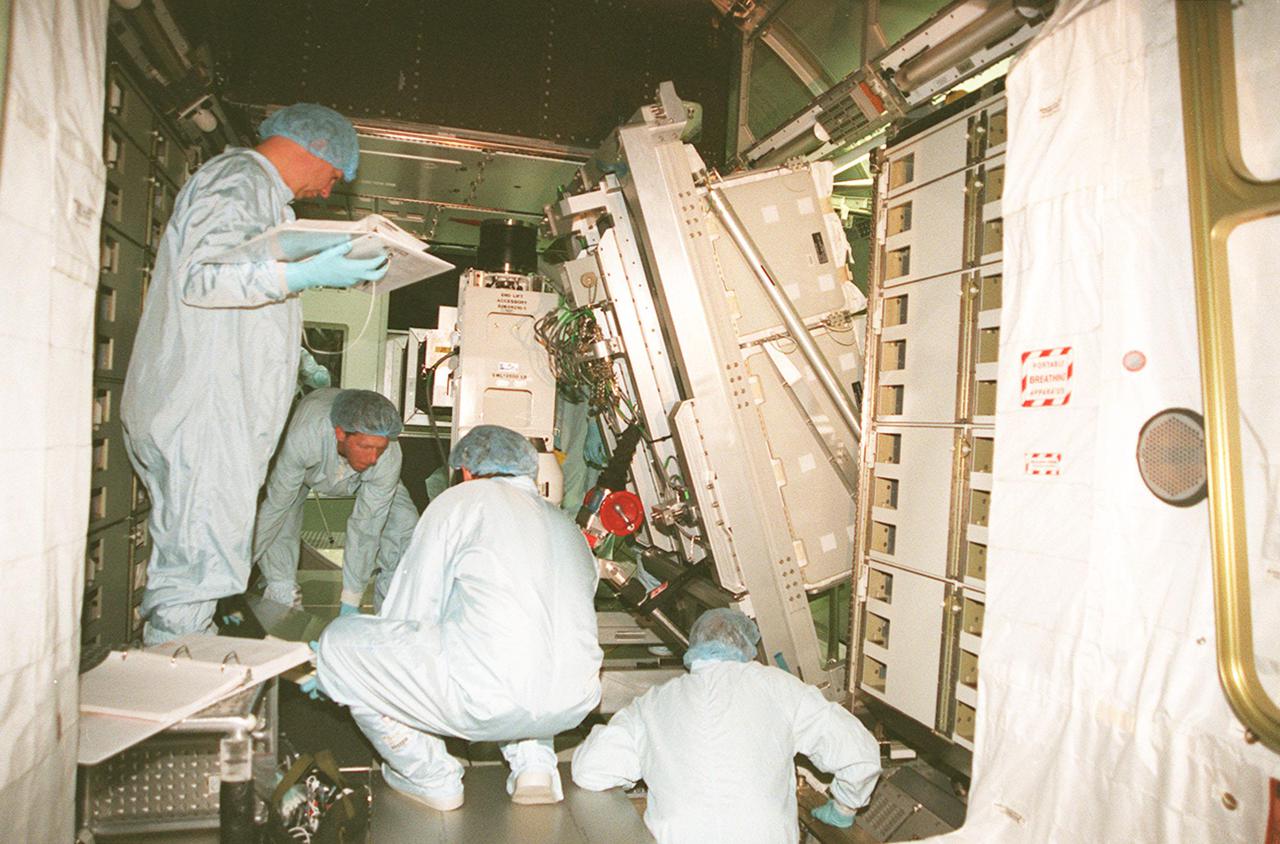
KENNEDY SPACE CENTER, FLA. -- Workers inside the Multi-Purpose Logistics Module Leonardo check connections while installing a laboratory rack. Leonardo is the first of three such pressurized modules that will serve as the International Space Station's “moving vans,” carrying laboratory racks filled with equipment, experiments and supplies to and from the Space Station aboard the Space Shuttle. Approximately 21 feet long and 15 feet in diameter, Leonardo will be launched on Shuttle mission STS-102 March 1, 2001. On that flight, Leonardo will be filled with equipment and supplies to outfit the U.S. laboratory module, being carried to the ISS on the Jan. 19, 2001, launch of STS-98
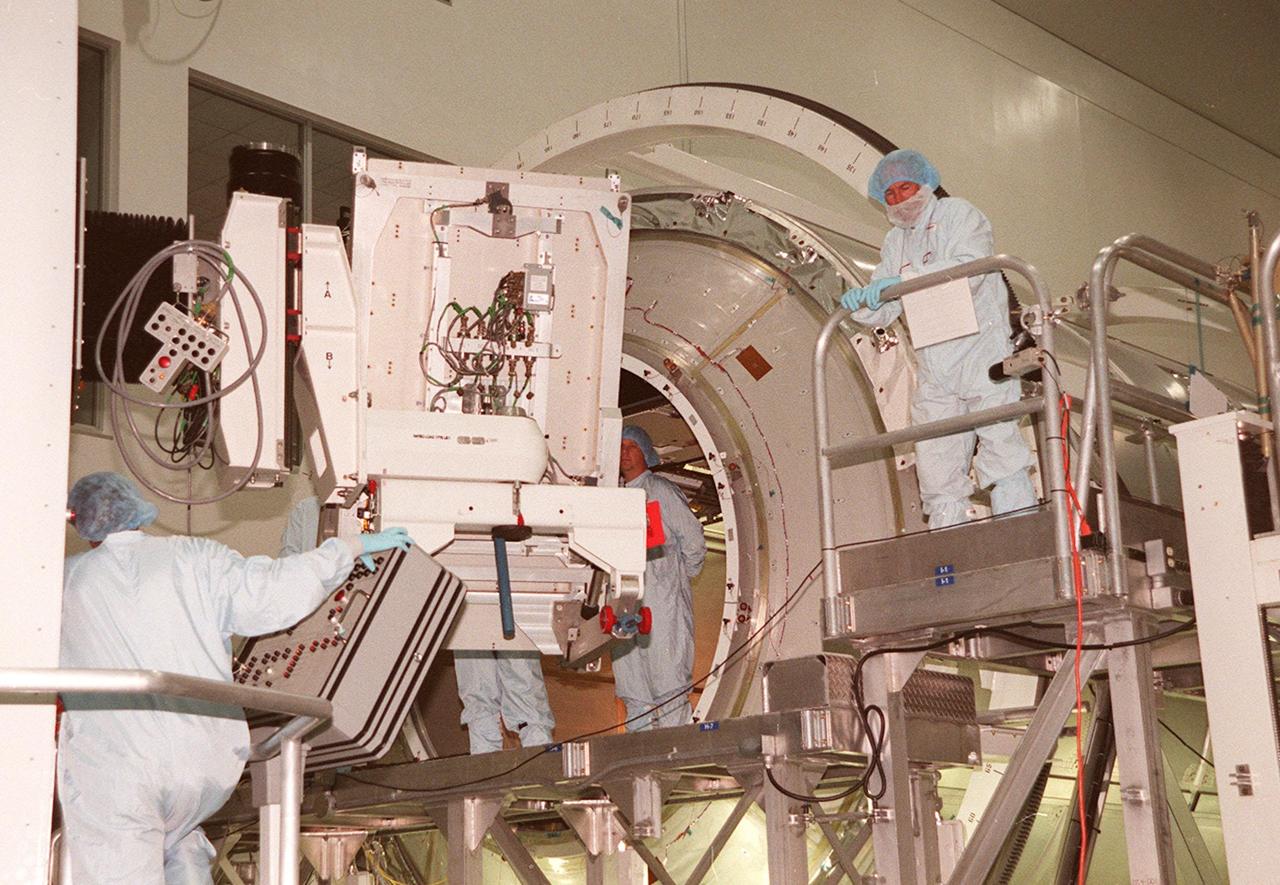
KENNEDY SPACE CENTER, FLA. -- Workers (right, left and center) in the Space Station Processing Facility wait to install a laboratory rack in the Multi-Purpose Logistics Module Leonardo (background). Leonardo is the first of three such pressurized modules that will serve as the International Space Station's “moving vans,” carrying laboratory racks filled with equipment, experiments and supplies to and from the Space Station aboard the Space Shuttle. Approximately 21 feet long and 15 feet in diameter, Leonardo will be launched on Shuttle mission STS-102 March 1, 2001. On that flight, Leonardo will be filled with equipment and supplies to outfit the U.S. laboratory module, being carried to the ISS on the Jan. 19, 2001, launch of STS-98
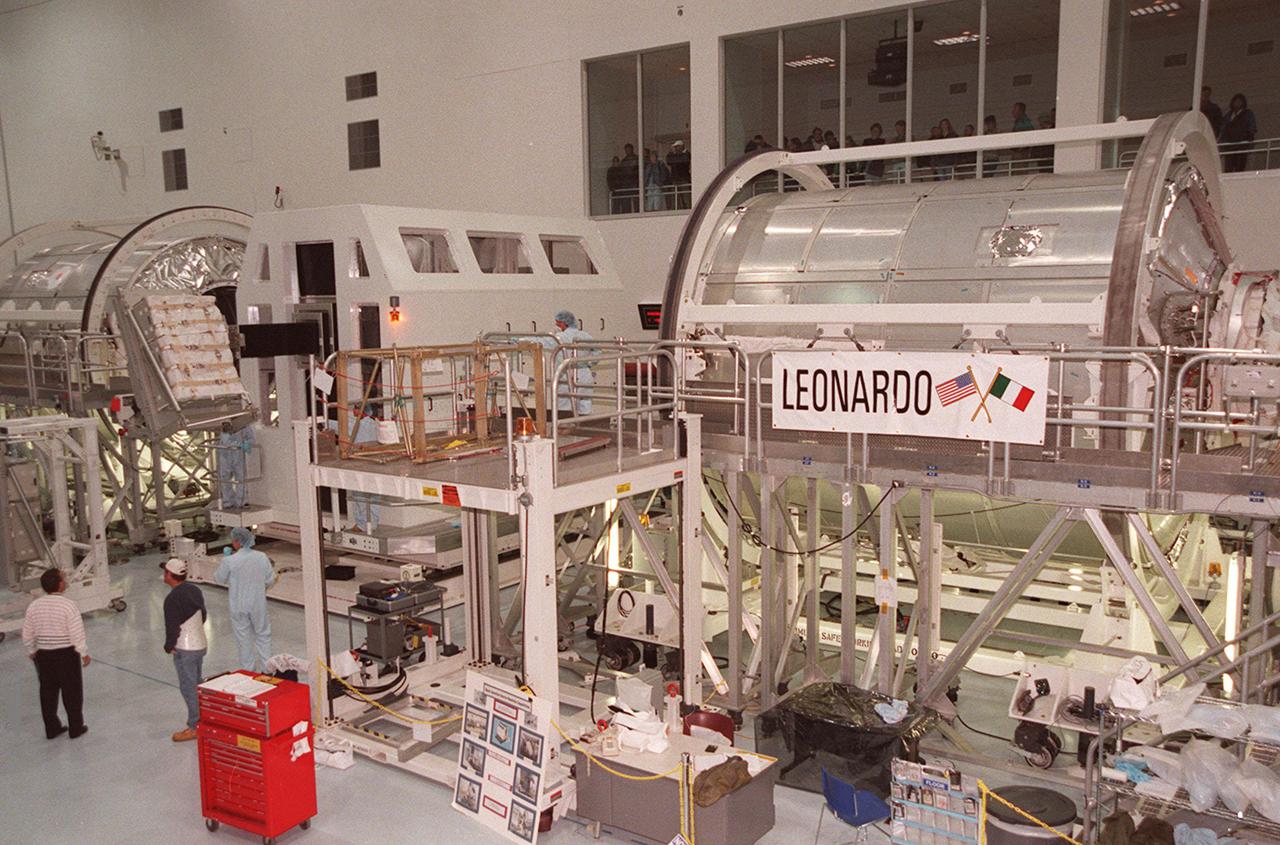
KENNEDY SPACE CENTER, FLA. -- In the Space Station Processing Facility, the Multi-Purpose Logistics Module Leonardo (right) is ready for installation of a laboratory rack (left center). Leonardo is the first of three such pressurized modules that will serve as the International Space Station's “moving vans,” carrying laboratory racks filled with equipment, experiments and supplies to and from the Space Station aboard the Space Shuttle. Approximately 21 feet long and 15 feet in diameter, Leonardo will be launched on Shuttle mission STS-102 March 1, 2001. On that flight, Leonardo will be filled with equipment and supplies to outfit the U.S. laboratory module, being carried to the ISS on the Jan. 19, 2001, launch of STS-98
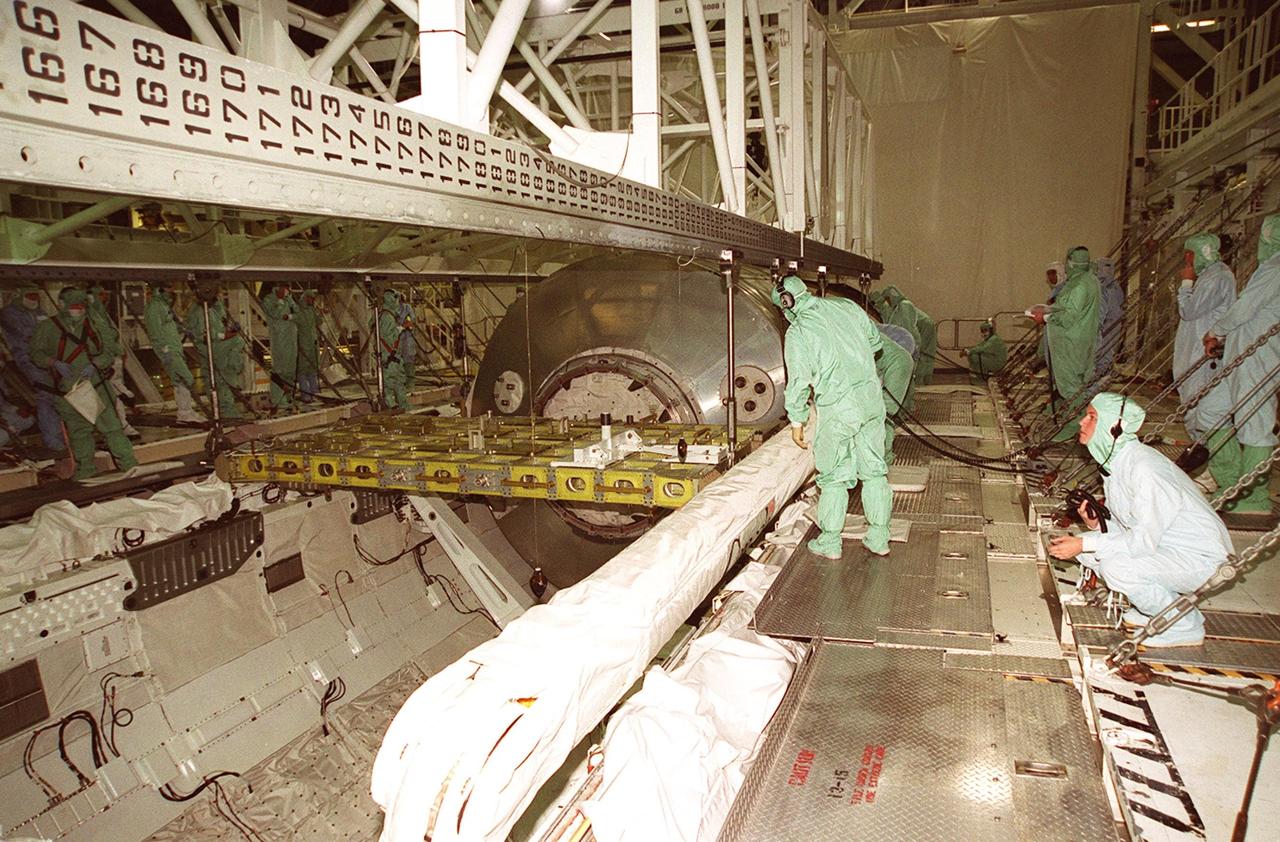
KENNEDY SPACE CENTER, FLA. -- Workers in the Orbiter Processing Facility bay 2 check the attachments on the overhead crane to the Multi-Purpose Logistics Module Leonardo and the integrated cargo carrier behind it sitting in Discovery’s payload bay. The MPLM has just returned from its first round trip to the International Space Station on mission STS-102. Attached to the length of the payload bay, in front of Leonardo, is the robotic arm that was used to remove and position Leonardo on the ISS. Leonardo will be lifted from the payload bay and transferred to the SSPF to prepare it for future missions. The MPLM serves as a cargo van, carrying equipment and supplies to the Space Station
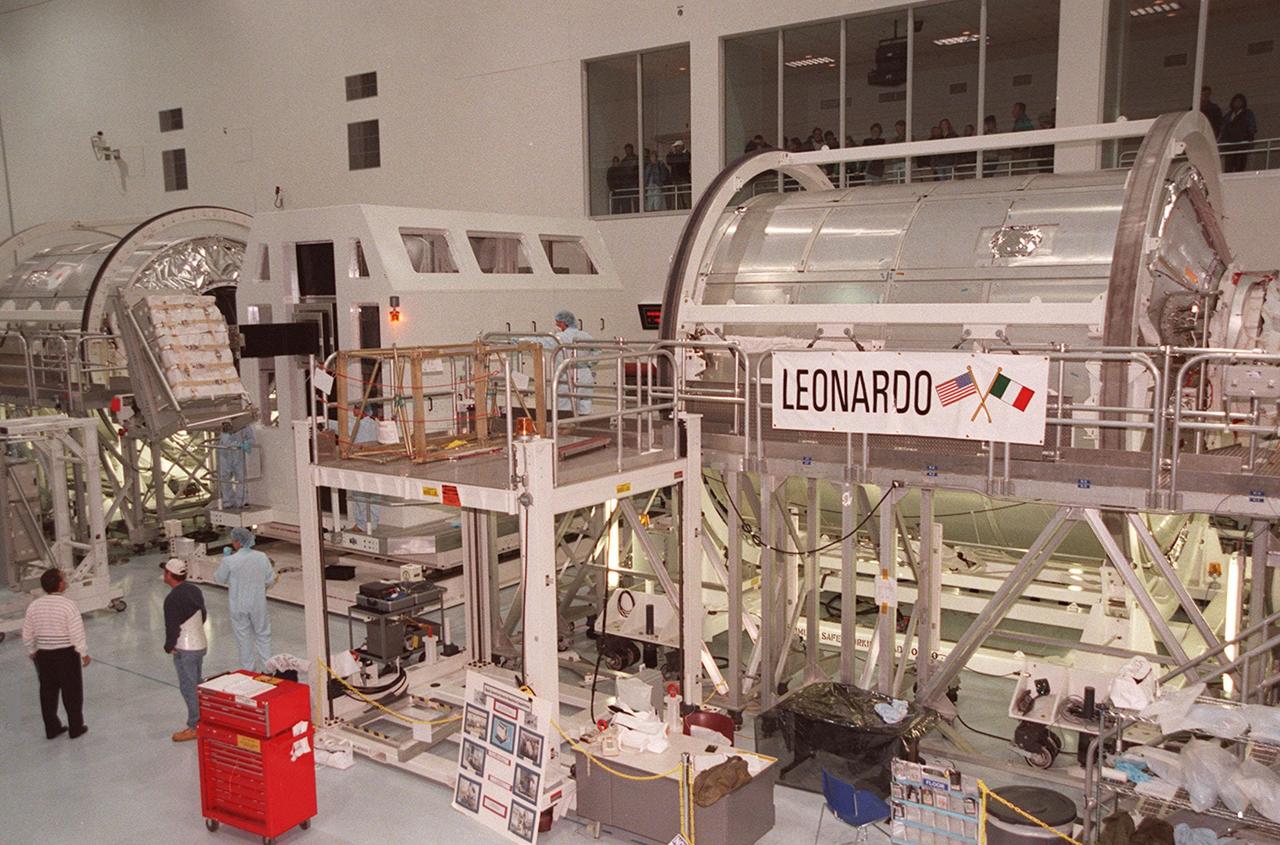
KENNEDY SPACE CENTER, FLA. -- In the Space Station Processing Facility, the Multi-Purpose Logistics Module Leonardo (right) is ready for installation of a laboratory rack (left center). Leonardo is the first of three such pressurized modules that will serve as the International Space Station's “moving vans,” carrying laboratory racks filled with equipment, experiments and supplies to and from the Space Station aboard the Space Shuttle. Approximately 21 feet long and 15 feet in diameter, Leonardo will be launched on Shuttle mission STS-102 March 1, 2001. On that flight, Leonardo will be filled with equipment and supplies to outfit the U.S. laboratory module, being carried to the ISS on the Jan. 19, 2001, launch of STS-98
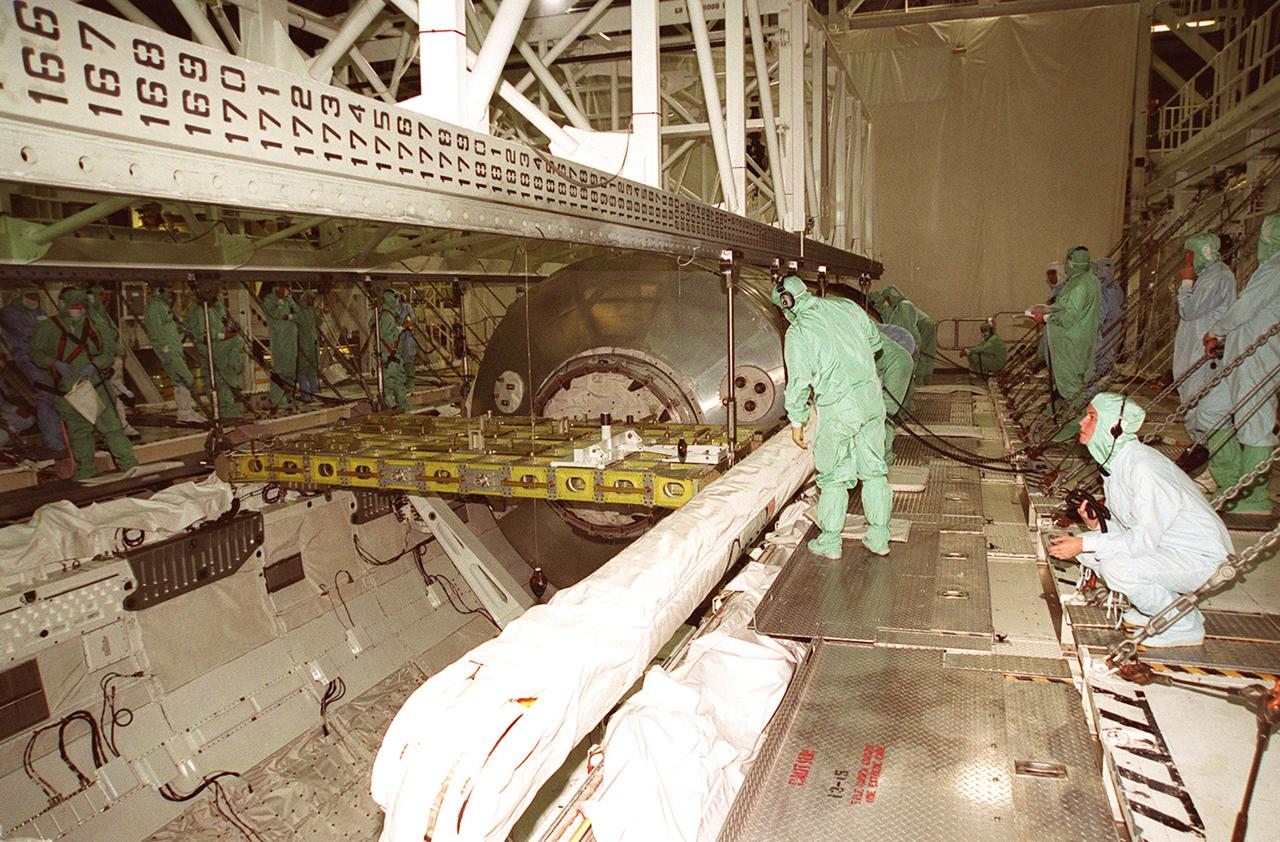
KENNEDY SPACE CENTER, FLA. -- Workers in the Orbiter Processing Facility bay 2 check the attachments on the overhead crane to the Multi-Purpose Logistics Module Leonardo and the integrated cargo carrier behind it sitting in Discovery’s payload bay. The MPLM has just returned from its first round trip to the International Space Station on mission STS-102. Attached to the length of the payload bay, in front of Leonardo, is the robotic arm that was used to remove and position Leonardo on the ISS. Leonardo will be lifted from the payload bay and transferred to the SSPF to prepare it for future missions. The MPLM serves as a cargo van, carrying equipment and supplies to the Space Station
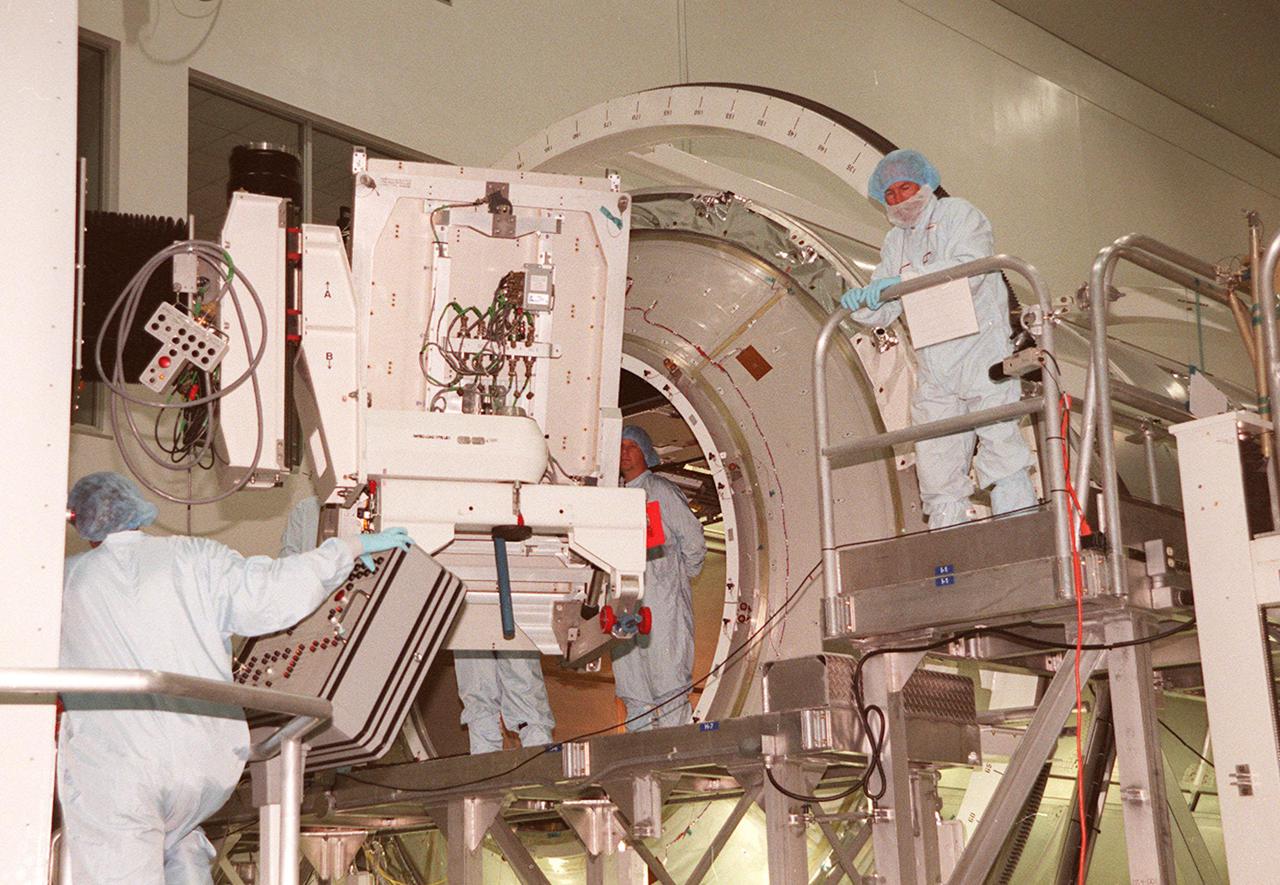
KENNEDY SPACE CENTER, FLA. -- Workers (right, left and center) in the Space Station Processing Facility wait to install a laboratory rack in the Multi-Purpose Logistics Module Leonardo (background). Leonardo is the first of three such pressurized modules that will serve as the International Space Station's “moving vans,” carrying laboratory racks filled with equipment, experiments and supplies to and from the Space Station aboard the Space Shuttle. Approximately 21 feet long and 15 feet in diameter, Leonardo will be launched on Shuttle mission STS-102 March 1, 2001. On that flight, Leonardo will be filled with equipment and supplies to outfit the U.S. laboratory module, being carried to the ISS on the Jan. 19, 2001, launch of STS-98
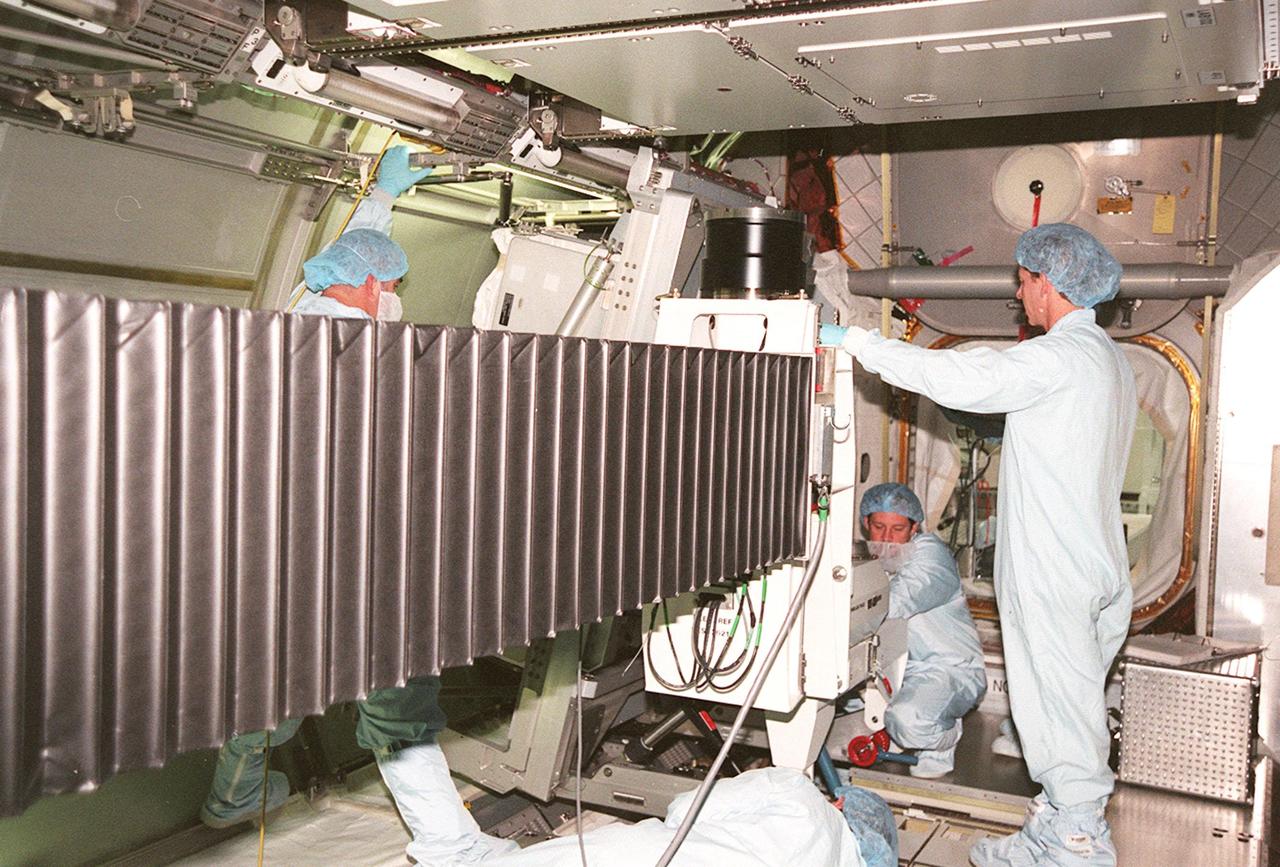
KENNEDY SPACE CENTER, FLA. -- Workers inside the Multi-Purpose Logistics Module Leonardo check installation of a laboratory rack inside the Multi-Purpose Logistics Module Leonardo. The pressurized module is the first of three that will serve as the International Space Station's “moving vans,” carrying laboratory racks filled with equipment, experiments and supplies to and from the Space Station aboard the Space Shuttle. Approximately 21 feet long and 15 feet in diameter, Leonardo will be launched on Shuttle mission STS-102 March 1, 2001. On that flight, Leonardo will be filled with equipment and supplies to outfit the U.S. laboratory module, being carried to the ISS on the Jan. 19, 2001, launch of STS-98
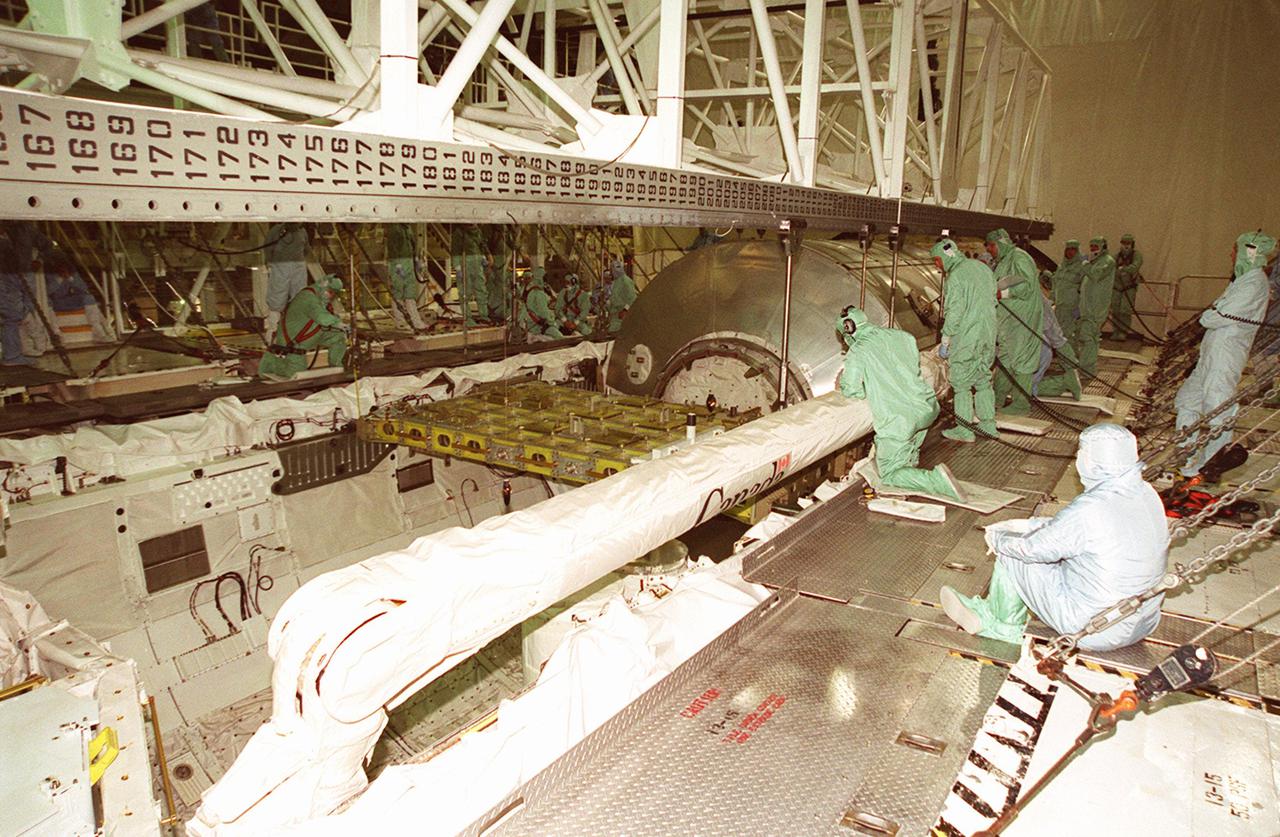
KENNEDY SPACE CENTER, FLA. -- In the Orbiter Processing Facility bay 2, workers attach an overhead crane to the Multi-Purpose Logistics Module Leonardo and the integrated cargo carrier behind it sitting in Discovery’s payload bay. The MPLM has just returned from its first round trip to the International Space Station on mission STS-102. Attached to the length of the payload bay, in front of Leonardo, is the robotic arm that was used to remove and position Leonardo on the ISS. Leonardo will be lifted from the payload bay and transferred to the SSPF to prepare it for future missions. The MPLM serves as a cargo van, carrying equipment and supplies to the Space Station
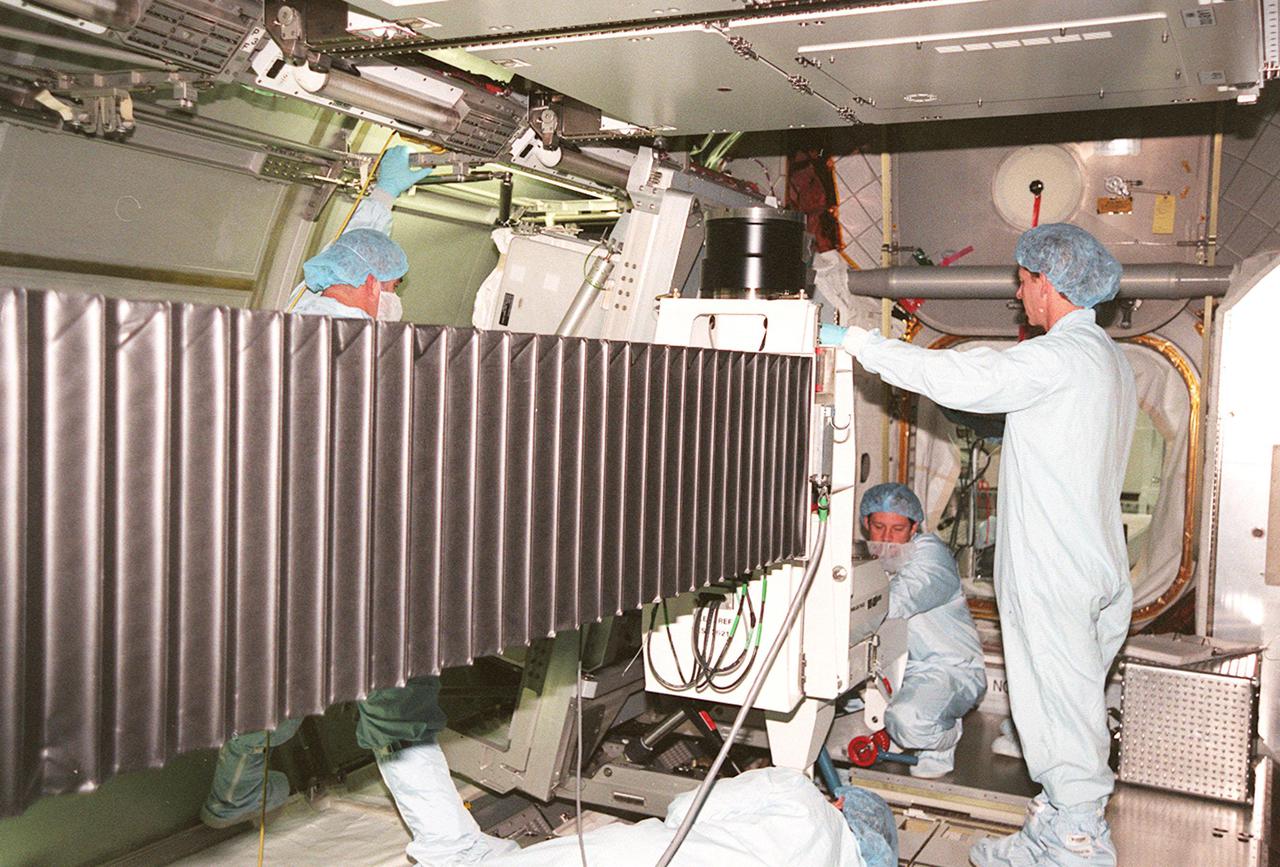
KENNEDY SPACE CENTER, FLA. -- Workers inside the Multi-Purpose Logistics Module Leonardo check installation of a laboratory rack inside the Multi-Purpose Logistics Module Leonardo. The pressurized module is the first of three that will serve as the International Space Station's “moving vans,” carrying laboratory racks filled with equipment, experiments and supplies to and from the Space Station aboard the Space Shuttle. Approximately 21 feet long and 15 feet in diameter, Leonardo will be launched on Shuttle mission STS-102 March 1, 2001. On that flight, Leonardo will be filled with equipment and supplies to outfit the U.S. laboratory module, being carried to the ISS on the Jan. 19, 2001, launch of STS-98
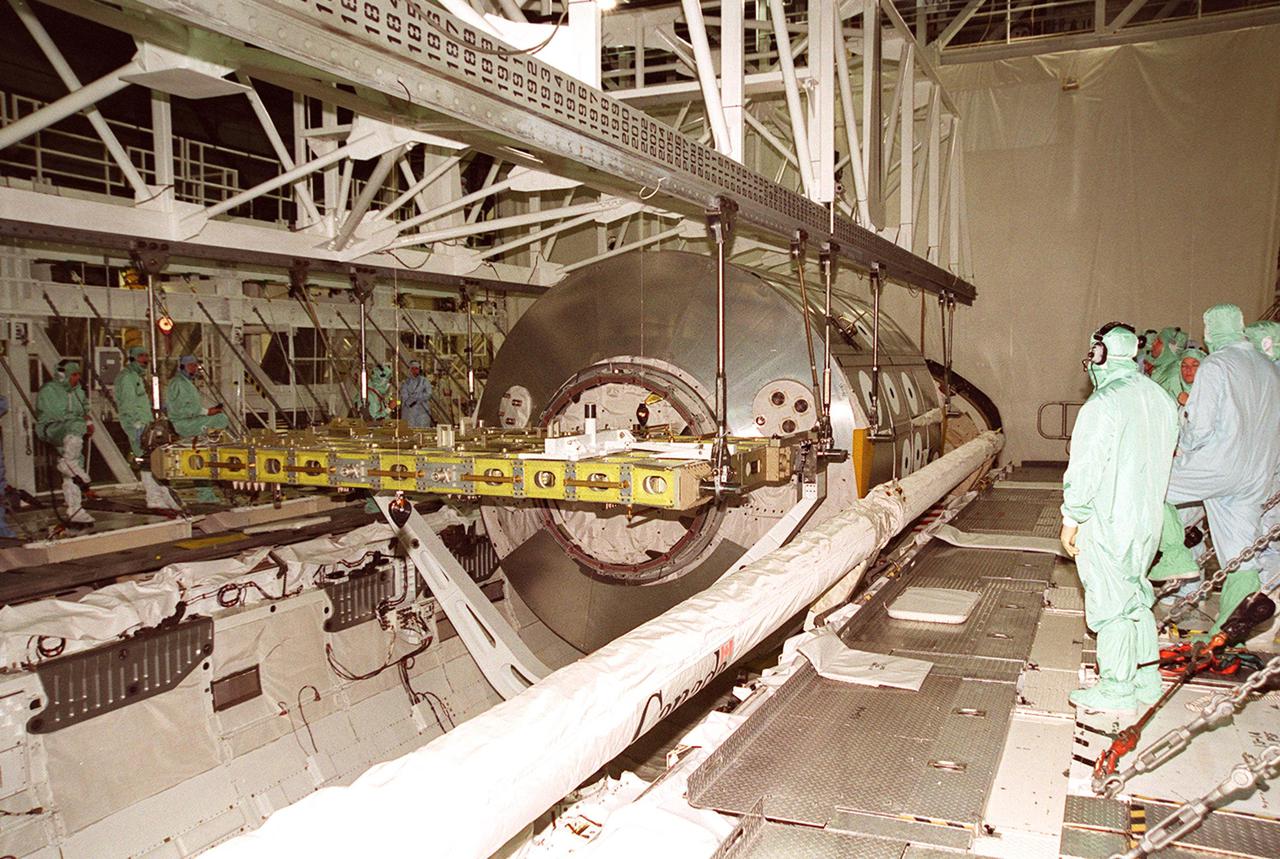
KENNEDY SPACE CENTER, FLA. -- In the Orbiter Processing Facility bay 2, an overhead crane begins lifting the Multi-Purpose Logistics Module Leonardo and the integrated cargo carrier next to it out of Discovery’s payload bay. The MPLM has just returned from its first round trip to the International Space Station on mission STS-102. Attached to the length of the payload bay, next to Leonardo, is the robotic arm that was used to remove and position Leonardo on the ISS. Leonardo will be transferred to the SSPF to prepare it for future missions. The MPLM serves as a cargo van, carrying equipment and supplies to the Space Station

KENNEDY SPACE CENTER, FLA. -- Workers inside the Multi-Purpose Logistics Module Leonardo check connections while installing a laboratory rack. Leonardo is the first of three such pressurized modules that will serve as the International Space Station's “moving vans,” carrying laboratory racks filled with equipment, experiments and supplies to and from the Space Station aboard the Space Shuttle. Approximately 21 feet long and 15 feet in diameter, Leonardo will be launched on Shuttle mission STS-102 March 1, 2001. On that flight, Leonardo will be filled with equipment and supplies to outfit the U.S. laboratory module, being carried to the ISS on the Jan. 19, 2001, launch of STS-98
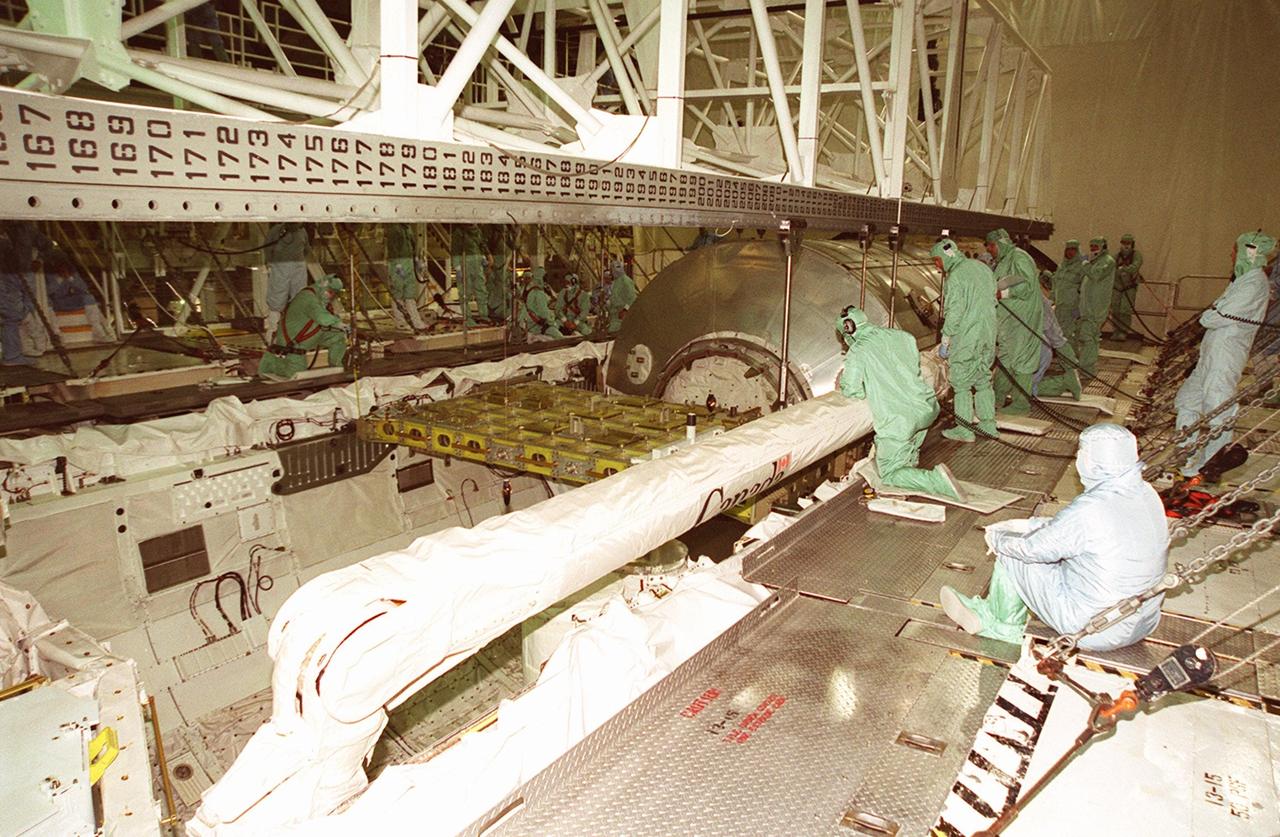
KENNEDY SPACE CENTER, FLA. -- In the Orbiter Processing Facility bay 2, workers attach an overhead crane to the Multi-Purpose Logistics Module Leonardo and the integrated cargo carrier behind it sitting in Discovery’s payload bay. The MPLM has just returned from its first round trip to the International Space Station on mission STS-102. Attached to the length of the payload bay, in front of Leonardo, is the robotic arm that was used to remove and position Leonardo on the ISS. Leonardo will be lifted from the payload bay and transferred to the SSPF to prepare it for future missions. The MPLM serves as a cargo van, carrying equipment and supplies to the Space Station
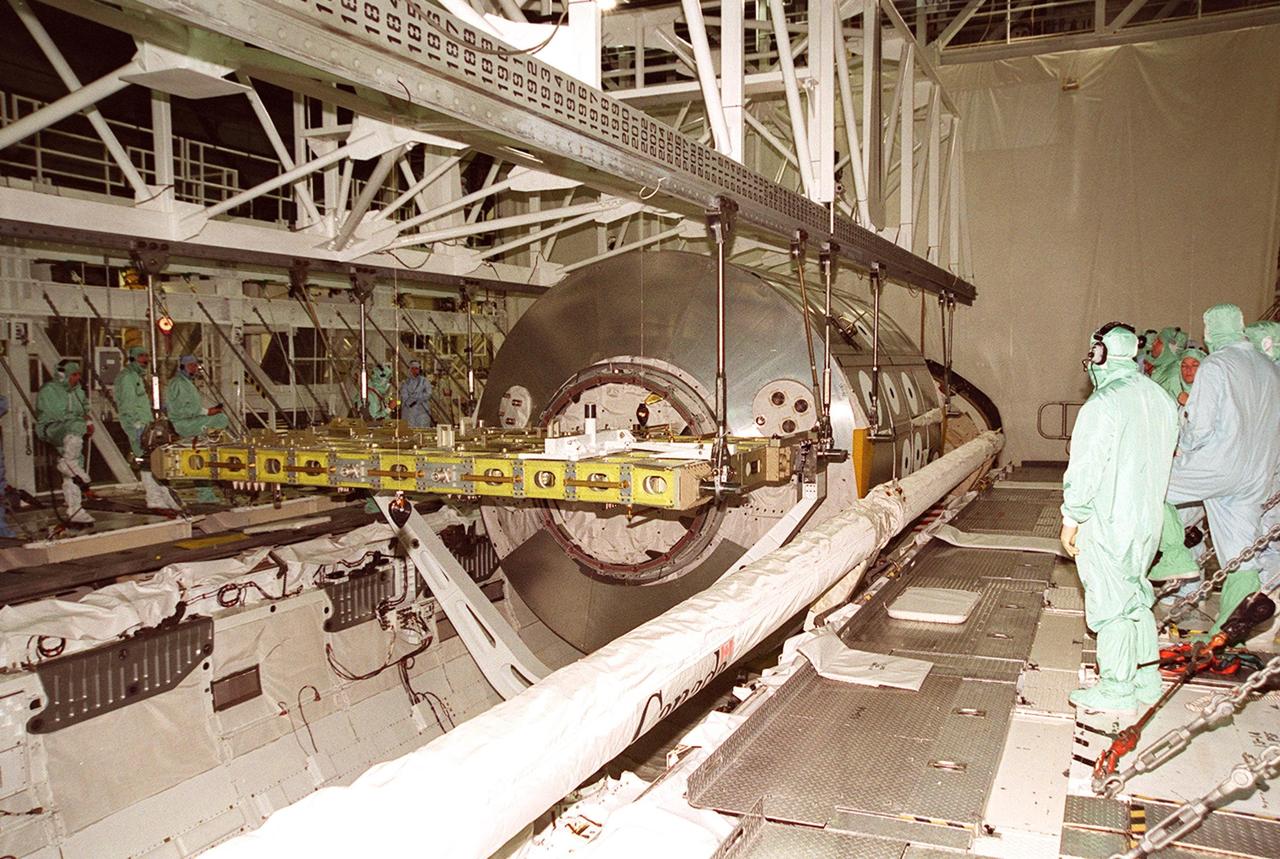
KENNEDY SPACE CENTER, FLA. -- In the Orbiter Processing Facility bay 2, an overhead crane begins lifting the Multi-Purpose Logistics Module Leonardo and the integrated cargo carrier next to it out of Discovery’s payload bay. The MPLM has just returned from its first round trip to the International Space Station on mission STS-102. Attached to the length of the payload bay, next to Leonardo, is the robotic arm that was used to remove and position Leonardo on the ISS. Leonardo will be transferred to the SSPF to prepare it for future missions. The MPLM serves as a cargo van, carrying equipment and supplies to the Space Station
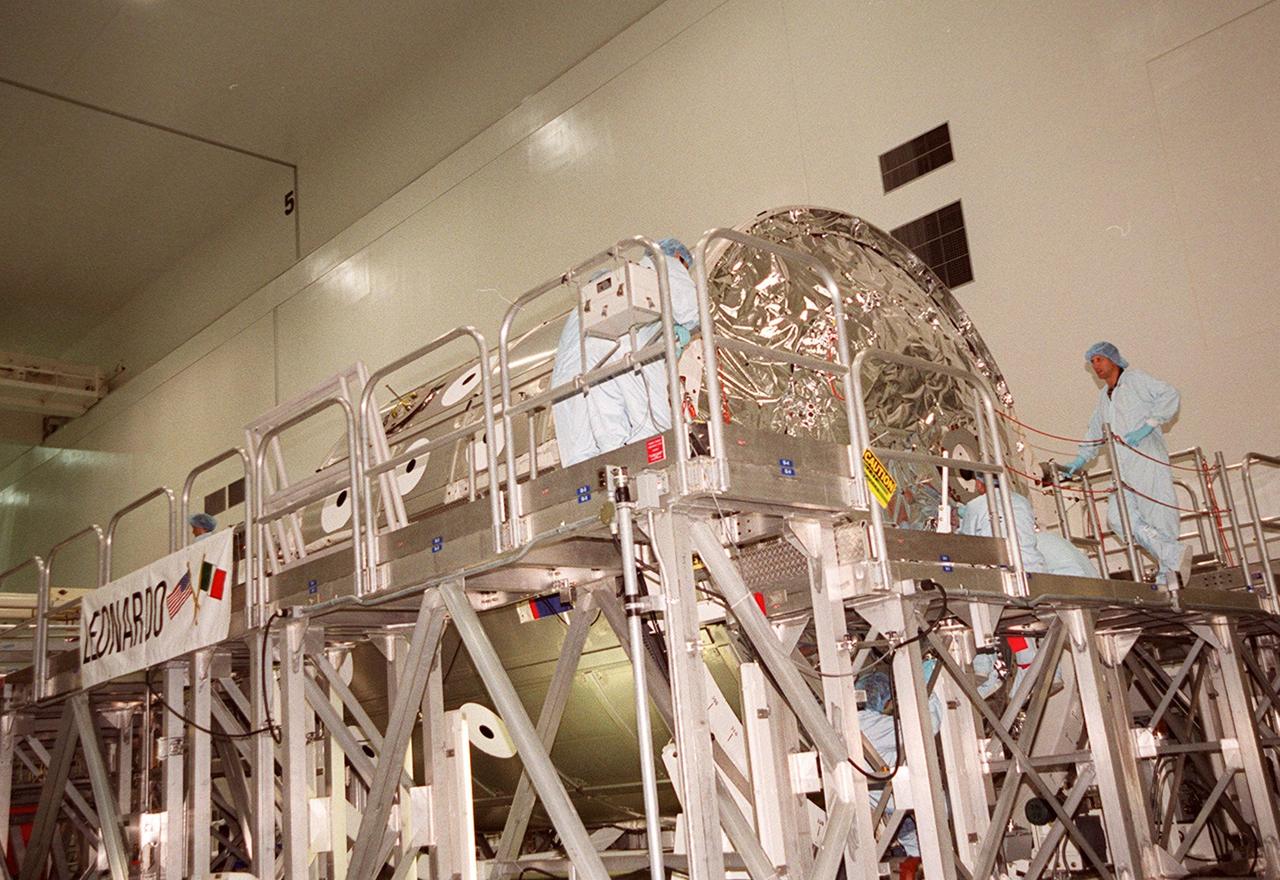
KENNEDY SPACE CENTER, FLA. -- The Multi-Purpose Logistics Module Leonardo sits on a workstand in the Space Station Processing Facility. Workers will be removing the protective cover over the end so they can open the hatch and access the inside. The MPLM has just returned from its maiden voyage to the International Space Station aboard Discovery on mission STS-102. Leonardo is one of three MPLMs built by the Italian Space Agency to serve as “cargo vans” to the Station, carrying supplies and equipment. In the SSPF, Leonardo will be prepared for a future mission
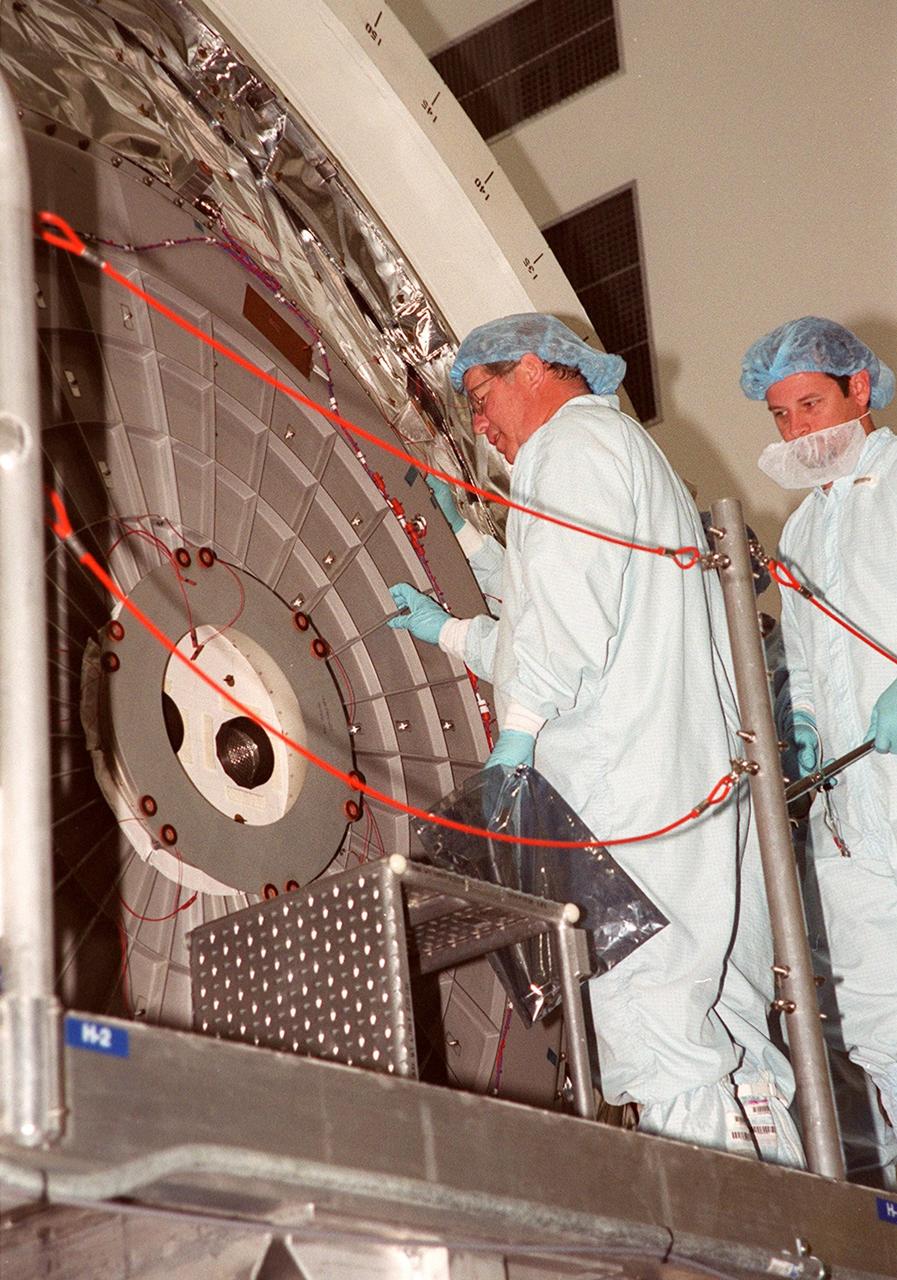
KENNEDY SPACE CENTER, FLA. -- Workers in the Space Station Processing Facility look at the hatch on Multi-Purpose Logistics Module Leonardo. The MPLM has just returned from its maiden voyage to the International Space Station aboard Discovery on mission STS-102. Leonardo is one of three MPLMs built by the Italian Space Agency to serve as “cargo vans” to the Station, carrying supplies and equipment. In the SSPF, Leonardo will be prepared for a future mission
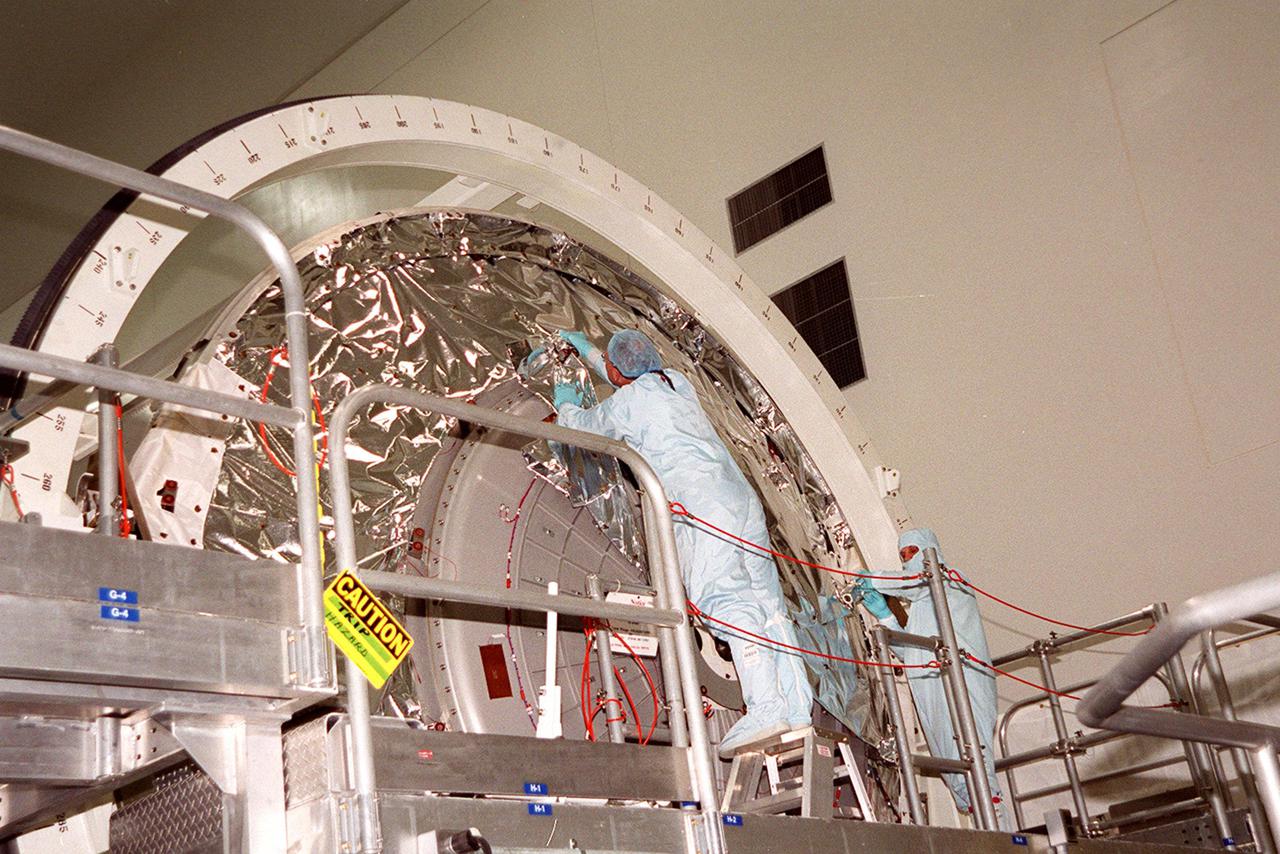
KENNEDY SPACE CENTER, FLA. -- Workers in the Space Station Processing Facility begin unwrapping the protective cover over the end of Multi-Purpose Logistics Module Leonardo so they can open the hatch and access the inside. The MPLM has just returned from its maiden voyage to the International Space Station aboard Discovery on mission STS-102. Leonardo is one of three MPLMs built by the Italian Space Agency to serve as “cargo vans” to the Station, carrying supplies and equipment. In the SSPF, Leonardo will be prepared for a future mission
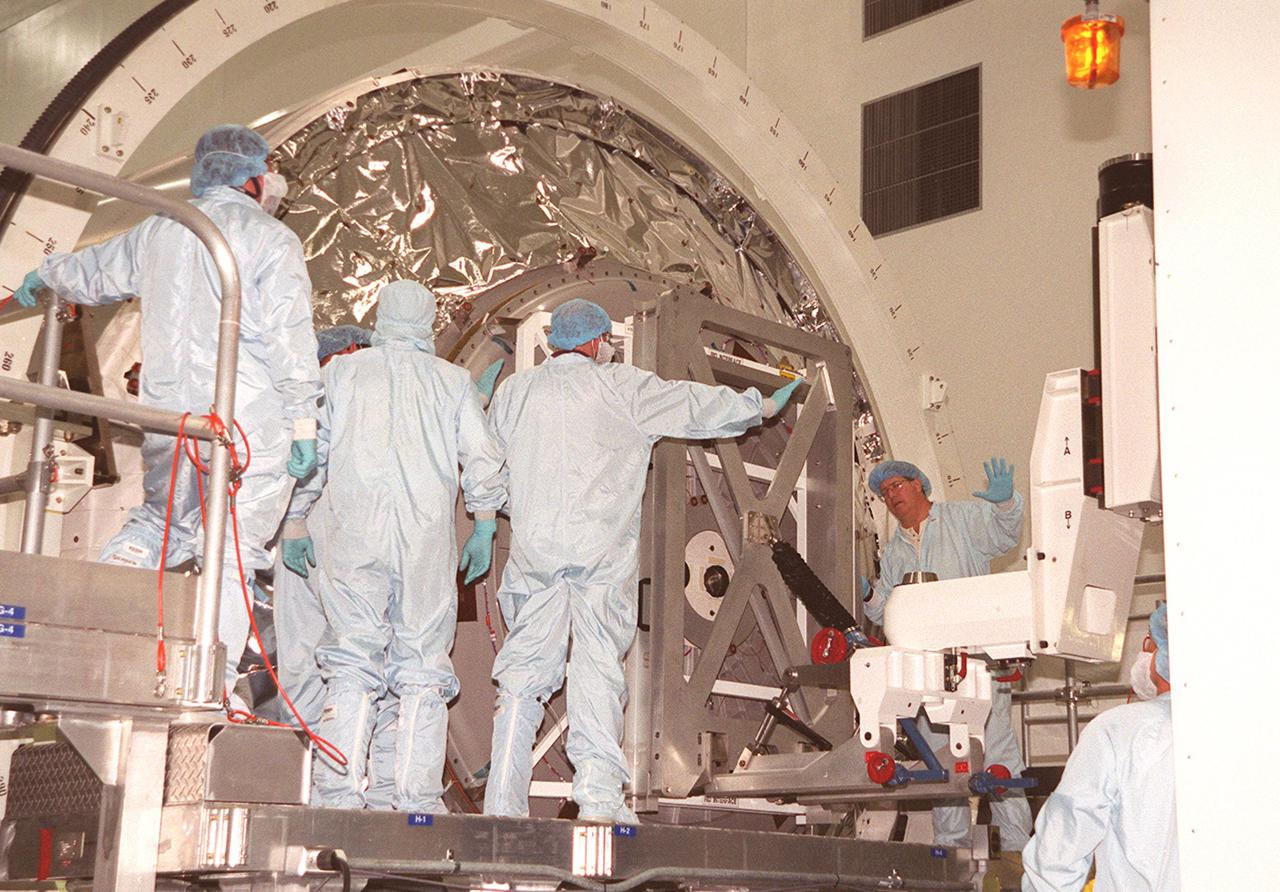
KENNEDY SPACE CENTER, FLA. -- Workers in the Space Station Processing Facility prepare to remove the hatch on Multi-Purpose Logistics Module Leonardo. The MPLM has just returned from its maiden voyage to the International Space Station aboard Discovery on mission STS-102. Leonardo is one of three MPLMs built by the Italian Space Agency to serve as “cargo vans” to the Station, carrying supplies and equipment. In the SSPF, Leonardo will be prepared for a future mission
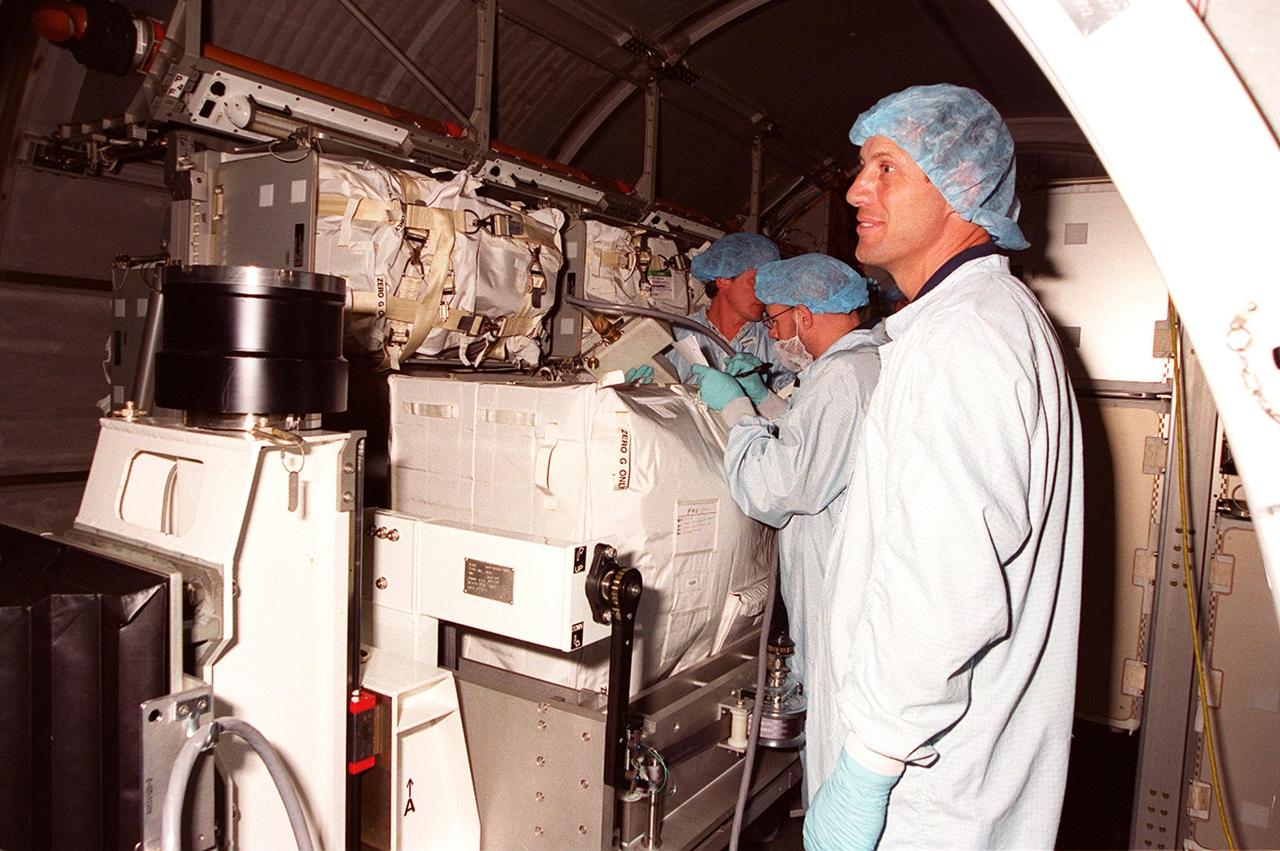
KENNEDY SPACE CENTER, FLA. -- Inside the Multi-Purpose Logistics Module Leonardo, which is in the Space Station Processing Facility, workers begin removing the containers returned from the International Space Station on mission STS-102. The MPLM brought back to KSC nearly a ton of trash and excess equipment from the Space Station. Leonardo is one of three MPLMs built by the Italian Space Agency to serve as “cargo vans” to the Station, carrying supplies and equipment. In the SSPF, Leonardo will be prepared for a future mission
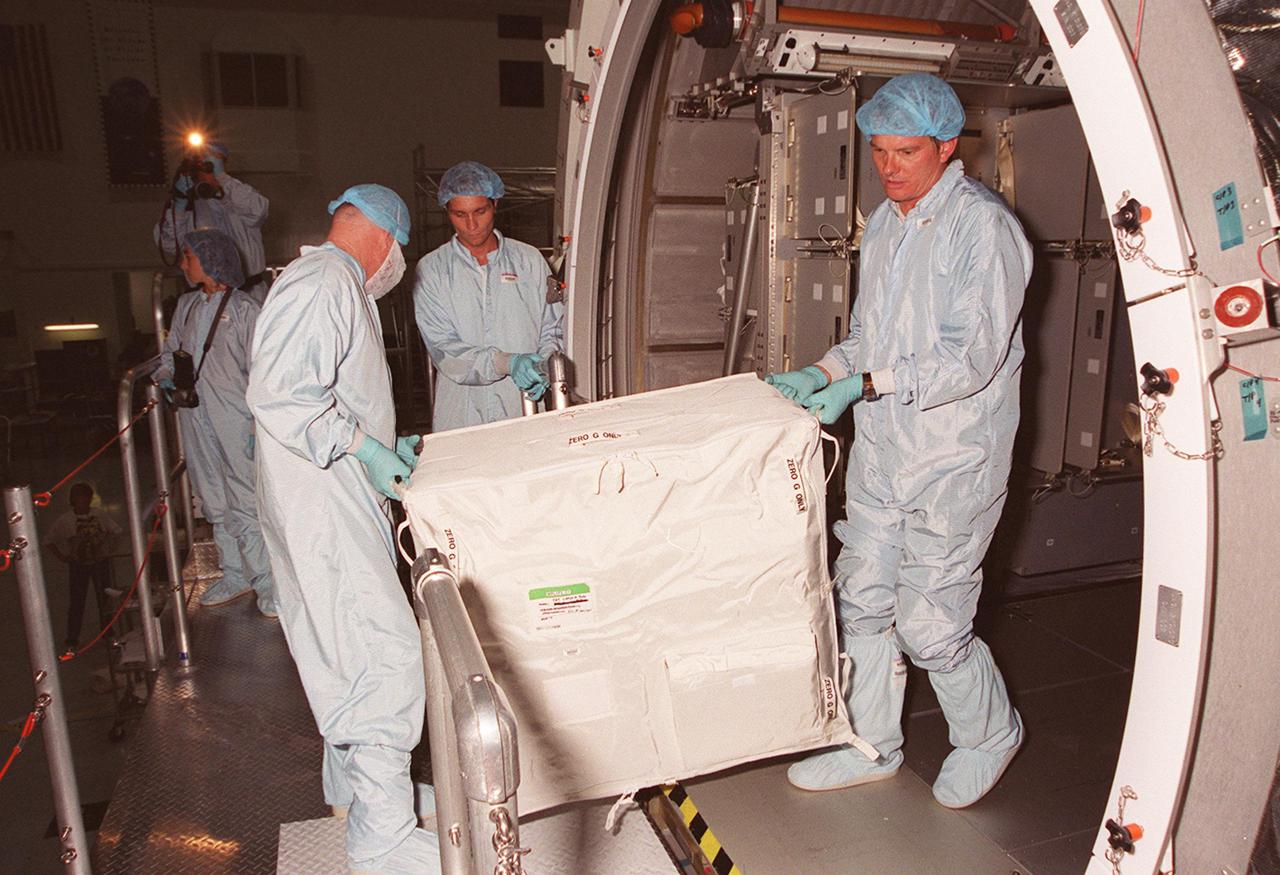
KENNEDY SPACE CENTER, FLA. -- Inside the Multi-Purpose Logistics Module Leonardo, which is in the Space Station Processing Facility, workers remove one of the containers returned from the International Space Station on mission STS-102. The MPLM brought back to KSC nearly a ton of trash and excess equipment from the Space Station. Leonardo is one of three MPLMs built by the Italian Space Agency to serve as “cargo vans” to the Station, carrying supplies and equipment. In the SSPF, Leonardo will be prepared for a future mission
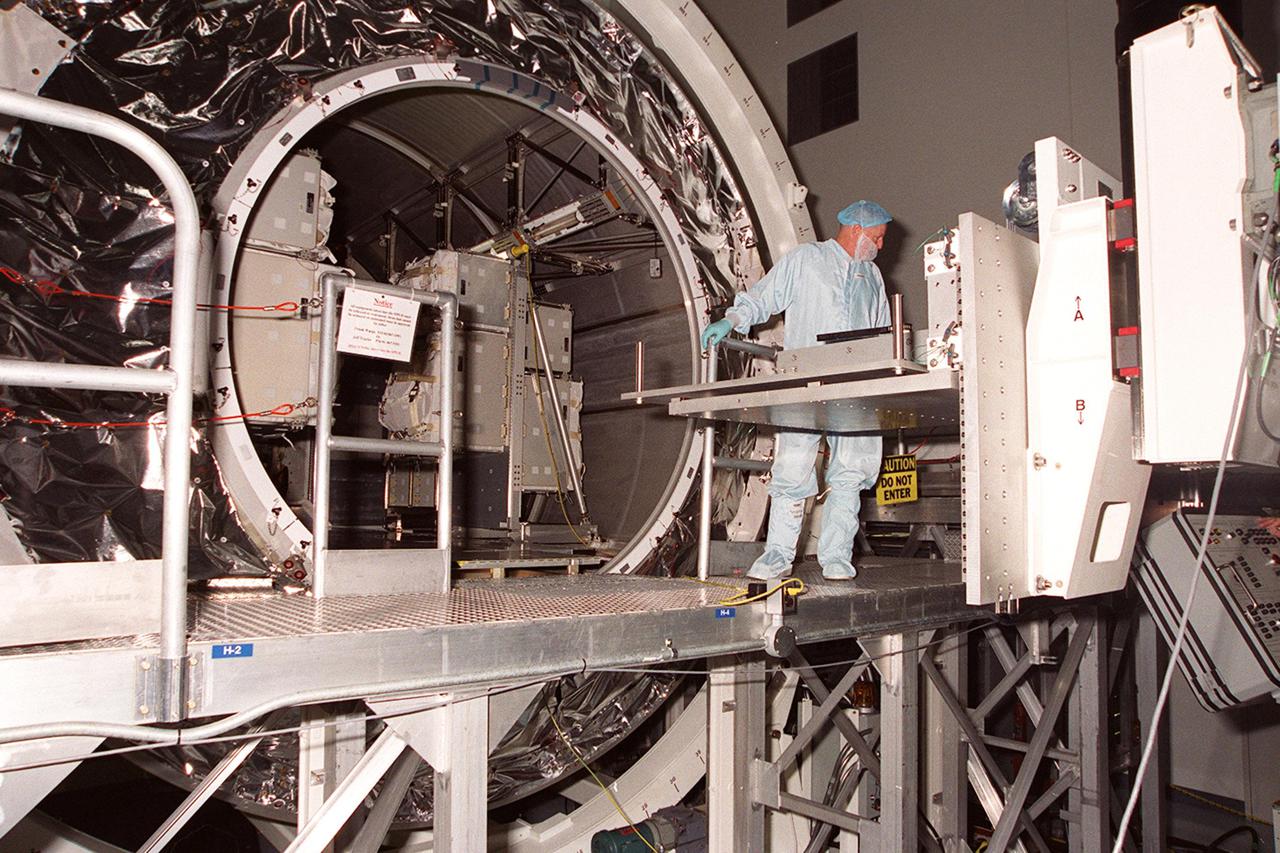
KENNEDY SPACE CENTER, FLA. -- With the hatch of Multi-Purpose Logistics Module Leonardo open, the contents are ready to be removed. The MPLM has just returned from its maiden voyage to the International Space Station aboard Discovery on mission STS-102. It has brought back to KSC nearly a ton of trash and excess equipment from the Space Station. Leonardo is one of three MPLMs built by the Italian Space Agency to serve as “cargo vans” to the Station, carrying supplies and equipment. In the SSPF, Leonardo will be prepared for a future mission
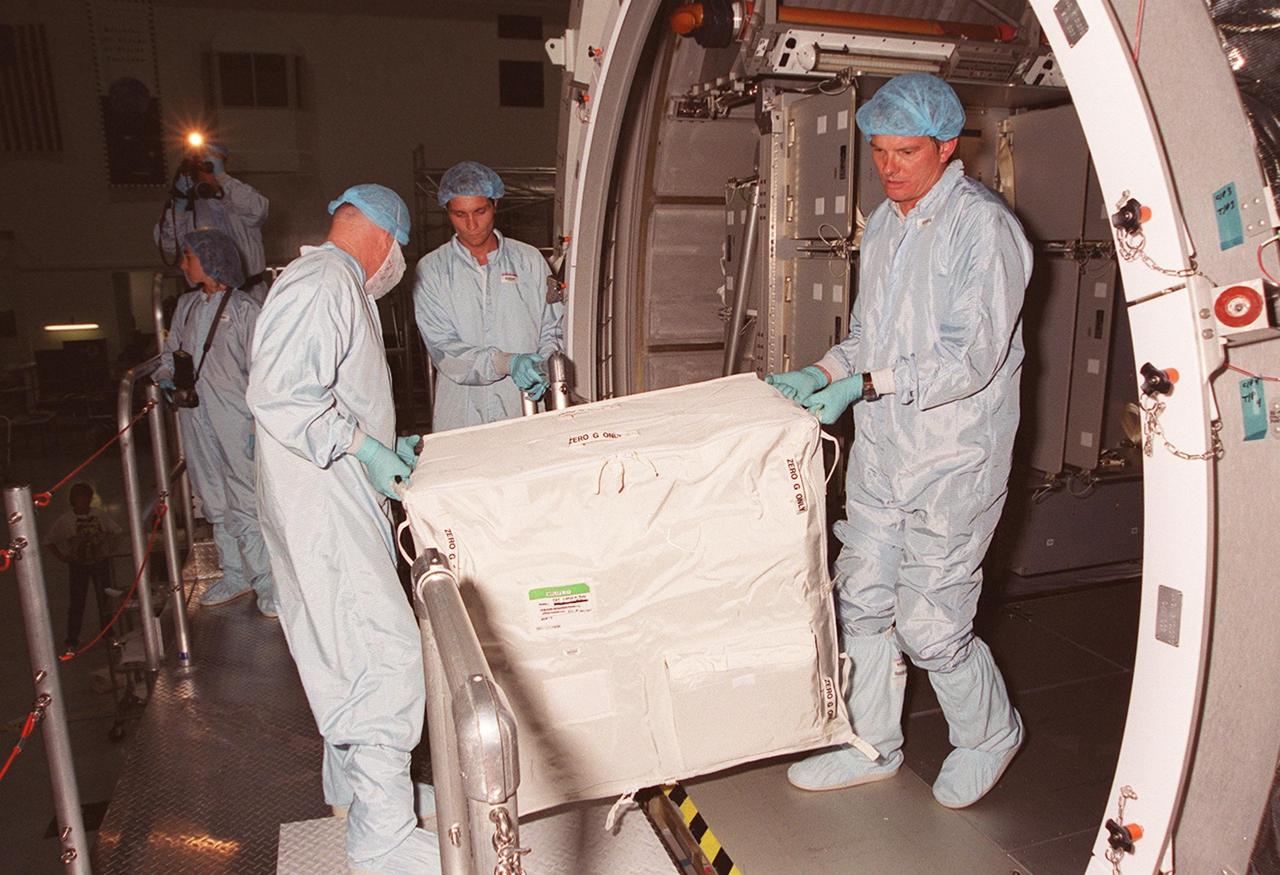
KENNEDY SPACE CENTER, FLA. -- Inside the Multi-Purpose Logistics Module Leonardo, which is in the Space Station Processing Facility, workers remove one of the containers returned from the International Space Station on mission STS-102. The MPLM brought back to KSC nearly a ton of trash and excess equipment from the Space Station. Leonardo is one of three MPLMs built by the Italian Space Agency to serve as “cargo vans” to the Station, carrying supplies and equipment. In the SSPF, Leonardo will be prepared for a future mission
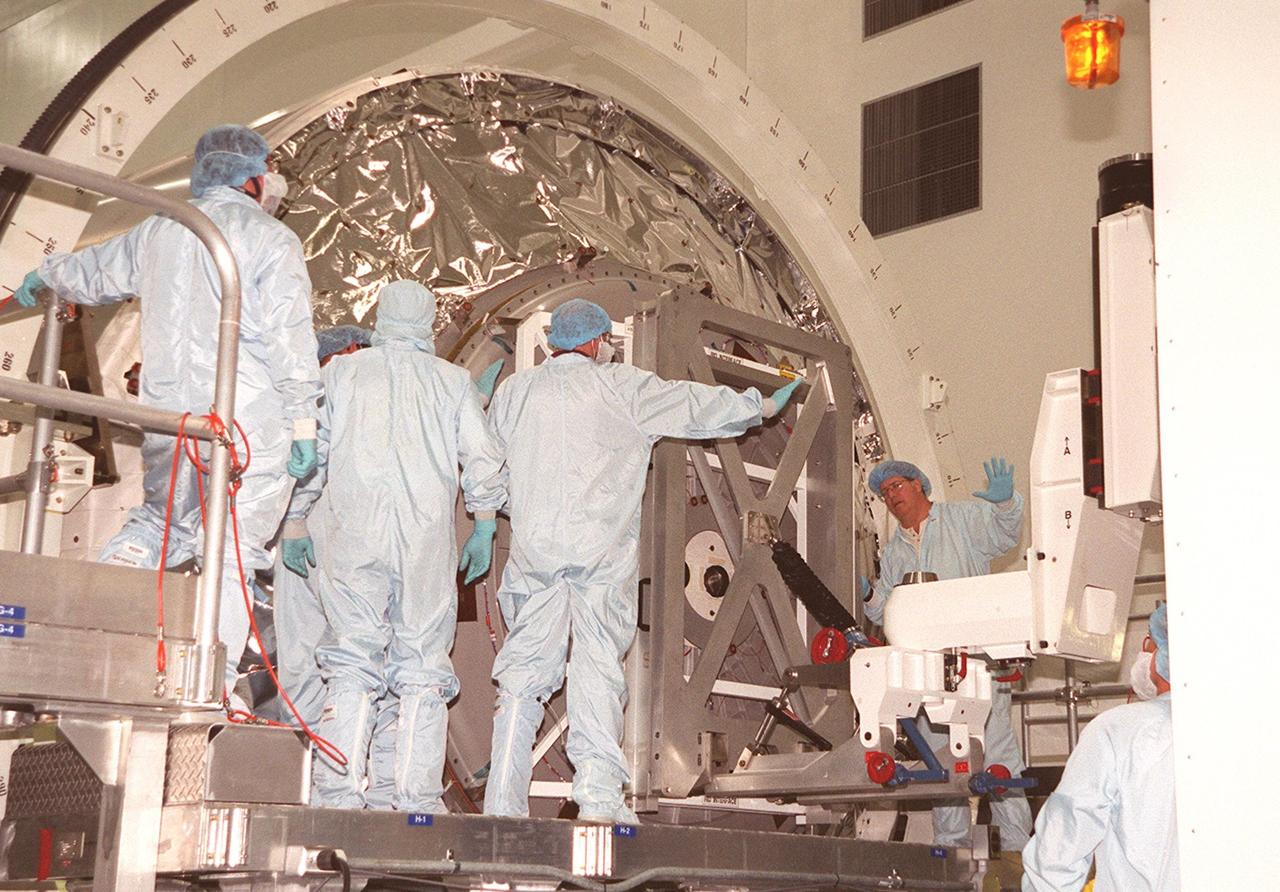
KENNEDY SPACE CENTER, FLA. -- Workers in the Space Station Processing Facility prepare to remove the hatch on Multi-Purpose Logistics Module Leonardo. The MPLM has just returned from its maiden voyage to the International Space Station aboard Discovery on mission STS-102. Leonardo is one of three MPLMs built by the Italian Space Agency to serve as “cargo vans” to the Station, carrying supplies and equipment. In the SSPF, Leonardo will be prepared for a future mission
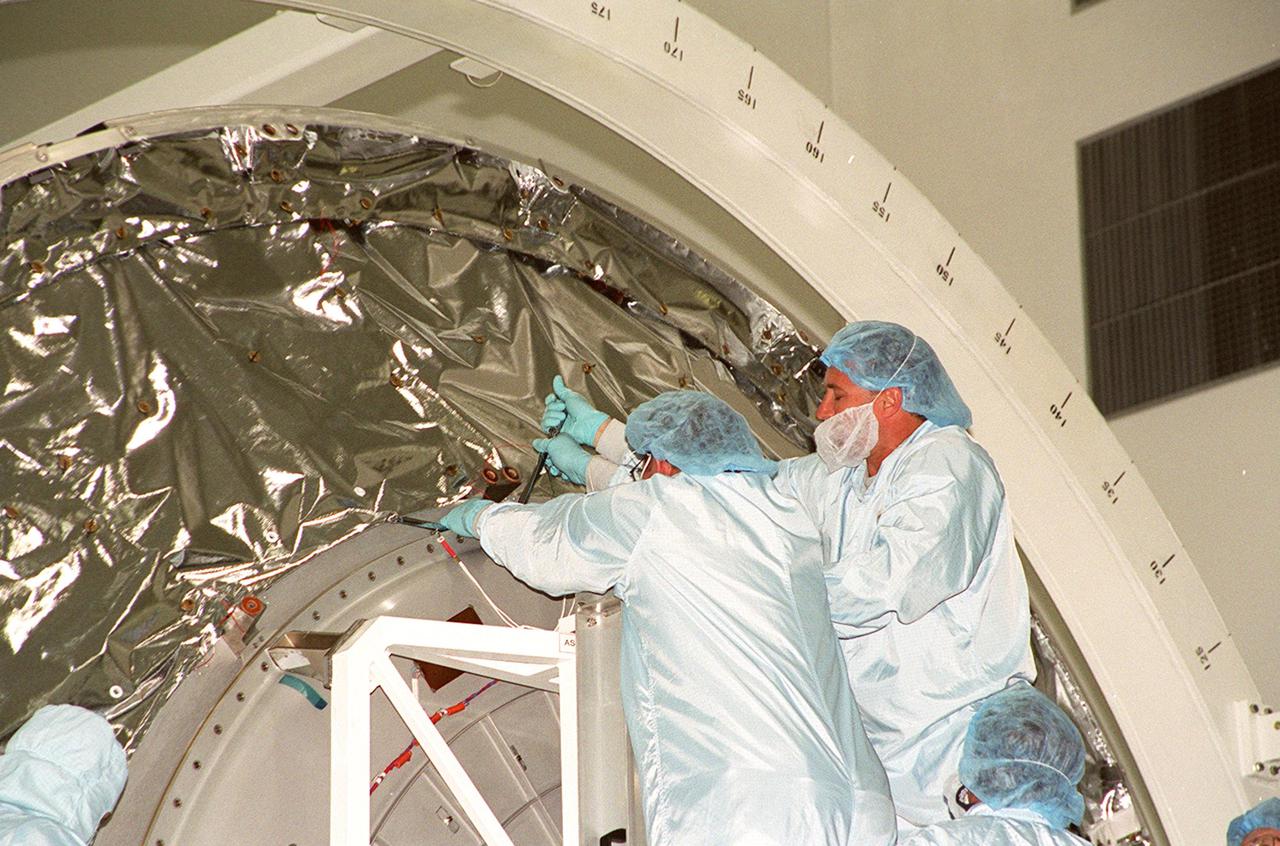
KENNEDY SPACE CENTER, FLA. -- Workers in the Space Station Processing Facility loosen the hatch on Multi-Purpose Logistics Module Leonardo. The MPLM has just returned from its maiden voyage to the International Space Station aboard Discovery on mission STS-102. Leonardo is one of three MPLMs built by the Italian Space Agency to serve as “cargo vans” to the Station, carrying supplies and equipment. In the SSPF, Leonardo will be prepared for a future mission
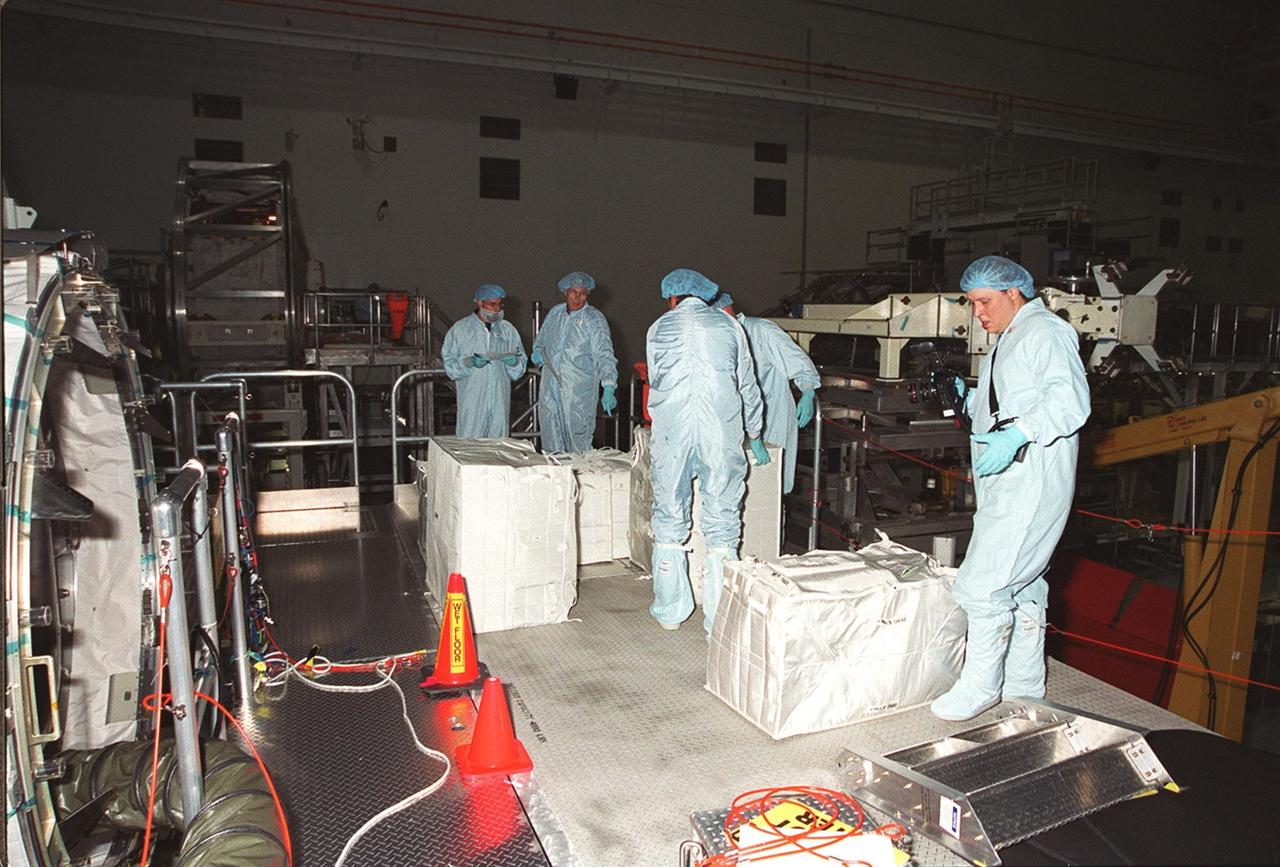
In the Space Station Processing Facility, workers line up containers removed from the Multi-Purpose Logistics Module Leonardo. The containers have returned from the International Space Station on mission STS-102. . The MPLM brought back to KSC nearly a ton of trash and excess equipment from the Space Station. Leonardo is one of three MPLMs built by the Italian Space Agency to serve as “cargo vans” to the Station, carrying supplies and equipment. In the SSPF, Leonardo will be prepared for a future mission
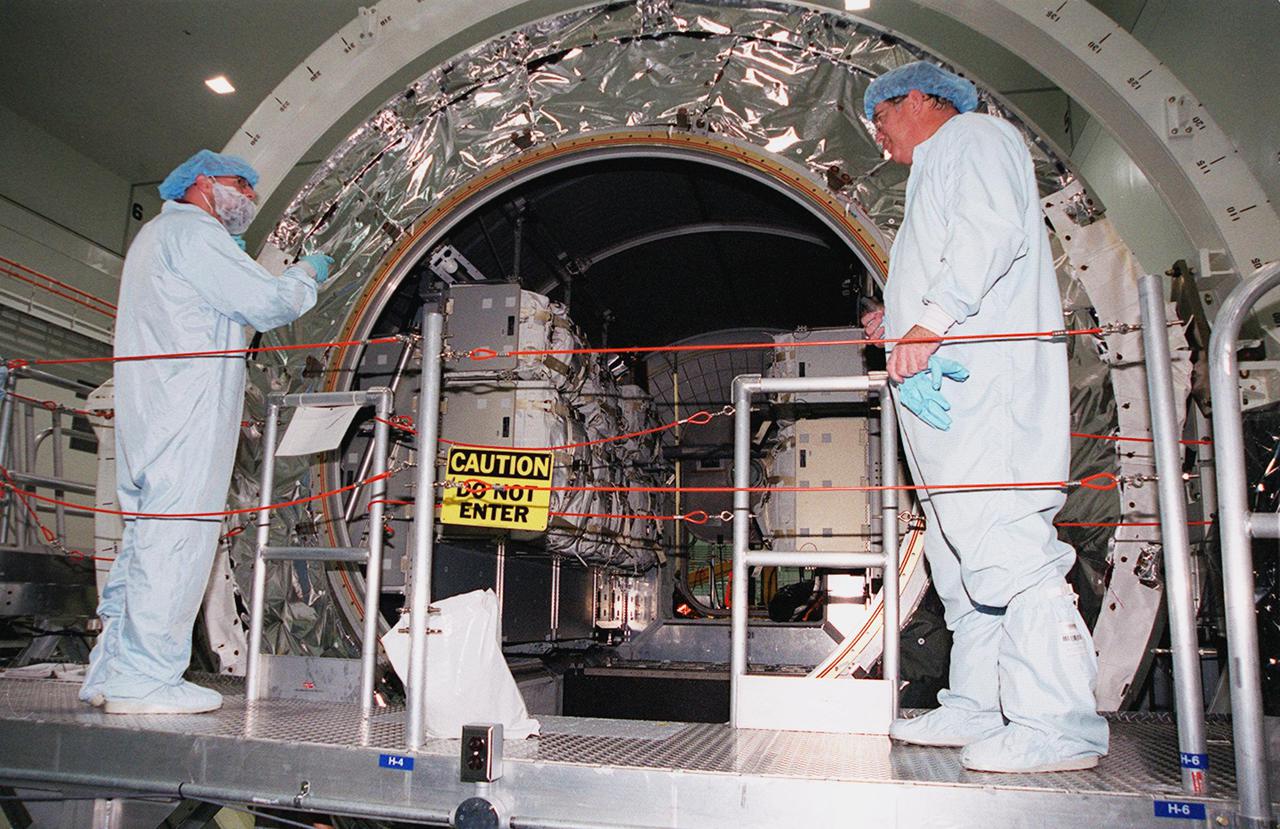
KENNEDY SPACE CENTER, FLA. -- Workers in the Space Station Processing Facility look at the cargo inside the Multi-Purpose Logistics Module Leonardo revealed when the hatch was removed. The MPLM has just returned from its maiden voyage to the International Space Station aboard Discovery on mission STS-102. Leonardo is one of three MPLMs built by the Italian Space Agency to serve as “cargo vans” to the Station, carrying supplies and equipment. In the SSPF, Leonardo will be prepared for a future mission
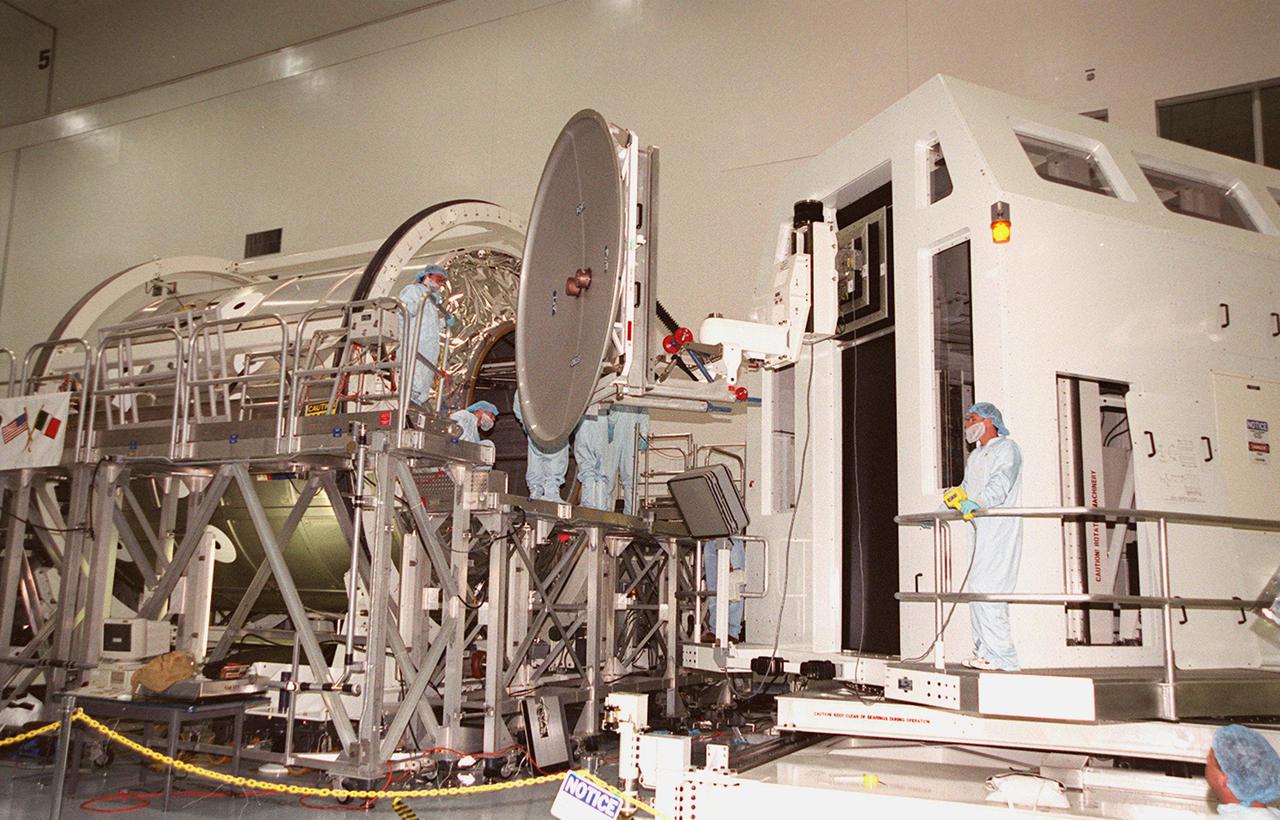
KENNEDY SPACE CENTER, FLA. -- The hatch on Multi-Purpose Logistics Module Leonardo is removed in the Space Station Processing Facility. The MPLM has just returned from its maiden voyage to the International Space Station aboard Discovery on mission STS-102. Leonardo is one of three MPLMs built by the Italian Space Agency to serve as “cargo vans” to the Station, carrying supplies and equipment. In the SSPF, Leonardo will be prepared for a future mission
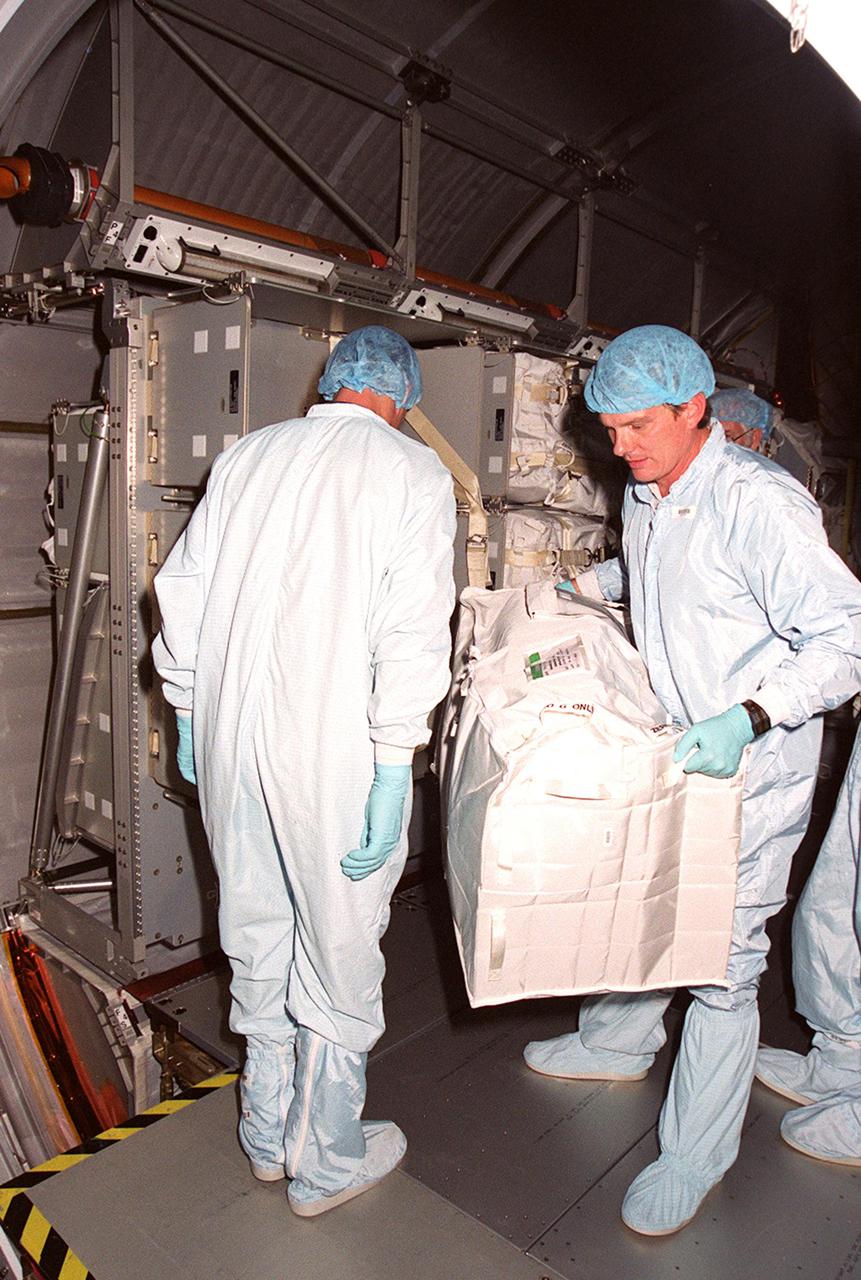
KENNEDY SPACE CENTER, FLA. -- Inside the Multi-Purpose Logistics Module Leonardo, which is in the Space Station Processing Facility, workers look over containers returned from the International Space Station on mission STS-102. The MPLM brought back to KSC nearly a ton of trash and excess equipment from the Space Station. Leonardo is one of three MPLMs built by the Italian Space Agency to serve as “cargo vans” to the Station, carrying supplies and equipment. In the SSPF, Leonardo will be prepared for a future mission
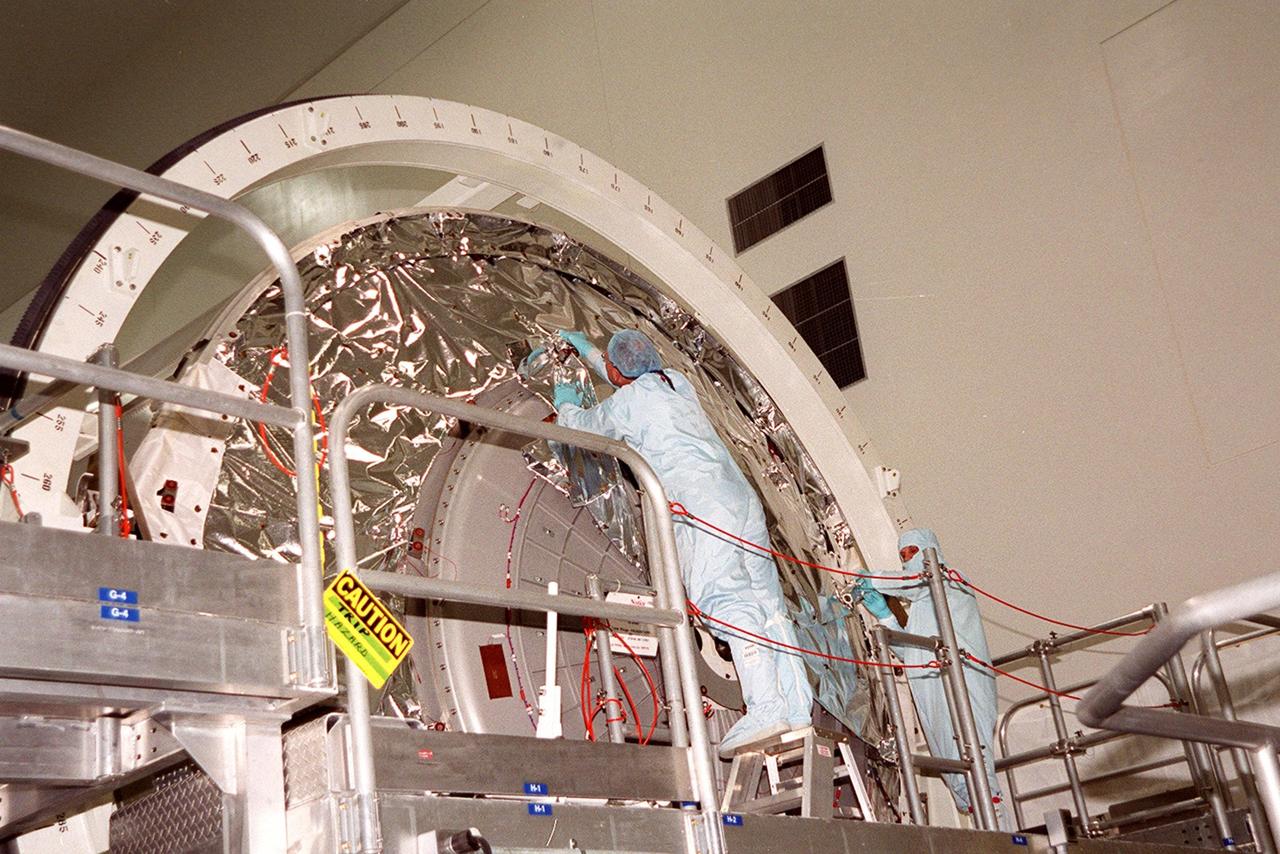
KENNEDY SPACE CENTER, FLA. -- Workers in the Space Station Processing Facility begin unwrapping the protective cover over the end of Multi-Purpose Logistics Module Leonardo so they can open the hatch and access the inside. The MPLM has just returned from its maiden voyage to the International Space Station aboard Discovery on mission STS-102. Leonardo is one of three MPLMs built by the Italian Space Agency to serve as “cargo vans” to the Station, carrying supplies and equipment. In the SSPF, Leonardo will be prepared for a future mission
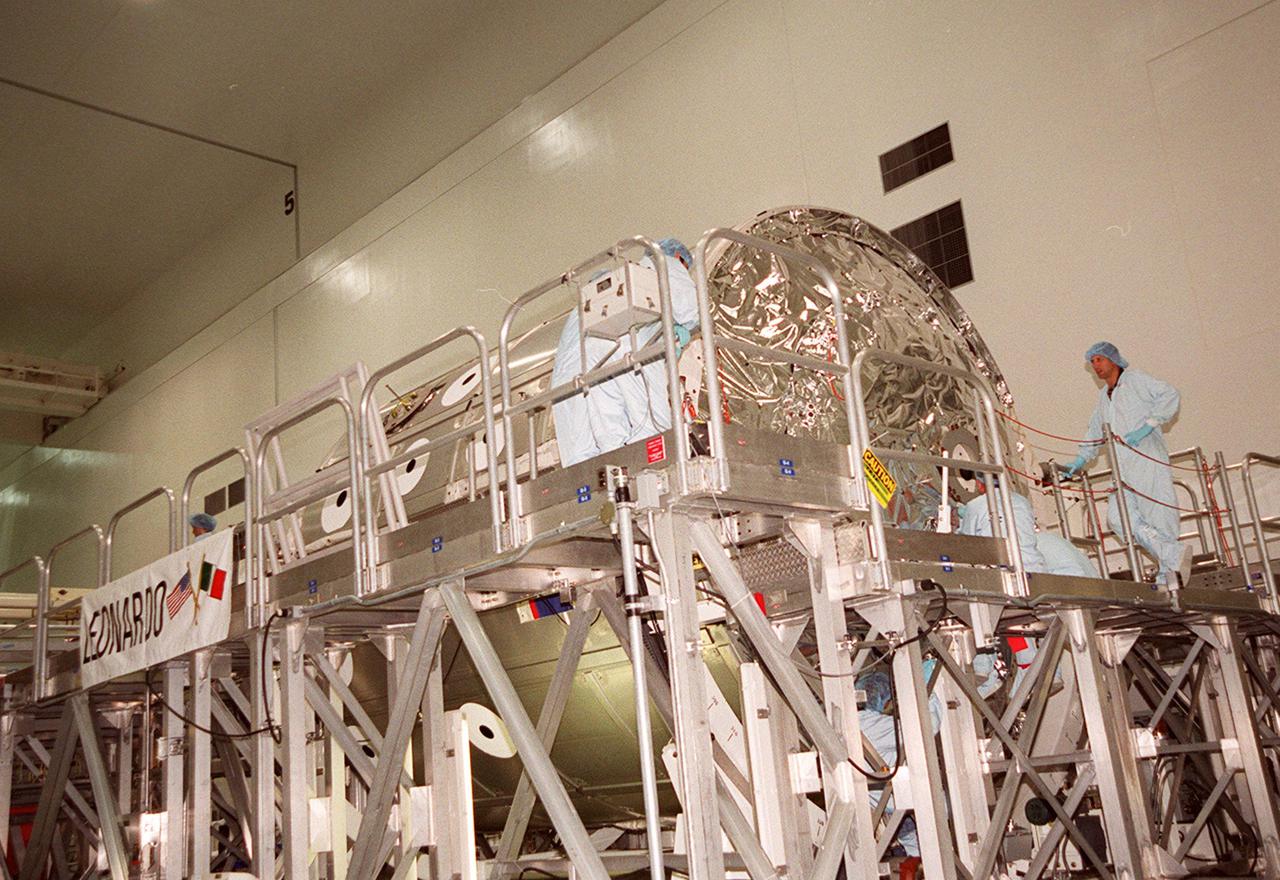
KENNEDY SPACE CENTER, FLA. -- The Multi-Purpose Logistics Module Leonardo sits on a workstand in the Space Station Processing Facility. Workers will be removing the protective cover over the end so they can open the hatch and access the inside. The MPLM has just returned from its maiden voyage to the International Space Station aboard Discovery on mission STS-102. Leonardo is one of three MPLMs built by the Italian Space Agency to serve as “cargo vans” to the Station, carrying supplies and equipment. In the SSPF, Leonardo will be prepared for a future mission
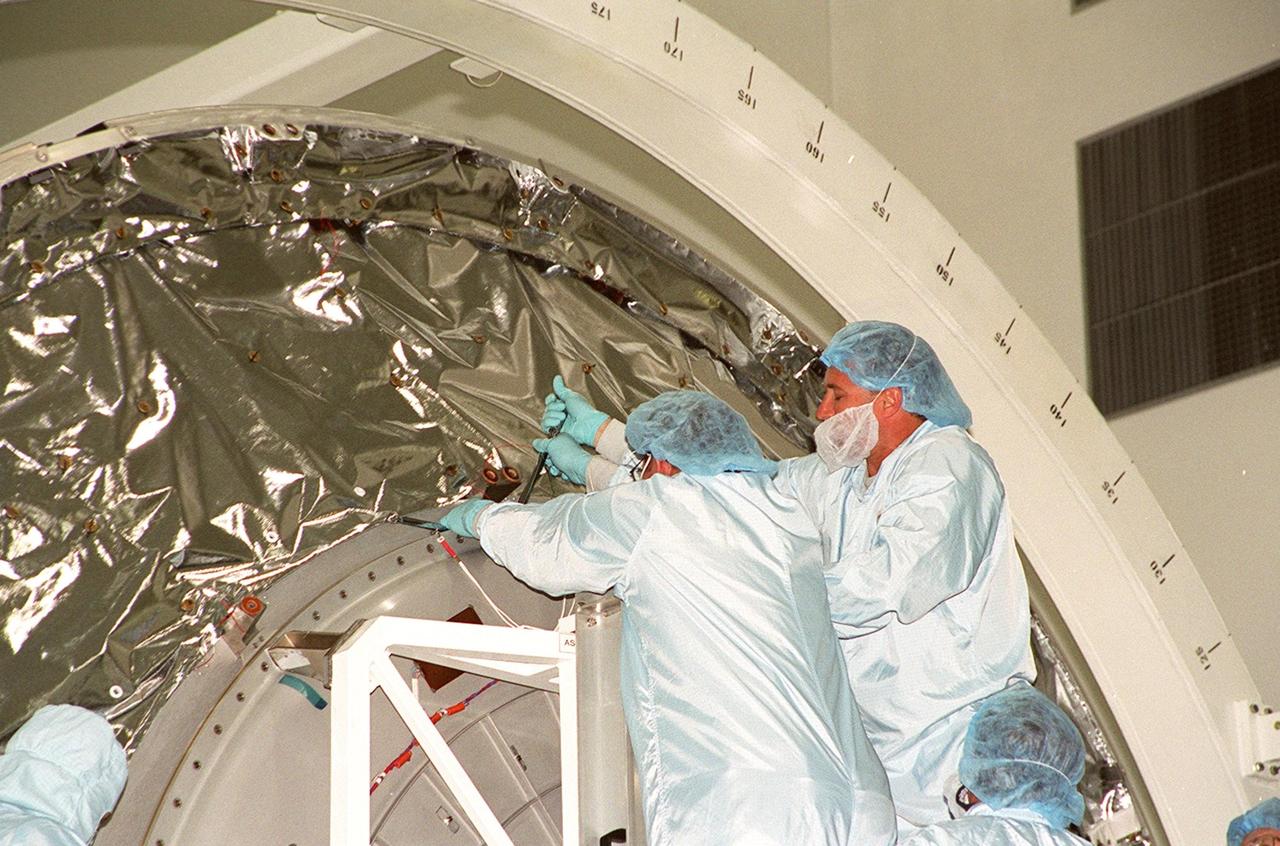
KENNEDY SPACE CENTER, FLA. -- Workers in the Space Station Processing Facility loosen the hatch on Multi-Purpose Logistics Module Leonardo. The MPLM has just returned from its maiden voyage to the International Space Station aboard Discovery on mission STS-102. Leonardo is one of three MPLMs built by the Italian Space Agency to serve as “cargo vans” to the Station, carrying supplies and equipment. In the SSPF, Leonardo will be prepared for a future mission

KENNEDY SPACE CENTER, FLA. -- With the hatch of Multi-Purpose Logistics Module Leonardo open, the contents are ready to be removed. The MPLM has just returned from its maiden voyage to the International Space Station aboard Discovery on mission STS-102. It has brought back to KSC nearly a ton of trash and excess equipment from the Space Station. Leonardo is one of three MPLMs built by the Italian Space Agency to serve as “cargo vans” to the Station, carrying supplies and equipment. In the SSPF, Leonardo will be prepared for a future mission
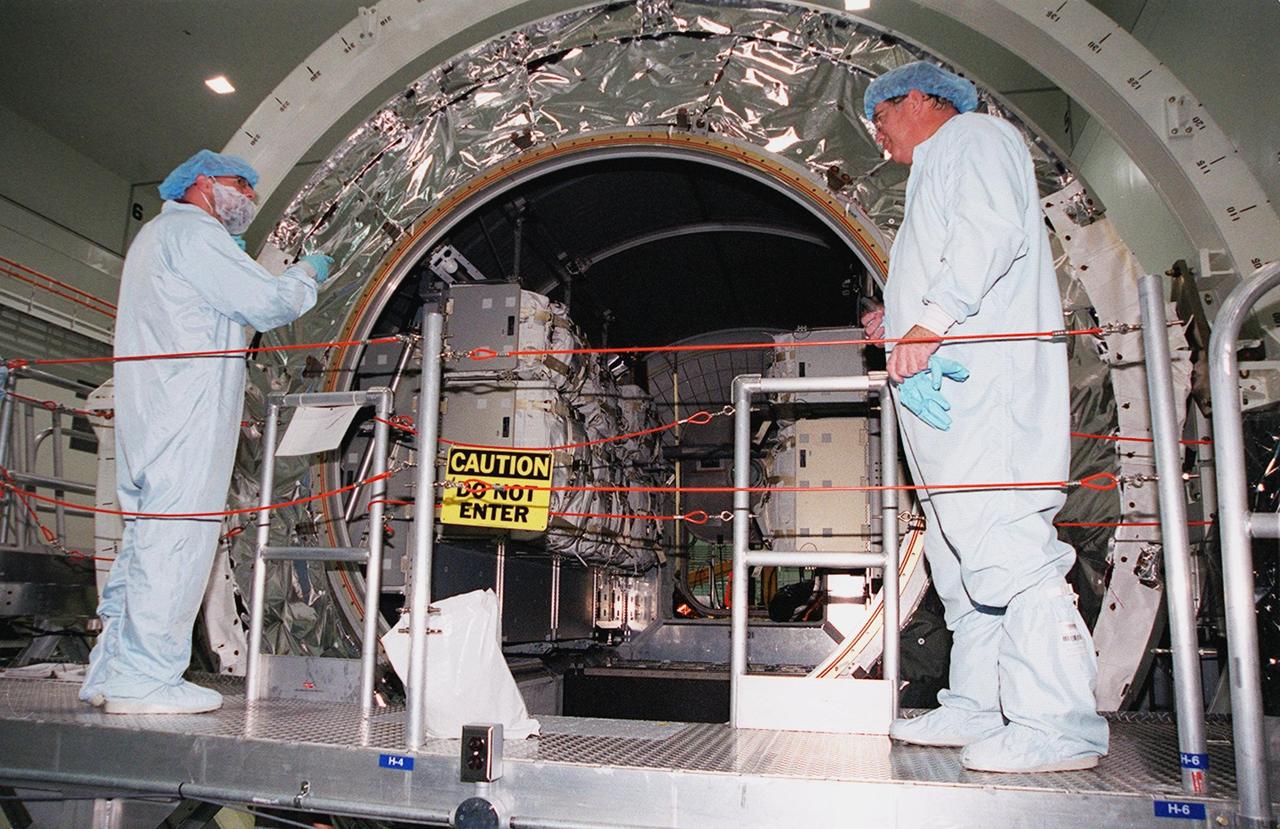
KENNEDY SPACE CENTER, FLA. -- Workers in the Space Station Processing Facility look at the cargo inside the Multi-Purpose Logistics Module Leonardo revealed when the hatch was removed. The MPLM has just returned from its maiden voyage to the International Space Station aboard Discovery on mission STS-102. Leonardo is one of three MPLMs built by the Italian Space Agency to serve as “cargo vans” to the Station, carrying supplies and equipment. In the SSPF, Leonardo will be prepared for a future mission
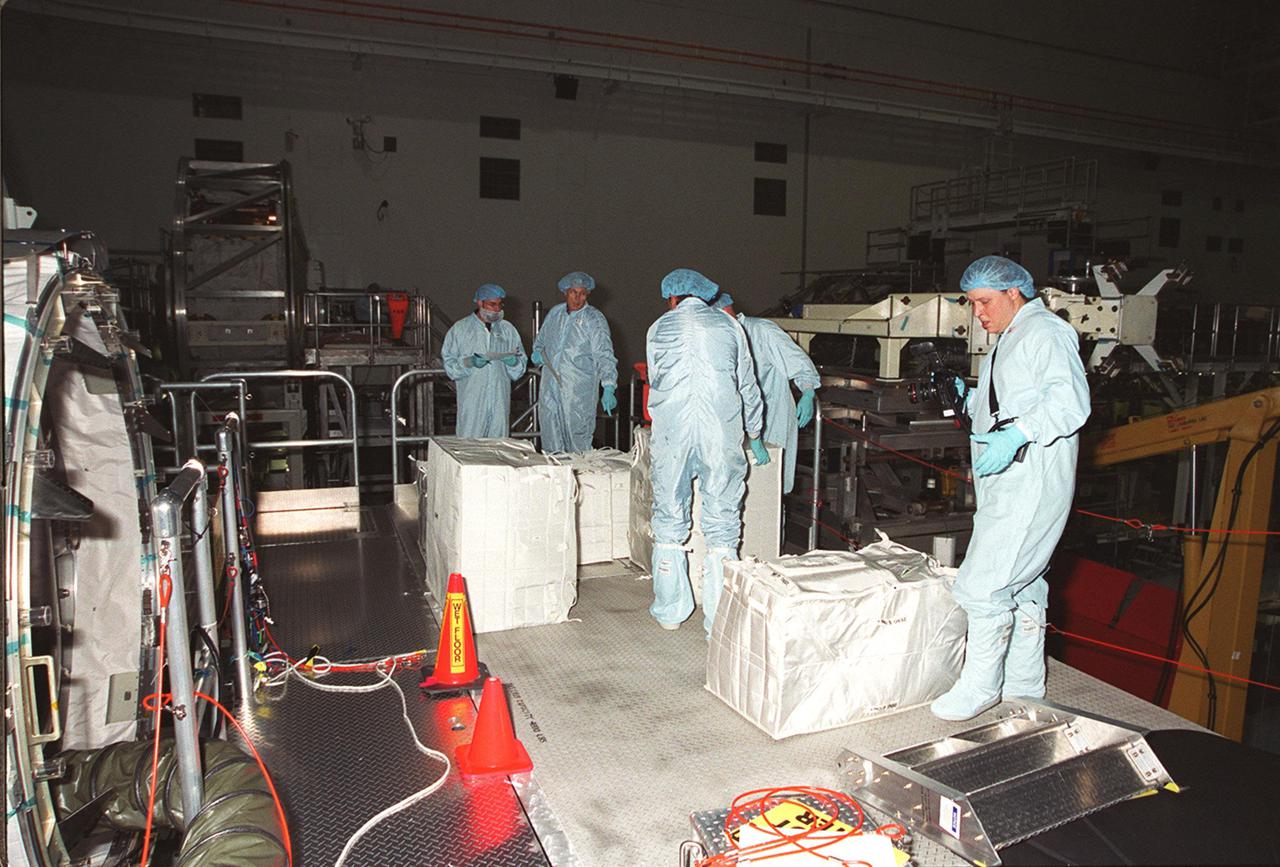
In the Space Station Processing Facility, workers line up containers removed from the Multi-Purpose Logistics Module Leonardo. The containers have returned from the International Space Station on mission STS-102. . The MPLM brought back to KSC nearly a ton of trash and excess equipment from the Space Station. Leonardo is one of three MPLMs built by the Italian Space Agency to serve as “cargo vans” to the Station, carrying supplies and equipment. In the SSPF, Leonardo will be prepared for a future mission
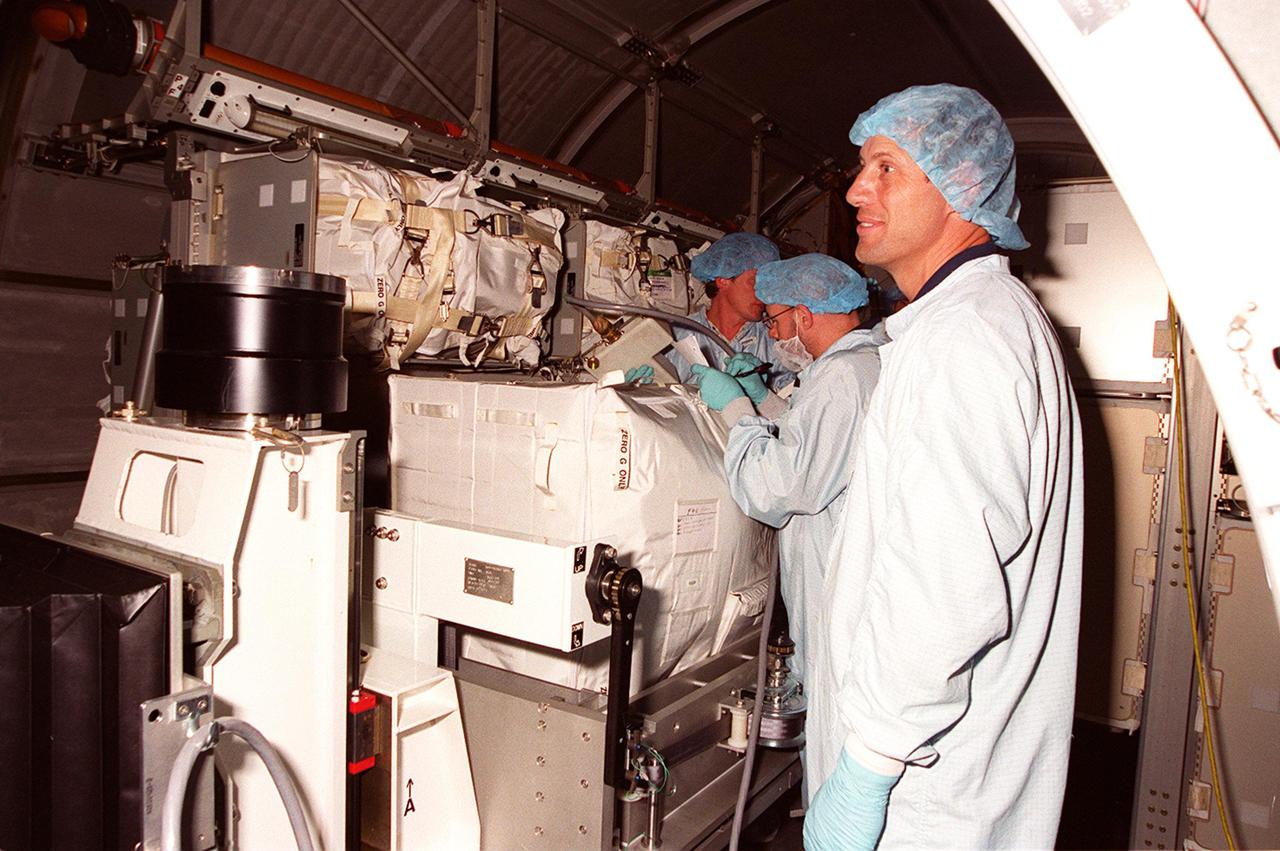
KENNEDY SPACE CENTER, FLA. -- Inside the Multi-Purpose Logistics Module Leonardo, which is in the Space Station Processing Facility, workers begin removing the containers returned from the International Space Station on mission STS-102. The MPLM brought back to KSC nearly a ton of trash and excess equipment from the Space Station. Leonardo is one of three MPLMs built by the Italian Space Agency to serve as “cargo vans” to the Station, carrying supplies and equipment. In the SSPF, Leonardo will be prepared for a future mission
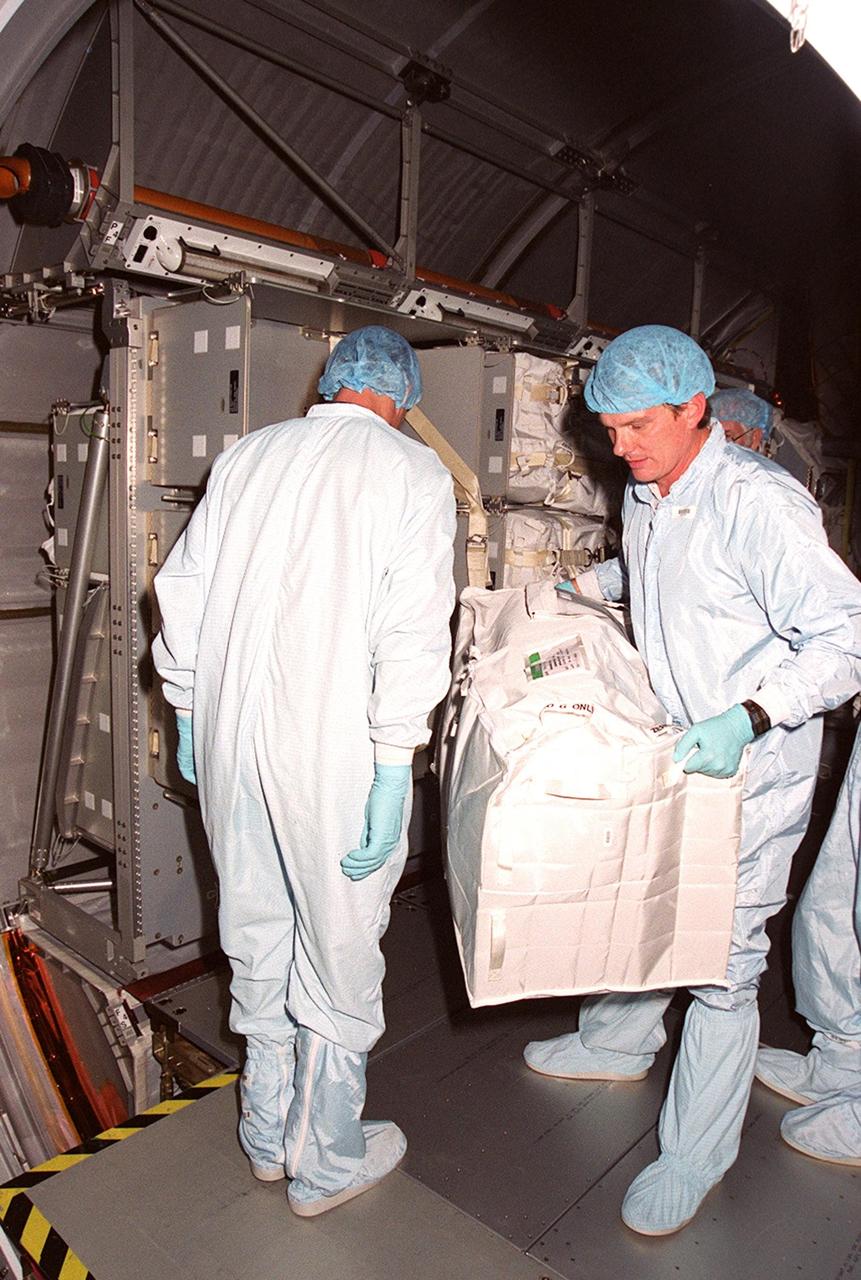
KENNEDY SPACE CENTER, FLA. -- Inside the Multi-Purpose Logistics Module Leonardo, which is in the Space Station Processing Facility, workers look over containers returned from the International Space Station on mission STS-102. The MPLM brought back to KSC nearly a ton of trash and excess equipment from the Space Station. Leonardo is one of three MPLMs built by the Italian Space Agency to serve as “cargo vans” to the Station, carrying supplies and equipment. In the SSPF, Leonardo will be prepared for a future mission

KENNEDY SPACE CENTER, FLA. -- In the Space Station Processing Facility, workers look on as the hatch on Multi-Purpose Logistics Module Leonardo opens. The MPLM has just returned from its maiden voyage to the International Space Station aboard Discovery on mission STS-102. Leonardo is one of three MPLMs built by the Italian Space Agency to serve as “cargo vans” to the Station, carrying supplies and equipment. In the SSPF, Leonardo will be prepared for a future mission
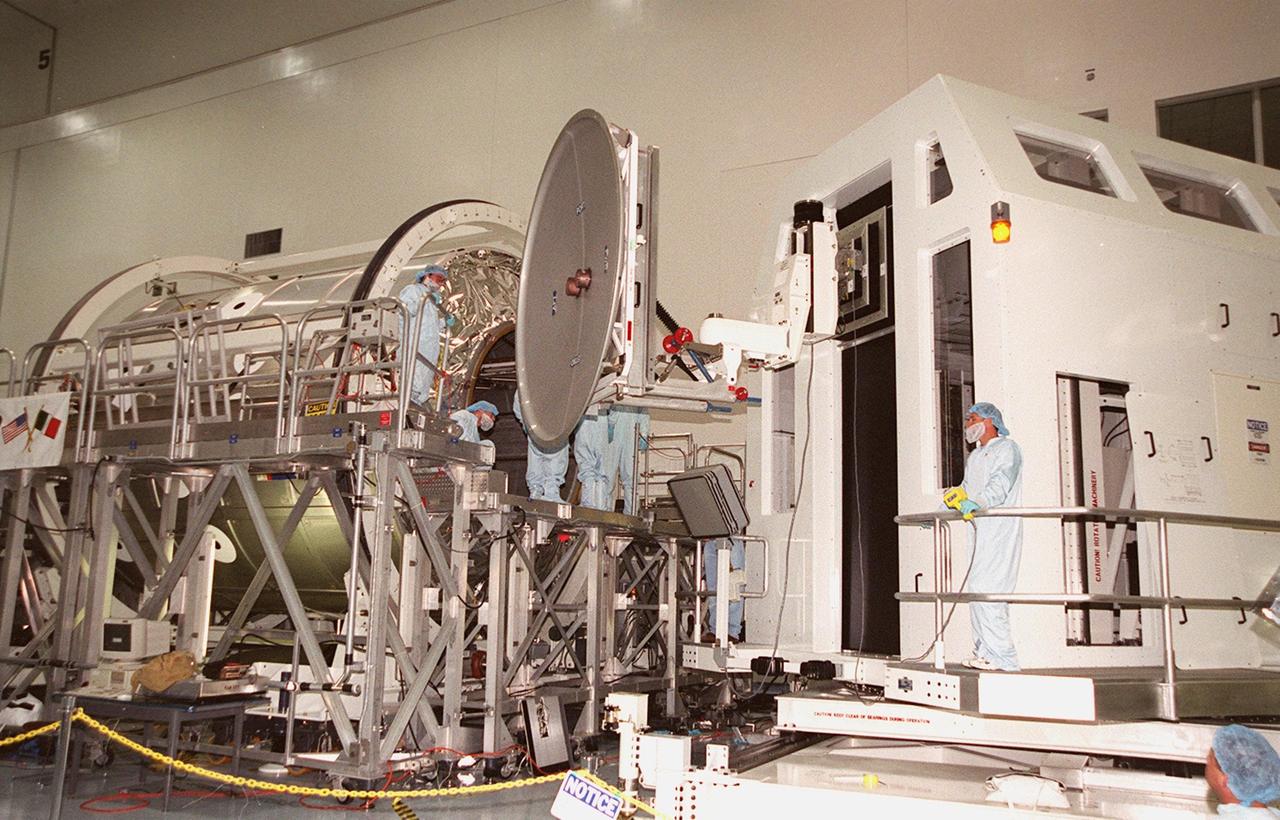
KENNEDY SPACE CENTER, FLA. -- The hatch on Multi-Purpose Logistics Module Leonardo is removed in the Space Station Processing Facility. The MPLM has just returned from its maiden voyage to the International Space Station aboard Discovery on mission STS-102. Leonardo is one of three MPLMs built by the Italian Space Agency to serve as “cargo vans” to the Station, carrying supplies and equipment. In the SSPF, Leonardo will be prepared for a future mission
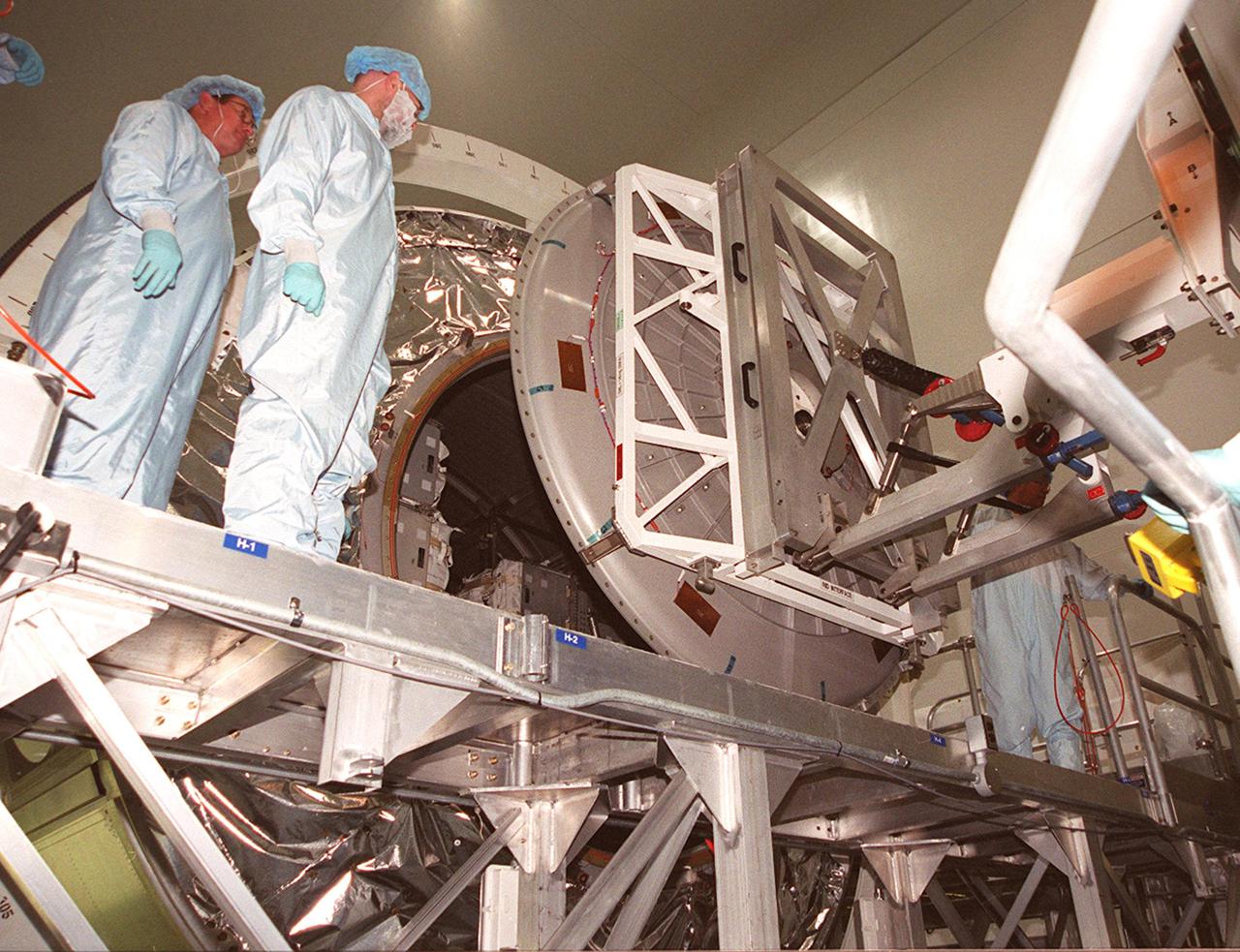
KENNEDY SPACE CENTER, FLA. -- In the Space Station Processing Facility, workers look on as the hatch on Multi-Purpose Logistics Module Leonardo opens. The MPLM has just returned from its maiden voyage to the International Space Station aboard Discovery on mission STS-102. Leonardo is one of three MPLMs built by the Italian Space Agency to serve as “cargo vans” to the Station, carrying supplies and equipment. In the SSPF, Leonardo will be prepared for a future mission
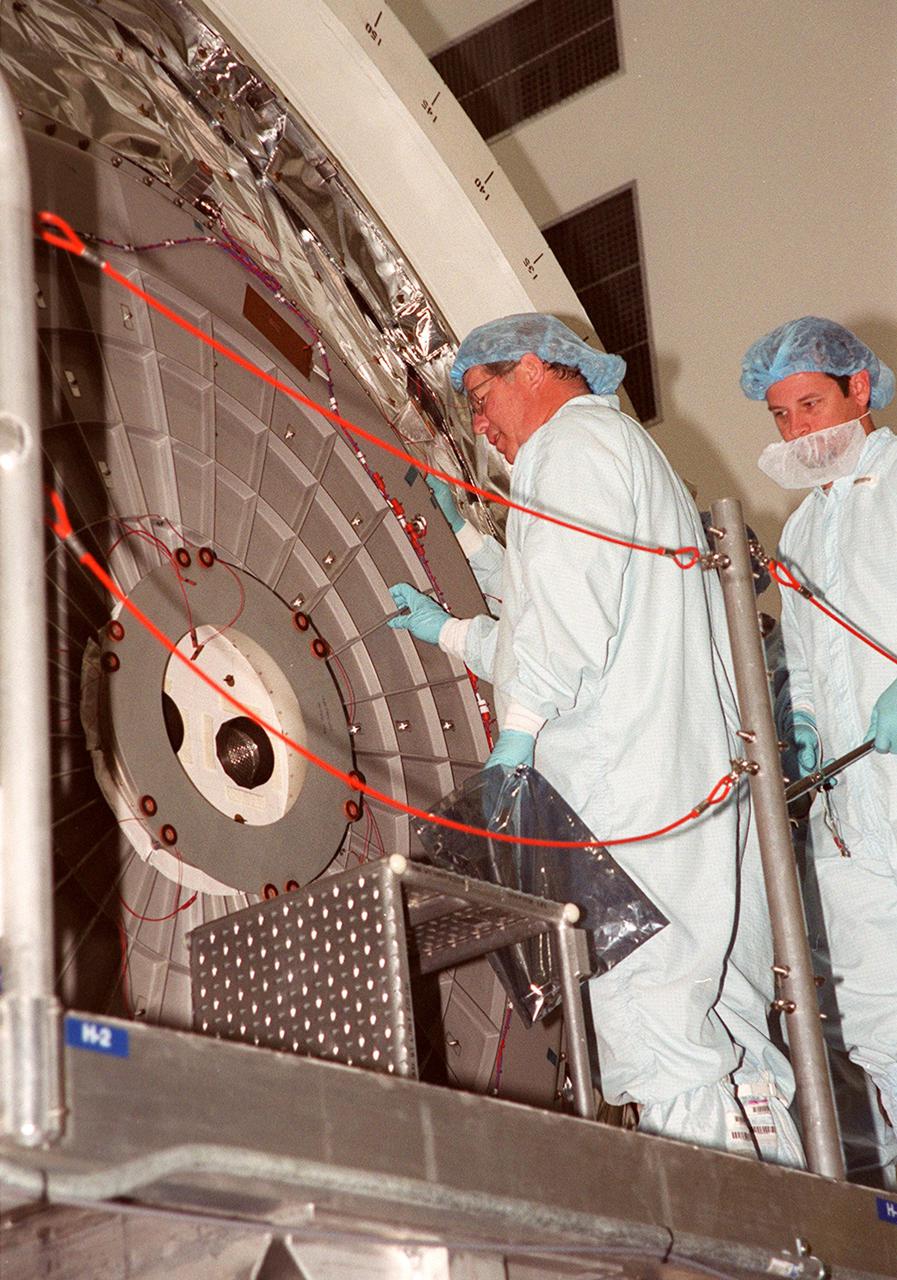
KENNEDY SPACE CENTER, FLA. -- Workers in the Space Station Processing Facility look at the hatch on Multi-Purpose Logistics Module Leonardo. The MPLM has just returned from its maiden voyage to the International Space Station aboard Discovery on mission STS-102. Leonardo is one of three MPLMs built by the Italian Space Agency to serve as “cargo vans” to the Station, carrying supplies and equipment. In the SSPF, Leonardo will be prepared for a future mission

STS-131 MPLM LEONARDO HATCH CLOSURE
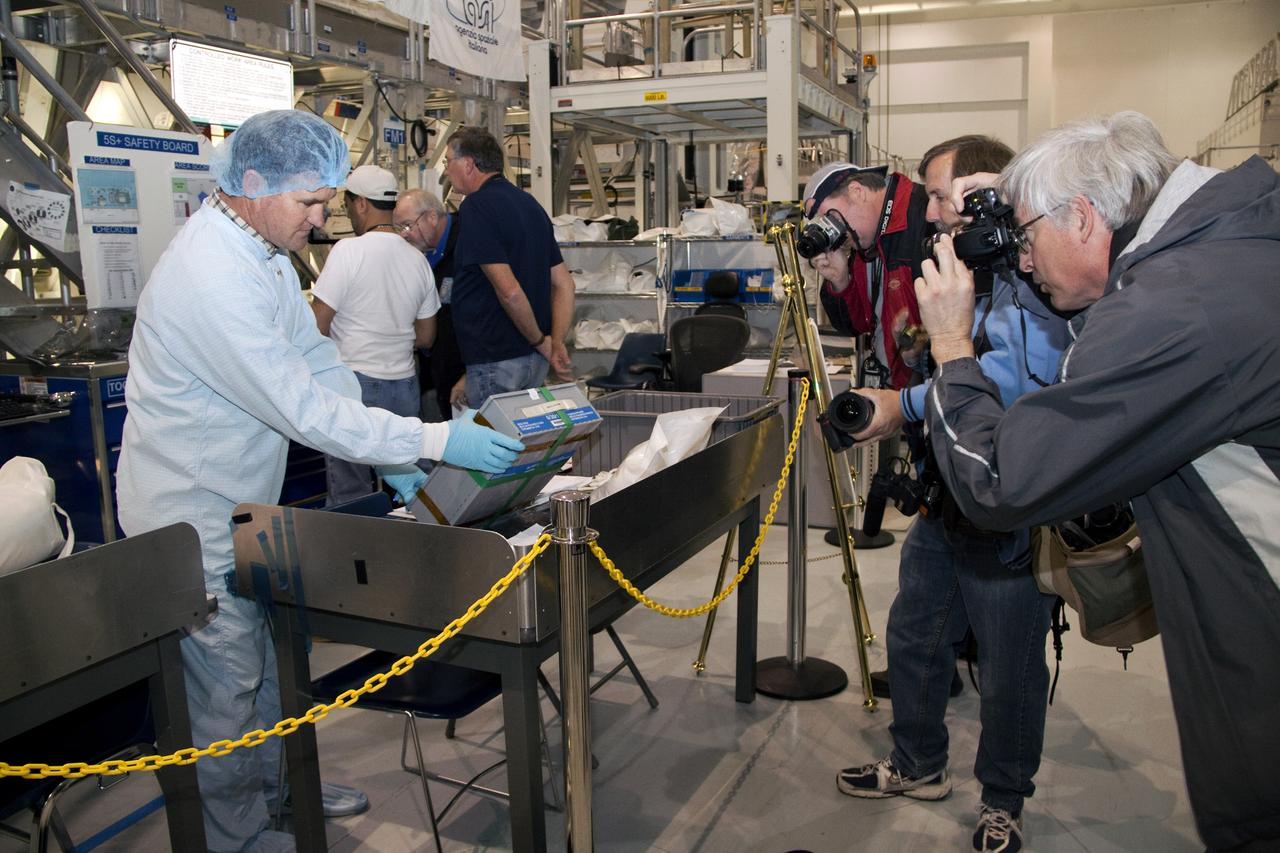
STS-131 MPLM LEONARDO MEDIA EVENT
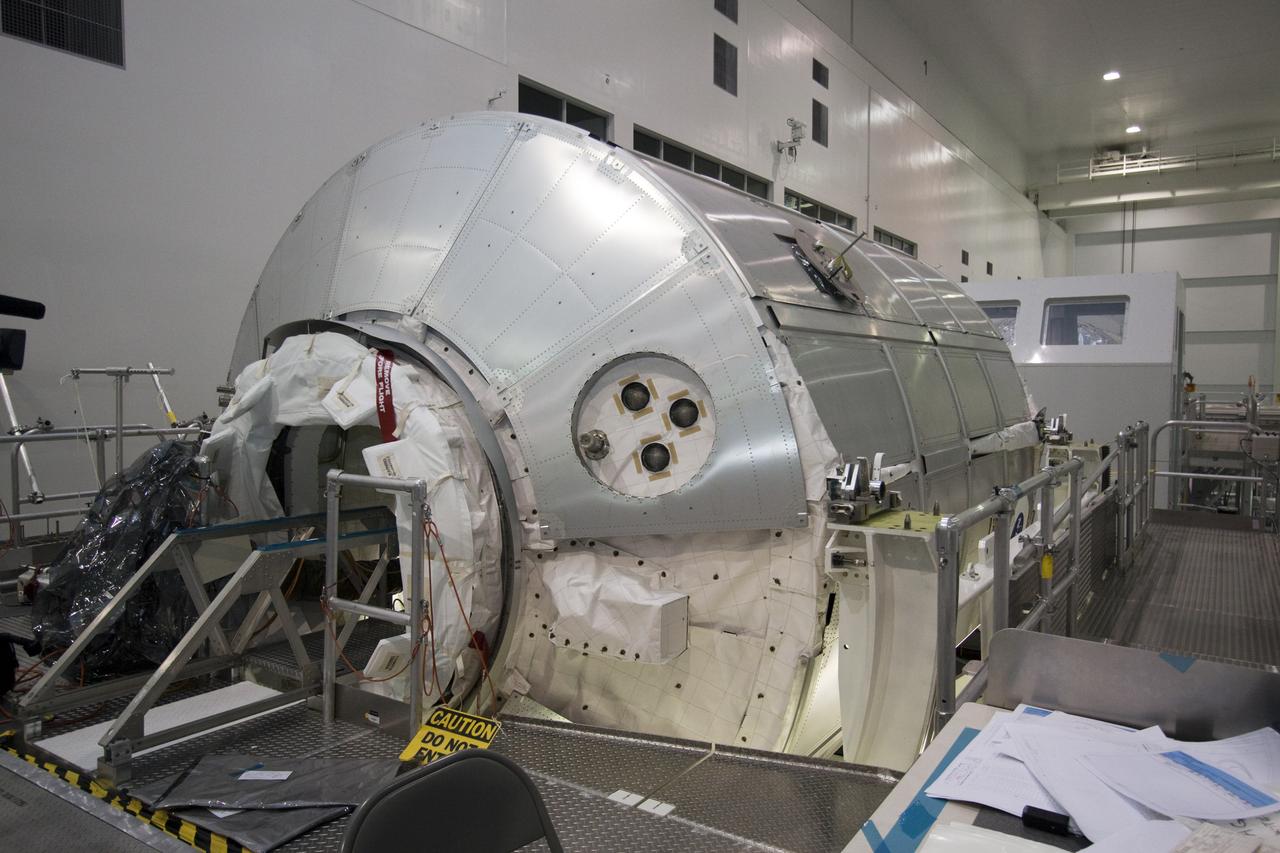
STS-131 MPLM LEONARDO MEDIA EVENT
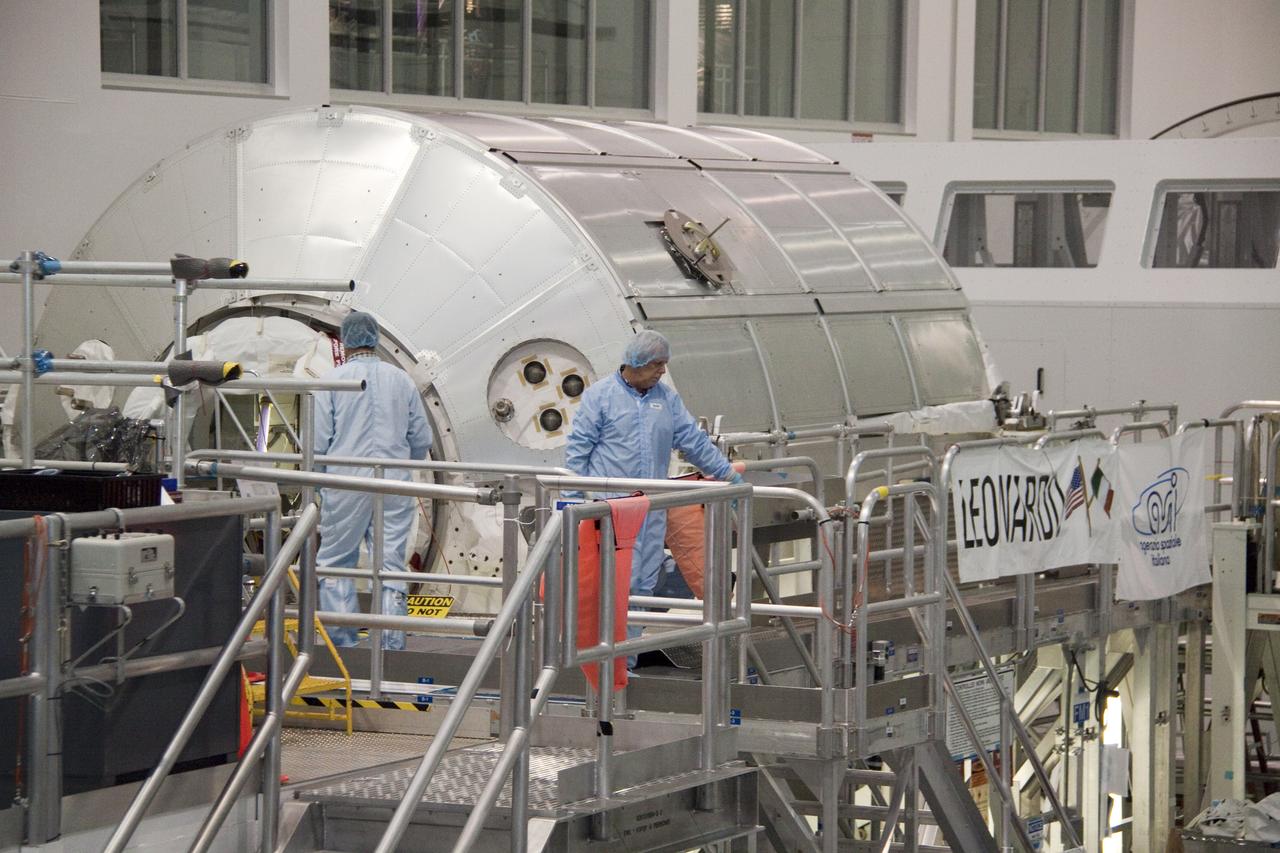
STS-131 MPLM LEONARDO MEDIA EVENT
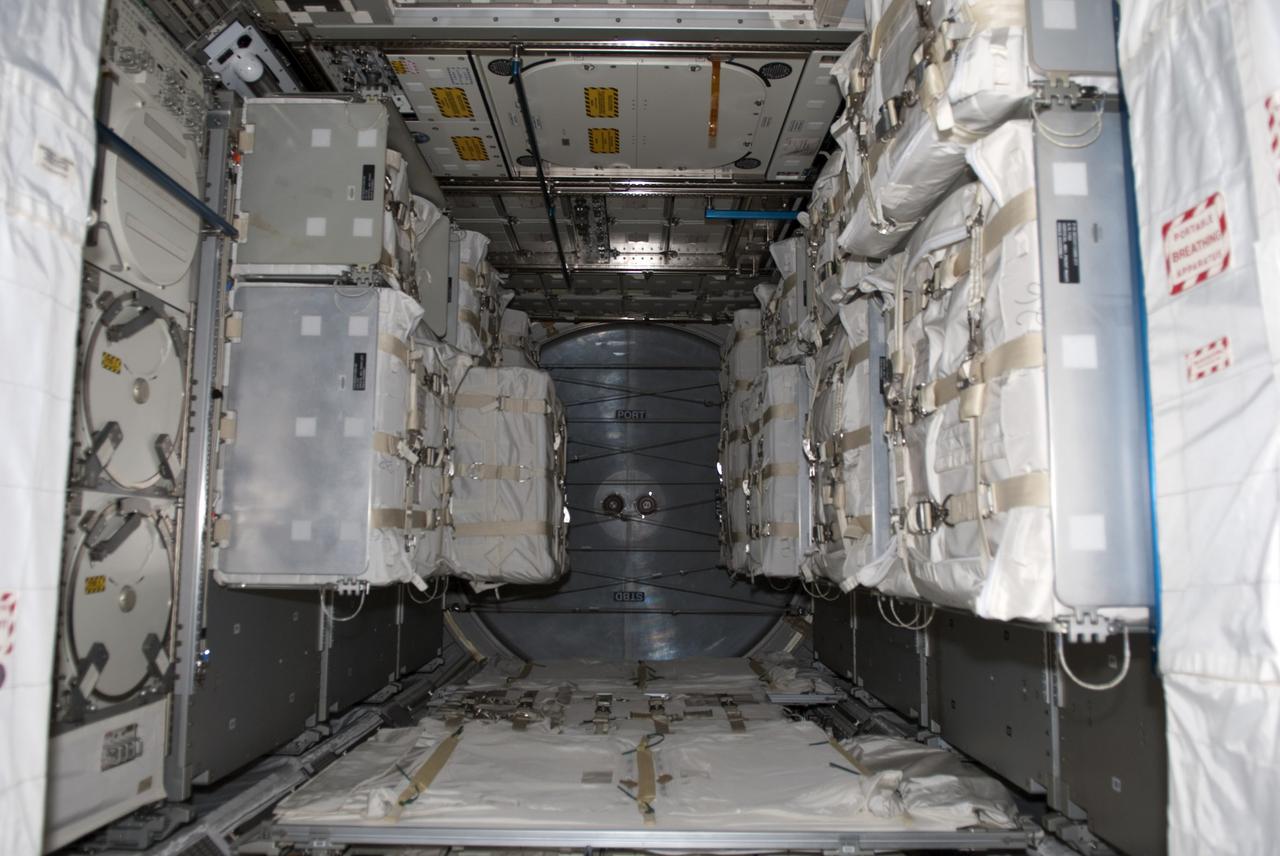
STS-131 MPLM LEONARDO HATCH CLOSURE
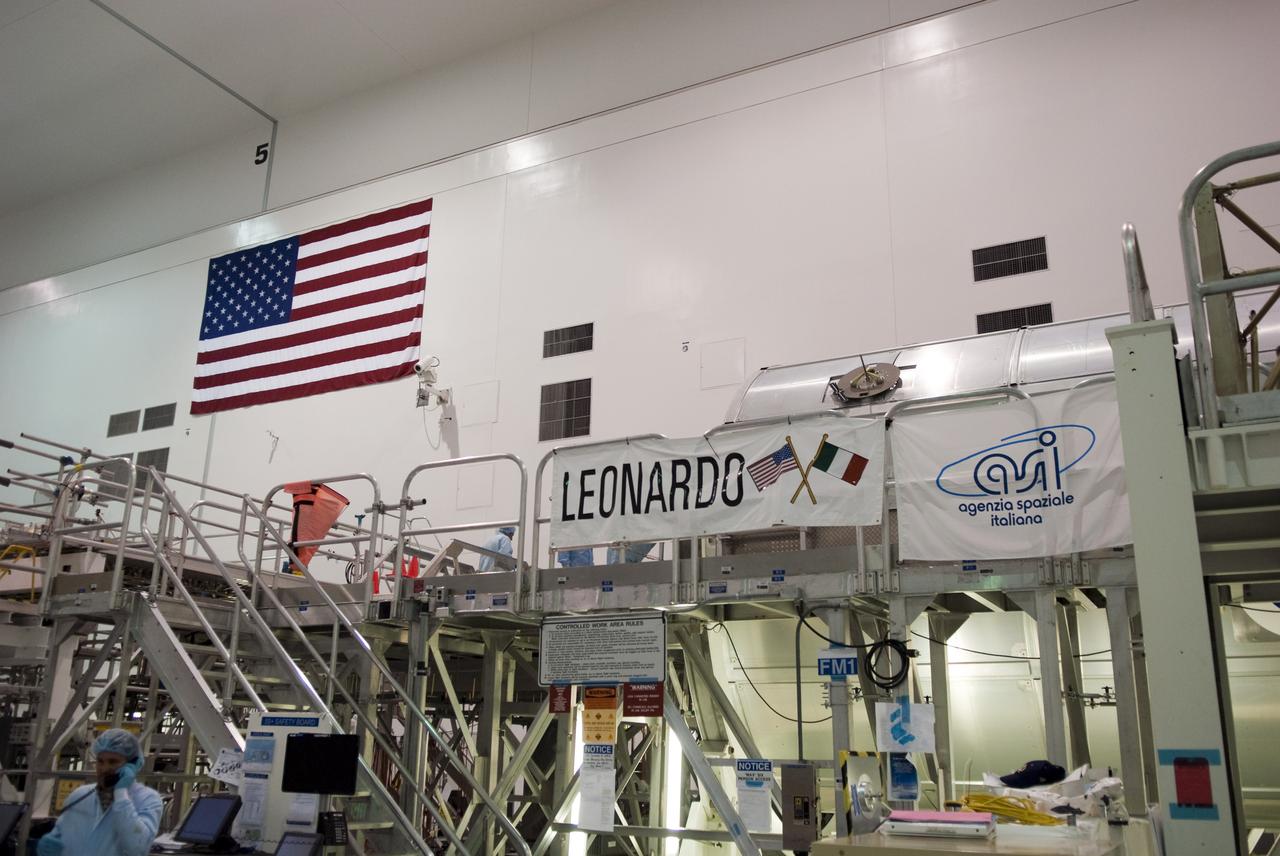
STS-131 MPLM LEONARDO HATCH CLOSURE
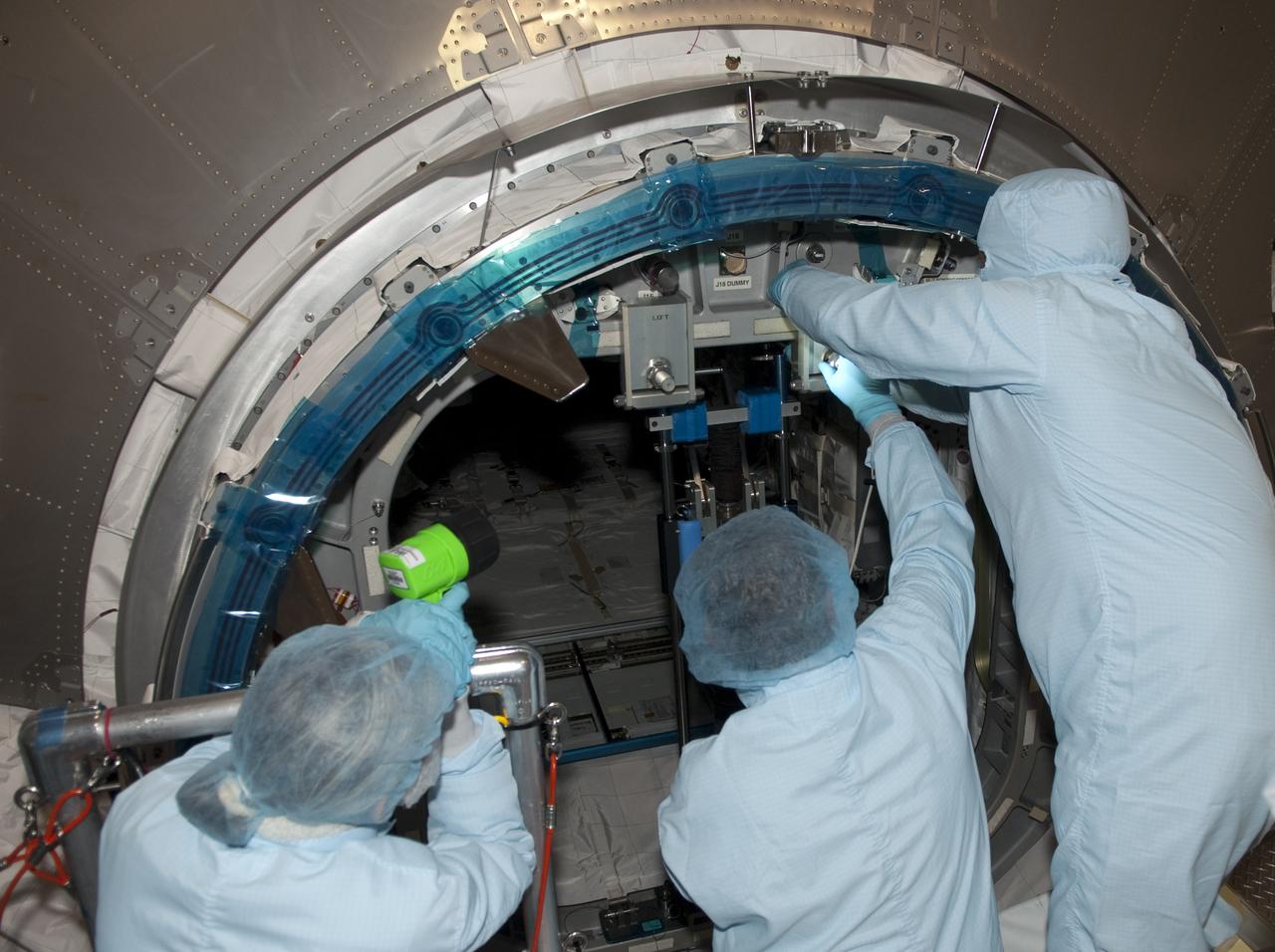
STS-131 MPLM LEONARDO HATCH CLOSURE