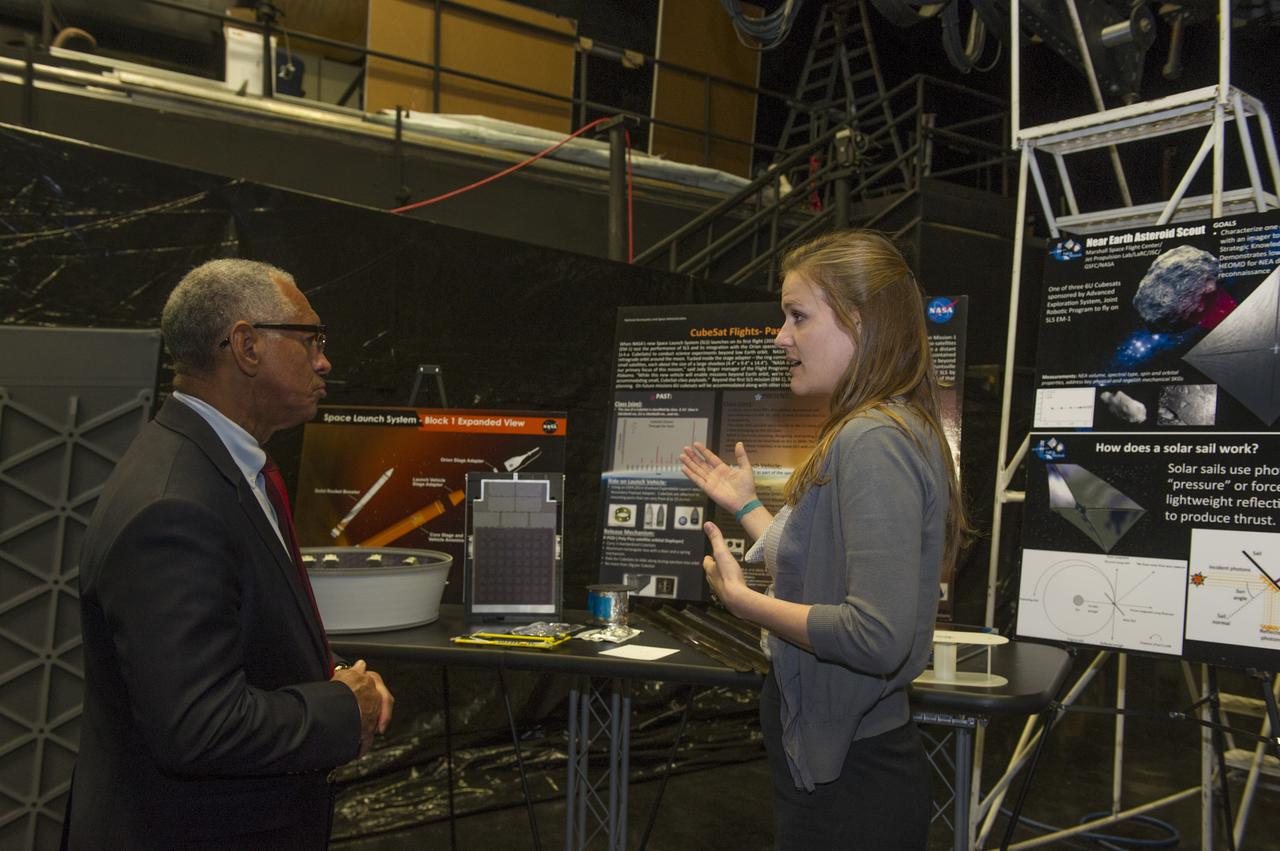
NASA ADMINISTRATOR BOLDEN IS BRIEFED ON NEA SCOUT PROGRESS BY LESLIE MCNUTT
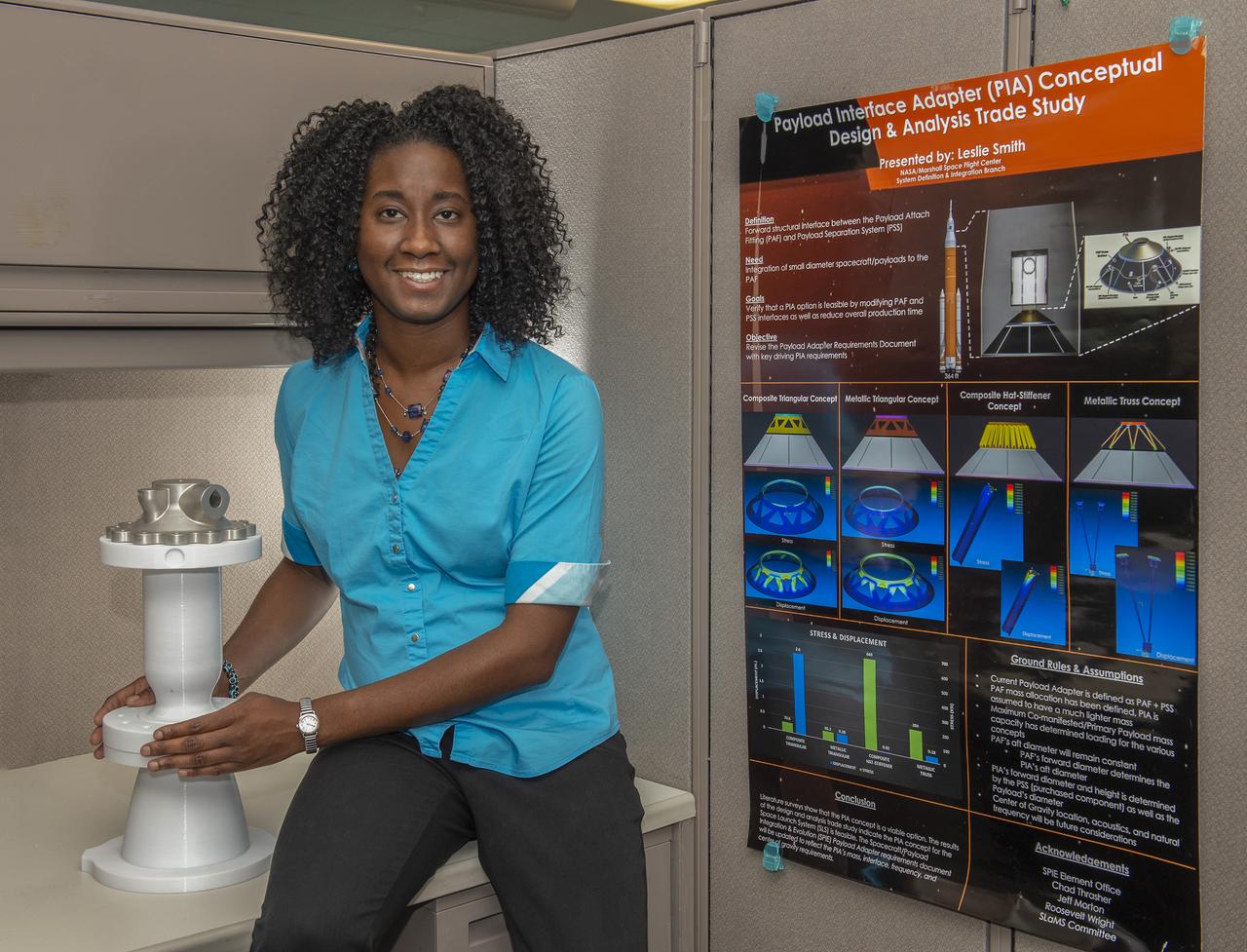
Leslie Smith, Systems Engineer, poses with an additive manufactured small combustion chamber, and poster she designed, of the Payload Interface Adapter (PIA) trade study that depicts four different concepts. The PIA is vital in helping transport various payloads to Beyond Earth Orbit.
Paylaod Specialist, Fred Leslie working on experiment.
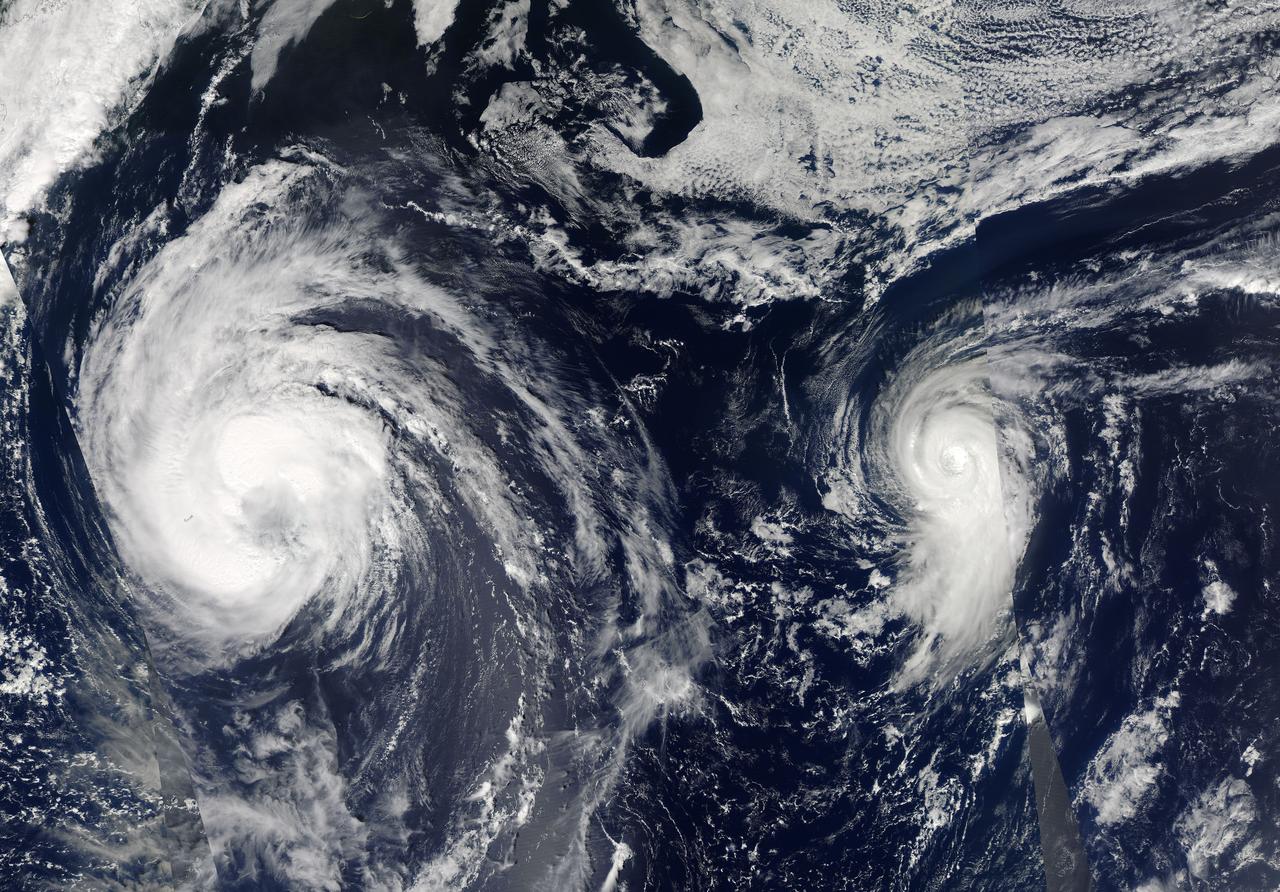
This visible image of Tropical Storm Leslie and Hurricane Michael was taken by the MODIS instrument aboard both NASA's Aqua and Terra satellites on Sept. 9 at 12:50 p.m. EDT. Credit: NASA Goddard/MODIS Rapid Response Team -- Satellite images from two NASA satellites were combined to create a full picture of Tropical Storm Leslie and Hurricane Michael spinning in the Atlantic Ocean. Imagery from NASA's Aqua and Terra satellites showed Leslie now past Bermuda and Michael in the north central Atlantic, and Leslie is much larger than the smaller, more powerful Michael. Images of each storm were taken by the Moderate Resolution Imaging Spectroradiometer, or MODIS instrument that flies onboard both the Aqua and Terra satellites. Both satellites captured images of both storms on Sept. 7 and Sept. 10. The image from Sept. 7 showed a much more compact Michael with a visible eye. By Sept. 10, the eye was no longer visible in Michael and the storm appeared more elongated from south to north. To continue reading go to: <a href="http://1.usa.gov/NkUPqn" rel="nofollow">1.usa.gov/NkUPqn</a> <b><a href="http://www.nasa.gov/audience/formedia/features/MP_Photo_Guidelines.html" rel="nofollow">NASA image use policy.</a></b> <b><a href="http://www.nasa.gov/centers/goddard/home/index.html" rel="nofollow">NASA Goddard Space Flight Center</a></b> enables NASA’s mission through four scientific endeavors: Earth Science, Heliophysics, Solar System Exploration, and Astrophysics. Goddard plays a leading role in NASA’s accomplishments by contributing compelling scientific knowledge to advance the Agency’s mission. <b>Follow us on <a href="http://twitter.com/NASA_GoddardPix" rel="nofollow">Twitter</a></b> <b>Like us on <a href="http://www.facebook.com/pages/Greenbelt-MD/NASA-Goddard/395013845897?ref=tsd" rel="nofollow">Facebook</a></b> <b>Find us on <a href="http://instagrid.me/nasagoddard/?vm=grid" rel="nofollow">Instagram</a></b>
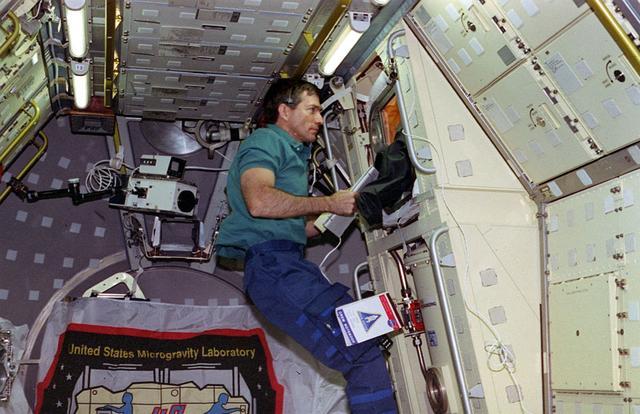
Payload Specialist, Fred Leslie changing samples in (CGF) Crystal Growth Furnace onboard STS-73, USML-2.
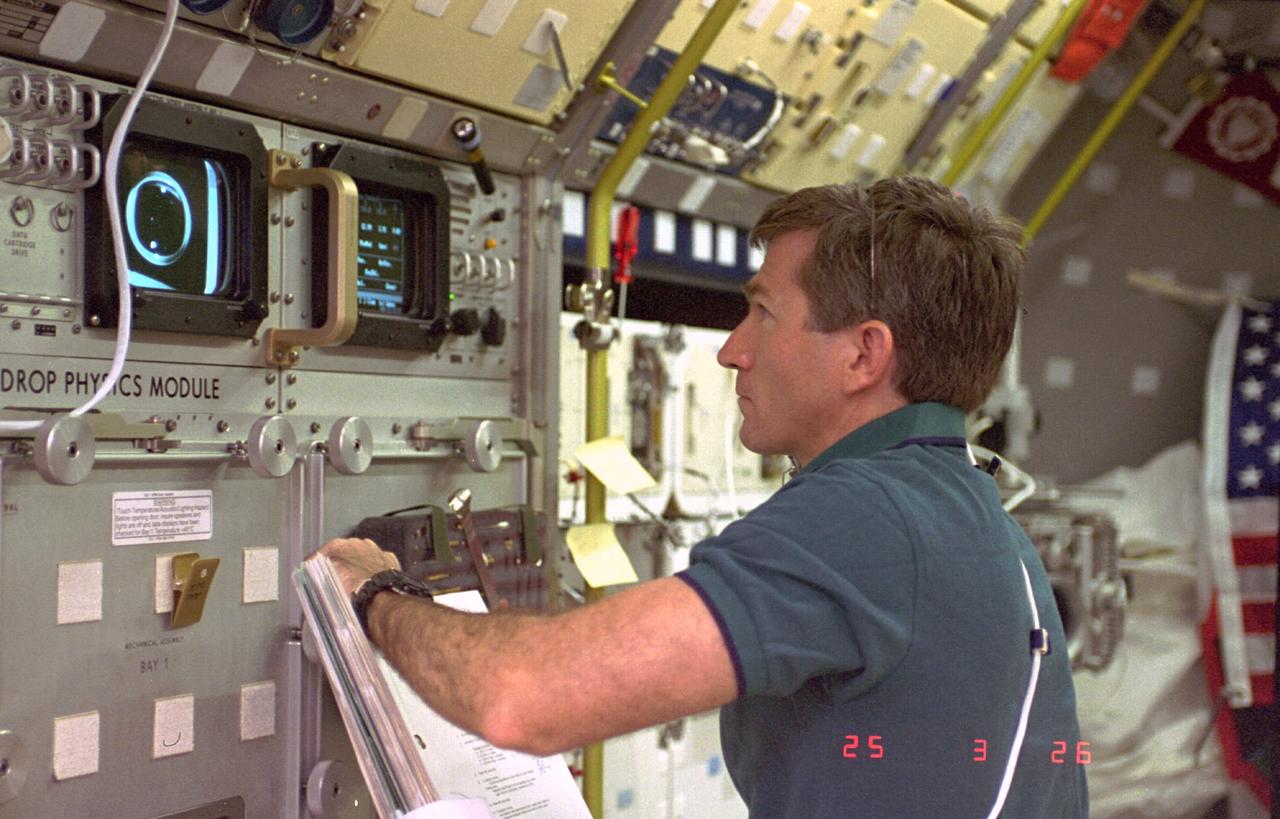
STS073-225-036 (20 October-5 November 1995) --- Payload specialist Fred W. Leslie monitors the response of a liquid drop at the Drop Physics Module (DPM) in the U.S. Microgravity Laboratory (USML-2) science module aboard the Space Shuttle Columbia. Leslie joined another guest researcher and five NASA astronauts for almost 16-days of Earth-orbit research in support of the mission.
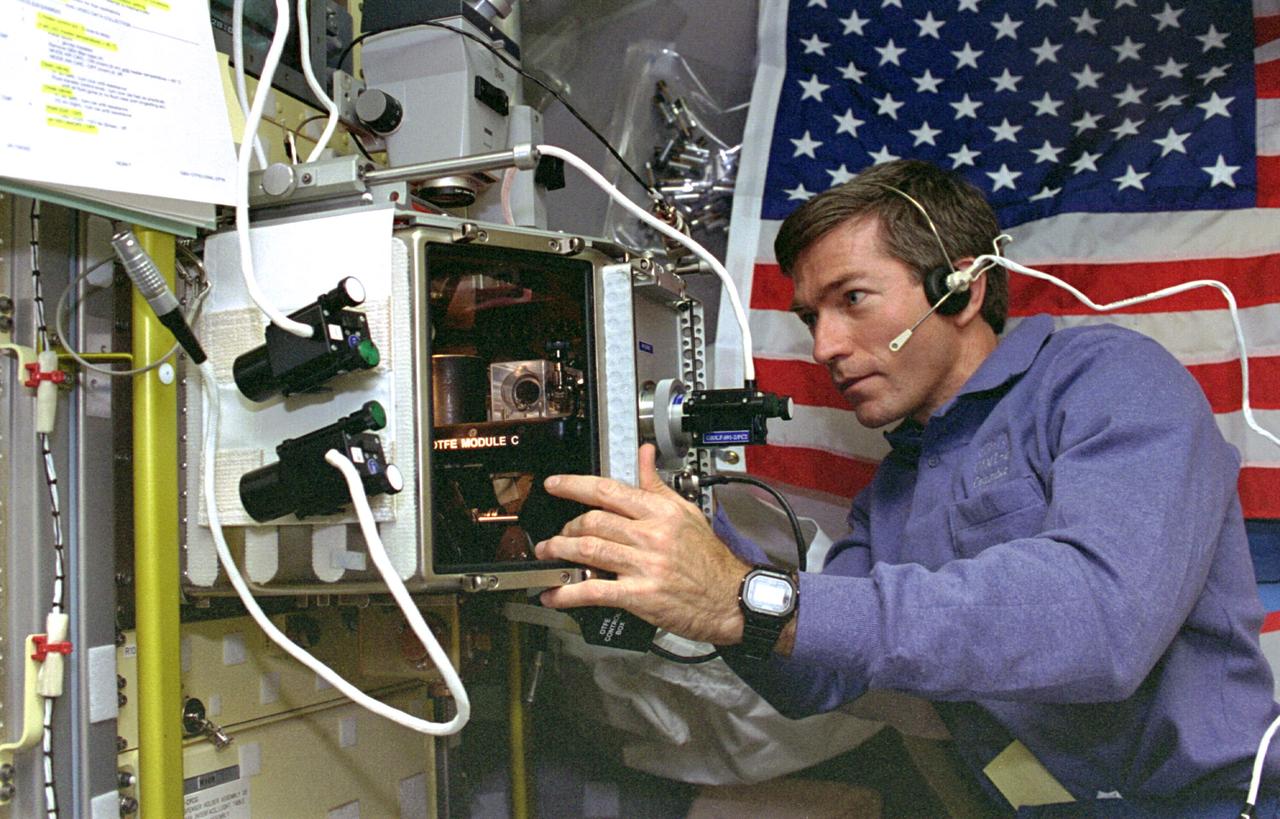
STS073-233-007 (20 October - 5 November 1995) --- Payload specialist Fred W. Leslie makes use of the versatile U.S. Microgravity Laboratory (USML-2) glovebox to conduct an investigation with the Oscillatory Thermocapillary Flow Experiment (OTFE). This complement of the Surface-Tension-Driven Convection Experiment (STDCE) studies the shapes that fluid surfaces in weightless environments assume within specific containers. Leslie was one of two guest researchers who joined five NASA astronauts for 16 days of on Earth-orbit research in support of USML-2.
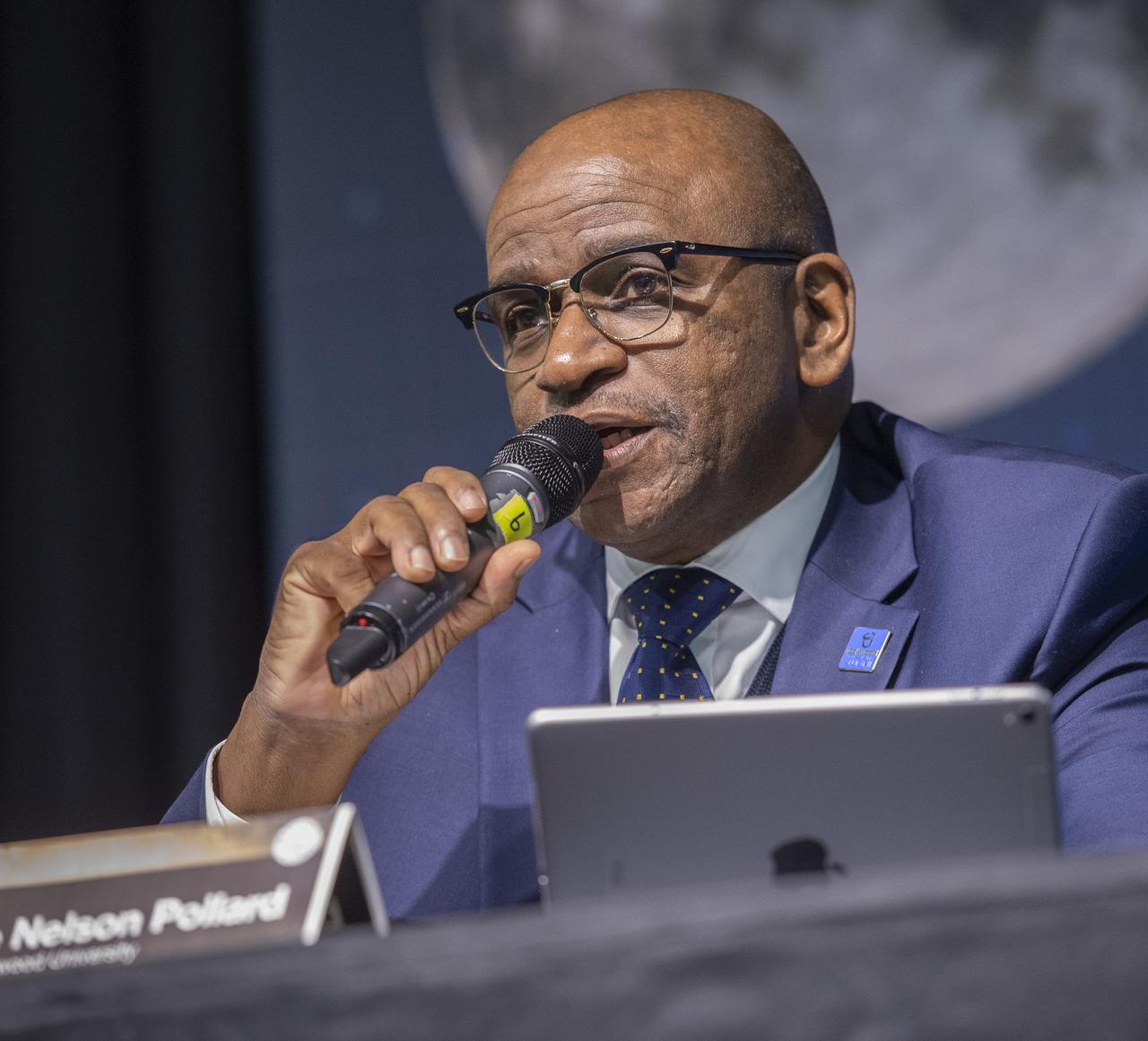
Marshall Space Flight Center's Black History Month program featured an address by Dr. Leslie Nelson Pollard, 11th President of Oakwood University.
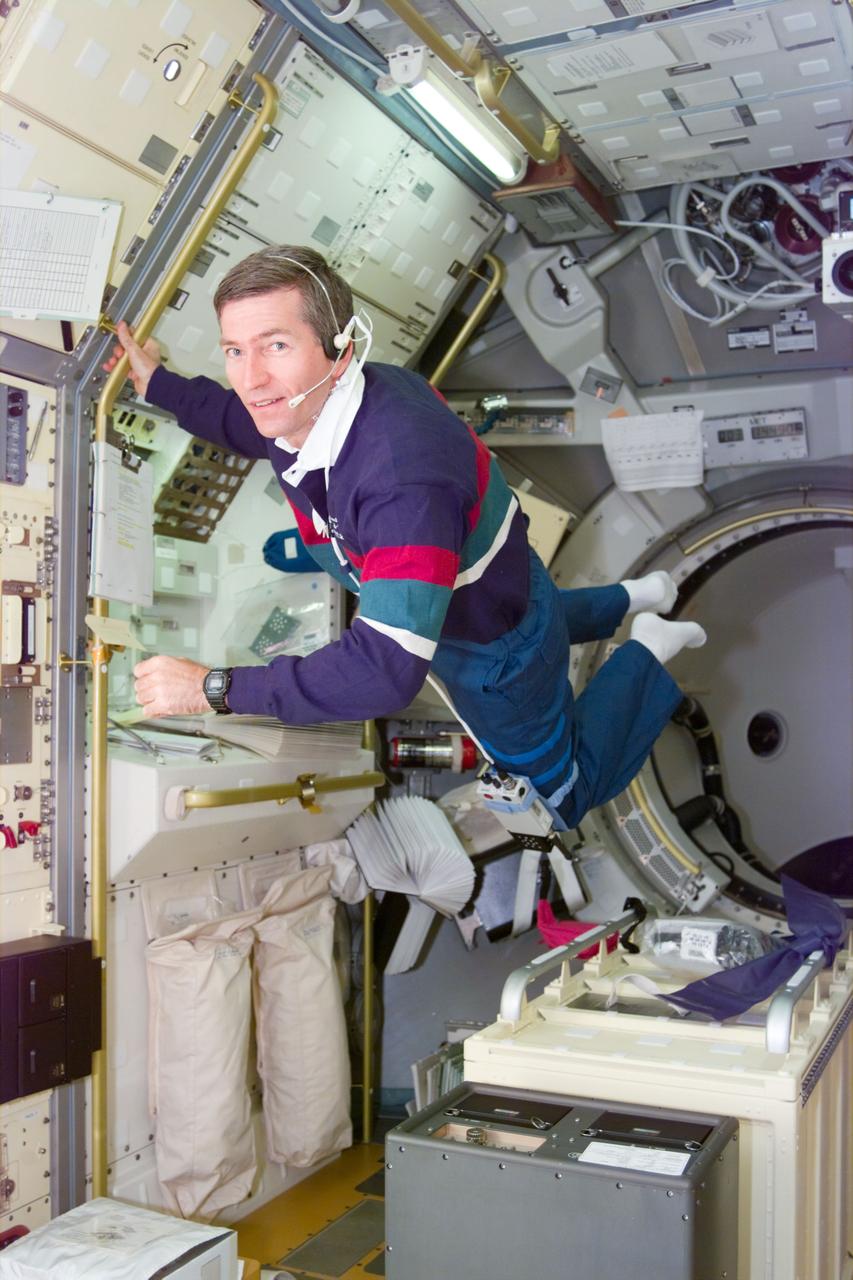
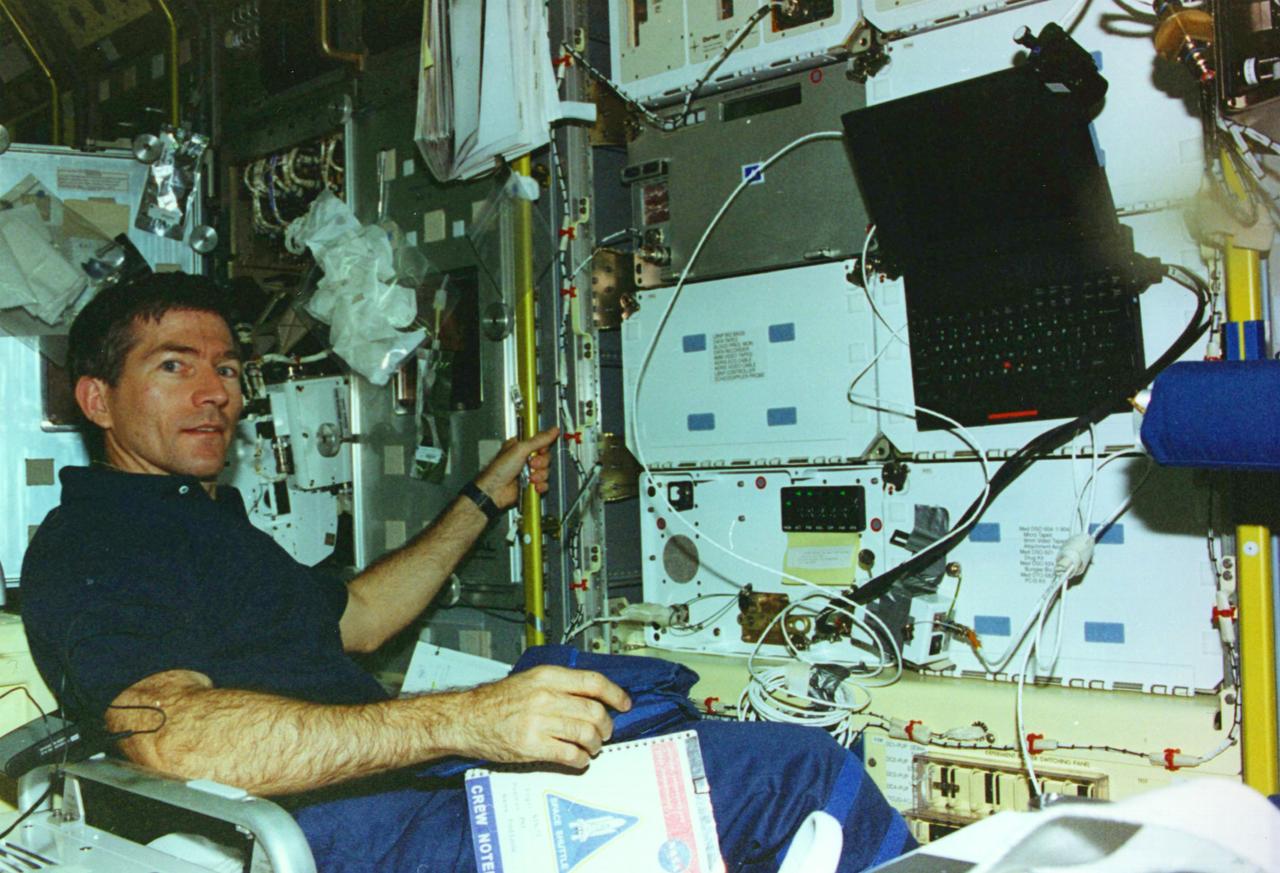
STS073-E-5041 (26 Oct. 1995) --- Fred W. Leslie, STS-73 payload specialist, working out of NASA's Marshall Space Flight Center (MSFC), in Alabama, grabs a support bar on a science workstation rack after floating from the space shuttle Columbia's cabin into the science module. Leslie is one of seven crewmembers in the midst of a 16-day multi-faceted mission aboard Columbia. For the next week and a half, Leslie and the rest of the crew will continue working in shifts around the clock on a diverse assortment of United States Microgravity Laboratory (USML-2) experiments located in the science module. Fields of study include fluid physics, materials science, biotechnology, combustion science and commercial space processing technologies. The frame was exposed with an Electronic Still Camera (ESC).
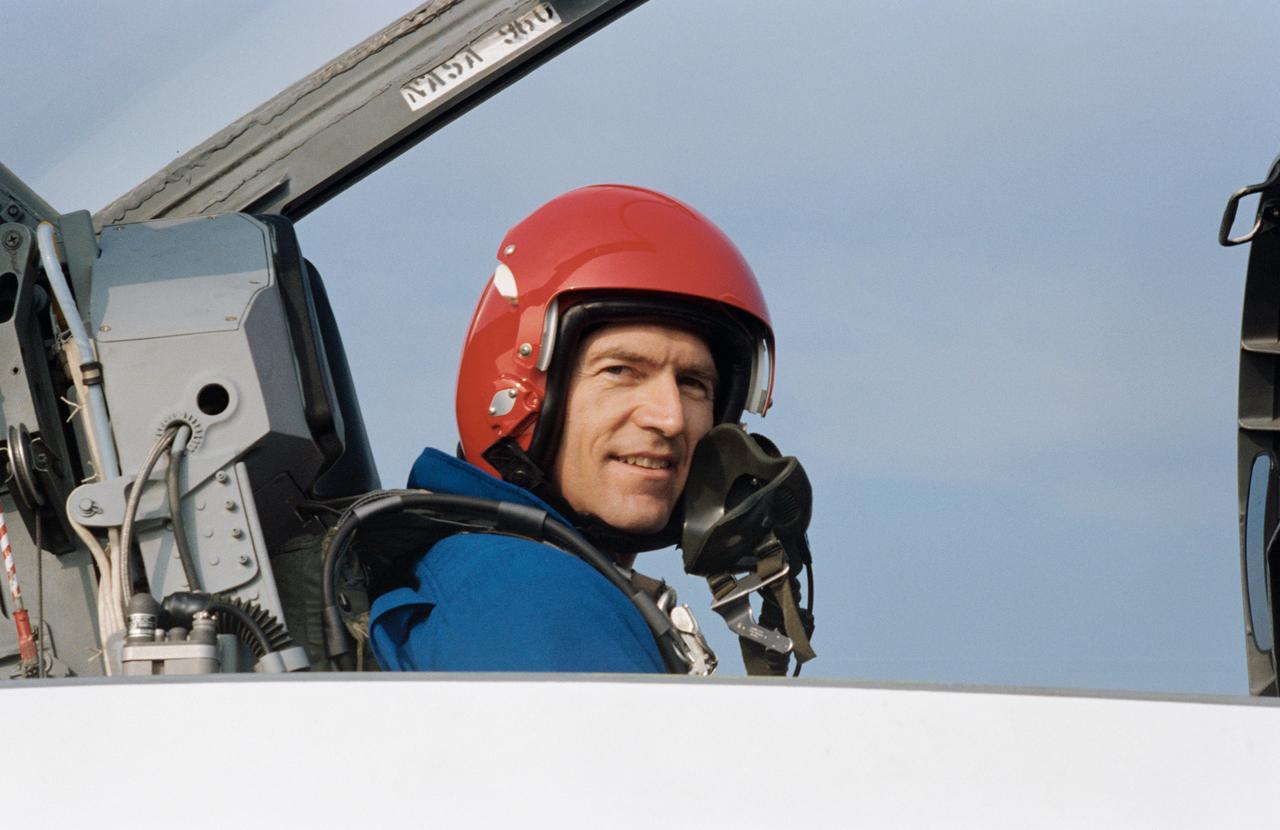
S95-17156 (24 Aug. 1995) --- Payload specialist Fred Leslie prepares to take a familiarization flight in the rear station of a T-38 jet trainer aircraft, based at Ellington Field, near the Johnson Space Center (JSC). Leslie was named last year as one of seven crew members for the U.S. Microgravity Laboratory (USML-2) mission.
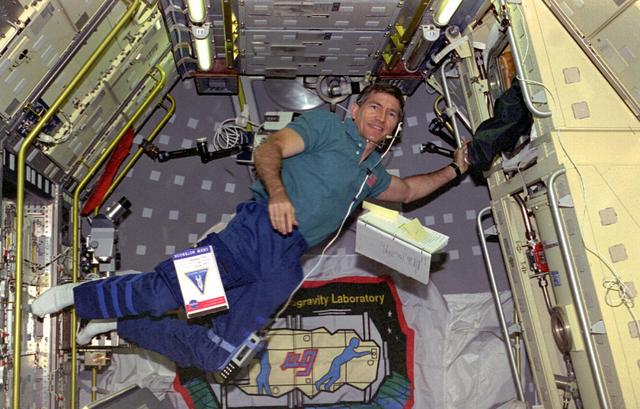
STS073-101-018 (20 October-5 November 1995) --- Payload specialist Fred W. Leslie maneuvers his body to a position conducive to research at the Crystal Growth Furnace (CGF) aboard the science module in the cargo bay of the Earth-orbiting Space Shuttle Columbia. Crystallization has been discovered to be more effectively studied in the weightless environment of space than on Earth, because the gravity-induced phenomena that obscure or change the process or change the process are greatly reduced or eliminated. Leslie was joined by a second guest researcher and five NASA astronauts for 16 full days of in-space research in support of the United States Microgravity Laboratory (USML-2) mission.
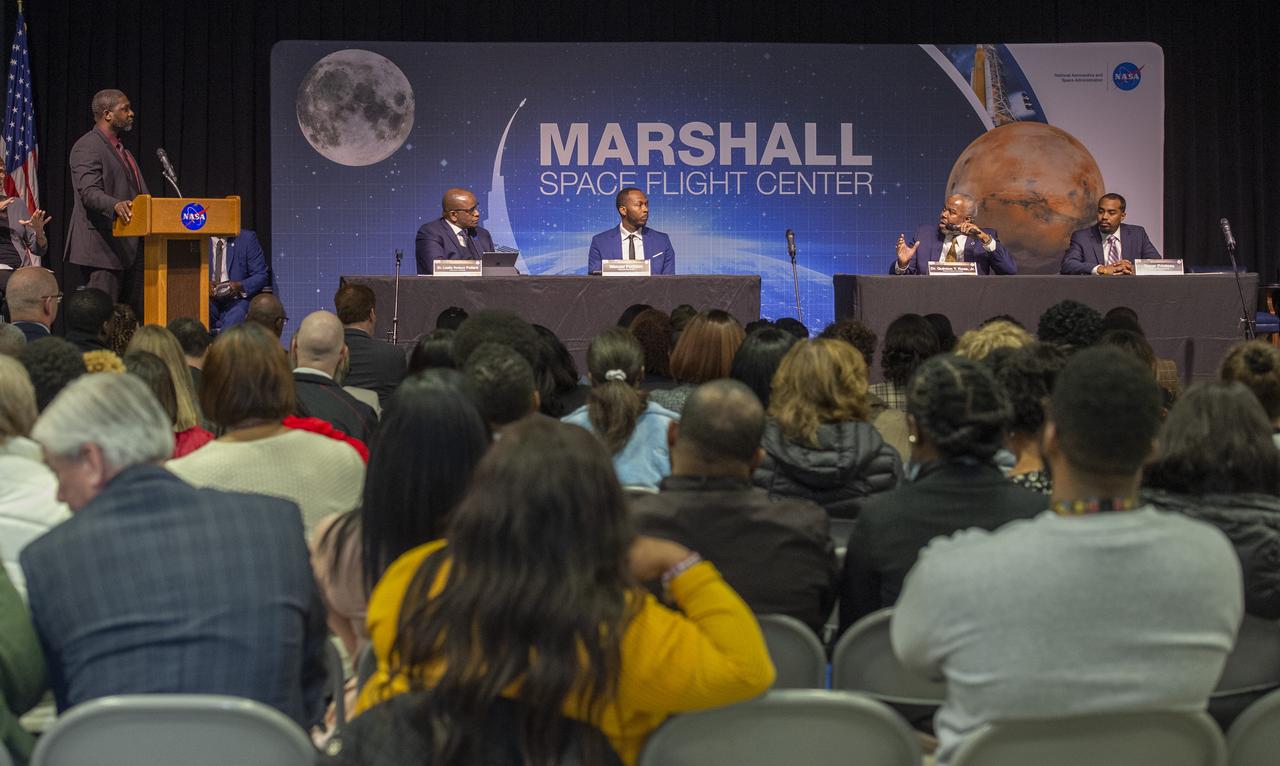
Marshall Space Flight Center's Black History Month program featured a panel discussion including Leslie Pollard, President of Oakwood University and Quinton Ross, President of Alabama State University.
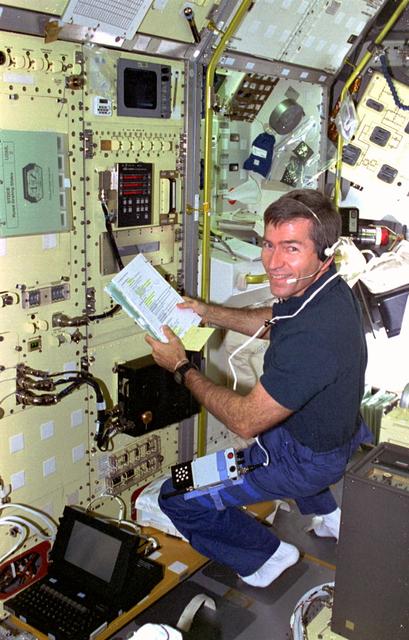
STS073-103-015 (20 October-5 November 1995) --- Payload specialist Fred W. Leslie works with the Surface Tension Driven Convection Experiment (STDCE) aboard the science module in the cargo bay of the Earth-orbiting Space Shuttle Columbia. Leslie joined another guest researcher and five NASA astronauts for 16 full days of in-space research in support of the United States Microgravity Laboratory (USML-2) mission.
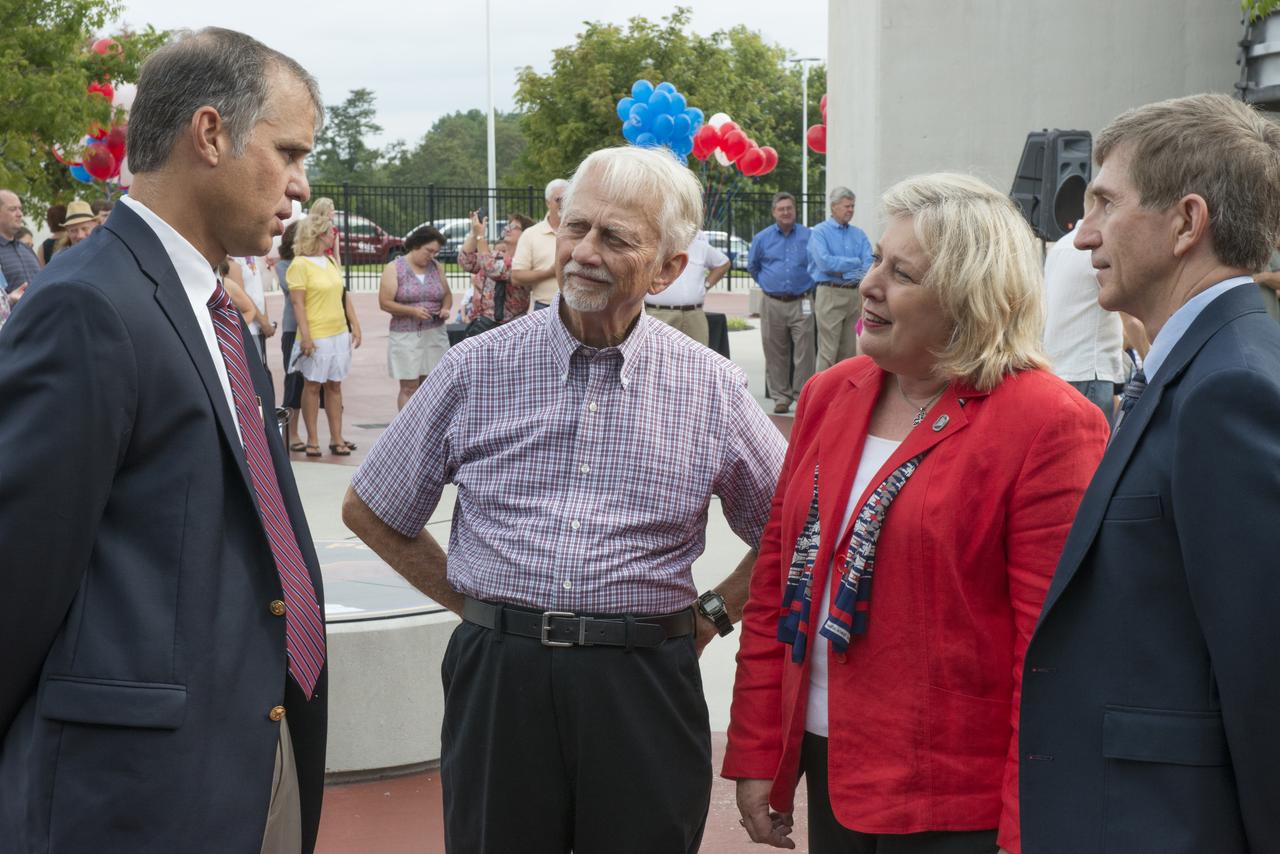
AUGUST 31, 2012 TRIBUTE TO APOLLO ASTRONAUT NEIL ARMSTRONG AT THE USSRC. L TO R: JONATHAN PETTUS, MSFC ACTING ASSOCIATE ADMINISTRATOR; FORMER ASTRONAUT OWEN GARRIOTT; FORMER ASTRONAUT JAN DAVIS AND FORMER ASTRONAUT FRED LESLIE.1200933F
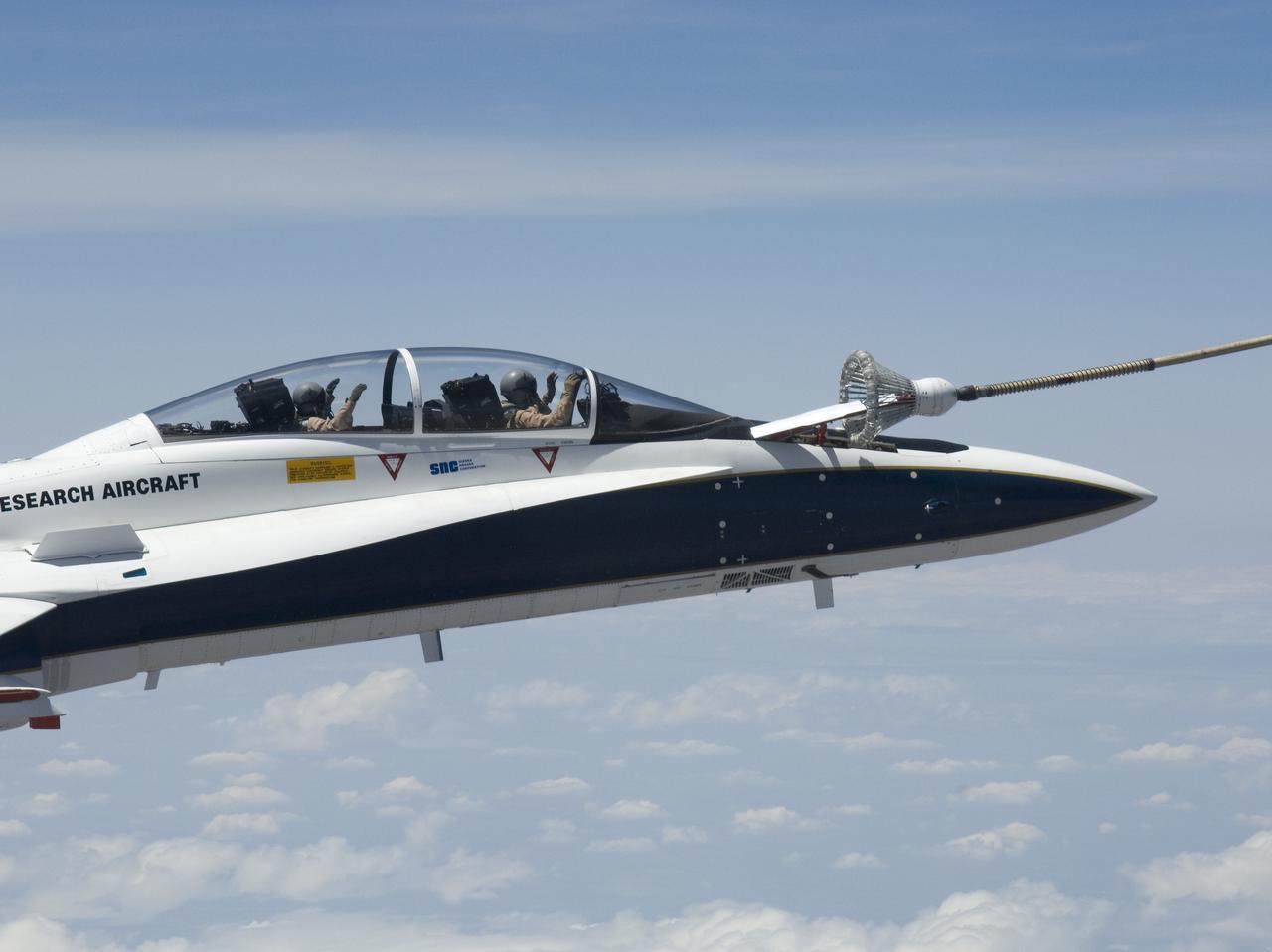
Pilot Dick Ewers and flight test engineer Leslie Molzahn were hands-off as NASA F/A-18 #845 flew itself into the drogue on an autonomous refueling demonstration.
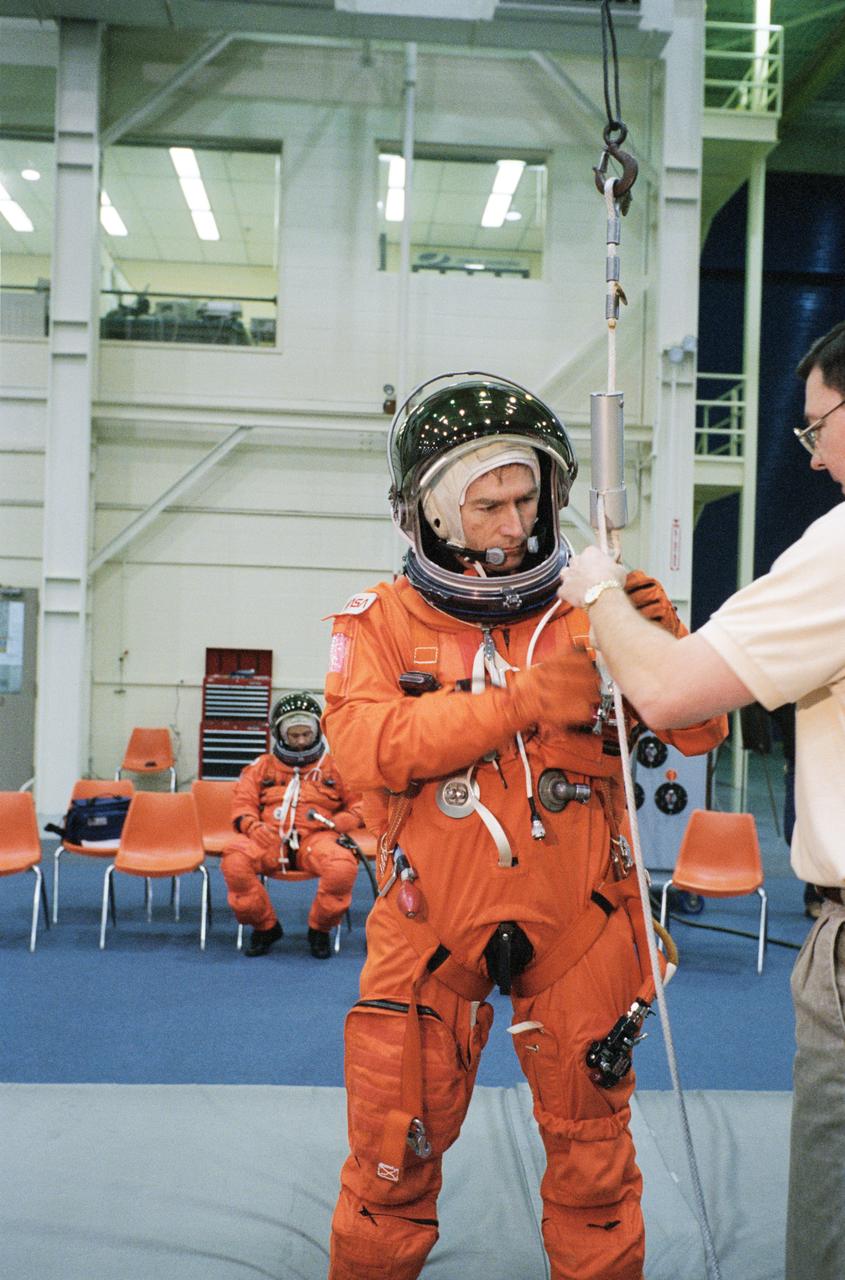
S95-09157 (27 Apr. 1995) --- Payload specialist Fred W. Leslie has just translated from the top of a Shuttle mockup-trainer using a Sky-genie device during emergency egress training with his six STS-73 crew mates. He is assisted here by Scott Gill, a member of the STS-73 training staff. The seven will fly aboard the Space Shuttle Columbia later this year to support the United States Microgravity Laboratory (USML-2) mission.
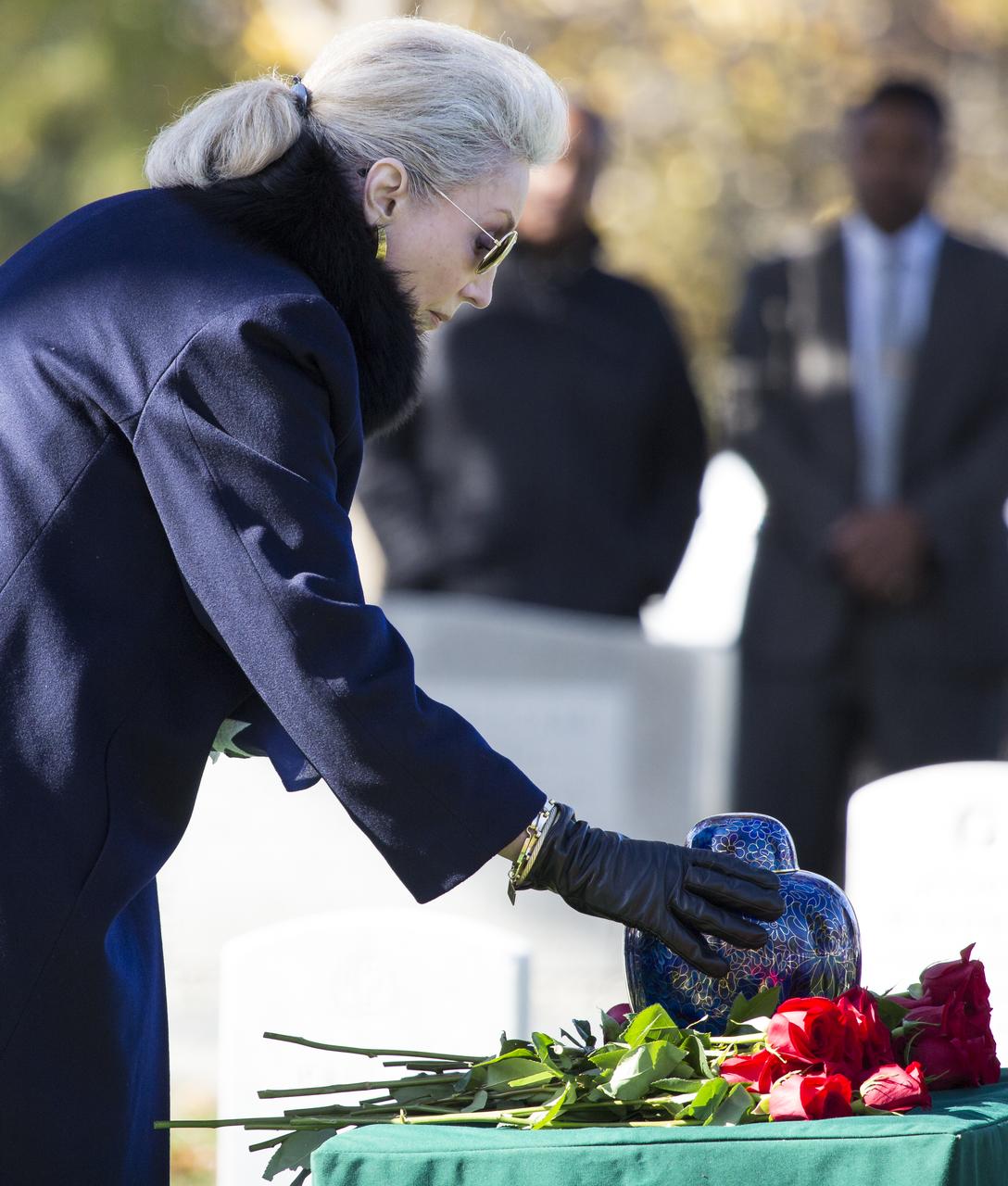
Leslie Bean, wife of former astronaut Alan Bean, places her hand on the urn containing his ashes, Thursday, Nov. 8, 2018 at Arlington National Cemetery in Virginia. Selected as an astronaut in 1963, Bean flew in space twice, becoming the fourth human to walk on the Moon on Nov. 19, 1969 and spent 59 days in space as commander of the second Skylab mission in 1973. Photo Credit: (NASA/Joel Kowsky)
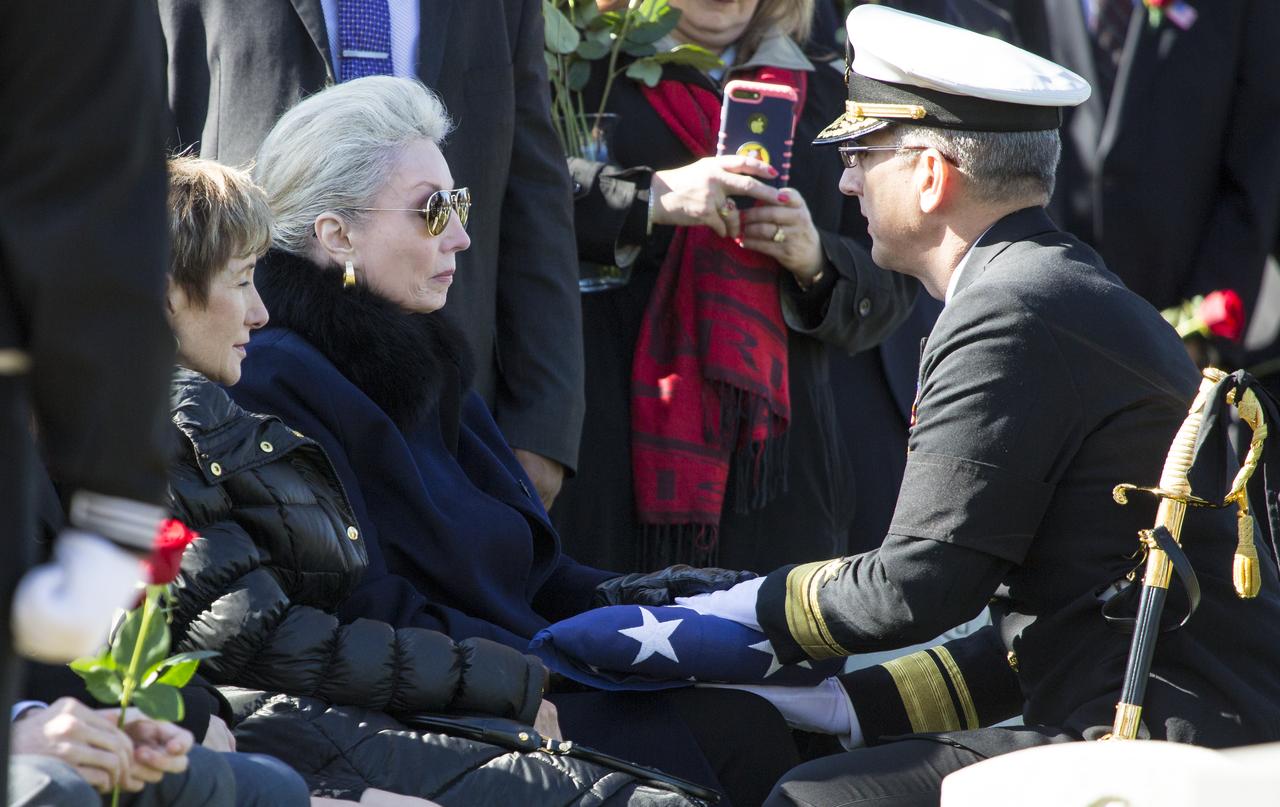
Leslie Bean, wife of former astronaut Alan Bean, receives the folded American Flag from U.S. Navy Rear Adm. James Bynum during his interment service, Thursday, Nov. 8, 2018 at Arlington National Cemetery in Virginia. Selected as an astronaut in 1963, Bean flew in space twice, becoming the fourth human to walk on the Moon on Nov. 19, 1969 and spent 59 days in space as commander of the second Skylab mission in 1973. Photo Credit: (NASA/Joel Kowsky)

Leslie Bean, wife of former astronaut Alan Bean, places a rose next to the urn containing his ashes, Thursday, Nov. 8, 2018 at Arlington National Cemetery in Virginia. Selected as an astronaut in 1963, Bean flew in space twice, becoming the fourth human to walk on the Moon on Nov. 19, 1969 and spent 59 days in space as commander of the second Skylab mission in 1973. Photo Credit: (NASA/Joel Kowsky)
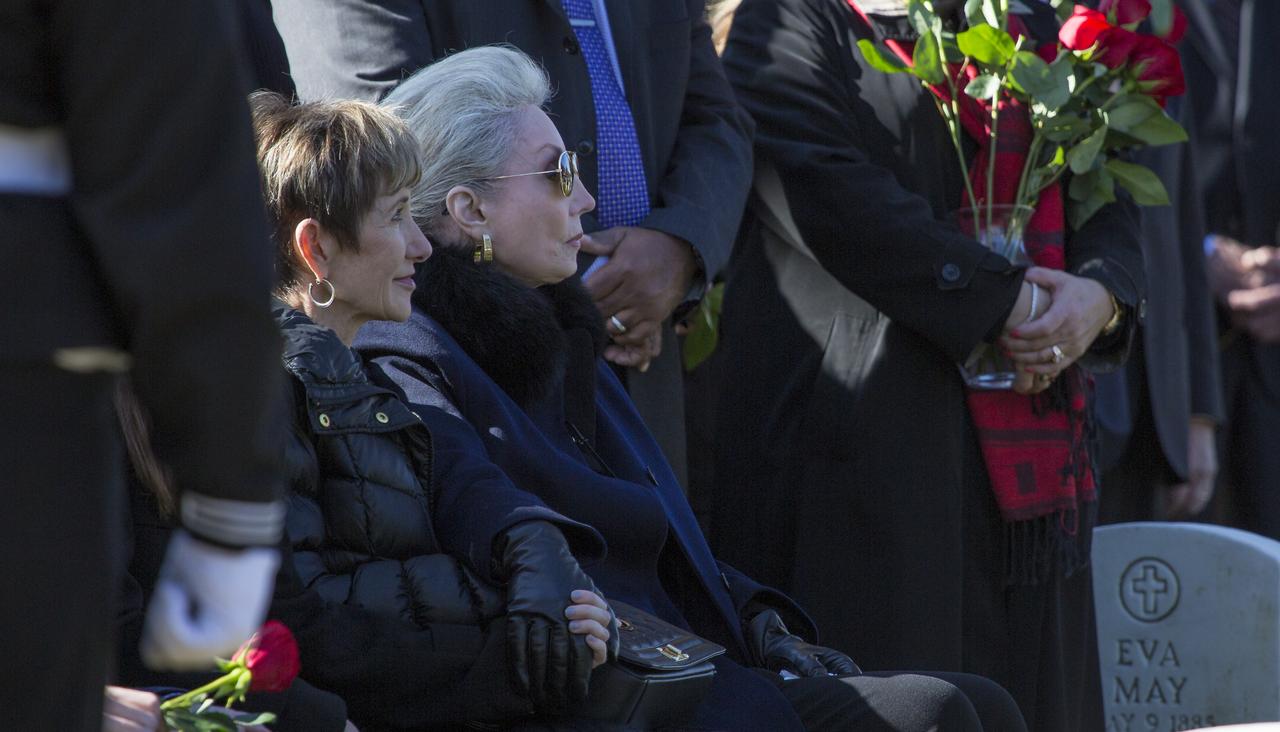
Leslie Bean, wife of former astronaut Alan Bean, is seen during his interment service, Thursday, Nov. 8, 2018 at Arlington National Cemetery in Virginia. Selected as an astronaut in 1963, Bean flew in space twice, becoming the fourth human to walk on the Moon on Nov. 19, 1969 and spent 59 days in space as commander of the second Skylab mission in 1973. Photo Credit: (NASA/Joel Kowsky)
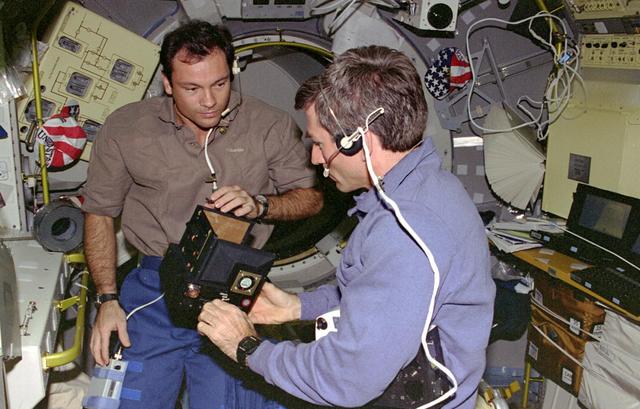
STS073-233-032 (20 October - 5 November 1995) --- Astronaut Michael E. Lopez-Alegria (left), STS-73 mission specialist, assists payload specialist Fred W. Leslie in an in-flight maintenance task involving the Fiber Support Droplet Combustion (FSDC) experiment. This new Glovebox investigation tests a technique for studying combustion in the weightless environment of space. The two joined five other crew members onboard the Space Shuttle Columbia for 16 days of in-space research in support of the United States Microgravity Laboratory (USML-2) mission.
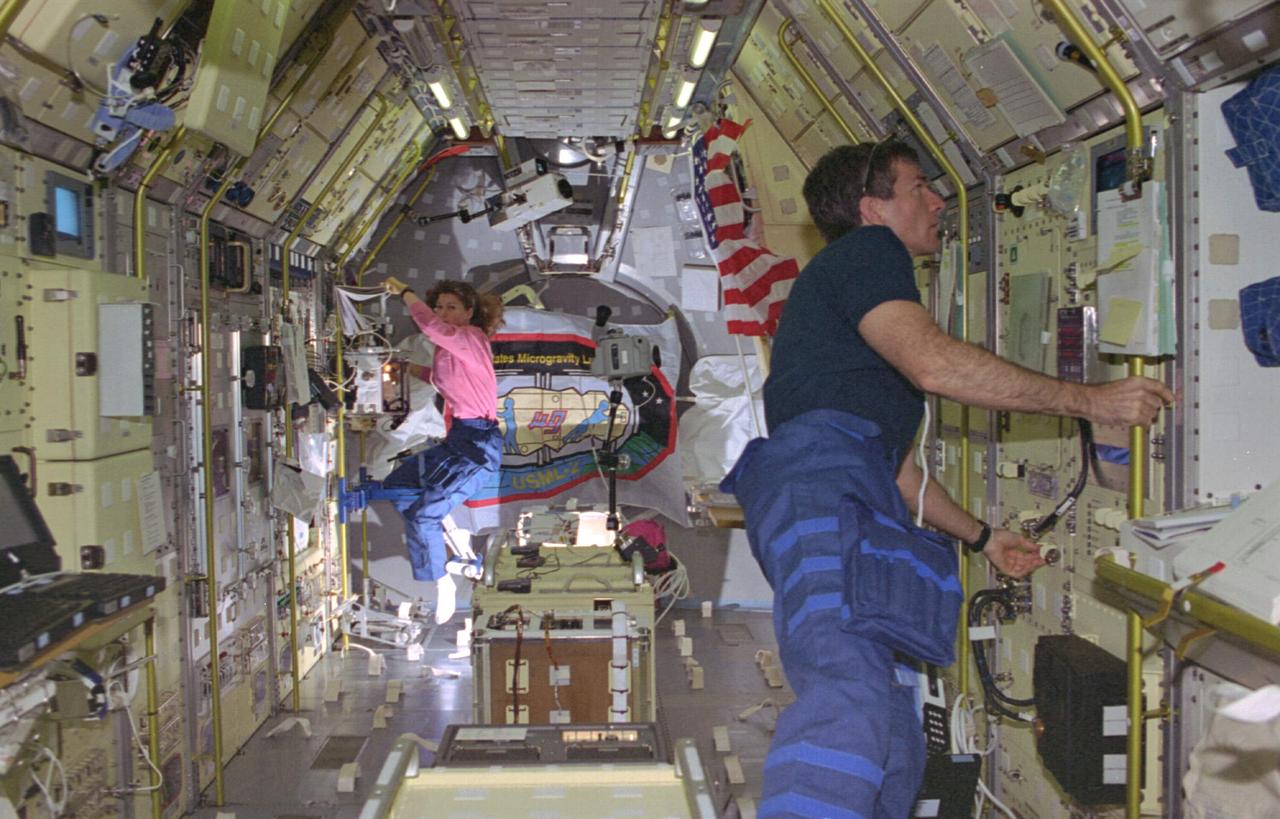
STS073-103-019 (20 October-5 November 1995) --- This wide view gives an overall perspective of the working environment of five astronauts and two guest researchers for 16 days in Earth-orbit. At work in support of the U.S. Microgravity Laboratory (USML-2) mission in this particular scene are astronaut Catherine G. Coleman, who busies herself at the glovebox, and payload specialist Fred W. Leslie, monitoring the Surface-Tension-Driven Convection Experiment (STDCE).

These five astronauts and two United States Microgravity Laboratory (USML) payload specialists pause from a rigid training schedule for the STS-73 crew portrait. On the front row, left to right, are Albert Sacco Jr., payload specialist; Kent V. Rominger, pilot; and Michael E. Lopez-Alegria, mission specialist. On the back row are, left to right, Catherine G. Coleman, mission specialist; Kenneth D. Bowersox, commander; Fred W. Leslie, payload specialist; and Kathryn C. Thornton, payload commander. The STS-073 crew launched aboard the Space Shuttle Columbia on October 20, 1995 at 9:53:00.069 am (EDT). The mission served as the second flight of the Microgravity Laboratory (USML-2).

NASA Headquarter's Office of Infrastructure and Administration, Environmental Management Division presents the annual Blue Marble Award to Ames Scientist Leslie Prufert-Bebout receives . Leslie Prufert-Bebout is a microbial ecologist who studies many different species of algea in natural biological communities.
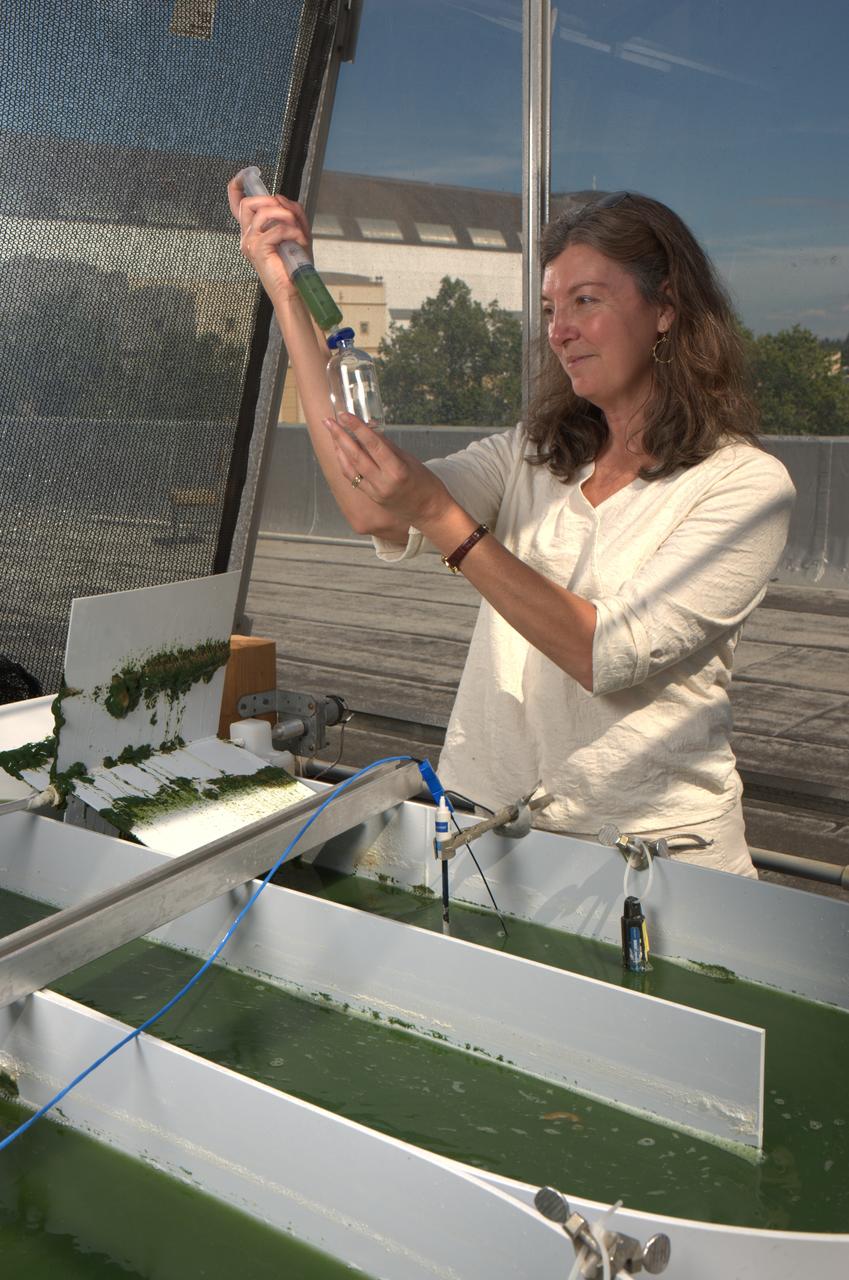
NASA Headquarter's Office of Infrastructure and Administration, Environmental Management Division presents the annual Blue Marble Award to Ames Scientist Leslie Prufert-Bebout receives . Leslie Prufert-Bebout is a microbial ecologist who studies many different species of algea in natural biological communities.
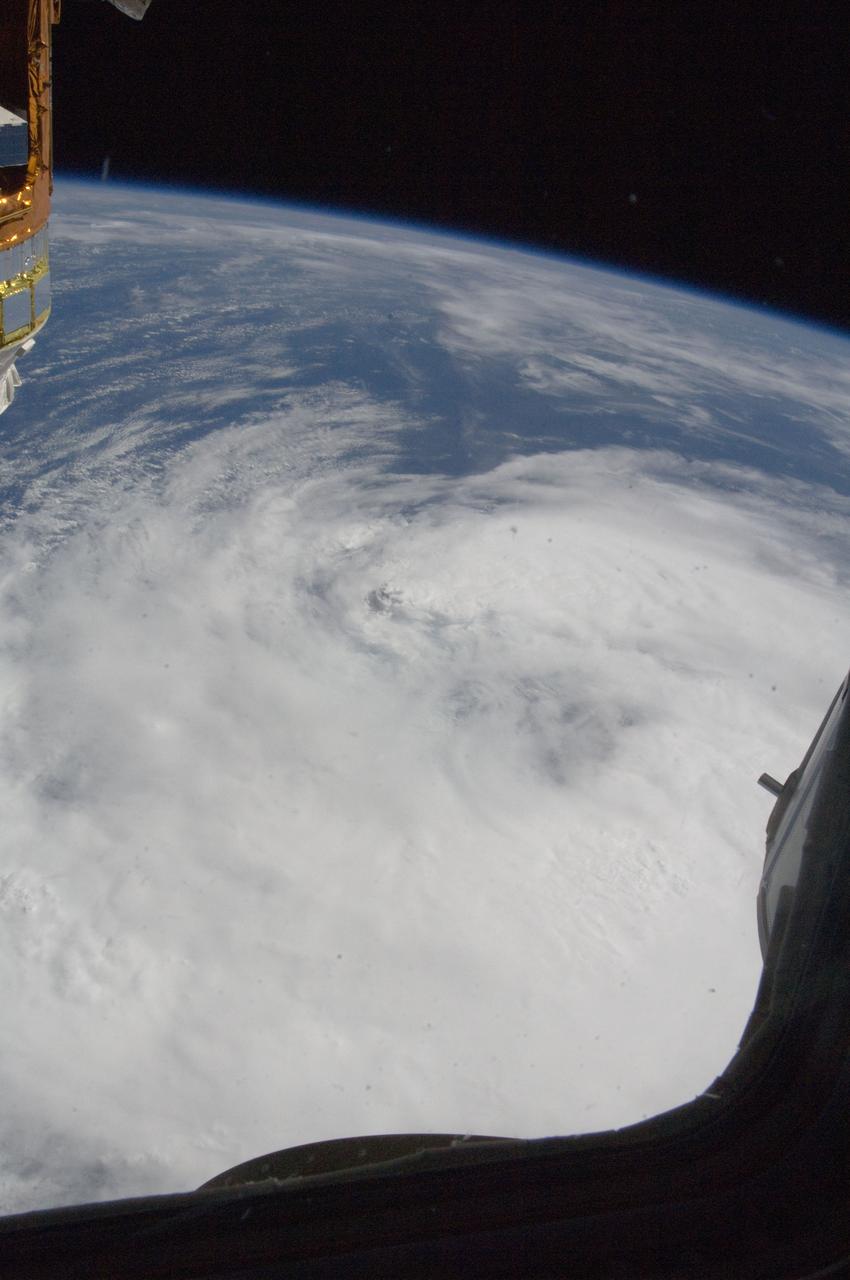
ISS032-E-025605 (9 Sept. 2012) --- Tropical Storm Leslie is clearly seen in the Atlantic Ocean on Sept. 9, 2012, as photographed by one of the Expedition 32 crew members aboard the Cupola of the International Space Station. At the time of the photo, Leslie was centered near 33.4 degrees north latitude and 62.1 degrees west longitude (approximately 175 miles east-northeast of Bermuda) moving northward at 14 miles per hour with winds of 60 miles per hour.
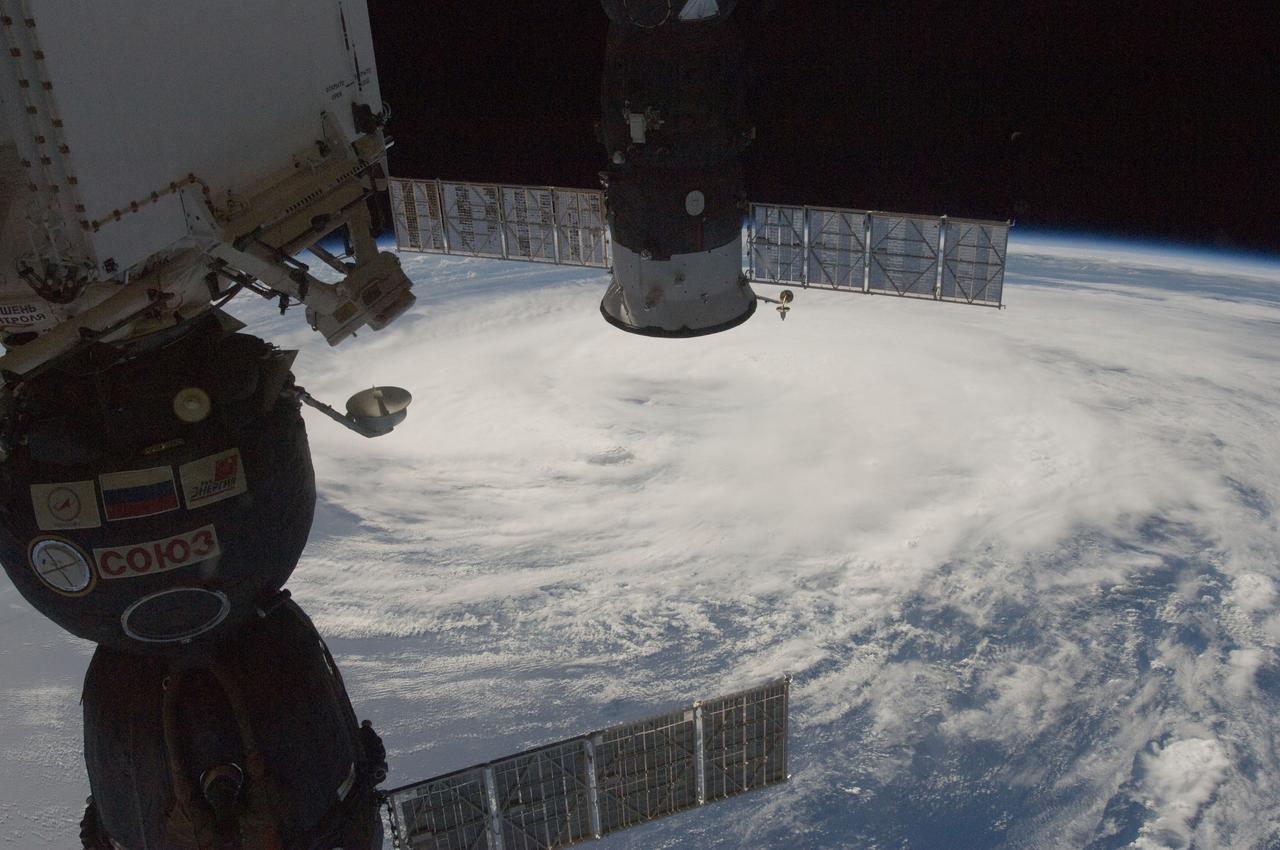
ISS032-E-025610 (9 Sept. 2012) --- Partially obstructed by two Russian spacecraft in the foreground, Tropical Storm Leslie is clearly seen in the Atlantic Ocean on Sept. 9, 2012, as photographed by one of the Expedition 32 crew members aboard the International Space Station. At the time of the photo, Leslie was centered near 33.4 degrees north latitude and 62.1 degrees west longitude (approximately 175 miles east-northeast of Bermuda) moving northward at 14 miles per hour with winds of 60 miles per hour.
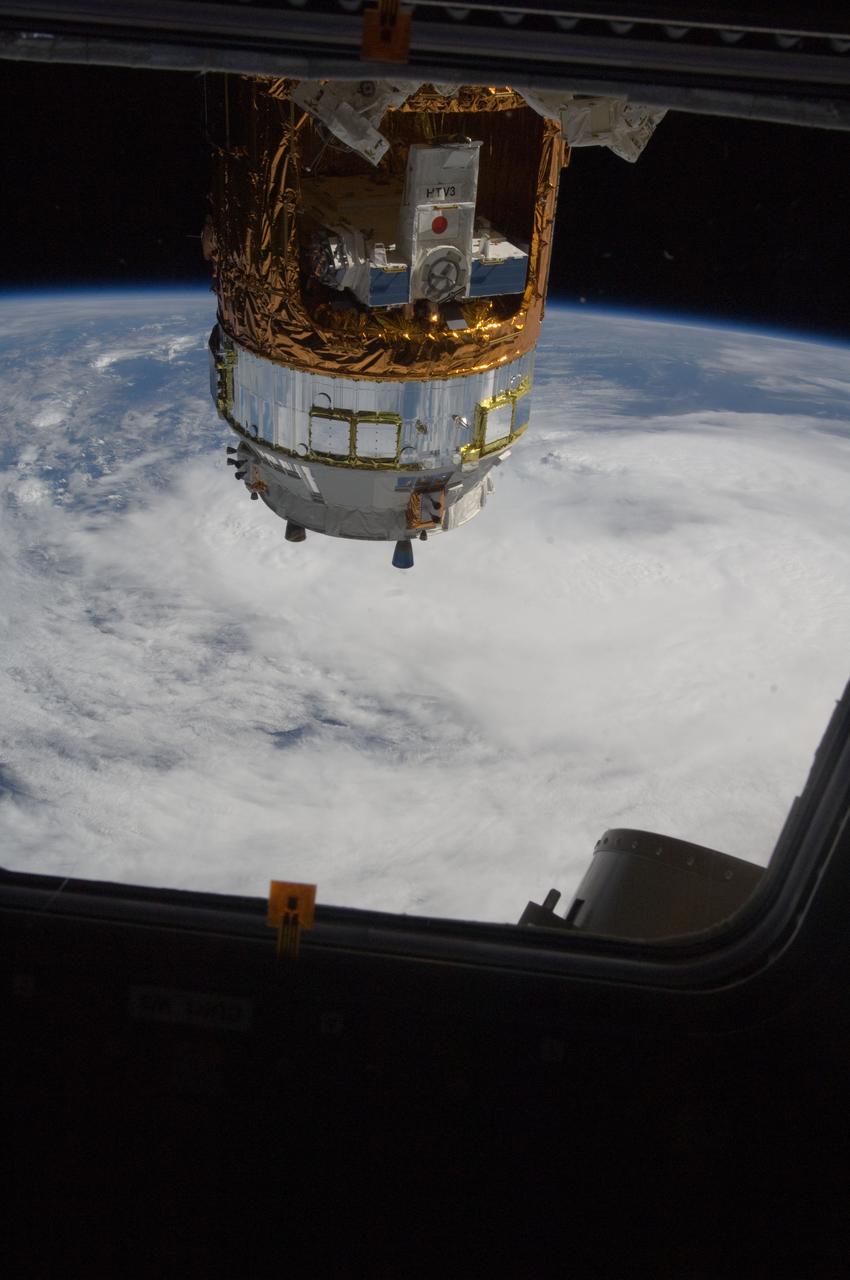
ISS032-E-025592 (9 Sept. 2012) --- Partially obstructed by the HTV-3 (H-II Transfer Vehicle) of the Japan Aerospace Exploration Agency (JAXA), Tropical Storm Leslie is clearly seen in the Atlantic Ocean on Sept. 9, 2012, as photographed by one of the Expedition 32 crew members aboard the Cupola of the International Space Station. At the time of the photo Leslie was centered near 33.4 degrees north latitude and 62.1degrees west longitude (approximately 175 miles east-northeast of Bermuda) moving northward at 14
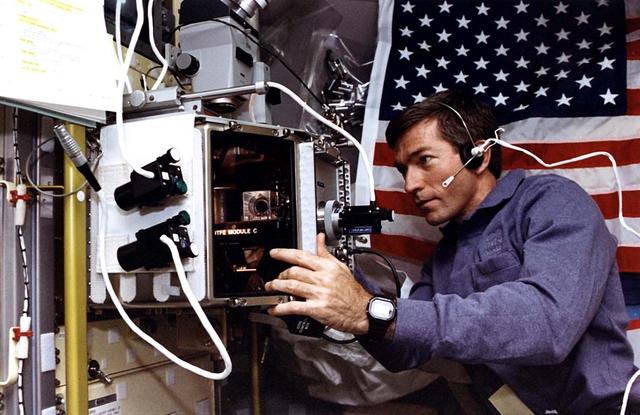
Payload specialist Fred Leslie makes use of the versatile U.S. Microgravity Laboratory (USML-2) glovebox to conduct an investigation with the Oscillatory Thermocapillary Flow Experiment (OTFE). This complement of the Surface-Tension-Driven Convection Experiment (STDCE) studies the shapes that fluid surfaces in weightless environments assume within specific containers. Leslie was one of two guest researchers who joined five NASA astronauts for 16 days of on Earth-orbit research in support of USML-2.
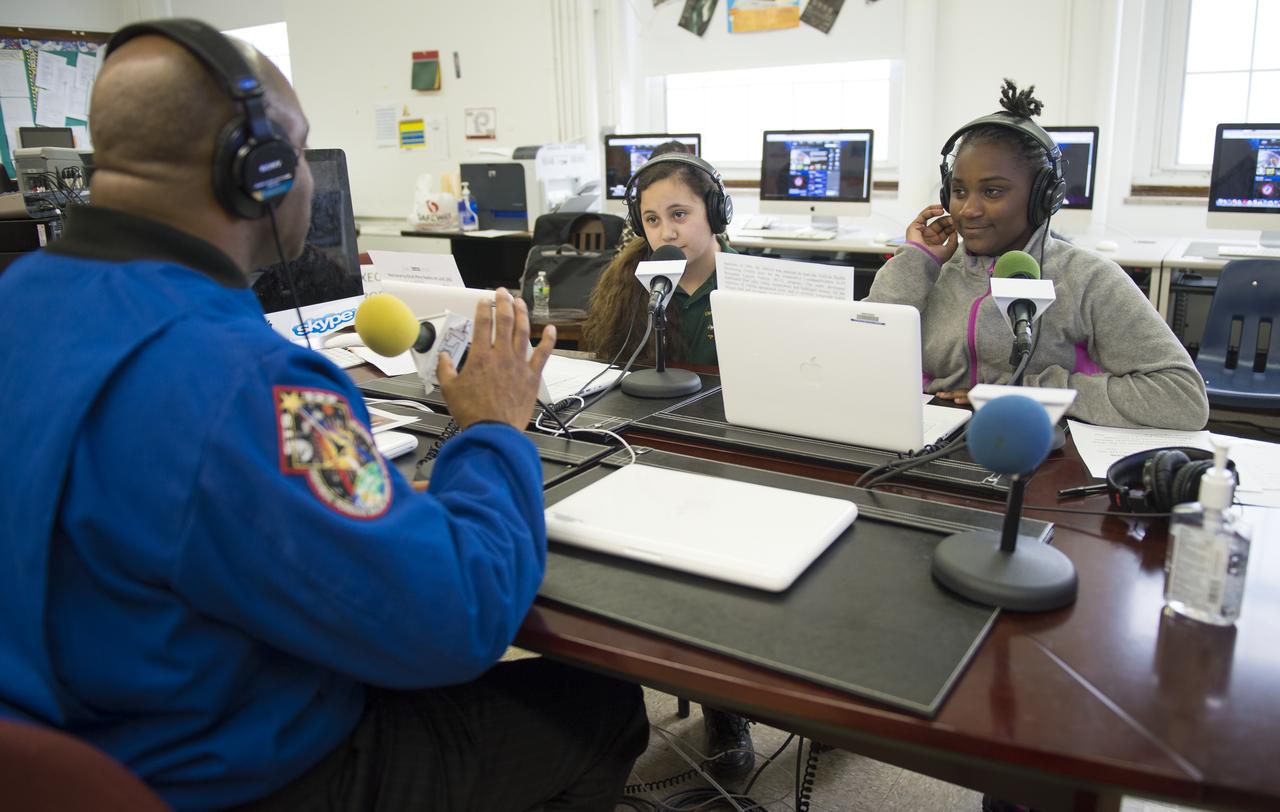
Tatyanna Liggins, far right, and Leslie Auturo, center, interview NASA Associate Administrator for Education for their radio program Eliot Hine Radio at Eliot Hine Middle School on Friday, March, 1, 2013 in Washington. Tatyanna and Leslie attend the Broadcast Media Class which produces Eliot Hine Radio. Photo Credit: (NASA/Carla Cioffi)
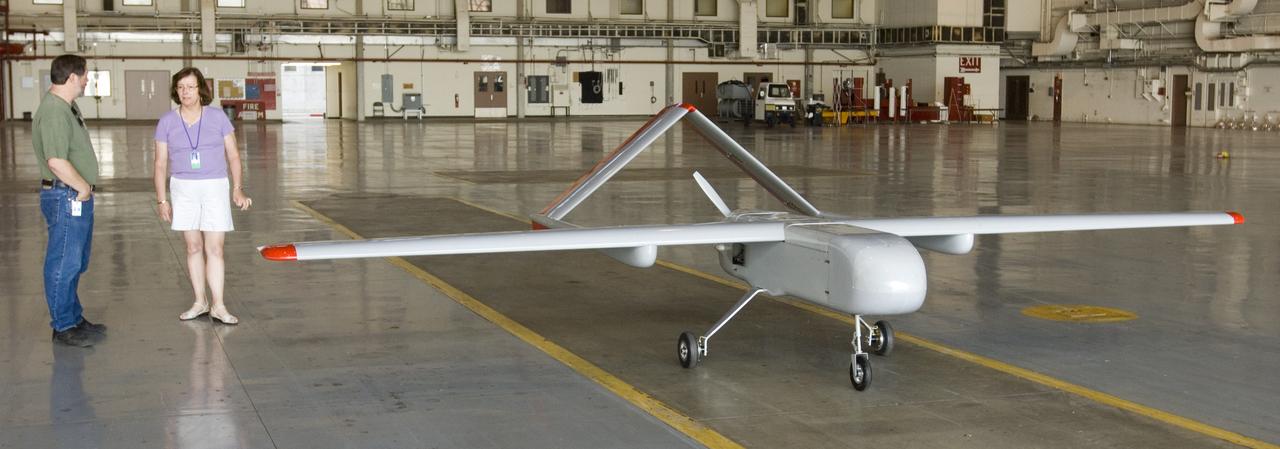
Sierra Uninhaited Aerial System (UAV plane) in the Ames hangar. aks; Sierra Unpiloted Aerial system (UAS) with L-R: Larry Pezzolo and Leslie Monforton, Naval Research Lab (on detail)
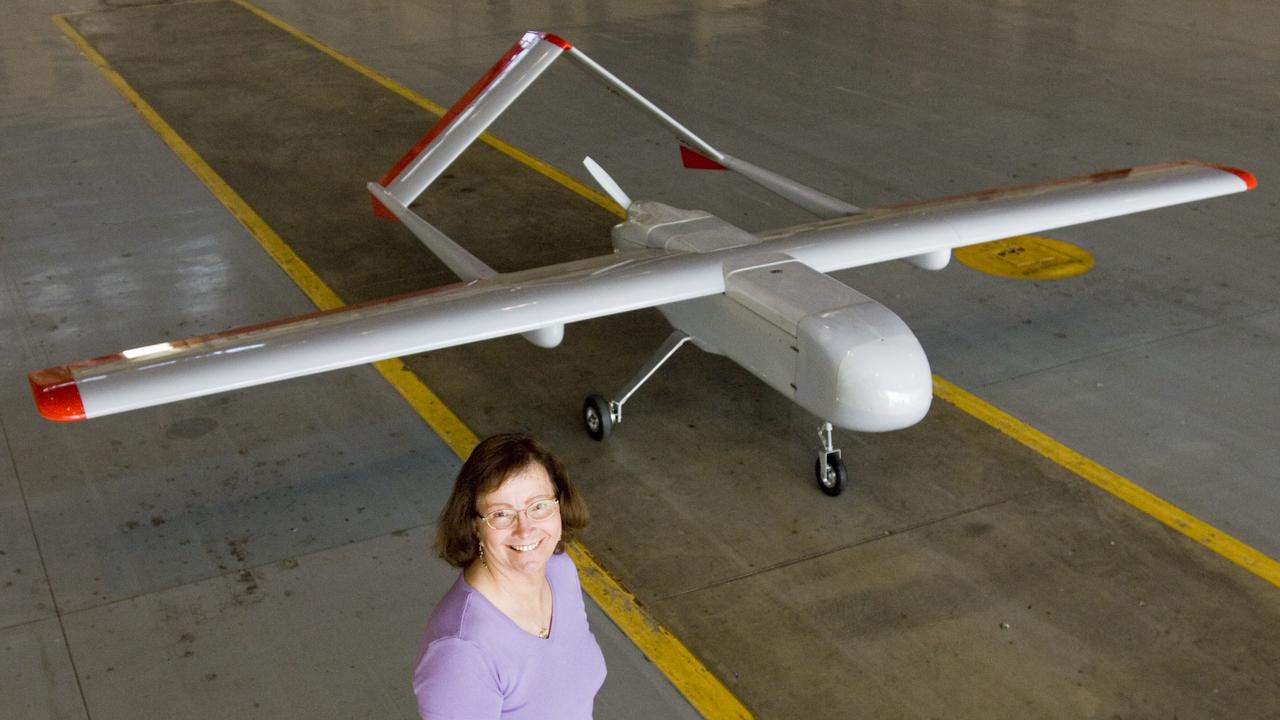
Sierra Uninhaited Aerial System (UAV plane) in the Ames hangar. aks; Sierra Unpiloted Aerial system (UAS) with Leslie Monforton (on detail from the Naval Reesearch Lab)
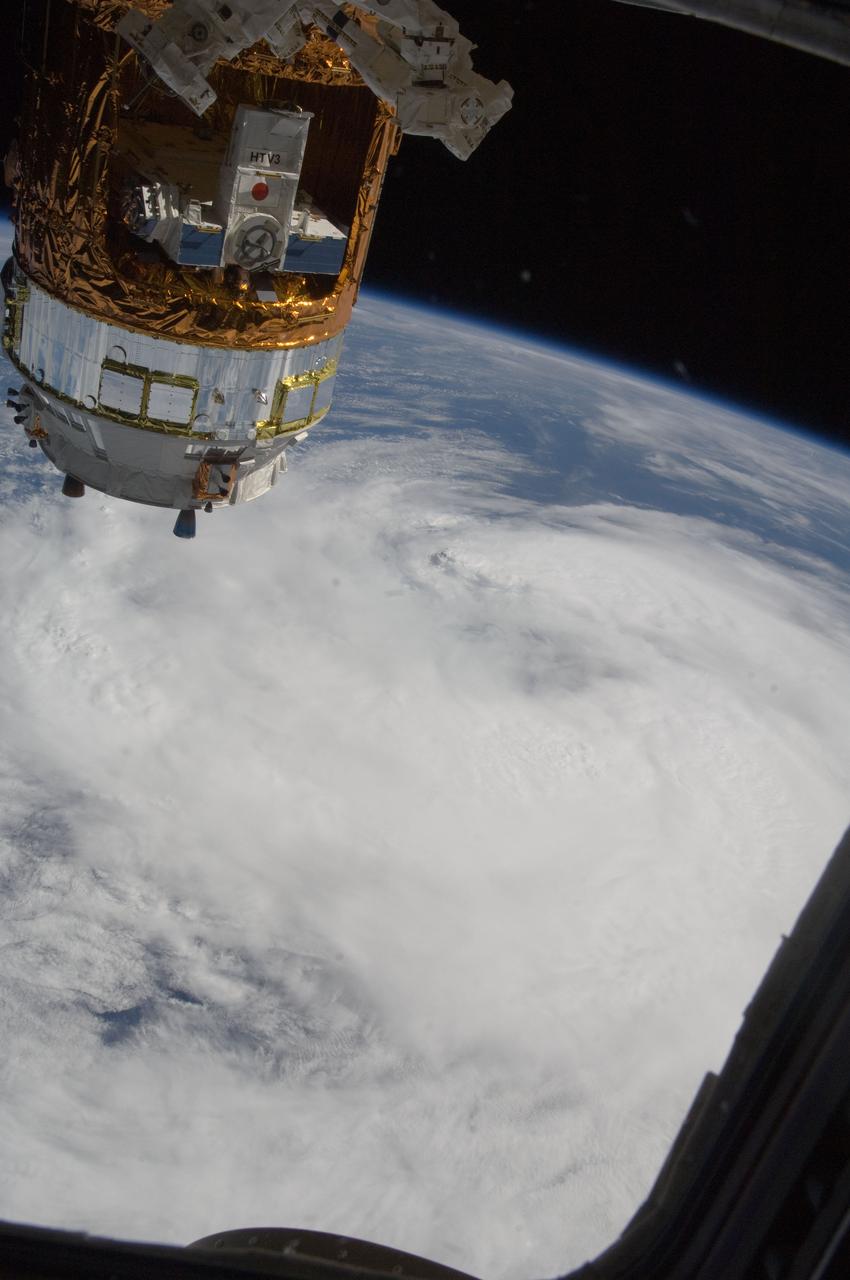
ISS032-E-025597 (9 Sept. 2012) --- Partially obstructed by the HTV-3 (H-II Transfer Vehicle) of the Japan Aerospace Exploration Agency (JAXA), Tropical Storm Leslie is clearly seen in the Atlantic Ocean on Sept. 9, 2012, as photographed by one of the Expedition 32 crew members aboard the Cupola of the International Space Station. At the time of the photo Leslie was centered near 33.4 degrees north latitude and 62.1degrees west longitude (approximately 175 miles east-northeast of Bermuda) moving northward at 14 miles per hour with winds of 60 miles per hour.
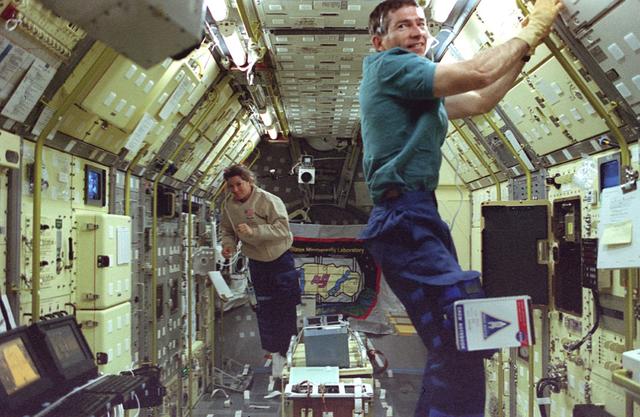
Onboard photo of space shuttle Columbia (STS-73) crewmembers Fred Leslie (foreground) and Catherine Coleman aboard the United States Microgravity Laboratory (USML) conducting experiments in a microgravitational environment available in the Orbiter's cargo bay while in low earth orbit.
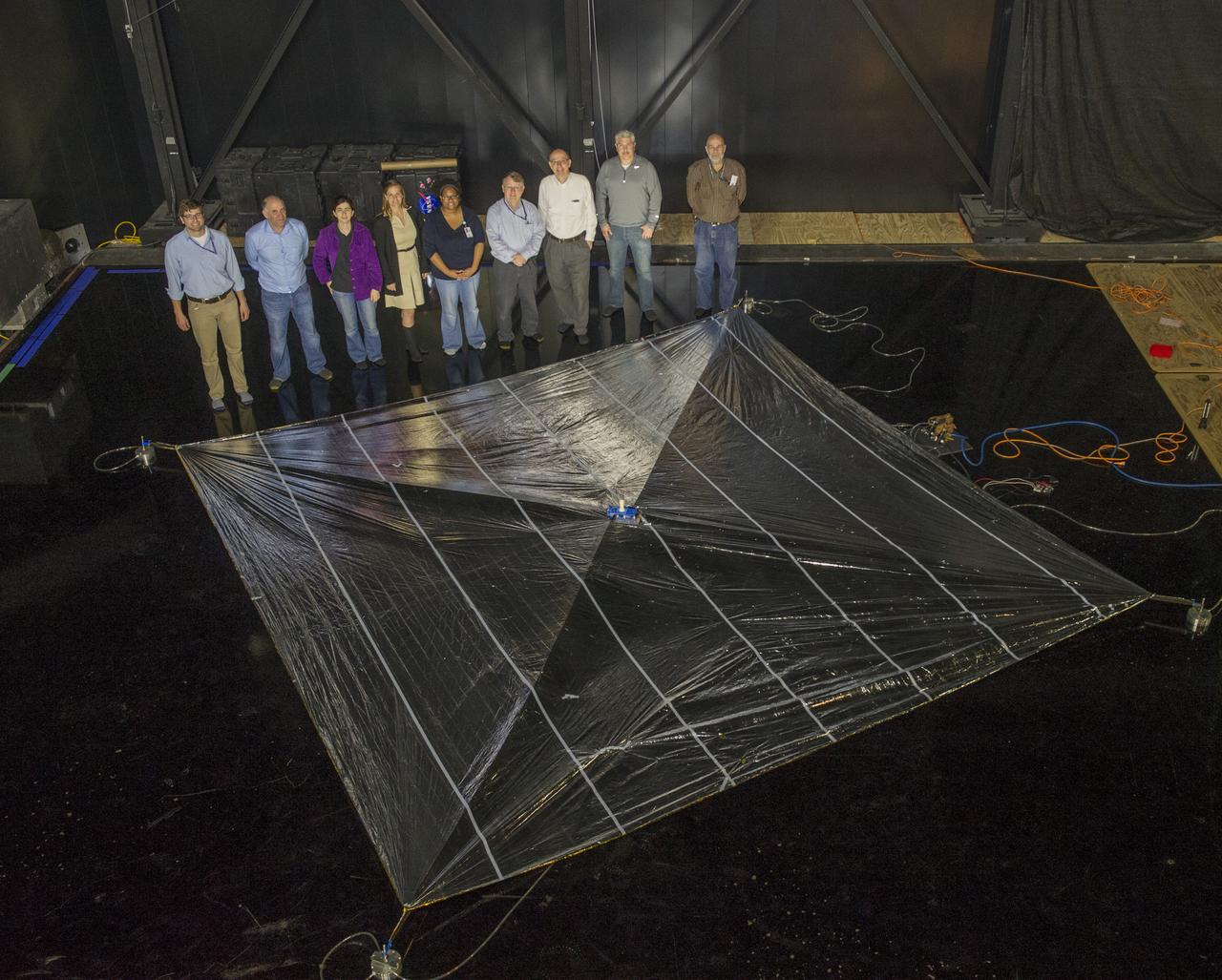
NEA (Near Earth Asteroid) Scout Solar Sail, deployed, with team members: Alex Sobey, Andy Heaton, Olive Stohlmann, Leslie McNutt, Tiffany Russell Lockett, Roy Young, Les Johnson, Kevin Sykes, Tom Bryan
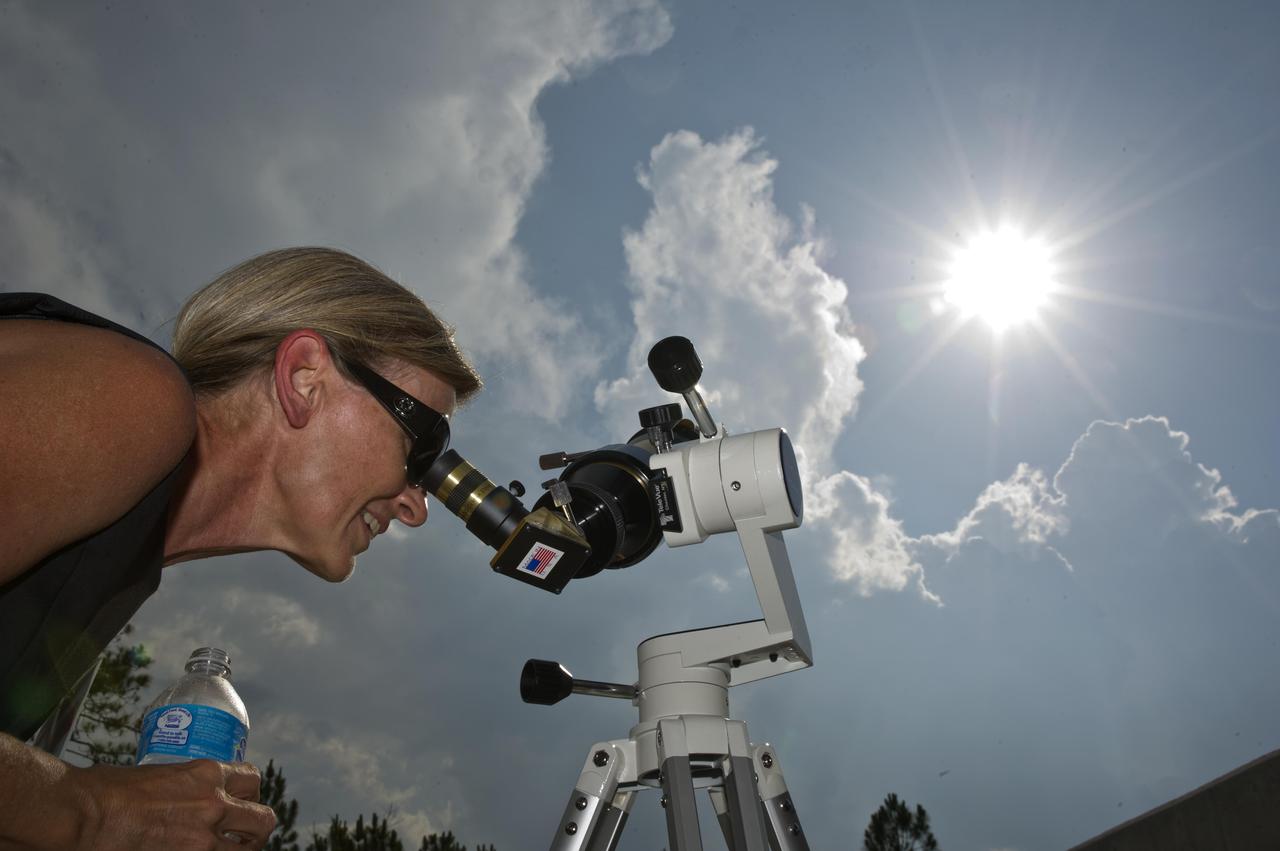
Leslie Lowes from the NASA Jet Propulsion Laboratory in Pasadena, Calif., views the June 5, 2012, Venus transit through a solar telescope. Lowes participated in an education workshop at the INFINITY at NASA Stennis Space Center visitor center and joined others to view the rare celestial event when Venus traverses the face of the sun.
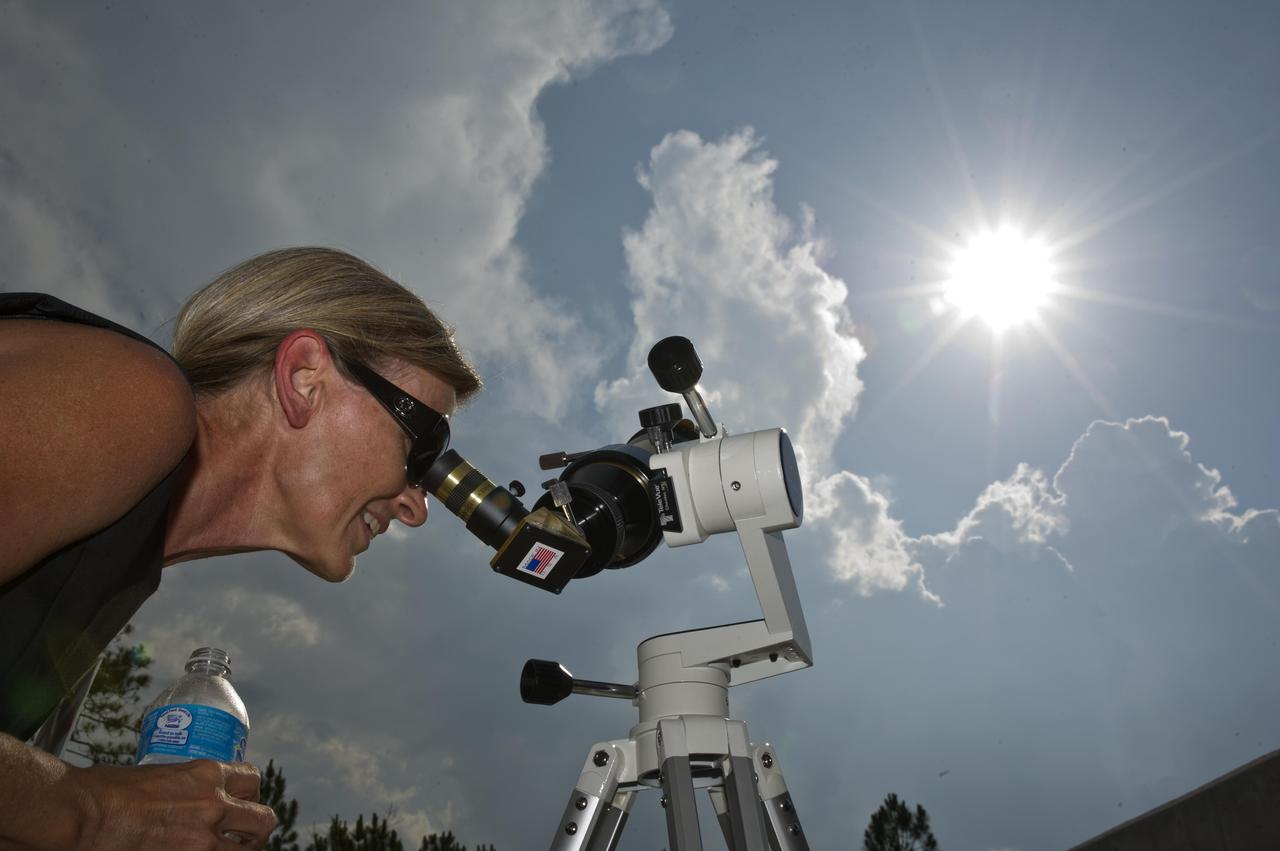
Leslie Lowes from the NASA Jet Propulsion Laboratory in Pasadena, Calif., views the June 5, 2012, Venus transit through a solar telescope. Lowes participated in an education workshop at the INFINITY at NASA Stennis Space Center visitor center and joined others to view the rare celestial event when Venus traverses the face of the sun.
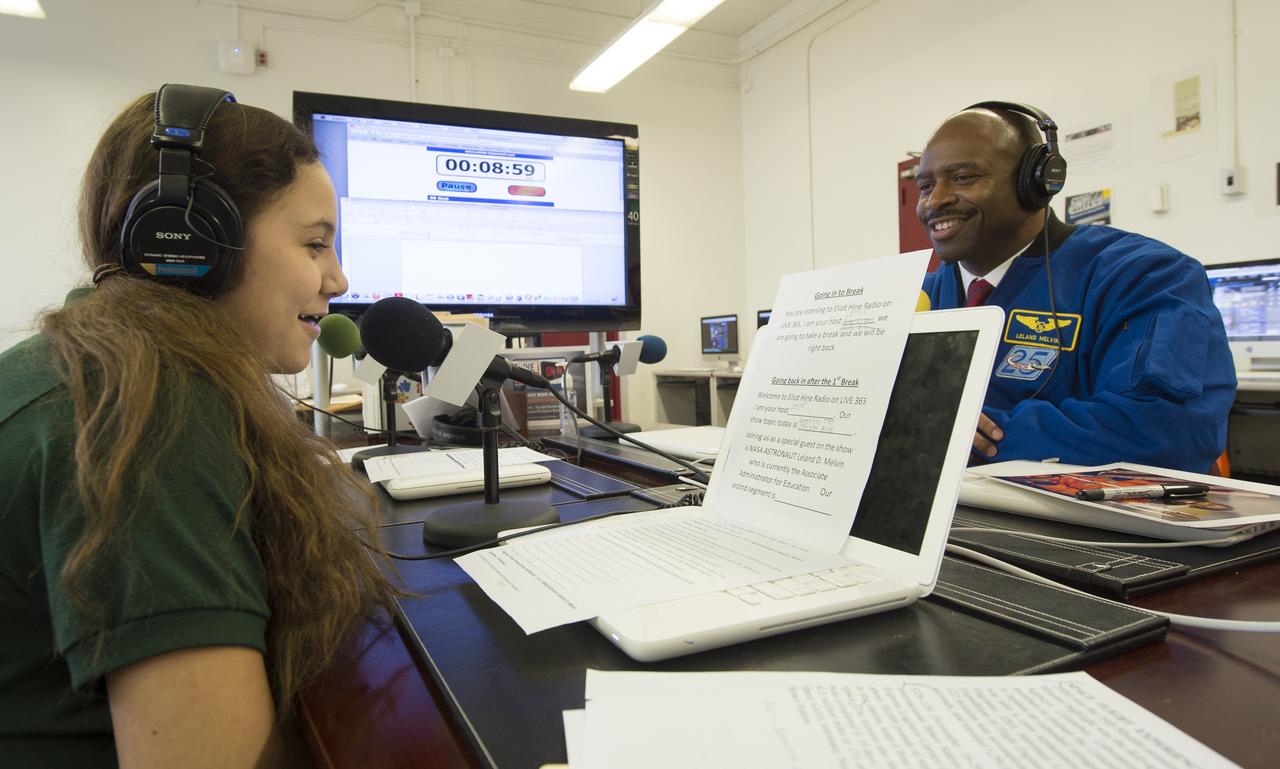
Leslie Auturo, left, interviews NASA Associate Administrator for Education for Eliot Hine Radio, a radio program at Eliot Hine Middle School, on Friday, March, 1, 2013 in Washington. Eliot Hine Radio is a production of the Broadcast Media Class. Photo Credit: (NASA/Carla Cioffi)
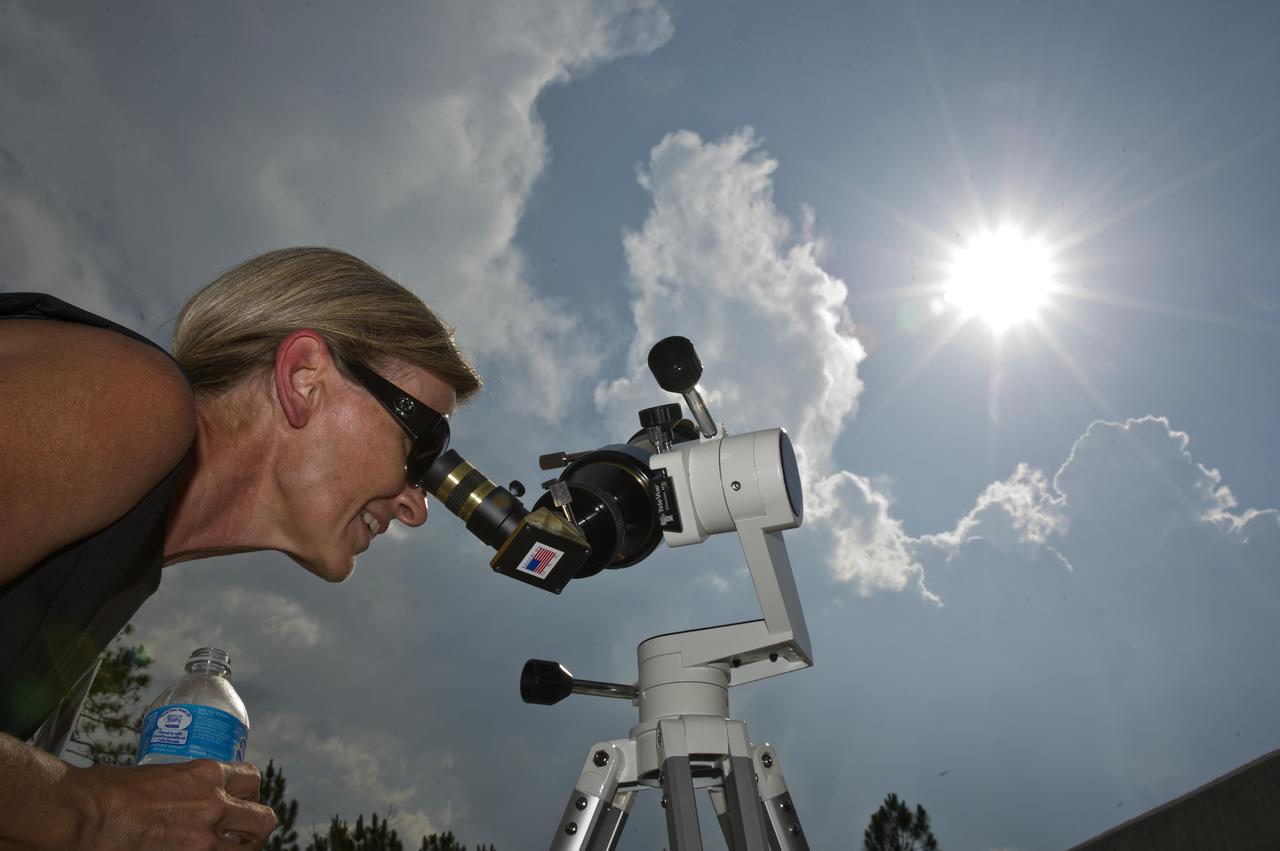
Leslie Lowes from the NASA Jet Propulsion Laboratory in Pasadena, Calif., views the June 5, 2012, Venus transit through a solar telescope. Lowes participated in an education workshop at the INFINITY at NASA Stennis Space Center visitor center and joined others to view the rare celestial event when Venus traverses the face of the sun.
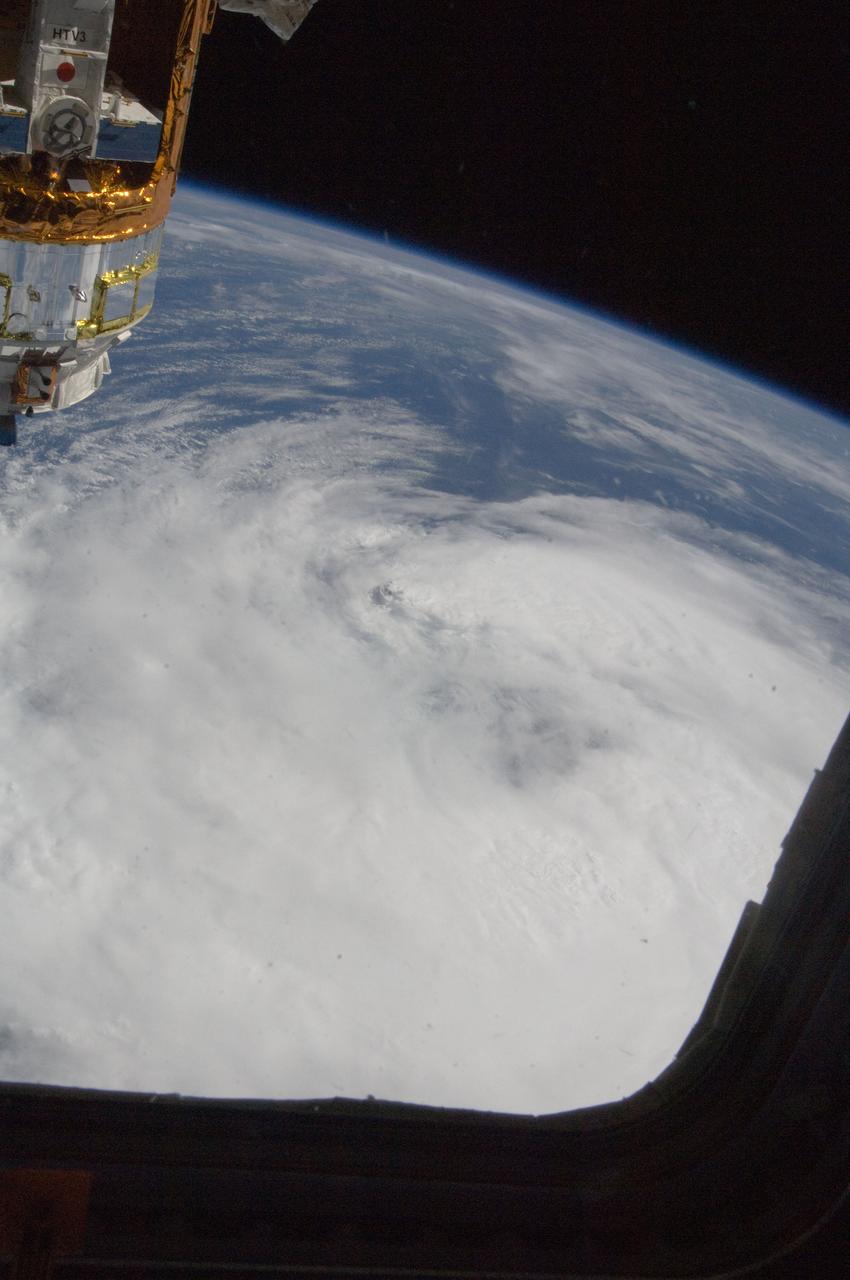
ISS032-E-025603 (9 Sept. 2012) --- Tropical Storm Leslie is clearly seen in the Atlantic Ocean on Sept. 9, 2012, as photographed by one of the Expedition 32 crew members aboard the Cupola of the International Space Station. At the time of the photo, Leslie was centered near 33.4 degrees north latitude and 62.1 degrees west longitude (approximately 175 miles east-northeast of Bermuda) moving northward at 14 miles per hour with winds of 60 miles per hour. The HTV-3 (H-II Transfer Vehicle) of the Japan Aerospace Exploration Agency (JAXA), which will be disconnected from the orbital outpost and sent to fall into Earth's atmosphere after fully completing its mission, is in the upper left corner.
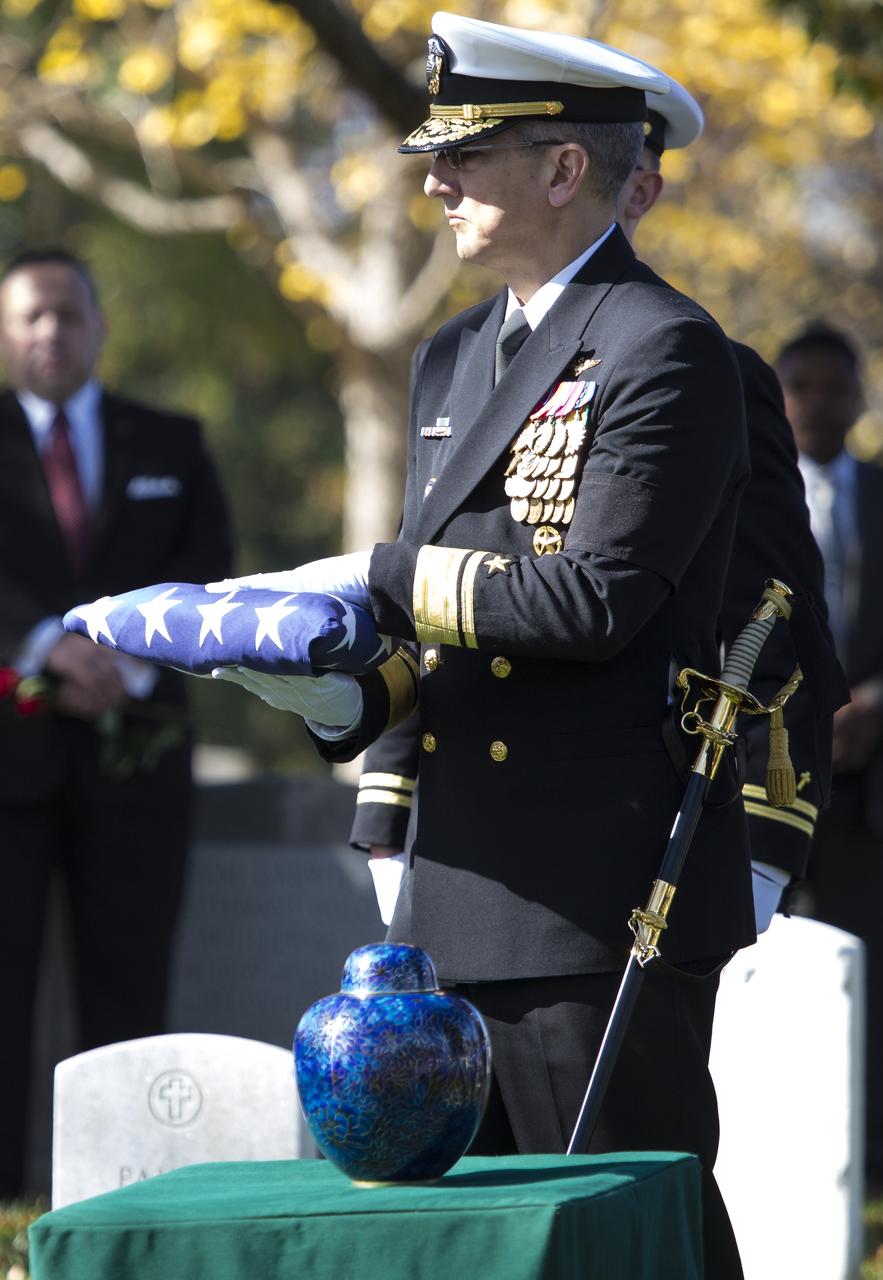
U.S. Navy Rear Adm. James Bynum prepares to present the folded American Flag to Leslie Bean, wife of former astronaut Alan Bean, during his interment service, Thursday, Nov. 8, 2018 at Arlington National Cemetery in Virginia. Selected as an astronaut in 1963, Bean flew in space twice, becoming the fourth human to walk on the Moon on Nov. 19, 1969 and spent 59 days in space as commander of the second Skylab mission in 1973. Photo Credit: (NASA/Joel Kowsky)
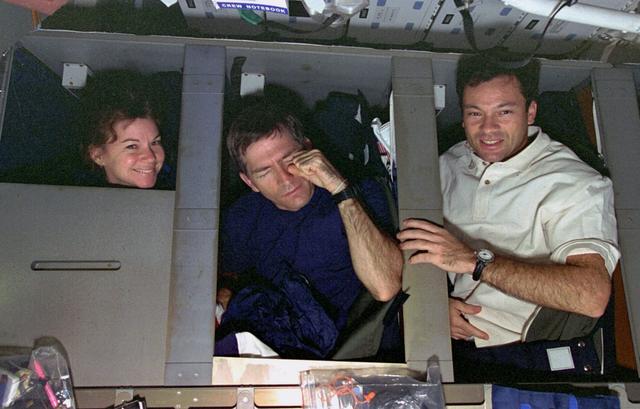
STS073-351-035 (20 October - 5 November 1995) --- Three crew members are captured on camera at the end of their sleep shift on the middeck of the Earth-orbiting Space Shuttle Columbia. Pictured are (left to right) astronaut Catherine G. Coleman, mission specialist; payload specialist Fred W. Leslie and astronaut Michael E. Lopez-Alegria, mission specialist. The trio joined four other crewmembers for 16 days of in-space research in support of the United States Microgravity Laboratory (USML-2) mission.
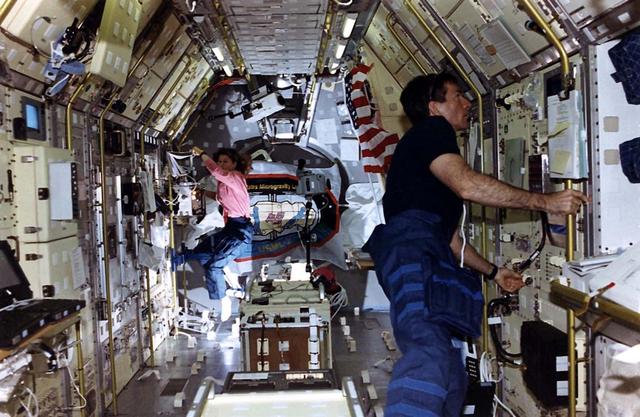
This wide view gives an overall perspective of the working environment of five astronauts and two guest researchers for 16 days in Earth-orbit. At work in support of the U.S. Microgravity Laboratory (USML-2) mission in this particular scene are astronaut Catherine G. Coleman, who busies herself at the glovebox, and payload specialist Fred. W. Leslie, monitoring the Surface-Tension-Driven Convection Experiment (STDCE).
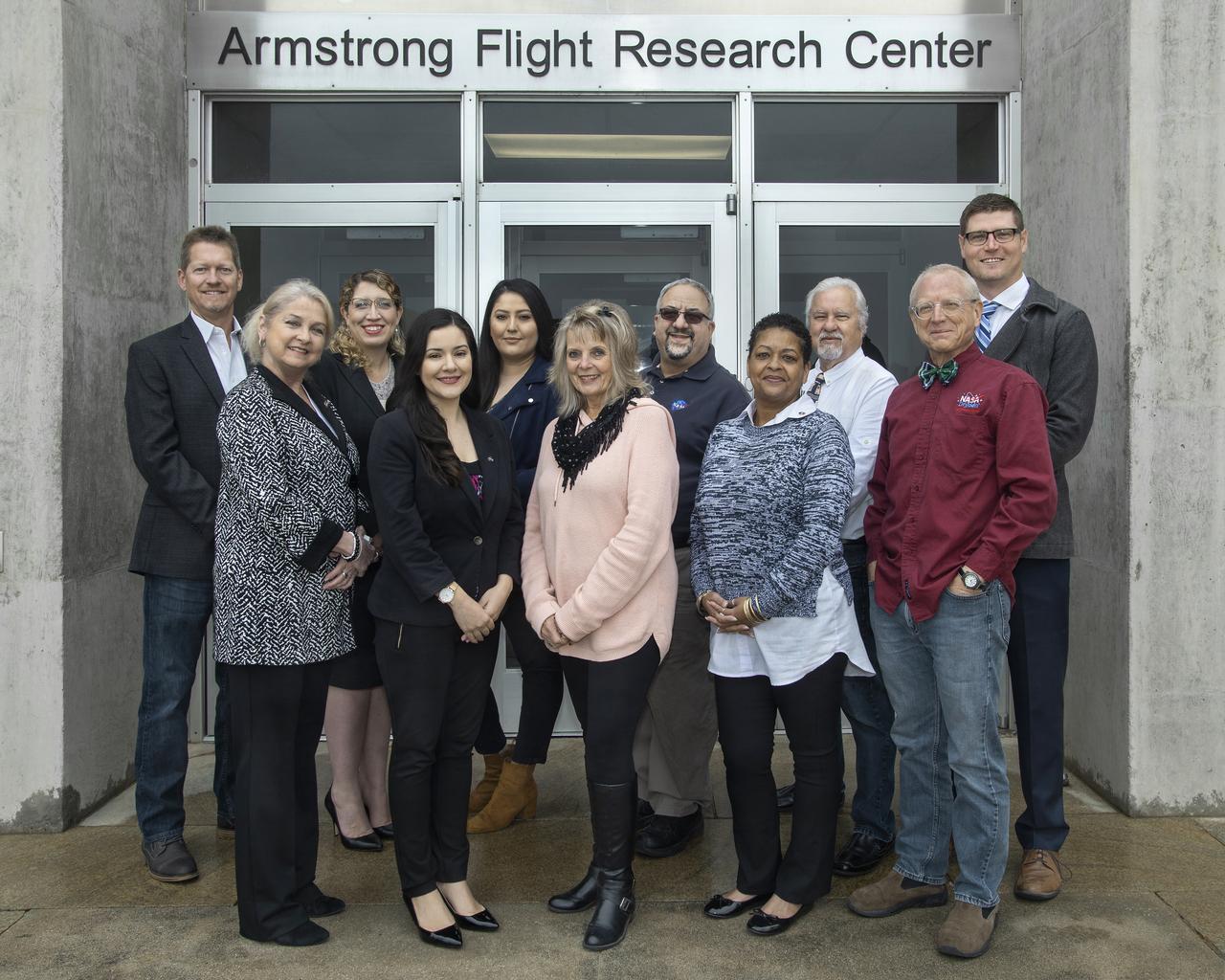
Armstrong Flight Research Center Office of Strategic Communication group photo in front of the Center's building 4800. Back row (left to right) Kevin Rohrer, Kate Squires, Jessica Arreola, Jay Levine, Steve Lighthill and Matt Kamlet. Bottom row (left to right) Leslie Williams, Elvia Valenzuela, Mary Anne Harness, Kim Lewis-Bias and Christian Gelzer.
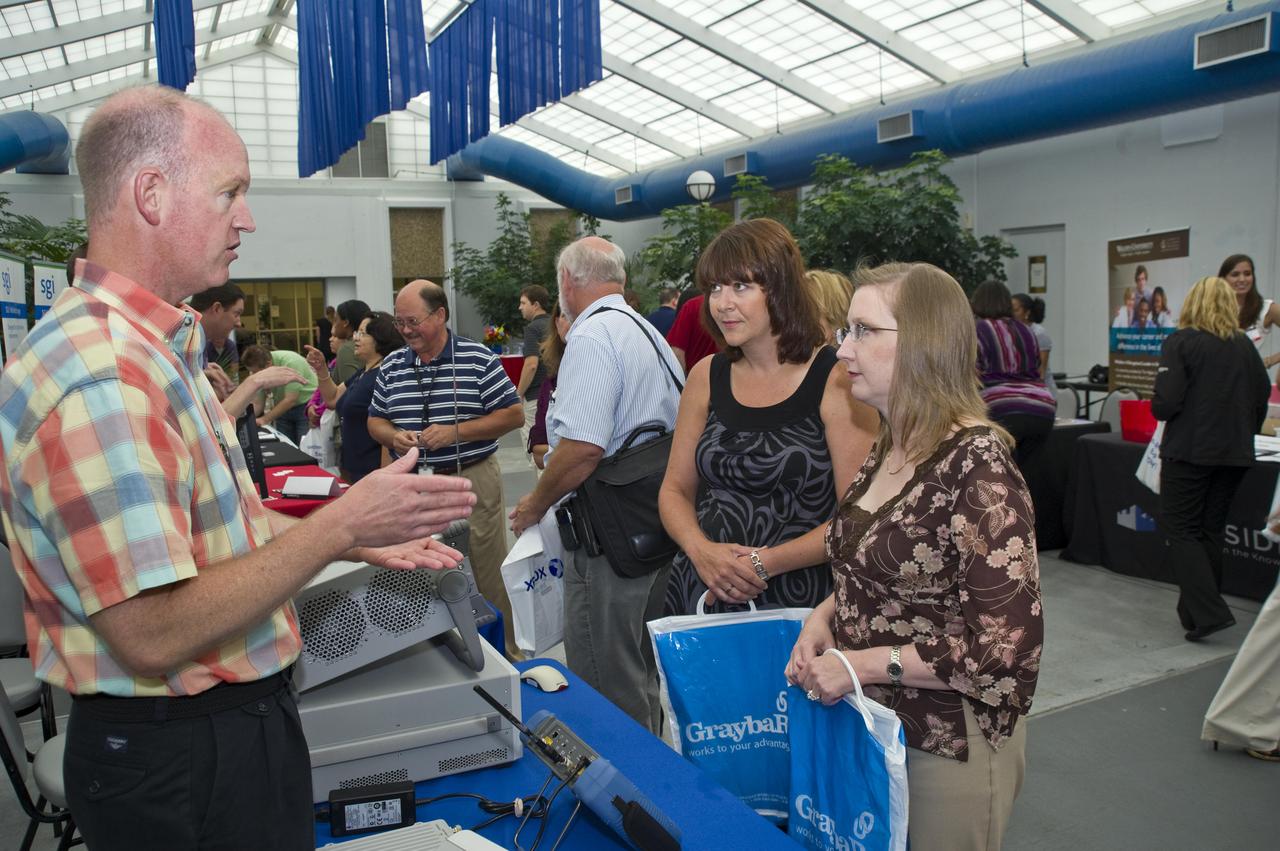
Phillip Stallcup with Agilent Technologies in Huntsville, Ala., talks with NASA employees Leslie Ladner (l) and Kelly Sullivan about spectrum analyzers and other test equipment during the Stennis Technology Expo on May 26. The expo was hosted by NASA Solutions for Enterprise-Wide Procurement and featured various exhibitors demonstrating the latest in a range of technologies, such as training equipment, secure data storage, video networks, distance learning and data management.
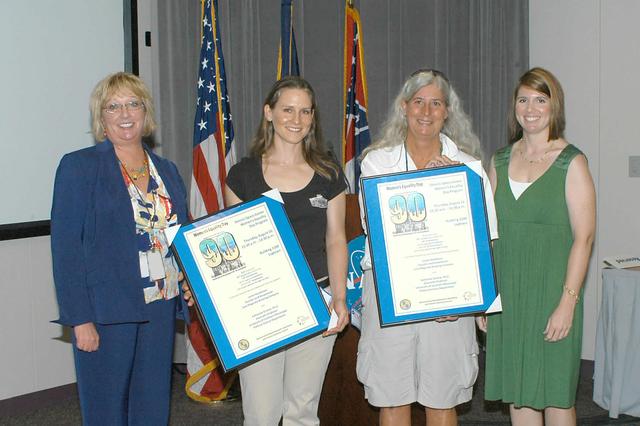
NASA's John C. Stennis Space Center celebrated Women's Equality Day with a program featuring presentations from a pair of area women - Leslie Henderson, founder and brewmaster of Lazy Magnolia Brewing Co. in Kiln, Miss., and Kathanne Greene, associate professor of political science at the University of Southern Mississippi in Hattiesburg. Shown are (l to r): Jo Ann Larson, Stennis Equal Opportunity officer; Henderson; Greene; and Shannon Breland, public affairs officer for the Naval Research Laboratory at Stennis and a member of the Stennis Diversity Council.
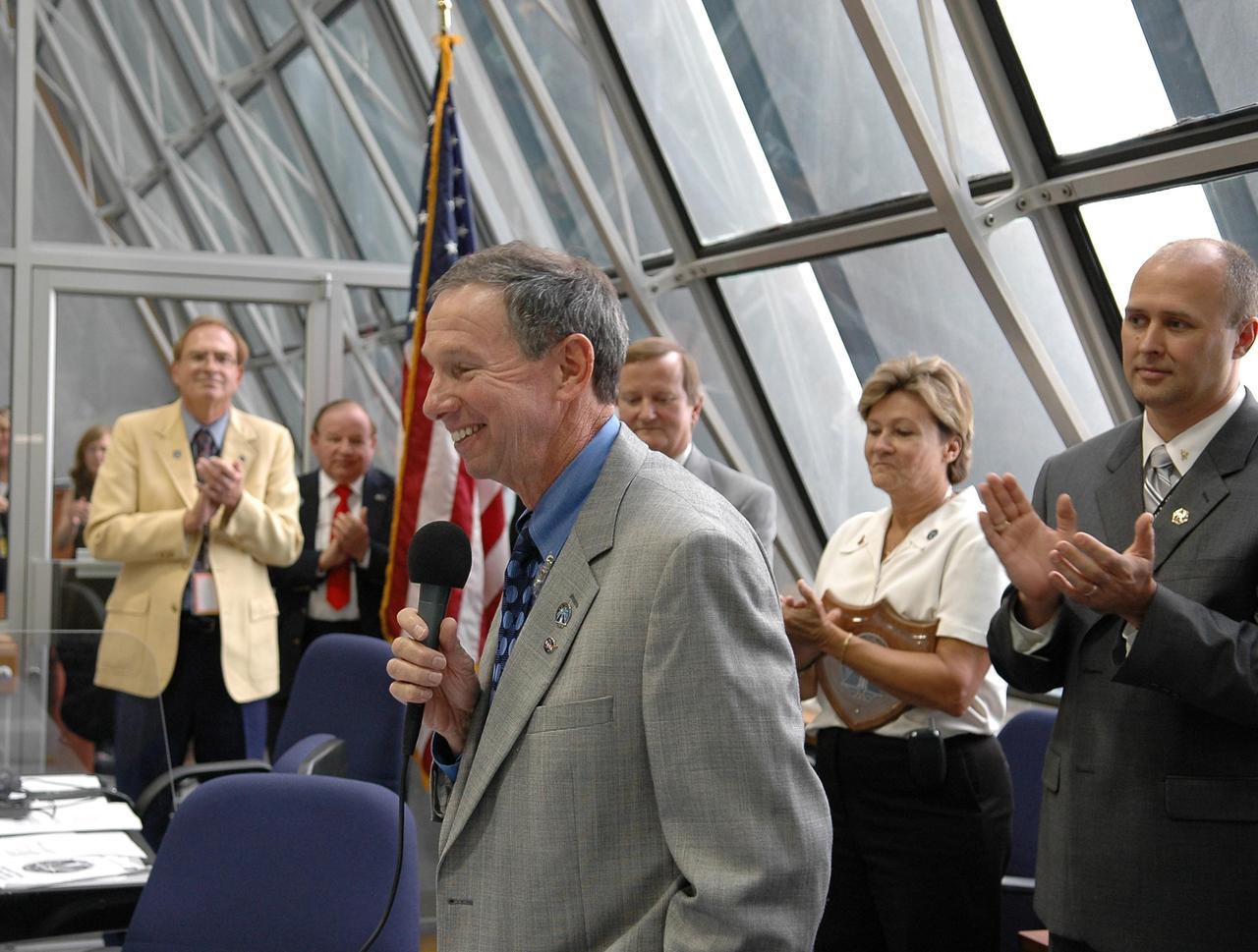
KENNEDY SPACE CENTER, FLA. - Inside the Launch Control Center, NASA Administrator Michael Griffin congratulates the launch team after the liftoff of Space Shuttle Atlantis on mission STS-115. Behind him are (left to right) Shuttle Launch Director Mike Leinbach, Pat Leslie and Robbie Ashley, STS-115 payload manager. Mission STS-115 is the 116th space shuttle flight, the 27th flight for orbiter Atlantis, and the 19th U.S. flight to the International Space Station. Mission STS-115 is scheduled to last 11 days with a planned landing at KSC. Photo credit: NASA/Kim Shiflett
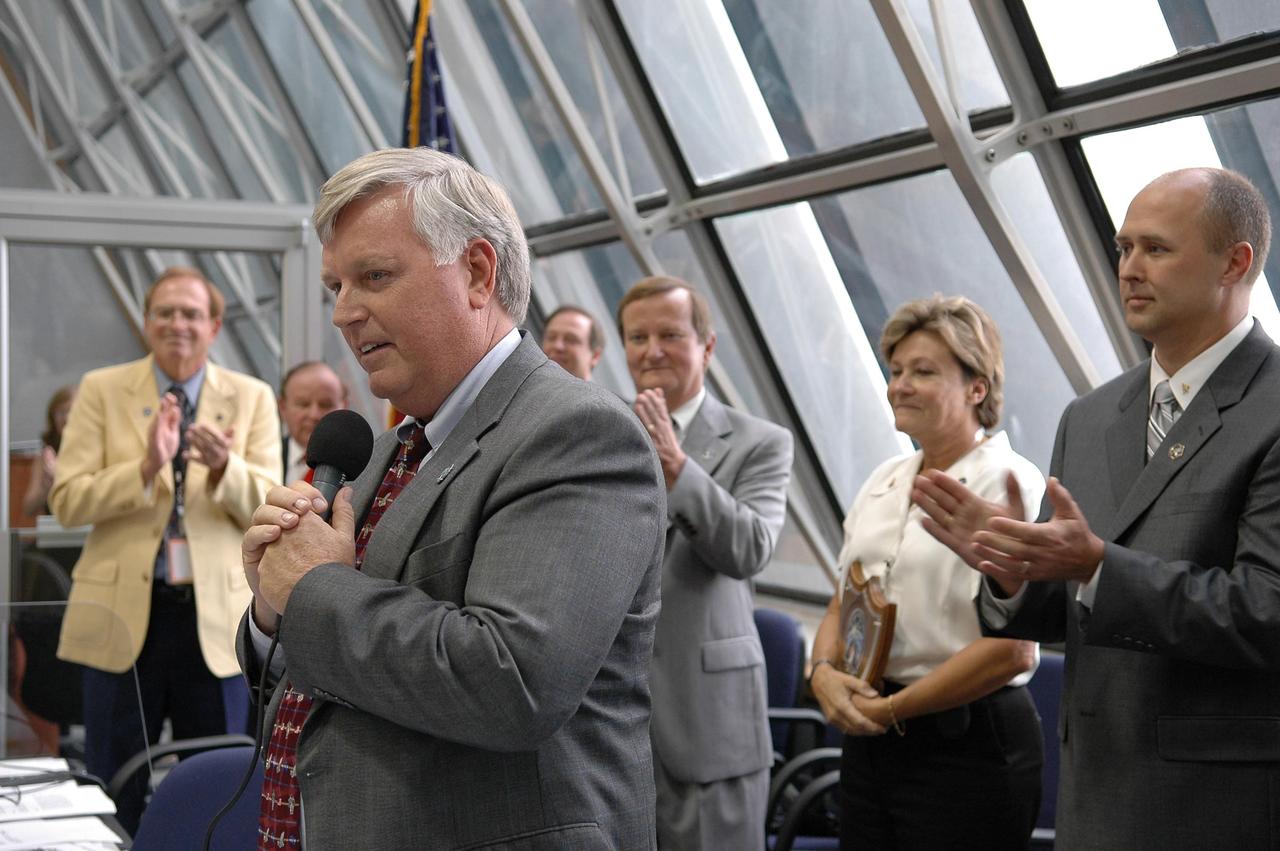
KENNEDY SPACE CENTER, FLA. - Inside the Launch Control Center, KSC Director Jim Kennedy congratulates the launch team after the liftoff of Space Shuttle Atlantis on mission STS-115. Behind him are (left to right) Shuttle Launch Director Mike Leinbach, Pat Leslie and Robbie Ashley, STS-115 payload manager. Mission STS-115 is the 116th space shuttle flight, the 27th flight for orbiter Atlantis, and the 19th U.S. flight to the International Space Station. Mission STS-115 is scheduled to last 11 days with a planned landing at KSC. Photo credit: NASA/Kim Shiflett

STS073-S-002 (July 1995) --- These five astronauts and two United States Microgravity Laboratory (USML) payload specialists pause from a rigid training schedule for the STS-73 crew portrait. On the front row, left to right, are Albert Sacco Jr., payload specialist; Kent V. Rominger, pilot; Michael E. Lopez-Alegria, mission specialist. On the back row are, left to right, Catherine G. Coleman, mission specialist; Kenneth D. Bowersox, commander; Fred W. Leslie, payload specialist; and Kathryn C. Thornton, payload commander.
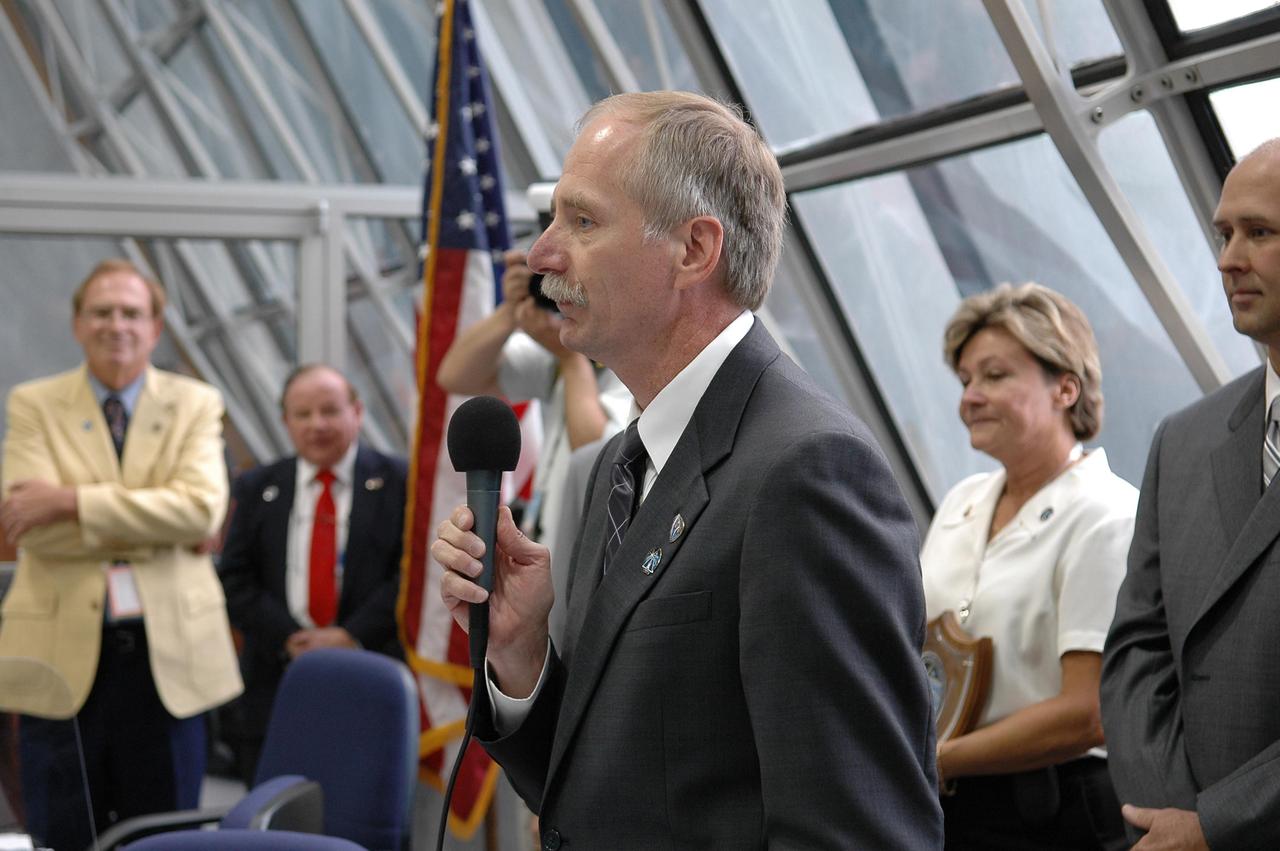
KENNEDY SPACE CENTER, FLA. - Inside the Launch Control Center, Associate Administrator for Space Operations Mission William Gerstenmaier congratulates the launch team after the liftoff of Space Shuttle Atlantis on mission STS-115. Behind him, at right, are Pat Leslie and Robbie Ashley, STS-115 payload manager. Mission STS-115 is the 116th space shuttle flight, the 27th flight for orbiter Atlantis, and the 19th U.S. flight to the International Space Station. Mission STS-115 is scheduled to last 11 days with a planned landing at KSC. Photo credit: NASA/Kim Shiflett
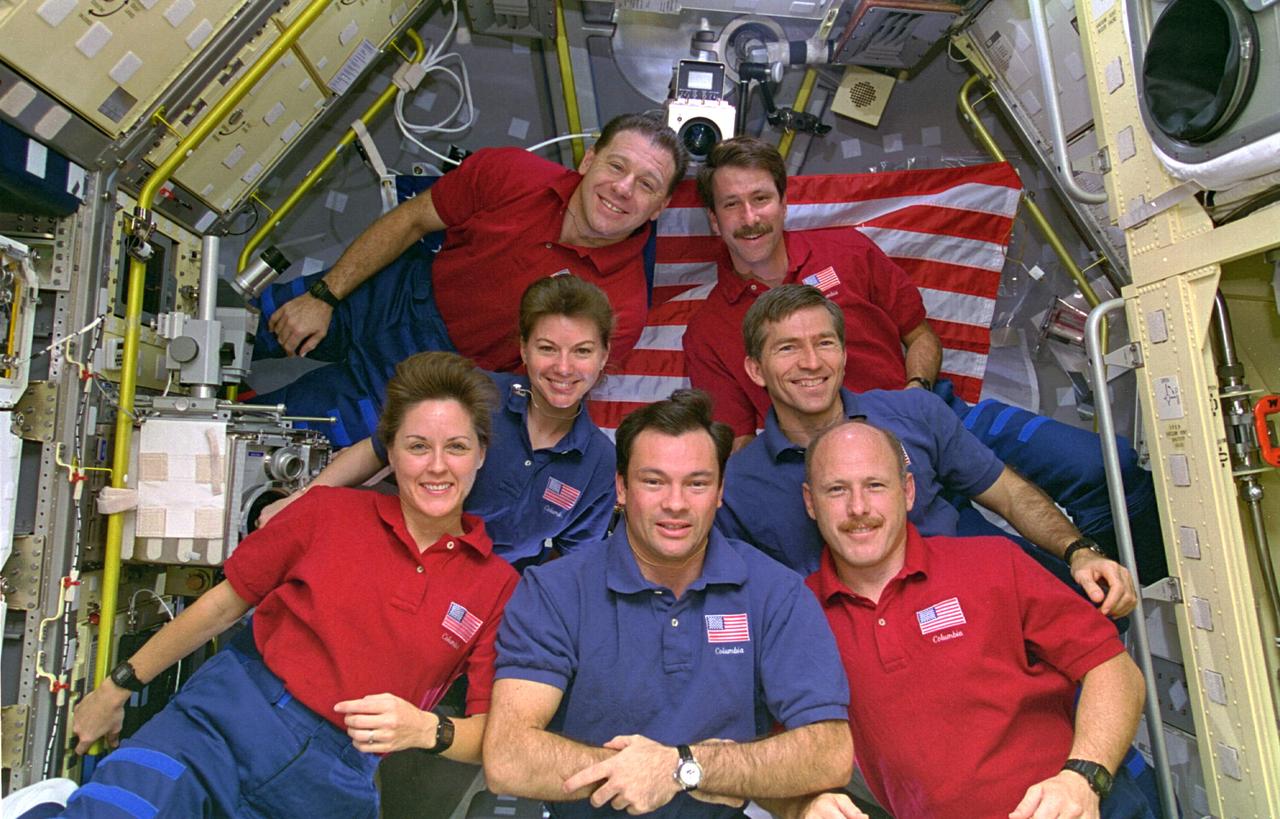
STS073-303-015 (20 October - 5 November 1995) --- The crew members picked the site of their busy workdays as the setting for the traditional in-flight crew portrait, as personnel from both work shifts assembled in the science module supporting the U.S. Microgravity Laboratory (USML-2) mission. Astronaut Michael E. Lopez-Alegria, mission specialist, has his arms folded at front center. The others pictured, counter-clockwise from that point, are Kathryn C. Thornton, payload commander; Catherine G. Coleman, mission specialist; Albert Sacco, payload specialist; Kent V. Rominger, pilot; Fred W. Leslie, payload specialist; and Kenneth D. Bowersox, mission commander.
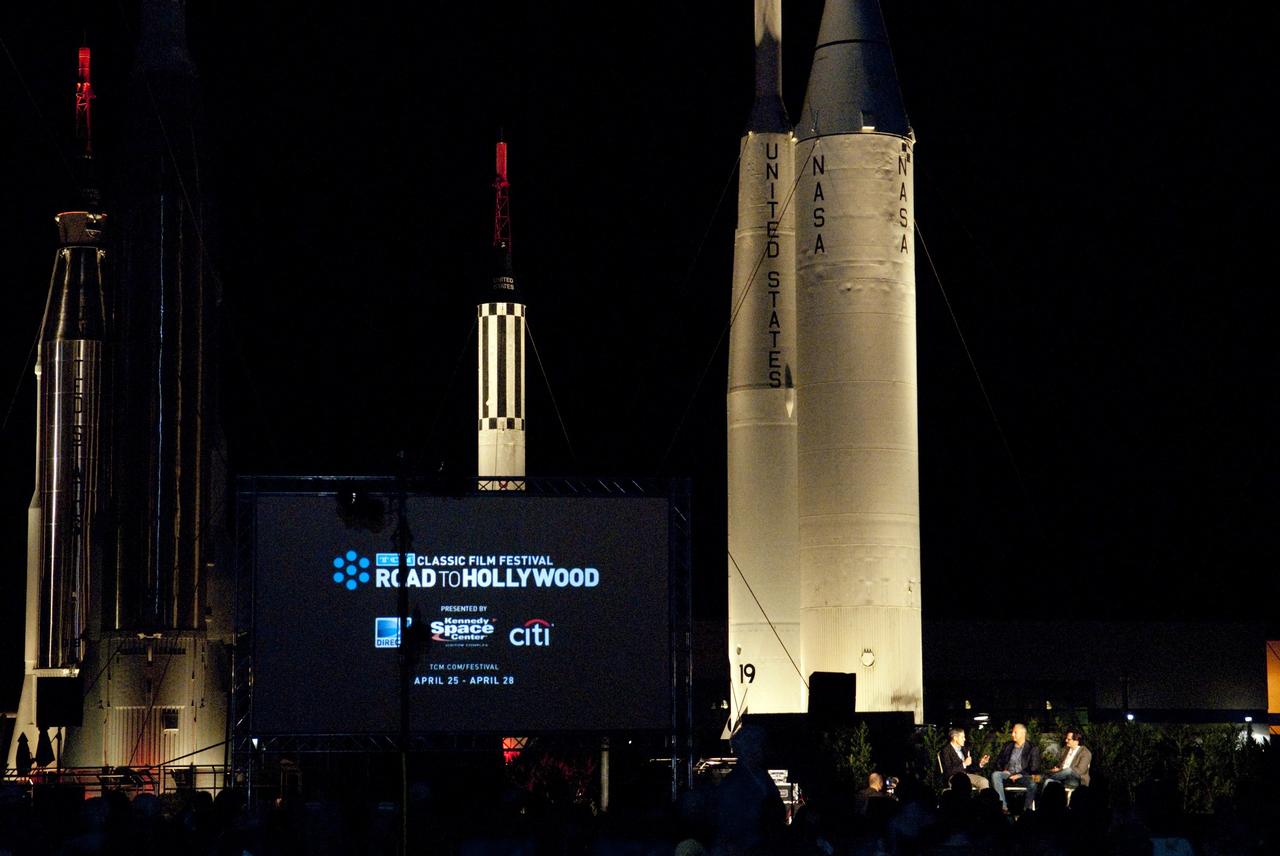
CAPE CANAVERAL, Fla. – Turner Classic Movies, or TCM, brings their Classic Film Festival to NASA Kennedy Space Center in Florida with a free screening of "Forbidden Planet," presented in the Rocket Garden at the Kennedy Space Center Visitor Complex. Participating in a panel discussion before the movie begins are, from left, Kennedy Director Robert Cabana, NASA astronaut Mike Massimino and TCM host Ben Mankiewicz. "Forbidden Planet," starring Walter Pigeon, Anne Francis and Leslie Nielsen, was nominated for an Academy Award in 1956 for best special effects in part for its robot character, Robby. Its storyline follows astronauts sent to a planet to find out why there has been no communication from the scientists working there. For more information about the Rocket Garden and the Kennedy Space Center Visitor Complex, visit http://www.kennedyspacecenter.com. Photo credit: NASA/Tim Jacobs
KENNEDY SPACE CENTER, FLA. - At the Delta Operations Center, Leslie Guzman (yellow shirt), with Pratt and Whitney, watches closely as the nozzle for the RL-10 engine is lifted into place on the second stage of the Boeing Delta IV rocket. The Delta IV is the launch vehicle for the Geostationary Operational Environmental Satellite (GOES-N), scheduled to launch in April 2005 from Cape Canaveral Air Force Station. GOES-N is a weather satellite for NASA and NOAA (National Oceanic and Atmospheric Administration). The first in a series of three advanced weather satellites including GOES-O and GOES-P, the GOES-N will provide continuous monitoring necessary for intensive data analysis. It will provide a constant vigil for the atmospheric “triggers” of severe weather conditions such as tornadoes, flash floods, hail storms and hurricanes. When these conditions develop, GOES-N will be able to monitor storm development and track their movements.
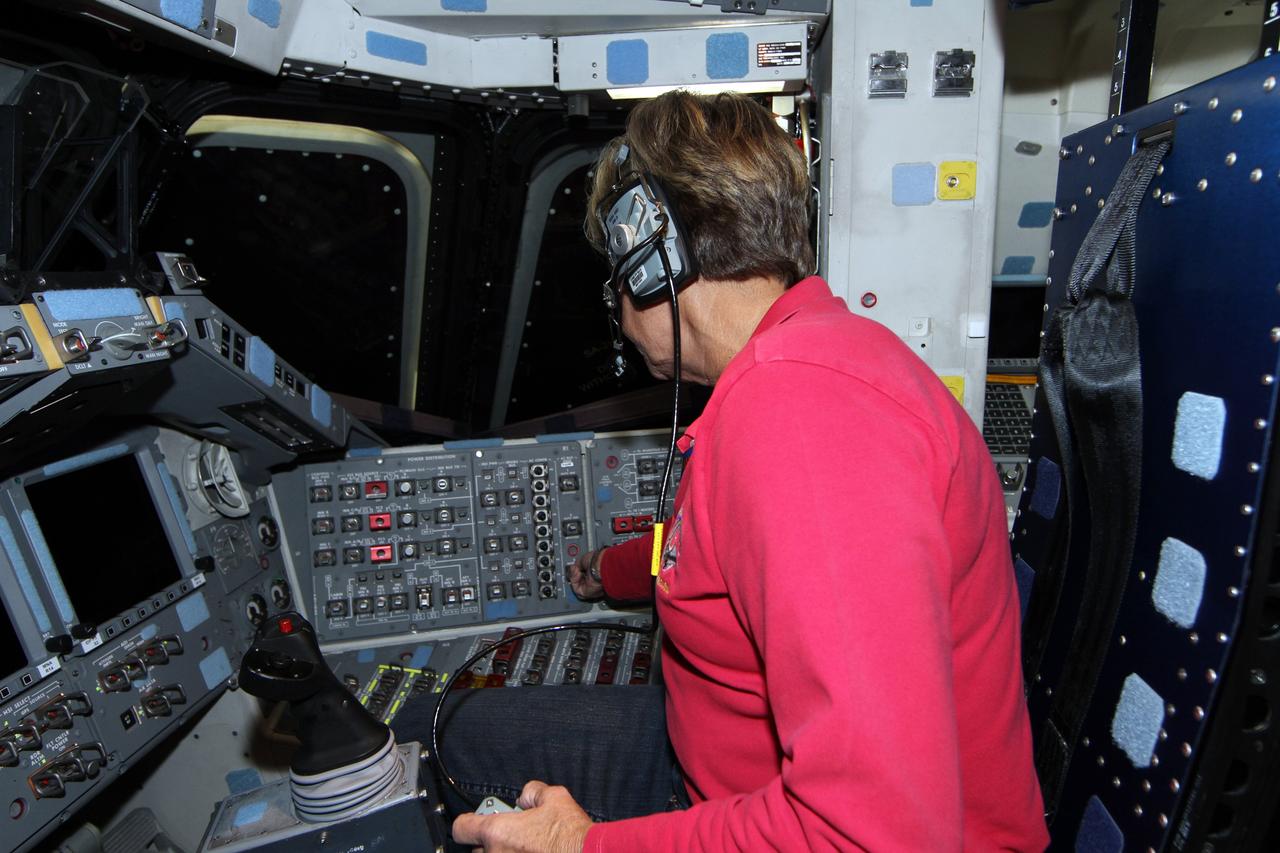
CAPE CANAVERAL, Fla. – In Orbiter Processing Facility-2 at NASA’s Kennedy Space Center in Florida, United Space Alliance associate operations chief Pat Leslie toggles the switches to turn off consoles on space shuttle Endeavour’s flight deck for the final time during operations to power down the shuttle. Endeavour is being prepared for public display at the California Science Center in Los Angeles. Its ferry flight to California is targeted for mid-September. Endeavour was the last space shuttle added to NASA’s orbiter fleet. Over the course of its 19-year career, Endeavour spent 299 days in space during 25 missions. For more information, visit http://www.nasa.gov/transition. Photo credit: NASA/Ben Smegelsky
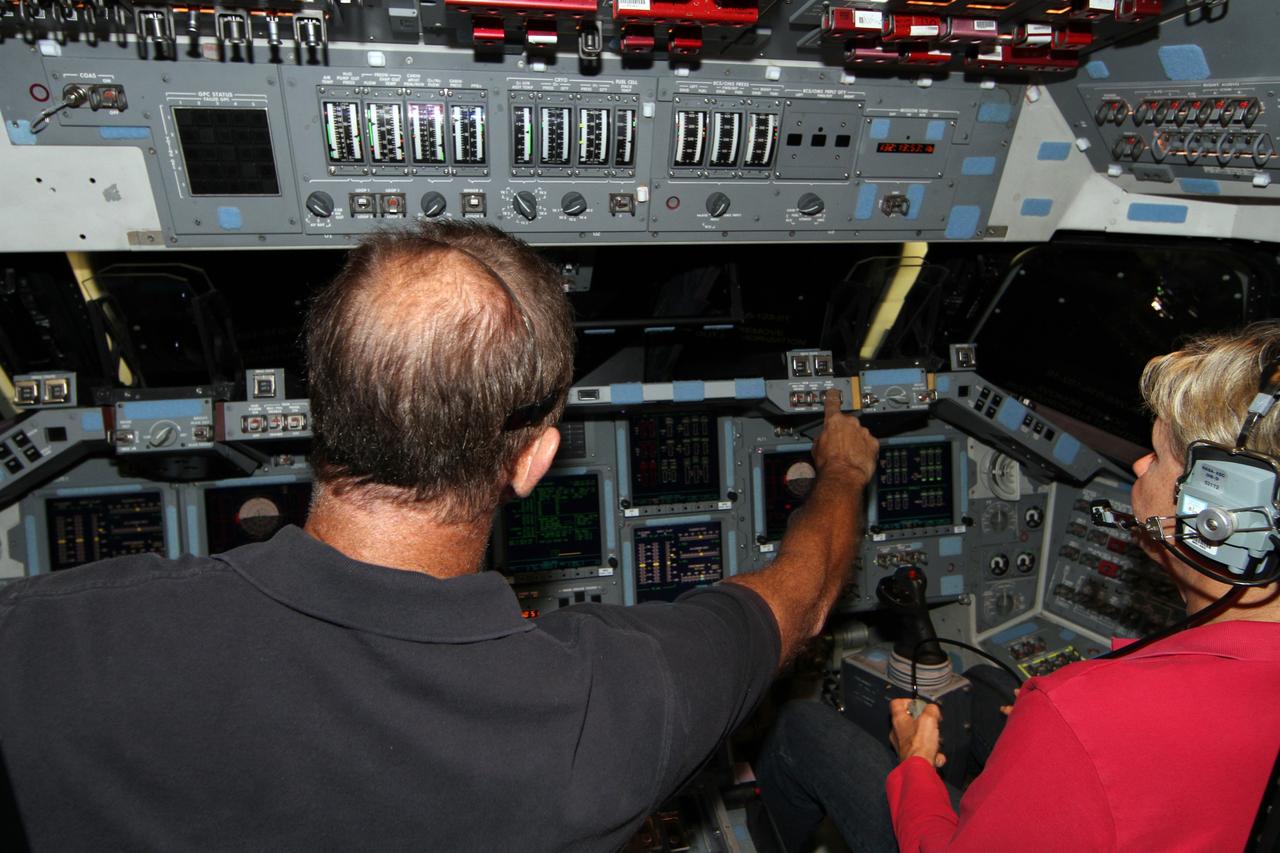
CAPE CANAVERAL, Fla. – In Orbiter Processing Facility-2 at NASA’s Kennedy Space Center in Florida, United Space Alliance OV-105 operations chief Mike Parrish, left, and associate operations chief Pat Leslie turn off consoles on space shuttle Endeavour’s flight deck for the final time during operations to power down the shuttle. Endeavour is being prepared for public display at the California Science Center in Los Angeles. Its ferry flight to California is targeted for mid-September. Endeavour was the last space shuttle added to NASA’s orbiter fleet. Over the course of its 19-year career, Endeavour spent 299 days in space during 25 missions. For more information, visit http://www.nasa.gov/transition. Photo credit: NASA/Ben Smegelsky
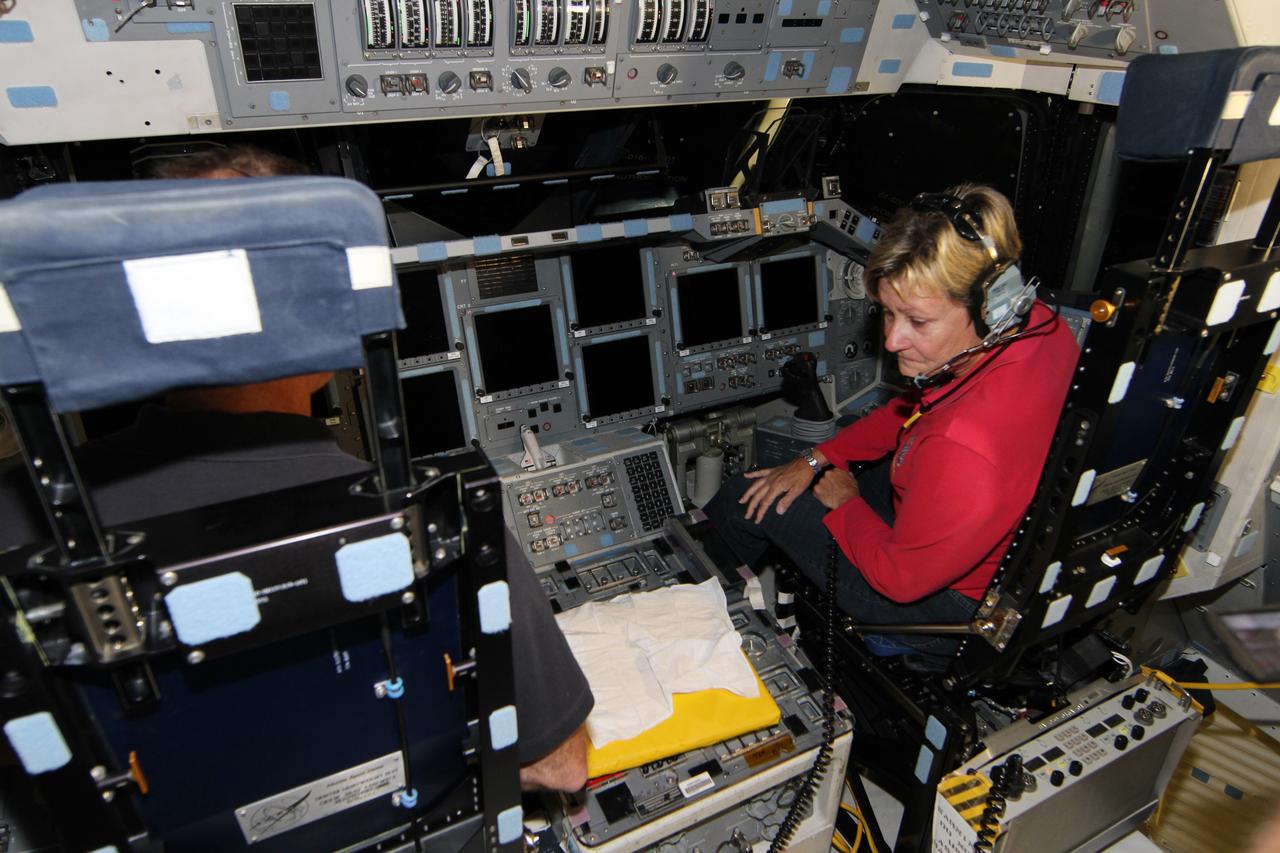
CAPE CANAVERAL, Fla. – In Orbiter Processing Facility-2 at NASA’s Kennedy Space Center in Florida, United Space Alliance OV-105 operations chief Mike Parrish, left, and associate operations chief Pat Leslie complete their respective tasks on space shuttle Endeavour’s flight deck as the shuttle is powered down for the final time. Endeavour is being prepared for public display at the California Science Center in Los Angeles. Its ferry flight to California is targeted for mid-September. Endeavour was the last space shuttle added to NASA’s orbiter fleet. Over the course of its 19-year career, Endeavour spent 299 days in space during 25 missions. For more information, visit http://www.nasa.gov/transition. Photo credit: NASA/Ben Smegelsky
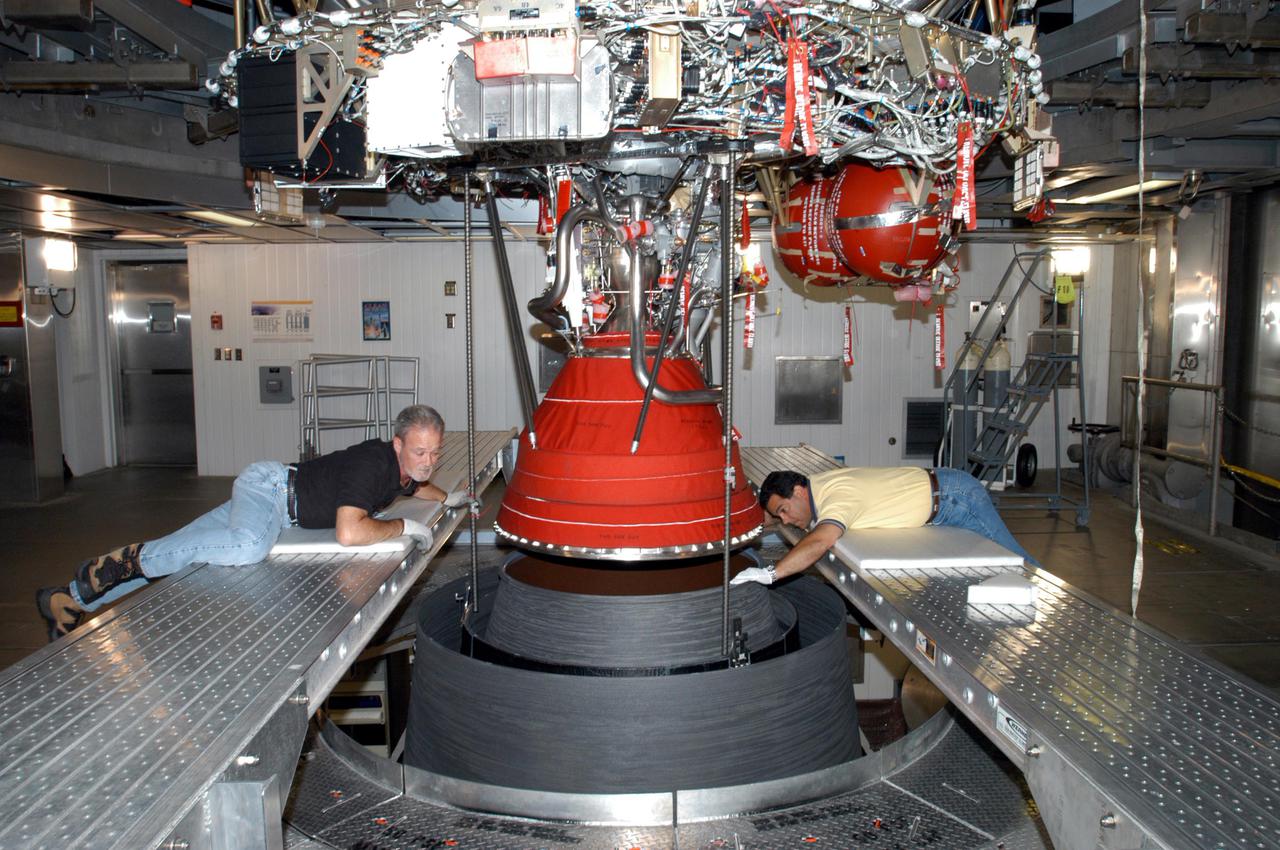
KENNEDY SPACE CENTER, FLA. - At the Delta Operations Center, Jack Reynolds and Leslie Guzman (left and right), with Pratt and Whitney, closely guide the nozzle for the RL-10 engine on the second stage of the Boeing Delta IV rocket. The Delta IV is the launch vehicle for the Geostationary Operational Environmental Satellite (GOES-N), scheduled to launch in April 2005 from Cape Canaveral Air Force Station. GOES-N is a weather satellite for NASA and NOAA (National Oceanic and Atmospheric Administration). The first in a series of three advanced weather satellites including GOES-O and GOES-P, the GOES-N will provide continuous monitoring necessary for intensive data analysis. It will provide a constant vigil for the atmospheric “triggers” of severe weather conditions such as tornadoes, flash floods, hail storms and hurricanes. When these conditions develop, GOES-N will be able to monitor storm development and track their movements.
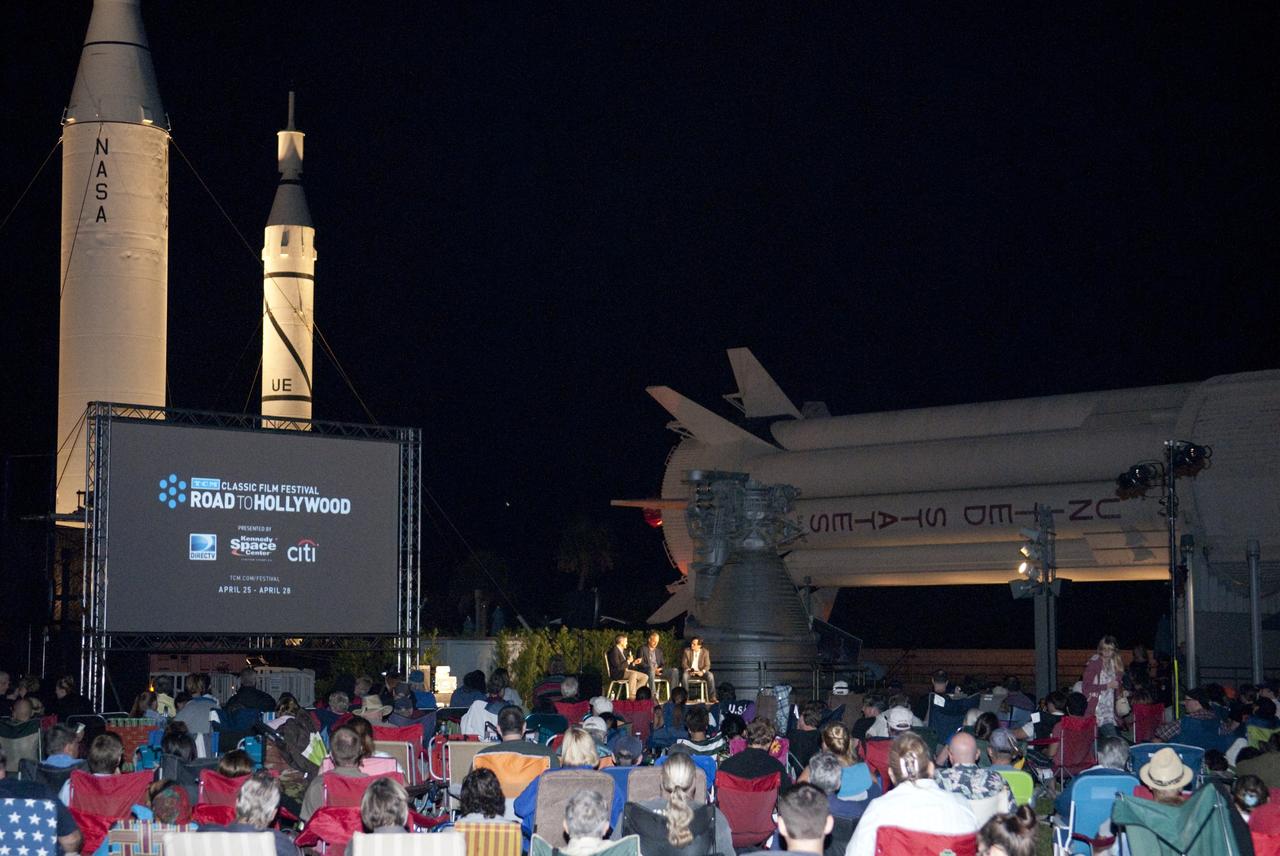
CAPE CANAVERAL, Fla. – The Rocket Garden at the Kennedy Space Center Visitor Complex in Florida provides an appropriate backfor a free screening of the film "Forbidden Planet" for NASA Kennedy Space Center employees, their families and members of the general public. The film is hosted by Turner Classic Movies, or TCM, as part of their Classic Film Festival. Participating in a panel discussion before the movie begins are, from left, Kennedy Director Robert Cabana, NASA astronaut Mike Massimino and TCM host Ben Mankiewicz. "Forbidden Planet," starring Walter Pigeon, Anne Francis and Leslie Nielsen, was nominated for an Academy Award in 1956 for best special effects in part for its robot character, Robby. Its storyline follows astronauts sent to a planet to find out why there has been no communication from the scientists working there. For more information about the Rocket Garden and the Kennedy Space Center Visitor Complex, visit http://www.kennedyspacecenter.com. Photo credit: NASA/Tim Jacobs
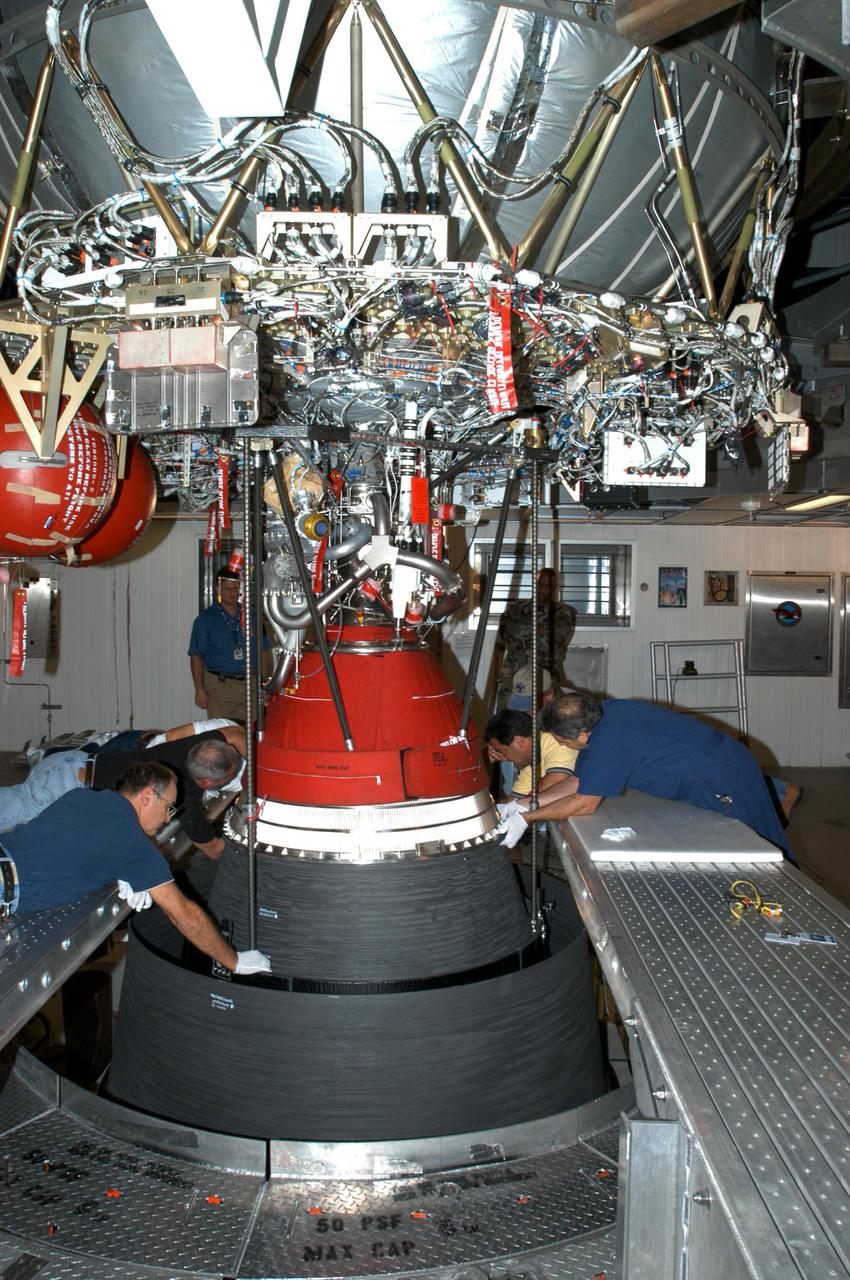
KENNEDY SPACE CENTER, FLA. - At the Delta Operations Center, Jack Reynolds and Leslie Guzman (background) and other workers attach the nozzle for the RL-10 engine to the second stage of the Boeing Delta IV rocket. The Delta IV is the launch vehicle for the Geostationary Operational Environmental Satellite (GOES-N), scheduled to launch in April 2005 from Cape Canaveral Air Force Station. GOES-N is a weather satellite for NASA and NOAA (National Oceanic and Atmospheric Administration). The first in a series of three advanced weather satellites including GOES-O and GOES-P, the GOES-N will provide continuous monitoring necessary for intensive data analysis. It will provide a constant vigil for the atmospheric “triggers” of severe weather conditions such as tornadoes, flash floods, hail storms and hurricanes. When these conditions develop, GOES-N will be able to monitor storm development and track their movements.
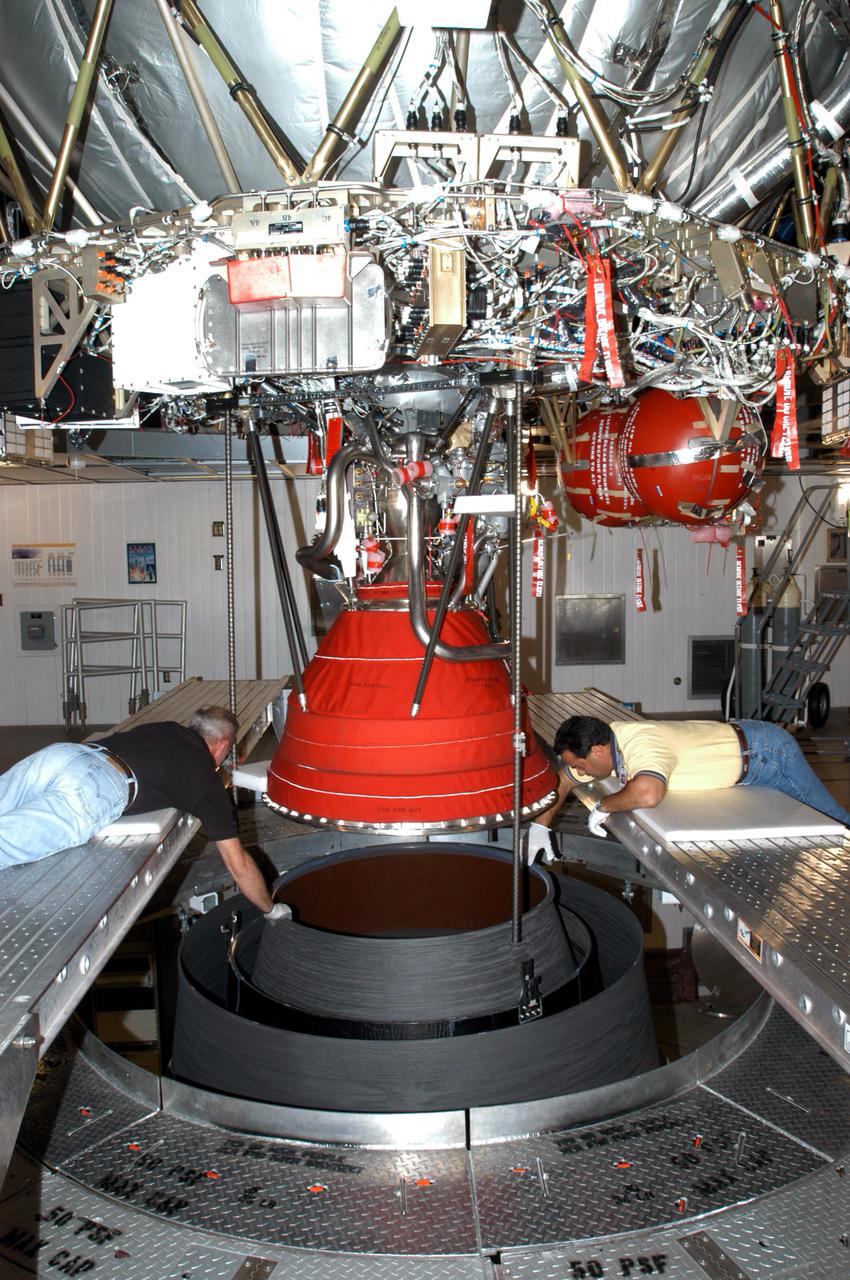
KENNEDY SPACE CENTER, FLA. - At the Delta Operations Center, Jack Reynolds and Leslie Guzman (left and right), with Pratt and Whitney, closely guide the nozzle for the RL-10 engine on the second stage of the Boeing Delta IV rocket. The Delta IV is the launch vehicle for the Geostationary Operational Environmental Satellite (GOES-N), scheduled to launch in April 2005 from Cape Canaveral Air Force Station. GOES-N is a weather satellite for NASA and NOAA (National Oceanic and Atmospheric Administration). The first in a series of three advanced weather satellites including GOES-O and GOES-P, the GOES-N will provide continuous monitoring necessary for intensive data analysis. It will provide a constant vigil for the atmospheric “triggers” of severe weather conditions such as tornadoes, flash floods, hail storms and hurricanes. When these conditions develop, GOES-N will be able to monitor storm development and track their movements.
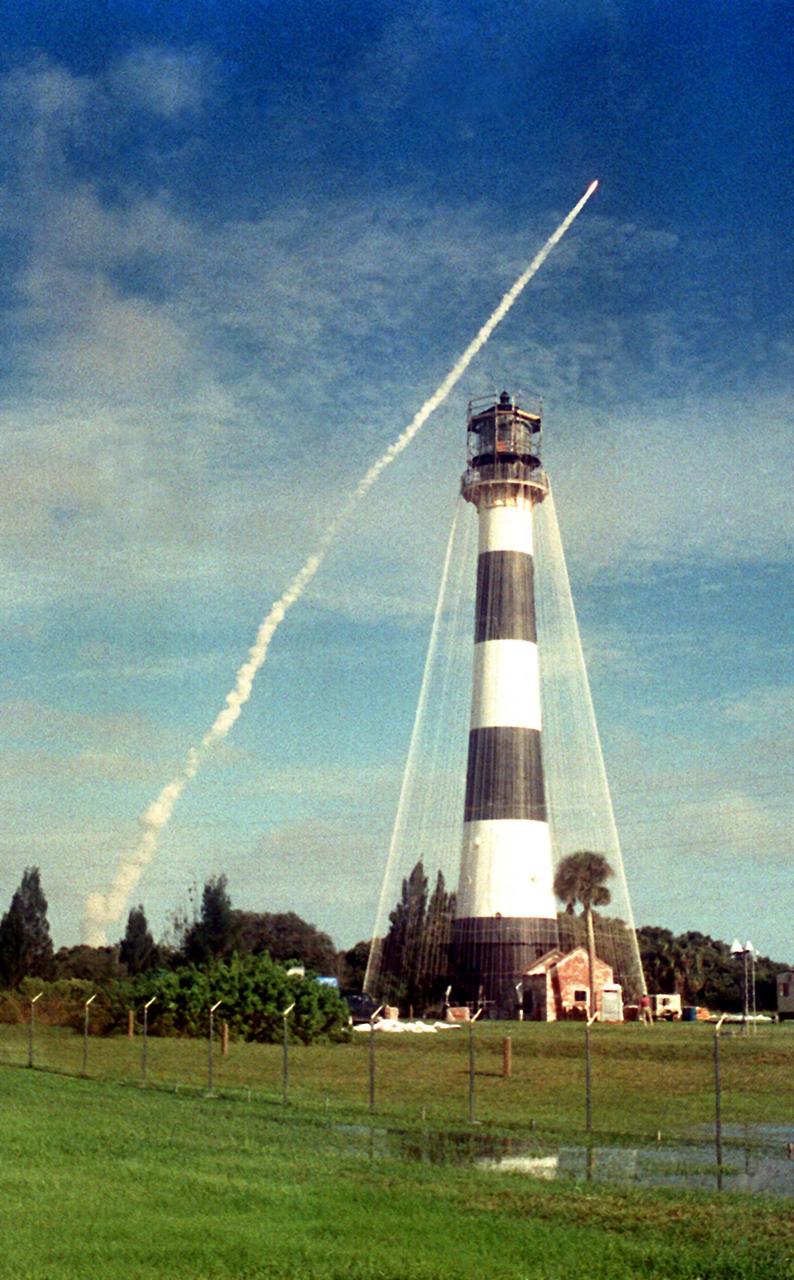
KENNEDY SPACE CENTER, FLA. -- Space Shuttle Columbia soars into the cloud-washed sky above Cape Canaveral Lighthouse. After six scrubs from the original Sept. 25 launch date, liftoff occurred Oct. 20 at 9:53 a.m. EDT. The crew of seven comprises Commander Ken Bowersox, Pilot Kent Rominger, Mission Specialists Kathy Thornton (Payload Commander), Catherine Coleman and Michael Lopez-Alegria, plus Payload Specialists Fred Leslie and Albert Sacco. The 72nd Shuttle mission, STS-73 marks the second flight of the U.S. Microgravity Laboratory. Research is being conducted in five areas: fluid physics, materials science, biotechnology, combustion science, and commercial space processing. The lighthouse, undergoing refurbishment and upgrade, is shown with a network of nylon lines ready for canvas panels to be attached. The canvas shroud will protect the surrounding area during sand-blasting of the lead-based paint.

CAPE CANAVERAL, Fla. – NASA Kennedy Space Center employees, their families and members of the general public turn out in the Rocket Garden at the Kennedy Space Center Visitor Complex in Florida for a free screening of "Forbidden Planet," hosted by Turner Classic Movies, or TCM, as part of their Classic Film Festival. Participating in a panel discussion before the movie begins are, from left, Kennedy Director Robert Cabana, NASA astronaut Mike Massimino and TCM host Ben Mankiewicz. "Forbidden Planet," starring Walter Pigeon, Anne Francis and Leslie Nielsen, was nominated for an Academy Award in 1956 for best special effects in part for its robot character, Robby. Its storyline follows astronauts sent to a planet to find out why there has been no communication from the scientists working there. For more information about the Rocket Garden and the Kennedy Space Center Visitor Complex, visit http://www.kennedyspacecenter.com. Photo credit: NASA/Tim Jacobs
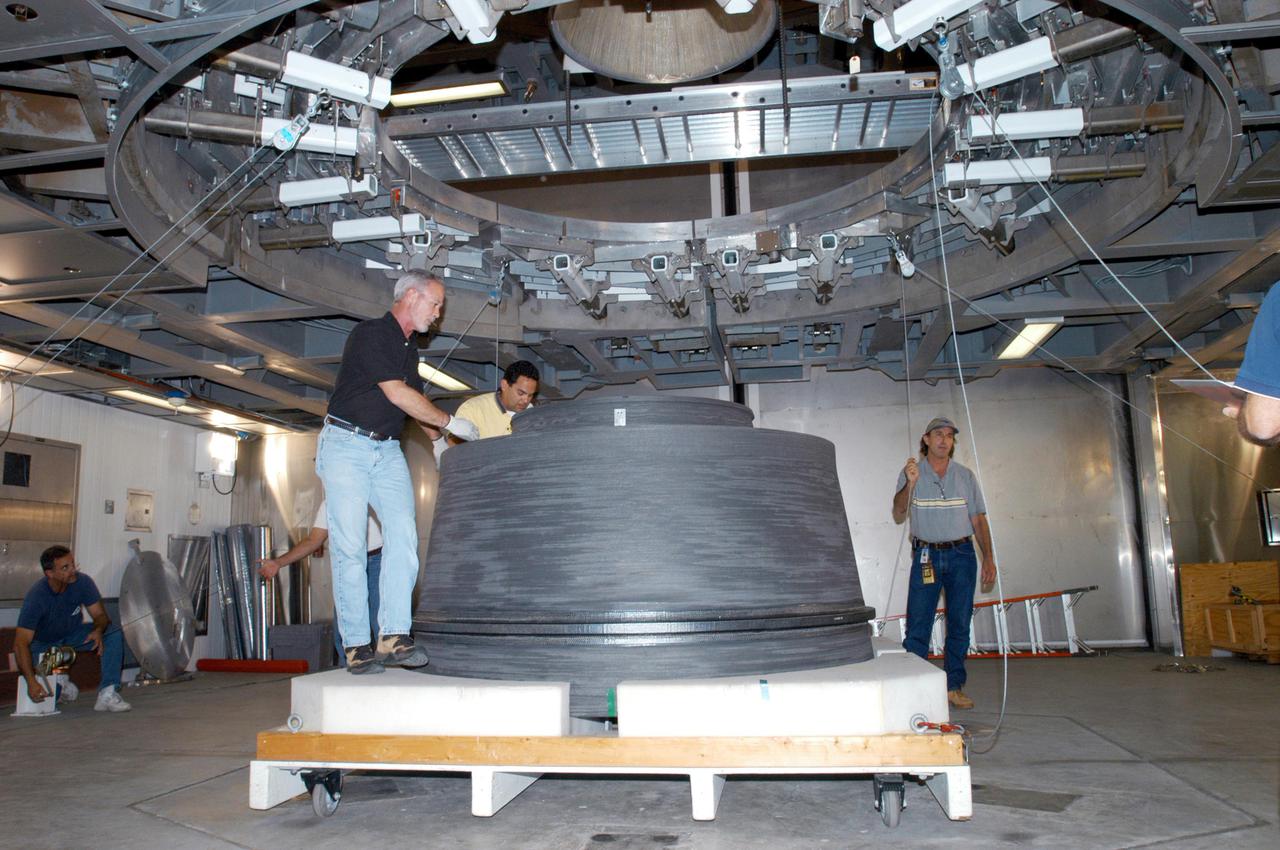
KENNEDY SPACE CENTER, FLA. - At the Delta Operations Center, Jack Reynolds and Leslie Guzman (both at left), with Pratt and Whitney, prepare the nozzle for the RL-10 engine to be attached to the second stage of the Boeing Delta IV rocket. The Delta IV is the launch vehicle for the Geostationary Operational Environmental Satellite (GOES-N), scheduled to launch in April 2005 from Cape Canaveral Air Force Station. GOES-N is a weather satellite for NASA and NOAA (National Oceanic and Atmospheric Administration). The first in a series of three advanced weather satellites including GOES-O and GOES-P, the GOES-N will provide continuous monitoring necessary for intensive data analysis. It will provide a constant vigil for the atmospheric “triggers” of severe weather conditions such as tornadoes, flash floods, hail storms and hurricanes. When these conditions develop, GOES-N will be able to monitor storm development and track their movements.
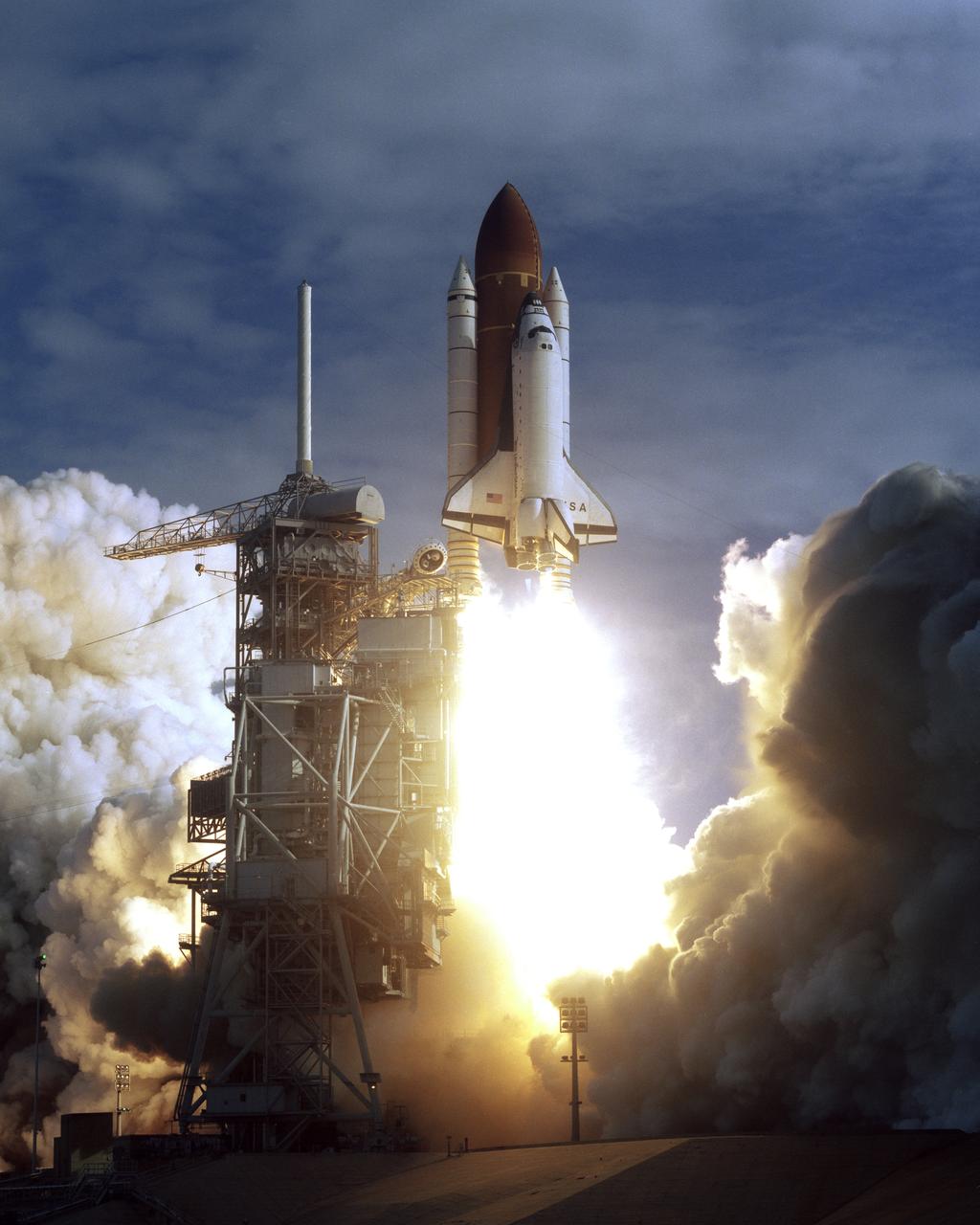
STS073-S-030 (20 Oct. 1995) --- The space shuttle Columbia lifts off from Launch Pad 39B, at the Kennedy Space Center (KSC), to begin a scheduled 16-day mission in Earth orbit in support of the United States Microgravity Laboratory (USML-2). Five NASA astronauts and two scientists from the private sector were onboard. Liftoff occurred at 9:53:00 a.m. (EDT) on Oct. 20, 1995. The mission represents the 72nd space shuttle flight for NASA. The crew will be working around the clock on a diverse assortment of USML-2 experiments located in a science module in Columbia's cargo bay. Fields of study include fluid physics, materials science, biotechnology, combustion science and commercial space processing technologies. The crew is made up of astronauts Kenneth D. Bowersox, commander; Kent V. Rominger, pilot; Kathryn C. Thornton, payload commander; Michael E. Lopez-Alegria and Catherine G. Coleman, both mission specialists; along with Fred W. Leslie and Albert Sacco Jr., payload specialists. Photo credit: NASA
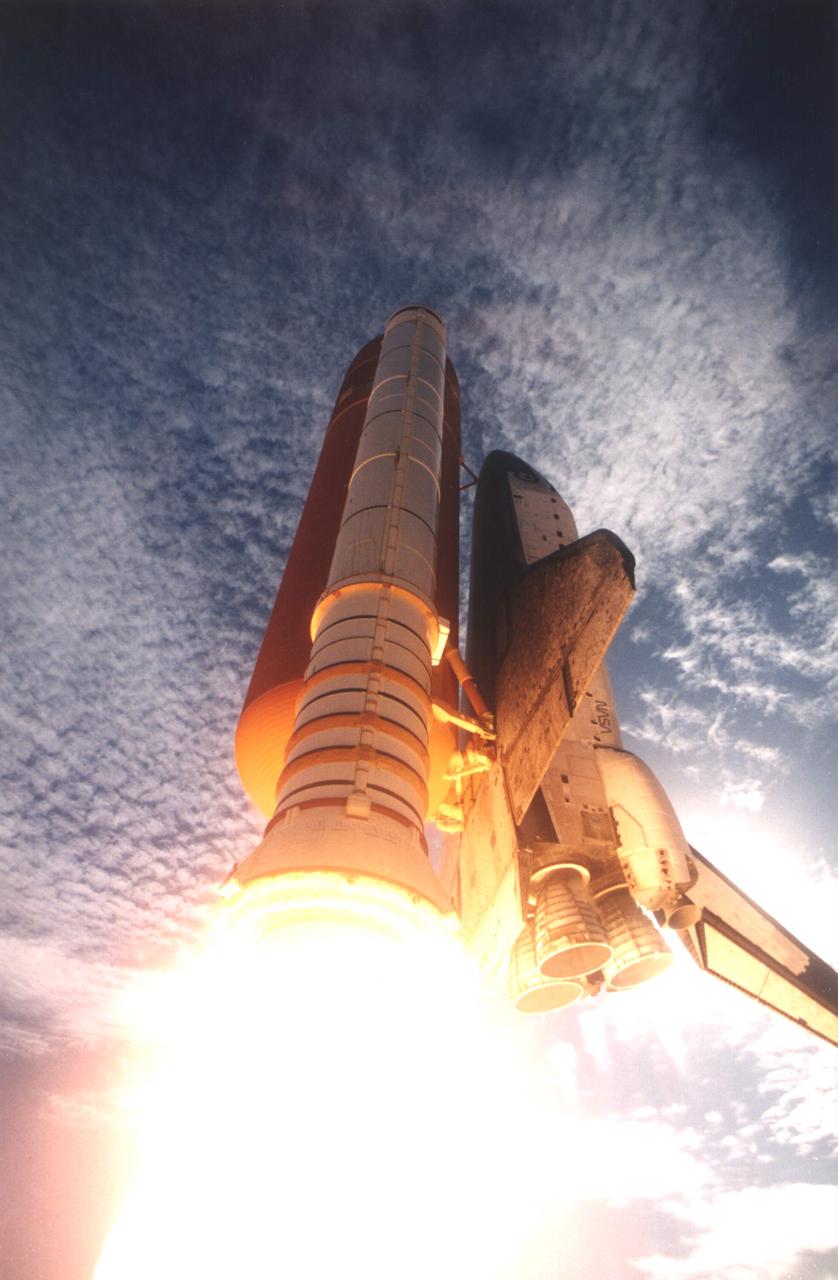
STS073-S-027 (20 October 1995) --- A 35mm camera captured this low-angle view of the Space Shuttle Columbia as it lifted off from Launch Pad 39B, at the Kennedy Space Center (KSC), to begin a scheduled 16-day mission in Earth-orbit in support of the United States Microgravity Laboratory (USML-2). Five NASA astronauts and two scientists from the private sector were onboard. Liftoff occurred at 9:53:00 a.m. (EDT) on October 20, 1995. The mission represents the 72nd Space Shuttle flight for NASA. The crew will be working around the clock on a diverse assortment of USML-2 experiments located in a science module in Columbia's cargo bay. Fields of study include fluid physics, materials science, biotechnology, combustion science and commercial space processing technologies. The crew is made up of astronauts Kenneth D. Bowersox, commander; Kent V. Rominger, pilot; Kathryn C. Thornton, payload commander; Michael E. Lopez-Alegria and Catherine G. Coleman, mission specialists; along with Fred W. Leslie and Albert Sacco Jr., payload specialists.

STS073-S-029 (20 October 1995) --- A stationary 70mm camera captured this wide view of the Space Shuttle Columbia as it lifted off from Launch Pad 39B, at the Kennedy Space Center (KSC), to begin a scheduled 16-day mission in Earth-orbit in support of the United States Microgravity Laboratory (USML-2). Five NASA astronauts and two scientists from the private sector were onboard. Liftoff occurred at 9:53:00 a.m. (EDT) on October 20, 1995. The mission represents the 72nd Space Shuttle flight for NASA. The crew will be working around the clock on a diverse assortment of USML-2 experiments located in a science module in Columbia's cargo bay. Fields of study include fluid physics, materials science, biotechnology, combustion science and commercial space processing technologies. The crew is made up of astronauts Kenneth D. Bowersox, commander; Kent V. Rominger, pilot; Kathryn C. Thornton, payload commander; Michael E. Lopez-Alegria and Catherine G. Coleman, mission specialists; along with Fred W. Leslie and Albert Sacco Jr., payload specialists.
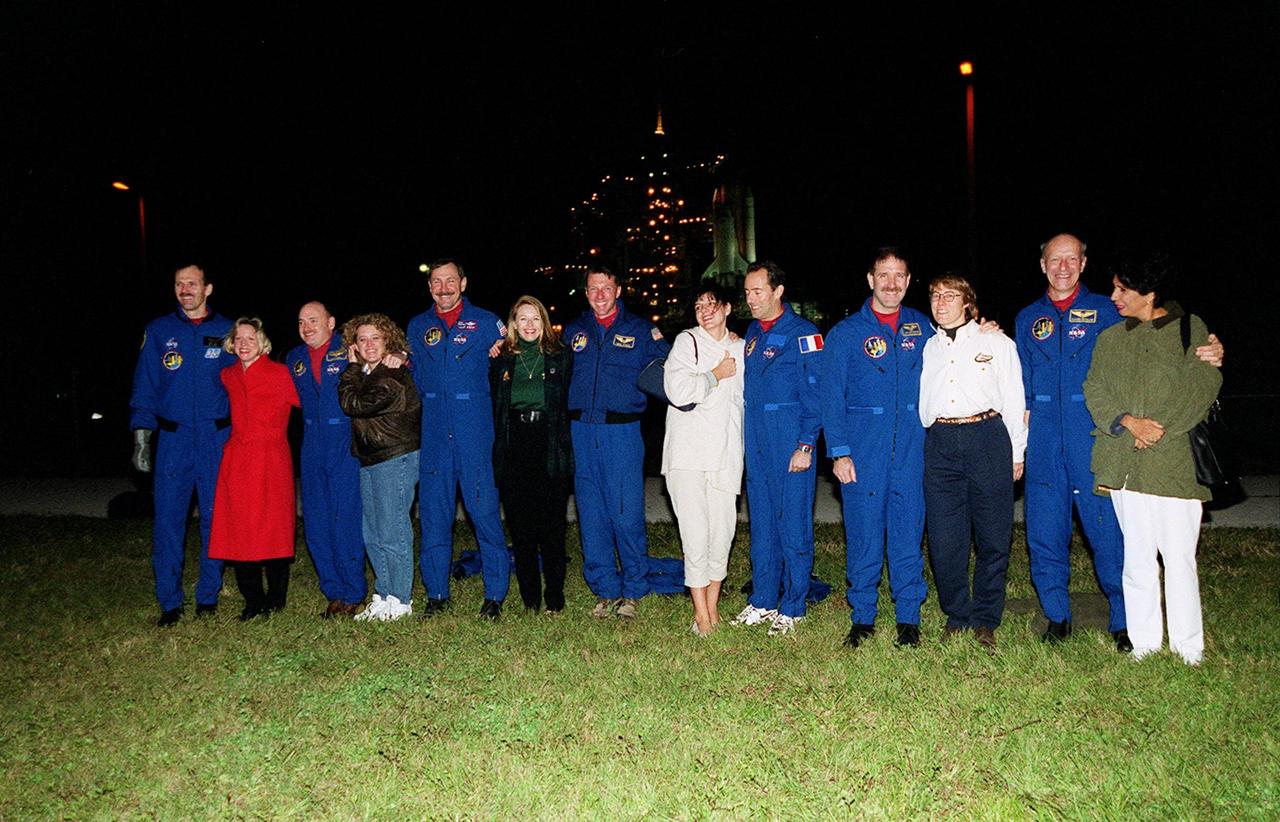
The STS-103 crew pose for photographers with their loved ones at Launch Pad 39B. Space Shuttle Discovery is in the background, next to the Fixed Service Structure lit up like a Christmas tree. Viewed left to right are Mission Specialist Steven L. Smith and his wife, Peggy; Pilot Scott J. Kelly and his wife, Leslie; Commander Curtis L. Brown Jr. and his fiancee, Ann Brickert; Mission Specialist C. Michael Foale; Laurence Clervoy and her husband, Mission Specialist Jean-François Clervoy; Mission Specialist John M. Grunsfeld and his wife, Carol; Mission Specialist Claude Nicollier and his wife, Susana. Nicollier and Clervoy are with the European Space Agency. The mission, to service the Hubble Space Telescope, is scheduled for launch Dec. 17 at 8:47 p.m. EST from Launch Pad 39B. Mission objectives include replacing gyroscopes and an old computer, installing another solid state recorder, and replacing damaged insulation in the telescope. The mission is expected to last about 8 days and 21 hours. Discovery is expected to land at KSC Sunday, Dec. 26, at about 6:25 p.m. EST
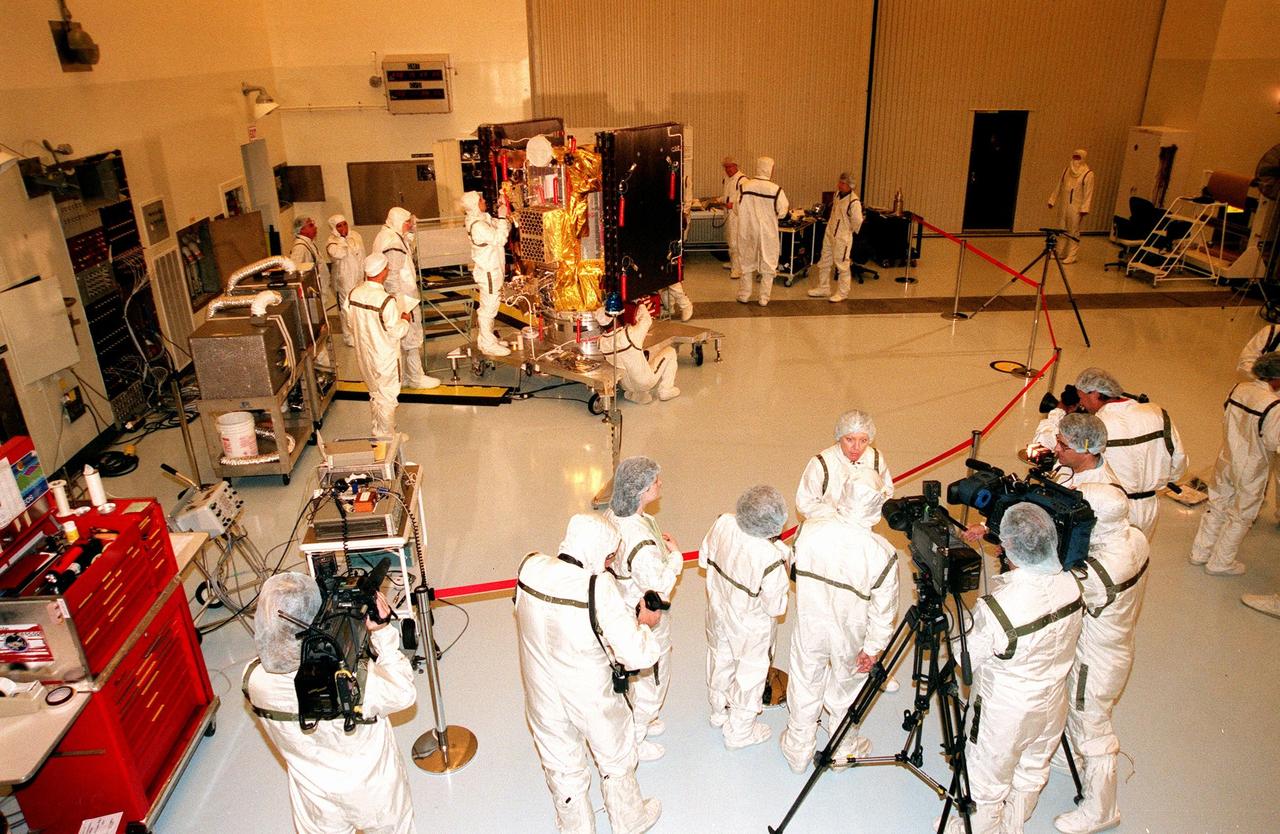
KENNEDY SPACE CENTER, FLA. -- In the Payload Hazardous Servicing Facility, the media (below), dressed in "bunny" suits, learn about Deep Space 1 from Leslie Livesay (facing cameras), Deep Space 1 spacecraft manager from the Jet Propulsion Laboratory. In the background, KSC workers place insulating blankets on Deep Space 1. The first flight in NASA's New Millennium Program, Deep Space 1 is designed to validate 12 new technologies for scientific space missions of the next century. Onboard experiments include an ion propulsion engine and software that tracks celestial bodies so the spacecraft can make its own navigation decisions without the intervention of ground controllers. Deep Space 1 will complete most of its mission objectives within the first two months, but may also do a flyby of a near-Earth asteroid, 1992 KD, in July 1999. Deep Space 1 will be launched aboard a Boeing Delta 7326 rocket from Launch Pad 17A, Cape Canaveral Air Station, in October. Delta II rockets are medium capacity expendable launch vehicles derived from the Delta family of rockets built and launched since 1960. Since then there have been more than 245 Delta launches
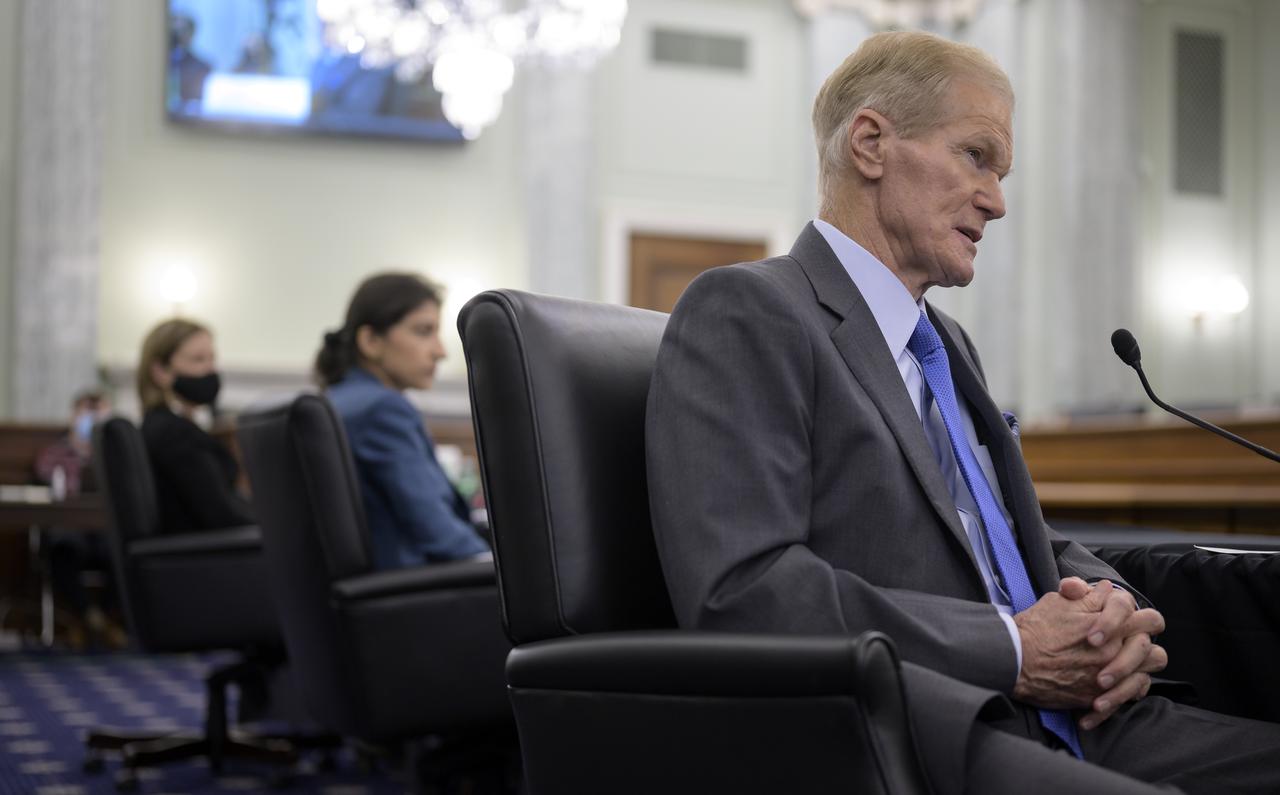
Former U.S. Senator Bill Nelson, President Biden’s nominee to be the next administrator of NASA, appears before the Senate Committee on Commerce, Science, and Transportation, Wednesday, April 21, 2021, Russell Senate Office Building in Washington. Photo Credit: (NASA/Bill Ingalls)
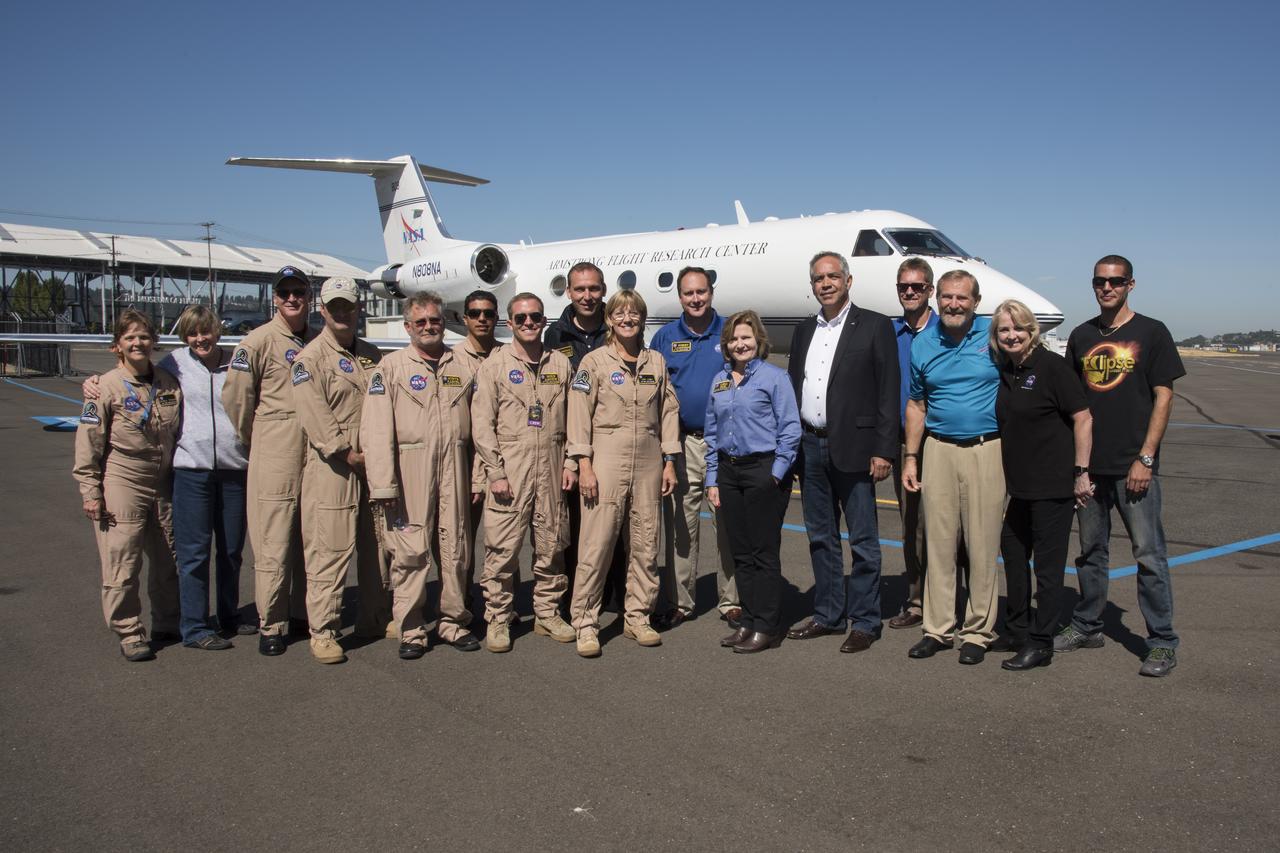
NASA Armstrong and NASA senior management Gulfstream III team pose for group shot by aircraft after return from covering Total solar eclipse. Photo Credit: (NASA/Carla Thomas)