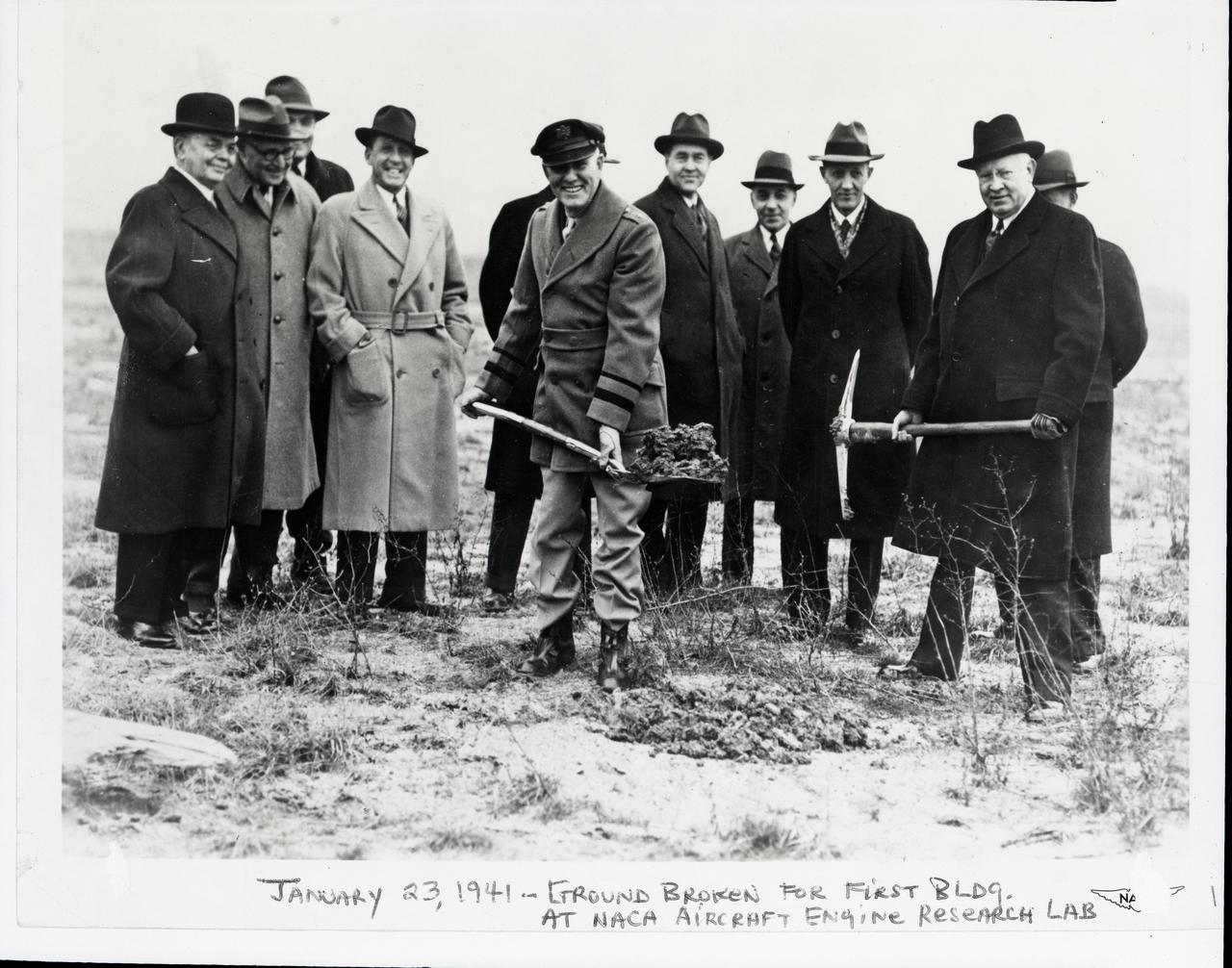
January 23, 1941 groundbreaking ceremony at the NACA Aircraft Engine Research Laboratory: left to right (does not include two individuals obscured from view behind Maj. Brett and Dr. Lewis): • William R. Hopkins – Cleveland City Manager from 1924-1930, was personally responsible for planning and acquiring the land for the Cleveland Airport. The airport’s huge capacity for handling aircraft was one factor in selecting Cleveland for the site of the research center. The Cleveland Airport was renamed Cleveland Hopkins airport in his honor in 1951. • Major John Berry – Cleveland Airport Manager • Edward R. Sharp – GRC’s first director, serving from 1942 to his retirement in 1961. He came to Cleveland in 1941 as the construction manager for the new facility. • Frederick C. Crawford – President of Thompson Products, which became the Thompson-Ramo-Woolridge Corporation (TRW) in 1958. Crawford was, at the time, also president of the Cleveland Chamber of Commerce. He began in 1939 to campaign for Cleveland as the location for the new NACA facility. • Major George H. Brett – A Cleveland native, Brett served in WWI and was commanding officer at Wright Field in Dayton, Ohio before becoming chief of the Army Air Corps. • Dr. Edward P. Warner – Acting chairman of the NACA. • Captain Sydney M. Kraus – Officer in charge of Navy procurement • Edward Blythin – Mayor of Cleveland • Dr. George Lewis – Director of Aeronautical Research for the NACA from 1924-1947, Lewis devoted his life to building a scientific basis for aeronautical engineering. The Cleveland laboratory was renamed the Lewis Flight Propulsion Laboratory in his honor in 1948. A description of the event, based on newspaper accounts and later NASA publications is as follows: On January 23, 1941, a brief groundbreaking ceremony at the site marked the start of construction. Dr. George W. Lewis, director of research for the NACA, loosened the soil with a
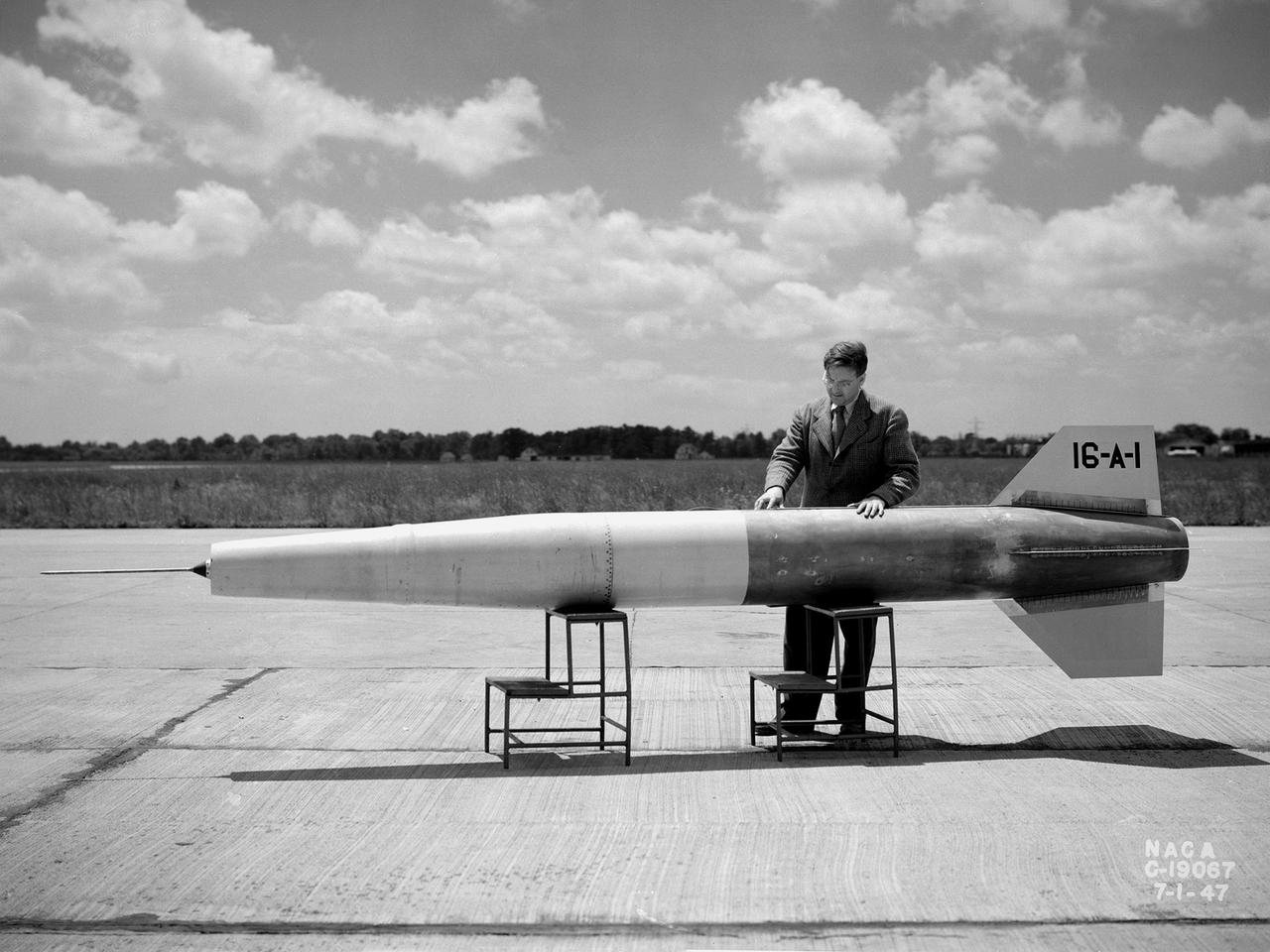
A NACA researcher prepares a 16-inch diameter and 16-foot long ramjet for a launch over Wallops Island in July 1947. The Lewis Flight Propulsion Laboratory conducted a wide variety of studies on ramjets in the 1940s and 1960s to determine the basic operational data necessary to design missiles. Although wind tunnel and test stand investigations were important first steps in determining these factors, actual flight tests were required. Lewis possessed several aircraft for the ramjet studies, including North American F-82 Mustangs, a Northrup P-61 Black Widow, and a Boeing B-29 Superfortress, which was used for this particular ramjet. This was Lewis’ first flight at over the experimental testing ground at Wallops Island. The NACA’s Langley laboratory established the station on the Virginia coast in 1945 to conduct early missile tests. This ramjet-powered missile was affixed underneath the B-29’s left wing and flown up to 29,000 feet. The ramjet was ignited as the aircraft reached Mach 0.5 and released. The flight went well, but a problem with the data recording prevented a successful mission. Nonetheless additional flights in November 1947 provided researchers with data on the engine’s combustion efficiency at different levels of fuel-air ratios, thrust coefficients, temperatures, and drag. Transonic flight data such as the rapid acceleration through varying flight conditions could not be easily captured in wind tunnels.
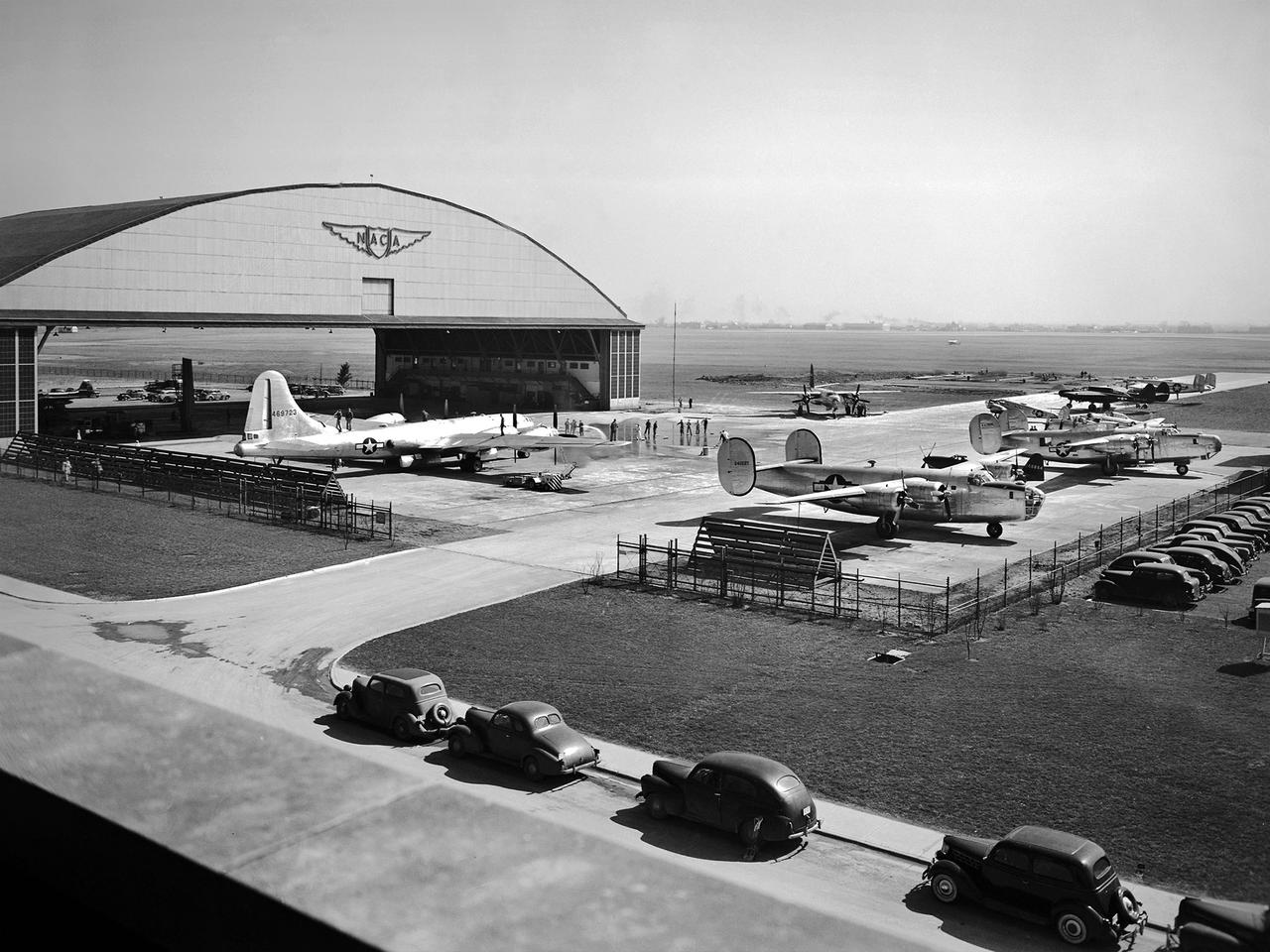
This fleet of military aircraft was used in the 1940s for research at the National Advisory Committee for Aeronautics (NACA) Lewis Flight Propulsion Laboratory in Cleveland, Ohio. The NACA Lewis flight research program was established in March 1943 to augment the lab’s wartime research efforts. NACA Lewis possessed a host of wind tunnels, test stands, and other ground facilities designed to replicate flight conditions, but actual flight tests remained an integral research tool. The military loaned NACA Lewis 15 different aircraft during World War II and six others in the six months following the end of hostilities. During the war these aircraft supported three main efforts: the improved performance of reciprocating engines, better fuel additives and mixtures, and deicing systems. The wartime researchers used the types of aircraft which the studies were intended to improve. After the war the research aircraft served as test beds to investigate engines or systems that often had little to do with the research aircraft. During the war, NACA Lewis’ three pilots were supported by 16 flight engineers, 36 mechanics, and 10 instrumentation specialists. The visible aircraft, from left to right, are a Boeing B-29 Superfortress, a Martin B-26A Marauder, two Consolidated B-24 Liberators, a Cessna UC-78 Bobcat, and a Northrop P-61 Black Widow. Partially obscured are a North American P-51 Mustang, a Bell P-63 King Cobra, a North American AT-6 Texan, and a Lockheed RA-29 Hudson.