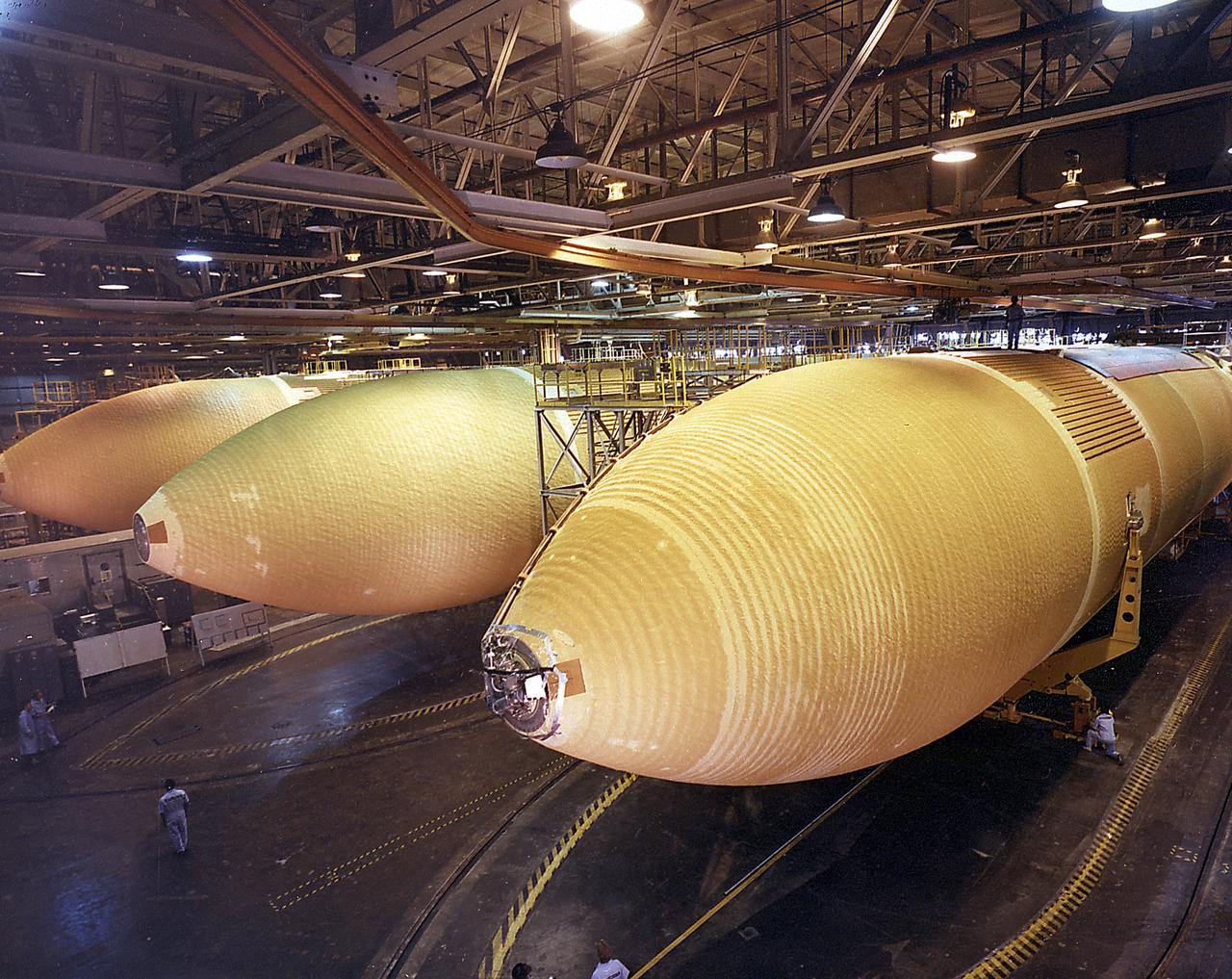
This photograph was taken during the final assembly phase of the Space Shuttle light weight external tanks (LWT) 5, 6, and 7 at the Michoud Assembly Facility in New Orleans, Louisiana. The giant cylinder, higher than a 15-story building, with a length of 154-feet (47-meters) and a diameter of 27.5-feet (8.4-meters), is the largest single piece of the Space Shuttle. During launch, the external tank (ET) acts as a backbone for the orbiter and solid rocket boosters. In separate, internal pressurized tank sections, the ET holds the liquid hydrogen fuel and liquid oxygen oxidizer for the Shuttle's three main engines. During launch, the ET feeds the fuel under pressure through 17-inch (43.2-centimeter) ducts which branch off into smaller lines that feed directly into the main engines. Some 64,000 gallons (242,260 liters) of fuel are consumed by the main engines each minute. Machined from aluminum alloys, the Space Shuttle's ET is the only part of the launch vehicle that currently is not reused. After its 526,000 gallons (1,991,071 liters) of propellants are consumed during the first 8.5 minutes of flight, it is jettisoned from the orbiter and breaks up in the upper atmosphere, its pieces falling into remote ocean waters. The Marshall Space Flight Center was responsible for developing the ET
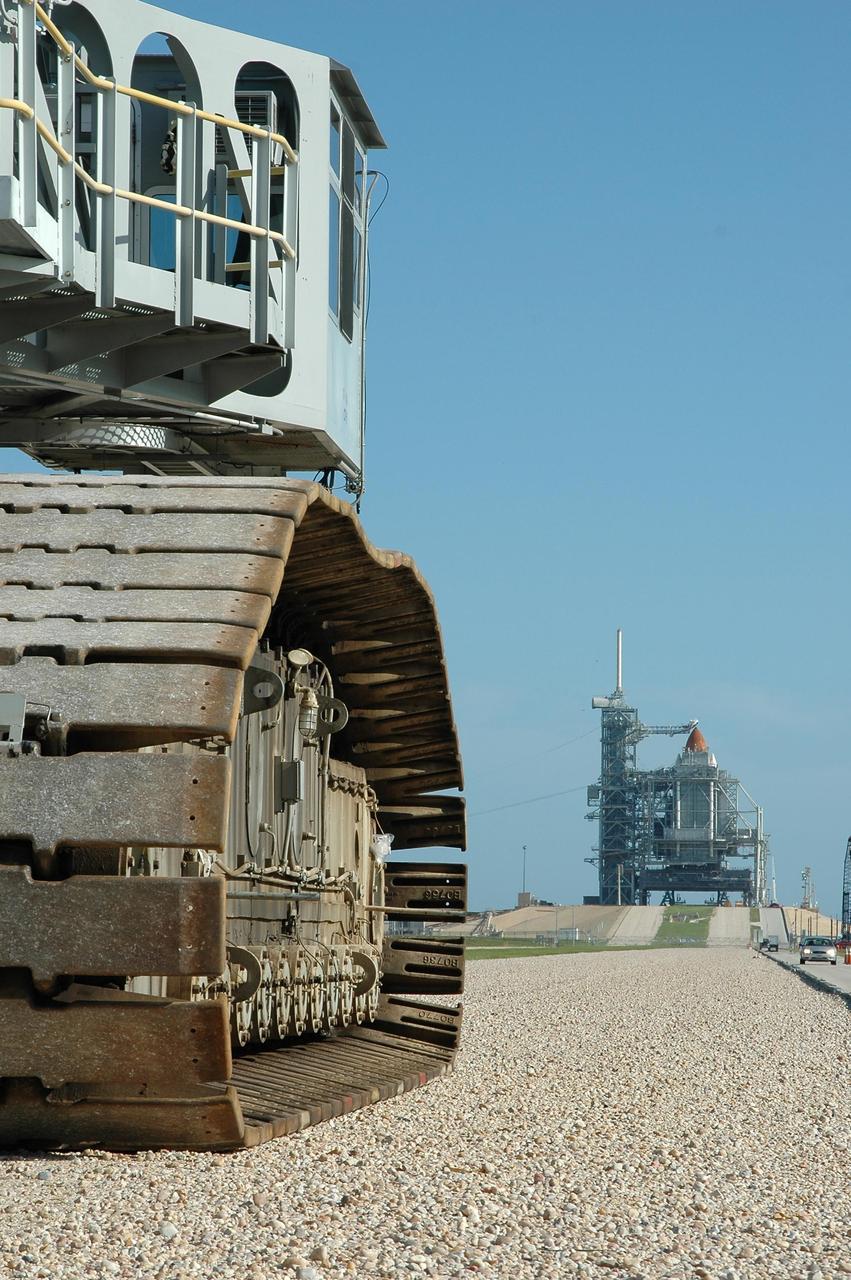
KENNEDY SPACE CENTER, FLA. - Crawler-transporter No. 2 nears Launch Pad 39B (in the background, right). The tip of the orange external tank can be seen above the rotating service structure surrounding the shuttle. The crawler is being moved nearby in the event the mission management team decides to roll back Space Shuttle Atlantis due to Hurricane Ernesto. The hurricane has been forecast on a heading north and east from Cuba, taking it along the eastern coast of Florida. NASA's lighted launch window extends to Sept. 13, but mission managers are hoping to launch on mission STS-115 by Sept. 7 to avoid a conflict with a Russian Soyuz rocket also bound for the International Space Station. The crawler is 131 feet long, 113 feet wide and 20 feet high. It weights 5.5 million pounds unloaded. The combined weight of crawler, mobile launcher platform and a space shuttle is 12 million pounds. Unloaded, the crawler moves at 2 mph. Loaded, the snail's pace slows to 1 mph. Photo credit: NASA/Kim Shiflett
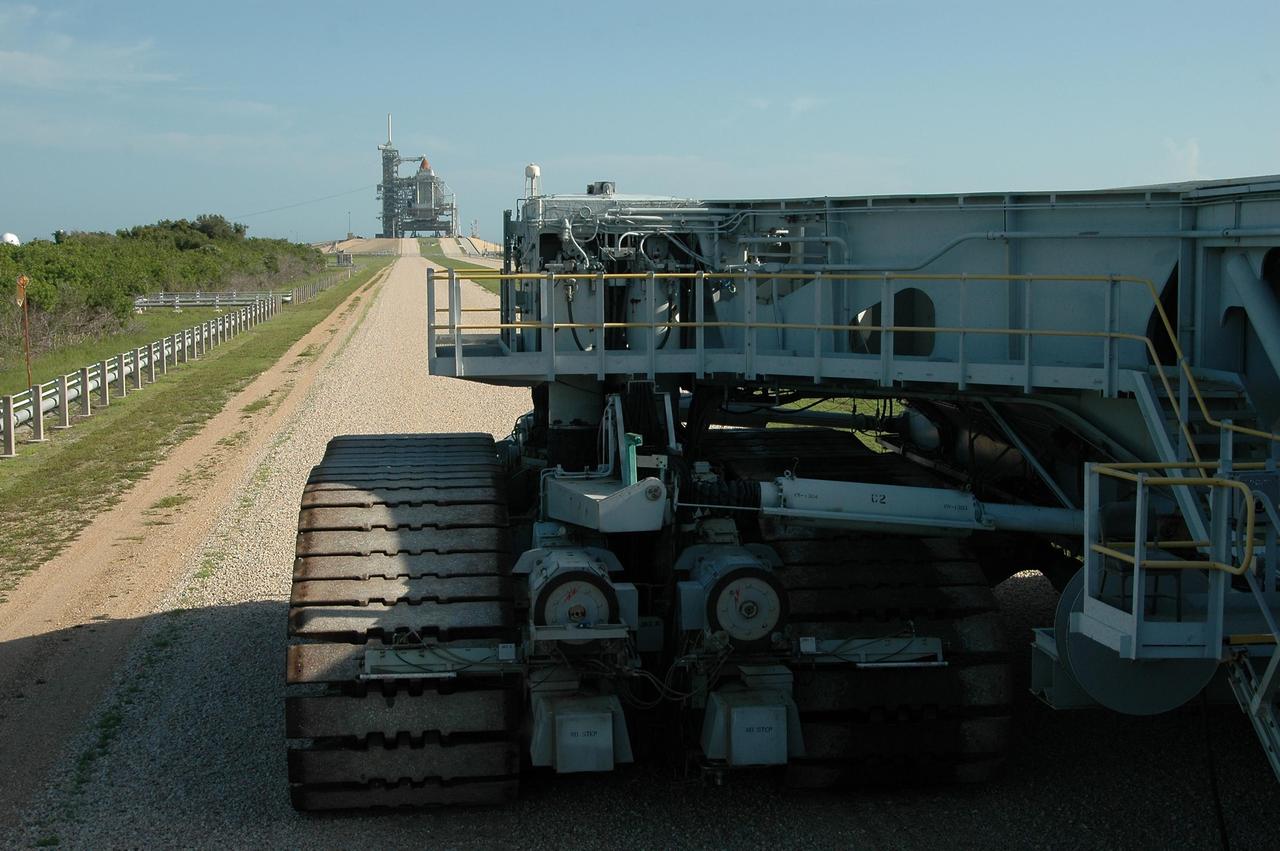
KENNEDY SPACE CENTER, FLA. - Crawler-transporter No. 2 makes its way toward Launch Pad 39B (in the background). The tip of the orange external tank can be seen above the rotating service structure surrounding the shuttle. The crawler is being moved nearby in the event the mission management team decides to roll back Space Shuttle Atlantis due to Hurricane Ernesto. The hurricane has been forecast on a heading north and east from Cuba, taking it along the eastern coast of Florida. NASA's lighted launch window extends to Sept. 13, but mission managers are hoping to launch on mission STS-115 by Sept. 7 to avoid a conflict with a Russian Soyuz rocket also bound for the International Space Station. The crawler is 131 feet long, 113 feet wide and 20 feet high. It weights 5.5 million pounds unloaded. The combined weight of crawler, mobile launcher platform and a space shuttle is 12 million pounds. Unloaded, the crawler moves at 2 mph. Loaded, the snail's pace slows to 1 mph. Photo credit: NASA/Kim Shiflett