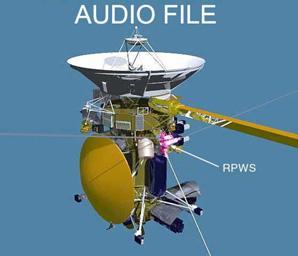
Lightning Strikes at Saturn
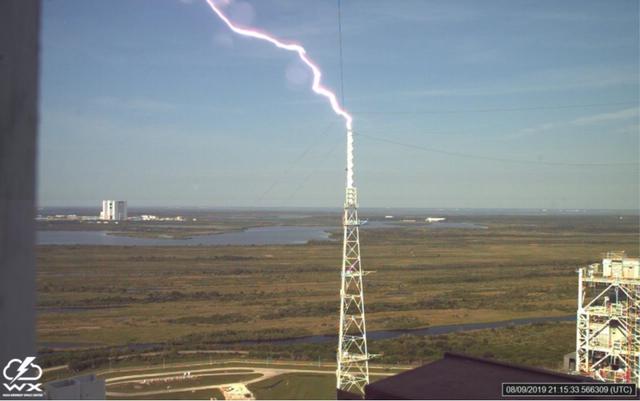
A lightning strike is recorded at Launch Complex 39B at NASA’s Kennedy Space Center in Florida in August 2019. The event was captured by high-speed cameras stationed at the pad and mobile launcher using a special filter called a “clear day frame,” which provides an overlay of the raw frame on a reference image. At pad 39B, there are three, 600-foot-tall masts with overhead wires used to transmit electrical energy around the perimeter of the pad to provide lightning protection for launch vehicles as they are processed and launched from the pad.
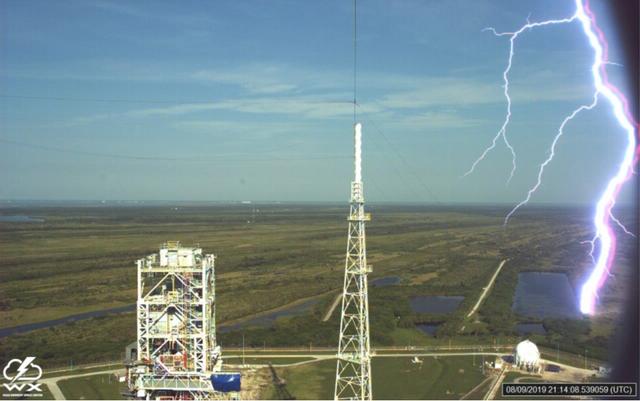
A lightning strike is recorded at Launch Complex 39B at NASA’s Kennedy Space Center in Florida in August 2019. The event was captured by high-speed cameras stationed at the pad and mobile launcher using a special filter called a “clear day frame,” which provides an overlay of the raw frame on a reference image. At pad 39B, there are three, 600-foot-tall masts with overhead wires used to transmit electrical energy around the perimeter of the pad to provide lightning protection for launch vehicles as they are processed and launched from the pad.
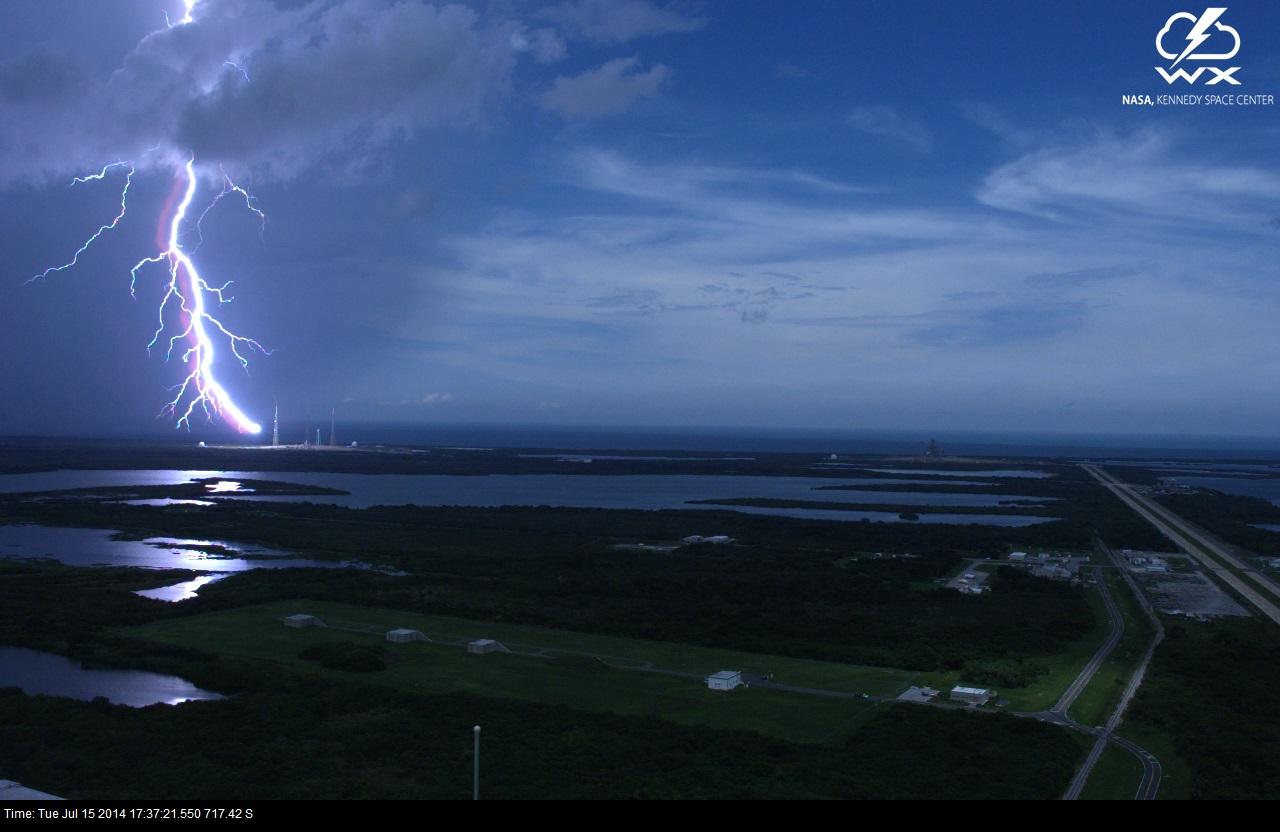
A lightning strike is recorded at Launch Complex 39B at NASA’s Kennedy Space Center in Florida in July 2014. The event was captured by high-speed camera from the iconic Vehicle Assembly Building. At pad 39B, there are three, 600-foot-tall masts with overhead wires used to transmit electrical energy around the perimeter of the pad to provide lightning protection for launch vehicles as they are processed and launched from the pad.
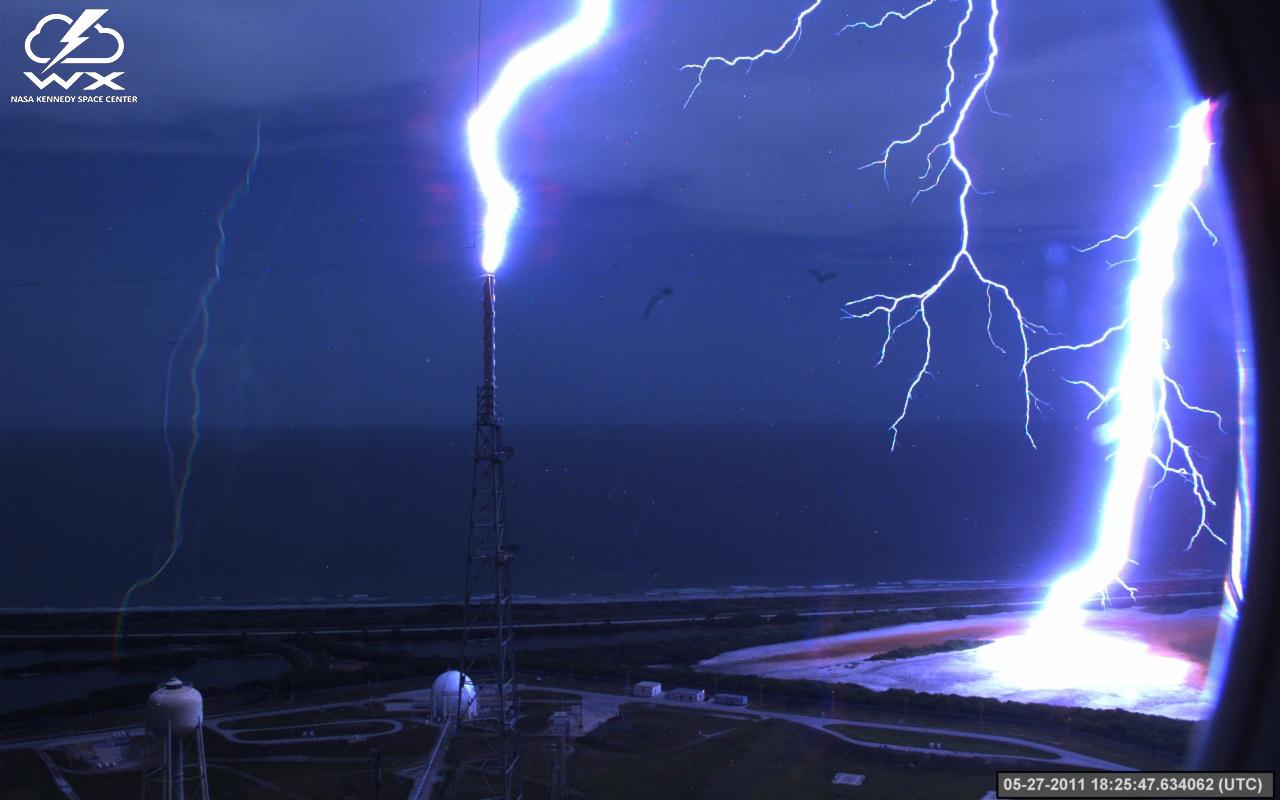
A lightning strike is recorded at Launch Complex 39B at NASA’s Kennedy Space Center in Florida in May 2011. The event was captured by high-speed cameras stationed at the pad and mobile launcher. At pad 39B, there are three, 600-foot-tall masts with overhead wires used to transmit electrical energy around the perimeter of the pad to provide lightning protection for launch vehicles as they are processed and launched from the pad.
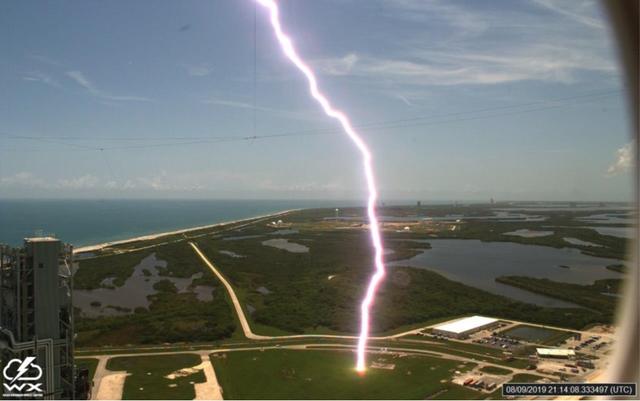
A lightning strike is recorded at Launch Complex 39B at NASA’s Kennedy Space Center in Florida in August 2019. The event was captured by high-speed cameras stationed at the pad and mobile launcher using a special filter called a “clear day frame,” which provides an overlay of the raw frame on a reference image. At pad 39B, there are three, 600-foot-tall masts with overhead wires used to transmit electrical energy around the perimeter of the pad to provide lightning protection for launch vehicles as they are processed and launched from the pad.
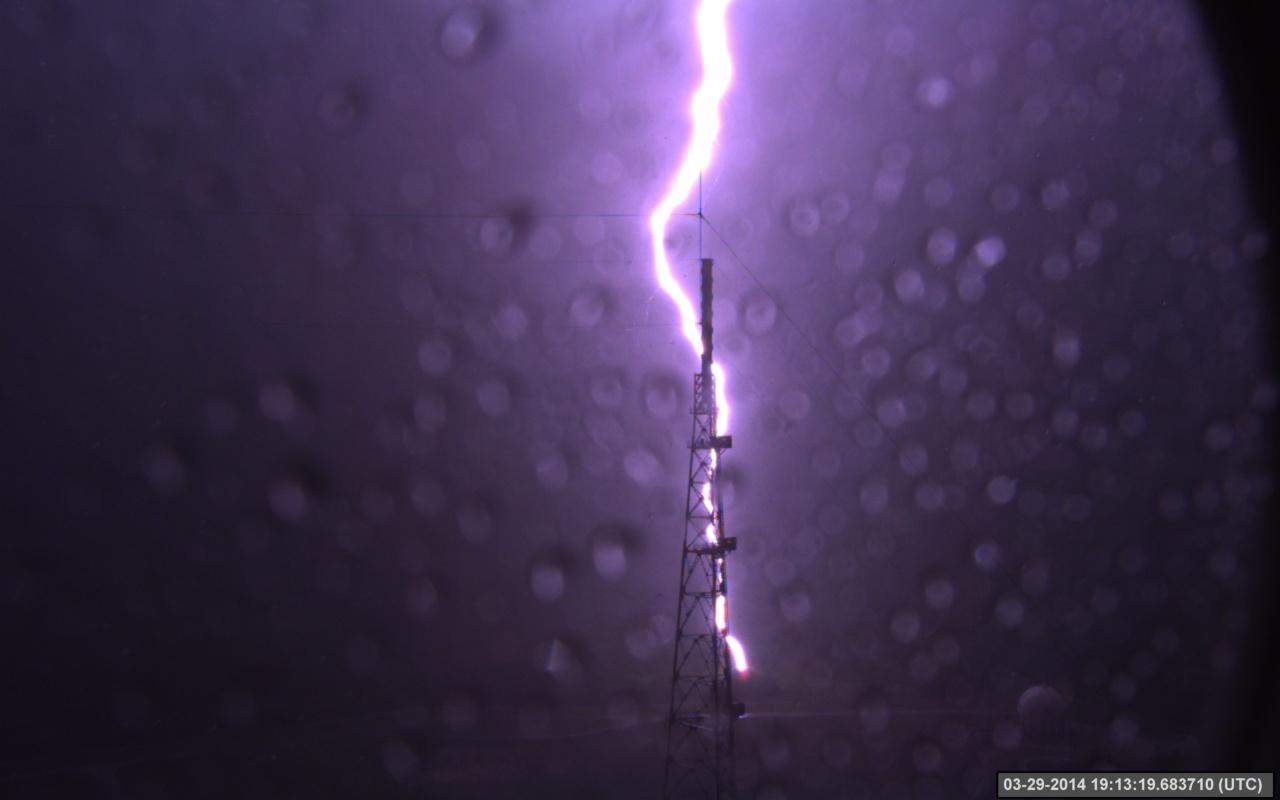
A lightning strike is recorded at Launch Complex 39B at NASA’s Kennedy Space Center in Florida in March 2014. The event was captured by high-speed cameras stationed at the pad and mobile launcher. At pad 39B, there are three, 600-foot-tall masts with overhead wires used to transmit electrical energy around the perimeter of the pad to provide lightning protection for launch vehicles as they are processed and launched from the pad.
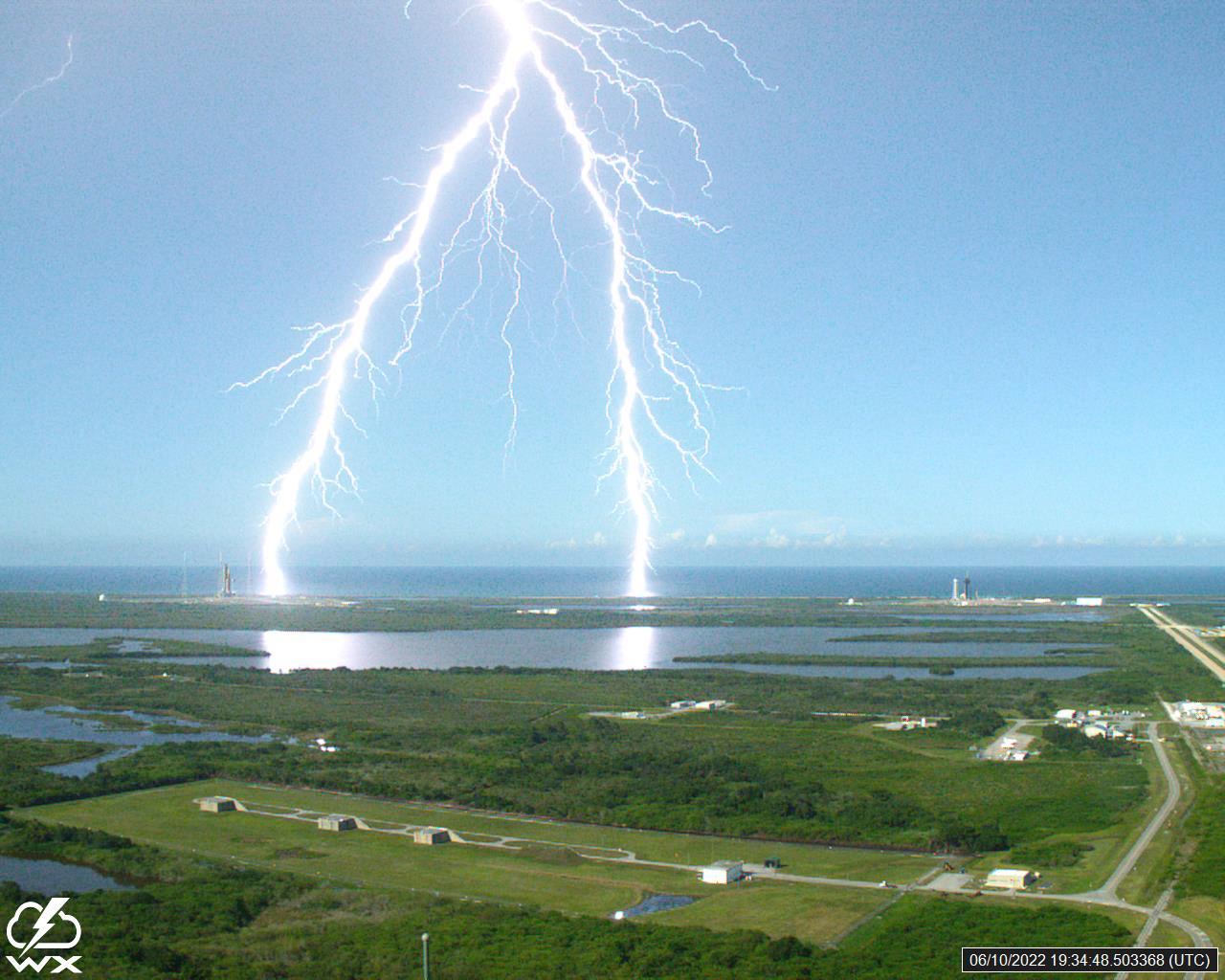
A lightning strike was recorded at Launch Complex 39B at NASA’s Kennedy Space Center in Florida on June 10, 2022. NASA’s Space Launch System (SLS) and Orion spacecraft atop the mobile launcher are on the launch pad in preparation for the Artemis I mission. The lightning strike was recorded by cameras stationed at the pad and mobile launcher using a special filter called a “clear day frame,” which provides an overlay of the raw frame on a reference image. Artemis I will be the first integrated test of the SLS and Orion spacecraft. In later missions, NASA will land the first woman and the first woman of color on the surface of the Moon, paving the way for a long-term lunar presence and serving as a steppingstone on the way to Mars.
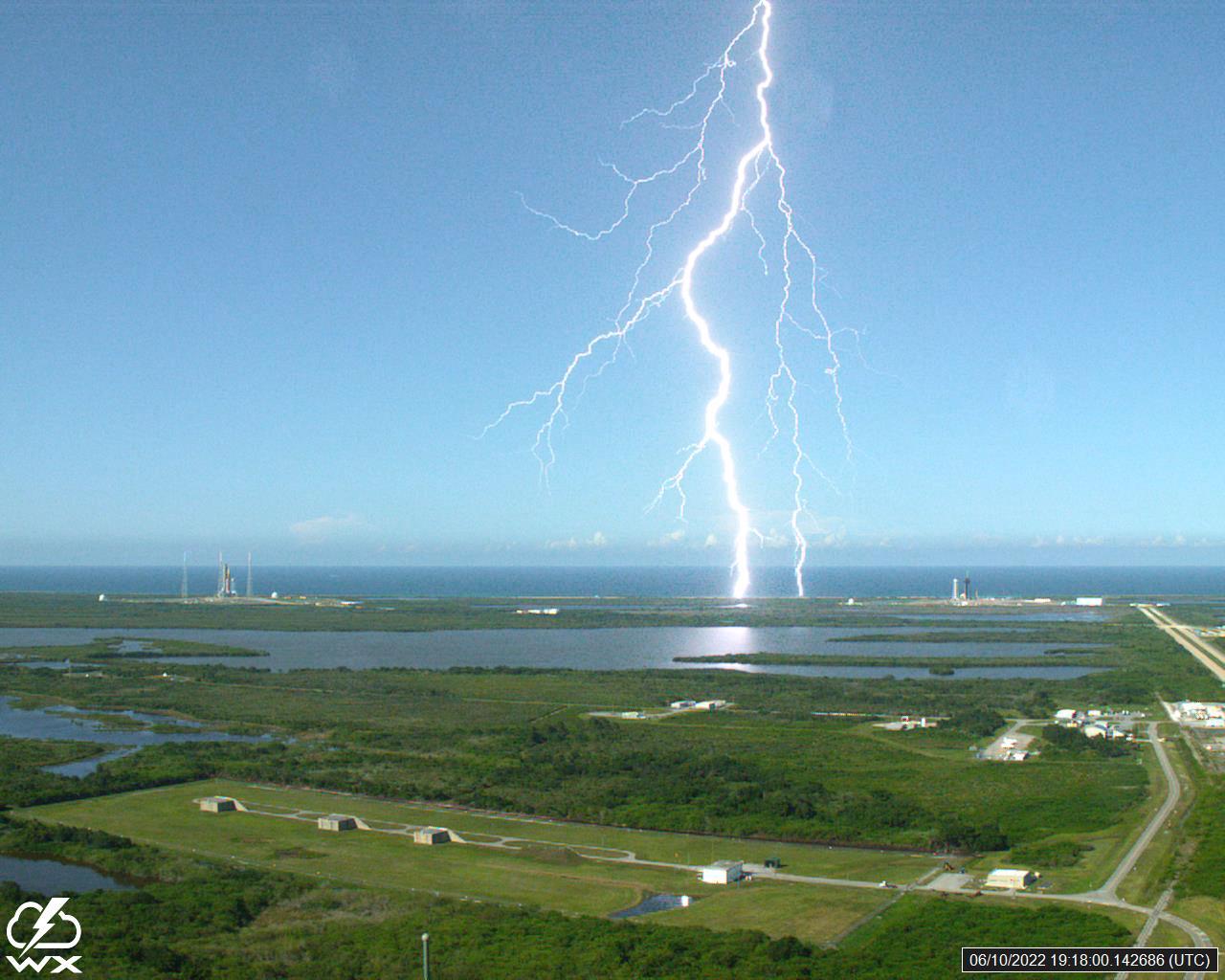
A lightning strike was recorded at Launch Complex 39B at NASA’s Kennedy Space Center in Florida on June 10, 2022. NASA’s Space Launch System (SLS) and Orion spacecraft atop the mobile launcher are on the launch pad in preparation for the Artemis I mission. The lightning strike was recorded by cameras stationed at the pad and mobile launcher using a special filter called a “clear day frame,” which provides an overlay of the raw frame on a reference image. Artemis I will be the first integrated test of the SLS and Orion spacecraft. In later missions, NASA will land the first woman and the first woman of color on the surface of the Moon, paving the way for a long-term lunar presence and serving as a steppingstone on the way to Mars.

A lightning strike was recorded at Launch Complex 39B at NASA’s Kennedy Space Center in Florida on Sept. 14, 2022. NASA’s Space Launch System (SLS) and Orion spacecraft atop the mobile launcher are on the launch pad in preparation for the Artemis I mission. The lightning strike was recorded by cameras stationed at the pad and mobile launcher using a special filter called a “clear day frame,” which provides an overlay of the raw frame on a reference image. Artemis I will be the first integrated test of the SLS and Orion spacecraft. In later missions, NASA will land the first woman and the first woman of color on the surface of the Moon, paving the way for a long-term lunar presence and serving as a steppingstone on the way to Mars.
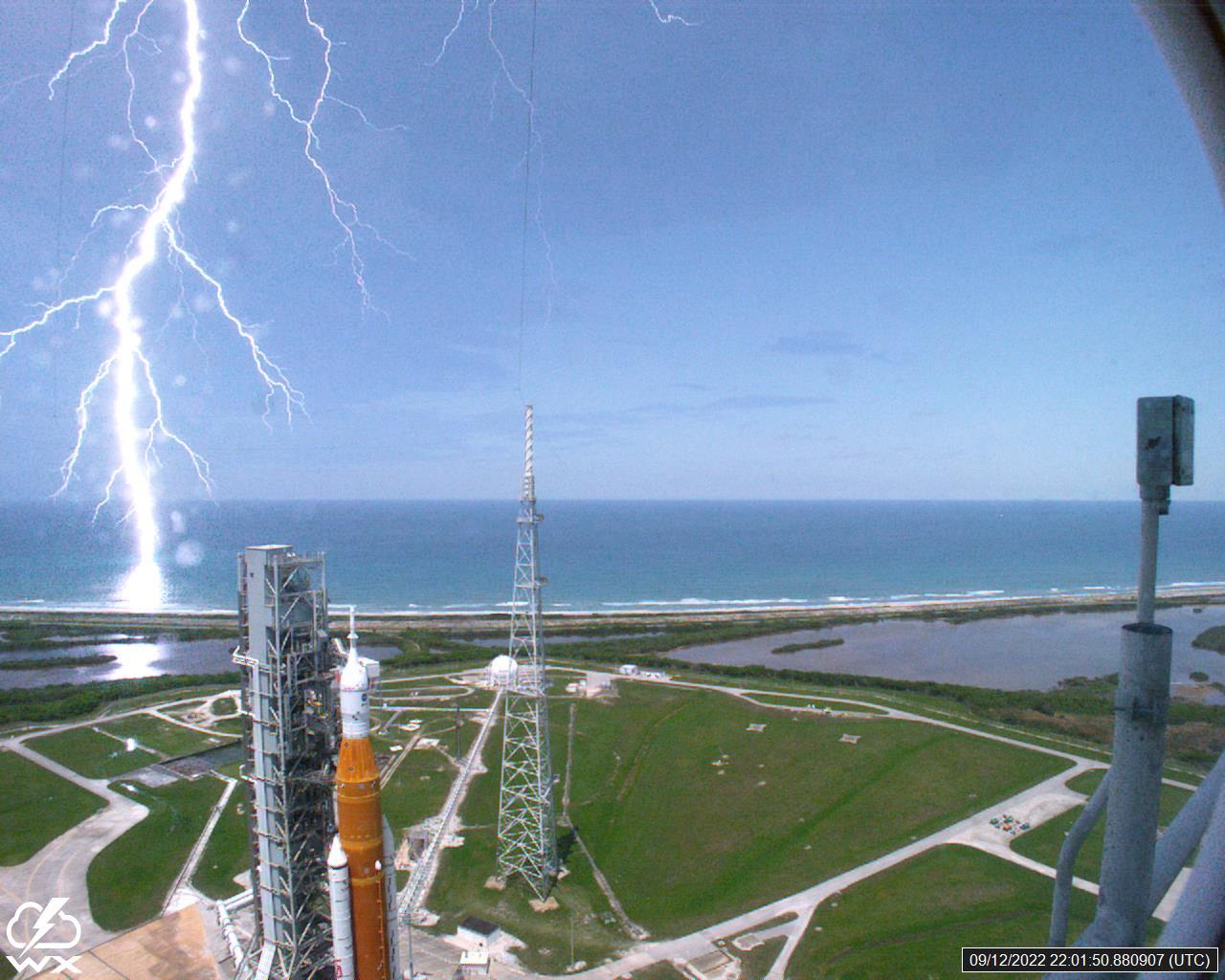
A lightning strike was recorded at Launch Complex 39B at NASA’s Kennedy Space Center in Florida on Sept. 12, 2022. NASA’s Space Launch System (SLS) and Orion spacecraft atop the mobile launcher are in view on the launch pad in preparation for the Artemis I mission. The lightning strike was recorded by cameras stationed at the pad and mobile launcher using a special filter called a “clear day frame,” which provides an overlay of the raw frame on a reference image. Artemis I will be the first integrated test of the SLS and Orion spacecraft. In later missions, NASA will land the first woman and the first woman of color on the surface of the Moon, paving the way for a long-term lunar presence and serving as a steppingstone on the way to Mars.
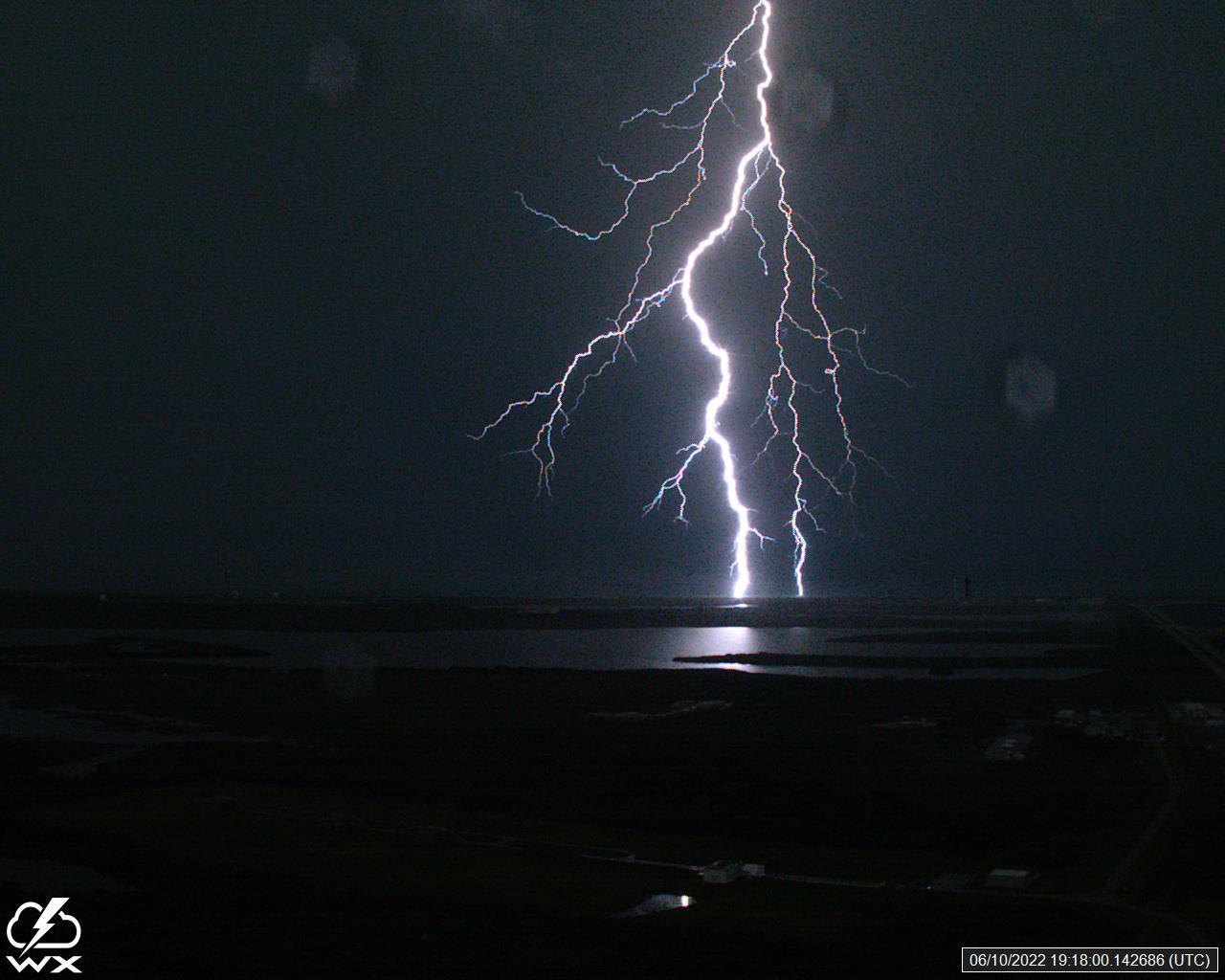
A lightning strike was recorded at Launch Complex 39B at NASA’s Kennedy Space Center in Florida on June 10, 2022. NASA’s Space Launch System (SLS) and Orion spacecraft atop the mobile launcher are on the launch pad in preparation for the Artemis I mission. The lightning strike was recorded by cameras stationed at the pad and mobile launcher using a special filter called a “clear day frame,” which provides an overlay of the raw frame on a reference image. Artemis I will be the first integrated test of the SLS and Orion spacecraft. In later missions, NASA will land the first woman and the first woman of color on the surface of the Moon, paving the way for a long-term lunar presence and serving as a steppingstone on the way to Mars.
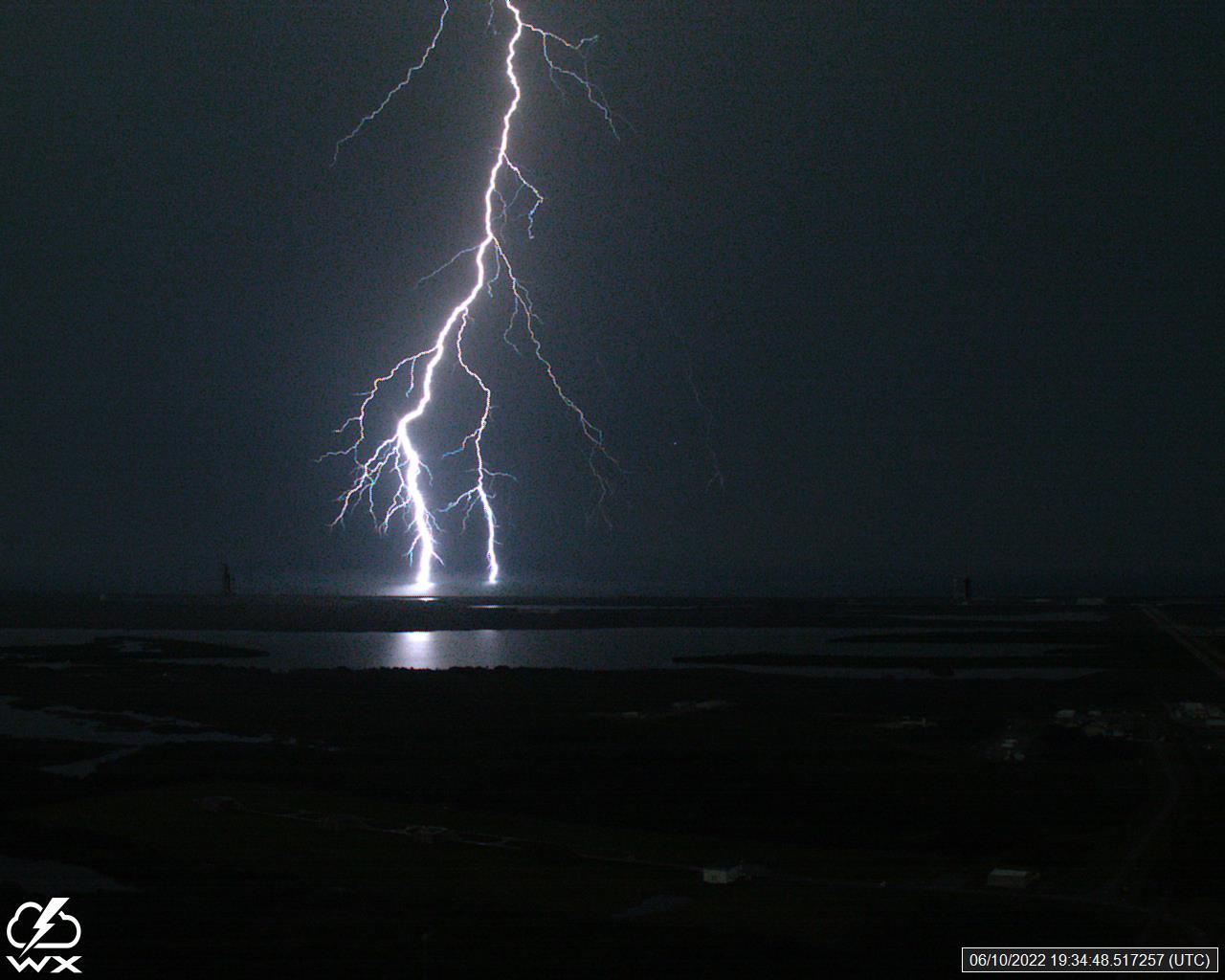
A lightning strike was recorded at Launch Complex 39B at NASA’s Kennedy Space Center in Florida on June 10, 2022. NASA’s Space Launch System (SLS) and Orion spacecraft atop the mobile launcher are on the launch pad in preparation for the Artemis I mission. The lightning strike was recorded by cameras stationed at the pad and mobile launcher using a special filter called a “clear day frame,” which provides an overlay of the raw frame on a reference image. Artemis I will be the first integrated test of the SLS and Orion spacecraft. In later missions, NASA will land the first woman and the first woman of color on the surface of the Moon, paving the way for a long-term lunar presence and serving as a steppingstone on the way to Mars.
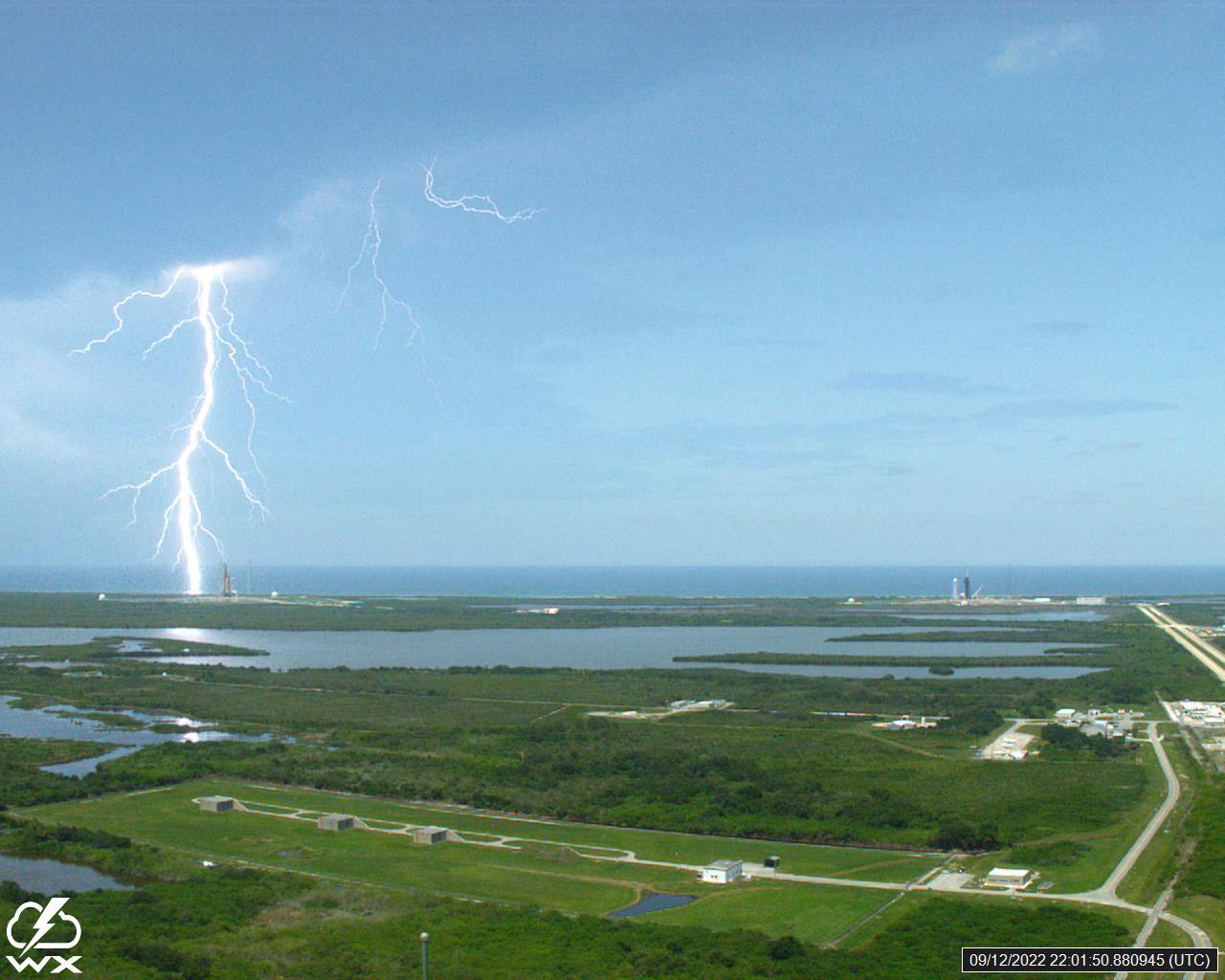
A lightning strike was recorded at Launch Complex 39B at NASA’s Kennedy Space Center in Florida on Sept. 12, 2022. NASA’s Space Launch System (SLS) and Orion spacecraft atop the mobile launcher are on the launch pad in preparation for the Artemis I mission. The lightning strike was recorded by cameras stationed at the pad and mobile launcher using a special filter called a “clear day frame,” which provides an overlay of the raw frame on a reference image. Artemis I will be the first integrated test of the SLS and Orion spacecraft. In later missions, NASA will land the first woman and the first woman of color on the surface of the Moon, paving the way for a long-term lunar presence and serving as a steppingstone on the way to Mars.
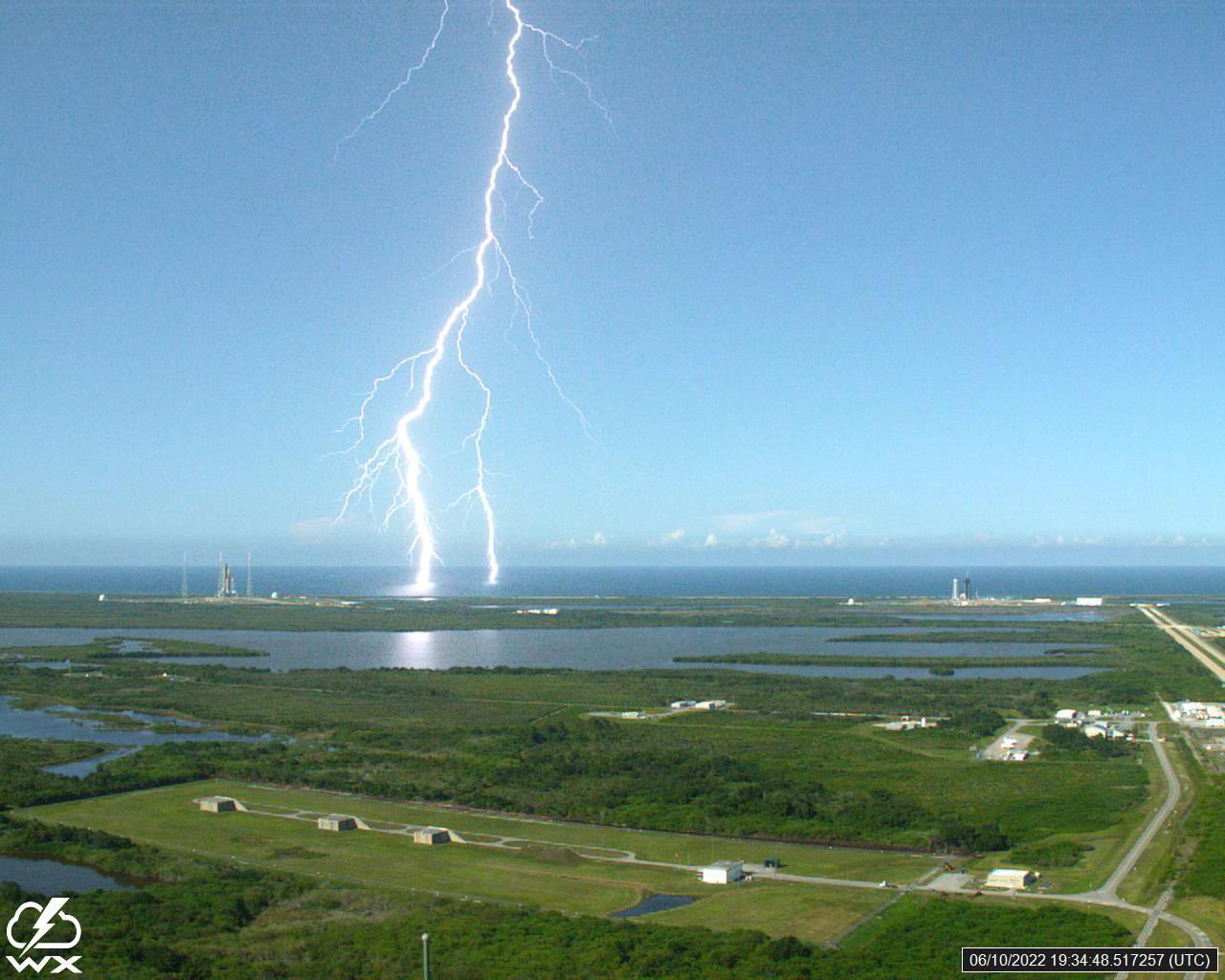
A lightning strike was recorded at Launch Complex 39B at NASA’s Kennedy Space Center in Florida on June 10, 2022. NASA’s Space Launch System (SLS) and Orion spacecraft atop the mobile launcher are on the launch pad in preparation for the Artemis I mission. The lightning strike was recorded by cameras stationed at the pad and mobile launcher using a special filter called a “clear day frame,” which provides an overlay of the raw frame on a reference image. Artemis I will be the first integrated test of the SLS and Orion spacecraft. In later missions, NASA will land the first woman and the first woman of color on the surface of the Moon, paving the way for a long-term lunar presence and serving as a steppingstone on the way to Mars.
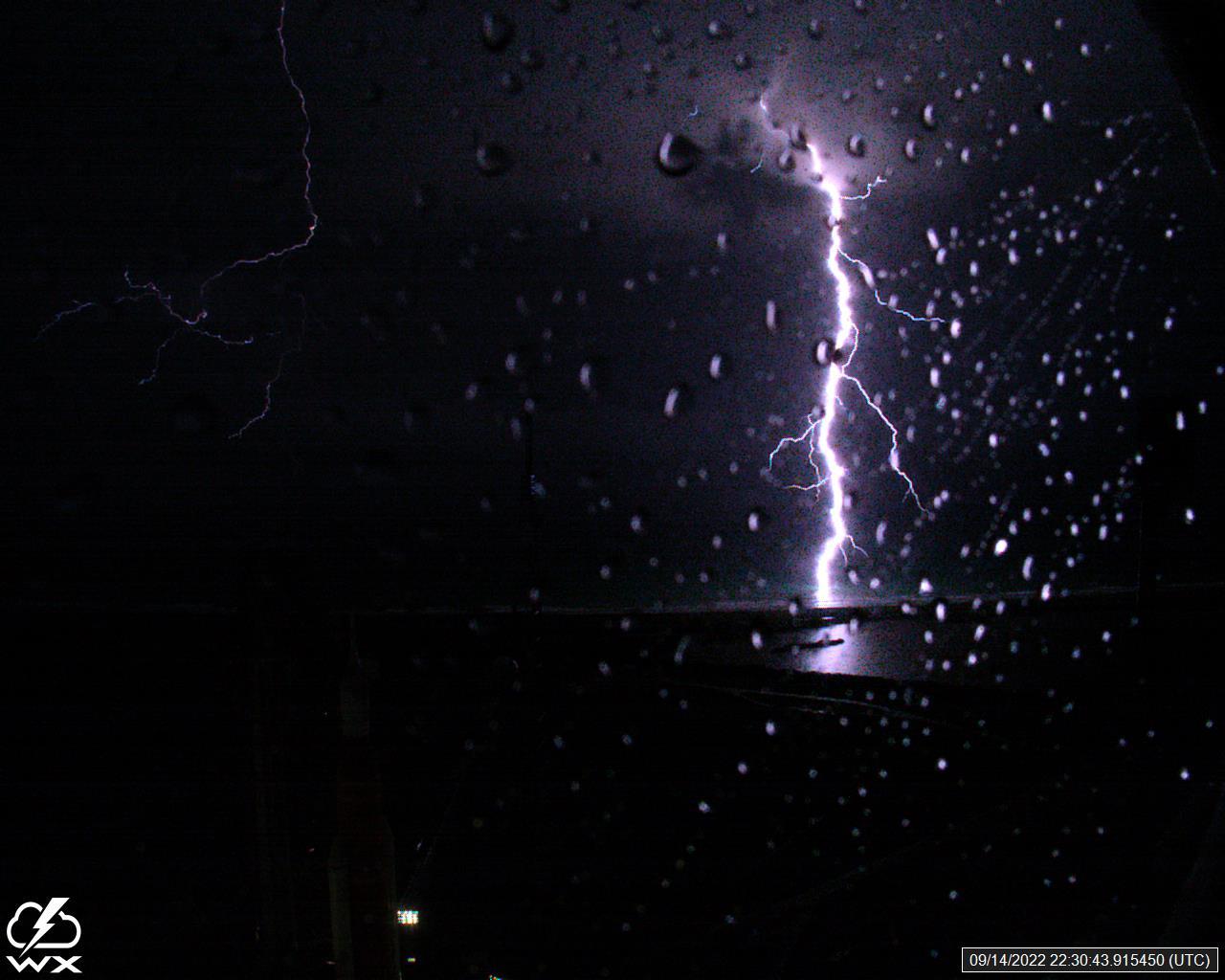
A lightning strike was recorded at Launch Complex 39B at NASA’s Kennedy Space Center in Florida on Sept. 14, 2022. NASA’s Space Launch System (SLS) and Orion spacecraft atop the mobile launcher are on the launch pad in preparation for the Artemis I mission. The lightning strike was recorded by cameras stationed at the pad and mobile launcher using a special filter called a “clear day frame,” which provides an overlay of the raw frame on a reference image. Artemis I will be the first integrated test of the SLS and Orion spacecraft. In later missions, NASA will land the first woman and the first woman of color on the surface of the Moon, paving the way for a long-term lunar presence and serving as a steppingstone on the way to Mars.

A lightning strike was recorded at Launch Complex 39B at NASA’s Kennedy Space Center in Florida on June 10, 2022. NASA’s Space Launch System (SLS) and Orion spacecraft atop the mobile launcher are on the launch pad in preparation for the Artemis I mission. The lightning strike was recorded by cameras stationed at the pad and mobile launcher using a special filter called a “clear day frame,” which provides an overlay of the raw frame on a reference image. Artemis I will be the first integrated test of the SLS and Orion spacecraft. In later missions, NASA will land the first woman and the first woman of color on the surface of the Moon, paving the way for a long-term lunar presence and serving as a steppingstone on the way to Mars.
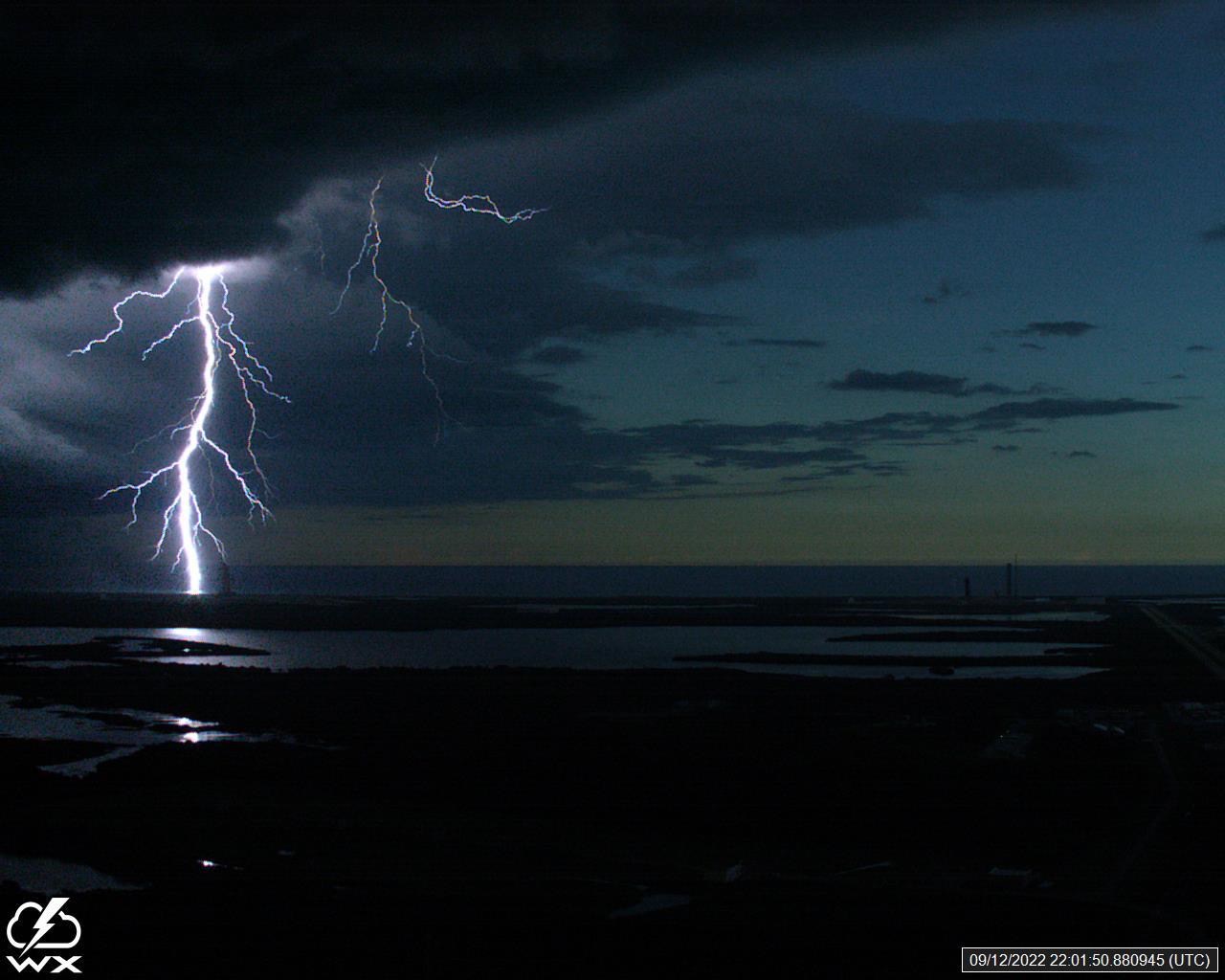
A lightning strike was recorded at Launch Complex 39B at NASA’s Kennedy Space Center in Florida on Sept. 12, 2022. NASA’s Space Launch System (SLS) and Orion spacecraft atop the mobile launcher are on the launch pad in preparation for the Artemis I mission. The lightning strike was recorded by cameras stationed at the pad and mobile launcher using a special filter called a “clear day frame,” which provides an overlay of the raw frame on a reference image. Artemis I will be the first integrated test of the SLS and Orion spacecraft. In later missions, NASA will land the first woman and the first woman of color on the surface of the Moon, paving the way for a long-term lunar presence and serving as a steppingstone on the way to Mars.
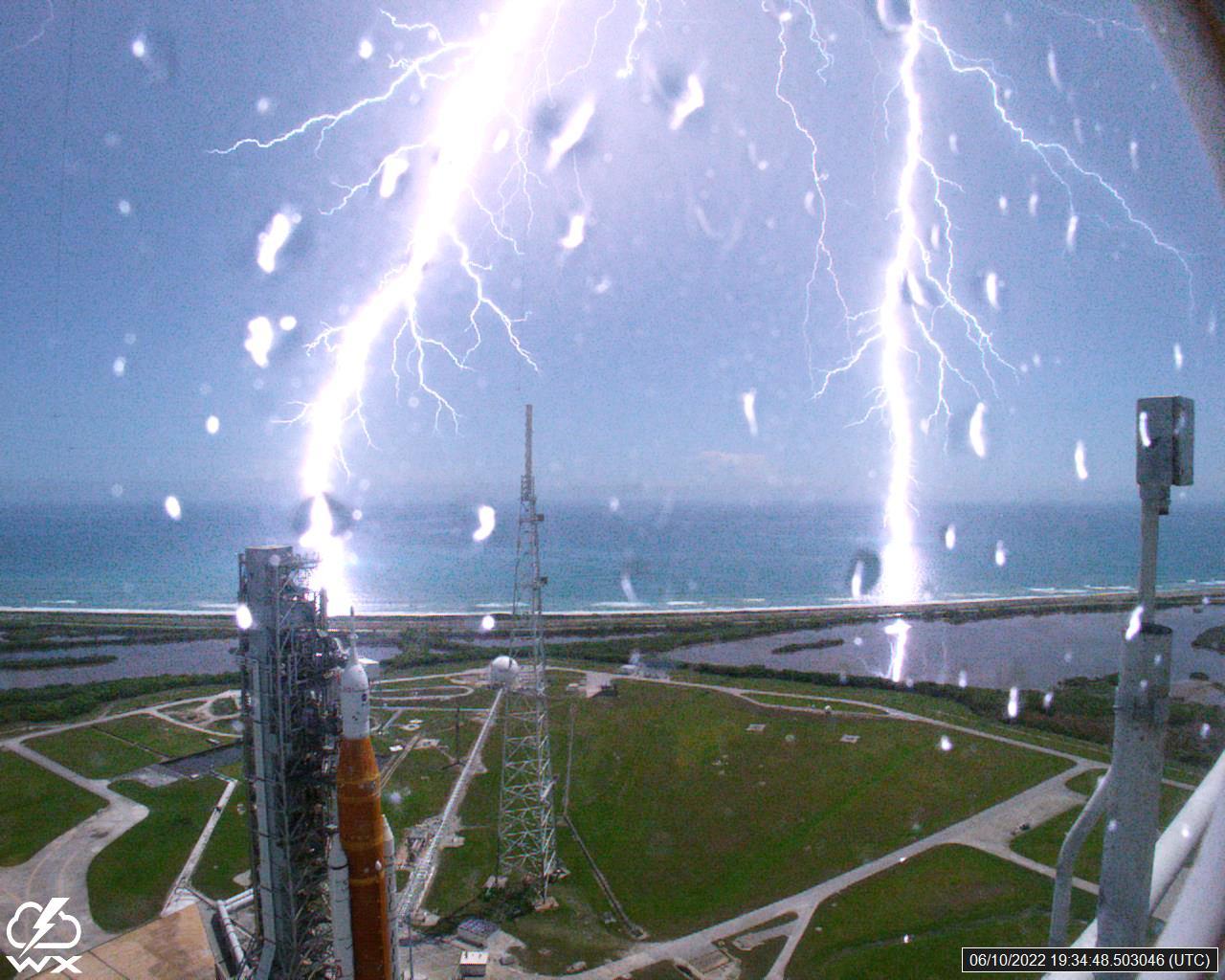
Lightning strikes were recorded at Launch Complex 39B at NASA’s Kennedy Space Center in Florida on June 10, 2022. NASA’s Space Launch System (SLS) and Orion spacecraft atop the mobile launcher are in view on the launch pad in preparation for the Artemis I mission. The lightning strike was recorded by cameras stationed at the pad and mobile launcher using a special filter called a “clear day frame,” which provides an overlay of the raw frame on a reference image. Artemis I will be the first integrated test of the SLS and Orion spacecraft. In later missions, NASA will land the first woman and the first woman of color on the surface of the Moon, paving the way for a long-term lunar presence and serving as a steppingstone on the way to Mars.
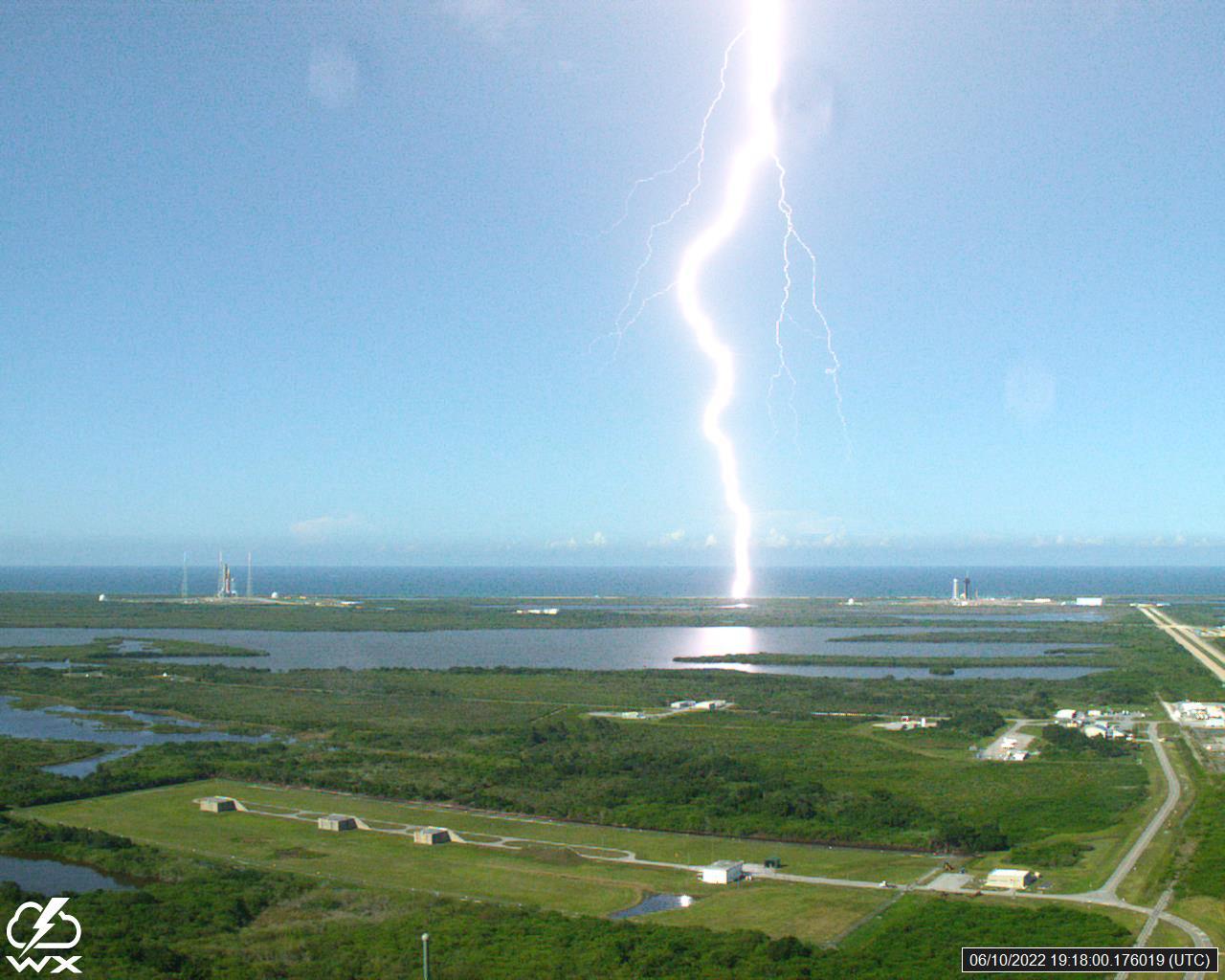
A lightning strike was recorded at Launch Complex 39B at NASA’s Kennedy Space Center in Florida on June 10, 2022. NASA’s Space Launch System (SLS) and Orion spacecraft atop the mobile launcher are on the launch pad in preparation for the Artemis I mission. The lightning strike was recorded by cameras stationed at the pad and mobile launcher using a special filter called a “clear day frame,” which provides an overlay of the raw frame on a reference image. Artemis I will be the first integrated test of the SLS and Orion spacecraft. In later missions, NASA will land the first woman and the first woman of color on the surface of the Moon, paving the way for a long-term lunar presence and serving as a steppingstone on the way to Mars.
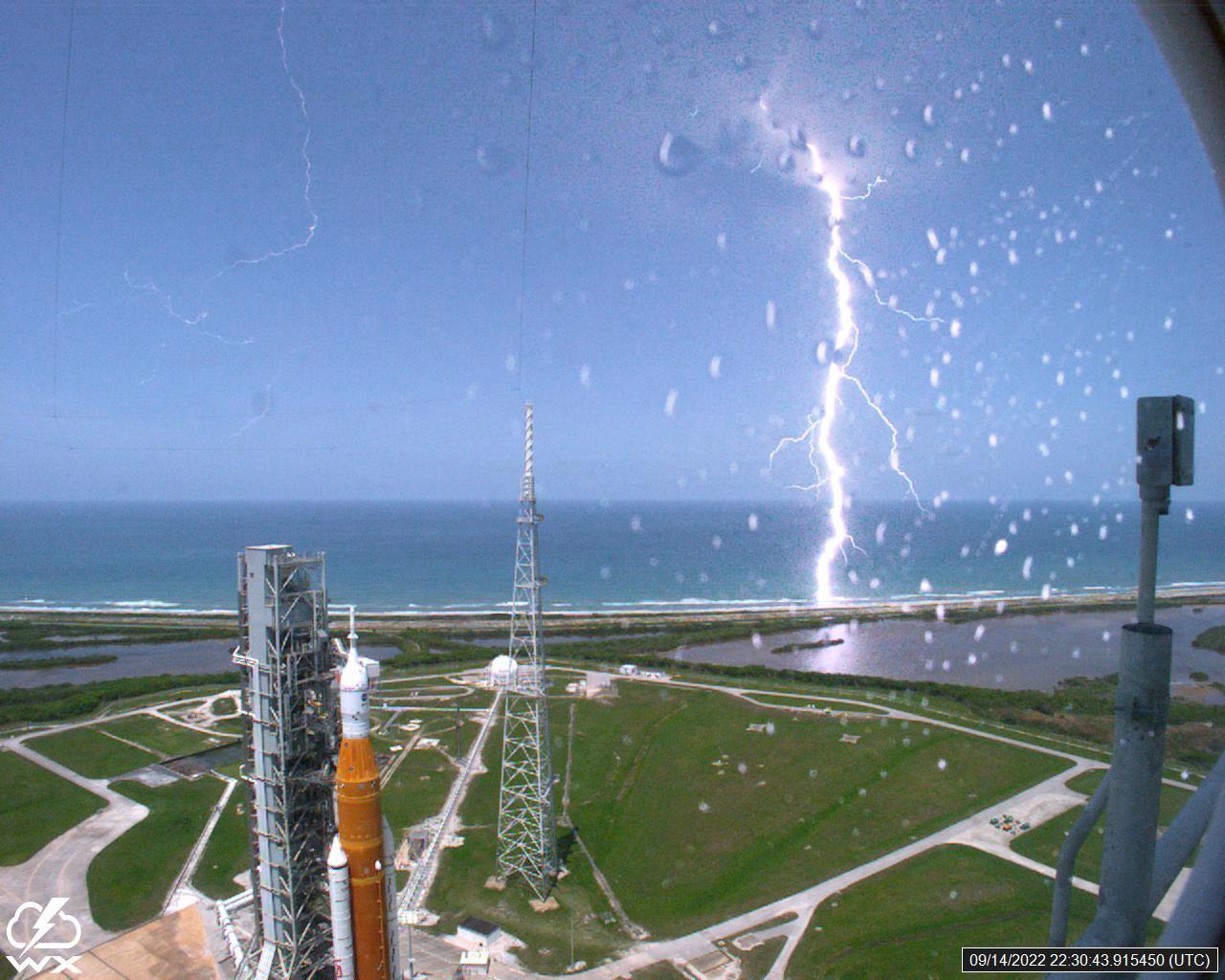
A lightning strike was recorded at Launch Complex 39B at NASA’s Kennedy Space Center in Florida on Sept. 14, 2022. NASA’s Space Launch System (SLS) and Orion spacecraft atop the mobile launcher are in view on the launch pad in preparation for the Artemis I mission. The lightning strike was recorded by cameras stationed at the pad and mobile launcher using a special filter called a “clear day frame,” which provides an overlay of the raw frame on a reference image. Artemis I will be the first integrated test of the SLS and Orion spacecraft. In later missions, NASA will land the first woman and the first woman of color on the surface of the Moon, paving the way for a long-term lunar presence and serving as a steppingstone on the way to Mars.
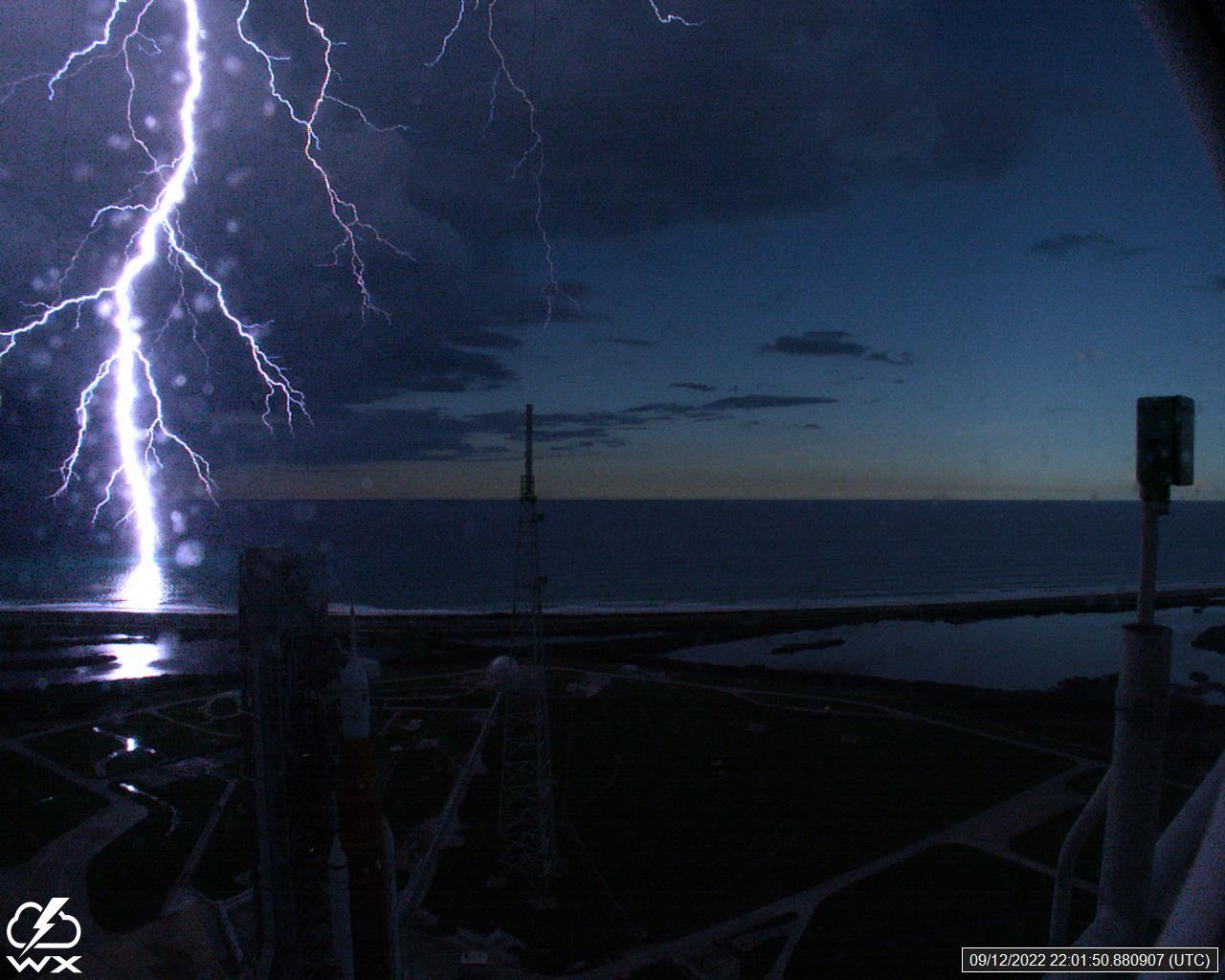
A lightning strike was recorded at Launch Complex 39B at NASA’s Kennedy Space Center in Florida on Sept. 12, 2022. NASA’s Space Launch System (SLS) and Orion spacecraft atop the mobile launcher are on the launch pad in preparation for the Artemis I mission. The lightning strike was recorded by cameras stationed at the pad and mobile launcher using a special filter called a “clear day frame,” which provides an overlay of the raw frame on a reference image. Artemis I will be the first integrated test of the SLS and Orion spacecraft. In later missions, NASA will land the first woman and the first woman of color on the surface of the Moon, paving the way for a long-term lunar presence and serving as a steppingstone on the way to Mars.
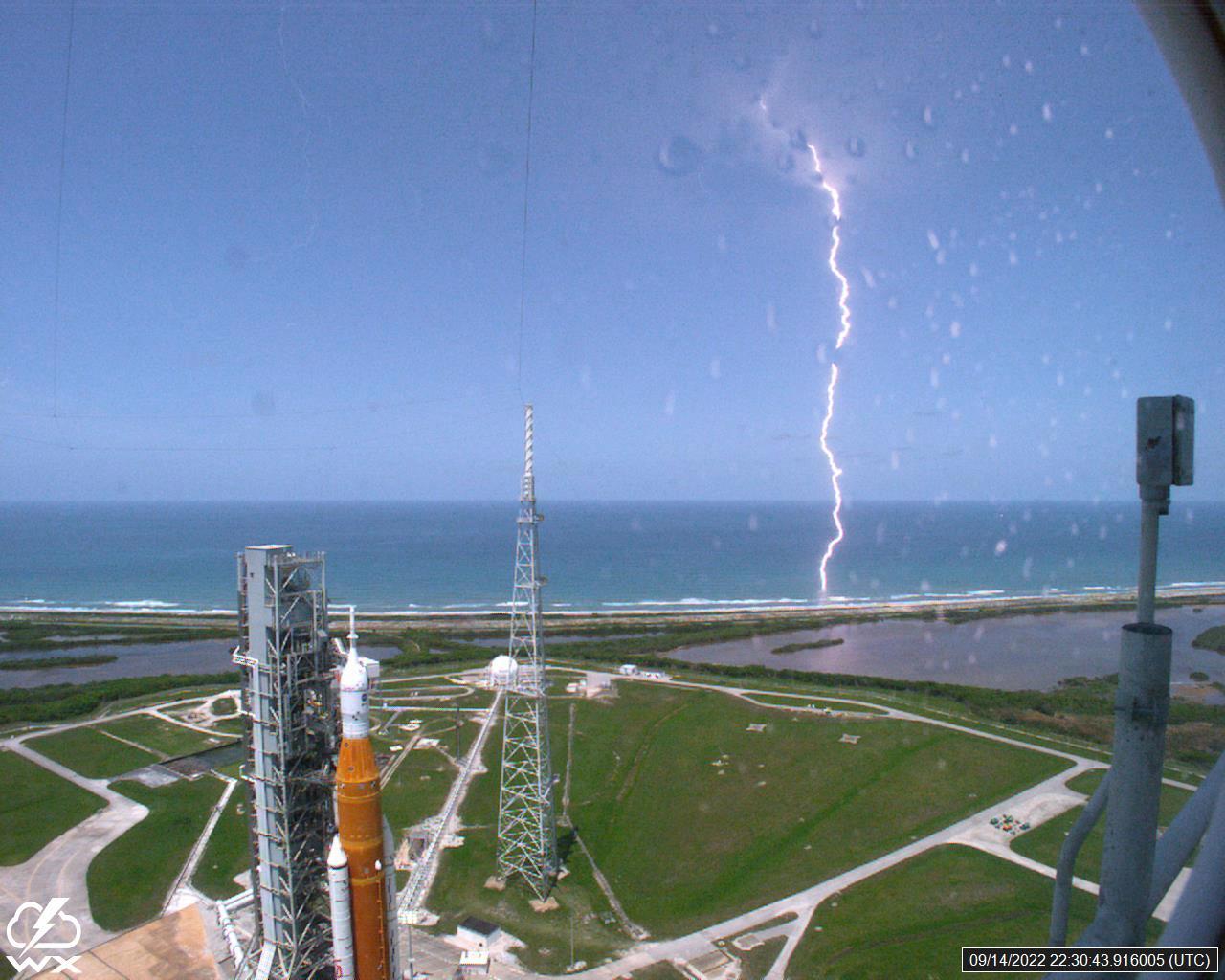
A lightning strike was recorded at Launch Complex 39B at NASA’s Kennedy Space Center in Florida on Sept. 14, 2022. NASA’s Space Launch System (SLS) and Orion spacecraft atop the mobile launcher are in view on the launch pad in preparation for the Artemis I mission. The lightning strike was recorded by cameras stationed at the pad and mobile launcher using a special filter called a “clear day frame,” which provides an overlay of the raw frame on a reference image. Artemis I will be the first integrated test of the SLS and Orion spacecraft. In later missions, NASA will land the first woman and the first woman of color on the surface of the Moon, paving the way for a long-term lunar presence and serving as a steppingstone on the way to Mars.
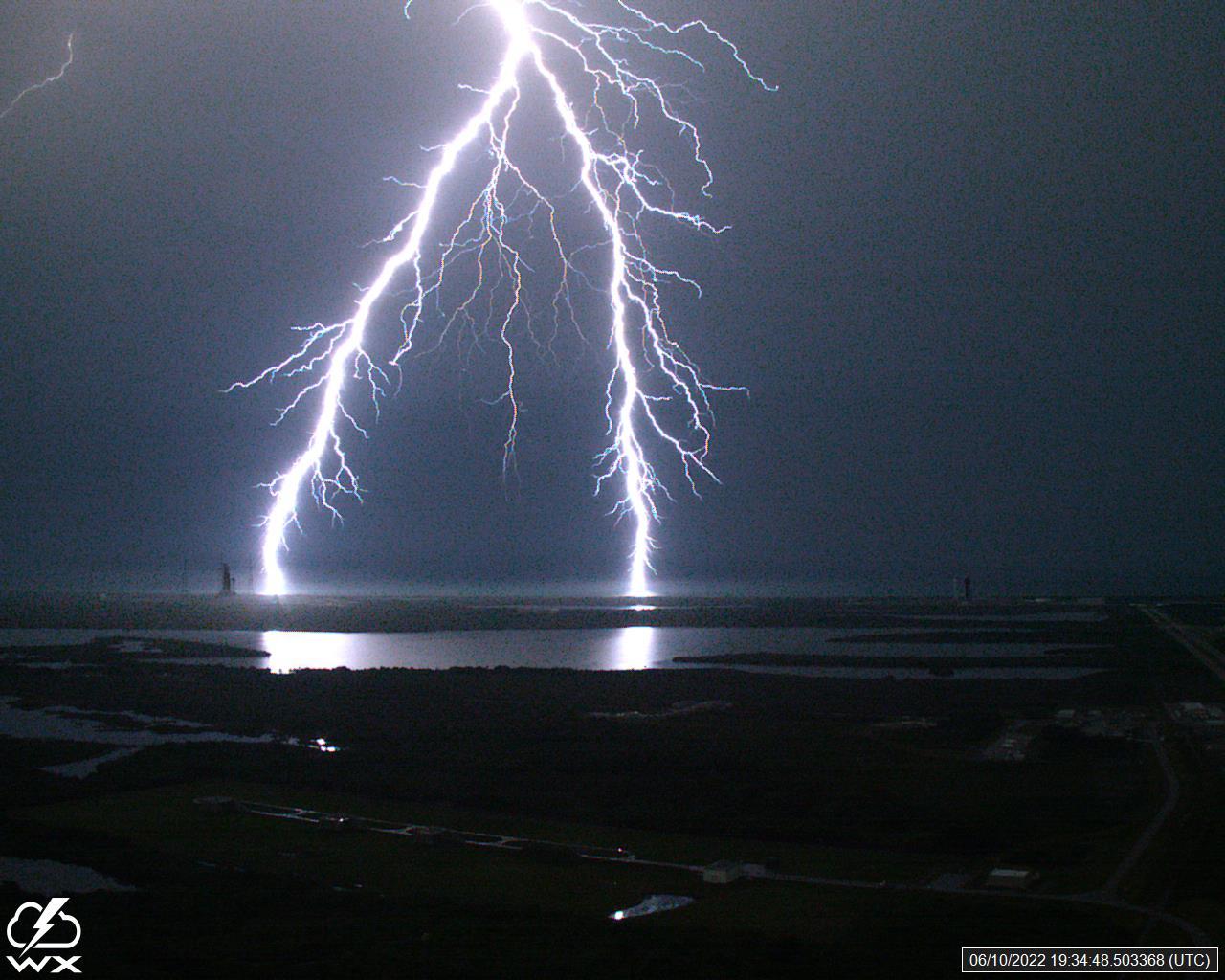
A lightning strike was recorded at Launch Complex 39B at NASA’s Kennedy Space Center in Florida on June 10, 2022. NASA’s Space Launch System (SLS) and Orion spacecraft atop the mobile launcher are on the launch pad in preparation for the Artemis I mission. The lightning strike was recorded by cameras stationed at the pad and mobile launcher using a special filter called a “clear day frame,” which provides an overlay of the raw frame on a reference image. Artemis I will be the first integrated test of the SLS and Orion spacecraft. In later missions, NASA will land the first woman and the first woman of color on the surface of the Moon, paving the way for a long-term lunar presence and serving as a steppingstone on the way to Mars.
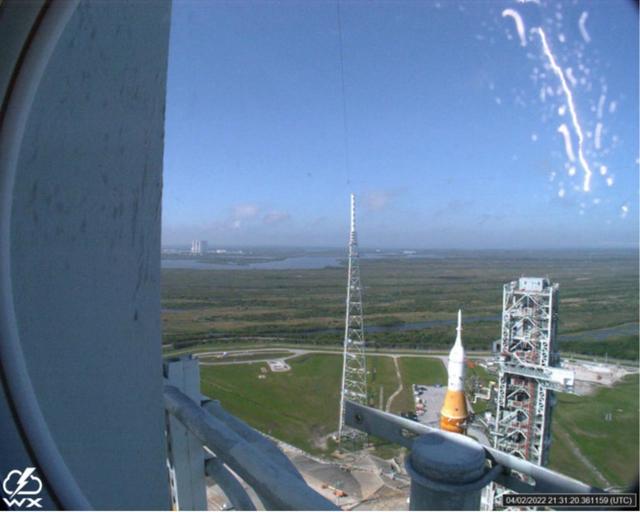
A lightning strike was recorded at Launch Complex 39B at NASA’s Kennedy Space Center in Florida during the evening of April 2, 2022. NASA’s Space Launch System (SLS) and Orion spacecraft were undergoing a prelaunch test called a wet dress rehearsal at the pad for the Artemis I mission. The lightning strike was recorded by cameras stationed at the pad and mobile launcher using a special filter called a “clear day frame,” which provides an overlay of the raw frame on a reference image. Artemis I will be the first integrated test of the SLS and Orion spacecraft. In later missions, NASA will land the first woman and the first woman of color on the surface of the Moon, paving the way for a long-term lunar presence and serving as a steppingstone on the way to Mars.
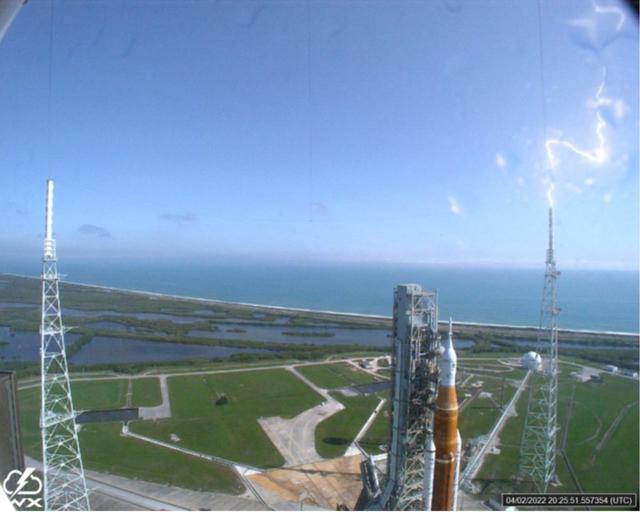
A lightning strike was recorded at Launch Complex 39B at NASA’s Kennedy Space Center in Florida during the evening of April 2, 2022. NASA’s Space Launch System (SLS) and Orion spacecraft were undergoing a prelaunch test called a wet dress rehearsal at the pad for the Artemis I mission. The lightning strike was recorded by cameras stationed at the pad and mobile launcher using a special filter called a “clear day frame,” which provides an overlay of the raw frame on a reference image. Artemis I will be the first integrated test of the SLS and Orion spacecraft. In later missions, NASA will land the first woman and the first woman of color on the surface of the Moon, paving the way for a long-term lunar presence and serving as a steppingstone on the way to Mars.
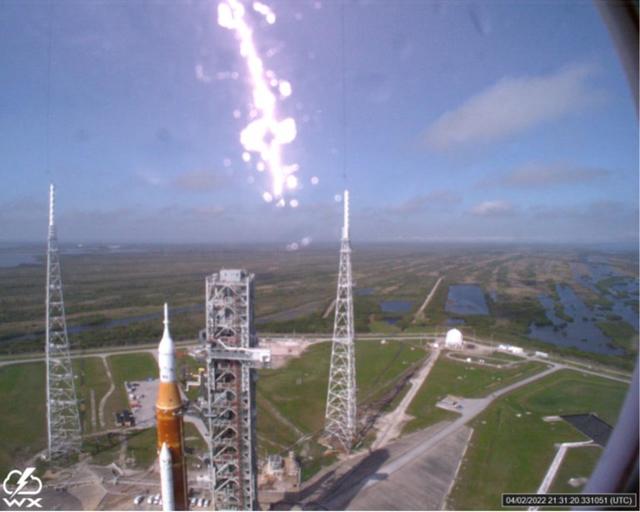
A lightning strike was recorded at Launch Complex 39B at NASA’s Kennedy Space Center in Florida during the evening of April 2, 2022. NASA’s Space Launch System (SLS) and Orion spacecraft were undergoing a prelaunch test called a wet dress rehearsal at the pad for the Artemis I mission. The lightning strike was recorded by cameras stationed at the pad and mobile launcher using a special filter called a “clear day frame,” which provides an overlay of the raw frame on a reference image. Artemis I will be the first integrated test of the SLS and Orion spacecraft. In later missions, NASA will land the first woman and the first woman of color on the surface of the Moon, paving the way for a long-term lunar presence and serving as a steppingstone on the way to Mars.
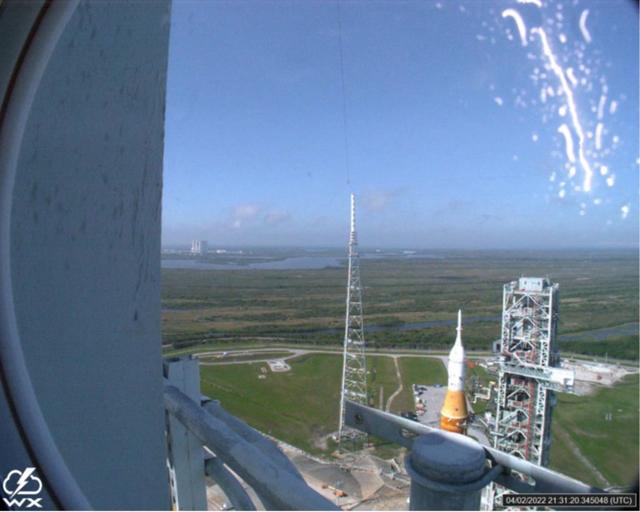
A lightning strike was recorded at Launch Complex 39B at NASA’s Kennedy Space Center in Florida during the evening of April 2, 2022. NASA’s Space Launch System (SLS) and Orion spacecraft were undergoing a prelaunch test called a wet dress rehearsal at the pad for the Artemis I mission. The lightning strike was recorded by cameras stationed at the pad and mobile launcher using a special filter called a “clear day frame,” which provides an overlay of the raw frame on a reference image. Artemis I will be the first integrated test of the SLS and Orion spacecraft. In later missions, NASA will land the first woman and the first woman of color on the surface of the Moon, paving the way for a long-term lunar presence and serving as a steppingstone on the way to Mars.
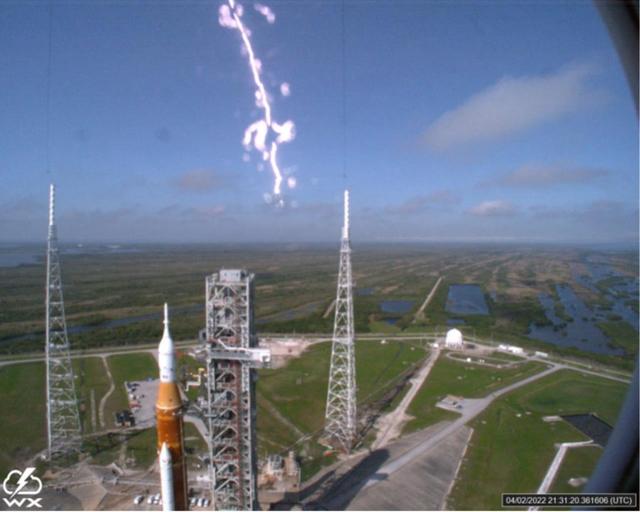
A lightning strike was recorded at Launch Complex 39B at NASA’s Kennedy Space Center in Florida during the evening of April 2, 2022. NASA’s Space Launch System (SLS) and Orion spacecraft were undergoing a prelaunch test called a wet dress rehearsal at the pad for the Artemis I mission. The lightning strike was recorded by cameras stationed at the pad and mobile launcher using a special filter called a “clear day frame,” which provides an overlay of the raw frame on a reference image. Artemis I will be the first integrated test of the SLS and Orion spacecraft. In later missions, NASA will land the first woman and the first woman of color on the surface of the Moon, paving the way for a long-term lunar presence and serving as a steppingstone on the way to Mars.
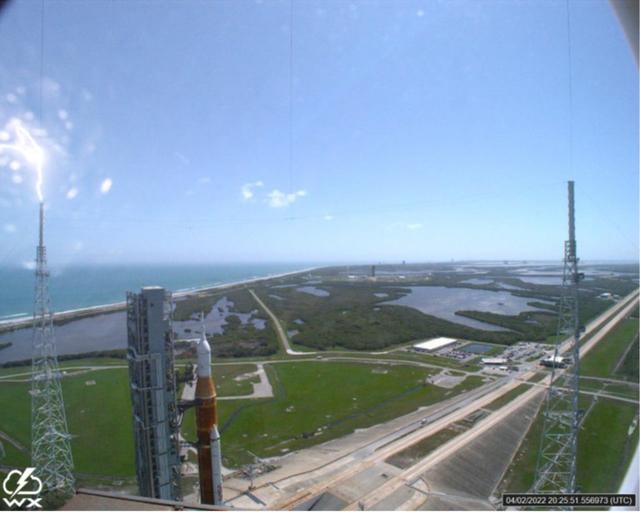
A lightning strike was recorded at Launch Complex 39B at NASA’s Kennedy Space Center in Florida during the evening of April 2, 2022. NASA’s Space Launch System (SLS) and Orion spacecraft were undergoing a prelaunch test called a wet dress rehearsal at the pad for the Artemis I mission. The lightning strike was recorded by cameras stationed at the pad and mobile launcher using a special filter called a “clear day frame,” which provides an overlay of the raw frame on a reference image. Artemis I will be the first integrated test of the SLS and Orion spacecraft. In later missions, NASA will land the first woman and the first woman of color on the surface of the Moon, paving the way for a long-term lunar presence and serving as a steppingstone on the way to Mars.
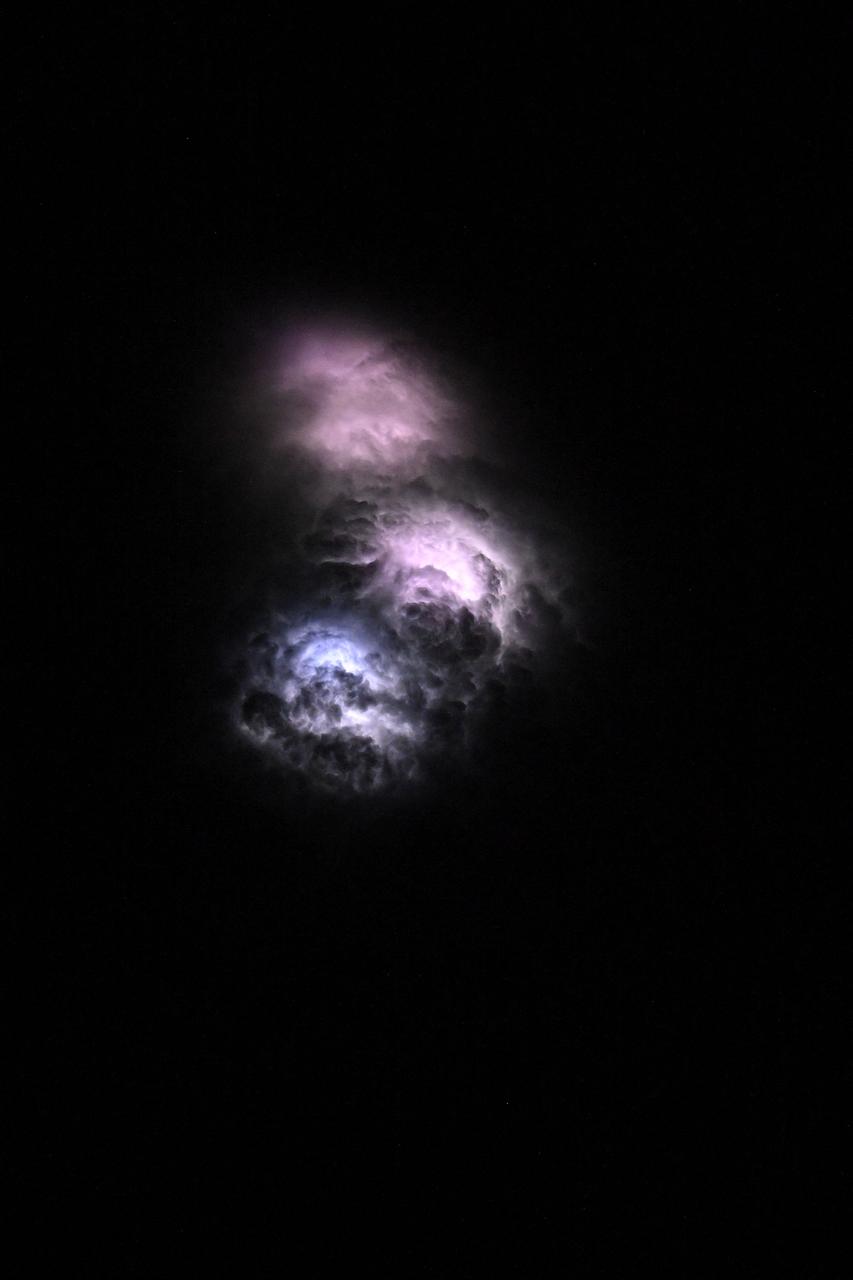
iss073e0566536 (July 28, 2025) --- Lightning strikes illuminate the stormy cloud tops above the Democratic Republic of the Congo in this photograph, taken at approximately 9:58 p.m. local time from the International Space Station as it orbited 259 miles above Earth.
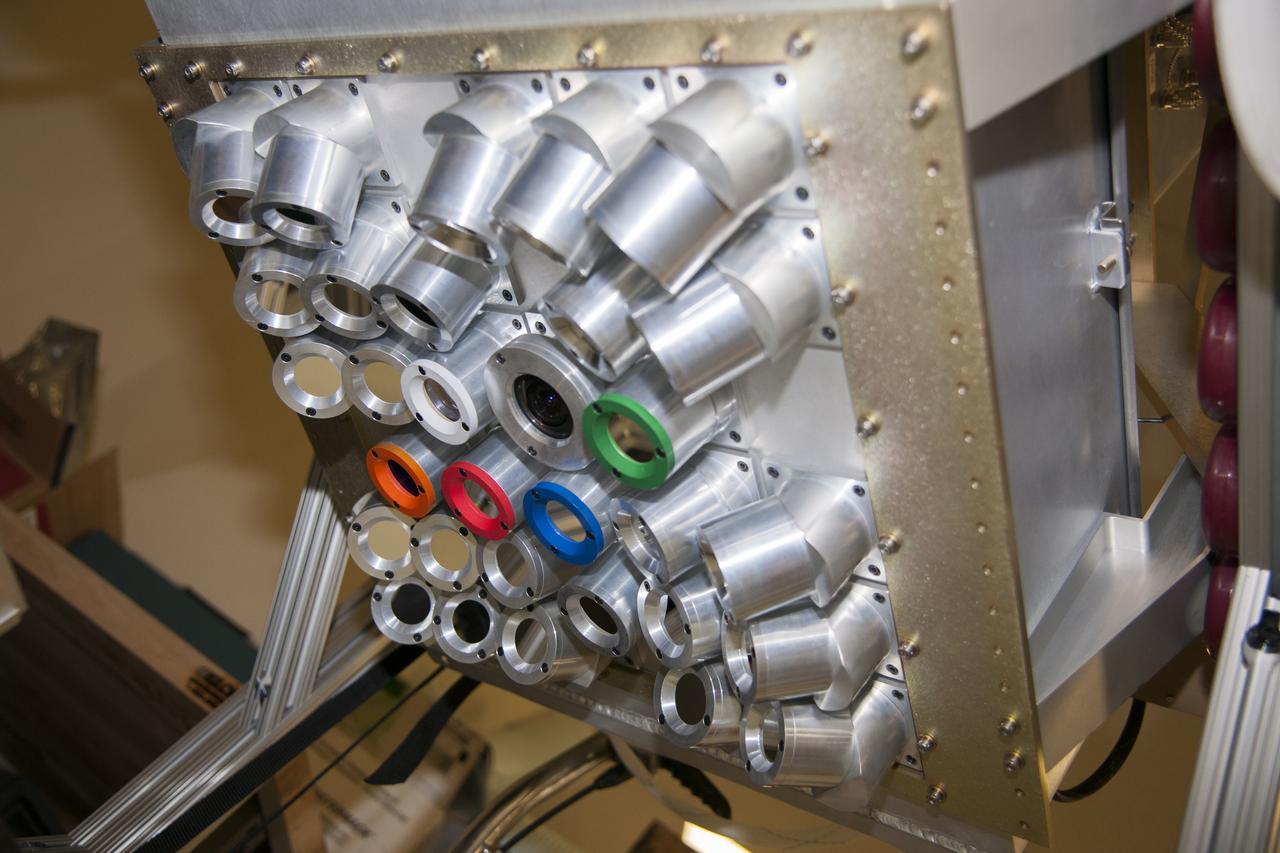
The Fly’s Eye Geostationary Lightning Mapper Simulator will map lightning strikes using 30 photometers, instruments that measure the intensity of light.
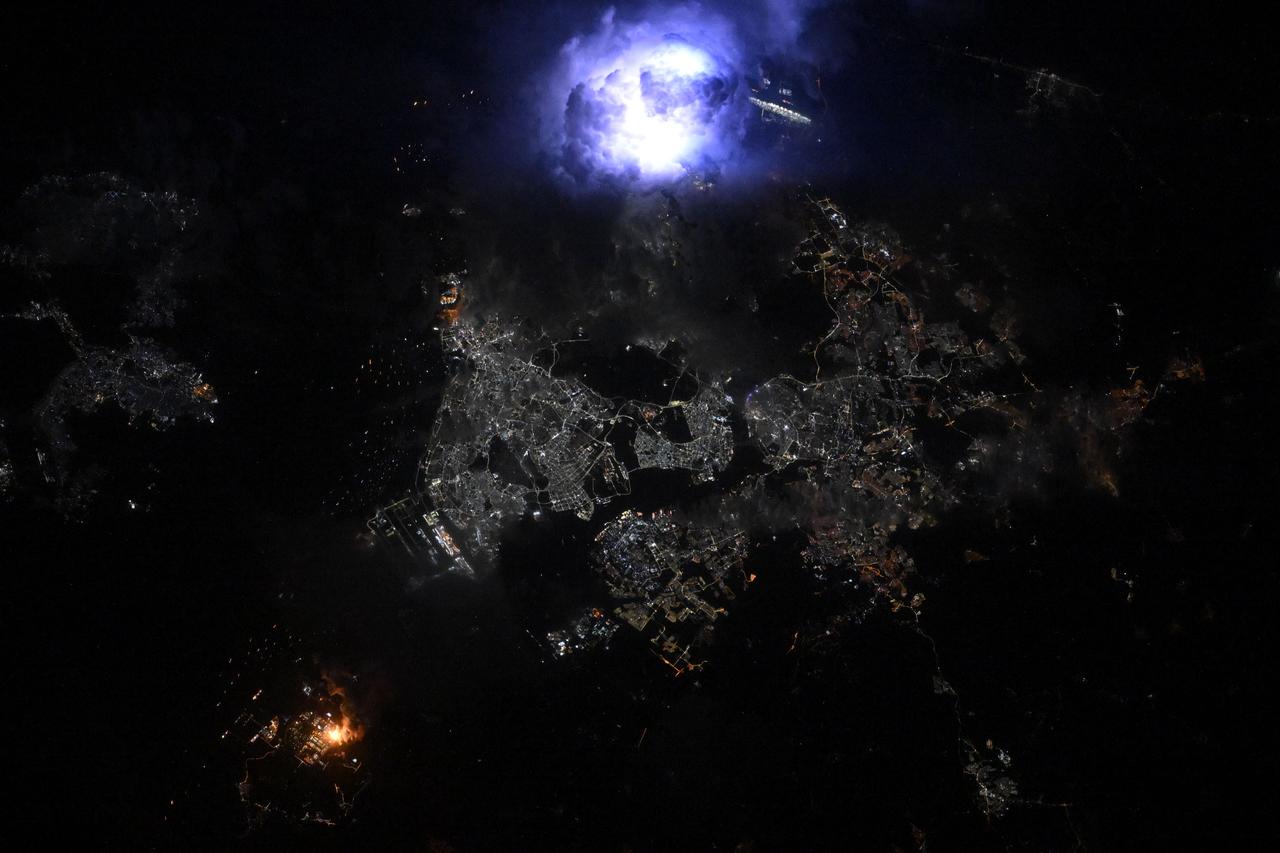
iss073e0300048 (June 15, 2025) --- Lightning (top center) is captured striking and illuminating the clouds during a storm over the Southeast Asian city-state of Singapore separated from the Malaysian city of Johor Bahru by the Johor Strait. Singapore's population is just over 6 million while Johor Bahru's is nearly 860,000. The International Space Station was orbiting 259 miles above the South China Sea at approximately 3:18 a.m. local time when this photograph was taken.
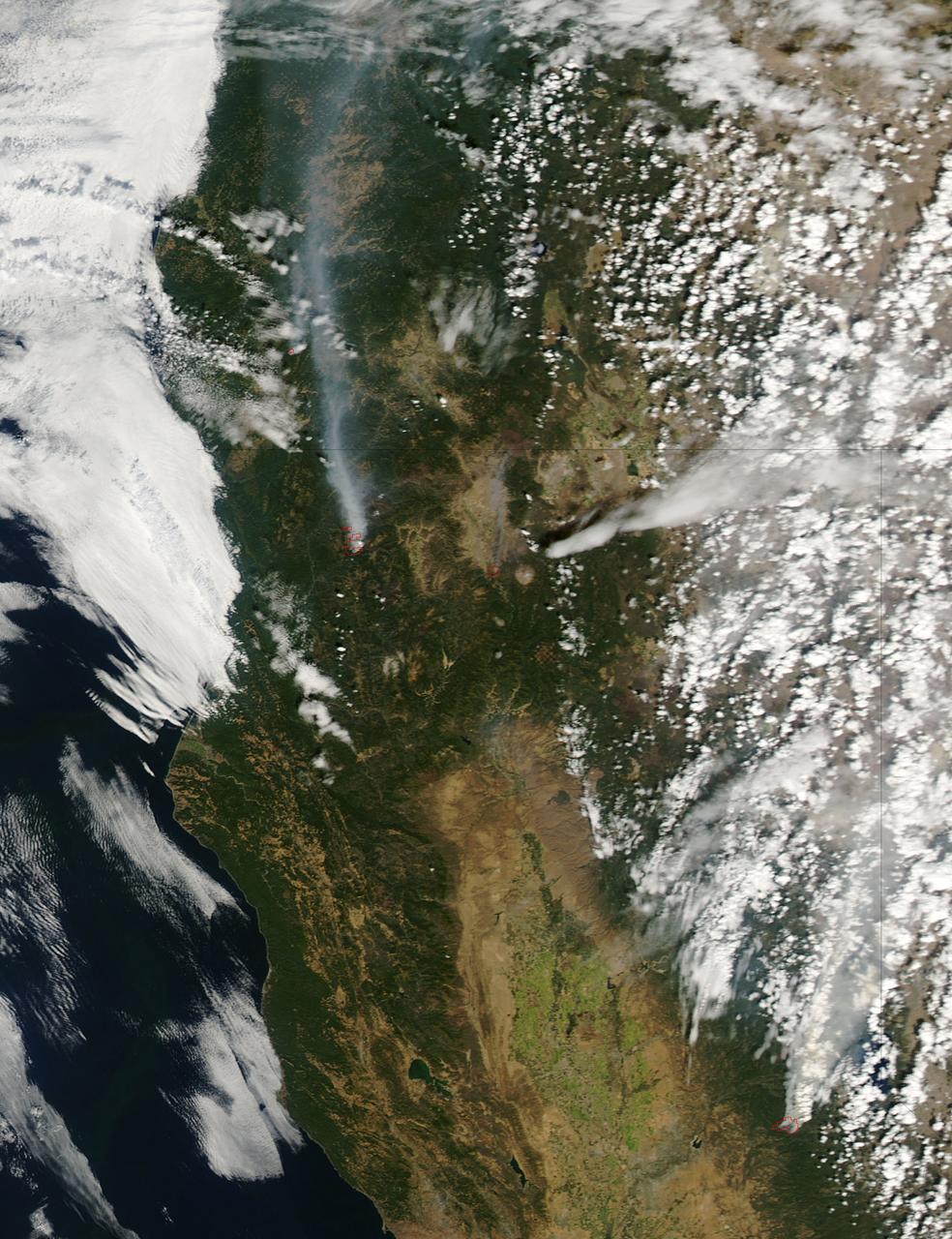
The fire season in California has been anything but cooperative this year. Hot conditions combined with a state-wide drought and dry lightning makes for unpleasant conditions and leads to an abundance of forest fires. On August 12, lightning struck and started the fire that grew into the Happy Camp Complex. Currently over 113,000 acres have been affected and the fire is only 55% contained as of today. Strong winds tested fire lines yesterday (8/15), and are expected to do so again today. Despite the high winds, existing fire lines held with no spotting or expansion outside current containment lines. The south end of the fire continued backing slowly toward Elk Creek in the Marble Mountain Wilderness. The Man Fire joined with the Happy Camp Complex yesterday and will be managed by California Interagency Incident Management Team 4 as of 6:00am on Wednesday, September 17, 2014. Nearby the Happy Camp Complex, near Mt. Shasta and the town of Weed, another fire erupted that fire officials said quickly damaged or destroyed 100 structures Monday (8/15). Hundreds of firefighters were trying to contain that fire. A California Fire spokesman said more than 300 acres were scorched and more than 100 structures damaged or destroyed in just a few hours. The blaze, dubbed the Boles Fire, also led to the closure of Interstate 5 and U.S. 97. Weed is in Siskiyou County, about 50 miles south of the California-Oregon border. With strong winds, the fire was able to rage into the community before firefighters could get equipment to the blaze. About 1,500 to 2,000 residents were being evacuated to the Siskiyou County fairgrounds. An evacuation center was set up at the county fairgrounds in Yreka. NASA's Aqua satellite collected this natural-color image with the Moderate Resolution Imaging Spectroradiometer, MODIS, instrument on September 15, 2014. Actively burning areas, detected by MODIS’s thermal bands, are outlined in red. NASA image courtesy Jeff Schmaltz LANCE/EOSDIS MODIS Rapid Response Team, GSFC. Caption by Lynn Jenner with information from Inciweb and California Department of Forestry and Fire Protection. <b><a href="http://www.nasa.gov/audience/formedia/features/MP_Photo_Guidelines.html" rel="nofollow">NASA image use policy.</a></b> <b><a href="http://www.nasa.gov/centers/goddard/home/index.html" rel="nofollow">NASA Goddard Space Flight Center</a></b> enables NASA’s mission through four scientific endeavors: Earth Science, Heliophysics, Solar System Exploration, and Astrophysics. Goddard plays a leading role in NASA’s accomplishments by contributing compelling scientific knowledge to advance the Agency’s mission. <b>Follow us on <a href="http://twitter.com/NASAGoddardPix" rel="nofollow">Twitter</a></b> <b>Like us on <a href="http://www.facebook.com/pages/Greenbelt-MD/NASA-Goddard/395013845897?ref=tsd" rel="nofollow">Facebook</a></b> <b>Find us on <a href="http://instagram.com/nasagoddard?vm=grid" rel="nofollow">Instagram</a></b>
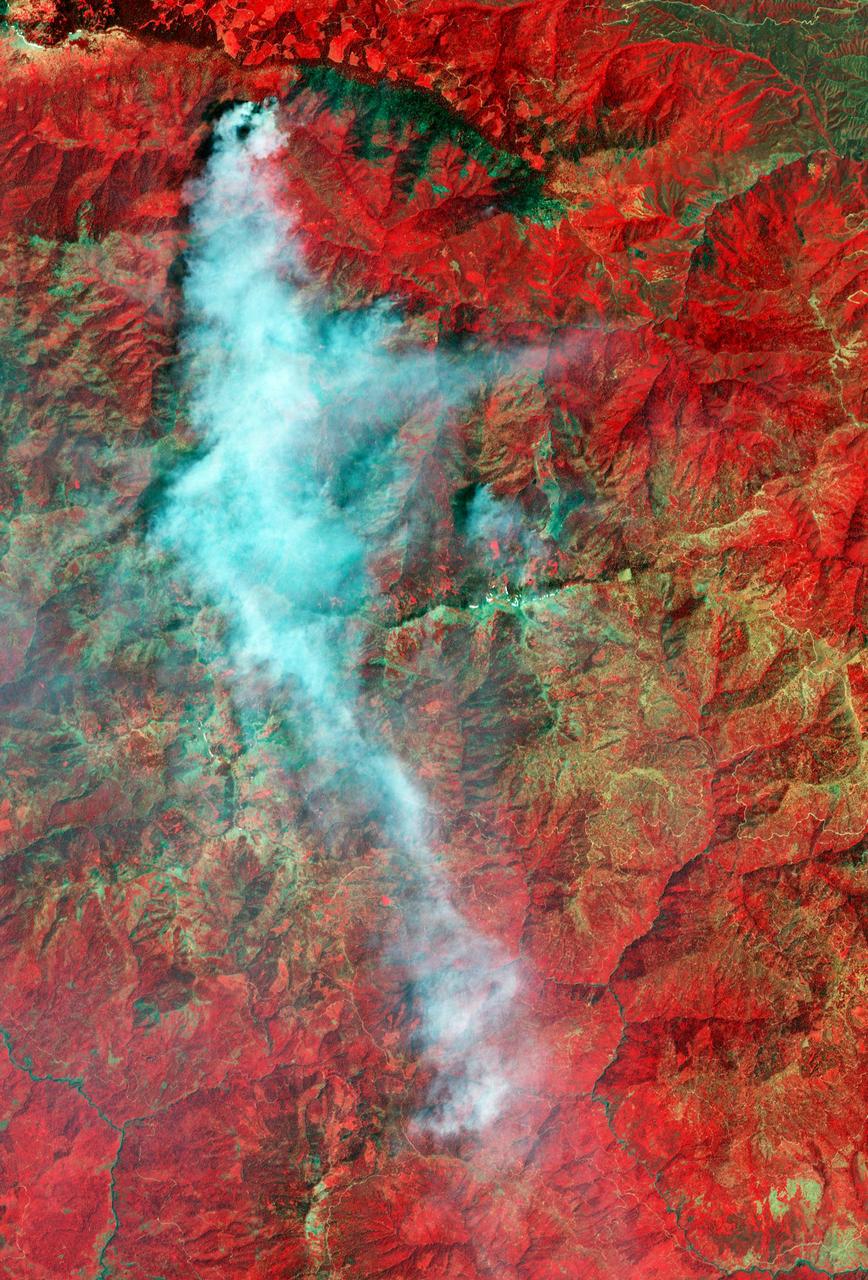
The Yolla Bolly Complex Wildland Fire was started on June 21, 2008 by a lightning strike. This image was acquired by NASA Terra spacecraft.
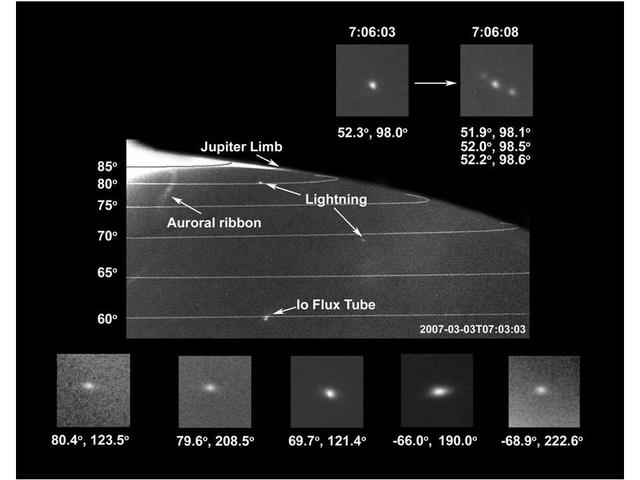
Images taken by the New Horizons Long-Range Reconnaissance Imager LORRI of Jupiter night side showed lightning strikes. Each trike is probably the cumulative brightness of multiple strikes.
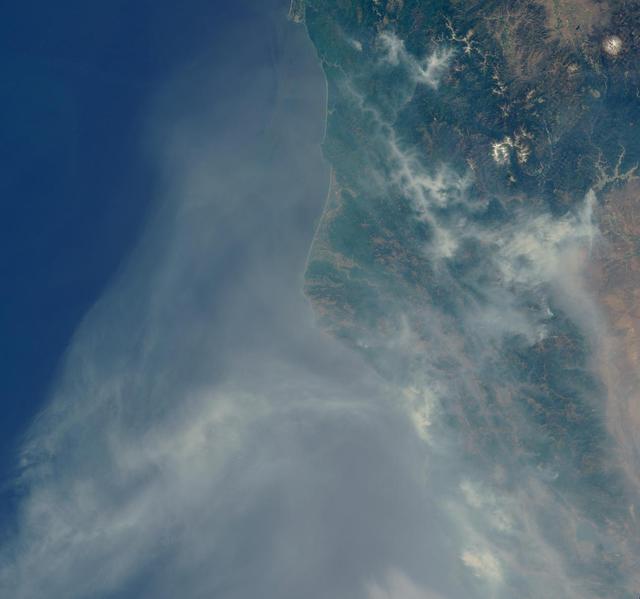
Lightning strikes have sparked more than a thousand fires in northern California. Cape Mendocino is at the center of the image and Mt. Shasta is near the upper right.
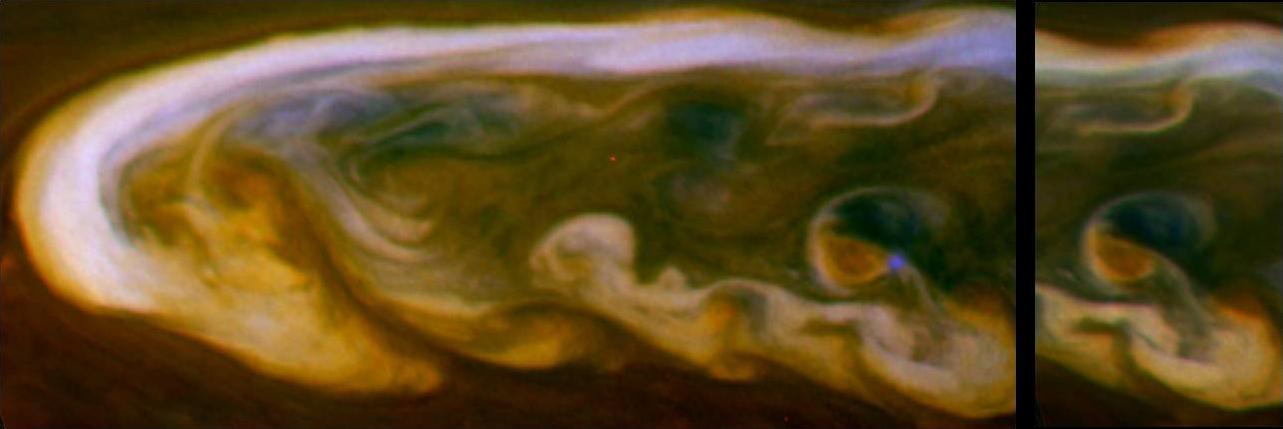
These false-color mosaics from NASA Cassini spacecraft capture lightning striking within the huge storm that encircled Saturn northern hemisphere for much of 2011.

Ignited by lightning strikes during a record-breaking heat wave, the Biscuit Fire became Oregon largest wildfire of the past century. NASA Terra spacecraft acquired these image between mid July and early September 2002.
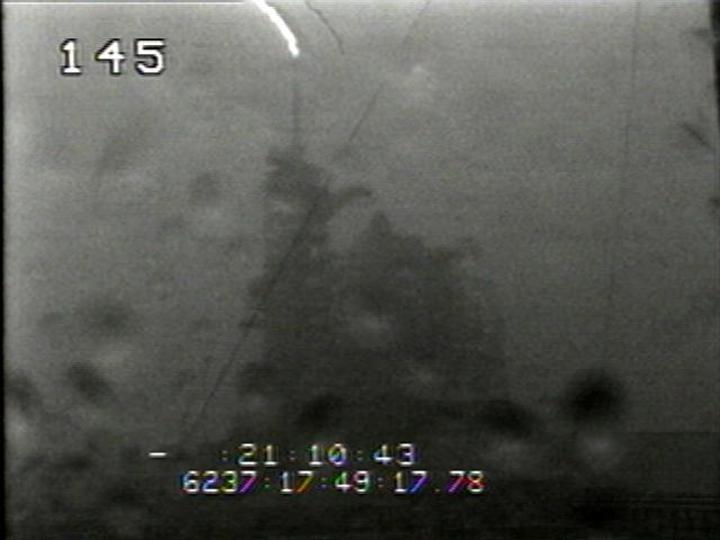
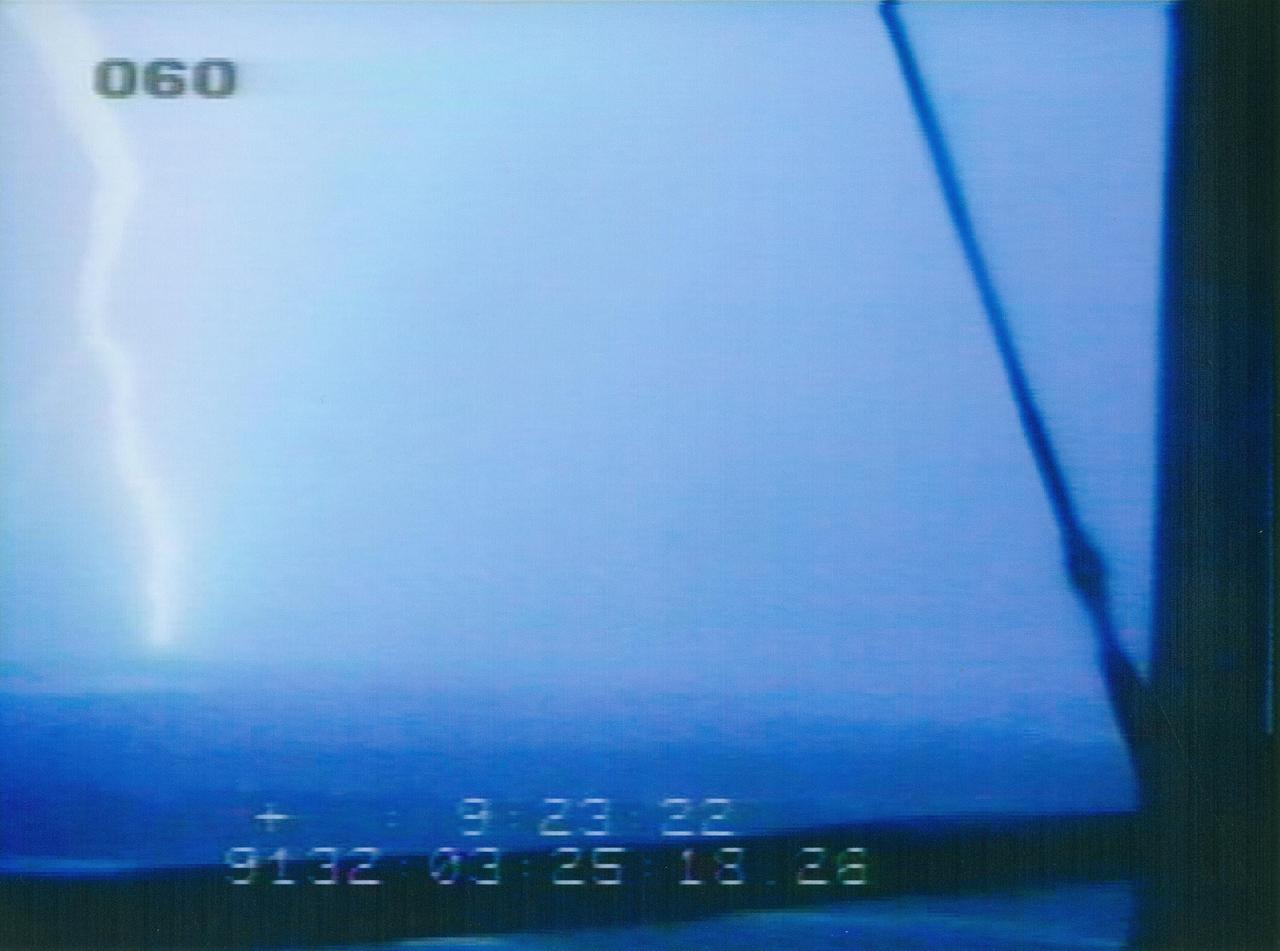
KENNEDY SPACE CENTER, FLA. - A lightning strike occurred at the lightning protection system of Launch Pad 39B on Fri., August 25, 2006, at 1:49:17 p.m. (EST). The lightning strike caused the mission management team to scrub the launch of mission STS-115 for 24 hours in order to review all electrical systems on the space shuttle and the launch pad ground support equipment. Photo credit: NASA/InDyne -Operational Television.
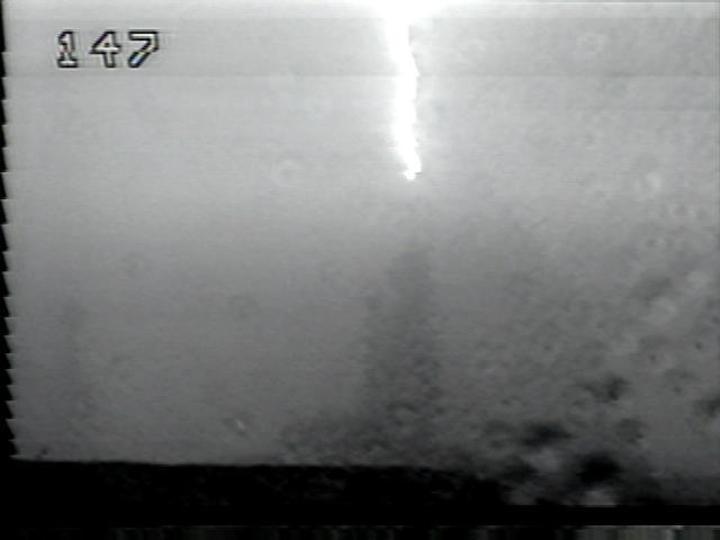
KENNEDY SPACE CENTER, FLA. - A lightning strike occurred at the lightning protection system of Launch Pad 39B on Fri., August 25, 2006, at 1:49:17 p.m. (EST). The lightning strike caused the mission management team to scrub the launch of mission STS-115 for 24 hours in order to review all electrical systems on the space shuttle and the launch pad ground support equipment. Photo credit: NASA/InDyne -Operational Television.
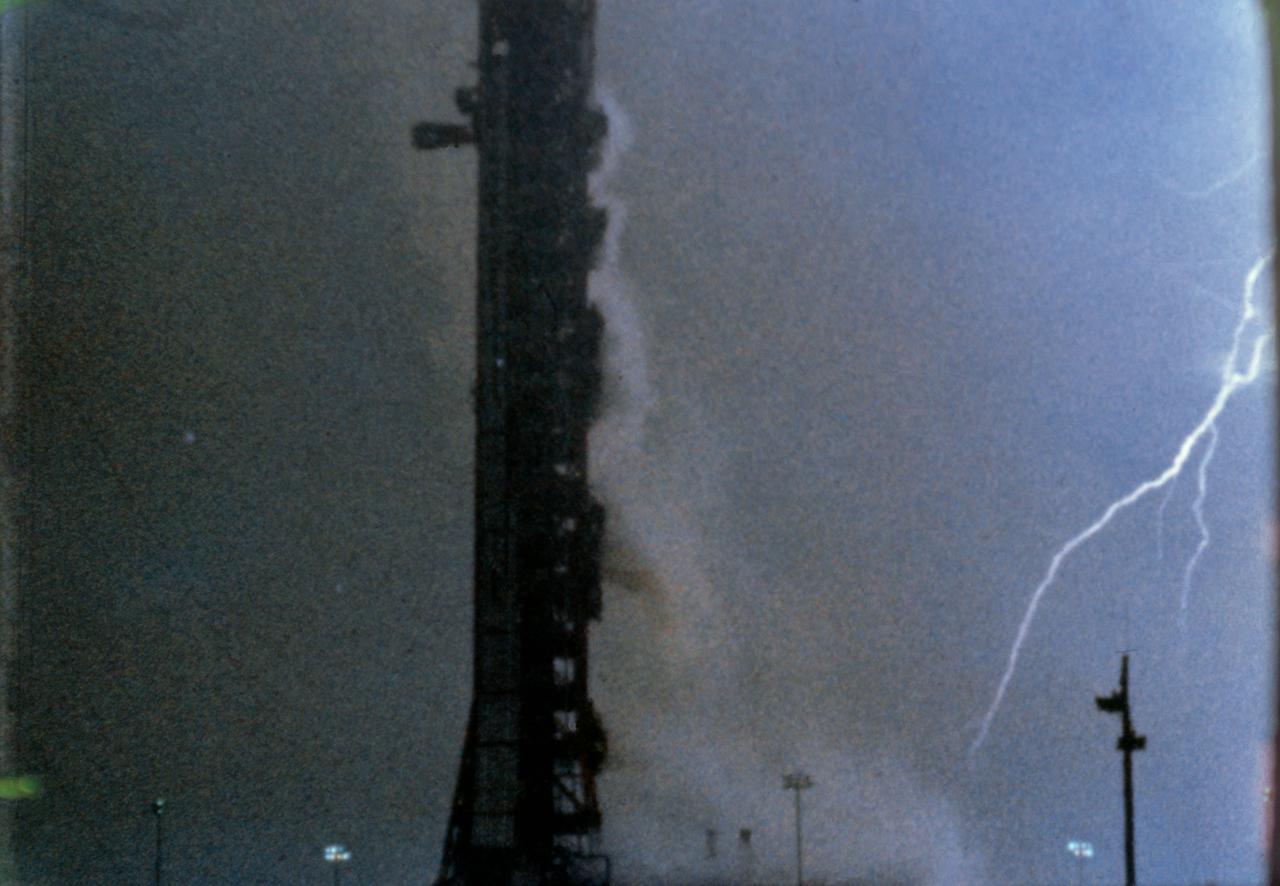
View of lightning striking near Pod 39A during the launch of Apollo XII from 16mm film. 1. APOLLO XII - LAUNCH (LIGHTNING) KENNEDY SPACE CENTER, FL
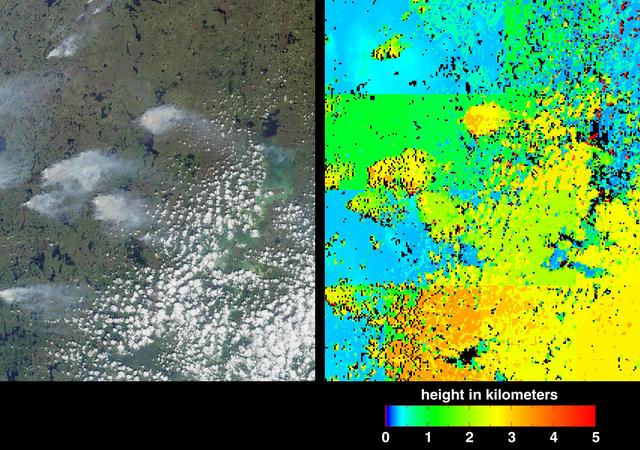
Fire season in Manitoba, Canada lasts from April until October, and numerous smoke plumes caused by lightning strikes are captured in these from views NASA Terra satellite of the northwestern part of the province; data were acquired on June 20, 2001.
CAPE CANAVERAL, Fla. – This photo taken from Launch Pad 39A at NASA's Kennedy Space Center in Florida shows one of two lightning strikes that occurred on May 11 around 11 p.m. within a third of a mile of space shuttle Endeavour on Launch Pad 39B. Engineers and safety personnel evaluated data and performed a walkdown of the pad and determined there is no damage to the vehicle or the pad. The images are from Kennedy's Operational Television cameras which can be used to triangulate the location of lightning strikes. Other detection systems include the Cloud-To-Ground Lightning Surveillance System, Strikenet/National Lightning Detection Network, Lightning Induced Voltage Instrumentation System and the Catenary Wire Lightning Instrumentation System. Endeavour is standing by on the pad, prepared for liftoff in the unlikely event that a rescue mission is necessary during space shuttle Atlantis' STS-125 mission to service NASA's Hubble Space Telescope. Photo credit: NASA
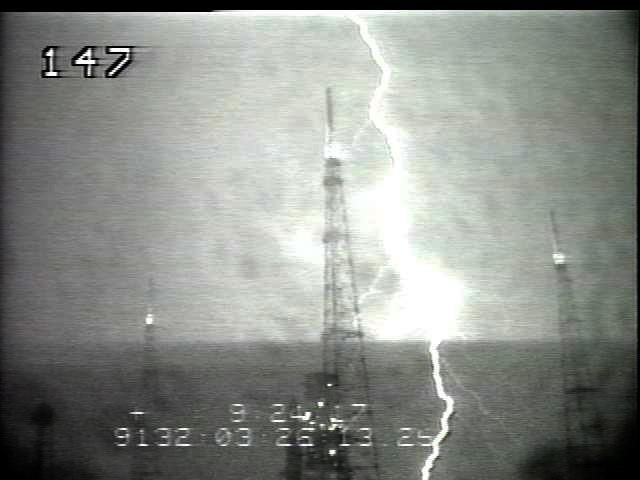
CAPE CANAVERAL, Fla. – This photo shows one of two lightning strikes that occurred on May 11 around 11 p.m. within a third of a mile of space shuttle Endeavour on Launch Pad 39B at NASA's Kennedy Space Center in Florida. Engineers and safety personnel evaluated data and performed a walkdown of the pad and determined there is no damage to the vehicle or the pad. The images are from Kennedy's Operational Television cameras which can be used to triangulate the location of lightning strikes. Other detection systems include the Cloud-To-Ground Lightning Surveillance System, Strikenet/National Lightning Detection Network, Lightning Induced Voltage Instrumentation System and the Catenary Wire Lightning Instrumentation System. Endeavour is standing by on the pad, prepared for liftoff in the unlikely event that a rescue mission is necessary during space shuttle Atlantis' STS-125 mission to service NASA's Hubble Space Telescope. Photo credit: NASA
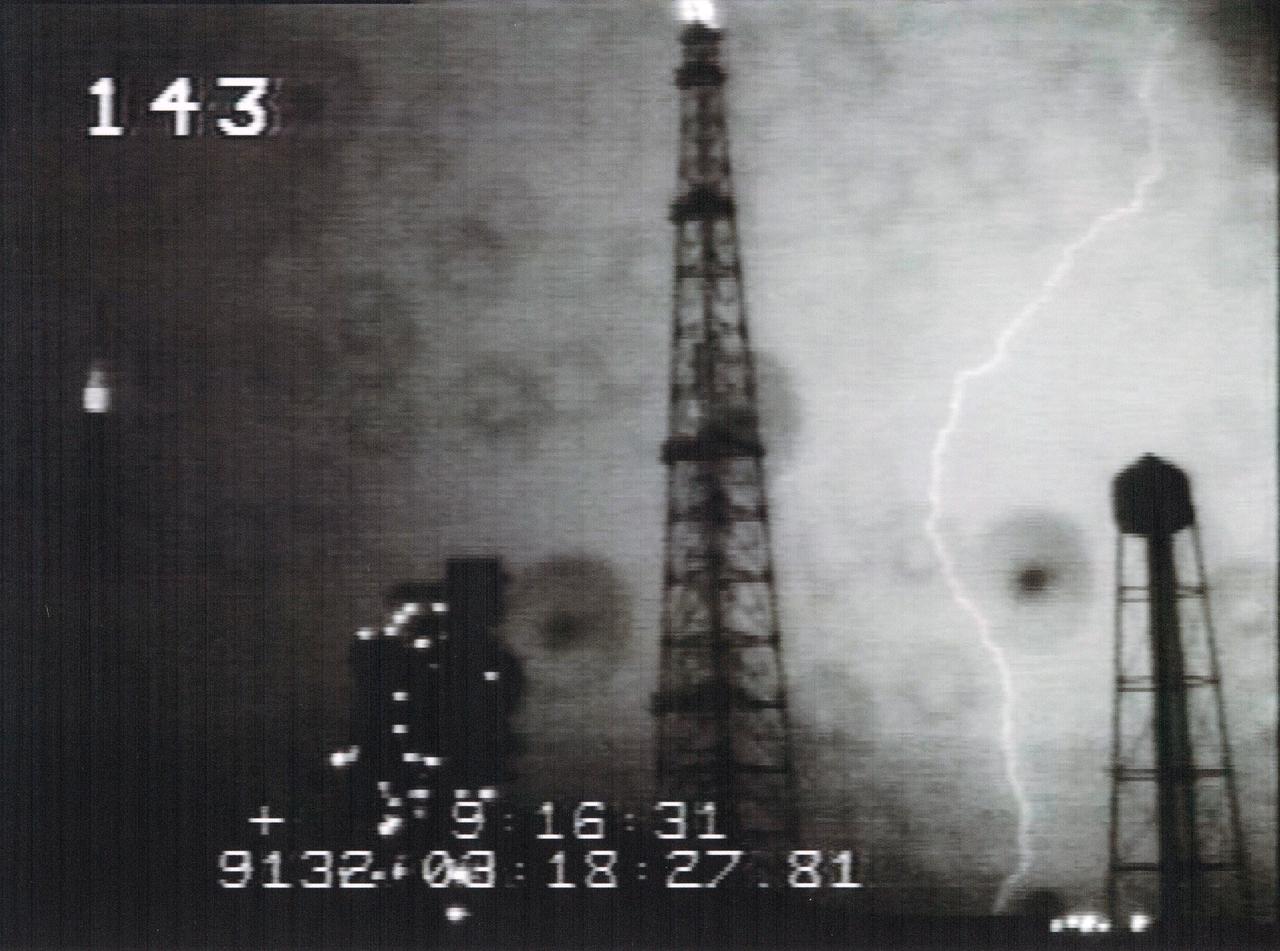
CAPE CANAVERAL, Fla. – This photo shows one of two lightning strikes that occurred on May 11 around 11 p.m. within a third of a mile of space shuttle Endeavour on Launch Pad 39B at NASA's Kennedy Space Center in Florida. Engineers and safety personnel evaluated data and performed a walkdown of the pad and determined there is no damage to the vehicle or the pad. The images are from Kennedy's Operational Television cameras which can be used to triangulate the location of lightning strikes. Other detection systems include the Cloud-To-Ground Lightning Surveillance System, Strikenet/National Lightning Detection Network, Lightning Induced Voltage Instrumentation System and the Catenary Wire Lightning Instrumentation System. Endeavour is standing by on the pad, prepared for liftoff in the unlikely event that a rescue mission is necessary during space shuttle Atlantis' STS-125 mission to service NASA's Hubble Space Telescope. Photo credit: NASA
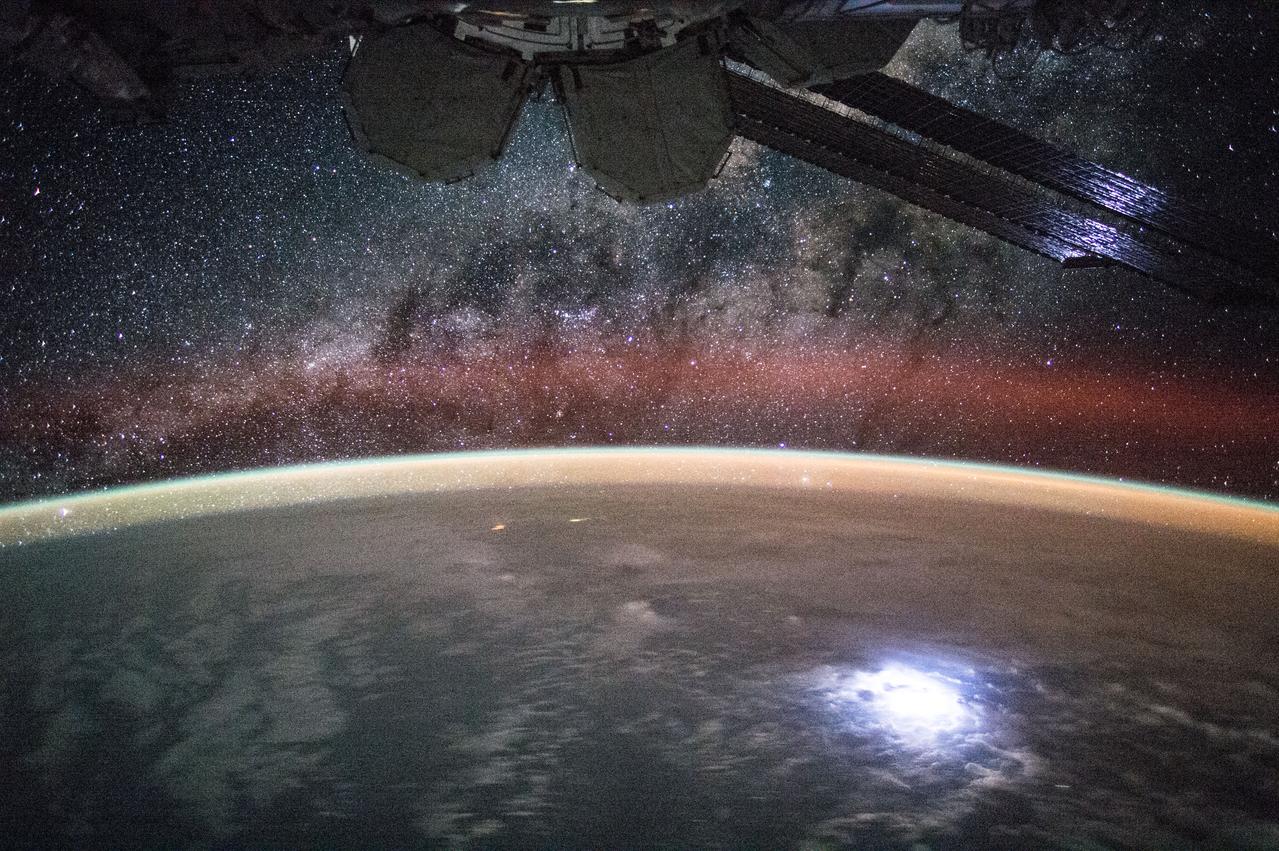
iss044e045215 (08/09/2015)-- View (part of a time lapse sequence) of stars in the Milky Way Galaxy visible over an Earth limb as seen by the Expedition 44 crew. Astronaut Kjell Lindgren captured a lightning strike from space so bright that it lights up the space station’s solar panels. He posted this on Twitter and Instagram on Sept. 2 saying "Large lightning strike on Earth lights up or solar panels."
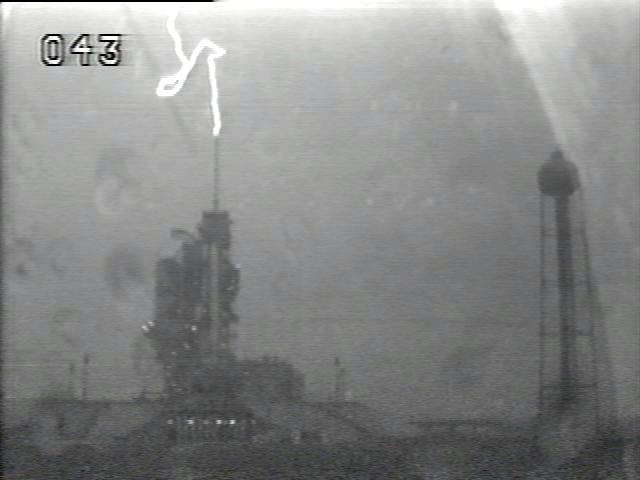
CAPE CANAVERAL, Fla. – A lightning strike on Launch Pad 39A at NASA's Kennedy Space Center in Florida is captured by an Operational Television camera. Eleven lightning strikes occurred within .35 miles of the pad during a thunderstorm July 10 as space shuttle Endeavour was prepared for launch. Mission managers decided to delay Endeavour's planned liftoff July 11 as a precaution to allow engineers and safety personnel time to analyze data and retest systems on the orbiter and solid rockets boosters. The next launch attempt for the STS-127 mission is planned for Sunday, July 12, at 7:13 p.m. EDT. The Operational Television cameras can be used to triangulate the location of lightning strikes. Other detection systems include the Cloud-To-Ground Lightning Surveillance System, Strikenet/National Lightning Detection Network, Lightning Induced Voltage Instrumentation System and the Catenary Wire Lightning Instrumentation System. Endeavour will deliver the Japanese Experiment Module's Exposed Facility, or JEM-EF, and the Experiment Logistics Module-Exposed Section, or ELM-ES, in the final of three flights dedicated to the assembly of the Japan Aerospace Exploration Agency's Kibo laboratory complex on the International Space Station. STS-127 is the 29th flight for the assembly of the space station. Photo credit: NASA/Analex
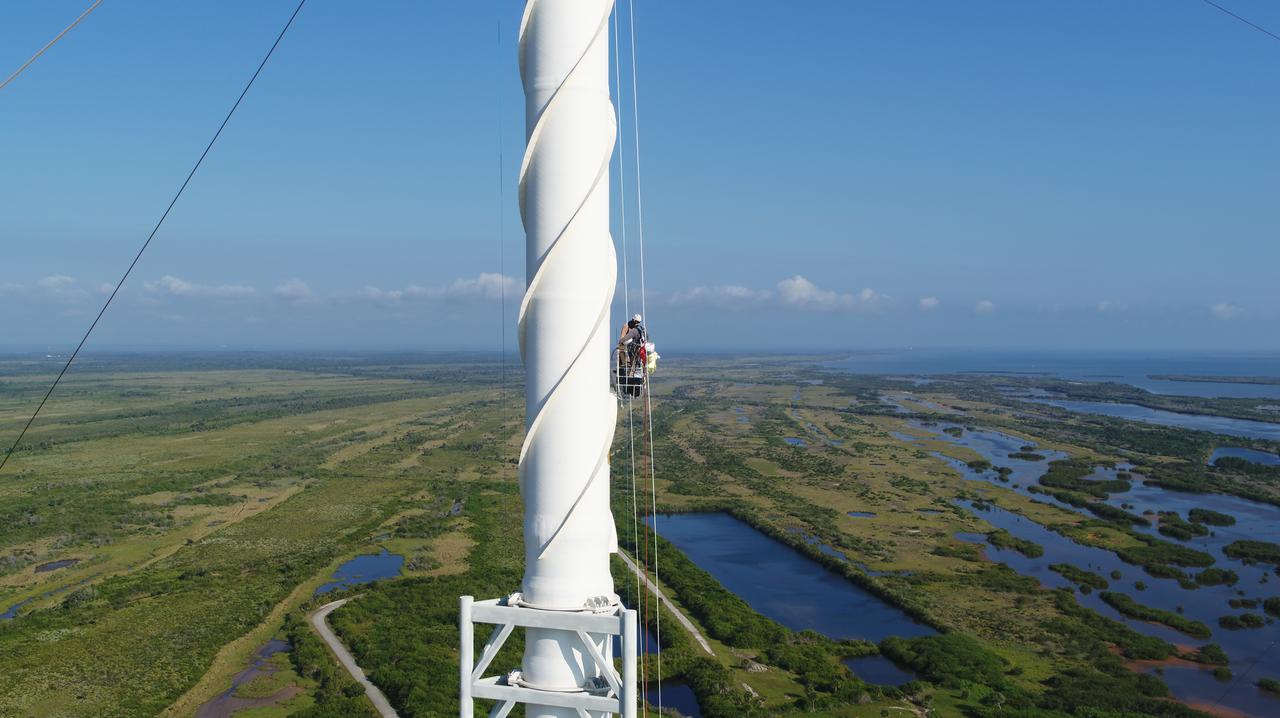
Workers prepare the surface of one of the three lightning protection system towers for painting at Exploration Ground Systems’ Launch Complex 39B at NASA’s Kennedy Space Center in Florida on May 30, 2019. The old paint was removed by the most recent hurricane. Pad 39B is the site of future launches of the agency’s Space Launch System rocket with the Orion spacecraft on Artemis missions. The 600-foot-tall lightning towers will help prevent lightning strikes at the pad during prelaunch and launch activities.
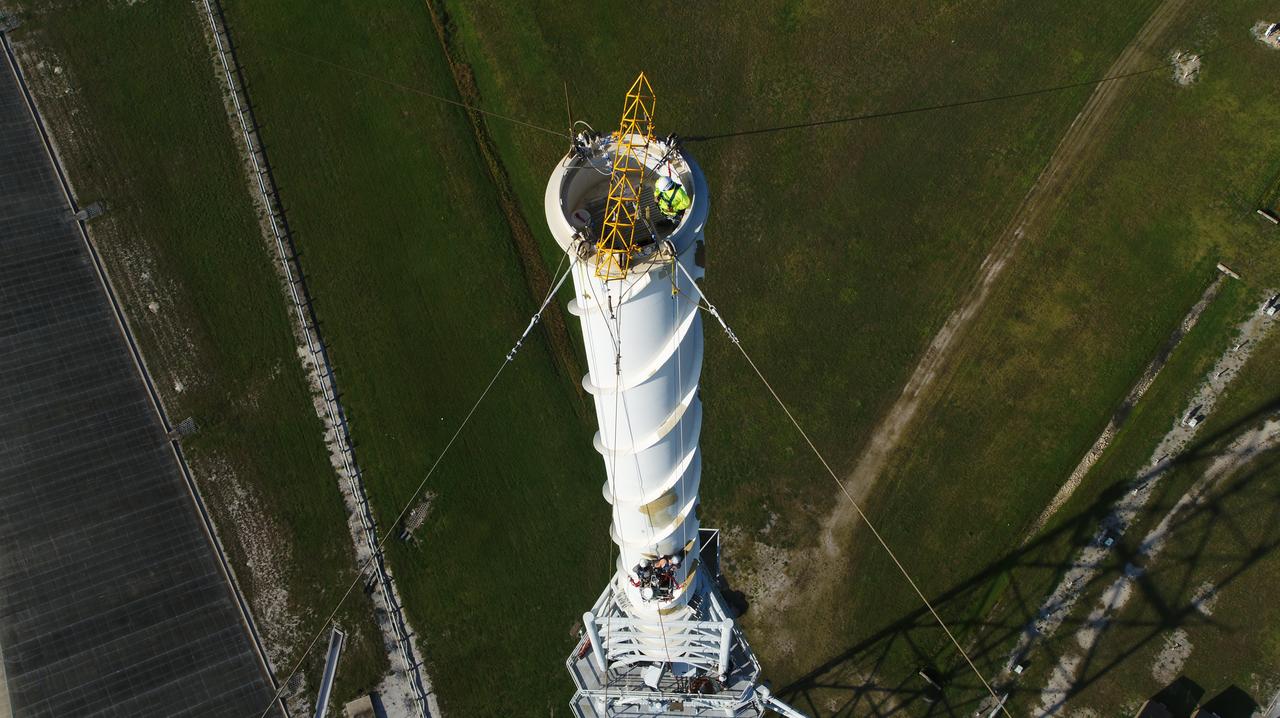
An aerial view shows workers preparing the surface of one of the three lightning protection system towers for painting at Exploration Ground Systems’ Launch Complex 39B at NASA’s Kennedy Space Center in Florida on May 30, 2019. The old paint was removed by the most recent hurricane. Pad 39B is the site of future launches of the agency’s Space Launch System rocket with the Orion spacecraft on Artemis missions. The 600-foot-tall lightning towers will help prevent lightning strikes at the pad during prelaunch and launch activities.
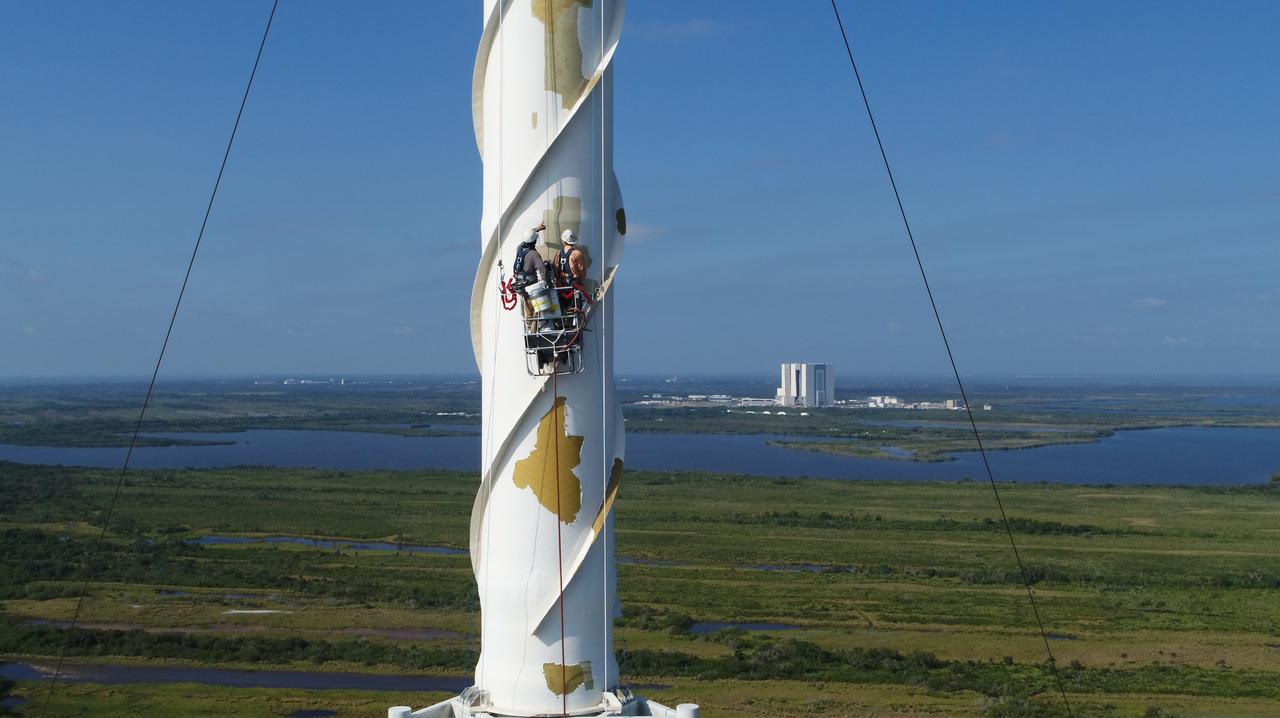
An aerial view shows workers preparing the surface of one of the three lightning protection system towers for painting at Exploration Ground Systems’ Launch Complex 39B at NASA’s Kennedy Space Center in Florida on May 30, 2019. The old paint was removed by the most recent hurricane. Pad 39B is the site of future launches of the agency’s Space Launch System rocket with the Orion spacecraft on Artemis missions. The 600-foot-tall lightning towers will help prevent lightning strikes at the pad during prelaunch and launch activities.
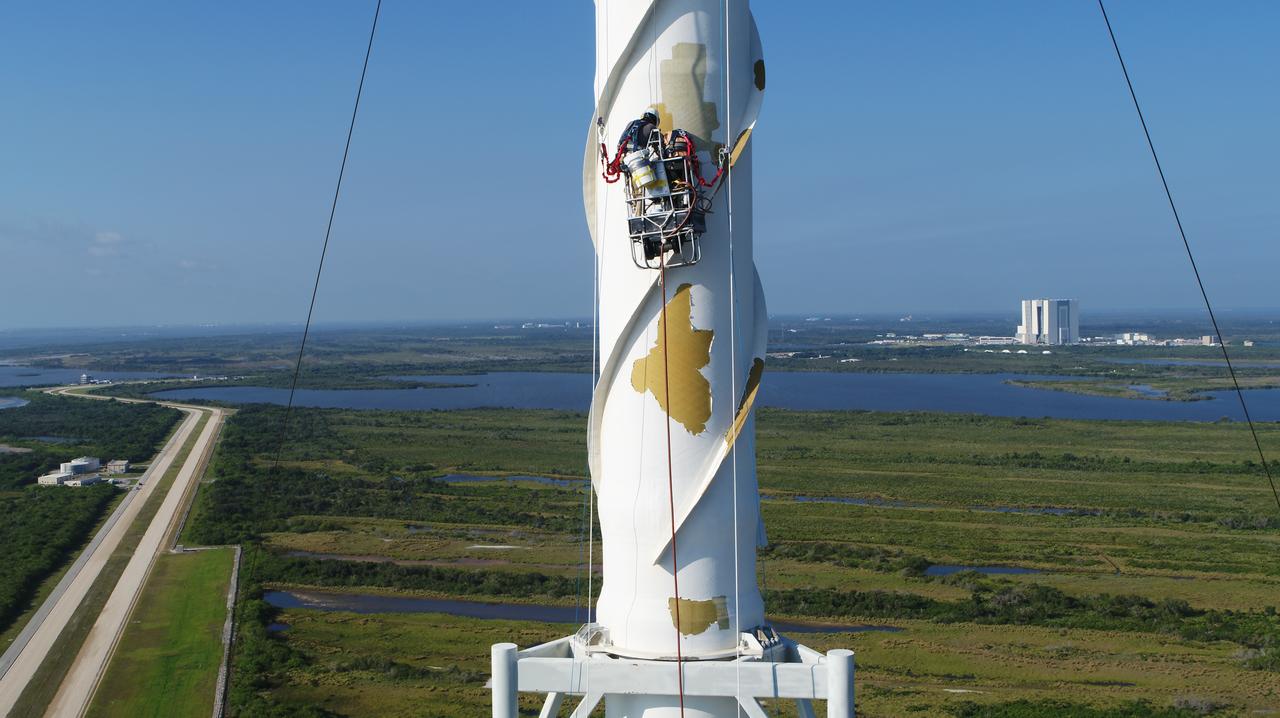
Workers prepare the surface of one of the three lightning protection system towers for painting at Exploration Ground Systems’ Launch Complex 39B at NASA’s Kennedy Space Center in Florida on May 30, 2019. The old paint was removed by the most recent hurricane. Pad 39B is the site of future launches of the agency’s Space Launch System rocket with the Orion spacecraft on Artemis missions. The 600-foot-tall lightning towers will help prevent lightning strikes at the pad during prelaunch and launch activities.
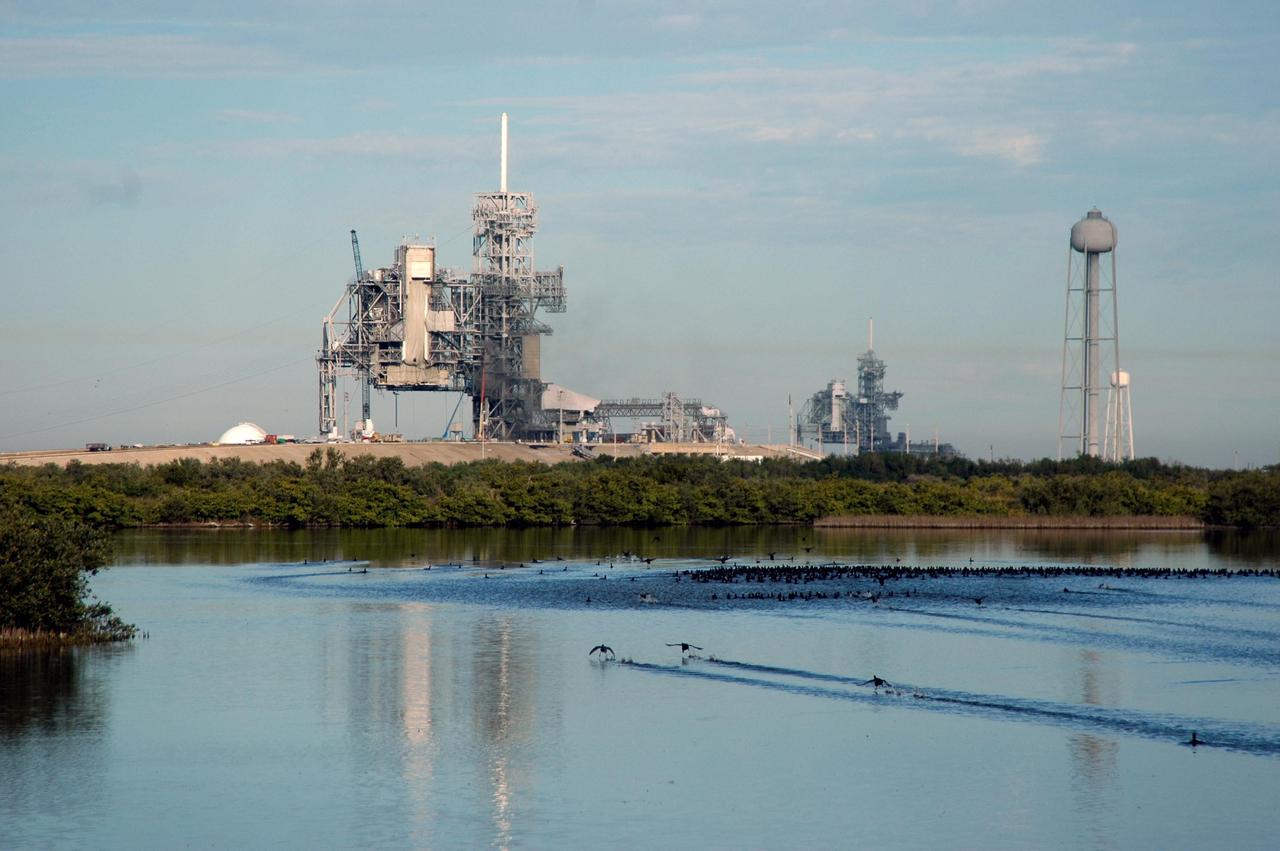
KENNEDY SPACE CENTER, FLA. - Viewed from the east side, Launch Pads 39A and 39B tower over the bird-filled waters of the Banana River at NASA Kennedy Space Center. On the far right is seen the 300-gallon water tower. Rising above the fixed service structures are the 80-foot lightning masts that help protect the structures from lightning strikes.
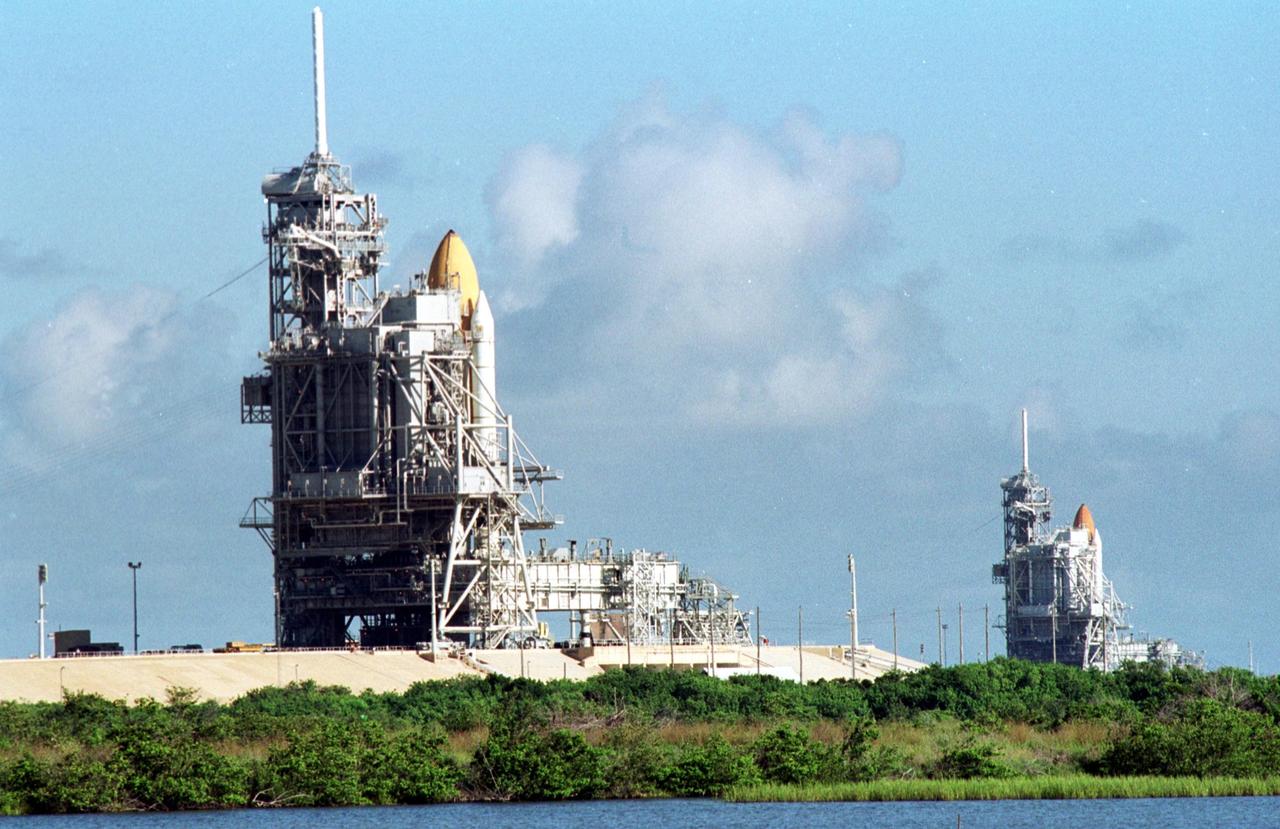
KENNEDY SPACE CENTER, Fla. -- Space Shuttle Discovery (foreground) and Space Shuttle Atlantis (background) both stand ready on their Launch Pads ( 39A and 39B respectively). Space Shuttle Discovery rolled out July 2 to be prepared for launch on mission STS-105 in August. Space Shuttle Atlantis is scheduled to launch Thursday, July 12, on mission STS-104. Towering above each Shuttle on the left is the 80-foot lightning rod that helps protect each Shuttle from lightning strikes
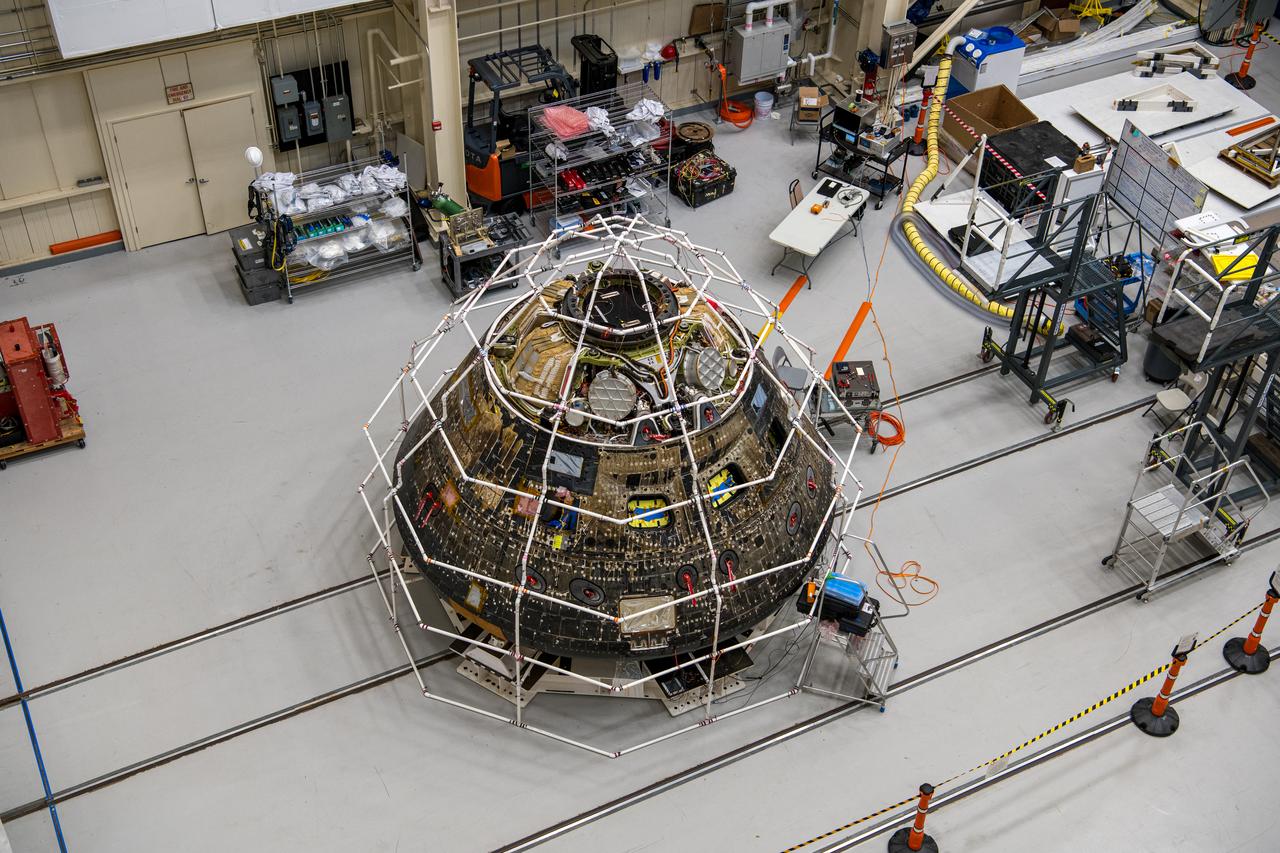
Experts at NASA’s Neil Armstrong Test Facility in Sandusky, Ohio, conducted a lightning test, which simulates the electromagnetic effects of a lightning strike to the vehicle on the launch pad awaiting liftoff. The February 20, 2024, test proved the grounding path of the vehicle is operating as designed and protecting the vehicle from damage to any of its equipment or systems. Photo Credit: (NASA/Quentin Schwinn)
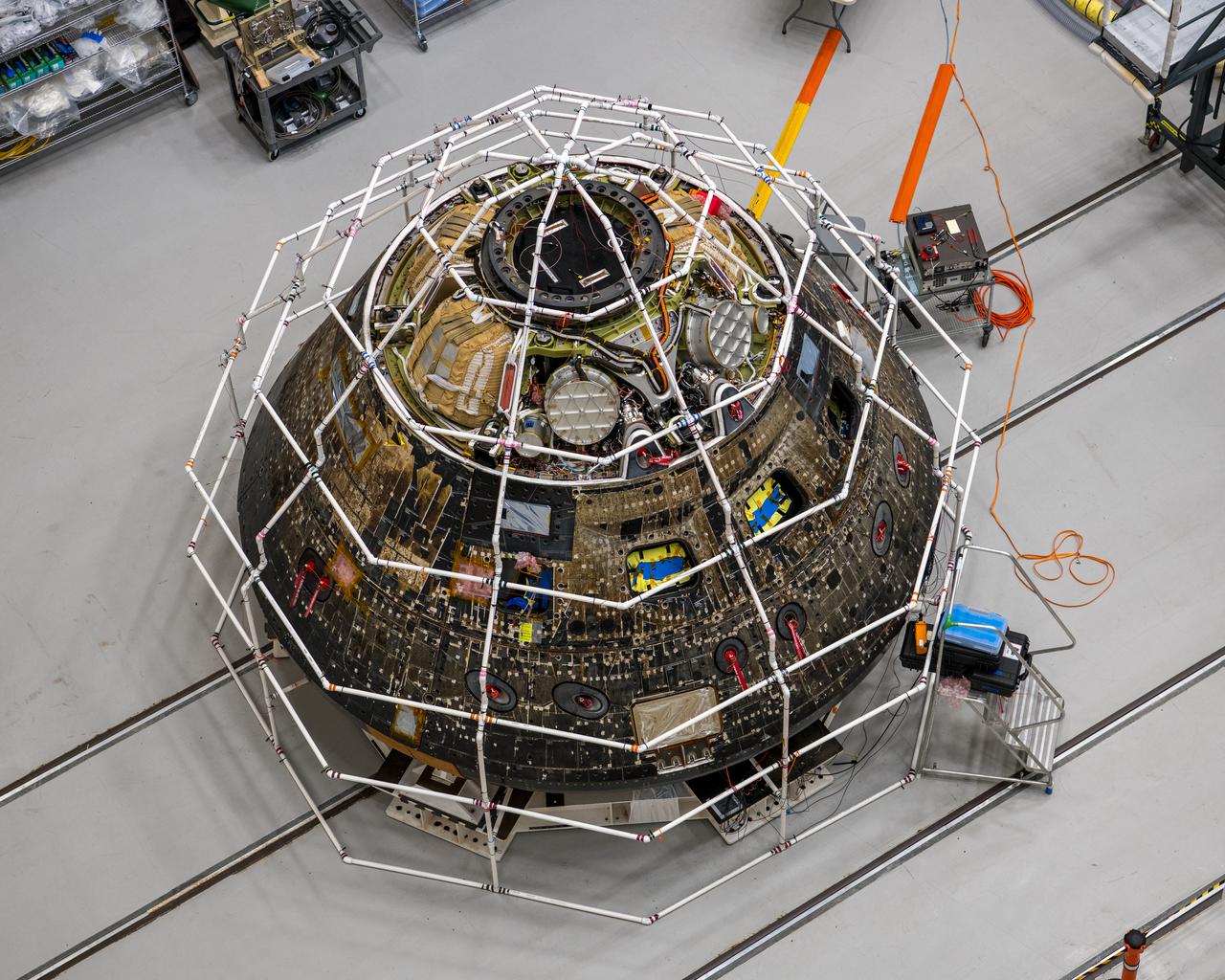
Experts at NASA’s Neil Armstrong Test Facility in Sandusky, Ohio, conducted a lightning test, which simulates the electromagnetic effects of a lightning strike to the vehicle on the launch pad awaiting liftoff. The February 20, 2024, test proved the grounding path of the vehicle is operating as designed and protecting the vehicle from damage to any of its equipment or systems. Photo Credit: (NASA/Quentin Schwinn)
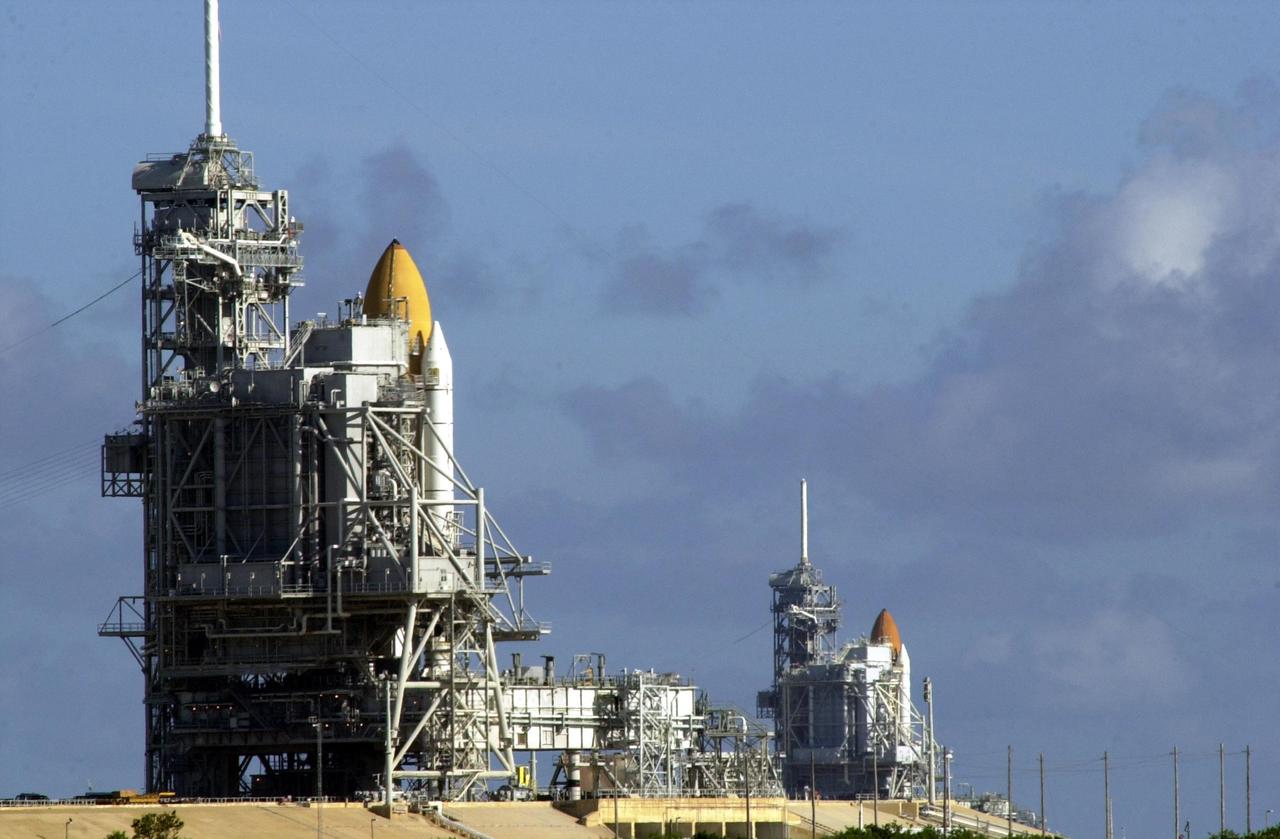
KENNEDY SPACE CENTER, Fla. - Space Shuttle Discovery (foreground) and Space Shuttle Atlantis (background) both stand ready on their Launch Pads ( 39A and 39B respectively). Space Shuttle Discovery rolled out July 2 to be prepared for launch on mission STS-105 in August. Space Shuttle Atlantis is scheduled to launch Thursday, July 12, on mission STS-104. Towering above each Shuttle on the left is the 80-foot lightning rod that helps protect each Shuttle from lightning strikes
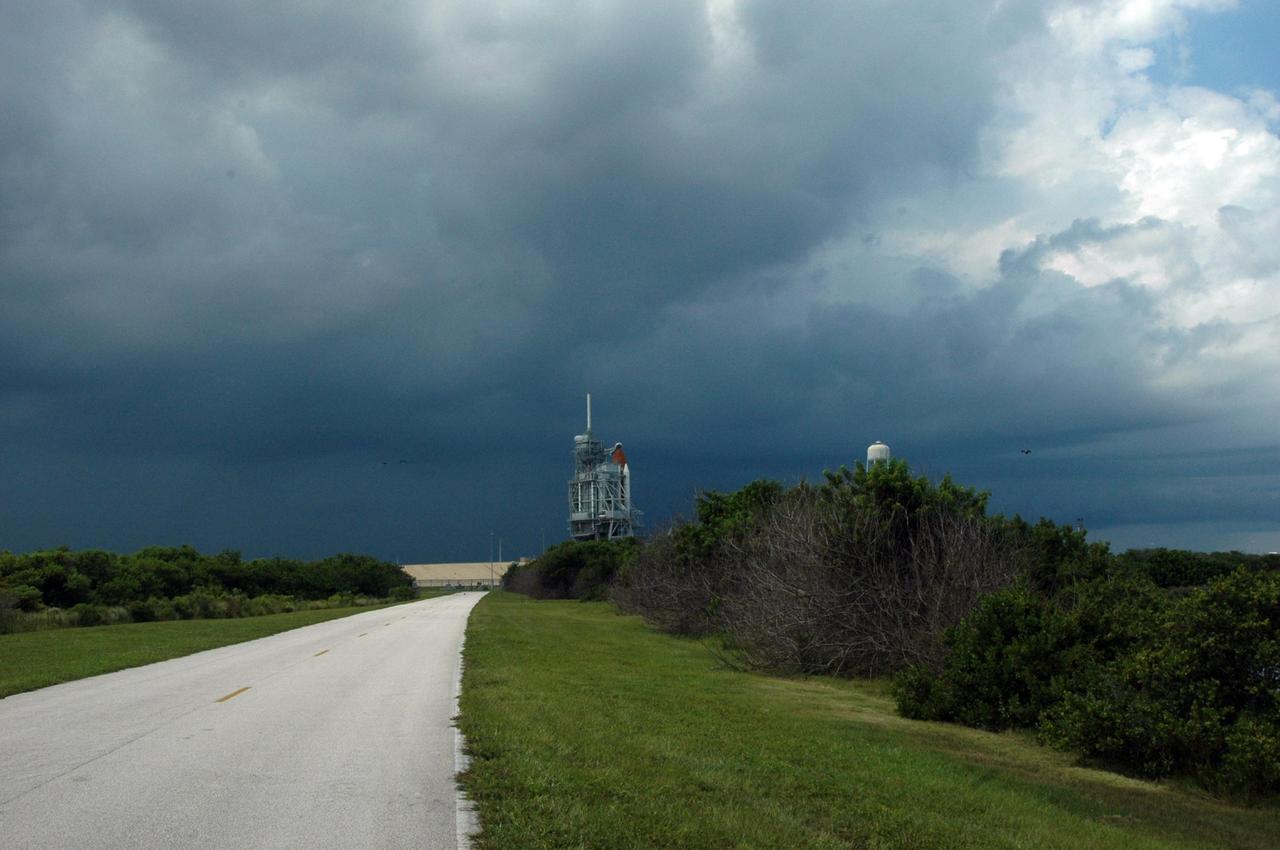
KENNEDY SPACE CENTER, FLA. - The dark clouds of a heavy rainstorm moving into Kennedy Space Center in the late afternoon on Sat., August 26, 2006, seem to illuminate the Space Shuttle Atlantis as it sits on Launch Pad 39B. A lightning strike to the pad's lightning protection system on August 25, caused the mission management team to postpone the launch of mission STS-115 for 24 hours in order to review all electrical systems on the space shuttle and ground support equipment at the pad. Photo credit: NASA/Ken Thornsley.
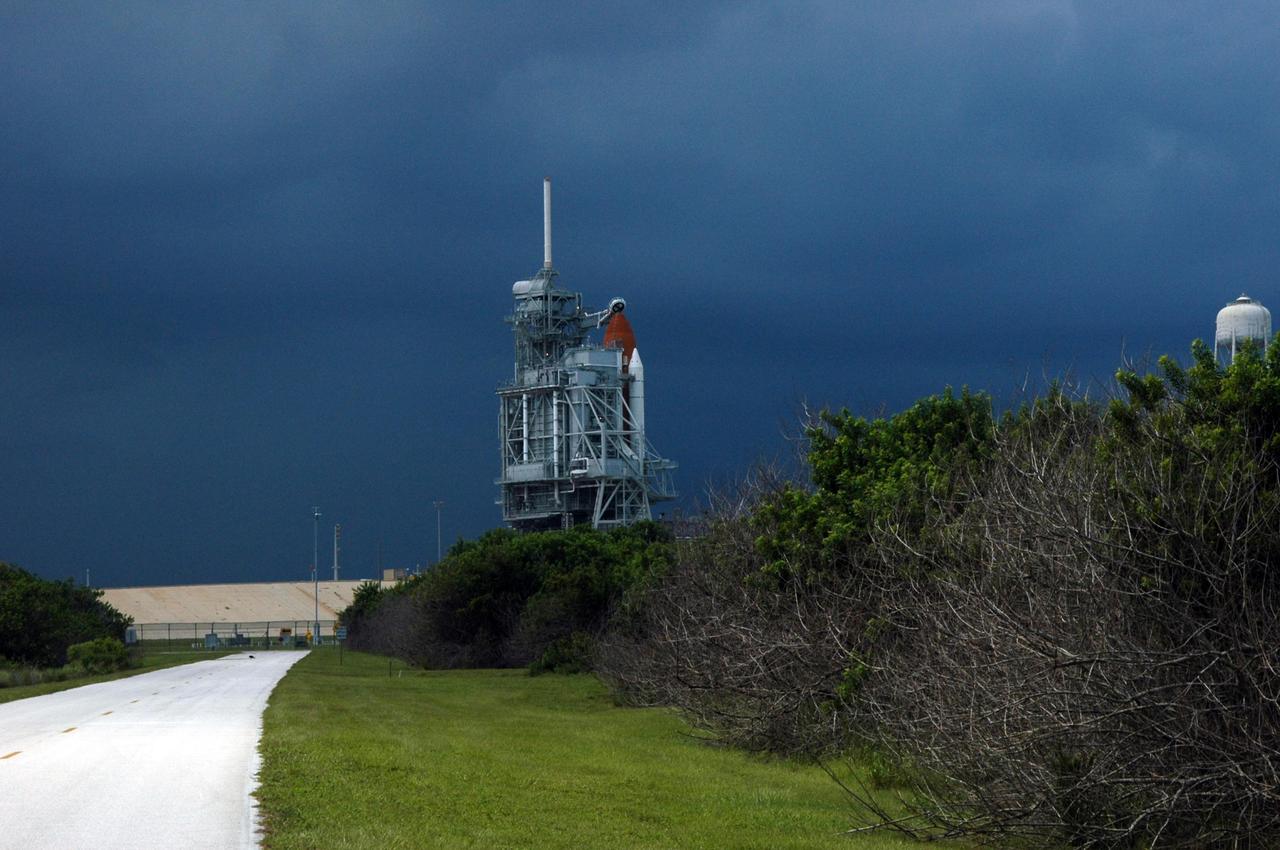
KENNEDY SPACE CENTER, FLA. - The dark clouds of a heavy rainstorm moving into Kennedy Space Center in the late afternoon on Sat., August 26, 2006, seem to illuminate the Space Shuttle Atlantis as it sits on Launch Pad 39B. A lightning strike to the pad's lightning protection system on August 25, caused the mission management team to postpone the launch of mission STS-115 for 24 hours in order to review all electrical systems on the space shuttle and ground support equipment at the pad. Photo credit: NASA/Ken Thornsley.
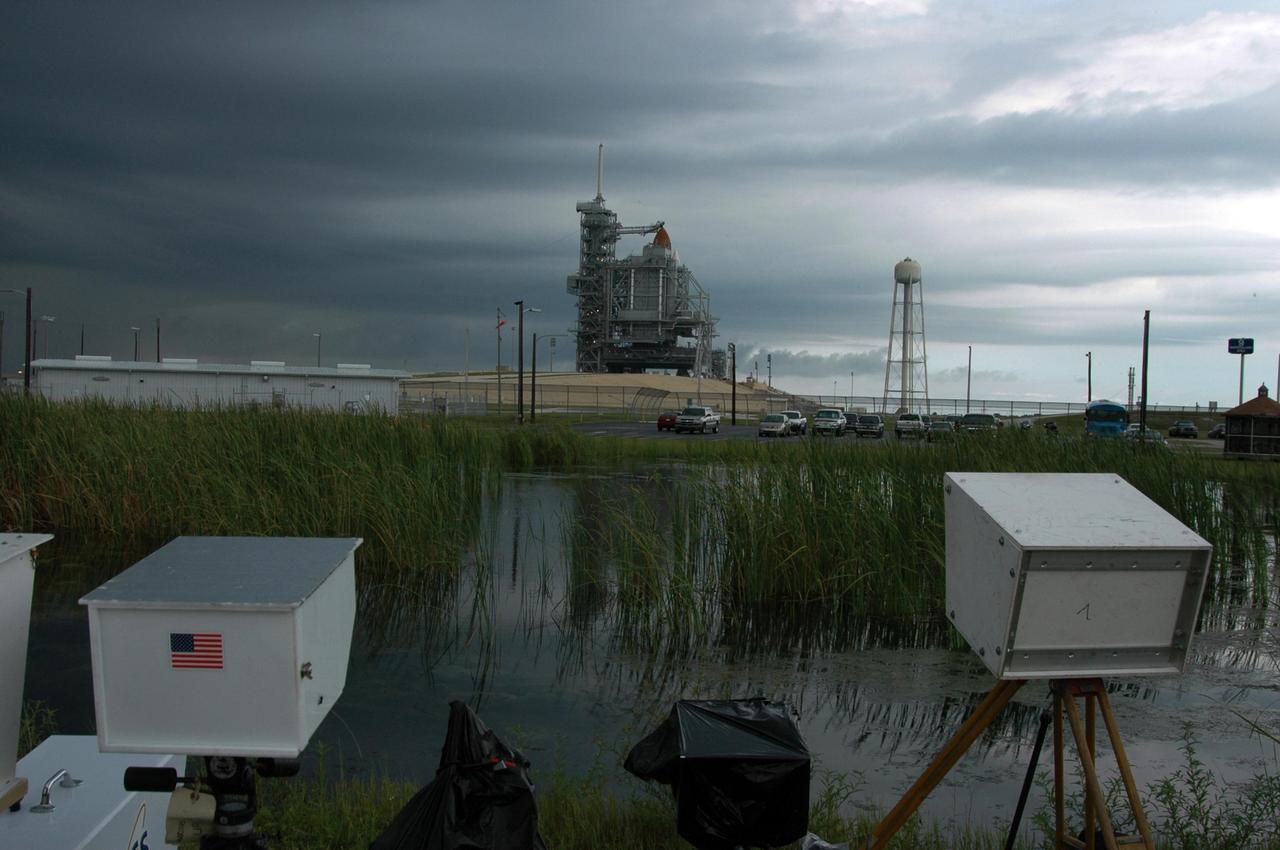
KENNEDY SPACE CENTER, FLA. - Several remote cameras are positioned around the perimeter of Launch Pad 39B in preparation for the launch of mission STS-115 aboard Space Shuttle Atlantis. A lightning strike to the pad's lightning protection system on August 25, caused the mission management team to postpone the launch of mission STS-115 for 24 hours in order to review all electrical systems on the space shuttle and ground support equipment at the pad. Photo credit: NASA/Ken Thornsley.
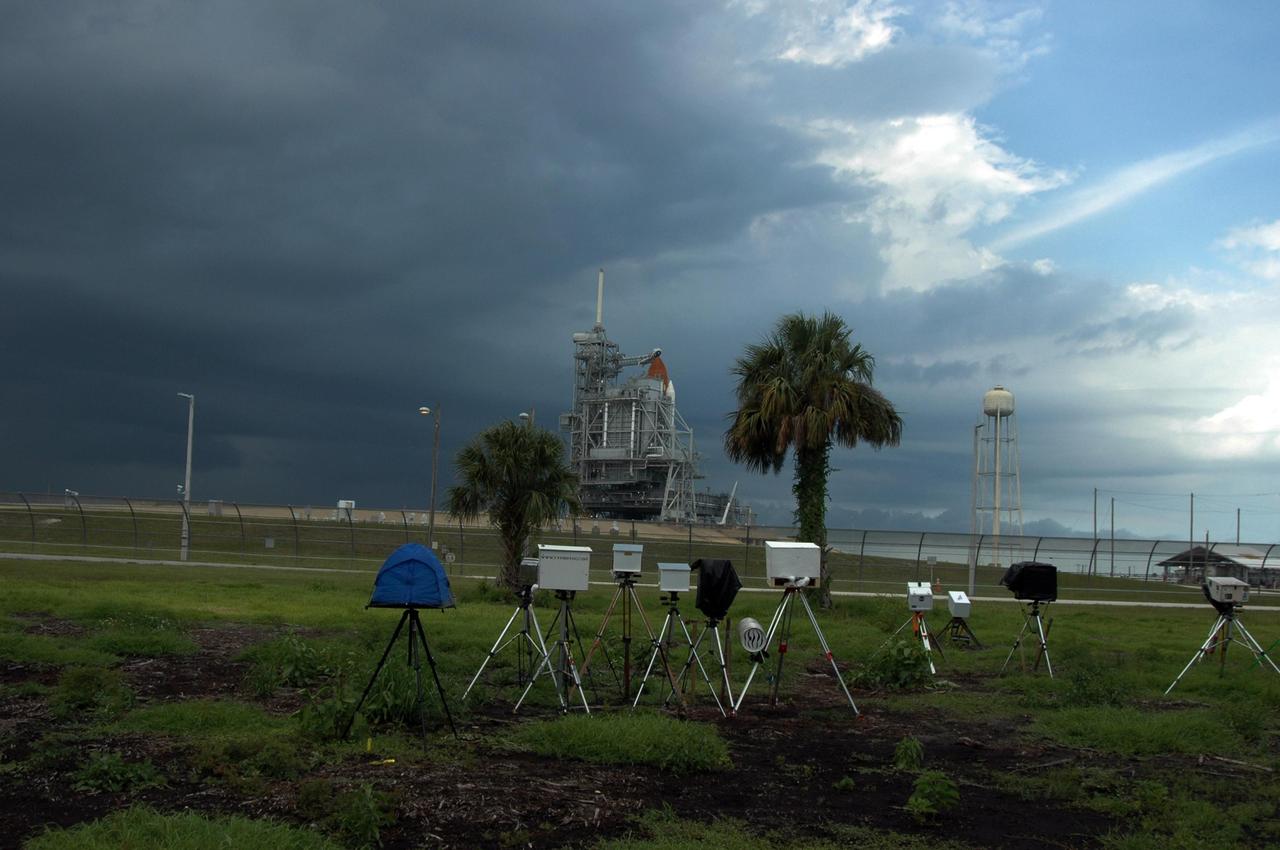
KENNEDY SPACE CENTER, FLA. - Several remote cameras are positioned around the perimeter of Launch Pad 39B in preparation for the launch of mission STS-115 aboard Space Shuttle Atlantis. A lightning strike to the pad's lightning protection system on August 25, caused the mission management team to postpone the launch of mission STS-115 for 24 hours in order to review all electrical systems on the space shuttle and ground support equipment at the pad. Photo credit: NASA/Ken Thornsley.
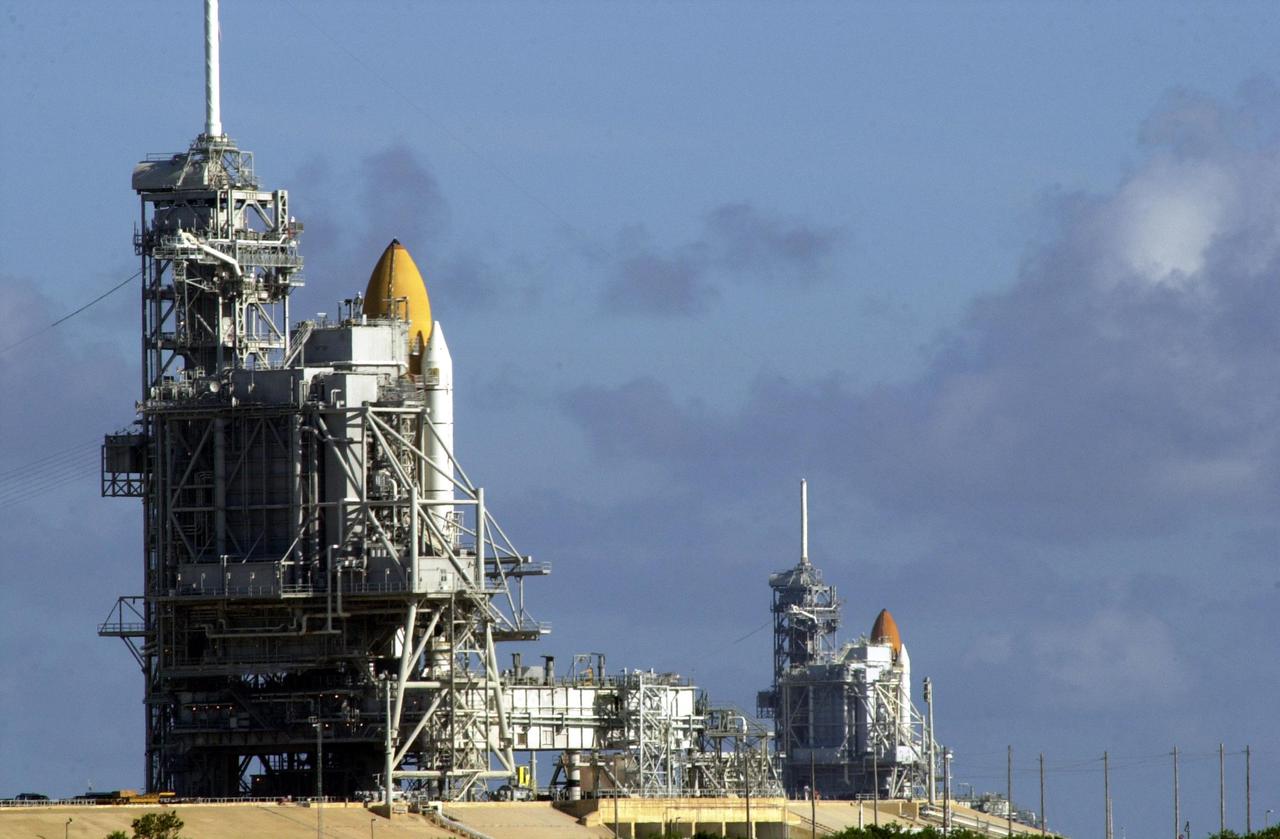
KENNEDY SPACE CENTER, Fla. - Space Shuttle Discovery (foreground) and Space Shuttle Atlantis (background) both stand ready on their Launch Pads ( 39A and 39B respectively). Space Shuttle Discovery rolled out July 2 to be prepared for launch on mission STS-105 in August. Space Shuttle Atlantis is scheduled to launch Thursday, July 12, on mission STS-104. Towering above each Shuttle on the left is the 80-foot lightning rod that helps protect each Shuttle from lightning strikes
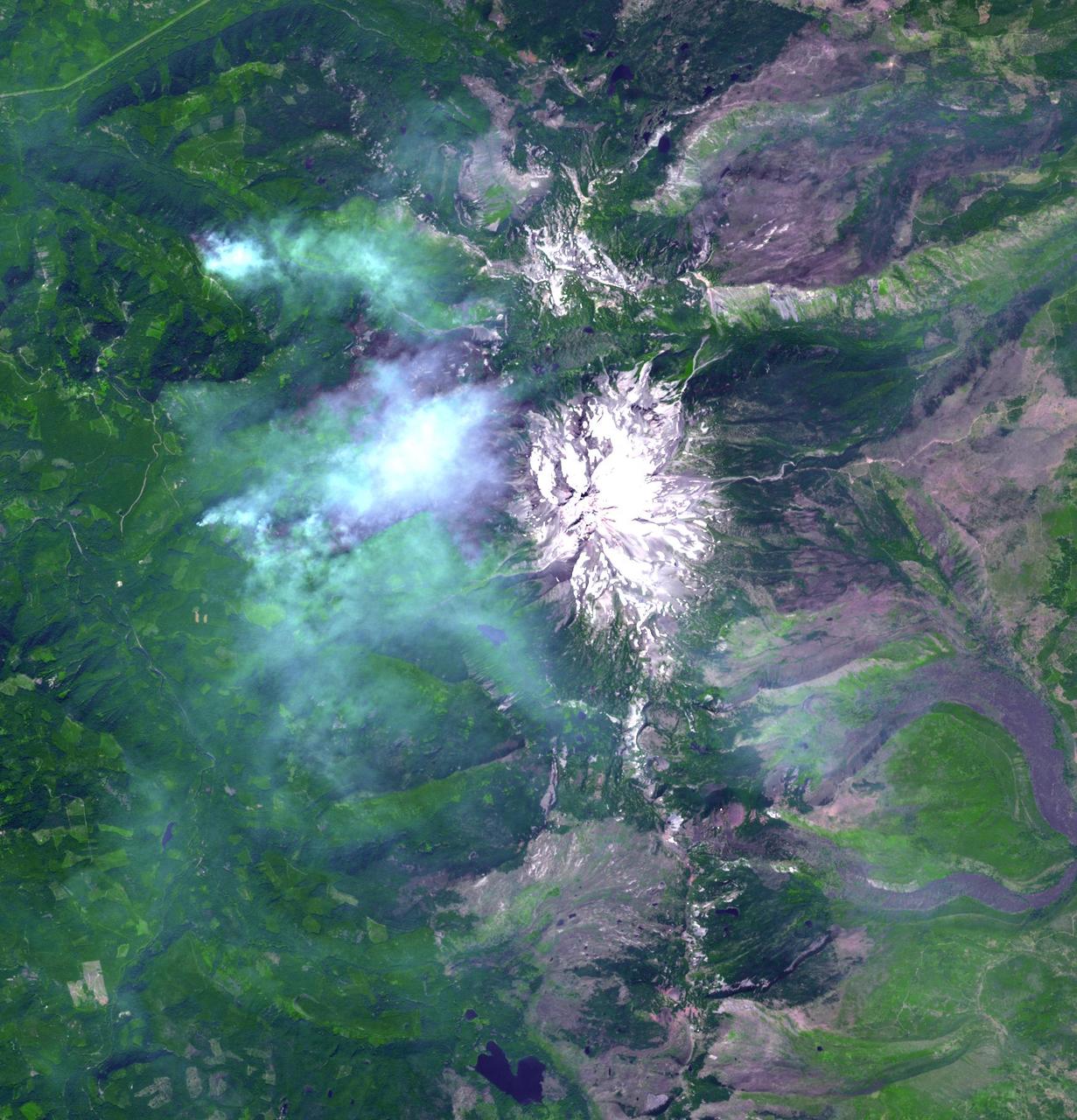
The Whitewater Fire in the Mount Jefferson Wilderness in Oregon was started by a lightning strike. As of Aug. 18, 2017, more than 117,000 acres and 30 miles (48 kilometers) of the Pacific Crest Trail are closed to the public in an area that had been expected to be popular with people there to view the August 21 solar eclipse. The smoke clouds sit over the burned area, just west-northwest of Mount Jefferson. The image was acquired Aug. 18, 2017, covers an area of 16 by 17 miles (26.1 by 27.2 kilometers), and is located at 44.7 degrees north, 121.8 degrees west. https://photojournal.jpl.nasa.gov/catalog/PIA21877
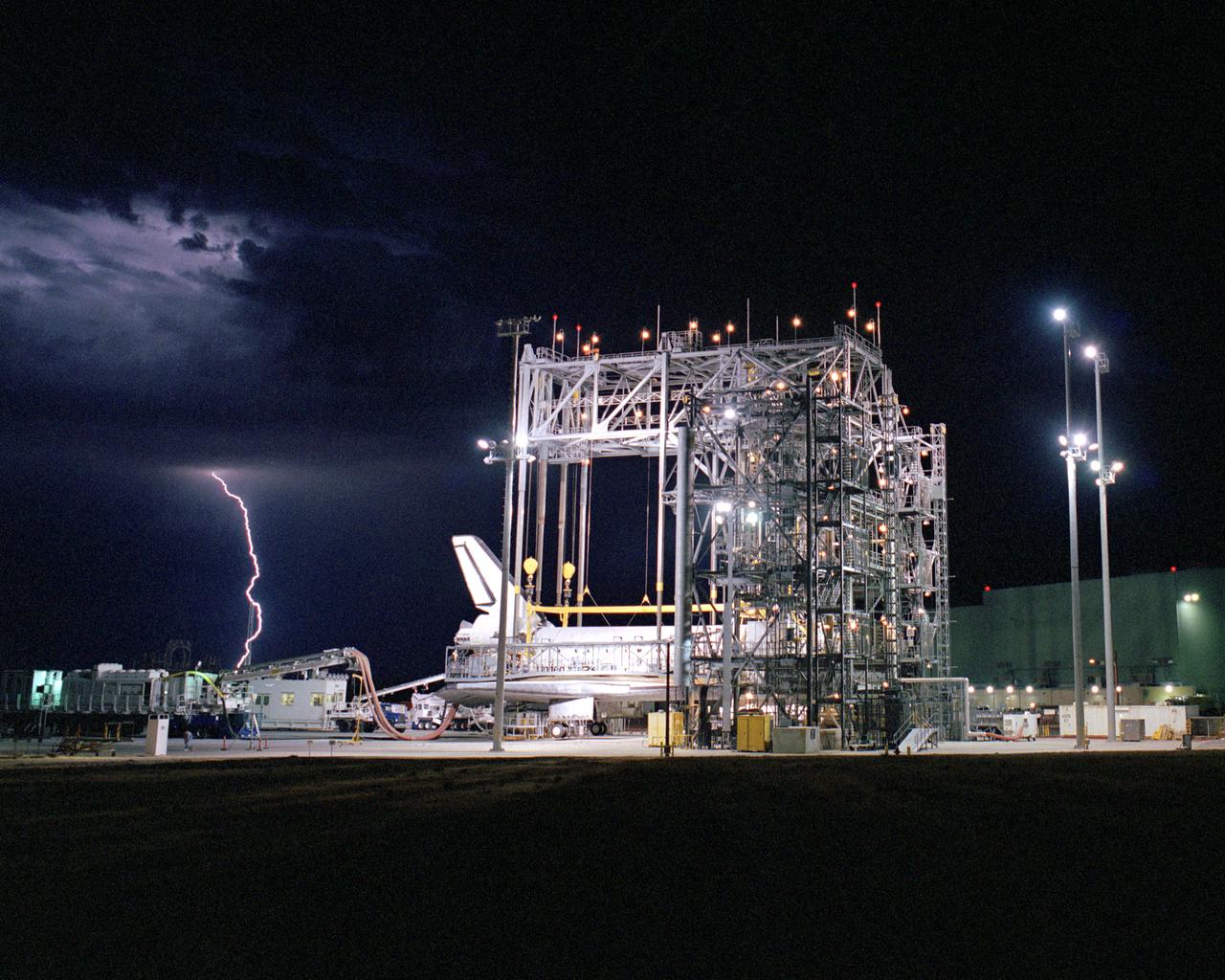
Lightning strikes in the distance as the Space Shuttle Discovery receives post-flight processing in the Mate-Demate Device (MDD), following its landing at NASA's Dryden Flight Research Center in California. The gantry-like MDD structure is used for servicing the shuttle orbiters in preparation for their ferry flight back to the Kennedy Space Center in Florida, including mounting the shuttle atop NASA's modified Boeing 747 Shuttle Carrier Aircraft. Space Shuttle Discovery landed safely at NASA's Dryden Flight Research Center at Edwards Air Force Base in California at 5:11:22 a.m. PDT, August 9, 2005, following the very successful 14-day STS-114 return to flight mission. During their two weeks in space, Commander Eileen Collins and her six crewmates tested out new safety procedures and delivered supplies and equipment the International Space Station. Discovery spent two weeks in space, where the crew demonstrated new methods to inspect and repair the Shuttle in orbit. The crew also delivered supplies, outfitted and performed maintenance on the International Space Station. A number of these tasks were conducted during three spacewalks. In an unprecedented event, spacewalkers were called upon to remove protruding gap fillers from the heat shield on Discovery's underbelly. In other spacewalk activities, astronauts installed an external platform onto the Station's Quest Airlock and replaced one of the orbital outpost's Control Moment Gyroscopes. Inside the Station, the STS-114 crew conducted joint operations with the Expedition 11 crew. They unloaded fresh supplies from the Shuttle and the Raffaello Multi-Purpose Logistics Module. Before Discovery undocked, the crews filled Raffeallo with unneeded items and returned to Shuttle payload bay. Discovery launched on July 26 and spent almost 14 days on orbit.
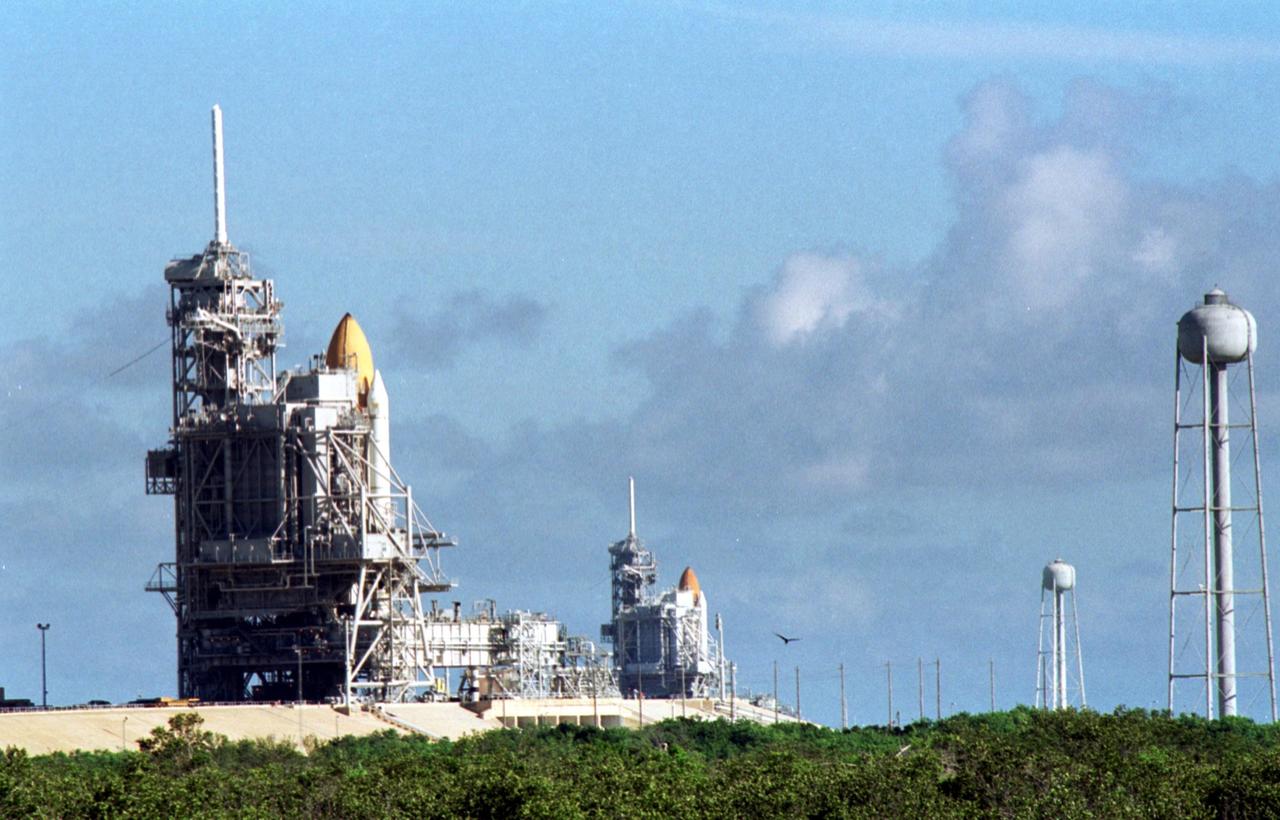
KENNEDY SPACE CENTER, Fla. -- Space Shuttle Discovery (foreground) and Space Shuttle Atlantis (background) both stand ready on their Launch Pads ( 39A and 39B respectively). Space Shuttle Discovery rolled out July 2 to be prepared for launch on mission STS-105 in August. Space Shuttle Atlantis is scheduled to launch Thursday, July 12, on mission STS-104. Towering above each Shuttle on the left is the 80-foot lightning rod that helps protect each Shuttle from lightning strikes. At right are the 290-foot water tanks that provide 300,000 gallons of water during liftoff. They are part of the sound suppression water system at each pad
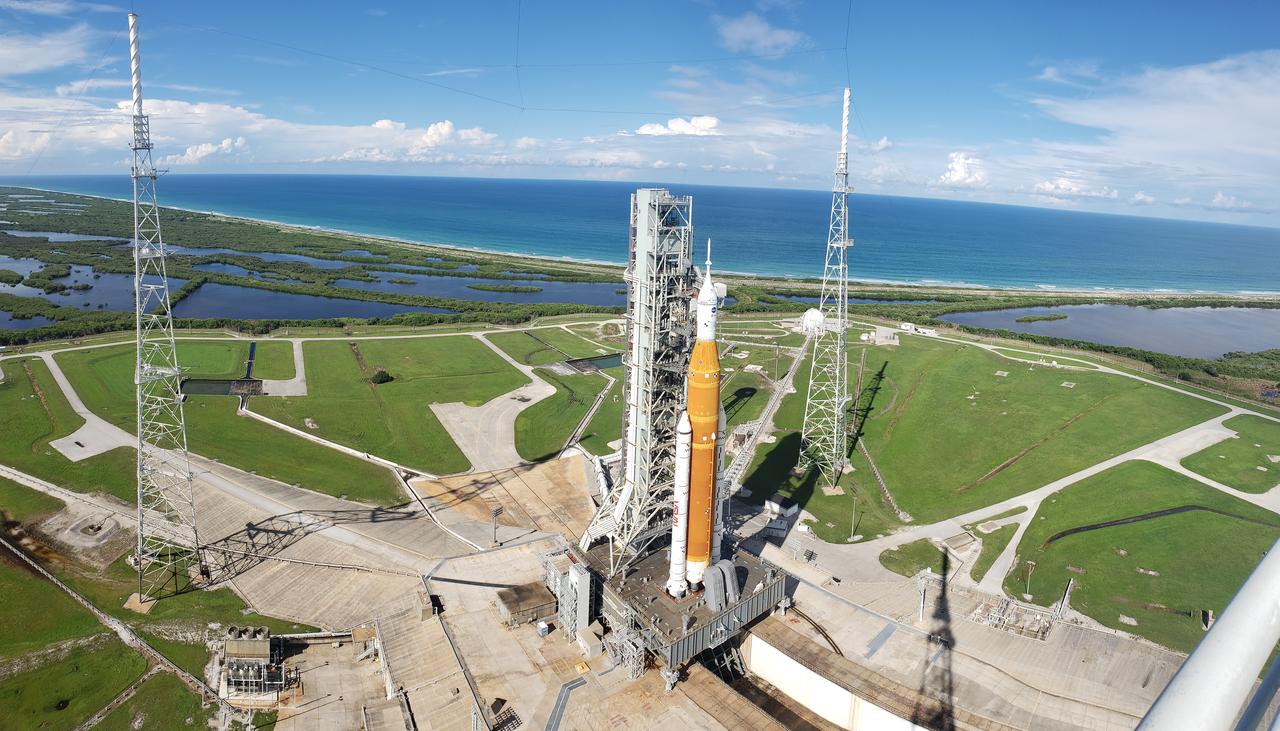
A view of the Artemis I Space Launch System (SLS) and Orion spacecraft atop the mobile launcher on Launch Pad 39B at NASA’s Kennedy Space Center in Florida on Sept. 15, 2022. Also in view are two of the three lightning towers that surround the pad and protect the SLS and Orion from lightning strikes. Artemis I is the first integrated test of the SLS and Orion spacecraft. In future Artemis missions, NASA will land the first woman and the first person of color on the surface of the Moon, paving the way for a long-term lunar presence and serving as a steppingstone on the way to Mars.
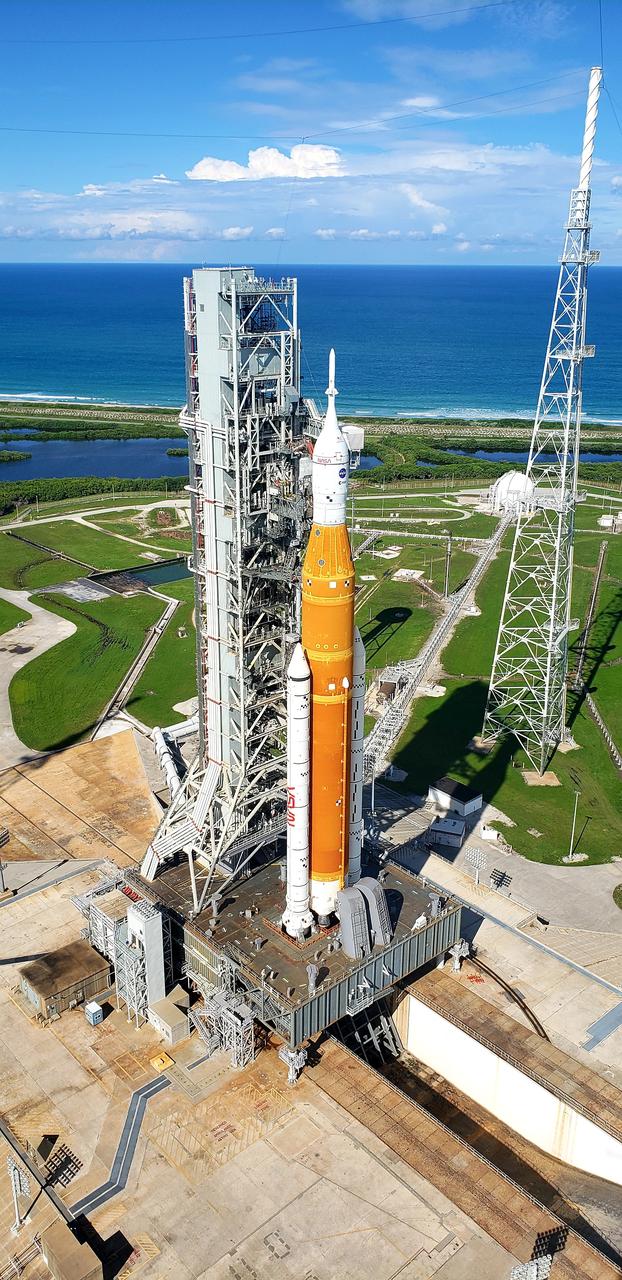
A view of the Artemis I Space Launch System (SLS) and Orion spacecraft atop the mobile launcher on Launch Pad 39B at NASA’s Kennedy Space Center in Florida on Sept. 15, 2022. To the right is one of three lightning protection towers that surround the pad and protect the SLS and Orion from lightning strikes. Artemis I is the first integrated test of the SLS and Orion spacecraft. In future Artemis missions, NASA will land the first woman and the first person of color on the surface of the Moon, paving the way for a long-term lunar presence and serving as a steppingstone on the way to Mars.
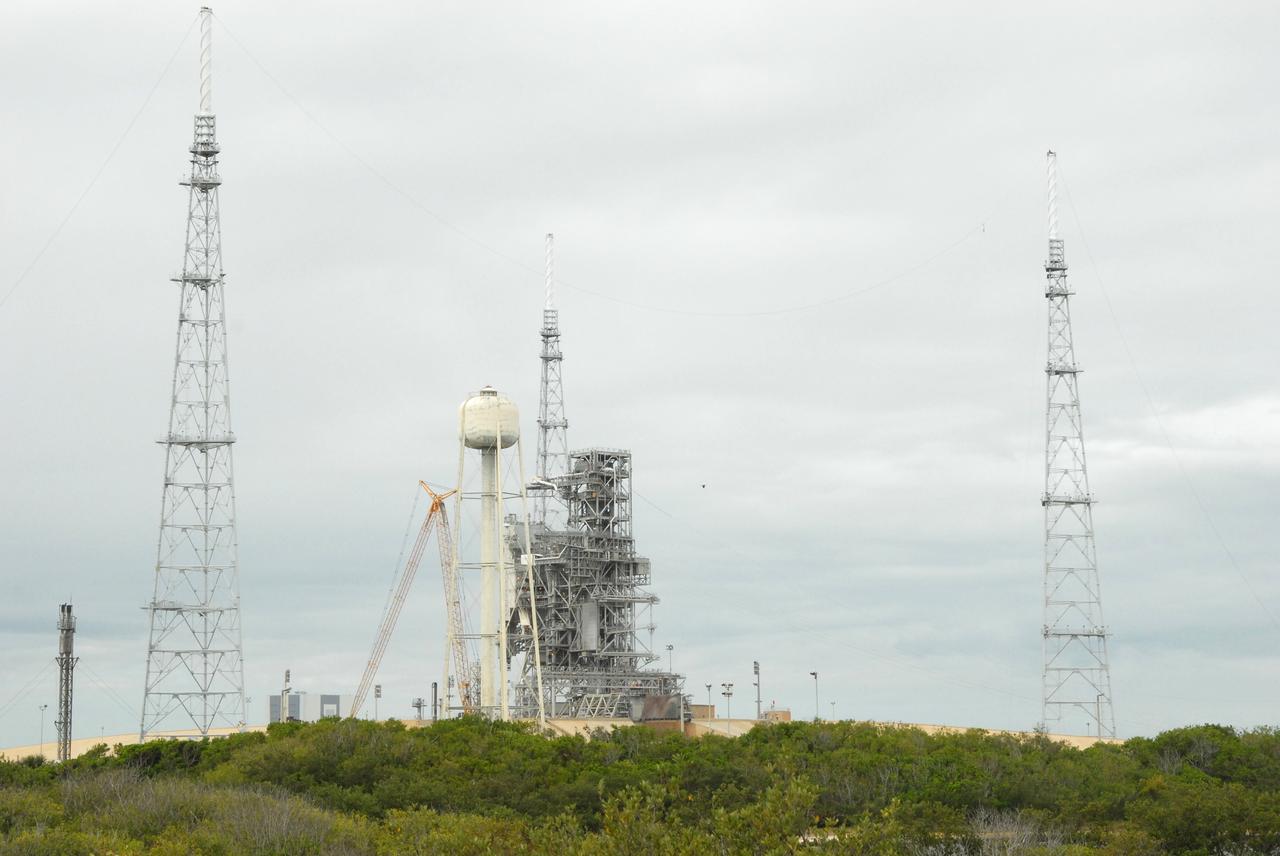
CAPE CANAVERAL, Fla. – On Launch Pad 39B at NASA's Kennedy Space Center in Florida, catenary wires are being suspended from the lighting masts on the lightning towers. The catenary wire system under development for the Constellation Program’s next-generation vehicles will significantly increase the shielding level, providing better protection, and further separate the electrical current from vital launch hardware. The system will help avoid delays to the launch schedule by collecting more information on the strike for analysis by launch managers. Photo credit: NASA/Jack Pfaller
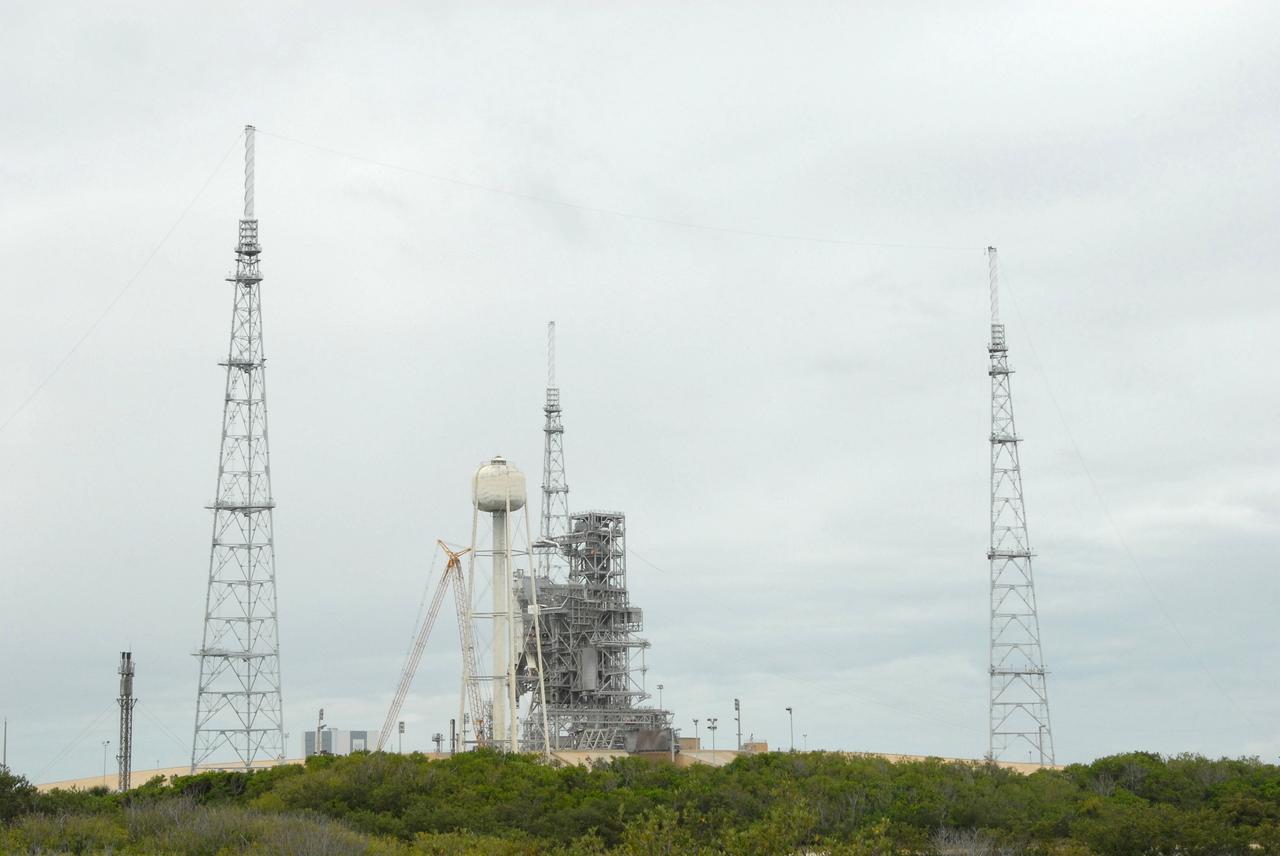
CAPE CANAVERAL, Fla. – On Launch Pad 39B at NASA's Kennedy Space Center in Florida, catenary wires are being suspended from the lighting masts on the lightning towers. The catenary wire system under development for the Constellation Program’s next-generation vehicles will significantly increase the shielding level, providing better protection, and further separate the electrical current from vital launch hardware. The system will help avoid delays to the launch schedule by collecting more information on the strike for analysis by launch managers. Photo credit: NASA/Jack Pfaller
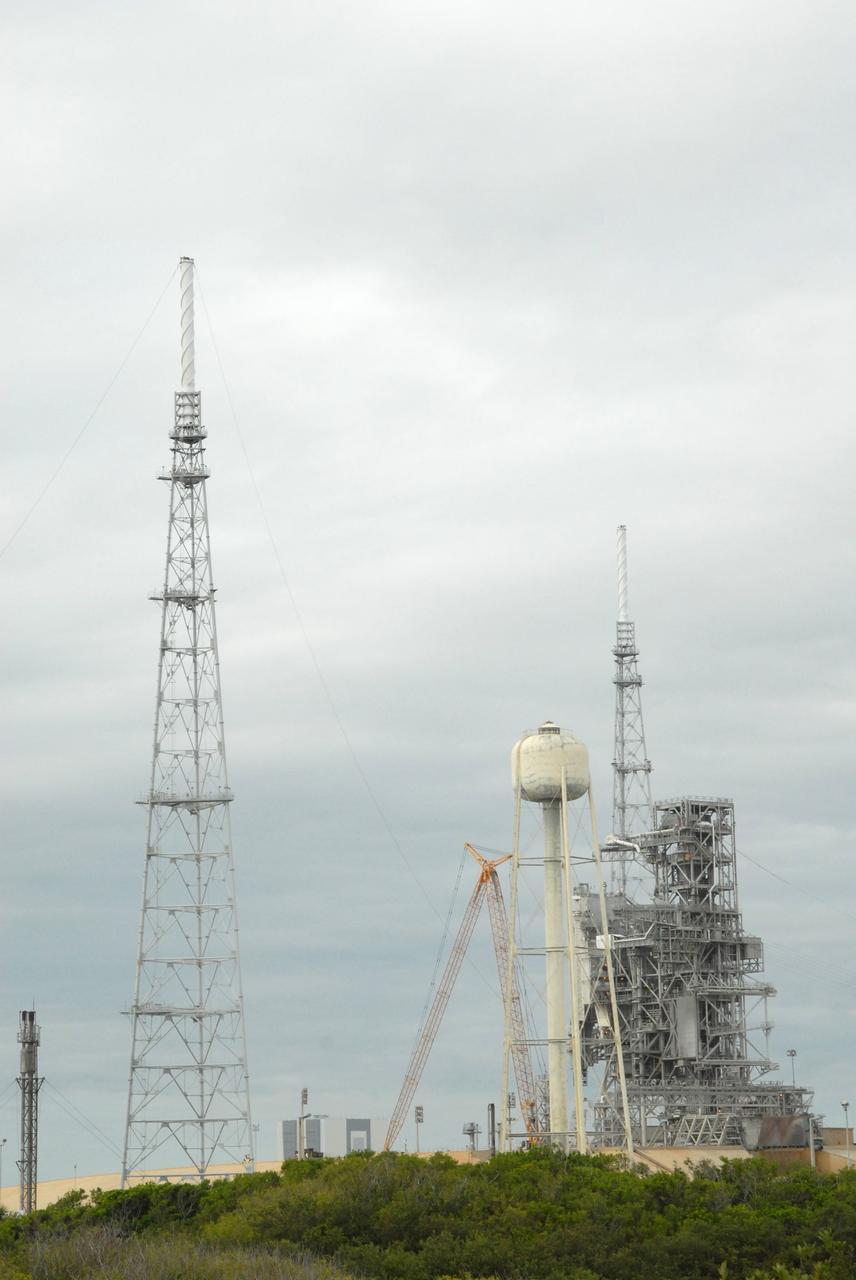
CAPE CANAVERAL, Fla. – On Launch Pad 39B at NASA's Kennedy Space Center in Florida, catenary wires are being suspended from the lighting masts on the lightning towers. The catenary wire system under development for the Constellation Program’s next-generation vehicles will significantly increase the shielding level, providing better protection, and further separate the electrical current from vital launch hardware. The system will help avoid delays to the launch schedule by collecting more information on the strike for analysis by launch managers. Photo credit: NASA/Jack Pfaller
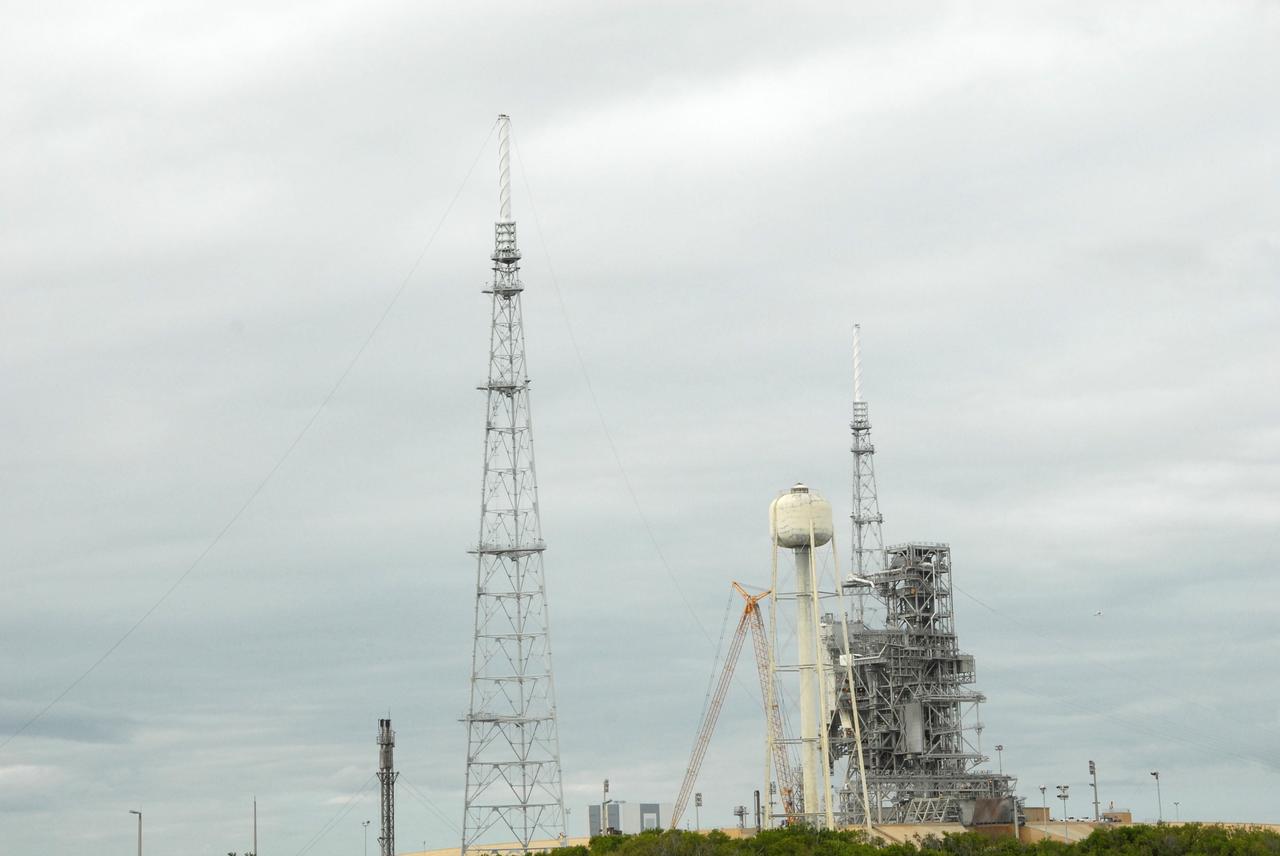
CAPE CANAVERAL, Fla. – On Launch Pad 39B at NASA's Kennedy Space Center in Florida, catenary wires are being suspended from the lighting masts on the lightning towers. The catenary wire system under development for the Constellation Program’s next-generation vehicles will significantly increase the shielding level, providing better protection, and further separate the electrical current from vital launch hardware. The system will help avoid delays to the launch schedule by collecting more information on the strike for analysis by launch managers. Photo credit: NASA/Jack Pfaller
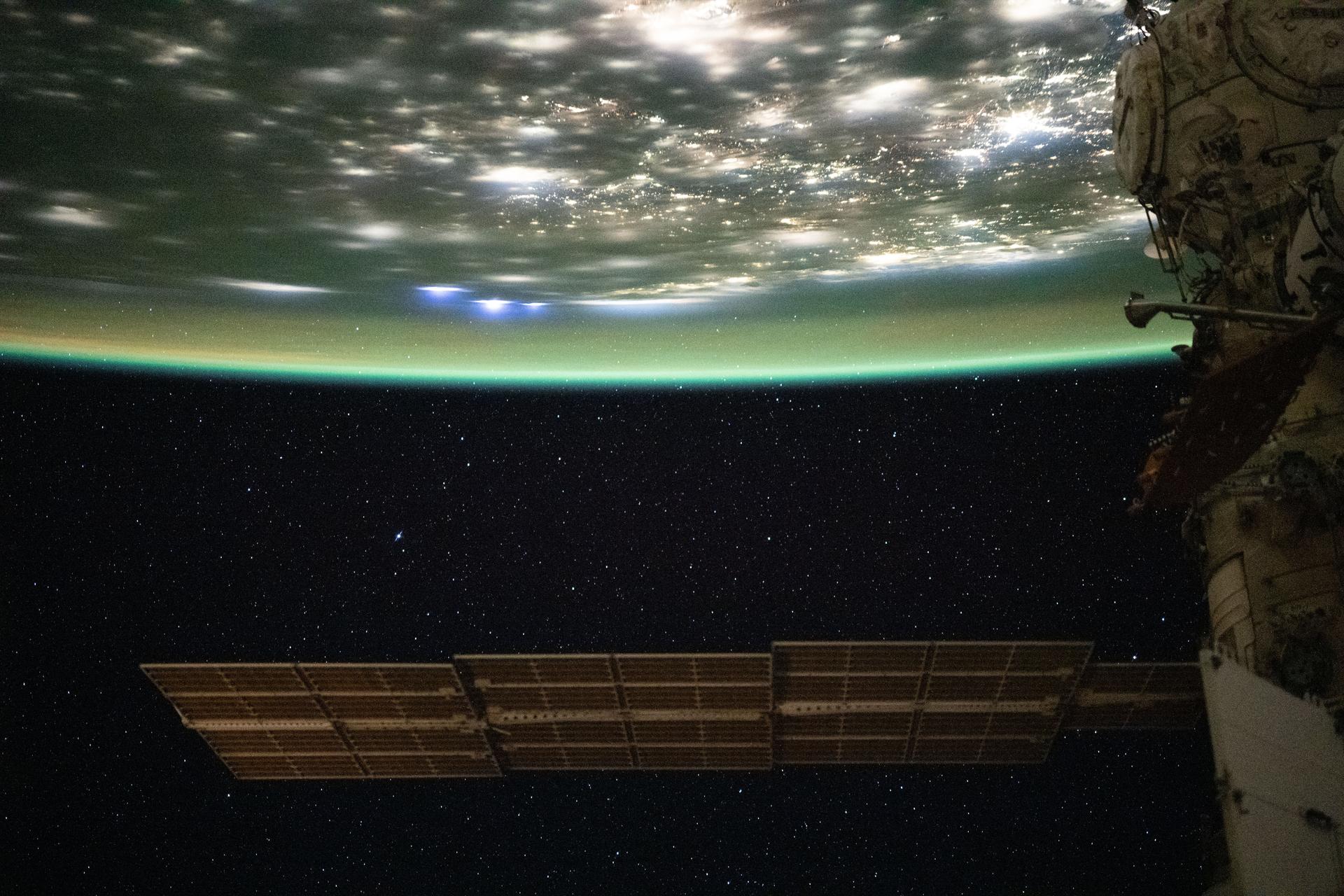
iss073e0982450 (Oct. 25, 2025) --- A blue-green airglow blankets the bright city lights of the eastern United States, with bluish-white lightning strikes visible on Earth's horizon near the center-left of the frame. Stars twinkle in the night sky in the lower half of the image, captured at approximately 2:03 a.m. local time from the International Space Station as it orbited 262 miles above northeastern Pennsylvania.
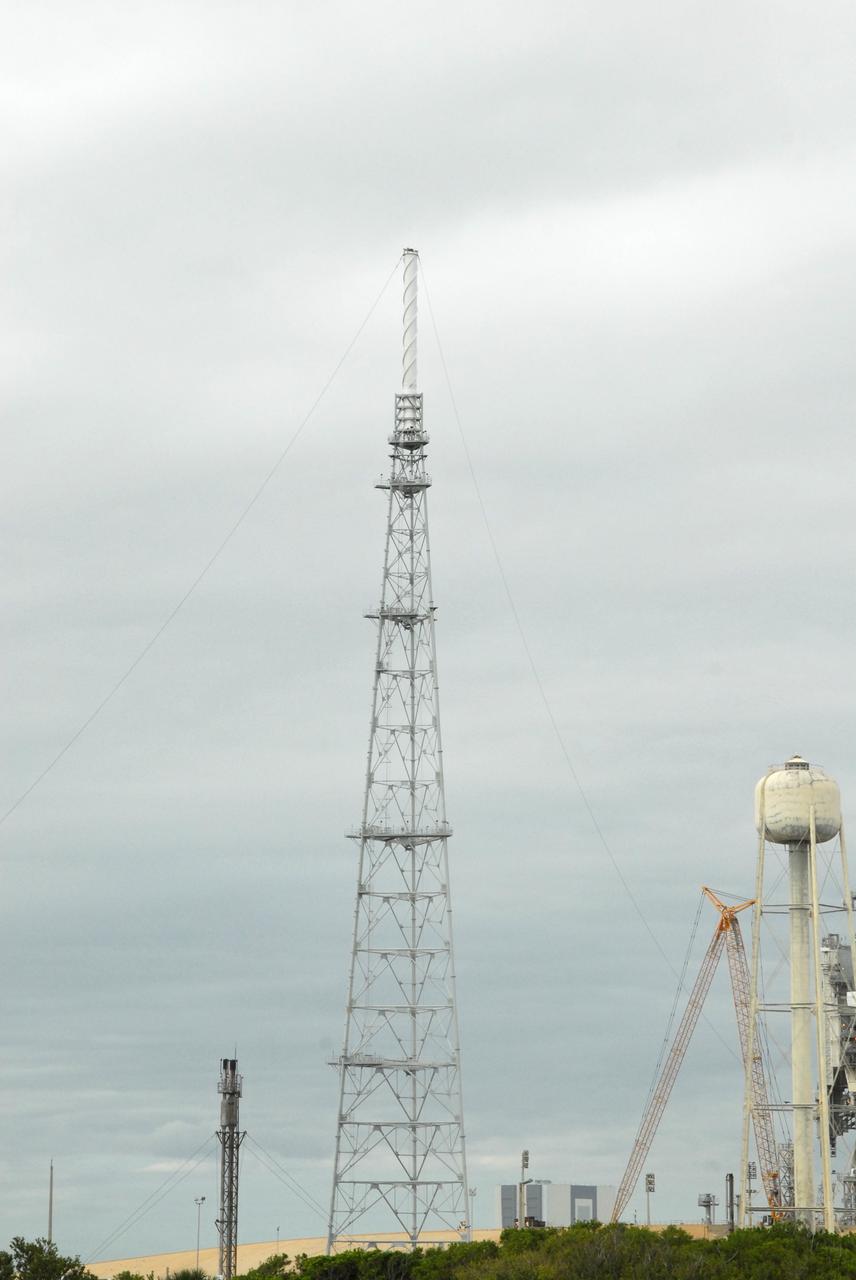
CAPE CANAVERAL, Fla. – On Launch Pad 39B at NASA's Kennedy Space Center in Florida, catenary wires are being suspended from the lighting masts on the lightning towers. The catenary wire system under development for the Constellation Program’s next-generation vehicles will significantly increase the shielding level, providing better protection, and further separate the electrical current from vital launch hardware. The system will help avoid delays to the launch schedule by collecting more information on the strike for analysis by launch managers. Photo credit: NASA/Jack Pfaller
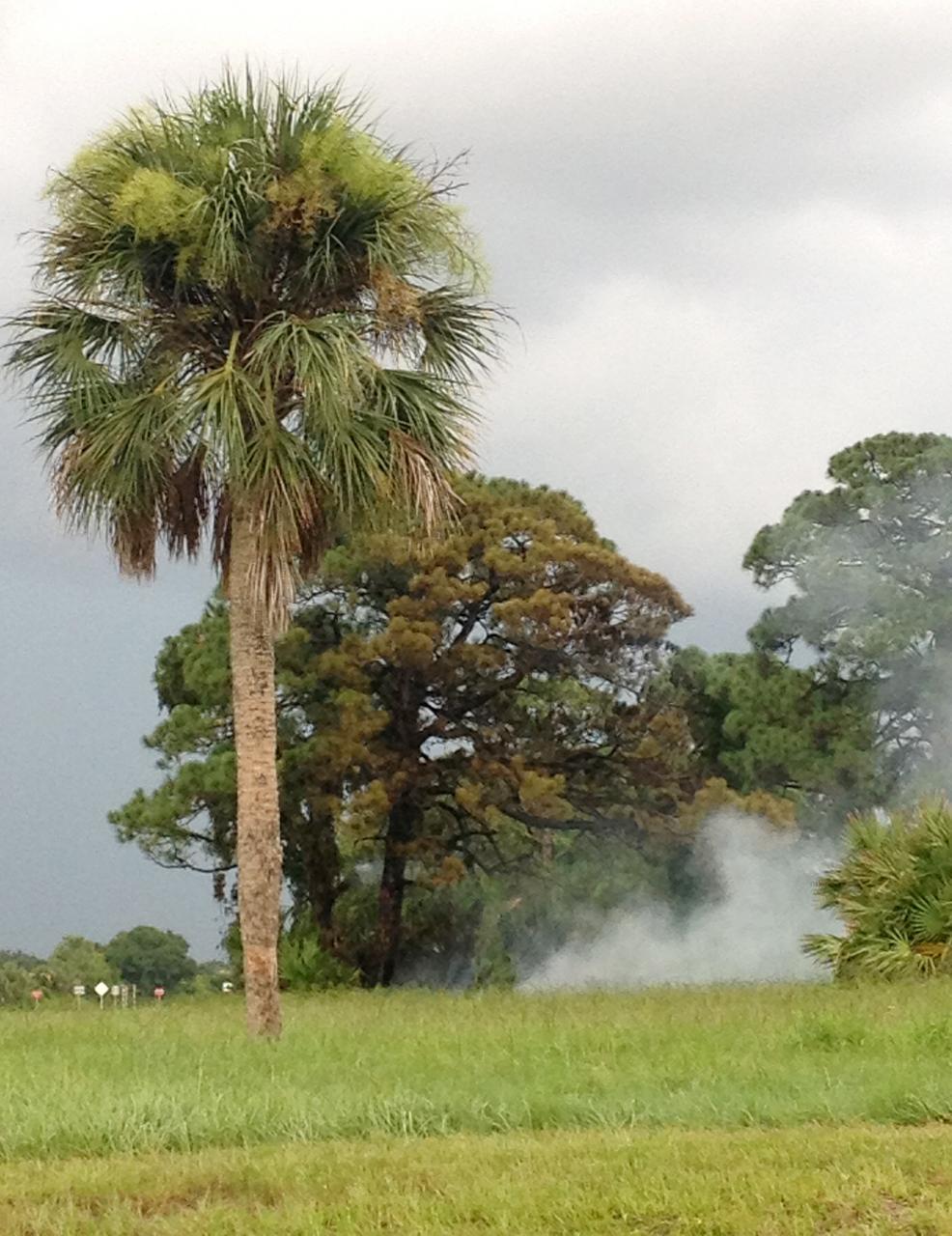
CAPE CANAVERAL, Fla. – A lightning strike sparks a brush fire near Headquarters Building in the Industrial Area of NASA’s Kennedy Space Center in Florida. The space center is nestled on the Merritt Island National Wildlife Refuge, which is managed by the U.S. Fish and Wildlife Service. Chenega Security & Support Solutions is responsible for Kennedy's Fire Rescue Department. For information on the refuge, visit http://www.fws.gov/merrittisland/Index.html. For more on Kennedy Space Center, visit http://www.nasa.gov/kennedy. Photo credit: NASA/Ben Smegelsky
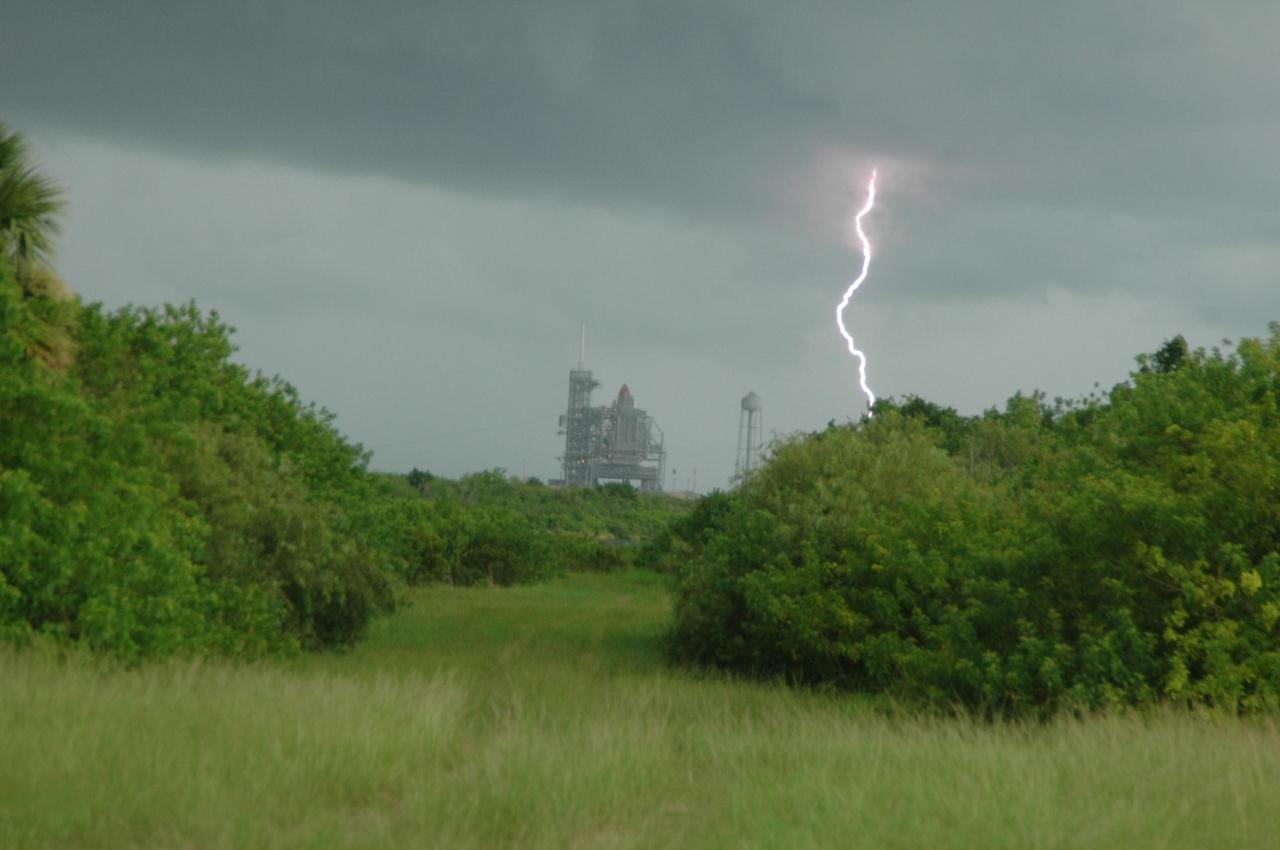
KENNEDY SPACE CENTER, FLA. -- A lightning strike is caught on camera during an afternoon thunderstorm at Kennedy Space Center, a common occurrence at this time of the year. In the background, the rotating service structure encloses Space Shuttle Endeavour on Launch Pad 39A. Endeavour is awaiting launch on mission STS-118. The mission is the 20th flight for orbiter Endeavour and the 22nd flight to the International Space Station. Launch is targeted for Aug. 7. Photo credit: NASA/Ken Thornsley
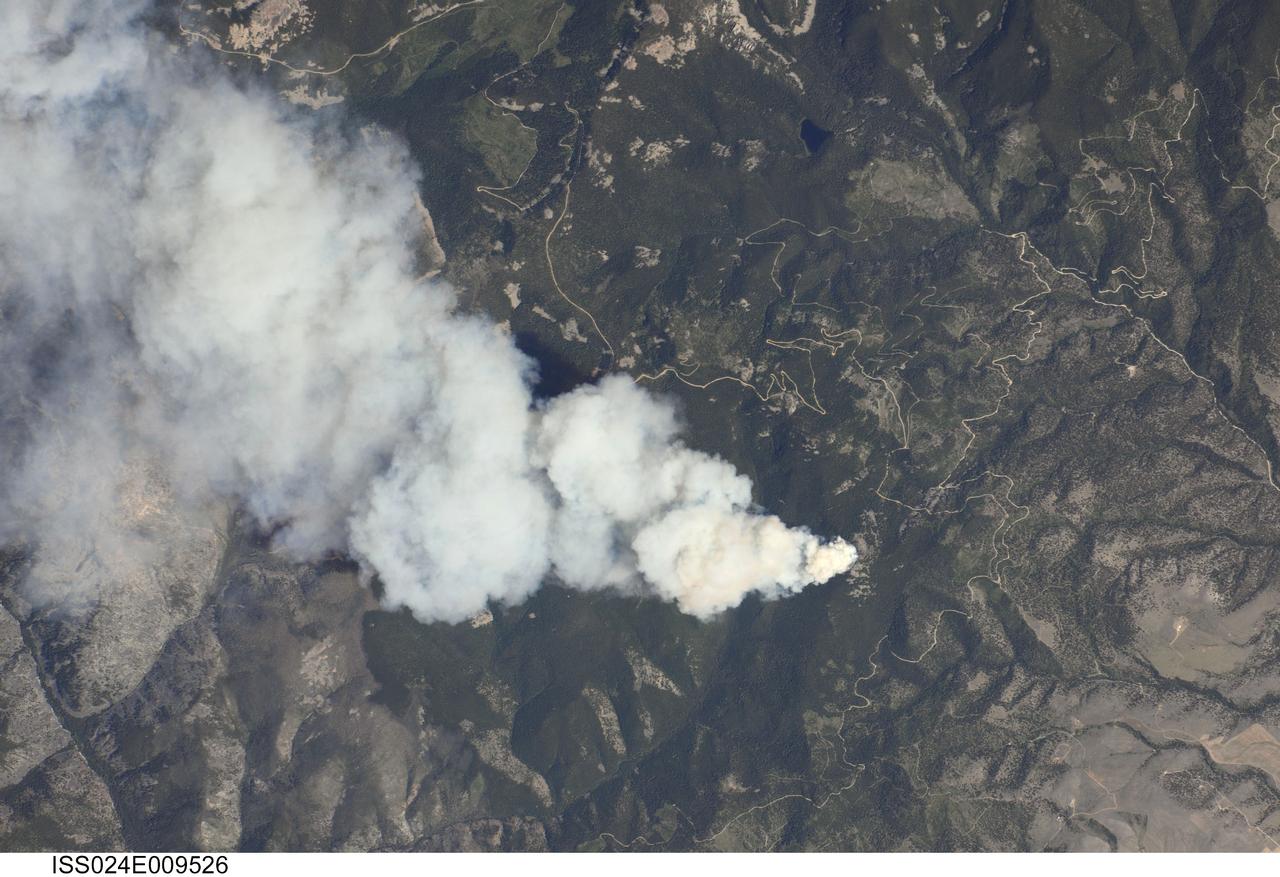
ISS024-E-009526 (25 July 2010) --- Dominic Point Fire in Montana is featured in this image photographed by an Expedition 24 crew member on the International Space Station. Lightning strikes in the forested mountains of the western United States, and human activities, can spark wild fires during the summer dry season. The Dominic Point Fire was first reported near 3:00 p.m. local time on July 25 2010. Approximately one hour later, the space station crew photographed the fire?s large smoke plume ? already extending at least eight kilometers to the east ? from orbit as they passed almost directly overhead. Forest Service fire crews, slurry bombers and helicopters were on the scene by that evening. The fire may have been started by a lightning strike, as there are no trails leading into the fire area located approximately 22 kilometers northeast of Hamilton, MT (according to local reports). As of July 26, 2010 the fire had burned approximately 283?405 hectares of the Bitterroot National Forest in western Montana. The fire is thought to have expanded quickly due to high temperatures, low humidity, and favorable winds with an abundance of deadfall ? dead trees and logs that provide readily combustible fuels ? in the area.
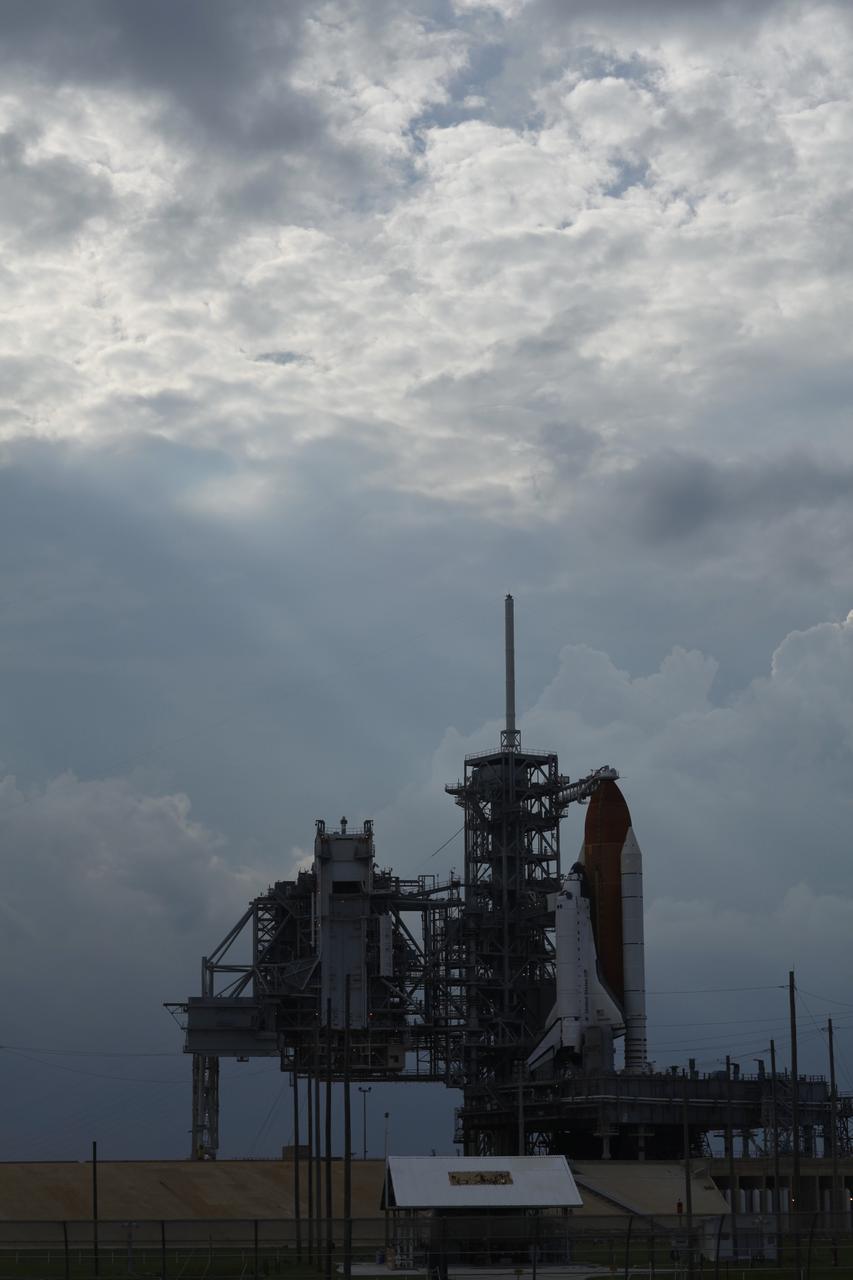
CAPE CANAVERAL, Fla. – The darkened sky over Launch Pad 39A at NASA's Kennedy Space Center in Florida reveal the decision to postpone today’s space shuttle launch because of lightning and thunderstorms within the 20-nautical-mile circle around the launch pad. The fifth launch attempt for the STS-127 mission was scrubbed at 6:39 p.m. EDT. This was the fifth launch attempt for the STS-127 mission. The first two launch attempts on June 13 and June 17 were scrubbed when a hydrogen gas leak occurred during tanking due to a misaligned Ground Umbilical Carrier Plate. Mission managers also decided to delay tanking on July 11 for a launch attempt later in the day to allow engineers and safety personnel time to analyze data captured during lightning strikes near the pad on July 10. The fourth attempt on July 12 was scrubbed due to weather concerns as well. Photo courtesy of Scott Andrews
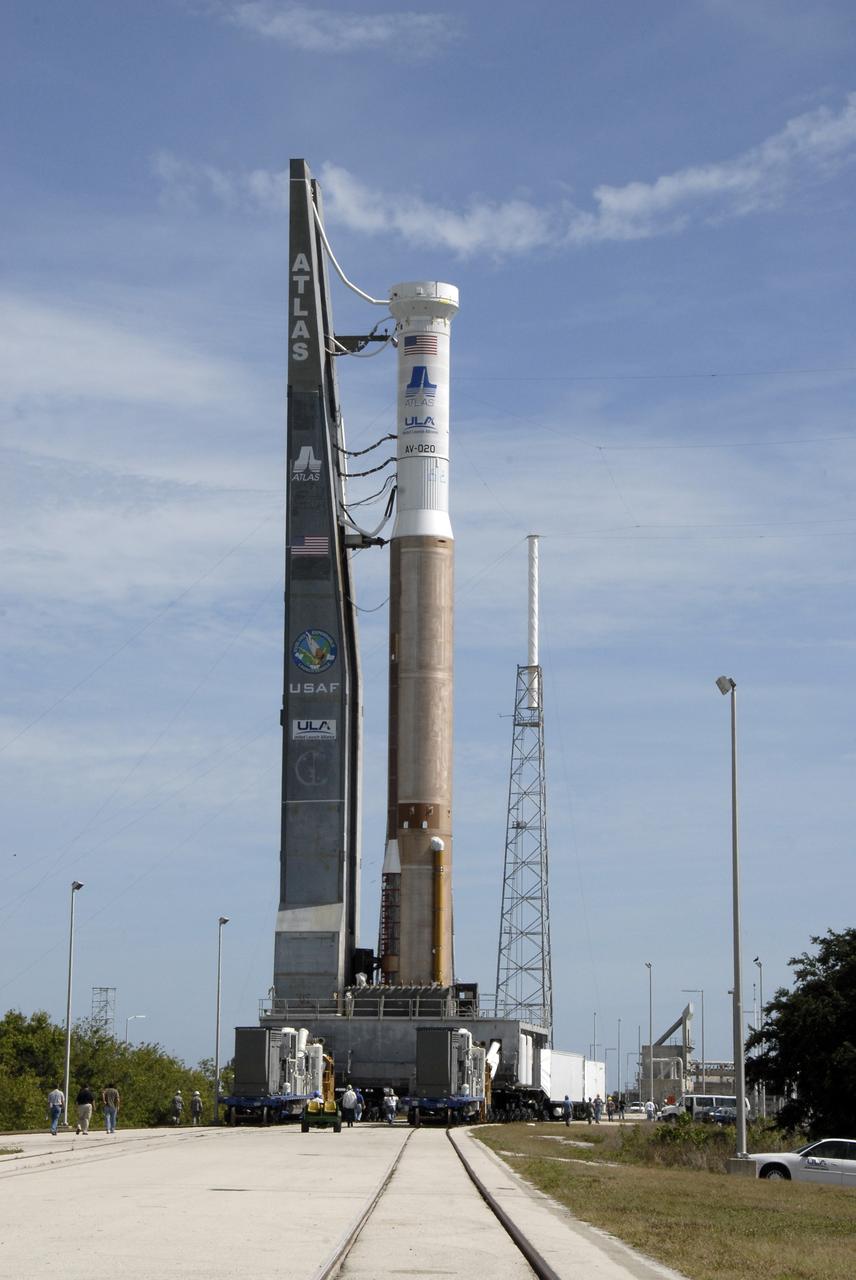
CAPE CANAVERAL, Fla. – The Atlas V/Centaur nears Launch Complex-41 at Cape Canaveral Air Force Station in Florida. Behind it at right is one of the four lightning towers that surround the pad for protection against possible lightning strikes. The Atlas was rolled to the launch pad from the Vertical Integration Facility in preparation for the wet dress rehearsal, or countdown test, which means being fully loaded with propellants including liquid hydrogen, liquid oxygen and RP-1 fuel. The launch vehicle will be rolled off the pad and returned to the VIF on May 16. The Atlas V/Centaur is the launch vehicle for NASA's Lunar Reconnaissance Orbiter, or LRO, and NASA's Lunar CRater Observation and Sensing Satellite, known as LCROSS. They will be mated with the Atlas in late May. LCROSS and LRO are the first missions in NASA's plan to return humans to the moon and begin establishing a lunar outpost by 2020. Launch is scheduled for no earlier than June 17. Photo credit: NASA/Kim Shiflett
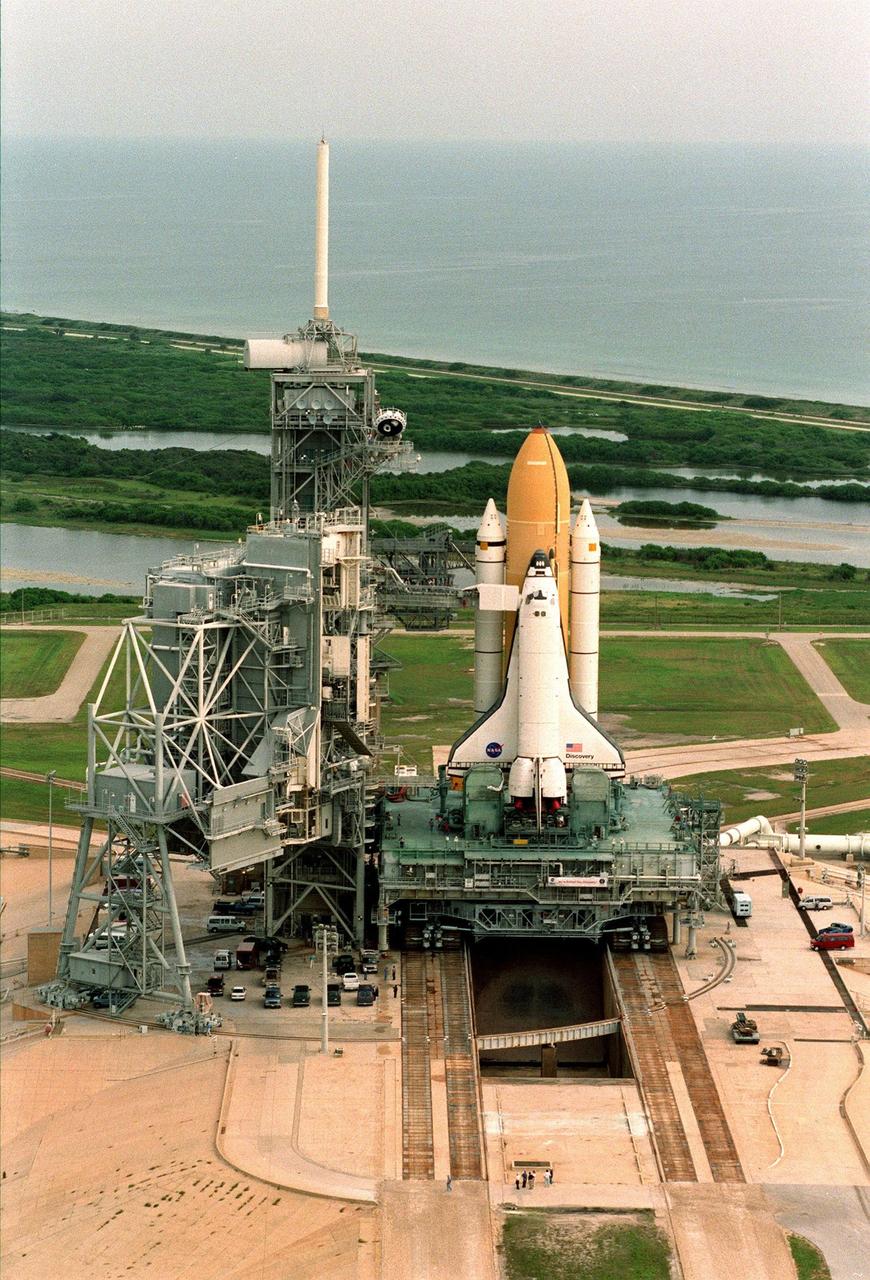
At the end of its 6-hour, 4.2-mile circular trek from the Vehicle Assembly Building, the STS-95 Space Shuttle Discovery sits on the Mobile Launch Platform, still atop the crawler transporter, at Launch Pad 39B. To its left is the Fixed Service Structure that provides access to the orbiter and the Rotating Service Structure. Above it is the 80-foot fiberglass lightning mast which provides protection from lightning strikes. This view shows the Atlantic Ocean beyond the shuttle, to the east. At the launch pad, the orbiter, external tank and solid rocket boosters will undergo final preparations for the launch, scheduled to lift off Oct. 29. The mission includes research payloads such as the Spartan solar-observing deployable spacecraft, the Hubble Space Telescope Orbital Systems Test Platform, the International Extreme Ultraviolet Hitchhiker, as well as the SPACEHAB single module with experiments on space flight and the aging process
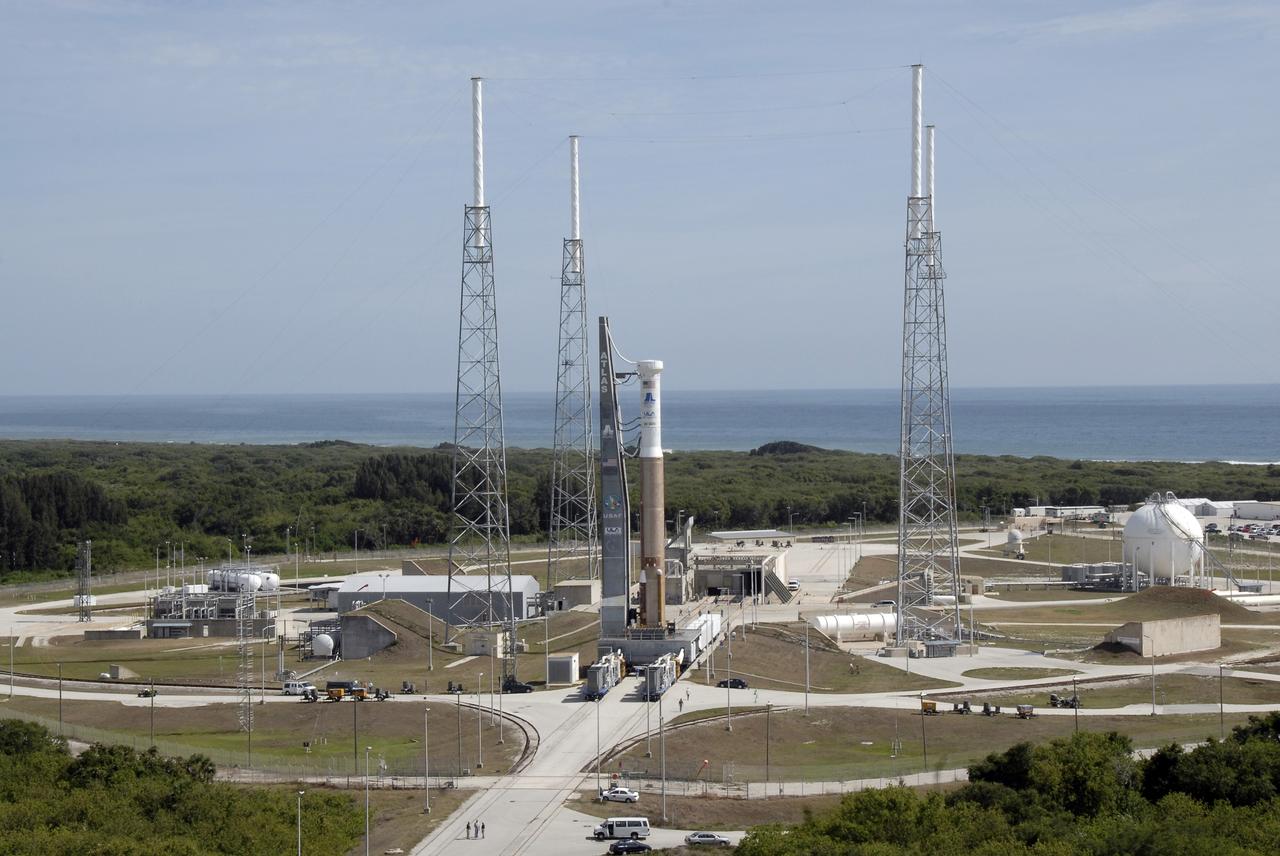
CAPE CANAVERAL, Fla. – The Atlas V/Centaur arrives on Launch Complex-41 at Cape Canaveral Air Force Station in Florida. Lightning towers surround the pad for protection against possible lightning strikes. The Atlas was rolled to the launch pad from the Vertical Integration Facility in preparation for the wet dress rehearsal, or countdown test, which means being fully loaded with propellants including liquid hydrogen, liquid oxygen and RP-1 fuel. The launch vehicle will be rolled off the pad and returned to the VIF on May 16. The Atlas V/Centaur is the launch vehicle for NASA's Lunar Reconnaissance Orbiter, or LRO, and NASA's Lunar CRater Observation and Sensing Satellite, known as LCROSS. They will be mated with the Atlas in late May. LCROSS and LRO are the first missions in NASA's plan to return humans to the moon and begin establishing a lunar outpost by 2020. Launch is scheduled for no earlier than June 17. Photo credit: NASA/Kim Shiflett
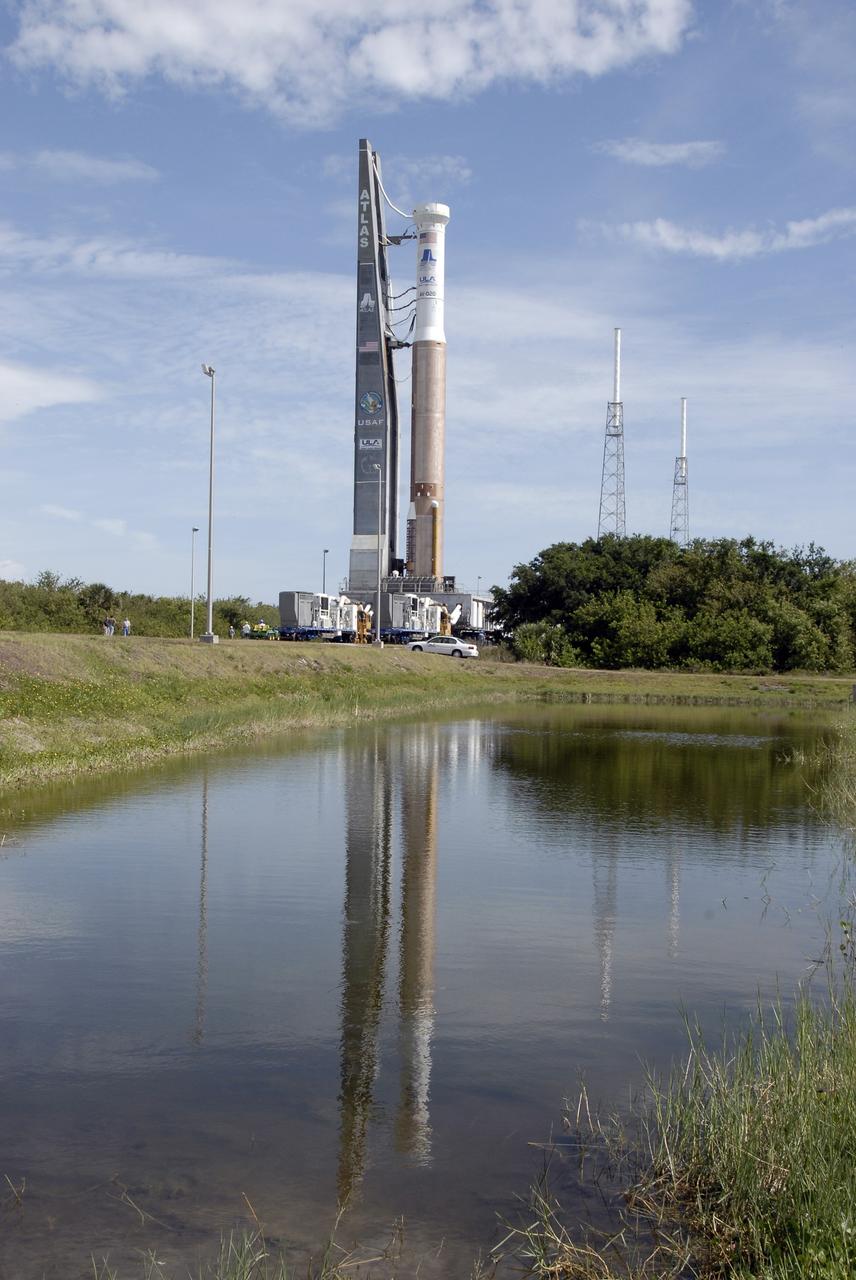
CAPE CANAVERAL, Fla. – The Atlas V/Centaur nears Launch Complex-41 at Cape Canaveral Air Force Station in Florida. At right in the background are two of the four lightning towers that surround the pad for protection against possible lightning strikes. The Atlas was rolled to the launch pad from the Vertical Integration Facility in preparation for the wet dress rehearsal, or countdown test, which means being fully loaded with propellants including liquid hydrogen, liquid oxygen and RP-1 fuel. The launch vehicle will be rolled off the pad and returned to the VIF on May 16. The Atlas V/Centaur is the launch vehicle for NASA's Lunar Reconnaissance Orbiter, or LRO, and NASA's Lunar CRater Observation and Sensing Satellite, known as LCROSS. They will be mated with the Atlas in late May. LCROSS and LRO are the first missions in NASA's plan to return humans to the moon and begin establishing a lunar outpost by 2020. Launch is scheduled for no earlier than June 17. Photo credit: NASA/Kim Shiflett
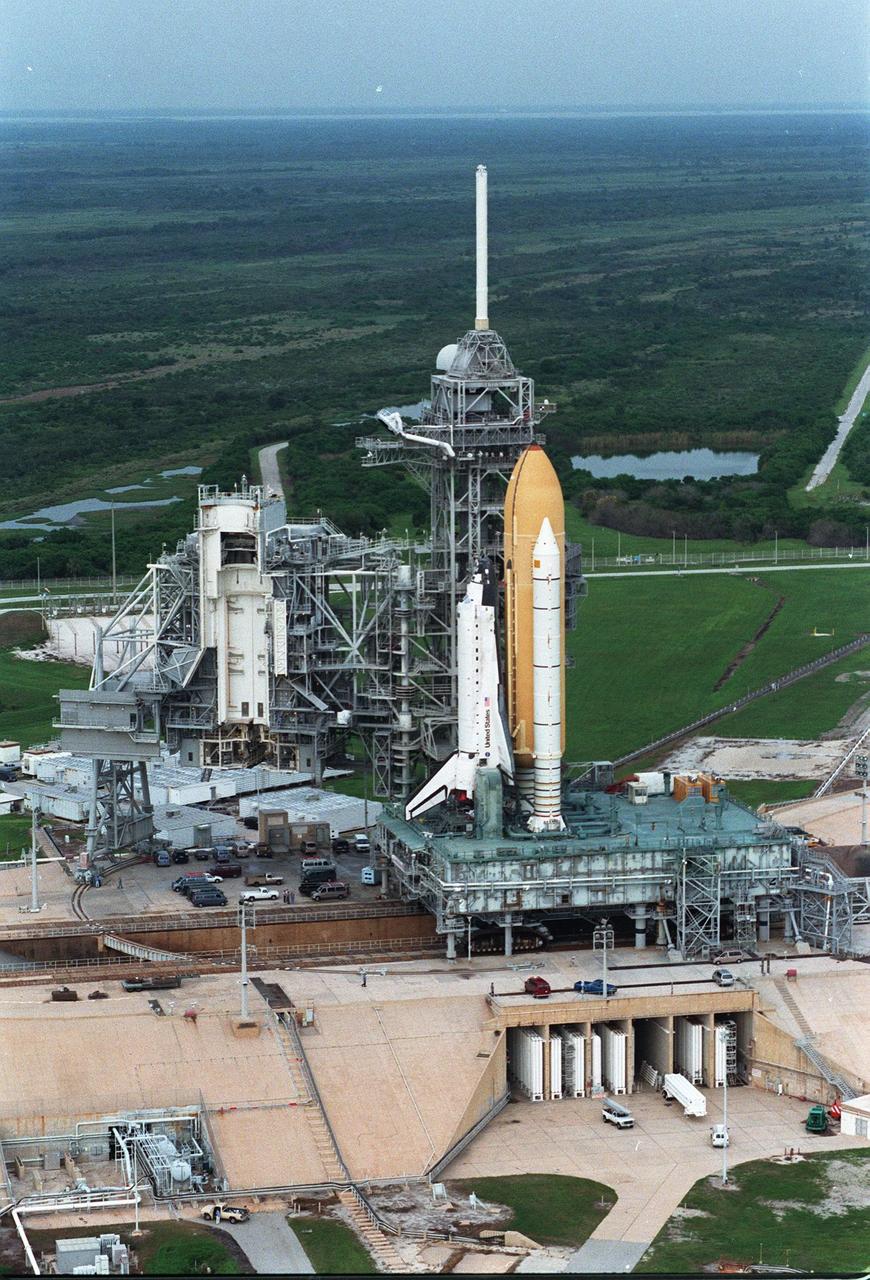
At the end of its 6-hour, 4.2-mile circular trek from the Vehicle Assembly Building, the STS-95 Space Shuttle Discovery, still on the Mobile Launch Platform and crawler transporter, sits at Launch Pad 39B. To its left is the Fixed Service Structure that provides access to the orbiter and the Rotating Service Structure. Above it is the 80-foot fiberglass lightning mast that provides protection from lightning strikes. The top of the photo looks west, across the Merritt Island National Wildlife Refuge. While at the launch pad, the orbiter, external tank and solid rocket boosters will undergo final preparations for the launch, scheduled to lift off Oct. 29. The mission includes research payloads such as the Spartan solar-observing deployable spacecraft, the Hubble Space Telescope Orbital Systems Test Platform, the International Extreme Ultraviolet Hitchhiker, as well as the SPACEHAB single module with experiments on space flight and the aging process
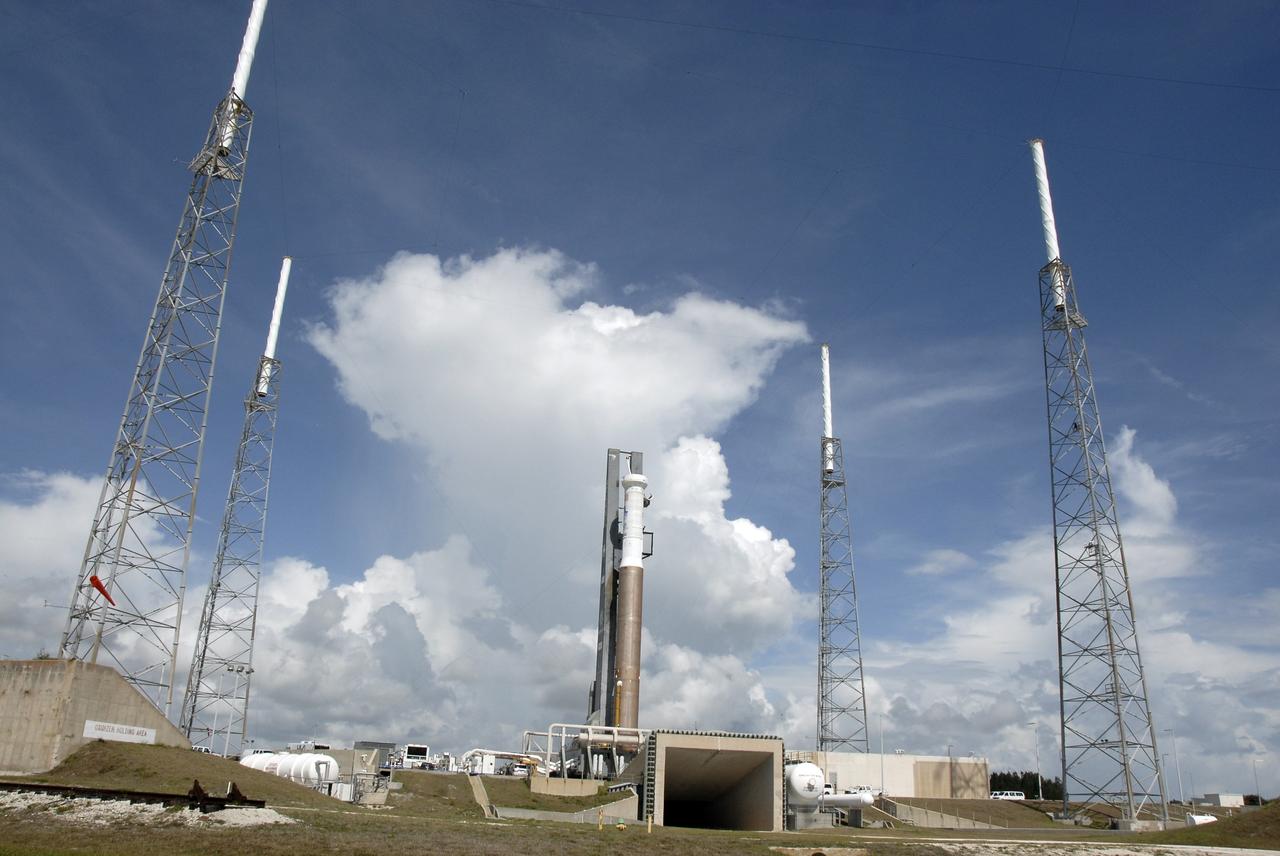
CAPE CANAVERAL, Fla. – The Atlas V/Centaur arrives on Launch Complex-41 at Cape Canaveral Air Force Station in Florida. Lightning towers surround the pad for protection against possible lightning strikes. The Atlas was rolled to the launch pad from the Vertical Integration Facility in preparation for the wet dress rehearsal, or countdown test, which means being fully loaded with propellants including liquid hydrogen, liquid oxygen and RP-1 fuel. The launch vehicle will be rolled off the pad and returned to the VIF on May 16. The Atlas V/Centaur is the launch vehicle for NASA's Lunar Reconnaissance Orbiter, or LRO, and NASA's Lunar CRater Observation and Sensing Satellite, known as LCROSS. They will be mated with the Atlas in late May. LCROSS and LRO are the first missions in NASA's plan to return humans to the moon and begin establishing a lunar outpost by 2020. Launch is scheduled for no earlier than June 17. Photo credit: NASA/Kim Shiflett
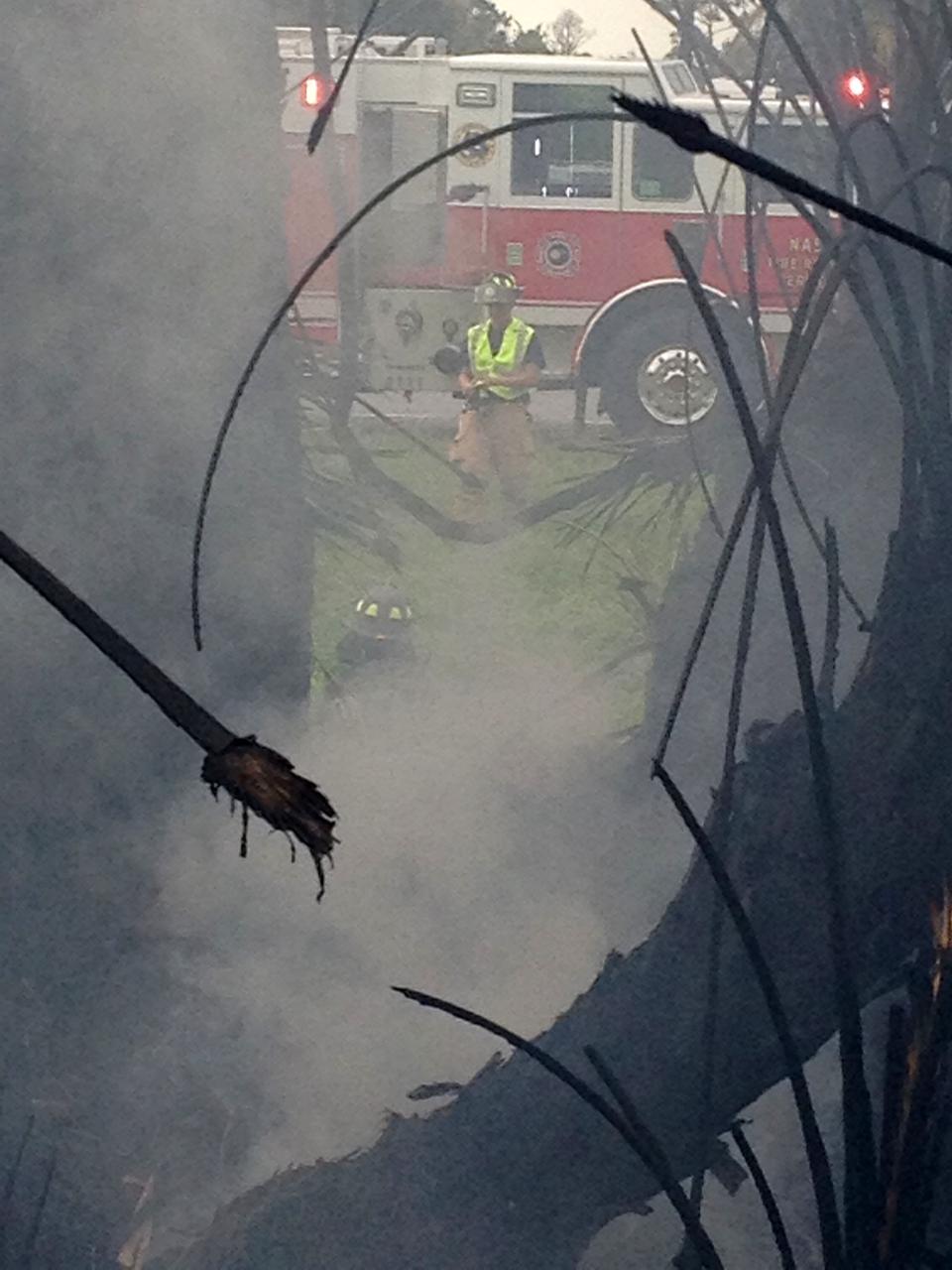
CAPE CANAVERAL, Fla. – Fire Rescue personnel douse a brush fire near Headquarters Building in the Industrial Area of NASA’s Kennedy Space Center in Florida. The fire was ignited by a lightning strike. The space center is nestled on the Merritt Island National Wildlife Refuge, which is managed by the U.S. Fish and Wildlife Service. Chenega Security & Support Solutions is responsible for Kennedy's Fire Rescue Department. For information on the refuge, visit http://www.fws.gov/merrittisland/Index.html. For more on Kennedy Space Center, visit http://www.nasa.gov/kennedy. Photo credit: NASA/Ben Smegelsky
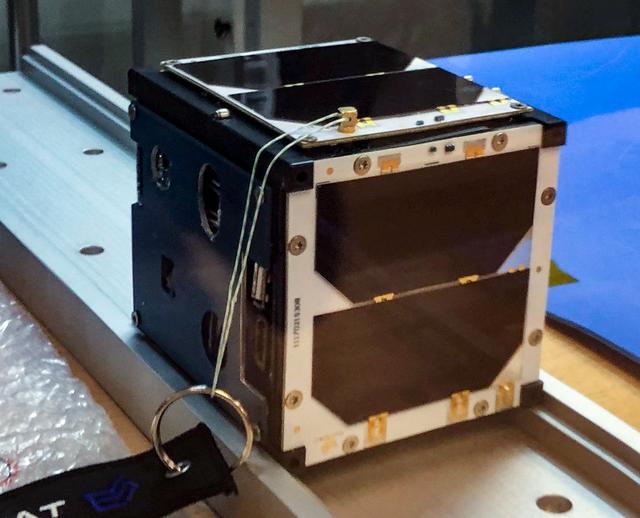
jsc2019e056550 (9/27/2019) --- Preflight view of Argus-02 awaiting integration at the NanoRacks facility. Argus-02 has two objectives: to examine the effect of space radiation on electronics and to test machine-learning algorithms that identify natural events. Memory cards loaded with known images are exposed to space radiation to further study radiation-induced effects. Simultaneously, the CubeSat images the Earth limb and uses algorithms to identify events such as lightning strikes and auroras; false-positive identification of events leads to modification of algorithms. Argus-02 results may help improve electronics and software for future space travel. Image courtesy of: Saint Louis University
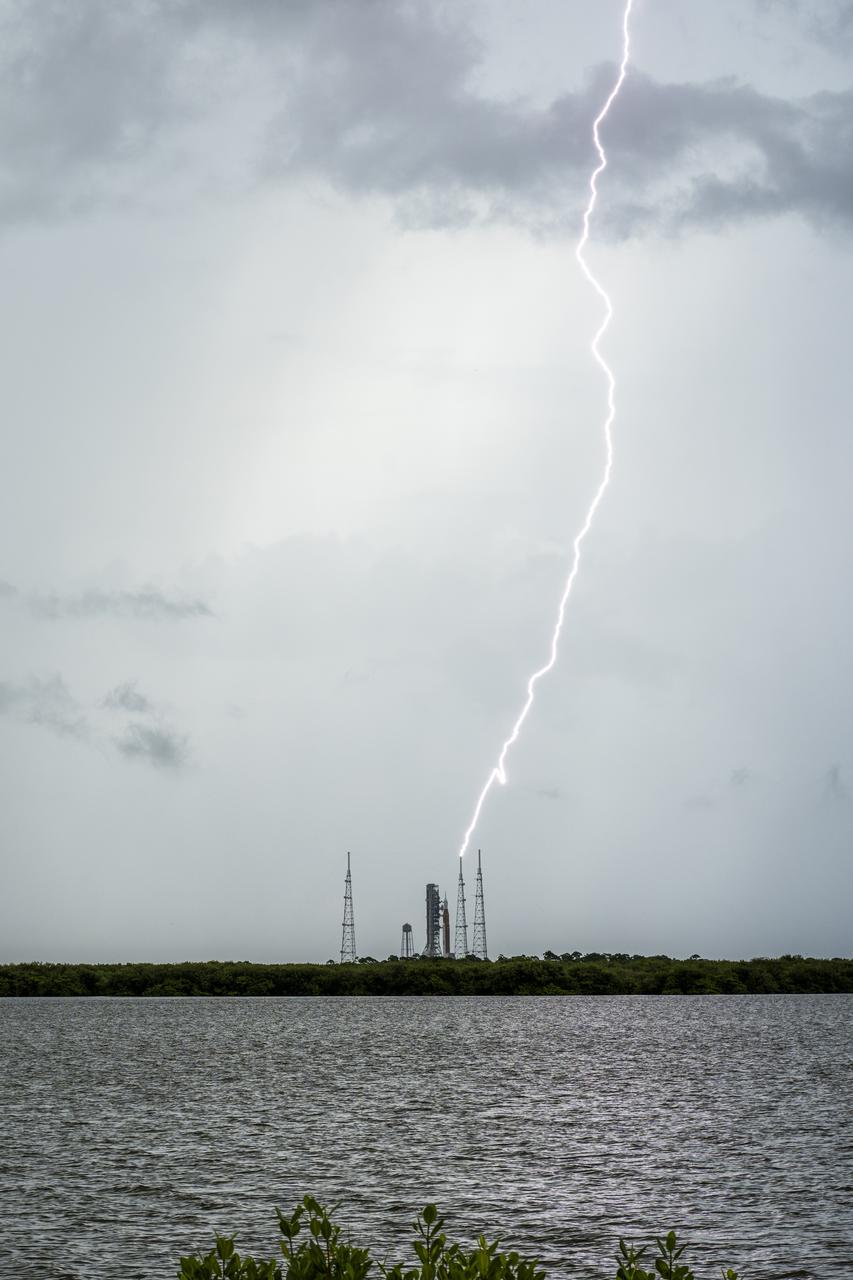
Lightning strikes the Launch Pad 39B protection system as preparations for launch of NASA’s Space Launch System (SLS) rocket with the Orion spacecraft aboard continue, Saturday, Aug. 27, 2022, at NASA’s Kennedy Space Center in Florida. NASA’s Artemis I flight test is the first integrated test of the agency’s deep space exploration systems: the Orion spacecraft, SLS rocket, and supporting ground systems. Launch of the uncrewed flight test is targeted for no earlier than Aug. 29 at 8:33 a.m. ET. Photo Credit: (NASA/Keegan Barber)
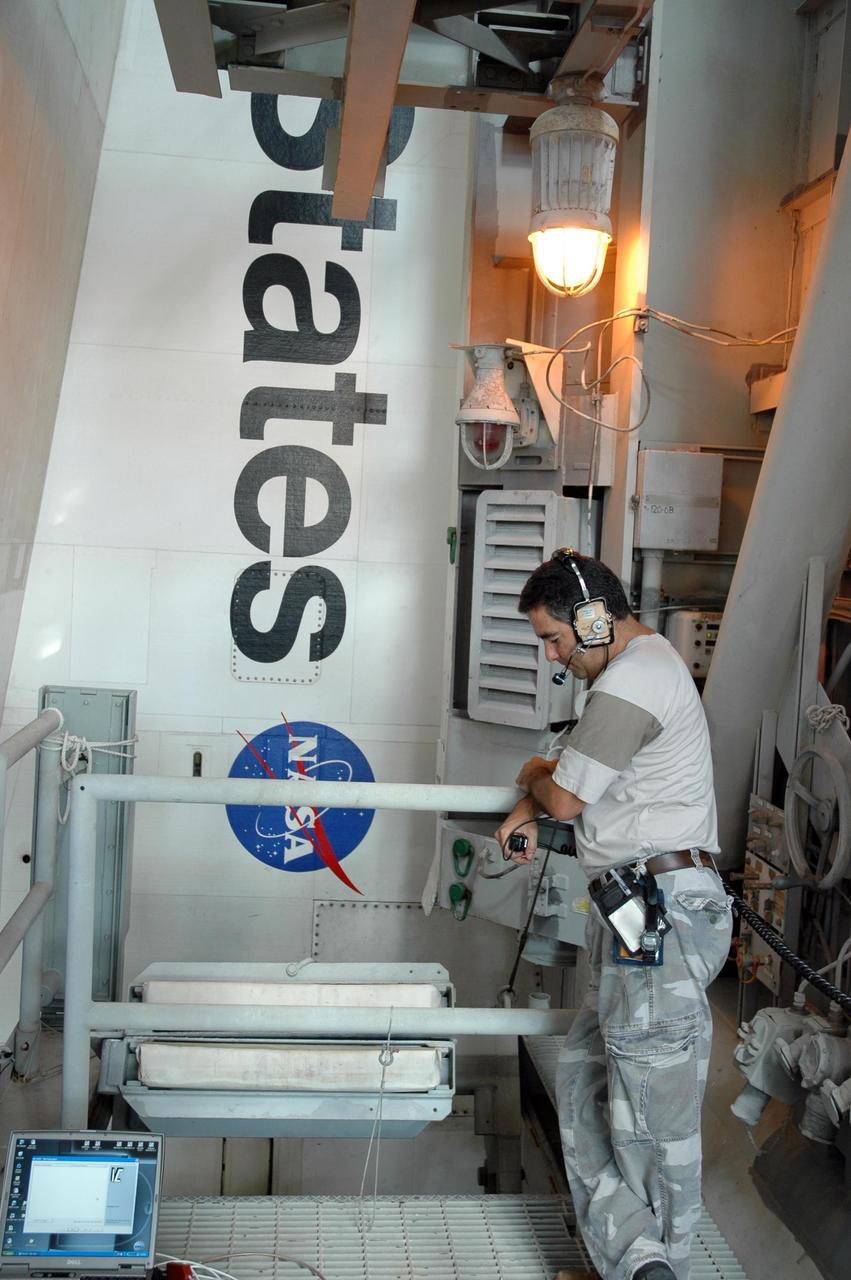
KENNEDY SPACE CENTER, FLA. - On Launch Pad 39B, a worker monitors data during evaluation of systems at the pad after a lightning strike Aug. 25. Preparations continue on the pad for launch of Atlantis on mission STS-115 as early as Aug. 29. However, preparations are also underway for a rollback of Atlantis to the Vehicle Assembly Building due to Hurricane Ernesto. The rollback will be determined by the mission management team based on information about Hurricane Ernesto and its path through Florida. Atlantis has been poised on Launch Pad 39B for liftoff on mission STS-115 to the International Space Station to deliver the P3/P4 truss segment. Photo credit: NASA/Jack Pfaller
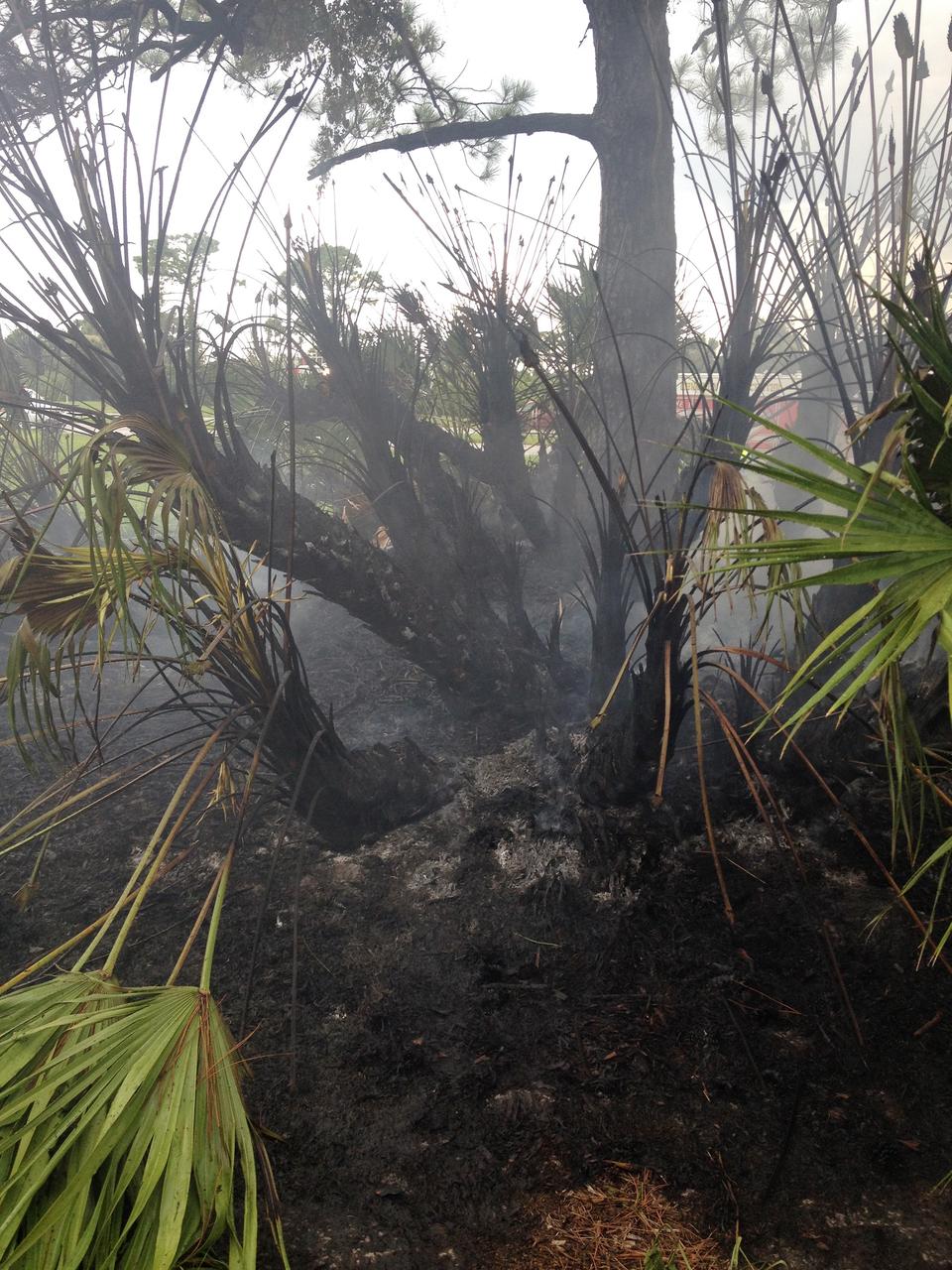
CAPE CANAVERAL, Fla. – A charred palmetto palm remains after a brush fire is extinguished near Headquarters Building in the Industrial Area of NASA’s Kennedy Space Center in Florida. The fire was ignited by a lightning strike. The space center is nestled on the Merritt Island National Wildlife Refuge, which is managed by the U.S. Fish and Wildlife Service. Chenega Security & Support Solutions is responsible for Kennedy's Fire Rescue Department. For information on the refuge, visit http://www.fws.gov/merrittisland/Index.html. For more on Kennedy Space Center, visit http://www.nasa.gov/kennedy. Photo credit: NASA/Ben Smegelsky
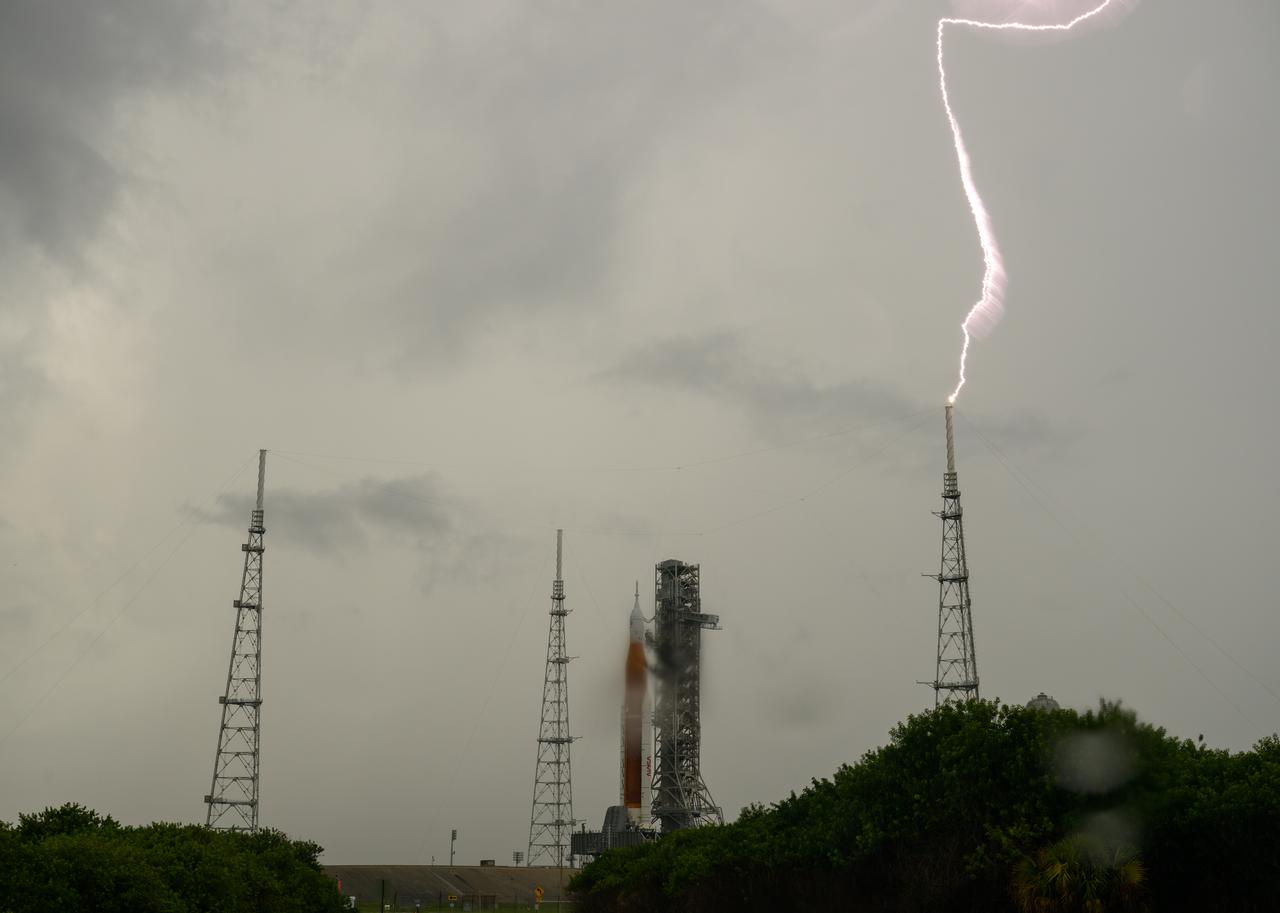
Lightning strikes the Launch Pad 39B protection system as preparations for launch of NASA’s Space Launch System (SLS) rocket with the Orion spacecraft aboard continue, Saturday, Aug. 27, 2022, at NASA’s Kennedy Space Center in Florida. NASA’s Artemis I flight test is the first integrated test of the agency’s deep space exploration systems: the Orion spacecraft, SLS rocket, and supporting ground systems. Launch of the uncrewed flight test is targeted for no earlier than Aug. 29 at 8:33 a.m. ET. Photo Credit: (NASA/Bill Ingalls)
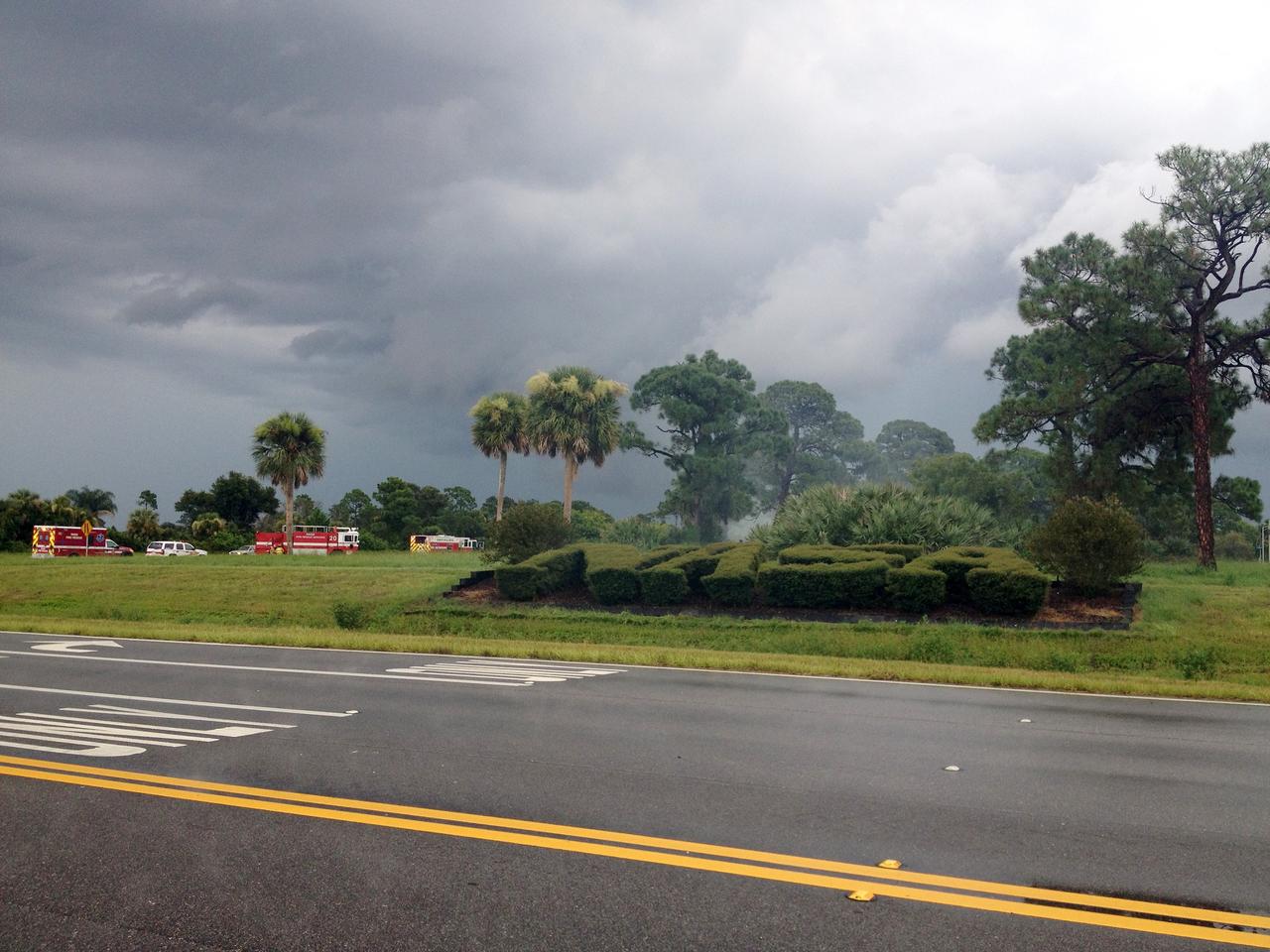
CAPE CANAVERAL, Fla. – Emergency responders are called to the scene of a brush fire near Headquarters Building in the Industrial Area of NASA’s Kennedy Space Center in Florida. The fire was ignited by a lightning strike. The space center is nestled on the Merritt Island National Wildlife Refuge, which is managed by the U.S. Fish and Wildlife Service. Chenega Security & Support Solutions is responsible for Kennedy's Fire Rescue Department. For information on the refuge, visit http://www.fws.gov/merrittisland/Index.html. For more on Kennedy Space Center, visit http://www.nasa.gov/kennedy. Photo credit: NASA/Ben Smegelsky
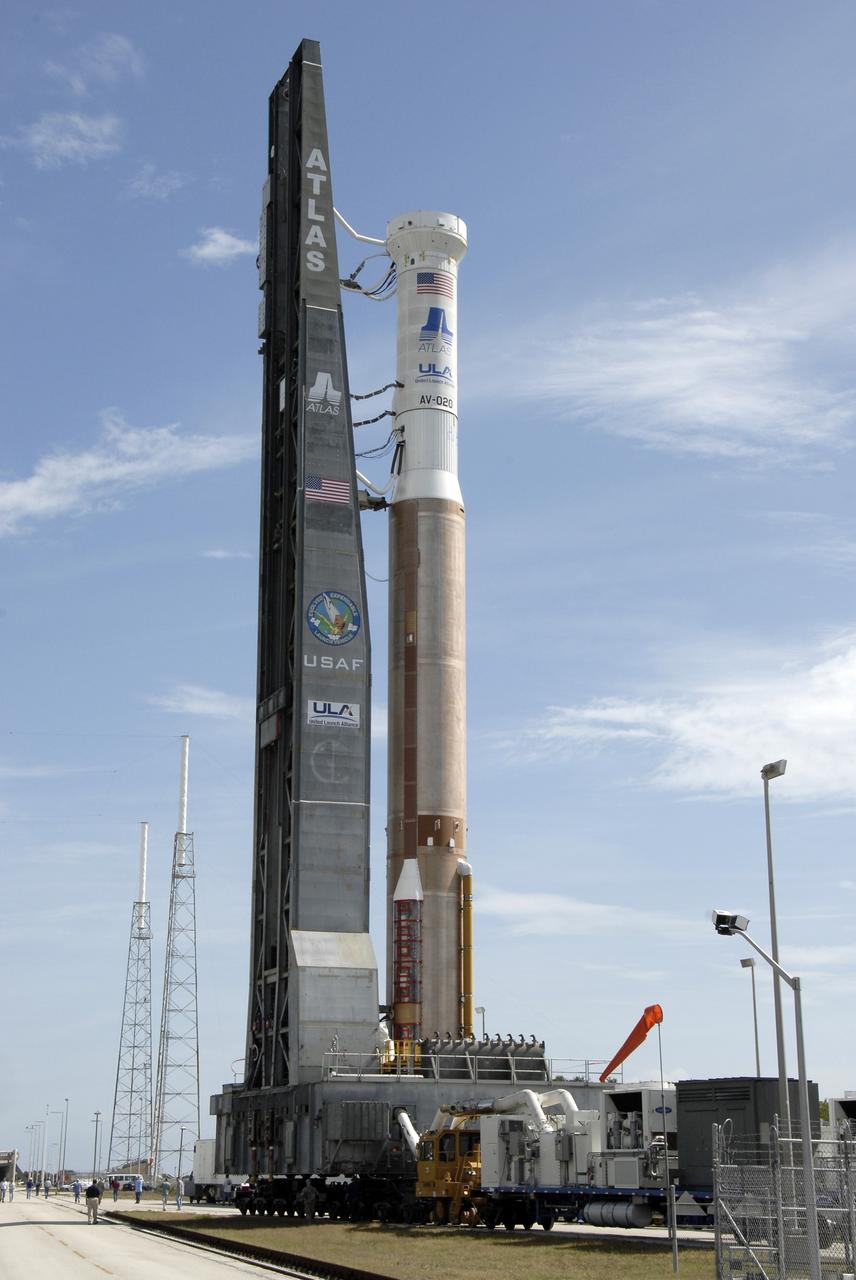
CAPE CANAVERAL, Fla. – The Atlas V/Centaur is moving from the Vertical Integration Facility at Cape Canaveral Air Force Station in Florida to Launch Complex-41. At left are two of the four lightning towers that surround the pad for protection against possible lightning strikes. The Atlas was rolled to the launch pad from the Vertical Integration Facility in preparation for the wet dress rehearsal, which means being fully loaded with propellants including liquid hydrogen, liquid oxygen and RP-1 fuel. The launch vehicle will be rolled off the pad and returned to the VIF on May 16. The Atlas V/Centaur is the launch vehicle for NASA's Lunar Reconnaissance Orbiter, or LRO, and NASA's Lunar CRater Observation and Sensing Satellite, known as LCROSS. They will be mated with the Atlas in late May. LCROSS and LRO are the first missions in NASA's plan to return humans to the moon and begin establishing a lunar outpost by 2020. Launch is scheduled for no earlier than June 17. Photo credit: NASA/Kim Shiflett
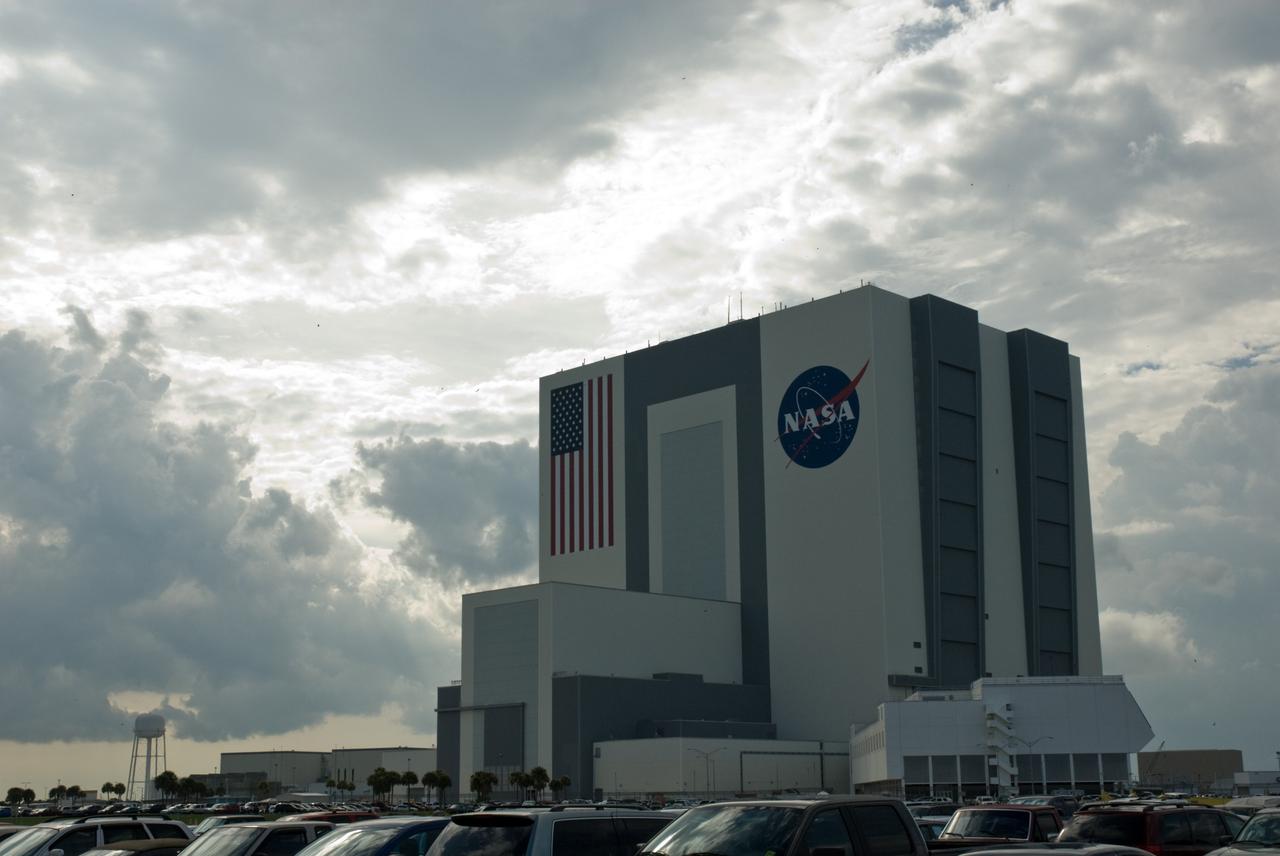
CAPE CANAVERAL, Fla. – Dark clouds fill the sky behind the Vehicle Assembly Building at NASA's Kennedy Space Center in Florida. NASA managers postponed today’s space shuttle launch because of lightning and thunderstorms within the 20-nautical-mile circle around the launch pad. The fifth launch attempt for the STS-127 mission was scrubbed at 6:39 p.m. EDT. The first two launch attempts on June 13 and June 17 were scrubbed when a hydrogen gas leak occurred during tanking due to a misaligned Ground Umbilical Carrier Plate. Mission managers also decided to delay tanking on July 11 for a launch attempt later in the day to allow engineers and safety personnel time to analyze data captured during lightning strikes near the pad on July 10. Weather concerns caused a scrub July 12 as well. Endeavour will deliver the Japanese Experiment Module's Exposed Facility, or JEM-EF, and the Experiment Logistics Module-Exposed Section, or ELM-ES, in the final of three flights dedicated to the assembly of the Japan Aerospace Exploration Agency's Kibo laboratory complex on the International Space Station. STS-127 is the 29th flight for the assembly of the space. Photo credit: NASA/Tim Jacobs
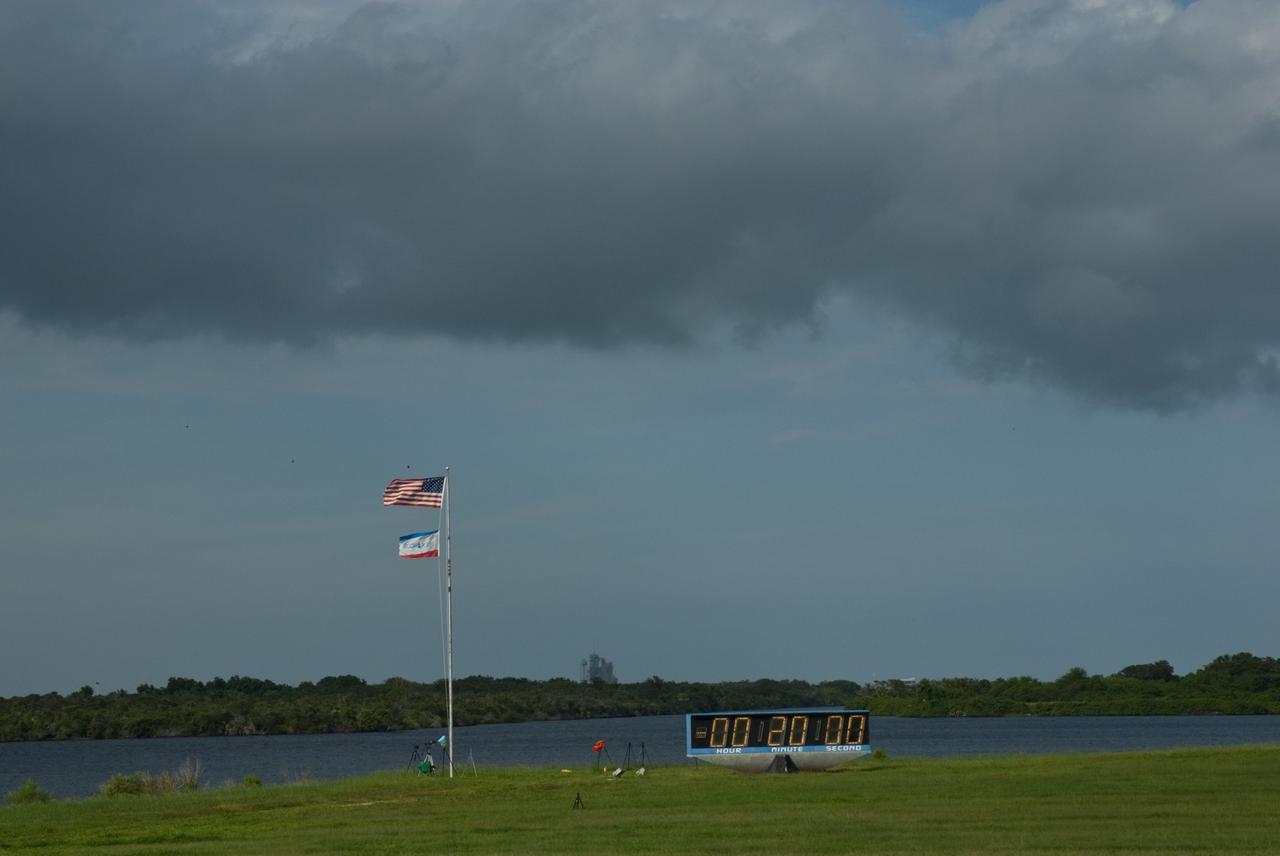
CAPE CANAVERAL, Fla. – Black clouds roll across the Launch Complex 39 Area and NASA News Center at NASA's Kennedy Space Center in Florida. NASA managers postponed today’s space shuttle launch because of lightning and thunderstorms within the 20-nautical-mile circle around the launch pad. The fifth launch attempt for the STS-127 mission was scrubbed at 6:39 p.m. EDT. The first two launch attempts on June 13 and June 17 were scrubbed when a hydrogen gas leak occurred during tanking due to a misaligned Ground Umbilical Carrier Plate. Mission managers also decided to delay tanking on July 11 for a launch attempt later in the day to allow engineers and safety personnel time to analyze data captured during lightning strikes near the pad on July 10. Weather concerns caused a scrub July 12 as well. Endeavour will deliver the Japanese Experiment Module's Exposed Facility, or JEM-EF, and the Experiment Logistics Module-Exposed Section, or ELM-ES, in the final of three flights dedicated to the assembly of the Japan Aerospace Exploration Agency's Kibo laboratory complex on the International Space Station. STS-127 is the 29th flight for the assembly of the space. Photo credit: NASA/Tim Jacobs
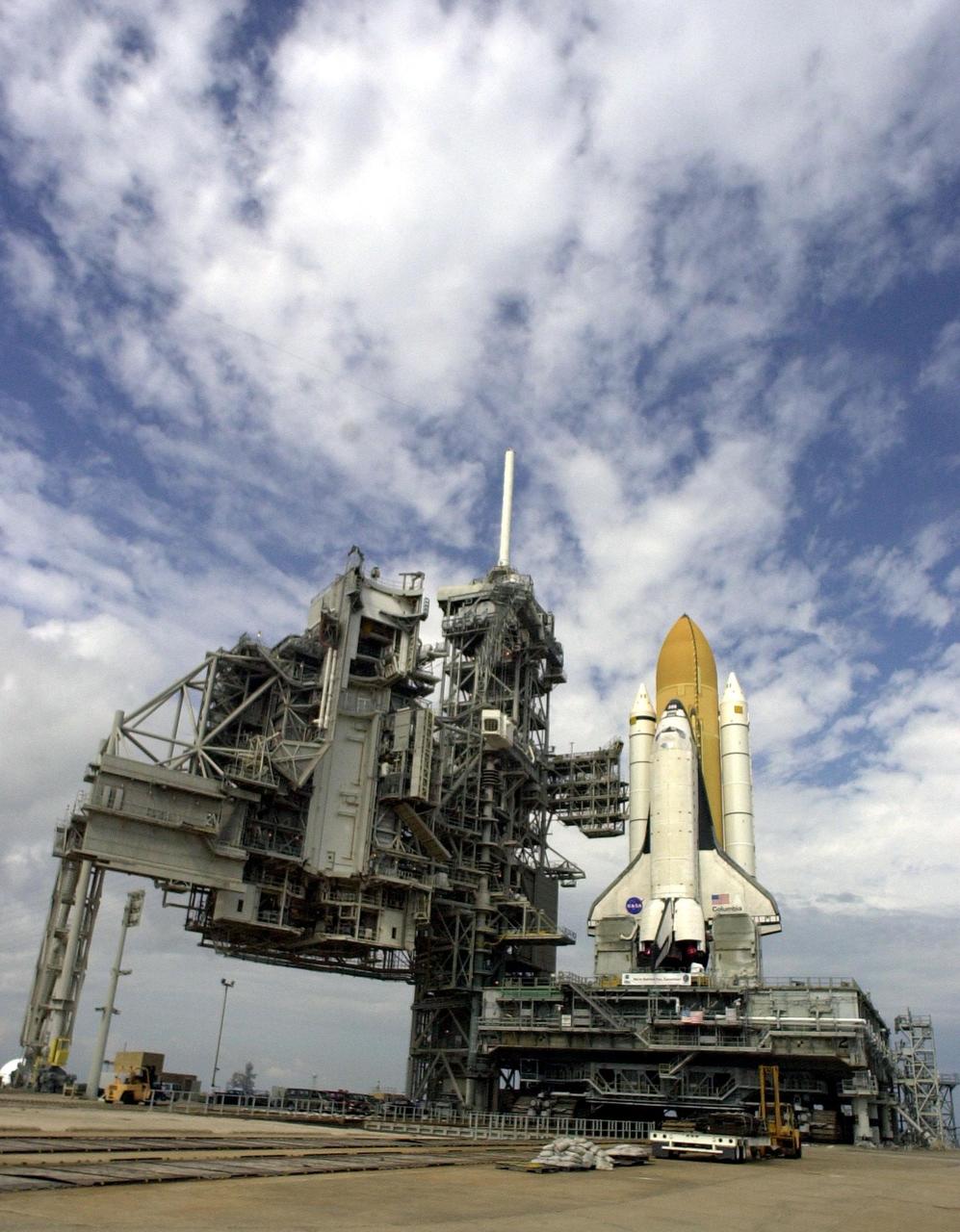
KENNEDY SPACE CENTER, FLA. -- Space Shuttle Columbia, atop its Mobile Launcher Platform, sits on Launch Pad 39A after an early morning rollout from the Vehicle Assembly Building. On the left is the Rotating Service Structure, which will swing counterclockwise to enclose the Shuttle and enable final preparations, including transfer of the payload. Atop the Fixed Service Structure (center) is the lightning mast, 347 feet above the pad. The 80-foot fiberglass mast provides protection from lightning strikes. Columbia is scheduled to be launched Feb. 28 on mission STS-109, a Hubble Servicing Mission. The goal of the mission is to replace Solar Array 2 with Solar Array 3, replace the Power Control Unit, remove the Faint Object Camera and install the ACS, install the Near Infrared Camera and Multi-Object Spectrometer (NICMOS) Cooling System, and install New Outer Blanket Layer insulation. The launch will be the first for Columbia after returning from California where it underwent extensive maintenance, inspections and enhancements. More than 100 upgrades make Columbia safer and more reliable than ever before
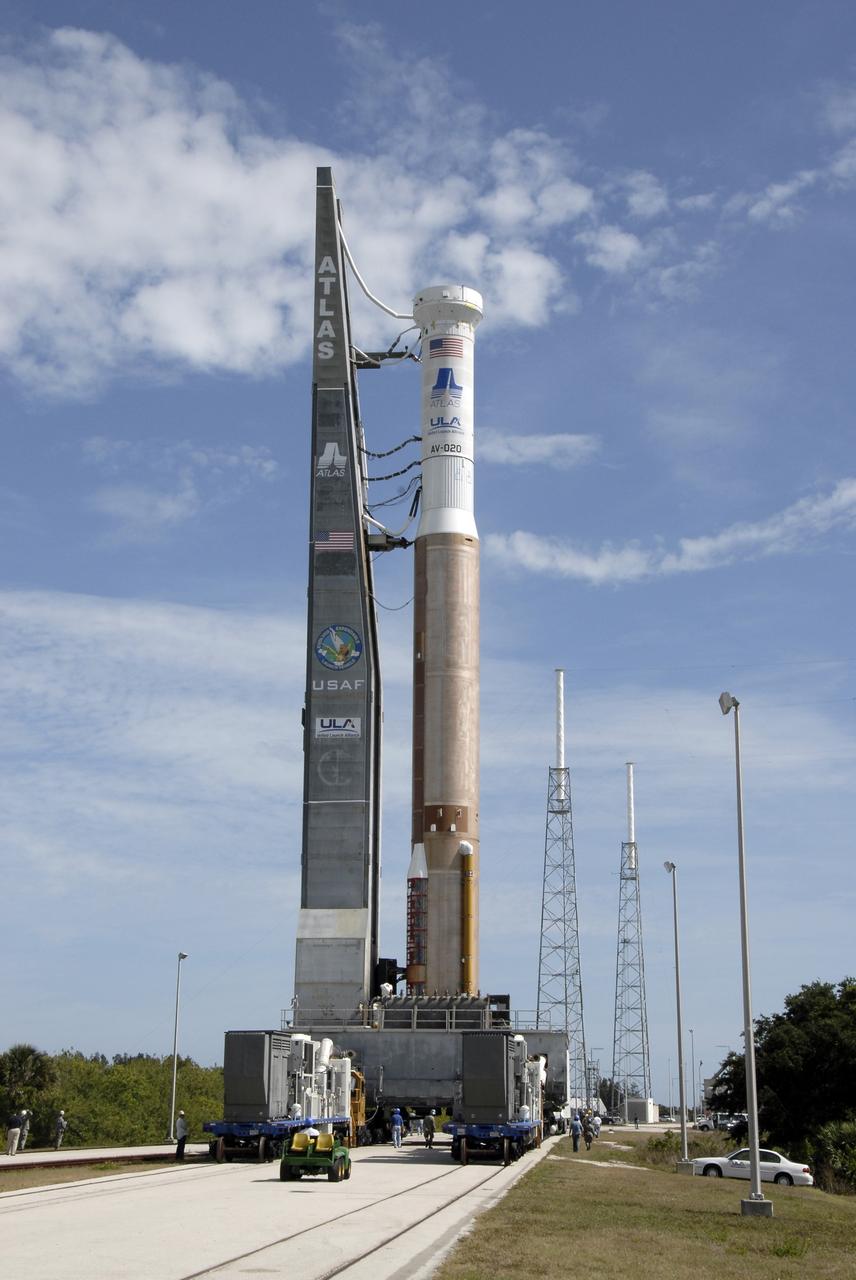
CAPE CANAVERAL, Fla. – The Atlas V/Centaur is moving from the Vertical Integration Facility at Cape Canaveral Air Force Station in Florida to Launch Complex-41. At right are two of the four lightning towers that surround the pad for protection against possible lightning strikes. The Atlas was rolled to the launch pad from the Vertical Integration Facility in preparation for the wet dress rehearsal, or countdown test, which means being fully loaded with propellants including liquid hydrogen, liquid oxygen and RP-1 fuel. The launch vehicle will be rolled off the pad and returned to the VIF on May 16. The Atlas V/Centaur is the launch vehicle for NASA's Lunar Reconnaissance Orbiter, or LRO, and NASA's Lunar CRater Observation and Sensing Satellite, known as LCROSS. They will be mated with the Atlas in late May. LCROSS and LRO are the first missions in NASA's plan to return humans to the moon and begin establishing a lunar outpost by 2020. Launch is scheduled for no earlier than June 17. Photo credit: NASA/Kim Shiflett
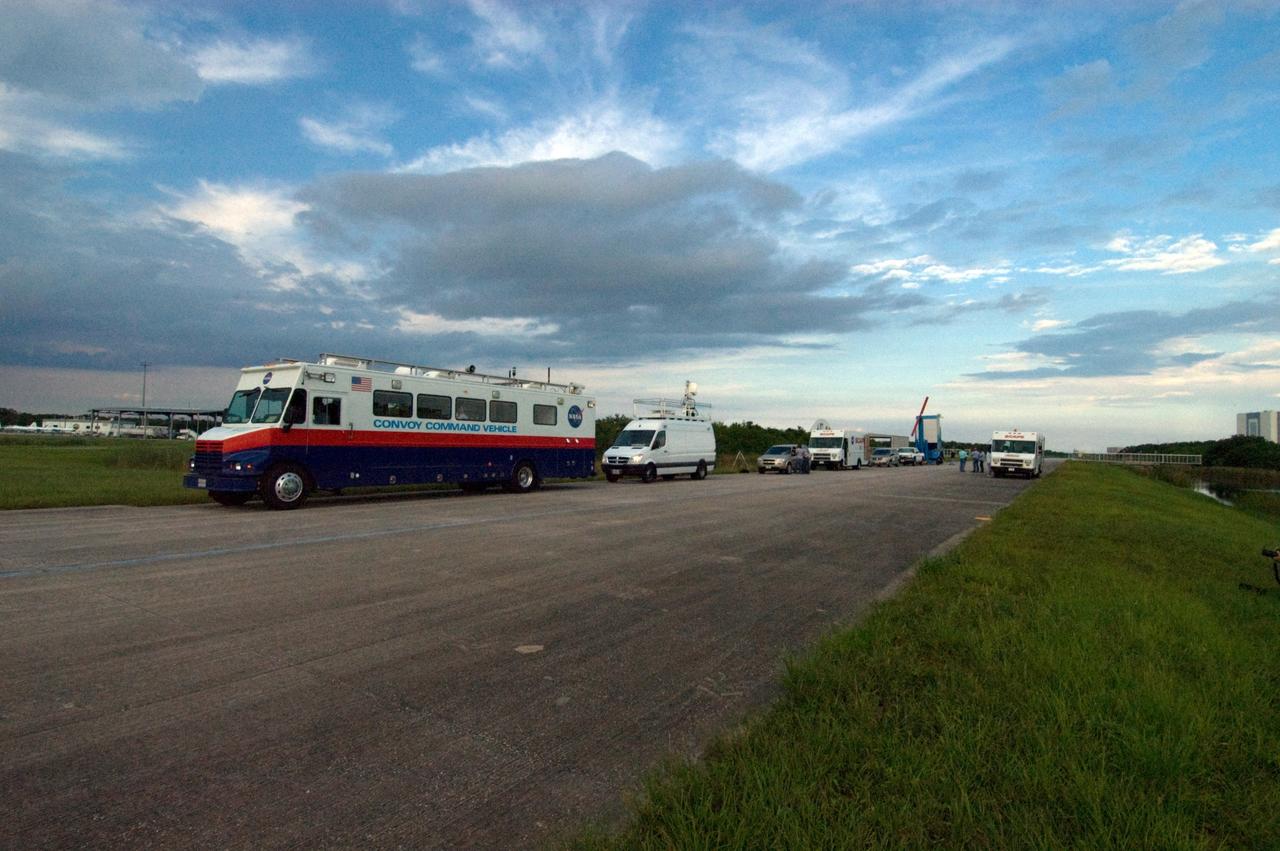
CAPE CANAVERAL, Fla. – As clouds begin to gather over the Shuttle Landing Facility at NASA's Kennedy Space Center in Florida, the convoy command and SCAPE vehicles are in position in the event of a return-to-landing-site is needed after launch of space shuttle Endeavour on the STS-127 mission. NASA managers postponed today’s space shuttle launch because of lightning and thunderstorms within the 20-nautical-mile circle around the launch pad. The fifth launch attempt for the STS-127 mission was scrubbed at 6:39 p.m. EDT. The first two launch attempts on June 13 and June 17 were scrubbed when a hydrogen gas leak occurred during tanking due to a misaligned Ground Umbilical Carrier Plate. Mission managers also decided to delay tanking on July 11 for a launch attempt later in the day to allow engineers and safety personnel time to analyze data captured during lightning strikes near the pad on July 10. The fourth attempt on July 12 was scrubbed due to weather concerns as well. Photo credit: NASA/Chuck Tintera
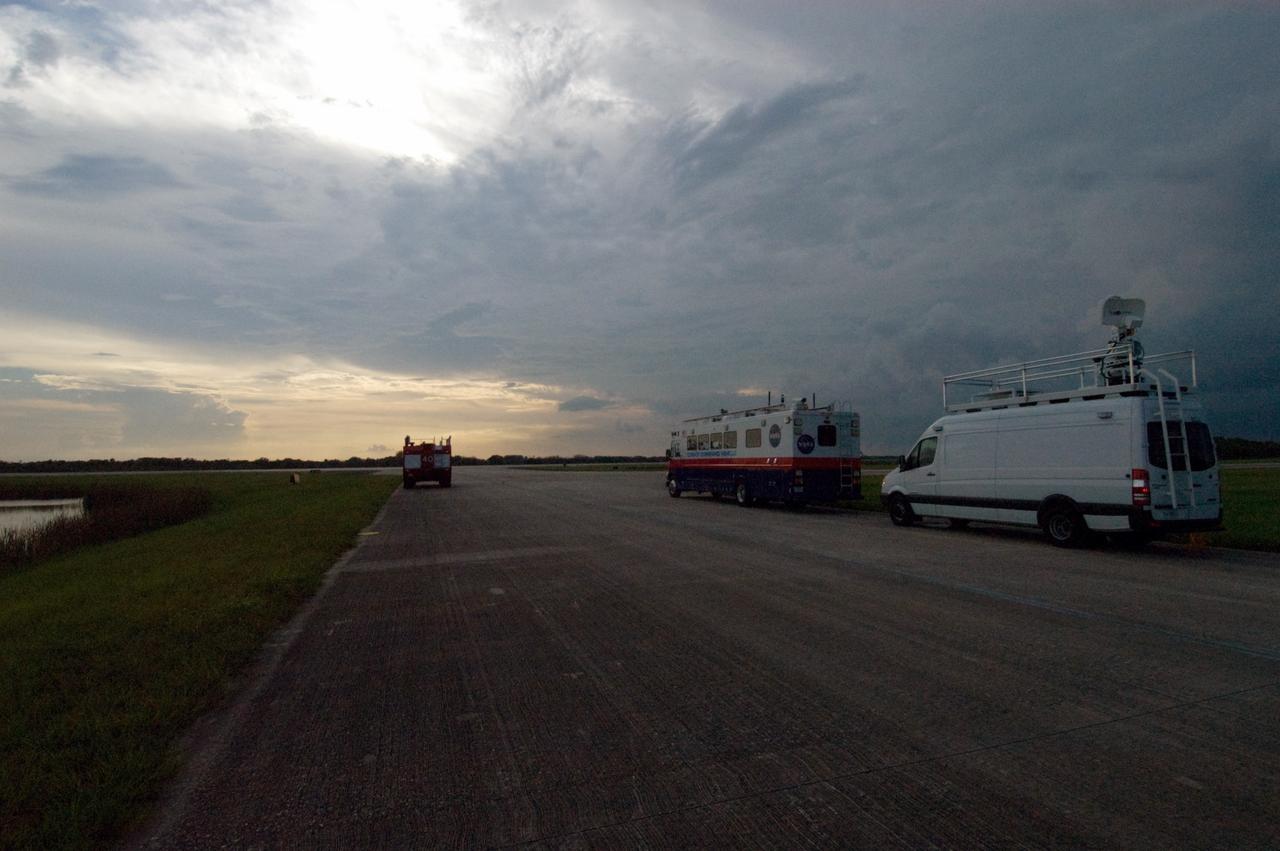
CAPE CANAVERAL, Fla. – The convoy command and SCAPE vehicles are in position at the Shuttle Landing Facility at NASA's Kennedy Space Center in Florida in the event of a return-to-landing-site is needed after launch of space shuttle Endeavour on the STS-127 mission. NASA managers postponed today’s space shuttle launch because of lightning and thunderstorms within the 20-nautical-mile circle around the launch pad. The fifth launch attempt for the STS-127 mission was scrubbed at 6:39 p.m. EDT. The first two launch attempts on June 13 and June 17 were scrubbed when a hydrogen gas leak occurred during tanking due to a misaligned Ground Umbilical Carrier Plate. Mission managers also decided to delay tanking on July 11 for a launch attempt later in the day to allow engineers and safety personnel time to analyze data captured during lightning strikes near the pad on July 10. The fourth attempt on July 12 was scrubbed due to weather concerns as well. Photo credit: NASA/Chuck Tintera
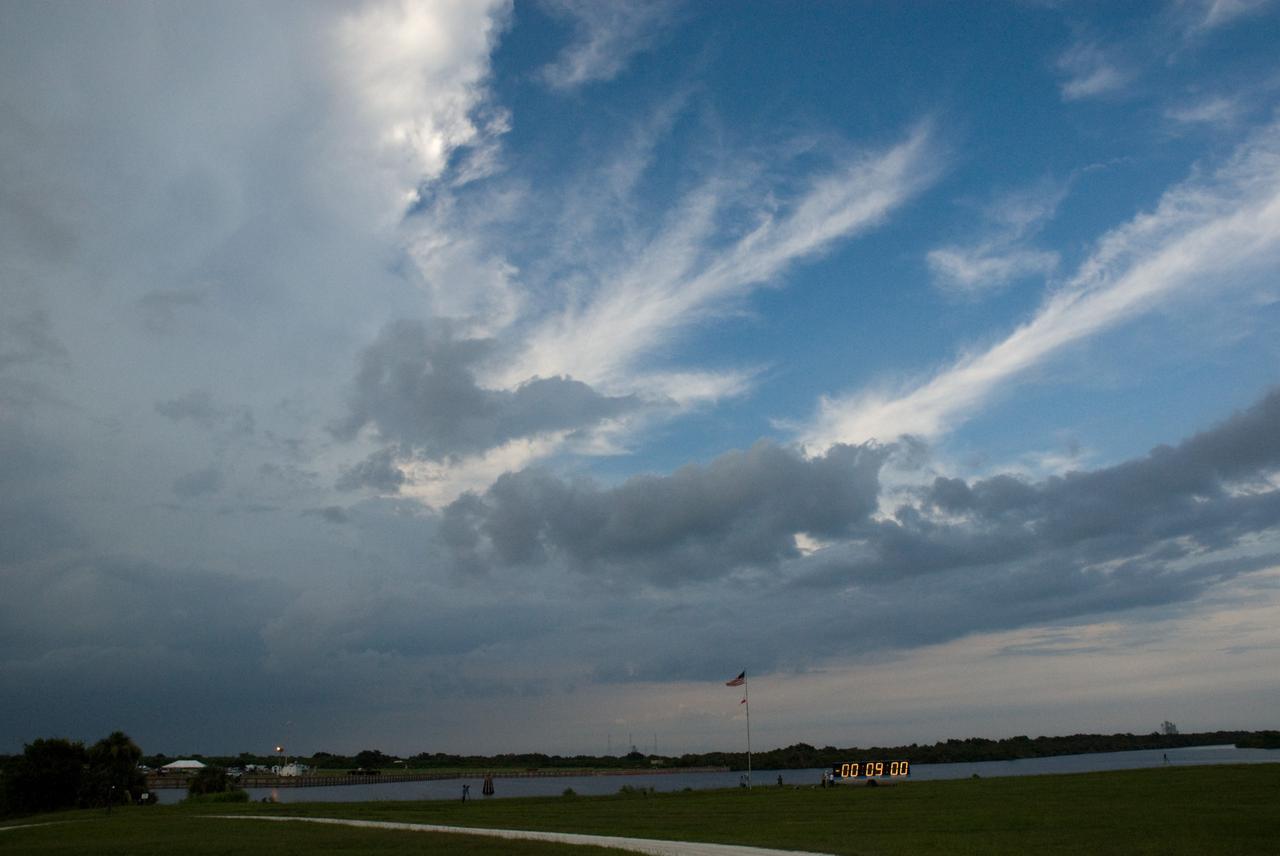
CAPE CANAVERAL, Fla. – Ominous clouds roll toward Launch Pad 39A at NASA's Kennedy Space Center in Florida. NASA managers postponed today’s space shuttle launch because of lightning and thunderstorms within the 20-nautical-mile circle around the launch pad. The fifth launch attempt for the STS-127 mission was scrubbed at 6:39 p.m. EDT. The first two launch attempts on June 13 and June 17 were scrubbed when a hydrogen gas leak occurred during tanking due to a misaligned Ground Umbilical Carrier Plate. Mission managers also decided to delay tanking on July 11 for a launch attempt later in the day to allow engineers and safety personnel time to analyze data captured during lightning strikes near the pad on July 10. Weather concerns caused a scrub July 12 as well. Endeavour will deliver the Japanese Experiment Module's Exposed Facility, or JEM-EF, and the Experiment Logistics Module-Exposed Section, or ELM-ES, in the final of three flights dedicated to the assembly of the Japan Aerospace Exploration Agency's Kibo laboratory complex on the International Space Station. STS-127 is the 29th flight for the assembly of the space. Photo credit: NASA/Tim Jacobs
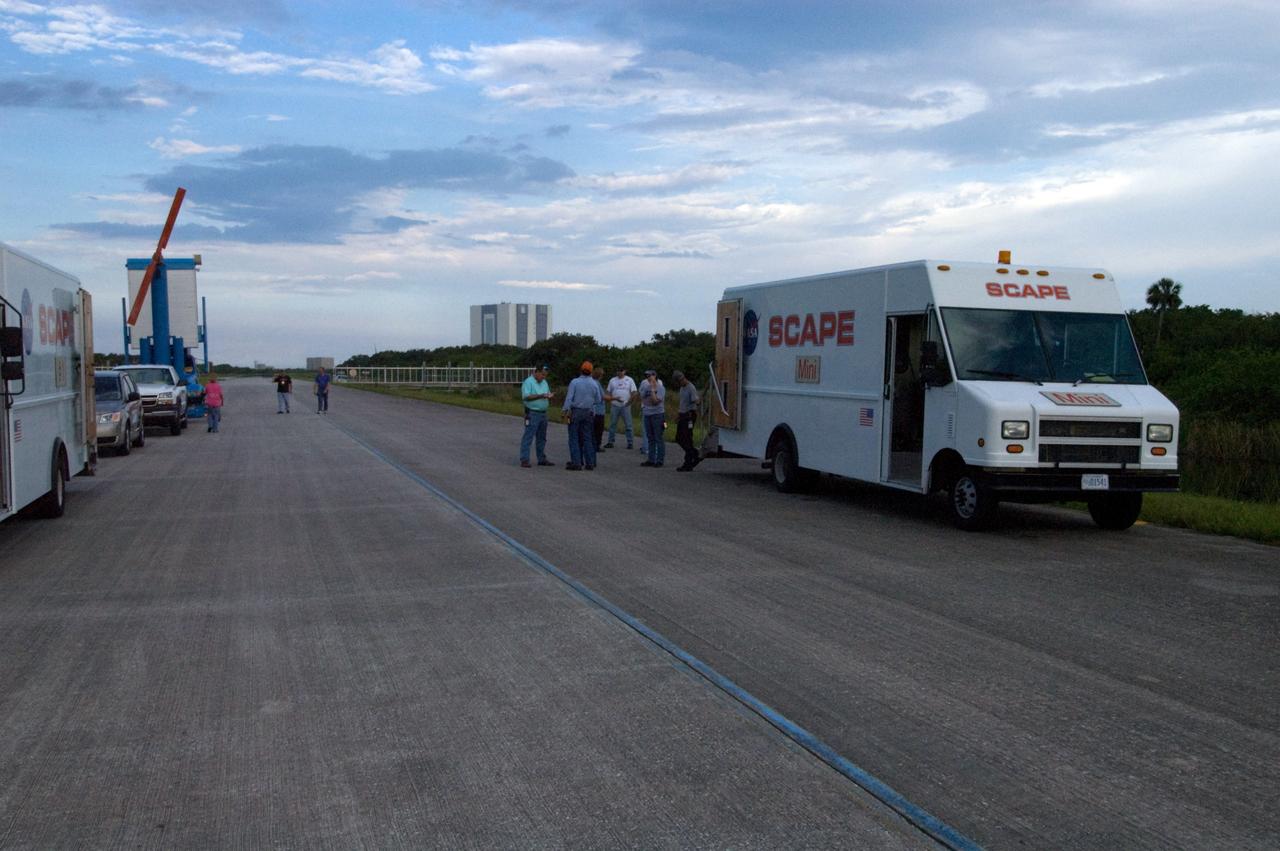
CAPE CANAVERAL, Fla. – As clouds begin to gather over the Shuttle Landing Facility at NASA's Kennedy Space Center in Florida, SCAPE vehicles and personnel are in position in the event of a return-to-landing-site is needed after launch of space shuttle Endeavour on the STS-127 mission. NASA managers postponed today’s space shuttle launch because of lightning and thunderstorms within the 20-nautical-mile circle around the launch pad. The fifth launch attempt for the STS-127 mission was scrubbed at 6:39 p.m. EDT. The first two launch attempts on June 13 and June 17 were scrubbed when a hydrogen gas leak occurred during tanking due to a misaligned Ground Umbilical Carrier Plate. Mission managers also decided to delay tanking on July 11 for a launch attempt later in the day to allow engineers and safety personnel time to analyze data captured during lightning strikes near the pad on July 10. The fourth attempt on July 12 was scrubbed due to weather concerns as well. Photo credit: NASA/Chuck Tintera
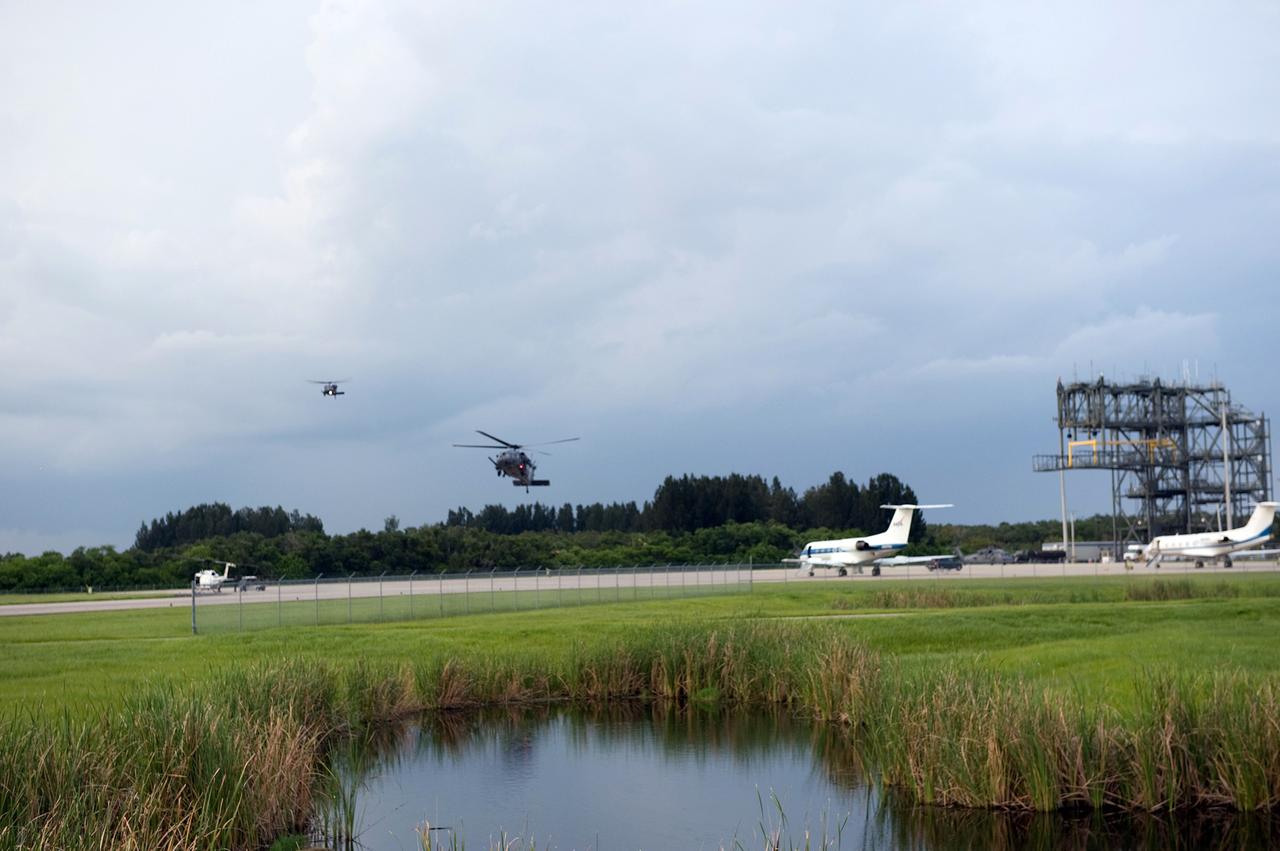
CAPE CANAVERAL, Fla. – Helicopters fly in the vicinity of the Shuttle Landing Facility at NASA's Kennedy Space Center in Florida in the event of a return-to-landing-site is needed after launch of space shuttle Endeavour on the STS-127 mission. This is the fifth launch attempt for the STS-127 mission. The first two launch attempts on June 13 and June 17 were scrubbed when a hydrogen gas leak occurred during tanking due to a misaligned Ground Umbilical Carrier Plate. Mission managers also decided to delay tanking on July 11 for a launch attempt later in the day to allow engineers and safety personnel time to analyze data captured during lightning strikes near the pad on July 10. The fourth attempt on July 12 was scrubbed due to weather concerns as well. Photo credit: NASA/Carl Winebarger