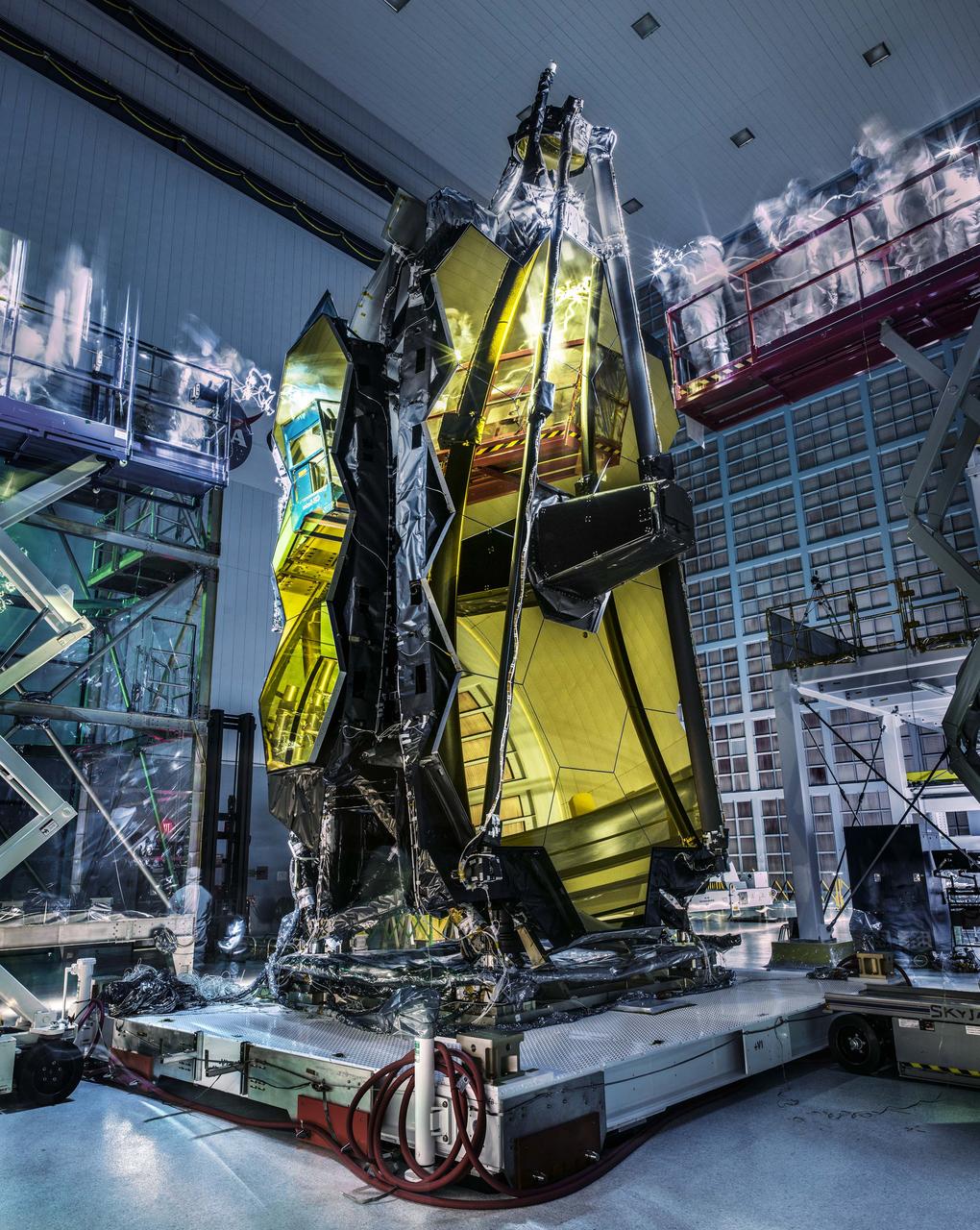
What happens when the lights are turned out in the enormous clean room that currently houses NASA's James Webb Space Telescope? The technicians who are inspecting the telescope and its expansive golden mirrors look like ghostly wraiths in this image as they conduct a "lights out inspection" in the Spacecraft Systems Development and Integration Facility (SSDIF) at NASA's Goddard Space Flight Center in Greenbelt, Maryland. The clean room lights were turned off to inspect the telescope after it experienced vibration and acoustic testing. The contamination control engineer used a bright flashlight and special ultraviolet flashlights to inspect for contamination because it's easier to find in the dark. NASA photographer Chris Gunn said "The people have a ghostly appearance because it's a long exposure." He left the camera's shutter open for a longer than normal time so the movement of the technicians appear as a blur. He also used a special light "painting" technique to light up the primary mirror. The James Webb Space Telescope is the scientific successor to NASA's Hubble Space Telescope. It will be the most powerful space telescope ever built. Webb is an international project led by NASA with its partners, ESA (European Space Agency) and the Canadian Space Agency. For more information about the Webb telescope visit: <a href="http://www.jwst.nasa.gov" rel="nofollow">www.jwst.nasa.gov</a> or <a href="http://www.nasa.gov/webb" rel="nofollow">www.nasa.gov/webb</a> Image Credit: NASA/Chris Gunn
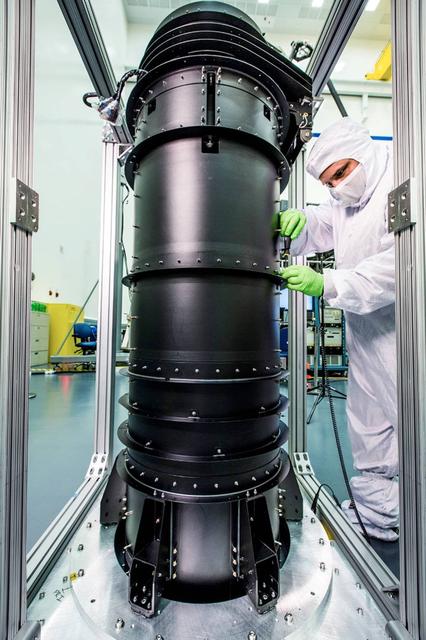
Building a space telescope to see the light from the earliest stars of our universe is a pretty complex task. Although much of the attention goes to instruments and the giant mirrors on NASA's James Webb Space Telescope, there are other components that have big jobs to do and that required imagination, engineering, and innovation to become a reality. For example, engineers working on the Webb telescope have to think of everything from keeping instruments from overheating or freezing, to packing up the Webb, which is as big as a tennis court, to fit inside the rocket that will take it to space. Those are two areas where the "DTA" or Deployable Tower Assembly (DTA) plays a major role. The DTA looks like a big black pipe and is made out of graphite-epoxy composite material to ensure stability and strength with extreme changes in temperature like those encountered in space. When fully deployed, the DTA reaches ten feet in length. The DTA interfaces and supports the spacecraft and the telescope structures. It features two large nested telescoping tubes, connected by a mechanized lead screw. It is a deployable structure that is both very light and extremely strong and stable. The Webb telescope’s secondary mirror support structure and DTA contribute to how the telescope and instruments fit into the rocket fairing in preparation for launch. The DTA allows the Webb to be short enough when stowed to fit in the rocket fairing with an acceptably low center of gravity for launch. Several days after the Webb telescope is launched, the DTA will deploy, or separate, the telescope mirrors and instruments from the spacecraft bus and sunshield. This separation allows the sunshield to unfurl and shade the telescope and instruments from radiant heat and stray light from the sun and Earth. The DTA was designed, built and tested by Astro Aerospace - a Northrop Grumman Company, in Carpinteria, California. The James Webb Space Telescope is the scientific successor to NASA's Hubble Space Telescope. It will be the most powerful space telescope ever built. The Webb telescope is an international project led by NASA with its partners, the European Space Agency and the Canadian Space Agency. For more information about the Webb telescope, visit: <a href="http://www.nasa.gov/webb" rel="nofollow">www.nasa.gov/webb</a> or jwst.nasa.gov <b><a href="http://www.nasa.gov/audience/formedia/features/MP_Photo_Guidelines.html" rel="nofollow">NASA image use policy.</a></b> <b><a href="http://www.nasa.gov/centers/goddard/home/index.html" rel="nofollow">NASA Goddard Space Flight Center</a></b> enables NASA’s mission through four scientific endeavors: Earth Science, Heliophysics, Solar System Exploration, and Astrophysics. Goddard plays a leading role in NASA’s accomplishments by contributing compelling scientific knowledge to advance the Agency’s mission. <b>Follow us on <a href="http://twitter.com/NASAGoddardPix" rel="nofollow">Twitter</a></b> <b>Like us on <a href="http://www.facebook.com/pages/Greenbelt-MD/NASA-Goddard/395013845897?ref=tsd" rel="nofollow">Facebook</a></b> <b>Find us on <a href="http://instagrid.me/nasagoddard/?vm=grid" rel="nofollow">Instagram</a></b>
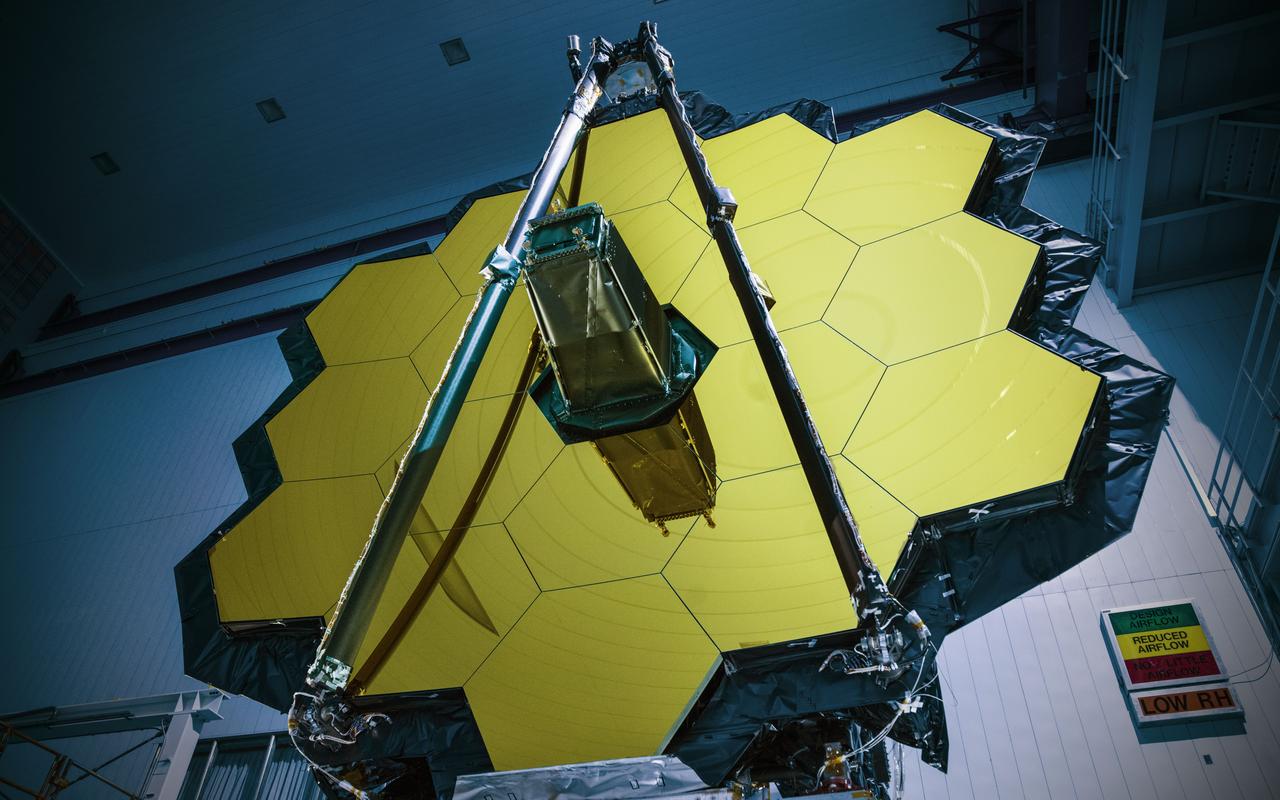
NASA’s James Webb Space Telescope has successfully passed the center of curvature test, an important optical measurement of Webb’s fully assembled primary mirror prior to cryogenic testing, and the last test held at NASA's Goddard Space Flight Center in Greenbelt, Maryland, before the spacecraft is shipped to NASA’s Johnson Space Center in Houston for more testing. After undergoing rigorous environmental tests simulating the stresses of its rocket launch, the Webb telescope team at Goddard analyzed the results from this critical optical test and compared it to the pre-test measurements. The team concluded that the mirrors passed the test with the optical system unscathed. “The Webb telescope is about to embark on its next step in reaching the stars as it has successfully completed its integration and testing at Goddard. It has taken a tremendous team of talented individuals to get to this point from all across NASA, our industry and international partners, and academia,” said Bill Ochs, NASA’s Webb telescope project manager. “It is also a sad time as we say goodbye to the Webb Telescope at Goddard, but are excited to begin cryogenic testing at Johnson.” Rocket launches create high levels of vibration and noise that rattle spacecraft and telescopes. At Goddard, engineers tested the Webb telescope in vibration and acoustics test facilities that simulate the launch environment to ensure that functionality is not impaired by the rigorous ride on a rocket into space. Before and after these environmental tests took place, optical engineers set up an interferometer, the main device used to measure the shape of the Webb telescope’s mirror. An interferometer gets its name from the process of recording and measuring the ripple patterns that result when different beams of light mix and their waves combine or “interfere.” Waves of visible light are less than a thousandth of a millimeter long and optics on the Webb telescope need to be shaped and aligned even more accurately than that to work correctly. Making measurements of the mirror shape and position by lasers prevents physical contact and damage (scratches to the mirror). So, scientists use wavelengths of light to make tiny measurements. By measuring light reflected off the optics using an interferometer, they are able to measure extremely small changes in shape or position that may occur after exposing the mirror to a simulated launch or temperatures that simulate the subfreezing environment of space. During a test conducted by a team from Goddard, Ball Aerospace of Boulder, Colorado, and the Space Telescope Science Institute in Baltimore, temperature and humidity conditions in the clean room were kept incredibly stable to minimize fluctuations in the sensitive optical measurements over time. Even so, tiny vibrations are ever-present in the clean room that cause jitter during measurements, so the interferometer is a “high-speed” one, taking 5,000 “frames” every second, which is a faster rate than the background vibrations themselves. This allows engineers to subtract out jitter and get good, clean results on any changes to the mirror's shape. Credit: NASA/Goddard/Chris Gunn Read more: <a href="https://go.nasa.gov/2oPqHwR" rel="nofollow">go.nasa.gov/2oPqHwR</a> NASA’s Webb Telescope Completes Goddard Testing

The dusty face of the Eagle Nebula and its surroundings are revealed in this image based on data from NASA's Wide Field Survey Explorer (WISE). WISE detects infrared light, or a range of wavelengths longer than what the human eye can see. This large star forming region is about 5,700 light years away from Earth and is most famous for being home to the the "Pillars of Creation," a region famously imaged by NASA's Hubble and James Webb space telescopes. The WISE data reveals the entire structure of the nebula surrounding the pillars, which themselves can be seen as a faint yellow-green feature inside the white circle. While the WISE view of the "Pillars" is not as sharp as those taken by Webb and Hubble, the telescope's wide field of view allows us to explore the extended nebula around it. When viewed in visible light, the dust is dark and opaque. In these infrared wavelengths, the dust becomes more translucent, and emits infrared light, shown in green, yellow, and red in this image. The data used in this image came from WISE's primary mission which ran from 2009 to 2011. In 2013, NASA took the spacecraft out of hibernation and began using it to track and study near-Earth objects. The mission and the spacecraft were renamed NEOWISE. However, the data is still being used by astronomers to study objects and regions outside our solar system. Blue and cyan are used to represent infrared light at wavelengths of 3.4 and 4.6 microns, while green and red display longer wavelengths of 12 and 22 microns, respectively. Animation available at https://photojournal.jpl.nasa.gov/catalog/PIA25433
![For me, I picked up an interest for engineering through drawing. When I was young, I was really big into art. Like most science-drawn younger kids, I would draw Pokémon, I would draw Dragon Ball Z, things like that. I guess my passion for art and drawing helped me to get into CAD (Computer Aided Design) modeling — things like 3D modeling and 3D printing. And with CAD modeling, you need to learn how to figure out the dimensions of things, what material they’re made out of, xyz. So that got me deeper into engineering. There’s definitely an artistic component to science. You can just look at James Webb [Space Telescope]. It looks artistic. If you look at the beveled mirrors, or how the bat wings on the side fold out, I would argue that that is artistic in a sense. But it also matches perfectly with its scientific functions. So not only does it need to fit into the rocket, but it also needs these beveled mirrors to reflect light at a specific angle. So, I think art and science blend pretty well. Kenneth Harris II, lead database engineer for the Joint Polar Satellite System (JPSS) J2 Satellite Mission at NASA’s Goddard Space Flight Center, Friday, Feb. 21, 2020, Greenbelt, Md. Photo Credit: (NASA/Joel Kowsky)](https://images-assets.nasa.gov/image/NHQ202002210002/NHQ202002210002~medium.jpg)
For me, I picked up an interest for engineering through drawing. When I was young, I was really big into art. Like most science-drawn younger kids, I would draw Pokémon, I would draw Dragon Ball Z, things like that. I guess my passion for art and drawing helped me to get into CAD (Computer Aided Design) modeling — things like 3D modeling and 3D printing. And with CAD modeling, you need to learn how to figure out the dimensions of things, what material they’re made out of, xyz. So that got me deeper into engineering. There’s definitely an artistic component to science. You can just look at James Webb [Space Telescope]. It looks artistic. If you look at the beveled mirrors, or how the bat wings on the side fold out, I would argue that that is artistic in a sense. But it also matches perfectly with its scientific functions. So not only does it need to fit into the rocket, but it also needs these beveled mirrors to reflect light at a specific angle. So, I think art and science blend pretty well. Kenneth Harris II, lead database engineer for the Joint Polar Satellite System (JPSS) J2 Satellite Mission at NASA’s Goddard Space Flight Center, Friday, Feb. 21, 2020, Greenbelt, Md. Photo Credit: (NASA/Joel Kowsky)
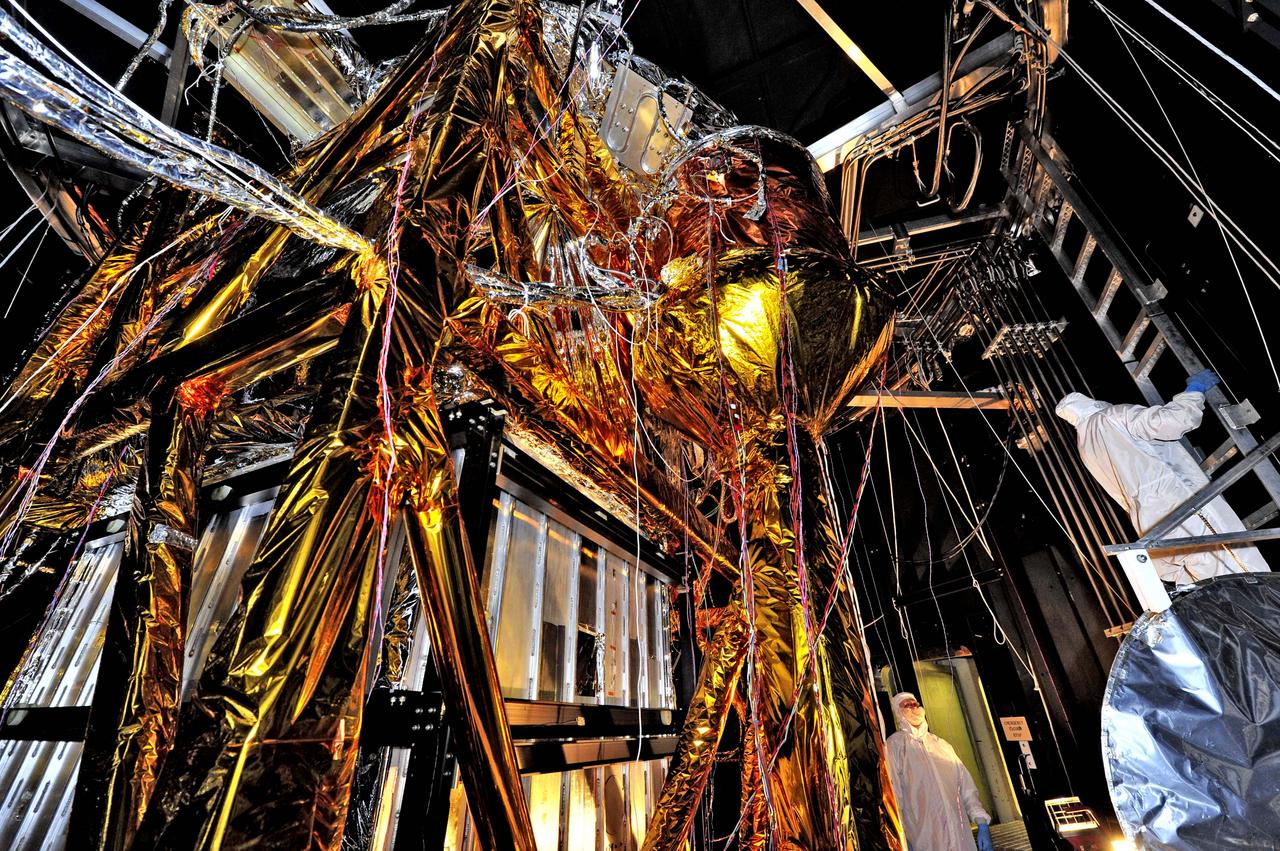
NASA image release August 23, 2012 What looks like a giant golden spider weaving a web of cables and cords, is actually ground support equipment, including the Optical Telescope Simulator (OSIM), for the James Webb Space Telescope. OSIM's job is to generate a beam of light just like the one that the real telescope optics will feed into the actual flight instruments. Because the real flight instruments will be used to test the real flight telescope, their alignment and performance first have to be verified by using the OSIM. Engineers are thoroughly checking out OSIM now in preparation for using it to test the flight science instruments later. This photo was taken from inside a large thermal-vacuum chamber called the Space Environment Simulator (SES), at NASA's Goddard Space Flight Center in Greenbelt, Md. Engineers have blanketed the structure of the OSIM with special insulating material to help control its temperature while it goes into the deep freeze testing that mimics the chill of space that Webb will ultimately experience in its operational orbit over 1 million miles from Earth. The golden-colored thermal blankets are made of aluminized kapton, a polymer film that remains stable over a wide range of temperatures. The structure that looks like a silver and black cube underneath the "spider" is a set of cold panels that surround OSIM's optics. During testing, OSIM's temperature will drop to 100 Kelvin (-280 F or -173 C) as liquid nitrogen flows through tubes welded to the chamber walls and through tubes along the silver panels surrounding OSIM's optics. These cold panels will keep the OSIM optics very cold, but the parts covered by the aluminized kapton blankets will stay warm. "Some blankets have silver facing out and gold facing in, or inverted, or silver on both sides, etc.," says Erin Wilson, a Goddard engineer. "Depending on which side of the blanket your hardware is looking at, the blankets can help it get colder or stay warmer, in an environmental test." Another reason for thermal blankets is to shield the cold OSIM optics from unwanted stray infrared light. When the OSIM is pointing its calibrated light beam at Webb's science instruments, engineers don't want any stray infrared light, such as "warm photons" from warm structures, leaking into the instruments' field of view. Too much of this stray light would raise the background too much for the instruments to "see" light from the OSIM—it would be like trying to photograph a lightning bug flying in front of car headlights. To get OSIM's optics cold, the inside of the chamber has to get cold, and to do that, all the air has to be pumped out to create a vacuum. Then liquid nitrogen has to be run though the plumbing along the inner walls of the chamber. Wilson notes that's why the blankets have to have vents in them: "That way, the air between all the layers can be evacuated as the chamber pressure drops, otherwise the blankets could pop," says Wilson. The most powerful space telescope ever built, Webb is the successor to NASA's Hubble Space Telescope. Webb's four instruments will reveal how the universe evolved from the Big Bang to the formation of our solar system. Webb is a joint project of NASA, the European Space Agency and the Canadian Space Agency. Credit: NASA/GSFC/Chris Gunn <b><a href="http://www.nasa.gov/audience/formedia/features/MP_Photo_Guidelines.html" rel="nofollow">NASA image use policy.</a></b> <b><a href="http://www.nasa.gov/centers/goddard/home/index.html" rel="nofollow">NASA Goddard Space Flight Center</a></b> enables NASA’s mission through four scientific endeavors: Earth Science, Heliophysics, Solar System Exploration, and Astrophysics. Goddard plays a leading role in NASA’s accomplishments by contributing compelling scientific knowledge to advance the Agency’s mission. <b>Follow us on <a href="http://twitter.com/NASA_GoddardPix" rel="nofollow">Twitter</a></b> <b>Like us on <a href="http://www.facebook.com/pages/Greenbelt-MD/NASA-Goddard/395013845897?ref=tsd" rel="nofollow">Facebook</a></b> <b>Find us on <a href="http://instagrid.me/nasagoddard/?vm=grid" rel="nofollow">Instagram</a></b>

The primary mirror of NASA's James Webb Space Telescope consisting of 18 hexagonal mirrors looks like a giant puzzle piece standing in the massive clean room of NASA's Goddard Space Flight Center in Greenbelt, Maryland. Appropriately, combined with the rest of the observatory, the mirrors will help piece together puzzles scientists have been trying to solve throughout the cosmos. Webb's primary mirror will collect light for the observatory in the scientific quest to better understand our solar system and beyond. Using these mirrors and Webb's infrared vision scientists will peer back over 13.5 billion years to see the first stars and galaxies forming out of the darkness of the early universe. Unprecedented infrared sensitivity will help astronomers to compare the faintest, earliest galaxies to today's grand spirals and ellipticals, helping us to understand how galaxies assemble over billions of years. Webb will see behind cosmic dust clouds to see where stars and planetary systems are being born. It will also help reveal information about atmospheres of planets outside our solar system, and perhaps even find signs of the building blocks of life elsewhere in the universe. The Webb telescope was mounted upright after a "center of curvature" test conducted at Goddard. This initial center of curvature test ensures the integrity and accuracy, and test will be repeated later to verify those same properties after the structure undergoes launch environment testing. In the photo, two technicians stand before the giant primary mirror. For information on the Webb's Center of Curvature test, visit: <a href="http://go.nasa.gov/2fidD9S" rel="nofollow">go.nasa.gov/2fidD9S</a> Credit: NASA/Goddard/Chris Gunn <b><a href="http://www.nasa.gov/audience/formedia/features/MP_Photo_Guidelines.html" rel="nofollow">NASA image use policy.</a></b> <b><a href="http://www.nasa.gov/centers/goddard/home/index.html" rel="nofollow">NASA Goddard Space Flight Center</a></b> enables NASA’s mission through four scientific endeavors: Earth Science, Heliophysics, Solar System Exploration, and Astrophysics. Goddard plays a leading role in NASA’s accomplishments by contributing compelling scientific knowledge to advance the Agency’s mission. <b>Follow us on <a href="http://twitter.com/NASAGoddardPix" rel="nofollow">Twitter</a></b> <b>Like us on <a href="http://www.facebook.com/pages/Greenbelt-MD/NASA-Goddard/395013845897?ref=tsd" rel="nofollow">Facebook</a></b> <b>Find us on <a href="http://instagrid.me/nasagoddard/?vm=grid" rel="nofollow">Instagram</a></b>
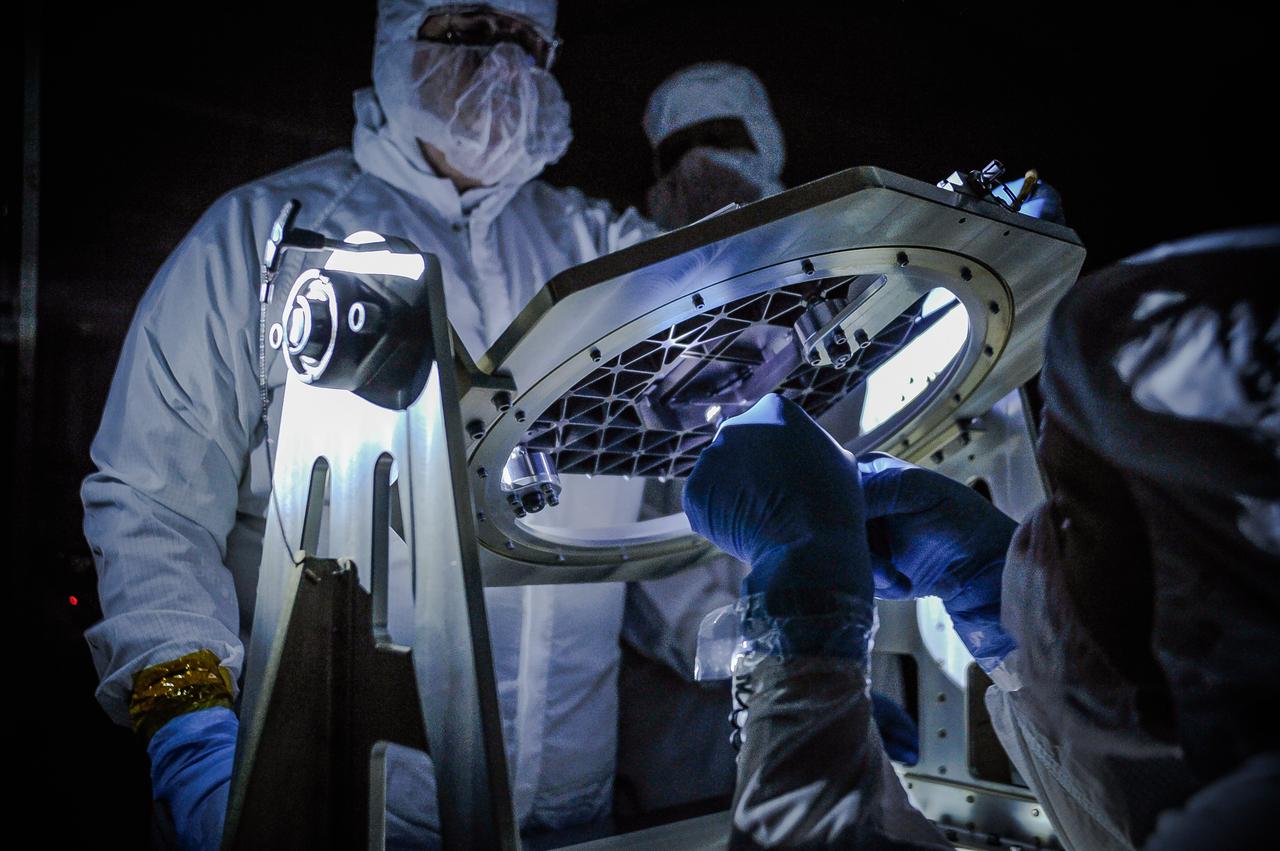
NASA engineers inspect a new piece of technology developed for the James Webb Space Telescope, the micro shutter array, with a low light test at NASA's Goddard Space Flight Center in Greenbelt, Maryland. Developed at Goddard to allow Webb's Near Infrared Spectrograph to obtain spectra of more than 100 objects in the universe simultaneously, the micro shutter array uses thousands of tiny shutters to capture spectra from selected objects of interest in space and block out light from all other sources. Credit: NASA/Goddard/Chris Gunn <b><a href="http://www.nasa.gov/audience/formedia/features/MP_Photo_Guidelines.html" rel="nofollow">NASA image use policy.</a></b> <b><a href="http://www.nasa.gov/centers/goddard/home/index.html" rel="nofollow">NASA Goddard Space Flight Center</a></b> enables NASA’s mission through four scientific endeavors: Earth Science, Heliophysics, Solar System Exploration, and Astrophysics. Goddard plays a leading role in NASA’s accomplishments by contributing compelling scientific knowledge to advance the Agency’s mission. <b>Follow us on <a href="http://twitter.com/NASAGoddardPix" rel="nofollow">Twitter</a></b> <b>Like us on <a href="http://www.facebook.com/pages/Greenbelt-MD/NASA-Goddard/395013845897?ref=tsd" rel="nofollow">Facebook</a></b> <b>Find us on <a href="http://instagrid.me/nasagoddard/?vm=grid" rel="nofollow">Instagram</a></b>

What looks much like craggy mountains on a moonlit evening is actually the edge of a nearby, young, star-forming region NGC 3324 in the Carina Nebula. Captured in infrared light by the Near-Infrared Camera (NIRCam) on NASA’s James Webb Space Telescope, this image reveals previously obscured areas of star birth. Called the Cosmic Cliffs, the region is actually the edge of a gigantic, gaseous cavity within NGC 3324, roughly 7,600 light-years away. The cavernous area has been carved from the nebula by the intense ultraviolet radiation and stellar winds from extremely massive, hot, young stars located in the center of the bubble, above the area shown in this image. The high-energy radiation from these stars is sculpting the nebula’s wall by slowly eroding it away. NIRCam – with its crisp resolution and unparalleled sensitivity – unveils hundreds of previously hidden stars, and even numerous background galaxies. Several prominent features in this image are described below. • The “steam” that appears to rise from the celestial “mountains” is actually hot, ionized gas and hot dust streaming away from the nebula due to intense, ultraviolet radiation. • Dramatic pillars rise above the glowing wall of gas, resisting the blistering ultraviolet radiation from the young stars. • Bubbles and cavities are being blown by the intense radiation and stellar winds of newborn stars. • Protostellar jets and outflows, which appear in gold, shoot from dust-enshrouded, nascent stars. • A “blow-out” erupts at the top-center of the ridge, spewing gas and dust into the interstellar medium. • An unusual “arch” appears, looking like a bent-over cylinder. This period of very early star formation is difficult to capture because, for an individual star, it lasts only about 50,000 to 100,000 years – but Webb’s extreme sensitivity and exquisite spatial resolution have chronicled this rare event. Located roughly 7,600 light-years away, NGC 3324 was first catalogued by James Dunlop in 1826. Visible from the Southern Hemisphere, it is located at the northwest corner of the Carina Nebula (NGC 3372), which resides in the constellation Carina. The Carina Nebula is home to the Keyhole Nebula and the active, unstable supergiant star called Eta Carinae. NIRCam was built by a team at the University of Arizona and Lockheed Martin’s Advanced Technology Center.

Just in time for the release of the movie “Star Wars Episode VII: The Force Awakens,” NASA’s Hubble Space Telescope has photographed what looks like a cosmic, double-bladed lightsaber. In the center of the image, partially obscured by a dark, Jedi-like cloak of dust, a newborn star shoots twin jets out into space as a sort of birth announcement to the universe. “Science fiction has been an inspiration to generations of scientists and engineers, and the film series Star Wars is no exception,” said John Grunsfeld, astronaut and associate administrator for the NASA Science Mission directorate. “There is no stronger case for the motivational power of real science than the discoveries that come from the Hubble Space Telescope as it unravels the mysteries of the universe." This celestial lightsaber does not lie in a galaxy far, far away, but rather inside our home galaxy, the Milky Way. It’s inside a turbulent birthing ground for new stars known as the Orion B molecular cloud complex, located 1,350 light-years away. When stars form within giant clouds of cool molecular hydrogen, some of the surrounding material collapses under gravity to form a rotating, flattened disk encircling the newborn star. Though planets will later congeal in the disk, at this early stage the protostar is feeding on the disk with a Jabba-like appetite. Gas from the disk rains down onto the protostar and engorges it. Superheated material spills away and is shot outward from the star in opposite directions along an uncluttered escape route — the star’s rotation axis. Shock fronts develop along the jets and heat the surrounding gas to thousands of degrees Fahrenheit. The jets collide with the surrounding gas and dust and clear vast spaces, like a stream of water plowing into a hill of sand. The shock fronts form tangled, knotted clumps of nebulosity and are collectively known as Herbig-Haro (HH) objects. The prominent HH object shown in this image is HH 24. Just to the right of the cloaked star, a couple of bright points are young stars peeking through and showing off their own faint lightsabers — including one that has bored a tunnel through the cloud towards the upper-right side of the picture. Overall, just a handful of HH jets have been spotted in this region in visible light, and about the same number in the infrared. Hubble’s observations for this image were performed in infrared light, which enabled the telescope to peer through the gas and dust cocooning the newly forming stars and capture a clear view of the HH objects. These young stellar jets are ideal targets for NASA’s upcoming James Webb Space Telescope, which will have even greater infrared wavelength vision to see deeper into the dust surrounding newly forming stars. The Hubble Space Telescope is a project of international cooperation between NASA and the European Space Agency. NASA’s Goddard Space Flight Center in Greenbelt, Maryland, manages the telescope. The Space Telescope Science Institute (STScI) in Baltimore, Maryland, conducts Hubble science operations. STScI is operated for NASA by the Association of Universities for Research in Astronomy, in Washington, D.C. Credits: NASA/ESA <b><a href="http://www.nasa.gov/audience/formedia/features/MP_Photo_Guidelines.html" rel="nofollow">NASA image use policy.</a></b> <b><a href="http://www.nasa.gov/centers/goddard/home/index.html" rel="nofollow">NASA Goddard Space Flight Center</a></b> enables NASA’s mission through four scientific endeavors: Earth Science, Heliophysics, Solar System Exploration, and Astrophysics. Goddard plays a leading role in NASA’s accomplishments by contributing compelling scientific knowledge to advance the Agency’s mission. <b>Follow us on <a href="http://twitter.com/NASAGoddardPix" rel="nofollow">Twitter</a></b> <b>Like us on <a href="http://www.facebook.com/pages/Greenbelt-MD/NASA-Goddard/395013845897?ref=tsd" rel="nofollow">Facebook</a></b> <b>Find us on <a href="http://instagrid.me/nasagoddard/?vm=grid" rel="nofollow">Instagram</a></b>