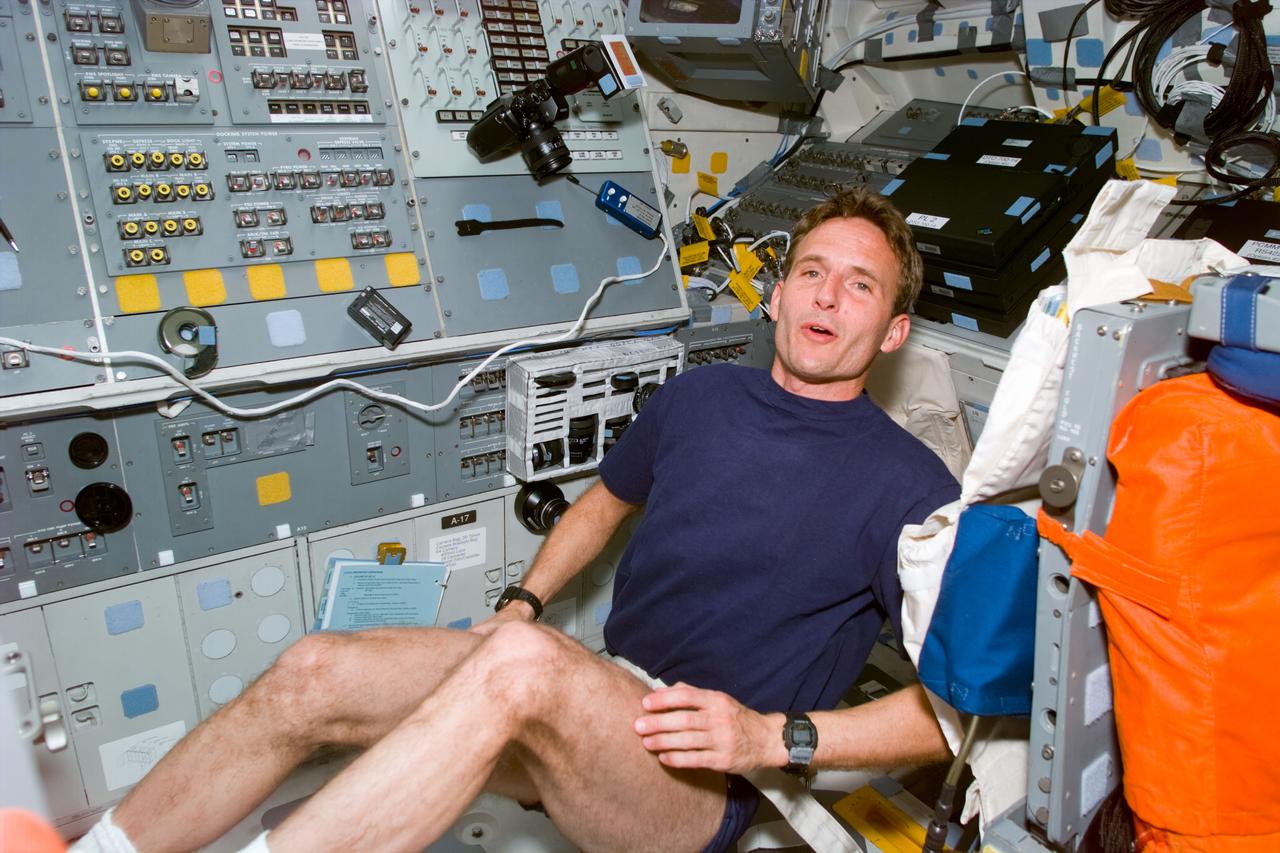
STS081-E-5101 (12 Jan. 1997) --- Astronaut Jerry M. Linenger, mission specialist, works out on a bicycle ergometer device on the Space Shuttle Atlantis' flight deck as he readies for a long-duration stay in Earth-orbit. In mid-week, Linenger and his crew mates are scheduled to dock with Russia's Mir Space Station and pick up John E. Blaha, NASA astronaut who has been serving as a cosmonaut guest researcher since September 1996. Linenger will replace Blaha onboard Mir and the transfer will mark the second such direct exchange of cosmonaut guest researchers, though Linenger will be the fourth United States astronaut to spend a lengthy stay on Mir.
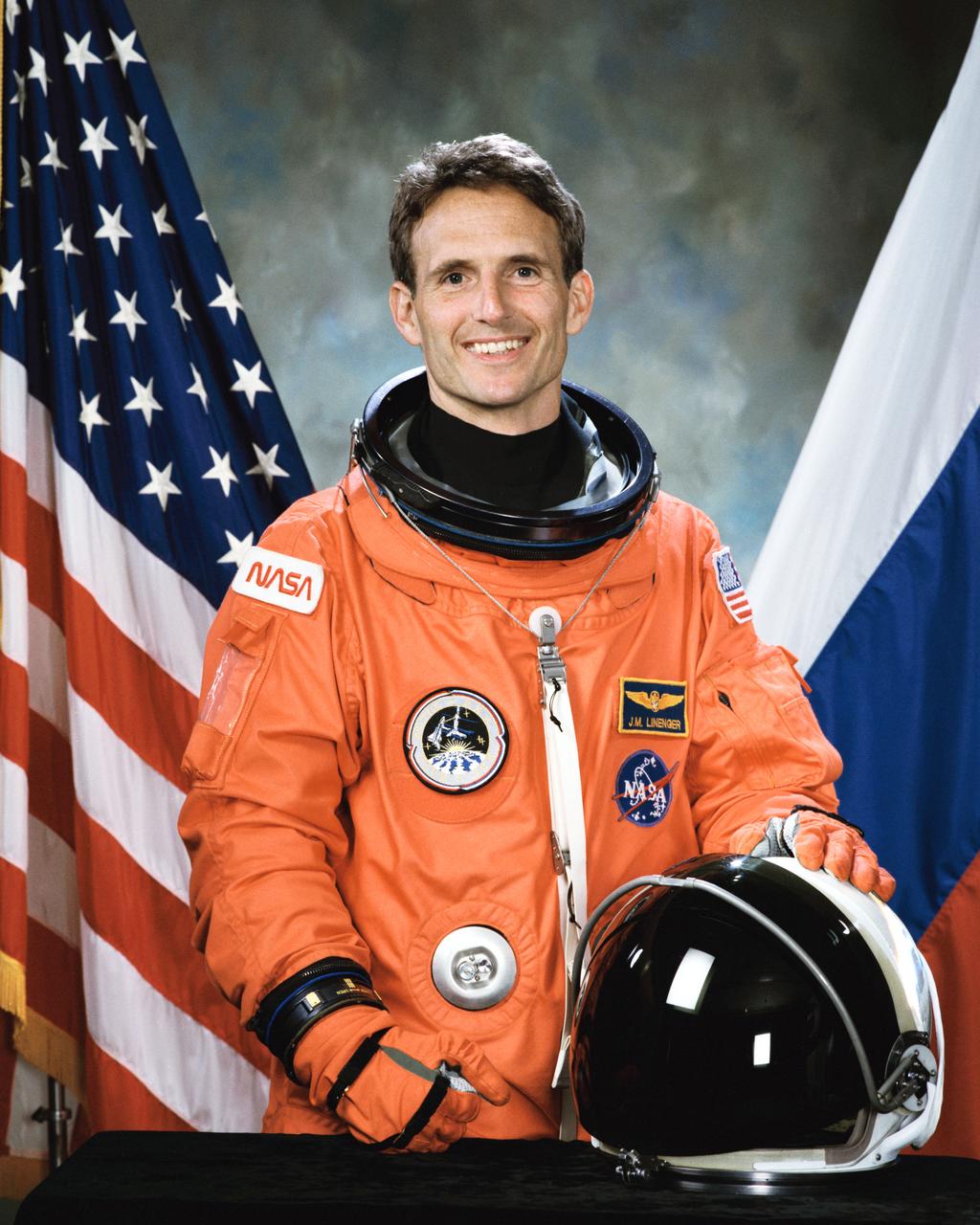
S95-10762 (1995) --- Astronaut Jerry M. Linenger, mission specialist.
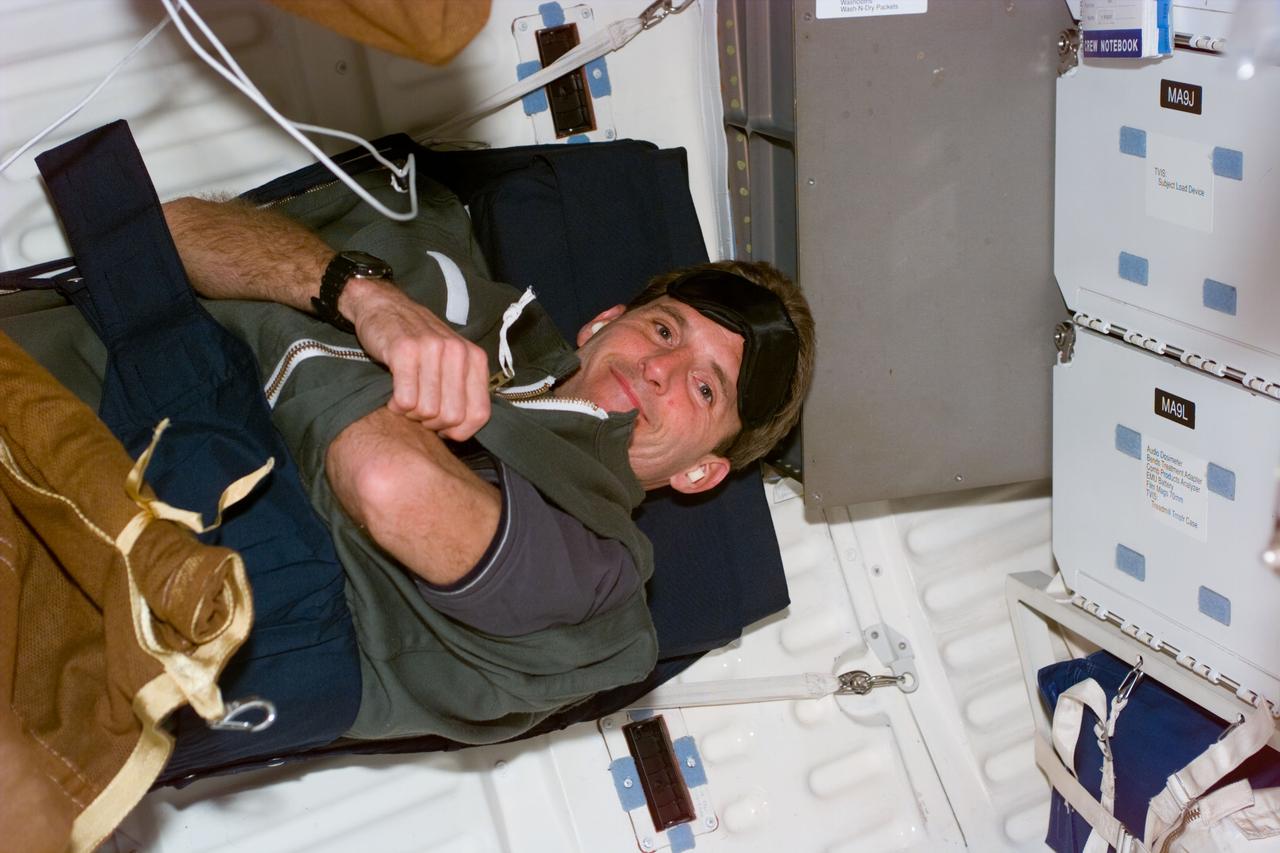
STS081-E-5006 (12 Jan. 1997) --- Aboard the Space Shuttle Atlantis on its first day in orbit for the mission, astronaut Jerry M. Linenger, mission specialist, has arranged his sleep station to his liking and prepares for his first rest period. Linenger and five crew mates are flying the Spacehab Double Module (DM), replete with supplies for the three-man crew aboard Russia's Mir Space Station with which Atlantis will be docking later in the week. Linenger will trade places with John E. Blaha marking the second such exchange of American astronaut - cosmonaut guest researcher's aboard Mir. Blaha had replaced Shannon W. Lucid in September of 1996. The scene was recorded with an Electronic Still Camera (ESC) and later downlinked to flight controllers in Houston, Texas.
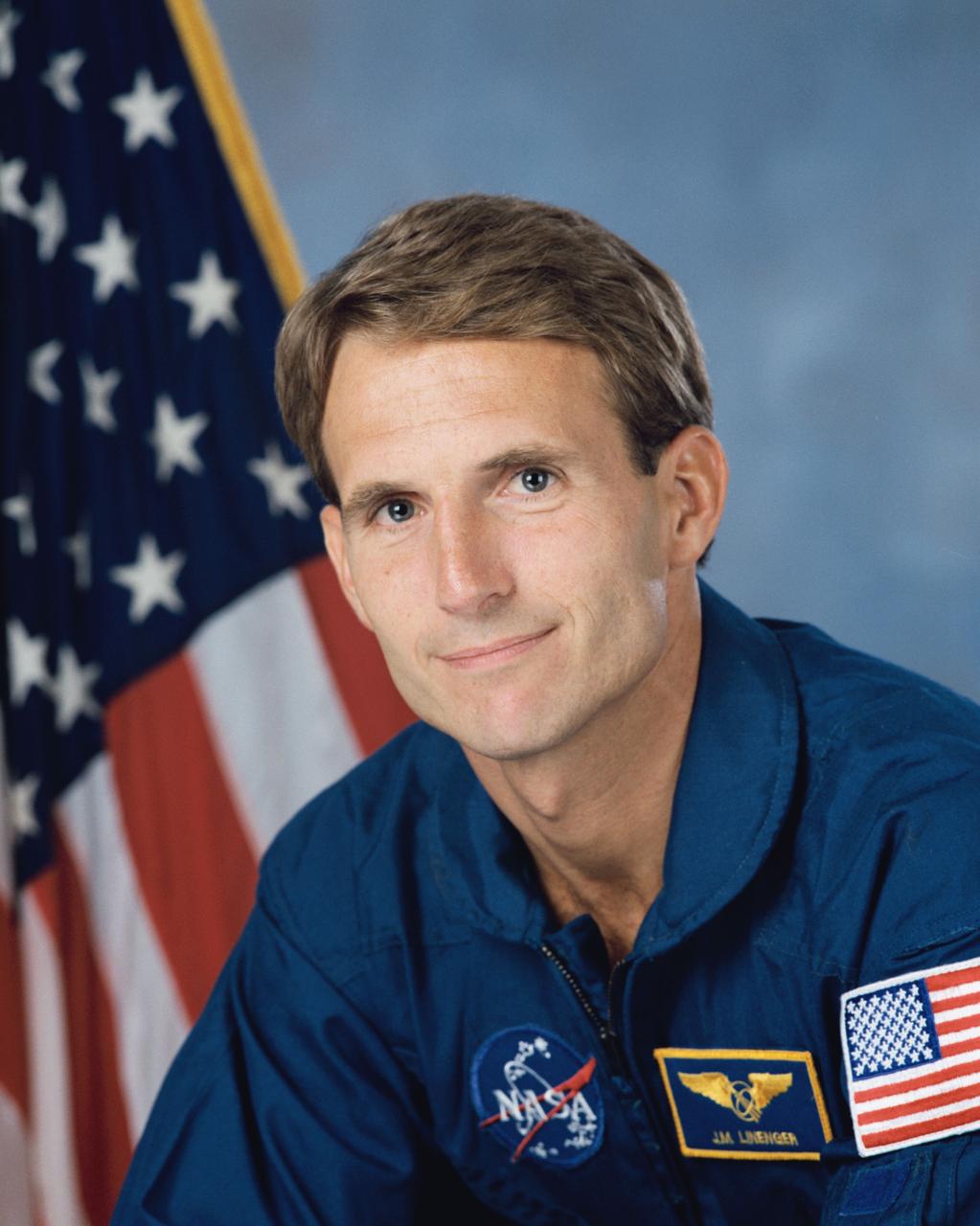
S92-44930 (8 Aug 1992) - Astronaut Jerry M. Linenger.
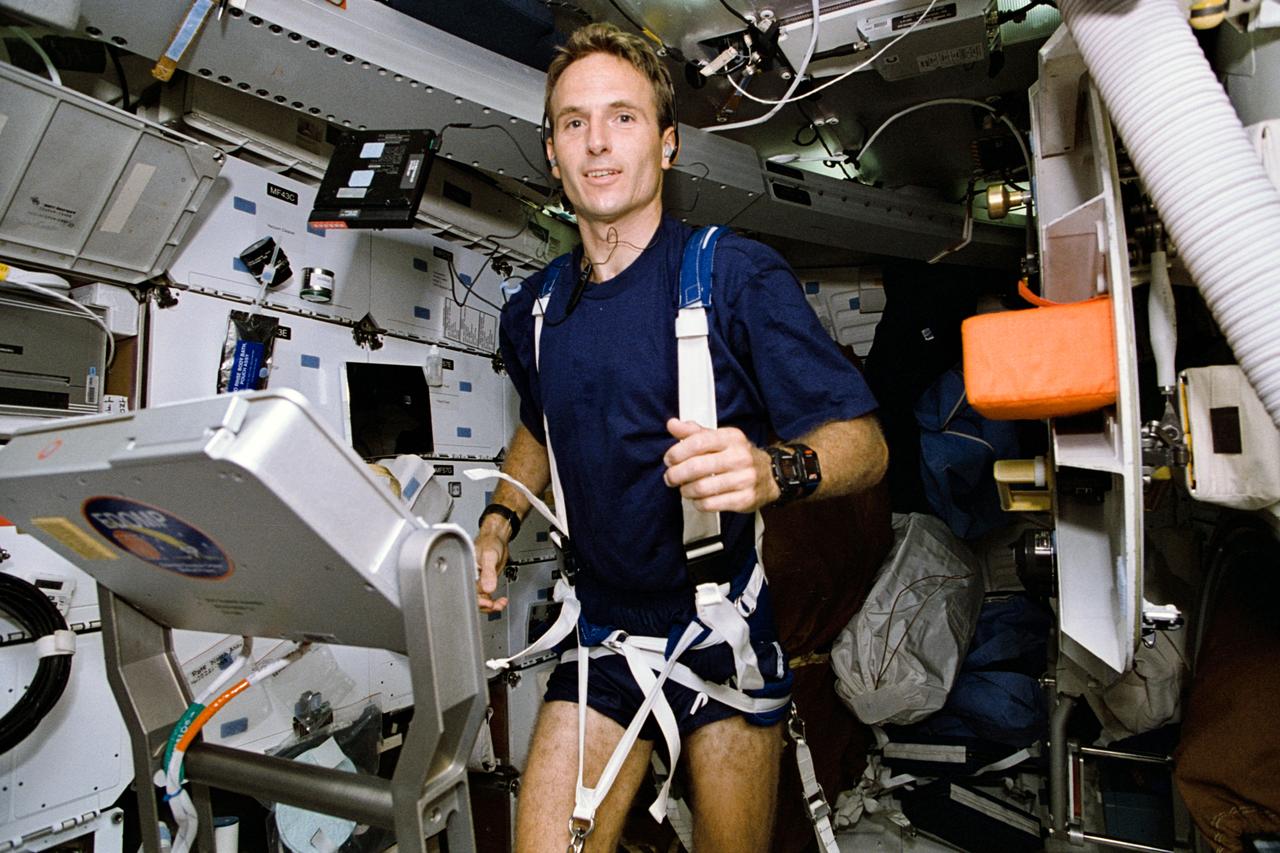
STS064-41-006 (9-20 Sept. 1994) --- Astronaut Jerry M. Linenger, STS-64 mission specialist, works out on the treadmill device on the space shuttle Discovery's middeck. "Running was a pleasure...just like being back on Earth," Linenger told a large audience of Johnson Space Center employees at the Crew Employee Presentation on Sept. 29, 1994. Linenger joined five other NASA astronauts for almost 11 days in Earth orbit aboard Discovery. Photo credit: NASA or National Aeronautics and Space Administration

STS081-372-035 --- On Russia’s Mir Space Station Base Block Module, astronaut Jerry M. Linenger, is pictured soon after assuming duties as cosmonaut guest researcher. This was the first donning of his space suit for Mir-22 duties. Linenger replaced astronaut John E. Blaha in the Mir support role. He will be replaced by astronaut C. Michael Foale when the Atlantis re-docks with Mir in May of this year.
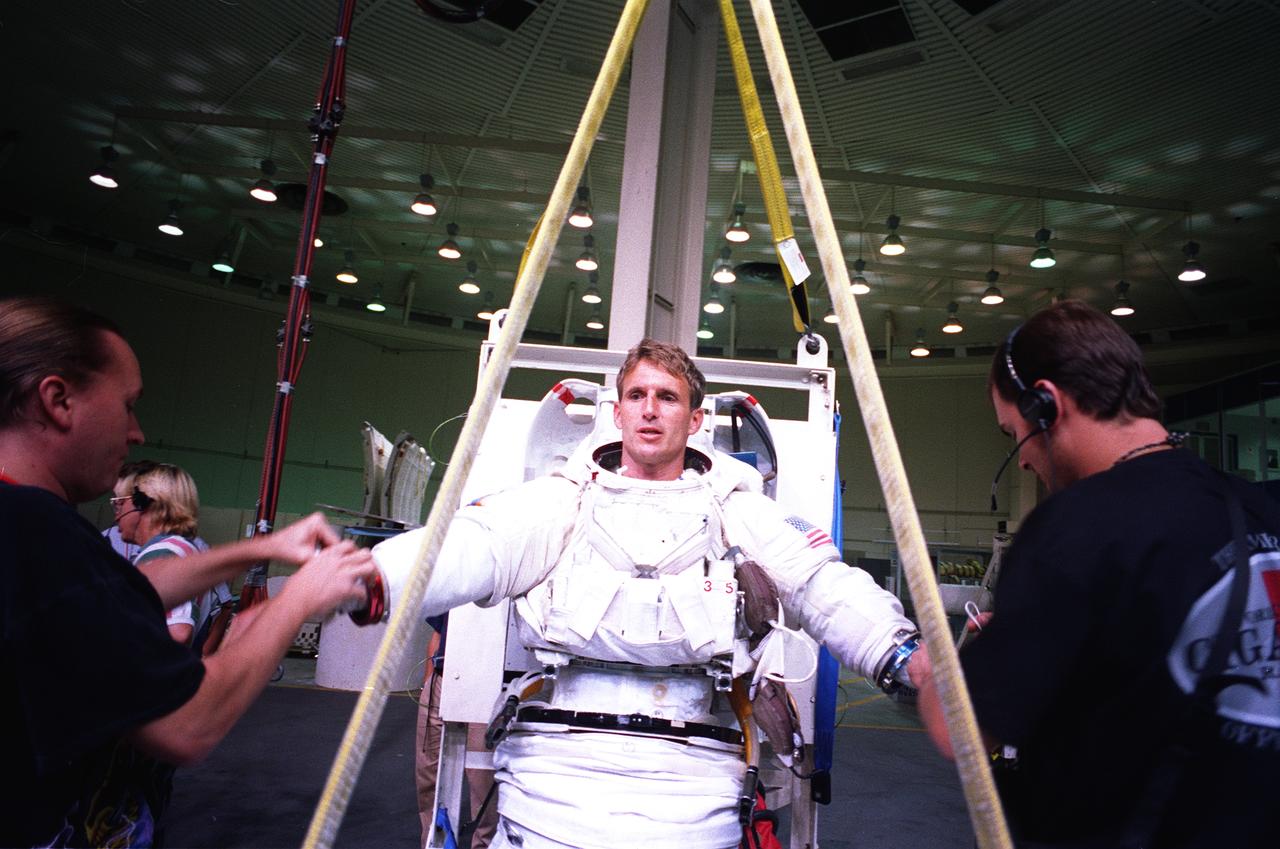
S96-14344 (13 Sept. 1996) --- In the Johnson Space Center's weightless environment training facility, astronaut Jerry M. Linenger, STS-81 mission specialist, prepares for an underwater simulation of a contingency space walk. Linenger, attired in a training version of the Extravehicular Mobility Unit (EMU ) will utilize the nearby 25-ft. deep pool, in which he will be able to achieve a neutrally buoyant state.
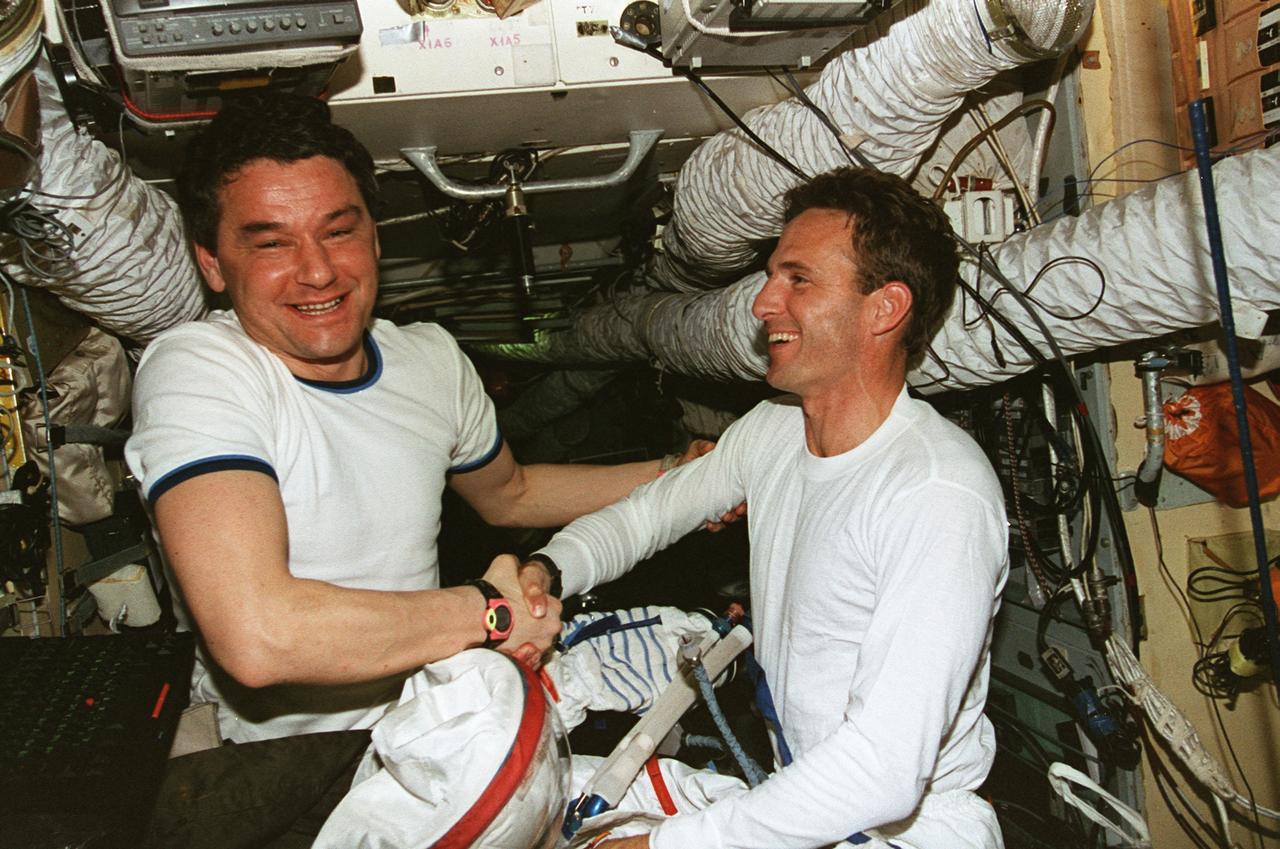
STS081-372-018 (12-22 Jan. 1997) --- One of his first acts as cosmonaut guest researcher for Mir-22 sees Jerry M. Linenger (right) check out his orlan space suit on Russia's Mir Space Station Base Block Module. Cosmonaut Valeri G. Korzun, Mir-22 mission commander, and the second of four commanders Linenger will be sharing in-space time aboard the Space Shuttle Atlantis and Mir, congratulates the recent addition to the crew.
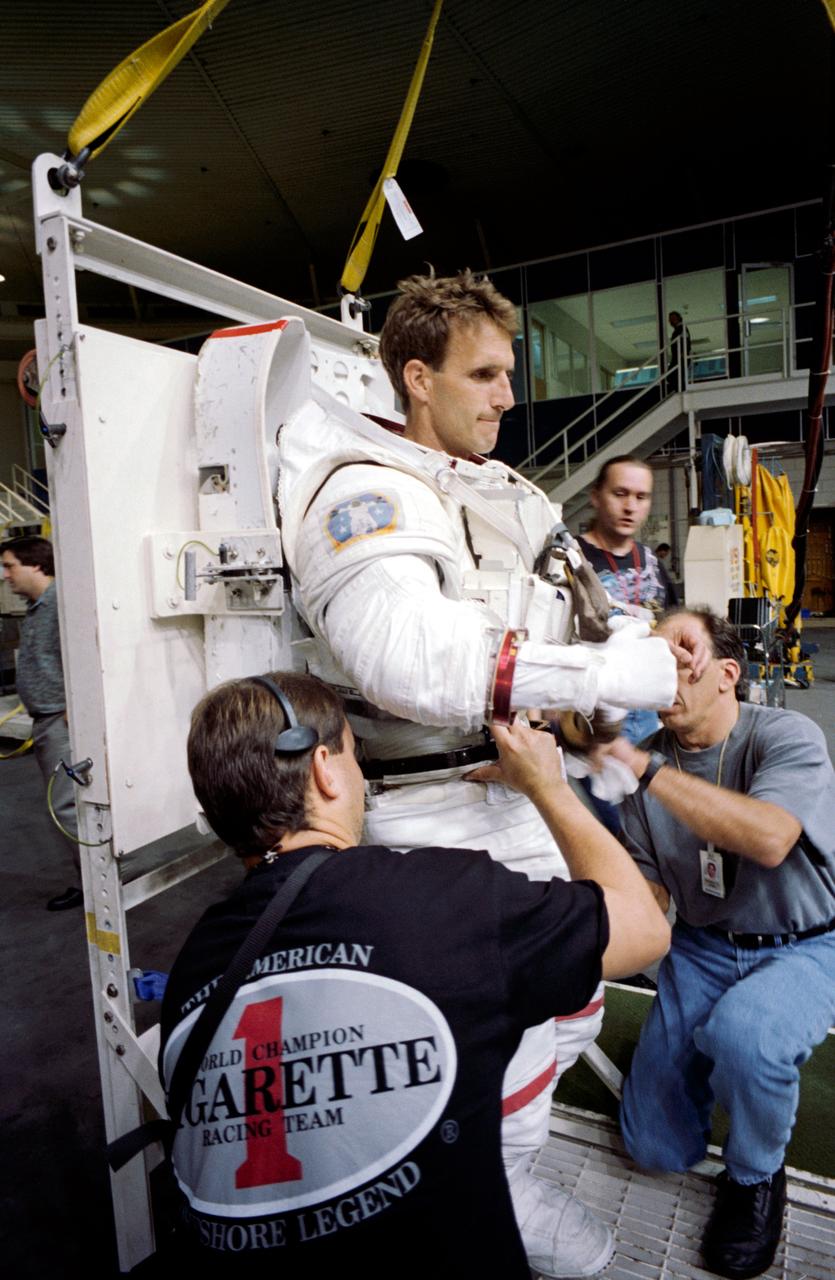
COLOR 13 SEPTEMBER 1996 S96-14353 JOHNSON SPACE CENTER, HOUSTON, TEXAS STS-81 TRAINING VIEW --- In the Johnson Space Center’s (JSC) Weightless Environment Training Facility (WET-F), astronaut Jerry M. Linenger, STS-81 mission specialist, prepares for an underwater simulation of a contingency Extravehicular Activity (EVA). Linenger, attired in a training version will utilize the nearby 25-feet deep pool, in which he will be able to achieve a neutrally buoyant state.
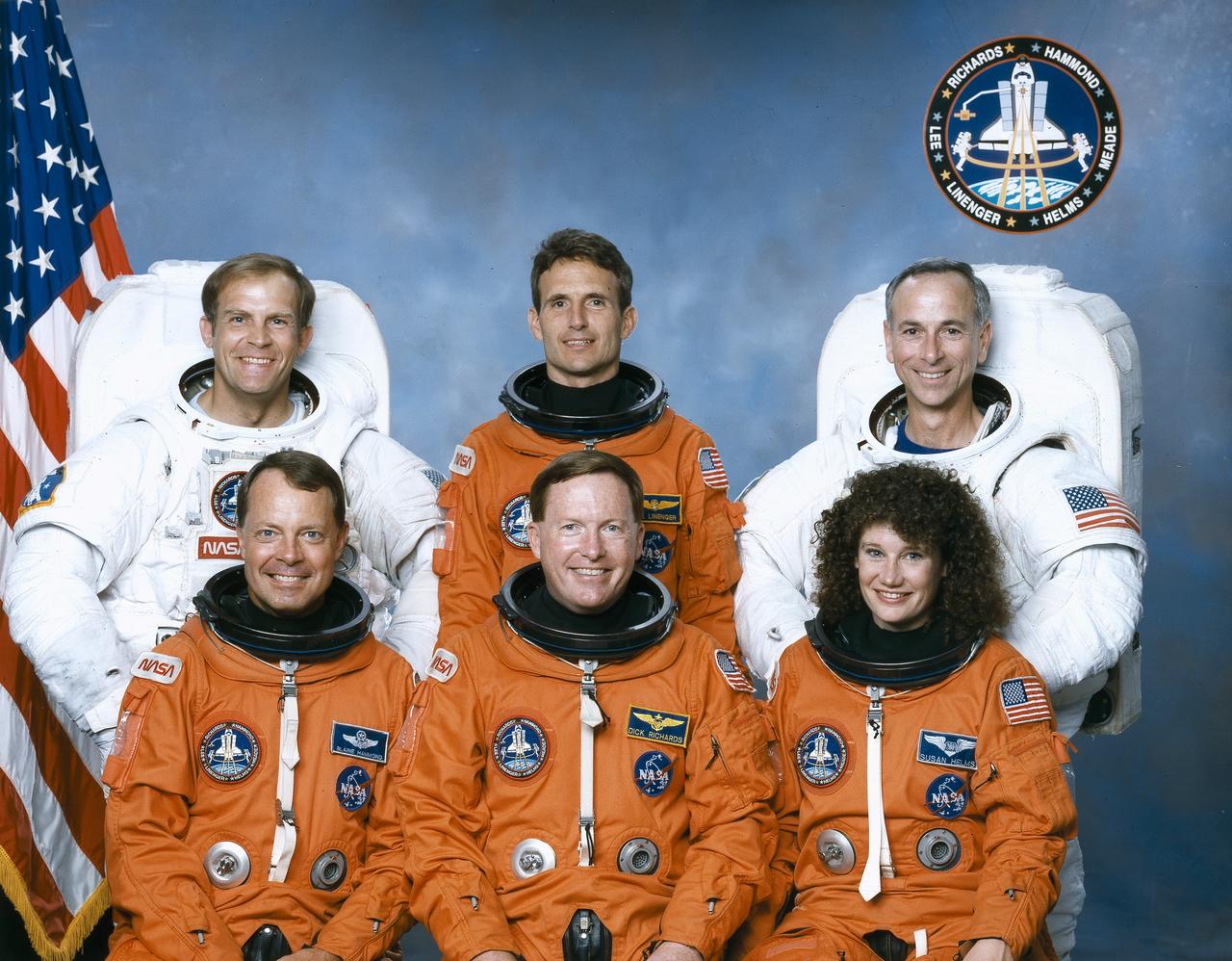
The crew assigned to the STS-64 mission included Richard N. Richards, commander (center front); L. Blaine Hammond Jr., pilot (front left); and Susan J. Helms, mission specialist (front right). On the back row, from left to right, are Mark C. Lee, Jerry M. Linenger, and Carl J. Meade, all mission specialists. Launched aboard the Space Shuttle Discovery on September 9, 1994 at 6:22:55 pm (EDT), the STS-64 mission marked the first flight of the Lidar In-Space Technology Experiment (LITE) and the first untethered Extravehicular Activity (EVA) in ten years.
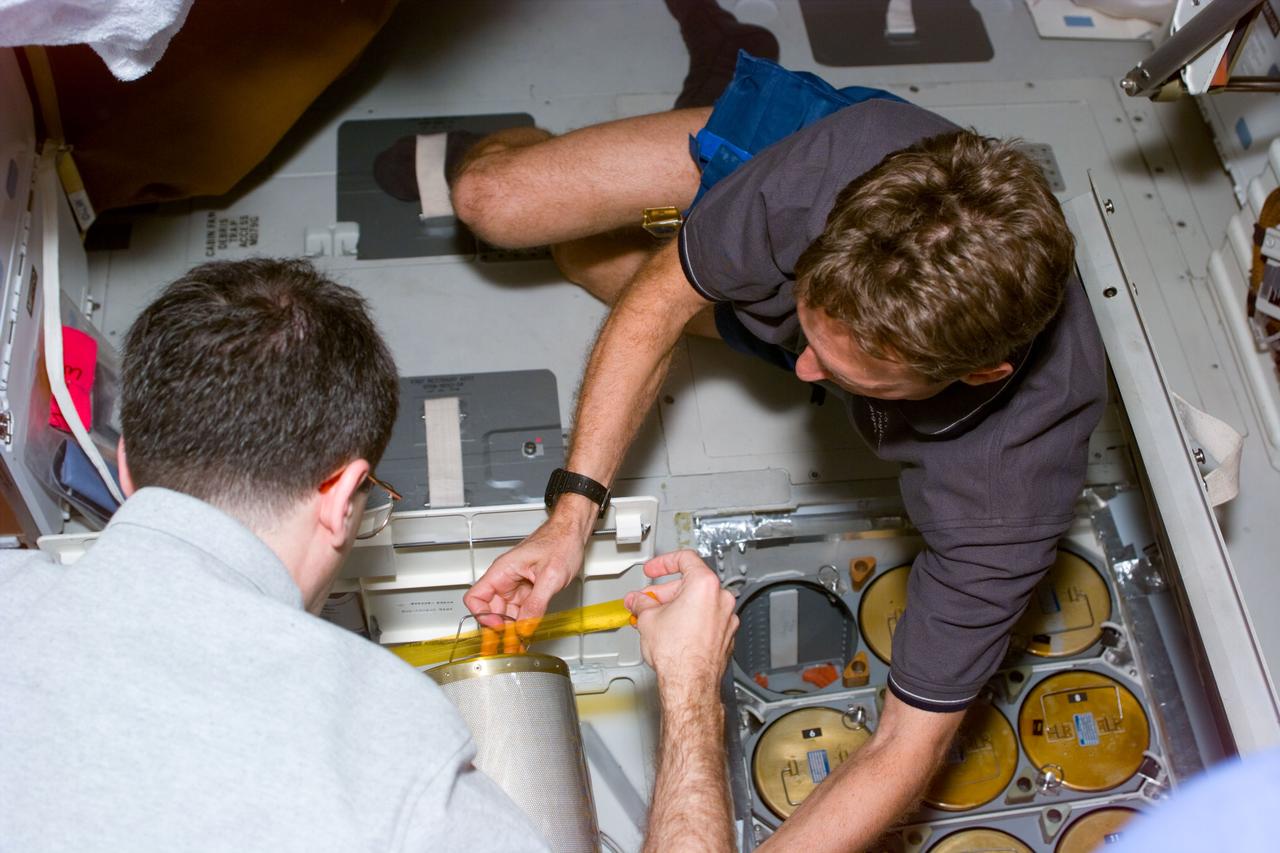
STS081-E-5007 (12 Jan. 1997) --- Astronauts Peter J. K. (Jeff) Wisoff (left) and Jerry M. Linenger begin early housekeeping by putting in fresh lithium hydroxide canisters beneath the Space Shuttle Atlantis' middeck. Not far away in Atlantis' cargo bay, the two mission specialists and their four crew mates are flying the Spacehab Double Module (DM), replete with supplies for the three-man crew aboard Russia's Mir Space Station with which Atlantis will be docking later in the week. Linenger will trade places with John E. Blaha, marking the second such exchange of American astronaut - cosmonaut guest researcher's aboard Mir. Blaha had replaced Shannon W. Lucid in September of 1996. The scene was recorded with an Electronic Still Camera (ESC) and later downlinked to flight controllers in Houston, Texas.
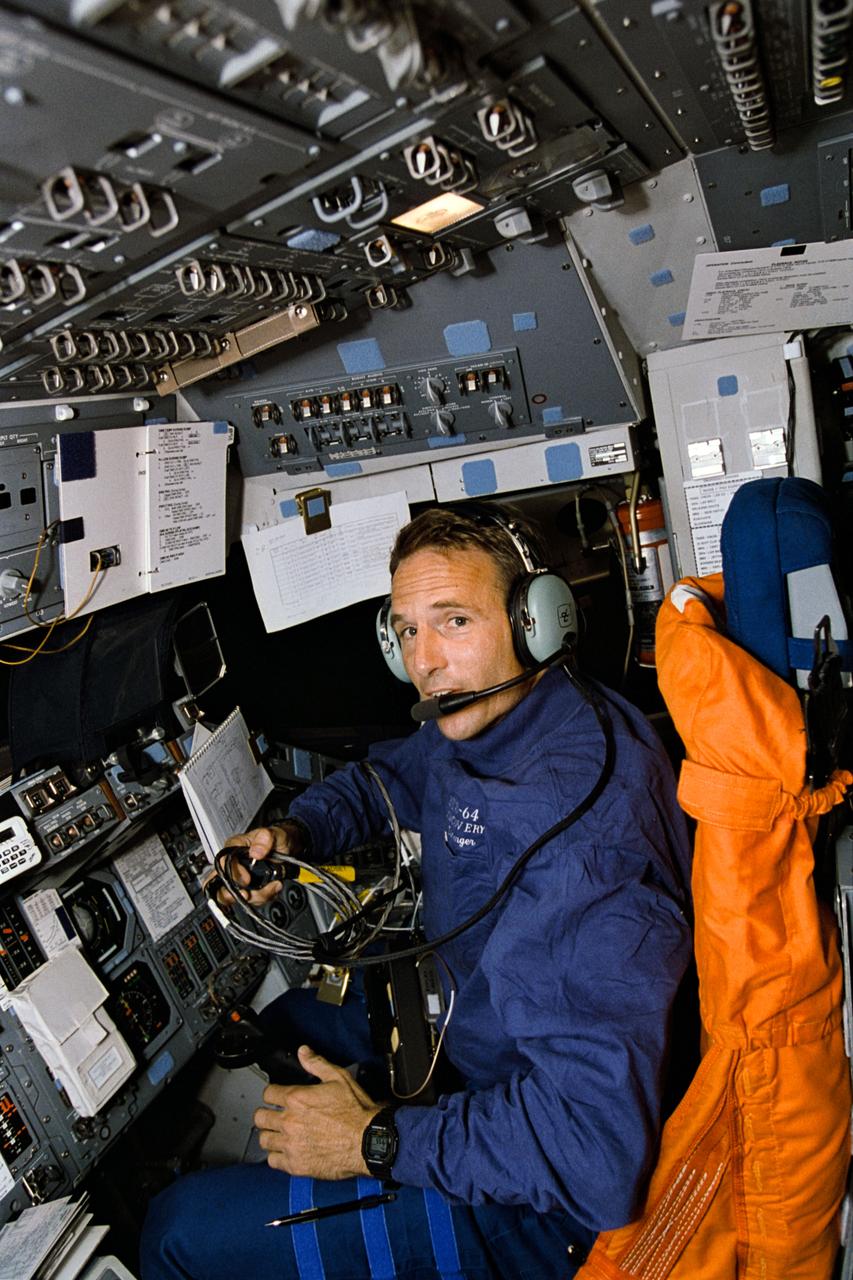
STS064-20-026 (9-20 Sept. 1994) --- Astronaut Jerry M. Linenger, STS-64 mission specialist, uses the Shuttle Amateur Radio Experiment (SAREX) to communicate with students on Earth. Various members of the crew made contact with a number of other "hams" around the world during the almost 11-day mission in Earth orbit. Photo credit: NASA or National Aeronautics and Space Administration
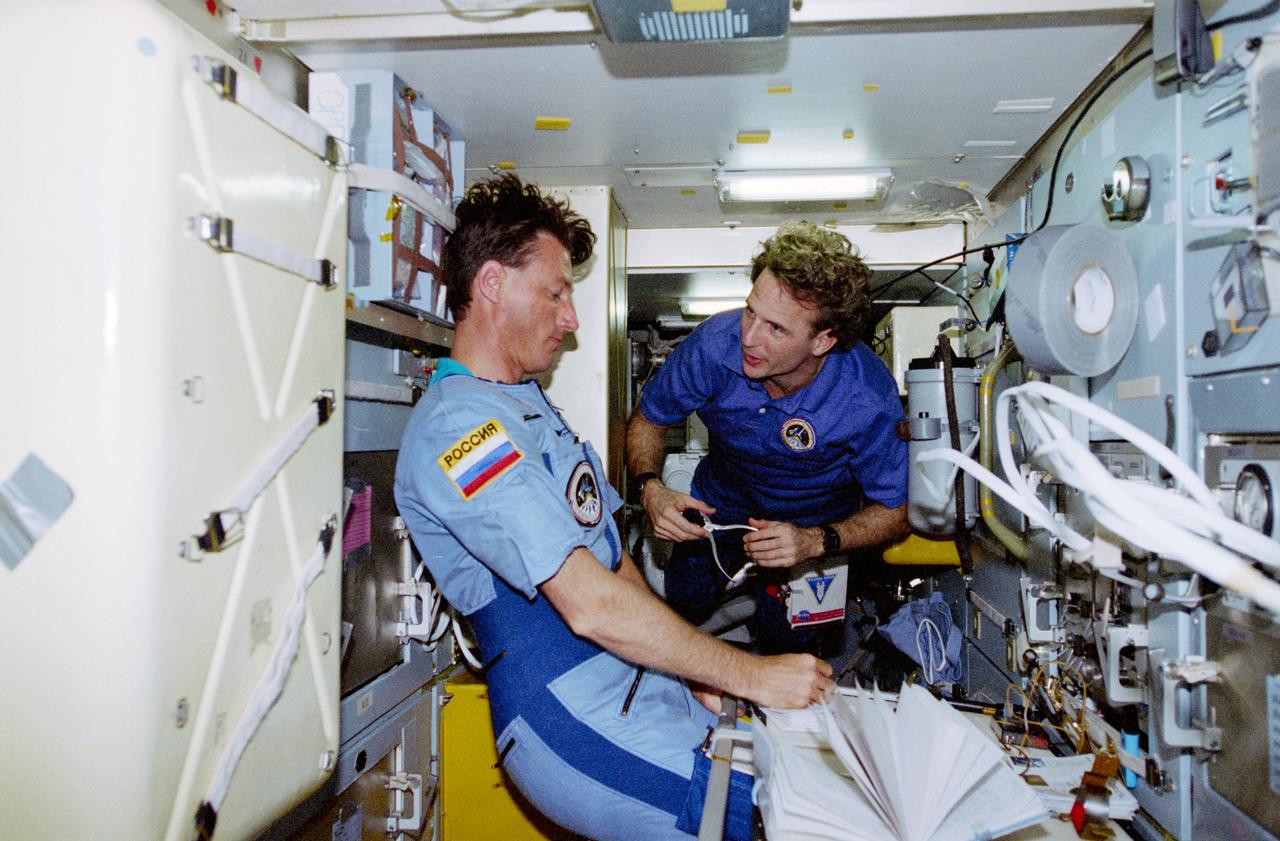
STS084-371-021 (15-21 May 1997) --- Onboard Russia's Mir Space Station's Priroda Module, NASA's most recent participant in the cosmonaut guest researcher role briefs his replacement. Jerry M. Linenger, right, has been aboard the orbiting complex since January of this year, but as evidenced by the uniforms each is wearing, he has turned over that role now to C. Michael Foale.

STS064-23-025 (9-20 Sept. 1994) --- With scissors in hand, astronaut Jerry M. Linenger, STS-64 mission specialist, prepares to cut off a lengthy sheet of correspondence from ground controllers. Called the Thermal Imaging Printing System (TIPS), the message center occupies a stowage locker on the space shuttle Discovery's middeck. Astronaut L. Blaine Hammond, pilot, retrieves a clothing item from a nearby locker. Photo credit: NASA or National Aeronautics and Space Administration
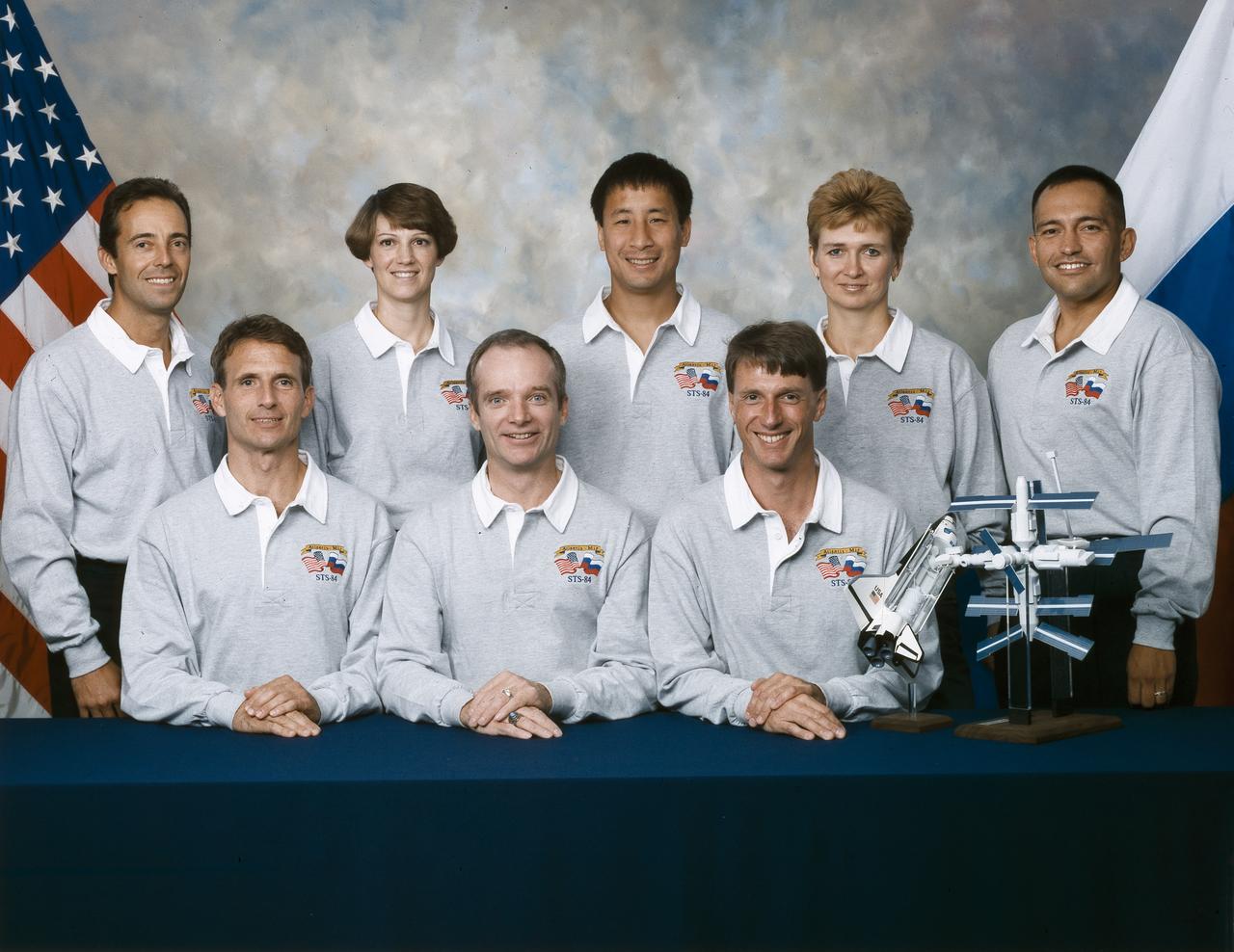
The crew assigned to the STS-84 mission included (seated front left to right) Jerry M Linenger, mission specialist; Charles J. Precourt, commander; and C. Michael Foale, mission specialist. On the back row (left to right) are Jean-Francois Clervoy (ESA), mission specialist; Eileen M. Collins, pilot; Edward T. Lu, mission specialist; Elena V. Kondakova (RSA), mission specialist; and Carlos I. Noriega, mission specialist. Launched aboard the Space Shuttle Atlantis on May 15, 1997 at 4:07:48 am (EDT), the STS-84 mission served as the sixth U.S. Space Shuttle-Russian Space Station Mir docking.
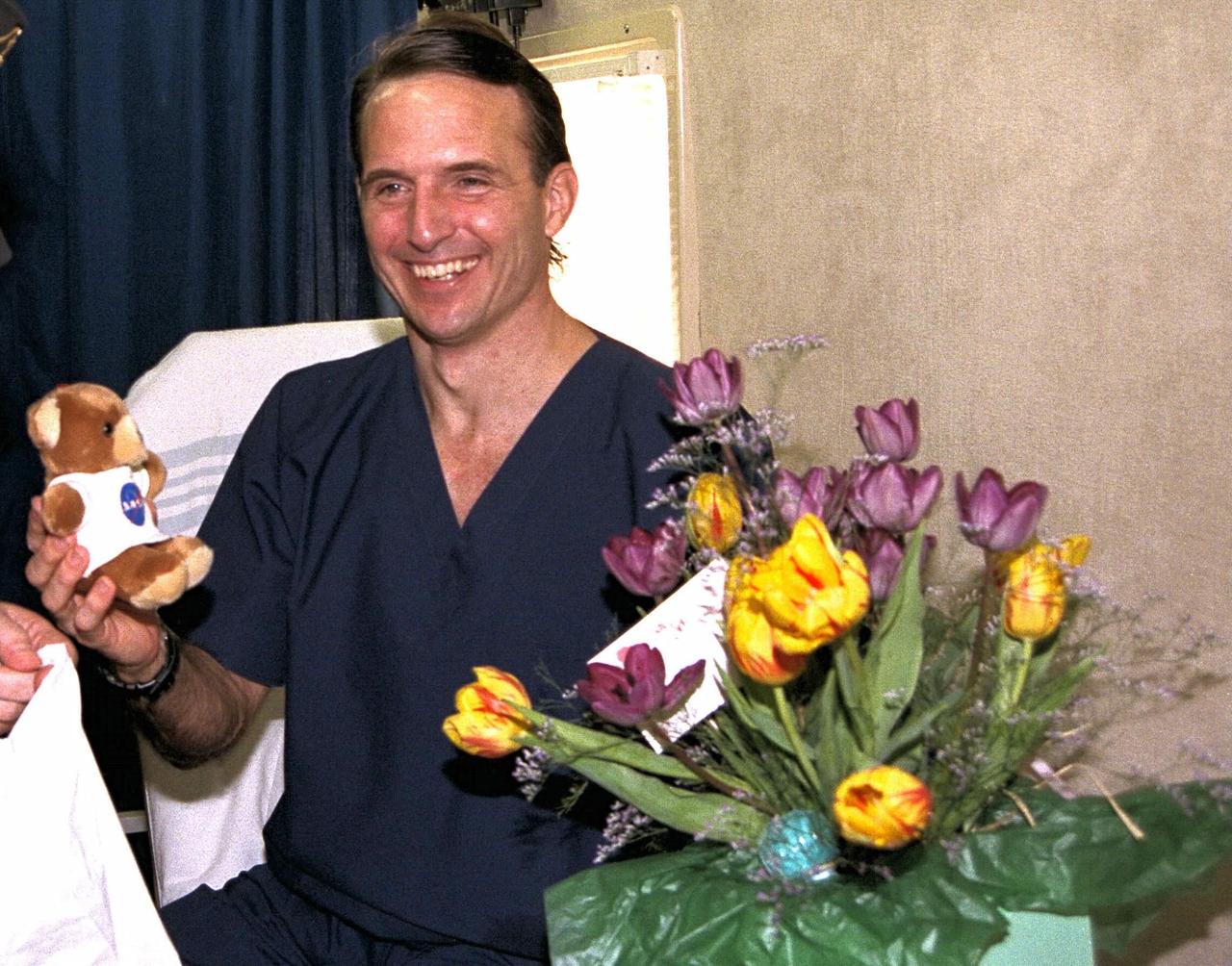
Astronaut and recent Mir 23 crew member Jerry M. Linenger holds a stuffed bear he was given by NASA Administrator Daniel Goldin at the conclusion of the STS-84 Space Shuttle mission. STS-84 was the sixth docking of the Shuttle with the Russian Space Station Mir, where Linenger has lived and worked the past four months. Goldin presented several gifts to Linenger in the Crew Transport Vehicle shortly after landing of the Space Shuttle orbiter Atlantis on KSC’s Runway 33. Besides the bear for Linenger’s 18-month-old son, John, Goldin gave the astronaut flowers for Linenger’s wife, Kathryn; and a rattle for the Linengers’ unborn child who is due next month. Linenger was replaced on the Russian space station by STS-84 Mission Specialist C. Michael Foale
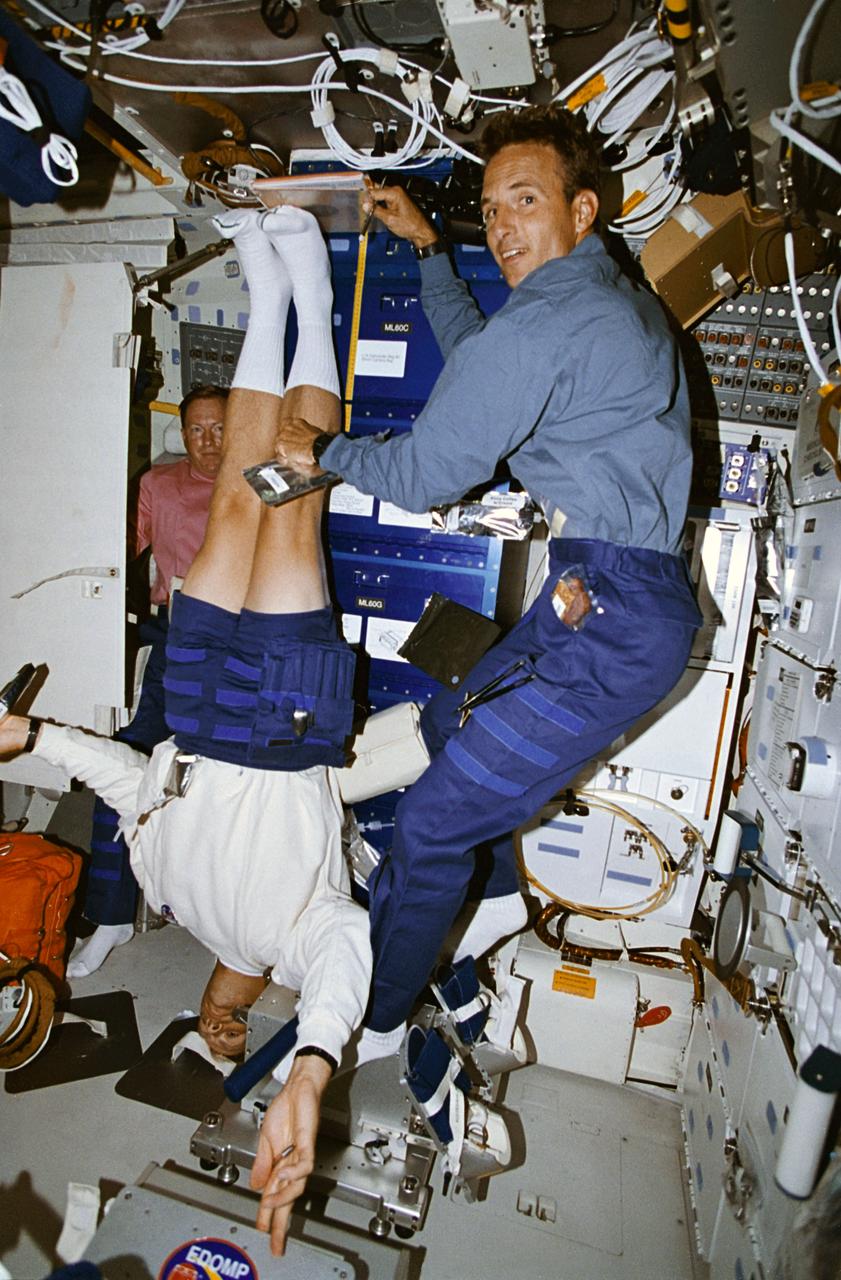
STS064-05-020 (9-20 Sept. 1994) --- Astronaut Mark C. Lee gets his height measured by astronaut Jerry M. Linenger as part of a daily in-flight routine supporting a medical Detailed Supplementary Objective (DSO). Astronaut Richard N. Richards, STS-64 mission commander, looks on in the background. This study was designed to collect information about back pain and height changes experienced by astronauts during flight. Crew members participating in this DSO are required to record height measurements and long back-pain symptoms daily. As an ongoing program, this DSO will gather data from 30 astronauts who spend more than eight consecutive days in space. Photo credit: NASA or National Aeronautics and Space Administration
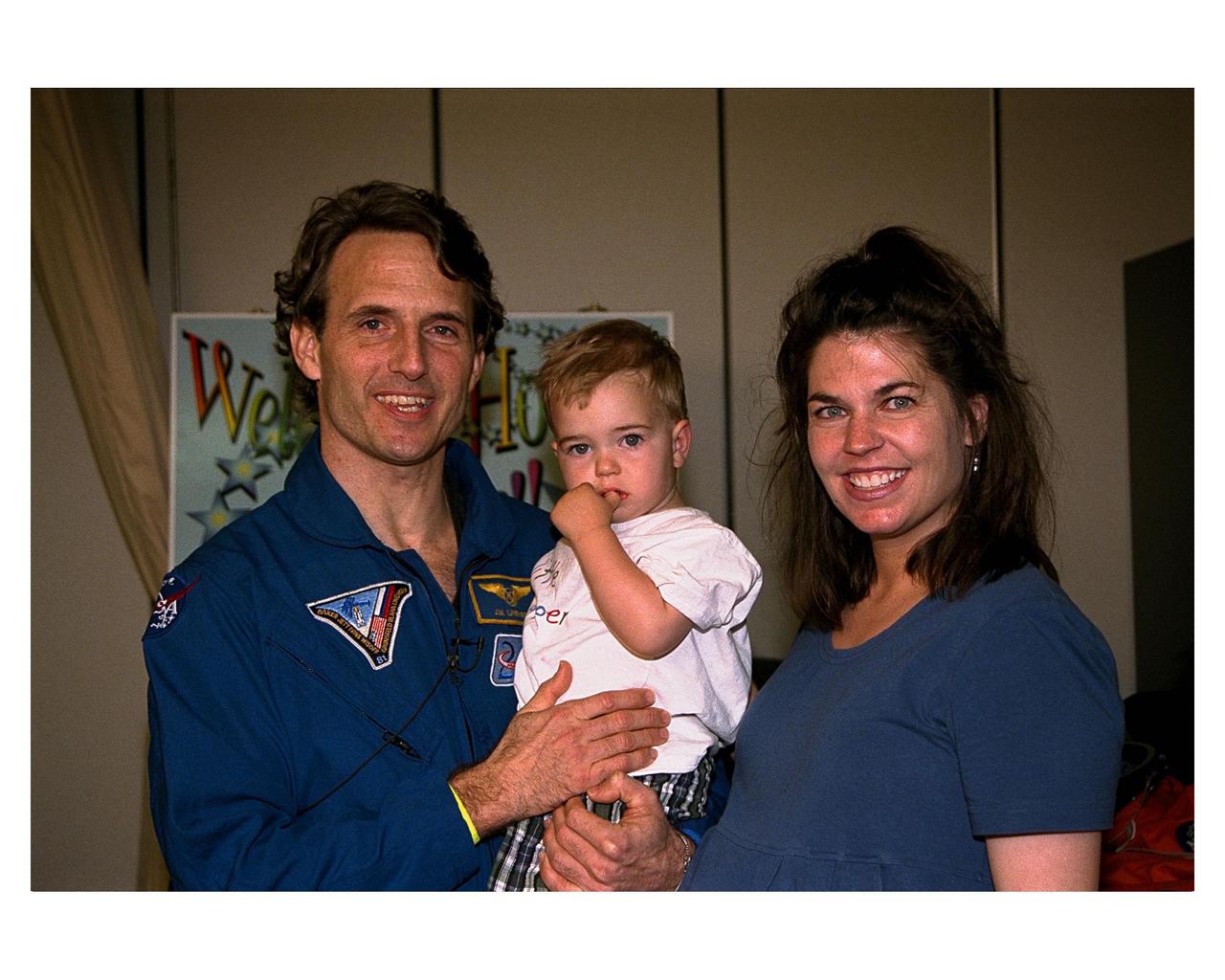
Astronaut and recent Mir 23 crew member Jerry M. Linenger poses for a photograph with his wife, Kathryn, and their 18-month-old son, John, during a family reunion in the Operations and Checkout Building. Kathryn Linenger is expecting their second child next month. Linenger just returned to Earth after a four-month stay on the Russian Space Station Mir. He flew back on Atlantis with six other members of the STS-84 crew, who conducted the sixth Space Shuttle docking with the Mir. STS-84 Mission Specialist C. Michael Foale replaced Linenger on the Mir
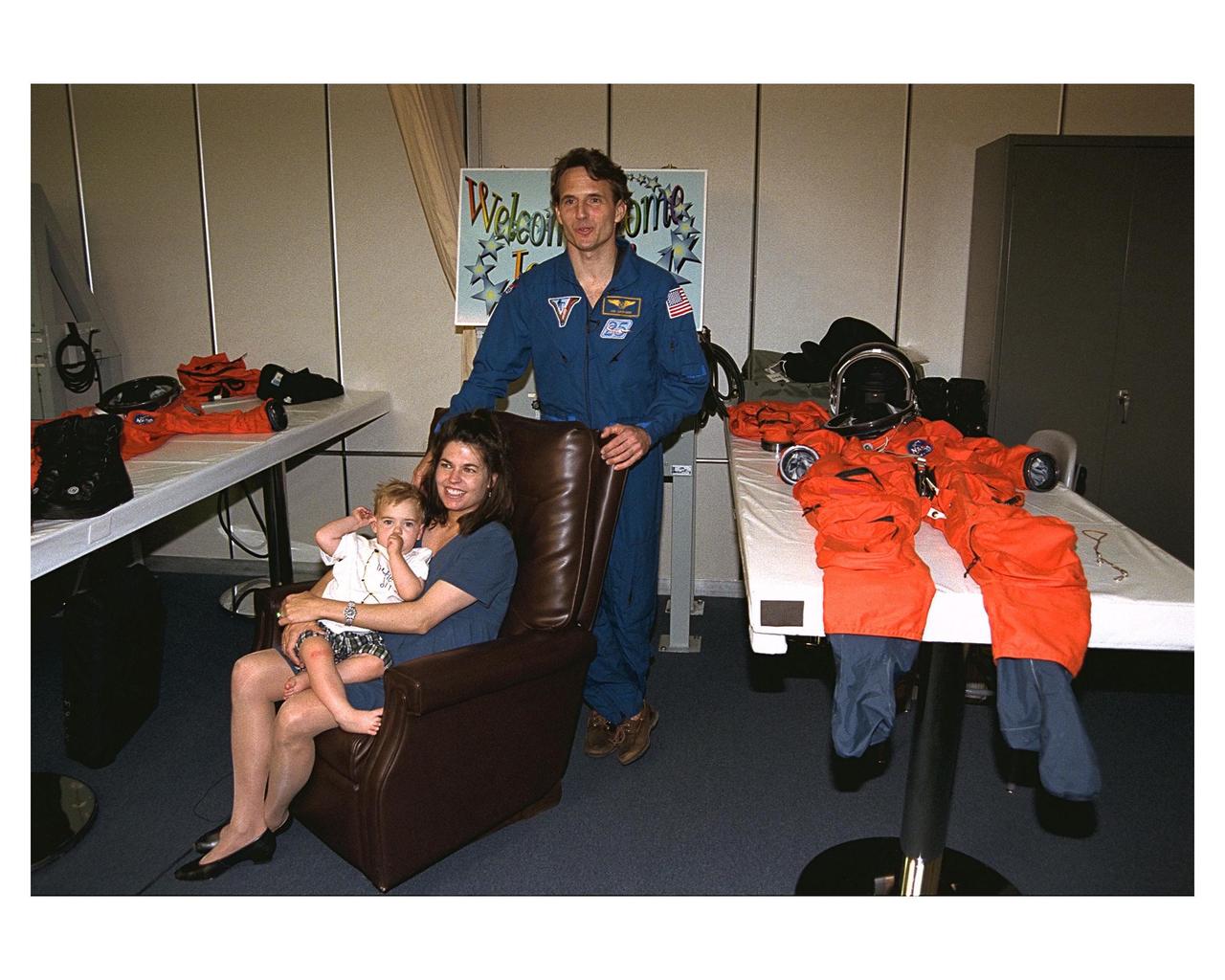
Astronaut and recent Mir 23 crew member Jerry M. Linenger, standing, reunites with his wife, Kathryn, and their 18-month-old son, John, in the astronaut suit-up room in the Operations and Checkout Building. Kathryn Linenger is expecting their second child next month. Linenger just returned to Earth after a four-month stay on the Russian Space Station Mir. He flew back on Atlantis with six other members of the STS-84 crew, who conducted the sixth Space Shuttle docking with the Mir. STS-84 Mission Specialist C. Michael Foale replaced Linenger on the Mir
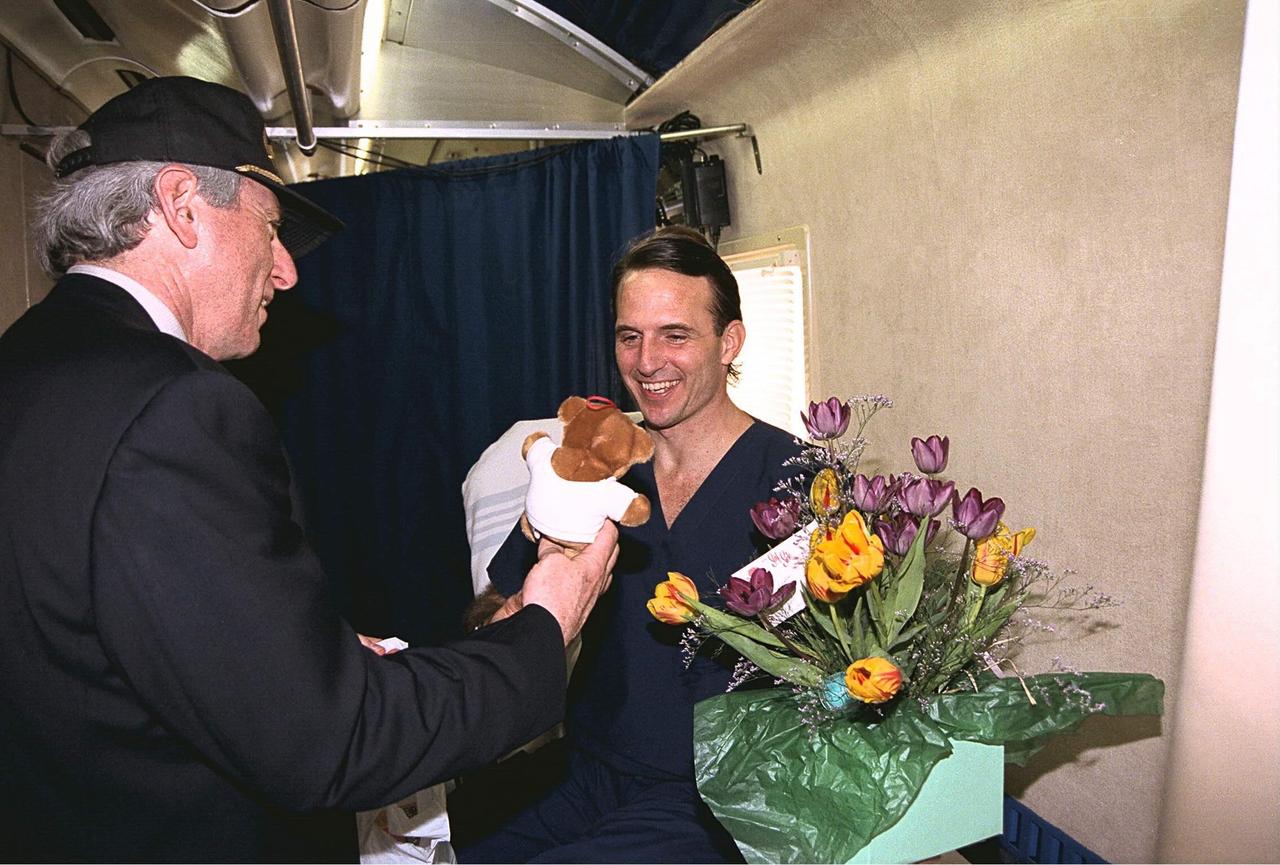
NASA Administrator Daniel Goldin presents some gifts to returning astronaut Jerry M. Linenger, who spent the last four months on the Russian Space Station Mir. Goldin met with Linenger in the Crew Transport Vehicle shortly after the Space Shuttle orbiter Atlantis landed on Runway 33 of KSC’s Shuttle Landing Facility at the conclusion of the nine-day STS-84 mission. Goldin gave the astronaut flowers for Linenger’s wife, Kathryn; a stuffed bear for their 18-month-old son, John; and a rattle for their unborn child who is due next month. STS-84 was the sixth of nine planned dockings of the Space Shuttle with the Mir. Mir 23 crew member Linenger was replaced on the Russian space station by STS-84 Mission Specialist C. Michael Foale
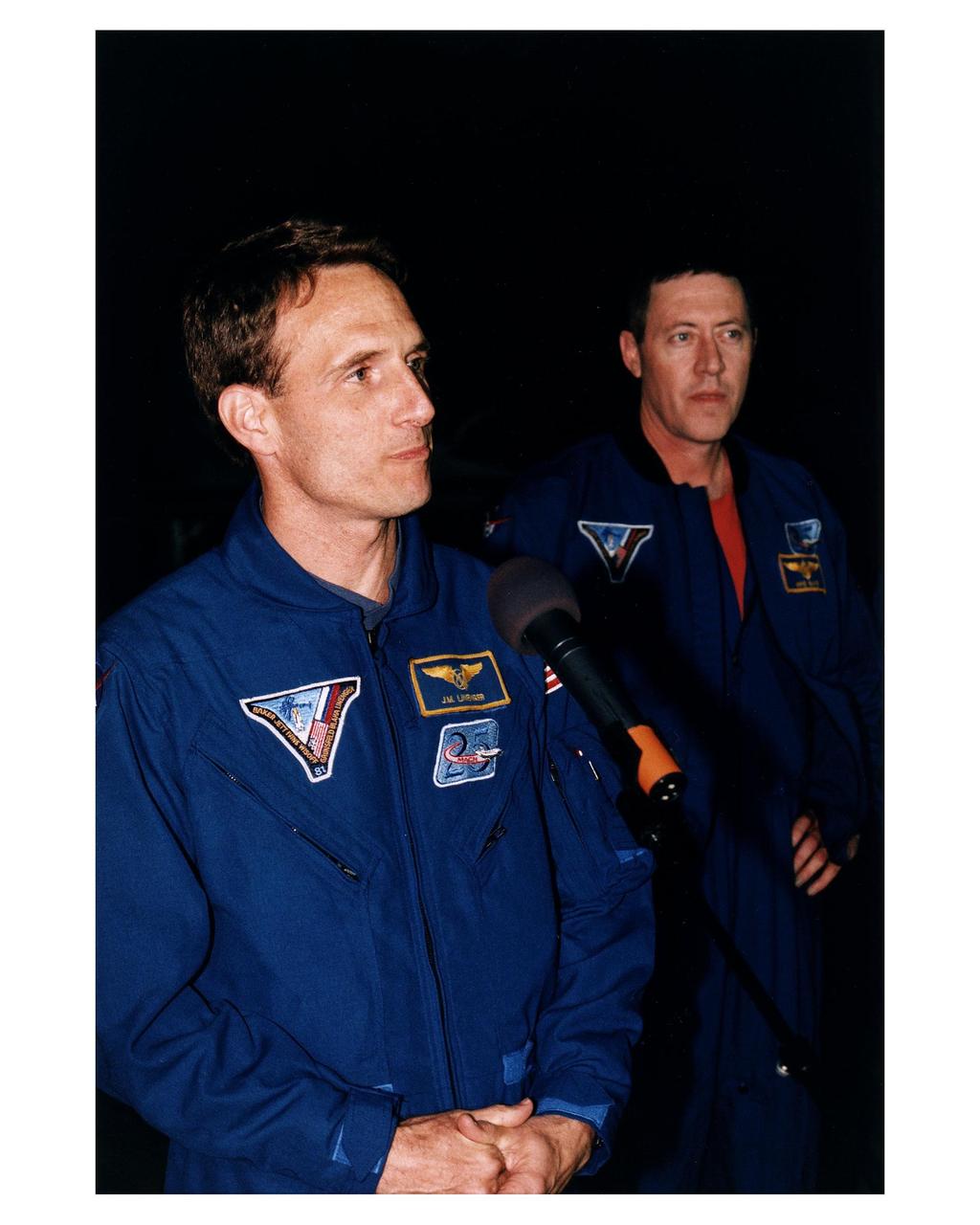
STS-81 Mission Specialist J.M. "Jerry" Linenger talks to the press at the KSC Shuttle Landing Facility after the flight crew arrived at the space center for the final countdown preparations for the fifth Shuttle-Mir docking mission. The 10-day mission will feature the transfer of Linenger to Mir to replace astronaut John Blaha, who has been on the orbital laboratory since Sept. 19, 1996. Linenger will be the fourth U.S. astronaut to stay onboard the Russian space station and serve as a Mir crew member. Mission Commander Michael A. Baker is to his left
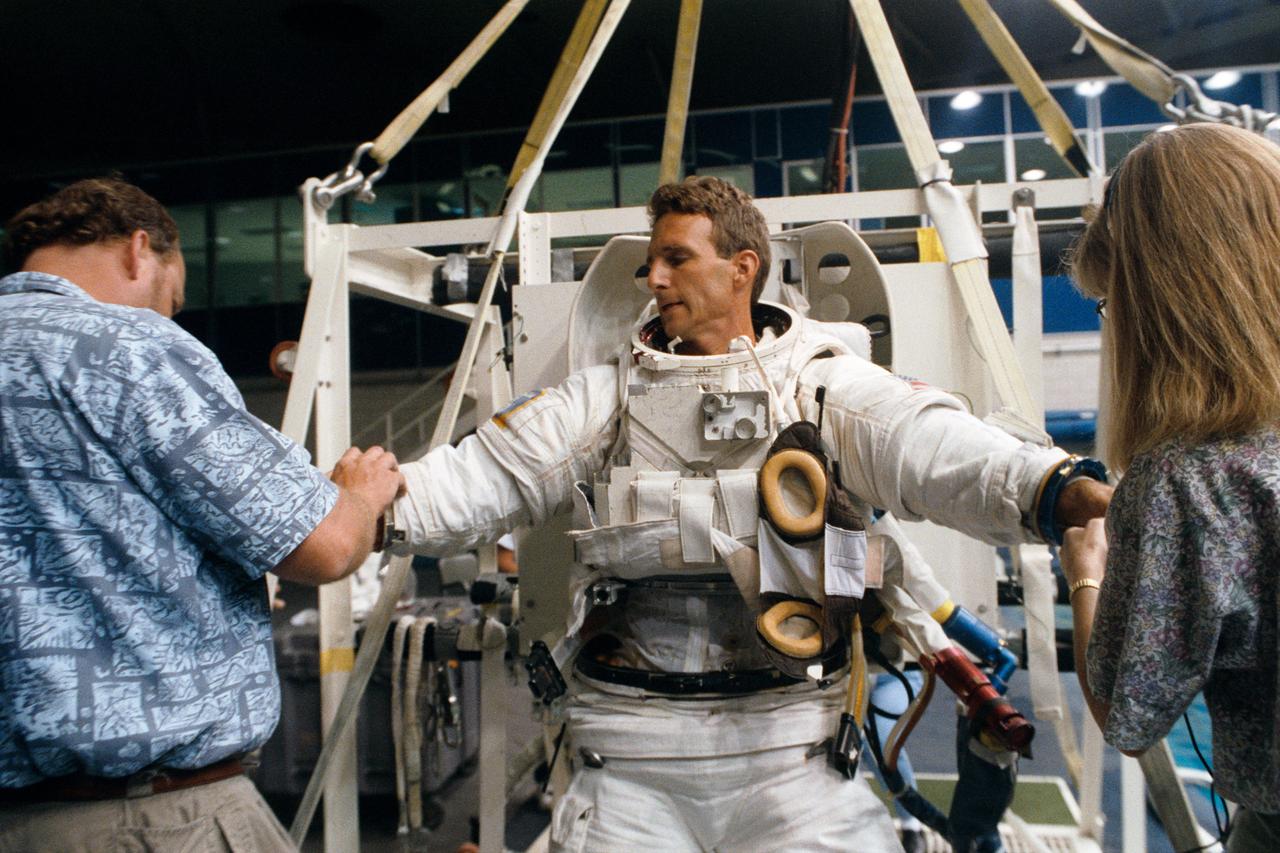
S93-37899 (October 1993) --- Astronaut Jerry M. Linenger, STS-64 mission specialist, is assisted by Steve Voyles and Kari Rueter of Boeing Aerospace prior to participating in a rehearsal for a contingency extravehicular activity (EVA). Minutes later, Linenger was submerged in the 25-feet-deep pool in the Johnson Space Center's (JSC) Weightless Environment Training Facility (WET-F). Photo credit: NASA or National Aeronautics and Space Administration
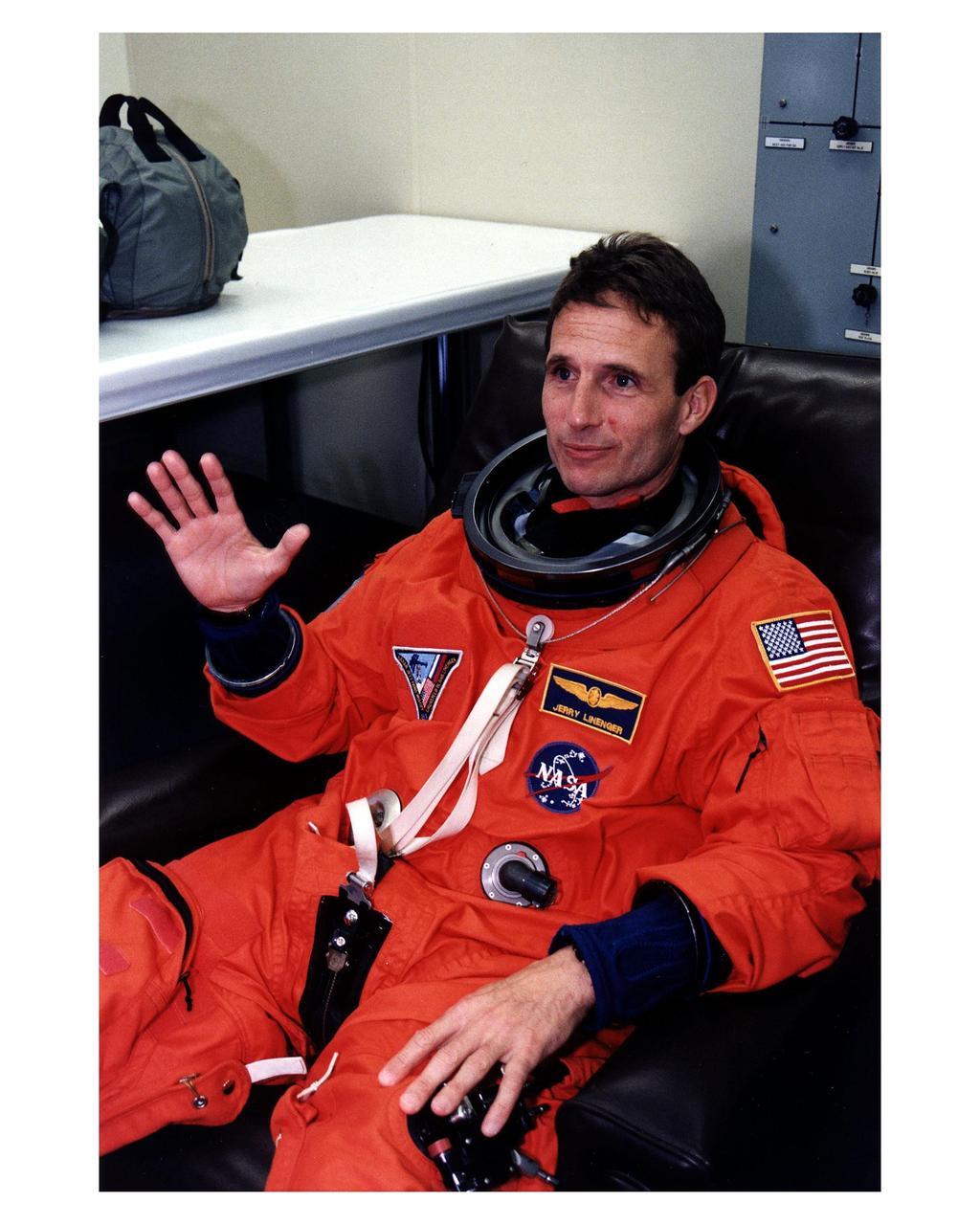
STS-81 Mission Specialist Jerry Linenger waves to the camera in his launch/entry suit and helmet in the suitup room of the Operations and Checkout (O&C) Building. He is on his second Shuttle flight and has been an astronaut since 1992. Linenger will become a member of the Mir 22 crew and replace astronaut John Blaha on the Russian space station for a four-month stay after the Space Shuttle orbiter Atlantis docks with the orbital habitat on flight day 3. A medical doctor and an exercise buff, Linenger will conduct physiological experiments during his stay on Mir. He and five crew members will shortly depart the O&C and head for Launch Pad 39B, where the Space Shuttle Atlantis will lift off during a 7-minute window that opens at 4:27 a.m. EST, January 12

Mission Specialist Jerry Linenger prepares to enter the Space Shuttle Atlantis at Launch Pad 39B with help from white room close out members Jim Mangione(left foreground),Danny Wyatt and Jim Martin
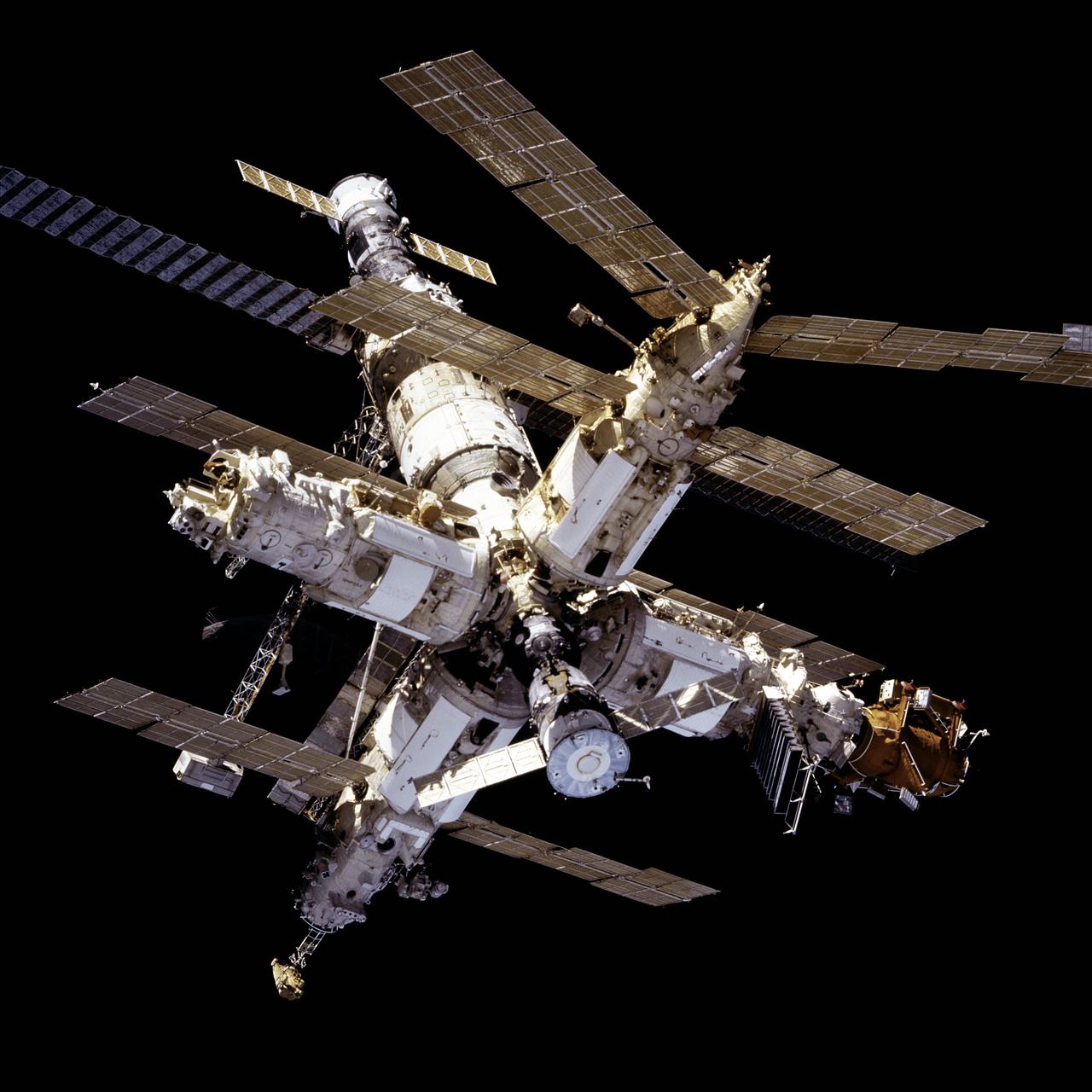
STS081-736-034 (14 Jan 1997) --- This 70mm frame affords a full view of Russia?s Mir Space Station complex during approach for docking, backdropped against the blackness of space. Astronaut Jerry M. Linenger, now onboard the Space Shuttle Atlantis, will trade places with John E. Blaha, current cosmonaut guest researcher onboard Mir since mid September 1996. Along with Linenger, other crew members now aboard Atlantis are astronauts Michael A. Baker, commander; Brent W. Jett, Jr., pilot; and mission specialists John M. Grunsfeld, Marsha S. Ivins and Peter J. K. (Jeff) Wisoff.
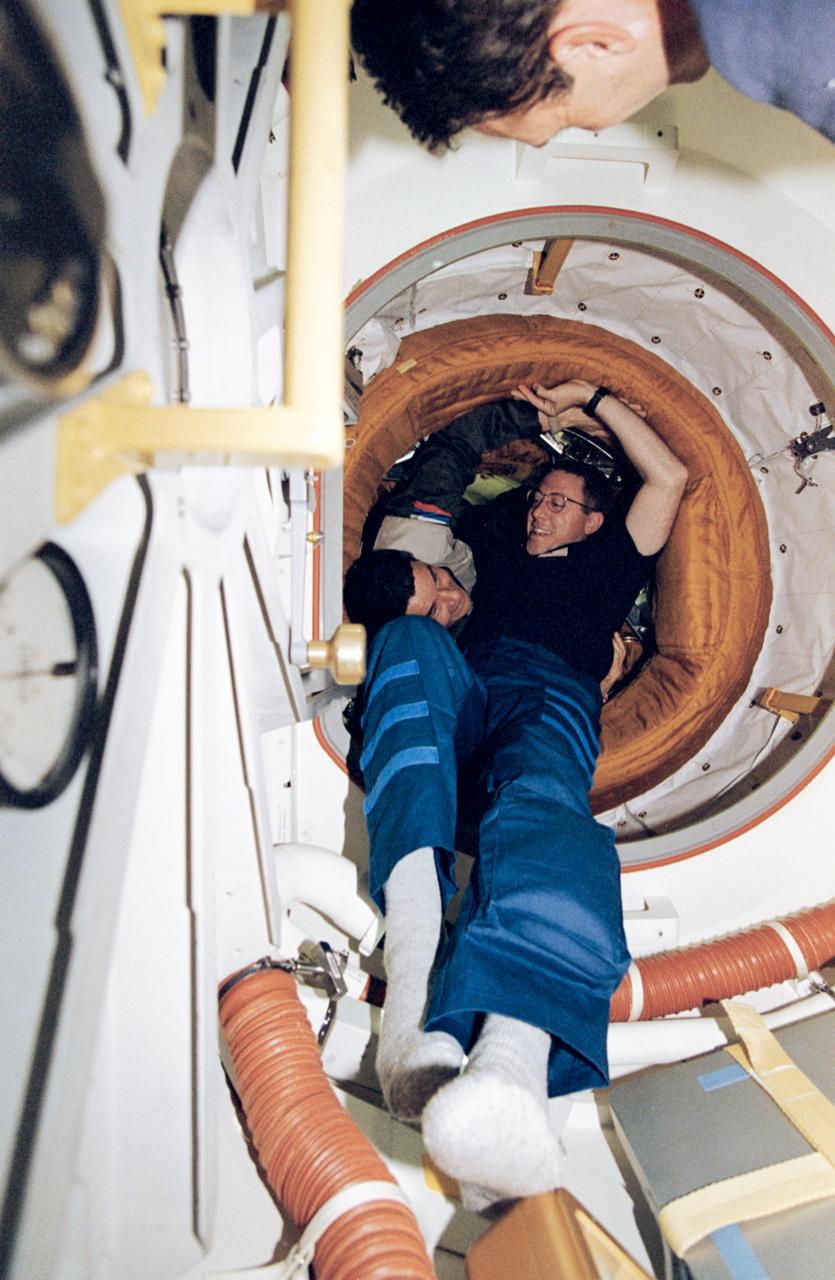
STS081-373-025 (14 Jan 1997) --- Greeting between commanders - astronaut Michael A. Baker (foreground) and cosmonaut Valeri G. Korzun - just after hatch opening following the January 14, 1997, docking. Out of frame on the Space Shuttle Atlantis is astronaut Jerry M. Linenger, soon to be trading places with John E. Blaha, the current cosmonaut guest researcher, onboard Russia?s Mir Space Station since mid September 1996. Along with Baker and Linenger, other crew members now aboard Atlantis are astronauts Brent W. Jett, Jr., pilot; and mission specialists John M. Grunsfeld, Marsha S. Ivins and Peter J. K. (Jeff) Wisoff.
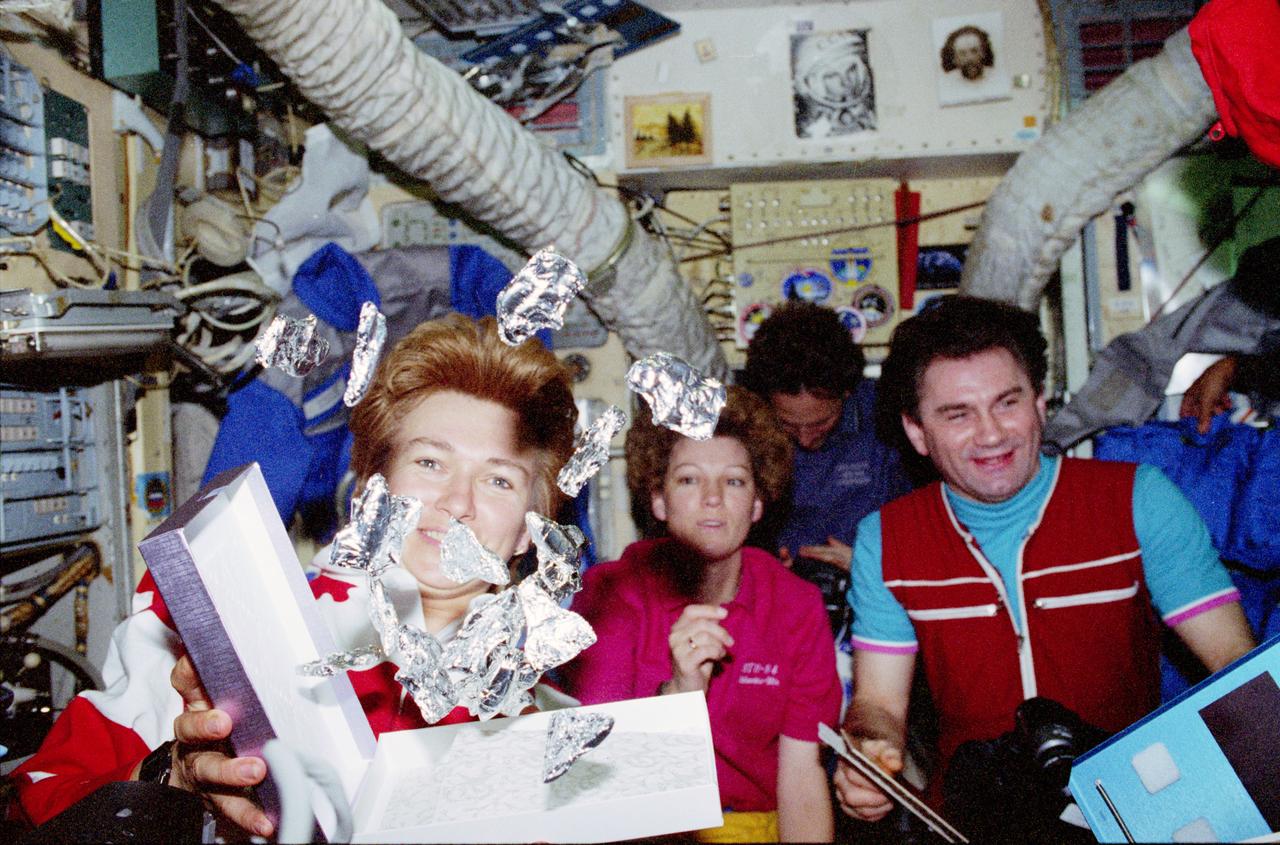
STS084-377-026 (15-24 May 1997) --- Cosmonaut Elena V. Kondakova opens a gift box and a number of tiny chocolate Space Shuttles free-float in Russia's Mir Space Station's Base Block. The STS-84 mission specialist and her crew mates had earlier presented the gift to the Mir-23 crew members, including Vasili Tsibliyev (right), mission commander. In the background are astronauts Eileen M. Collins, STS-84 pilot, and Jerry M. Linenger, mission specialist. Linenger was in his last days aboard Mir prior to returning to Earth with the STS-84 crew aboard the Space Shuttle Atlantis.
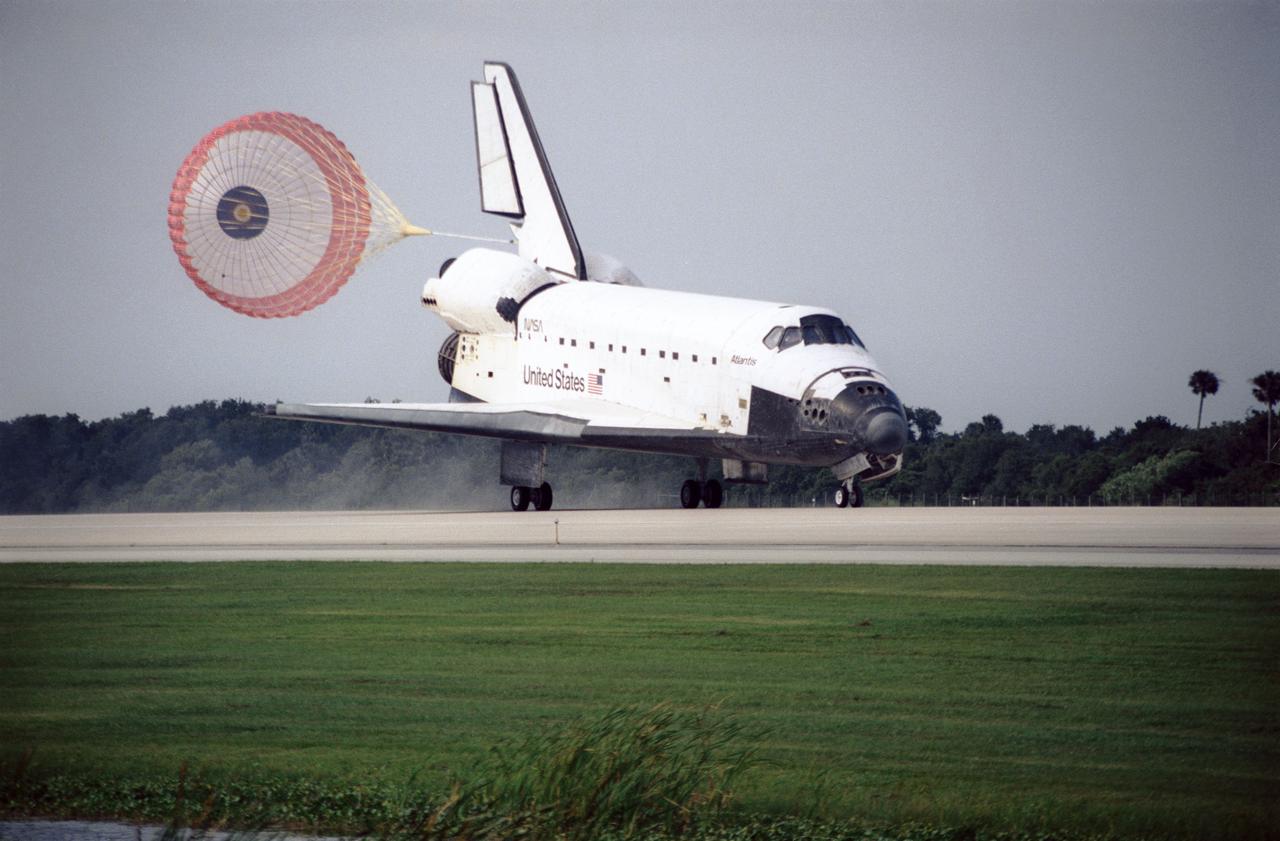
STS084-S-010 (24 May 1997) --- The drag chute on the Space Shuttle Atlantis is deployed as the Space Shuttle touches down on Runway 33 of the Kennedy Space Center (KSC) Shuttle Landing Facility (SLF). The landing, at 9:27:44 a.m. (EDT), May 24, 1997, brought to a completion the nine-day mission. This touchdown marked the 37th landing at KSC in the 16-year history of the Space Transportation System (STS) and it also marked the return of astronaut Jerry M. Linenger to Earth following almost four months aboard Russia's Mir Space Station. Onboard for the landing were astronauts Charles J. Precourt, Eileen M. Collins, Jean-Fran?ois Clervoy, Carlos I. Noriega, Edward T. Lu, Linenger and Elena V. Kondakova. Clervoy is with the European Space Agency (ESA) and Kondakova represents the Russian Space Agency (RSA).

STS-84 mission specialists and SPACEHAB workers participate in the Crew Equipment Integration Test (CEIT) inside the SPACEHAB Double Module, which will carry more than 6,000 pounds of scientific experiments and logistics to the Russian Space Station Mir. Standing at left is JeanFrancois Clervoy of the European Space Agency. Sitting on the floor, from left, are Edward Tsang Lu of NASA and Elena V. Kondakova of the Russian Space Agency. The test is being conducted at the SPACEHAB Payload Processing Facility in Cape Canaveral. STS-84 will be the sixth docking of the Space Shuttle with Mir. It also will be the third consecutive crew member exchange of U.S. astronauts aboard Mir. STS-84 Mission Specialist C. Michael Foale will replace astronaut Jerry M. Linenger on Mir. Linenger has been on Mir since the STS-81 mission in January. Foale is scheduled to remain on Mir about four months. STS-84 is targeted for a May 15 liftoff
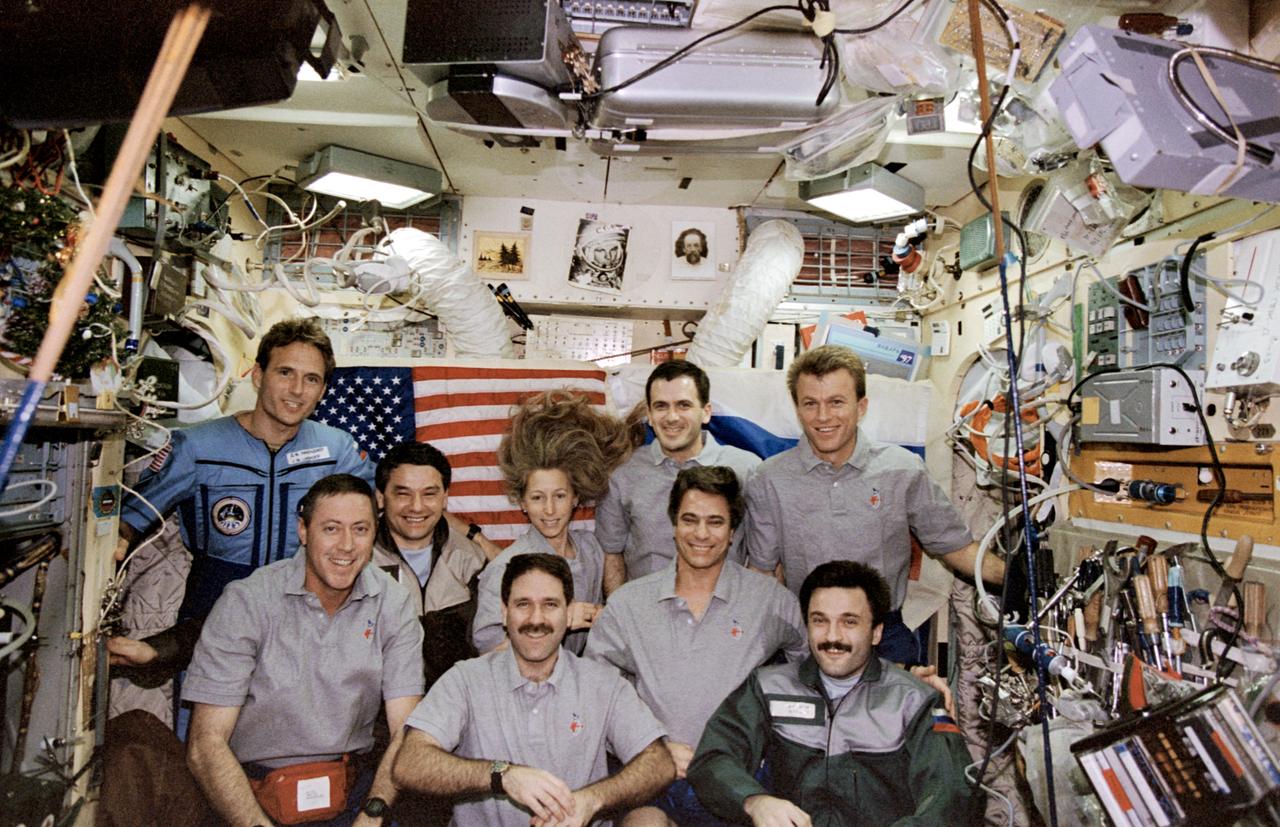
STS081-369-003 (12-22 Jan. 1997) --- Traditional inflight crew portrait of the combined Mir-22 and STS-81 crews in the Base Block Module aboard Russia's Mir Space Station. Front row: left to right, Michael A. Baker, commander; John M. Grunsfeld, mission specialist; and cosmonaut Aleksandr Y. Kaleri, Mir-22 flight engineer. Middle row: cosmonaut Valeri G. Korzun, Mir-22 commander; Marsha S. Ivins, mission specialist; and John E. Blaha, former cosmonaut guest researcher. Back row: Jerry M. Linenger, cosmonaut guest researcher; Peter J. K. (Jeff) Wisoff, mission specialist; and Brent W. Jett, Jr., pilot. Linenger is seen in a Russian jump suit, and Blaha now wears a Space Shuttle inflight garment as the two exchanged cosmonaut guest researcher roles on January 14, 1997, following the docking of the Atlantis and the Mir complex.
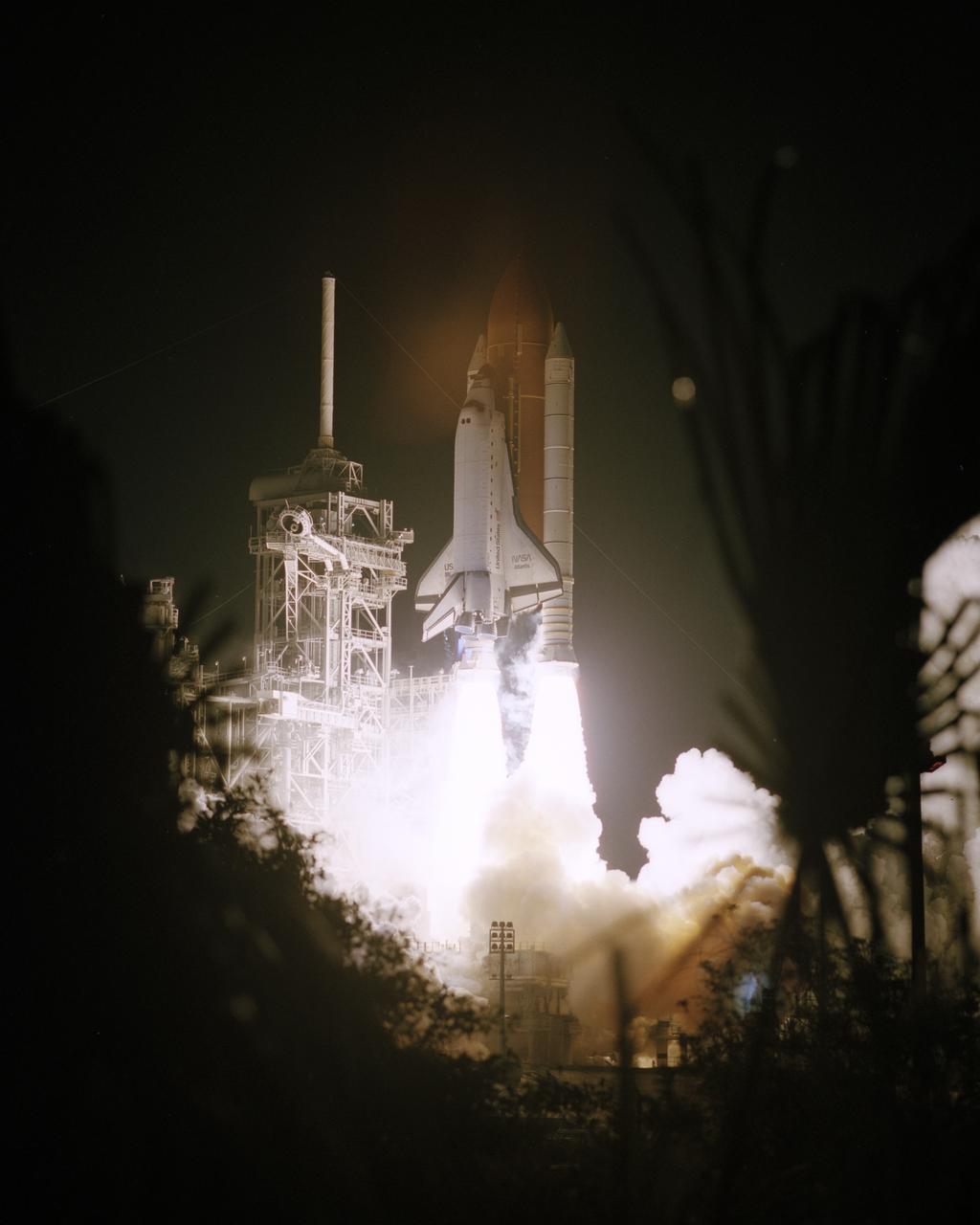
STS081-S-007 (12 Jan. 1997) --- Framed by a silhouette of Florida foliage, the Space Shuttle Atlantis lifts off from Pad 39B at 4:27:23 a.m. (EST) Jan. 12, 1997 on its way for a docking mission with Russia's Mir Space Station. Onboard are six astronauts and a SPACEHAB Double Module (DM), along with a large supply of food, water, hardware and other materials for Mir. Astronaut Jerry M. Linenger, now onboard Atlantis, will trade places with John E. Blaha, cosmonaut guest researcher, onboard Mir since mid September 1996. Along with Linenger, other crewmembers now aboard Atlantis are astronauts Michael A. Baker, commander; Brent W. Jett, Jr., pilot; and mission specialists John M. Grunsfeld, Marsha S. Ivins and Peter J. K. (Jeff) Wisoff.
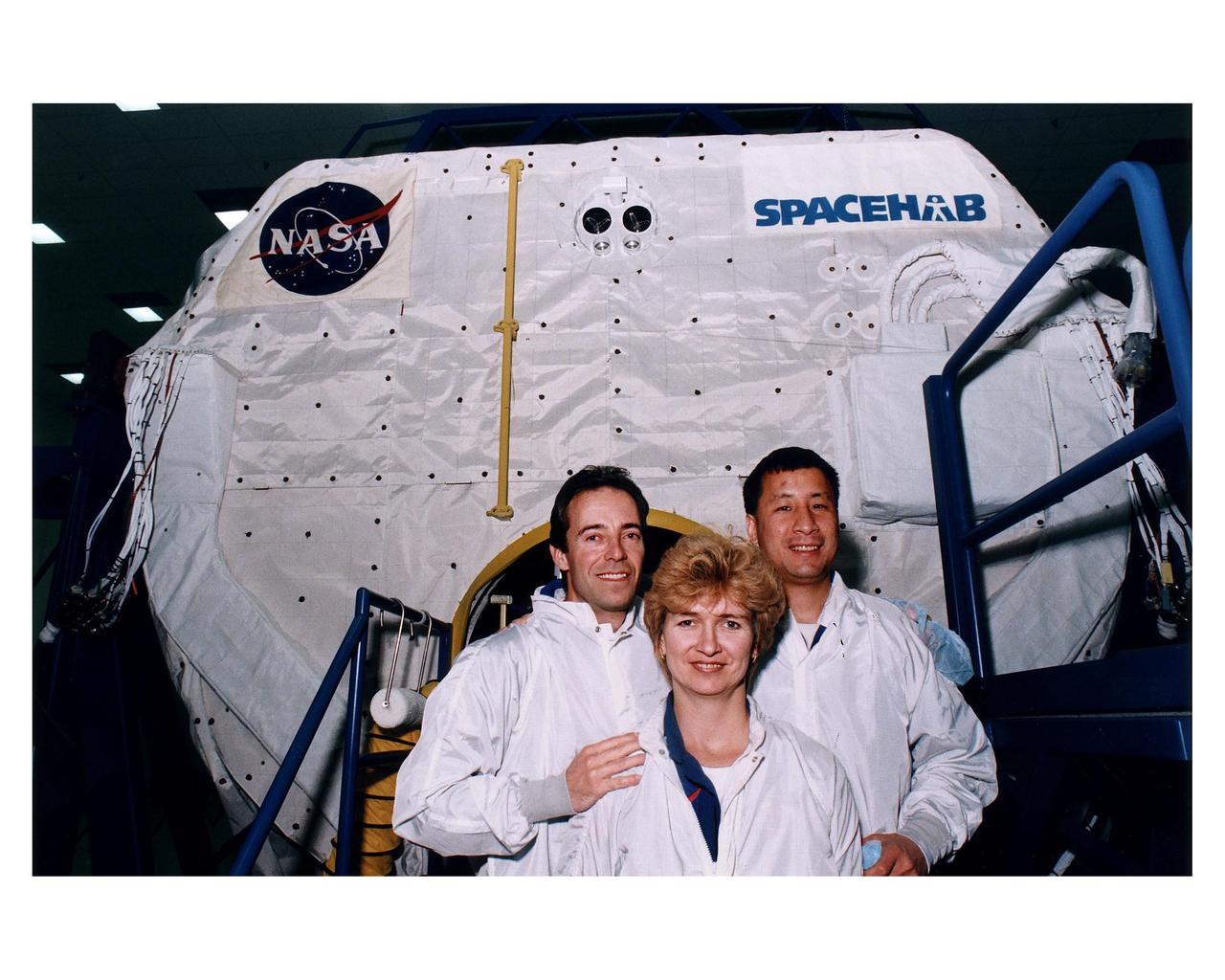
STS-84 crew members pose outside the SPACEHAB Double Module, which will carry more than 6,000 pounds of scientific experiments and logistics to the Russian Space Station Mir. From left, are Mission Specialists Jean-Francois Clervoy of the European Space Agency, Elena V. Kondakova of the Russian Space Agency, and Edward Tsang Lu of NASA. They are participating in the Crew Equipment Integration Test (CEIT) at the SPACEHAB Payload Processing Facility in Cape Canaveral. STS-84 will be the sixth docking of the Space Shuttle with Mir. It also will be the third consecutive crew member exchange of U.S. astronauts aboard Mir. STS-84 Mission Specialist C. Michael Foale will replace astronaut Jerry M. Linenger on Mir. Linenger has been on Mir since the STS-81 mission in January. Foale is scheduled to remain on Mir about four months. STS-84 is targeted for a May 15 liftoff
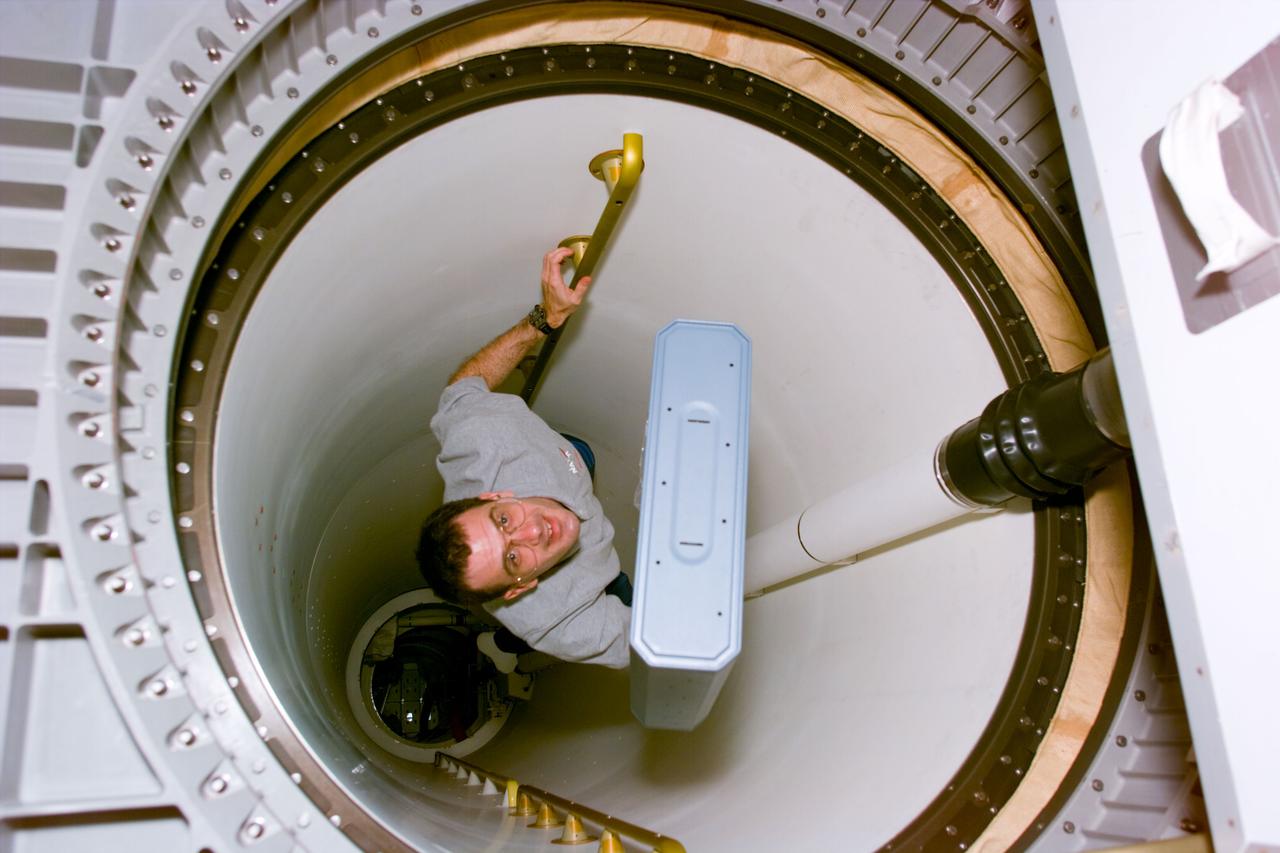
STS081-E-05100 (12 Jan. 1997) --- Astronaut Peter J. K. (Jeff) Wisoff, mission specialist, carries a stowage drawer from the middeck of the Space Shuttle Atlantis' crew cabin through a connective tunnel into the Spacehab Double Module (DM). In a few days, Wisoff and his five crew mates are scheduled to dock with Russia's Mir Space Station and pick up John E. Blaha, NASA astronaut who has been serving as a cosmonaut guest researcher since September, 1996. Astronaut Jerry M. Linenger will replace Blaha onboard Mir and the transfer will mark the second such direct exchange of cosmonaut guest researchers, though Linenger will be the fourth United States astronaut to spend a lengthy stay on Mir.
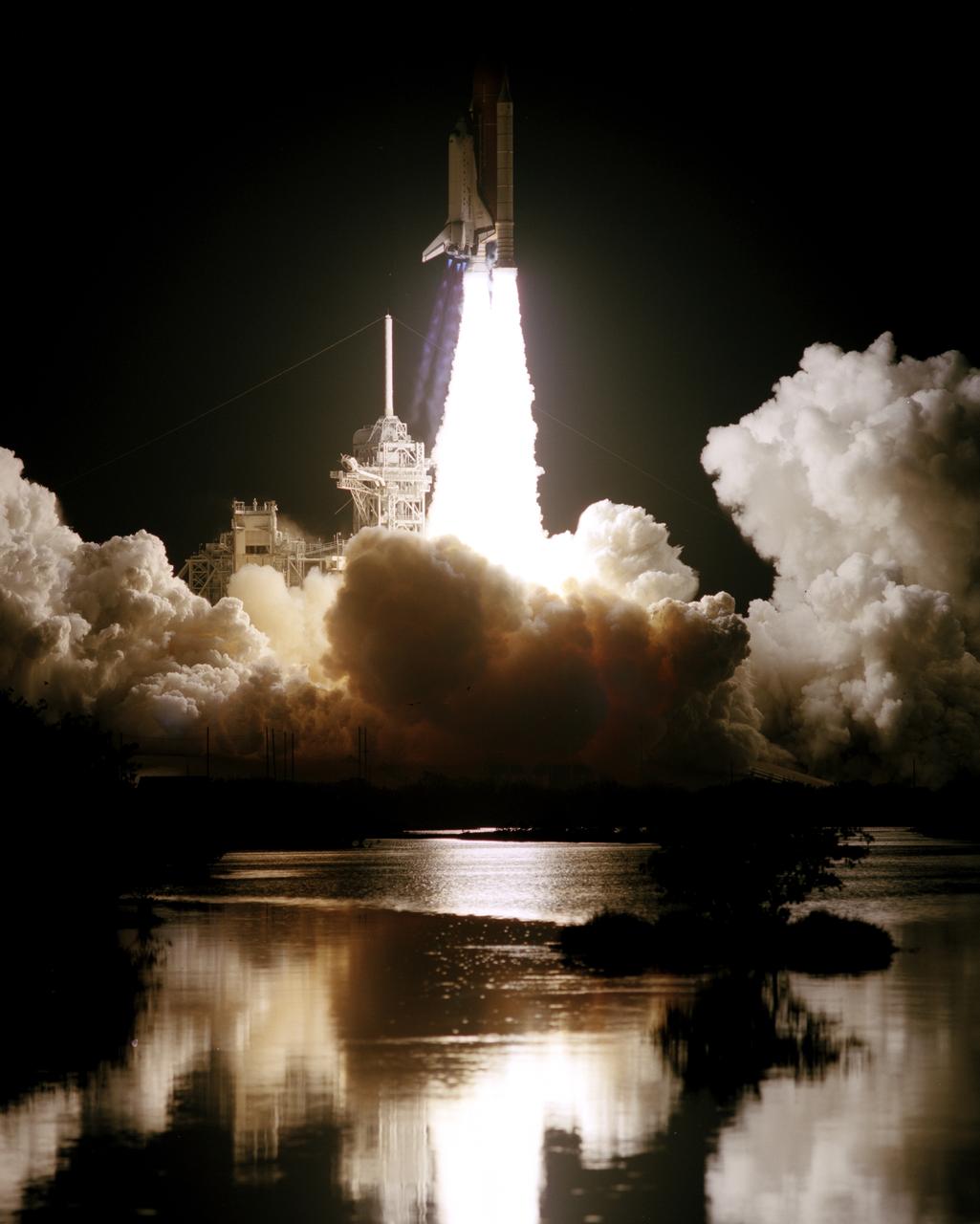
STS081-S-005 (12 Jan. 1997) --- Lighting up an early morning sky, the Space Shuttle Atlantis lifts off from Pad 39B to begin the new year of space missions for NASA's shuttle fleet. Launch occurred at 4:27:23 a.m. (EST), Jan. 12, 1997. Now on their way for a docking mission with Russia's Mir Space Station are a crew of six astronauts and a SPACEHAB Double Module (DM), along with a large supply of food, water, hardware and other materials for Mir. Astronaut Jerry M. Linenger, now onboard Atlantis, will trade places with John E. Blaha, cosmonaut guest researcher, onboard Mir since mid September 1996. Along with Linenger, other crewmembers now aboard Atlantis are astronauts Michael A. Baker, commander; Brent W. Jett, Jr., pilot; and mission specialists John M. Grunsfeld, Marsha S. Ivins and Peter J. K. (Jeff) Wisoff.
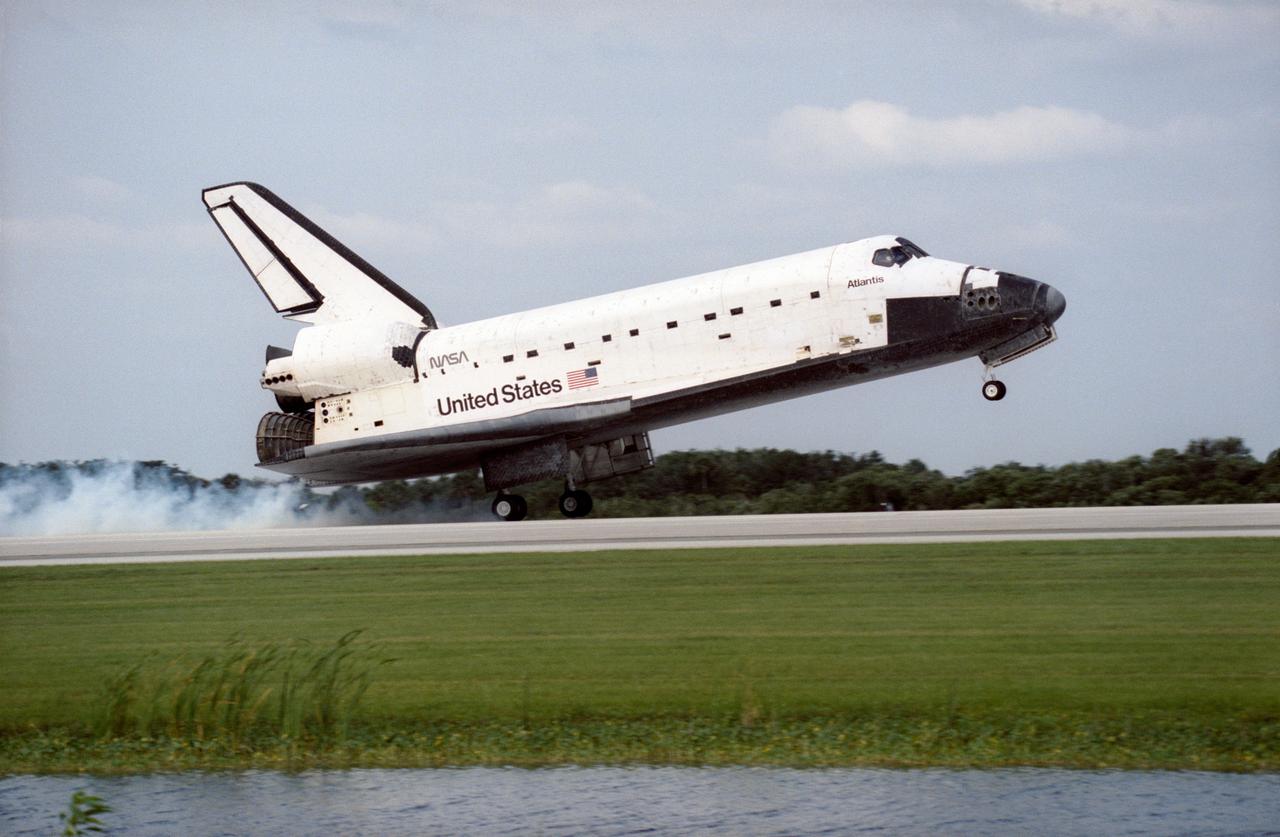
STS084-S-012 (24 May 1997) --- The Space Shuttle Atlantis touches down on Runway 33 of the Kennedy Space Center (KSC) Shuttle Landing Facility (SLF), bringing to a completion the nine-day mission. Main gear touchdown was at 9:27:44 a.m. (EDT), May 24, 1997. This touchdown marked the 37th landing at KSC in the 16-year history of the Space Transportation System (STS) and it also marked the return of astronaut Jerry M. Linenger to Earth following almost four months aboard Russia's Mir Space Station. Onboard for the landing were astronauts Charles J. Precourt, Eileen M. Collins, Jean-Fran?ois Clervoy, Carlos I. Noriega, Edward T. Lu, Linenger and Elena V. Kondakova. Clervoy is with the European Space Agency (ESA) and Kondakova represents the Russian Space Agency (RSA).
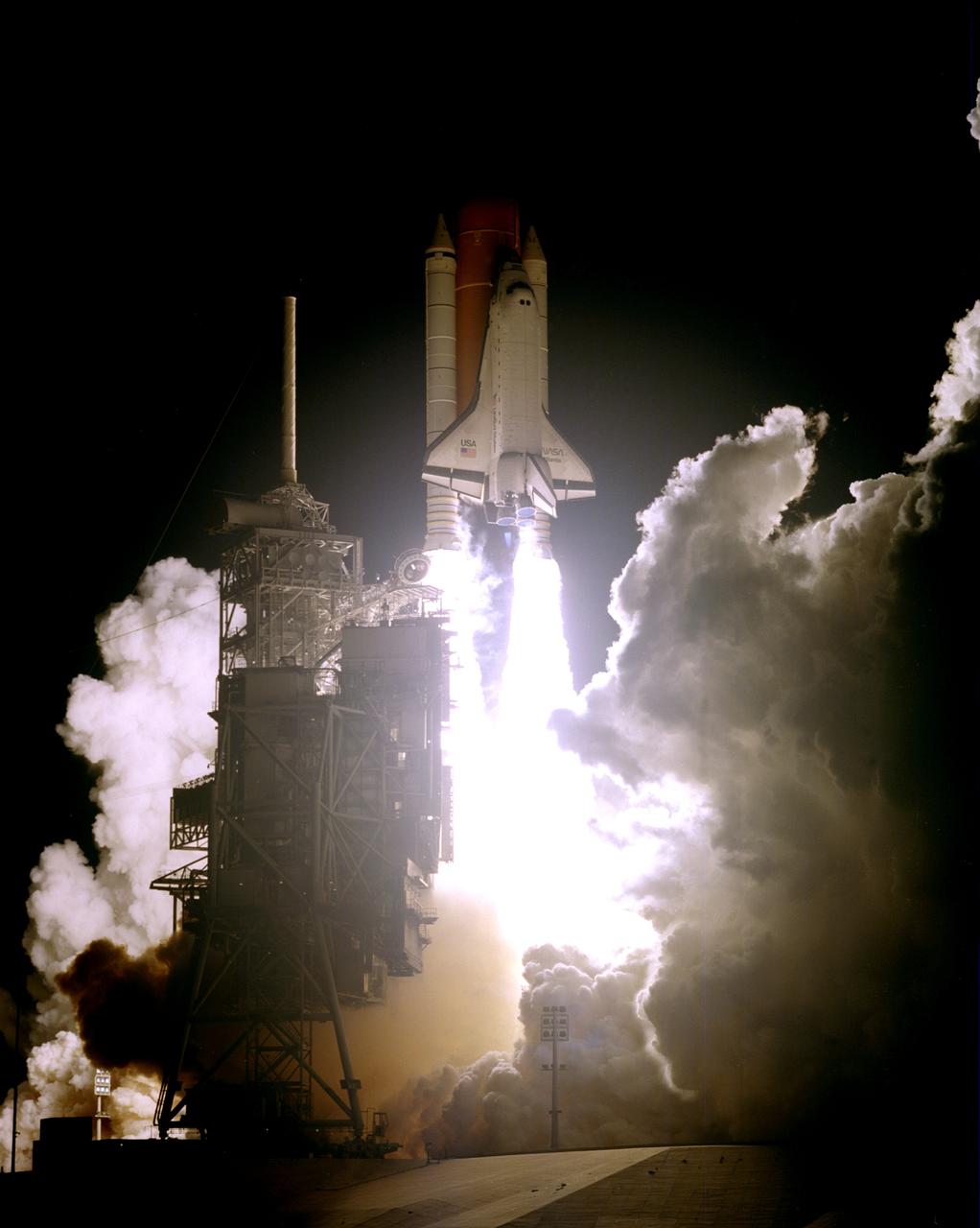
STS081-S-006 (12 Jan. 1997) --- The Space Shuttle Atlantis lifts off from Pad 39B at 4:27:23 a.m. (EST) Jan. 12, 1997 on its way for a docking mission with Russia's Mir Space Station. Onboard are six astronauts and a SPACEHAB Double Module (DM), along with a large supply of food, water, hardware and other materials for Mir. Astronaut Jerry M. Linenger, now onboard Atlantis, will trade places with John E. Blaha, cosmonaut guest researcher, onboard Mir since mid September 1996. Along with Linenger, other crewmembers now aboard Atlantis are astronauts Michael A. Baker, commander; Brent W. Jett, Jr., pilot; and mission specialists John M. Grunsfeld, Marsha S. Ivins and Peter J. K. (Jeff) Wisoff.
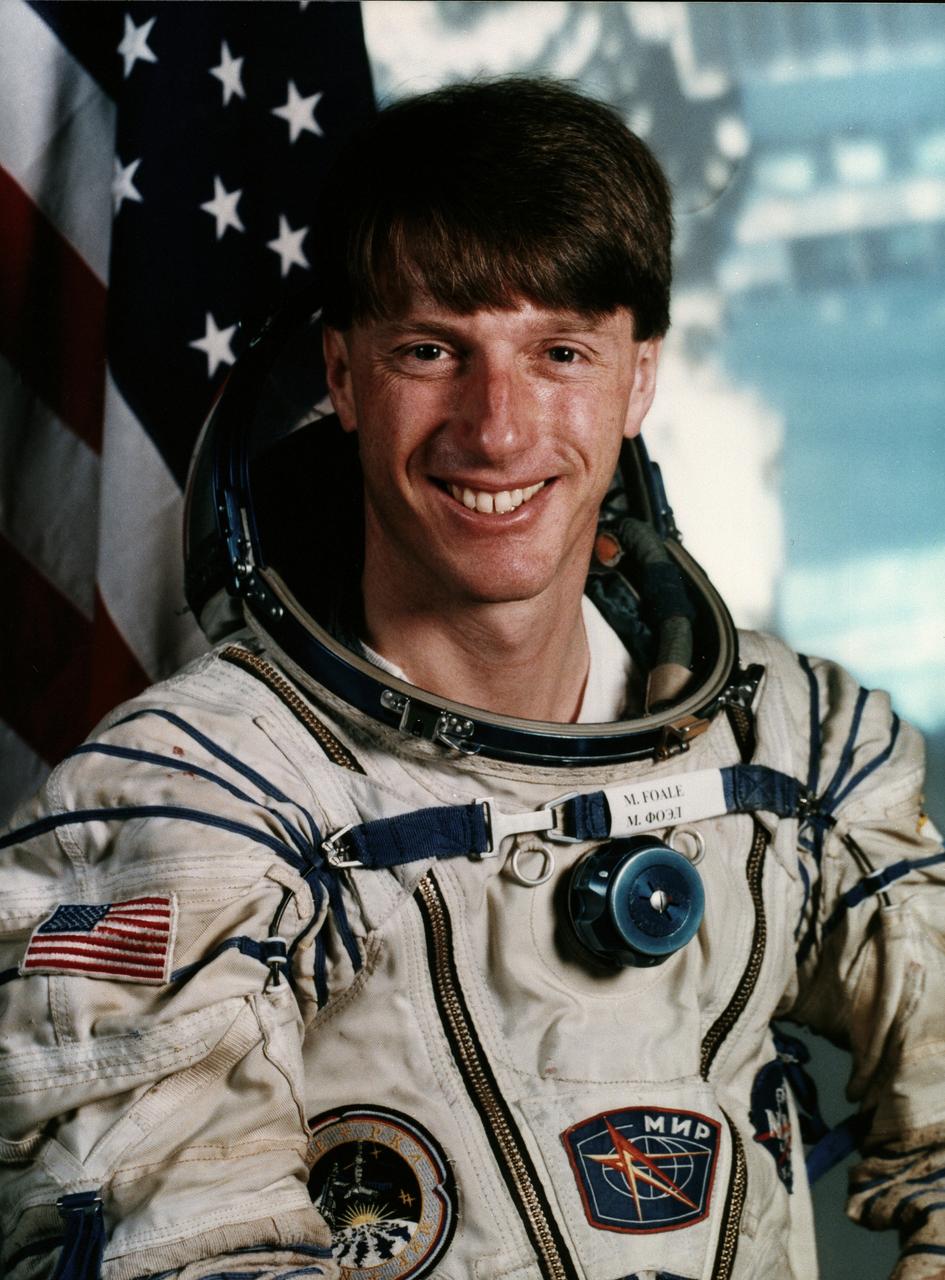
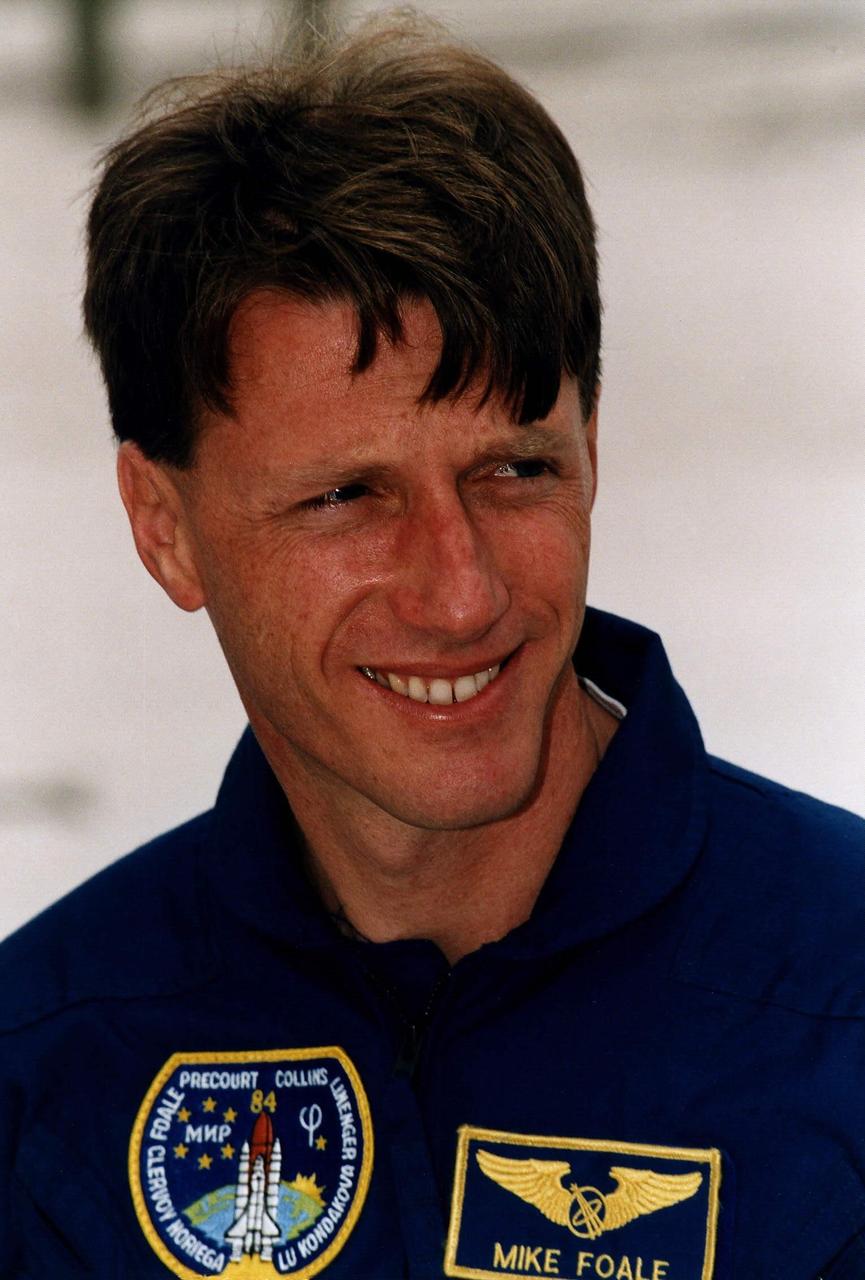
S97-06565 (1997) --- Astronaut C. Michael Foale, mission specialist/cosmonaut guest researcher Mir 23/24 flight engineer. EDITOR?S NOTE: Astronaut Foale will launch aboard the Space Shuttle Atlantis, STS-84 mission, to board the Russia?s Mir Space Station. After a long duration of cosmonaut guest researcher duties, he will return to Earth aboard the Space Shuttle Atlantis STS-86 mission.
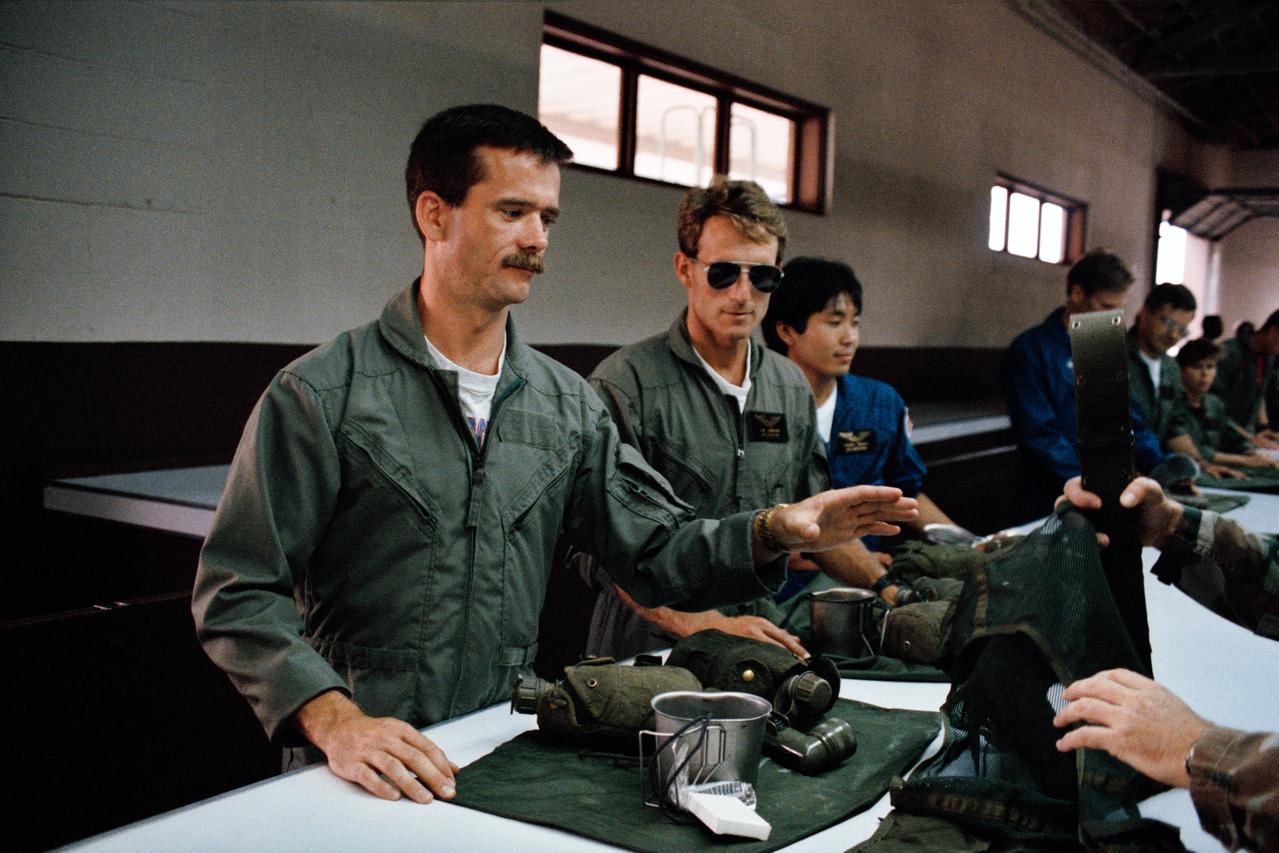
S92-46536 (16 Aug. 1992) --- Astronaut candidates Chris A. Hadfield, Jerry M. Linenger and Koichi Wakata (left to right in foreground) are issued gear for a survival school hosted by Fairchild Air Force Base. Hadfield, from Canada, and Wakata, from Japan, are among the five international candidates in the group of astronaut candidates currently involved in a year-long training and evaluation program.

NASA5-301-029 (May 1997) --- The Space Shuttle Atlantis is seen from the point of view of Russia’s Mir Space Station in this 35mm frame exposed during separation operations. The astronauts of STS-84 and the cosmonauts of Mir-23 had spent several days in joint activities while the spacecraft were docked. The American crew also changed out cosmonaut guest researchers aboard the Mir, replacing Jerry M. Linenger with C. Michael Foale.
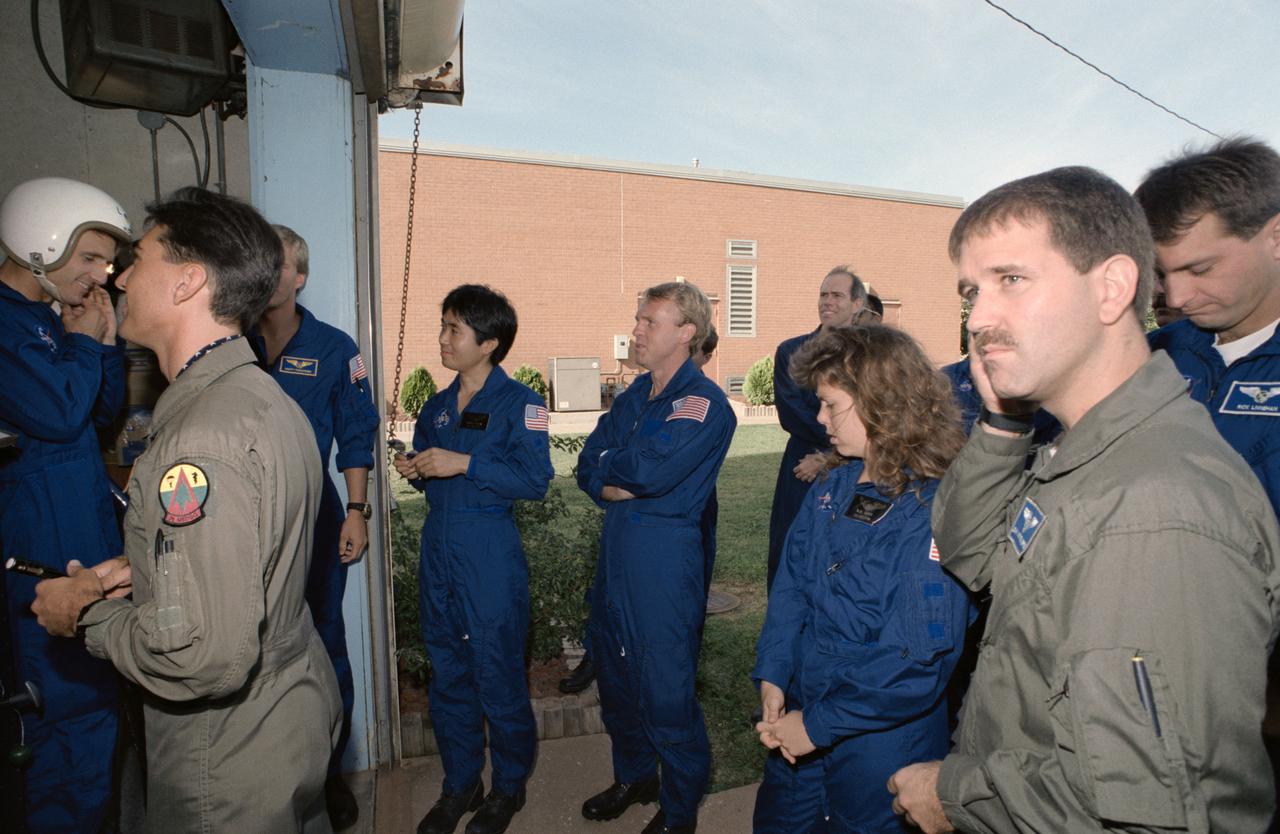
S95-00356 (14 September 1992) --- Several 1992 astronaut candidates wait in line to receive gear for one of several phases of parachute familiarization and survival training at Vance Air Force Base in Oklahoma. Recognizable in the picture are Jerry M. Linenger, Scott E. Parazynski, Koichi Wakata, Andrew S. W. Thomas, Mary Ellen Weber, Joseph R. Tanner, John M. Grunsfeld and Richard M. Linnehan.
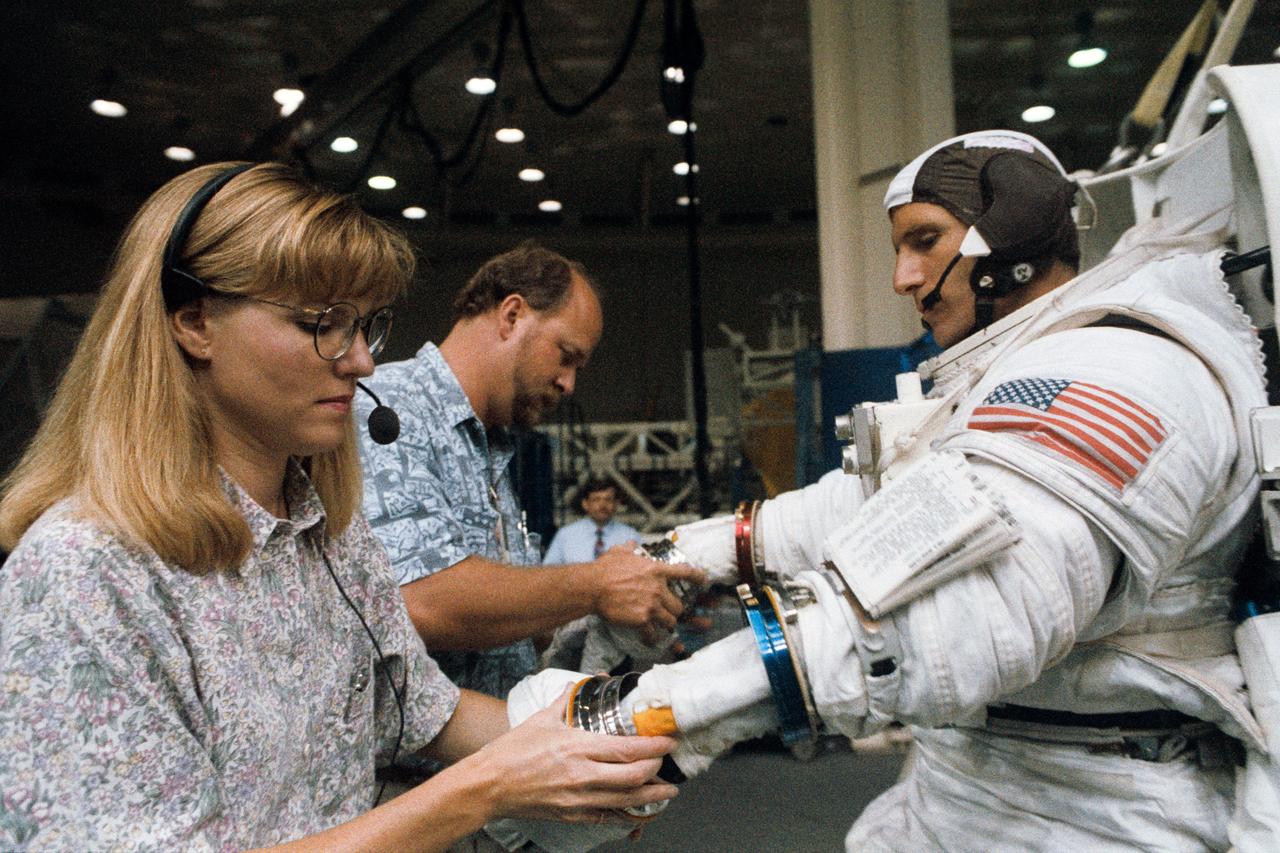
S93-37890 (October 1993) --- Astronaut Jerry M. Linenger, STS-64 mission specialist, is assisted by Steve Voyles and Kari Rueter of Boeing Aerospace prior to participating in a rehearsal for a contingency extravehicular activity (EVA). Crewmates Mark C. Lee and Carl J. Meade have used the nearby 25-feet deep pool to rehearse a spacewalk designed to test and evaluate new EVA equipment. Photo credit: NASA or National Aeronautics and Space Administration
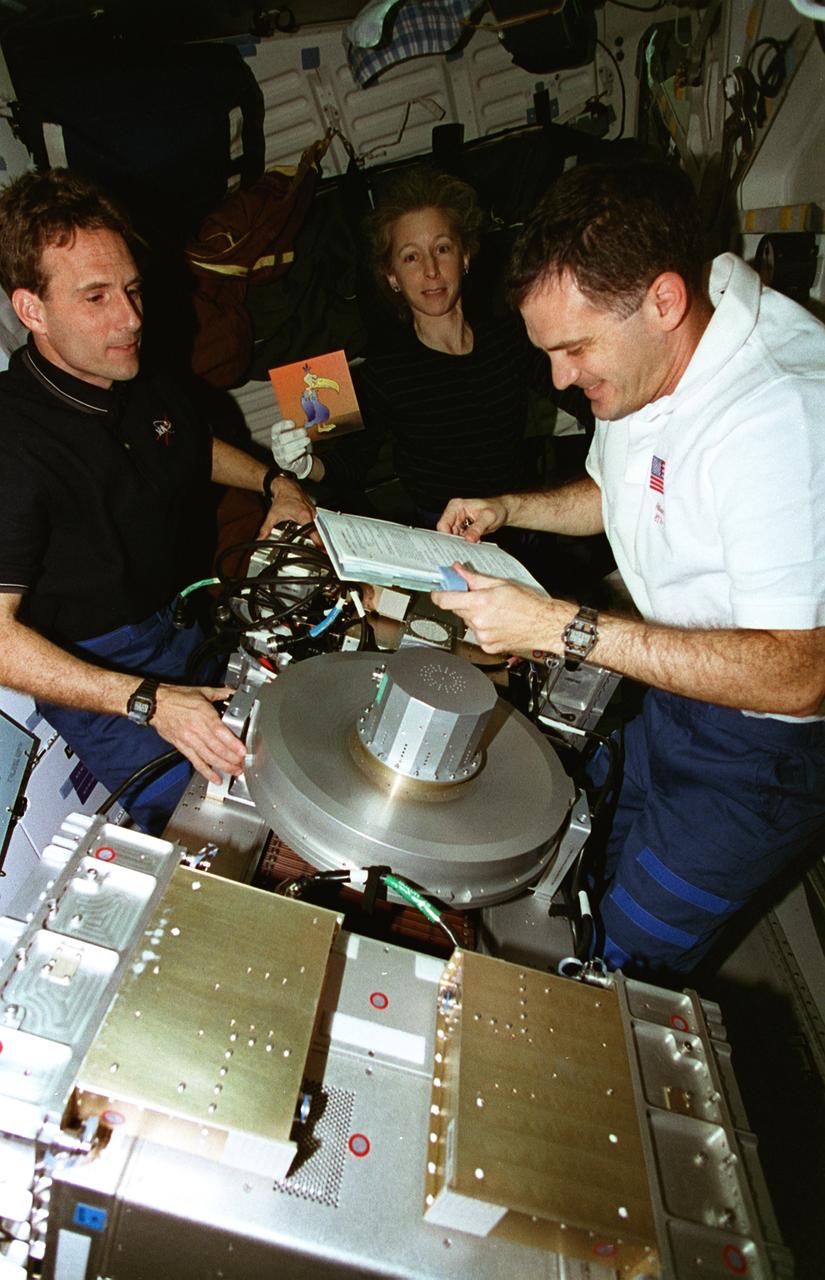
STS081-340-020 (12-22 Jan. 1997) --- Left to right, astronaut and future cosmonaut guest researcher, Jerry M. Linenger, and mission specialists Marsha S. Ivins and Peter J. K. (Wisoff) check out the Treadmill Vibration Isolation Stabilization System (TVIS) onboard the Space Shuttle Atlantis, during the Atlantis and Russia's Mir Space Station docking mission.
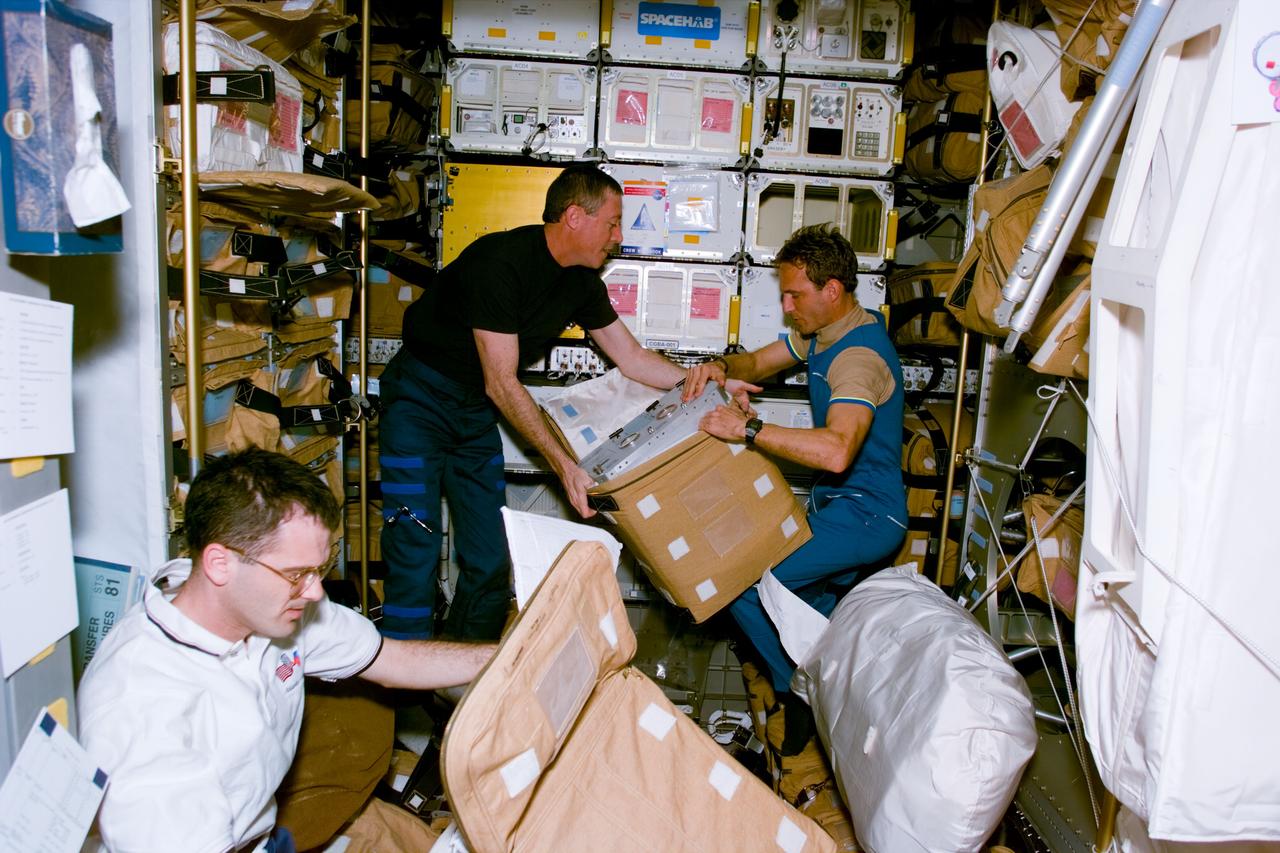
STS081-E-05514 (16 Jan. 1997) --- The transfer of equipment and supplies continues aboard the Spacehab Double Module (DM) aboard the Space Shuttle Atlantis. Here, left to right, astronauts Peter J. K. Wisoff and Michael A. Baker along with newly initiated "cosmonaut" Jerry M. Linenger, Mir-22 cosmonaut guest researcher, load and move supplies. The photograph was recorded with an Electronic Still Camera (ESC) and later was downlinked to flight controllers in Houston, Texas.
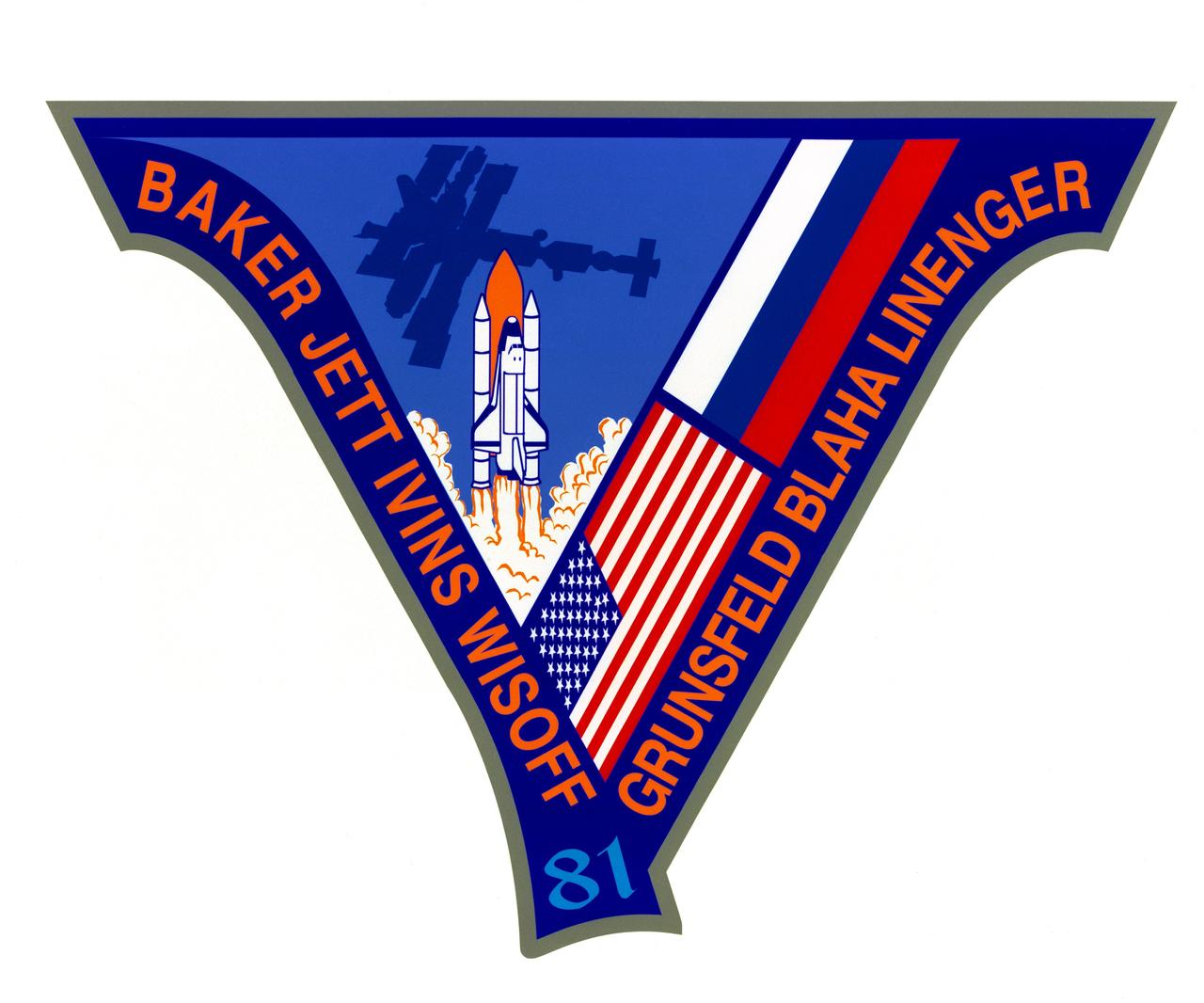
STS081-S-001 (June 1996) --- The STS-81 crew patch for the fifth Shuttle-Mir docking mission, is shaped to represent the Roman numeral V. The space shuttle Atlantis, OV-104, is launching toward a rendezvous with Russia?s Mir Space Station, silhouetted in the background. Atlantis and the STS-81 crew will spend several days docked to Mir during which time astronaut Jerry M. Linenger (NASA-Mir 4) will replace astronaut John E. Blaha (NASA-Mir 3) as the United States crew member onboard Mir. Scientific experiments and logistics will also be transferred between Atlantis and Mir. The United States and Russian flags are depicted along with the names of the shuttle crew members: Michael A. Baker, commander; Brent W. Jett, pilot; Peter J. K.(Jeff) Wisoff, mission specialist 1; John W. Grunsfeld, mission specialist 2; Marsha S. Ivins, mission specialist 3; Linenger; mission specialist 4; and Blaha, mission specialist 5. The NASA insignia design for space shuttle flights is reserved for use by the astronauts and for other official use as the NASA Administrator may authorize. Public availability has been approved only in the forms of illustrations by the various news media. When and if there is any change in this policy, which is not anticipated, the change will be publicly announced. Photo credit: NASA
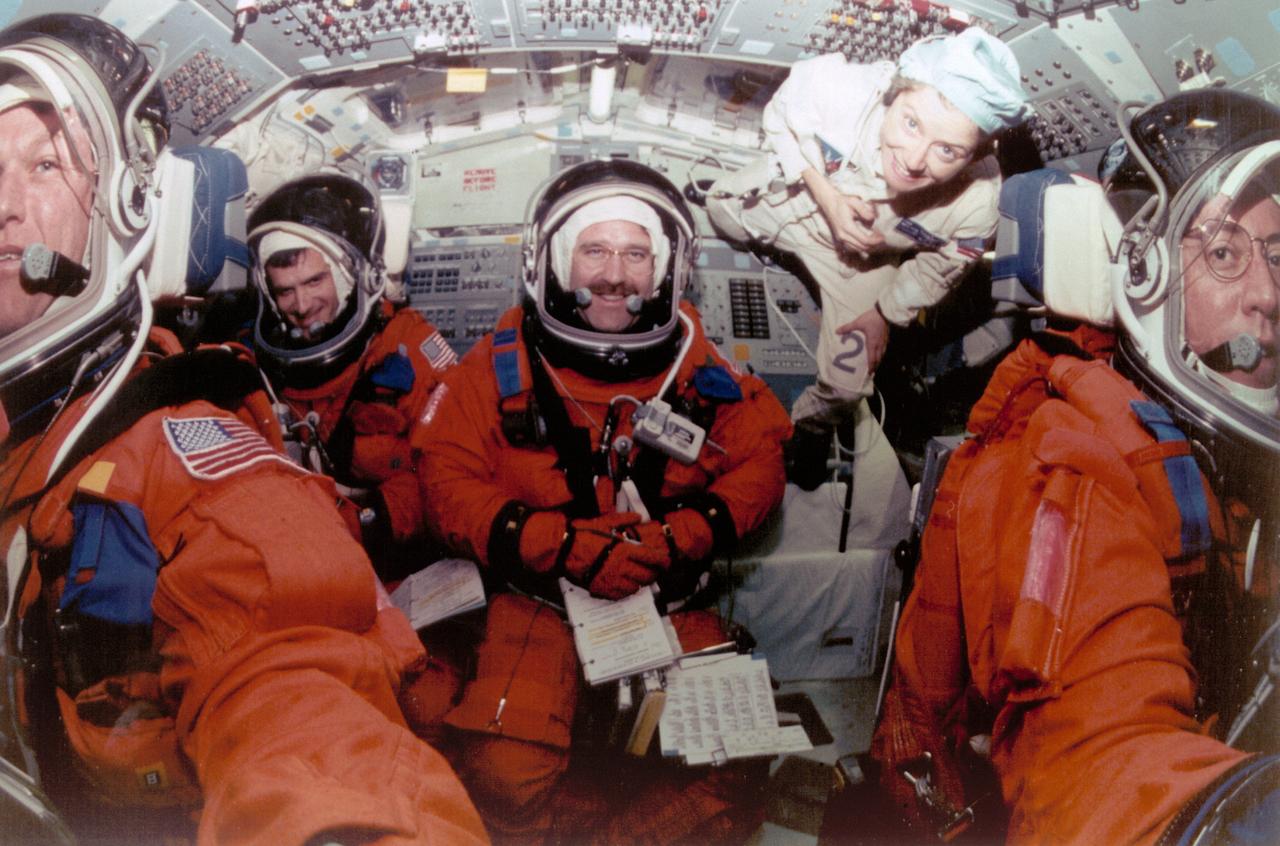
S97-00254 (17 Dec 1996) --- The STS-81 flight crew goes over pre-flight checklists on the flight deck of the Space Shuttle Atlantis during the final phase of the Terminal Countdown Demonstration Test (TCDT) exercises for the January 1997 mission. Crew members pictured, are (from the left) Brent W. Jett, Jr., pilot; Peter J. K. (Jeff) Wisoff and John M. Grunsfeld, mission specialists; along with Michael A. Baker, mission commander. The TCDT represents a simulated final countdown until just before main engine ignition. The astronauts are in their flight positions with the Orbiter in a vertical attitude at Launch Pad 39B, with the camera pointed down from the forward cabin. This angle creates the illusion that astronaut Pam Melroy (in lab suit), mission support assistant, is floating in space. On the mid-deck and out of frame are astronauts Marsha S. Ivins and Jerry M. Linenger. The six will visit Russia?s Mir Space Station, from which they will retrieve John M. Blaha who has been aboard the Mir since September of 1996. Linenger is to replace Blaha, as cosmonaut guest researcher.
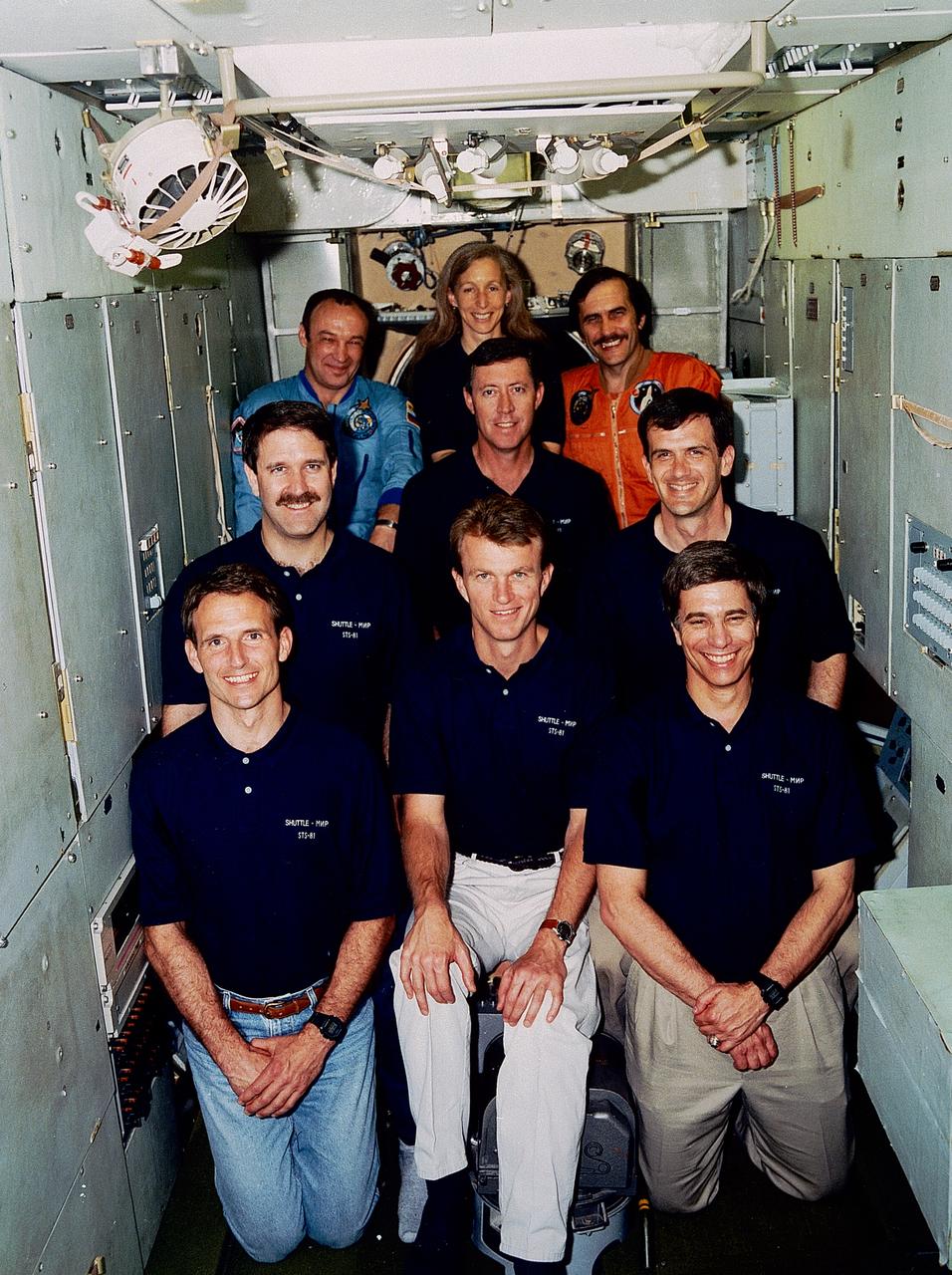
S96-10557 (May 1996) --- The original Mir-22 crew assigned to duty aboard Russia's Mir Space Station poses with the STS-81 crew. The cosmonauts, flanking astronaut Marsha S. Ivins on the top row, are Gennadiy M. Manakov (left) mission commander; and Pavel V. Vinogradov, flight engineer. After this photo was taken, a shift of Russian crew assignments occurred and Manakov and Vinogradov were replaced with Valeri G. Korzun and Aleksandr Y. Kaleri. The astronauts are, front row (left to right): Jerry M. Linenger, Brent W. Jett, Jr., and John E. Blaha. Second row, left to right, John W. Grunsfeld, Michael A. Baker and Peter J. K. (Jeff) Wisoff. All the STS-81 crewmembers except Blaha are scheduled to be launched in December 1996 aboard the Space Shuttle Atlantis and those six will be joined by Mir-22 cosmonaut researcher Blaha when the two spacecraft are joined in Earth-orbit. Blaha will have been launched into Earth-orbit to connect with Russia's Mir Space Station on an earlier mission - STS-79 - of the space shuttle Atlantis, scheduled for launch in the summer of 1996. Linenger will remain onboard Mir for a tour of duty as a cosmonaut researcher.
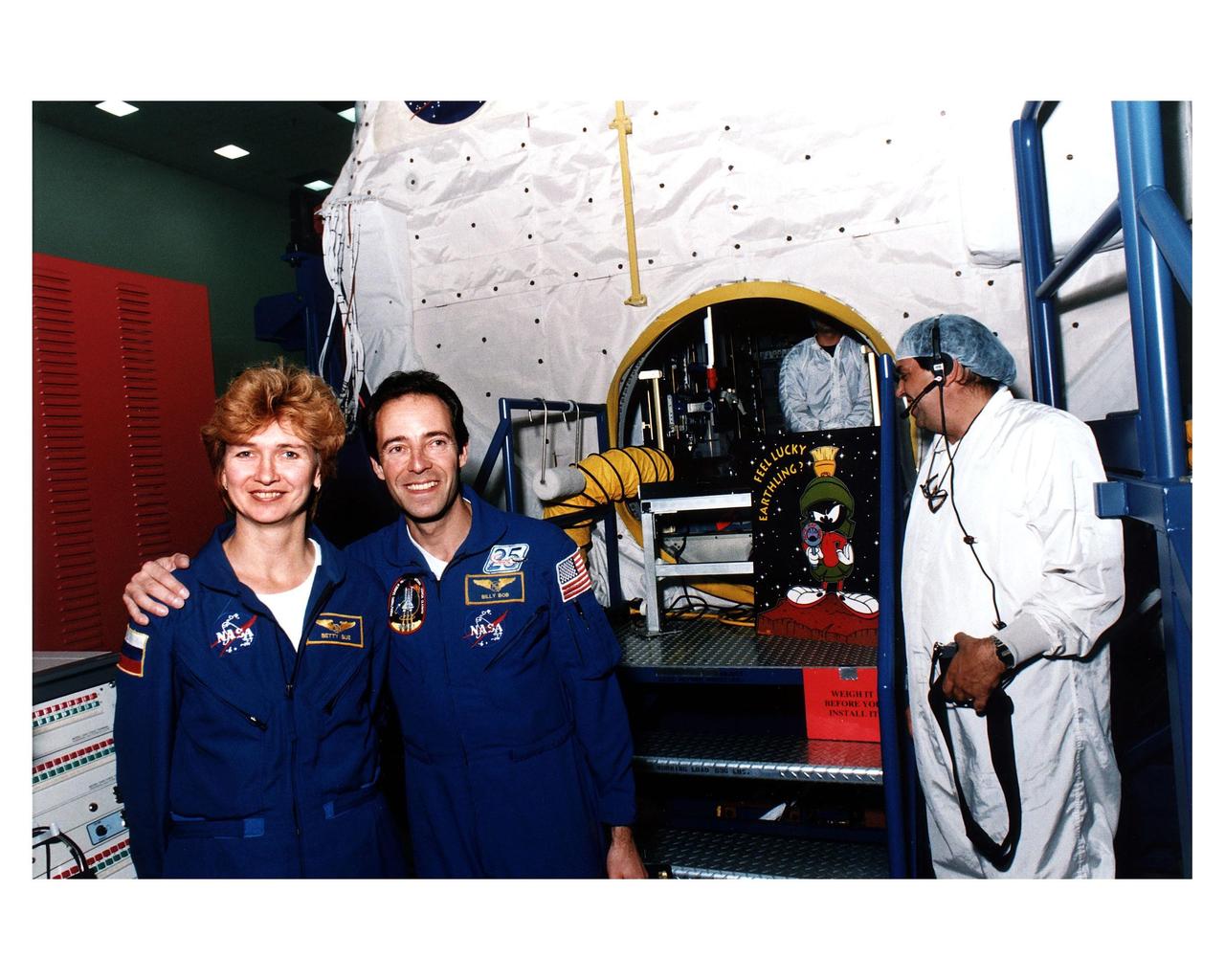
STS-84 Mission Specialists Elena V. Kondakova, at left, and Jean-Francois Clervoy pose for photos outside the SPACEHAB Double Module, which will carry more than 6,000 pounds of scientific experiments and logistics to the Russian Space Station Mir. Kondakova, a cosmonaut with the Russian Space Agency, has the nickname of Betty Sue for this mission. Clervoy, an astronaut with the European Space Agency, is wearing a name tag with his mission nickname, Billie Bob. They are participating in the Crew Equipment Integration Test (CEIT) at the SPACEHAB Payload Processing Facility in Cape Canaveral. STS-84 will be the sixth docking of the Space Shuttle with Mir. It also will be the third consecutive crew member exchange of U.S. astronauts aboard Mir. STS-84 Mission Specialist C. Michael Foale will replace astronaut Jerry M. Linenger on Mir. Linenger has been on Mir since the STS-81 mission in January. Foale is scheduled to remain on Mir about four months. STS-84 is targeted for a May 15 liftoff
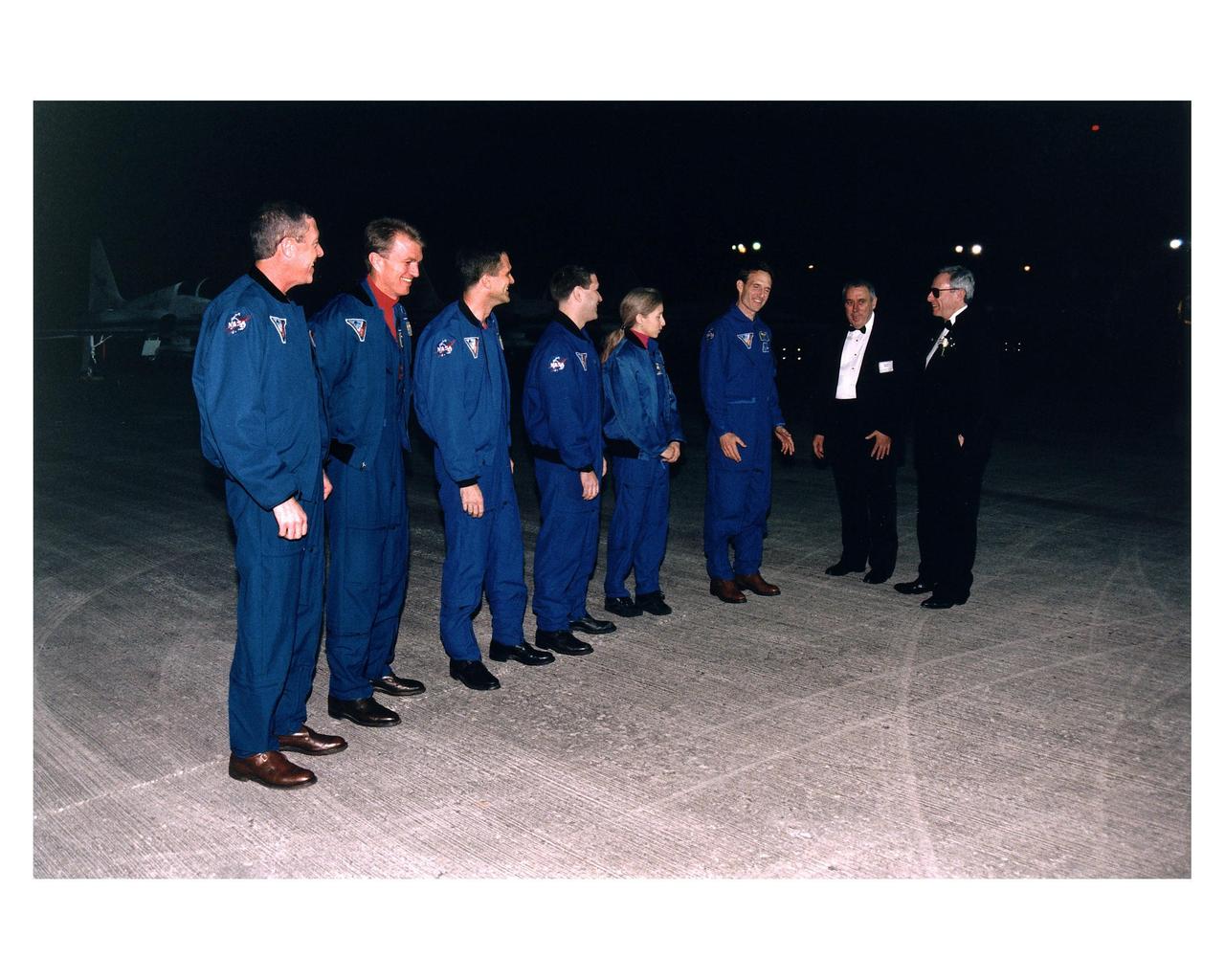
The STS-81 flight crew is welcomed to KSC by NASA Administrator Daniel Goldin (far right) and Johnson Space Center Director George Abbey (second from right) as they arrive at the space center for the final countdown preparations for the fifth Shuttle-Mir docking mission. They are (from left): Mission Commander Michael A. Baker; Pilot Brent W. Jett, Jr.; and Mission Specialists Peter J. K. "Jeff" Wisoff; John M. Grunsfeld, Marsha S. Ivins, and J.M. "Jerry" Linenger. The 10-day mission will feature the transfer of Linenger to Mir to replace astronaut John Blaha, who has been on the orbital laboratory since Sept. 19, 1996 after arrival there during the STS-79 mission. During STS-81, Shuttle and Mir crews will conduct risk mitigation, human life science, microgravity and materials processing experiments that will provide data for the design, development and operation of the International Space Station. The primary payload is the SPACEHAB-DM double module which will provide space for more than 2,000 pounds of hardware, food and water that will be transferred into the Russian space station during five days of docking operations. The SPACEHAB will also be used to return experiment samples from the Mir to Earth for analysis and for microgravity experiments during the mission
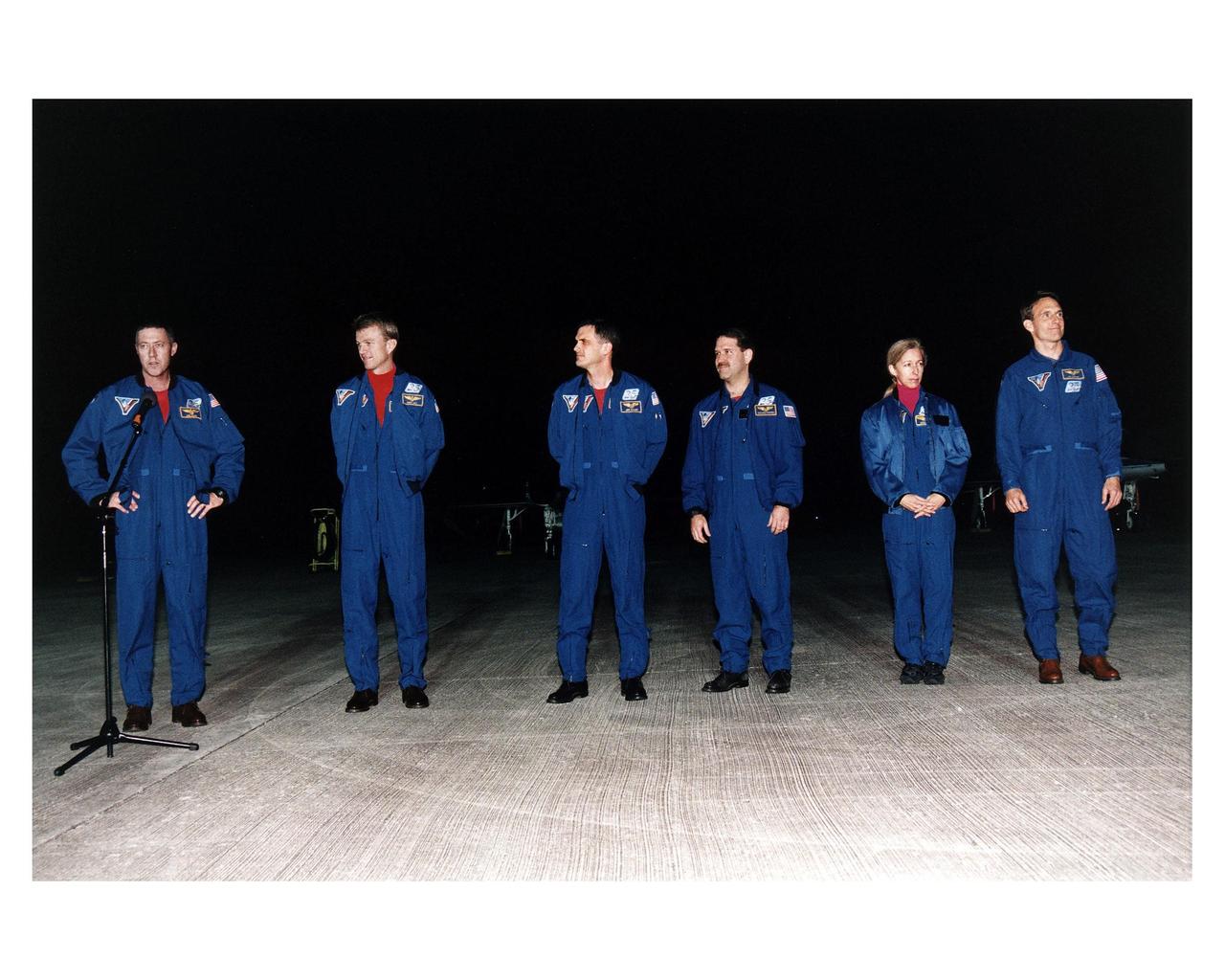
The STS-81 flight crew conducts a press briefing on the runway of KSC's Shuttle Landing Facility after they arrive at the space center for the final countdown preparations for the fifth Shuttle-Mir docking mission. They are (from left): Mission Commander Michael A. Baker; Pilot Brent W. Jett, Jr.; and Mission Specialists Peter J. K. "Jeff" Wisoff; John M. Grunsfeld, Marsha S. Ivins, and J.M. "Jerry" Linenger. The 10-day mission will feature the transfer of Linenger to Mir to replace astronaut John Blaha, who has been on the orbital laboratory since Sept. 19, 1996 after arrival there during the STS79 mission. During STS-81, Shuttle and Mir crews will conduct risk mitigation, human life science, microgravity and materials processing experiments that will provide data for the design, development and operation of the International Space Station. The primary payload is the SPACEHAB-DM double module which will provide space for more than 2,000 pounds of hardware, food and water that will be transferred into the Russian space station during five days of docking operations. The SPACEHAB will also be used to return experiment samples from the Mir to Earth for analysis and for microgravity experiments during the mission
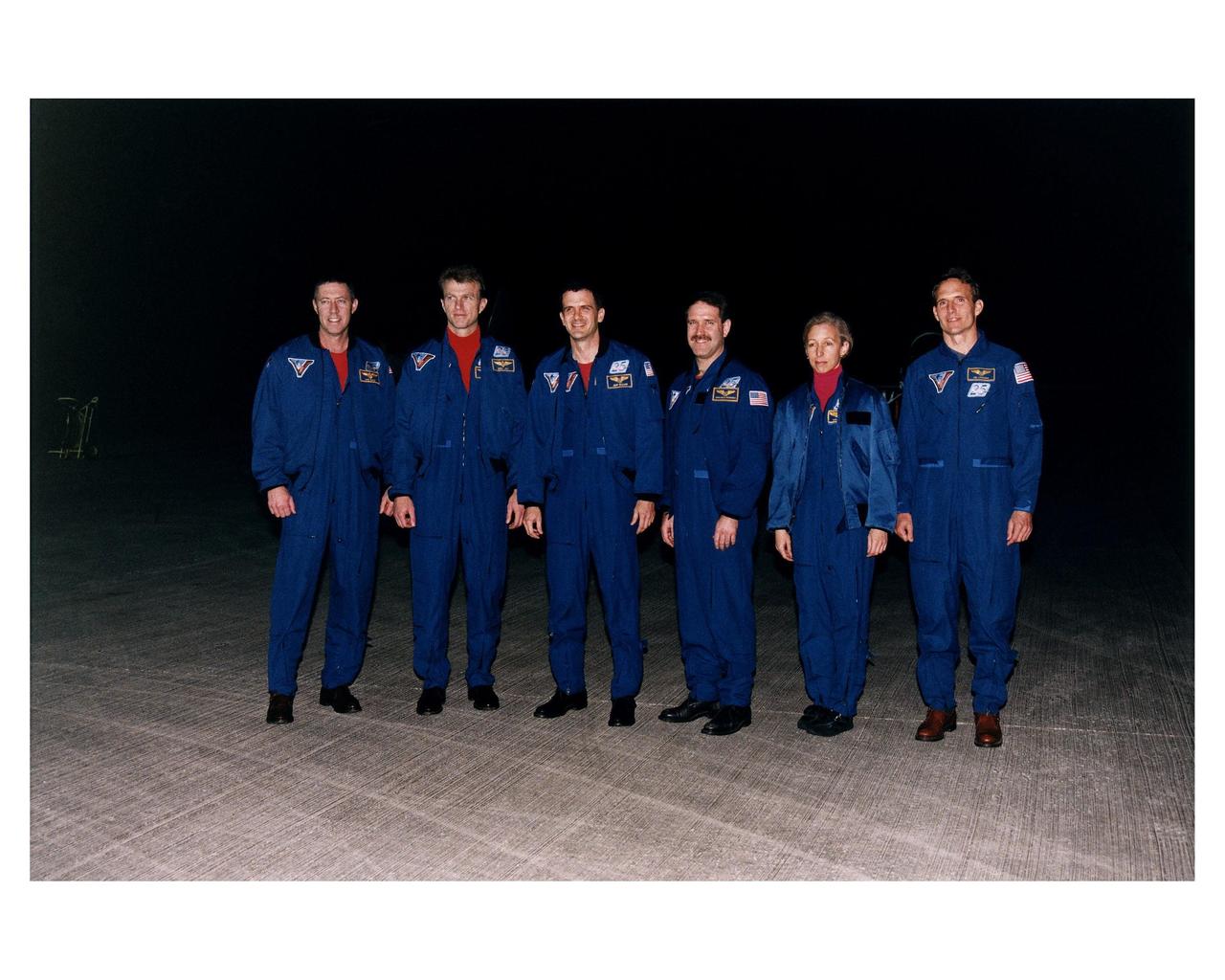
The STS-81 flight crew poses on the runway of KSC Shuttle Landing Facility after they arrive at the space center for the final countdown preparations for the fifth Shuttle-Mir docking mission. They are (from left): Mission Commander Michael A. Baker; Pilot Brent W. Jett, Jr.; and Mission Specialists Peter J. K. "Jeff" Wisoff; John M. Grunsfeld, Marsha S. Ivins, and J.M. "Jerry" Linenger. The 10-day mission will feature the transfer of Linenger to Mir to replace astronaut John Blaha, who has been on the orbital laboratory since Sept. 19, 1996 after arrival there during the STS-79 mission. During STS-81, Shuttle and Mir crews will conduct risk mitigation, human life science, microgravity and materials processing experiments that will provide data for the design, development and operation of the International Space Station. The primary payload is the SPACEHAB-DM double module which will provide space for more than 2,000 pounds of hardware, food and water that will be transferred into the Russian space station during five days of docking operations. The SPACEHAB will also be used to return experiment samples from the Mir to Earth for analysis and for microgravity experiments during the mission
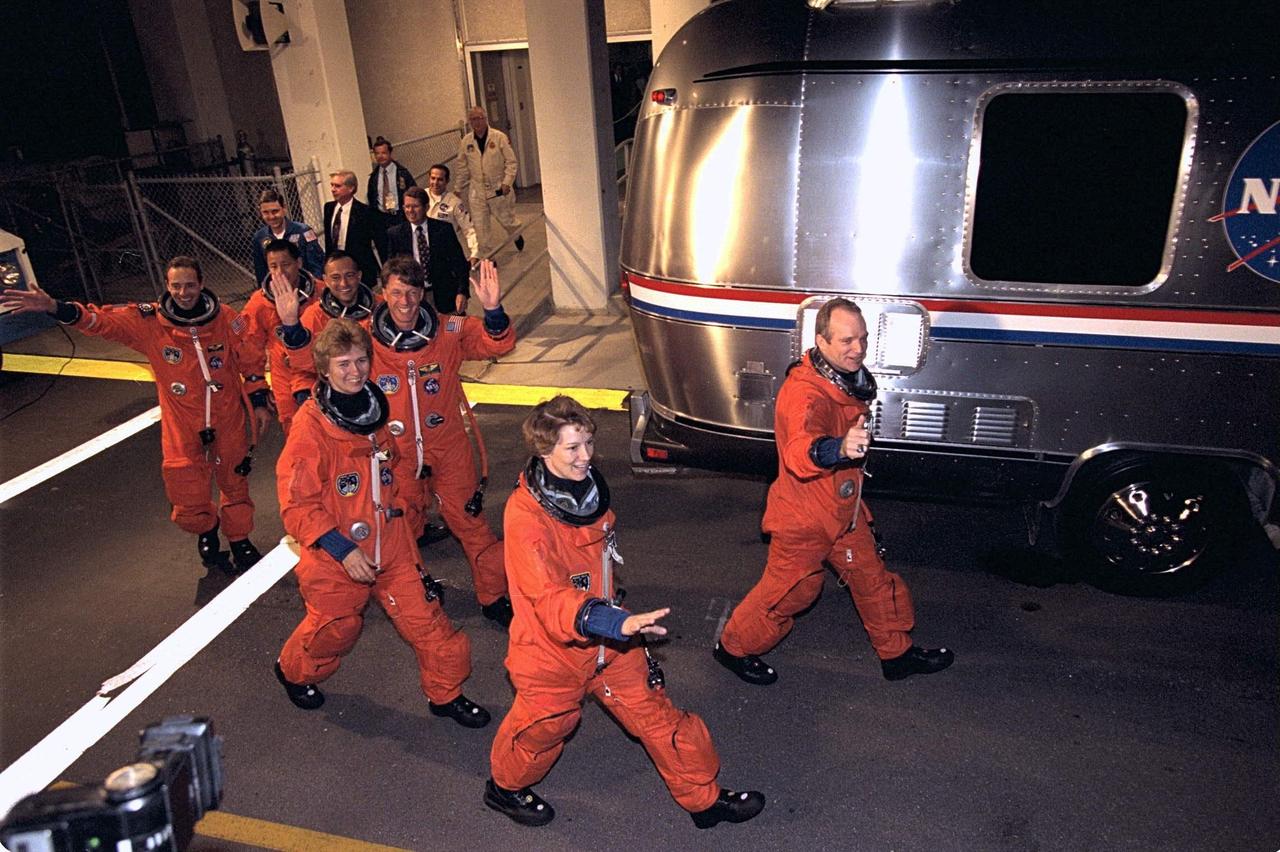
The crew of Mission STS-84 departs from the Operations and Checkout Building en route to Launch Pad 39A, where the Space Shuttle Atlantis awaits liftoff on the sixth docking of the Space Shuttle with the Russian Space Station Mir. Leading the way, from left, are Pilot Eileen Marie Collins and Commander Charles J. Precourt. Mission Specialist Elena V. Kondakova, a cosmonaut with the Russian Space Agency, walks behind Collins, and is followed by Mission Specialist C. Michael Foale, with hands upraised. At rear, from left, are Mission Specialist Jean-Francois Clervoy of the European Space Agency, Mission Specialist Edward Tsang Lu and Mission Specialist Carlos I. Noriega. The Space Shuttle Atlantis and its crew of seven are scheduled to lift off during an approximate 7-minute launch window which opens about 4:08 a.m. The exact liftoff time will be determined about 90 minutes prior to launch, based on Mir’s current location. The planned nine-day mission also will include the exchange of Foale for U.S. astronaut and Mir 23 crew member Jerry M. Linenger, who has been on Mir since Jan. 15. Linenger will return to Earth on Atlantis, and Foale will remain on Mir for about four months
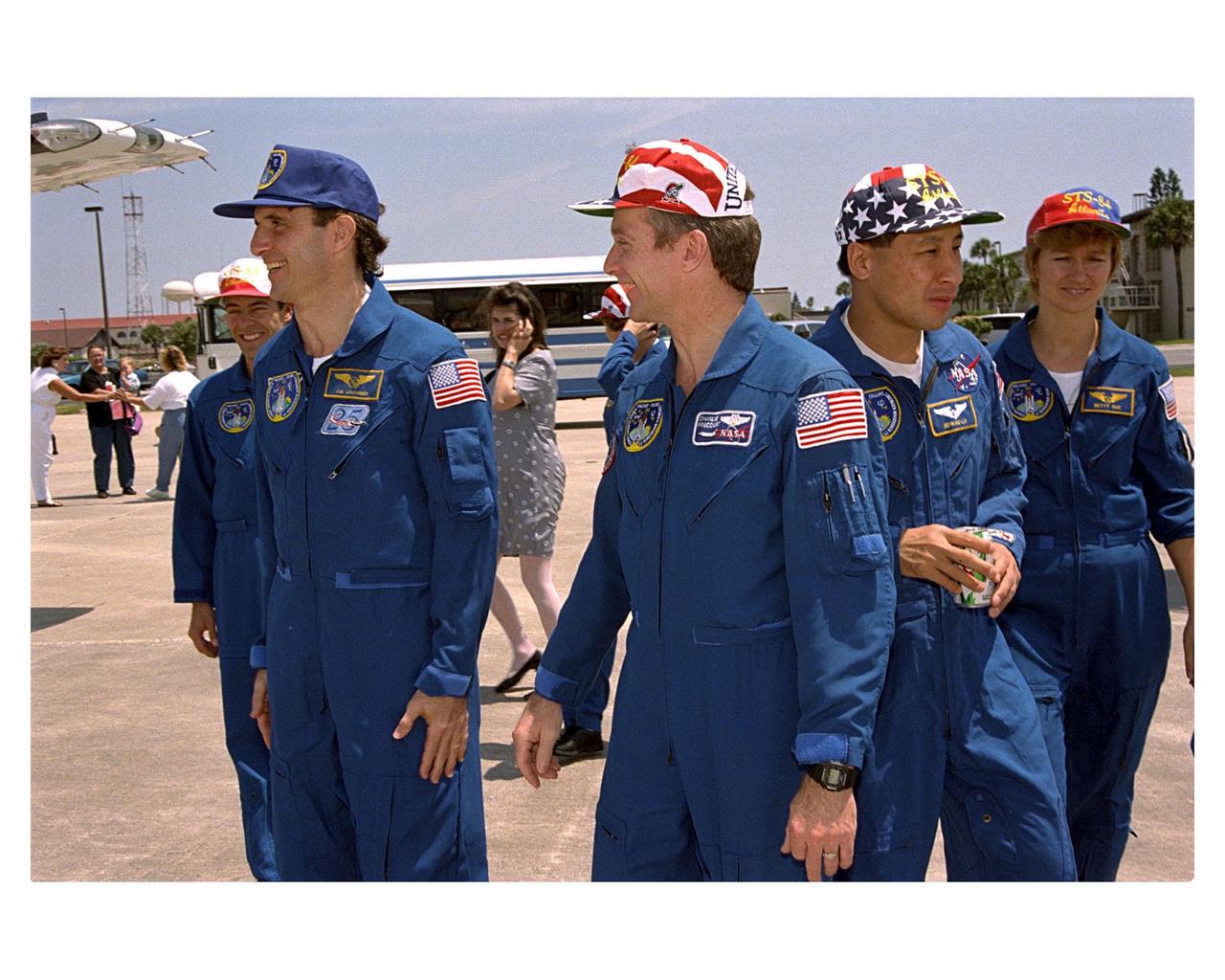
KENNEDY SPACE CENTER, FLA. - Members of the STS-84 crew pause at Patrick Air force Base just prior to their departure for Johnson Space Center in Houston, Texas. They are (from left) Mission Specialist Jean-Francois Clervoy; returning astronaut and Mir 23 crew member Jerry M. Linenger; Mission Commander Charles J. Precourt; Mission Specialist Edward Tsang Lu; and Mission Specialist Elena V. Kondakova. The seven-member crew returned aboard the Space Shuttle Orbiter Atlantis May 24 on KSC's Runway 33 after the completion of a successful nine-day mission. STS-84 was the sixth docking of the Space Shuttle with the Russian Space Station MIr. Atlantis was docked with the Mir for five days. STS-84 Mission Specialist C. Michael Foale replaced Linenger, who had been on the Russian space station since Jan. 15. Besides the docking and crew exchange, STS-84 included the transfer of more than 7,300 pounds of water, logistics and science experiments and hardware to and from the Mir. Scientific experiments conducted during the STS-84 mission, and scheduled for Foale's stay on the Mir, are in the fields of advanced technology, Earth sciences, fundamental biology, human life sciences, International Space Station risk mitigation, microgravity sciences and space sciences.
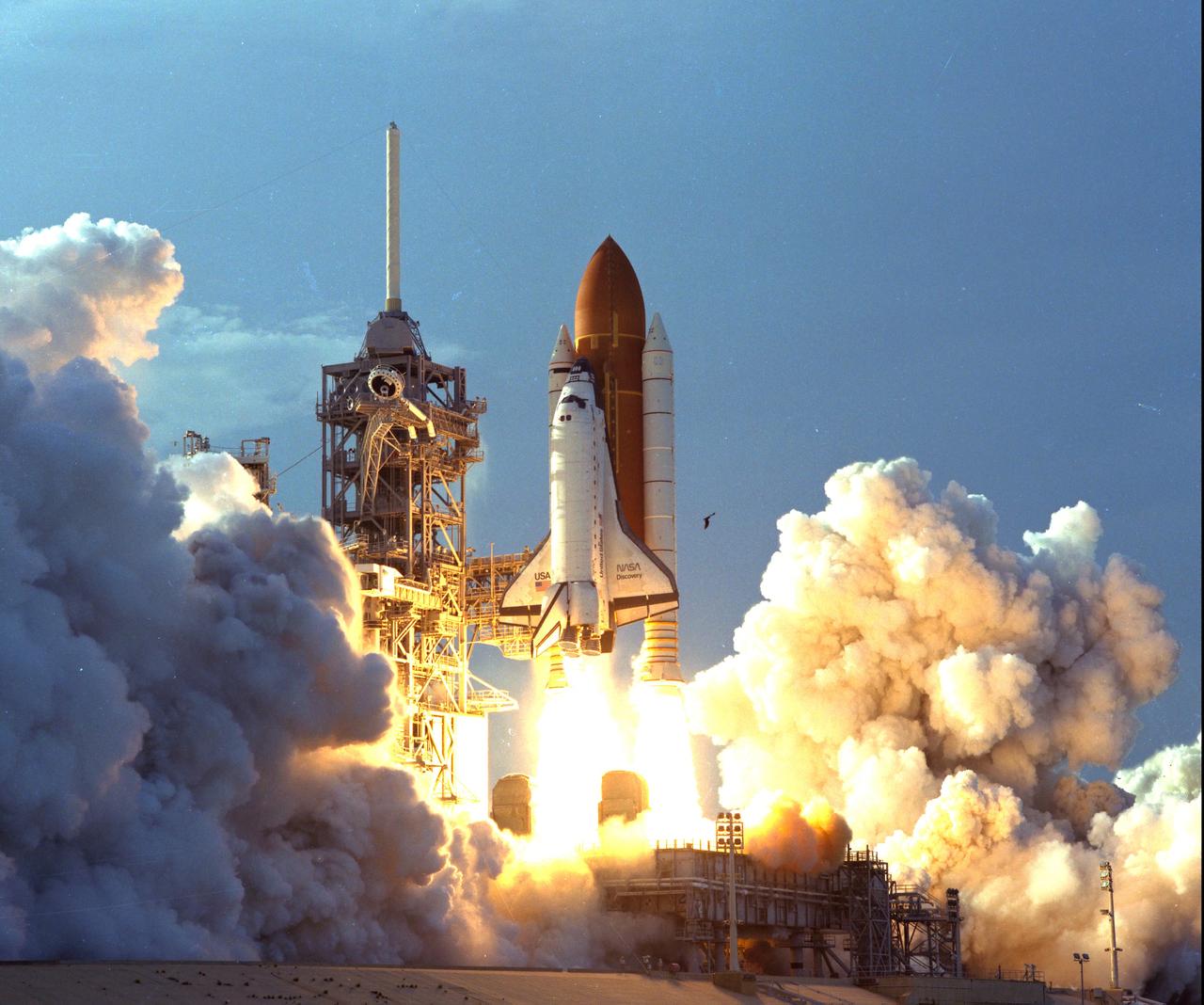
KENNEDY SPACE CENTER, FLA. - The turbulent weather common to a Florida afternoon in the summer subsides into a serene canopy of cornflower blue, and a manmade "bird" takes flight. The Space Shuttle Discovery soars skyward from Launch Pad 39B on Mission STS-64 at 6:22:35 p.m. EDT, Sept. 9. On board are a crew of six: Commander Richard N. Richards; Pilot L. Blaine Hammond Jr.; and Mission Specialists Mark C. Lee, Carl J. Meade, Susan J. Helms and Dr. J.M. Linenger. Payloads for the flight include the Lidar In-Space Technology Experiment (LITE), the Shuttle Pointed Autonomous Research Tool for Astronomy-201 (SPARTAN-201) and the Robot Operated Material Processing System (ROMPS). Mission Specialists Lee and Meade also are scheduled to perform an extravehicular activity during the 64th Shuttle mission.

STS064-S-002 (June 1994) --- These six NASA astronauts have been assigned as crew members to fly aboard the space shuttle Discovery for the mission scheduled for September 1994. Astronaut Richard N. Richards (center front) is mission commander, while L. Blaine Hammond Jr. (front left) has been assigned as pilot. The other crew members are Susan J. Helms and (left to right, back row) Mark C. Lee, Jerry M. Linenger and Carl J. Meade, all mission specialists. Photo credit: NASA or National Aeronautics and Space Administration
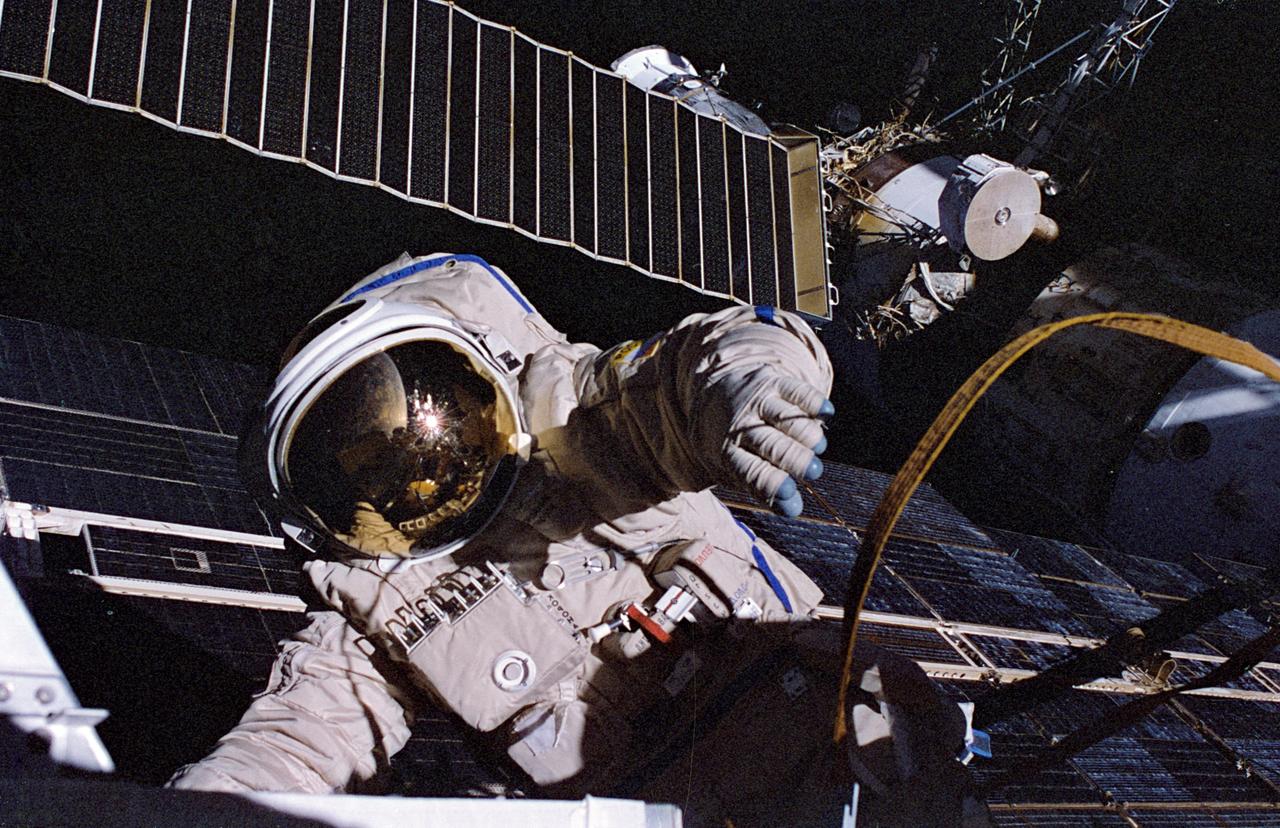
NM23-48-009 (29 April 1997) --- United States astronaut Jerry M. Linenger, cosmonaut guest researcher, works outside the Russian Mir Space Station during a joint United States-Russian space walk on April 29, 1997. He was joined by Mir-23 commander Vasili V. Tsibliyev (out of frame) for the five-hour Extravehicular Activity (EVA) designed to deploy scientific instruments and retrieve other science hardware. At the top of the frame is a Russian Progress re-supply capsule docked to the Mir’s Kvant-1 module.
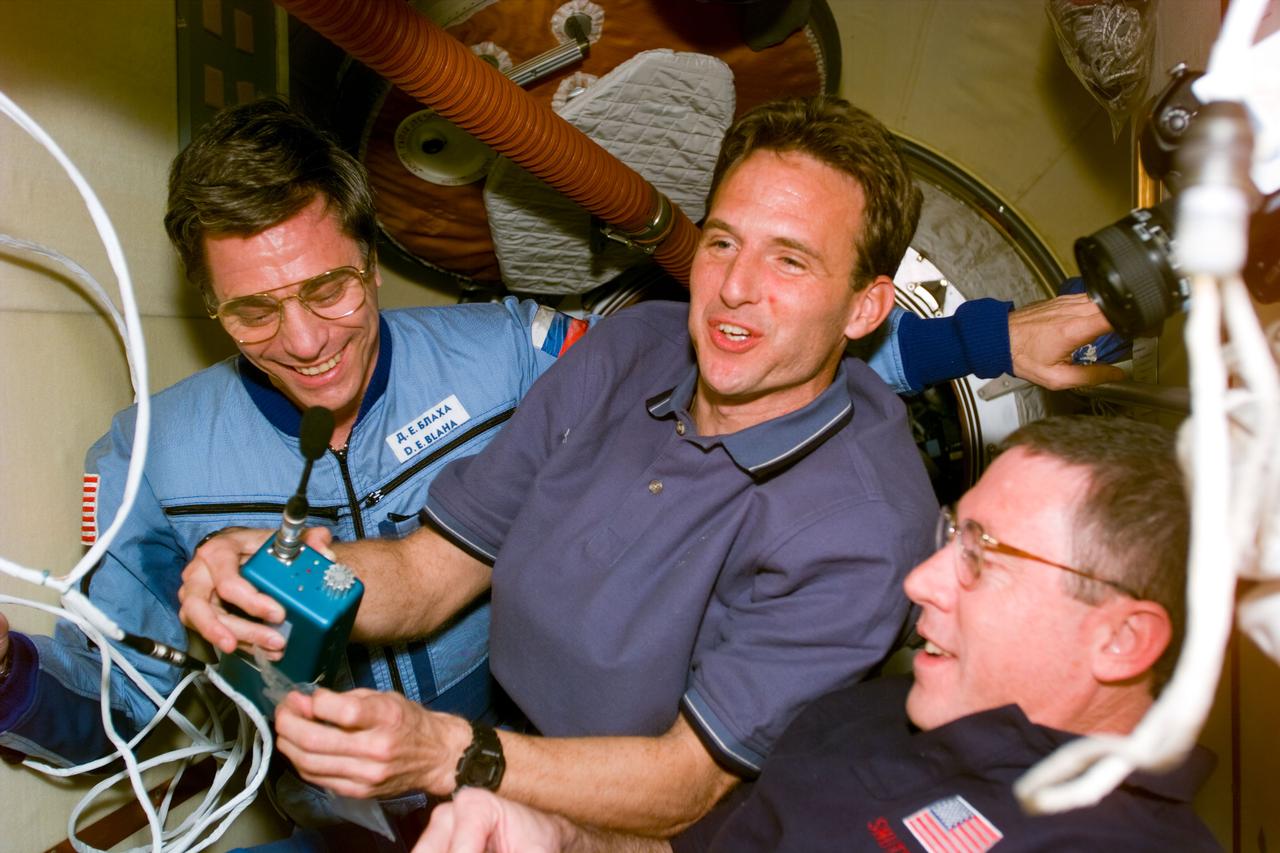
STS081-E-05432 (15 Jan. 1997) --- Left to right, astronaut John E. Blaha, his cosmonaut guest researcher replacement Jerry M. Linenger and Michael A. Baker, mission commander, shortly after docking and hatch opening. Blaha had just joined the NASA crew, having served as a cosmonaut guest researcher aboard Russia's Mir Space Station since mid September 1996. The photograph was taken with an Electronic Still Camera (ESC), which was used throughout the 10-day mission to downlink current photographs of the crews' joint activities.
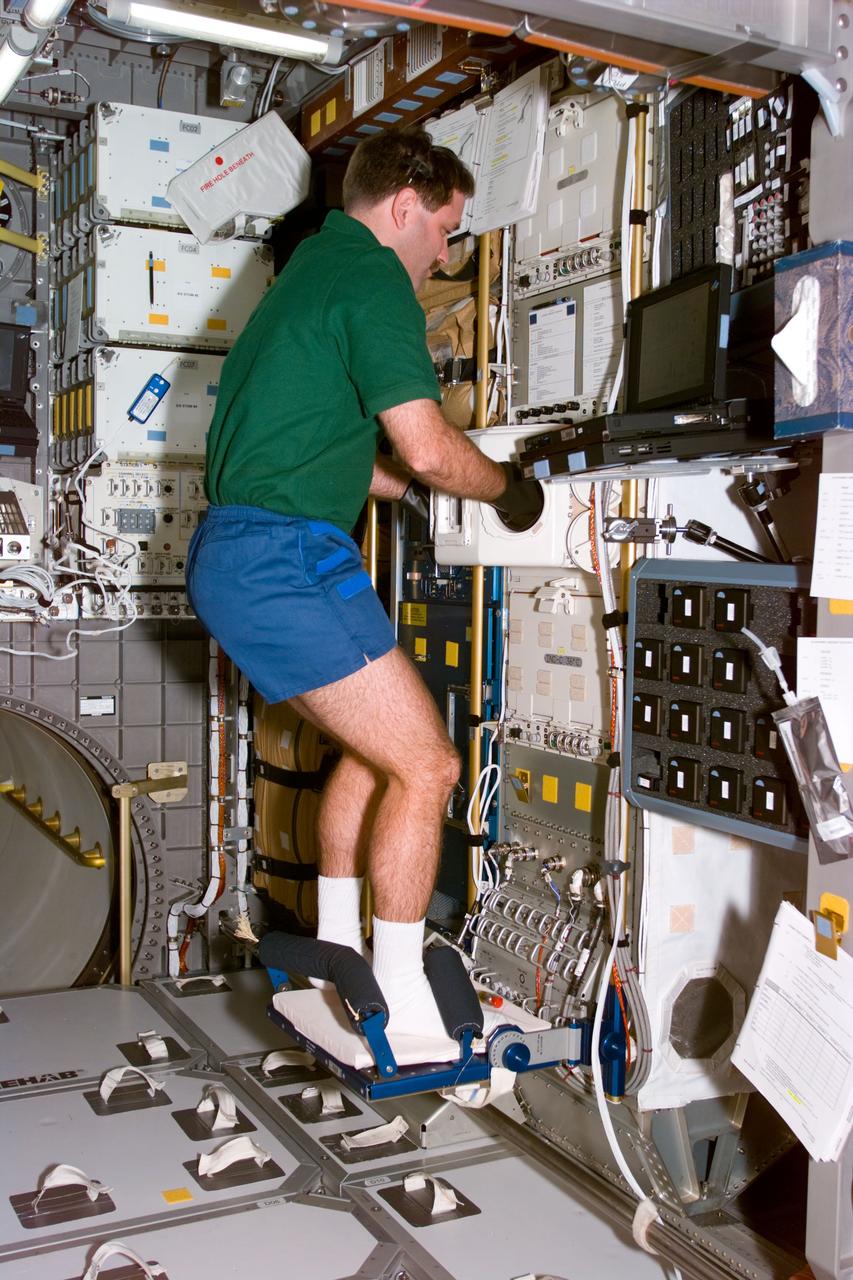
STS81-E-05107 (13 Jan. 1997) --- Astronaut John M. Grunsfeld, mission specialist, begins to activate a biorack glovebox aboard the Spacehab Double Module (DM) early on Day 2 of the mission. Grunsfeld is joined by five other NASA astronauts for the almost ten-day mission. The crew is scheduled to dock with Russia's Mir Space Station and pick up John E. Blaha, NASA astronaut who has been serving as a cosmonaut guest researcher since September 1996. Jerry M. Linenger (out of frame) will replace Blaha onboard Mir.
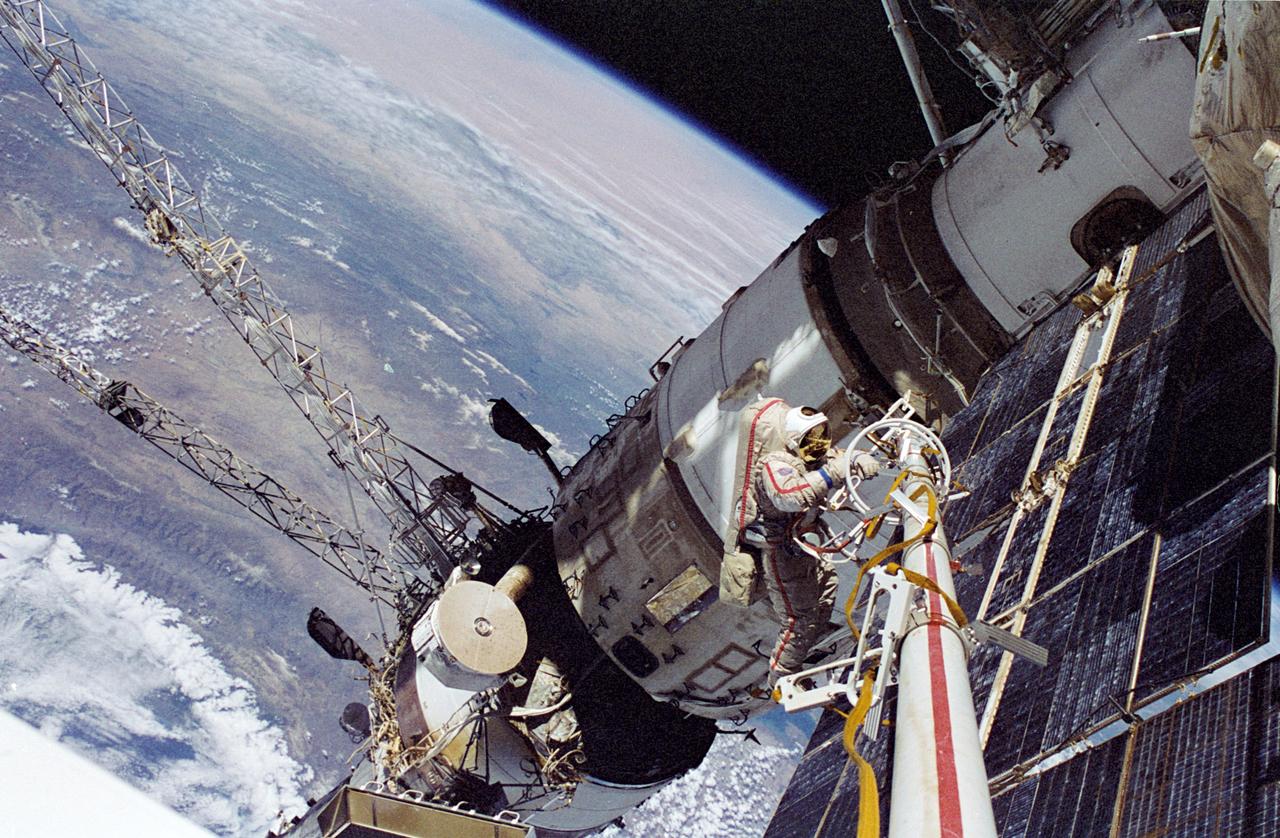
NM23-48-003 (29 April 1997) --- Cosmonaut Vasili V. Tsibliyev, Mir-23 commander, operates at the end of the Russian Mir Space Station’s STRELA boom during a space walk on April 29, 1997. He was joined by United States astronaut Jerry M. Linenger, cosmonaut guest researcher, in an effort to deploy scientific instruments and retrieve other science hardware. At the lower left of the picture is the Kvant-1 module. Hovering above it is the Sofora tower, which was once used for an experiment in attitude control of the Mir.
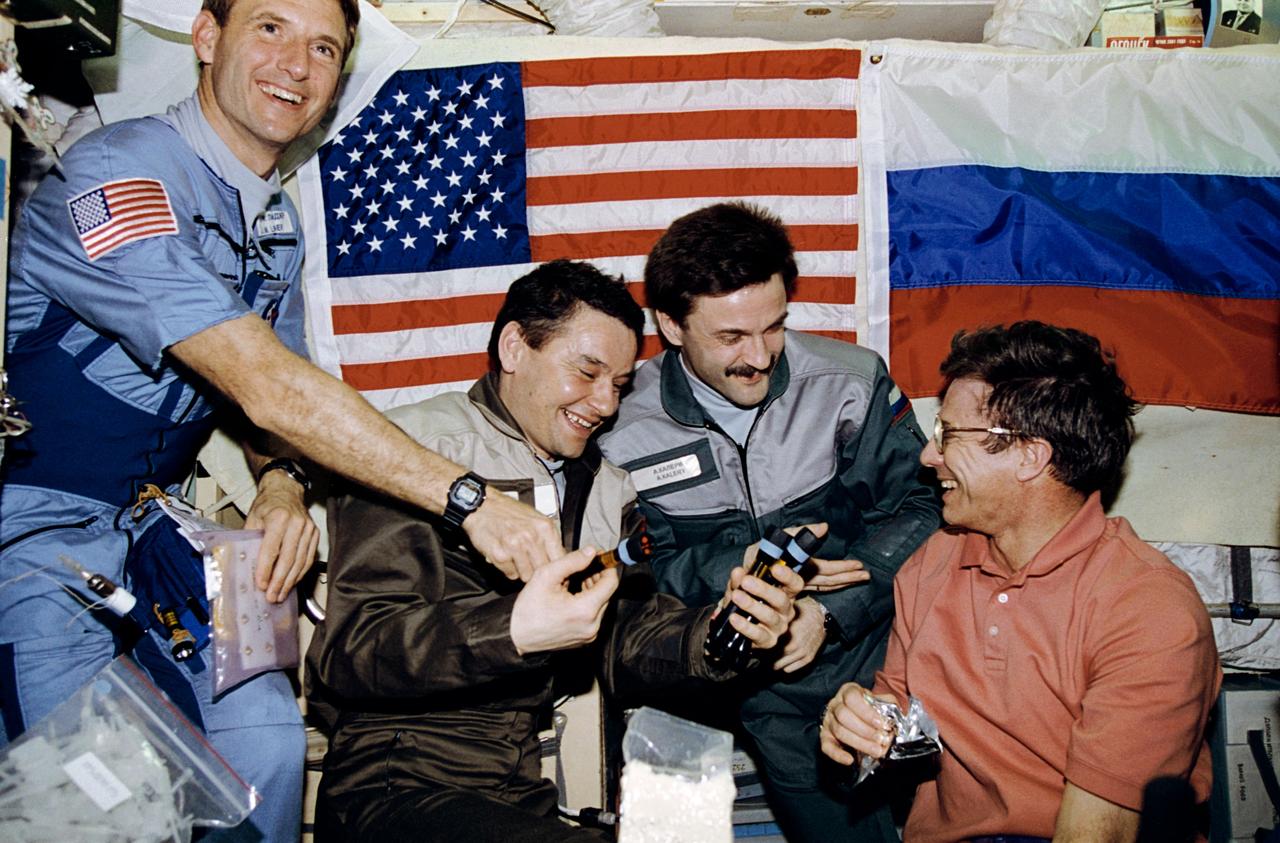
STS081-350-013 (12-22 Jan 1997) --- Members of Mir-22 crew show appreciation for small flash lights brought up by the STS-81 crew. Left to right, new cosmonaut guest researcher Jerry M. Linenger, cosmonauts Valeri G. Korzun, mission commander, and Aleksandr Y. Kaleri, flight engineer, along with former cosmonaut guest researcher John E. Blaha. The four are on the Base Block Module of Russia?s Mir Space Station on the eve of the Space Shuttle Atlantis and Mir undocking day.
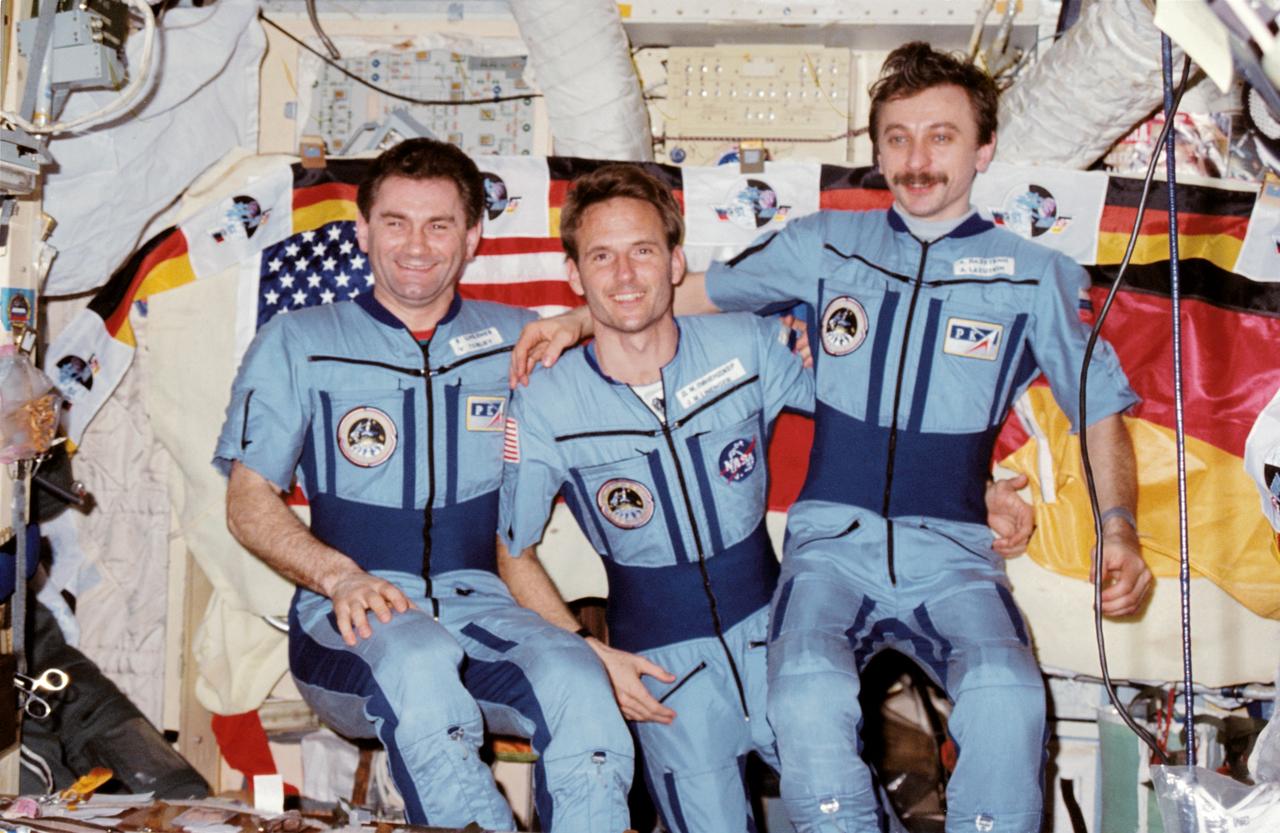
NM23-48-009 (29 April 1997) --- United States astronaut Jerry M. Linenger, cosmonaut guest researcher, works outside the Russian Mir Space Station during a joint United States-Russian space walk on April 29, 1997. He was joined by Mir-23 commander Vasili V. Tsibliyev (out of frame) for the five-hour Extravehicular Activity (EVA) designed to deploy scientific instruments and retrieve other science hardware. At the top of the frame is a Russian Progress re-supply capsule docked to the Mir’s Kvant-1 module.
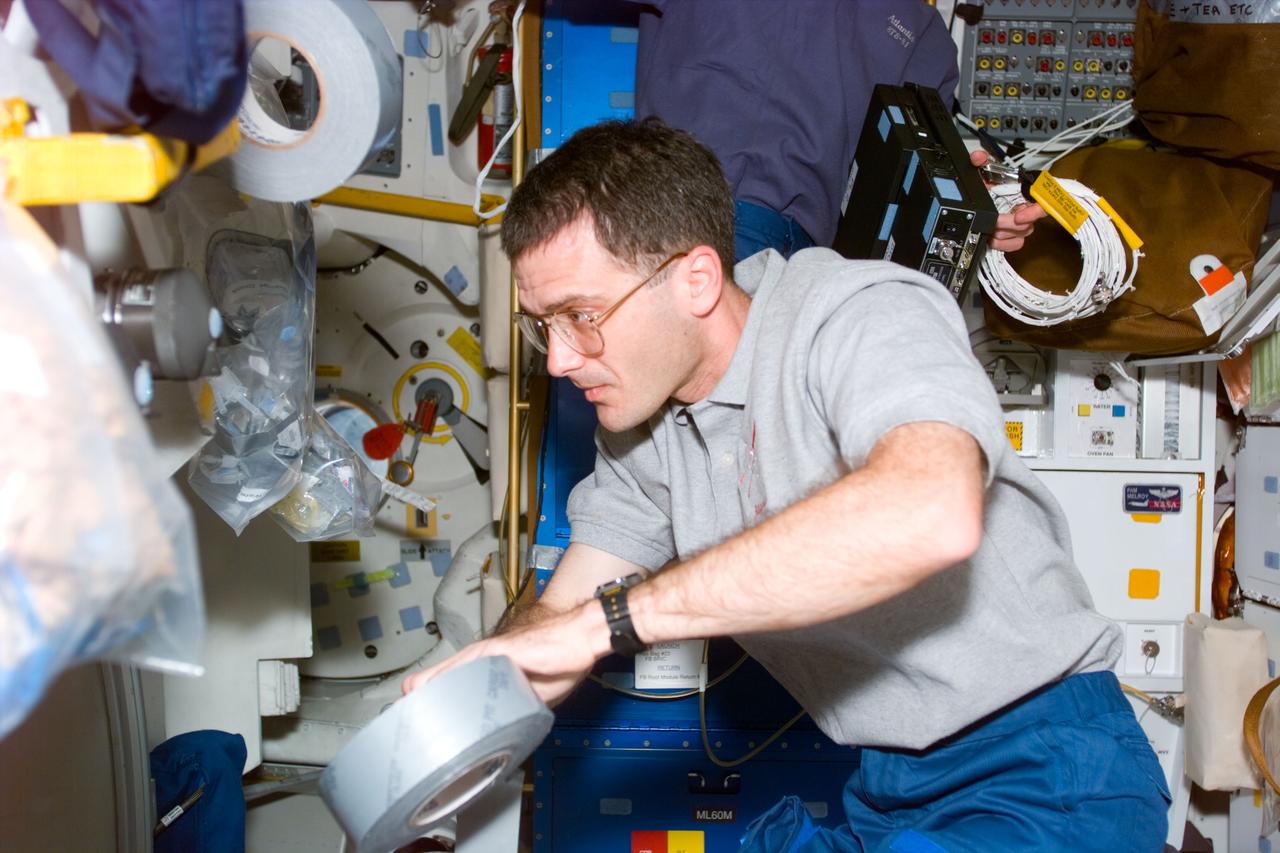
STS081-E-5009 (12 Jan. 1997) --- Astronaut Peter J. K. (Jeff) Wisoff, mission specialist, helps carry out tasks of readying the Space Shuttle Atlantis for almost ten days in space, securing supplies with a piece of gaffer's tape. Currently, Wisoff is accompanied by five crew mates, among whom one - astronaut Jerry M. Linenger - will be exchanged in a few days for John E. Blaha, who has been aboard Russia's Mir Space Station for several months, as a cosmonaut guest researcher. Docking of Atlantis with Mir is scheduled for the middle of the week. The scene was recorded with an Electronic Still Camera (ESC) and later downlinked to flight controllers in Houston, Texas.
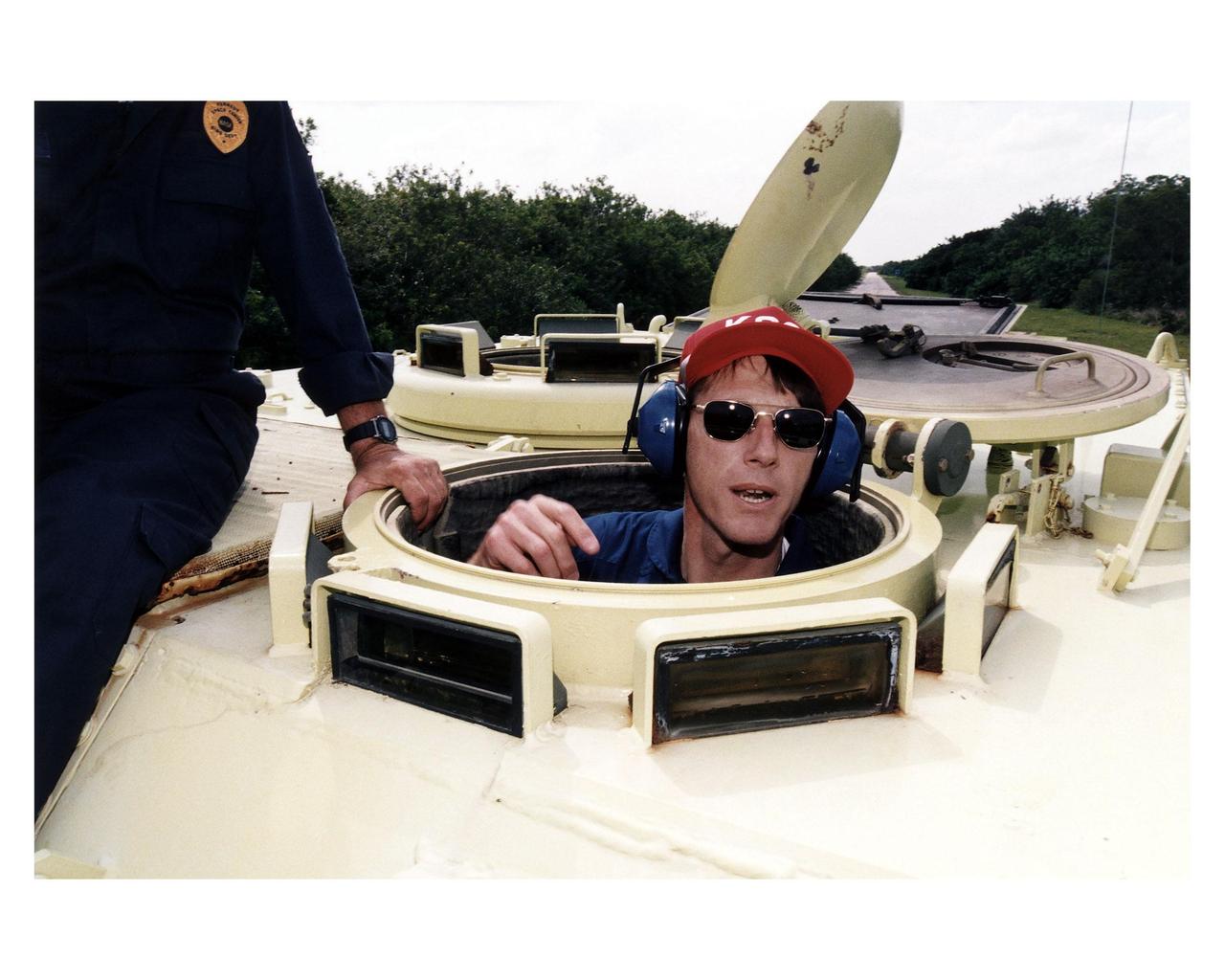
STS-84 Mission Specialist C. Michael Foale rides in an M-113 armored personnel carrier as part of the Terminal Countdown Demonstration Test (TCDT) activities. STS-84 aboard the Space Shuttle Atlantis will be the sixth docking of the Space Shuttle with the Russian Space Station Mir. After docking, Foale will transfer to the space station and become a member of the Mir 23 crew, replacing U.S. astronaut Jerry M. Linenger, who will return to Earth aboard Atlantis. Foale will live and work on Mir until mid-September when his replacement is expected to arrive on the STS-86 mission. STS-84 is targeted for a May 15 liftoff
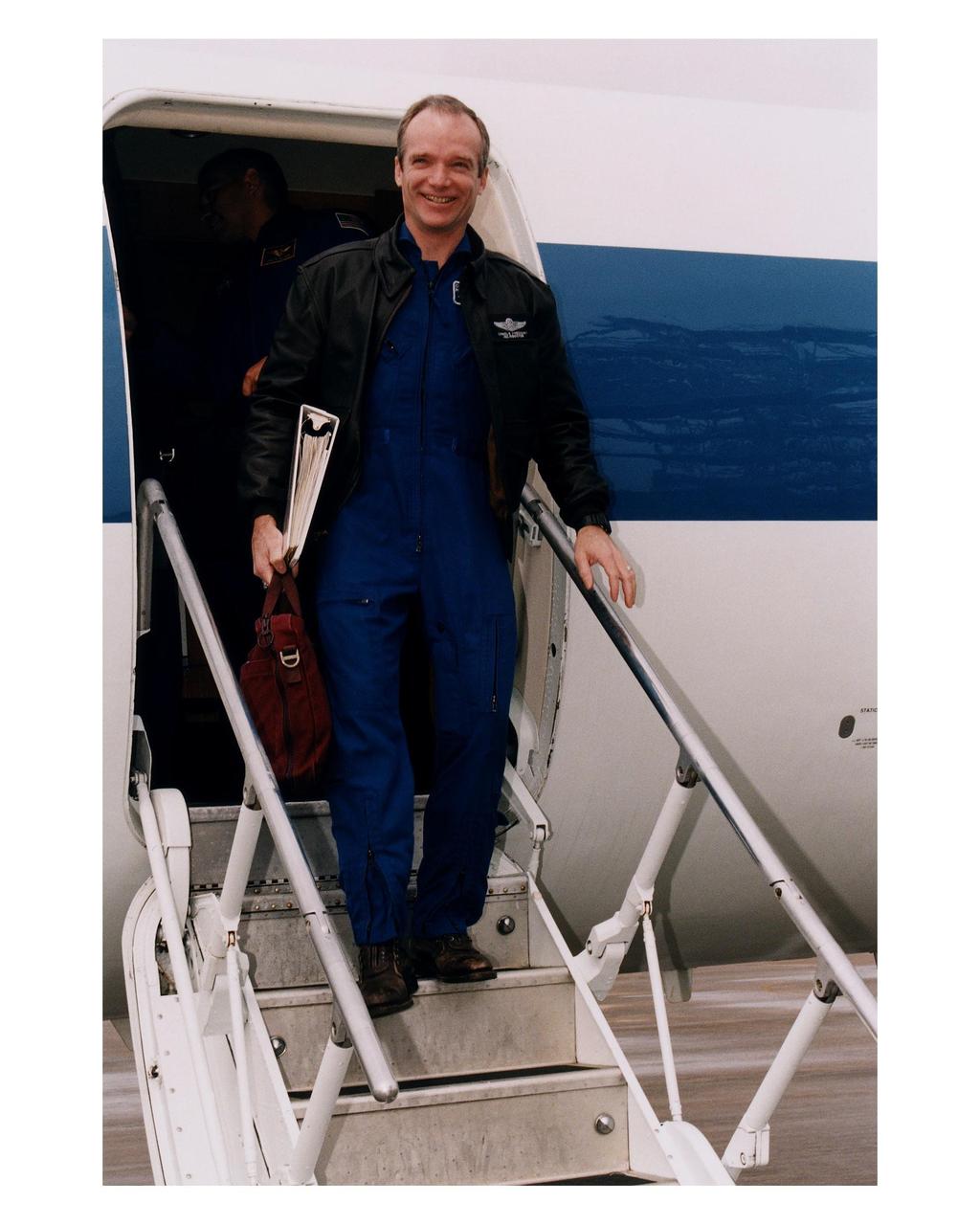
STS-84 Commander Charles J. Precourt arrives at KSC’s Shuttle Landing Facility for the Terminal Countdown Demonstration Test (TCDT), a dress rehearsal for launch. Precourt will lead the six other crew members when they travel to Mir next month aboard the Space Shuttle Atlantis. STS-84 Mission Specialist C. Michael Foale will be dropped off on Mir to become a member of the Mir 23 crew, replacing U.S. astronaut Jerry M. Linenger, who will return to Earth on Atlantis after about four months on the orbiting station. STS-84 will be the sixth Shuttle-Mir docking. Liftoff is targeted for May 15

Greeted by cheers from wellwishers at KSC and eager for their venture into space on the fifth Shuttle-Mir docking mission, the STS-81 astronauts depart the Operations and Checkout Building and board the Astrovan for their 25-minute trip to Launch Pad 39B. Leading the six-member crew is Mission Commander Michael A. Baker, followed by Pilot Brent W. Jett, Jr. Behind them are Mission Specialists John M. Grunsfeld, Jerry Linenger, Peter J. K. "Jeff" Wisoff, and Marsha S. Ivins. Once at the pad, they will take their positions in the crew cabin of the Space Shuttle Atlantis to await a liftoff during a seven-minute window that will open at 4:27 a.m. EST, January 12

STS064-S-051 (9 Sept. 1994) --- With a crew of six NASA astronauts aboard, the space shuttle Discovery heads for its nineteenth Earth-orbital mission. Launch was delayed because of weather, but all systems were "go," and the spacecraft left the launch pad at 6:23 p.m. (EDT) on Sept. 9, 1994. Onboard were astronauts Richard N. Richards, L. Blaine Hammond, Carl J. Meade, Mark C. Lee, Susan J. Helms and Jerry M. Linenger. Photo credit: NASA or National Aeronautics and Space Administration
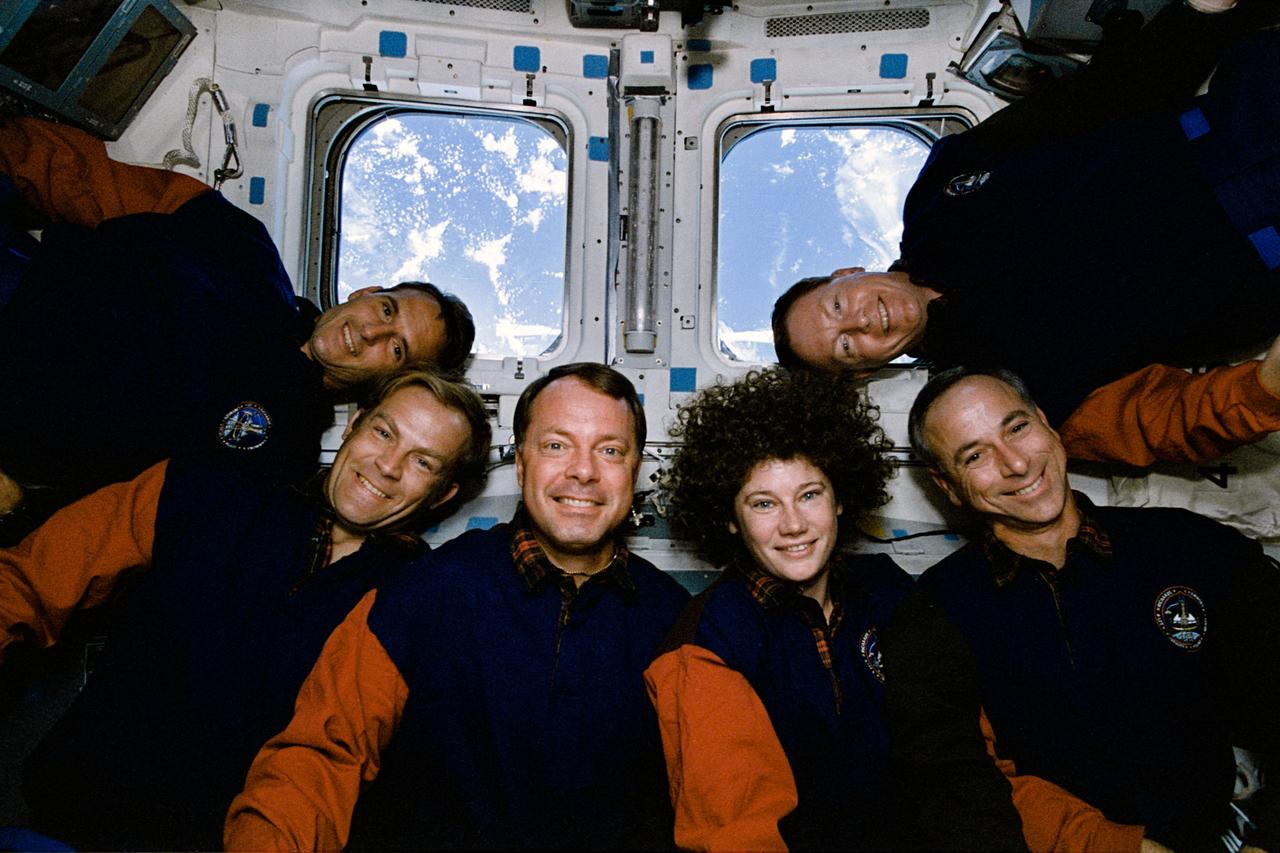
STS064-24-029 (9-20 Sept. 1994) --- In the microgravity of space, 130 nautical miles above Earth, the six STS-64 crew members found a unique setting for the traditional inflight crew portrait. Astronaut Richard N. Richards (upper right), commander, found stability with his back against the overhead in upper right corner. Others, clockwise from the commander, are astronauts Carl J. Meade and Susan J. Helms, mission specialists; L. Blaine Hammond, pilot; and Mark C. Lee and Jerry M. Linenger, both mission specialists. Photo credit: NASA or National Aeronautics and Space Administration
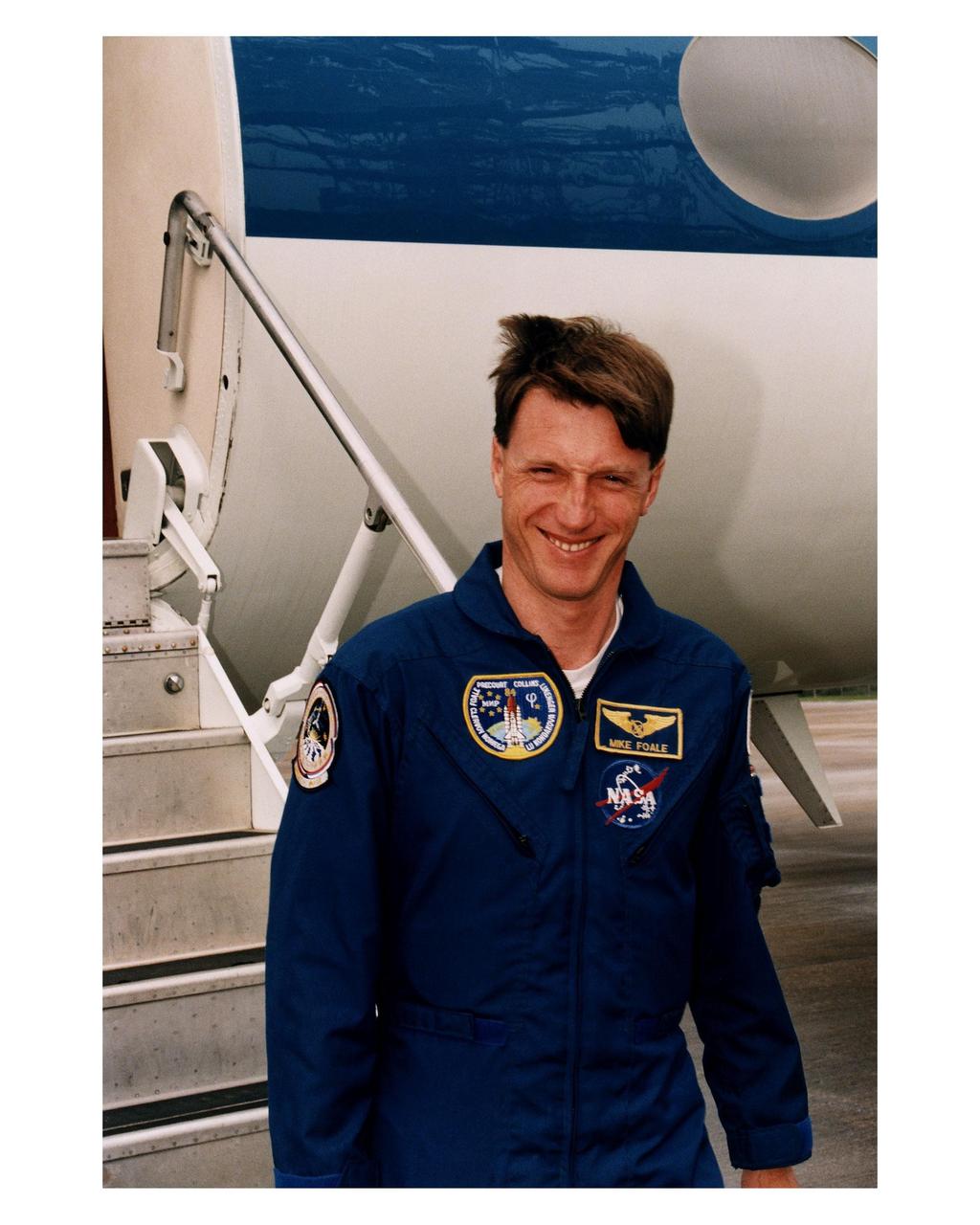
STS-84 Mission Specialist C. Michael Foale, who will become the fifth U.S. astronaut to live and work on the Russian Space Station Mir, arrives at KSC’s Shuttle Landing Facility for the STS-84 Terminal Countdown Demonstration Test (TCDT), a dress rehearsal for launch. Foale will be dropped off on Mir when the Space Shuttle Atlantis docks with Mir next month. He will become a member of the Mir 23 crew, replacing U.S. astronaut Jerry M. Linenger, who will return to Earth on Atlantis after about four months on the orbiting station. STS-84 will be the sixth Shuttle-Mir docking. Liftoff is targeted for May 15
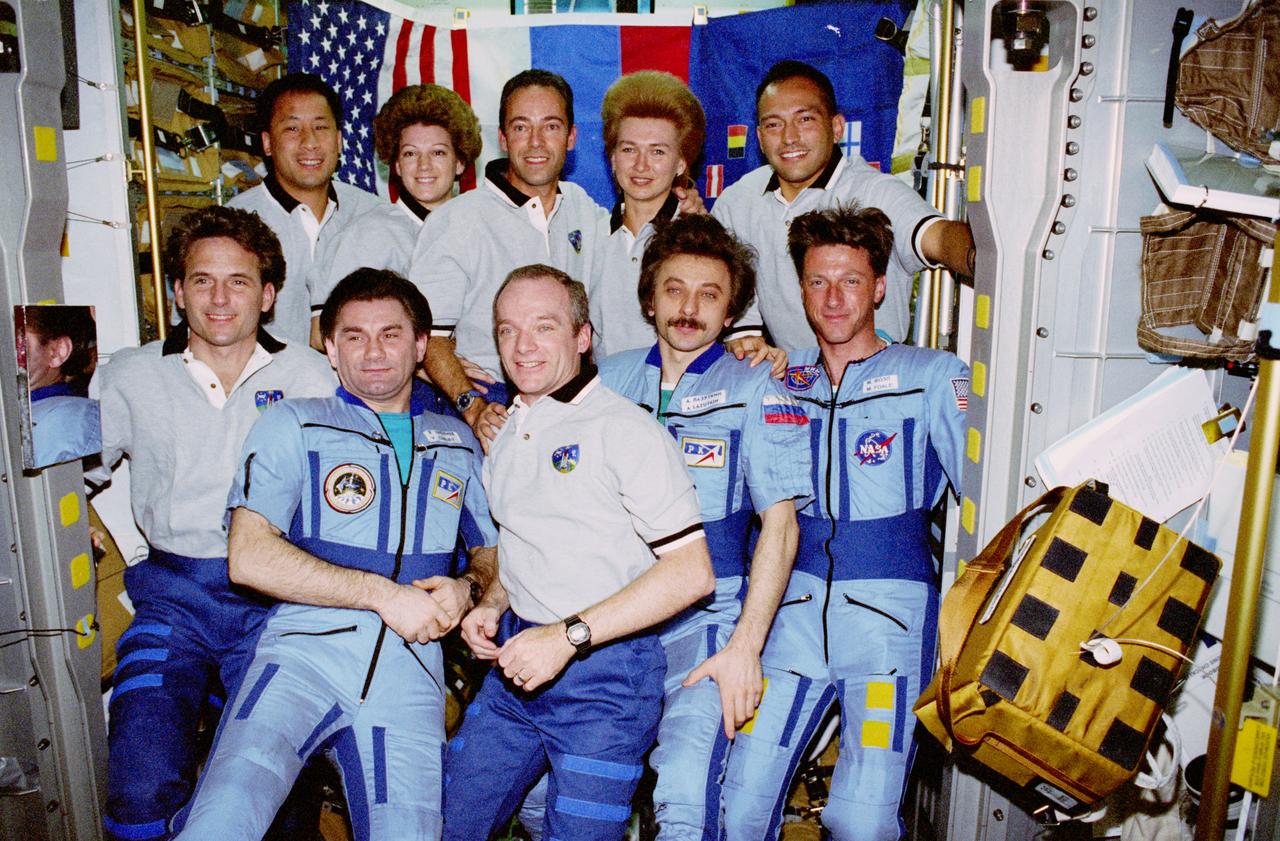
STS084-366-015 (15-24 May 1997) --- Crewmembers from Mir-23 and STS-84 assemble for a group portrait onboard the Spacehab Double Module, as they tie a record (ten) for number of persons aboard a single orbiting spacecraft at one time. They are (from the left, front) Jerry M. Linenger, Vasili V. Tsibliyev, Charles J. Precourt, Aleksandr I. Lazutkin and C. Michael Foale. On the back row, from the left, are Edward T. Lu, Eileen M. Collins, Jean-Francois Clervoy, Elena V. Kondakova and Carlos I. Noriega.
STS-84 Mission Specialist C. Michael Foale participates in Terminal Countdown Demonstration Test (TCDT) activities at Launch Pad 39A. STS-84 will be the sixth docking of the Space Shuttle with the Russian Space Station Mir. Foale, a veteran of three space flights, will transfer to the space station and become a member of the Mir 23 crew, replacing U.S. astronaut Jerry M. Linenger, who will return to Earth aboard Atlantis. Foale will live and work on Mir until mid-September when his replacement is expected to arrive on the STS-86 mission. STS-84 is targeted for a May 15 liftoff

STS064-30-006 (9-20 Sept. 1994) --- In the microgravity of space, 130 nautical miles above Earth, the six STS-64 crew members found a unique setting for the traditional inflight crew portrait. Astronaut Richard N. Richards (upper right), commander, found stability with his back against the overhead in upper right corner. Others, clockwise from the commander, are astronauts Carl J. Meade and Susan J. Helms, mission specialists; L. Blaine Hammond, pilot; and Mark C. Lee and Jerry M. Linenger, both mission specialists. Photo credit: NASA or National Aeronautics and Space Administration
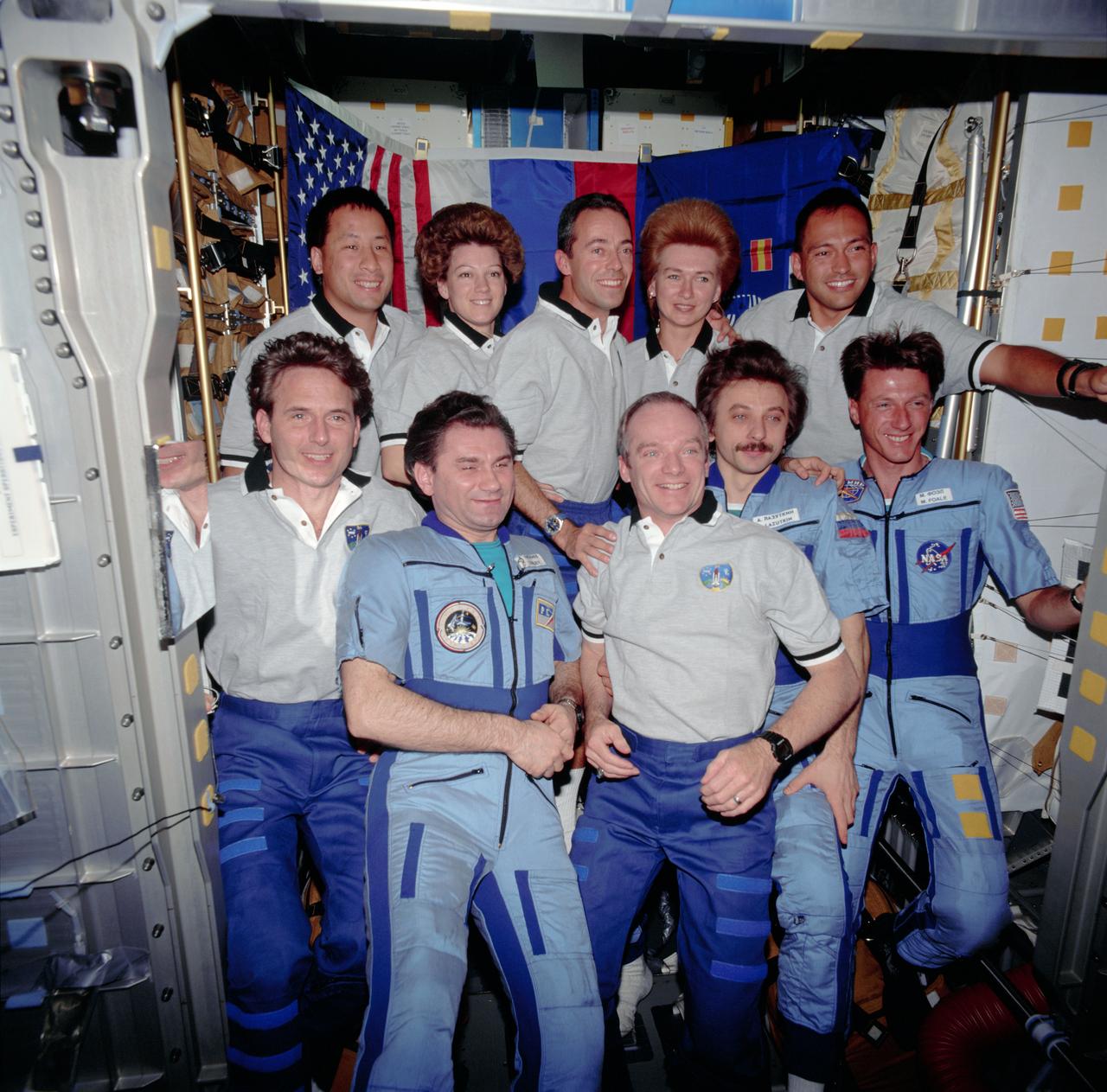
STS084-704-015 (15-24 May 1997) --- Crewmembers from Mir-23 and STS-84 assemble for a group portrait onboard the Spacehab Double Module, as they tie a record (ten) for number of persons aboard a single orbiting spacecraft at one time. They are (from the left, front) Jerry M. Linenger, Vasili V. Tsibliyev, Charles J. Precourt, Aleksandr I. Lazutkin and C. Michael Foale. On the back row, from the left, are Edward T. Lu, Eileen M. Collins, Jean-Francois Clervoy, Elena V. Kondakova and Carlos I. Noriega.
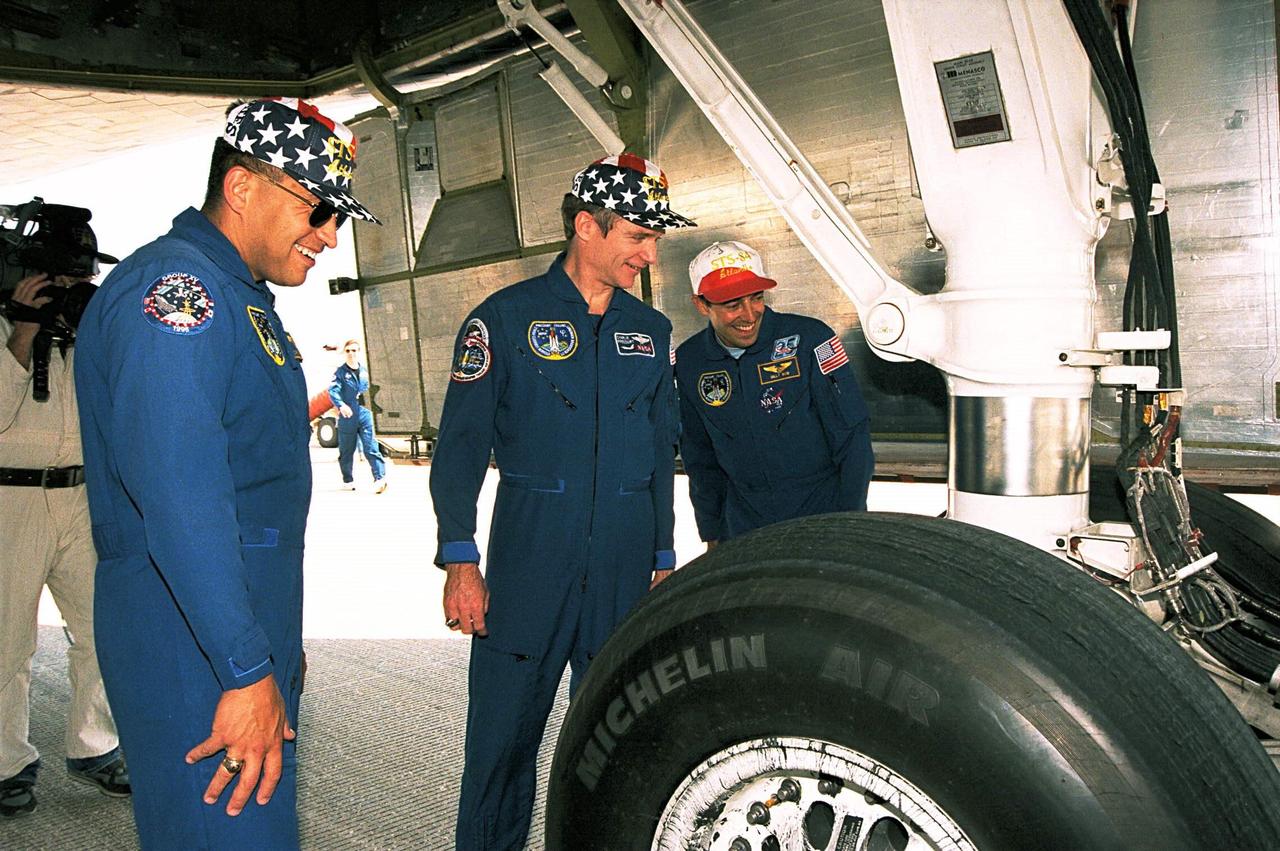
STS-84 crew members, from left, Mission Specialist Carlos I. Noriega, Commander Charles J. Precourt and Mission Specialist Jean-Francois Clervoy examine the tires of the Space Shuttle Atlantis after landing. Atlantis traveled about 3.6 million miles during the nine-day mission, which was the sixth of nine planned dockings of the Space Shuttle with the Russian Space Station Mir. The mission also included the exchange of STS-84 Mission Specialist C. Michael Foale for astronaut and Mir 23 crew member, Jerry M. Linenger, who spent the last four months on the Russian space station
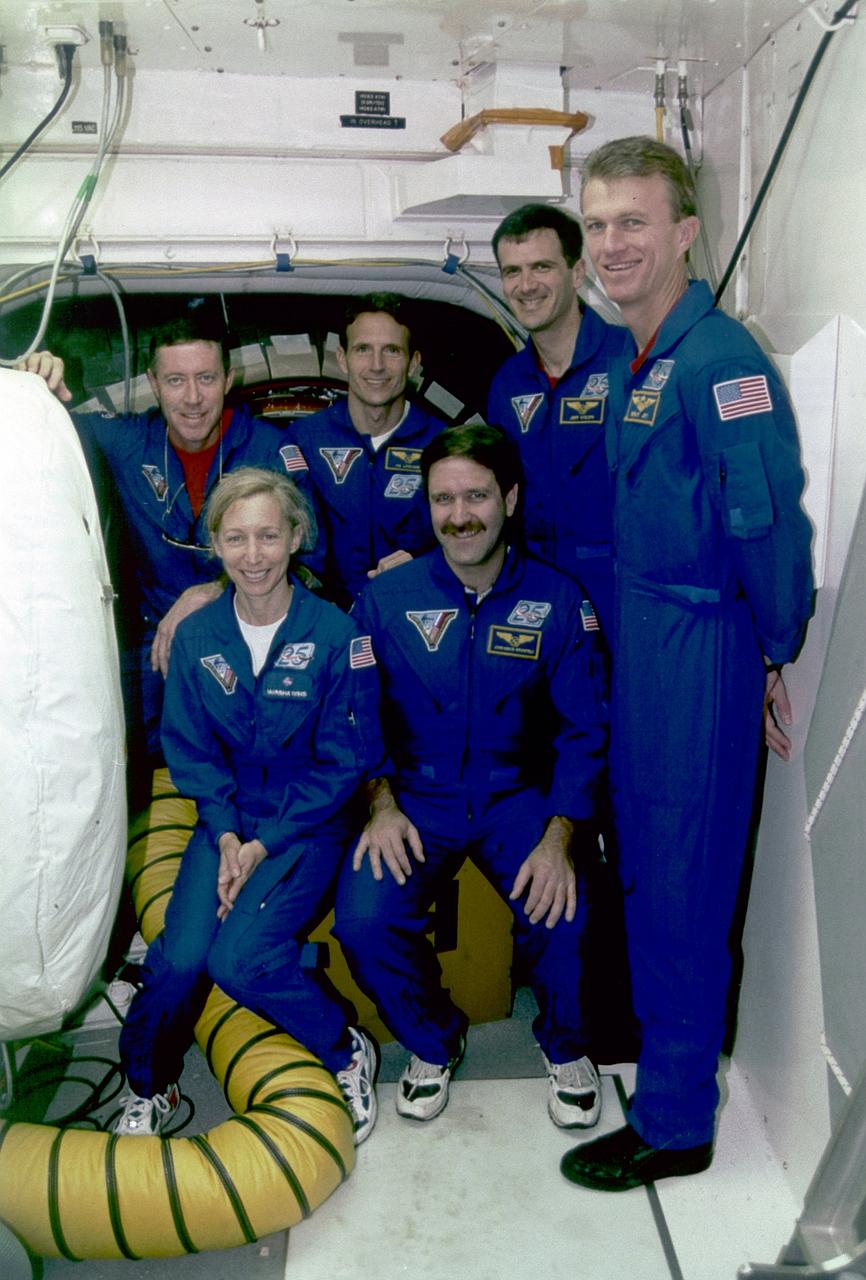
S97-00247 (15 Dec. 1996) --- The STS-81 mission flight crew poses outside the hatch of the space shuttle Atlantis at Launch Pad 39B during a Terminal Countdown Demonstration Test (TCDT). The TCDT represents a simulated final countdown rehearsal that ends just before main engine ignition. The actual launch is now scheduled for Jan. 12, 1997. Pictured (from the left) are astronauts Michael A. Baker, Marsha S. Ivins, Jerry M. Linenger, John M. Grunsfeld, Peter J.K. (Jeff) Wisoff, and Brent W. Jett Jr.
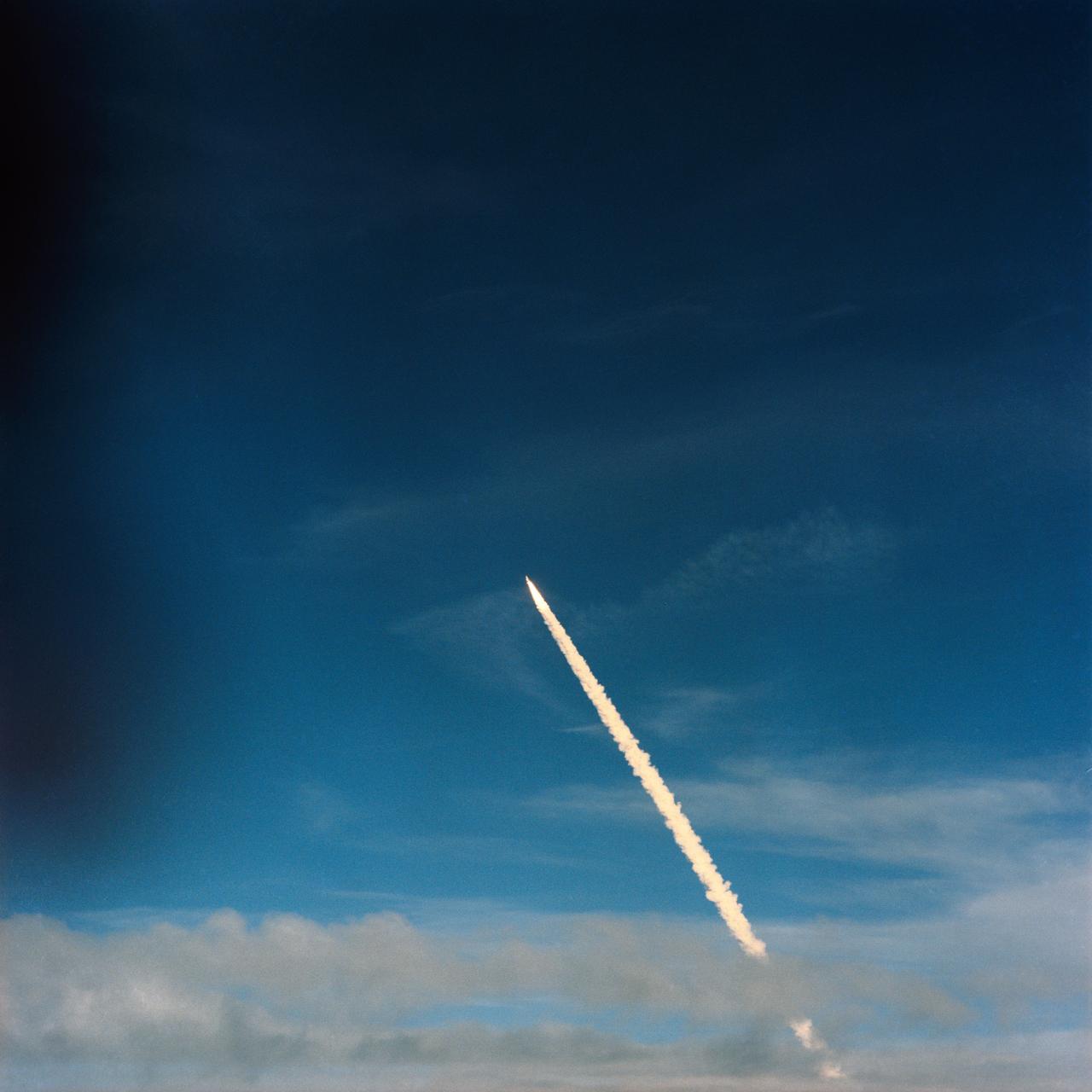
STS064-S-044 (9 Sept. 1994) --- Passing through some of the trailer clouds of an overcast sky which temporarily postponed its launch, the space shuttle Discovery heads for its 19th Earth-orbital flight. Several kilometers away, astronaut John H. Casper Jr., who took this picture, was piloting the Shuttle Training Aircraft (STA) from which the launch and landing area weather was being monitored. Onboard Discovery were astronauts Richard N. Richards, L. Blaine Hammond Jr., Mark C. Lee, Carl J. Meade, Susan J. Helms and Jerry M. Linenger. Photo credit: NASA or National Aeronautics and Space Administration
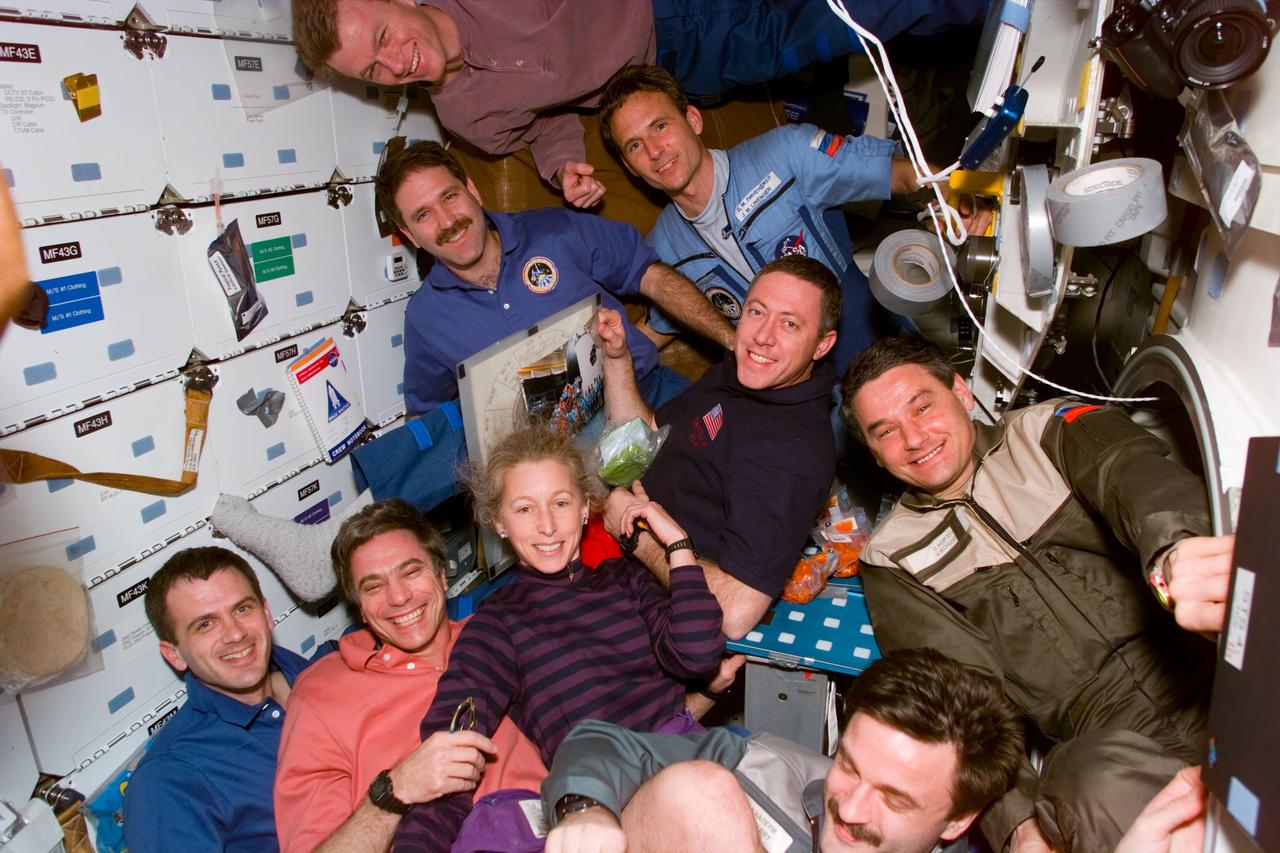
STS081-E-05535 (17 Jan. 1997) --- Seven NASA astronauts and two Russian cosmonauts take a break from busy supply-transfer duties on the space shuttle Atlantis' middeck halfway through the ten-day mission. Left to right at bottom of the frame are mission specialists Peter J. K. (Jeff) Wisoff, John E. Blaha, Marsha S. Ivins and cosmonaut Aleksandr Y. Kaleri, Mir-22 flight engineer. In the top half of the scene are, from the top left, Brent W. Jett, Jr., pilot; John M. Grunsfeld, mission specialist; Jerry M. Linenger, cosmonaut guest researcher; Michael A. Baker, commander; and cosmonaut Valeri G. Korzun, Mir-22 commander. The picture was recorded with a pre-set 35mm Electronic Still Camera (ESC).

STS-84 Commander Charles J. Precourt, in right foreground, talks to fellow crew members, Mission Specialist Elena V. Kondakova, in left foreground, of the Russian Space Agency, and Pilot Eileen Marie Collins during Terminal Countdown Demonstration Test (TCDT) activities at Launch Pad 39A. In the background are NASA suit technician Al Rochford, at left, and astronaut Mario Runco Jr., who is assisting the STS-84 crew. STS-84 will be the sixth docking of the Space Shuttle with the Russian Space Station Mir. After docking, STS-84 Mission Specialist Michael C. Foale will transfer to the space station and become a member of the Mir 23 crew, replacing U.S. astronaut Jerry M. Linenger, who will return to Earth aboard Atlantis. Foale will live and work on Mir until mid-September when his replacement is expected to arrive on the STS-86 mission. STS-84 is targeted for a May 15 liftoff
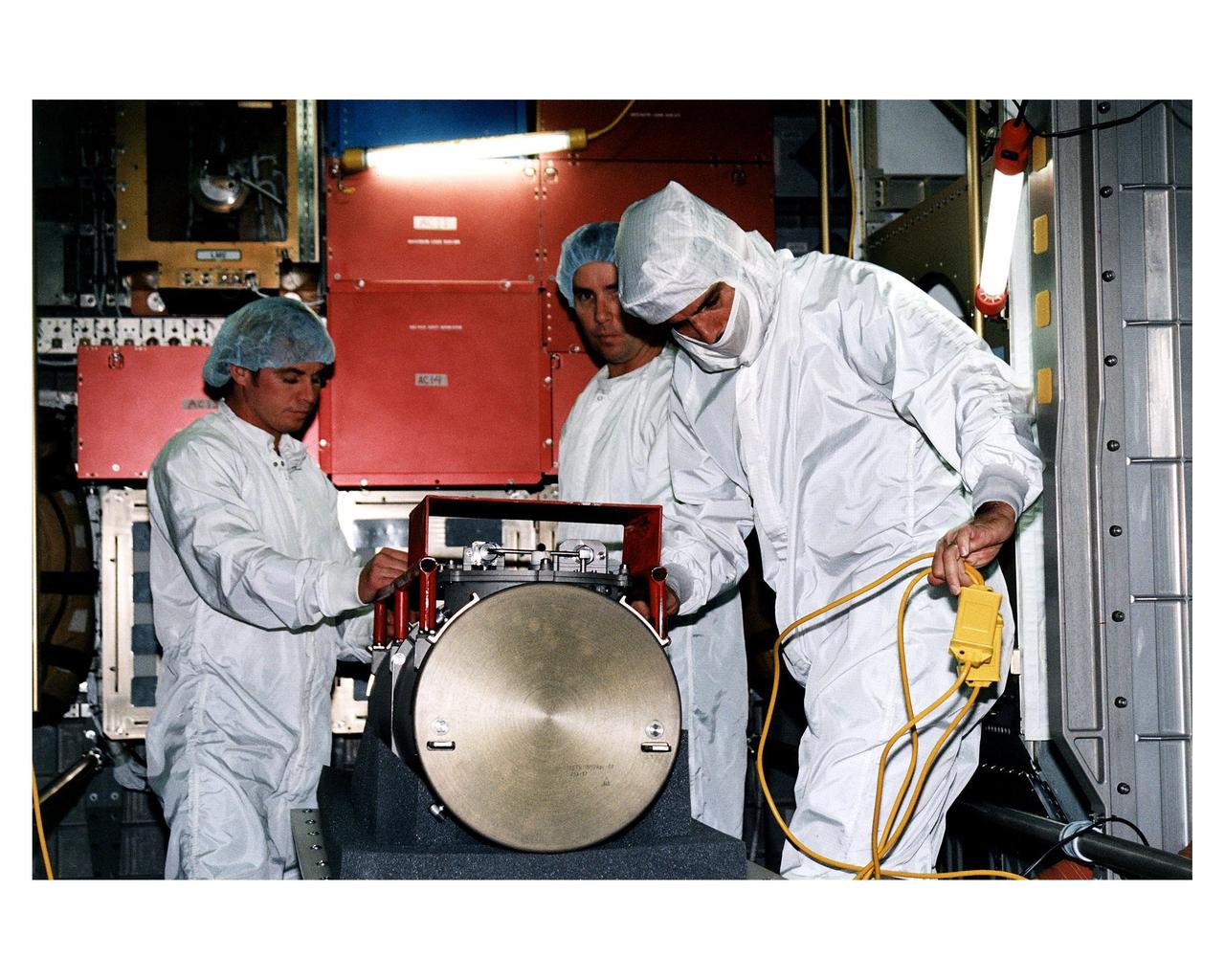
KENNEDY SPACE CENTER, FLA. -- McDonnell Douglas-SPACEHAB technicians prepare to place a Russian-made oxygen generator into position for transport in a SPACEHAB Double Module being processed for flight on Space Shuttle Mission STS-84. The module is undergoing preflight preparations in the SPACEHAB Payload Processing Facility just outside of Gate 1 on Cape Canaveral Air Station. The Space Shuttle Atlantis will carry the oxygen generator to the Russian Space Station Mir to replace one of two Mir units that have been malfunctioning recently. The nearly 300-pound generator functions by electrolysis, which separates water into its oxygen and hydrogen components. The hydrogen is vented and the oxygen is used for breathing by the Mir crew. The generator is 4.2 feet long with a diameter of 1.4 feet. STS-84, which is planned to include a Mir crew exchange of astronaut C. Michael Foale for Jerry M. Linenger, is targeted for a May 15 launch. It will be the sixth Shuttle-Mir docking
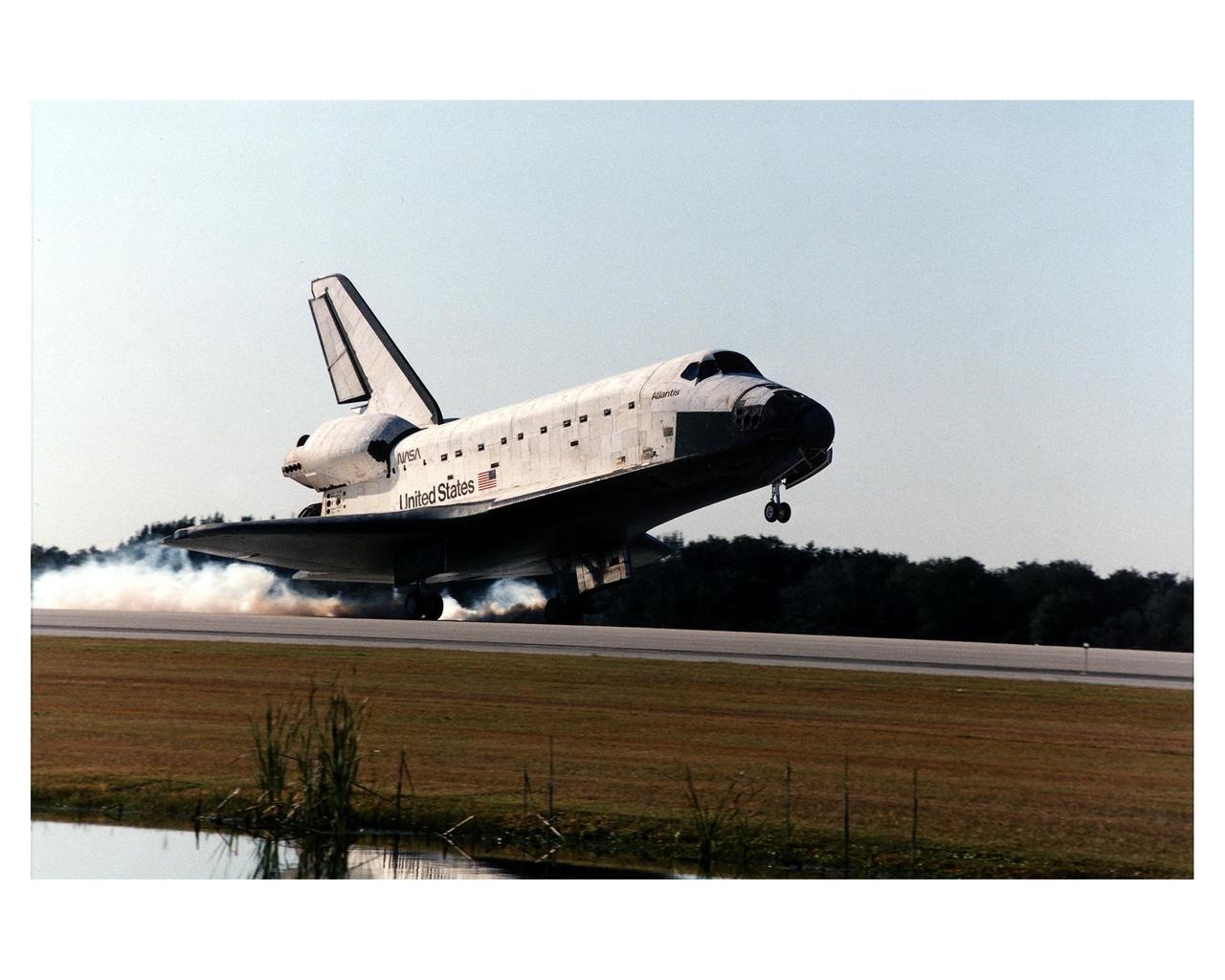
The Space Shuttle orbiter Atlantis touches down on Runway 33 at 9:22:44 a.m. EST Jan. 22 to conclude the fifth Shuttle-Mir docking mission and return NASA astronaut John Blaha to Earth after four months in space. Blaha was replaced by STS-81 Mission Specialist Jerry Linenger during the five days of docked operations. At main gear touchdown, the STS-81 mission duration was 10 days, 4 hours, 55 minutes. This was the 34th KSC landing in Shuttle history. Mission Commander Michael A. Baker flew Atlantis to a perfect landing, with help from Pilot Brent W. Jett, Jr. Other returning STS-81 crew members are Mission Specialists John M. Grunsfeld, Peter J. K. "Jeff" Wisoff and Marsha S. Ivins. Atlantis also brought back experiment samples from the Russian space station for analysis on Earth, along with Russian logistics equipment
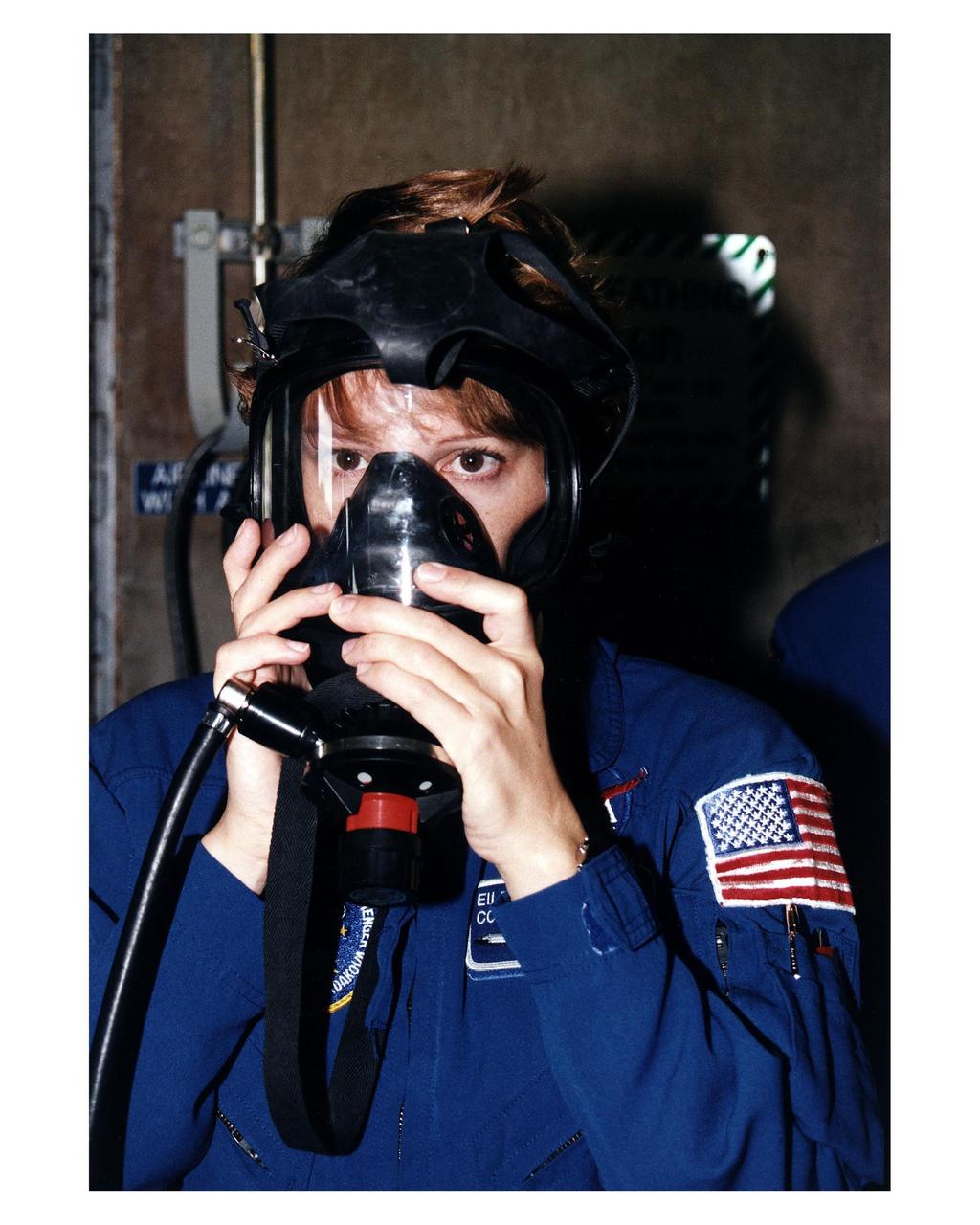
STS-84 Pilot Eileen Marie Collins practices using a gas mask during Terminal Countdown Demonstration Test (TCDT) activities at Launch Pad 39A. STS-84 will be the sixth docking of the Space Shuttle with the Russian Space Station Mir. It will be second space flight for Collins, who was the first woman Shuttle pilot on her initial mission, STS-63 in 1995. After docking, STS-84 Mission Specialist C. Michael Foale will transfer to the space station and become a member of the Mir 23 crew, replacing U.S. astronaut Jerry M. Linenger, who will return to Earth aboard Atlantis. Foale will live and work on Mir until mid-September when his replacement is expected to arrive on the STS-86 mission. STS-84 is targeted for a May 15 liftoff
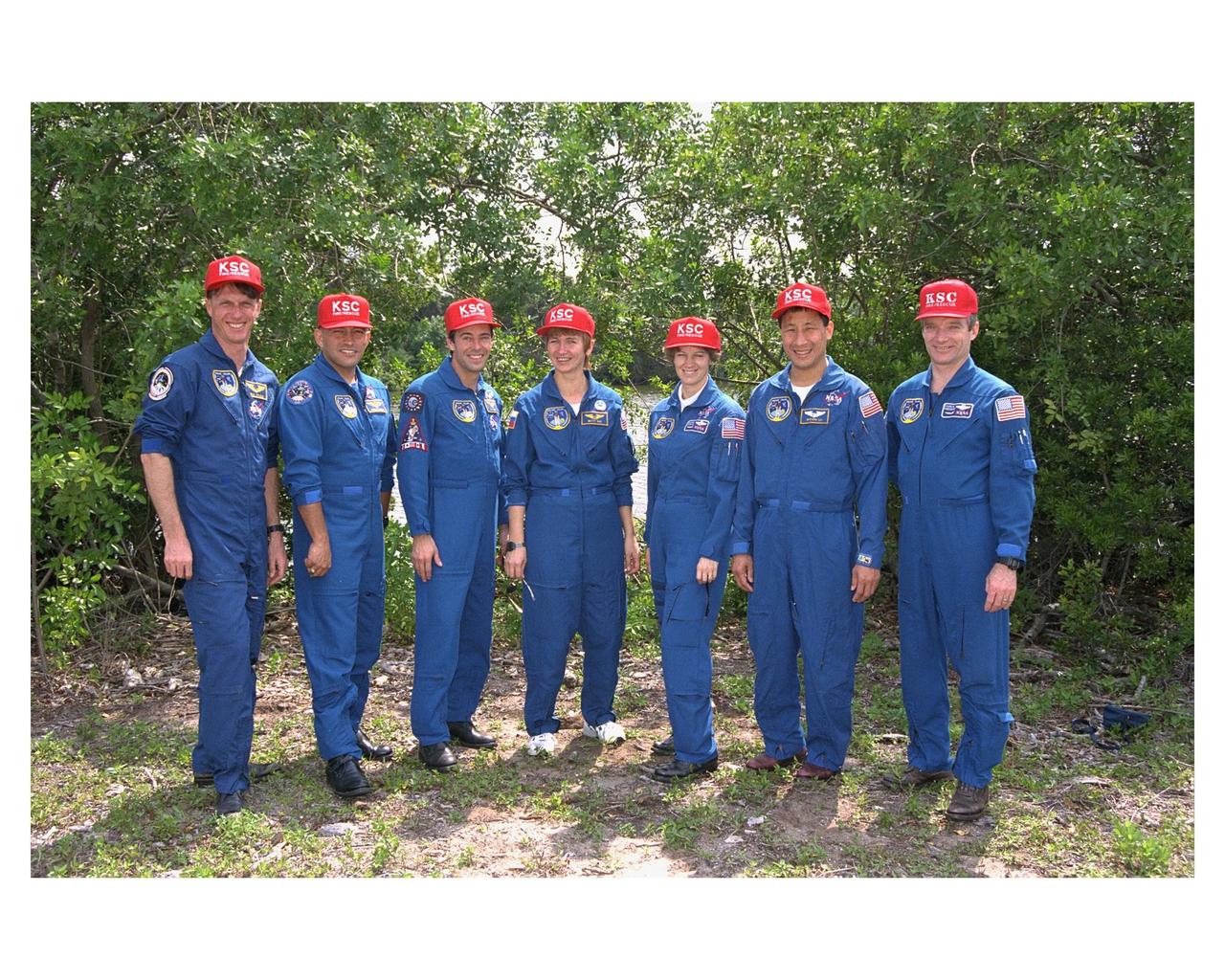
Proudly wearing red KSC Fire/Rescue hats, members of the STS-84 crew pause for a moment for a group photograph while participating in Terminal Countdown Demonstration Test (TCDT) activities. From left, are Mission Specialists C. Michael Foale, Carlos I. Noriega, Jean-Francois Clervoy of the European Space Agency and Elena V. Kondakova of the Russian Space Agency; and Pilot Eileen Marie Collins, Mission Specialist Edward Tsang Lu and Commander Charles J. Precourt. STS-84 aboard Atlantis will be the sixth docking of the Space Shuttle with the Russian Space Station Mir. After docking, Foale will transfer to the space station and become a member of the Mir 23 crew, replacing U.S. astronaut Jerry M. Linenger, who will return to Earth aboard Atlantis. Foale will live and work on Mir until mid-September when his replacement is expected to arrive on the STS-86 mission. STS-84 is targeted for a May 15 liftoff
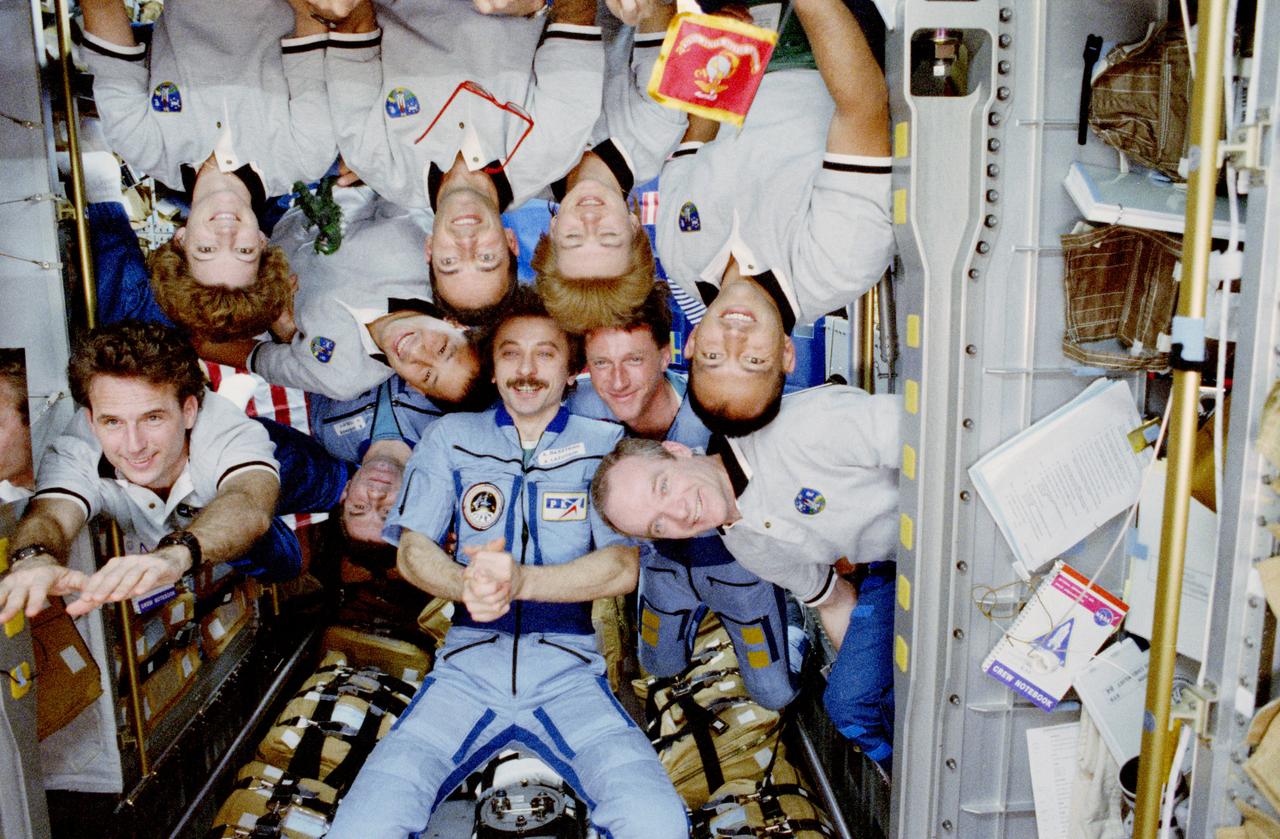
STS084-380-019 (15-24 May 1997) --- In the last minutes of joint activity between the STS-84 and Russian Space Agency (RSA) Mir-23 crews, ten astronauts and cosmonauts pose for an in-space portrait in the Space Shuttle Atlantis Spacehab Double Module (DM). For orientation purposes, photo should be held with clasped hands of Aleksandr I. Lazutkin (wearing Mir-23 suit) just below center. The flight engineer is flanked by similarly attired crew mates Vasili Tsibliyev, Mir-23 commander, on the left, and C. Michael Foale, cosmonaut guest researcher, on the right. The STS-84 crew members are, clockwise from the left, Jerry M. Linenger, mission specialist; Eileen M. Collins, pilot; Edward T. Lu, mission specialist; Jean-Fran?ois Clervoy, payload commander; Elena V. Kondakova and Carlos I. Noriega, both mission specialists, along with Charles J. Precourt, mission commander.
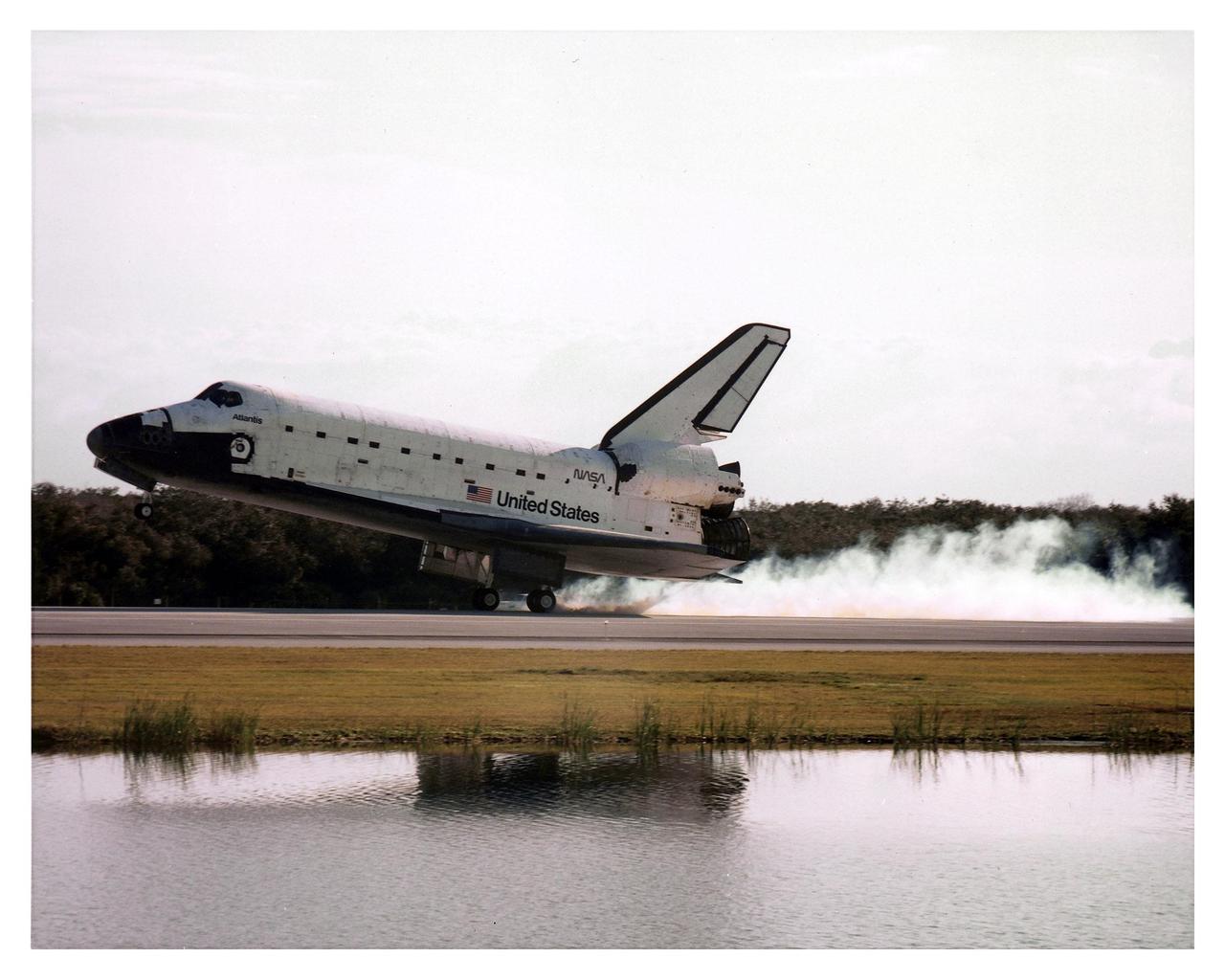
The Space Shuttle orbiter Atlantis touches down on Runway 33 at 9:22:44 a.m. EST Jan. 22 to conclude the fifth Shuttle-Mir docking mission and return NASA astronaut John Blaha to Earth after four months in space. Blaha was replaced by STS-81 Mission Specialist Jerry Linenger during the five days of docked operations. At main gear touchdown, the STS-81 mission duration was 10 days, 4 hours, 55 minutes. This was the 34th KSC landing in Shuttle history. Mission Commander Michael A. Baker flew Atlantis to a perfect landing, with help from Pilot Brent W. Jett, Jr. Other returning STS-81 crew members are Mission Specialists John M. Grunsfeld, Peter J. K. "Jeff" Wisoff and Marsha S. Ivins. Atlantis also brought back experiment samples from the Russian space station for analysis on Earth, along with Russian logistics equipment
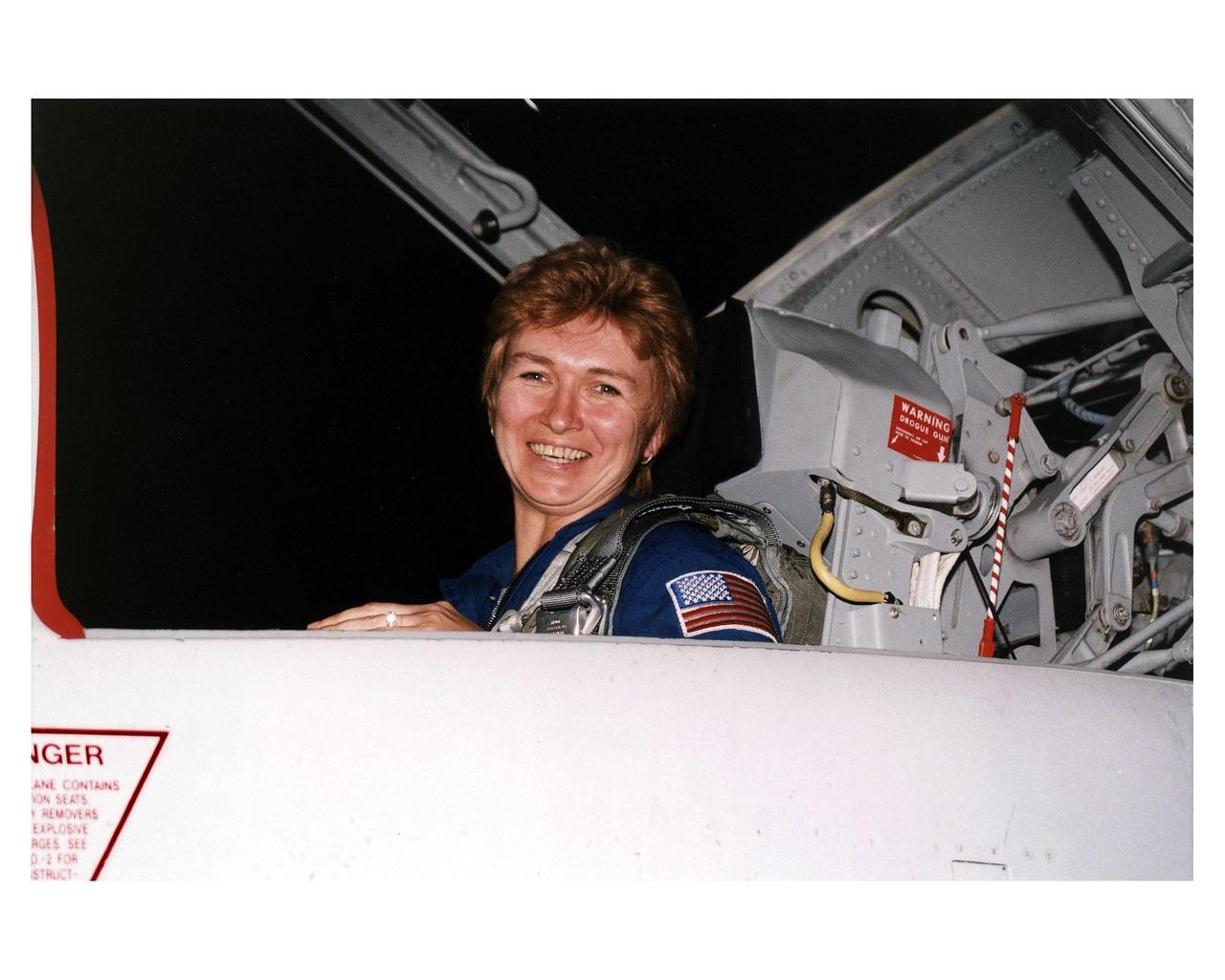
STS-84 Mission Specialist Elena V. Kondakova, a cosmonaut with the Russian Space Agency, arrives at KSC’s Shuttle Landing Facility. This will be Kondakova’s first flight on a U.S. Space Shuttle, but her second trip into space. She spent 169 days in space as flight engineer of the 17th main mission on the Russian Space Station Mir from October 1994 to March 1995. STS-84 will be the sixth docking of the Space Shuttle with the Mir. During the STS-84 docking, Mission Specialist C. Michael Foale will transfer to the Russian space station to become a member of the Mir 23 crew, replacing U.S. astronaut Jerry M. Linenger, who will return to Earth on Atlantis. Foale is scheduled to remain on Mir about four months until his replacement arrives on STS-86 in September
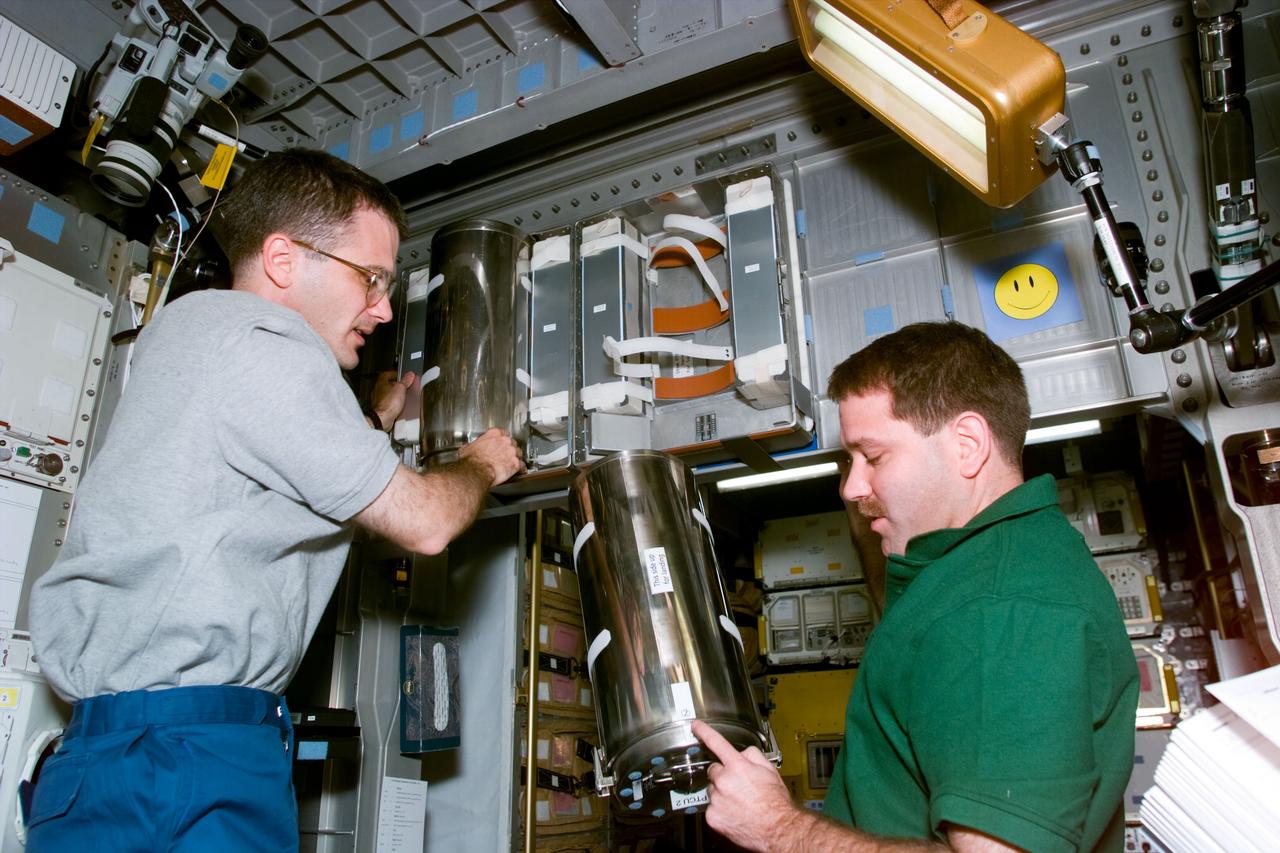
STS081-E-05094 (12 Jan. 1997) --- Astronauts Peter J. K. (Jeff) Wisoff (left) and John M. Grunsfeld, mission specialists, deploy two Passive Thermal Conditioning Units (PTCU) onboard the SPACEHAB Double Module (DM) late on Day 1 of the mission. The two units had been transported by the pair through the tunnel connecting SPACEHAB and the mid-deck of crew cabin of the Space Shuttle Atlantis. They are joined by four other NASA astronauts for the almost ten-day mission. The crew is scheduled to dock with Russia's Mir Space Station and pick up John E. Blaha, NASA astronaut who has been serving as a cosmonaut guest researcher since September 1996. Jerry M. Linenger (out of frame) will replace Blaha onboard Mir.
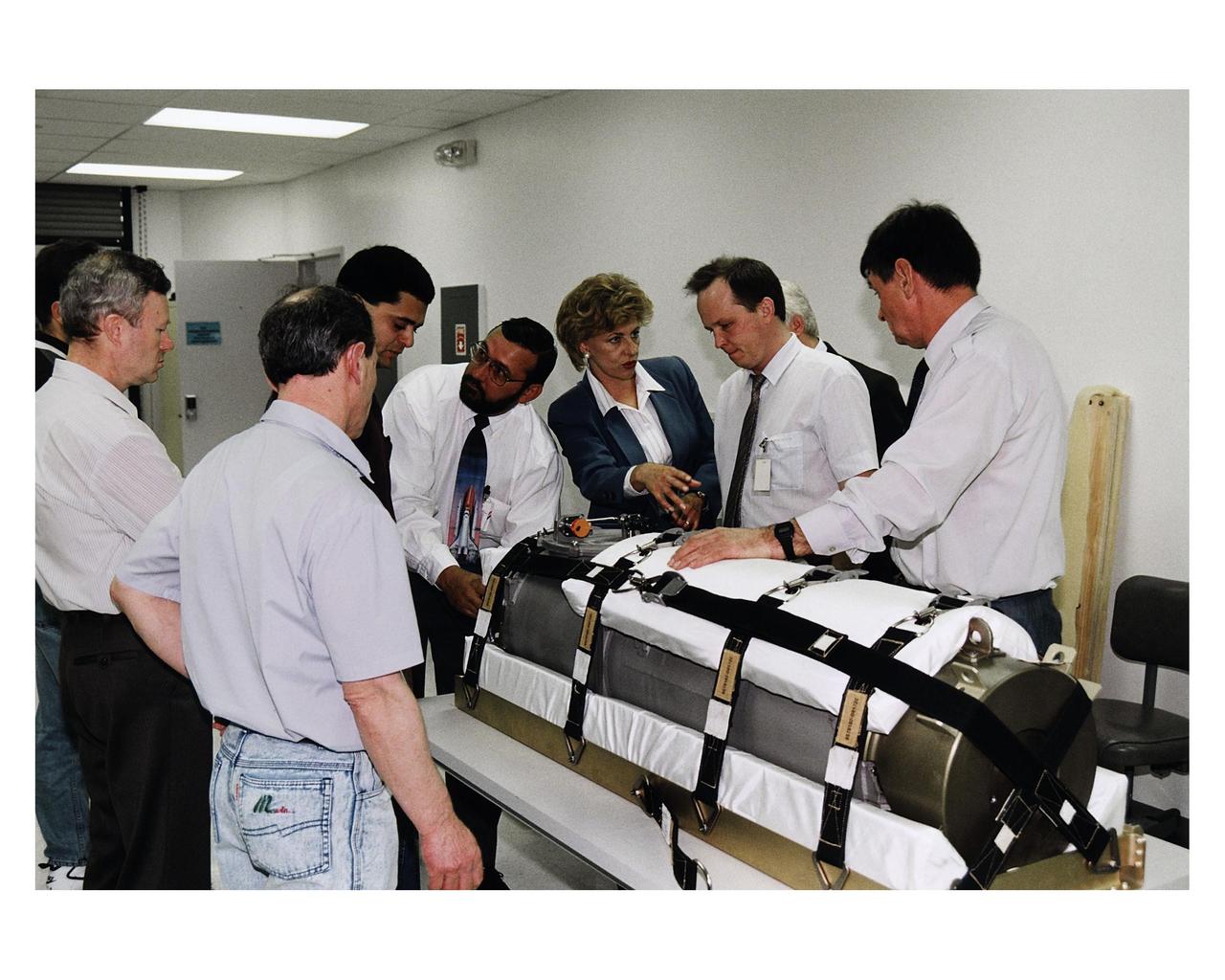
Representatives of RSC Energia in Russia and other onlookers in the SPACEHAB Payload Processing Facility examine an oxygen generator which the Space Shuttle Atlantis will carry to the Russian Mir Space Station on Mission STS-84. Sergei Romanov, second from right in the white shirt, is the spokesperson for generator manufacturer RSC Energia. The nearly 300-pound generator will be strapped down on the inside surface of a SPACEHAB Double Module for the trip to Mir. It will replace one of two Mir units that have been malfunctioning recently. The generator functions by electrolysis, which separates water into its oxygen and hydrogen components. The hydrogen is vented and the oxygen is used for breathing by the Mir crew. The generator is 4.2 feet in length and 1.4 feet in diameter. STS-84, which is planned to include a Mir crew exchange of astronaut C. Michael Foale for Jerry M. Linenger, is targeted for a May 15 liftoff. It will be the sixth Shuttle-Mir docking

McDonnell Douglas-SPACEHAB technicians oversee the move of a Russian-made oxygen generator to a SPACEHAB Double Module, at rear, in the SPACEHAB Payload Processing Facility. In foreground, from left, are Marc Tuttle, Dan Porter and Mike Vawter. The oxygen generator, manufactured in Russia by RSC Energia, will be carried aboard the Space Shuttle Atlantis on Mission STS-84 for the Shuttle’s scheduled docking with the Russian Space Station Mir next month. The nearly 300-pound generator will replace one of two Mir units that have been malfunctioning recently. The generator functions by electrolysis, which separates water into its oxygen and hydrogen components. The hydrogen is vented and the oxygen is used for breathing by the Mir crew. The generator is 4.2 feet in length and 1.4 feet in diameter. STS-84, which is planned to include a Mir crew exchange of astronaut C. Michael Foale for Jerry M. Linenger, is targeted for a May 15 liftoff
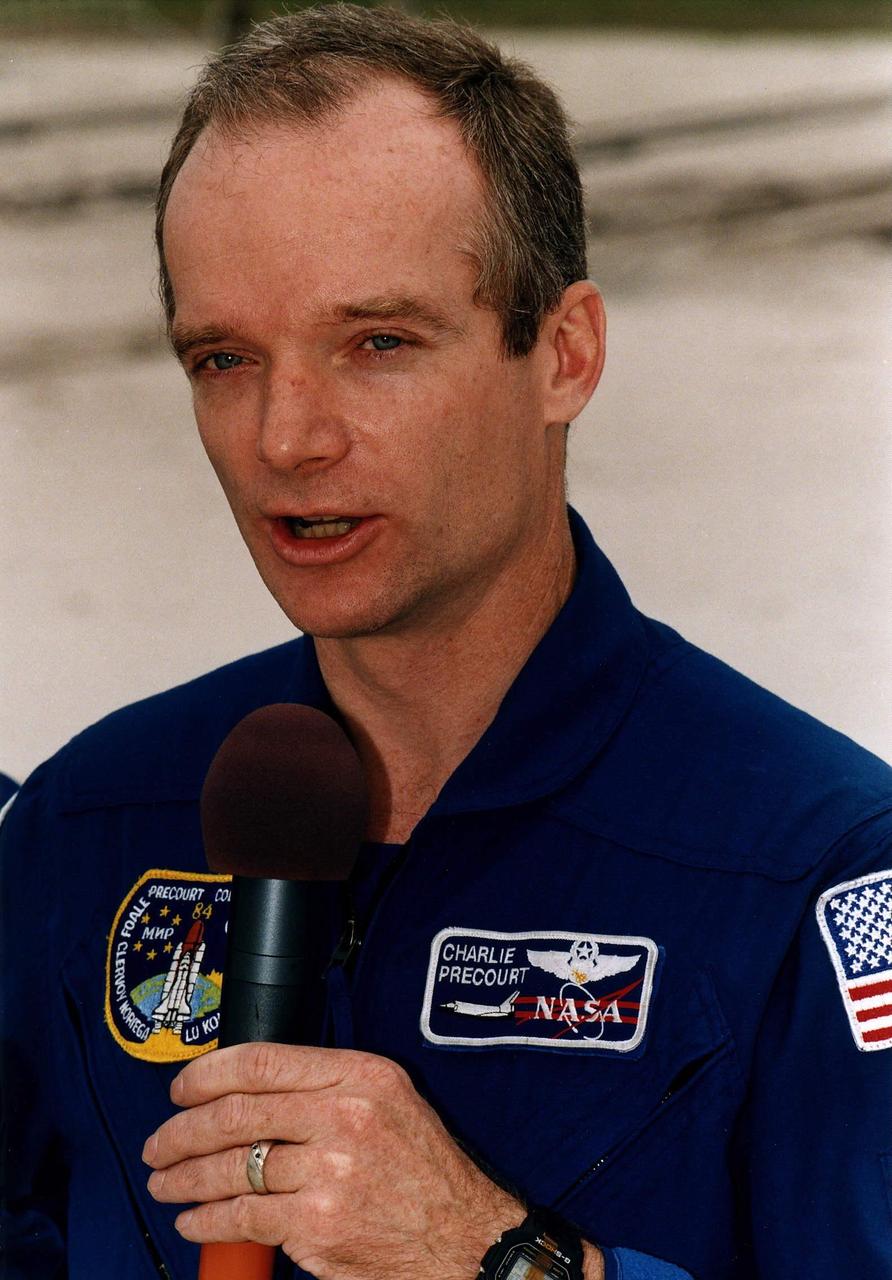
STS-84 Commander Charles J. Precourt talks to news media representatives and other onlookers during Terminal Countdown Demonstration Test (TCDT) activities at Launch Pad 39A. Two-time space flyer Precourt will lead the other six STS-84 crew members on the sixth docking of the Space Shuttle with the Russian Space Station Mir. One of the crew members, C. Michael Foale, will transfer to the space station and become a member of the Mir 23 crew, replacing U.S. astronaut Jerry M. Linenger, who will return to Earth aboard Atlantis. Foale will live and work on Mir until mid-September when his replacement is expected to arrive on the STS-86 mission. STS-84 is targeted for a May 15 liftoff
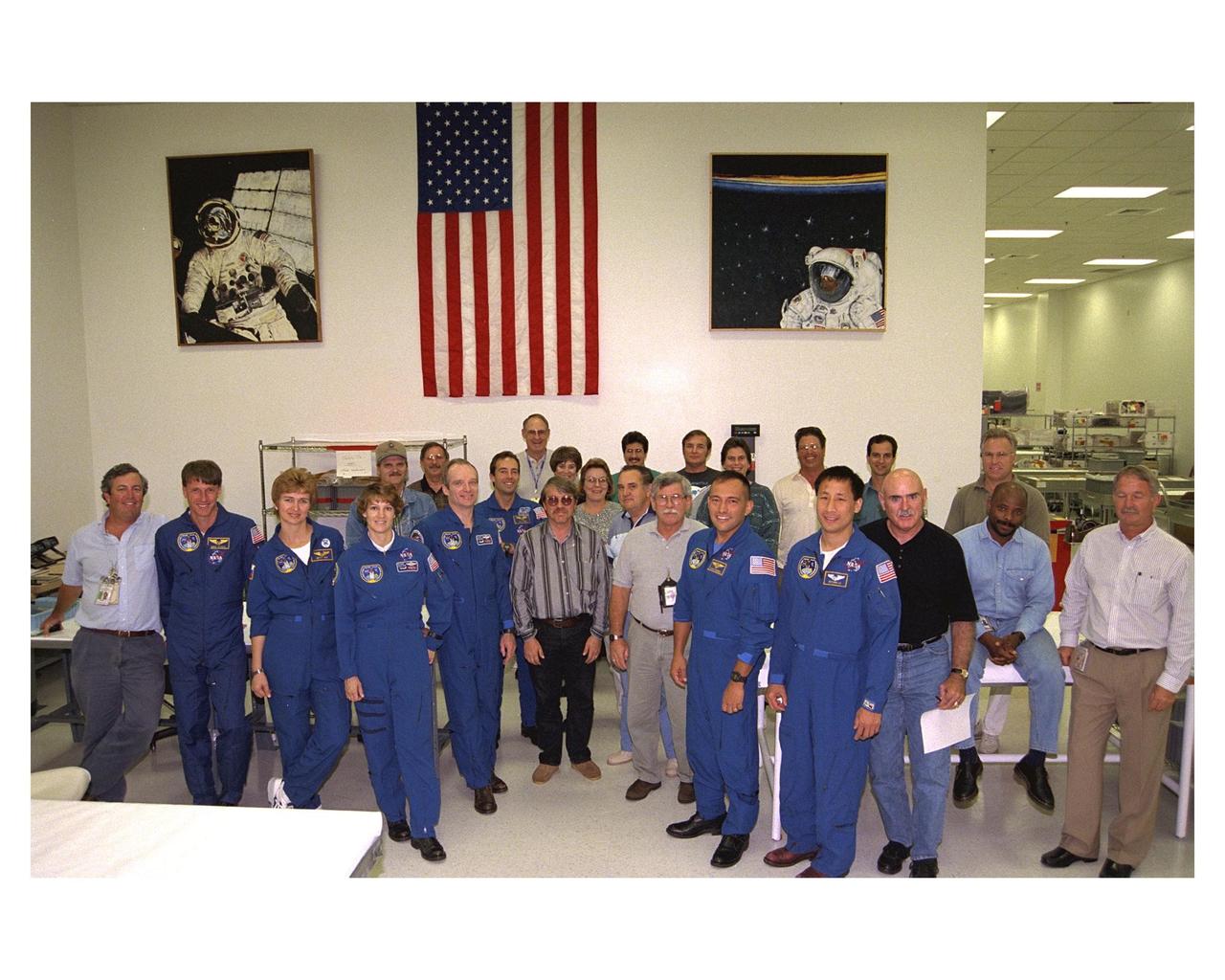
The STS-84 crew pose for a photograph with members of the mission payload team in the Space Station Processing Facility. Dressed in their blue flight suits, from left, are Mission Specialist C. Michael Foale, Elena V. Kondakova of the Russian Space Agency, Pilot Eileen Marie Collins, Commander Charles J. Precourt, Mission Specialist Jean-Francois Clervoy of the European Space Agency, Mission Specialist Carlos I. Noriega and Mission Specialist Edward Tsang Lu. STS-84 aboard the Space Shuttle Atlantis will be the sixth docking of the Space Shuttle with the Russian Space Station Mir. After docking, Foale will transfer to the space station and become a member of the Mir 23 crew, replacing U.S. astronaut Jerry M. Linenger, who will return to Earth aboard Atlantis. Foale will live and work on Mir until mid-September when his replacement is expected to arrive on the STS-86 mission. STS-84 is targeted for a May 15 liftoff
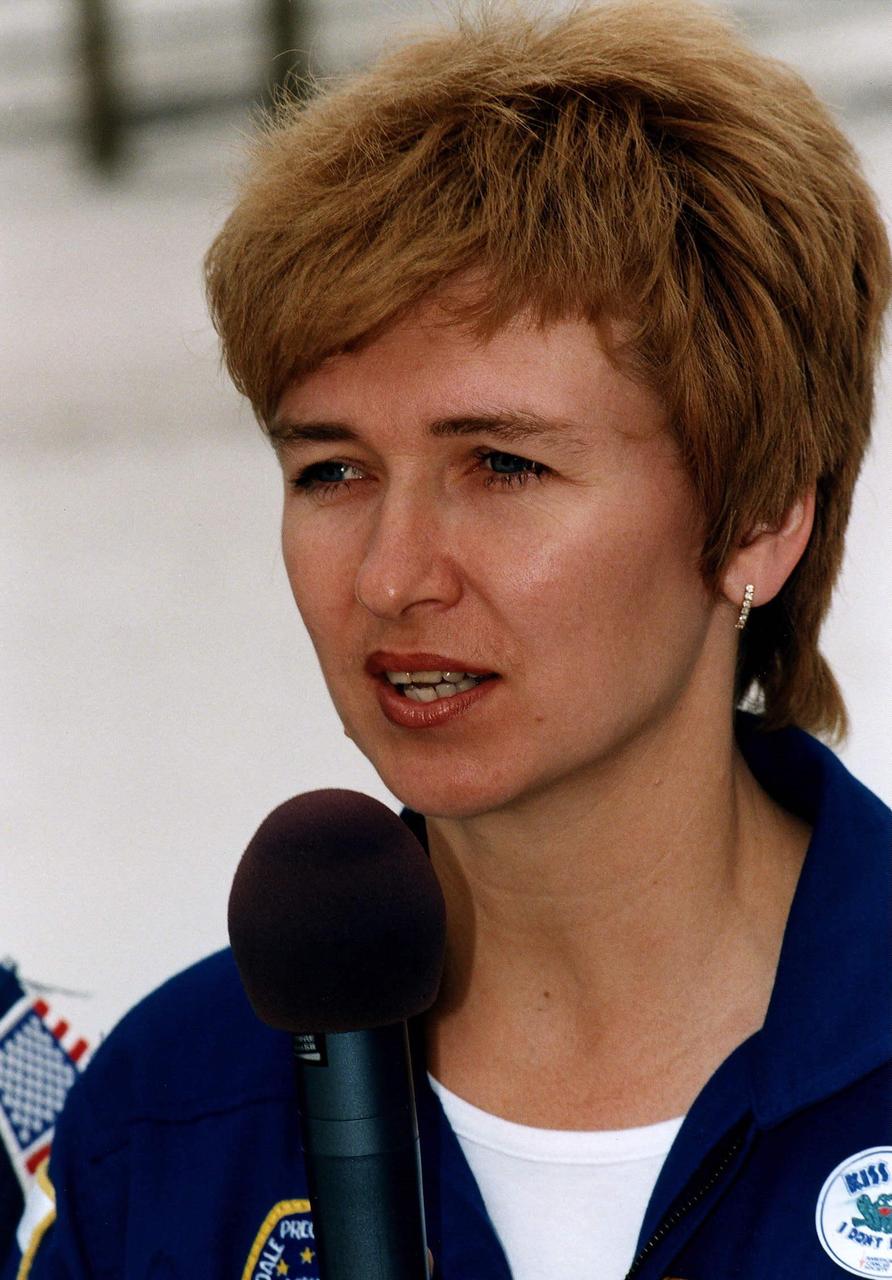
STS-84 Mission Specialist Elena V. Kondakova, a cosmonaut with the Russian Space Agency, talks to news media representatives and other onlookers during Terminal Countdown Demonstration Test (TCDT) activities at Launch Pad 39A. Kondakova will be one of seven crew members on the sixth docking of the Space Shuttle with the Russian Space Station Mir. Another of the crew members, C. Michael Foale, will transfer to the space station and become a member of the Mir 23 crew, replacing U.S. astronaut Jerry M. Linenger, who will return to Earth aboard Atlantis. Foale will live and work on Mir until mid-September when his replacement is expected to arrive on the STS-86 mission. Kondakova previously lived on the Russian space station as the flight engineer of the 17th main mission on Mir from Oct. 4, 1994, to March 9, 1995. STS-84 is targeted for a May 15 liftoff
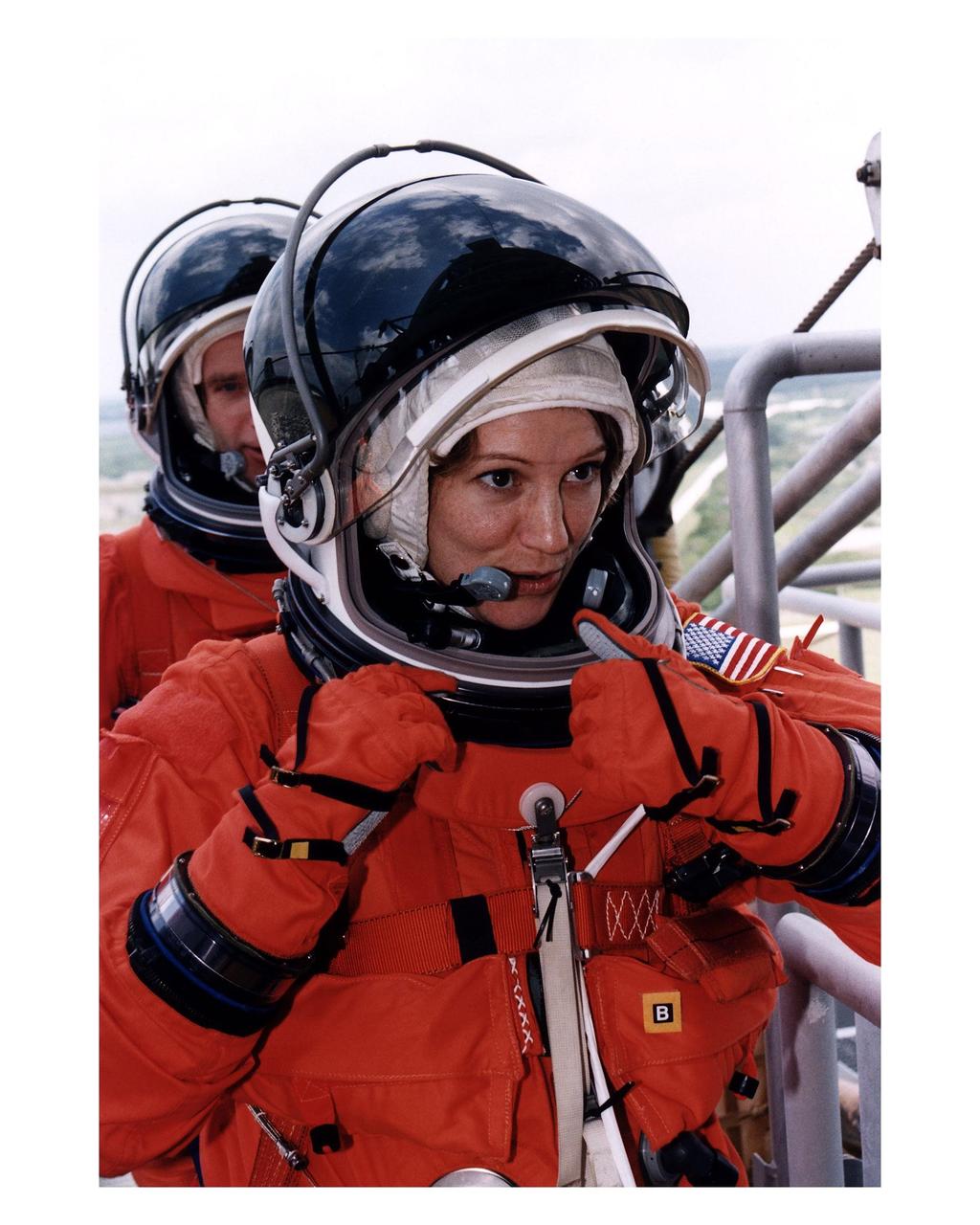
STS-84 Pilot Eileen Marie Collins participates in Terminal Countdown Demonstration Test (TCDT) activities at Launch Pad 39A. Behind her is Commander Charles J. Precourt. TCDT is a dress rehearsal for the launch, which is scheduled May 15. STS-84 aboard Atlantis will be the sixth docking of the Space Shuttle with the Russian Space Station Mir. After docking, STS-84 Mission Specialist C. Michael Foale will transfer to the space station and become a member of the Mir 23 crew, replacing U.S. astronaut Jerry M. Linenger, who will return to Earth aboard Atlantis. Foale will live and work on Mir until mid-September when his replacement is expected to arrive on the STS-86 mission
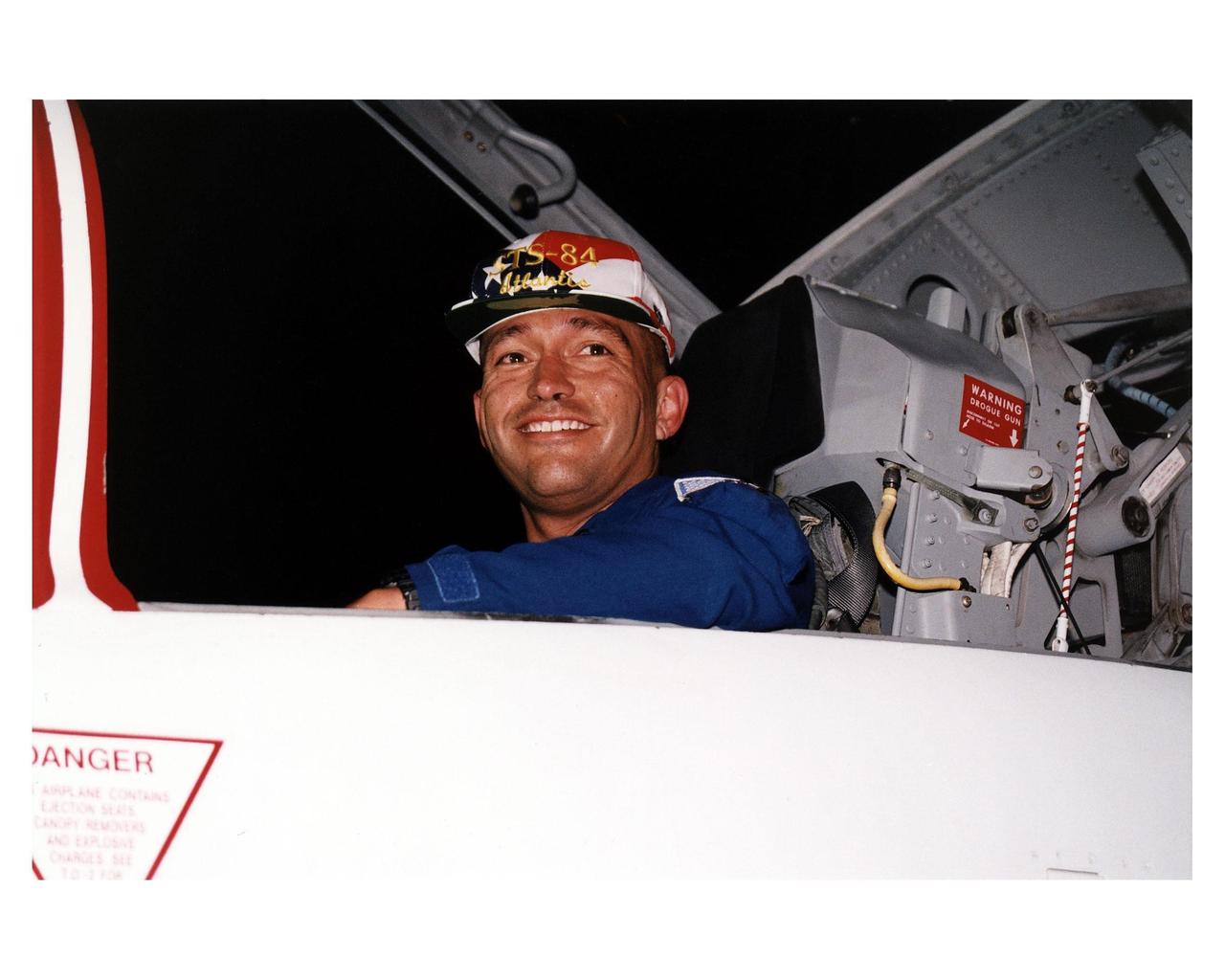
STS-84 Mission Specialist Carlos I. Noriega arrives in a T-38 jet at KSC’s Shuttle Landing Facility. The pilot of the plane is astronaut Frank Culbertson, who is the NASA director of the Phase One Program of the International Space Station. STS-84 will be Noriega’s first space flight. The nine-day mission will be the sixth docking of the Space Shuttle with the Russian Space Station Mir. During the docking, STS-84 Mission Specialist C. Michael Foale will transfer to the Russian space station to become a member of the Mir 23 crew, replacing U.S. astronaut Jerry M. Linenger, who will return to Earth on Atlantis. Foale is scheduled to remain on Mir about four months until his replacement arrives on STS-86 in September
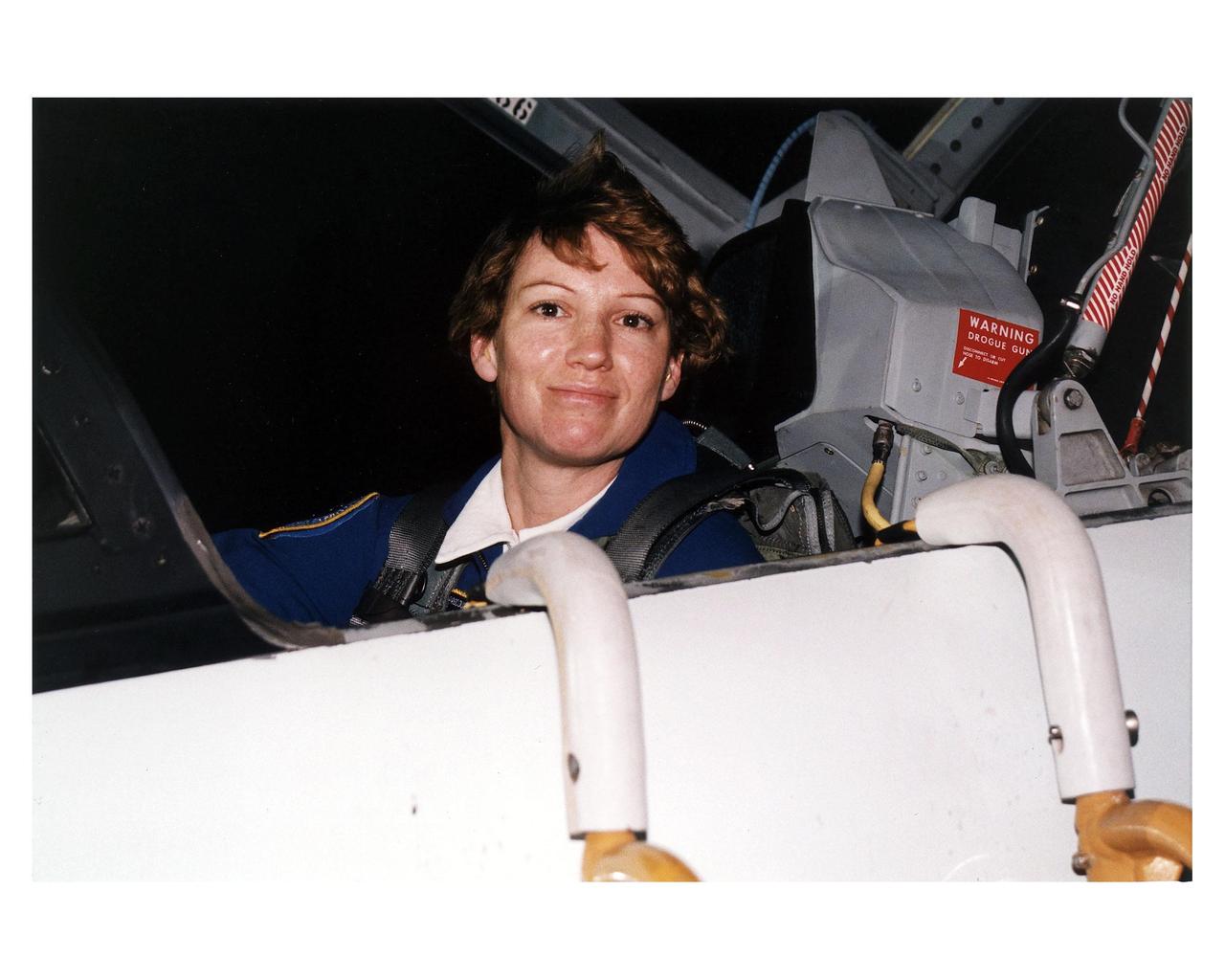
STS-84 Pilot Eileen Marie Collins arrives in a T-38 jet at KSC’s Shuttle Landing Facility. Collins will make her second space flight on STS-84. Her initial flight was as the first woman Shuttle pilot on STS-63 in 1995. STS-84 will be the sixth docking of the Space Shuttle with the Russian Space Station Mir. During the docking, STS-84 Mission Specialist C. Michael Foale will transfer to the Russian space station to become a member of the Mir 23 crew, replacing U.S. astronaut Jerry M. Linenger, who will return to Earth on Atlantis. Foale is scheduled to remain on Mir about four months until his replacement arrives on STS-86 in September

Greeted by cheers from wellwishers at KSC and eager for their venture into space on the fifth Shuttle-Mir docking mission, the STS-81 astronauts depart the Operations and Checkout Building on their way to Launch Pad 39B. Leading the six-member crew is Mission Commander Michael A. Baker, followed by Pilot Brent W. Jett, Jr. Behind them are Mission Specialists John M. Grunsfeld, Jerry Linenger, Peter J. K. "Jeff" Wisoff, and Marsha S. Ivins. Their trip to the pad will take about 25 minutes aboard the Astrovan. Once there, they will take their positions in the crew cabin of the Space Shuttle Atlantis to await a liftoff during a seven-minute window that will open at 4:27 a.m. EST, January 12
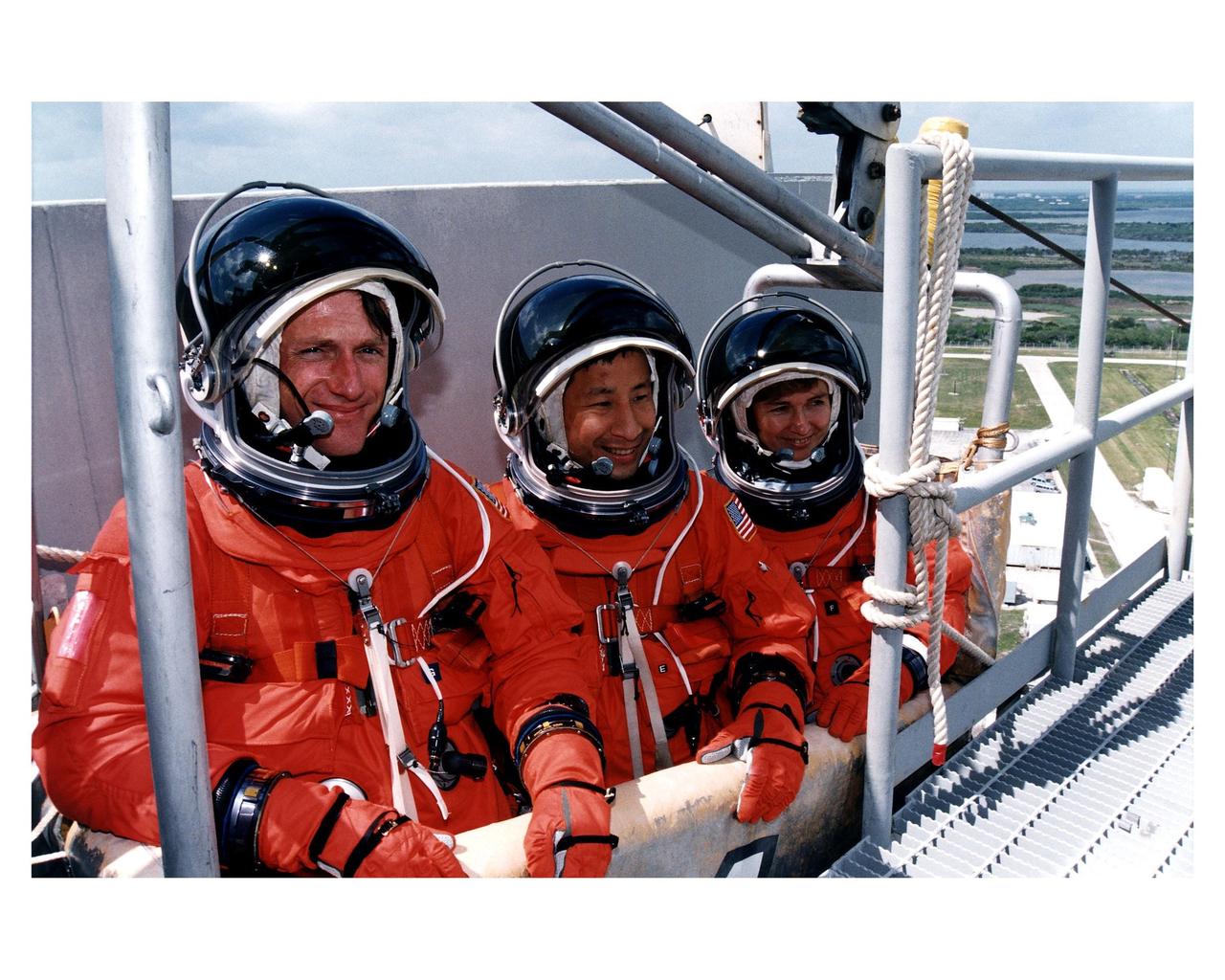
STS-84 Mission Specialists, from left, C. Michael Foale, Edward Tsang Lu and Elena V. Kondakova practice emergency egress procedures in a slidewire basket at Launch Pad 39A. They and the other four members of the STS-84 crew are participating in the Terminal Countdown Demonstration Test (TCDT), a dress rehearsal for launch. STS-84 aboard Atlantis will be the sixth docking of the Space Shuttle with the Russian Space Station Mir. After docking, Foale will transfer to the space station and become a member of the Mir 23 crew, replacing U.S. astronaut Jerry M. Linenger, who will return to Earth aboard Atlantis. Foale will live and work on Mir until mid-September when his replacement is expected to arrive on the STS-86 mission. STS-84 is targeted for a May 15 liftoff
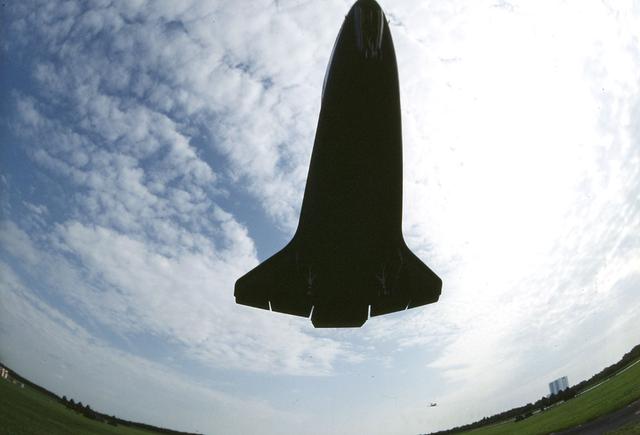
This unusual view of the underside of the Space Shuttle Orbiter Atlantis was taken by a fish-eye camera lens from Kennedy Space Center (KSC) Shuttle Landing Facility shortly before landing on May 24, 1997. Atlantis was wrapping up its nine-day mission, which was the sixth docking with the Mir space station. STS-84 Mission Specialist C. Michael Foale replaced astronaut and Mir 23 crew member Jerry M. Linenger, who had been on the Russian space station since January 15. Foale was scheduled to remain on Mir for approximately four months, until replaced by STS-86 crew member Wendy B. Lawrence in September 1997. Besides docking and crew exchange, this mission included the transfer of more than 7,300 pounds of water, logistics and science experiments, and hardware to and from Mir.
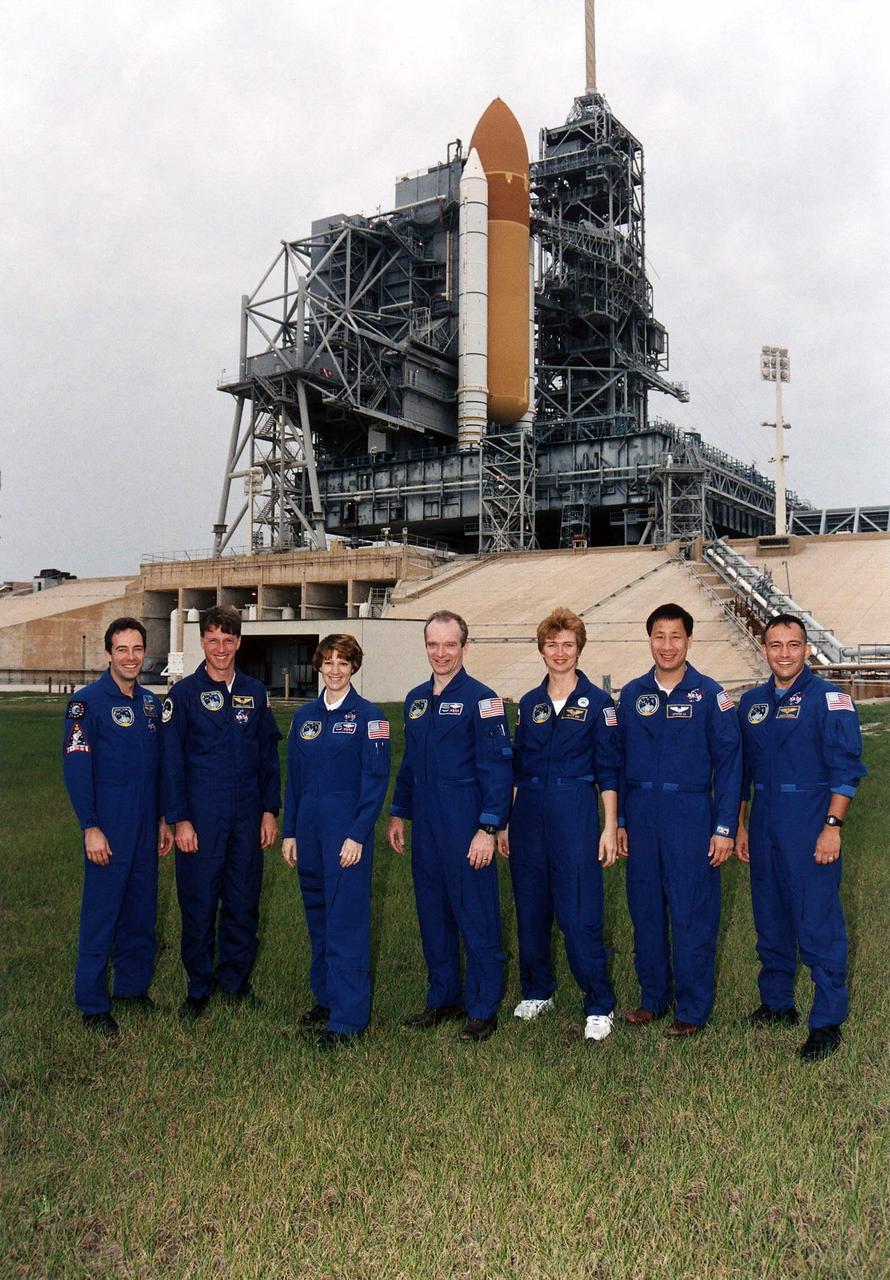
STS-84 crew members pose for a group photograph at Launch Pad 39A, where the Space Shuttle Atlantis is poised for liftoff on the sixth Shuttle-Mir docking mission. From left, are Mission Specialist Jean-Francois Clervoy of the European Space Agency, Mission Specialist C. Michael Foale, Pilot Eileen Marie Collins, Commander Charles J. Precourt, Mission Specialist Elena V. Kondakova of the Russian Space Agency, and Mission Specialists Edward Tsang Lu and Carlos I. Noriega. They are at KSC to participate in the Terminal Countdown Demonstration Test (TCDT), a dress rehearsal for launch. After the docking, Foale will transfer to the Russian Space Station Mir, becoming a member of the Mir 23 crew. He will replace Jerry M. Linenger, who will return to Earth on Atlantis. Liftoff of STS-84 is targeted for May 15
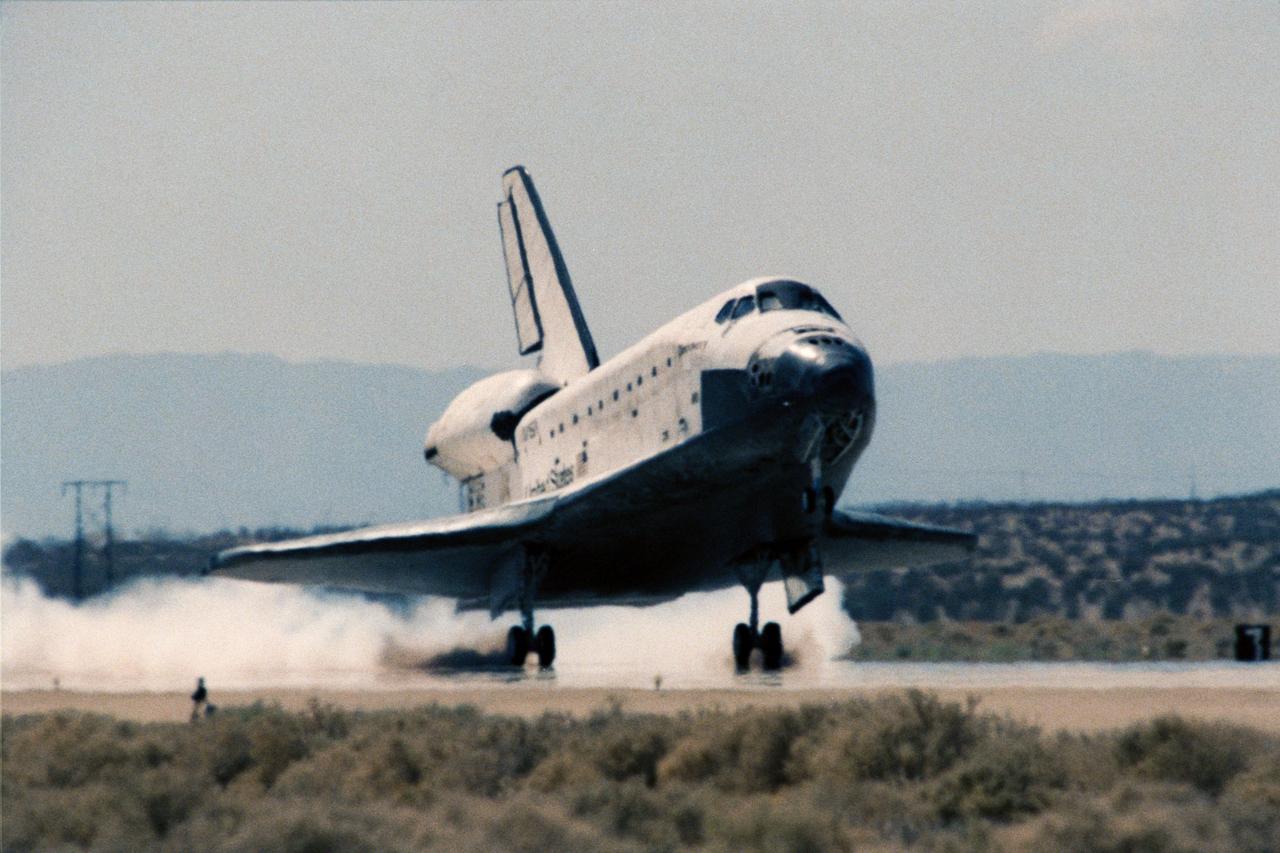
STS64-S-094 (20 Sept. 1994) --- The space shuttle Discovery, with a crew of six NASA astronauts aboard, touches down on Runway 04 at Edwards Air Force Base (EAFB), completing a 10-day, 22-hour and 50-minute mission. Following a de-orbit engine firing at 1:14 p.m. (PDT), Sept. 20, 1994. Touchdown was at 2:12:59 p.m., and the nose wheel touched down at 2:13:03 p.m., with wheel stop at 2:13:52 p.m. Bad weather in Florida called for an "eleventh hour" shift to the California landing site. Onboard for the flight, whose mission was to study Earth's atmosphere and to test tools and procedures for the International Space Station, were astronauts Richard N. Richards, L. Blaine Hammond Jr., Mark C. Lee, Carl J. Meade, Susan J. Helms and Jerry M. Linenger. Photo credit: NASA or National Aeronautics and Space Administration
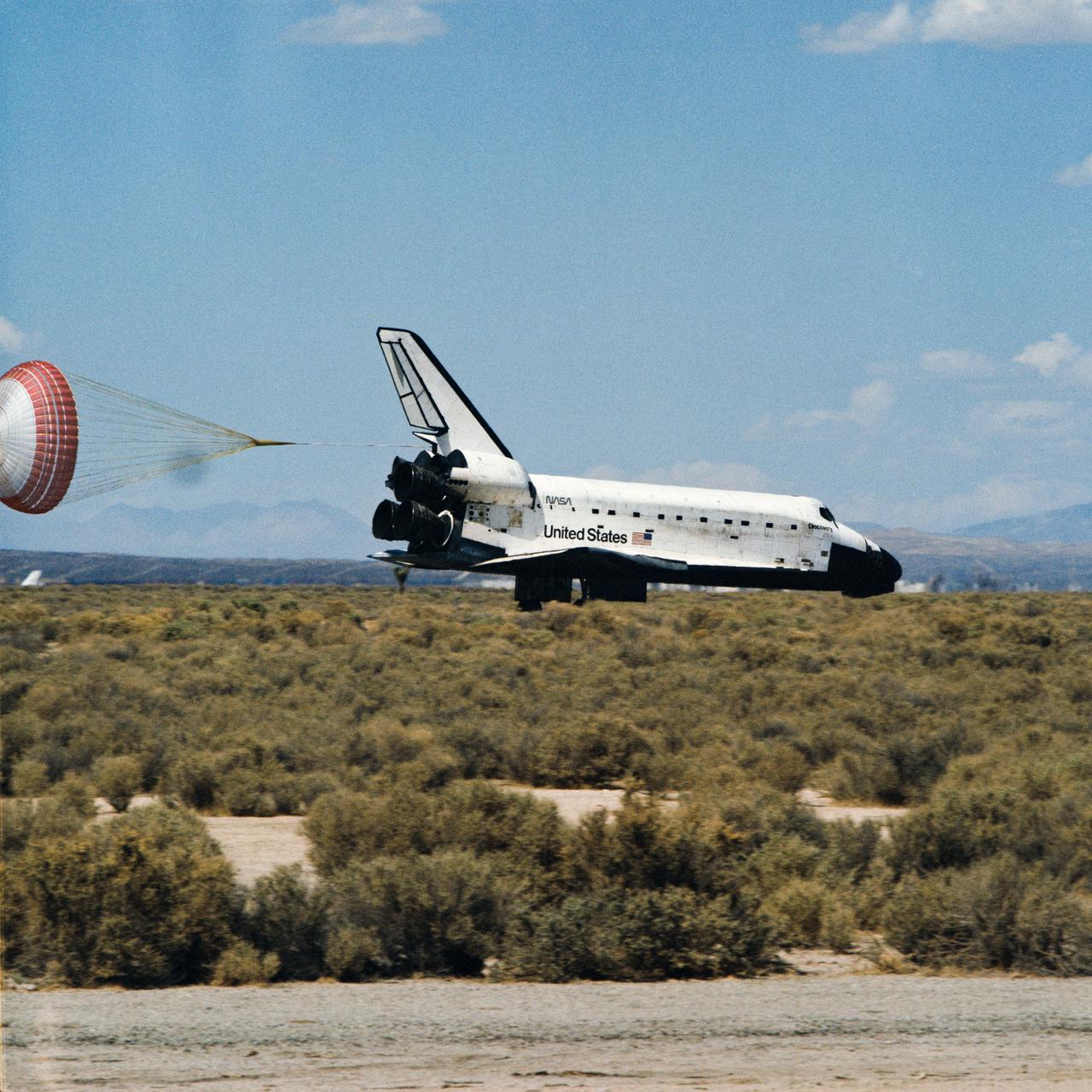
STS64-S-073 (20 Sept. 1994) --- The drag chute for the space shuttle Discovery is deployed as NASA's most-heavily flown spacecraft completes a 10-day, 22-hour and 50-minute mission. Discovery, with a crew of six NASA astronauts aboard, fired its de-orbit engine at 1:14 p.m. (PDT), Sept. 20, 1994. Touchdown was at 2:12:59 p.m. and the nose wheel touched down at 2:13:03 p.m., with wheel stop at 2:13:52 p.m. Bad weather in Florida called for an "eleventh hour" shift to the California landing site. Onboard for the flight, whose mission was to study Earth's atmosphere and to test tools and procedures for the International Space Station (ISS), were astronauts Richard N. Richards, L. Blaine Hammond, Mark C. Lee, Carl J. Meade, Susan J. Helms and Jerry M. Linenger. Photo credit: NASA or National Aeronautics and Space Administration
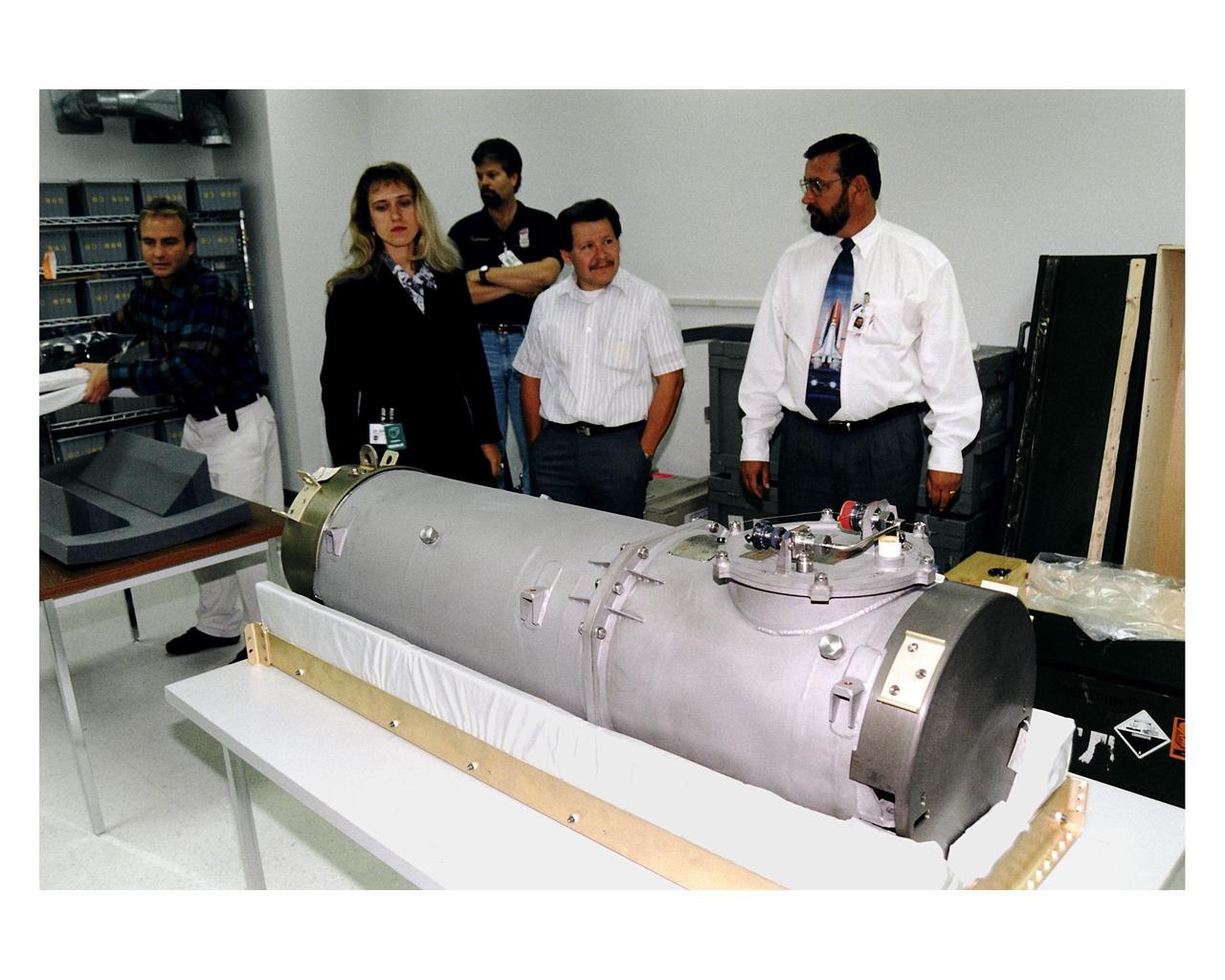
An oxygen generator destined to replace a malfunctioning unit on the Russian Mir Space Station is the object of much curiosity during preflight preparations in the SPACEHAB Payload Processing Facility. A SPACEHAB Double Module on the Space Shuttle Atlantis will carry the oxygen generator to Mir during STS-84, the sixth Shuttle-Mir docking. The nearly 300-pound generator, manufactured by RSC Energia in Russia, will replace one of two Mir units that have been malfunctioning recently. The generator functions by electrolysis, which separates water into its oxygen and hydrogen components. The hydrogen is vented and the oxygen is used for breathing by the Mir crew. The generator is 4.2 feet in length and 1.4 feet in diameter. STS-84, which is planned to include a Mir crew exchange of astronaut C. Michael Foale for Jerry M. Linenger, is targeted for a May 15 liftoff
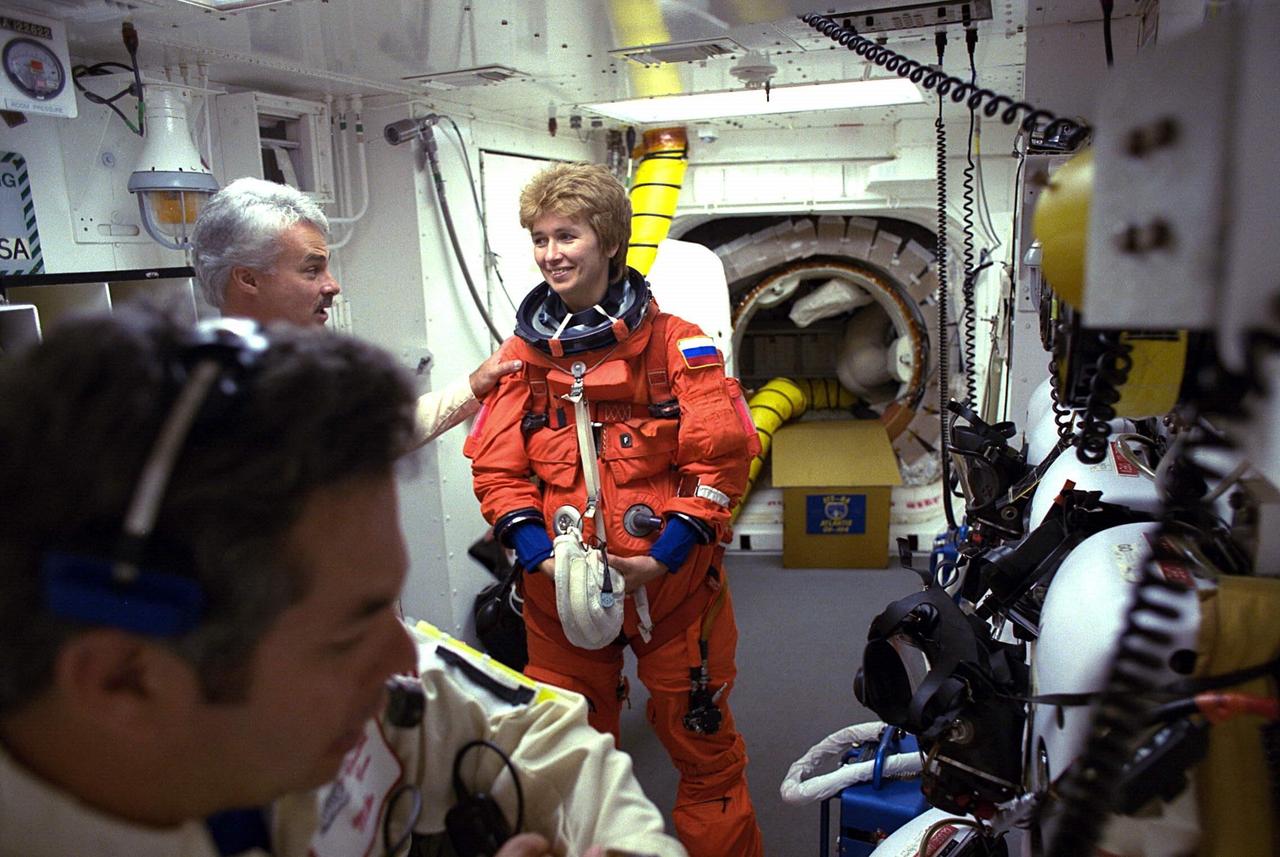
STS-84 Mission Specialist Elena V. Kondakova prepares to enter the Space Shuttle Atlantis at Launch Pad 39A with help from white room closeout crew members. The fourth Shuttle mission of 1997 will be the sixth docking of the Space Shuttle with the Russian Space Station Mir. The commander is Charles J. Precourt. The pilot is Eileen Marie Collins. The five mission specialists are C. Michael Foale, Carlos I. Noriega, Edward Tsang Lu, Jean-Francois Clervoy of the European Space Agency and Elena V. Kondakova of the Russian Space Agency. The planned nine-day mission will include the exchange of Foale for U.S. astronaut and Mir 23 crew member Jerry M. Linenger, who has been on Mir since Jan. 15. Linenger transferred to Mir during the last docking mission, STS-81; he will return to Earth on Atlantis. Foale is slated to remain on Mir for about four months until he is replaced in September by STS-86 Mission Specialist Wendy B. Lawrence. During the five days Atlantis is scheduled to be docked with the Mir, the STS-84 crew and the Mir 23 crew, including two Russian cosmonauts, Commander Vasily Tsibliev and Flight Engineer Alexander Lazutkin, will participate in joint experiments. The STS-84 mission also will involve the transfer of more than 7,300 pounds of water, logistics and science equipment to and from the Mir. Atlantis is carrying a nearly 300-pound oxygen generator to replace one of two Mir units which have experienced malfunctions. The oxygen it generates is used for breathing by the Mir crew