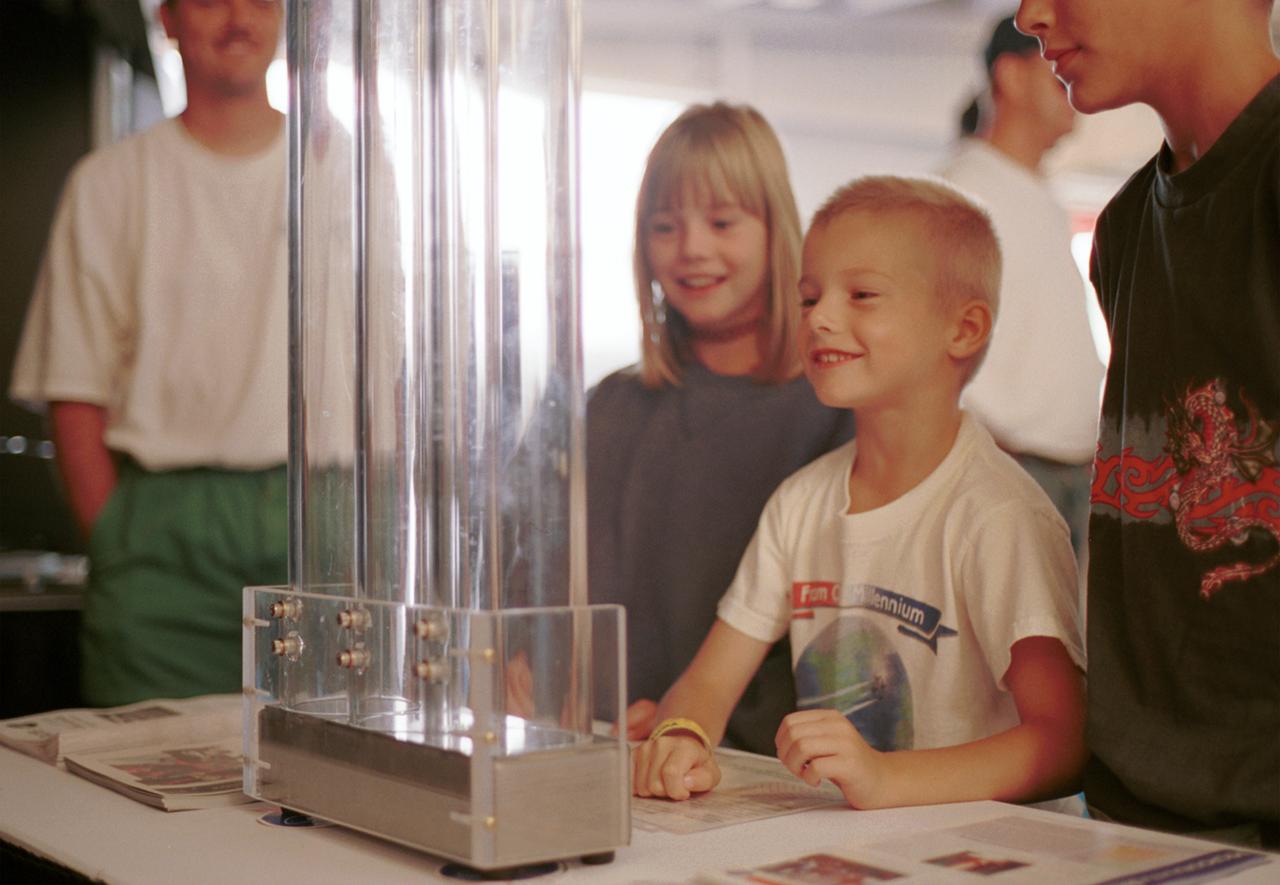
An entranced youngster watches a demonstration of the enhanced resilience of undercooled metal alloys as compared to conventional alloys. Steel bearings are dropped onto plates made of steel, titanium alloy, and zirconium liquid metal alloy, so-called because its molecular structure is amorphous and not crystalline. The bearing on the liquid metal plate bounces for a minute or more longer than on the other plates. Experiments aboard the Space Shuttle helped scientists refine their understanding of the physical properties of certain metal alloys when undercooled (i.e., kept liquid below their normal solidification temperature). This new knowledge then allowed scientists to modify a terrestrial production method so they can now make limited quantities marketed under the Liquid Metal trademark. The exhibit was a part of the NASA outreach activity at AirVenture 2000 sponsored by the Experimental Aircraft Association in Oshkosh, WI.

Angie Jackman, a NASA project manager in microgravity research, demonstrates the enhanced resilience of undercooled metal alloys as compared to conventional alloys. Experiments aboard the Space Shuttle helped scientists refine their understanding of the physical properties of certain metal alloys when undercooled (i.e., kept liquid below their normal solidification temperature). This new knowledge then allowed scientists to modify a terrestrial production method so they can now make limited quantities marketed under the Liquid Metal trademark. The exhibit was a part of the NASA outreach activity at AirVenture 2000 sponsored by the Experimental Aircraft Association in Oshkosh, WI.
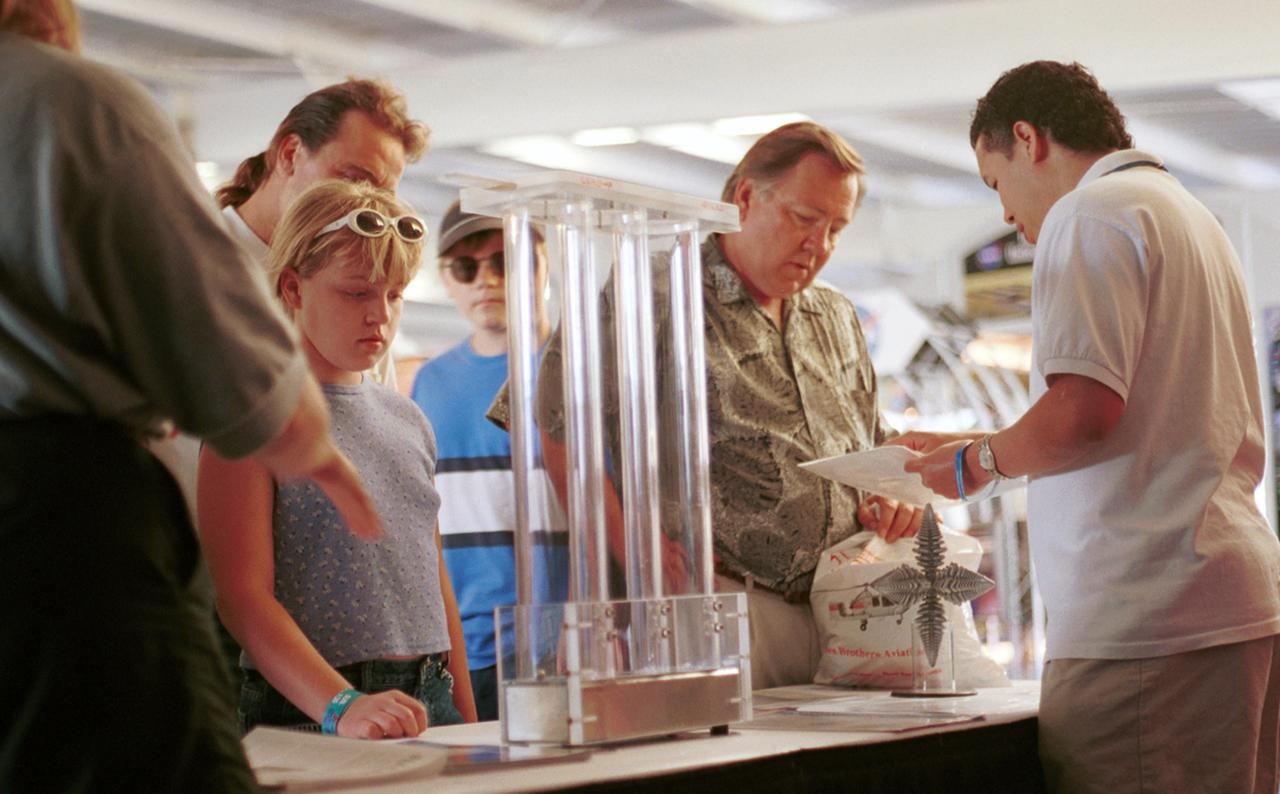
Paul Luz (right), an aerospace flight system engineer at NASA's Marshall Space Flight Center (MSFC), discusses microgravity research with a visitor at AirVenture 2000. Part of the NASA exhibits included demonstration of knowledge gained from micorgravity research aboard the Space Shuttle. These include liquid metal (Liquid metal demonstrator is three plastic drop tubes at center) and dendritic growth (in front of Luz), both leading to improvements in processes on Earth. The exhibit was part of the NASA outreach activity at AirVenture 2000 sponsored by the Experimental Aircraft Association in Oshkosh, WI.
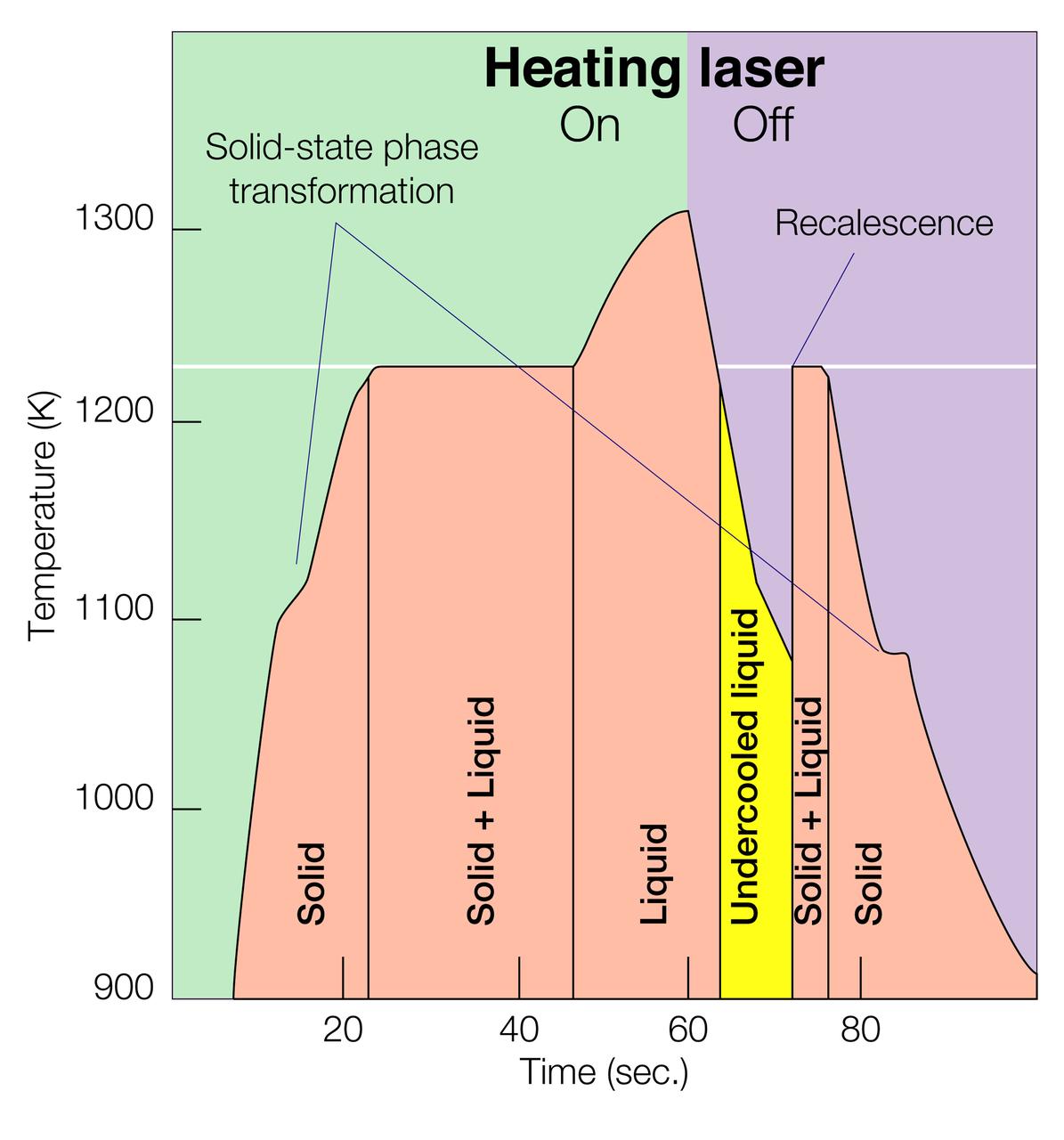
Graph depicting Electrostatic Levitator (ESL) heating and cooling cycle to achieve undercooling of liquid metals. The ESL uses static electricity to suspend an object (about 3-4 mm in diameter) inside a vacuum chamber while a laser heats the sample until it melts. This lets scientists record a wide range of physical properties without the sample contracting the container or any instruments, conditions that would alter the readings. The electrostatic Levitator is one of several tools used in NASA's microgravity matierials sciences program.
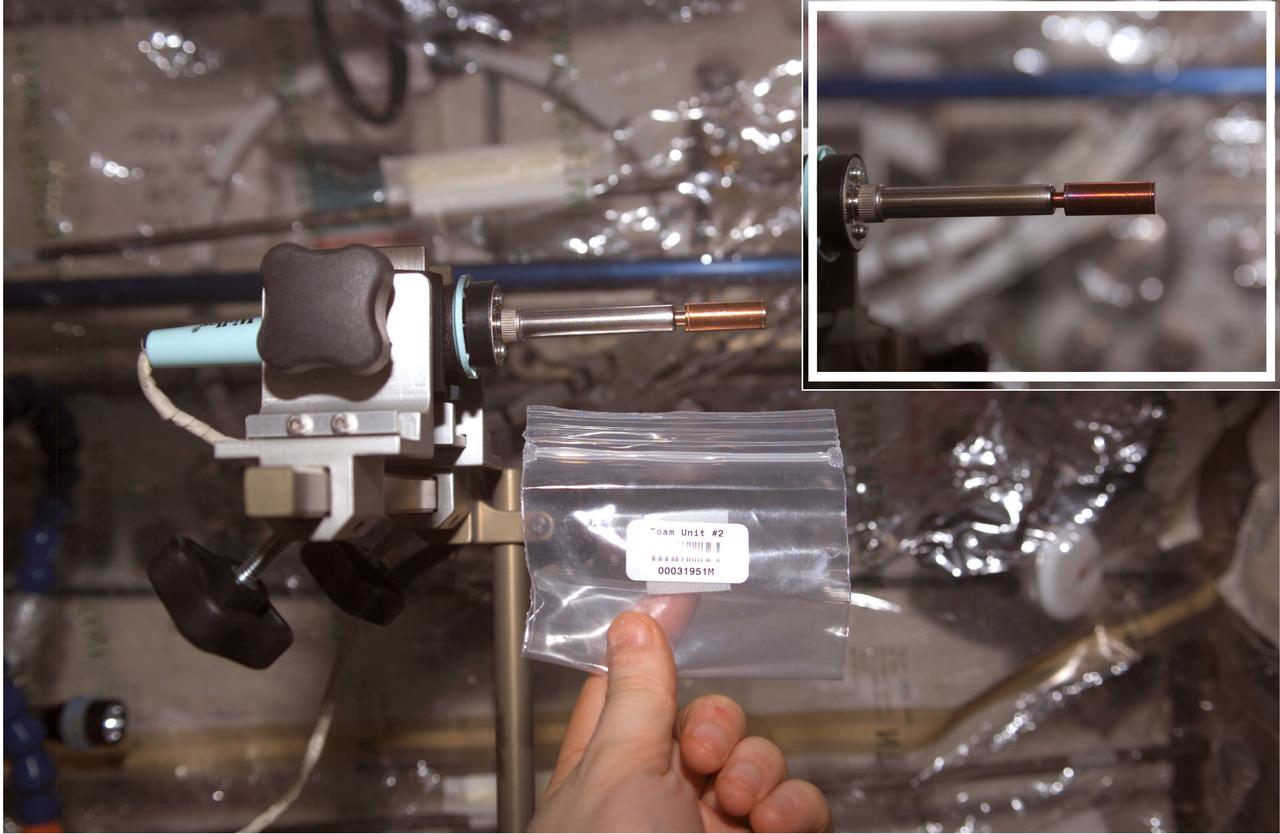
This soldering iron has an evacuated copper capsule at the tip that contains a pellet of Bulk Metallic Glass (BMG) aboard the International Space Station (ISS). Prior to flight, researchers sealed a pellet of bulk metallic glass mixed with microscopic gas-generating particles into the copper ampoule under vacuum. Once heated in space, such as in this photograph, the particles generated gas and the BMG becomes a viscous liquid. The released gas made the sample foam within the capsule where each microscopic particle formed a gas-filled pore within the foam. The inset image shows the oxidation of the sample after several minutes of applying heat. Although hidden within the brass sleeve, the sample retained the foam shape when cooled, because the viscosity increased during cooling until it was solid.
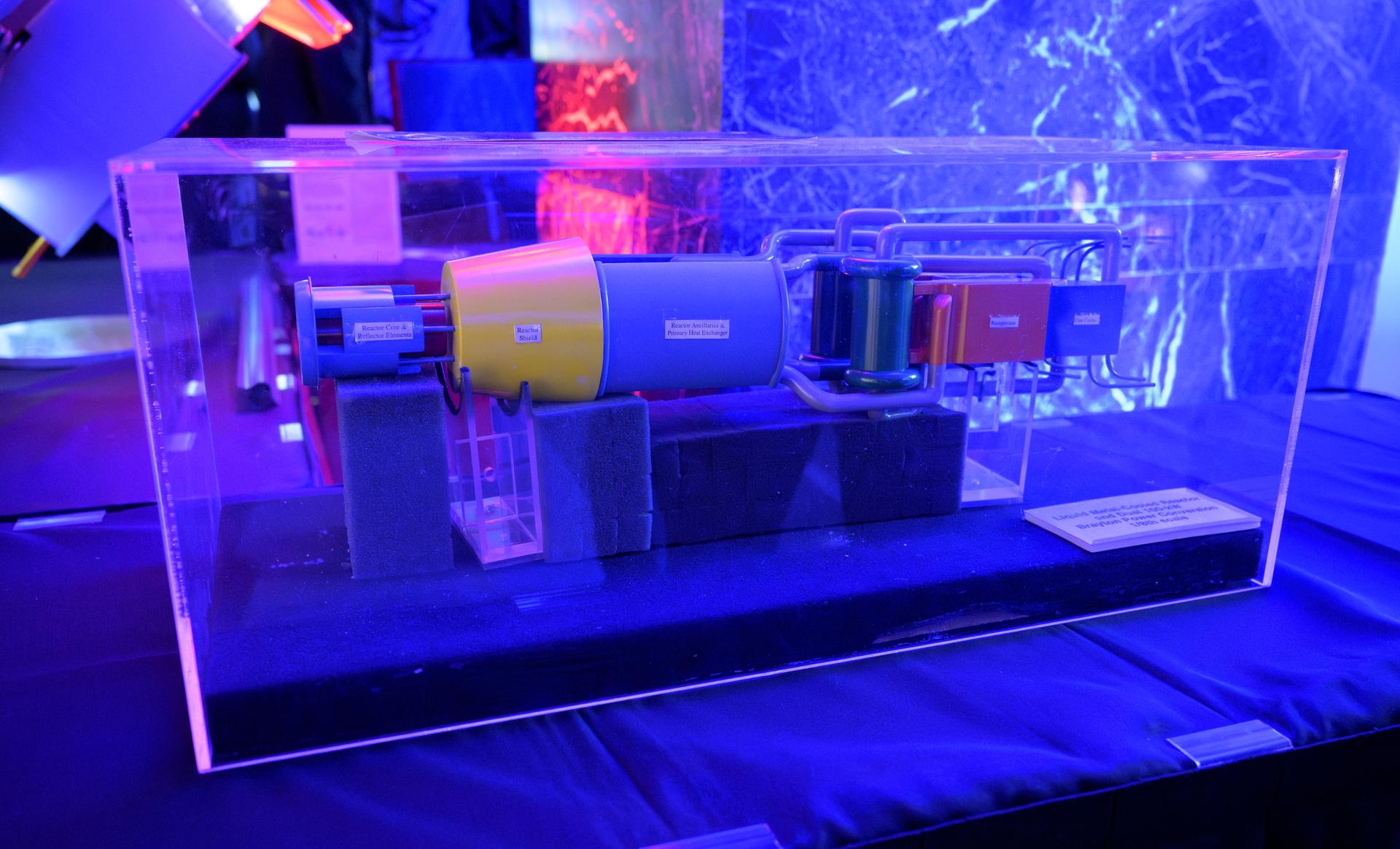
A model of a liquid metal-cooled reactor, dual 100-kw Brayton Power Conversion is seen on display during an event where NASA is outlining how the agency is executing President Donald J. Trump’s National Space Policy and accelerating preparations for America’s return to the surface of the Moon by 2028, Tuesday, March 24, 2026, at the Mary W. Jackson NASA Headquarters building in Washington. During the event NASA leadership provided updates on mission priorities, including sending the first astronauts to the lunar surface in more than 50 years, establishing the initial elements of a permanent lunar base, getting America underway in space on nuclear propulsion, and other objectives. Photo Credit: (NASA/Bill Ingalls)
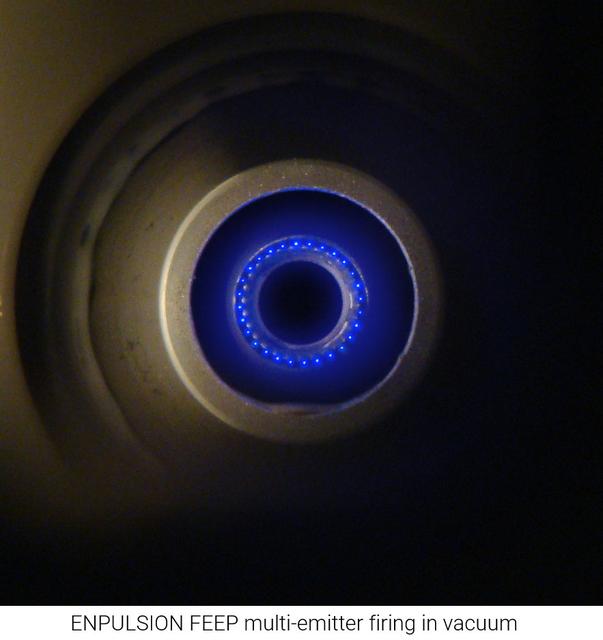
jsc2025e076913 (September 25, 2025) -- This image shows the ENPULSION thruster during a ground test, where blue light appears as ions are released from liquid indium metal. The metal is heated and drawn to tiny tips where ions are emitted to generate thrust. On the space station, the MICATOS observes liquid metal flows in microgravity for future use in soldering and propulsion. Image courtesy of Enpulsion.
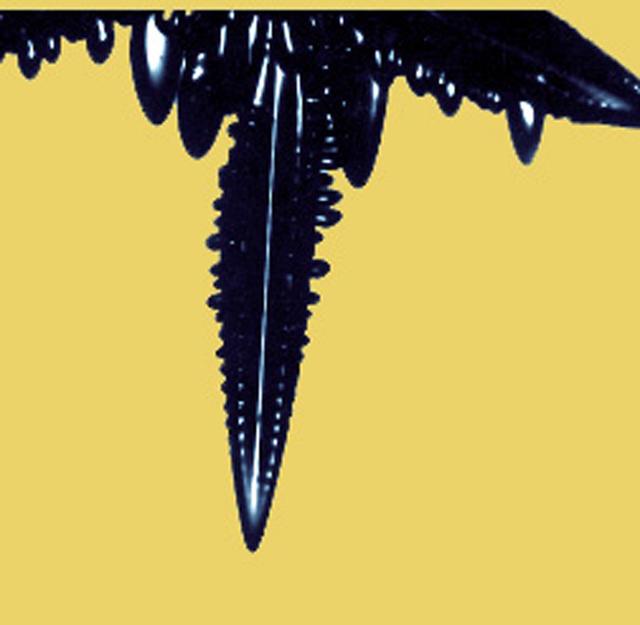
Researchers have found that as melted metals and alloys (combinations of metals) solidify, they can form with different arrangements of atoms, called microstructures. These microstructures depend on the shape of the interface (boundary) between the melted metal and the solid crystal it is forming. There are generally three shapes that the interface can take: planar, or flat; cellular, which looks like the cells of a beehive; and dendritic, which resembles tiny fir trees. Convection at this interface can affect the interface shape and hide the other phenomena (physical events). To reduce the effects of convection, researchers conduct experiments that examine and control conditions at the interface in microgravity. Microgravity also helps in the study of alloys composed of two metals that do not mix. On Earth, the liquid mixtures of these alloys settle into different layers due to gravity. In microgravity, the liquid metals do not settle, and a solid more uniform mixture of both metals can be formed.
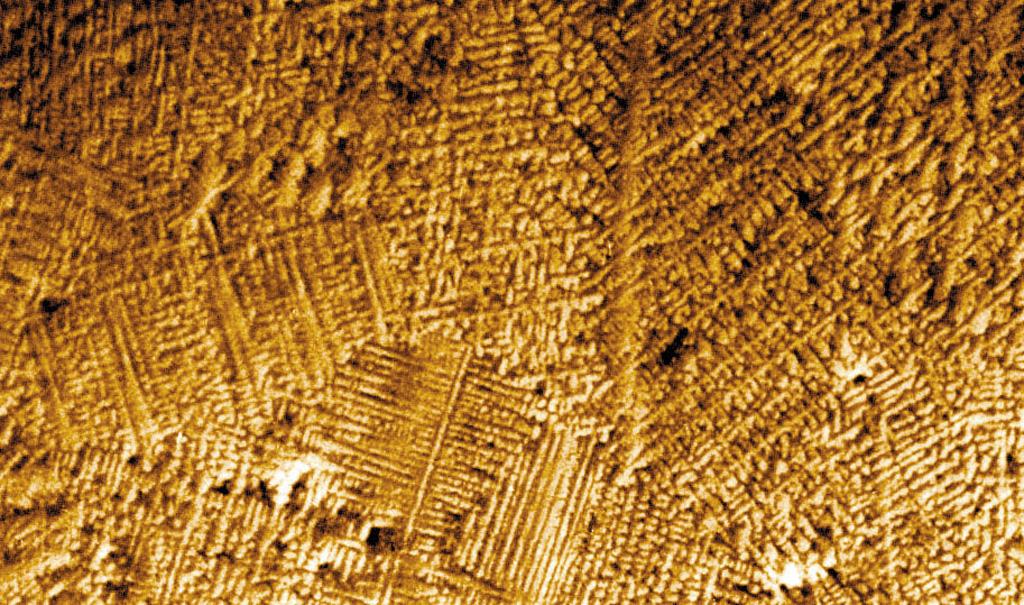
Researchers have found that as melted metals and alloys (combinations of metals) solidify, they can form with different arrangements of atoms, called microstructures. These microstructures depend on the shape of the interface (boundary) between the melted metal and the solid crystal it is forming. There are generally three shapes that the interface can take: planar, or flat; cellular, which looks like the cells of a beehive; and dendritic, which resembles tiny fir trees. Convection at this interface can affect the interface shape and hide the other phenomena (physical events). To reduce the effects of convection, researchers conduct experiments that examine and control conditions at the interface in microgravity. Microgravity also helps in the study of alloys composed of two metals that do not mix. On Earth, the liquid mixtures of these alloys settle into different layers due to gravity. In microgravity, the liquid metals do not settle, and a solid more uniform mixture of both metals can be formed.
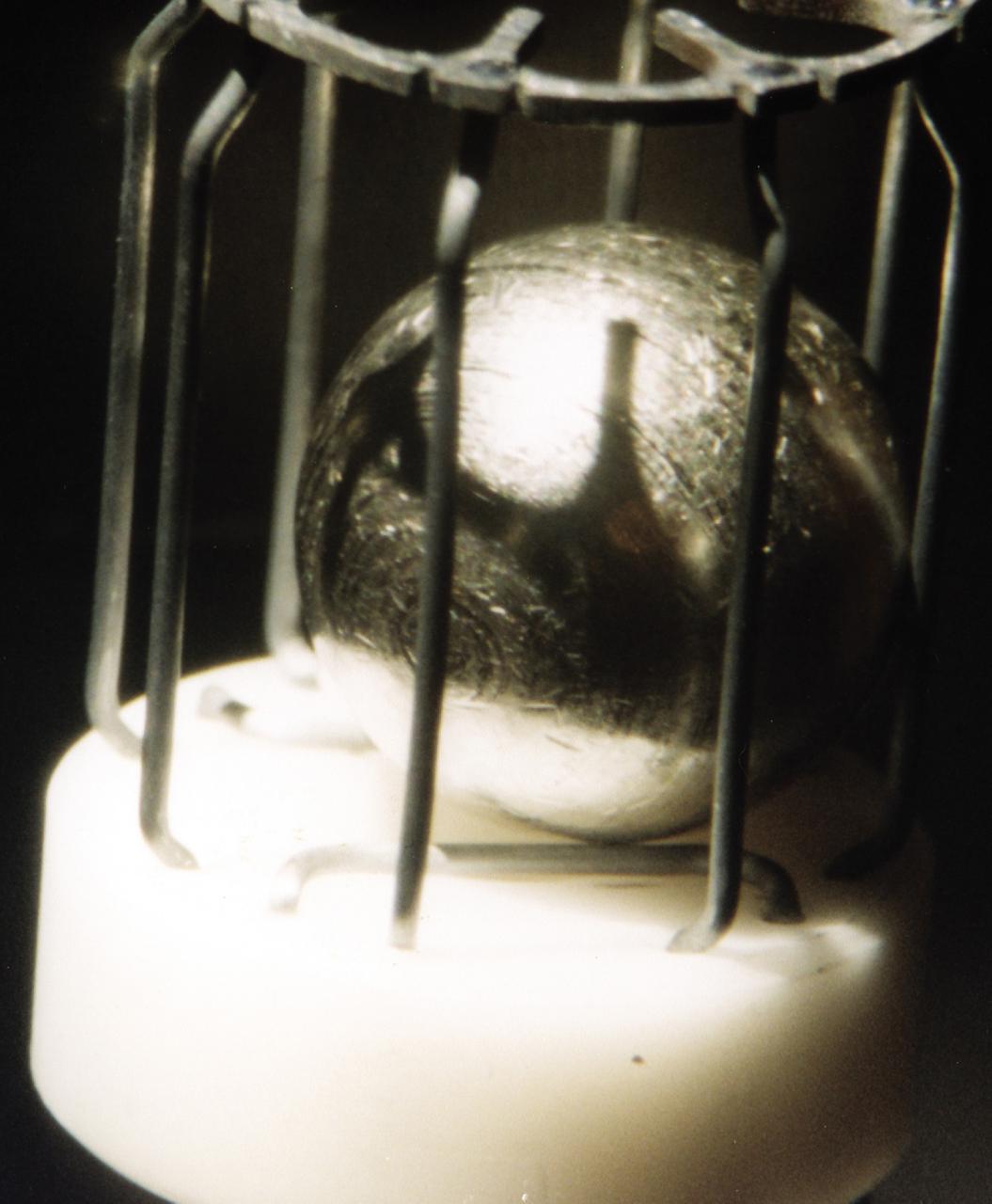
This metal sample, which is approximately 1 cm in diameter, is typical of the metals that were studied using the German designed electromagnetic containerless processing facility. The series of experiments that use this device is known as TEMPUS which is the acronym that stands for the German Tiegelfreies Elektromanetisches Prozessieren Unter Schwerelosigkeit. Most of the TEMPUS experiments focused on various aspects of undercooling liquid metal and alloys. Undercooling is the process of melting a material and then cooling it to a temperature that is below its normal freezing or solidification point. The TEMPUS experiments that used the metal cages as shown in the photograph, often studied bulk metallic glass, a solid material with no crystalline structures. We study metals and alloys not only to build things in space, but to improve things that are made on Earth. Metals and alloys are everywhere around us; in our automobiles, in the engines of aircraft, in our power-plants, and elsewhere. Despite their presence in everyday life, there are many scientific aspects of metals that we do not understand.
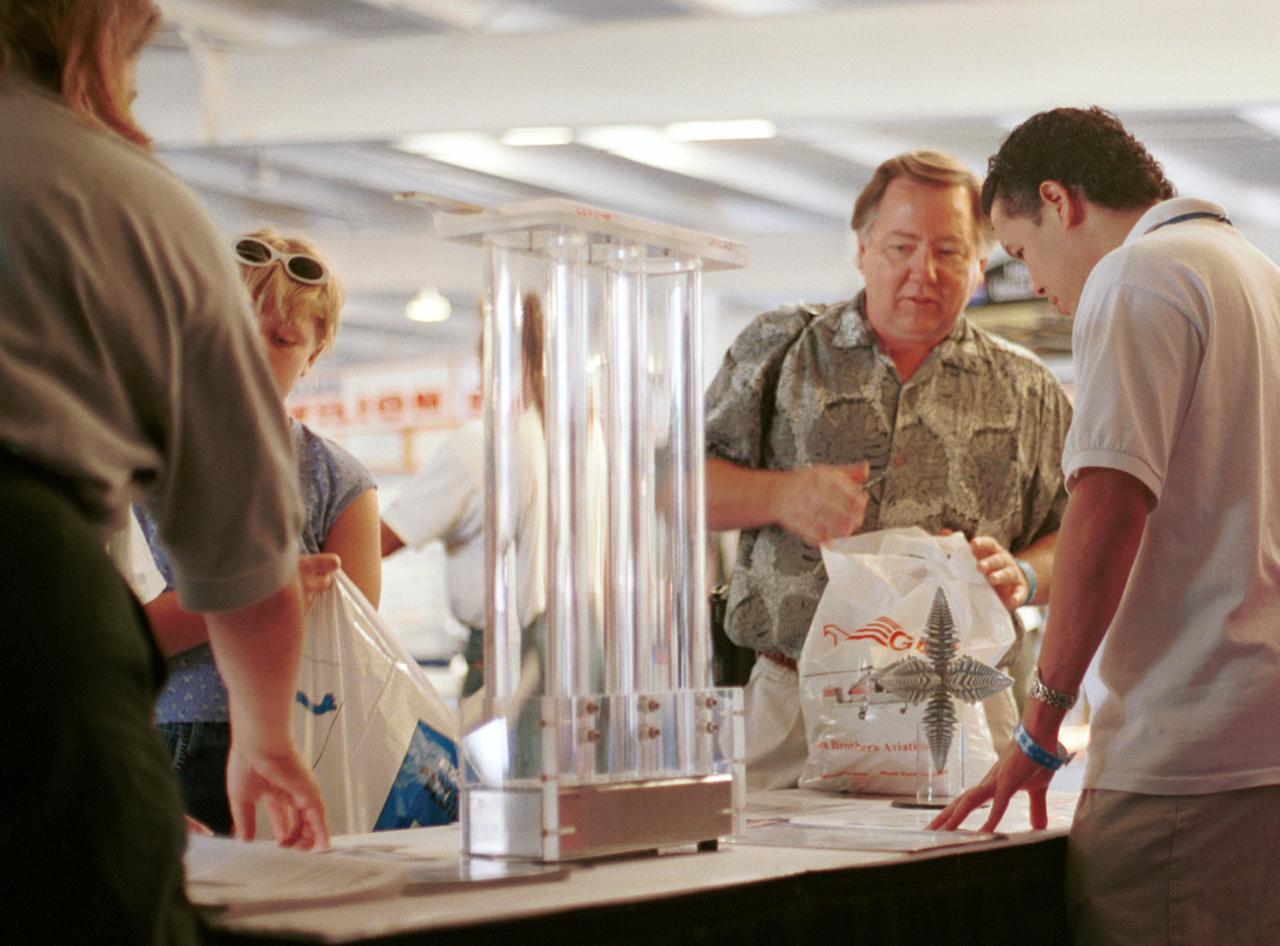
Paul Luz (right), an aerospace flight systems engineer at NASA's Marshall Space Flight Center (MSFC), takes a question from a visitor as they discuss microgravity research at AirVenture 2000. Part of the NASA exhibits included demonstrations of knowledge gained from microgravity research aboard the Space Shuttle. These include liquid metal (liquid metal demonstrator is three plastic drop tubes at center) and dendritic growth (in front of Luz), both leading to improvements in processes of Earth. The exhibit was part of the NASA outreach activity at AirVenture 2000 sponsored by the Experimental Aircraft Association in Oshkosh, WI.
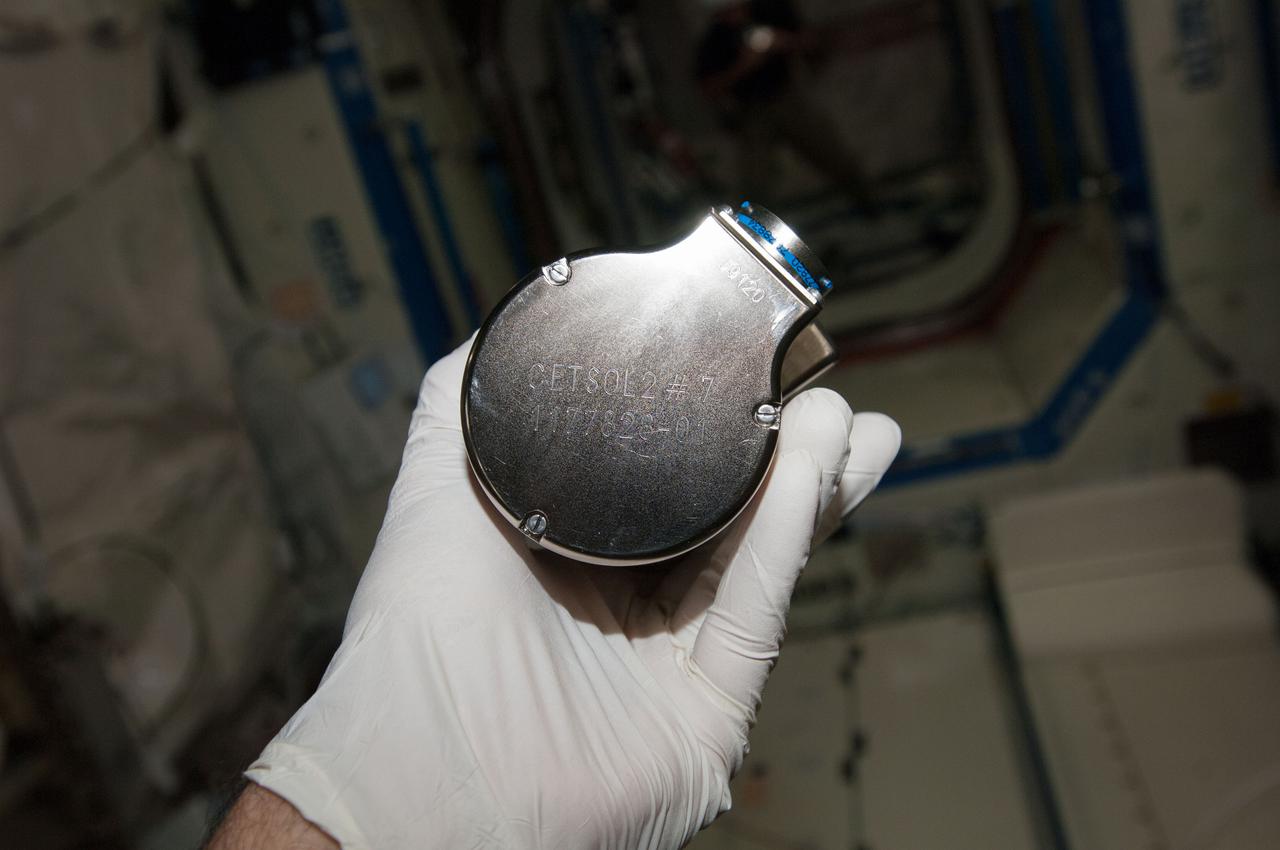
iss038e045758 (2/12/2014) --- A view of Columnar-to-Equiaxed Transition in Solidification Processing-2 (CETSOL-2) test sample 7 which is to be installed into the Material Science Laboratory (MSL) Solidification and Quench Furnace (SQF). This investigation aims to deepen the understanding of the physical principles that govern solidification processes in metal alloys. The patterns of the crystals resulting from transitions of liquids to solids is important for processes used to produce materials such as solar cells, thermoelectrics, and metal alloys.
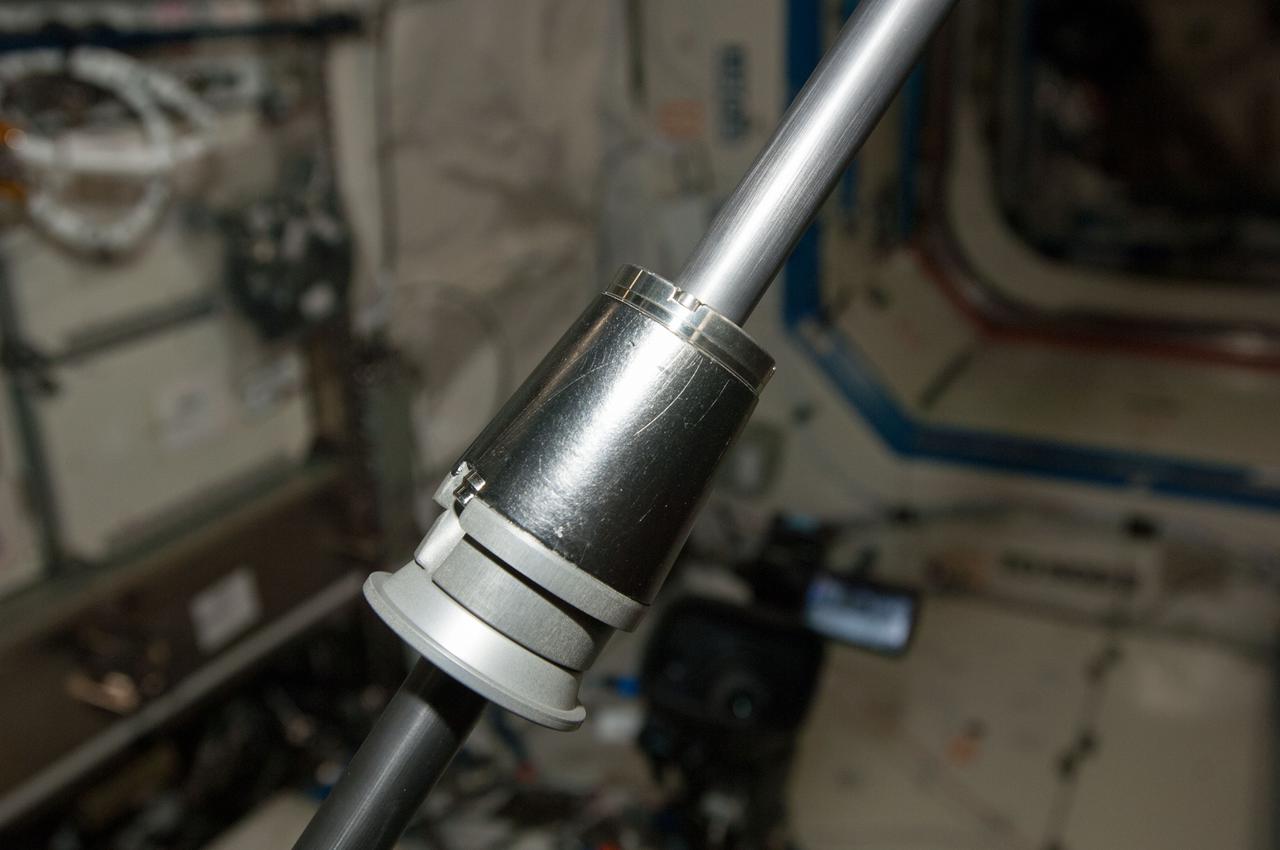
iss038e045760 92/12/2014) --- A view of Columnar-to-Equiaxed Transition in Solidification Processing-2 (CETSOL-2) test sample 7 which is to be installed into the Material Science Laboratory (MSL) Solidification and Quench Furnace (SQF). This investigation aims to deepen the understanding of the physical principles that govern solidification processes in metal alloys. The patterns of the crystals resulting from transitions of liquids to solids is important for processes used to produce materials such as solar cells, thermoelectrics, and metal alloys.
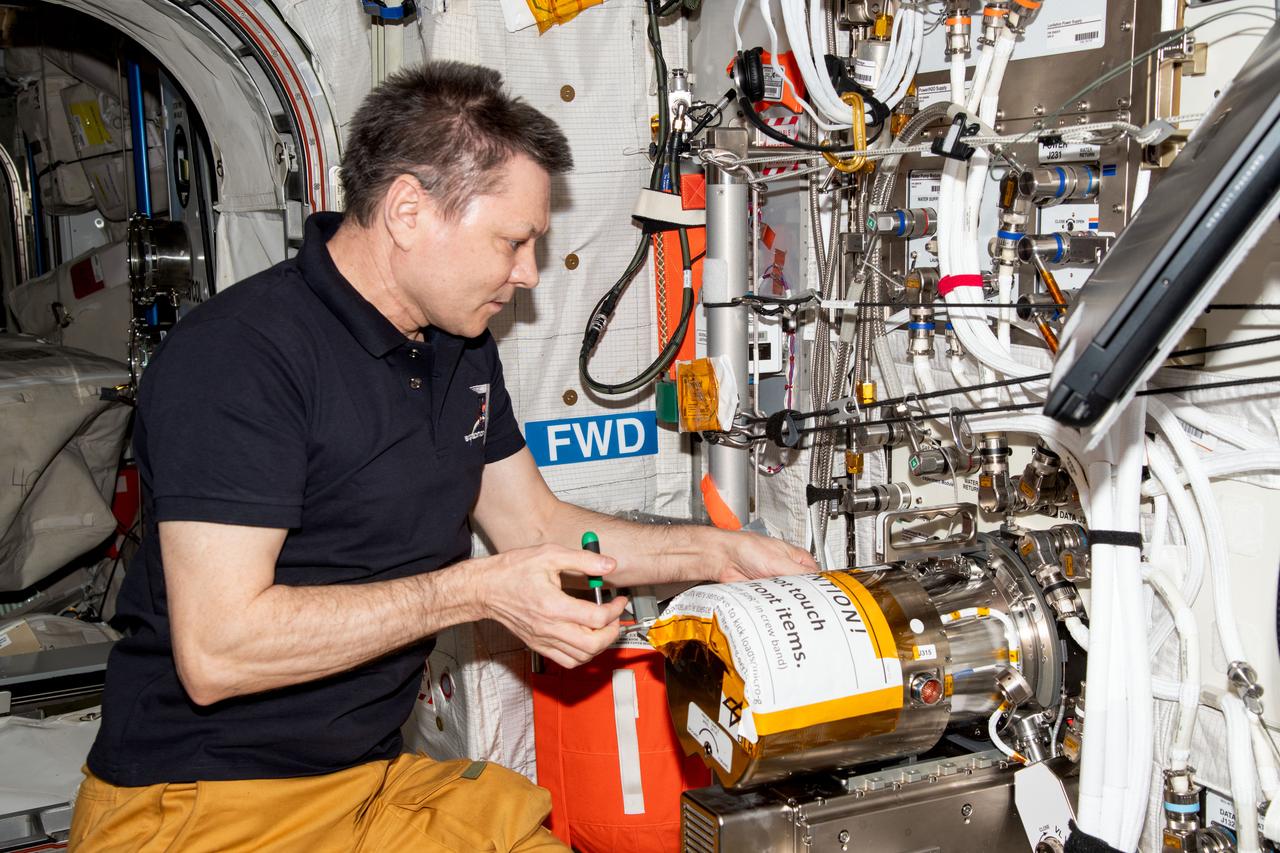
iss071e580240 (AUg. 29, 2024) --- Roscosmos cosmonaut and Expedition 71 Commander Oleg Kononenko swaps sample chambers inside the Electromagnetic Levitator (EML) located aboard the International Space Station's Columbus laboratory module. The EML is a physics research device that measures the thermophysical properties of liquid metallic alloys at high temperatures.
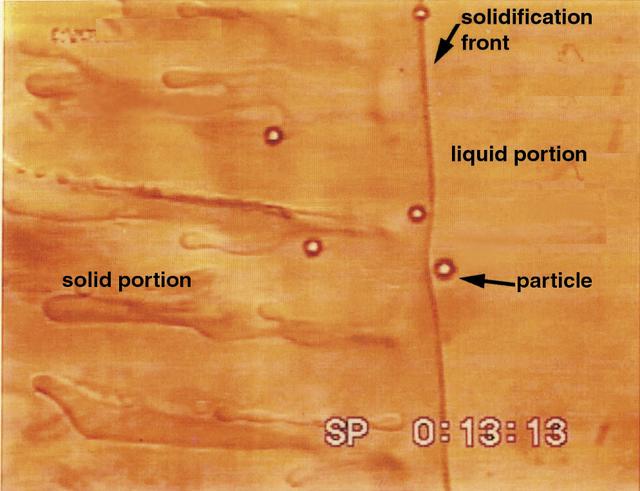
As a liquefied metal solidifies, particles dispersed in the liquid are either pushed ahead of or engulfed by the moving solidification front. Similar effects can be seen when the ground freezes and pushes large particles out of the soil. The Particle Engulfment and Pushing (PEP) experiment, conducted aboard the fourth U.S. Microgravity Payload (USMP-4) mission in 1997, used a glass and plastic beads suspended in a transparent liquid. The liquid was then frozen, trapping or pushing the particles as the solidifying front moved. This simulated the formation of advanced alloys and composite materials. Such studies help scientists to understand how to improve the processes for making advanced materials on Earth. The principal investigator is Dr. Doru Stefanescu of the University of Alabama. This image is from a video downlink.
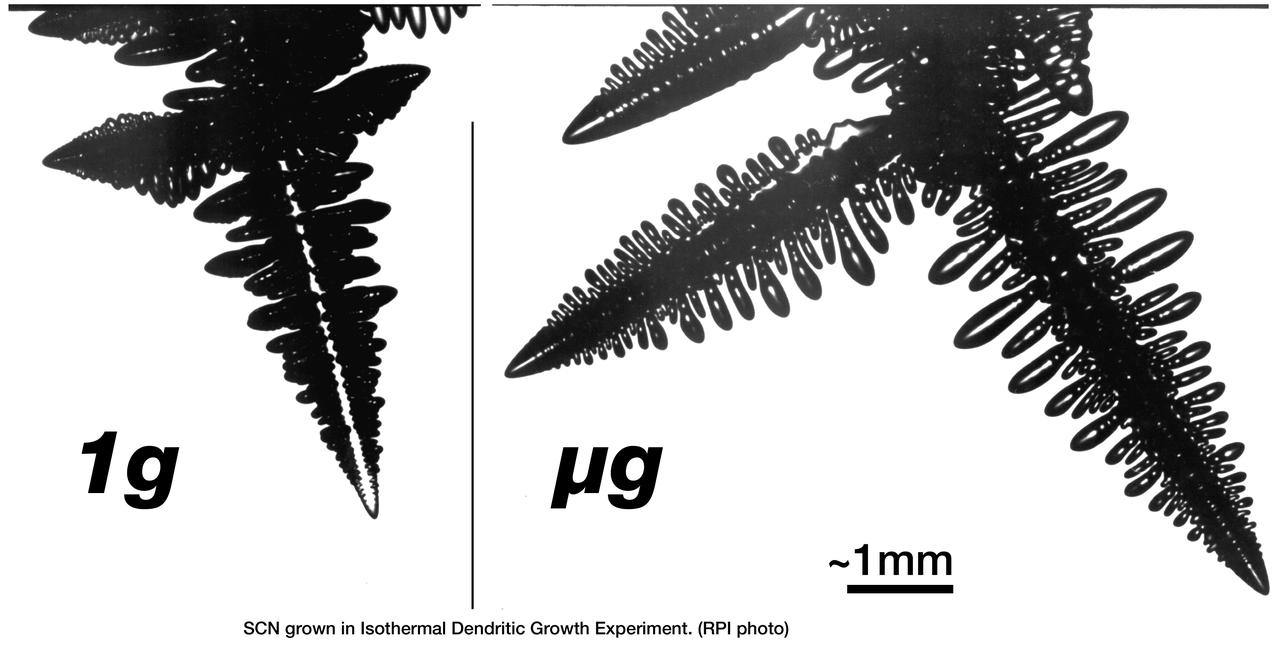
The Isothermal Dendritic Growth Experiment (IDGE), flown on three Space Shuttle missions, is yielding new insights into virtually all industrially relevant metal and alloy forming operations. IDGE used transparent organic liquids that form dendrites (treelike structures) similar to the crystals that form inside metal alloys. Comparing Earth-based and space-based dentrite growth velocity, tip size and shape provid a better understanding of the fundamentals of dentritic growth, including gravity's effects. These shadowgraphic images show succinonitrile (SCN) dentrites growing in a melt (liquid). The space-grown crystals also have cleaner, better defined sidebranches. IDGE was developed by Rensselaer Polytechnic Institude (RPI) and NASA/ Glenn Research Center(GRC). Advanced follow-on experiments are being developed for flight on the International Space Station. Photo gredit: NASA/Glenn Research Center
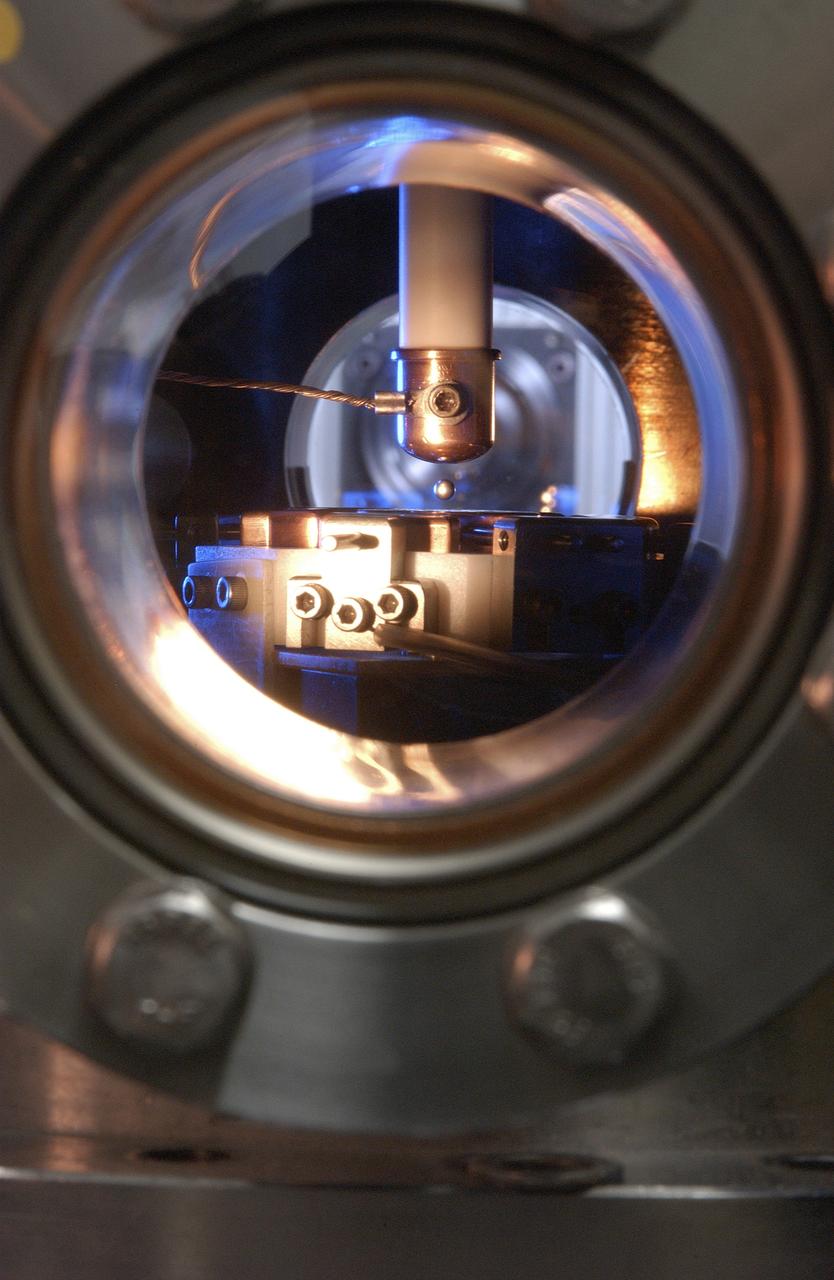
This Photo, which appeared on the July cover of `Physics Today', is of the Electrostatic Levitator (ESL) at NASA's Marshall Space Flight Center (MSFC). The ESL uses static electricity to suspend an object (about 3-4 mm in diameter) inside a vacuum chamber allowing scientists to record a wide range of physical properties without the sample contracting the container or any instruments, conditions that would alter the readings. Once inside the chamber, a laser heats the sample until it melts. The laser is then turned off and the sample cools, changing from a liquid drop to a solid sphere. In this particular shot, the ESL contains a solid metal sample of titanium-zirconium-nickel alloy. Since 1977, the ESL has been used at MSFC to study the characteristics of new metals, ceramics, and glass compounds. Materials created as a result of these tests include new optical materials, special metallic glasses, and spacecraft components.
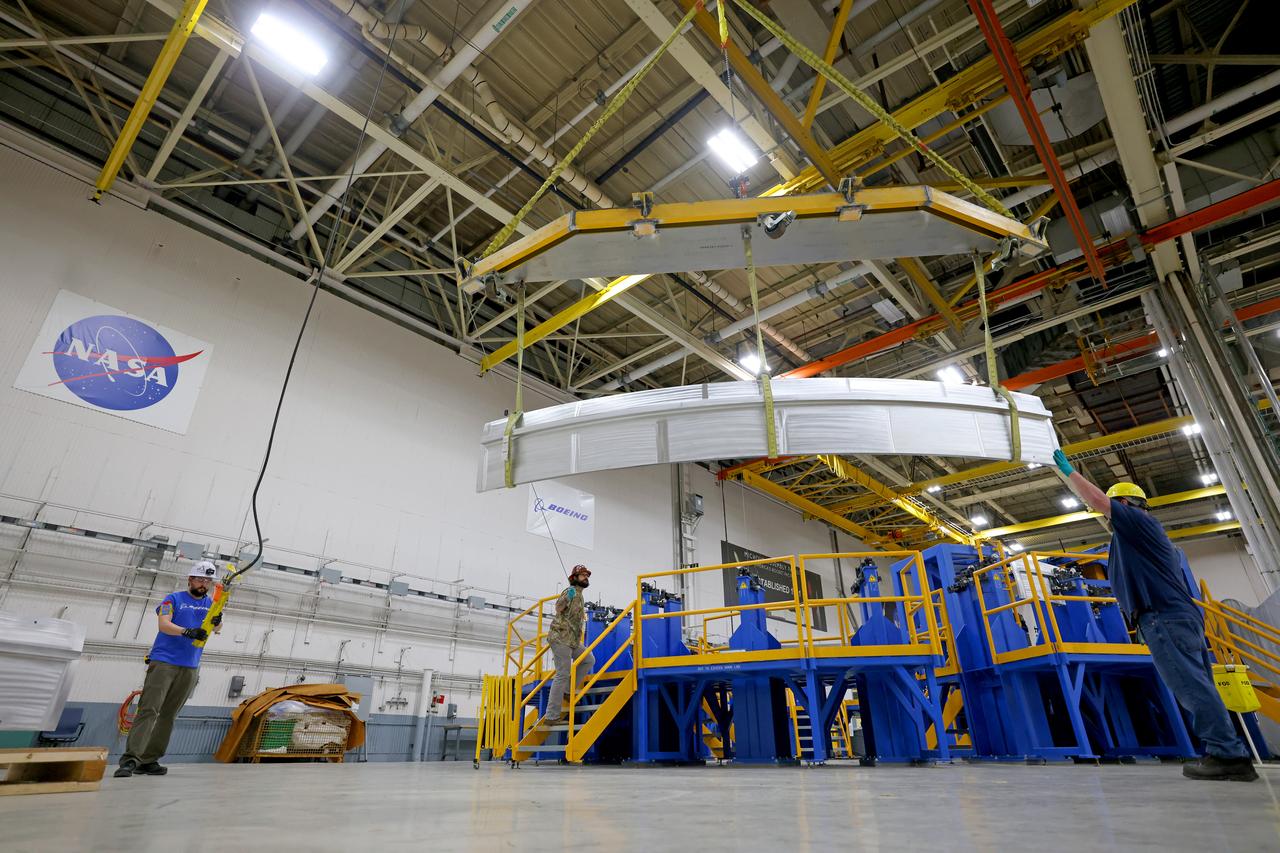
These photos show how teams at NASA’s Michoud Assembly Facility in New Orleans manufactured the Y-ring that will be used on the evolved Block 1B configuration of the SLS (Space Launch System) rocket. It is one of the first components that will make up a portion of the core stage that will power NASA’s Artemis V mission. The large metal ring will serve as the aft ring for the rocket’s liquid hydrogen tank. The SLS core stage is the backbone of the SLS rocket, stretching 212 feet from top to bottom, and includes four RS-25 engines at its base. At launch, its two huge liquid propellant tanks provide more than 733,000 gallons of fuel to produce more than 2 million pounds of thrust. Michoud Assembly Facility and the SLS Program are managed by NASA’s Marshall Space Flight Center in Huntsville, Alabama. Image credit: NASA/Michael DeMocker
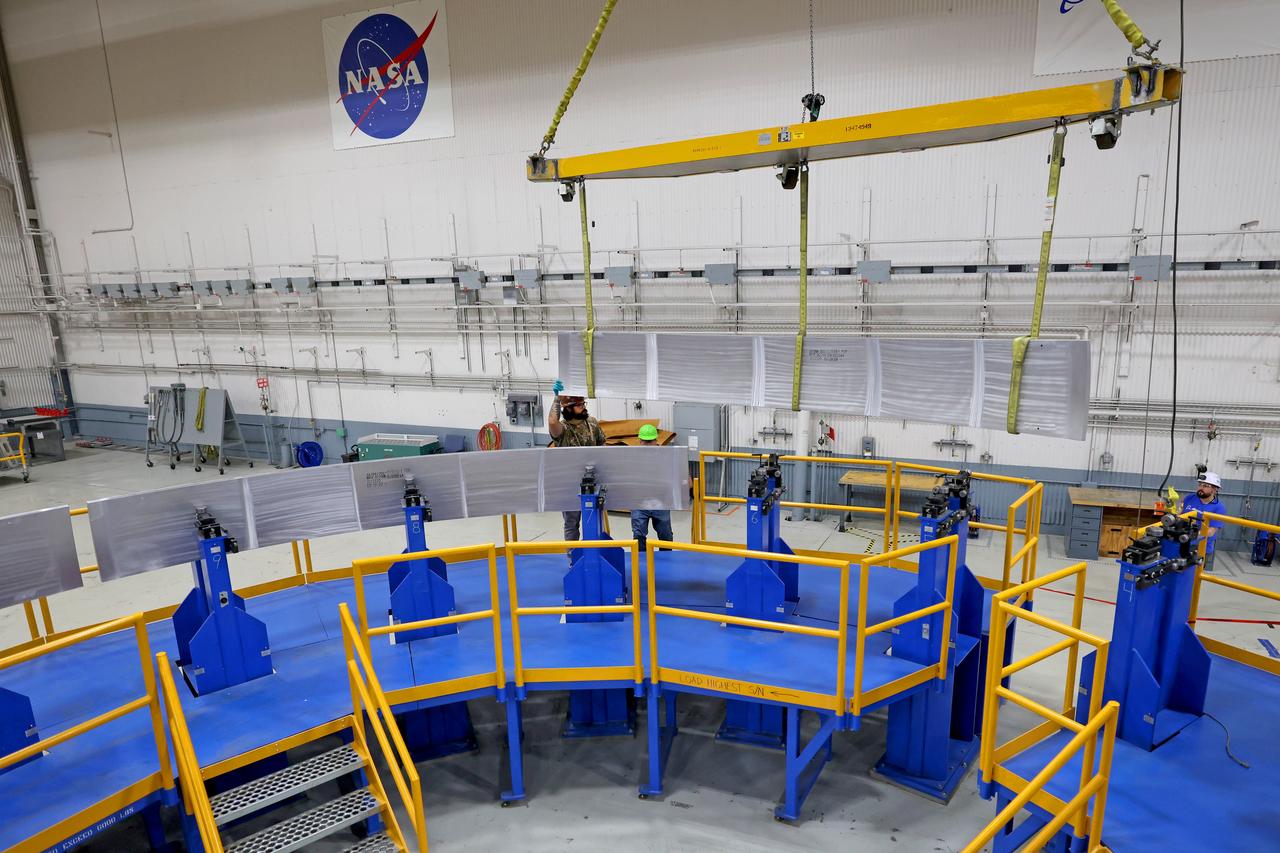
These photos show how teams at NASA’s Michoud Assembly Facility in New Orleans manufactured the Y-ring that will be used on the evolved Block 1B configuration of the SLS (Space Launch System) rocket. It is one of the first components that will make up a portion of the core stage that will power NASA’s Artemis V mission. The large metal ring will serve as the aft ring for the rocket’s liquid hydrogen tank. The SLS core stage is the backbone of the SLS rocket, stretching 212 feet from top to bottom, and includes four RS-25 engines at its base. At launch, its two huge liquid propellant tanks provide more than 733,000 gallons of fuel to produce more than 2 million pounds of thrust. Michoud Assembly Facility and the SLS Program are managed by NASA’s Marshall Space Flight Center in Huntsville, Alabama. Image credit: NASA/Michael DeMocker

These photos show how teams at NASA’s Michoud Assembly Facility in New Orleans manufactured the Y-ring that will be used on the evolved Block 1B configuration of the SLS (Space Launch System) rocket. It is one of the first components that will make up a portion of the core stage that will power NASA’s Artemis V mission. The large metal ring will serve as the aft ring for the rocket’s liquid hydrogen tank. The SLS core stage is the backbone of the SLS rocket, stretching 212 feet from top to bottom, and includes four RS-25 engines at its base. At launch, its two huge liquid propellant tanks provide more than 733,000 gallons of fuel to produce more than 2 million pounds of thrust. Michoud Assembly Facility and the SLS Program are managed by NASA’s Marshall Space Flight Center in Huntsville, Alabama. Image credit: NASA/Michael DeMocker
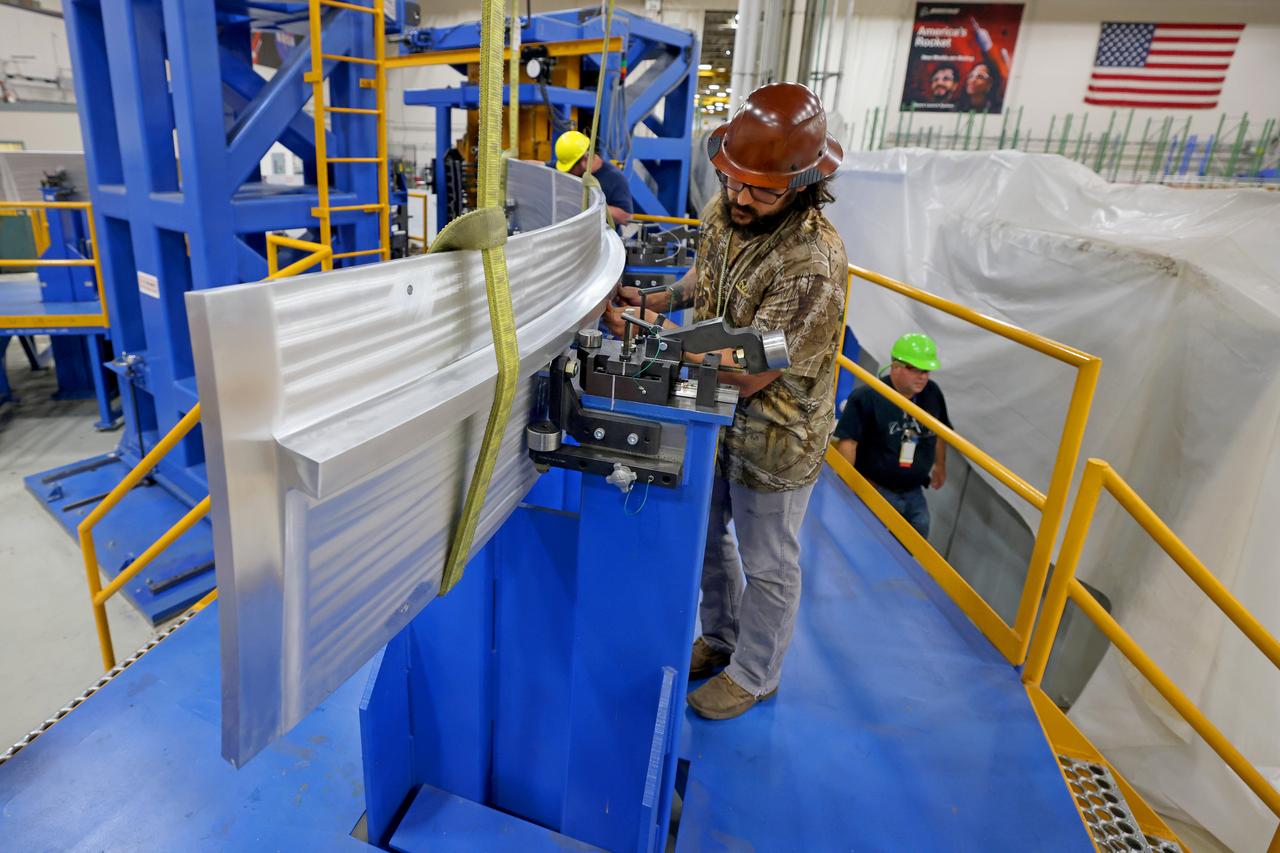
These photos show how teams at NASA’s Michoud Assembly Facility in New Orleans manufactured the Y-ring that will be used on the evolved Block 1B configuration of the SLS (Space Launch System) rocket. It is one of the first components that will make up a portion of the core stage that will power NASA’s Artemis V mission. The large metal ring will serve as the aft ring for the rocket’s liquid hydrogen tank. The SLS core stage is the backbone of the SLS rocket, stretching 212 feet from top to bottom, and includes four RS-25 engines at its base. At launch, its two huge liquid propellant tanks provide more than 733,000 gallons of fuel to produce more than 2 million pounds of thrust. Michoud Assembly Facility and the SLS Program are managed by NASA’s Marshall Space Flight Center in Huntsville, Alabama. Image credit: NASA/Michael DeMocker
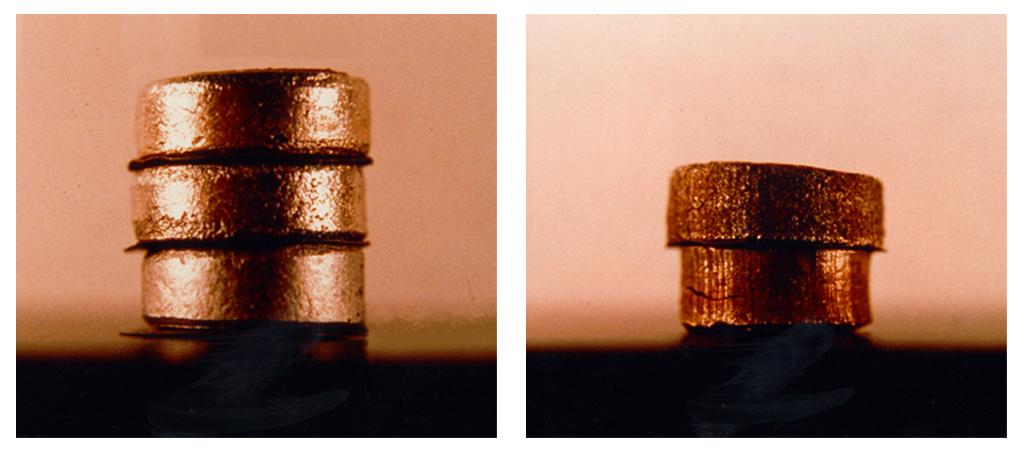
Industry spends billions of dollars each year on machine tools to manufacture products out of metal. This includes tools for cutting every kind of metal part from engine blocks to Shuttle main engine components. Cutting tool tips often break because of weak spots or defects in their composition. Based on a new concept called defect trapping, space offers a novel environment to study defect formation in molten metal materials as they solidify. After the return of these materials from space, researchers can evaluate the source of the defect and seek ways to eliminate them in products prepared on Earth. A widely used process for cutting tip manufacturing is liquid phase sintering. Compared to Earth-sintered samples which slump due to buoyancy induced by gravity, space samples are uniformly shaped and defects remain where they are formed. By studying metals sintered in space the US tool industry can potentially enhance its worldwide competitiveness. The Consortium for Materials Development in Space along with Wyle Labs, Teledyne Advanced Materials, and McDornell Douglas have conducted experiments in space.
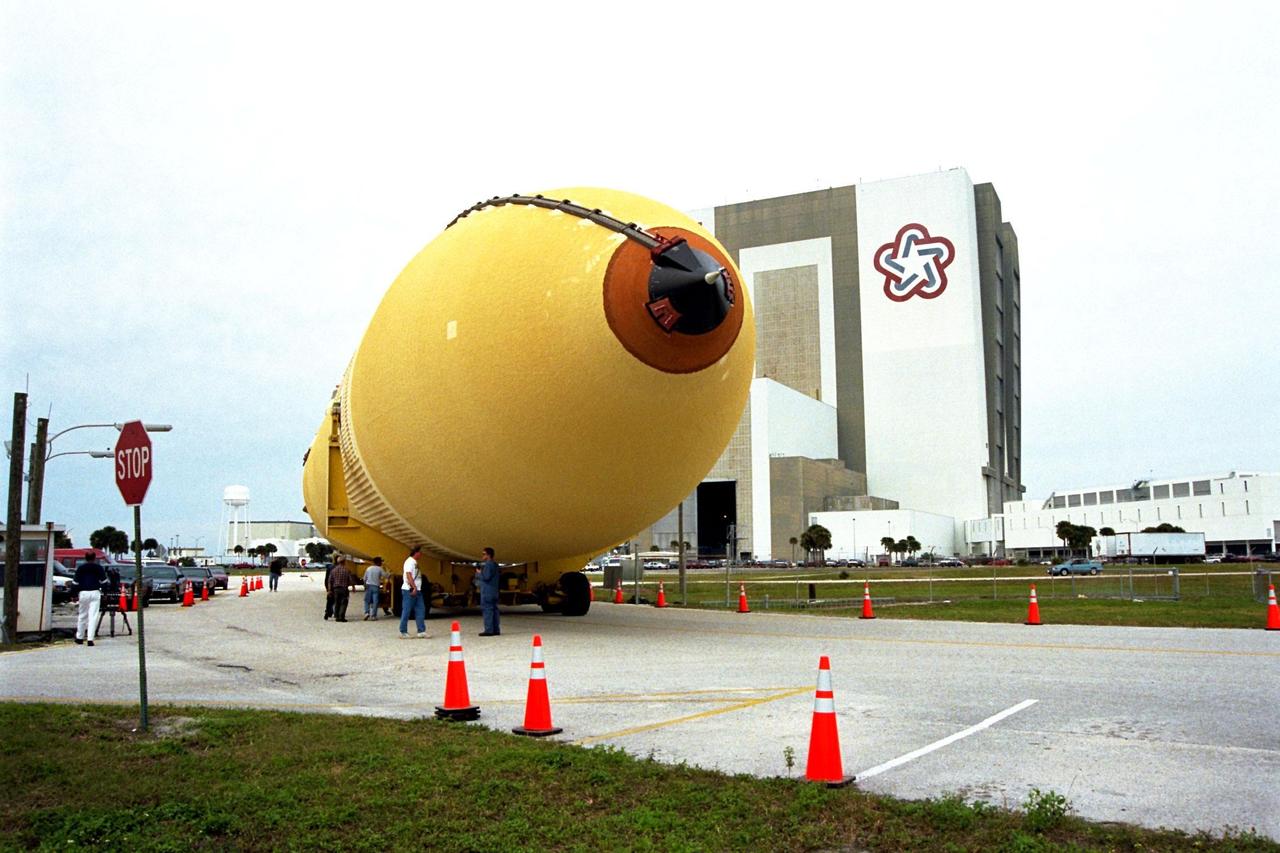
KENNEDY SPACE CENTER, FLA. -- The Space Shuttle's first super lightweight external tank is on its way to Kennedy Space Center's Vehicle Assembly Building for processing. The tank, which is scheduled for flight on STS-91 in late May, arrived Feb. 3 in Port Canaveral, where it remained until Feb. 6 due to high winds. The improved tank is 7,500 pounds lighter than its predecessors and was developed to increase the Shuttle payload capacity on International Space Station assembly flights. Major changes to the lighter tank include the use of new materials and a revised internal design. The new liquid oxygen and liquid hydrogen tanks are constructed of aluminum lithium a lighter, stronger material than the metal alloy currently used. The redesigned walls of the liquid hydrogen tank were machined to provide additional strength and stability as well
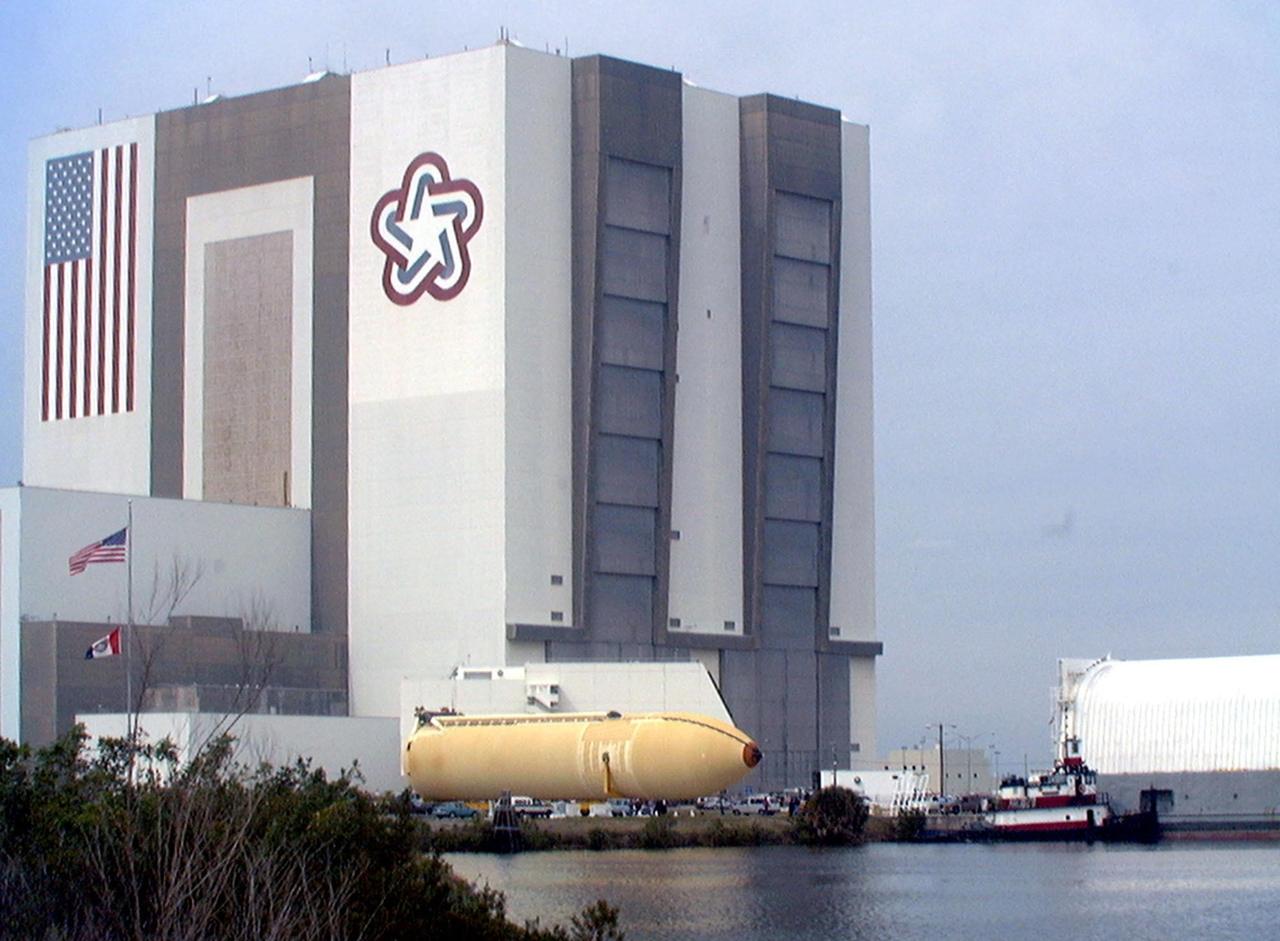
The Space Shuttle's first super lightweight external tank is on its way to Kennedy Space Center's Vehicle Assembly Building for processing. The tank, which is scheduled for flight on STS-91 in late May, arrived Feb. 3 in Port Canaveral, where it remained until Feb. 6 due to high winds. The improved tank is 7,500 pounds lighter than its predecessors and was developed to increase the Shuttle payload capacity on International Space Station assembly flights. Major changes to the lighter tank include the use of new materials and a revised internal design. The new liquid oxygen and liquid hydrogen tanks are constructed of aluminum lithium a lighter, stronger material than the metal alloy currently used. The redesigned walls of the liquid hydrogen tank were machined to provide additional strength and stability as well
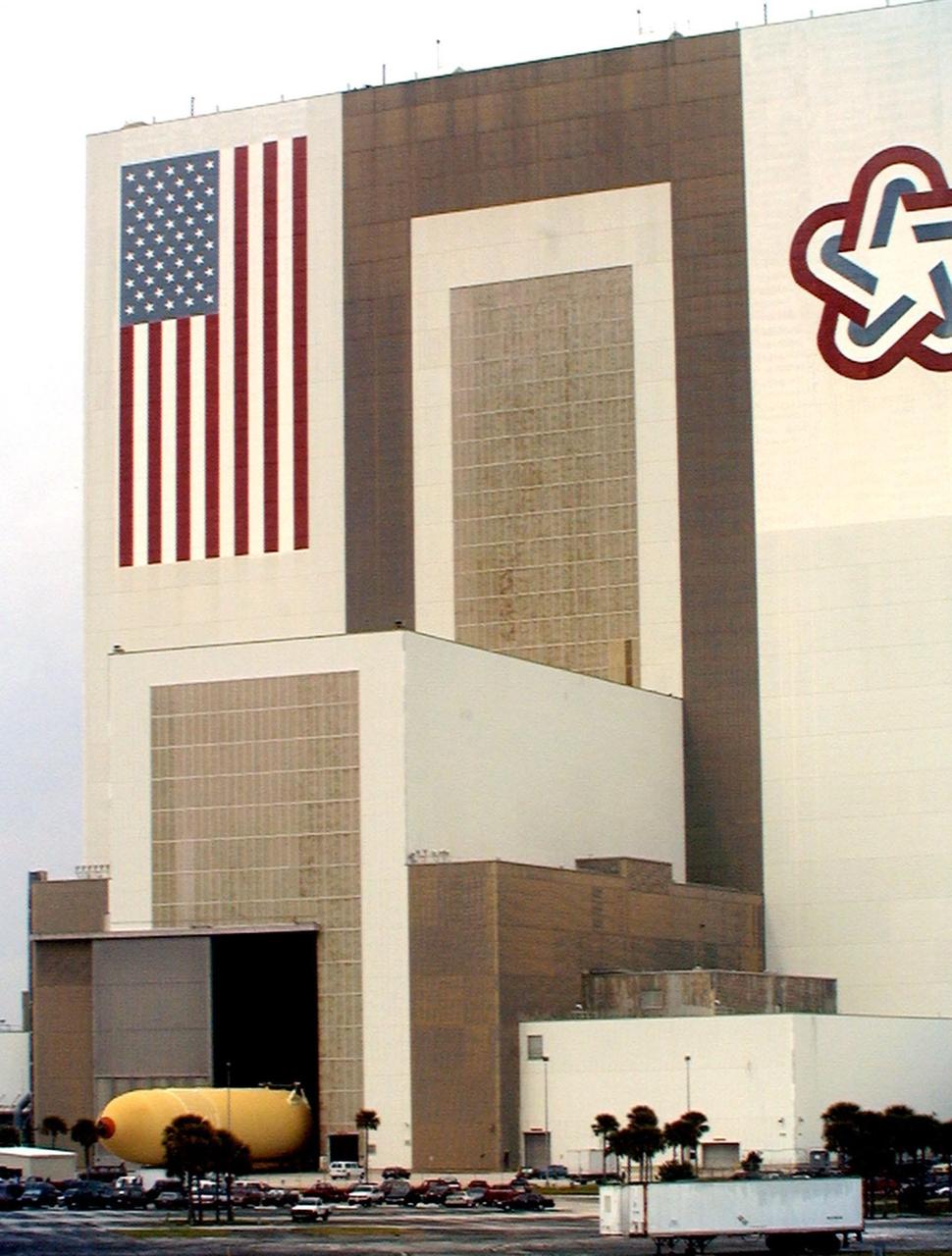
The Space Shuttle's first super lightweight external tank is on its way to Kennedy Space Center's Vehicle Assembly Building for processing. The tank, which is scheduled for flight on STS-91 in late May, arrived Feb. 3 in Port Canaveral, where it remained until Feb. 6 due to high winds. The improved tank is 7,500 pounds lighter than its predecessors and was developed to increase the Shuttle payload capacity on International Space Station assembly flights. Major changes to the lighter tank include the use of new materials and a revised internal design. The new liquid oxygen and liquid hydrogen tanks are constructed of aluminum lithium a lighter, stronger material than the metal alloy currently used. The redesigned walls of the liquid hydrogen tank were machined to provide additional strength and stability as well

The Space Shuttle's first super lightweight external tank is on its way to Kennedy Space Center's Vehicle Assembly Building for processing. The tank, which is scheduled for flight on STS-91 in late May, arrived Feb. 3 in Port Canaveral, where it remained until Feb. 6 due to high winds. The improved tank is 7,500 pounds lighter than its predecessors and was developed to increase the Shuttle payload capacity on International Space Station assembly flights. Major changes to the lighter tank include the use of new materials and a revised internal design. The new liquid oxygen and liquid hydrogen tanks are constructed of aluminum lithium a lighter, stronger material than the metal alloy currently used. The redesigned walls of the liquid hydrogen tank were machined to provide additional strength and stability as well
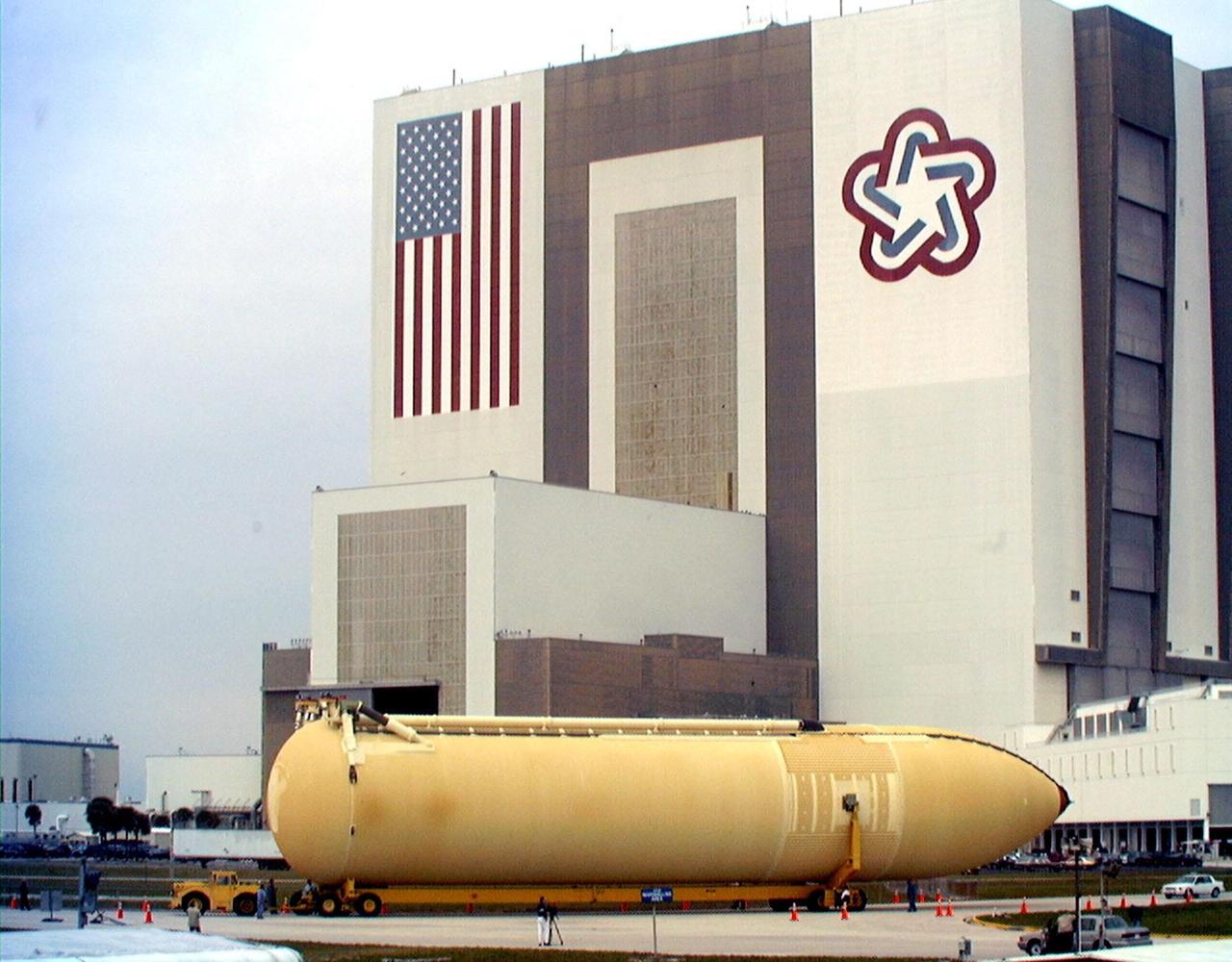
The Space Shuttle's first super lightweight external tank is on its way to Kennedy Space Center's Vehicle Assembly Building for processing. The tank, which is scheduled for flight on STS-91 in late May, arrived Feb. 3 in Port Canaveral, where it remained until Feb. 6 due to high winds. The improved tank is 7,500 pounds lighter than its predecessors and was developed to increase the Shuttle payload capacity on International Space Station assembly flights. Major changes to the lighter tank include the use of new materials and a revised internal design. The new liquid oxygen and liquid hydrogen tanks are constructed of aluminum lithium a lighter, stronger material than the metal alloy currently used. The redesigned walls of the liquid hydrogen tank were machined to provide additional strength and stability as well
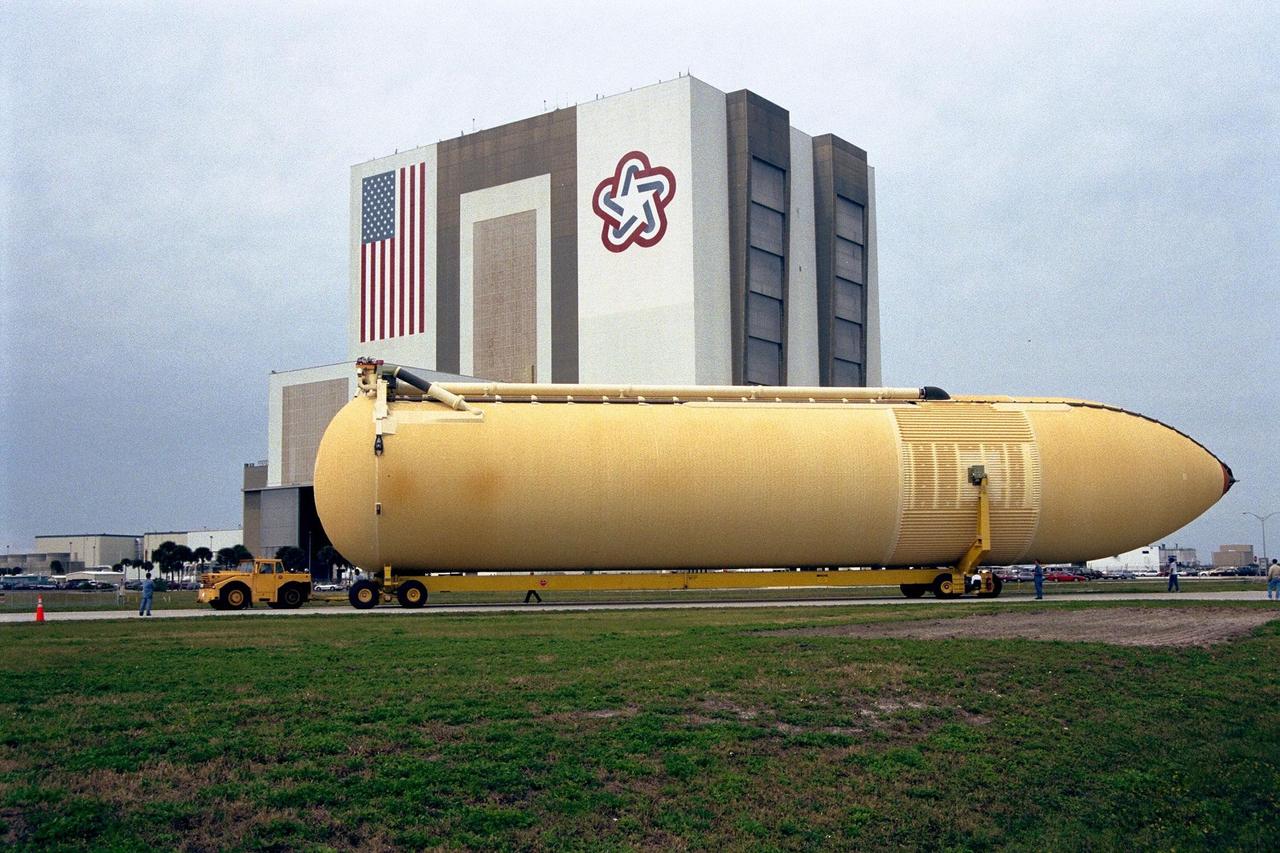
KENNEDY SPACE CENTER, FLA. -- The Space Shuttle's first super lightweight external tank is on its way to Kennedy Space Center's Vehicle Assembly Building for processing. The tank, which is scheduled for flight on STS-91 in late May, arrived Feb. 3 in Port Canaveral, where it remained until Feb. 6 due to high winds. The improved tank is 7,500 pounds lighter than its predecessors and was developed to increase the Shuttle payload capacity on International Space Station assembly flights. Major changes to the lighter tank include the use of new materials and a revised internal design. The new liquid oxygen and liquid hydrogen tanks are constructed of aluminum lithium a lighter, stronger material than the metal alloy currently used. The redesigned walls of the liquid hydrogen tank were machined to provide additional strength and stability as well
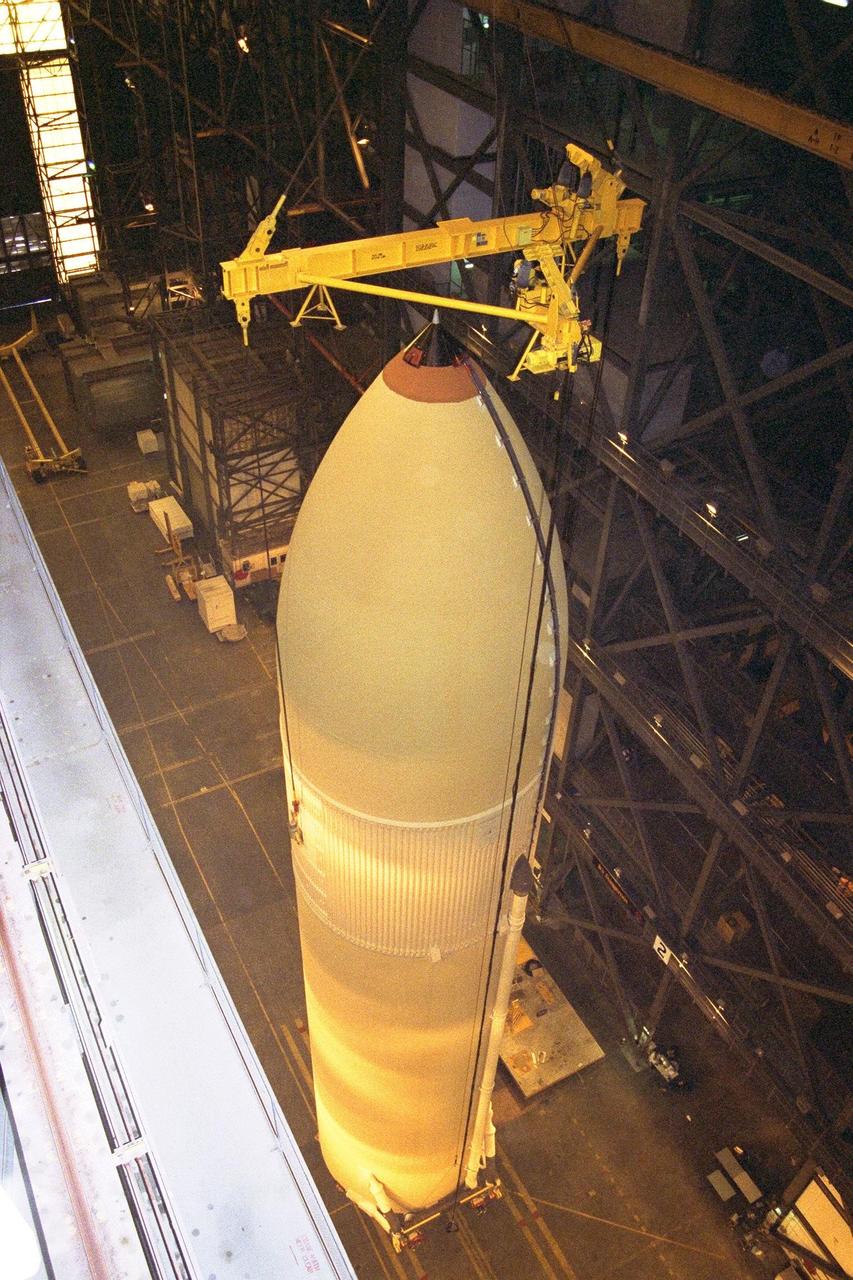
KENNEDY SPACE CENTER, FLA. -- The Space Shuttle's first super lightweight external tank is lifted in KSC's Vehicle Assembly Building for STS-91 pre-flight processing. STS-91 is targeted for launch in late May. The improved tank is 7,500 pounds lighter than its predecessors and was developed to increase the Shuttle payload capacity on International Space Station assembly flights. Major changes to the lighter tank include the use of new materials and a revised internal design. The new liquid oxygen and liquid hydrogen tanks are constructed of aluminum lithium a lighter, stronger material than the metal alloy currently used. The redesigned walls of the liquid hydrogen tank were machined to provide additional strength and stability as well
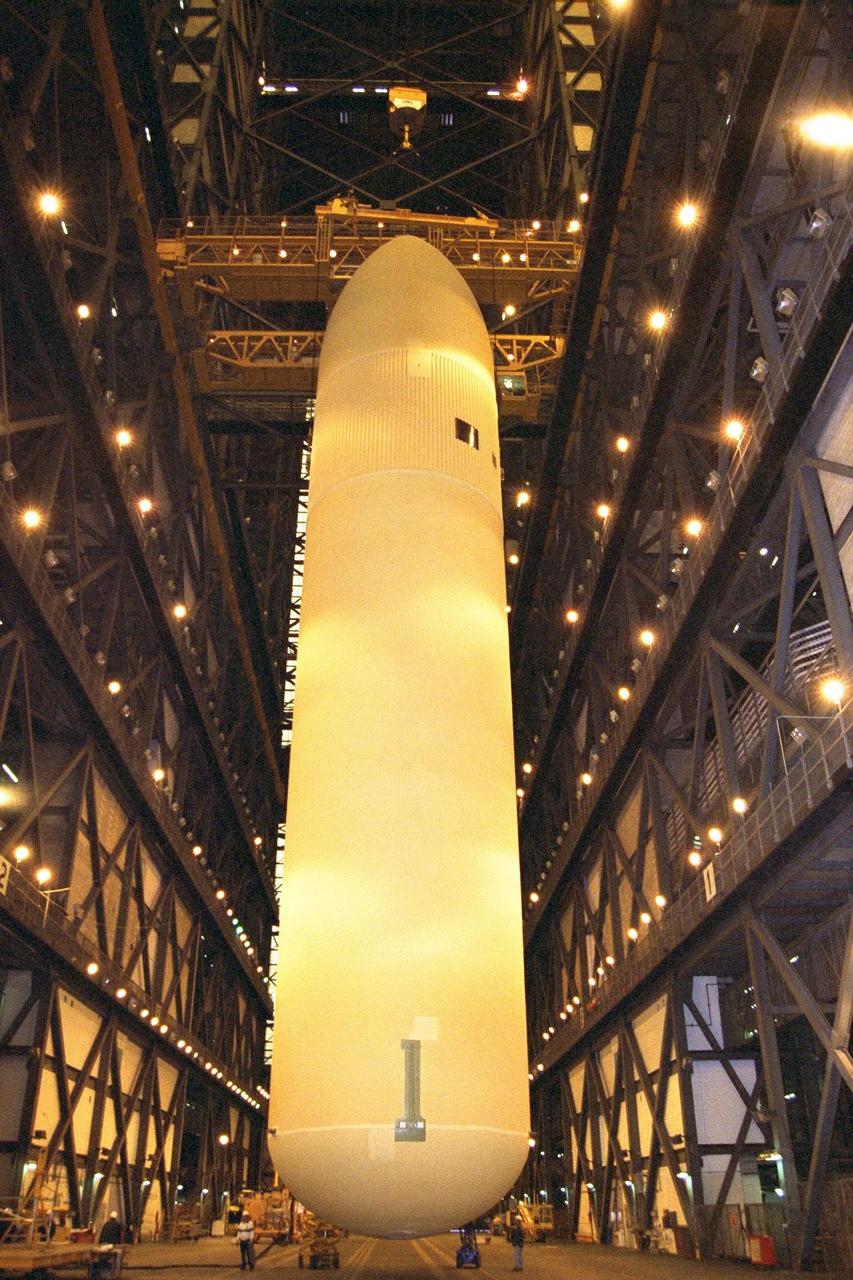
KENNEDY SPACE CENTER, FLA. -- The Space Shuttle's first super lightweight external tank is lifted in KSC's Vehicle Assembly Building for STS-91 pre-flight processing. STS-91 is targeted for launch in late May. The improved tank is 7,500 pounds lighter than its predecessors and was developed to increase the Shuttle payload capacity on International Space Station assembly flights. Major changes to the lighter tank include the use of new materials and a revised internal design. The new liquid oxygen and liquid hydrogen tanks are constructed of aluminum lithium a lighter, stronger material than the metal alloy currently used. The redesigned walls of the liquid hydrogen tank were machined to provide additional strength and stability as well
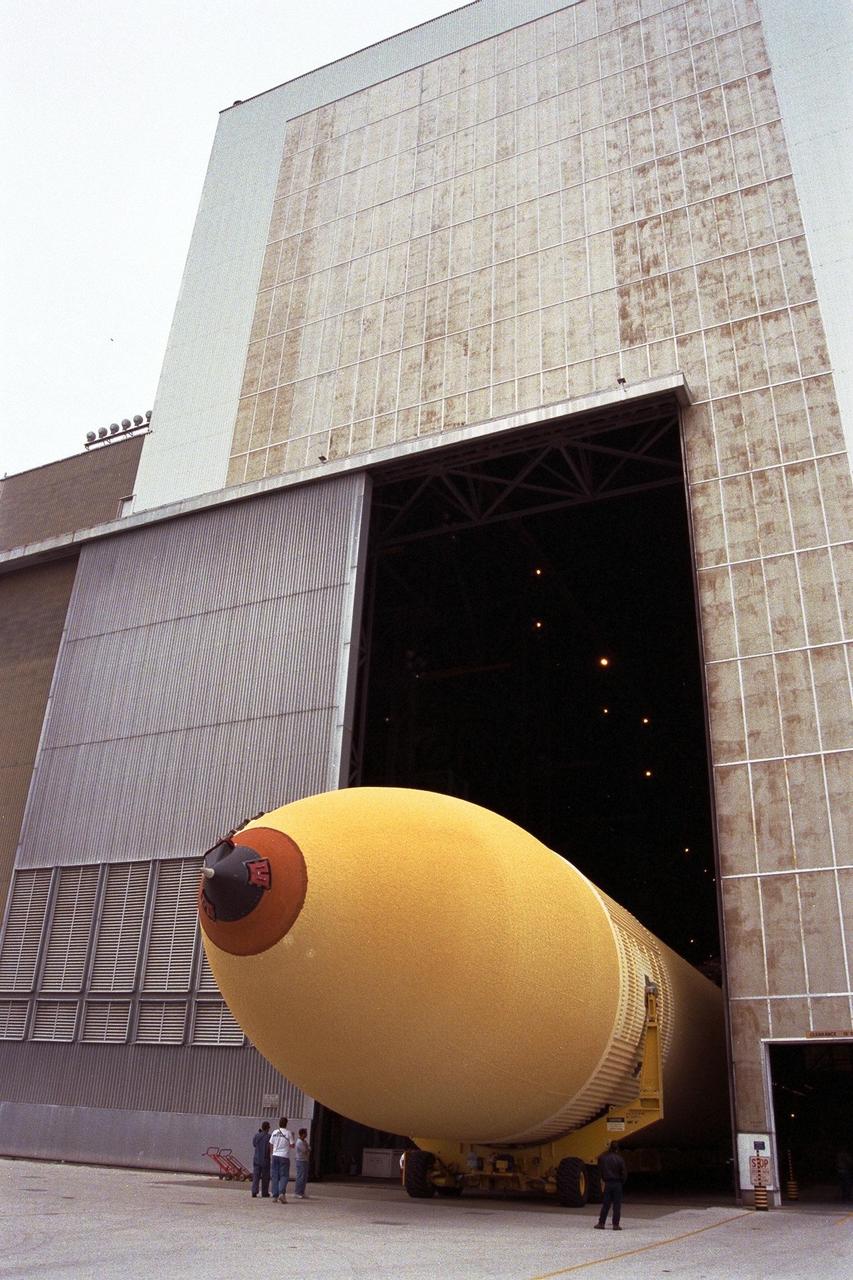
KENNEDY SPACE CENTER, FLA. -- The Space Shuttle's first super lightweight external tank is on its way into Kennedy Space Center's Vehicle Assembly Building for processing. The tank, which is scheduled for flight on STS-91 in late May, arrived Feb. 3 in Port Canaveral, where it remained until Feb. 6 due to high winds. The improved tank is 7,500 pounds lighter than its predecessors and was developed to increase the Shuttle payload capacity on International Space Station assembly flights. Major changes to the lighter tank include the use of new materials and a revised internal design. The new liquid oxygen and liquid hydrogen tanks are constructed of aluminum lithium a lighter, stronger material than the metal alloy currently used. The redesigned walls of the liquid hydrogen tank were machined to provide additional strength and stability as well
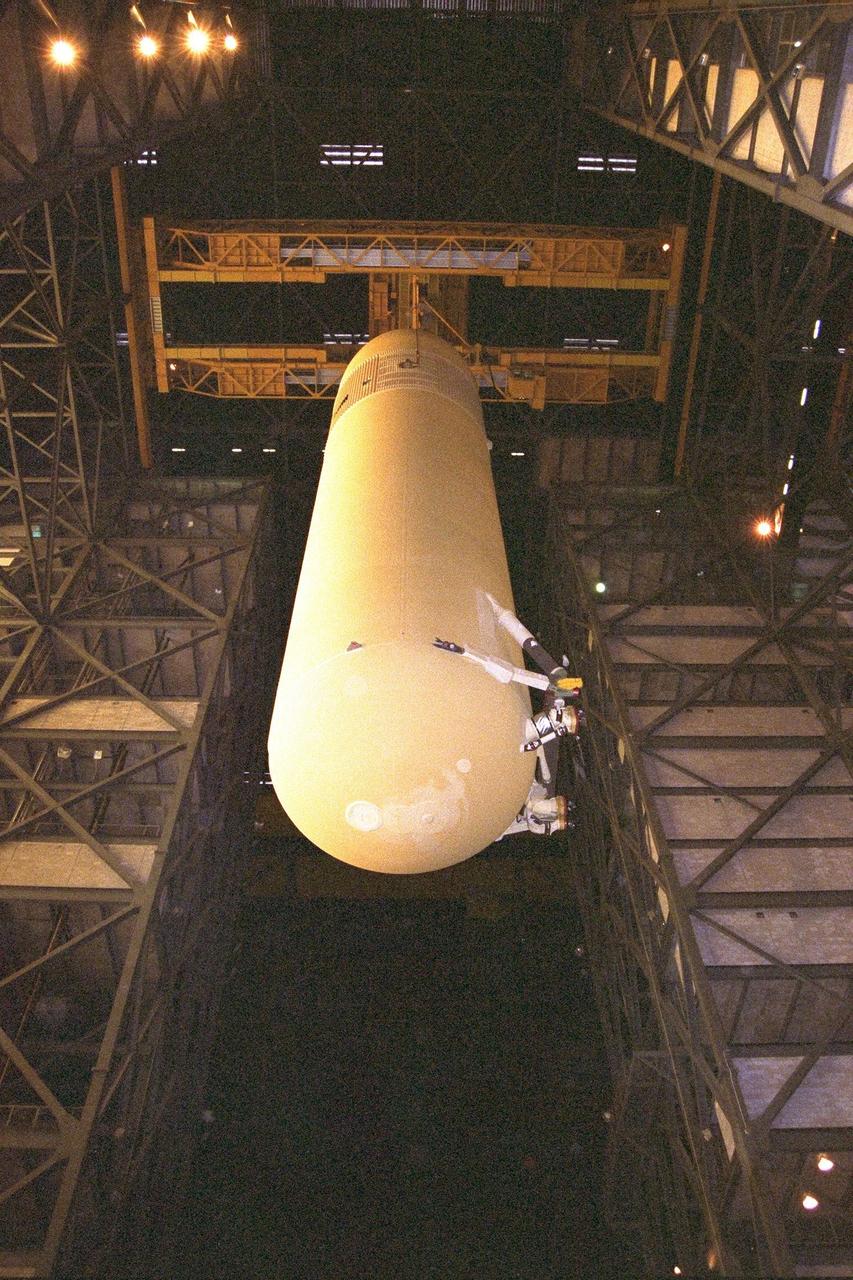
KENNEDY SPACE CENTER, FLA. -- The Space Shuttle's first super lightweight external tank is lifted in KSC's Vehicle Assembly Building for STS-91 pre-flight processing. STS-91 is targeted for launch in late May. The improved tank is 7,500 pounds lighter than its predecessors and was developed to increase the Shuttle payload capacity on International Space Station assembly flights. Major changes to the lighter tank include the use of new materials and a revised internal design. The new liquid oxygen and liquid hydrogen tanks are constructed of aluminum lithium a lighter, stronger material than the metal alloy currently used. The redesigned walls of the liquid hydrogen tank were machined to provide additional strength and stability as well
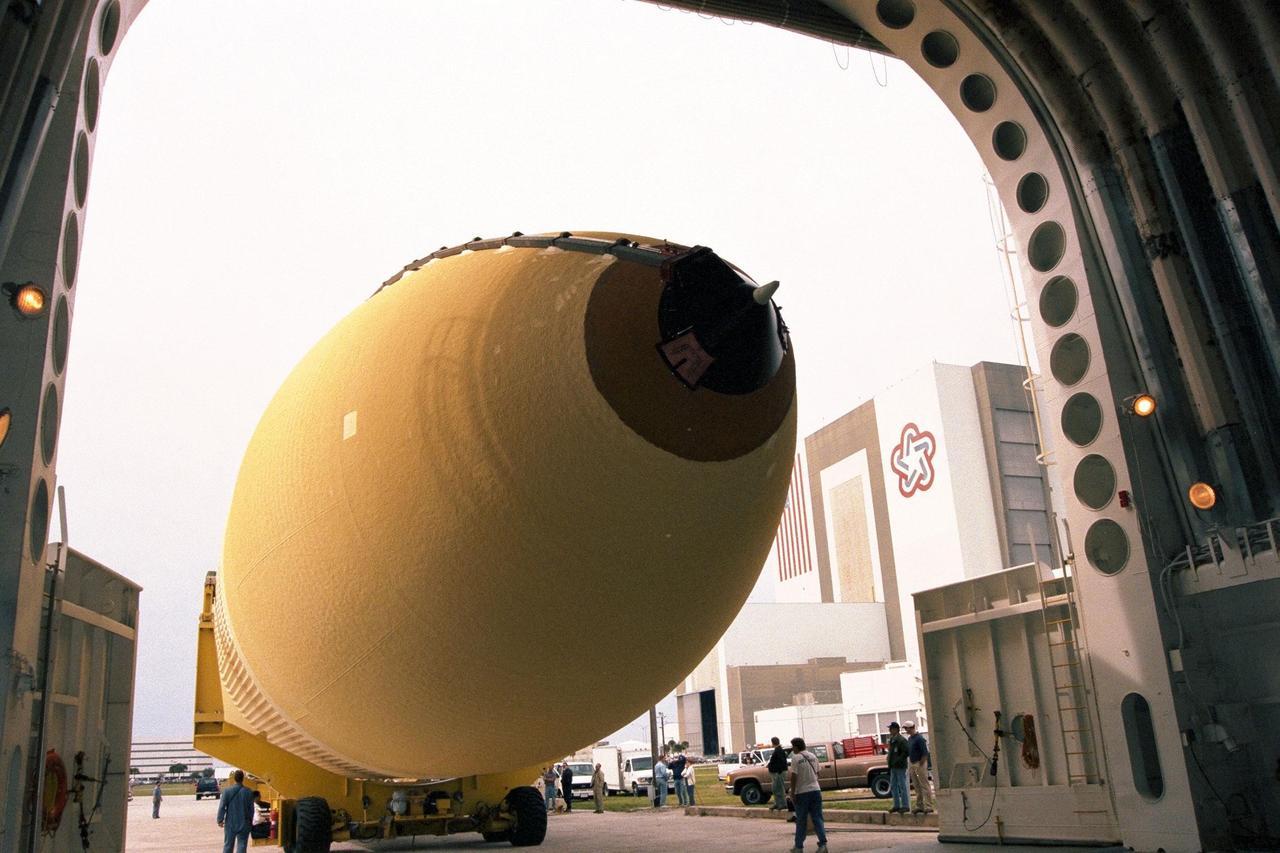
KENNEDY SPACE CENTER, FLA. -- The Space Shuttle's first super lightweight external tank is on its way to Kennedy Space Center's Vehicle Assembly Building for processing. The tank, which is scheduled for flight on STS-91 in late May, arrived Feb. 3 in Port Canaveral, where it remained until Feb. 6 due to high winds. It was moved by barge to KSC on Feb. 6. The improved tank is 7,500 pounds lighter than its predecessors and was developed to increase the Shuttle payload capacity on International Space Station assembly flights. Major changes to the lighter tank include the use of new materials and a revised internal design. The new liquid oxygen and liquid hydrogen tanks are constructed of aluminum lithium a lighter, stronger material than the metal alloy currently used. The redesigned walls of the liquid hydrogen tank were machined to provide additional strength and stability as well
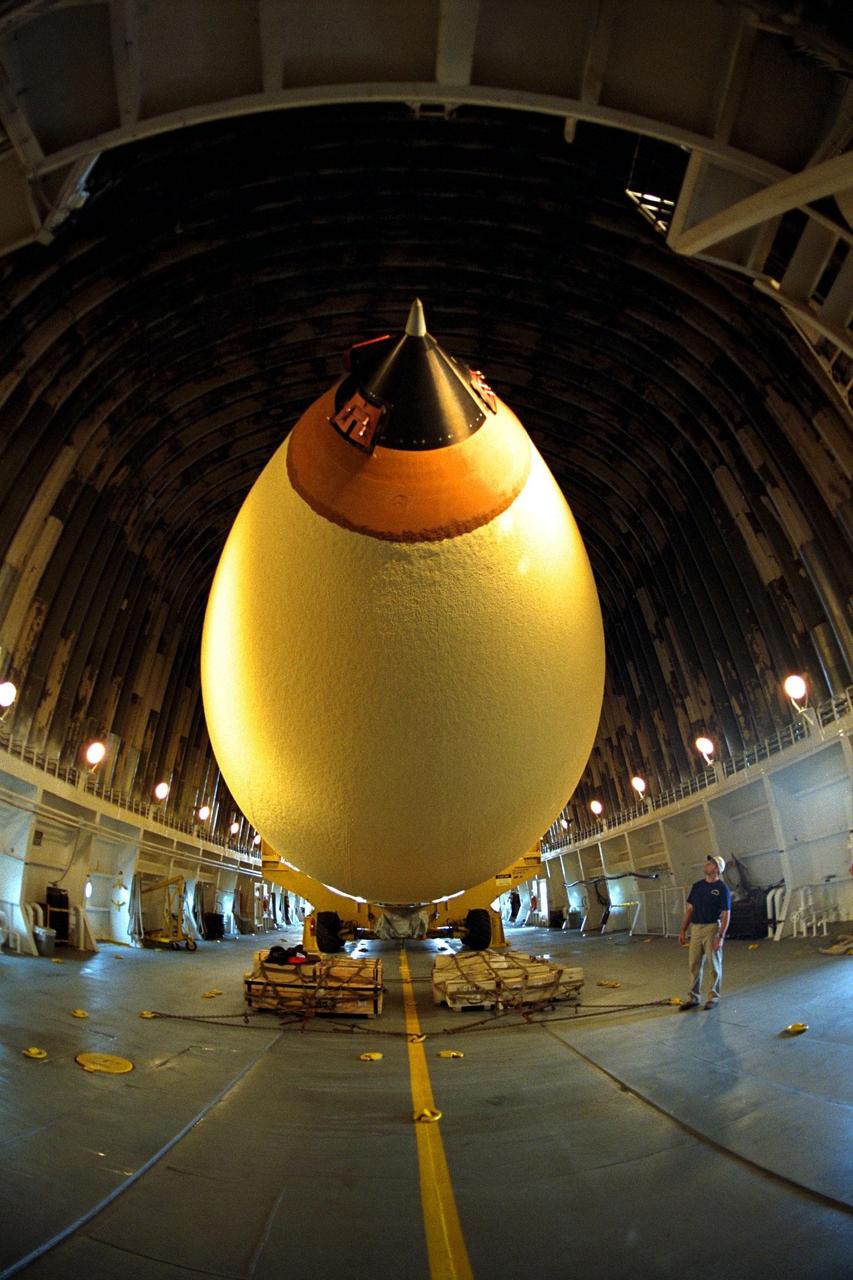
KENNEDY SPACE CENTER, FLA. -- Bren Wade, chief mate of the "Liberty Star," looks up at the Space Shuttle's first super lightweight external tank as it is moved on a barge to Port Canaveral, Fla. The tank is scheduled to undergo processing at Kennedy Space Center for flight on STS-91, targeted for launch in late May. The improved tank is 7,500 pounds lighter than its predecessors and was developed to increase the Shuttle payload capacity on International Space Station assembly flights. From the outside, the new orange-colored tank appears identical to tanks currently used on Shuttle flights. Major changes, however, include the use of new materials and a revised internal design. The new liquid oxygen and liquid hydrogen tanks are constructed of aluminum lithium a lighter, stronger material than the metal alloy currently used. The redesigned walls of the liquid hydrogen tank were machined to provide additional strength and stability as well. This photograph was taken with a wide-angle lens
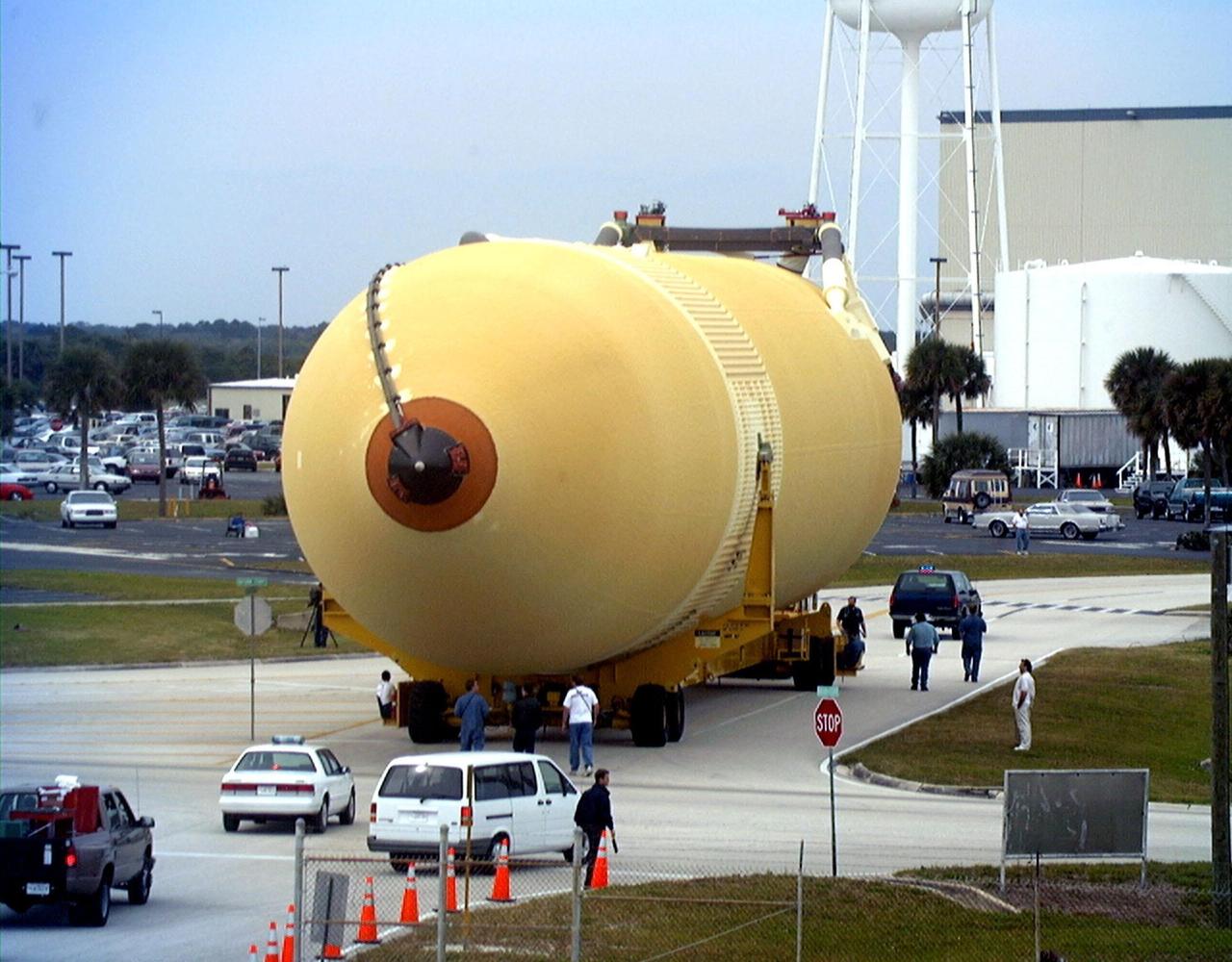
The Space Shuttle's first super lightweight external tank is on its way to Kennedy Space Center's Vehicle Assembly Building for processing. The tank, which is scheduled for flight on STS-91 in late May, arrived Feb. 3 in Port Canaveral, where it remained until Feb. 6 due to high winds. The improved tank is 7,500 pounds lighter than its predecessors and was developed to increase the Shuttle payload capacity on International Space Station assembly flights. Major changes to the lighter tank include the use of new materials and a revised internal design. The new liquid oxygen and liquid hydrogen tanks are constructed of aluminum lithium a lighter, stronger material than the metal alloy currently used. The redesigned walls of the liquid hydrogen tank were machined to provide additional strength and stability as well
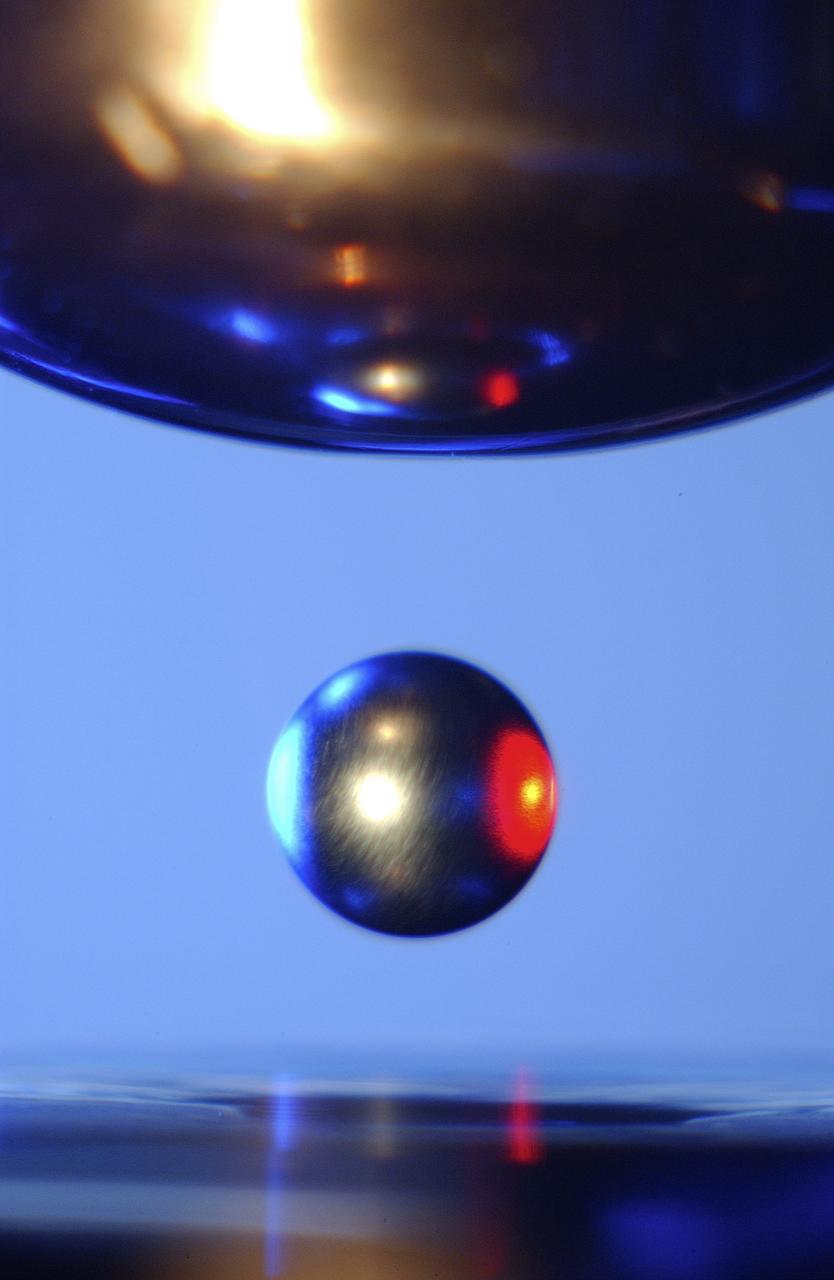
This is a close-up of a sample of titanium-zirconium-nickel alloy inside the Electrostatic Levitator (ESL) vacuum chamber at NASA's Marshall Space Flight Center (MSFC). The ESL uses static electricity to suspend an object (about 3-4 mm in diameter) inside a vacuum chamber allowing scientists to record a wide range of physical properties without the sample contracting the container or any instruments, conditions that would alter the readings. Once inside the chamber, a laser heats the sample until it melts. The laser is then turned off and the sample cools, changing from a liquid drop to a solid sphere. Since 1977, the ESL has been used at MSFC to study the characteristics of new metals, ceramics, and glass compounds. Materials created as a result of these tests include new optical materials, special metallic glasses, and spacecraft components.
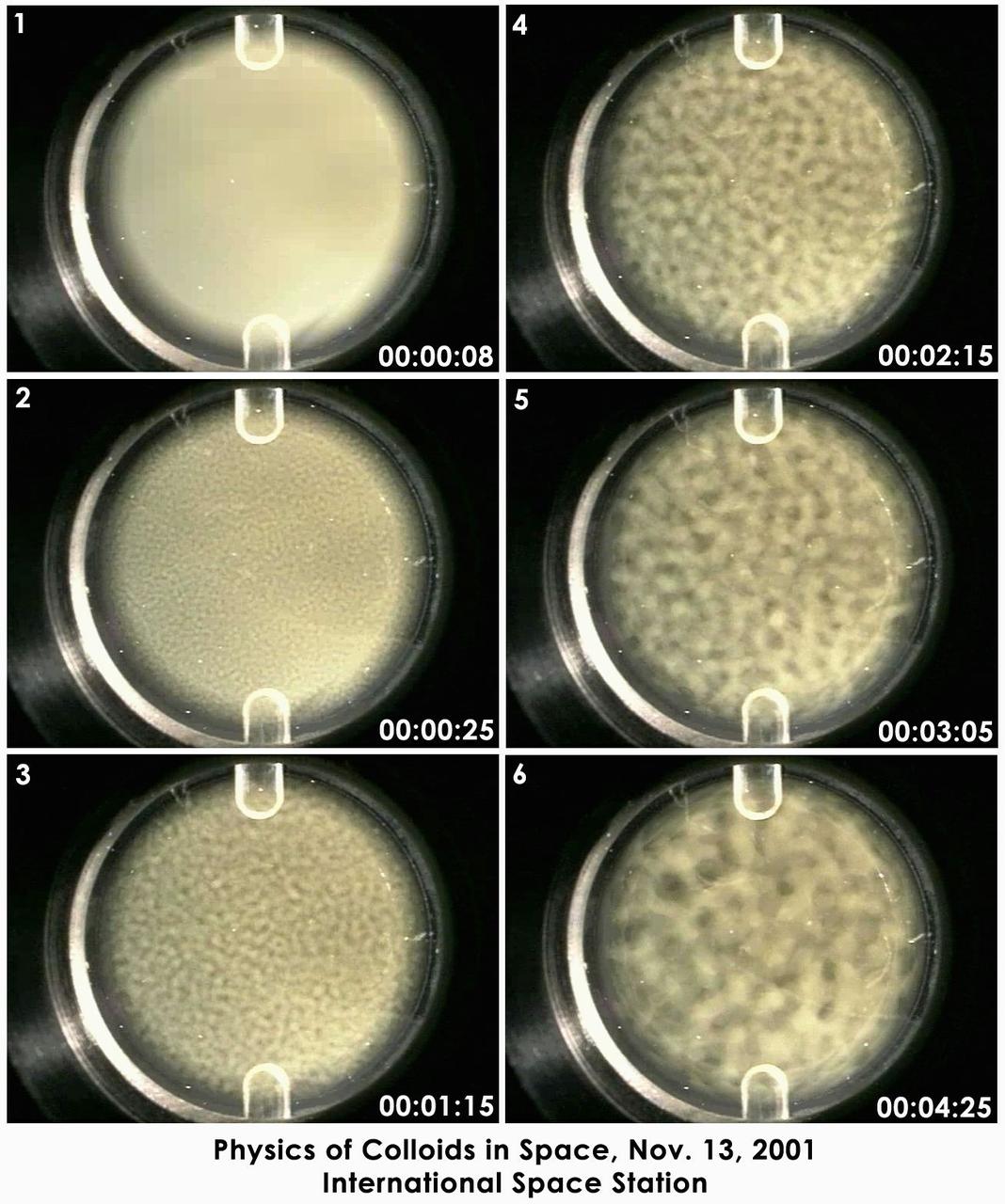
Still photographs taken over 16 hours on Nov. 13, 2001, on the International Space Station have been condensed into a few seconds to show the de-mixing -- or phase separation -- process studied by the Experiment on Physics of Colloids in Space. Commanded from the ground, dozens of similar tests have been conducted since the experiment arrived on ISS in 2000. The sample is a mix of polymethylmethacrylate (PMMA or acrylic) colloids, polystyrene polymers and solvents. The circular area is 2 cm (0.8 in.) in diameter. The phase separation process occurs spontaneously after the sample is mechanically mixed. The evolving lighter regions are rich in colloid and have the structure of a liquid. The dark regions are poor in colloids and have the structure of a gas. This behavior carnot be observed on Earth because gravity causes the particles to fall out of solution faster than the phase separation can occur. While similar to a gas-liquid phase transition, the growth rate observed in this test is different from any atomic gas-liquid or liquid-liquid phase transition ever measured experimentally. Ultimately, the sample separates into colloid-poor and colloid-rich areas, just as oil and vinegar separate. The fundamental science of de-mixing in this colloid-polymer sample is the same found in the annealing of metal alloys and plastic polymer blends. Improving the understanding of this process may lead to improving processing of these materials on Earth.
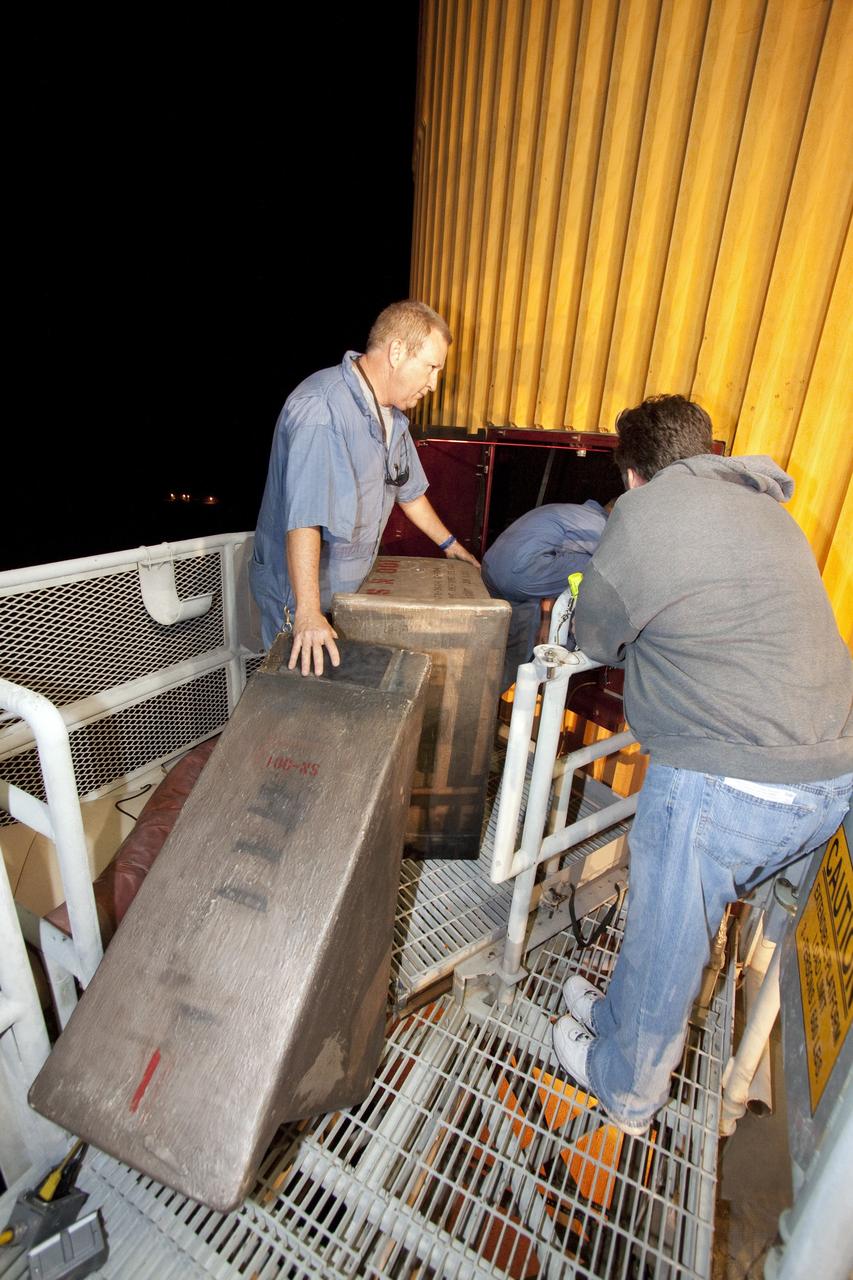
CAPE CANAVERAL, Fla. -- On Launch Pad 39A at NASA's Kennedy Space Center in Florida, technicians take temporary step pads into the intertank of space shuttle Discovery's external fuel tank. The intertank is unpressurized and holds most of the tank's electrical components. It sits between the liquid hydrogen tank and liquid oxygen tank. Technicians will be working inside the intertank to further analyze two cracks that were found on the tank’s metal exterior. The foam cracked during initial loading operations for space shuttle Discovery’s launch attempt on Nov. 5. The cracks are on one of the stringers, which are the composite aluminum ribs located vertically on the intertank area. Discovery's next launch attempt is no earlier than Nov. 30 at 4:02 a.m. EST. For more information on STS-133, visit www.nasa.gov/mission_pages/shuttle/shuttlemissions/sts133/. Photo credit: NASA/Jack Pfaller
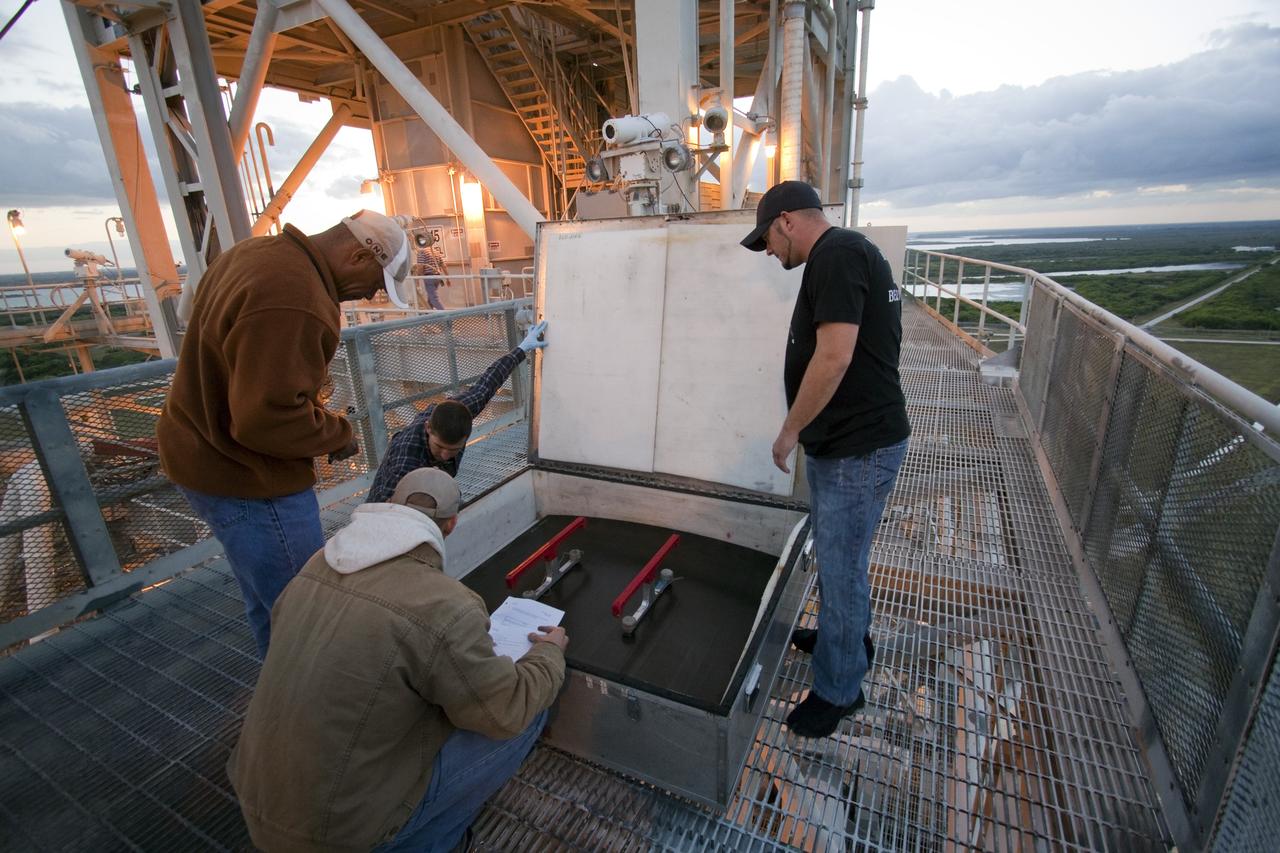
CAPE CANAVERAL, Fla. -- On Launch Pad 39A at NASA's Kennedy Space Center in Florida, technicians prepare to work inside the intertank of space shuttle Discovery's external fuel tank. Seen here are step pads that will be temporarily installed in the intertank. The intertank is unpressurized and holds most of the tank's electrical components. It sits between the liquid hydrogen tank and liquid oxygen tank. Technicians will be working inside the intertank to further analyze two cracks that were found on the tank’s metal exterior. The foam cracked during initial loading operations for space shuttle Discovery’s launch attempt on Nov. 5. The cracks are on one of the stringers, which are the composite aluminum ribs located vertically on the intertank area. Discovery's next launch attempt is no earlier than Nov. 30 at 4:02 a.m. EST. For more information on STS-133, visit www.nasa.gov/mission_pages/shuttle/shuttlemissions/sts133/. Photo credit: NASA/Jack Pfaller
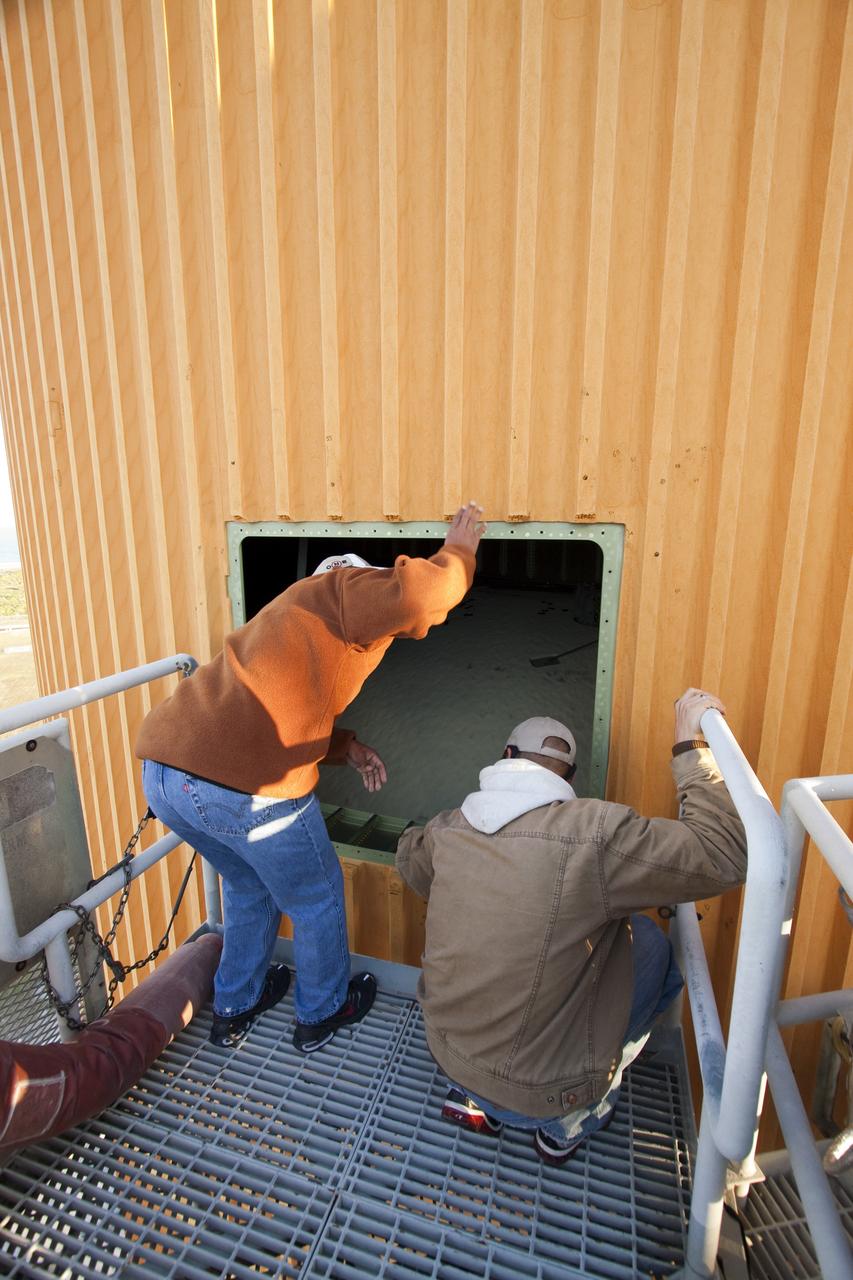
CAPE CANAVERAL, Fla. -- On Launch Pad 39A at NASA's Kennedy Space Center in Florida, technicians prepare to work inside the intertank of space shuttle Discovery's external fuel tank, which is accessible through this door. The intertank is unpressurized and holds most of the tank's electrical components. It sits between the liquid hydrogen tank and liquid oxygen tank. Technicians will be working inside the intertank to further analyze two cracks that were found on the tank’s metal exterior. The foam cracked during initial loading operations for space shuttle Discovery’s launch attempt on Nov. 5. The cracks are on one of the stringers, which are the composite aluminum ribs located vertically on the intertank area. Discovery's next launch attempt is no earlier than Nov. 30 at 4:02 a.m. EST. For more information on STS-133, visit www.nasa.gov/mission_pages/shuttle/shuttlemissions/sts133/. Photo credit: NASA/Jack Pfaller
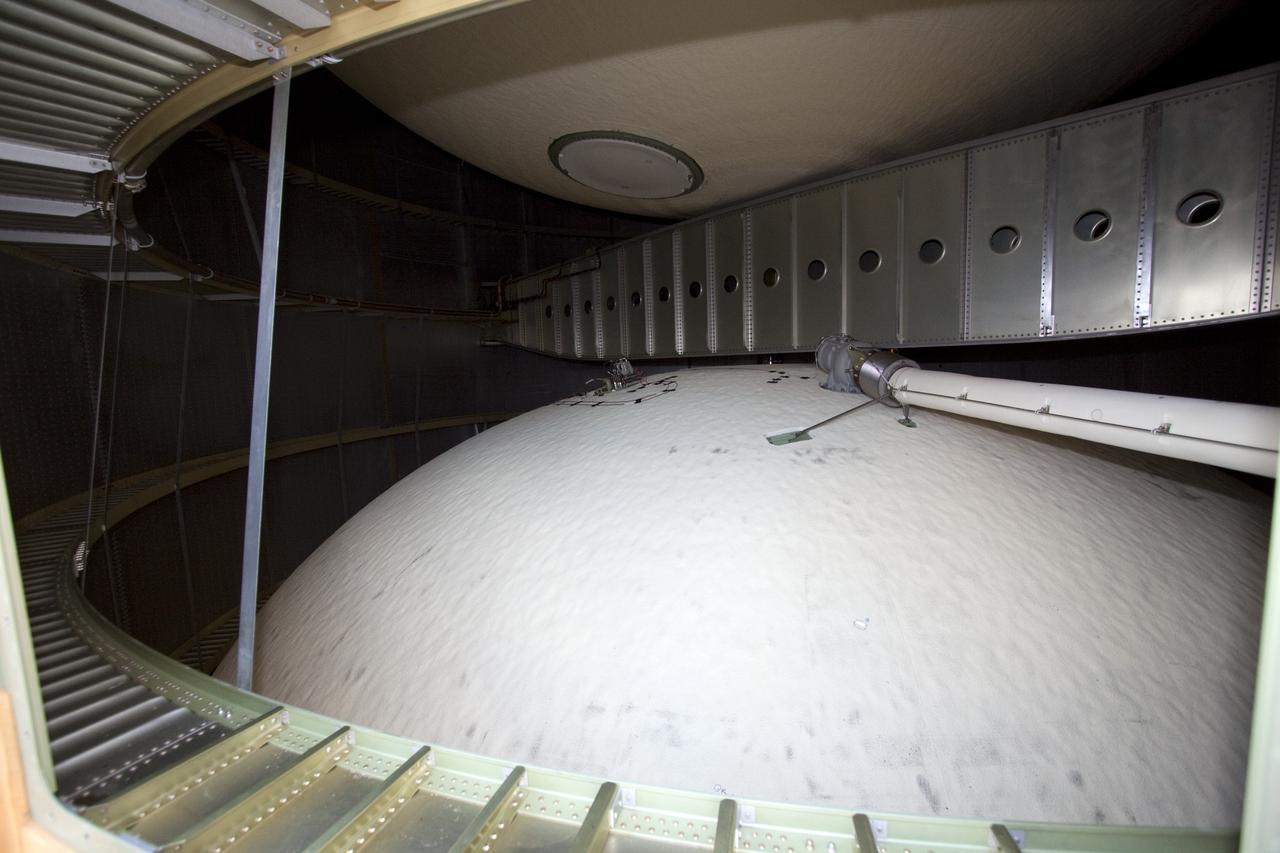
CAPE CANAVERAL, Fla. -- On Launch Pad 39A at NASA's Kennedy Space Center in Florida, this view gives a look inside the intertank of space shuttle Discovery's external fuel tank. The intertank is unpressurized and holds most of the tank's electrical components. It sits between the liquid hydrogen tank, below, and liquid oxygen tank, above. Technicians will be working inside the intertank to further analyze two cracks that were found on the tank’s metal exterior. The foam cracked during initial loading operations for space shuttle Discovery’s launch attempt on Nov. 5. The cracks are on one of the stringers, which are the composite aluminum ribs located vertically on the intertank area. Discovery's next launch attempt is no earlier than Nov. 30 at 4:02 a.m. EST. For more information on STS-133, visit www.nasa.gov/mission_pages/shuttle/shuttlemissions/sts133/. Photo credit: NASA/Jack Pfaller
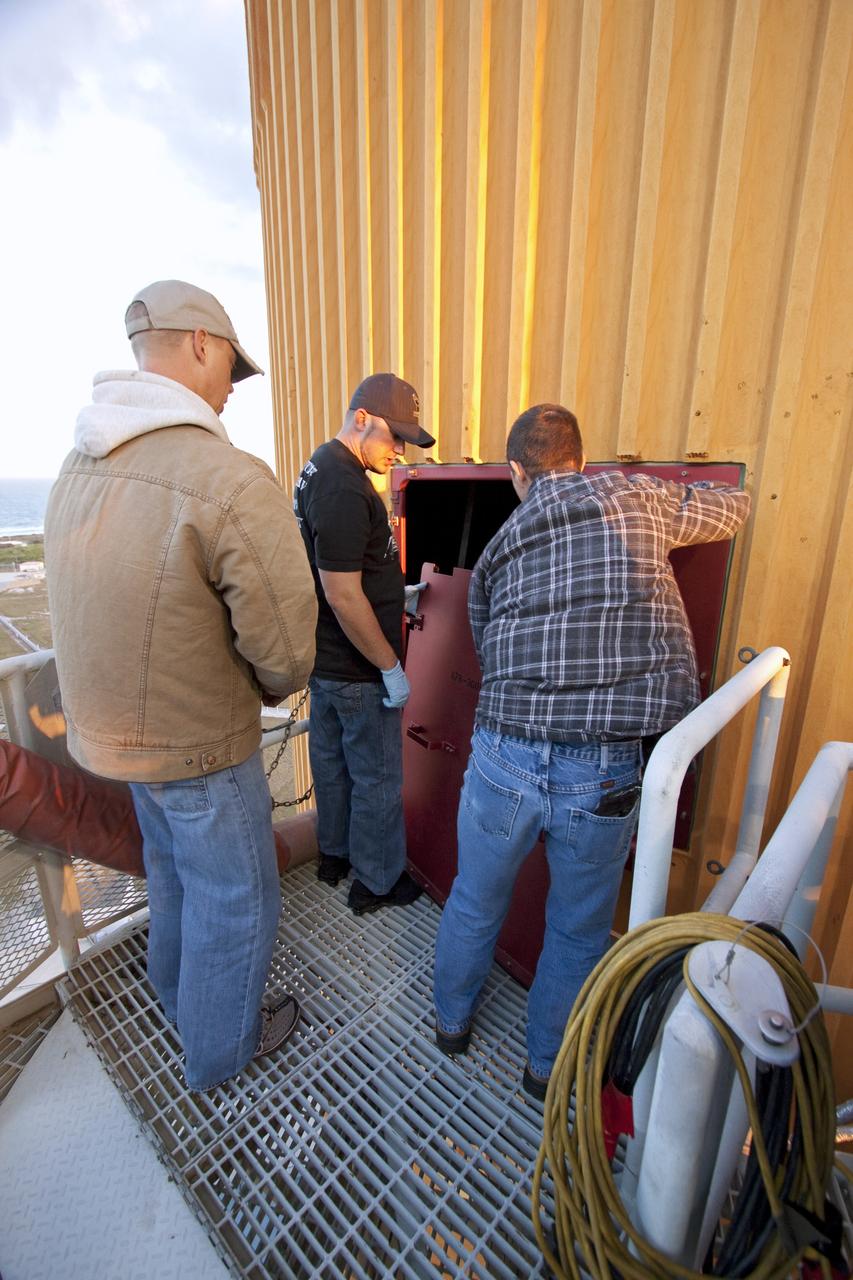
CAPE CANAVERAL, Fla. -- On Launch Pad 39A at NASA's Kennedy Space Center in Florida, technicians prepare to work inside the intertank of space shuttle Discovery's external fuel tank, which is accessible through this door. The intertank is unpressurized and holds most of the tank's electrical components. It sits between the liquid hydrogen tank and liquid oxygen tank. Technicians will be working inside the intertank to further analyze two cracks that were found on the tank’s metal exterior. The foam cracked during initial loading operations for space shuttle Discovery’s launch attempt on Nov. 5. The cracks are on one of the stringers, which are the composite aluminum ribs located vertically on the intertank area. Discovery's next launch attempt is no earlier than Nov. 30 at 4:02 a.m. EST. For more information on STS-133, visit www.nasa.gov/mission_pages/shuttle/shuttlemissions/sts133/. Photo credit: NASA/Jack Pfaller
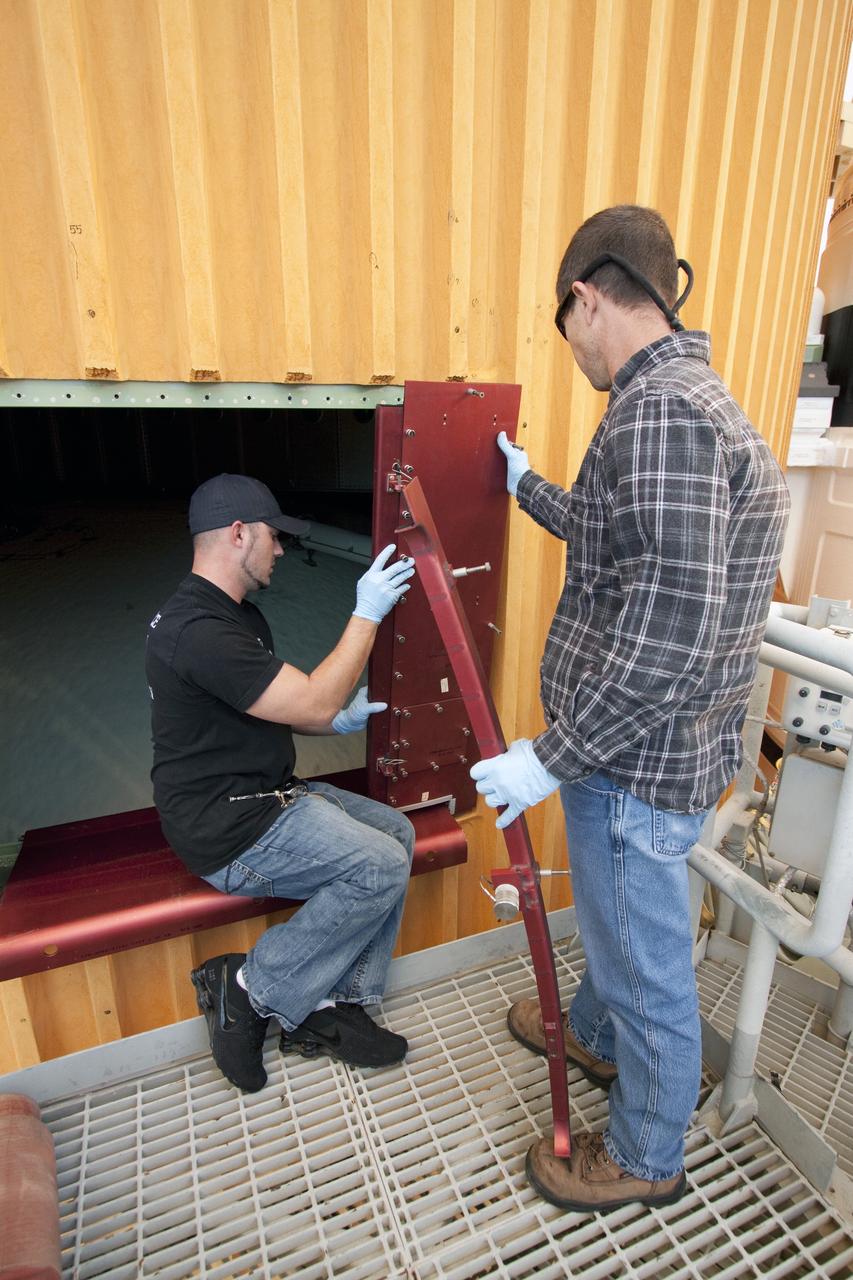
CAPE CANAVERAL, Fla. -- On Launch Pad 39A at NASA's Kennedy Space Center in Florida, technicians prepare to work inside the intertank of space shuttle Discovery's external fuel tank, which is accessible through this door. The intertank is unpressurized and holds most of the tank's electrical components. It sits between the liquid hydrogen tank and liquid oxygen tank. Technicians will be working inside the intertank to further analyze two cracks that were found on the tank’s metal exterior. The foam cracked during initial loading operations for space shuttle Discovery’s launch attempt on Nov. 5. The cracks are on one of the stringers, which are the composite aluminum ribs located vertically on the intertank area. Discovery's next launch attempt is no earlier than Nov. 30 at 4:02 a.m. EST. For more information on STS-133, visit www.nasa.gov/mission_pages/shuttle/shuttlemissions/sts133/. Photo credit: NASA/Jack Pfaller
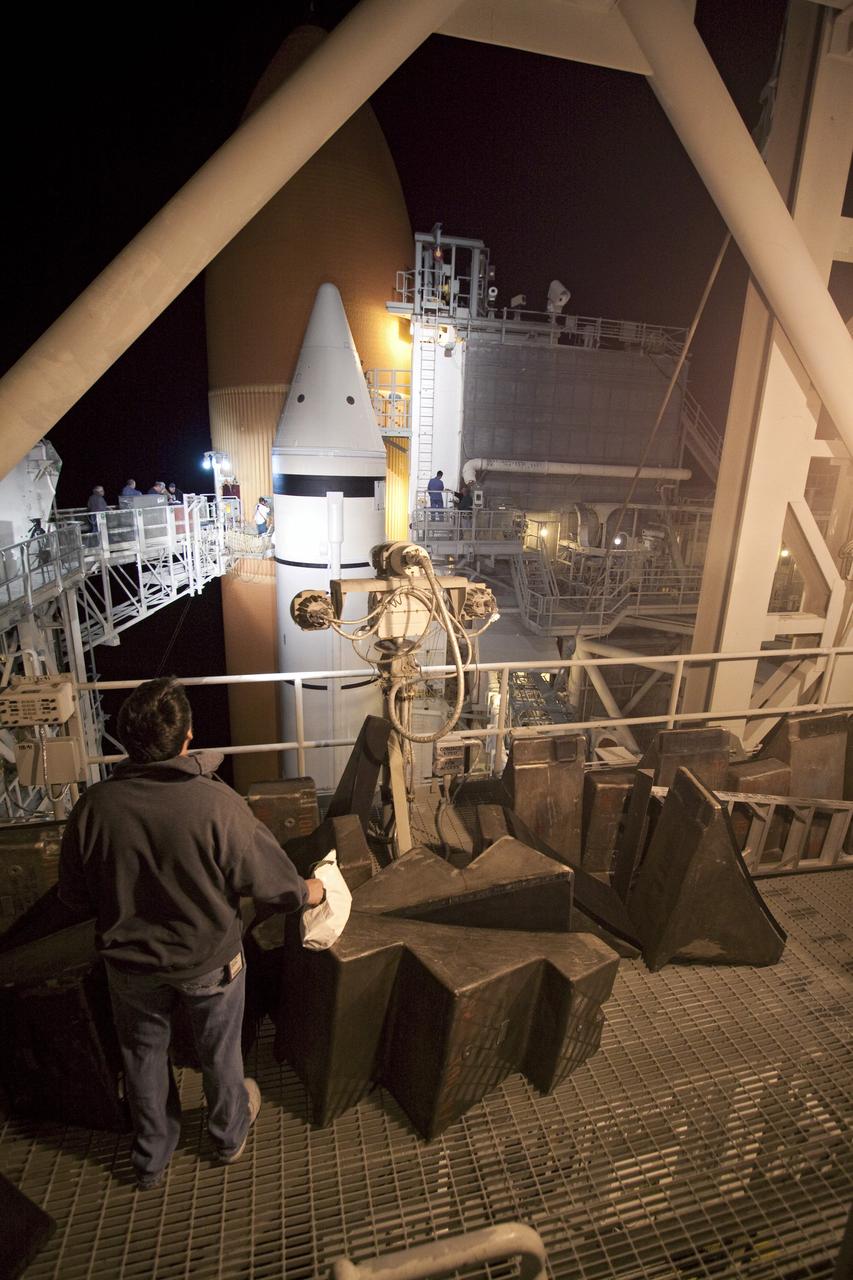
CAPE CANAVERAL, Fla. -- On Launch Pad 39A at NASA's Kennedy Space Center in Florida, technicians prepare to work inside the intertank of space shuttle Discovery's external fuel tank. Seen here are step pads that will be temporarily installed in the intertank. The intertank is unpressurized and holds most of the tank's electrical components. It sits between the liquid hydrogen tank and liquid oxygen tank. Technicians will be working inside the intertank to further analyze two cracks that were found on the tank’s metal exterior. The foam cracked during initial loading operations for space shuttle Discovery’s launch attempt on Nov. 5. The cracks are on one of the stringers, which are the composite aluminum ribs located vertically on the intertank area. Discovery's next launch attempt is no earlier than Nov. 30 at 4:02 a.m. EST. For more information on STS-133, visit www.nasa.gov/mission_pages/shuttle/shuttlemissions/sts133/. Photo credit: NASA/Jack Pfaller
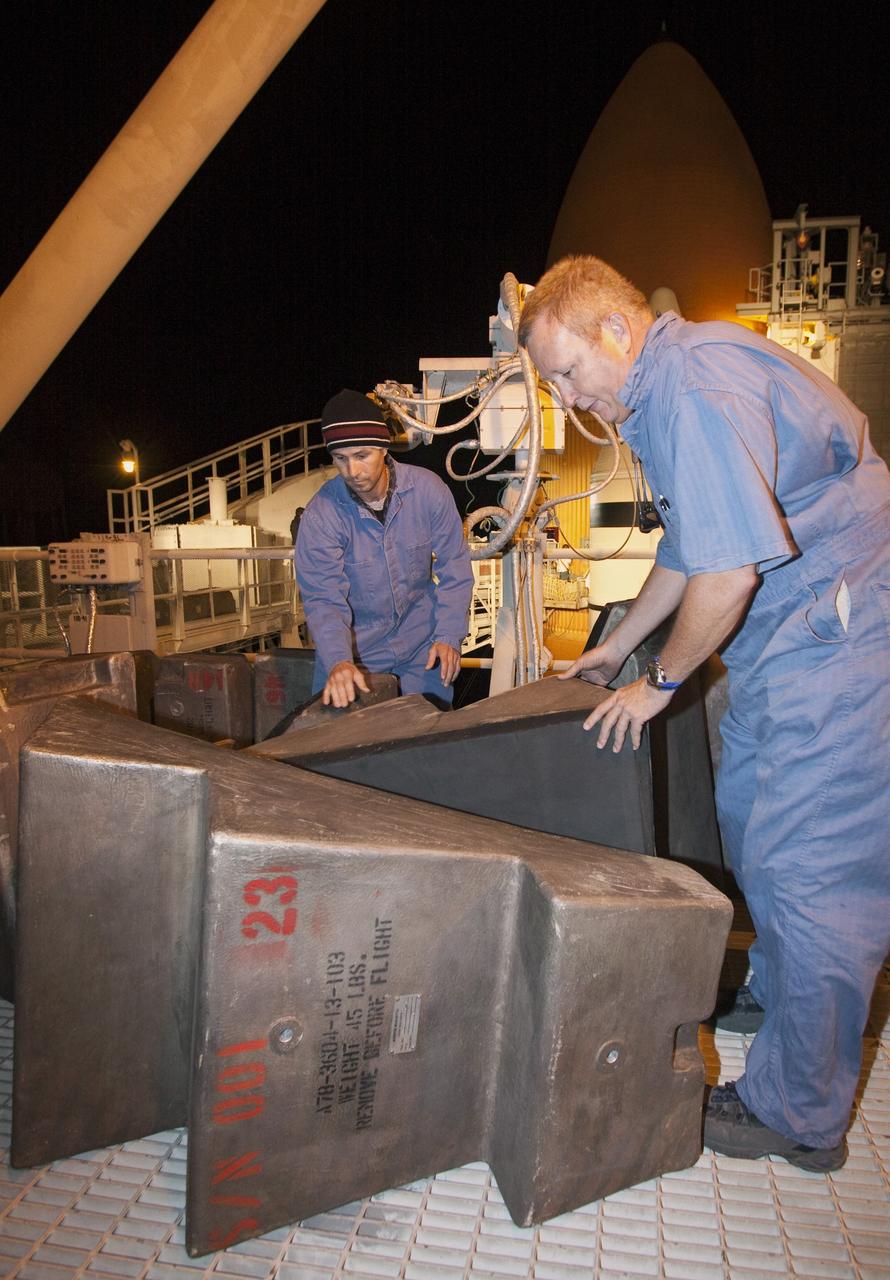
CAPE CANAVERAL, Fla. -- On Launch Pad 39A at NASA's Kennedy Space Center in Florida, technicians prepare to work inside the intertank of space shuttle Discovery's external fuel tank. Seen here are step pads that will be temporarily installed in the intertank. The intertank is unpressurized and holds most of the tank's electrical components. It sits between the liquid hydrogen tank and liquid oxygen tank. Technicians will be working inside the intertank to further analyze two cracks that were found on the tank’s metal exterior. The foam cracked during initial loading operations for space shuttle Discovery’s launch attempt on Nov. 5. The cracks are on one of the stringers, which are the composite aluminum ribs located vertically on the intertank area. Discovery's next launch attempt is no earlier than Nov. 30 at 4:02 a.m. EST. For more information on STS-133, visit www.nasa.gov/mission_pages/shuttle/shuttlemissions/sts133/. Photo credit: NASA/Jack Pfaller

CAPE CANAVERAL, Fla. -- On Launch Pad 39A at NASA's Kennedy Space Center in Florida, technicians will access the intertank of space shuttle Discovery's external fuel tank through this door. The intertank is unpressurized and holds most of the tank's electrical components. It sits between the liquid hydrogen tank and liquid oxygen tank. Technicians will be working inside the intertank to further analyze two cracks that were found on the tank’s metal exterior. The foam cracked during initial loading operations for space shuttle Discovery’s launch attempt on Nov. 5. The cracks are on one of the stringers, which are the composite aluminum ribs located vertically on the intertank area. Discovery's next launch attempt is no earlier than Nov. 30 at 4:02 a.m. EST. For more information on STS-133, visit www.nasa.gov/mission_pages/shuttle/shuttlemissions/sts133/. Photo credit: NASA/Jack Pfaller
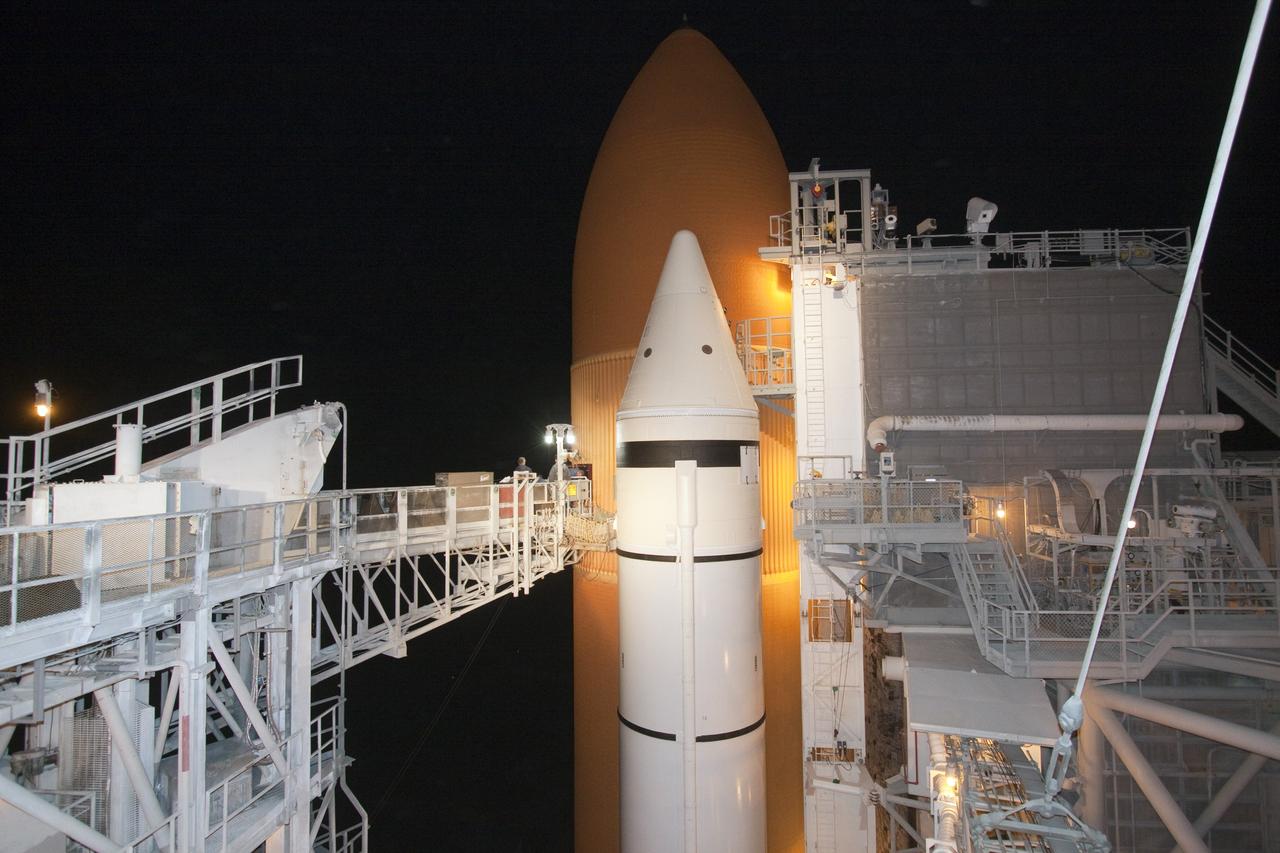
CAPE CANAVERAL, Fla. -- On Launch Pad 39A at NASA's Kennedy Space Center in Florida, technicians prepare to work inside the intertank of space shuttle Discovery's external fuel tank. The intertank is unpressurized and holds most of the tank's electrical components. It sits between the liquid hydrogen tank and liquid oxygen tank. Technicians will be working inside the intertank to further analyze two cracks that were found on the tank’s metal exterior. The foam cracked during initial loading operations for space shuttle Discovery’s launch attempt on Nov. 5. The cracks are on one of the stringers, which are the composite aluminum ribs located vertically on the intertank area. Discovery's next launch attempt is no earlier than Nov. 30 at 4:02 a.m. EST. For more information on STS-133, visit www.nasa.gov/mission_pages/shuttle/shuttlemissions/sts133/. Photo credit: NASA/Jack Pfaller
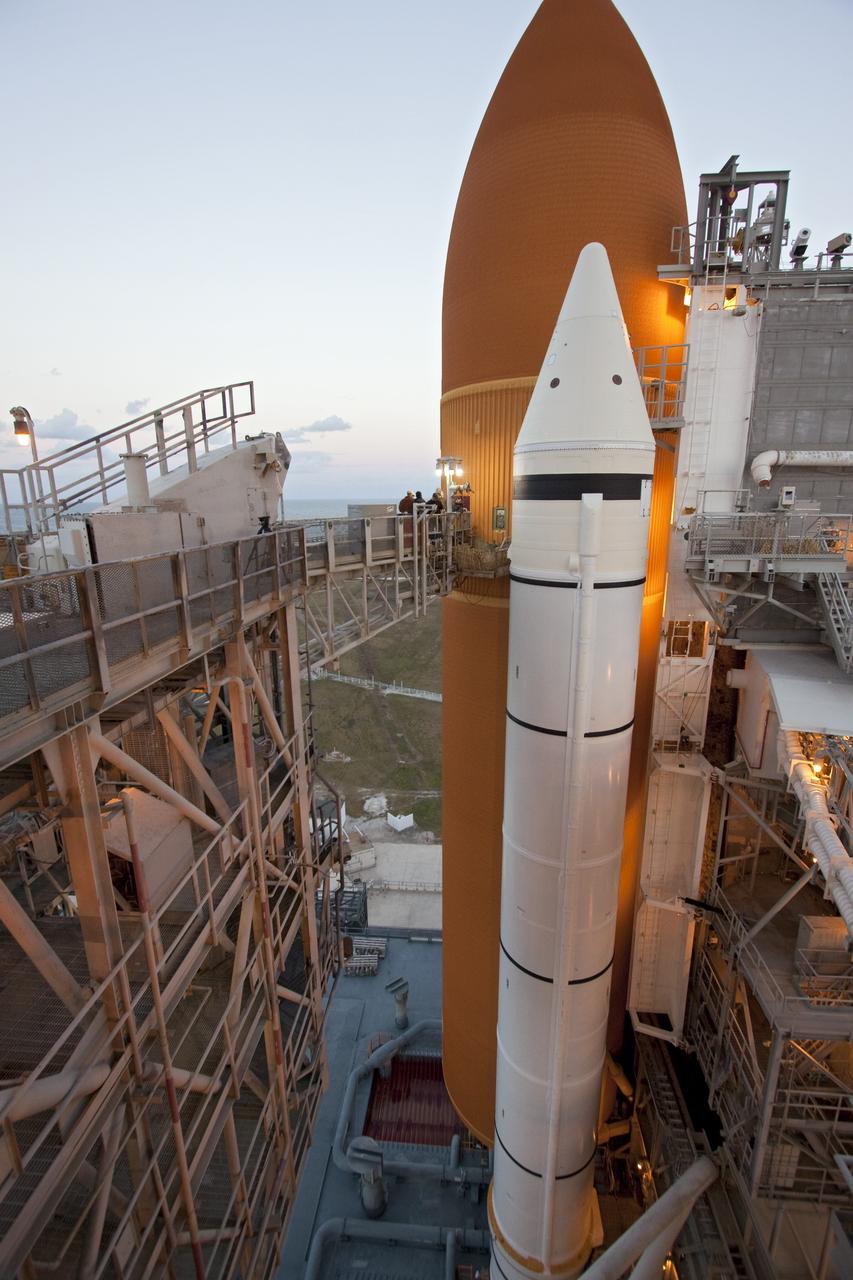
CAPE CANAVERAL, Fla. -- On Launch Pad 39A at NASA's Kennedy Space Center in Florida, technicians prepare to work inside the intertank of space shuttle Discovery's external fuel tank. The intertank is unpressurized and holds most of the tank's electrical components. It sits between the liquid hydrogen tank and liquid oxygen tank. Technicians will be working inside the intertank to further analyze two cracks that were found on the tank’s metal exterior. The foam cracked during initial loading operations for space shuttle Discovery’s launch attempt on Nov. 5. The cracks are on one of the stringers, which are the composite aluminum ribs located vertically on the intertank area. Discovery's next launch attempt is no earlier than Nov. 30 at 4:02 a.m. EST. For more information on STS-133, visit www.nasa.gov/mission_pages/shuttle/shuttlemissions/sts133/. Photo credit: NASA/Jack Pfaller
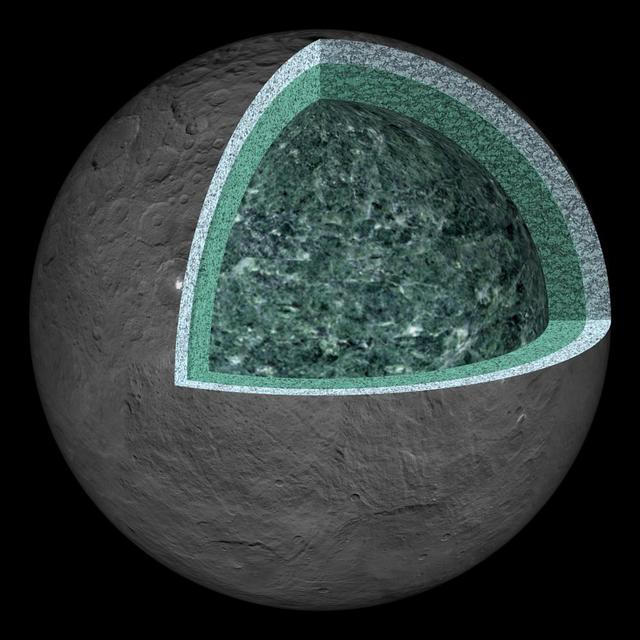
This artist's concept summarizes our understanding of how the inside of Ceres could be structured, based on the data returned by the NASA's Dawn mission. Using information about Ceres' gravity and topography, scientists found that Ceres is "differentiated," which means that it has compositionally distinct layers at different depths. The most internal layer, the "mantle" is dominated by hydrated rocks, like clays. The external layer, the 24.85-mile (40-kilometer) thick crust, is a mixture of ice, salts, and hydrated minerals. Between the two is a layer that may contain a little bit of liquid rich in salts, called brine. It extends down at least 62 miles (100 kilometers). The Dawn observations cannot "see" below about 62 miles (100 kilometers) in depth. Hence, it is not possible to tell if Ceres' deep interior contains more liquid or a core of dense material rich in metal. https://photojournal.jpl.nasa.gov/catalog/PIA22660
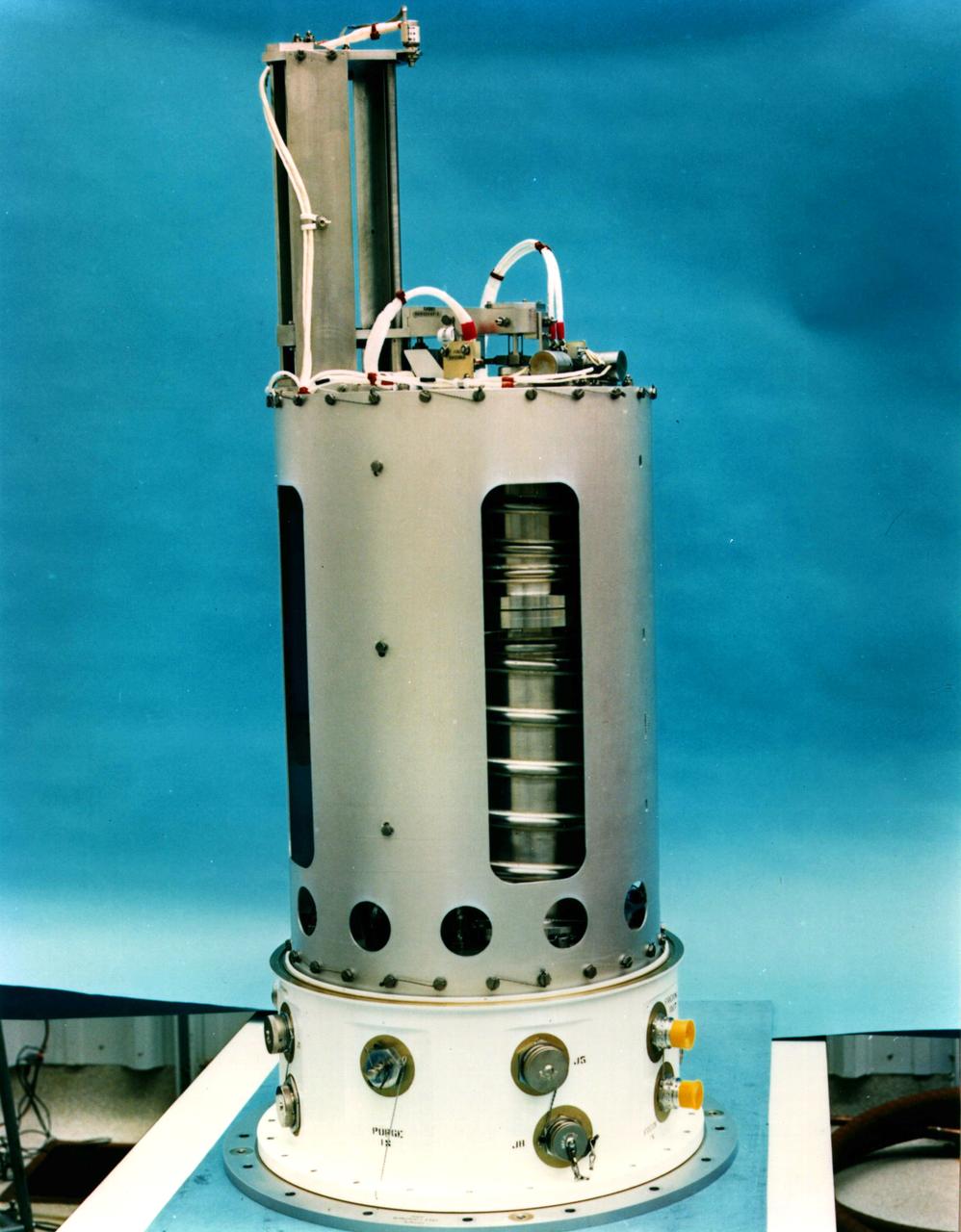
The Advanced Automated Directional Solidification Furnace (AADSF) with the Experimental Apparatus Container (EAC) removed flew during the USMP-2 mission. During USMP-2, the AADSF was used to study the growth of mercury cadmium telluride crystals in microgravity by directional solidification, a process commonly used on earth to process metals and grow crystals. The furnace is tubular and has three independently controlled temperature zones . The sample travels from the hot zone of the furnace (1600 degrees F) where the material solidifies as it cools. The solidification region, known as the solid/liquid interface, moves from one end of the sample to the other at a controlled rate, thus the term directional solidification.
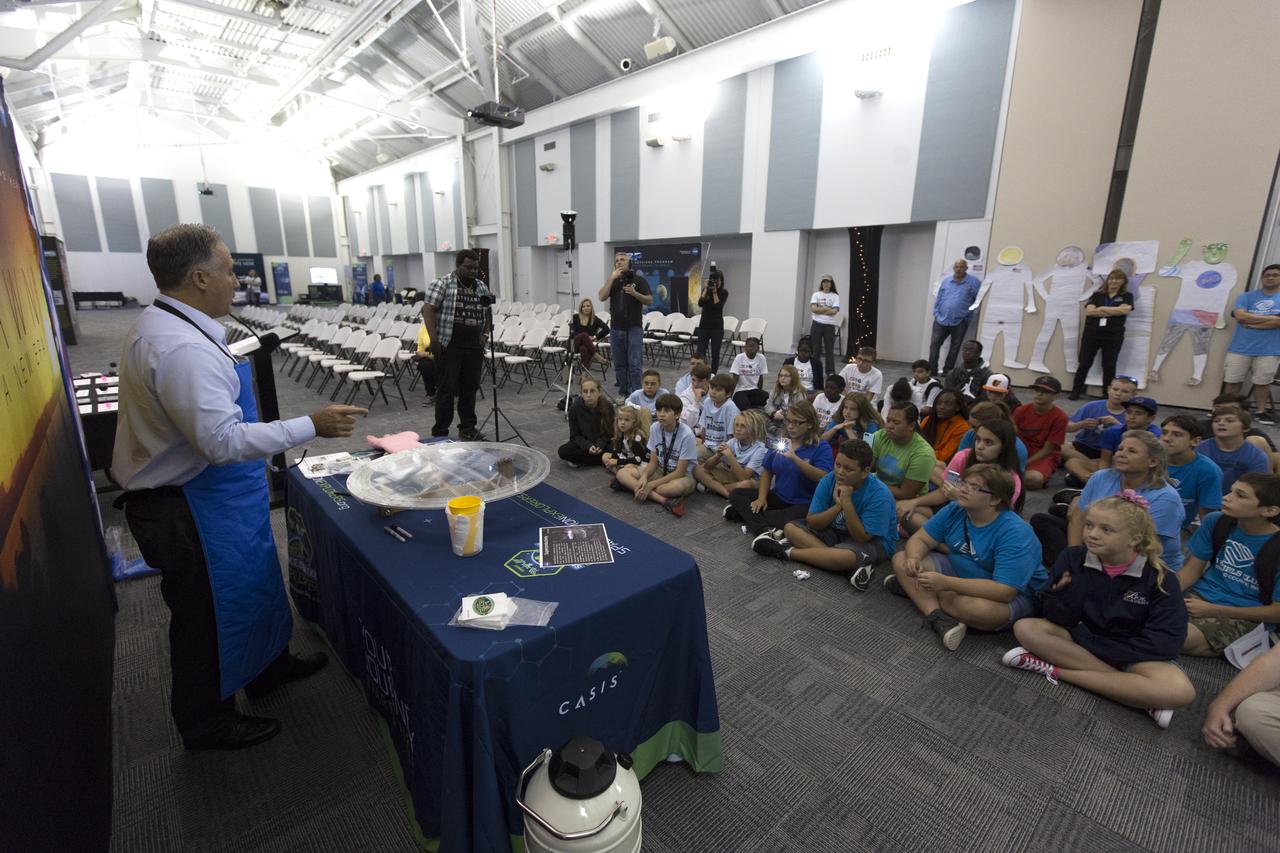
NASA Kennedy Space Center's Trent Smith conducts a quantum levitation demonstration, using liquid nitrogen, metal and a magnetic track, for students and their sponsors in the Center for Space Education at NASA’s Kennedy Space Center in Florida. Teams from across the state of Florida were gathered at Kennedy for the finals of the Zero Robotics Middle School Summer Program national championship. The five-week program allows rising sixth- through ninth-graders to write programs for small satellites called SPHERES (Synchronized, Position, Hold, Engage, Reorient, Experimental Satellites). Finalists saw their code tested aboard the International Space Station.
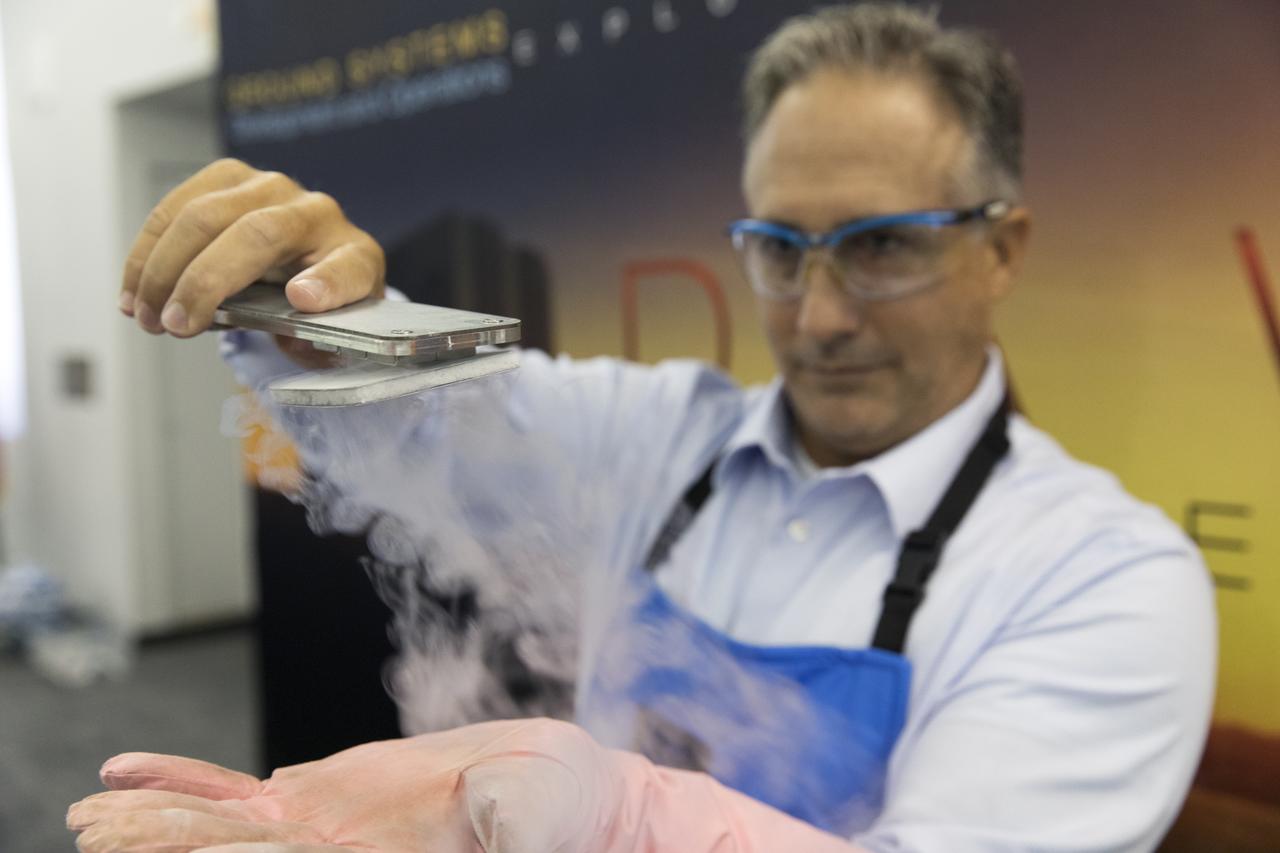
NASA Kennedy Space Center's Trent Smith conducts a quantum levitation demonstration, using liquid nitrogen, metal and a magnetic track, for students and their sponsors in the Center for Space Education at NASA’s Kennedy Space Center in Florida. Teams from across the state of Florida were gathered at Kennedy for the finals of the Zero Robotics Middle School Summer Program national championship. The five-week program allows rising sixth- through ninth-graders to write programs for small satellites called SPHERES (Synchronized, Position, Hold, Engage, Reorient, Experimental Satellites). Finalists saw their code tested aboard the International Space Station.
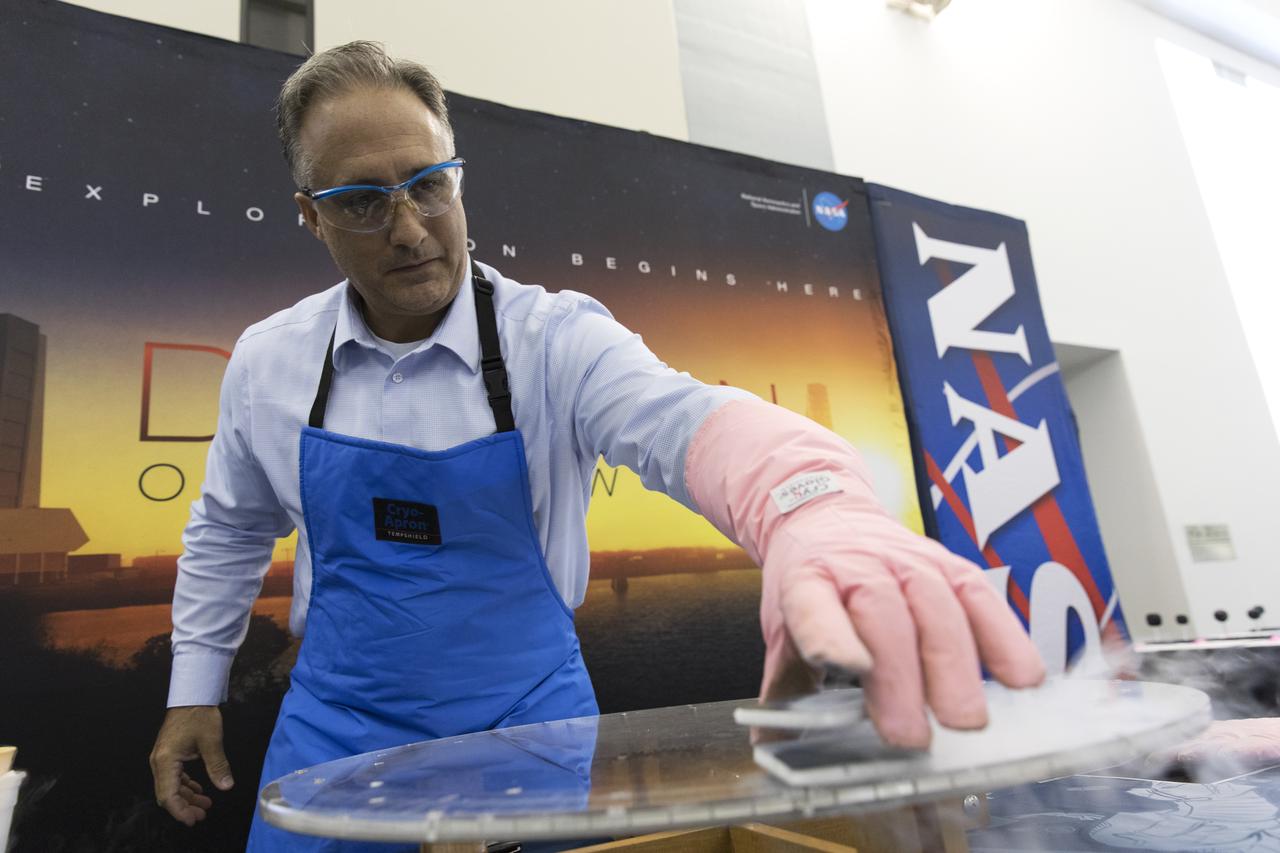
NASA Kennedy Space Center's Trent Smith conducts a quantum levitation demonstration, using liquid nitrogen, metal and a magnetic track, for students and their sponsors in the Center for Space Education at NASA’s Kennedy Space Center in Florida. Teams from across the state of Florida were gathered at Kennedy for the finals of the Zero Robotics Middle School Summer Program national championship. The five-week program allows rising sixth- through ninth-graders to write programs for small satellites called SPHERES (Synchronized, Position, Hold, Engage, Reorient, Experimental Satellites). Finalists saw their code tested aboard the International Space Station.
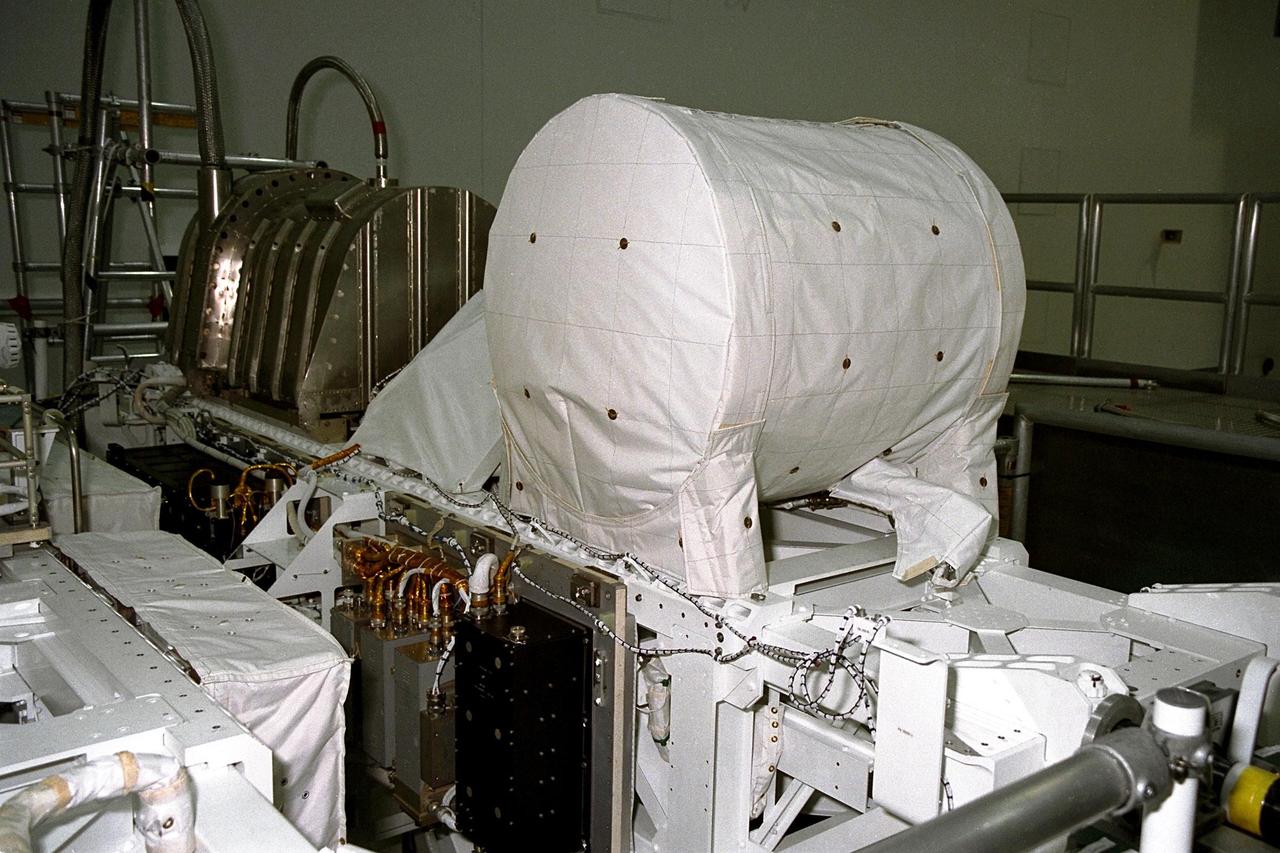
United States Microgravity Payload-4 (USMP-4) experiments are prepared to be flown on Space Shuttle mission STS-87 in the Space Station Processing Facility at Kennedy Space Center (KSC). Seen in the foreground at right is the Isothermal Dendritic Growth Experiment (IDGE), which will be used to study the dendritic solidification of molten materials in the microgravity environment. The metallic breadbox-like structure behind the IDGE is the Confined Helium Experiment (CHeX) that will study one of the basic influences on the behavior and properties of materials by using liquid helium confined between solid surface, and microgravity. These experiments are scheduled for launch aboard STS-87 on Nov. 19 from KSC
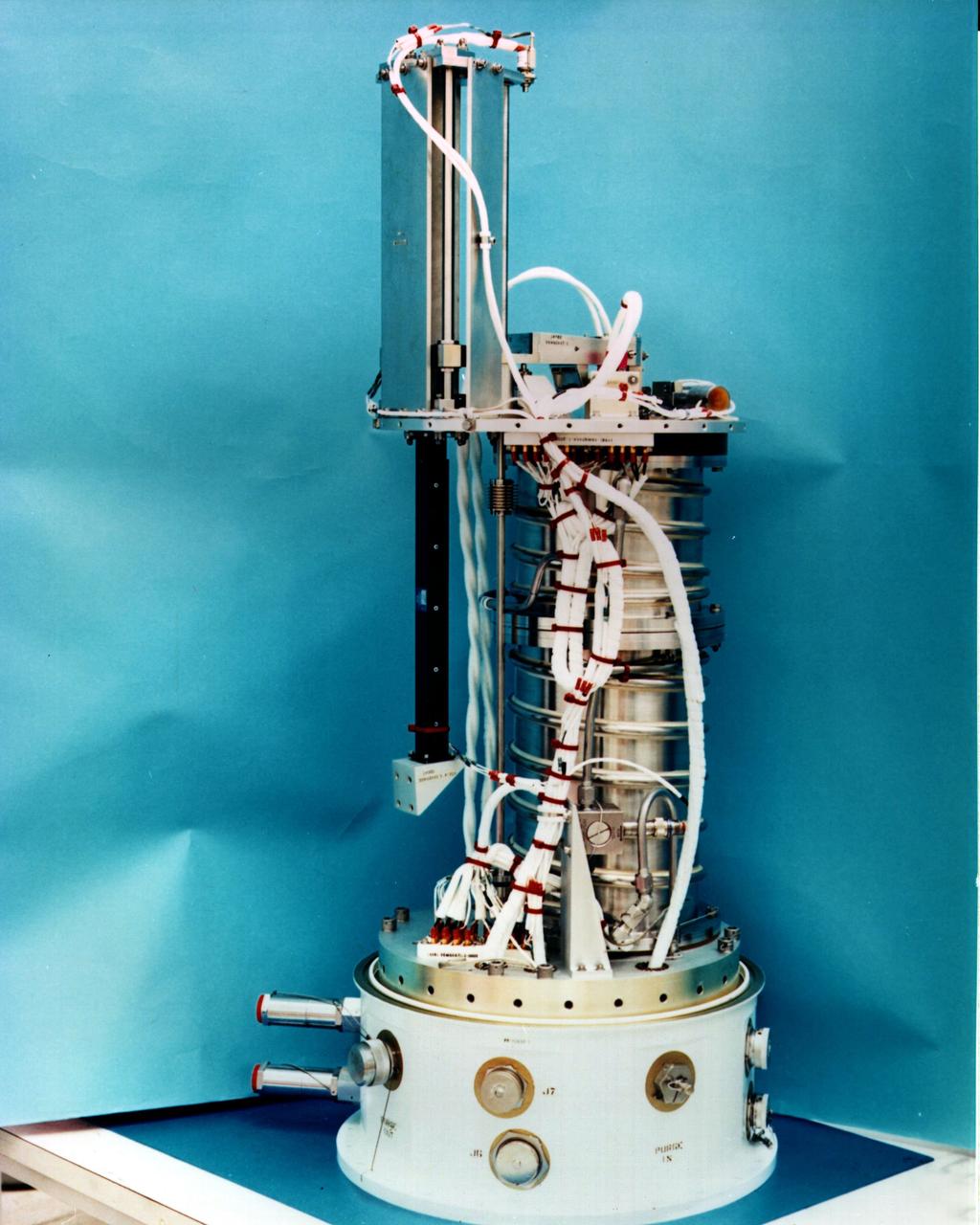
The Advanced Automated Directional Solidification Furnace (AADSF) flew during the USMP-2 mission. During USMP-2, the AADSF was used to study the growth of mercury cadmium telluride crystals in microgravity by directional solidification, a process commonly used on earth to process metals and grow crystals. The furnace is tubular and has three independently controlled temperature zones. The sample travels from the hot zone of the furnace (1600 degrees F) where the material solidifies as it cools. The solidification region, known as the solid/liquid interface, moves from one end of the sample to the other at a controlled rate, thus the term directional solidification.
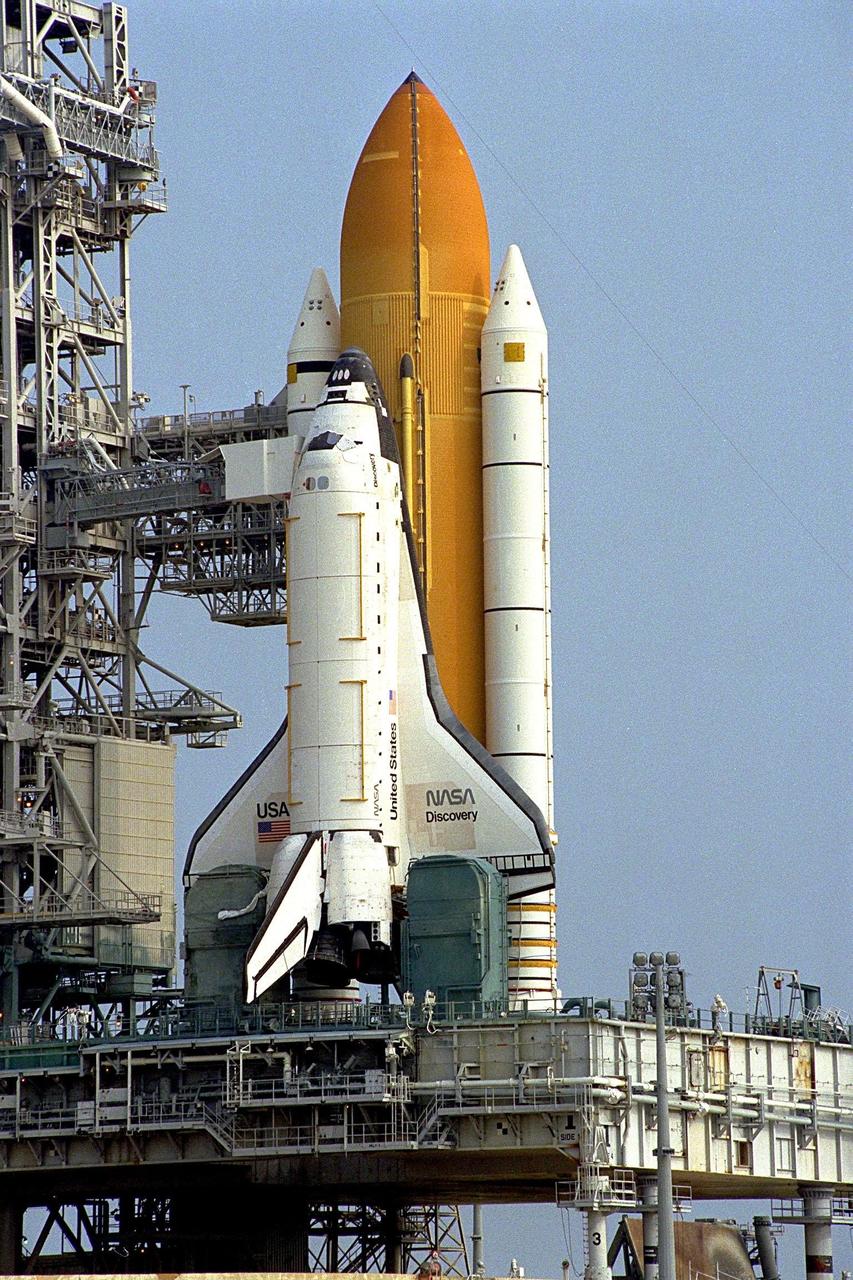
Preliminary reports indicate the Space Shuttle's first super lightweight external tank (SLWT) is in excellent condition following the completion of a tanking test yesterday during a simulated launch countdown at Launch Pad 39A. The pad's Rotating Service Structure will be closed around Discovery later today as preparations for the STS-91 launch on June 2 continue. The primary objectives of the test were to evaluate the strut loads between the tank and the solid rocket boosters and to verify the integrity of the new components of the tank. The SLWT is 7,500 pounds lighter than its predecessors and was developed to increase the Shuttle payload capacity on International Space Station assembly flights. Major changes to the lighter tank include the use of new materials and a revised internal design. The new liquid oxygen and liquid hydrogen tanks are constructed of aluminum lithium a lighter, stronger material than the metal alloy currently used. The redesigned walls of the liquid hydrogen tank were machined to provide additional strength and stability, as well. The STS-91 mission will also feature the ninth Shuttle docking with the Russian Space Station Mir, the first Mir docking for Discovery, and the conclusion of Phase I of the joint U.S.-Russian International Space Station Program
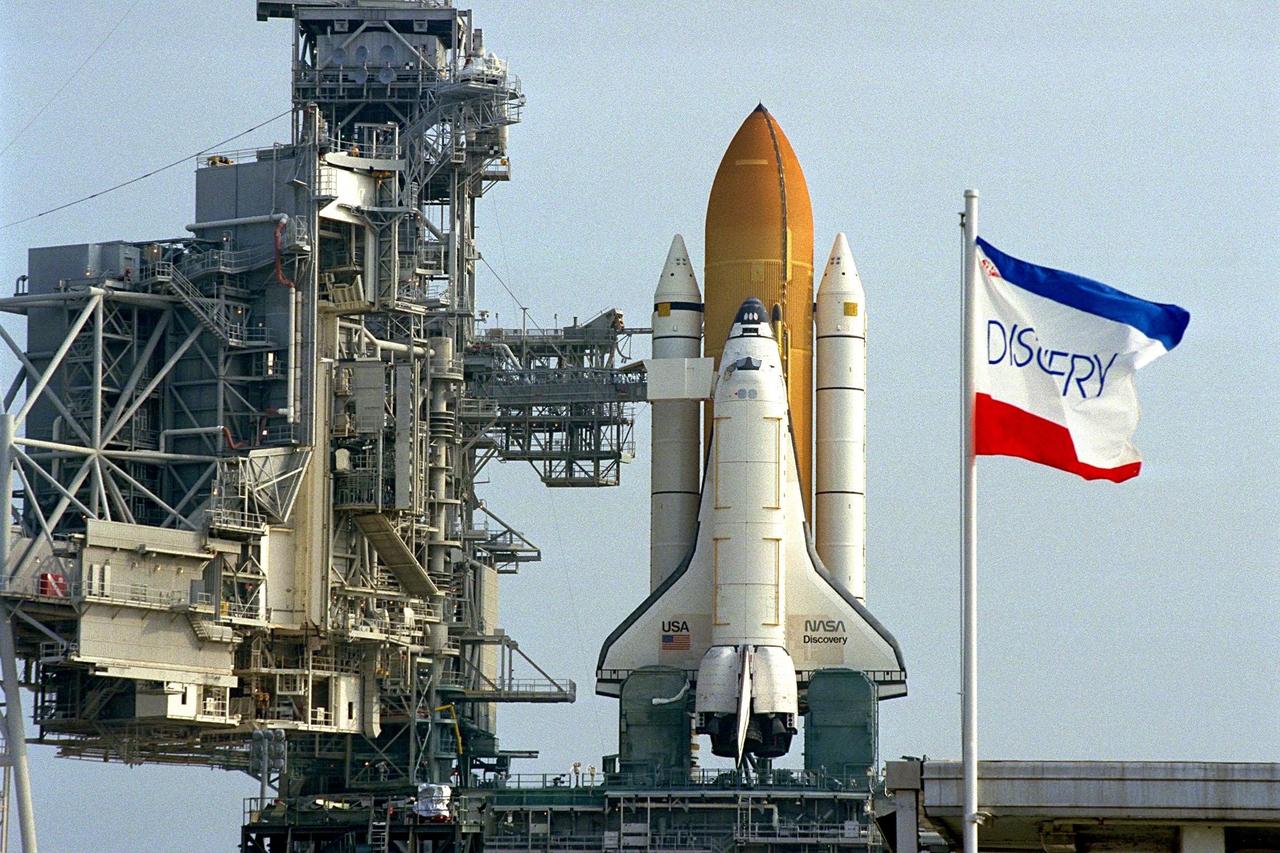
Preliminary reports indicate the Space Shuttle's first super lightweight external tank (SLWT) is in excellent condition following the completion of a tanking test yesterday during a simulated launch countdown at Launch Pad 39A. The pad's Rotating Service Structure will be closed around Discovery later today as preparations for the STS-91 launch on June 2 continue. The primary objectives of the test were to evaluate the strut loads between the tank and the solid rocket boosters and to verify the integrity of the new components of the tank. The SLWT is 7,500 pounds lighter than its predecessors and was developed to increase the Shuttle payload capacity on International Space Station assembly flights. Major changes to the lighter tank include the use of new materials and a revised internal design. The new liquid oxygen and liquid hydrogen tanks are constructed of aluminum lithium a lighter, stronger material than the metal alloy currently used. The redesigned walls of the liquid hydrogen tank were machined to provide additional strength and stability, as well. The STS-91 mission will also feature the ninth Shuttle docking with the Russian Space Station Mir, the first Mir docking for Discovery, and the conclusion of Phase I of the joint U.S.-Russian International Space Station Program
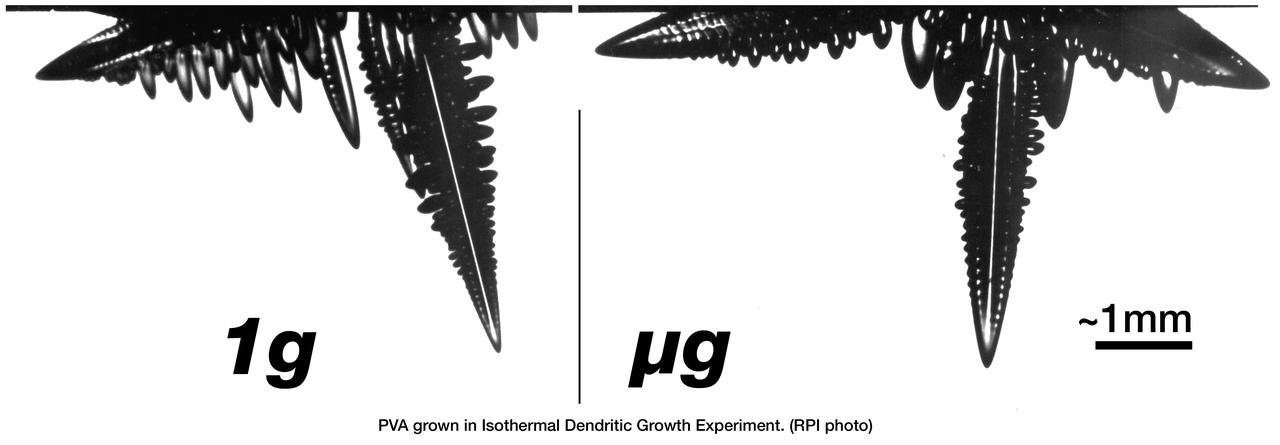
The Isothermal Dendritic Growth Experiment (IDGE), flown on three Space Shuttle missions, is yielding new insights into virtually all industrially relevant metal and alloy forming operations. IDGE used transparent organic liquids that form dendrites (treelike structures) similar to those inside metal alloys. Comparing Earth-based and space-based dendrite growth velocity, tip size and shape provides a better understanding of the fundamentals of dentritic growth, including gravity's effects. Shalowgraphic images of pivalic acid (PVA) dendrites forming from the melt show the subtle but distinct effects of gravity-driven heat convection on dentritic growth. In orbit, the dendrite grows as its latent heat is liberated by heat conduction. This yields a blunt dendrite tip. On Earth, heat is carried away by both conduction and gravity-driven convection. This yields a sharper dendrite tip. In addition, under terrestrial conditions, the sidebranches growing in the direction of gravity are augmented as gravity helps carry heat out of the way of the growing sidebranches as opposed to microgravity conditions where no augmentation takes place. IDGE was developed by Rensselaer Polytechnic Institute and NASA/Glenn Research Center. Advanced follow-on experiments are being developed for flight on the International Space Station. Photo Credit: NASA/Glenn Research Center
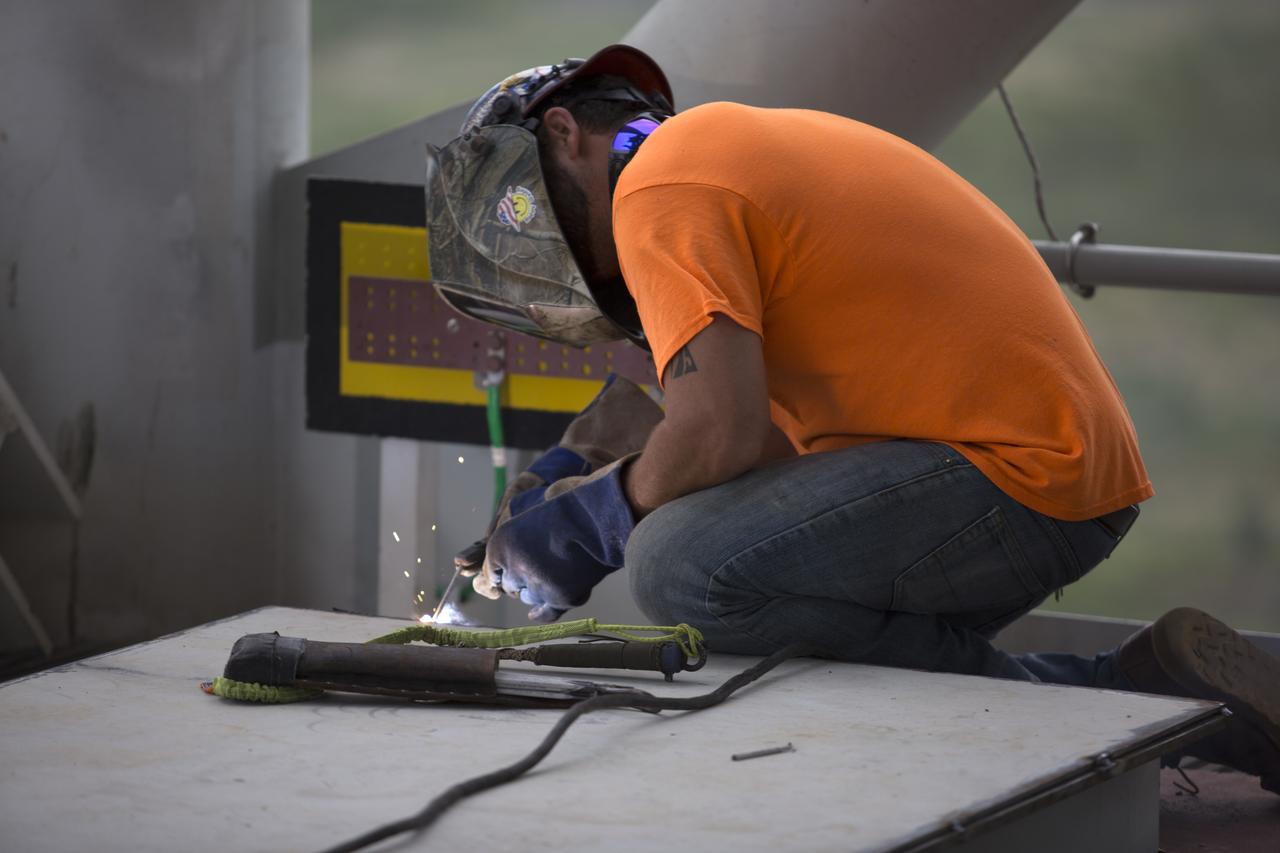
A construction worker welds a metal part during installation of the Core Stage Forward Skirt Umbilical on the mobile launcher tower at NASA's Kennedy Space Center in Florida. The mobile launcher tower will be equipped with a number of lines, called umbilicals that will connect to the Space Launch System (SLS) rocket and Orion spacecraft for Exploration Mission-1 (EM-1). The CSFSU will be located at about the 180-foot level on the tower, above the liquid oxygen tank. The CSFSU is an umbilical that will swing into position to provide connections to the core stage forward skirt of the SLS rocket, and then swing away before launch. Its main purpose is to provide conditioned air/GN2 to the SLS core stage forward skirt cavity. The Ground Systems Development and Operations Program is overseeing installation of the umbilicals.
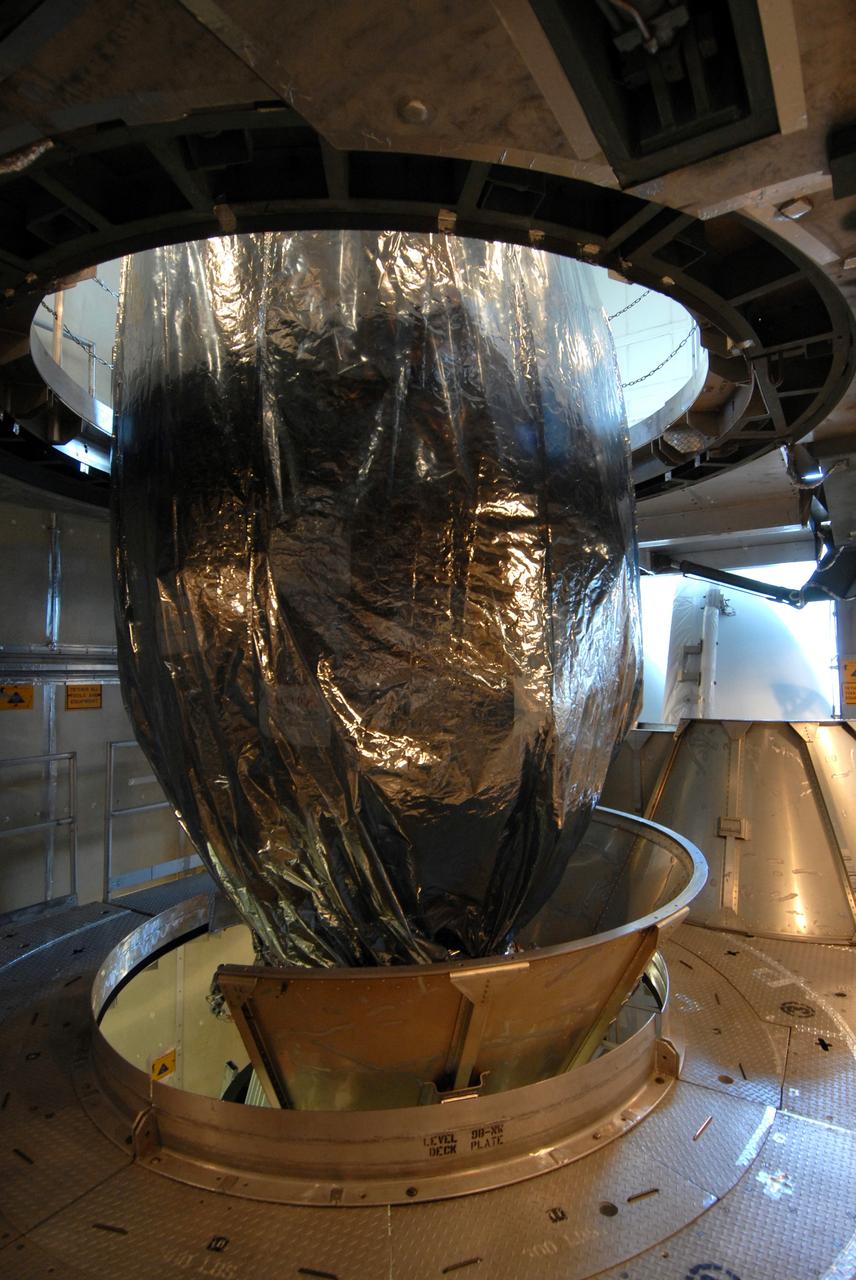
CAPE CANAVERAL, Fla. – In the mobile service tower on Launch pad 17-B at Cape Canaveral Air Force Station in Florida, the lower part of the metal transportation canister is removed from around NASA's Kepler spacecraft. The spacecraft was mated with the Delta II rocket for launch. The liftoff of Kepler is currently scheduled for 10:48 p.m. EST March 5. Kepler is designed to survey more than 100,000 stars in our galaxy to determine the number of sun-like stars that have Earth-size and larger planets, including those that lie in a star's "habitable zone," a region where liquid water, and perhaps life, could exist. If these Earth-size worlds do exist around stars like our sun, Kepler is expected to be the first to find them and the first to measure how common they are. Photo credit: NASA/Jack Pfaller

CAPE CANAVERAL, Fla. – In the mobile service tower on Launch pad 17-B at Cape Canaveral Air Force Station in Florida, the upper part of the metal transportation canister is removed from around NASA's Kepler spacecraft. The spacecraft was mated with the Delta II rocket for launch. The liftoff of Kepler is currently scheduled for 10:48 p.m. EST March 5. Kepler is designed to survey more than 100,000 stars in our galaxy to determine the number of sun-like stars that have Earth-size and larger planets, including those that lie in a star's "habitable zone," a region where liquid water, and perhaps life, could exist. If these Earth-size worlds do exist around stars like our sun, Kepler is expected to be the first to find them and the first to measure how common they are. Photo credit: NASA/Jack Pfaller
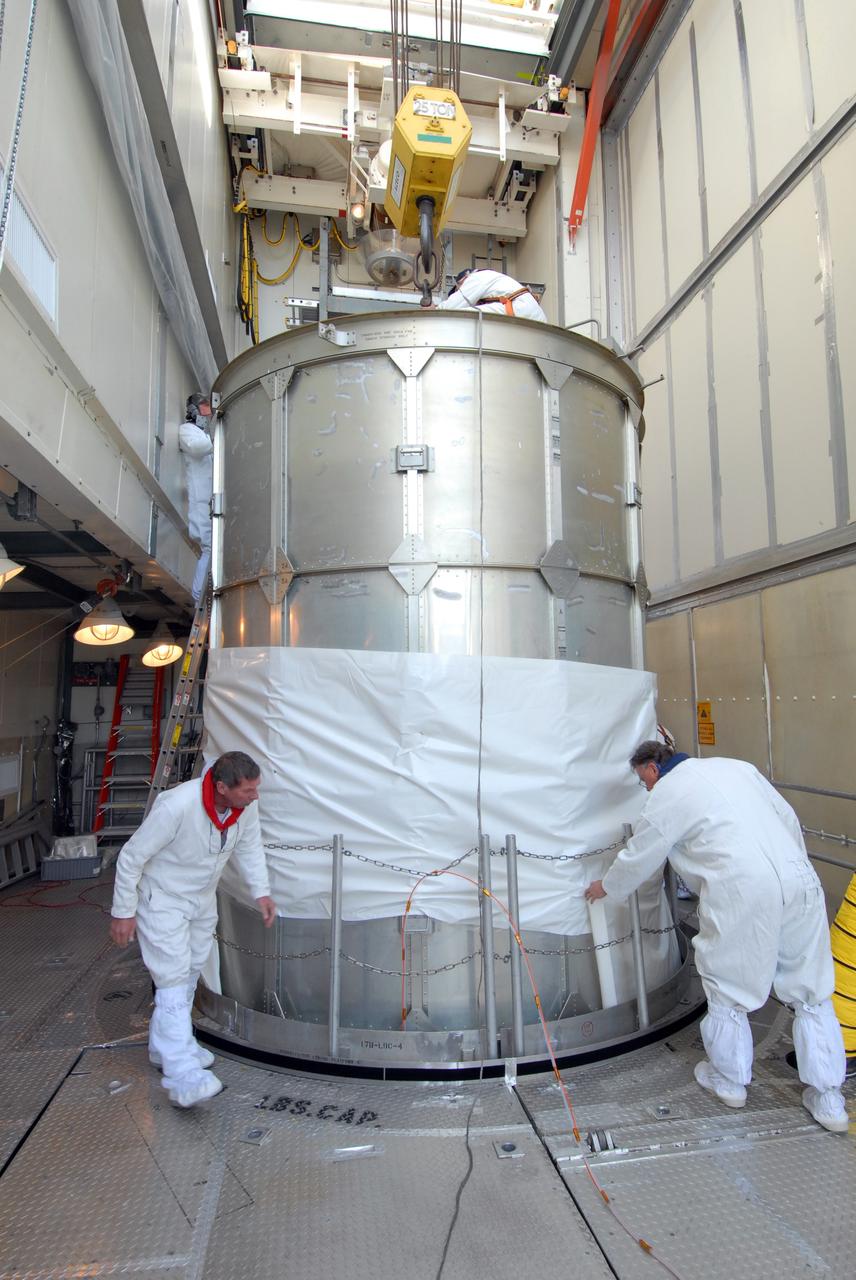
CAPE CANAVERAL, Fla. – In the mobile service tower on Launch pad 17-B at Cape Canaveral Air Force Station in Florida, workers remove the protective cover from the metal transportation canister around NASA's Kepler spacecraft. The spacecraft was mated with the Delta II rocket for launch. The liftoff of Kepler is currently scheduled for 10:48 p.m. EST March 5. Kepler is designed to survey more than 100,000 stars in our galaxy to determine the number of sun-like stars that have Earth-size and larger planets, including those that lie in a star's "habitable zone," a region where liquid water, and perhaps life, could exist. If these Earth-size worlds do exist around stars like our sun, Kepler is expected to be the first to find them and the first to measure how common they are. Photo credit: NASA/Jack Pfaller
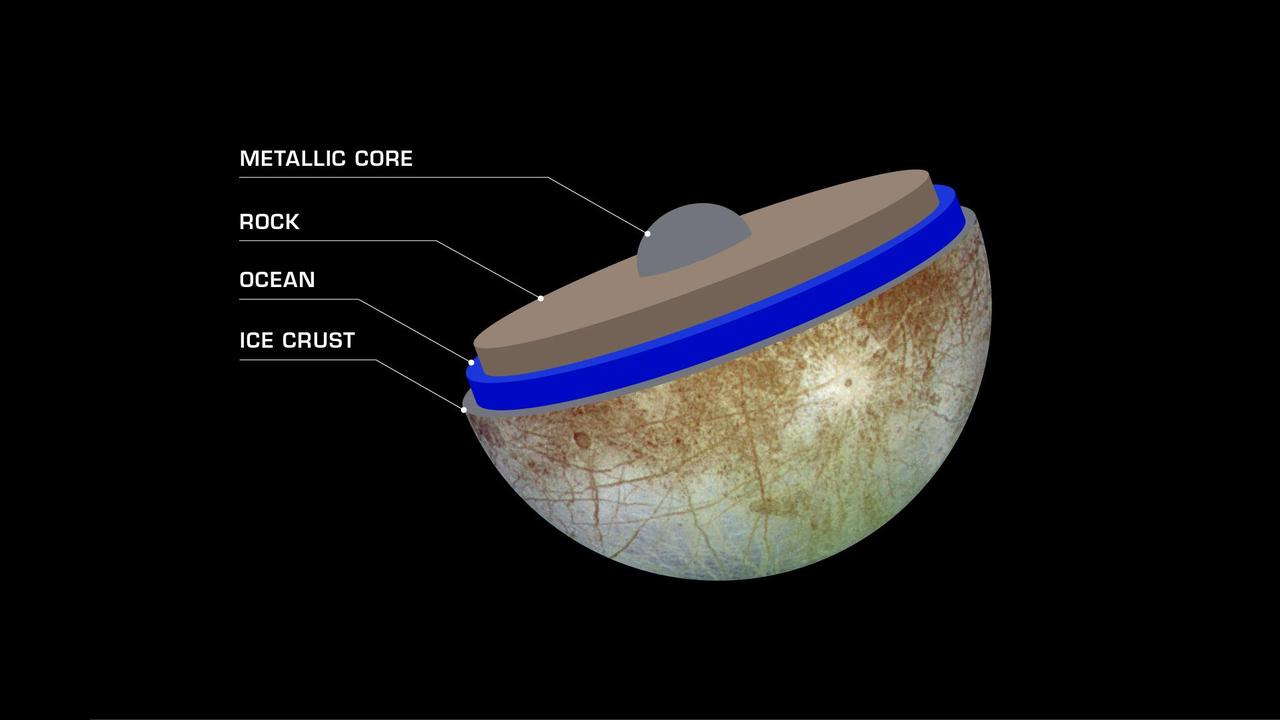
Jupiter's moon Europa is smaller than Earth's moon yet may contain more than twice as much liquid water as all of Earth's oceans combined. Scientists believe that under its icy surface, Europa features a global saltwater ocean, perhaps 40 to 100 miles (60 to 150 kilometers) deep. Further inward, a rocky mantle and metallic core are likely. Europa's interior structure will be studied in detail by NASA's Europa Clipper spacecraft, which will orbit Jupiter and perform dozens of flybys of the moon. Europa Clipper's three main science objectives are to determine the thickness of the moon's icy shell and its interactions with the ocean below, to investigate its composition, and to characterize its geology. The mission's detailed exploration of Europa will help scientists better understand the astrobiological potential for habitable worlds beyond our planet. https://photojournal.jpl.nasa.gov/catalog/PIA26434
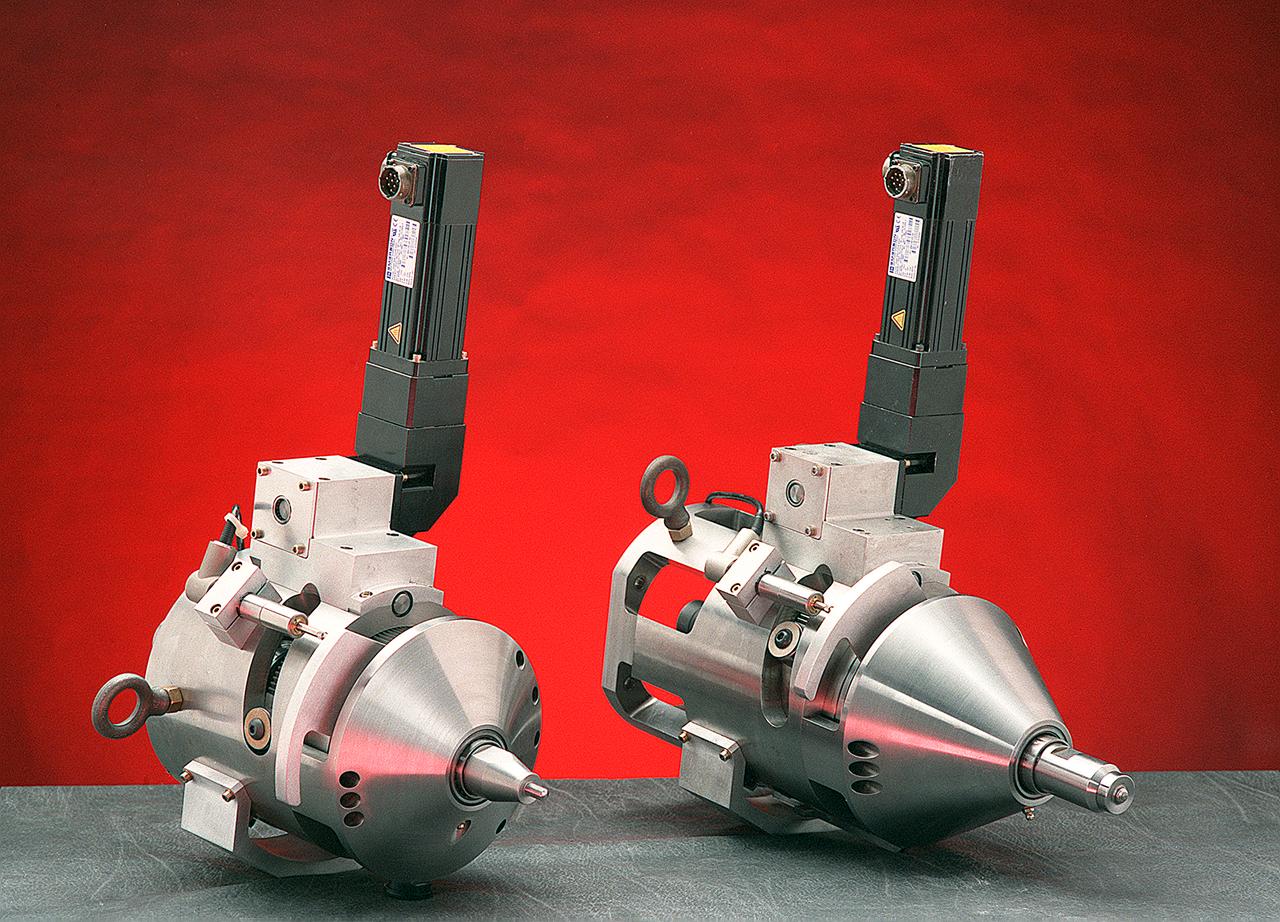
Two companies have successfully commercialized a specialized welding tool developed at the Marshall Space Flight Center (MSFC). Friction stir welding uses the high rotational speed of a tool and the resulting frictional heat created from contact to crush, "stir" together, and forge a bond between two metal alloys. It has had a major drawback, reliance on a single-piece pin tool. The pin is slowly plunged into the joint between two materials to be welded and rotated as high speed. At the end of the weld, the single-piece pin tool is retracted and leaves a "keyhole," something which is unacceptable when welding cylindrical objects such as drums, pipes and storage tanks. Another drawback is the requirement for different-length pin tools when welding materials of varying thickness. An engineer at the MSFC helped design an automatic retractable pin tool that uses a computer-controlled motor to automatically retract the pin into the shoulder of the tool at the end of the weld, preventing keyholes. This design allows the pin angle and length to be adjusted for changes in material thickness and results in a smooth hole closure at the end of the weld. Benefits of friction stir welding, using the MSFC retractable pin tool technology, include the following: The ability to weld a wide range of alloys, including previously unweldable and composite materials; provision of twice the fatigue resistance of fusion welds and no keyholes; minimization of material distortion; no creation of hazards such as welding fumes, radiation, high voltage, liquid metals, or arcing; automatic retraction of the pin at the end of the weld; and maintaining full penetration of the pin.
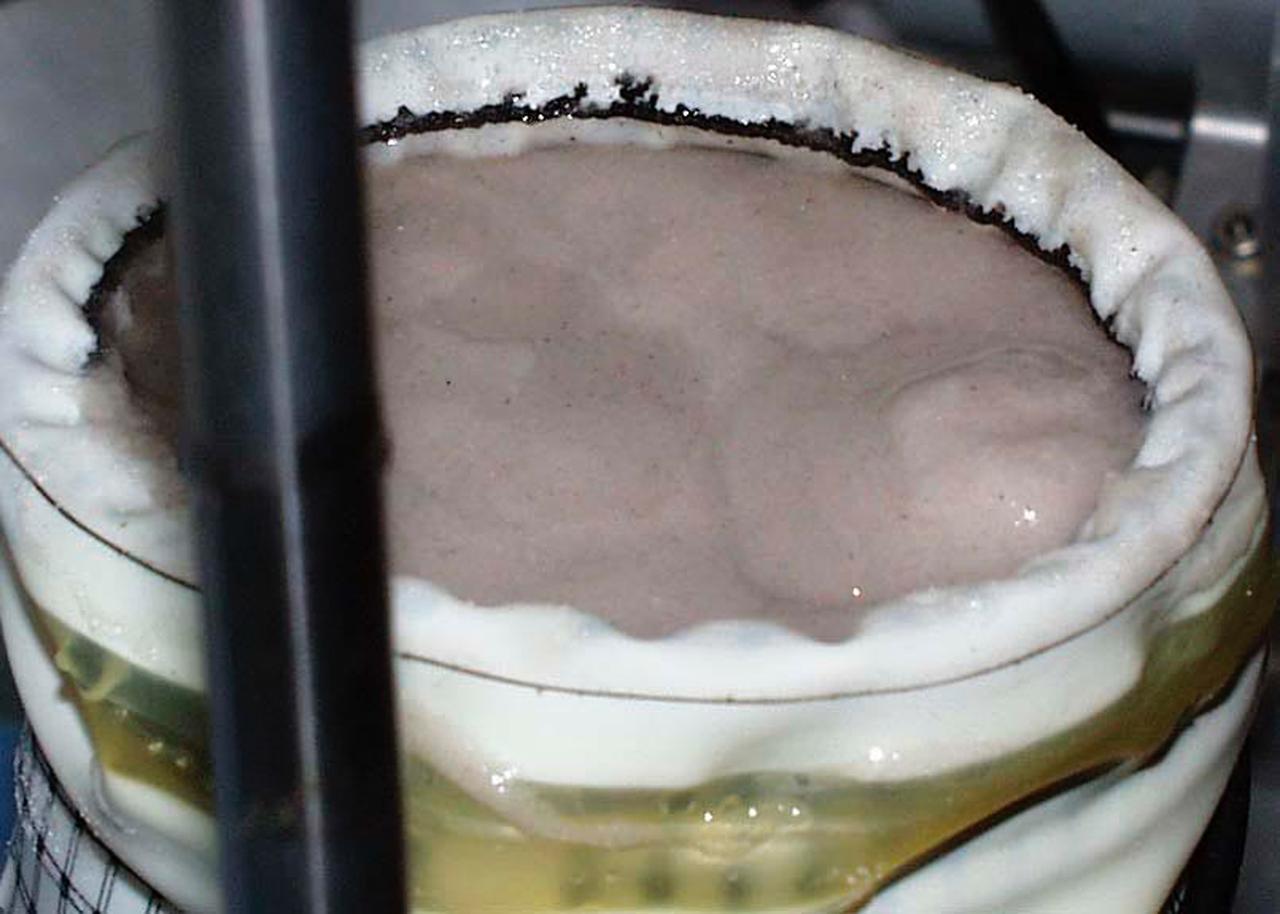
A test cell for Mechanics of Granular Materials (MGM) experiment is tested for long-term storage with water in the system as plarned for STS-107. This view shows the top of the sand column with the metal platten removed. Sand and soil grains have faces that can cause friction as they roll and slide against each other, or even cause sticking and form small voids between grains. This complex behavior can cause soil to behave like a liquid under certain conditions such as earthquakes or when powders are handled in industrial processes. Mechanics of Granular Materials (MGM) experiments aboard the Space Shuttle use the microgravity of space to simulate this behavior under conditons that cannot be achieved in laboratory tests on Earth. MGM is shedding light on the behavior of fine-grain materials under low effective stresses. Applications include earthquake engineering, granular flow technologies (such as powder feed systems for pharmaceuticals and fertilizers), and terrestrial and planetary geology. Nine MGM specimens have flown on two Space Shuttle flights. Another three are scheduled to fly on STS-107. The principal investigator is Stein Sture of the University of Colorado at Boulder. Credit: University of Colorado at Boulder
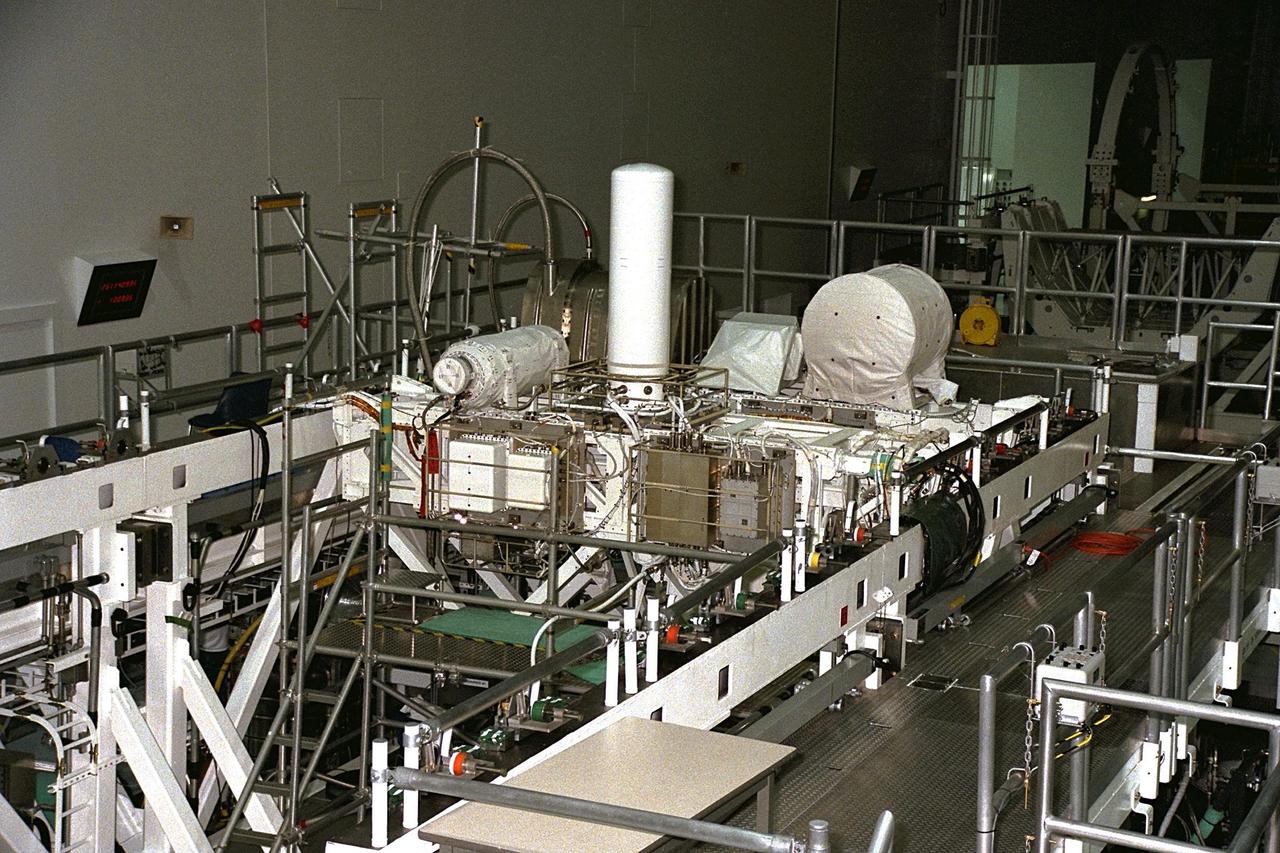
United States Microgravity Payload-4 (USMP-4) experiments are prepared to be flown on Space Shuttle mission STS-87 in the Space Station Processing Facility at Kennedy Space Center (KSC). Seen at right in the circular white cover is the Isothermal Dendritic Growth Experiment (IDGE), which will be used to study the dendritic solidification of molten materials in the microgravity environment. The large white vertical cylinder in the center of the photo is the Advanced Automated Directional Solidification Furnace (AADSF) and the horizontal tube to the left of it is MEPHISTO, a French acronym for a cooperative American-French investigation of the fundamentals of crystal growth. Just below MEPHISTO is the Space Acceleration Measurement System, or SAMS, which measures the microgravity conditions in which the experiments are conducted. The The metallic breadbox-like structure behind the AADSF is the Confined Helium Experiment (CHeX) that will study one of the basic influences on the behavior and properties of materials by using liquid helium confined between solid surfaces and microgravity. All of these experiments are scheduled for launch aboard STS-87 on Nov. 19 from KSC
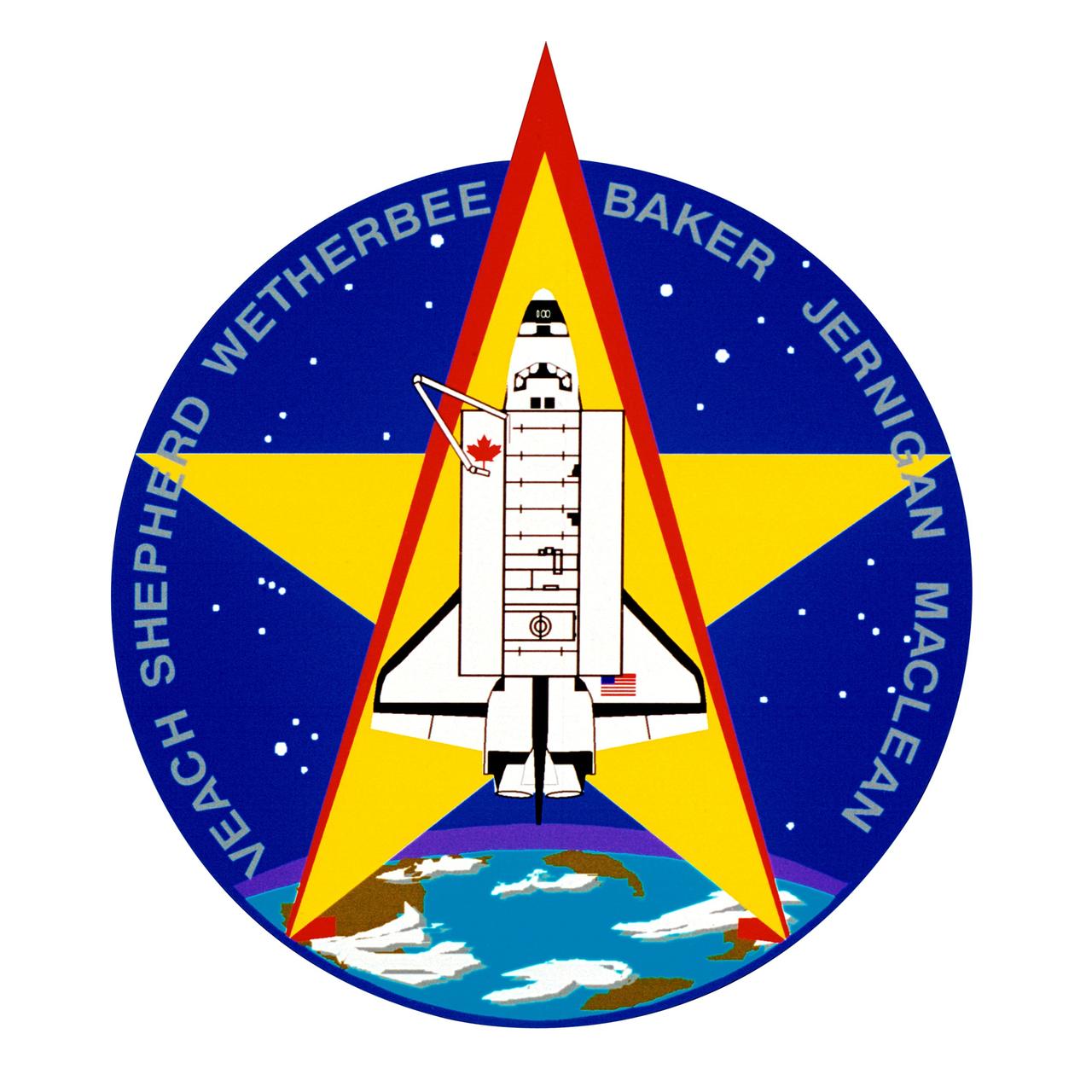
STS052-S-001 (July 1992) --- The insignia, designed by the STS-52 crew members, features a large gold star to symbolize the crew's mission on the frontiers of space. A gold star is often used to symbolize the frontier period of the American West. The red star in the shape of the Greek letter lambda represents both the laser measurements to be taken from the Laser Geodynamic Satellite (LAGEOS II) and the Lambda Point Experiment, which is part of the United States Microgravity Payload (USMP-1). The LAGEOS II is a joint Italian\United States satellite project intended to further our understanding of global plate tectonics. The USMP-1 is a microgravity facility which has French and United States experiments designed to test the theory of cooperative phase transitions and to study the solid\liquid interface of a metallic alloy in the low gravity environment. The Remote Manipulator System (RMS) and maple leaf are emblematic of the Canadian payload specialist who will conduct a series of Canadian flight experiments (CANEX-2), including the Space Vision System test. The NASA insignia design for space shuttle flights is reserved for use by the astronauts and for other official use as the NASA Administrator may authorize. Public availability has been approved only in the form of illustrations by the various news media. When and if there is any change in this policy, which we do not anticipate, it will be publicly announced. Photo credit: NASA
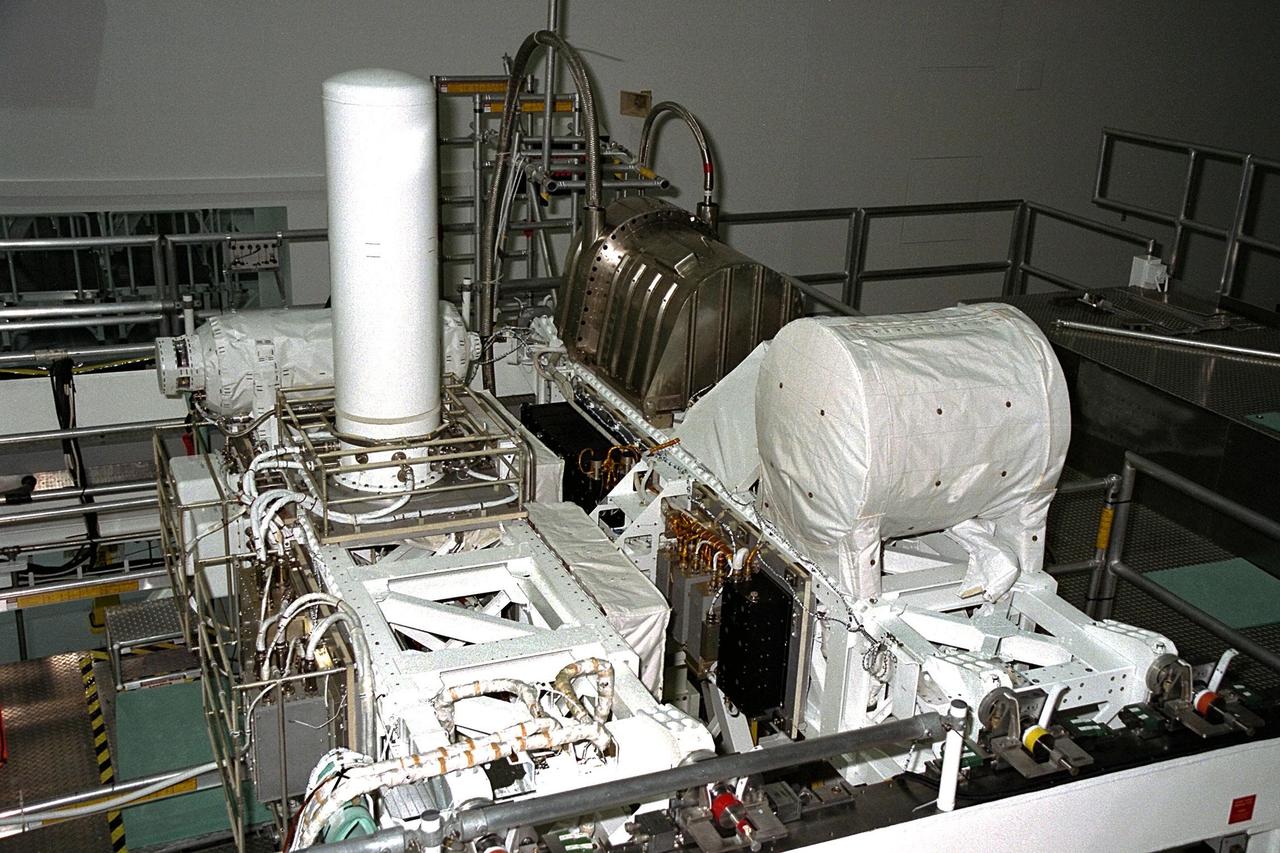
United States Microgravity Payload-4 (USMP-4) experiments are prepared to be flown on Space Shuttle mission STS-87 in the Space Station Processing Facility at Kennedy Space Center (KSC). Seen in the foreground at right is the Isothermal Dendritic Growth Experiment (IDGE), which will be used to study the dendritic solidification of molten materials in the microgravity environment. The metallic breadbox-like structure behind the IDGE is the Confined Helium Experiment (CHeX) that will study one of the basic influences on the behavior and properties of materials by using liquid helium confined between solid surfaces and microgravity. The large white vertical cylinder at left is the Advanced Automated Directional Solidification Furnace (AADSF) and the horizontal tube behind it is MEPHISTO, the French acronym for a cooperative American-French investigation of the fundamentals of crystal growth. Just below the left end of MEPHISTO is the Space Acceleration Measurement System, or SAMS, which measures the microgravity conditions in which the experiments are conducted. All of these experiments are scheduled for launch aboard STS-87 on Nov. 19 from KSC
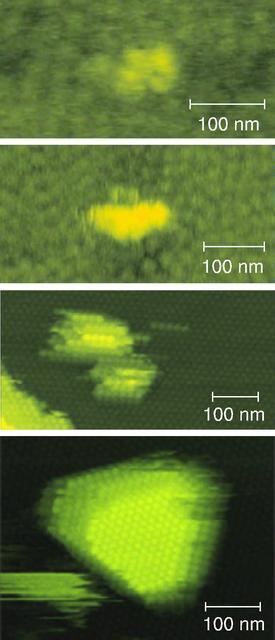
Watching molecules of the iron-storing protein apoferritin come together to form a nucleus reveals some interesting behavior. In this series of images, researchers observed clusters of four molecules at the corners of a diamond shape (top). As more molecules attach to the cluster, they arrange themselves into rods (second from top), and a raft-like configuration of molecules forms the critical nucleus (third from top), suggesting that crystal growth is much slower than it could be were the molecules arranged in a more compact formation. In the final image, a crystallite consisting of three layers containing approximately 60 to 70 molecules each is formed. Atomic force microscopy made visualizing the process of nucleation possible for the first time. The principal investigator is Peter Vekilov, of the University of Alabama in Huntsville. Vekilov's team at UAH studies protein solutions as they change phases from liquids to crystalline solids. They want to know if the molecules in the solution interact with one another, and if so, how, from the perspectives of thermodynamics and kinetics. They want to understand which forces -- electrical, electrostatic, hydrodynamic, or other kinds of forces -- are responsible for the interactions. They also study nucleation, the begirning stage of crystallization. This process is important to understand because it sets the stage for crystal growth in all kinds of solutions and liquid melts that are important in such diverse fields as agriculture, medicine, and the fabrication of metal components. Nucleation can determine the rate of crystal growth, the number of crystals that will be formed, and the quality and size of the crystals.
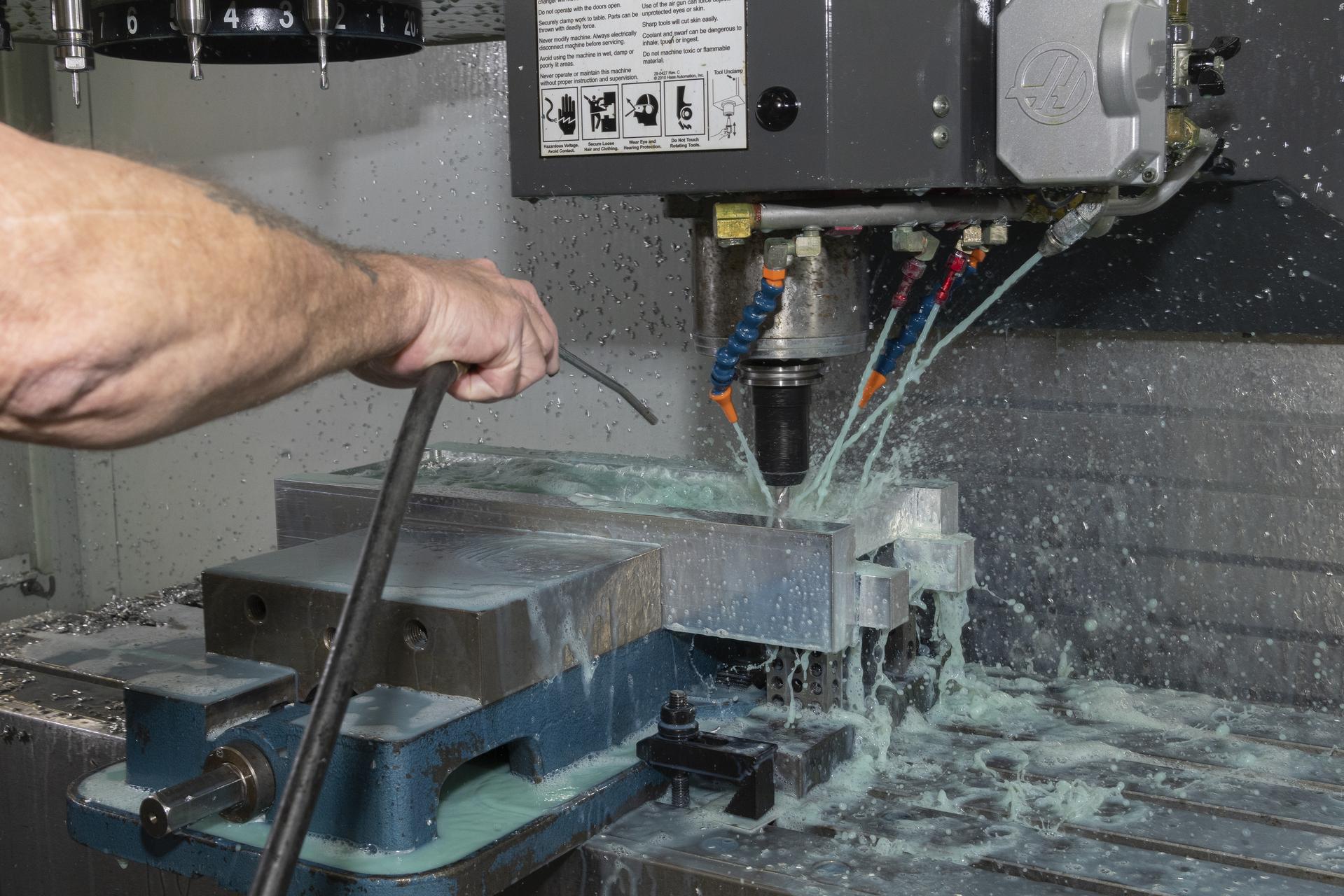
An engineering technician works in the Experimental Fabrication Branch at NASA’s Armstrong Flight Research Center in Edwards, California, on Thursday, March 14, 2023. The branch transforms engineering concepts into hardware for research aircraft and technology development, supporting advances in aviation safety, efficiency, and sustainability.
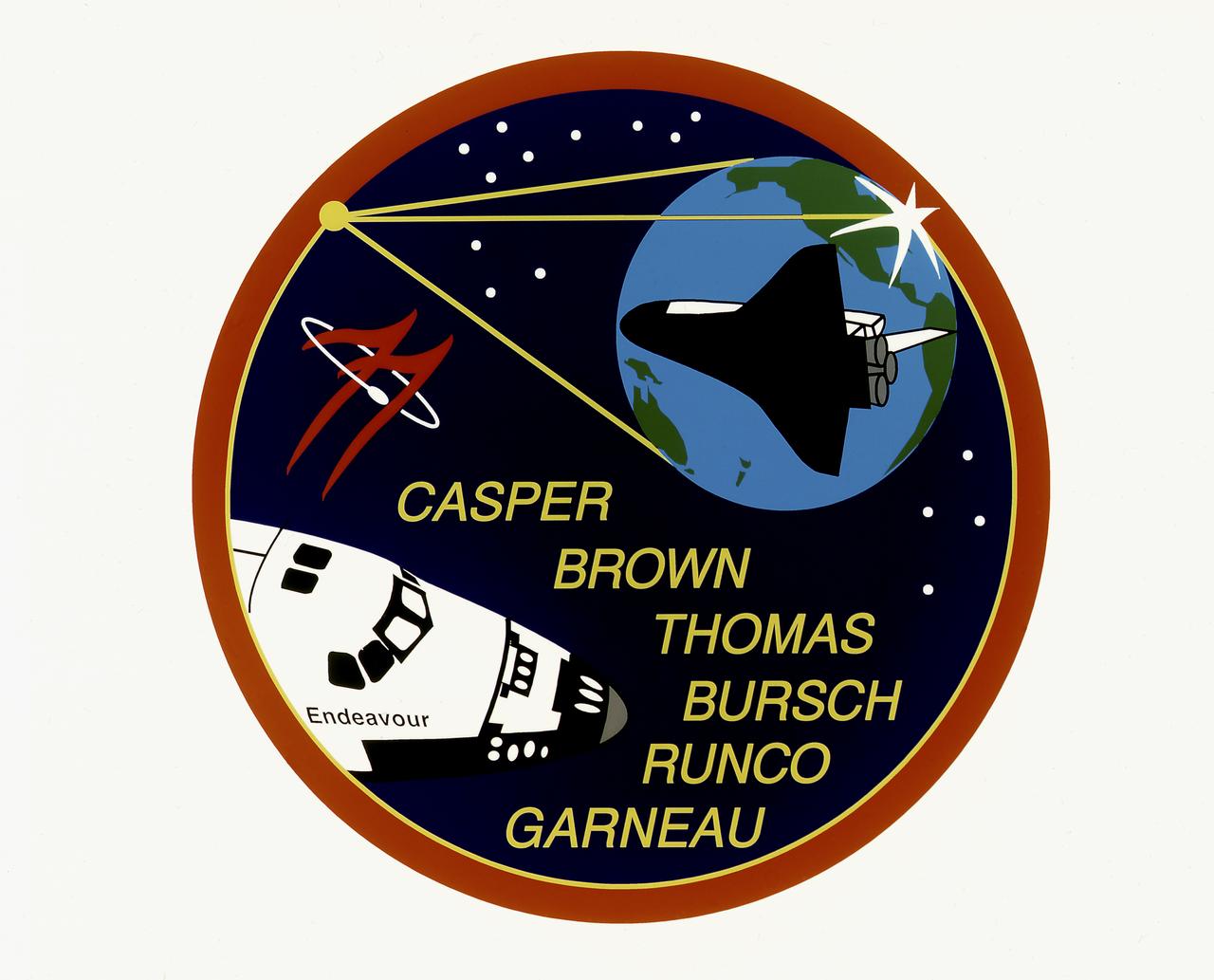
The STS-77 crew patch displays the Shuttle Endeavour in the lower left and its reflection within the tripod and concave parabolic mirror of the SPARTAN Inflatable Antenna Experiment (IAE). The center leg of the tripod also delineates the top of the Spacehab's shape, the rest of which is outlined in gold just inside the red perimeter. The Spacehab was carried in the payload bay and housed the Commercial Float Zone Furnace (CFZF). Also depicted within the confines of the IAE mirror are the mission's rendezvous operations with the Passive Aerodynamically-Stabilized Magnetically-Damped satellite (PAM/STU) appears as a bright six-pointed star-like reflection of the sun on the edge of the mirror with Endeavour in position to track it. The sunlight on the mirror's edge, which also appears as an orbital sunset, is located over Goddard Space Flight Center, the development facility for the SPARTAN/IAE and Technology Experiments Advancing Missions in Space (TEAMS) experiments. The reflection of the Earth is oriented to show the individual countries of the crew as well as the ocean which Captain Cook explored in the original Endeavour. The mission number 77 is featured as twin stylized chevrons and an orbiting satellite as adapted from NASA's logo. The stars at the top are arranged as seen in the northern sky in the vicinity of the constellation Ursa Minor. The field of 11 stars represents both the TEAMS cluster of experiments (the four antennae of GPS Attitude and Navigation Experiment (GANE), the single canister of Liquid Metal Thermal Experiment (LMTE), the three canisters of Vented Tank Resupply Experiment (VTRE), and the three canisters of PAM/STU) and the 11th flight of Endeavour. The constellation at the right shows the fourth flight of Spacehab Experiments.
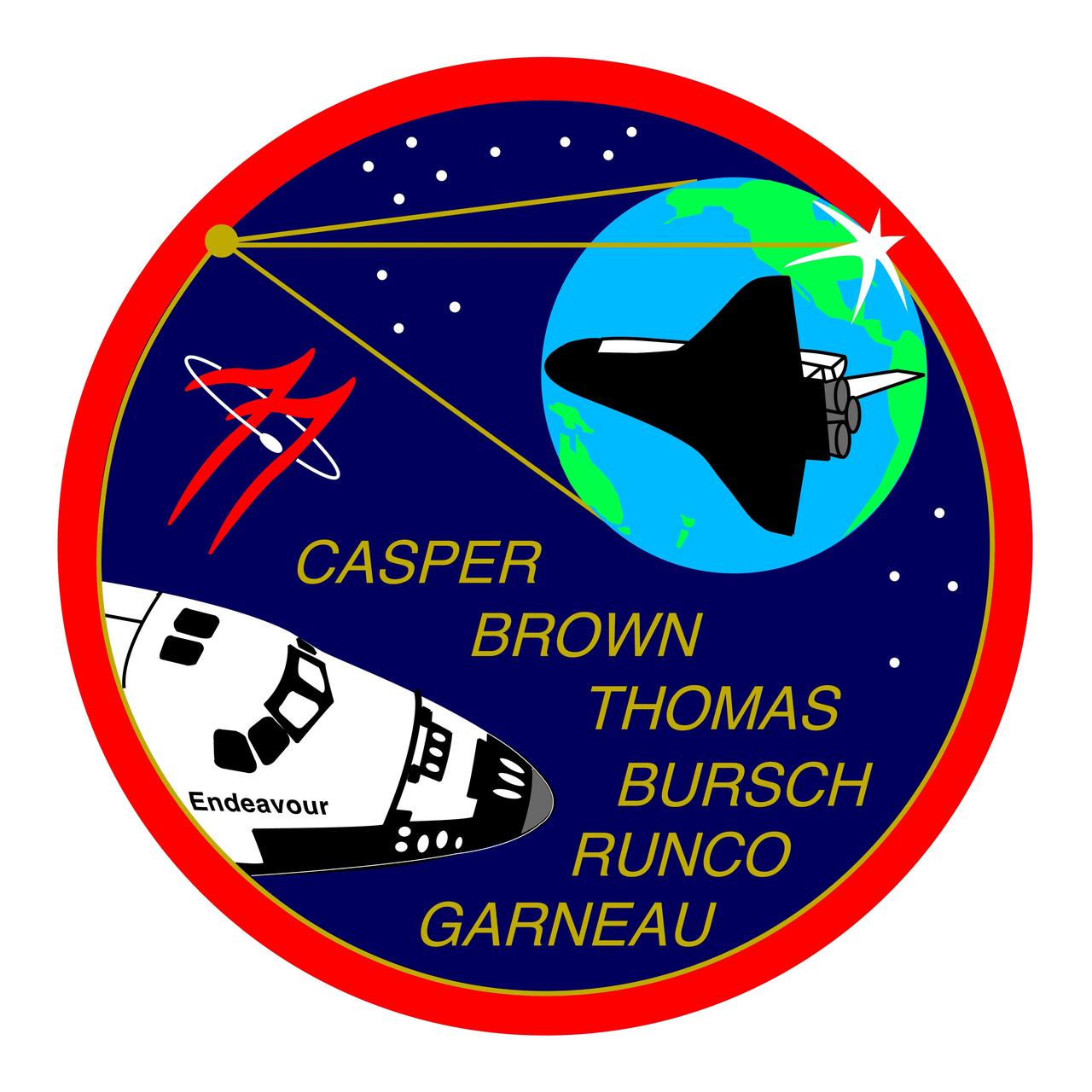
STS077-S-001 (February 1996) --- The STS-77 crew patch, designed by the crew members, displays the space shuttle Endeavour the lower left and its reflection within the tripod and concave parabolic mirror of the Shuttle Pointed Autonomous Research Tool for Astronomy (SPARTAN) Inflatable Antenna Experiment (IAE). The center leg of the tripod also delineates the top of the Spacehab?s shape, the rest of which is outlined in gold just inside the red perimeter. The Spacehab is carried in the payload bay and houses the Commercial Float Zone Furnace (CFZF) and Space Experiment Facility (SEF) experiments. Also depicted within the confines the IAE mirror are the mission?s rendezvous operations with the Passive Aerodynamically Stabilized Magnetically Damped Satellite/Satellite Test Unit (PAM/STU) satellite and a reflection of Earth. The PAM/STU satellite appears as a bright six-pointed star-like reflection of the sun on the edge of the mirror with the space shuttle Endeavour in position to track it. The sunglint on the mirror?s edge, which also appears as an orbital sunset, is located over Goddard Space Flight Center (GSFC), the development facility for the SPARTAN/IAE and Technology Experiments Advancing Missions in Space (TEAMS) experiments. The reflection of Earth is oriented to show the individual countries of the crew as well as the ocean which Captain Cook explored in the original Endeavour. The mission number ?77? is featured as twin stylized chevrons and an orbiting satellite as adapted from NASA?s logo. The stars at the top are arranged as seen in the northern sky in the vicinity of the constellation Ursa Minor. The field of 11 stars represents both the TEAMS cluster of experiments (the four antennae of Global Positioning System Attitude and Navigation Experiment (GANE), the single canister of Liquid Metal Thermal Experiment (LMTE), the three canisters of Vented Tank Resupply Experiment (VTRE), and the canisters of PAM/STU, and the 11th flight of the Endeavour. The constellation at the right shows the four stars of the Southern Cross for the fourth flight of Spacehab. The NASA insignia design for space shuttle flights is reserved for use by the astronauts and for other official use as the NASA Administrator may authorize. Public availability has been approved only in the forms of illustrations by the various news media. When and if there is any change in this policy, which is not anticipated, the change will be publicly announced. Photo credit: NASA