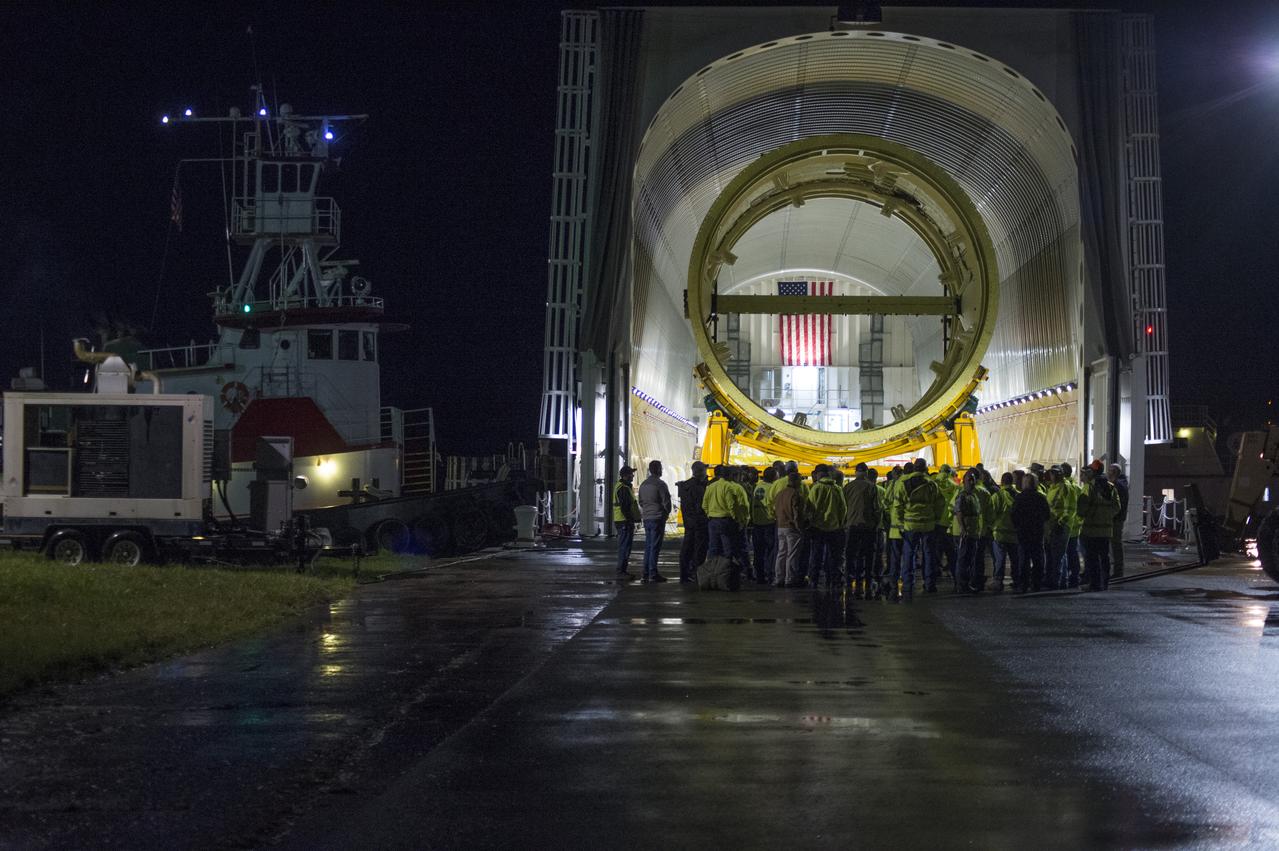
The SLS Stages Intertank Structural Test Assembly (STA) is rolling off the NASA Pegasus Barge at the MSFC Dock enroute to the MSFC 4619 Load Test Annex test facility for qualification testing. Members of MSFC Logistics Office and Move Team members gather for last minute instructions and safety briefing before off-loading STA hardware.

Tessa Keating is a public affairs specialist in the Office of Communications at NASA’s Stennis Space Center. Keating plans onsite logistics, serves as a protocol officer, and coordinates the Space Flight Awareness Program for NASA Stennis and the NASA Shared Services Center.
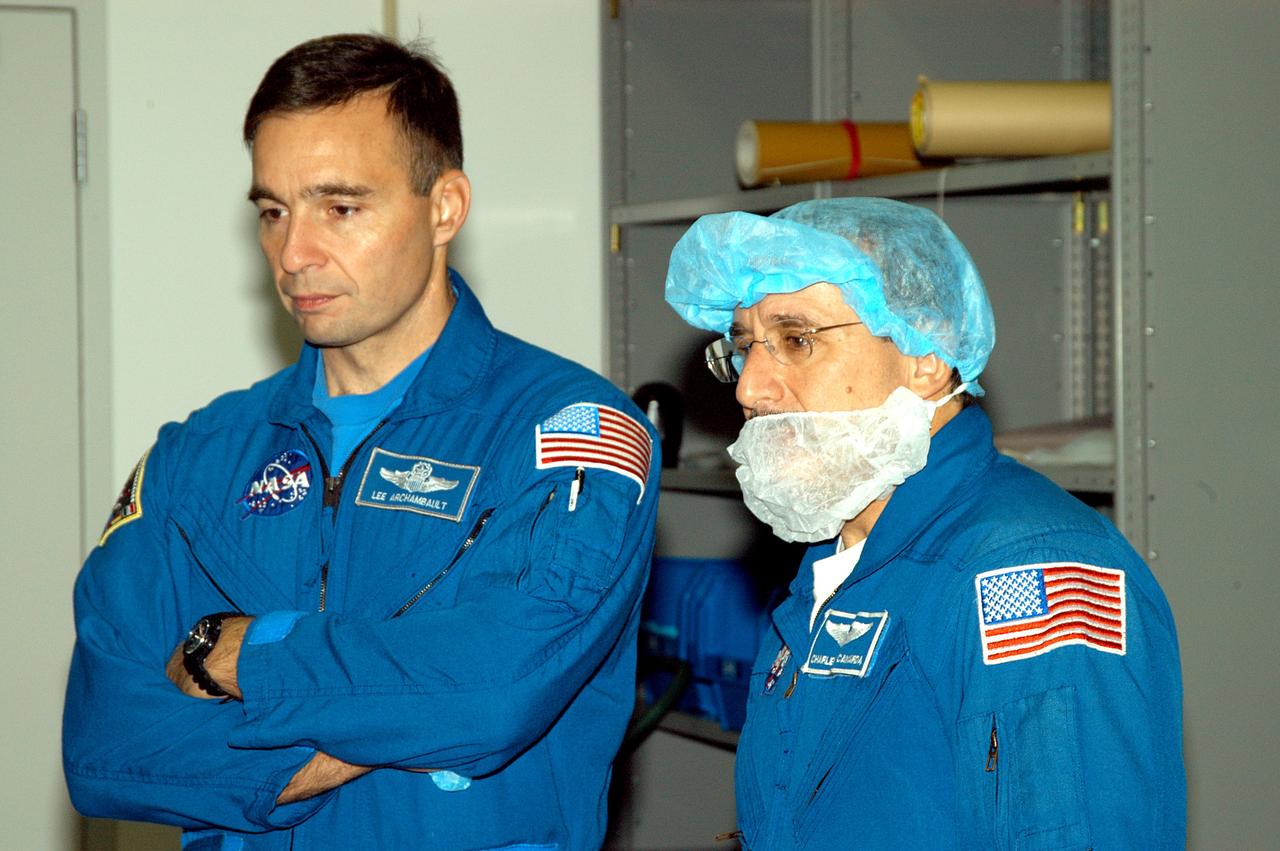
KENNEDY SPACE CENTER, FLA. - In the Space Station Processing Facility, astronaut Lee Archambault and STS-114 Mission Specialist Charles Camarda watch as crew members work with equipment that will be used on the mission. Archambault supports launch and landing operations at the Kennedy Space Center as an Astronaut Office representative. Crew members are at KSC for equipment familiarization. STS-114 is classified as Logistics Flight 1 to the International Space Station, delivering new supplies and replacing one of the orbital outpost’s Control Moment Gyroscopes (CMGs). STS-114 will also carry a Raffaello Multi-Purpose Logistics Module and the External Stowage Platform-2. The crew is slated to conduct at least three spacewalks: They will demonstrate repair techniques of the Shuttle’s Thermal Protection System, replace the failed CMG with one delivered by the Shuttle, and install the External Stowage Platform.
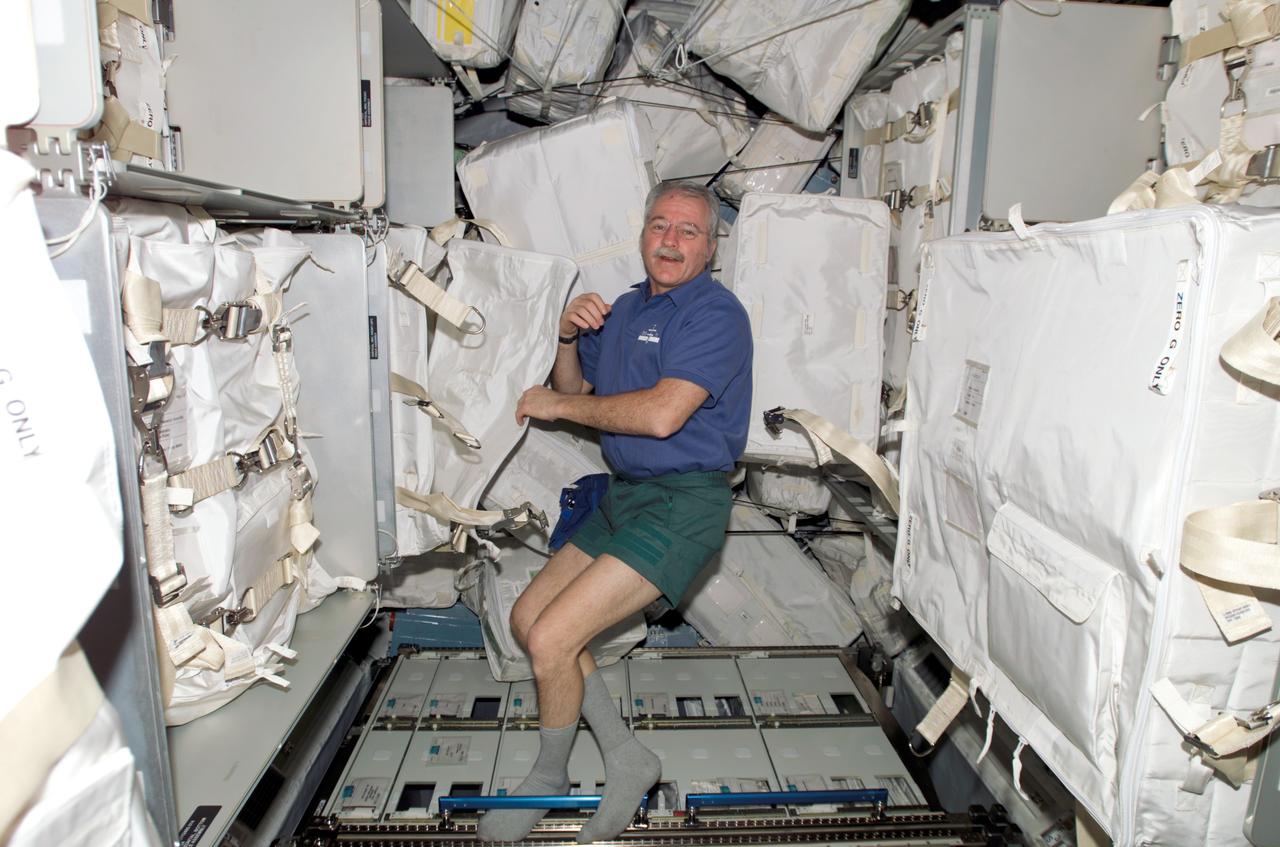
ISS011-E-11364 (31 July 2005) --- Astronaut John L. Phillips, Expedition 11 NASA Space Station science officer and flight engineer, participates in the movement of supplies and equipment inside Raffaello, the Italian Space Agency-built Multipurpose Logistics Module (MPLM) to the international space station.
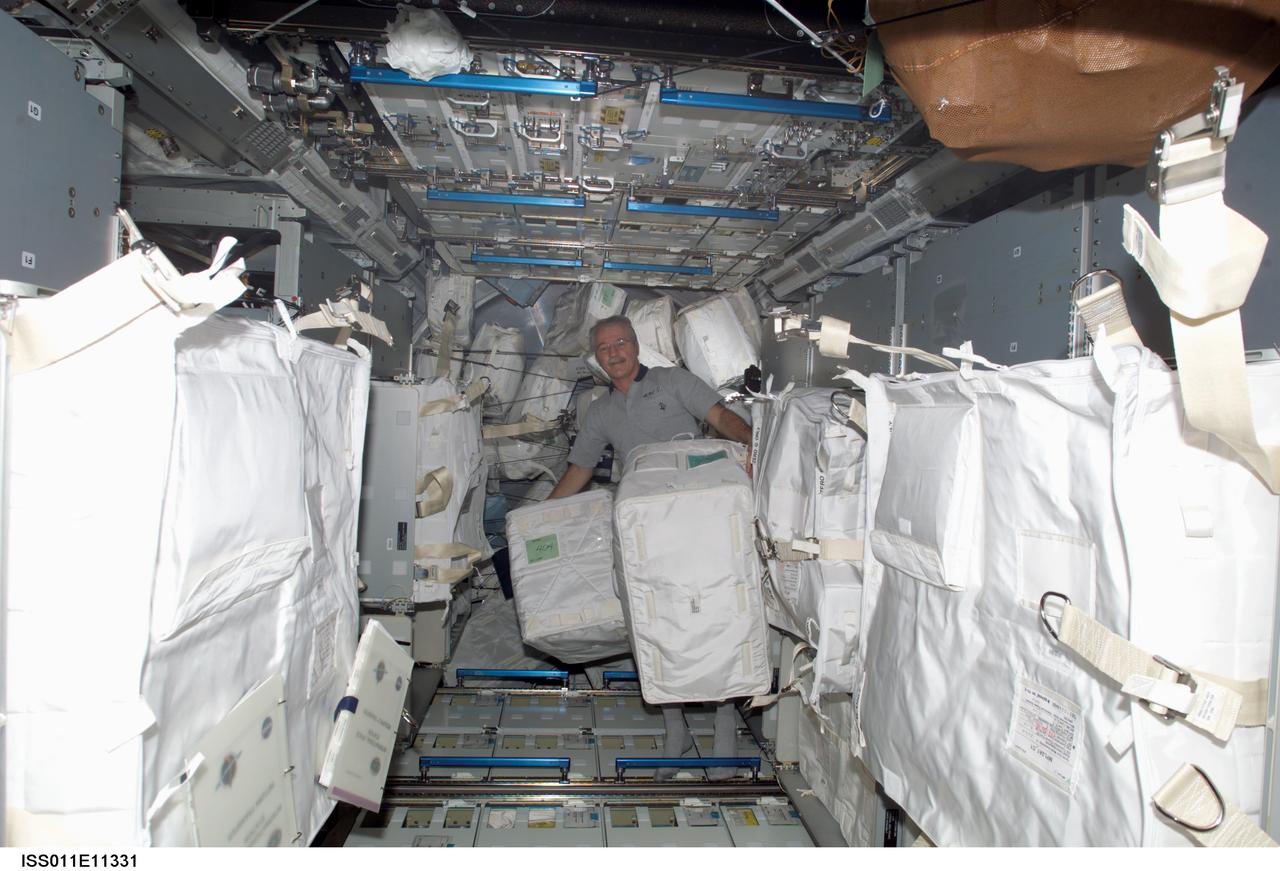
ISS011-E-11331 (30 July 2005) --- Astronaut John L. Phillips, Expedition 11 NASA space station science officer and flight engineer, retrieves supplies from the Raffaello Multi-Purpose Logistics Module (MPLM), which was brought to Earth-orbit by the seven-member STS-114 crew of the space shuttle Discovery.
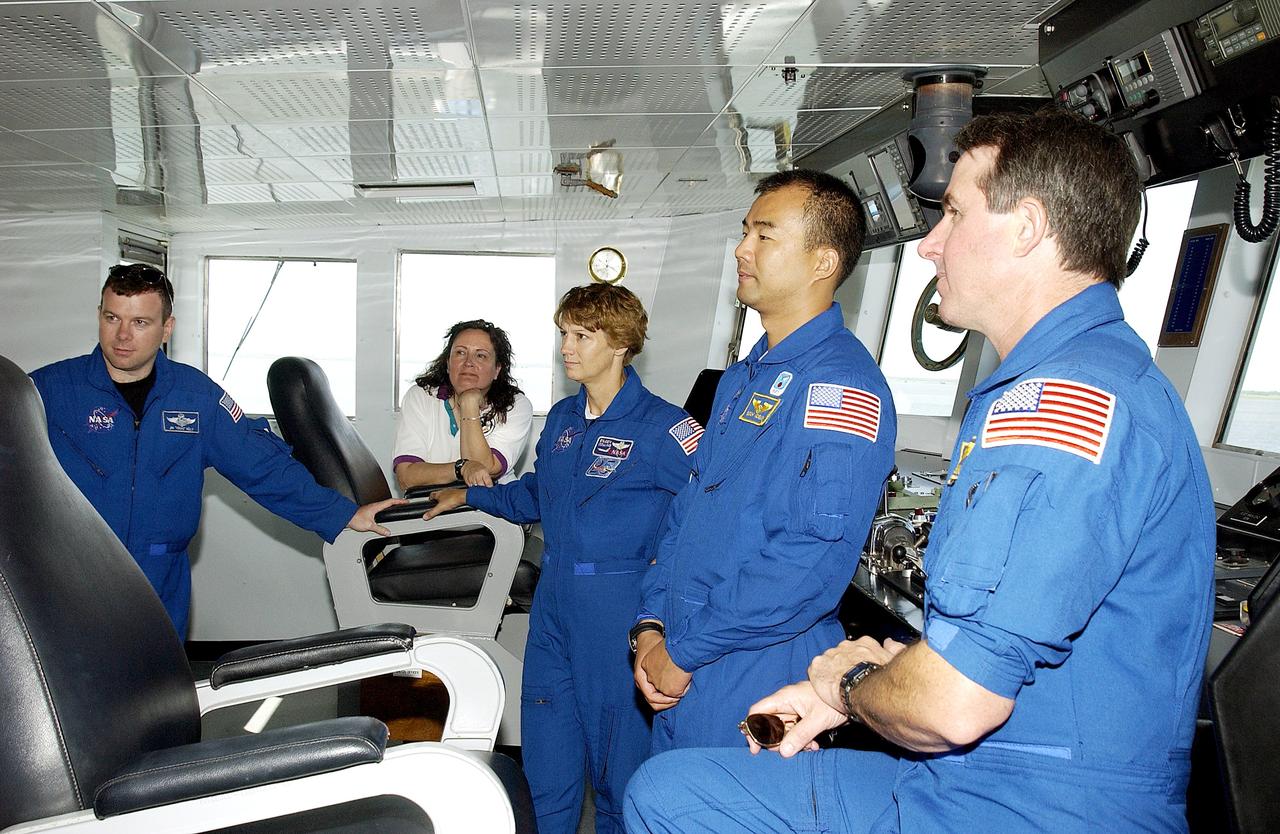
KENNEDY SPACE CENTER, FLA. - The STS-114 crew visit the bridge of the Liberty Star, one of two SRB Retrieval Ships. From left are Pilot James Kelly, Louise Kleba (with the Vehicle Integration Test Team (VITT) office), Commander Eileen Collins and Mission Specialists Soichi Noguchi and Stephen Robinson. Noguchi is with the Japanese space agency NASDA. On their mission, the crew will carry the MultiPurpose Logistics Module (MPLM) Raffaello and External Stowage Platform 2 to the International Space Station. The MPLM will contain supplies and equipment. Another goal of the mission is to remove and replace a Control Moment Gyro. Launch date for mission STS-114 is under review.
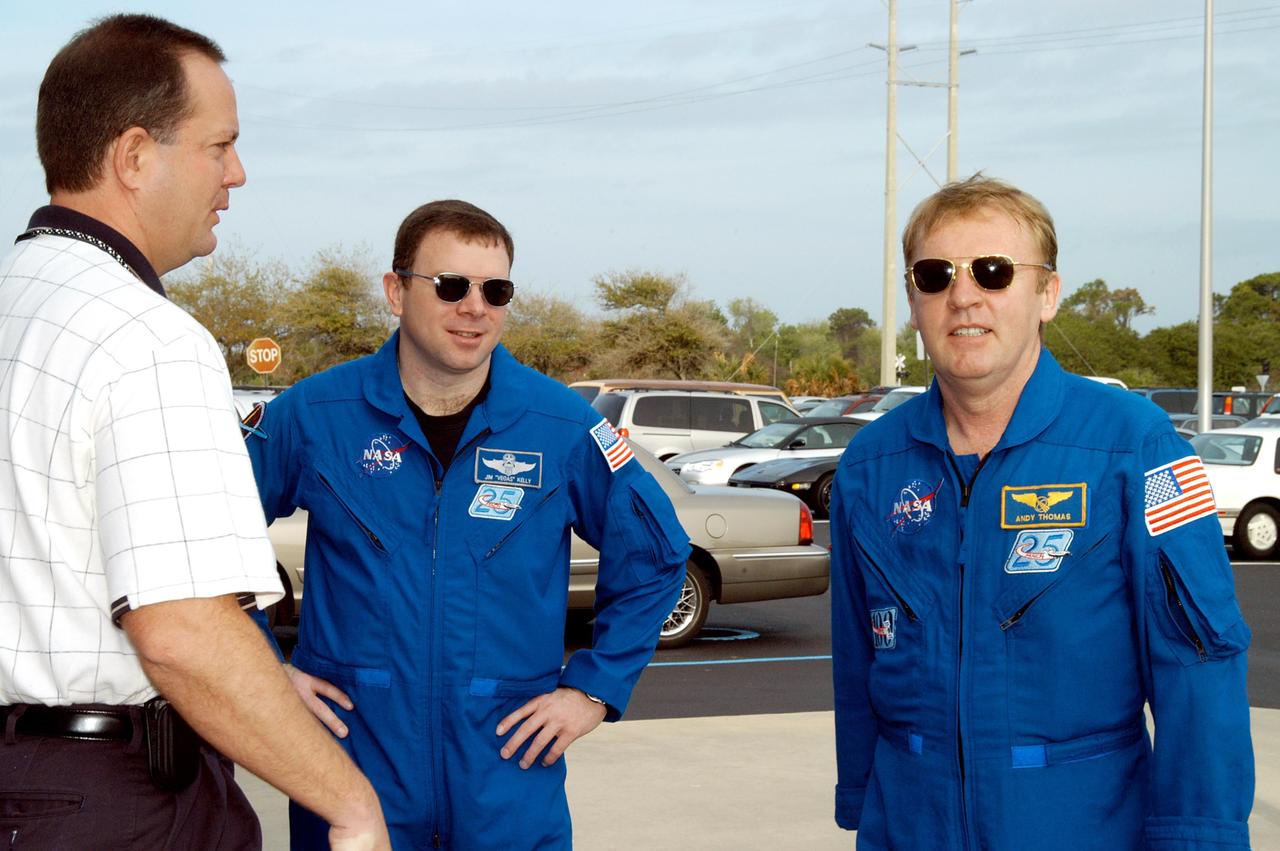
KENNEDY SPACE CENTER, FLA. - At the SRB Assembly and Refurbishment Facility, STS-114 crew members Pilot James Kelly and Mission Specialist Andrew Thomas talk with Tom Engler, Marshall Space Flight Center SRB Resident Office lead. The STS-114 crew is at KSC for familiarization with Shuttle and mission equipment. The mission is Logistics Flight 1, which is scheduled to deliver supplies and equipment, plus the external stowage platform, to the International Space Station.

CAPE CANAVERAL, Fla. – Carol Craig, founder and chief executive officer of Craig Technologies. Her company operates the Aerospace and Defense Manufacturing Center in Cape Canaveral, Fla. In June of last year, NASA signed a partnership agreement with Craig Technologies to maintain an inventory of unique processing and manufacturing equipment for future mission support at the agency's Kennedy Space Center. The Cape Canaveral, Fla., facility, formerly known as the NASA Shuttle Logistics Depot NSLD, is now the Aerospace and Defense Manufacturing Center ADMC. Photo credit: NASA_Kim Shiflett
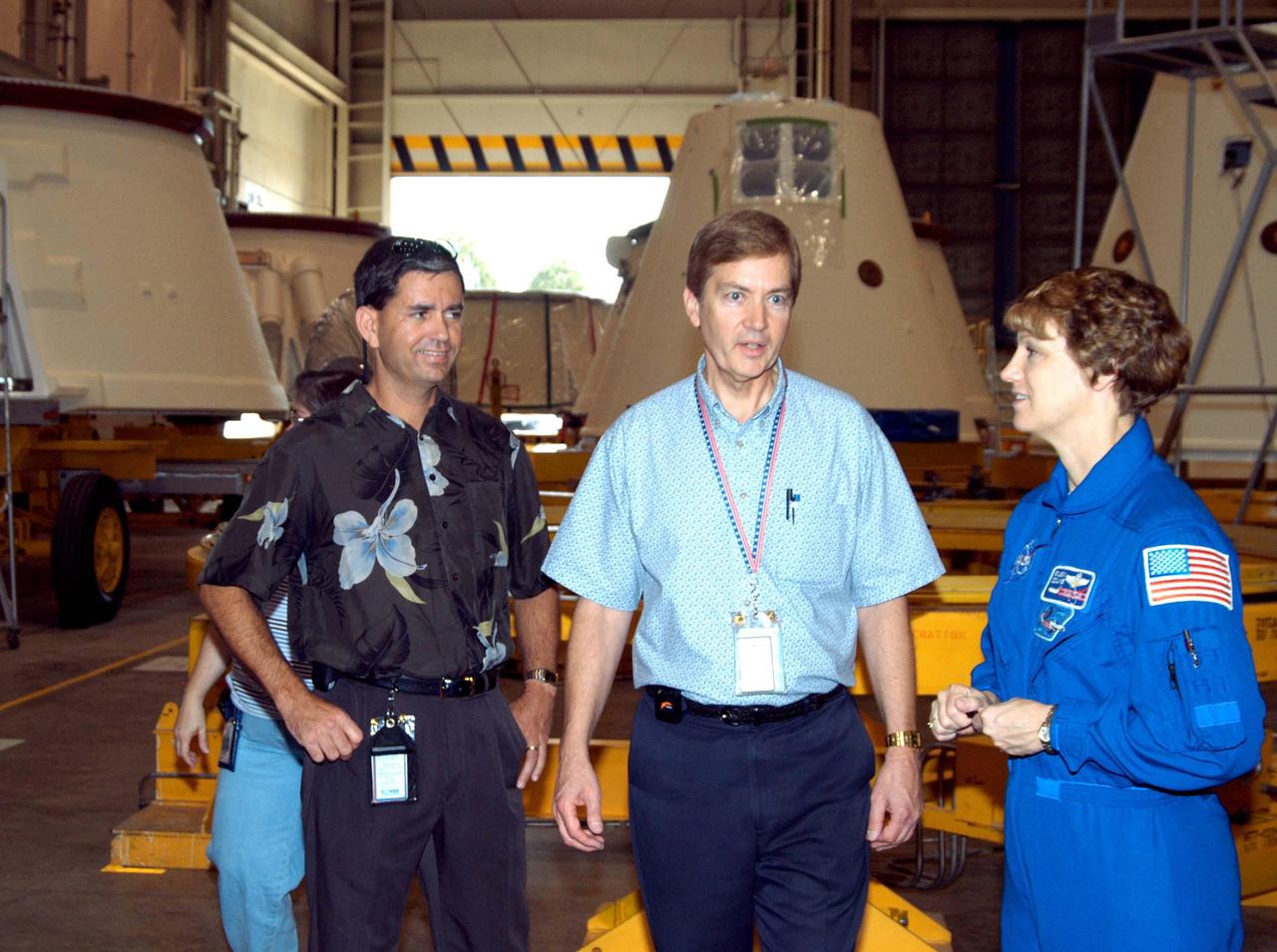
KENNEDY SPACE CENTER, FLA. - In the SRB Assembly and Refurbishment Facility, STS-114 Commander Eileen Collins talks with Bob Osterblom (left), with the Marshall Space Flight Center Resident Office, and Craig Bennett, a Defense Contract Management Agency inspector. The STS-114 crew is at KSC for familiarization with Shuttle and mission equipment. The mission is Logistics Flight 1, which is scheduled to deliver supplies and equipment, plus the external stowage platform, to the International Space Station.

ISS011-E-11363 (31 July 2005) --- Astronauts Wendy B. Lawrence (foreground), STS-114 mission specialist, and John L. Phillips, Expedition 11 NASA Space Station science officer and flight engineer, participate in the movement of supplies and equipment inside Raffaello, the Italian Space Agency-built Multipurpose Logistics Module (MPLM) to the International Space Station. Lawrence was in charge of the transfer operations.
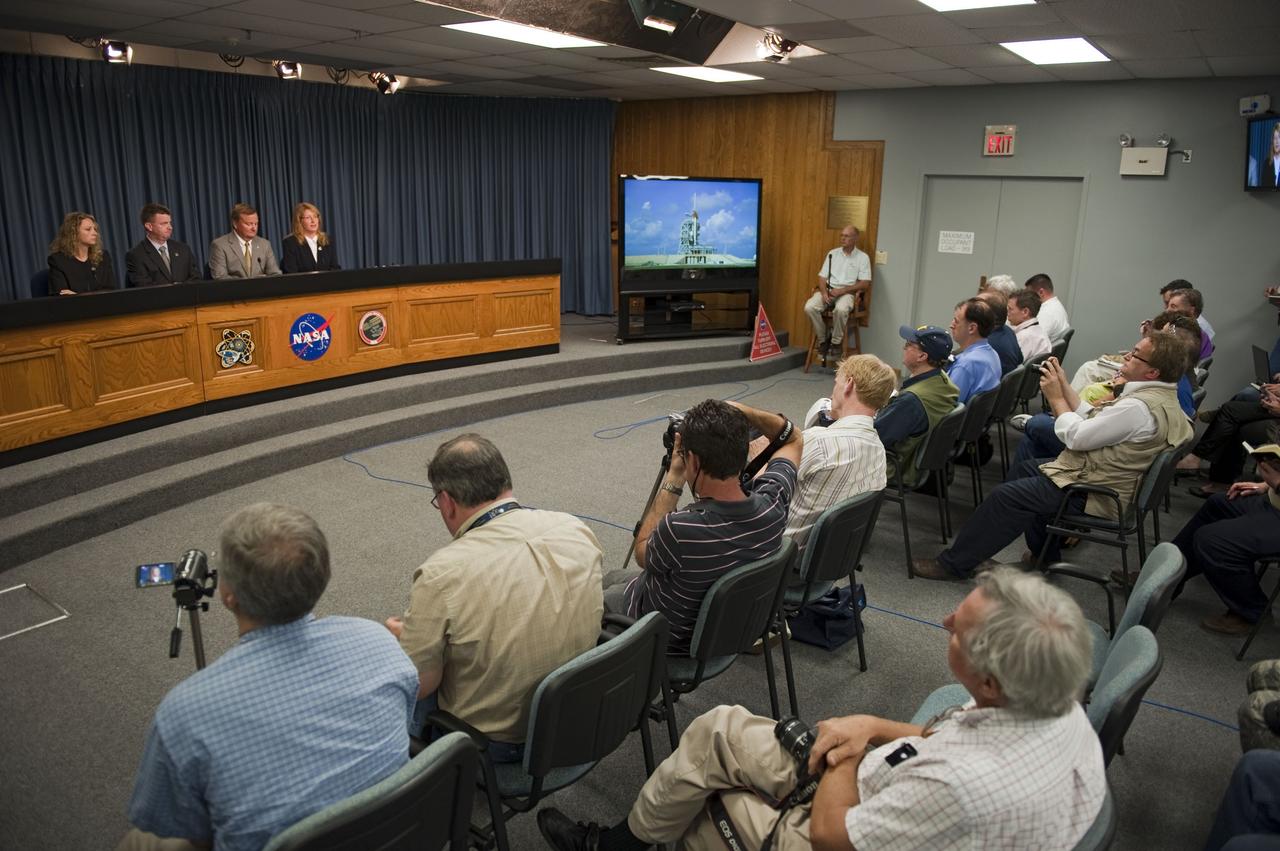
CAPE CANAVERAL, Fla. -- In the Press Site auditorium at NASA's Kennedy Space Center in Florida, NASA managers brief media about the launch status of space shuttle Endeavour's STS-134 mission. From left are NASA Public Affairs Officer Candrea Thomas, Space Shuttle Program Launch Integration Manager, Mike Moses, Shuttle Launch Director, Mike Leinbach, and Shuttle Weather Officer, Kathy Winters. Endeavour and its crew will deliver the Express Logistics Carrier-3, Alpha Magnetic Spectrometer-2 (AMS), a high-pressure gas tank and additional spare parts for the Dextre robotic helper to the International Space Station. Launch is scheduled for April 29 at 3:47 p.m. EDT. This will be the final spaceflight for Endeavour. For more information visit, www.nasa.gov/mission_pages/shuttle/shuttlemissions/sts134/index.html. Photo credit: NASA/Kim Shiflett
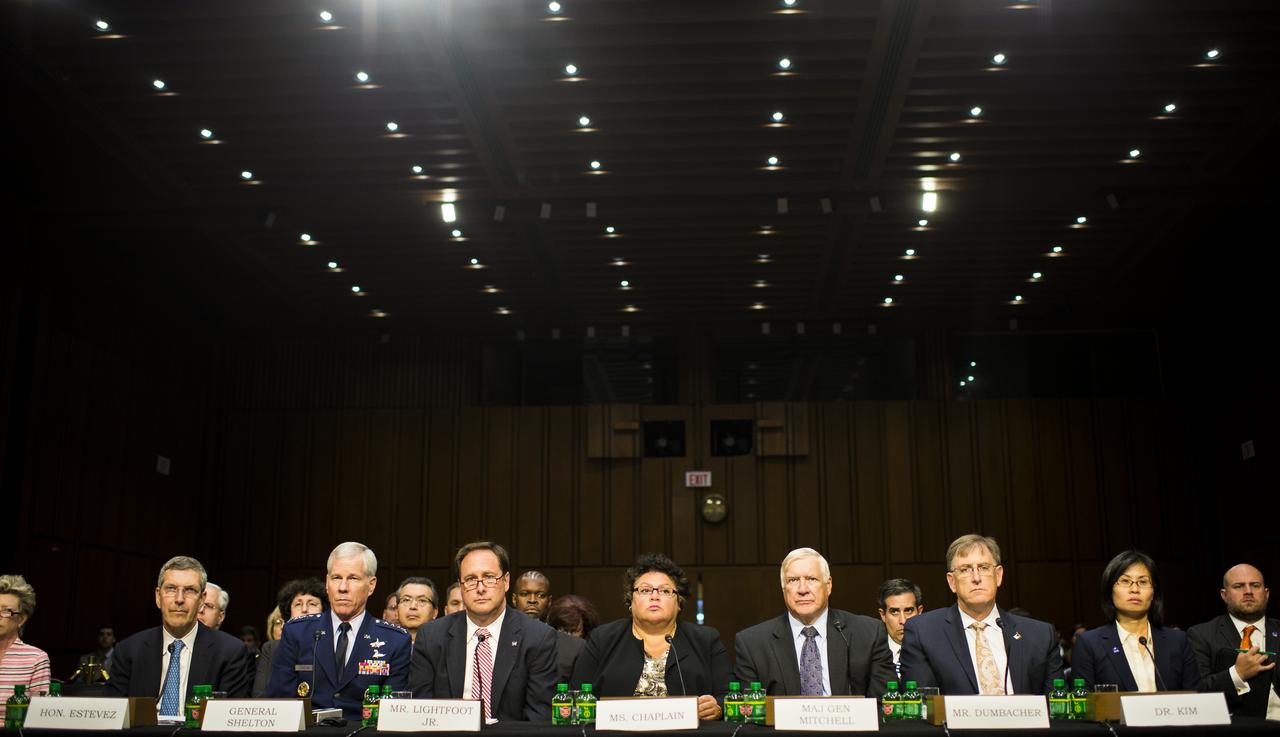
From left; Hon. Alan Estevez, Principle Deputy Under Secretary of Defense for Acquisition, Technology, and Logistics; General William Shelton, Commander of the United States Air Force Space Command; Robert Lightfoot, NASA Associate Administrator; Cristina Chaplain, Director of Acquisition and Sourcing Management at the Government Accountability Office; major General Howard Mitchell (USAF Ret.), Vice President for Program Assessments at The Aerospace Corporation; Daniel Dunbacher, Professor of Practice in the Department of Aeronautics and Aerospace Engineering at Purdue University; and Dr. Yool Kim, Senior Engineer at The Rand Corporation; are seen during a hearing in front of the Senate Subcommittee on Strategic Forces and Senate Committee on Commerce, Science, and Transportation on Wednesday, July 16, 2014, at the Hart Senate Office Building in Washington, DC. The Senate hearing focused on assured access to space.
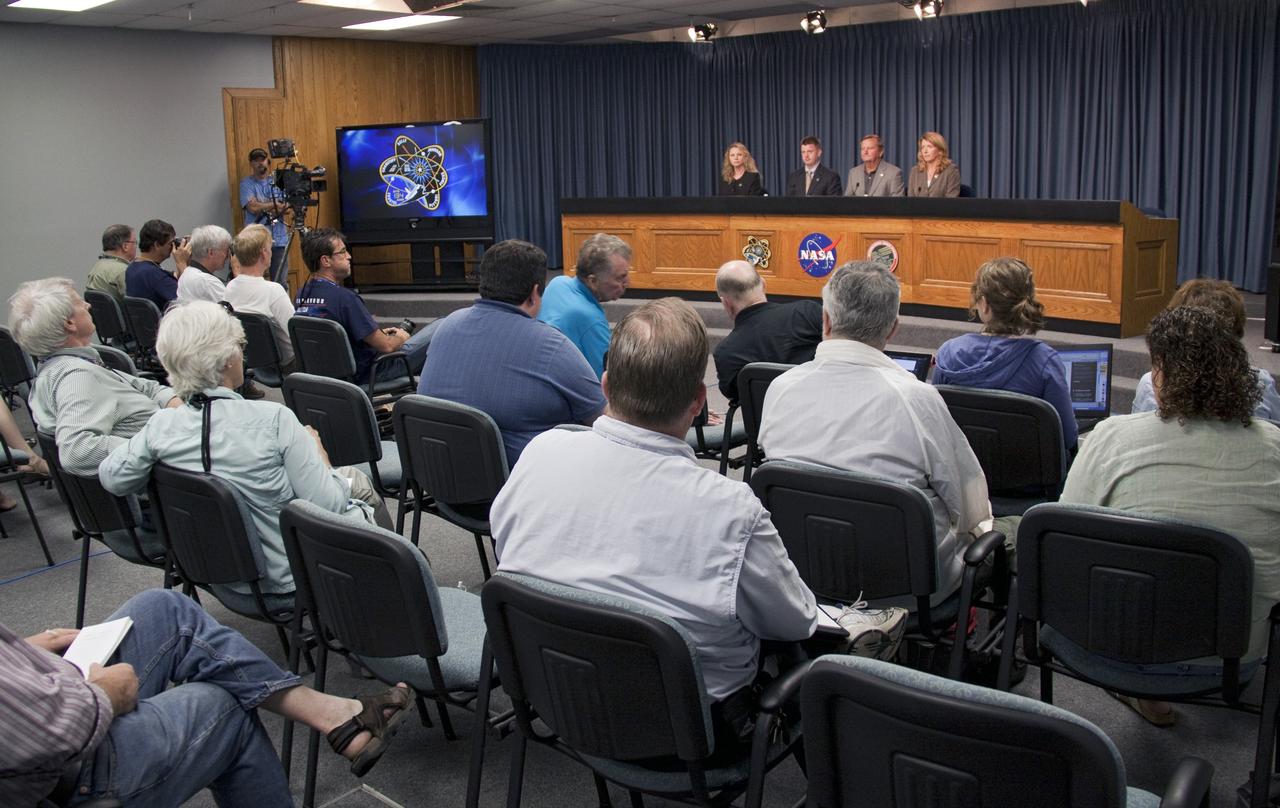
CAPE CANAVERAL, Fla. -- In the Press Site auditorium at NASA's Kennedy Space Center in Florida, NASA managers brief media about their unanimous approval to proceed with space shuttle Endeavour's STS-134 mission. From left, are NASA Public Affairs Officer Candrea Thomas, Space Shuttle Program Launch Integration Manager Mike Moses, Shuttle Launch Director Mike Leinbach and Shuttle Weather Officer Kathy Winters. Endeavour's launch is scheduled for May 16 at 8:56 a.m. EDT. Endeavour and its crew will deliver the Express Logistics Carrier-3, Alpha Magnetic Spectrometer-2 (AMS), a high-pressure gas tank and additional spare parts for the Dextre robotic helper to the station. This will be the final spaceflight for Endeavour. For more information visit, www.nasa.gov/mission_pages/shuttle/shuttlemissions/sts134/index.html. Photo credit: NASA/Ben Smegelsky
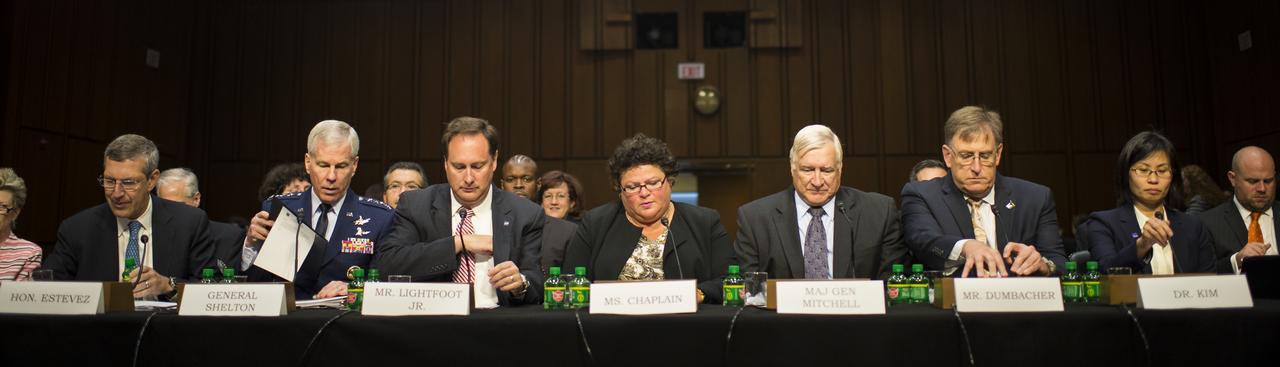
From left; Hon. Alan Estevez, Principle Deputy Under Secretary of Defense for Acquisition, Technology, and Logistics; General William Shelton, Commander of the United States Air Force Space Command; Robert Lightfoot, NASA Associate Administrator; Cristina Chaplain, Director of Acquisition and Sourcing Management at the Government Accountability Office; major General Howard Mitchell (USAF Ret.), Vice President for Program Assessments at The Aerospace Corporation; Daniel Dunbacher, Professor of Practice in the Department of Aeronautics and Aerospace Engineering at Purdue University; and Dr. Yool Kim, Senior Engineer at The Rand Corporation; are seen during a hearing in front of the Senate Subcommittee on Strategic Forces and Senate Committee on Commerce, Science, and Transportation on Wednesday, July 16, 2014, at the Hart Senate Office Building in Washington, DC. The Senate hearing focused on assured access to space.
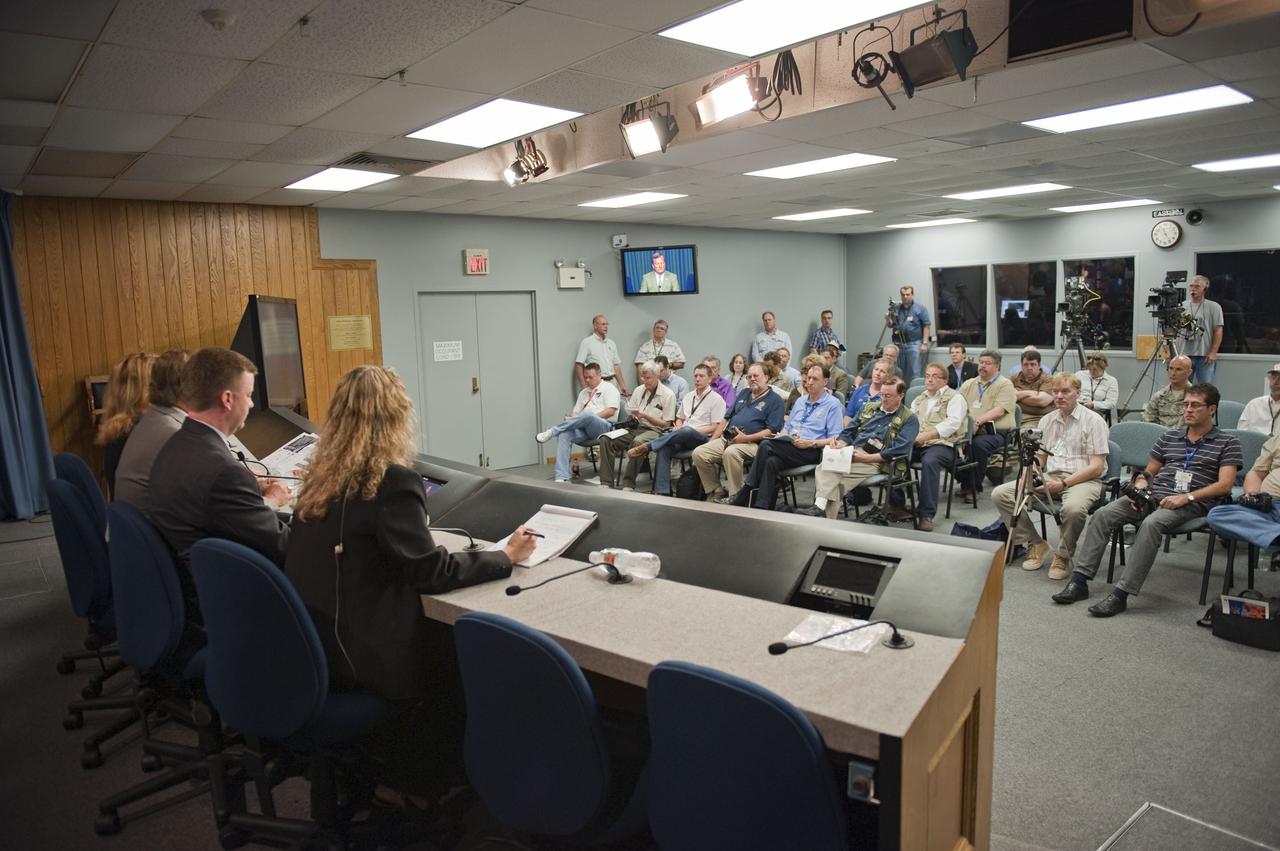
CAPE CANAVERAL, Fla. -- In the Press Site auditorium at NASA's Kennedy Space Center in Florida, NASA managers brief media about the launch status of space shuttle Endeavour's STS-134 mission. From left are NASA Public Affairs Officer Candrea Thomas, Space Shuttle Program Launch Integration Manager, Mike Moses, Shuttle Launch Director, Mike Leinbach, and Shuttle Weather Officer, Kathy Winters. Endeavour and its crew will deliver the Express Logistics Carrier-3, Alpha Magnetic Spectrometer-2 (AMS), a high-pressure gas tank and additional spare parts for the Dextre robotic helper to the International Space Station. Launch is scheduled for April 29 at 3:47 p.m. EDT. This will be the final spaceflight for Endeavour. For more information visit, www.nasa.gov/mission_pages/shuttle/shuttlemissions/sts134/index.html. Photo credit: NASA/Kim Shiflett
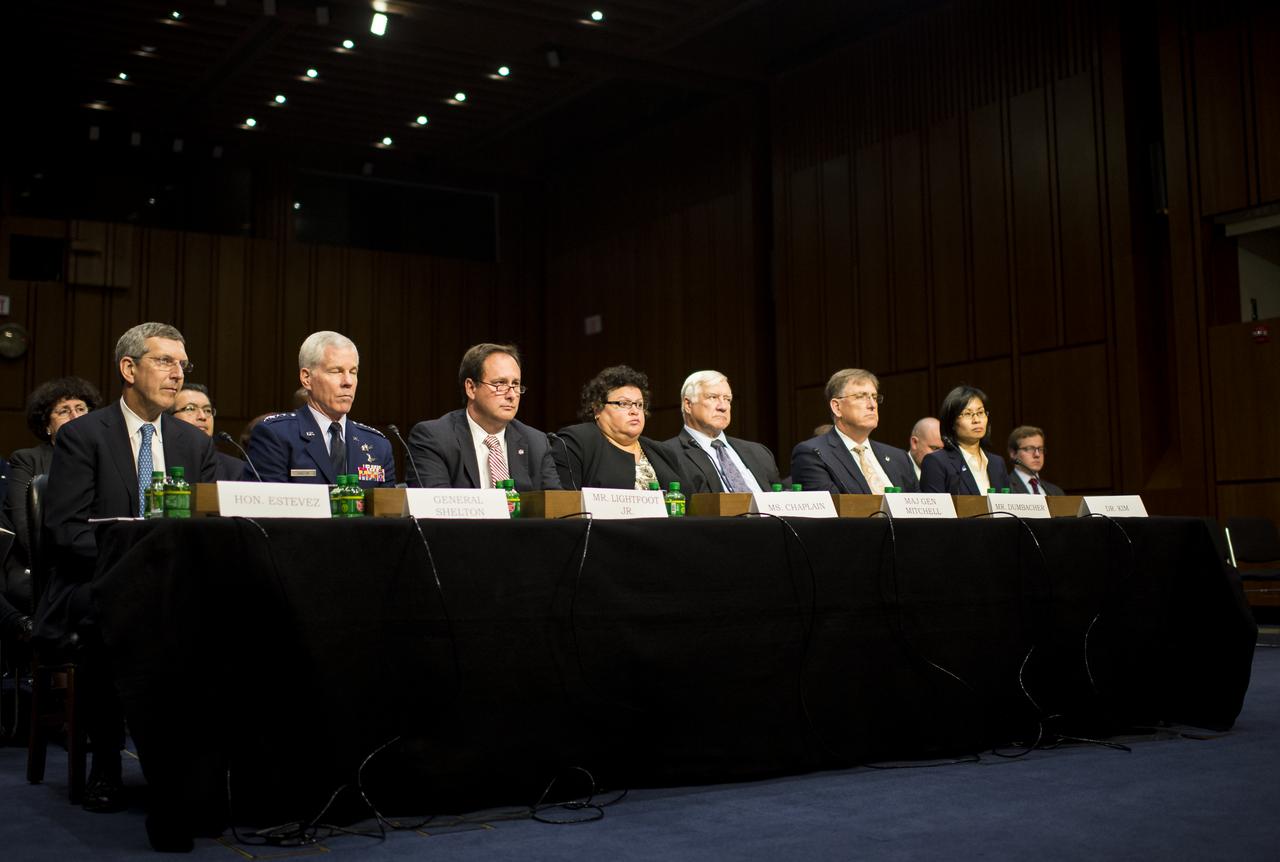
From left; Hon. Alan Estevez, Principle Deputy Under Secretary of Defense for Acquisition, Technology, and Logistics; General William Shelton, Commander of the United States Air Force Space Command; Robert Lightfoot, NASA Associate Administrator; Cristina Chaplain, Director of Acquisition and Sourcing Management at the Government Accountability Office; major General Howard Mitchell (USAF Ret.), Vice President for Program Assessments at The Aerospace Corporation; Daniel Dunbacher, Professor of Practice in the Department of Aeronautics and Aerospace Engineering at Purdue University; and Dr. Yool Kim, Senior Engineer at The Rand Corporation; are seen during a hearing in front of the Senate Subcommittee on Strategic Forces and Senate Committee on Commerce, Science, and Transportation on Wednesday, July 16, 2014, at the Hart Senate Office Building in Washington, DC. The Senate hearing focused on assured access to space.
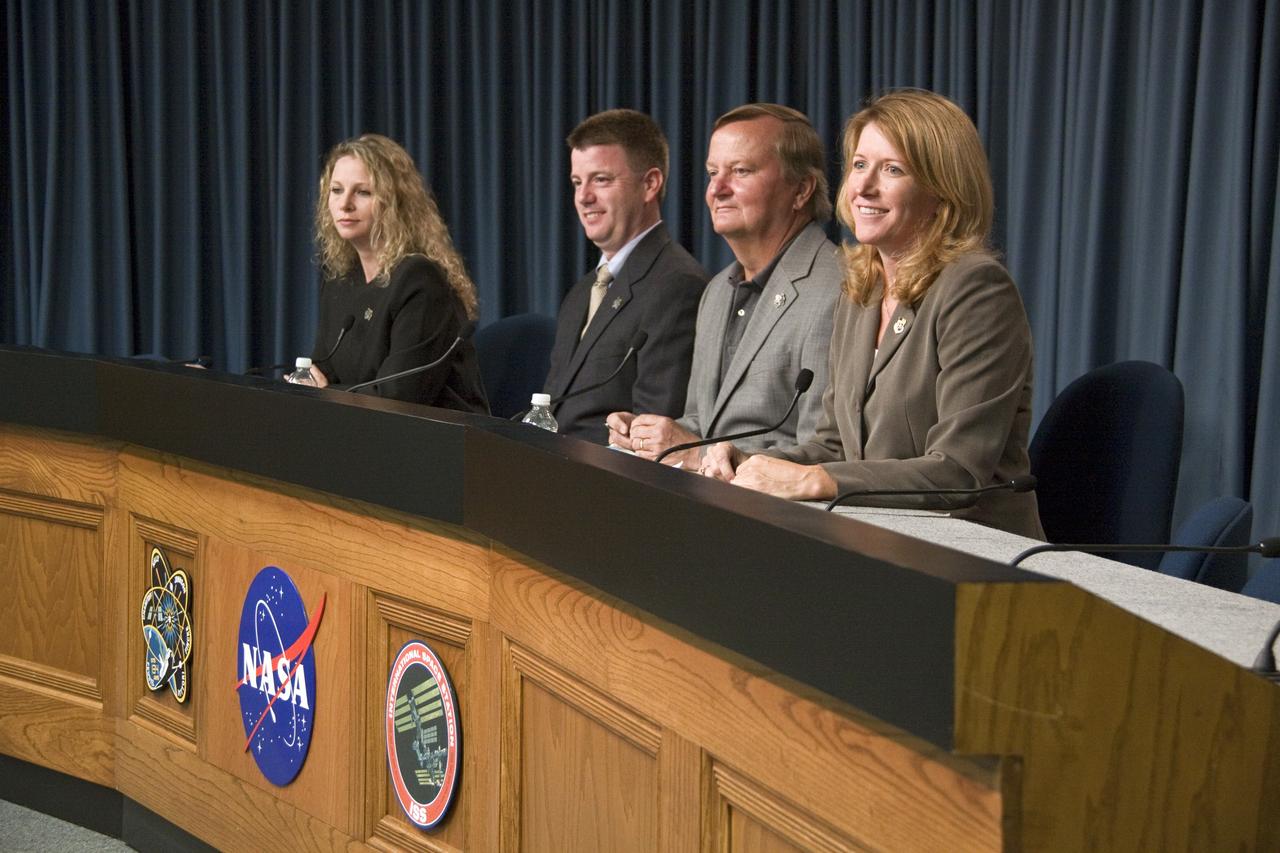
CAPE CANAVERAL, Fla. -- In the Press Site auditorium at NASA's Kennedy Space Center in Florida, NASA managers brief media about their unanimous approval to proceed with space shuttle Endeavour's STS-134 mission. From left, are NASA Public Affairs Officer Candrea Thomas, Space Shuttle Program Launch Integration Manager Mike Moses, Shuttle Launch Director Mike Leinbach and Shuttle Weather Officer Kathy Winters. Endeavour's launch is scheduled for May 16 at 8:56 a.m. EDT. Endeavour and its crew will deliver the Express Logistics Carrier-3, Alpha Magnetic Spectrometer-2 (AMS), a high-pressure gas tank and additional spare parts for the Dextre robotic helper to the station. This will be the final spaceflight for Endeavour. For more information visit, www.nasa.gov/mission_pages/shuttle/shuttlemissions/sts134/index.html. Photo credit: NASA/Ben Smegelsky
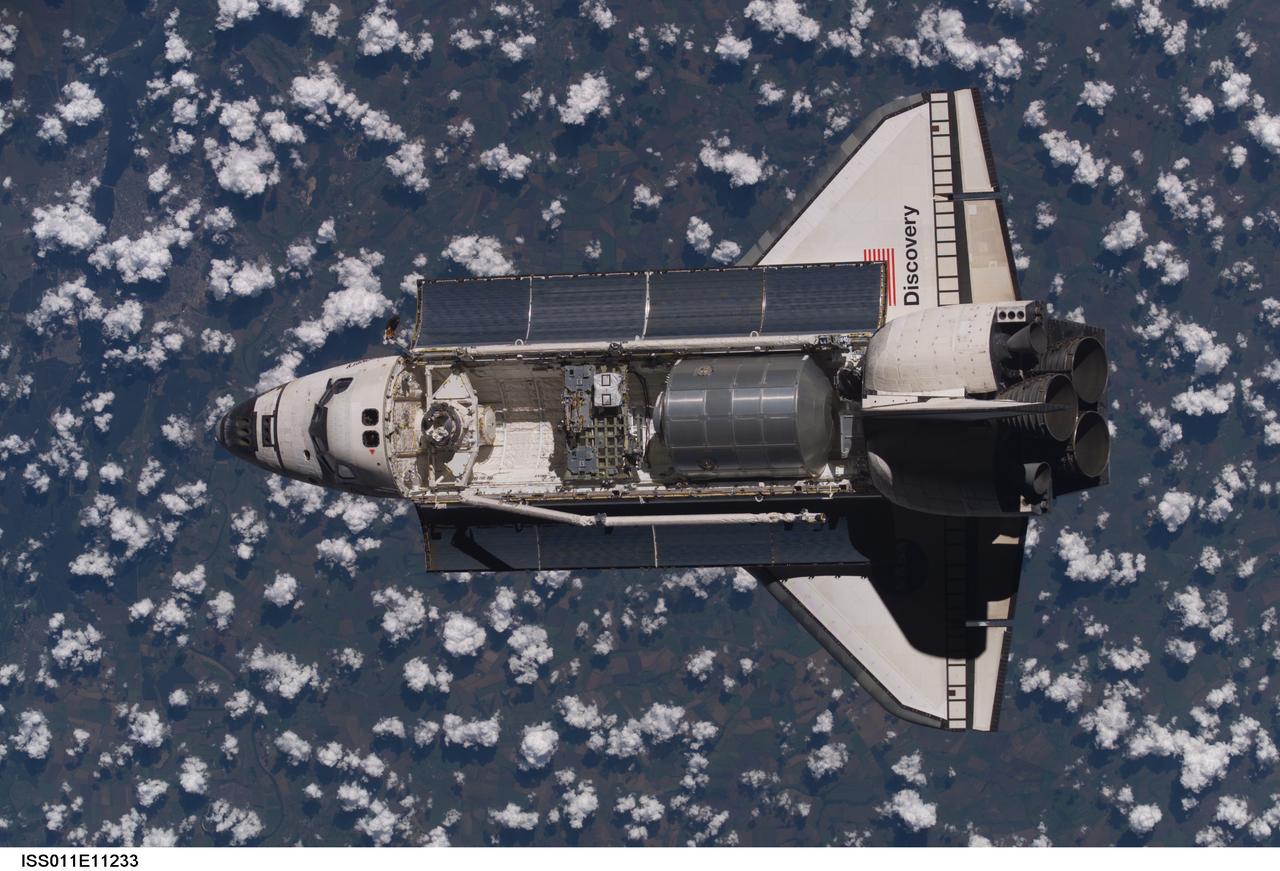
Launched on July 26, 2005 from the Kennedy Space Center in Florida, STS-114 was classified as Logistics Flight 1. Among the Station-related activities of the mission were the delivery of new supplies and the replacement of one of the orbital outpost's Control Moment Gyroscopes (CMGs). STS-114 also carried the Raffaello Multi-Purpose Logistics Module (MPLM) and the External Stowage Platform-2. Back dropped by popcorn-like clouds, the MPLM can be seen in the cargo bay as Discovery undergoes rendezvous and docking operations. Cosmonaut Sergei K. Kriklev, Expedition 11 Commander, and John L. Phillips, NASA Space Station officer and flight engineer photographed the spacecraft from the International Space Station (ISS).
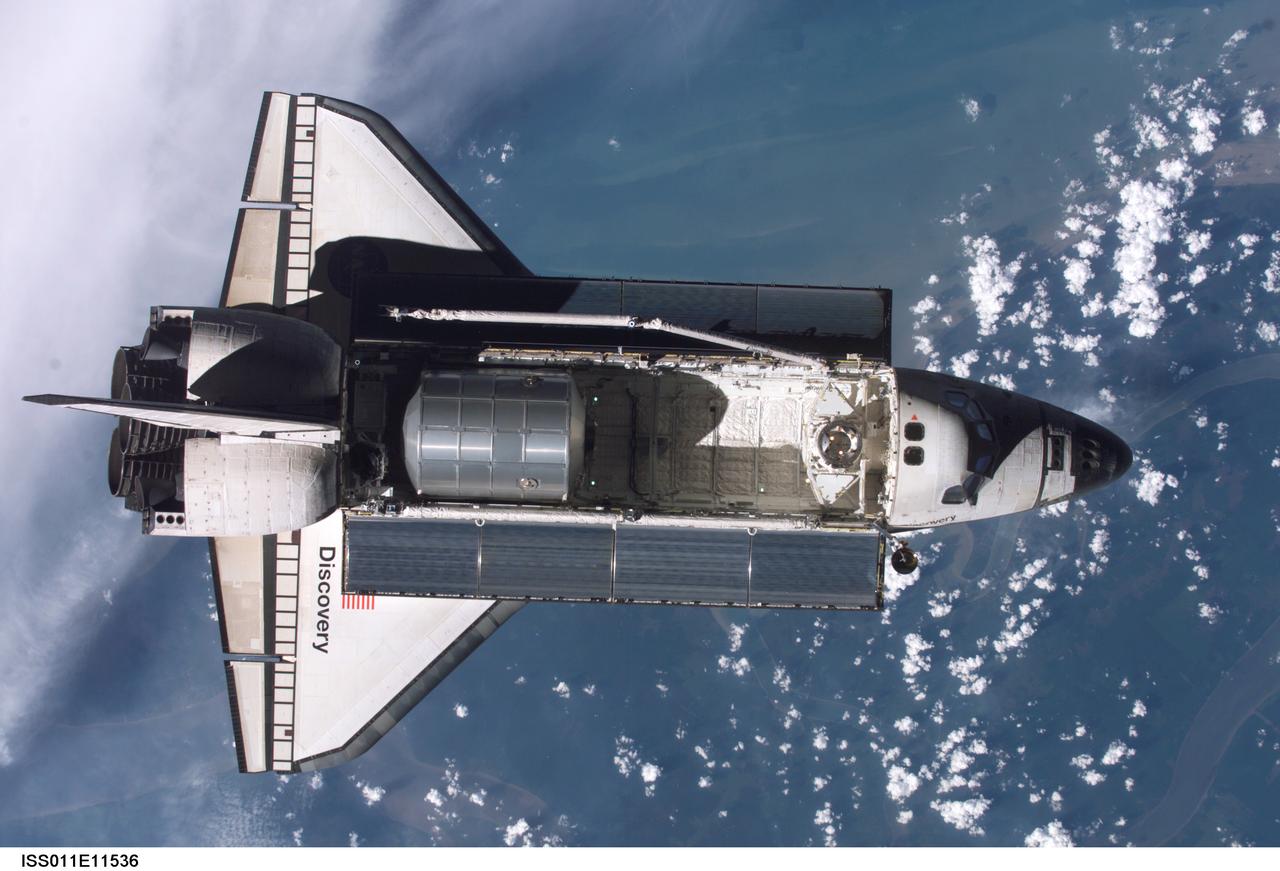
Launched on July 26 2005 from the Kennedy Space Center in Florida, STS-114 was classified as Logistics Flight 1. Among the Station-related activities of the mission were the delivery of new supplies and the replacement of one of the orbital outpost's Control Moment Gyroscopes (CMGs). STS-114 also carried the Raffaello Multi-Purpose Logistics Module (MPLM) and the External Stowage Platform-2. Back dropped by popcorn-like clouds, the MPLM can be seen in the cargo bay as Discovery undergoes rendezvous and docking operations. Cosmonaut Sergei K. Kriklev, Expedition 11 Commander, and John L. Phillips, NASA Space Station officer and flight engineer photographed the spacecraft from the International Space Station (ISS).
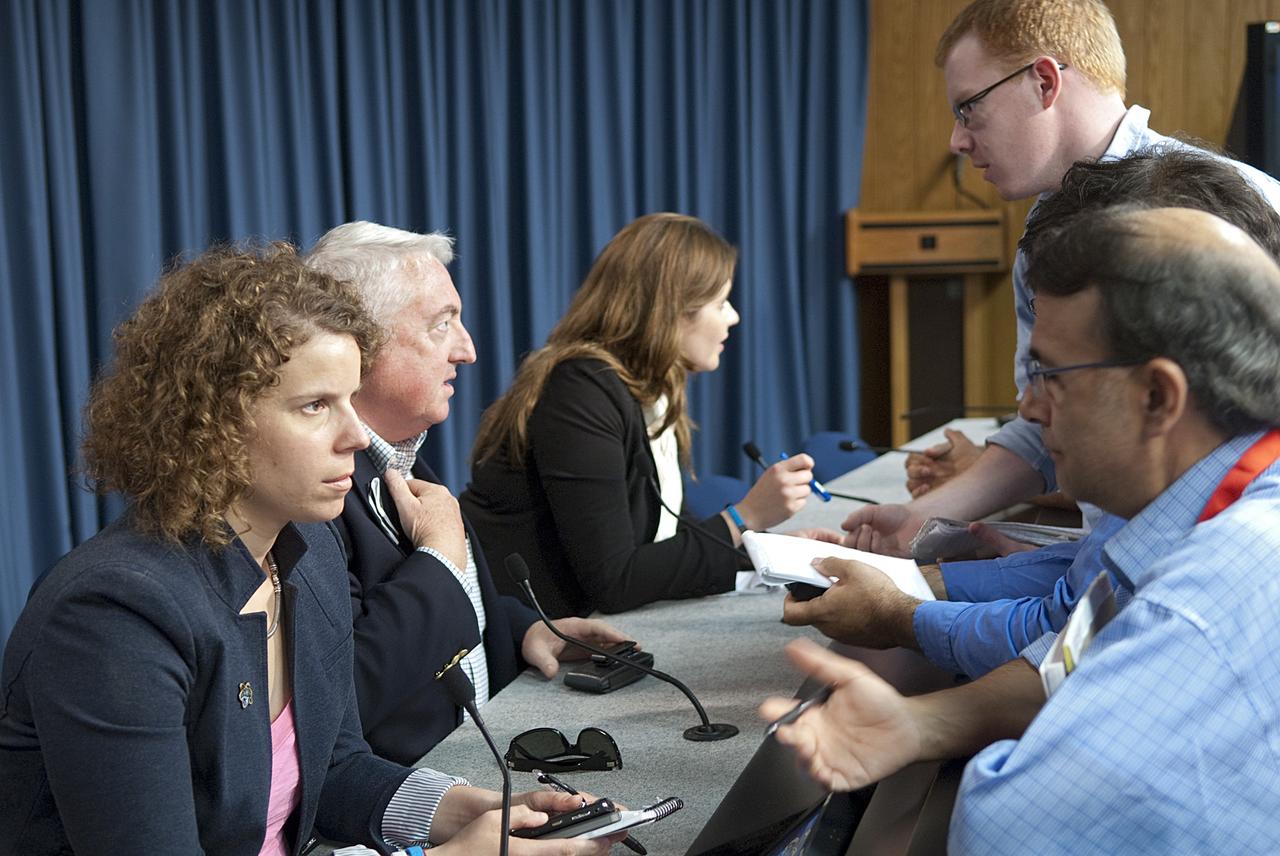
CAPE CANAVERAL, Fla. -- In the Press Site auditorium at NASA's Kennedy Space Center in Florida, staff for U.S. Congresswoman Gabielle Giffords brief media after the successful launch of space shuttle Endeavour on its STS-134 mission. From left are, Pia Carusone Chief of Staff, U.S. Rep. Gabrielle Giffords Office, Mark Kimble Press Advisor, U.S. Rep. Gabrielle Giffords Office and Ashley Nash-Hahn, New Media Strategist, U.S. Rep. Gabrielle Giffords Office. Giffords was on hand to watch her husband, STS-135 Commander Mark Kelly and his crew liftoff from Launch Pad 39A on Endeavour's final spaceflight. Endeavour lifted off May 16 at 8:56 a.m. EDT. Endeavour and its crew will deliver the Express Logistics Carrier-3, Alpha Magnetic Spectrometer-2 (AMS), a high-pressure gas tank and additional spare parts for the Dextre robotic helper to the station. For more information visit, www.nasa.gov/mission_pages/shuttle/shuttlemissions/sts134/index.html. Photo credit: NASA/Jim Grossmann
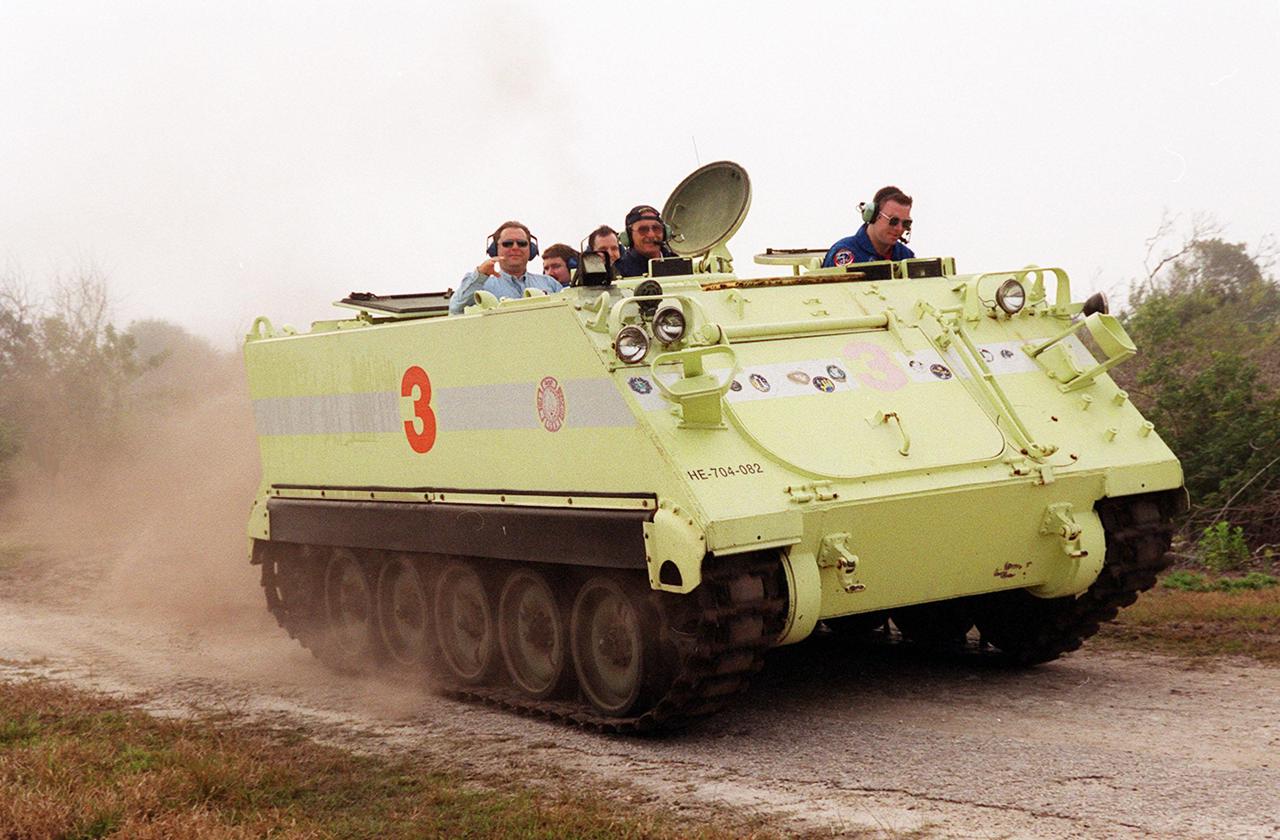
STS-102 Pilot James Kelly takes his turn driving the M-113 armored carrier that the crew could use to exit the pad if an emergency ever occurred prior to launch. Behind him are other members of the crew and training officers. The STS-102 crew is at KSC to take part in Terminal Countdown Demonstration Test activities, which also include a simulated launch countdown. STS-102 is the eighth construction flight to the International Space Station, carrying as payload the Multi-Purpose Logistics Module Leonardo. Launch on mission STS-102 is scheduled for March 8
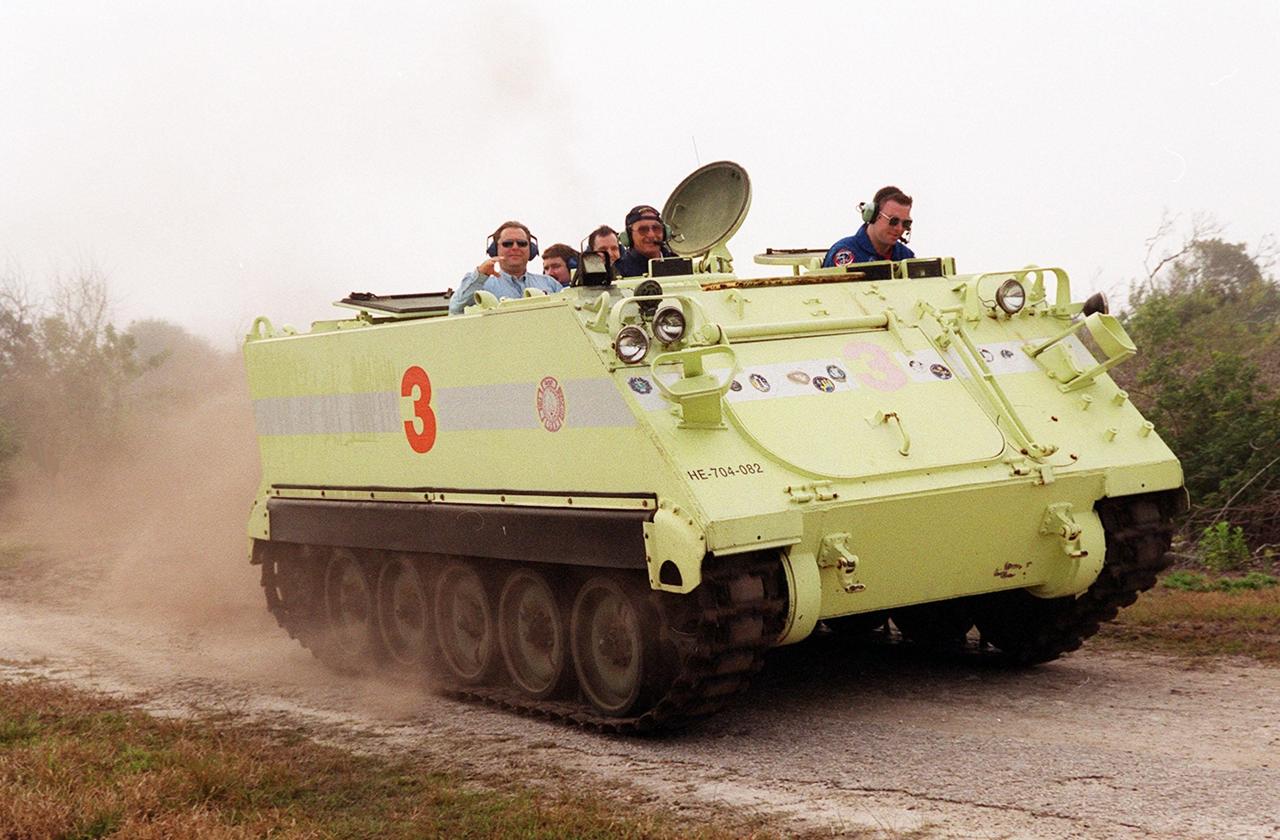
STS-102 Pilot James Kelly takes his turn driving the M-113 armored carrier that the crew could use to exit the pad if an emergency ever occurred prior to launch. Behind him are other members of the crew and training officers. The STS-102 crew is at KSC to take part in Terminal Countdown Demonstration Test activities, which also include a simulated launch countdown. STS-102 is the eighth construction flight to the International Space Station, carrying as payload the Multi-Purpose Logistics Module Leonardo. Launch on mission STS-102 is scheduled for March 8
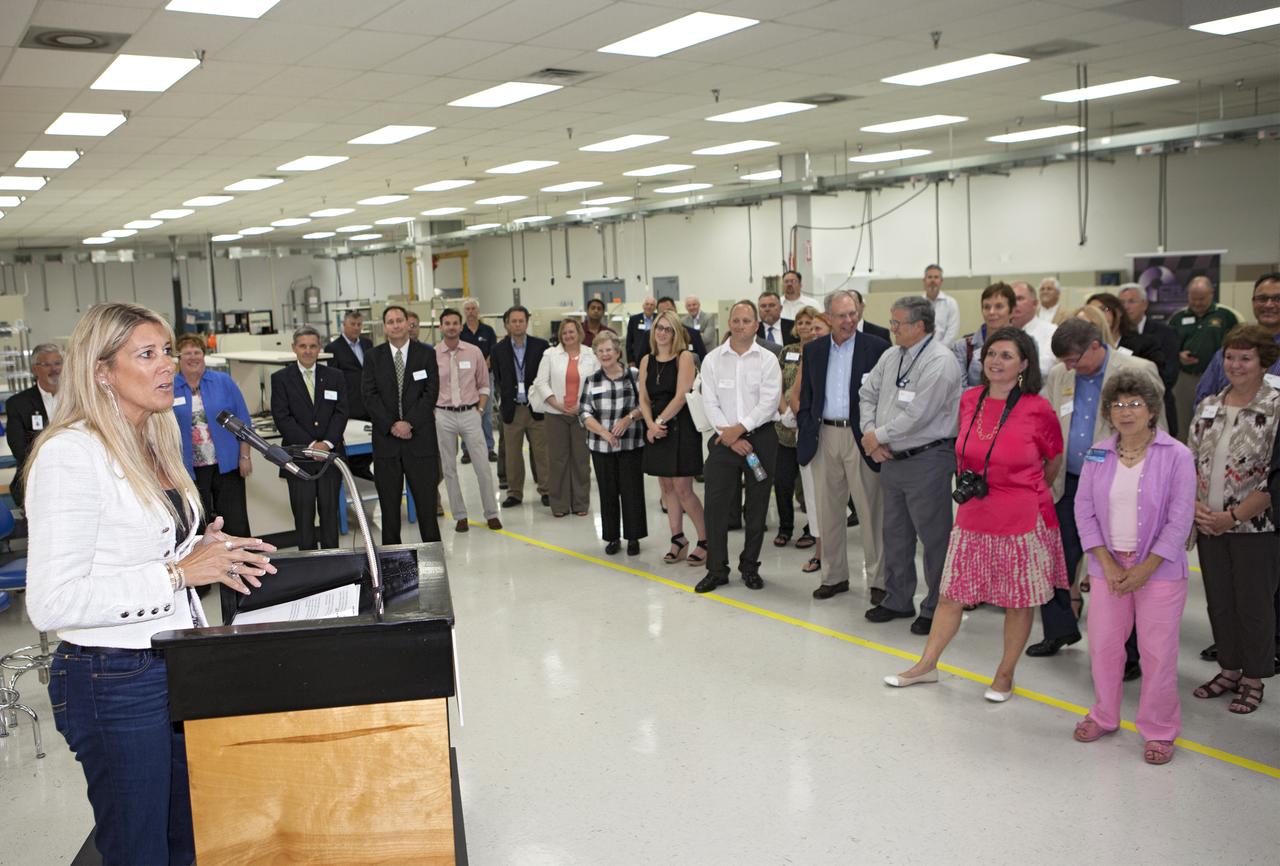
CAPE CANAVERAL, Fla. – At the Aerospace and Defense Manufacturing Center in Cape Canaveral, Fla., Craig Technologies founder and chief executive officer Carol Craig speaks to guests during a community open house at the 161,000-square-foot facility. In June of last year, NASA signed a partnership agreement with Craig Technologies to maintain an inventory of unique processing and manufacturing equipment for future mission support at the agency's Kennedy Space Center. The Cape Canaveral, Fla., facility, formerly known as the NASA Shuttle Logistics Depot NSLD, is now the Aerospace and Defense Manufacturing Center ADMC. Photo credit: NASA_Kim Shiflett
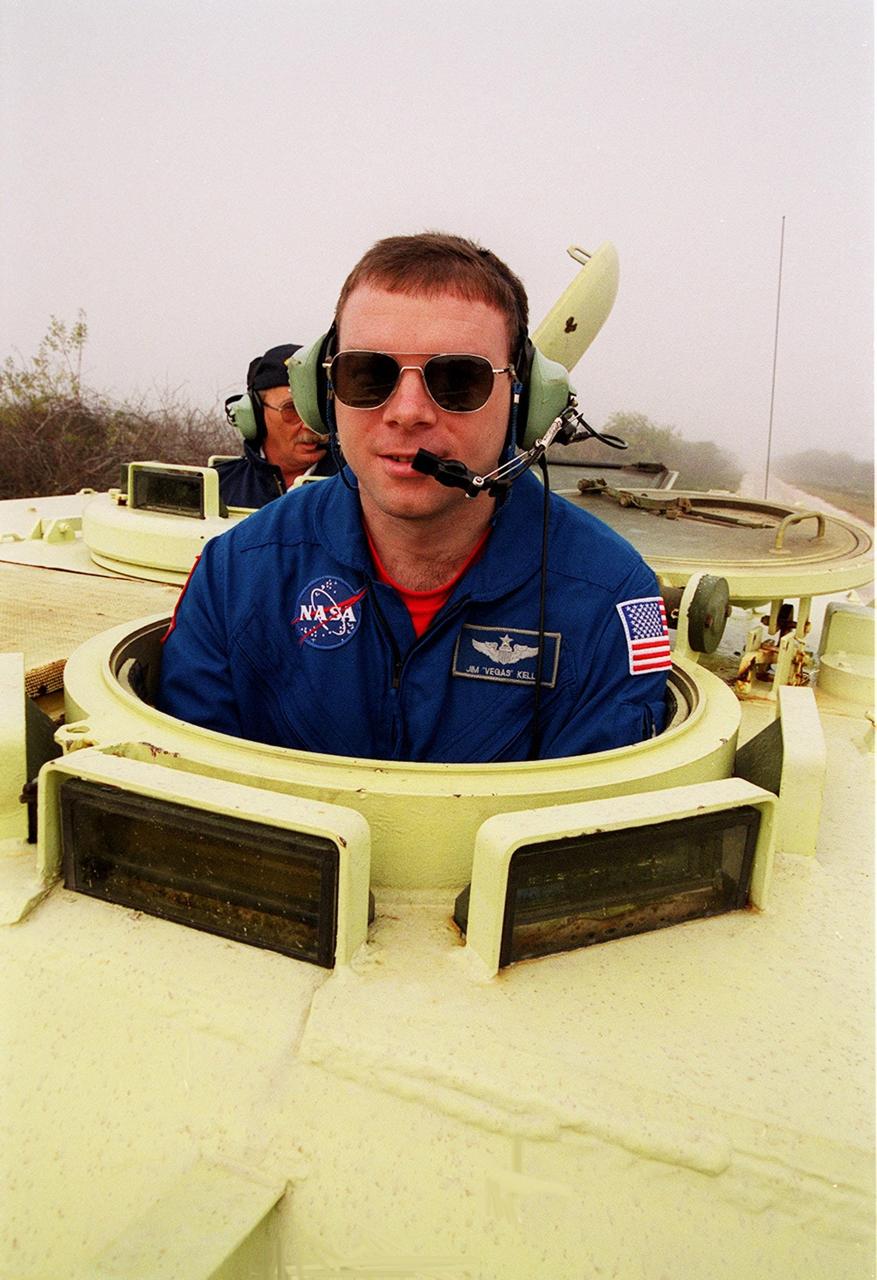
STS-102 Pilot James Kelly gets into the driver’s seat of an M-113 armored carrier near Launch Pad 39B he will practice driving. In the background is Capt. George Hoggard, a training officer with SGS Fire Services. In the event of an emergency at the pad prior to launch, the carrier could be used to transport the crew to a nearby bunker or farther. The STS-102 crew is at KSC to take part in Terminal Countdown Demonstration Test activities, which also include a simulated launch countdown. STS-102 is the eighth construction flight to the International Space Station, carrying as payload the Multi-Purpose Logistics Module Leonardo. Launch on mission STS-102 is scheduled for March 8
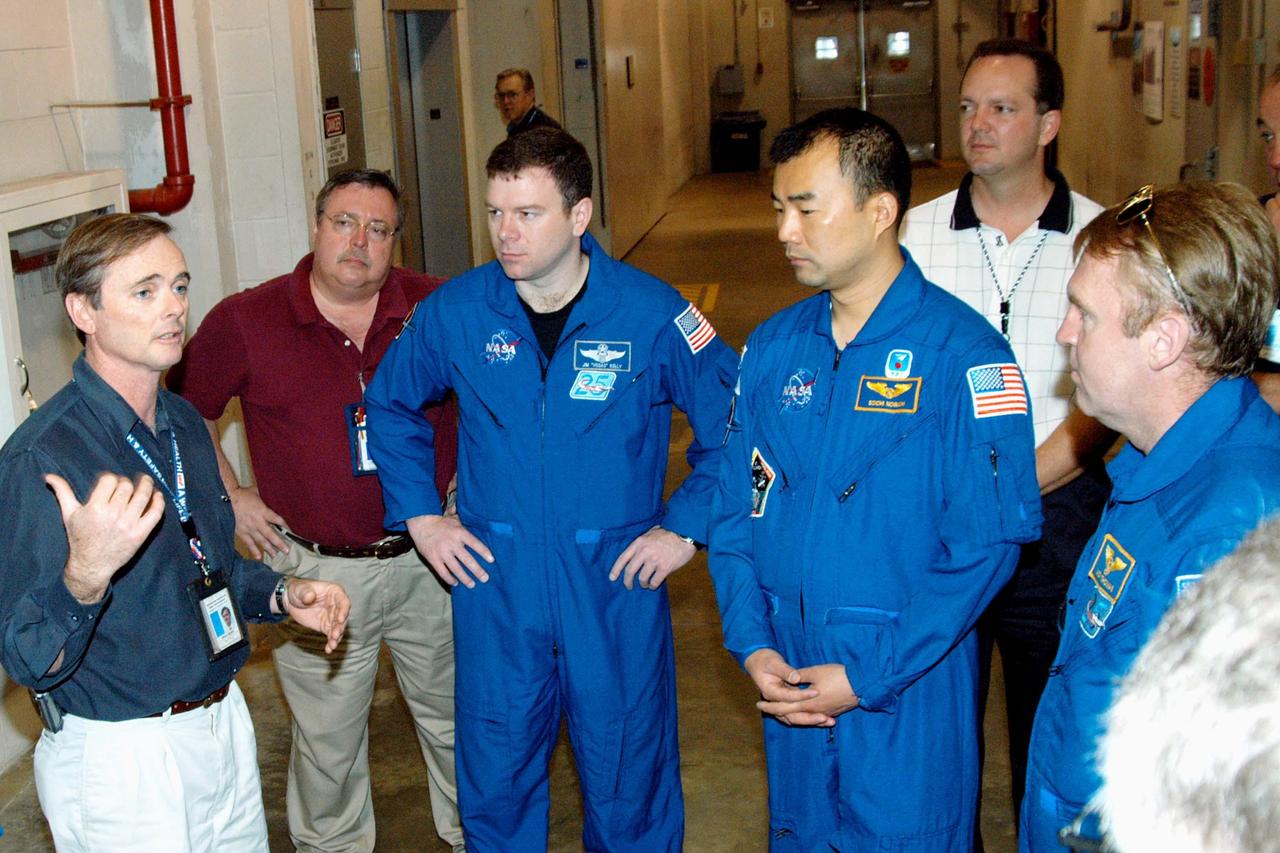
KENNEDY SPACE CENTER, FLA. - - In the SRB Assembly and Refurbishment Facility, some of the STS-114 crew listen to Greg Henry, SRB Element director of Manufacturing Operations with United Space Alliance. Crew members, from center to right, are Pilot James Kelly and Mission Specialists Soichi Noguchi and Andrew Thomas. Noguchi represents the Japanese Aerospace and Exploration Agency. In the background, at right, is Tom Engler, Marshall Space Flight Center SRB Resident Office lead. The crew is at KSC for familiarization with Shuttle and mission equipment. The STS-114 mission is Logistics Flight 1, which is scheduled to deliver supplies and equipment, plus the external stowage platform, to the International Space Station.
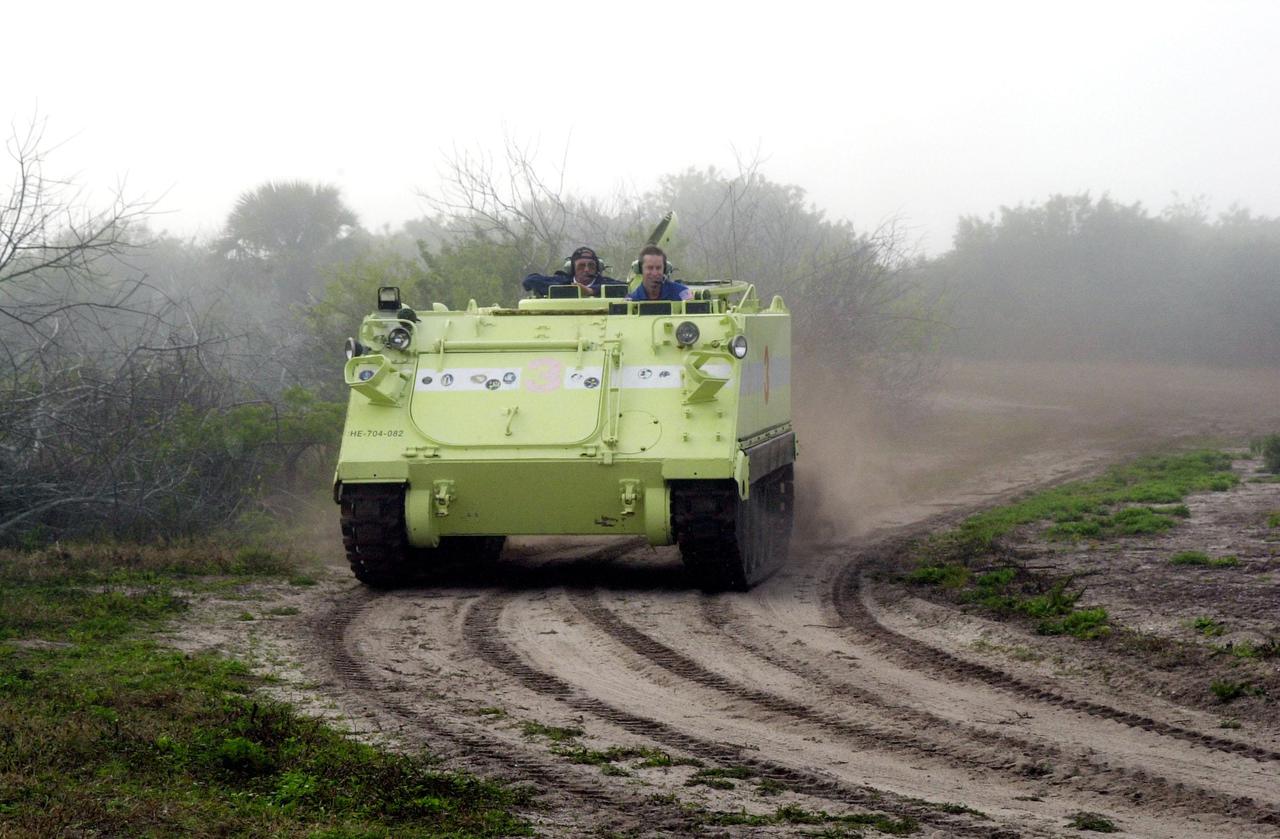
STS-102 Commander James Wetherbee practices driving an M-113 armored carrier, part of emergency egress training at Launch Pad 39B. Seated alongside is Capt. George Hoggard (left), a training officer with SGS Fire Services. In the event of an emergency at the pad prior to launch, the carrier could be used to transport the crew to a nearby bunker or farther. The STS-102 crew is at KSC to take part in Terminal Countdown Demonstration Test activities, which also include a simulated launch countdown. STS-102 is the eighth construction flight to the International Space Station, carrying as payload the Multi-Purpose Logistics Module Leonardo. Launch on mission STS-102 is scheduled for March 8
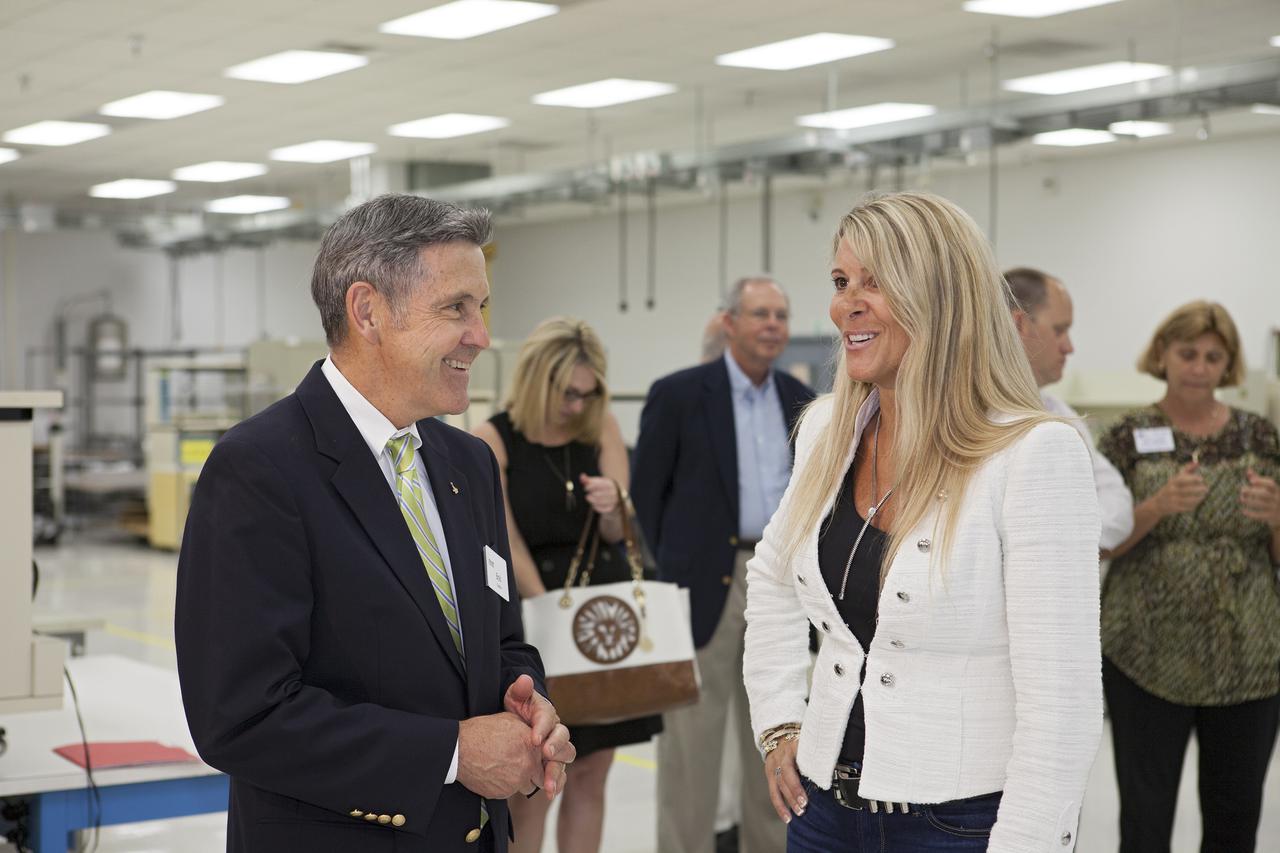
CAPE CANAVERAL, Fla. – At the Aerospace and Defense Manufacturing Center in Cape Canaveral, Fla., Kennedy Space Center Director Bob Cabana talks with Craig Technologies founder and chief executive officer Carol Craig during a community open house. In June of last year, NASA signed a partnership agreement with Craig Technologies to maintain an inventory of unique processing and manufacturing equipment for future mission support at the agency's Kennedy Space Center. The Cape Canaveral, Fla., facility, formerly known as the NASA Shuttle Logistics Depot NSLD, is now the Aerospace and Defense Manufacturing Center ADMC. Photo credit: NASA_Kim Shiflett
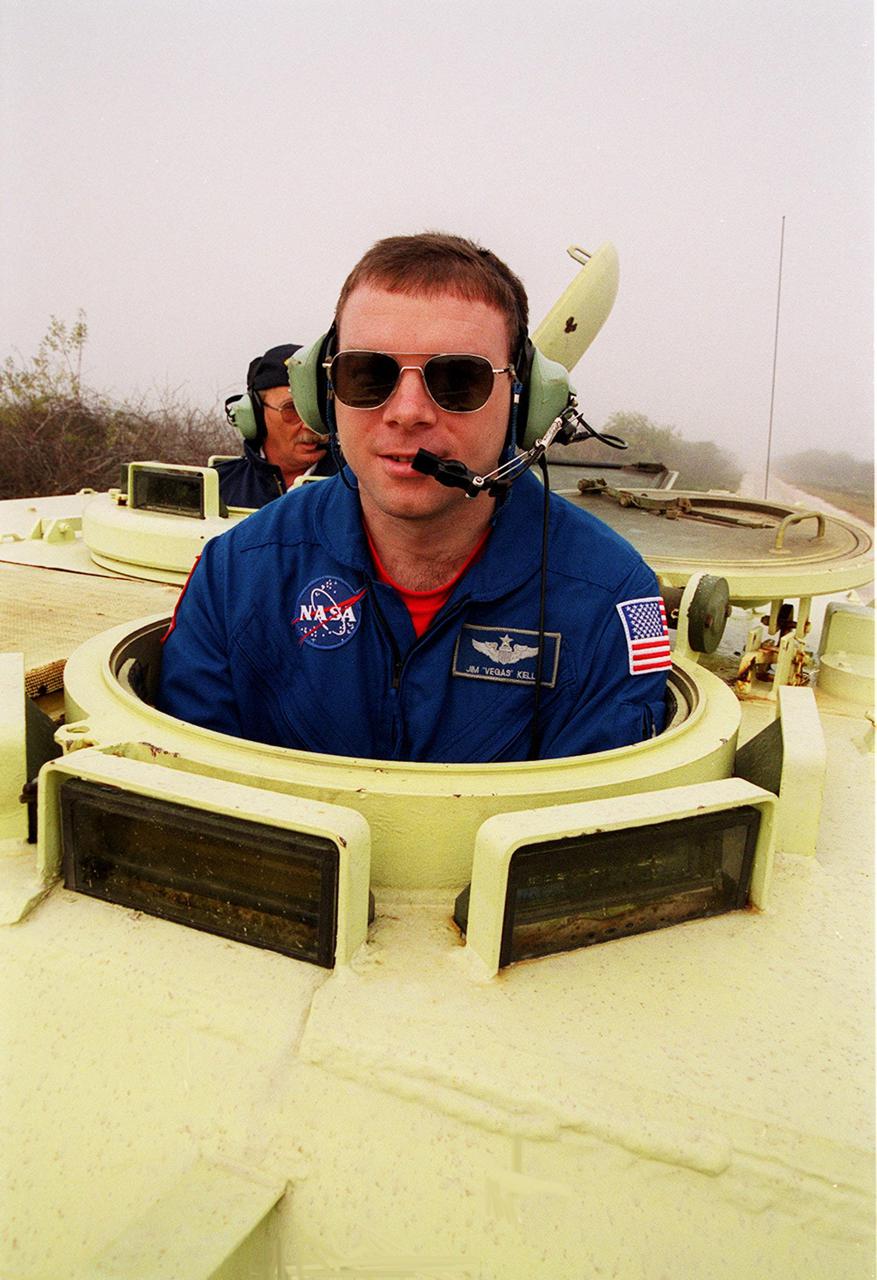
STS-102 Pilot James Kelly gets into the driver’s seat of an M-113 armored carrier near Launch Pad 39B he will practice driving. In the background is Capt. George Hoggard, a training officer with SGS Fire Services. In the event of an emergency at the pad prior to launch, the carrier could be used to transport the crew to a nearby bunker or farther. The STS-102 crew is at KSC to take part in Terminal Countdown Demonstration Test activities, which also include a simulated launch countdown. STS-102 is the eighth construction flight to the International Space Station, carrying as payload the Multi-Purpose Logistics Module Leonardo. Launch on mission STS-102 is scheduled for March 8
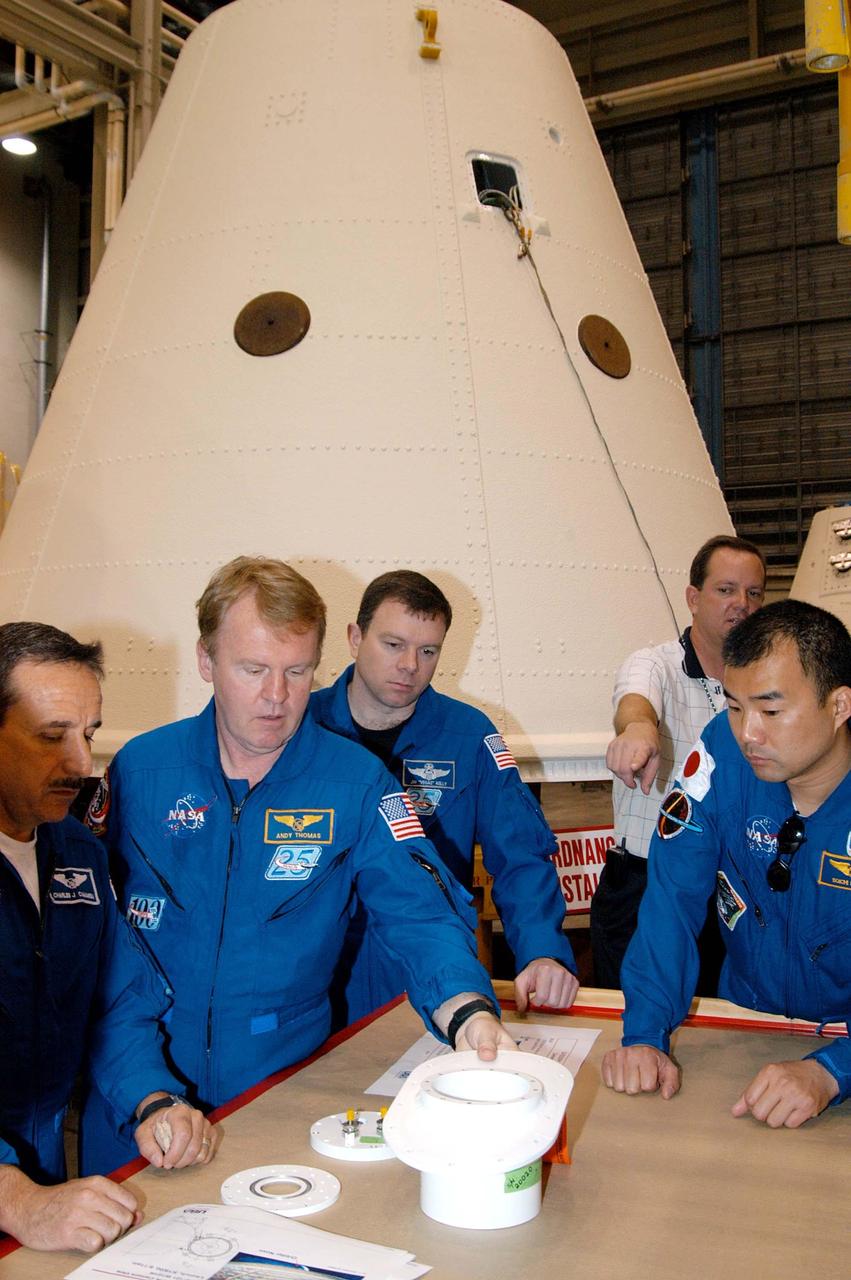
KENNEDY SPACE CENTER, FLA. - In the SRB Assembly and Refurbishment Facility, STS-114 crew members look at external tank-solid rocket booster camera components. From left are Mission Specialists Charles Camarda and Andrew Thomas, Pilot James Kelly, and Mission Specialist Soichi Noguchi, who represents the Japanese Aerospace and Exploration Agency. Behind Noguchi is Tom Engler, SRB Resident Office lead at Marshall Space Flight Center. They are standing in front of an SRB frustum. The crew is at KSC for familiarization with Shuttle and mission equipment. The STS-114 mission is Logistics Flight 1, which is scheduled to deliver supplies and equipment, plus the external stowage platform, to the International Space Station.
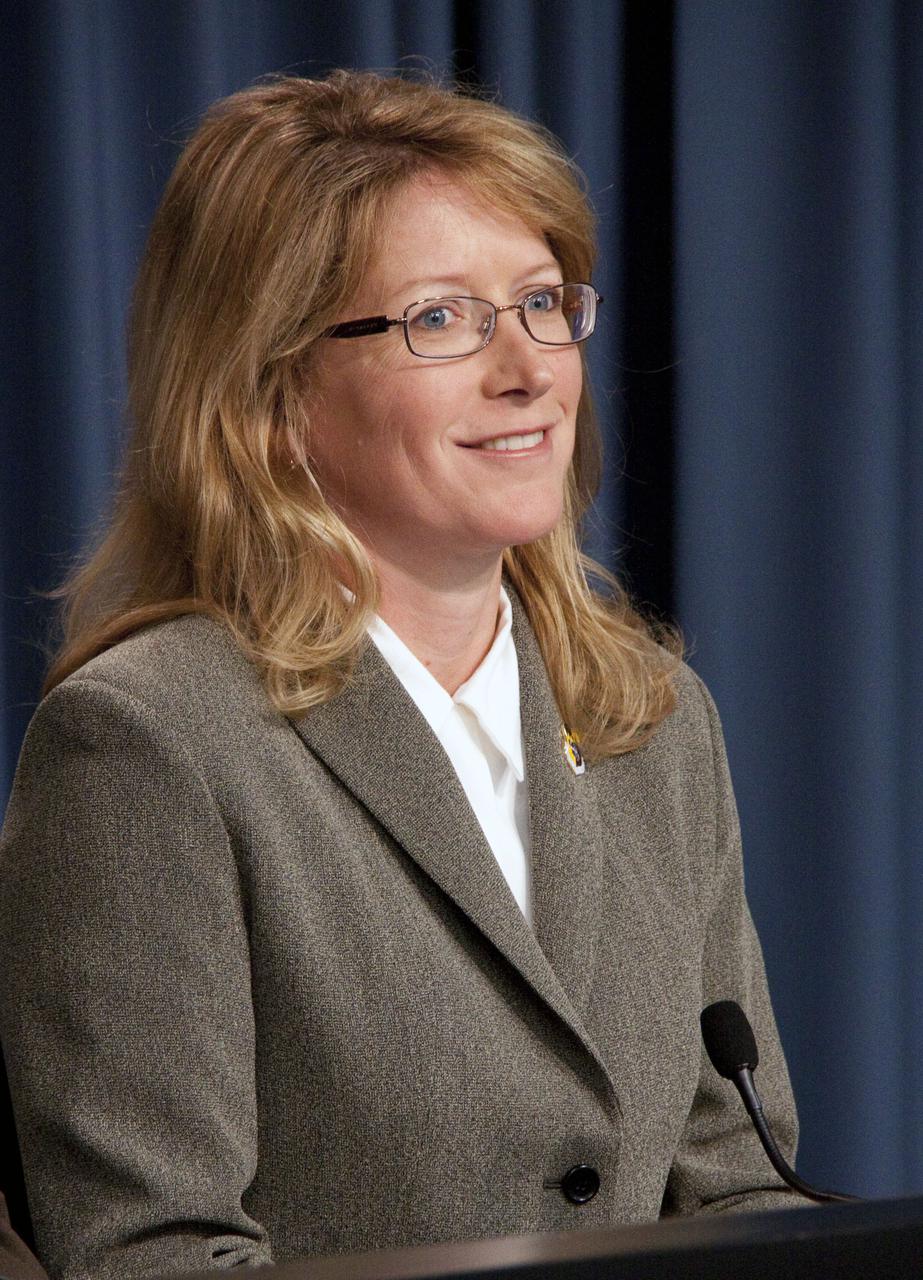
CAPE CANAVERAL, Fla. -- In the Press Site auditorium at NASA's Kennedy Space Center in Florida, Shuttle Weather Officer Kathy Winters speaks to media about the launch-day weather for space shuttle Endeavour's STS-134 mission. Endeavour and its crew will deliver the Express Logistics Carrier-3, Alpha Magnetic Spectrometer-2 (AMS), a high-pressure gas tank and additional spare parts for the Dextre robotic helper to the International Space Station. Launch is scheduled for April 29 at 3:47 p.m. EDT. This will be the final spaceflight for Endeavour. For more information visit, www.nasa.gov_mission_pages_shuttle_shuttlemissions_sts134_index.html. Photo credit: NASA_Jack Pfaller

CAPE CANAVERAL, Fla. – At the Aerospace and Defense Manufacturing Center in Cape Canaveral, Fla., Craig Technologies founder and chief executive officer Carol Craig speaks to guests during a community open house at the 161,000-square-foot facility. In June of last year, NASA signed a partnership agreement with Craig Technologies to maintain an inventory of unique processing and manufacturing equipment for future mission support at the agency's Kennedy Space Center. The Cape Canaveral, Fla., facility, formerly known as the NASA Shuttle Logistics Depot NSLD, is now the Aerospace and Defense Manufacturing Center ADMC. Photo credit: NASA_Kim Shiflett

ISS011-E-11255 (28 July 2005) --- Space shuttle Discovery was about 600 feet from the international space station when cosmonaut Sergei K. Krikalev, Expedition 11 commander, and astronaut John L. Phillips, NASA science officer and flight engineer, photographed the spacecraft as it approached the station and performed a backflip to allow photography of its heat shield. Astronaut Eileen M. Collins, STS-114 commander, guided the shuttle through the flip. The photos will be analyzed by engineers on the ground as additional data to evaluate the condition of Discovery’s heat shield. The Italian-built Raffaello Multi-Purpose Logistics Module (MPLM) is visible in the cargo bay.
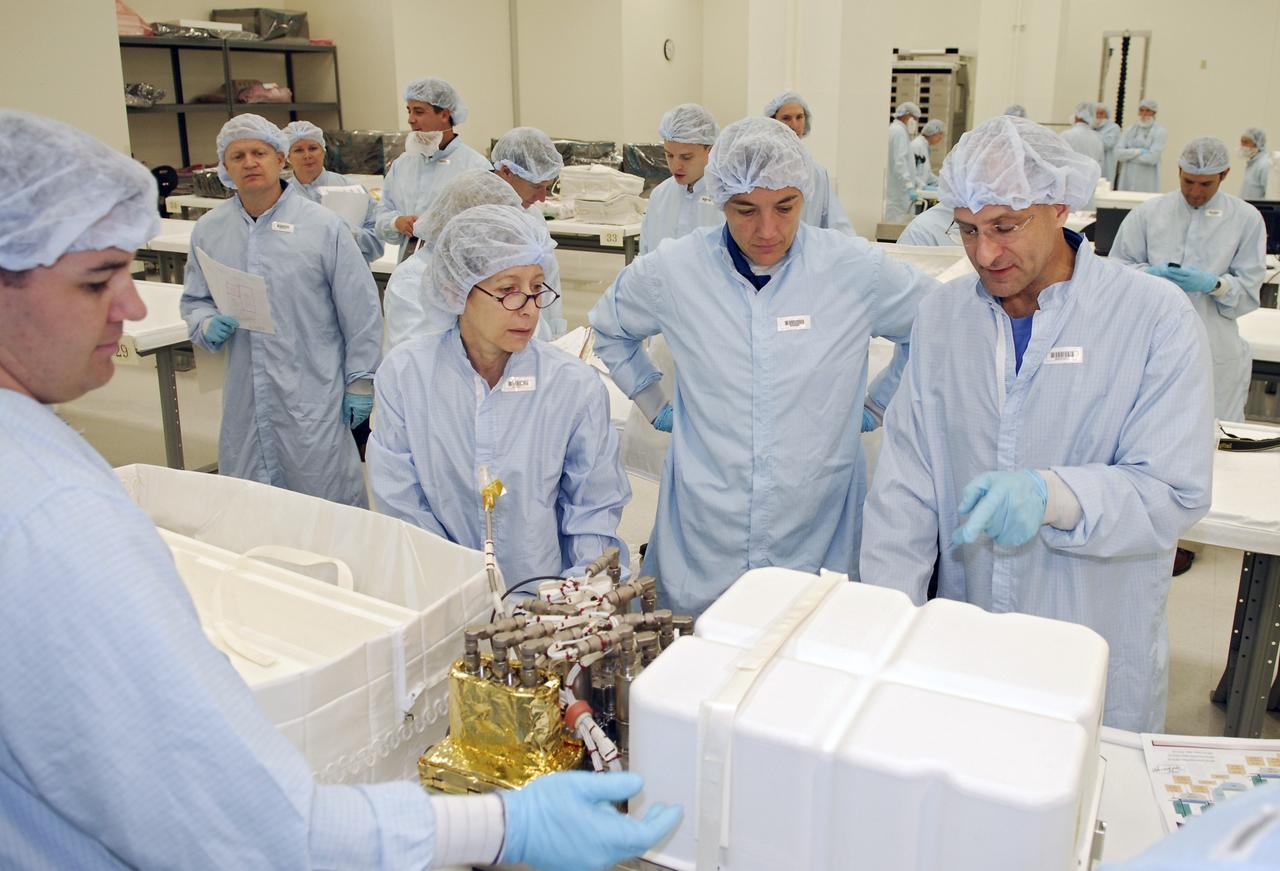
CAPE CANAVERAL, Fla. – In the Space Station Processing Facility at NASA's Kennedy Space Center, STS-126 crew members check data on equipment that will fly on the mission. From right are Mission Specialists Donald Pettit and Heidemarie M. Stefanyshyn-Piper; astronaut Marsha Ivins, who is currently assigned to the Astronaut Office; and Pilot Eric Boe. Shuttle crews frequently visit Kennedy to get hands-on experience, called a crew equipment interface test, with hardware and equipment for their missions. On STS-126, Endeavour will deliver a multi-purpose logistics module to the International Space Station. Launch is targeted for Nov. 10. Photo credit: NASA/Kim Shiflett
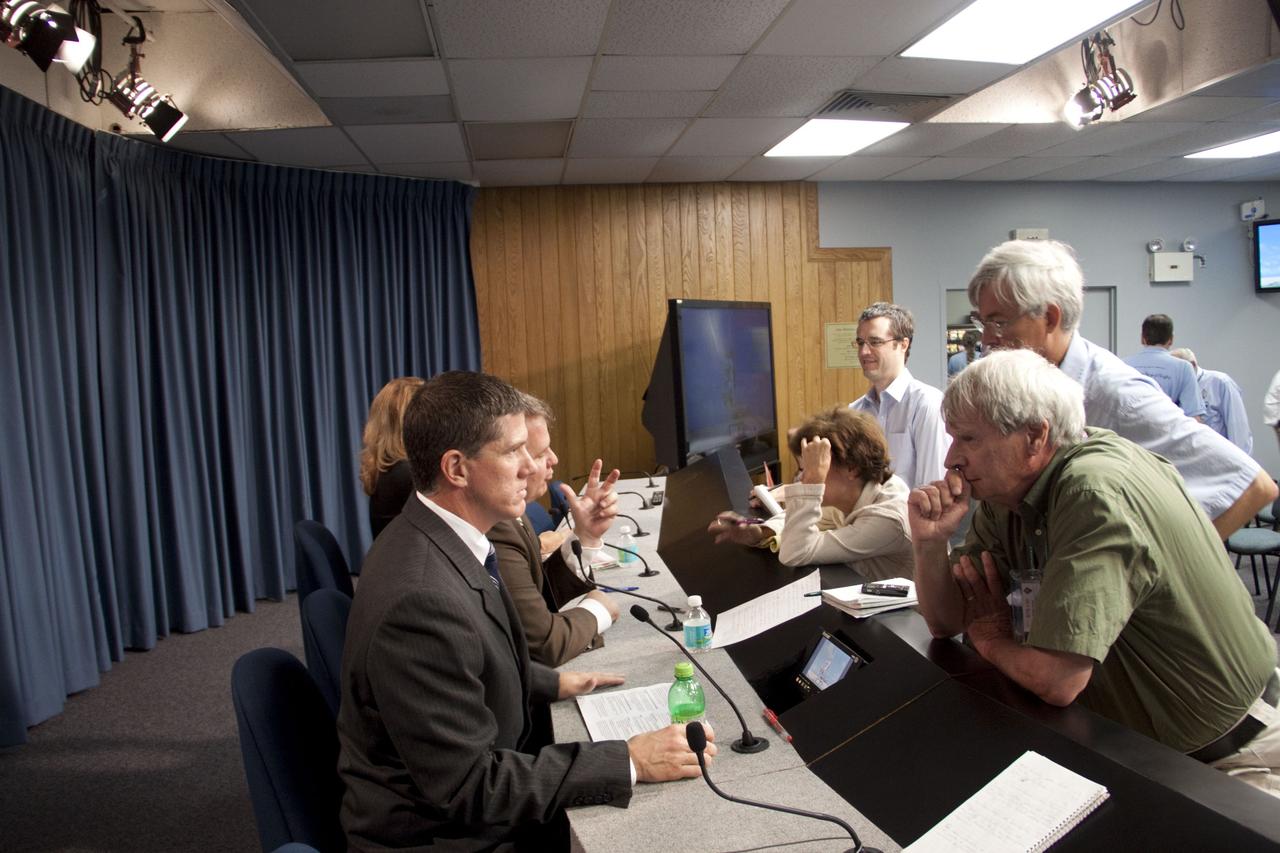
CAPE CANAVERAL, Fla. -- In the Press Site auditorium at NASA's Kennedy Space Center in Florida, NASA managers brief media about the payload and launch status of space shuttle Atlantis' STS-135 mission to the International Space Station. Seen here are Public Affairs Officer Candrea Thomas, NASA Test Director Jeremy Graeber, Payload Mission Manager Joe Delai and Shuttle Weather Officer Kathy Winters (obscured). Atlantis and its crew are scheduled to lift off at 11:26 a.m. EDT on July 8 to deliver the Raffaello multi-purpose logistics module packed with supplies and spare parts to the station. The STS-135 mission also will fly a system to investigate the potential for robotically refueling existing satellites and return a failed ammonia pump module to help NASA better understand the failure mechanism and improve pump designs for future systems. STS-135 will be the 33rd flight of Atlantis, the 37th shuttle mission to the space station, and the 135th and final mission of NASA's Space Shuttle Program. For more information visit, www.nasa.gov/mission_pages/shuttle/shuttlemissions/sts135/index.html. Photo credit: NASA/Jim Grossmann
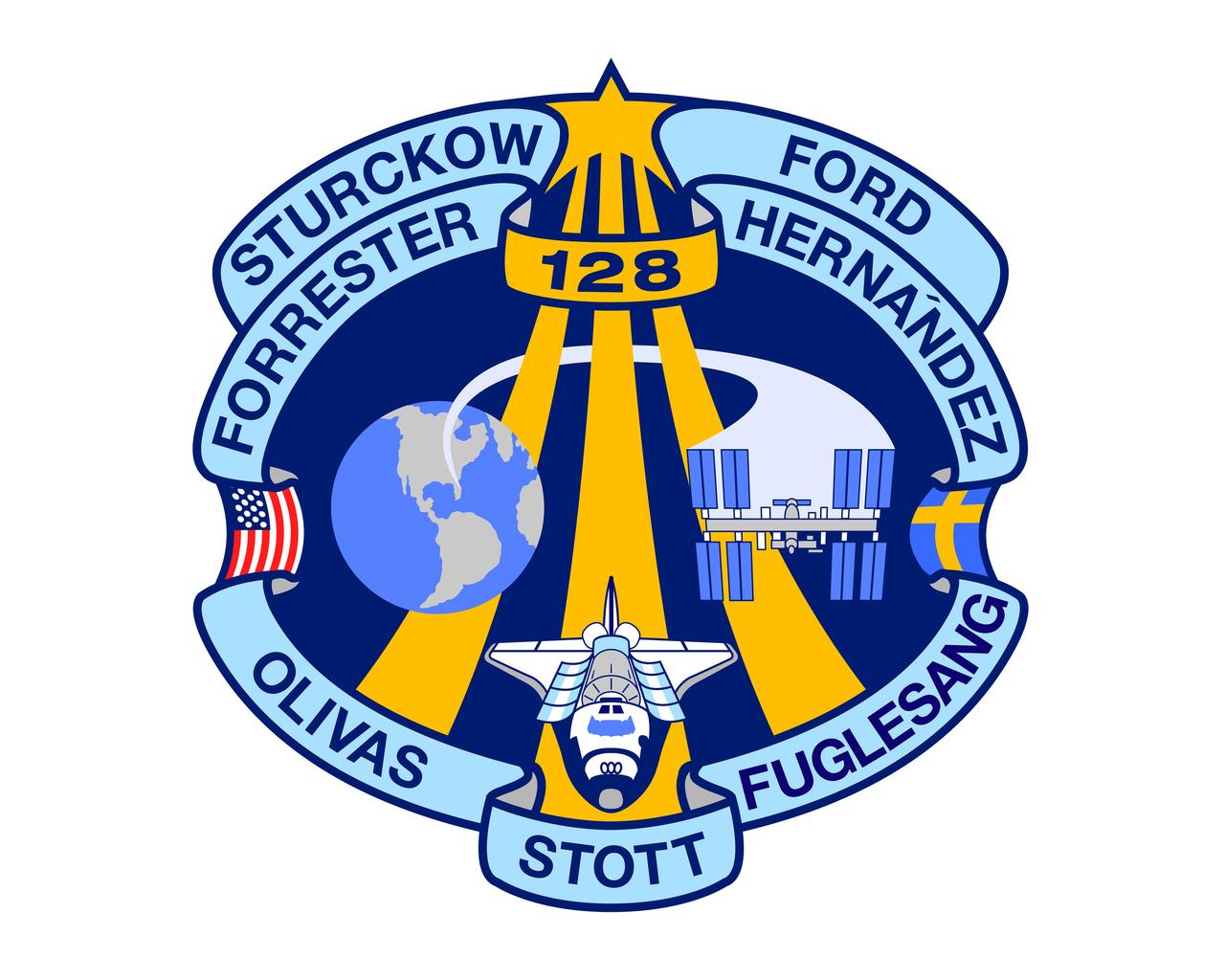
STS128-S-001 (April 2009) --- The STS-128 patch symbolizes the 17A mission and represents the hardware, people and partner nations that contribute to the flight. The Space shuttle Discovery is shown in the orbit configuration with the Multi-Purpose Logistics Module (MPLM) Leonardo in the payload bay. Earth and the International Space Station wrap around the Astronaut Office symbol reminding us of the continuous human presence in space. The names of the STS-128 crew members border the patch in an unfurled manner. Included in the names is the expedition crew member who will launch on STS-128 and remain on board ISS, replacing another Expedition crew member who will return home with STS-128. The banner also completes the Astronaut Office symbol and contains the U.S. and Swedish flags representing the countries of the STS-128 crew. The NASA insignia design for space shuttle flights is reserved for use by the astronauts and for other official use as the NASA Administrator may authorize. Public availability has been approved only in the forms of illustrations by the various news media. When and if there is any change in this policy, which is not anticipated, the change will be publicly announced. Photo credit: NASA
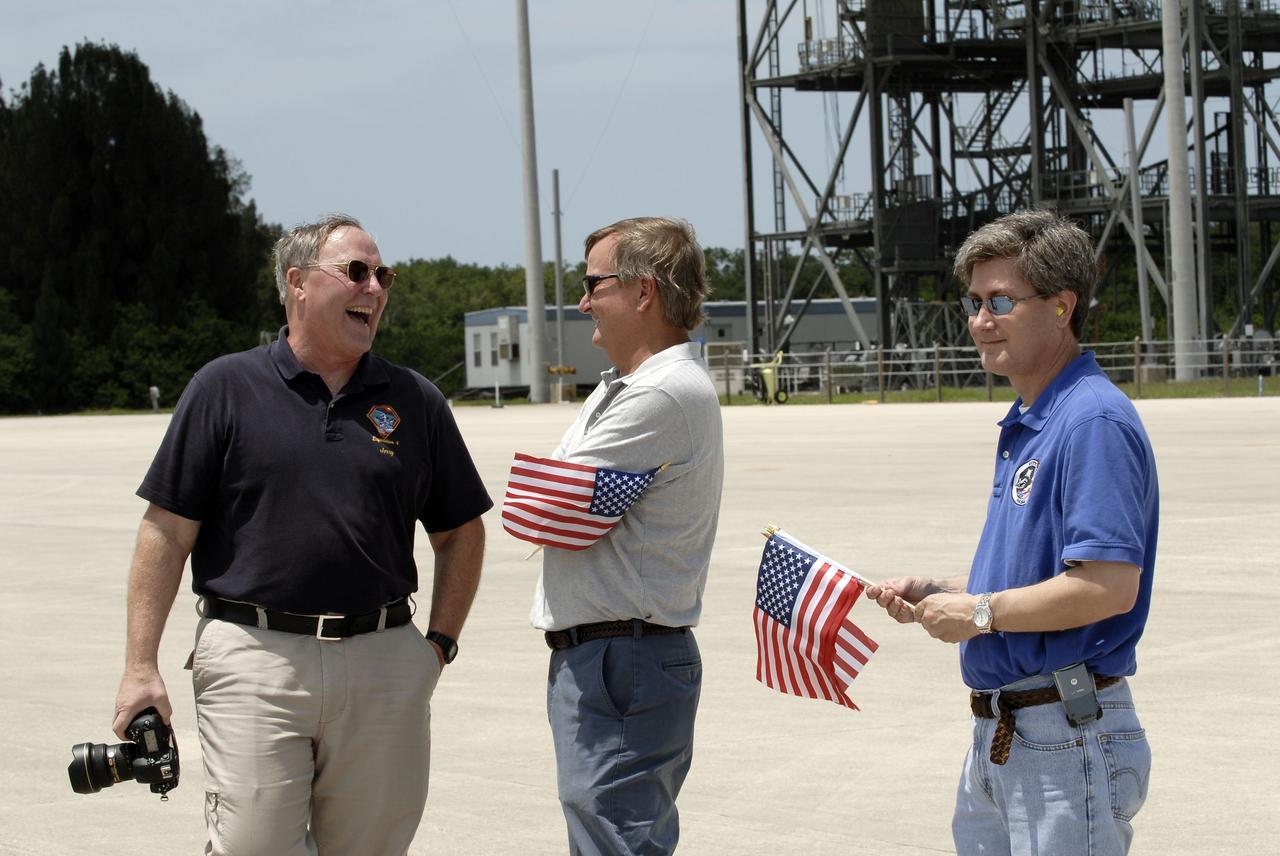
CAPE CANAVERAL, Fla. -- Jerry Ross, chief of the Vehicle Integration Test Office and former NASA astronaut, Shuttle Launch Director Mike Leinbach and James Branson with the Vehicle Integration Test Office await the arrival of the STS-135 crew members at the Shuttle Landing Facility at NASA's Kennedy Space Center in Florida. The STS-135 astronauts arrived at Kennedy about 2:30 p.m. EDT on July 4 for final preparations for space shuttle Atlantis' STS-135 mission to the International Space Station. Atlantis is scheduled to lift off on July 8 to deliver the Raffaello multi-purpose logistics module packed with supplies and spare parts to the station. The STS-135 mission also will fly a system to investigate the potential for robotically refueling existing satellites and return a failed ammonia pump module to help NASA better understand the failure mechanism and improve pump designs for future systems. STS-135 will be the 33rd flight of Atlantis, the 37th shuttle mission to the space station, and the 135th and final mission of NASA's Space Shuttle Program. For more information visit, www.nasa.gov/mission_pages/shuttle/shuttlemissions/sts135/index.html. Photo credit: NASA/Kim Shiflett
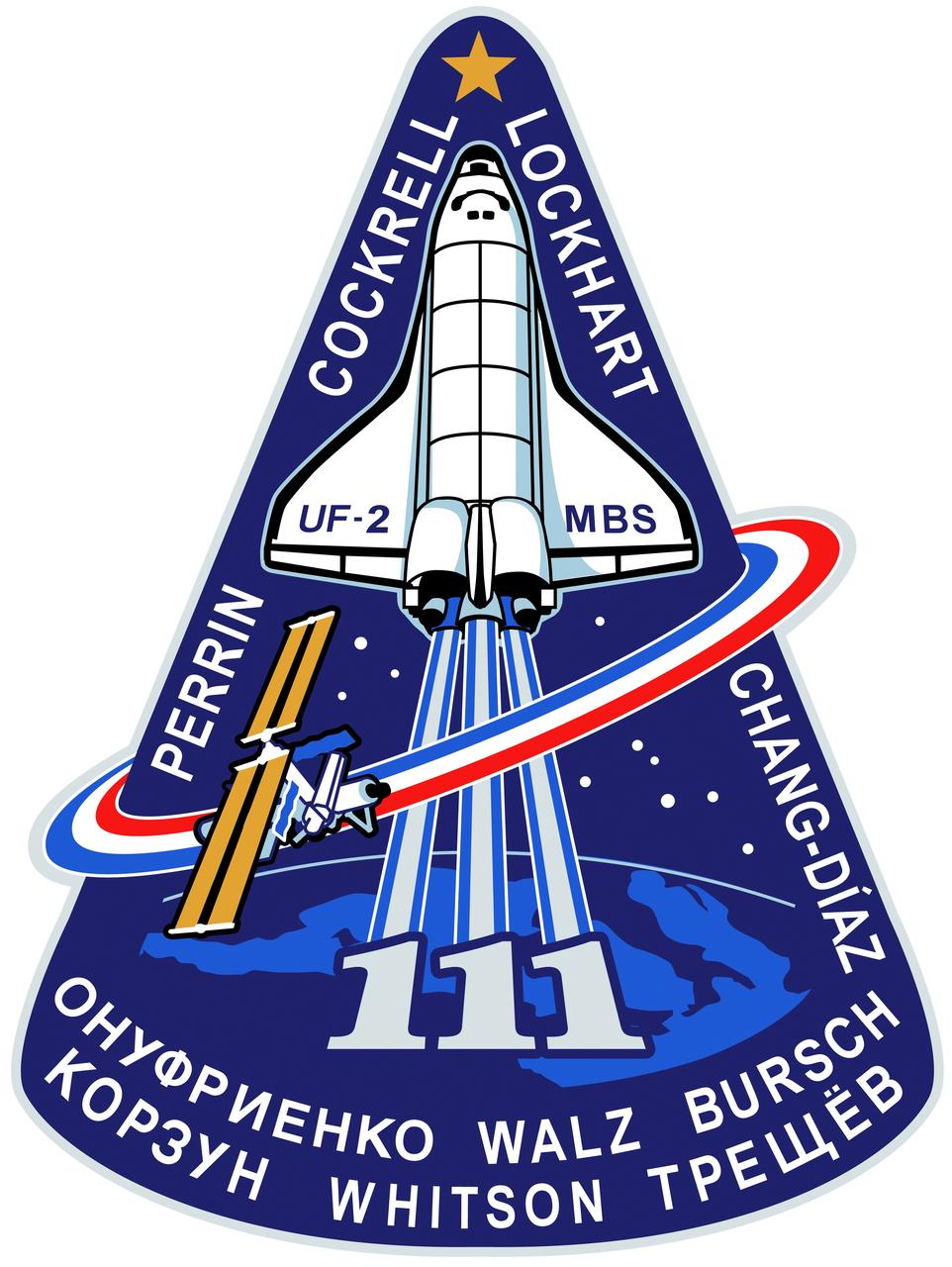
STS111-S-001 (January 2002) --- The STS-111 patch symbolizes the hardware, people, and partner nations that contribute to the flight. The space shuttle rises on the plume of the Astronaut Office symbol, carrying the Canadian Mobile Base System (MBS) for installation while docked to the International Space Station (ISS). The mission is named UF-2 for ISS Utilization Flight number two. The ISS orbit completes the Astronaut Office symbol and is colored red, white, and blue to represent the flags of the United States, Russia, France, and Costa Rica. The Earth background shows Italy, which contributes the Multi Purpose Logistics Module (MPLM) used on this flight to re-supply ISS. The ten stars in the sky represent the ten astronauts and cosmonauts on orbit during the flight, and the star at the top of the patch represents the Johnson Space Center, in the state of Texas, from which the flight is managed. The names of the STS-111 crew border the upper part of the patch, and the Expedition Five (going up) and Expedition Four (coming down) crews? names form the bottom of the patch. The NASA insignia design for space shuttle flights is reserved for use by the astronauts and for other official use as the NASA Administrator may authorize. Public availability has been approved only in the forms of illustrations by the various news media. When and if there is any change in this policy, which is not anticipated, the change will be publicly announced. Photo credit: NASA
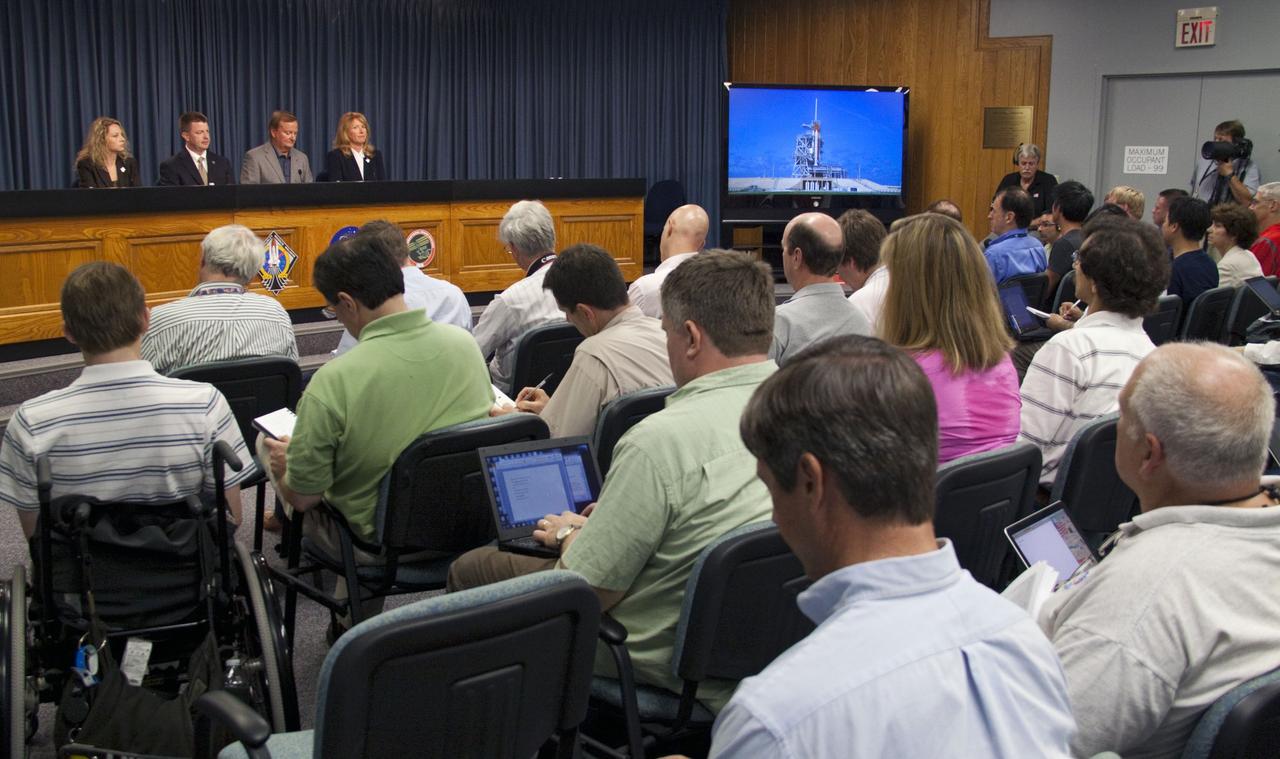
CAPE CANAVERAL, Fla. -- In the Press Site auditorium at NASA's Kennedy Space Center in Florida, NASA managers brief media about the launch status of space shuttle Atlantis' STS-135 mission to the International Space Station. Seen here are Public Affairs Officer Candrea Thomas (left), Space Shuttle Program Launch Integration Manager Mike Moses, Shuttle Launch Director Mike Leinbach and Shuttle Weather Officer Kathy Winters. Atlantis and its crew of four are scheduled to lift off at 11:26 a.m. EDT on July 8 to deliver the Raffaello multi-purpose logistics module packed with supplies and spare parts to the station. The STS-135 mission also will fly a system to investigate the potential for robotically refueling existing satellites and return a failed ammonia pump module to help NASA better understand the failure mechanism and improve pump designs for future systems. STS-135 will be the 33rd flight of Atlantis, the 37th shuttle mission to the space station, and the 135th and final mission of NASA's Space Shuttle Program. For more information visit, www.nasa.gov/mission_pages/shuttle/shuttlemissions/sts135/index.html. Photo credit: NASA/Jack Pfaller
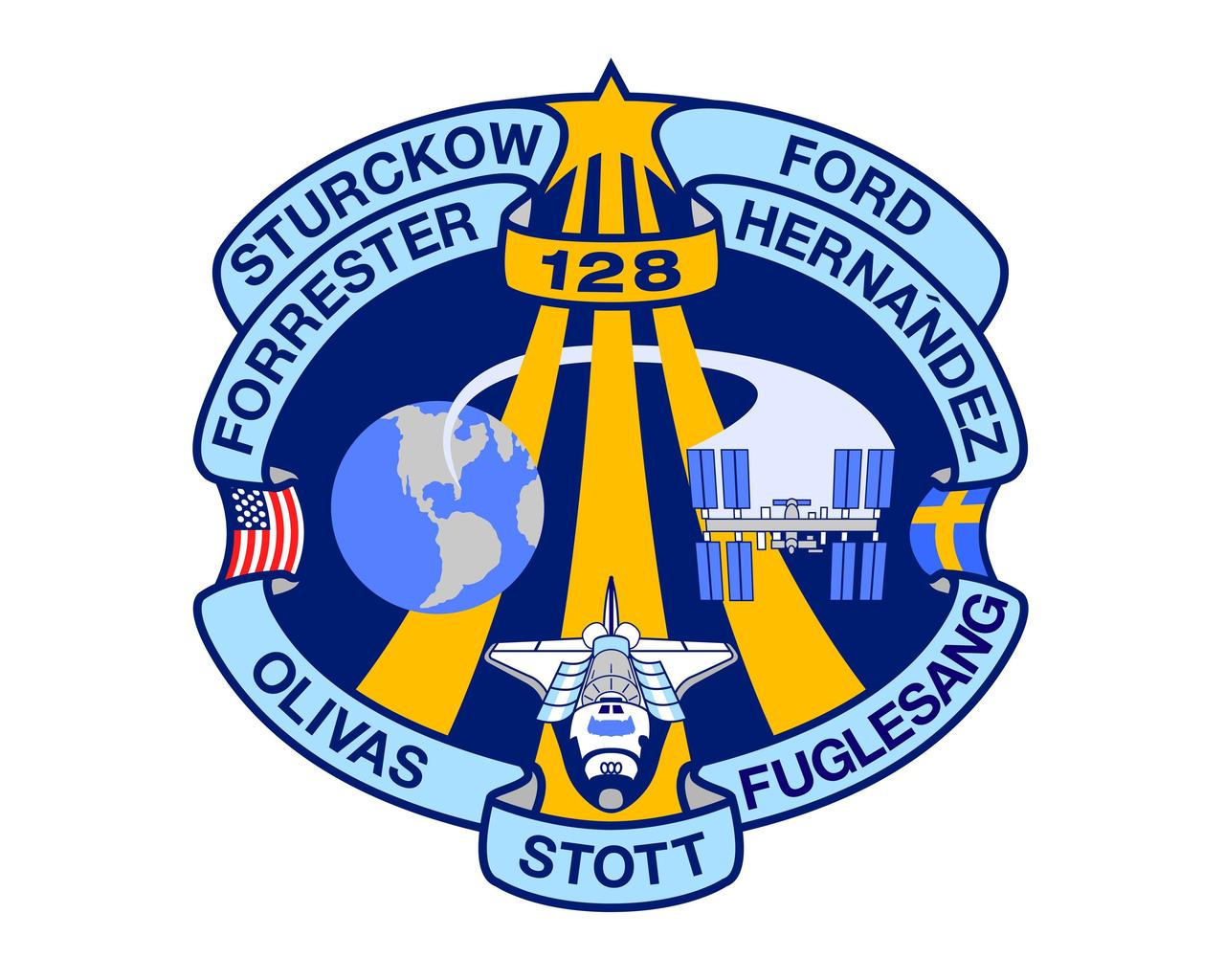
JOHNSON SPACE CENTER, Houston – STS128-S-001 -- The STS-128 patch symbolizes the 17A mission and represents the hardware, people and partner nations that contribute to the flight. The Space Shuttle Discovery is shown in the orbit configuration with the Multi Purpose Logistics Module (MPLM) Leonardo in the payload bay. Earth and the International Space Station wrap around the Astronaut Office symbol reminding us of the continuous human presence in space. The names of the STS-128 crew members border the patch in an unfurled manner. Included in the names is the expedition crew member who will launch on STS-128 and remain on board ISS, replacing another Expedition crew member who will return home with STS-128. The banner also completes the Astronaut Office symbol and contains the U.S. and Swedish flags representing the countries of the STS-128 crew. The NASA insignia design for Space Shuttle flights is reserved for use by the astronauts and for other official use as the NASA Administrator may authorize. Public availability has been approved only in the form of illustrations by the various news media. When and if there is any change in this policy, which we do not anticipate, it will be publicly announced.
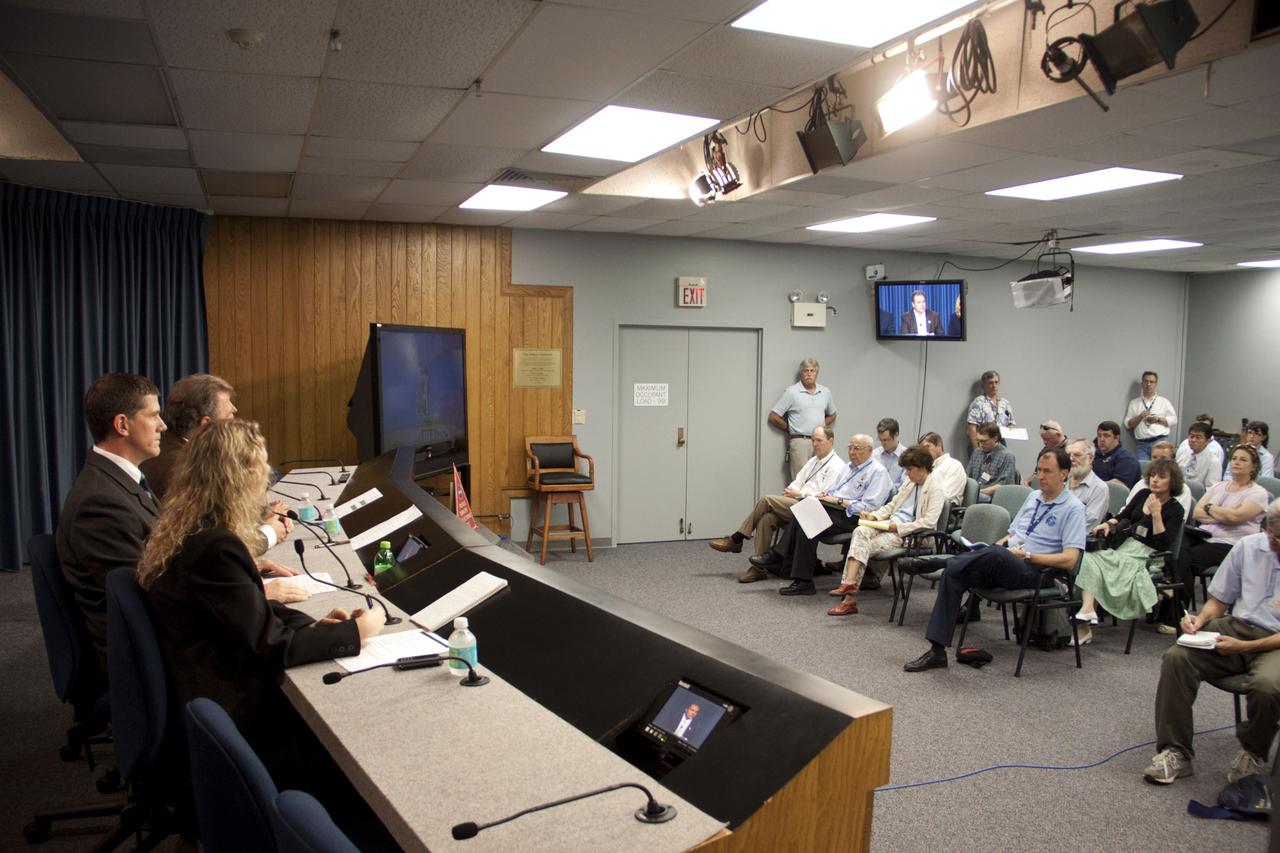
CAPE CANAVERAL, Fla. -- In the Press Site auditorium at NASA's Kennedy Space Center in Florida, NASA managers brief media about the payload and launch status of space shuttle Atlantis' STS-135 mission to the International Space Station. Seen here are Public Affairs Officer Candrea Thomas, NASA Test Director Jeremy Graeber, Payload Mission Manager Joe Delai and Shuttle Weather Officer Kathy Winters (obscured). Atlantis and its crew are scheduled to lift off at 11:26 a.m. EDT on July 8 to deliver the Raffaello multi-purpose logistics module packed with supplies and spare parts to the station. The STS-135 mission also will fly a system to investigate the potential for robotically refueling existing satellites and return a failed ammonia pump module to help NASA better understand the failure mechanism and improve pump designs for future systems. STS-135 will be the 33rd flight of Atlantis, the 37th shuttle mission to the space station, and the 135th and final mission of NASA's Space Shuttle Program. For more information visit, www.nasa.gov/mission_pages/shuttle/shuttlemissions/sts135/index.html. Photo credit: NASA/Jim Grossmann

At Launch Pad 39B, Capt. Steve Kelly, with Fire Services, explains part of the emergency egress procedure to the STS-96 crew. Mission Specialist Daniel Barry (M.D., Ph.D.) is in the evacuation seat and training officer Gina Tucker behind him. In the background, workers at the pad look on. The STS-96 crew are taking part in Terminal Countdown Demonstration Test activities which also provide simulated countdown exercises and opportunities to inspect the mission payloads in the orbiter's payload bay. The other crew members are Commander Kent V. Rominger, Pilot Rick Douglas Husband and Mission Specialists Ellen Ochoa (Ph.D.), Tamara E. Jernigan (Ph.D.), Julie Payette, with the Canadian Space Agency, and Valery Ivanovich Tokarev, with the Russian Space Agency. STS-96, which is scheduled for liftoff on May 20 at 9:32 a.m., is a logistics and resupply mission for the International Space Station, carrying such payloads as a Russian crane, the Strela; a U.S.-built crane; the Spacehab Oceaneering Space System Box (SHOSS), a logistics items carrier; and STARSHINE, a student-led experiment
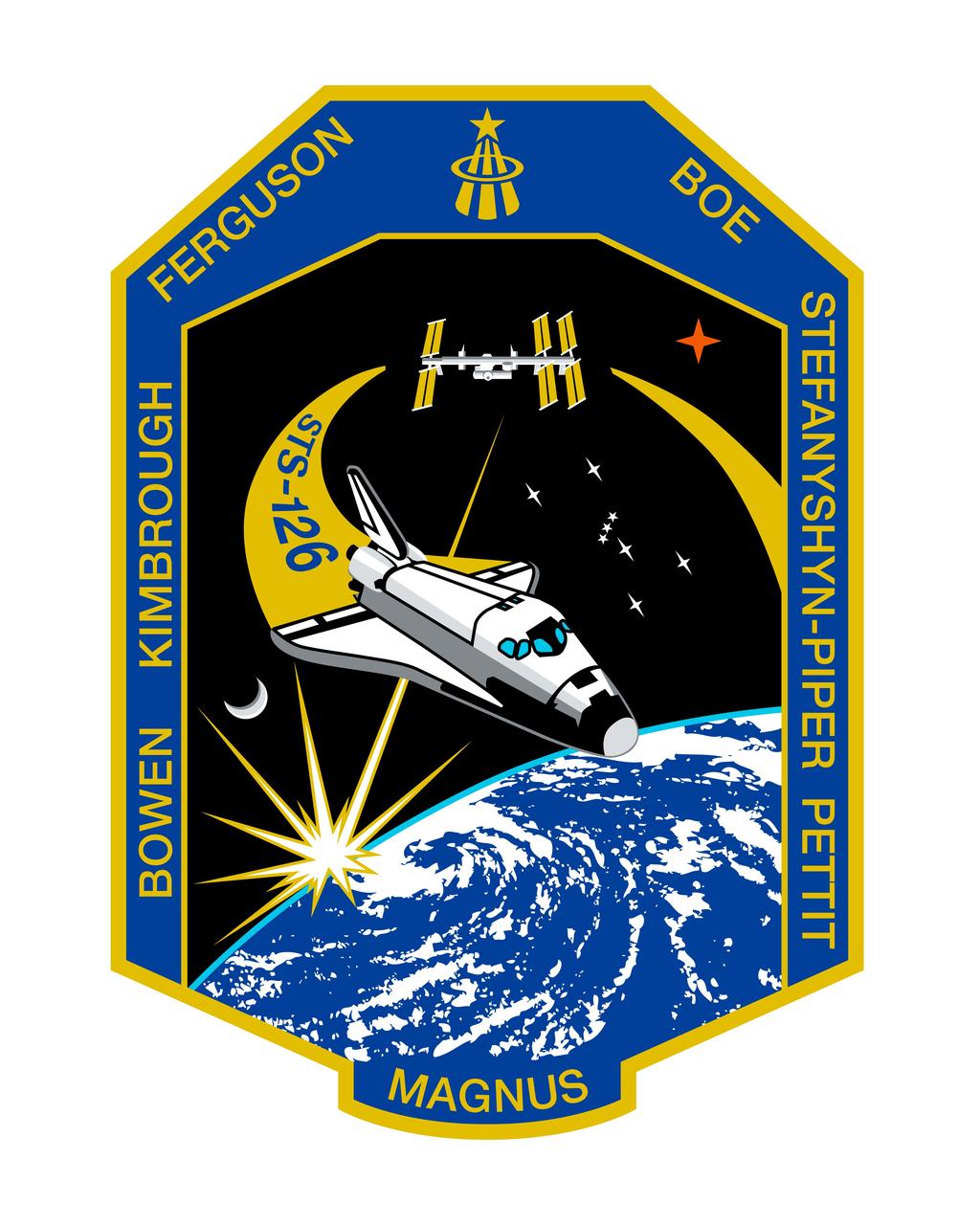
STS126-S-001 (April 2008) --- The STS-126 patch represents space shuttle Endeavour on its mission to help complete the assembly of the International Space Station (ISS). The inner patch outline depicts the Multi-Purpose Logistics Module (MPLM) Leonardo. This reusable logistics module will carry the equipment necessary to sustain a crew of six onboard the ISS and will include additional crew quarters, exercise equipment, galley, and life support equipment. In addition, a single expedition crew member will launch on STS-126 to remain on board ISS, replacing an expedition crew member who will return home with the shuttle crew. Near the center of the patch, the constellation Orion reflects the goals of the human spaceflight program, returning us to the moon and on to Mars, the red planet, which are also shown. At the top of the patch is the gold symbol of the astronaut office. The sunburst, just clearing the horizon of the magnificent Earth, powers all these efforts through the solar arrays of the ISS current configuration orbiting high above. The NASA insignia design for space shuttle flights is reserved for use by the astronauts and for other official use as the NASA Administrator may authorize. Public availability has been approved only in the forms of illustrations by the various news media. When and if there is any change in this policy, which is not anticipated, the change will be publicly announced. Photo credit: NASA
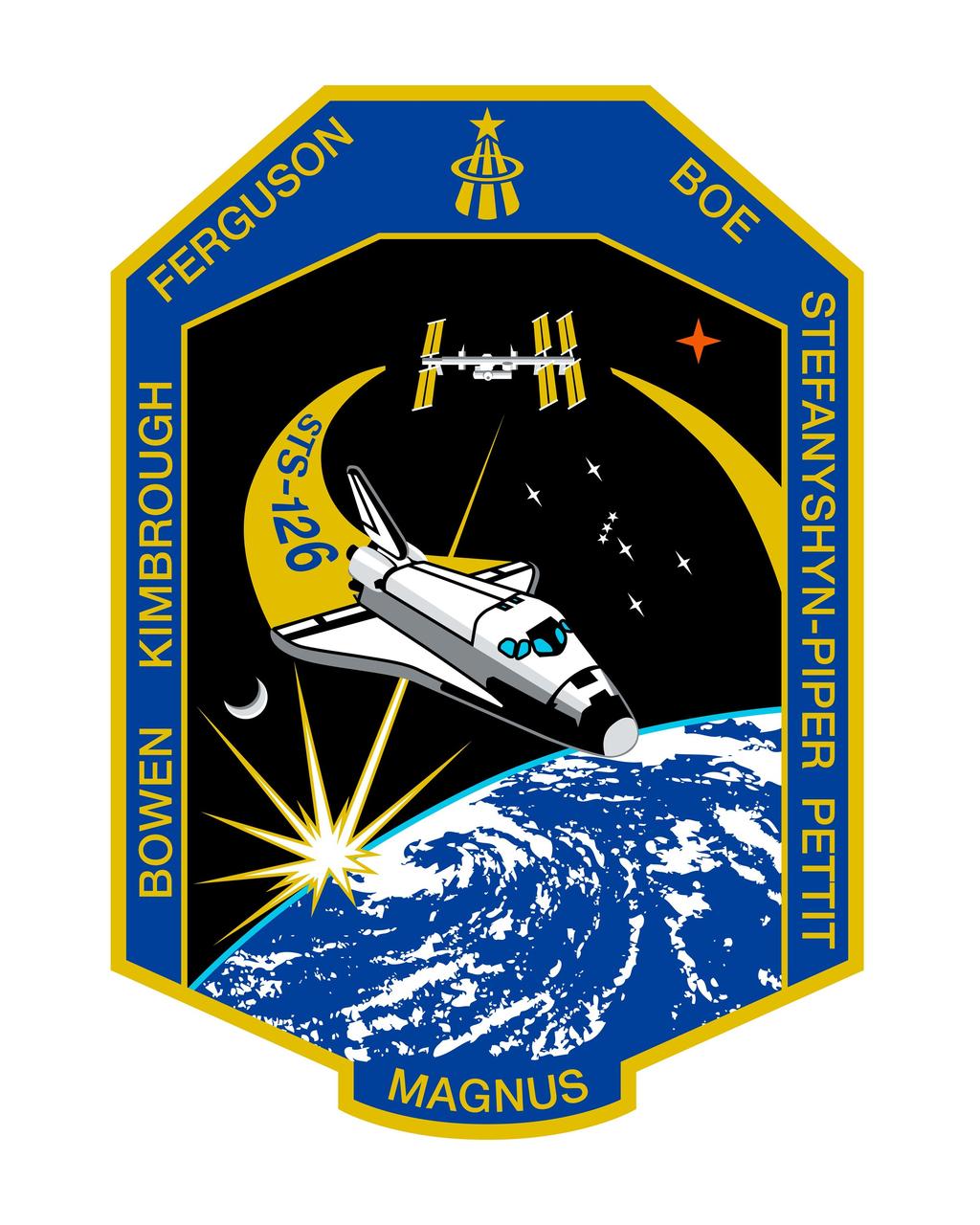
JOHNSON SPACE CENTER, Houston – STS126-S-001 -- The STS-126 patch represents space shuttle Endeavour on its mission to help complete the assembly of the International Space Station (ISS). The inner patch outline depicts the Multi-Purpose Logistics Module (MPLM) Leonardo. This reusable logistics module will carry the equipment necessary to sustain a crew of six on board the ISS and will include additional crew quarters, exercise equipment, galley, and life support equipment. In addition, a single expedition crew member will launch on STS-126 to remain on board ISS, replacing an expedition crew member who will return home with the shuttle crew. Near the center of the patch, the constellation Orion reflects the goals of the human spaceflight program, returning us to the Moon and on to Mars, the red planet, which are also shown. At the top of the patch is the gold symbol of the astronaut office. The sunburst, just clearing the horizon of the magnificent Earth, powers all these efforts through the solar arrays of the ISS current configuration orbiting high above. The NASA insignia for design for shuttle flights is reserved for use by the astronauts and for other official use as the NASA Administrator may authorize. Public availability has been approved only in the form of illustrations by the various news Media. When and if there is any change in this policy, it will be publicly announced.

STS-102 Mission Specialist Andrew Thomas drives an M-113 armored carrier as part of emergency egress training. With him is (left) Capt. George Hoggard, a training officer with SGS Fire Services, and other crew members Commander James Wetherbee, Pilot James Kelly and Mission Specialist Paul Richards (seen behind Thomas, at right). The M-113, in the event of an emergency at the pad prior to launch, could be used to transport the crew to a nearby bunker or farther. The STS-102 crew is at KSC to take part in Terminal Countdown Demonstration Test activities, which also include a simulated launch countdown. STS-102 is the eighth construction flight to the International Space Station, carrying as payload the Multi-Purpose Logistics Module Leonardo. Launch on mission STS-102 is scheduled for March 8
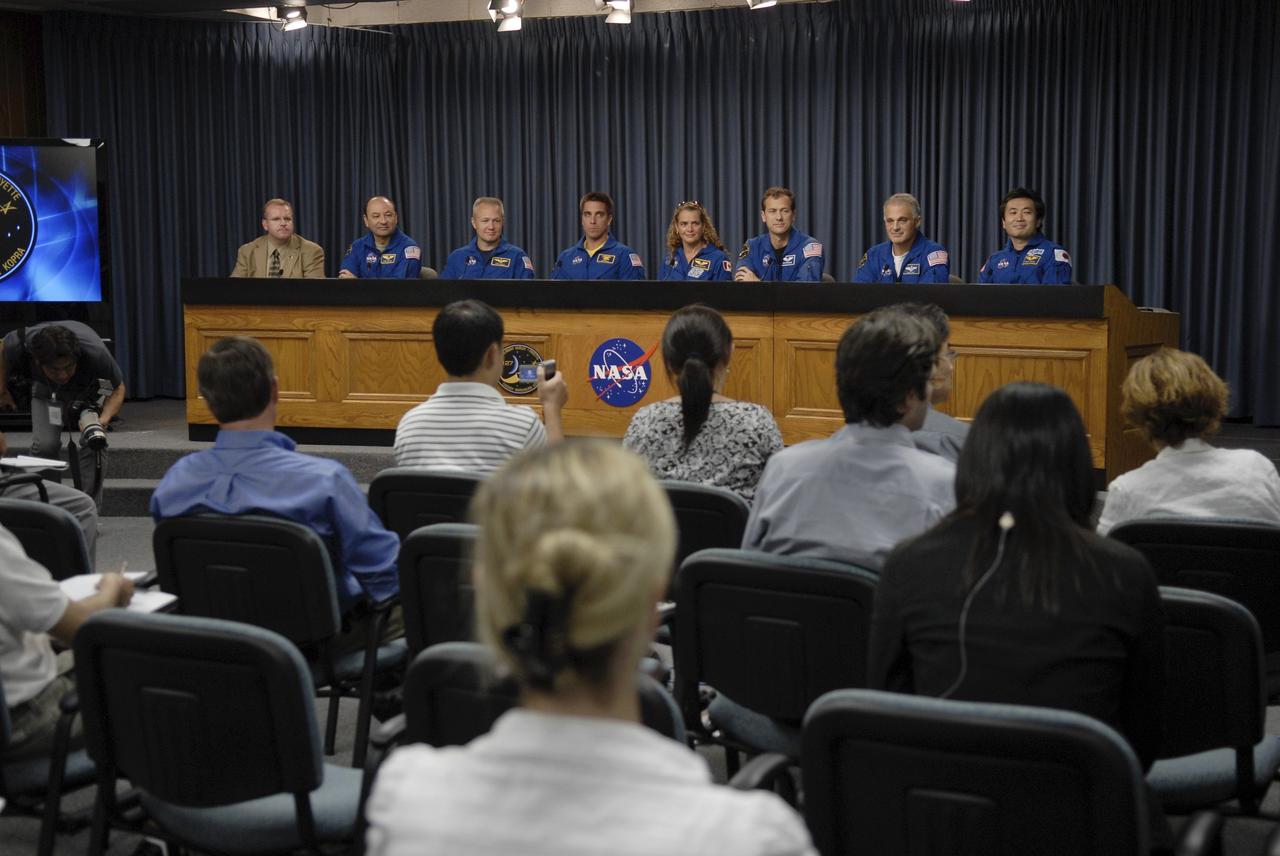
CAPE CANAVERAL, Fla. – At NASA's Kennedy Space Center in Florida, the STS-127 crew members take part in a news conference following their return to Earth on space shuttle Endeavour after the 16-day mission to the International Space Station. From left are NASA Public Affairs Officer Allard Beutel, Commander Mark Polansky, Pilot Doug Hurley, Mission Specialists Christopher Cassidy, Canadian Space Agency astronaut Julie Payette, Tom Marshburn and Dave Wolf, and Japan Aerospace Exploration Agency astronaut Koichi Wakata, who spent four months on the space station and returned on Endeavour. Endeavour delivered the Japanese Experiment Module's Exposed Facility and the Experiment Logistics Module-Exposed Section to the International Space Station. The mission was the 29th flight to the station, the 23rd flight of Endeavour and the 127th in the Space Shuttle Program, as well as the 71st landing at Kennedy. Photo credit: NASA/Kim Shiflett
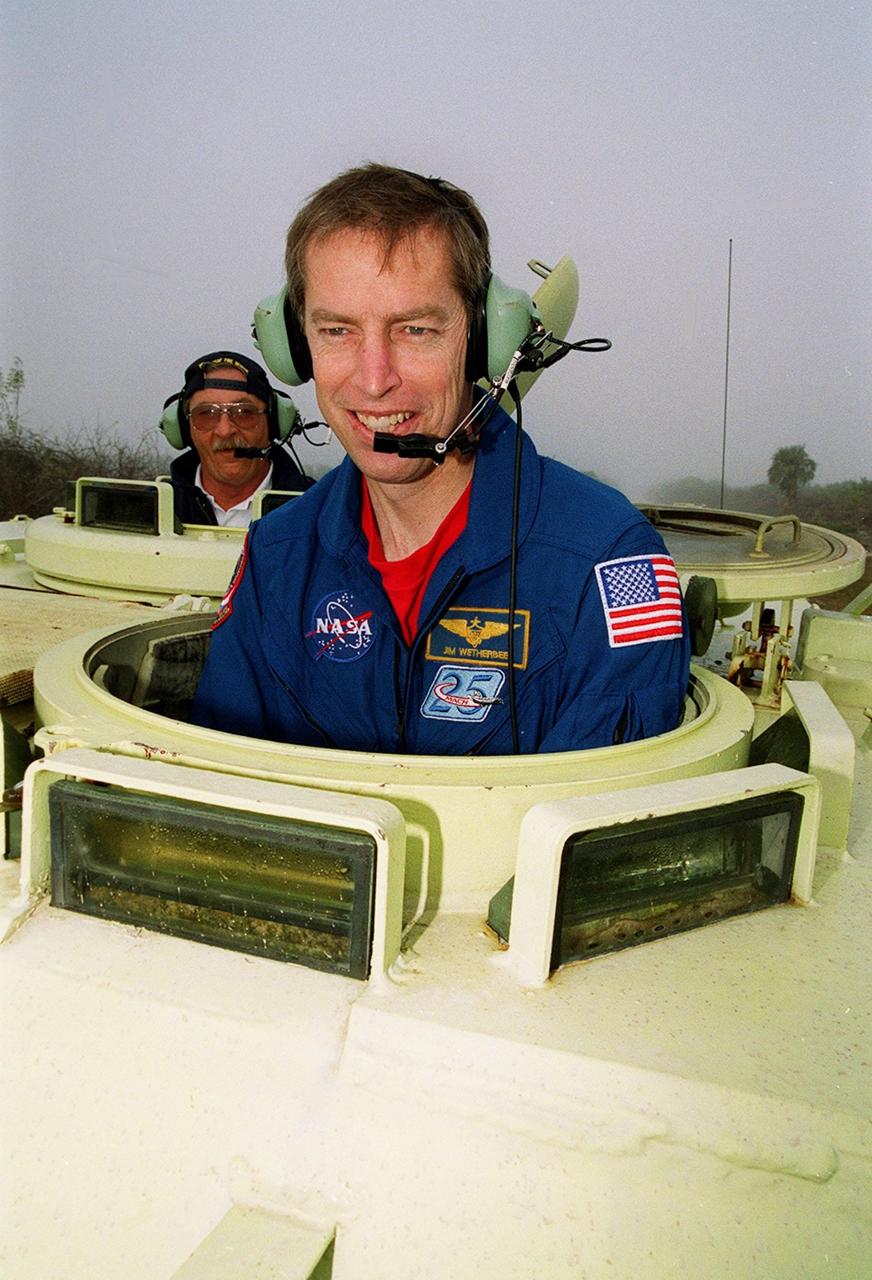
STS-102 Mission Specialist Andrew Thomas drives an M-113 armored carrier as part of emergency egress training. With him is (left) Capt. George Hoggard, a training officer with SGS Fire Services, and other crew members Commander James Wetherbee, Pilot James Kelly and Mission Specialist Paul Richards (seen behind Thomas, at right). The M-113, in the event of an emergency at the pad prior to launch, could be used to transport the crew to a nearby bunker or farther. The STS-102 crew is at KSC to take part in Terminal Countdown Demonstration Test activities, which also include a simulated launch countdown. STS-102 is the eighth construction flight to the International Space Station, carrying as payload the Multi-Purpose Logistics Module Leonardo. Launch on mission STS-102 is scheduled for March 8
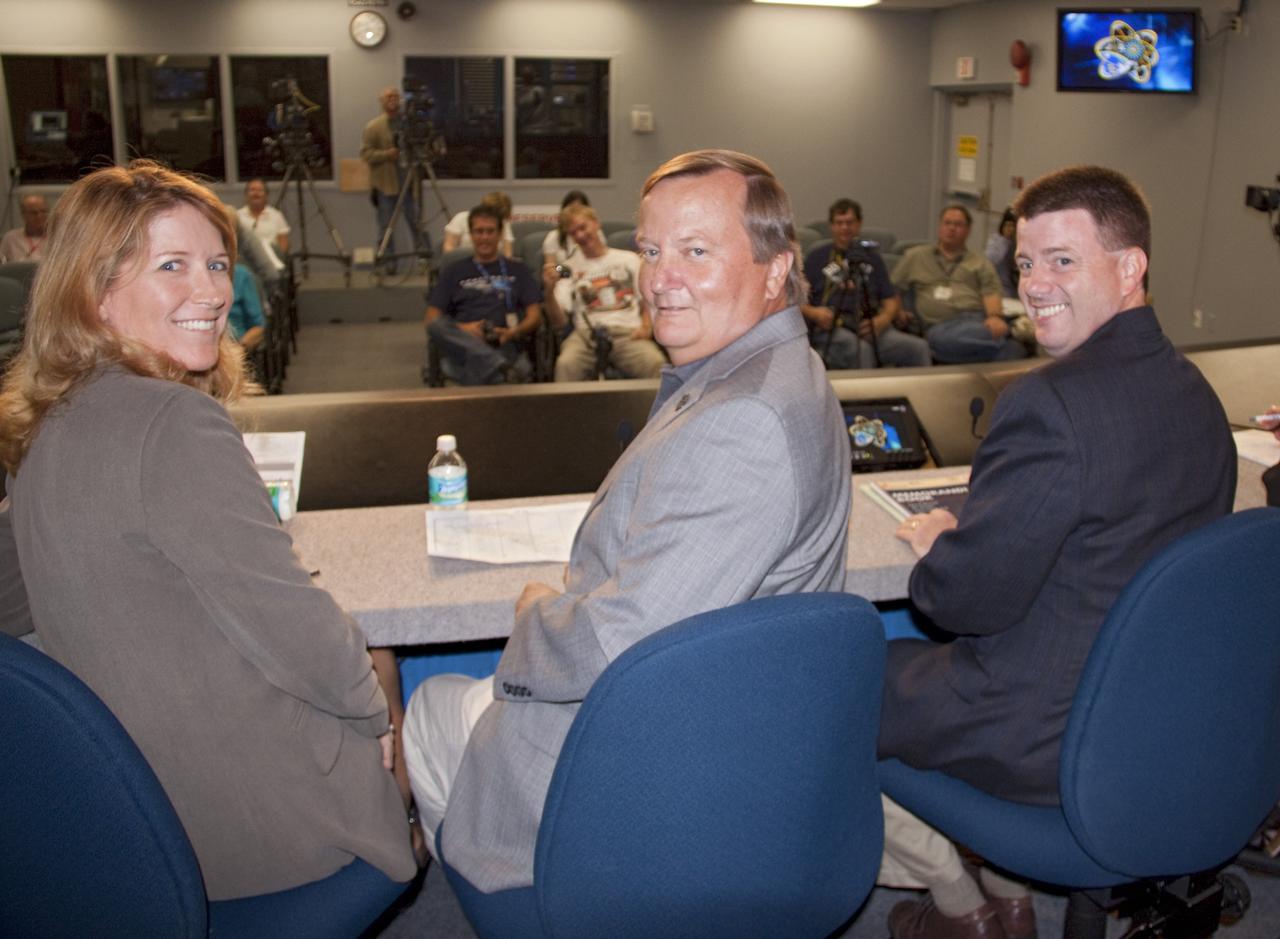
CAPE CANAVERAL, Fla. -- In the Press Site auditorium at NASA's Kennedy Space Center in Florida, NASA managers brief media about their unanimous approval to proceed with space shuttle Endeavour's STS-134 mission. From left are Shuttle Weather Officer Kathy Winters, Shuttle Launch Director Mike Leinbach and Space Shuttle Program Launch Integration Manager Mike Moses. Endeavour's launch is scheduled for May 16 at 8:56 a.m. EDT. Endeavour and its crew will deliver the Express Logistics Carrier-3, Alpha Magnetic Spectrometer-2 (AMS), a high-pressure gas tank and additional spare parts for the Dextre robotic helper to the station. This will be the final spaceflight for Endeavour. For more information visit, www.nasa.gov/mission_pages/shuttle/shuttlemissions/sts134/index.html. Photo credit: NASA/Ben Smegelsky
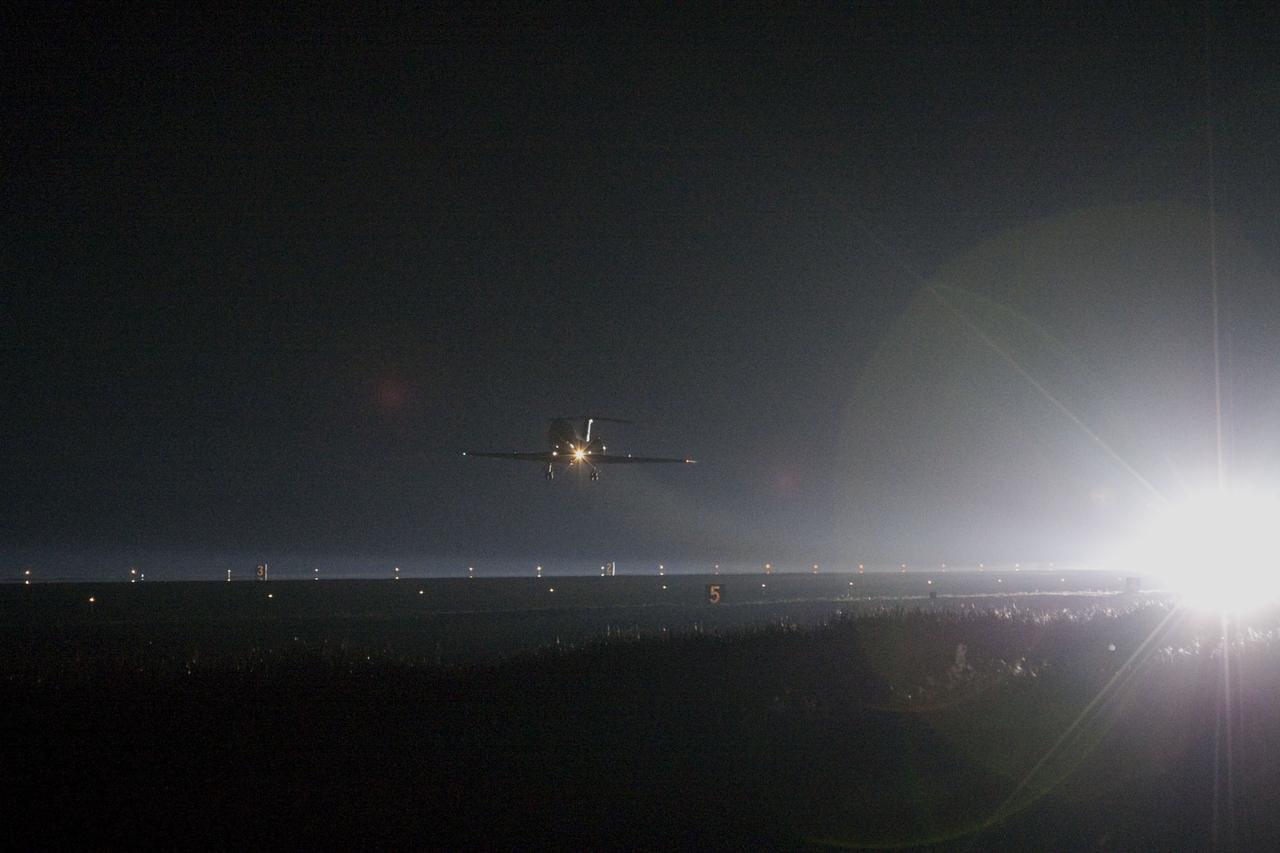
STS135-S-216 (21 July 2011) --- Deputy Chief of the Astronaut Office Rick Sturckow flies weather reconnaissance in a Shuttle Training Aircraft over NASA's Kennedy Space Center in Florida to assess the weather before space shuttle Atlantis returns to Earth for the last time. Weather was observed "go" and Atlantis touched down on Runway 15 at 5:57 a.m. on July 21, 2011, bringing an end to the STS-135 mission and NASA's Space Shuttle Program. On the 37th shuttle mission to the International Space Station, STS-135 delivered more than 9,400 pounds of spare parts, equipment and supplies in the Raffaello multi-purpose logistics module that will sustain station operations for the next year. STS-135 was the 33rd and final flight for Atlantis, which has spent 307 days in space, orbited Earth 4,848 times and traveled 125,935,769 miles. Photo credit: NASA
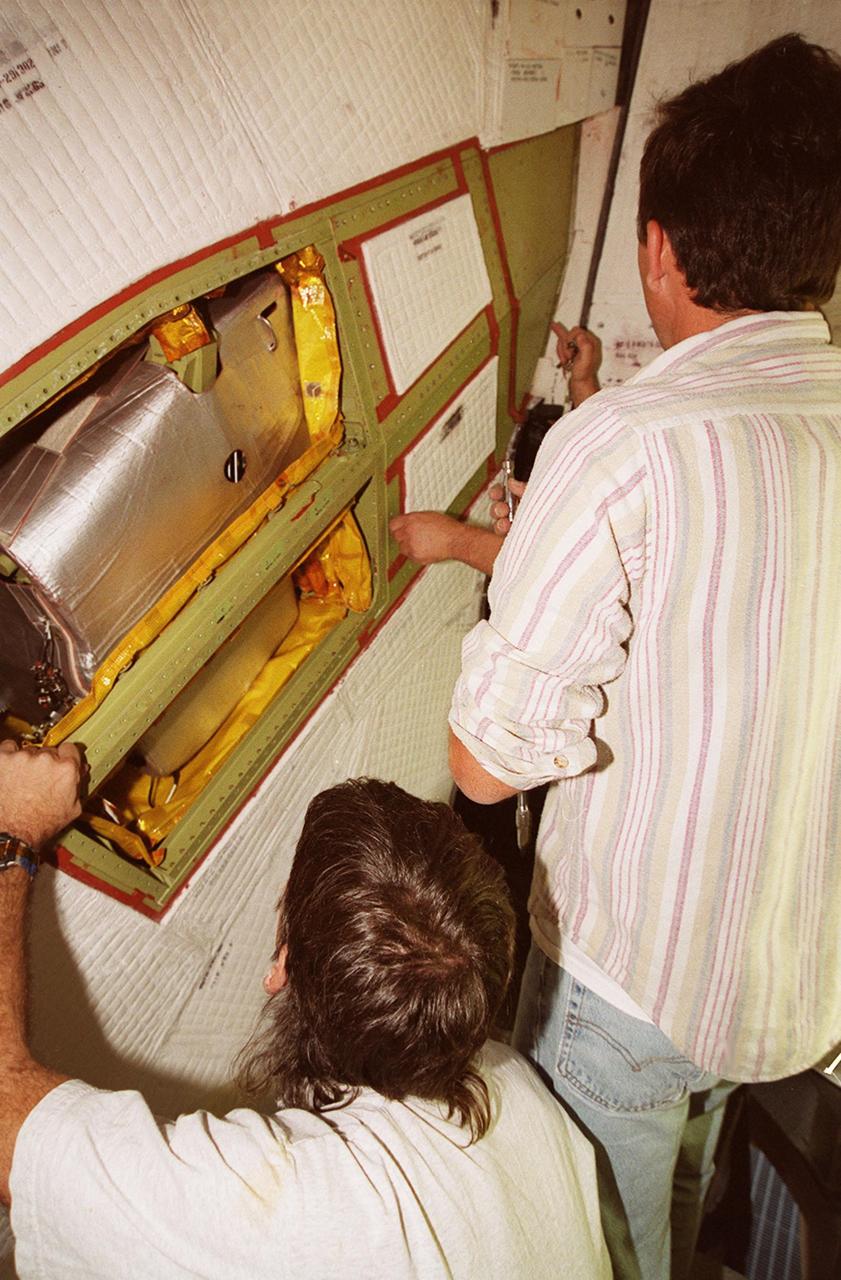
KENNEDY SPACE CENTER, FLA. -- United Space Alliance technicians (left to right) Tod Biddle, Bob Wright and Mark Noel (hidden) remove the coverings from a site near the tail of Space Shuttle Atlantis to reveal the power drive unit (PDU) inside. The PDU controls the rudder/speed brake on the orbiter. Shuttle managers decided to replace the faulty PDU, about the size of an office copy machine, at the launch pad. If successful, launch preparations will continue as planned, with liftoff targeted for April 24 at 4:15 p.m. on mission STS-101. The mission is the third assembly flight for the International Space Station, carrying logistics and supplies to the Space Station, plus the crew will be preparing the Station for the arrival of the Zvezda Service Module, expected to be launched by Russia in July 2000. The crew will conduct one space walk to perform maintenance on the Space Station
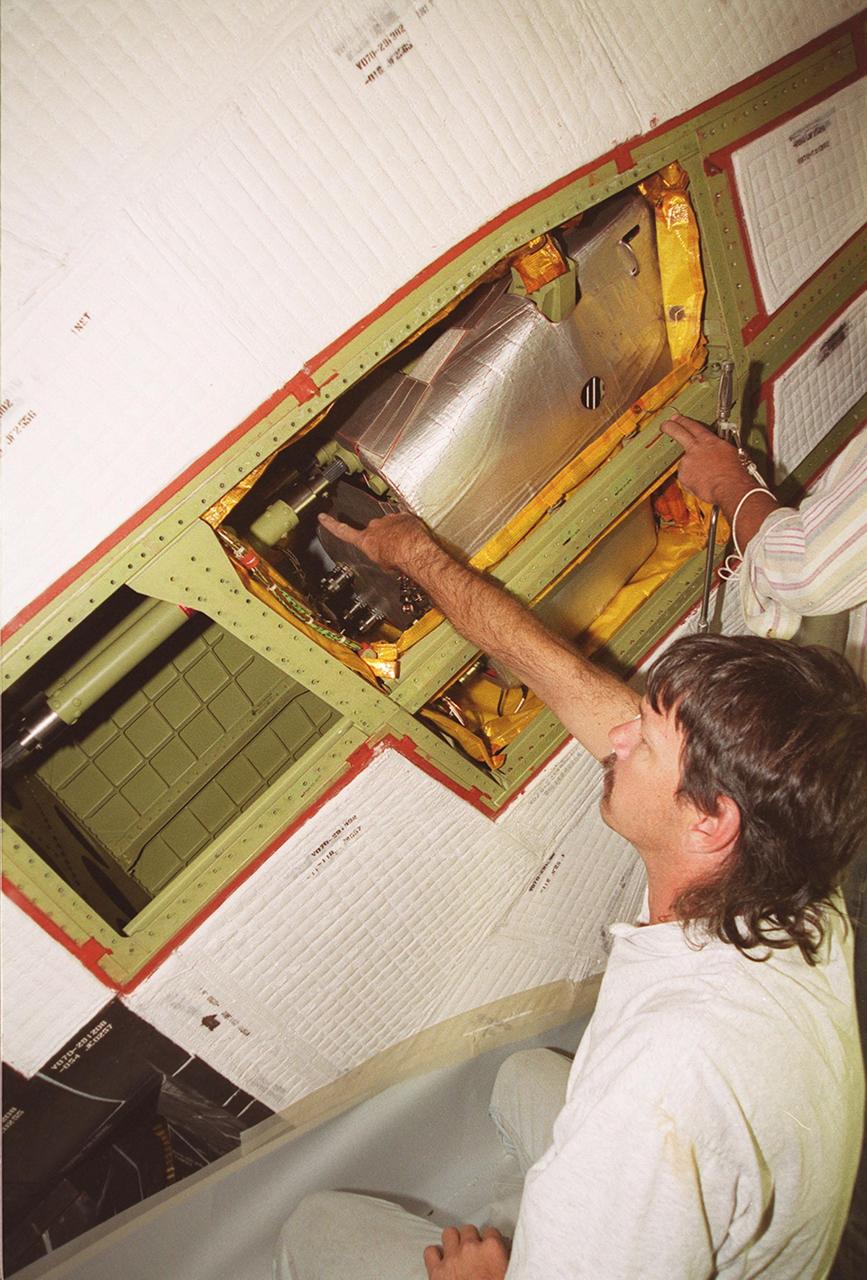
KENNEDY SPACE CENTER, FLA. -- With coverings removed from a site near the tail of Space Shuttle Atlantis, Tod Biddle, a United Space Alliance (USA) technician, points to the power drive unit (PDU) inside. The PDU controls the rudder/speed brake on the orbiter. The hands at right belong to Bob Wright, also a USA technician. Shuttle managers decided to replace the faulty PDU, about the size of an office copy machine, at the launch pad. If successful, launch preparations will continue as planned, with liftoff targeted for April 24 at 4:15 p.m. on mission STS-101. The mission is the third assembly flight for the International Space Station, carrying logistics and supplies to the Space Station, plus the crew will be preparing the Station for the arrival of the Zvezda Service Module, expected to be launched by Russia in July 2000. The crew will conduct one space walk to perform maintenance on the Space Station
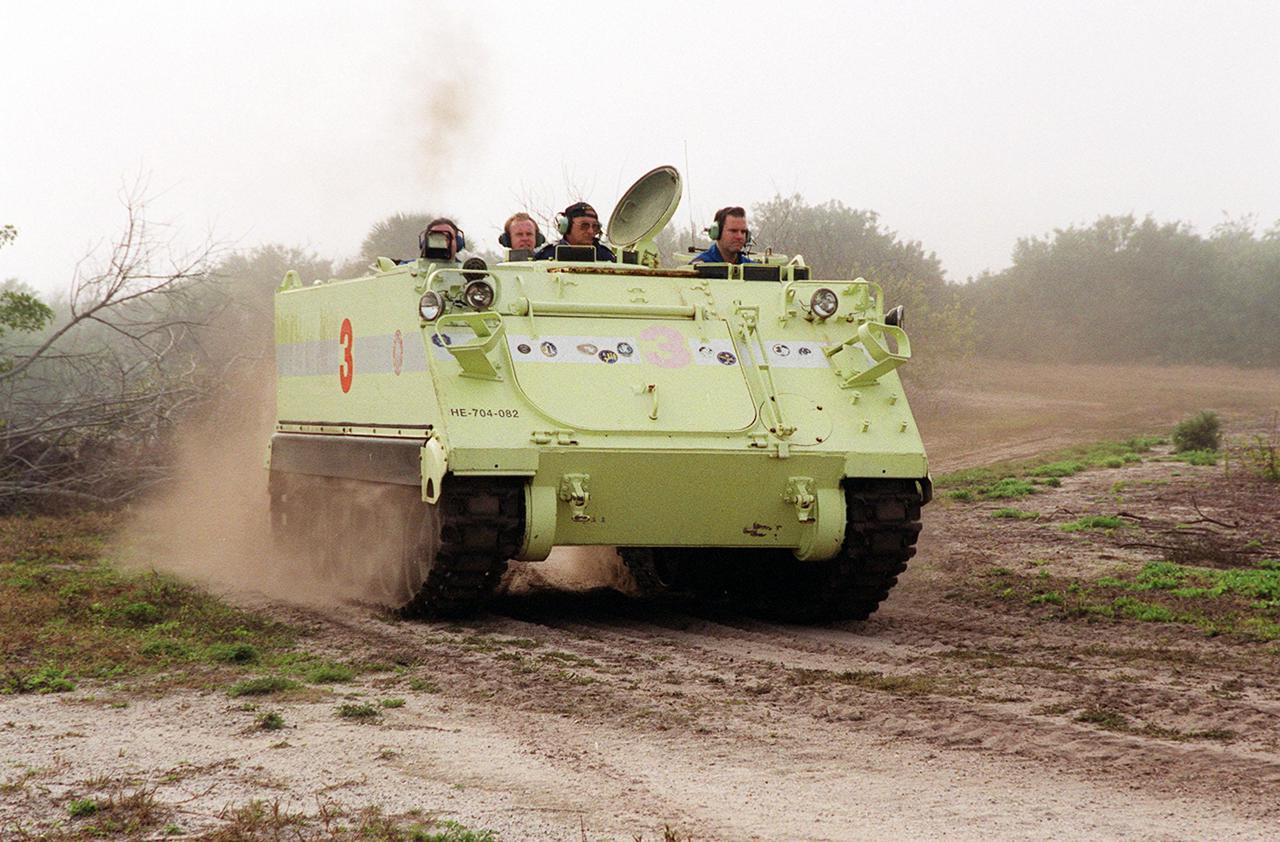
STS-102 Mission Specialist Paul Richards kicks up dust as he makes a turn while driving the M-113 armored carrier, part of emergency egress training at Launch Pad 39B. Seated alongside (at left) is Capt. George Hoggard, a training officer with SGS Fire Services. In the event of an emergency at the pad prior to launch, the M-113 could be used to transport the crew to a nearby bunker or farther. The STS-102 crew is at KSC to take part in Terminal Countdown Demonstration Test activities, which also include a simulated launch countdown. STS-102 is the eighth construction flight to the International Space Station, carrying as payload the Multi-Purpose Logistics Module Leonardo. Launch on mission STS-102 is scheduled for March 8
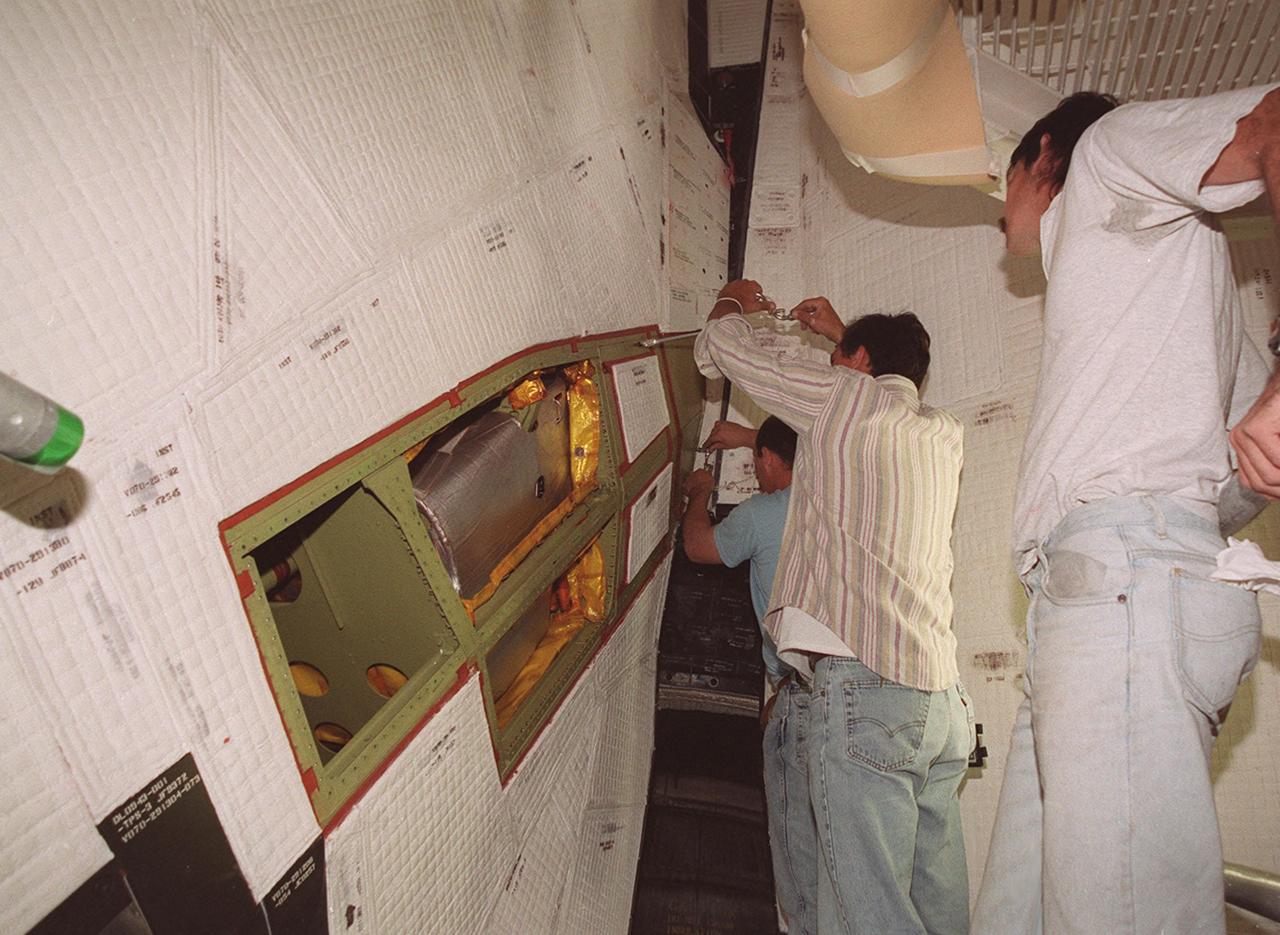
KENNEDY SPACE CENTER, FLA. -- Technicians at Launch Pad 39A begin removing thermal blankets and panels from a site near the tail of Space Shuttle Atlantis in order to reach the power drive unit (PDU) inside. The PDU controls the rudder/speed brake on the orbiter. From left to right are Mark Noel, Bob Wright and Tod Biddle, with United Space Alliance. Shuttle managers decided to replace the faulty PDU, about the size of an office copy machine, at the launch pad. If successful, launch preparations will continue as planned, with liftoff targeted for April 24 at 4:15 p.m. on mission STS-101. The mission is the third assembly flight for the International Space Station, carrying logistics and supplies to the Space Station, plus the crew will be preparing the Station for the arrival of the Zvezda Service Module, expected to be launched by Russia in July 2000. The crew will conduct one space walk to perform maintenance on the Space Station

STS-102 Mission Specialist Andrew Thomas drives an M-113 armored carrier as part of emergency egress training. With him is (left) Capt. George Hoggard, a training officer with SGS Fire Services, and other crew members Commander James Wetherbee, Pilot James Kelly and Mission Specialist Paul Richards (seen behind Thomas, at right). The M-113, in the event of an emergency at the pad prior to launch, could be used to transport the crew to a nearby bunker or farther. The STS-102 crew is at KSC to take part in Terminal Countdown Demonstration Test activities, which also include a simulated launch countdown. STS-102 is the eighth construction flight to the International Space Station, carrying as payload the Multi-Purpose Logistics Module Leonardo. Launch on mission STS-102 is scheduled for March 8
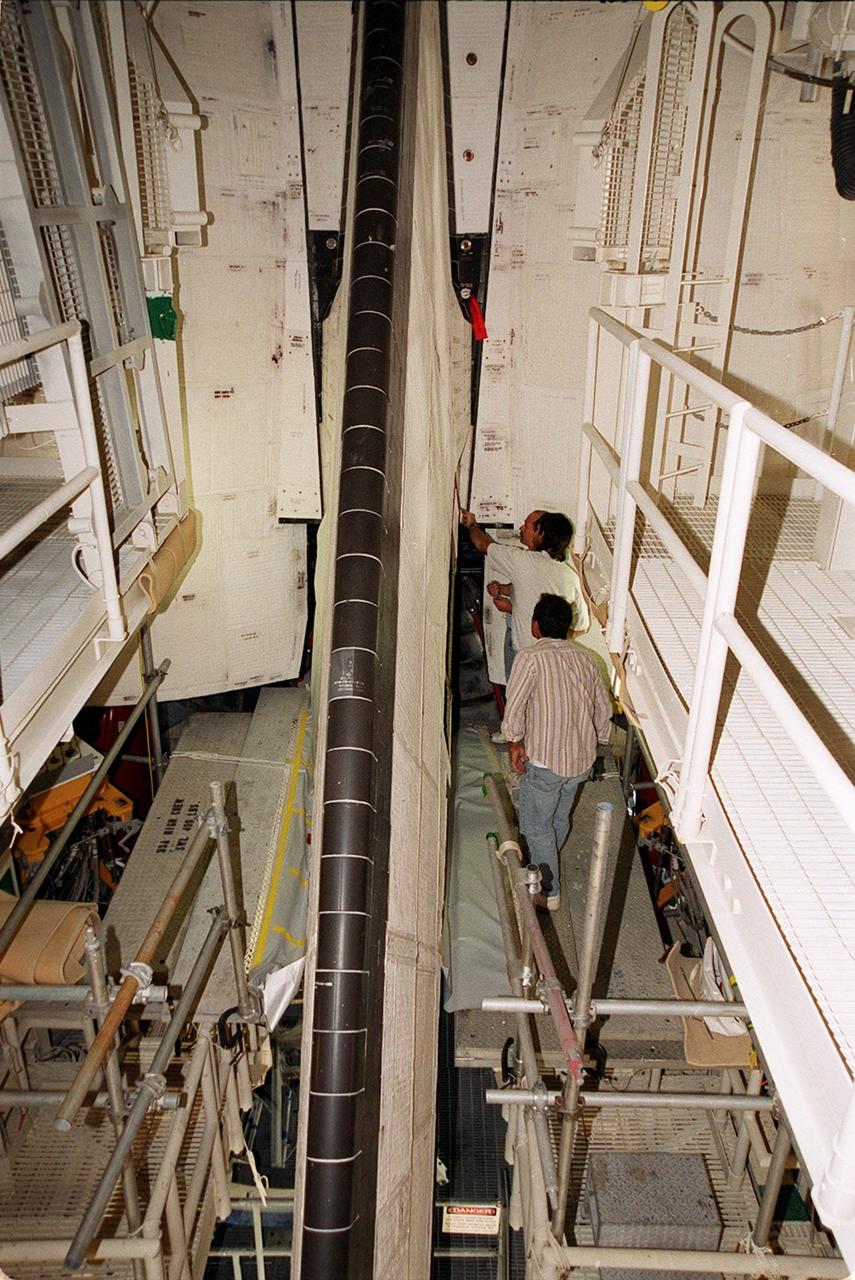
KENNEDY SPACE CENTER, FLA. -- United Space Alliance technicians at Launch Pad 39A look at the site of the power drive unit (PDU) for the rudder/speed brake on Shuttle Atlantis. From left are Mark Noel, Tod Biddle and Bob Wright. Shuttle managers decided to replace the faulty PDU, about the size of an office copy machine, at the launch pad. If successful, launch preparations will continue as planned, with liftoff targeted for April 24 at 4:15 p.m. on mission STS-101. The mission is the third assembly flight for the International Space Station, carrying logistics and supplies to the Space Station, plus the crew will be preparing the Station for the arrival of the Zvezda Service Module, expected to be launched by Russia in July 2000. The crew will conduct one space walk to perform maintenance on the Space Station
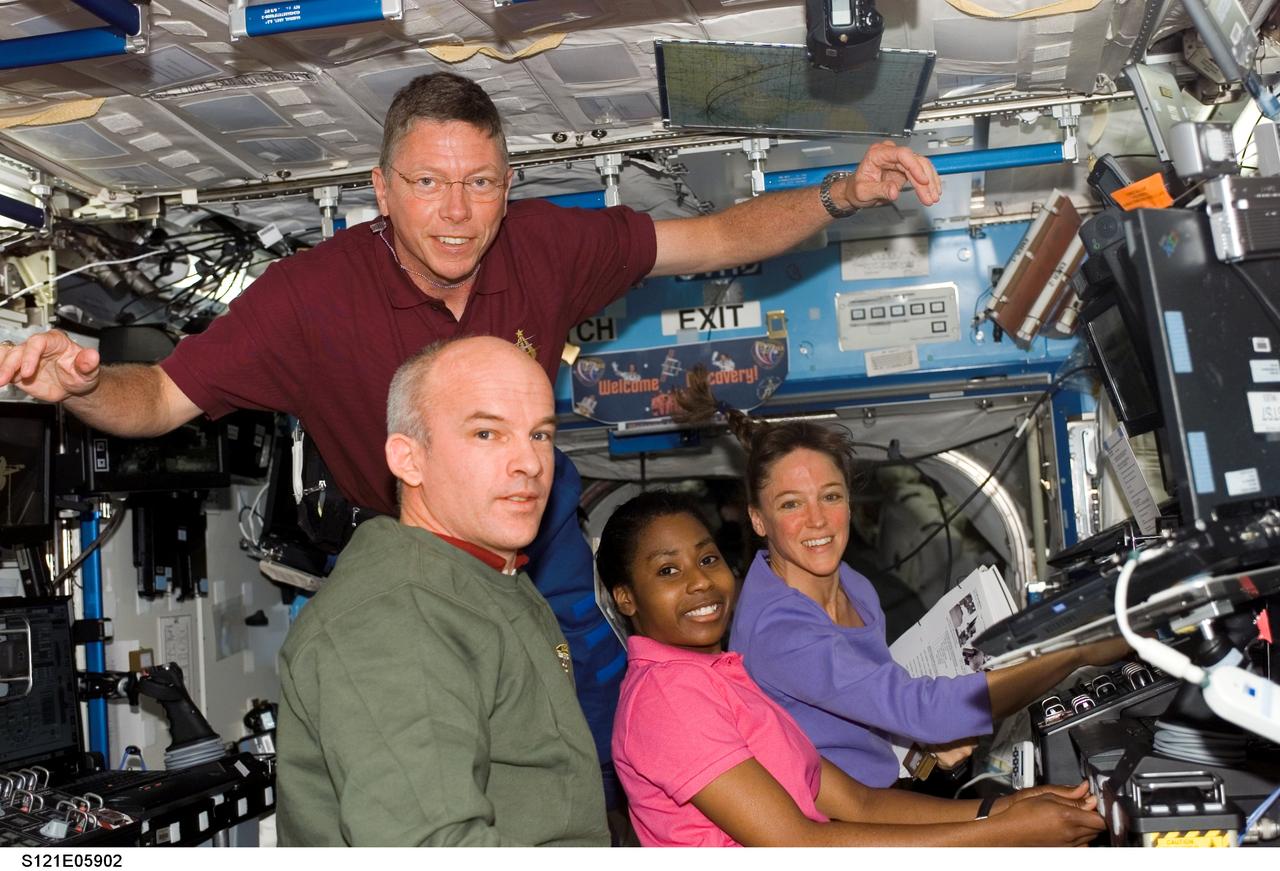
S121-E-05902 (7 July 2006) --- Astronaut Stephanie D. Wilson (center), STS-121 mission specialist, works with the Mobile Service System (MSS) and Canadarm2 controls in the Destiny laboratory of the International Space Station while Space Shuttle Discovery was docked to the station. Wilson used the station's arm to move the Italian-built Leonardo Multi-Purpose Logistics Module (MPLM) from the shuttle cargo bay to install on the station's Unity node. Astronauts Jeffrey N. Williams (foreground), Expedition 13 NASA space station science officer and flight engineer; Michael E. Fossum (top) and Lisa M. Nowak, STS-121 mission specialists, assisted Wilson. The MPLM was successfully latched in place by 7:15 a.m. (CDT) on July 7, 2006.
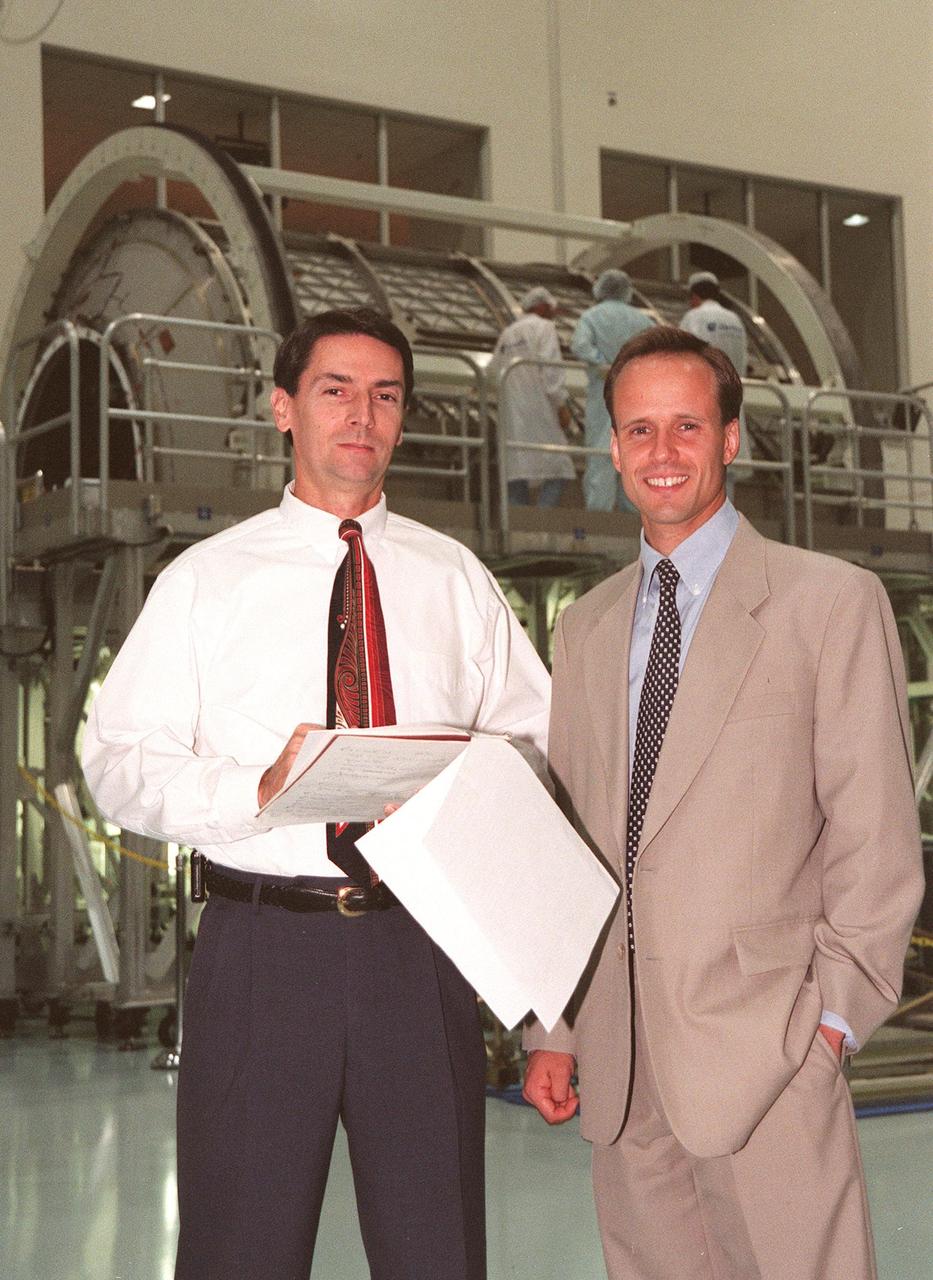
Michael Kinnan (left), with International Space Station (ISS) Launch Site Integration Office, and Todd McIntyre, with ISS International Elements, review paperwork for the Multi-Purpose Logistics Module (MPLM) in the Space Station Processing Facility at KSC. The Italian-built module, named Leonardo, is one of three to be provided by Alenia Aerospazio, and will be operated by NASA and supported by ASI, the Italian space agency. In the background, technicians from The Boeing Company and Alenia Aerospazio are preparing the first MPLM for flight. The MPLMs will be carried in the payload bay of a Shuttle orbiter, and will provide storage and additional work space for up to two astronauts when docked to the ISS. Leonardo is scheduled to be launched on STS-100 in December 1999. The second MPLM, named Raffaello, is scheduled to be handed over in April 1999. A third module, to be named Donatello, is due to be delivered in October 2000 for launch in January 2001
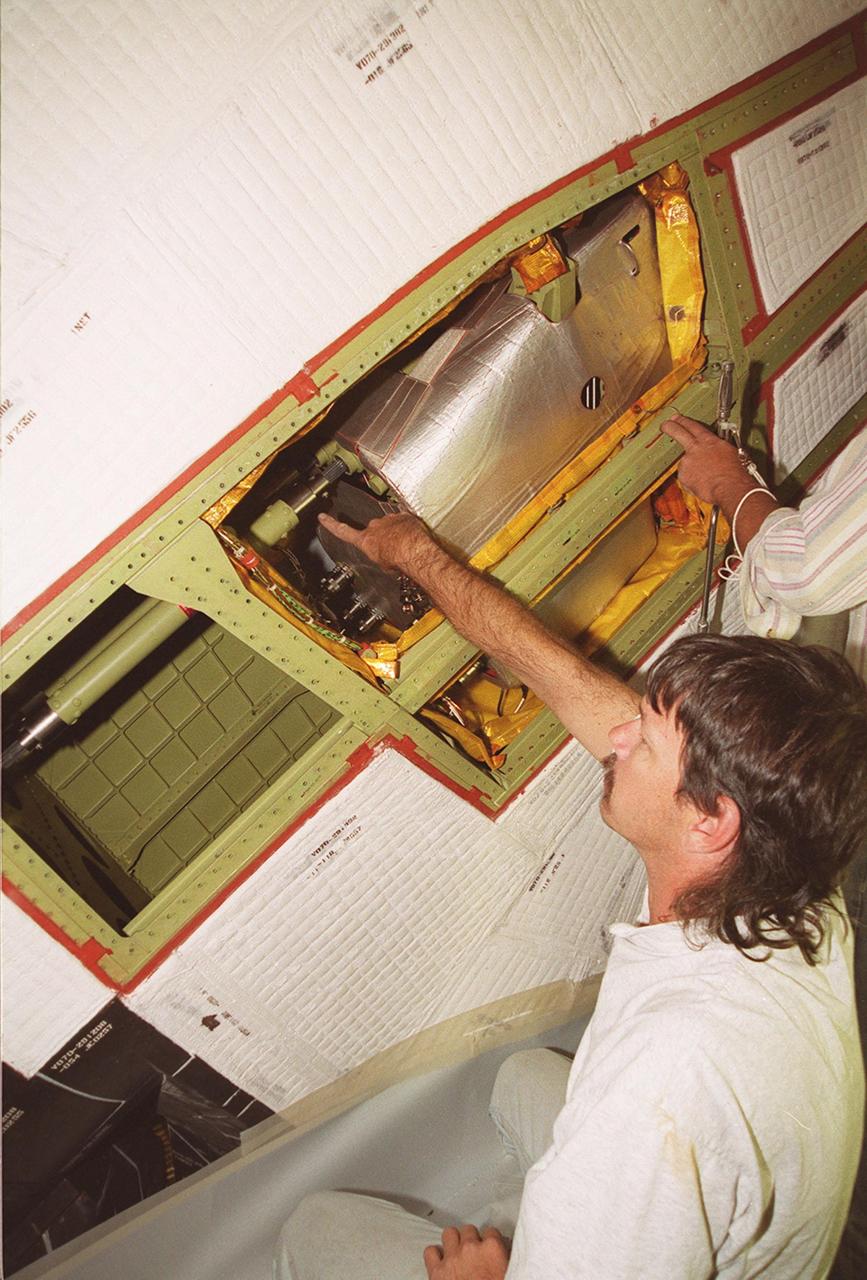
KENNEDY SPACE CENTER, FLA. -- With coverings removed from a site near the tail of Space Shuttle Atlantis, Tod Biddle, a United Space Alliance (USA) technician, points to the power drive unit (PDU) inside. The PDU controls the rudder/speed brake on the orbiter. The hands at right belong to Bob Wright, also a USA technician. Shuttle managers decided to replace the faulty PDU, about the size of an office copy machine, at the launch pad. If successful, launch preparations will continue as planned, with liftoff targeted for April 24 at 4:15 p.m. on mission STS-101. The mission is the third assembly flight for the International Space Station, carrying logistics and supplies to the Space Station, plus the crew will be preparing the Station for the arrival of the Zvezda Service Module, expected to be launched by Russia in July 2000. The crew will conduct one space walk to perform maintenance on the Space Station
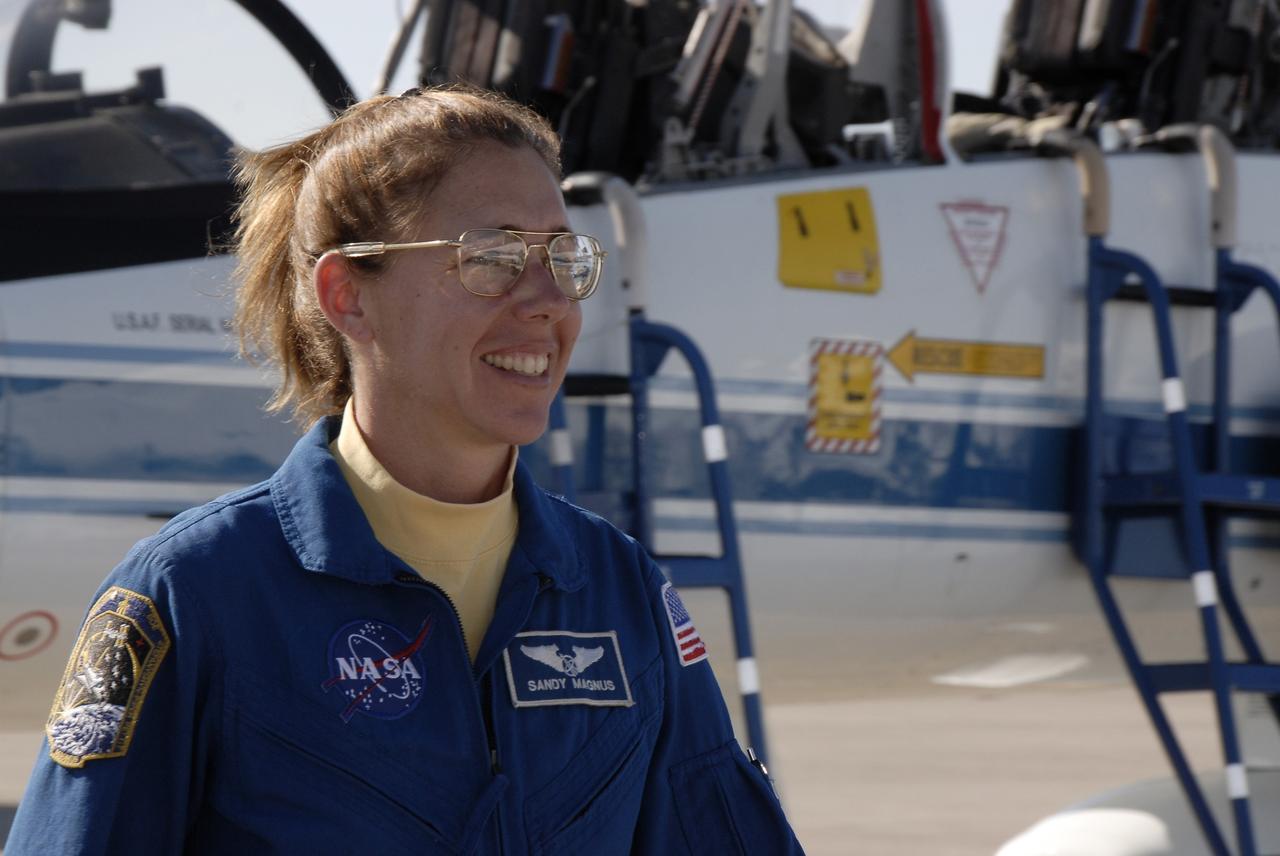
CAPE CANAVERAL, Fla. - STS-126 Mission Specialist Sandra Magnus arrives at the Shuttle Landing Facility at NASA’s Kennedy Space Center in Florida aboard a T-38 jet for Terminal Countdown Demonstration Test, or TCDT, activities. Magnus will remain on the International Space Station as a flight engineer and science officer for Expedition 18. During TCDT, Endeavour's astronauts and launch teams will participate in a simulated countdown, practice emergency exit procedures at the launch pad and continue to familiarize themselves with the mission payload and hardware. On this 27th mission to the International Space Station, Endeavour will carry the Lightweight Multi-Purpose Experiment Support Structure Carrier and the Multi-Purpose Logistics Module Leonardo that will hold supplies and equipment, including additional crew quarters, additional exercise equipment, spare hardware and equipment for the regenerative life support system. Endeavour is targeted to launch at 7:55 p.m. EST on Nov. 14. Photo credit: NASA/Kim Shiflett
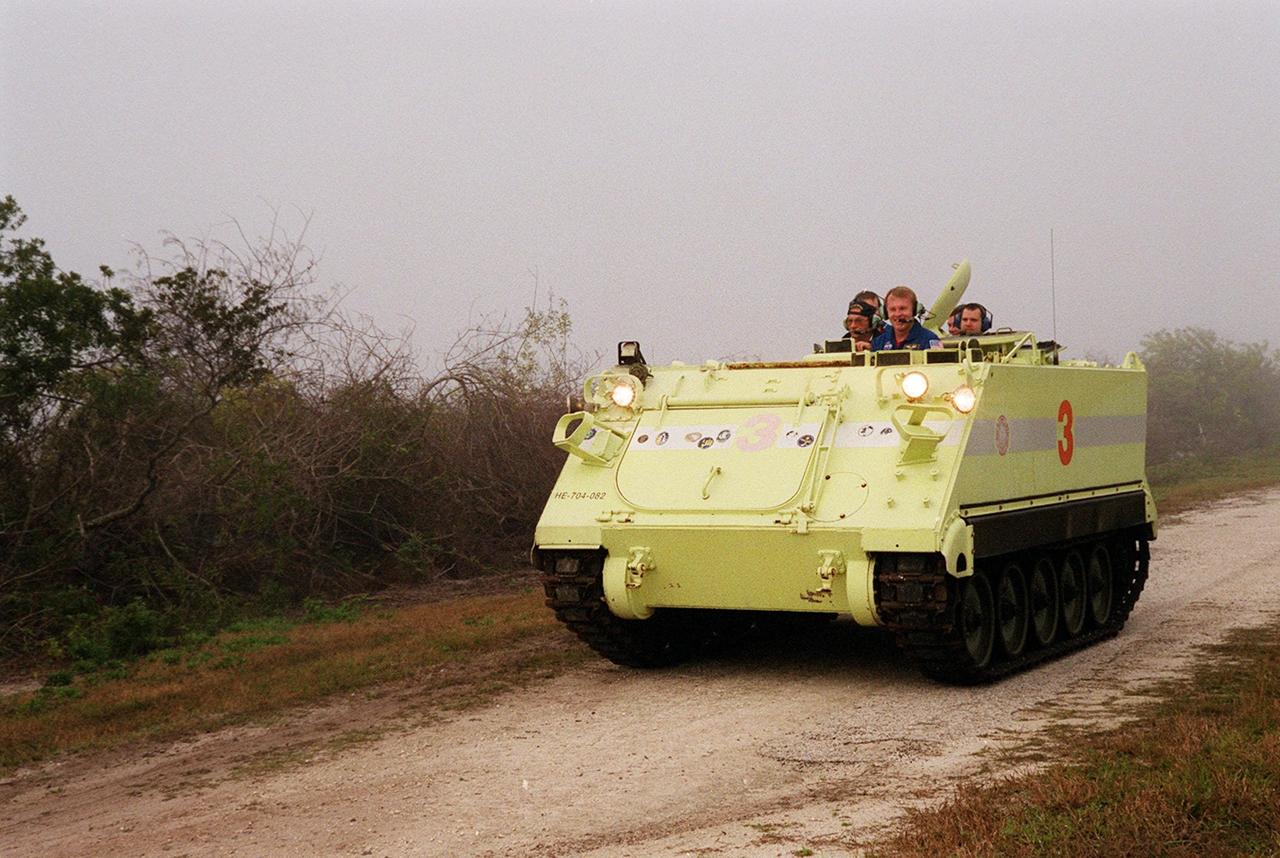
STS-102 Mission Specialist Andrew Thomas drives an M-113 armored carrier as part of emergency egress training. With him is (left) Capt. George Hoggard, a training officer with SGS Fire Services, and other crew members Commander James Wetherbee, Pilot James Kelly and Mission Specialist Paul Richards (seen behind Thomas, at right). The M-113, in the event of an emergency at the pad prior to launch, could be used to transport the crew to a nearby bunker or farther. The STS-102 crew is at KSC to take part in Terminal Countdown Demonstration Test activities, which also include a simulated launch countdown. STS-102 is the eighth construction flight to the International Space Station, carrying as payload the Multi-Purpose Logistics Module Leonardo. Launch on mission STS-102 is scheduled for March 8
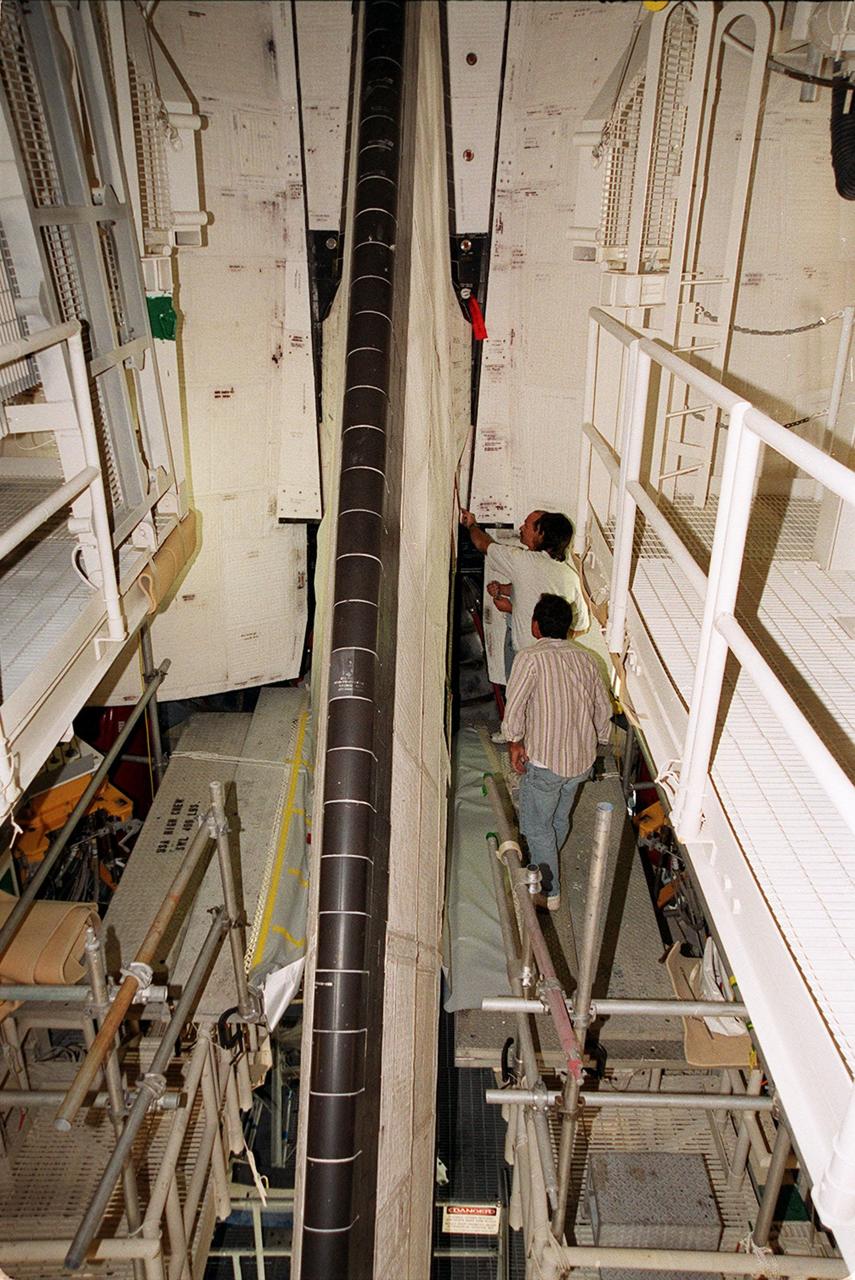
KENNEDY SPACE CENTER, FLA. -- United Space Alliance technicians at Launch Pad 39A look at the site of the power drive unit (PDU) for the rudder/speed brake on Shuttle Atlantis. From left are Mark Noel, Tod Biddle and Bob Wright. Shuttle managers decided to replace the faulty PDU, about the size of an office copy machine, at the launch pad. If successful, launch preparations will continue as planned, with liftoff targeted for April 24 at 4:15 p.m. on mission STS-101. The mission is the third assembly flight for the International Space Station, carrying logistics and supplies to the Space Station, plus the crew will be preparing the Station for the arrival of the Zvezda Service Module, expected to be launched by Russia in July 2000. The crew will conduct one space walk to perform maintenance on the Space Station
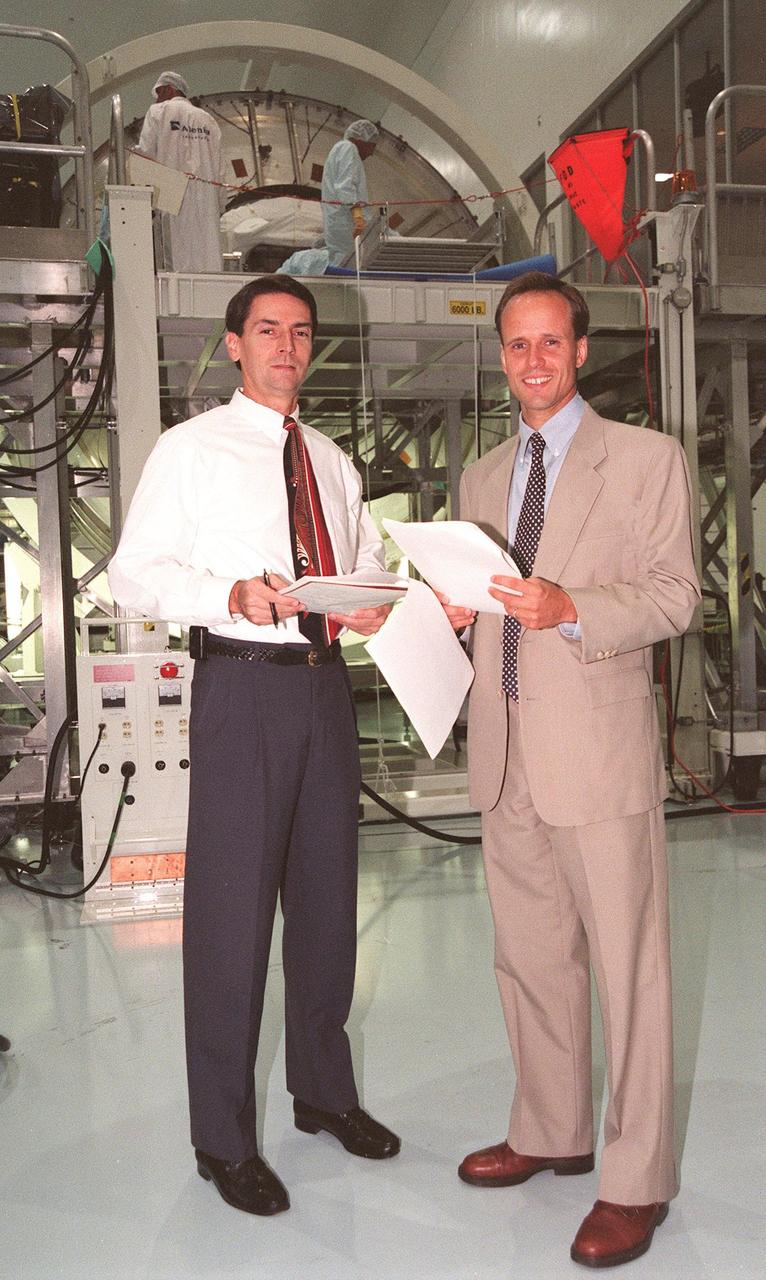
Michael Kinnan (left), with International Space Station (ISS) Launch Site Integration Office, and Todd McIntyre, with ISS International Elements, review paperwork for the Multi-Purpose Logistics Module (MPLM) in the Space Station Processing Facility at KSC. The Italian-built module, named Leonardo, is one of three to be provided by Alenia Aerospazio, and will be operated by NASA and supported by ASI, the Italian space agency. In the background, technicians from The Boeing Company and Alenia Aerospazio are preparing the first MPLM for flight. The MPLMs will be carried in the payload bay of a Shuttle orbiter, and will provide storage and additional work space for up to two astronauts when docked to the ISS. Leonardo is scheduled to be launched on STS-100 in December 1999. The second MPLM, named Raffaello, is scheduled to be handed over in April 1999. A third module, to be named Donatello, is due to be delivered in October 2000 for launch in January 2001
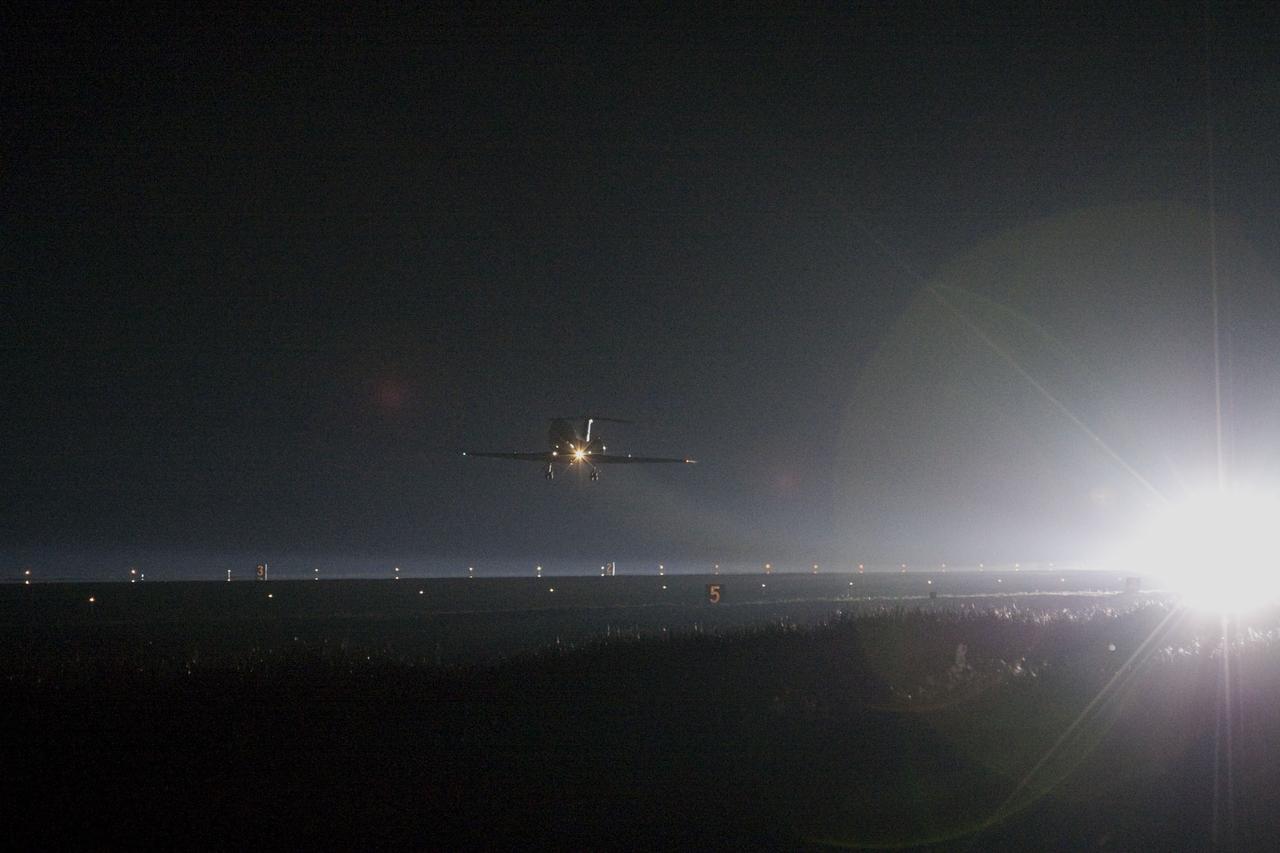
CAPE CANAVERAL, Fla. -- Deputy Chief of the Astronaut Office Rick Sturckow flies weather reconnaissance in a Shuttle Training Aircraft over NASA's Kennedy Space Center in Florida to assess the weather before space shuttle Atlantis returns to Earth for the last time. Weather was observed "go" and Atlantis touched down on Runway 15 at 5:57 a.m., bringing an end to the STS-135 mission and NASA's Space Shuttle Program. On the 37th shuttle mission to the International Space Station, STS-135 delivered more than 9,400 pounds of spare parts, equipment and supplies in the Raffaello multi-purpose logistics module that will sustain station operations for the next year. STS-135 was the 33rd and final flight for Atlantis, which has spent 307 days in space, orbited Earth 4,848 times and traveled 125,935,769 miles. For more information visit, www.nasa.gov/mission_pages/shuttle/shuttlemissions/sts135/index.html. Photo credit: NASA/Tony Gray
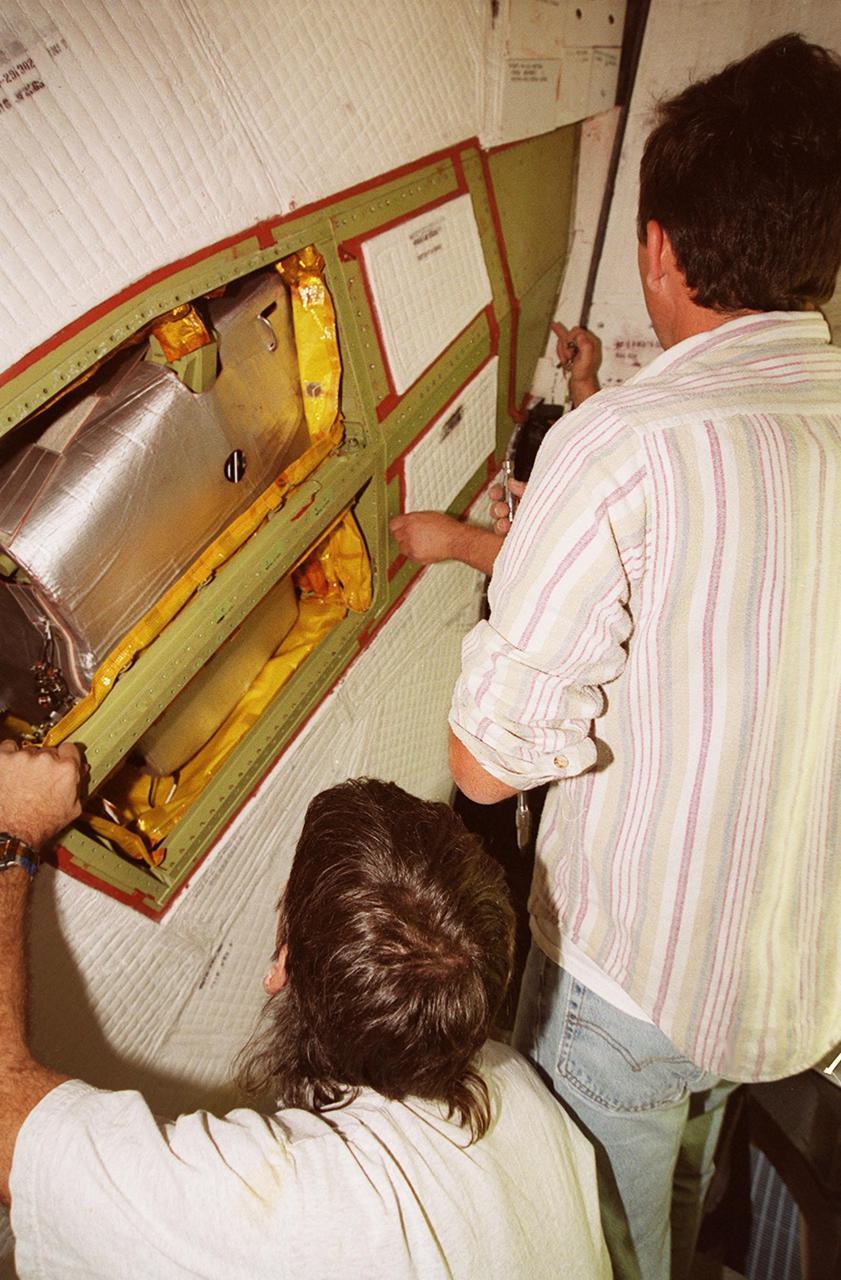
KENNEDY SPACE CENTER, FLA. -- United Space Alliance technicians (left to right) Tod Biddle, Bob Wright and Mark Noel (hidden) remove the coverings from a site near the tail of Space Shuttle Atlantis to reveal the power drive unit (PDU) inside. The PDU controls the rudder/speed brake on the orbiter. Shuttle managers decided to replace the faulty PDU, about the size of an office copy machine, at the launch pad. If successful, launch preparations will continue as planned, with liftoff targeted for April 24 at 4:15 p.m. on mission STS-101. The mission is the third assembly flight for the International Space Station, carrying logistics and supplies to the Space Station, plus the crew will be preparing the Station for the arrival of the Zvezda Service Module, expected to be launched by Russia in July 2000. The crew will conduct one space walk to perform maintenance on the Space Station
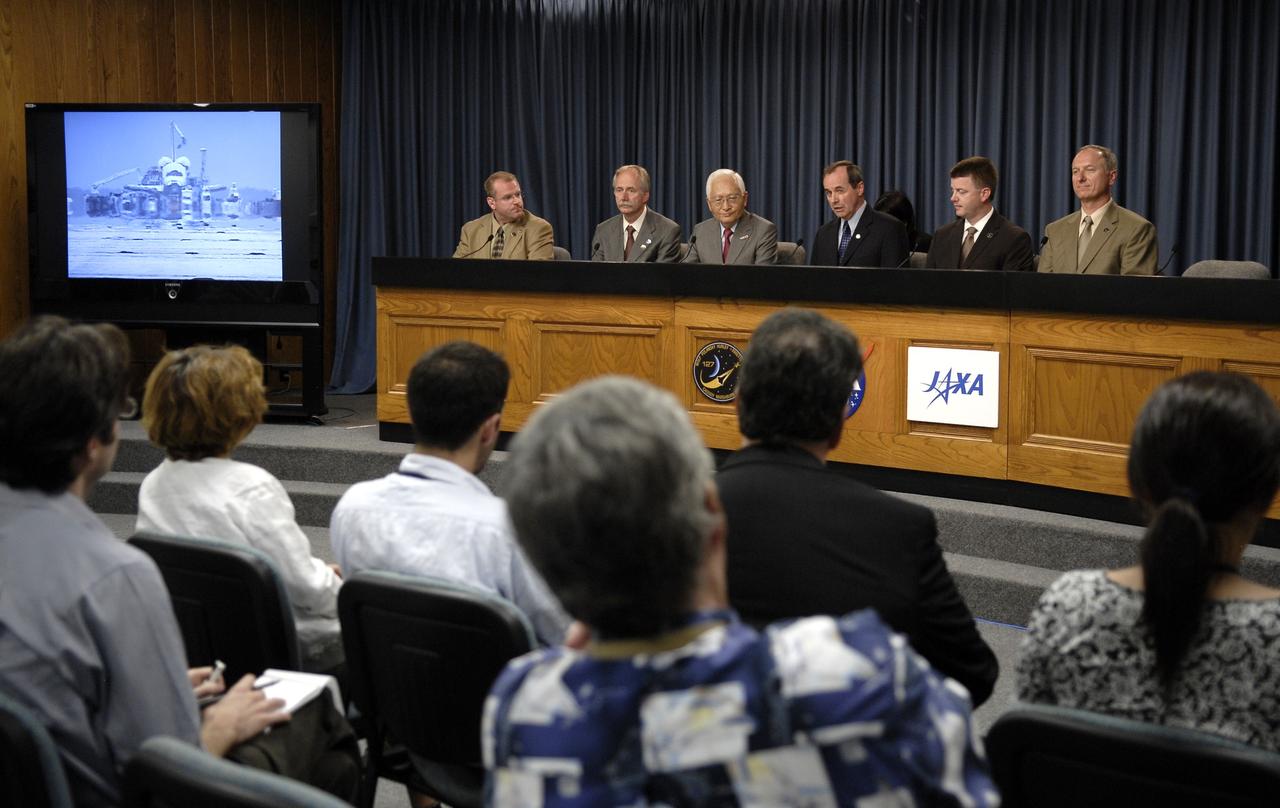
CAPE CANAVERAL, Fla. – At a post-landing news conference, Public Affairs Officer Allard Beutel (far left) moderates the question-and-answer session with NASA Associate Administrator for Space Operations William Gerstenmaier, President of the Japan Aerospace Exploration Agency Keiji Tachikawa, Director General of Operations in the Canadian Space Agency Benoit Marcotte, space shuttle Launch Integration Manager Mike Moses and STS-127 Launch Director Pete Nickolenko. Space shuttle Endeavour and crew returned to Earth at 10:48 a.m. EDT to conclude the STS-127 mission. Endeavour delivered the Japanese Experiment Module's Exposed Facility and the Experiment Logistics Module-Exposed Section to the International Space Station. The mission was the 29th flight to the station, the 23rd flight of Endeavour and the 127th in the Space Shuttle Program, as well as the 71st landing at Kennedy. Photo credit: NASA/Kim Shiflett
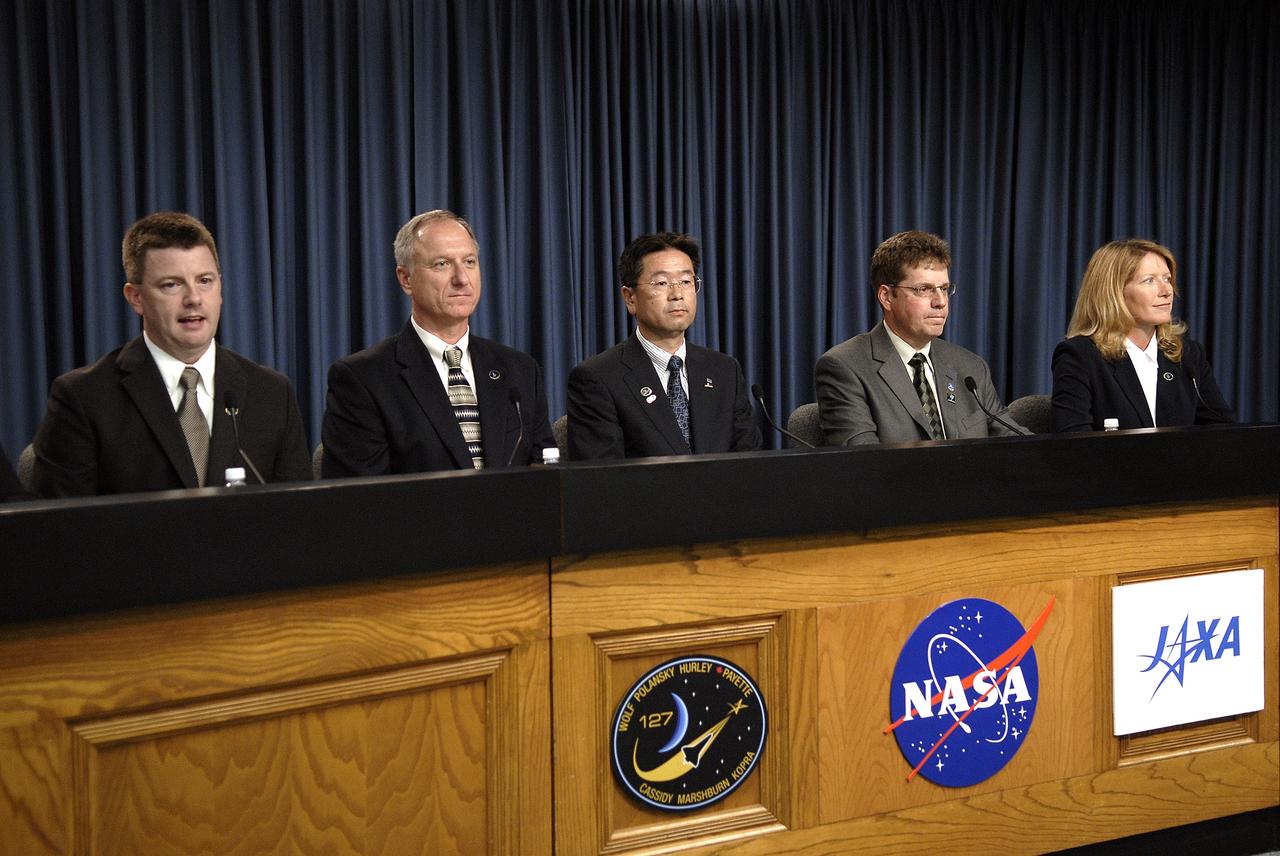
CAPE CANAVERAL, Fla. – Taking part in a prelaunch news conference at NASA's Kennedy Space Center in Florida about the STS-127 mission are (from left) Mike Moses, launch integration manager and chair of the Mission Management Team; Pete Nickolenko, STS-127 shuttle launch director; Koki Oikawa, Japan Experiment Module, or JEM, Project Team function manager; Pierre Jean, director of Operations Engineering and program manager for the Canadian Space Station Program, Canadian Space Agency; and Kathy Winters, shuttle weather officer. In the final of three flights dedicated to the assembly of the Japan Aerospace Exploration Agency's Kibo laboratory complex on the International Space Station, space shuttle Endeavour will deliver the JEM Exposed Facility and the Experiment Logistics Module-Exposed Section, or ELM-ES. STS-127 is the 29th flight for the assembly of the space station and the 127th flight in the Space Shuttle Program. Photo credit: NASA/Kim Shiflett
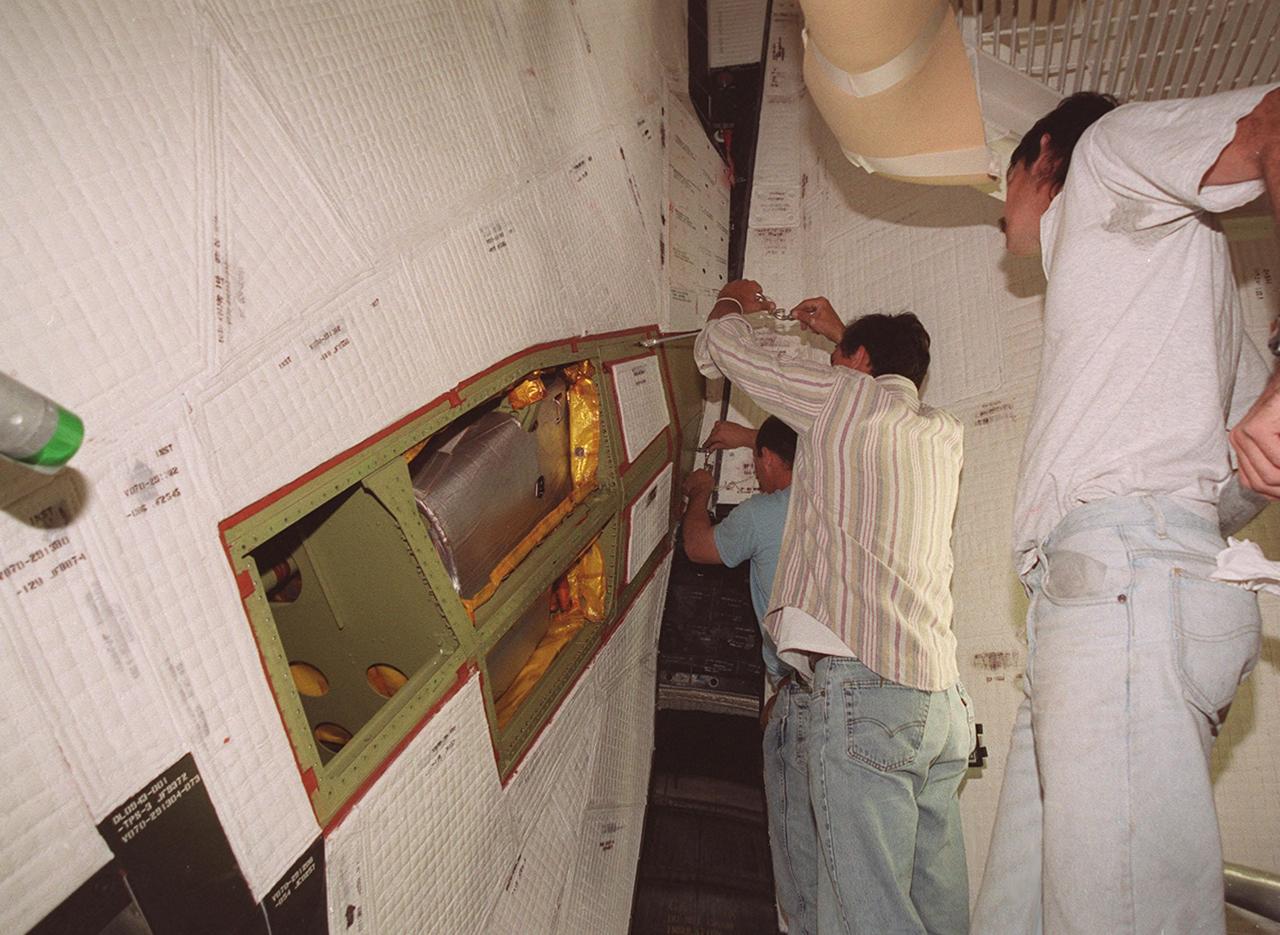
KENNEDY SPACE CENTER, FLA. -- Technicians at Launch Pad 39A begin removing thermal blankets and panels from a site near the tail of Space Shuttle Atlantis in order to reach the power drive unit (PDU) inside. The PDU controls the rudder/speed brake on the orbiter. From left to right are Mark Noel, Bob Wright and Tod Biddle, with United Space Alliance. Shuttle managers decided to replace the faulty PDU, about the size of an office copy machine, at the launch pad. If successful, launch preparations will continue as planned, with liftoff targeted for April 24 at 4:15 p.m. on mission STS-101. The mission is the third assembly flight for the International Space Station, carrying logistics and supplies to the Space Station, plus the crew will be preparing the Station for the arrival of the Zvezda Service Module, expected to be launched by Russia in July 2000. The crew will conduct one space walk to perform maintenance on the Space Station
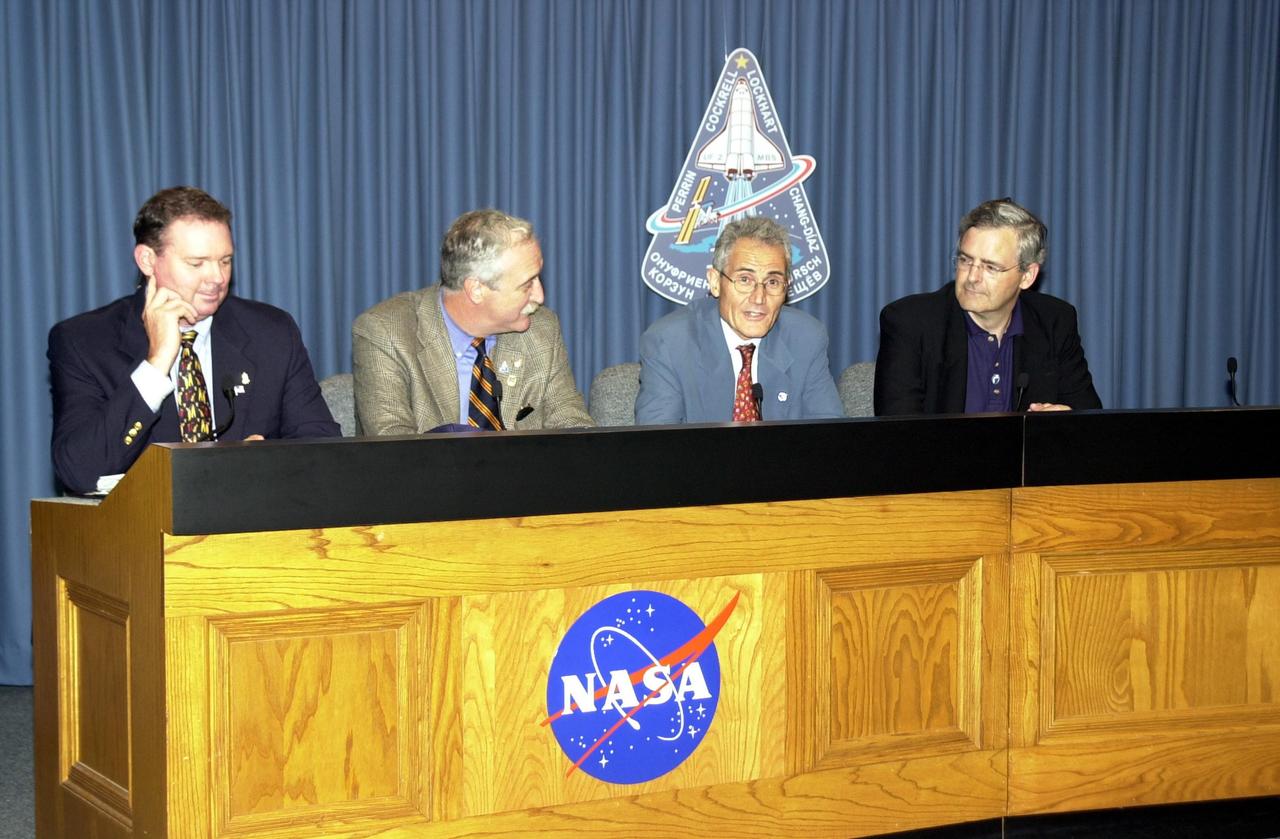
KENNEDY SPACE CENTER, FLA. -- In the Press Site auditorium, space agency officials participate in a media briefing following the launch scrub of Space Shuttle mission STS-111. From left are NASA/JSC Public Affairs Officer Kyle Herring, NASA Administrator Sean O'Keefe, French Space Agency President Dr. Alain Bensoussan, and Canadian Space Agency President Dr. Marc Garneau. STS-111 is the second Utilization Flight to the International Space Station, carrying the Multi-Purpose Logistics Module Leonardo, the Mobile Base System (MBS), and a replacement wrist/roll joint for the Canadarm 2. Also on board will be the Expedition Five crew who will replace Expedition Four on the Station. Launch is rescheduled for May 31 at 7:22 p.m. EDT
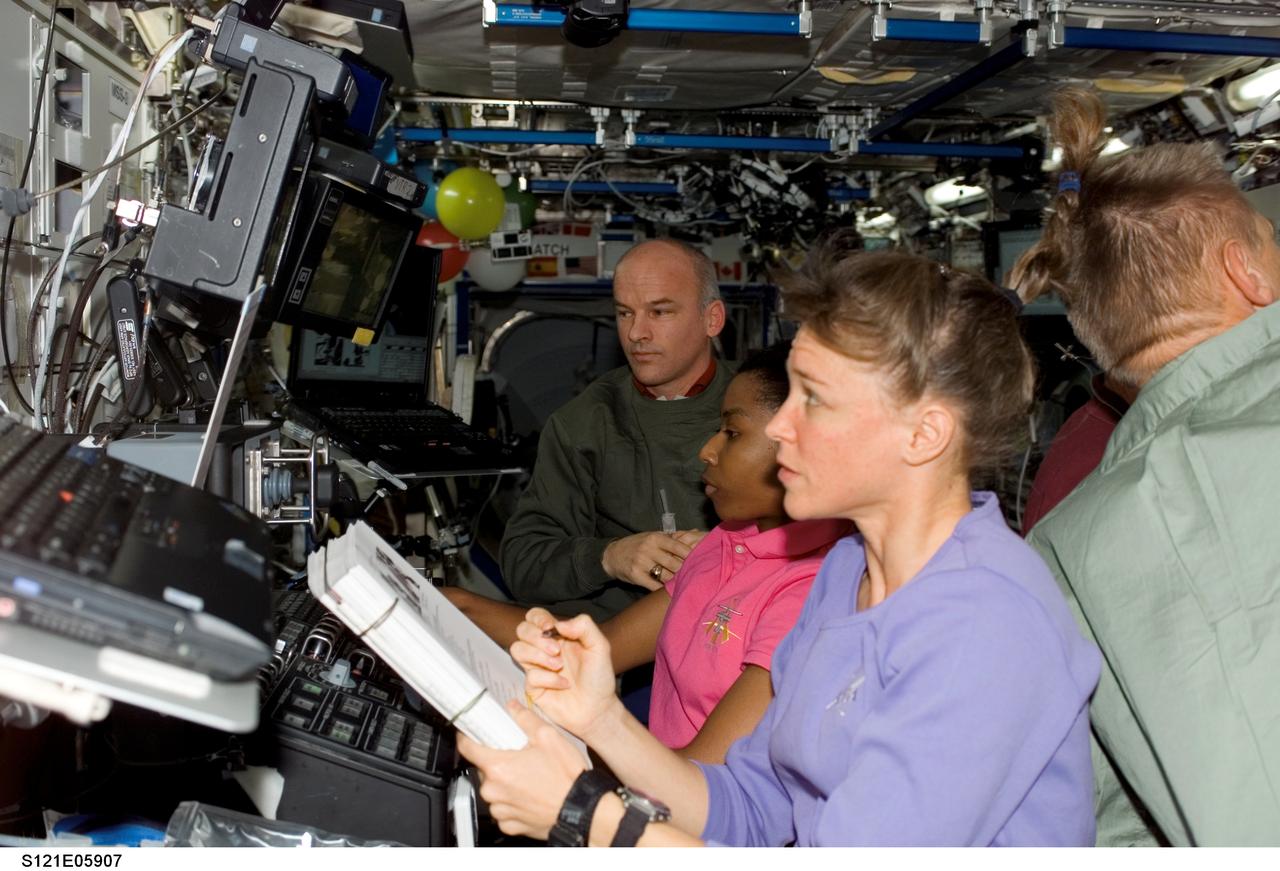
S121-E-05907 (7 July 2006) --- Astronaut Lisa M. Nowak (foreground), STS-121 mission specialist, refers to a procedures checklist as astronaut Stephanie D. Wilson (center), mission specialist, works with the Mobile Service System (MSS) and Canadarm2 controls in the Destiny laboratory of the International Space Station while Space Shuttle Discovery was docked to the station. Wilson used the station's arm to move the Italian-built Leonardo Multi-Purpose Logistics Module (MPLM) from the shuttle cargo bay to install on the station's Unity node. Astronaut Jeffrey N. Williams (background), Expedition 13 NASA space station science officer and flight engineer, assisted Wilson. The MPLM was successfully latched in place by 7:15 a.m. (CDT) on July 7, 2006.
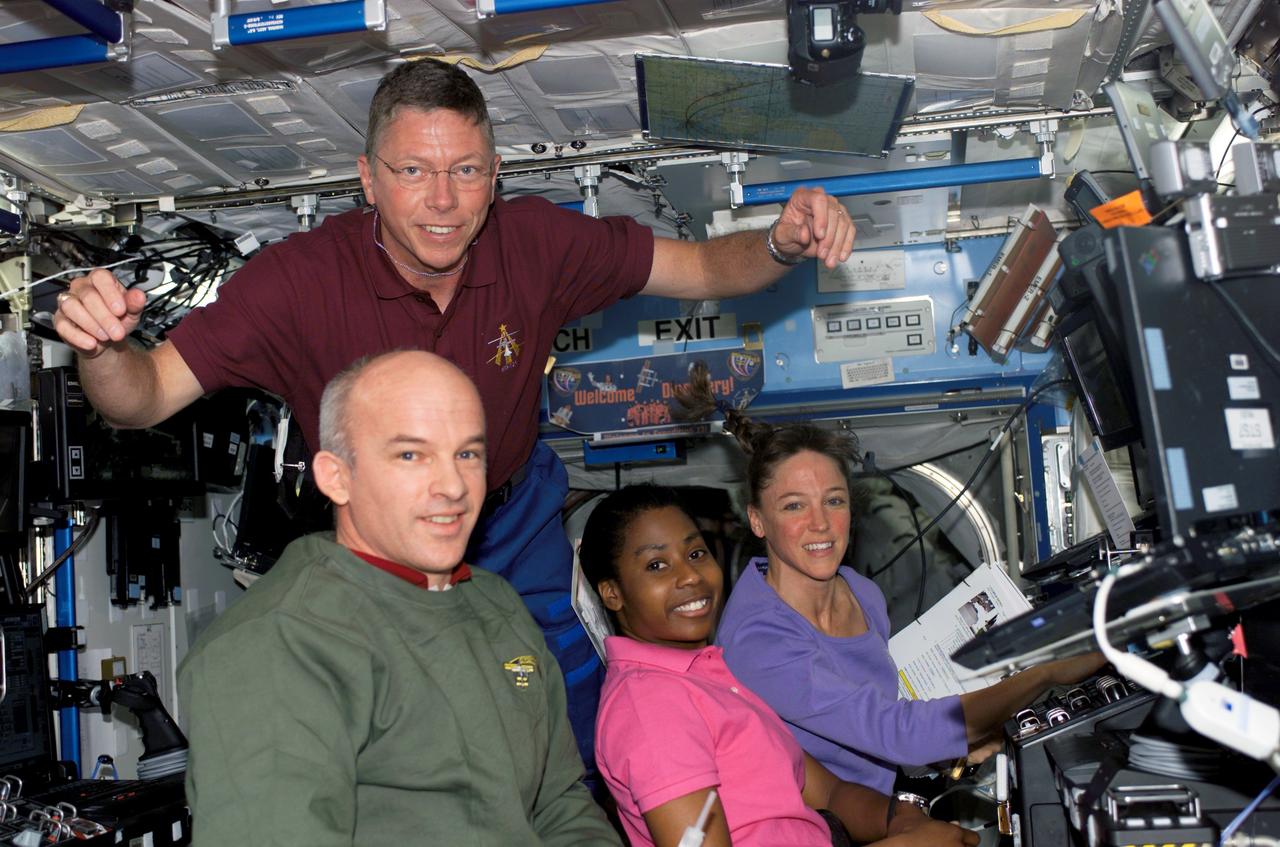
S121-E-05903 (7 July 2006) --- Astronauts Stephanie D. Wilson (center) and Lisa M. Nowak (right), STS-121 mission specialists, work with the Mobile Service System (MSS) and Canadarm2 controls in the Destiny laboratory of the International Space Station while Space Shuttle Discovery was docked to the station. Wilson and Nowak used the station's arm to move the Italian-built Leonardo Multi-Purpose Logistics Module (MPLM) from the shuttle cargo bay to install on the station's Unity node. Astronauts Jeffrey N. Williams (left), Expedition 13 NASA space station science officer and flight engineer; and Michael E. Fossum (top), STS-121 mission specialist, assisted. The MPLM was successfully latched in place by 7:15 a.m. (CDT) on July 7, 2006.
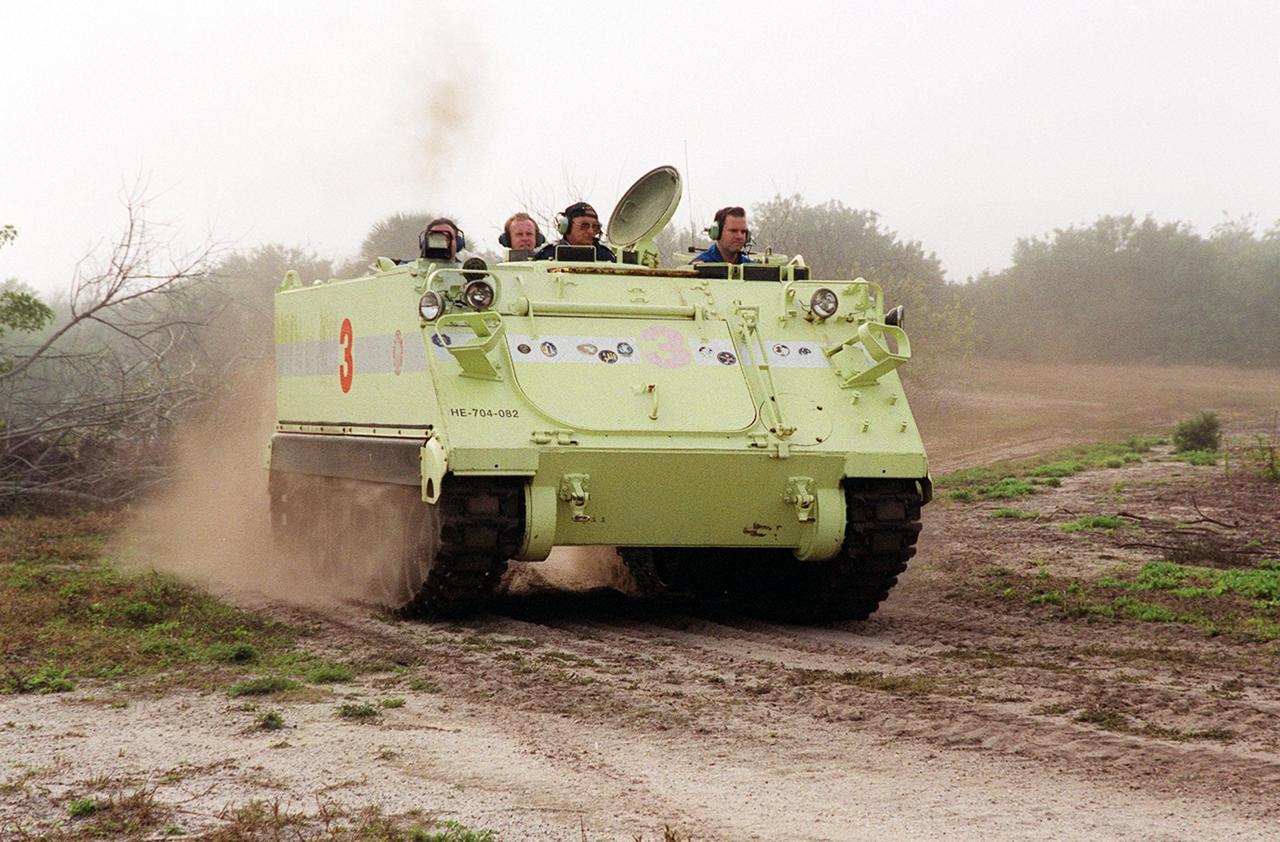
STS-102 Mission Specialist Paul Richards kicks up dust as he makes a turn while driving the M-113 armored carrier, part of emergency egress training at Launch Pad 39B. Seated alongside (at left) is Capt. George Hoggard, a training officer with SGS Fire Services. In the event of an emergency at the pad prior to launch, the M-113 could be used to transport the crew to a nearby bunker or farther. The STS-102 crew is at KSC to take part in Terminal Countdown Demonstration Test activities, which also include a simulated launch countdown. STS-102 is the eighth construction flight to the International Space Station, carrying as payload the Multi-Purpose Logistics Module Leonardo. Launch on mission STS-102 is scheduled for March 8
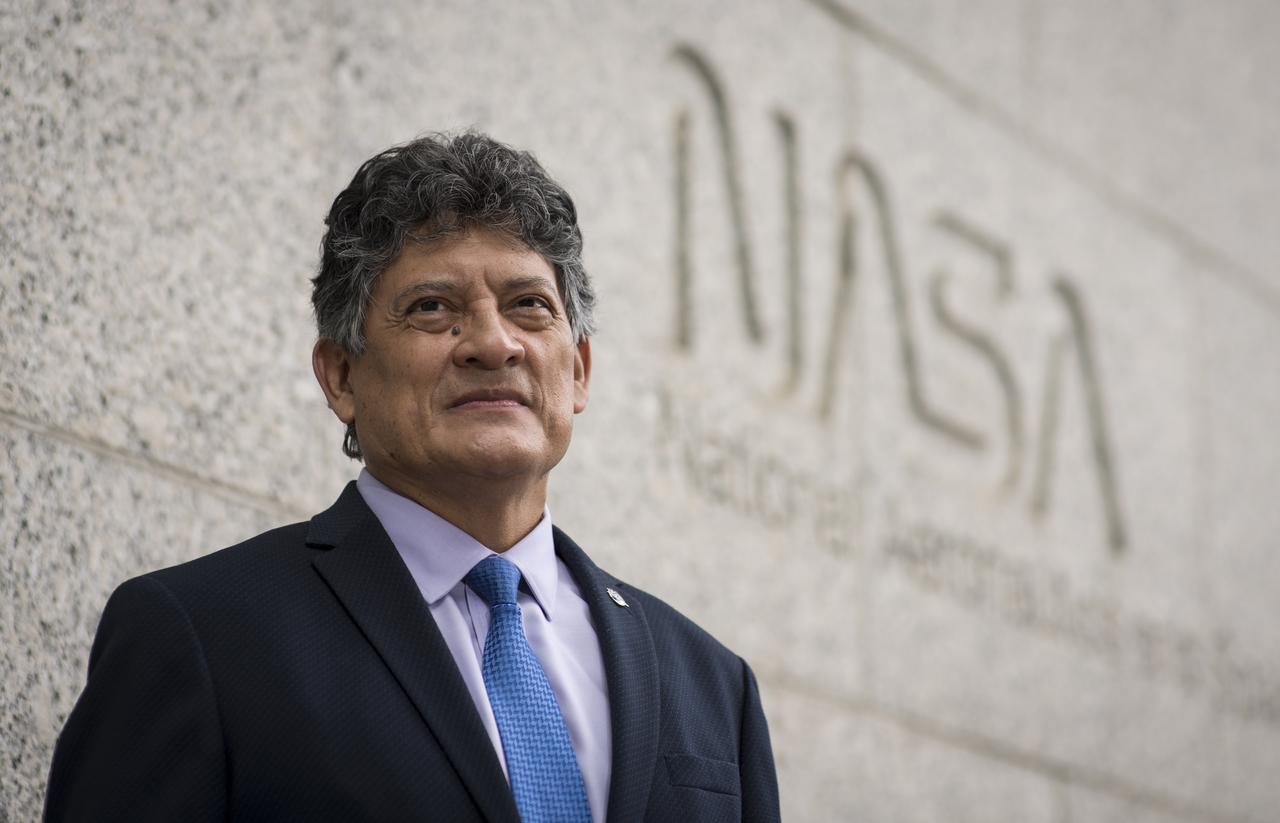
“My mother always instilled and made me appreciate the value of hard work and education. That was my pillar. We are a large family. I have family in Peru, still. I have family members in Europe, in Mexico, and across the U.S. They all face challenges every day, and that motivates me to keep moving forward. The military was no exception. It’s a challenging career. I’ve participated in war environments and peacekeeping operations. When I retired from the military, I took the uniform off one day and put on civilian clothes the next day and went on to work for the Department of Defense. I progressed in my public service career and went on to National Oceanic and Atmospheric Administration. Then, I finally came to NASA. I have always admired NASA. I remember since 1968, hearing about all the missions and projects and accomplishments. The reputation that NASA has! I researched how logistics work for NASA’s missions. That’s why I prepared myself. The military provided me a strong logistics background. I got a Master degree in Public Administration because my goal was to end up working for NASA. And I did so, on my second attempt. I started working for NASA’s Logistics Management Division, and served as Deputy Director. Working at NASA is something very special. I find myself surrounded by a group of professional individuals, working in a complete camaraderie environment. Yes, it has been a challenge, to get to work for NASA. But it’s worth it, every single day.” NASA Program Executive Manager for the Office of Insfrastructure, Miguel Angel Rodriguez Maco, poses for a portrait outside NASA Headquarters in Washington DC, Wednesday, Sept. 2, 2020. Photo Credit: (NASA/Aubrey Gemignani)
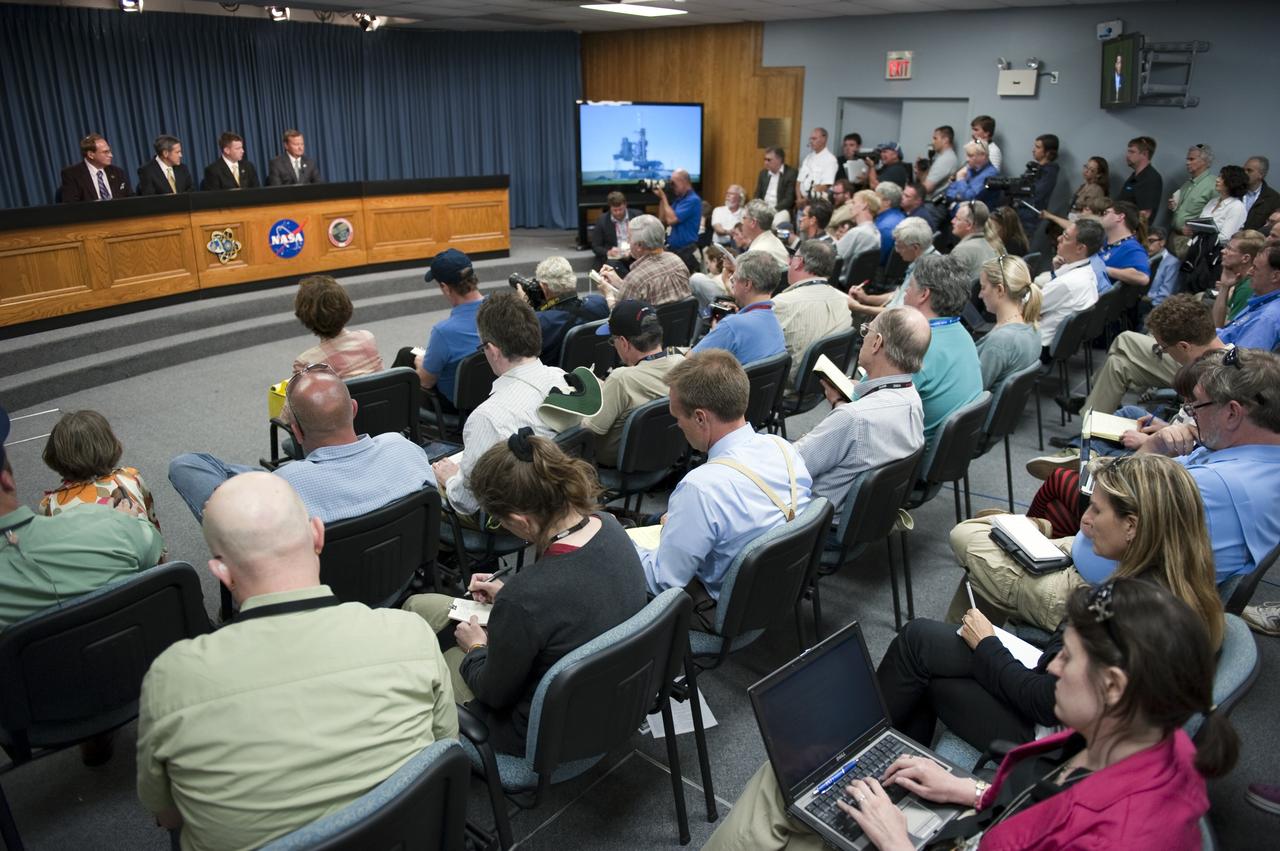
CAPE CANAVERAL, Fla. -- At NASA's Kennedy Space Center in Florida, Public Affairs Officer George Diller, Kennedy Director Bob Cabana, Space Shuttle Program Launch Integration Manager Mike Moses and Shuttle Launch Director Mike Leinbach participate in a news conference following the April 29 scrubbed launch attempt of space shuttle Endeavour. During the STS-134 countdown, fuel line heaters for Endeavour's auxiliary power unit-1 (APU-1) failed. Technicians later discovered that the Load Control Assembly-2 (LCA-2), which distributes power to nine shuttle systems, was the cause of the failure reading. The LCA-2 located in Endeavour's aft section will be replaced and systems will be retested before the launch is rescheduled. STS-134 will deliver the Express Logistics Carrier-3, Alpha Magnetic Spectrometer-2 (AMS), a high-pressure gas tank and additional spare parts for the Dextre robotic helper to the International Space Station. The mission also will be the final spaceflight for Endeavour. For more information, visit www.nasa.gov/mission_pages/shuttle/shuttlemissions/sts134/index.html. Photo credit: NASA/Kim Shiflett
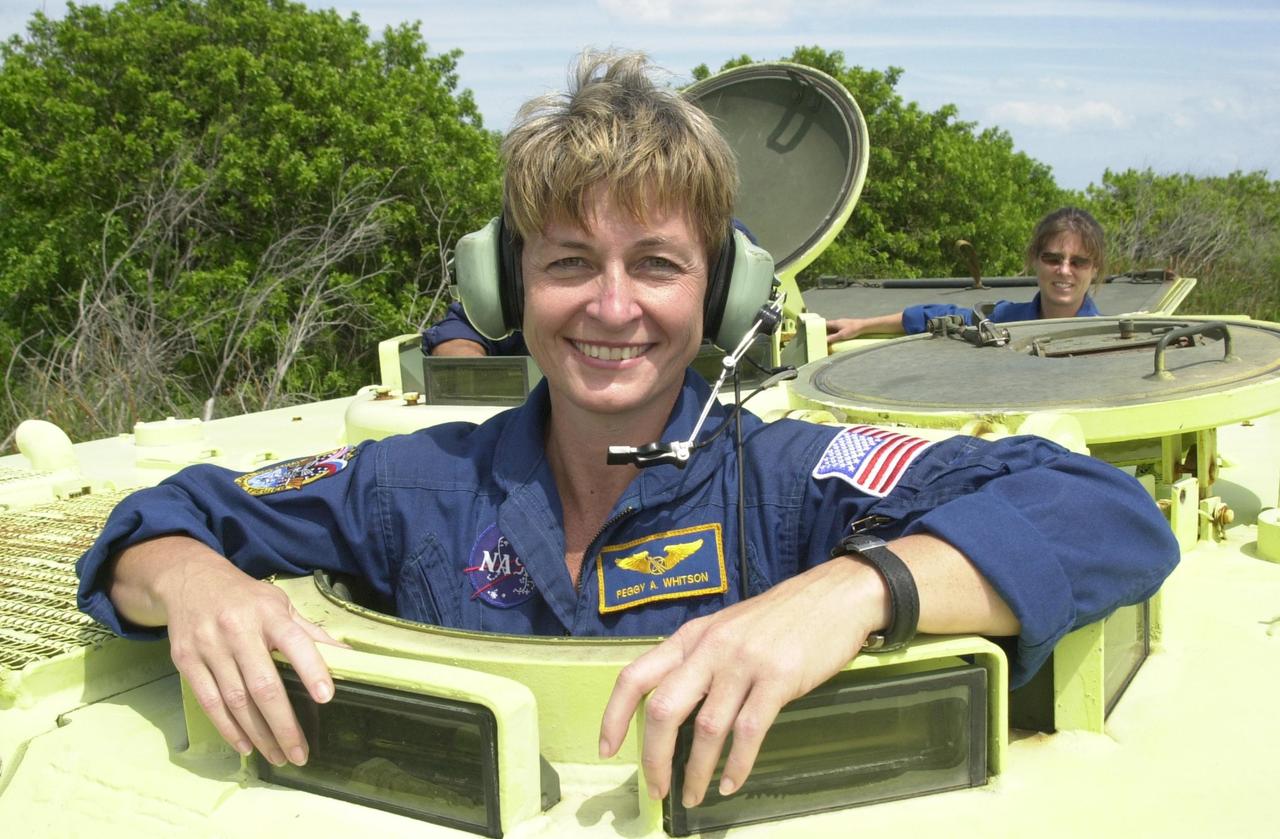
KENNEDY SPACE CENTER, FLA. -- During Terminal Countdown Demonstration Test activities at KSC, Expedition 5 member Peggy Whitson poses for the camera before climbing inside the M-113 armored personnel carrier, used for emergency egress training at the pad. Behind her (right) is astronaut Tracy Caldwell, a mission specialist candidate currently assigned to the Astronaut Office Space Station Operations Branch. Expedition 5 will travel to the International Space Station on mission STS-111 as the replacement crew for Expedition 4, who will return to Earth aboard Endeavour. The TCDT also includes a simulated launch countdown Known as Utilization Flight -2, the mission includes attaching a Canadian-built mobile base system to the International Space Station that will enable the Canadarm2 robotic arm to move along a railway on the Station's truss to build and maintain the outpost. The crew will also replace a faulty wrist/roll joint on the Canadarm2 as well as unload almost three tons of experiments and supplies from the Italian-built Multi-Purpose Logistics Module Leonardo. Launch of Space Shuttle Endeavour on mission STS-111 is scheduled for May 30, 2002
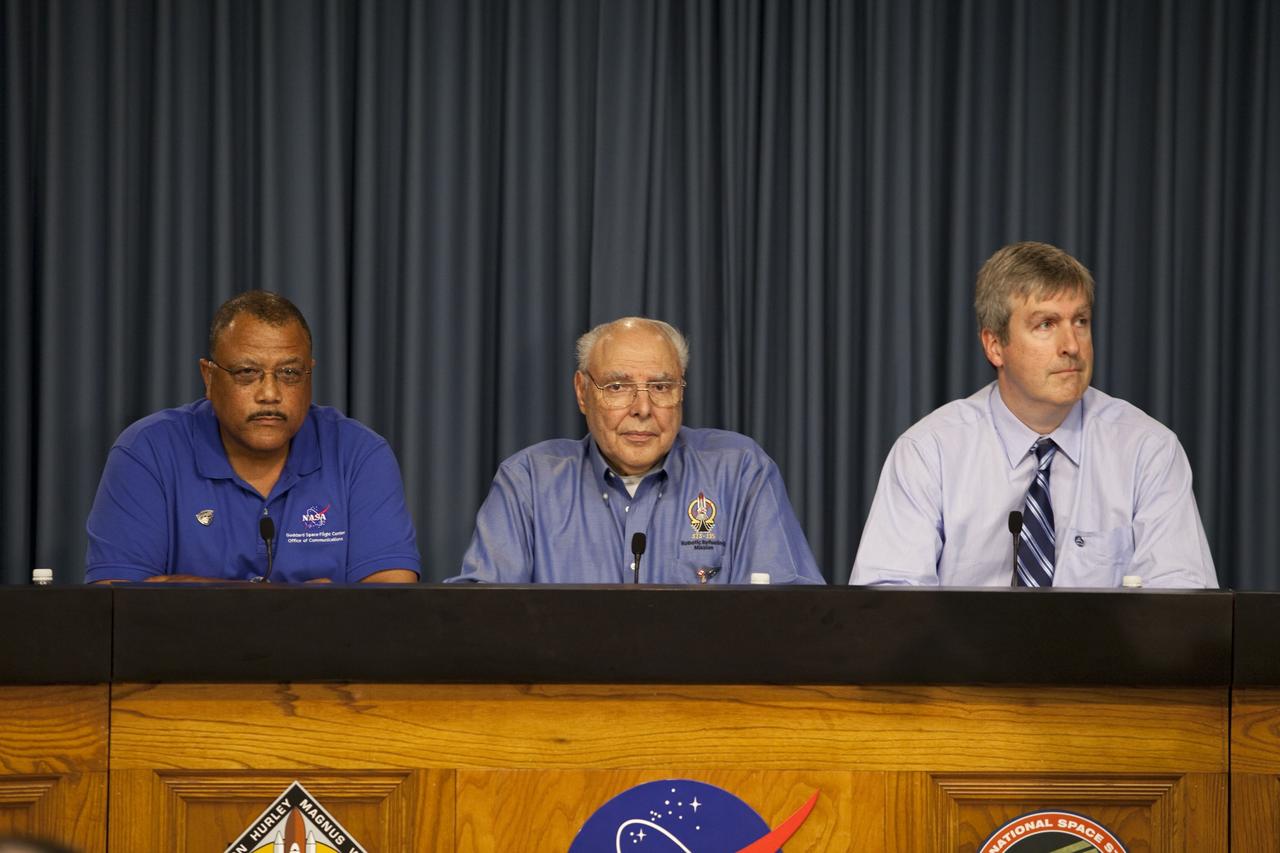
CAPE CANAVERAL, Fla. -- The Press Site auditorium at NASA's Kennedy Space Center in Florida hosted a Robotic Refueling Mission (RRM) module demonstration. Seen here speaking with media are Dewayne Washington from NASA's Goddard Space Flight Center in Maryland, moderator (left); Frank Cepollina, project manager with NASA's Satellite Servicing Capabilities Office and Mathieu Caron, Mission Operations manager with the Canadian Space Agency. Space shuttle Atlantis will fly the RRM on its STS-135 mission to the International Space Station. Once in place the RRM will use the station's two-armed robotic system, known as Dextre, to investigate the potential for robotically refueling existing satellites in orbit. Atlantis and its crew of four are scheduled to lift off at 11:26 a.m. EDT on July 8 to deliver the Raffaello multi-purpose logistics module packed with supplies and spare parts to the station. Atlantis also will fly the RRM and return a failed ammonia pump module to help NASA better understand the failure mechanism and improve pump designs for future systems. STS-135 will be the 33rd flight of Atlantis, the 37th shuttle mission to the space station, and the 135th and final mission of NASA's Space Shuttle Program. For more information visit, www.nasa.gov/mission_pages/shuttle/shuttlemissions/sts135/index.html. Photo credit: NASA/Frankie Martin
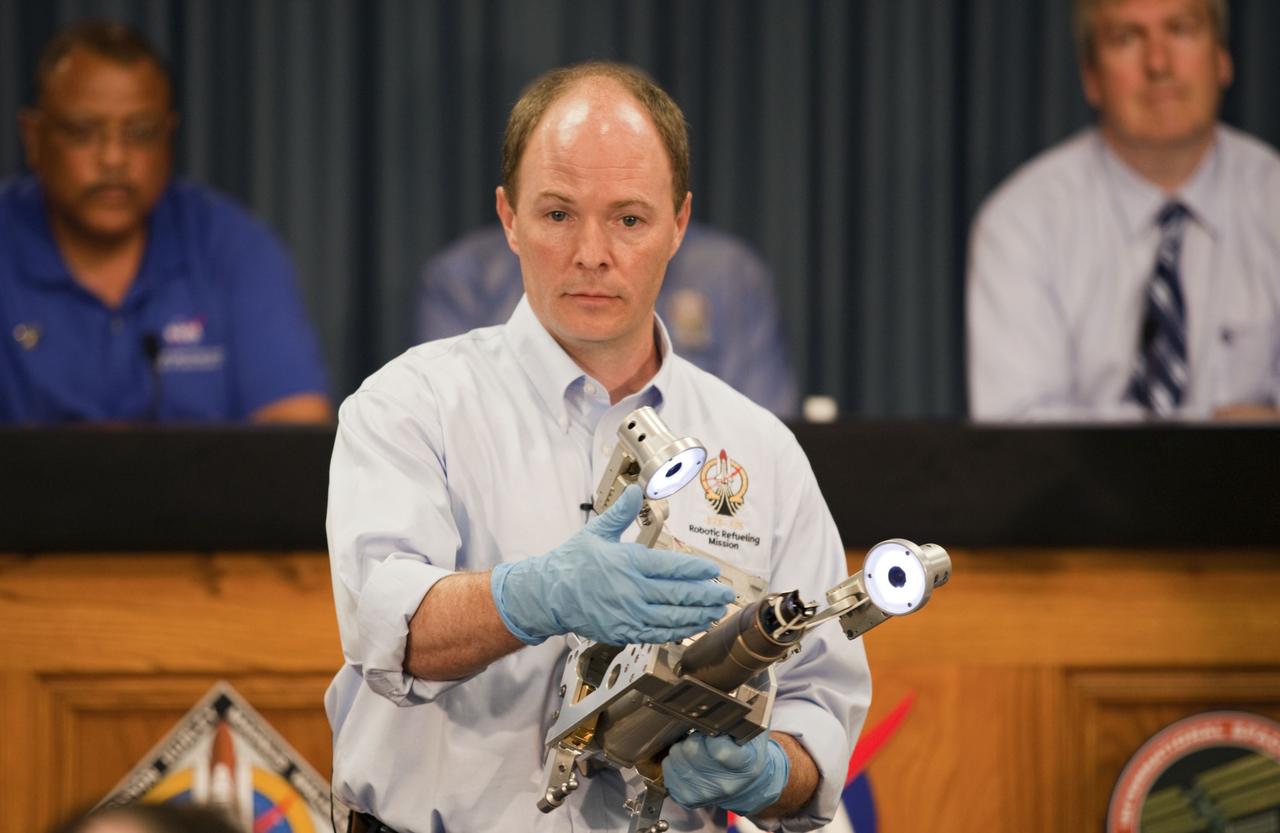
CAPE CANAVERAL, Fla. -- The Press Site auditorium at NASA's Kennedy Space Center in Florida hosted a Robotic Refueling Mission (RRM) module demonstration. Seen here is Benjamin Reed, deputy project manager with NASA's Satellite Servicing Capabilities Office, giving media an overview of the RRM. Space shuttle Atlantis will fly the RRM on its STS-135 mission to the International Space Station. Once in place, the RRM will use the station's two-armed robotic system, known as Dextre, to investigate the potential for robotically refueling existing satellites in orbit. Atlantis and its crew of four are scheduled to lift off at 11:26 a.m. EDT on July 8 to deliver the Raffaello multi-purpose logistics module packed with supplies and spare parts to the station. Atlantis also will fly the RRM and return a failed ammonia pump module to help NASA better understand the failure mechanism and improve pump designs for future systems. STS-135 will be the 33rd flight of Atlantis, the 37th shuttle mission to the space station, and the 135th and final mission of NASA's Space Shuttle Program. For more information visit, www.nasa.gov/mission_pages/shuttle/shuttlemissions/sts135/index.html. Photo credit: NASA/Frankie Martin
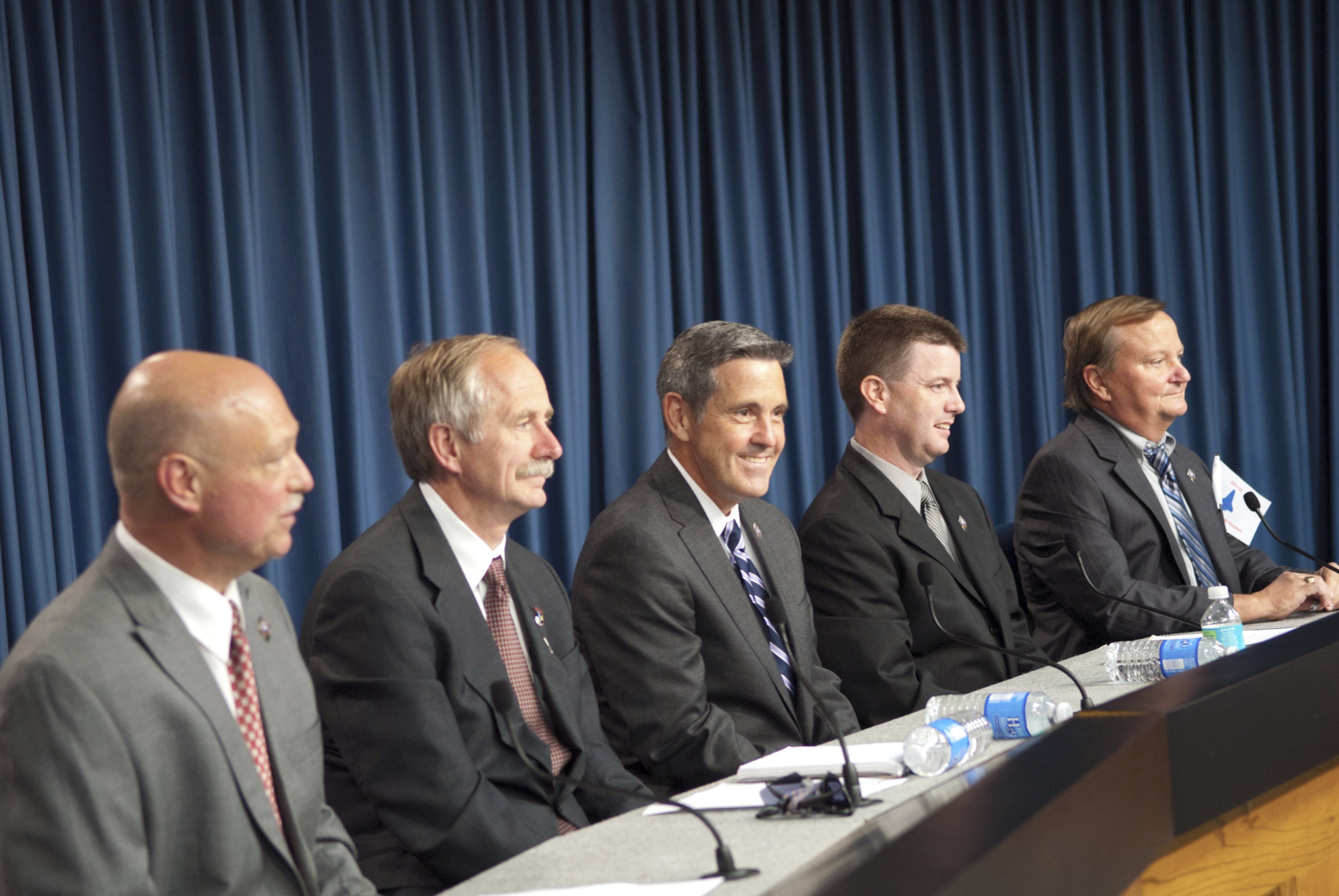
CAPE CANAVERAL, Fla. -- Members of the media gather for a post-launch news conference held in the Press Site auditorium at NASA's Kennedy Space Center in Florida, following the successful launch of space shuttle Atlantis on its STS-135 mission to the International Space Station. Seen here are NASA Public Affairs Officer Mike Curie (left) moderator; Associate Administrator for Space Operations Bill Gerstenmaier, Kennedy Center Director Bob Cabana, Shuttle Program Launch Integration Manager Mike Moses, and Shuttle Launch Director Mike Leinbach. Atlantis began its final flight at 11:29 a.m. EDT on July 8. STS-135 will deliver the Raffaello multi-purpose logistics module packed with supplies and spare parts for the International Space Station. Atlantis also will fly the Robotic Refueling Mission experiment that will investigate the potential for robotically refueling existing satellites in orbit. In addition, Atlantis will return with a failed ammonia pump module to help NASA better understand the failure mechanism and improve pump designs for future systems. STS-135 will be the 33rd flight of Atlantis, the 37th shuttle mission to the space station, and the 135th and final mission of NASA's Space Shuttle Program. For more information, visit www.nasa.gov/mission_pages/shuttle/shuttlemissions/sts135/index.html. Photo credit: NASA/Jim Grossmann
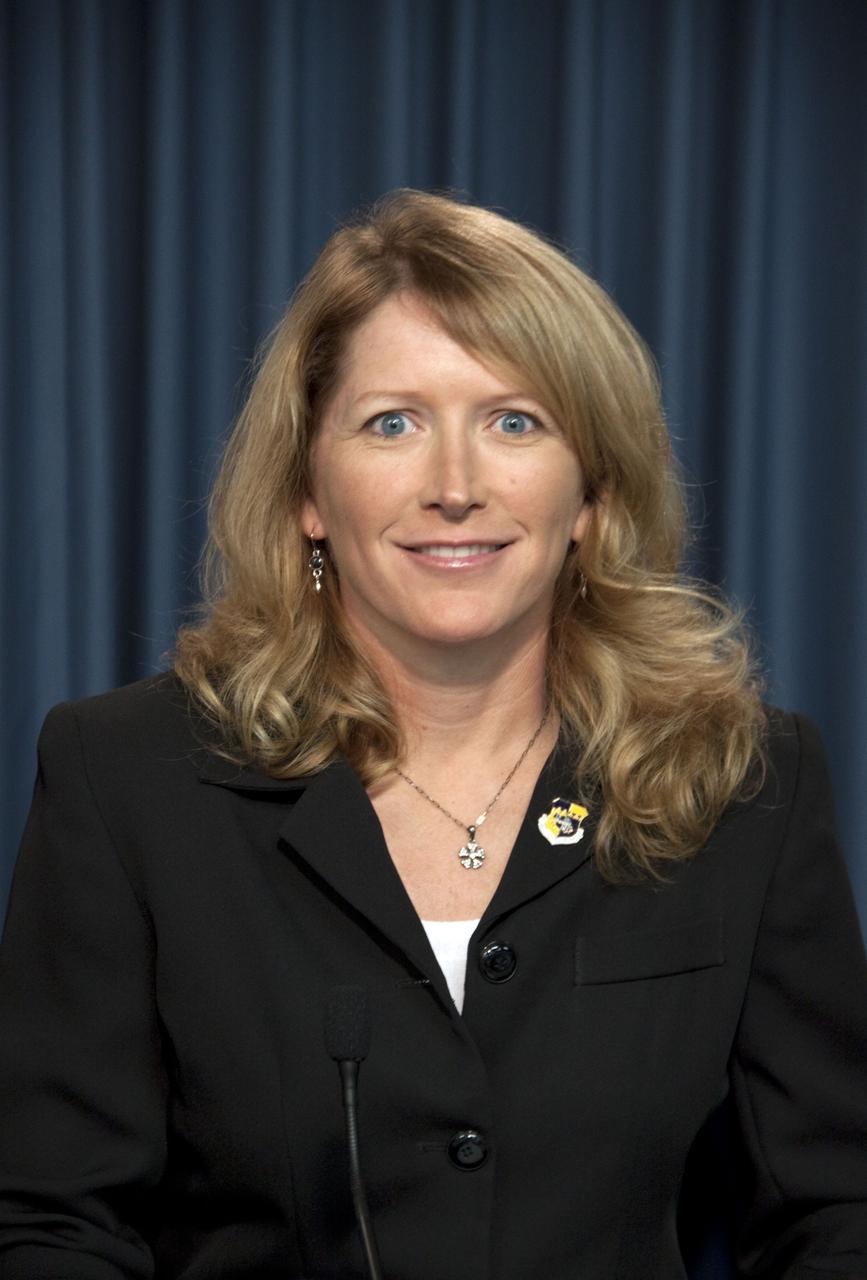
CAPE CANAVERAL, Fla. -- In the Press Site auditorium at NASA's Kennedy Space Center in Florida, NASA managers brief media about the payload and launch status of space shuttle Atlantis' STS-135 mission to the International Space Station. Seen here is Shuttle Weather Officer Kathy Winters. Atlantis and its crew are scheduled to lift off at 11:26 a.m. EDT on July 8 to deliver the Raffaello multi-purpose logistics module packed with supplies and spare parts to the station. The STS-135 mission also will fly a system to investigate the potential for robotically refueling existing satellites and return a failed ammonia pump module to help NASA better understand the failure mechanism and improve pump designs for future systems. STS-135 will be the 33rd flight of Atlantis, the 37th shuttle mission to the space station, and the 135th and final mission of NASA's Space Shuttle Program. For more information visit, www.nasa.gov/mission_pages/shuttle/shuttlemissions/sts135/index.html. Photo credit: NASA/Jim Grossmann
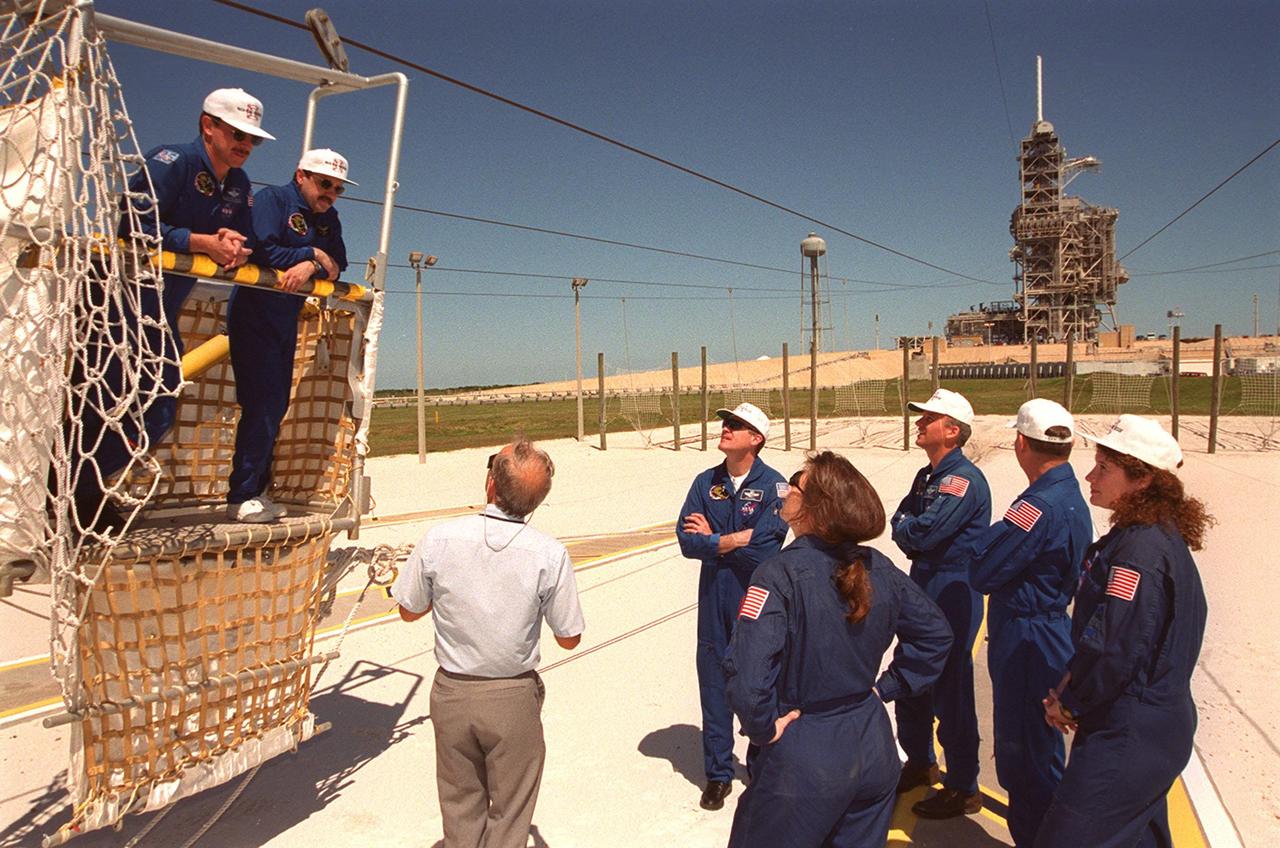
KENNEDY SPACE CENTER, Fla. -- During emergency egress training at Launch pad 39A, STS-101 Pilot Scott J. "Doc" Horowitz and Mission Specialist Yury Usachev stand in the slidewire basket at the landing zone. The Safety Egress officer (left on ground) provides training on use of the basket in the event the crew needed to exit quickly from the fixed service structure (background) at the 195-foot level. The rest of the crew, clockwise at right, are Commander James D. Halsell Jr. and Mission Specialists Jeffrey N. Williams, James Voss, Susan Helms, and (back to the camera) Mary Ellen Weber. The training is part of Terminal Countdown Demonstration Test (TCDT) activities that include a simulated launch countdown and familiarization with the payload. During their mission to the International Space Station, the STS-101 crew will be delivering logistics and supplies, plus preparing the Station for the arrival of the Zvezda Service Module, expected to be launched by Russia in July 2000. Also, the crew will conduct one space walk to perform maintenance on the Space Station. This will be the third assembly flight for the Space Station. STS-101 is scheduled to launch April 24 at 4:15 p.m. from Launch Pad 39A

CAPE CANAVERAL, Fla. -- Howard Hu, manager for the Orion System Performance and Analysis Office at NASA's Johnson Space Center, provides an overview of the Sensor Test for Orion Relnav Risk Mitigation, or STORRM, flight test that space shuttle Endeavour will perform on the last on-orbit day of the STS-134 mission. The overview took place at NASA's Kennedy Space Center in Florida where Endeavour is awaiting liftoff. During the mission, Endeavour will fly a dedicated maneuver to simulate an Orion rendezvous trajectory, while two Orion sensors collect visual- and laser-based relative navigation data. This will provide an unprecedented in-flight test opportunity for America's next-generation exploration spacecraft. STS-134 also will deliver the Express Logistics Carrier-3, Alpha Magnetic Spectrometer-2 (AMS), a high-pressure gas tank and additional spare parts for the Dextre robotic helper to the space station. Endeavour was scheduled to launch at 3:47 p.m. on April 29, but that attempt was scrubbed for at least 72 hours while engineers assess an issue associated with the shuttle's Auxiliary Power Unit 1. STS-134 will be the final spaceflight for Endeavour. For more information visit, www.nasa.gov_mission_pages_shuttle_shuttlemissions_sts134_index.html. Photo credit: NASA_Jack Pfaller
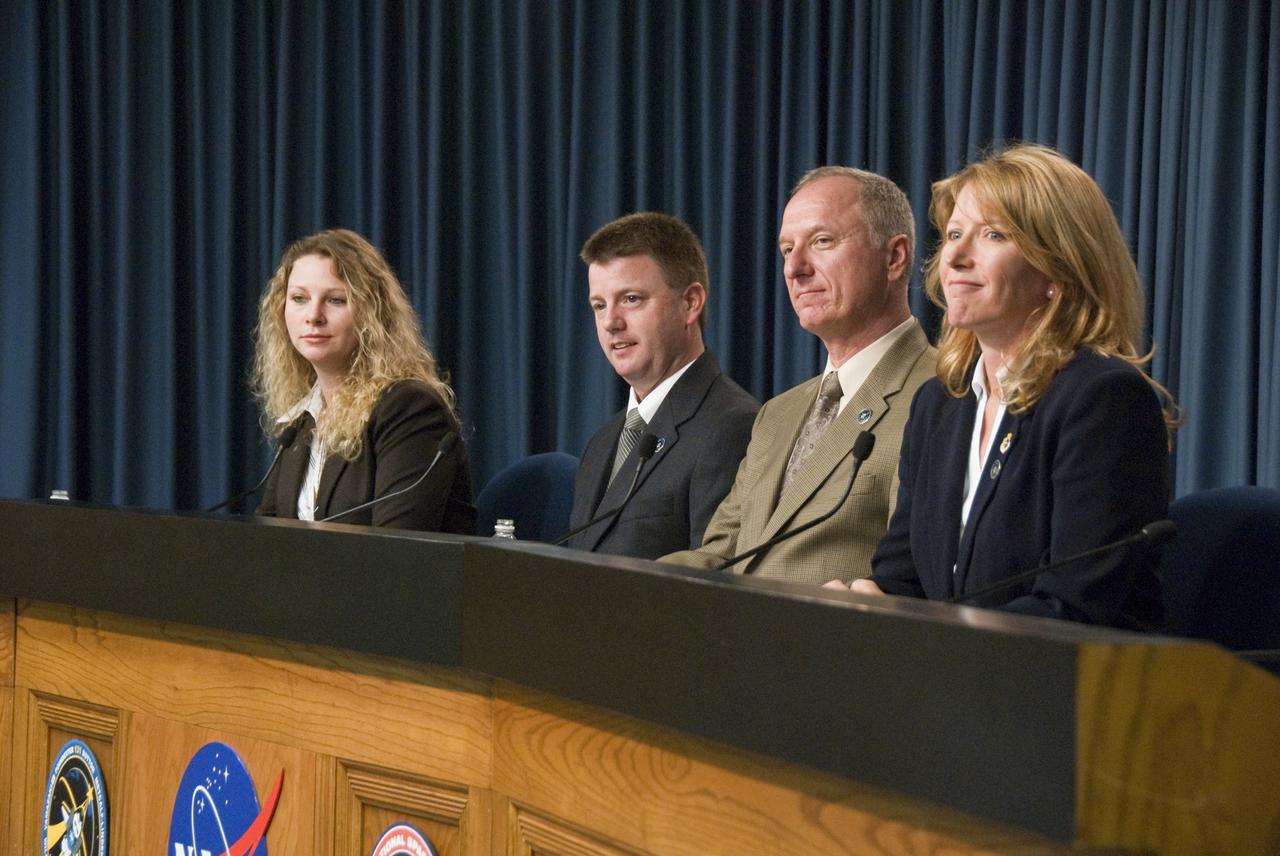
CAPE CANAVERAL, Fla. - In the Press Site auditorium at NASA's Kennedy Space Center in Florida, NASA managers participate in a prelaunch news conference for space shuttle Discovery's STS-131 mission. From left are Candrea Thomas, NASA Public Affairs moderator; Mike Moses, chair, Mission Management Team; Pete Nickolenko, STS-131 launch director; and Kathy Winters, shuttle weather officer. Liftoff of the STS-131 mission is set for 6:21 a.m. EDT on April 5. On STS-131, the seven-member crew will deliver the multi-purpose logistics module Leonardo, filled with supplies, a new crew sleeping quarters and science racks that will be transferred to the International Space Station's laboratories. The crew also will switch out a gyroscope on the station’s truss, install a spare ammonia storage tank and retrieve a Japanese experiment from the station’s exterior. STS-131 is the 33rd shuttle mission to the station and the 131st shuttle mission overall. For information on the STS-131 mission and crew, visit http:__www.nasa.gov_mission_pages_shuttle_shuttlemissions_sts131_index.html. Photo credit: NASA_Ben Smegelsky
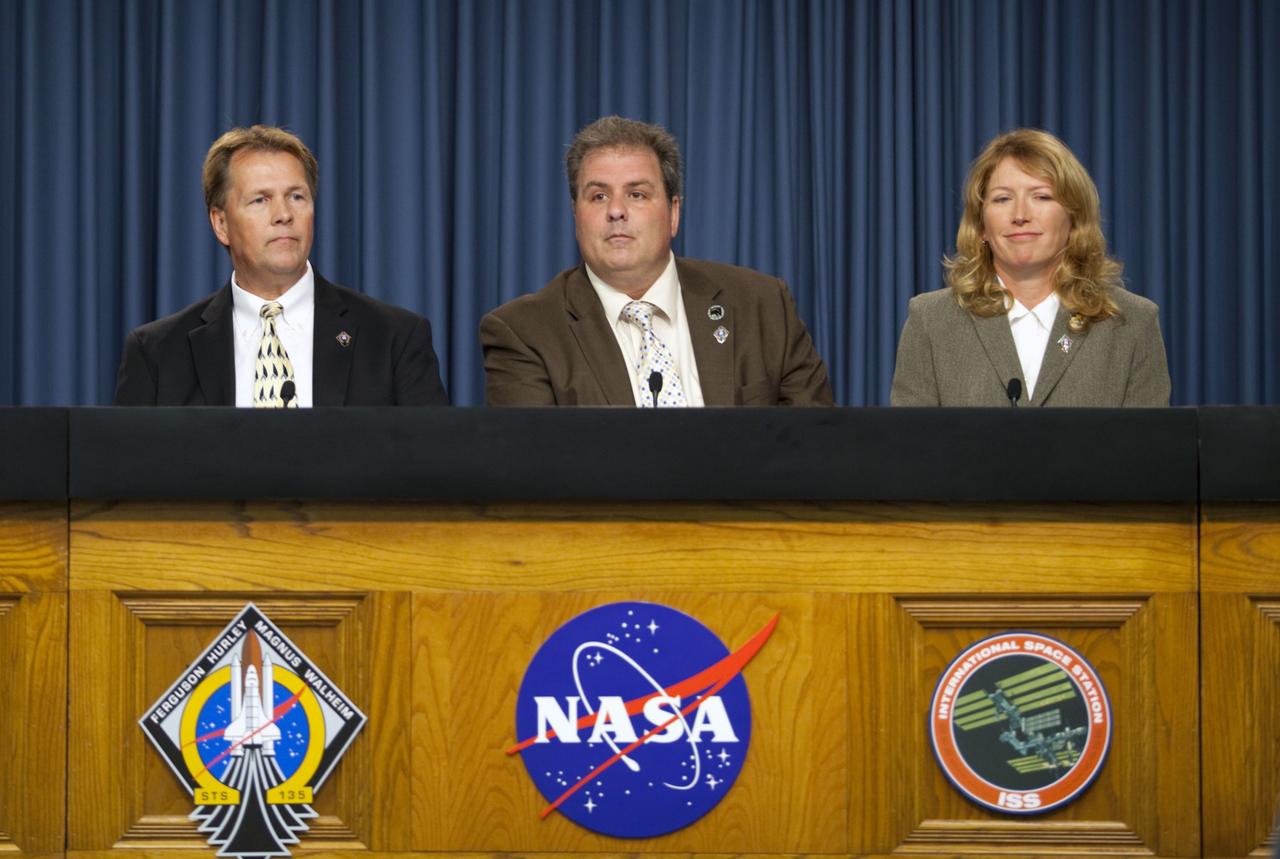
CAPE CANAVERAL, Fla. -- In the Press Site auditorium at NASA's Kennedy Space Center in Florida, NASA managers brief media about the payload and launch status of space shuttle Atlantis' STS-135 mission to the International Space Station. Seen here are NASA Test Director Jeff Spaulding (left), Payload Mission Manager Joe Delai and Shuttle Weather Officer Kathy Winters. Atlantis and its crew of four; Commander Chris Ferguson, Pilot Doug Hurley and Mission Specialists Sandy Magnus and Rex Walheim, are scheduled to lift off at 11:26 a.m. EDT on July 8 to deliver the Raffaello multi-purpose logistics module packed with supplies and spare parts to the station. Atlantis also will fly the Robotic Refueling Mission experiment that will investigate the potential for robotically refueling existing satellites in orbit. In addition, Atlantis will return with a failed ammonia pump module to help NASA better understand the failure mechanism and improve pump designs for future systems. STS-135 will be the 33rd flight of Atlantis, the 37th shuttle mission to the space station, and the 135th and final mission of NASA's Space Shuttle Program. For more information visit, www.nasa.gov/mission_pages/shuttle/shuttlemissions/sts135/index.html. Photo credit: NASA/Frankie Martin

CAPE CANAVERAL, Fla. -- On the Shuttle Landing Facility at NASA's Kennedy Space Center in Florida, the STS-135 crew members have disembarked from T-38 jets. Seen here are Commander Chris Ferguson (left), Mission Specialist Sandy Magnus, Pilot Doug Hurley, Jerry Ross, chief of the Vehicle Integration Test Office and former NASA astronaut; Shuttle Launch Director Mike Leinbach and Mission Specialist Rex Walheim. The STS-135 astronauts arrived at Kennedy about 2:30 p.m. EDT on July 4 for final preparations for space shuttle Atlantis' STS-135 mission to the International Space Station. Atlantis is scheduled to lift off on July 8 to deliver the Raffaello multi-purpose logistics module packed with supplies and spare parts to the station. The STS-135 mission also will fly a system to investigate the potential for robotically refueling existing satellites and return a failed ammonia pump module to help NASA better understand the failure mechanism and improve pump designs for future systems. STS-135 will be the 33rd flight of Atlantis, the 37th shuttle mission to the space station, and the 135th and final mission of NASA's Space Shuttle Program. For more information visit, www.nasa.gov/mission_pages/shuttle/shuttlemissions/sts135/index.html. Photo credit: NASA/Jim Grossmann
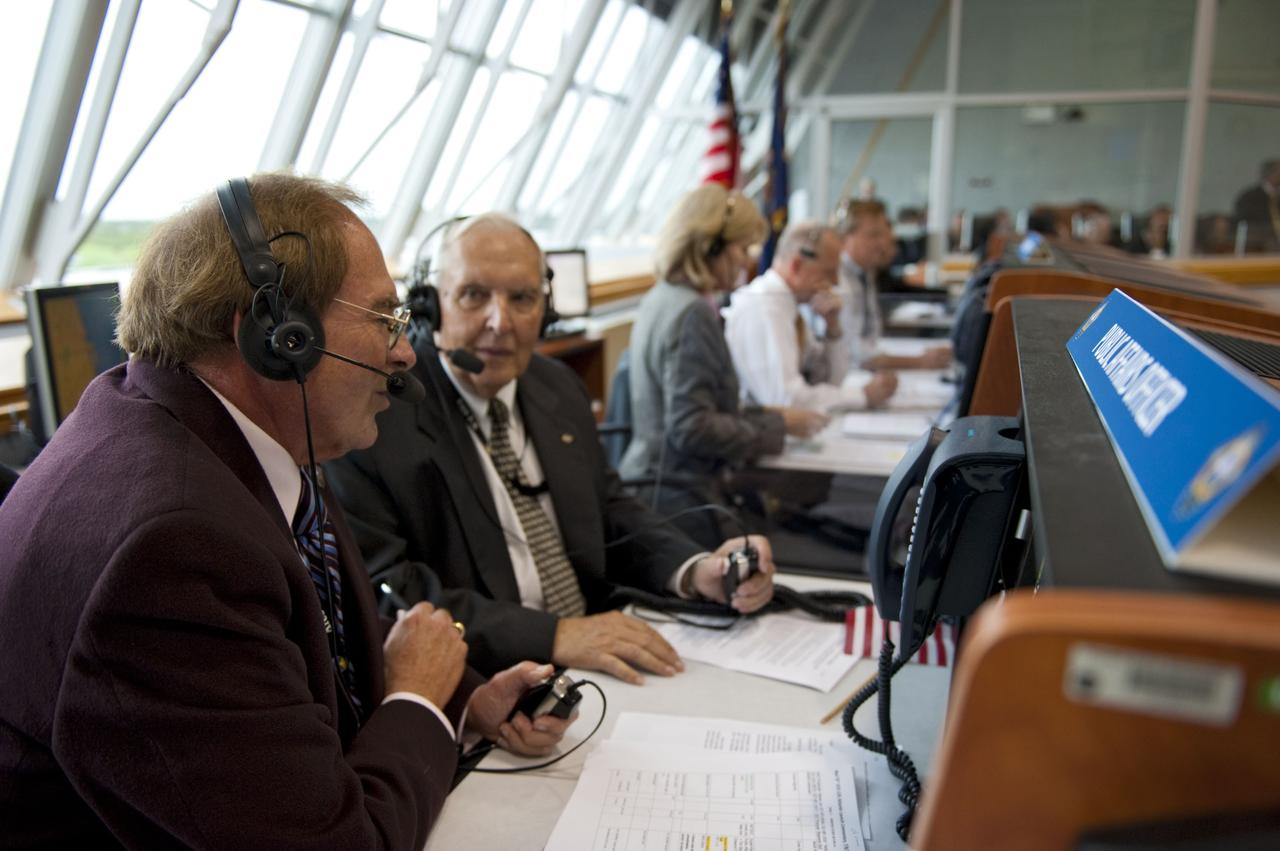
CAPE CANAVERAL, Fla. -- In Firing Room 4 of the Launch Control Center at NASA's Kennedy Space Center in Florida, NASA Launch Commentator and Public Affairs Officer George Diller interviews former Kennedy Director of Public Affairs Hugh Harris during prelaunch activities before liftoff of space shuttle Atlantis on its STS-135 mission. Atlantis with its crew of four; Commander Chris Ferguson, Pilot Doug Hurley, Mission Specialists Sandy Magnus and Rex Walheim, lifted off at 11:29 a.m. EDT on July 8, 2011 to deliver the Raffaello multi-purpose logistics module packed with supplies and spare parts for the station. Atlantis also will fly the Robotic Refueling Mission experiment that will investigate the potential for robotically refueling existing satellites in orbit. In addition, Atlantis will return with a failed ammonia pump module to help NASA better understand the failure mechanism and improve pump designs for future systems. STS-135 will be the 33rd flight of Atlantis, the 37th shuttle mission to the space station, and the 135th and final mission of NASA's Space Shuttle Program. For more information, visit www.nasa.gov/mission_pages/shuttle/shuttlemissions/sts135/index.html. Photo credit: NASA/Kim Shiflett
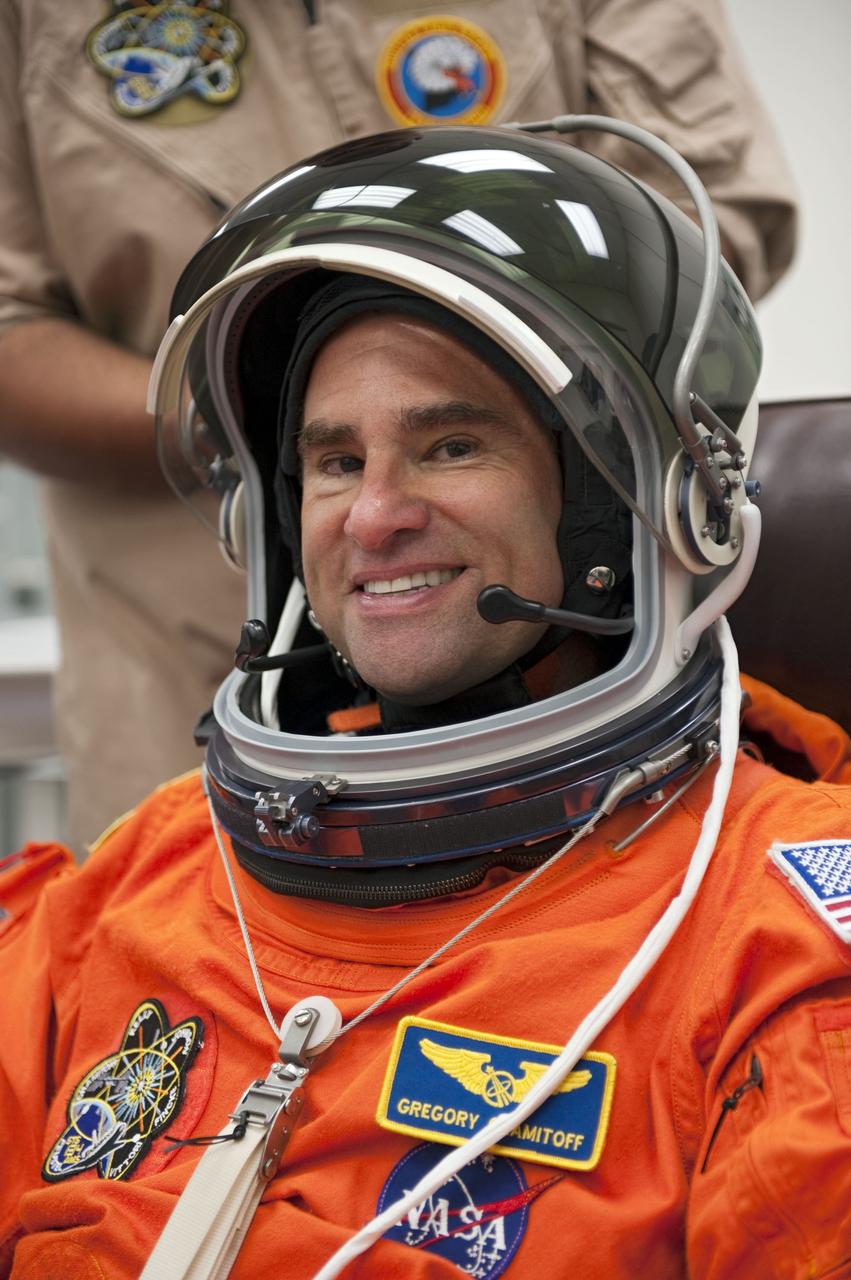
CAPE CANAVERAL, Fla. -- In the Operations and Checkout Building (O&C) at NASA's Kennedy Space Center in Florida, space shuttle Endeavour's STS-134 astronauts put on their launch-and-entry suits and check the fit of their helmets and gloves before heading to the Astrovan for the ride to Launch Pad 39A. Mission Specialist Greg Chamitoff, seen here, last served as flight engineer and science officer aboard the International Space Station in 2008. STS-134 will deliver the Express Logistics Carrier-3, Alpha Magnetic Spectrometer-2 (AMS), a high-pressure gas tank and additional spare parts for the Dextre robotic helper to the space station. Endeavour was scheduled to launch at 3:47 p.m. on April 29, but that attempt was scrubbed for at least 72 hours while engineers assess an issue associated with the shuttle's Auxiliary Power Unit 1. STS-134 will be the final spaceflight for Endeavour. For more information visit, www.nasa.gov/mission_pages/shuttle/shuttlemissions/sts134/index.html. Photo credit: NASA/Kim Shiflett
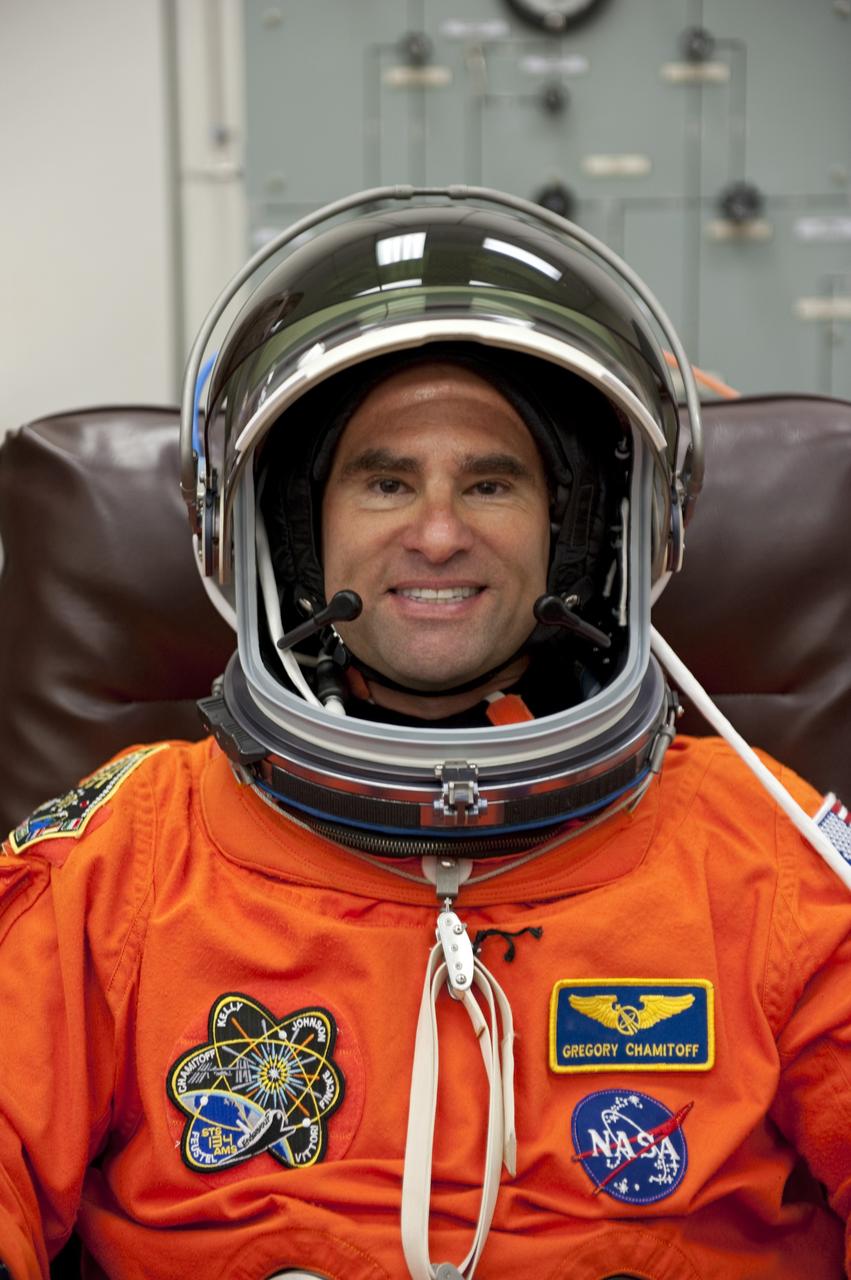
CAPE CANAVERAL, Fla. -- In the Operations and Checkout Building (O&C) at NASA's Kennedy Space Center in Florida, space shuttle Endeavour's STS-134 astronauts put on their launch-and-entry suits and check the fit of their helmets and gloves before heading to the Astrovan for the ride to Launch Pad 39A. Mission Specialist Greg Chamitoff, seen here, last served as flight engineer and science officer aboard the International Space Station in 2008. STS-134 will deliver the Alpha Magnetic Spectrometer-2 (AMS), Express Logistics Carrier-3, a high-pressure gas tank and additional spare parts for the Dextre robotic helper to the International Space Station. May 16 at 8:56 a.m. will be the second launch attempt for Endeavour. The first attempt on April 29 was scrubbed because of an issue associated with a faulty power distribution box called the aft load control assembly-2 (ALCA-2). STS-134 will be the final spaceflight for Endeavour. For more information visit, www.nasa.gov/mission_pages/shuttle/shuttlemissions/sts134/index.html. Photo credit: NASA/Kim Shiflett
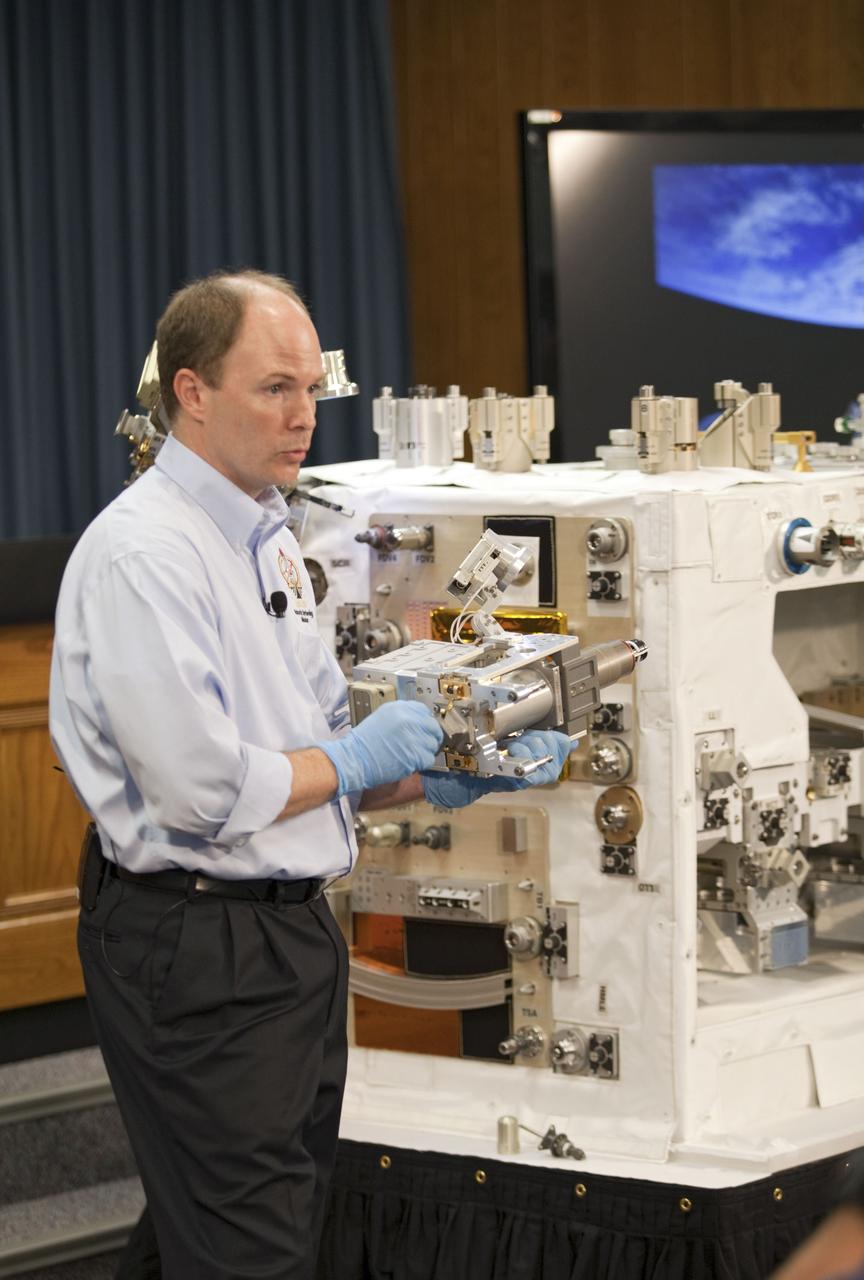
CAPE CANAVERAL, Fla. -- The Press Site auditorium at NASA's Kennedy Space Center in Florida hosted a Robotic Refueling Mission (RRM) module demonstration. Seen here is Benjamin Reed, deputy project manager with NASA's Satellite Servicing Capabilities Office, giving media an overview of the RRM. Space shuttle Atlantis will fly the RRM on its STS-135 mission to the International Space Station. Once in place, the RRM will use the station's two-armed robotic system, known as Dextre, to investigate the potential for robotically refueling existing satellites in orbit. Atlantis and its crew of four are scheduled to lift off at 11:26 a.m. EDT on July 8 to deliver the Raffaello multi-purpose logistics module packed with supplies and spare parts to the station. Atlantis also will fly the RRM and return a failed ammonia pump module to help NASA better understand the failure mechanism and improve pump designs for future systems. STS-135 will be the 33rd flight of Atlantis, the 37th shuttle mission to the space station, and the 135th and final mission of NASA's Space Shuttle Program. For more information visit, www.nasa.gov/mission_pages/shuttle/shuttlemissions/sts135/index.html. Photo credit: NASA/Frankie Martin
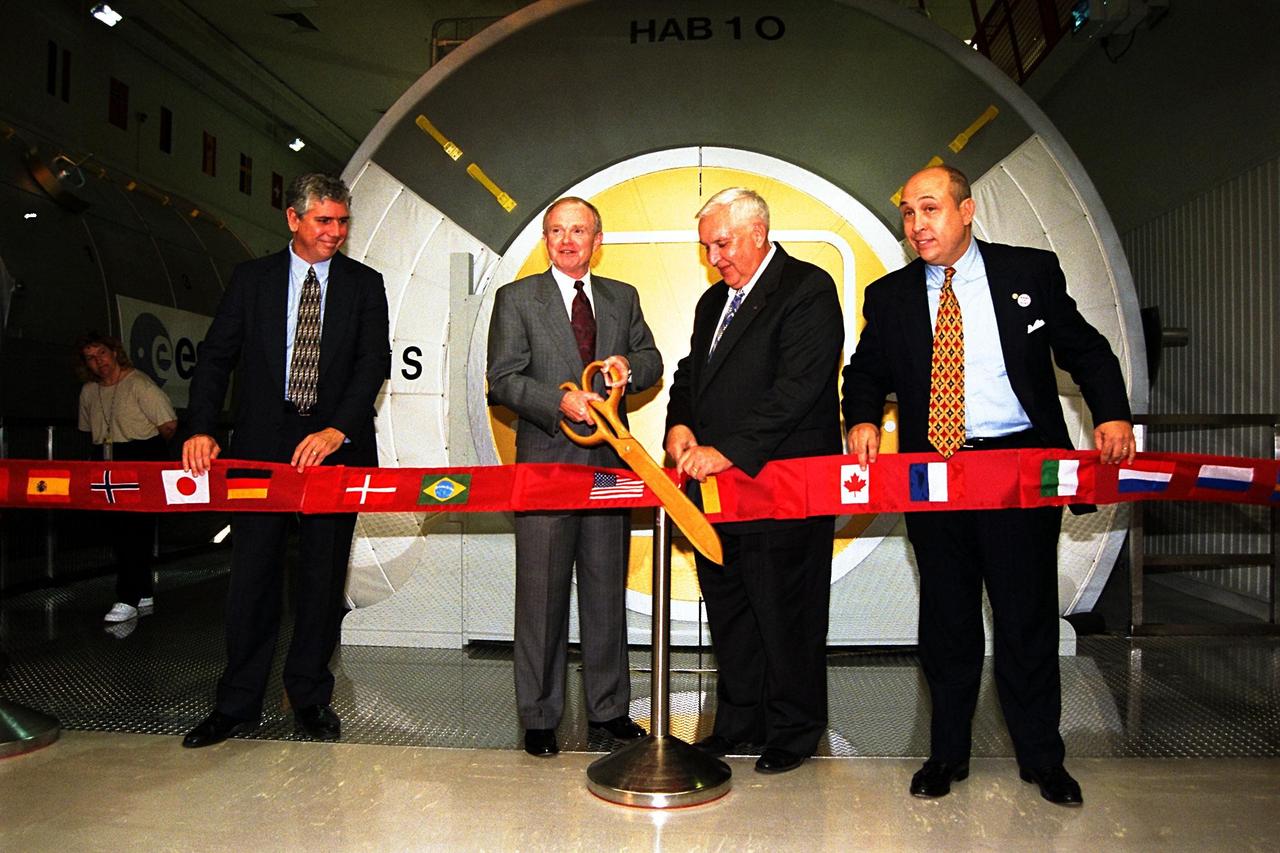
Celebrating the official opening of the new International Space Station (ISS) Center at Kennedy Space Center are, left to right, James Ball, chief, NASA Public Services, KSC; KSC Director Roy D. Bridges Jr.; Hugh Harris, director, NASA Public Affairs, KSC; and Rick Abramson, president and chief operating officer, Delaware North Parks Services of Spaceport Inc. Center Director Bridges cuts the ribbon to the new tour attraction where full-scale mockups of station modules, through which visitors can walk, are on display. These include the Habitation Unit, where station crew members will live, sleep, and work; a Laboratory Module; and the Pressurized Logistics Module, where racks and supplies will be transported back and forth from KSC to space. Guests also can take an elevated walkway to a gallery overlooking the work are where actual ISS hardware is prepared for flight into space. This new tour site, in addition to a new Launch Complex 39 Observation Gantry, are part of a comprehensive effort by NASA and Delaware North to expand and improve the KSC public tour and visitor facilities
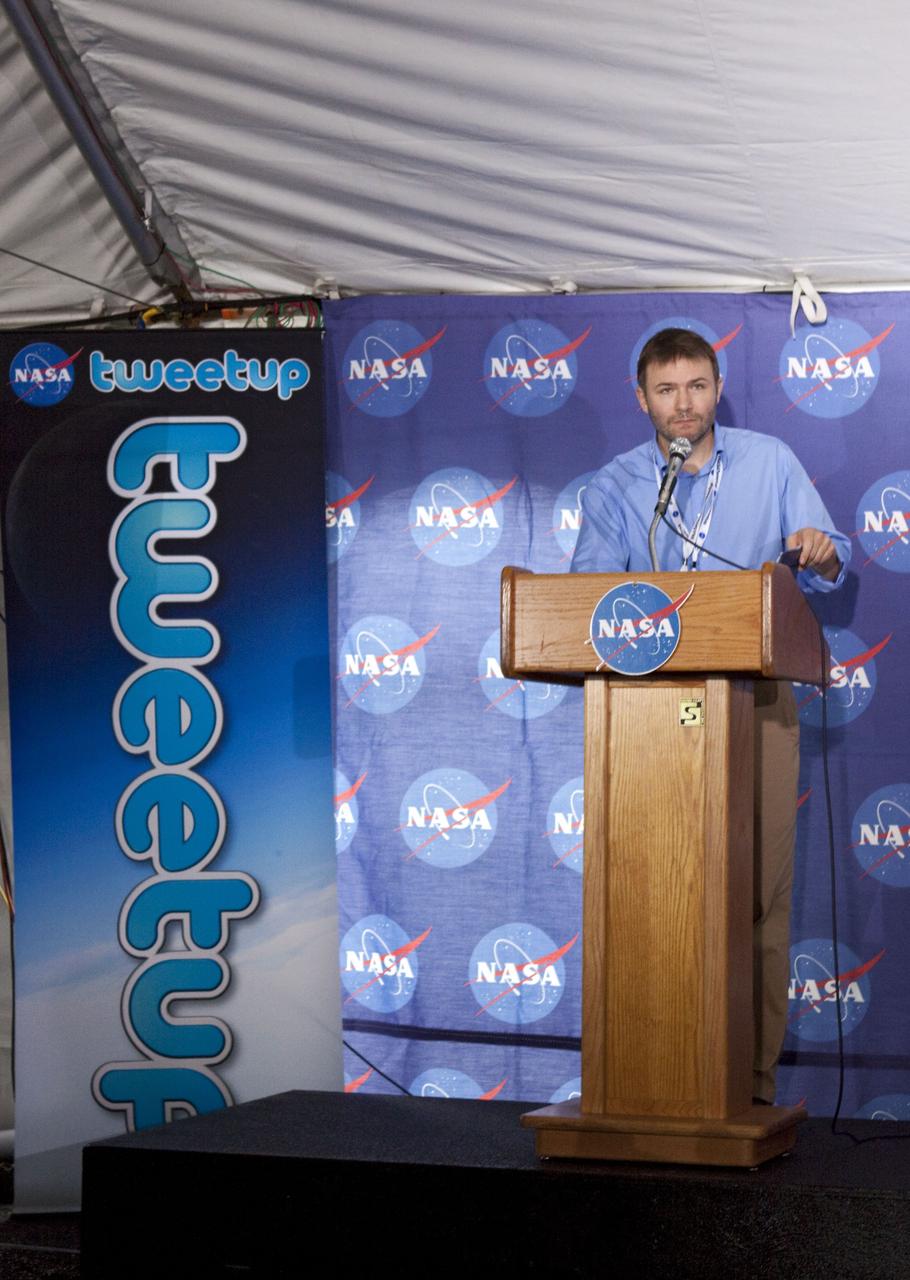
CAPE CANAVERAL, Fla. -- At Kennedy Space Center in Florida, NASA is hosting a Tweetup for 150 Twitter followers of space shuttle Atlantis' STS-135 mission to the International Space Station, selected from more than 5,500 online registrants. A Tweetup is an informal meeting of people who use the social messaging medium Twitter. This Tweetup is an opportunity to learn more about NASA, explore NASA's Kennedy Space Center in Florida and experience a space shuttle launch. Here, NASA Public Affairs Officer John Yembrick addresses the participants. Atlantis and its crew of four; Commander Chris Ferguson, Pilot Doug Hurley, Mission Specialists Sandy Magnus and Rex Walheim, are scheduled to lift off at 11:26 a.m. EDT on July 8 to deliver the Raffaello multi-purpose logistics module packed with supplies and spare parts to the station. Atlantis also will fly the Robotic Refueling Mission experiment that will investigate the potential for robotically refueling existing satellites in orbit. In addition, Atlantis will return with a failed ammonia pump module to help NASA better understand the failure mechanism and improve pump designs for future systems. STS-135 will be the 33rd flight of Atlantis, the 37th shuttle mission to the space station, and the 135th and final mission of NASA's Space Shuttle Program. For more information visit, www.nasa.gov/mission_pages/shuttle/shuttlemissions/sts135/index.html. Photo credit: NASA/Troy Cryder
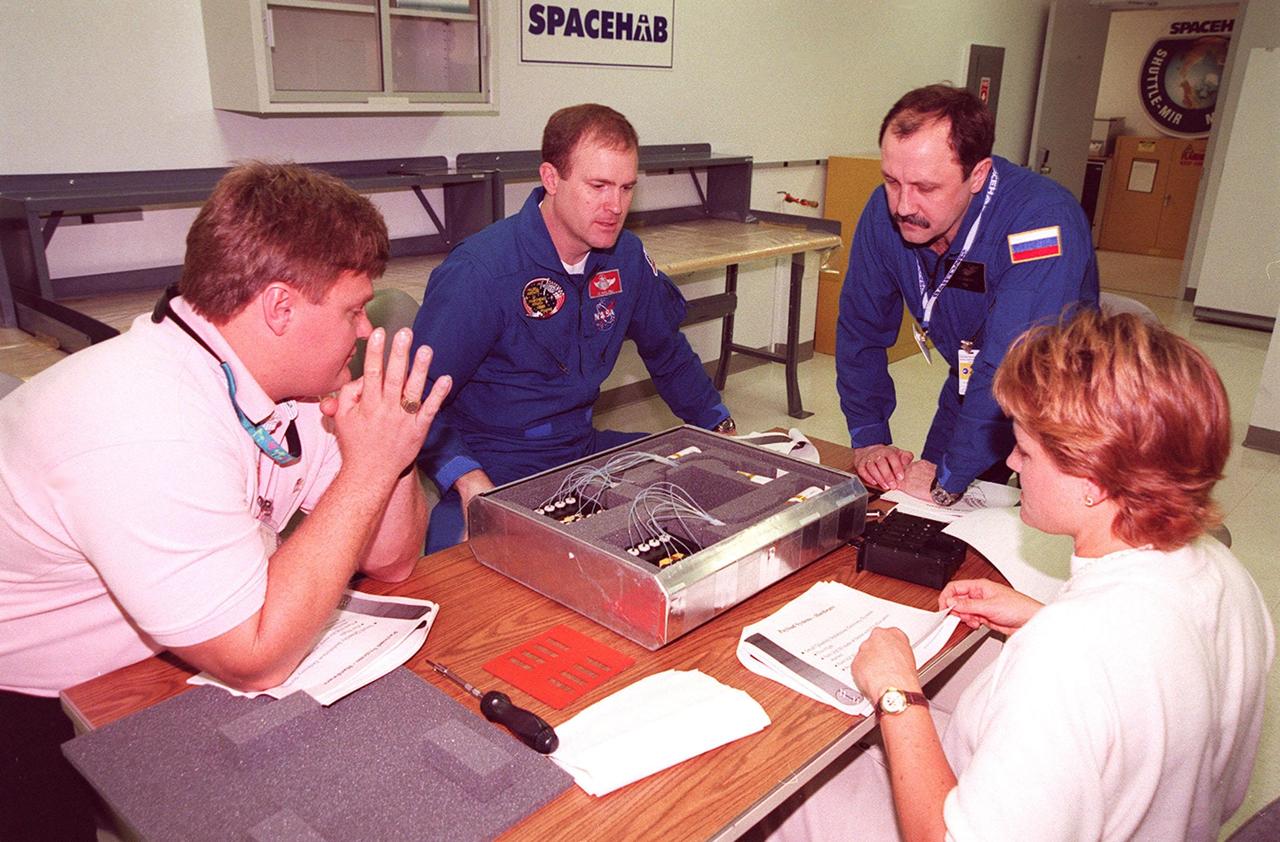
KENNEDY SPACE CENTER, FLA. -- At SPACEHAB, in Cape Canaveral, Fla., members of the STS-101 crew take part in Crew Equipment Interface Test (CEIT) activities, learning about some of the equipment they will be working with on their mission to the International Space Station. Commander James Halsell and Mission Specialist Yuri Usachev of Russia look over a biotube precursor in front of them with (left) Dan Shultz of NASA's Flight Experiments Mission Management Office and (right) April Boody of Bionetics. Other members of the crew (not shown) taking part in the CEIT are Pilot Scott Horowitz and Mission Specialists Mary Ellen Weber, James Voss, Jeffrey Williams and Susan Helms. The crew will be responsible for preparing the Space Station for the arrival of the Zvezda Service Module, expected to be launched by Russia in July 2000. Also, the crew will conduct one space walk to perform maintenance on the Space Station and deliver logistics and supplies. This will be the third assembly flight for the Space Station. STS-101 is scheduled to launch no earlier than April 13 from Launch Pad 39A
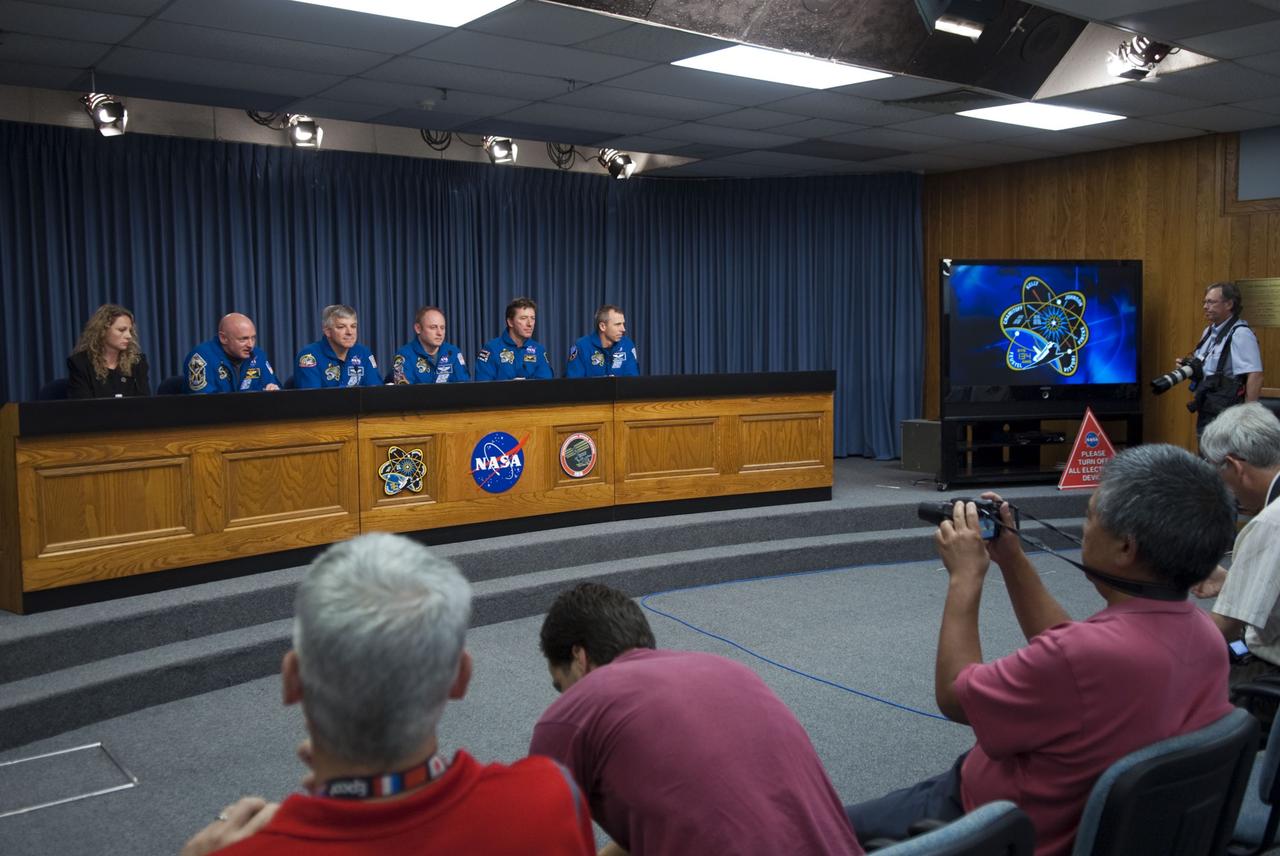
CAPE CANAVERAL, Fla. -- The crew of space shuttle Endeavour's STS-134 mission to the International Space Station participates in a news conference in the Press Site auditorium at NASA's Kennedy Space Center in Florida on landing day. From left are Public Affairs Officer Candrea Thomas, STS-134 Commander Mark Kelly, Pilot Greg H. Johnson; Mission Specialists Michael Finke, Roberto Vittori, astronaut with the European Space Agency and Andrew Feustel. Endeavour's final return from space completed the 16-day, 6.5-million-mile STS-134 mission. Main gear touchdown was at 2:34:51 a.m. EDT, followed by nose gear touchdown at 2:35:04 a.m., and wheelstop at 2:35:36 a.m. Endeavour and its crew delivered the Alpha Magnetic Spectrometer-2 (AMS) and the Express Logistics Carrier-3 (ELC-3) to the International Space Station. AMS will help researchers understand the origin of the universe and search for evidence of dark matter, strange matter and antimatter from the station. ELC-3 carried spare parts that will sustain station operations once the shuttles are retired from service. STS-134 was the 25th and final flight for Endeavour, which spent 299 days in space, orbited Earth 4,671 times and traveled 122,883,151 miles. Photo credit: NASA/Jim Grossmann
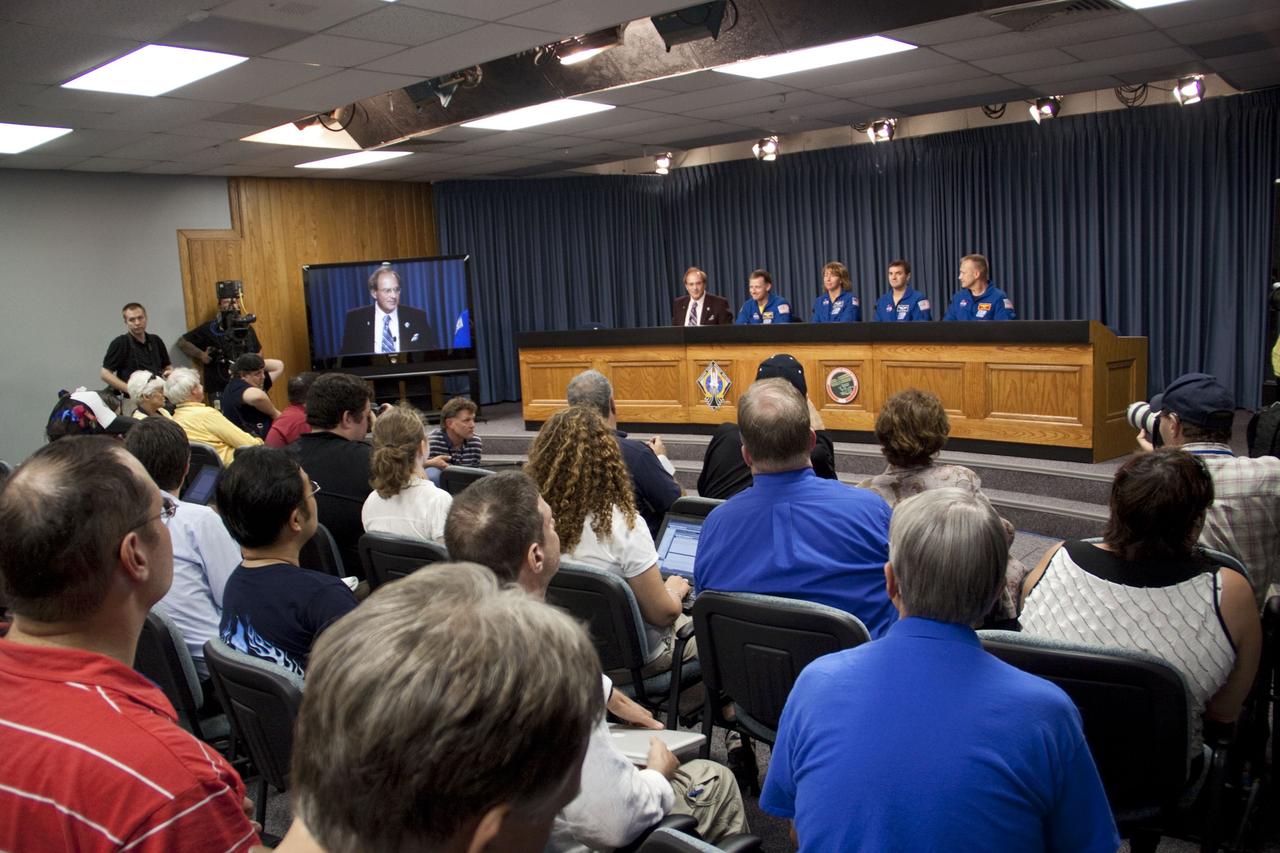
CAPE CANAVERAL, Fla. -- The crew of space shuttle Atlantis' STS-135 and Space Shuttle Program Flight, participates in a news conference in the Press Site auditorium at NASA's Kennedy Space Center in Florida on landing day. Seen here are NASA Commentator and Public Affairs Officer George Diller (left), STS-135 Commander Chris Ferguson, Mission Specialists Sandy Magnus and Rex Walheim, and Pilot Doug Hurley. Securing the space shuttle fleet's place in history, Atlantis marked the 26th nighttime landing of NASA's Space Shuttle Program and the 78th landing at Kennedy. Main gear touchdown was at 5:57:00 a.m. EDT, followed by nose gear touchdown at 5:57:20 a.m., and wheelstop at 5:57:54 a.m. Atlantis and its crew delivered to the International Space Station the Raffaello multi-purpose logistics module packed with more than 9,400 pounds of spare parts, equipment and supplies that will sustain station operations for the next year. STS-135 was the 33rd and final flight for Atlantis, which has spent 307 days in space, orbited Earth 4,848 times and traveled 125,935,769 miles. For more information, visit www.nasa.gov/mission_pages/shuttle/shuttlemissions/sts135/index.html. Photo credit: NASA/Jim Grossmann
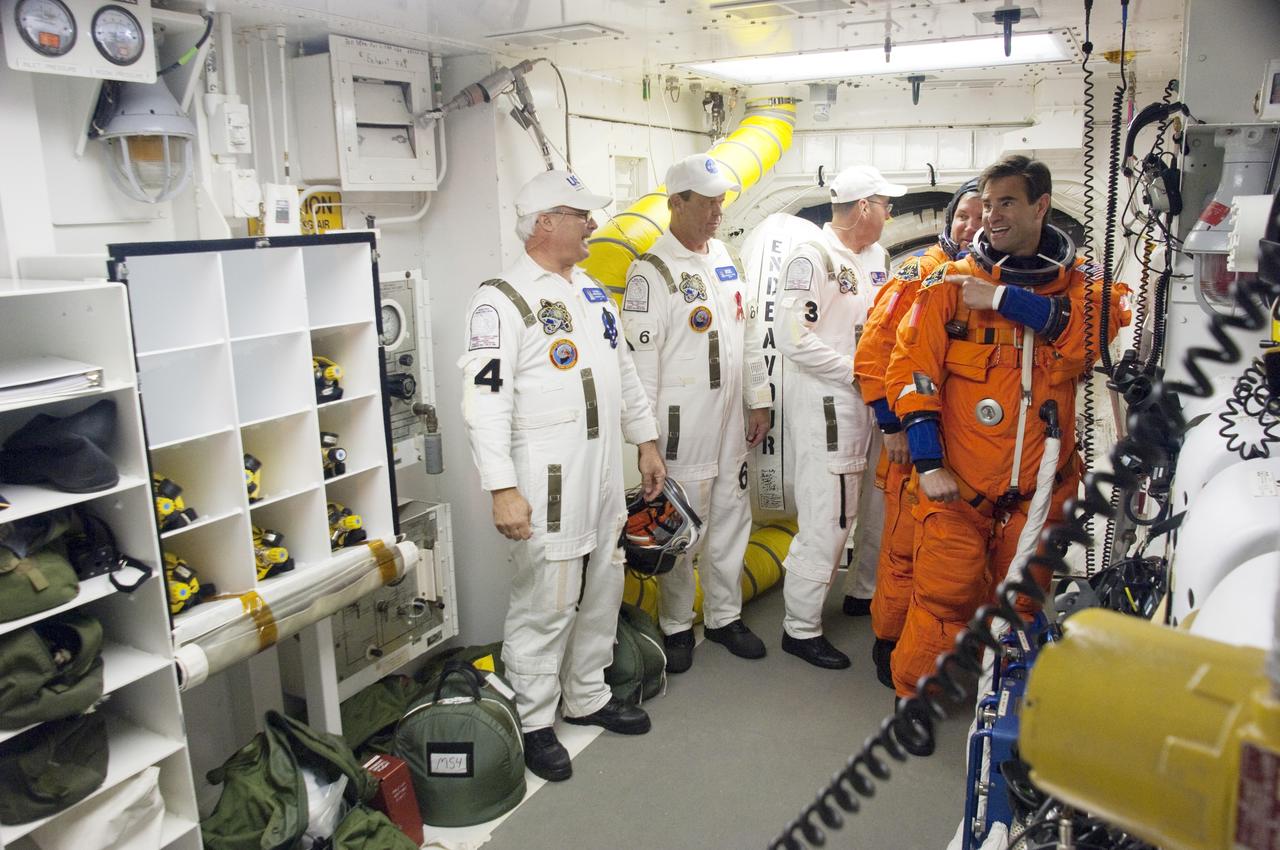
CAPE CANAVERAL, Fla. -- In the White Room at Launch Pad 39A at NASA's Kennedy Space Center in Florida, STS-134 Pilot Greg H. Johnson, left, and Mission Specialist Greg Chamitoff prepare to board space shuttle Endeavour through the crew hatch in the background. Members of the Closeout Crew, in white uniforms, are there to assist astronauts with their launch-and-entry suits and the boarding process. Johnson piloted space shuttle Endeavour during its STS-123 mission in 2008. Chamitoff last served as flight engineer and science officer aboard the International Space Station in 2008. STS-134 will deliver the Alpha Magnetic Spectrometer-2 (AMS), Express Logistics Carrier-3, a high-pressure gas tank and additional spare parts for the Dextre robotic helper to the International Space Station. May 16 at 8:56 a.m. will be the second launch attempt for Endeavour. The first attempt on April 29 was scrubbed because of an issue associated with a faulty power distribution box called the aft load control assembly-2 (ALCA-2). STS-134 will be the final spaceflight for Endeavour. For more information visit, www.nasa.gov/mission_pages/shuttle/shuttlemissions/sts134/index.html. Photo credit: NASA/Sandra Joseph and Kevin O'Connell
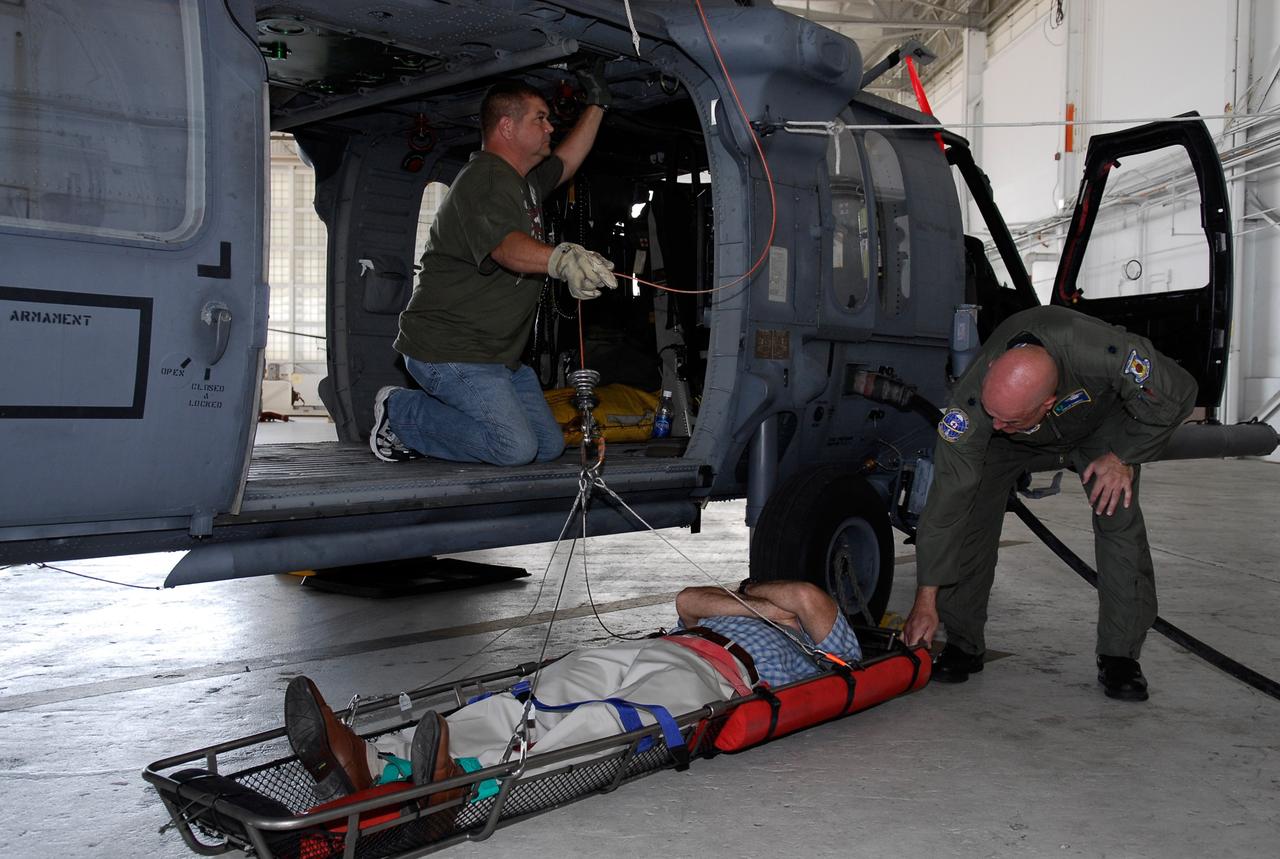
CAPE CANAVERAL, Fla. -- A representative of the 301st Rescue Squadron and a volunteer (in the stretcher) from the NASA Vehicle Integration Test Team office get ready to demonstrate rescue equipment on the HH-60G helicopter that is used by participants in the Mode VIII exercise being conducted at Patrick Air Force Base, Fla. In support of, and with logistical support from, NASA, USSTRATCOM is hosting a major exercise involving Department of Defense, Department of Homeland Security, search and rescue (SAR) forces, including the 45th Space Wing at Patrick Air Force Base, which support space shuttle astronaut bailout contingency operations, known as Mode VIII. This exercise tests SAR capabilities to locate, recover and provide medical treatment for astronauts following a space shuttle launch phase open-ocean bailout. Participants include members of the U.S. Navy, U.S. Coast Guard, U.S. Air Force, and NASA's Kennedy Space Center and Johnson Space Center. This will be the 15th Mode VIII exercise conducted in the past 20 years. Photo credit: NASA/Kim Shiflett
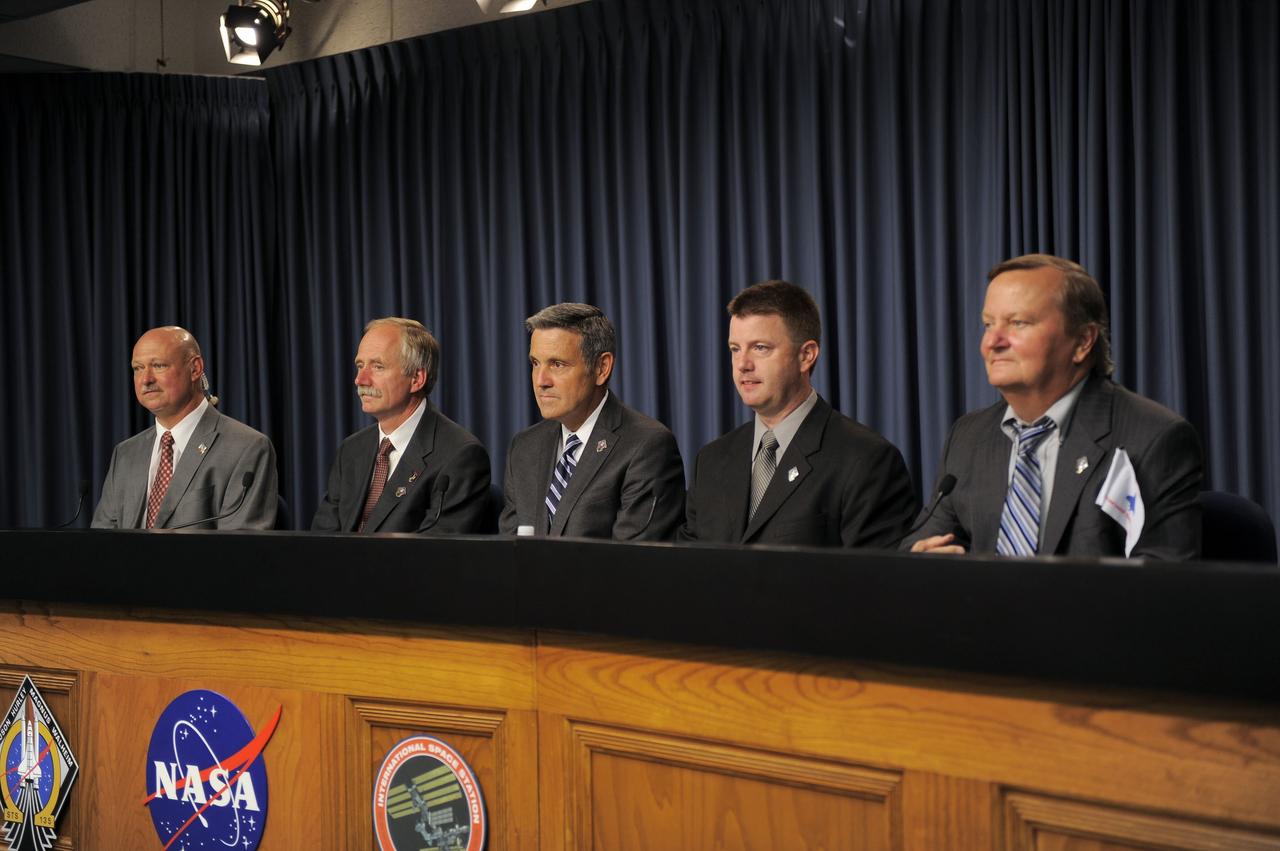
CAPE CANAVERAL, Fla. -- Members of the media gather for a post-launch news conference held in the Press Site auditorium at NASA's Kennedy Space Center in Florida, following the successful launch of space shuttle Atlantis on its STS-135 mission to the International Space Station. Seen here are NASA Public Affairs Officer Mike Curie (left) moderator; Associate Administrator for Space Operations Bill Gerstenmaier, Kennedy Center Director Bob Cabana, Shuttle Program Launch Integration Manager Mike Moses, and Shuttle Launch Director Mike Leinbach. Atlantis began its final flight at 11:29 a.m. EDT on July 8. STS-135 will deliver the Raffaello multi-purpose logistics module packed with supplies and spare parts for the International Space Station. Atlantis also will fly the Robotic Refueling Mission experiment that will investigate the potential for robotically refueling existing satellites in orbit. In addition, Atlantis will return with a failed ammonia pump module to help NASA better understand the failure mechanism and improve pump designs for future systems. STS-135 will be the 33rd flight of Atlantis, the 37th shuttle mission to the space station, and the 135th and final mission of NASA's Space Shuttle Program. For more information, visit www.nasa.gov/mission_pages/shuttle/shuttlemissions/sts135/index.html. Photo credit: NASA/Kim Shiflett
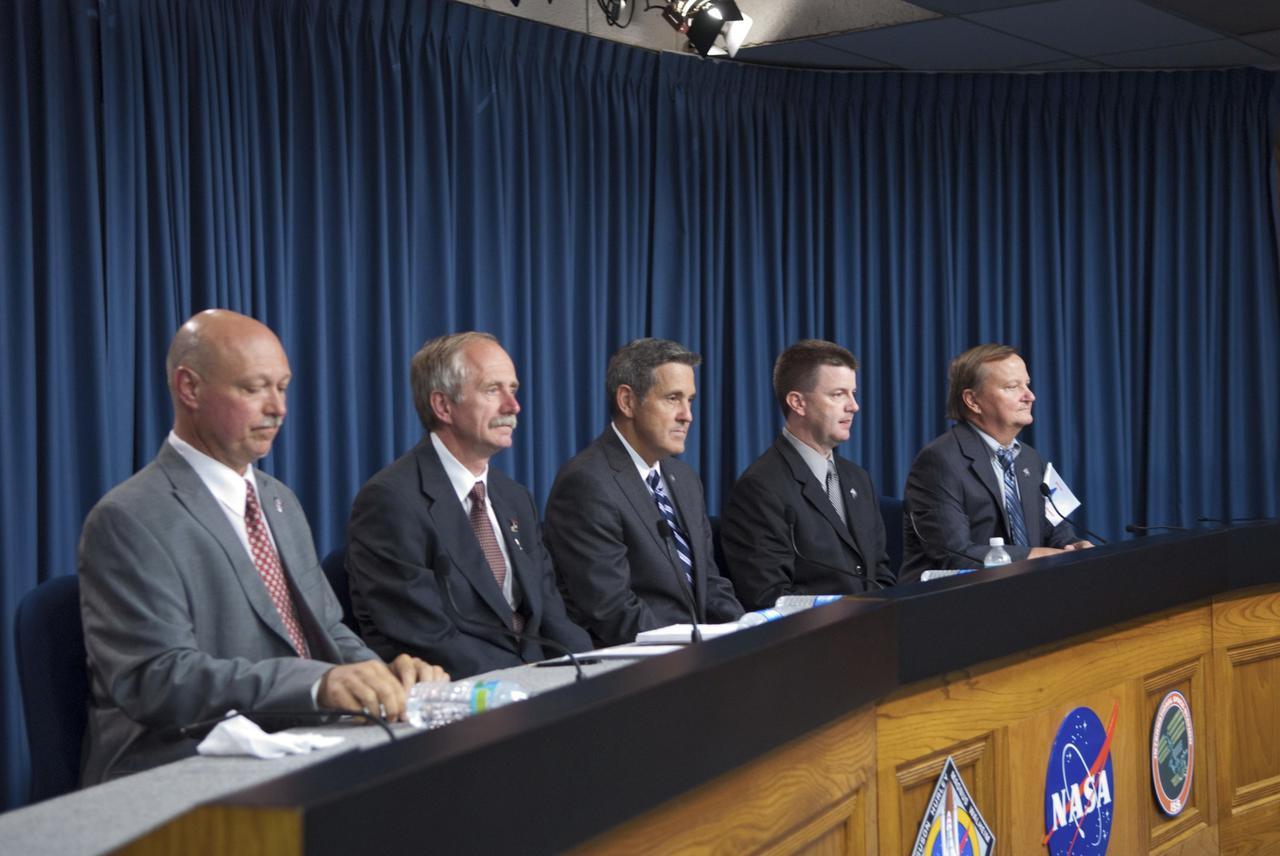
CAPE CANAVERAL, Fla. -- Members of the media gather for a post-launch news conference held in the Press Site auditorium at NASA's Kennedy Space Center in Florida, following the successful launch of space shuttle Atlantis on its STS-135 mission to the International Space Station. Seen here are NASA Public Affairs Officer Mike Curie (left) moderator; Associate Administrator for Space Operations Bill Gerstenmaier, Kennedy Center Director Bob Cabana, Shuttle Program Launch Integration Manager Mike Moses, and Shuttle Launch Director Mike Leinbach. Atlantis began its final flight at 11:29 a.m. EDT on July 8. STS-135 will deliver the Raffaello multi-purpose logistics module packed with supplies and spare parts for the International Space Station. Atlantis also will fly the Robotic Refueling Mission experiment that will investigate the potential for robotically refueling existing satellites in orbit. In addition, Atlantis will return with a failed ammonia pump module to help NASA better understand the failure mechanism and improve pump designs for future systems. STS-135 will be the 33rd flight of Atlantis, the 37th shuttle mission to the space station, and the 135th and final mission of NASA's Space Shuttle Program. For more information, visit www.nasa.gov/mission_pages/shuttle/shuttlemissions/sts135/index.html. Photo credit: NASA/Jim Grossmann
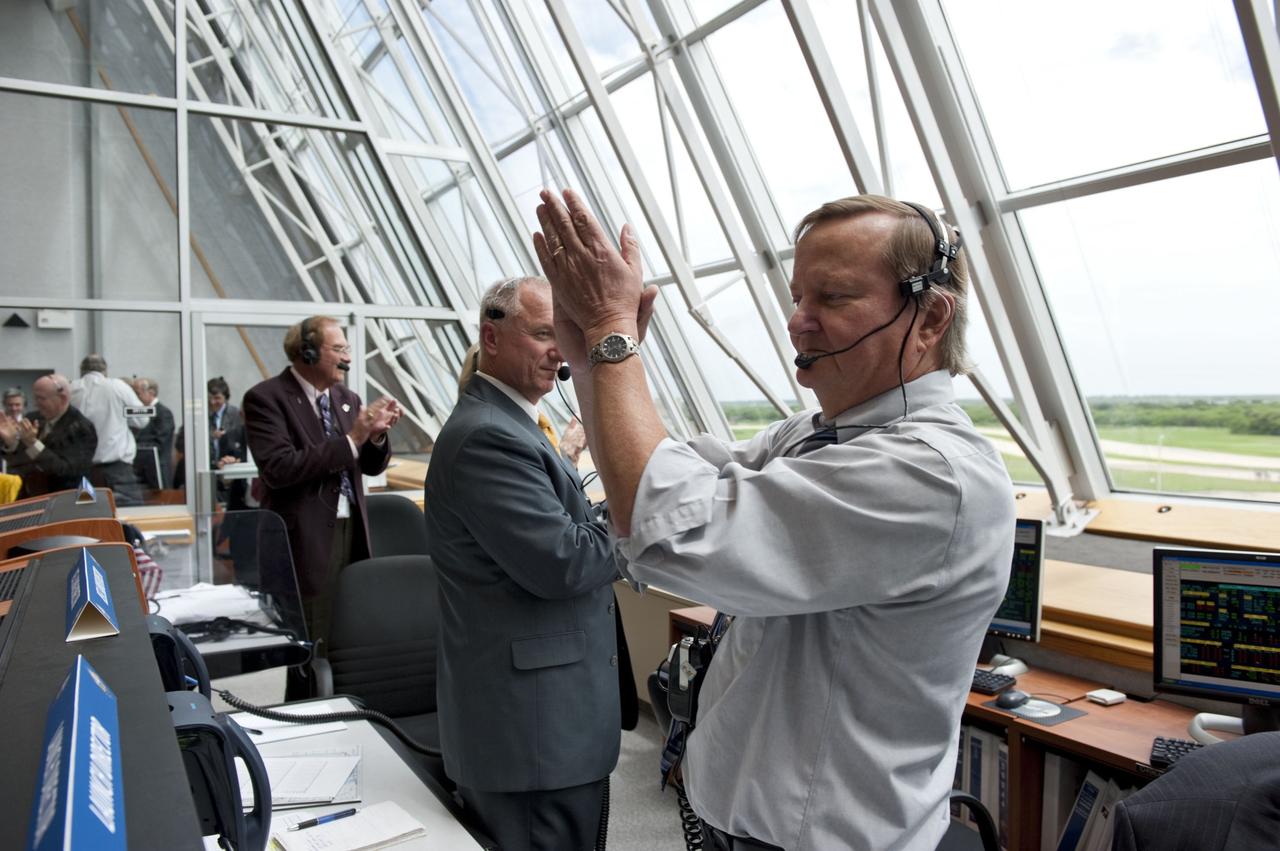
CAPE CANAVERAL, Fla. -- In Firing Room 4 of the Launch Control Center at NASA's Kennedy Space Center in Florida, Shuttle Launch Director Mike Leinbach (right), Assistant Launch Director Pete Nickolenko and NASA Commentator and Public Affairs Officer George Diller applaud the successful launch of space shuttle Atlantis on its STS-135 mission to the International Space Station. Atlantis with its crew of four; Commander Chris Ferguson, Pilot Doug Hurley, Mission Specialists Sandy Magnus and Rex Walheim, lifted off at 11:29 a.m. EDT on July 8, 2011 to deliver the Raffaello multi-purpose logistics module packed with supplies and spare parts for the station. Atlantis also will fly the Robotic Refueling Mission experiment that will investigate the potential for robotically refueling existing satellites in orbit. In addition, Atlantis will return with a failed ammonia pump module to help NASA better understand the failure mechanism and improve pump designs for future systems. STS-135 will be the 33rd flight of Atlantis, the 37th shuttle mission to the space station, and the 135th and final mission of NASA's Space Shuttle Program. For more information, visit www.nasa.gov/mission_pages/shuttle/shuttlemissions/sts135/index.html. Photo credit: NASA/Kim Shiflett
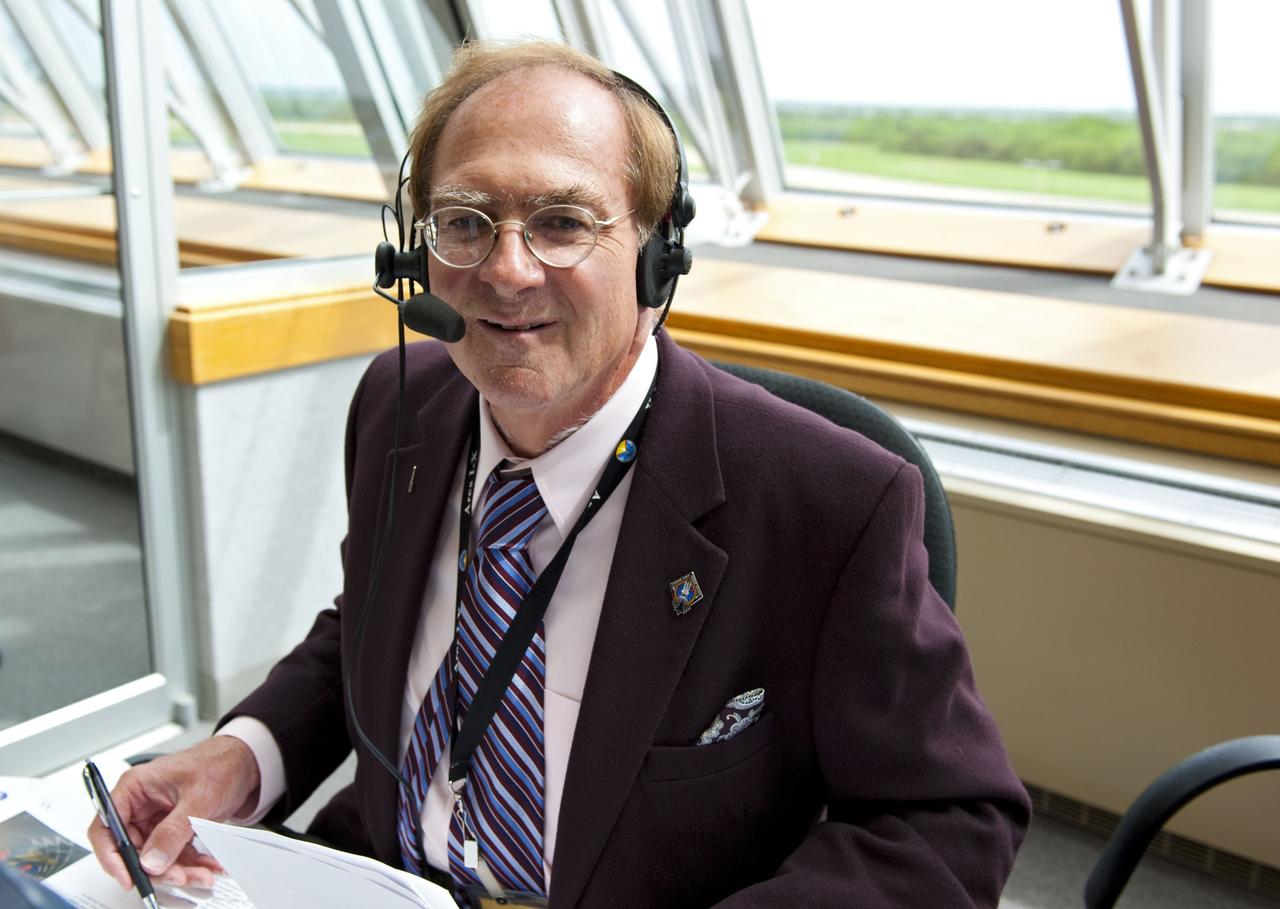
CAPE CANAVERAL, Fla. -- In Firing Room 4 of the Launch Control Center at NASA's Kennedy Space Center in Florida, NASA Commentator and Public Affairs Officer George Diller provides live launch coverage of space shuttle Atlantis' STS-135 mission to the International Space Station for NASA TV. Atlantis with its crew of four; Commander Chris Ferguson, Pilot Doug Hurley, Mission Specialists Sandy Magnus and Rex Walheim, lifted off at 11:29 a.m. EDT on July 8, 2011 to deliver the Raffaello multi-purpose logistics module packed with supplies and spare parts for the station. Atlantis also will fly the Robotic Refueling Mission experiment that will investigate the potential for robotically refueling existing satellites in orbit. In addition, Atlantis will return with a failed ammonia pump module to help NASA better understand the failure mechanism and improve pump designs for future systems. STS-135 will be the 33rd flight of Atlantis, the 37th shuttle mission to the space station, and the 135th and final mission of NASA's Space Shuttle Program. For more information, visit www.nasa.gov/mission_pages/shuttle/shuttlemissions/sts135/index.html. Photo credit: NASA/Kim Shiflett
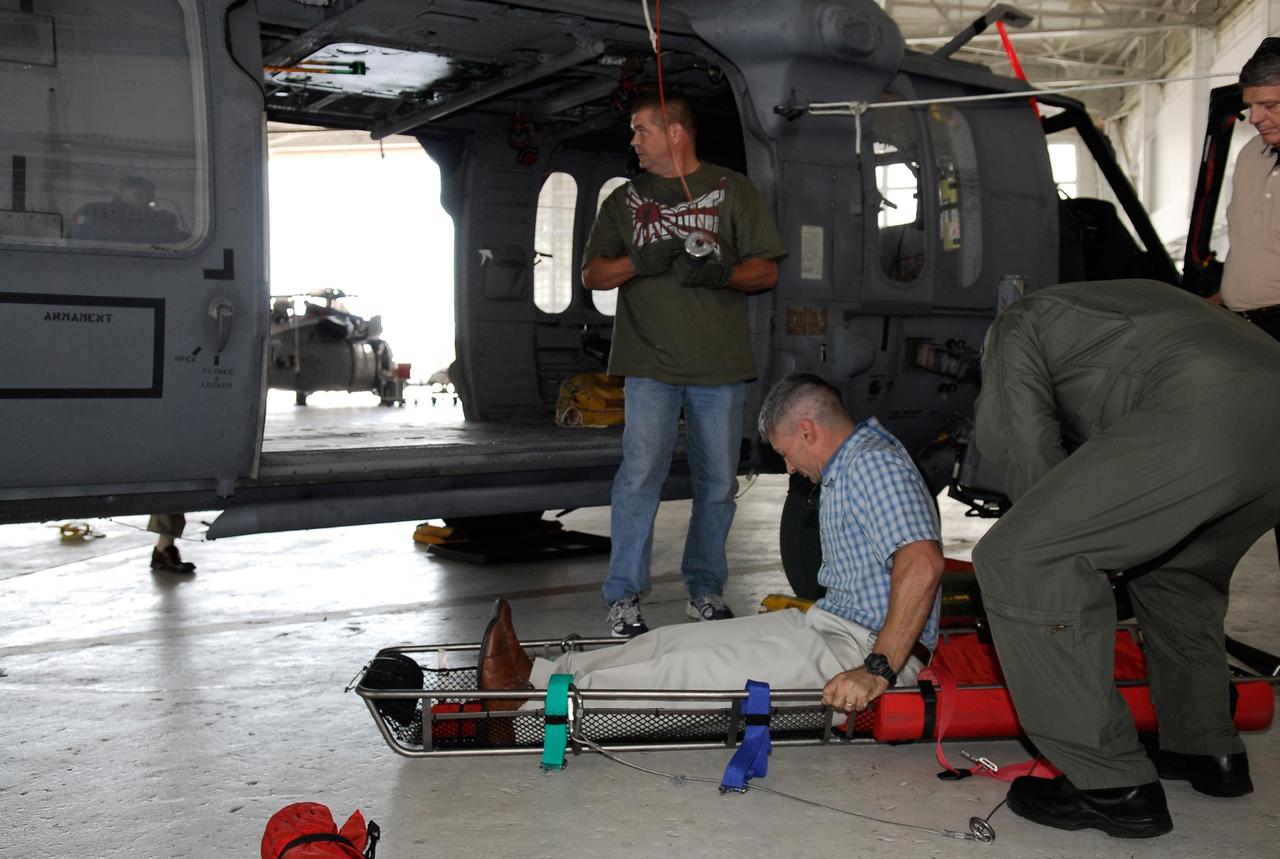
CAPE CANAVERAL, Fla. -- A representative of the 301st Rescue Squadron and a volunteer from the NASA Vehicle Integration Test Team office get ready to demonstrate rescue equipment that is used by participants in the Mode VIII exercise being conducted at Patrick Air Force Base. In the background is an HH-60G helicopter. In support of, and with logistical support from, NASA, USSTRATCOM is hosting a major exercise involving Department of Defense, Department of Homeland Security, search and rescue (SAR) forces, including the 45th Space Wing at Patrick Air Force Base, which support space shuttle astronaut bailout contingency operations, known as Mode VIII. This exercise tests SAR capabilities to locate, recover and provide medical treatment for astronauts following a space shuttle launch phase open-ocean bailout. Participants include members of the U.S. Navy, U.S. Coast Guard, U.S. Air Force, and NASA's Kennedy Space Center and Johnson Space Center. This will be the 15th Mode VIII exercise conducted in the past 20 years. Photo credit: NASA/Kim Shiflett
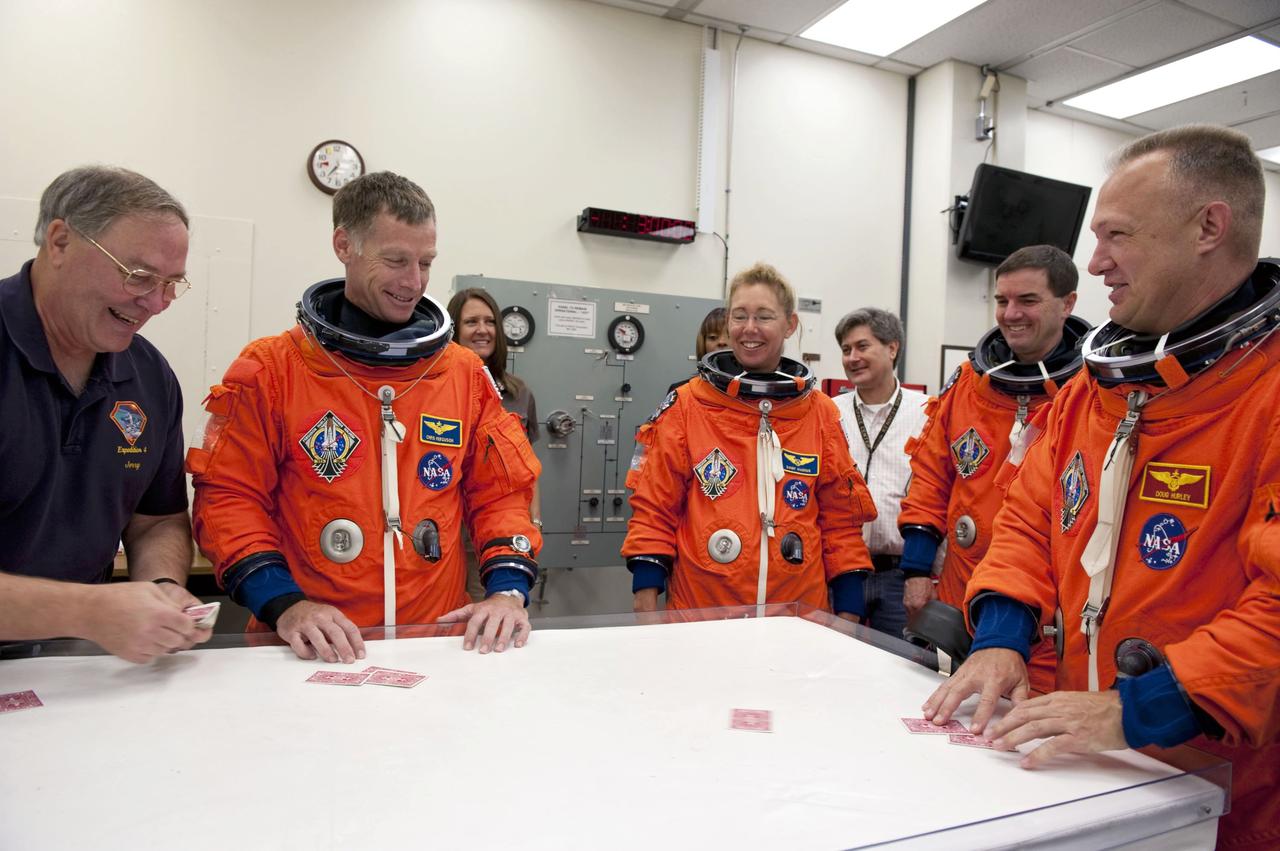
CAPE CANAVERAL, Fla. -- In the Operations and Checkout Building at NASA's Kennedy Space Center in Florida, the STS-135 crew members enjoy a light moment during a simulated launch countdown. From left are Jerry Ross, chief of the Vehicle Integration Test Office and former NASA astronaut, Commander Chris Ferguson, Mission Specialists Sandy Magnus and Rex Walheim, and Pilot Doug Hurley. As part of the Terminal Countdown Demonstration Test (TCDT), the crew members are taken to Kennedy's Launch Pad 39A and strapped into space shuttle Atlantis to practice the steps that will be taken on launch day. Atlantis and its crew are targeted to lift off July 8, taking with them the Raffaello multi-purpose logistics module packed with supplies and spare parts to the International Space Station. The STS-135 mission also will fly a system to investigate the potential for robotically refueling existing satellites and return a failed ammonia pump module to help NASA better understand the failure mechanism and improve pump designs for future systems. STS-135 will be the 33rd flight of Atlantis, the 37th shuttle mission to the space station, and the 135th and final mission of NASA's Space Shuttle Program. For more information visit, www.nasa.gov/mission_pages/shuttle/shuttlemissions/sts135/index.html. Photo credit: NASA/Kim Shiflett
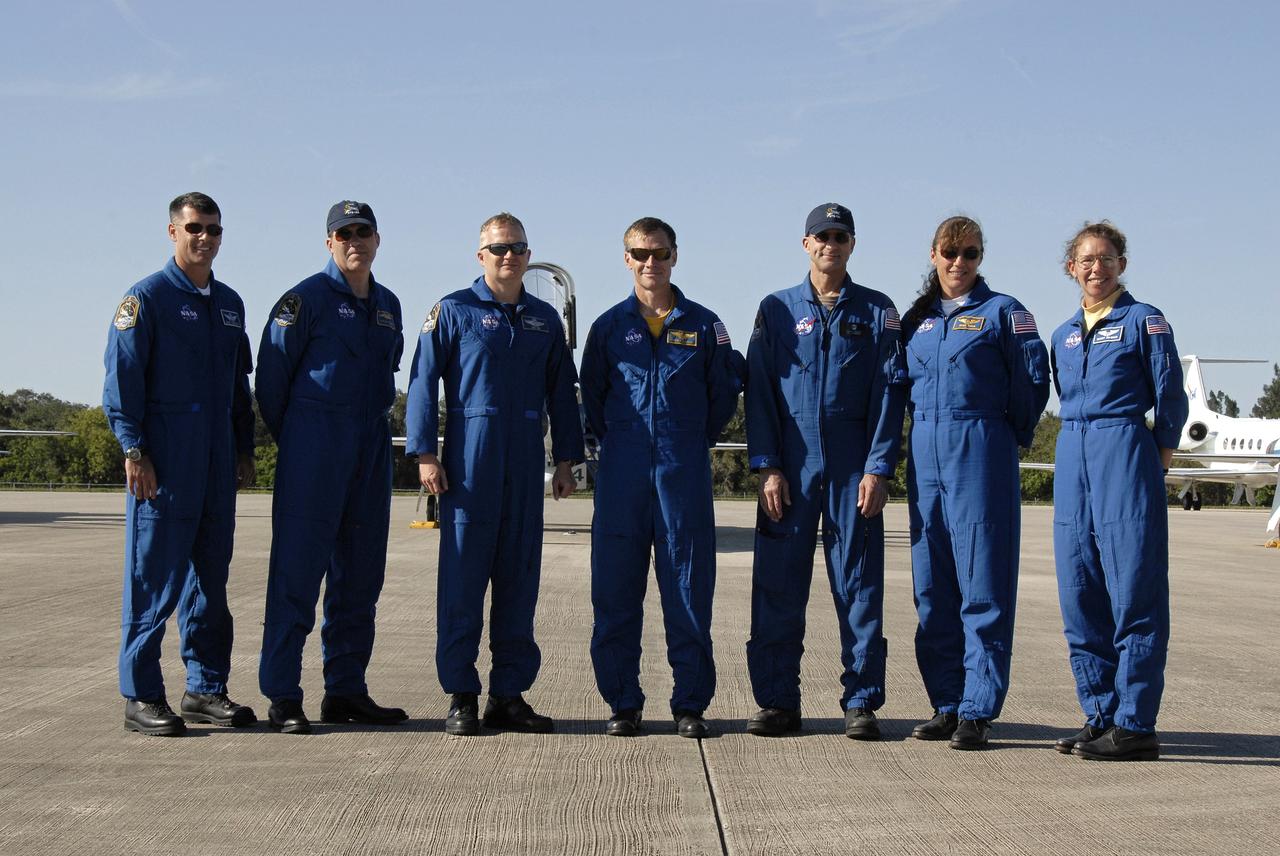
CAPE CANAVERAL, Fla. - Crew members for space shuttle Endeavour's STS-126 mission pose for a group portrait at the Shuttle Landing Facility at NASA’s Kennedy Space Center in Florida after arriving for Terminal Countdown Demonstration Test, or TCDT, activities. From left are Mission Specialists Shane Kimbrough and Steve Bowen, Pilot Eric Boe, Commander Chris Ferguson, and Mission Specialists Donald Pettit, Heidemarie Stefanyshyn-Piper and Sandra Magnus. Magnus will remain on the International Space Station as a flight engineer and science officer for Expedition 18. During TCDT, Endeavour's astronauts and launch teams will participate in a simulated countdown, practice emergency exit procedures at the launch pad and continue to familiarize themselves with the mission payload and hardware. On this 27th mission to the International Space Station, Endeavour will carry the Lightweight Multi-Purpose Experiment Support Structure Carrier and the Multi-Purpose Logistics Module Leonardo that will hold supplies and equipment, including additional crew quarters, additional exercise equipment, spare hardware and equipment for the regenerative life support system. Endeavour is targeted to launch at 7:55 p.m. EST on Nov. 14. Photo credit: NASA/Kim Shiflett