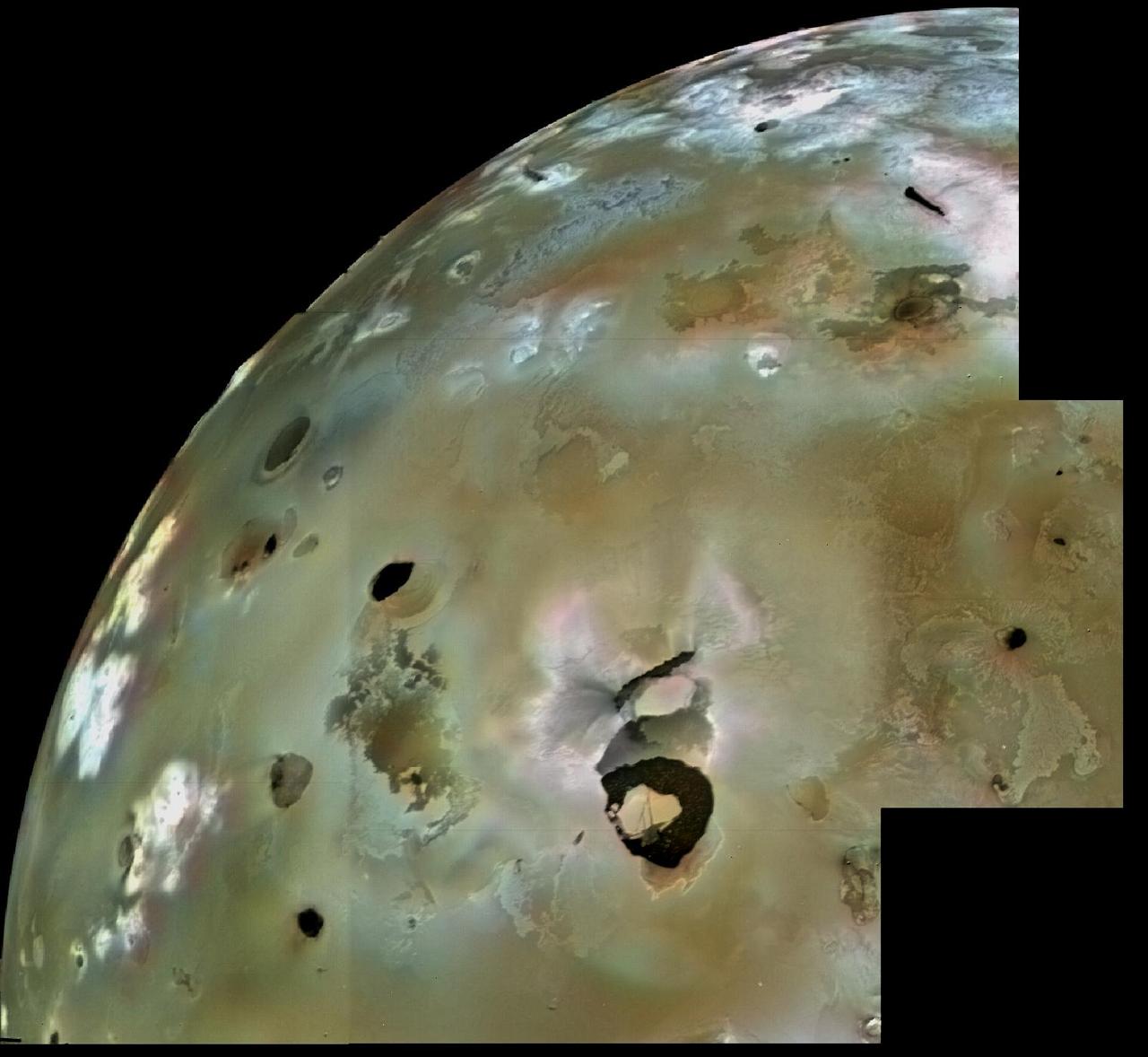
A huge area of Io's volcanic plains is shown in this Voyager 1 image mosaic. Numerous volcanic calderas and lava flows are visible here. Loki Patera, an active lava lake, is the large shield-shaped black feature. Heat emitted from Loki can be seen through telescopes all the way from Earth. These telescopic observations tell us that Loki has been active continuously (or at least every time astronomers have looked) since the Voyager 1 flyby in March 1979. The composition of Io's volcanic plains and lava flows has not been determined, but they could consist dominantly of sulfur with surface frosts of sulfur dioxide or of silicates (such as basalts) encrusted with sulfur and sulfur dioxide condensates. The bright whitish patches probably consist of freshly deposited SO2 frost. The black spots, including Loki, are probably hot sulfur lava, which may remain molten by intrusions of molten silicate magma, coming up from deeper within Io. The ultimate source of heat that keeps Io active is tidal frictional heating due to the continual flexure of Io by the gravity of Jupiter and Europa, another of Jupiter's satellites. http://photojournal.jpl.nasa.gov/catalog/PIA00320
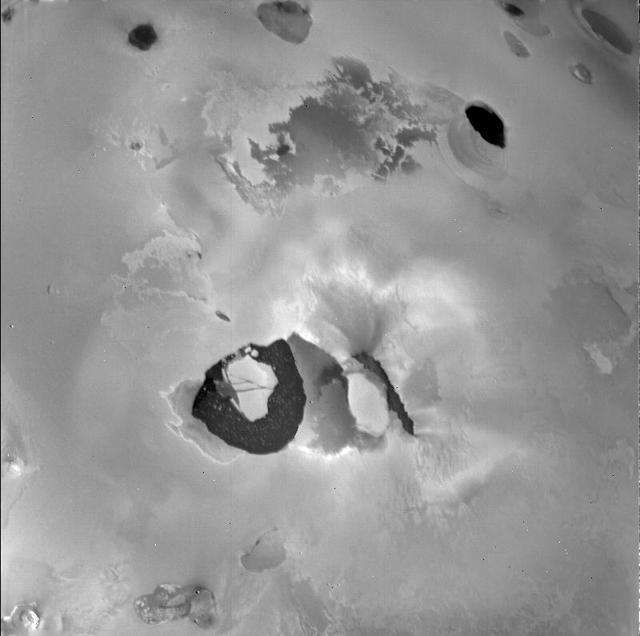
Io - Volcano Loki and Loki Patera http://photojournal.jpl.nasa.gov/catalog/PIA00375
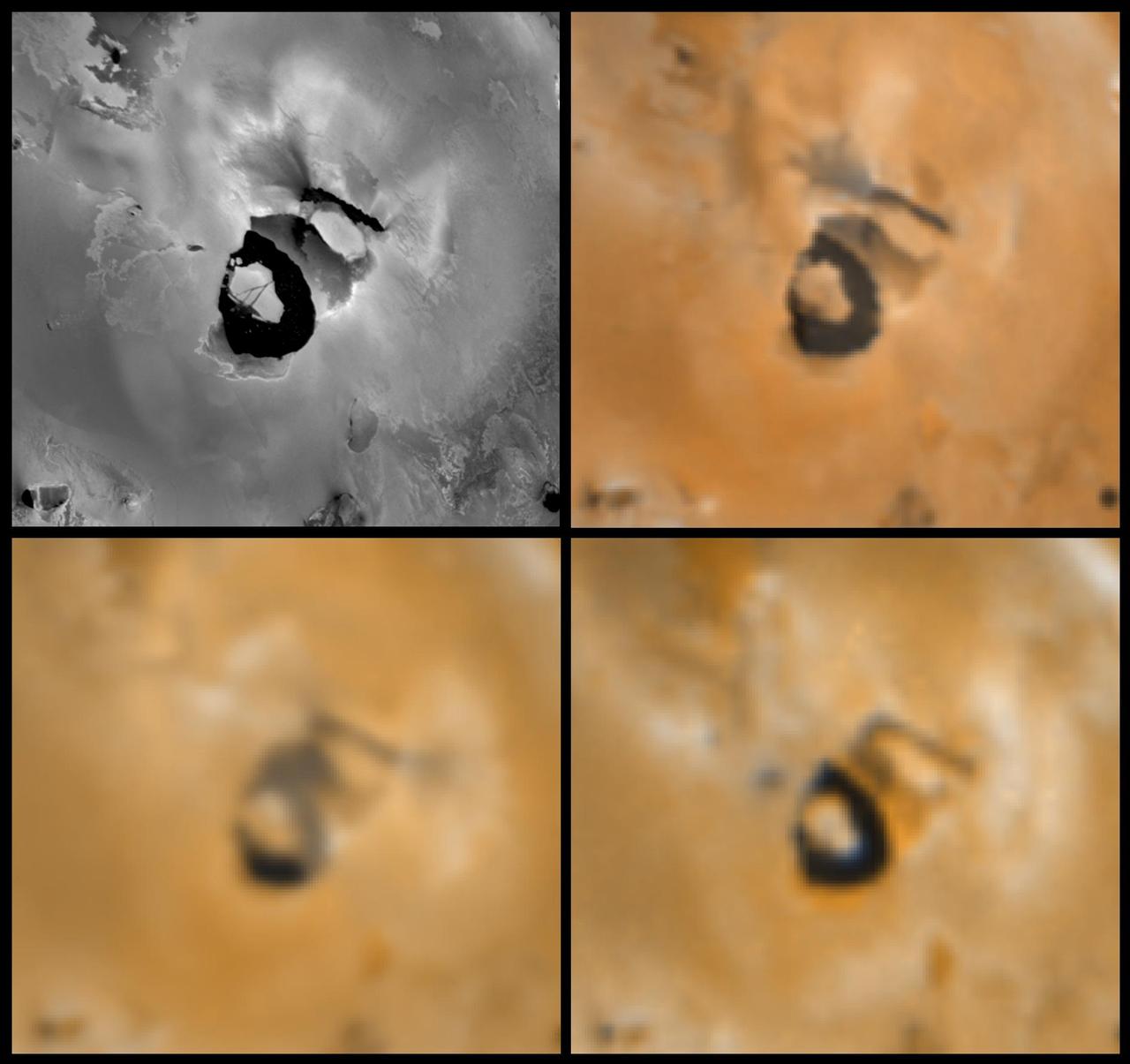
Changes near the Volcano Loki Patera on Io
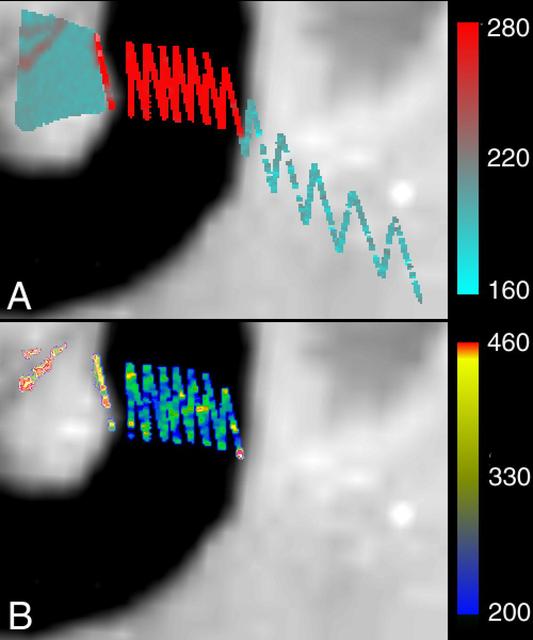
This image of Loki Patera on Jupiter volcanic moon Io shows data taken by the near-infrared mapping spectrometer onboard NASA Galileo spacecraft during its Io flyby on Oct. 10, 1999.
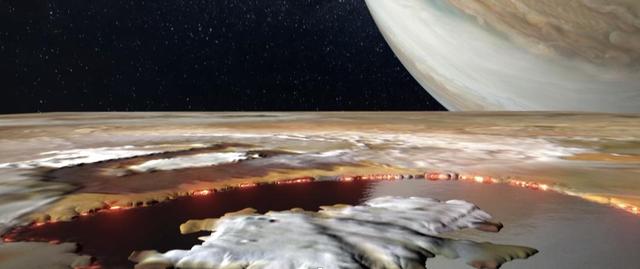
Created using data collected by the JunoCam imager aboard NASA's Juno spacecraft, this animation is an artist's concept that shows an aerial view of Loki Patera, a lava lake on the Jovian moon Io. The 124-mile-long (200-kilometer-long) lake is filled with magma, rimmed with hot lava, and dotted with islands. Loki provided a spectacular reflection when imaged by JunoCam during flybys of the moon in December 2023 and February 2024, suggesting it and other parts of Io's surface are as smooth as glass. The large island in Loki Patera does not have a name. Animation available at https://photojournal.jpl.nasa.gov/catalog/PIA26293
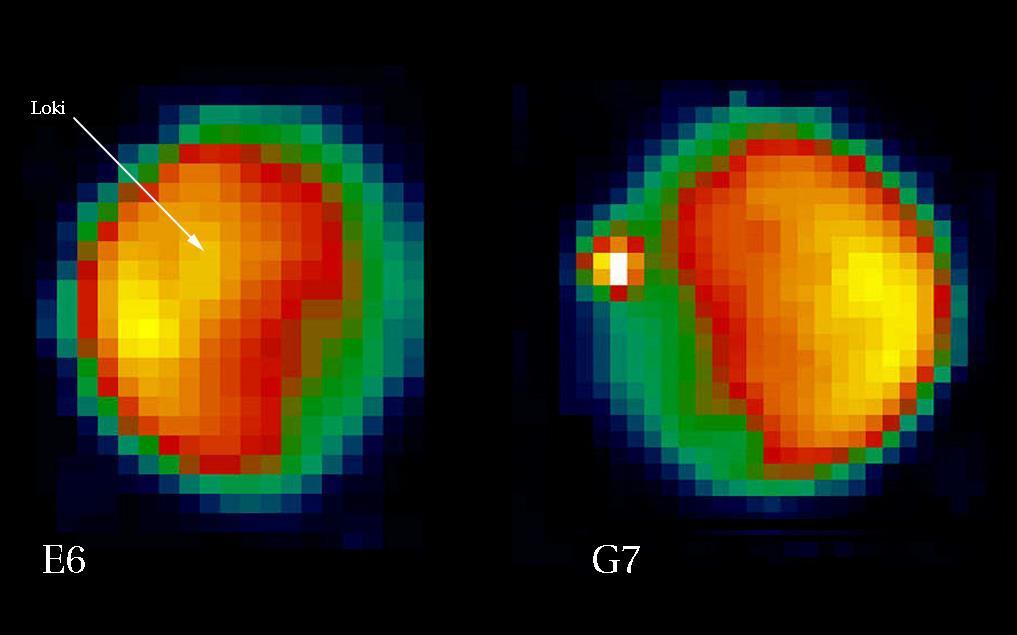
On Feb. 21, 1997, the Galileo spacecraft observed Io in daylight from a range of approximately 703,000 km 440,000 miles. Loki Patera, historically the most active and persistent hot spot on Io, is located on the hemisphere of Io always facing Jupiter.
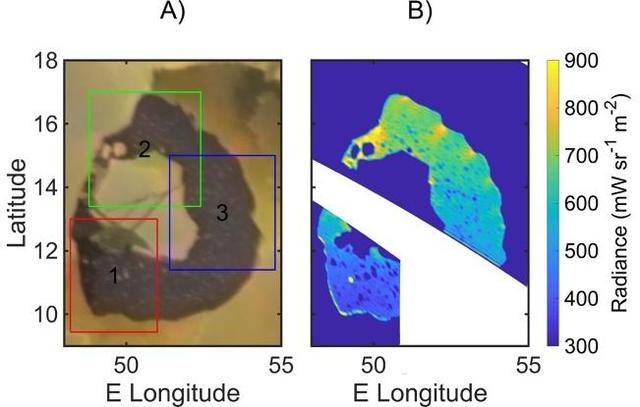
A map of infrared radiance in Loki Patera on Jupiter's moon Io, as measured by the Jovian Infrared Auroral Mapper (JIRAM) instrument aboard NASA's Juno spacecraft, right, and by NASA's Voyager 1, left. https://photojournal.jpl.nasa.gov/catalog/PIA26525
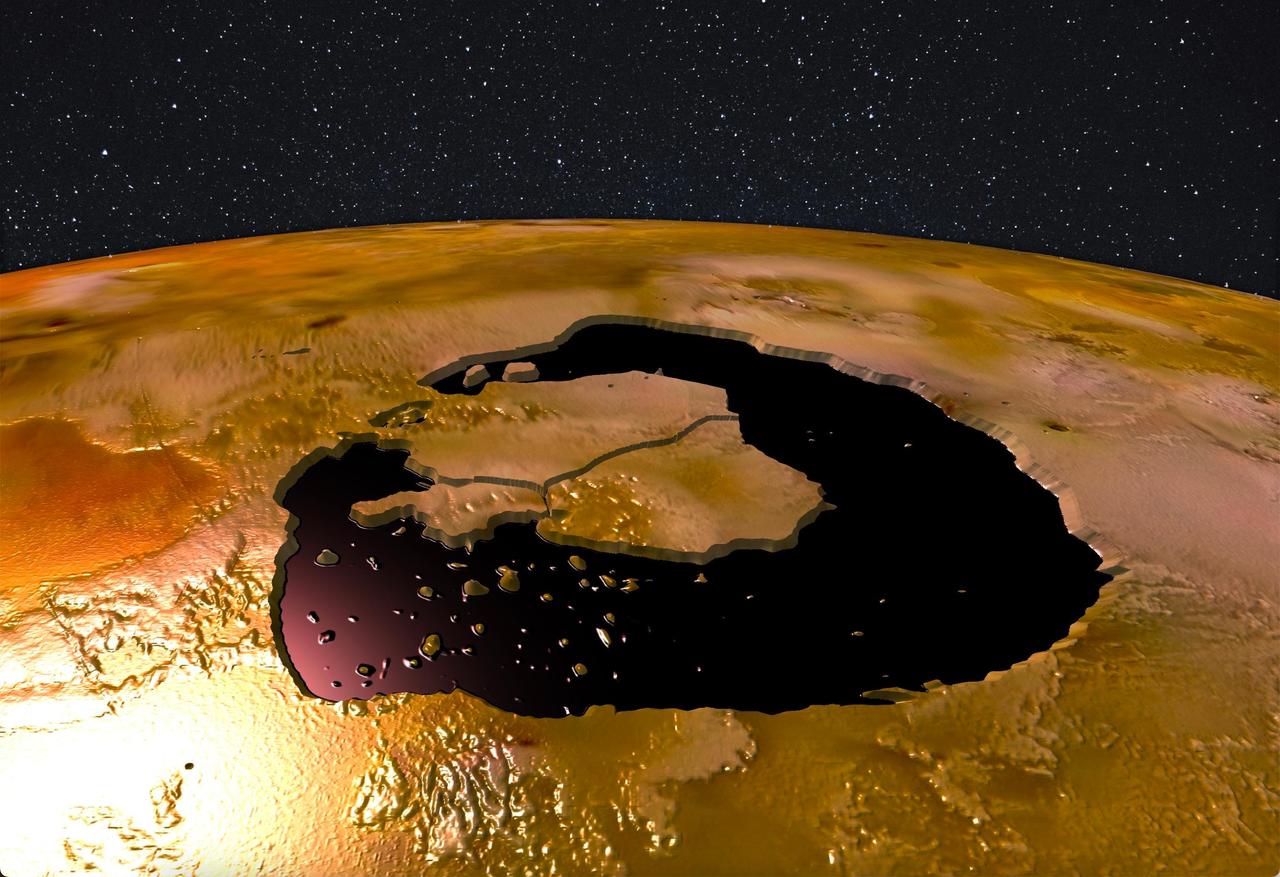
Lava islands within Loki Patera on Jupiter's moon Io are depicted in an artist's concept that's based on data from the Jovian Infrared Auroral Mapper (JIRAM) instrument about NASA's Juno spacecraft. https://photojournal.jpl.nasa.gov/catalog/PIA26485