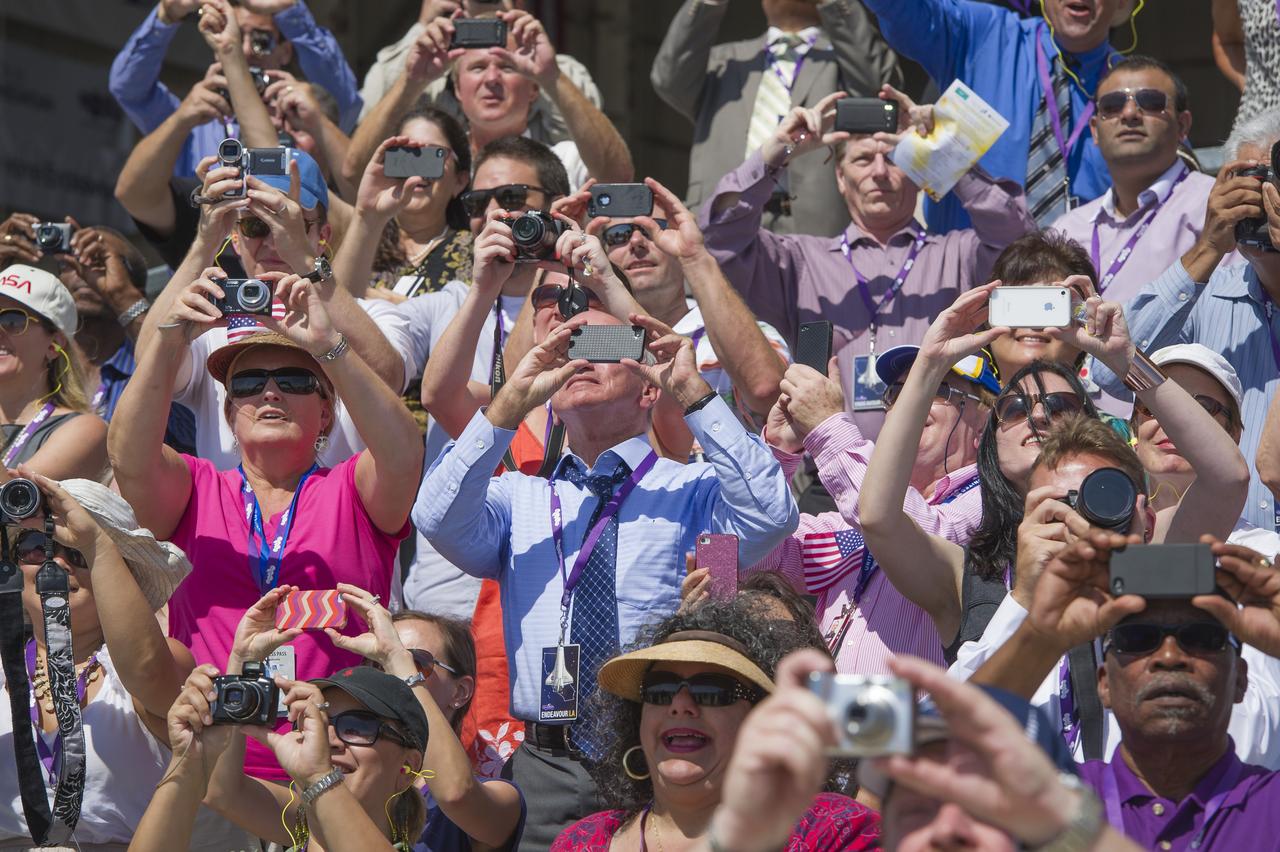
Spectators look to the sky with cameras and other devices as the space shuttle Endeavour flies over prior to landing Friday, Sept. 21, 2012, at Los Angeles International Airport. Endeavour, built as a replacement for space shuttle Challenger, completed 25 missions, spent 299 days in orbit, and orbited Earth 4,671 times while traveling 122,883,151 miles. Beginning Oct. 30, the shuttle will be on display in the California Science center's Samuel Oschin Space Shuttle Endeavour Display Pavilion, embarking on its new mission to commemorate past achievements in space and educate and inspire future generations of explorers.Photo Credit: (NASA/Paul E. Alers)
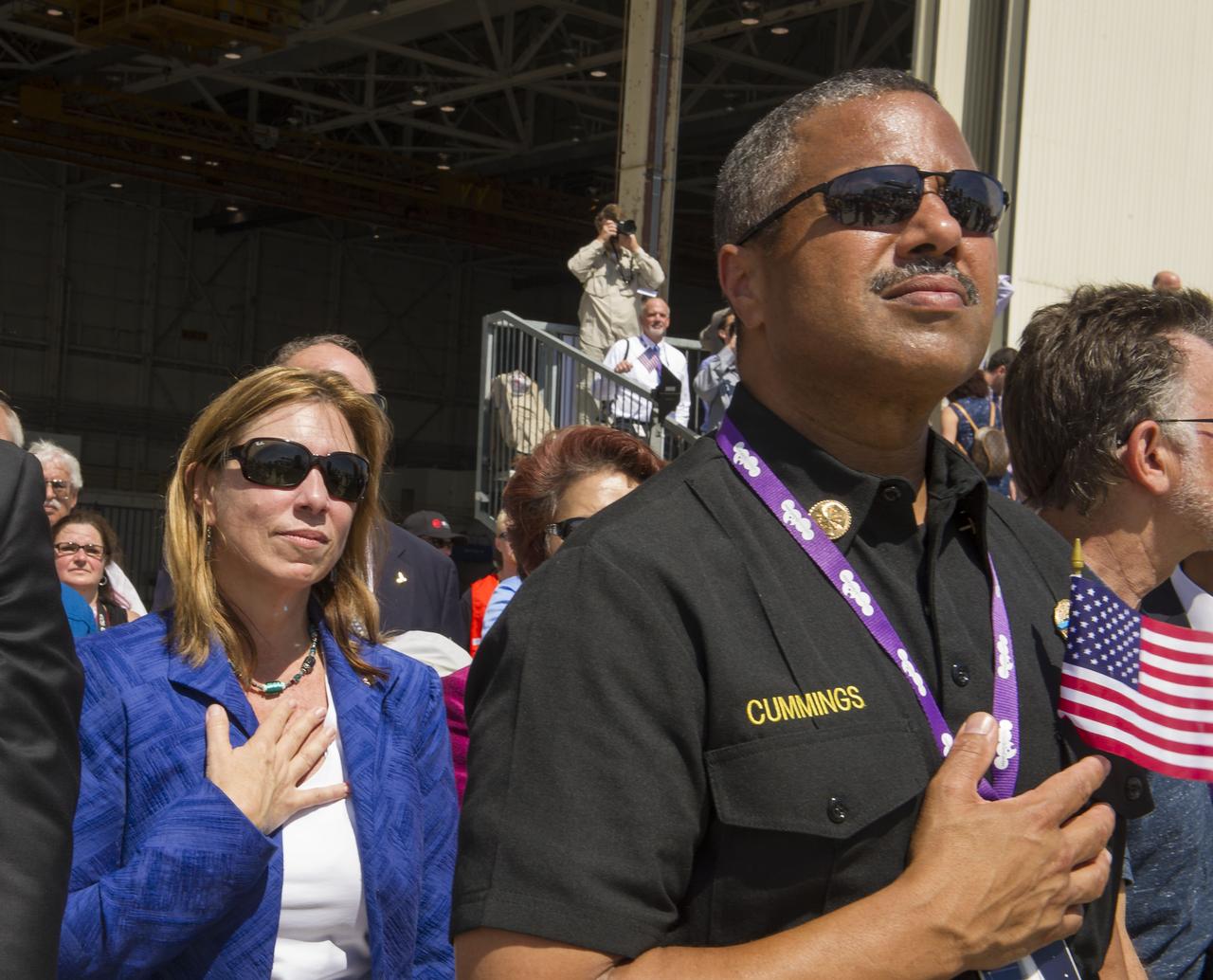
NASA Deputy Administrator Lori Garver, right, holds her hand to her heart during the playing of the National Anthem at the welcoming ceremony for space shuttle Endeavour, Friday, Sept. 21, 2012, at Los Angeles International Airport. Endeavour, built as a replacement for space shuttle Challenger, completed 25 missions, spent 299 days in orbit, and orbited Earth 4,671 times while traveling 122,883,151 miles. Beginning Oct. 30, the shuttle will be on display in the California Science center's Samuel Oschin Space Shuttle Endeavour Display Pavilion, embarking on its new mission to commemorate past achievements in space and educate and inspire future generations of explorers.Photo Credit: (NASA/Paul E. Alers)
The space shuttle Endeavour, atop the Shuttle Carrier Aircraft, or SCA, lands at Los Angeles International Airport on Tuesday, Sept. 21, 2012 in Los Angeles where it will be placed on public display at the California Science Center. Today's flight marks the final scheduled ferry flight of the Space Shuttle Program. Photo Credit: (NASA/Matt Hedges)
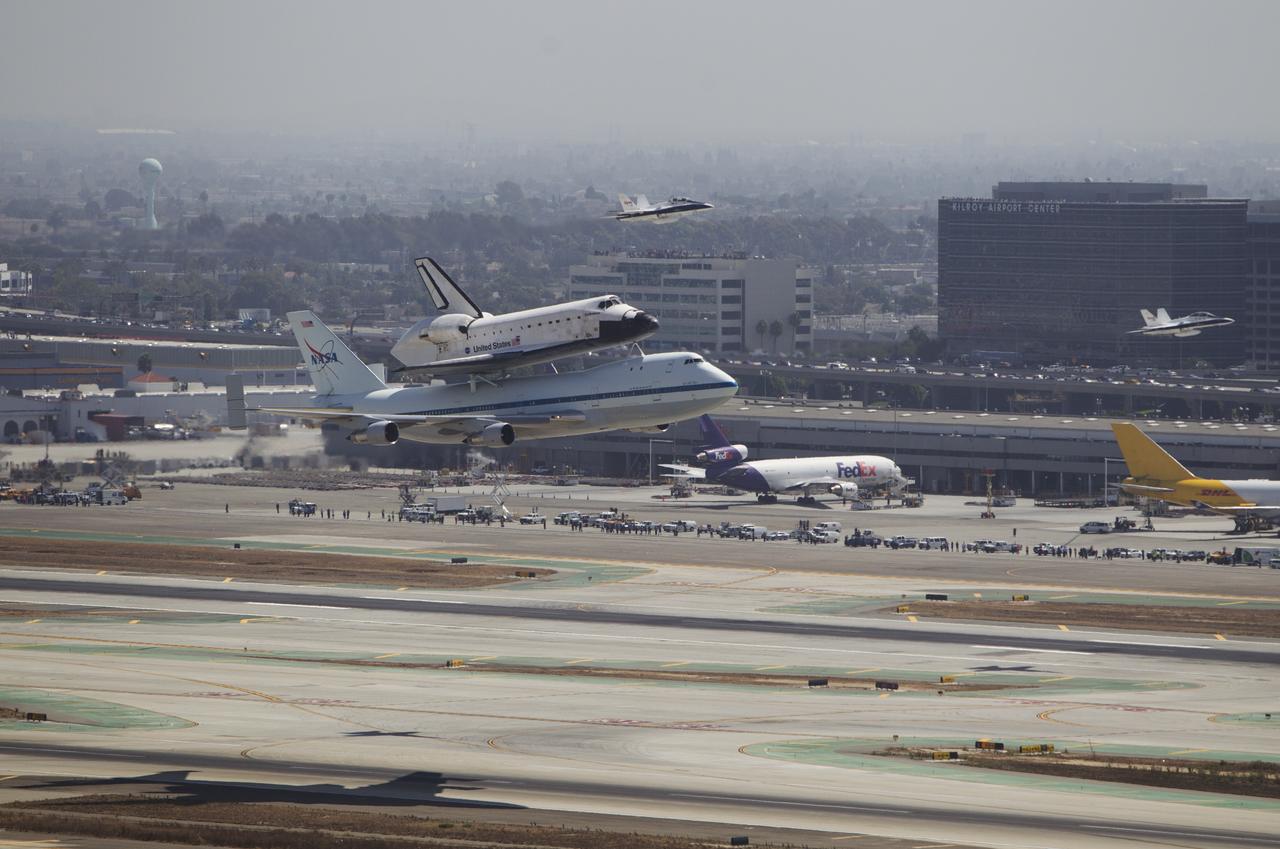
The space shuttle Endeavour, atop the Shuttle Carrier Aircraft, or SCA, performs a fly-by of Los Angeles International Airport on Tuesday, Sept. 21, 2012 in Los Angeles where it will be placed on public display at the California Science Center. Today's flight marks the final scheduled ferry flight of the Space Shuttle Program. Photo Credit: (NASA/Joel Kowsky)
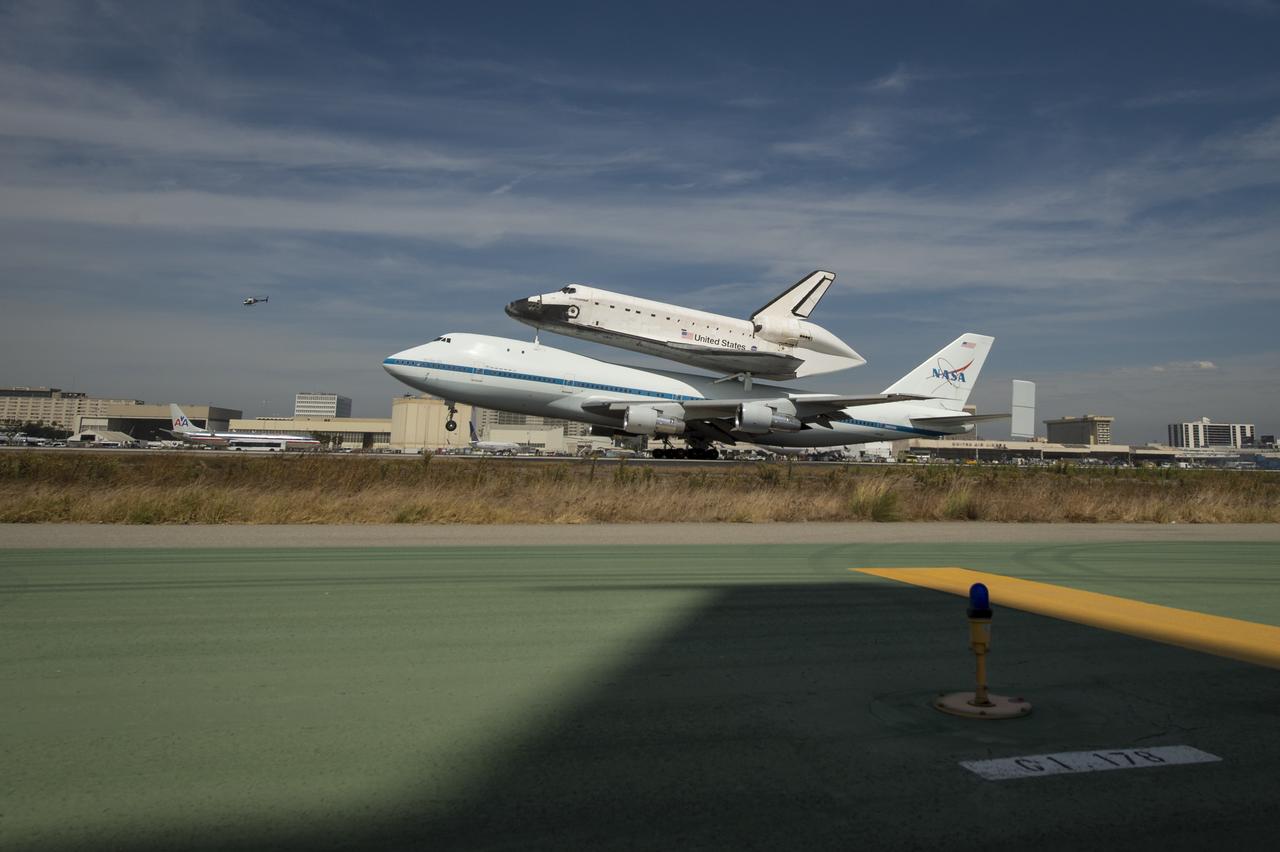
Space shuttle Endeavour, mounted atop a NASA 747 Shuttle Carrier Aircraft (SCA) lands at Los Angeles International Airport, Friday, Sept. 21, 2012. The shadow of a NASA F-18 chase jet wing is shown in the foreground. Endeavour, built as a replacement for space shuttle Challenger, completed 25 missions, spent 299 days in orbit, and orbited Earth 4,671 times while traveling 122,883,151 miles. Beginning Oct. 30, the shuttle will be on display in the California Science center's Samuel Oschin Space Shuttle Endeavour Display Pavilion, embarking on its new mission to commemorate past achievements in space and educate and inspire future generations of explorers.Photo Credit: (NASA/Bill Ingalls)
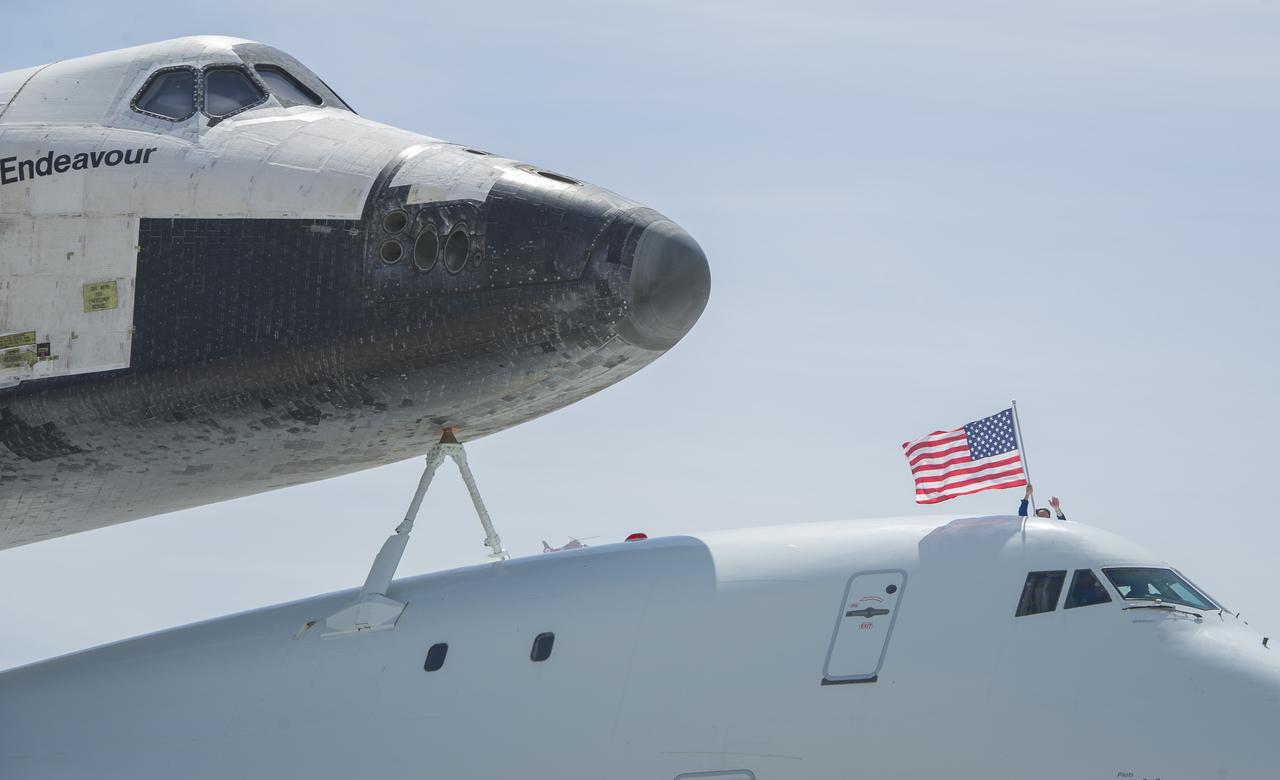
A U.S. Flag is flown out of the top of the Suttle Carrier Aircaft (SCA) as it taxis with space shuttle Endeavour atop Friday, Sept. 21, 2012, at Los Angeles International Airport. Endeavour, built as a replacement for space shuttle Challenger, completed 25 missions, spent 299 days in orbit, and orbited Earth 4,671 times while traveling 122,883,151 miles. Beginning Oct. 30, the shuttle will be on display in the California Science center's Samuel Oschin Space Shuttle Endeavour Display Pavilion, embarking on its new mission to commemorate past achievements in space and educate and inspire future generations of explorers.Photo Credit: (NASA/Paul E. Alers)
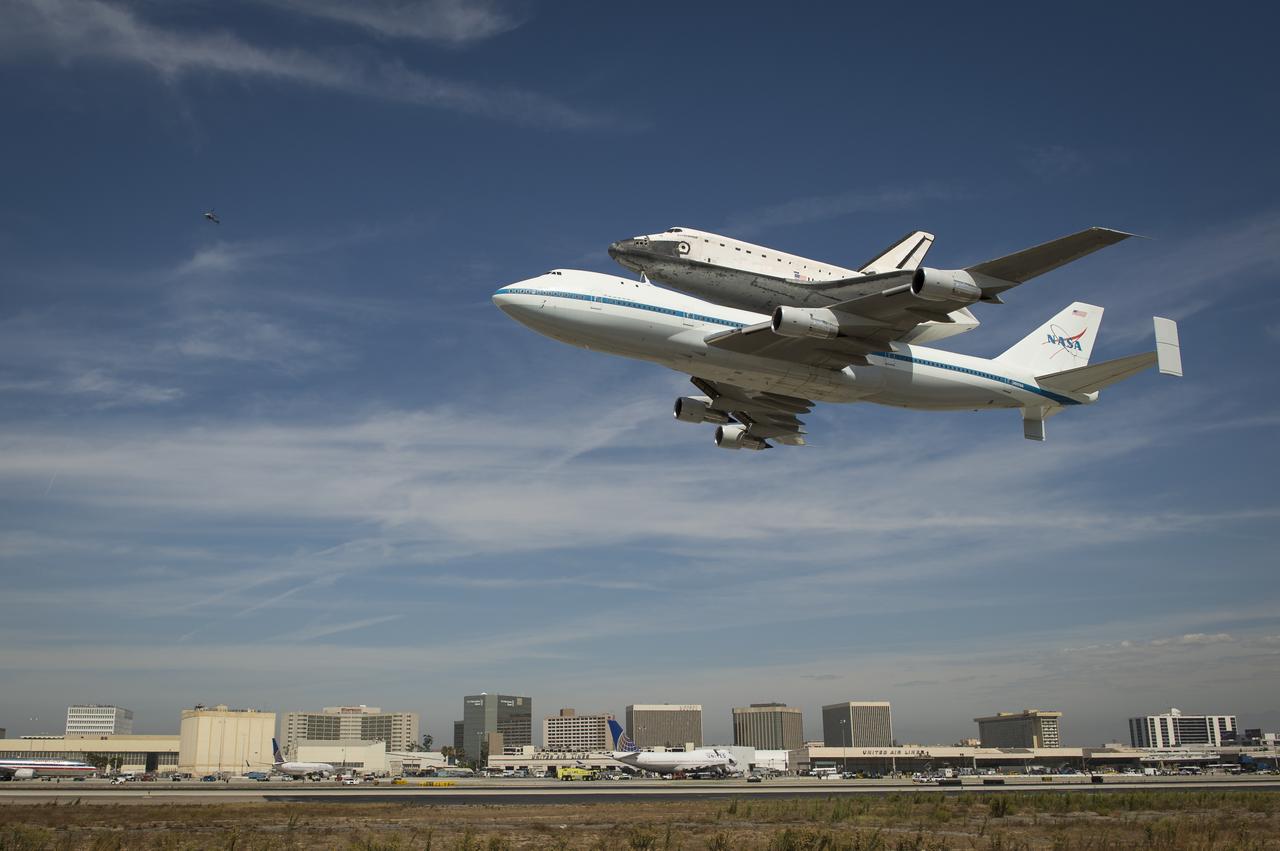
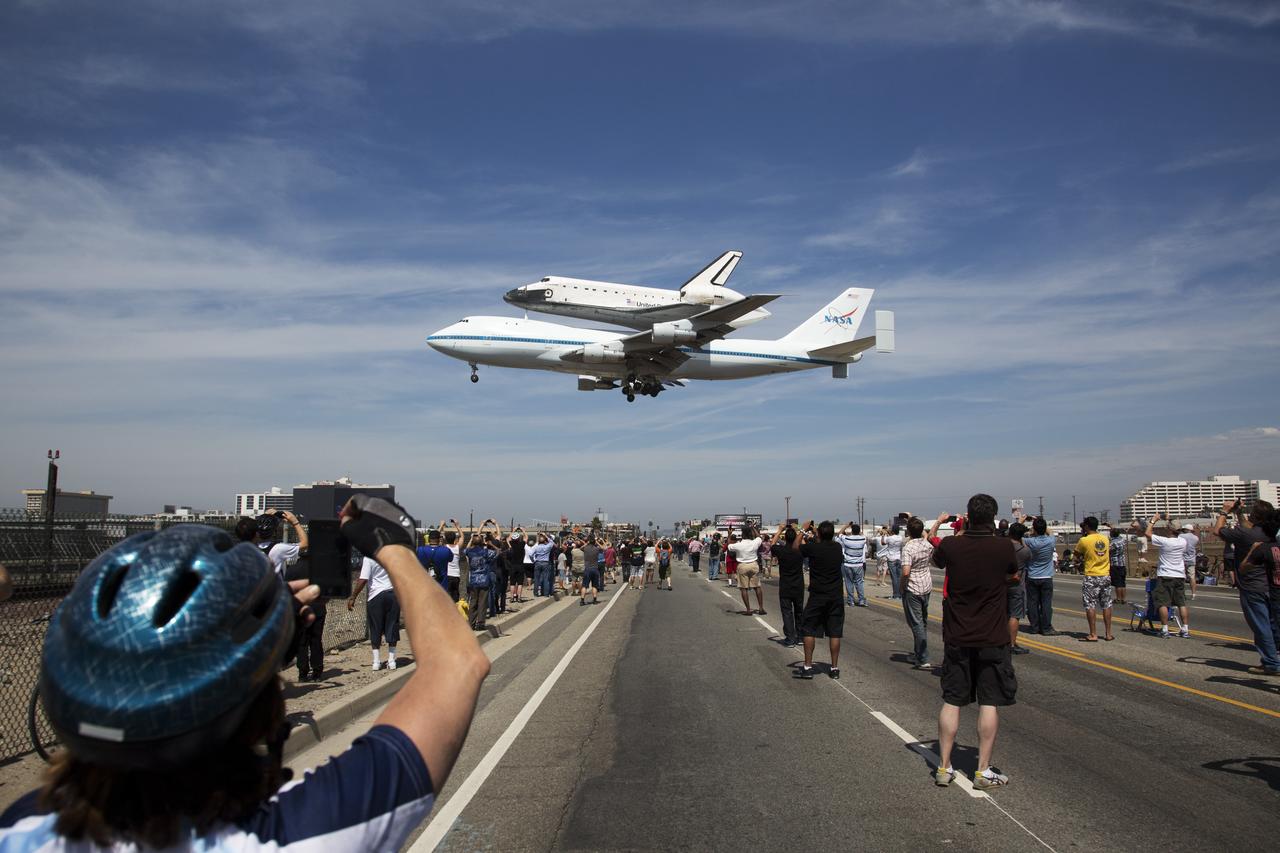
Space shuttle Endeavour, mounted atop a NASA 747 Shuttle Carrier Aircraft (SCA) performs a low flyby at Los Angeles International Airport, Friday, Sept. 21, 2012. Endeavour, built as a replacement for space shuttle Challenger, completed 25 missions, spent 299 days in orbit, and orbited Earth 4,671 times while traveling 122,883,151 miles. Beginning Oct. 30, the shuttle will be on display in the California Science center's Samuel Oschin Space Shuttle Endeavour Display Pavilion, embarking on its new mission to commemorate past achievements in space and educate and inspire future generations of explorers.Photo Credit: (NASA/Bill Ingalls)
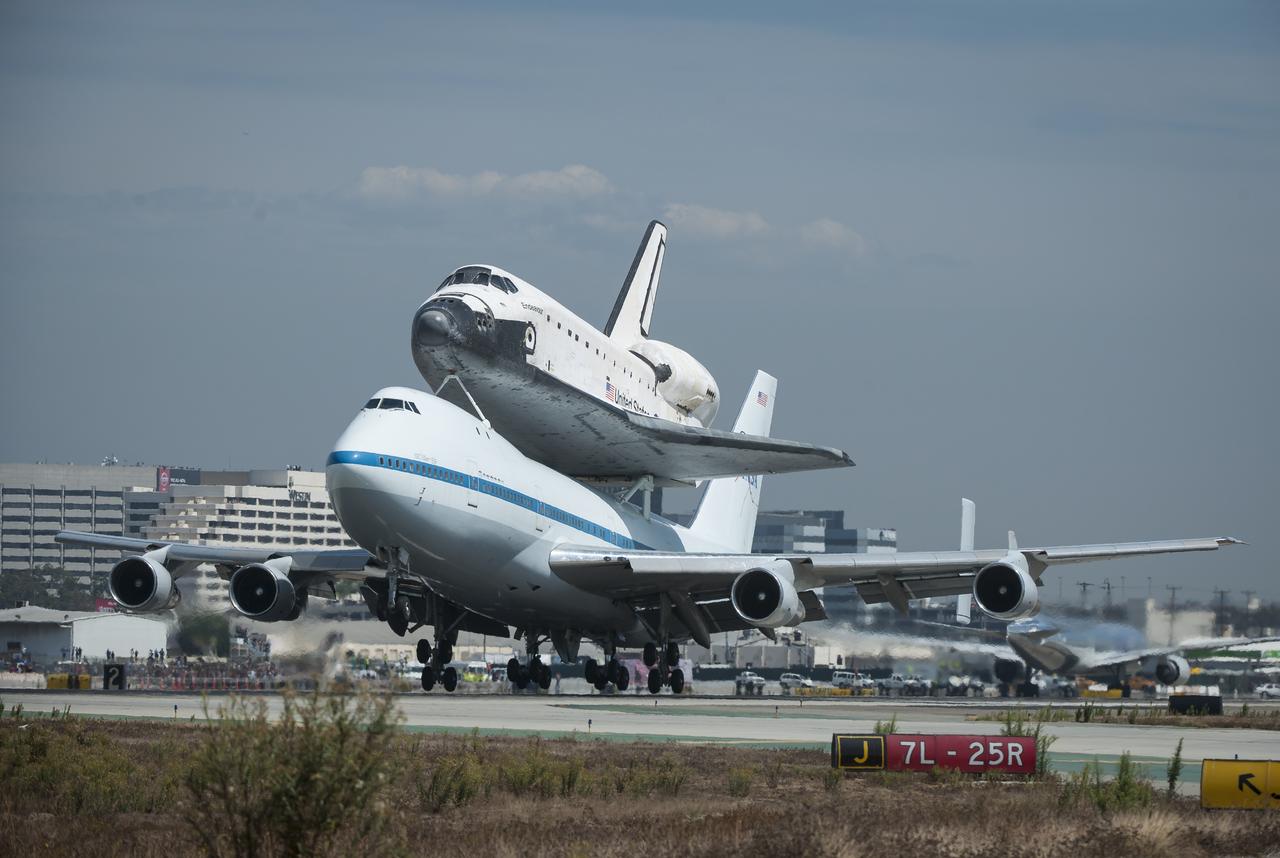
Space shuttle Endeavour, mounted atop a NASA 747 Shuttle Carrier Aircraft (SCA) lands at Los Angeles International Airport, Friday, Sept. 21, 2012. Endeavour, built as a replacement for space shuttle Challenger, completed 25 missions, spent 299 days in orbit, and orbited Earth 4,671 times while traveling 122,883,151 miles. Beginning Oct. 30, the shuttle will be on display in the California Science center's Samuel Oschin Space Shuttle Endeavour Display Pavilion, embarking on its new mission to commemorate past achievements in space and educate and inspire future generations of explorers.Photo Credit: (NASA/Bill Ingalls)
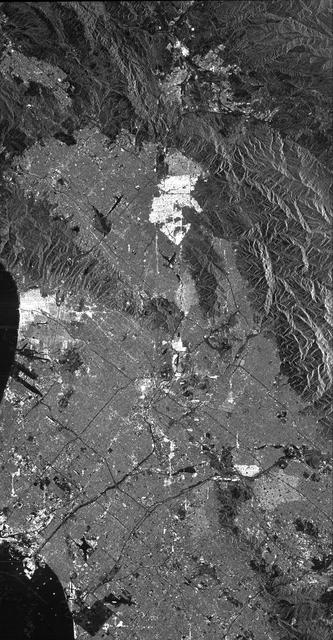
This is a radar image of Los Angeles, California, taken on October 2, 1994.
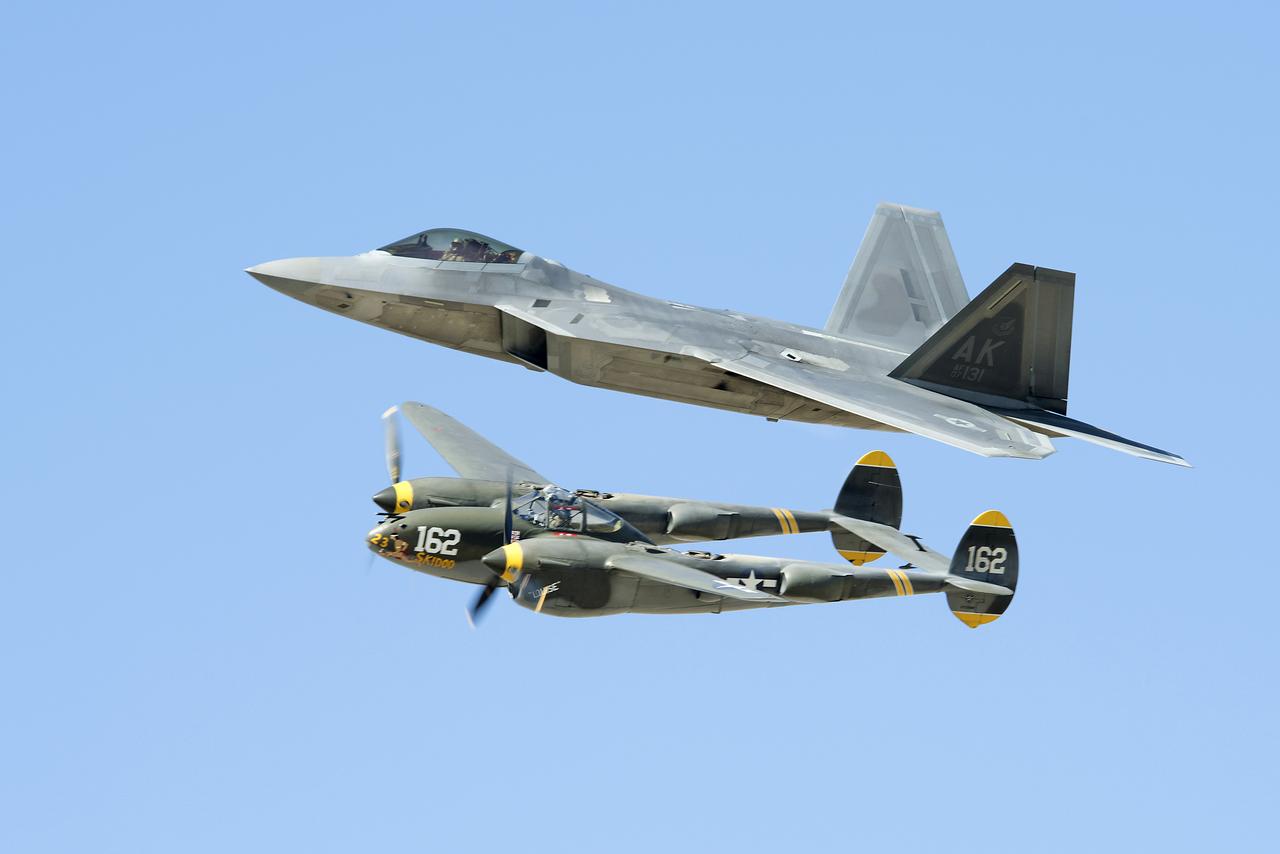
The F-22 and the classic P-38 shares the sky at the Los Angeles County Air Show in Lancaster, California.

NASA Armstrong pilots Stu Broce, Greg Nelson and Tim Williams sign autographs for people at the Los Angeles County Air Show in Lancaster, California.
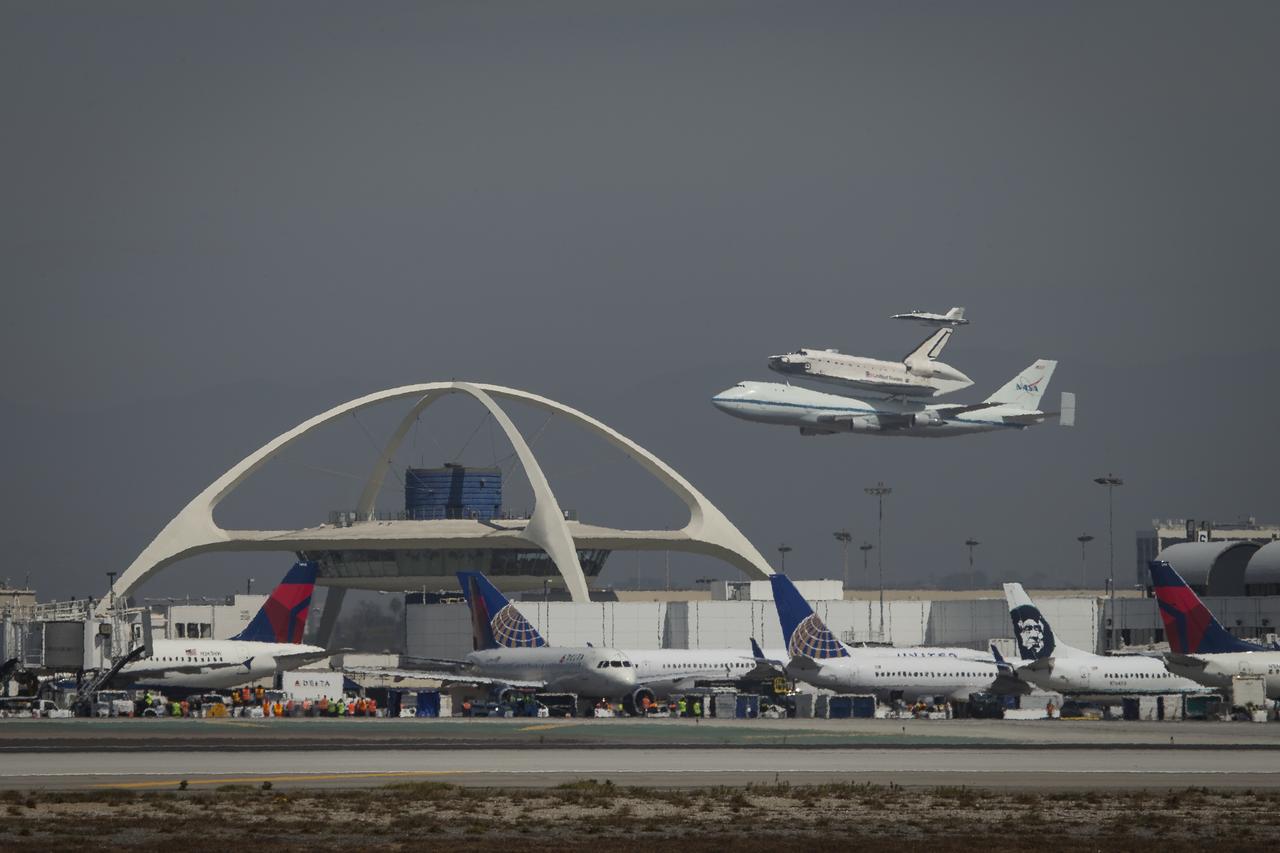
Space shuttle Endeavour, mounted atop a NASA 747 Shuttle Carrier Aircraft (SCA) performs a flyby of the Theme Building at Los Angeles International Airport, Friday, Sept. 21, 2012. Endeavour, built as a replacement for space shuttle Challenger, completed 25 missions, spent 299 days in orbit, and orbited Earth 4,671 times while traveling 122,883,151 miles. Beginning Oct. 30, the shuttle will be on display in the California Science center's Samuel Oschin Space Shuttle Endeavour Display Pavilion, embarking on its new mission to commemorate past achievements in space and educate and inspire future generations of explorers.Photo Credit: (NASA/Scott Andrews)
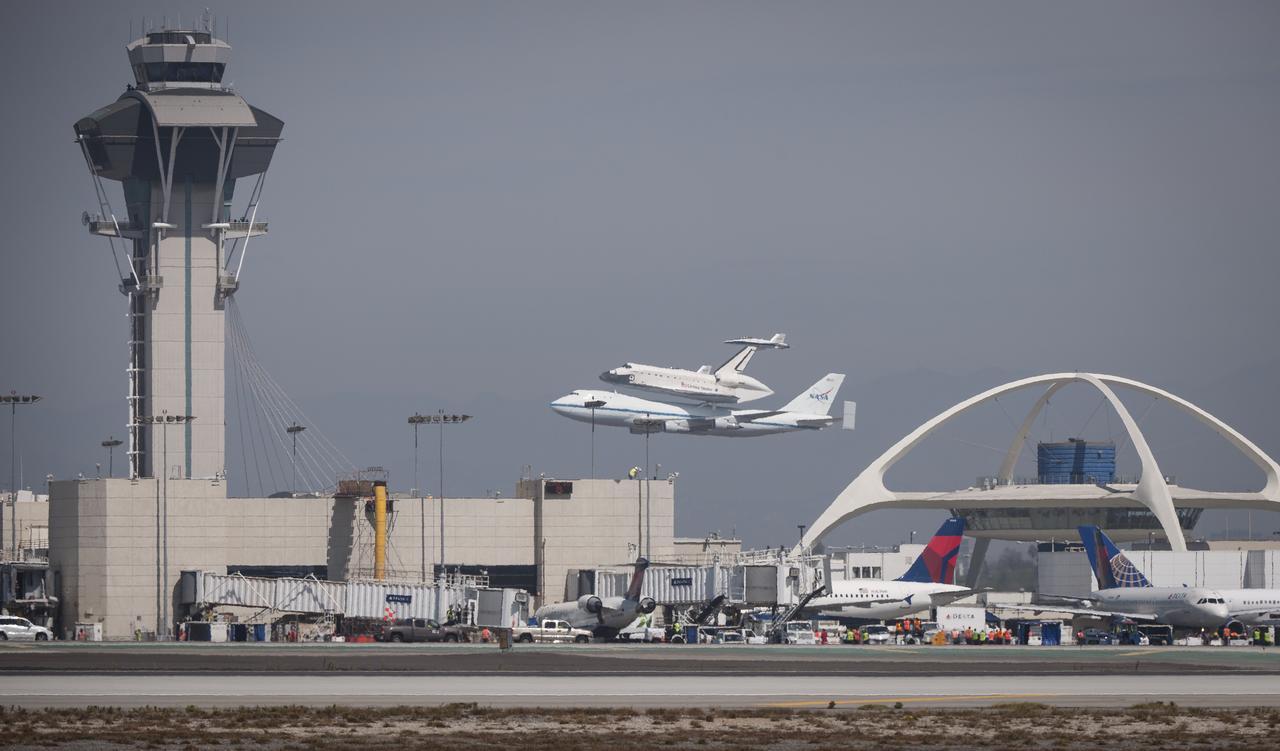
Space shuttle Endeavour, mounted atop a NASA 747 Shuttle Carrier Aircraft (SCA) performs a low flyby past the tower at Los Angeles International Airport, Friday, Sept. 21, 2012. Endeavour, built as a replacement for space shuttle Challenger, completed 25 missions, spent 299 days in orbit, and orbited Earth 4,671 times while traveling 122,883,151 miles. Beginning Oct. 30, the shuttle will be on display in the California Science center's Samuel Oschin Space Shuttle Endeavour Display Pavilion, embarking on its new mission to commemorate past achievements in space and educate and inspire future generations of explorers.Photo Credit: (NASA/Bill Ingalls)
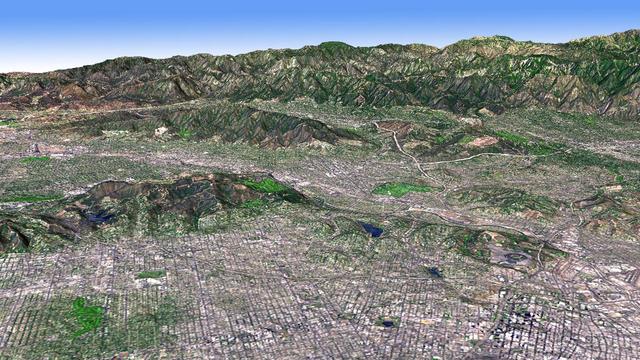
The Los Angeles Basin is bordered on the north by the San Gabriel Mountains. Other smaller basins are separated by smaller mountain ranges, like the Verdugo Hills, and the Santa Monica Mountains in this image from NASA Terra spacecraft.
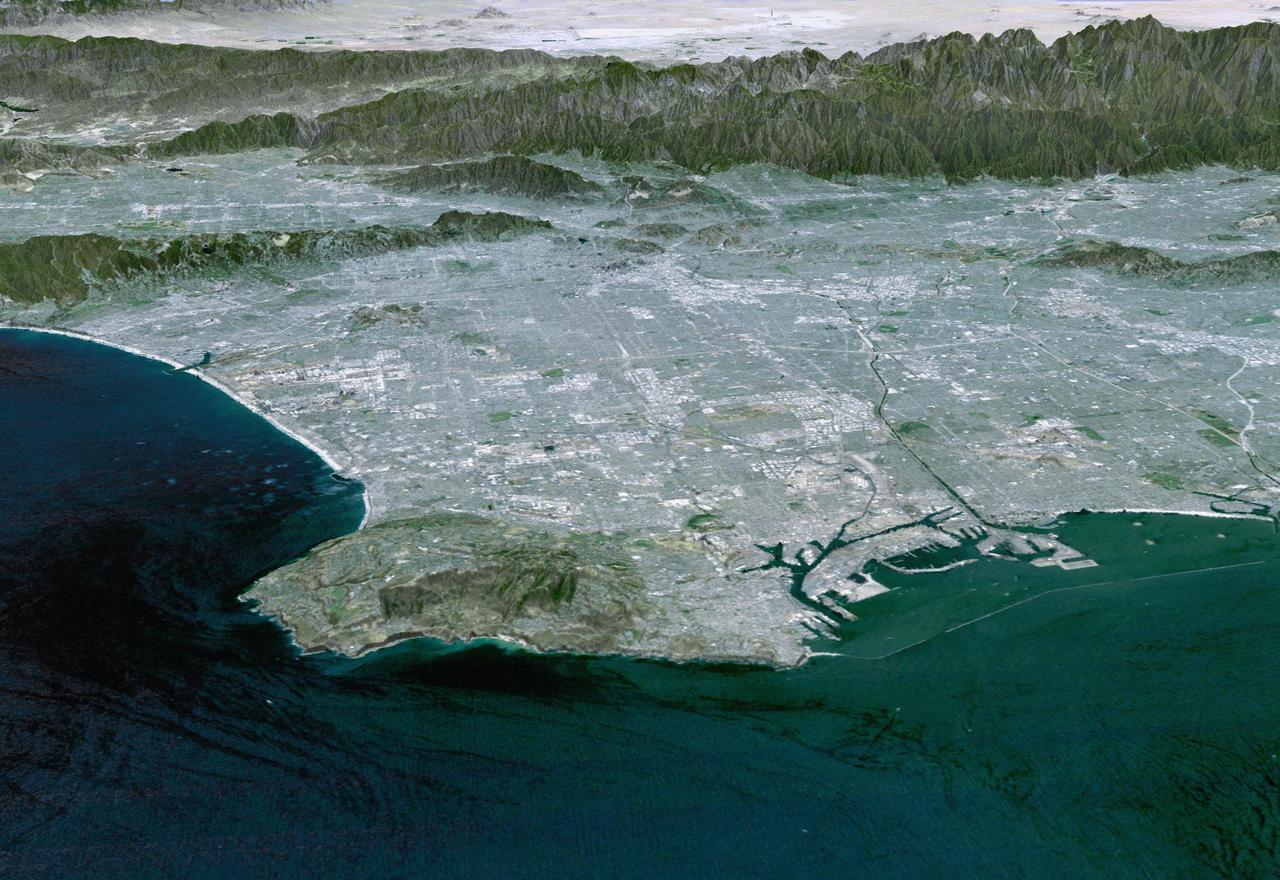
Most of Los Angeles is visible in this computer-generated north-northeast perspective viewed from above the Pacific Ocean.
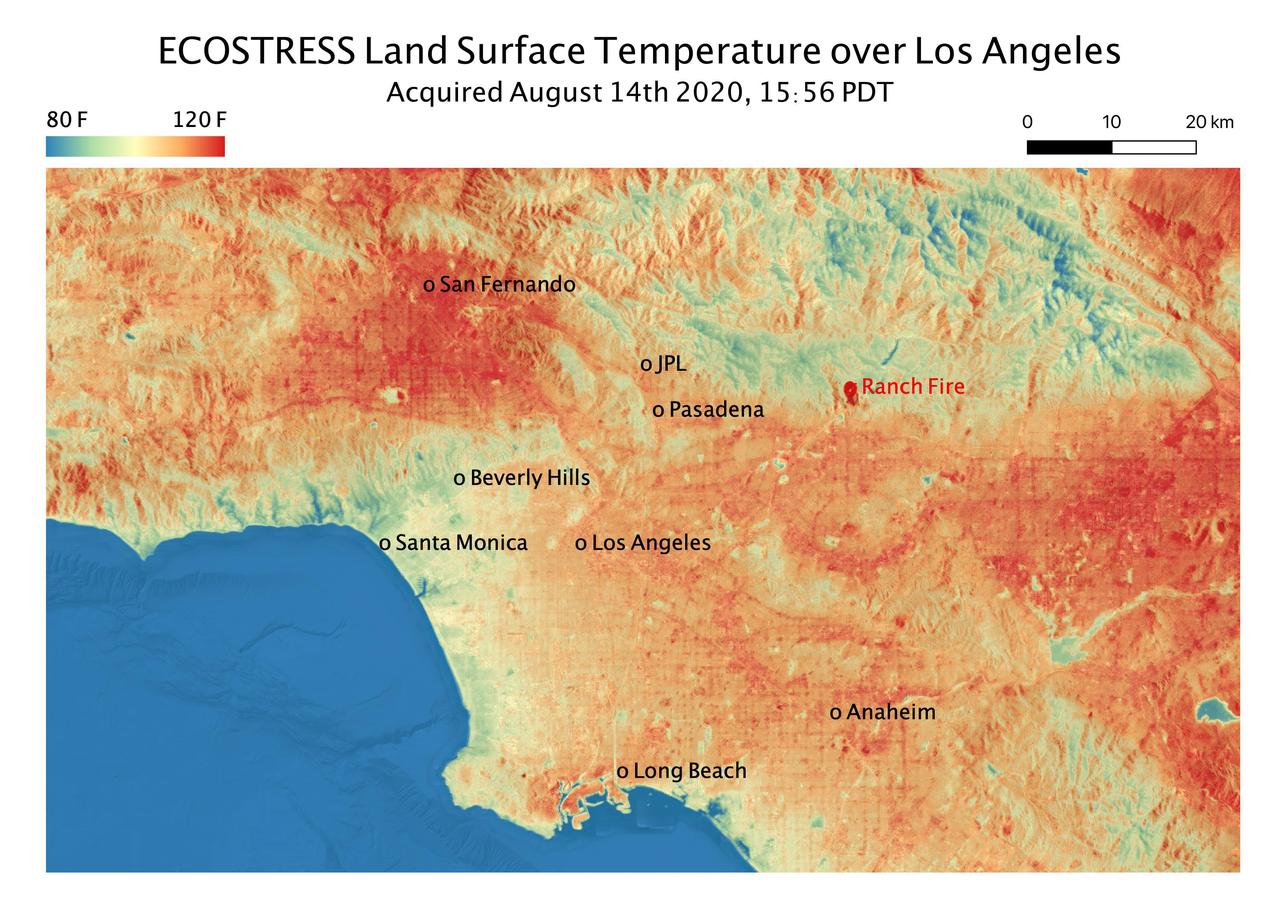
This temperature map shows the land surface temperatures throughout Los Angeles County on Aug. 14, 2020. The observation was made possible by NASA's Ecosystem Spaceborne Thermal Radiometer Experiment on Space Station (ECOSTRESS), which measured a peak land surface temperature in the San Fernando Valley, northwest of downtown Los Angeles, of 128.3 degrees Fahrenheit (53.5 degrees Celsius). ECOSTRESS collected this data as the space station passed over California at about 3:56 p.m. PDT (6:56 p.m. EDT) during a record-breaking heat wave that gripped the region. The Ranch fire, that burned near the city of Azuza was also detected by ECOSTRESS. With a resolution of about 77 by 77 yards (70 by 70 meters), the image enables the study of surface-temperature conditions down to the size of a football field. The hottest temperatures are shown in dark red, with the coolest temperatures in blue. ECOSTRESS measures the temperature of plants as they heat up when they run out of water. But it can also measure and track heat-related phenomena like heat waves, fires, and volcanoes. https://photojournal.jpl.nasa.gov/catalog/PIA23786

The space shuttle Endeavour moves out of the Los Angeles International Airport and onto the streets of Los Angeles to make its way to its new home at the California Science Center, Friday, Oct. 12, 2012. Endeavour, built as a replacement for space shuttle Challenger, completed 25 missions, spent 299 days in orbit, and orbited Earth 4,671 times while traveling 122,883,151 miles. Beginning Oct. 30, the shuttle will be on display in the CSC's Samuel Oschin Space Shuttle Endeavour Display Pavilion, embarking on its new mission to commemorate past achievements in space and educate and inspire future generations of explorers. Photo Credit: (NASA/Carla Cioffi)
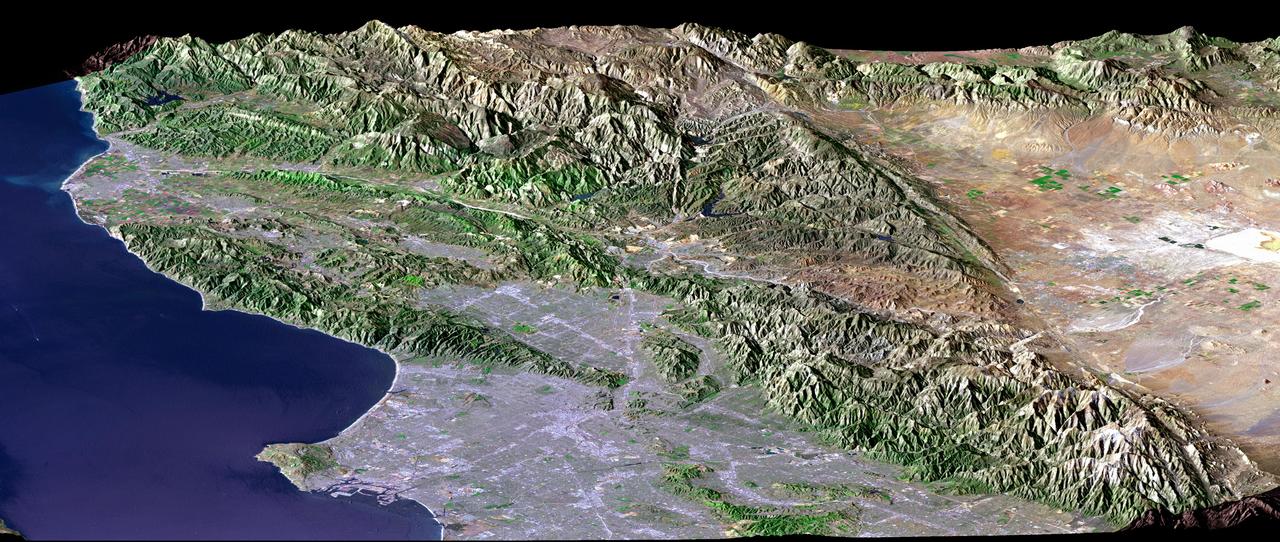
Los Angeles, Calif., is one of the world largest metropolitan areas with a population of about 15 million people. The urban areas mostly cover the coastal plains and lie within the inland valleys.
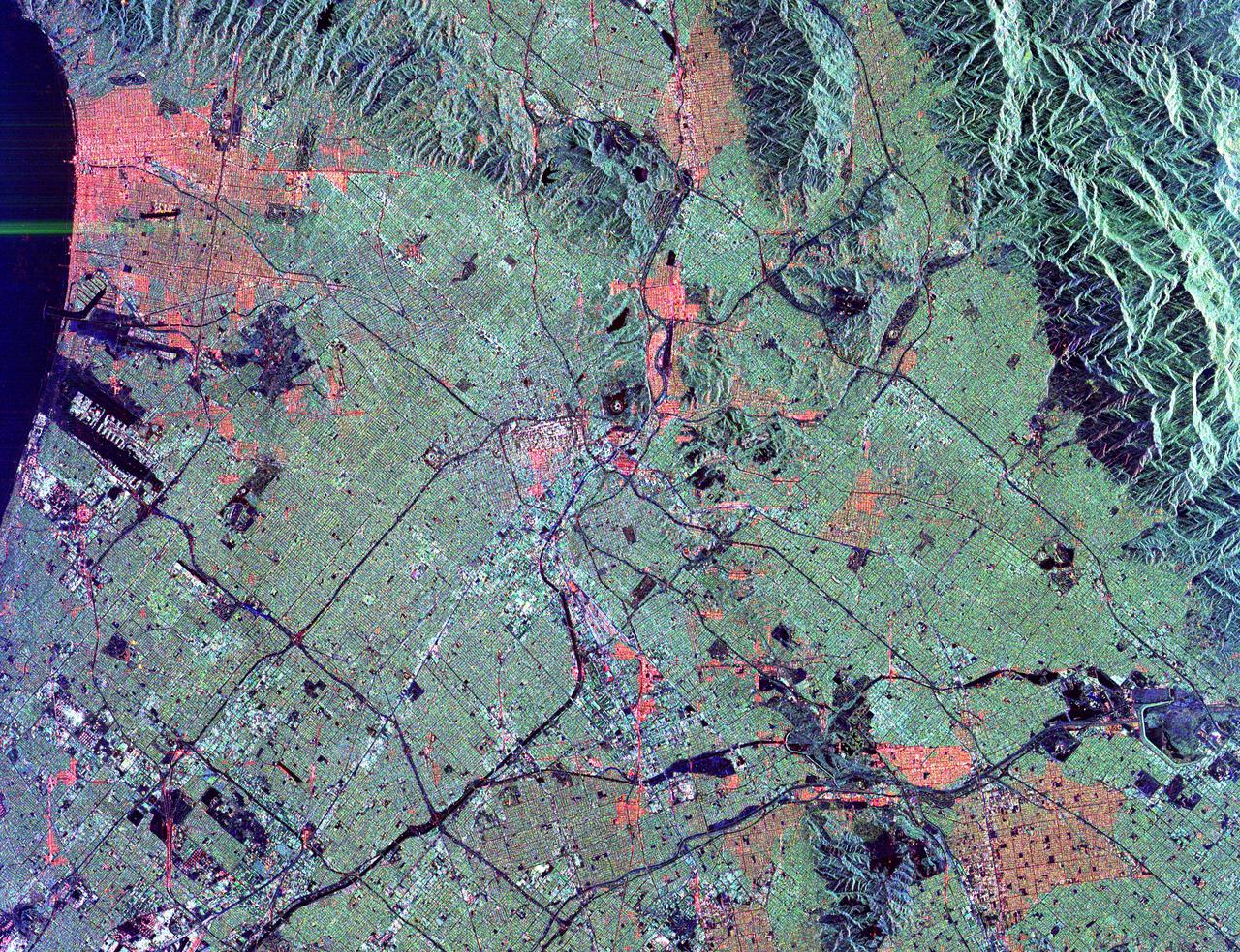
This radar image shows the massive urbanization of Los Angeles, California. The image extends from the Santa Monica Bay at the left to the San Gabriel Mountains at the right. Downtown Los Angeles is in the center of the image. The runways of the Los Angeles International Airport appear as black strips at the left center of the image. The waterways of Marina del Rey are seen just above the airport. The San Gabriel Mountains and the city of Pasadena are at the right center of the image. Black areas on the mountains on the right are fire scars from the 1993 Altadena fire. The Rose Bowl is shown as a small circle near the right center. The complex freeway system is visible as dark lines throughout the image. Some city areas, such as Santa Monica in the upper left, appear red due to the alignment of streets and buildings to the incoming radar beam. The image was acquired by the Spaceborne Imaging Radar-C/X-band Synthetic Aperture Radar (SIR-C/X-SAR) onboard the space shuttle Endeavour on October 3, 1994. SIR-C/X-SAR, a joint mission of the German, Italian and the United States space agencies, is part of NASA's Mission to Planet Earth. This image is centered at 34.04 degrees North latitude and 118.2 degrees West longitude with North pointing toward the upper right. The area shown measures 40 kilometers by 50 kilometers (25 miles by 31 miles). http://photojournal.jpl.nasa.gov/catalog/PIA01789
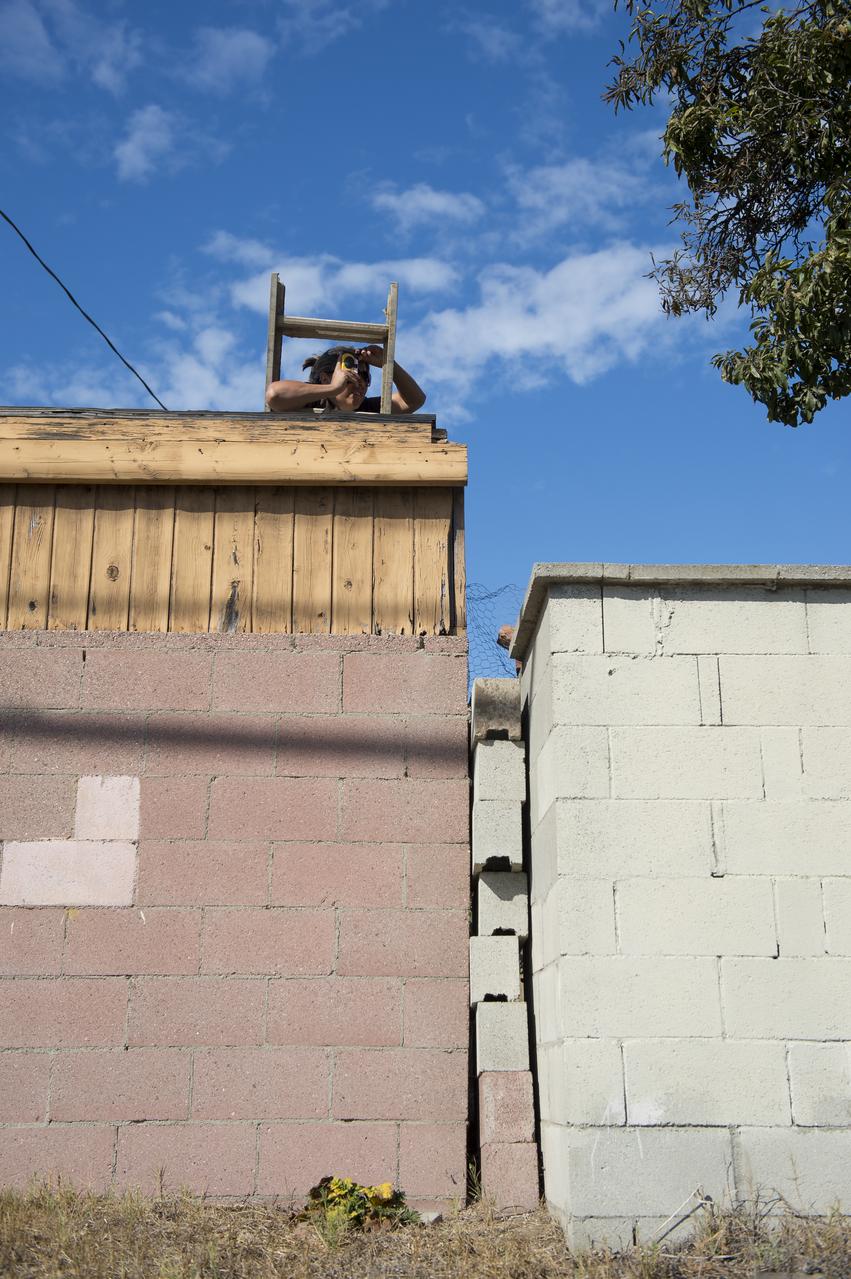
A spectator photographs the space shuttle Endeavour as it passes by on its way to its new home at the California Science Center in Los Angeles, Friday, Oct. 12, 2012. Endeavour, built as a replacement for space shuttle Challenger, completed 25 missions, spent 299 days in orbit, and orbited Earth 4,671 times while traveling 122,883,151 miles. Beginning Oct. 30, the shuttle will be on display in the CSC's Samuel Oschin Space Shuttle Endeavour Display Pavilion, embarking on its new mission to commemorate past achievements in space and educate and inspire future generations of explorers. Photo Credit: (NASA/Carla Cioffi)
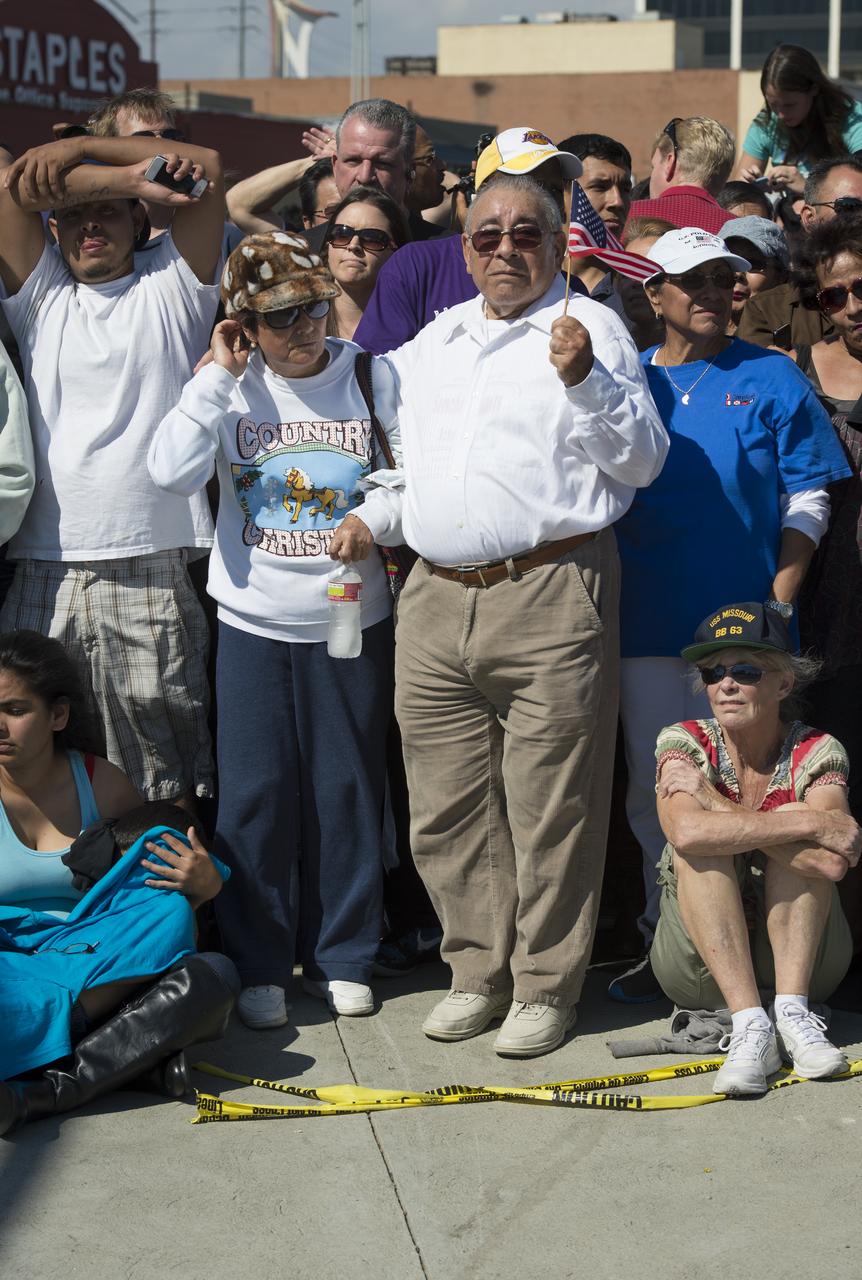
Spectators are seen as they watch space shuttle Endeavour as it passes by on its way to its new home at the California Science Center in Los Angeles, Friday, Oct. 12, 2012. Endeavour, built as a replacement for space shuttle Challenger, completed 25 missions, spent 299 days in orbit, and orbited Earth 4,671 times while traveling 122,883,151 miles. Beginning Oct. 30, the shuttle will be on display in the CSC's Samuel Oschin Space Shuttle Endeavour Display Pavilion, embarking on its new mission to commemorate past achievements in space and educate and inspire future generations of explorers. Photo Credit: (NASA/Carla Cioffi)
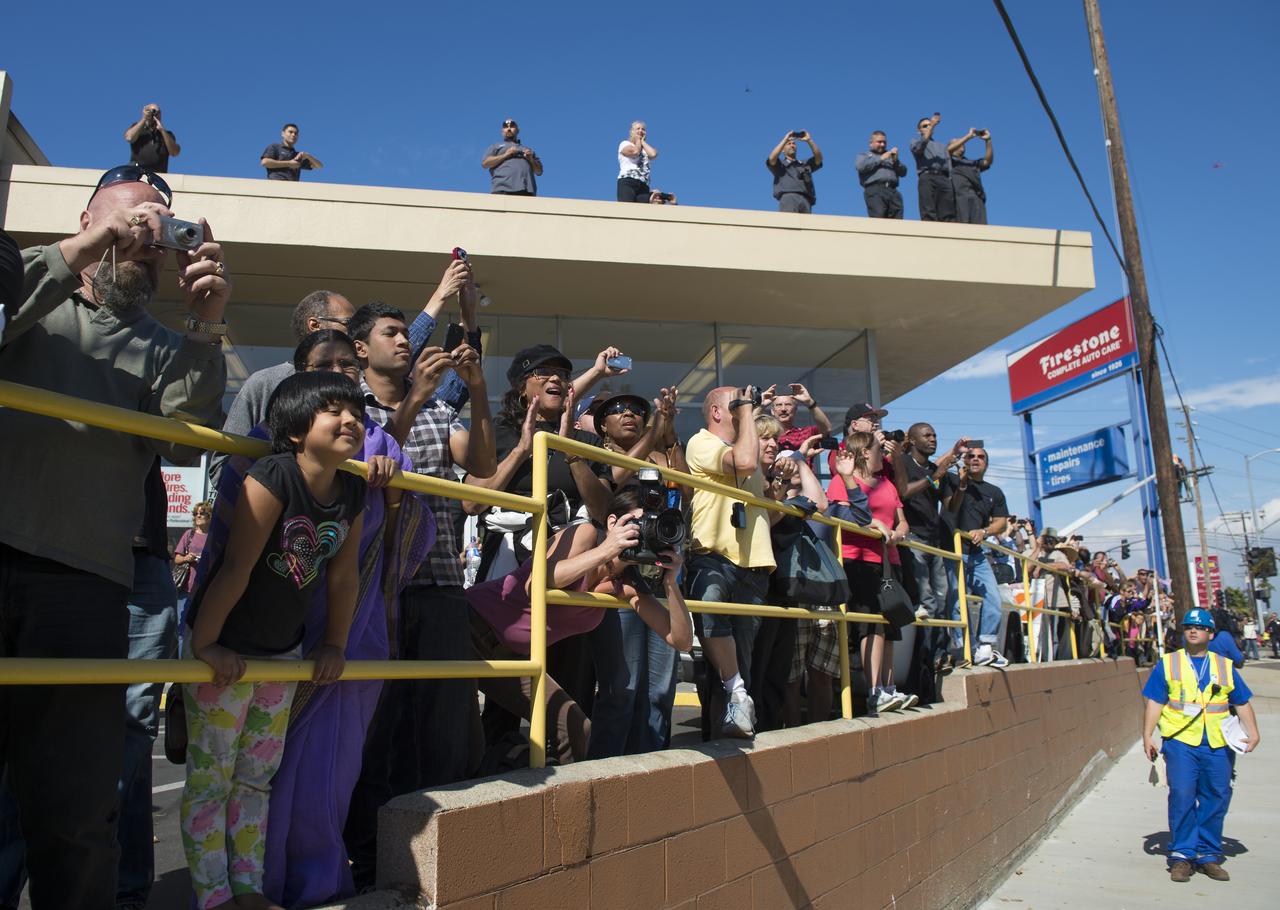
Spectators are seen as they watch space shuttle Endeavour as it passes by on its way to its new home at the California Science Center in Los Angeles, Friday, Oct. 12, 2012. Endeavour, built as a replacement for space shuttle Challenger, completed 25 missions, spent 299 days in orbit, and orbited Earth 4,671 times while traveling 122,883,151 miles. Beginning Oct. 30, the shuttle will be on display in the CSC's Samuel Oschin Space Shuttle Endeavour Display Pavilion, embarking on its new mission to commemorate past achievements in space and educate and inspire future generations of explorers. Photo Credit: (NASA/Carla Cioffi)
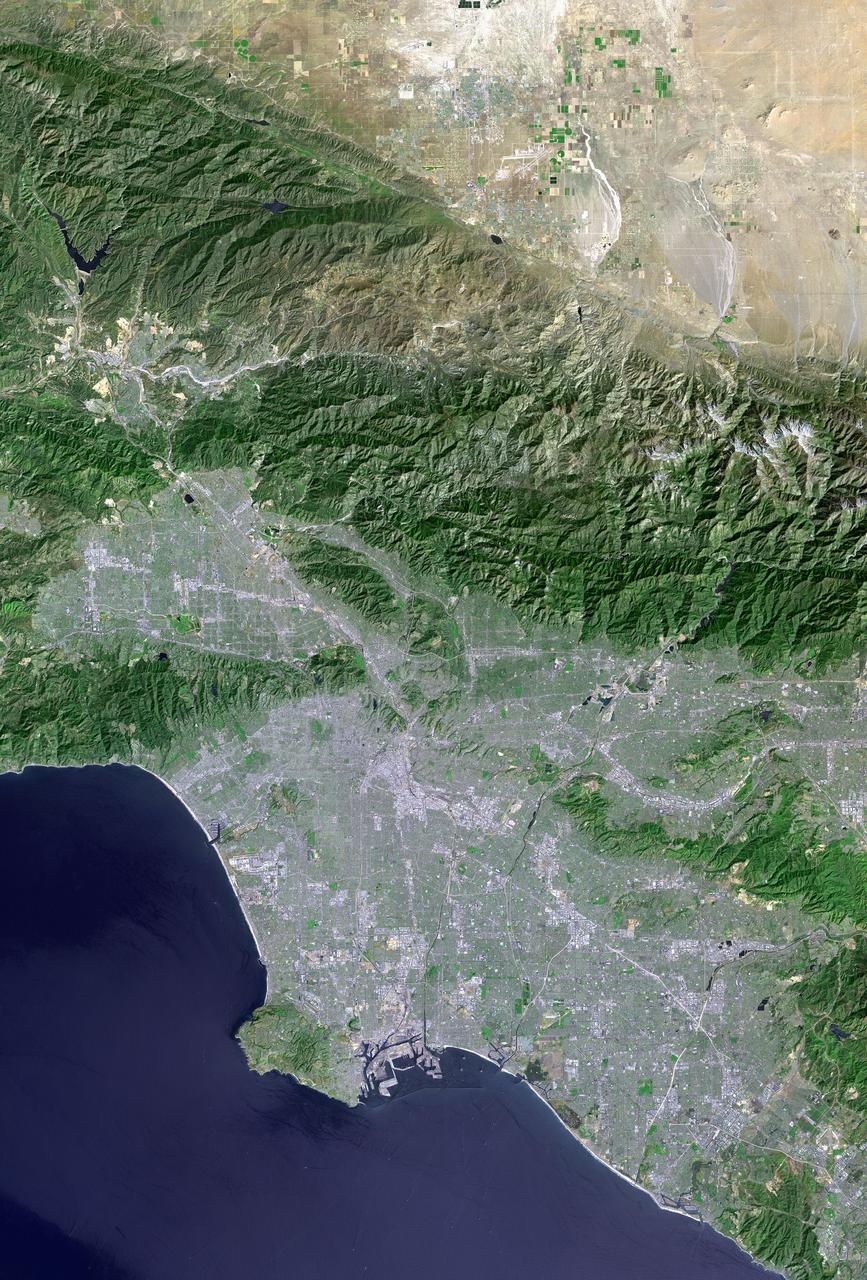
Los Angeles and vicinity seen from space, as viewed by NASA Landsat 7 satellite from an altitude of 437 miles on May 4, 2001.
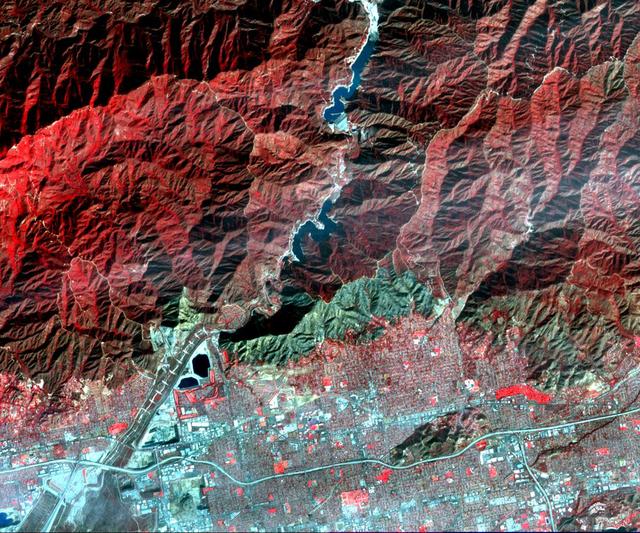
On Jan. 16, 2014, NASA Terra spacecraft acquired this image of a wildfire broke that out in the mountains above the Los Angeles suburbs of Glendora and Azusa.

Space Shuttle Endeavour is affixed atop NASA’s 747 Shuttle Carrier Aircraft as it prepares for a landing at Los Angeles International Airport to conclude a final flight on Sept. 21, 2012.
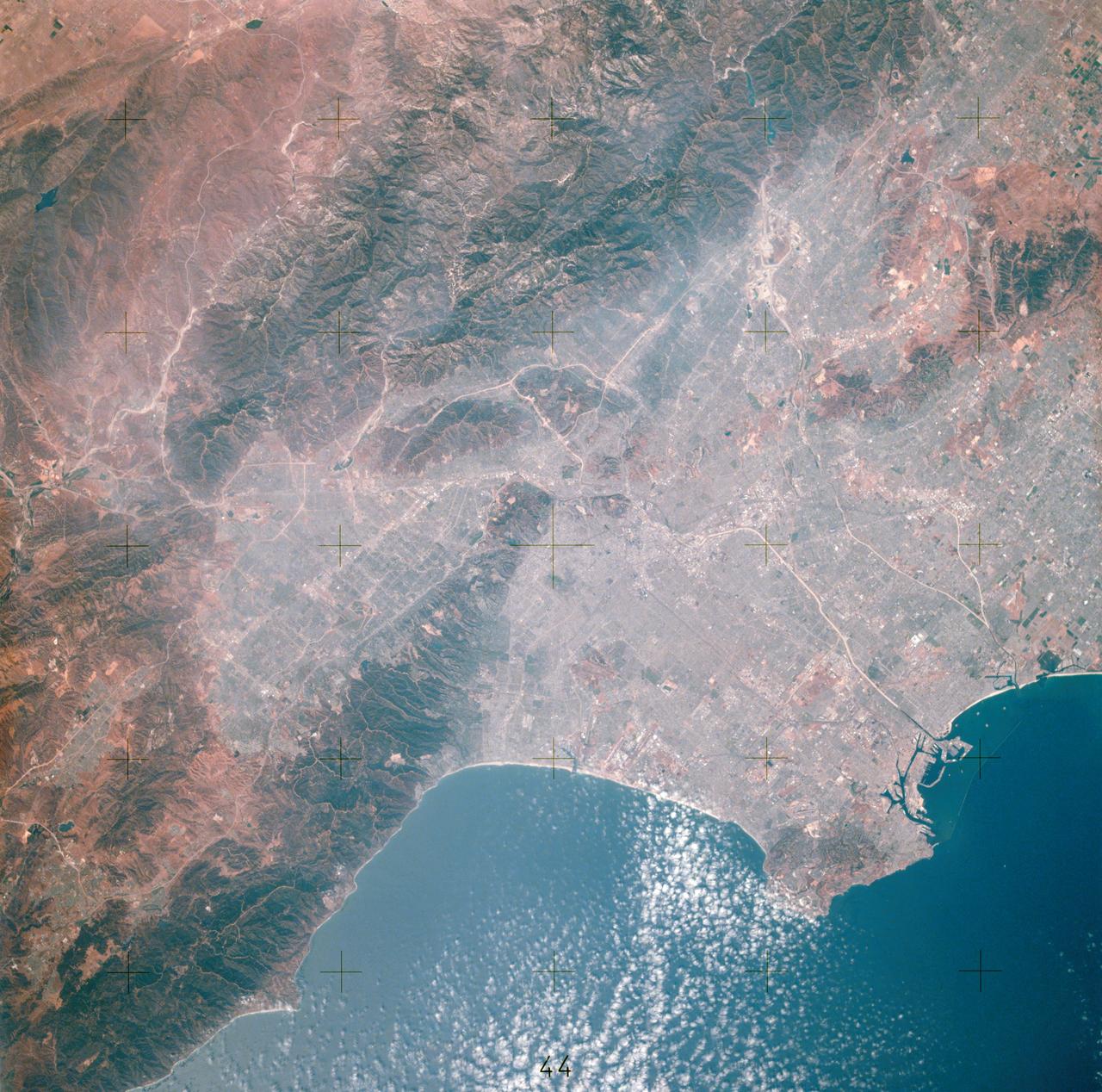
AST-14-881 (16 July 1975) --- An excellent view of Los Angeles, California, as photographed from the Apollo spacecraft in Earth orbit during the joint U.S.-USSR Apollo-Soyuz Test Project (ASTP) mission. Downtown Los Angeles is near the center of the picture. The photograph was taken at an altitude of 193 kilometers (120 statute miles), with a 70mm Hasselblad camera using SO-242 high-definition Ektachrome film.
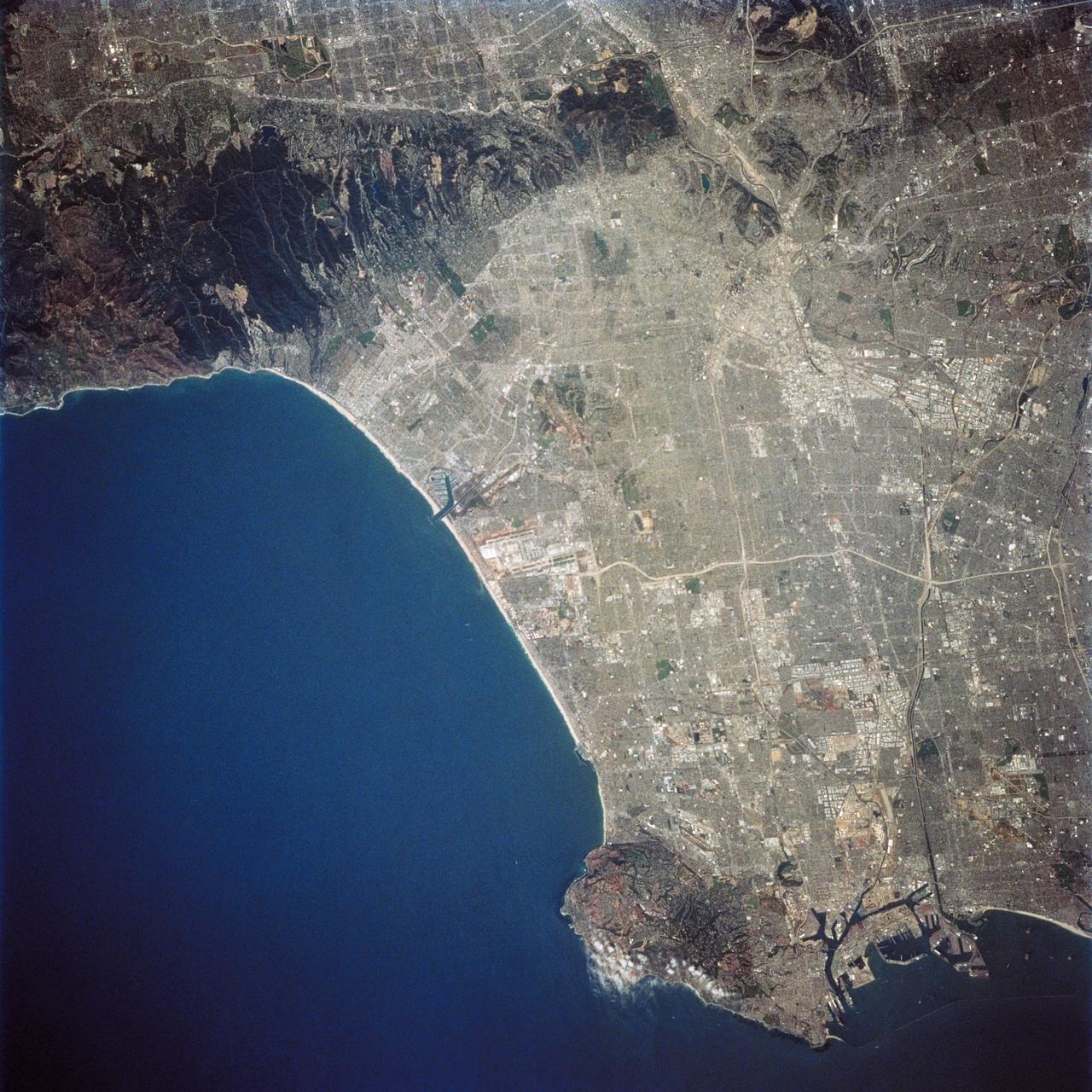
STS059-227-050 (9-20 April 1994) --- A low altitude, and unusually clear air, provided perhaps the most detailed view of Los Angeles, California ever obtained during a shuttle flight. Orient with the bulk of the ocean to the lower left. Then Long Beach is in the lower right, just east of the Palos Verdes Hills that extend into the Pacific Ocean. Marina del Rey is cut into the straight segment of beach, with Los Angeles International Airport (LAX) clearly visible to the southeast. Downtown Los Angeles is the light-toned sprawl in the upper right, with the rectangular grid pattern of Pasadena extending out of the picture. The Santa Monica Mountains to the upper left extend east-west, separating the San Fernando Valley (epicenter of the 1993 earthquake) from the Los Angeles Basin proper. It is impossible to determine by photo interpretation whether or not the de-vegetated scars along the southern edge of the mountains represent man-made features (real-estate development) or wildfires.
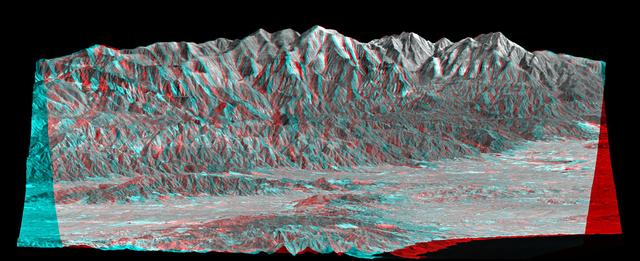
Mount San Antonio more commonly known as Mount Baldy crowns the San Gabriel Mountains northeast of Los Angeles, Calif., in this anaglyph from NASA Shuttle Radar Topography Mission. 3D glasses are necessary to view this image.
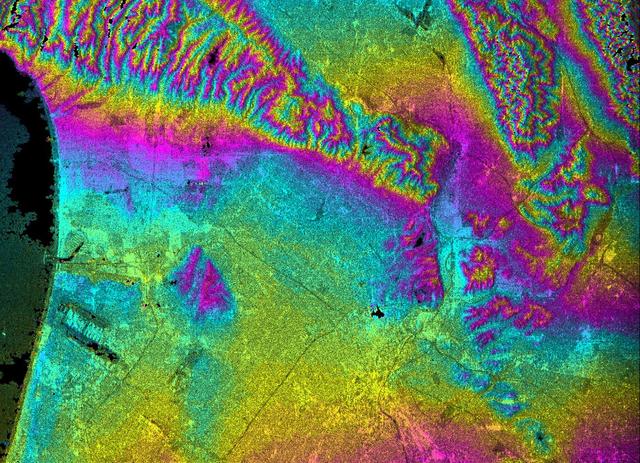
This topographic radar image acquired by NASA Shuttle Radar Topography Mission SRTM in Feb. 2000 shows the relationships of the dense urban development of Los Angeles, Calif. and the natural contours of the land.
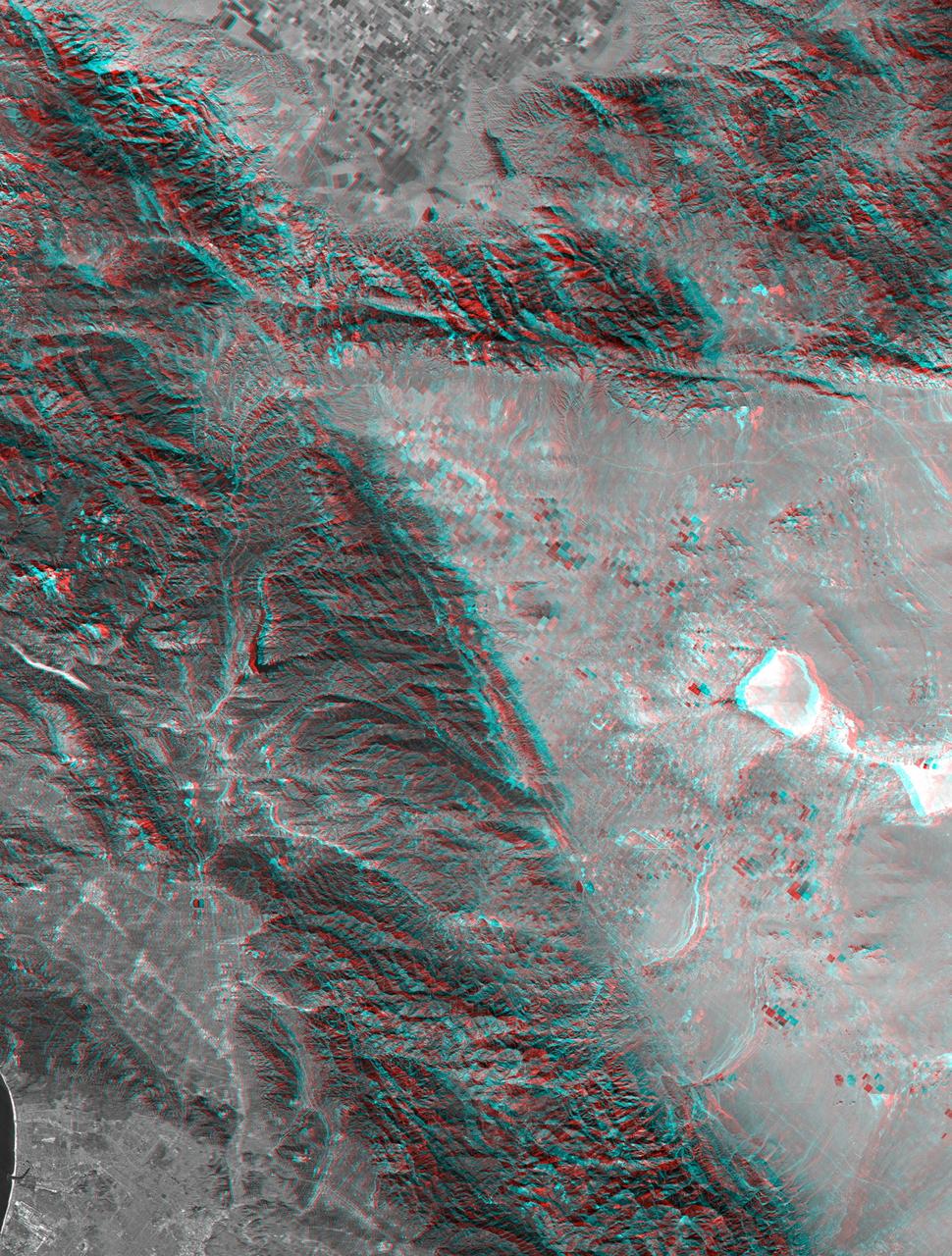
This anaglyph, from NASA Shuttle Radar Topography Mission, shows rugged terrain between Los Angeles and California central valley. 3D glasses are necessary to view this image.
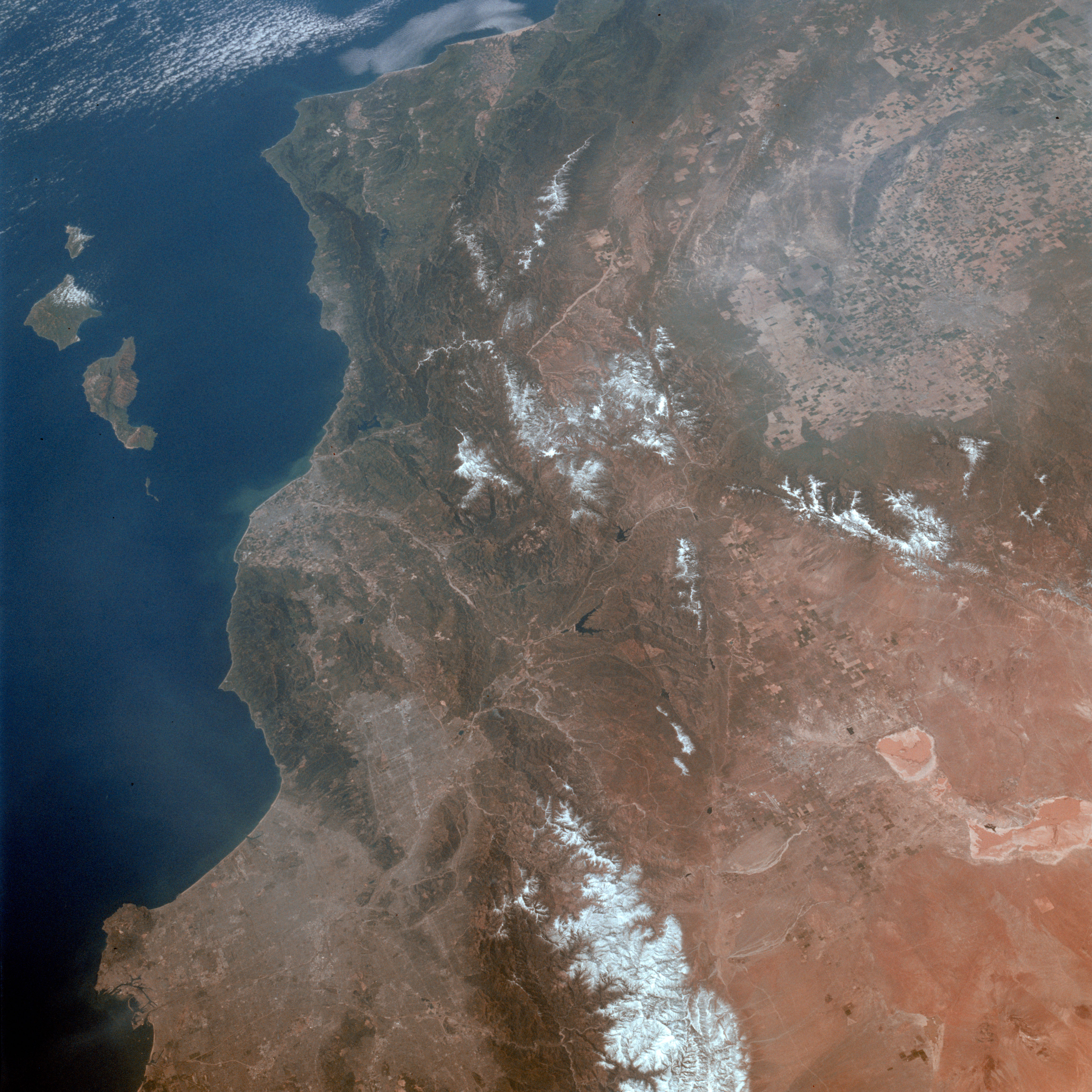
STS003-010-593 (30 March 1982) --- A general view of the greater Los Angeles region of California (34,0N, 118.5W) showing the coastline, Vandenberg AFB, the south end of the Central Valley and the dry lake beds at Edwards AFB. A close look can pinpoint water on the lake beds at Edwards Air Force Base used previously for two shuttle landings. Among other features that can be seen are Oxnard, Santa Barbara, Bakersfield, Vandenberg Air Force Base, and The Ranch. Photo credit: NASA
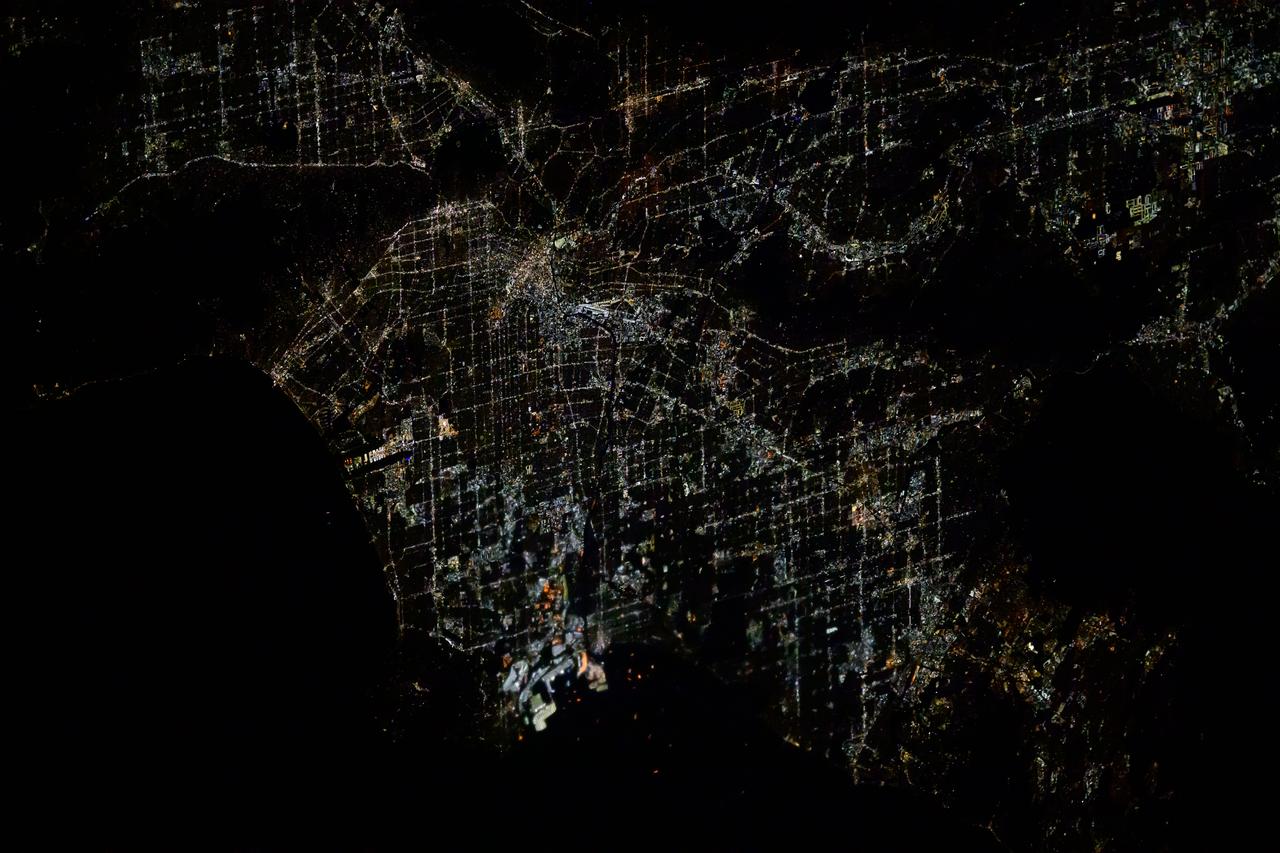
iss072e399065 (Dec. 19, 2024) --- The city lights of Los Angeles, California, and its Terminal Island (center bottom) housing industry, a port, and a correctional facility, are pictured about 4:15 a.m. local time from the International Space Station as it orbited 257 miles above.
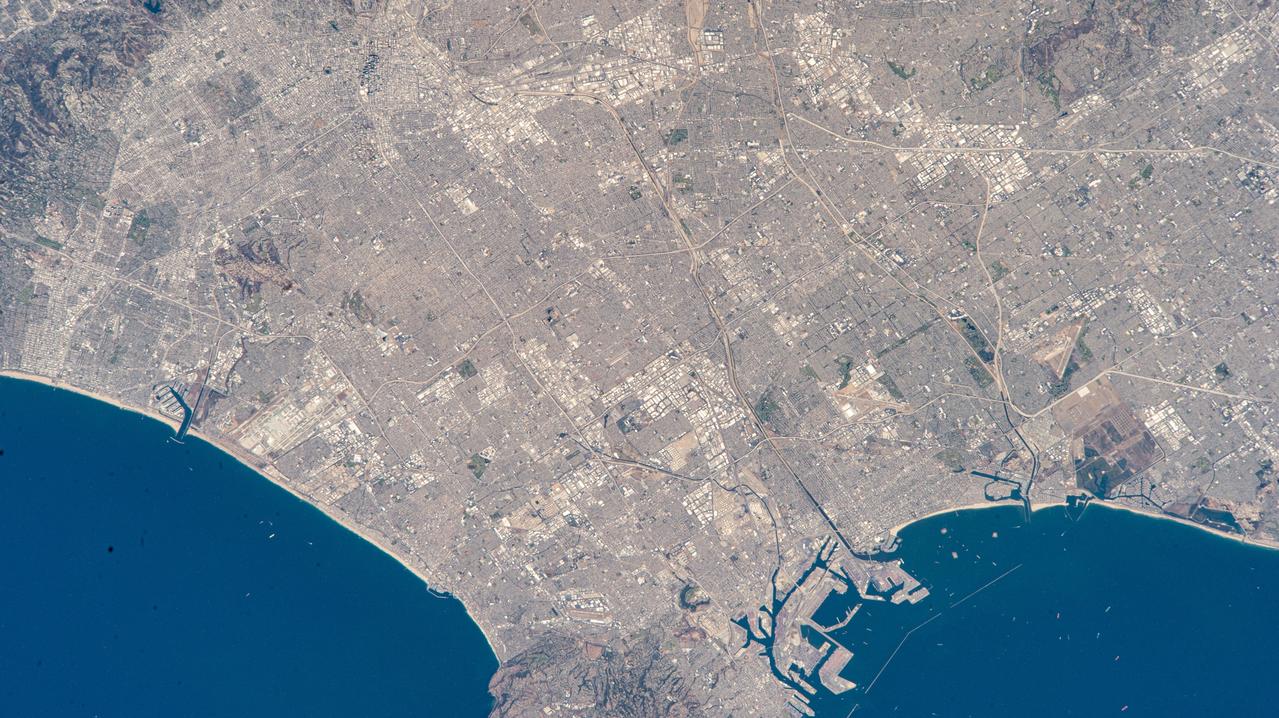
iss073e0513936 (Aug. 22, 2025) --- Los Angeles, California, surrounded by its suburbs including Santa Monica, Marina Del Rey, and Long Beach, is pictured from the International Space Station as it orbited 261 miles above the Golden State. Highlights include Terminal Island (bottom right), an artificial island used mainly for industrial and port-related activities. At left, near Marina Del Rey is Los Angeles International Airport (LAX) connecting over 80 million passengers annually to over 100 domestic and international destinations.

This image of the greater Los Angeles area was taken on March 29, 2019, by ASTERIA, the Arcsecond Space Telescope Enabling Research in Astrophysics satellite. The Port of Long Beach is visible near the center of the image. ASTERIA is a CubeSat, or a small satellite composed of cube units that measure 10 centimeters (4.5 inches) on each side. ASTERIA was designed to demonstrate precision pointing technology in a CubeSat, which could be used to observe planets around other stars. A slight decrease in a star's brightness as detected by ASTERIA could indicate that a planet is orbiting the star and passed in front of the star. This is called a planet transit. After completing its primary mission objectives in January 2018, ASTERIA has continued to operate on an extended mission. The mission team took this image to further test the capabilities of the satellite. https://photojournal.jpl.nasa.gov/catalog/PIA23124
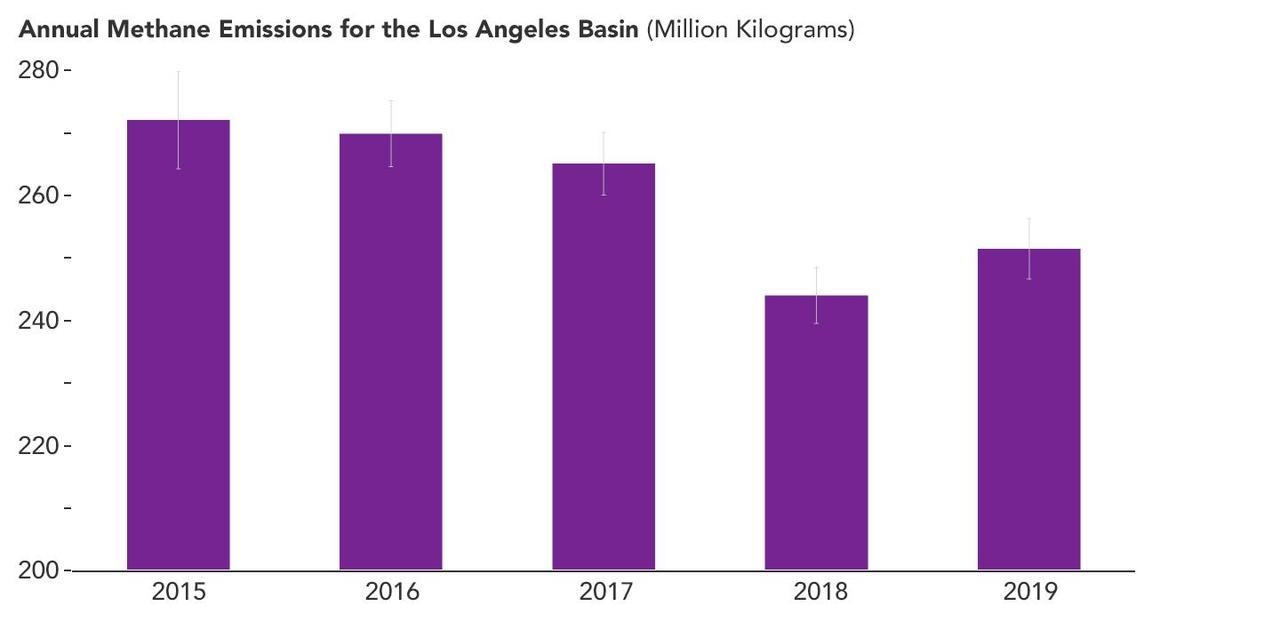
A February 2023 study by researchers at NASA's Jet Propulsion Laboratory in Southern California analyzed data on atmospheric methane concentrations from ground-based sensors scattered around four densely populated Southern California counties. It found that emissions of the powerful greenhouse gas methane fell by about 7% between 2015 and 2020 – a reduction of 33 million pounds (15 million kilograms) of methane released per year. This bar graph shows that overall emissions in the study area decreased between 2015 and 2019, the last full year of the data for the study. Error bars indicate uncertainties in the estimates for each year. Published in Environmental Research Letters, the paper is based on measurements from eight spectroscopic sensors that were installed as part of the Megacities Carbon Project, a multiagency collaboration monitoring greenhouse gases in the Los Angeles, Indianapolis, and Washington, D.C., areas. The sensors have been gathering data since 2015. The California data enabled researchers to study an area that stretches from the beaches of Malibu in the west to the mountains and deserts of San Bernardino and Riverside counties in the east. It also extends south through all of Orange County. The researchers found that the month-to-month fluctuations in methane concentrations around Los Angeles gradually fell from 2015 to 2020, and well into 2022 – a strong indication that local emissions of the gas were also decreasing. Then, using a mathematical model to estimate the emissions decrease, they found the areas covered by sensors in Granada Hills (Los Angeles County) and Ontario (San Bernardino County) accounted for much of the drop in annual emissions from 2015 to 2020. Although the paper doesn't cite causes of the emission reductions in those two locales, researchers suspect they resulted from better management of natural gas pipelines and equipment, which in turn led to lower fugitive – or accidental – methane releases. Improved infrastructure at a massive landfill near Granada Hills likely also played a role. https://photojournal.jpl.nasa.gov/catalog/PIA25863
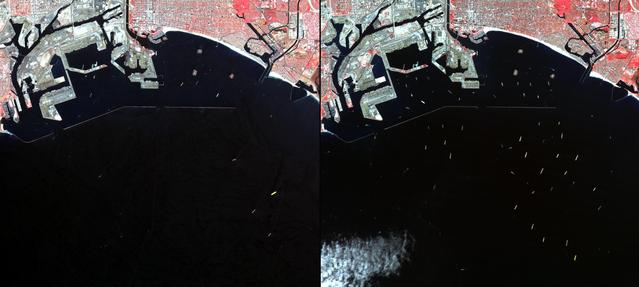
In southern California, the combined ports of Los Angeles and Long Beach account for 33% of the nation containerized imports. This image from NASA Terra spacecraft shows the large backlog of waiting cargo ships being slowly unloaded. The left image was acquired July 4, 2014 during normal operations: 14 ships are being unloaded, while 7 wait their turns near the facilities. The right image was acquired on March 8, 2015: 19 ships are moored at unloading docks, while 47 ships wait their turns. The images cover an area of 16.7 x 18.6 km, and are located at 33.7 degrees north, 118.2 degrees west. http://photojournal.jpl.nasa.gov/catalog/PIA19249

A spectator is seen photographing the space shuttle Endeavour as it is moved to its new home at the California Science Center in Los Angeles, Friday, Oct. 12, 2012. Endeavour, built as a replacement for space shuttle Challenger, completed 25 missions, spent 299 days in orbit, and orbited Earth 4,671 times while traveling 122,883,151 miles. Beginning Oct. 30, the shuttle will be on display in the CSC’s Samuel Oschin Space Shuttle Endeavour Display Pavilion, embarking on its new mission to commemorate past achievements in space and educate and inspire future generations of explorers. Photo Credit: (NASA/Bill Ingalls)
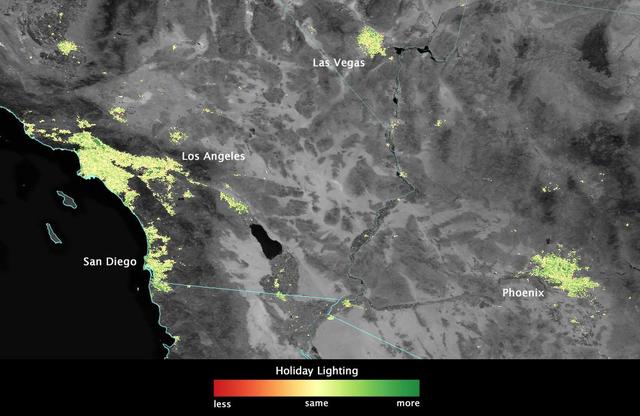
City lights shine brighter during the holidays in the United States when compared with the rest of the year, as shown using a new analysis of daily data from the NASA-NOAA Suomi NPP satellite. Dark green pixels are areas where lights are 50 percent brighter, or more, during December. Because snow reflects so much light, the researchers could only analyze snow-free cities. They focused on the U.S. West Coast from San Francisco and Los Angeles, and cities south of a rough imaginary line from St. Louis to Washington, D.C. Credit: Jesse Allen, NASA’s Earth Observatory Read more: <a href="http://www.nasa.gov/content/goddard/satellite-sees-holiday-lights-brighten-cities." rel="nofollow">www.nasa.gov/content/goddard/satellite-sees-holiday-light...</a>.<b><a href="http://www.nasa.gov/audience/formedia/features/MP_Photo_Guidelines.html" rel="nofollow">NASA image use policy.</a></b> <b><a href="http://www.nasa.gov/centers/goddard/home/index.html" rel="nofollow">NASA Goddard Space Flight Center</a></b> enables NASA’s mission through four scientific endeavors: Earth Science, Heliophysics, Solar System Exploration, and Astrophysics. Goddard plays a leading role in NASA’s accomplishments by contributing compelling scientific knowledge to advance the Agency’s mission. <b>Follow us on <a href="http://twitter.com/NASAGoddardPix" rel="nofollow">Twitter</a></b> <b>Like us on <a href="http://www.facebook.com/pages/Greenbelt-MD/NASA-Goddard/395013845897?ref=tsd" rel="nofollow">Facebook</a></b> <b>Find us on <a href="http://instagram.com/nasagoddard?vm=grid" rel="nofollow">Instagram</a></b>
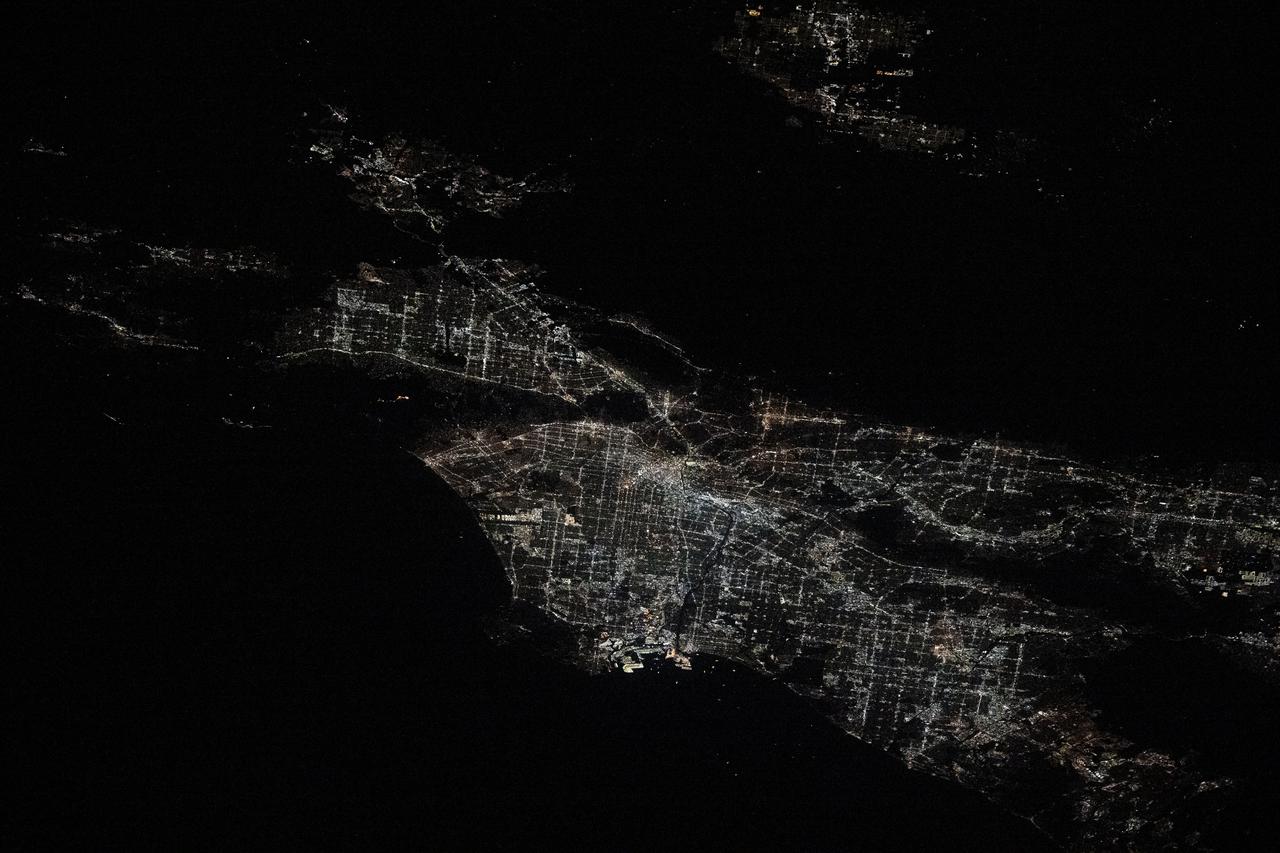
iss072e454582 (Jan. 10, 2024) --- City lights illuminate the Los Angeles, California, metropolitan area at approximately 2:30 a.m. local time as the Palisades, Hurst, and Eaton wildfires rage around nearby suburbs including Malibu, San Fernando, and Pasadena. The International Space Station was orbiting 258 miles above the southwestern United States at the time of this photograph. Credit: NASA/Don Pettit
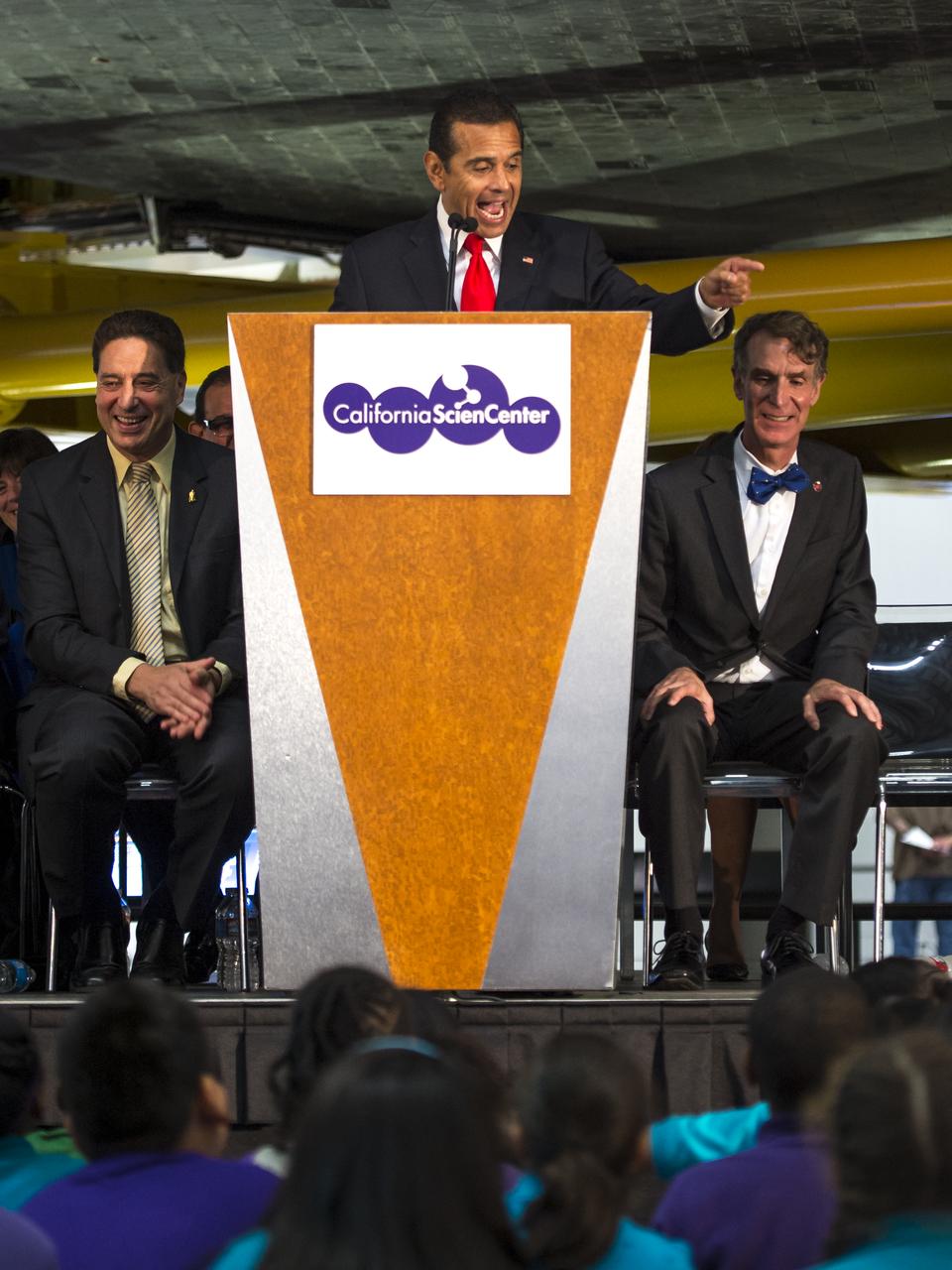
Mayor of Los Angeles Antonio Villaraigosa addresses a class of fourth graders during the grand opening ceremony for the California Science center's Samuel Oschin Space Shuttle Endeavour Display Pavilion, Tuesday, Oct. 30, 2012, in Los Angeles. Endeavour, built as a replacement for space shuttle Challenger, completed 25 missions, spent 299 days in orbit, and orbited Earth 4,671 times while traveling 122,883,151 miles. Photo Credit: (NASA/Bill Ingalls)
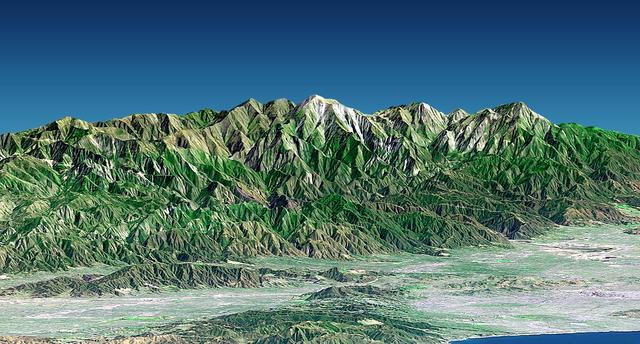
Mount San Antonio more commonly known as Mount Baldy crowns the San Gabriel Mountains northeast of Los Angeles in this computer-generated east-northeast perspective viewed from above the Malibu coastline.
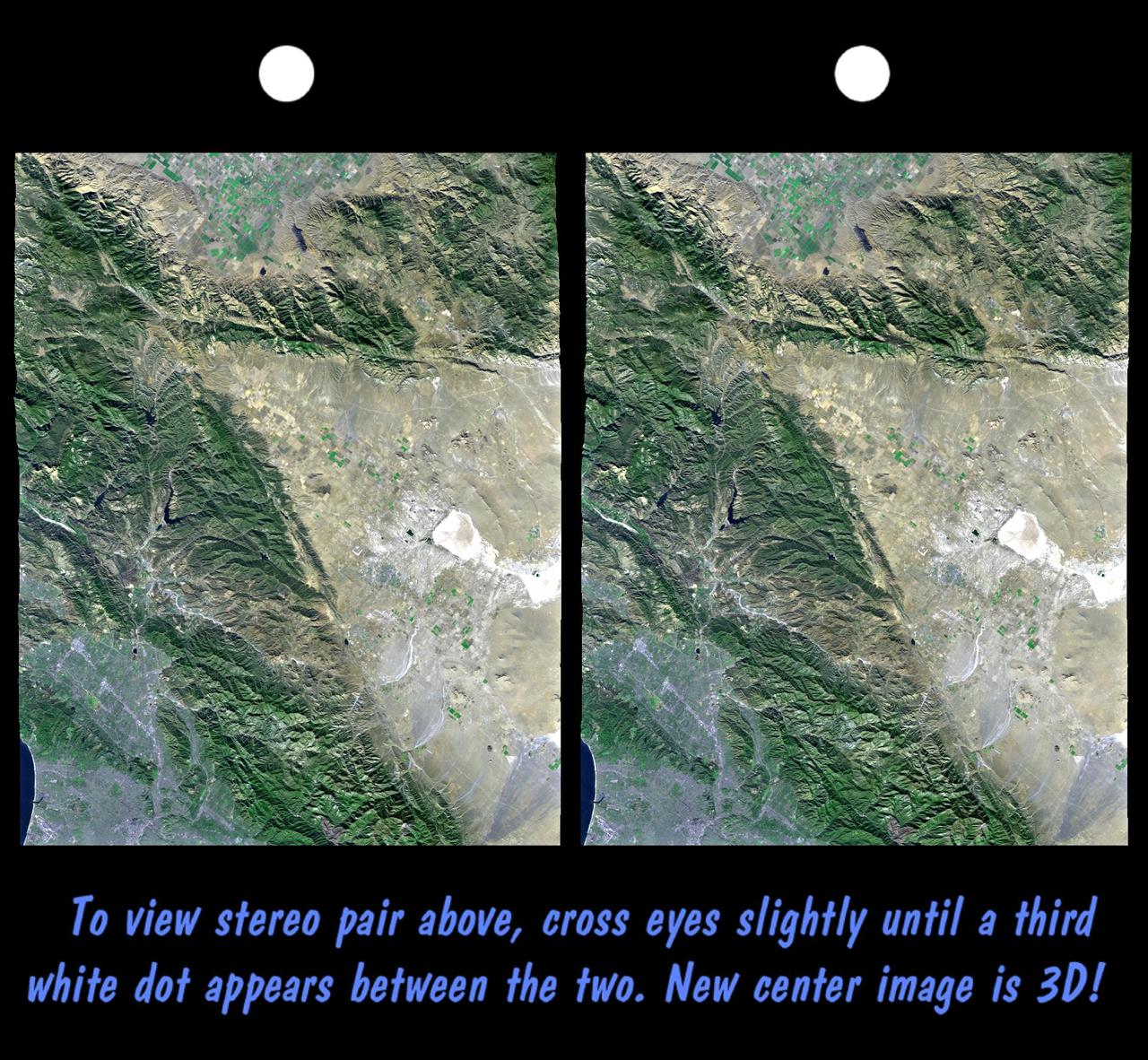
California topography poses challenges for road builders. Northwest of Los Angeles, deformation of Earth crust along the Pacific-North American crustal plate boundary has made transportation difficult.

This image of the greater Los Angeles area was taken on March 29, 2019 by ASTERIA, the Arcsecond Space Telescope Enabling Research in Astrophysics satellite. It shows a region of about 43.5 square miles (70 square kilometers) with a resolution of about 100 feet (30 meters) per pixel. A bright spot near the center of the image marks the location of Dodger Stadium. (The Dodgers played the Arizona Diamondbacks at home that night.) To the northeast, near the darkness of the San Gabriel Mountains, is NASA's Jet Propulsion Laboratory in Pasadena, California, which built and operates ASTERIA, and the nearby Rose Bowl Stadium. The close-cropped image shows a region of about 43.5 square miles (70 square kilometers) with a resolution of about 100 feet (30 meters) per pixel. ASTERIA is a CubeSat, or a small satellite composed of cube units that measure 10 centimeters (4.5 inches) on each side. ASTERIA was designed to demonstrate precision pointing technology in a CubeSat, which could be used to observe planets around other stars. A slight decrease in a star's brightness as detected by ASTERIA could indicate that a planet is orbiting the star and passed in front of the star. This is called a planet transit. After completing its primary mission objectives in January 2018, ASTERIA has continued to operate on an extended mission. The mission team took this image to further test the capabilities of the satellite. https://photojournal.jpl.nasa.gov/catalog/PIA23125
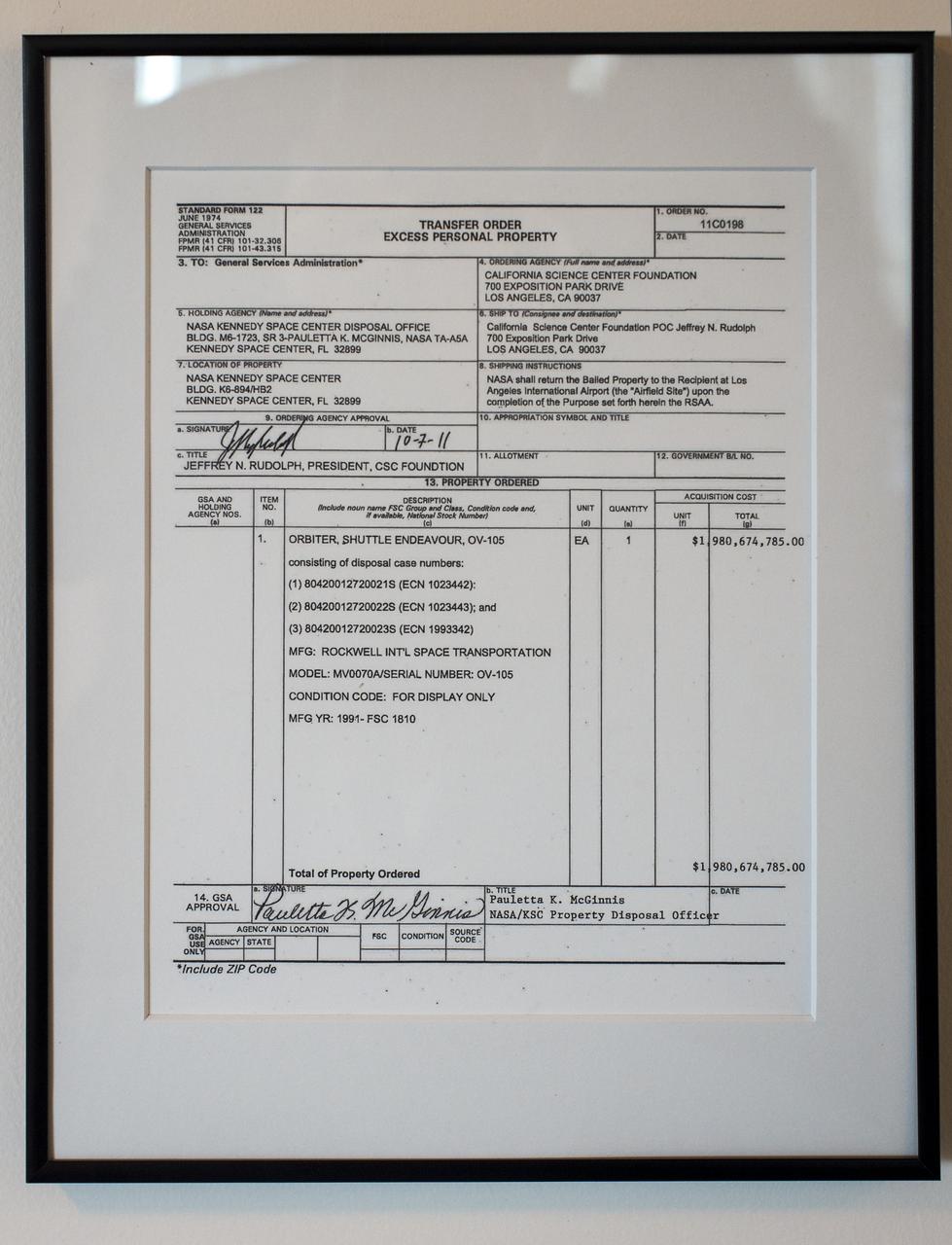
A government Transfer Order for Excess Personal Property is seen framed outside the office of President and CEO, California Science Center, Jeffrey N. Rudolph, on Tuesday, Oct. 30, 2012, in Los Angeles. The grand opening ceremony for the California Science center's Samuel Oschin Space Shuttle Endeavour Display Pavilion took place on Tuesday, Oct. 30, 2012. Endeavour, built as a replacement for space shuttle Challenger, completed 25 missions, spent 299 days in orbit, and orbited Earth 4,671 times while traveling 122,883,151 miles. Photo Credit: (NASA/Bill Ingalls)
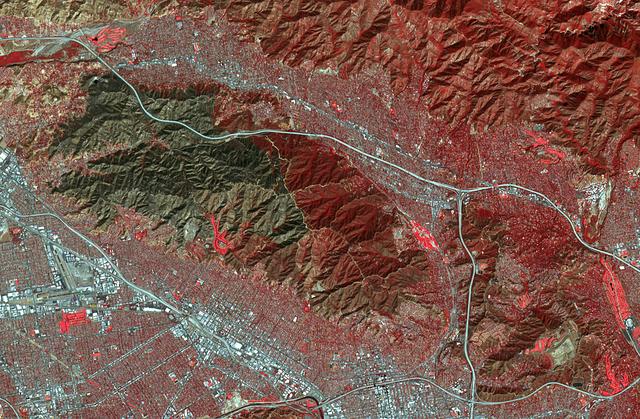
On Sept. 1, 2017, the La Tuna Canyon fire began in the foothills north of Los Angeles. By the time it was contained, it became one of the biggest wildfires in the history of the city in terms of sheer acreage. The fire burned several structures and resulted in a large number of evacuations. The fire could be seen over a large area, from the Hollywood Burbank airport (left side of image), to NASA's Jet Propulsion Laboratory and the Rose Bowl (right side of image). In this image from the Advanced Spaceborne Thermal Emission and Reflection Radiometer (ASTER) instrument on NASA's Terra satellite, vegetation is depicted in red (golf courses are particularly prominent), and the burned area is in dark gray. The image was acquired Oct. 7, 2017, covers an area of approximately 8 by 13 miles (13.5 by 20.5 kilometers), and is located at 34.2 degrees north, 118.2 degrees west. https://photojournal.jpl.nasa.gov/catalog/PIA22044
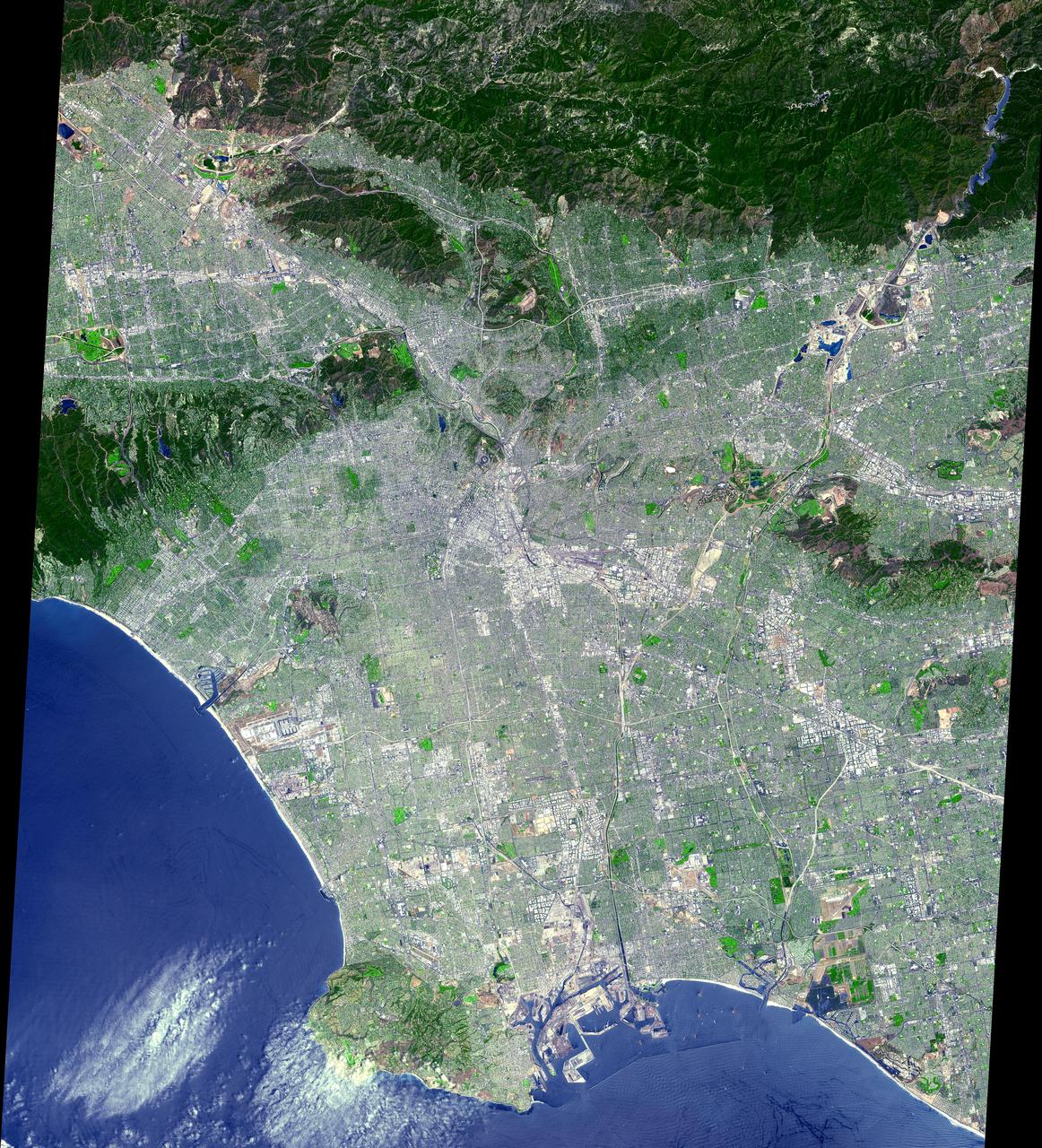
This ASTER image was acquired on July 23, 2001 and covers an area of 64 x 72 km. The data were processed to create a simulated natural color image. From its start as a sleepy Spanish pueblo in 1781, LA and its metropolitan area has grown to become an ethnically diverse, semitropical megalopolis, laying claim as the principal center of the western US and the nation's second largest urban area. The city's economy is based on international trade, aerospace, agriculture, tourism, and filmmaking. LA provides a glimpse of the typically cosmopolitan and global city of the future. The image is located at 34.1 degrees north latitude and 118.2 degrees west longitude. http://photojournal.jpl.nasa.gov/catalog/PIA02679
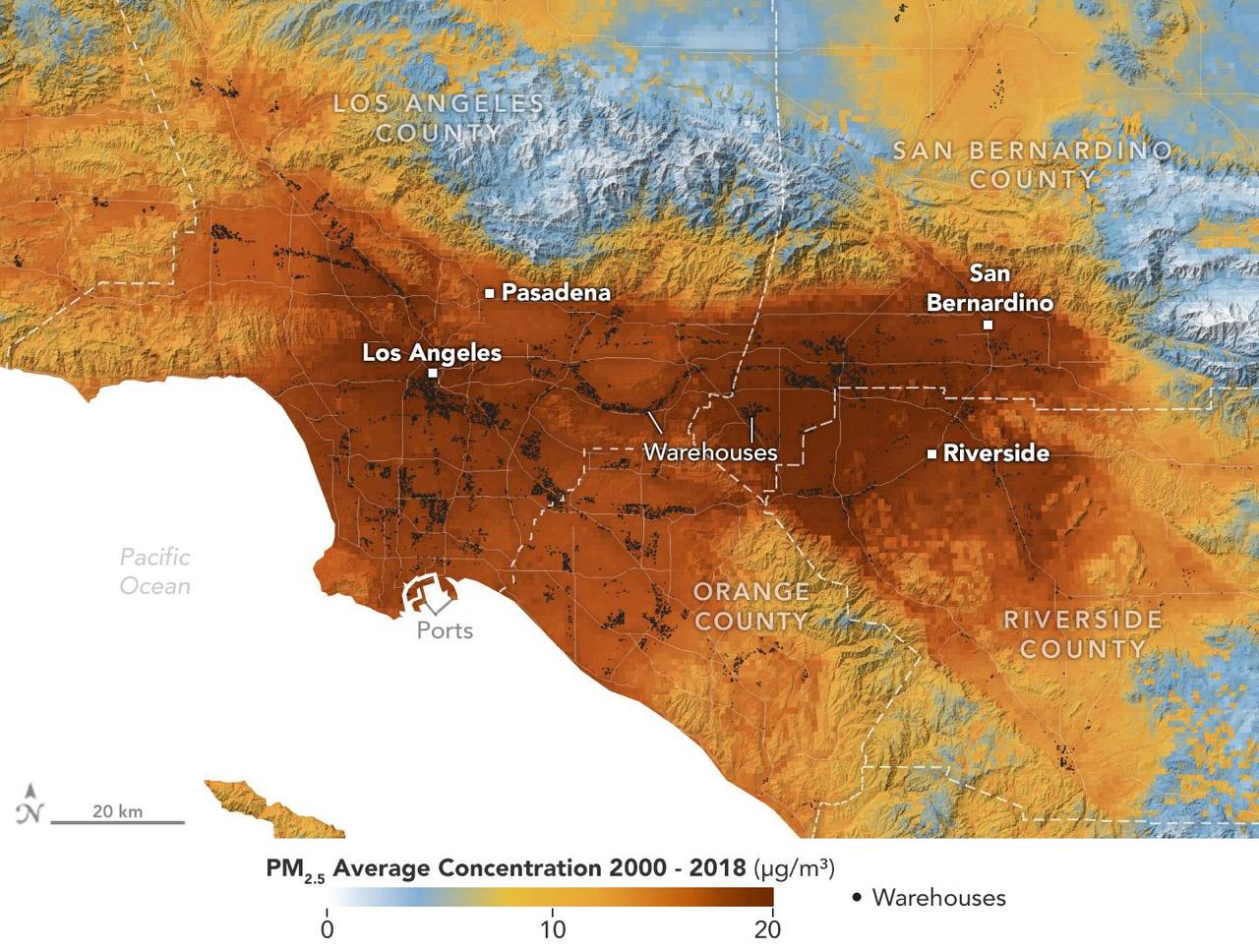
A data visualization shows the average concentration of PM2.5 particulate pollution in the Los Angeles region from 2000 to 2018, along with the locations of nearly 11,000 warehouses over the same time period. Particles measuring 2.5 micrometers or less, PM2.5 are pollutants that can be inhaled into the lungs and absorbed into the bloodstream. A NASA-funded study published in September 2024 in GeoHealth analyzed patterns and trends of atmospheric PM2.5 concentration and found that ZIP codes with more or larger warehouses had higher levels of PM2.5 and elemental carbon over time than those with fewer warehouses. Elemental carbon is a type of PM2.5 that is produced by heavy-duty diesel engines. In the visualization, areas with higher concentrations of PM2.5 are shown in darker red, and locations of warehouses are indicated by small black circles (many of them clustered closely together). The PM2.5 data came from models based on satellite observations, including from NASA's Moderate Resolution Imaging Spectroradiometer (MODIS) and Advanced Spaceborne Thermal Emission and Reflection Radiometer (ASTER) instruments. The PM2.5 warehouse locations were derived from a commercial real estate database. Particulate pollution has been linked to respiratory and cardiovascular diseases, some cancers, and adverse birth outcomes, including premature birth and low infant birth weight. As the e-commerce boom of recent decades has spurred warehouse construction, pollution in nearby neighborhoods has become a growing area for research. https://photojournal.jpl.nasa.gov/catalog/PIA26415

Amberly Guerra, left, tries on life support equipment while Ali Zendejas, Betty Mojica and Julian Guerra, her dad, watch.
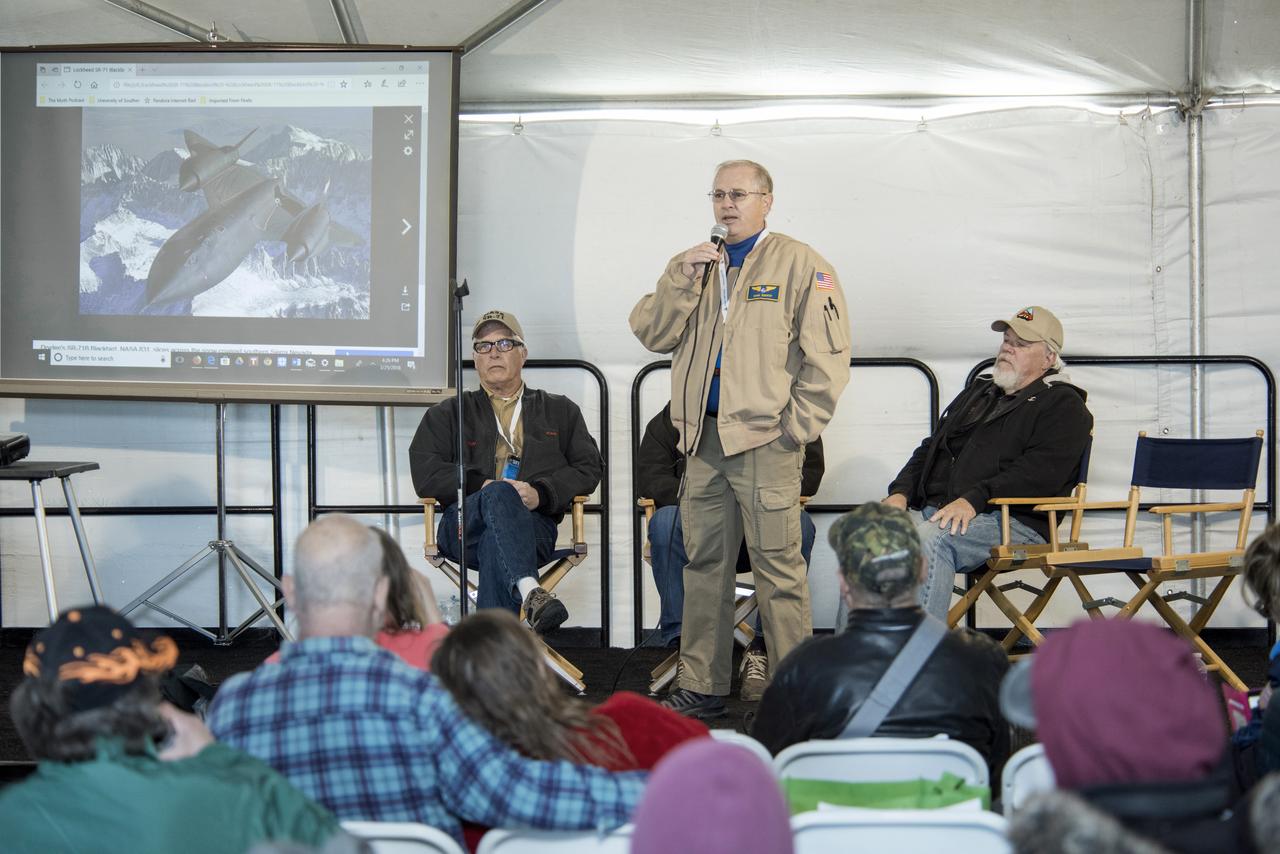
Dana Purifoy, NASA Armstrong director of Flight Operations, talking, and John McKay, former Armstrong SR-71 crew chief, participate on a panel discussion about the triple supersonic aircraft.
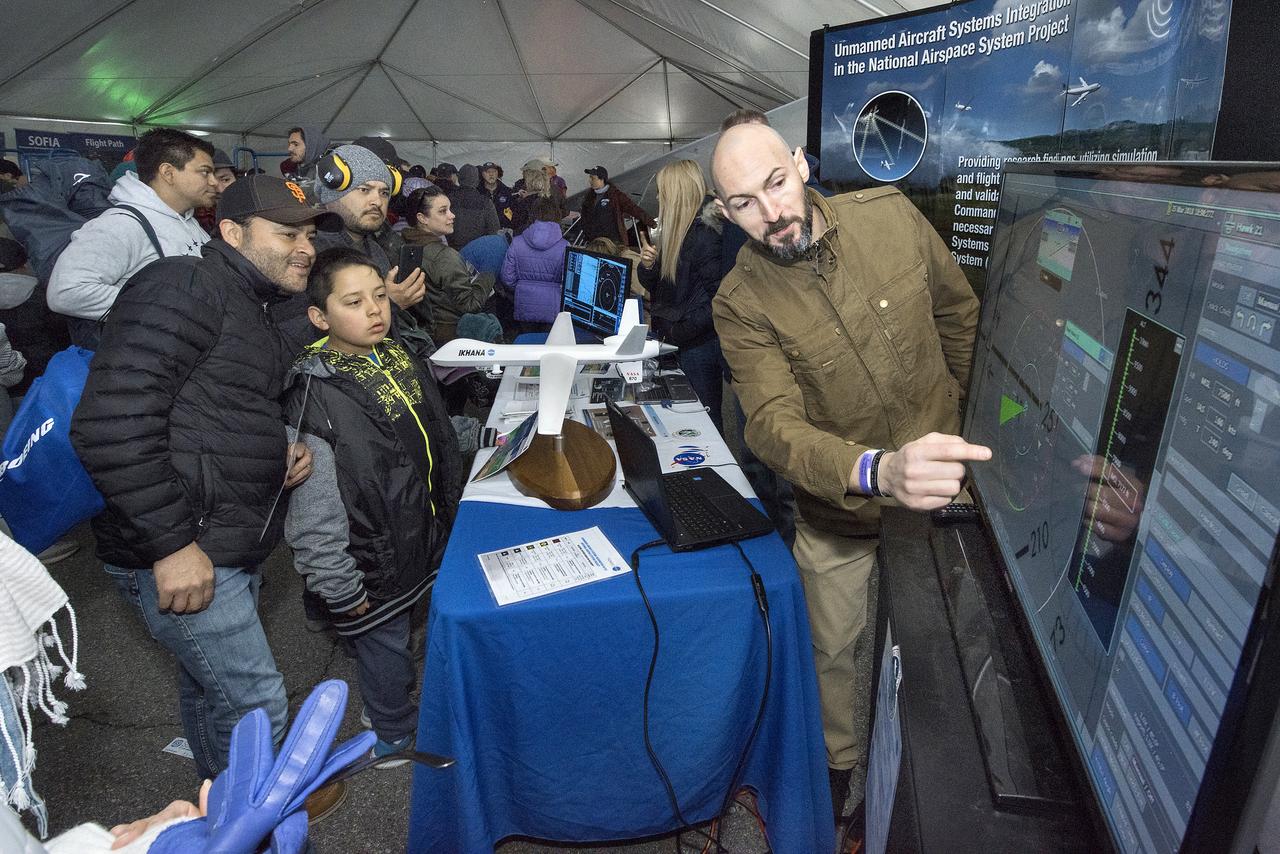
Zack Roberts from NASA’s Ames Research Center explains elements of the Unmanned Aircraft Systems Integration into the National Airspace System.
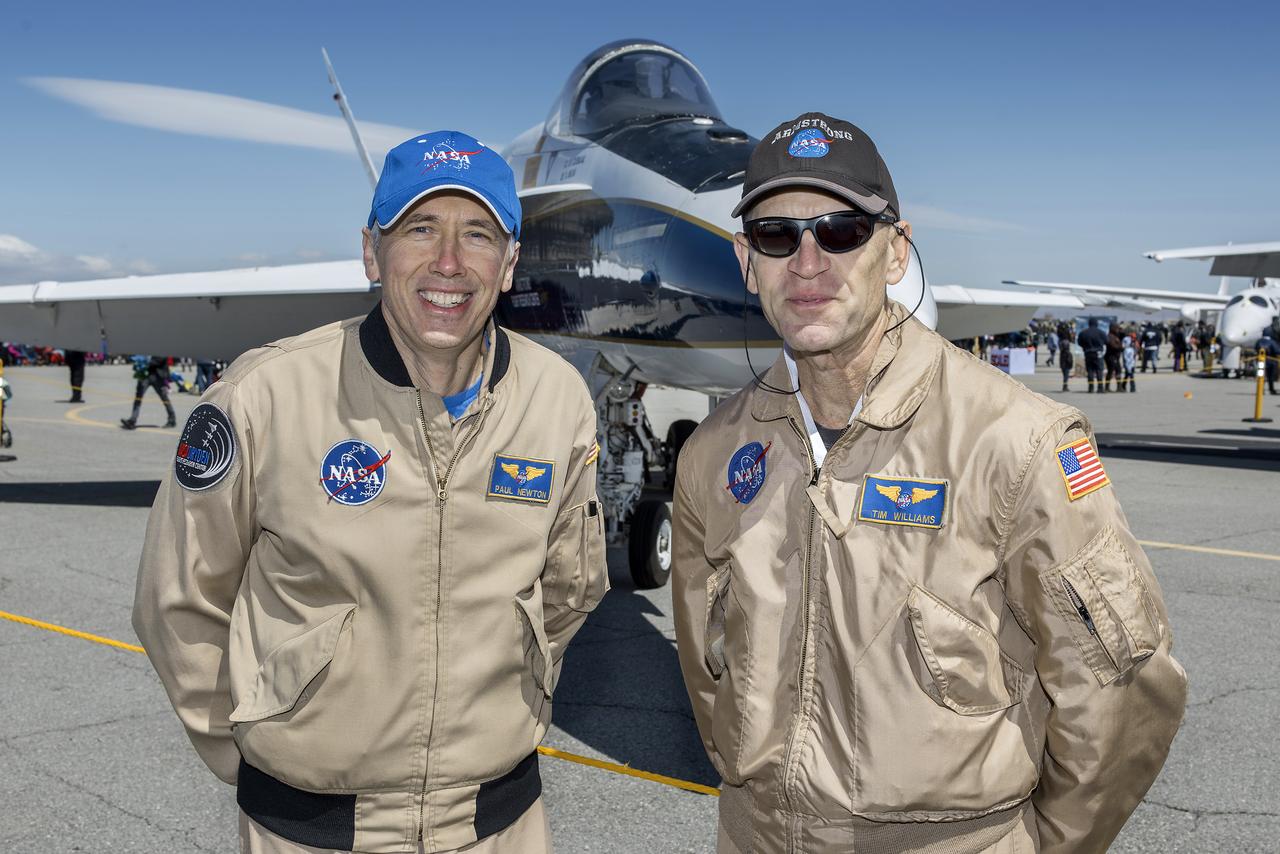
NASA Armstrong Research Center pilots Paul Newton and Tim Williams stand by the center’s F/A-18 research aircraft.
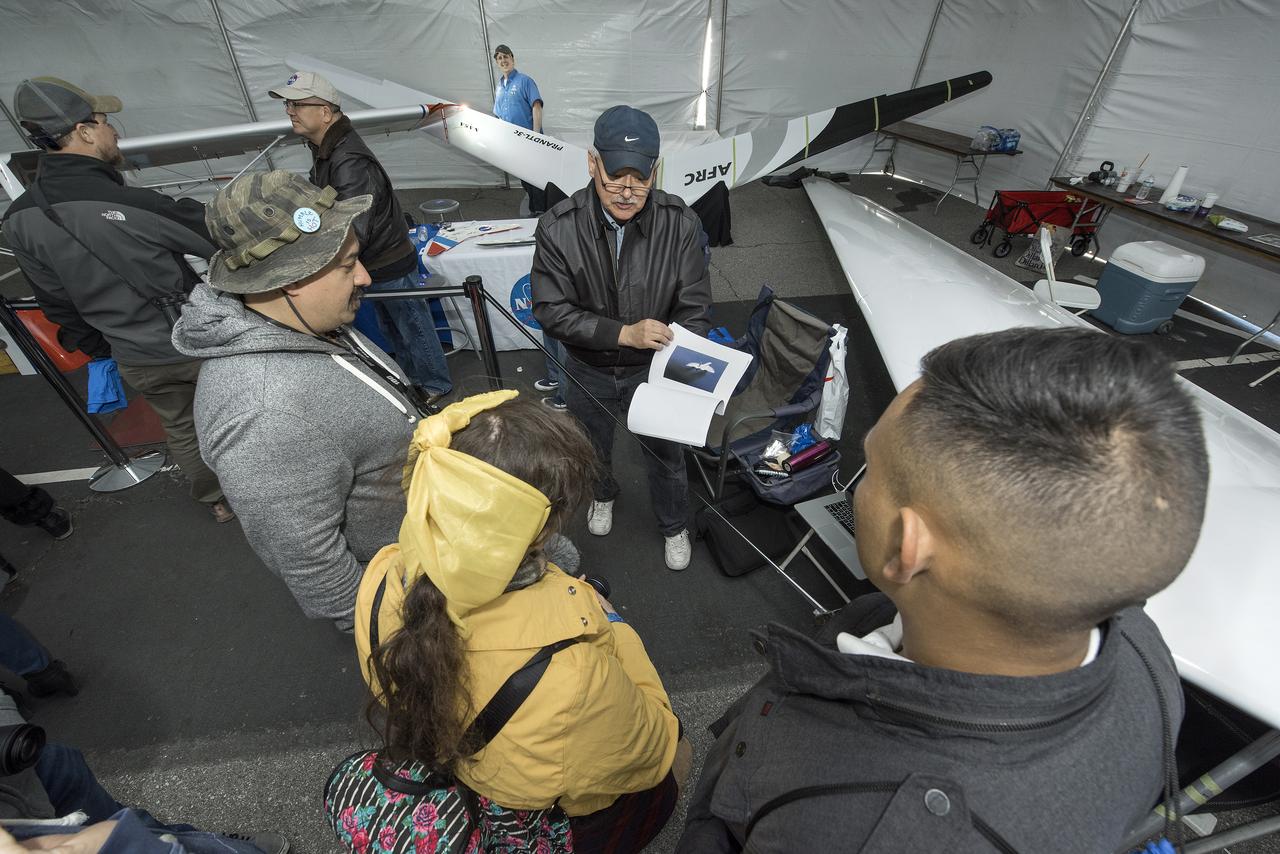
Al Bowers explains the Prandtl experimental aircraft and how its wing twist could redefine the efficiency of aircraft.
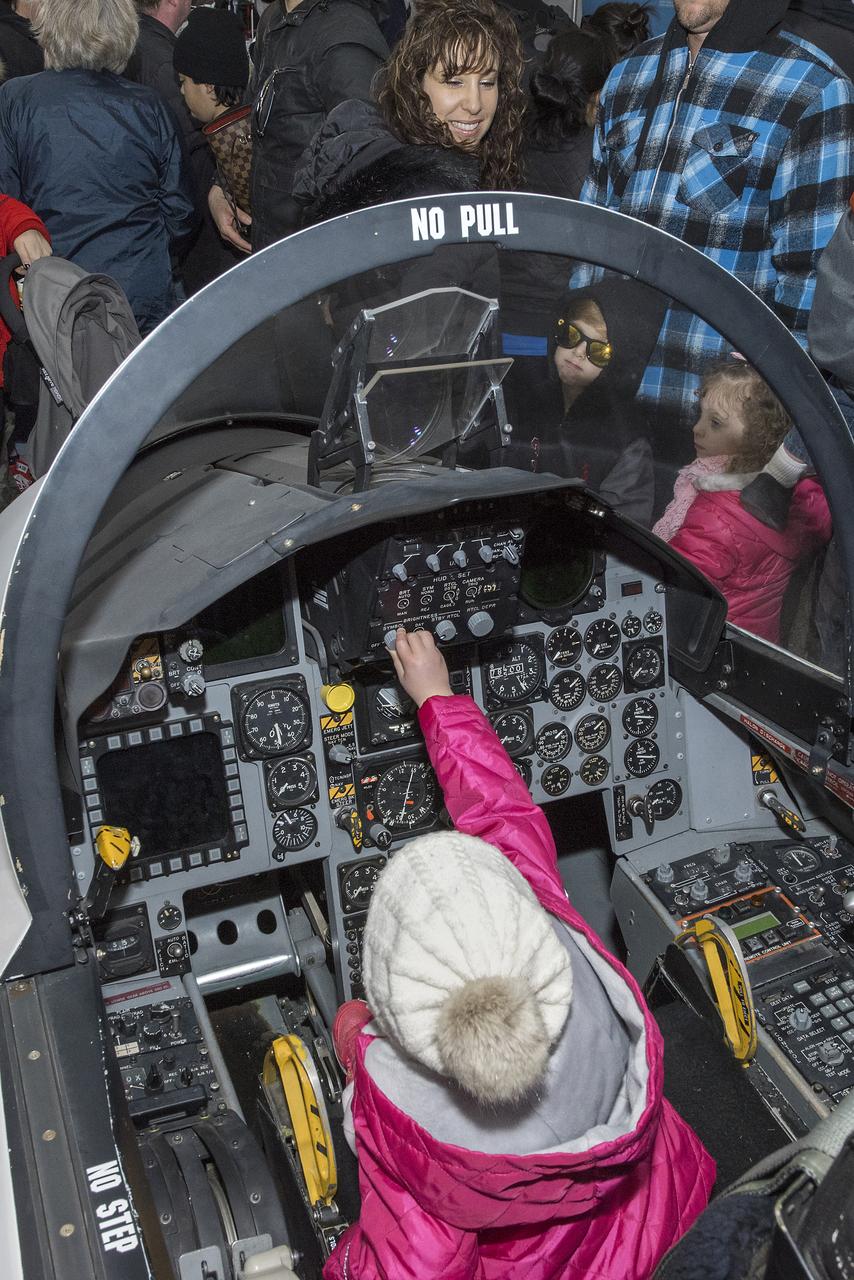
A young woman tries her hand at “piloting” a high-performance jet. The representation of a jet cockpit is a popular display at NASA Armstrong-supported air shows and festivals across the nation.

iss074e0622240 (May 29, 2026) --- At the top, Los Angeles International Airport — the primary international gateway on the U.S. West Coast and the nation's fifth‑busiest airport — is pictured on Southern California's Pacific coastline from the International Space Station as it orbited 260 miles above the Golden State. Credit: NASA/Chris Williams
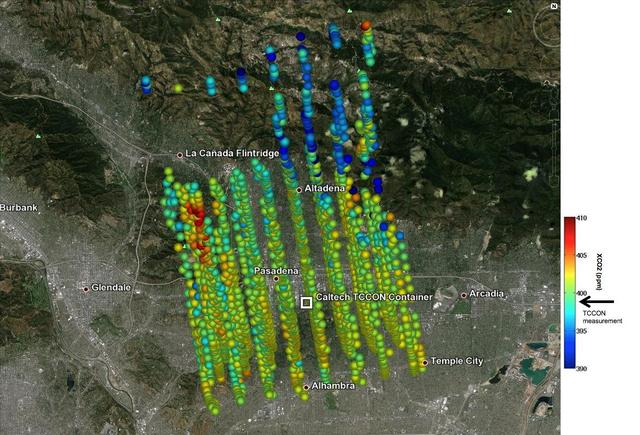
This image shows NASA OCO-2 measurements of carbon dioxide levels over Pasadena and the northern Los Angeles basin on Sept. 5, 2014. Each colored dot represents a single measurement of the greenhouse gas made during an overflight of the area.
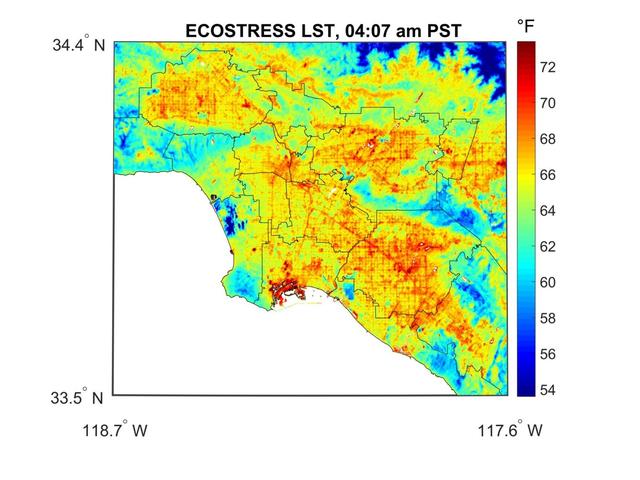
ECOSTRESS captured surface temperature variations in Los Angeles, California between July 22 and August 14 -- a period of extended heat -- at different times of day. The images show how different surfaces within the cityscape warm and cool throughout the day. They have been colored to show the hottest areas in red, warm areas in orange and yellow, and cooler areas in blue. The hottest areas are dark asphalt surfaces that have very little shade during the day and remain warm throughout the night due to their higher heat capacity. They include freeways, airports, oil refineries and parking lots. Clouds and higher-elevation mountainous areas were the coolest. More information is available at https://photojournal.jpl.nasa.gov/catalog/PIA22703

AS09-22-3436 (March 1969) --- Los Angeles-Long Beach area of southern California, as photographed from the Apollo 9 spacecraft during its 92nd revolution of Earth. Santa Catalina Island is located off the coast. The California coastline is visible from San Clemente northward to Point Dume. Clouds cover most of the San Gabriel Mountains around Los Angeles.
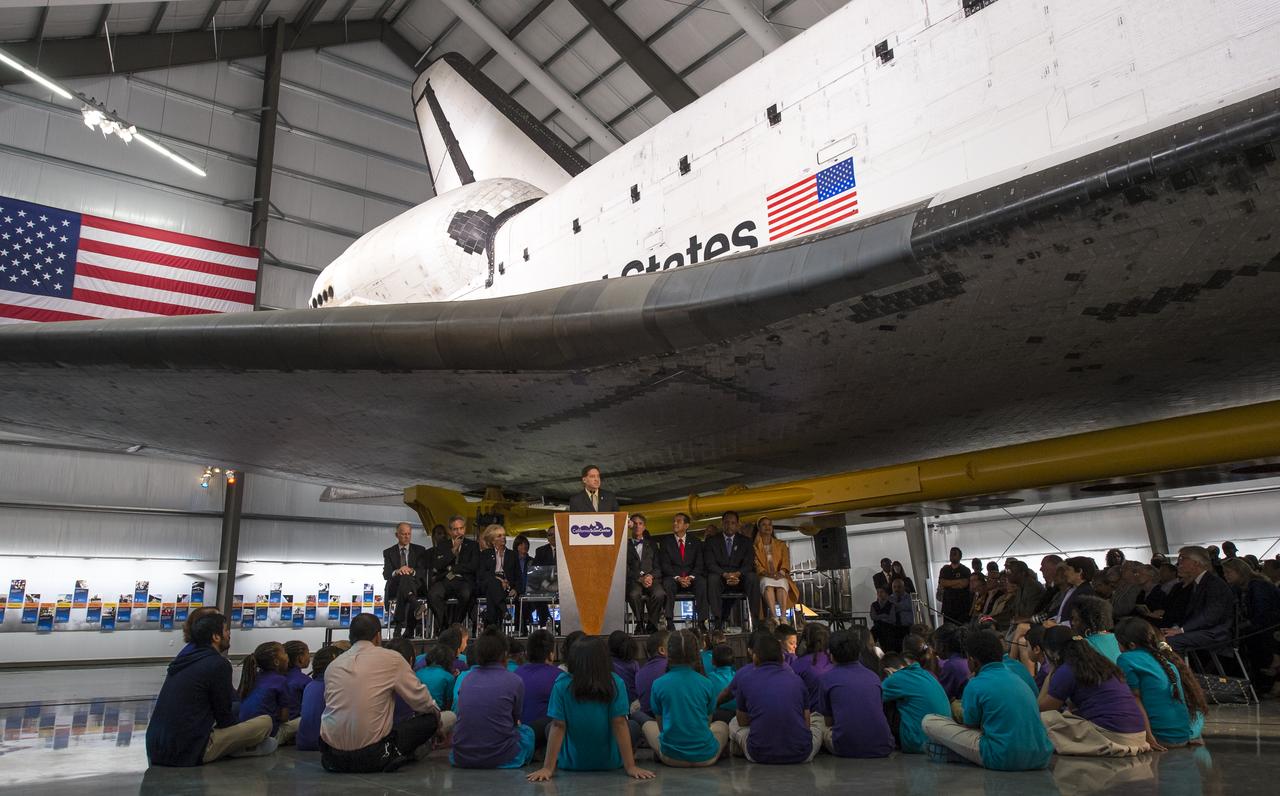
President and CEO of the California Science Center Jeffrey N. Rudolph speaks from a podium underneath the space shuttle Endeavour during the grand opening ceremony for the center's Samuel Oschin Space Shuttle Endeavour Display Pavilion, Tuesday, Oct. 30, 2012, in Los Angeles. Endeavour, built as a replacement for space shuttle Challenger, completed 25 missions, spent 299 days in orbit, and orbited Earth 4,671 times while traveling 122,883,151 miles. Photo Credit: (NASA/Bill Ingalls)
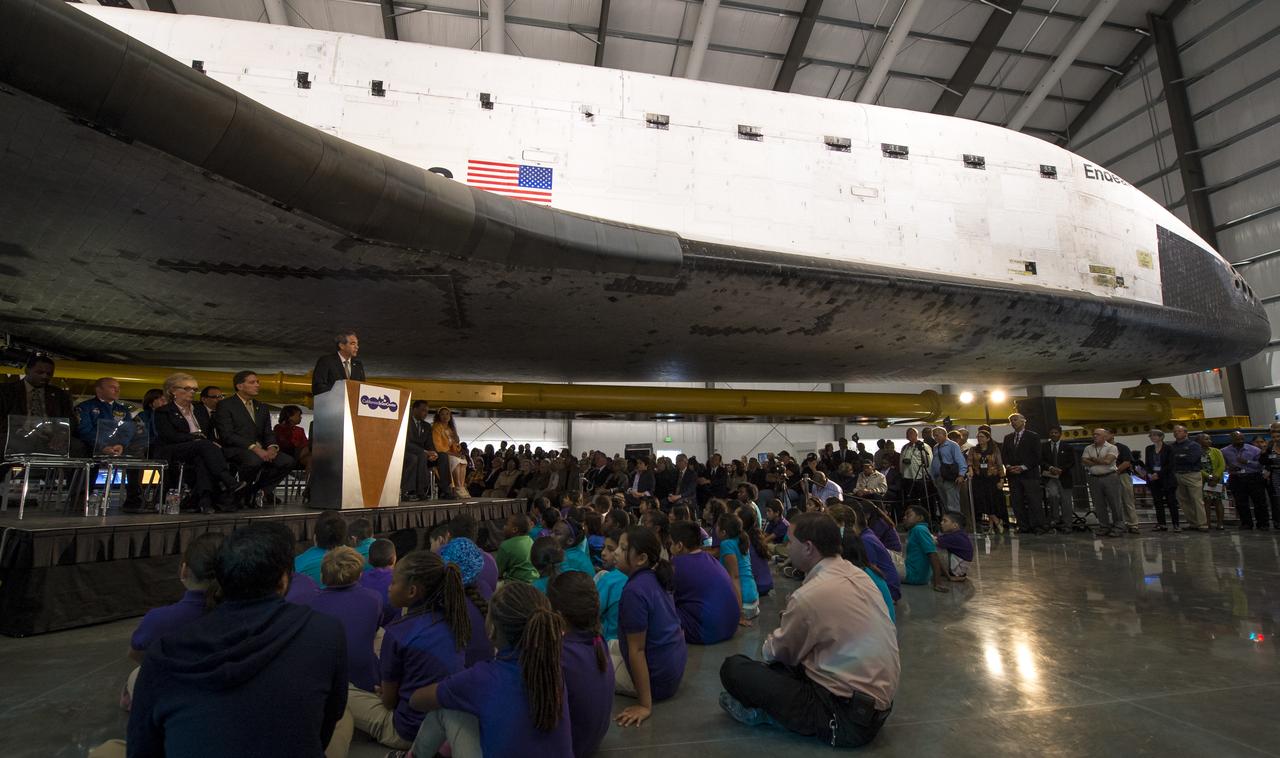
David D. McBride, director of NASA's Dryden Flight Research Center, speaks from a podium underneath the space shuttle Endeavour during the grand opening ceremony for the California Science center's Samuel Oschin Space Shuttle Endeavour Display Pavilion, Tuesday, Oct. 30, 2012, in Los Angeles. Endeavour, built as a replacement for space shuttle Challenger, completed 25 missions, spent 299 days in orbit, and orbited Earth 4,671 times while traveling 122,883,151 miles. Photo Credit: (NASA/Bill Ingalls)
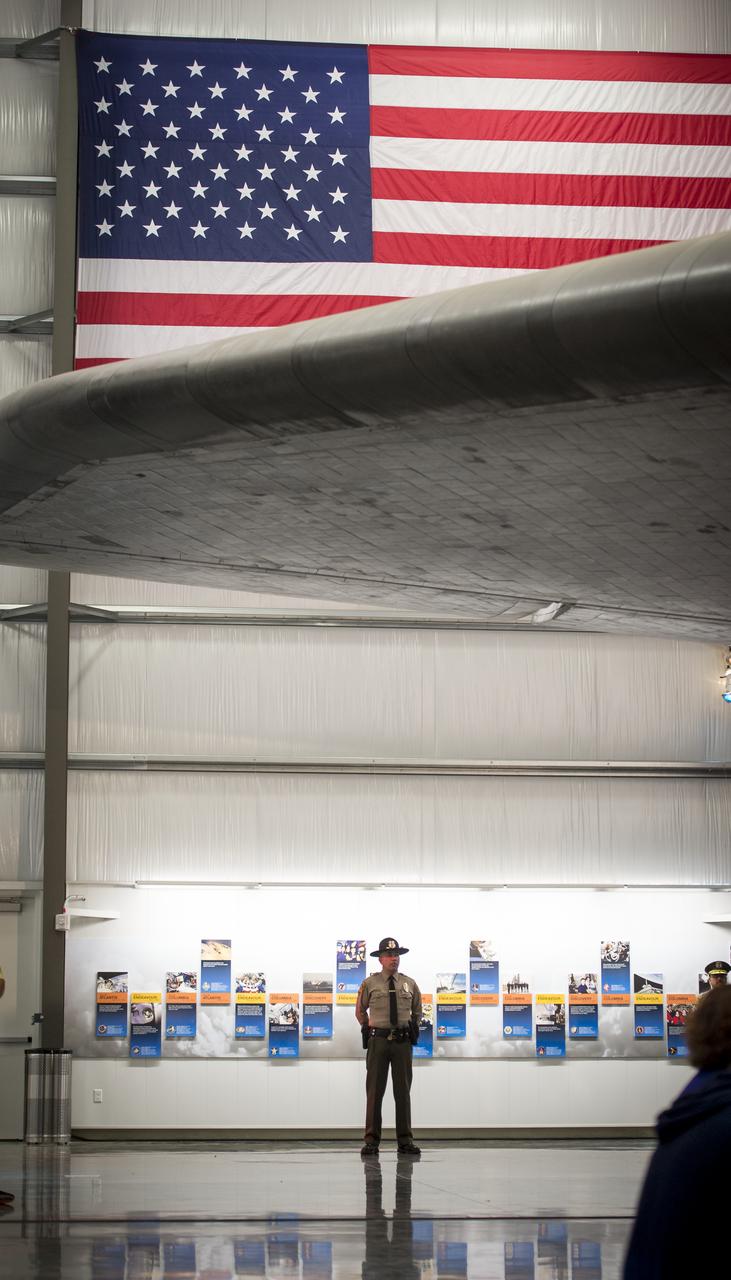
A police officer is seen underneath the wing of the space shuttle Endeavour during the grand opening ceremony for the California Science center's Samuel Oschin Space Shuttle Endeavour Display Pavilion, Tuesday, Oct. 30, 2012, in Los Angeles. Endeavour, built as a replacement for space shuttle Challenger, completed 25 missions, spent 299 days in orbit, and orbited Earth 4,671 times while traveling 122,883,151 miles. Photo Credit: (NASA/Bill Ingalls)
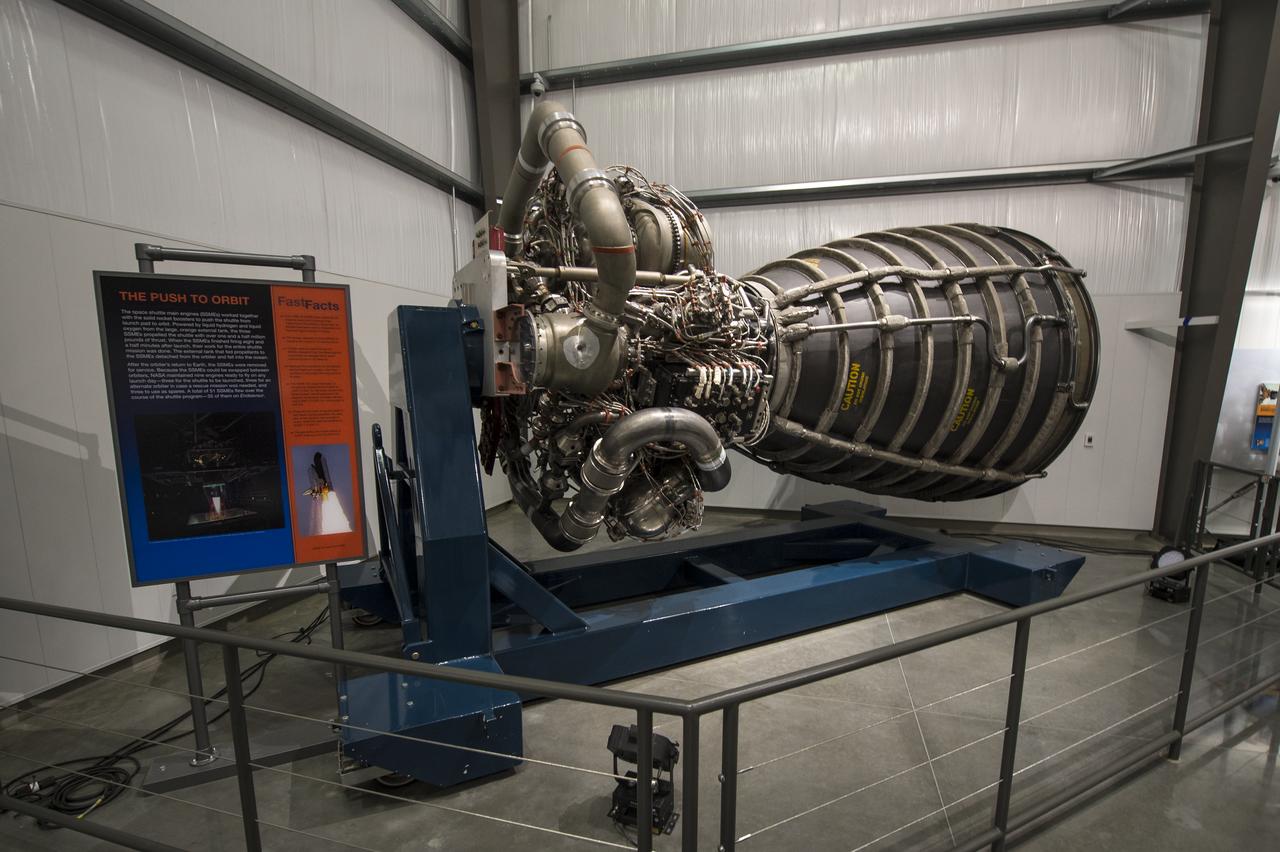
A space shuttle main engine (SSME) is on display near the space shuttle Endeavour at the California Science center's Samuel Oschin Space Shuttle Endeavour Display Pavilion, Tuesday, Oct. 30, 2012, in Los Angeles. Endeavour, built as a replacement for space shuttle Challenger, completed 25 missions, spent 299 days in orbit, and orbited Earth 4,671 times while traveling 122,883,151 miles. Photo Credit: (NASA/Bill Ingalls)
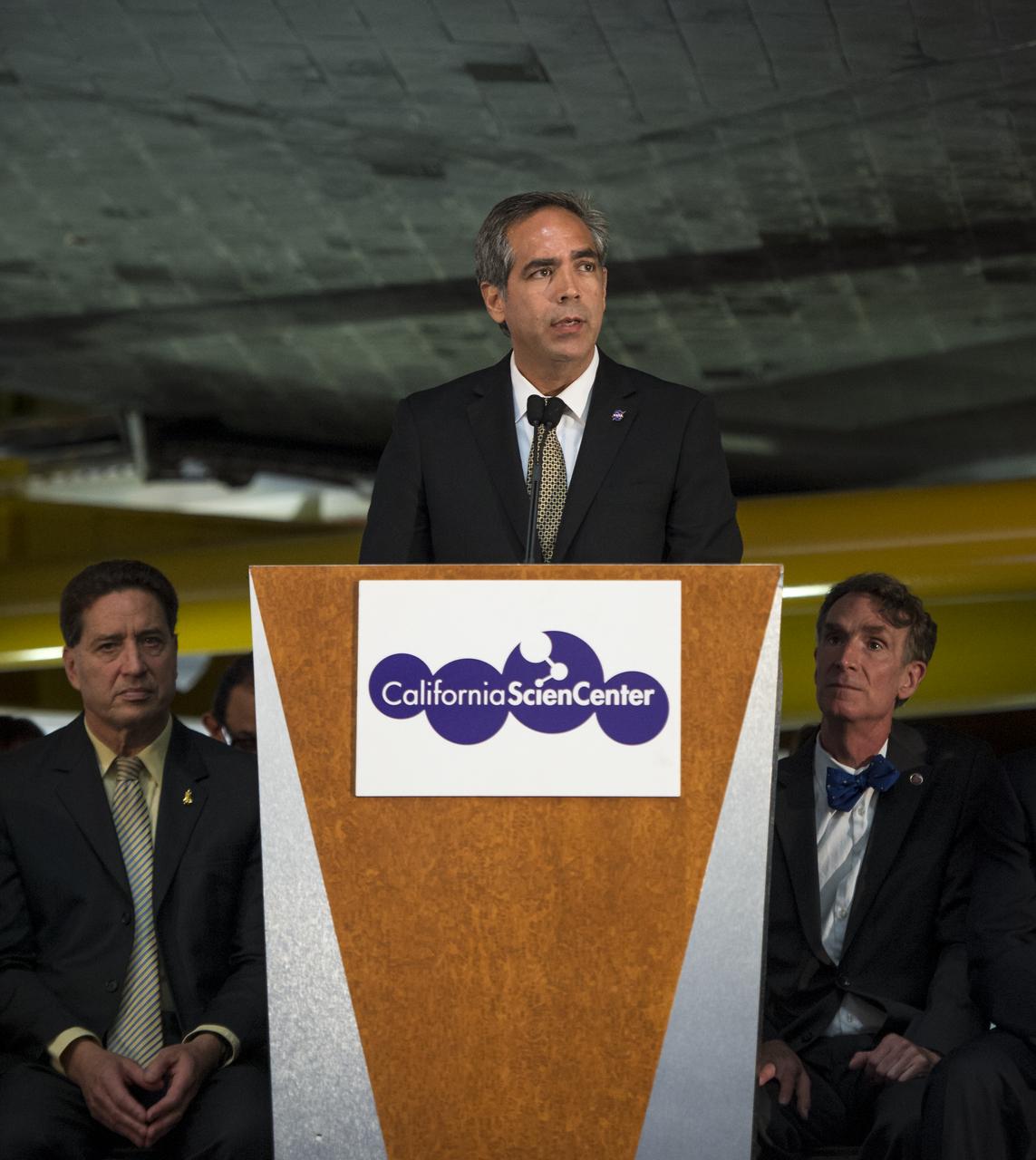
David D. McBride, director of NASA's Dryden Flight Research Center, speaks from a podium underneath the space shuttle Endeavour during the grand opening ceremony for the California Science center's Samuel Oschin Space Shuttle Endeavour Display Pavilion, Tuesday, Oct. 30, 2012, in Los Angeles. Endeavour, built as a replacement for space shuttle Challenger, completed 25 missions, spent 299 days in orbit, and orbited Earth 4,671 times while traveling 122,883,151 miles. Photo Credit: (NASA/Bill Ingalls)
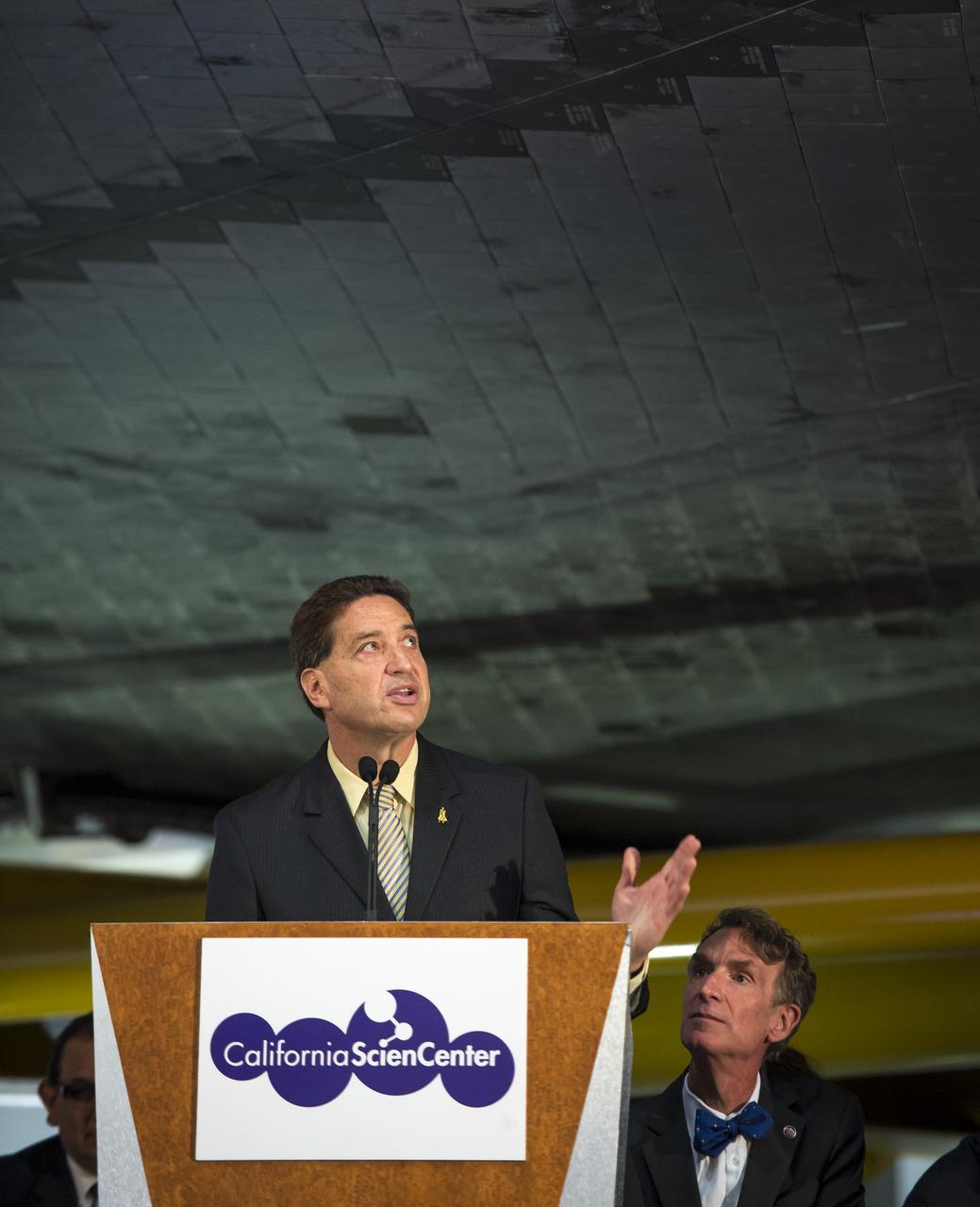
President and CEO of the California Science Center Jeffrey N. Rudolph speaks from a podium underneath the space shuttle Endeavour during the grand opening ceremony for the center's Samuel Oschin Space Shuttle Endeavour Display Pavilion, Tuesday, Oct. 30, 2012, in Los Angeles. Endeavour, built as a replacement for space shuttle Challenger, completed 25 missions, spent 299 days in orbit, and orbited Earth 4,671 times while traveling 122,883,151 miles. Photo Credit: (NASA/Bill Ingalls)
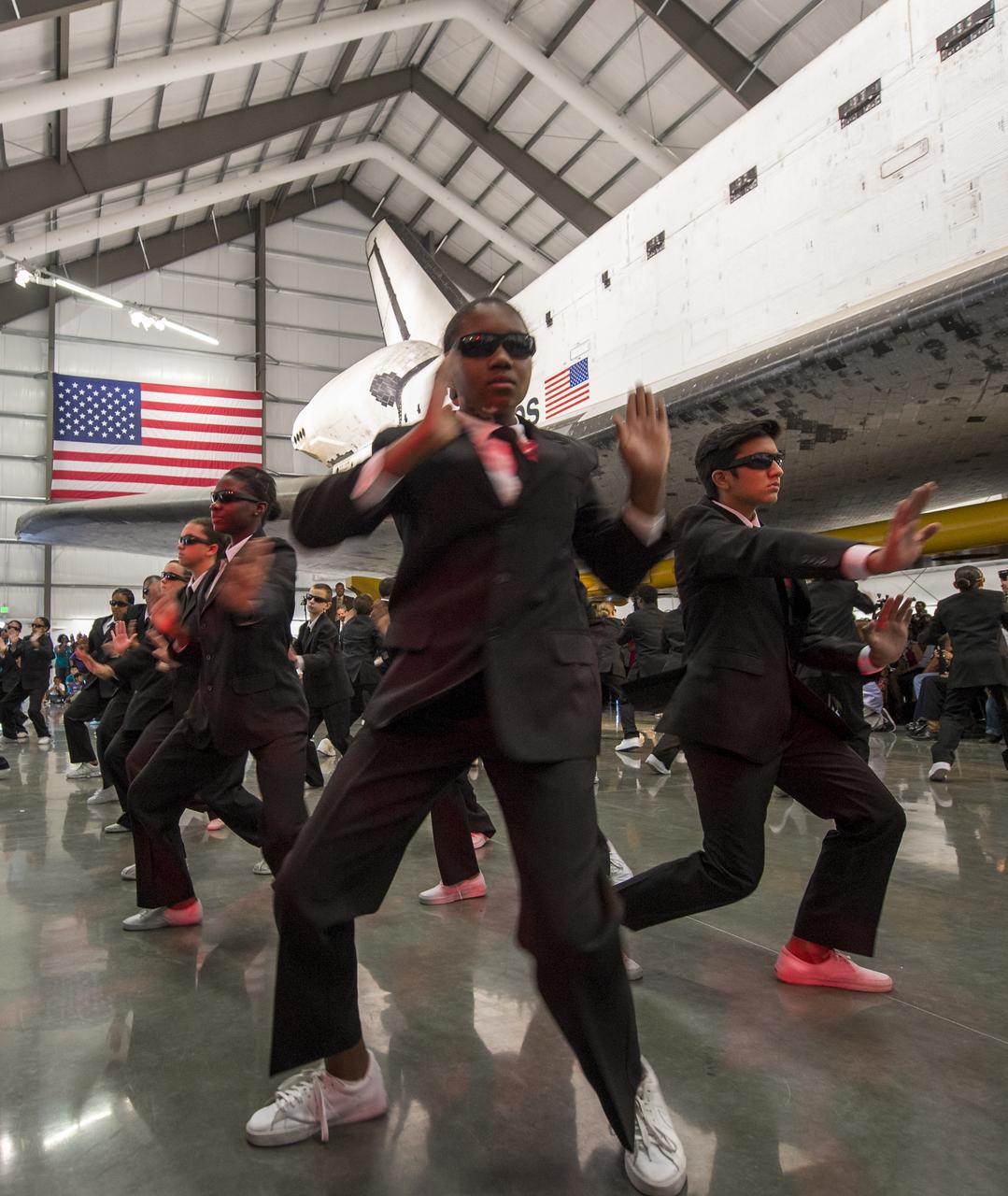
Members of the Debbie Allen Dance Academy perform “Men in Black” choreographed by the legendary Debbie Allen during the grand opening ceremony for the California Science center's Samuel Oschin Space Shuttle Endeavour Display Pavilion, Tuesday, Oct. 30, 2012, in Los Angeles. Endeavour, built as a replacement for space shuttle Challenger, completed 25 missions, spent 299 days in orbit, and orbited Earth 4,671 times while traveling 122,883,151 miles. Photo Credit: (NASA/Bill Ingalls)
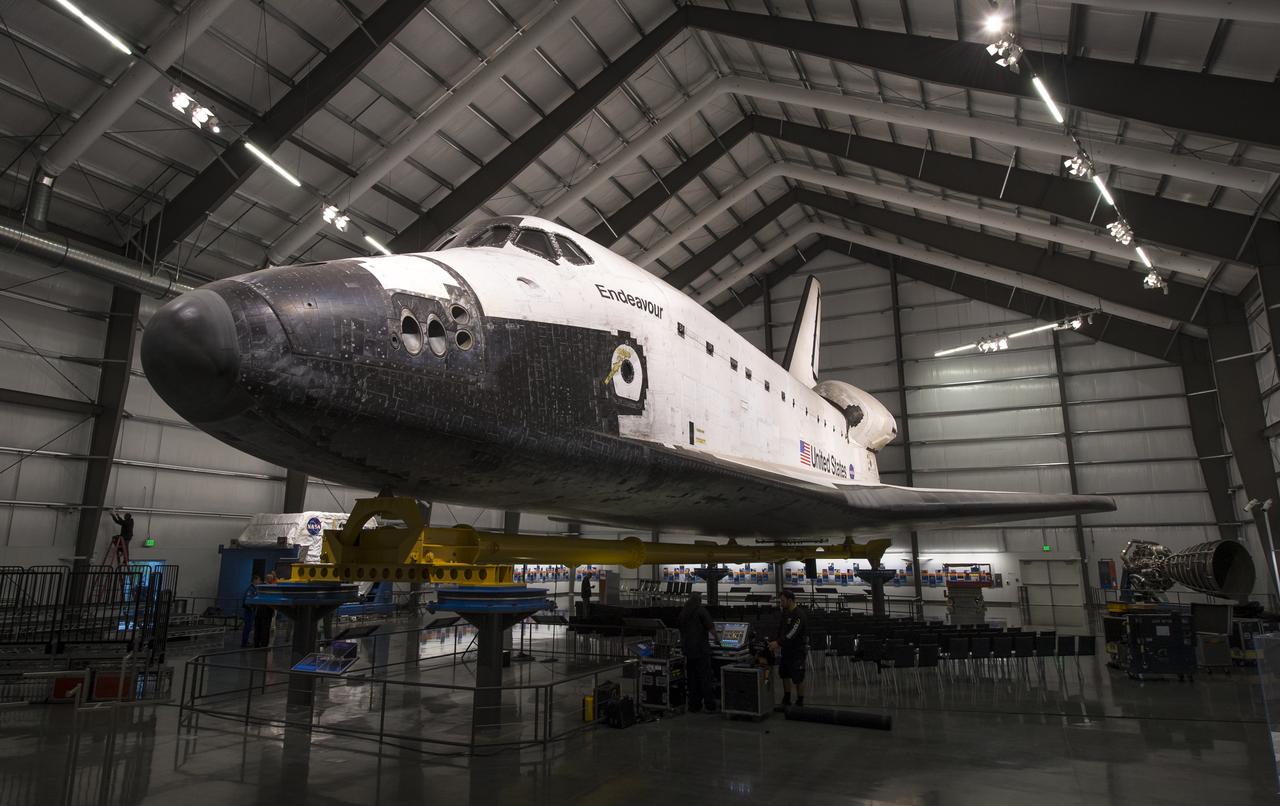
The space shuttle Endeavour is seen as workers prepare for the grand opening ceremony for the California Science center's Samuel Oschin Space Shuttle Endeavour Display Pavilion, Tuesday, Oct. 30, 2012, in Los Angeles. Endeavour, built as a replacement for space shuttle Challenger, completed 25 missions, spent 299 days in orbit, and orbited Earth 4,671 times while traveling 122,883,151 miles. Photo Credit: (NASA/Bill Ingalls)
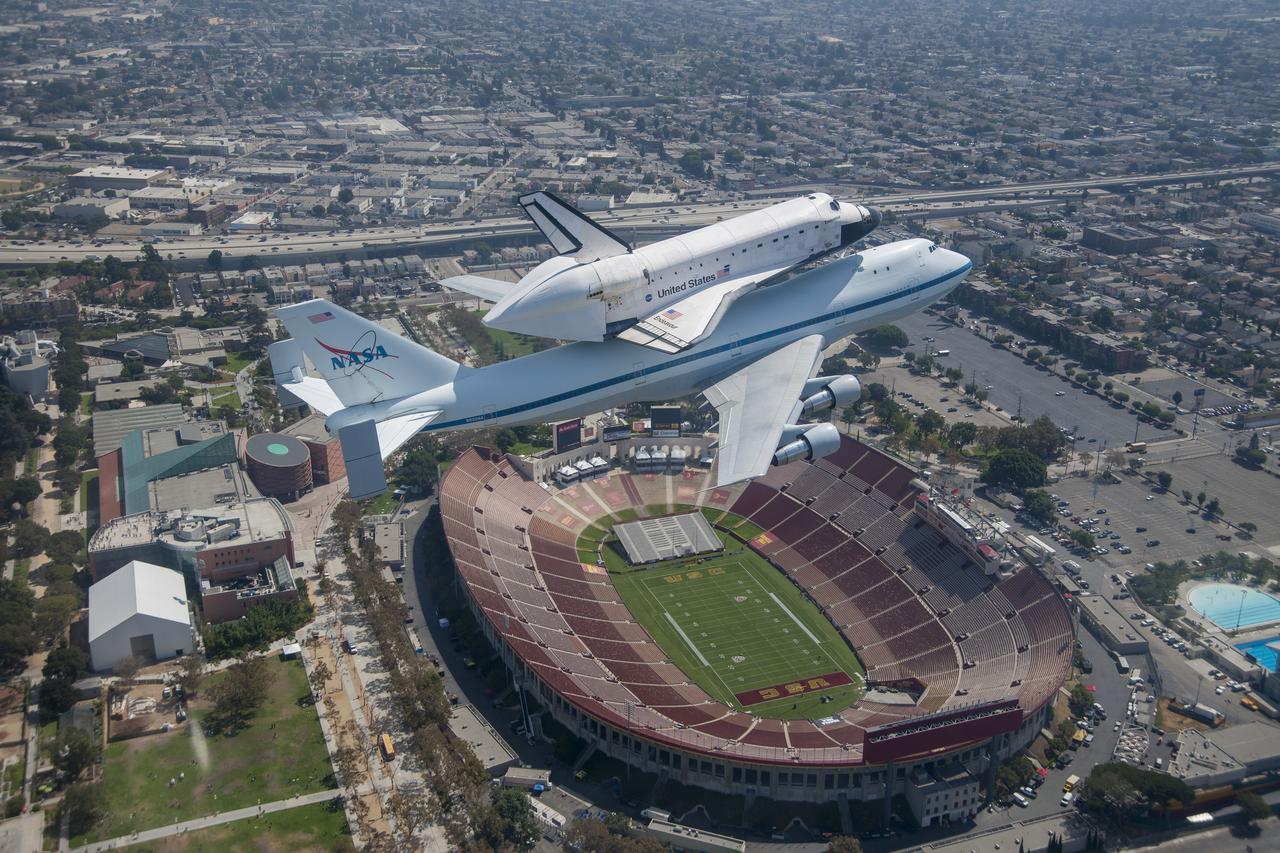
Space shuttle Endeavour and its host NASA 747 Shuttle Carrier Aircraft fly over the Los Angeles Coliseum in 2012 on its way to the Los Angeles International Airport, and an overland journey to the California Science Center. Californians looked up at the morning sky Sept. 21 looking for Endeavour over their community. The final leg of Endeavour’s flight from NASA’s Kennedy Space Center, Florida, offered many people an opportunity to witness the historic flight.
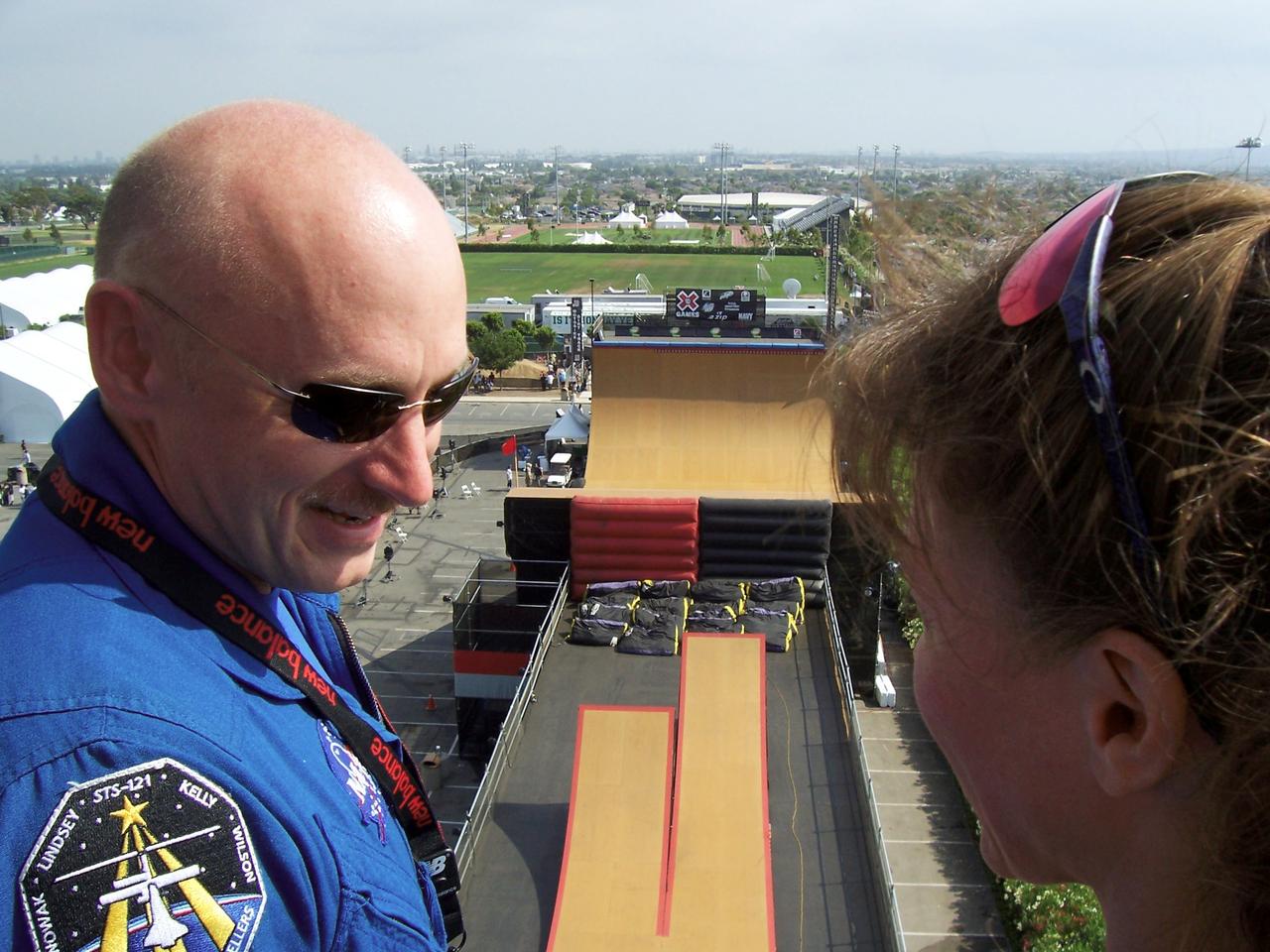
JSC2006-E-32814 (3 August 2006) --- The crew of STS-121 attended opening day of the 12th "X Games" in Los Angeles Aug. 3, discussing their recent mission to the International Space Station with students and athletes. Astronaut Mark E. Kelly, pilot, stands at the edge of the signature 80 foot high "Big Air Jump" skateboarding ramp - location for one of the event highlights. The crew's visit also included presentations at the Jet Propulsion Laboratory and the California Science Center.
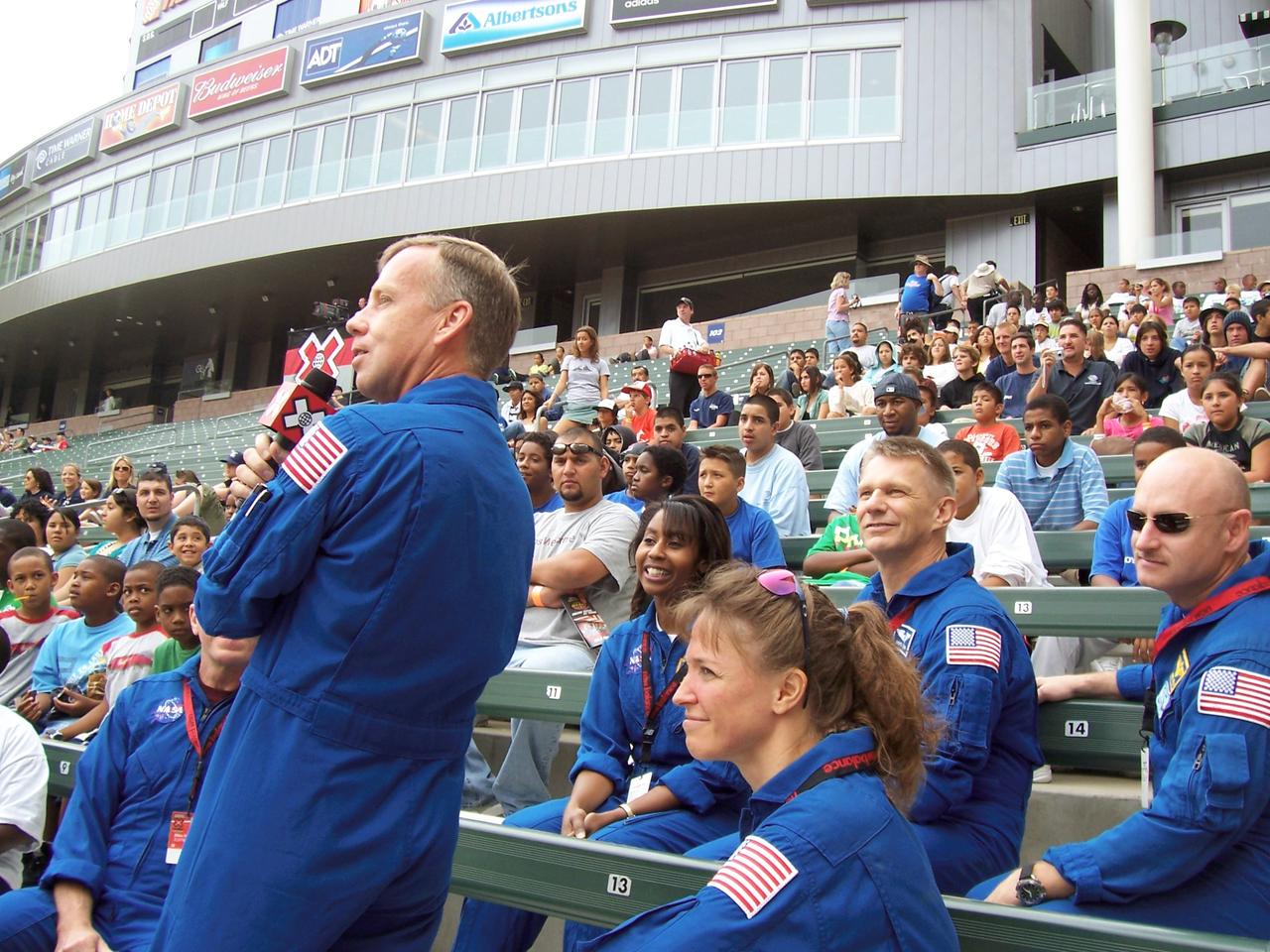
JSC2006-E-32816 (3 August 2006) --- The crew of STS-121 attended opening day of the 12th "X Games" in Los Angeles Aug. 3, discussing their recent mission to the International Space Station with students and athletes. Astronaut Steven W. Lindsey (with microphone), commander, and his crew take time out of the question and answer session to watch "Rally Car" practice. The crew's visit also included presentations at the Jet Propulsion Laboratory and the California Science Center.
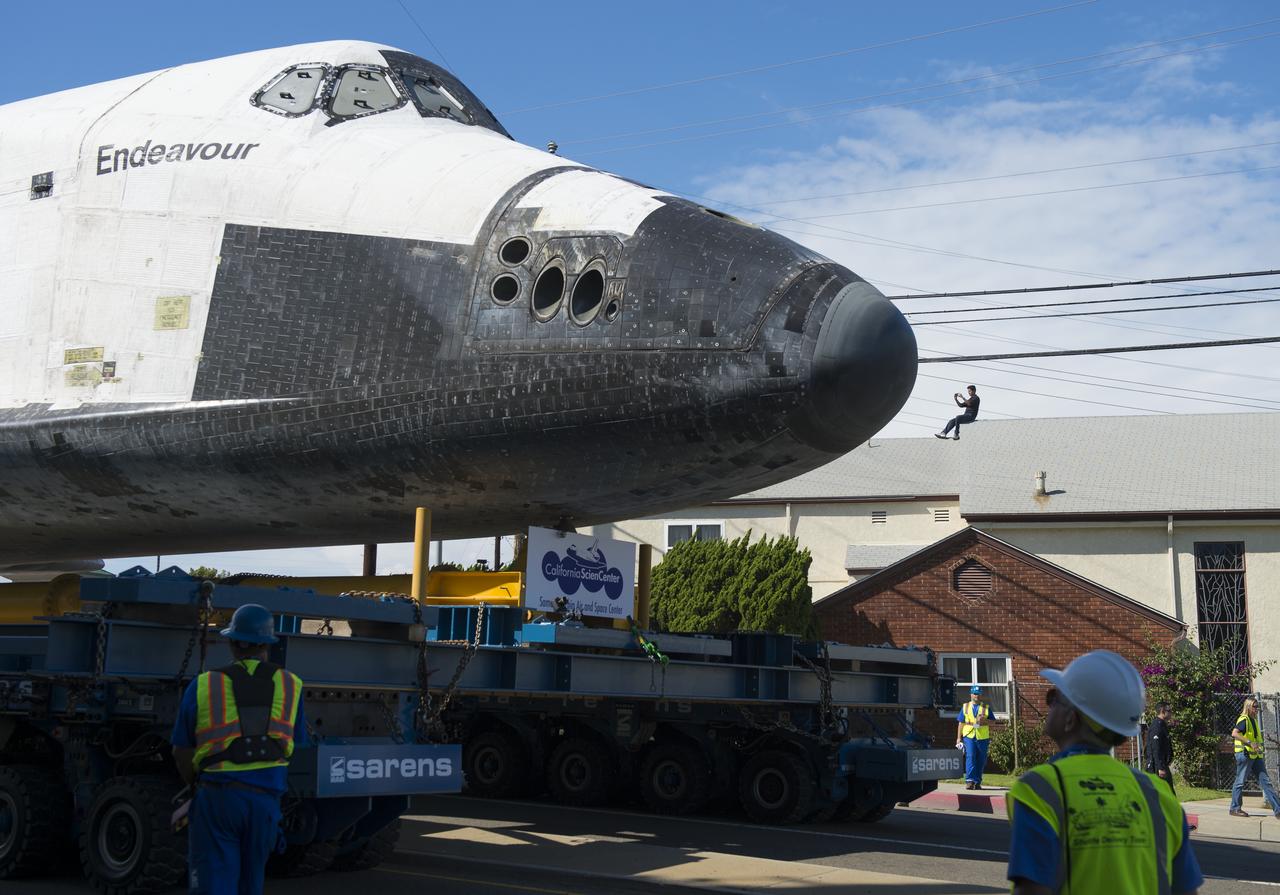
A spectator on the roof of a building photographs space shuttle Endeavour as it passes by on its way to its new home at the California Science Center in Los Angeles, Friday, Oct. 12, 2012. Endeavour, built as a replacement for space shuttle Challenger, completed 25 missions, spent 299 days in orbit, and orbited Earth 4,671 times while traveling 122,883,151 miles. Beginning Oct. 30, the shuttle will be on display in the CSC’s Samuel Oschin Space Shuttle Endeavour Display Pavilion, embarking on its new mission to commemorate past achievements in space and educate and inspire future generations of explorers. Photo Credit: (NASA/Carla Cioffi)
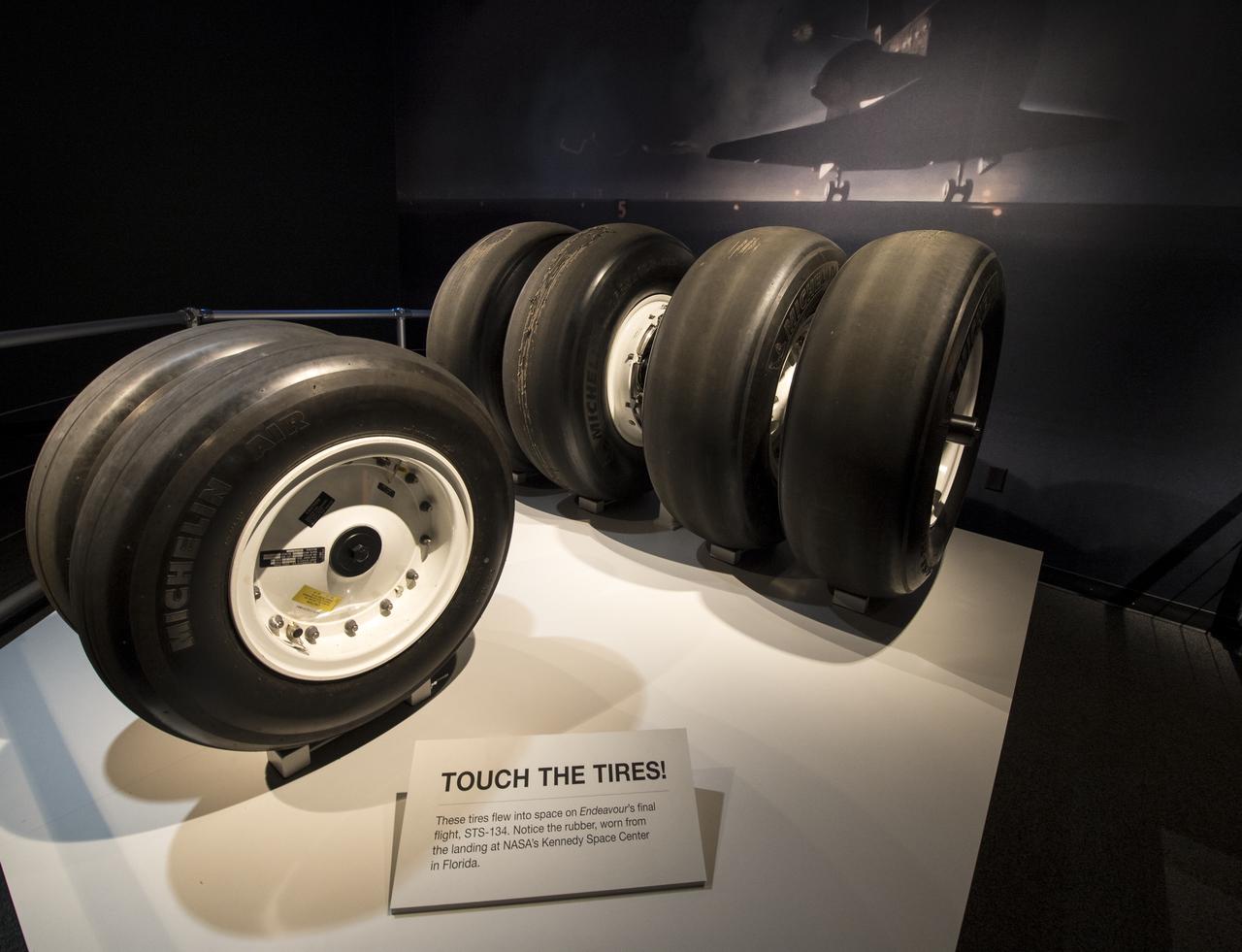
Tires from space shuttle Endeavour's final flight are on display at the California Science Center's, California Experience gallery, Tuesday, Oct. 30, 2012, in Los Angeles. The grand opening ceremony for the California Science center's Samuel Oschin Space Shuttle Endeavour Display Pavilion took place on Tuesday, Oct. 30, 2012. Endeavour, built as a replacement for space shuttle Challenger, completed 25 missions, spent 299 days in orbit, and orbited Earth 4,671 times while traveling 122,883,151 miles. Photo Credit: (NASA/Bill Ingalls)

Spectators watch space shuttle Endeavour as it passes by on its way to its new home at the California Science Center in Los Angeles, Friday, Oct. 12, 2012. Endeavour, built as a replacement for space shuttle Challenger, completed 25 missions, spent 299 days in orbit, and orbited Earth 4,671 times while traveling 122,883,151 miles. Beginning Oct. 30, the shuttle will be on display in the CSC's Samuel Oschin Space Shuttle Endeavour Display Pavilion, embarking on its new mission to commemorate past achievements in space and educate and inspire future generations of explorers. Photo Credit: (NASA/Carla Cioffi)

The driver of the Over Land Transporter is seen as he maneuvers the space shuttle Endeavour on the streets of Los Angeles as it heads to its new home at the California Science Center, Friday, Oct. 12, 2012. Endeavour, built as a replacement for space shuttle Challenger, completed 25 missions, spent 299 days in orbit, and orbited Earth 4,671 times while traveling 122,883,151 miles. Beginning Oct. 30, the shuttle will be on display in the CSC’s Samuel Oschin Space Shuttle Endeavour Display Pavilion, embarking on its new mission to commemorate past achievements in space and educate and inspire future generations of explorers. Photo Credit: (NASA/Bill Ingalls)
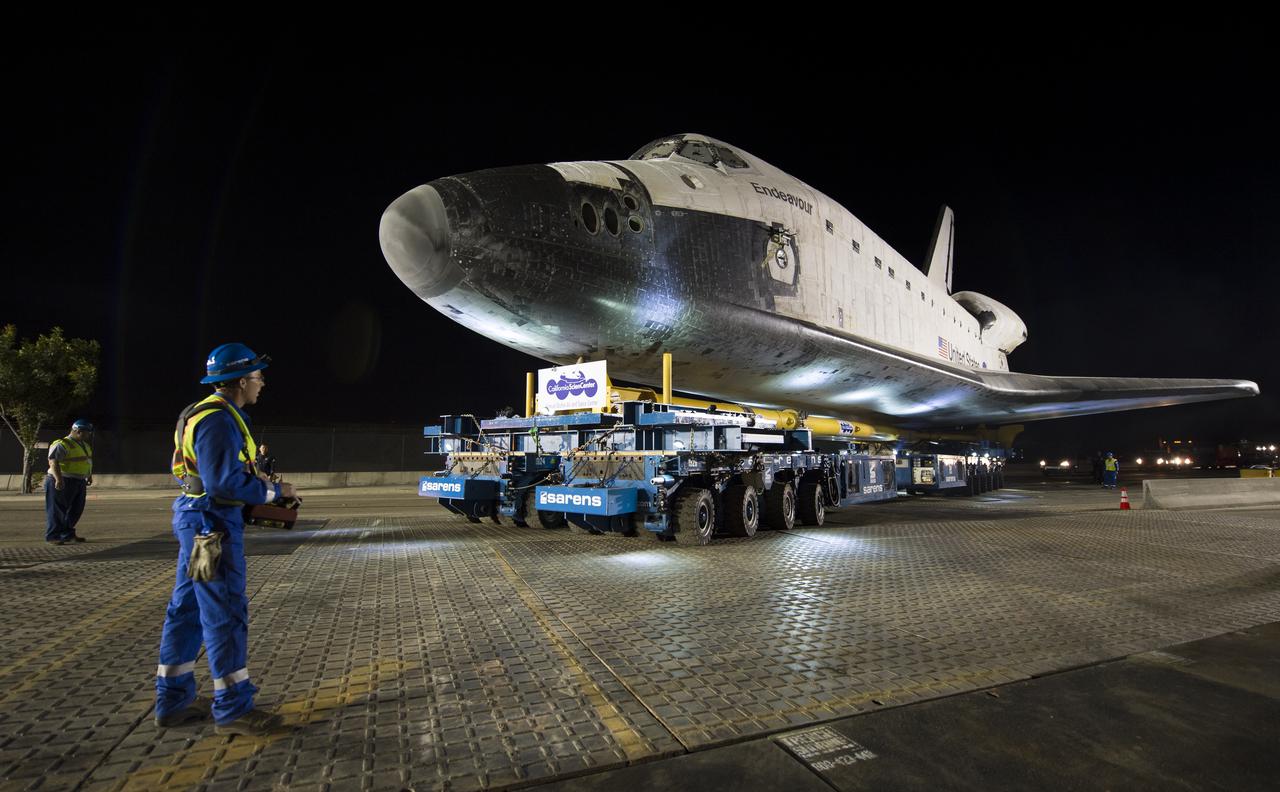
The driver of the Over Land Transporter is seen as he maneuvers the space shuttle Endeavour on the streets of Los Angeles as it heads to its new home at the California Science Center, Friday, Oct. 12, 2012. Endeavour, built as a replacement for space shuttle Challenger, completed 25 missions, spent 299 days in orbit, and orbited Earth 4,671 times while traveling 122,883,151 miles. Beginning Oct. 30, the shuttle will be on display in the CSC’s Samuel Oschin Space Shuttle Endeavour Display Pavilion, embarking on its new mission to commemorate past achievements in space and educate and inspire future generations of explorers. Photo Credit: (NASA/Bill Ingalls)

The driver of the Over Land Transporter (OLT) is seen as he maneuvers the space shuttle Endeavour on the streets of Los Angeles as it heads to its new home at the California Science Center, Friday, Oct. 12, 2012. Endeavour, built as a replacement for space shuttle Challenger, completed 25 missions, spent 299 days in orbit, and orbited Earth 4,671 times while traveling 122,883,151 miles. Beginning Oct. 30, the shuttle will be on display in the CSC's Samuel Oschin Space Shuttle Endeavour Display Pavilion, embarking on its new mission to commemorate past achievements in space and educate and inspire future generations of explorers. Photo Credit: (NASA/Carla Cioffi)

The space shuttle Endeavour is seen as it traverses through the streest of Los Angeles on its way to its new home at the California Science Center, Friday, Oct. 12, 2012. Endeavour, built as a replacement for space shuttle Challenger, completed 25 missions, spent 299 days in orbit, and orbited Earth 4,671 times while traveling 122,883,151 miles. Beginning Oct. 30, the shuttle will be on display in the CSC's Samuel Oschin Space Shuttle Endeavour Display Pavilion, embarking on its new mission to commemorate past achievements in space and educate and inspire future generations of explorers. Photo Credit: (NASA/Carla Cioffi)
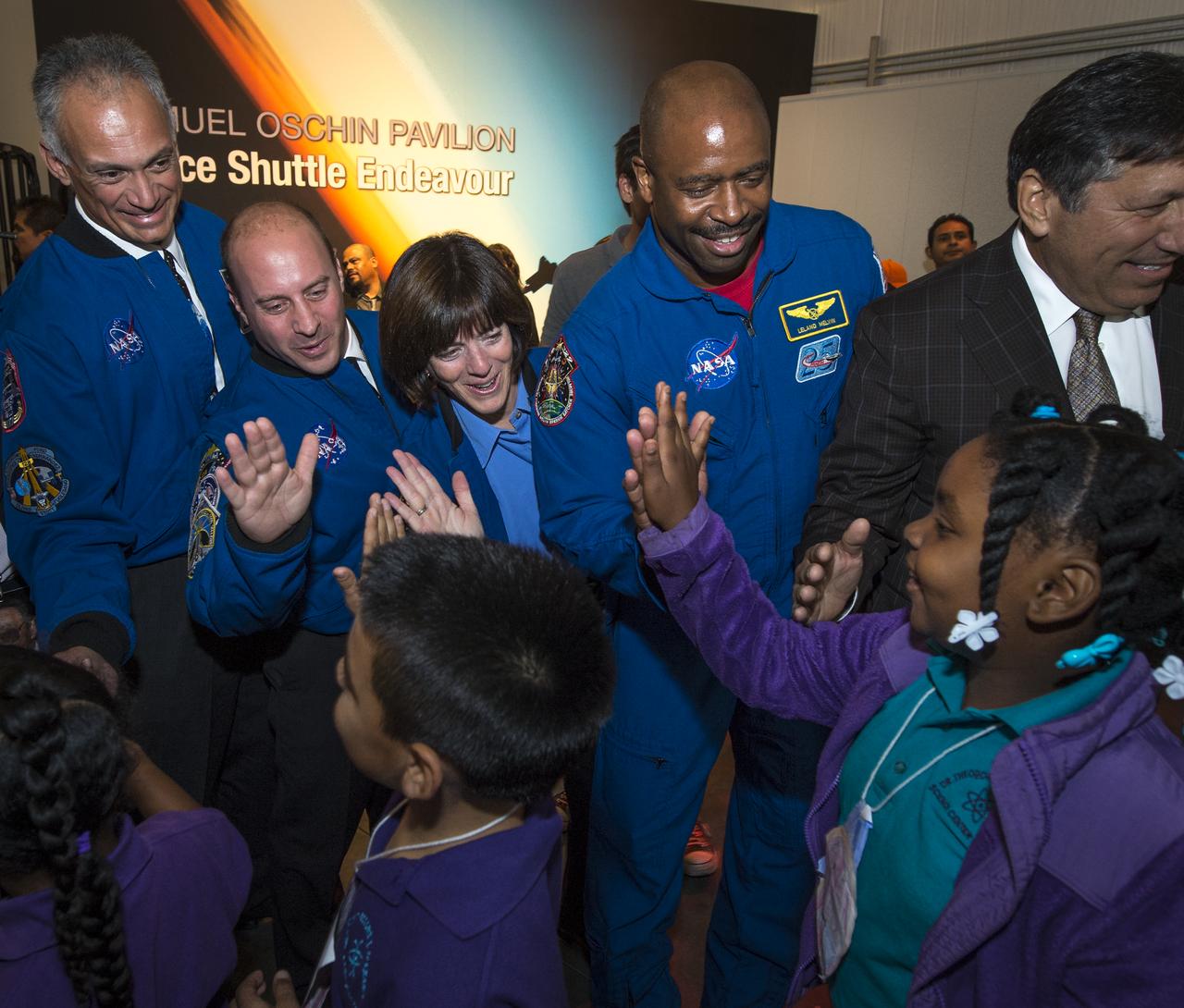
NASA Astronauts, from left, Danny Olivas, Garrett Reisman, Barbara Morgan, and, NASA Associate Administrator for Education and Astronaut, Leland Melvin give high fives to school children as they enter the California Science center's Samuel Oschin Space Shuttle Endeavour Display Pavilion, Tuesday, Oct. 30, 2012, in Los Angeles. Endeavour, built as a replacement for space shuttle Challenger, completed 25 missions, spent 299 days in orbit, and orbited Earth 4,671 times while traveling 122,883,151 miles. Photo Credit: (NASA/Bill Ingalls)
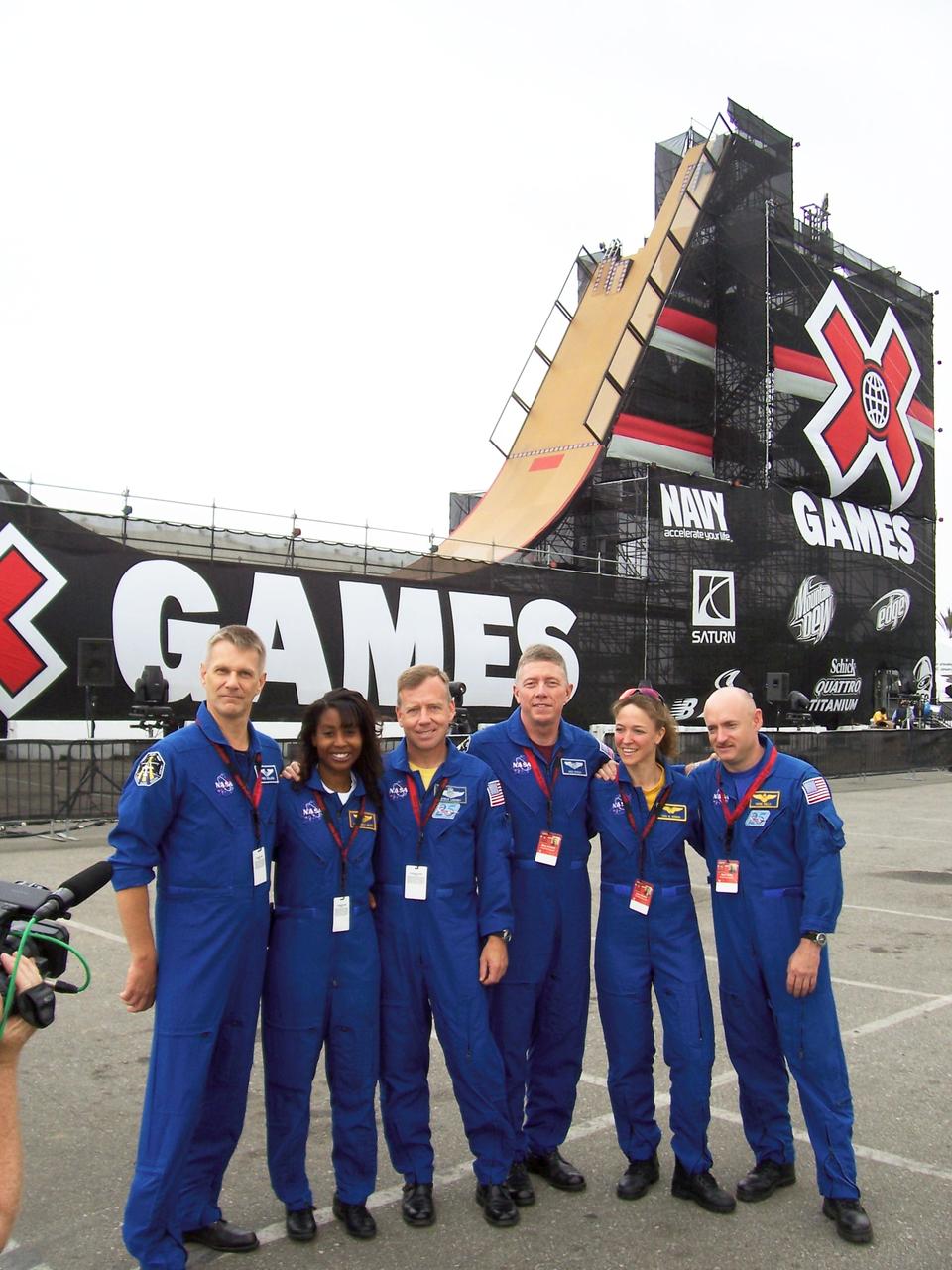
JSC2006-E-32815 (3 Aug. 2006) --- The crew of STS-121 attended opening day of the 12th "X Games" in Los Angeles Aug. 3, discussing their recent mission to the International Space Station with students and athletes. From left to right are astronauts Piers J. Sellers, Stephanie D. Wilson, Steven W. Lindsey, Michael E. Fossum, Lisa M. Nowak and Mark E. Kelly. In the background is the signature 80 foot high "Big Air Jump" skateboarding ramp - one of the event highlights. The crew's visit also included presentations at the Jet Propulsion Laboratory and the California Science Center.
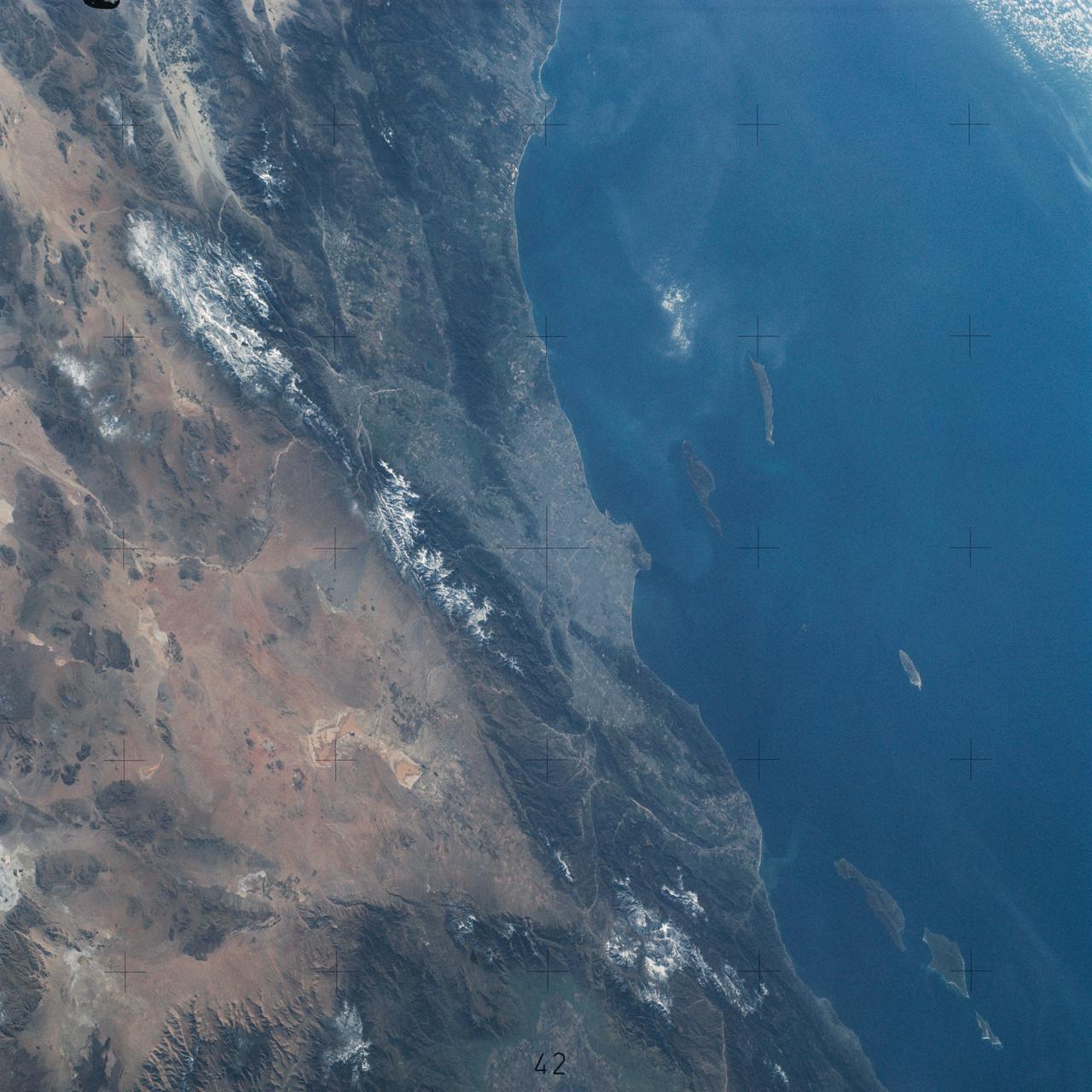
SL4-142-4542 (November 1973-February 1974) --- An oblique view of the Pacific Coast of Southern California, including the Los Angeles and San Diego areas, as seen from the Skylab space station in Earth orbit. This picture was taken by one of the Skylab 4 crewmen using a hand-held 70mm Hasselblad camera with a 100mm lens and SO-368 medium-speed Ektachrome film. The visible coastline extends from San Diego northwesterly to Santa Barbara. The Mojave Desert occupies much of the photograph. This view also includes the Channel Islands off the coast. Note that the higher elevations of the mountains are covered with snow. Photo credit: NASA
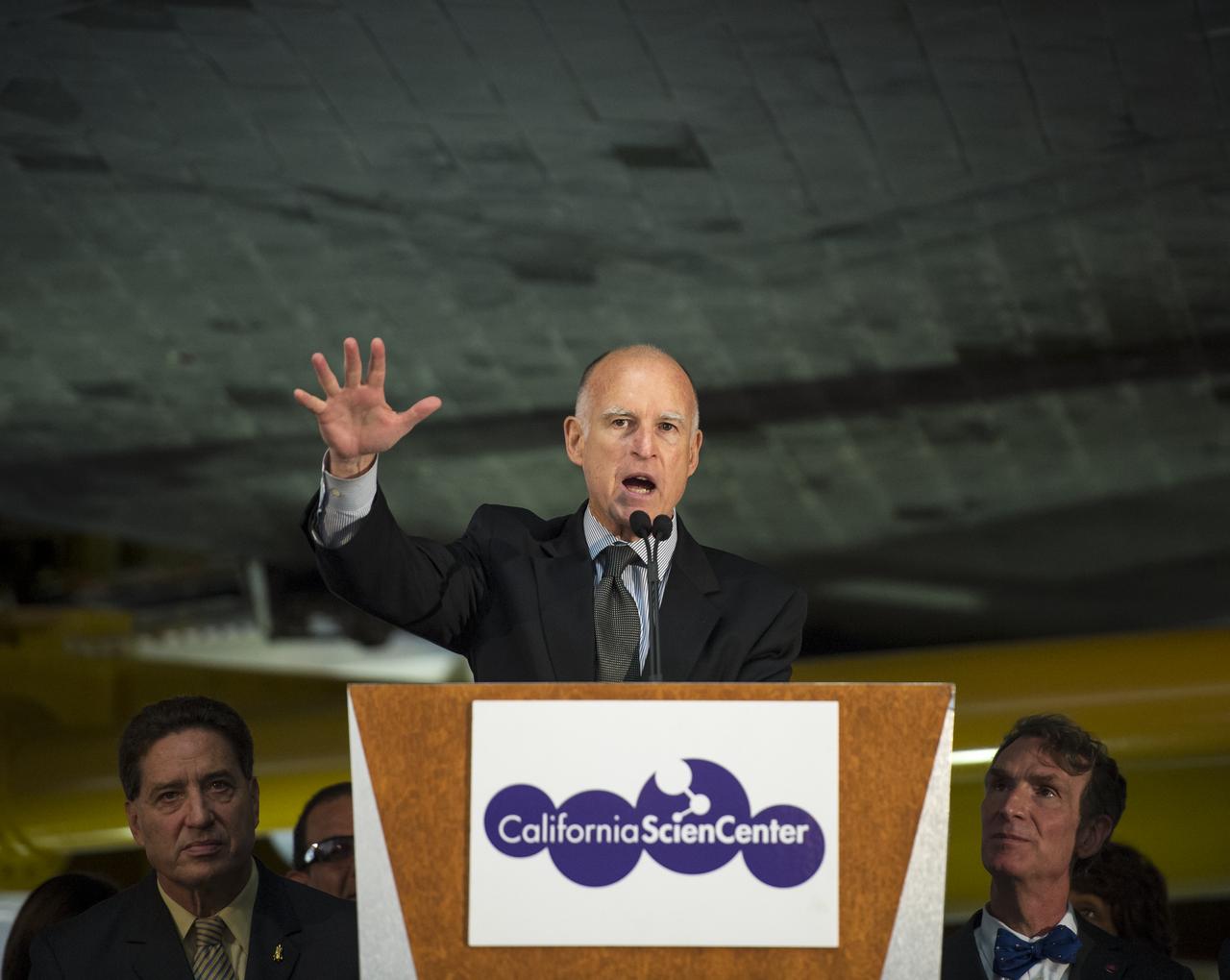
California Governor Jerry Brown speaks from a podium underneath the space shuttle Endeavour during the grand opening ceremony for the California Science center's Samuel Oschin Space Shuttle Endeavour Display Pavilion, Tuesday, Oct. 30, 2012, in Los Angeles. Endeavour, built as a replacement for space shuttle Challenger, completed 25 missions, spent 299 days in orbit, and orbited Earth 4,671 times while traveling 122,883,151 miles. Photo Credit: (NASA/Bill Ingalls)
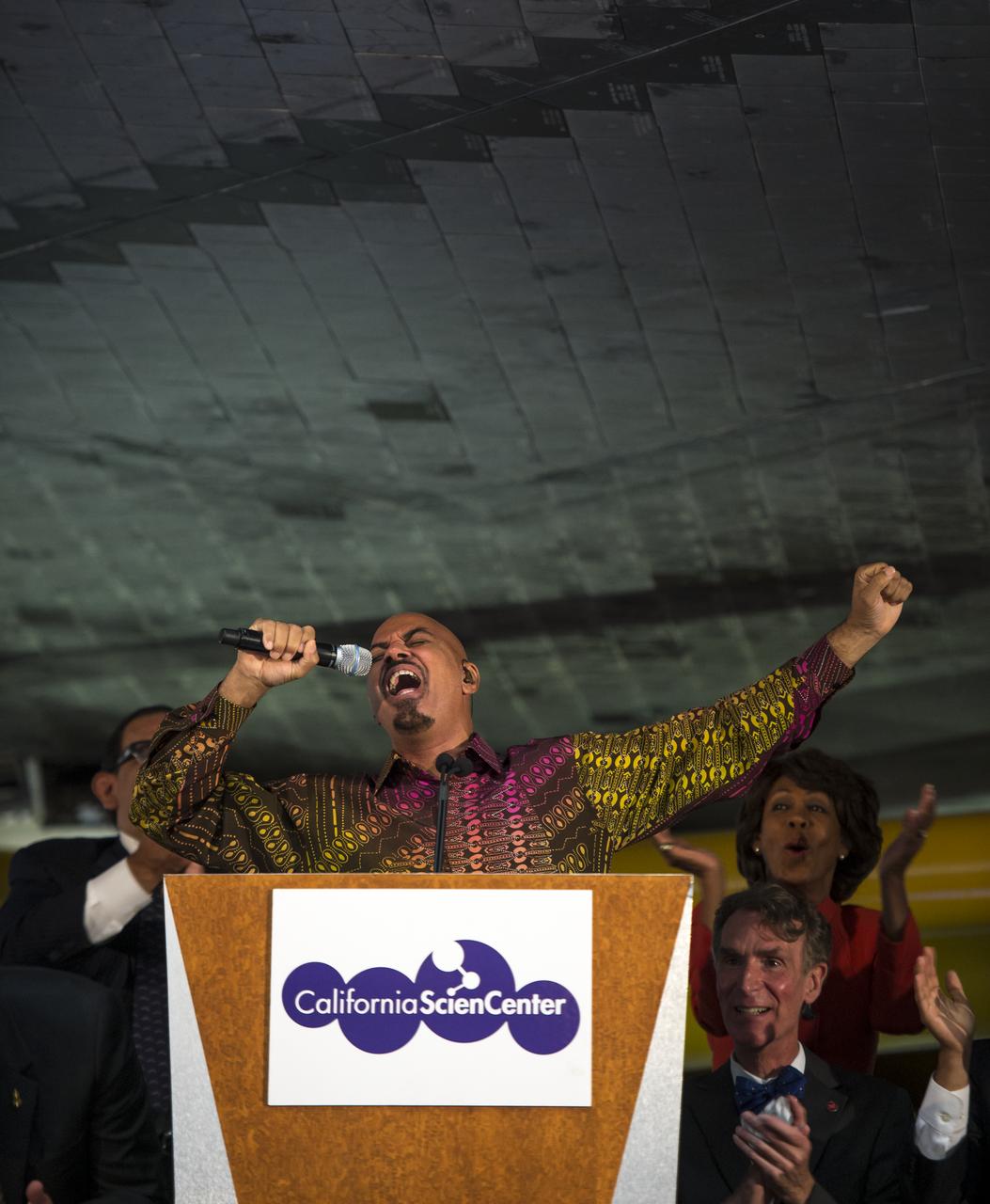
Vocalist James Ingram sings "I Believe I Can Fly" from underneath the space shuttle Endeavour during the grand opening ceremony for the California Science center's Samuel Oschin Space Shuttle Endeavour Display Pavilion, Tuesday, Oct. 30, 2012, in Los Angeles. Endeavour, built as a replacement for space shuttle Challenger, completed 25 missions, spent 299 days in orbit, and orbited Earth 4,671 times while traveling 122,883,151 miles. Photo Credit: (NASA/Bill Ingalls)
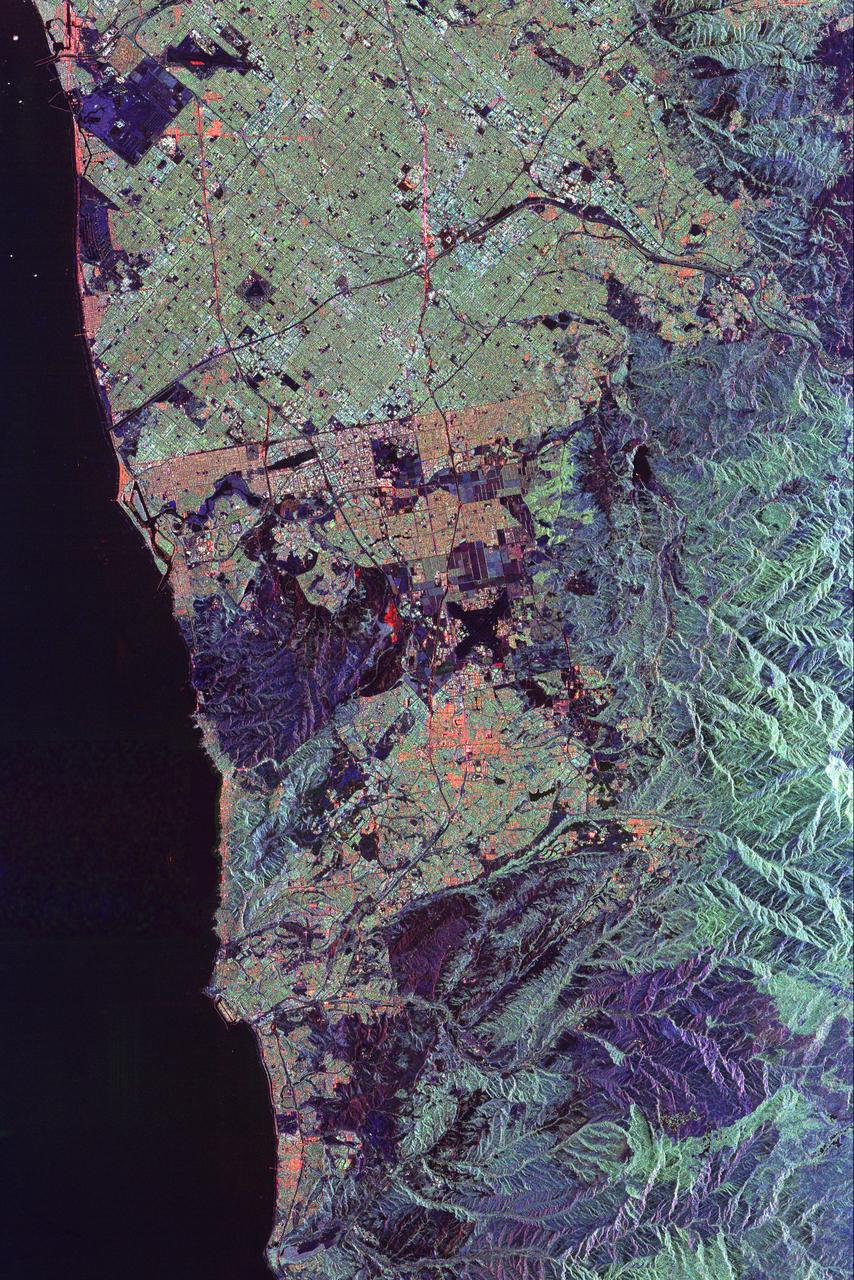
This spaceborne radar image of Orange County, Calif., shows the massive urbanization of this rapidly growing region located just south of Los Angeles.
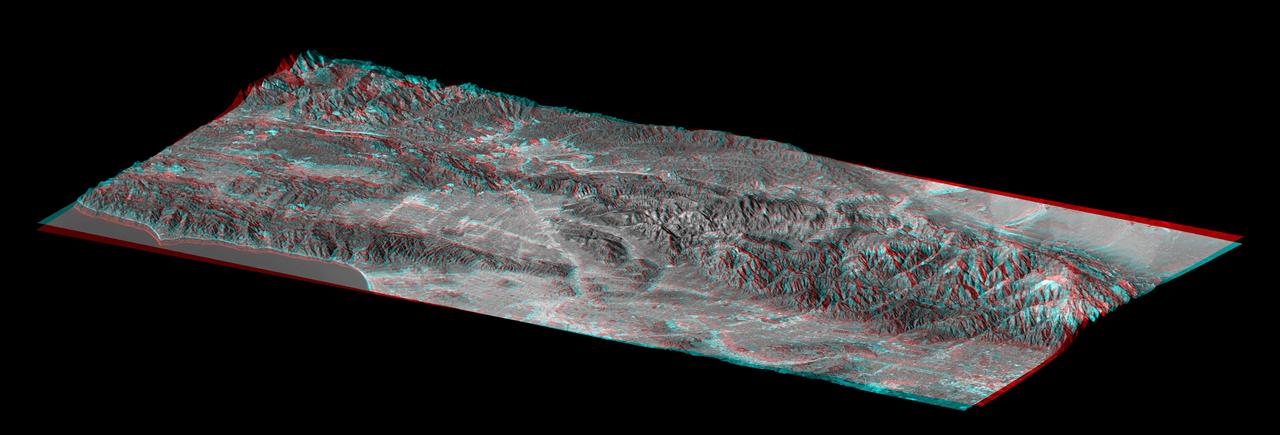
This elevation anaglyph of Los Angeles and adjacent mountainous terrain was created by NASA Shuttle Radar Topography Mission. 3D glasses are necessary to view this image.
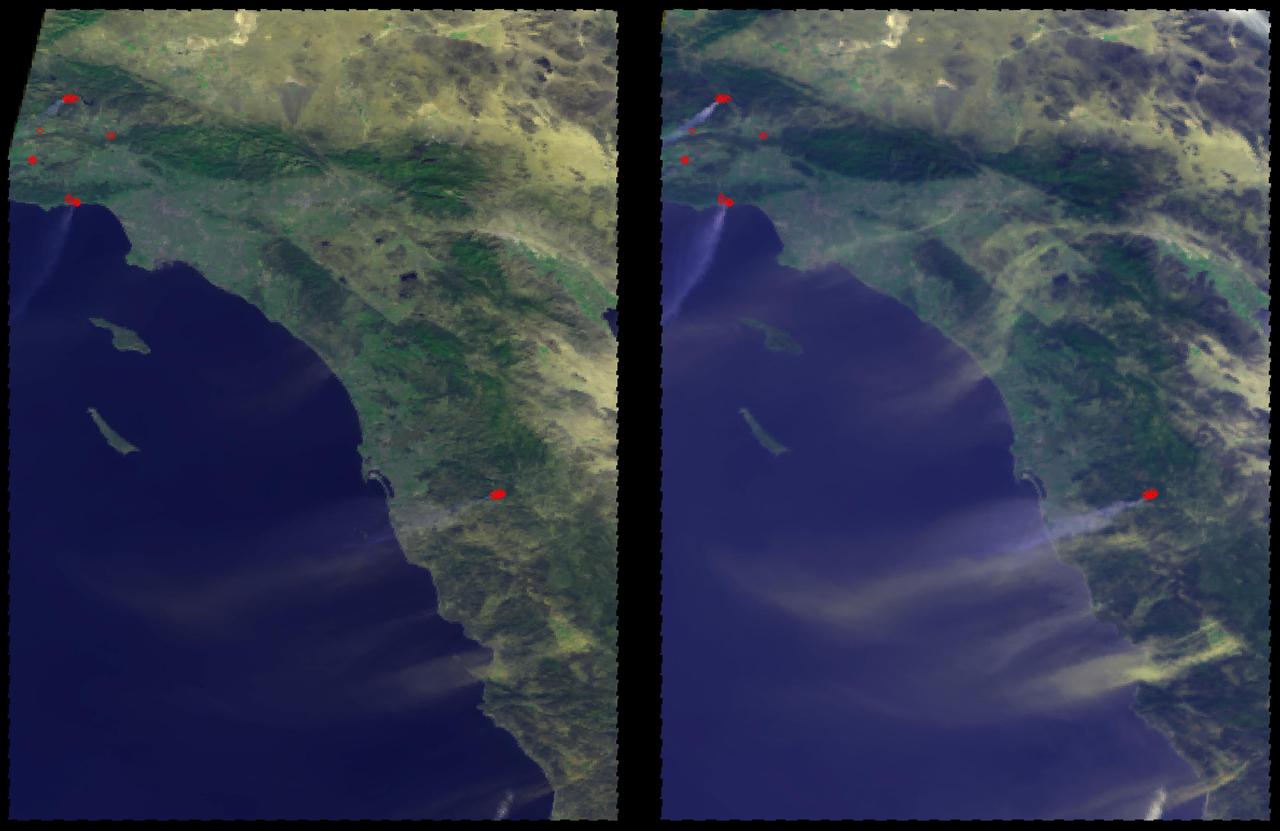
NASA Terra spacecraft showed hot, dry Santa Ana winds blowing through the Los Angeles and San Diego areas on Sunday October 21, 2007.
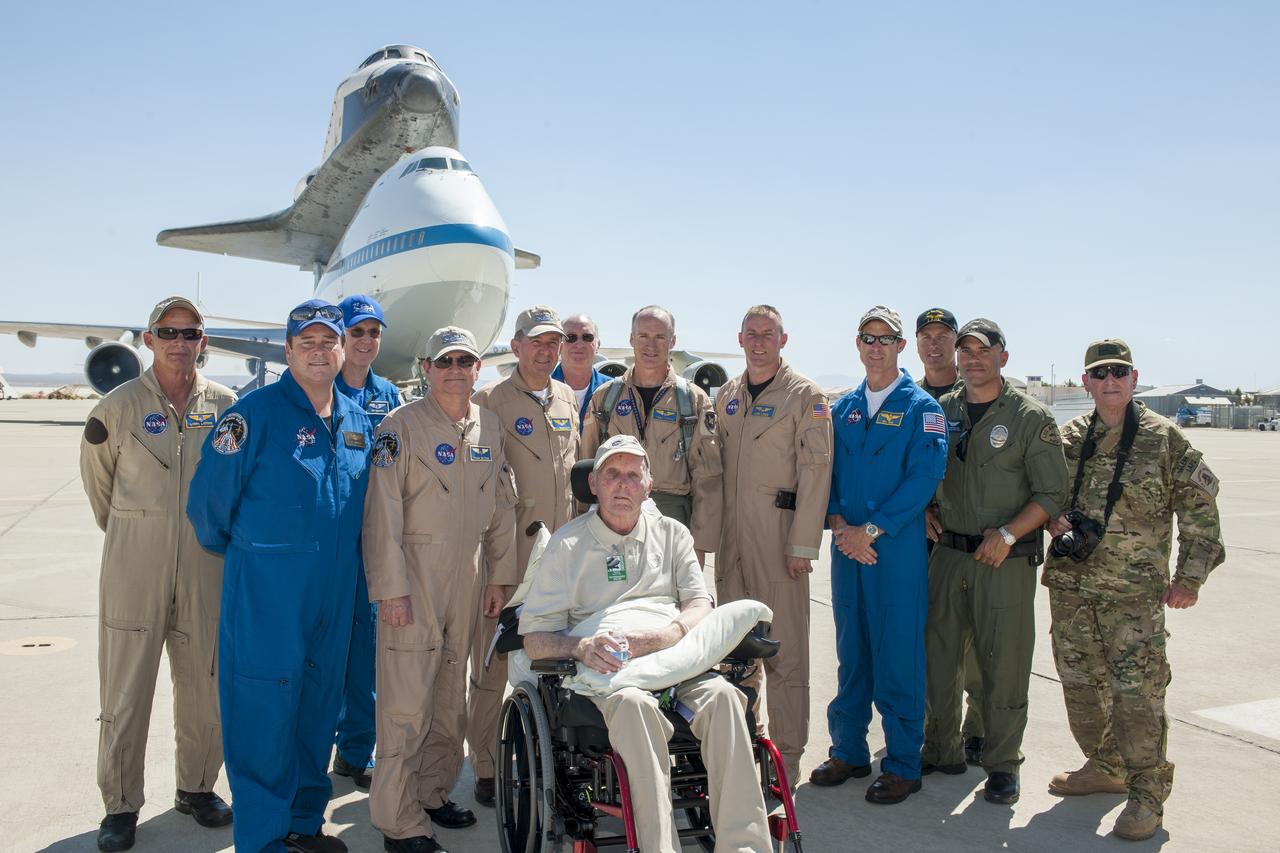
Los Angeles Police Department personnel and former NASA astronaut and NASA Armstrong Flight Research Center (then Dryden) test pilot Gordon Fullerton, seated, join the crew of the NASA 747 Shuttle Carrier Aircraft. Standing is, from left, Larry LaRose, J.J. Johnston, Jeff Moultrie, Frank Batteas, Bill Brockett, Henry Taylor, Troy Asher, Jim Less, Bill Rieke, officer Kevin Standage, Sgt. Stephen Roussell, and Glenn Grossman.
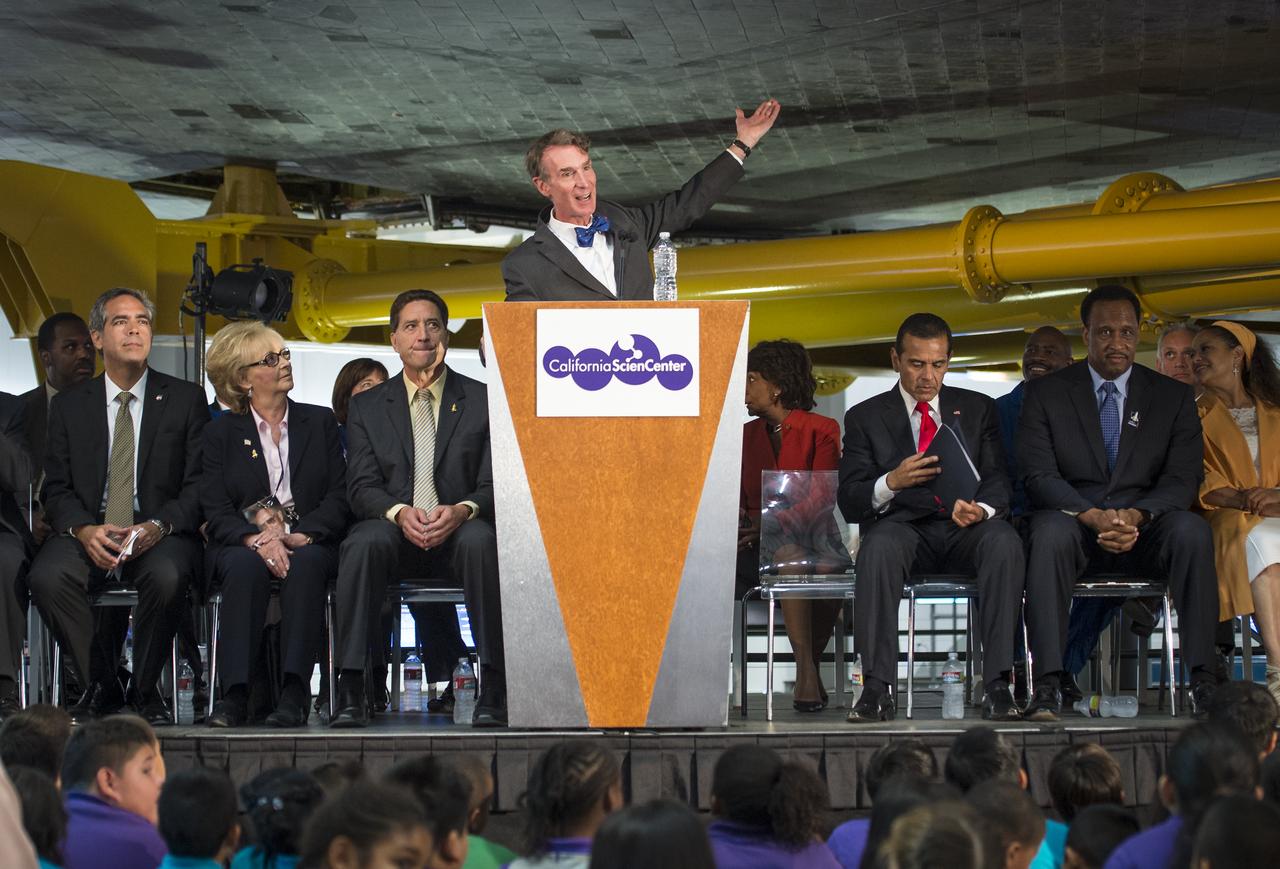
Chief Executive Officer of the Planetary Society, Bill Nye "The Science Guy", acts as emcee from a podium underneath the space shuttle Endeavour during the grand opening ceremony for the center's Samuel Oschin Space Shuttle Endeavour Display Pavilion, Tuesday, Oct. 30, 2012, in Los Angeles. Endeavour, built as a replacement for space shuttle Challenger, completed 25 missions, spent 299 days in orbit, and orbited Earth 4,671 times while traveling 122,883,151 miles. Photo Credit: (NASA/Bill Ingalls)

Data from JPL Advanced Spaceborne Thermal Emission and Reflection Radiometer instrument on NASA Terra satellite provides views of the L.A. Basin, including Dodger Stadium, the L.A.X. airport and JPL.

Large plumes of smoke rising from devastating wildfires burning near Los Angeles and San Diego on Sunday, October 26, 2003, are highlighted in this set of images from NASA Terra spacecraft.
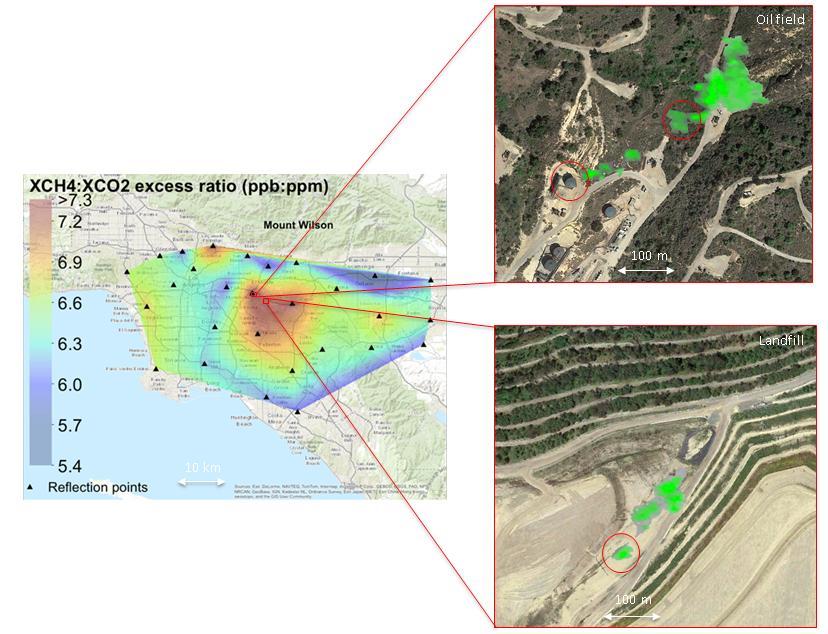
This image captured by a prototype NASA satellite instrument at NASA California Laboratory for Atmospheric Remote Sensing CLARS shows a persistent methane hotspot central red area over Los Angeles basin.
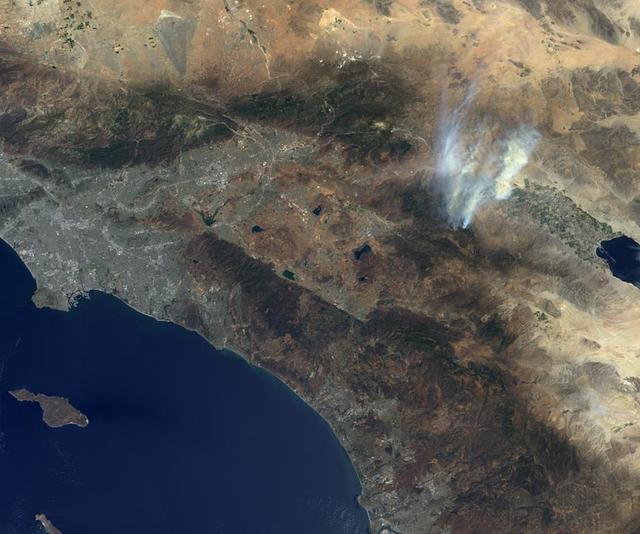
NASA Terra spacecraft passed over the Mountain Fire near Idyllwild, Calif., on Jul. 17, 2013. Los Angeles and the Pacific Ocean can been seen to the left and the Salton Sea is the dark feature in the right center of the image.
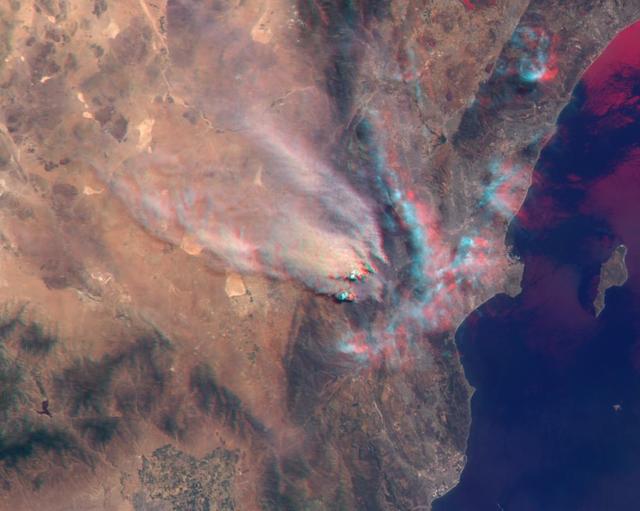
NASA Terra satellite took this anaglyph of several pyrocumulus clouds, created by the Station Fire, visible above the smoke plumes rising from the San Gabriel Mountains north of Los Angeles. 3D glasses are necessary to view this image.
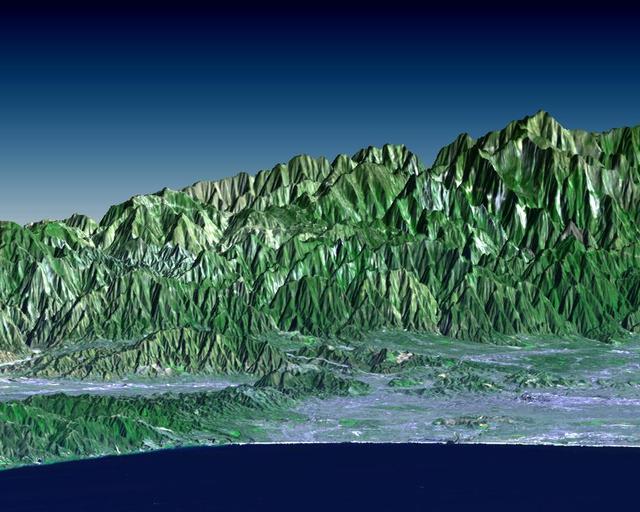
Los Angeles may be the world entertainment capital, but it is a difficult place to locate television and radio antennas. The metropolitan area spreads from the Pacific Ocean to upper and lower deserts, valleys, mountains, canyons and coastal plains.
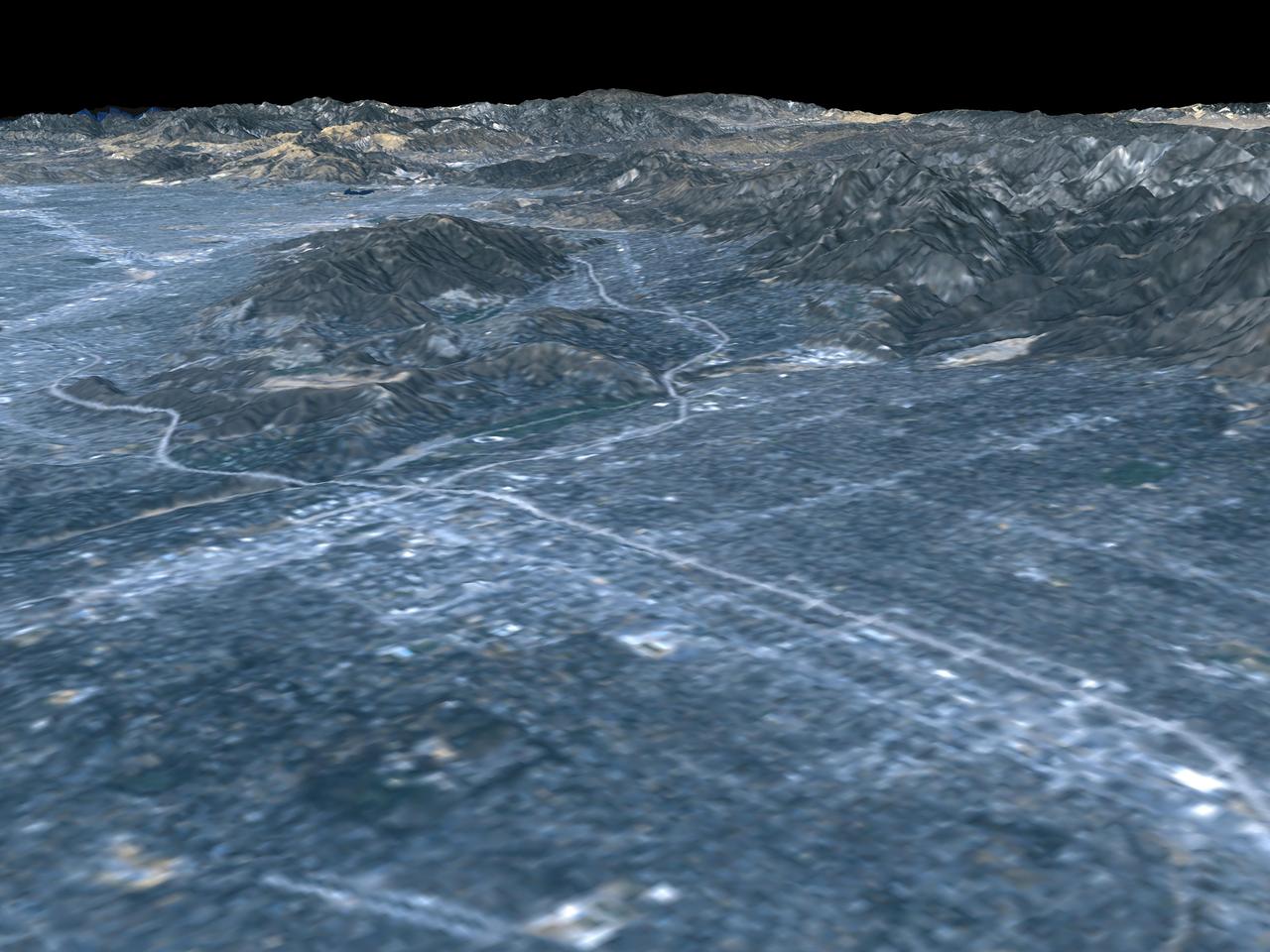
This image shows a perspective view of the area around Pasadena, California, just north of Los Angeles. The cluster of hills surrounded by freeways on the left is the Verdugo Hills, which lie between the San Gabriel Valley and the San Fernando Valley.
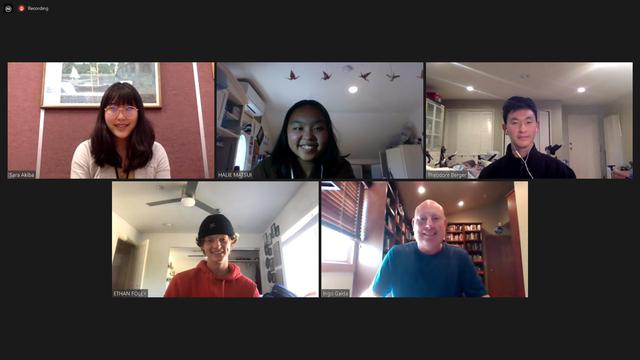
Santa Monica High School's winning team in the 2021 National Ocean Sciences Bowl Los Angeles regional competition, including Ingo Gaida, (lower right) who's been leading Santa Monica in the bowl for more than two decades. The competition took place Saturday, March 6. https://photojournal.jpl.nasa.gov/catalog/PIA23728
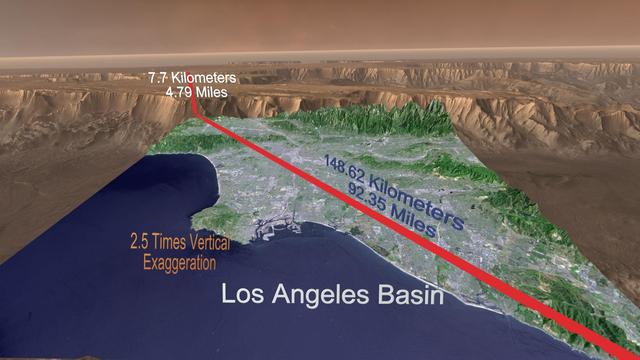
A Grand Canyon of Mars slices across the Red Planet near its equator. This canyon -- Valles Marineris, or the Mariner Valley -- is 10 times longer and deeper than Arizona Grand Canyon, and 20 times wider
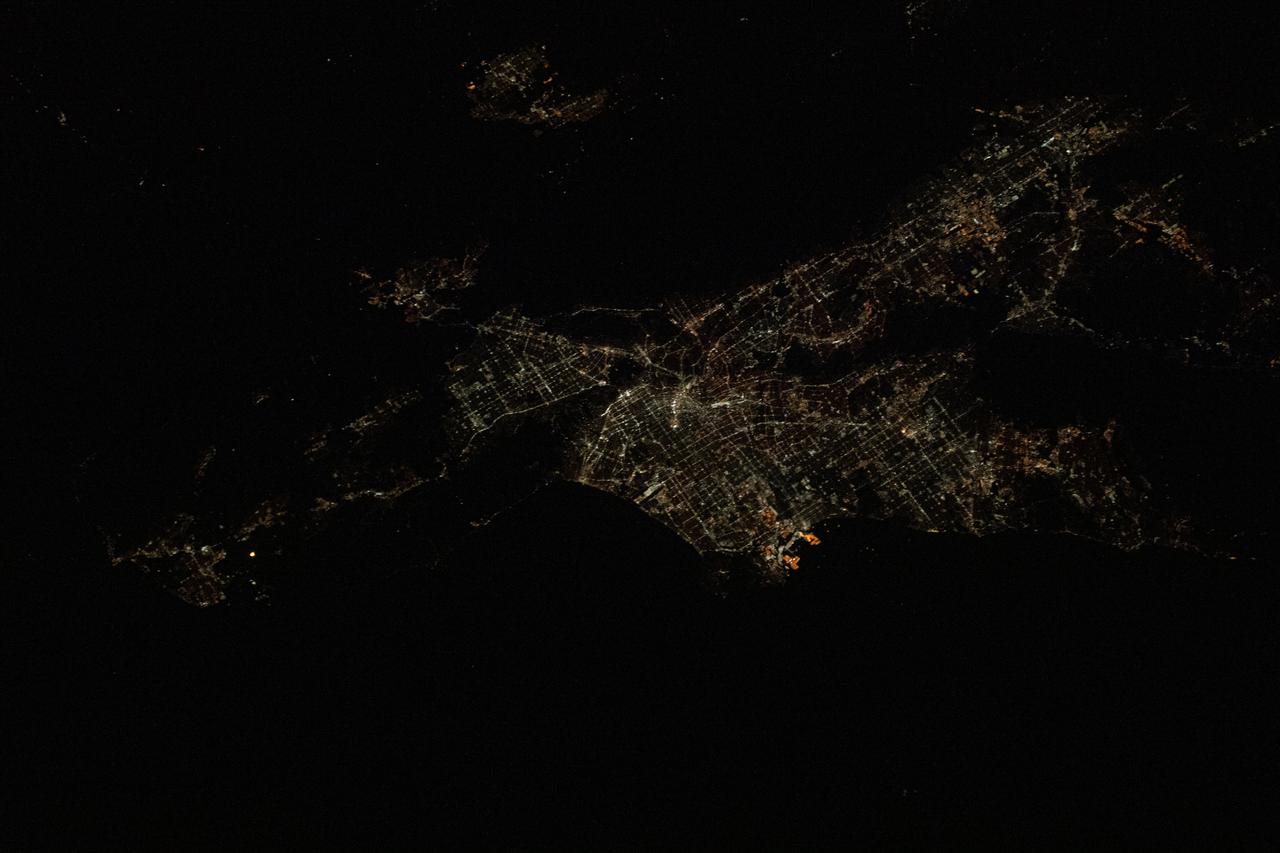
iss061e028440 (Nov. 4, 2019) --- Los Angeles, California is pictured at night as the International Space Station was orbiting 257 miles above the Pacific Ocean and about 215 miles southwest of the L.A. coastline. The bright orange lights at the center are Terminal Island and the Port of Los Angeles.
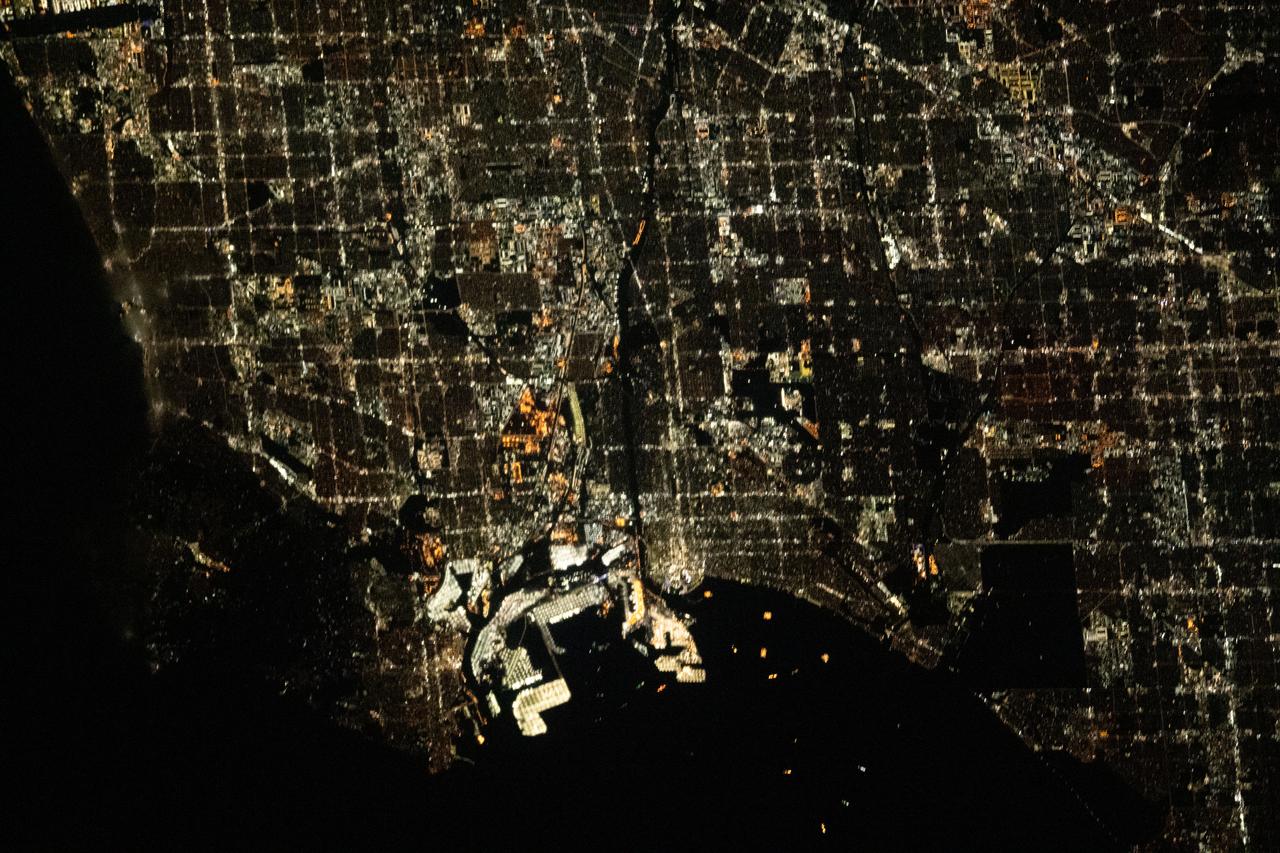
iss069e032998 (July 19, 2023) --- The city lights of Los Angeles, California, and its surrounding suburbs, are pictured from the International Space Station as it orbited 261 miles above. Terminal Island, an artificial island containing the ports of Los Angeles and Long Beach, is featured prominently at the bottom center of this photograph.

Spectators are seen photographing space shuttle Endeavour as it passes by on its way to its new home at the California Science Center, Friday, Oct. 12, 2012, in Inglewood. Endeavour, built as a replacement for space shuttle Challenger, completed 25 missions, spent 299 days in orbit, and orbited Earth 4,671 times while traveling 122,883,151 miles. Beginning Oct. 30, the shuttle will be on display in the CSC’s Samuel Oschin Space Shuttle Endeavour Display Pavilion, embarking on its new mission to commemorate past achievements in space and educate and inspire future generations of explorers. Photo Credit: (NASA/Carla Cioffi)
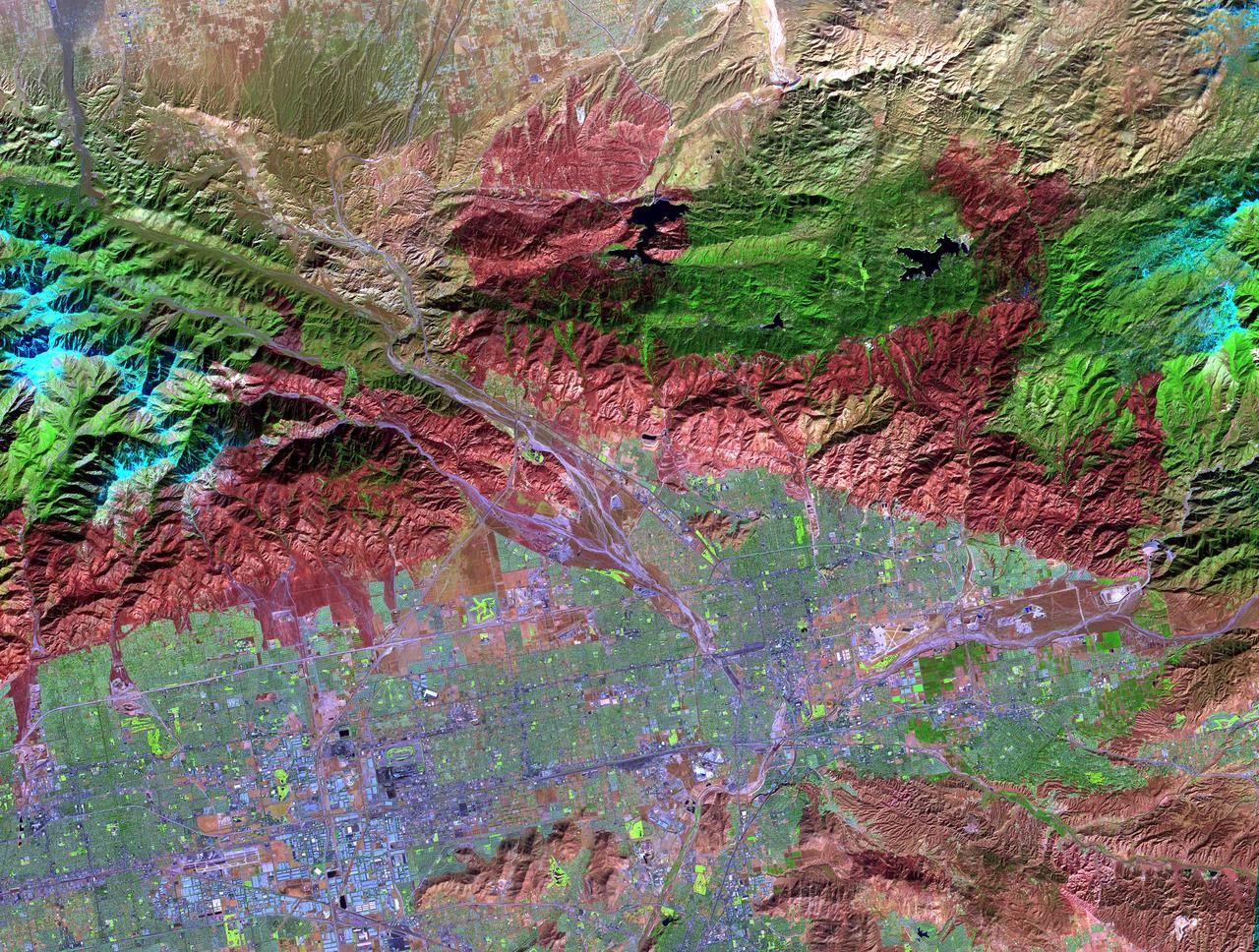
On November 18, 2003, the Advanced Spaceborne Thermal Emission and Reflection Radiometer (ASTER) on NASA's Terra satellite acquired this image of the Old Fire/Grand Prix fire east of Los Angeles. The image is being processed by NASA's Wildfire Response Team and will be sent to the United States Department of Agriculture's Forest Service Remote Sensing Applications Center (RSAC) which provides interpretation services to Burned Area Emergency Response (BAER) teams to assist in mapping the severity of the burned areas. The image combines data from the visible and infrared wavelength regions to highlight the burned areas. http://photojournal.jpl.nasa.gov/catalog/PIA04879
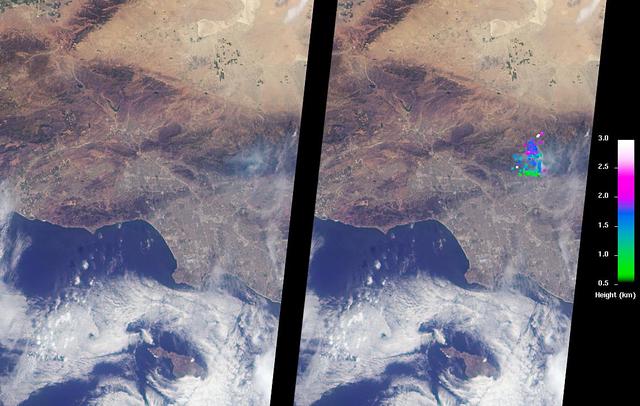
The Los Angeles area is currently suffering the effects of three major wildfires that are blanketing the area with smoke. Over the past few days, Southern California has experienced record-breaking temperatures, topping 110 degrees Fahrenheit in some cities. The heat, in combination with offshore winds, helped to stoke the Sherpa Fire west of Santa Barbara, which has been burning since June 15, 2016. Over the weekend of June 18-19, this fire rapidly expanded in size, forcing freeway closures and evacuations of campgrounds and state beaches. On Monday, June 20, two new fires ignited in the San Gabriel Mountains north of Azusa and Duarte, together dubbed the San Gabriel Complex Fire. They have burned more than 4,900 acres since June 20, sending up plumes of smoke visible to many in the Los Angeles basin and triggering air quality warnings. More than 1,400 personnel have been battling the blazes in the scorching heat, and evacuations were ordered for neighborhoods in the foothills. On June 21, the Multi-angle Imaging SpectroRadiometer (MISR) instrument aboard NASA's Terra satellite captured this view of the San Gabriel Mountains and Los Angeles Basin from its 46-degree forward-viewing camera, which enhances the visibility of the smoke compared to the more conventional nadir (vertical) view. The width of this image is about 75 miles (120 kilometers) across. Smoke from the San Gabriel Complex Fire is visible at the very right of the image. Stereoscopic analysis of MISR's multiple camera angles is used to compute the height of the smoke plume from the San Gabriel Complex Fire. In the right-hand image, these heights are superimposed on the underlying image. The color scale shows that the plume is not much higher than the surrounding mountains. As a result, much of the smoke is confined to the local area. http://photojournal.jpl.nasa.gov/catalog/PIA20718
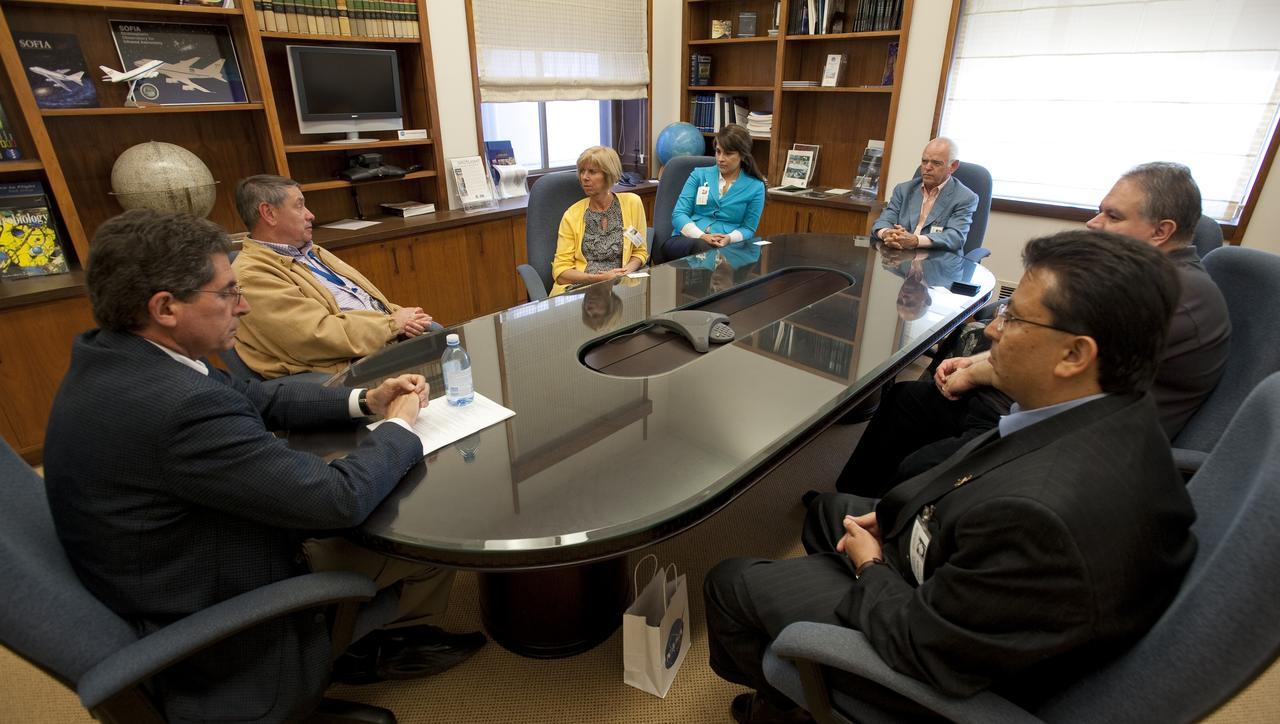
Janice Hahn, Councilwoman, District 15, City of Los Angeles visits NASA Ames Research Center. Associate Director Steve Zornetzer and Center Director S. Pete Worden meet with .Janice Hahn, Councilwoman, District 15, City of Los Angeles, Jenny Chavez, Staffer for Councilwoman Hahn, Walter Zifkin, Commissioner, Los Angles International Airport, Michael Molina, Chief of External Affairs, LAWA, Jaideep Vaswani. Chief of Airport Planning, LAWA