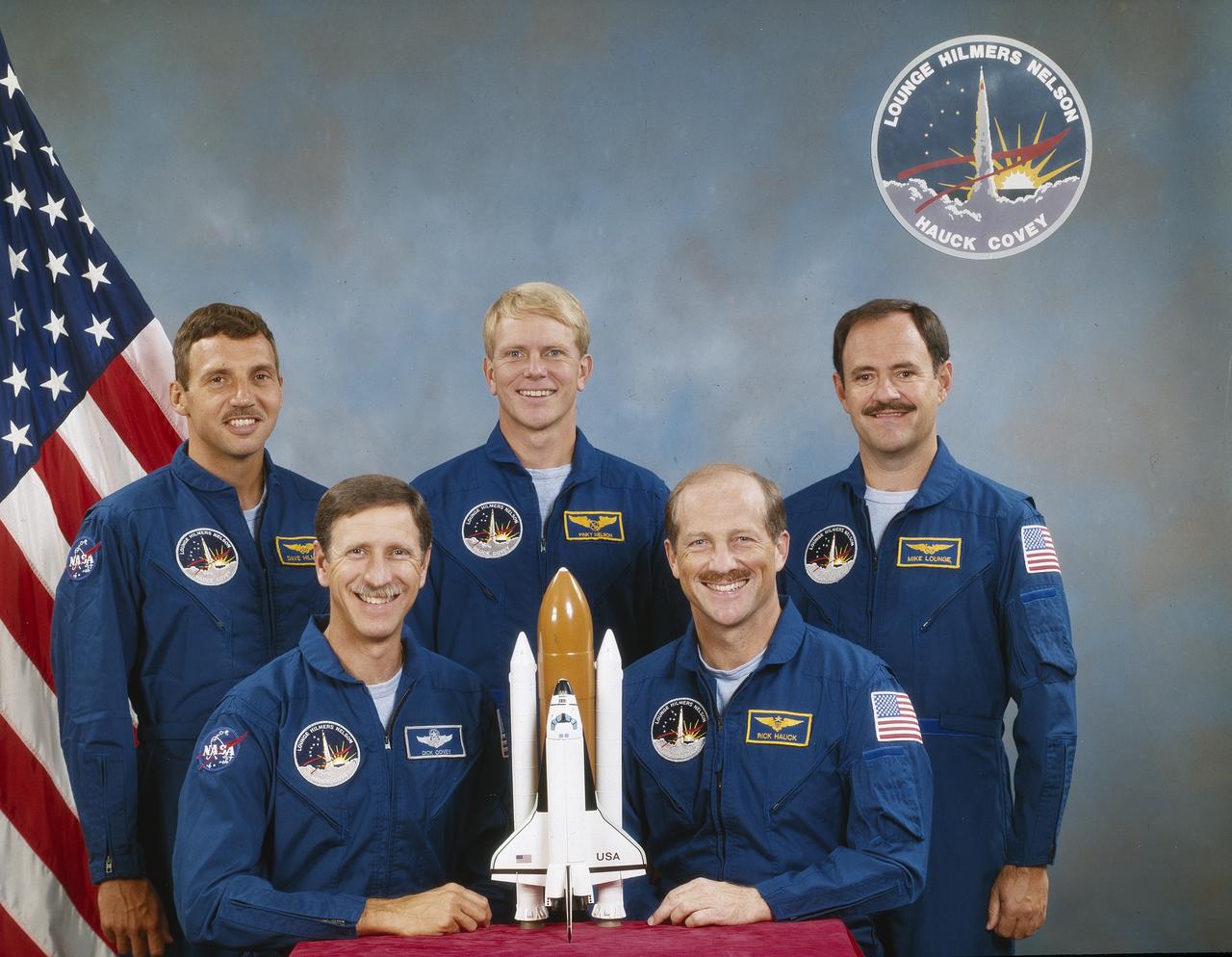
Five astronauts composed the crew of the STS-26 mission. Pictured in the portrait (left to right) are David C. Hilmer, mission specialist; Richard O. Covey, pilot; George D. Nelson, mission specialist; Frederick H. Hauck, Jr., commander; and John, M. Lounge, mission specialist. Launched aboard the Space Shuttle Orbiter Discovery, liftoff occurred on September 29, 1988 at 11:37am (EDT). This was the 7th flight of the Orbiter Discovery, and the return to flight after the STS-51L mission accident. The primary payload was the NASA Tracking and Data Relay Satellite-3 (TDRS-3).
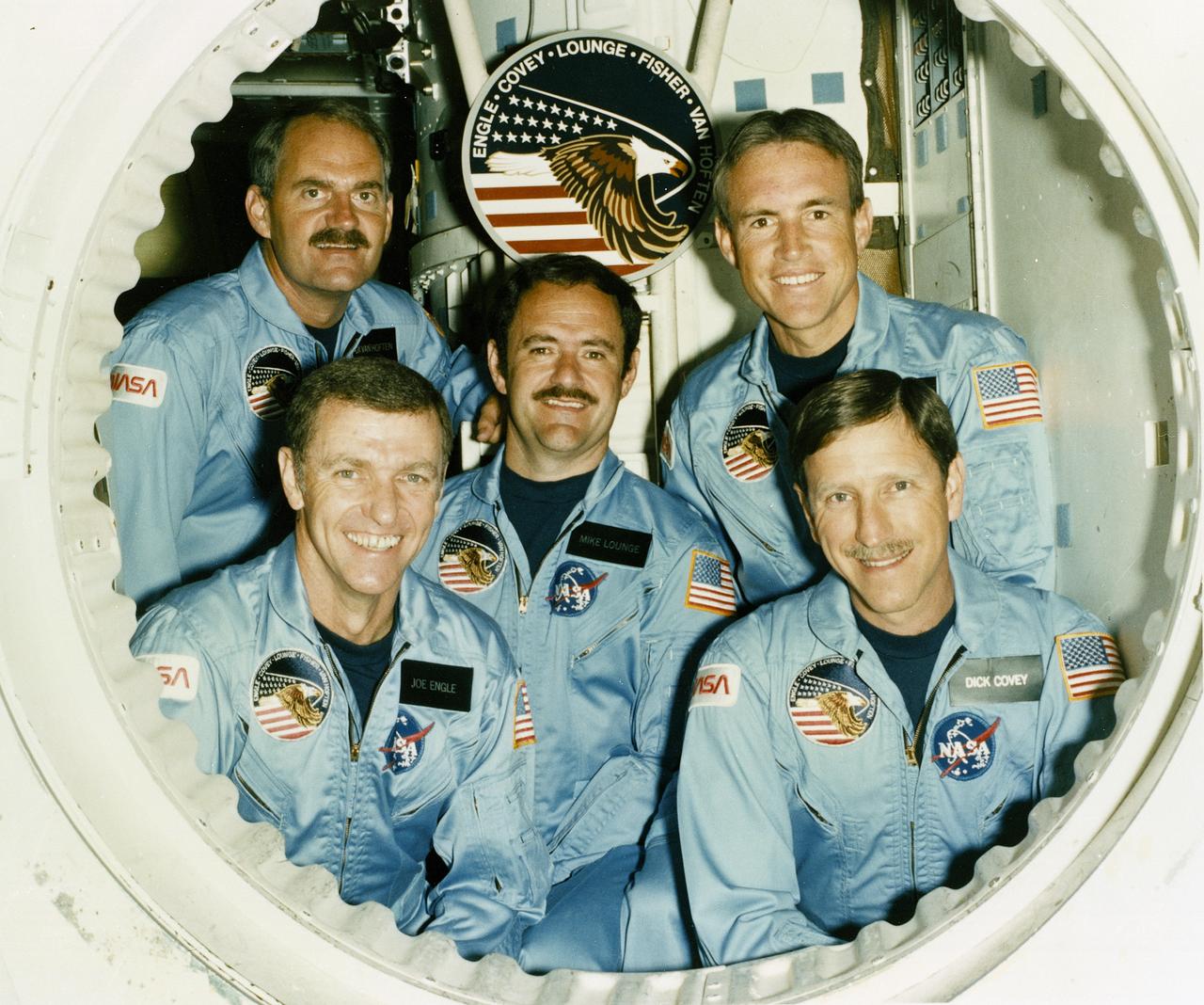
The crew assigned to the STS-51I mission included (front row left to right) Joe H. Engle, commander; and Richard O. Covey, pilot. In the center is John M. (Mike) Lounge, mission specialist. On the back row, from left to right, are mission specialists James D. van Hoften, and William F. Fisher. Launched aboard the Space Shuttle Discovery on August 27, 1985 at 6:58:01 am (EDT), the STS-51I mission’s primary payloads were three communication satellites: the ASC-1 for the American Satellite Company; the AUSSAT-1, an Australian communications satellite; and the SYNCOM-IV-4, the synchronous communications satellite.
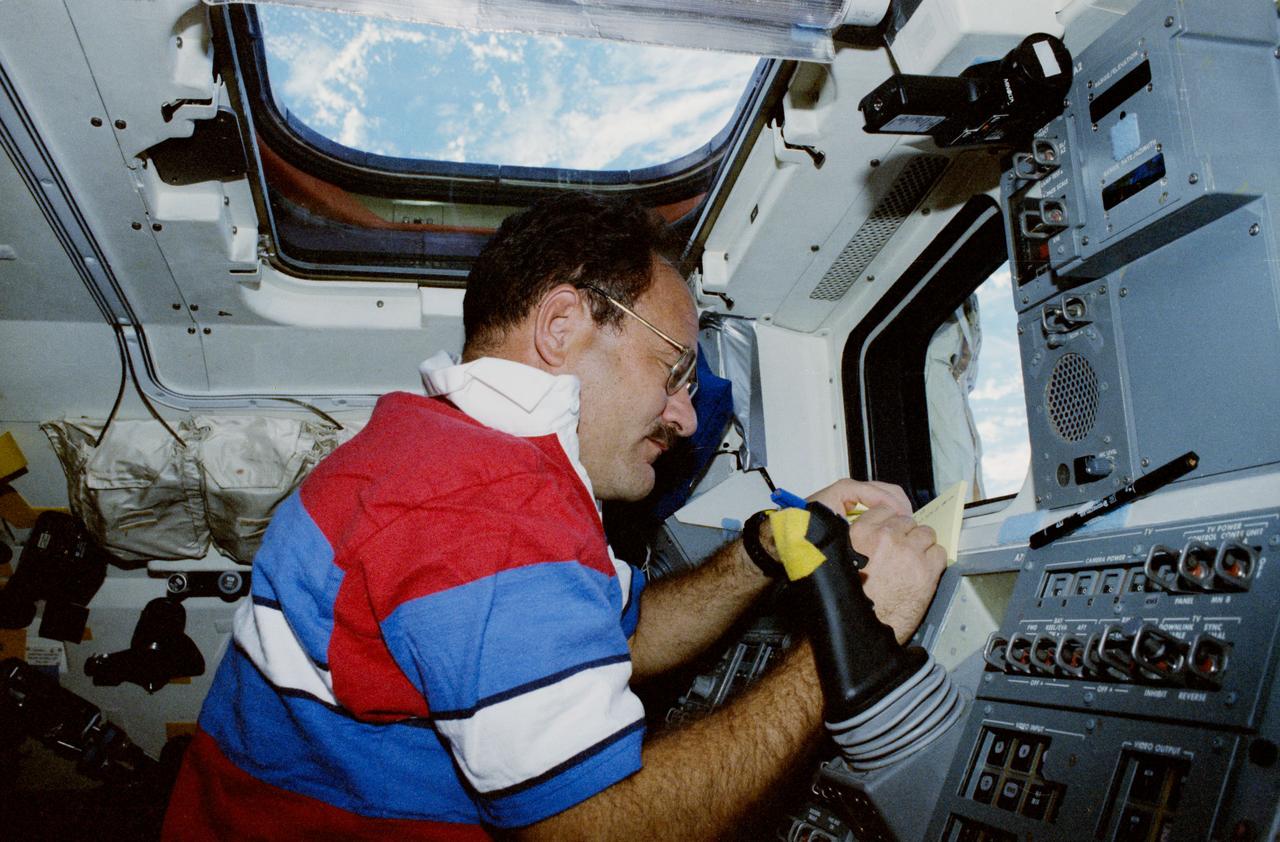
STS035-19-019 (2-11 Dec 1990) --- Astronaut John M. (Mike) Lounge, STS 35 mission specialist makes a notation as he observes telescopes (out of frame) at work in Columbia's cargo bay. This aft flight deck scene was exposed with a 35mm camera.
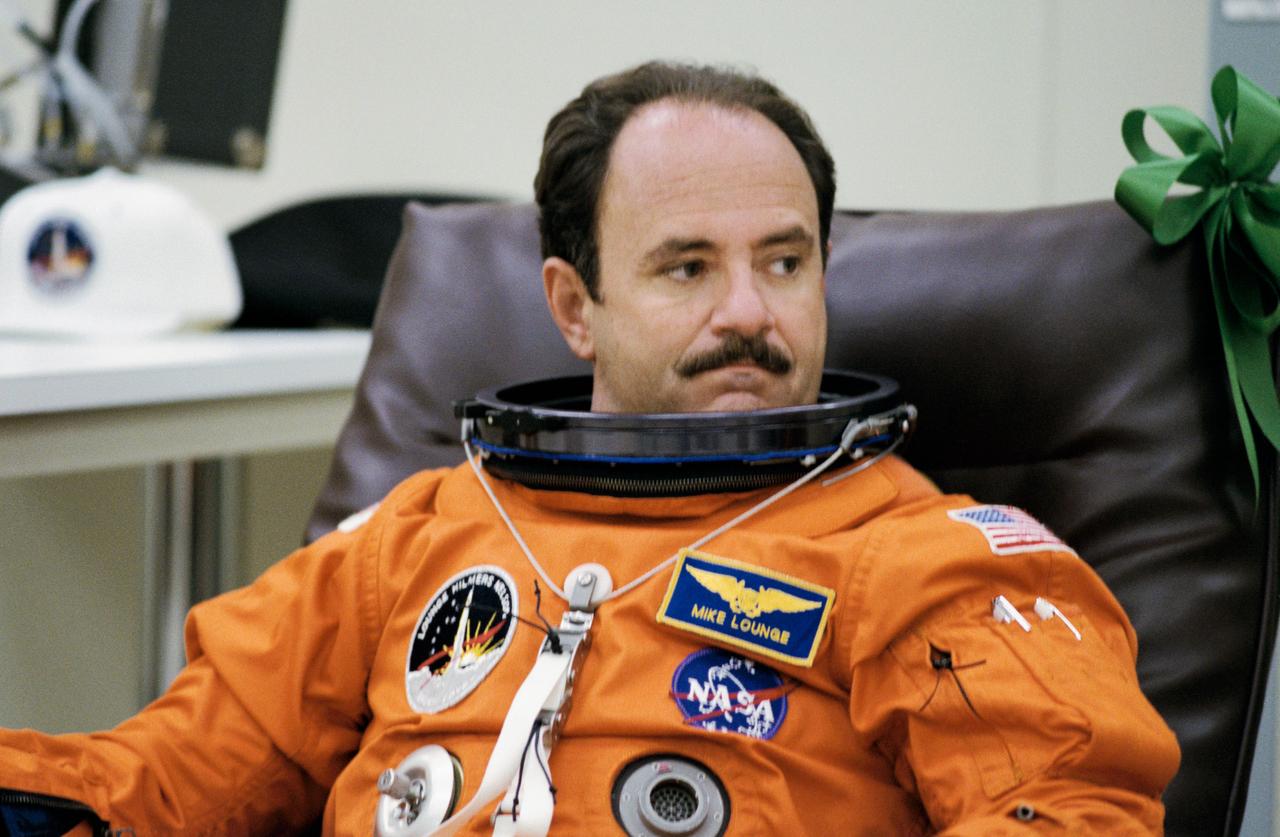
STS-26 Discovery, Orbiter Vehicle (OV) 103, Mission Specialist (MS) John M. Lounge relaxes in reclining chair after donning his orange launch and entry suit (LES) at the Kennedy Space Center (KSC) Operations and Checkout (O&C) Building. Upon completion of preflight suit tests, crewmembers will head to the launch pad.
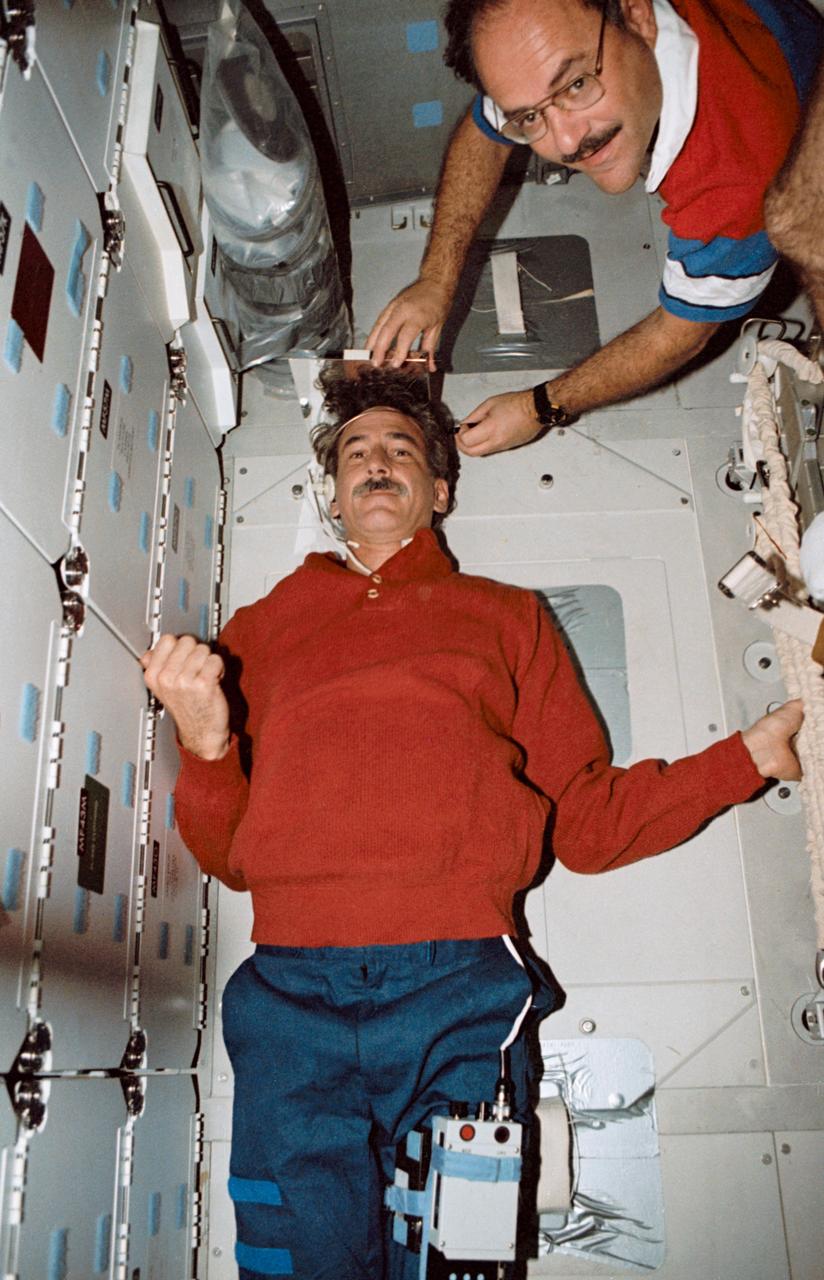
STS035-19-021 (December 1990) --- STS-35 Mission Specialist Jeffrey A. Hoffman stretches out on the middeck floor while MS John M. (Mike) Lounge records his height. The two crew members are in front of the forward lockers aboard Columbia, Orbiter Vehicle (OV) 102. Hoffman steadies himself using the stowed treadmill and the lockers. Above Hoffman's head is a plastic bag filled with Development Test Objective (DTO) 634, Trash Compaction and Retention System Demonstration, trash compactor charcoal filtered bag lids. This image was selected by the Public Affairs Office (PAO) for public release.
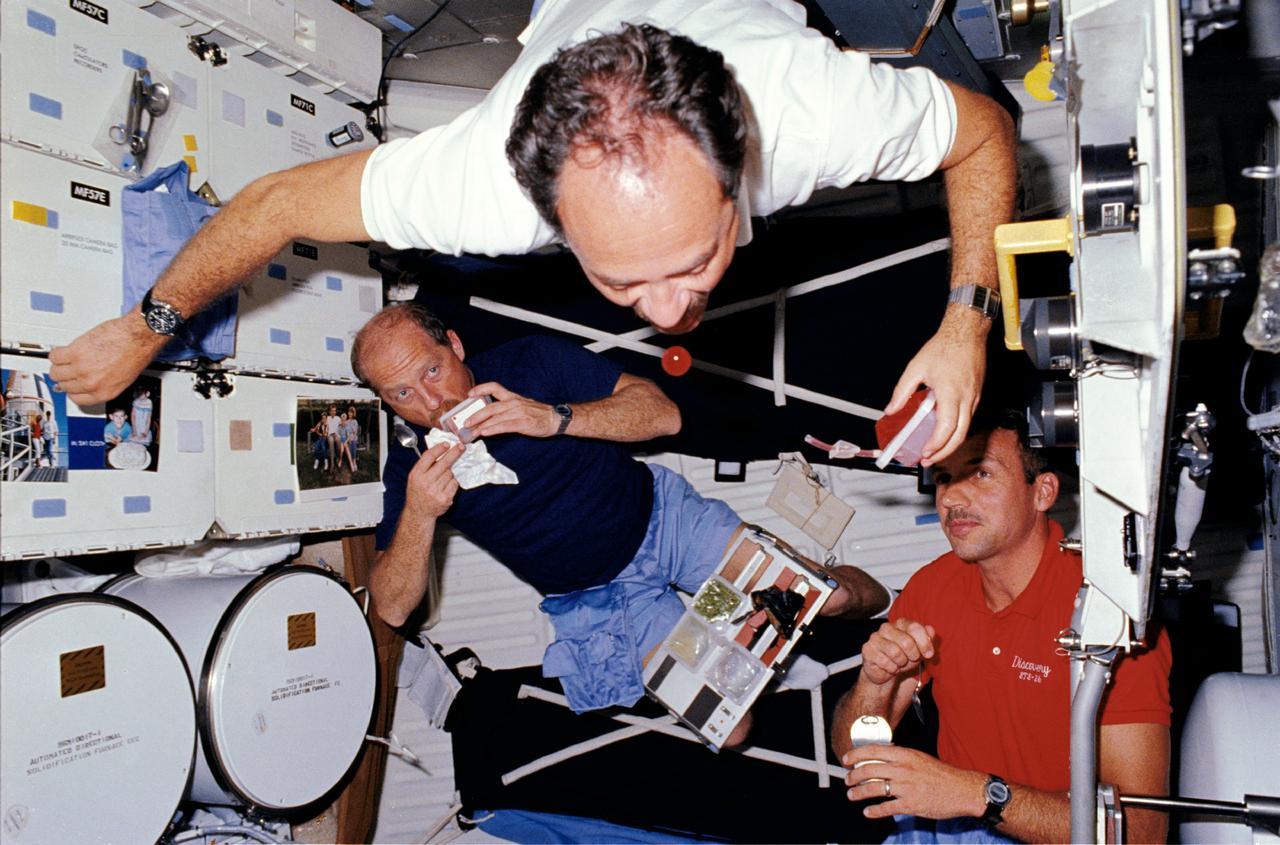
STS026-06-018 (29 Sept. - 3 Oct. 1988) --- Astronaut John M. Lounge, STS-26 mission specialist (MS), using a beverage container, experiments with microgravity as Commander Frederick H. Hauck (left) and MS David C. Hilmers (right) look on. Lounge freefloats as he closes in on a sphere of the red liquid drifting in front of his mouth. Hauck holds a spoon while sipping from a beverage container as he balances a meal tray assembly on his thighs. Hilmers, partially blocked by the open airlock hatch and holding a spoon and a can of food, pauses to watch the experiment. Automated Directional Solidification Furnace (ADSF) and forward middeck lockers appear on Lounge's right.
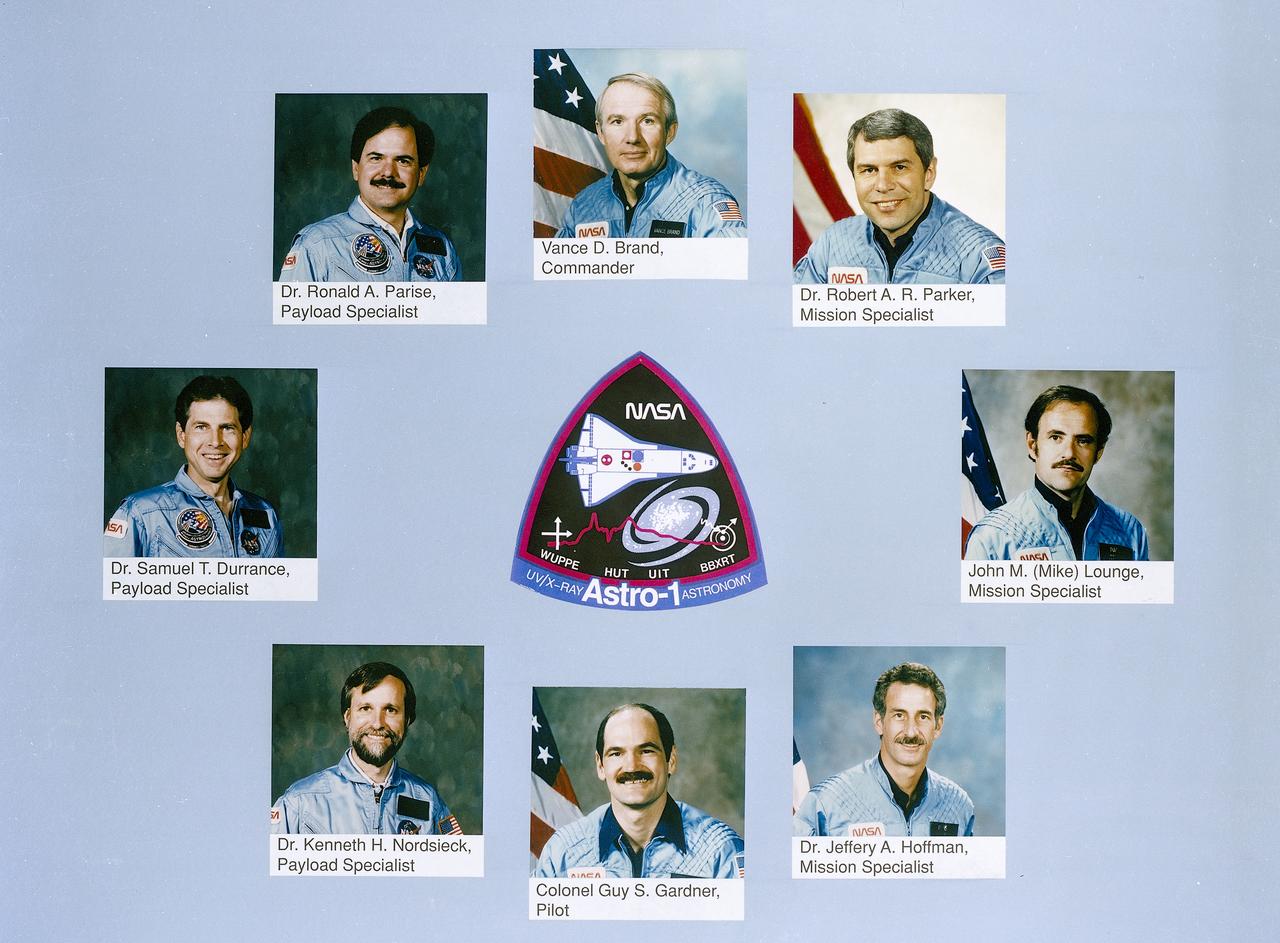
This montage consists of 8 individual STS-35 crew member portraits surrounding the mission’s insignia. Starting from top center, clockwise, are Vance D. Brand, commander; mission specialists Dr. Robert A. R. Parker, John M. (Mike) Lounge, and Dr. Jeffery A. Hoffman; Colonel Guy S. Gardner, pilot; and payload specialists Dr. Kenneth H. Nordsieck, Dr. Samual T. Durrance, and Dr. Ronald A. Parise. The crew of 8 launched aboard the Space Shuttle Orbiter Columbia on December 2, 1990 at 1:19:01am (EST). The primary objective of the mission was round the clock observation of the celestial sphere in ultrviolet and X-Ray astronomy with the Astro-1 observatory which consisted of four telescopes: the Hopkins Ultraviolet Telescope (HUT); the Wisconsin Ultraviolet Photo-Polarimeter Experiment (WUPPE); the Ultraviolet Imaging Telescope (UIT); and the Broad Band X-Ray Telescope (BBXRT). Due to loss of data used for pointing and operating the ultraviolet telescopes, Marshall Space Flight Center ground teams were forced to aim the telescopes with fine tuning by the flight crew.
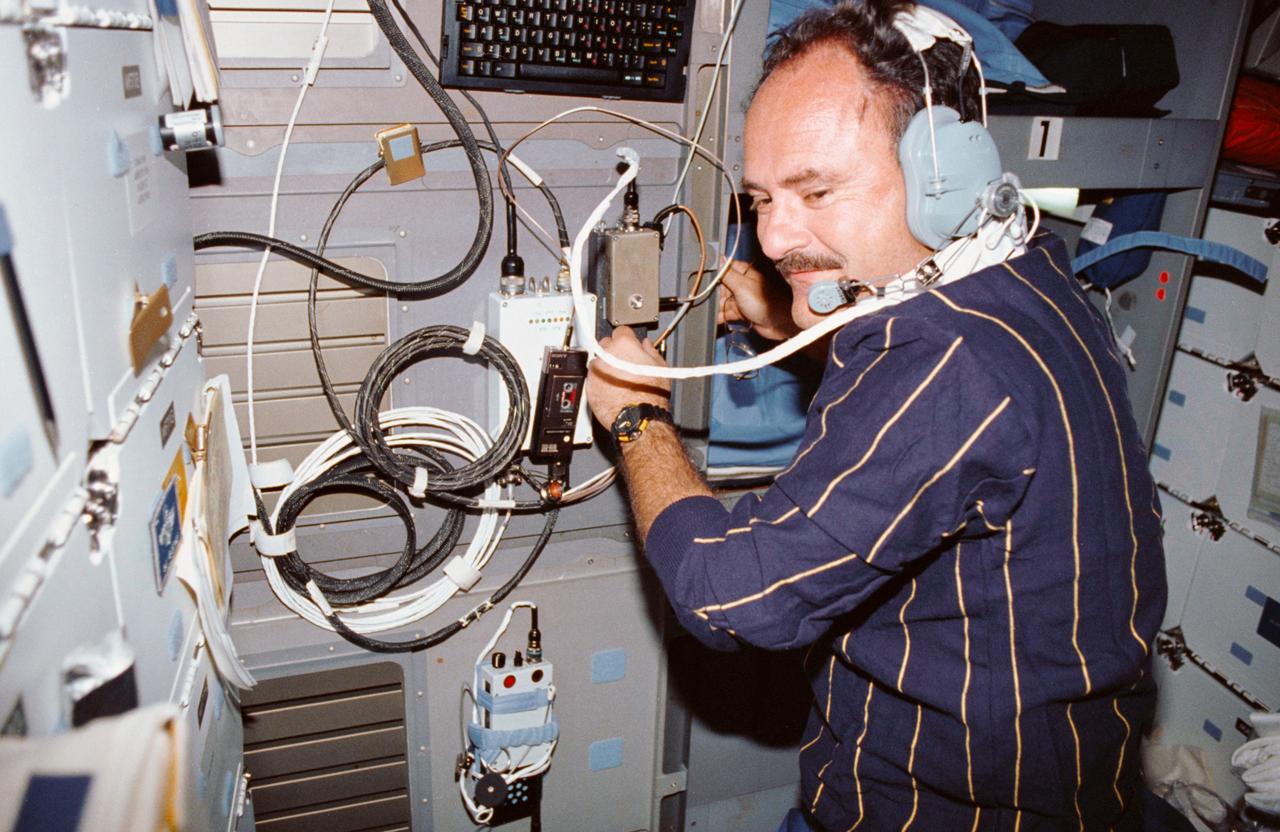
STS035-15-010 (2-11 Dec 1990) --- Astronaut John M. (Mike) Lounge, STS-35 mission specialist, communicates with family members from the middeck of Space Shuttle Columbia in Earth orbit. The STS-35 Shuttle amateur radio experiment (SAREX), allowed the Astro 1 crewmembers to "visit" and briefly share some of their in space experiences with family members. The picture was made with a 35mm camera. Note: Used by Astronomer Ronald A. Parise on his off-duty hours, SAREX provided radio transmissions between ground based amateur radio operators around the world and the Shuttle. Parise is a payload specialist who is also a licensed amateur radio operator (call-sign WA4SIR). The experiment enabled students from all over the United States to have a chance to communicate with an astronaut in space.
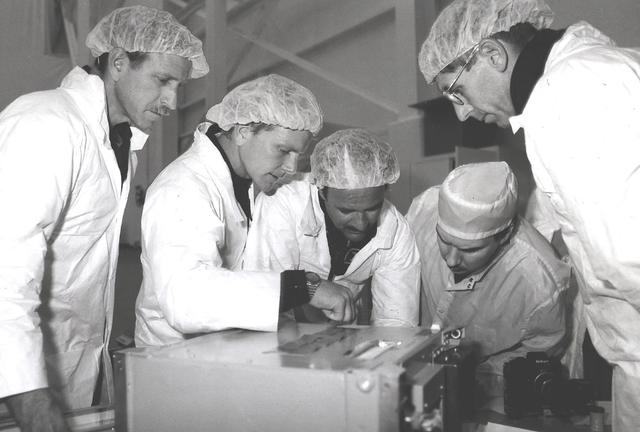
Space Shuttle Discovery (STS-26) astronauts George Nelson, John Lounge, and Richard Covey are pictured training on protein crystal growth (PCG) experiment in Marshall's Building 4708's clean room.
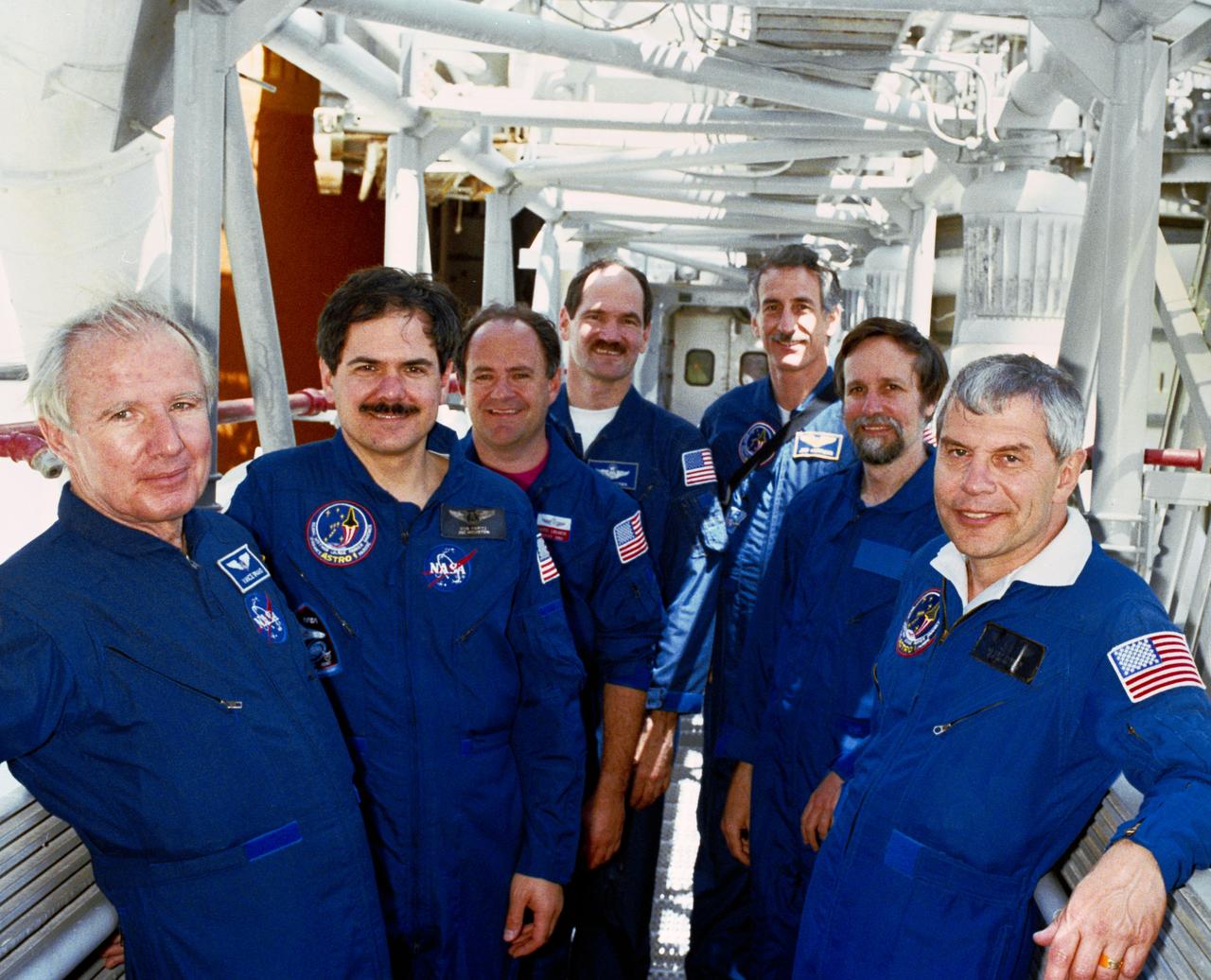
S90-38029 (21 May 1990) --- STS-35 Columbia, Orbiter Vehicle (OV) 102, crewmembers commander Vance D. Brand, pilot Guy S. Gardner, mission specialists Jeffrey A. Hoffman, John M. Lounge, Robert A. R. Parker, payload specialists Samuel T. Durrance and Ronald A. Parise and backup payload specialist Kenneth Nordsieck take a break from training activities and pose on the 195-Floor Level on Launch Pad 39A at the Kennedy Space Center (KSC). On left from front to back are Brand, Parise, Lounge and Gardner and on right from front to back are Parker, Nordsieck, and Hoffman. View provided by KSC with alternate number KSC-90PC-670.
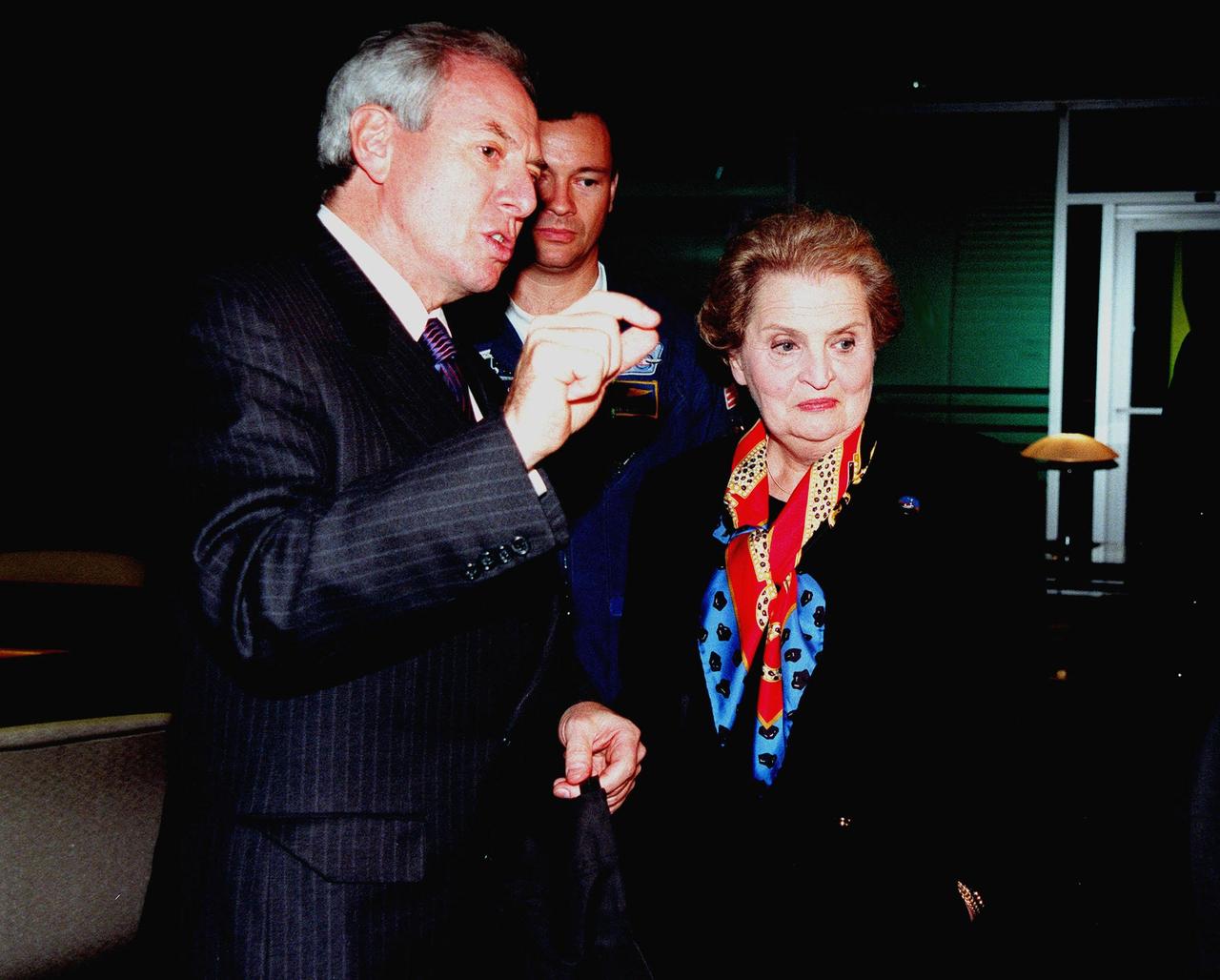
KENNEDY SPACE CENTER, FLA. -- U.S. Secretary of State Madeleine Albright talks with NASA Administrator Daniel Goldin (at left) in the VIP lounge at the Apollo/Saturn V Center while awaiting launch of Mission STS-88, the first U.S. launch for the International Space Station. Astronaut Michael Lopez-Alegria is looking on in background
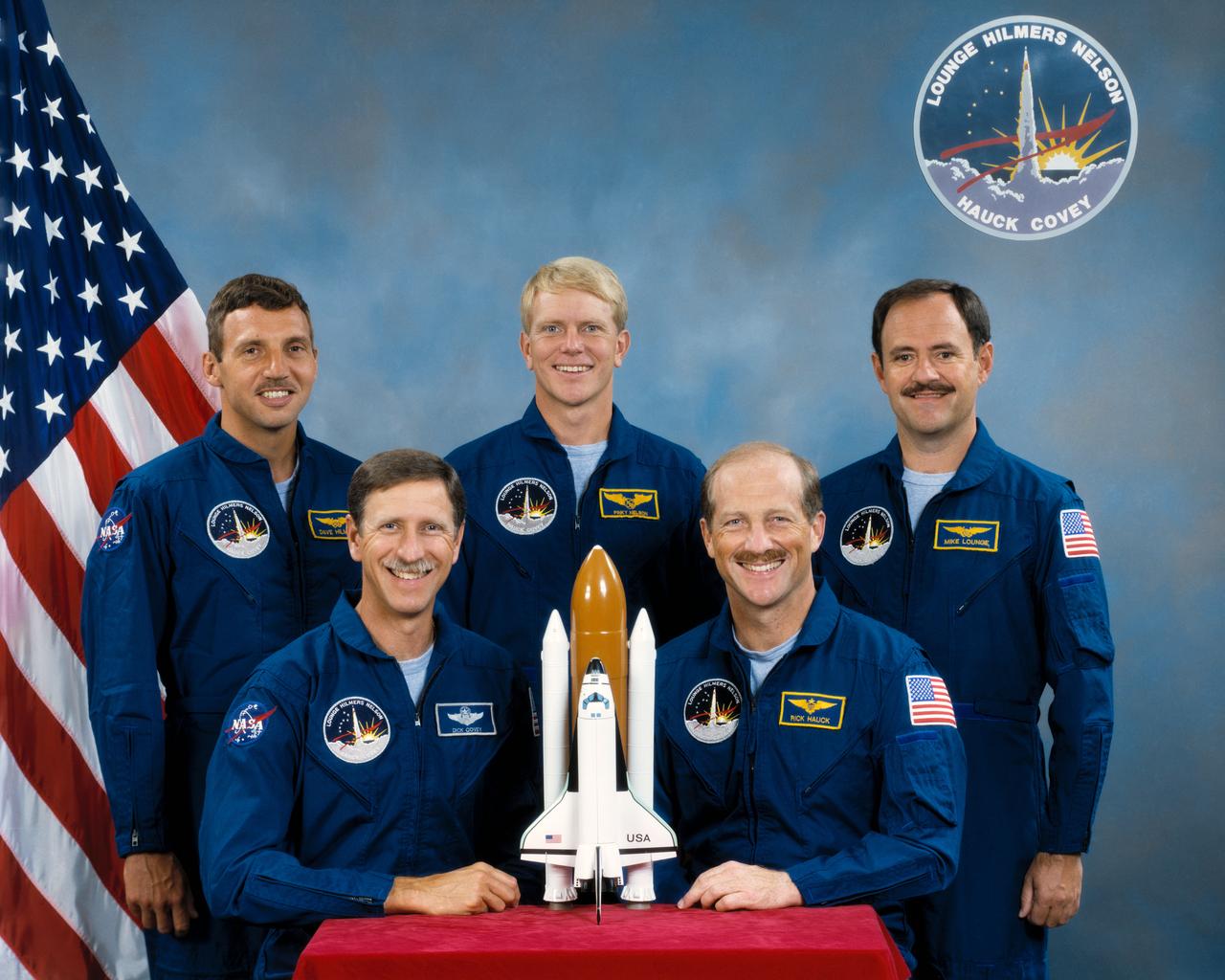
S87-40673 (September 1987) --- Astronauts Frederick H. (Rick) Hauck (right front), mission commander, and Richard O. Covey (left front), pilot, are flanked by NASA's STS-26 mission specialists (l.-r.) David C. Hilmers, George D. (Pinky) Nelson and John M. (Mike) Lounge.
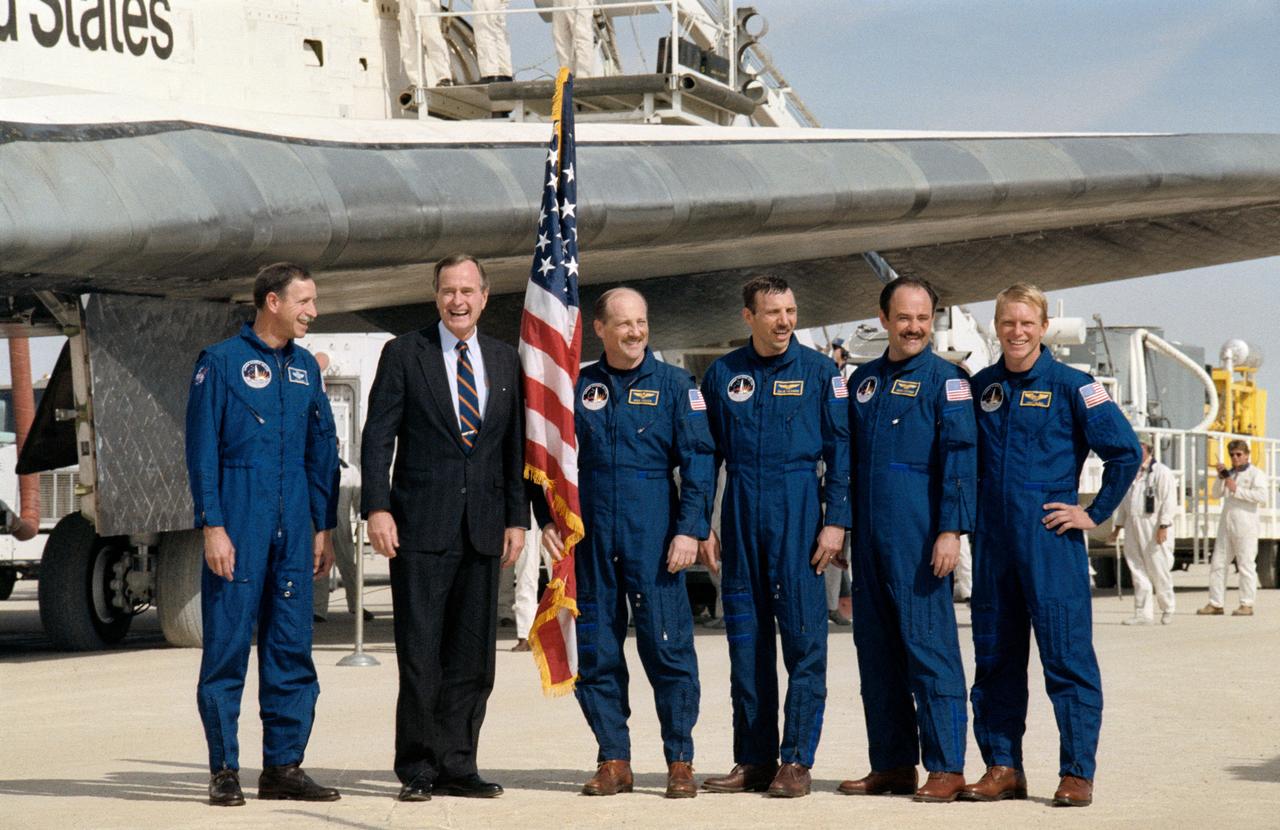
STS026-S-169 (3 Oct 1988) --- The five STS 26 crewmembers pose with Vice President George Bush after completing a successful four-day mission aboard the Space Shuttle Discovery (background). Pictured, from left to right, are astronaut Richard O. Covey, pilot; Vice President Bush; and astronauts Frederick H. (Rick) Hauck, mission commander; and David C. Hilmers, John M. (Mike) Lounge, and George D. Nelson, all mission specialists.
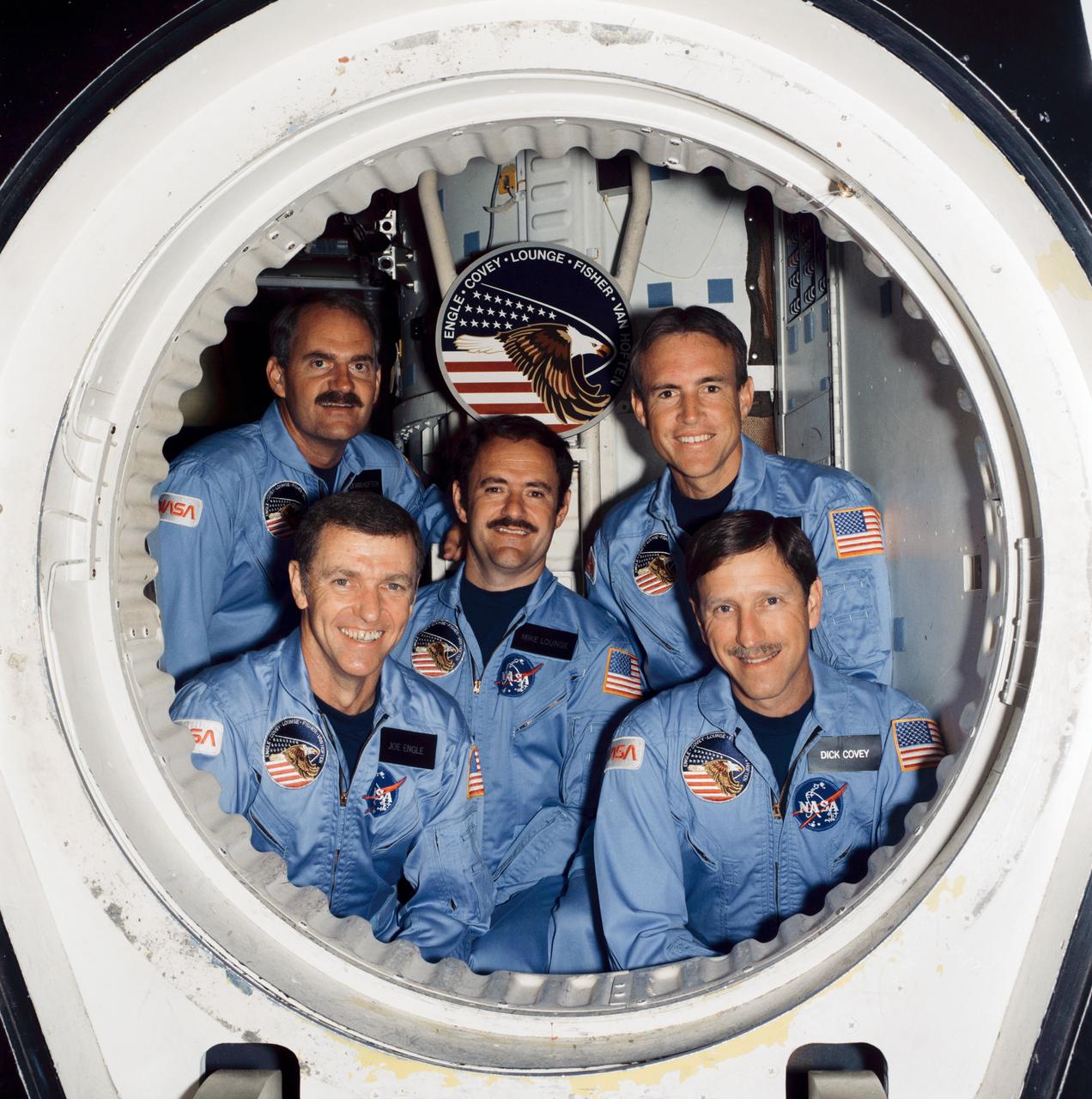
S85-36062 (1 July 1985) --- These five NASA astronauts make up the crew for the mission STS-51I, scheduled for launch in August of this year. Taking a break from rehearsals in the crew compartment trainer in the Shuttle Mockup and Integration Laboratory at JSC are astronauts Joe H. Engle (front left), crew commander; Richard O. Covey (front right), pilot; and (back row, left-to-right) astronauts James D. van Hoften, John M. (Mike) Lounge and William F. Fisher -- all mission specialists.
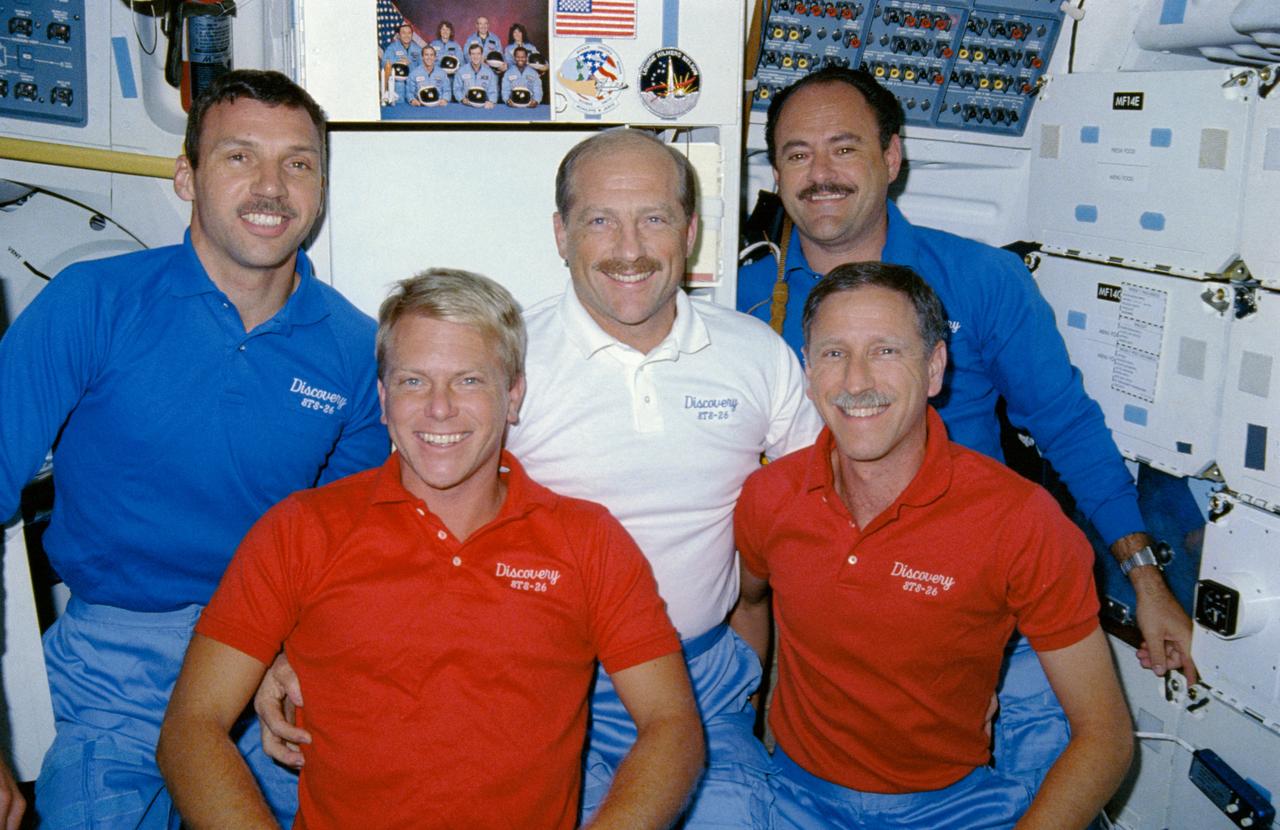
STS026-08-007 (29 Sept-3 Oct 1988) --- An in-space crew portrait on the middeck of Discovery. Left to right are Astronauts David C. Hilmers, George D. Nelson, Frederick H. (Rick) Hauck, John M. (Mike) Lounge and Richard O. Covey (front). The crew portrait for STS 51-L, its flight insignia and the STS 26 flight insignia are at top edge of the frame. This photo was shown by the STS 26 astronaut crew during its Oct. 11, l988 post-flight press conference.
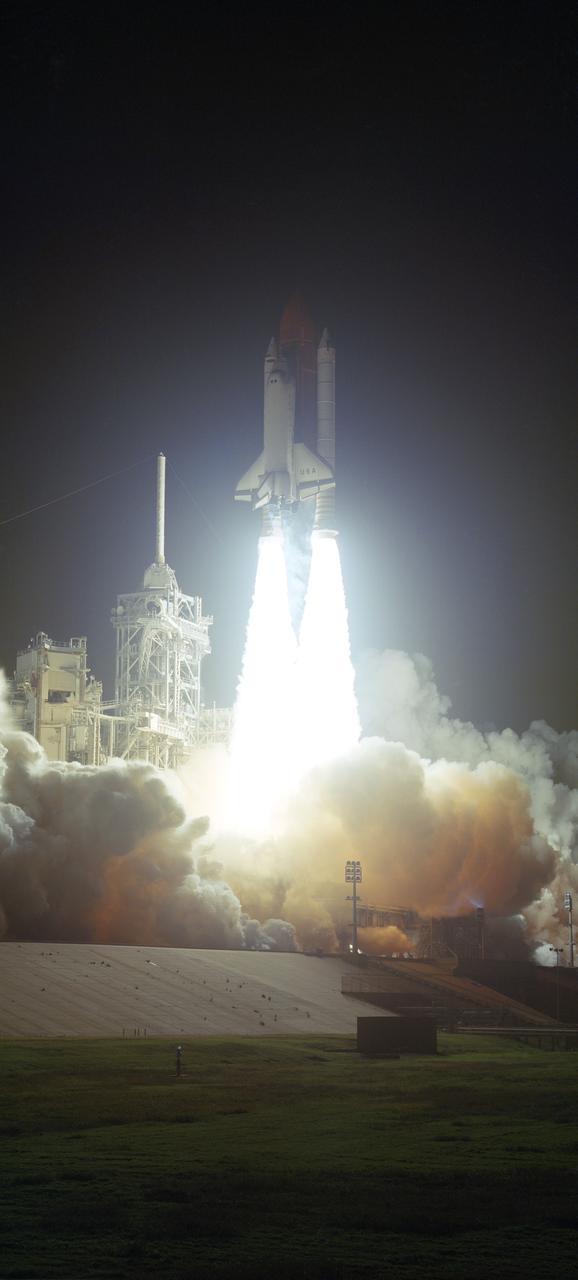
STS035-S-021 (2 Dec 1990) --- The Space Shuttle Columbia lifts off Launch Pad 39B at 1:49 a.m. (EST), Dec. 2, 1990. Primary payload onboard is the Astro-1 astronomical laboratory, headed for a ten-day fight dedicated to the single discipline of astrophysics. Crewmembers are five astronauts--Vance D. Brand, Guy S. Gardner, John M. (Mike) Lounge, Jeffrey A. Hoffman and Robert A.R. Parker--and two payload specialists--Samuel T. Durrance and Ronald A. Parise.
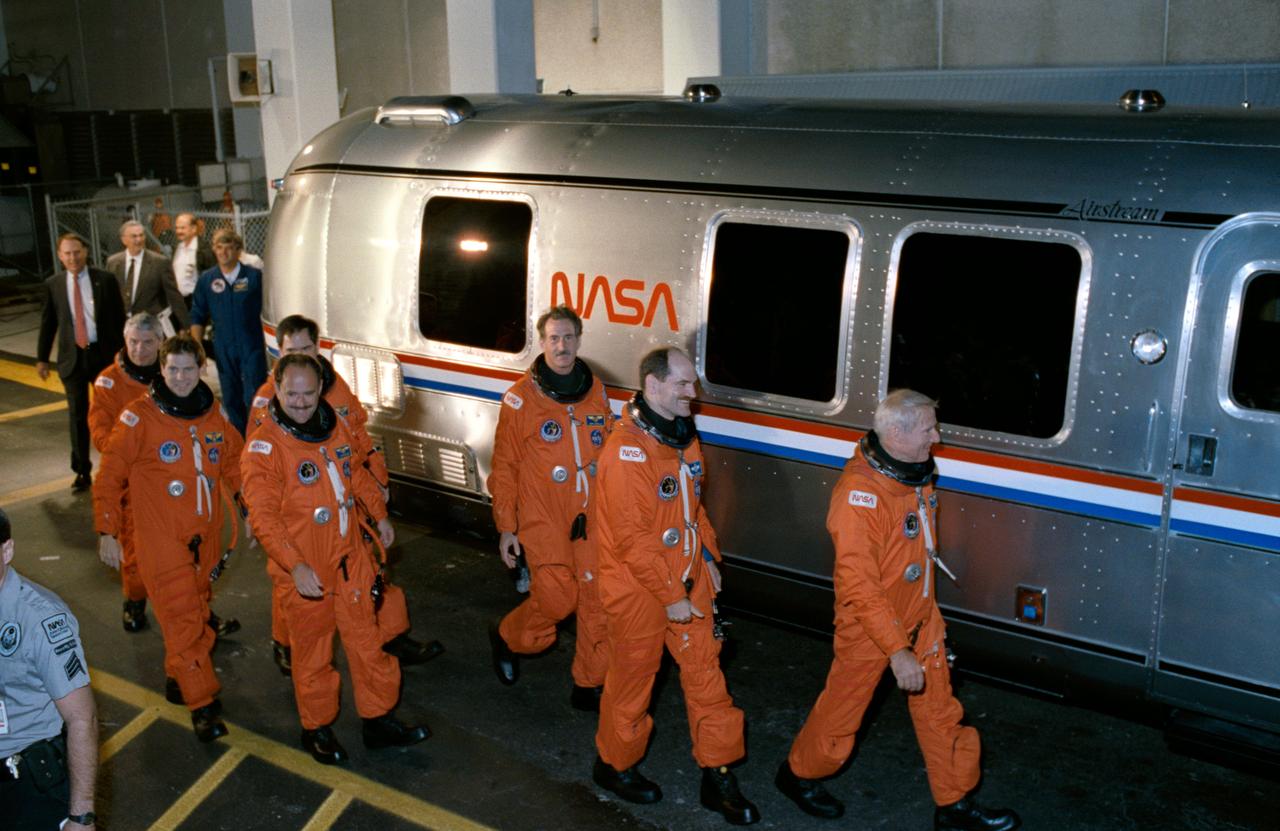
STS035-S-016 (2 Dec 1990) --- Astronaut Vance D. Brand, right, leads the STS 35 crew toward a transfer van that will take them from the nearby operations and checkout (O&C) building to Launch Complex 39. Trailing the mission commander, left to right, are Robert A. R. Parker, Samuel T. Durrance, Ronald A. Parise, John M. (Mike) Lounge, Jeffrey A. Hoffman and Guy S. Gardner.
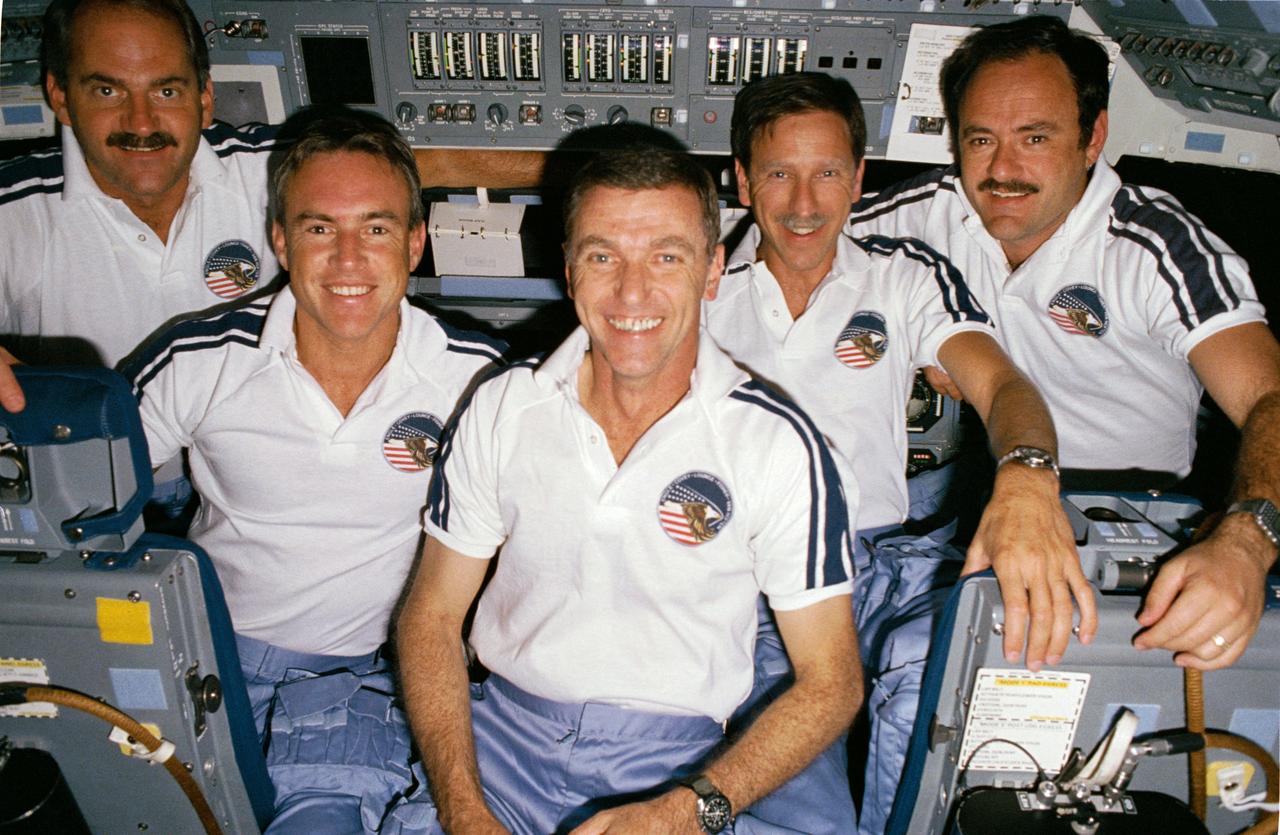
51I-17-029 (Aug-Sept 1985) --- A group portrait, recorded by a pre-set 35mm camera, shows all five STS- 51-I crewmembers on the flight deck of the Earth-orbiting Discovery in early September 1985, following the successful Syncom repair performed by the crewmembers. Left to right are Astronauts James D. van Hoften, William F. Fisher, Joe H. Engle, Richard O. Covey and John M. (Mike) Lounge.
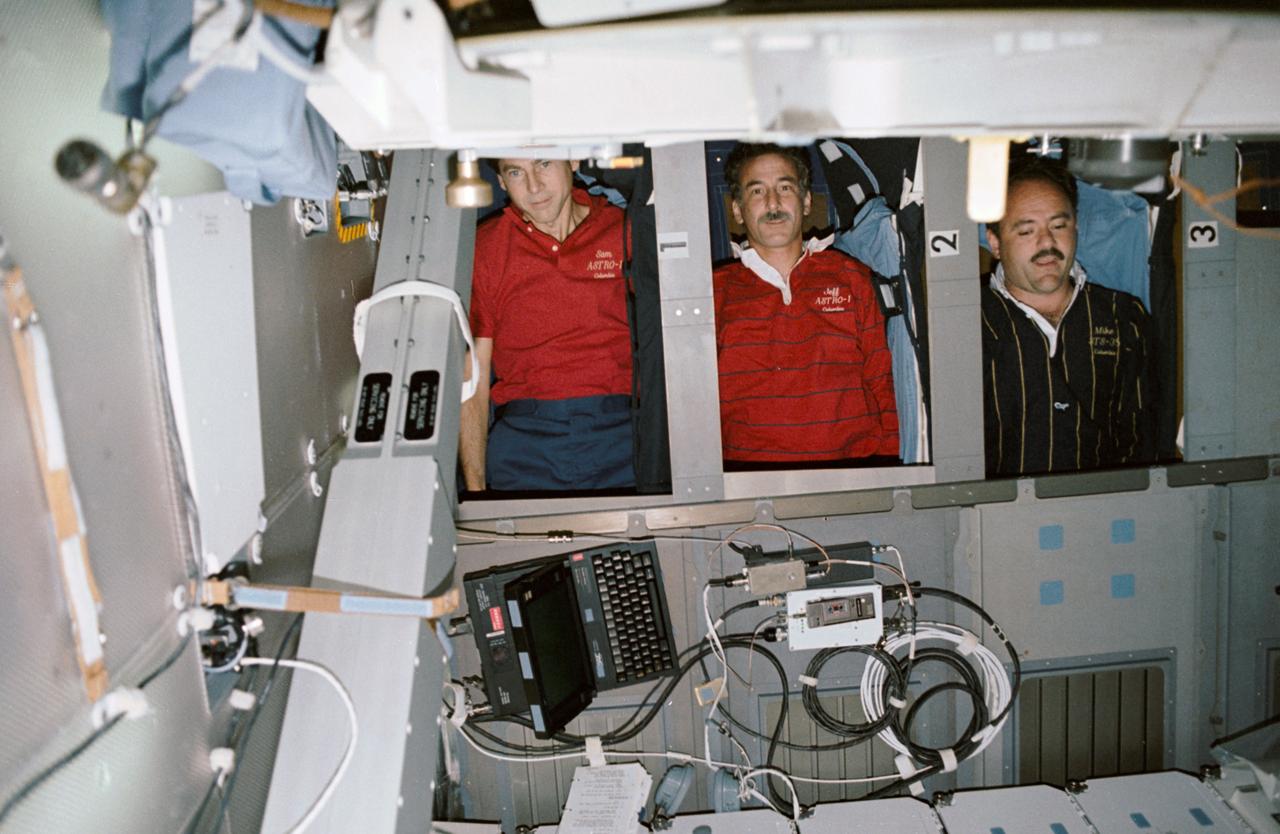
Though they are not actually asleep, three STS-35 crewmembers demonstrate the bunk-style sleep compartments onboard Columbia's, Orbiter Vehicle (OV) 102's, middeck. From top to bottom are Payload Specialist Samuel T. Durrance, Mission Specialist (MS) Jeffrey A. Hoffman, and MS John M. Lounge. At the left is the shuttle amateur radio experiment (SAREX). The crew escape pole (CES) is visible overhead and the open airlock hatch in the foreground. The sleep station is located against the middeck starboard wall.
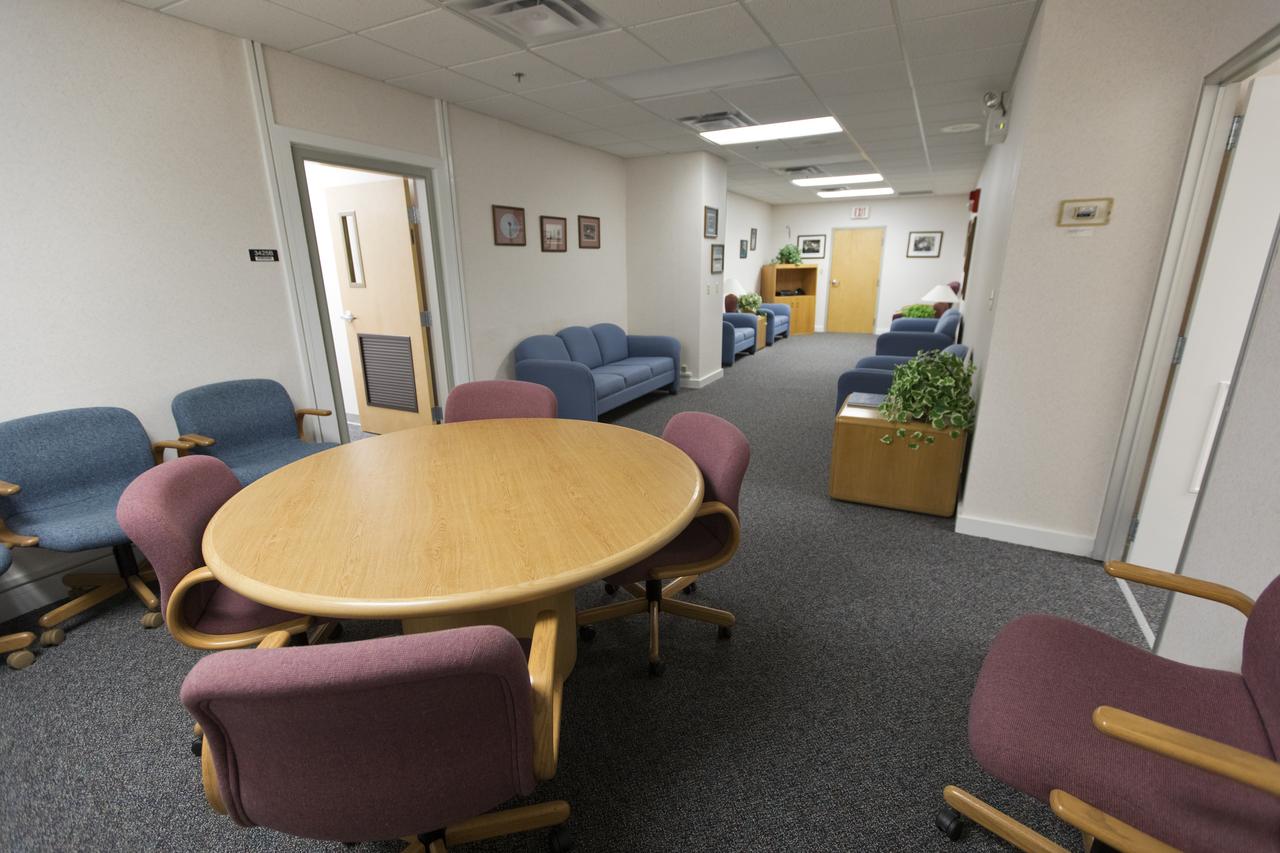
The lounge area inside the astronaut crew quarters is where astronauts’ family members waited for their return upon landing during the Space Shuttle Program. The crew quarters, located on the third floor of Kennedy Space Center’s Neil Armstrong Operations and Checkout Building, recently received a number of upgrades, including new paint, ceiling tiles, carpeting, appliances and furniture.
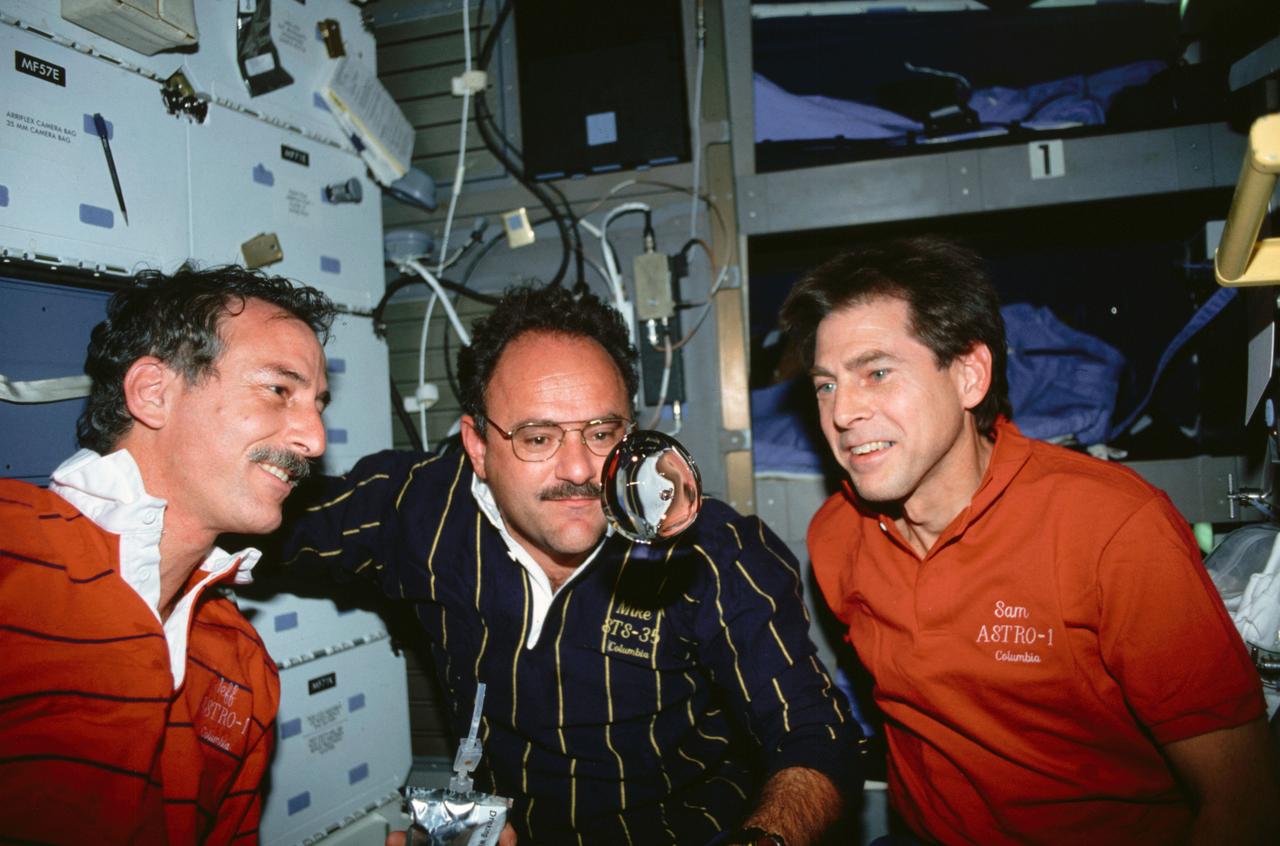
STS035-15-035 (2-10 Dec 1990) --- STS-35 crewmembers perform a microgravity experiment using their drinking water while on the middeck of Columbia, Orbiter Vehicle (OV) 102. Mission Specialist (MS) Jeffrey A. Hoffman (left) has released some water from a drinking container which he holds in his hand. MS John M. Lounge (wearing glasses, center) and Payload Specialist Samuel T. Durrance along with Hoffman study the changing shape and movement of the sphere of water.
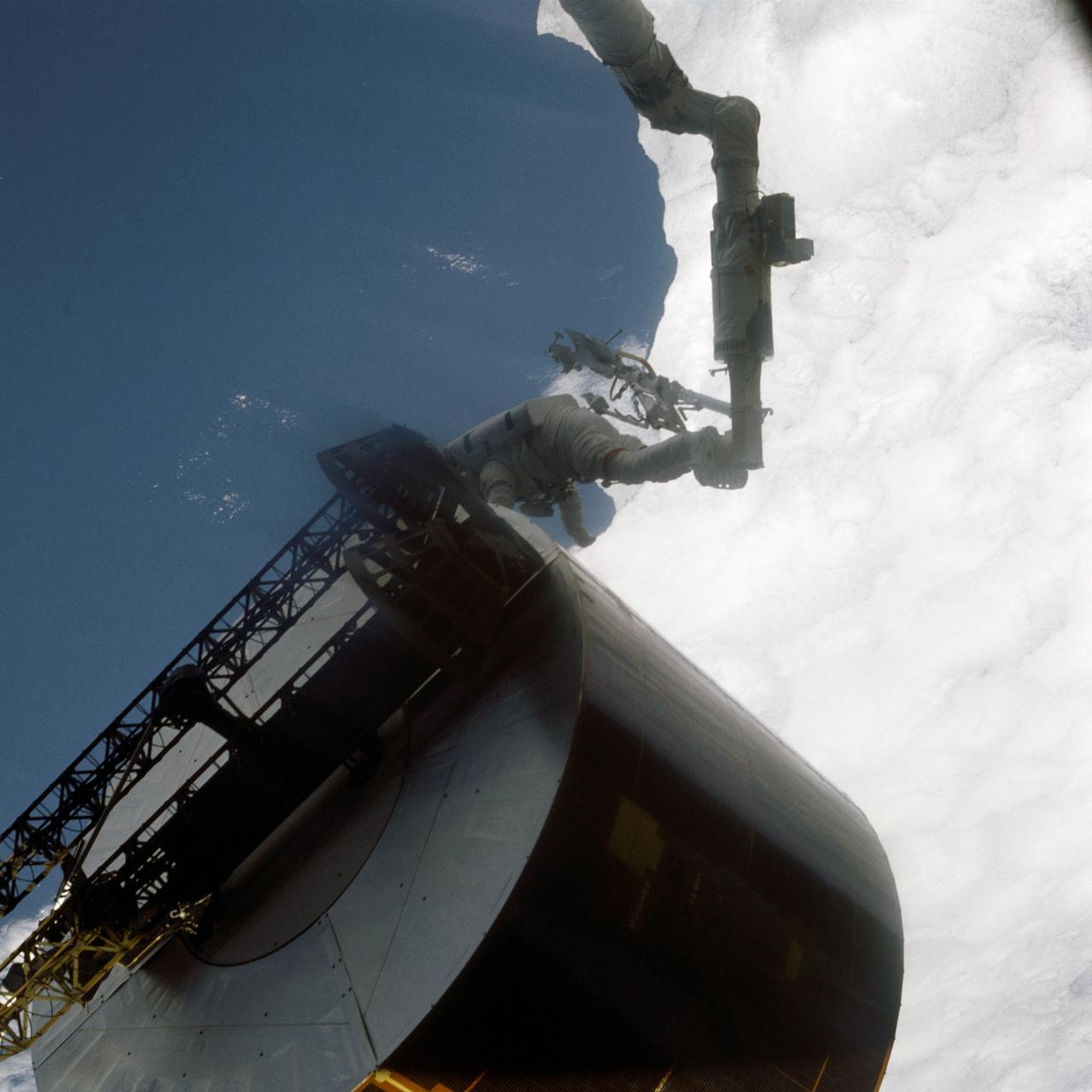
51I-44-014 (31 Aug-1 Sept. 1985) --- This photograph is one of a series of six covering extravehicular activity (EVA) which were released by NASA on Sept. 4, 1985. Here, astronaut James D. van Hoften, dwarfed by the large satellite, moves in for initial contact. Astronaut John M. (Mike) Lounge, out of frame inside cabin, maneuvers the remote manipulator system (RMS) arm to assist astronauts van Hoften and William F. Fisher. Photo credit: NASA
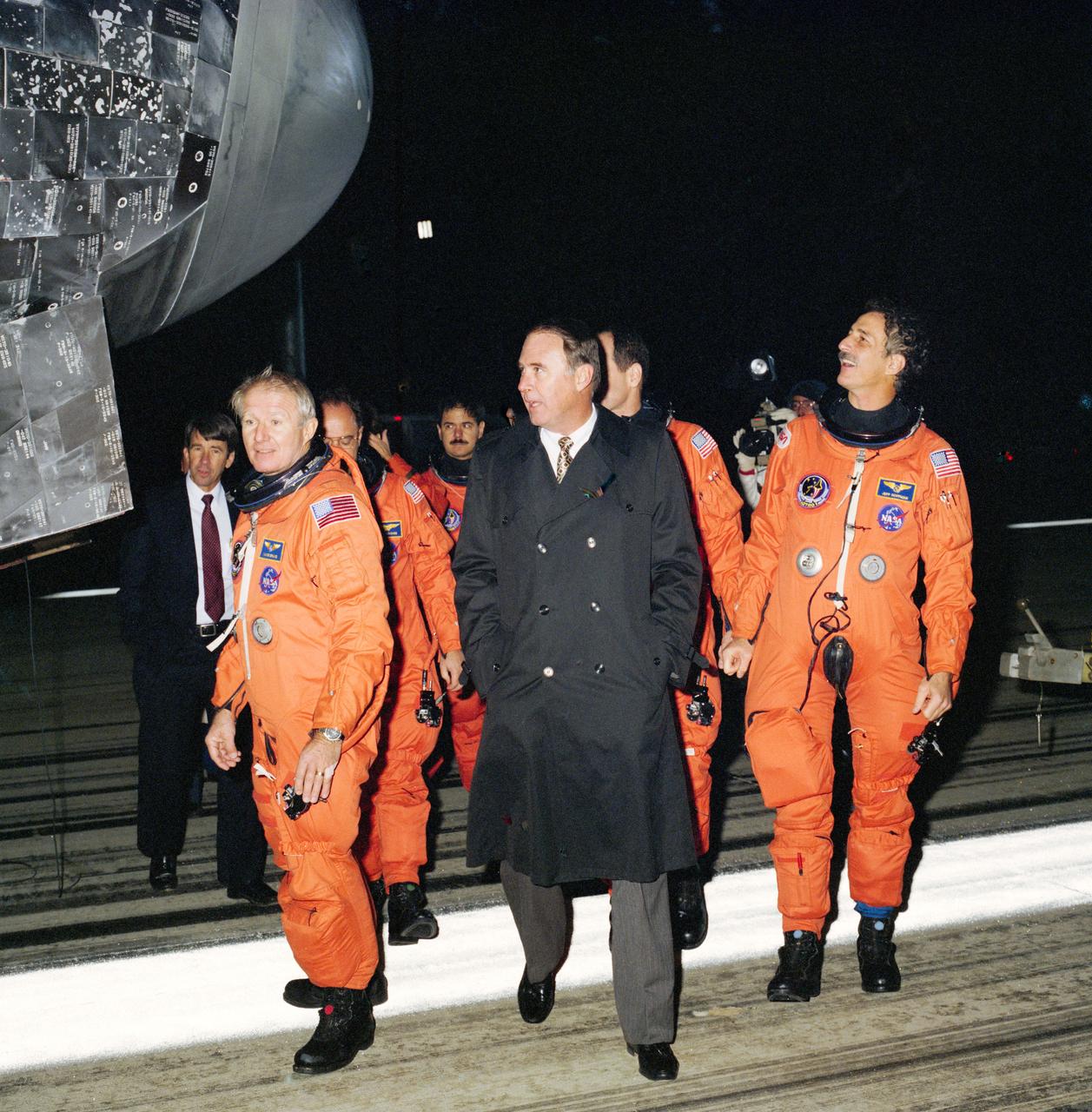
STS035-S-091 (10 Dec 1990) --- Donald R. Puddy (center), Director of Flight Crew Operations at the Johnson Space Center (JSC), joins the STS-35 crewmembers in a post-landing walk-around inspection of the Columbia at Edwards Air Force Base. Crewmembers pictured are, left to right, Vance D. Brand, John M. (Mike) Lounge, Ronald A. Parise, Guy S. Gardner and Jeffrey A. Hoffman. Obscured or out of frame are Samuel T. Durrance and Robert A. R. Parker. Dr. William B. Lenoir, NASA Associate Administrator for Space Flight, is at far left background.
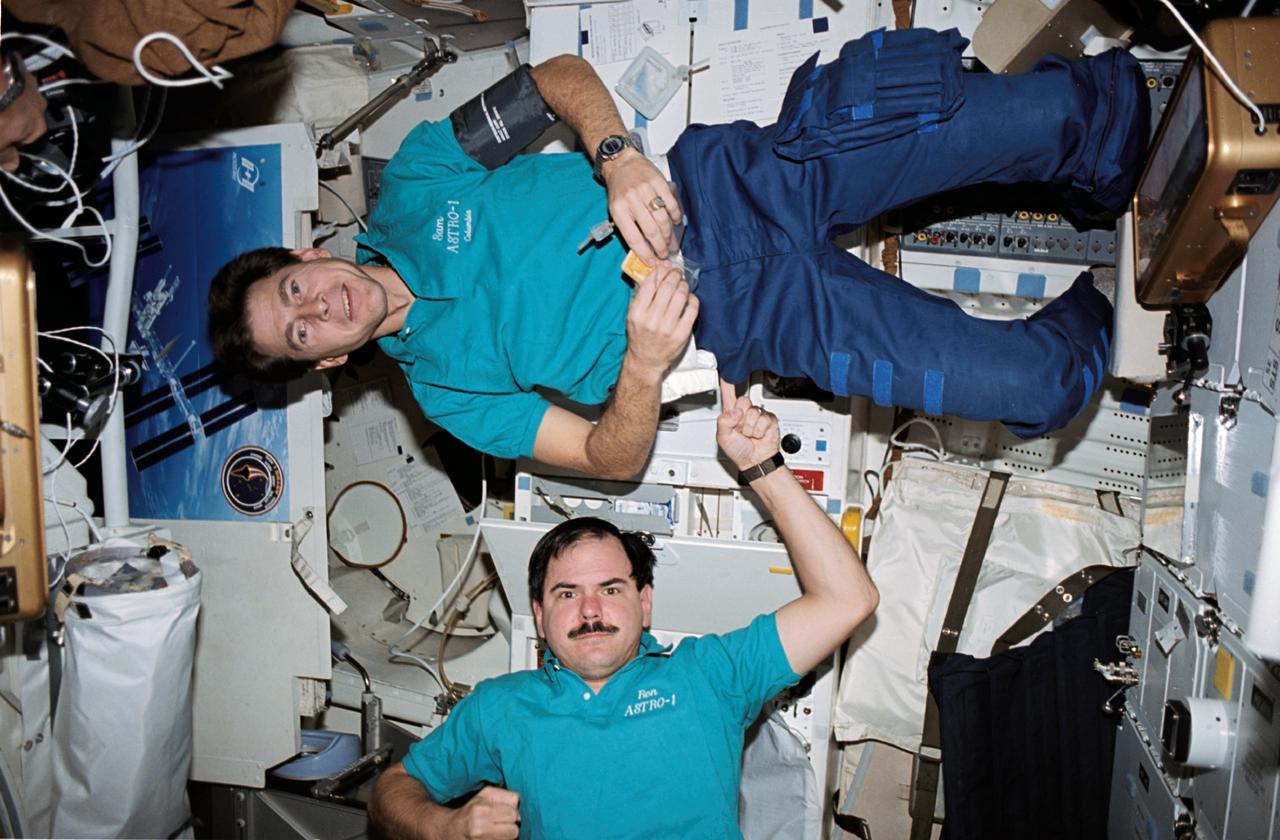
STS035-49-028 (2-10 Dec. 1990) --- This is one of 25 visuals used by the STS-35 crew at its Dec. 20, 1990 post-flight press conference. Columbia's flight of almost nine days duration (launched Dec. 2 from Kennedy Space Center and landed Dec. 10 at Edwards Air Force Base) carried the Astro-1 payload and was dedicated to astrophysics. The mission involved a seven-man crew. Crewmembers were astronauts Vance D. Brand, Guy S. Gardner, Jeffrey A. Hoffman, Robert A.R. Parker and John M. (Mike) Lounge; and Payload Specialists Samuel T. Durrance and Ronald A. Parise.
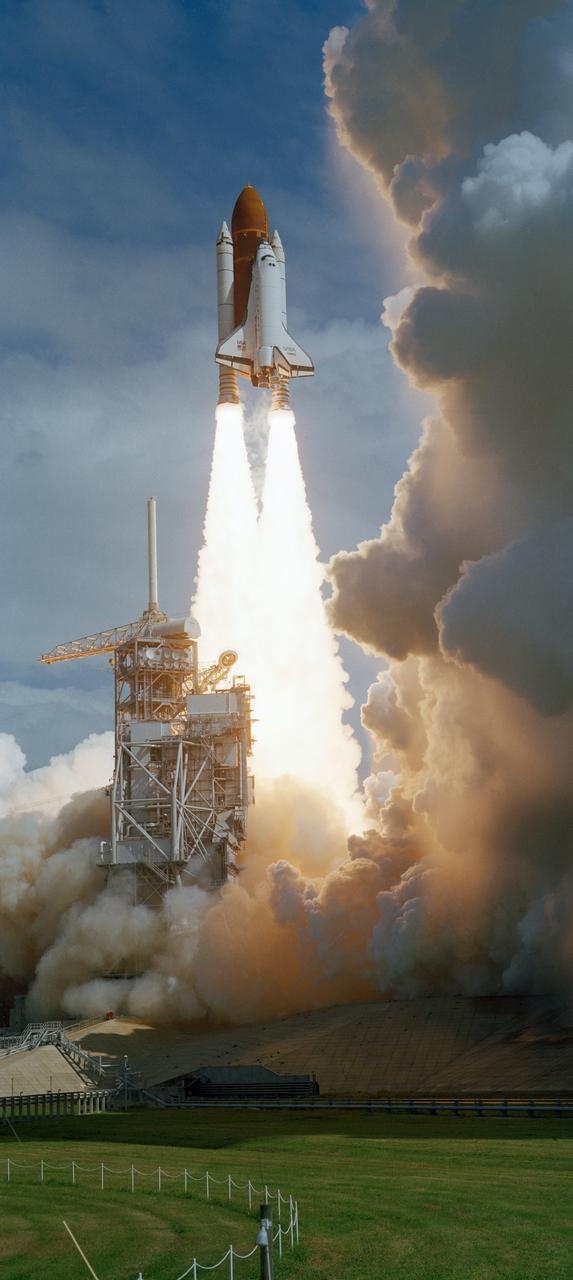
S26-S-032 (29 Sept. 1988) --- The STS-26 launch of space shuttle Discovery begins the first flight to be flown after the Challenger accident. The flight crew included astronauts Rick Hauck, commander; Dick Covey, pilot; and three mission specialists, Dave Hilmers, Mike Lounge, and George (Pinky) Nelson. During the four-day mission, the crew deployed the Tracking and Data Relay Satellite (TDRS-C) and operated eleven mid-deck experiments. Discovery completed 64 orbits of the earth before landing at Edwards Air Force Base, California, on October 3, 1988. Photo credit: NASA or National Aeronautics and Space Administration
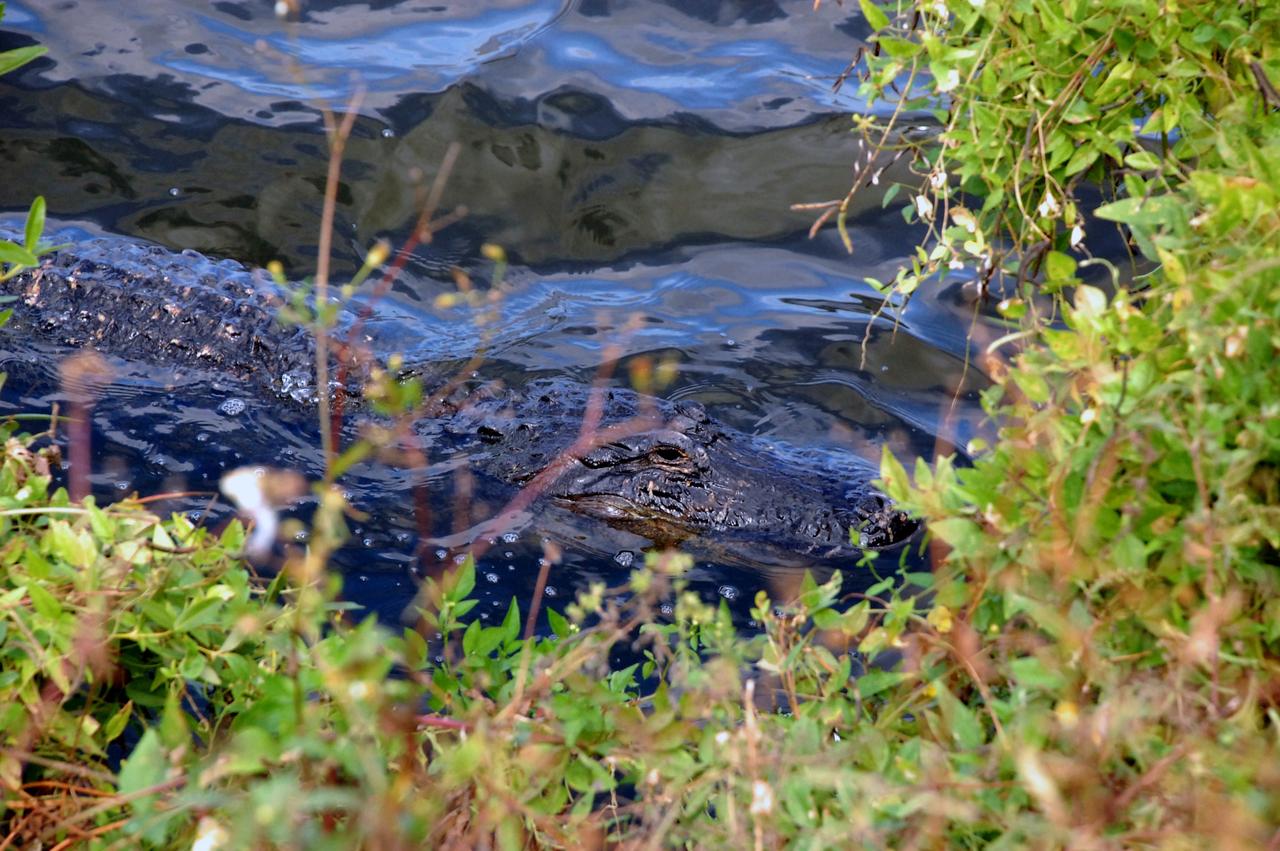
CAPE CANAVERAL, Fla. - At NASA's Kennedy Space Center in Florida, an alligator lounges in the Launch Complex 39 turn basin. The Merritt Island National Wildlife Refuge coexists with Kennedy Space Center and provides a habitat for a variety of wildlife including 330 species of birds, 117 kinds of fish, 65 types of amphibians and reptiles, 31 different mammals, and 1,045 species of plants. For information on the refuge, visit http://www.fws.gov/merrittisland/Index.html. For information on Kennedy Space Center, visit http://www.nasa.gov/kennedy. Photo credit: NASA/Ben Smegelsky
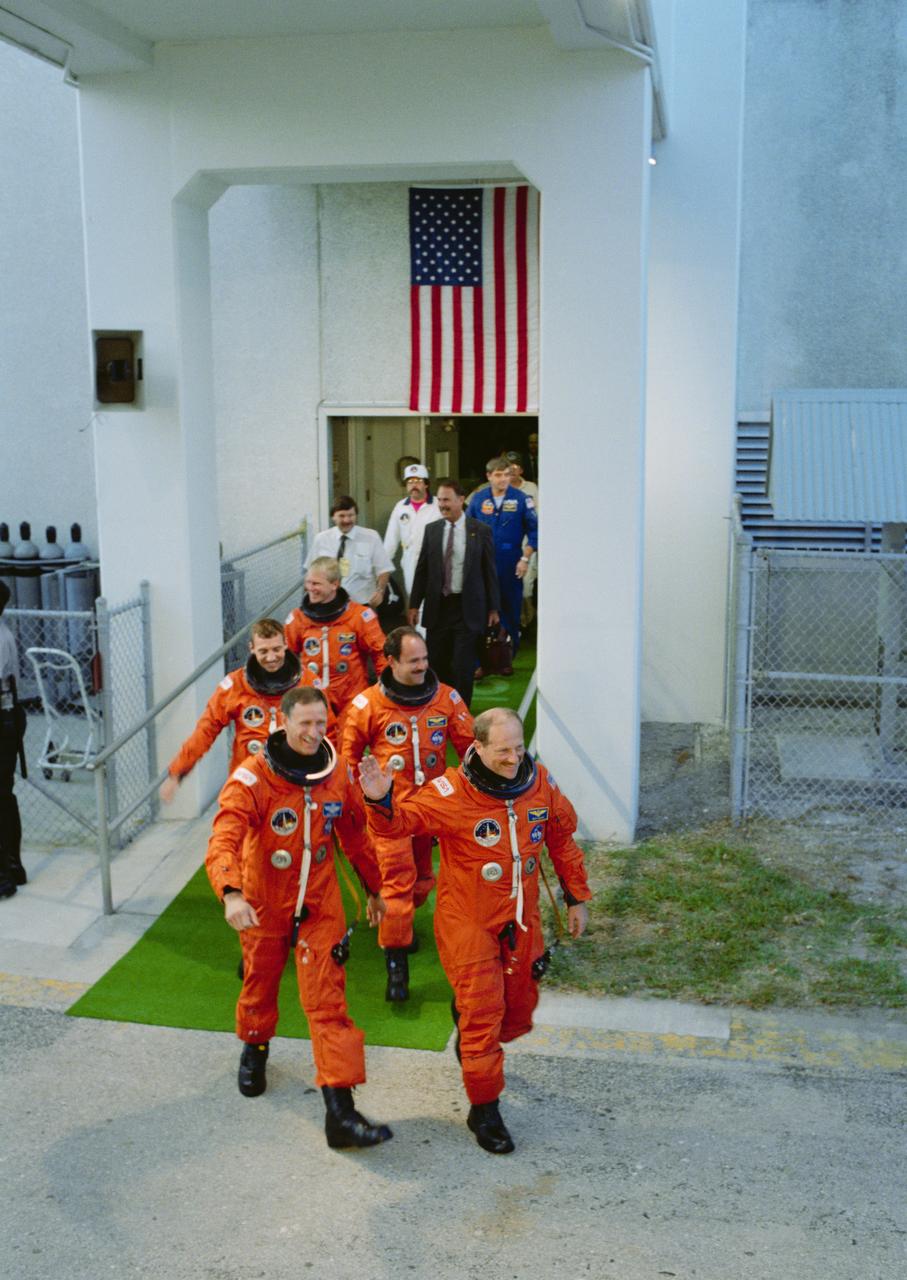
STS-26 crewmembers, suited in launch and entry suits (LESs), leave the Kennedy Space Center (KSC) Operations and Checkout (O&C) Building on their way to the launch complex (LC) pad 39B where they will board Discovery, Orbiter Vehicle (OV) 103. Commander Frederick H. Hauck, waving to spectators, is followed by Pilot Richard O. Covey, Mission Specialist (MS) John M. Lounge, MS David C. Hilmers, and MS George D. Nelson. Others accompanying the crew are JSC Flight Crew Operations Directorate (FCOD) Director Donald R. Puddy, Astronaut Office Chief Daniel C. Brandenstein, and a Crew Training Officer Richard W. Nygren.
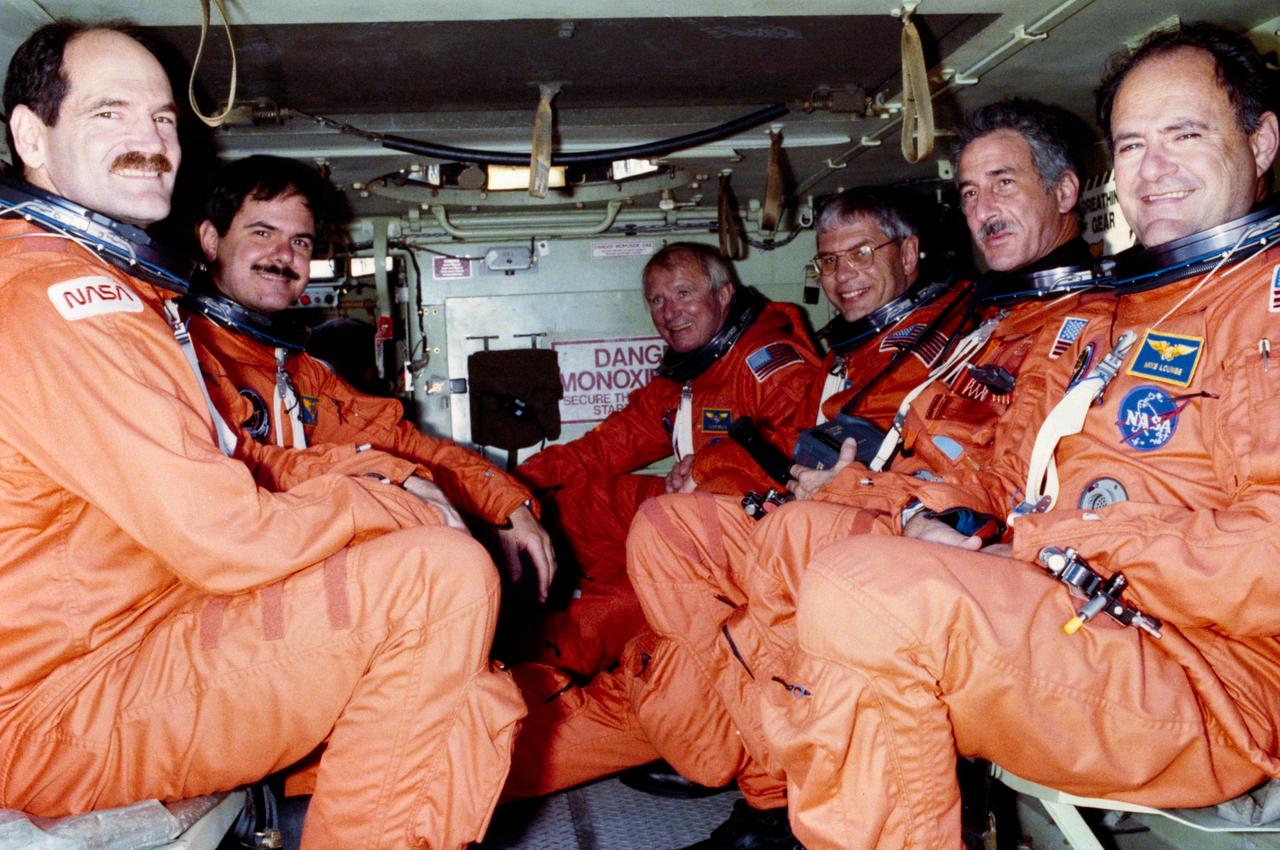
S90-40670 (13 June 1990) --- STS-35 crewmembers take a ride in the M113 tracked vehicle during emergency training conducted during the Terminal Countdown Demonstration Test (TCDT) at the Kennedy Space Center (KSC). From left, wearing launch and entry suits (LES), are pilot Guy S. Gardner, payload specialist Ronald A. Parise, commander Vance D. Brand, mission specialists Robert A. R. Parker, Jeffrey A. Hoffman and John M. Lounge. The two-day TCDT, which began 04-27-90, is a dress rehearsal for launch. STS-35 is set to lift off in May. View provided by KSC with alternate number KSC-90PC-838.
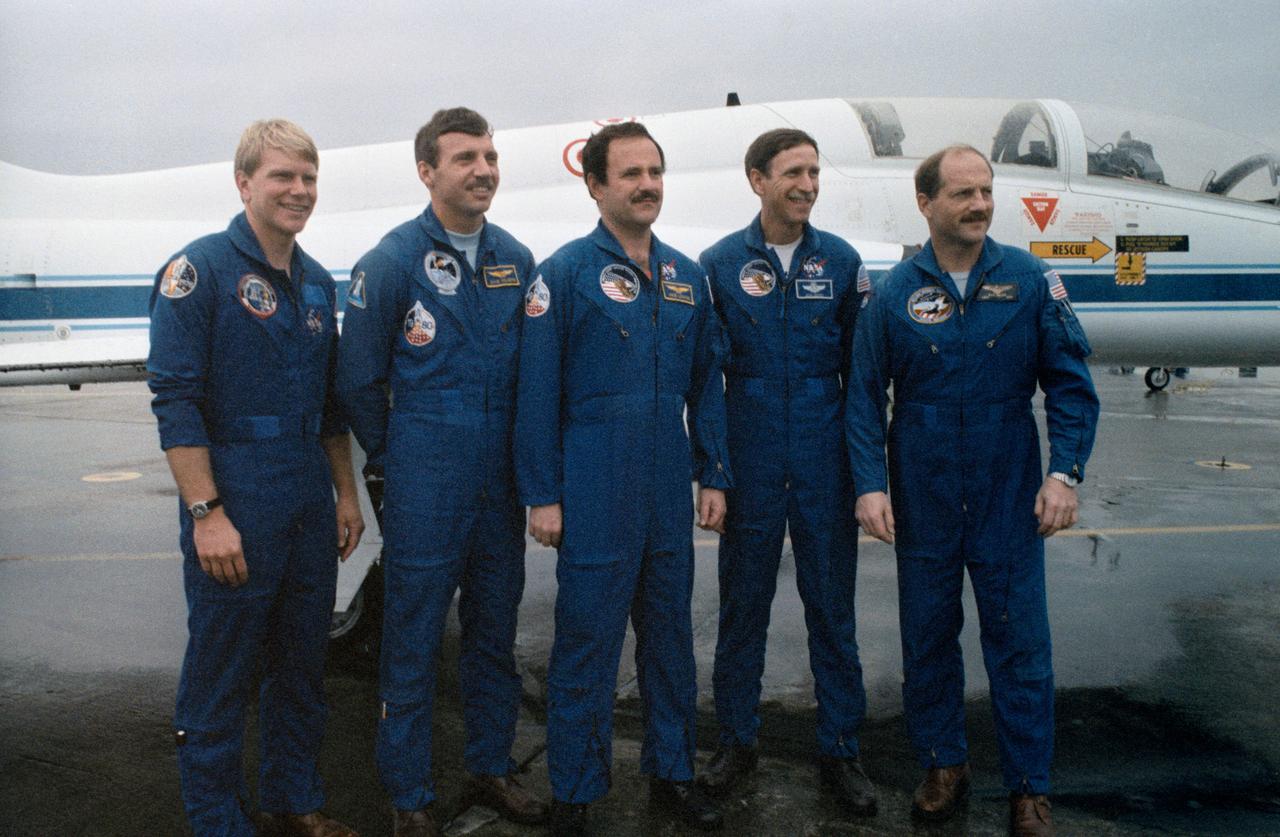
S87-28139 (26 Feb 1987) --- The five veteran astronauts recently assigned to the STS 26 space mission pose for photographers prior to departure from Ellington Field in T-38 jets (parked in background). Astronaut Frederick H. (Rick) Hauck (right) is mission commander. Astronaut Richard O. Covey, second right, is pilot; and (l.-r.) Astronauts George D. Nelson, David C. Hilmers and John M. (Mike) Lounge are mission specialists. The five were headed for KSC in Florida where they were to interface with flight hardware. The Discovery has been assigned as the STS 26 Shuttle vehicle.
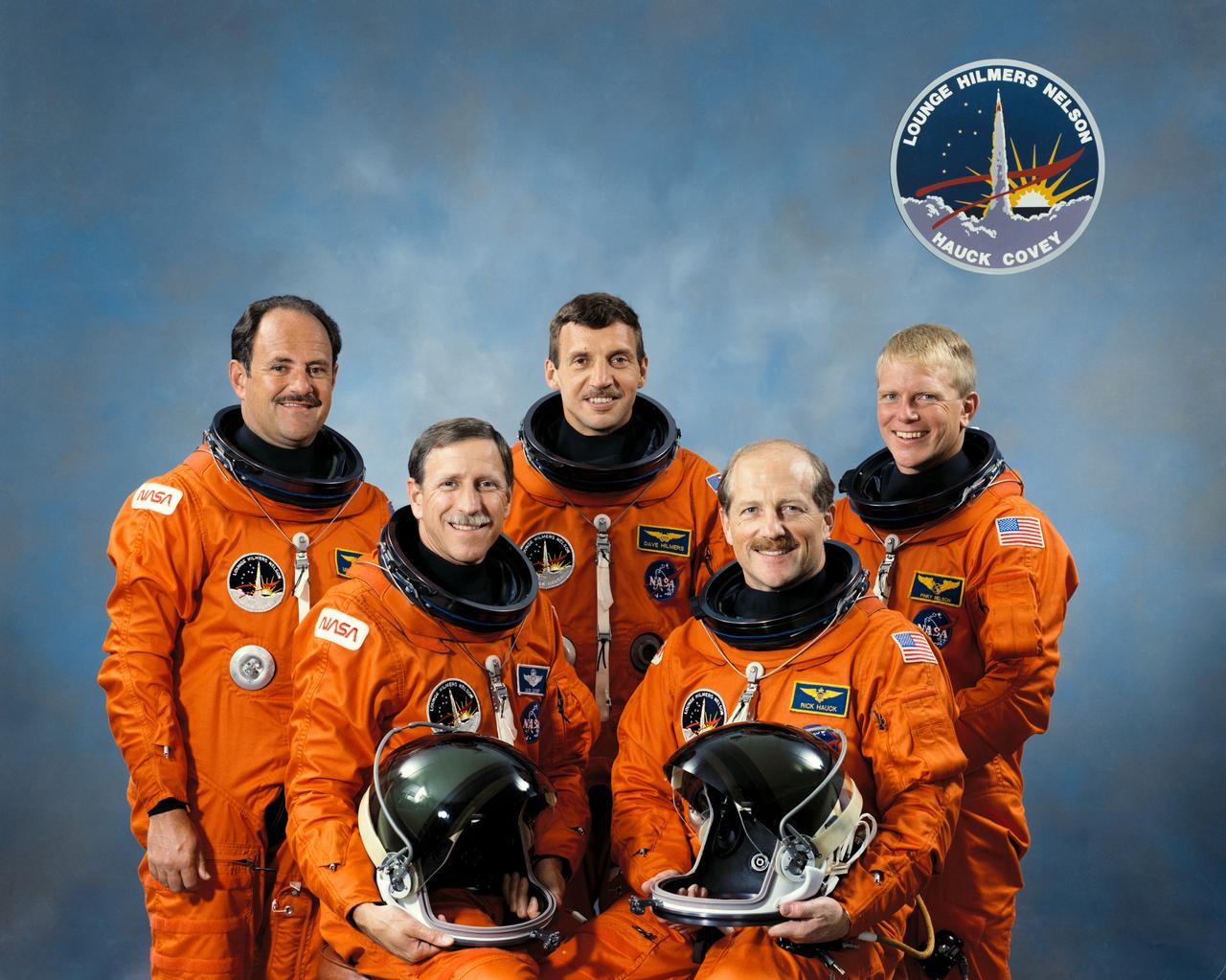
S88-47522 (10 Sept 1988) --- These five veteran astronauts have been training for over a year to serve as NASA's crew aboard the Space Shuttle Discovery for STS-26. On the front row are Astronauts Frederick H. (Rick) Hauck (right), commander; and Richard O. Covey, pilot. On the back row are Astronauts John M. (Mike) Lounge, David C. Hilmers and George D. Nelson -- all mission specialists. The crewmembers are wearing the orange partial pressure garments that they will be wearing on the launch and entry phases of the flight, scheduled for launch later this month.

CAPE CANAVERAL, Fla. -- A large alligator lounges at the water's edge at NASA's Kennedy Space Center in Florida. Alligators can be spotted in the drainage canals and other waters surrounding Kennedy. The center shares a boundary with the Merritt Island National Wildlife Refuge, consisting of 140,000 acres. The refuge provides a wide variety of habitats -- coastal dunes, saltwater estuaries and marshes, freshwater impoundments, scrub, pine flatwoods, and hardwood hammocks -- that provide sanctuary for more than 1,500 species of plants and animals, including about 331 species of birds. Photo credit: NASA/Jim Grossmann
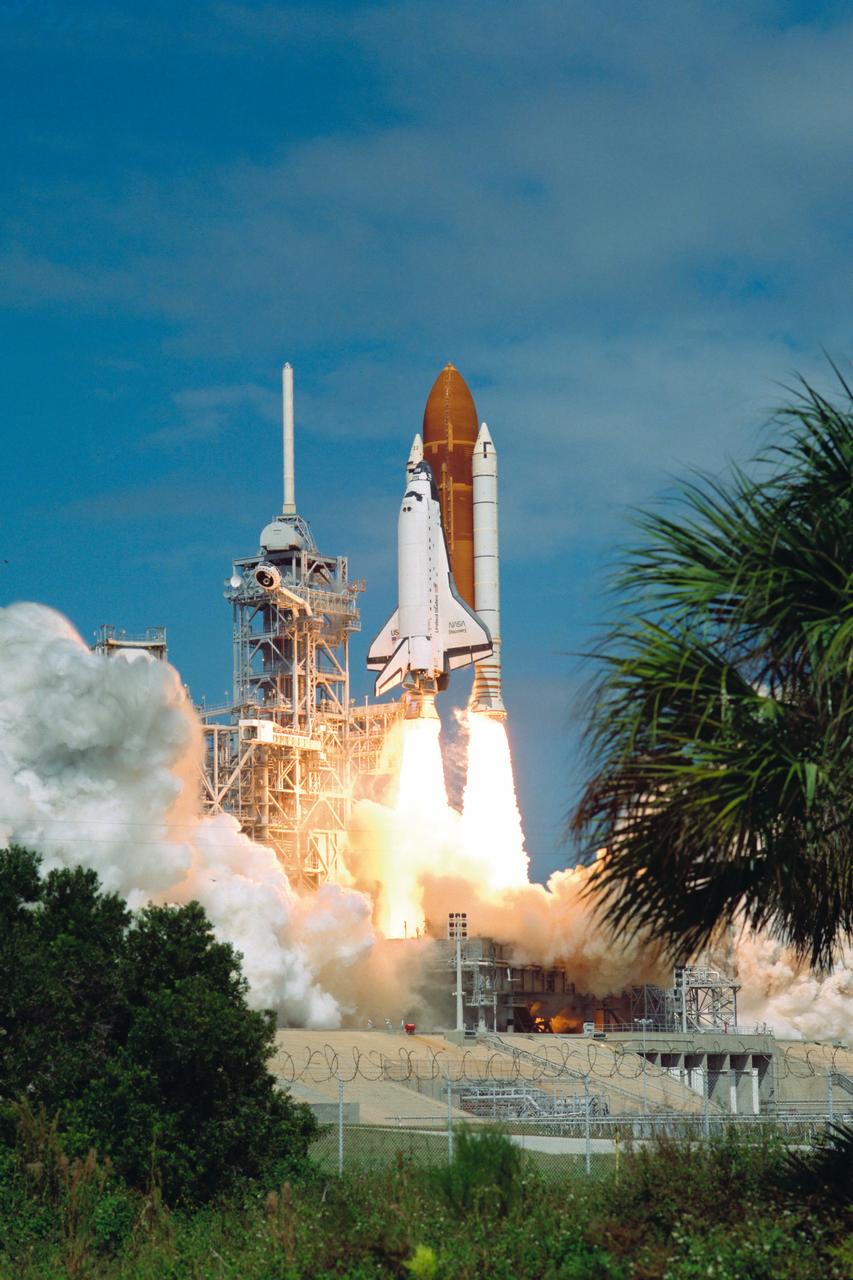
S26-S-187 (29 Sept. 1988) --- The STS-26 launch of space shuttle Discovery begins the first flight to be flown after the Challenger accident. The flight crew included astronauts Rick Hauck, commander; Dick Covey, pilot; and three mission specialists, Dave Hilmers, Mike Lounge, and George (Pinky) Nelson. During the four-day mission, the crew deployed the Tracking and Data Relay Satellite (TDRS-C) and operated eleven mid-deck experiments. Discovery completed 64 orbits of the earth before landing at Edwards Air Force Base, California, on October 3, 1988. Photo credit: NASA or National Aeronautics and Space Administration
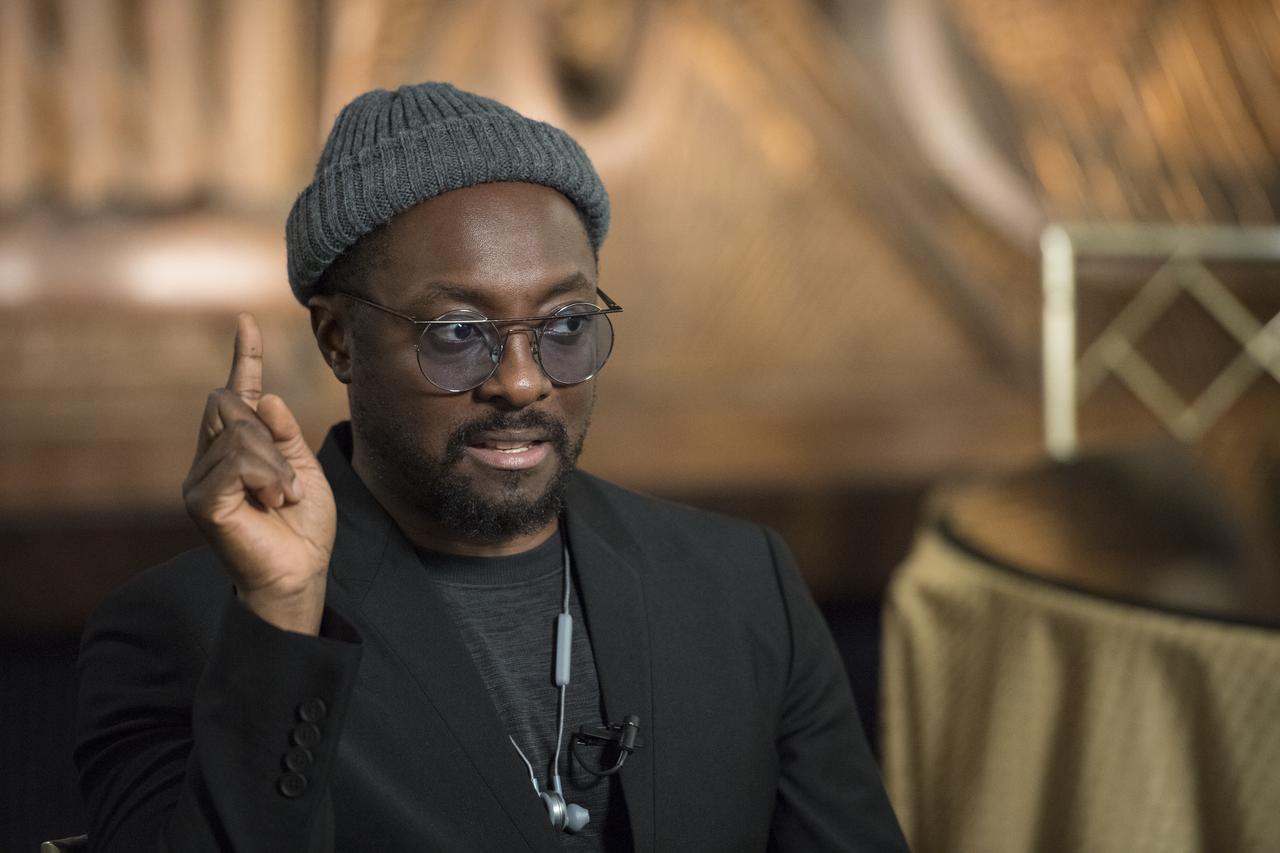
Will.i.am is interviewed by NASA TV, Friday, June 1, 2018 at the John F. Kennedy Center for the Performing Arts ahead of the "National Symphony Orchestra Pops: Space, the Next Frontier," celebrating NASA's 60th Anniversary in Washington DC. The event featured music inspired by space including artists Will.i.am, Grace Potter, Coheed & Cambria, John Cho, and guest Nick Sagan, son of Carl Sagan. Photo Credit: (NASA/Aubrey Gemignani)
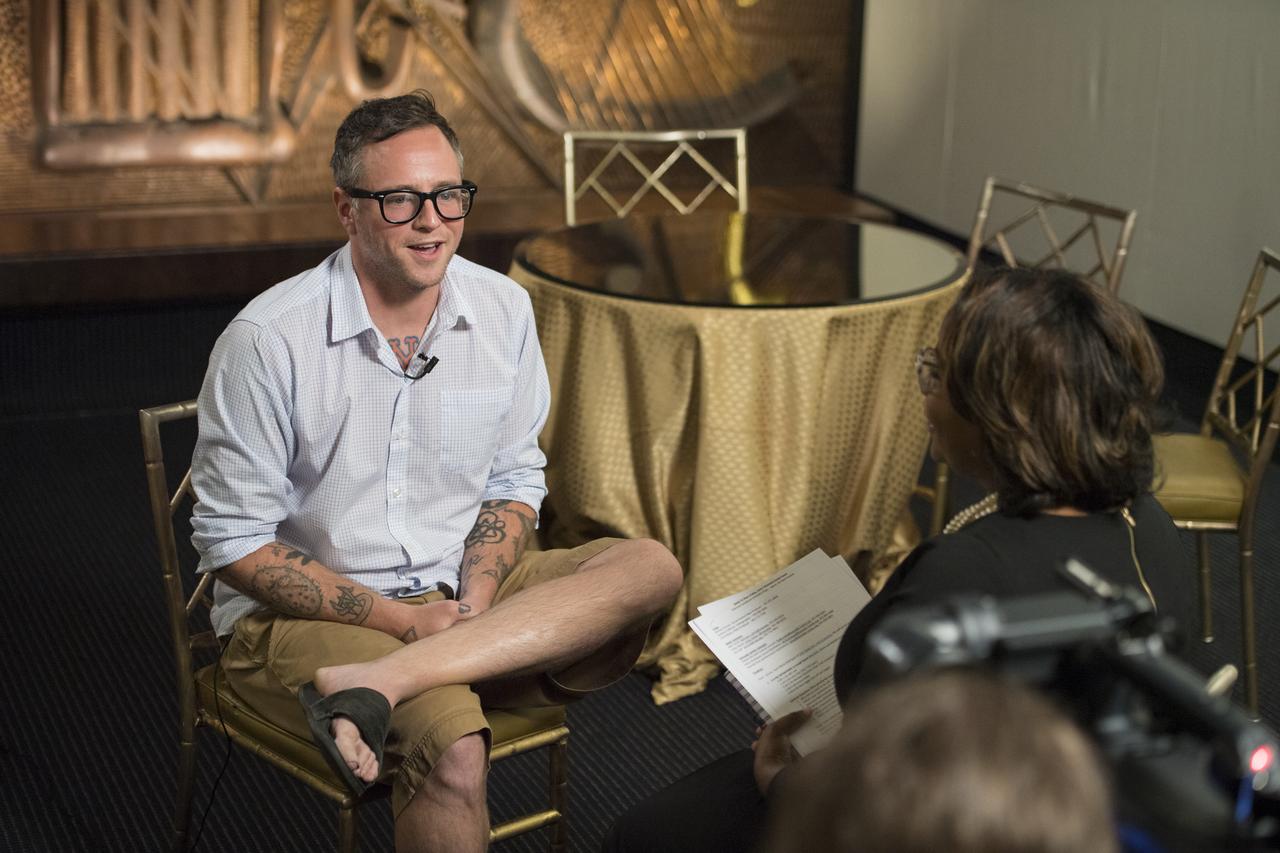
Josh Eppard, drummer for the progressive rock band, Coheed and Cambria is interviewed by NASA TV, Friday, June 1, 2018 at the John F. Kennedy Center for the Performing Arts ahead of the "National Symphony Orchestra Pops: Space, the Next Frontier," celebrating NASA's 60th Anniversary in Washington DC. The event featured music inspired by space including artists Will.i.am, Grace Potter, Coheed & Cambria, John Cho, and guest Nick Sagan, son of Carl Sagan. Photo Credit: (NASA/Aubrey Gemignani)
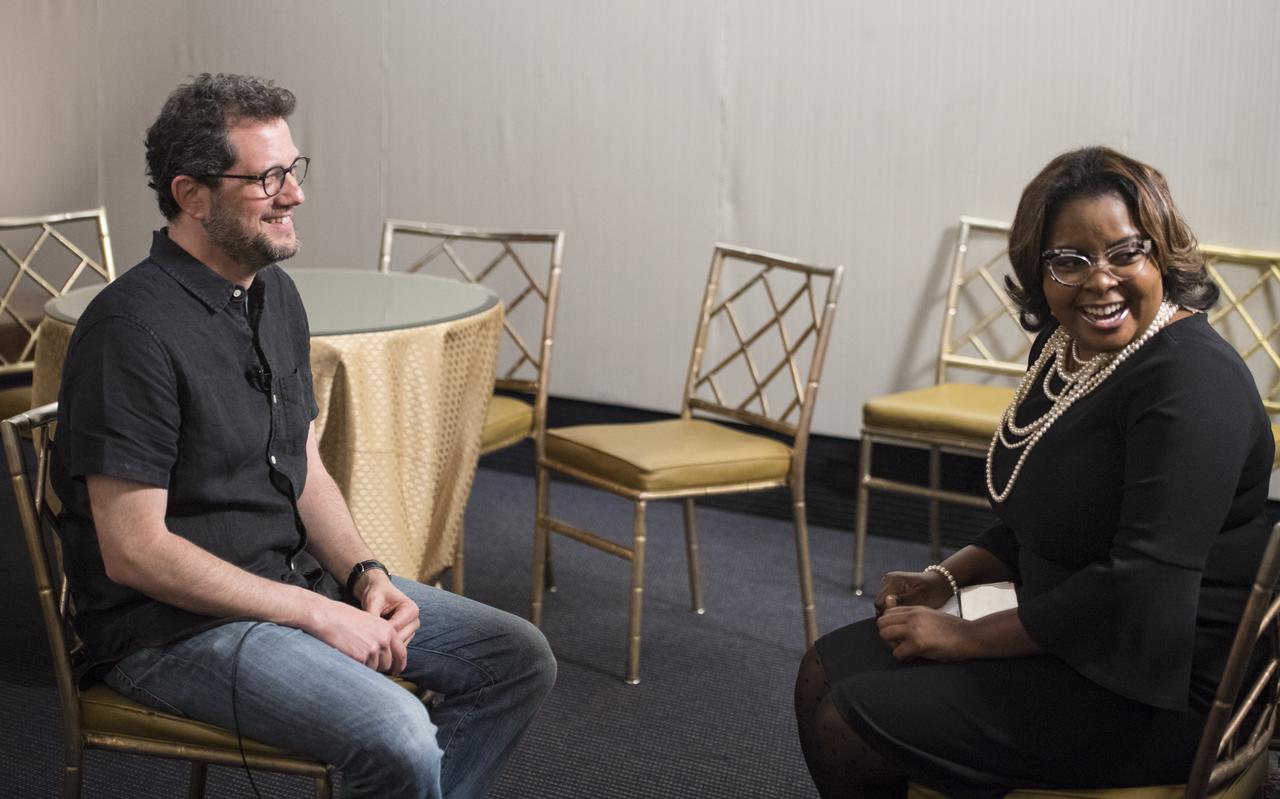
Michael Giacchino, Star Trek composer, is interviewed by NASA's Social Video Producer Brittany Brown, Friday, June 1, 2018 at the John F. Kennedy Center for the Performing Arts ahead of the "National Symphony Orchestra Pops: Space, the Next Frontier," celebrating NASA's 60th Anniversary in Washington DC. The event featured music inspired by space including artists Will.i.am, Grace Potter, Coheed & Cambria, John Cho, and guest Nick Sagan, son of Carl Sagan. Photo Credit: (NASA/Aubrey Gemignani)
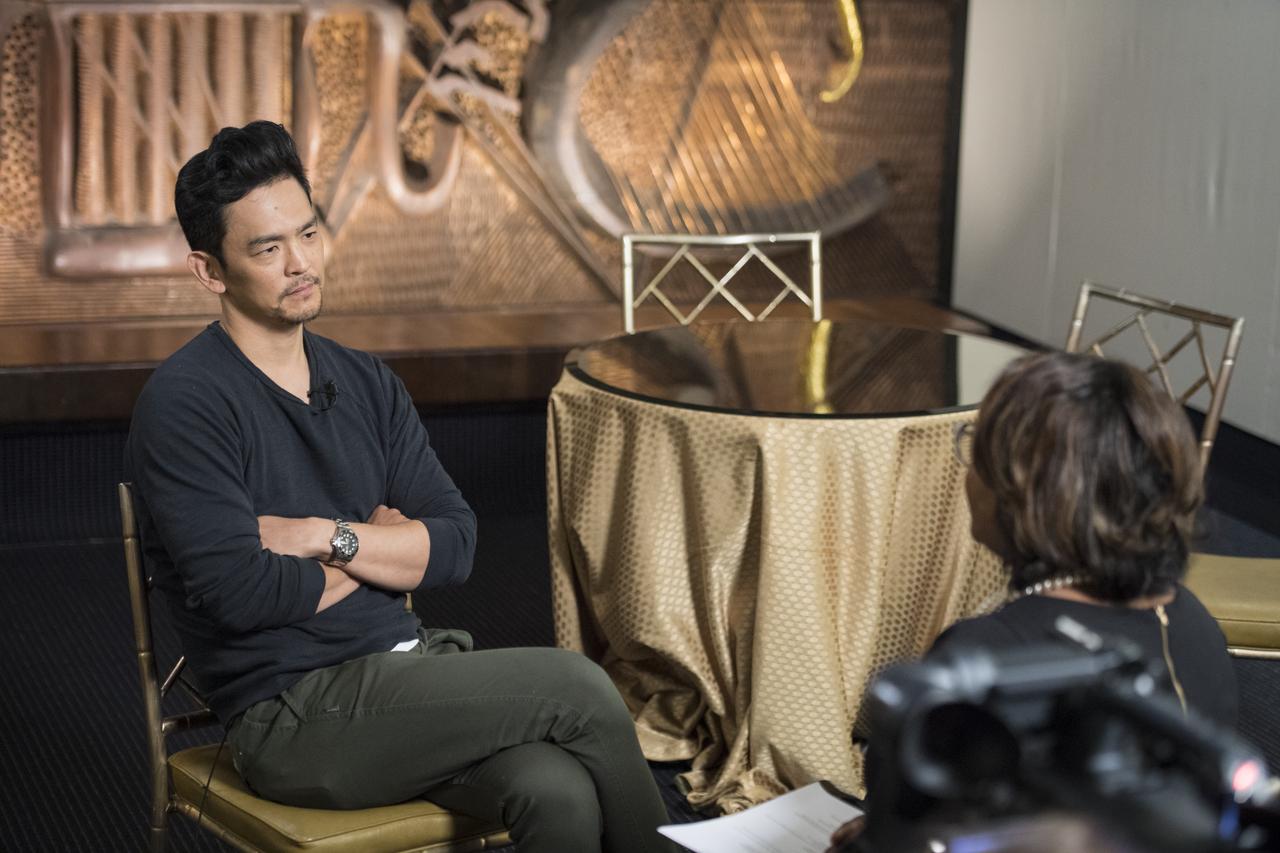
Actor John Cho in interviewed by NASA's Social Video Producer, Brittany Brown, Friday, June 1, 2018 at the John F. Kennedy Center for the Performing Arts ahead of the "National Symphony Orchestra Pops: Space, the Next Frontier," celebrating NASA's 60th Anniversary in Washington DC. The event featured music inspired by space including artists Will.i.am, Grace Potter, Coheed & Cambria, John Cho, and guest Nick Sagan, son of Carl Sagan. Photo Credit: (NASA/Aubrey Gemignani)
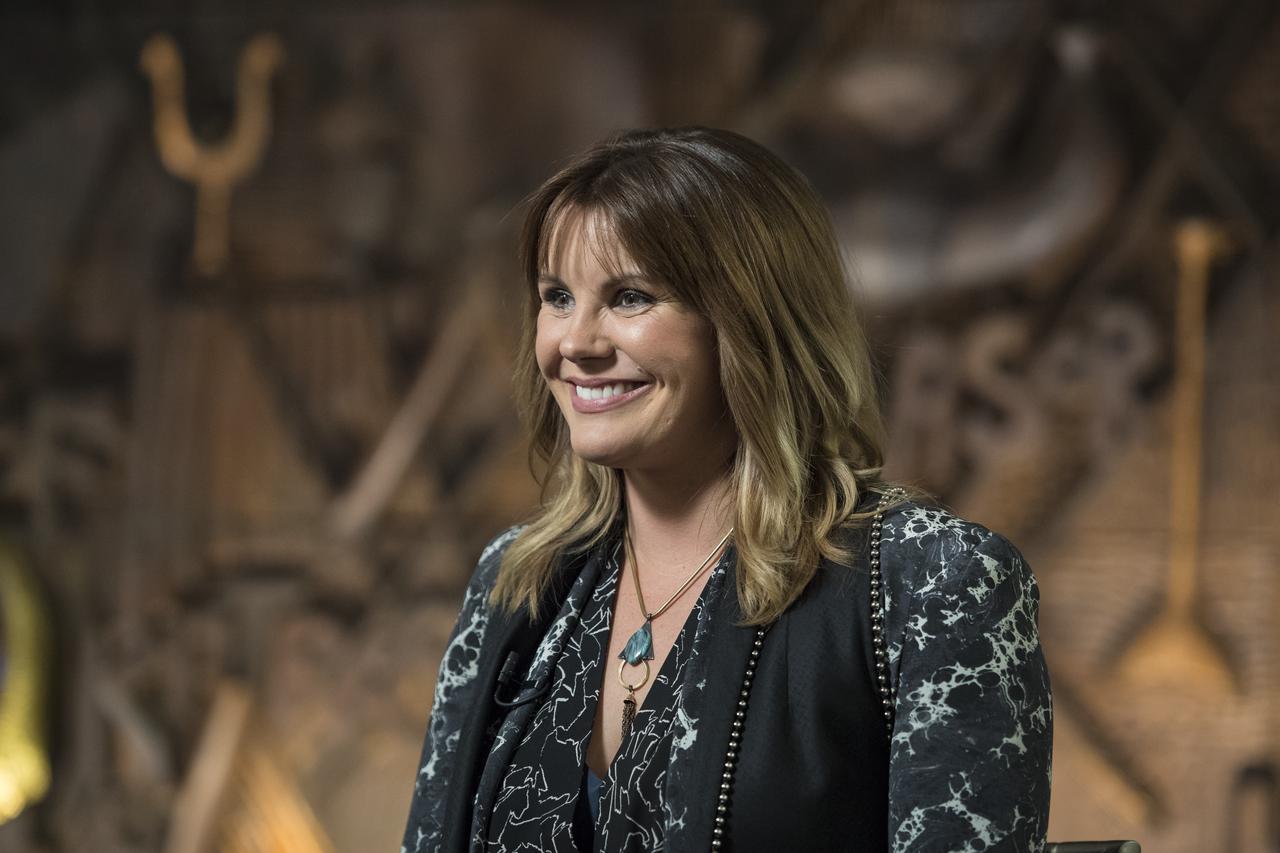
Musician Grace Potter is interviewed by NASA TV, Friday, June 1, 2018 at the John F. Kennedy Center for the Performing Arts ahead of the "National Symphony Orchestra Pops: Space, the Next Frontier," celebrating NASA's 60th Anniversary in Washington DC. The event featured music inspired by space including artists Will.i.am, Grace Potter, Coheed & Cambria, John Cho, and guest Nick Sagan, son of Carl Sagan. Photo Credit: (NASA/Aubrey Gemignani)
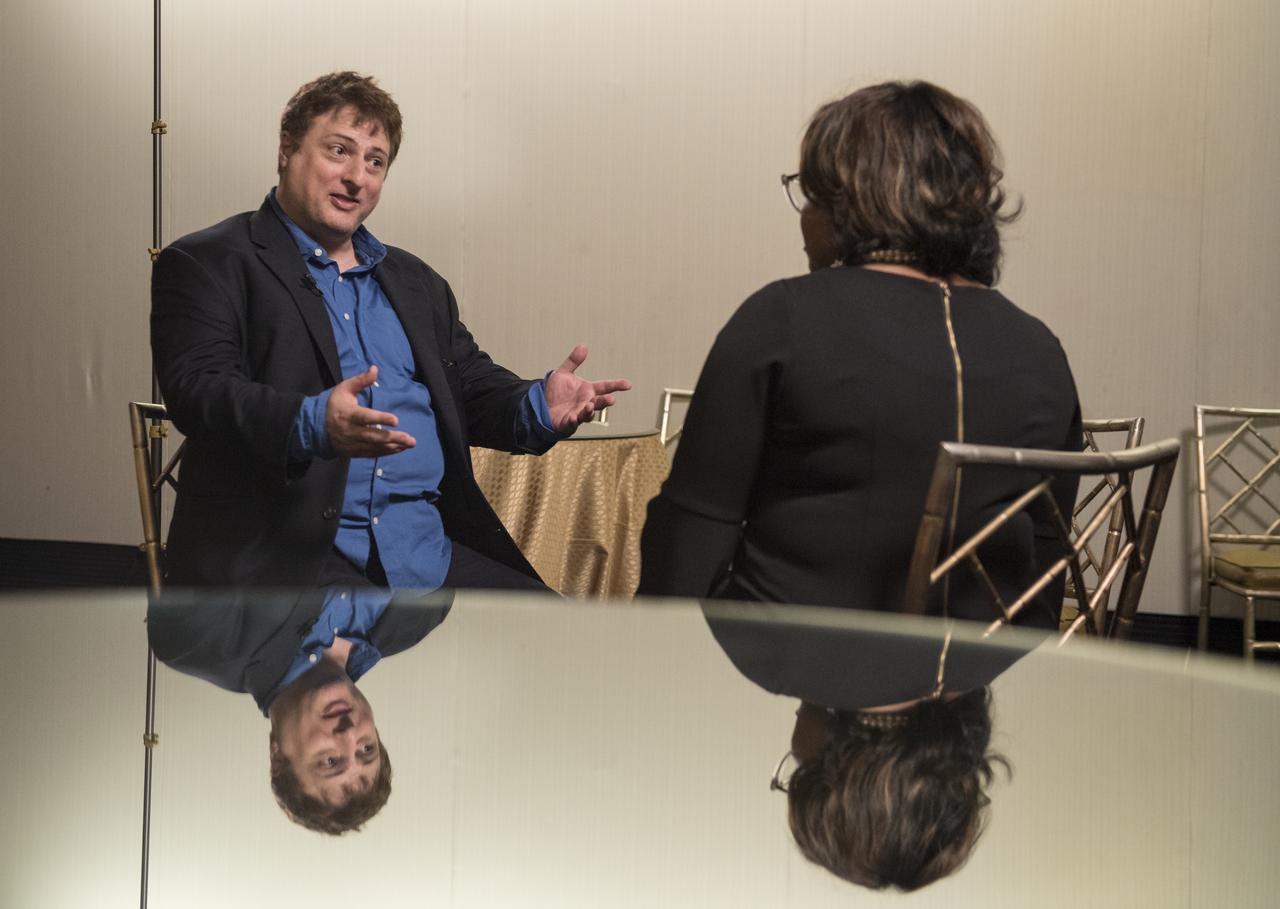
NASA's Social Video Producer, Brittany Brown interviews Nick Sagan Friday, June 1, 2018 at the John F. Kennedy Center for the Performing Arts ahead of the "National Symphony Orchestra Pops: Space, the Next Frontier," celebrating NASA's 60th Anniversary in Washington DC. The event featured music inspired by space including artists Will.i.am, Grace Potter, Coheed & Cambria, John Cho, and guest Nick Sagan, son of Carl Sagan. Photo Credit: (NASA/Aubrey Gemignani)
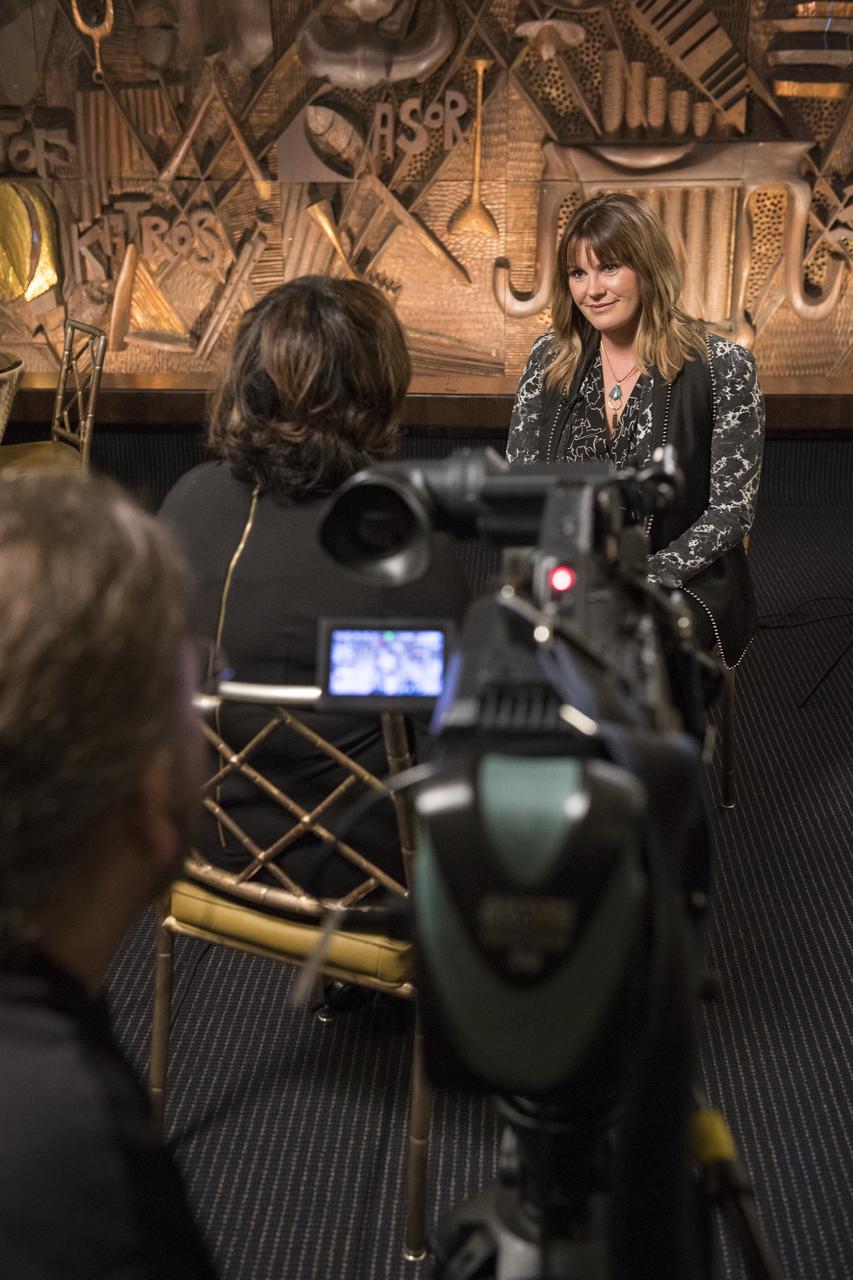
Musician Grace Potter is interviewed by NASA TV, Friday, June 1, 2018 at the John F. Kennedy Center for the Performing Arts ahead of the "National Symphony Orchestra Pops: Space, the Next Frontier," celebrating NASA's 60th Anniversary in Washington DC. The event featured music inspired by space including artists Will.i.am, Grace Potter, Coheed & Cambria, John Cho, and guest Nick Sagan, son of Carl Sagan. Photo Credit: (NASA/Aubrey Gemignani)
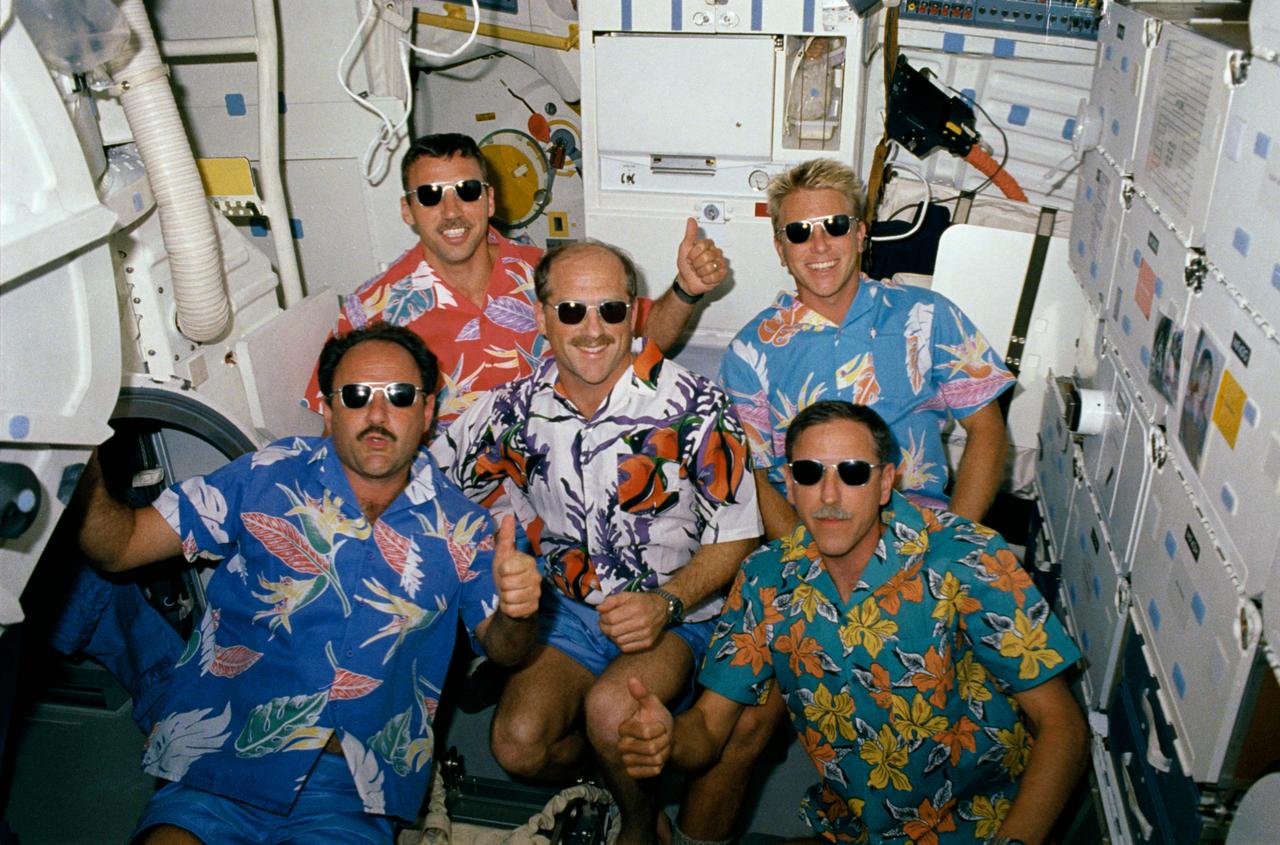
STS026-09-008 (3 Oct 1988) --- STS-26 crewmembers wear Hawaiian attire (brightly colored shirts with bold prints) and sunglasses while giving the "thumbs up" signal as they pay tribute to the Hawaii tracking station during an unscheduled television (TV) downlink. On Discovery's, Orbiter Vehicle (OV) 103's, middeck are (left to right) Mission Specialist (MS) John M. Lounge, holding onto open airlock hatch, MS David C. Hilmers, wearing red shirt, Commander Frederick H. Hauck, wearing white shirt and positioned in center of crew, MS George D. Nelson, and Pilot Richard O. Covey (lower right corner of the frame). The shirts were given to the crewmembers by the Kennedy Space Center (KSC) Loud and Proud Team.
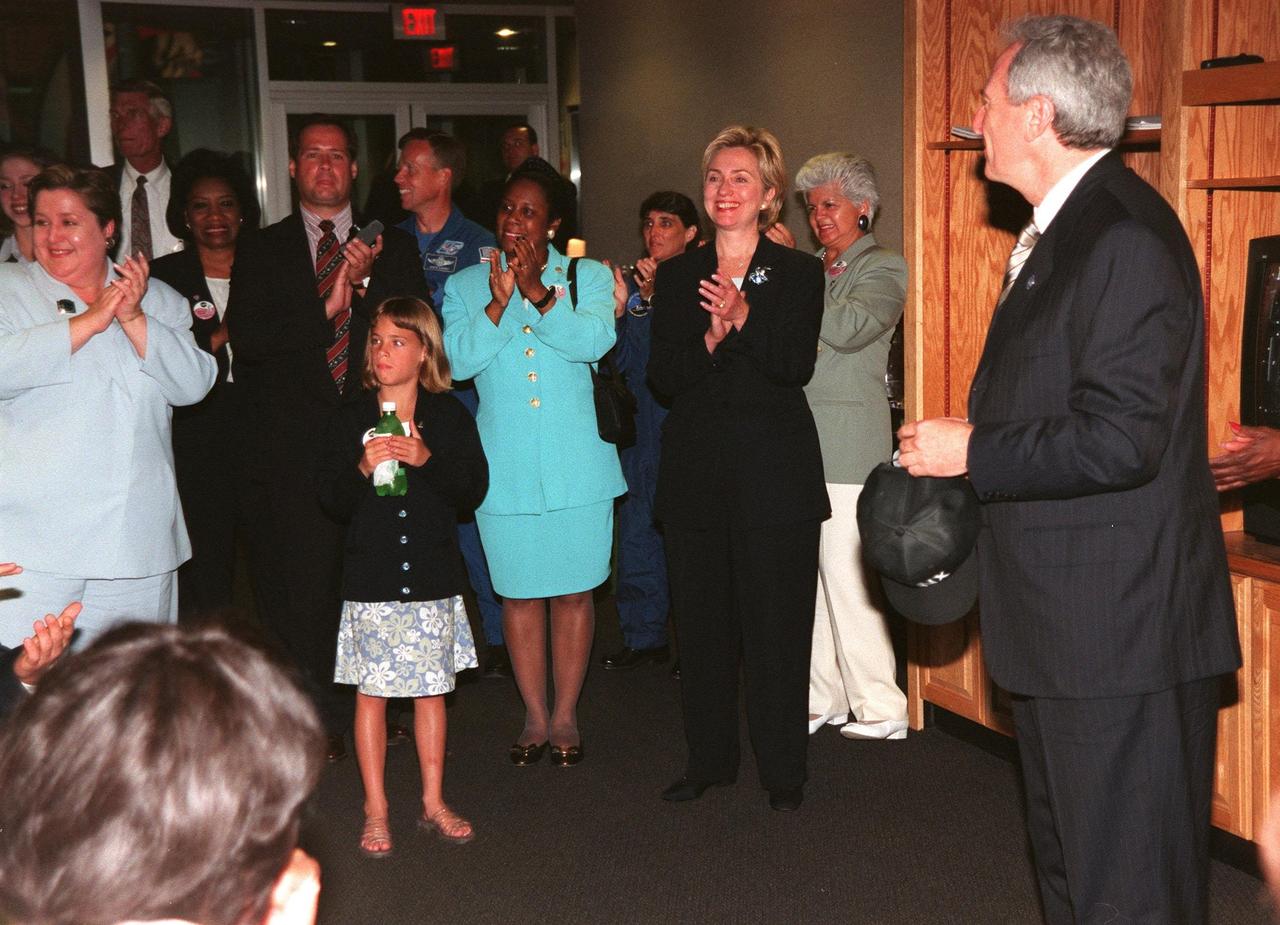
KENNEDY SPACE CENTER, FLA. -- In the VIP Lounge, Apollo/Saturn V Center, First Lady Hillary Rodham Clinton gets ready to speak to the group gathered there before the launch of STS-93. At right is NASA Administrator Daniel Goldin. Liftoff of Space Shuttle Columbia is scheduled for 12:36 a.m. EDT July 20. Much attention has been generated over the launch due to Commander Eileen M. Collins, the first woman to serve as commander of a Shuttle mission. The primary payload of the five-day mission is the Chandra X-ray Observatory, which will allow scientists from around the world to study some of the most distant, powerful and dynamic objects in the universe. The new telescope is 20 to 50 times more sensitive than any previous X-ray telescope and is expected to unlock the secrets of supernovae, quasars and black holes
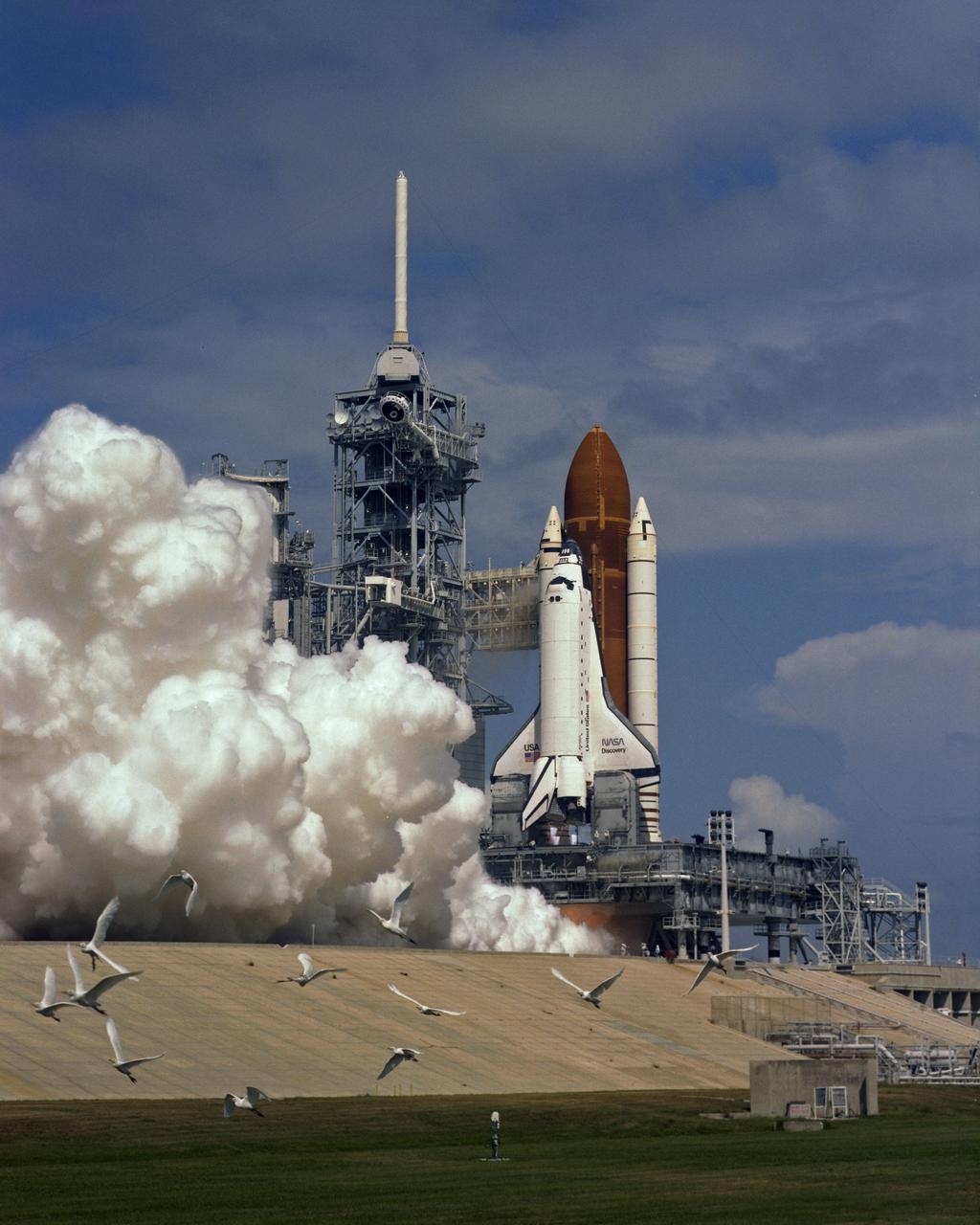
CAPE CANAVERAL, Fla. - The space shuttle Discovery and its five-man crew is launched from pad 39B at 11:37 a.m. as STS-26 embarks on a four-day mission marking America's return to space. On the first day of orbit, the crew will deploy from the orbiter's payload bay the primary payload, the Tracking and Date Relay Satellite, or TDRS-C. The inertial upper stage, or IUS, will boost the satellite to a geosynchronous altitude from low Earth orbit. When it place, TDRS-C will relay date from low Earth orbiting spacecraft and air-to-ground voice communications sand television from shape shuttle orbiters during missions. The crew members of STST-26 are Commander Rick Hauck, Pilot Richard Covey, and Mission Specialists Dave Hilmers, Mike Lounge and George "Pinky" Nelson. Photo Credit: NASA
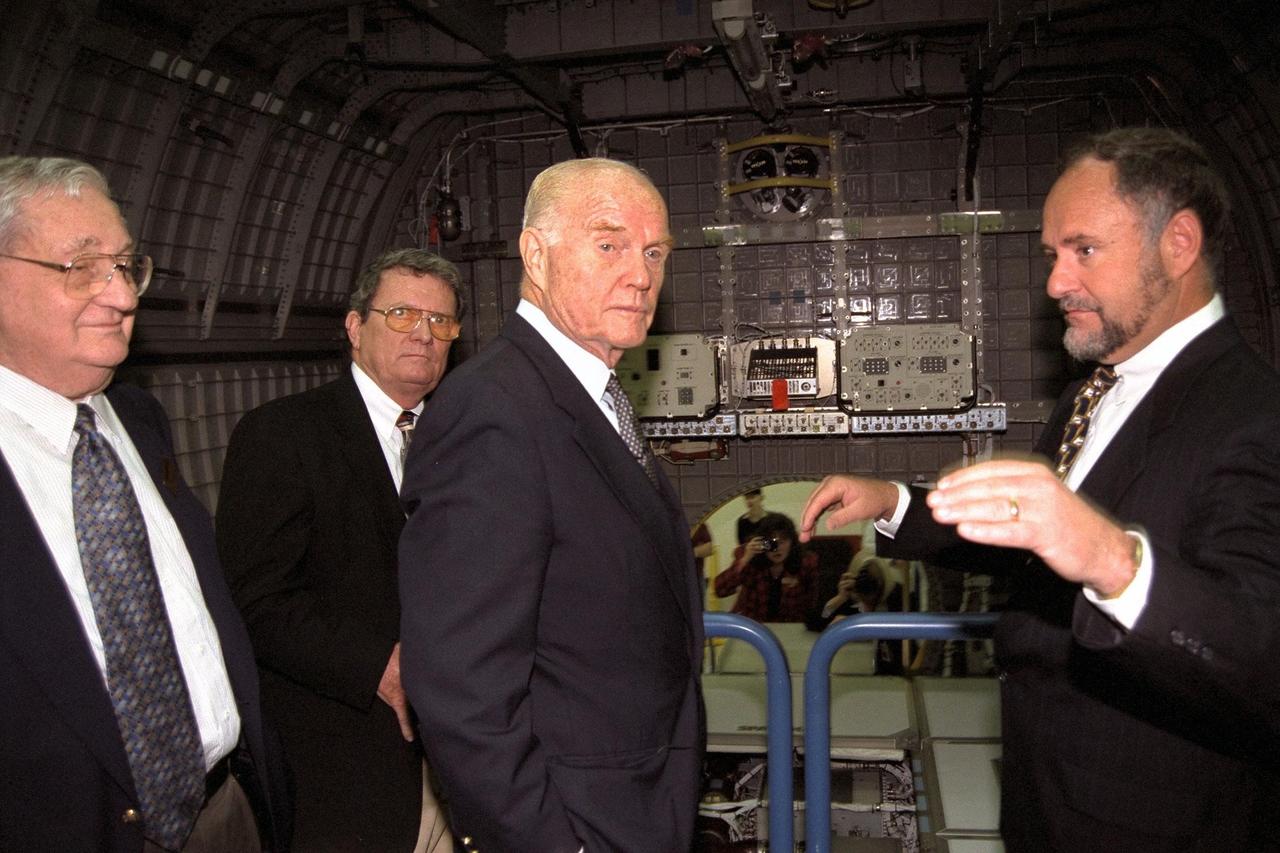
Ohio Senator John Glenn, center, enjoys a tour of the SPACEHAB Payload Processing Facility in Cape Canaveral. On his immediate left is Dale Steffey, SPACEHAB vice president, operations, and at the right of the photograph is Michael Lounge, SPACEHAB vice president, flight systems development. Senator Glenn arrived at KSC on Jan. 20 to tour KSC operational areas and to view the launch of STS-89 later this week. Glenn, who made history in 1962 as the first American to orbit the Earth, completing three orbits in a five-hour flight aboard Friendship 7, will fly his second space mission aboard Space Shuttle Discovery this October. Glenn is retiring from the Senate at the end of this year and will be a payload specialist aboard STS-95
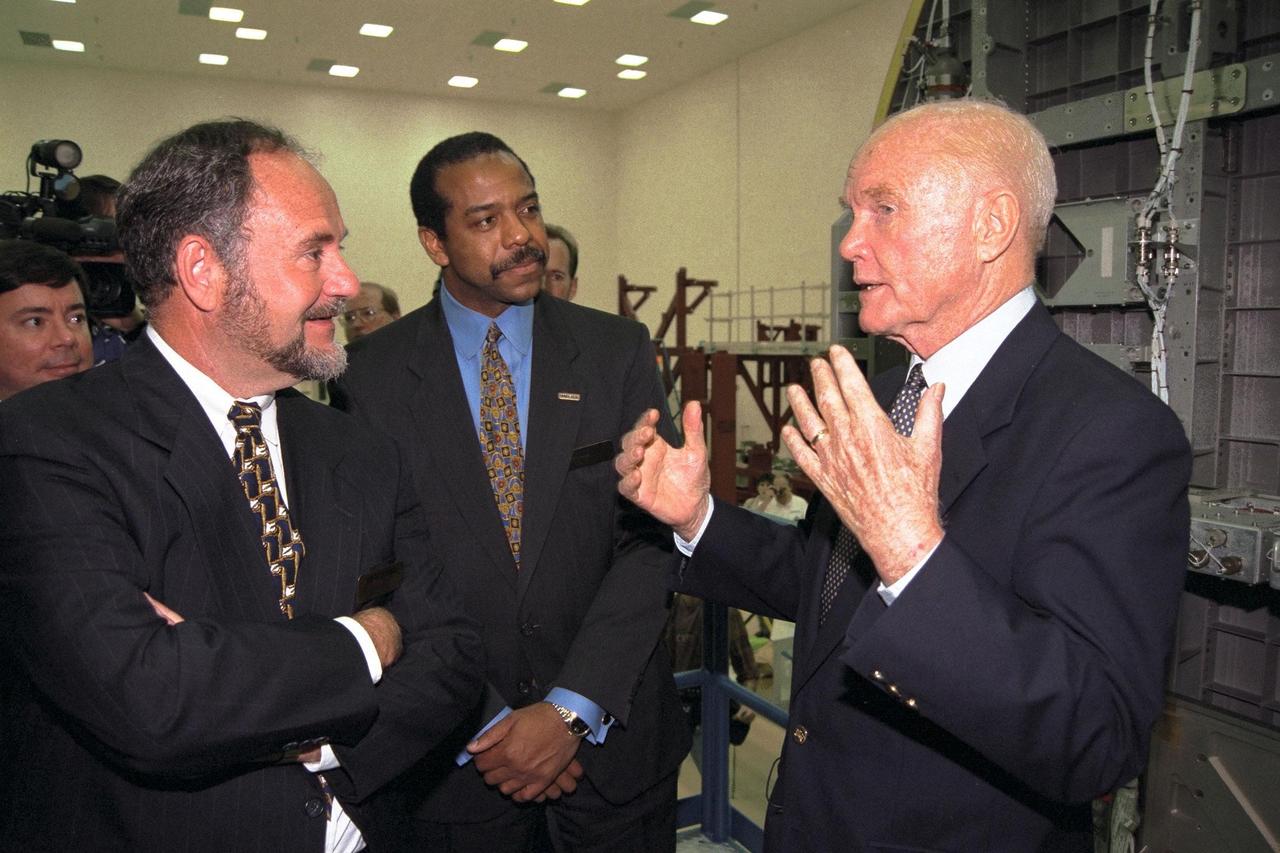
Ohio Senator John Glenn, at right, enjoys a tour of the SPACEHAB Payload Processing Facility in Cape Canaveral. Joining Senator Glenn are, left to right, David Rossi, SPACEHAB president and chief operating officer (extreme left); Michael Lounge, SPACEHAB vice president, flight systems development; and Dr. Bernard Harris, SPACEHAB vice president, microgravity and life sciences. Senator Glenn arrived at KSC on Jan. 20 to tour KSC operational areas and to view the launch of STS-89 later this week. Glenn, who made history in 1962 as the first American to orbit the Earth, completing three orbits in a five-hour flight aboard Friendship 7, will fly his second space mission aboard Space Shuttle Discovery this October. Glenn is retiring from the Senate at the end of this year and will be a payload specialist aboard STS-95
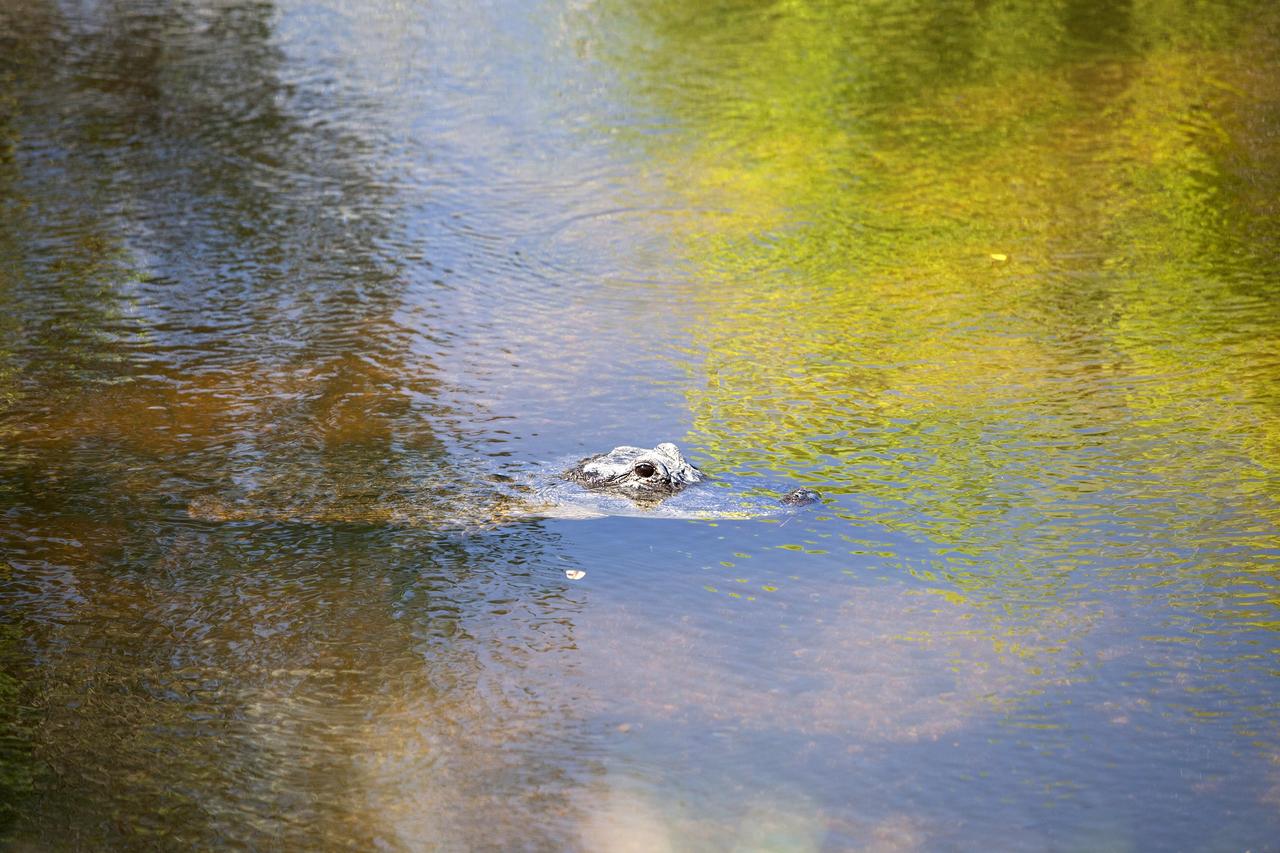
CAPE CANAVERAL, Fla. -- An alligator lounges in the water off Schwartz Road at NASA's Kennedy Space Center in Florida. Alligators can be spotted in the drainage canals and other waterways surrounding the space center. The center coexists with the Merritt Island National Wildlife Refuge, which encompasses 140,000 acres. The refuge comprises a wide variety of habitats, including coastal dunes, saltwater estuaries and marshes, freshwater impoundments, scrub, pine flatwoods, and hardwood hammocks. These habitats provide sanctuary for more than 1,500 species of plants and animals, including more than 330 species of birds, 31 mammals, 117 fishes, and 65 amphibians and reptiles. For additional information about the refuge, visit http://www.fws.gov/merrittisland. Photo credit: NASA/Daniel Casper
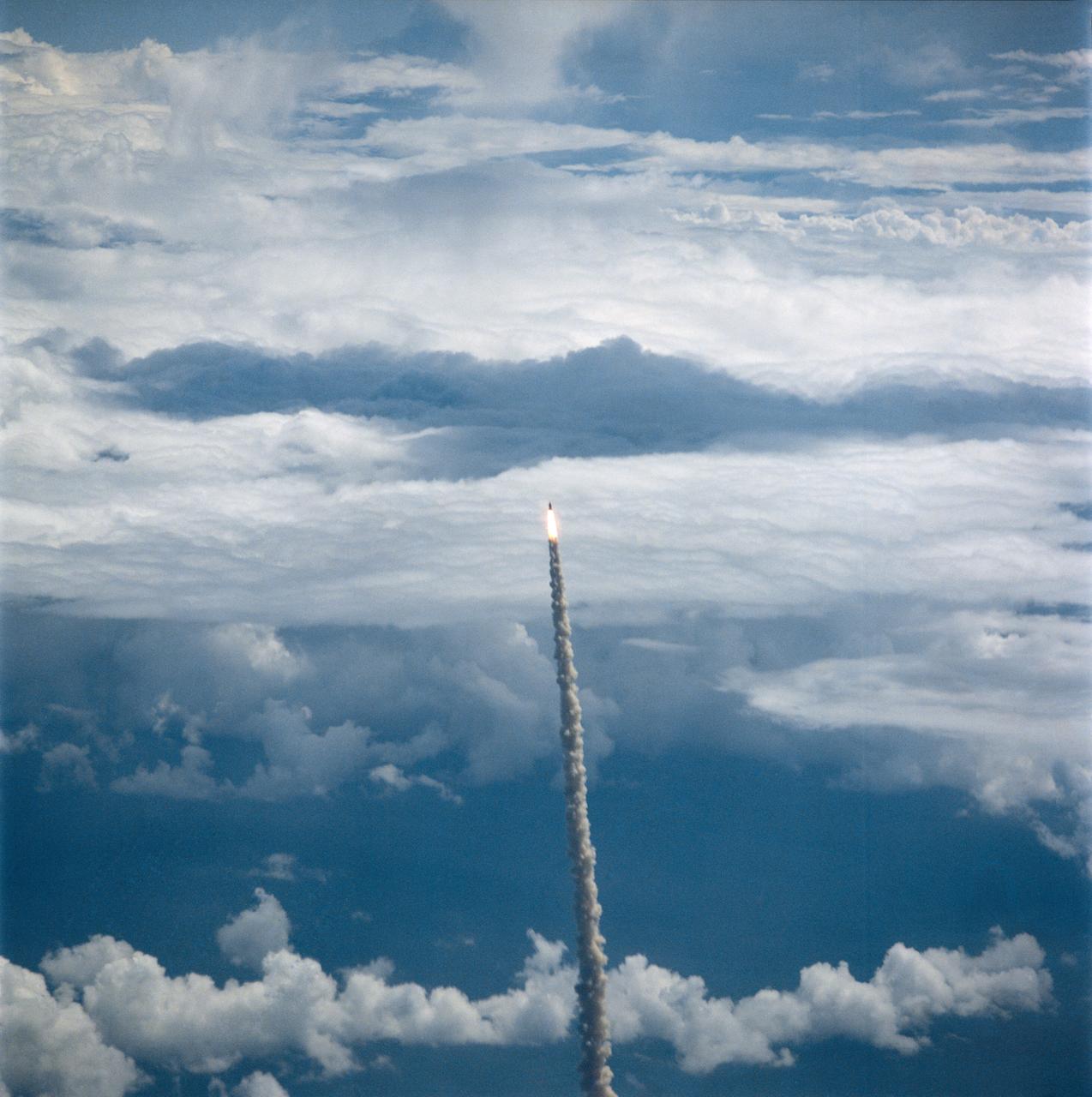
S26-S-026 (29 Sept. 1988) --- The STS-26 launch was captured on film from the NASA Shuttle Training Aircraft, piloted by astronaut Daniel C. Brandenstein, chief of JSC's Astronaut Office. Discovery?s mission was the first flight to be flown after the Challenger accident. The flight crew included astronauts Rick Hauck, commander; Dick Covey, pilot; and three mission specialists, Dave Hilmers, Mike Lounge, and George (Pinky) Nelson. During the four-day mission, the crew deployed the Tracking and Data Relay Satellite (TDRS-C) and operated eleven mid-deck experiments. Discovery completed 64 orbits of the earth before landing at Edwards Air Force Base, California, on October 3, 1988. Photo credit: NASA or National Aeronautics and Space Administration
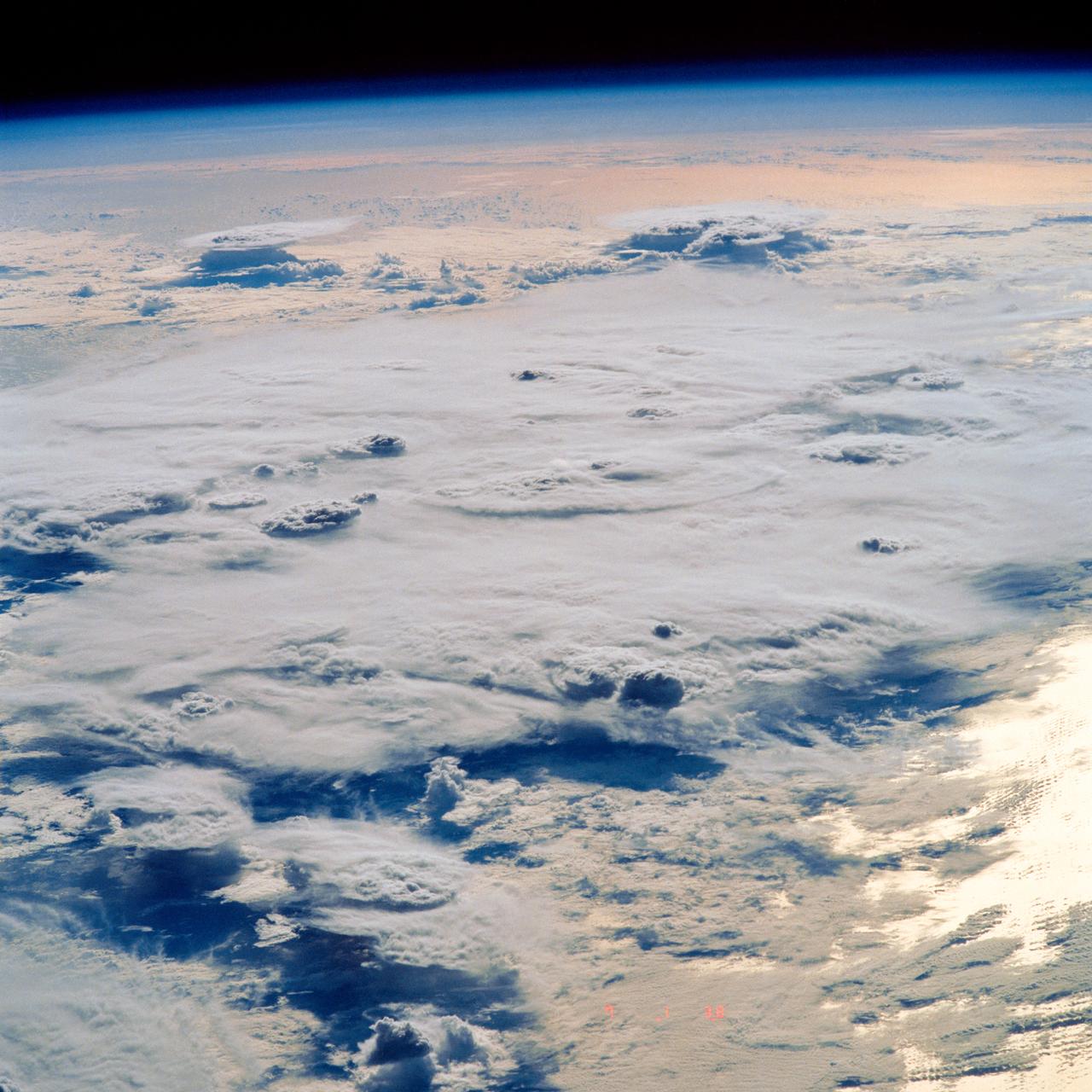
STS035-607-024 (2-10 Dec. 1990) --- This is one of 25 visuals used by the STS-35 crew at its Dec. 20, 1990 post-flight press conference. Space Shuttle Columbia's flight of almost nine days duration (launched December 2 from Kennedy Space Center (KSC) and landed December 10 at Edwards Air Force Base) carried the Astro-1 payload and was dedicated to astrophysics. The mission involved a seven-man crew. Crew members were astronauts Vance D. Brand, Guy S. Gardner, Jeffrey A. Hoffman, Robert A.R. Parker and John M. (Mike) Lounge; and payload specialists Samuel T. Durrance and Ronald A. Parise. Thunderstorm systems over the Pacific Ocean, with heavy sunglint, as photographed with a handheld Rolleiflex camera aimed through Columbia's aft flight deck windows.
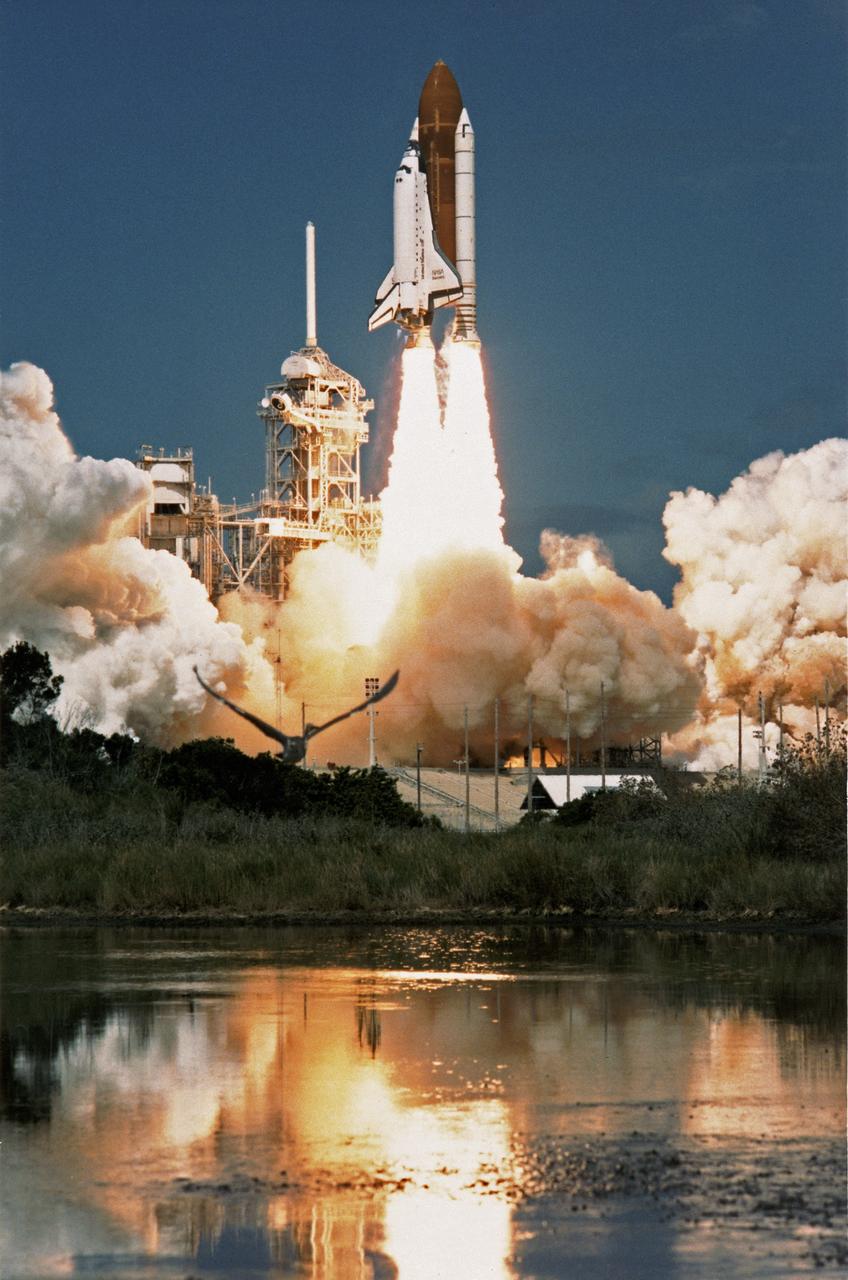
CAPE CANAVERAL, Fla. - The space shuttle Discovery and its five-man crew is launched from pad 39B at 11:37 a.m. as STS-26 embarks on a four-day mission marking America's return to space. On the first day of orbit, the crew will deploy from the orbiter's payload bay the primary payload, the Tracking and Data Relay Satellite, or TDRS-C. The inertial upper stage, or IUS, will boost the satellite to a geosynchronous altitude from low Earth orbit. When it place, TDRS-C will relay date from low Earth orbiting spacecraft and air-to-ground voice communications sand television from shape shuttle orbiters during missions. The crew members of STST-26 are Commander Rick Hauck, Pilot Richard Covey, and mission specialists Dave Hilmers, Mike Lounge and George "Pinky" Nelson. Photo Credit: NASA
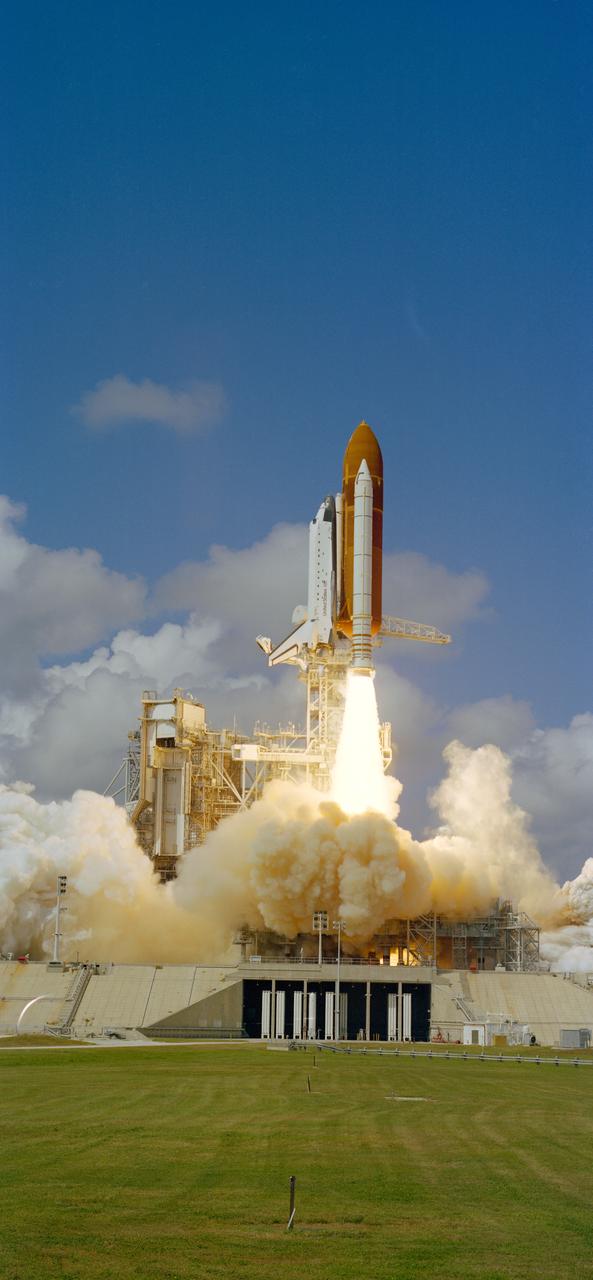
STS026-S-031 (29 Sept 1988) --- Just moments after ignition, the Space Shuttle Discovery, mated to two solid rocket boosters and an external fuel tank, heads, toward Earth orbit. The mission marks Discovery?s first flight since September of 1985 and NASA?s first manned mission since September of 1985 and NASA?s first manned mission since the 51L Challenger accident of January 28, 1986. Onboard the spacecraft are Astronauts Frederick H. (Rick) Hauck, commander; Richard O. Covey, pilot; and George D. Nelson, John M. (Mike) Lounge and David C. Hilmers, mission specialists. Discovery?s dry weight is 171,419 pounds. The tracking and data relay satellite and its inertial upper stage total about 37,000 pounds.
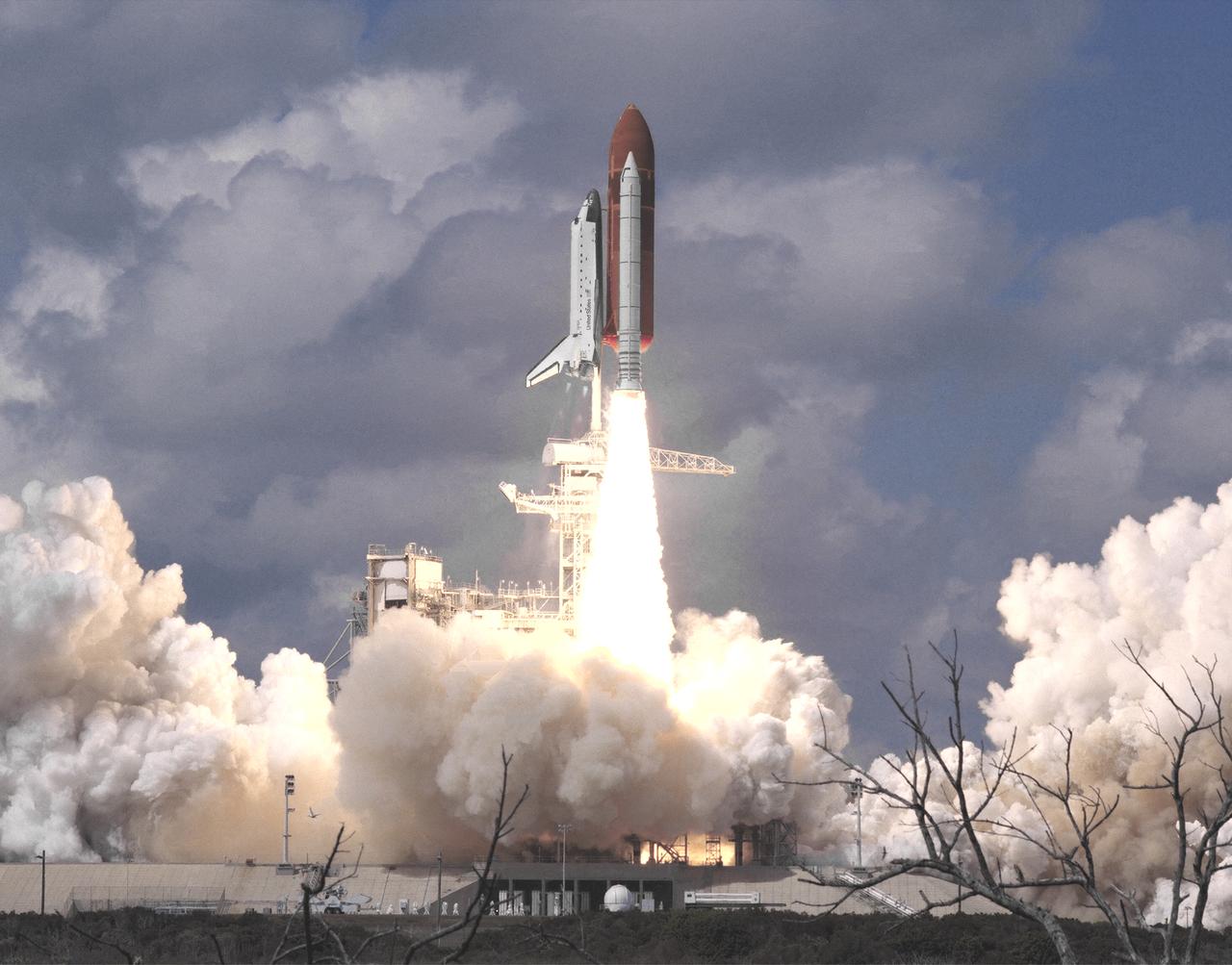
The Space Shuttle Discovery takes off from Launch Pad 39B at the Kennedy Space Center, Florida, to being Mission STS-26 on 29 September 1988,11:37:00 a.m. EDT. The 26th shuttle mission lasted four days, one hour, zero minutes, and 11 seconds. Discovery landed 3 October 1988, 9:37:11 a.m. PDT, on Runway 17 at Edwards Air Force Base, California. Its primary payload, NASA Tracking and Data Relay Satellite-3 (TDRS-3) attached to an Inertial Upper Stage (IUS), became the second TDRS deployed. After deployment, IUS propelled the satellite to a geosynchronous orbit. The crew consisted of Frederick H. Hauck, Commander; Richard O. Covey, Pilot; John M. Lounge, Mission Specialist 1; George D. Nelson, Mission Specialist 2; and David C. Hilmers, Mission Specialist 3.
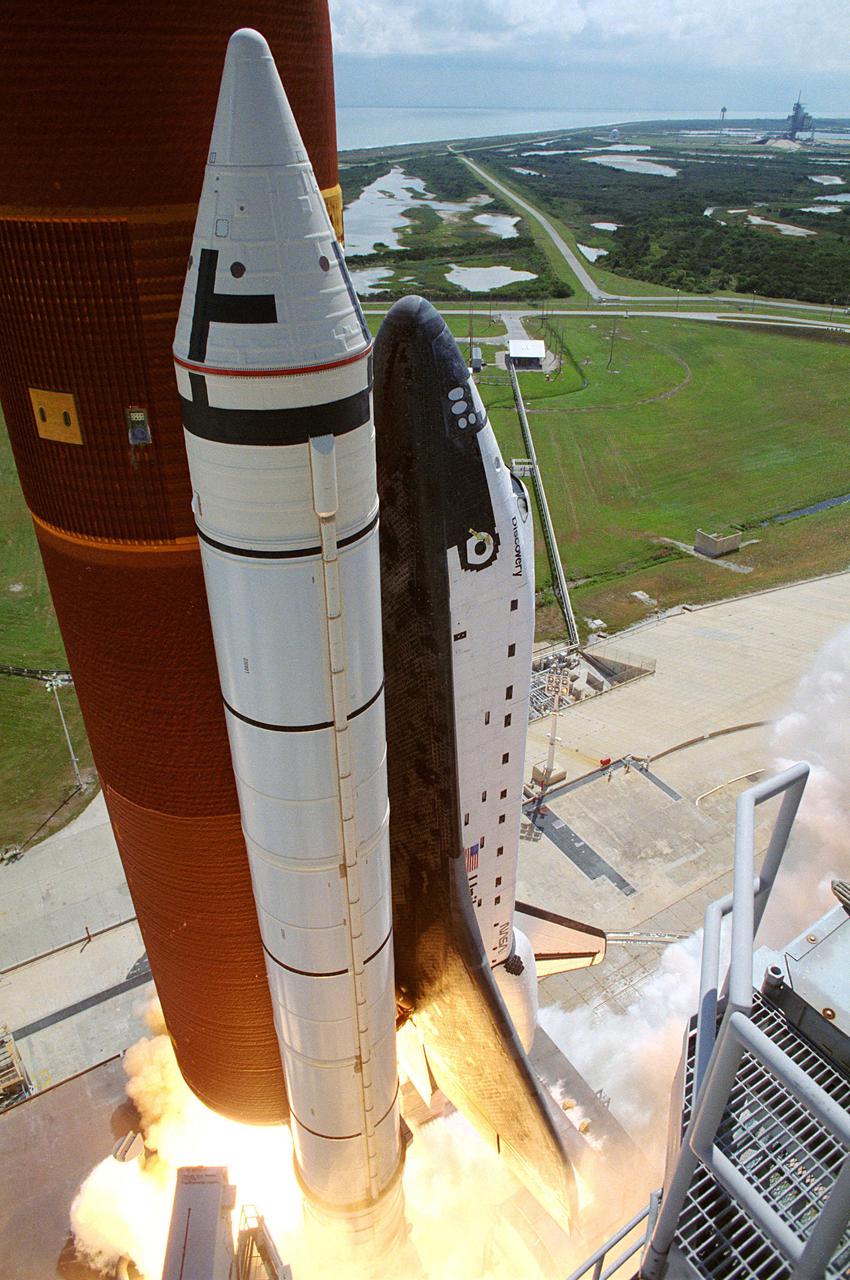
KENNEDY SPACE CENTER, FLA. -- The Space Shuttle Discovery and its five-man crew is launched from pad 39B at 11:37 a.m. as STS-26 embarks on a four-day mission, marking America's return to space. On the first day of orbit, the crew will deploy from the orbiter's payload bay the primary payload, the Tracking and Data Relay Satellite (TDRS-C). The Inertial Upper Stage (IUS) will boost the satellite to a geosynchronous altitude from low-Earth orbit. When in place, TDRS-C will relay data from low-Earth orbiting spacecraft, and air-to-ground voice communications and television from Space Shuttle orbiters during missions. The crew members of STS-26 are Commander Rick Hauck, Pilot Richard Covey, and Mission Specialists Dave Hilmers, Mike Lounge, and George 'Pinky' Nelson.
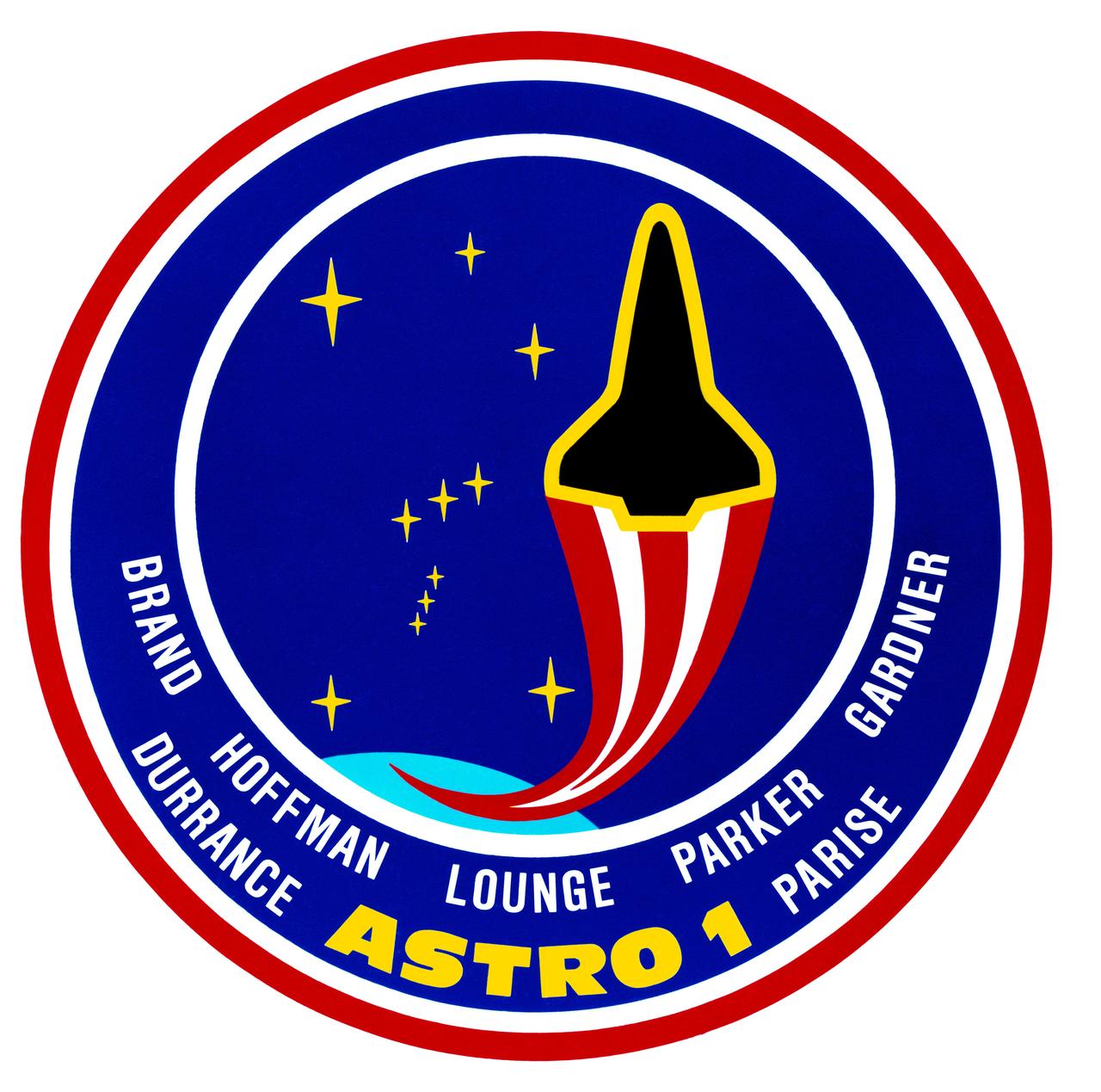
STS035-S-001 (29 Jan. 1990) --- Designed by the crew members assigned to the mission, the STS-35 crew patch symbolizes the space shuttle flying above Earth's atmosphere to better study the many celestial objects of the Universe, represented by the constellation Orion. The primary payload of STS-35 is ASTRO-l, a group of ultraviolet telescopes and the Broad-Band X-Ray Telescope. Crew members on the flight are astronauts Vance D. Brand, commander; Guy S. Gardner, pilot; and Jeffrey A. Hoffman, John M. (Mike) Lounge, Robert A. R. Parker, all mission specialists; along with the two payload specialists - Samuel T. Durrance and Ronald Parise. The NASA insignia design for space shuttle flights is reserved for use by the astronauts and for other official use as the NASA Administrator may authorize. Public availability has been approved only in the forms of illustrations by the various news media. When and if there is any change in this policy, which is not anticipated, the change will be publicly announced. Photo credit: NASA
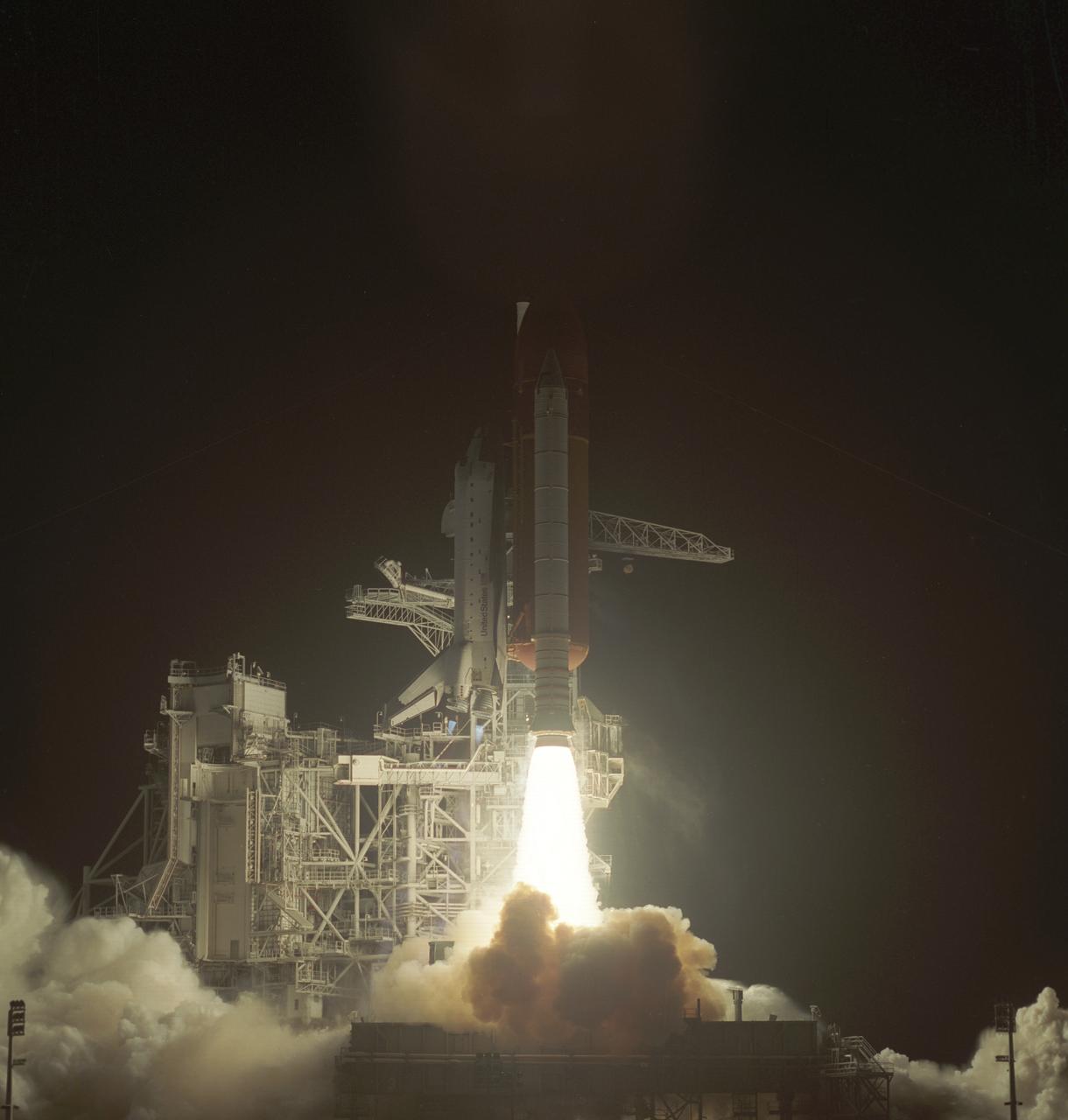
STS-35 lifted off December 2, 1990, at 1:19 am EST, aboard the Space Shuttle Orbiter Columbia. Her crew of eight included: Vance D. Brand, commander; Colonel Guy S. Gardner, pilot; mission specialists Dr. Robert A. R. Parker, John M. (Mike) Lounge, and Dr. Jeffery A. Hoffman; and payload specialists Dr. Kenneth H. Nordsieck, Dr. Samual T. Durrance, and Dr. Ronald A. Parise. The primary objective of the mission was round the clock observation of the celestial sphere in ultraviolet and X-Ray astronomy with the Astro-1 Observatory which consisted of four telescopes: the Hopkins Ultraviolet Telescope (HUT); the Wisconsin Ultraviolet Photo-Polarimeter Experiment (WUPPE); the Ultraviolet Imaging Telescope (UIT); and the Broad Band X-Ray Telescope (BBXRT). Due to loss of data used for pointing and operating the ultraviolet telescopes, Marshall Space Flight Center ground teams were forced to aim the telescopes with fine tuning by the flight crew.
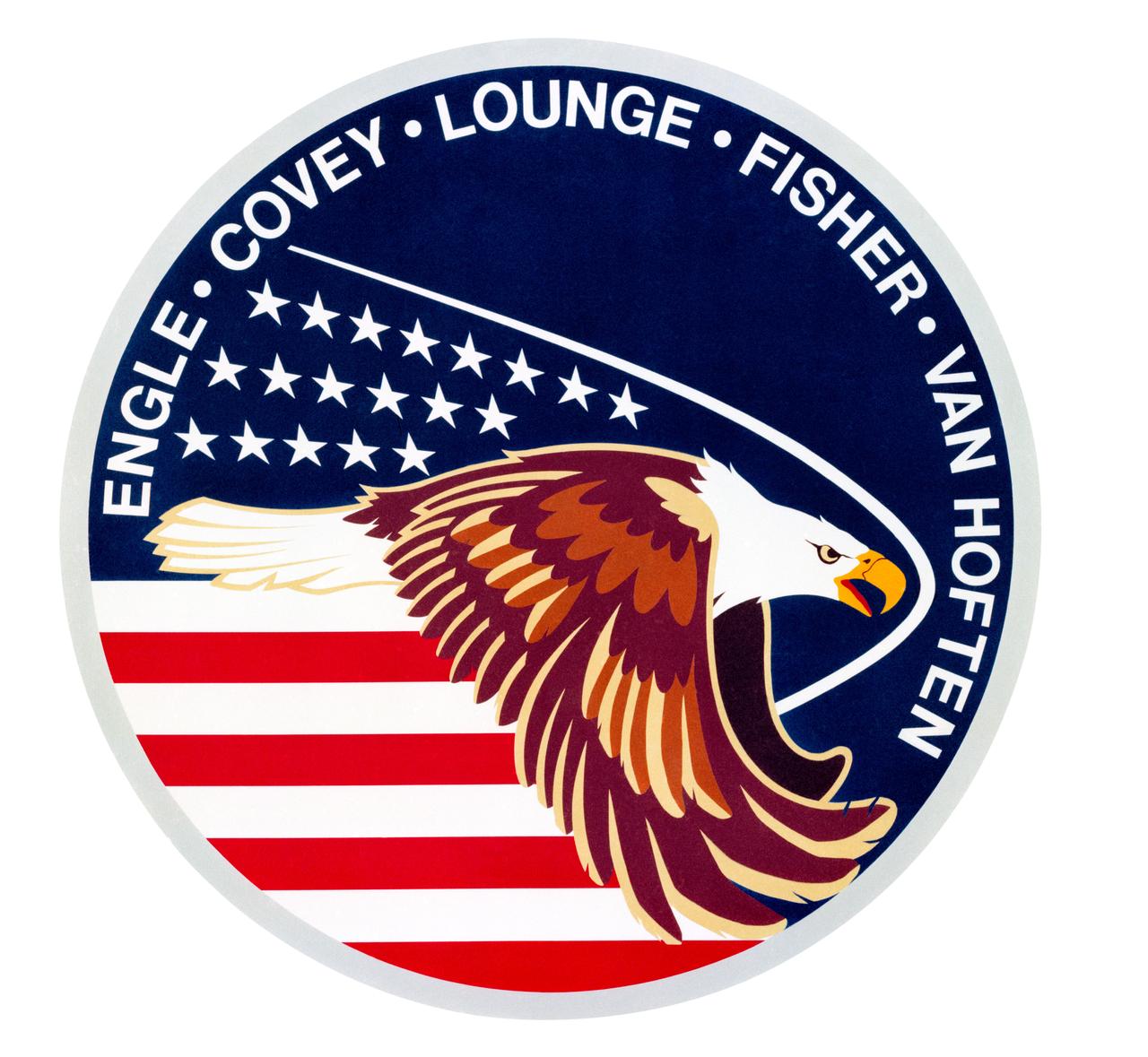
S85-25870 (August 1985) --- The crew emblem for STS-51I is based on a strong patriotic theme with the basic colors of red, white and blue suggesting the American flag and a dominant American bald eagle in aggressive flight. The 19 stars signify the numerical sequence of the flight. The shock wave represents that formed by the orbiter during the entry phase of the flight. Surnames of crew members surround the top part of the circular design. The five-member crew composed of astronauts Joe H. Engle, commander; Richard O. Covey, pilot; John Michael (Mike) Lounge, William F. Fisher and James D. van Hoften, all mission specialists. The NASA insignia design for space shuttle flights is reserved for use by the astronauts and for other official use as the NASA Administrator may authorize. Public availability has been approved only in the forms of illustrations by the various news media. When and if there is any change in this policy, which is not anticipated, the change will be publicly announced. Photo credit: NASA
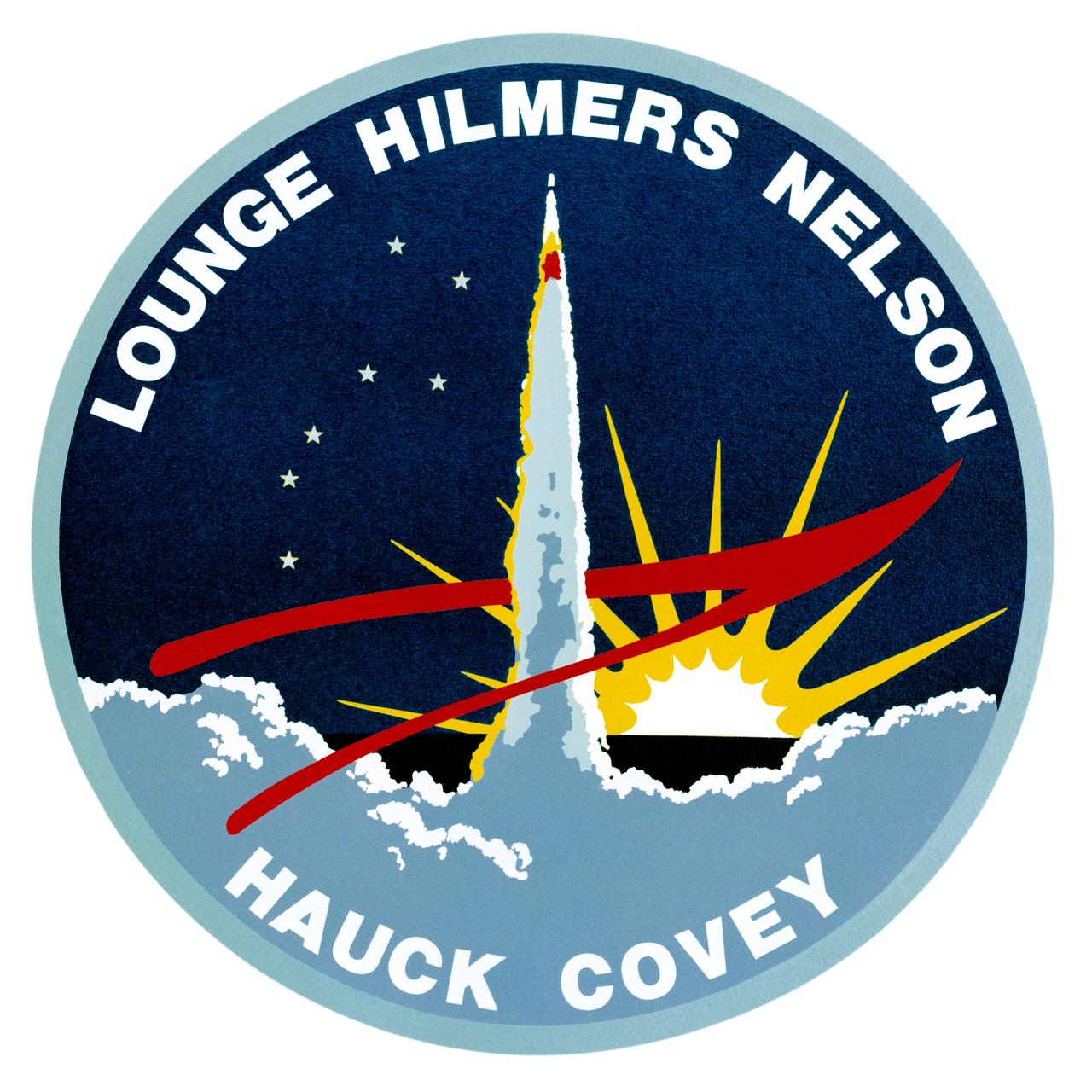
S87-39136 (4 Aug. 1987) --- This is the STS-26 crew patch. The predominant themes are: a new beginning (sunrise), a safe mission (stylized launch and plume), the building upon the traditional strengths of NASA (the red vector which symbolizes aeronautics on the original NASA insignia), and a remembrance of their seven colleagues who died aboard Challenger (the seven-starred Big Dipper). The patch was designed by artist Stephen R. Hustvedt of Annapolis, MD. STS-26 crew members are astronauts Frederick H. (Rick) Hauck, commander; Richard O. Covey, pilot; and George D. (Pinky) Nelson, John M. (Mike) Lounge and David C. Hilmers, mission specialists. The NASA insignia design for space shuttle flights is reserved for use by the astronauts and for other official use as the NASA Administrator may authorize. Public availability has been approved only in the forms of illustrations by the various news media. When and if there is any change in this policy, which is not anticipated, the change will be publicly announced. Photo credit: NASA
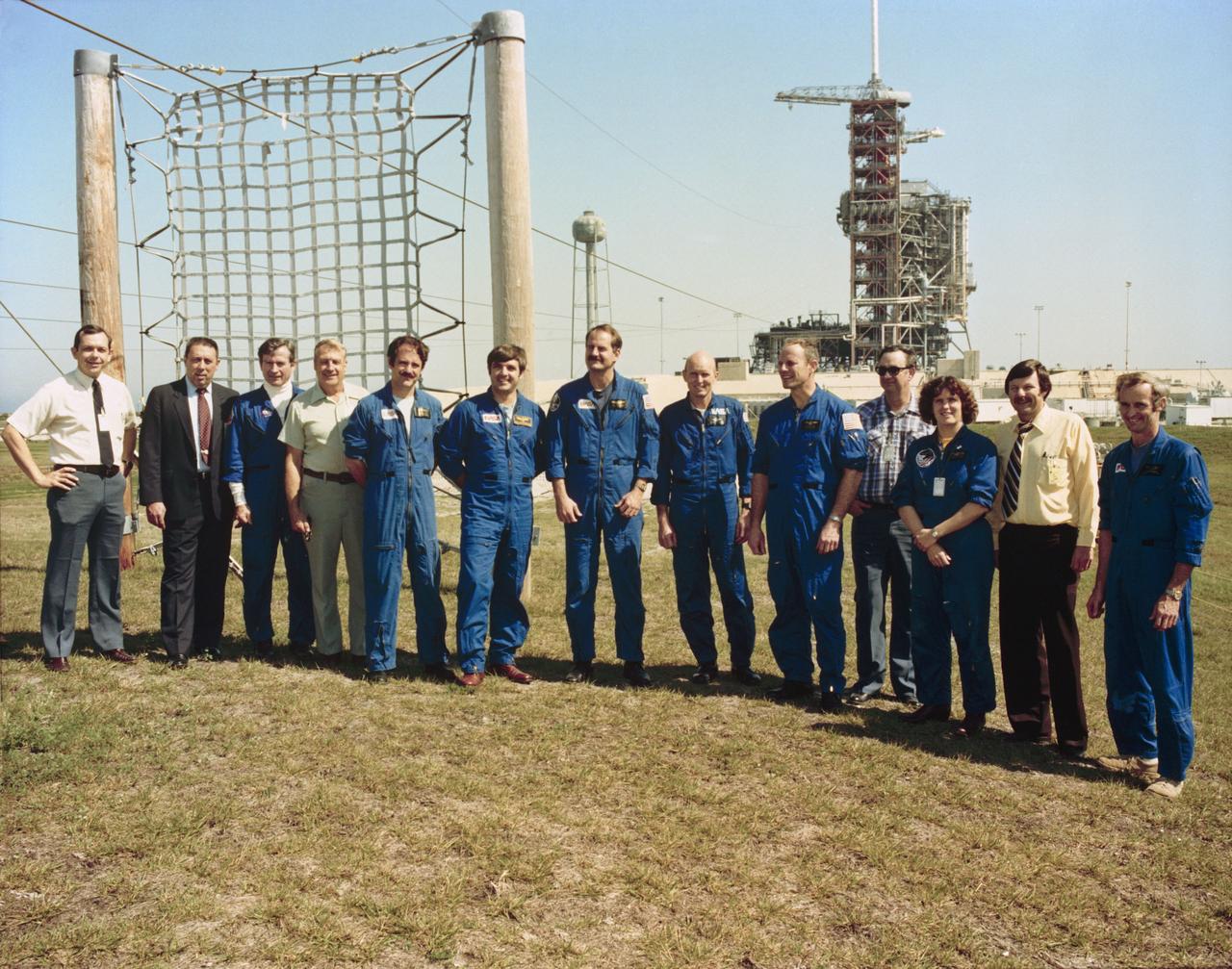
S82-28457 (19 Feb. 1982) --- Member of the JSC astronaut corps., STS-3 vehicle integration test (VIT) team and other personnel pose for a photograph at the completion of a countdown demonstration test (CDDT) and safety briefings at Launch Pad 39A, Kennedy Space Center (KSC). Participants are, from the left, Wilbur J. Etbauer, engineer with the VIT team; George W. S. Abbey, director of flight operations at JSC; astronaut John W. Young, chief of the astronaut office at JSC; Jack Fleming of Rockwell International; mission specialist-astronaut John M. Lounge; astronaut Daniel C. Brandenstein; mission specialist-astronaut James D. Van Hoften; astronauts C. Gordon Fullerton and Jack Lousma, prime crew for STS-3; Olan J. Bertrand, VIT team member; mission specialist-astronaut Kathryn D. Sullivan; Richard W. Nygren, head of the VIT team; and astronaut Donald E. Williams. The space shuttle Columbia is obscured by its service structure on Launch Pad 39A in the background. Part of slide-wire type emergency escape system is visible in the picture. Photo credit: NASA
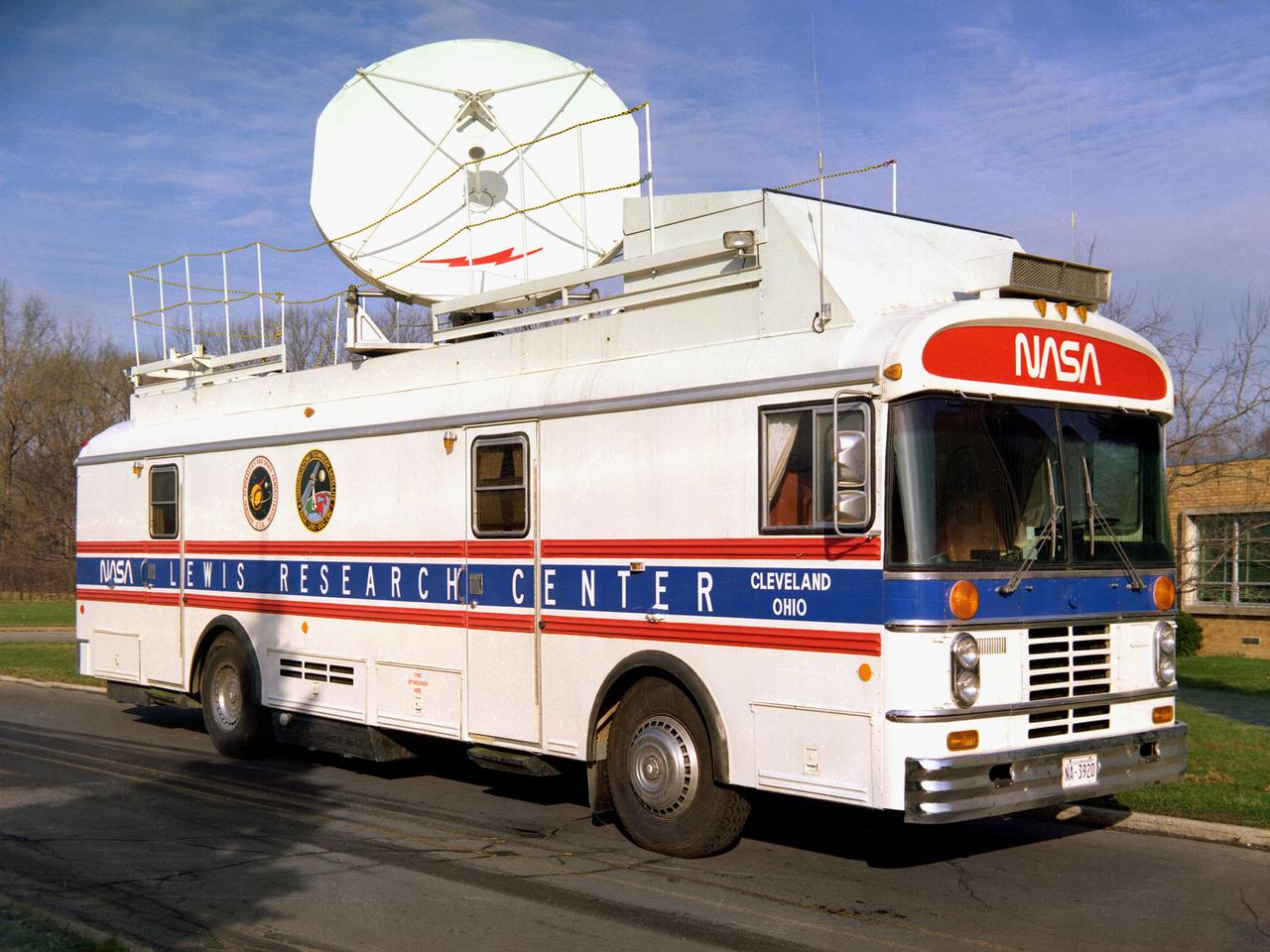
This vehicle served as a mobile terminal for the Communications Technology Satellite. The Communications Technology Satellite was an experimental communications satellite launched in January 1976 by the National Aeronautics and Space Administration (NASA) and the Canadian Department of Communications. The satellite operated in a new frequency band reserved for broadcast satellites with transmitting power levels that were 10 to 20 times higher than those of contemporary satellites. Throughout 1977 and 1978 NASA allowed qualified groups to utilize the satellite from one of the three ground-based transmission centers. NASA’s Lewis Research Center in Cleveland, Ohio was NASA’s lead center on the project. Lewis was responsible for the control and coordination of all US experiments on the satellite. The center housed the satellite’s main control center which included eight parabolic reflector antennae ranging from 2 to 15 feet in diameter. Many of the satellite’s components had been tested in simulated space conditions at Lewis. The Lewis-designed vehicle seen here served as a field unit for transmitting and receiving wideband signals and narrowband voice. The vehicle permitted live television interviews, recording equipment, and cameras. An 8-foot diameter parabolic reflector was mounted on the roof. The interior of the vehicle had workstations, monitors, transmitting equipment, and a lounge area.