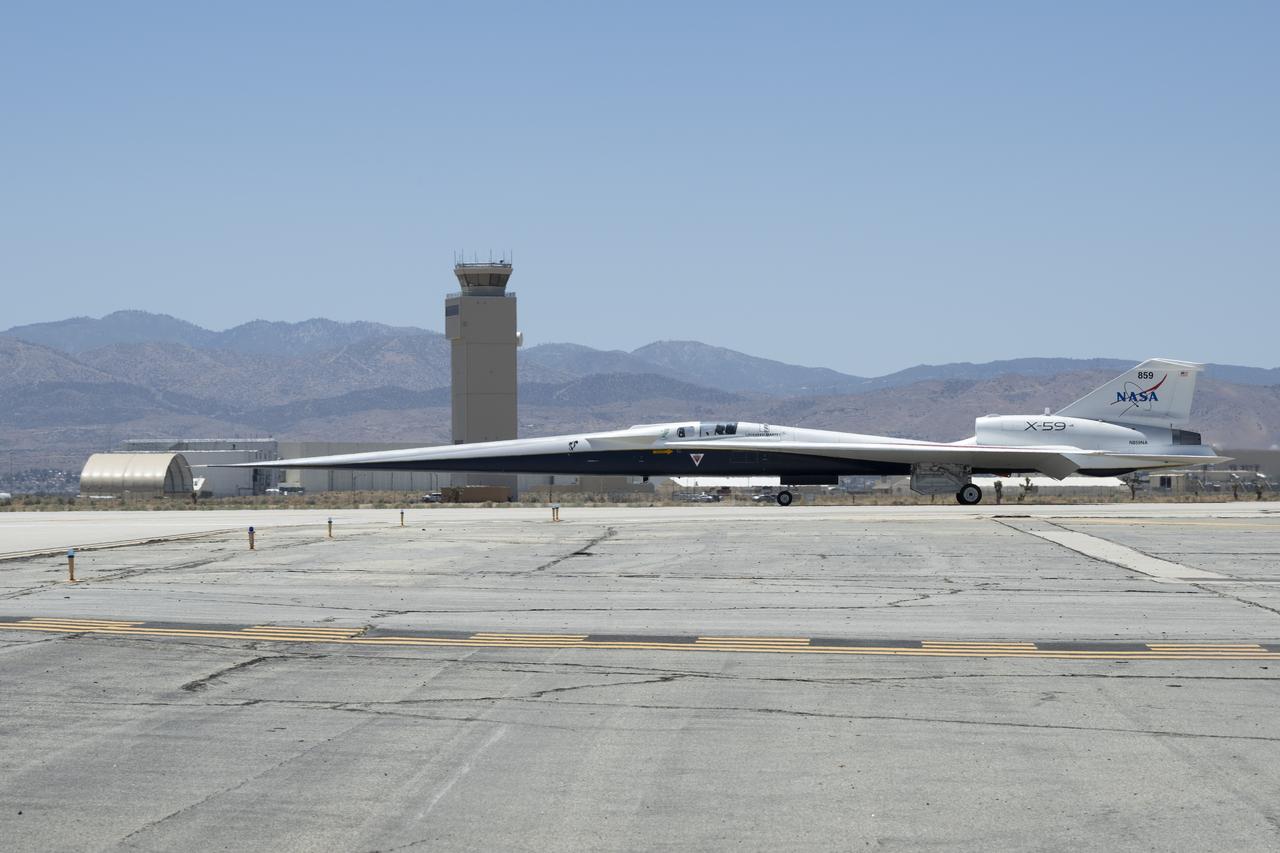
NASA’s X-59 quiet supersonic research aircraft taxis across the runway during a low-speed taxi test at U.S. Air Force Plant 42 in Palmdale, California, on July 10, 2025. The test marks the start of taxi tests and the last series of ground tests before first flight.
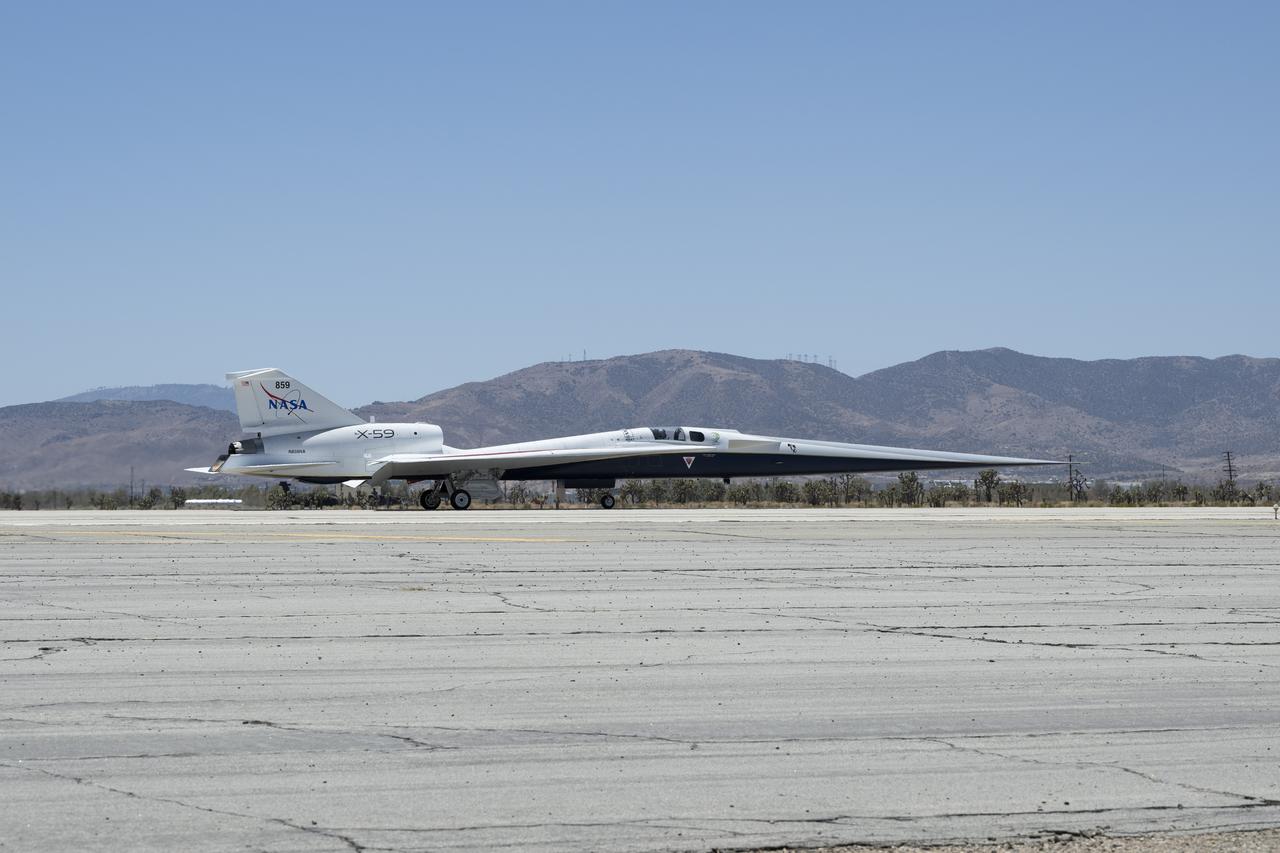
NASA’s X-59 quiet supersonic research aircraft taxis across the runway during a low-speed taxi test at U.S. Air Force Plant 42 in Palmdale, California, on July 10, 2025. The test marks the start of taxi tests and the last series of ground tests before first flight.
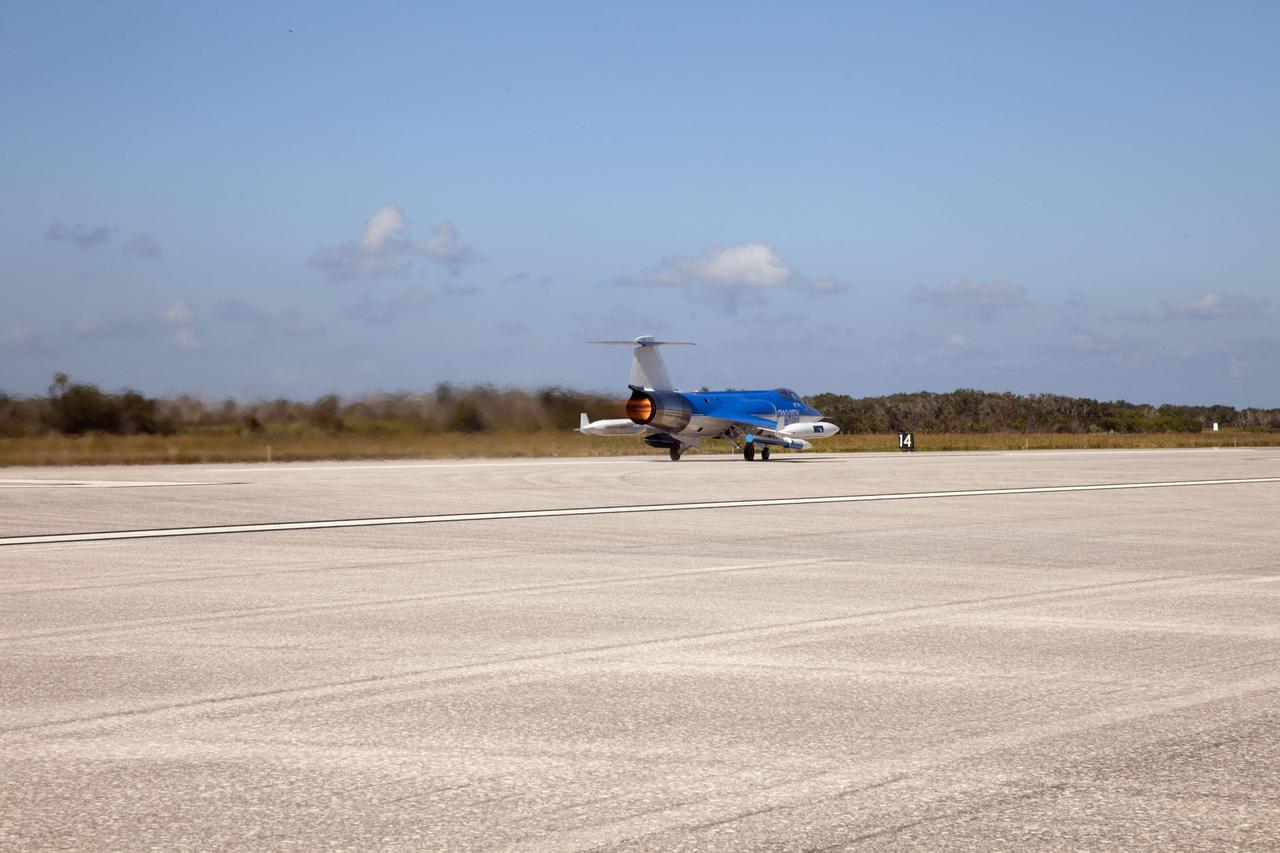
CAPE CANAVERAL, Fla. – On the runway at the Shuttle Landing Facility (SLF) at NASA’s Kennedy Space Center in Florida, a Starfighters, Inc. F-104 supersonic jet, piloted by Rick Svetkoff, picks up speed to conduct a high speed taxi test. The Star Lab suborbital launch vehicle developed by 4Frontiers Corporation is located on the right side of the jet. 4Frontiers is testing the Star Lab suborbital launch vehicle which has the potential to carry payloads into low earth orbit. Tests are being conducted to verify the aeronautical conditions of the Star Lab suborbital launch vehicle. This is the first of eight tests the launch vehicle will undergo. 4Frontiers Corporation is aiming for testing to be completed by early 2012, with commercial flights starting mid-2012. Starfighters, Inc. has signed a Space Act Agreement with NASA for the use of the SLF facilities at Kennedy Space Center. Photo credit: NASA_Gianni M. Woods
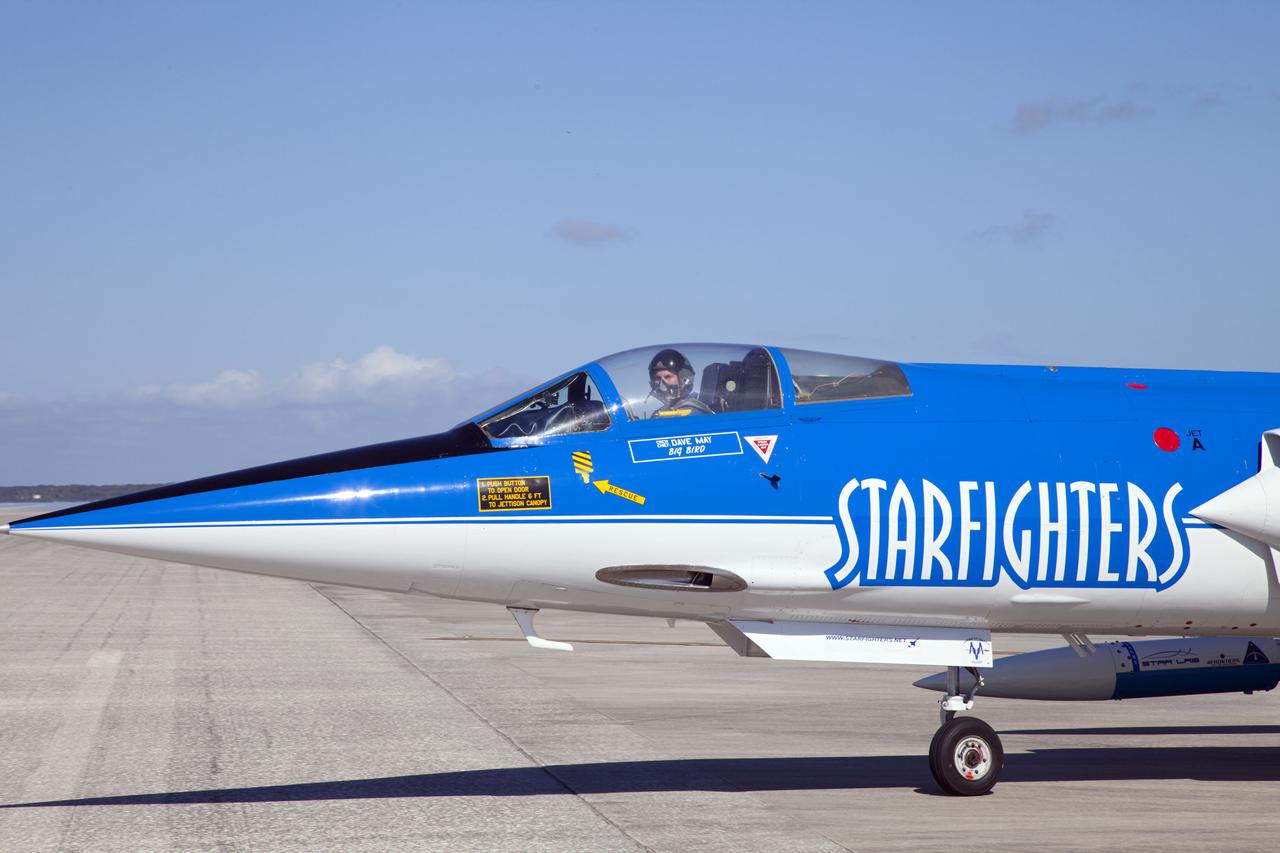
CAPE CANAVERAL, Fla. – Pilot Rick Svetkoff sits in the cockpit of a Starfighters, Inc. F-104 supersonic jet before conducting a high speed taxi test on the runway at the Shuttle Landing Facility (SLF) at NASA’s Kennedy Space Center in Florida. The Star Lab suborbital launch vehicle developed by 4Frontiers Corporation can be seen above the front wheel. 4Frontiers is testing the Star Lab suborbital launch vehicle which has the potential to carry payloads into low earth orbit. Tests are being conducted to verify the aeronautical conditions of the Star Lab suborbital launch vehicle. This is the first of eight tests the launch vehicle will undergo. 4Frontiers Corporation is aiming for testing to be completed by early 2012, with commercial flights starting mid-2012. Starfighters, Inc. has signed a Space Act Agreement with NASA for the use of the SLF facilities at Kennedy Space Center. Photo credit: NASA_Gianni M. Woods
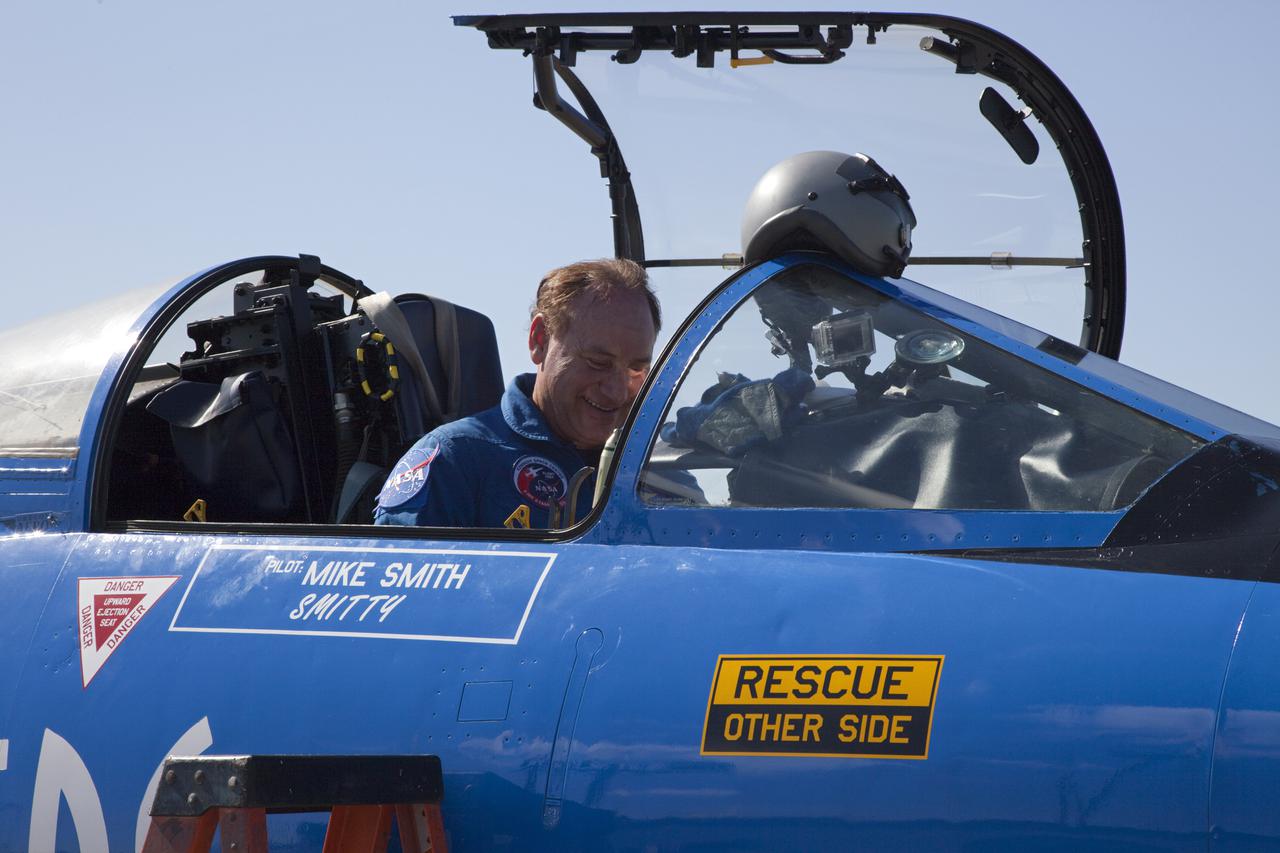
CAPE CANAVERAL, Fla. – Pilot Rick Svetkoff sits in the cockpit of a Starfighters, Inc. F-104 supersonic jet after conducting a high speed taxi test on the runway at the Shuttle Landing Facility (SLF) at NASA’s Kennedy Space Center in Florida. The Star Lab suborbital launch vehicle developed by 4Frontiers Corporation is attached to the right side of the jet. 4Frontiers is testing the Star Lab suborbital launch vehicle which has the potential to carry payloads into low earth orbit. Tests are being conducted to verify the aeronautical conditions of the Star Lab suborbital launch vehicle. This is the first of eight tests the launch vehicle will undergo. 4Frontiers Corporation is aiming for testing to be completed by early 2012, with commercial flights starting mid-2012. Starfighters, Inc. has signed a Space Act Agreement with NASA for the use of the SLF facilities at Kennedy Space Center. Photo credit: NASA_Gianni M. Woods
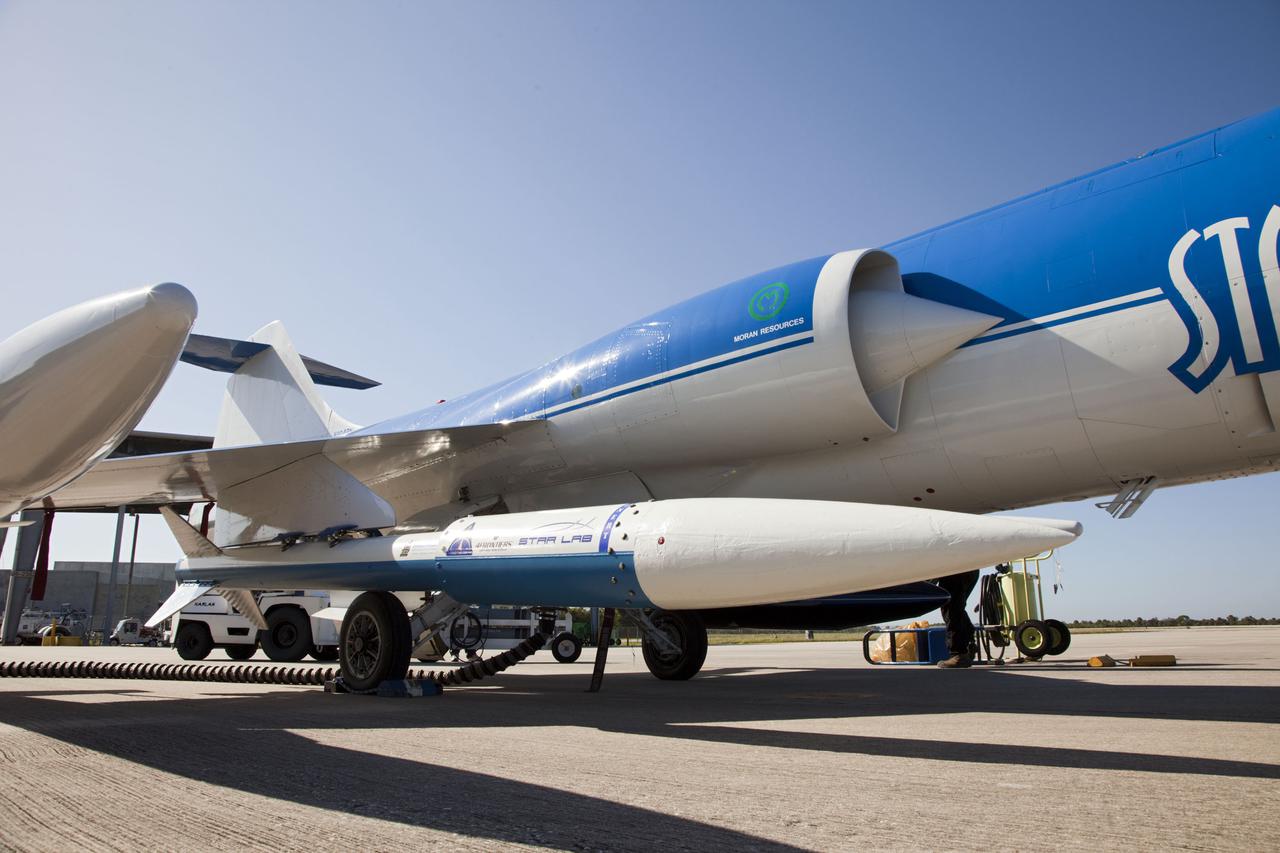
CAPE CANAVERAL, Fla. – A Starfighters, Inc. F-104 supersonic jet is being fueled before conducting a high speed taxi test at the Shuttle Landing Facility (SLF) at NASA’s Kennedy Space Center in Florida. On the right side of the jet is the Star Lab suborbital launch vehicle developed by 4Frontiers Corporation. 4Frontiers is testing the Star Lab suborbital launch vehicle which has the potential to carry payloads into low earth orbit. Tests are being conducted to verify the aeronautical conditions of the Star Lab suborbital launch vehicle. This is the first of eight tests the launch vehicle will undergo. 4Frontiers Corporation is aiming for testing to be completed by early 2012, with commercial flights starting mid-2012. Starfighters, Inc. has signed a Space Act Agreement with NASA for the use of the SLF facilities at Kennedy Space Center. Photo credit: NASA_Gianni M. Woods
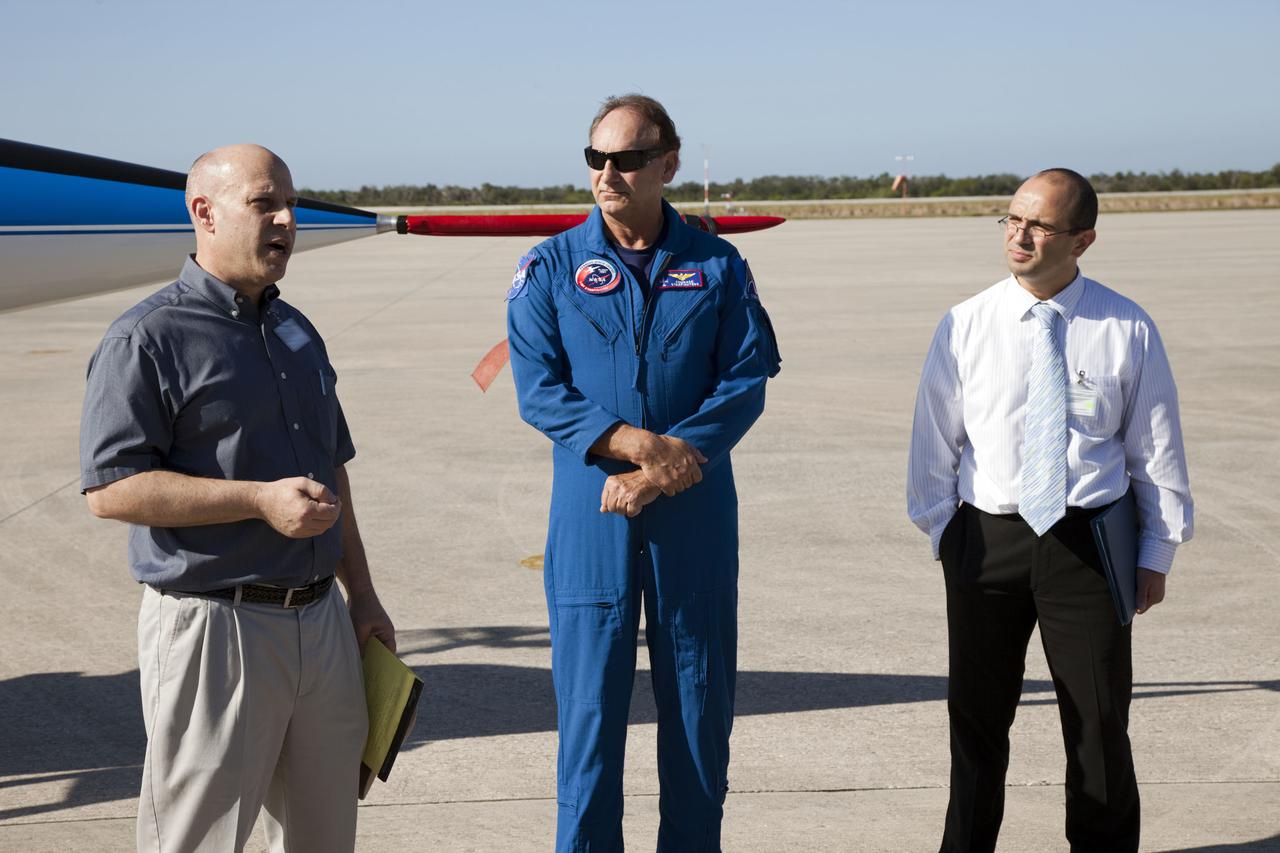
CAPE CANAVERAL, Fla. – Before a high speed taxi test using a Starfighters, Inc. F-104, from left, Mark Homnick, CEO of 4Frontiers Corporation, Rick Svetkoff, Starfighters, Inc. president and pilot, and Panayot Slavov, business development manager for 4Frontiers Corporation, address guests at the Shuttle Landing Facility (SLF) at NASA’s Kennedy Space Center in Florida. 4Frontiers is testing the Star Lab suborbital launch vehicle which has the potential to carry payloads into low earth orbit. Tests are being conducted to verify the aeronautical conditions of the Star Lab suborbital launch vehicle. This is the first of eight tests the launch vehicle will undergo. 4Frontiers Corporation is aiming for testing to be completed by early 2012, with commercial flights starting mid-2012. Starfighters, Inc. has signed a Space Act Agreement with NASA for the use of the SLF facilities at Kennedy Space Center. Photo credit: NASA_Gianni M. Woods
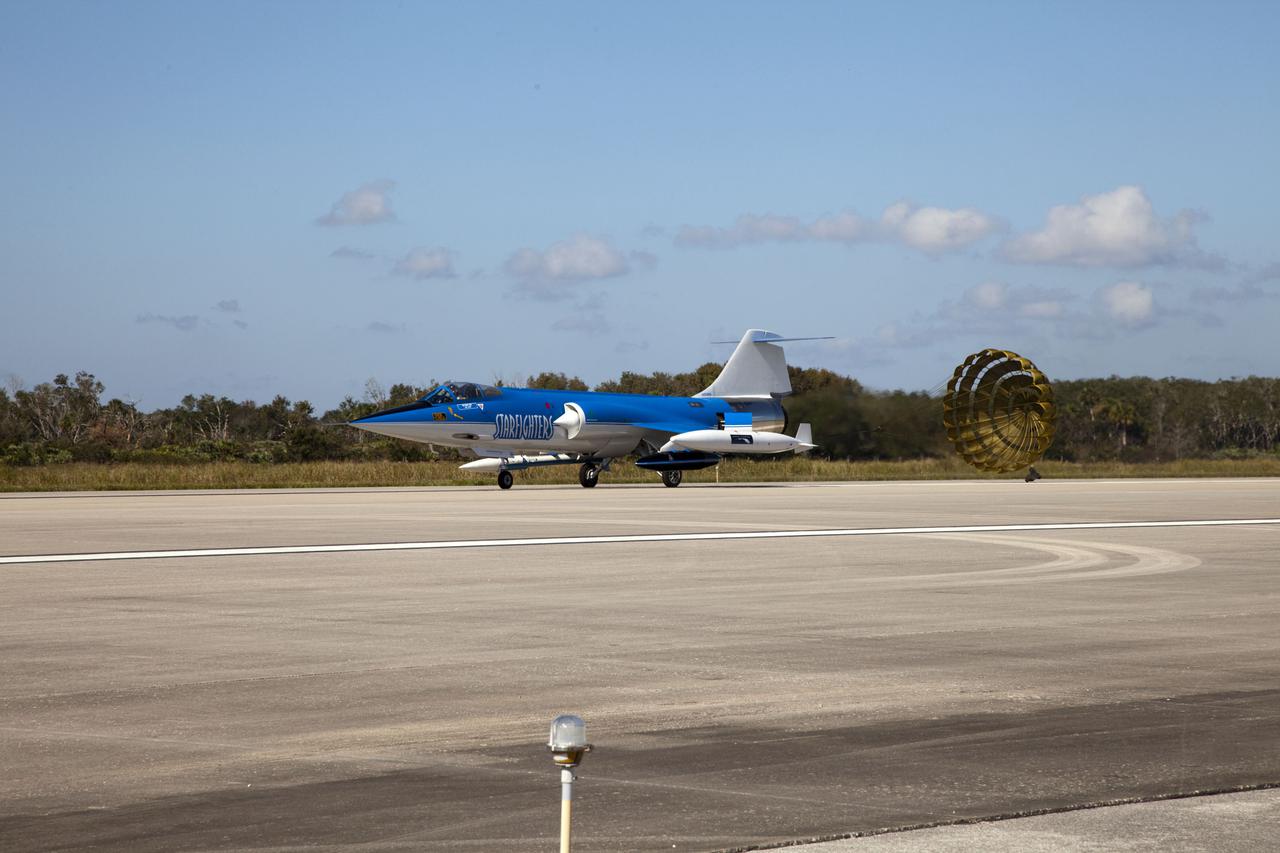
CAPE CANAVERAL, Fla. – On the runway at the Shuttle Landing Facility (SLF) at NASA’s Kennedy Space Center in Florida, the parachute on a Starfighters, Inc. F-104 supersonic jet, piloted by Rick Svetkoff, deploys after conducting a high speed taxi test. The Star Lab suborbital launch vehicle developed by 4Frontiers Corporation can be seen just above the front wheel. 4Frontiers is testing the Star Lab suborbital launch vehicle which has the potential to carry payloads into low earth orbit. Tests are being conducted to verify the aeronautical conditions of the Star Lab suborbital launch vehicle. This is the first of eight tests the launch vehicle will undergo. 4Frontiers Corporation is aiming for testing to be completed by early 2012, with commercial flights starting mid-2012. Starfighters, Inc. has signed a Space Act Agreement with NASA for the use of the SLF facilities at Kennedy Space Center. Photo credit: NASA_Gianni M. Woods
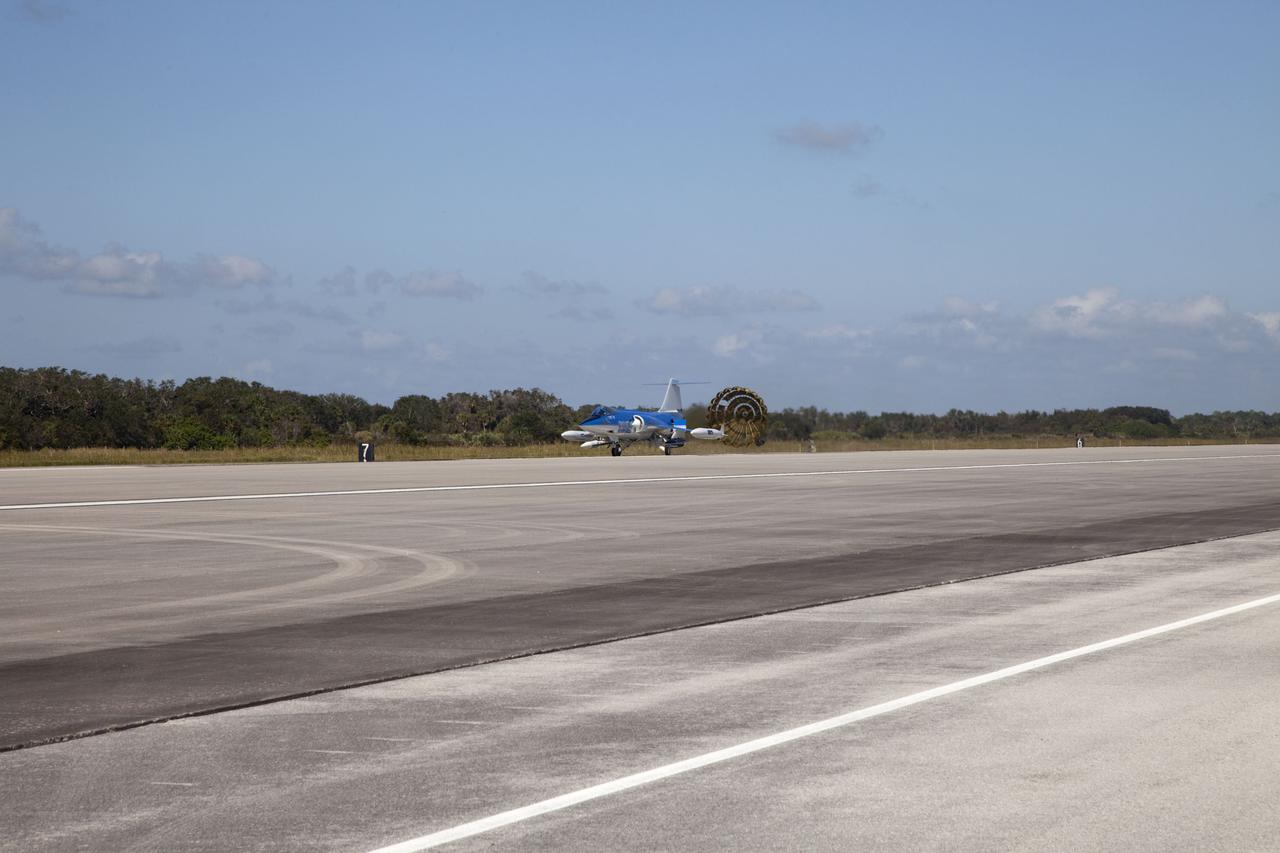
CAPE CANAVERAL, Fla. – On the runway at the Shuttle Landing Facility (SLF) at NASA’s Kennedy Space Center in Florida, the parachute on a Starfighters, Inc. F-104 supersonic jet, piloted by Rick Svetkoff, deploys after conducting a high speed taxi test. Hidden from the camera on the right side of the jet is the Star Lab suborbital launch vehicle developed by 4Frontiers Corporation. 4Frontiers is testing the Star Lab suborbital launch vehicle which has the potential to carry payloads into low earth orbit. Tests are being conducted to verify the aeronautical conditions of the Star Lab suborbital launch vehicle. This is the first of eight tests the launch vehicle will undergo. 4Frontiers Corporation is aiming for testing to be completed by early 2012, with commercial flights starting mid-2012. Starfighters, Inc. has signed a Space Act Agreement with NASA for the use of the SLF facilities at Kennedy Space Center. Photo credit: NASA_Gianni M. Woods
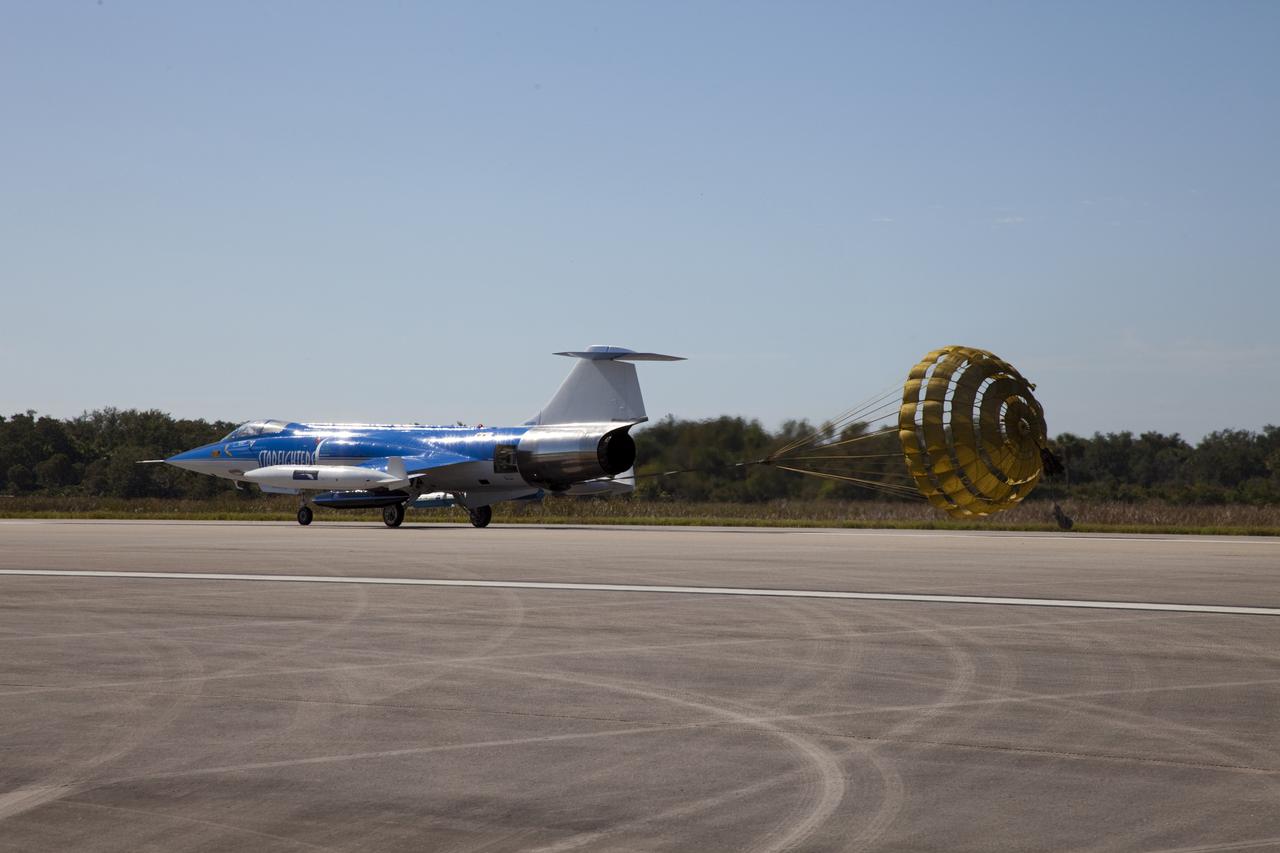
CAPE CANAVERAL, Fla. – On the runway at the Shuttle Landing Facility (SLF) at NASA’s Kennedy Space Center in Florida, the parachute on a Starfighters, Inc. F-104 supersonic jet, piloted by Rick Svetkoff, deploys after conducting a high speed taxi test. Hidden from the camera on the right side of the jet is the Star Lab suborbital launch vehicle developed by 4Frontiers Corporation. 4Frontiers is testing the Star Lab suborbital launch vehicle which has the potential to carry payloads into low earth orbit. Tests are being conducted to verify the aeronautical conditions of the Star Lab suborbital launch vehicle. This is the first of eight tests the launch vehicle will undergo. 4Frontiers Corporation is aiming for testing to be completed by early 2012, with commercial flights starting mid-2012. Starfighters, Inc. has signed a Space Act Agreement with NASA for the use of the SLF facilities at Kennedy Space Center. Photo credit: NASA_Gianni M. Woods
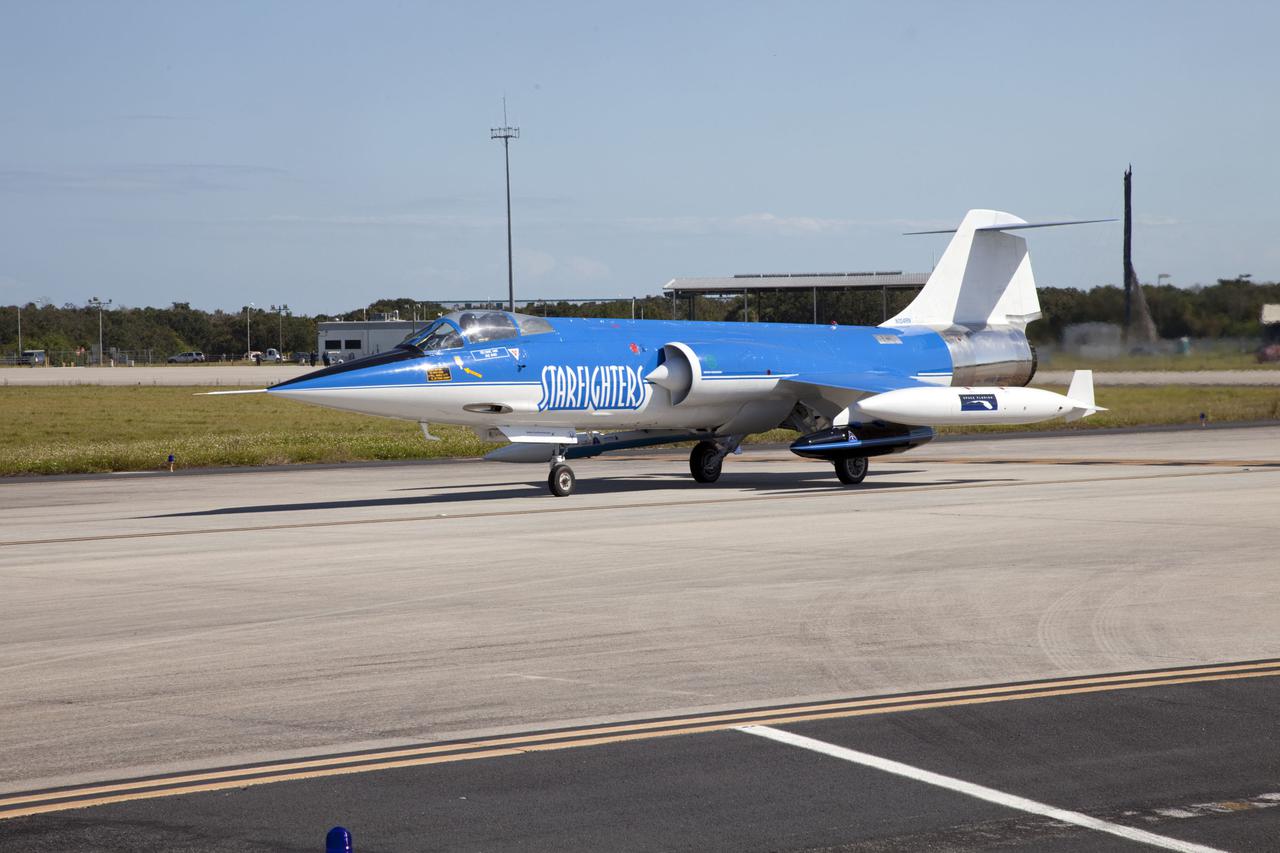
CAPE CANAVERAL, Fla. – Pilot Rick Svetkoff sits in the cockpit of a Starfighters, Inc. F-104 supersonic jet before conducting a high speed taxi test at the Shuttle Landing Facility (SLF) at NASA’s Kennedy Space Center in Florida. Hidden from the camera on the right side of the jet is the Star Lab suborbital launch vehicle developed by 4Frontiers Corporation. 4Frontiers is testing the Star Lab suborbital launch vehicle which has the potential to carry payloads into low earth orbit. Tests are being conducted to verify the aeronautical conditions of the Star Lab suborbital launch vehicle. This is the first of eight tests the launch vehicle will undergo. 4Frontiers Corporation is aiming for testing to be completed by early 2012, with commercial flights starting mid-2012. Starfighters, Inc. has signed a Space Act Agreement with NASA for the use of the SLF facilities at Kennedy Space Center. Photo credit: NASA_Gianni M. Woods

NASA’s X-59 quiet supersonic research aircraft moves under its own power for the first time at Lockheed Martin’s Skunk Works facility in Palmdale, California, on July 10, 2025. Guided by the aircraft’s crew chief, the event marks the beginning of taxi tests – a key milestone and the final series of ground tests before first flight.
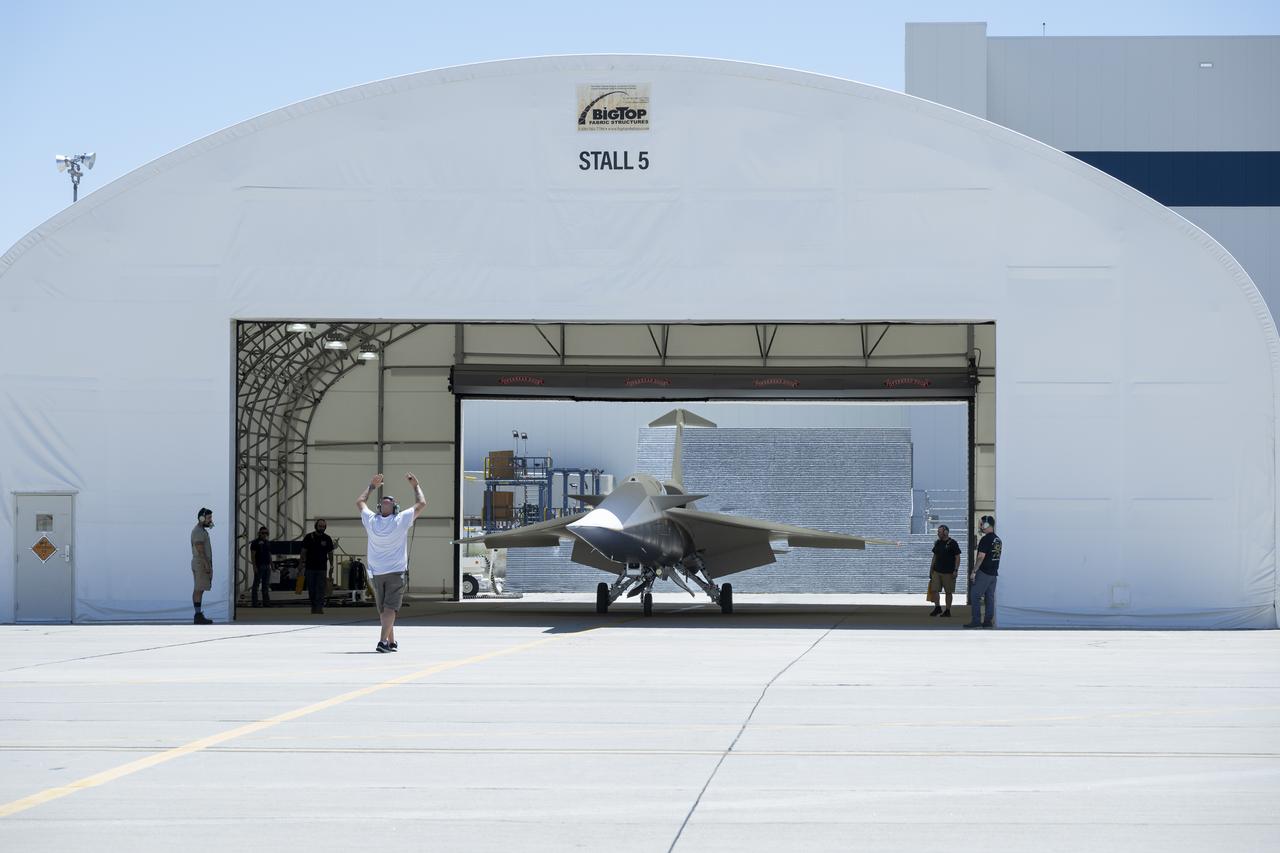
NASA’s X-59 quiet supersonic research aircraft moves under its own power for the first time at Lockheed Martin’s Skunk Works facility in Palmdale, California, on July 10, 2025. Guided by the aircraft’s crew chief, the event marks the beginning of taxi tests – a key milestone and the final series of ground tests before first flight.
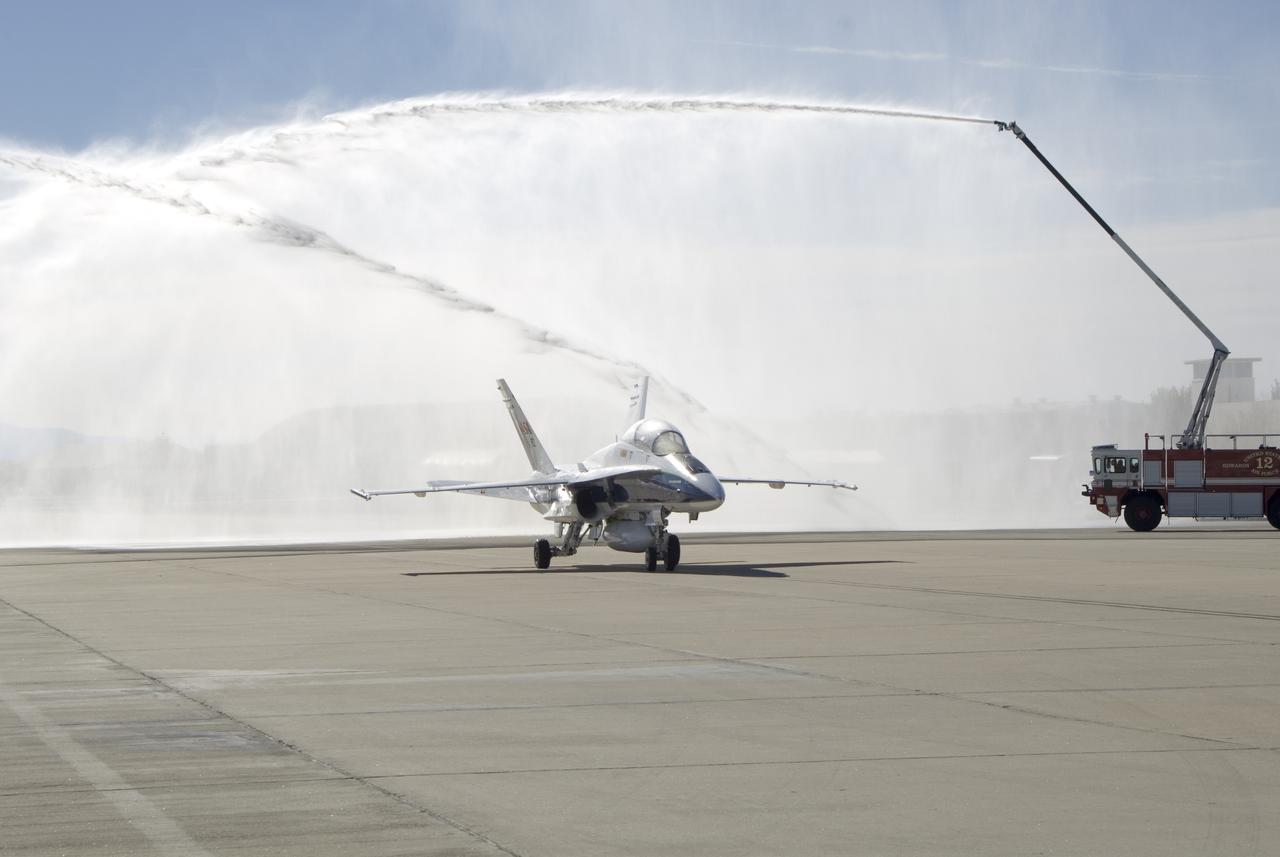
Long-time NASA Dryden research pilot and former astronaut C. Gordon Fullerton capped an almost 50-year flying career, including more than 38 years with NASA, with a final flight in a NASA F/A-18 on Dec. 21, 2007. Fullerton and Dryden research pilot Jim Smolka flew a 90-minute pilot proficiency formation aerobatics flight with another Dryden F/A-18 and a Dryden T-38 before concluding with two low-level formation flyovers of Dryden before landing. Fullerton was honored with a water-cannon spray arch provided by two fire trucks from the Edwards Air Force Base fire department as he taxied the F/A-18 up to the Dryden ramp, and was then greeted by his wife Marie and several hundred Dryden staff after his final flight. Fullerton began his flying career with the U.S. Air Force in 1958 after earning bachelor's and master's degrees in mechanical engineering from the California Institute of Technology. Initially trained as a fighter pilot, he later transitioned to multi-engine bombers and became a bomber operations test pilot after attending the Air Force Aerospace Research Pilot School at Edwards Air Force Base, Calif. He then was assigned to the flight crew for the planned Air Force Manned Orbital Laboratory in 1966. Upon cancellation of that program, the Air Force assigned Fullerton to NASA's astronaut corps in 1969. He served on the support crews for the Apollo 14, 15, 16 and 17 lunar missions, and was later assigned to one of the two flight crews that piloted the space shuttle prototype Enterprise during the Approach and Landing Test program at Dryden. He then logged some 382 hours in space when he flew on two early space shuttle missions, STS-3 on Columbia in 1982 and STS-51F on Challenger in 1985. He joined the flight crew branch at NASA Dryden after leaving the astronaut corps in 1986. During his 21 years at Dryden, Fullerton was project pilot on a number of high-profile research efforts, including the Propulsion Controlled Aircraft, the high-speed landing tests of
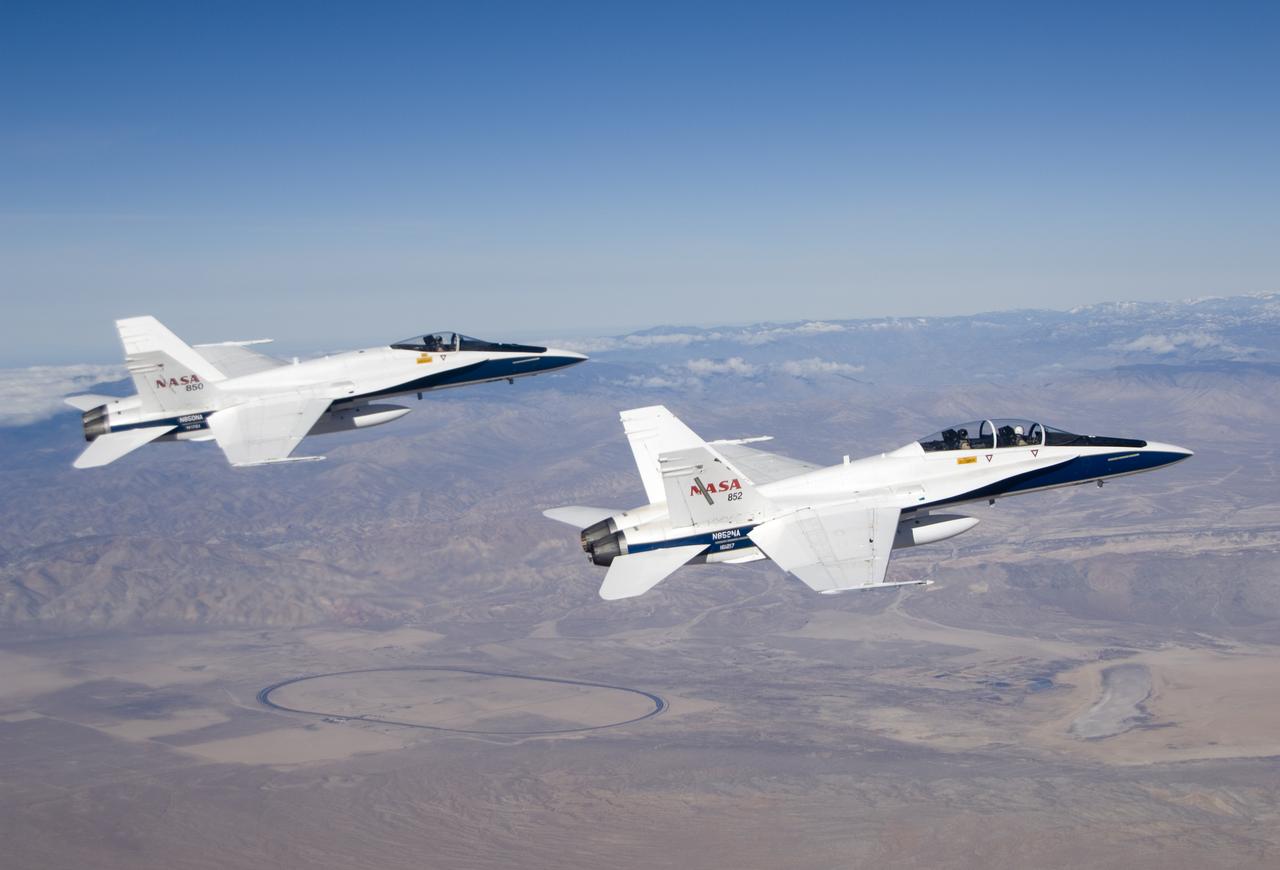
Long-time NASA Dryden research pilot and former astronaut C. Gordon Fullerton capped an almost 50-year flying career, including more than 38 years with NASA, with a final flight in a NASA F/A-18 on Dec. 21, 2007. Fullerton and Dryden research pilot Jim Smolka flew a 90-minute pilot proficiency formation aerobatics flight with another Dryden F/A-18 and a Dryden T-38 before concluding with two low-level formation flyovers of Dryden before landing. Fullerton was honored with a water-cannon spray arch provided by two fire trucks from the Edwards Air Force Base fire department as he taxied the F/A-18 up to the Dryden ramp, and was then greeted by his wife Marie and several hundred Dryden staff after his final flight. Fullerton began his flying career with the U.S. Air Force in 1958 after earning bachelor's and master's degrees in mechanical engineering from the California Institute of Technology. Initially trained as a fighter pilot, he later transitioned to multi-engine bombers and became a bomber operations test pilot after attending the Air Force Aerospace Research Pilot School at Edwards Air Force Base, Calif. He then was assigned to the flight crew for the planned Air Force Manned Orbital Laboratory in 1966. Upon cancellation of that program, the Air Force assigned Fullerton to NASA's astronaut corps in 1969. He served on the support crews for the Apollo 14, 15, 16 and 17 lunar missions, and was later assigned to one of the two flight crews that piloted the space shuttle prototype Enterprise during the Approach and Landing Test program at Dryden. He then logged some 382 hours in space when he flew on two early space shuttle missions, STS-3 on Columbia in 1982 and STS-51F on Challenger in 1985. He joined the flight crew branch at NASA Dryden after leaving the astronaut corps in 1986. During his 21 years at Dryden, Fullerton was project pilot on a number of high-profile research efforts, including the Propulsion Controlled Aircraft, the high-speed landing tests of sp
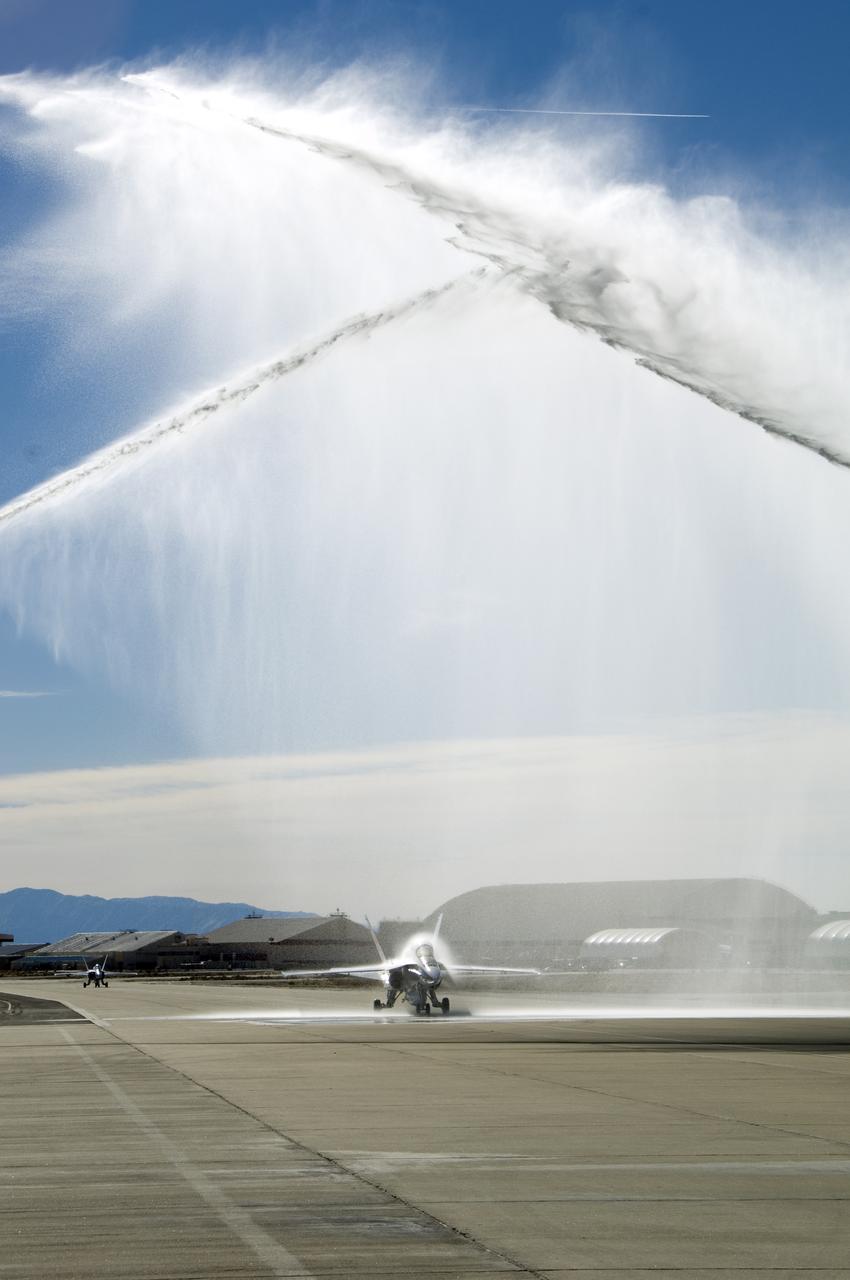
Long-time NASA Dryden research pilot and former astronaut C. Gordon Fullerton capped an almost 50-year flying career, including more than 38 years with NASA, with a final flight in a NASA F/A-18 on Dec. 21, 2007. Fullerton and Dryden research pilot Jim Smolka flew a 90-minute pilot proficiency formation aerobatics flight with another Dryden F/A-18 and a Dryden T-38 before concluding with two low-level formation flyovers of Dryden before landing. Fullerton was honored with a water-cannon spray arch provided by two fire trucks from the Edwards Air Force Base fire department as he taxied the F/A-18 up to the Dryden ramp, and was then greeted by his wife Marie and several hundred Dryden staff after his final flight. Fullerton began his flying career with the U.S. Air Force in 1958 after earning bachelor's and master's degrees in mechanical engineering from the California Institute of Technology. Initially trained as a fighter pilot, he later transitioned to multi-engine bombers and became a bomber operations test pilot after attending the Air Force Aerospace Research Pilot School at Edwards Air Force Base, Calif. He then was assigned to the flight crew for the planned Air Force Manned Orbital Laboratory in 1966. Upon cancellation of that program, the Air Force assigned Fullerton to NASA's astronaut corps in 1969. He served on the support crews for the Apollo 14, 15, 16 and 17 lunar missions, and was later assigned to one of the two flight crews that piloted the space shuttle prototype Enterprise during the Approach and Landing Test program at Dryden. He then logged some 382 hours in space when he flew on two early space shuttle missions, STS-3 on Columbia in 1982 and STS-51F on Challenger in 1985. He joined the flight crew branch at NASA Dryden after leaving the astronaut corps in 1986. During his 21 years at Dryden, Fullerton was project pilot on a number of high-profile research efforts, including the Propulsion Controlled Aircraft, the high-speed landing tests of
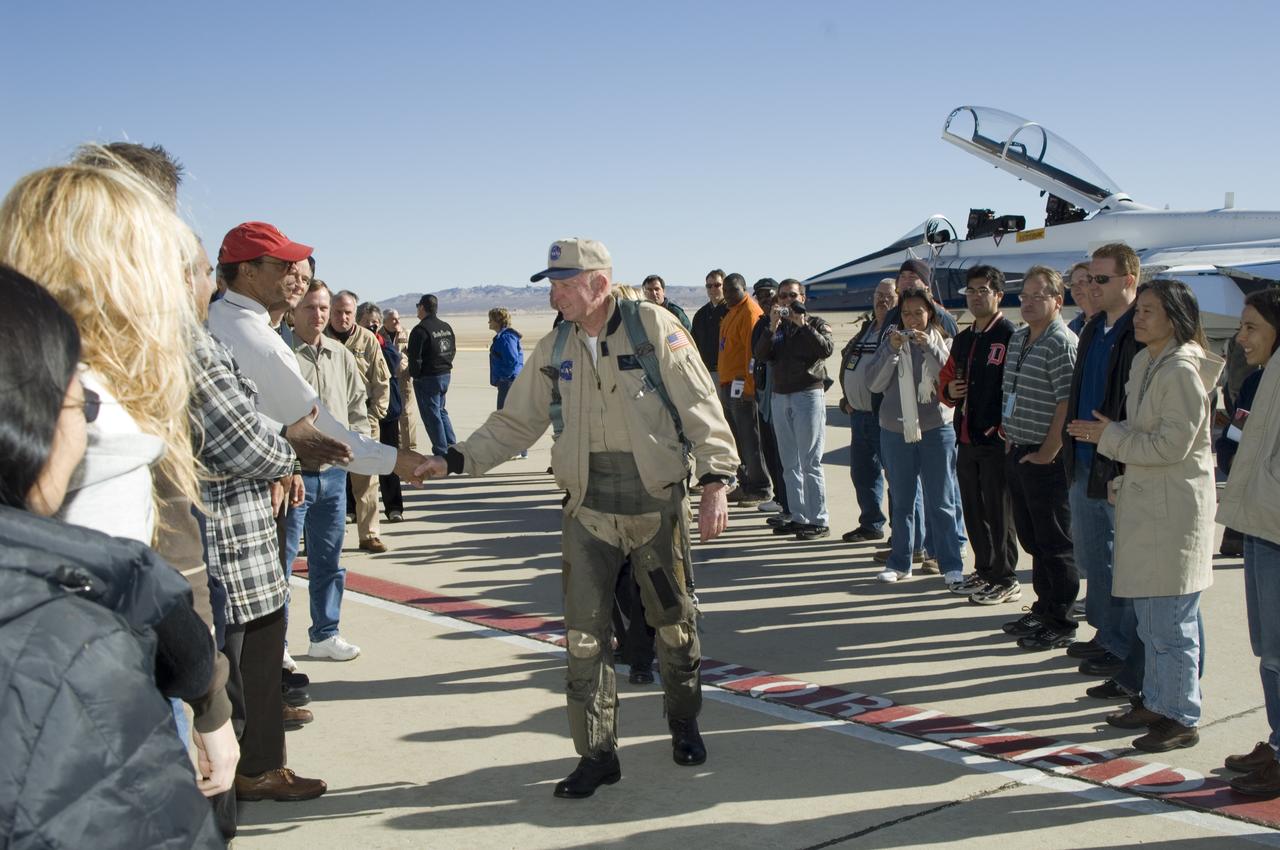
Long-time NASA Dryden research pilot and former astronaut C. Gordon Fullerton capped an almost 50-year flying career, including more than 38 years with NASA, with a final flight in a NASA F/A-18 on Dec. 21, 2007. Fullerton and Dryden research pilot Jim Smolka flew a 90-minute pilot proficiency formation aerobatics flight with another Dryden F/A-18 and a Dryden T-38 before concluding with two low-level formation flyovers of Dryden before landing. Fullerton was honored with a water-cannon spray arch provided by two fire trucks from the Edwards Air Force Base fire department as he taxied the F/A-18 up to the Dryden ramp, and was then greeted by his wife Marie and several hundred Dryden staff after his final flight. Fullerton began his flying career with the U.S. Air Force in 1958 after earning bachelor's and master's degrees in mechanical engineering from the California Institute of Technology. Initially trained as a fighter pilot, he later transitioned to multi-engine bombers and became a bomber operations test pilot after attending the Air Force Aerospace Research Pilot School at Edwards Air Force Base, Calif. He then was assigned to the flight crew for the planned Air Force Manned Orbital Laboratory in 1966. Upon cancellation of that program, the Air Force assigned Fullerton to NASA's astronaut corps in 1969. He served on the support crews for the Apollo 14, 15, 16 and 17 lunar missions, and was later assigned to one of the two flight crews that piloted the space shuttle prototype Enterprise during the Approach and Landing Test program at Dryden. He then logged some 382 hours in space when he flew on two early space shuttle missions, STS-3 on Columbia in 1982 and STS-51F on Challenger in 1985. He joined the flight crew branch at NASA Dryden after leaving the astronaut corps in 1986. During his 21 years at Dryden, Fullerton was project pilot on a number of high-profile research efforts, including the Propulsion Controlled Aircraft, the high-speed landing tests of
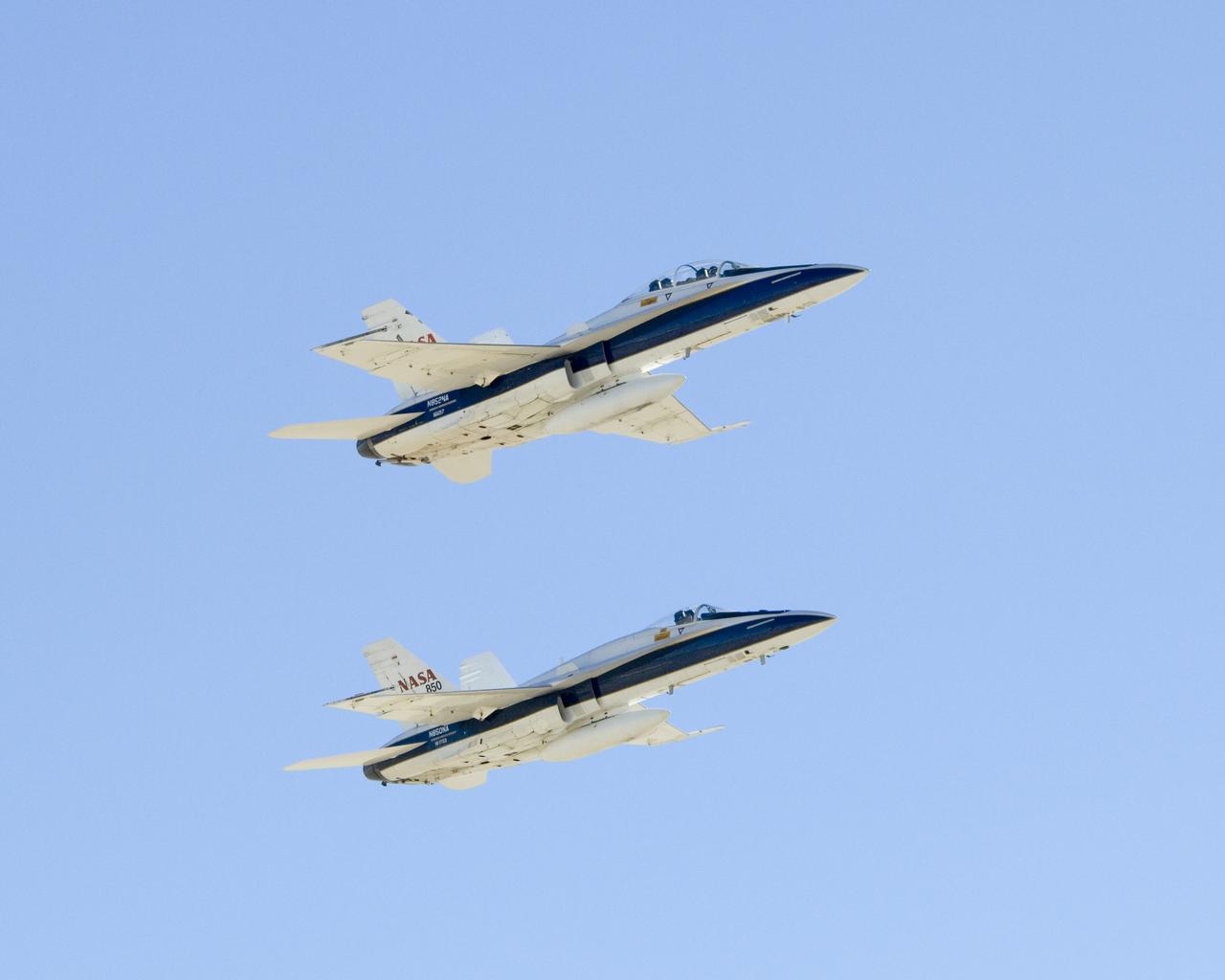
Long-time NASA Dryden research pilot and former astronaut C. Gordon Fullerton capped an almost 50-year flying career, including more than 38 years with NASA, with a final flight in a NASA F/A-18 on Dec. 21, 2007. Fullerton and Dryden research pilot Jim Smolka flew a 90-minute pilot proficiency formation aerobatics flight with another Dryden F/A-18 and a Dryden T-38 before concluding with two low-level formation flyovers of Dryden before landing. Fullerton was honored with a water-cannon spray arch provided by two fire trucks from the Edwards Air Force Base fire department as he taxied the F/A-18 up to the Dryden ramp, and was then greeted by his wife Marie and several hundred Dryden staff after his final flight. Fullerton began his flying career with the U.S. Air Force in 1958 after earning bachelor's and master's degrees in mechanical engineering from the California Institute of Technology. Initially trained as a fighter pilot, he later transitioned to multi-engine bombers and became a bomber operations test pilot after attending the Air Force Aerospace Research Pilot School at Edwards Air Force Base, Calif. He then was assigned to the flight crew for the planned Air Force Manned Orbital Laboratory in 1966. Upon cancellation of that program, the Air Force assigned Fullerton to NASA's astronaut corps in 1969. He served on the support crews for the Apollo 14, 15, 16 and 17 lunar missions, and was later assigned to one of the two flight crews that piloted the space shuttle prototype Enterprise during the Approach and Landing Test program at Dryden. He then logged some 382 hours in space when he flew on two early space shuttle missions, STS-3 on Columbia in 1982 and STS-51F on Challenger in 1985. He joined the flight crew branch at NASA Dryden after leaving the astronaut corps in 1986. During his 21 years at Dryden, Fullerton was project pilot on a number of high-profile research efforts, including the Propulsion Controlled Aircraft, the high-speed landing tests of
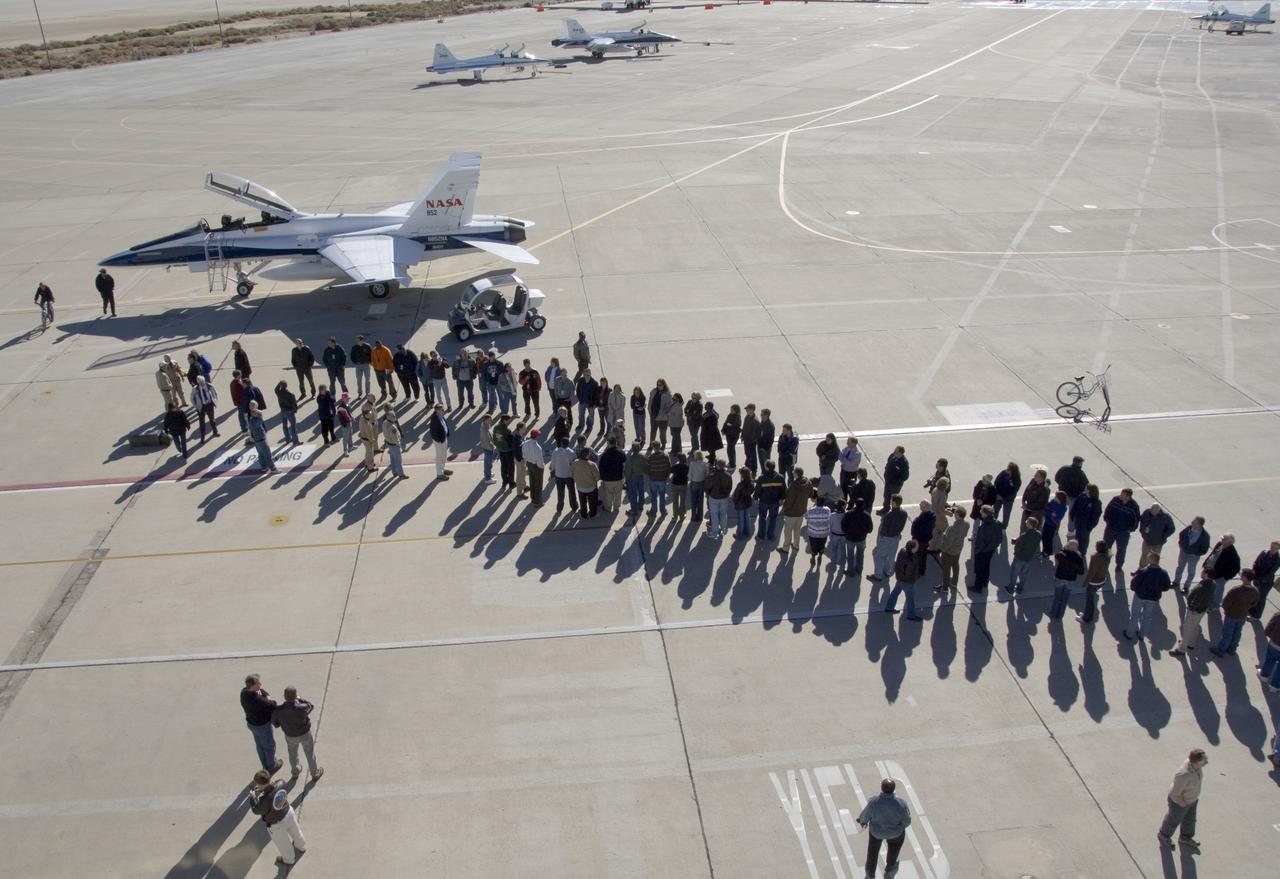
Long-time NASA Dryden research pilot and former astronaut C. Gordon Fullerton capped an almost 50-year flying career, including more than 38 years with NASA, with a final flight in a NASA F/A-18 on Dec. 21, 2007. Fullerton and Dryden research pilot Jim Smolka flew a 90-minute pilot proficiency formation aerobatics flight with another Dryden F/A-18 and a Dryden T-38 before concluding with two low-level formation flyovers of Dryden before landing. Fullerton was honored with a water-cannon spray arch provided by two fire trucks from the Edwards Air Force Base fire department as he taxied the F/A-18 up to the Dryden ramp, and was then greeted by his wife Marie and several hundred Dryden staff after his final flight. Fullerton began his flying career with the U.S. Air Force in 1958 after earning bachelor's and master's degrees in mechanical engineering from the California Institute of Technology. Initially trained as a fighter pilot, he later transitioned to multi-engine bombers and became a bomber operations test pilot after attending the Air Force Aerospace Research Pilot School at Edwards Air Force Base, Calif. He then was assigned to the flight crew for the planned Air Force Manned Orbital Laboratory in 1966. Upon cancellation of that program, the Air Force assigned Fullerton to NASA's astronaut corps in 1969. He served on the support crews for the Apollo 14, 15, 16 and 17 lunar missions, and was later assigned to one of the two flight crews that piloted the space shuttle prototype Enterprise during the Approach and Landing Test program at Dryden. He then logged some 382 hours in space when he flew on two early space shuttle missions, STS-3 on Columbia in 1982 and STS-51F on Challenger in 1985. He joined the flight crew branch at NASA Dryden after leaving the astronaut corps in 1986. During his 21 years at Dryden, Fullerton was project pilot on a number of high-profile research efforts, including the Propulsion Controlled Aircraft, the high-speed landing tests of

NASA’s X-59 quiet supersonic research aircraft begins its taxi Tuesday, Oct. 28, 2025, from Lockheed Martin’s Skunk Works facility to U.S. Air Force Plant 42’s runway in Palmdale, California. The aircraft taxied into position and waited for clearance before taking off for the first time.
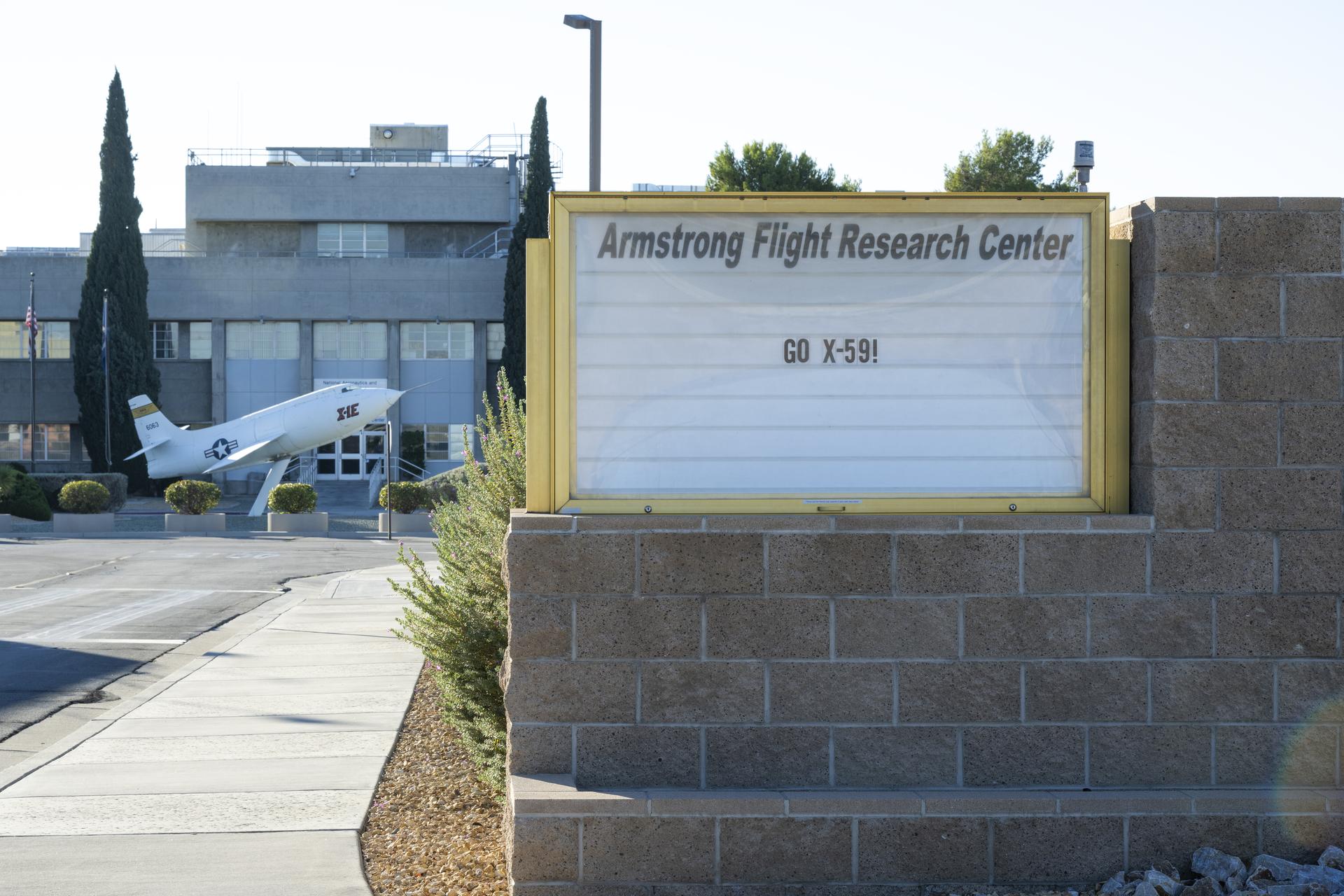
A sign at NASA’s Armstrong Flight Research Center in Edwards, California, reads “GO X-59” ahead of the agency’s quiet supersonic research aircraft’s first flight on Tuesday, Oct. 28, 2025. The X-59 departed from Lockheed Martin’s Skunk Works facility and landed at Edwards Air Force Base after a 67-minute flight, then taxied to Armstrong, completing its historic first flight.
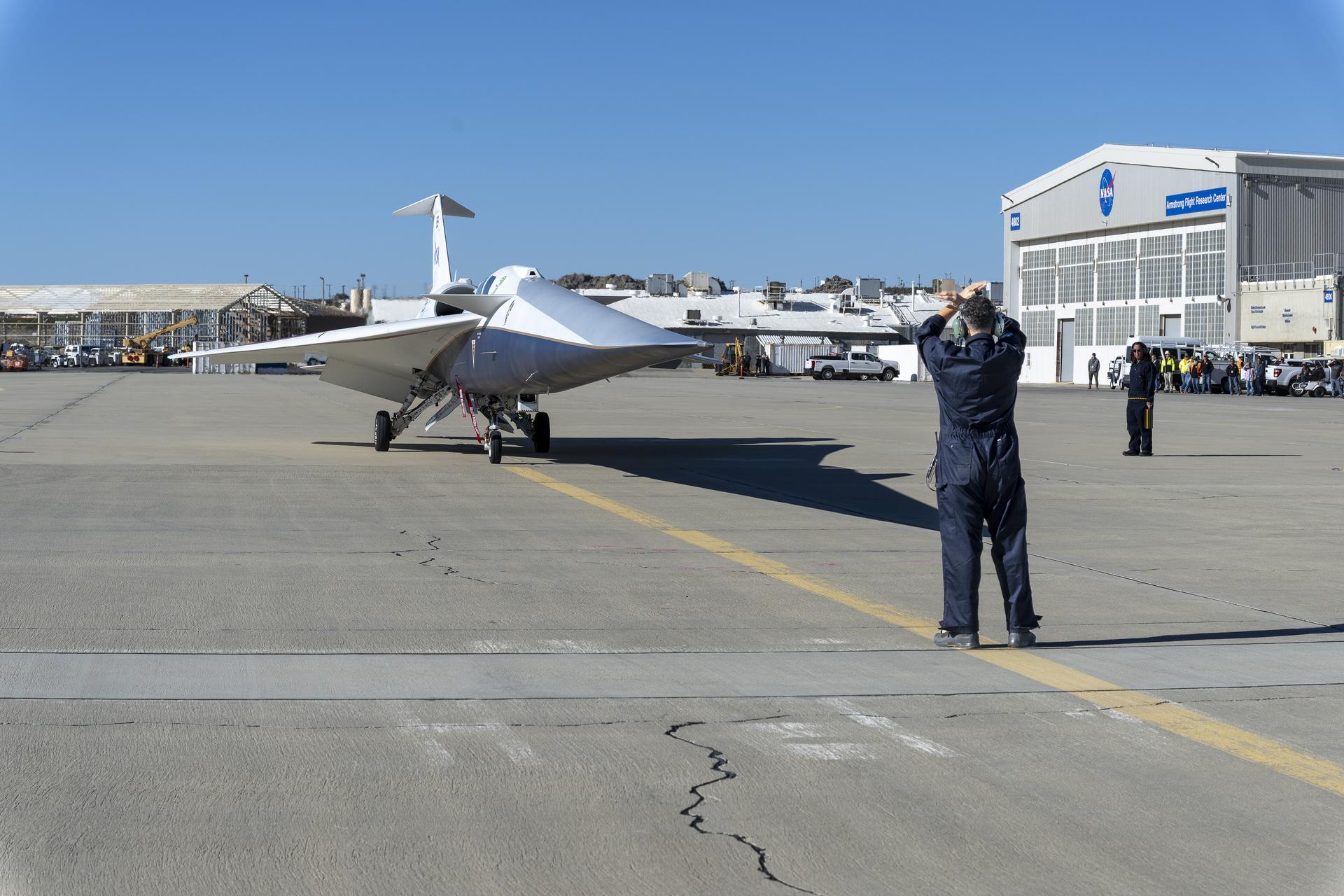
The X-59 quiet supersonic research aircraft arrives at NASA’s Armstrong Flight Research Center in Edwards, California, following its first flight Tuesday, Oct. 28, 2025. The arrival marks the aircraft’s transition from ground testing to flight operations. Next, the aircraft will undergo scheduled maintenance followed by a series of additional test flights, gradually building toward its first supersonic flight.

The X-59 quiet supersonic research aircraft taxis to NASA’s Armstrong Flight Research Center in Edwards, California, on Tuesday, Oct. 28, 2025, following its landing at Edwards Air Force Base. Ground teams await the aircraft’s arrival at its new home for flight operations in support of NASA’s Quesst mission to generate data on quiet supersonic flight

The X-59 quiet supersonic research aircraft taxis to NASA’s Armstrong Flight Research Center in Edwards, California, on Tuesday, Oct. 28, 2025, following its landing at Edwards Air Force Base. Ground teams await the aircraft’s arrival at its new home for flight operations in support of NASA’s Quesst mission to generate data on quiet supersonic flight

The X-59 quiet supersonic research aircraft arrives at NASA’s Armstrong Flight Research Center in Edwards, California, following its first flight Tuesday, Oct. 28, 2025. Ground teams perform final checks on the aircraft at its new home for flight operations. Next, the aircraft will undergo scheduled maintenance followed by a series of additional test flights, gradually building toward its first supersonic flight.

The X-59 quiet supersonic research aircraft arrives at NASA’s Armstrong Flight Research Center in Edwards, California, following its first flight Tuesday, Oct. 28, 2025. Ground teams perform final checks on the aircraft at its new home for flight operations. Next, the aircraft will undergo scheduled maintenance followed by a series of additional test flights, gradually building toward its first supersonic flight.

The X-59 quiet supersonic research aircraft taxis to NASA’s Armstrong Flight Research Center in Edwards, California, on Tuesday, Oct. 28, 2025, following its landing at Edwards Air Force Base. Ground teams await the aircraft’s arrival at its new home for flight operations in support of NASA’s Quesst mission to generate data on quiet supersonic flight

The X-59 quiet supersonic research aircraft arrives at NASA’s Armstrong Flight Research Center in Edwards, California, following its first flight Tuesday, Oct. 28, 2025. Ground teams perform final checks on the aircraft at its new home for flight operations. Next, the aircraft will undergo scheduled maintenance followed by a series of additional test flights, gradually building toward its first supersonic flight.

The X-59 quiet supersonic research aircraft taxis to NASA’s Armstrong Flight Research Center in Edwards, California, on Tuesday, Oct. 28, 2025, following its landing at Edwards Air Force Base. Ground teams await the aircraft’s arrival at its new home for flight operations in support of NASA’s Quesst mission to generate data on quiet supersonic flight

The X-59 quiet supersonic research aircraft taxis to NASA’s Armstrong Flight Research Center in Edwards, California, on Tuesday, Oct. 28, 2025, following its landing at Edwards Air Force Base. Ground teams await the aircraft’s arrival at its new home for flight operations in support of NASA’s Quesst mission to generate data on quiet supersonic flight

The X-59 quiet supersonic research aircraft taxis to NASA’s Armstrong Flight Research Center in Edwards, California, on Tuesday, Oct. 28, 2025, following its landing at Edwards Air Force Base. Ground teams await the aircraft’s arrival at its new home for flight operations in support of NASA’s Quesst mission to generate data on quiet supersonic flight

The X-59 quiet supersonic research aircraft taxis to NASA’s Armstrong Flight Research Center in Edwards, California, on Tuesday, Oct. 28, 2025, following its landing at Edwards Air Force Base. Ground teams await the aircraft’s arrival at its new home for flight operations in support of NASA’s Quesst mission to generate data on quiet supersonic flight

The X-59 quiet supersonic research aircraft taxis to NASA’s Armstrong Flight Research Center in Edwards, California, on Tuesday, Oct. 28, 2025, following its landing at Edwards Air Force Base. Ground teams await the aircraft’s arrival at its new home for flight operations in support of NASA’s Quesst mission to generate data on quiet supersonic flight

The X-59 quiet supersonic research aircraft taxis to NASA’s Armstrong Flight Research Center in Edwards, California, on Tuesday, Oct. 28, 2025, following its landing at Edwards Air Force Base. Ground teams await the aircraft’s arrival at its new home for flight operations in support of NASA’s Quesst mission to generate data on quiet supersonic flight

The X-59 quiet supersonic research aircraft taxis to NASA’s Armstrong Flight Research Center in Edwards, California, on Tuesday, Oct. 28, 2025, following its landing at Edwards Air Force Base. Ground teams await the aircraft’s arrival at its new home for flight operations in support of NASA’s Quesst mission to generate data on quiet supersonic flight

The X-59 quiet supersonic research aircraft taxis to NASA’s Armstrong Flight Research Center in Edwards, California, on Tuesday, Oct. 28, 2025, following its landing at Edwards Air Force Base. Ground teams await the aircraft’s arrival at its new home for flight operations in support of NASA’s Quesst mission to generate data on quiet supersonic flight

The X-59 quiet supersonic research aircraft taxis to NASA’s Armstrong Flight Research Center in Edwards, California, on Tuesday, Oct. 28, 2025, following its landing at Edwards Air Force Base. Ground teams await the aircraft’s arrival at its new home for flight operations in support of NASA’s Quesst mission to generate data on quiet supersonic flight

The X-59 quiet supersonic research aircraft taxis to NASA’s Armstrong Flight Research Center in Edwards, California, on Tuesday, Oct. 28, 2025, following its landing at Edwards Air Force Base. Ground teams await the aircraft’s arrival at its new home for flight operations in support of NASA’s Quesst mission to generate data on quiet supersonic flight

The X-59 quiet supersonic research aircraft taxis to NASA’s Armstrong Flight Research Center in Edwards, California, on Tuesday, Oct. 28, 2025, following its landing at Edwards Air Force Base. Ground teams await the aircraft’s arrival at its new home for flight operations in support of NASA’s Quesst mission to generate data on quiet supersonic flight

The X-59 quiet supersonic research aircraft taxis to NASA’s Armstrong Flight Research Center in Edwards, California, on Tuesday, Oct. 28, 2025, following its landing at Edwards Air Force Base. Ground teams await the aircraft’s arrival at its new home for flight operations in support of NASA’s Quesst mission to generate data on quiet supersonic flight

The X-59 quiet supersonic research aircraft taxis to NASA’s Armstrong Flight Research Center in Edwards, California, on Tuesday, Oct. 28, 2025, following its landing at Edwards Air Force Base. Ground teams await the aircraft’s arrival at its new home for flight operations in support of NASA’s Quesst mission to generate data on quiet supersonic flight

The X-59 quiet supersonic research aircraft taxis to NASA’s Armstrong Flight Research Center in Edwards, California, on Tuesday, Oct. 28, 2025, following its landing at Edwards Air Force Base. Ground teams await the aircraft’s arrival at its new home for flight operations in support of NASA’s Quesst mission to generate data on quiet supersonic flight

The X-59 quiet supersonic research aircraft taxis to NASA’s Armstrong Flight Research Center in Edwards, California, on Tuesday, Oct. 28, 2025, following its landing at Edwards Air Force Base. Ground teams await the aircraft’s arrival at its new home for flight operations in support of NASA’s Quesst mission to generate data on quiet supersonic flight

The X-59 quiet supersonic research aircraft taxis to NASA’s Armstrong Flight Research Center in Edwards, California, on Tuesday, Oct. 28, 2025, following its landing at Edwards Air Force Base. Ground teams await the aircraft’s arrival at its new home for flight operations in support of NASA’s Quesst mission to generate data on quiet supersonic flight

The X-59 quiet supersonic research aircraft taxis to NASA’s Armstrong Flight Research Center in Edwards, California, on Tuesday, Oct. 28, 2025, following its landing at Edwards Air Force Base. Ground teams await the aircraft’s arrival at its new home for flight operations in support of NASA’s Quesst mission to generate data on quiet supersonic flight

The X-59 quiet supersonic research aircraft taxis to NASA’s Armstrong Flight Research Center in Edwards, California, on Tuesday, Oct. 28, 2025, following its landing at Edwards Air Force Base. Ground teams await the aircraft’s arrival at its new home for flight operations in support of NASA’s Quesst mission to generate data on quiet supersonic flight

The X-59 quiet supersonic research aircraft taxis to NASA’s Armstrong Flight Research Center in Edwards, California, on Tuesday, Oct. 28, 2025, following its landing at Edwards Air Force Base. Ground teams await the aircraft’s arrival at its new home for flight operations in support of NASA’s Quesst mission to generate data on quiet supersonic flight

The X-59 quiet supersonic research aircraft taxis to NASA’s Armstrong Flight Research Center in Edwards, California, on Tuesday, Oct. 28, 2025, following its landing at Edwards Air Force Base. Ground teams await the aircraft’s arrival at its new home for flight operations in support of NASA’s Quesst mission to generate data on quiet supersonic flight

The X-59 quiet supersonic research aircraft taxis to NASA’s Armstrong Flight Research Center in Edwards, California, on Tuesday, Oct. 28, 2025, following its landing at Edwards Air Force Base. Ground teams await the aircraft’s arrival at its new home for flight operations in support of NASA’s Quesst mission to generate data on quiet supersonic flight