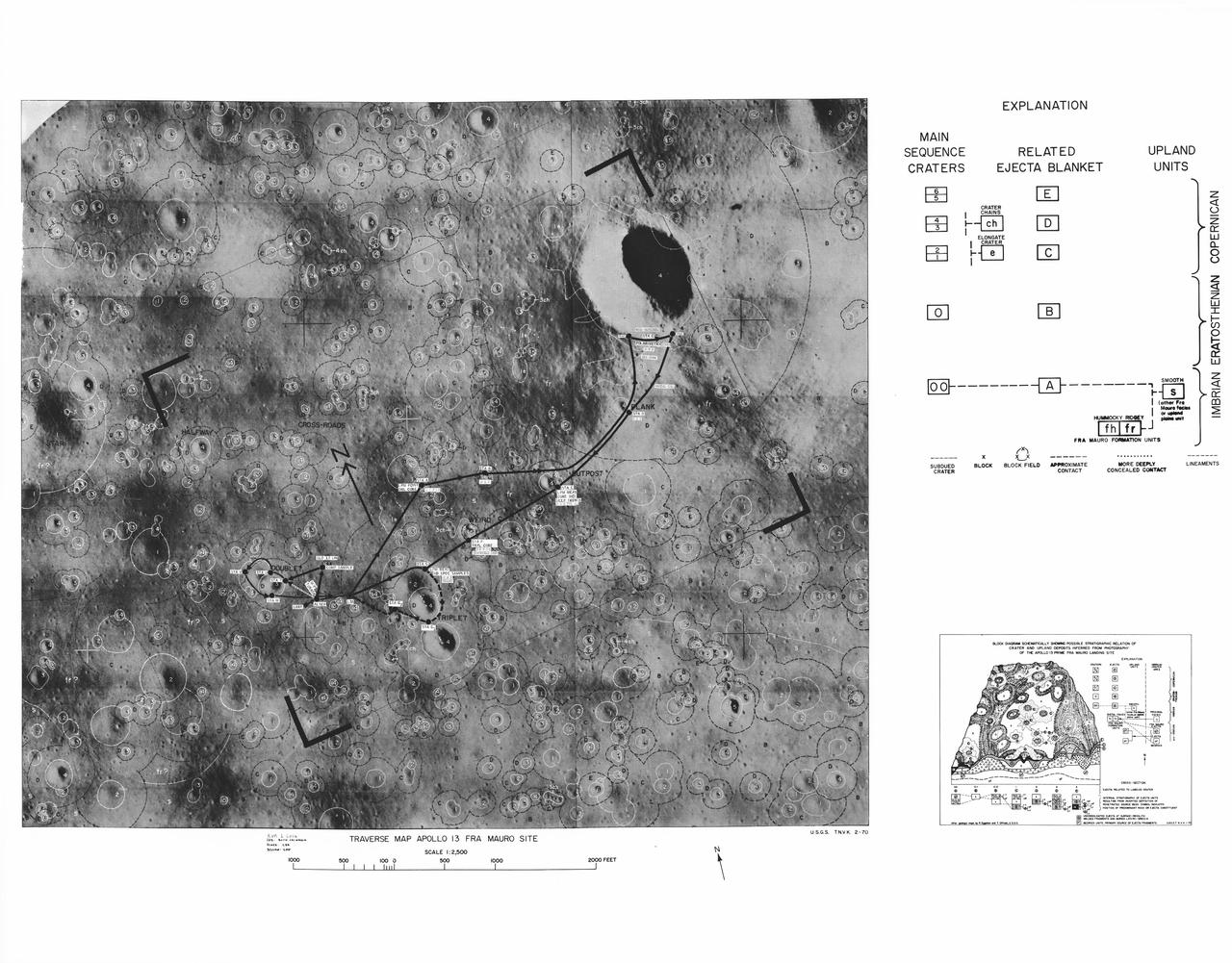
This lunar map shows the traverse plans for the Apollo 14 lunar landing mission. Areas marked include Lunar module landing site, areas for the Apollo Lunar Surface Experiment Package (ALSEP) and areas for gathering of core samples.
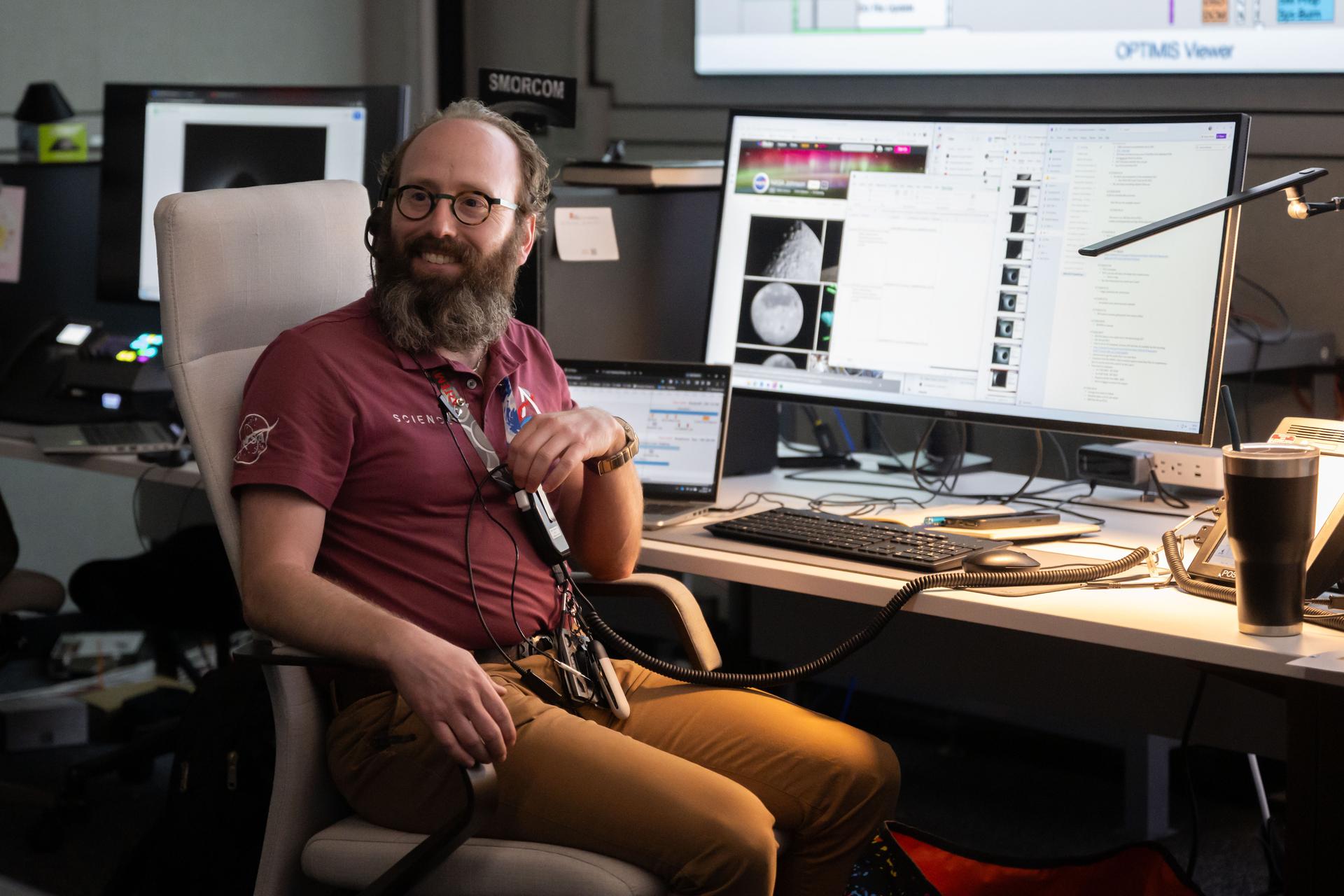
Artemis lunar science team member, Aaron Regberg, works in the Science Mission Operations Room, where scientists analyzed imagery and audio recordings of lunar observations captured by the Artemis II astronauts during their lunar flyby on April 6, 2026.

Artemis lunar science team members, from left, Alexandra Constantinou, and David Hollibaugh-Baker, work in the Science Mission Operations Room at NASA’s Johnson Space Center in Houston. They are analyzing imagery and audio recordings of lunar observations captured by the Artemis II astronauts during their lunar flyby on April 6, 2026.

This is a close-up view of an astronaut’s footprint in the lunar soil, photographed by a 70 mm lunar surface camera during the Apollo 11 lunar surface extravehicular activity. The first manned lunar mission, the Apollo 11 launched aboard a Saturn V launch vehicle from the Kennedy Space Center, Florida on July 16, 1969 and safely returned to Earth on July 24, 1969. The 3-man crew aboard the flight consisted of Neil A, Armstrong, mission commander; Edwin E. Aldrin, Jr., Lunar Module Pilot; and Michael Collins, Command Module pilot. The LM landed on the moon’s surface on July 20, 1969 in the region known as Mare Tranquilitatis (the Sea of Tranquility). Armstrong was the first human to ever stand on the lunar surface. As he stepped off the LM, Armstrong proclaimed, “That’s one small step for man, one giant leap for mankind”. He was followed by Edwin (Buzz) Aldrin, describing the lunar surface as Magnificent desolation. Astronaut Collins piloted the Command Module in a parking orbit around the Moon. The crew collected 47 pounds of lunar surface material which was returned to Earth for analysis. The surface exploration was concluded in 2½ hours. With the success of Apollo 11, the national objective to land men on the Moon and return them safely to Earth had been accomplished. The Saturn V vehicle was developed by the Marshall Space Flight Center (MSFC) under the direction of Dr. von Braun.
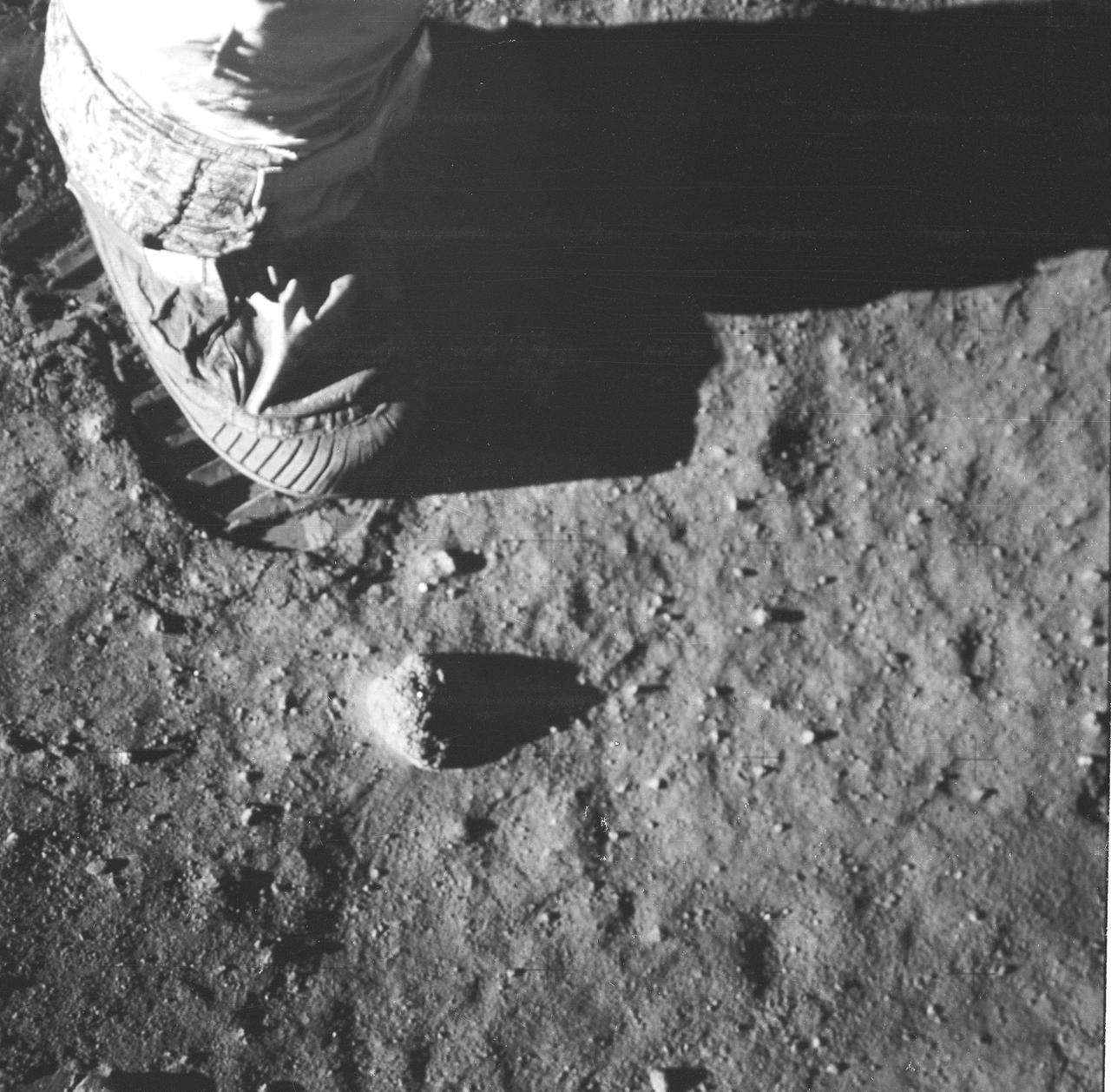
This is a close-up view of an astronaut’s foot and footprint in the lunar soil, photographed by a 70 mm lunar surface camera during the Apollo 11 lunar surface extravehicular activity (EVA). The first manned lunar mission launched via a Saturn V launch vehicle from the Kennedy Space Center, Florida on July 16, 1969 and safely returned to Earth on July 24, 1969. The Saturn V vehicle was developed by the Marshall Space Flight Center (MSFC) under the direction of Dr. Wernher von Braun. The 3-man crew aboard the flight consisted of astronauts Neil A. Armstrong, mission commander; Edwin E. Aldrin, Jr., Lunar Module (LM) Pilot; and Michael Collins, Command Module (CM) pilot. The LM landed on the moon’s surface on July 20, 1969 in the region known as Mare Tranquilitatis (the Sea of Tranquility). Armstrong was the first human to ever stand on the lunar surface. As he stepped off the LM, Armstrong proclaimed, “That’s one small step for man, one giant leap for mankind”. He was followed by Edwin (Buzz) Aldrin, describing the lunar surface as magnificent desolation. Astronaut Collins piloted the CM in a parking orbit around the Moon. During a 2½ hour surface exploration, the crew collected 47 pounds of lunar surface material which was returned to Earth for analysis. With the success of Apollo 11, the national objective to land men on the Moon and return them safely to Earth had been accomplished.

art002e016186 (April 6, 2026) – CSA (Canadian Space Agency) astronaut and Artemis II Mission Specialist Jeremy Hansen is seen working on his personal computing device during the Artemis II lunar flyby. The application seen on the screen is the Lunar Targeting Plan that guides them in the execution of the lunar science observation plan. This custom software was built by the crew lunar observations team, a subset of the Artemis II lunar science team. Hansen and his fellow crewmates spent approximately seven hours taking turns at the Orion windows capturing science data to share with their team back on Earth. At closest approach, they came within 4,067 miles of the Moon’s surface.
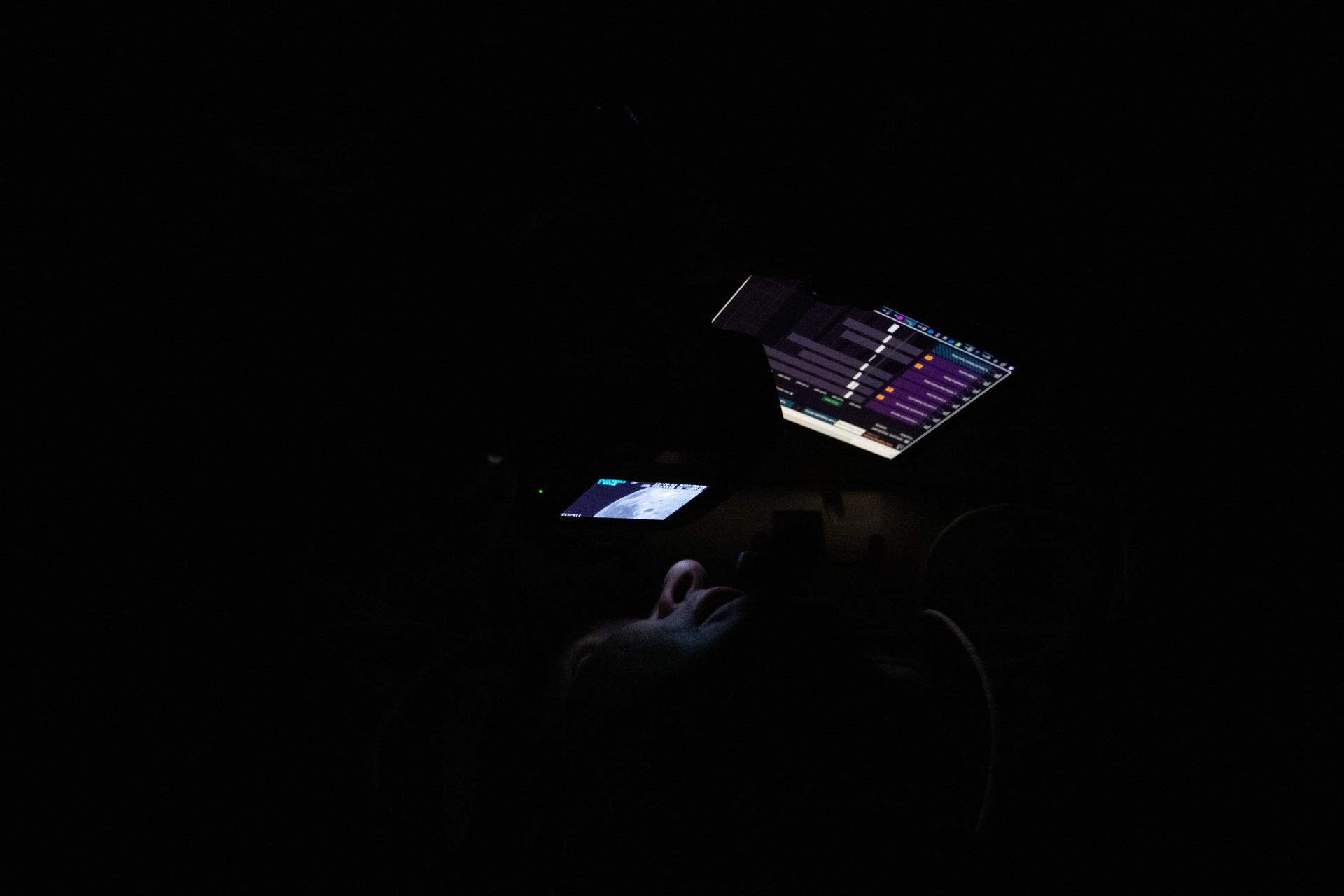
art002e014251 (April 6, 2026) – CSA (Canadian Space Agency) astronaut and Artemis II Mission Specialist Jeremy Hansen is seen taking images through the Orion spacecraft window during the Artemis II lunar flyby. Hansen and his fellow crewmates spent approximately seven hours taking turns at the Orion windows capturing science data to share with their team back on Earth. At closest approach, they came within 4,067 miles of the Moon’s surface. The application seen on the crew personal computing devices is the Lunar Targeting Plan that guides them in the execution of the lunar science observation plan. This custom software was built by the crew lunar observations team, a subset of the Artemis II lunar science team.
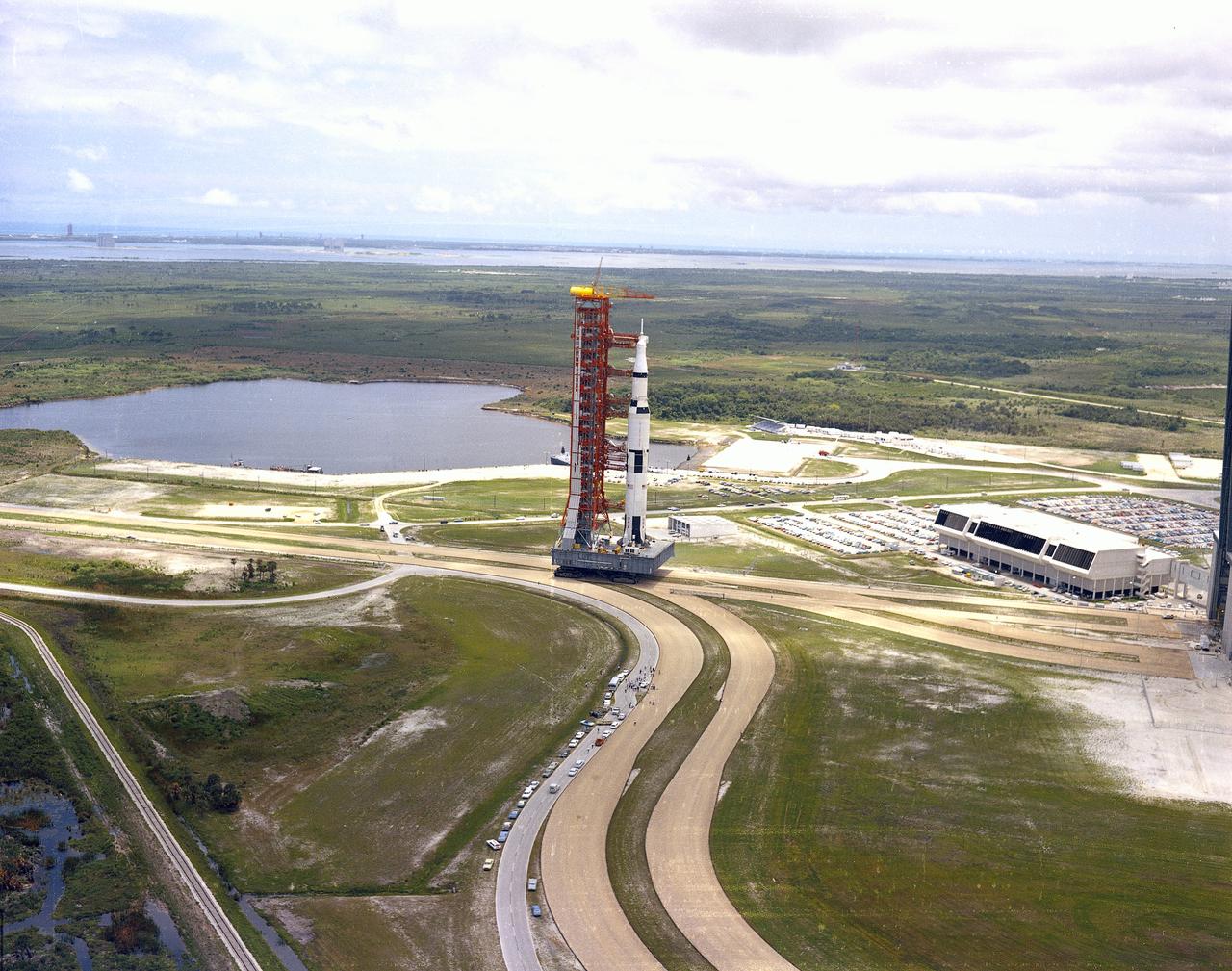
Aboard a Saturn V launch vehicle, the Apollo 11 mission launched from The Kennedy Space Center, Florida on July 16, 1969 and safely returned to Earth on July 24, 1969. The space vehicle is shown here during the rollout for launch preparation. The 3-man crew aboard the flight consisted of Neil A. Armstrong, commander; Michael Collins, Command Module pilot; and Edwin E. Aldrin Jr., Lunar Module pilot. Armstrong was the first human to ever stand on the lunar surface, followed by Edwin (Buzz) Aldrin. The crew collected 47 pounds of lunar surface material which was returned to Earth for analysis. The surface exploration was concluded in 2½ hours. With the success of Apollo 11, the national objective to land men on the Moon and return them safely to Earth had been accomplished. The Saturn V launch vehicle was developed by the Marshall Space Flight Center (MSFC) under the direction of Dr. Wernher von Braun.
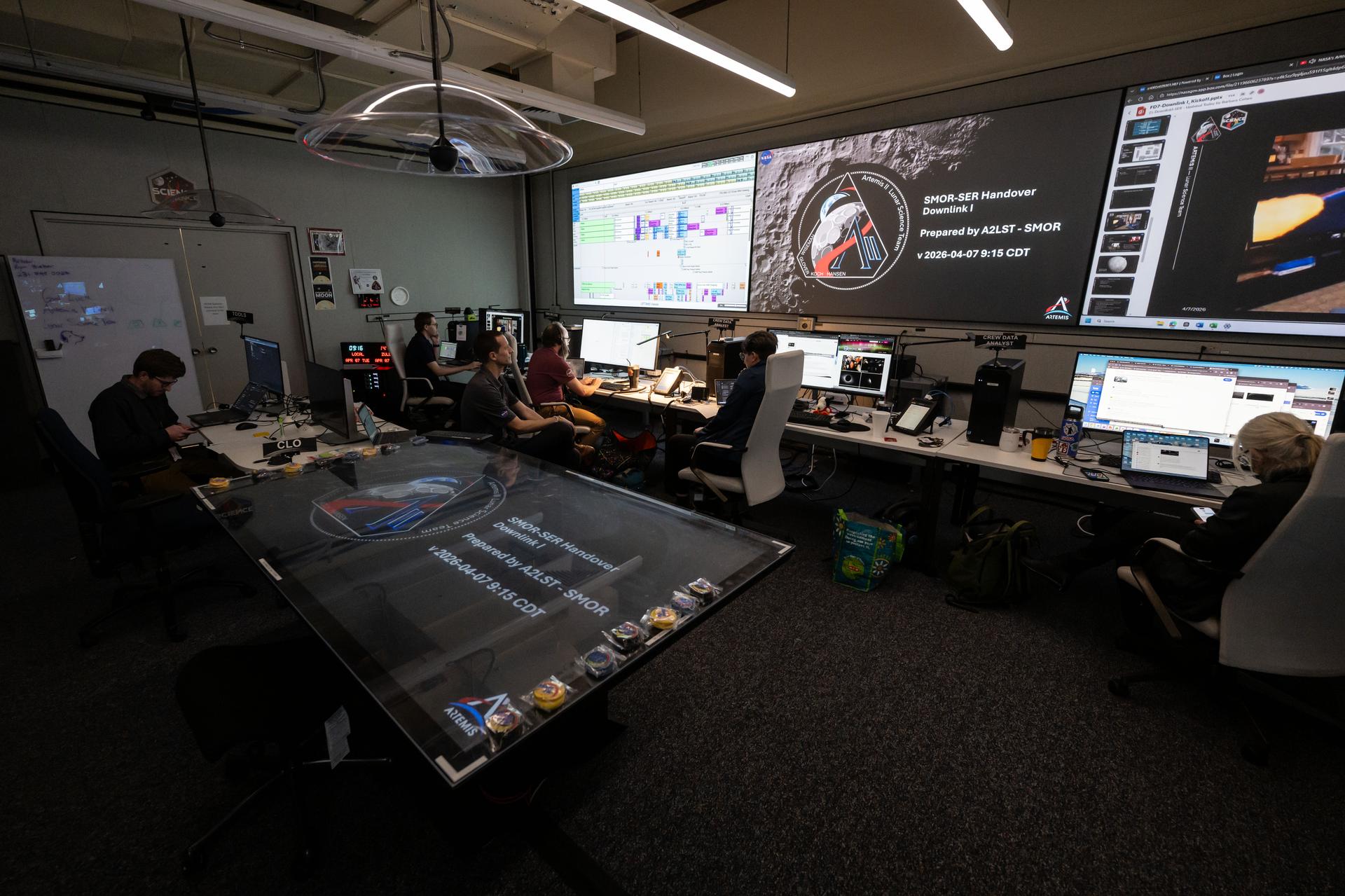
Artemis lunar science team members, work in the Science Mission Operations Room at NASA’s Johnson Space Center in Houston, analyzing imagery and audio recordings of lunar observations captured by the Artemis II astronauts during their lunar flyby on April 6, 2026.

Artemis lunar science team member, Alexandra Constantinou, works in the Science Mission Operations Room at NASA’s Johnson Space Center in Houston, where scientists analyzed imagery and audio recordings of lunar observations captured by the Artemis II astronauts during their lunar flyby on April 6, 2026. Credits: NASA/Helen Arase Vargas
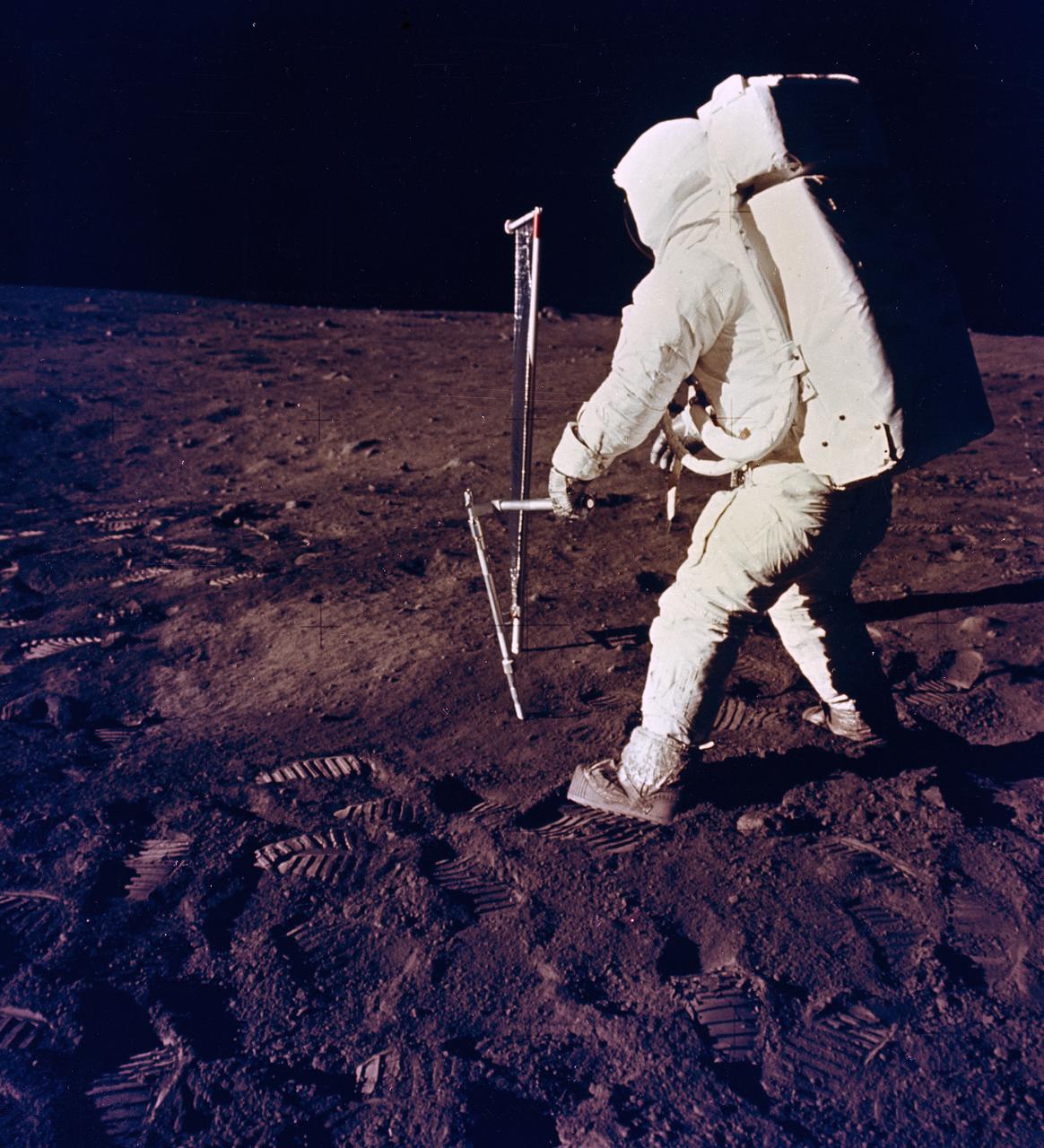
The Apollo 11 manned lunar mission launched from the Kennedy Space Center, Florida on July 16, 1969 via a Saturn V launch vehicle, and safely returned to Earth on July 24, 1969. The Saturn V vehicle was developed by the Marshall Space Flight Center (MSFC) under the direction of Dr. Wernher von Braun. The 3-man crew aboard the flight consisted of Neil A. Armstrong, commander; Michael Collins, Command Module pilot; and Edwin E. Aldrin Jr., Lunar Module pilot. Carrying astronauts Neil A. Armstrong and Edwin E. Aldrin, Jr., the Lunar Module (LM) “Eagle” was the first crewed vehicle to land on the Moon. The LM landed on the moon’s surface on July 20, 1969 in the region known as Mare Tranquilitatis (the Sea of Tranquility). Armstrong was the first human to ever stand on the lunar surface. As he stepped off the LM, Armstrong proclaimed, “That’s one small step for man, one giant leap for mankind”. He was followed by Edwin Aldrin, describing the lunar surface as magnificent desolation. This photo is of Edwin Aldrin on the lunar surface using the core sampler, one of the many tools used by the astronauts to collect samples. The crew collected 47 pounds of lunar surface material which was returned to Earth for analysis. The surface exploration was concluded in 2½ hours. With the success of Apollo 11, the national objective to land men on the Moon and return them safely to Earth had been accomplished.
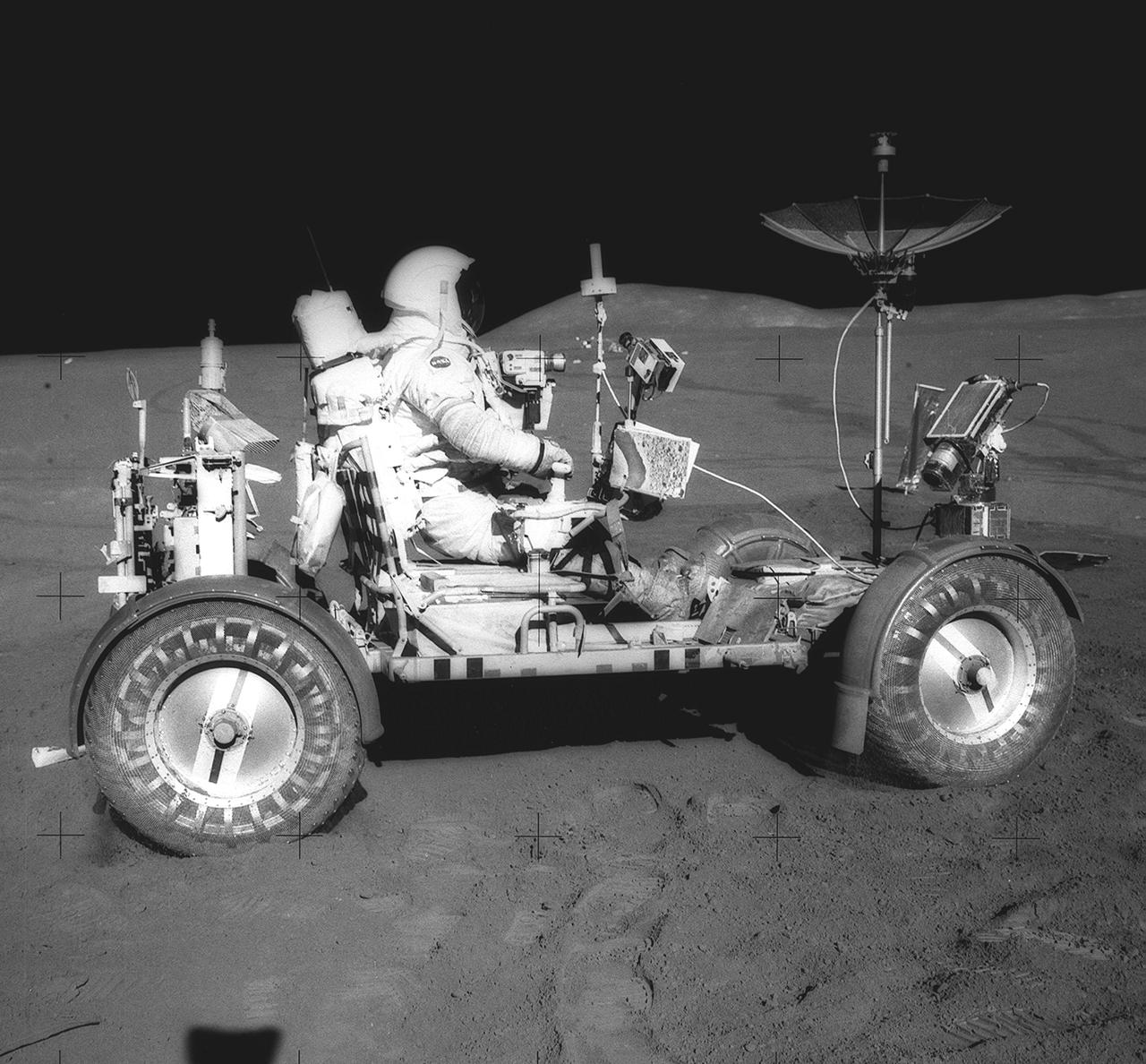
This photograph was taken during the Apollo 15 mission on the lunar surface. Astronaut David R. Scott waits in the Lunar Roving Vehicle (LRV) for astronaut James Irwin for the return trip to the Lunar Module, Falcon, with rocks and soil collected near the Hadley-Apernine landing site. The Apollo 15 was the first mission to use the LRV. Powered by battery, the lightweight electric car greatly increased the range of mobility and productivity on the scientific traverses for astronauts. It weighed 462 pounds (77 pounds on the Moon) and could carry two suited astronauts, their gear and cameras, and several hundred pounds of bagged samples. The LRV's mobility was quite high. It could climb and descend slopes of about 25 degrees. The LRV was designed and developed by the Marshall Space Flight Center and built by the Boeing Company.
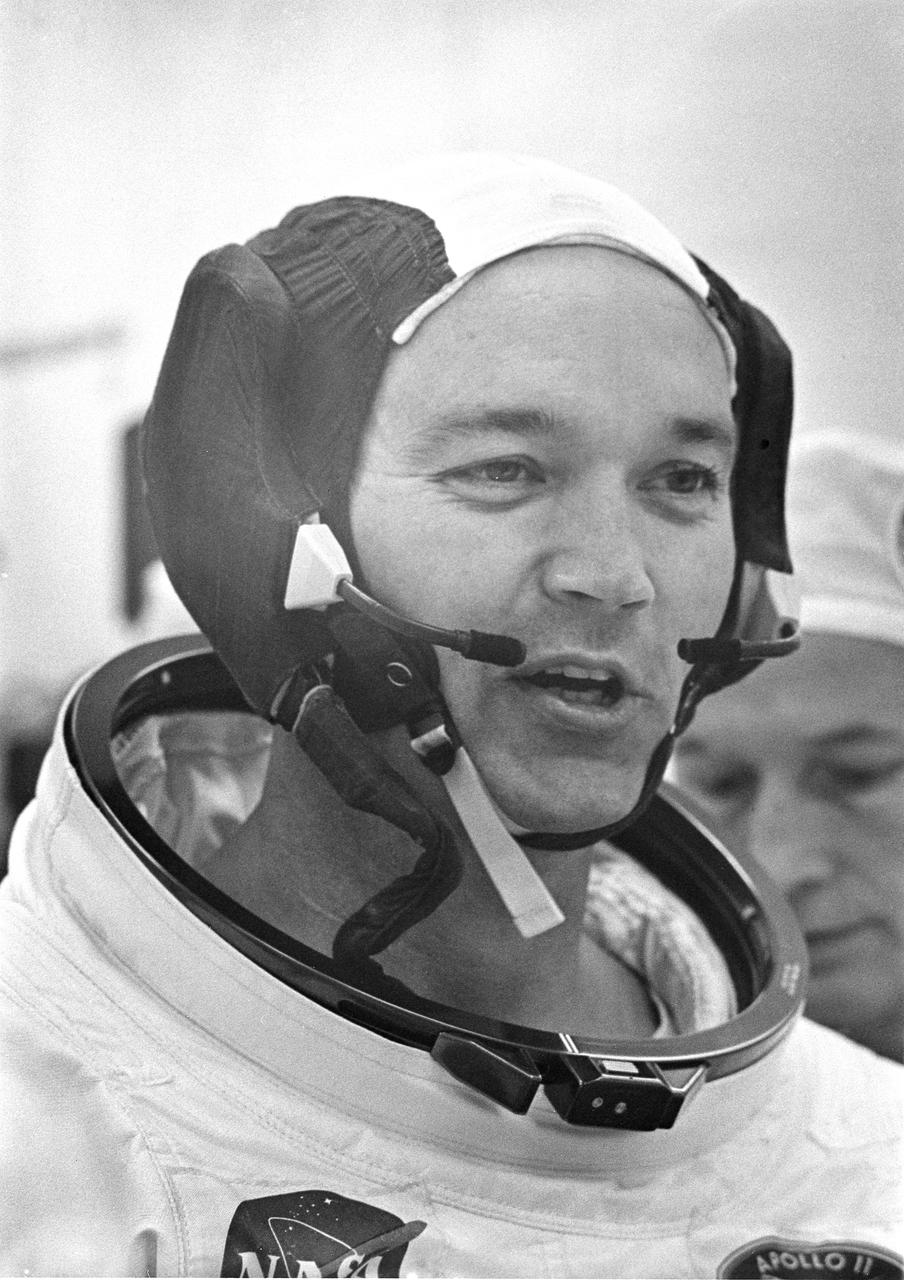
Dunned in his space suit, Command Module (CM) pilot Michael Collins does a final check of his communications system before the boarding of the Apollo 11 mission. Launched via a Saturn V launch vehicle, the first manned lunar mission launched from the Kennedy Space Center, Florida on July 16, 1969 and safely returned to Earth on July 24, 1969. The Saturn V vehicle was developed by the Marshall Space Flight Center (MSFC) under the direction of Dr. Wernher von Braun. The 3-man crew aboard the flight consisted of astronauts Collins; Neil A. Armstrong, Mission Commander; and Edwin E. Aldrin, Jr., Lunar Module (LM) Pilot. Armstrong was the first human to ever stand on the lunar surface, followed by Edwin (Buzz) Aldrin. Meanwhile, astronaut Collins piloted the CM in a parking orbit around the Moon. During a 2½ hour surface exploration, the crew collected 47 pounds of lunar surface material which was returned to Earth for analysis. With the success of Apollo 11, the national objective to land men on the Moon and return them safely to Earth had been accomplished.
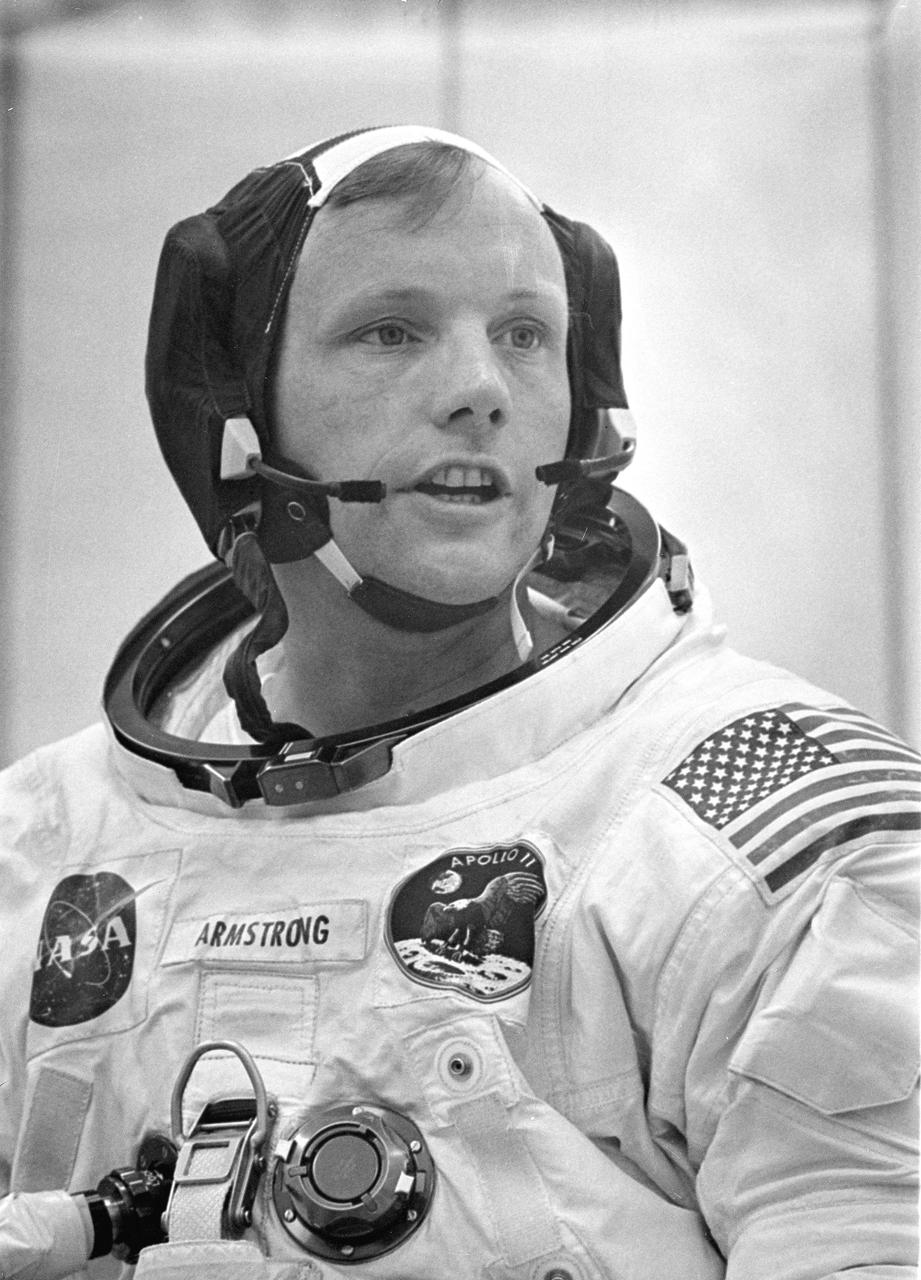
Dunned in his space suit, mission commander Neil A. Armstrong does a final check of his communications system before before the boarding of the Apollo 11 mission. Launched via a Saturn V launch vehicle, the first manned lunar mission launched from the Kennedy Space Center, Florida on July 16, 1969 and safely returned to Earth on July 24, 1969. The Saturn V vehicle was developed by the Marshall Space Flight Center (MSFC) under the direction of Dr. Wernher von Braun. The 3-man crew aboard the flight consisted of astronauts Armstrong; Michael Collins, Command Module (CM) pilot; and Edwin E. Aldrin, Jr., Lunar Module (LM) Pilot. Armstrong was the first human to ever stand on the lunar surface, followed by Edwin (Buzz) Aldrin. Meanwhile, astronaut Collins piloted the CM in a parking orbit around the Moon. During a 2½ hour surface exploration, the crew collected 47 pounds of lunar surface material which was returned to Earth for analysis. With the success of Apollo 11, the national objective to land men on the Moon and return them safely to Earth had been accomplished.
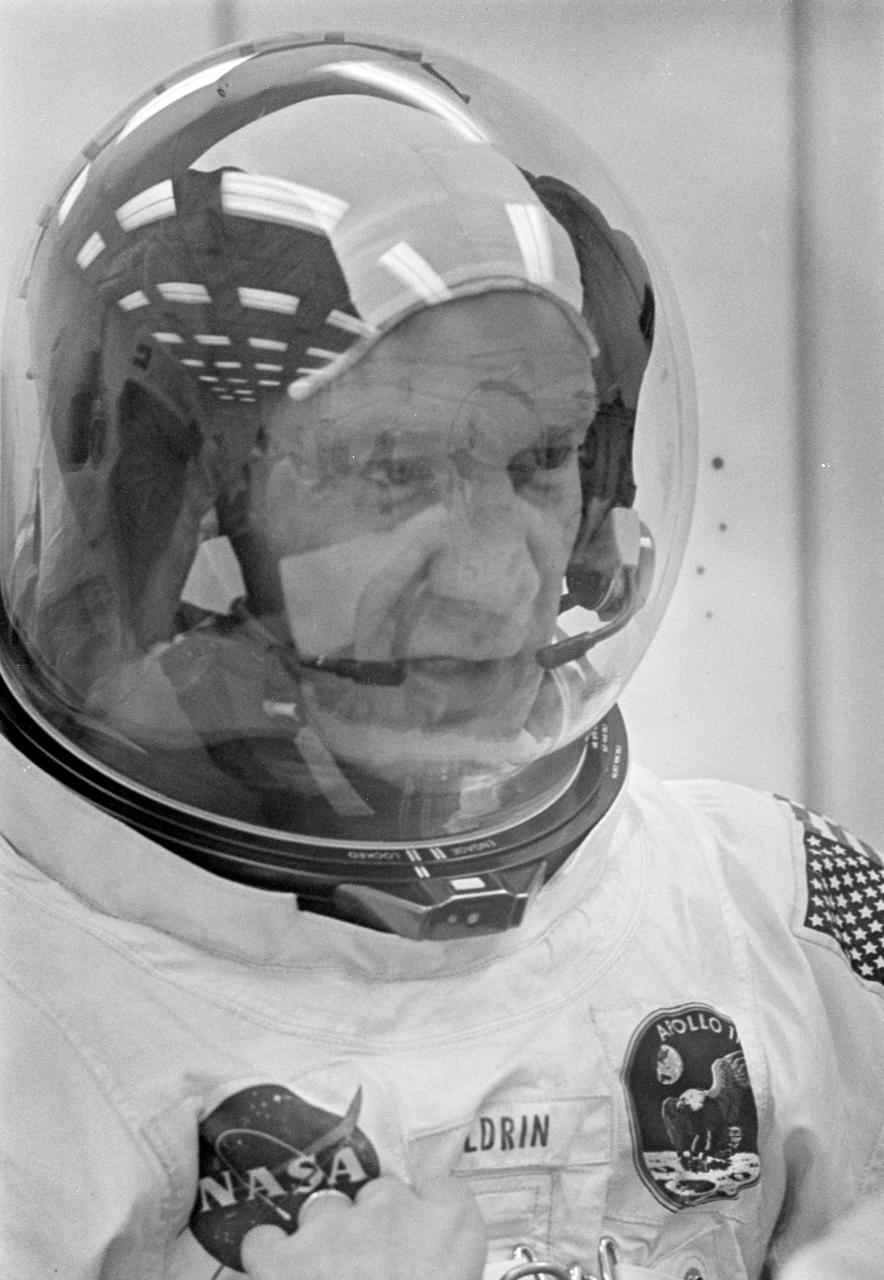
Dunned in his space suit, Lunar Module pilot Edwin E. Aldrin, Jr. does a final check of his communications system before the boarding of the Apollo 11 mission. Launched via a Saturn V launch vehicle, the first manned lunar mission launched from the Kennedy Space Center, Florida on July 16, 1969 and safely returned to Earth on July 24, 1969. The Saturn V vehicle was developed by the Marshall Space Flight Center (MSFC) under the direction of Dr. Wernher von Braun. The 3-man crew aboard the flight consisted of astronauts Aldrin; Michael Collins, Command Module (CM) pilot; and Neil Armstrong, mission commander. Armstrong was the first human to ever stand on the lunar surface, followed by Edwin (Buzz) Aldrin. Meanwhile, astronaut Collins piloted the CM in a parking orbit around the Moon. During a 2½ hour surface exploration, the crew collected 47 pounds of lunar surface material which was returned to Earth for analysis. With the success of Apollo 11, the national objective to land men on the Moon and return them safely to Earth had been accomplished.
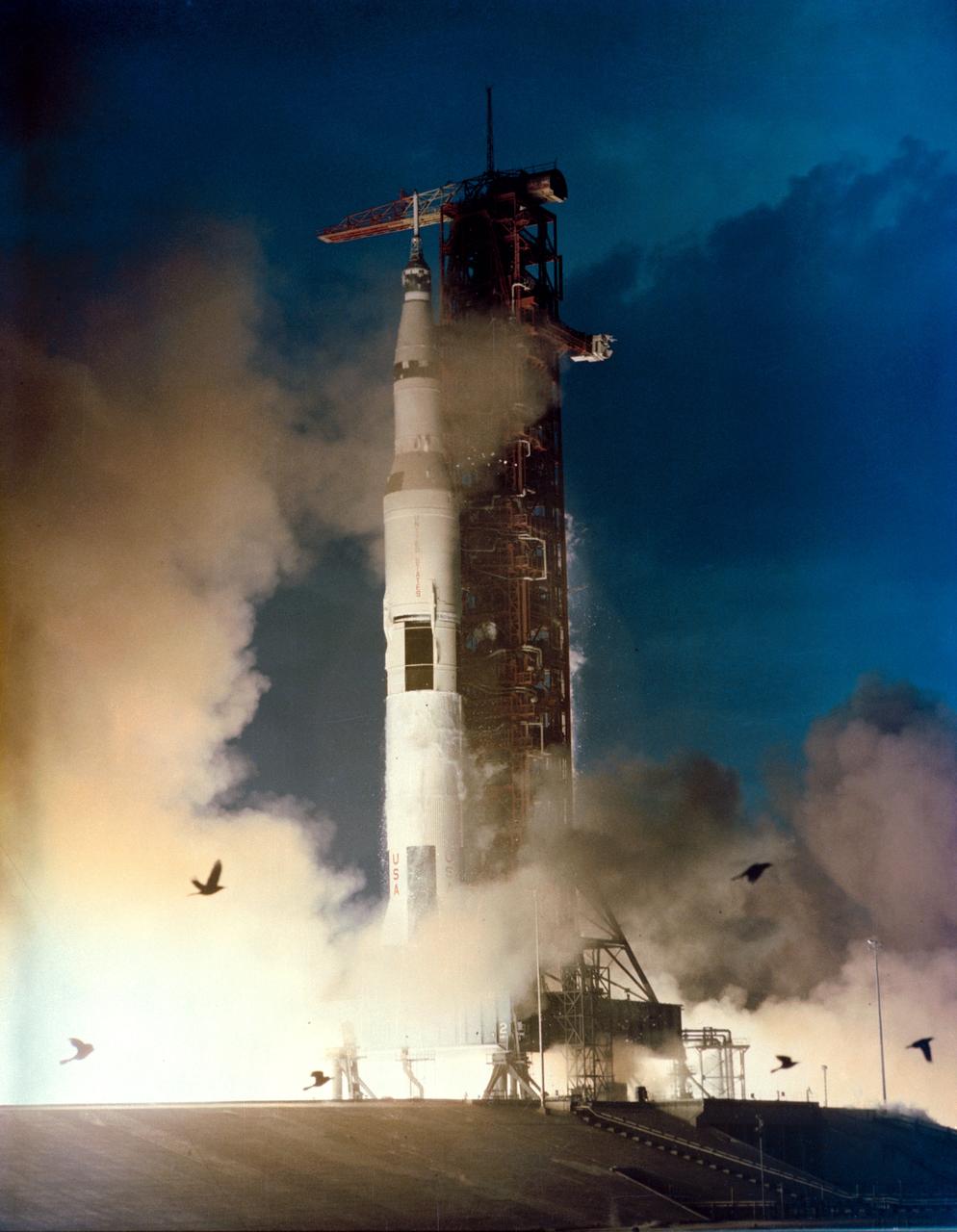
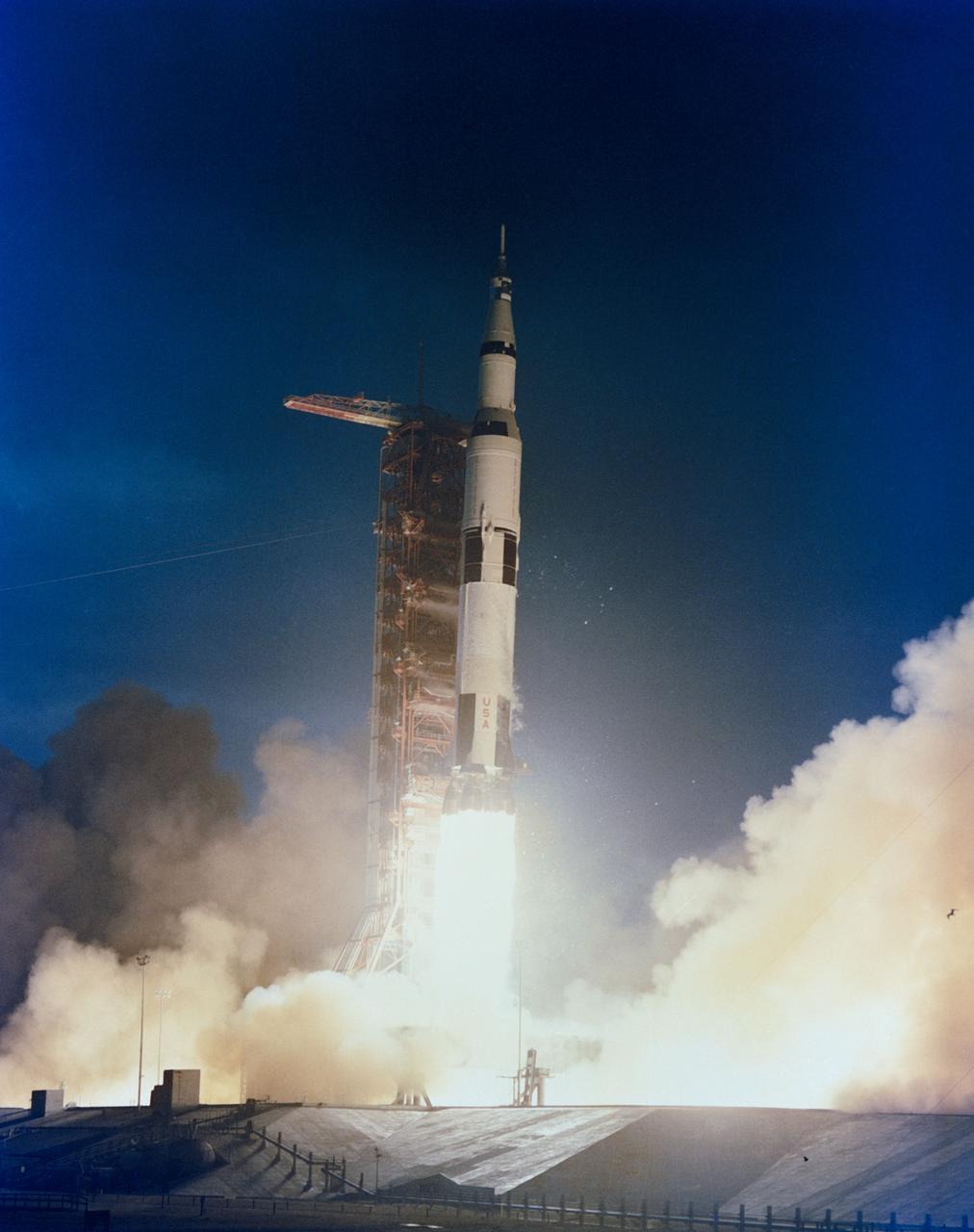
S71-18395 (31 Jan. 1971) --- The huge, 363-feet tall Apollo 14 (Spacecraft 110/Lunar Module 8/Saturn 509) space vehicle is launched from Pad A, Launch Complex 39, Kennedy Space Center (KSC), Florida at 4:03:02 p.m. (EST), Jan. 31, 1971, on a lunar landing mission. Aboard the Apollo 14 spacecraft were astronauts Alan B. Shepard Jr., commander; Stuart A. Roosa, command module pilot; and Edgar D. Mitchell, lunar module pilot.

S70-34855 (11 April 1970) --- The Apollo 13 (Spacecraft 109/Lunar Module 7/Saturn 508) space vehicle is launched from Pad A, Launch Complex 39, Kennedy Space Center (KSC), at 2:13 p.m. (EST), April 11, 1970. The crew of the National Aeronautics and Space Administration's (NASA) third lunar landing mission are astronauts James A., Lovell Jr., commander; John L. Swigert Jr., command module pilot; and Fred W. Haise Jr., lunar module pilot.
S71-17621 (31 Jan. 1971) --- The huge, 363-feet tall Apollo 14 (Spacecraft 110/Lunar Module 8/Saturn 509) space vehicle is launched from Pad A, Launch Complex 39, Kennedy Space Center, Florida, at 4:03:02 p.m. (EST), Jan. 31, 1981, on a lunar landing mission. Aboard the Apollo 14 spacecraft were astronauts Alan B. Shepard Jr., commander; Stuart A. Roosa, command module pilot; and Edgar D. Mitchell, lunar module pilot.
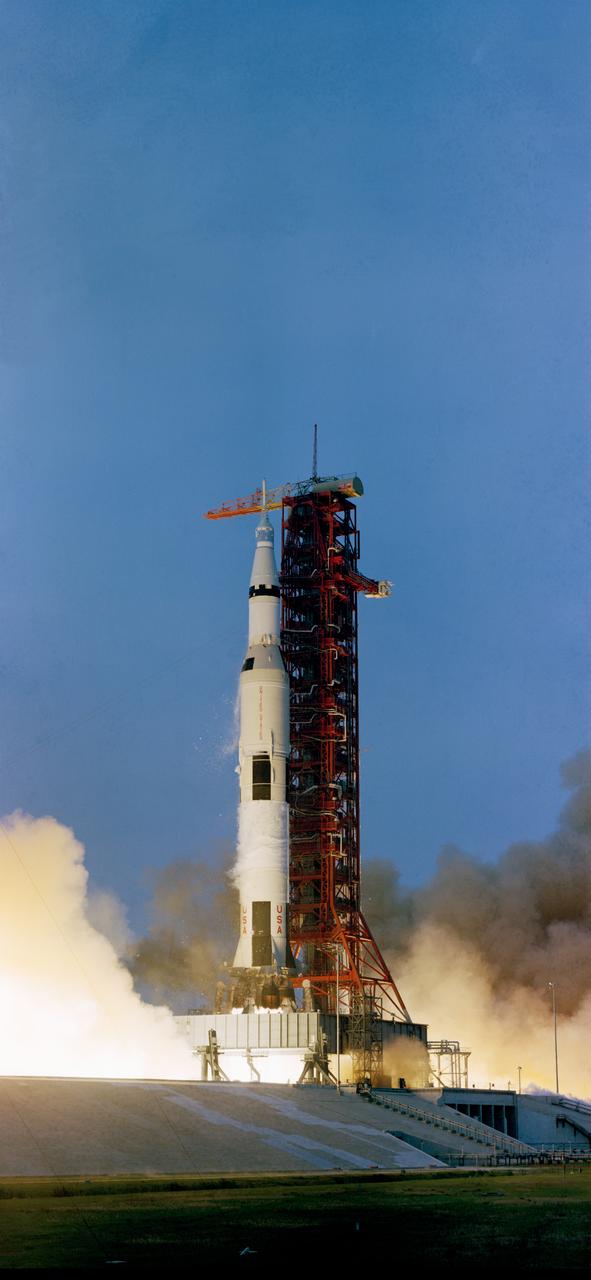
S70-34852 (11 April 1970) --- The Apollo 13 (Spacecraft 109/Lunar Module 7/Saturn 508) space vehicle is launched from Pad A Launch Complex 39, Kennedy Space Center (KSC), at 2:13 p.m. (EST), April 11, 1970. The crew of the National Aeronautics and Space Administration's (NASA) third lunar landing mission are astronauts James A. Lovell Jr., commander; John L. Swigert Jr., command module pilot; and Fred W. Haise Jr., lunar module pilot.
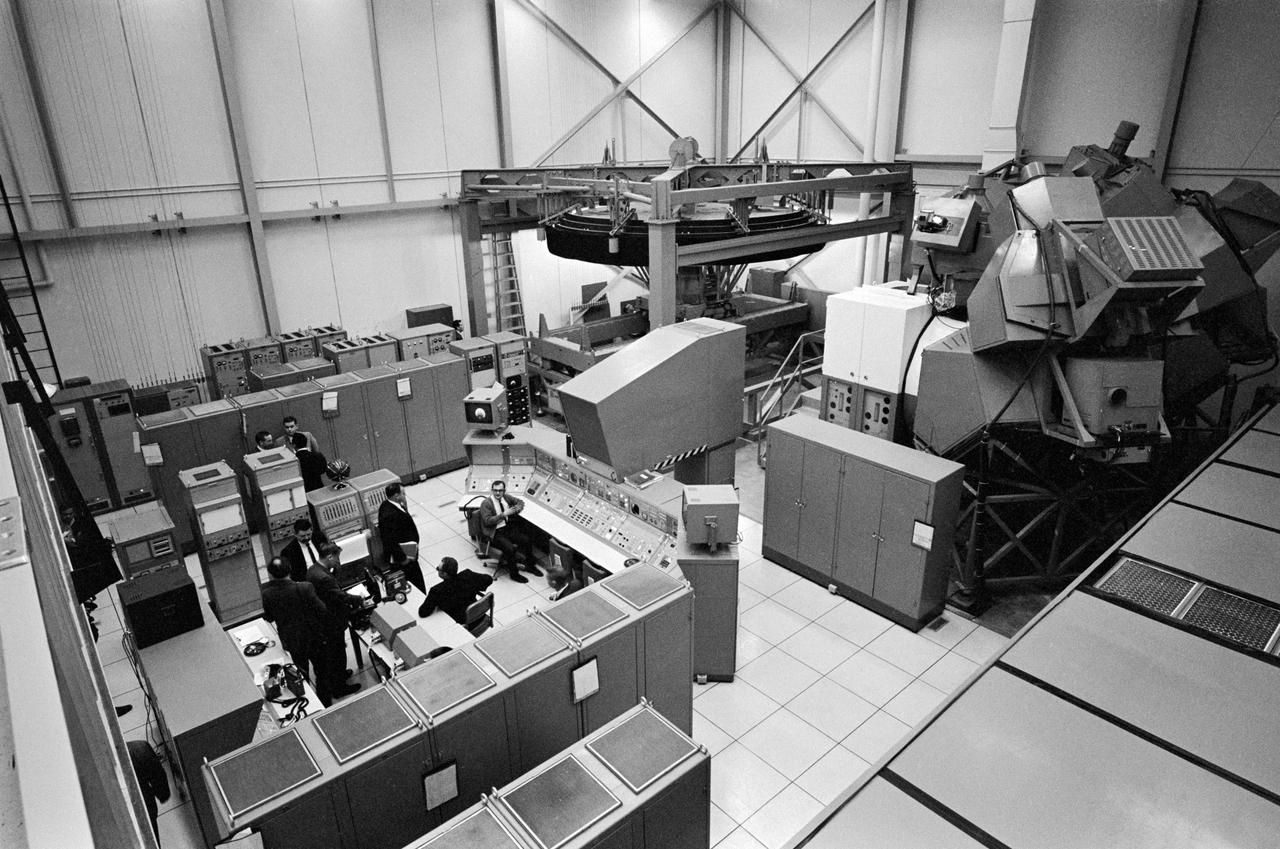
Overall view of the Lunar Module Mission Simulator, an astronaut training facility located in bldg 5.
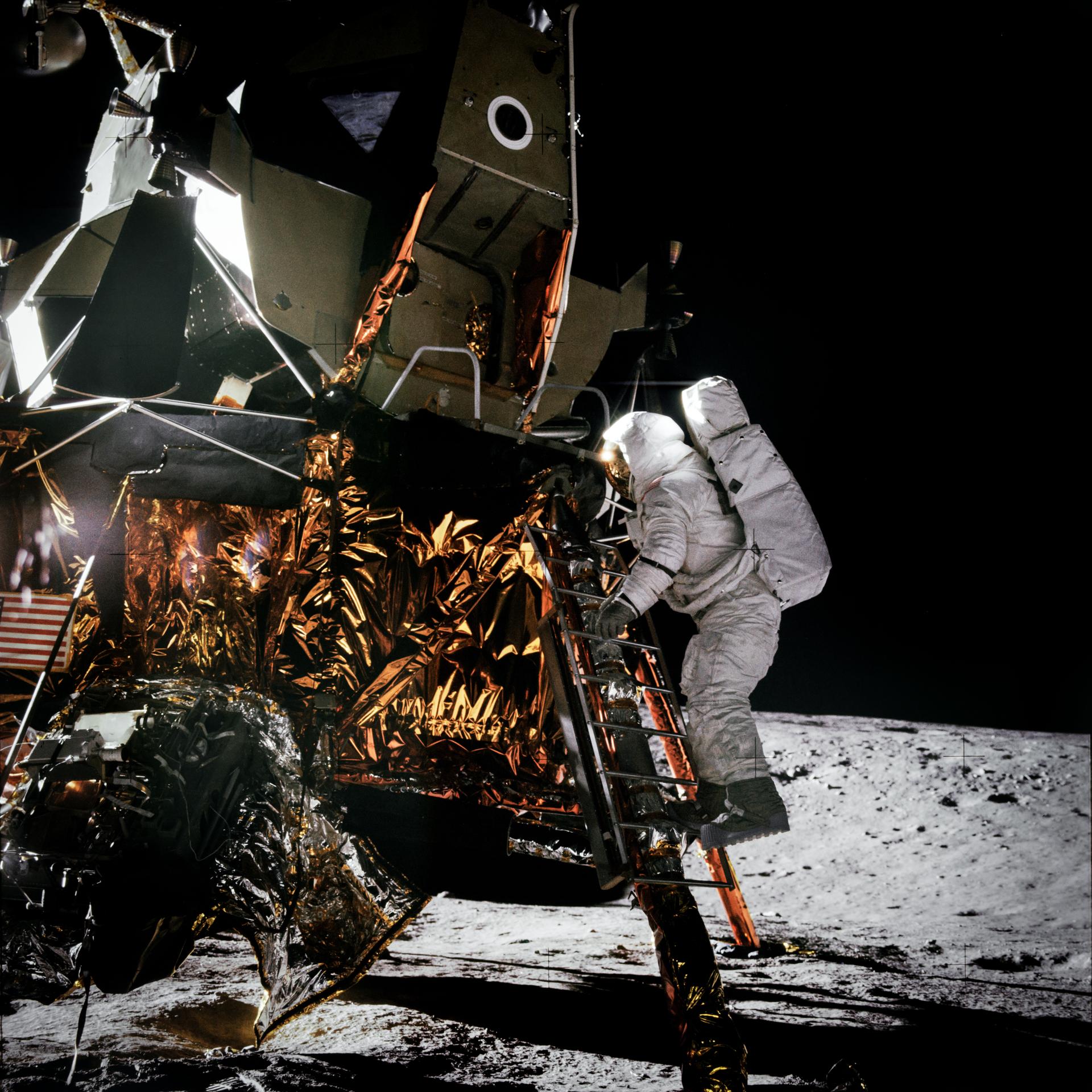
AS12-46-6728 (19 Nov. 1969) --- Astronaut Alan L. Bean, lunar module pilot for the Apollo 12 mission, is about to step off the ladder of the Lunar Module to join astronaut Charles Conrad Jr., mission commander, in extravehicular activity (EVA). Conrad and Bean descended in the Apollo 12 LM to explore the moon while astronaut Richard F. Gordon Jr., command module pilot, remained with the Command and Service Modules in lunar orbit.
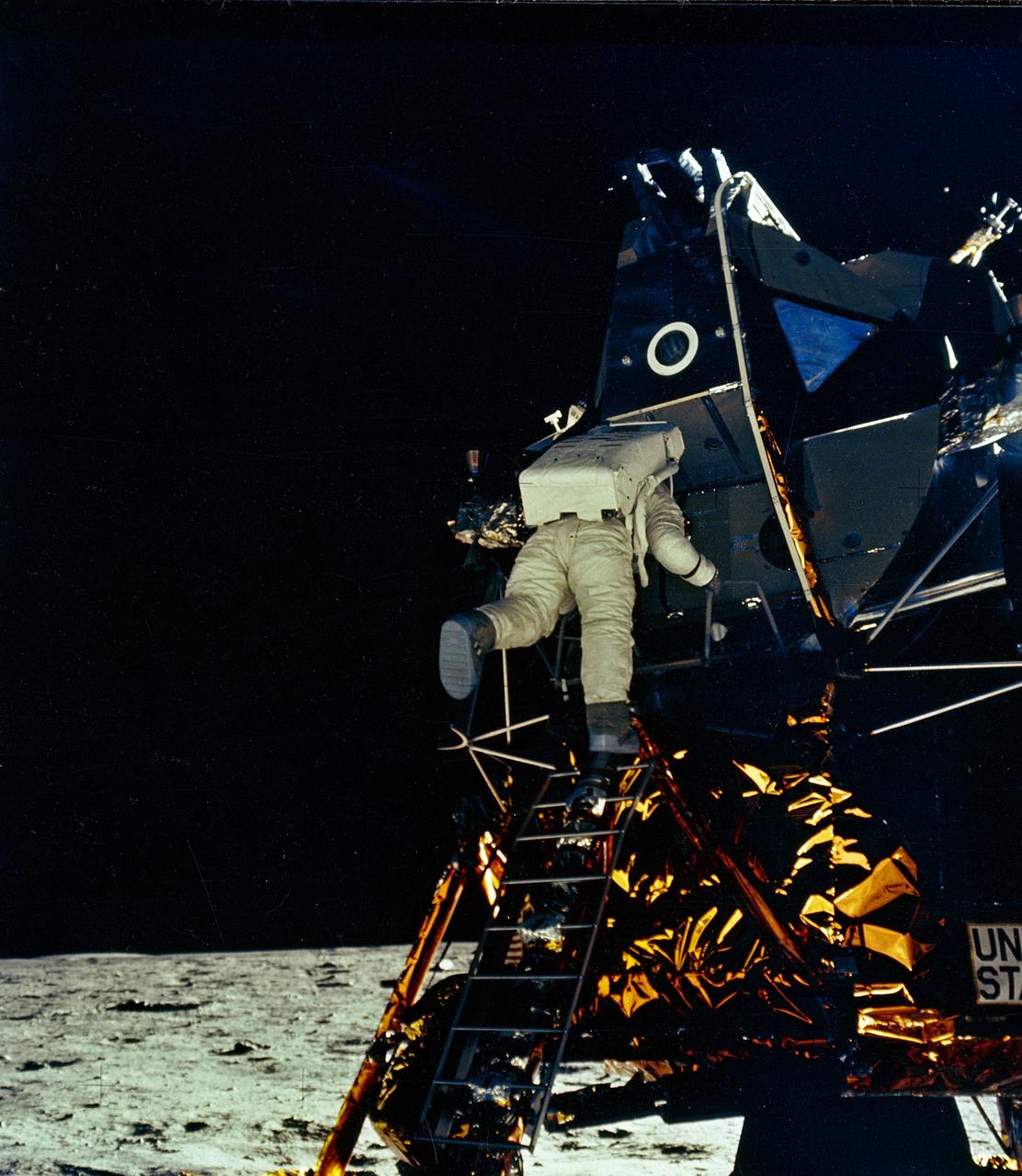
Carrying astronauts Neil A. Armstrong and Edwin E. Aldrin, Jr., the Lunar Module (LM) “Eagle” was the first crewed vehicle to land on the Moon. The LM landed on the moon’s surface on July 20, 1969 in the region known as Mare Tranquilitatis (the Sea of Tranquility). Shown here is Aldrin Jr. making his exit from the LM to the lunar surface. Armstrong, who was already on the surface, took this photograph. The Apollo 11 mission launched from the Kennedy Space Center, Florida via a Saturn V launch vehicle on July 16, 1969 and safely returned to Earth on July 24, 1969. The Saturn V vehicle was developed by the Marshall Space Flight Center (MSFC) under the direction of Dr. Wernher von Braun. The 3-man crew aboard the flight consisted of astronauts Neil A. Armstrong, commander; Michael Collins, Command Module (CM) pilot; and Edwin E. Aldrin Jr., Lunar Module pilot. Armstrong was the first human to ever stand on the lunar surface. As he stepped off the LM, Armstrong proclaimed, “That’s one small step for man, one giant leap for mankind”. He was followed by Edwin (Buzz) Aldrin, describing the lunar surface as magnificent desolation. During a 2½ hour surface exploration the crew collected 47 pounds of lunar surface material which was returned to Earth for analysis. With the success of Apollo 11, the national objective to land men on the Moon and return them safely to Earth had been accomplished.
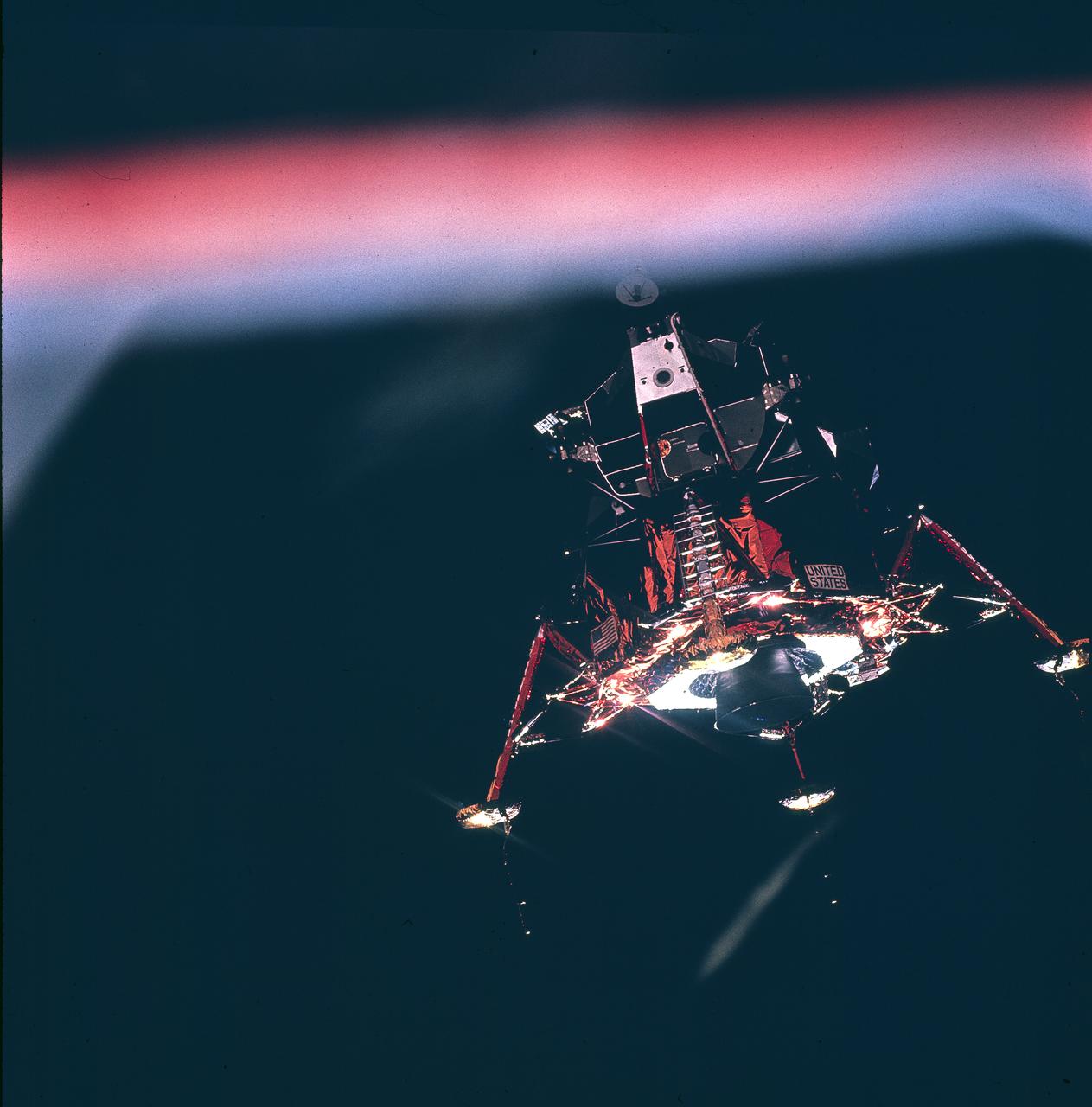
Carrying astronauts Neil A. Armstrong and Edwin E. Aldrin, Jr., the Lunar Module (LM) “Eagle” was the first crewed vehicle to land on the Moon. The LM landed on the moon’s surface on July 20, 1969 in the region known as Mare Tranquilitatis (the Sea of Tranquility). The LM is shown here making its descent to the lunar surface, while Astronaut Collins piloted the Command Module in a parking orbit around the Moon. The Apollo 11 mission launched from The Kennedy Space Center, Florida aboard a Saturn V launch vehicle on July 16, 1969 and safely returned to Earth on July 24, 1969. The 3-man crew aboard the flight consisted of Neil A. Armstrong, commander; Michael Collins, Command Module pilot; and Edwin E. Aldrin Jr., Lunar Module pilot. Armstrong was the first human to ever stand on the lunar surface. As he stepped off the LM, Armstrong proclaimed, “That’s one small step for man, one giant leap for mankind”. He was followed by Edwin (Buzz) Aldrin, describing the lunar surface as Magnificent desolation. The crew collected 47 pounds of lunar surface material which was returned to Earth for analysis. The surface exploration was concluded in 2½ hours. With the success of Apollo 11, the national objective to land men on the Moon and return them safely to Earth had been accomplished. The Saturn V vehicle was developed by the Marshall Space Flight Center (MSFC) under the direction of Dr. von Braun.
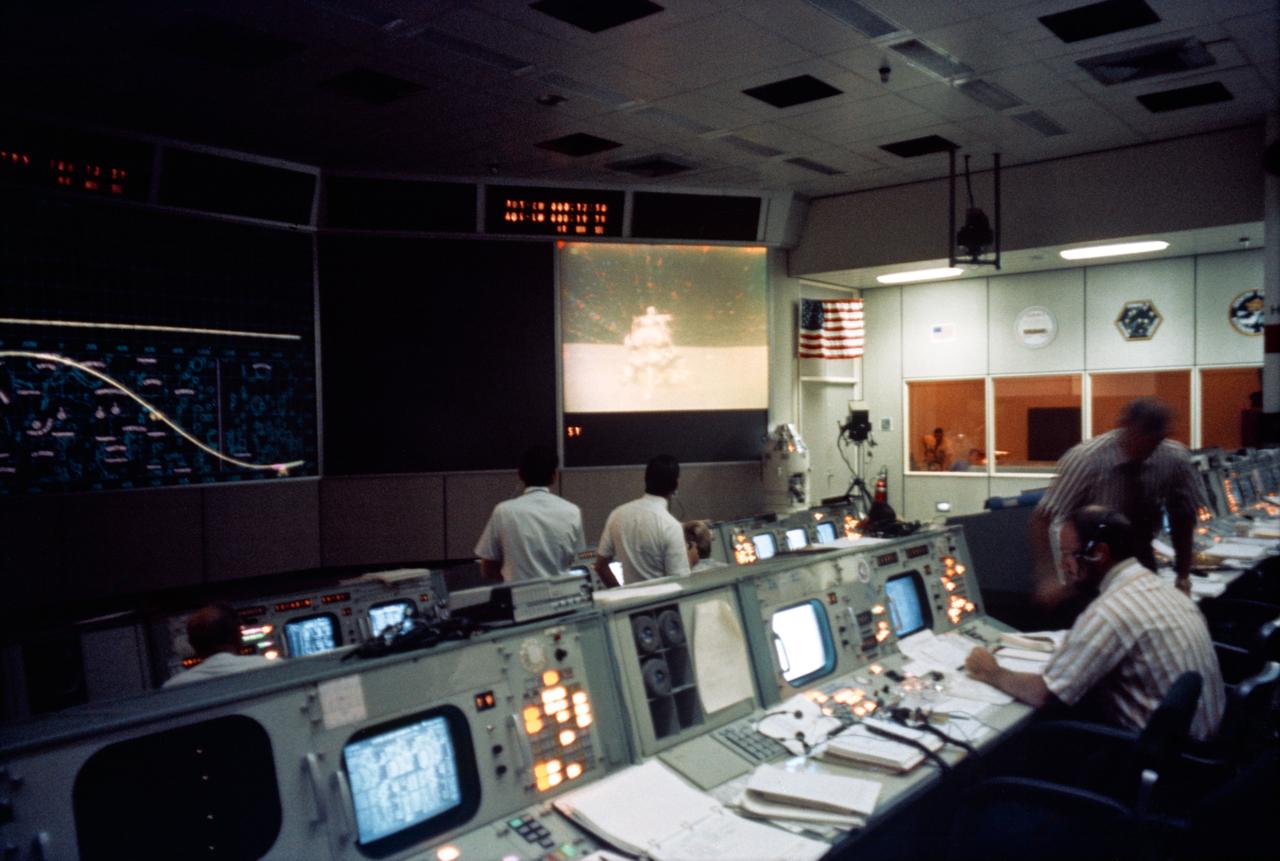
S71-41759 (2 Aug. 1971) --- A partial view of activity in the Mission Operations Control Room in the Mission Control Center during the liftoff of the Apollo 15 Lunar Module "Falcon" ascent stage from the lunar surface. An RCA color television camera mounted on the Lunar Roving Vehicle made it possible for people on Earth to watch the LM's spectacular launch from the moon. The LM liftoff was at 171:37 ground elapsed time. The LRV was parked about 300 feet east of the LM. The TV camera was remotely controlled from a console in the MOCR. Seated in the right foreground is astronaut Edgar D. Mitchell, a spacecraft communicator. Mitchell was lunar module pilot of the Apollo 14 lunar landing mission. Note liftoff on the television monitor in the center background.
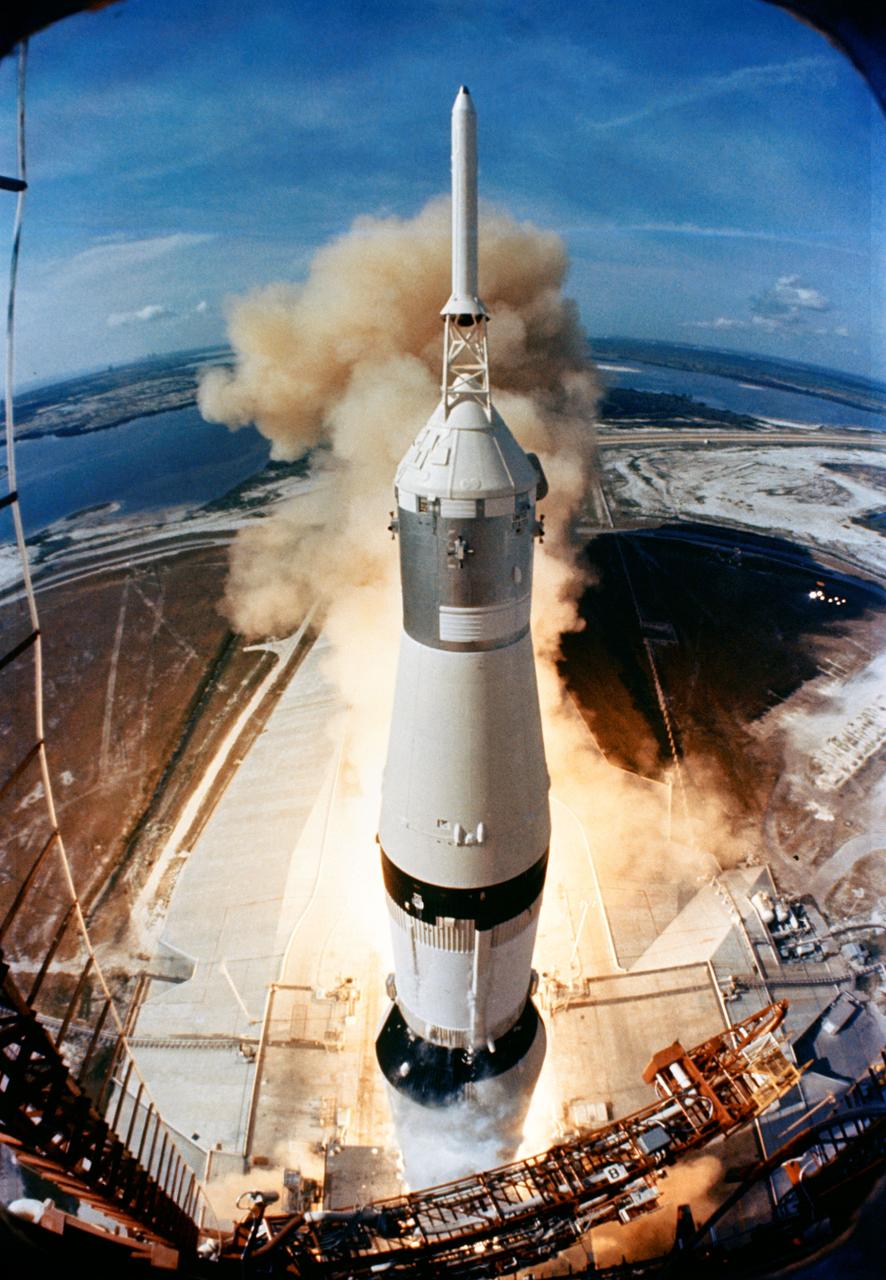
S69-39961 (16 July 1969) --- The huge, 363-feet tall Apollo 11 (Spacecraft 107/Lunar Module S/Saturn 506) space vehicle is launched from Pad A, Launch Complex 39, Kennedy Space Center (KSC), at 9:32 a.m. (EDT), July 16, 1969. Onboard the Apollo 11 spacecraft are astronauts Neil A. Armstrong, commander; Michael Collins, command module pilot; and Edwin E. Aldrin Jr., lunar module pilot. Apollo 11 is the United States' first lunar landing mission. While astronauts Armstrong and Aldrin descend in the Lunar Module (LM) "Eagle" to explore the Sea of Tranquility region of the moon, astronaut Collins will remain with the Command and Service Modules (CSM) "Columbia" in lunar orbit. Photo credit: NASA
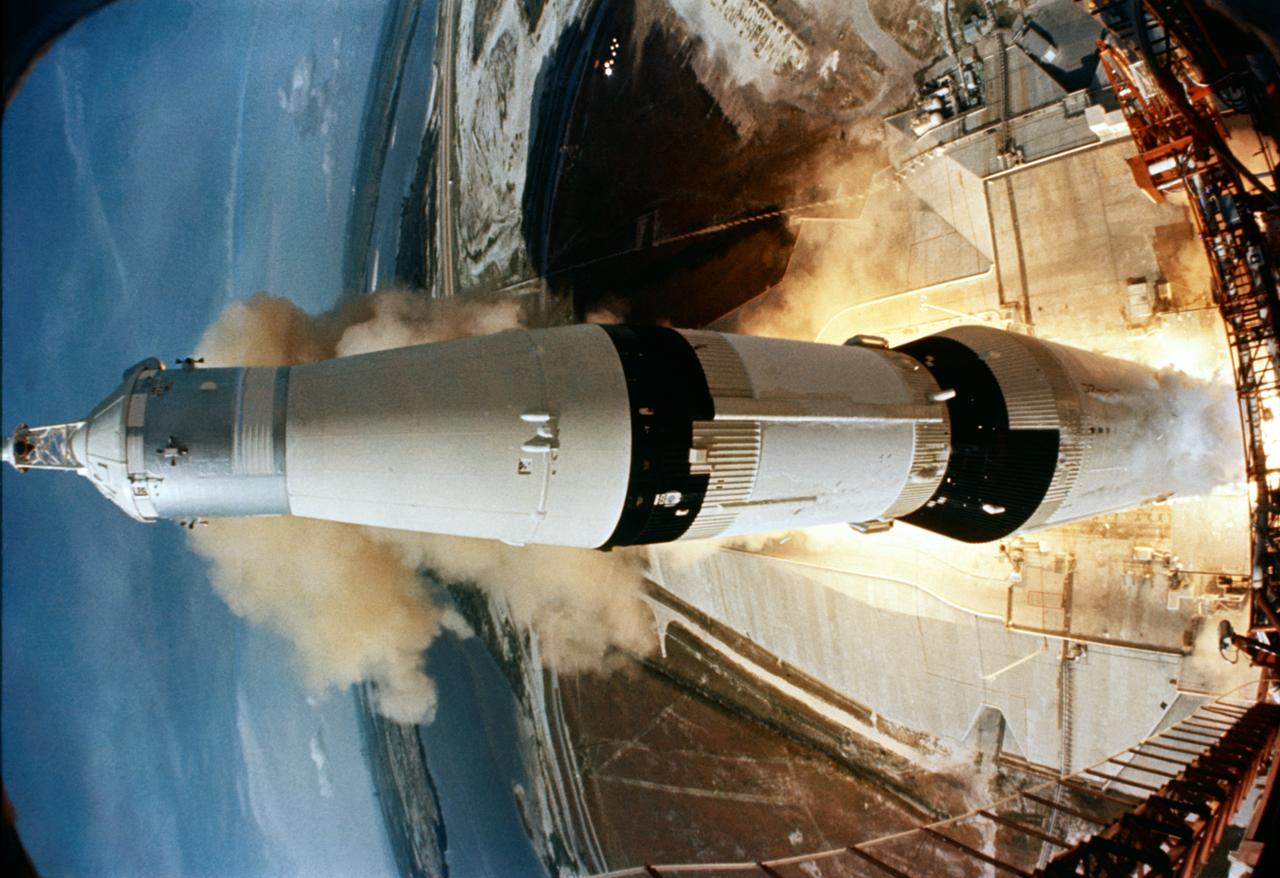
S69-39959 (16 July 1969) --- The huge, 363-feet tall Apollo 11 (Spacecraft 107/Lunar Module 5/ Saturn 506) space vehicle is launched from Pad A, Launch Complex 39, Kennedy Space Center (KSC), at 9:32 a.m. (EDT), July 16, 1969. Aboard the Apollo 11 spacecraft were astronauts Neil A. Armstrong, commander; Michael Collins, command module pilot; and Edwin E. Aldrin Jr., lunar module pilot. Apollo 11 is the United States' first lunar landing mission. This view of the liftoff was taken by a camera mounted on the mobile launch tower. While astronauts Armstrong and Aldrin descend in the Lunar Module (LM) "Eagle" to explore the Sea of Tranquility region of the moon, astronaut Collins will remain with the Command and Service Modules (CSM) "Columbia" in lunar orbit. Photo credit: NASA
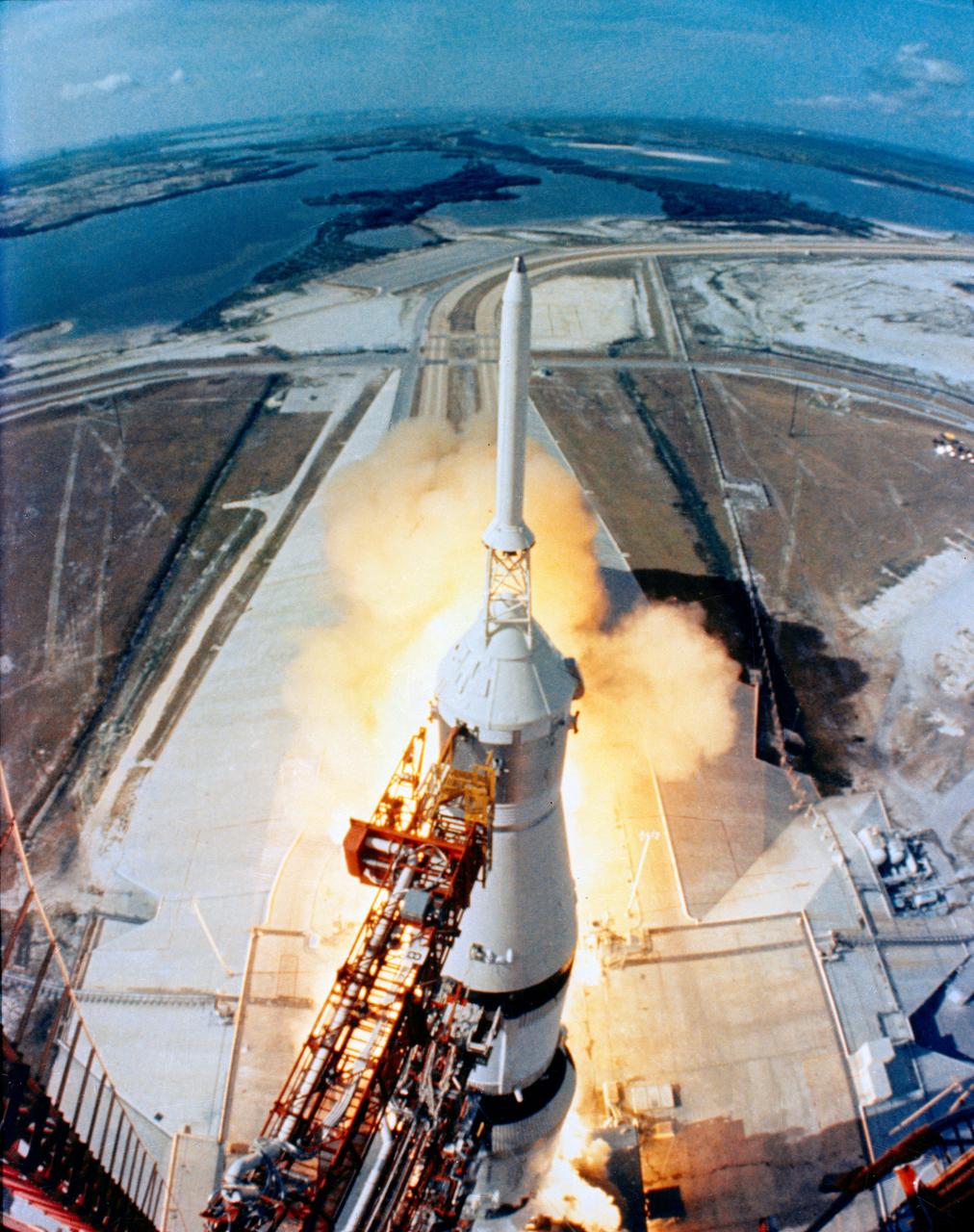
S69-39962 (16 July 1969) --- The huge, 363-feet tall Apollo 11 (Spacecraft 107/Lunar Module 5/Saturn 506) space vehicle is launched from Pad A, Launch Complex 39, Kennedy Space Center (KSC), at 9:32 a.m. (EDT), July 16, 1969. Aboard the Apollo 11 spacecraft were astronauts Neil A. Armstrong, commander; Michael Collins, command module pilot; and Edwin E. Aldrin Jr., lunar module pilot. Apollo 11 is the United States' first lunar landing mission. This view of the liftoff was taken by a camera mounted on the mobile launch tower. While astronauts Armstrong and Aldrin descend in the Lunar Module (LM) "Eagle" to explore the Sea of Tranquility region of the moon, astronaut Collins will remain with the Command and Service Modules (CSM) "Columbia" in lunar orbit.
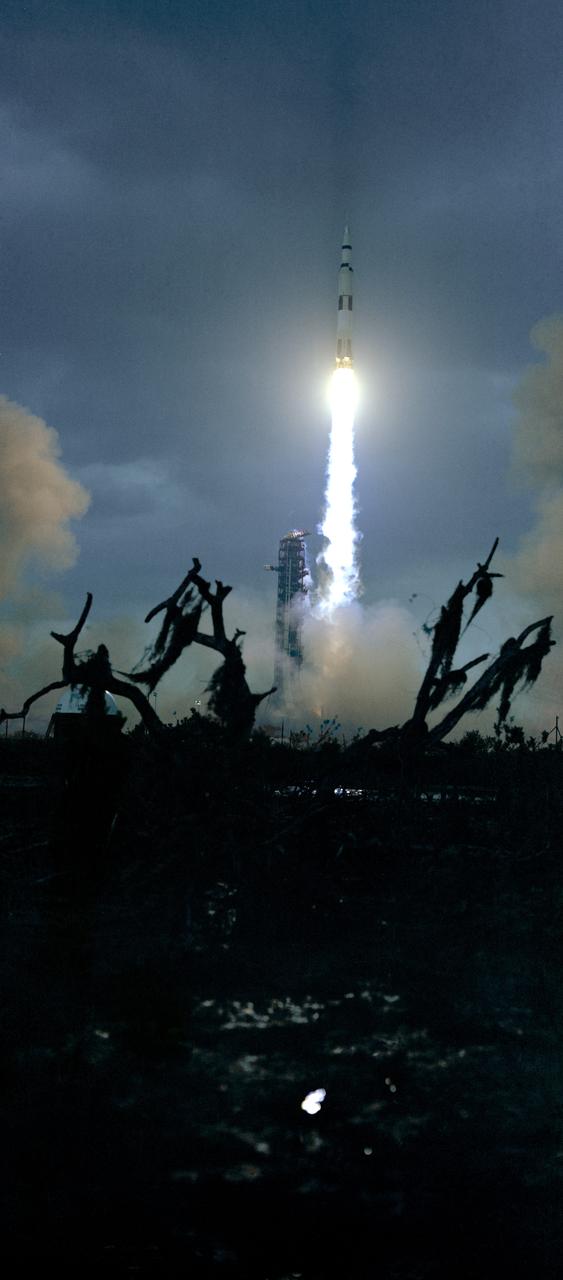
S71-18398 (31 Jan. 1971) --- The huge, 363-feet tall Apollo 14 (Spacecraft 110/Lunar Module 8/Saturn 509) space vehicle is launched from Pad A, Launch Complex 39, Kennedy Space Center (KSC), Florida at 4:03:02 p.m. (EST), Jan. 31, 1971, on a lunar landing mission. This view is framed by moss-covered dead trees in the dark foreground. Aboard the Apollo 14 spacecraft were astronauts Alan B. Shepard Jr., commander; Stuart A. Roosa, command module pilot; and Edgar D. Mitchell, lunar module pilot.
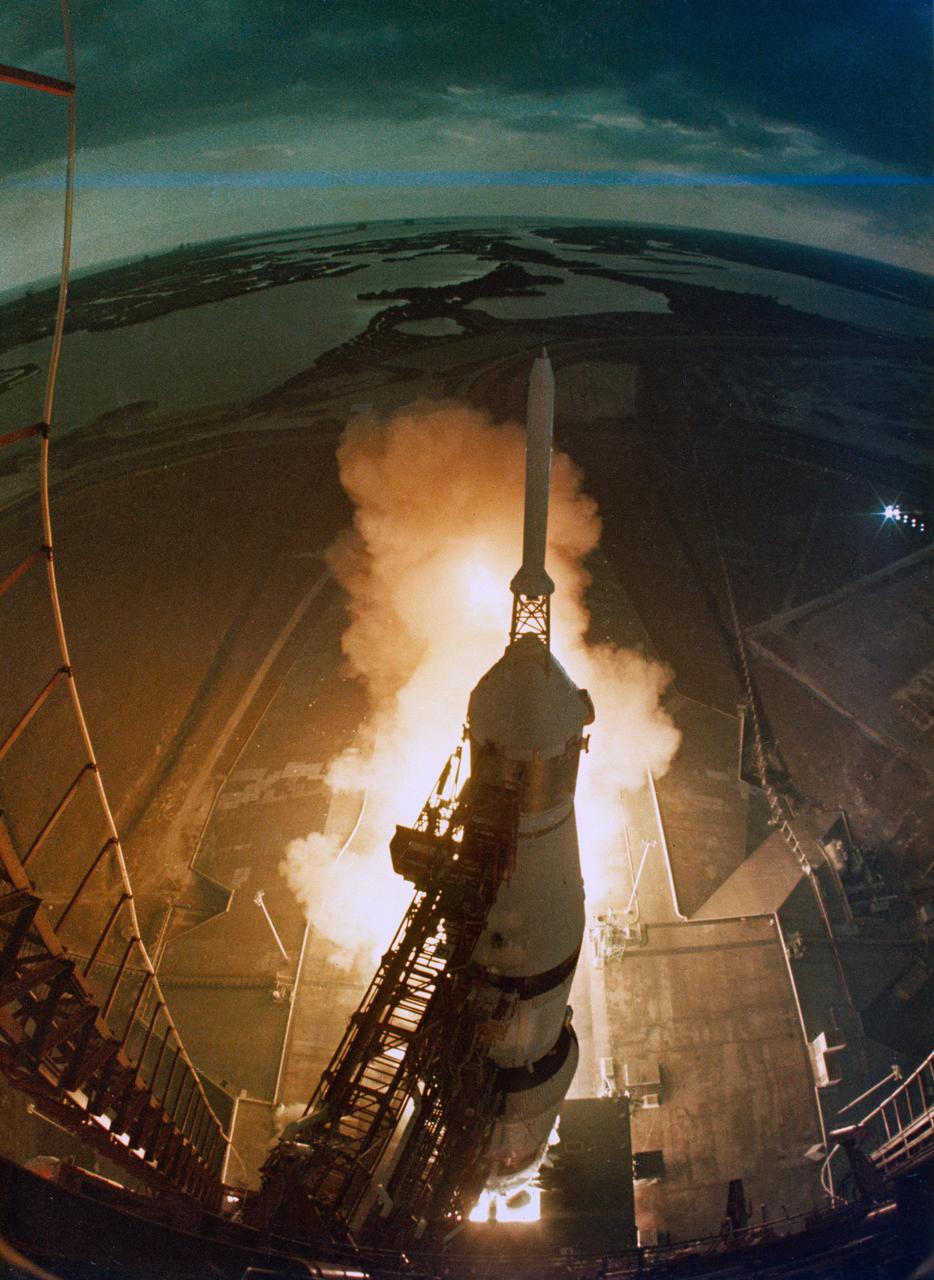
S71-17620 (31 Jan. 1971) --- The huge, 363-feet tall Apollo 14 (Spacecraft 110/Lunar Module 8/Saturn 509) space vehicle is launched from Pad A, Launch Complex 39, Kennedy Space Center, Florida, at 4:03:02 p.m. (EST), Jan. 31, 1981, on a lunar landing mission. This view of the liftoff was taken by a camera mounted on the mobile launch tower. Aboard the Apollo 14 spacecraft were astronauts Alan B. Shepard Jr., commander; Stuart A. Roosa, command module pilot; and Edgar D. Mitchell, lunar module pilot.
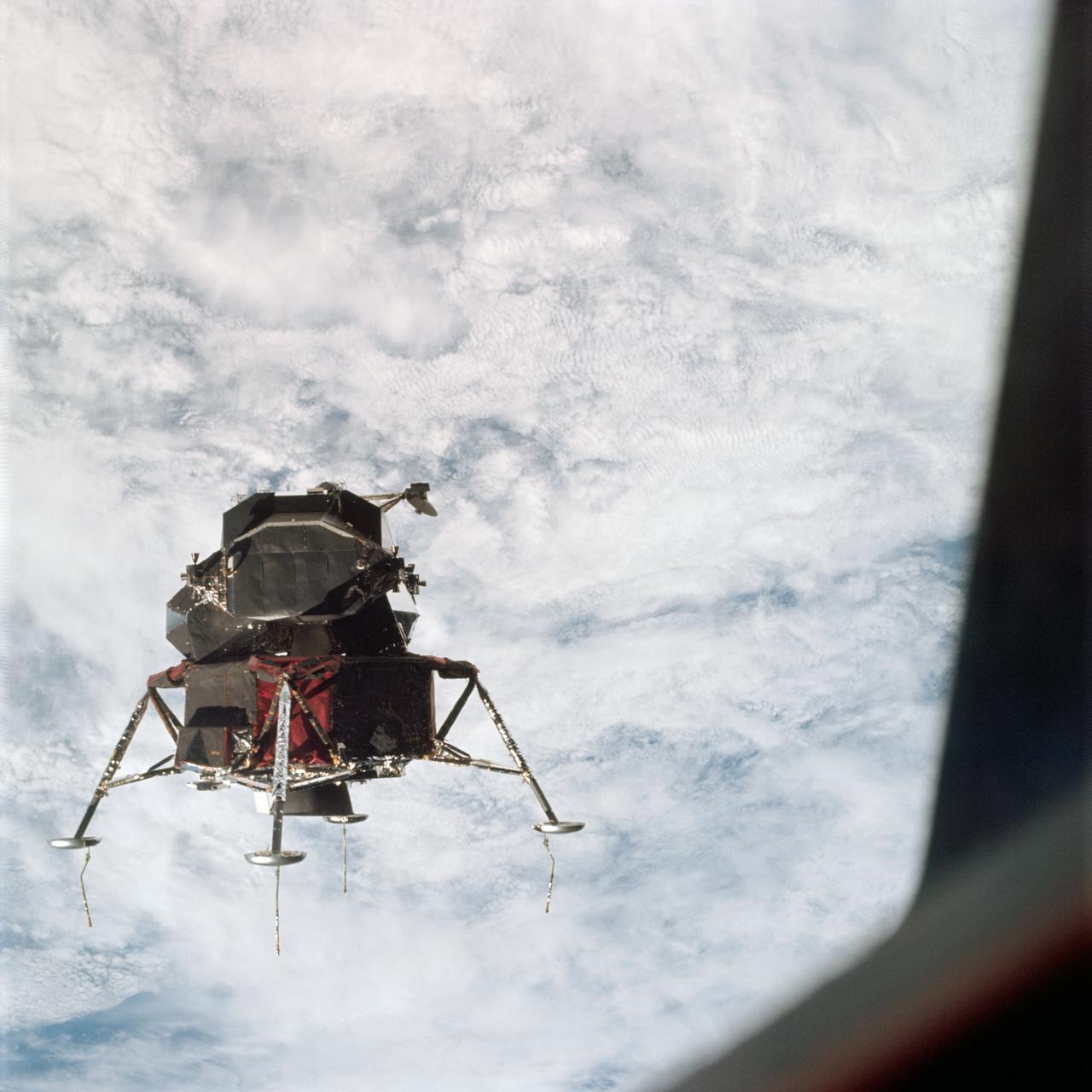
AS09-21-3197 (7 March 1969) --- A view of the Apollo 9 Lunar Module (LM) "Spider" in a lunar landing configuration, as photographed from the Command and Service Modules (CSM) on the fifth day of the Apollo 9 Earth-orbital mission. The landing gear on the "Spider" has been deployed. Lunar surface probes (sensors) extend out from the landing gear foot pads. Inside the "Spider" were astronauts James A. McDivitt, Apollo 9 commander; and Russell L. Schweickart, lunar module pilot. Astronaut David R. Scott, command module pilot, remained at the controls in the Command Module (CM), "Gumdrop," while the other two astronauts checked out the LM. Schweickart, lunar module pilot, is photographed from the CM "Gumdrop" during his extravehicular activity (EVA) on the fourth day of the Apollo 9 Earth-orbital mission. The CSM is docked with the LM. Astronaut James A. McDivitt, Apollo 9 commander, was inside the LM "Spider." Astronaut David R. Scott, command module pilot, remained at the controls in the CM.
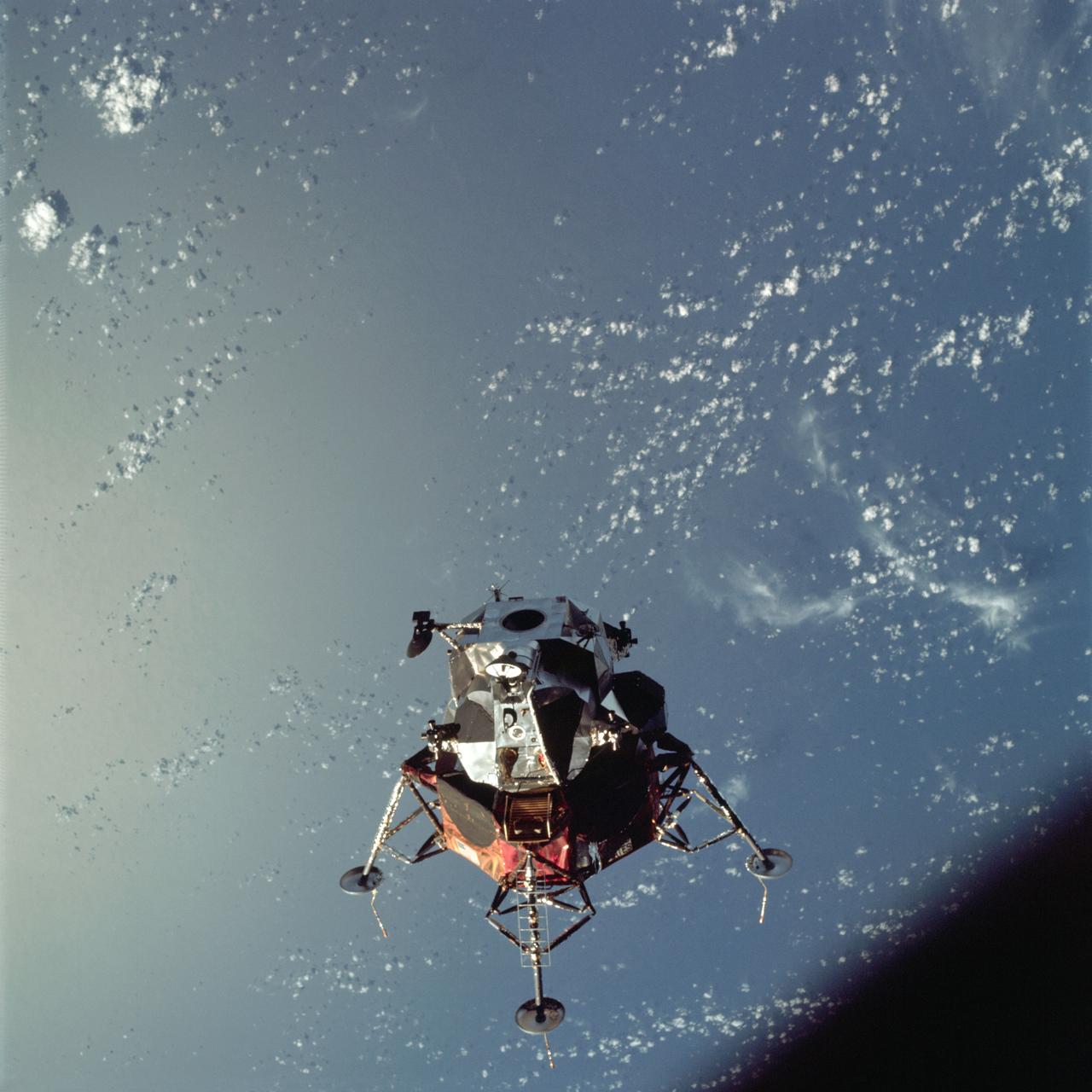
AS09-21-3183 (7 March 1969) --- A view of the Apollo 9 Lunar Module (LM) "Spider" in a lunar landing configuration, as photographed from the Command and Service Modules (CSM) on the fifth day of the Apollo 9 Earth-orbital mission. The landing gear on the "Spider" has been deployed. Lunar surface probes (sensors) extend out from the landing gear foot pads. Inside the "Spider" were astronauts James A. McDivitt, Apollo 9 commander; and Russell L. Schweickart, lunar module pilot. Astronaut David R. Scott, command module pilot, remained at the controls in the Command Module (CM), "Gumdrop," while the other two astronauts checked out the LM. Schweickart, lunar module pilot, is photographed from the CM "Gumdrop" during his extravehicular activity (EVA) on the fourth day of the Apollo 9 Earth-orbital mission. The CSM is docked with the LM. Astronaut James A. McDivitt, Apollo 9 commander, was inside the LM "Spider." Astronaut David R. Scott, command module pilot, remained at the controls in the CM.
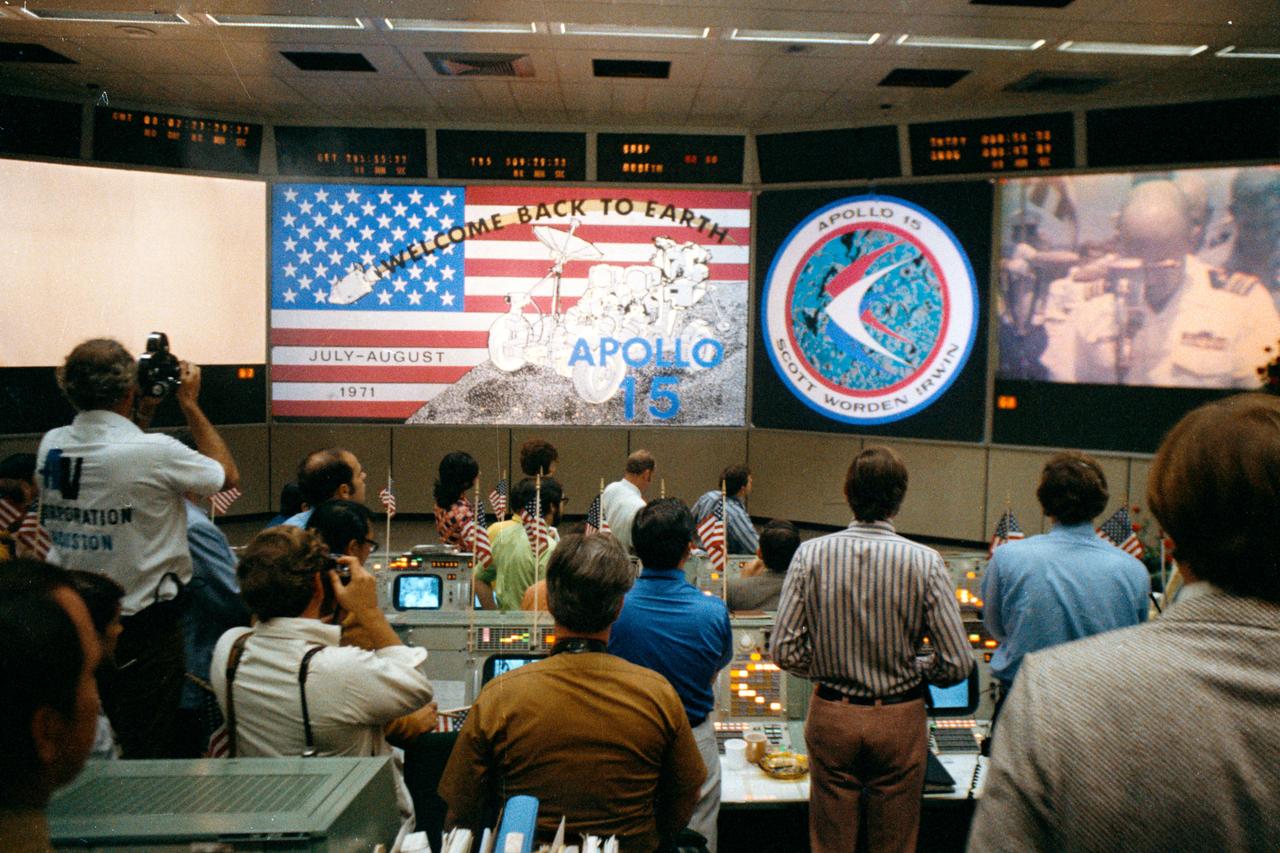
An overall view of activity in the Mission Operations Control Room in the Mission Control Center at the conclusion of the Apollo 15 lunar landing mission. The television monitor in the right background shows the welcome ceremonies aboard the prime recovery ship, U.S.S. Okinawa, in the mid-Pacific Ocean.

S68-56001 (21 Dec. 1968) --- The Apollo 8 (Spacecraft 103/Saturn 503) space vehicle is launched from Pad A, Launch Complex 39, Kennedy Space Center, at 7:51 a.m. (EST), Dec. 21, 1968. The crew of the Apollo 8 lunar orbit mission is astronauts Frank Borman, commander; James A. Lovell Jr., command module pilot; and William A. Anders, lunar module pilot. Apollo 8 was the first manned Saturn V launch. (Just after ignition)
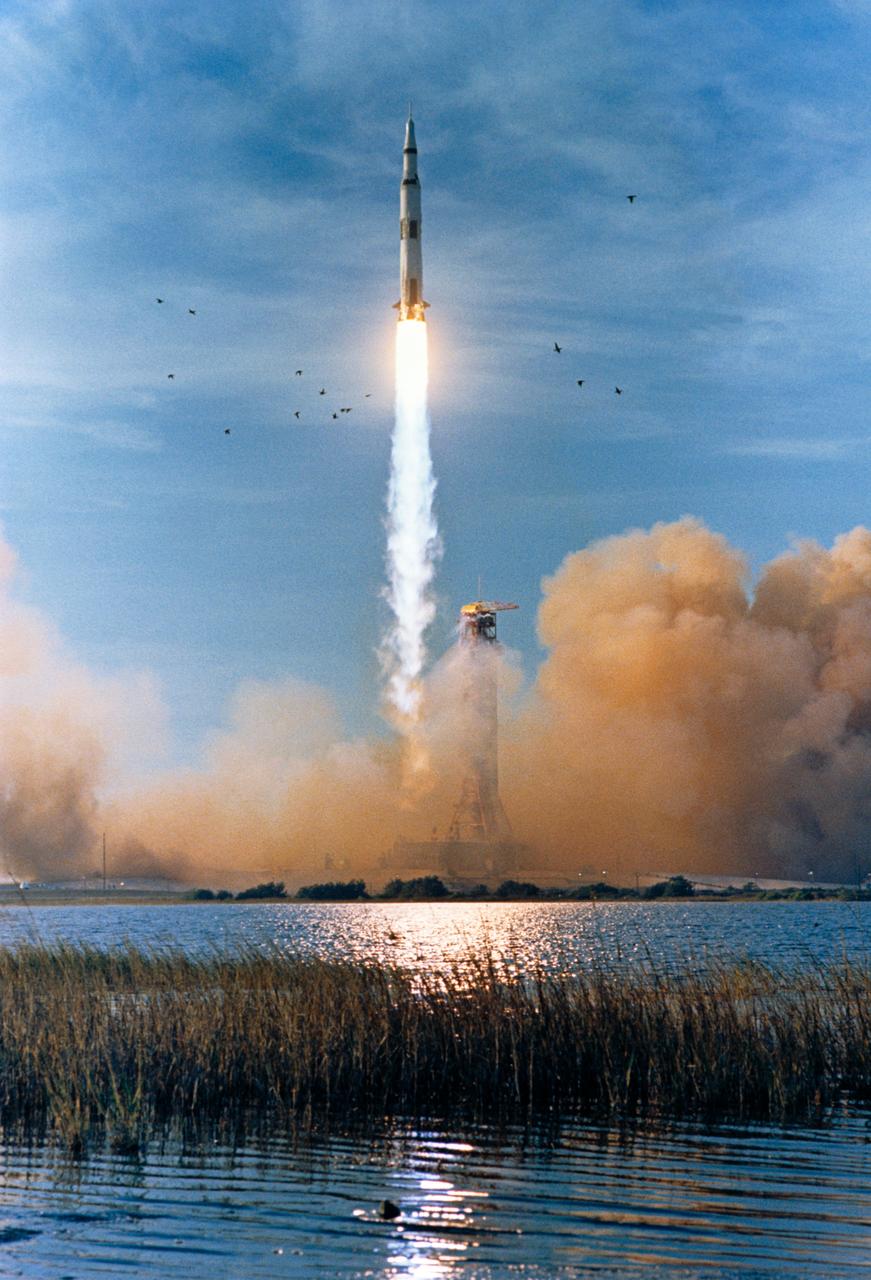
S68-56050 (21 Dec. 1968)--- The Apollo 8 (Spacecraft 103/Saturn 503) space vehicle is launched from Pad A, Launch Complex 39, Kennedy Space Center (KSC), at 7:51 a.m. (EST), Dec. 21, 1968. The crew of the Apollo 8 lunar orbit mission is astronauts Frank Borman, commander; James A. Lovell Jr., command module pilot; and William A. Anders, lunar module pilot. Apollo 8 is the first manned Saturn V launch. (water in foreground, seagulls)
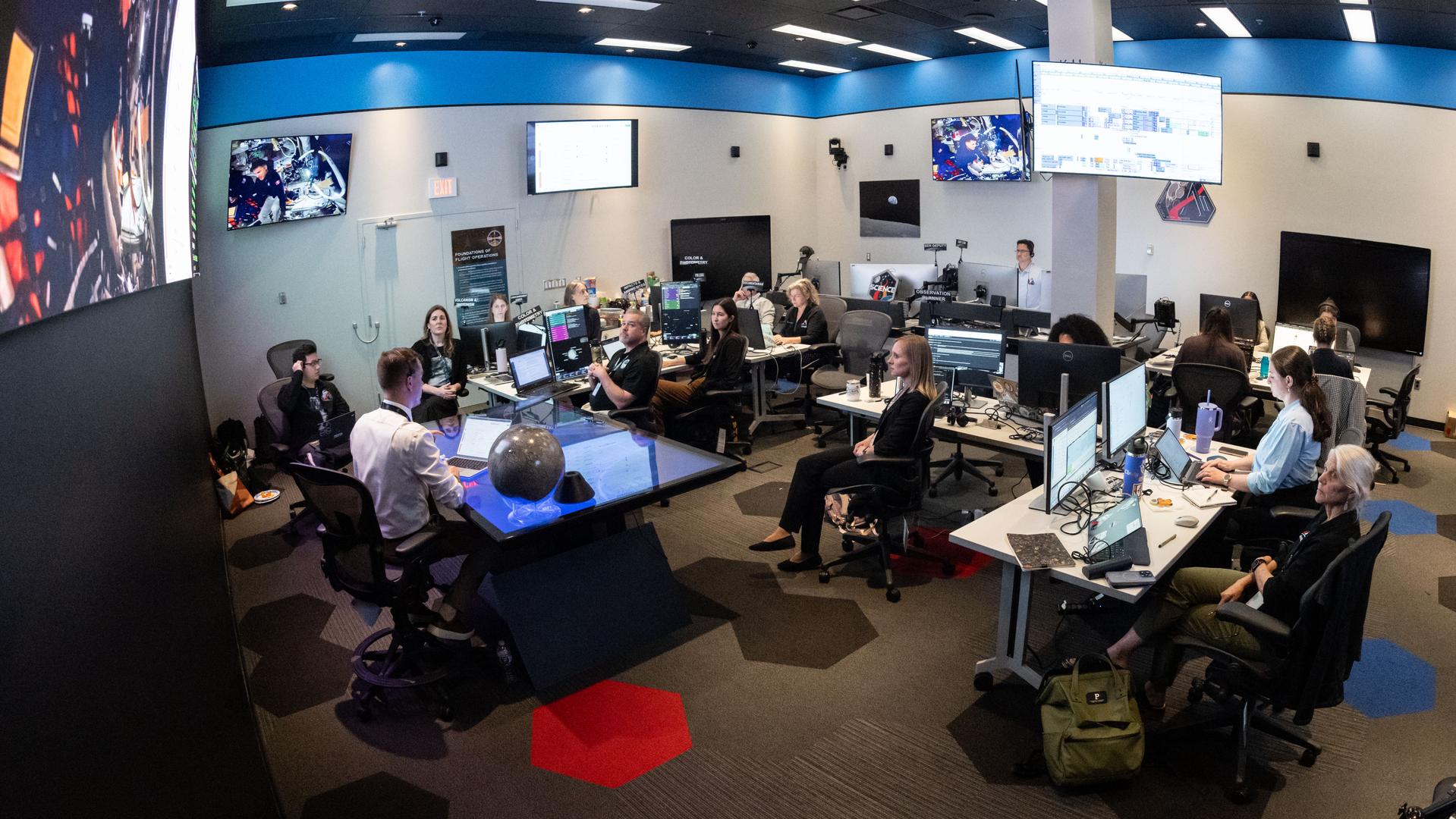
A view inside the Science Evaluation Room (SER) in Mission Control at NASA’s Johnson Space Center in Houston. The SER supports lunar science and planetary observations for the Artemis science officer in the mission’s main flight control room. Built specifically for Artemis missions with these science priorities in mind, the SER is equipped to support rapid data interpretation, collaborative analysis, real-time decision making, and seamless coordination between the science and operations teams. Credits: NASA/Bill Stafford
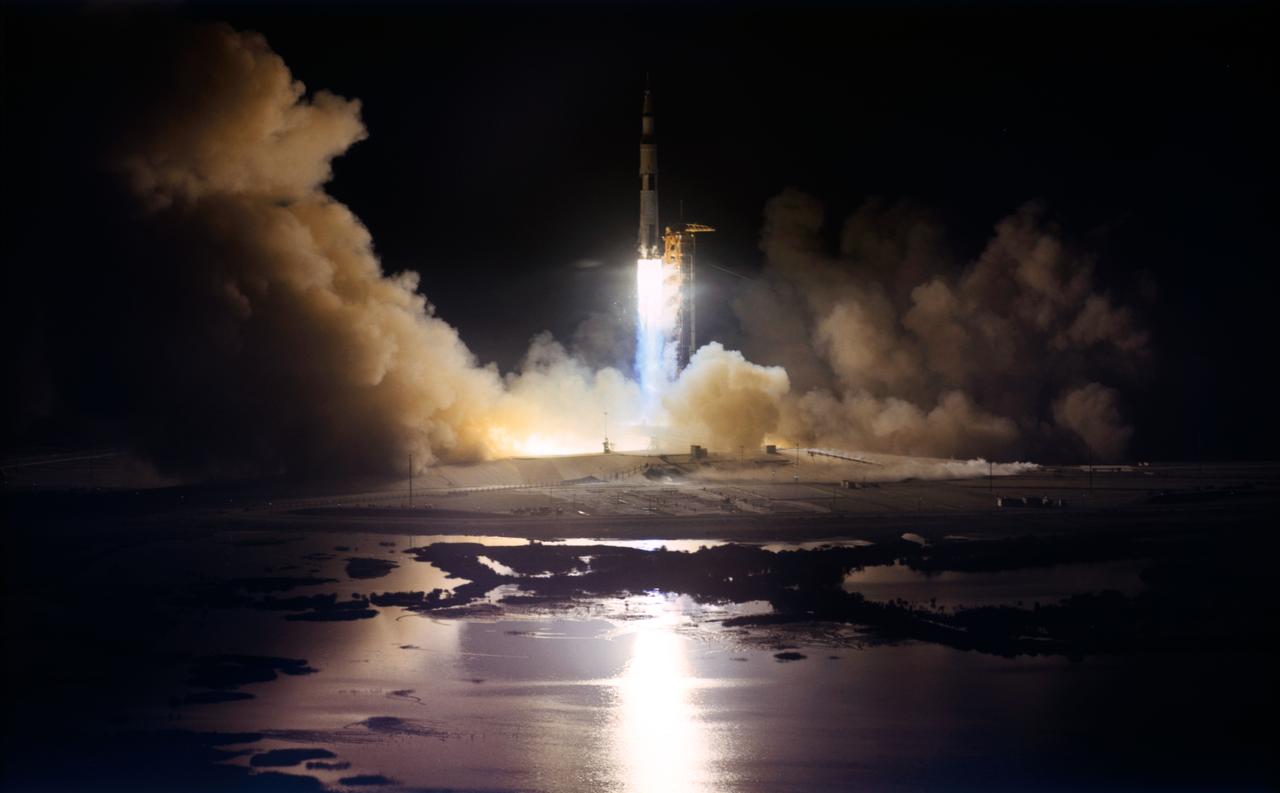
S72-55070 (7 Dec. 1972) --- The huge, 363-feet tall Apollo 17 (Spacecraft 114/Lunar Module 12/Saturn 512) space vehicle is launched from Pad A, Launch Complex 39, Kennedy Space Center (KSC), Florida, at 12:33 a.m. (EST), Dec. 7, 1972. Apollo 17, the final lunar landing mission in NASA's Apollo program, was the first nighttime liftoff of the Saturn V launch vehicle. Aboard the Apollo 17 spacecraft were astronaut Eugene A. Cernan, commander; astronaut Ronald E. Evans, command module pilot; and scientist-astronaut Harrison H. Schmitt, lunar module pilot. Flame from the five F-1 engines of the Apollo/Saturn first (S-1C) stage illuminates the nighttime scene. A two-hour and 40-minute hold delayed the Apollo 17 launching.
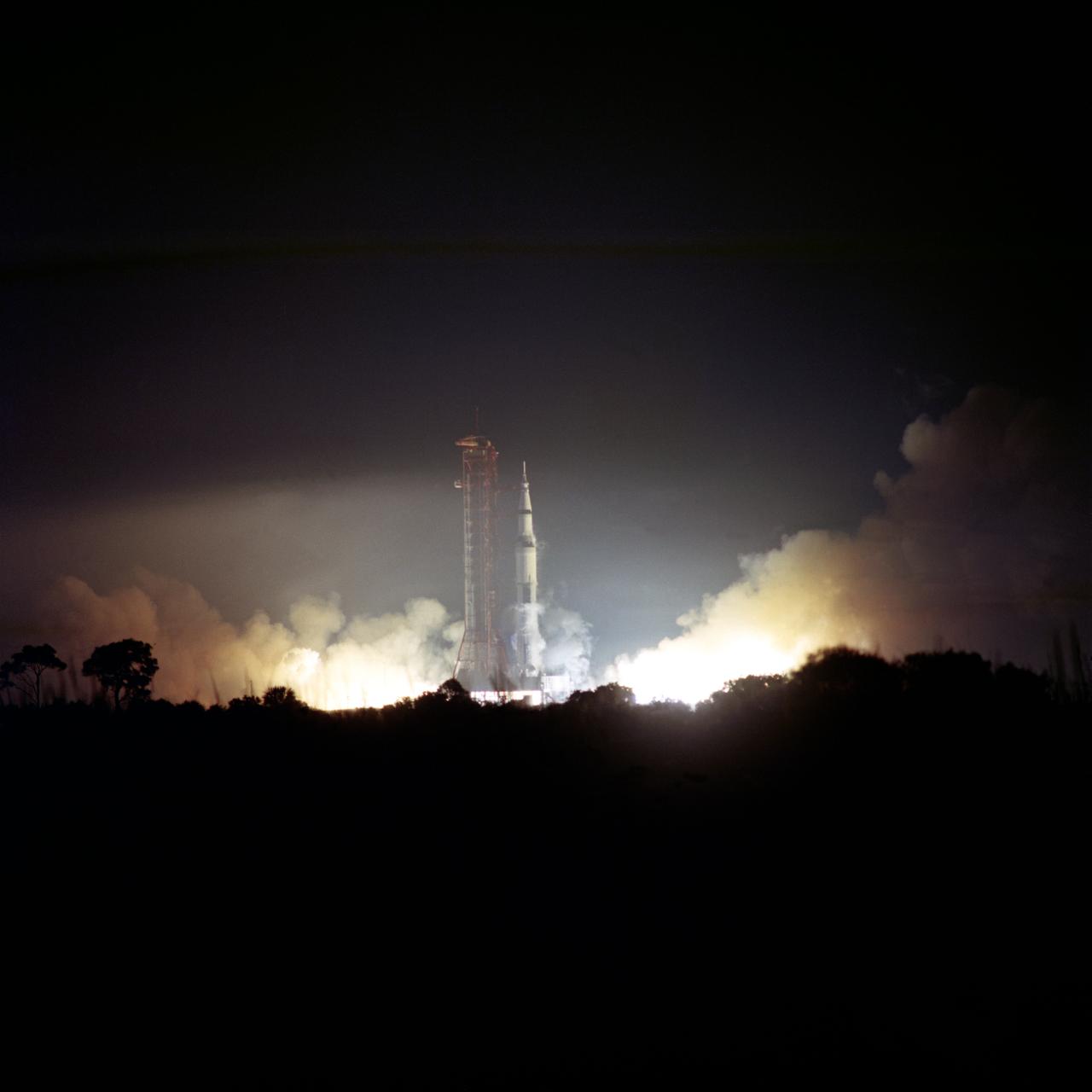
S72-55482 (7 Dec. 1972) --- The huge, 363-feet tall Apollo 17 (Spacecraft 114/Lunar Module 12/Saturn 512) space vehicle is launched from Pad A., Launch Complex 39, Kennedy Space Center (KSC), Florida, at 12:33 a.m. (EST), Dec. 7, 1972. Apollo 17, the final lunar landing mission in NASA's Apollo program, was the first nighttime liftoff of the Saturn V launch vehicle. Aboard the Apollo 17 spacecraft were astronaut Eugene A. Cernan, commander; astronaut Ronald E. Evans, command module pilot; and scientist-astronaut Harrison H. Schmitt, lunar module pilot. Flame from the five F-1 engines of the Apollo/Saturn first (S-1C) stage illuminates the nighttime scene. A two-hour and 40-minute hold delayed the Apollo 17 launching.
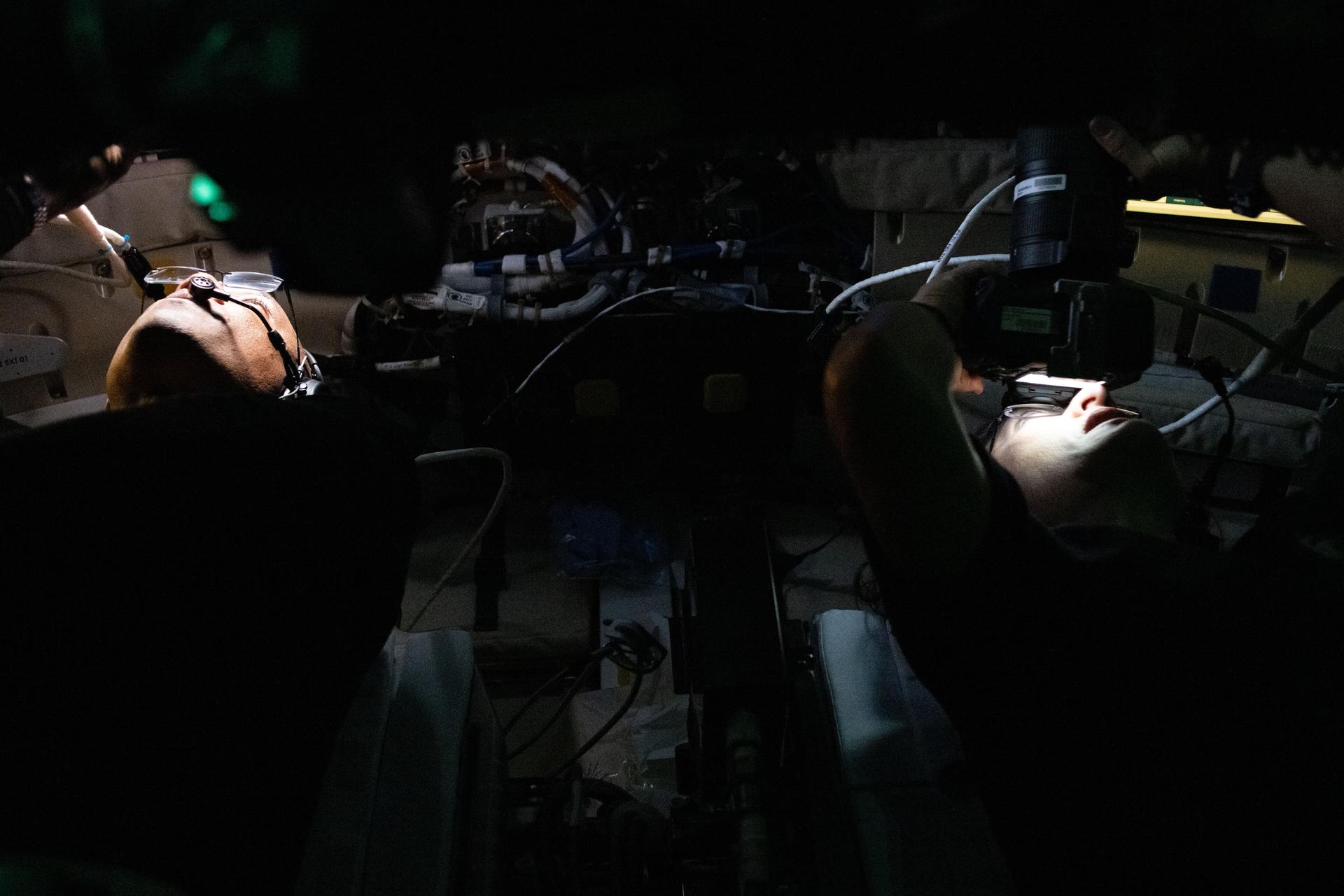
art002e016247 (April 6, 2026) – Artemis II Pilot Victor Glover, on the left, and Mission Specialist Christina Koch, on the right, gather images and observations of the lunar surface to share with the world during the lunar flyby on the sixth day of the mission. The crew spent approximately seven hours taking turns at the windows of the Orion spacecraft as they flew around the far side of the Moon. At closest approach, they came within 4,067 miles of the Moon’s surface. Credit: NASA
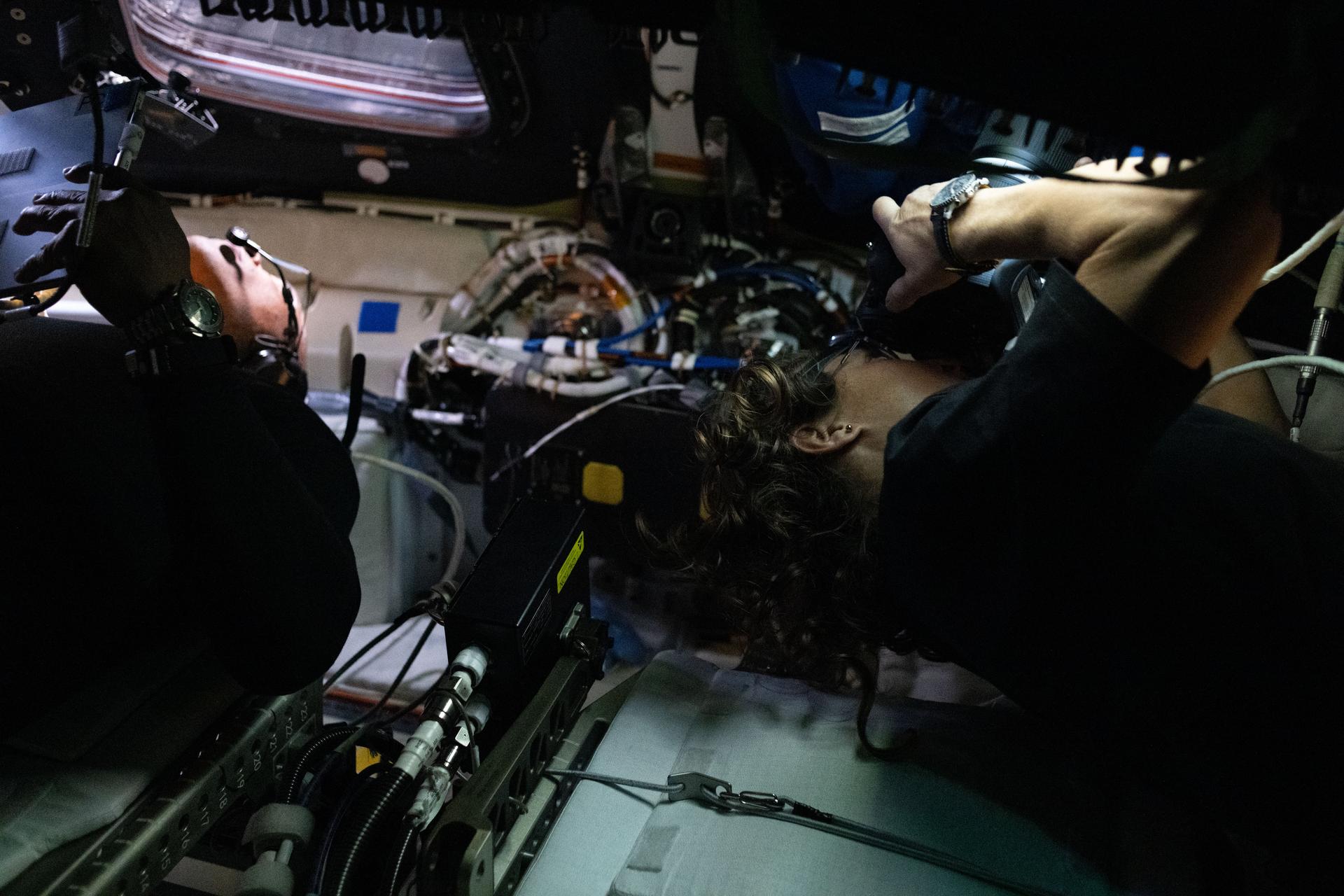
art002e016195 (April 6, 2026) – Artemis II Pilot Victor Glover, on the left, and Mission Specialist Christina Koch, on the right, gather images and observations of the lunar surface to share with the world during the lunar flyby on the sixth day of the mission. The crew spent approximately seven hours taking turns at the windows of the Orion spacecraft as they flew around the far side of the Moon. At closest approach, they came within 4,067 miles of the Moon’s surface.
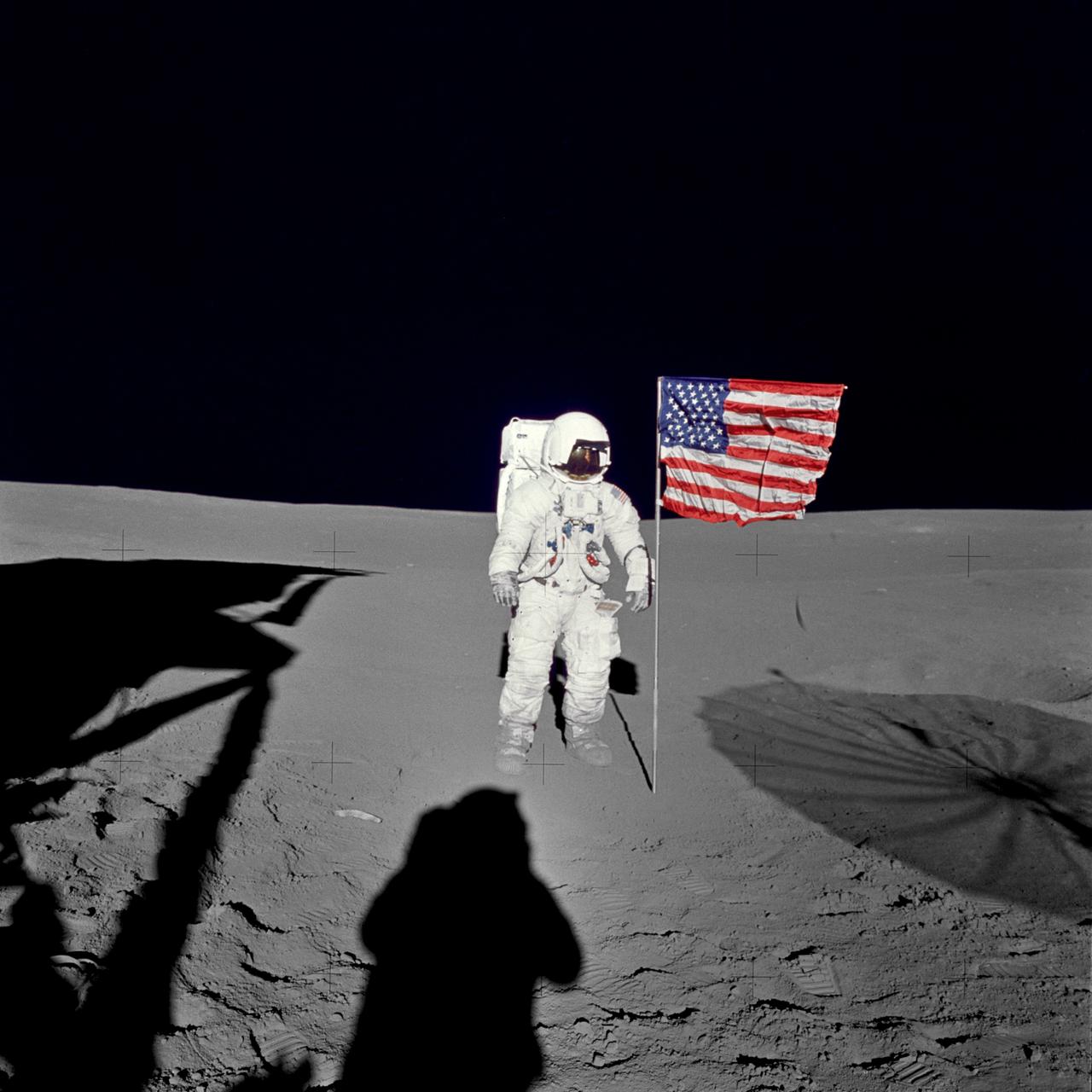
AS14-66-9233 (5 Feb. 1971) --- Astronaut Edgar D. Mitchell, lunar module pilot for the Apollo 14 lunar landing mission, stands by the deployed U.S. flag on the lunar surface during the early moments of the first extravehicular activity (EVA) of the mission. He was photographed by astronaut Alan B. Shepard Jr., mission commander, using a 70mm modified lunar surface Hasselblad camera. While astronauts Shepard and Mitchell descended in the Lunar Module (LM) "Antares" to explore the Fra Mauro region of the moon, astronaut Stuart A. Roosa, command module pilot, remained with the Command and Service Modules (CSM) "Kitty Hawk" in lunar orbit.
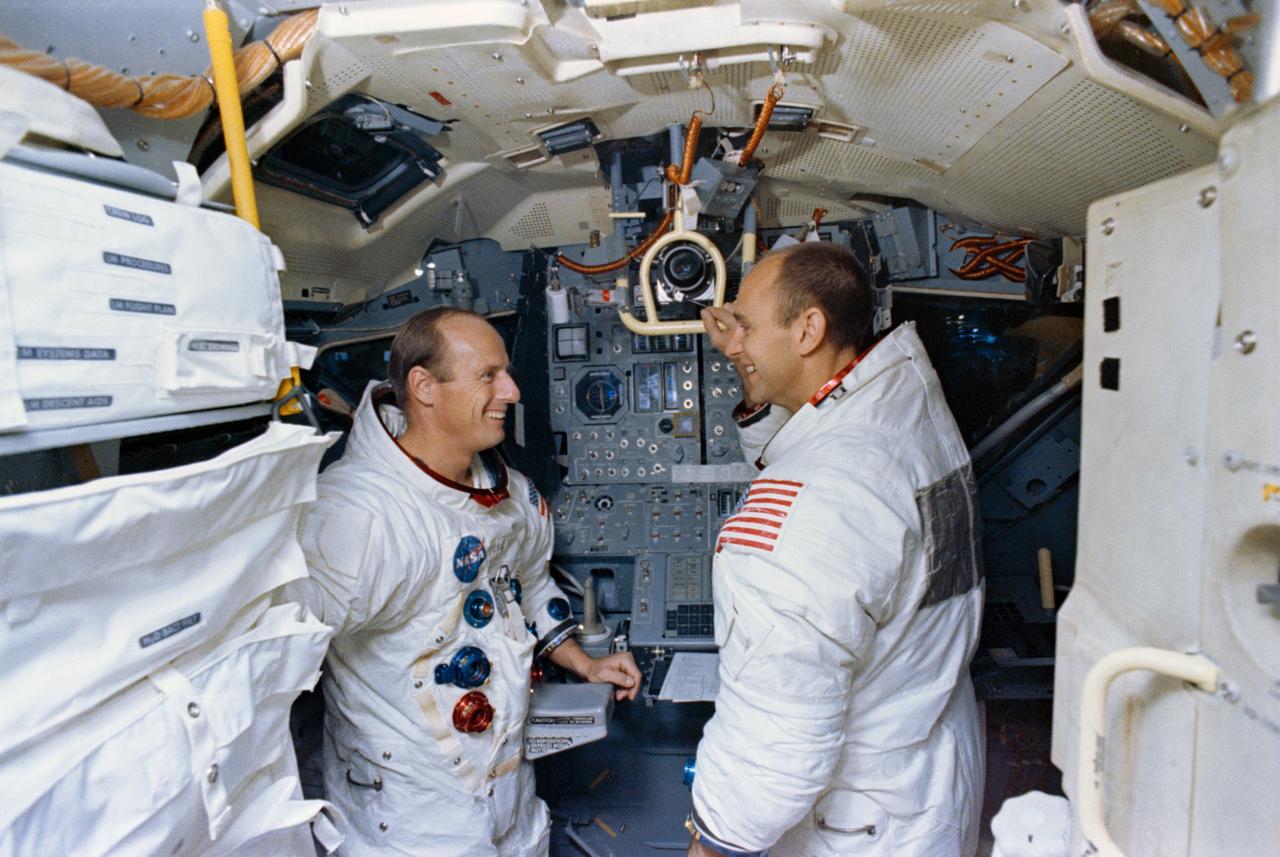
S69-56699 (22 Oct. 1969) --- Astronauts Charles Conrad Jr. (left), Apollo 12 commander; and Alan L. Bean, lunar module pilot, are shown in the Apollo Lunar Module Mission Simulator during simulator training at the Kennedy Space Center (KSC). Apollo 12 will be the National Aeronautics and Space Administration's (NASA) second lunar landing mission. The third Apollo 12 crewmember will be astronaut Richard F. Gordon Jr., command module pilot.
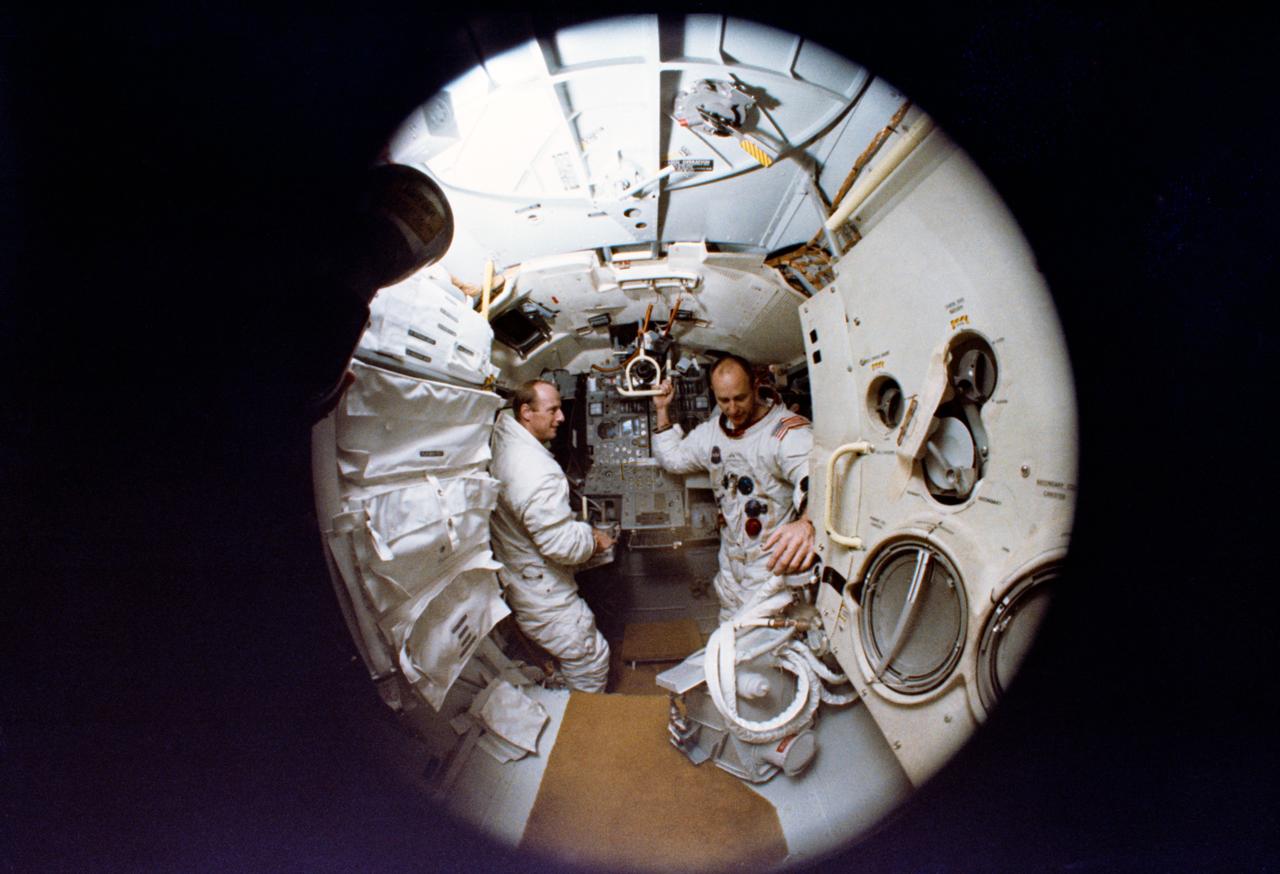
S69-56700 (22 Oct. 1969) --- A fish-eye lens view of astronauts Charles Conrad Jr. (on left), Apollo 12 commander, and Alan L. Bean, lunar module pilot, inside the Apollo Lunar Module Mission Simulator during simulator training at the Kennedy Space Center (KSC). Apollo 12 will be the National Aeronautics and Space Administration's (NASA) second lunar landing mission. The third Apollo 12 crewmember will be astronaut Richard F. Gordon Jr., command module pilot.
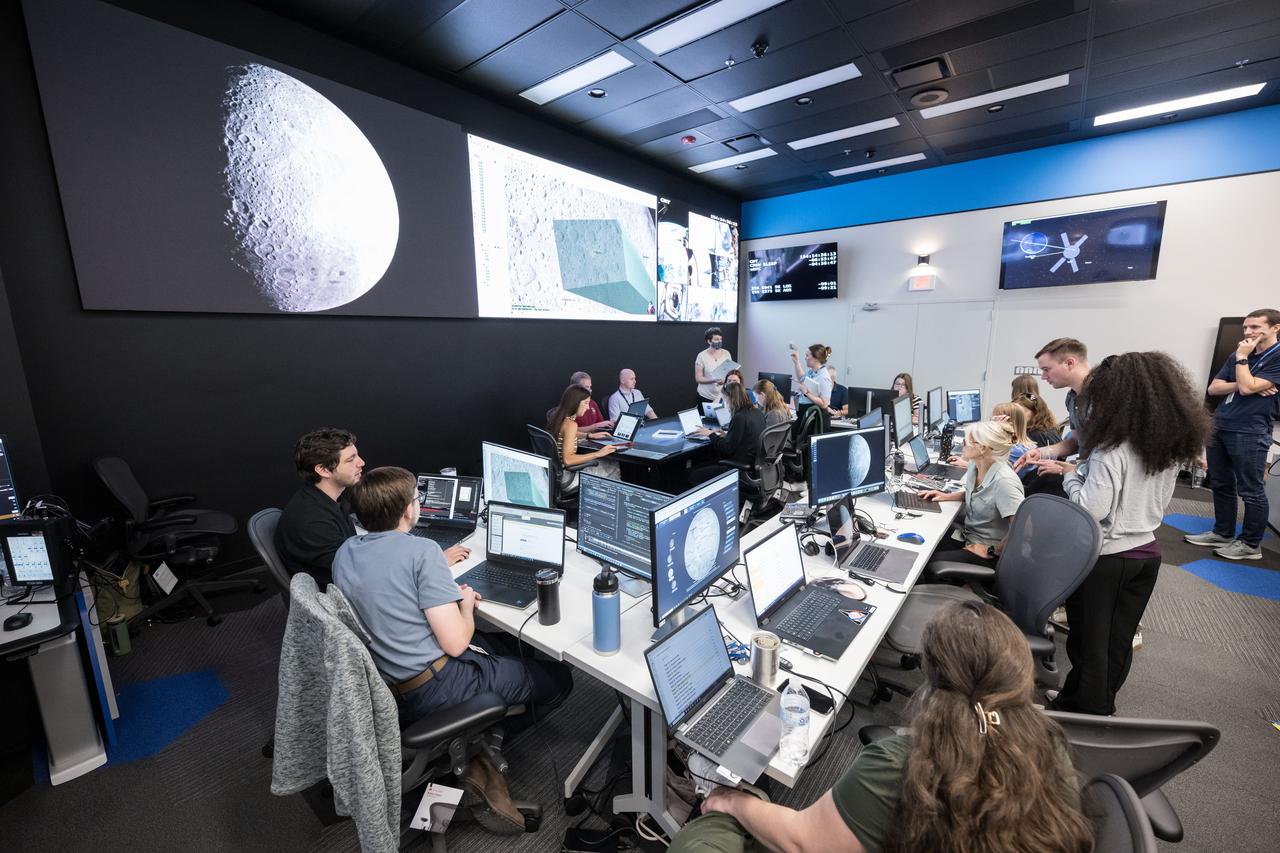
jsc2025e056603 --- The Artemis II Lunar Science Team runs a simulation of lunar observation operations in the new Science Evaluation Room (SER) that serves as a backroom to Mission Control.
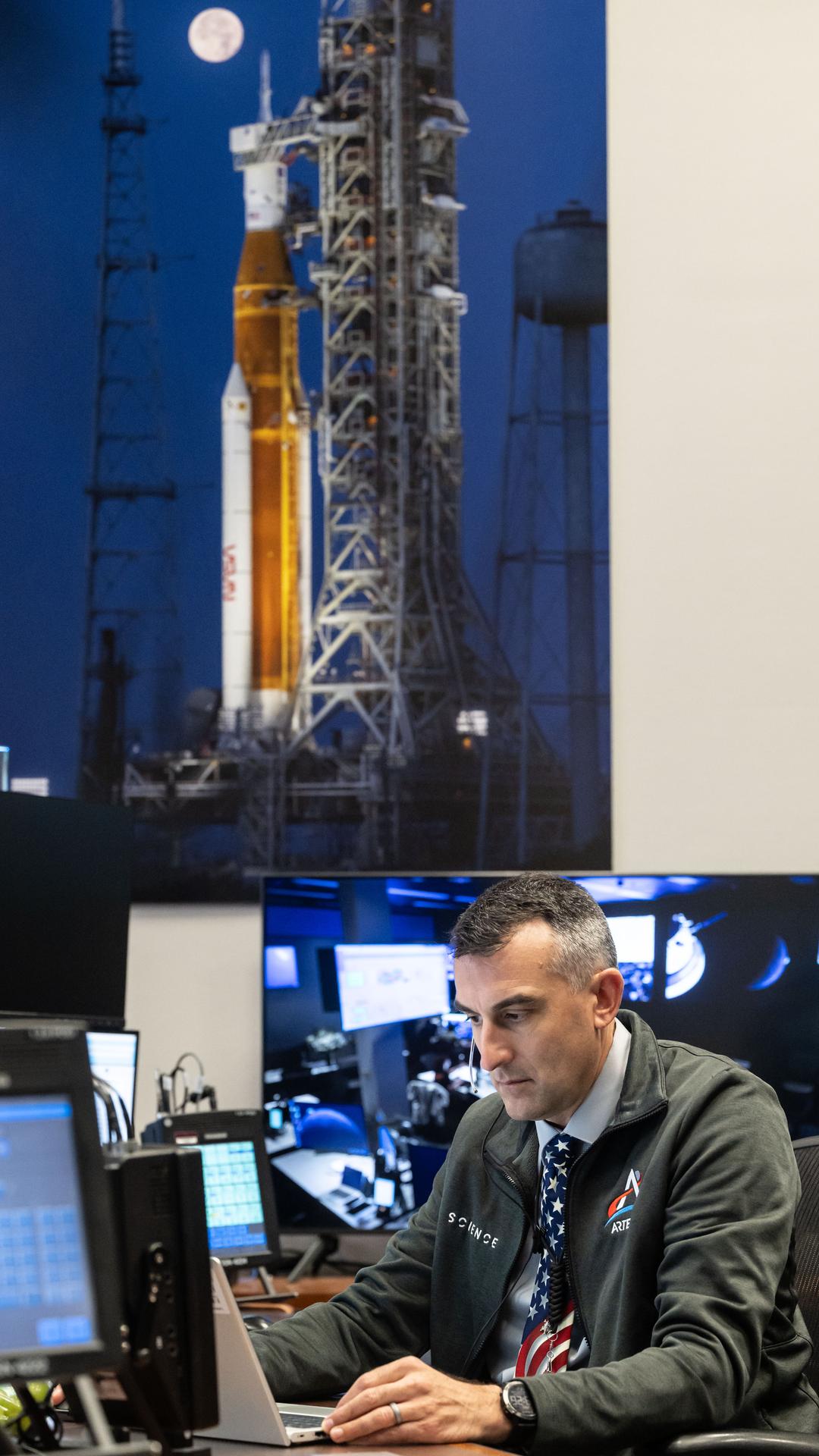
Artemis II science officer, Trevor Graff, is seen at the Science console in the White Flight Control Room in Mission Control at NASA's Johnson Space Center in Houston. Science officers are the senior flight controllers responsible for lunar science and geology objectives during Artemis missions. Credits: NASA/David DeHoyos
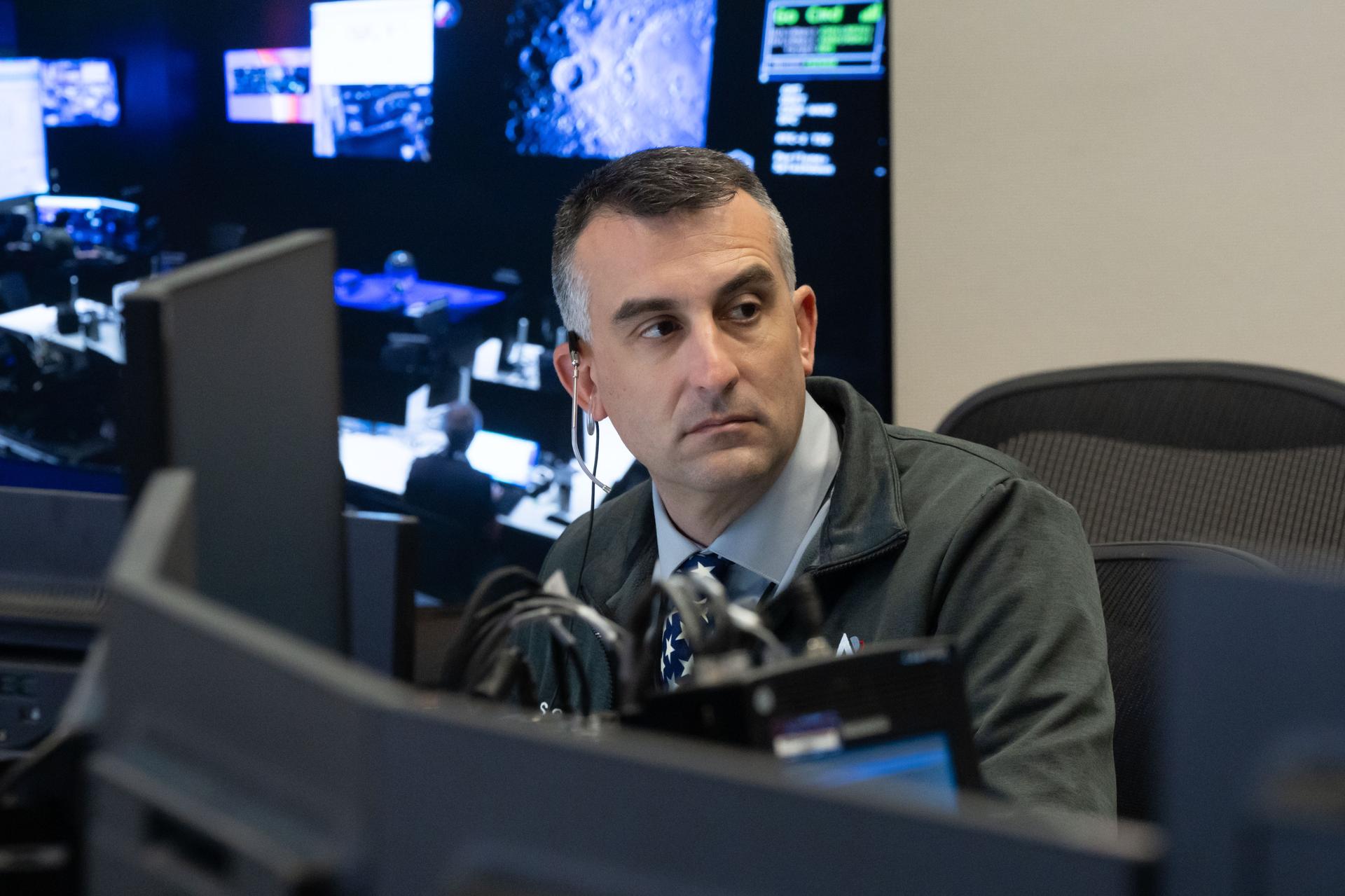
Artemis II science officer, Trevor Graff, is seen at the Science console in the White Flight Control Room in Mission Control at NASA's Johnson Space Center in Houston. Science officers are the senior flight controllers responsible for lunar science and geology objectives during Artemis missions. Credits: NASA/David DeHoyos
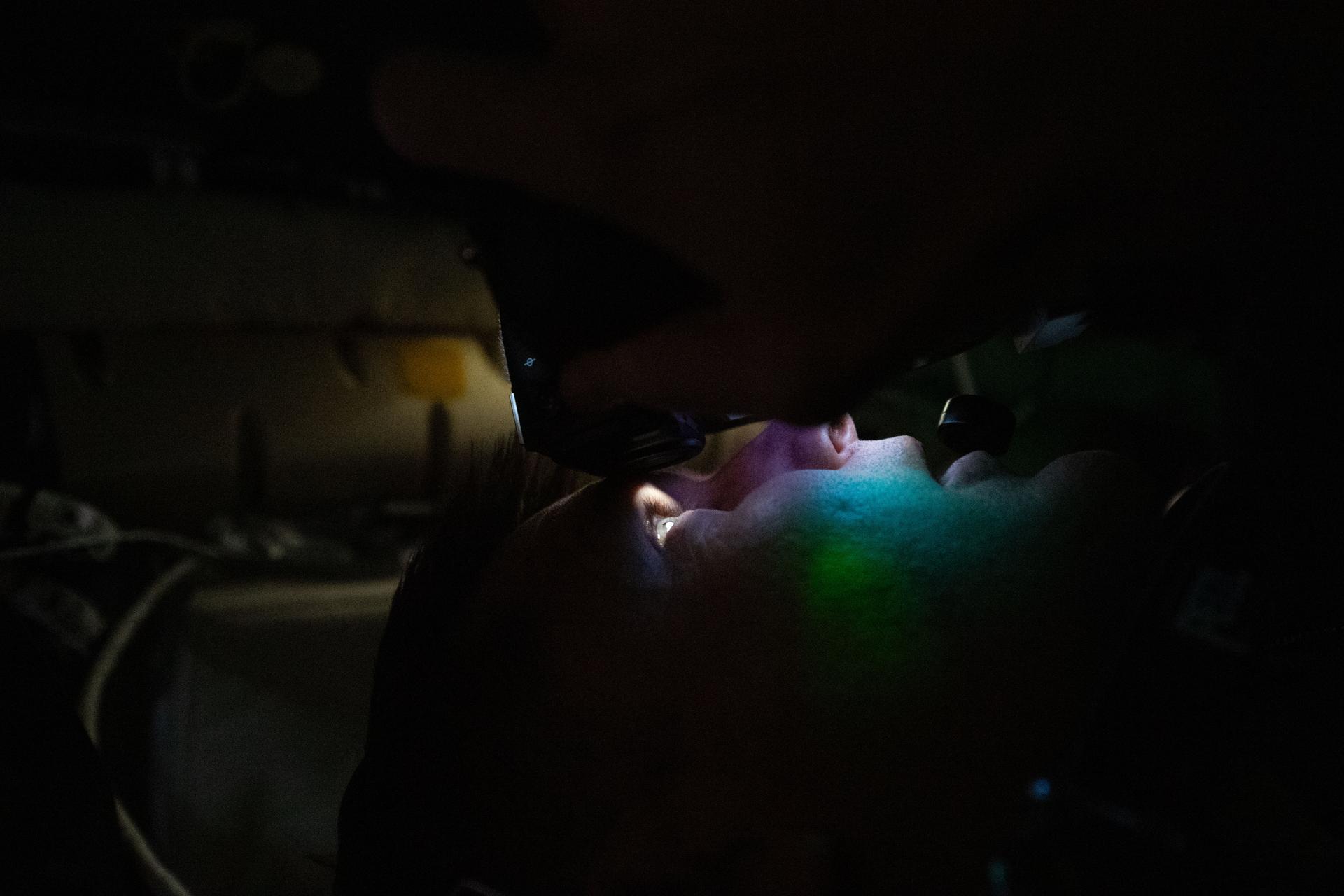
art002e014256 (April 6, 2026) – CSA (Canadian Space Agency) astronaut and Artemis II Mission Specialist Jeremy Hansen is seen making observations through the Orion spacecraft window early in the Artemis II lunar flyby. Due to last approximately seven hours, the lunar observation period was the duration of time that the crew is close enough to the Moon to make impactful science observations (4,070 miles altitude at closest approach) and the spacecraft was oriented such that the windows are pointed at the Moon. Credit: NASA

AS07-04-1584 (11-22 Oct. 1968) --- Astronaut Walter Cunningham, Apollo 7 lunar module pilot, is photographed during the Apollo 7 mission.
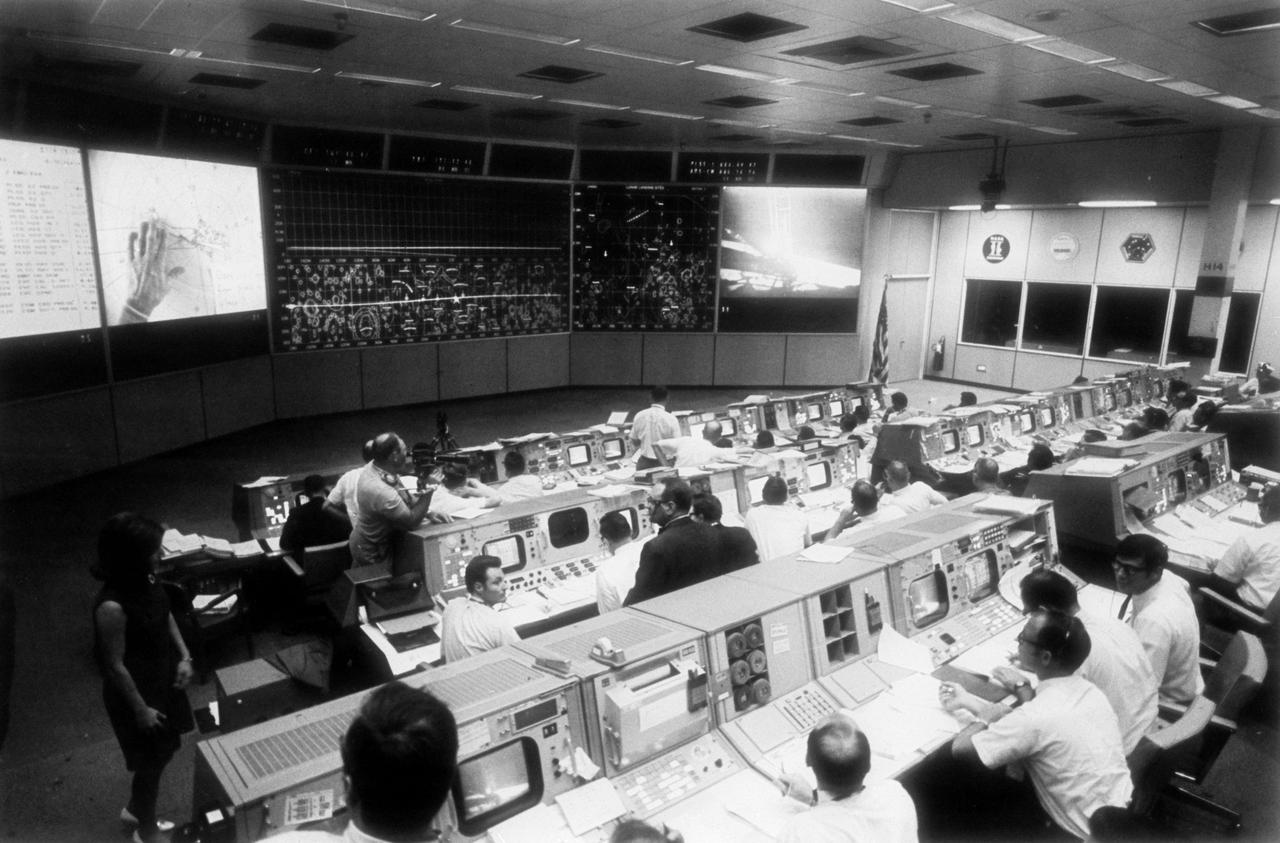
Overall view of the Mission Operations Control Room in the Mission Control Center, bldg 30, during the lunar surface extravehicular activity (EVA) of Apollo 11 Astronauts Neil A. Armstrong and Edwin E. Aldrin Jr.
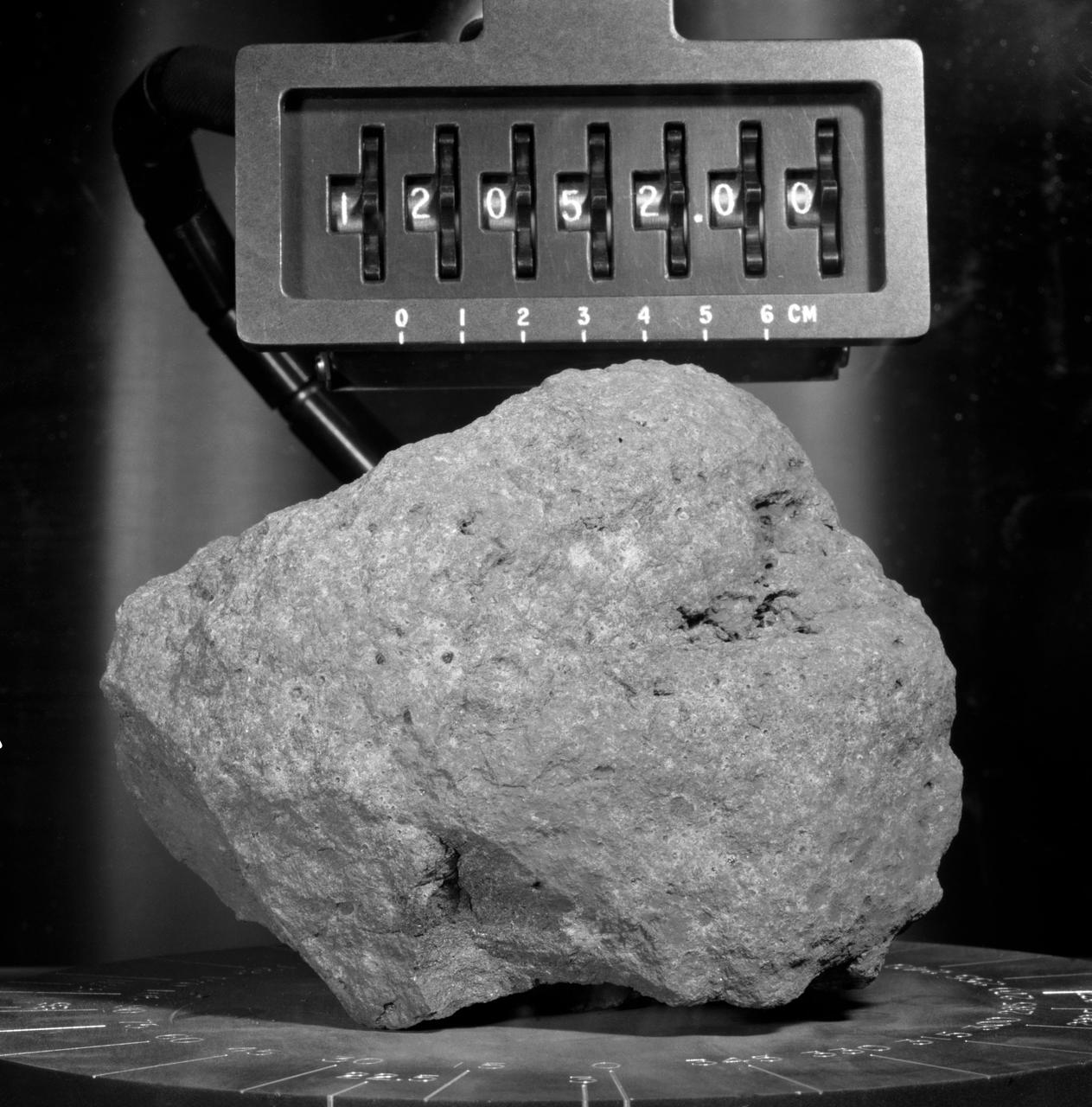
S69-60909 (November 1969) --- A close-up view of lunar sample 12,052 under observation in the Manned Spacecraft Center's Lunar Receiving Laboratory (LRL). Astronauts Charles Conrad Jr., and Alan L. Bean collected several rocks and samples of finer lunar matter during their Apollo 12 lunar landing mission extravehicular activity (EVA). This particular sample was picked up during the second space walk (EVA) on Nov. 20, 1969. It is a typically fine-grained crystalline rock with a concentration of holes on the left part of the exposed side. These holes are called vesicles and have been identified as gas bubbles formed during the crystallization of the rock. Several glass-lined pits can be seen on the surface of the rock.
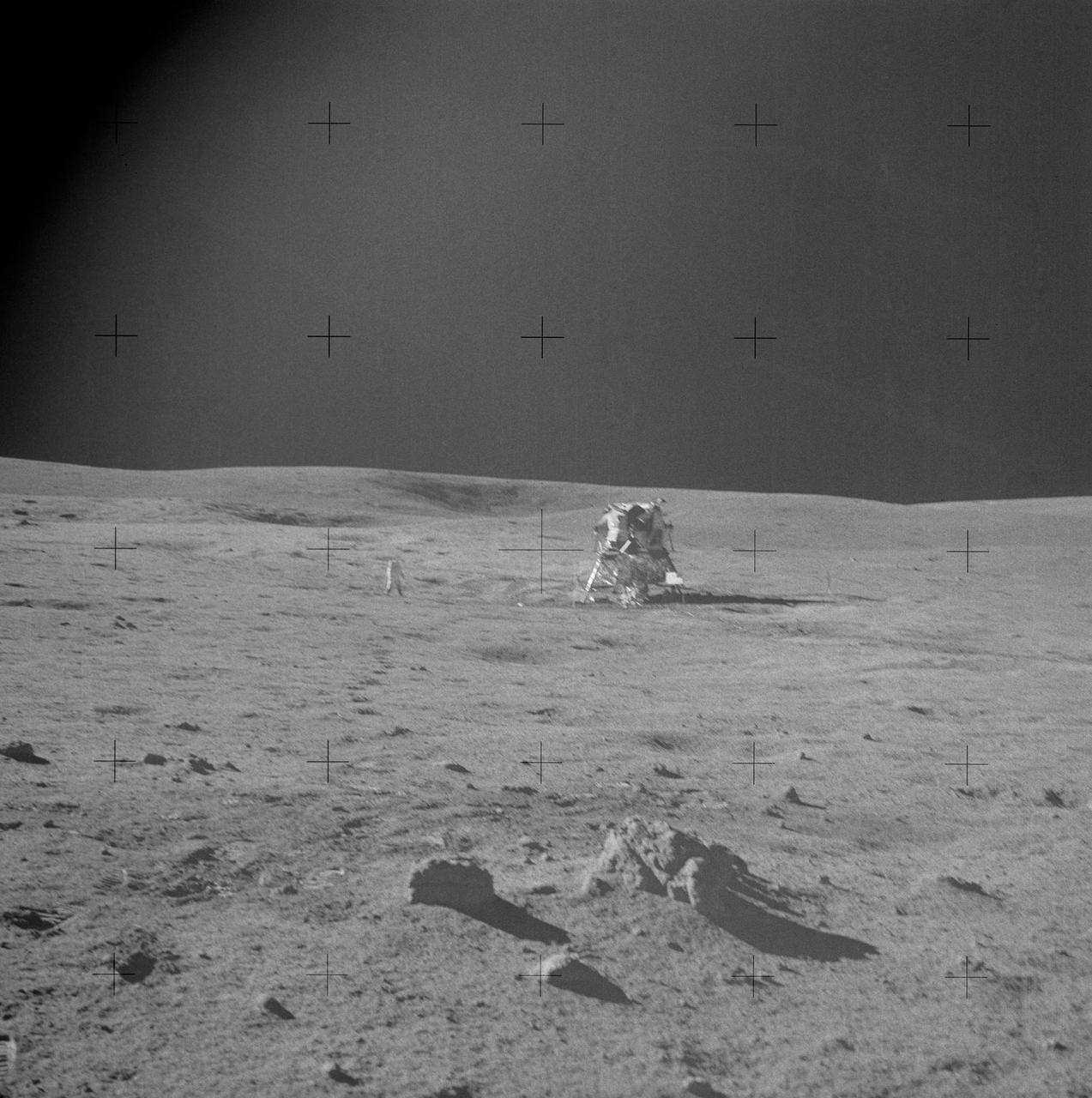
AS14-68-9487 (6 Feb. 1971) --- Astronaut Edgar D. Mitchell, lunar module pilot, photographed this sweeping view showing fellow moon-explorer astronaut Alan B. Shepard Jr., mission commander, and the Apollo 14 Lunar Module (LM). A small cluster of rocks and a few prints made by the lunar overshoes of Mitchell are in the foreground. Mitchell was standing in the boulder field, located just north by northwest of the LM, when he took this picture during the second Apollo 14 extravehicular activity (EVA), on Feb. 6, 1971. While astronaut Stuart A. Roosa, command module pilot, remained with the Command and Service Modules (CSM) in lunar orbit, Shepard and Mitchell descended in the LM to explore the moon.

Karma Snyder, a project manager at NASA's John C. Stennis Space Center, was a senior design engineer on the RL10 liquid rocket engine that powered the Centaur, the upper stage of the rocket used in NASA's Lunar CRater Observation and Sensing Satellite (LCROSS) mission in October 2009. Part of the LCROSS mission was to search for water on the moon by striking the lunar surface with a rocket stage, creating a plume of debris that could be analyzed for water ice and vapor. Snyder's work on the RL10 took place from 1995 to 2001 when she was a senior design engineer with Pratt & Whitney Rocketdyne. Years later, she sees the project as one of her biggest accomplishments in light of the LCROSS mission. 'It's wonderful to see it come into full service,' she said. 'As one of my co-workers said, the original dream was to get that engine to the moon, and we're finally realizing that dream.'
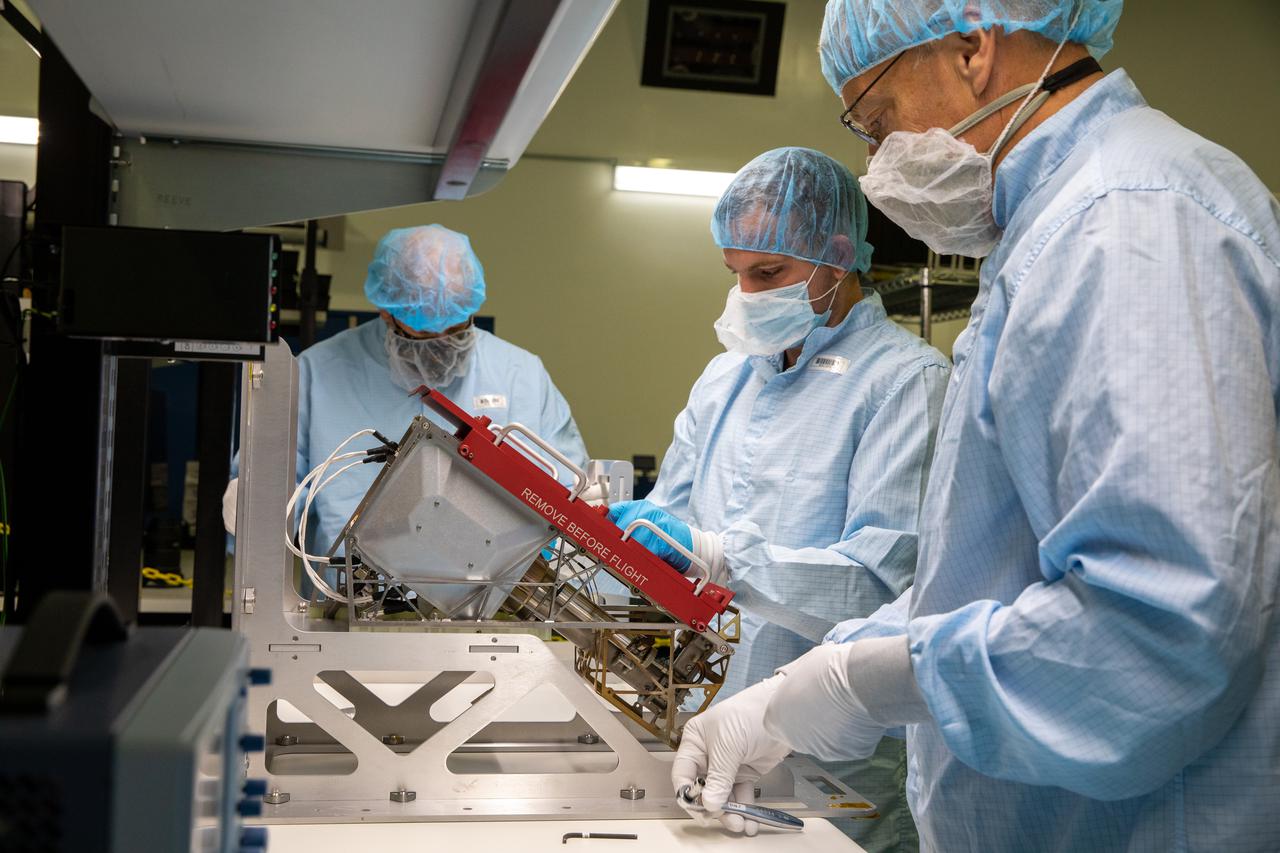
Inside the Space Station Processing Facility at NASA’s Kennedy Space Center in Florida, members of the Mass Spectrometer observing lunar operations (MSolo) team prepare MSolo flight hardware for shipment in preparation for launch in 2022. MSolo is a commercial off-the-shelf mass spectrometer modified to work in space and it will help analyze the chemical makeup of landing sites on the Moon, as well as study water on the lunar surface. MSolo is part of four of the agency’s Commercial Lunar Payload Delivery Service missions where under the Artemis program, commercial deliveries beginning in 2022 will perform science experiments, test technologies and demonstrate capabilities to help NASA explore the Moon and prepare for human missions.
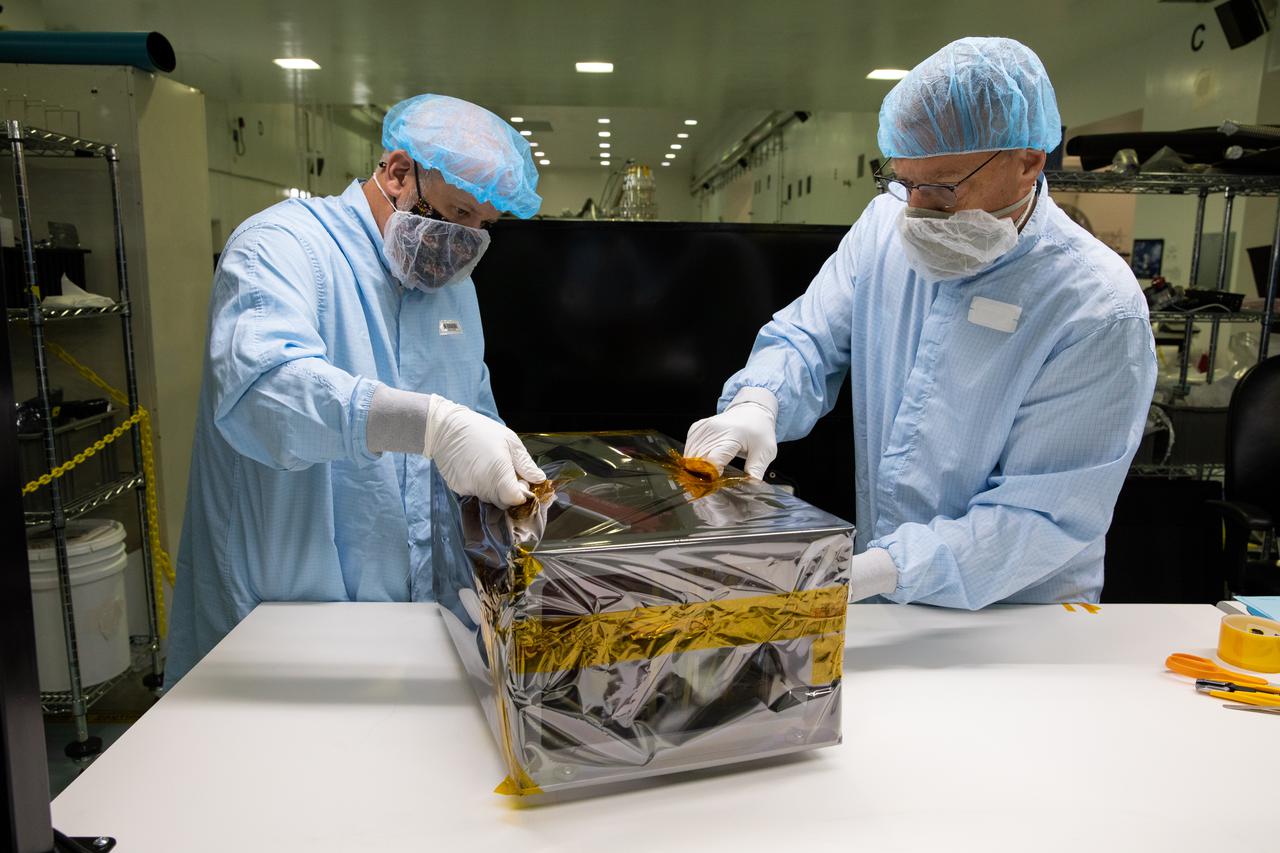
Inside the Space Station Processing Facility at NASA’s Kennedy Space Center in Florida, members of the Mass Spectrometer observing lunar operations (MSolo) team prepare MSolo flight hardware for shipment in preparation for launch in 2022. MSolo is a commercial off-the-shelf mass spectrometer modified to work in space and it will help analyze the chemical makeup of landing sites on the Moon, as well as study water on the lunar surface. MSolo is part of four of the agency’s Commercial Lunar Payload Delivery Service missions where under the Artemis program, commercial deliveries beginning in 2022 will perform science experiments, test technologies and demonstrate capabilities to help NASA explore the Moon and prepare for human missions.
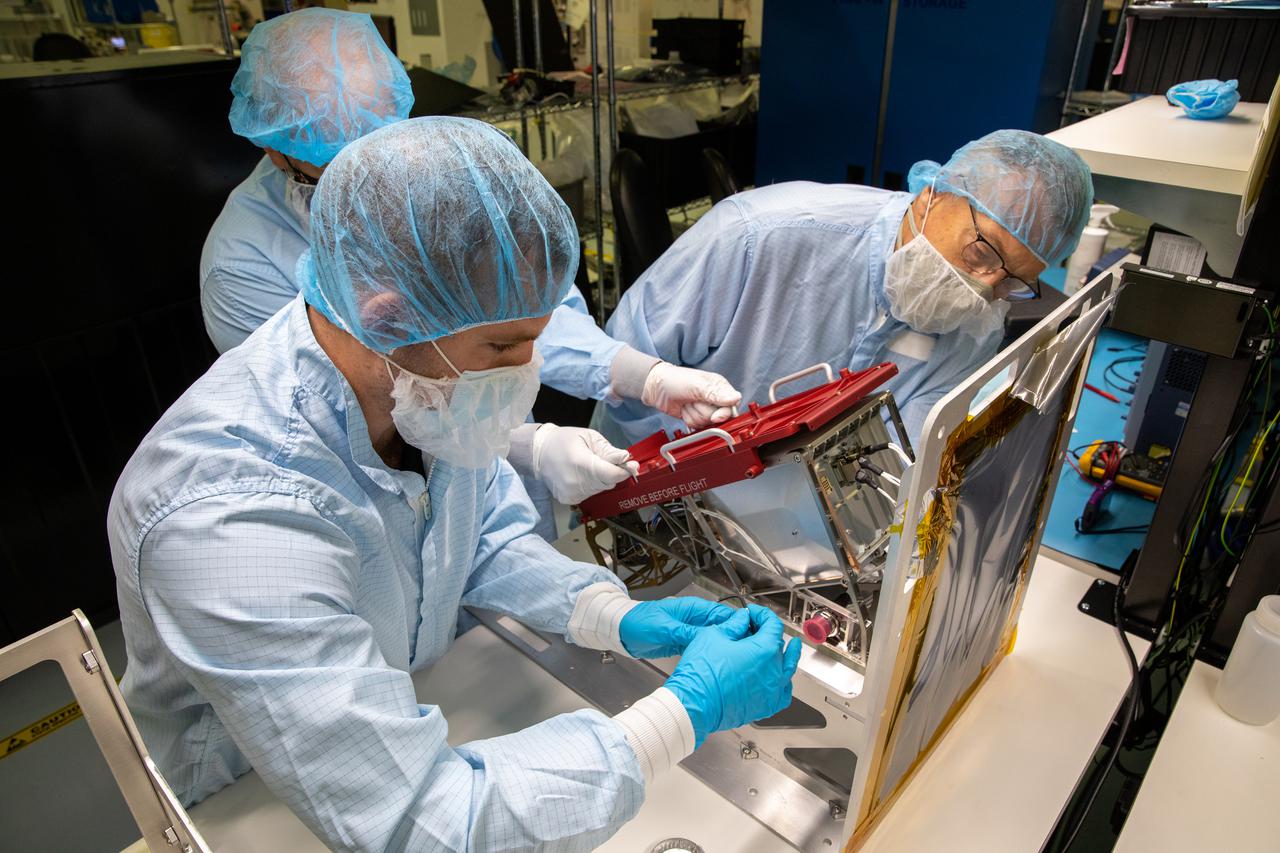
Inside the Space Station Processing Facility at NASA’s Kennedy Space Center in Florida, members of the Mass Spectrometer observing lunar operations (MSolo) team prepare MSolo flight hardware for shipment in preparation for launch in 2022. MSolo is a commercial off-the-shelf mass spectrometer modified to work in space and it will help analyze the chemical makeup of landing sites on the Moon, as well as study water on the lunar surface. MSolo is part of four of the agency’s Commercial Lunar Payload Delivery Service missions where under the Artemis program, commercial deliveries beginning in 2022 will perform science experiments, test technologies and demonstrate capabilities to help NASA explore the Moon and prepare for human missions.
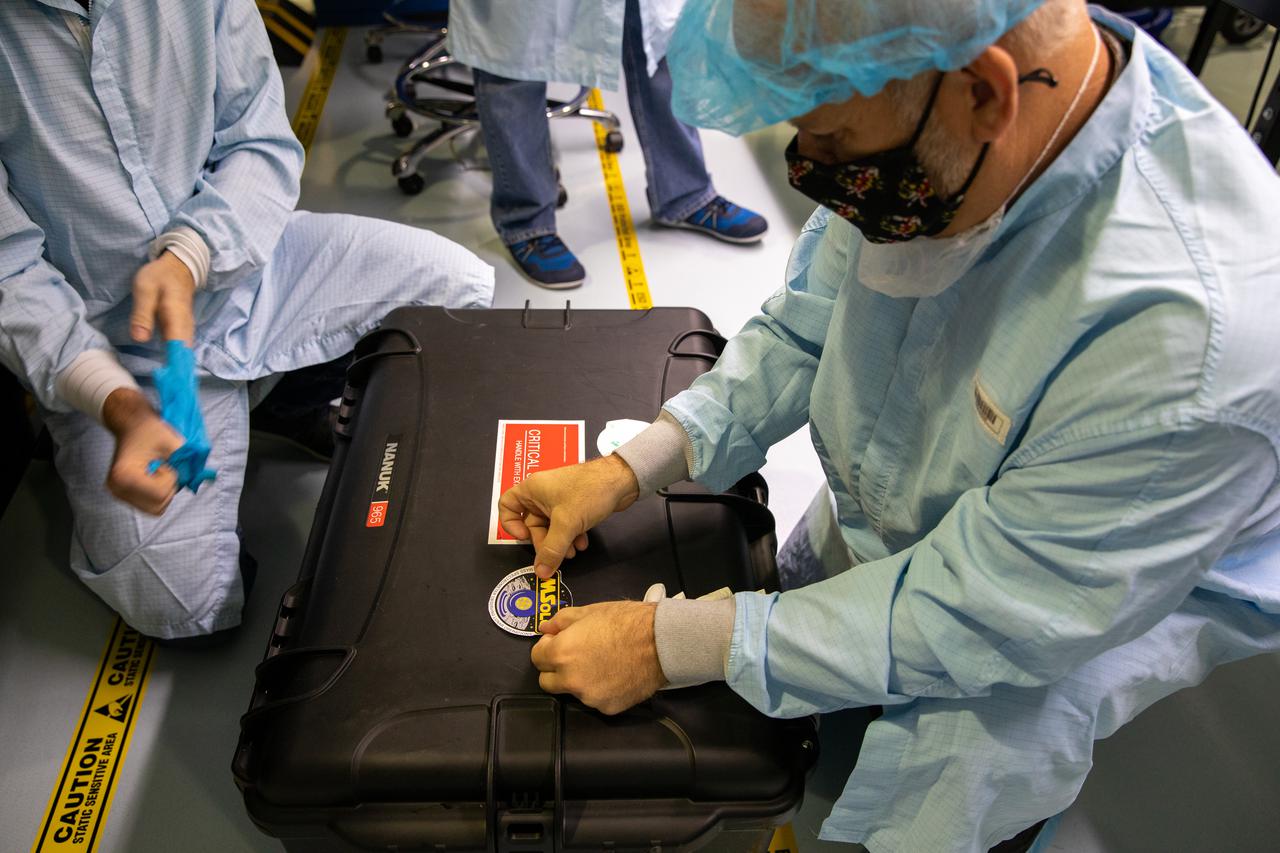
Inside the Space Station Processing Facility at NASA’s Kennedy Space Center in Florida, members of the Mass Spectrometer observing lunar operations (MSolo) team prepare MSolo flight hardware for shipment in preparation for launch in 2022. MSolo is a commercial off-the-shelf mass spectrometer modified to work in space and it will help analyze the chemical makeup of landing sites on the Moon, as well as study water on the lunar surface. MSolo is part of four of the agency’s Commercial Lunar Payload Delivery Service missions where under the Artemis program, commercial deliveries beginning in 2022 will perform science experiments, test technologies and demonstrate capabilities to help NASA explore the Moon and prepare for human missions.
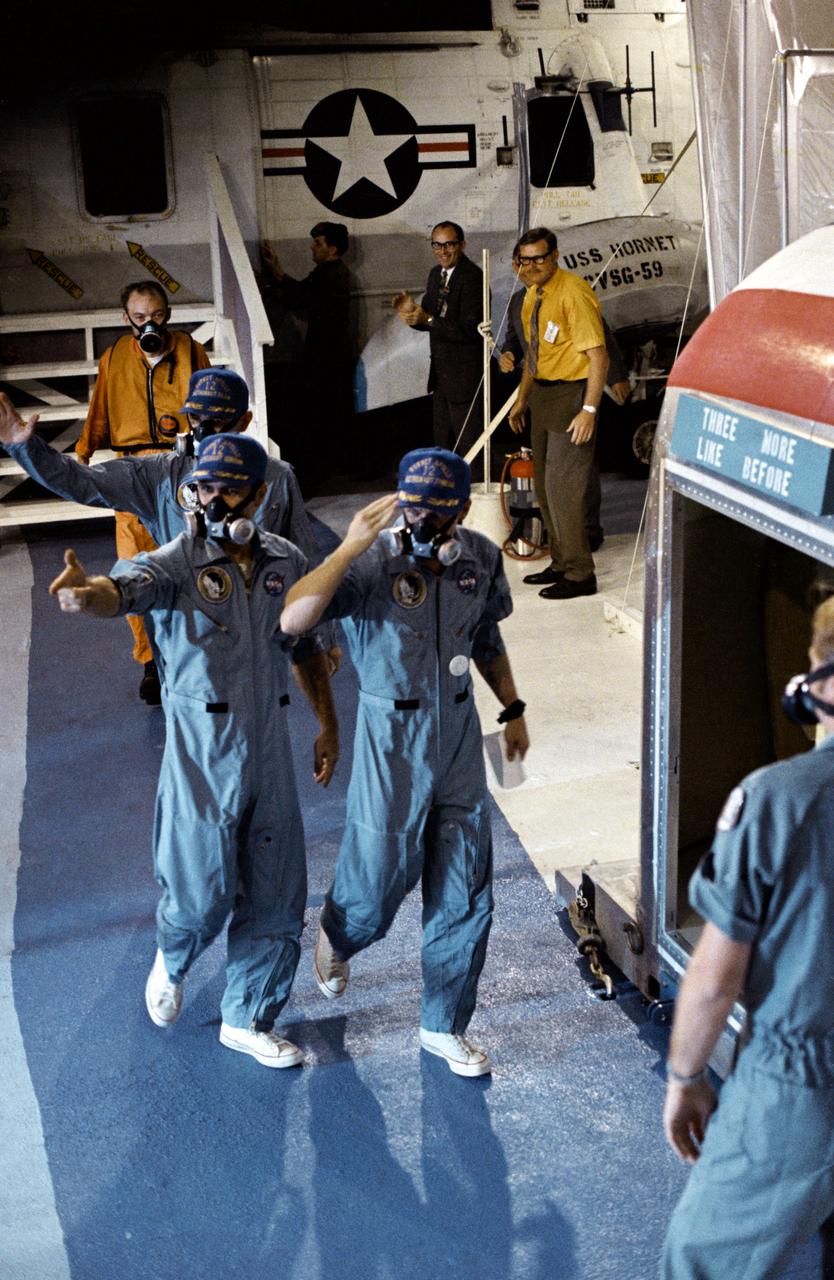
S69-22849 (24 Nov. 1969) --- USS Hornet crewmen are greeted by the crew of the Apollo 12 lunar landing mission as the three astronauts are transferred from a U.S. Navy helicopter to a Mobile Quarantine Facility (MQF) aboard the prime recovery vessel. Charles Conrad Jr., right, commander; Richard F. Gordon Jr., command module pilot, left front; and Alan L. Bean, lunar module pilot, splashed down safely at 2:58 p.m., Nov. 24, 1969.
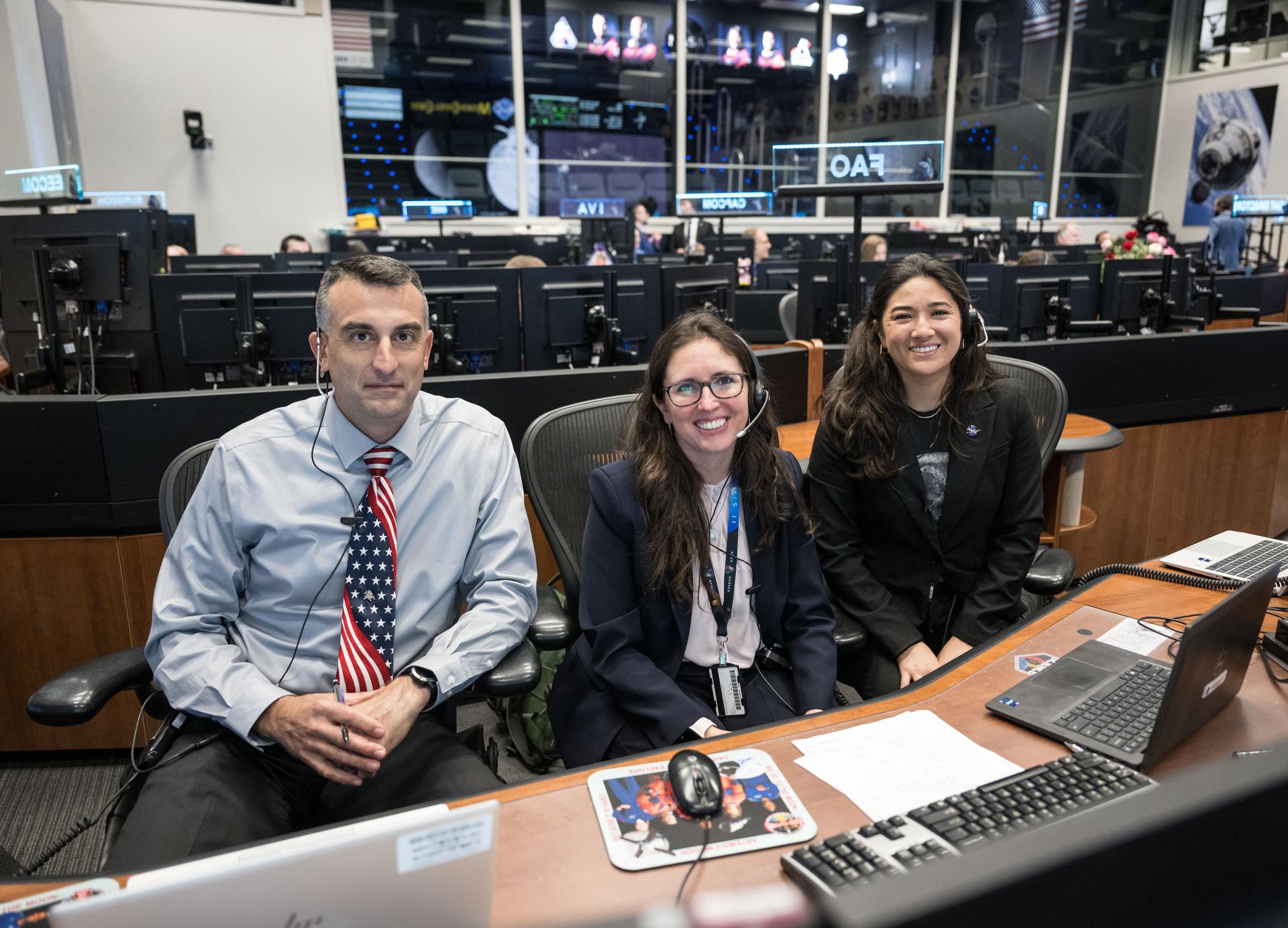
Artemis II science officers, from left, Trevor Graff, Kelsey Young, and Angela Garcia, are seen at the Science console in the White Flight Control Room in Mission Control at NASA's Johnson Space Center in Houston. Science officers are the senior flight controllers responsible for lunar science and geology objectives during Artemis missions. Credits: NASA/Robert Markowitz
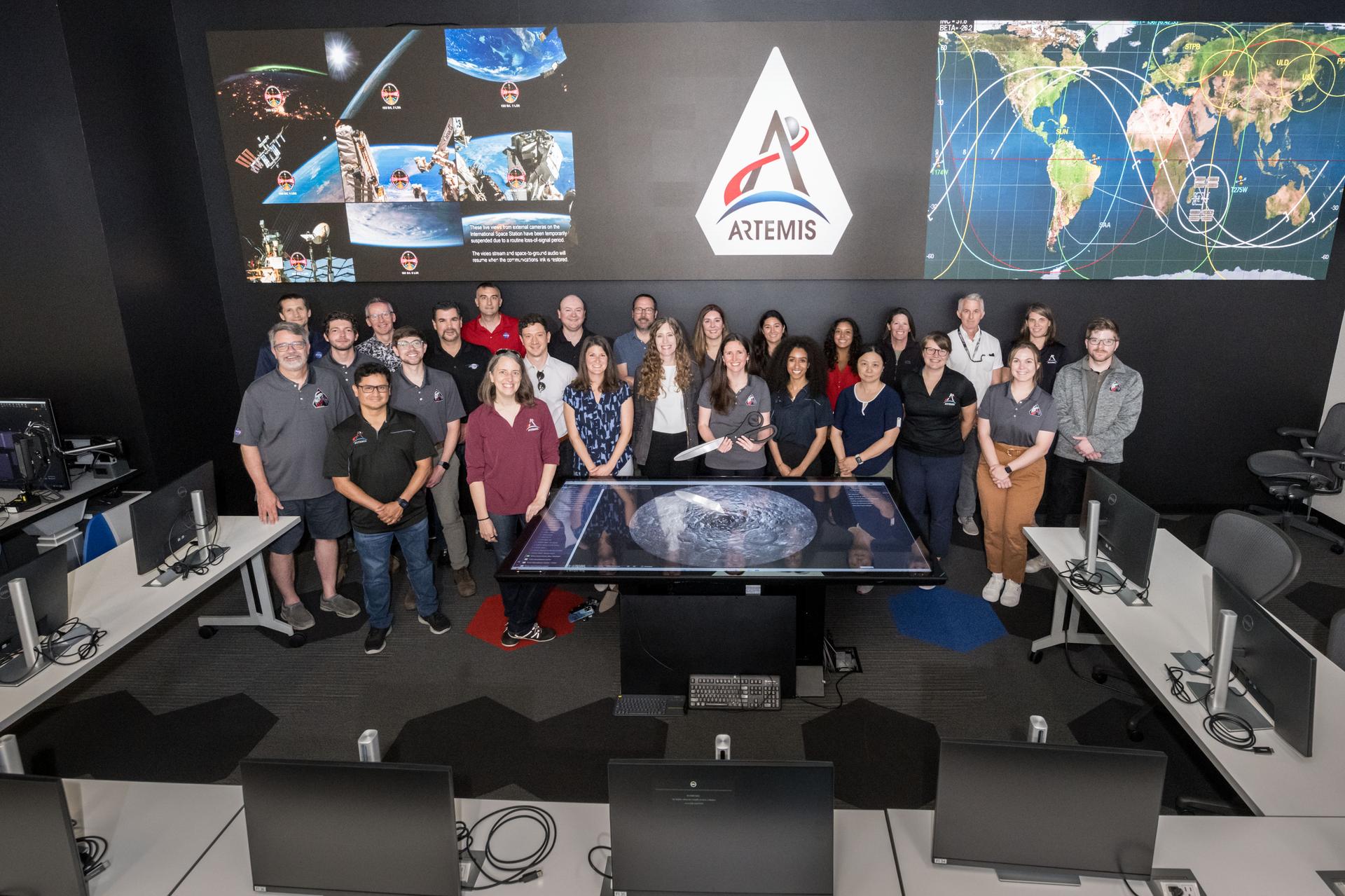
jsc2025e057255 --- NASA’s Artemis III lunar science team is pictured in the Science Evaluation Room (SER) at the agency’s Johnson Space Center in Houston. Located in the Christopher C. Kraft Jr. Mission Control Center, the SER supports the mission’s main flight control room for lunar science and planetary observations. Built specifically for Artemis missions with these science priorities in mind, the SER is equipped to support rapid data interpretation, collaborative analysis, real-time decision making, and seamless coordination between the science and operations teams.

Ahead of launch as part of NASA’s Commercial Lunar Payload Services (CLPS) initiative, Astrobotic’s Peregrine lunar lander is encapsulated in the payload fairing, or nose cone, of United Launch Alliance’s Vulcan rocket on Nov. 21, 2023, at Astrotech Space Operations Facility near the agency’s Kennedy Space Center in Florida. Launch of Astrobotic’s Peregrine Mission One will carry NASA and commercial payloads to the Moon in early 2024 to study the lunar exosphere, thermal properties, and hydrogen abundance of the lunar regolith, magnetic fields, and the radiation environment of the lunar surface.

Ahead of launch as part of NASA’s Commercial Lunar Payload Services (CLPS) initiative, Astrobotic’s Peregrine lunar lander is encapsulated in the payload fairing, or nose cone, of United Launch Alliance’s Vulcan rocket on Nov. 21, 2023, at Astrotech Space Operations Facility near the agency’s Kennedy Space Center in Florida. Launch of Astrobotic’s Peregrine Mission One will carry NASA and commercial payloads to the Moon in early 2024 to study the lunar exosphere, thermal properties, and hydrogen abundance of the lunar regolith, magnetic fields, and the radiation environment of the lunar surface.

AS16-113-18342 (21 April 1972) --- Astronaut Charles M. Duke Jr., Apollo 16 lunar module pilot, salutes the United States flag during the mission's first extravehicular activity (EVA), on April 21, 1972. Stone Mountain reaches five-sixths across the photo in background. The Lunar Module (LM) and Lunar Roving Vehicle (LRV) are in the background. While John W. Young, commander and Duke descended in the LM to explore the Descartes region of the moon, Thomas K. Mattingly II, command module pilot, remained with the Command and Service Modules (CSM) in lunar orbit.
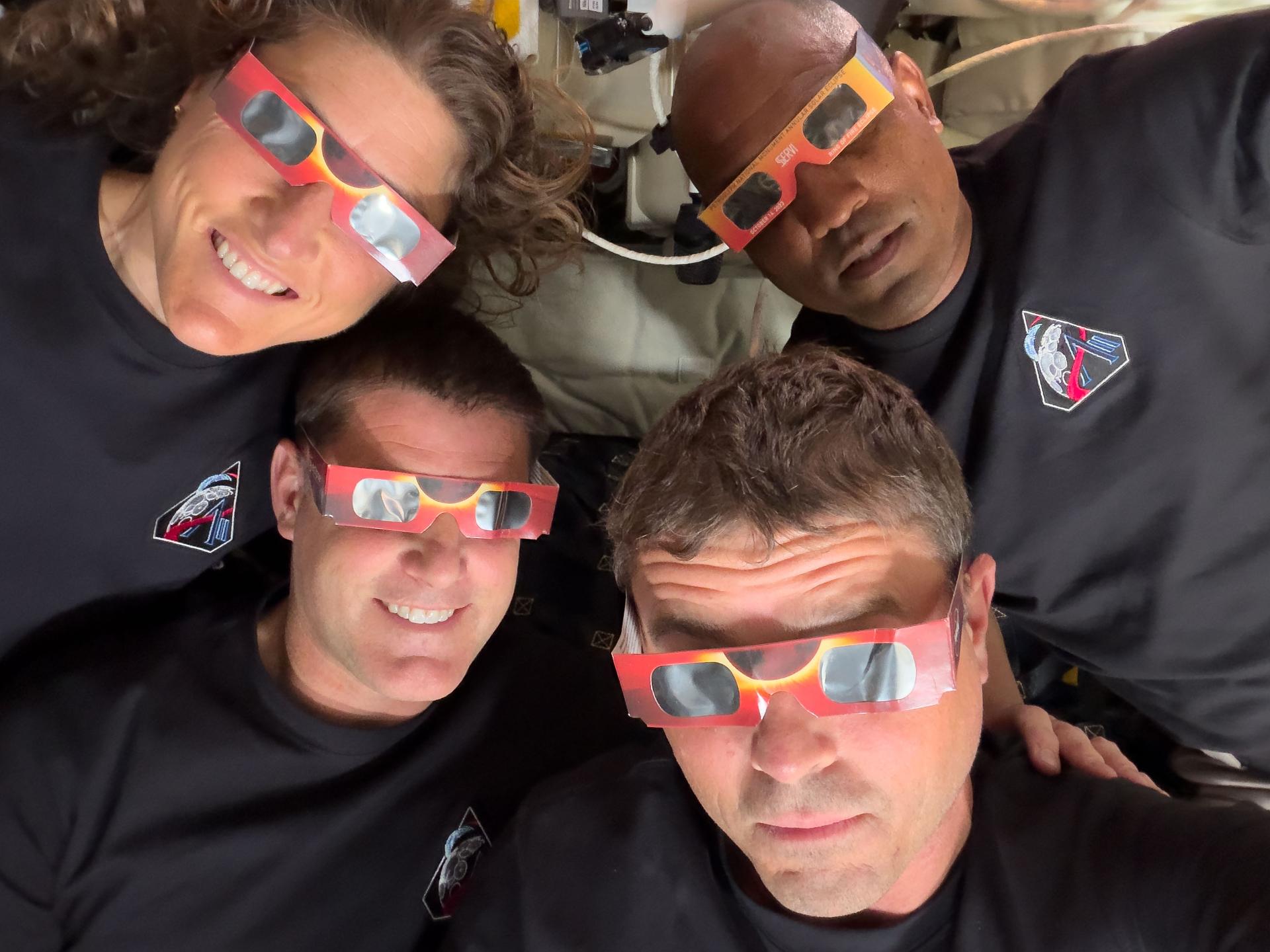
art002e009302 (April 6, 2026) – The Artemis II crew – Mission Specialist Christina Koch (top left), Mission Specialist Jeremy Hansen (bottom left), Commander Reid Wiseman (bottom right), and Pilot Victor Glover (top right) – uses eclipse viewers, identical to what NASA produced for the 2023 annular eclipse and 2024 total solar eclipse, to protect their eyes at key moments during the solar eclipse they experienced during their lunar flyby. This was the first use of eclipse glasses at the Moon to safely view a solar eclipse.
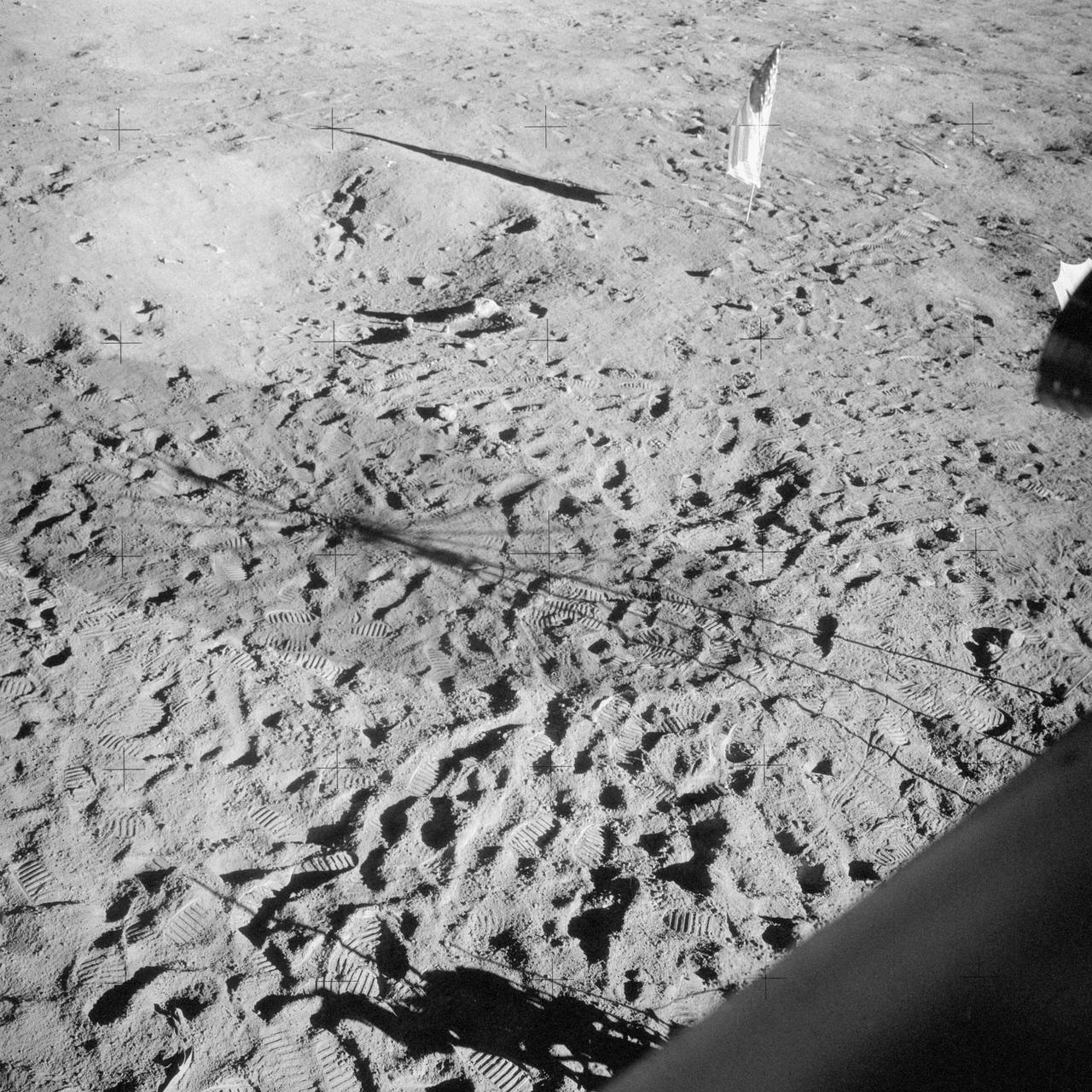
AS12-48-7160 (19-20 Nov. 1969) --- This view of the lunar surface was taken by one of the two astronauts on the Apollo 12 mission during their extravehicular activity. Seen in this view are the U.S. flag, several astronaut footprints, and a small crater near their Lunar Module landing site. Astronaut Charles Conrad Jr., commander, and Alan L. Bean, lunar module pilot, descended in the Lunar Module to explore the lunar surface. Astronaut Richard F. Gordon Jr., command module pilot, remained with Command and Service Modules in lunar orbit.
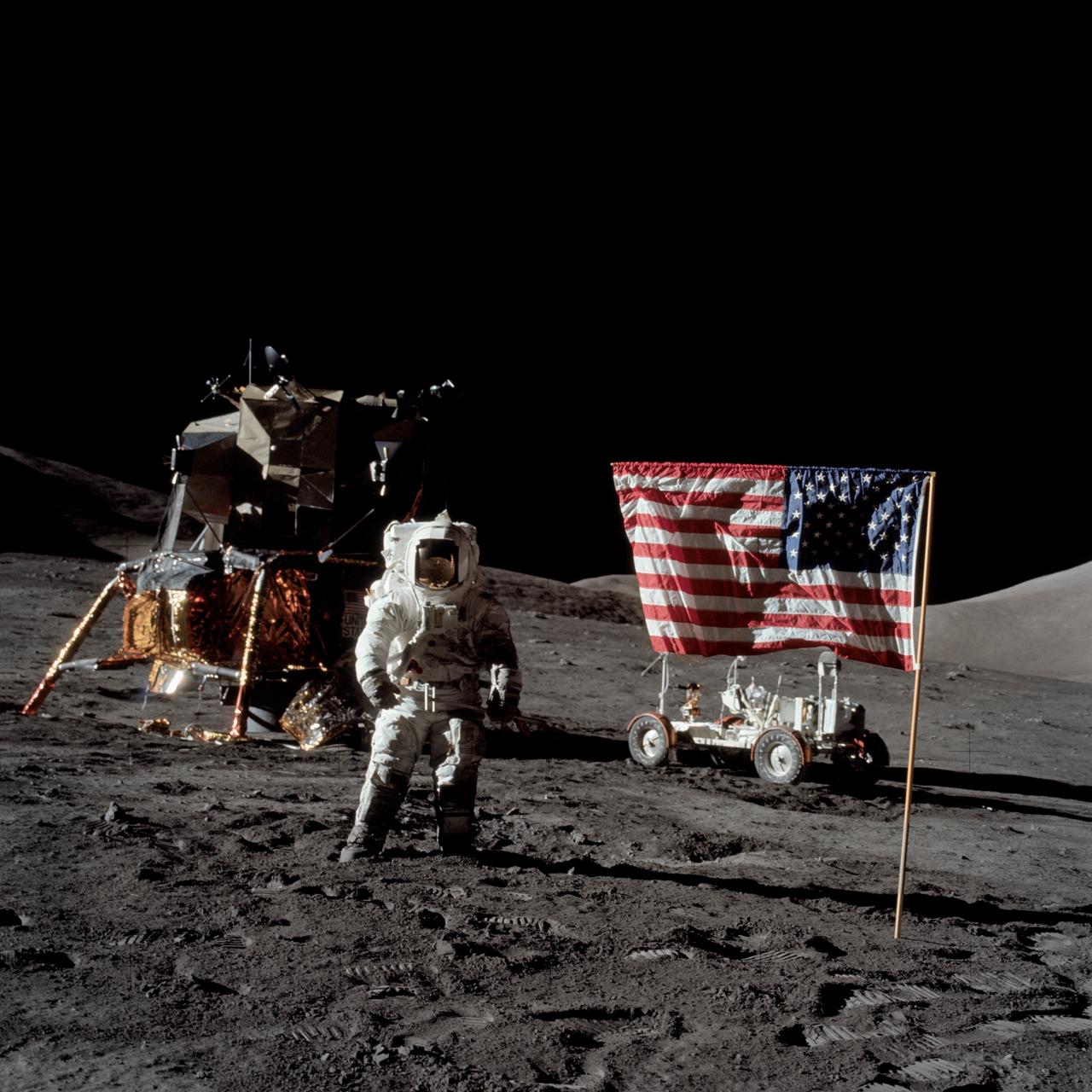
AS17-134-20382 (13 Dec. 1972) --- Astronaut Harrison H. Schmitt, Apollo 17 lunar module pilot, stands near the deployed United States flag on the lunar surface during extravehicular activity (EVA) of NASA's final lunar landing mission in the Apollo series. The Lunar Module (LM) is at left background and the Lunar Roving Vehicle (LRV) at right background (partially obscured). The photo was made by astronaut Eugene A. Cernan, commander. While astronauts Cernan and Schmitt descended in the LM "Challenger" to explore the Taurus-Littrow region of the moon, astronaut Ronald E. Evans, command module pilot, remained with the Command and Service Modules (CSM) "America" in lunar orbit.
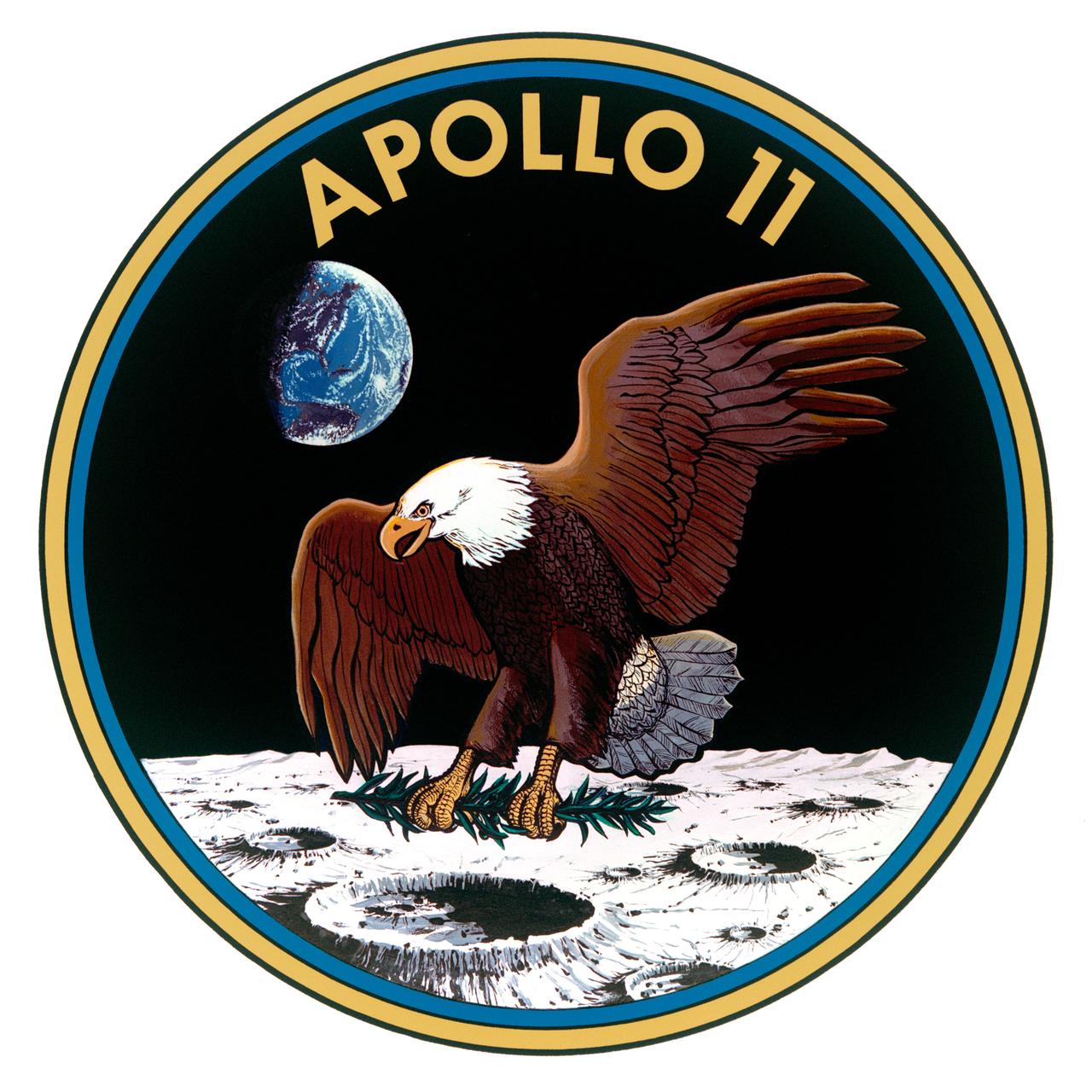
S69-34875 (June 1969) --- The official emblem of Apollo 11, the United States' first scheduled lunar landing mission. The Apollo 11 crew will be astronauts Neil A. Armstrong, commander; Michael Collins, command module pilot; and Edwin E. Aldrin Jr., lunar module pilot. The NASA insignia design for Apollo flights is reserved for use by the astronauts and for the official use as the NASA Administrator may authorize. Public availability has been approved only in the form of illustrations by the various news media. When and if there is any change in this policy, which we do not anticipate, it will be publicly announced.

Ahead of launch as part of NASA’s Commercial Lunar Payload Services (CLPS) initiative, Astrobotic’s Peregrine lunar lander is preparing to be encapsulated in the payload fairing, or nose cone, of United Launch Alliance’s Vulcan rocket on Nov. 21, 2023, at Astrotech Space Operations Facility near the agency’s Kennedy Space Center in Florida. Launch of Astrobotic’s Peregrine Mission One will carry NASA and commercial payloads to the Moon in early 2024 to study the lunar exosphere, thermal properties, and hydrogen abundance of the lunar regolith, magnetic fields, and the radiation environment of the lunar surface.
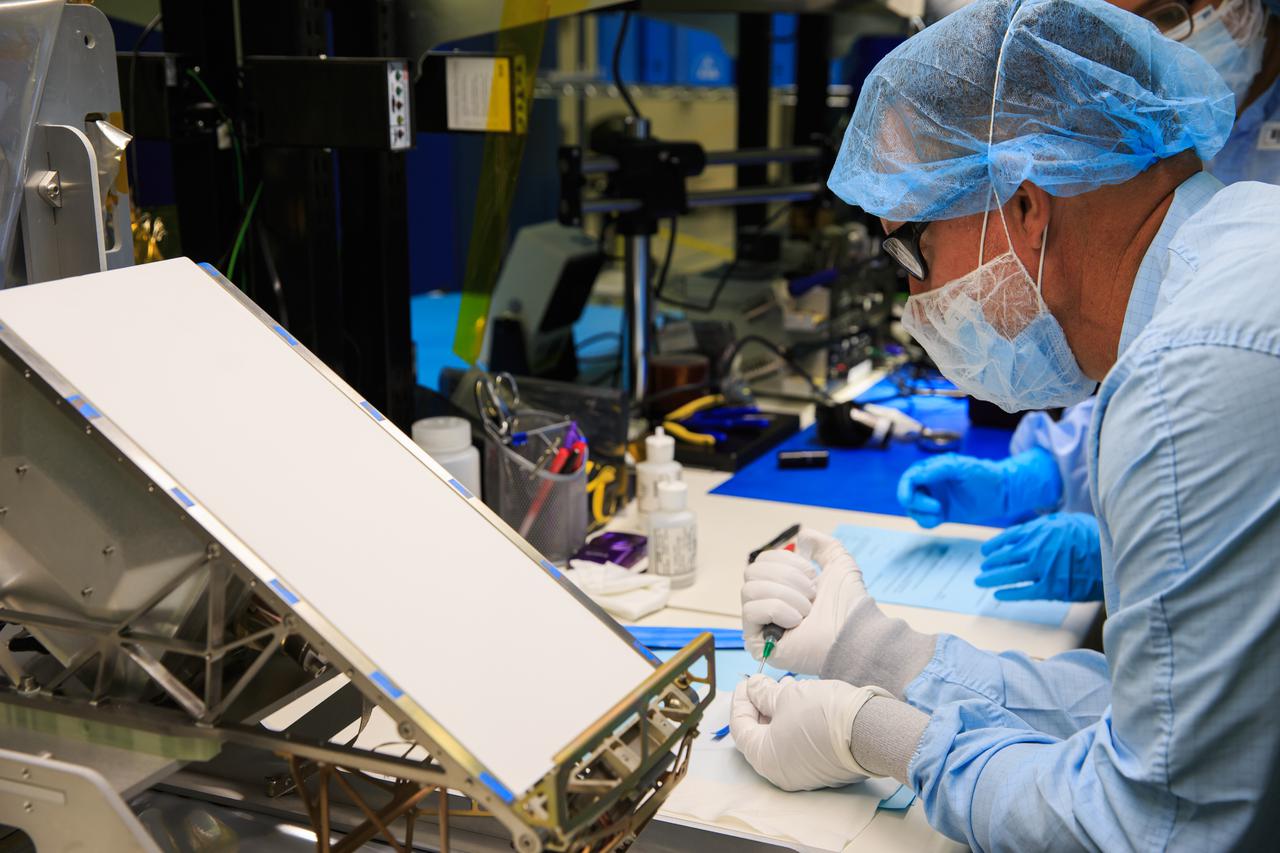
Team members working inside the Space Station Processing Facility at NASA’s Kennedy Space Center in Florida, on Sept. 23, 2021, meticulously assemble ground support equipment that will protect shipment of the Mass Spectrometer observing lunar operations (MSolo) flight hardware for preparations before it launches in 2022. MSolo is a commercial off-the-shelf mass spectrometer modified to work in space and it will help analyze the chemical makeup of landing sites on the Moon, as well as study water on the lunar surface. MSolo, scheduled to first launch in 2022, is part of four of the agency’s Commercial Lunar Payload Delivery Service missions where under the Artemis program, commercial deliveries will include science experiments, testing of technologies and demonstrations of capabilities to help NASA explore the Moon and prepare for human missions.
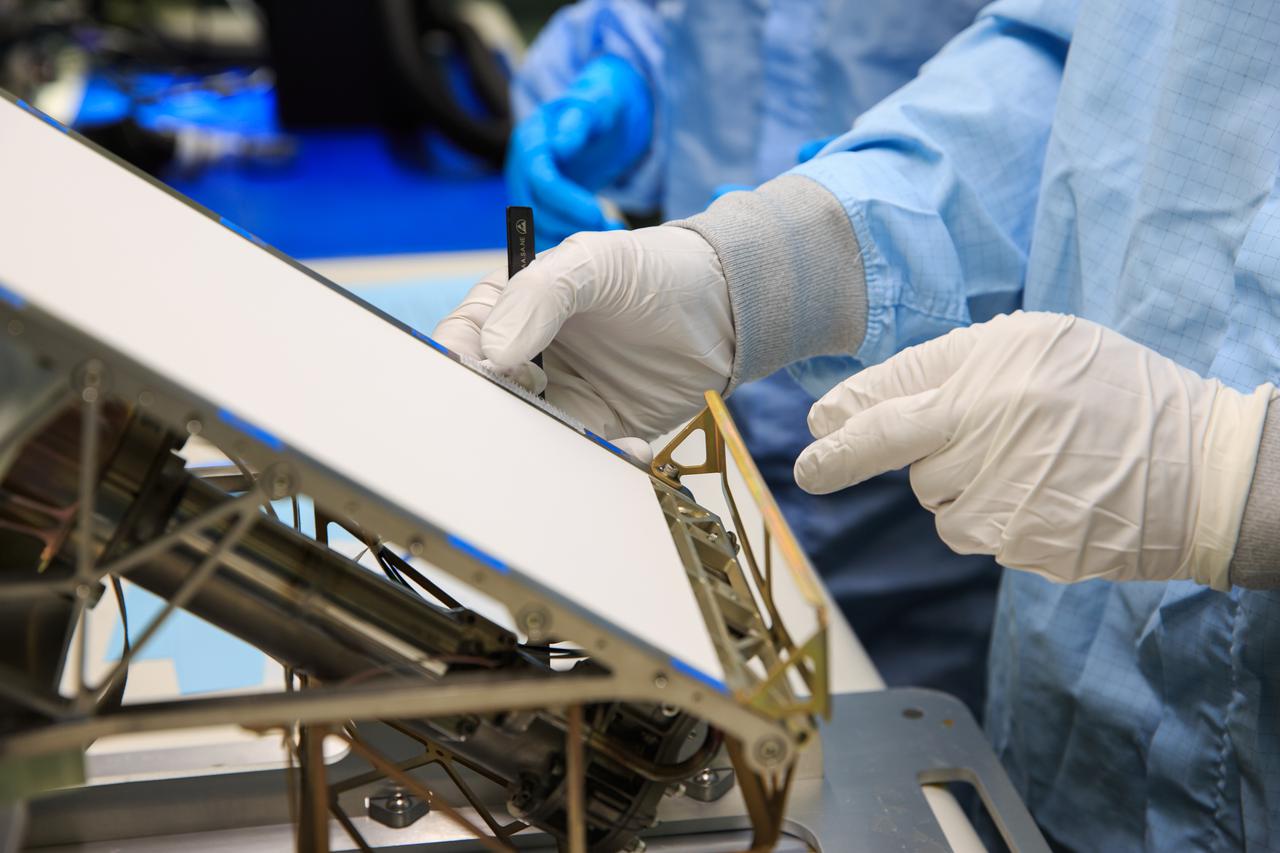
Team members working inside the Space Station Processing Facility at NASA’s Kennedy Space Center in Florida, on Sept. 23, 2021, meticulously assemble ground support equipment that will protect shipment of the Mass Spectrometer observing lunar operations (MSolo) flight hardware for preparations before it launches in 2022. MSolo is a commercial off-the-shelf mass spectrometer modified to work in space and it will help analyze the chemical makeup of landing sites on the Moon, as well as study water on the lunar surface. MSolo, scheduled to first launch in 2022, is part of four of the agency’s Commercial Lunar Payload Delivery Service missions where under the Artemis program, commercial deliveries will include science experiments, testing of technologies and demonstrations of capabilities to help NASA explore the Moon and prepare for human missions.
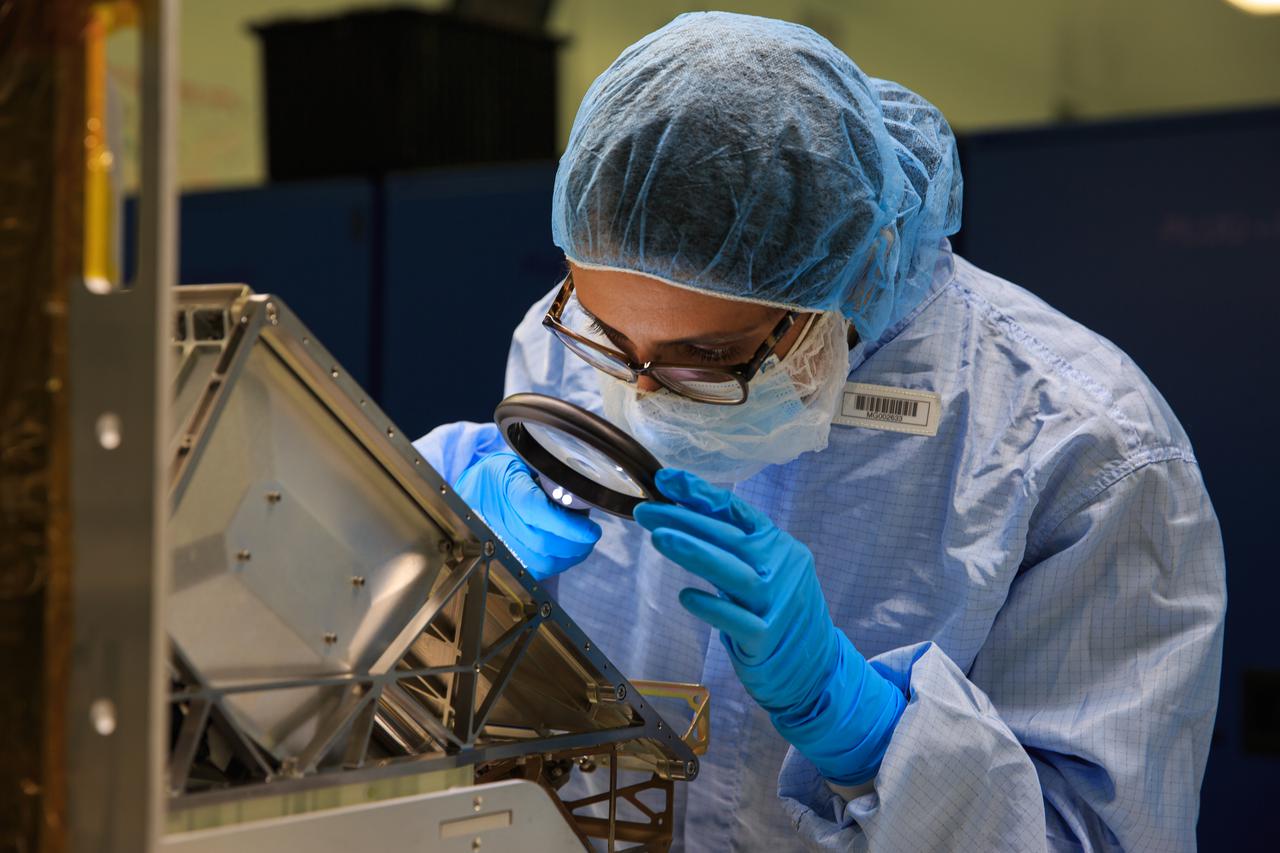
Team members working inside the Space Station Processing Facility at NASA’s Kennedy Space Center in Florida, on Sept. 23, 2021, meticulously assemble ground support equipment that will protect shipment of the Mass Spectrometer observing lunar operations (MSolo) flight hardware for preparations before it launches in 2022. MSolo is a commercial off-the-shelf mass spectrometer modified to work in space and it will help analyze the chemical makeup of landing sites on the Moon, as well as study water on the lunar surface. MSolo, scheduled to first launch in 2022, is part of four of the agency’s Commercial Lunar Payload Delivery Service missions where under the Artemis program, commercial deliveries will include science experiments, testing of technologies and demonstrations of capabilities to help NASA explore the Moon and prepare for human missions.
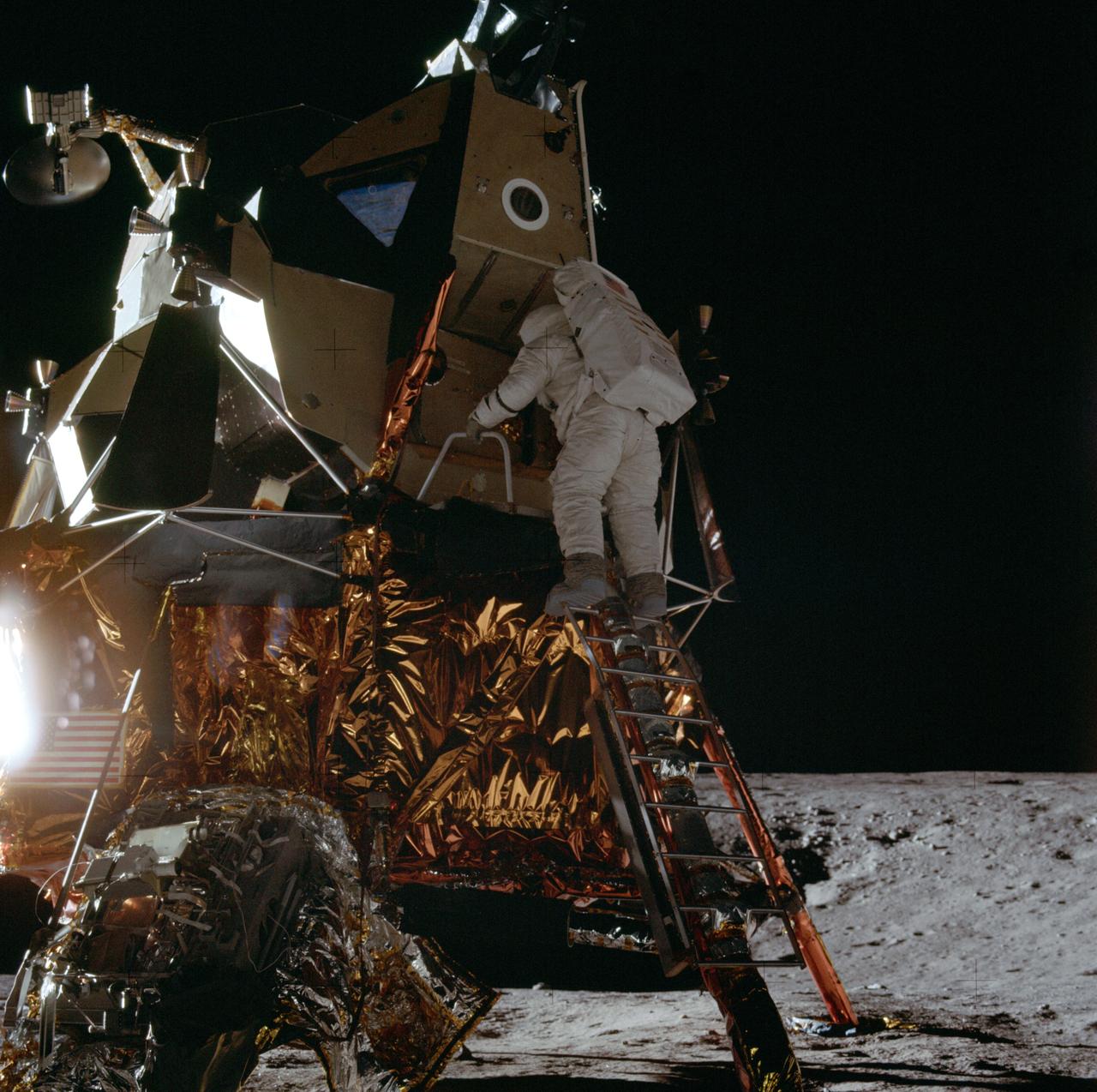
AS12-46-6726 (19 Nov. 1969) --- Astronaut Alan L. Bean, lunar module pilot for the Apollo 12 mission, starts down the ladder of the Lunar Module (LM) to join astronaut Charles Conrad Jr., mission commander, in extravehicular activity (EVA). While astronauts Conrad and Bean descended in the LM "Intrepid" to explore the Ocean of Storms region of the moon, astronaut Richard F. Gordon Jr., command module pilot, remained with the Command and Service Modules (CSM) "Yankee Clipper" in lunar orbit.
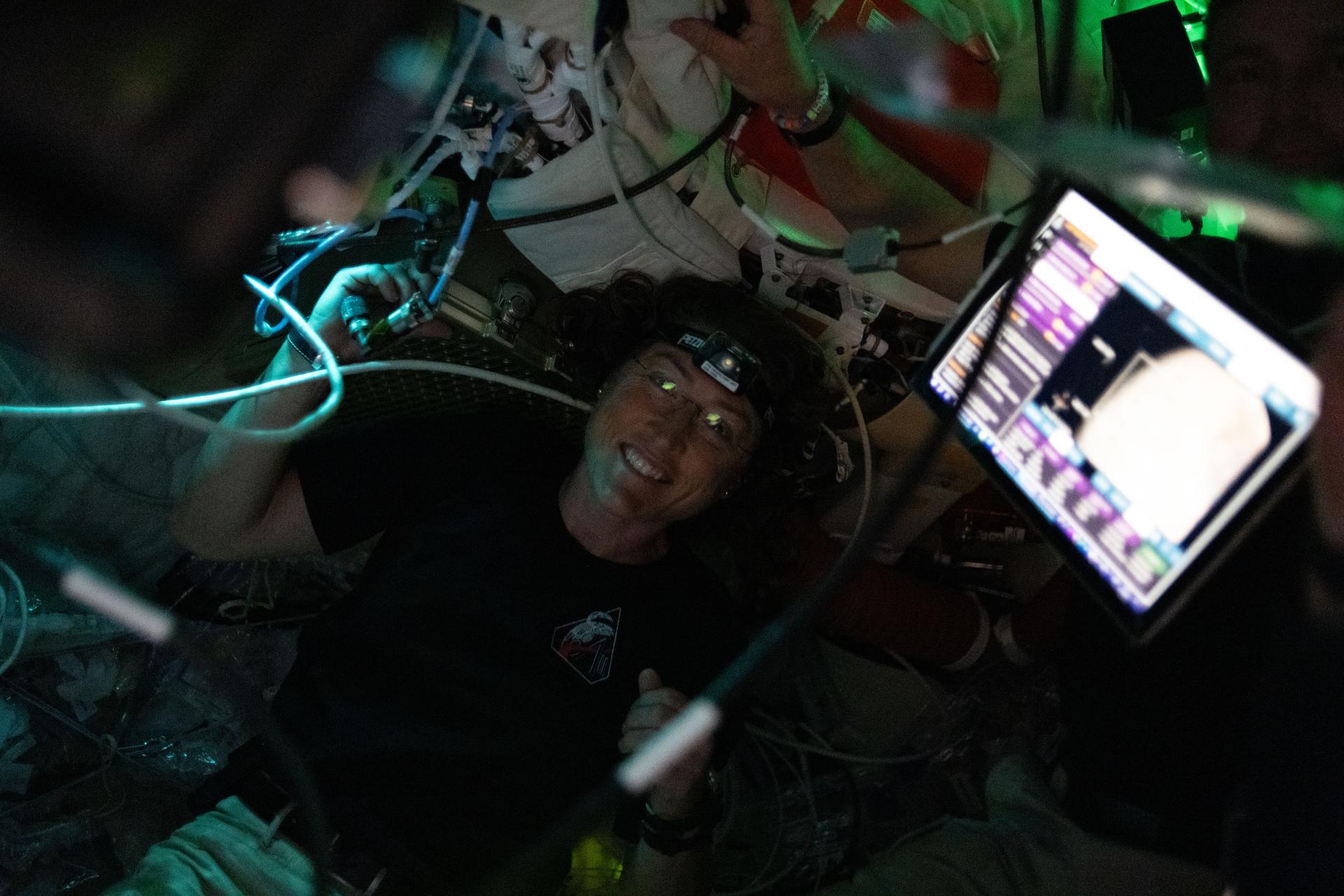
art002e016172 (April 6, 2026) – NASA astronaut and Artemis II Mission Specialist Christina Koch pictured here in the Orion spacecraft during the Artemis II lunar flyby. Koch and her fellow crewmates spent approximately seven hours taking turns at the Orion windows capturing science data to share with their team back on Earth. At closest approach, they came within 4,067 miles of the Moon’s surface.
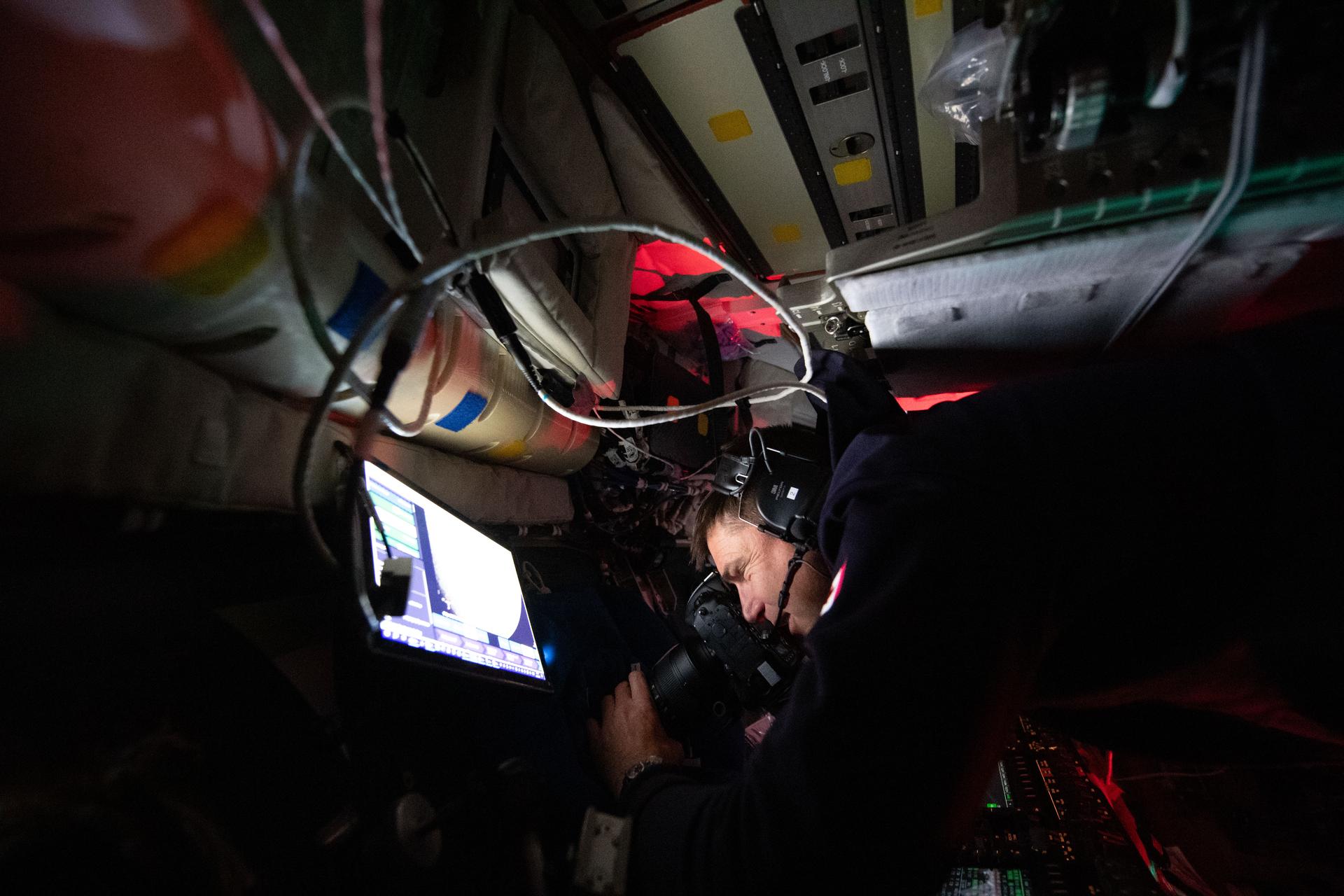
art002e014235 (April 6, 2026) – CSA (Canadian Space Agency) astronaut and Artemis II Mission Specialist Jeremy Hansen is seen taking images through the Orion spacecraft window during the Artemis II lunar flyby. Hansen and his fellow crewmates spent approximately seven hours taking turns at the Orion windows capturing science data to share with their team back on Earth. At closest approach, they came within 4,067 miles of the Moon’s surface.
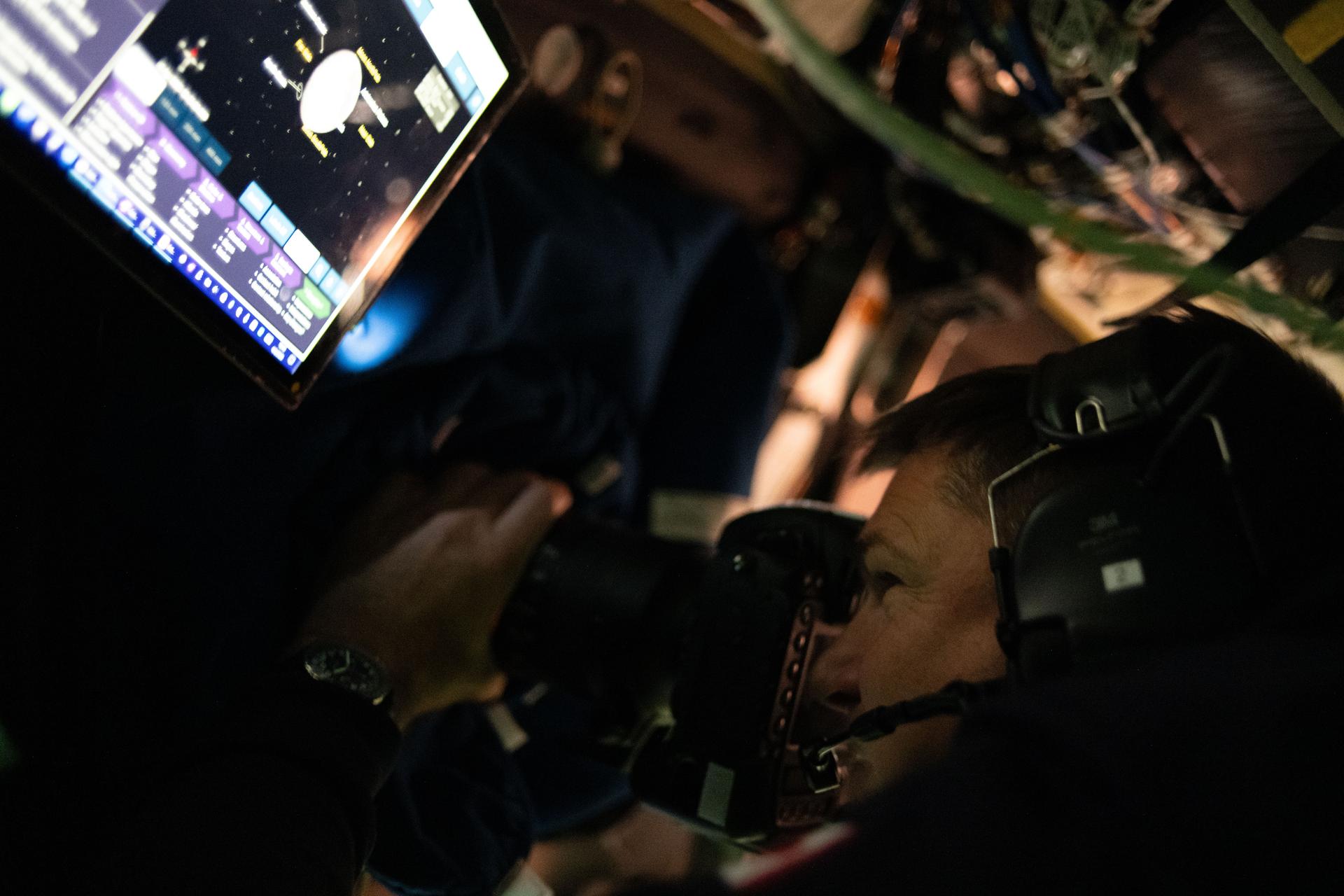
art002e016136 (April 6, 2026) – CSA (Canadian Space Agency) astronaut and Artemis II Mission Specialist Jeremy Hansen is seen taking images through the Orion spacecraft window during the Artemis II lunar flyby. Hansen and his fellow crewmates spent approximately seven hours taking turns at the Orion windows capturing science data to share with their team back on Earth. At closest approach, they came within 4,067 miles of the Moon’s surface.
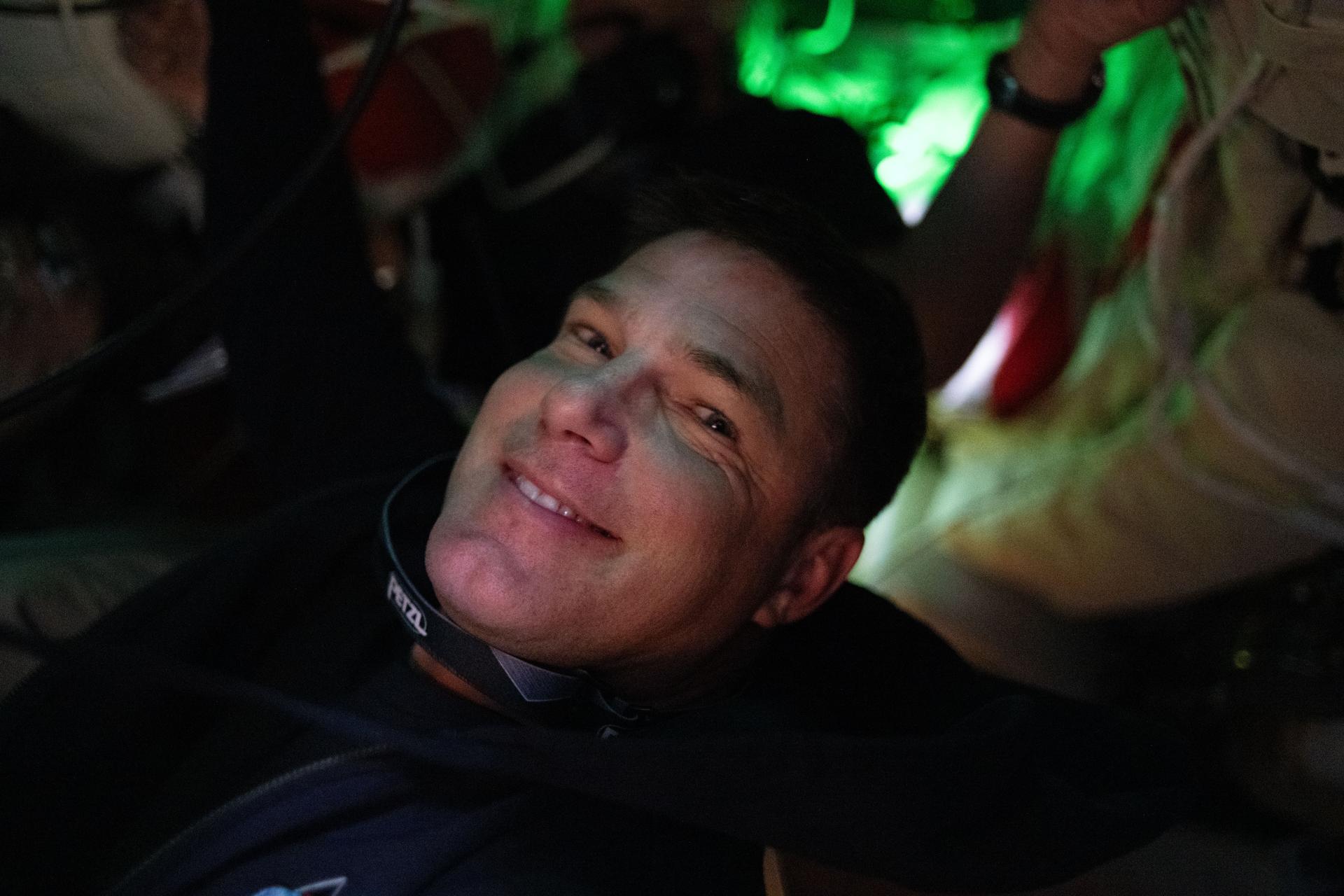
art002e016171 (April 6, 2026) – CSA (Canadian Space Agency) astronaut and Artemis II Mission Specialist Jeremy Hansen pictured here in the Orion spacecraft during the Artemis II lunar flyby. Hansen and his fellow crewmates spent approximately seven hours taking turns at the Orion windows capturing science data to share with their team back on Earth. At closest approach, they came within 4,067 miles of the Moon’s surface.
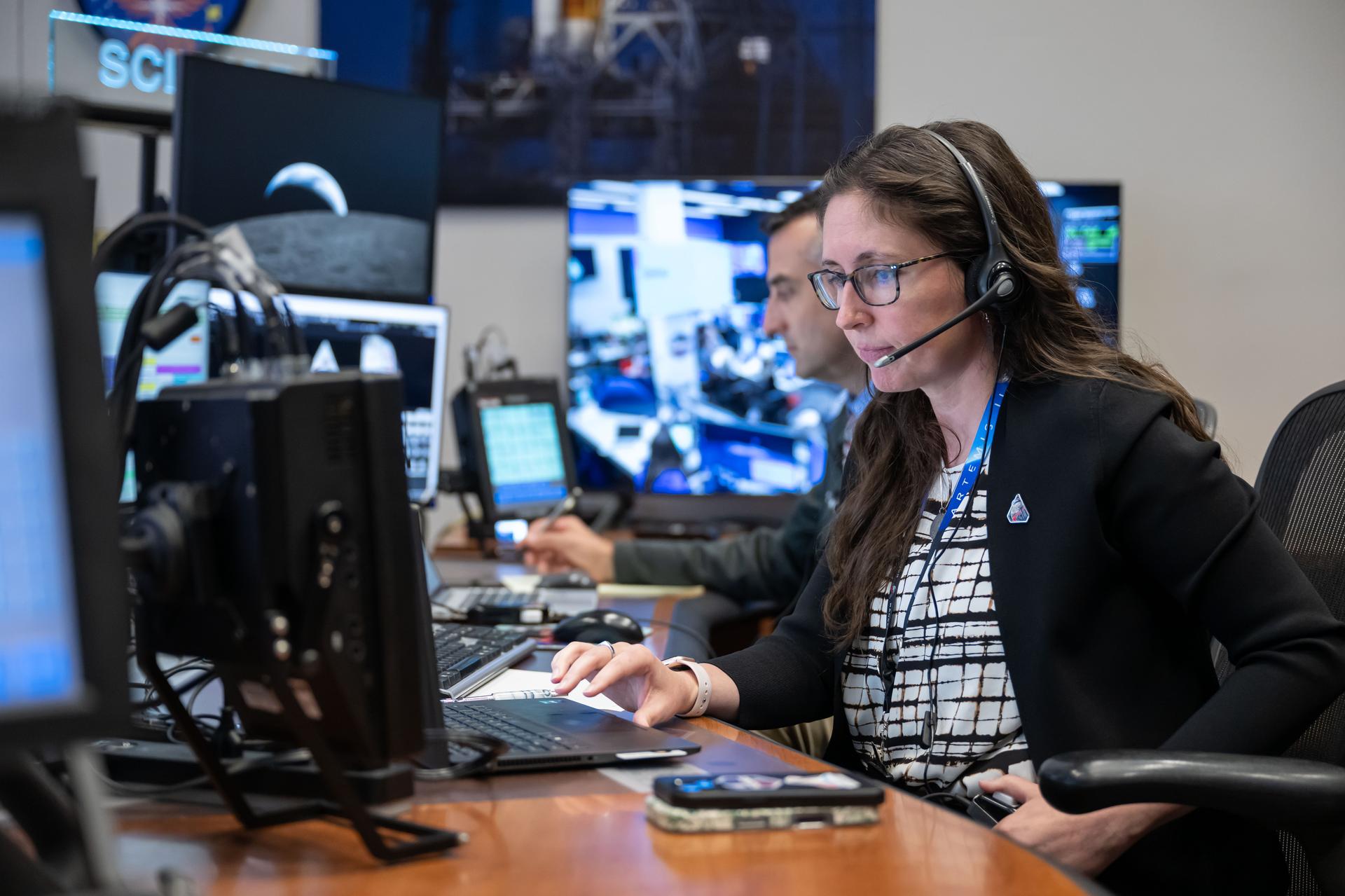
Artemis II science officers, Trevor Graff, background, and Kelsey Young are seen monitoring mission data in real-time from the Science console in the White Flight Control Room in Mission Control at NASA's Johnson Space Center in Houston. Science officers are the senior flight controllers responsible for lunar science and geology objectives during Artemis missions. Credits: NASA/Robert Markowitz
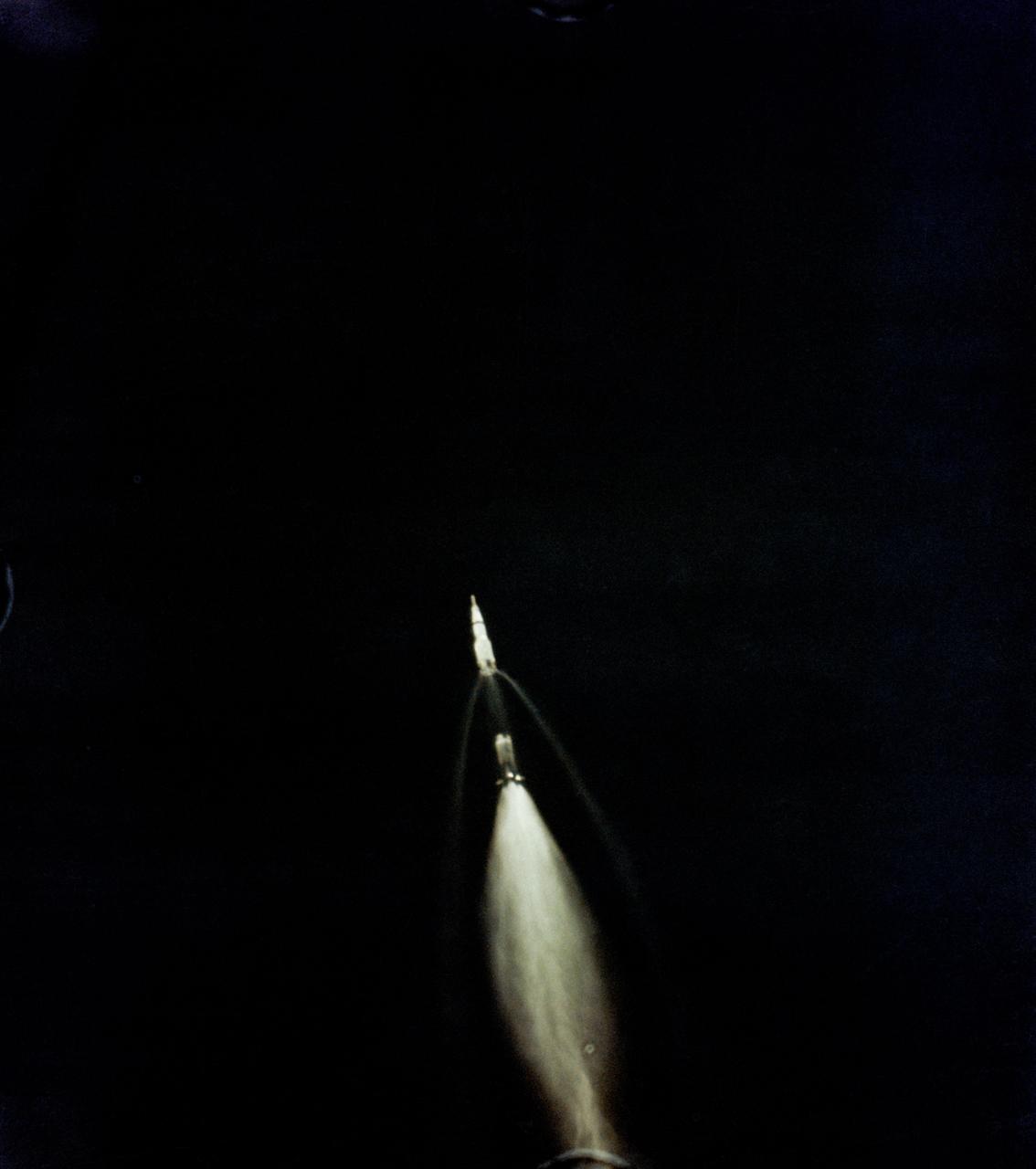
S69-39958 (16 July 1969) --- A 70mm Airborne Lightweight Optical Tracking System (ALOTS) camera, mounted in a pod on a cargo door of a U.S. Air Force EC-135N aircraft, photographed this event in the early moments of the Apollo 11 launch. The mated Apollo spacecraft and Saturn V second (S-II) and third (S-IVB) stages pull away from the expended first (S-1C) stage. Separation occurred at an altitude of about 38 miles, some 55 miles downrange from Cape Kennedy. The aircraft's pod is 20 feet long and 5 feet in diameter. The crew of the Apollo 11 lunar landing mission are astronauts Neil A. Armstrong, Michael Collins, and Edwin E. Aldrin Jr.
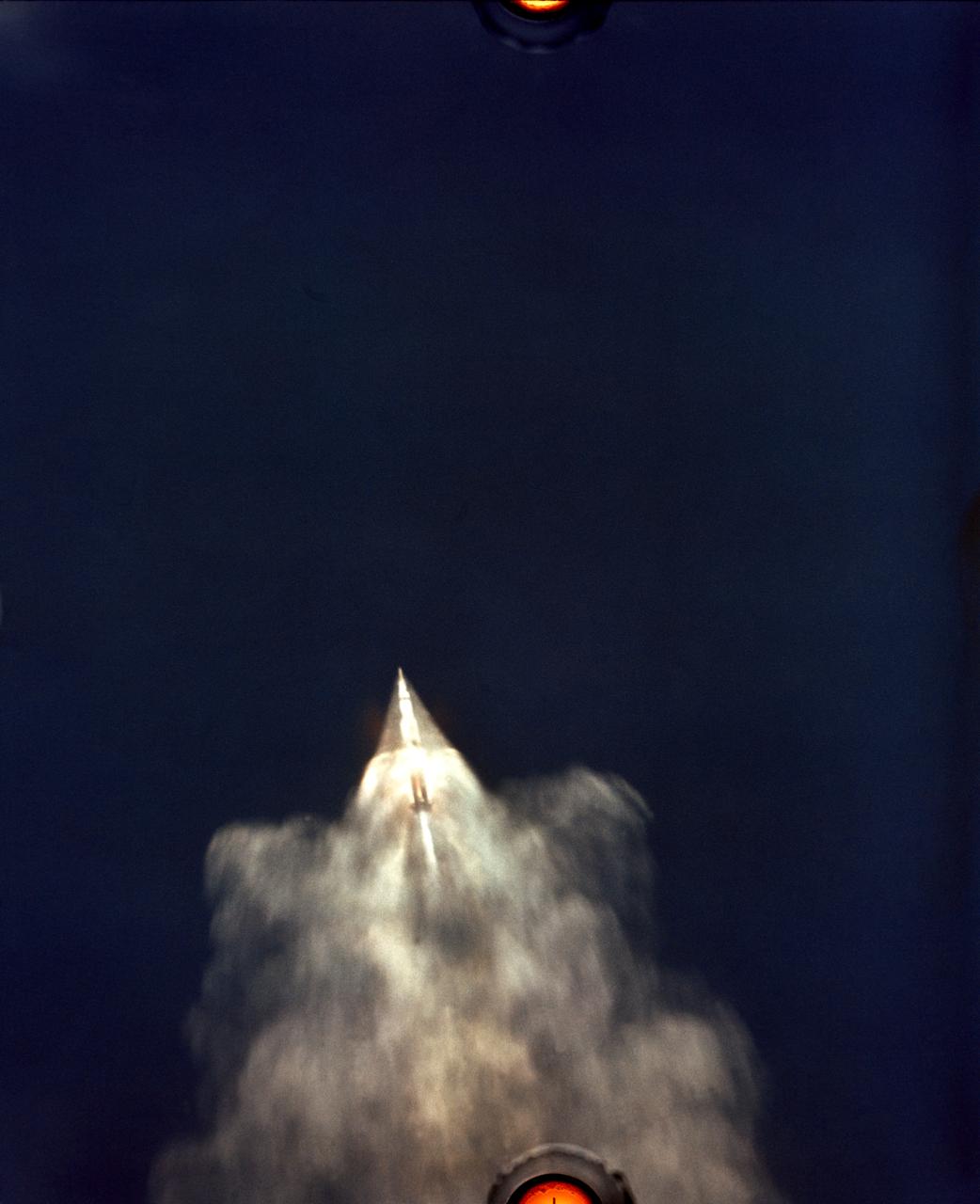
S69-39957 (16 July 1969) --- A 70mm Airborne Lightweight Optical Tracking System (ALOTS) took this picture. ALOTS tracking camera mounted on an Air Force EC-135 aircraft flying at about 40,000 feet altitude photographed this event in the early moments of the Apollo 11 launch. The 7.6 million-pound thrust Saturn V (S-1C) first stage boosts the space vehicle to an altitude of 36.3 nautical miles at 50.6 nautical miles downrange in 2 minutes 40.8 seconds. The S-1C stage separates at 2 minutes 41.6 seconds after liftoff. The crew of the Apollo 11 NASA's first lunar landing mission are astronauts Neil A. Armstrong, Michael Collins, and Edwin E. Aldrin Jr. The Apollo 11 launch was at 9:32 a.m. (EDT), July 16, 1969.
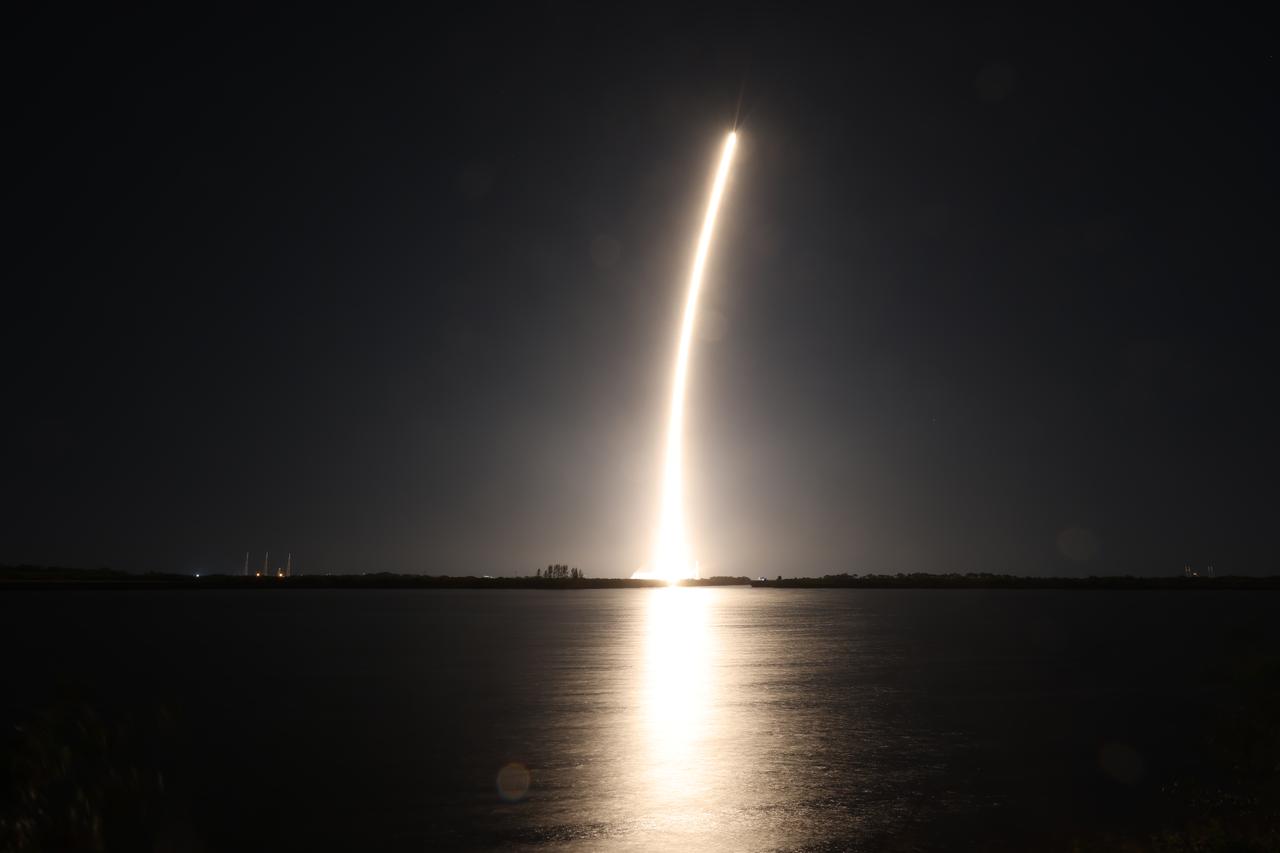
Creating a golden streak in the night sky, a SpaceX Falcon 9 rocket carrying Firefly Aerospace’s Blue Ghost Mission One lander soars upward after liftoff from Launch Complex 39A at NASA’s Kennedy Space Center in Florida on Wednesday, Jan. 15, 2025 as part of NASA’s CLPS (Commercial Lunar Payload Services) initiative. The Blue Ghost lander will carry 10 NASA science and technology instruments to the lunar surface to further understand the Moon and help prepare for future human missions.
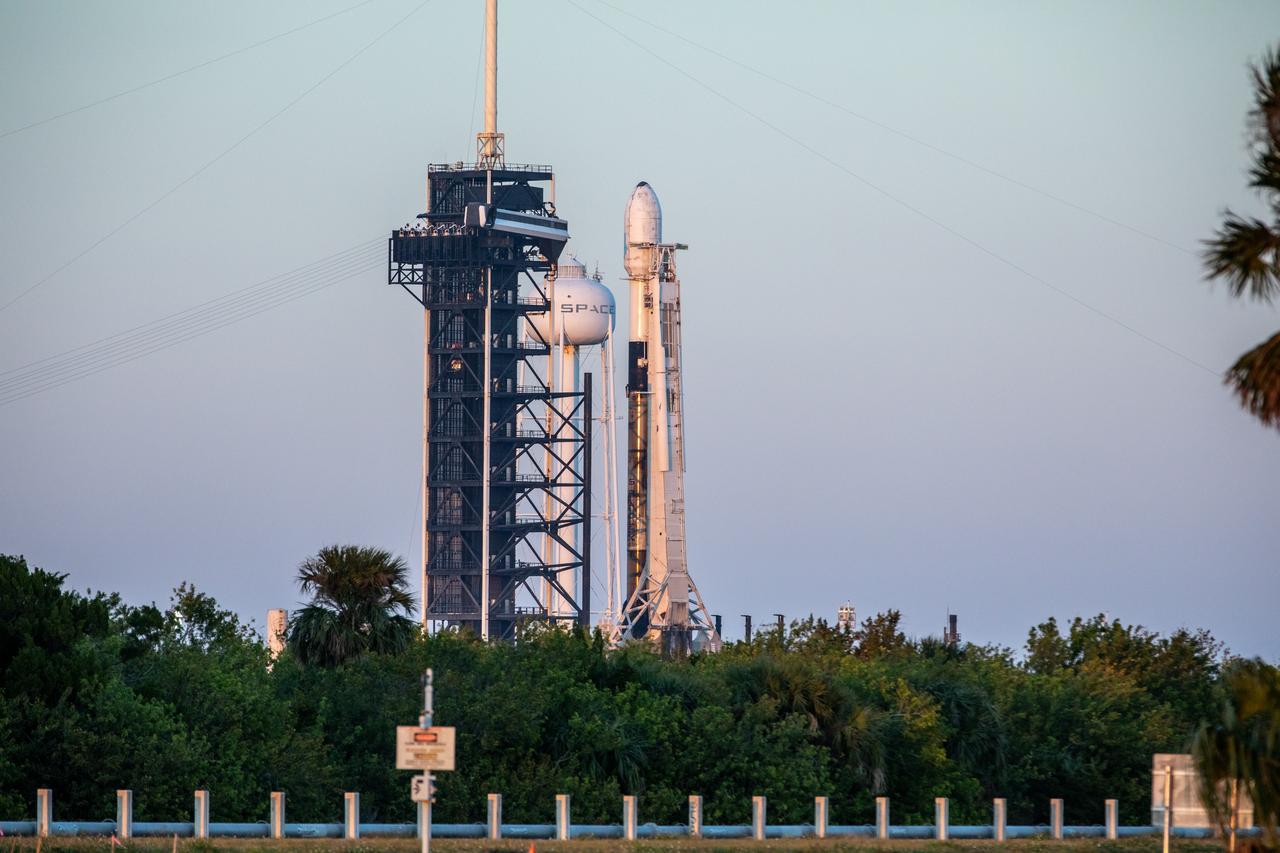
A SpaceX Falcon 9 rocket carrying Firefly Aerospace’s Blue Ghost Mission One lander prepares for a launch to the Moon on Tuesday, Jan. 14, 2025 from Launch Complex 39A at the agency’s Kennedy Space Center in Florida as part of NASA’s CLPS (Commercial Lunar Payload Services) initiative. The Blue Ghost lander will carry 10 NASA science and technology instruments to the lunar surface to further understand the Moon and help prepare for future human missions. Liftoff is targeted for 1:11 a.m. EST.
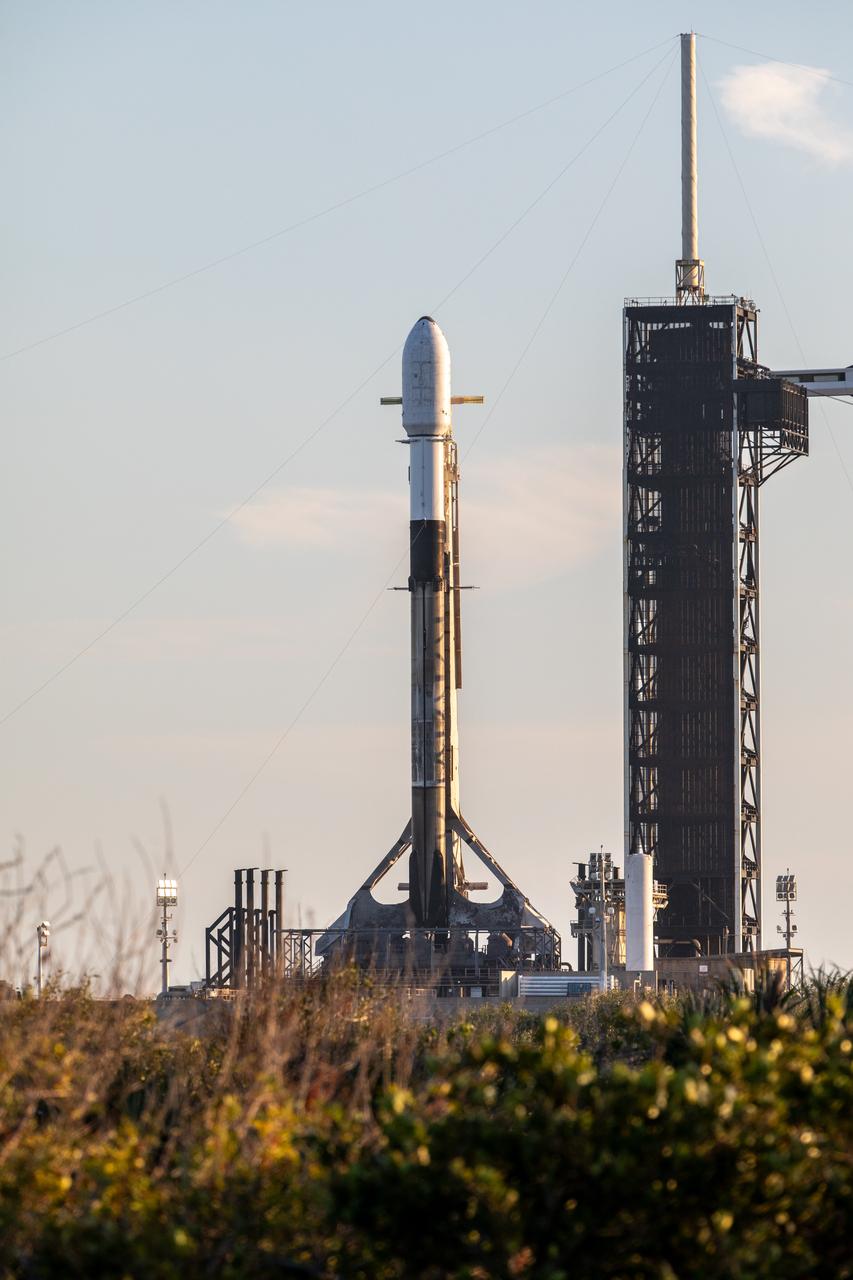
A SpaceX Falcon 9 rocket carrying Firefly Aerospace’s Blue Ghost Mission One lander prepares for a launch to the Moon on Tuesday, Jan. 14, 2025 from Launch Complex 39A at the agency’s Kennedy Space Center in Florida as part of NASA’s CLPS (Commercial Lunar Payload Services) initiative. The Blue Ghost lander will carry 10 NASA science and technology instruments to the lunar surface to further understand the Moon and help prepare for future human missions. Liftoff is targeted for 1:11 a.m. EST.
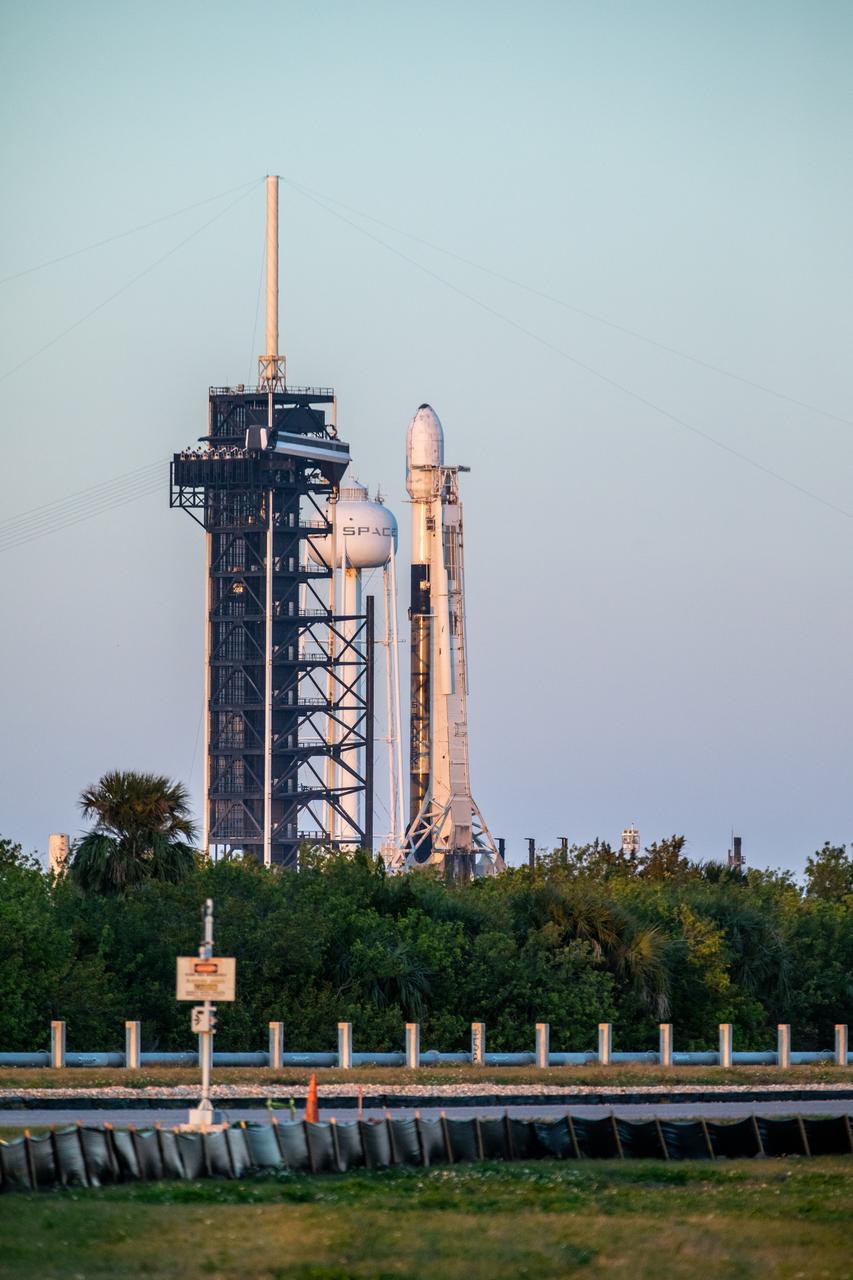
A SpaceX Falcon 9 rocket carrying Firefly Aerospace’s Blue Ghost Mission One lander prepares for a launch to the Moon on Tuesday, Jan. 14, 2025 from Launch Complex 39A at the agency’s Kennedy Space Center in Florida as part of NASA’s CLPS (Commercial Lunar Payload Services) initiative. The Blue Ghost lander will carry 10 NASA science and technology instruments to the lunar surface to further understand the Moon and help prepare for future human missions. Liftoff is targeted for 1:11 a.m. EST.
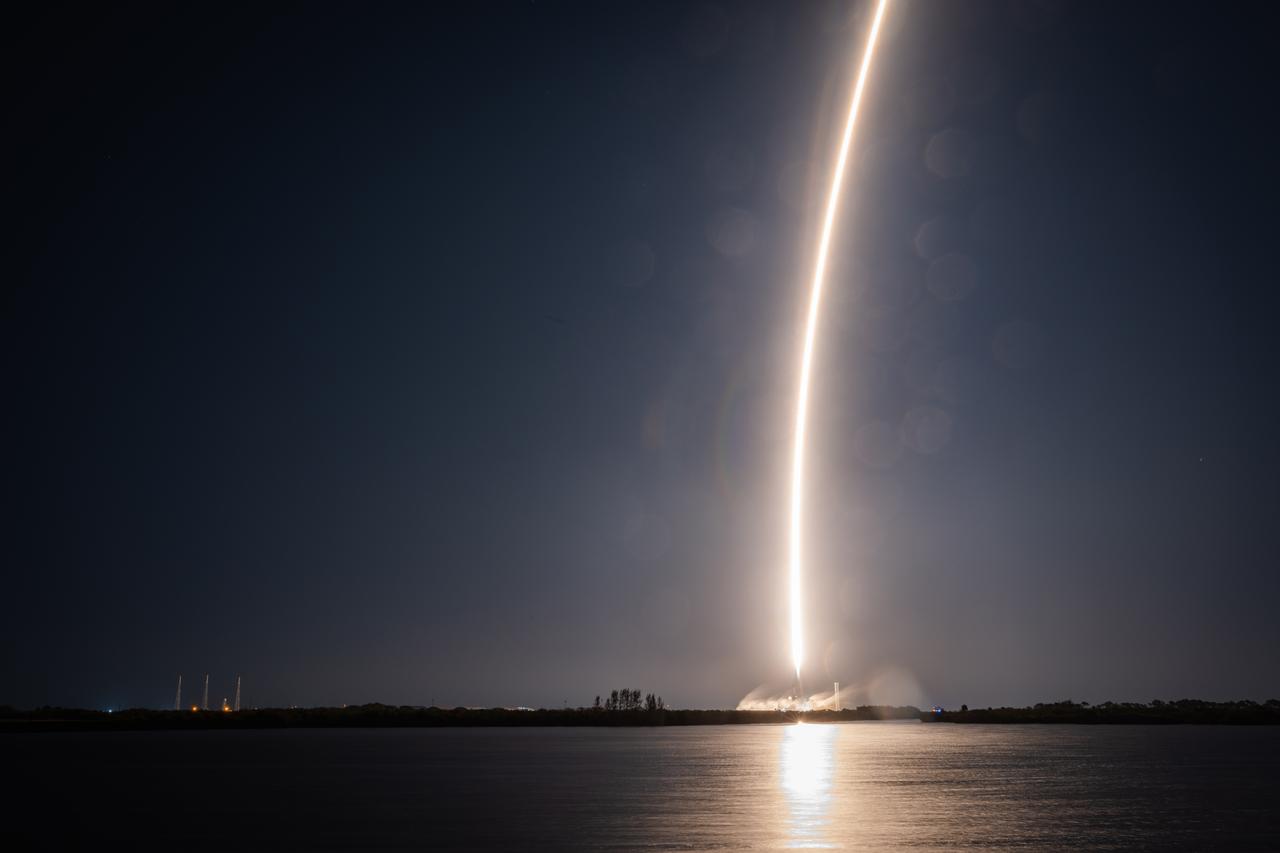
Creating a golden streak in the night sky, a SpaceX Falcon 9 rocket carrying Firefly Aerospace’s Blue Ghost Mission One lander soars upward after liftoff from Launch Complex 39A at NASA’s Kennedy Space Center in Florida on Wednesday, Jan. 15, 2025 as part of NASA’s CLPS (Commercial Lunar Payload Services) initiative. The Blue Ghost lander will carry 10 NASA science and technology instruments to the lunar surface to further understand the Moon and help prepare for future human missions.
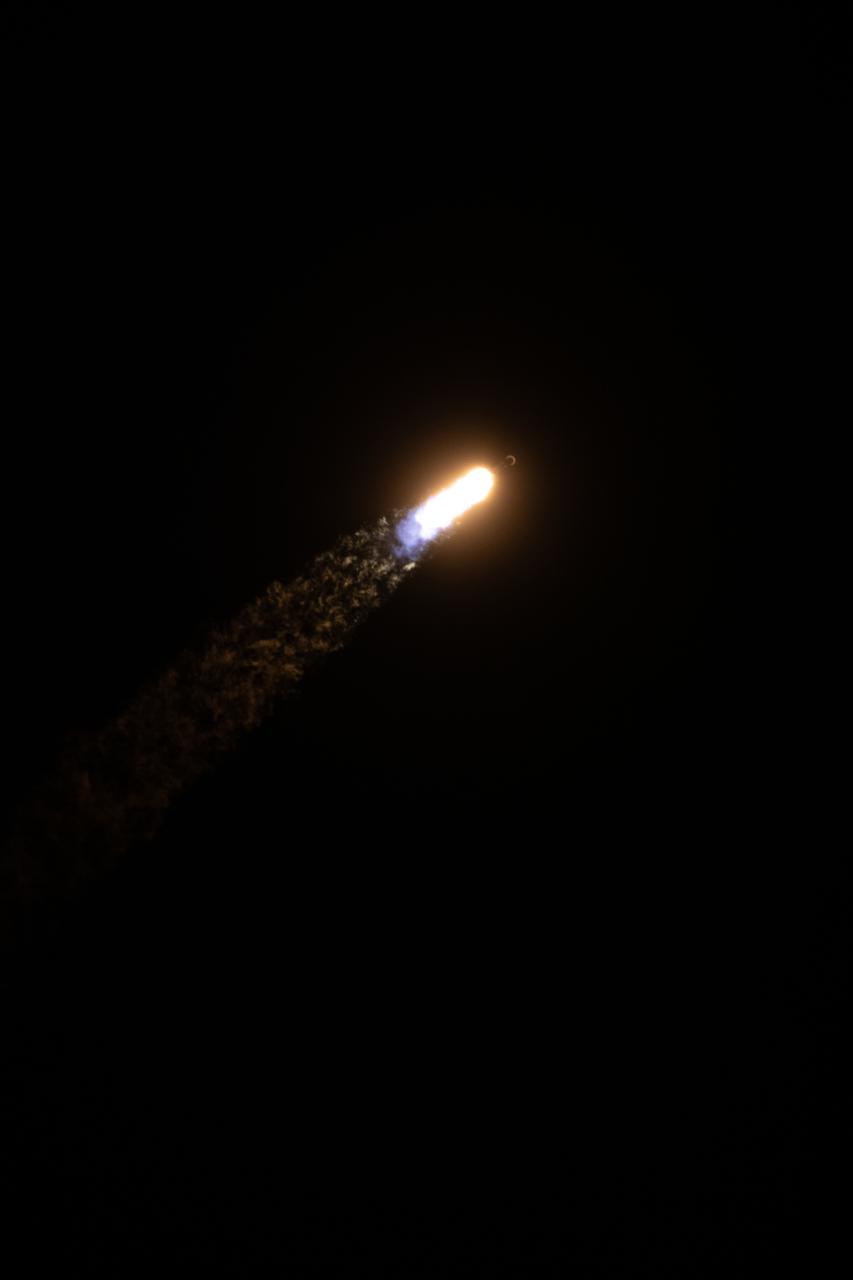
A SpaceX Falcon 9 rocket carrying Firefly Aerospace’s Blue Ghost Mission One is on its way to the Moon as part of NASA’s CLPS (Commercial Lunar Payload Services) initiative. The Blue Ghost lander launched from Launch Complex 39A at NASA’s Kennedy Space Center in Florida on Wednesday, Jan. 15, 2025 carrying 10 NASA science and technology instruments to the lunar surface to further understand the Moon and help prepare for future human missions.
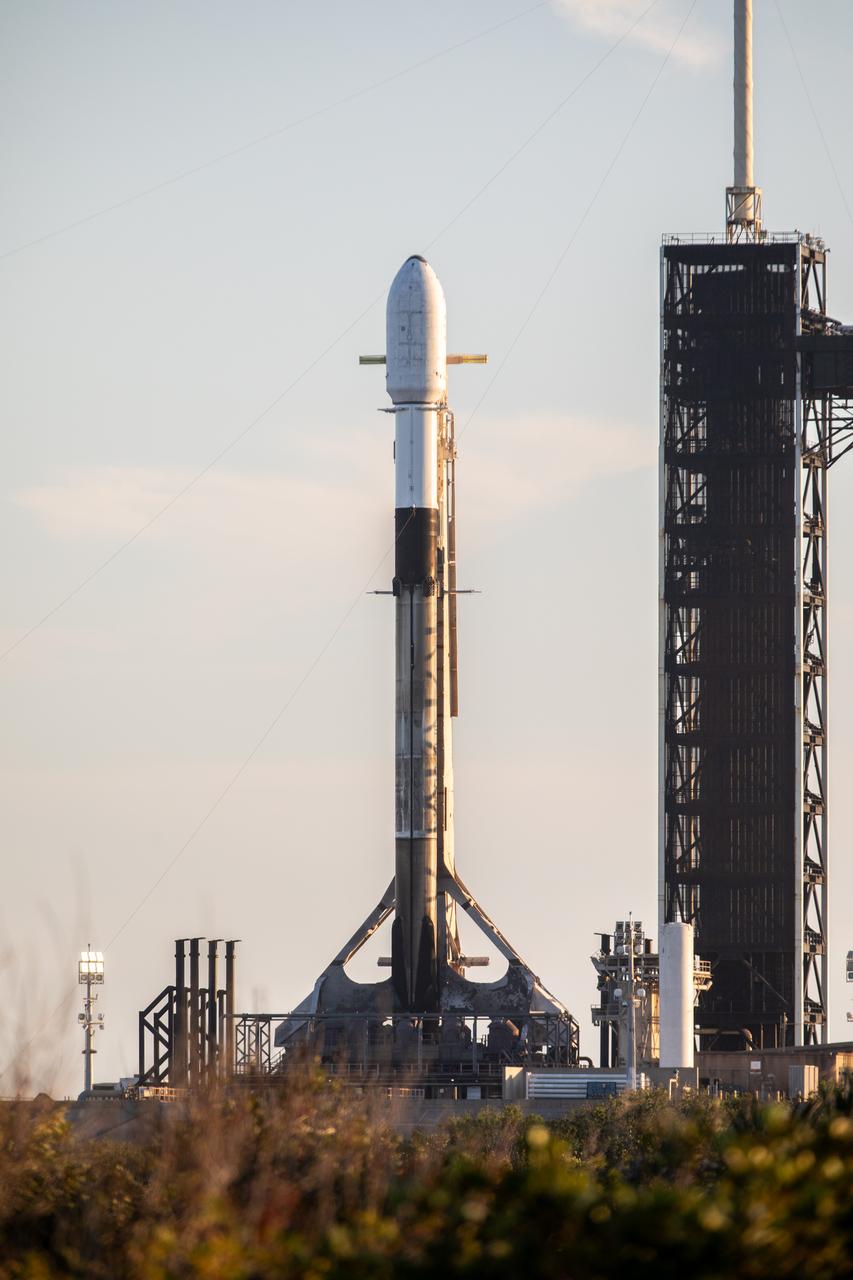
A SpaceX Falcon 9 rocket carrying Firefly Aerospace’s Blue Ghost Mission One lander prepares for a launch to the Moon on Tuesday, Jan. 14, 2025 from Launch Complex 39A at the agency’s Kennedy Space Center in Florida as part of NASA’s CLPS (Commercial Lunar Payload Services) initiative. The Blue Ghost lander will carry 10 NASA science and technology instruments to the lunar surface to further understand the Moon and help prepare for future human missions. Liftoff is targeted for 1:11 a.m. EST.
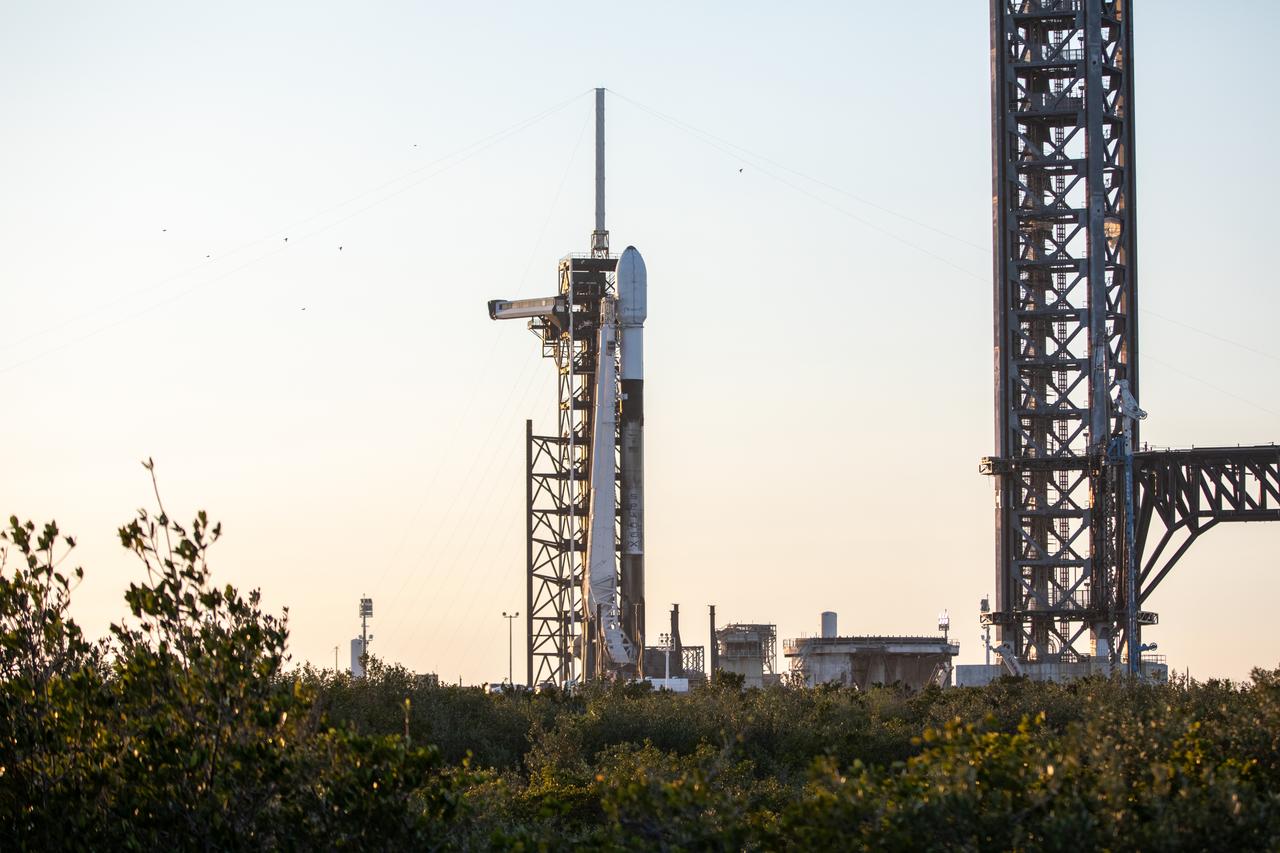
A SpaceX Falcon 9 rocket carrying Firefly Aerospace’s Blue Ghost Mission One lander prepares for a launch to the Moon on Tuesday, Jan. 14, 2025 from Launch Complex 39A at the agency’s Kennedy Space Center in Florida as part of NASA’s CLPS (Commercial Lunar Payload Services) initiative. The Blue Ghost lander will carry 10 NASA science and technology instruments to the lunar surface to further understand the Moon and help prepare for future human missions. Liftoff is targeted for 1:11 a.m. EST.
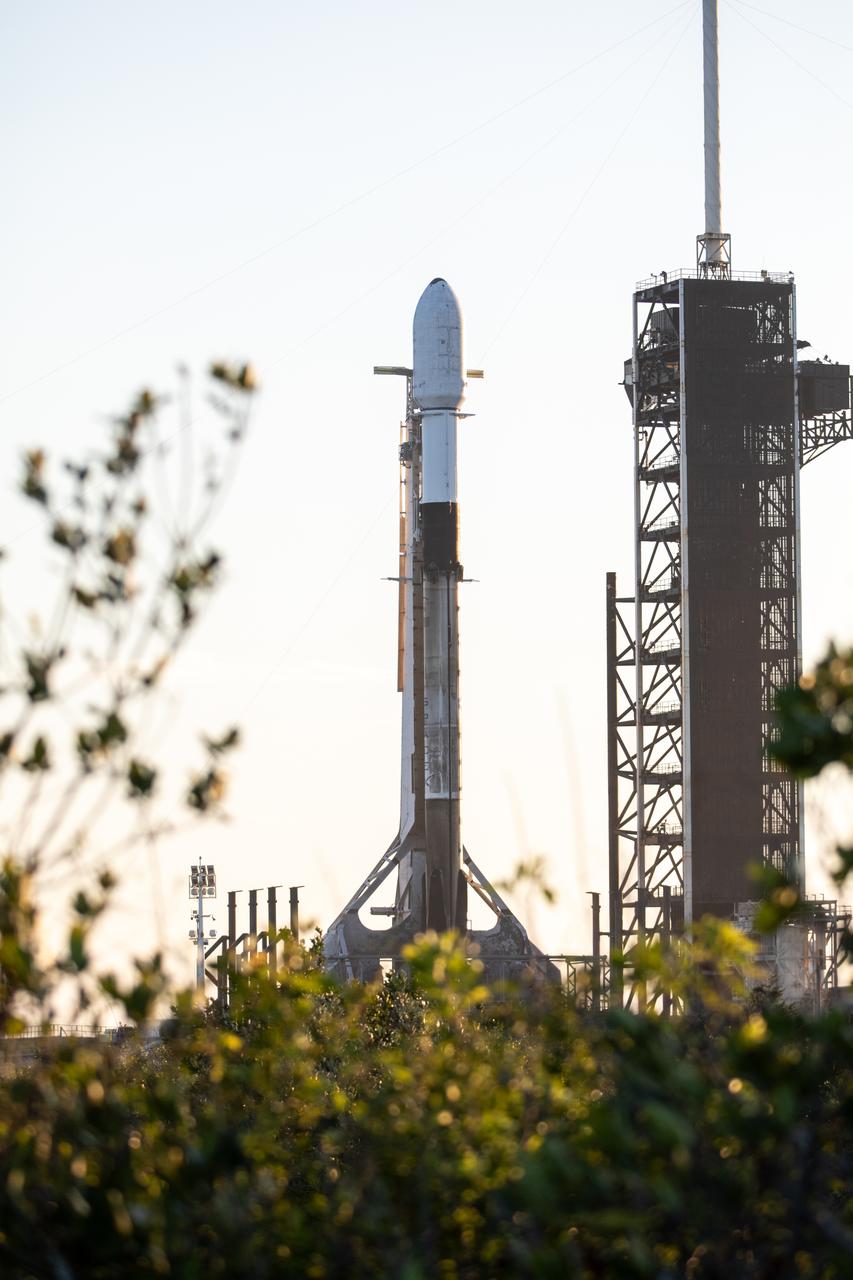
A SpaceX Falcon 9 rocket carrying Firefly Aerospace’s Blue Ghost Mission One lander prepares for a launch to the Moon on Tuesday, Jan. 14, 2025 from Launch Complex 39A at the agency’s Kennedy Space Center in Florida as part of NASA’s CLPS (Commercial Lunar Payload Services) initiative. The Blue Ghost lander will carry 10 NASA science and technology instruments to the lunar surface to further understand the Moon and help prepare for future human missions. Liftoff is targeted for 1:11 a.m. EST.

Creating a golden streak in the night sky, a SpaceX Falcon 9 rocket carrying Firefly Aerospace’s Blue Ghost Mission One lander soars upward after liftoff from Launch Complex 39A at NASA’s Kennedy Space Center in Florida on Wednesday, Jan. 15, 2025 as part of NASA’s CLPS (Commercial Lunar Payload Services) initiative. The Blue Ghost lander will carry 10 NASA science and technology instruments to the lunar surface to further understand the Moon and help prepare for future human missions.
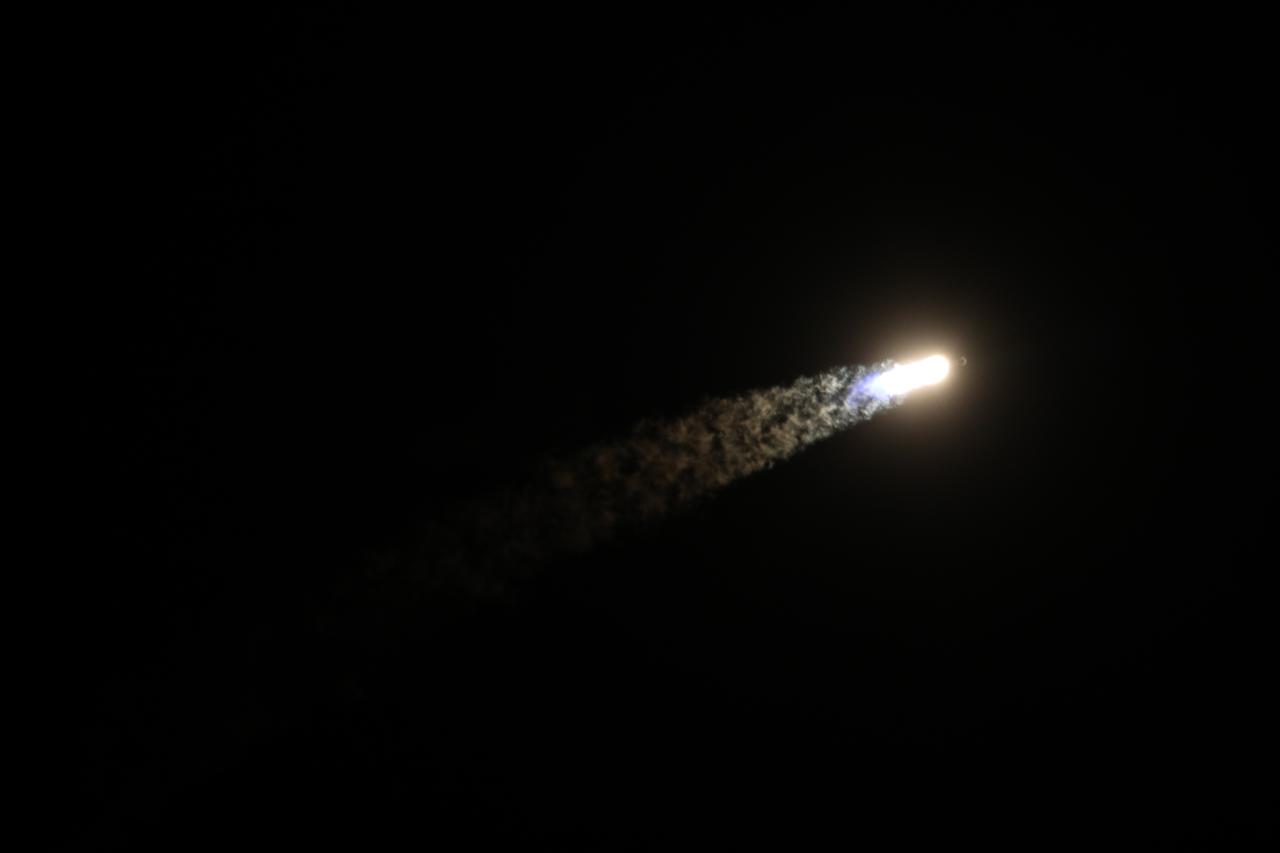
A SpaceX Falcon 9 rocket carrying Firefly Aerospace’s Blue Ghost Mission One is on its way to the Moon as part of NASA’s CLPS (Commercial Lunar Payload Services) initiative. The Blue Ghost lander launched from Launch Complex 39A at NASA’s Kennedy Space Center in Florida on Wednesday, Jan. 15, 2025 carrying 10 NASA science and technology instruments to the lunar surface to further understand the Moon and help prepare for future human missions.
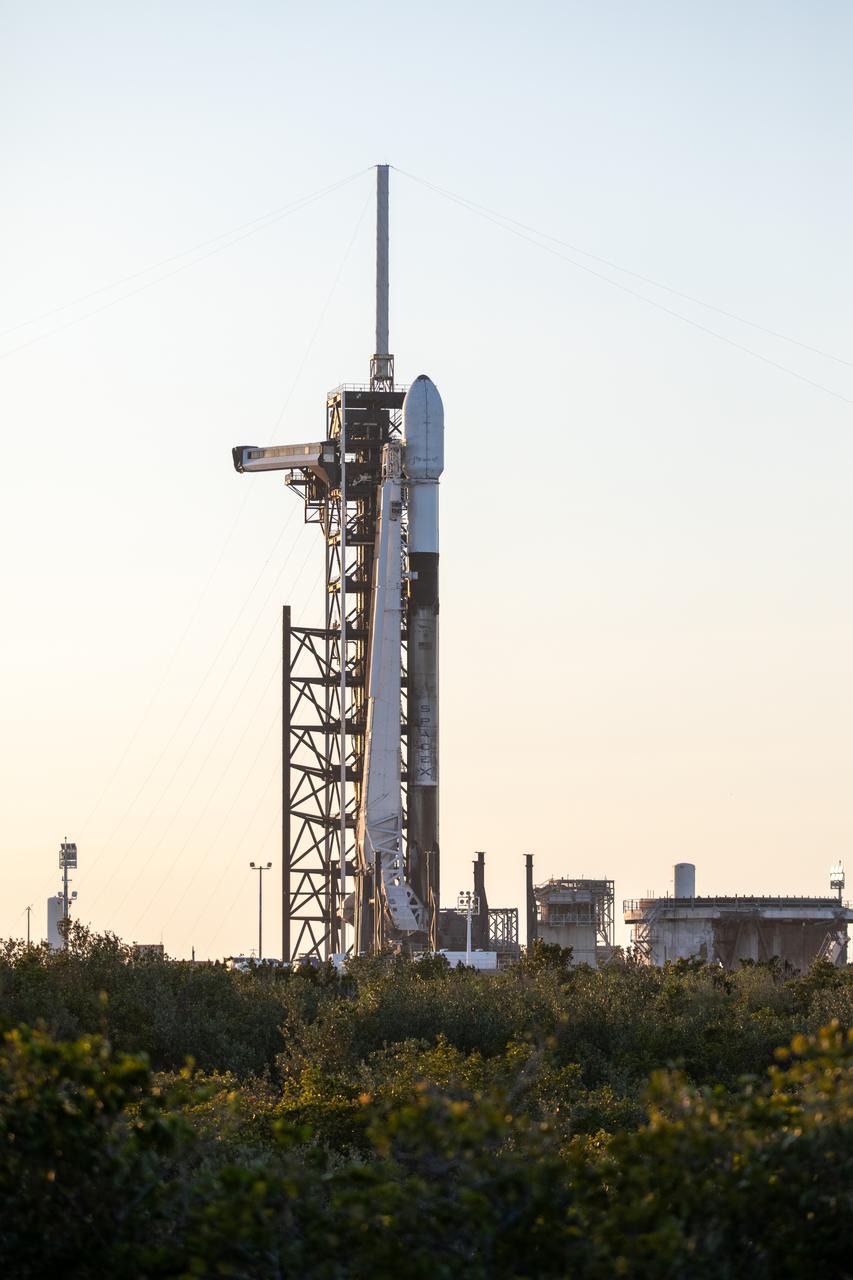
A SpaceX Falcon 9 rocket carrying Firefly Aerospace’s Blue Ghost Mission One lander prepares for a launch to the Moon on Tuesday, Jan. 14, 2025 from Launch Complex 39A at the agency’s Kennedy Space Center in Florida as part of NASA’s CLPS (Commercial Lunar Payload Services) initiative. The Blue Ghost lander will carry 10 NASA science and technology instruments to the lunar surface to further understand the Moon and help prepare for future human missions. Liftoff is targeted for 1:11 a.m. EST.
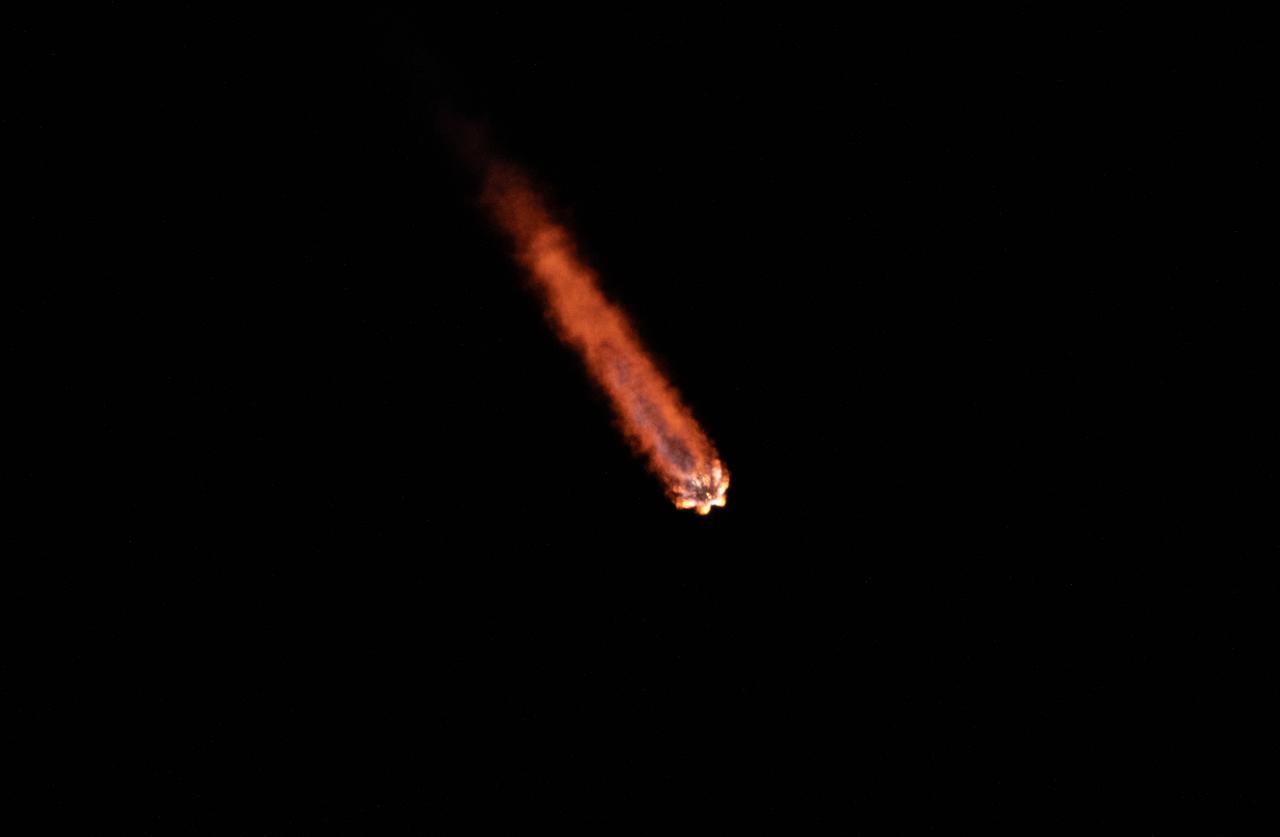
A SpaceX Falcon 9 rocket carrying Firefly Aerospace’s Blue Ghost Mission One is on its way to the Moon as part of NASA’s CLPS (Commercial Lunar Payload Services) initiative. The Blue Ghost lander launched from Launch Complex 39A at NASA’s Kennedy Space Center in Florida on Wednesday, Jan. 15, 2025 carrying 10 NASA science and technology instruments to the lunar surface to further understand the Moon and help prepare for future human missions.
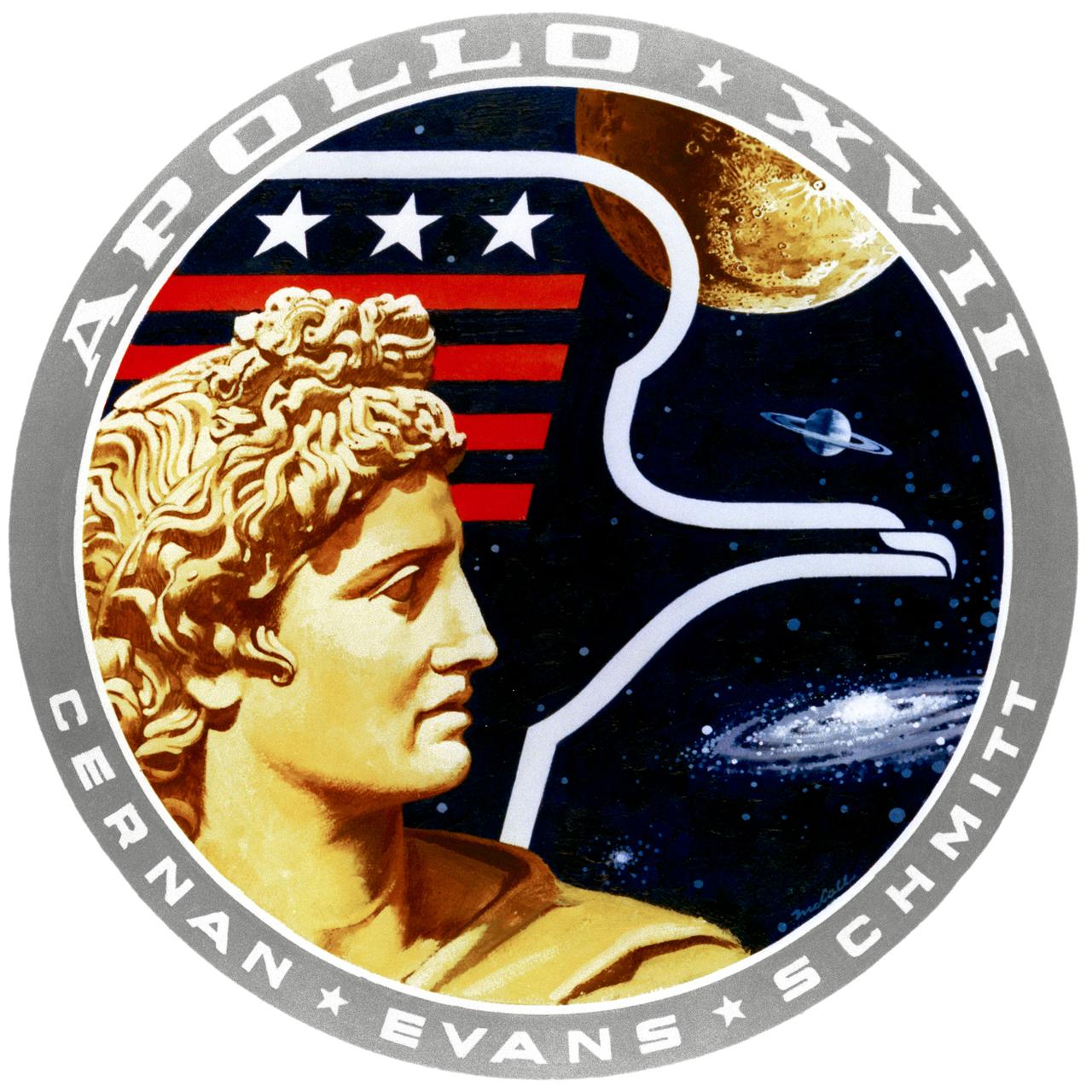
S72-49079 (8 Sept. 1972) --- This is the official emblem of the Apollo 17 lunar landing mission which will be flown by astronauts Eugene A. Cernan, Ronald E. Evans and Harrison H. Schmitt. The insignia is dominated by the image of Apollo, the Greek sun god. Suspended in space behind the head of Apollo is an American eagle of contemporary design, the red bars of the eagle's wing represent the bars in the United States flag; the three white stars symbolize the three astronaut crewmen. The background is deep blue space and within it are the moon, the planet Saturn and a spiral galaxy or nebula. The moon is partially overlaid by the eagle's wing suggesting that this is a celestial body that man has visited and in that sense conquered. The thrust of the eagle and the gaze of Apollo to the right and toward Saturn and the galaxy is meant to imply that man's goals in space will someday include the planets and perhaps the stars. The colors of the emblem are red, white and blue, the colors of our flag; with the addition of gold, to symbolize the golden age of space flight that will begin with this Apollo 17 lunar landing. The Apollo image used in this emblem was the famous Apollo of Belvedere sculpture now in the Vatican Gallery in Rome. This emblem was designed by artist Robert T. McCall in collaboration with the astronauts. This is the official Apollo 17 emblem, a property of the government of the United States. It has been authorized only for use by the astronauts. Its reproduction in any form other than in news, information and education media is not authorized without approval. Unauthorized use is subject to the provisions of Title 18, U.S. Code, Section 701.
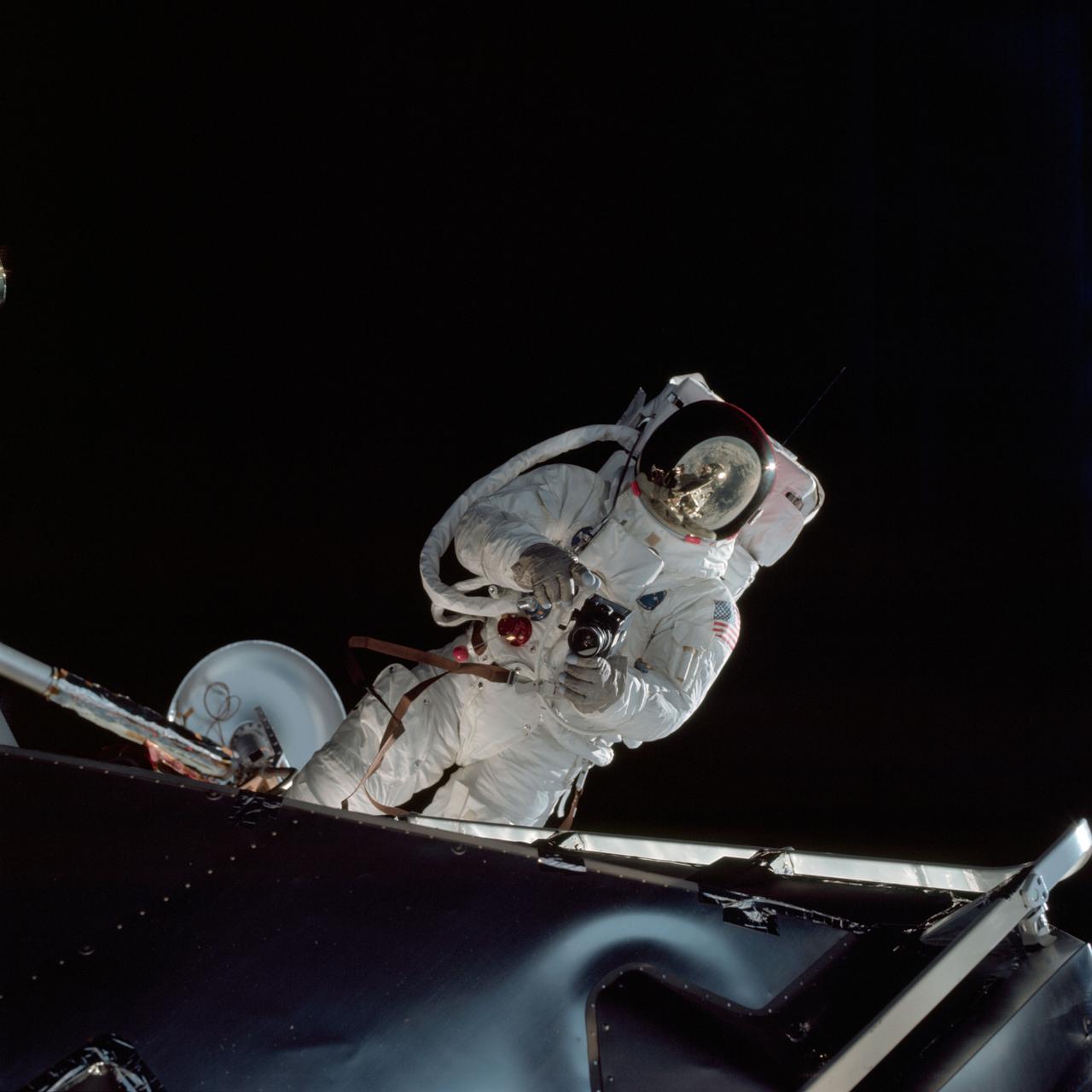
Astronaut Russell L. Schweickart, lunar module pilot, operates a 70mm Hasselblad camera during his extravehicular activity on the fourth day of the Apollo 9 earth-orbital mission. The Command/Service Module and the Lunar Module 3 "Spider" are docked. This view was taken form the Command Module "Gumdrop". Schweickart, wearing an Extravehicular Mobility Unit (EMU), is standing in "golden slippers" on the Lunar Module porch. On his back, partially visible, are a Portable Life Support System (PLSS) and an Oxygen Purge System (OPS). Film magazine was A,film type was SO-368 Ektachrome with 0.460 - 0.710 micrometers film / filter transmittance response and haze filter,80mm lens.
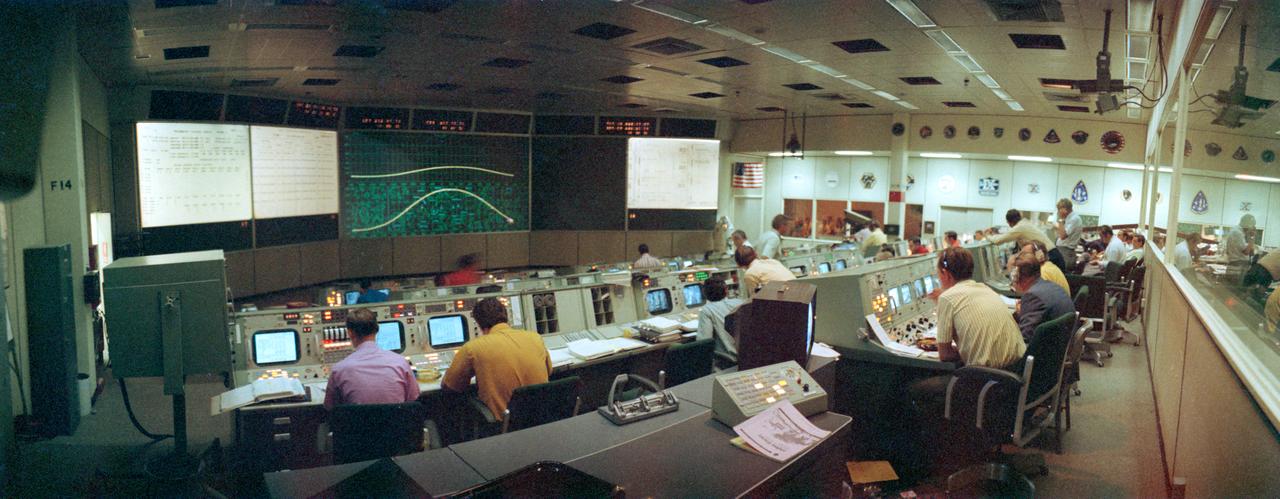
Overall wide-angle view of the MOCR in the Mission Control Center (MCC) during the touchdown of the Apollo XV LM at the Hadley-Apennine Moon site. MSC, Houston, TX

AS14-66-9305 (5 Feb. 1971) --- A front view of the Apollo 14 Lunar Module (LM), which reflects a circular flare caused by the brilliant sun, as seen by the two moon-exploring crew men (out of frame) of the Apollo 14 lunar landing mission during their first extravehicular activity (EVA). The unusual ball of light was said by the astronauts to have a jewel-like appearance. In the left background Cone Crater can be seen. In the left foreground are the erectable S-Band antenna and the United States flag. Astronauts Alan B. Shepard Jr., commander, and Edgar D. Mitchell, lunar module pilot, descended in the LM, while astronaut Stuart A. Roosa, command module pilot, remained with the Command and Service Modules (CSM) in lunar orbit.
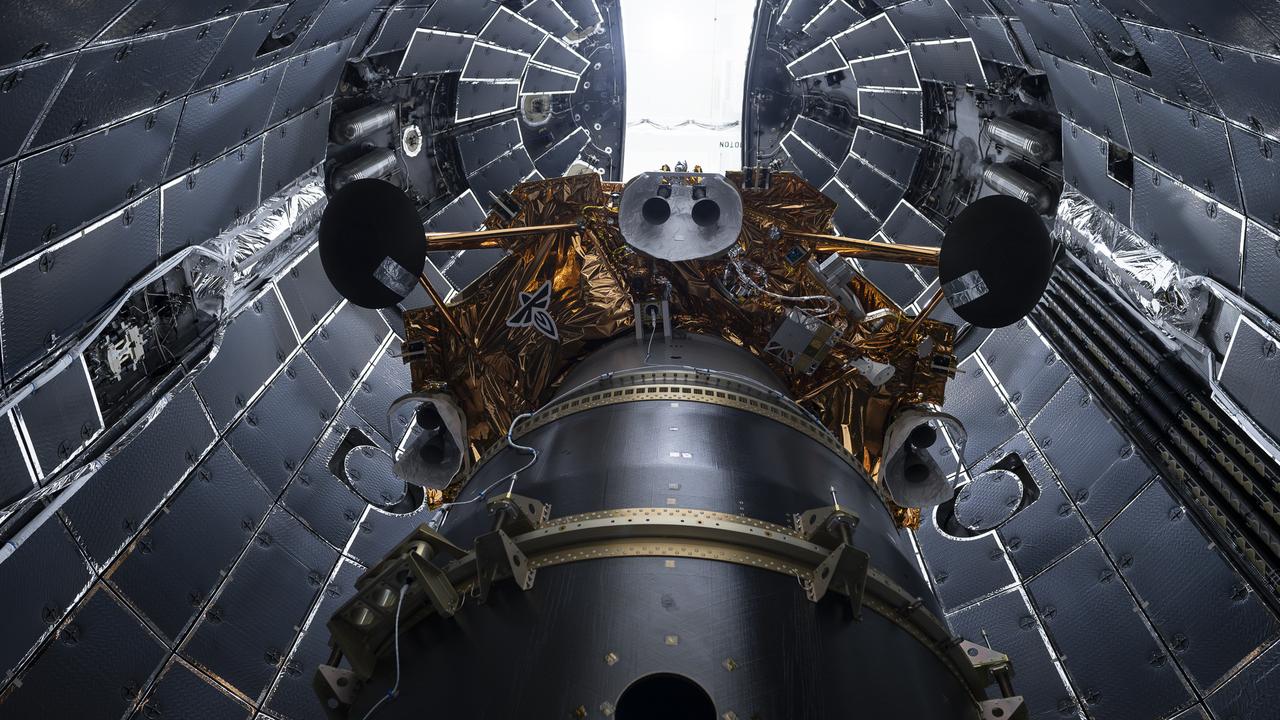
Firefly Aerospace’s Blue Ghost lunar lander is encapsulated inside SpaceX’s rocket fairing ahead of its targeted liftoff for 1:11 a.m. EST Wednesday, Jan. 15, 2025, from Launch Complex 39A at NASA’s Kennedy Space Center in Florida. Firefly’s Blue Ghost Mission 1 will be the company’s first flight to the Moon as part of the agency’s Commercial Lunar Payload Services or CLPS initiative and Artemis campaign.
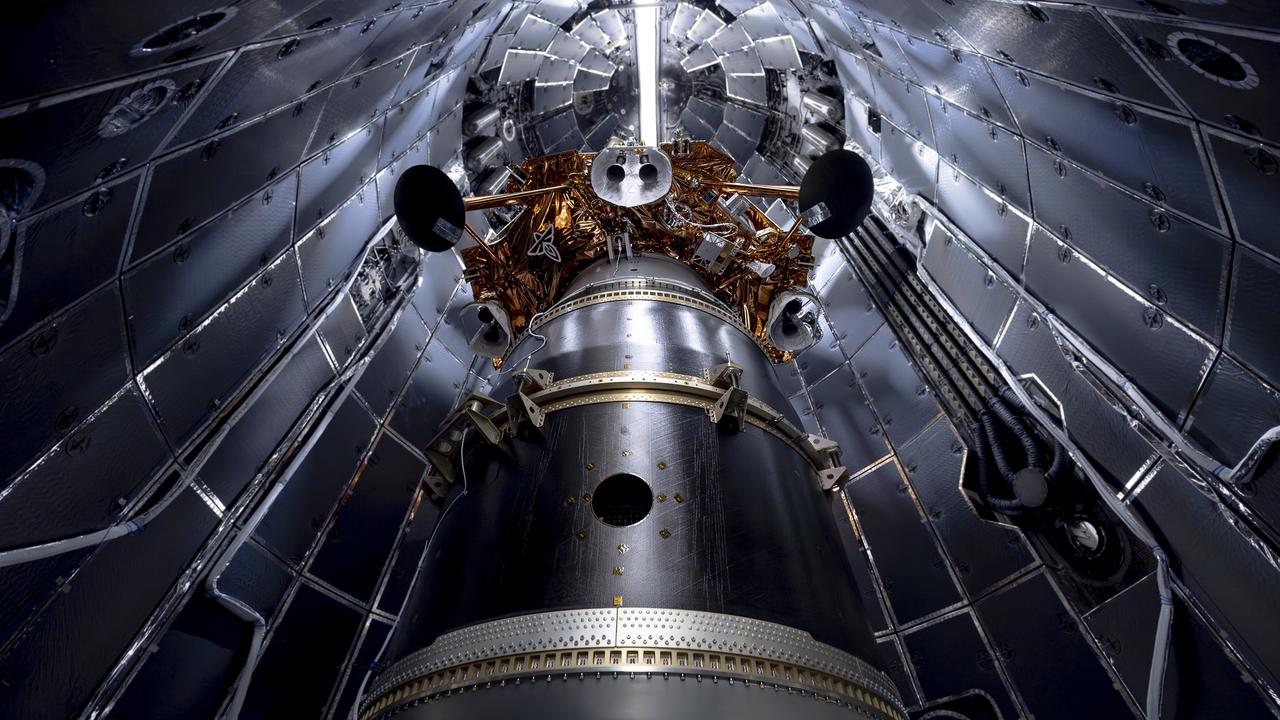
Firefly Aerospace’s Blue Ghost lunar lander is encapsulated inside SpaceX’s rocket fairing ahead of its targeted liftoff for 1:11 a.m. EST Wednesday, Jan. 15, 2025, from Launch Complex 39A at NASA’s Kennedy Space Center in Florida. Firefly’s Blue Ghost Mission 1 will be the company’s first flight to the Moon as part of the agency’s Commercial Lunar Payload Services or CLPS initiative and Artemis campaign.
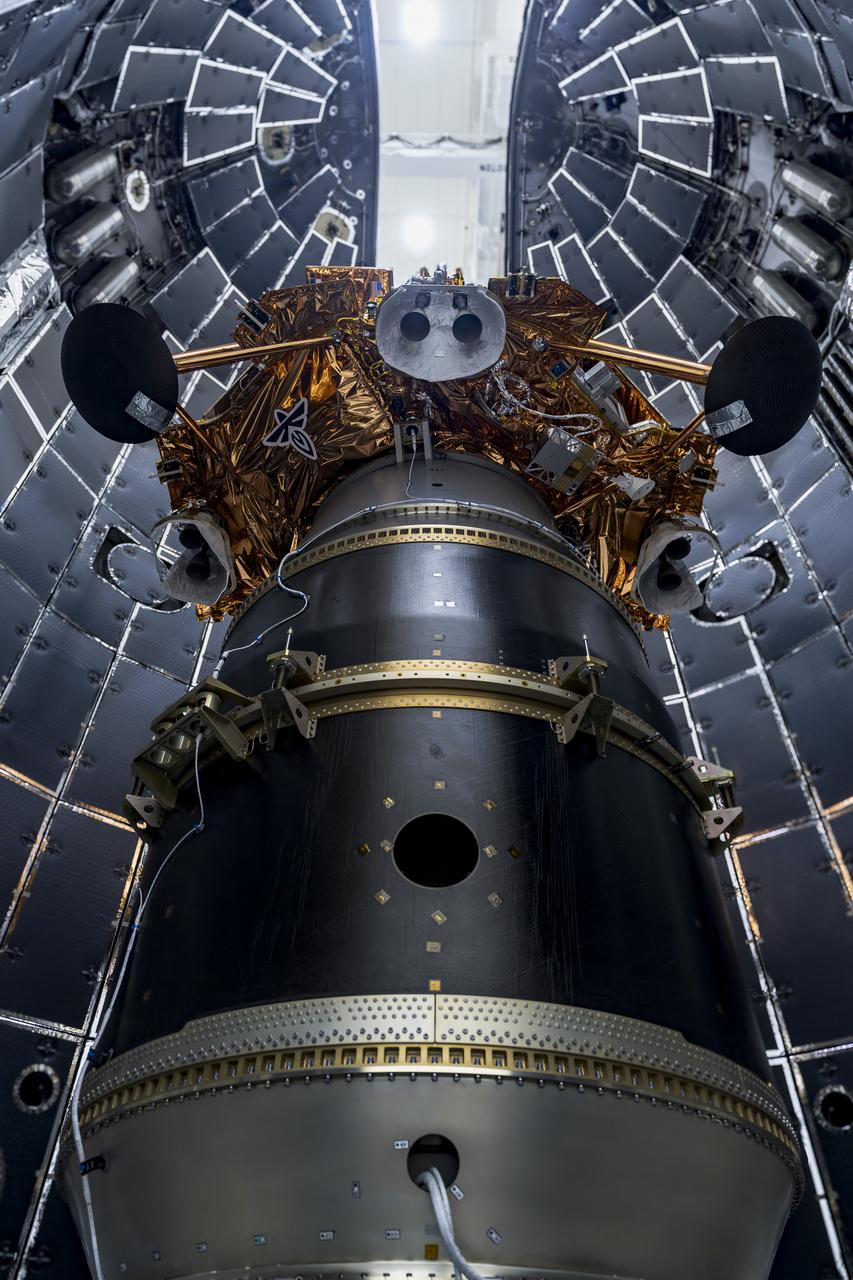
Firefly Aerospace’s Blue Ghost lunar lander is encapsulated inside SpaceX’s rocket fairing ahead of its targeted liftoff for 1:11 a.m. EST Wednesday, Jan. 15, 2025, from Launch Complex 39A at NASA’s Kennedy Space Center in Florida. Firefly’s Blue Ghost Mission 1 will be the company’s first flight to the Moon as part of the agency’s Commercial Lunar Payload Services or CLPS initiative and Artemis campaign.
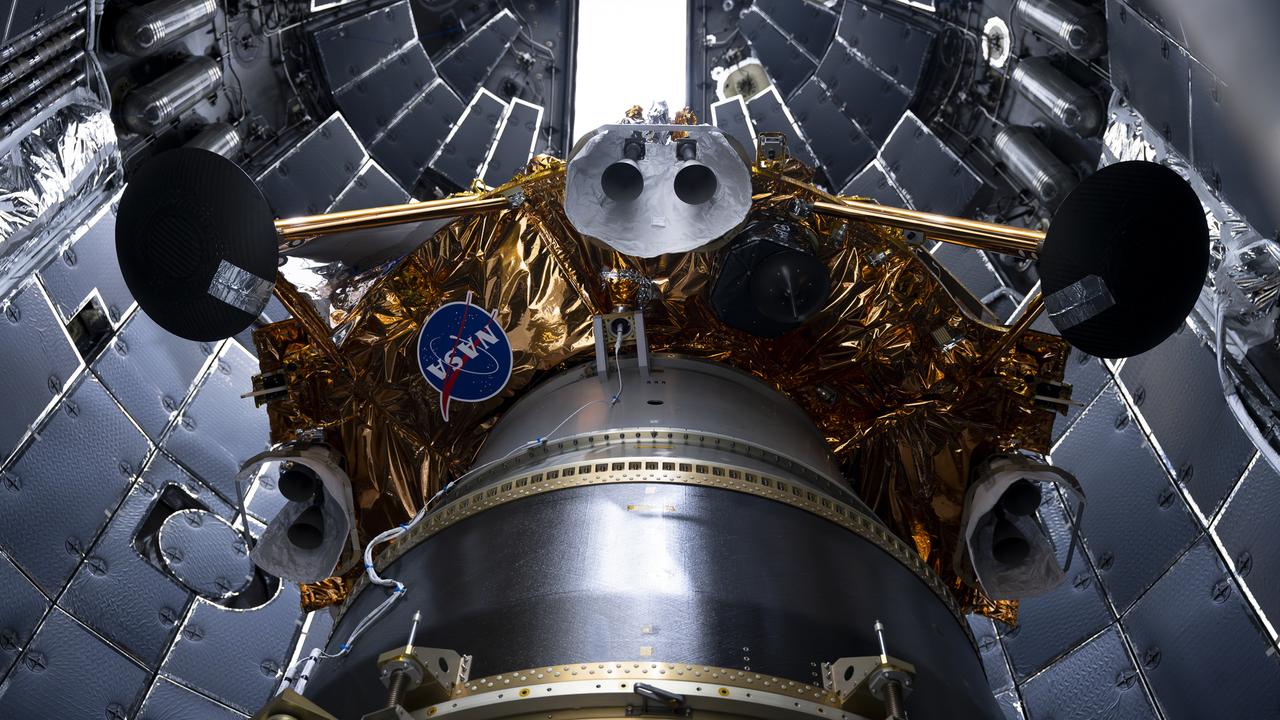
Firefly Aerospace’s Blue Ghost lunar lander is encapsulated inside SpaceX’s rocket fairing ahead of its targeted liftoff for 1:11 a.m. EST Wednesday, Jan. 15, 2025, from Launch Complex 39A at NASA’s Kennedy Space Center in Florida. Firefly’s Blue Ghost Mission 1 will be the company’s first flight to the Moon as part of the agency’s Commercial Lunar Payload Services or CLPS initiative and Artemis campaign.
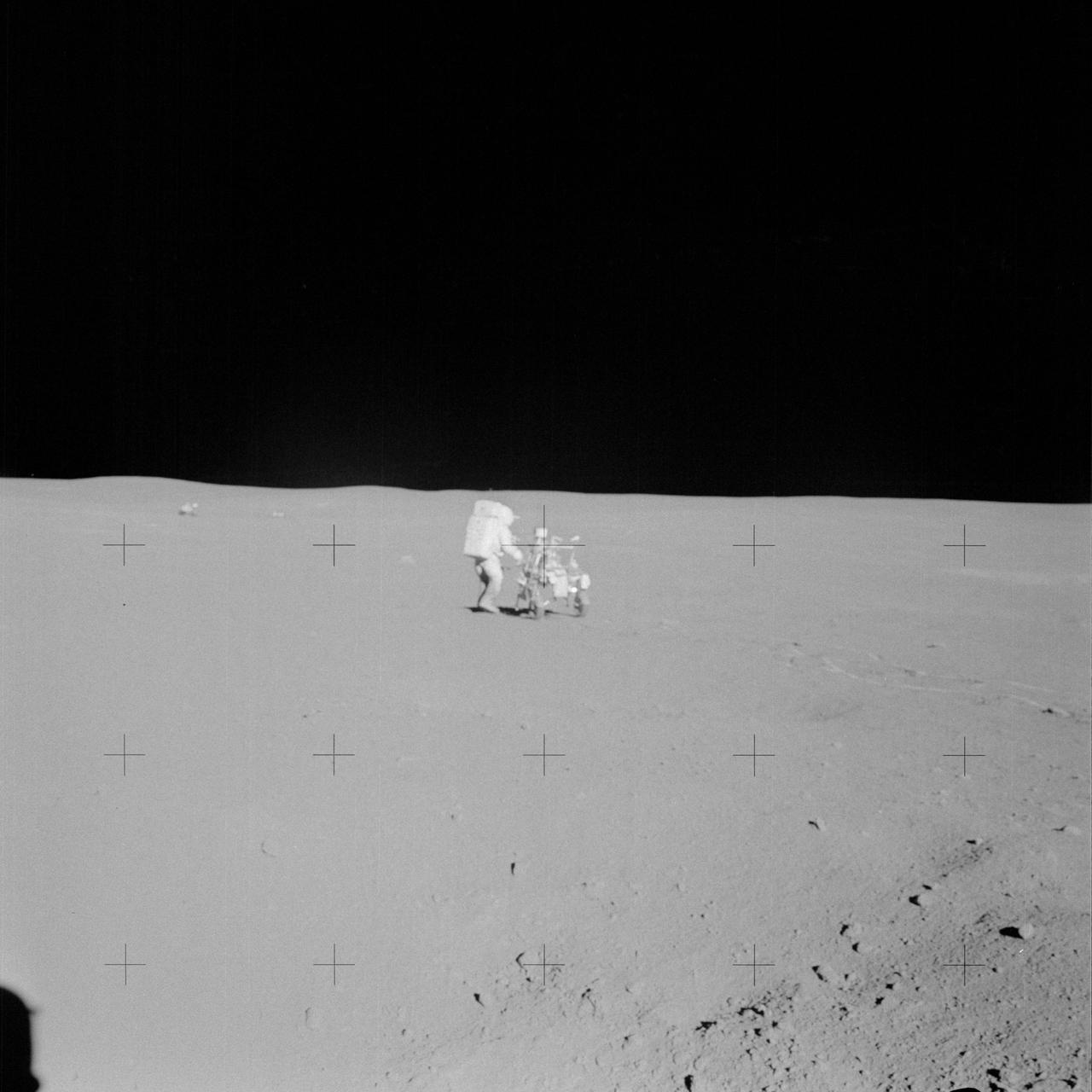
AS14-64-9140 (6 Feb. 1971) --- Astronaut Edgar D. Mitchell, lunar module pilot, participates in the mission's second extravehicular activity (EVA). He is standing near the modularized equipment transporter (MET). While astronauts Alan B. Shepard Jr., commander, and Mitchell descended in the Apollo 14 LM to explore the moon, astronaut Stuart A. Roosa, command module pilot, remained with the Command and Service Modules (CSM) in lunar orbit.
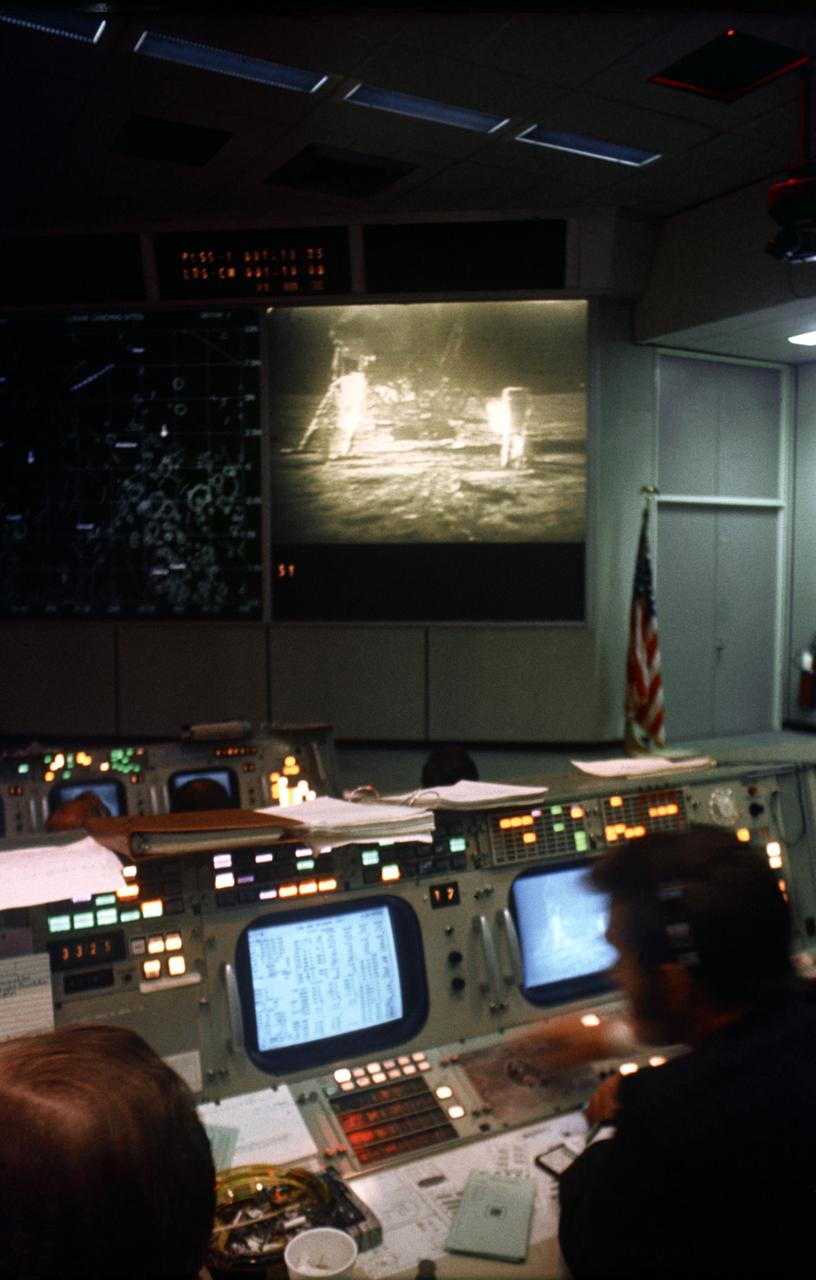
S69-39815 (20 July 1969) --- Interior view of the Mission Operations Control Room (MOCR) in the Mission Control Center (MCC) during the Apollo 11 lunar extravehicular activity (EVA). The television monitor shows astronauts Neil A. Armstrong and Edwin E. Aldrin Jr. on the surface of the moon.