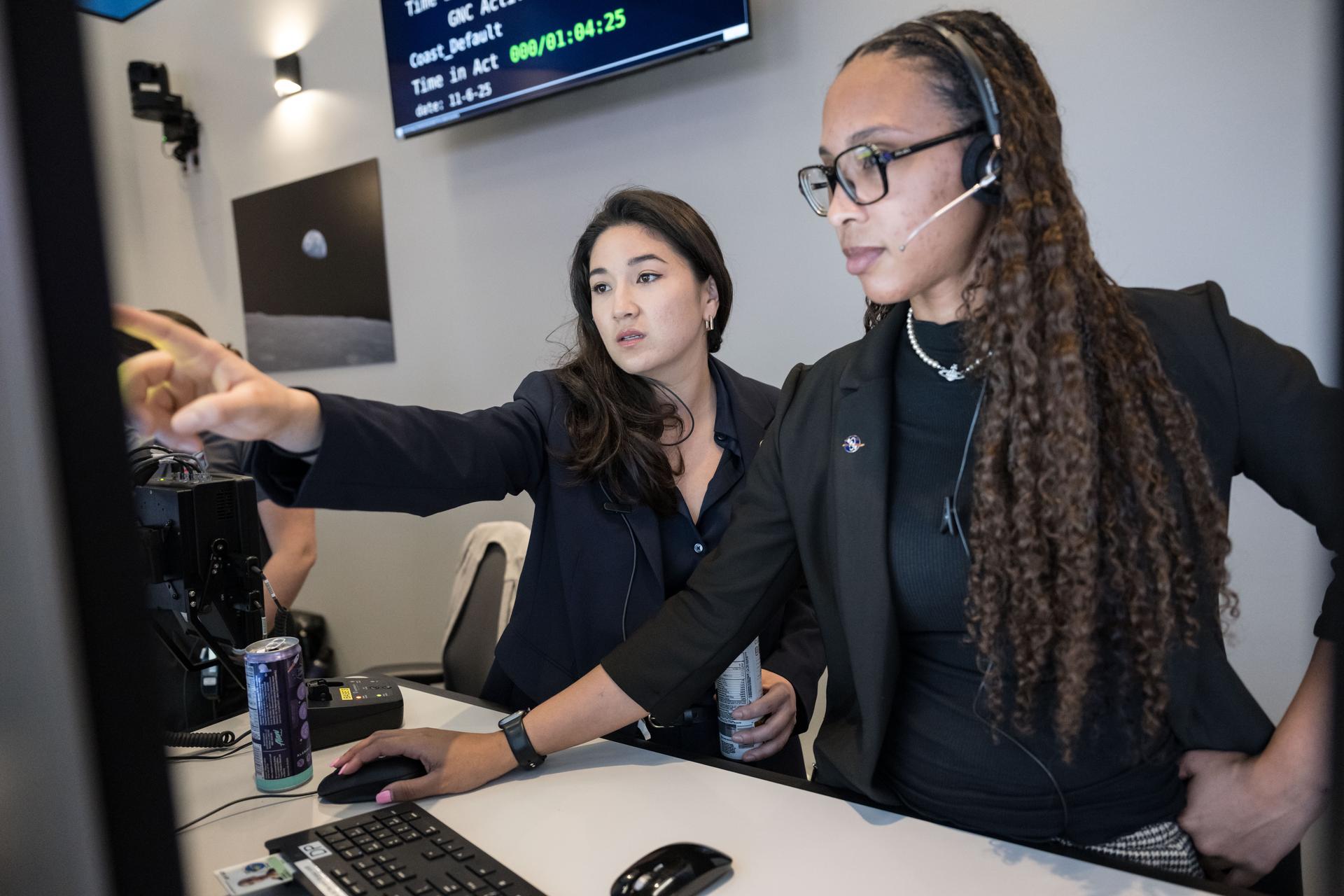
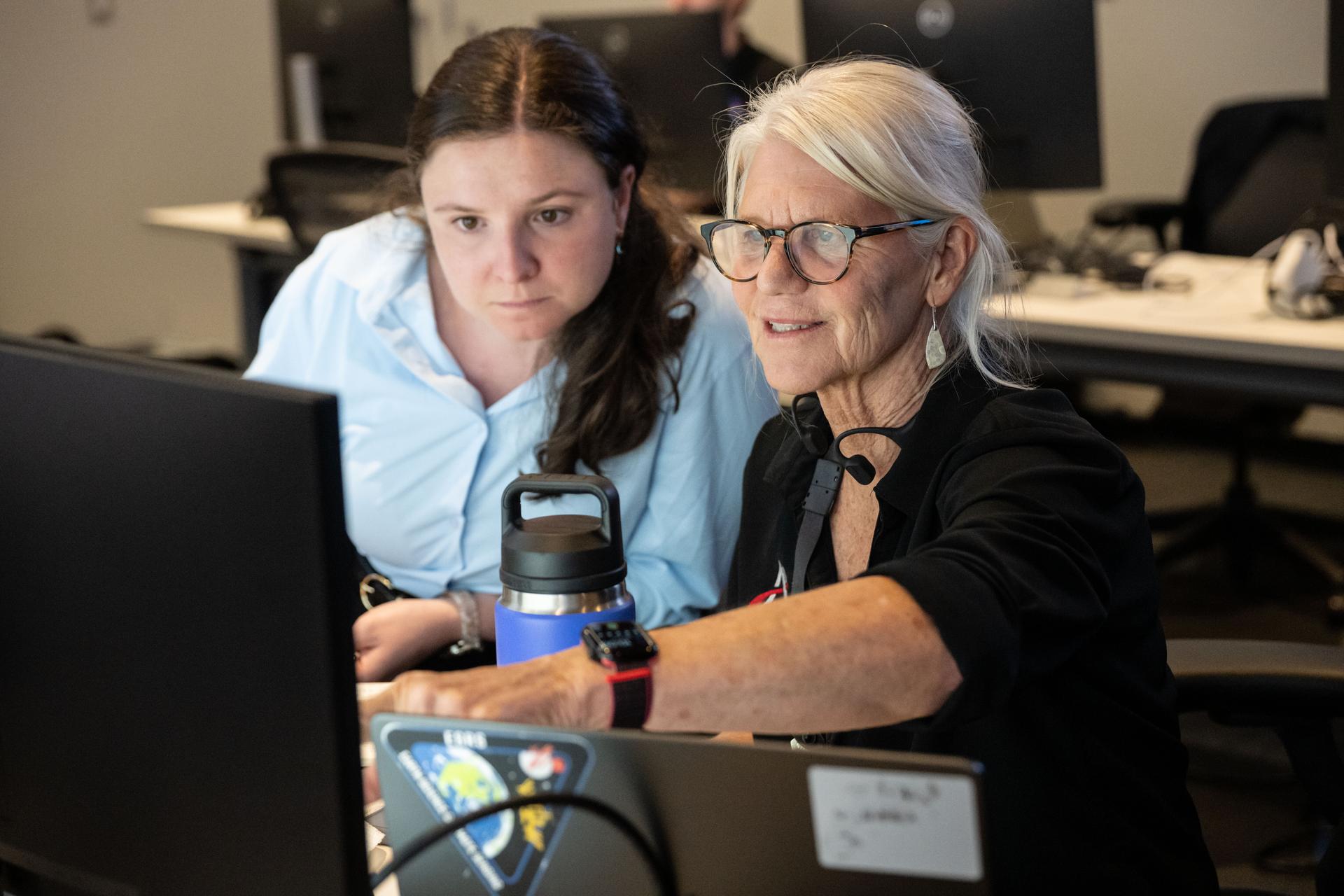
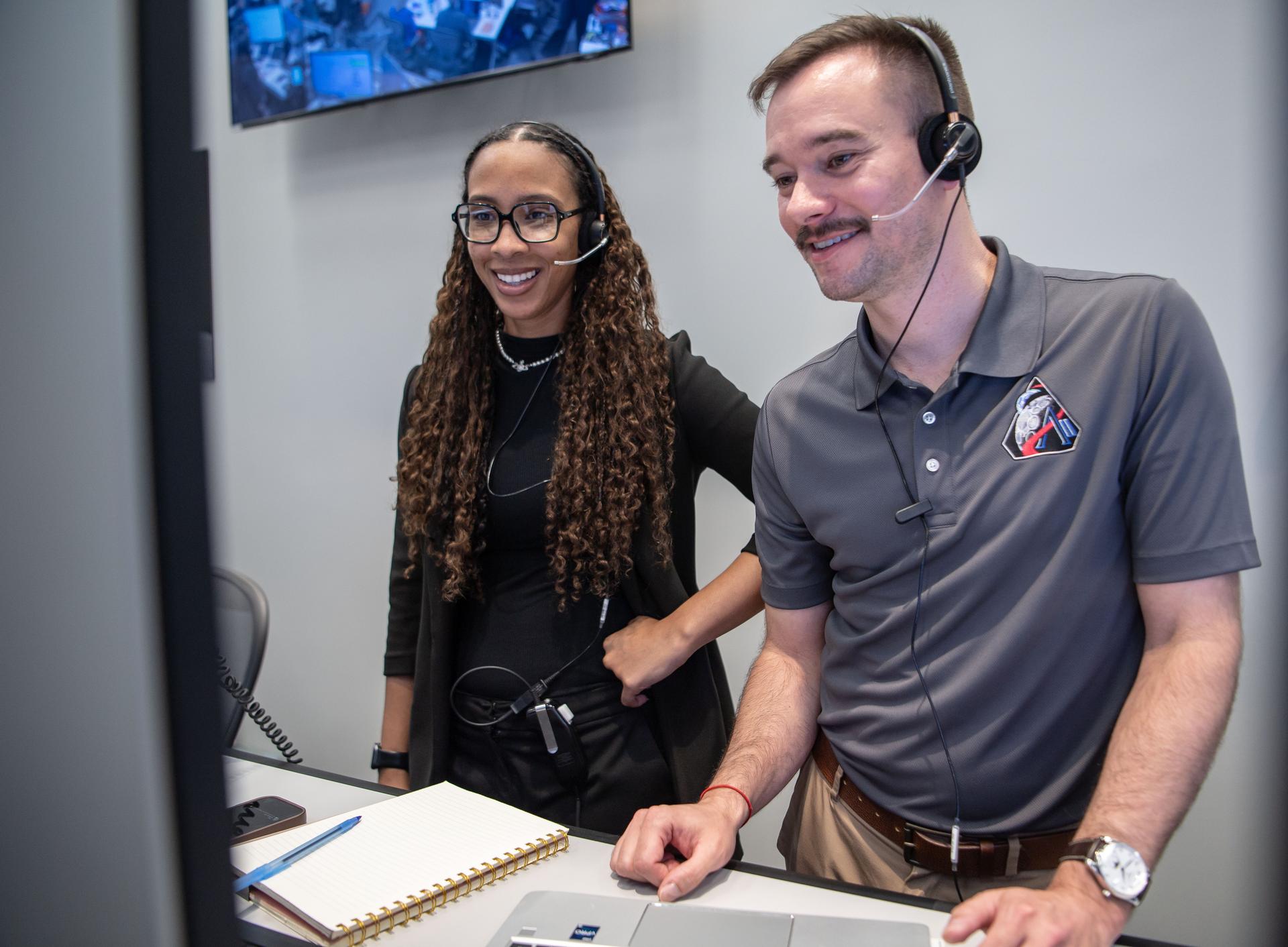
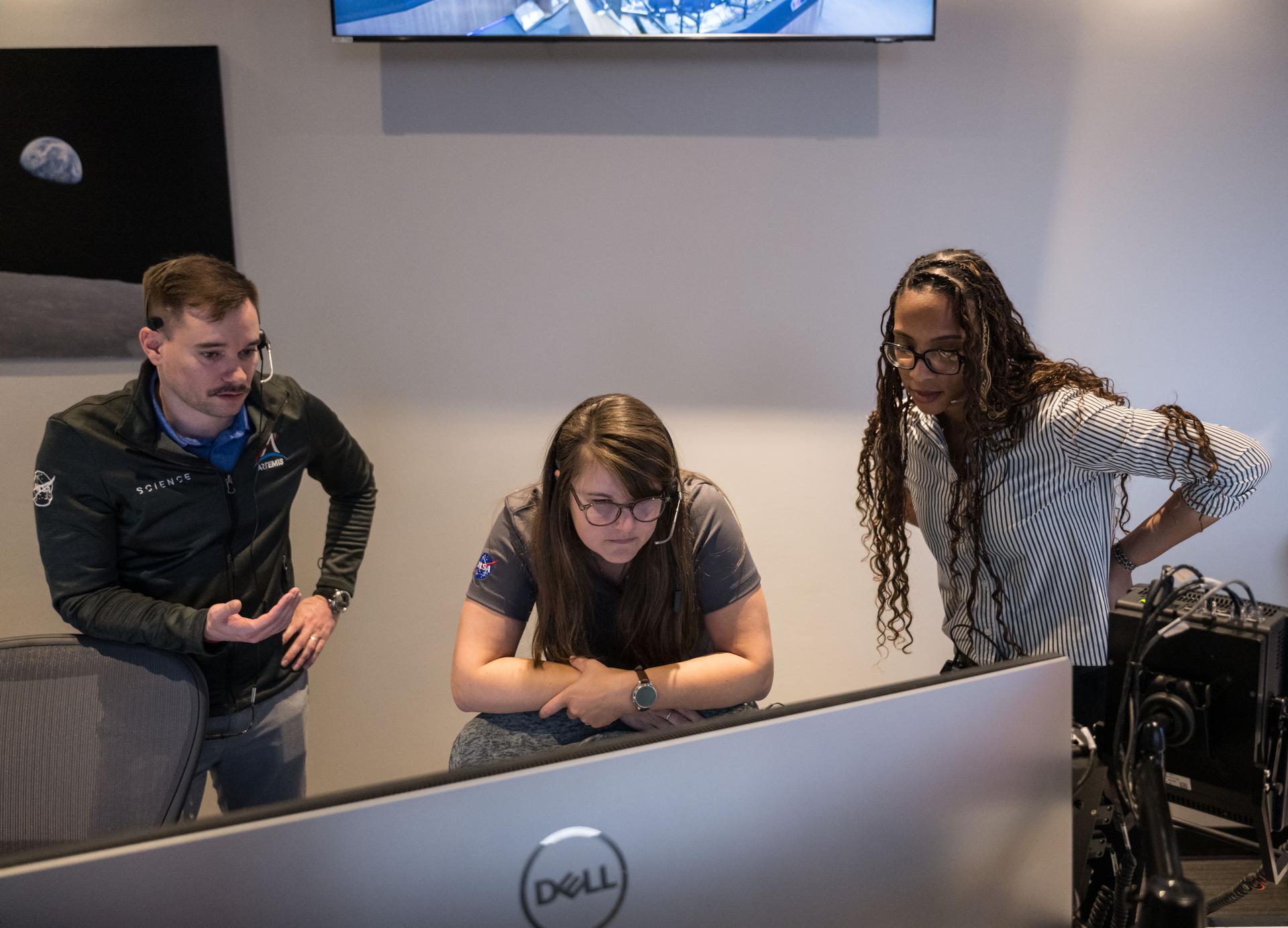
Artemis science officer, Angela Garcia, left and lunar science team member, Kiarre Dumes discuss science operations in the Science Evaluation Room (SER) in Mission Control at NASA's Johnson Space Center in Houston. The SER supports lunar science and planetary observations for the Artemis science officer in the mission’s main flight control room. Dumes serves as the SERCOMM, or Science Evaluation Room Communicator, acting as the singular voice from the science team in the back room, reporting to the science officer. Credits: NASA/Luna Posadas Nava
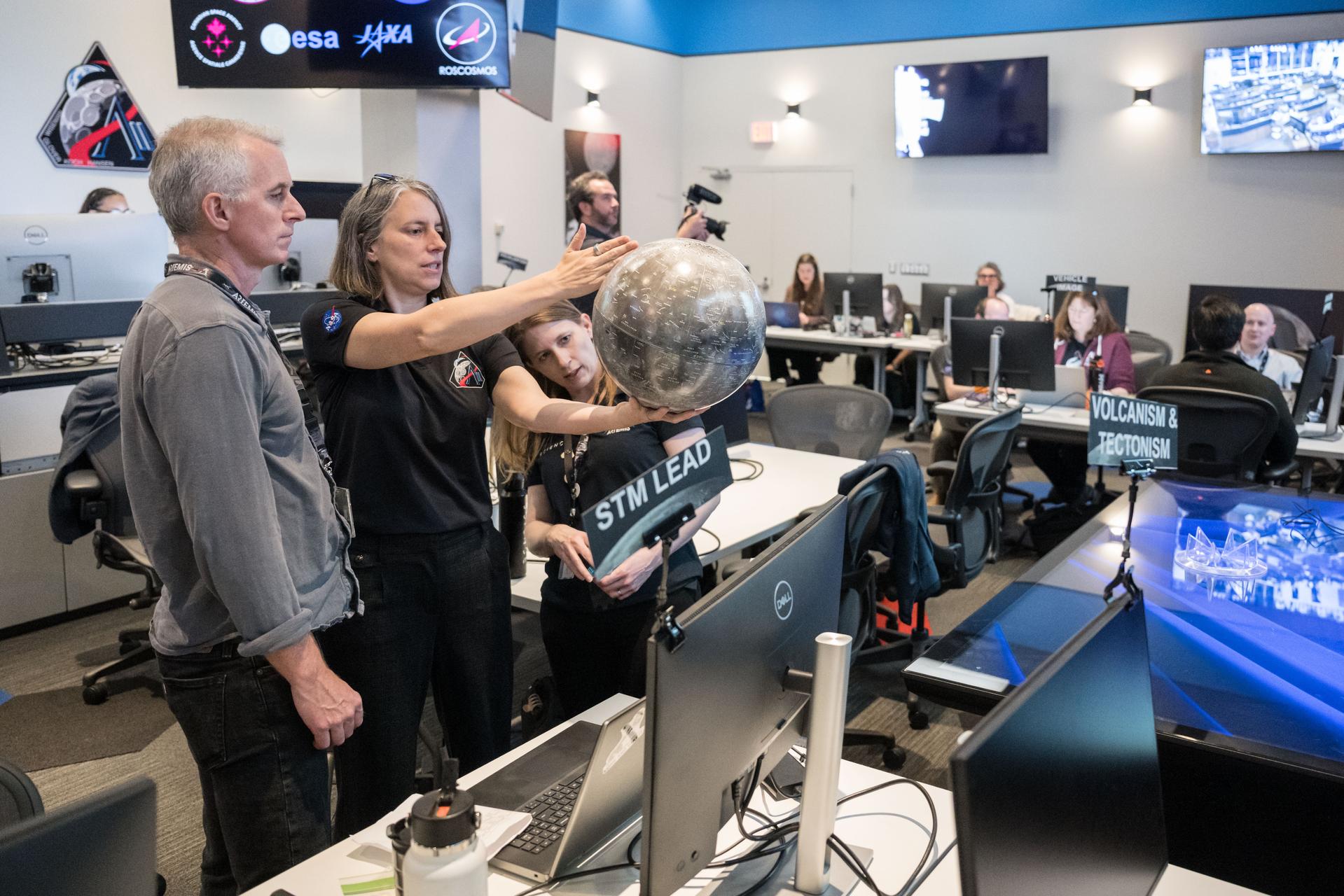
Artemis II lunar science team members, from left, Ryan Ewing, Juliane Gross, and Debra Needham, discuss lunar geography ahead of the translunar injection burn that accelerated the Orion spacecraft to break free of Earth’s orbit and began the outbound trajectory toward the Moon. They are in the Science Evaluation Room (SER) a back room that supports lunar science and planetary observations for the Artemis science officer in the mission’s main flight control room. Built specifically for Artemis missions with these science priorities in mind, the SER is equipped to support rapid data interpretation, collaborative analysis, real-time decision making, and seamless coordination between the science and operations teams.
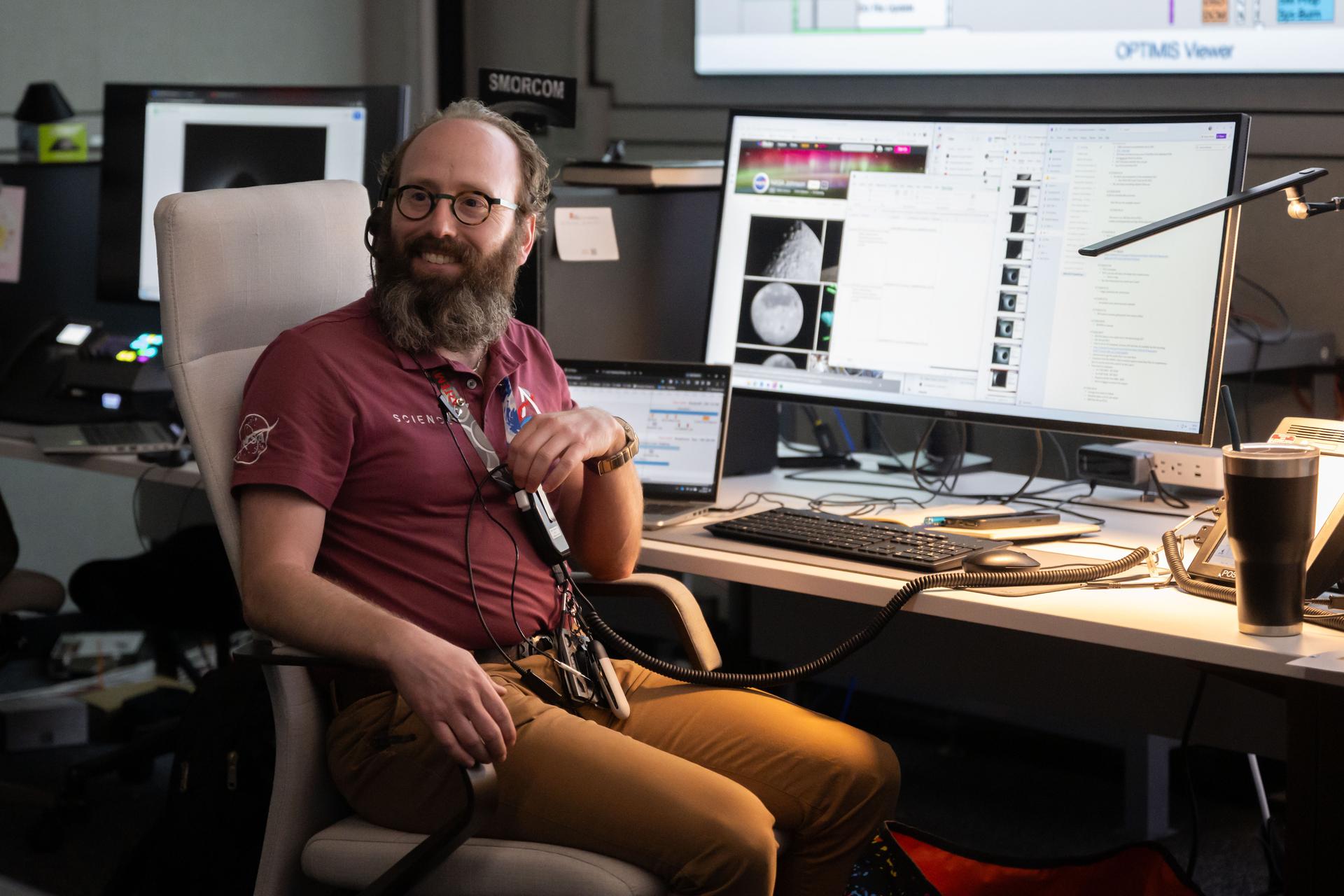
Artemis lunar science team member, Aaron Regberg, works in the Science Mission Operations Room, where scientists analyzed imagery and audio recordings of lunar observations captured by the Artemis II astronauts during their lunar flyby on April 6, 2026.
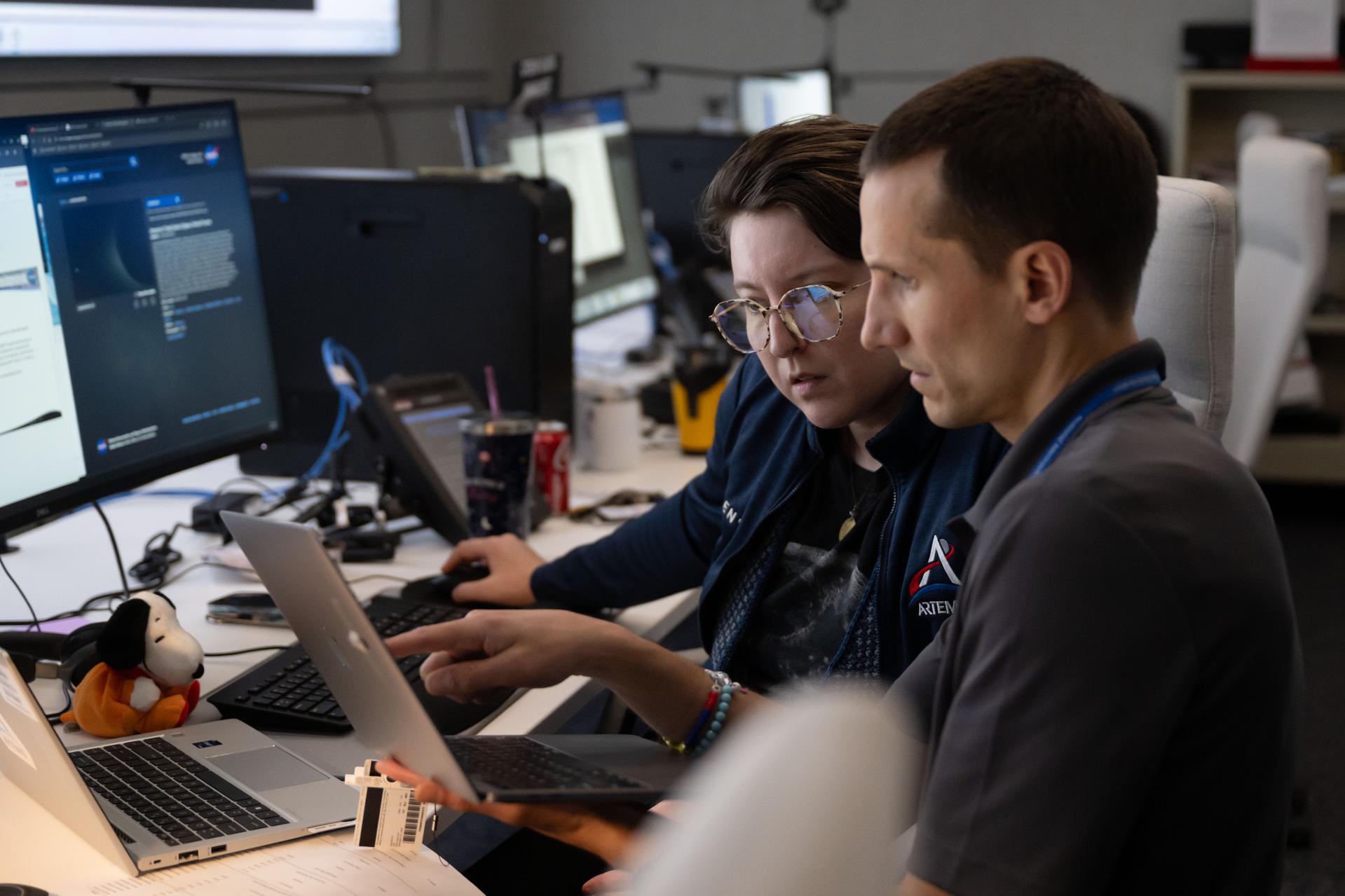
Artemis lunar science team members, from left, Alexandra Constantinou, and David Hollibaugh-Baker, work in the Science Mission Operations Room at NASA’s Johnson Space Center in Houston. They are analyzing imagery and audio recordings of lunar observations captured by the Artemis II astronauts during their lunar flyby on April 6, 2026.
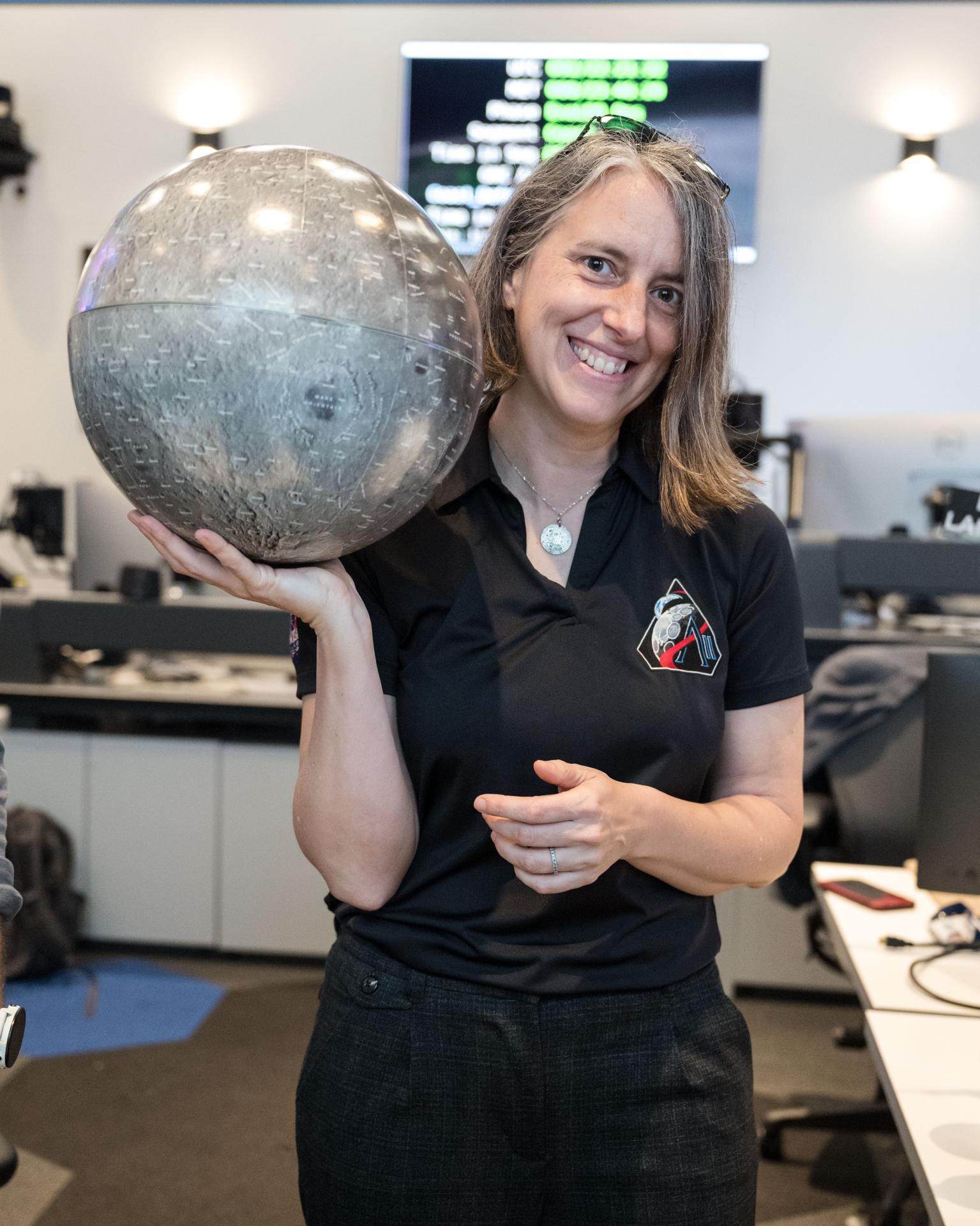
Artemis curation lead, Juliane Gross, holds a lunar globe in the Science Evaluation Room (SER) in Mission Control at Johnson Space Center in Houston. The SER supports lunar science and planetary observations for the Artemis science officer in the mission’s main flight control room. Built specifically for Artemis missions with these science priorities in mind, the SER is equipped to support rapid data interpretation, collaborative analysis, real-time decision making, and seamless coordination between the science and operations teams. Credits: NASA/Luna Posadas Nava
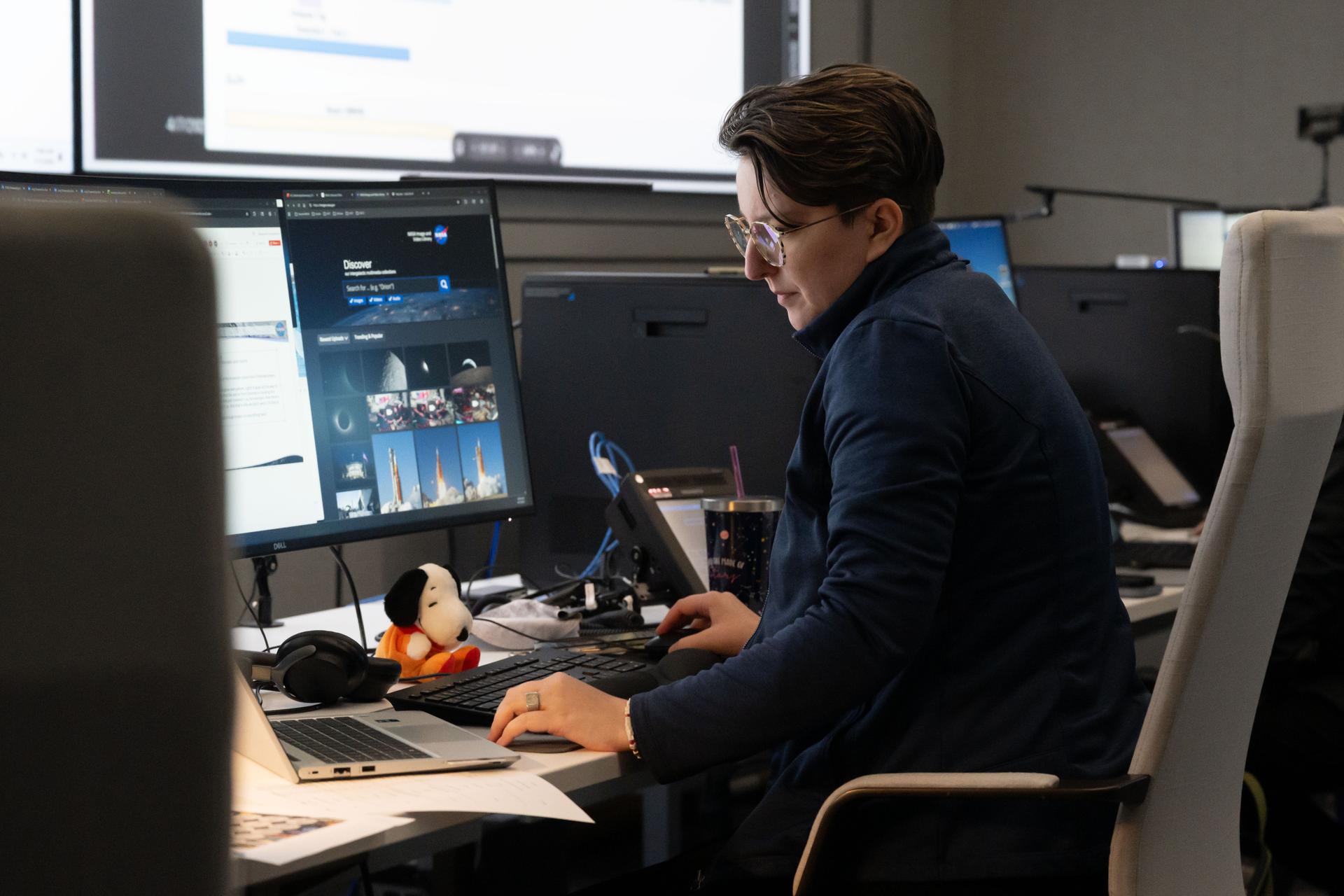
Artemis lunar science team member, Alexandra Constantinou, works in the Science Mission Operations Room at NASA’s Johnson Space Center in Houston, where scientists analyzed imagery and audio recordings of lunar observations captured by the Artemis II astronauts during their lunar flyby on April 6, 2026. Credits: NASA/Helen Arase Vargas
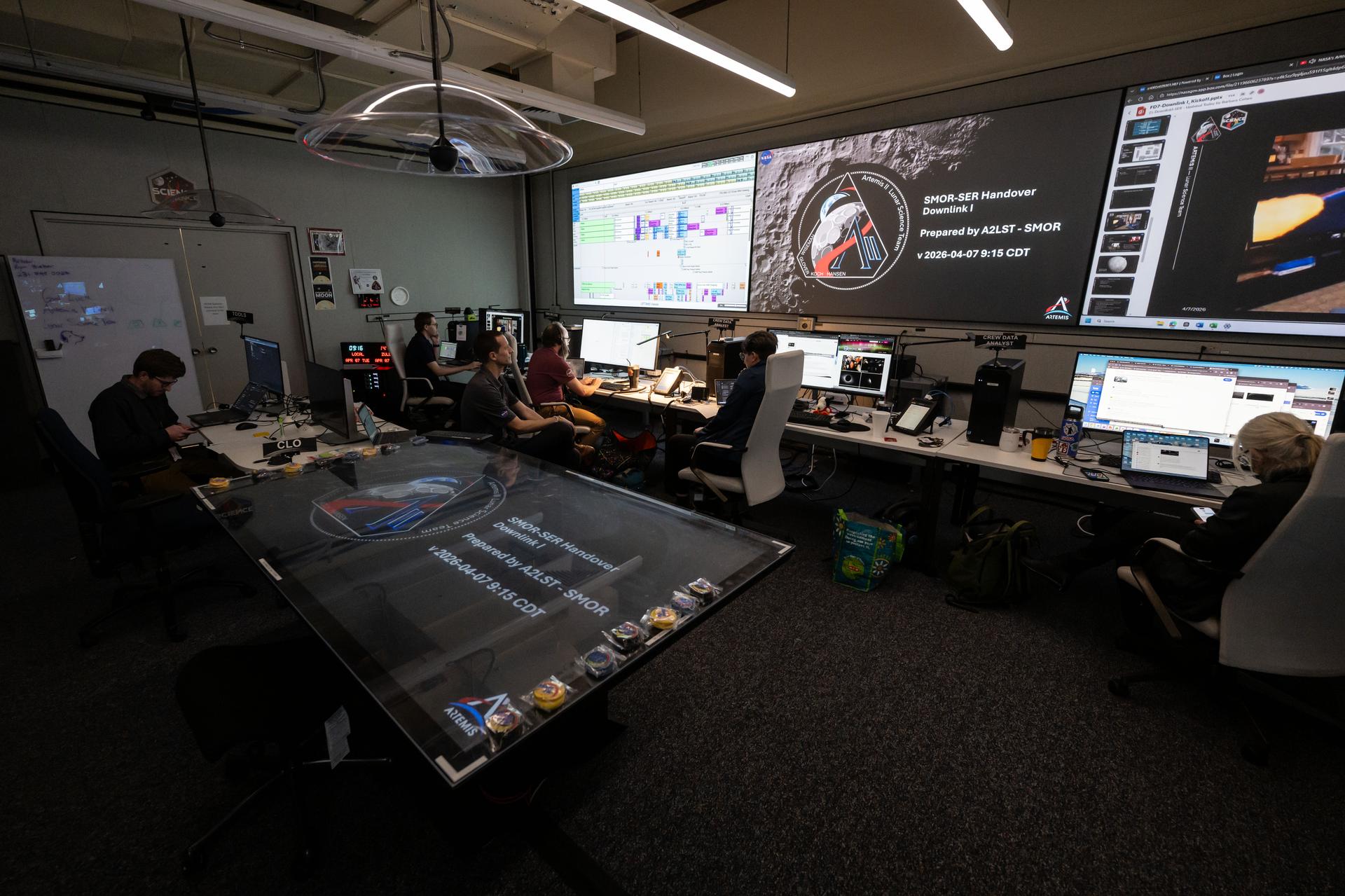
Artemis lunar science team members, work in the Science Mission Operations Room at NASA’s Johnson Space Center in Houston, analyzing imagery and audio recordings of lunar observations captured by the Artemis II astronauts during their lunar flyby on April 6, 2026.
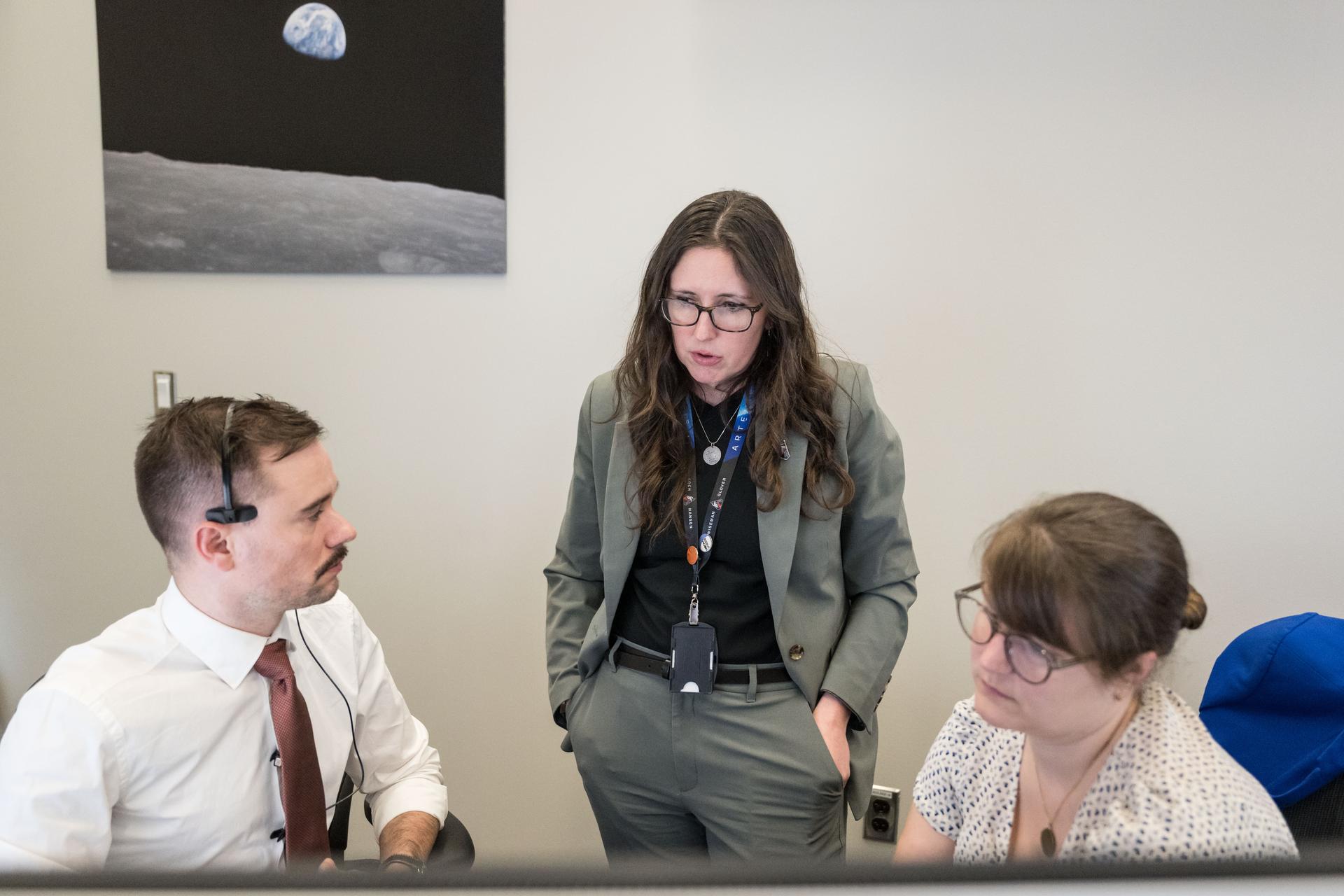
From left, Artemis II deputy lunar science lead, Jacob Richardson, science officer and lunar science lead, Kelsey Young, and deputy lunar science lead, Marie Henderson, discuss the team’s final preparations for the lunar flyby. The team worked in the Science Evaluation Room (SER) in Mission Control at NASA’s Johnson Space Center in Houston. Built specifically for Artemis missions with these science priorities in mind, the SER is equipped to support rapid data interpretation, collaborative analysis, real-time decision making, and seamless coordination between the science and operations teams. Credits: NASA/ Robert Markowitz
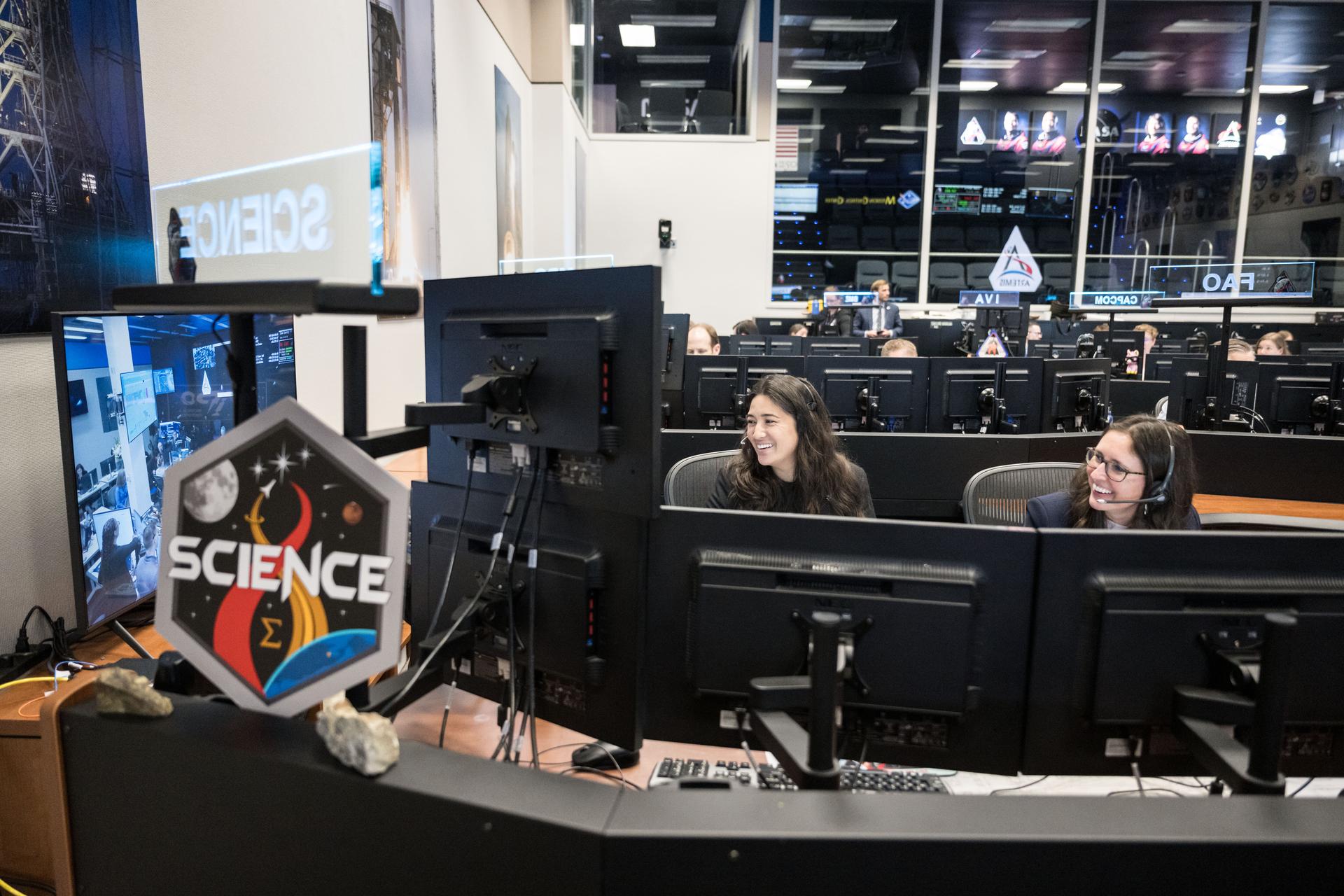
Artemis science officers, from left, Angela Garcia and Kelsey Young, watch the lunar science team celebrating in the Science Evaluation Room (SER) as they hear lunar observations from the Artemis II crew. The science team has spent years training the astronauts in geology and observation, both in the classroom and in the field. They also built the lunar targeting plan that, like a spacewalk plan, provides strong, detailed observation guidance, plus flexibility for the crew to make decisions based on what they’re seeing and experiencing in real time. The science team had many moments of celebration during the lunar flyby as the astronauts took pictures of the Moon and provided verbal descriptions of what they were seeing. This type of information reveals the geologic history of an area and will be critical to collect when future Artemis astronauts explore the Moon's surface. Credits: NASA/Robert Markowitz
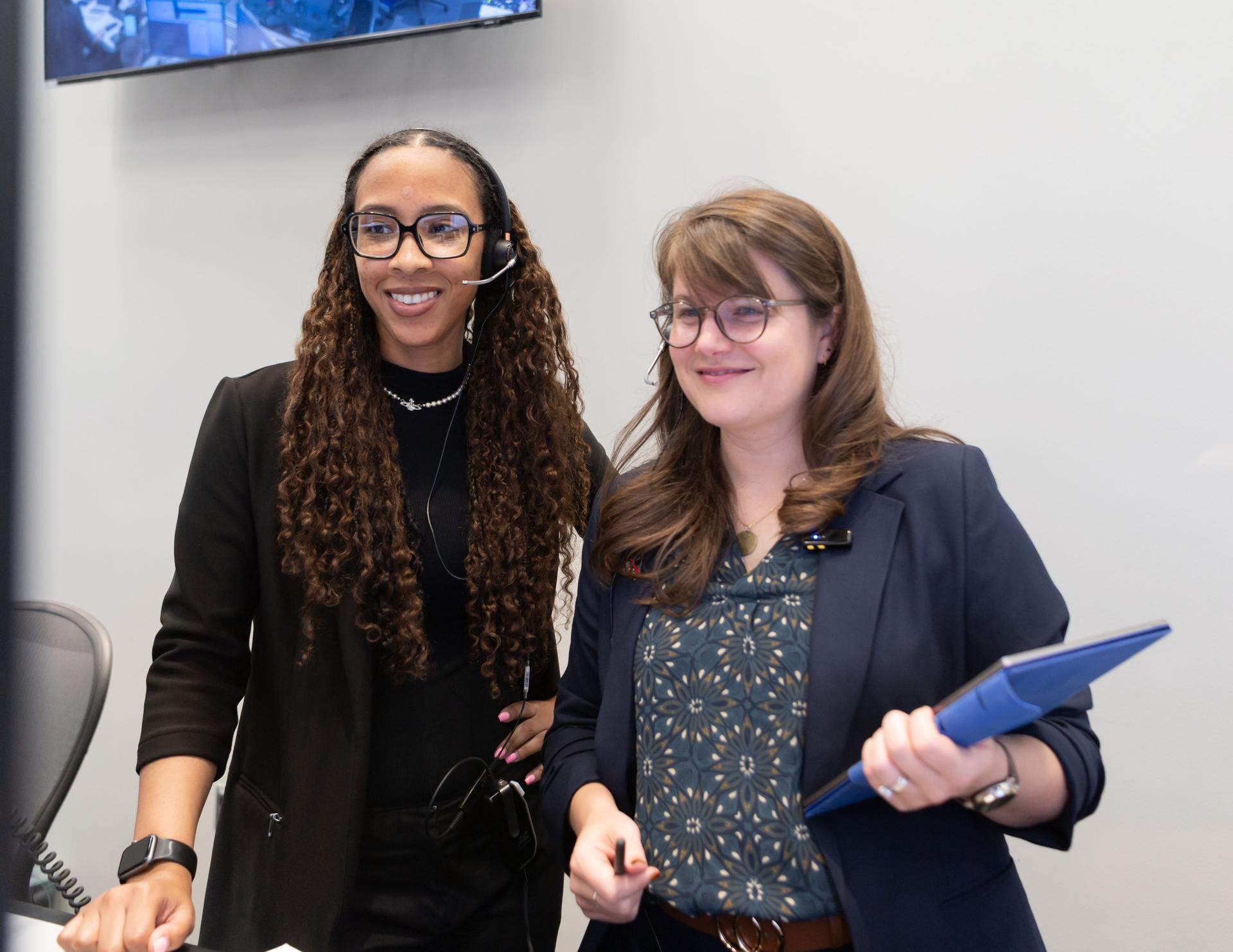
Science evaluation room communicator, Kiarre Dumes, left, and deputy lunar science lead Marie Henderson work in the Science Evaluation Room (SER) during Artemis II. Built specifically for Artemis missions with these science priorities in mind, the SER is equipped to support rapid data interpretation, collaborative analysis, real-time decision making, and seamless coordination between the science and operations teams. Credits: NASA/Luna Posadas Nava
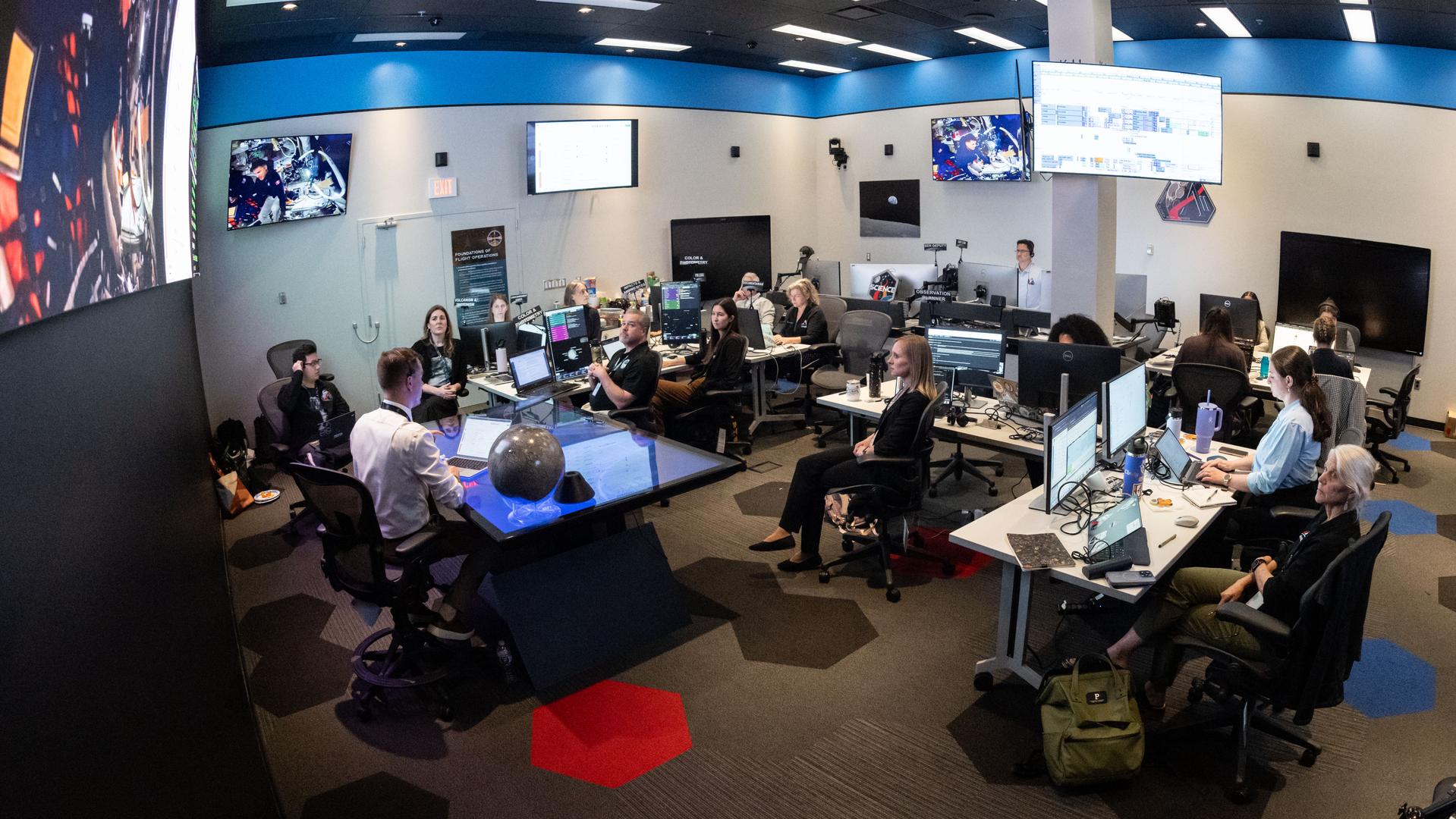
A view inside the Science Evaluation Room (SER) in Mission Control at NASA’s Johnson Space Center in Houston. The SER supports lunar science and planetary observations for the Artemis science officer in the mission’s main flight control room. Built specifically for Artemis missions with these science priorities in mind, the SER is equipped to support rapid data interpretation, collaborative analysis, real-time decision making, and seamless coordination between the science and operations teams. Credits: NASA/Bill Stafford
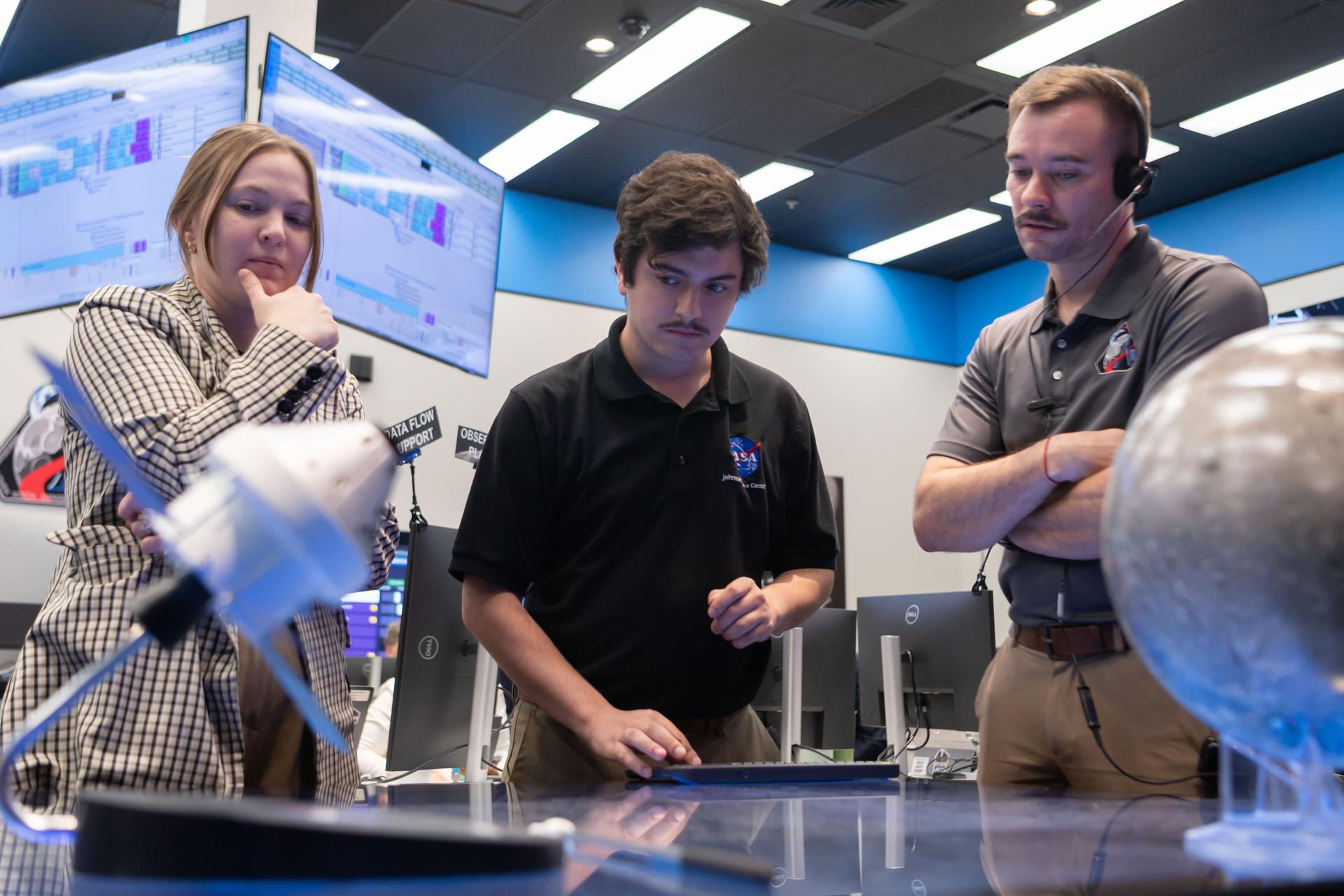
Crew lunar observations team member, Sara Schmidt, left, asset manager, Luke McSherry, and Artemis deputy lunar science lead, Jacob Richardson work in the Science Evaluation Room (SER). Built specifically for Artemis missions with these science priorities in mind, the SER is equipped to support rapid data interpretation, collaborative analysis, real-time decision making, and seamless coordination between the science and operations teams. Credits: NASA/Luna Posadas Nava

Jared Ralleta, Artemis II lunar science team member, reacts to the lunar flyby crew observations in the Science Evaluation Room (SER). Built specifically for Artemis missions with these science priorities in mind, the SER is equipped to support rapid data interpretation, collaborative analysis, real-time decision making, and seamless coordination between the science and operations teams. Credits: NASA/Luna Posadas Nava
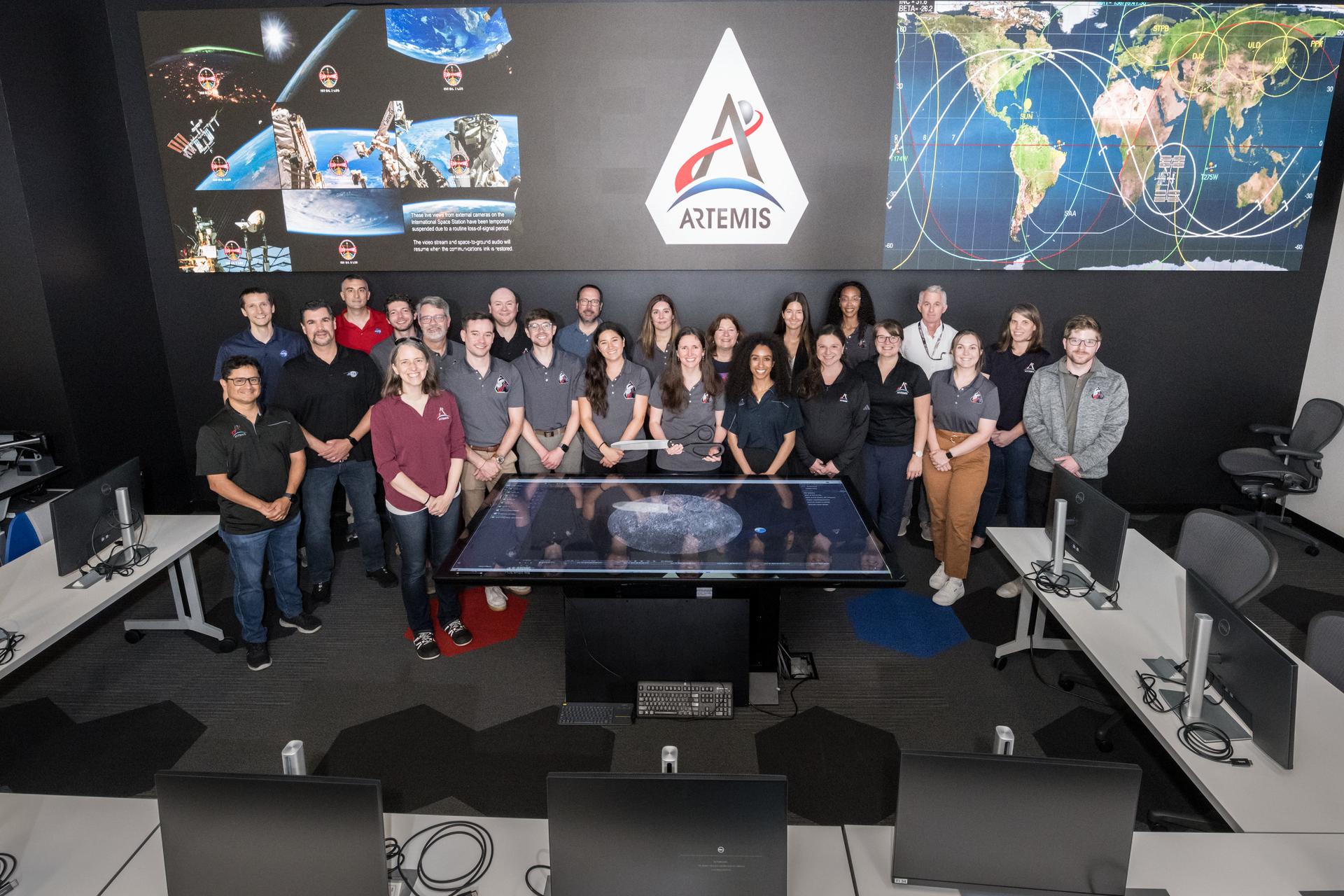
jsc2025e057254 --- NASA’s Artemis II lunar science team is pictured in the Science Evaluation Room (SER) at the agency’s Johnson Space Center in Houston. Located in the Christopher C. Kraft Jr. Mission Control Center, the SER supports the mission’s main flight control room for lunar science and planetary observations. Built specifically for Artemis missions with these science priorities in mind, the SER is equipped to support rapid data interpretation, collaborative analysis, real-time decision making, and seamless coordination between the science and operations teams.

Artemis II lunar science team members, from left, Ryan Ewing, and Barbara Cohen, react to crew observations during the lunar flyby on April 6, 2026. The team worked in the Science Evaluation Room (SER) in Mission Control at NASA’s Johnson Space Center in Houston. Built specifically for Artemis missions with these science priorities in mind, the SER is equipped to support rapid data interpretation, collaborative analysis, real-time decision making, and seamless coordination between the science and operations teams. Credits: NASA/Luna Posadas Nava
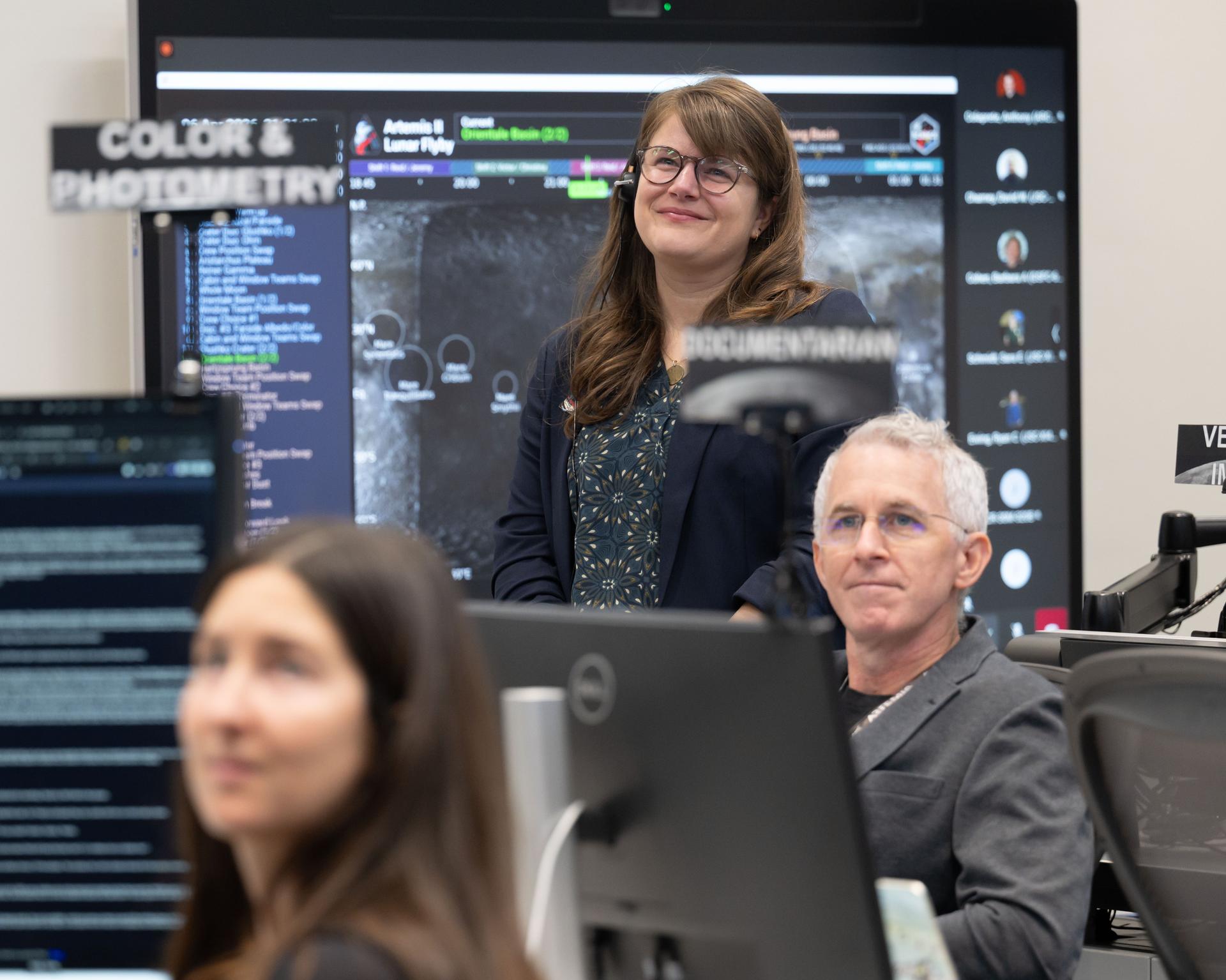
Artemis II deputy lunar science lead Marie Henderson, background, and lunar science team members, Ariel Deutsch, and Ryan Ewing, react to crew observations during the lunar flyby on April 6, 2026. The team worked in the Science Evaluation Room (SER) in Mission Control at NASA’s Johnson Space Center in Houston. Built specifically for Artemis missions with these science priorities in mind, the SER is equipped to support rapid data interpretation, collaborative analysis, real-time decision making, and seamless coordination between the science and operations teams. Credits: NASA/Luna Posadas Nava

Artemis II lunar science team member, Juliane Gross, center, and the extended lunar science team behind her, celebrates crew observations made during the lunar flyby on April 6. The team worked in the Science Evaluation Room (SER) in Mission Control at NASA’s Johnson Space Center in Houston. Built specifically for Artemis missions with these science priorities in mind, the SER is equipped to support rapid data interpretation, collaborative analysis, real-time decision making, and seamless coordination between the science and operations teams. Credits: NASA/Luna Posadas Nava

Artemis II crew lunar observations team member, David Charney, monitors the mission from the Science Evaluation Room (SER). Built specifically for Artemis missions with these science priorities in mind, the SER is equipped to support rapid data interpretation, collaborative analysis, real-time decision making, and seamless coordination between the science and operations teams. Credits: NASA/Luna Posadas Nava

Artemis II crew lunar observations team member, Alex Stoken, monitors the mission from the Science Evaluation Room (SER). Built specifically for Artemis missions with these science priorities in mind, the SER is equipped to support rapid data interpretation, collaborative analysis, real-time decision making, and seamless coordination between the science and operations teams. Credits: NASA/Luna Posadas Nava
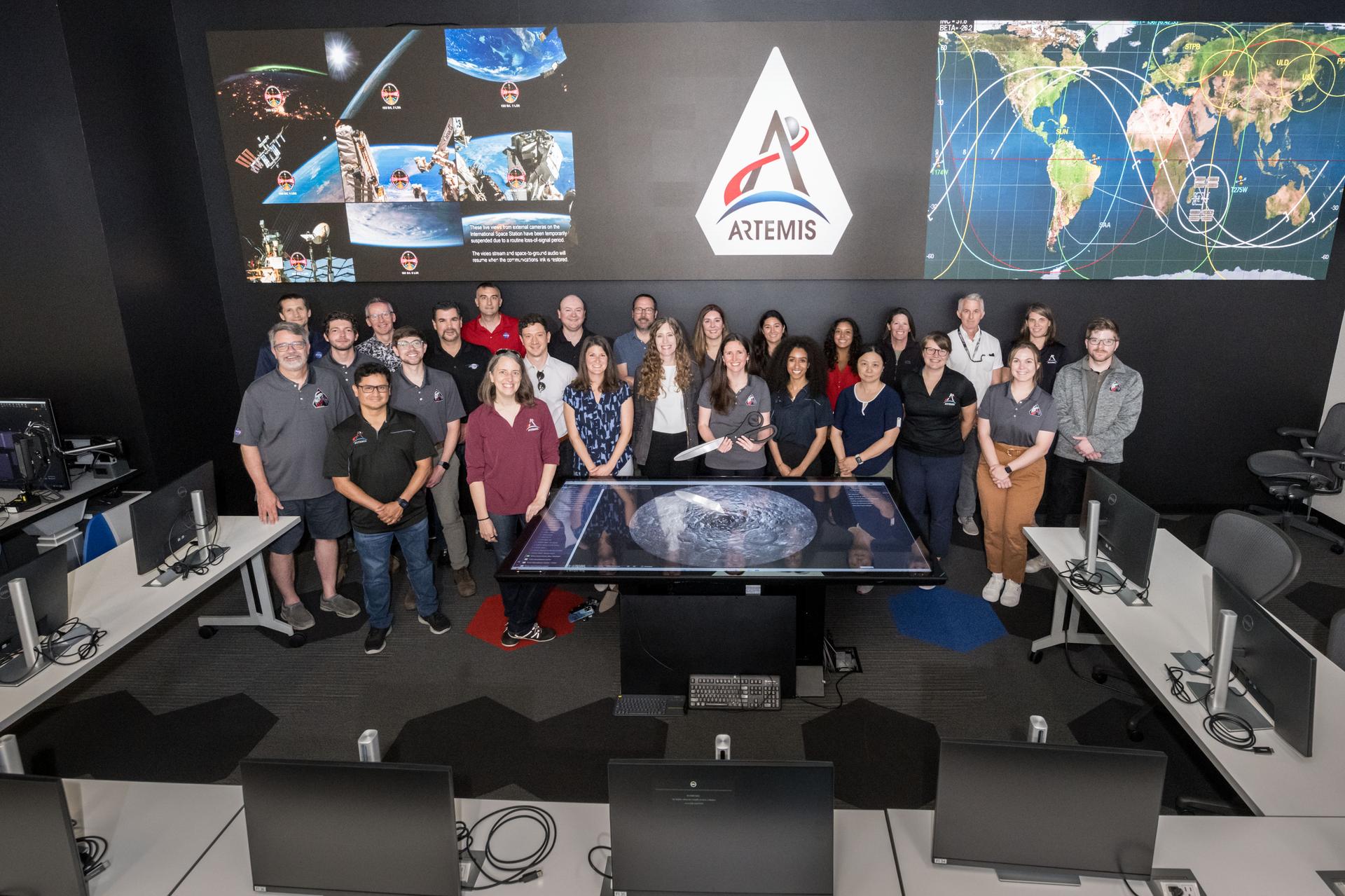
jsc2025e057255 --- NASA’s Artemis III lunar science team is pictured in the Science Evaluation Room (SER) at the agency’s Johnson Space Center in Houston. Located in the Christopher C. Kraft Jr. Mission Control Center, the SER supports the mission’s main flight control room for lunar science and planetary observations. Built specifically for Artemis missions with these science priorities in mind, the SER is equipped to support rapid data interpretation, collaborative analysis, real-time decision making, and seamless coordination between the science and operations teams.
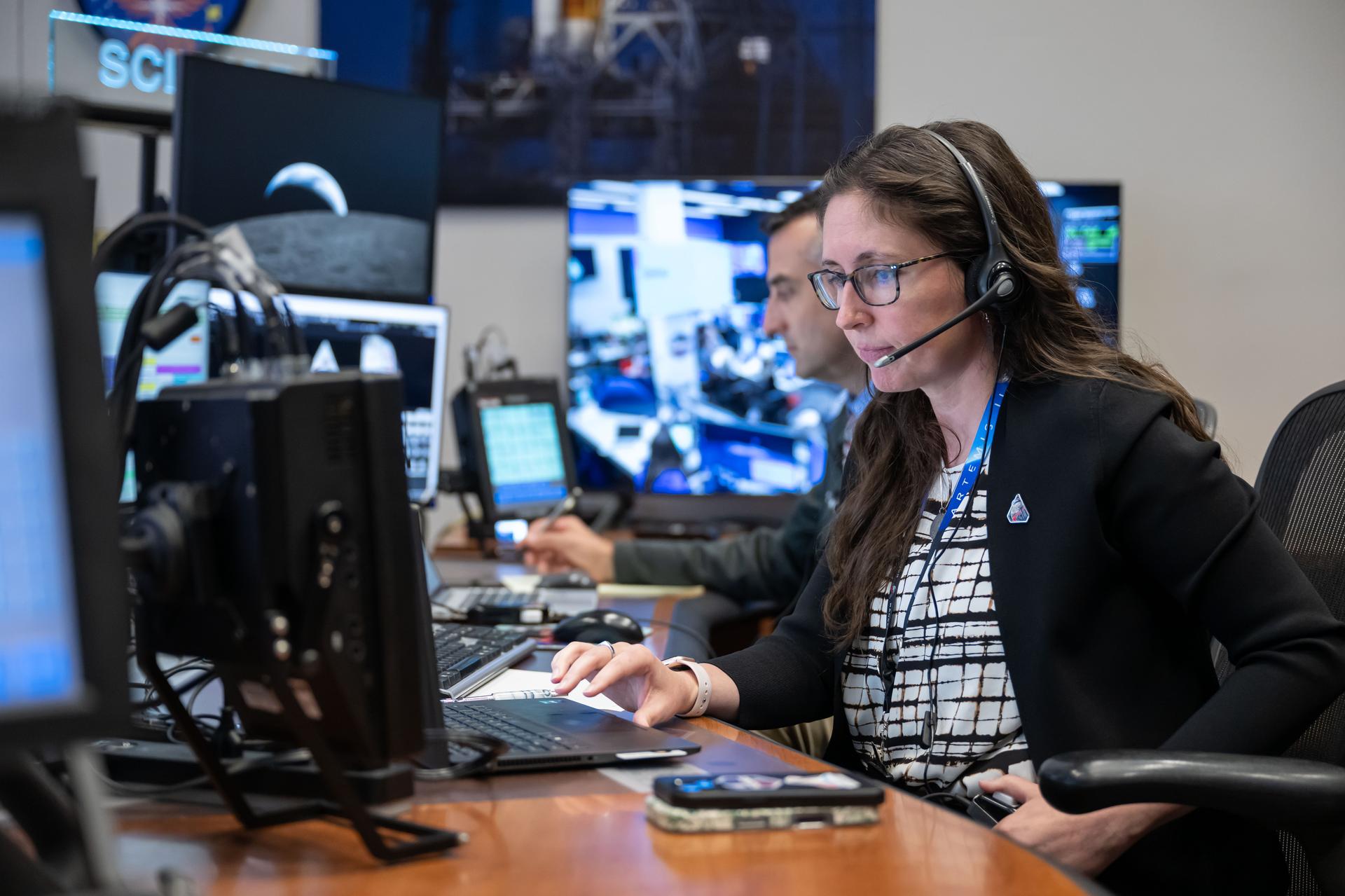
Artemis II science officers, Trevor Graff, background, and Kelsey Young are seen monitoring mission data in real-time from the Science console in the White Flight Control Room in Mission Control at NASA's Johnson Space Center in Houston. Science officers are the senior flight controllers responsible for lunar science and geology objectives during Artemis missions. Credits: NASA/Robert Markowitz
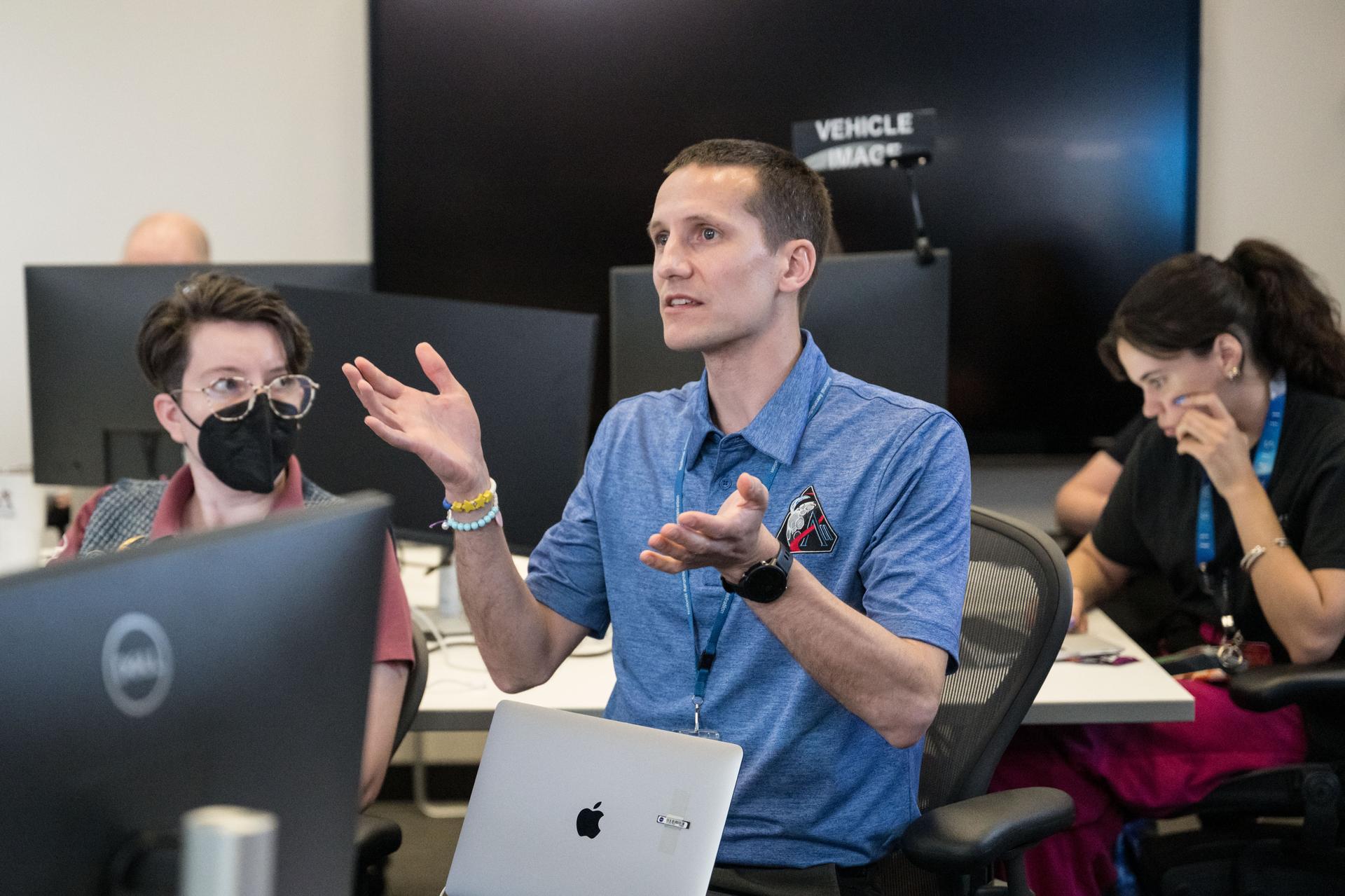
Artemis II lunar science team members, from left, Alexadra Constantinou, David Hollibaugh-Baker, participate in the team’s final preparations for the lunar flyby. NASA Johnson public affairs officer, Victoria Segovia, is seen in the background. The team worked in the Science Evaluation Room (SER) in Mission Control at NASA’s Johnson Space Center in Houston. Built specifically for Artemis missions with these science priorities in mind, the SER is equipped to support rapid data interpretation, collaborative analysis, real-time decision making, and seamless coordination between the science and operations teams. Credits: Credits: NASA/ Robert Markowitz
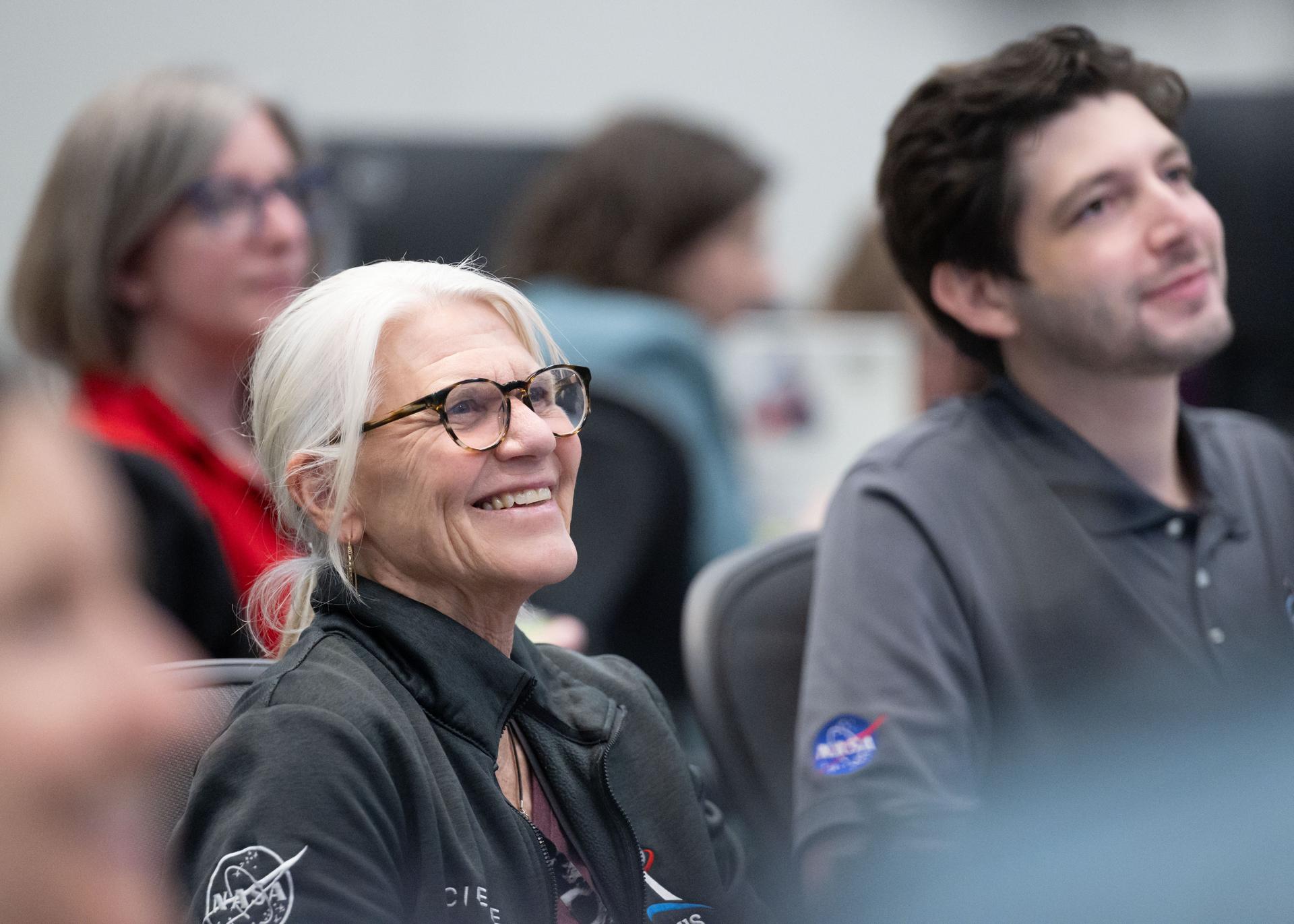
Artemis II lunar science team members, from left, Cindy Evans, and Wilfredo Garcia Lopez, react to crew observations during the lunar flyby on April 6, 2026. The team worked in the Science Evaluation Room (SER) in Mission Control at NASA’s Johnson Space Center in Houston. Built specifically for Artemis missions with these science priorities in mind, the SER is equipped to support rapid data interpretation, collaborative analysis, real-time decision making, and seamless coordination between the science and operations teams. Credits: NASA/Luna Posadas Nava

Artemis II deputy lunar science lead, Jacob Richardson, celebrates with a dance after hearing astronauts describe seeing impact flashes on the Moon during their lunar flyby on April 6, 2026. Richardson was monitoring the flyby from the Science Evaluation Room (SER) in Mission Control at NASA’s Johnson Space Center in Houston. Built specifically for Artemis missions with these science priorities in mind, the SER is equipped to support rapid data interpretation, collaborative analysis, real-time decision making, and seamless coordination between the science and operations teams. Credits: NASA/Luna Posadas Nava

Artemis II lunar science team member, foreground, Amber Turner, and David Hollibaugh-Baker, and Cherie Achilles, background, participate in the team’s analysis of crew observations during the lunar flyby on April 6, 2026. The team worked in the Science Evaluation Room (SER) in Mission Control at NASA’s Johnson Space Center in Houston. Built specifically for Artemis missions with these science priorities in mind, the SER is equipped to support rapid data interpretation, collaborative analysis, real-time decision making, and seamless coordination between the science and operations teams. Credits: NASA/ Robert Markowitz
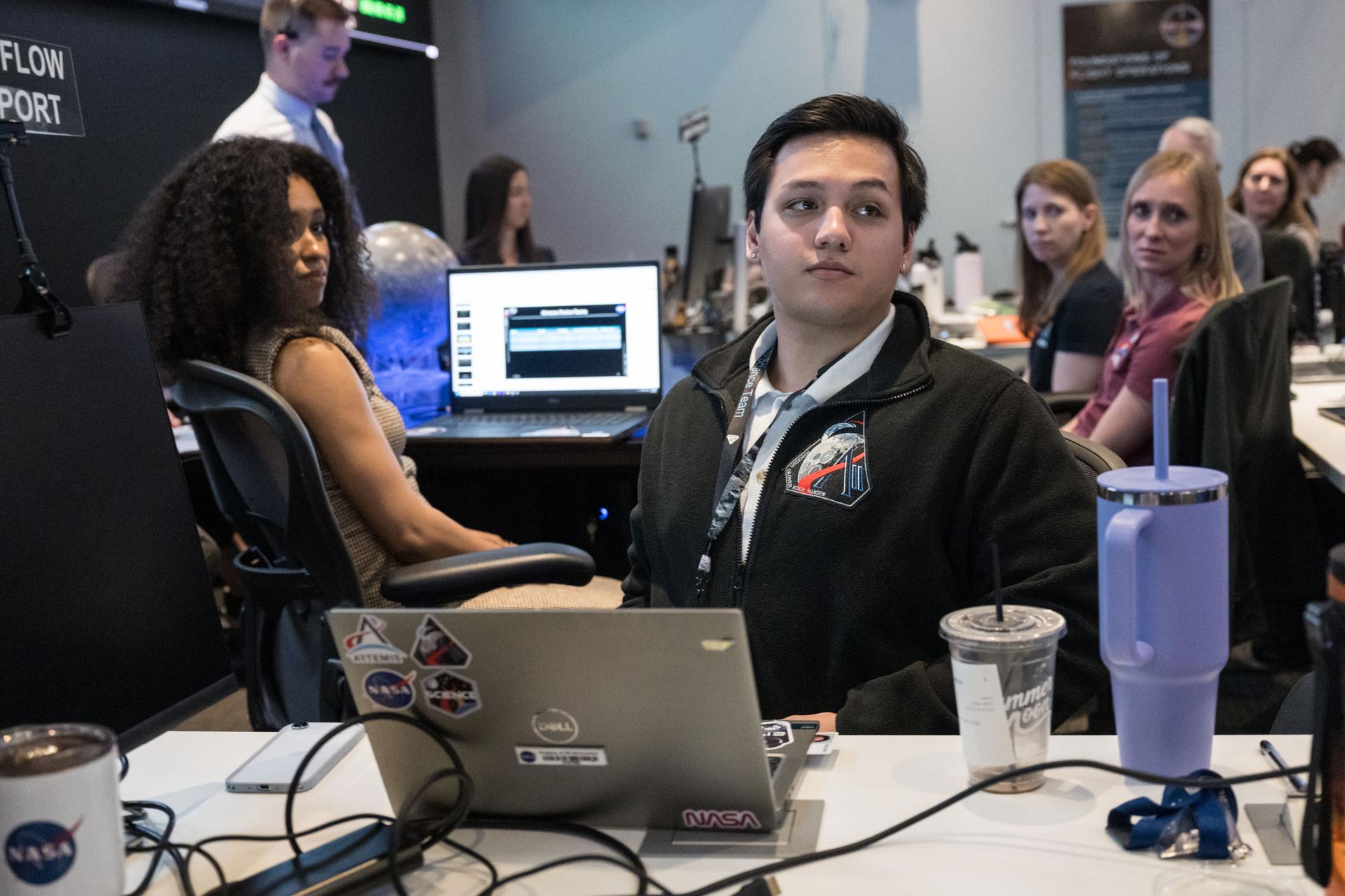
Artemis II lunar science team members, in the foreground from left: Amber Turner and Jared Ralleta in the center. Standing up behind Turner is Jacob Richardson, and sitting behind and to the right, of Ralleta, are Ryan Watkins in the front, and Debra Needham behind her. The SER supports the Artemis science officer in the mission’s main flight control room. Built specifically for Artemis missions with these science priorities in mind, the SER is equipped to support rapid data interpretation, collaborative analysis, real-time decision making, and seamless coordination between the science and operations teams. Credits: NASA/Luna Posadas Nava
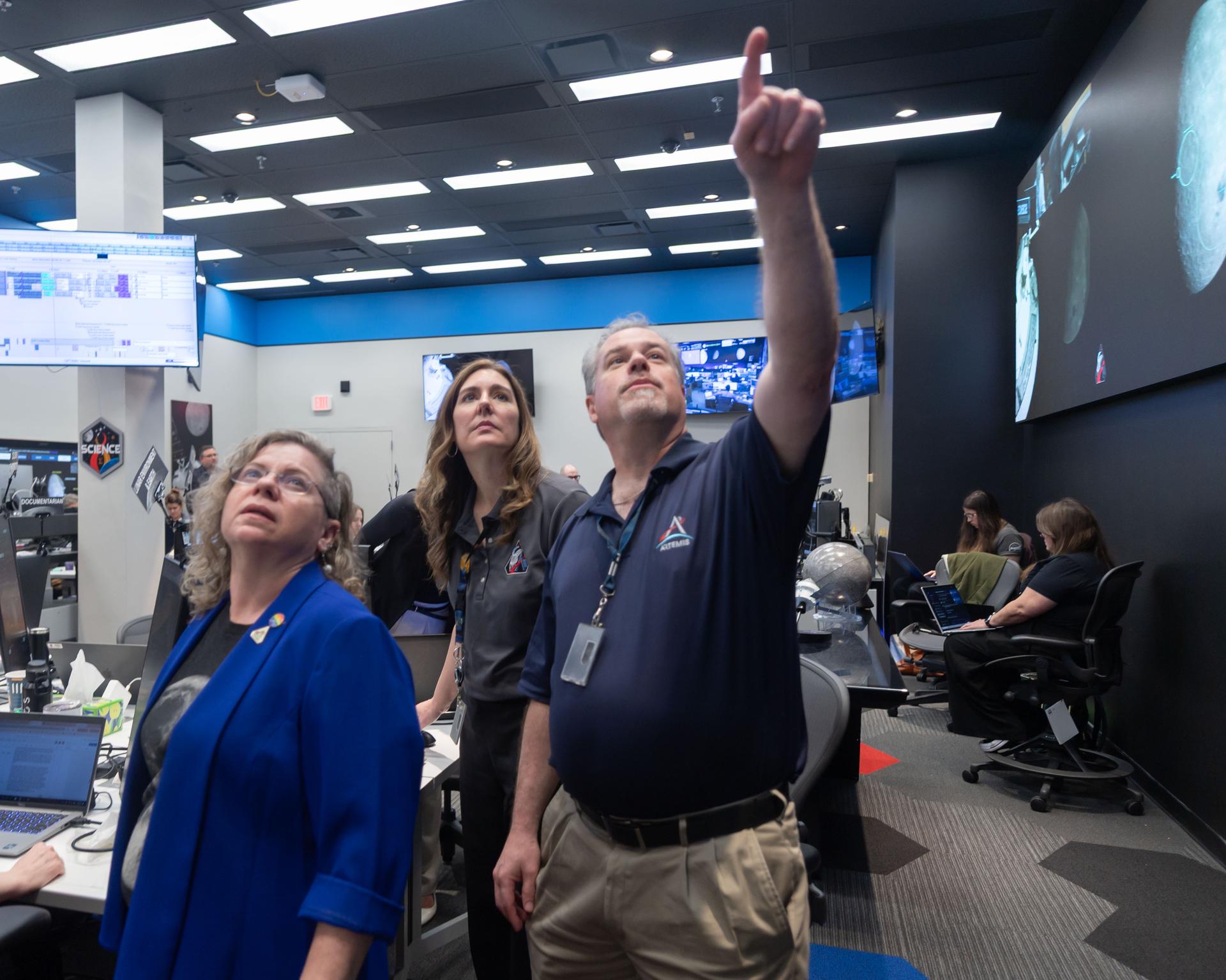
Artemis II lunar science team members, from left, Barbara Cohen, Jennifer Heldmann, and Anthony Colaprete, work in the Science Evaluation Room (SER). Built specifically for Artemis missions with these science priorities in mind, the SER is equipped to support rapid data interpretation, collaborative analysis, real-time decision making, and seamless coordination between the science and operations teams. Credits: NASA/Luna Posadas Nava
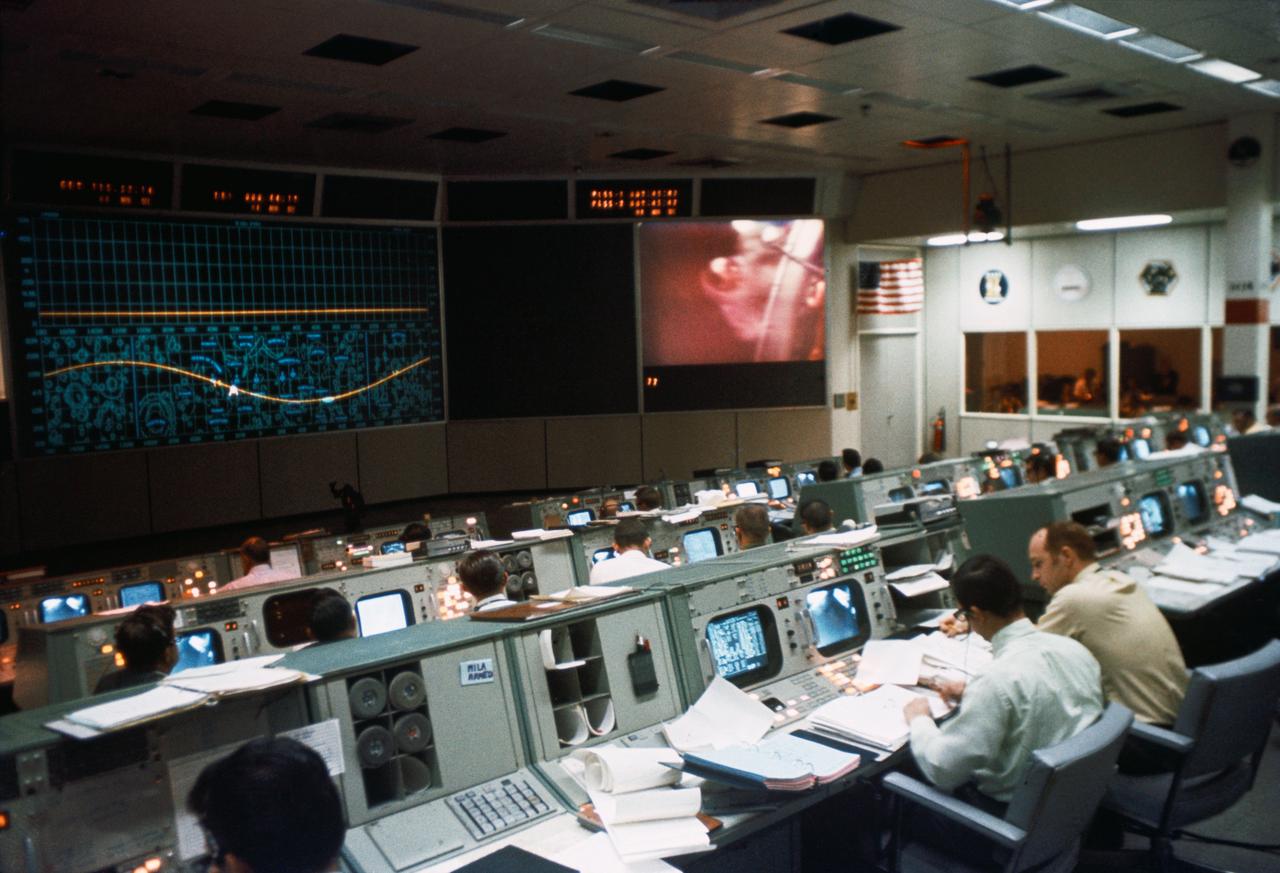
S69-59525 (19 Nov. 1969) --- Overall view of activity in the Mission Operations Control Room (MOCR) in the Mission Control Center (MCC), Building 30, during the Apollo 12 lunar landing mission. When this picture was made the first Apollo 12 extravehicular activity (EVA) was being televised from the surface of the moon. Photo credit: NASA
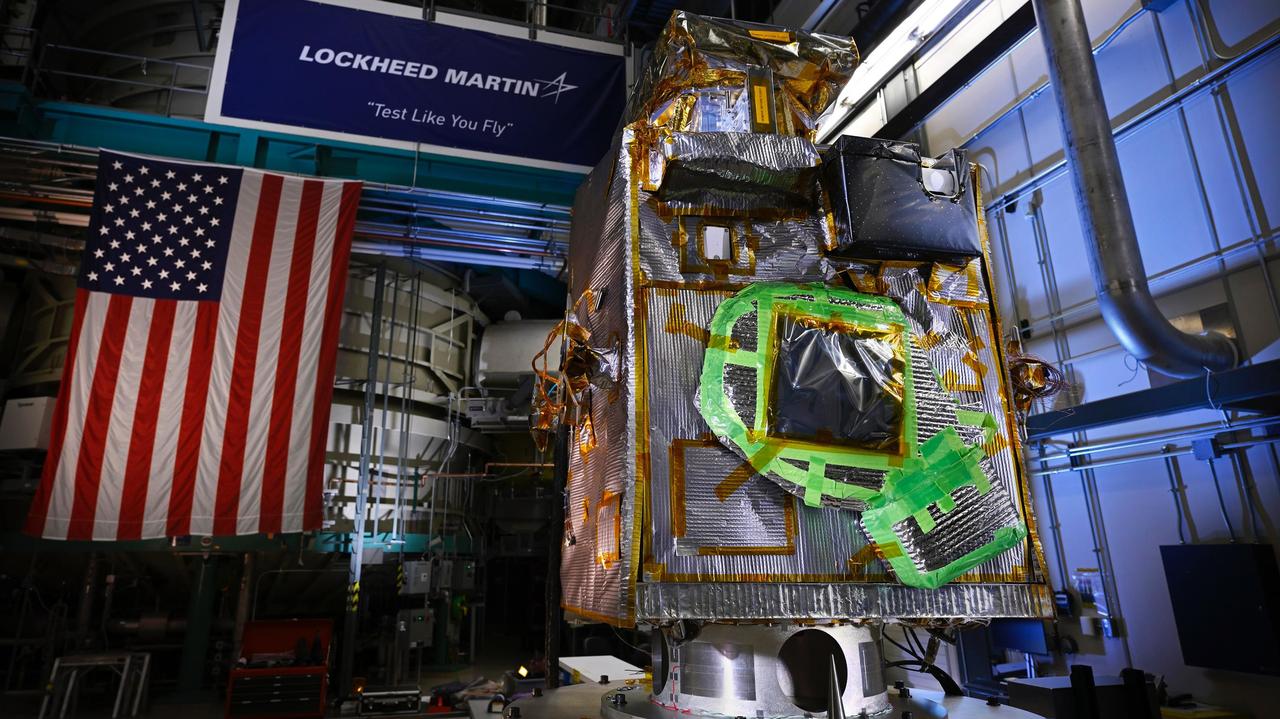
NASA's Lunar Trailblazer sits in a clean room at Lockheed Martin Space in Littleton, Colorado, shortly after being integrated with its second and final science instrument in June 2023. Called the Lunar Thermal Mapper (LTM), the instrument is visible as a black rectangular box in the upper right of the spacecraft's body. Green tape on the spacecraft will be removed before launch. Built by the University of Oxford in England and contributed by the UK Space Agency, LTM joins the High-resolution Volatiles and Minerals Moon Mapper (HVM³) that was integrated with the spacecraft late last year. Together, the instruments will enable scientists to determine the abundance, location, and form of the Moon's water. https://photojournal.jpl.nasa.gov/catalog/PIA25837
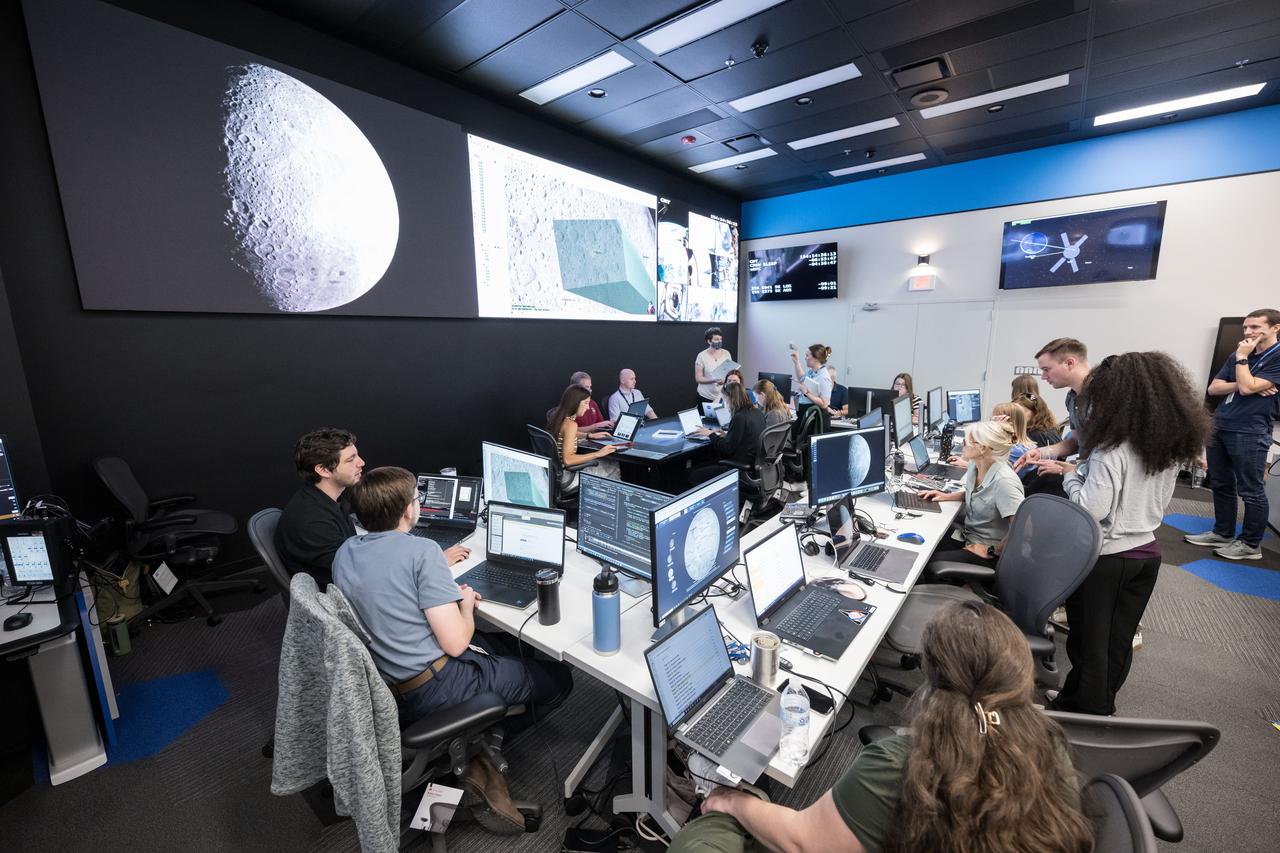
jsc2025e056603 --- The Artemis II Lunar Science Team runs a simulation of lunar observation operations in the new Science Evaluation Room (SER) that serves as a backroom to Mission Control.
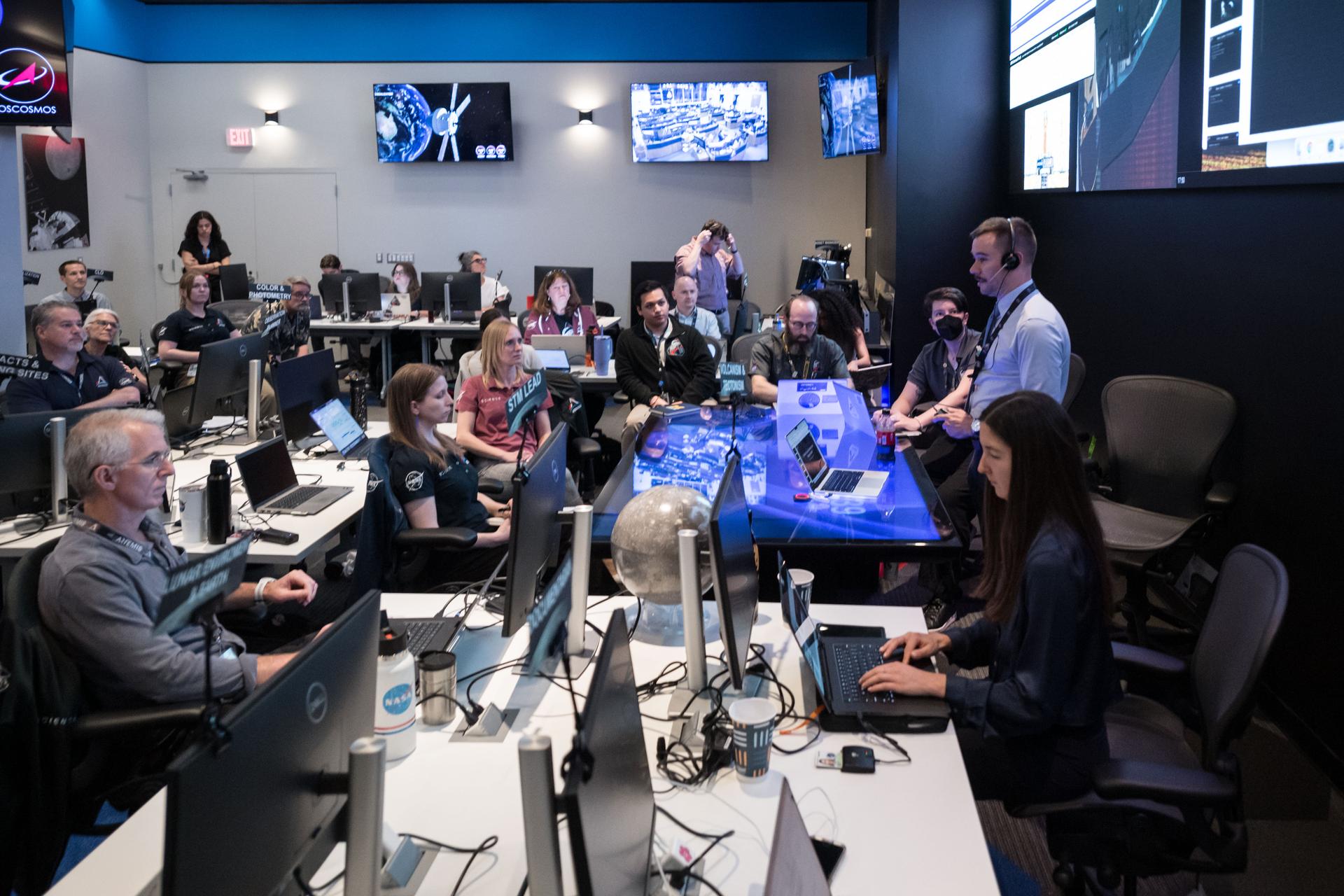
The Artemis II lunar science team gathers for a kickoff meeting before working on the lunar targeting plan for the crew's lunar flyby. The Lunar Targeting Plan is the Artemis II crew's Moon observing assignment, and is fine-tuned to the exact lighting conditions on the Moon’s surface when the Artemis II crew flies by. Like a spacewalk plan, it provides strong, detailed guidance, plus flexibility for the crew to make decisions based on what they’re seeing and experiencing in real time. Targets are prioritized based on both their science value and their visibility at the time of observation. Credits: NASA/Luna Posadas Nava
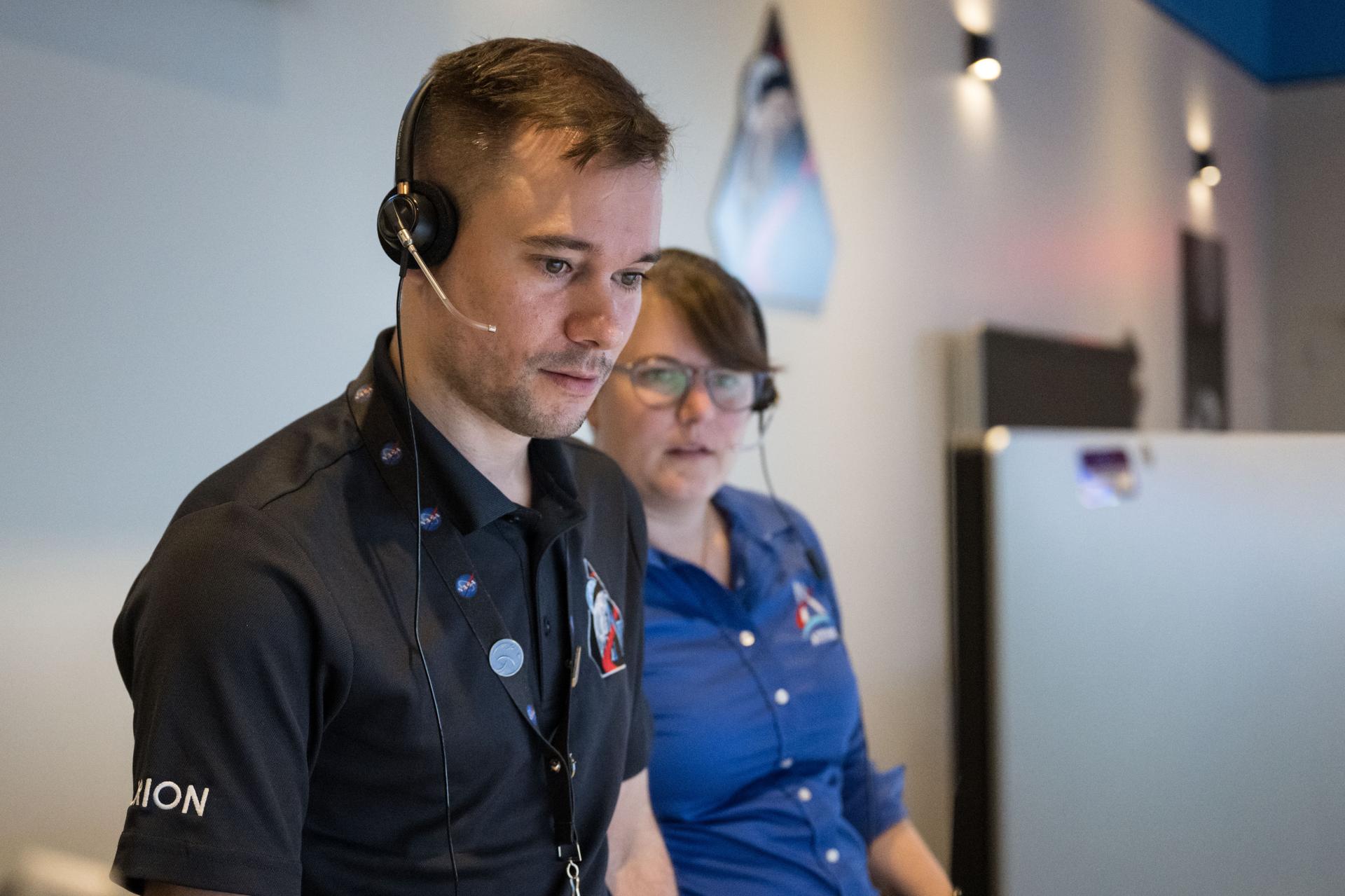
jsc2025e087854 --- Artemis lunar science team members Jacob Richardson, left, and Marie Henderson monitor an Artemis II lunar flyby simulation from the Science Evaluation Room (SER) in Mission Control at NASA's Johnson Space Center in Houston. A team of experts will staff the SER, providing lunar scientific expertise, data analysis, and strategic guidance in real-time to the science officer sitting in the front flight control room of Mission Control.

Members of NASA's Artemis geology team discuss science objectives during a mission simulation at NASA's Johnson Space Center on Oct. 22, 2025. Credits: NASA/Robert Markowitz
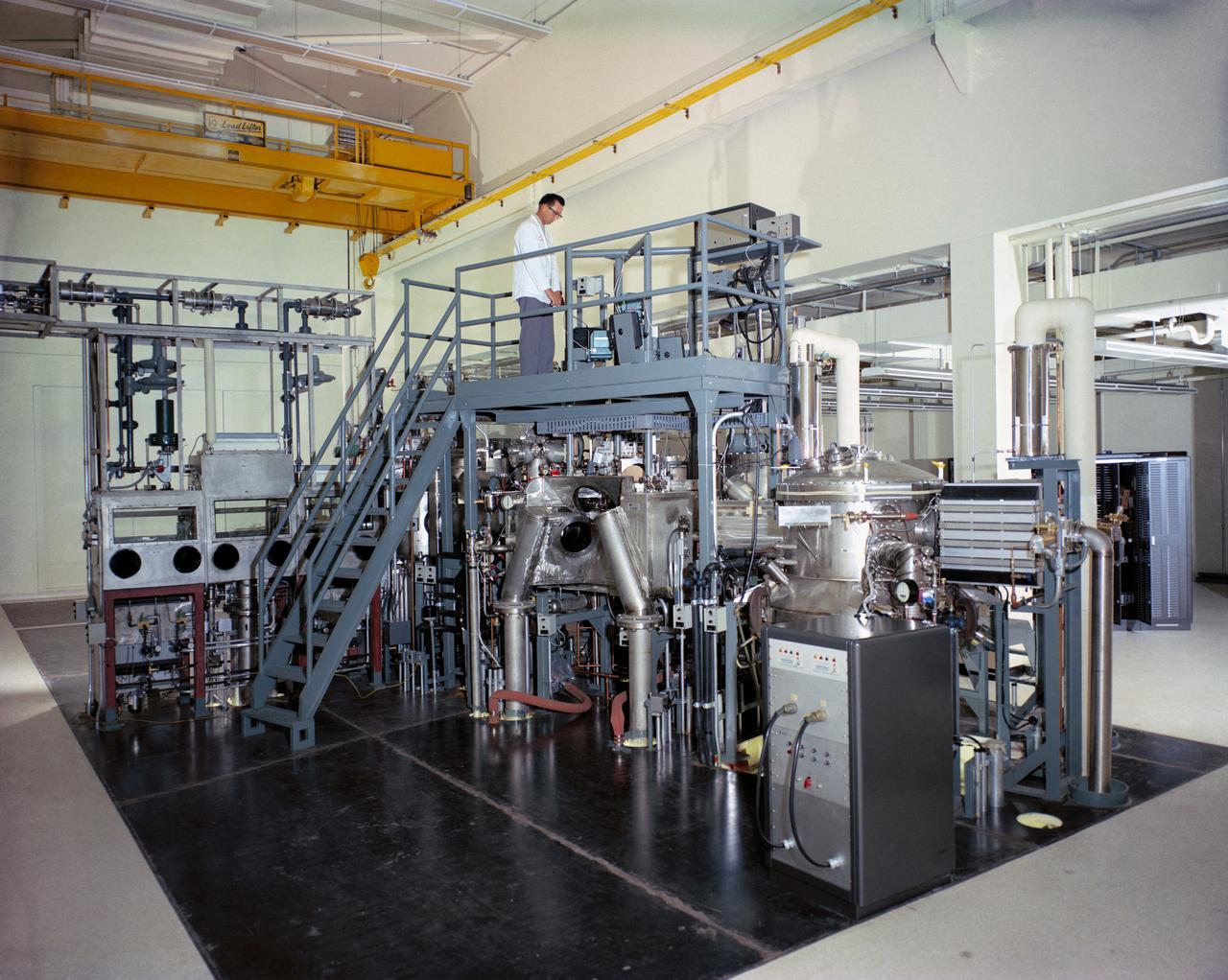
Overall view of the equipment in Room 2-203, Vacuum Laboratory, Sample Operations Area, Lunar Receiving Laboratory, Bldg 37.
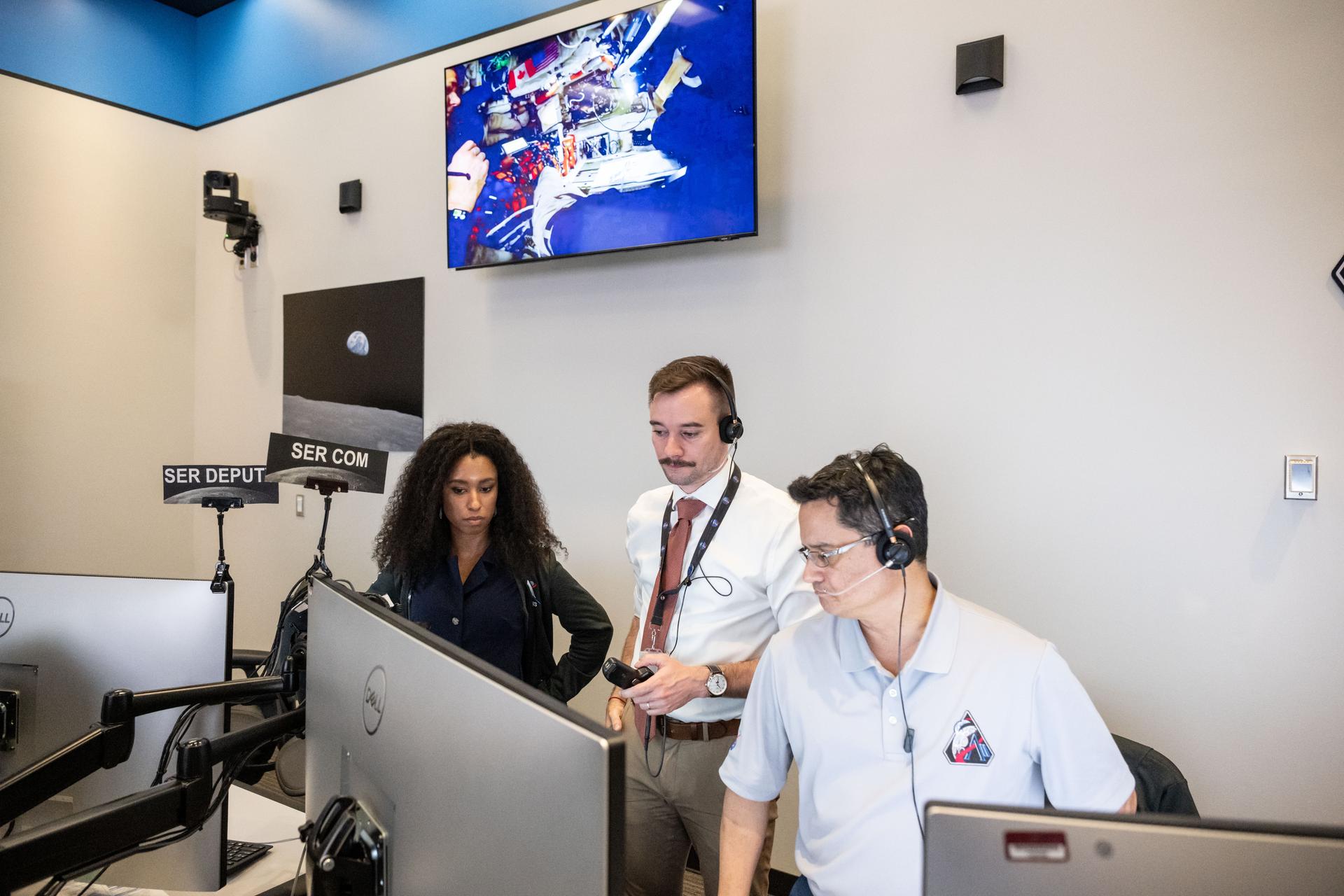
Artemis II lunar science team members, from left, Amber Turner, Jacob Richardson, Jose Hurtado, discuss the team's progress on the lunar targeting plan for the astronauts' six-hour flyby of the Moon, scheduled for April 6. As they pass the Moon, the crew will apply geology skills learned in the classroom and in Moon-like environments on Earth to photograph and describe features including impact craters, ancient lava flows, and surface cracks and ridges formed as the Moon slowly changed over time. They will note differences in color, brightness, and texture, which provide clues that help scientists understand what the surface is made of and how it formed. Credits: NASA/Bill Stafford

Artemis II lunar science team member, Amber Turner, works on the lunar targeting plan for the astronauts' several-hour flyby of the Moon, scheduled for April 6. As they pass the Moon, the crew will apply geology skills learned in the classroom and in Moon-like environments on Earth to photograph and describe features including impact craters, ancient lava flows, and surface cracks and ridges formed as the Moon slowly changed over time. They will note differences in color, brightness, and texture, which provide clues that help scientists understand what the surface is made of and how it formed. Credits: NASA/Bill Stafford
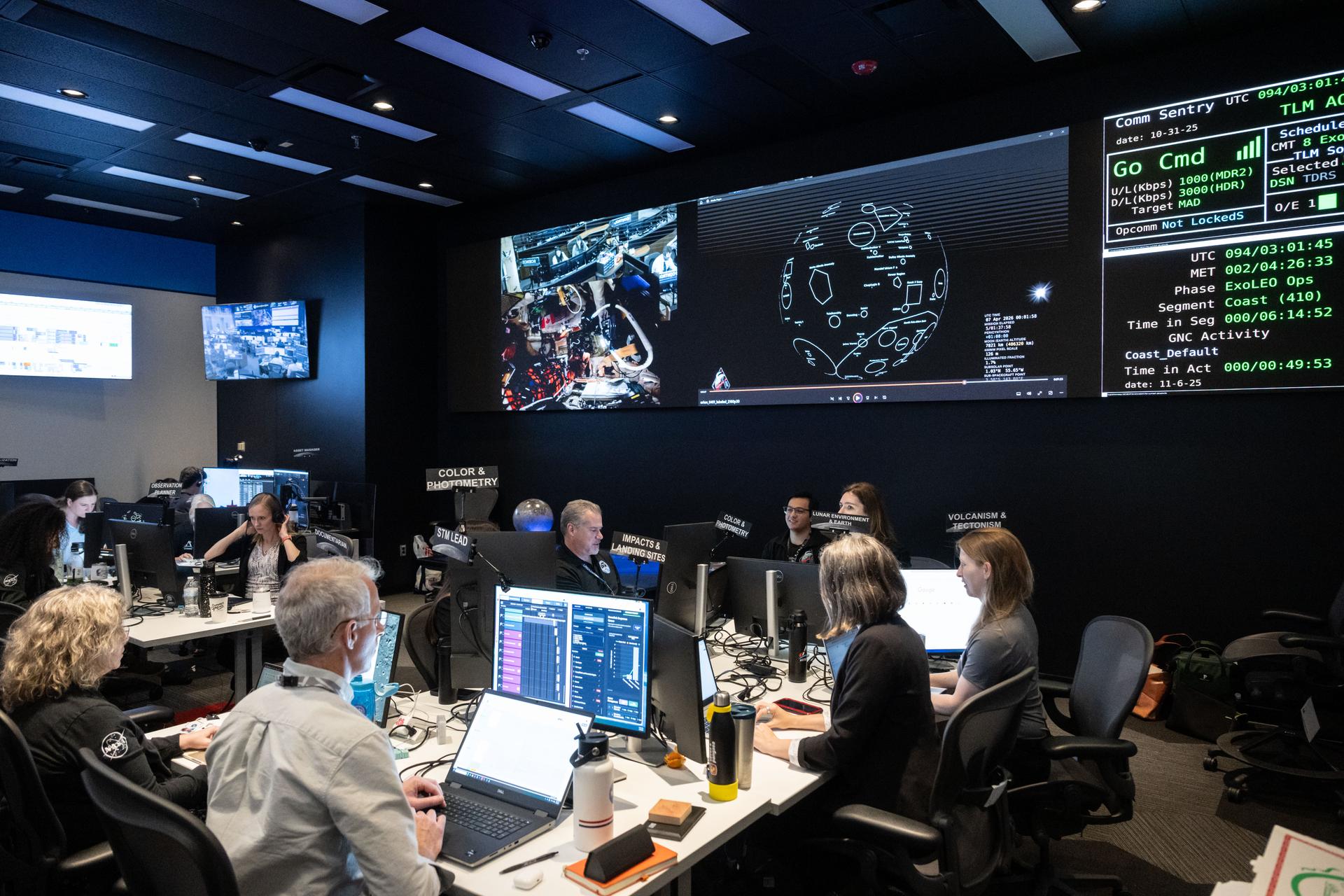
The Artemis II lunar science team works on the lunar targeting plan for the astronauts' several-hour flyby of the Moon, scheduled for April 6. As they pass the Moon, the crew will apply geology skills learned in the classroom and in Moon-like environments on Earth to photograph and describe features including impact craters, ancient lava flows, and surface cracks and ridges formed as the Moon slowly changed over time. They will note differences in color, brightness, and texture, which provide clues that help scientists understand what the surface is made of and how it formed. Credits: NASA/Bill Stafford
Artemis II lunar science team members, from left, Megan Borel, and Cindy Evans, discuss the lunar targeting plan for the astronauts' several-hour flyby of the Moon, scheduled for April 6. As they pass the Moon, the crew will apply geology skills learned in the classroom and in Moon-like environments on Earth to photograph and describe features including impact craters, ancient lava flows, and surface cracks and ridges formed as the Moon slowly changed over time. They will note differences in color, brightness, and texture, which provide clues that help scientists understand what the surface is made of and how it formed. Credits: NASA/Bill Stafford
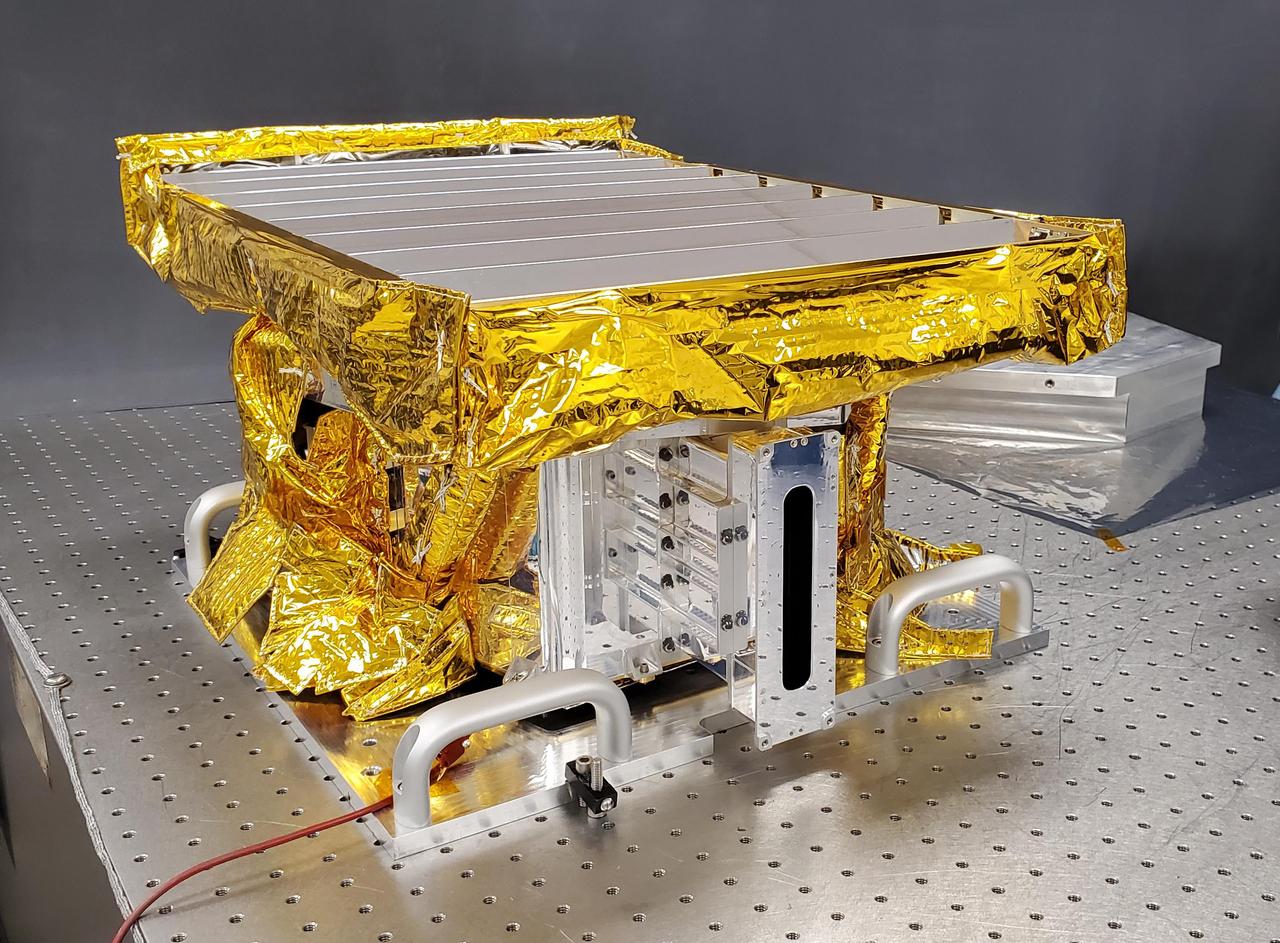
The High-resolution Volatiles and Minerals Moon Mapper (HVM³) sits in a clean room at NASA's Jet Propulsion Laboratory in Southern California in early December 2022. The JPL-built instrument was later shipped to Lockheed Martin Space in Littleton, Colorado, to be integrated with NASA's Lunar Trailblazer spacecraft. HVM³ is an imaging spectrometer that will detect and map water on the Moon's surface to determine its abundance, location, form, and how it changes over time. A second instrument, the Lunar Thermal Mapper infrared multispectral imager, is being developed by the University of Oxford in the U.K. and is scheduled for delivery and integration in early 2023. Lunar Trailblazer was selected under NASA's Small Innovative Missions for Planetary Exploration (SIMPLEx) program in 2019. The Lunar Trailblazer mission is managed by JPL and its science investigation is led by Caltech in Pasadena, California. Managed for NASA by Caltech, JPL also provides system engineering, mission assurance, the HVM³ instrument, as well as navigation. Lockheed Martin Space provides the spacecraft and integrates the flight system, under contract with Caltech. SIMPLEx mission investigations are managed by the Planetary Missions Program Office at NASA's Marshall Space Flight Center in Huntsville, Alabama, as part of the Discovery Program at NASA Headquarters in Washington. The program conducts space science investigations in the Planetary Science Division of NASA's Science Mission Directorate at NASA Headquarters. https://photojournal.jpl.nasa.gov/catalog/PIA25256
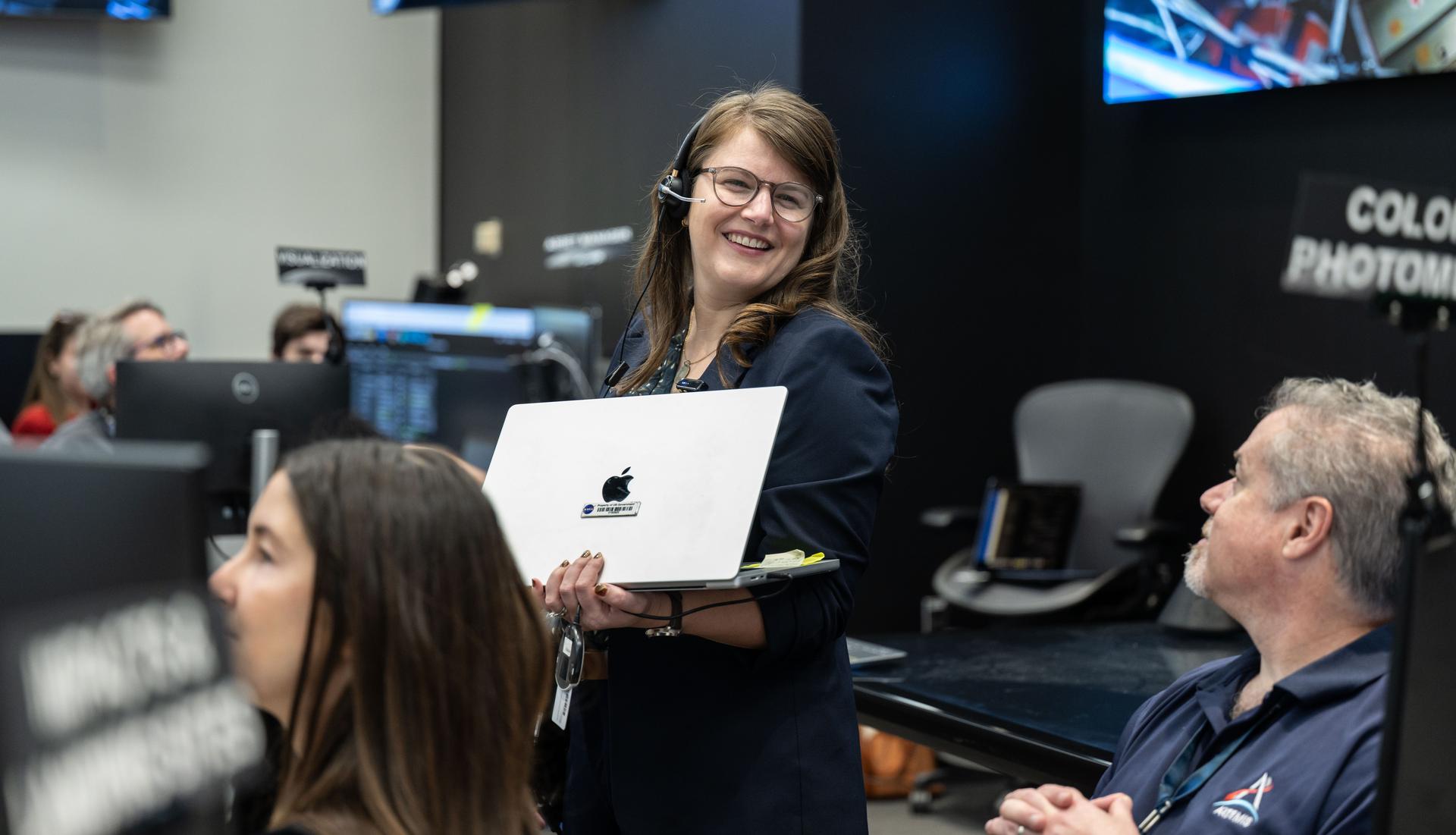
Artemis II deputy lunar science lead, Marie Henderson, reacts to the astronauts' verbal observations of the Moon during their flyby on April 6, 2026. Along with other lunar science team members, Henderson helped train the astronauts in geology both in the classroom and in the field. The team also built the lunar targeting plan that, like an International Space Station spacewalk plan, provides strong, detailed observation guidance, plus flexibility for the crew to make decisions based on what they’re seeing and experiencing in real time. The science team had many moments of celebration during the lunar flyby as the astronauts took images of the Moon and provided verbal descriptions of what they were seeing. This type of information reveals the geologic history of an area and will be critical to collect when future Artemis astronauts explore the Moon's surface. Credits: NASA/Luna Posadas Nava
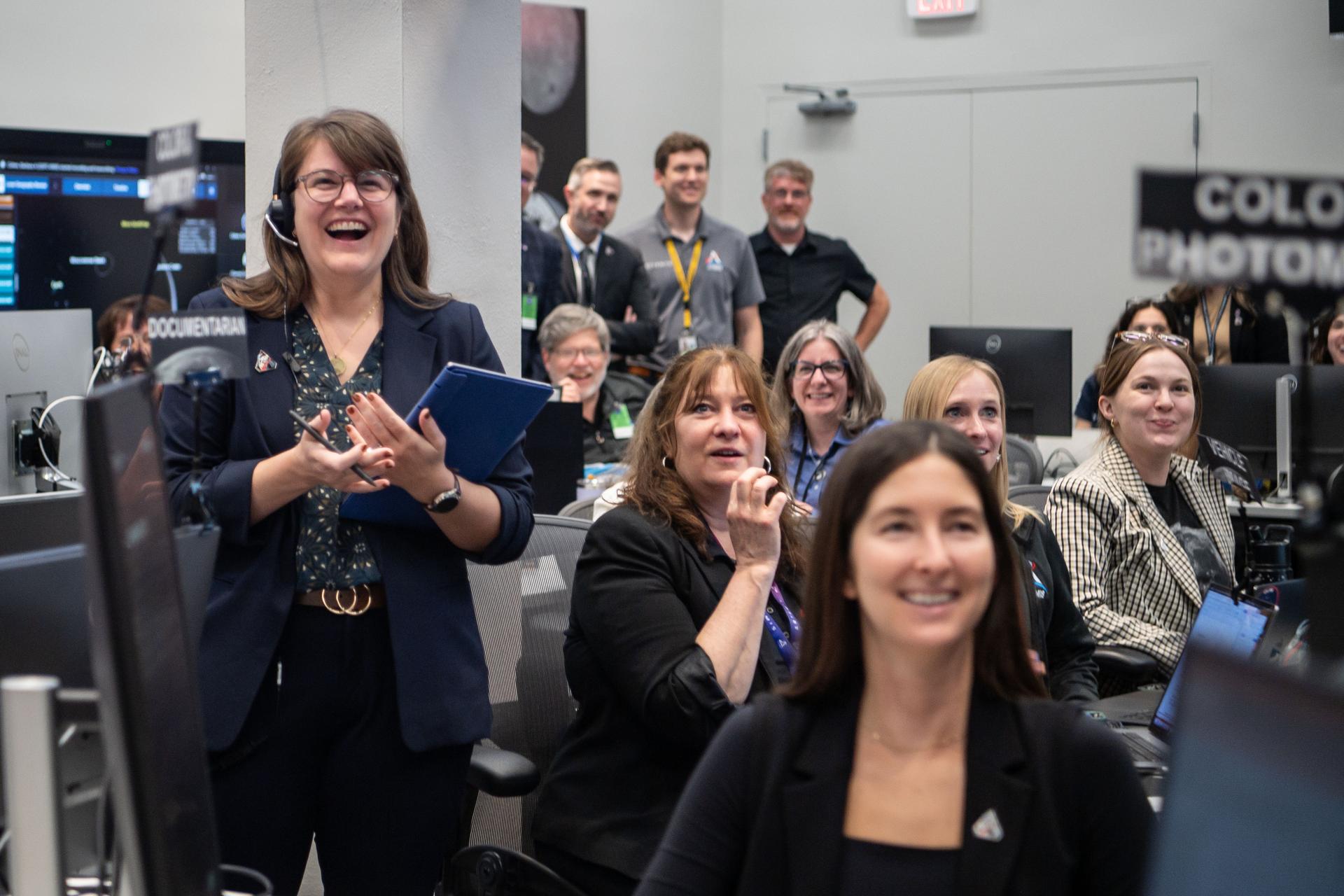
Artemis II deputy lunar science lead Marie Henderson, shown standing on the left, and lunar science team members, from the right foreground, Ariel Deutsch, Maria Banks behind her, Ryan Watkins to her right, and Sara Schmidt in the checkered jacket. In this image they are reacting to astronauts' observations of Moon features during their flyby on April 6, 2026. Leading up to the flight, the science team has been training the astronauts in in the classroom and in the field. They also built the lunar targeting plan that, like a spacewalk plan on the International Space Station, provides strong, detailed observation guidance, plus flexibility for the crew to make decisions based on what they’re seeing and experiencing in real time. The science team had many moments of celebration during the lunar flyby as the astronauts took images of the Moon and provided verbal descriptions of what they were seeing. This type of information reveals the geologic history of various lunar areas and will be critical to collect when future Artemis astronauts explore the Moon's surface. Credits: NASA/Luna Posadas Nava

Artemis II deputy lunar science lead, Jacob Richardson, left, and Artemis II lunar science team members, Kiarre Dumes, react to the astronauts' verbal observations of the Moon during their flyby on April 6, 2026. Along with other lunar science team members, Richardson and Dumes helped train the crew in geology both in the classroom and in the field. The science team also built the lunar targeting plan that, like an International Space Station spacewalk plan, provides strong, detailed observation guidance, plus flexibility for the crew to make decisions based on what they’re seeing and experiencing in real time. The science team had many moments of celebration during the lunar flyby as the astronauts took images of the Moon and provided verbal descriptions of what they were seeing. This type of information reveals the geologic history of an area and will be critical to collect when future Artemis astronauts explore the Moon's surface. Credits: NASA/Luna Posadas Nava
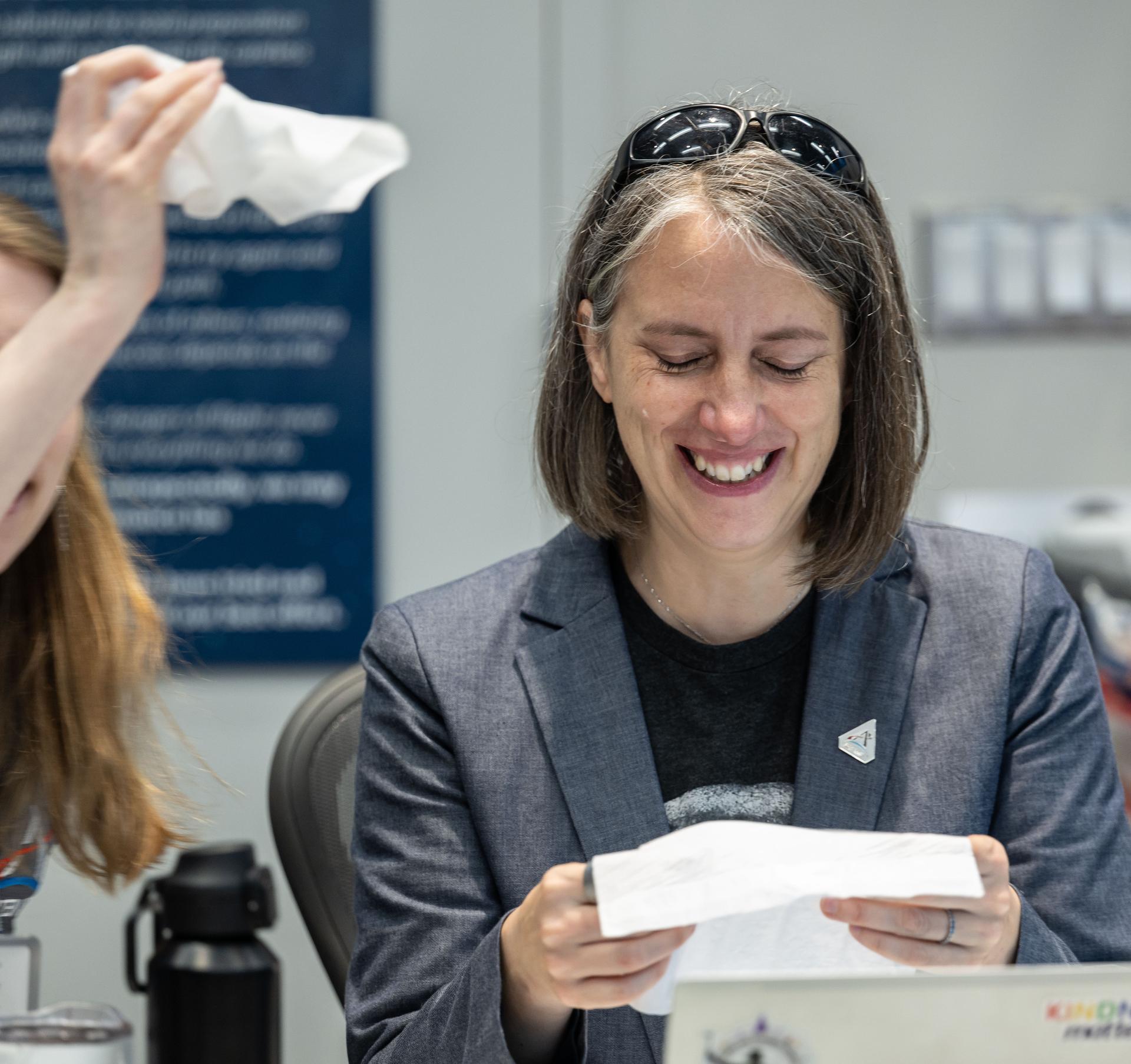
Artemis curation lead, Juliane Gross, reacts to the astronauts' verbal observations of the Moon during their flyby on April 6, 2026. Along with other members of the Artemis II lunar science team, Gross helped train the Artemis II crew in geology both in the classroom and in the field. The team also built the lunar targeting plan that, like an International Space Station spacewalk plan, provides strong, detailed observation guidance, plus flexibility for the crew to make decisions based on what they’re seeing and experiencing in real time. The science team had many moments of celebration during the lunar flyby as the astronauts took images of the Moon and provided verbal descriptions of what they were seeing. This type of information reveals the geologic history of an area and will be critical to collect when future Artemis astronauts explore the Moon's surface. Credits: NASA/Luna Posadas Nava
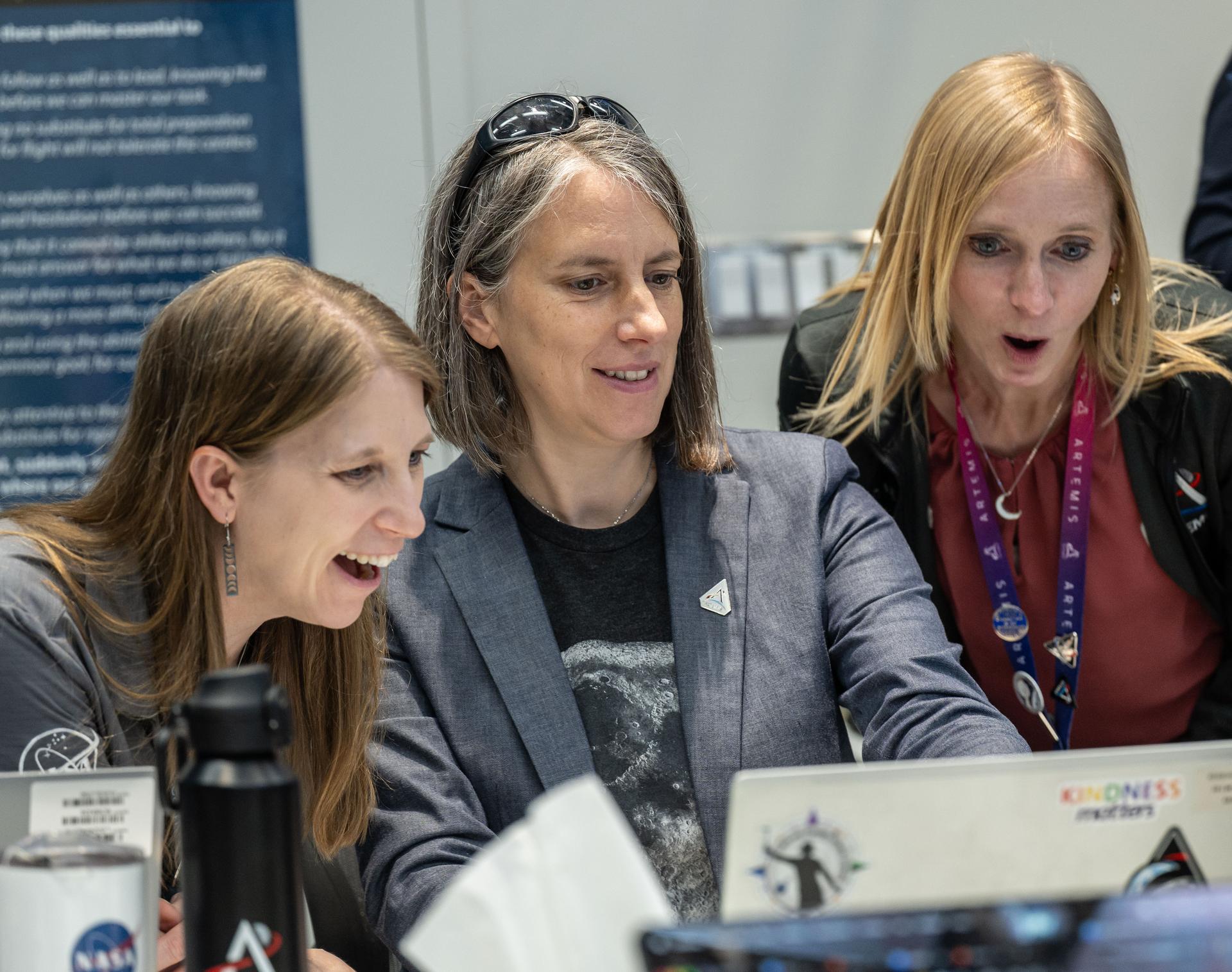
Artemis II lunar science team members, from left, Debra Needham, Juliane Gross, and Ryan Watkins, react to the astronauts' verbal observations of the Moon during their flyby on April 6, 2026. The science team trained the astronauts in geology and observation, both in the classroom and in the field. The team also built the lunar targeting plan that, like an International Space Station spacewalk plan, provides strong, detailed observation guidance, plus flexibility for the crew to make decisions based on what they’re seeing and experiencing in real time. The science team had many moments of celebration during the lunar flyby as the astronauts took images of the Moon and provided verbal descriptions of what they were seeing. This type of information reveals the geologic history of an area and will be critical to collect when future Artemis astronauts explore the Moon's surface. Credits: NASA/Luna Posadas Nava
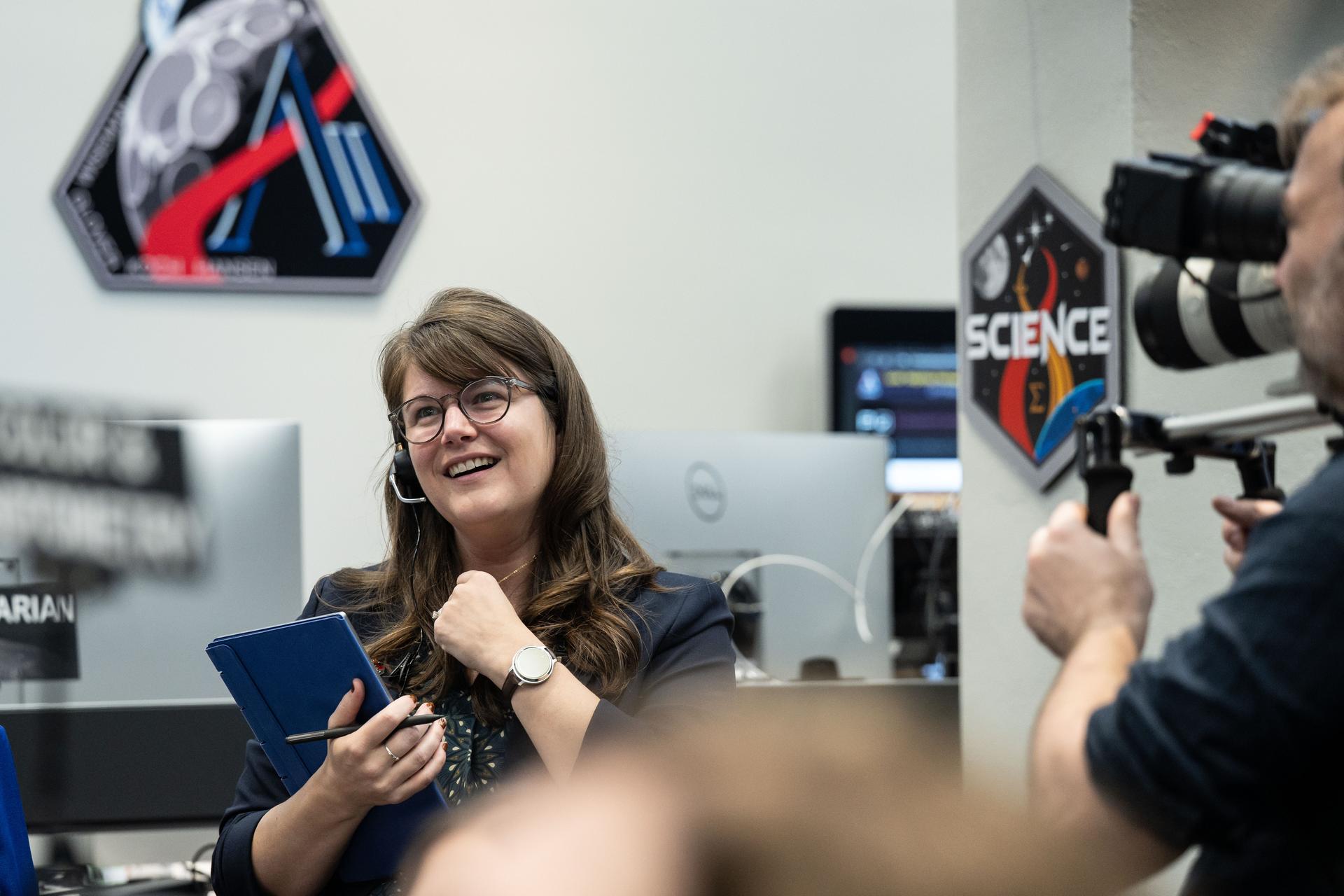
Artemis II deputy lunar science lead, Marie Henderson, reacts to the astronauts' verbal observations of the Moon during their flyby on April 6, 2026. Along with other lunar science team members, Ewing helped train the crew in geology both in the classroom and in the field. The science team also built the lunar targeting plan that, like an International Space Station spacewalk plan, provides strong, detailed observation guidance, plus flexibility for the crew to make decisions based on what they’re seeing and experiencing in real time. The science team had many moments of celebration during the lunar flyby as the astronauts took images of the Moon and provided verbal descriptions of what they were seeing. This type of information reveals the geologic history of an area and will be critical to collect when future Artemis astronauts explore the Moon's surface. Credits: NASA/Luna Posadas Nava
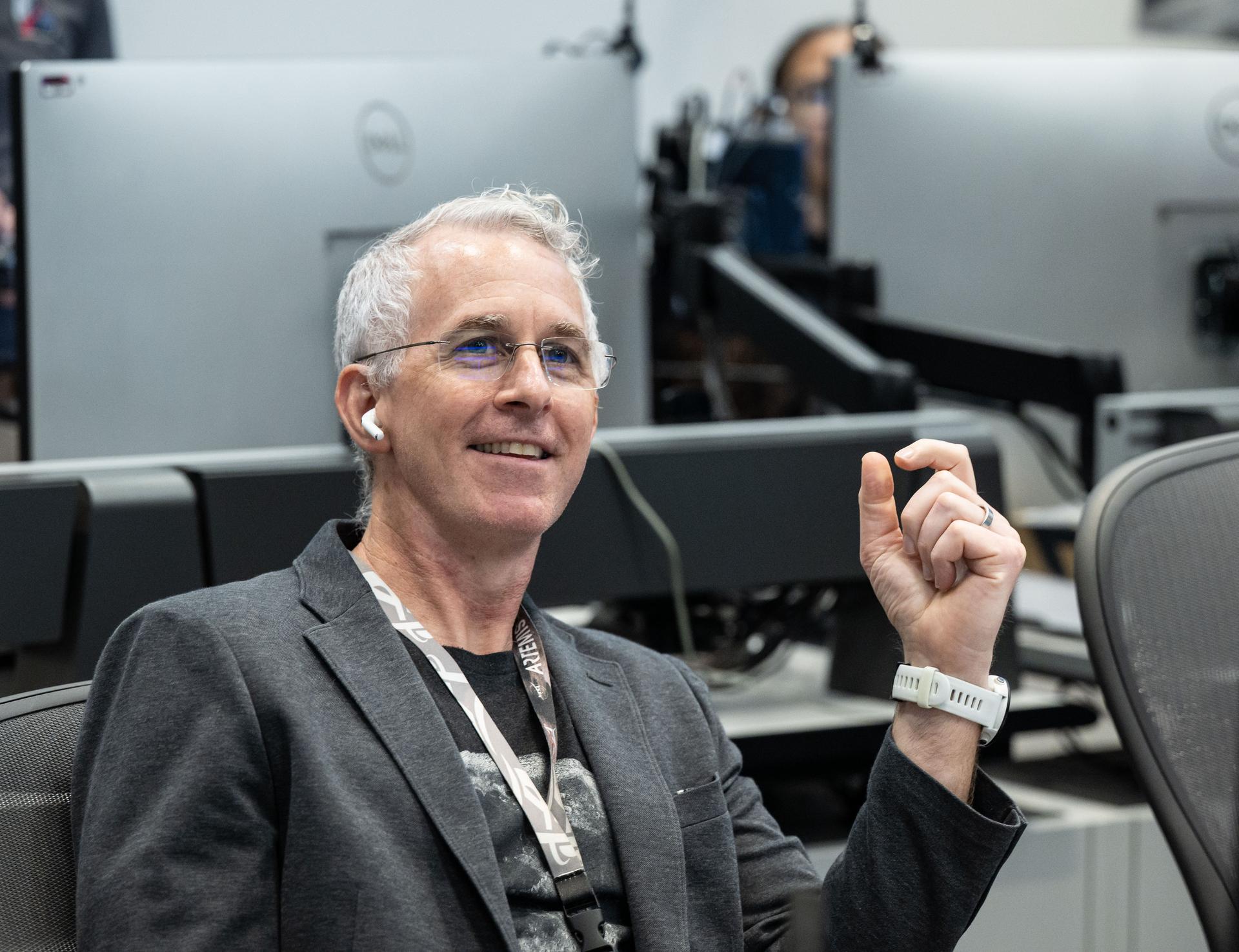
Artemis II lunar science team member, Ryan Ewing, reacts to the astronauts' verbal observations of the Moon during their flyby on April 6, 2026. Along with other lunar science team members, Ewing helped train the crew in geology both in the classroom and in the field. The science team also built the lunar targeting plan that, like an International Space Station spacewalk plan, provides strong, detailed observation guidance, plus flexibility for the crew to make decisions based on what they’re seeing and experiencing in real time. The science team had many moments of celebration during the lunar flyby as the astronauts took images of the Moon and provided verbal descriptions of what they were seeing. This type of information reveals the geologic history of an area and will be critical to collect when future Artemis astronauts explore the Moon's surface. Credits: NASA/Luna Posadas Nava

Artemis II lunar science team member, Ariel Deutsch, reacts to the astronauts' verbal observations of the Moon during their flyby on April 6. The science team has spent years training the astronauts in geology and observation, both in the classroom and in the field. They also built the lunar targeting plan that, like a spacewalk plan, provides strong, detailed observation guidance, plus flexibility for the crew to make decisions based on what they’re seeing and experiencing in real time. The science team had many moments of celebration during the lunar flyby as the astronauts took pictures of the Moon and provided verbal descriptions of what they were seeing. This type of information reveals the geologic history of an area and will be critical to collect when future Artemis astronauts explore the Moon's surface. Credits: NASA/Luna Posadas Nava
Artemis II Lunar Science Deputy Jacob Richardson and Artemis II Lunar Science Team Member Kiarre Dumes react to the astronauts' verbal observations of the Moon during their flyby on April 6. The science team trained the astronauts in geology both in the classroom and in the field. They also built the lunar targeting plan that, like a spacewalk plan, provides strong, detailed observation guidance, plus flexibility for the crew to make decisions based on what they’re seeing and experiencing in real time. The science team had many moments of celebration during the lunar flyby as the astronauts took pictures of the Moon and provided verbal descriptions of what they were seeing. This type of information reveals the geologic history of an area and will be critical to collect when future Artemis astronauts explore the Moon's surface. Credits: NASA/Luna Posadas Nava

Ernie Wright, Artemis II lunar science visualization lead, reacts to hearing the astronauts describe features of the Moon as they few by on April 6, 2026. To prepare the crew for this mission, the Artemis II lunar science team trained the astronauts in geology, both in the classroom and in the field. They also built the lunar targeting plan that, which, like an International Space Station spacewalk plan, provides strong, detailed observation guidance, plus flexibility for the crew to make decisions based on what they’re seeing and experiencing in real time. The science team had many moments of celebration during the lunar flyby as the astronauts took images of the Moon and provided verbal descriptions of what they were seeing. This type of information reveals the geologic history of an area and will be critical to collect when future Artemis astronauts explore the Moon's surface. Credits: NASA/Luna Posadas Nava
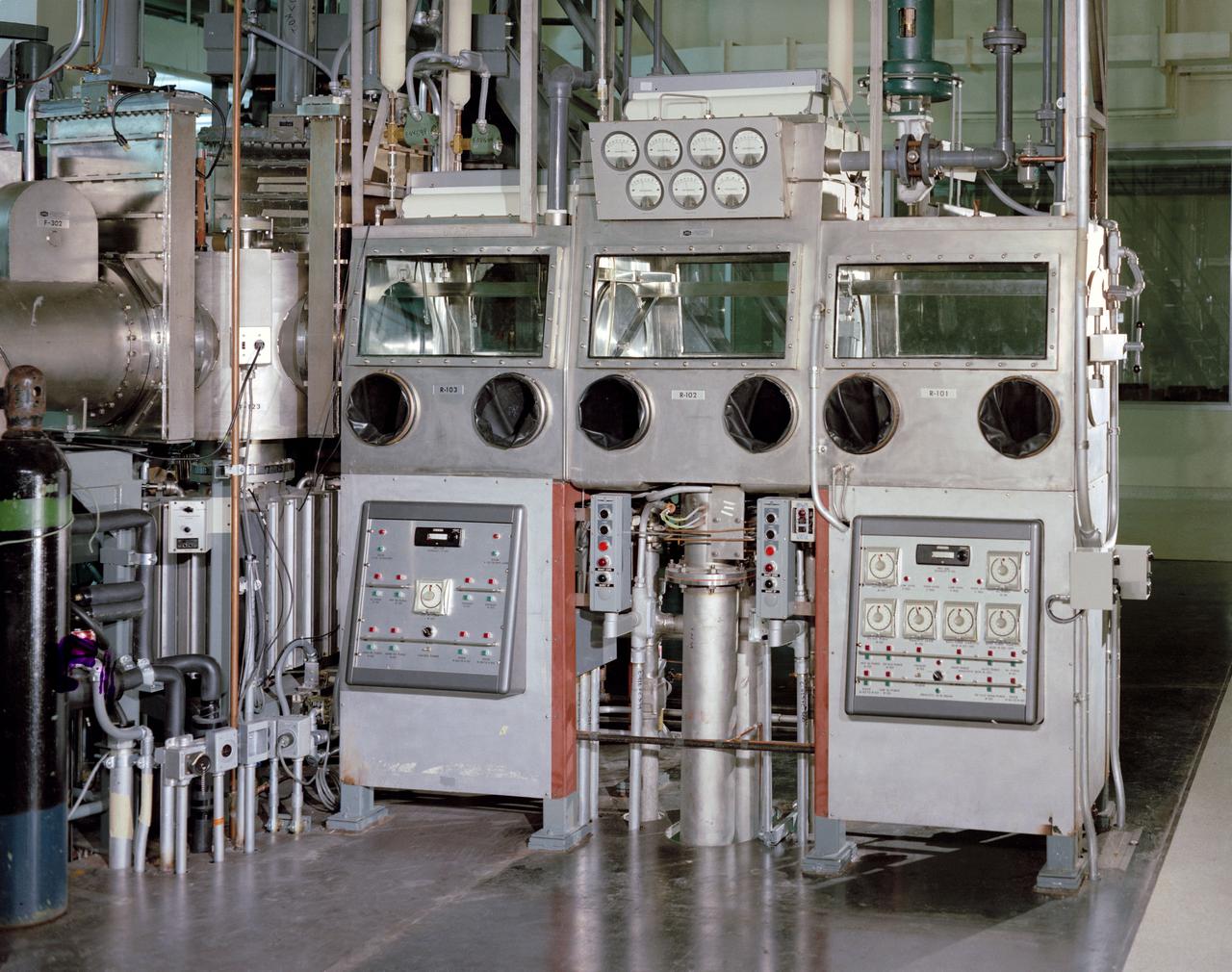
Atmospheric Decontamination System equipment in Room 2-203, Vacuum Laboratory, Sample Operations Area, Lunar Receiving Laboratory, Bldg 37.
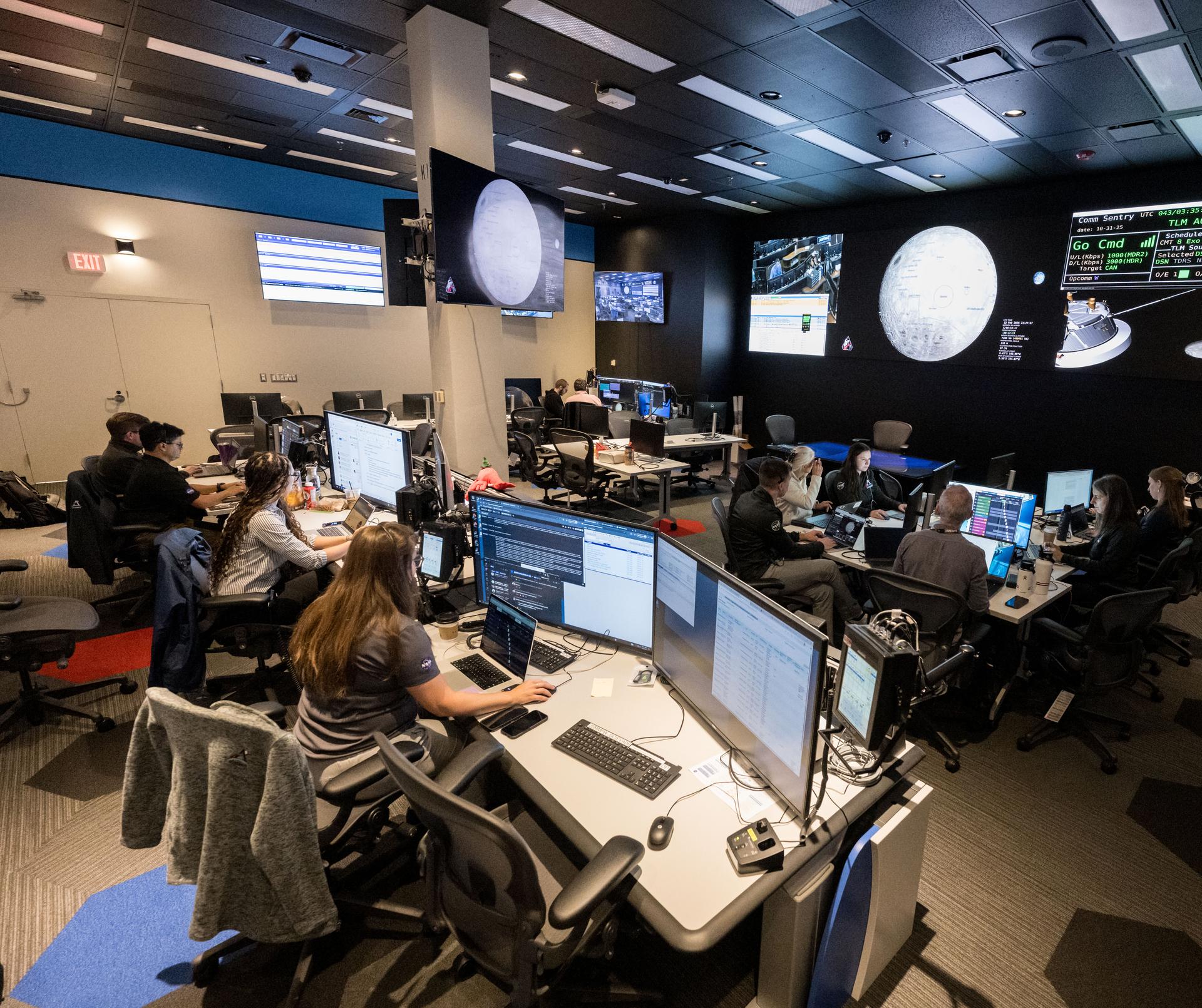
jsc2026e000861 --- The Artemis II Lunar Science Team works in the Science Evaluation Room (SER) during a training simulation in the Mission Control Center at NASA’s Johnson Space Center in Houston. The SER supports the mission’s main flight control room for lunar science and planetary observations. Built specifically for Artemis missions with these science priorities in mind, the SER is equipped to support rapid data interpretation, collaborative analysis, real-time decision making, and seamless coordination between the science and operations teams. Credit: James Blair
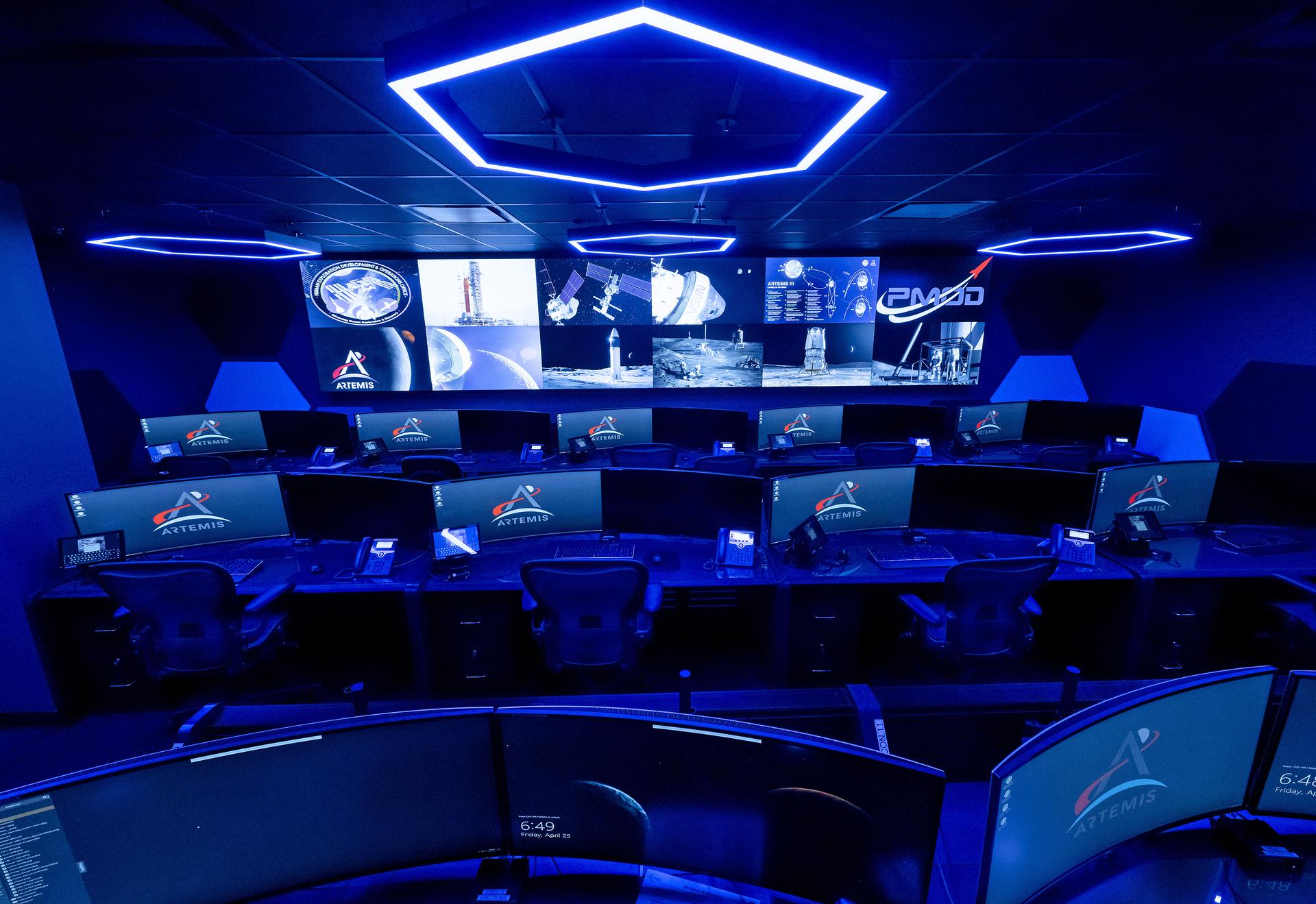
These photos offer a look inside the twin control rooms at NASA’s Marshall Space Flight Center in Huntsville, Alabama, where engineers will monitor Artemis science and future landing operations for Artemis. The LUCA (Lunar Utilization Control Area) and LESA (Lander Engineering Support Area) rooms are part of the Huntsville Operations Support Center at NASA Marshall. The LUCA is specially designed to support a wide variety of science operations on and around the Moon – and beyond. Engineers in the LUCA monitored operations for the Lunar Node-1 experiment, an autonomous navigation payload that was part of the first NASA Commercial Lunar Payload Services (CLPS) launch on Intuitive Machines’ Nova-C lunar lander in 2024. NASA Marshall flight controllers will use the LUCA again for Artemis II to monitor science operations. Beginning with Artemis III, members of the NASA Human Landing System Mission Insight Support Team – a group of engineers, safety leads, flight operations experts, and technical authorities – will work in the LESA. There, they will monitor lander systems in real-time and be involved in key decision-making processes throughout the mission. For more information, contact NASA Marshall’s Office of Communications at 256-544-0034.
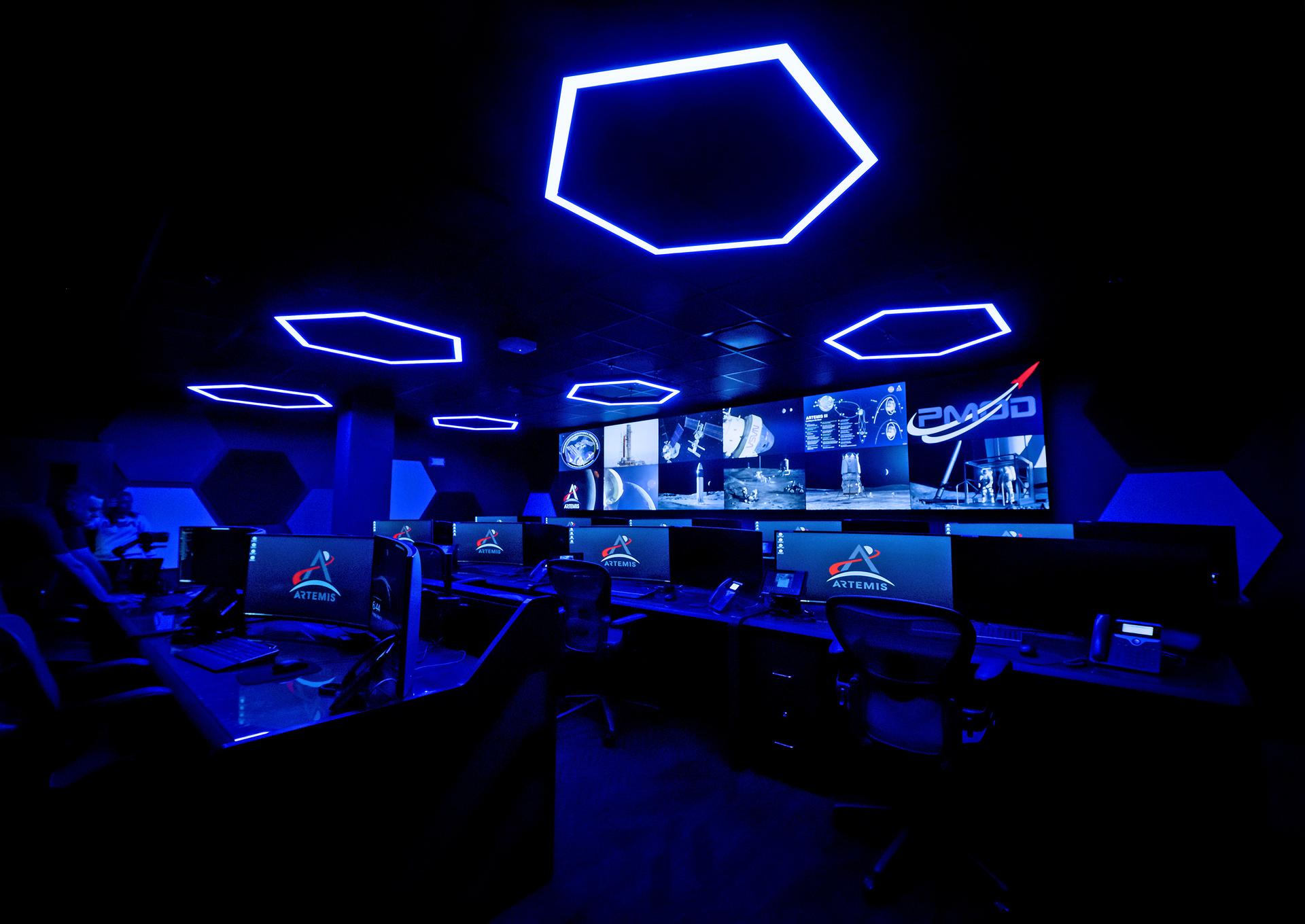
These photos offer a look inside the twin control rooms at NASA’s Marshall Space Flight Center in Huntsville, Alabama, where engineers will monitor Artemis science and future landing operations for Artemis. The LUCA (Lunar Utilization Control Area) and LESA (Lander Engineering Support Area) rooms are part of the Huntsville Operations Support Center at NASA Marshall. The LUCA is specially designed to support a wide variety of science operations on and around the Moon – and beyond. Engineers in the LUCA monitored operations for the Lunar Node-1 experiment, an autonomous navigation payload that was part of the first NASA Commercial Lunar Payload Services (CLPS) launch on Intuitive Machines’ Nova-C lunar lander in 2024. NASA Marshall flight controllers will use the LUCA again for Artemis II to monitor science operations. Beginning with Artemis III, members of the NASA Human Landing System Mission Insight Support Team – a group of engineers, safety leads, flight operations experts, and technical authorities – will work in the LESA. There, they will monitor lander systems in real-time and be involved in key decision-making processes throughout the mission. For more information, contact NASA Marshall’s Office of Communications at 256-544-0034.
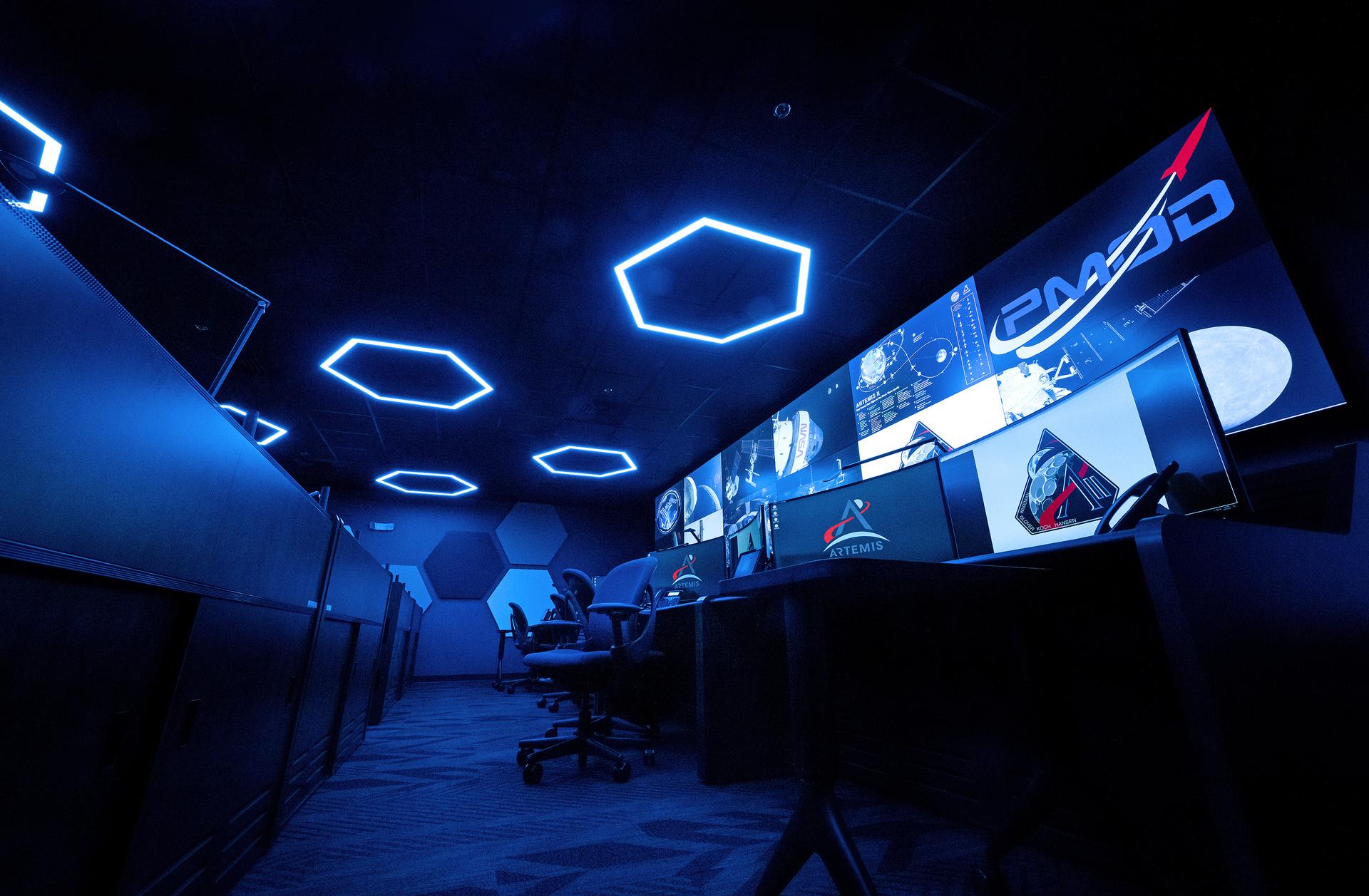
These photos offer a look inside the twin control rooms at NASA’s Marshall Space Flight Center in Huntsville, Alabama, where engineers will monitor Artemis science and future landing operations for Artemis. The LUCA (Lunar Utilization Control Area) and LESA (Lander Engineering Support Area) rooms are part of the Huntsville Operations Support Center at NASA Marshall. The LUCA is specially designed to support a wide variety of science operations on and around the Moon – and beyond. Engineers in the LUCA monitored operations for the Lunar Node-1 experiment, an autonomous navigation payload that was part of the first NASA Commercial Lunar Payload Services (CLPS) launch on Intuitive Machines’ Nova-C lunar lander in 2024. NASA Marshall flight controllers will use the LUCA again for Artemis II to monitor science operations. Beginning with Artemis III, members of the NASA Human Landing System Mission Insight Support Team – a group of engineers, safety leads, flight operations experts, and technical authorities – will work in the LESA. There, they will monitor lander systems in real-time and be involved in key decision-making processes throughout the mission. For more information, contact NASA Marshall’s Office of Communications at 256-544-0034.
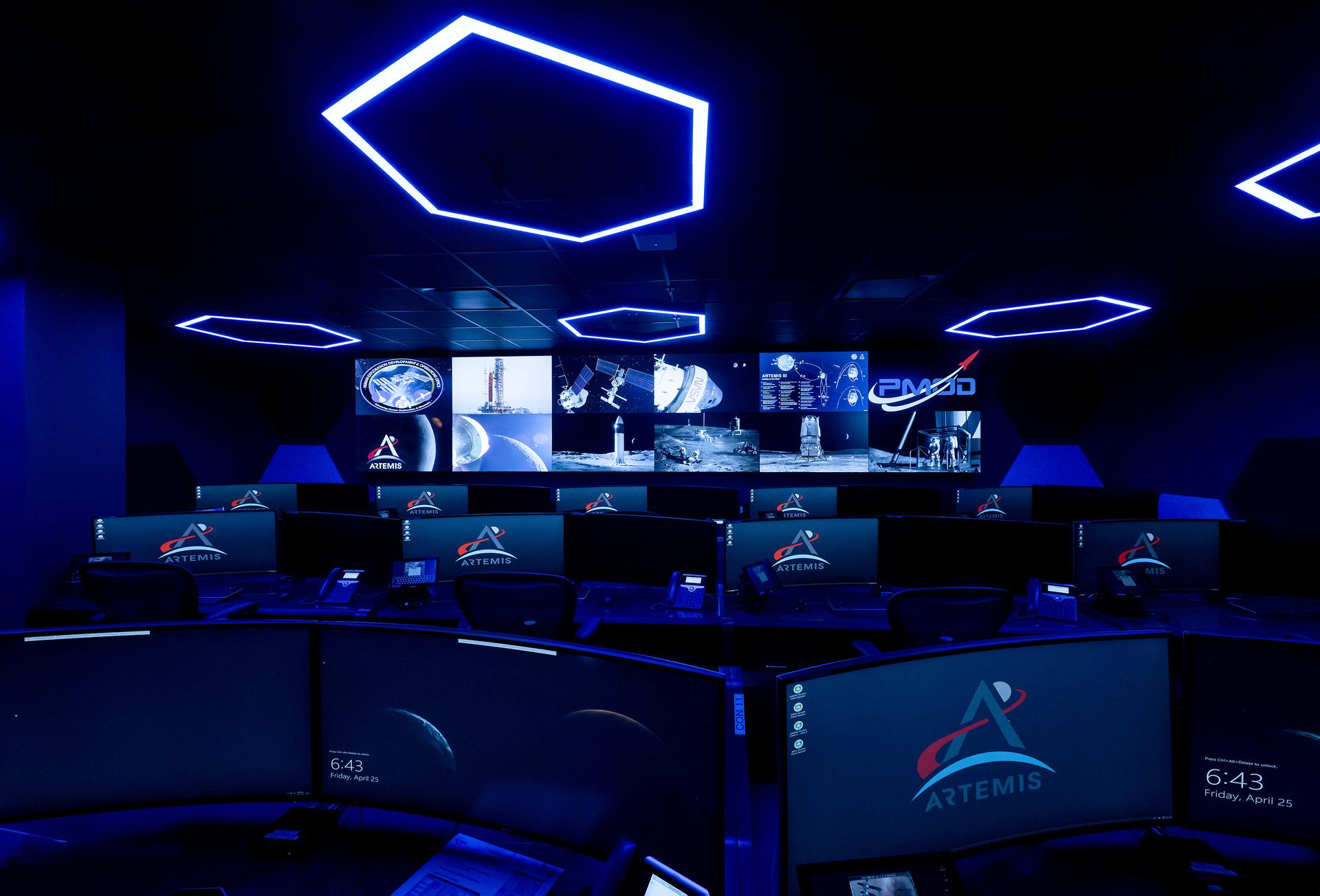
These photos offer a look inside the twin control rooms at NASA’s Marshall Space Flight Center in Huntsville, Alabama, where engineers will monitor Artemis science and future landing operations for Artemis. The LUCA (Lunar Utilization Control Area) and LESA (Lander Engineering Support Area) rooms are part of the Huntsville Operations Support Center at NASA Marshall. The LUCA is specially designed to support a wide variety of science operations on and around the Moon – and beyond. Engineers in the LUCA monitored operations for the Lunar Node-1 experiment, an autonomous navigation payload that was part of the first NASA Commercial Lunar Payload Services (CLPS) launch on Intuitive Machines’ Nova-C lunar lander in 2024. NASA Marshall flight controllers will use the LUCA again for Artemis II to monitor science operations. Beginning with Artemis III, members of the NASA Human Landing System Mission Insight Support Team – a group of engineers, safety leads, flight operations experts, and technical authorities – will work in the LESA. There, they will monitor lander systems in real-time and be involved in key decision-making processes throughout the mission. For more information, contact NASA Marshall’s Office of Communications at 256-544-0034.
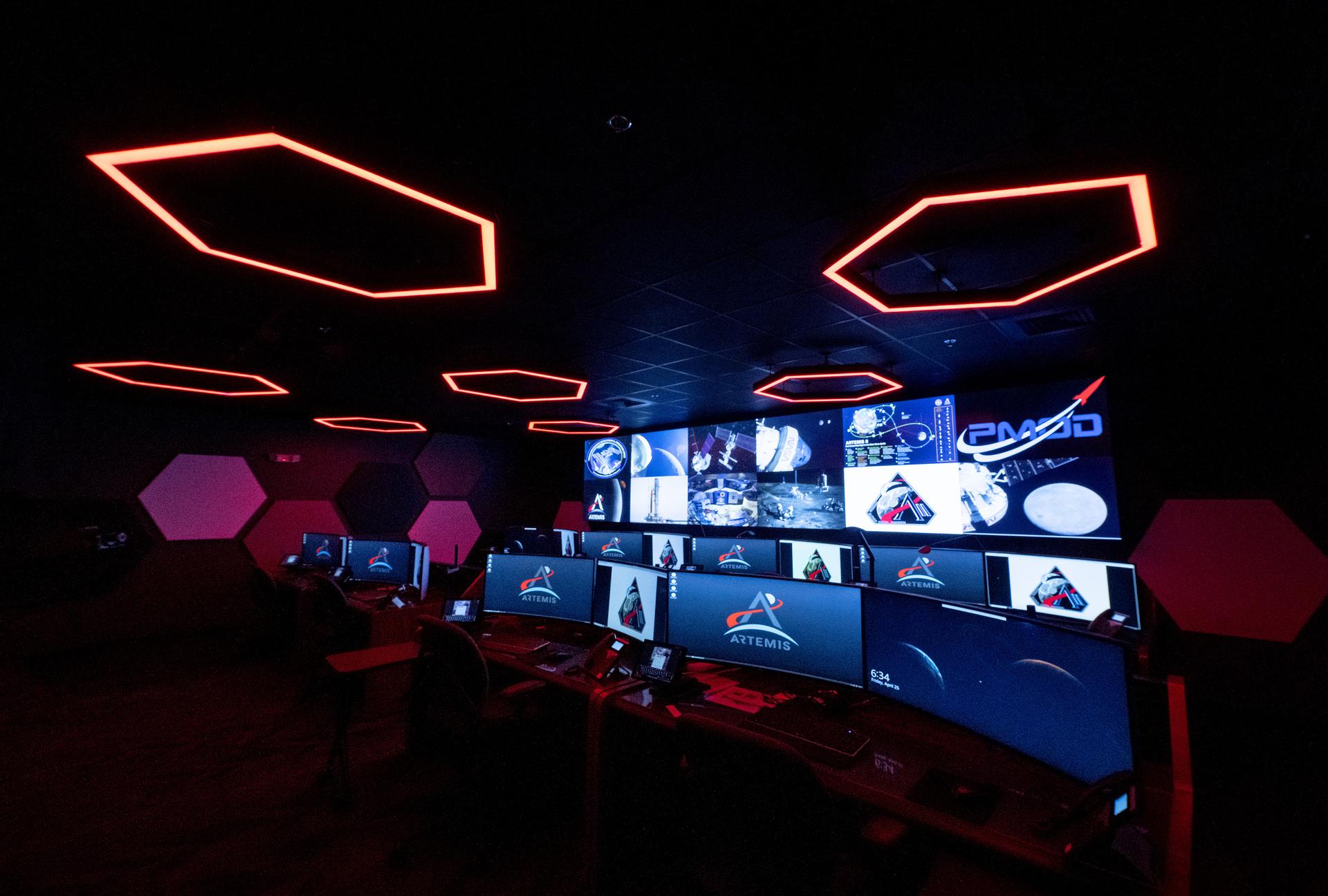
These photos offer a look inside the twin control rooms at NASA’s Marshall Space Flight Center in Huntsville, Alabama, where engineers will monitor Artemis science and future landing operations for Artemis. The LUCA (Lunar Utilization Control Area) and LESA (Lander Engineering Support Area) rooms are part of the Huntsville Operations Support Center at NASA Marshall. The LUCA is specially designed to support a wide variety of science operations on and around the Moon – and beyond. Engineers in the LUCA monitored operations for the Lunar Node-1 experiment, an autonomous navigation payload that was part of the first NASA Commercial Lunar Payload Services (CLPS) launch on Intuitive Machines’ Nova-C lunar lander in 2024. NASA Marshall flight controllers will use the LUCA again for Artemis II to monitor science operations. Beginning with Artemis III, members of the NASA Human Landing System Mission Insight Support Team – a group of engineers, safety leads, flight operations experts, and technical authorities – will work in the LESA. There, they will monitor lander systems in real-time and be involved in key decision-making processes throughout the mission. For more information, contact NASA Marshall’s Office of Communications at 256-544-0034.
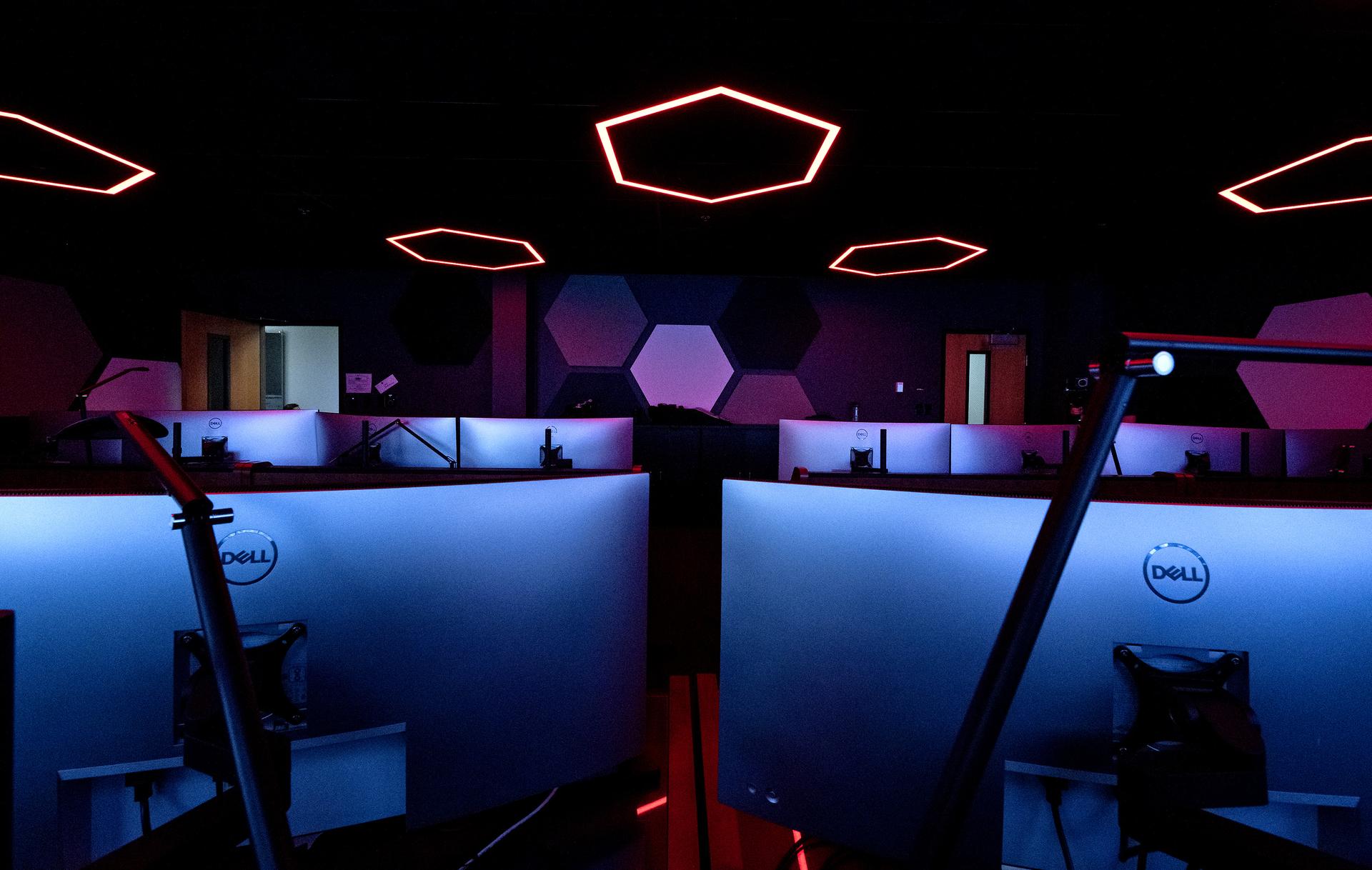
These photos offer a look inside the twin control rooms at NASA’s Marshall Space Flight Center in Huntsville, Alabama, where engineers will monitor Artemis science and future landing operations for Artemis. The LUCA (Lunar Utilization Control Area) and LESA (Lander Engineering Support Area) rooms are part of the Huntsville Operations Support Center at NASA Marshall. The LUCA is specially designed to support a wide variety of science operations on and around the Moon – and beyond. Engineers in the LUCA monitored operations for the Lunar Node-1 experiment, an autonomous navigation payload that was part of the first NASA Commercial Lunar Payload Services (CLPS) launch on Intuitive Machines’ Nova-C lunar lander in 2024. NASA Marshall flight controllers will use the LUCA again for Artemis II to monitor science operations. Beginning with Artemis III, members of the NASA Human Landing System Mission Insight Support Team – a group of engineers, safety leads, flight operations experts, and technical authorities – will work in the LESA. There, they will monitor lander systems in real-time and be involved in key decision-making processes throughout the mission. For more information, contact NASA Marshall’s Office of Communications at 256-544-0034.
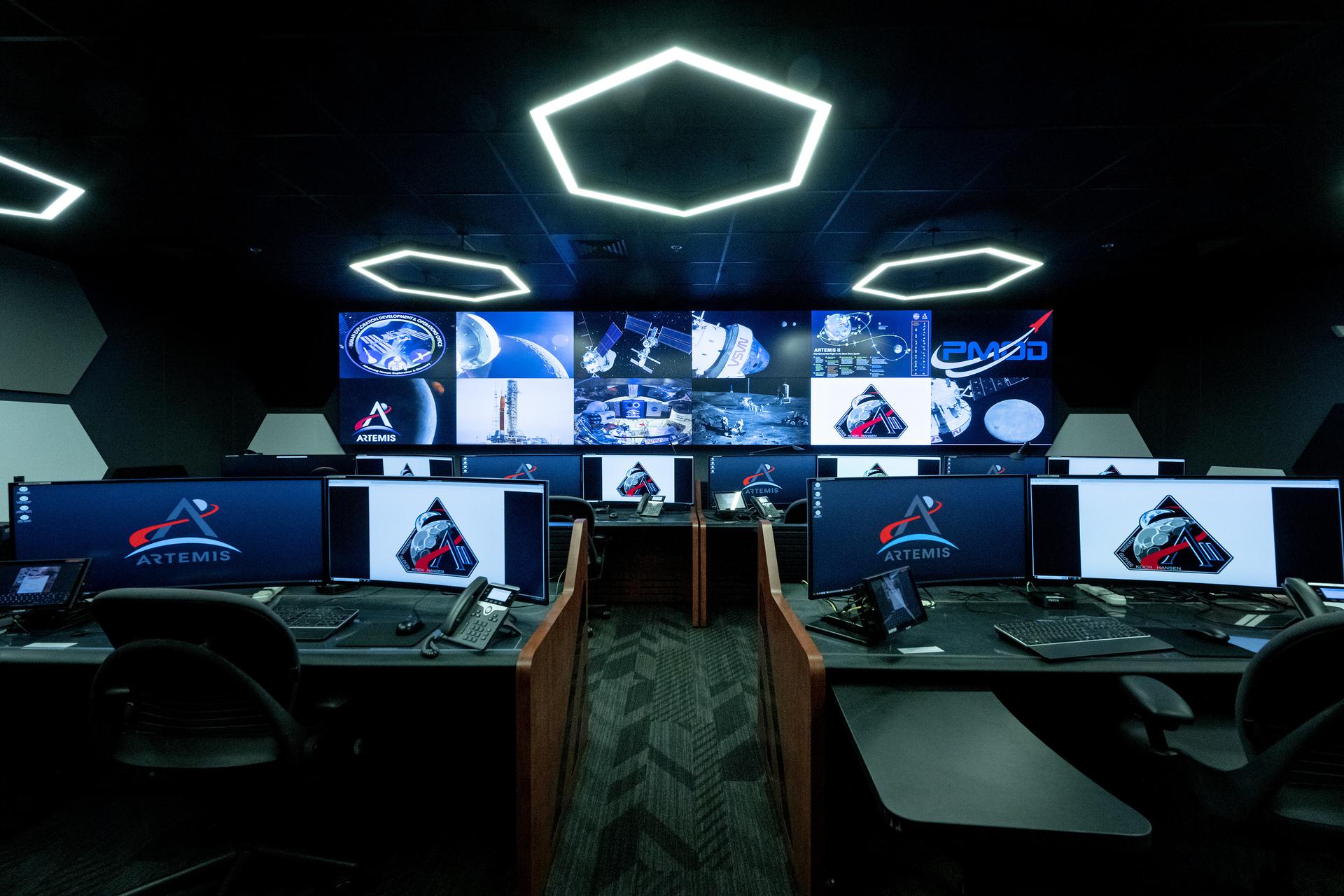
These photos offer a look inside the twin control rooms at NASA’s Marshall Space Flight Center in Huntsville, Alabama, where engineers will monitor Artemis science and future landing operations for Artemis. The LUCA (Lunar Utilization Control Area) and LESA (Lander Engineering Support Area) rooms are part of the Huntsville Operations Support Center at NASA Marshall. The LUCA is specially designed to support a wide variety of science operations on and around the Moon – and beyond. Engineers in the LUCA monitored operations for the Lunar Node-1 experiment, an autonomous navigation payload that was part of the first NASA Commercial Lunar Payload Services (CLPS) launch on Intuitive Machines’ Nova-C lunar lander in 2024. NASA Marshall flight controllers will use the LUCA again for Artemis II to monitor science operations. Beginning with Artemis III, members of the NASA Human Landing System Mission Insight Support Team – a group of engineers, safety leads, flight operations experts, and technical authorities – will work in the LESA. There, they will monitor lander systems in real-time and be involved in key decision-making processes throughout the mission. For more information, contact NASA Marshall’s Office of Communications at 256-544-0034.
jsc2026e000848 --- Artemis lunar science team members, from left, Jacob Richardson, Marie Henderson, and Kiarre Dumes, monitor a lunar flyby simulation from the Science Evaluation Room (SER) at the NASA’s Johnson Space Center in Houston. Located in the Christopher C. Kraft Jr. Mission Control Center, the SER supports the mission’s main flight control room for lunar science and planetary observations. Built specifically for Artemis missions with these science priorities in mind, the SER is equipped to support rapid data interpretation, collaborative analysis, real-time decision making, and seamless coordination between the science and operations teams. Credit: James Blair
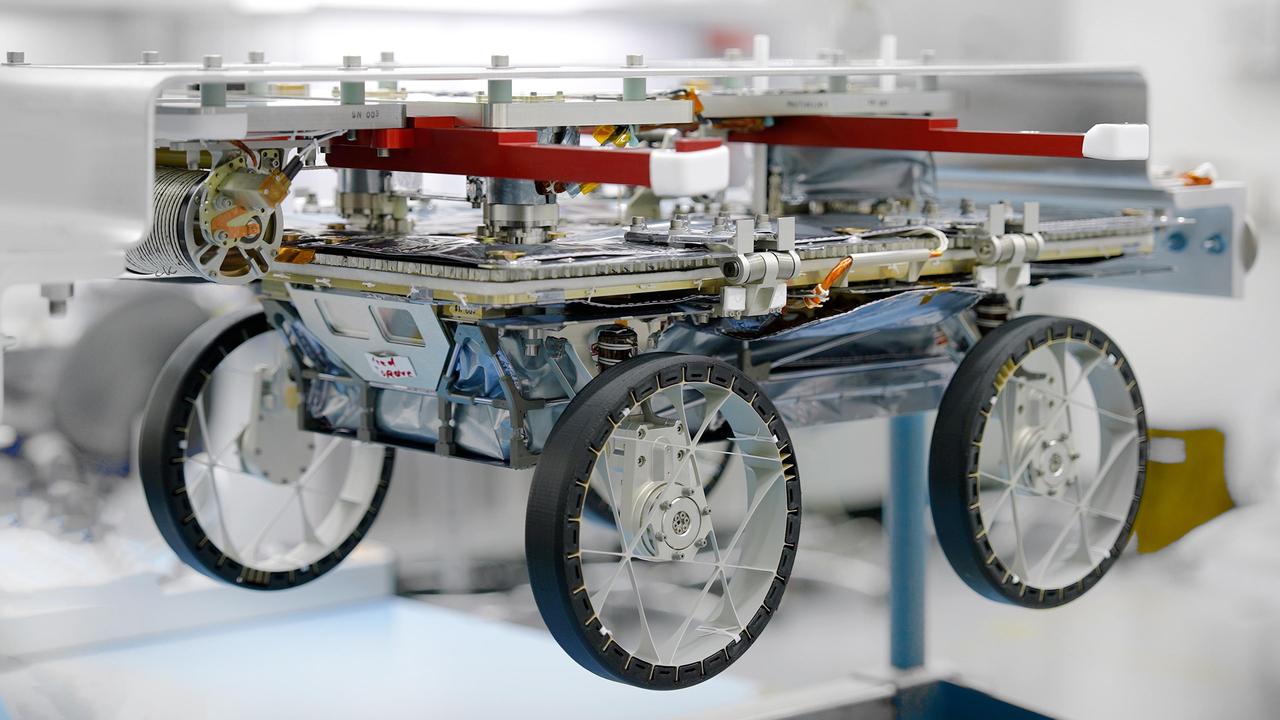
One of three small lunar rovers that are part of a NASA technology demonstration called CADRE (Cooperative Autonomous Distributed Robotic Exploration) is attached to a fixture in a clean room at the agency's Jet Propulsion Laboratory in Southern California on Jan. 29, 2025. Less than two weeks later, the rover had been packed up and shipped off in preparation for launch. CADRE aims to prove that a group of robots can collaborate to gather data without receiving direct commands from mission controllers on Earth. Its trio of rovers will use their cameras and ground-penetrating radars to send back imagery of the lunar surface and subsurface while testing out the novel software systems that enable them to work together as a team autonomously. Before embarking on the first leg of a multistage journey to the Moon, each rover was mated to its deployer system, which will lower it via tether from an Intuitive Machines lander onto the dusty lunar surface. Engineers flipped each rover-deployer pair over and attached it to an aluminum plate for safe transit. The rovers were then sealed into protective metal-frame enclosures that were fitted snuggly into metal shipping containers and loaded onto a truck for the drive to Intuitive Machines' Houston facility. A division of Caltech in Pasadena, California, JPL manages CADRE for the Game Changing Development program within NASA's Space Technology Mission Directorate in Washington. The technology demonstration was selected under the agency's Lunar Surface Innovation Initiative, which was established to expedite the development of technologies for sustained presence on the lunar surface. CADRE will launch as a payload on the third lunar lander mission by Intuitive Machines, called IM-3, under NASA's CLPS (Commercial Lunar Payload Services) initiative, which is managed by the agency's Science Mission Directorate, also in Washington. The agency's Glenn Research Center in Cleveland and its Ames Research Center in Silicon Valley, California, both supported the project. Motiv Space Systems designed and built key hardware elements at the company's Pasadena facility. Clemson University in South Carolina contributed research in support of the project. For more about CADRE, go to: https://go.nasa.gov/cadre https://photojournal.jpl.nasa.gov/catalog/PIA26428
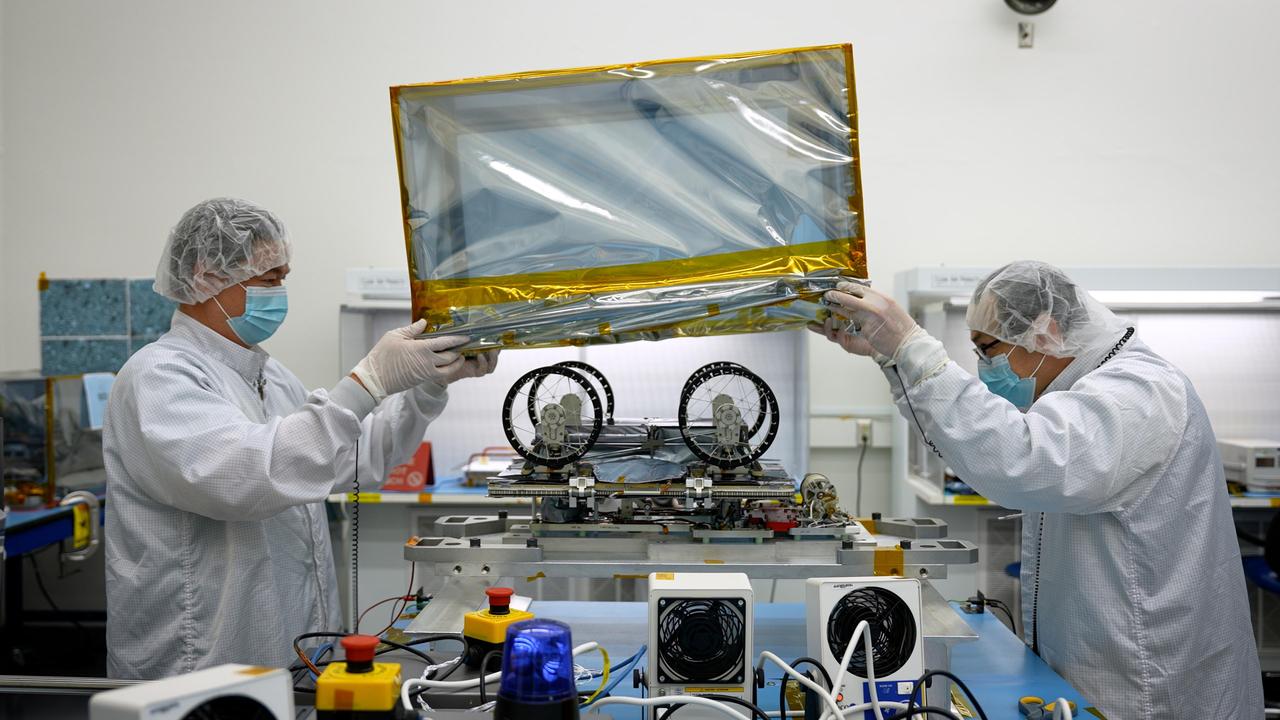
Engineers and technicians prepare one of three small lunar rovers that are part of a NASA technology demonstration called CADRE (Cooperative Autonomous Distributed Robotic Exploration). Mechanical engineer Kristopher Sherrill, left, and technician Leroy Montalvo lower an enclosure over the upside-down rover in a clean room at the agency's Jet Propulsion Laboratory in Southern California on Jan. 29, 2025. CADRE aims to prove that a group of robots can collaborate to gather data without receiving direct commands from mission controllers on Earth. Its trio of rovers will use their cameras and ground-penetrating radars to send back imagery of the lunar surface and subsurface while testing out the novel software systems that enable them to work together as a team autonomously. Before embarking on the first leg of a multistage journey to the Moon, each rover was mated to its deployer system, which will lower it via tether from an Intuitive Machines lander onto the dusty lunar surface. Engineers flipped each rover-deployer pair over and attached it to an aluminum plate for safe transit. The rovers were then sealed into protective metal-frame enclosures that were fitted snuggly into metal shipping containers and loaded onto a truck for the drive to Intuitive Machines' Houston facility. A division of Caltech in Pasadena, California, JPL manages CADRE for the Game Changing Development program within NASA's Space Technology Mission Directorate in Washington. The technology demonstration was selected under the agency's Lunar Surface Innovation Initiative, which was established to expedite the development of technologies for sustained presence on the lunar surface. CADRE will launch as a payload on the third lunar lander mission by Intuitive Machines, called IM-3, under NASA's CLPS (Commercial Lunar Payload Services) initiative, which is managed by the agency's Science Mission Directorate, also in Washington. The agency's Glenn Research Center in Cleveland and its Ames Research Center in Silicon Valley, California, both supported the project. Motiv Space Systems designed and built key hardware elements at the company's Pasadena facility. Clemson University in South Carolina contributed research in support of the project. For more about CADRE, go to: https://go.nasa.gov/cadre https://photojournal.jpl.nasa.gov/catalog/PIA26426
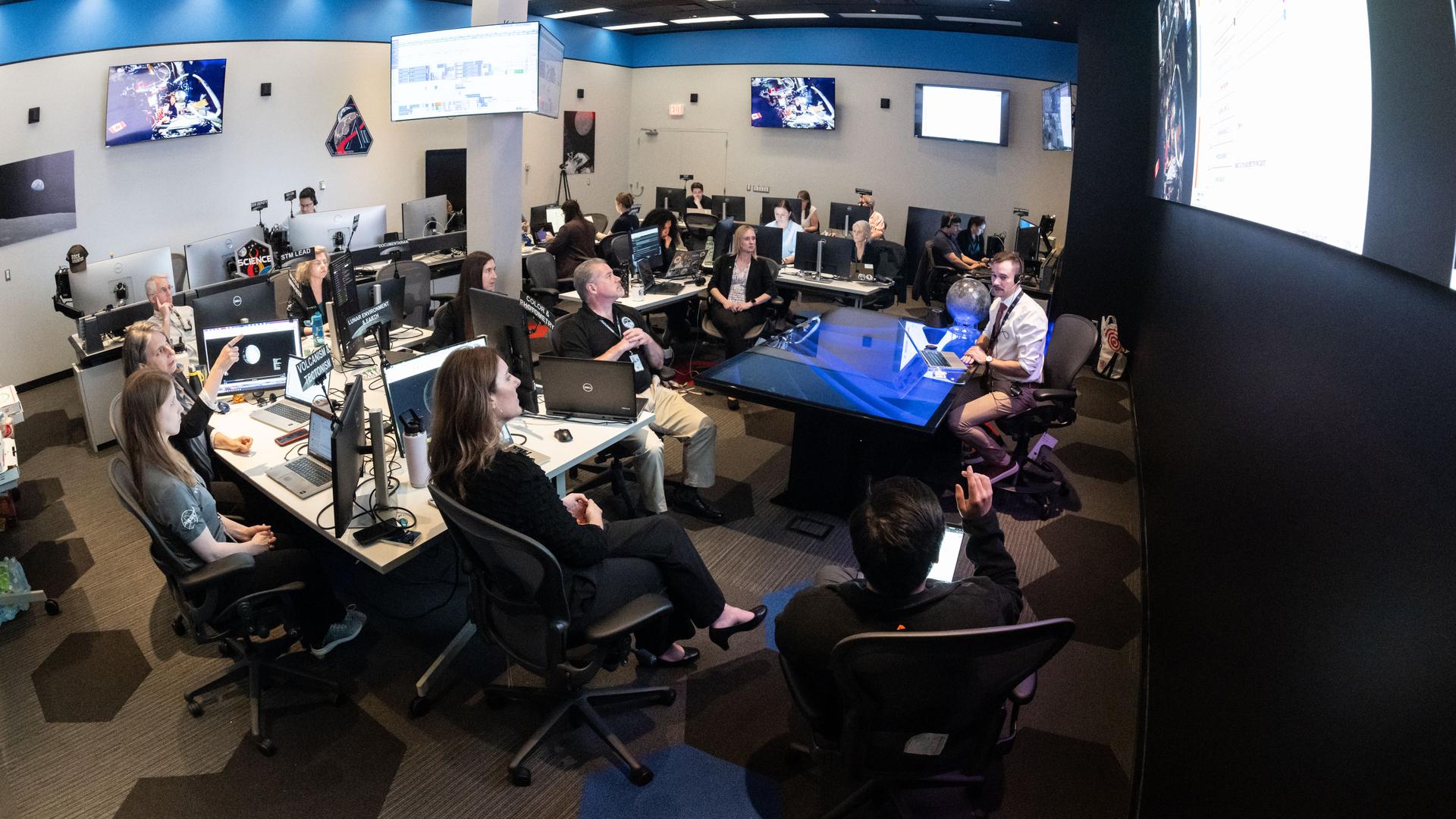
The Artemis II lunar science team works on the lunar targeting plan for the astronauts' several-hour flyby of the Moon, scheduled for April 6. As they pass the Moon, the crew will apply geology skills learned in the classroom and in Moon-like environments on Earth to photograph and describe features including impact craters, ancient lava flows, and surface cracks and ridges formed as the Moon slowly changed over time. They will note differences in color, brightness, and texture, which provide clues that help scientists understand what the surface is made of and how it formed. Credits: NASA/Bill Stafford
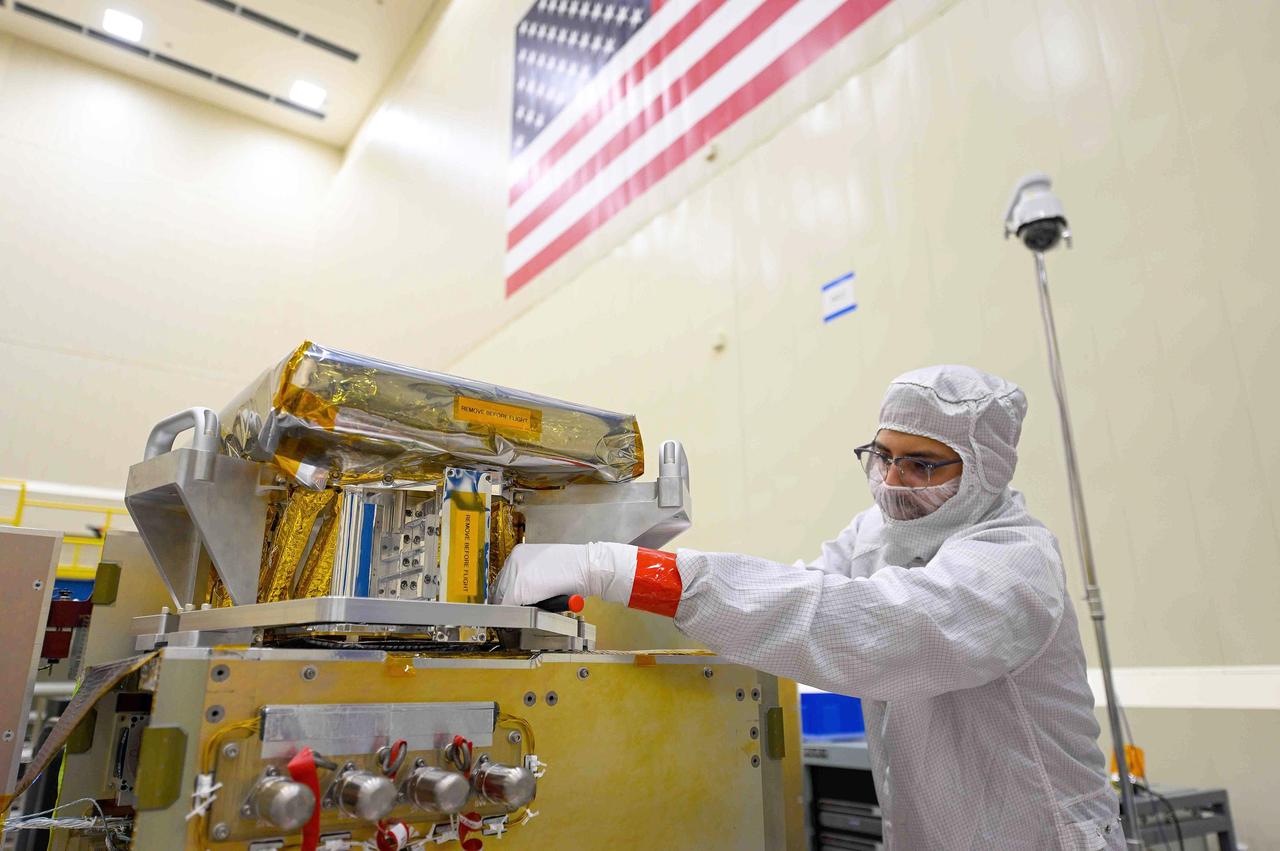
An engineer works on the High-resolution Volatiles and Minerals Moon Mapper (HVM³) for NASA's Lunar Trailblazer spacecraft in a clean room at Lockheed Martin Space in Littleton, Colorado, shortly after the instrument delivered in December 2022. HVM³ is an imaging spectrometer that was developed at NASA's Jet Propulsion Laboratory in Southern California. It was shipped from JPL to Lockheed Martin Space, where it was integrated with the spacecraft. HVM³ is one of two instruments that will be used by the mission to detect and map water on the Moon's surface to determine its abundance, location, form, and how it changes over time. Lunar Trailblazer was selected under NASA's Small Innovative Missions for Planetary Exploration (SIMPLEx) program in 2019. The Lunar Trailblazer mission is managed by JPL and its science investigation is led by Caltech in Pasadena, California. Managed for NASA by Caltech, JPL also provides system engineering, mission assurance, the HVM³ instrument, as well as navigation. Lockheed Martin Space provides the spacecraft and integrates the flight system, under contract with Caltech. SIMPLEx mission investigations are managed by the Planetary Missions Program Office at NASA's Marshall Space Flight Center in Huntsville, Alabama, as part of the Discovery Program at NASA Headquarters in Washington. The program conducts space science investigations in the Planetary Science Division of NASA's Science Mission Directorate at NASA Headquarters. https://photojournal.jpl.nasa.gov/catalog/PIA25255

S71-23602 (17 March 1971) --- Left to right: Everett Gibson, Gary McCollom, unidentified man in control room of Lunar Receiving Lab (LRL) during Apollo 14 quarantine period. Photo credit: NASA
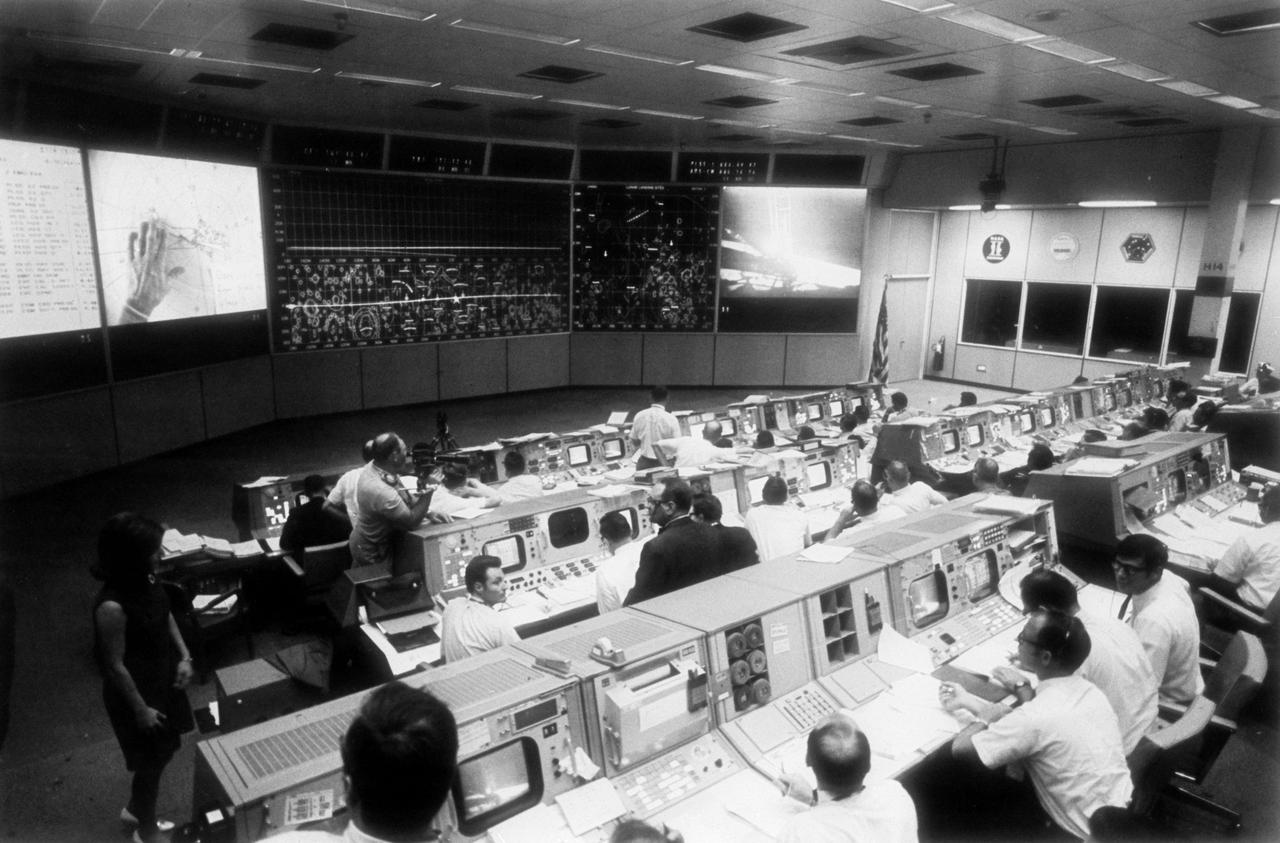
Overall view of the Mission Operations Control Room in the Mission Control Center, bldg 30, during the lunar surface extravehicular activity (EVA) of Apollo 11 Astronauts Neil A. Armstrong and Edwin E. Aldrin Jr.
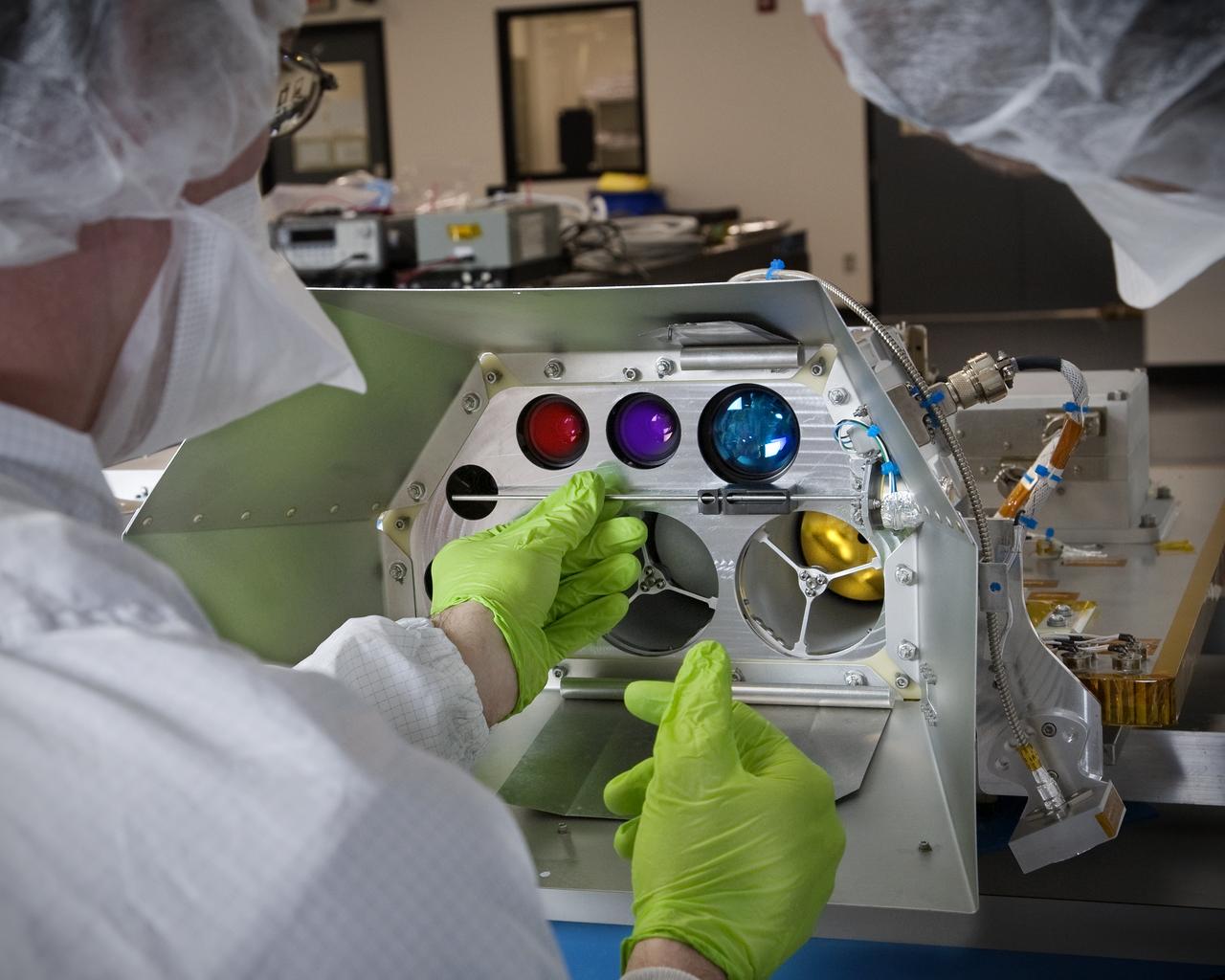
LCROSS leaves Northrup Grumman Redondo Beach, CA clean room post shippment verification tests before being mated to the Lunar Reconnaissance Orbitor (LR0) spacecraft for a piggyback ride to the Moon.
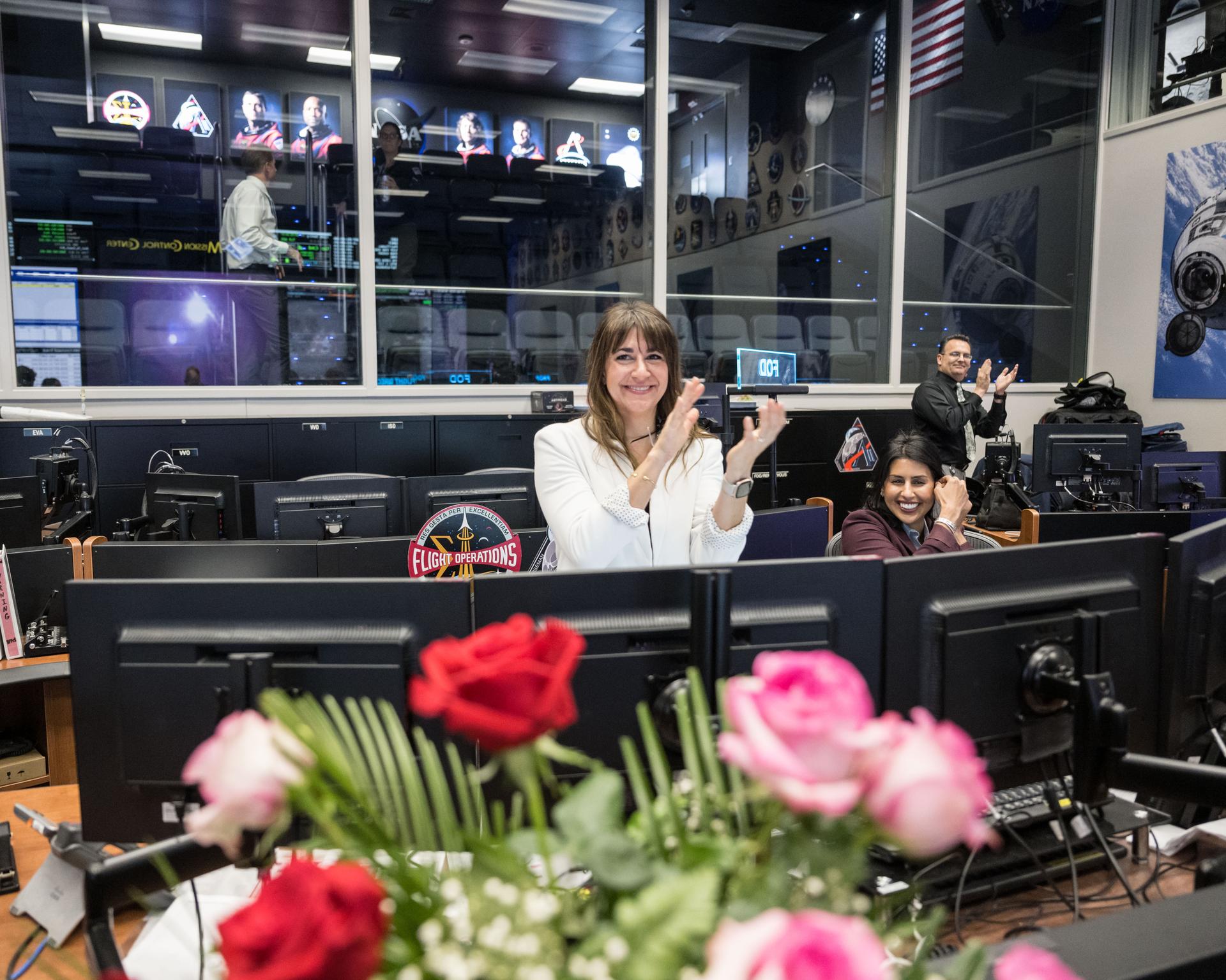
jsc2026e020501 (April 6, 2026) - NASA Flight Directors Diane Dailey, Pooja Jesrani, and Paul Konyha pictured in the White Flight Control Room during the Artemis II crew’s lunar flyby. Credit: NASA
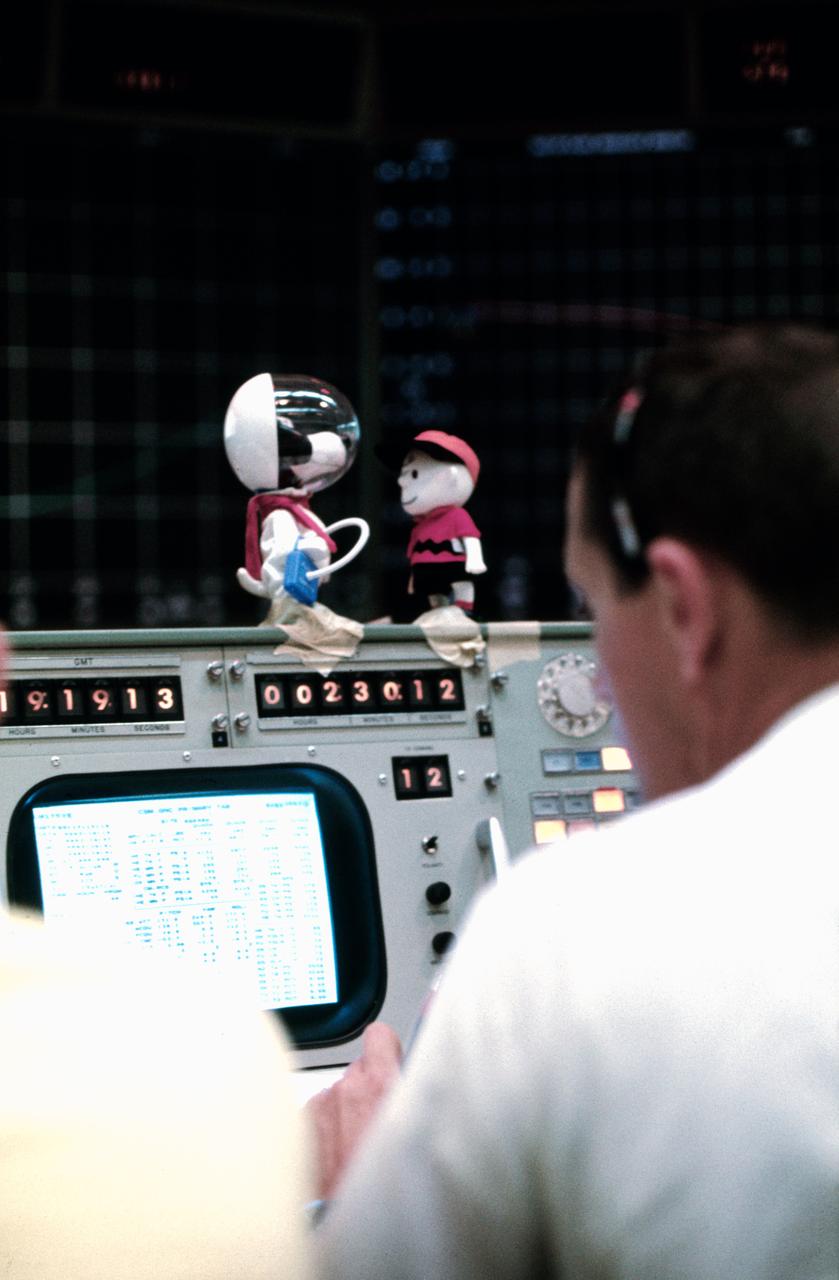
S69-34314 (18 May 1969) --- Replicas of Snoopy and Charlie Brown, the two characters from Charles Schulz's syndicated comic strip, "Peanuts," decorate the top of a console in the Mission Operations Control Room in the Mission Control Center, Building 30, on the first day of the Apollo 10 lunar orbit mission. During lunar orbit operations, the Lunar Module will be called ?Snoopy? when it is separated from the Command and Service Modules. The code words for the Command Module will be ?Charlie Brown?.

S69-40205 (27 July 1969) --- The crewmen of the Apollo 11 lunar landing mission go through their post flight debriefing session on Sunday, July 27, 1969. Left to right, are astronauts Edwin E. Aldrin Jr., lunar module pilot; Michael Collins, command module pilot; and Neil A. Armstrong, commander. They are seated in the debriefing room of the Crew Reception Area of the Lunar Receiving Laboratory at the Manned Spacecraft Center.

S69-39590 (20 July 1969) --- Astronaut David R. Scott is seated at a console in the Mission Operations Control Room (MOCR) in the Mission Control Center (MCC), Building 30, during the Apollo 11 lunar landing mission. He is watching a television monitor during the lunar surface extravehicular activity (EVA) in which astronauts Neil A. Armstrong and Edwin E. Aldrin Jr. participated. Scott is the backup crew commander for the scheduled Apollo 12 lunar landing mission.
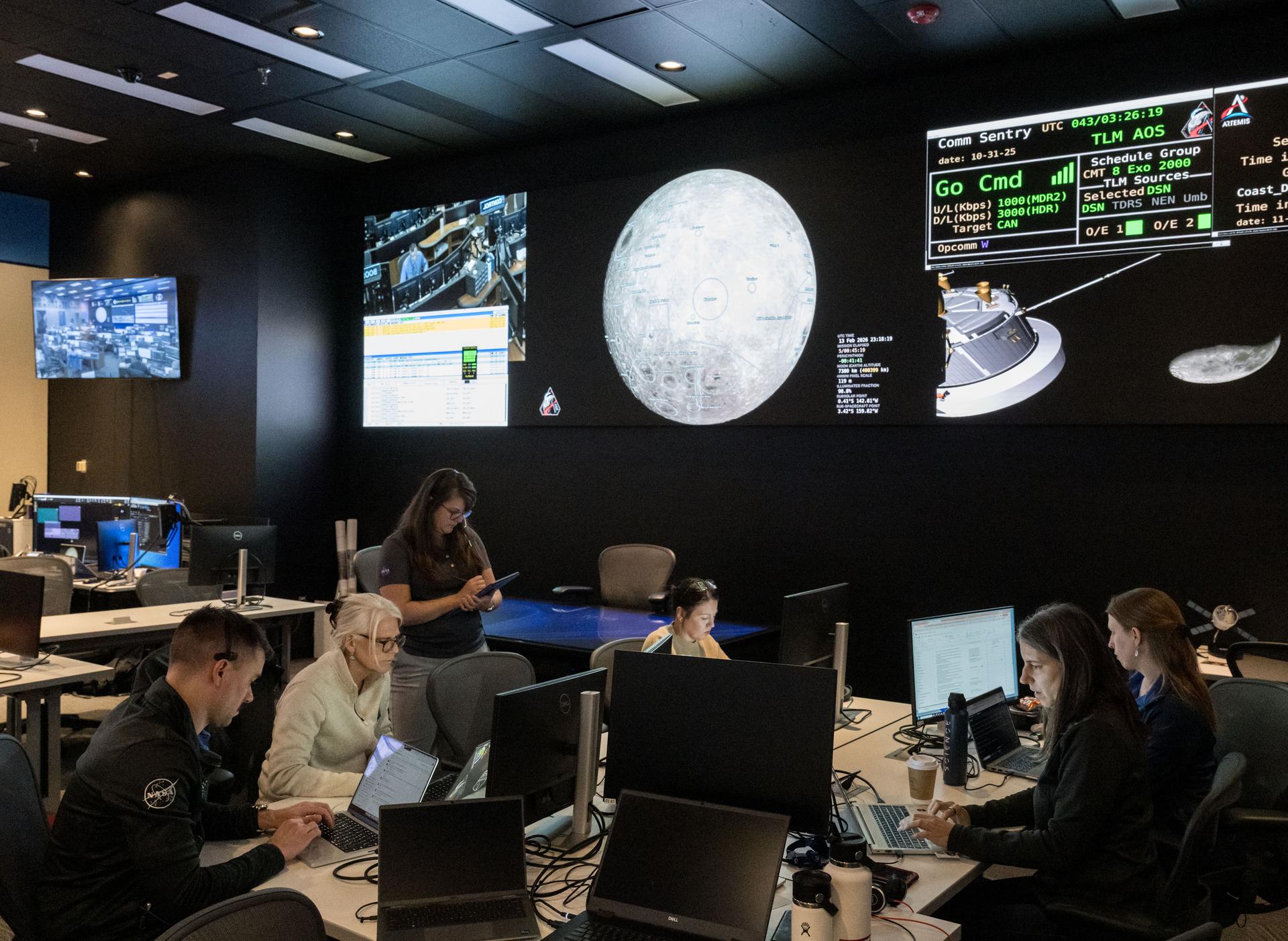
jsc2026e000849 --- The Artemis II Lunar Science Team works in the Science Evaluation Room (SER) during a training simulation at the NASA’s Johnson Space Center in Houston. Located in the Christopher C. Kraft Jr. Mission Control Center, the SER supports the mission’s main flight control room for lunar science and planetary observations. Built specifically for Artemis missions with these science priorities in mind, the SER is equipped to support rapid data interpretation, collaborative analysis, real-time decision making, and seamless coordination between the science and operations teams. Credit: James Blair
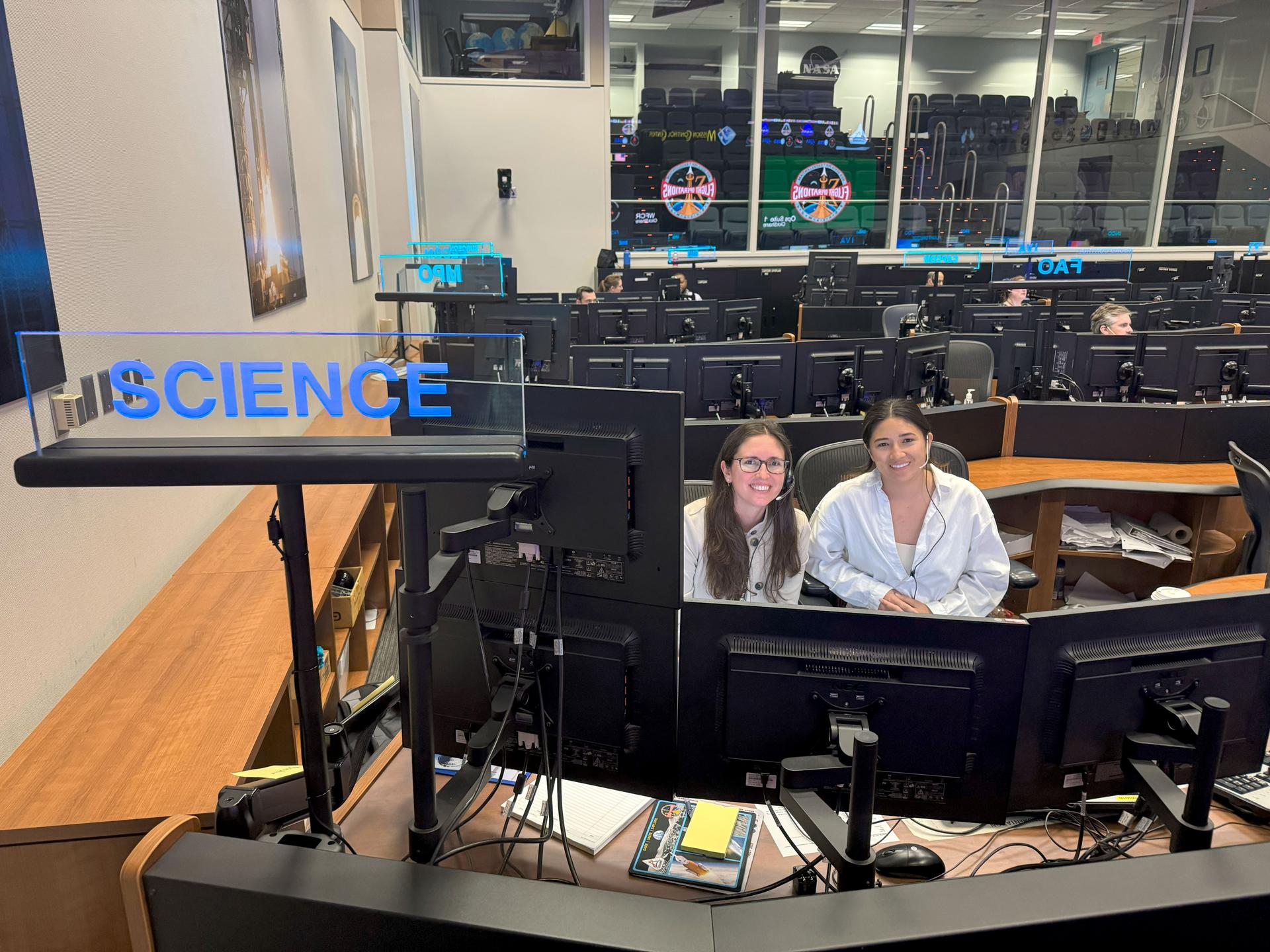
jsc2025e067512 --- Artemis II science officers Kelsey Young, left, and Angela Garcia sit at the SCIENCE console during a training simulation in the White Flight Control Room of the Mission Control Center at NASA's Johnson Space Center in Houston. Artemis II will test mission science operations and integration into flight control. Lessons learned during Artemis II science operations will pave the way for lunar science operations for future Artemis missions. A team of experts will staff the Science Evaluation Room (SER) at Johnson, providing lunar scientific expertise, data analysis, and strategic guidance in real-time to the science officer and the rest of Mission Control.
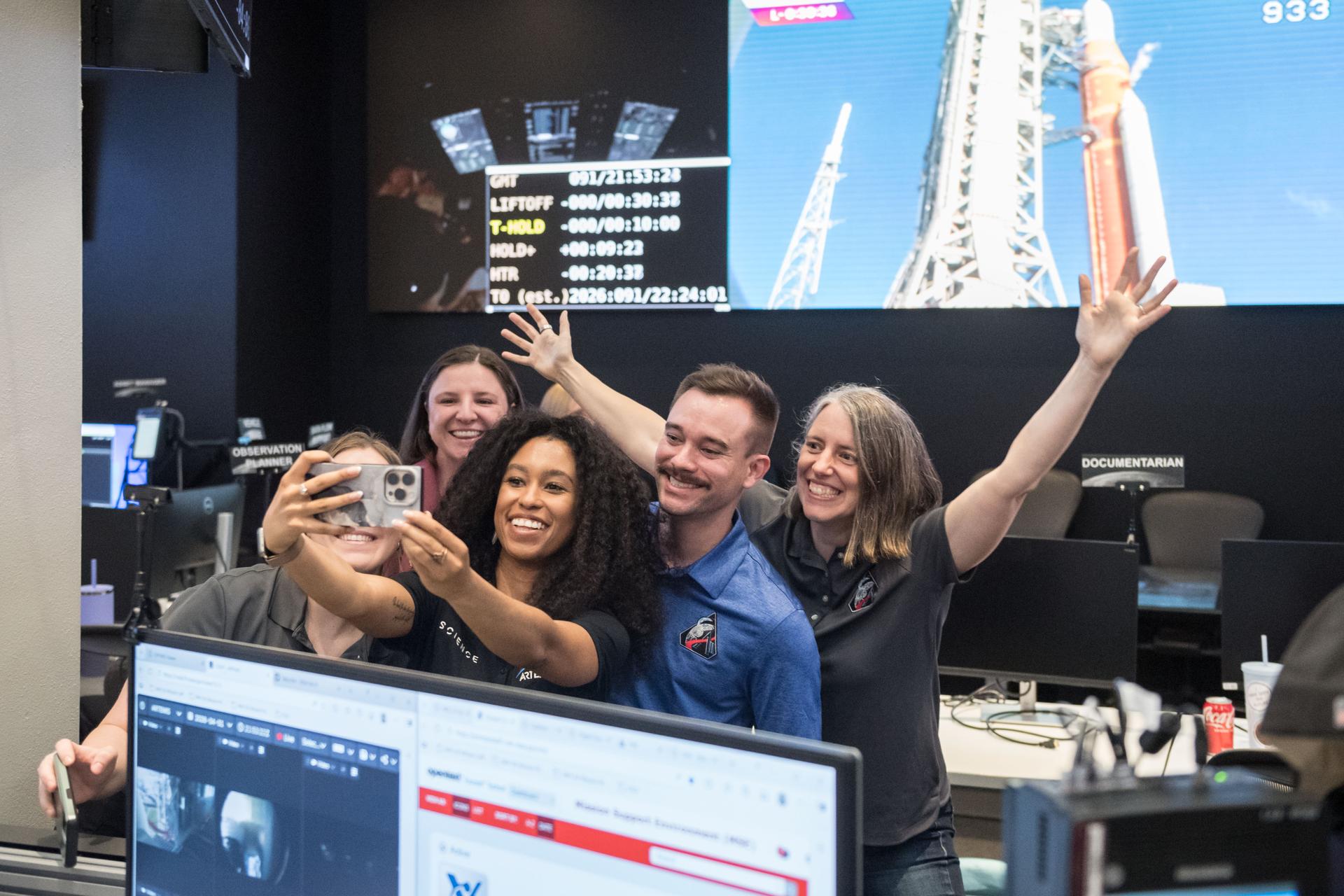
Members of the Artemis lunar science team, from left, Sara Schmidt, Megan Borel, Amber Turner, Jacob Richardson, and Juliane Gross pose for a selfie with the Artemis II launch broadcast on the screen behind them in the Science Evaluation Room (SER) in Mission Control at NASA's Johnson Space Center in Houston. The SER supports lunar science and planetary observations for the Artemis science officer in the mission’s main flight control room. Built specifically for Artemis missions with these science priorities in mind, the SER is equipped to support rapid data interpretation, collaborative analysis, real-time decision making, and seamless coordination between the science and operations teams. Credits: NASA/Mark Sowa.
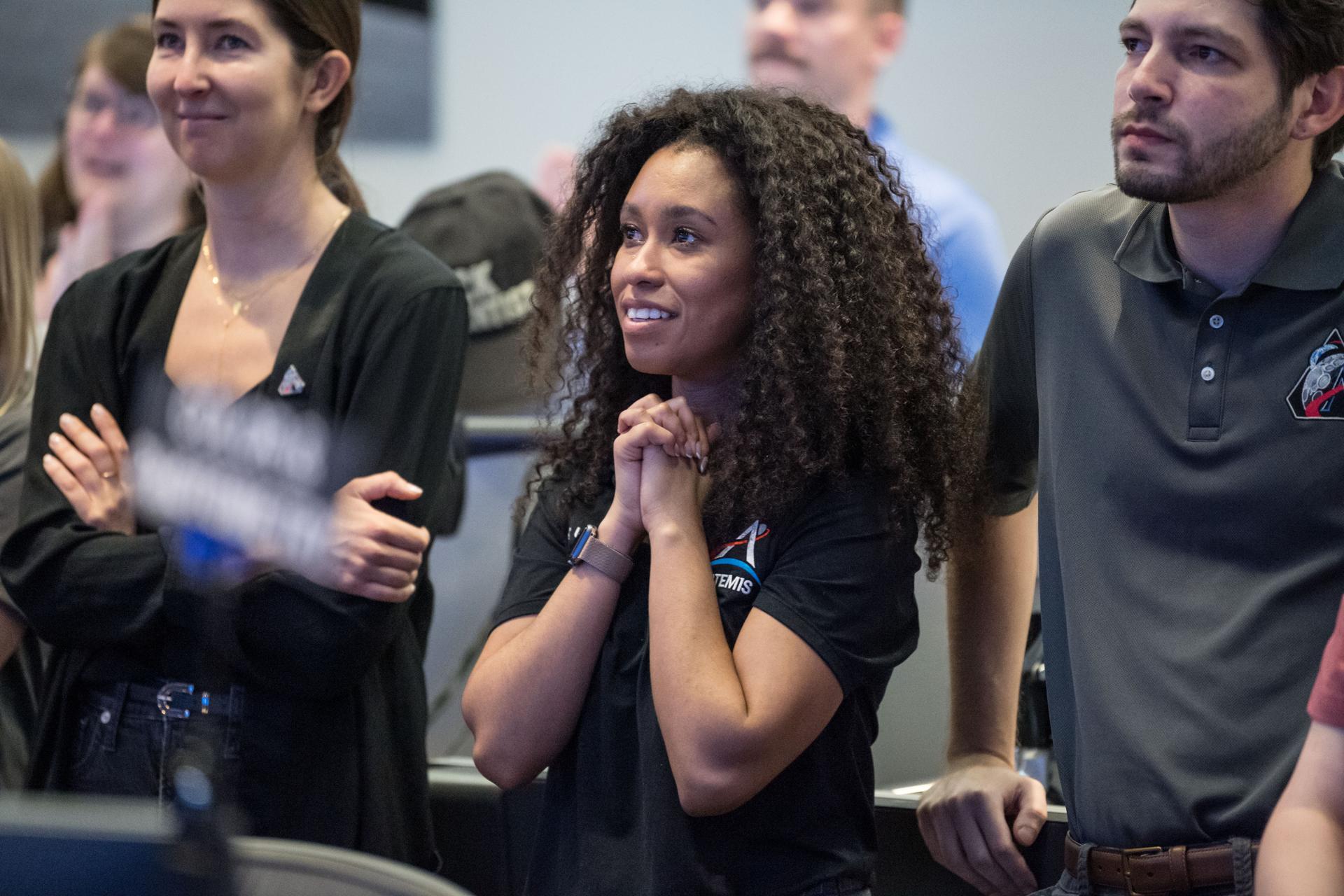
Members of the Artemis lunar science team, from left, Ariel Deutsch, Amber Turner, and Wilfredo Garcia-Lopez, watch the Artemis II launch from the Science Evaluation Room (SER) in Mission Control at Johnson Space Center in Houston. The SER supports lunar science and planetary observations for the Artemis science officer in the mission’s main flight control room. Built specifically for Artemis missions with these science priorities in mind, the SER is equipped to support rapid data interpretation, collaborative analysis, real-time decision making, and seamless coordination between the science and operations teams. Credits: NASA/Mark Sowa.
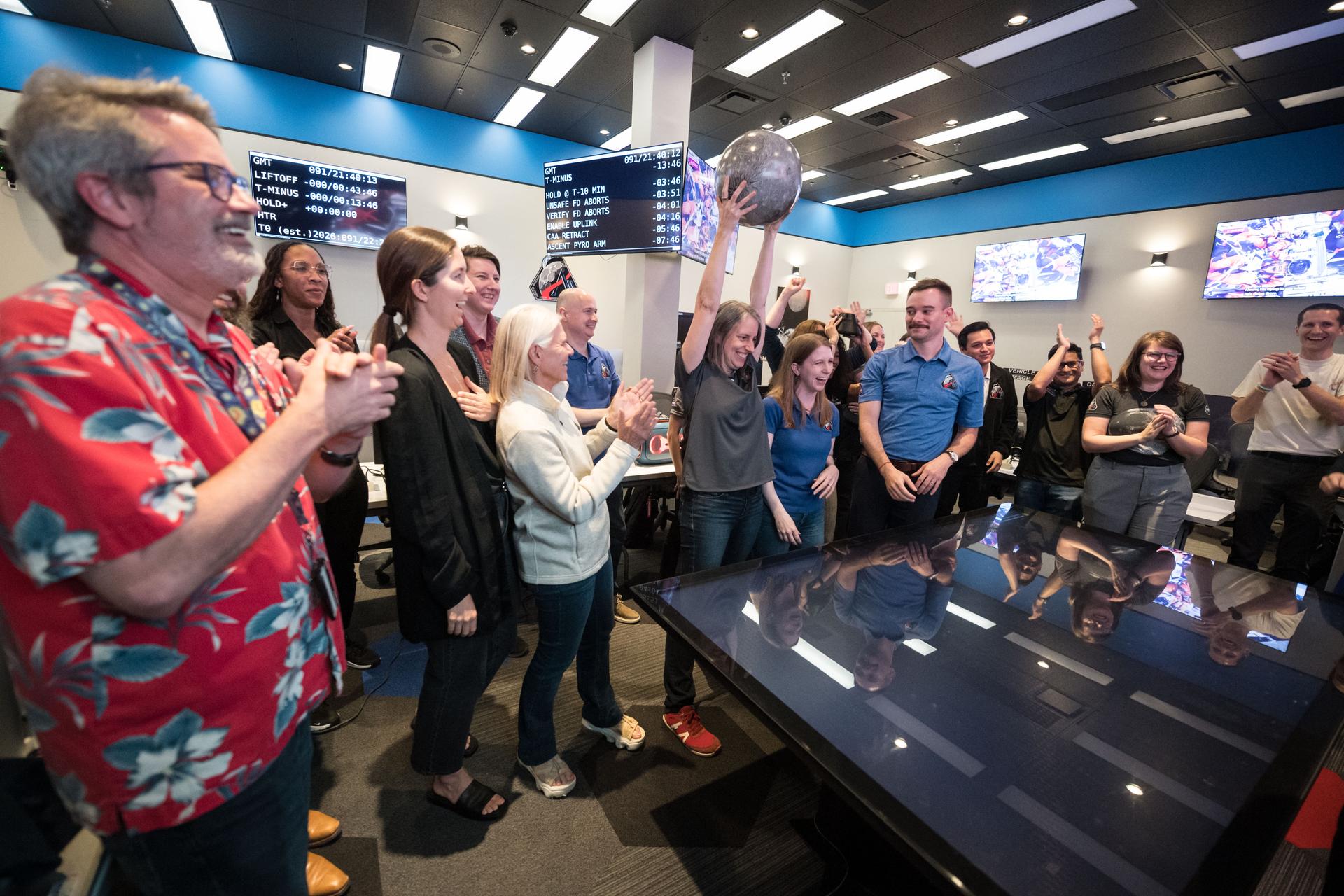
Members of the Artemis lunar science team cheer as they gather to watch the Artemis II launch broadcast from the Science Evaluation Room (SER) in Mission Control at NASA's Johnson Space Center in Houston. The SER supports lunar science and planetary observations for the Artemis science officer in the mission’s main flight control room. Built specifically for Artemis missions with these science priorities in mind, the SER is equipped to support rapid data interpretation, collaborative analysis, real-time decision making, and seamless coordination between the science and operations teams. Credits: NASA/Mark Sowa.
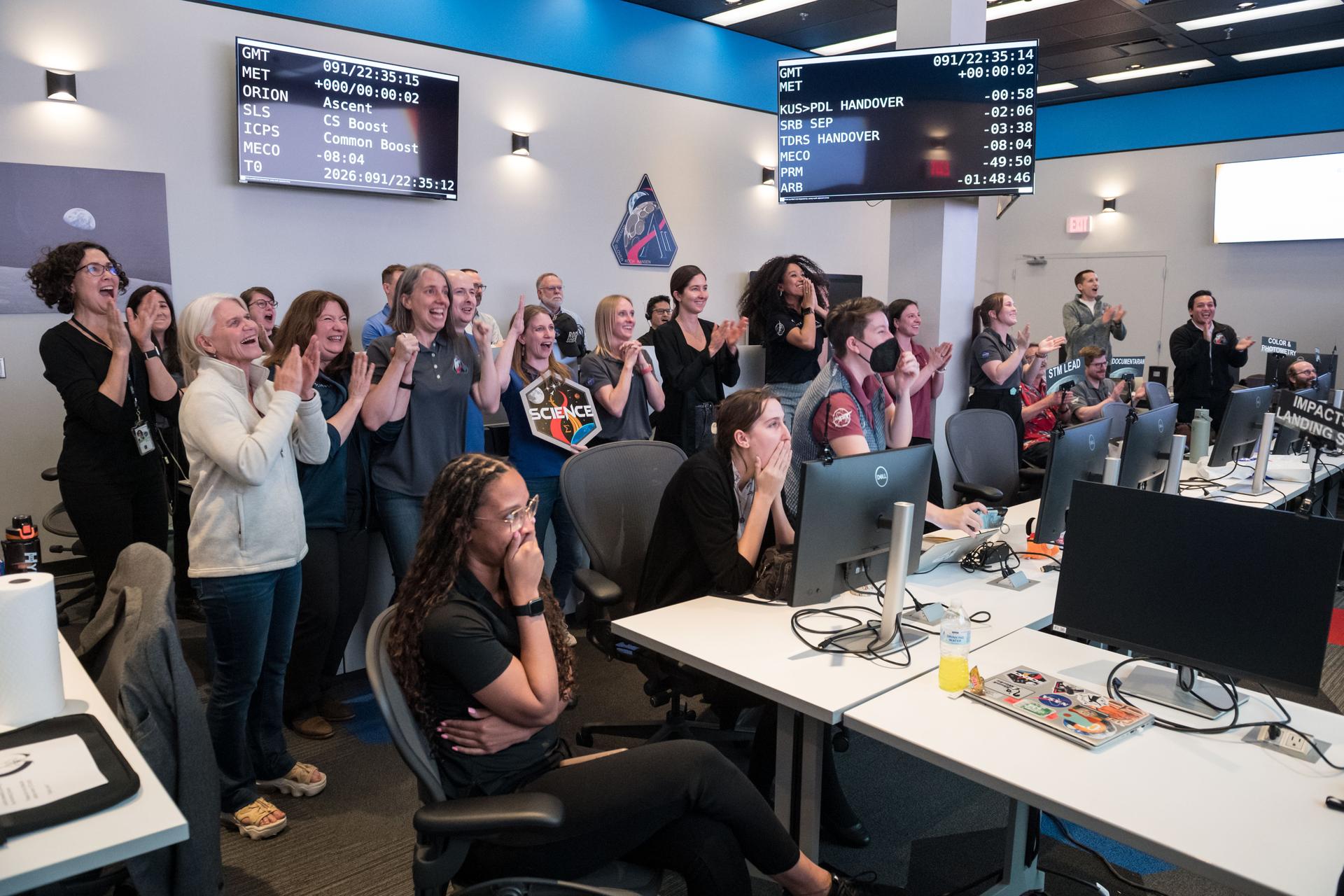
Members of the Artemis lunar science team celebrate the Artemis II launch as they watch from the Science Evaluation Room (SER) in Mission Control at NASA's Johnson Space Center in Houston. The SER supports lunar science and planetary observations for the Artemis science officer in the mission’s main flight control room. Built specifically for Artemis missions with these science priorities in mind, the SER is equipped to support rapid data interpretation, collaborative analysis, real-time decision making, and seamless coordination between the science and operations teams. Credits: NASA/Mark Sowa.
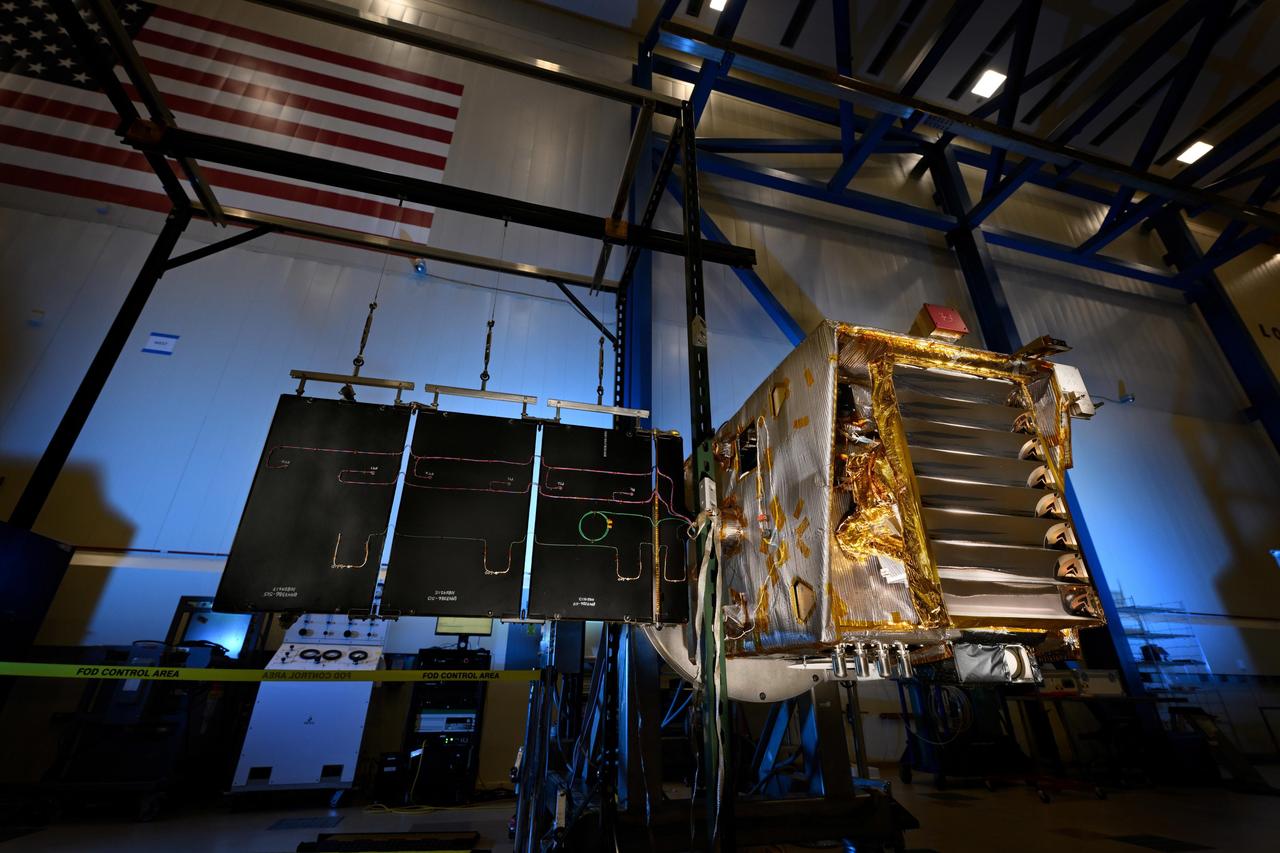
NASA's Lunar Trailblazer spacecraft sits in a clean room in August 2024 after undergoing environmental testing at Lockheed Martin Space in Littleton, Colorado. Now that those tests are done, the orbiter and its science instruments will go through flight system software tests that simulate key aspects of launch, maneuvers, and the science mission while in orbit around the Moon. This photo shows Lunar Trailblazer with a solar array deployed. The large silver grate attached to the spacecraft is the radiator for the High-resolution Volatiles and Minerals Moon Mapper (HVM³) instrument. HVM³ is one of two instruments that will be used by the mission to detect and map water on the Moon's surface to determine its abundance, location, form, and how it changes over time. This data will be key to our understanding of this crucial resource on the Moon for future exploration. The spacecraft is just 440 pounds (200 kilograms) and 11.5 feet (3.5 meters) wide with its solar panels fully deployed. The project is led by Principal Investigator Bethany Ehlmann of Caltech and managed by NASA's Jet Propulsion Laboratory in Southern California, which is also providing systems engineering, navigation, and mission assurance. Caltech manages JPL for the agency. Lunar Trailblazer is part of NASA's Small Innovative Missions for Planetary Exploration (SIMPLEx) program, which provides opportunities for low-cost, high-risk science missions that are responsive to requirements for flexibility. These lower-cost missions serve as an ideal platform for technical and architecture innovation, contributing to NASA's science research and technology development objectives. SIMPLEx mission investigations are managed by the Planetary Missions Program Office at NASA's Marshall Space Flight Center in Huntsville, Alabama, as part of the Discovery Program at NASA Headquarters in Washington. IPAC leads mission operations, including planning, scheduling, and sequencing all science and spacecraft activities. https://photojournal.jpl.nasa.gov/catalog/PIA26390
NASA Headquarters redesign featuring artifacts, interactive exhibits, replica mars rover, and donut shop at NASA Headquarters in Washington, DC. Photo Credit: (NASA/Tiffany Coutris)
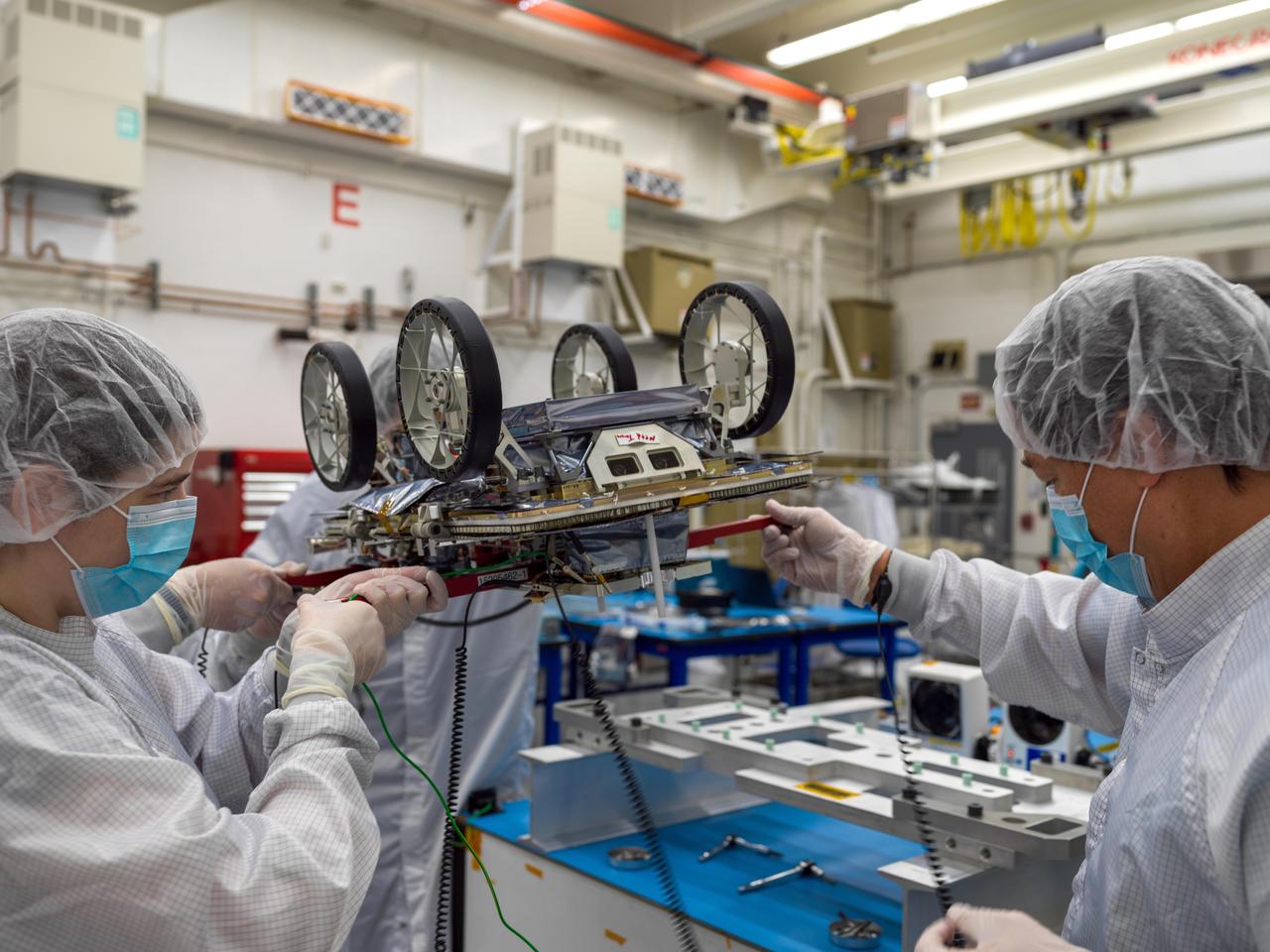
One of three small lunar rovers that are part of a NASA technology demonstration called CADRE (Cooperative Autonomous Distributed Robotic Exploration) is prepared for shipping in a clean room at the agency's Jet Propulsion Laboratory in Southern California on Jan. 29, 2025. CADRE aims to prove that a group of robots can collaborate to gather data without receiving direct commands from mission controllers on Earth. Its trio of rovers will use their cameras and ground-penetrating radars to send back imagery of the lunar surface and subsurface while testing out the novel software systems that enable them to work together as a team autonomously. Before embarking on the first leg of a multistage journey to the Moon, each rover was mated to its deployer system, which will lower it via tether from an Intuitive Machines lander onto the dusty lunar surface. Engineers flipped each rover-deployer pair over and attached it to an aluminum plate for safe transit. The rovers were then sealed into protective metal-frame enclosures that were fitted snuggly into metal shipping containers and loaded onto a truck for the drive to Intuitive Machines' Houston facility. Here, members of the project's assembly, test, and launch operations team hold the upside-down rover by temporary red handles in order to move it to a table where they'll attach it to the aluminum plate. A division of Caltech in Pasadena, California, JPL manages CADRE for the Game Changing Development program within NASA's Space Technology Mission Directorate in Washington. The technology demonstration was selected under the agency's Lunar Surface Innovation Initiative, which was established to expedite the development of technologies for sustained presence on the lunar surface. CADRE will launch as a payload on the third lunar lander mission by Intuitive Machines, called IM-3, under NASA's CLPS (Commercial Lunar Payload Services) initiative, which is managed by the agency's Science Mission Directorate, also in Washington. The agency's Glenn Research Center in Cleveland and its Ames Research Center in Silicon Valley, California, both supported the project. Motiv Space Systems designed and built key hardware elements at the company's Pasadena facility. Clemson University in South Carolina contributed research in support of the project. For more about CADRE, go to: https://go.nasa.gov/cadre https://photojournal.jpl.nasa.gov/catalog/PIA26427
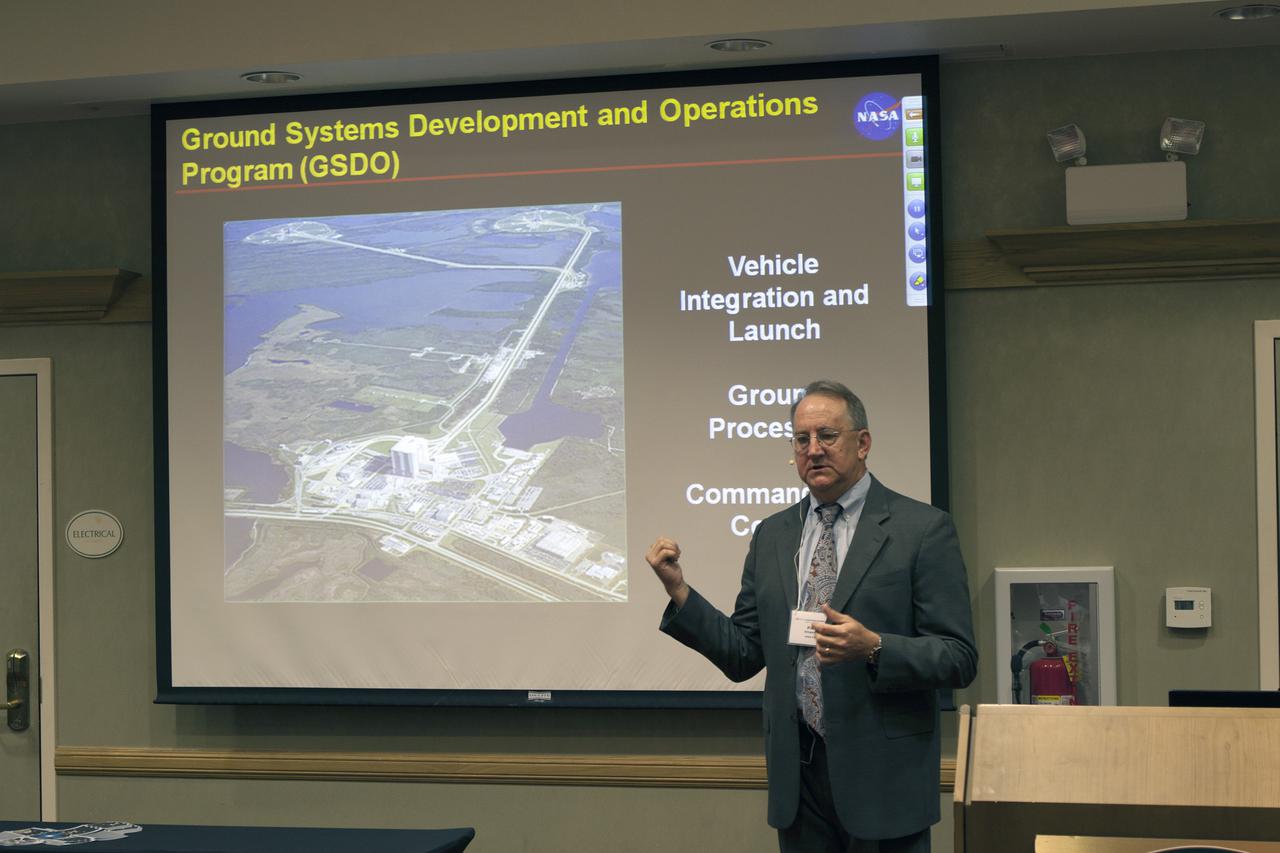
CAPE CANAVERAL, Fla. – At the Courtyard by Marriott hotel in Cocoa Beach, Fla., Pat Simpkins, director of Engineering and Technology at Kennedy Space Center talks to participants in the room and those participating online during the Third International Workshop on Lunar Superconductor Applications. The workshop included presentations from several engineers and researchers at Kennedy Space Center. The three-day workshop included presentations from speakers throughout the country and focused on Lunar in-situ resource utilization, NASA’s Lunar Ice Prospector called RESOLVE, CubeSats, cryogenic storage and many other topics related to lunar exploration. Photo credit: NASA_Jim Grossmann
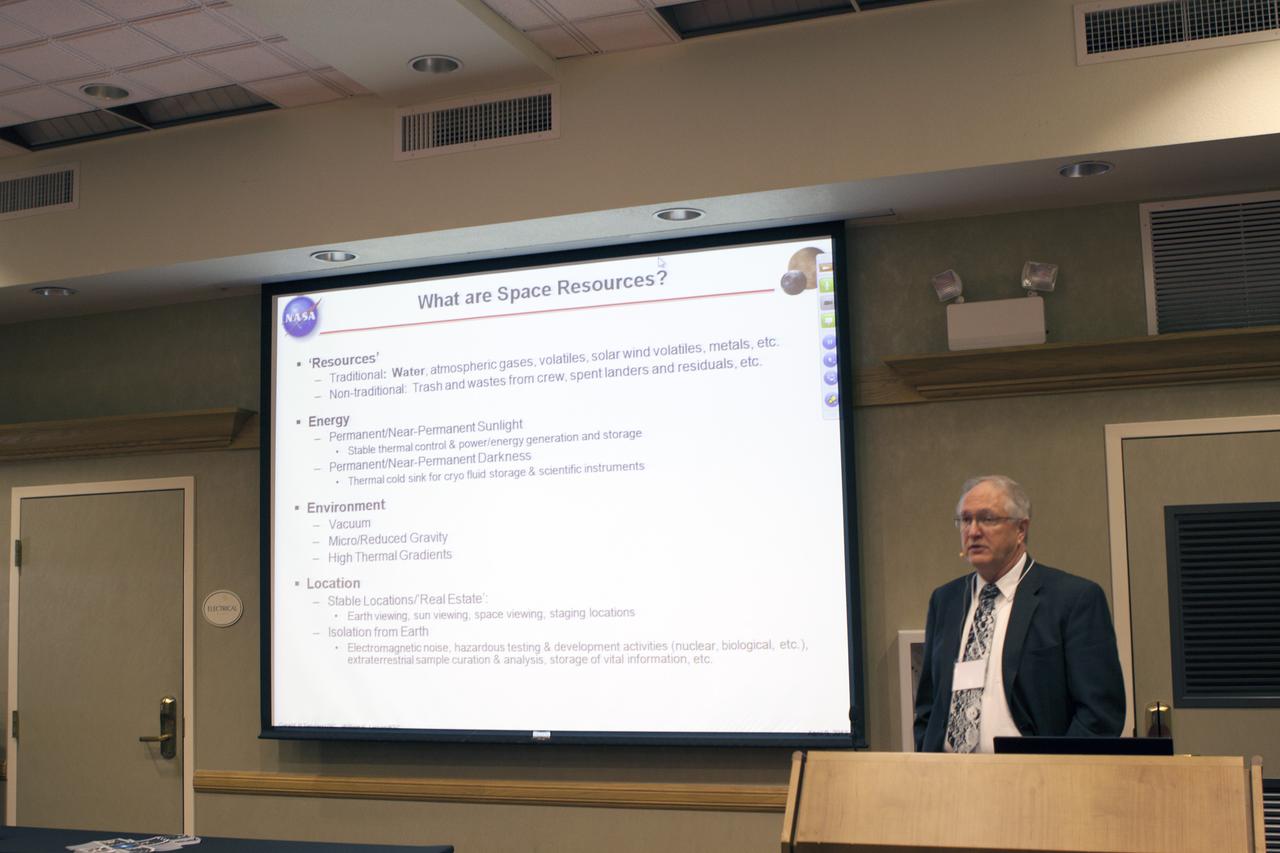
CAPE CANAVERAL, Fla. – At the Courtyard by Marriott hotel in Cocoa Beach, Fla., William Larson, retired NASA ISRU project manager, talks to participants in the room and those participating online during the Third International Workshop on Lunar Superconductor Applications. The workshop included presentations from several engineers and researchers at Kennedy Space Center. The three-day workshop included presentations from speakers throughout the country and focused on Lunar in-situ resource utilization, NASA’s Lunar Ice Prospector called RESOLVE, CubeSats, cryogenic storage and many other topics related to lunar exploration. Photo credit: NASA_Jim Grossmann
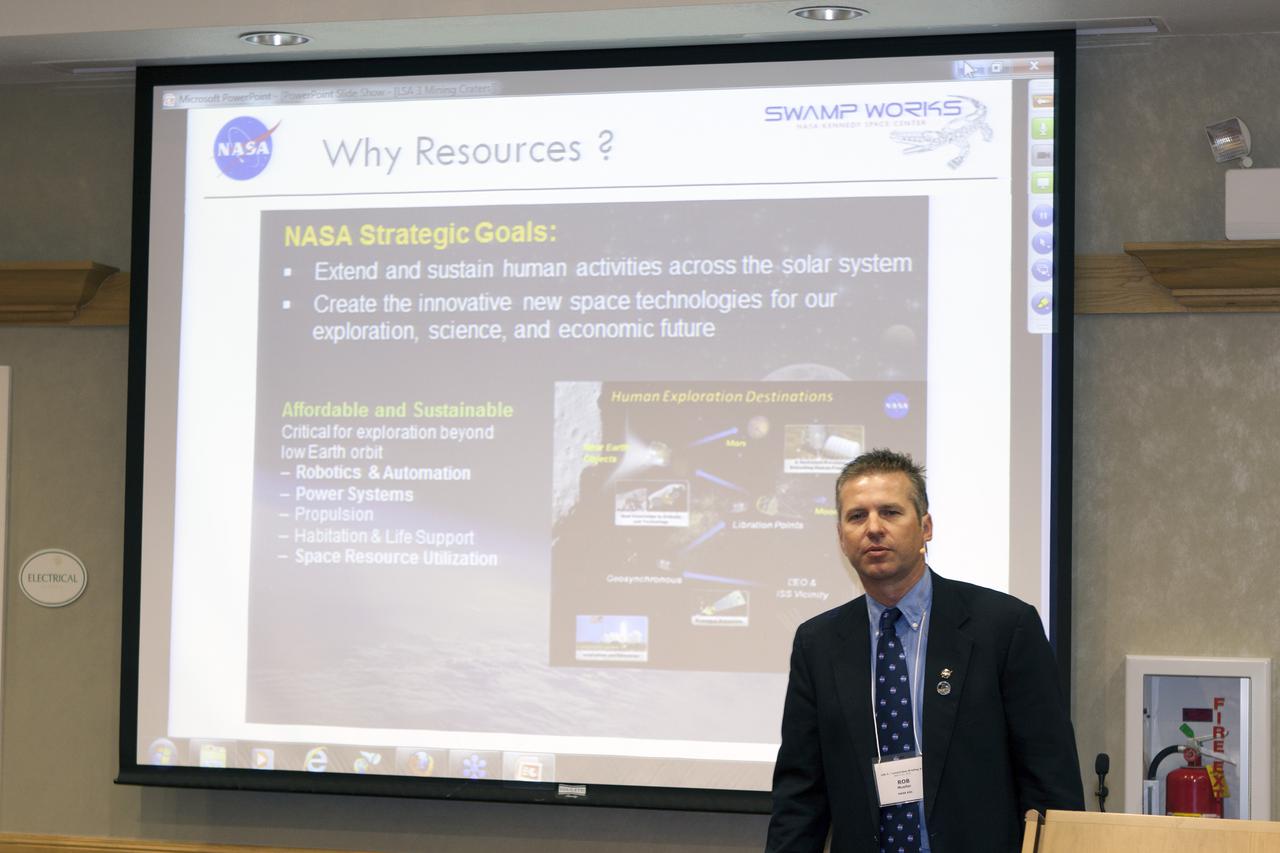
CAPE CANAVERAL, Fla. – At the Courtyard by Marriott hotel in Cocoa Beach, Fla., Rob Mueller, senior technologist in the Surface Systems Office of the Engineering and Technology Directorate at Kennedy Space Center, talks to participants in the room and those participating online during the Third International Workshop on Lunar Superconductor Applications. The workshop included presentations from several engineers and researchers at Kennedy Space Center. The three-day workshop included presentations from speakers throughout the country and focused on Lunar in-situ resource utilization, NASA’s Lunar Ice Prospector called RESOLVE, CubeSats, cryogenic storage and many other topics related to lunar exploration. Photo credit: NASA_Jim Grossmann
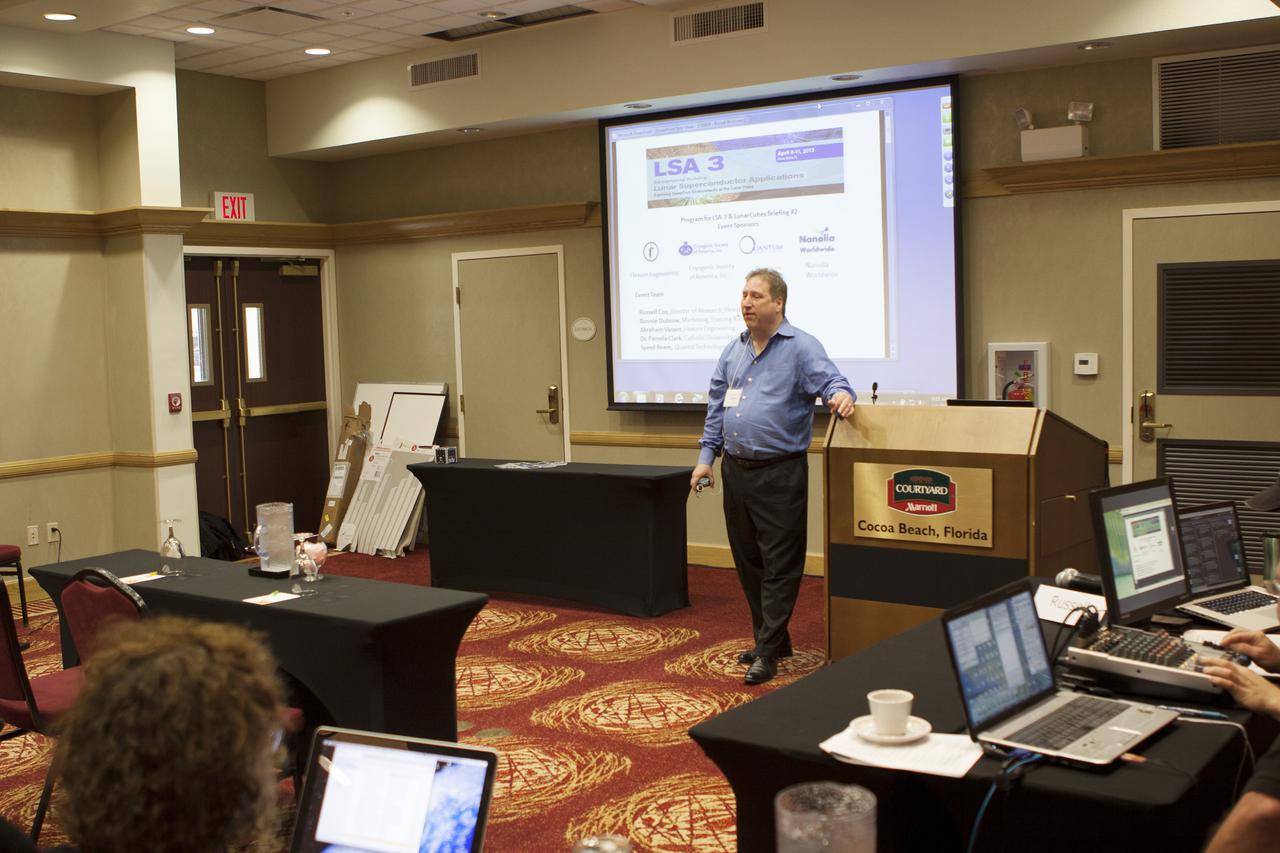
CAPE CANAVERAL, Fla. – At the Courtyard by Marriott hotel in Cocoa Beach, Fla., Russell Cox, director of research with Flexure Engineering, welcomes participants in the room and those participating online to the Third International Workshop on Lunar Superconductor Applications. The workshop included presentations from several engineers and researchers at Kennedy Space Center. The three-day workshop included presentations from speakers throughout the country and focused on Lunar in-situ resource utilization, NASA’s Lunar Ice Prospector called RESOLVE, CubeSats, cryogenic storage and many other topics related to lunar exploration. Photo credit: NASA_Jim Grossmann
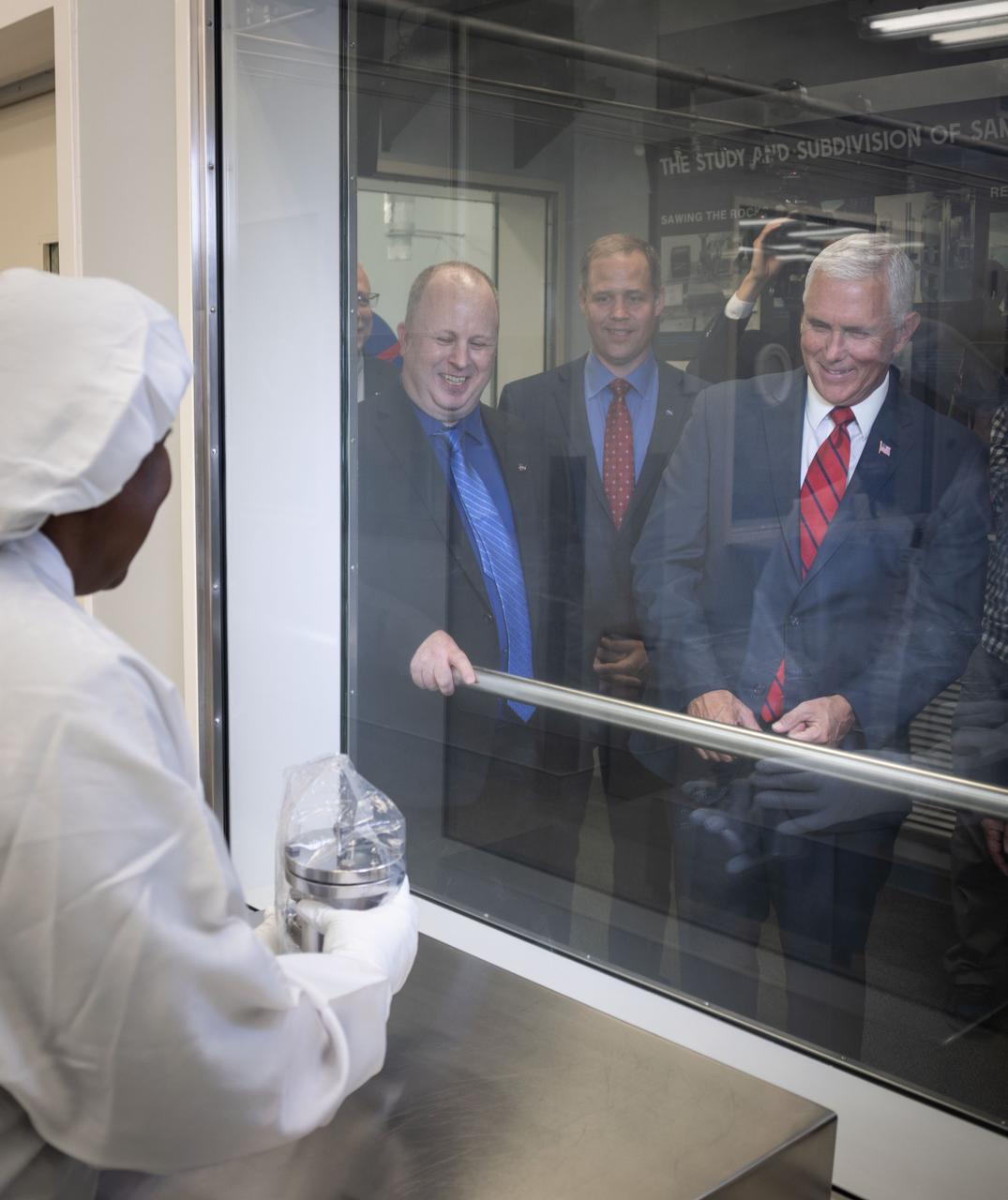
jsc2018e076655 (Aug. 23, 2018) --- Vice President Mike Pence visited NASA’s Johnson Space Center in Houston on Aug. 23, 2018, to discuss the future of space exploration and other elements of human spaceflight. During his trip to the Johnson Space Center, the Vice President also toured the laboratory housing the moon rocks retrieved during the Apollo program’s lunar missions and extraterrestrial samples from other uncrewed sample return missions. Apollo Lunar Sample Principle Scientist Andrea Mosie held a lunar sample up for inspection by the Vice President, who was joined in the viewing room behind protective glass by Apollo Lunar Sample Curator Ryan Ziegler.
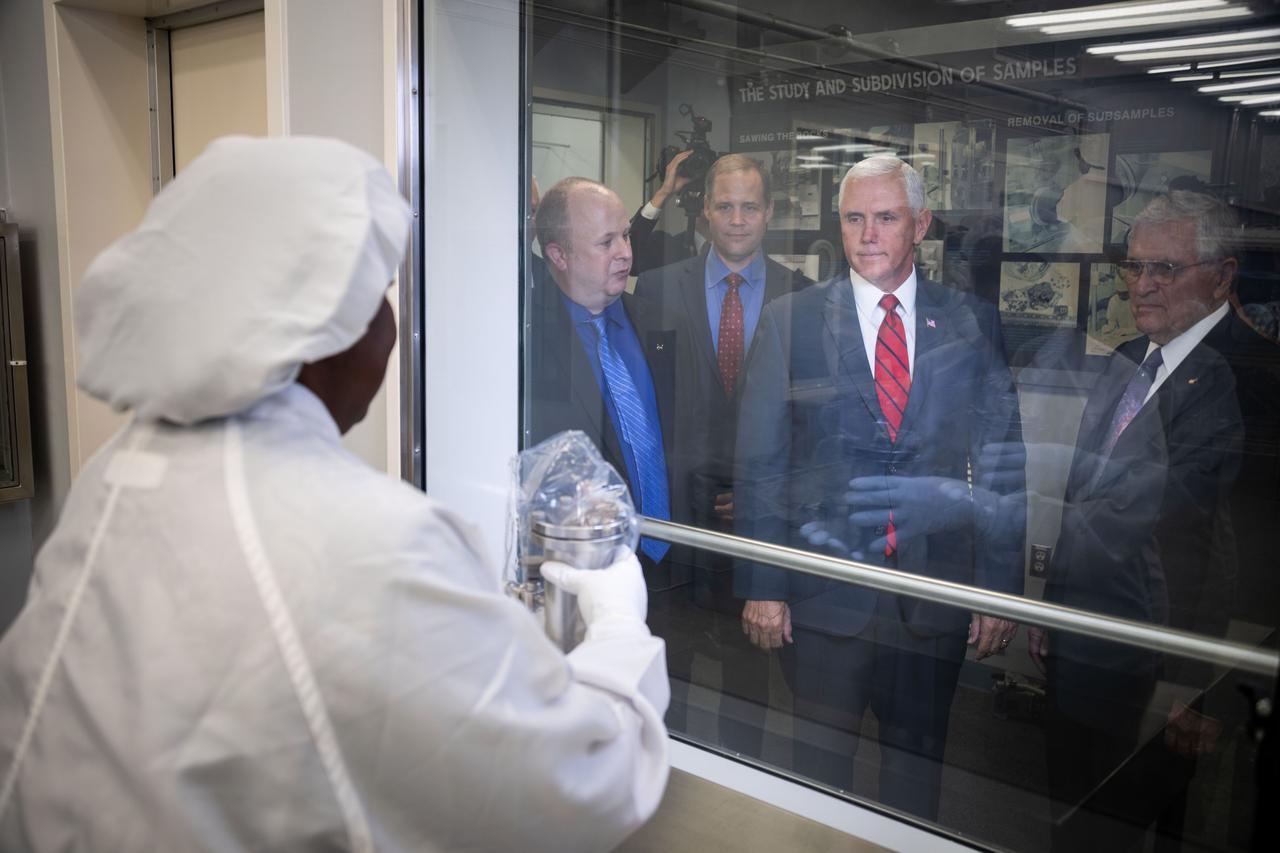
jsc2018e076652 (Aug. 23, 2018) --- Vice President Mike Pence visited NASA’s Johnson Space Center in Houston on Aug. 23, 2018, to discuss the future of space exploration and other elements of human spaceflight. During his trip to the Johnson Space Center, the Vice President also toured the laboratory housing the moon rocks retrieved during the Apollo program’s lunar missions and extraterrestrial samples from other uncrewed sample return missions. Apollo Lunar Sample Principle Scientist Andrea Mosie held a lunar sample up for inspection by the Vice President, who was joined in the viewing room behind protective glass by Apollo Lunar Sample Curator Ryan Ziegler.
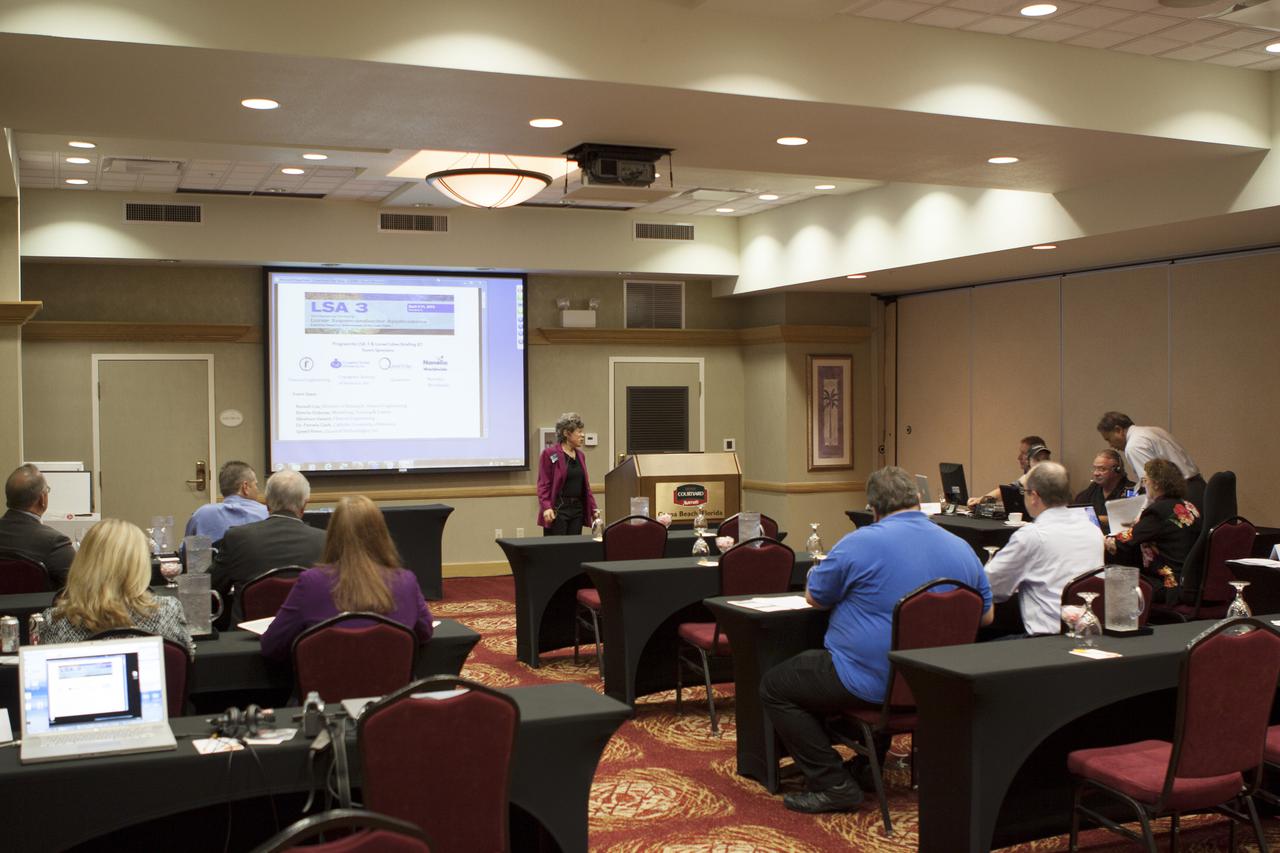
CAPE CANAVERAL, Fla. – At the Courtyard by Marriott hotel in Cocoa Beach, Fla., Bonnie Dubrow, business development manager with Flexure Engineering, welcomes participants in the room and those participating online to the Third International Workshop on Lunar Superconductor Applications. The workshop included presentations from several engineers and researchers at Kennedy Space Center. The three-day workshop included presentations from speakers throughout the country and focused on Lunar in-situ resource utilization, NASA’s Lunar Ice Prospector called RESOLVE, CubeSats, cryogenic storage and many other topics related to lunar exploration. Photo credit: NASA_Jim Grossmann
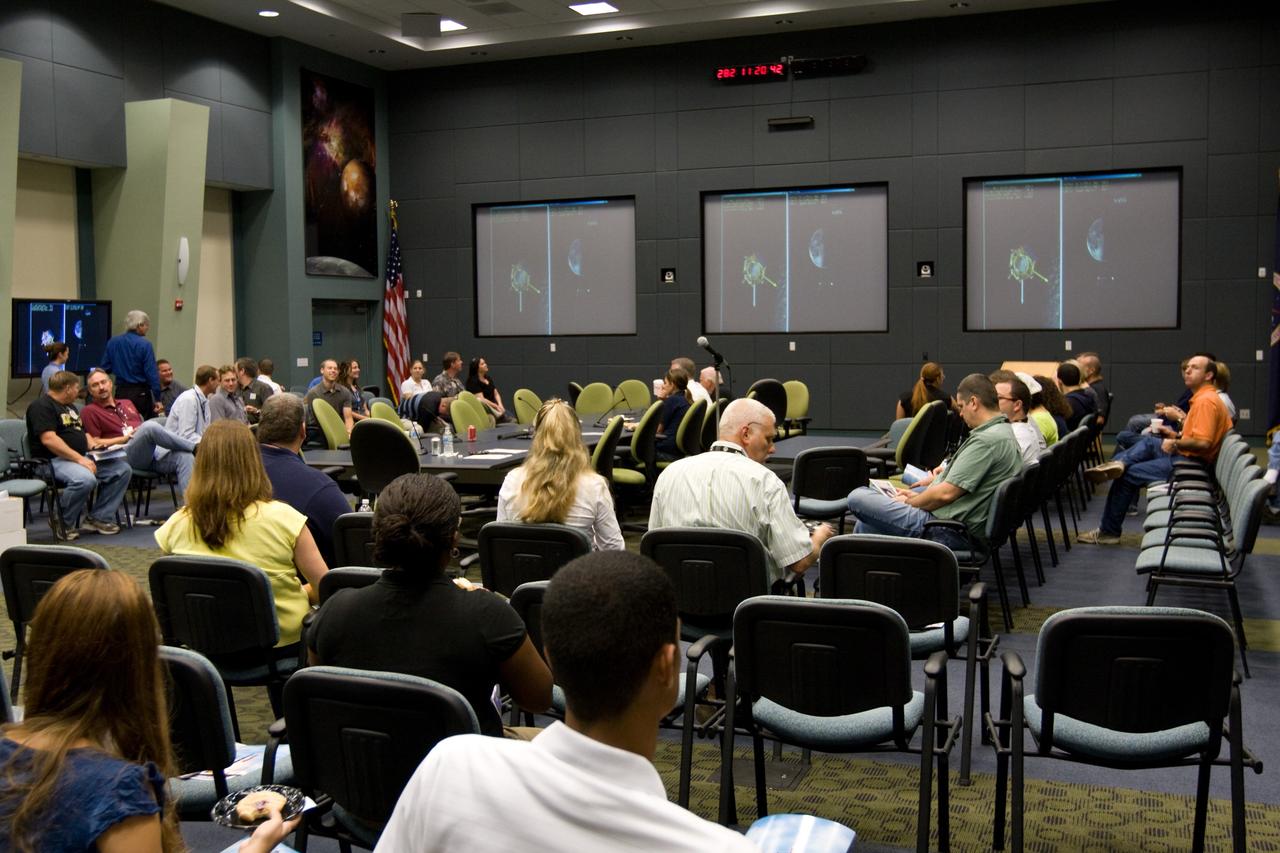
CAPE CANAVERAL, Fla. – Employees at NASA's Kennedy Space Center take advantage of an early morning opportunity to watch the Lunar Crater Observation and Sensing Satellite, or LCROSS, and its spent Centaur upper stage impact the lunar surface live on NASA Television. The employees seen here are in the 5th Floor Conference Room of Operations Support Building II; another group of employees viewed the impact on screens in the Operations and Checkout Building's Mission Briefing Room. The employee event was sponsored by the NASA Exchange, the External Relations Directorate and KSC Launching Leaders. The goal of the LCROSS mission is to search for water ice on the moon, in support of future human lunar exploration. For additional information on the LCROSS mission, visit http://www.nasa.gov/LCROSS. Photo credit: NASA/Dimitri Gerondidakis
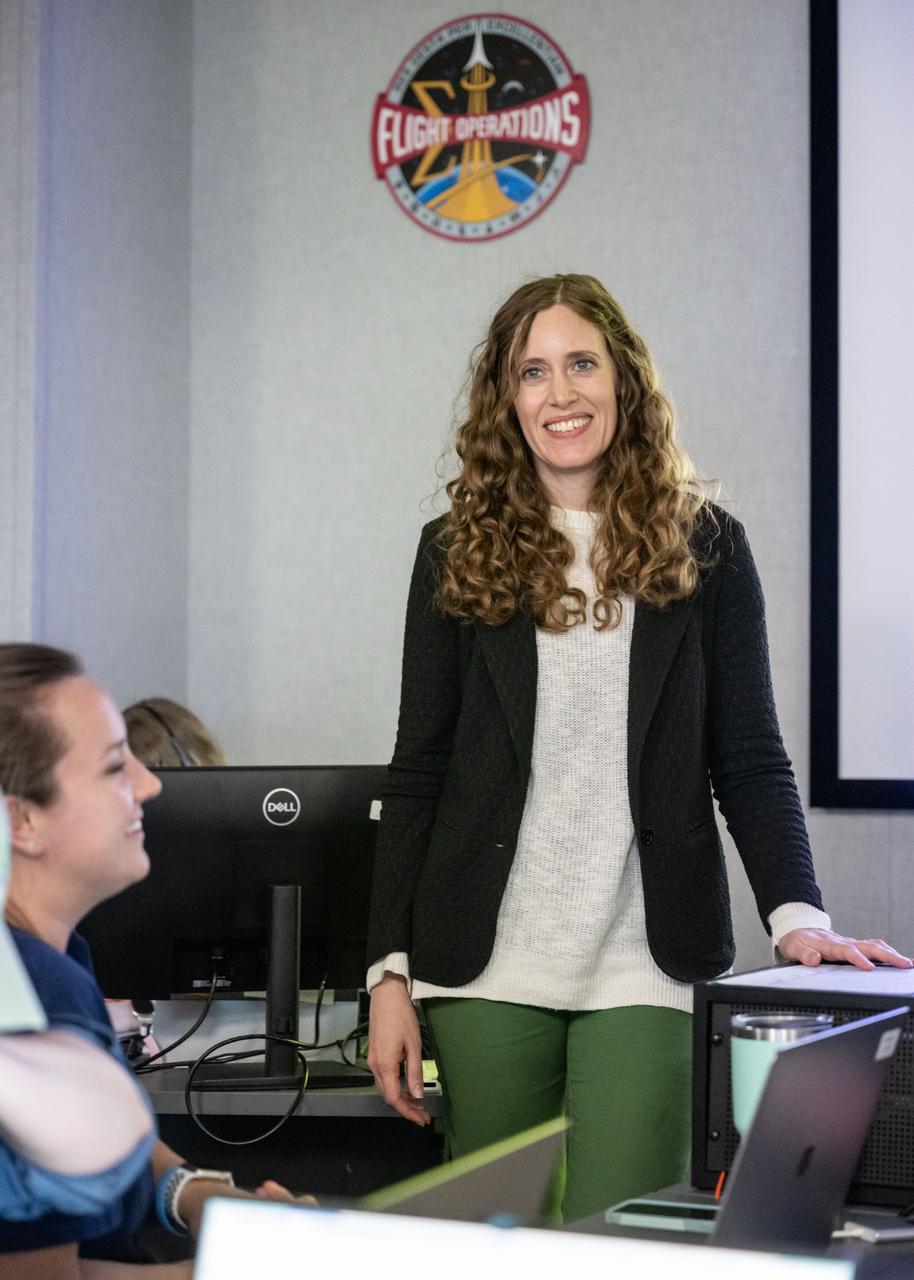
Science Evaluation Room Lead Brett Denevi, Artemis III Geology Team principal investigator for NASA’s Science Mission Directorate, looks over the Science Evaluation Room (SER) during the JETT 5 field test. JETT 5 was a week-long field test in the lunar-like landscape of San Francisco Volcanic Field near Flagstaff, Arizona while a team of flight controllers and scientists at Johnson monitor and guide their activities. Credit: NASA/James Blair
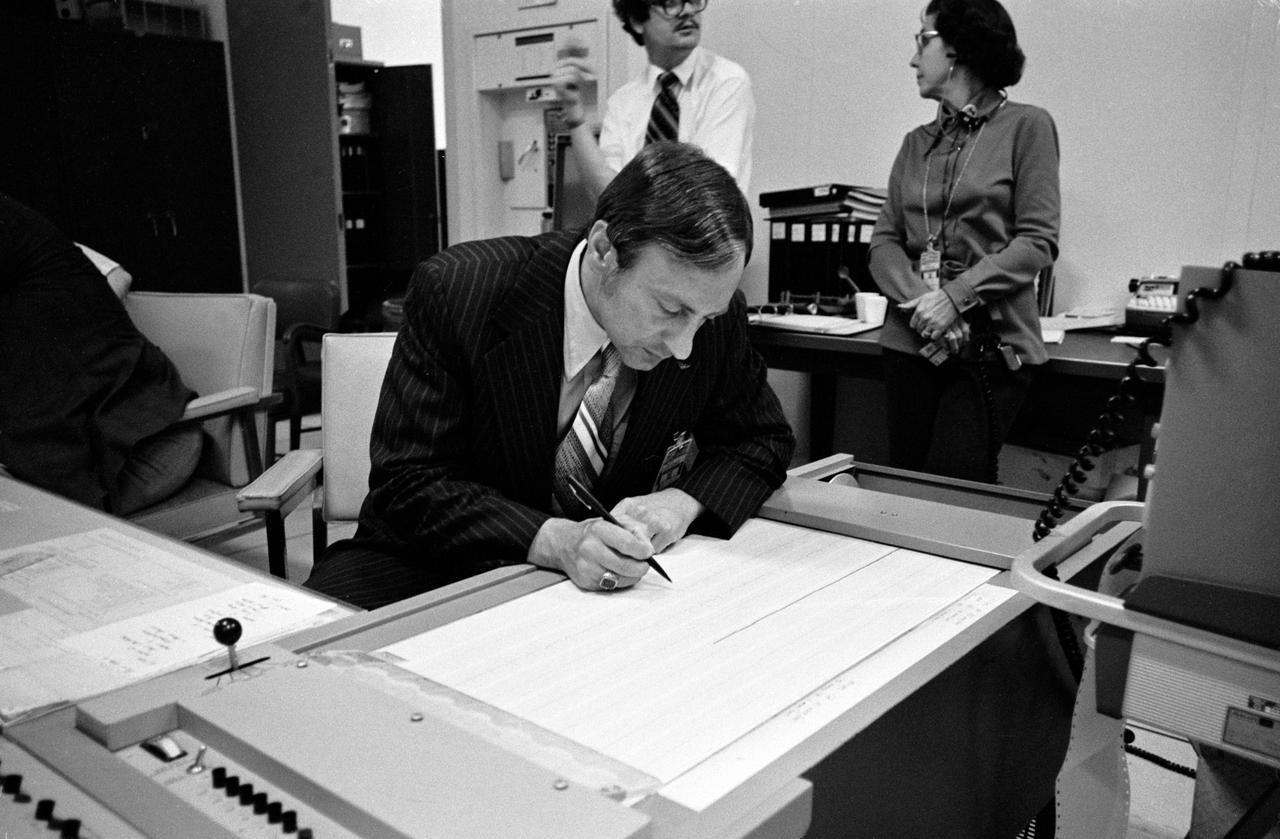
S72-35460 (18 April 1972) --- Dr. J.F. Zieglschmid, M.D., Missions Operations Control Room (MOCR) White Team Surgeon, is seated in the Medical Support Room (MSR) in the Mission Control Center (MCC). He monitors crew biomedical data being received from the Apollo 16 spacecraft on the third day of the lunar landing mission.

S70-34847 (11 April 1970) --- Astronaut John L. Swigert Jr., command module pilot for NASA?s third lunar landing mission, appears to be relaxing in the suiting room at Kennedy Space Center prior to launch. Other members of the Apollo 13 crew include astronauts James A. Lovell Jr., commander, and Fred W. Haise Jr., lunar module pilot. Swigert replaced astronaut Thomas K. Mattingly II when it was discovered that Mattingly had been exposed to the measles.
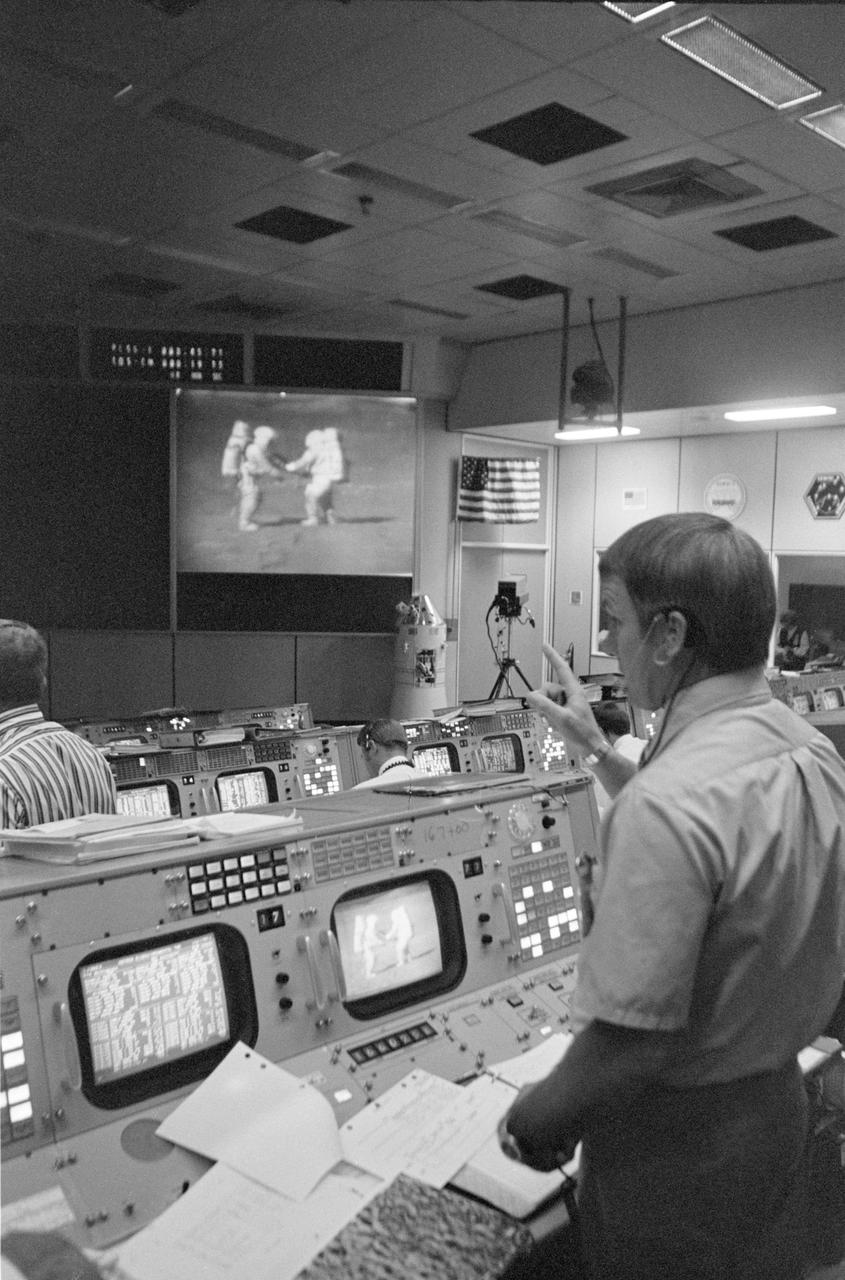
S71-41852 (2 Aug. 1971) --- Gerald D. Griffin, foreground, stands near his console in the Mission Operations Control Room (MOCR) during Apollo 15's third extravehicular activity (EVA) on the lunar surface. Griffin is Gold Team (Shift 1) flight director for the Apollo 15 mission. Astronauts David R. Scott and James B. Irwin can be seen on the large screen at the front of the MOCR as they participate in sample-gathering on the lunar surface.
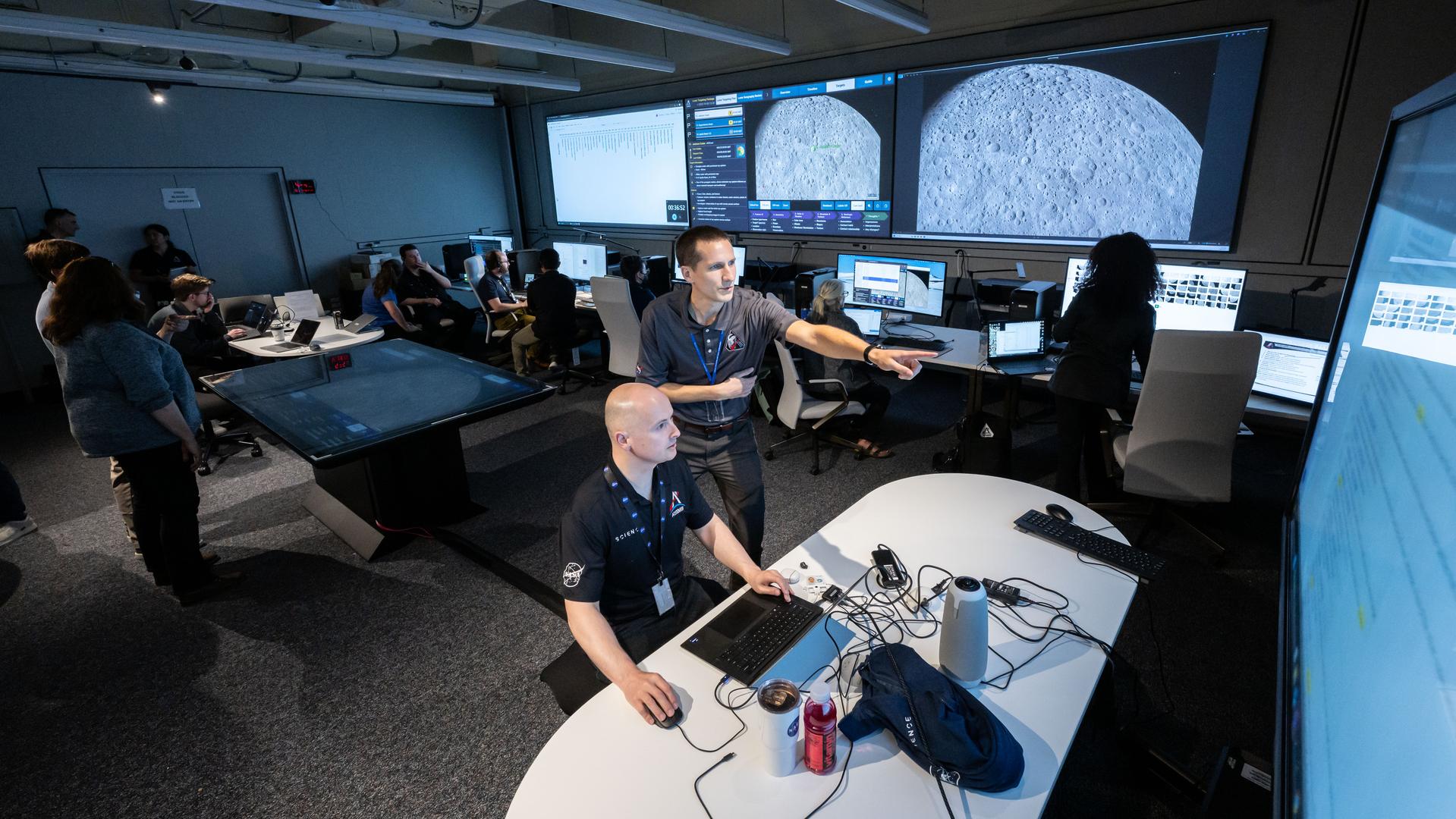
jsc2025e087237 --- Artemis lunar science team members Andrew Needham, sitting, and David Hollibaugh work in the Science Mission Operations Room (SMOR) during a training simulation at NASA's Johnson Space Center in Houston during a simulation of the Artemis II lunar flyby during which astronauts will document their observations through photographs and audio recordings to inform scientists’ understanding of the Moon. Credit: NASA/James Blair

S70-34901 (14 April 1970) --- Mrs. Marilyn Lovell, wife of astronaut James A. Lovell, Apollo 13 mission commander, discusses the flight with Dr. Charles A. Berry, flight surgeon. The two are in a special viewing area overlooking the Flight Control Room (FCR), staffed with flight controllers who were supporting the planned lunar landing mission. EDITOR?S NOTE: After this picture was taken, an explosion occurred aboard the Service Module (SM), causing cancellation of the lunar landing phase of the mission.
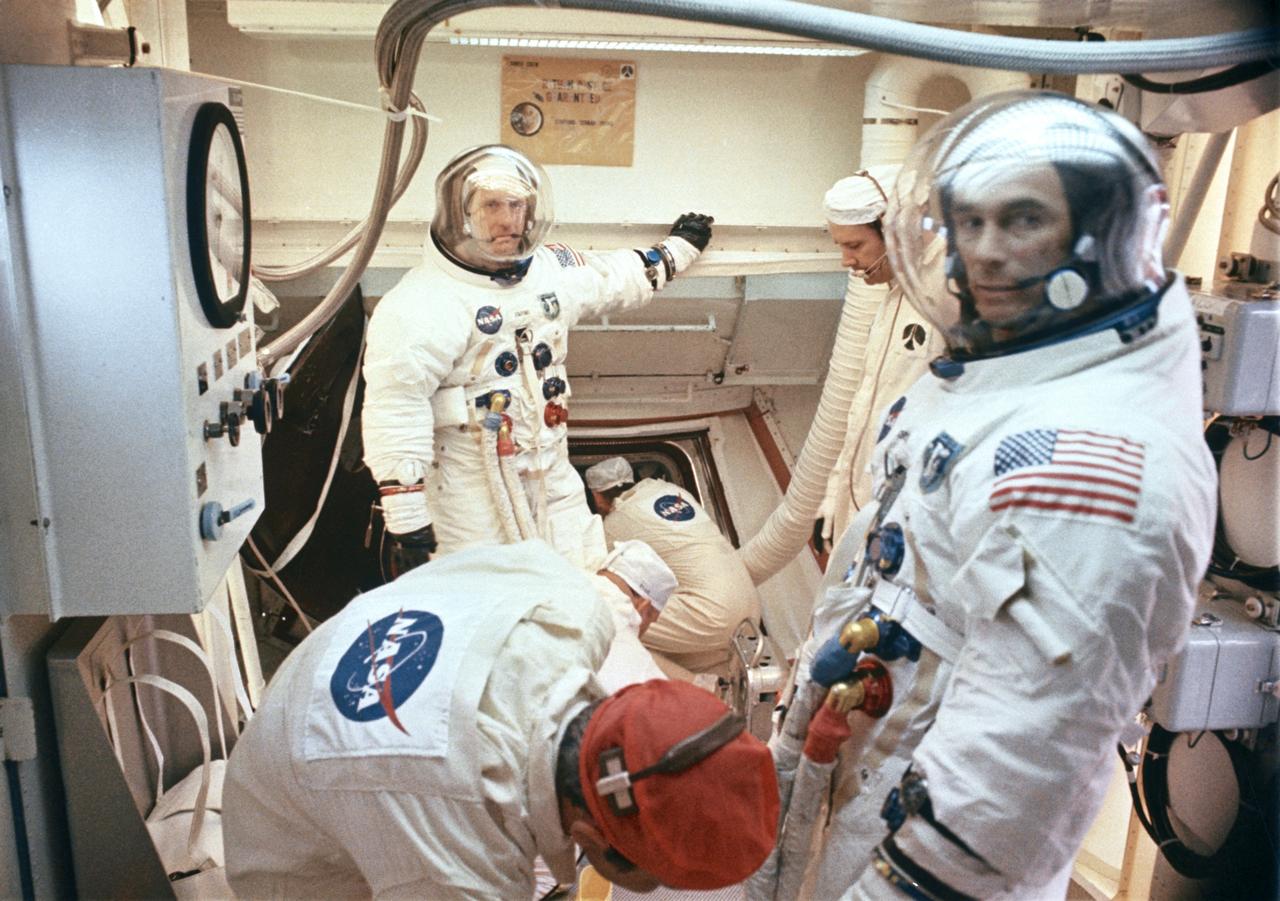
S69-35317 (18 May 1969) --- ? Interior view of the White Room at Pad B, Launch Complex 39, Kennedy Space Center, showing preparations being made for insertion of the Apollo 10 crew into their spacecraft during the prelaunch countdown. In the background is astronaut Thomas P. Stafford, commander. Astronaut Eugene A. Cernan, lunar module pilot, is in right foreground. Out of view is astronaut John W. Young, command module pilot. Liftoff for the lunar orbit mission was at 12:49 p.m. (EDT), May 18, 1969.
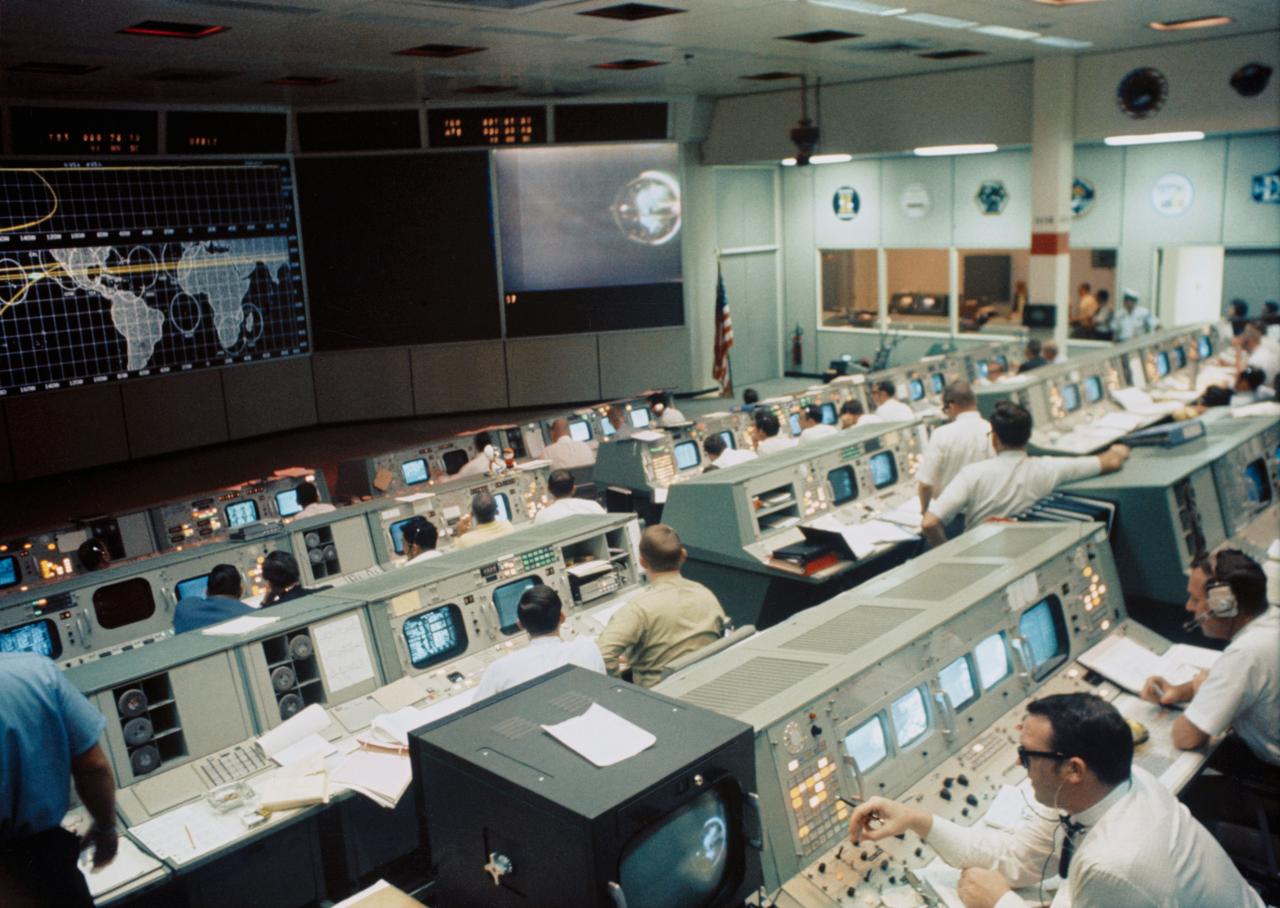
S69-34316 (18 May 1969) --- Overall view of the Mission Operations Control Room in the Mission Control Center, Building 30, on the first day of the Apollo 10 lunar orbit mission. A color television transmission was being received from Apollo 10. This picture was made following Command and Service Module/Lunar Module/Saturn IVB (CSM/LM-S-IVB) separation and prior to LM extraction from the S-IVB. The CSM were making the docking approach to the LM/S-IVB.
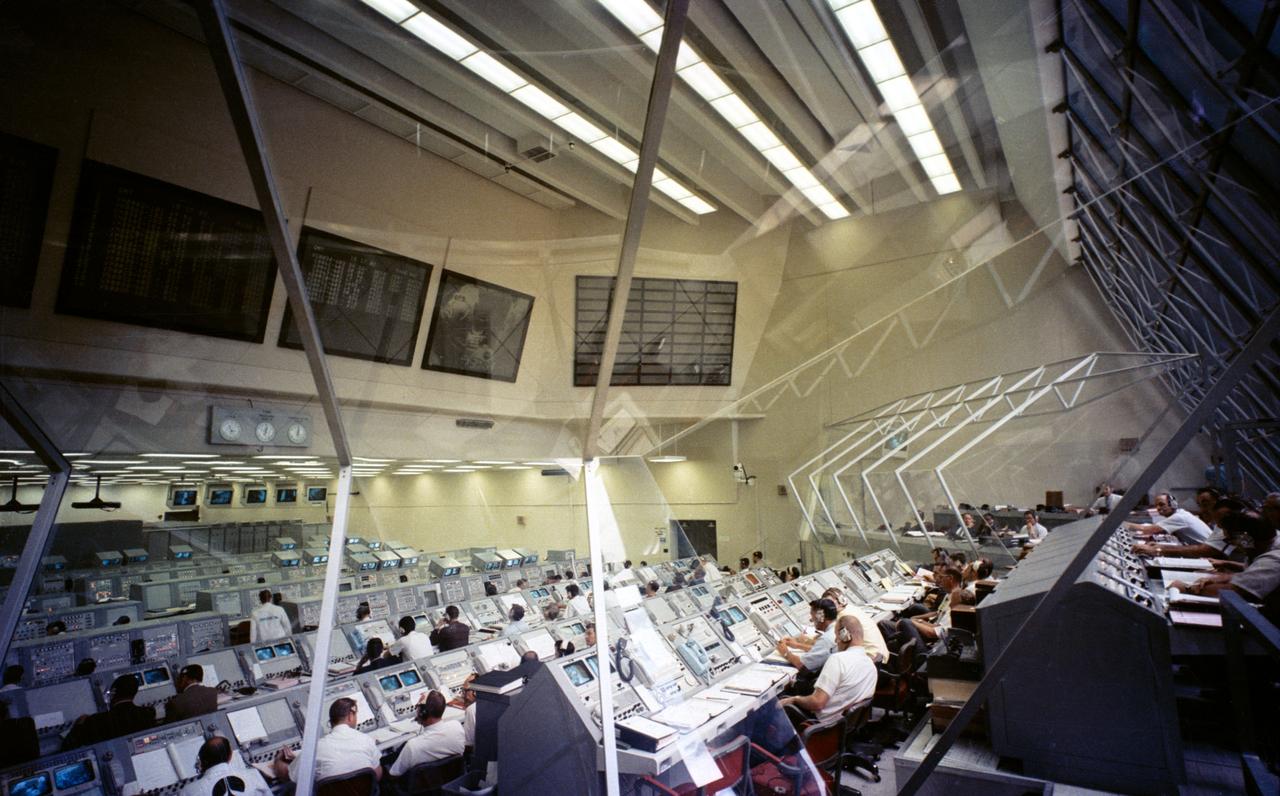
S69-34332 (13 May 1969) --- Overall view of Firing Room 3 of the Launch Control Center, Launch Complex 39, Kennedy Space Center, Florida, during an Apollo 10 Countdown Demonstration Test. The crew of the scheduled Apollo 10 lunar orbit mission will be astronauts Thomas P. Stafford, commander; John W. Young, command module pilot; and Eugene A. Cernan, lunar module pilot. The Launch Control Center is at the Vehicle Assembly Building. The Apollo 10 space vehicle will be launched from Pad 39B.

S70-34901 (14 April 1970) --- Mrs. Marilyn Lovell, wife of astronaut James A. Lovell, Apollo 13 mission commander, discusses the flight with Dr. Charles A. Berry, flight surgeon. The two are in a special viewing area overlooking the Flight Control Room (FCR), staffed with flight controllers who were supporting the planned lunar landing mission. EDITOR?S NOTE: After this picture was taken, an explosion occurred aboard the Service Module (SM), causing cancellation of the lunar landing phase of the mission.

jsc2026e021376 (April 6, 2026) - Nicky Fox, associate administrator for NASA's Science Mission Directorate and Brad Bailey, assistant deputy associate administrator for exploration, observe and celebrate a successful lunar flyby with the Artemis II lunar science team in the Science Evaluation Room in Mission Control at NASA's Johnson Space Center in Houston. Credits: NASA/Luna Posadas Nava
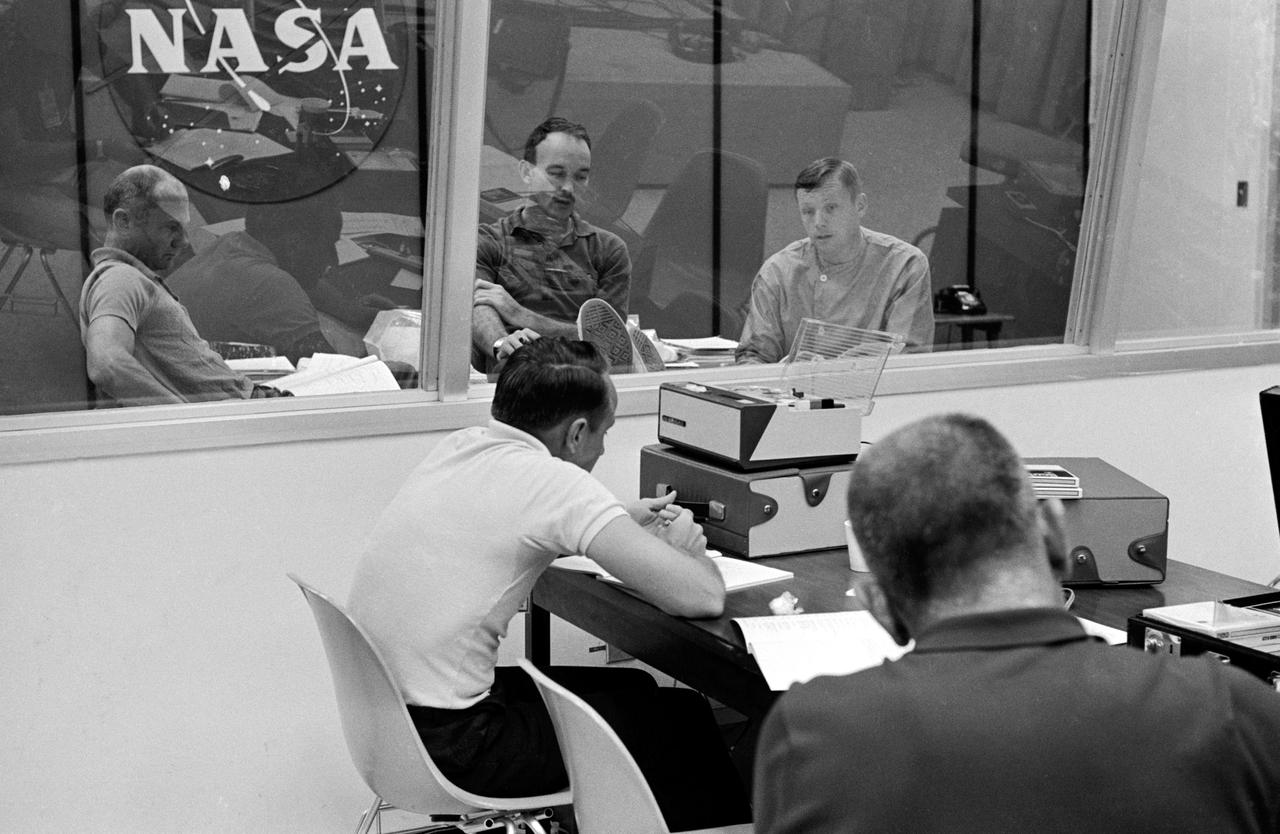
S69-40209 (27 July 1969) --- The crewmen of the Apollo 11 lunar landing mission go through their post flight debriefing session on Sunday, July 27, 1969. Left to right, are astronauts Edwin E. Aldrin Jr., lunar module pilot; Michael Collins, command module pilot; and Neil A. Armstrong, commander. They are seated in the debriefing room of the Crew Reception Area of the Lunar Receiving Laboratory at the Manned Spacecraft Center (MSC). In the foreground are Donald K. Slayton (right), MSC Director of Flight Crew Operations; and Lloyd Reeder, training coordinator.
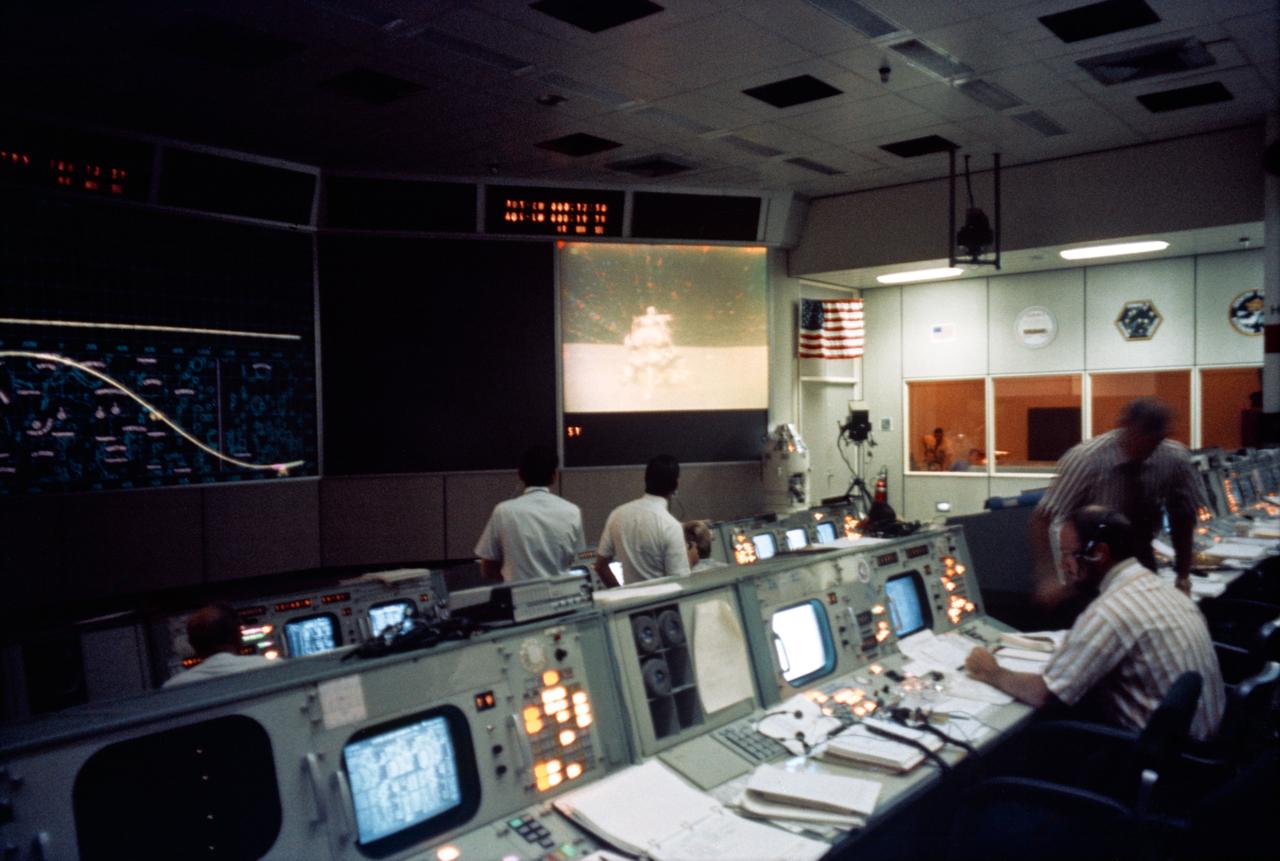
S71-41759 (2 Aug. 1971) --- A partial view of activity in the Mission Operations Control Room in the Mission Control Center during the liftoff of the Apollo 15 Lunar Module "Falcon" ascent stage from the lunar surface. An RCA color television camera mounted on the Lunar Roving Vehicle made it possible for people on Earth to watch the LM's spectacular launch from the moon. The LM liftoff was at 171:37 ground elapsed time. The LRV was parked about 300 feet east of the LM. The TV camera was remotely controlled from a console in the MOCR. Seated in the right foreground is astronaut Edgar D. Mitchell, a spacecraft communicator. Mitchell was lunar module pilot of the Apollo 14 lunar landing mission. Note liftoff on the television monitor in the center background.