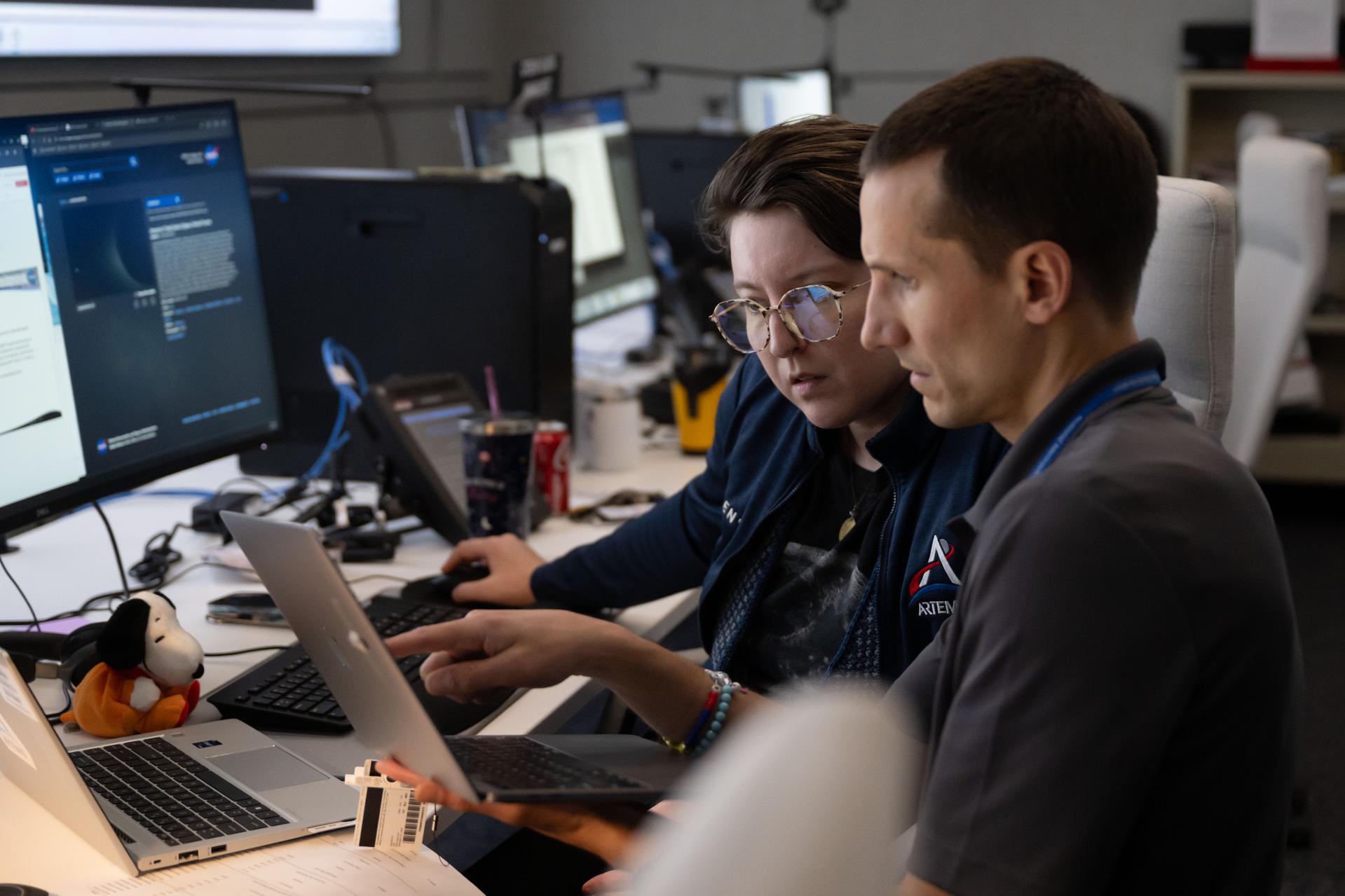
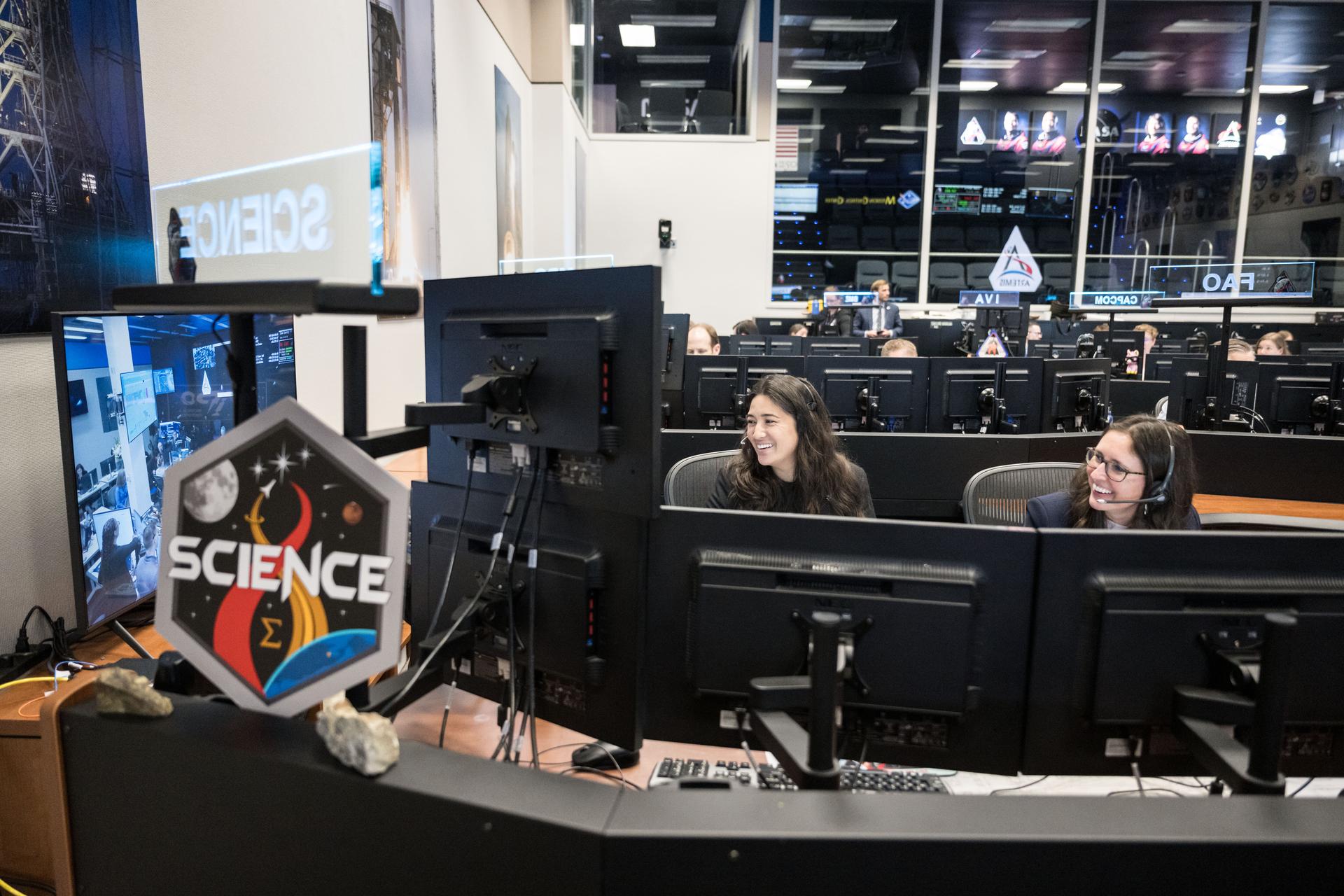
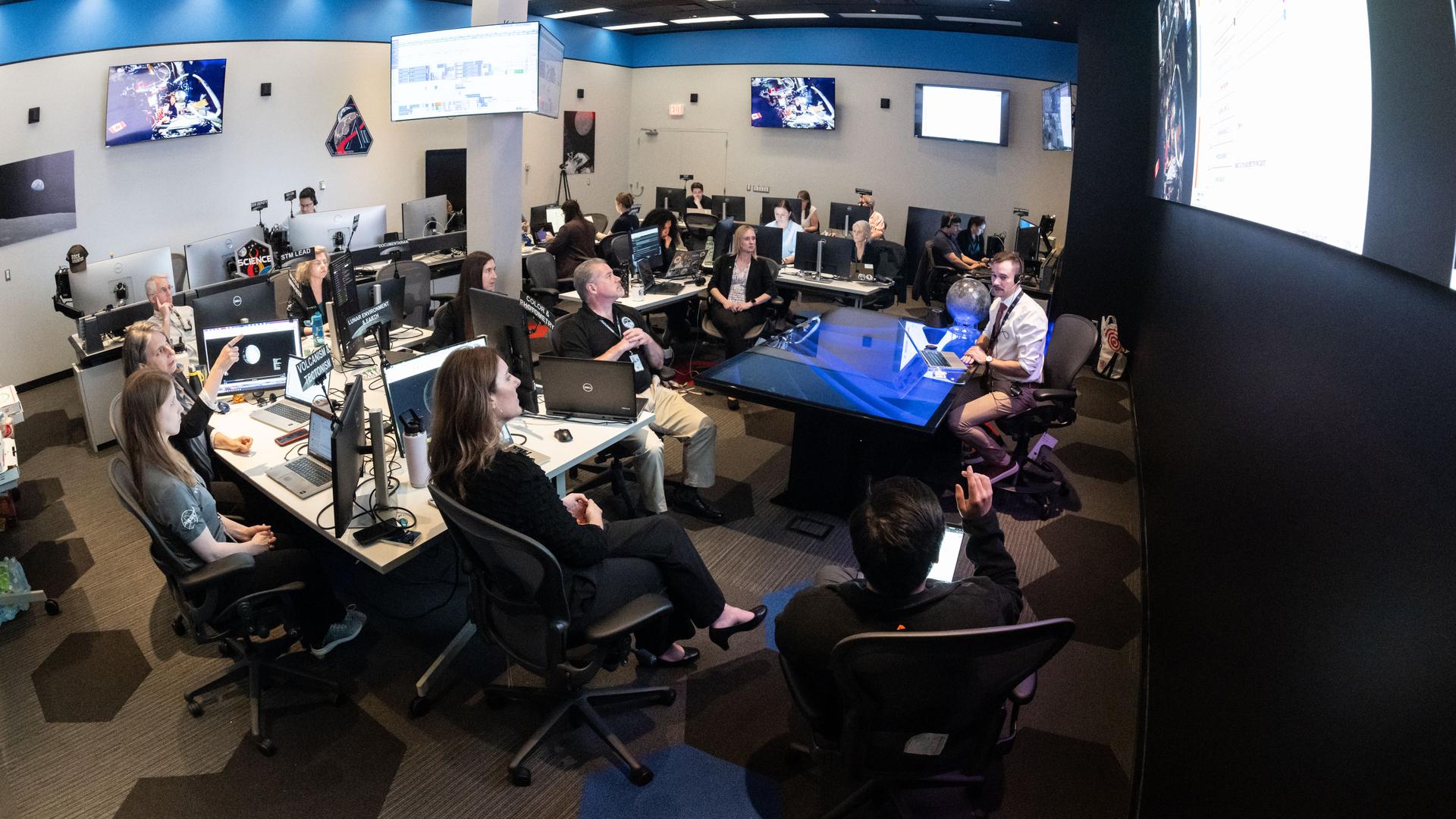
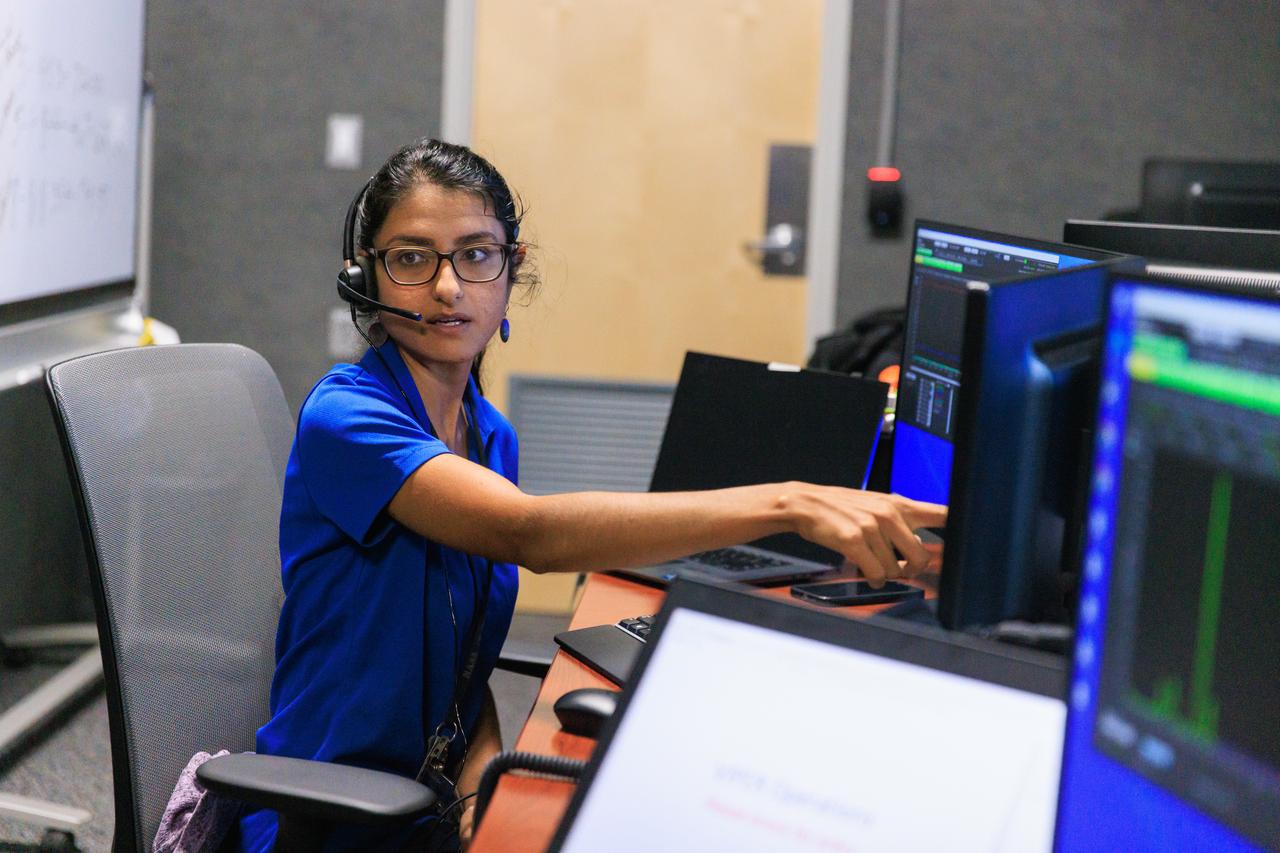
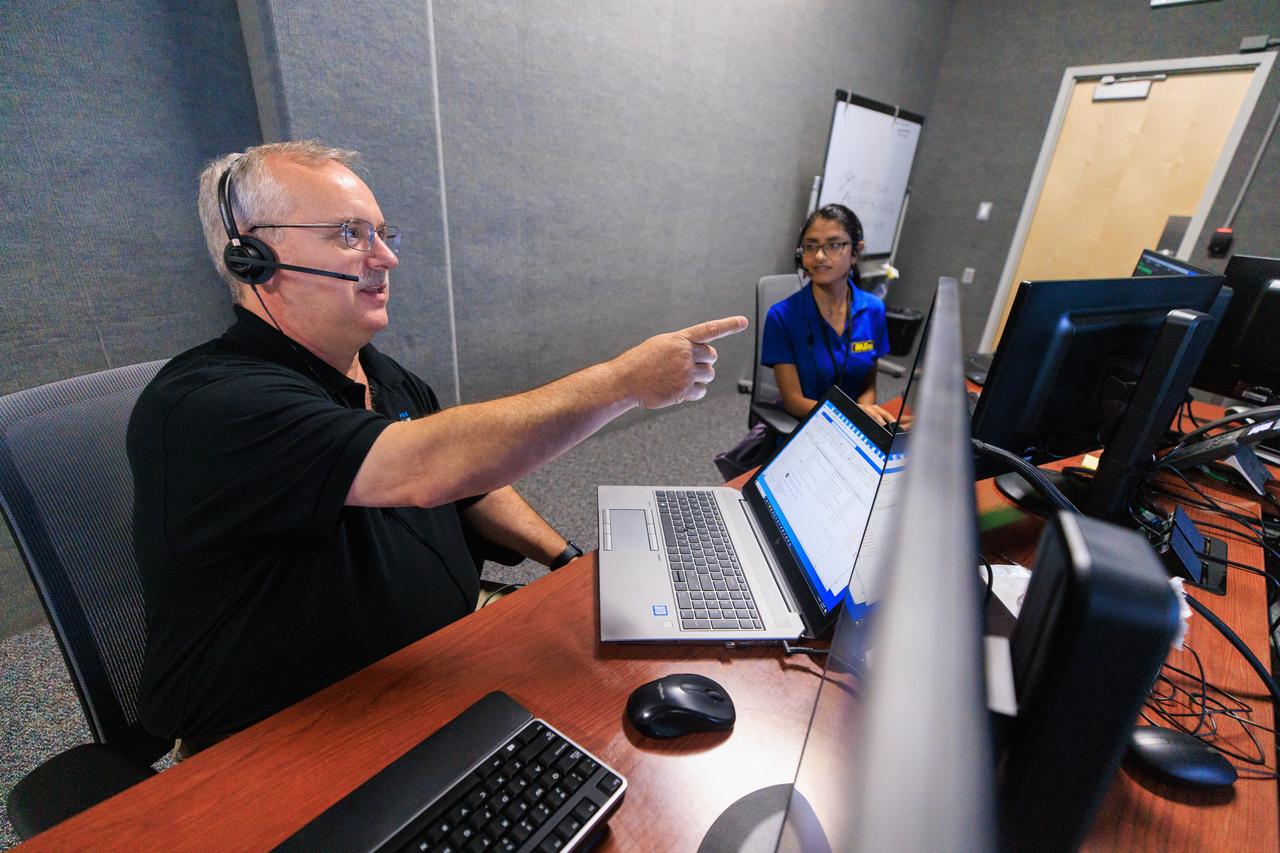
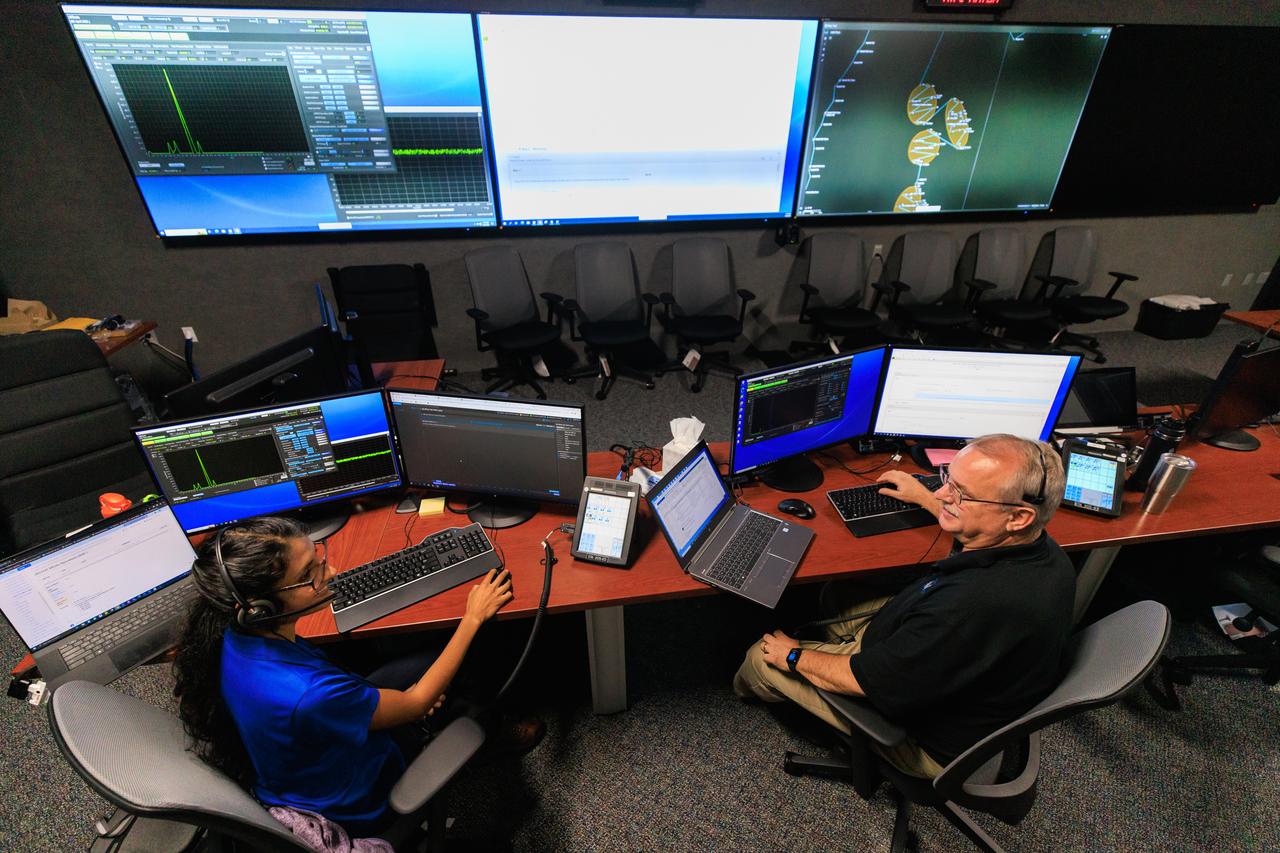
Artemis lunar science team members, from left, Alexandra Constantinou, and David Hollibaugh-Baker, work in the Science Mission Operations Room at NASA’s Johnson Space Center in Houston. They are analyzing imagery and audio recordings of lunar observations captured by the Artemis II astronauts during their lunar flyby on April 6, 2026.

Artemis science officer, Angela Garcia, left and lunar science team member, Kiarre Dumes discuss science operations in the Science Evaluation Room (SER) in Mission Control at NASA's Johnson Space Center in Houston. The SER supports lunar science and planetary observations for the Artemis science officer in the mission’s main flight control room. Dumes serves as the SERCOMM, or Science Evaluation Room Communicator, acting as the singular voice from the science team in the back room, reporting to the science officer. Credits: NASA/Luna Posadas Nava
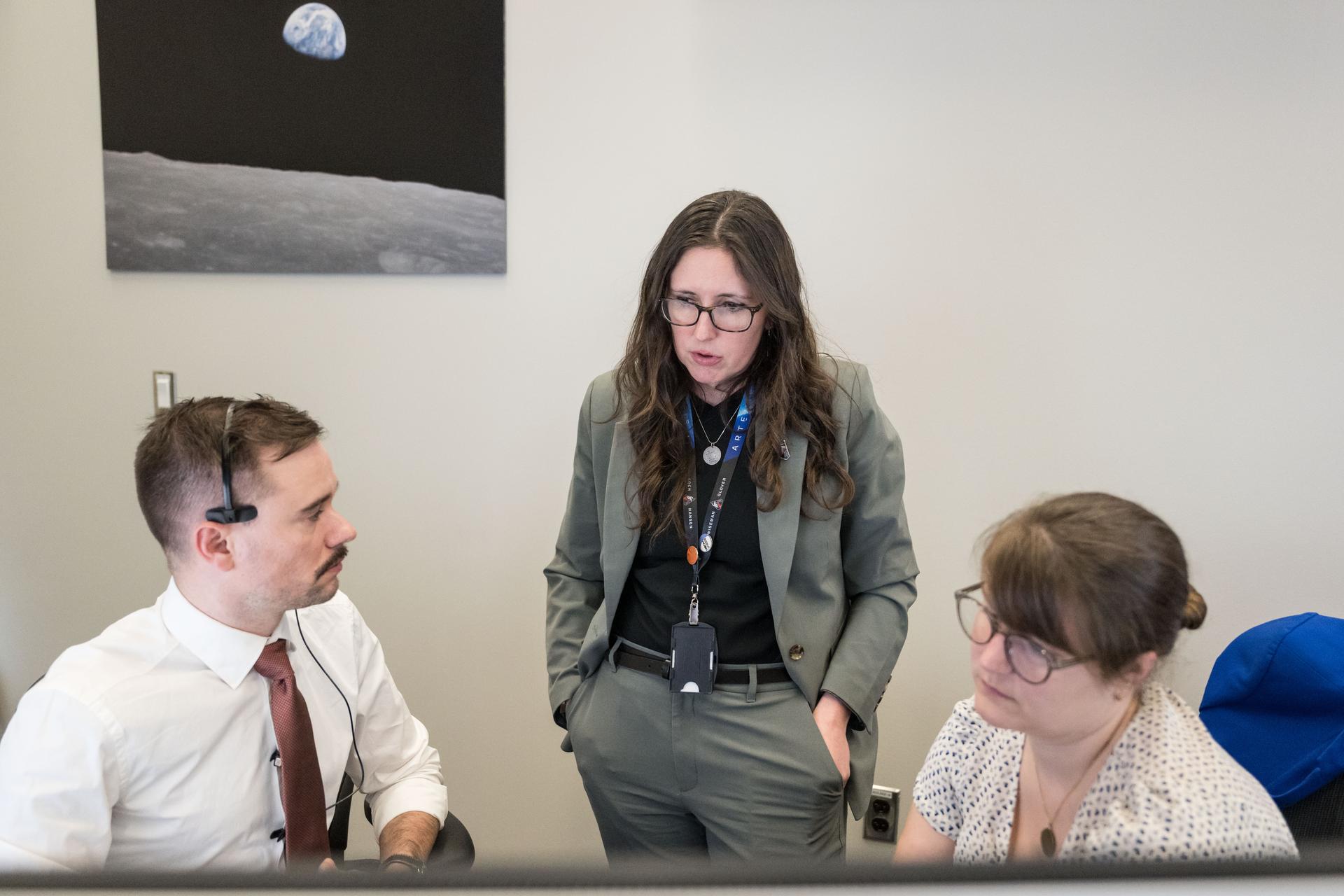
From left, Artemis II deputy lunar science lead, Jacob Richardson, science officer and lunar science lead, Kelsey Young, and deputy lunar science lead, Marie Henderson, discuss the team’s final preparations for the lunar flyby. The team worked in the Science Evaluation Room (SER) in Mission Control at NASA’s Johnson Space Center in Houston. Built specifically for Artemis missions with these science priorities in mind, the SER is equipped to support rapid data interpretation, collaborative analysis, real-time decision making, and seamless coordination between the science and operations teams. Credits: NASA/ Robert Markowitz
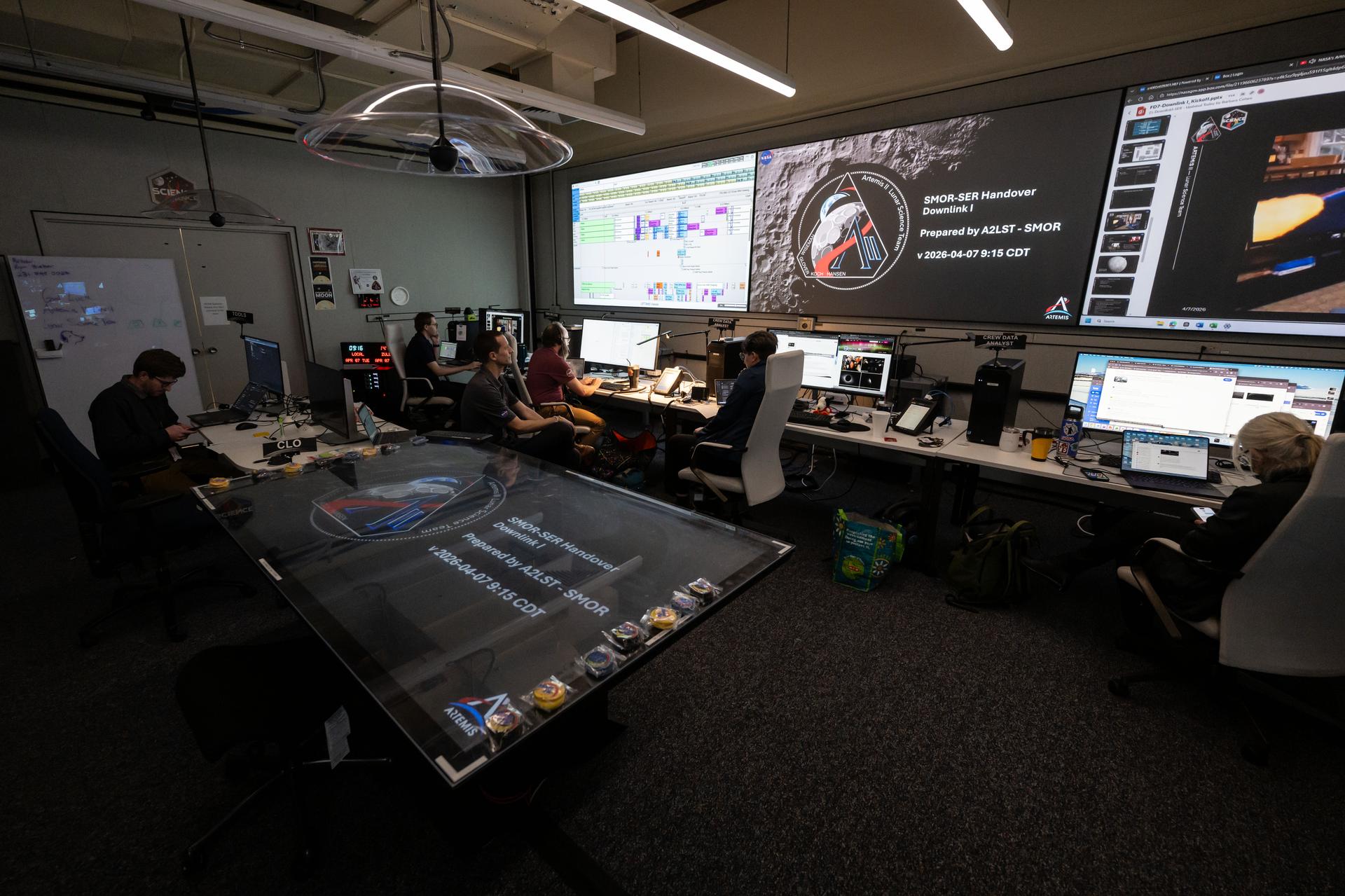
Artemis lunar science team members, work in the Science Mission Operations Room at NASA’s Johnson Space Center in Houston, analyzing imagery and audio recordings of lunar observations captured by the Artemis II astronauts during their lunar flyby on April 6, 2026.

Artemis II deputy lunar science lead, Jacob Richardson, left, and Artemis II lunar science team members, Kiarre Dumes, react to the astronauts' verbal observations of the Moon during their flyby on April 6, 2026. Along with other lunar science team members, Richardson and Dumes helped train the crew in geology both in the classroom and in the field. The science team also built the lunar targeting plan that, like an International Space Station spacewalk plan, provides strong, detailed observation guidance, plus flexibility for the crew to make decisions based on what they’re seeing and experiencing in real time. The science team had many moments of celebration during the lunar flyby as the astronauts took images of the Moon and provided verbal descriptions of what they were seeing. This type of information reveals the geologic history of an area and will be critical to collect when future Artemis astronauts explore the Moon's surface. Credits: NASA/Luna Posadas Nava
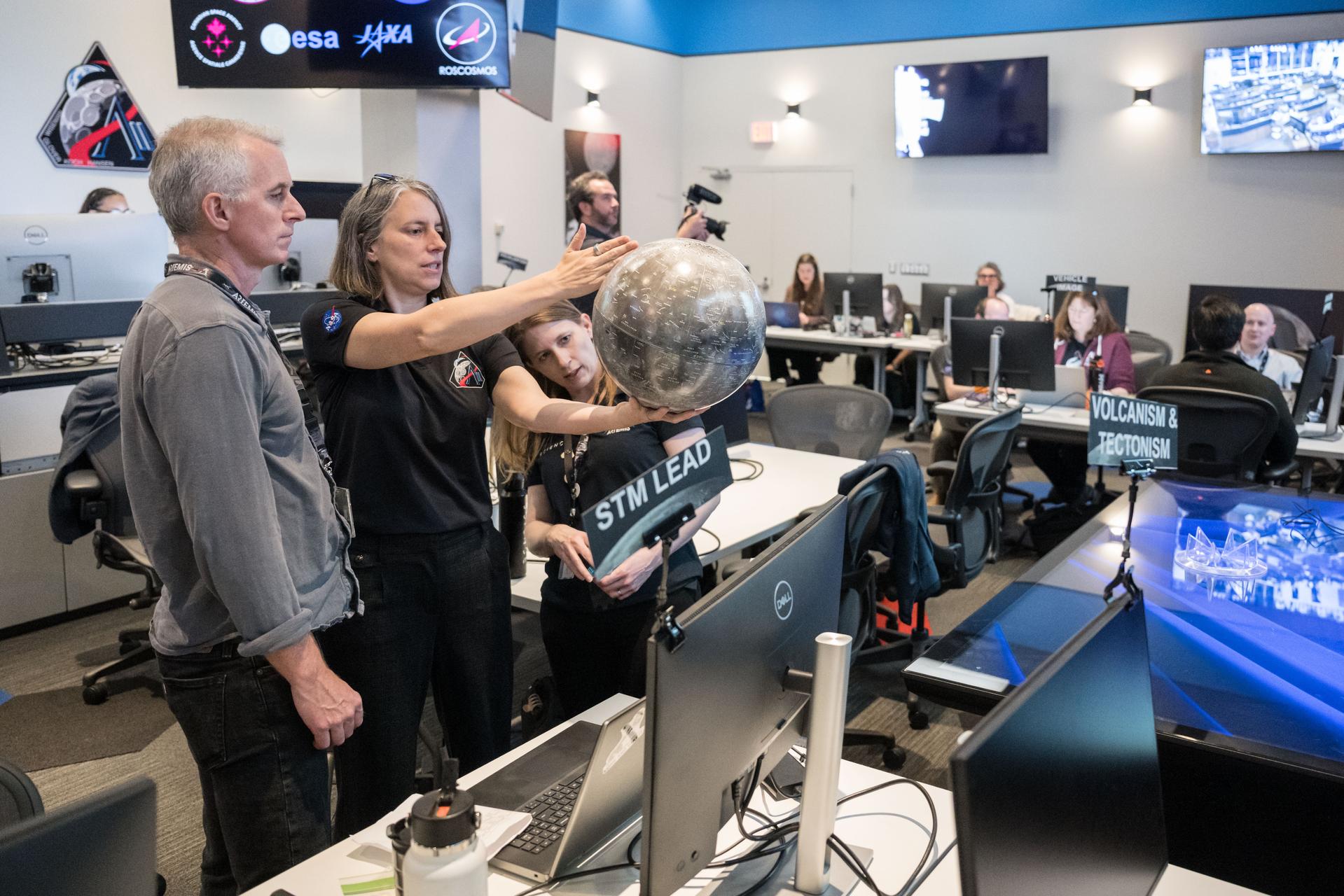
Artemis II lunar science team members, from left, Ryan Ewing, Juliane Gross, and Debra Needham, discuss lunar geography ahead of the translunar injection burn that accelerated the Orion spacecraft to break free of Earth’s orbit and began the outbound trajectory toward the Moon. They are in the Science Evaluation Room (SER) a back room that supports lunar science and planetary observations for the Artemis science officer in the mission’s main flight control room. Built specifically for Artemis missions with these science priorities in mind, the SER is equipped to support rapid data interpretation, collaborative analysis, real-time decision making, and seamless coordination between the science and operations teams.
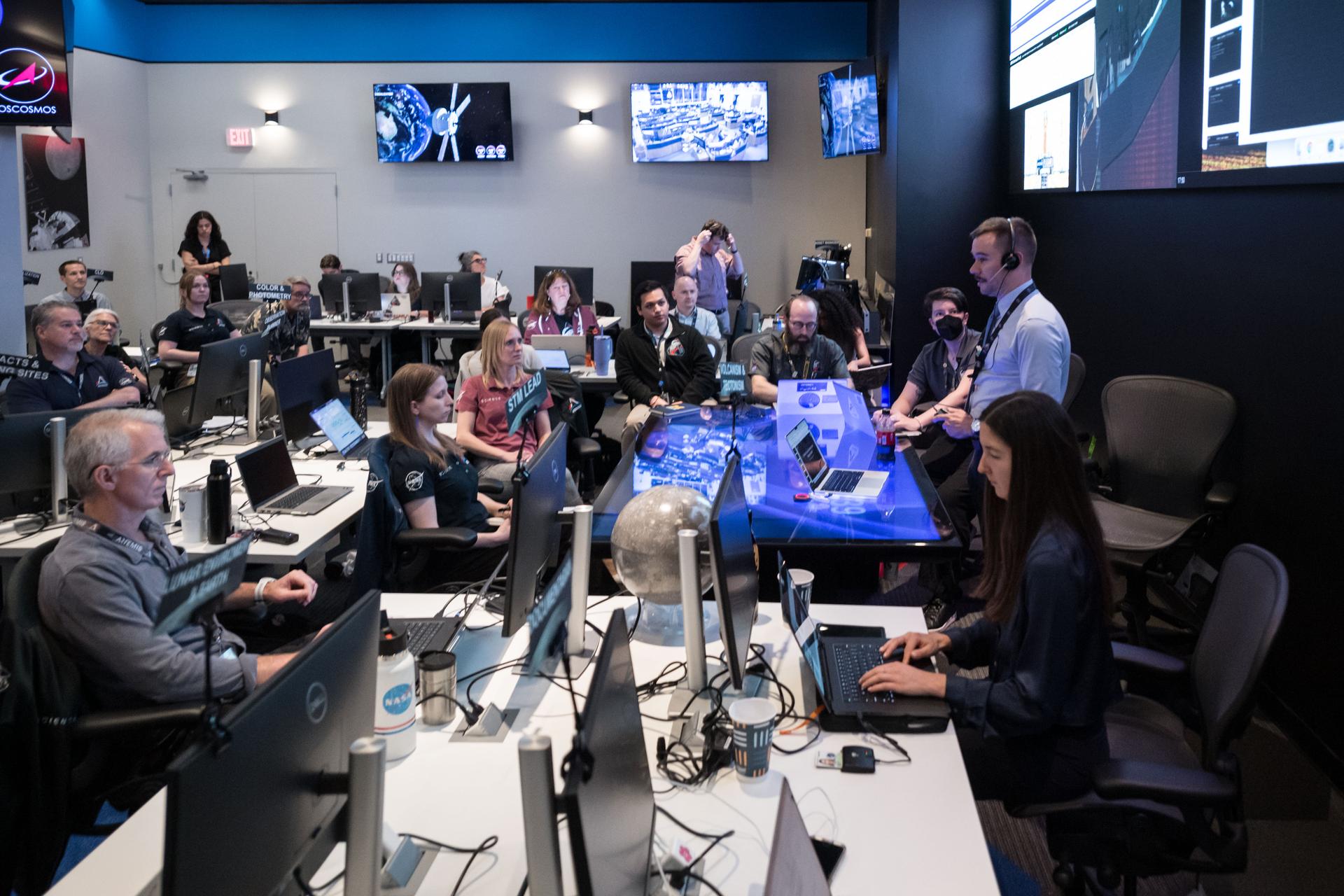
The Artemis II lunar science team gathers for a kickoff meeting before working on the lunar targeting plan for the crew's lunar flyby. The Lunar Targeting Plan is the Artemis II crew's Moon observing assignment, and is fine-tuned to the exact lighting conditions on the Moon’s surface when the Artemis II crew flies by. Like a spacewalk plan, it provides strong, detailed guidance, plus flexibility for the crew to make decisions based on what they’re seeing and experiencing in real time. Targets are prioritized based on both their science value and their visibility at the time of observation. Credits: NASA/Luna Posadas Nava

Science evaluation room communicator, Kiarre Dumes, left, and deputy lunar science lead Marie Henderson work in the Science Evaluation Room (SER) during Artemis II. Built specifically for Artemis missions with these science priorities in mind, the SER is equipped to support rapid data interpretation, collaborative analysis, real-time decision making, and seamless coordination between the science and operations teams. Credits: NASA/Luna Posadas Nava
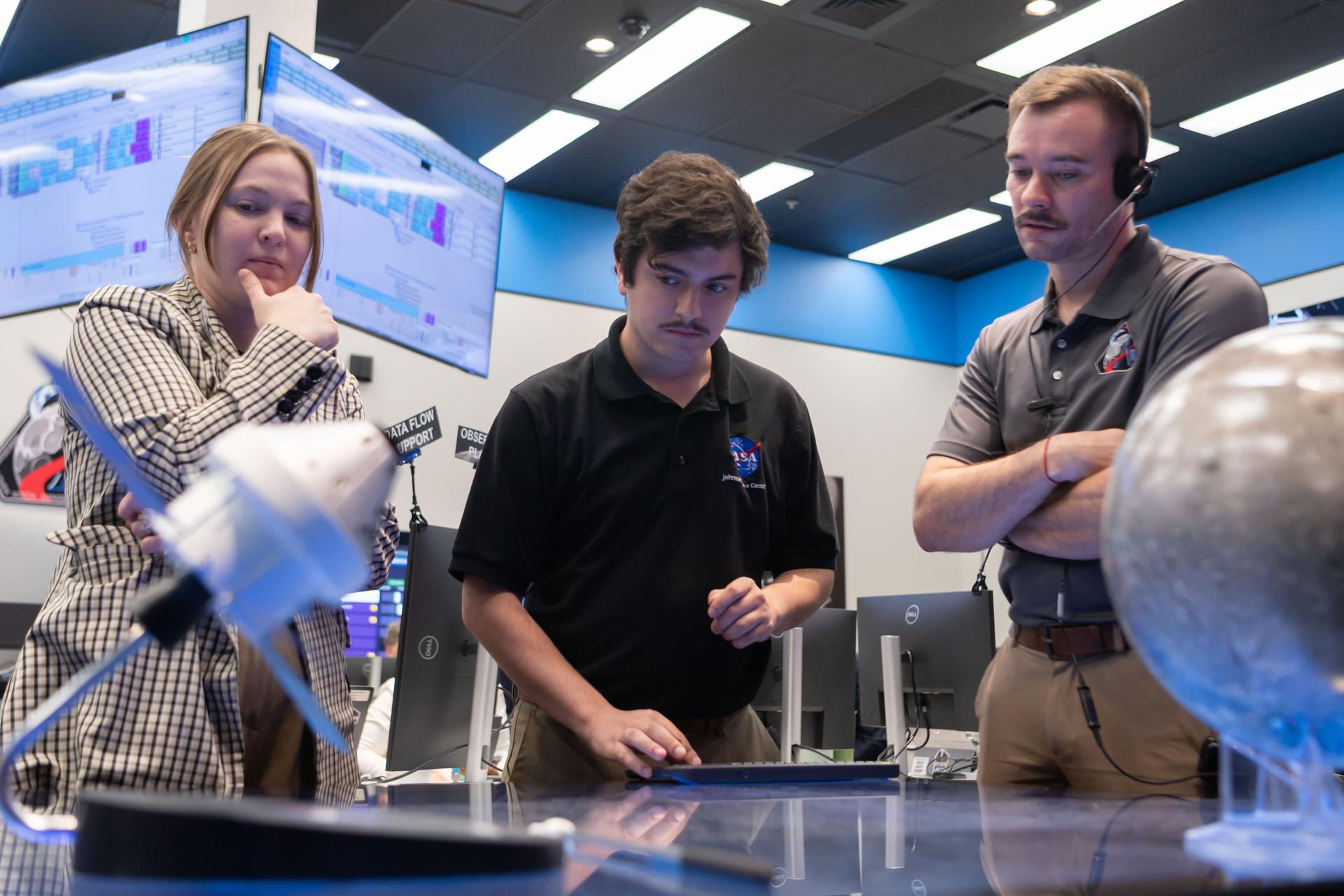
Crew lunar observations team member, Sara Schmidt, left, asset manager, Luke McSherry, and Artemis deputy lunar science lead, Jacob Richardson work in the Science Evaluation Room (SER). Built specifically for Artemis missions with these science priorities in mind, the SER is equipped to support rapid data interpretation, collaborative analysis, real-time decision making, and seamless coordination between the science and operations teams. Credits: NASA/Luna Posadas Nava
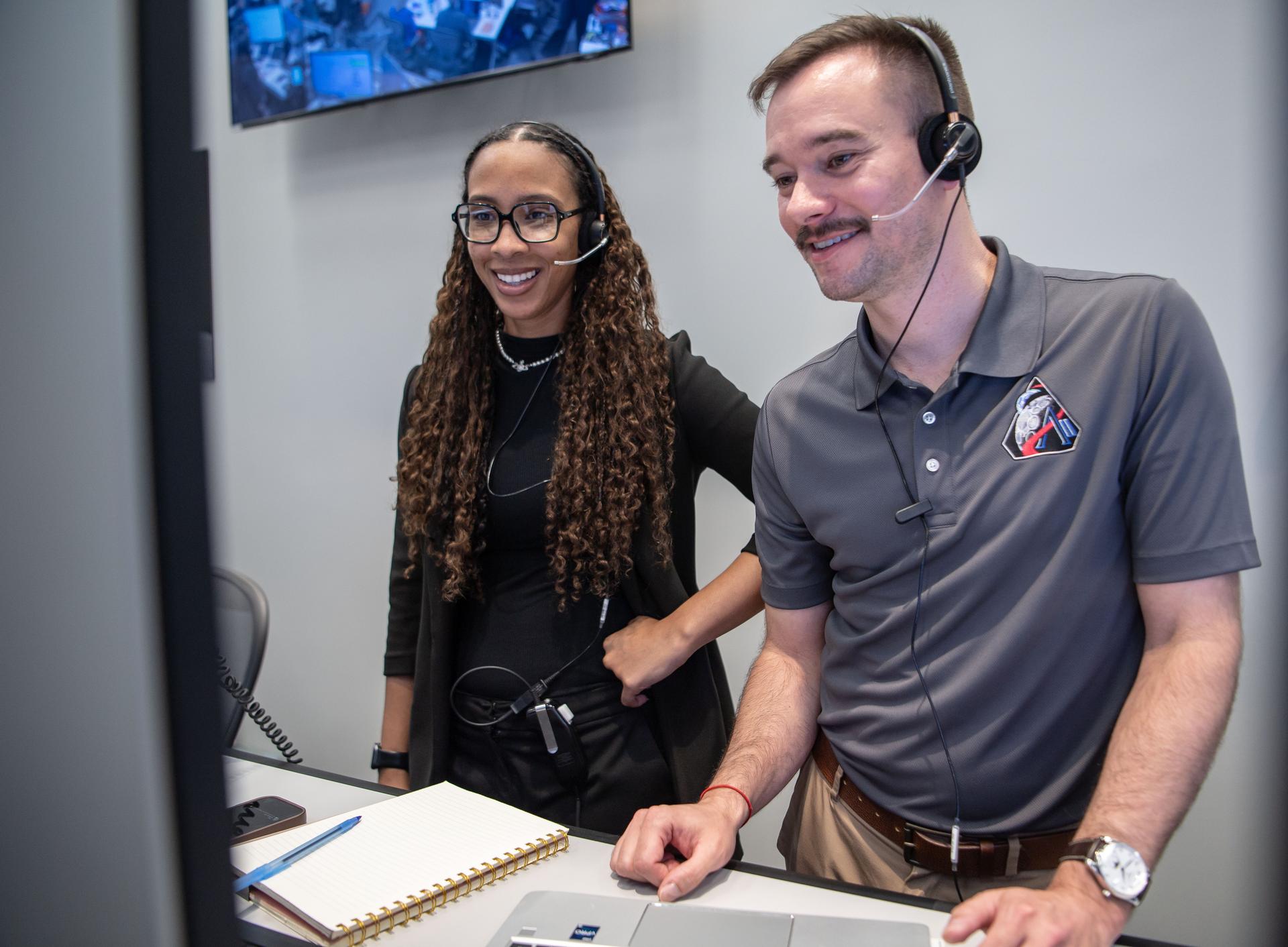
Artemis II Lunar Science Deputy Jacob Richardson and Artemis II Lunar Science Team Member Kiarre Dumes react to the astronauts' verbal observations of the Moon during their flyby on April 6. The science team trained the astronauts in geology both in the classroom and in the field. They also built the lunar targeting plan that, like a spacewalk plan, provides strong, detailed observation guidance, plus flexibility for the crew to make decisions based on what they’re seeing and experiencing in real time. The science team had many moments of celebration during the lunar flyby as the astronauts took pictures of the Moon and provided verbal descriptions of what they were seeing. This type of information reveals the geologic history of an area and will be critical to collect when future Artemis astronauts explore the Moon's surface. Credits: NASA/Luna Posadas Nava
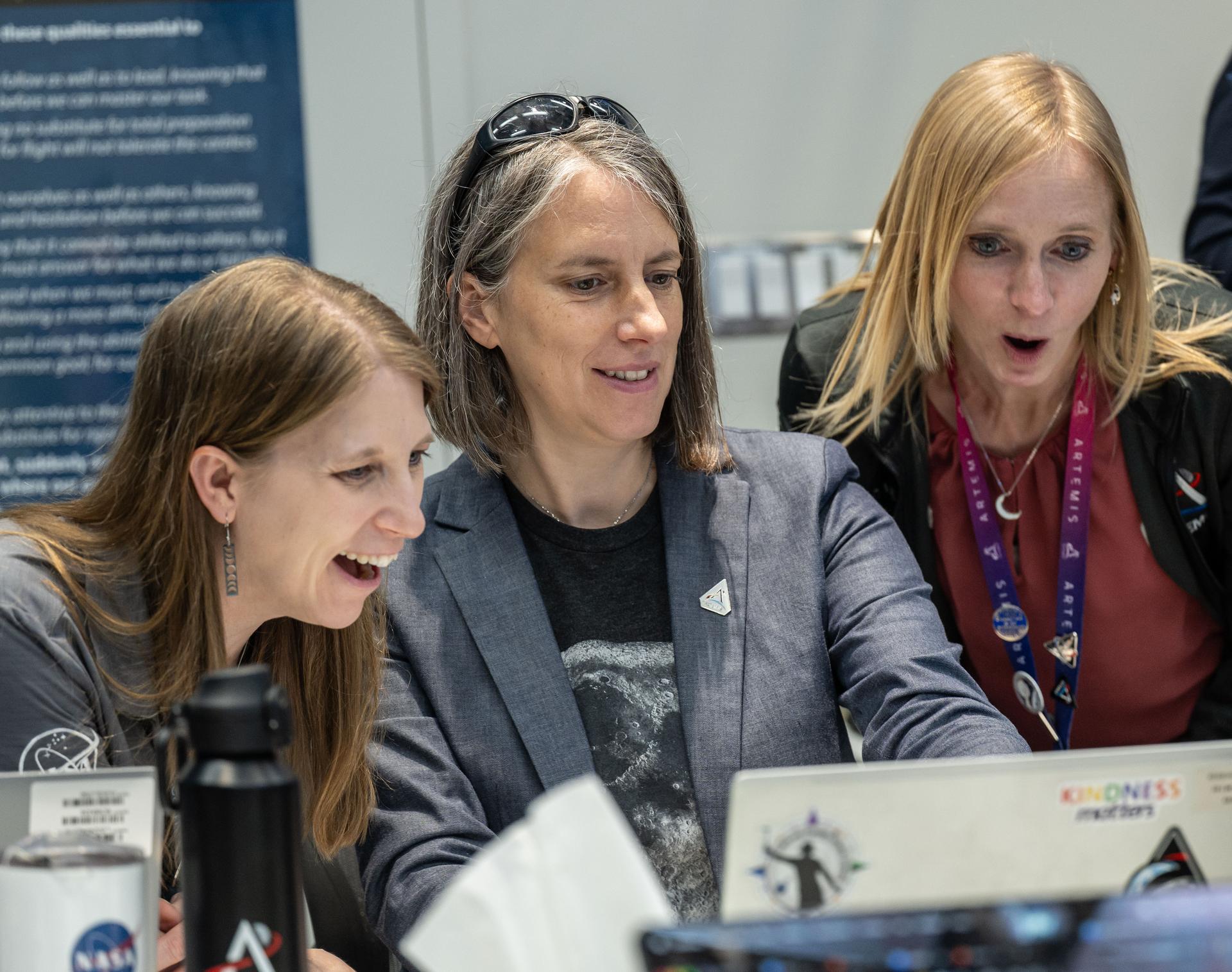
Artemis II lunar science team members, from left, Debra Needham, Juliane Gross, and Ryan Watkins, react to the astronauts' verbal observations of the Moon during their flyby on April 6, 2026. The science team trained the astronauts in geology and observation, both in the classroom and in the field. The team also built the lunar targeting plan that, like an International Space Station spacewalk plan, provides strong, detailed observation guidance, plus flexibility for the crew to make decisions based on what they’re seeing and experiencing in real time. The science team had many moments of celebration during the lunar flyby as the astronauts took images of the Moon and provided verbal descriptions of what they were seeing. This type of information reveals the geologic history of an area and will be critical to collect when future Artemis astronauts explore the Moon's surface. Credits: NASA/Luna Posadas Nava
Artemis science officers, from left, Angela Garcia and Kelsey Young, watch the lunar science team celebrating in the Science Evaluation Room (SER) as they hear lunar observations from the Artemis II crew. The science team has spent years training the astronauts in geology and observation, both in the classroom and in the field. They also built the lunar targeting plan that, like a spacewalk plan, provides strong, detailed observation guidance, plus flexibility for the crew to make decisions based on what they’re seeing and experiencing in real time. The science team had many moments of celebration during the lunar flyby as the astronauts took pictures of the Moon and provided verbal descriptions of what they were seeing. This type of information reveals the geologic history of an area and will be critical to collect when future Artemis astronauts explore the Moon's surface. Credits: NASA/Robert Markowitz

Artemis II lunar science team member, Juliane Gross, center, and the extended lunar science team behind her, celebrates crew observations made during the lunar flyby on April 6. The team worked in the Science Evaluation Room (SER) in Mission Control at NASA’s Johnson Space Center in Houston. Built specifically for Artemis missions with these science priorities in mind, the SER is equipped to support rapid data interpretation, collaborative analysis, real-time decision making, and seamless coordination between the science and operations teams. Credits: NASA/Luna Posadas Nava
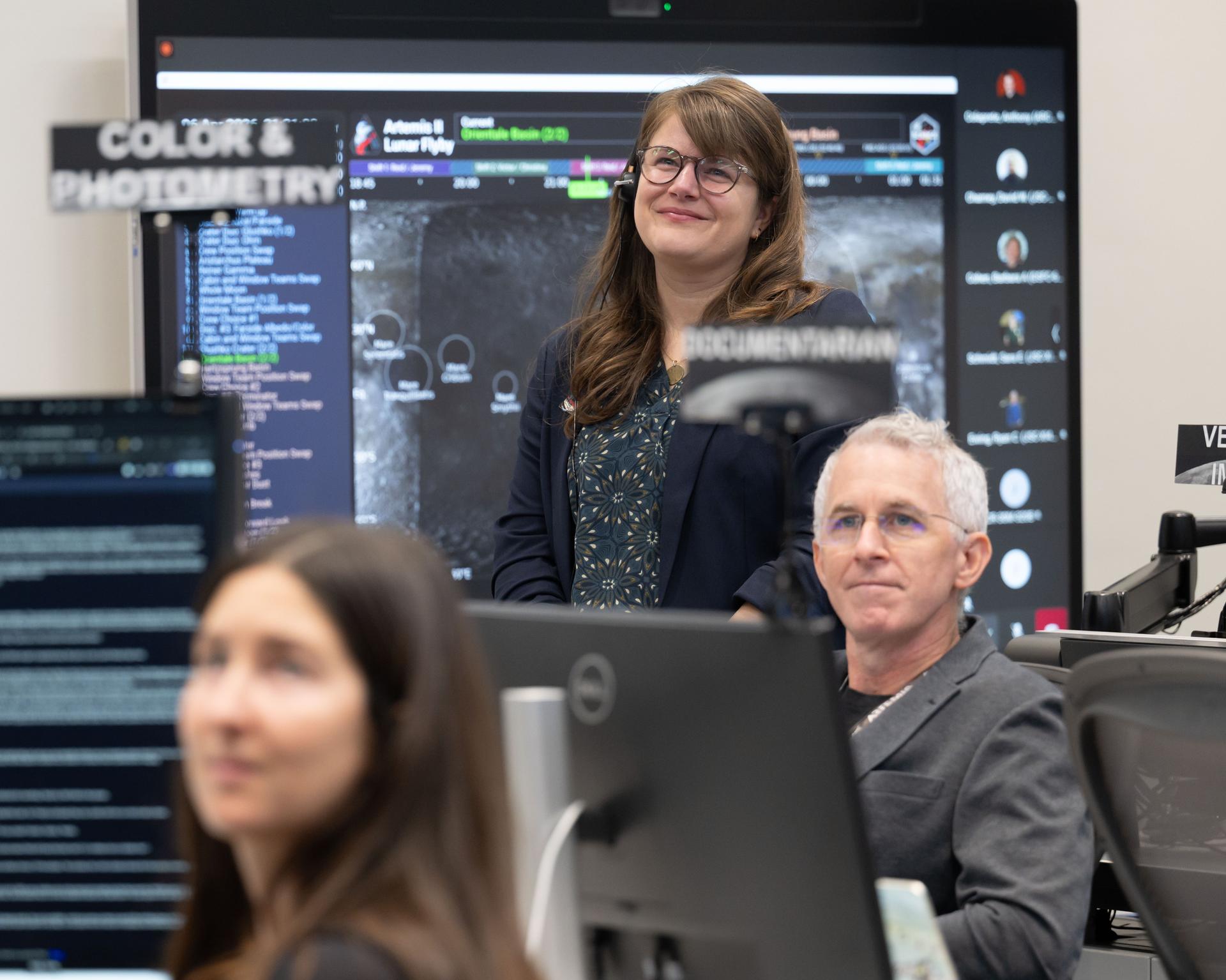
Artemis II deputy lunar science lead Marie Henderson, background, and lunar science team members, Ariel Deutsch, and Ryan Ewing, react to crew observations during the lunar flyby on April 6, 2026. The team worked in the Science Evaluation Room (SER) in Mission Control at NASA’s Johnson Space Center in Houston. Built specifically for Artemis missions with these science priorities in mind, the SER is equipped to support rapid data interpretation, collaborative analysis, real-time decision making, and seamless coordination between the science and operations teams. Credits: NASA/Luna Posadas Nava
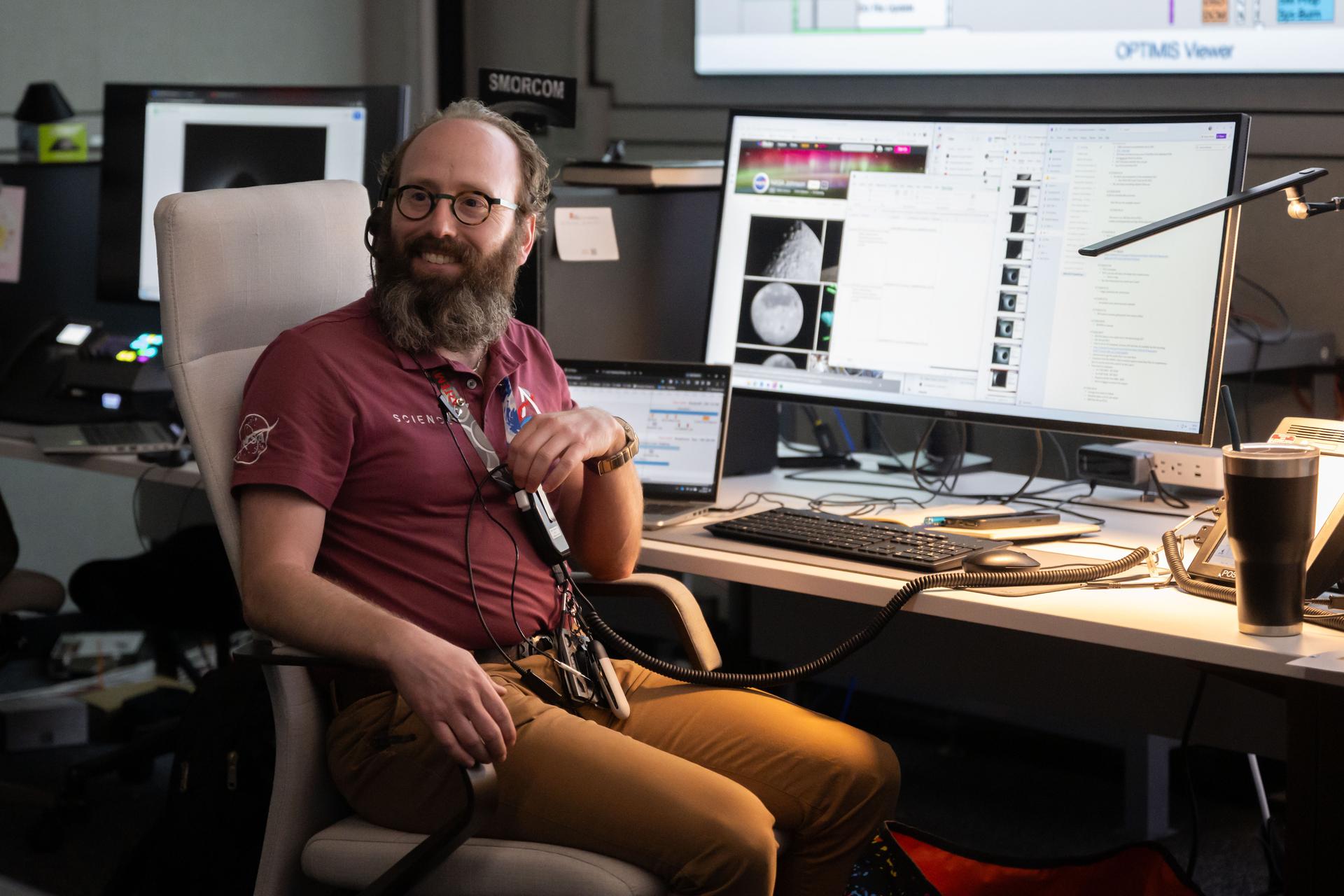
Artemis lunar science team member, Aaron Regberg, works in the Science Mission Operations Room, where scientists analyzed imagery and audio recordings of lunar observations captured by the Artemis II astronauts during their lunar flyby on April 6, 2026.
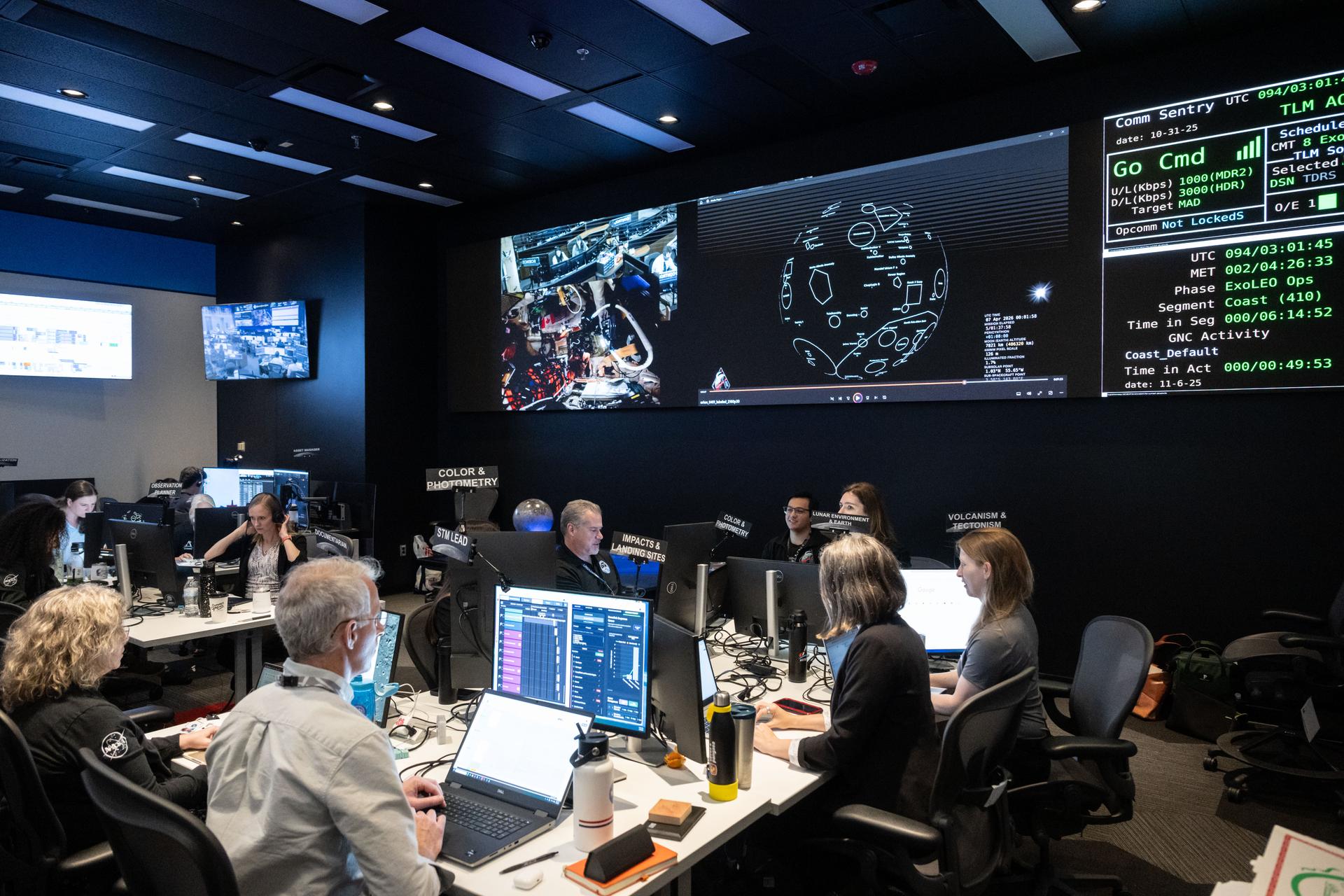
The Artemis II lunar science team works on the lunar targeting plan for the astronauts' several-hour flyby of the Moon, scheduled for April 6. As they pass the Moon, the crew will apply geology skills learned in the classroom and in Moon-like environments on Earth to photograph and describe features including impact craters, ancient lava flows, and surface cracks and ridges formed as the Moon slowly changed over time. They will note differences in color, brightness, and texture, which provide clues that help scientists understand what the surface is made of and how it formed. Credits: NASA/Bill Stafford

Artemis II lunar science team members, from left, Ryan Ewing, and Barbara Cohen, react to crew observations during the lunar flyby on April 6, 2026. The team worked in the Science Evaluation Room (SER) in Mission Control at NASA’s Johnson Space Center in Houston. Built specifically for Artemis missions with these science priorities in mind, the SER is equipped to support rapid data interpretation, collaborative analysis, real-time decision making, and seamless coordination between the science and operations teams. Credits: NASA/Luna Posadas Nava
The Artemis II lunar science team works on the lunar targeting plan for the astronauts' several-hour flyby of the Moon, scheduled for April 6. As they pass the Moon, the crew will apply geology skills learned in the classroom and in Moon-like environments on Earth to photograph and describe features including impact craters, ancient lava flows, and surface cracks and ridges formed as the Moon slowly changed over time. They will note differences in color, brightness, and texture, which provide clues that help scientists understand what the surface is made of and how it formed. Credits: NASA/Bill Stafford

Jared Ralleta, Artemis II lunar science team member, reacts to the lunar flyby crew observations in the Science Evaluation Room (SER). Built specifically for Artemis missions with these science priorities in mind, the SER is equipped to support rapid data interpretation, collaborative analysis, real-time decision making, and seamless coordination between the science and operations teams. Credits: NASA/Luna Posadas Nava
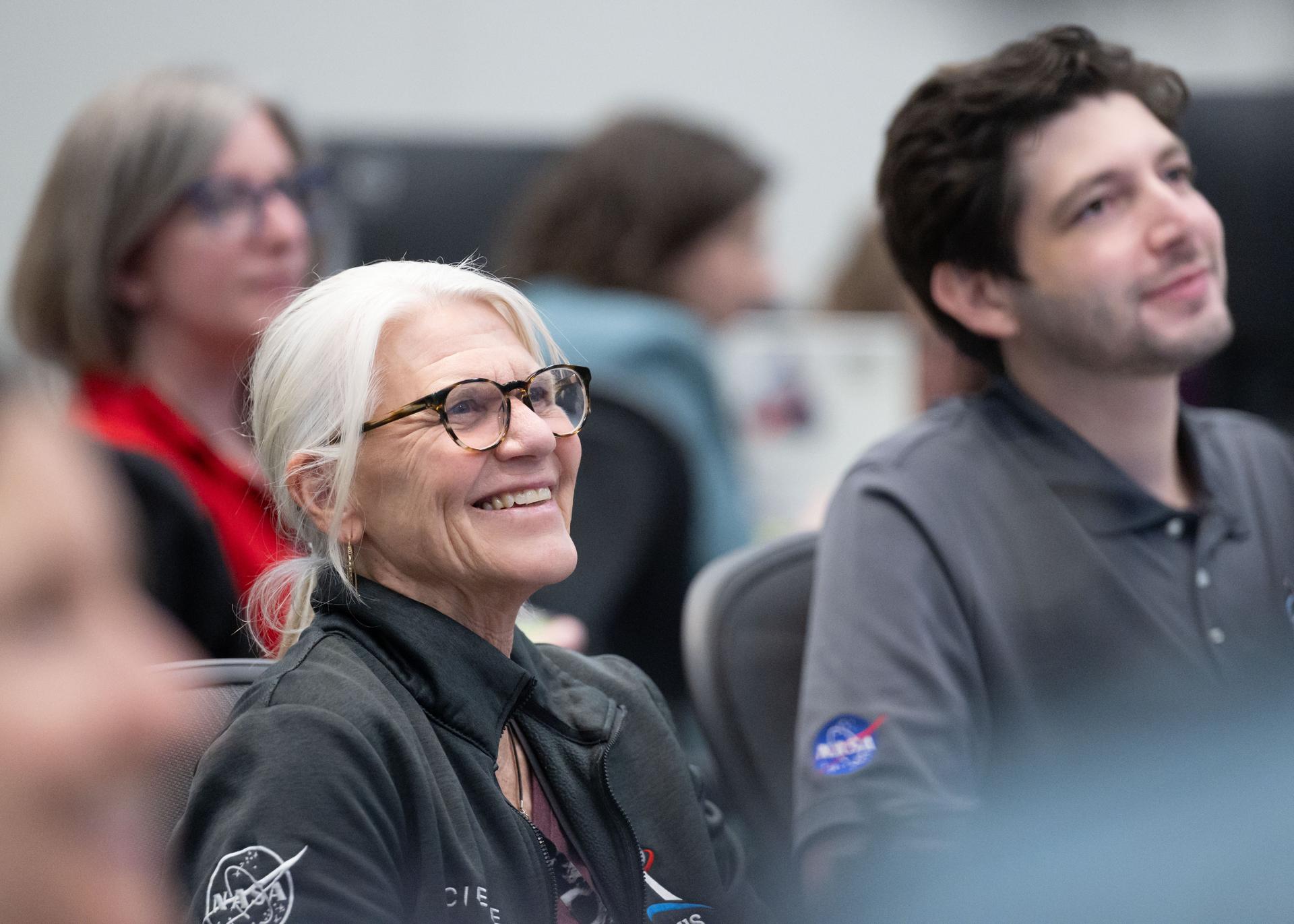
Artemis II lunar science team members, from left, Cindy Evans, and Wilfredo Garcia Lopez, react to crew observations during the lunar flyby on April 6, 2026. The team worked in the Science Evaluation Room (SER) in Mission Control at NASA’s Johnson Space Center in Houston. Built specifically for Artemis missions with these science priorities in mind, the SER is equipped to support rapid data interpretation, collaborative analysis, real-time decision making, and seamless coordination between the science and operations teams. Credits: NASA/Luna Posadas Nava

Artemis II lunar science team member, foreground, Amber Turner, and David Hollibaugh-Baker, and Cherie Achilles, background, participate in the team’s analysis of crew observations during the lunar flyby on April 6, 2026. The team worked in the Science Evaluation Room (SER) in Mission Control at NASA’s Johnson Space Center in Houston. Built specifically for Artemis missions with these science priorities in mind, the SER is equipped to support rapid data interpretation, collaborative analysis, real-time decision making, and seamless coordination between the science and operations teams. Credits: NASA/ Robert Markowitz
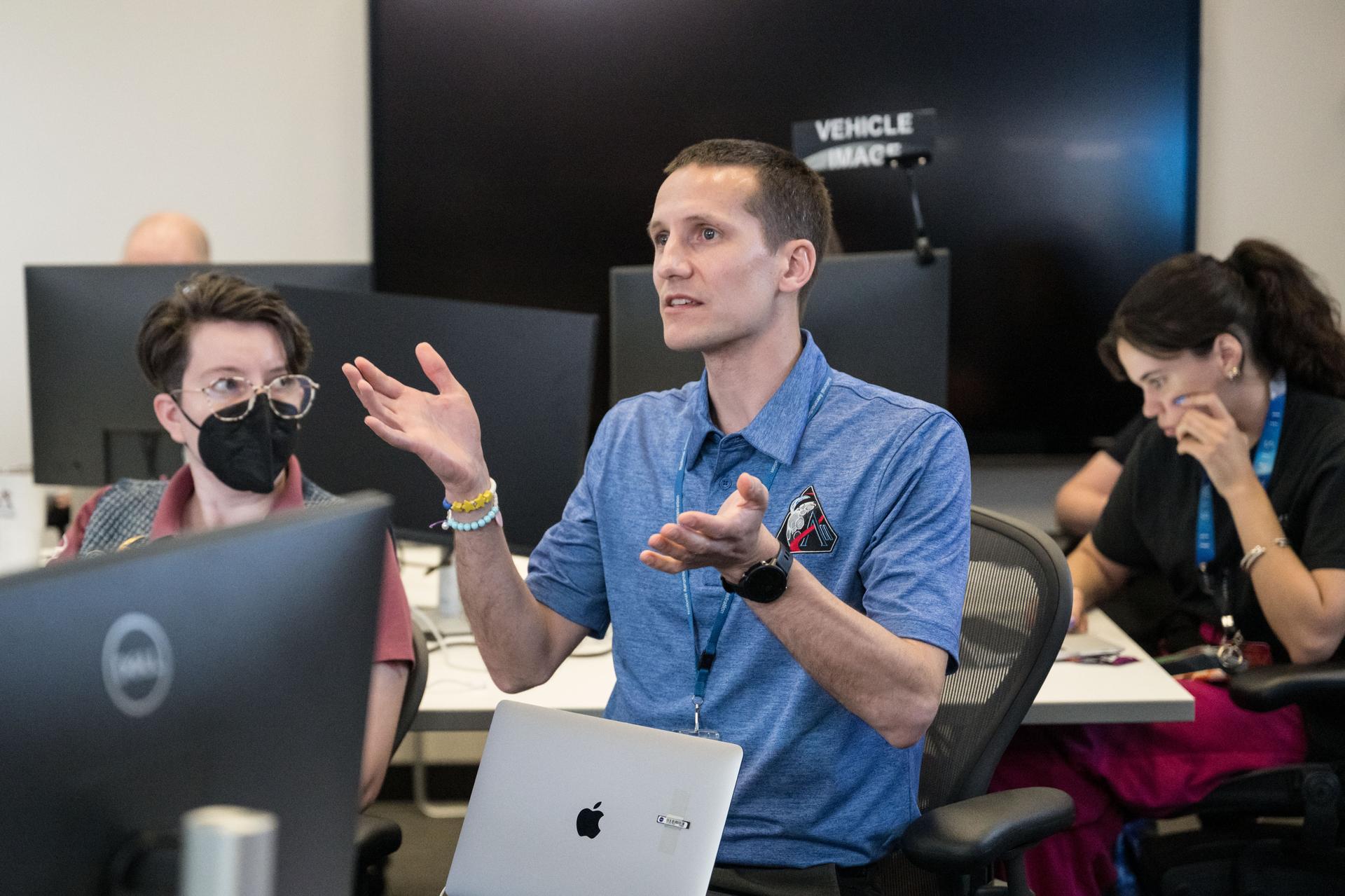
Artemis II lunar science team members, from left, Alexadra Constantinou, David Hollibaugh-Baker, participate in the team’s final preparations for the lunar flyby. NASA Johnson public affairs officer, Victoria Segovia, is seen in the background. The team worked in the Science Evaluation Room (SER) in Mission Control at NASA’s Johnson Space Center in Houston. Built specifically for Artemis missions with these science priorities in mind, the SER is equipped to support rapid data interpretation, collaborative analysis, real-time decision making, and seamless coordination between the science and operations teams. Credits: Credits: NASA/ Robert Markowitz
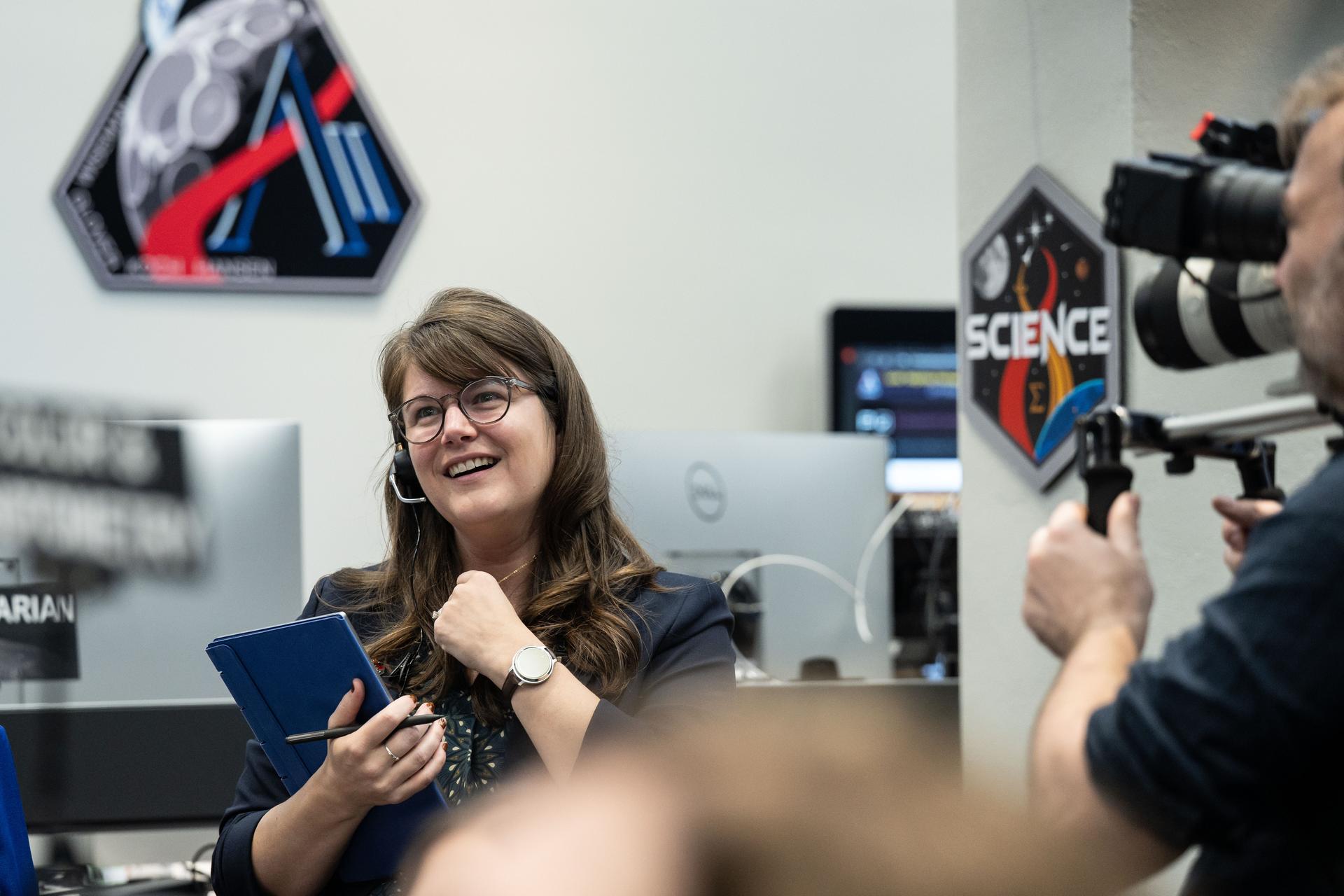
Artemis II deputy lunar science lead, Marie Henderson, reacts to the astronauts' verbal observations of the Moon during their flyby on April 6, 2026. Along with other lunar science team members, Ewing helped train the crew in geology both in the classroom and in the field. The science team also built the lunar targeting plan that, like an International Space Station spacewalk plan, provides strong, detailed observation guidance, plus flexibility for the crew to make decisions based on what they’re seeing and experiencing in real time. The science team had many moments of celebration during the lunar flyby as the astronauts took images of the Moon and provided verbal descriptions of what they were seeing. This type of information reveals the geologic history of an area and will be critical to collect when future Artemis astronauts explore the Moon's surface. Credits: NASA/Luna Posadas Nava
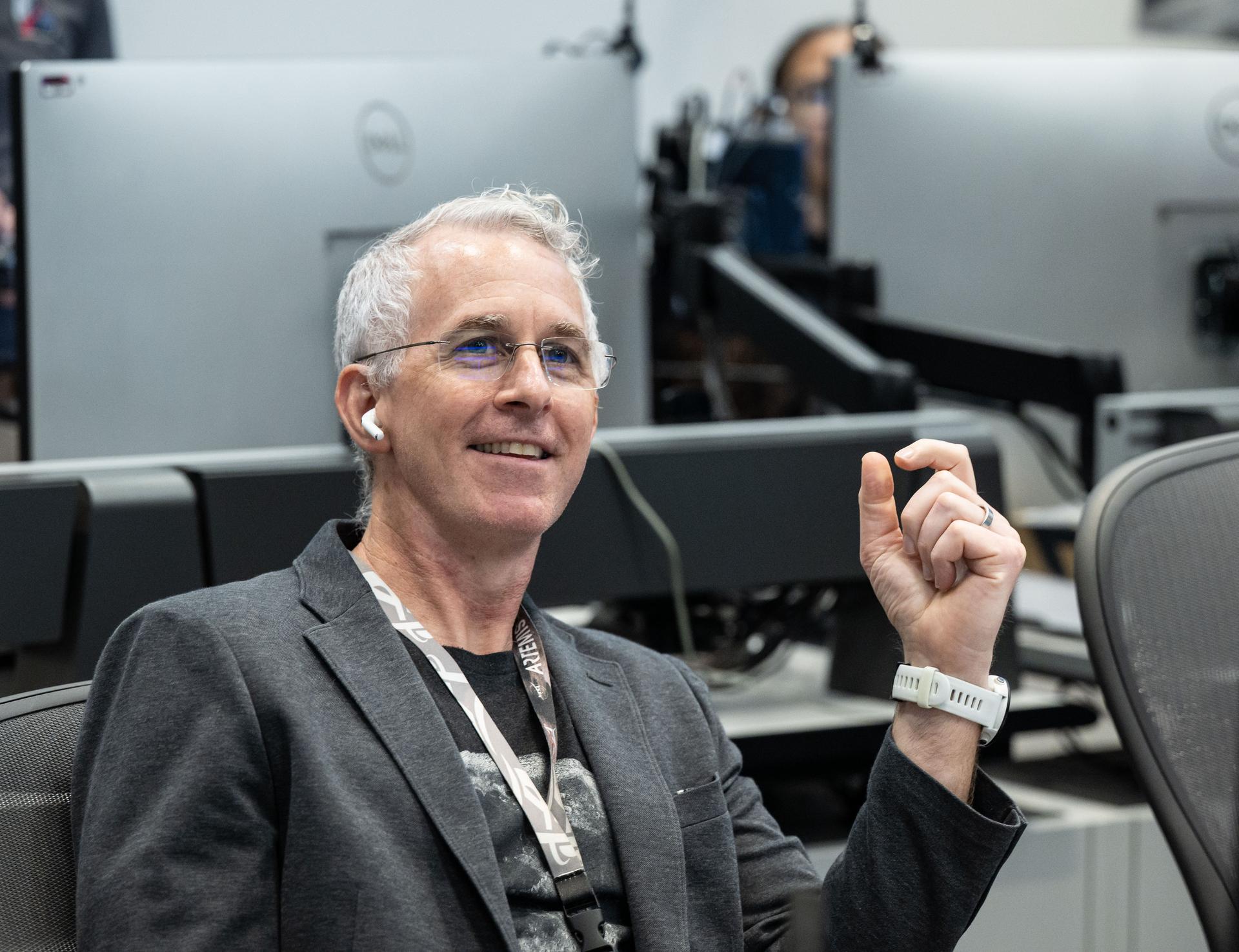
Artemis II lunar science team member, Ryan Ewing, reacts to the astronauts' verbal observations of the Moon during their flyby on April 6, 2026. Along with other lunar science team members, Ewing helped train the crew in geology both in the classroom and in the field. The science team also built the lunar targeting plan that, like an International Space Station spacewalk plan, provides strong, detailed observation guidance, plus flexibility for the crew to make decisions based on what they’re seeing and experiencing in real time. The science team had many moments of celebration during the lunar flyby as the astronauts took images of the Moon and provided verbal descriptions of what they were seeing. This type of information reveals the geologic history of an area and will be critical to collect when future Artemis astronauts explore the Moon's surface. Credits: NASA/Luna Posadas Nava

Artemis lunar science team member, Alexandra Constantinou, works in the Science Mission Operations Room at NASA’s Johnson Space Center in Houston, where scientists analyzed imagery and audio recordings of lunar observations captured by the Artemis II astronauts during their lunar flyby on April 6, 2026. Credits: NASA/Helen Arase Vargas
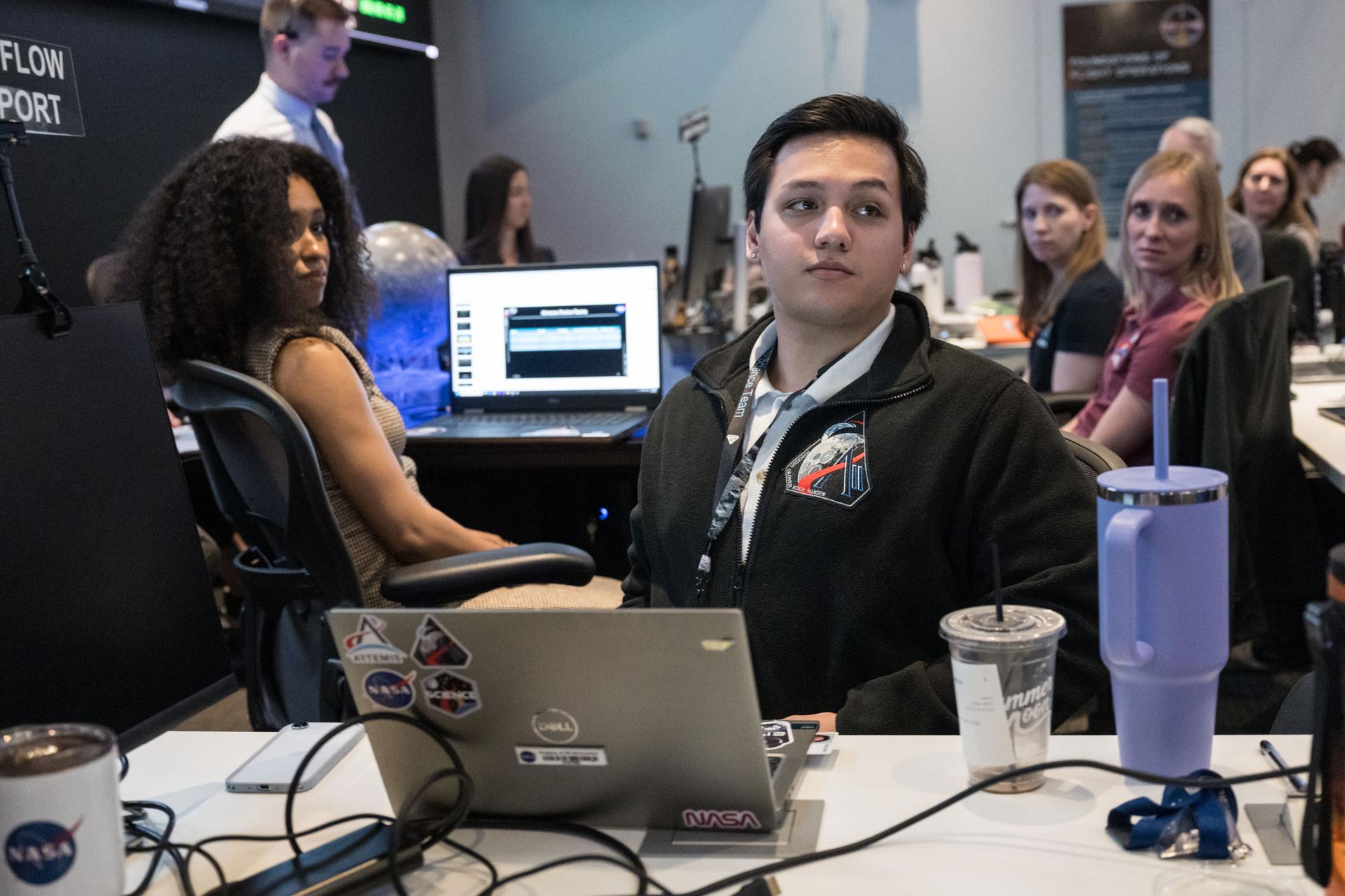
Artemis II lunar science team members, in the foreground from left: Amber Turner and Jared Ralleta in the center. Standing up behind Turner is Jacob Richardson, and sitting behind and to the right, of Ralleta, are Ryan Watkins in the front, and Debra Needham behind her. The SER supports the Artemis science officer in the mission’s main flight control room. Built specifically for Artemis missions with these science priorities in mind, the SER is equipped to support rapid data interpretation, collaborative analysis, real-time decision making, and seamless coordination between the science and operations teams. Credits: NASA/Luna Posadas Nava
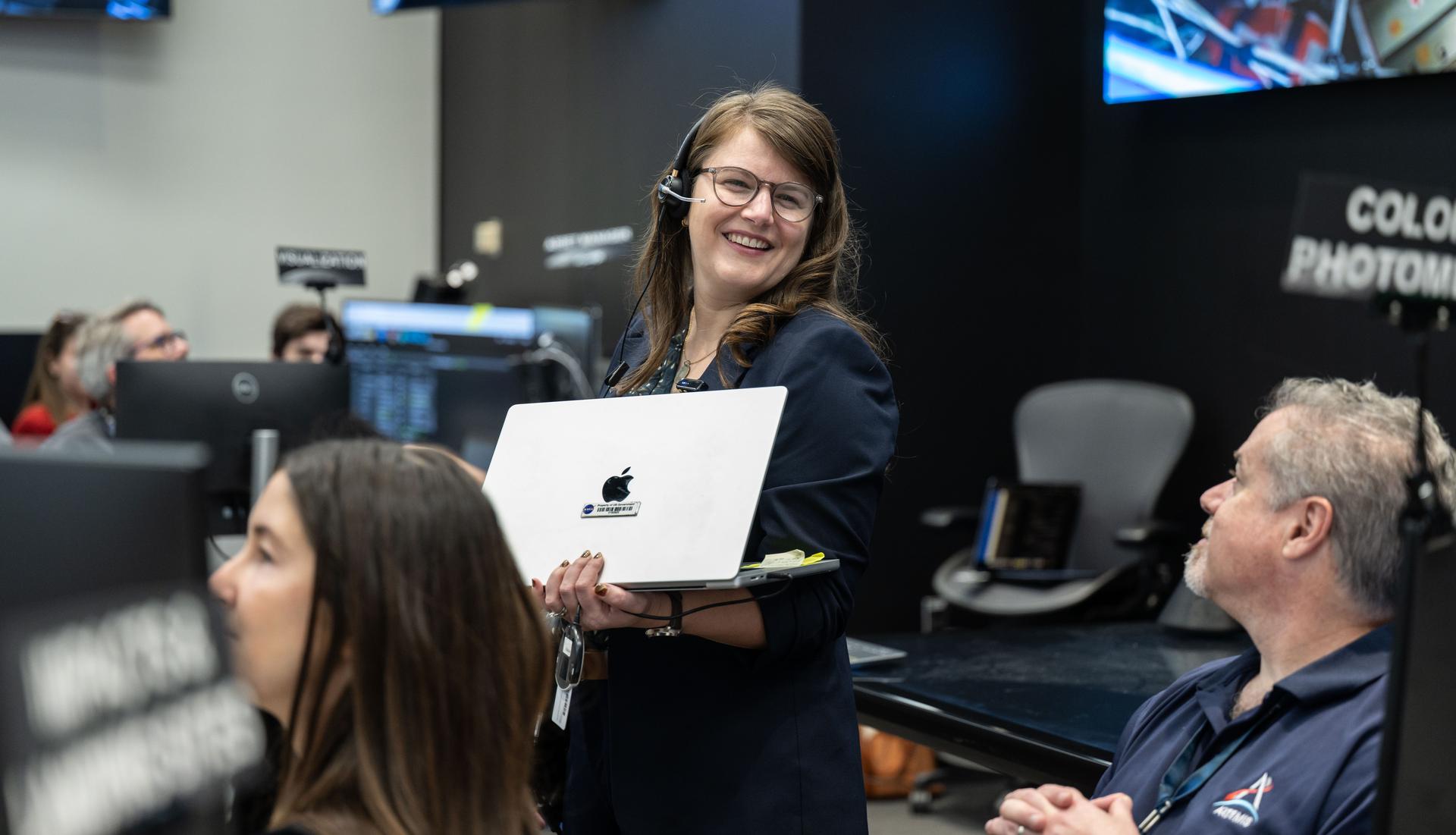
Artemis II deputy lunar science lead, Marie Henderson, reacts to the astronauts' verbal observations of the Moon during their flyby on April 6, 2026. Along with other lunar science team members, Henderson helped train the astronauts in geology both in the classroom and in the field. The team also built the lunar targeting plan that, like an International Space Station spacewalk plan, provides strong, detailed observation guidance, plus flexibility for the crew to make decisions based on what they’re seeing and experiencing in real time. The science team had many moments of celebration during the lunar flyby as the astronauts took images of the Moon and provided verbal descriptions of what they were seeing. This type of information reveals the geologic history of an area and will be critical to collect when future Artemis astronauts explore the Moon's surface. Credits: NASA/Luna Posadas Nava

Ernie Wright, Artemis II lunar science visualization lead, reacts to hearing the astronauts describe features of the Moon as they few by on April 6, 2026. To prepare the crew for this mission, the Artemis II lunar science team trained the astronauts in geology, both in the classroom and in the field. They also built the lunar targeting plan that, which, like an International Space Station spacewalk plan, provides strong, detailed observation guidance, plus flexibility for the crew to make decisions based on what they’re seeing and experiencing in real time. The science team had many moments of celebration during the lunar flyby as the astronauts took images of the Moon and provided verbal descriptions of what they were seeing. This type of information reveals the geologic history of an area and will be critical to collect when future Artemis astronauts explore the Moon's surface. Credits: NASA/Luna Posadas Nava
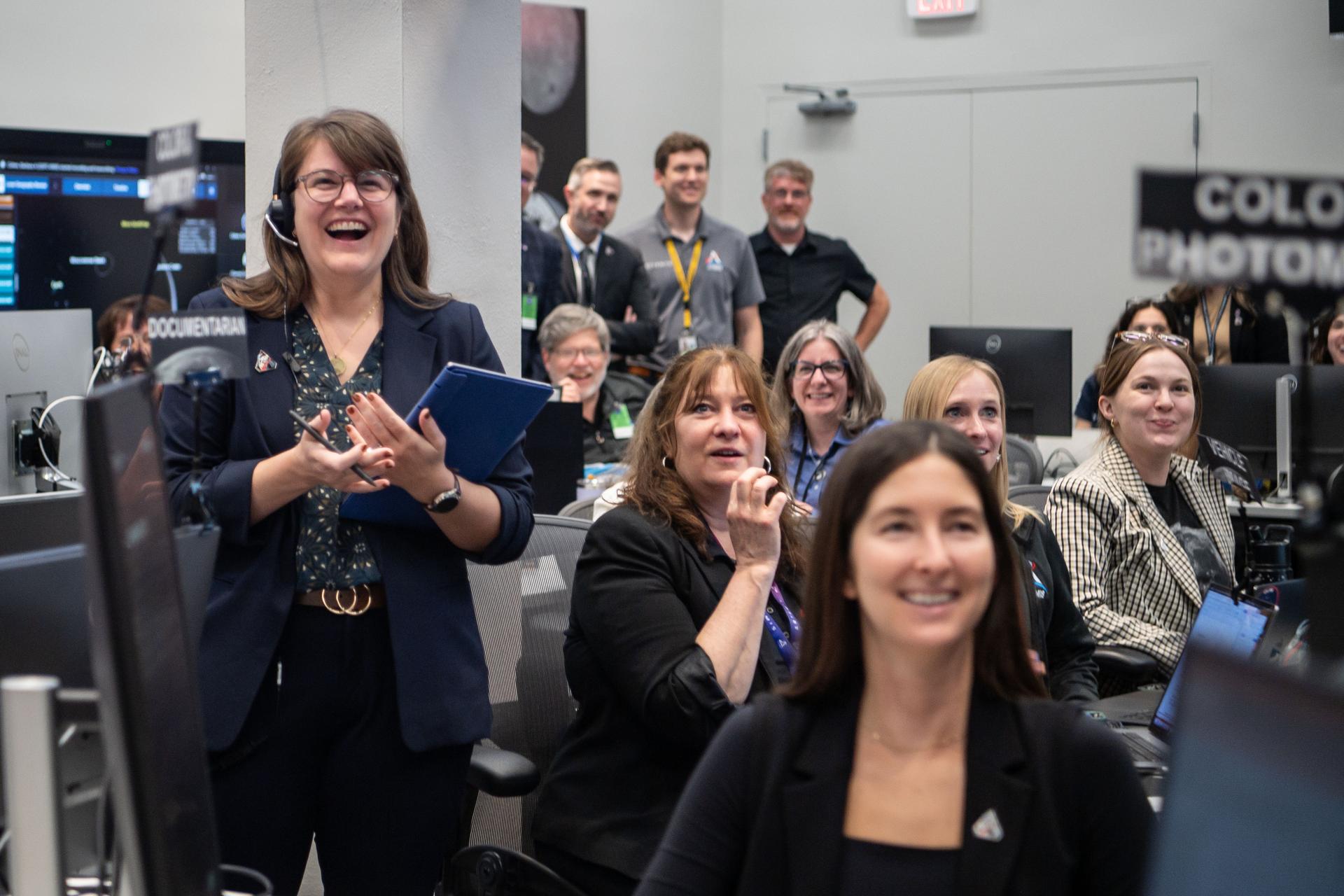
Artemis II deputy lunar science lead Marie Henderson, shown standing on the left, and lunar science team members, from the right foreground, Ariel Deutsch, Maria Banks behind her, Ryan Watkins to her right, and Sara Schmidt in the checkered jacket. In this image they are reacting to astronauts' observations of Moon features during their flyby on April 6, 2026. Leading up to the flight, the science team has been training the astronauts in in the classroom and in the field. They also built the lunar targeting plan that, like a spacewalk plan on the International Space Station, provides strong, detailed observation guidance, plus flexibility for the crew to make decisions based on what they’re seeing and experiencing in real time. The science team had many moments of celebration during the lunar flyby as the astronauts took images of the Moon and provided verbal descriptions of what they were seeing. This type of information reveals the geologic history of various lunar areas and will be critical to collect when future Artemis astronauts explore the Moon's surface. Credits: NASA/Luna Posadas Nava
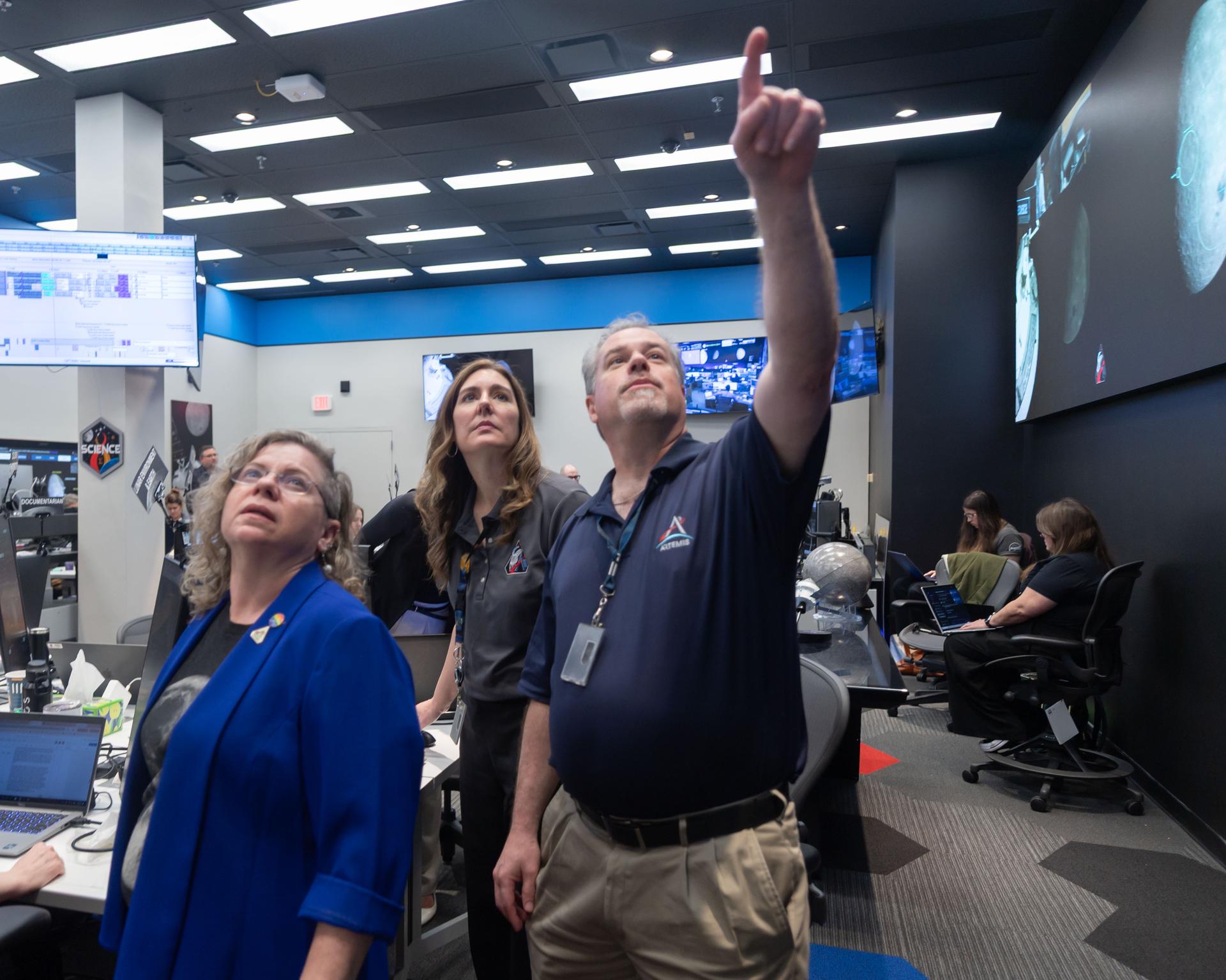
Artemis II lunar science team members, from left, Barbara Cohen, Jennifer Heldmann, and Anthony Colaprete, work in the Science Evaluation Room (SER). Built specifically for Artemis missions with these science priorities in mind, the SER is equipped to support rapid data interpretation, collaborative analysis, real-time decision making, and seamless coordination between the science and operations teams. Credits: NASA/Luna Posadas Nava

Artemis II lunar science team member, Ariel Deutsch, reacts to the astronauts' verbal observations of the Moon during their flyby on April 6. The science team has spent years training the astronauts in geology and observation, both in the classroom and in the field. They also built the lunar targeting plan that, like a spacewalk plan, provides strong, detailed observation guidance, plus flexibility for the crew to make decisions based on what they’re seeing and experiencing in real time. The science team had many moments of celebration during the lunar flyby as the astronauts took pictures of the Moon and provided verbal descriptions of what they were seeing. This type of information reveals the geologic history of an area and will be critical to collect when future Artemis astronauts explore the Moon's surface. Credits: NASA/Luna Posadas Nava

Artemis II lunar science team member, Amber Turner, works on the lunar targeting plan for the astronauts' several-hour flyby of the Moon, scheduled for April 6. As they pass the Moon, the crew will apply geology skills learned in the classroom and in Moon-like environments on Earth to photograph and describe features including impact craters, ancient lava flows, and surface cracks and ridges formed as the Moon slowly changed over time. They will note differences in color, brightness, and texture, which provide clues that help scientists understand what the surface is made of and how it formed. Credits: NASA/Bill Stafford
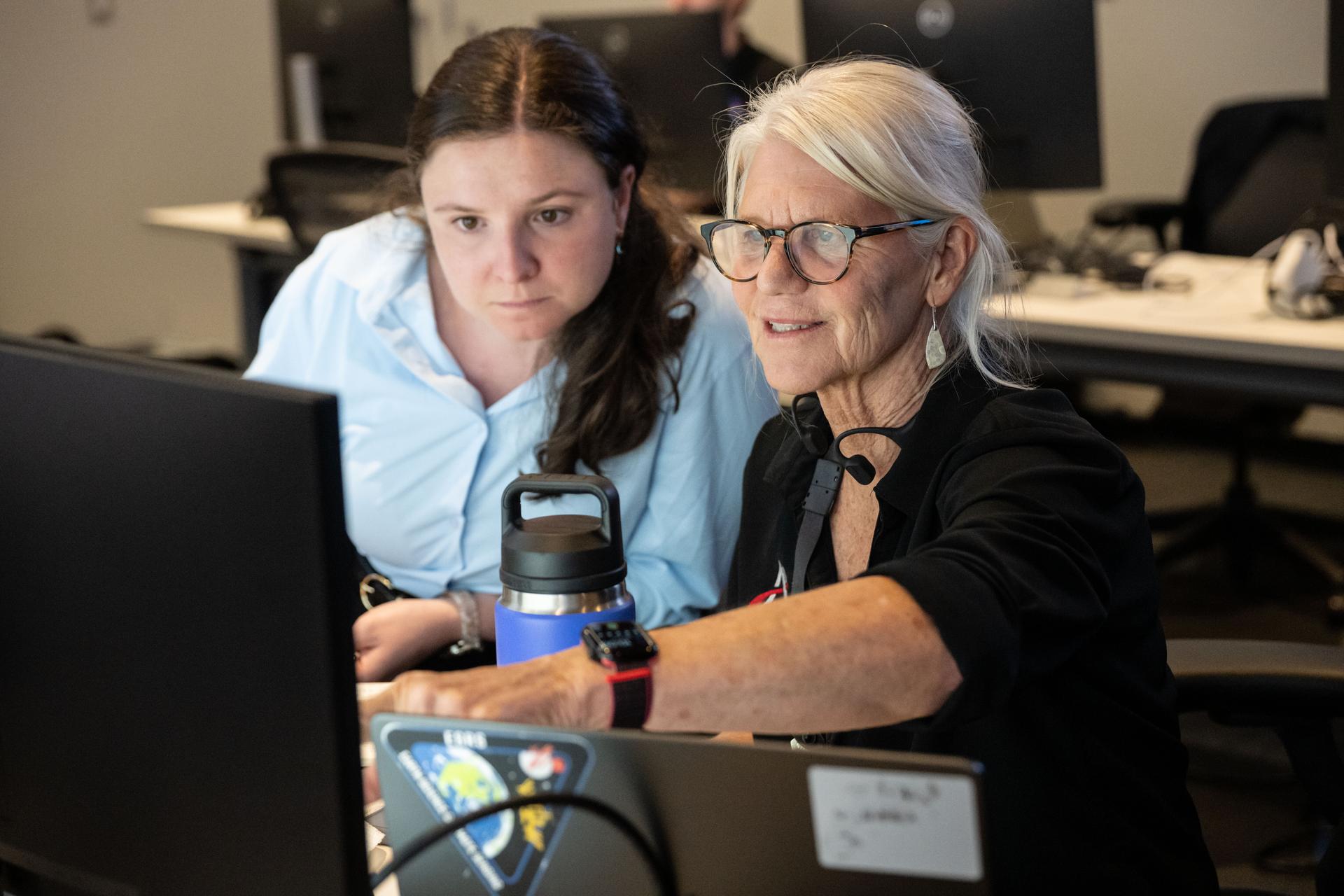
Artemis II lunar science team members, from left, Megan Borel, and Cindy Evans, discuss the lunar targeting plan for the astronauts' several-hour flyby of the Moon, scheduled for April 6. As they pass the Moon, the crew will apply geology skills learned in the classroom and in Moon-like environments on Earth to photograph and describe features including impact craters, ancient lava flows, and surface cracks and ridges formed as the Moon slowly changed over time. They will note differences in color, brightness, and texture, which provide clues that help scientists understand what the surface is made of and how it formed. Credits: NASA/Bill Stafford
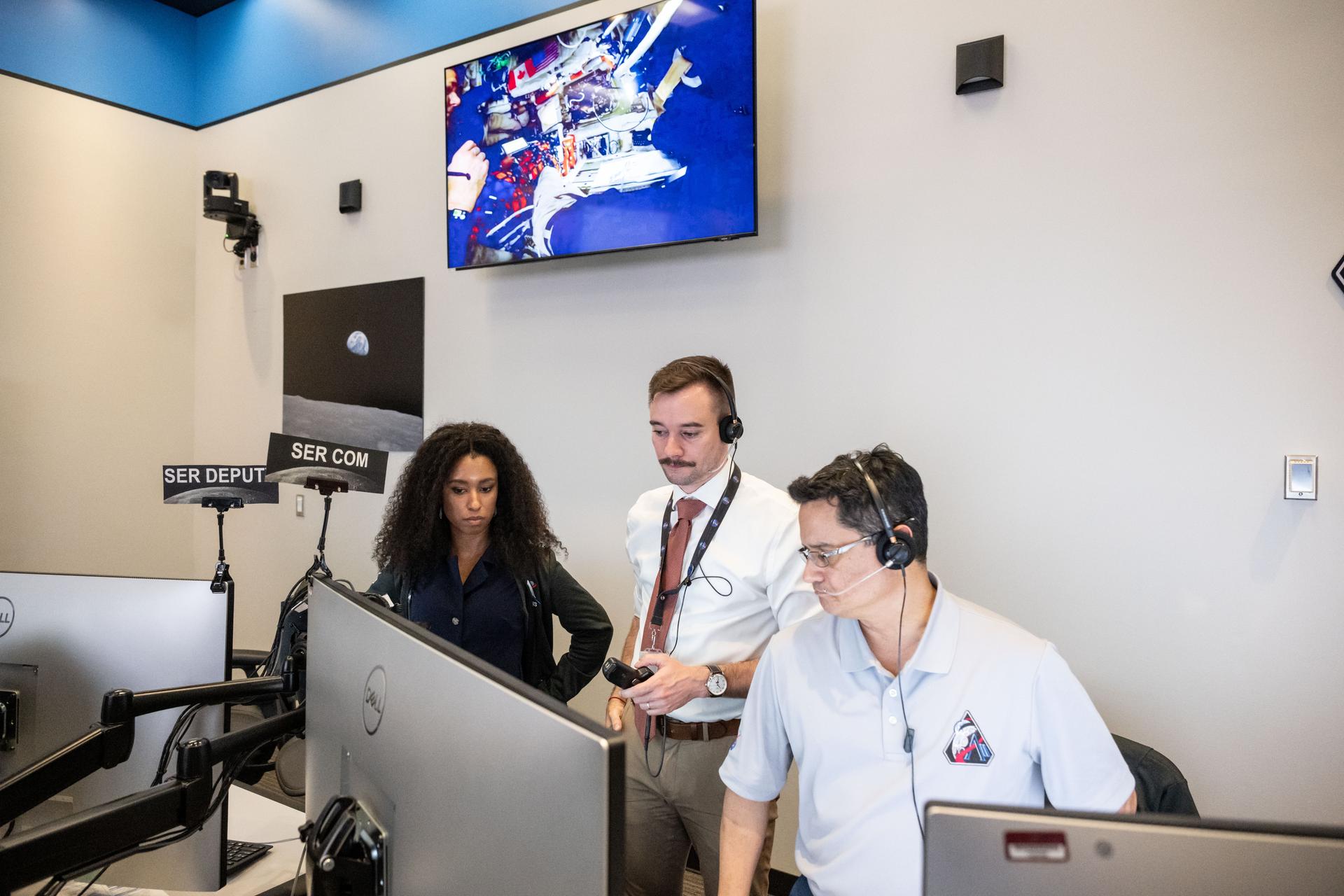
Artemis II lunar science team members, from left, Amber Turner, Jacob Richardson, Jose Hurtado, discuss the team's progress on the lunar targeting plan for the astronauts' six-hour flyby of the Moon, scheduled for April 6. As they pass the Moon, the crew will apply geology skills learned in the classroom and in Moon-like environments on Earth to photograph and describe features including impact craters, ancient lava flows, and surface cracks and ridges formed as the Moon slowly changed over time. They will note differences in color, brightness, and texture, which provide clues that help scientists understand what the surface is made of and how it formed. Credits: NASA/Bill Stafford

Artemis II deputy lunar science lead, Jacob Richardson, celebrates with a dance after hearing astronauts describe seeing impact flashes on the Moon during their lunar flyby on April 6, 2026. Richardson was monitoring the flyby from the Science Evaluation Room (SER) in Mission Control at NASA’s Johnson Space Center in Houston. Built specifically for Artemis missions with these science priorities in mind, the SER is equipped to support rapid data interpretation, collaborative analysis, real-time decision making, and seamless coordination between the science and operations teams. Credits: NASA/Luna Posadas Nava
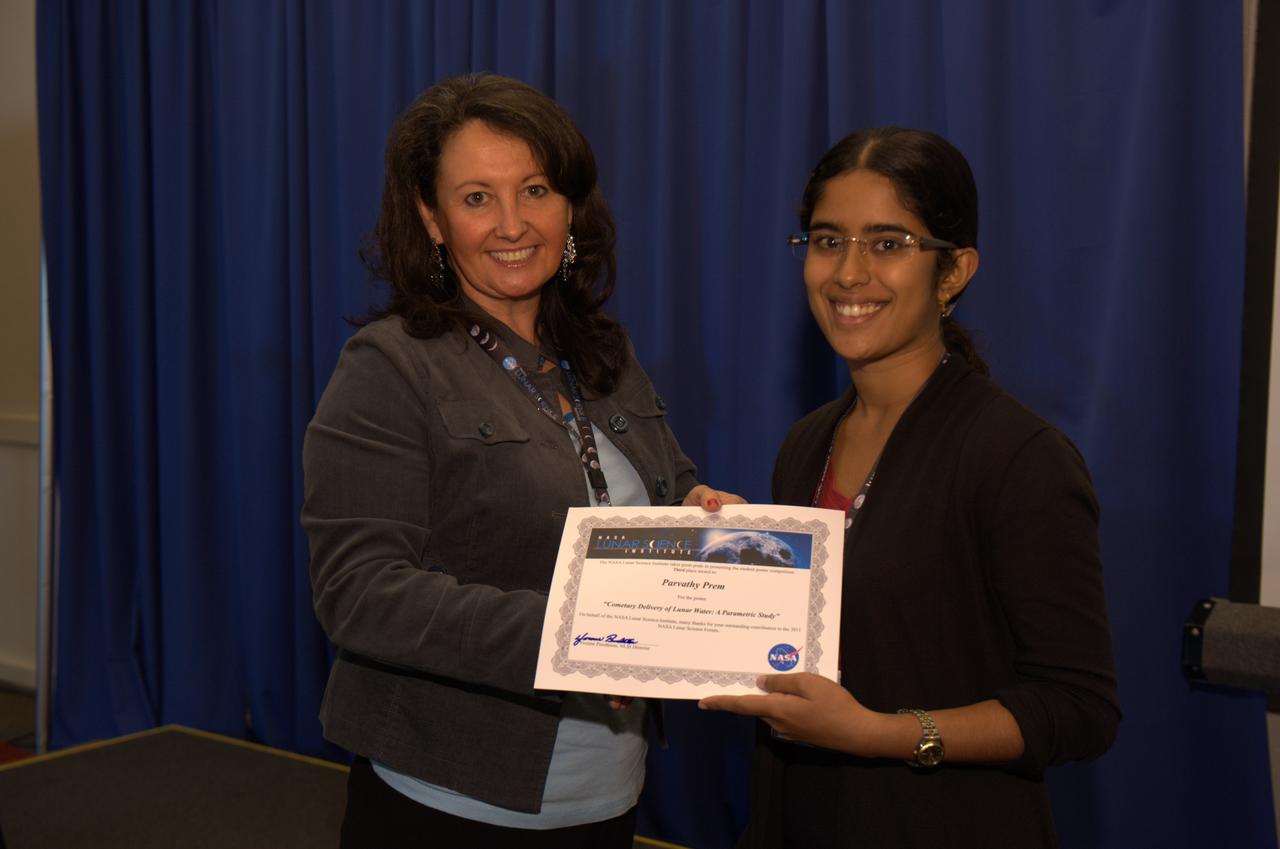
Lunar Science Forum Student Poster competition Third Place award to Parvathy Prem for the poster 'Cometary Delivery of Lunar Water: A Parametric Study'
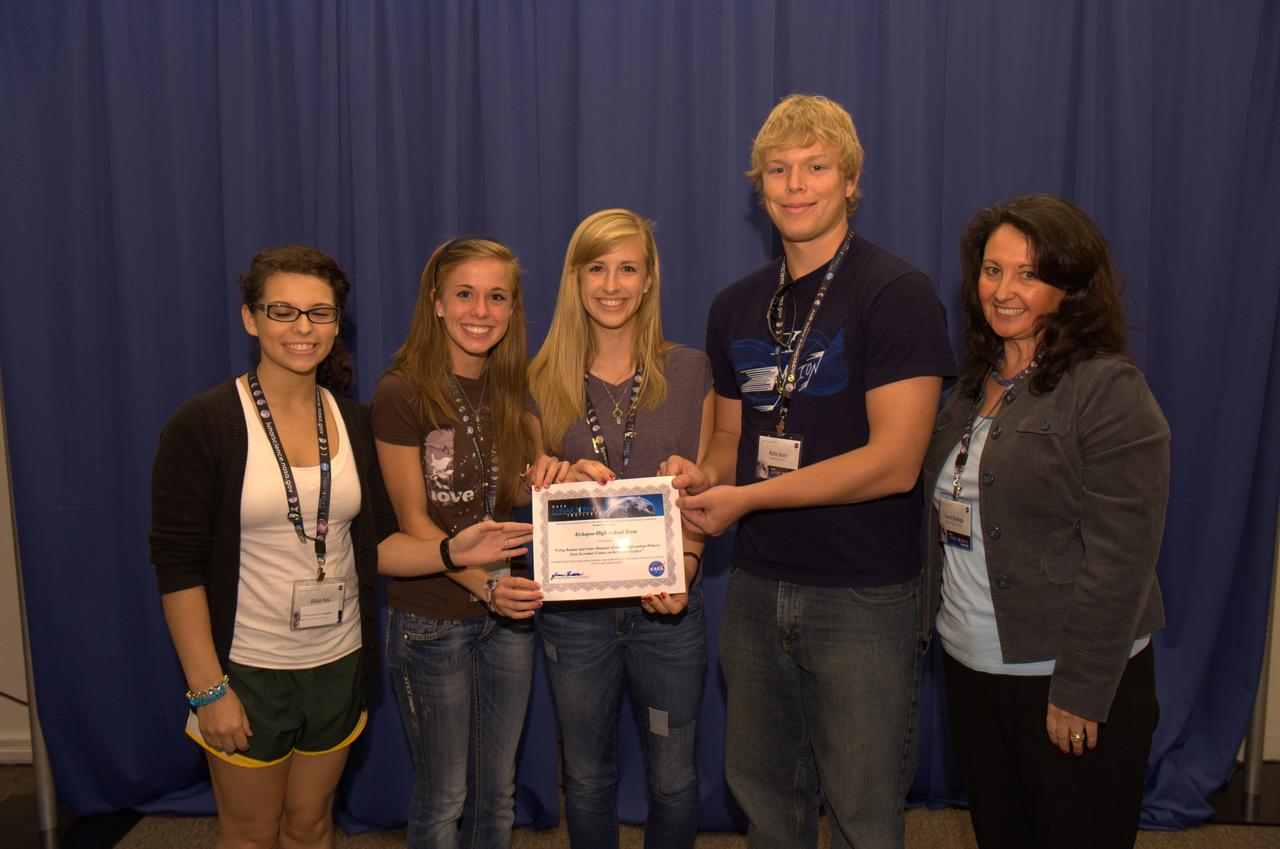
Lunar Science Forum Student Poster competition Second place award to Kickapoo High school Team for the poster 'using Boulder and Crater Diameter Ratios to Differentiate Primary from Secondary Craters and the Lunar Surface'
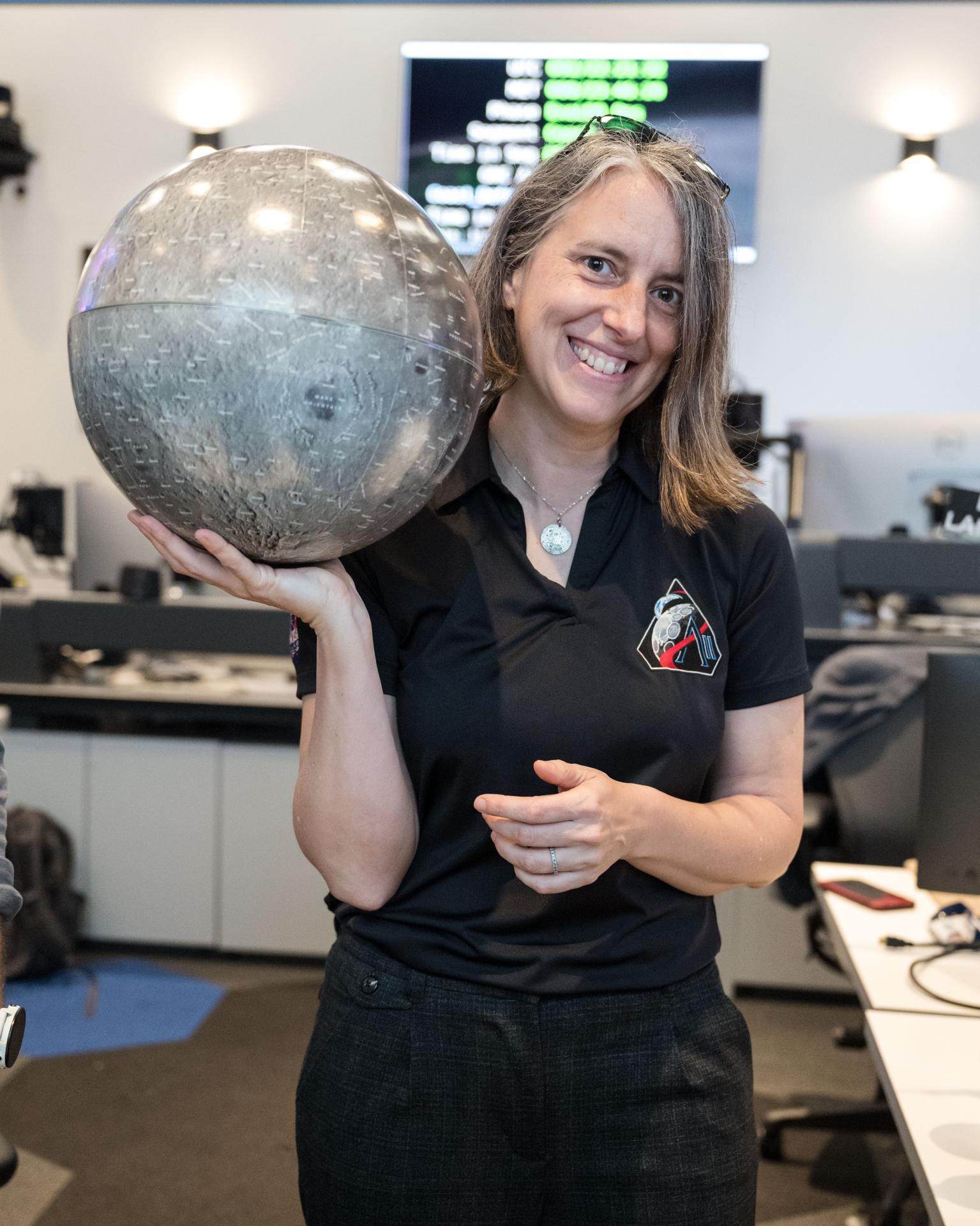
Artemis curation lead, Juliane Gross, holds a lunar globe in the Science Evaluation Room (SER) in Mission Control at Johnson Space Center in Houston. The SER supports lunar science and planetary observations for the Artemis science officer in the mission’s main flight control room. Built specifically for Artemis missions with these science priorities in mind, the SER is equipped to support rapid data interpretation, collaborative analysis, real-time decision making, and seamless coordination between the science and operations teams. Credits: NASA/Luna Posadas Nava
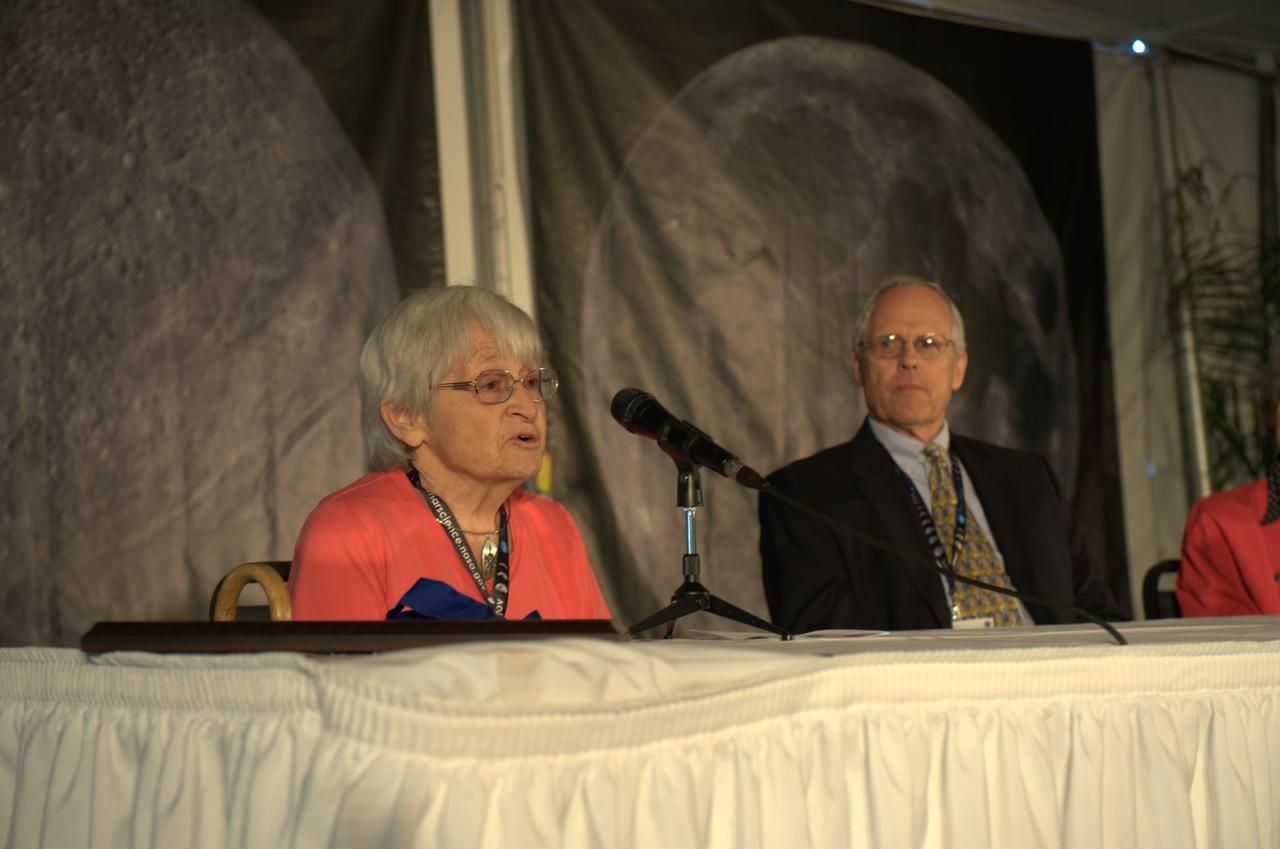
Lunar Science Forum 2011 Shoemaker Award reciepiants Gene Shoemaker on left and G. Jeffrey Taylor on right
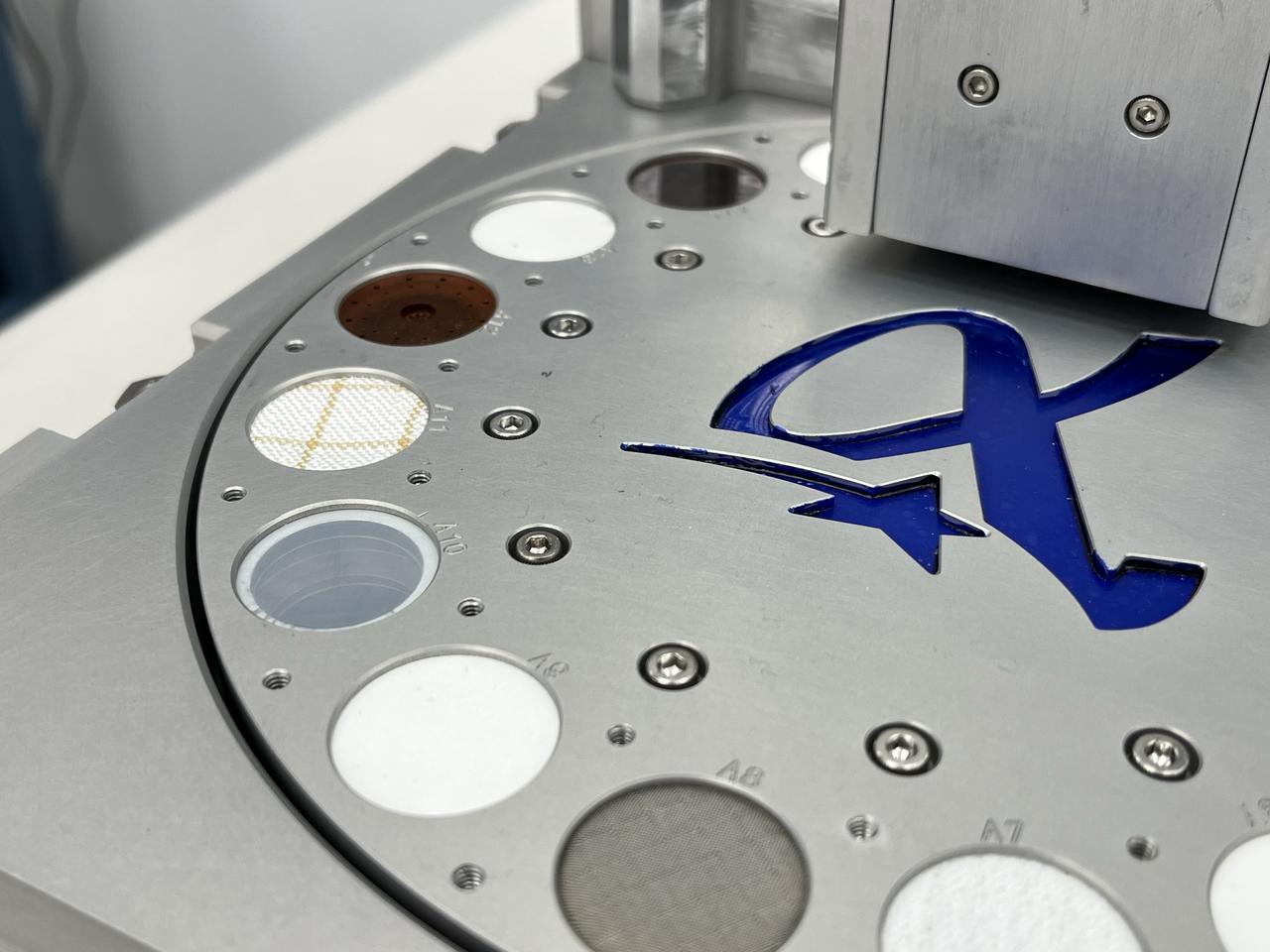
A science instrument flying aboard the next delivery for NASA’s CLPS (Commercial Lunar Payload Services) initiative is planning to study how different materials react to the lunar environment. Regolith Adherence Characterization, or RAC, is one of 10 payloads set to be carried to the Moon by the Blue Ghost 1 lunar lander in 2025. Developed by Aegis Aerospace, RAC’s wheels feature a series of different sample materials, helping researchers to better understand how lunar dust repels or attaches to each. Investigations and demonstrations, such as RAC, launched on CLPS flights will help NASA study Earth’s nearest neighbor under Artemis and pave the way for future crewed missions on the Moon. NASA’s Marshall Space Flight Center in Huntsville, Alabama, manages the development for seven of the 10 CLPS payloads that will be carried on Firefly’s Blue Ghost lunar lander.
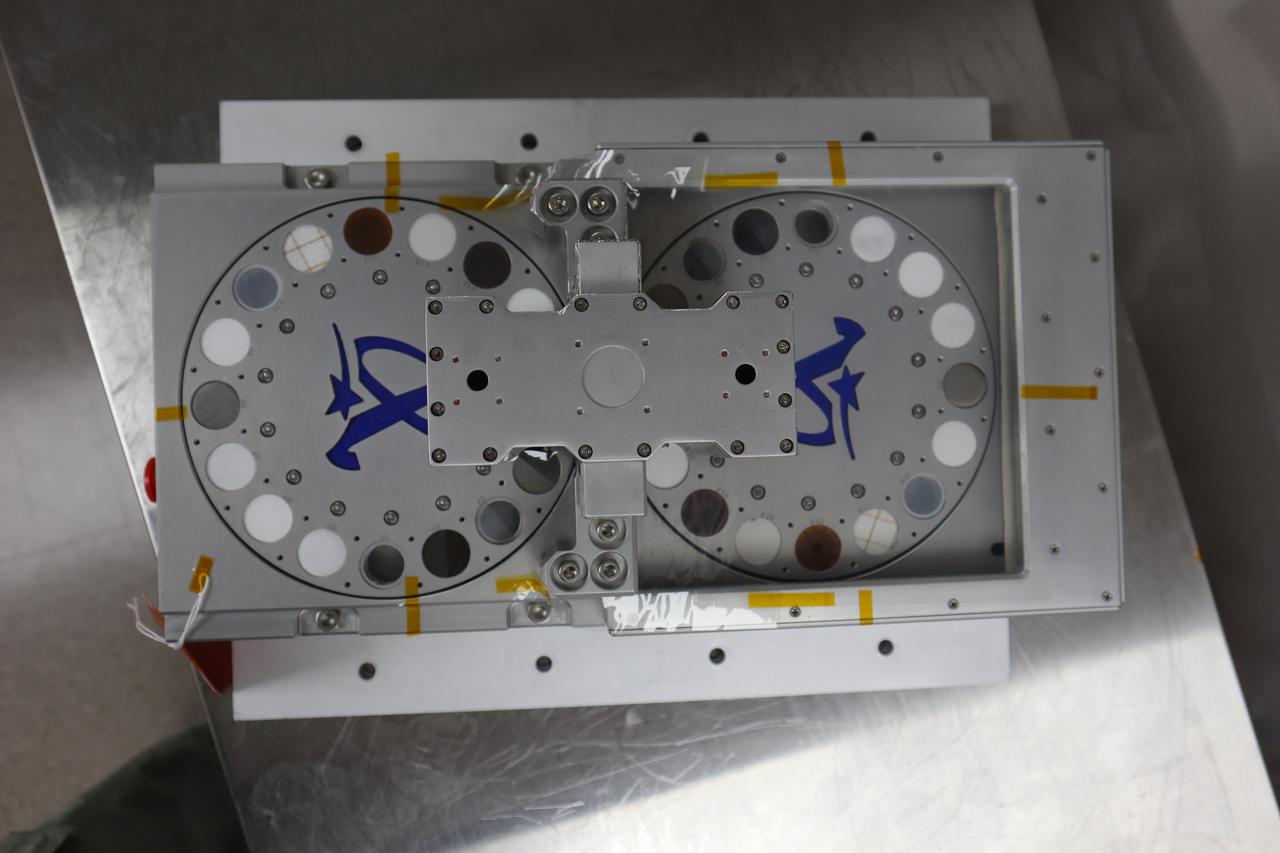
A science instrument flying aboard the next delivery for NASA’s CLPS (Commercial Lunar Payload Services) initiative is planning to study how different materials react to the lunar environment. Regolith Adherence Characterization, or RAC, is one of 10 payloads set to be carried to the Moon by the Blue Ghost 1 lunar lander in 2025. Developed by Aegis Aerospace, RAC’s wheels feature a series of different sample materials, helping researchers to better understand how lunar dust repels or attaches to each. Investigations and demonstrations, such as RAC, launched on CLPS flights will help NASA study Earth’s nearest neighbor under Artemis and pave the way for future crewed missions on the Moon. NASA’s Marshall Space Flight Center in Huntsville, Alabama, manages the development for seven of the 10 CLPS payloads that will be carried on Firefly’s Blue Ghost lunar lander.
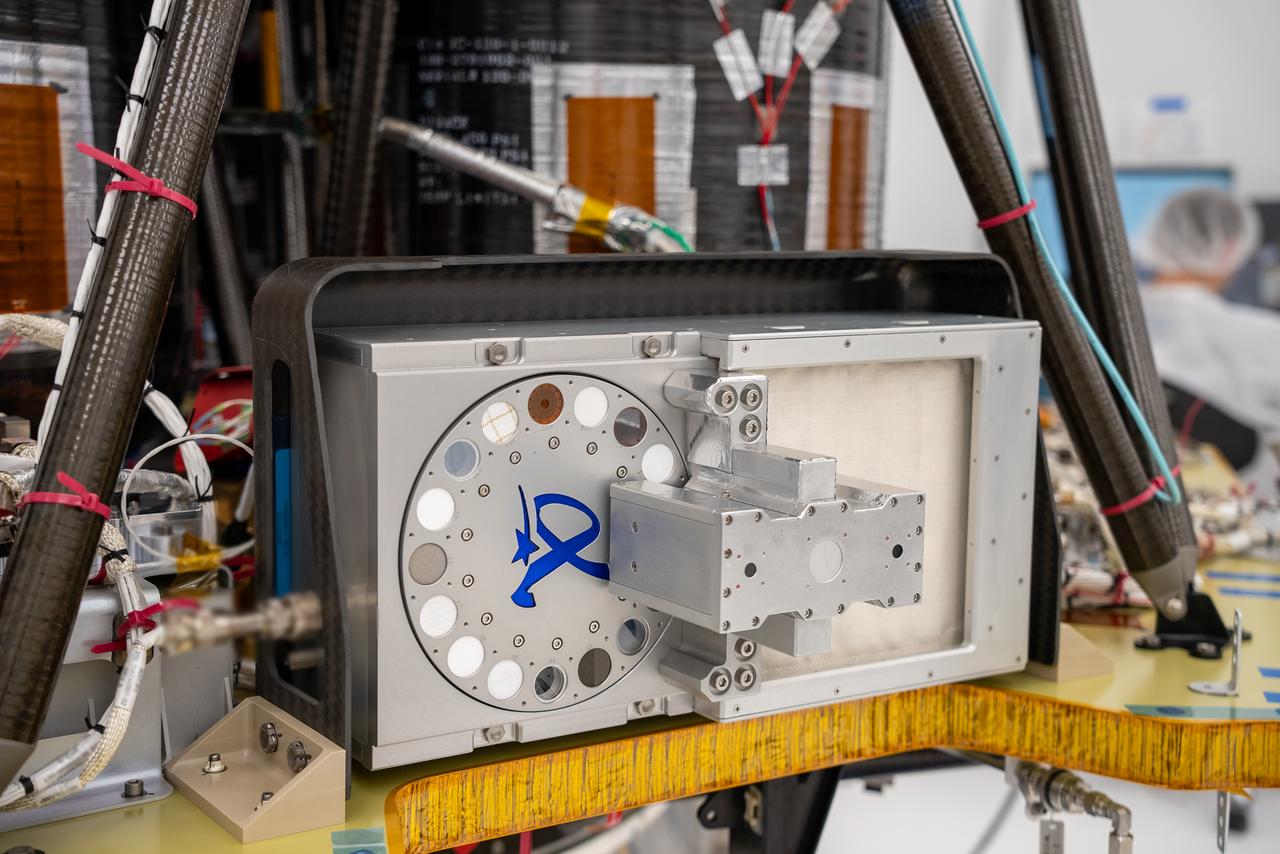
A science instrument flying aboard the next delivery for NASA’s CLPS (Commercial Lunar Payload Services) initiative is planning to study how different materials react to the lunar environment. Regolith Adherence Characterization, or RAC, is one of 10 payloads set to be carried to the Moon by the Blue Ghost 1 lunar lander in 2025. Developed by Aegis Aerospace, RAC’s wheels feature a series of different sample materials, helping researchers to better understand how lunar dust repels or attaches to each. Investigations and demonstrations, such as RAC, launched on CLPS flights will help NASA study Earth’s nearest neighbor under Artemis and pave the way for future crewed missions on the Moon. NASA’s Marshall Space Flight Center in Huntsville, Alabama, manages the development for seven of the 10 CLPS payloads that will be carried on Firefly’s Blue Ghost lunar lander.
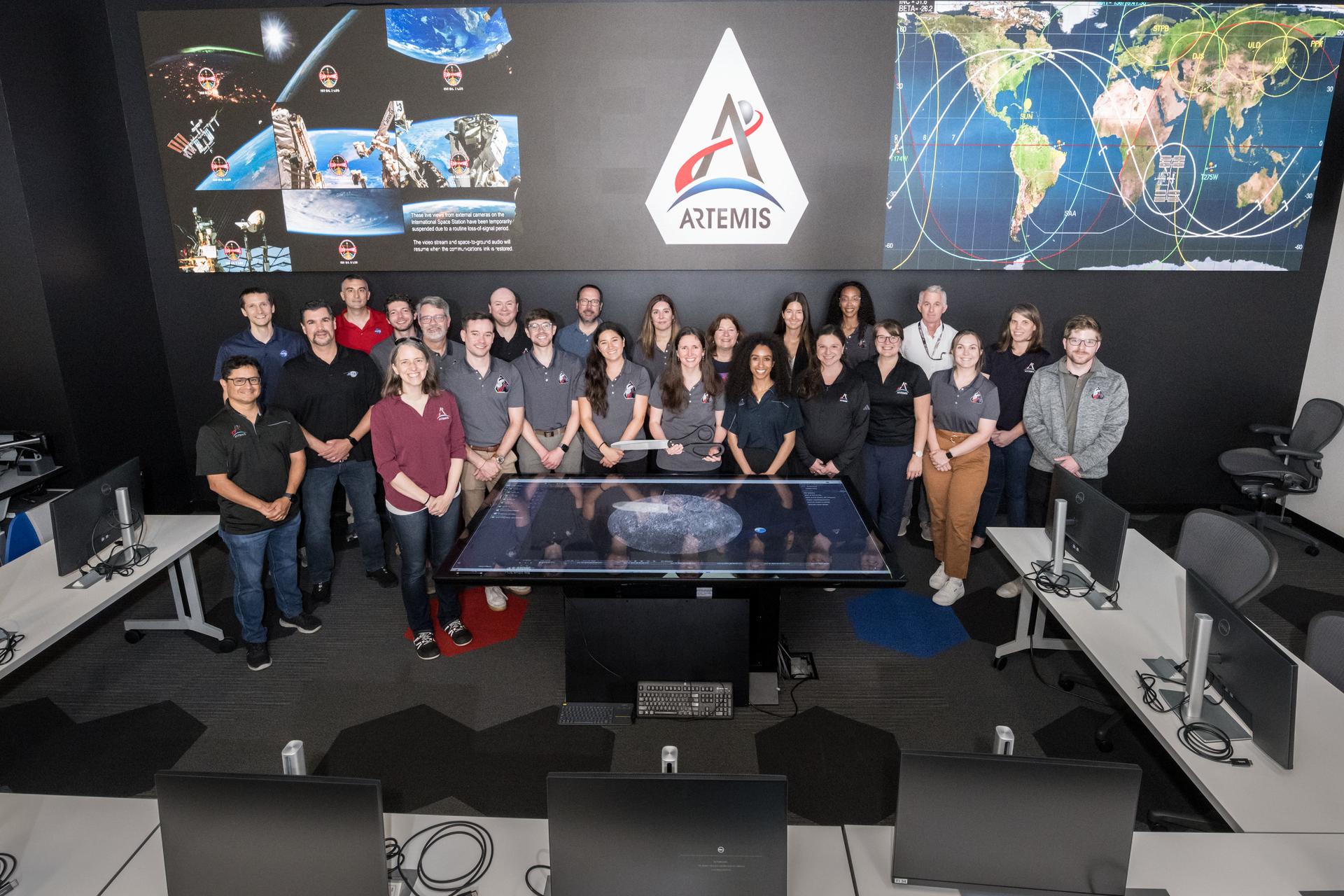
jsc2025e057254 --- NASA’s Artemis II lunar science team is pictured in the Science Evaluation Room (SER) at the agency’s Johnson Space Center in Houston. Located in the Christopher C. Kraft Jr. Mission Control Center, the SER supports the mission’s main flight control room for lunar science and planetary observations. Built specifically for Artemis missions with these science priorities in mind, the SER is equipped to support rapid data interpretation, collaborative analysis, real-time decision making, and seamless coordination between the science and operations teams.
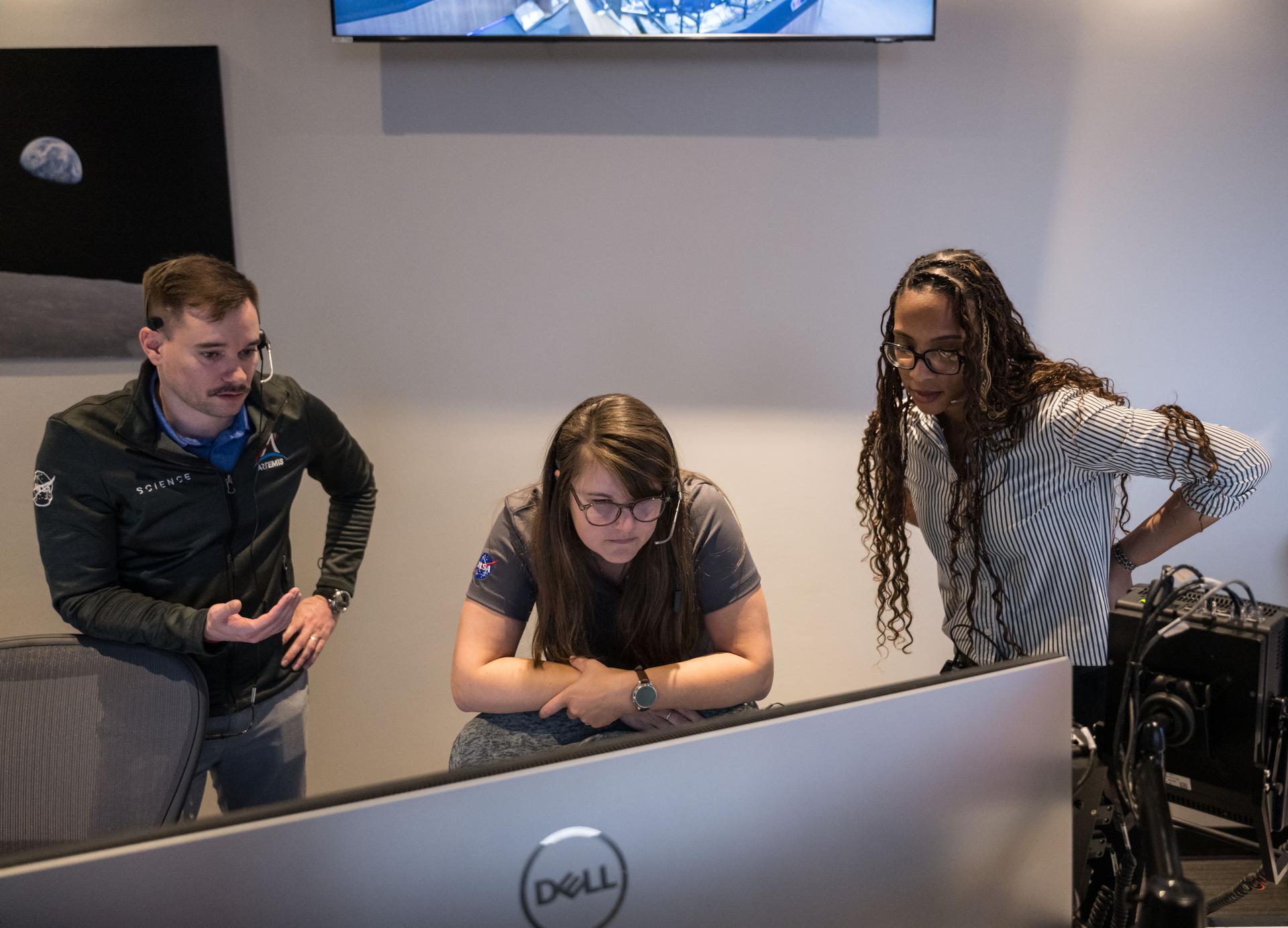
jsc2026e000848 --- Artemis lunar science team members, from left, Jacob Richardson, Marie Henderson, and Kiarre Dumes, monitor a lunar flyby simulation from the Science Evaluation Room (SER) at the NASA’s Johnson Space Center in Houston. Located in the Christopher C. Kraft Jr. Mission Control Center, the SER supports the mission’s main flight control room for lunar science and planetary observations. Built specifically for Artemis missions with these science priorities in mind, the SER is equipped to support rapid data interpretation, collaborative analysis, real-time decision making, and seamless coordination between the science and operations teams. Credit: James Blair

S77-22482 (14 March 1977) --- Johnson Space Center Director Christopher C. Kraft Jr. addresses a crowd of scientists and news media representatives at the opening of the Eighth Annual Lunar Science Conference in the Teague Auditorium. Photo credit: NASA

art002e016186 (April 6, 2026) – CSA (Canadian Space Agency) astronaut and Artemis II Mission Specialist Jeremy Hansen is seen working on his personal computing device during the Artemis II lunar flyby. The application seen on the screen is the Lunar Targeting Plan that guides them in the execution of the lunar science observation plan. This custom software was built by the crew lunar observations team, a subset of the Artemis II lunar science team. Hansen and his fellow crewmates spent approximately seven hours taking turns at the Orion windows capturing science data to share with their team back on Earth. At closest approach, they came within 4,067 miles of the Moon’s surface.
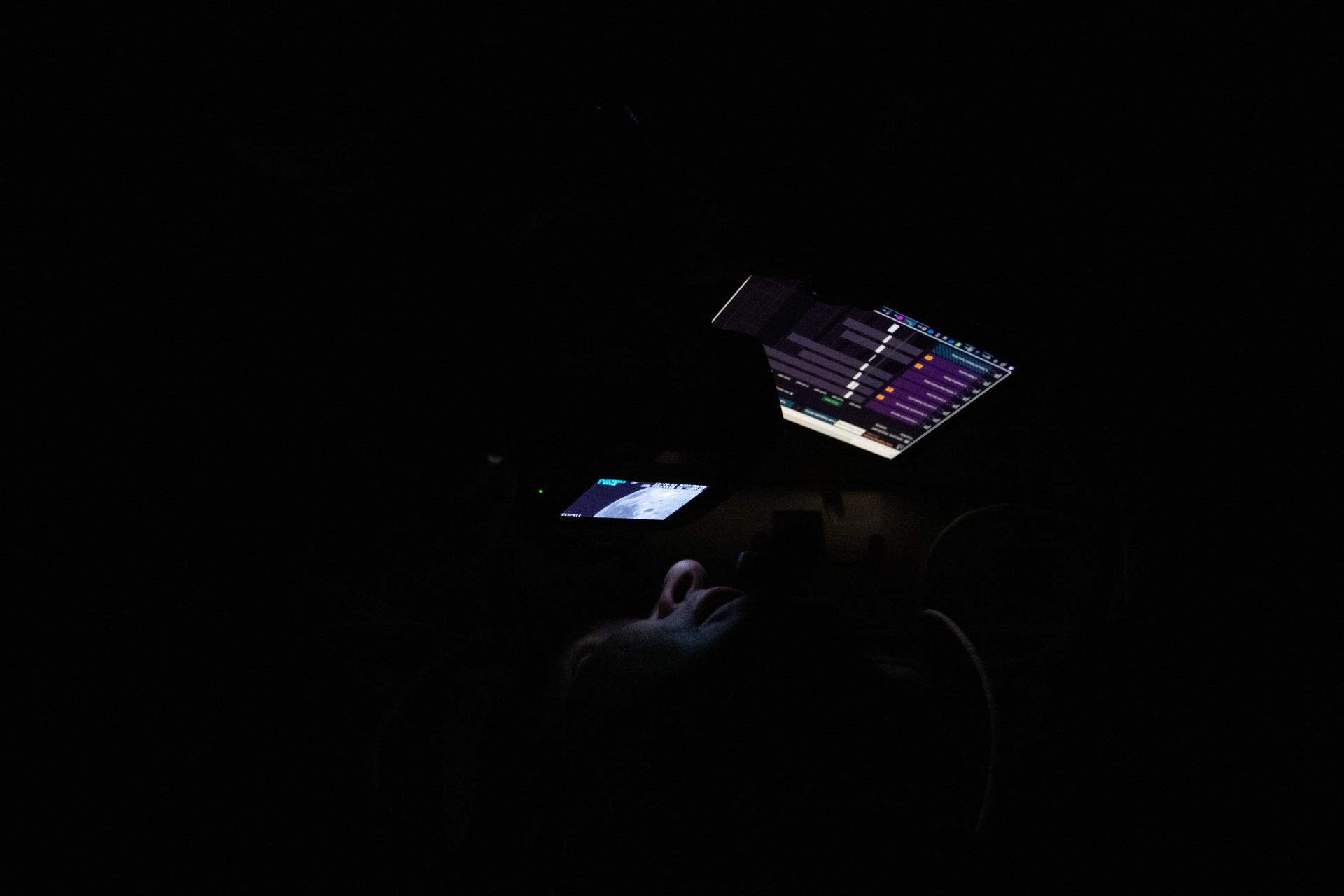
art002e014251 (April 6, 2026) – CSA (Canadian Space Agency) astronaut and Artemis II Mission Specialist Jeremy Hansen is seen taking images through the Orion spacecraft window during the Artemis II lunar flyby. Hansen and his fellow crewmates spent approximately seven hours taking turns at the Orion windows capturing science data to share with their team back on Earth. At closest approach, they came within 4,067 miles of the Moon’s surface. The application seen on the crew personal computing devices is the Lunar Targeting Plan that guides them in the execution of the lunar science observation plan. This custom software was built by the crew lunar observations team, a subset of the Artemis II lunar science team.
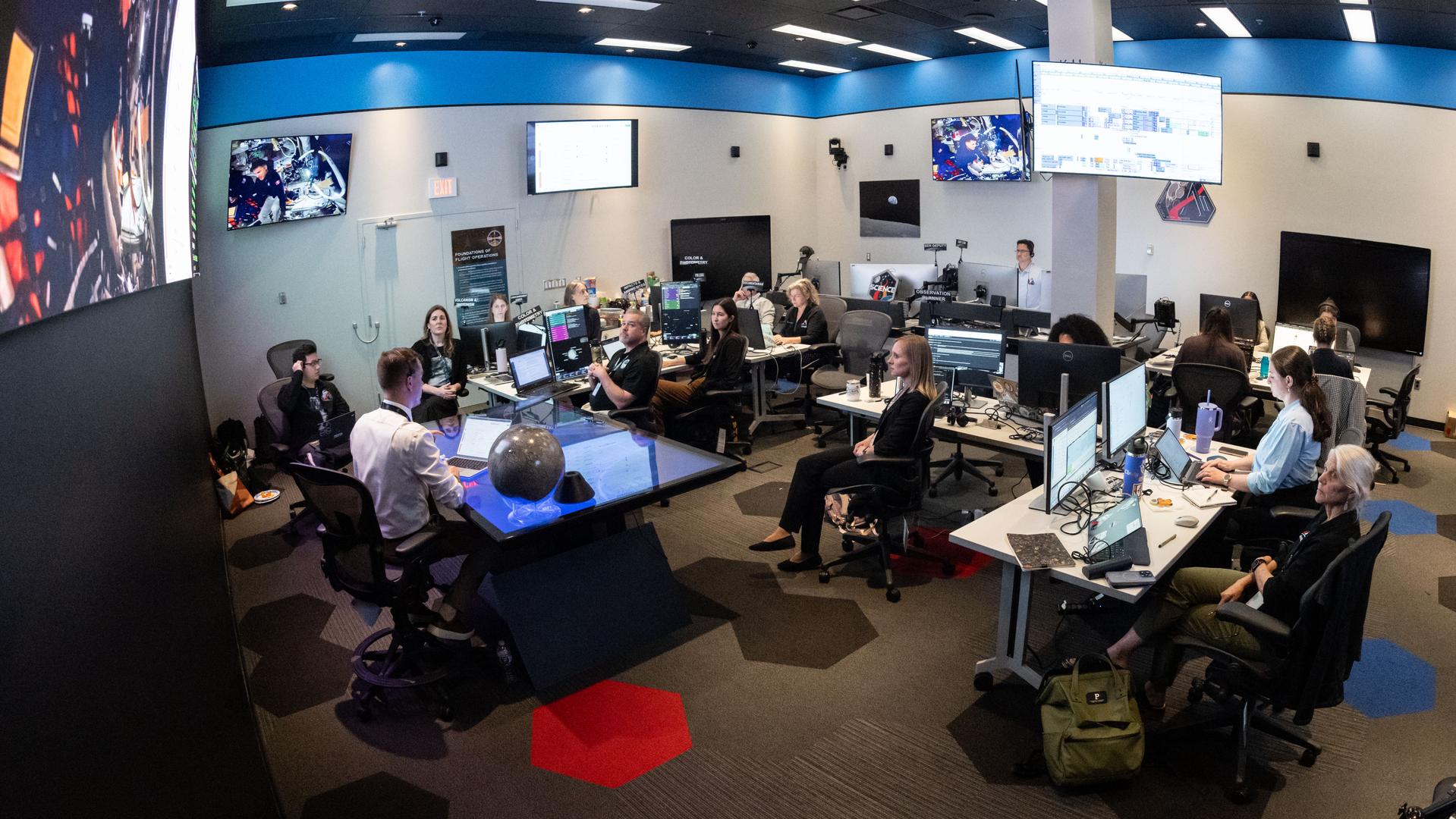
A view inside the Science Evaluation Room (SER) in Mission Control at NASA’s Johnson Space Center in Houston. The SER supports lunar science and planetary observations for the Artemis science officer in the mission’s main flight control room. Built specifically for Artemis missions with these science priorities in mind, the SER is equipped to support rapid data interpretation, collaborative analysis, real-time decision making, and seamless coordination between the science and operations teams. Credits: NASA/Bill Stafford
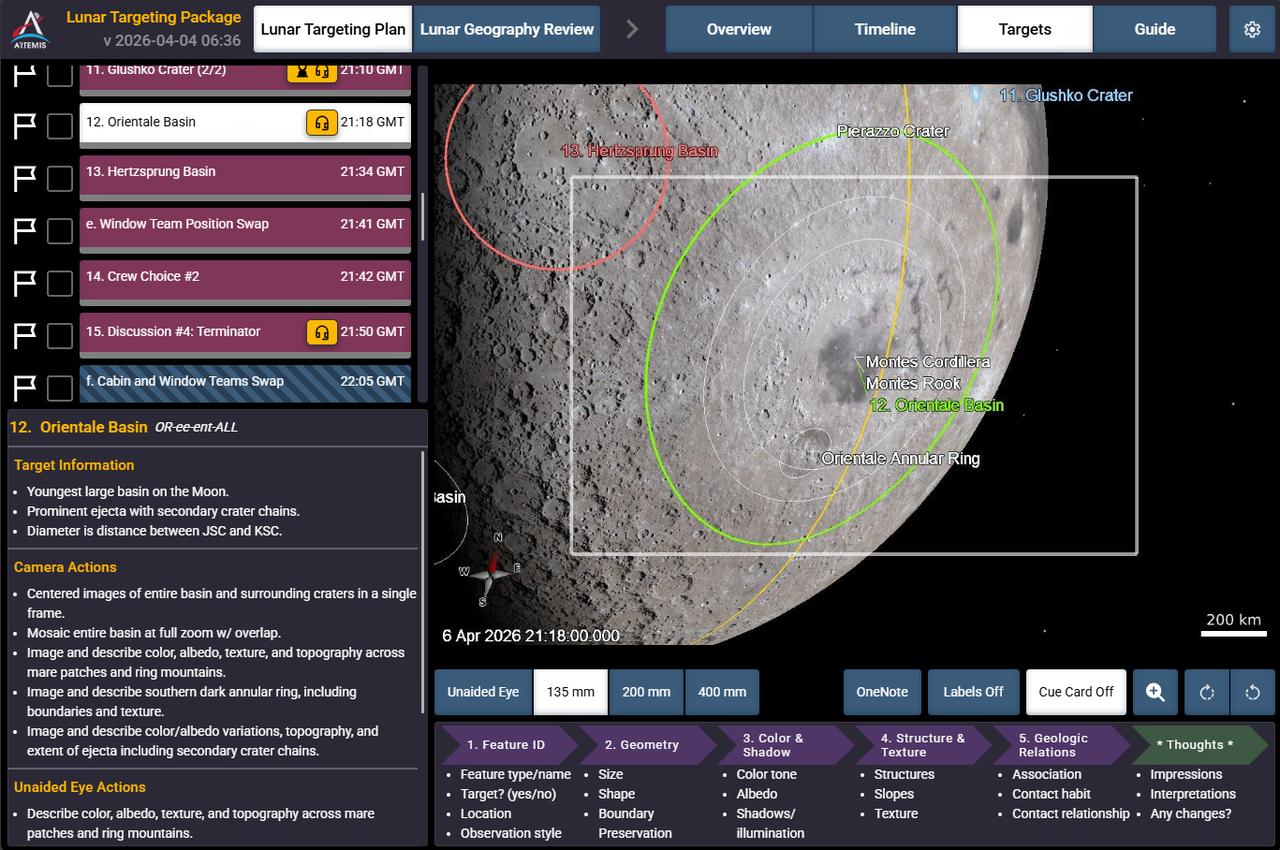
Caption: This is a screen shot of the application the crew sees on their personal computing devices that guides them in the execution of the lunar science observation plan. This custom software was built by the crew lunar observations team, a subset of the Artemis II lunar science team. In this screenshot you can see Orientale basin, target number 12 circled on the bottom right of the Moon, and to its left, target number 13, Hertzsprung basin.
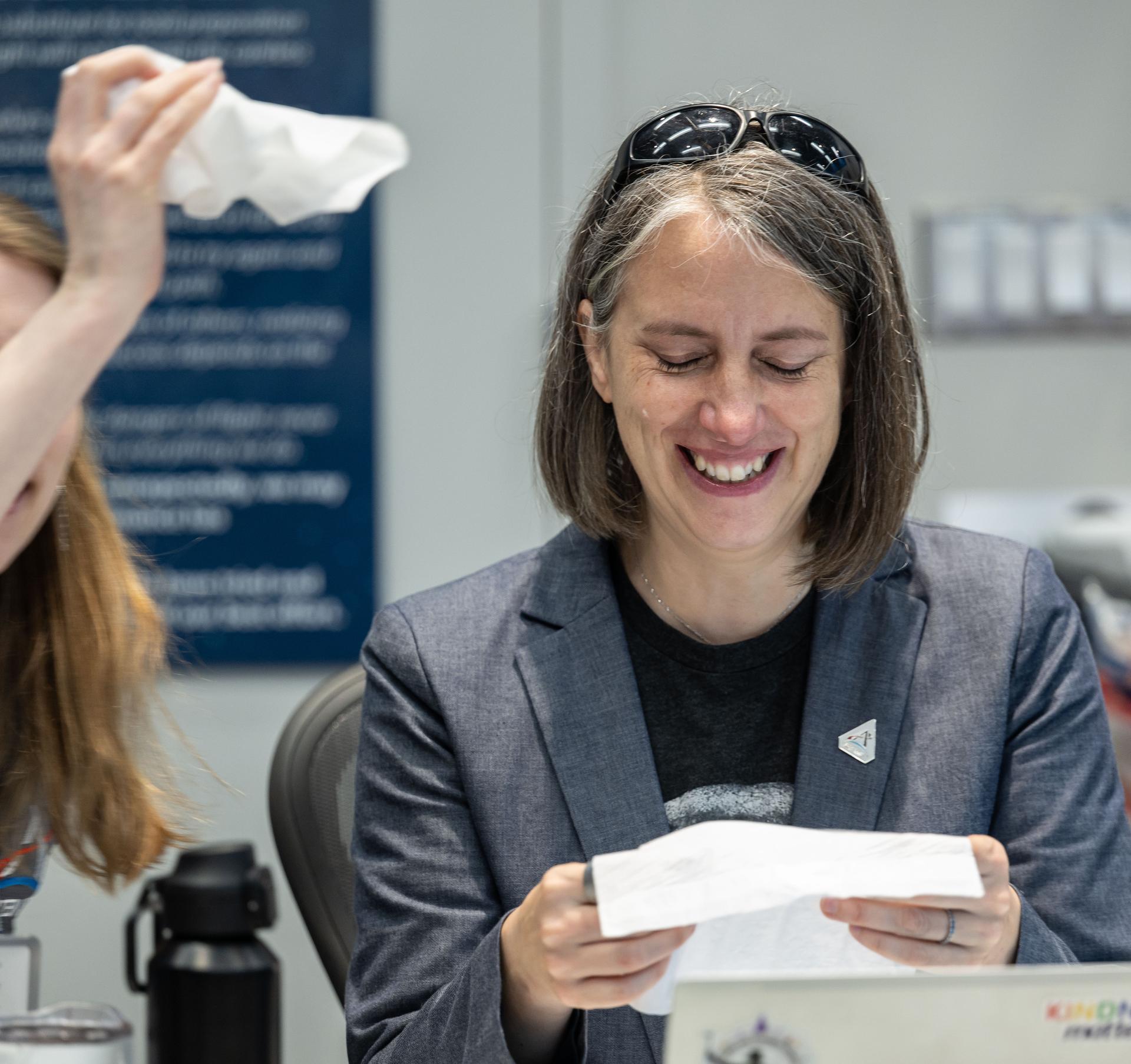
Artemis curation lead, Juliane Gross, reacts to the astronauts' verbal observations of the Moon during their flyby on April 6, 2026. Along with other members of the Artemis II lunar science team, Gross helped train the Artemis II crew in geology both in the classroom and in the field. The team also built the lunar targeting plan that, like an International Space Station spacewalk plan, provides strong, detailed observation guidance, plus flexibility for the crew to make decisions based on what they’re seeing and experiencing in real time. The science team had many moments of celebration during the lunar flyby as the astronauts took images of the Moon and provided verbal descriptions of what they were seeing. This type of information reveals the geologic history of an area and will be critical to collect when future Artemis astronauts explore the Moon's surface. Credits: NASA/Luna Posadas Nava
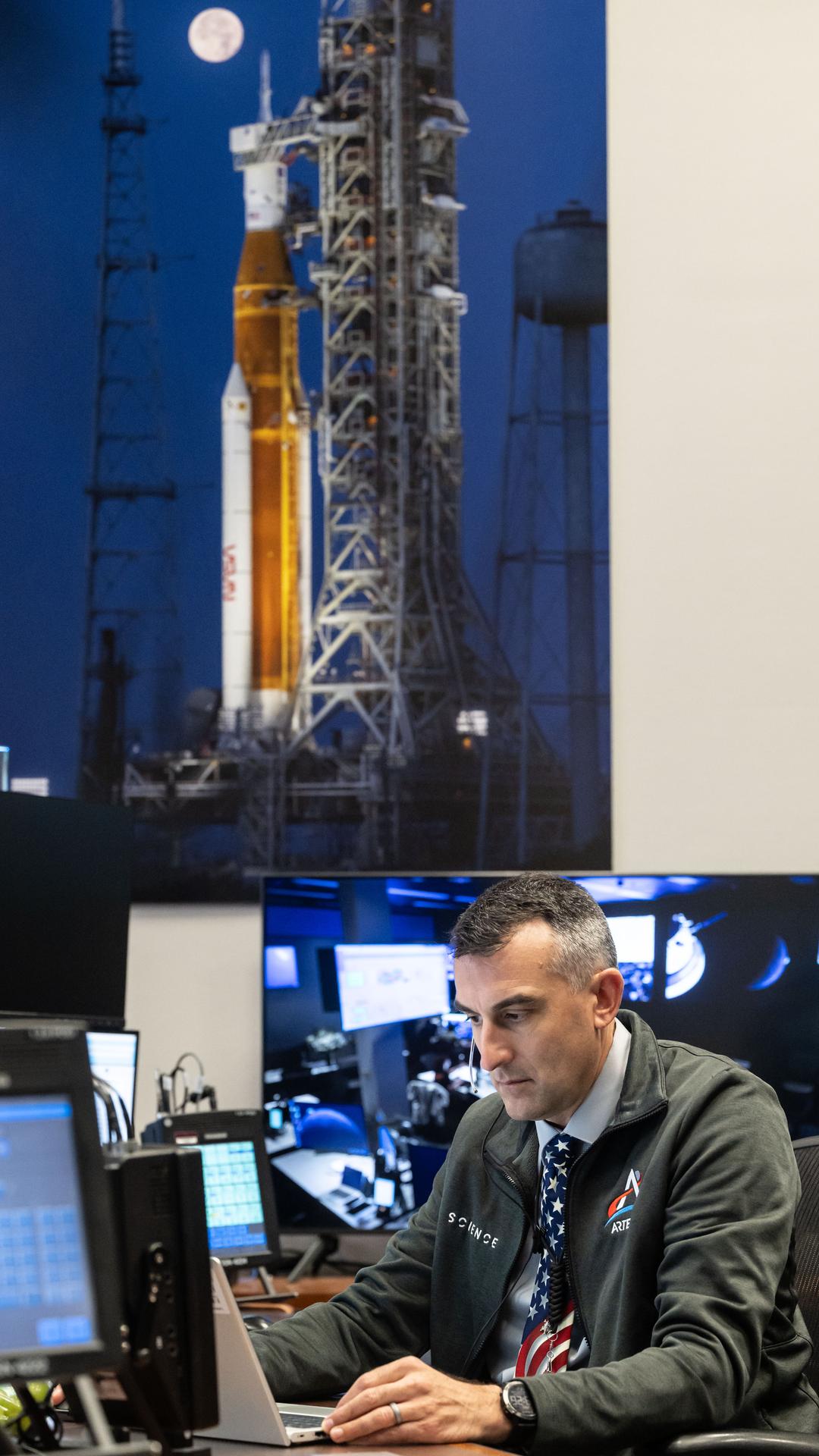
Artemis II science officer, Trevor Graff, is seen at the Science console in the White Flight Control Room in Mission Control at NASA's Johnson Space Center in Houston. Science officers are the senior flight controllers responsible for lunar science and geology objectives during Artemis missions. Credits: NASA/David DeHoyos

Artemis II science officer, Trevor Graff, is seen at the Science console in the White Flight Control Room in Mission Control at NASA's Johnson Space Center in Houston. Science officers are the senior flight controllers responsible for lunar science and geology objectives during Artemis missions. Credits: NASA/David DeHoyos

Artemis II crew lunar observations team member, Alex Stoken, monitors the mission from the Science Evaluation Room (SER). Built specifically for Artemis missions with these science priorities in mind, the SER is equipped to support rapid data interpretation, collaborative analysis, real-time decision making, and seamless coordination between the science and operations teams. Credits: NASA/Luna Posadas Nava

Artemis II crew lunar observations team member, David Charney, monitors the mission from the Science Evaluation Room (SER). Built specifically for Artemis missions with these science priorities in mind, the SER is equipped to support rapid data interpretation, collaborative analysis, real-time decision making, and seamless coordination between the science and operations teams. Credits: NASA/Luna Posadas Nava
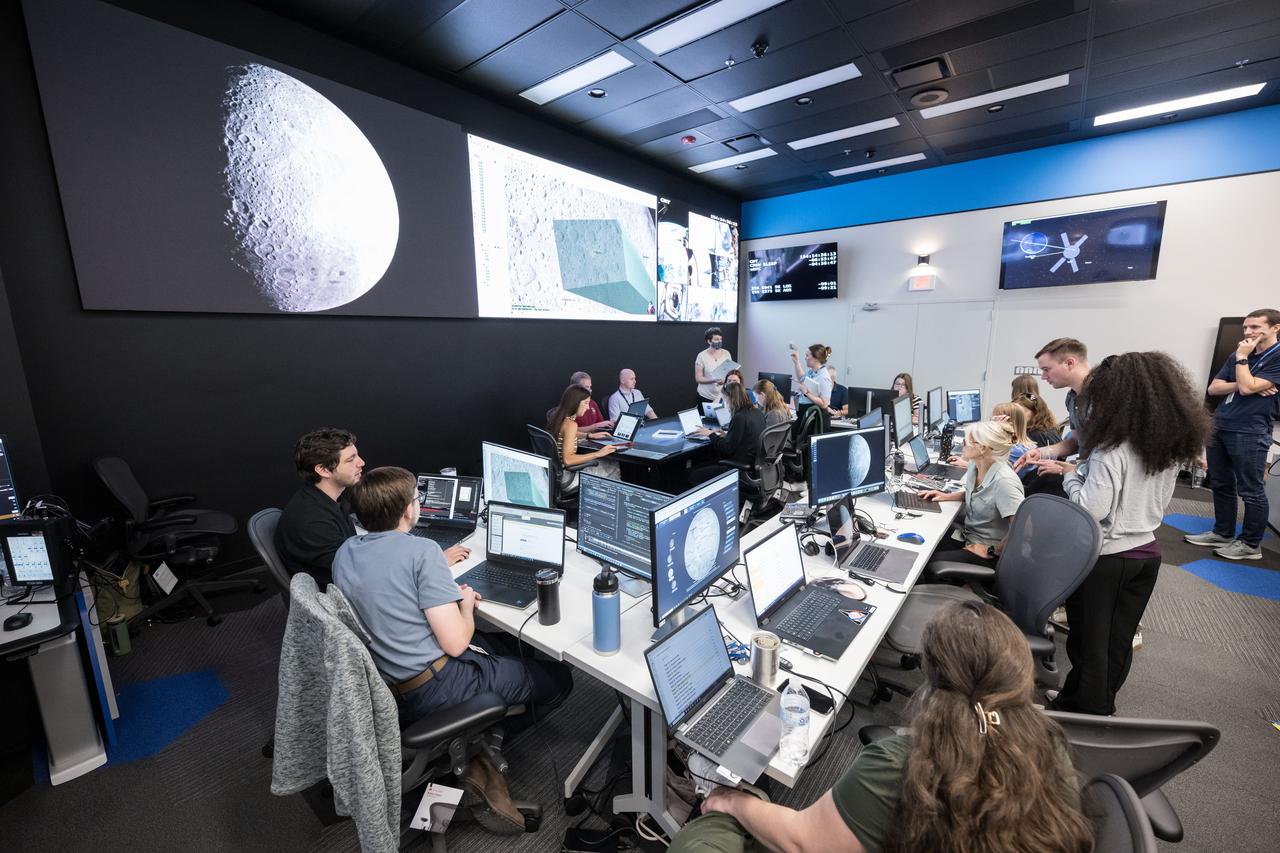
jsc2025e056603 --- The Artemis II Lunar Science Team runs a simulation of lunar observation operations in the new Science Evaluation Room (SER) that serves as a backroom to Mission Control.
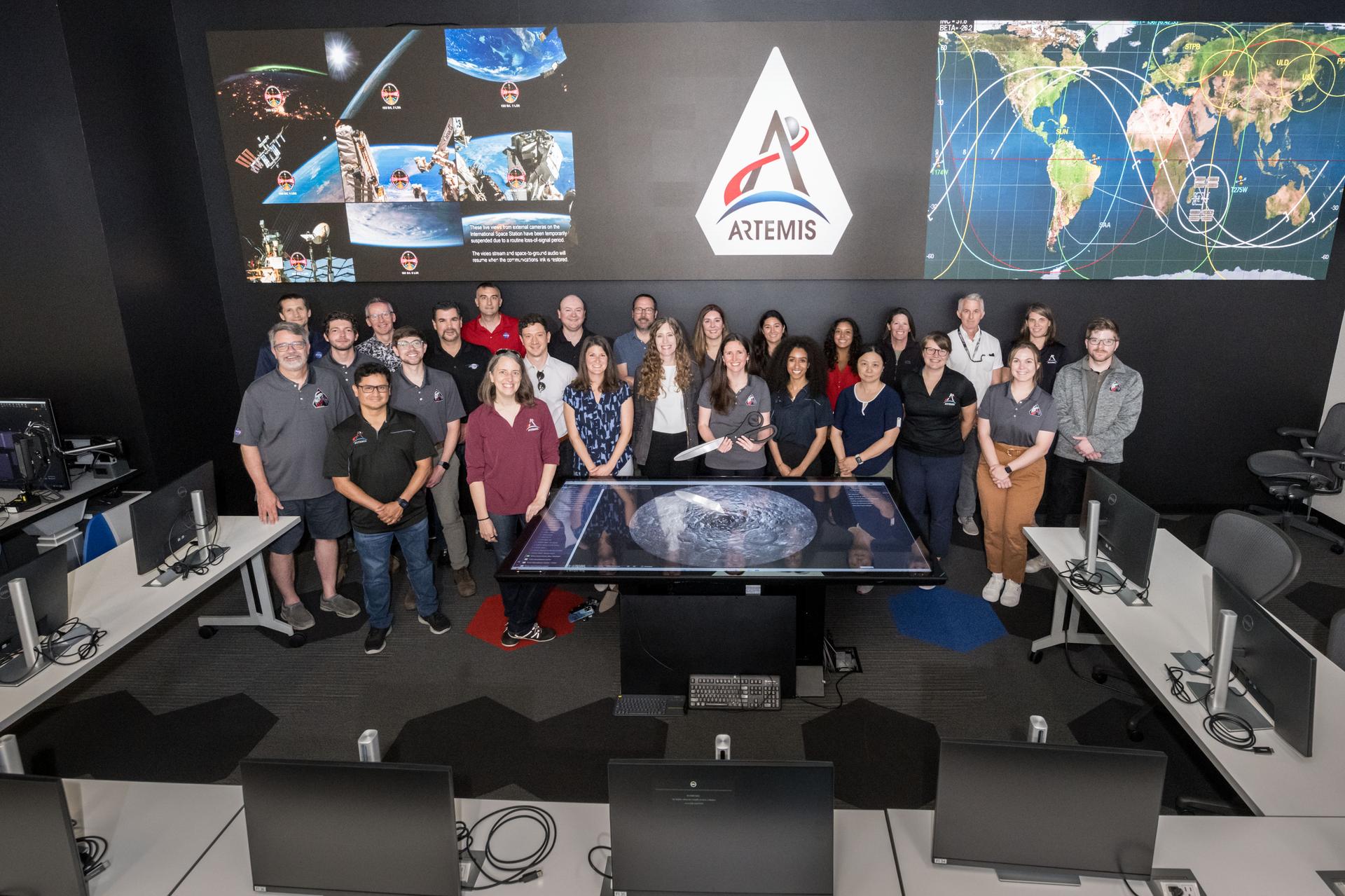
jsc2025e057255 --- NASA’s Artemis III lunar science team is pictured in the Science Evaluation Room (SER) at the agency’s Johnson Space Center in Houston. Located in the Christopher C. Kraft Jr. Mission Control Center, the SER supports the mission’s main flight control room for lunar science and planetary observations. Built specifically for Artemis missions with these science priorities in mind, the SER is equipped to support rapid data interpretation, collaborative analysis, real-time decision making, and seamless coordination between the science and operations teams.

Lunar science lead for Artemis II and Artemis II science officer at NASA’s Goddard Space Flight Center in Greenbelt, Maryland, Kelsey Young, stands in the lunar-like landscape of Iceland during an Artemis II crew geology field training.
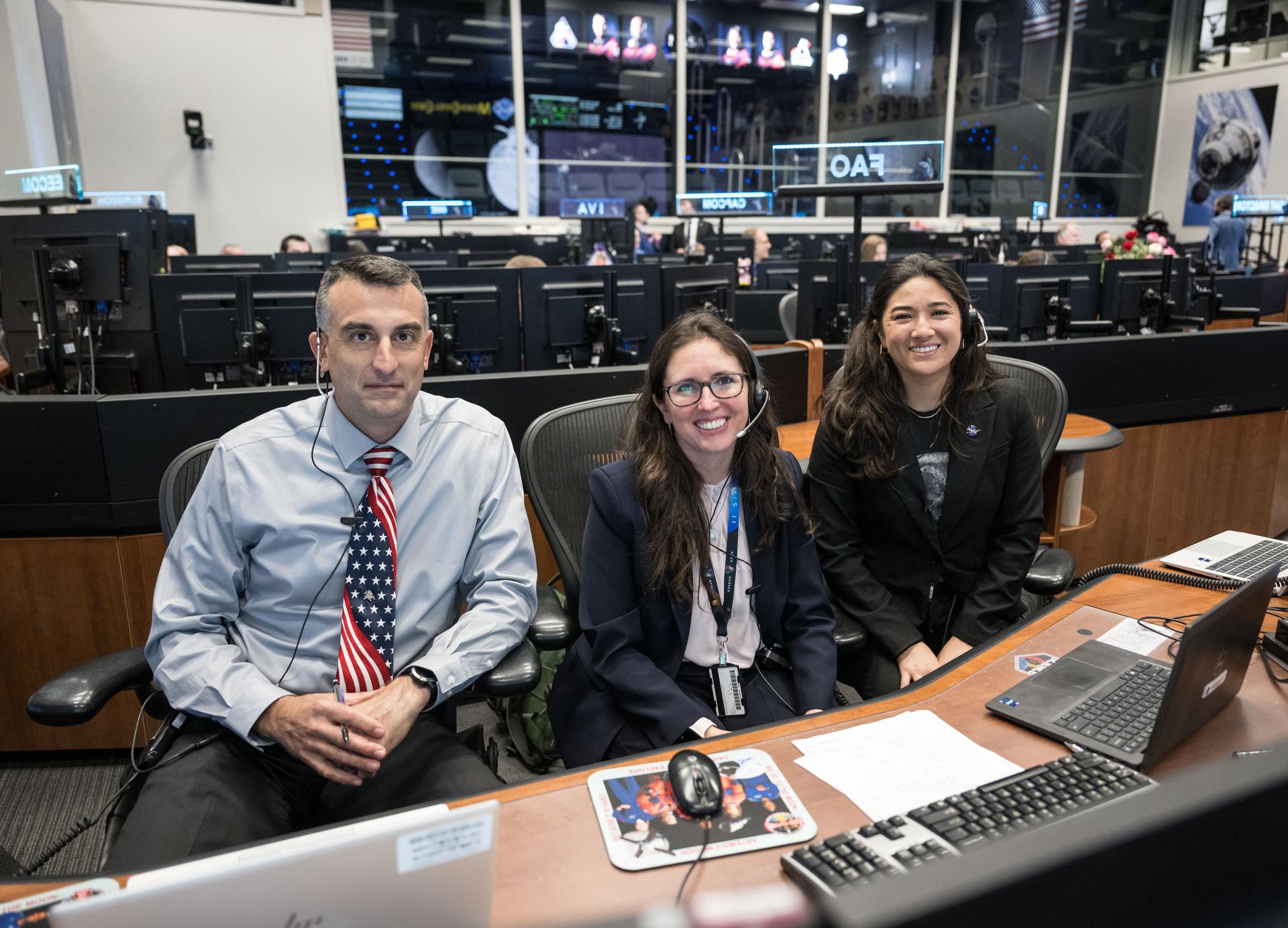
Artemis II science officers, from left, Trevor Graff, Kelsey Young, and Angela Garcia, are seen at the Science console in the White Flight Control Room in Mission Control at NASA's Johnson Space Center in Houston. Science officers are the senior flight controllers responsible for lunar science and geology objectives during Artemis missions. Credits: NASA/Robert Markowitz
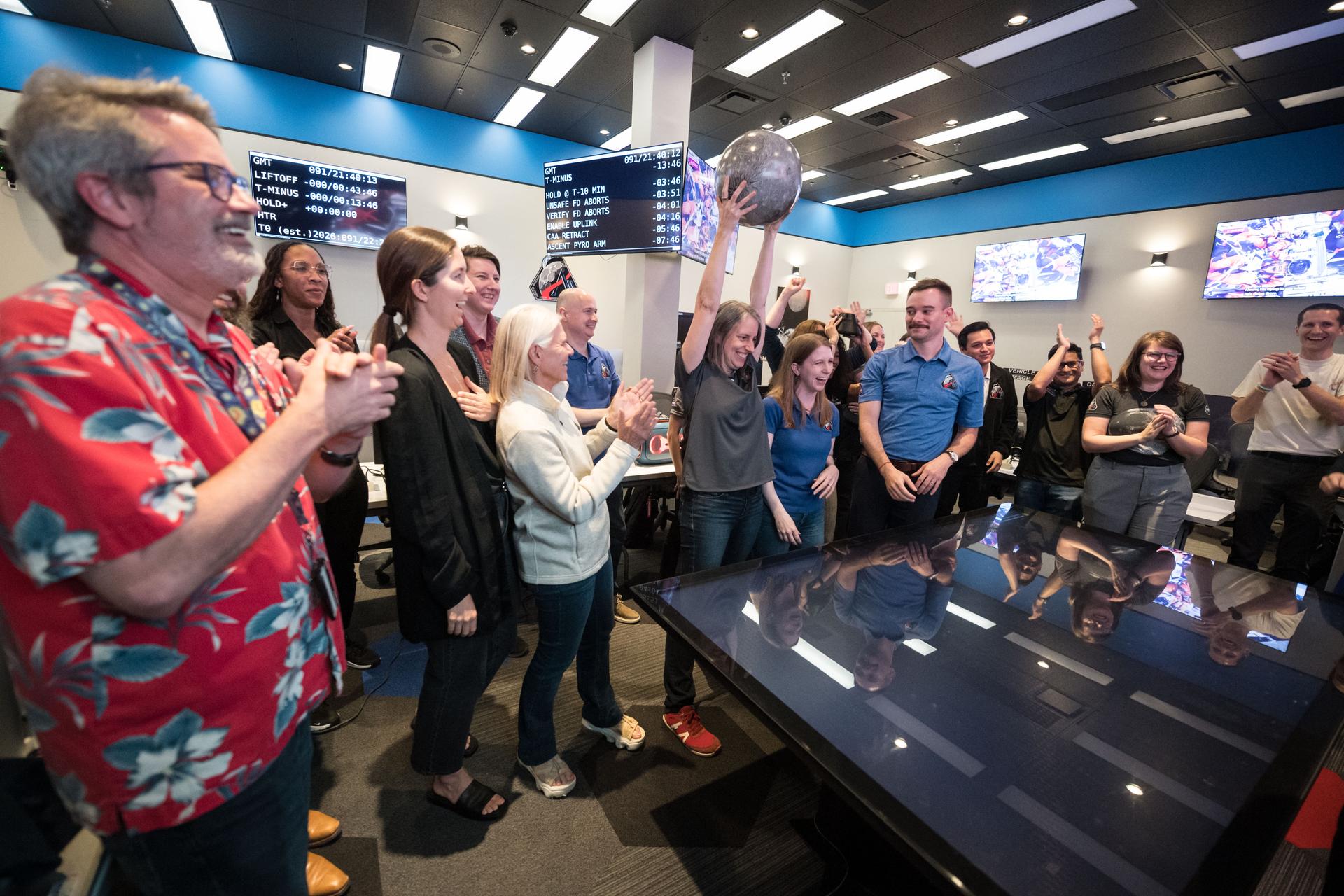
Members of the Artemis lunar science team cheer as they gather to watch the Artemis II launch broadcast from the Science Evaluation Room (SER) in Mission Control at NASA's Johnson Space Center in Houston. The SER supports lunar science and planetary observations for the Artemis science officer in the mission’s main flight control room. Built specifically for Artemis missions with these science priorities in mind, the SER is equipped to support rapid data interpretation, collaborative analysis, real-time decision making, and seamless coordination between the science and operations teams. Credits: NASA/Mark Sowa.
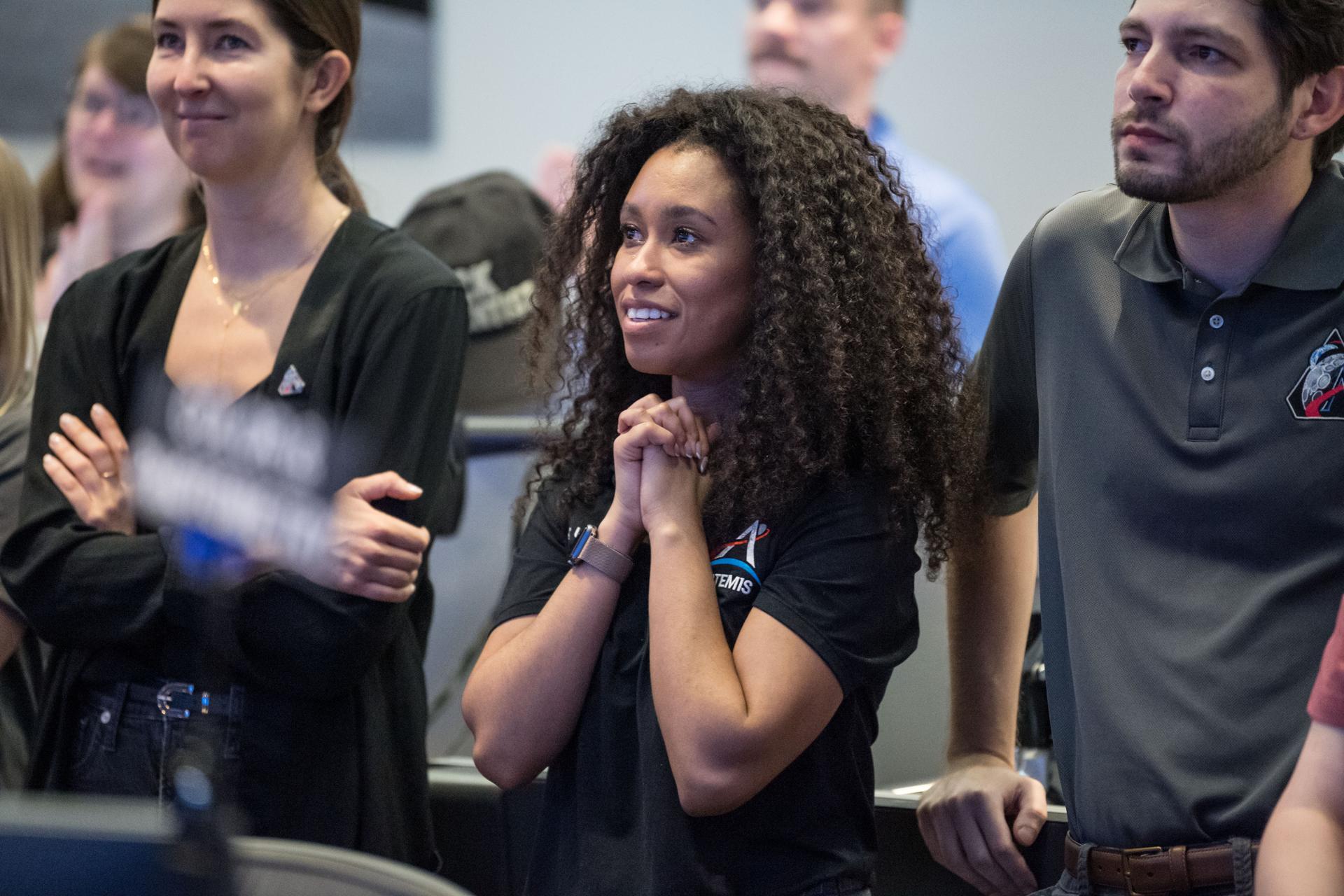
Members of the Artemis lunar science team, from left, Ariel Deutsch, Amber Turner, and Wilfredo Garcia-Lopez, watch the Artemis II launch from the Science Evaluation Room (SER) in Mission Control at Johnson Space Center in Houston. The SER supports lunar science and planetary observations for the Artemis science officer in the mission’s main flight control room. Built specifically for Artemis missions with these science priorities in mind, the SER is equipped to support rapid data interpretation, collaborative analysis, real-time decision making, and seamless coordination between the science and operations teams. Credits: NASA/Mark Sowa.
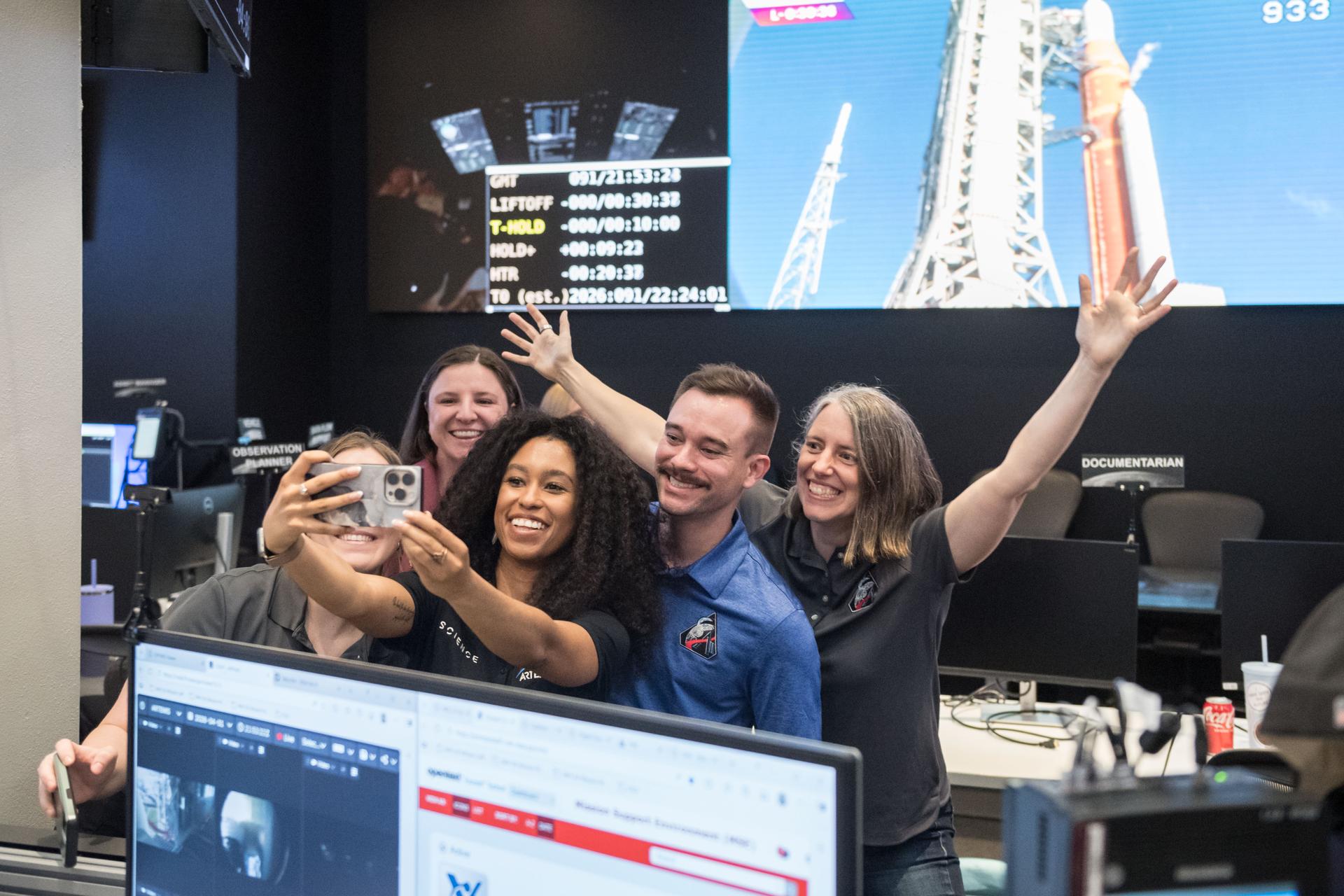
Members of the Artemis lunar science team, from left, Sara Schmidt, Megan Borel, Amber Turner, Jacob Richardson, and Juliane Gross pose for a selfie with the Artemis II launch broadcast on the screen behind them in the Science Evaluation Room (SER) in Mission Control at NASA's Johnson Space Center in Houston. The SER supports lunar science and planetary observations for the Artemis science officer in the mission’s main flight control room. Built specifically for Artemis missions with these science priorities in mind, the SER is equipped to support rapid data interpretation, collaborative analysis, real-time decision making, and seamless coordination between the science and operations teams. Credits: NASA/Mark Sowa.
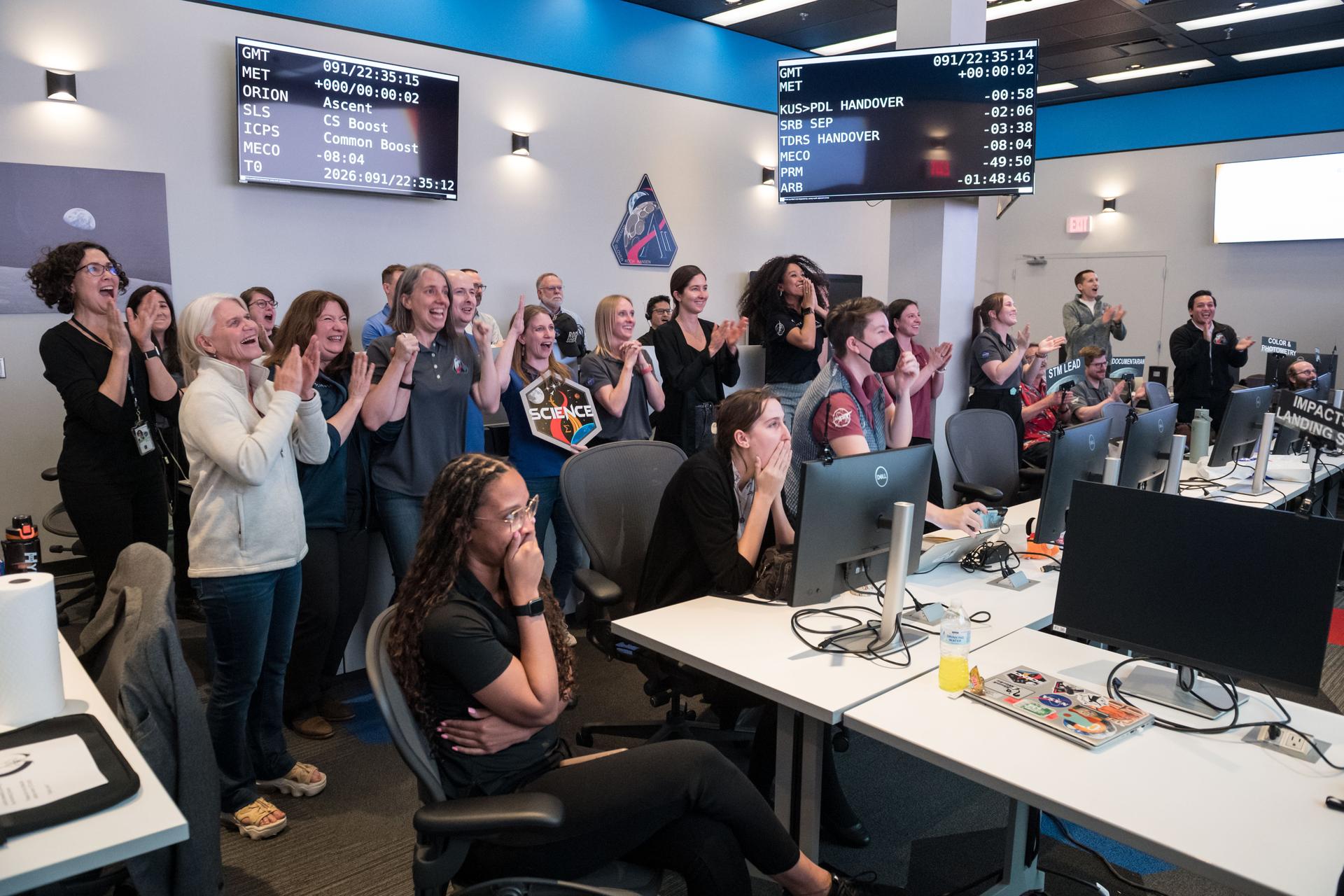
Members of the Artemis lunar science team celebrate the Artemis II launch as they watch from the Science Evaluation Room (SER) in Mission Control at NASA's Johnson Space Center in Houston. The SER supports lunar science and planetary observations for the Artemis science officer in the mission’s main flight control room. Built specifically for Artemis missions with these science priorities in mind, the SER is equipped to support rapid data interpretation, collaborative analysis, real-time decision making, and seamless coordination between the science and operations teams. Credits: NASA/Mark Sowa.
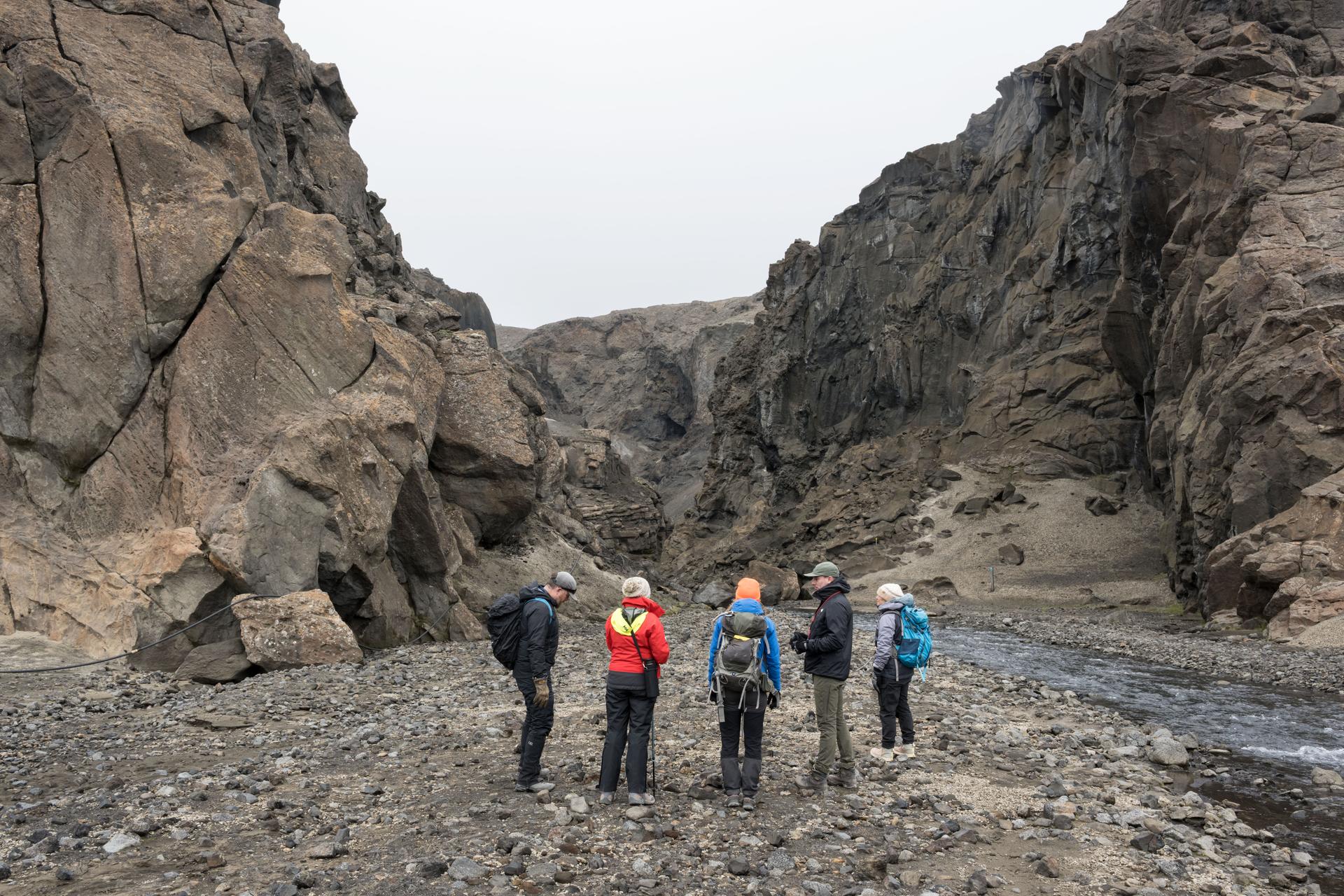
Participants in the Iceland geology field training expedition make observations and discuss the geologic features of the surrounding rocky cliffs in Iceland. Iceland serves as a lunar stand-in for training astronauts and mission support teams in preparation for lunar surface science missions. Credit: NASA/James Blair
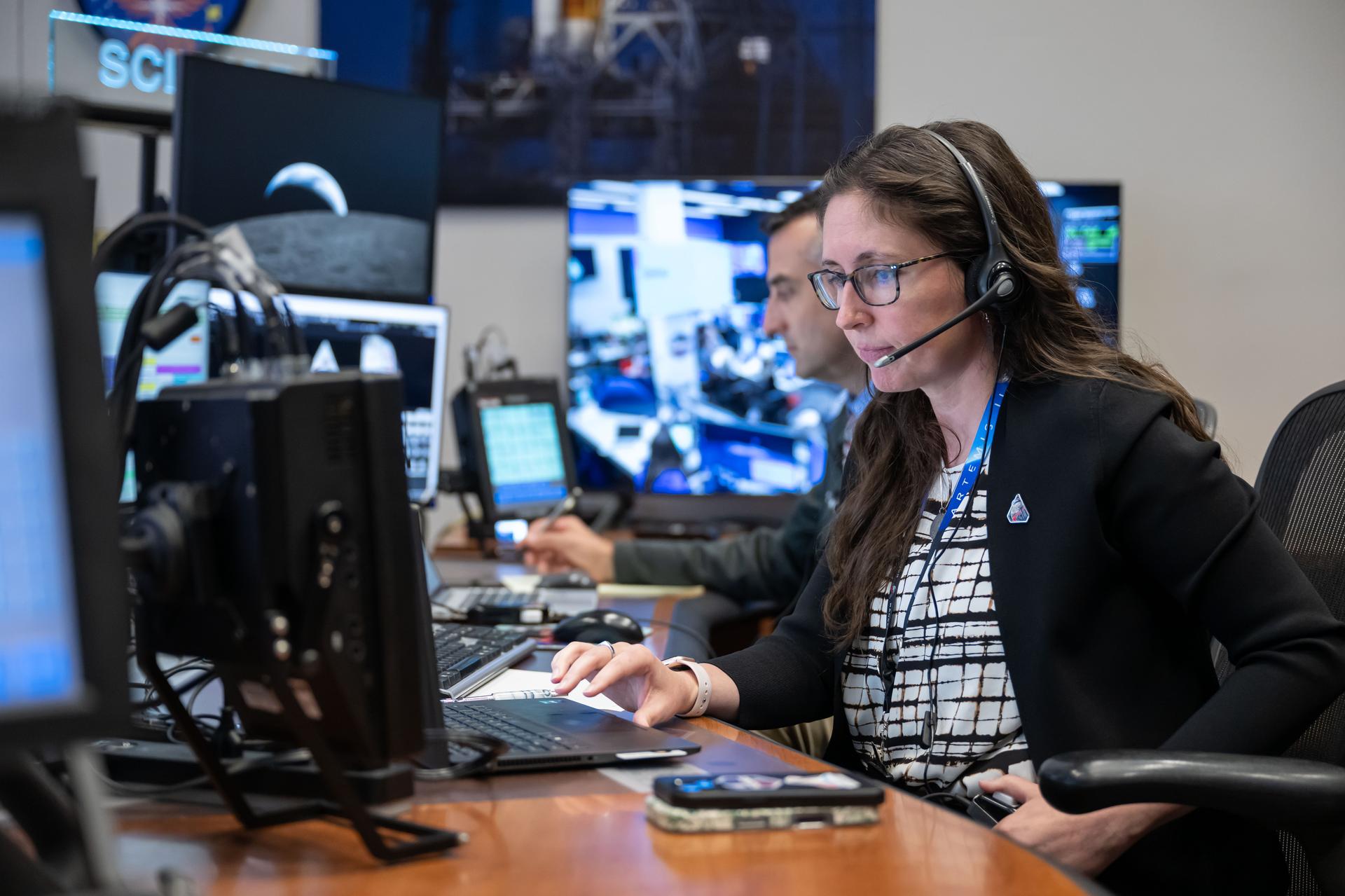
Artemis II science officers, Trevor Graff, background, and Kelsey Young are seen monitoring mission data in real-time from the Science console in the White Flight Control Room in Mission Control at NASA's Johnson Space Center in Houston. Science officers are the senior flight controllers responsible for lunar science and geology objectives during Artemis missions. Credits: NASA/Robert Markowitz
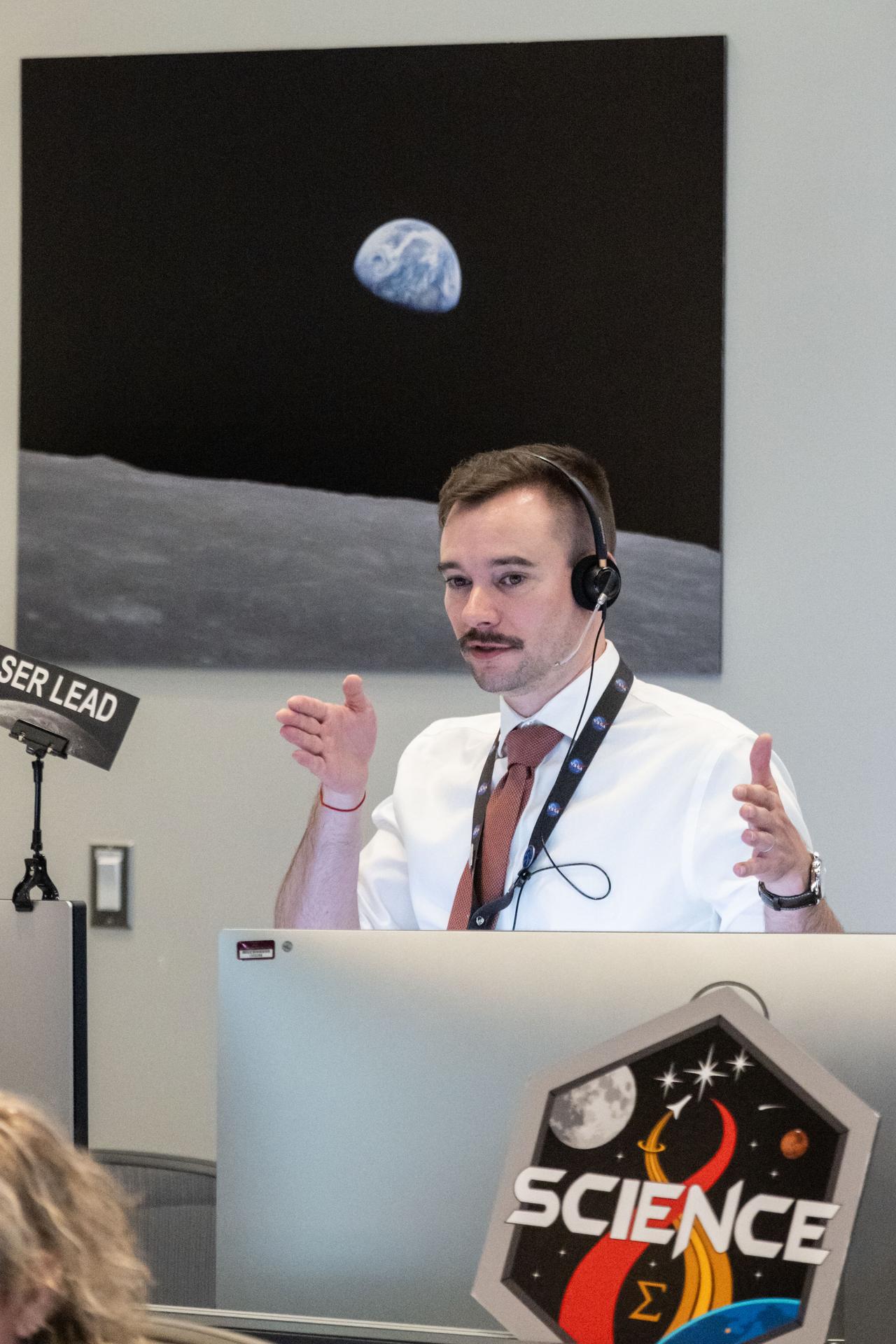
Artemis II lunar science team deputy lead, Jacob Richardson, discusses the lunar science team's progress on the lunar targeting plan for the astronauts' several-hour flyby of the Moon, scheduled for April 6. As they pass the Moon, the crew will apply geology skills learned in the classroom and in Moon-like environments on Earth to photograph and describe features including impact craters, ancient lava flows, and surface cracks and ridges formed as the Moon slowly changed over time. They will note differences in color, brightness, and texture, which provide clues that help scientists understand what the surface is made of and how it formed. Credits: NASA/Bill Stafford
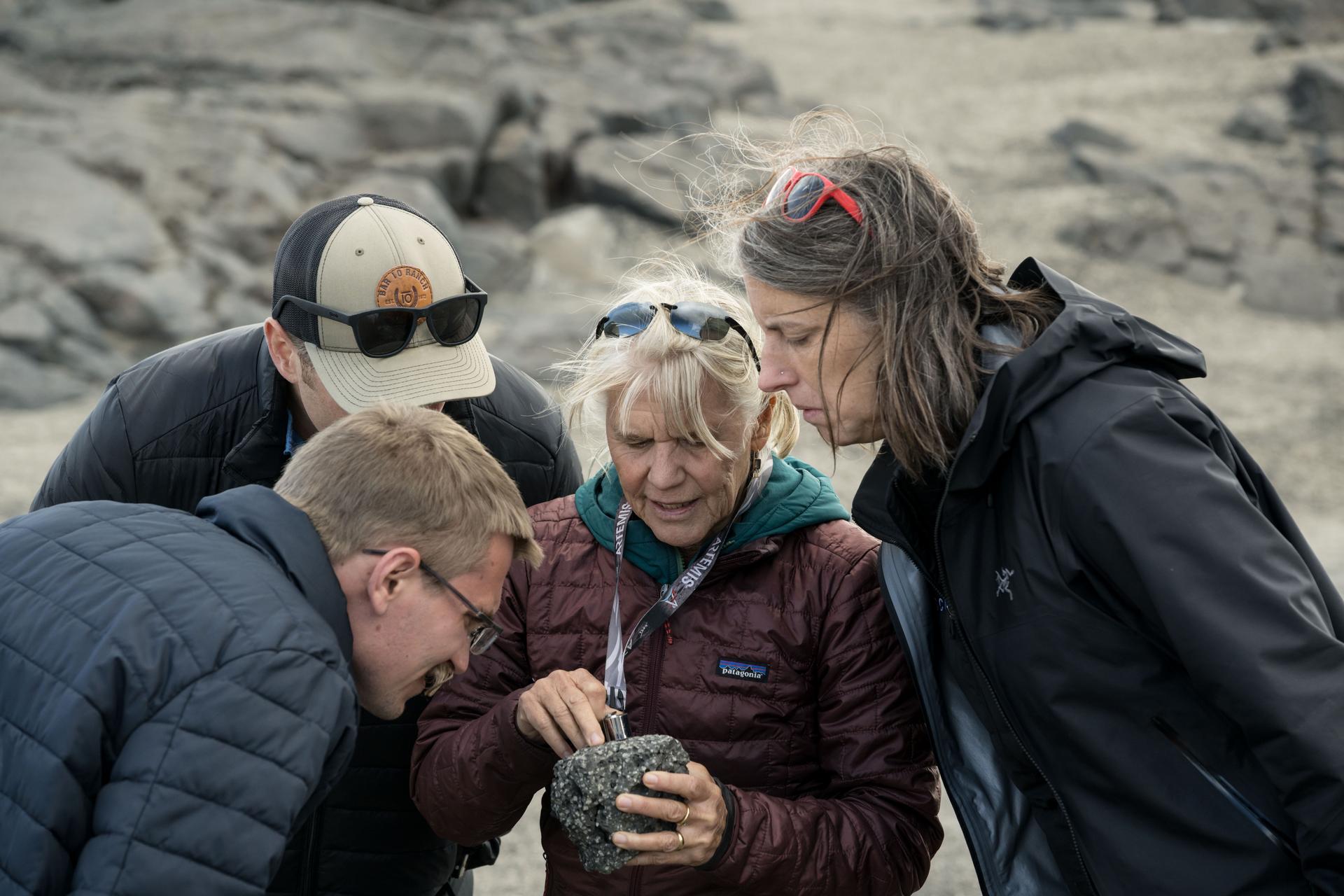
From left, Bryce Prescott, NASA astronaut candidate Cameron Jones, Artemis geology training lead Cindy Evans, and Artemis curation lead Juliane Gross, examine a rock during a geology field training in Iceland. Iceland serves as a lunar stand-in for training astronauts and mission support teams in preparation for lunar surface science missions. Credit: NASA/James Blair

NASA astronaut candidate Yuri Kubo walks across a lava flow in Iceland during an Artemis geology field training expedition. Iceland’s diverse volcanic terrain is an excellent stand-in for lunar and planetary processes and provides an ideal environment in which to simulate surface science operations. Credit: NASA/James Blair
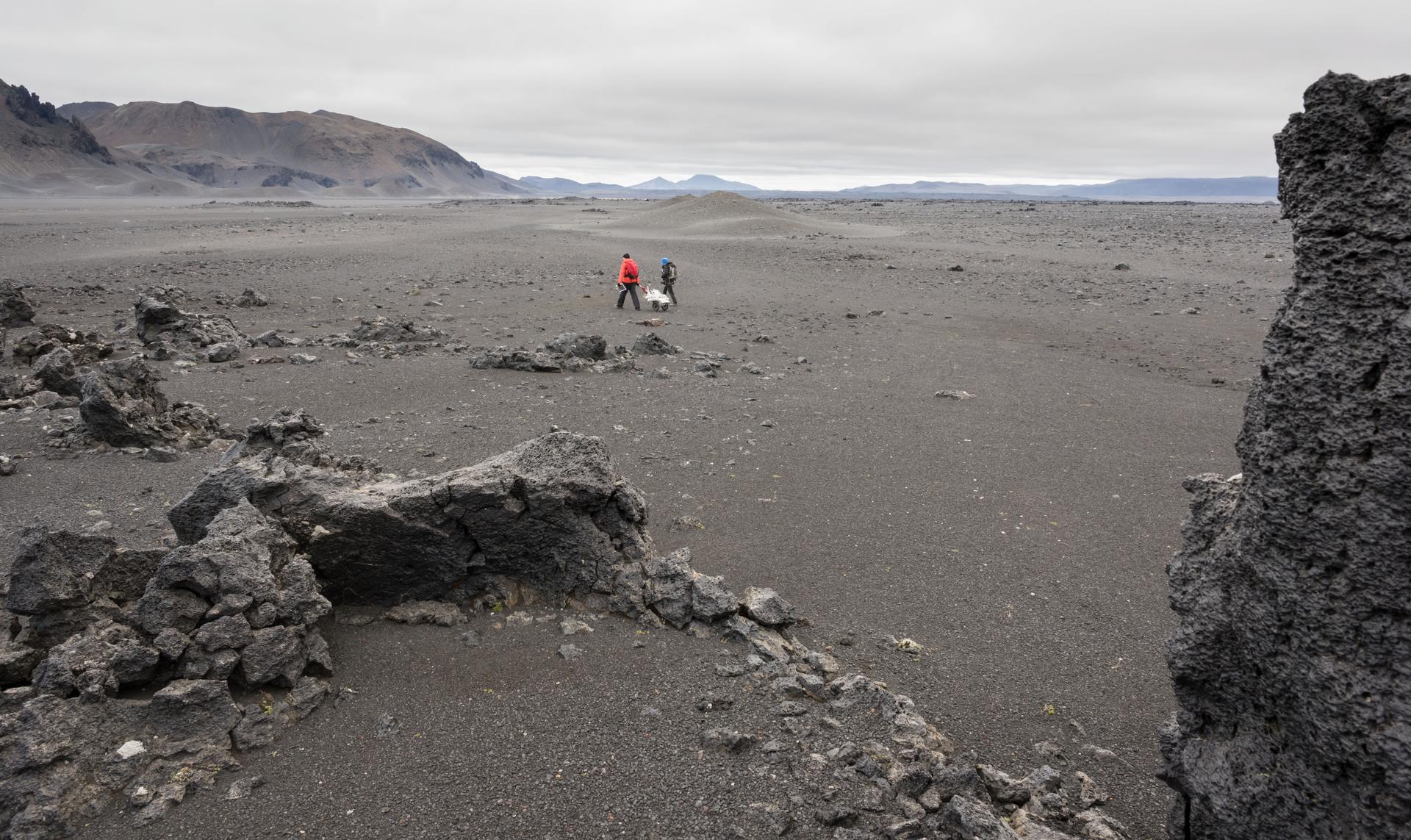
Participants in Artemis geology field training expedition walk a tool cart across a volcanic landscape in Iceland. Iceland’s diverse volcanic terrain is an excellent stand-in for lunar and planetary processes and provides an ideal environment in which to simulate surface science operations. Credit: NASA/James Blair
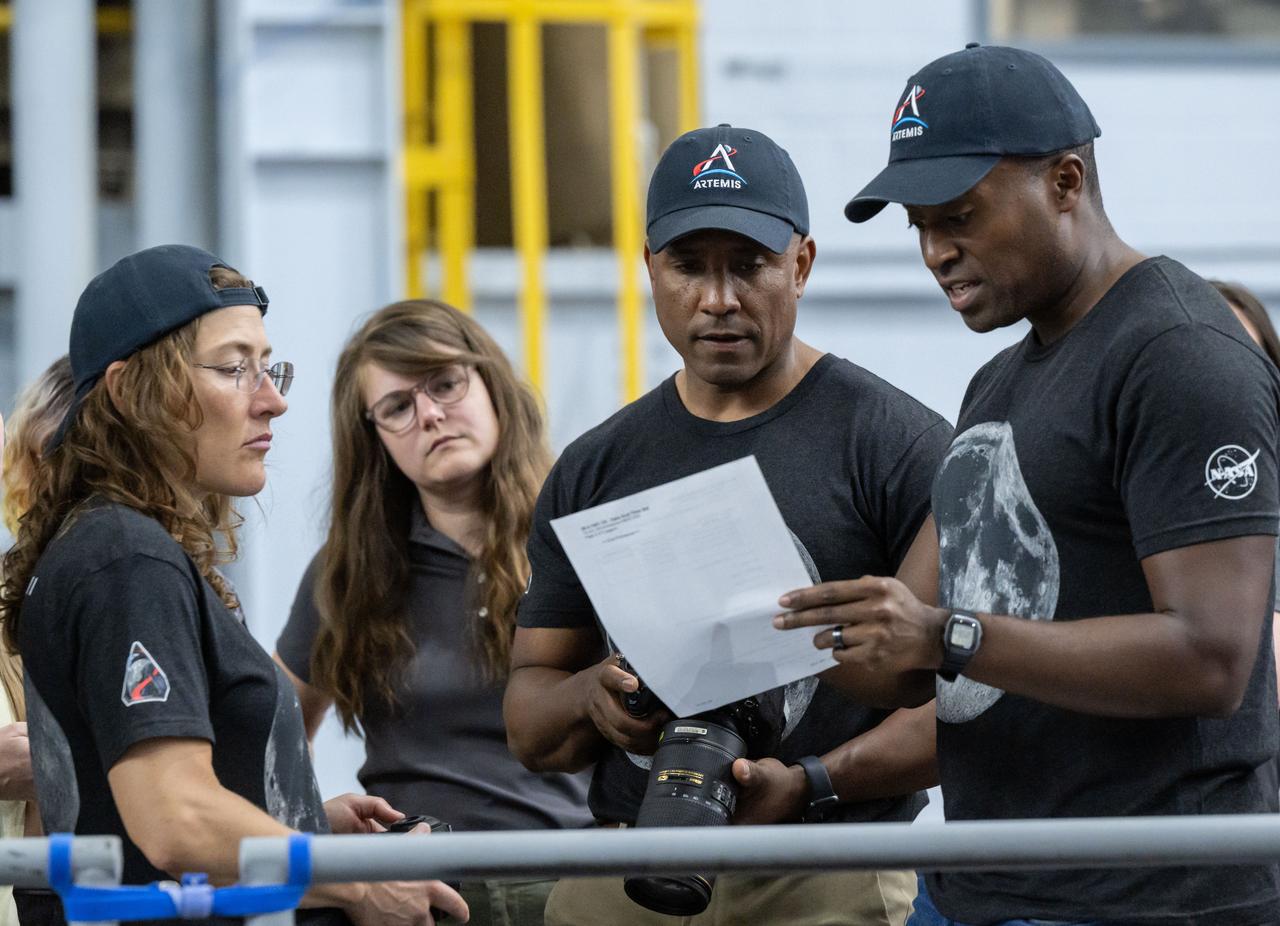
jsc2025e064747 --- Artemis II mission specialist Christina Koch, left, Artemis II lunar science team member Marie Henderson, Artemis II pilot Victor Glover, and Artemis II backup crew member Andre Douglas practice camera setup during crew lunar observations training at NASA's Johnson Space Center in Houston.
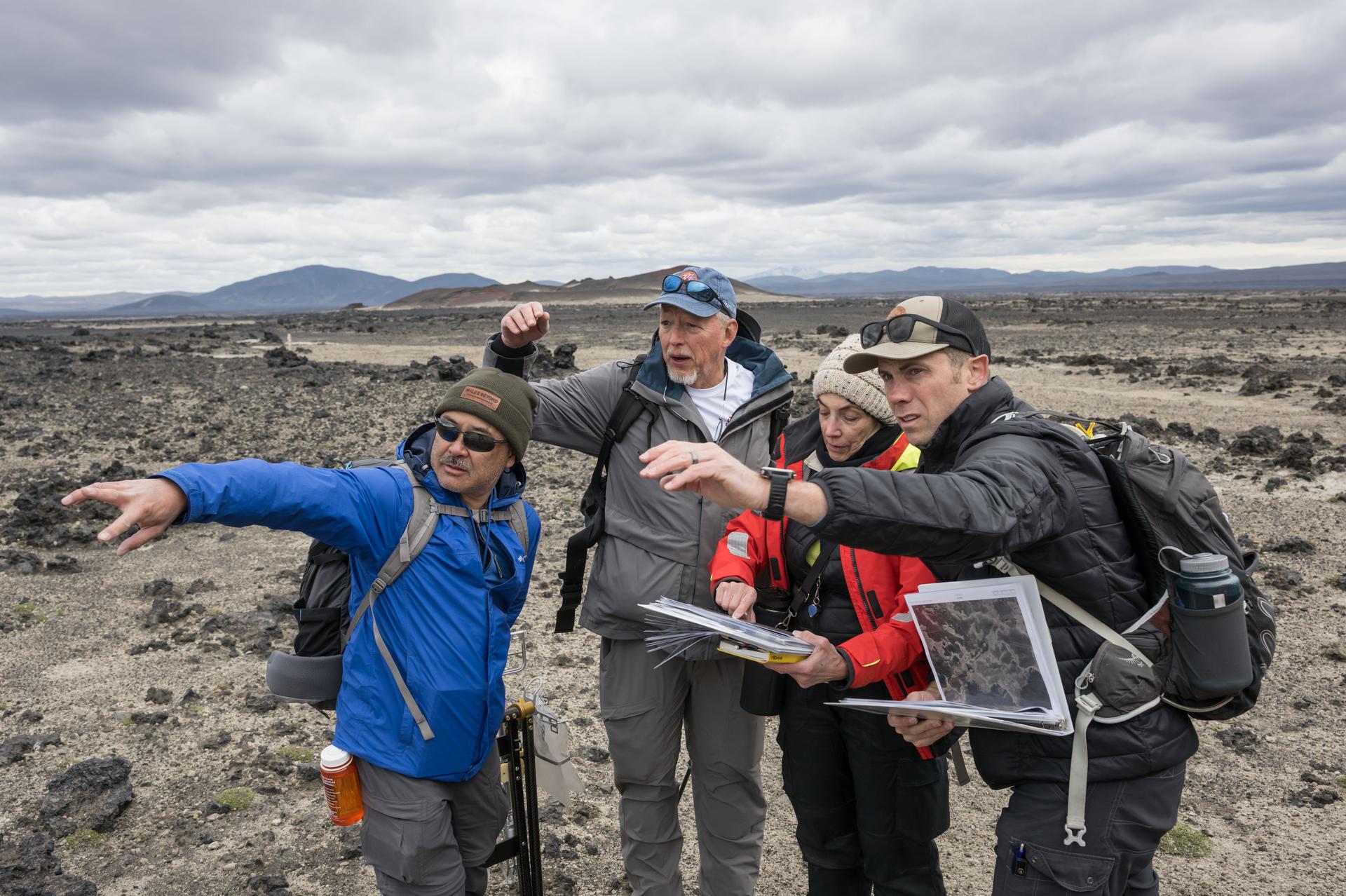
From left, Japan Aerospace Exploration Agency (JAXA) astronaut Aki Hoshide, chief training officer John Ray, EVA task officer Bridget Scheib, and NASA astronaut candidate Cameron Jones participate in a navigation training activity in Iceland as part of an Artemis geology field training expedition. Iceland’s diverse volcanic terrain is an excellent stand-in for lunar and planetary processes and provides an ideal environment in which to simulate surface science operations. Credit: NASA/James Blair
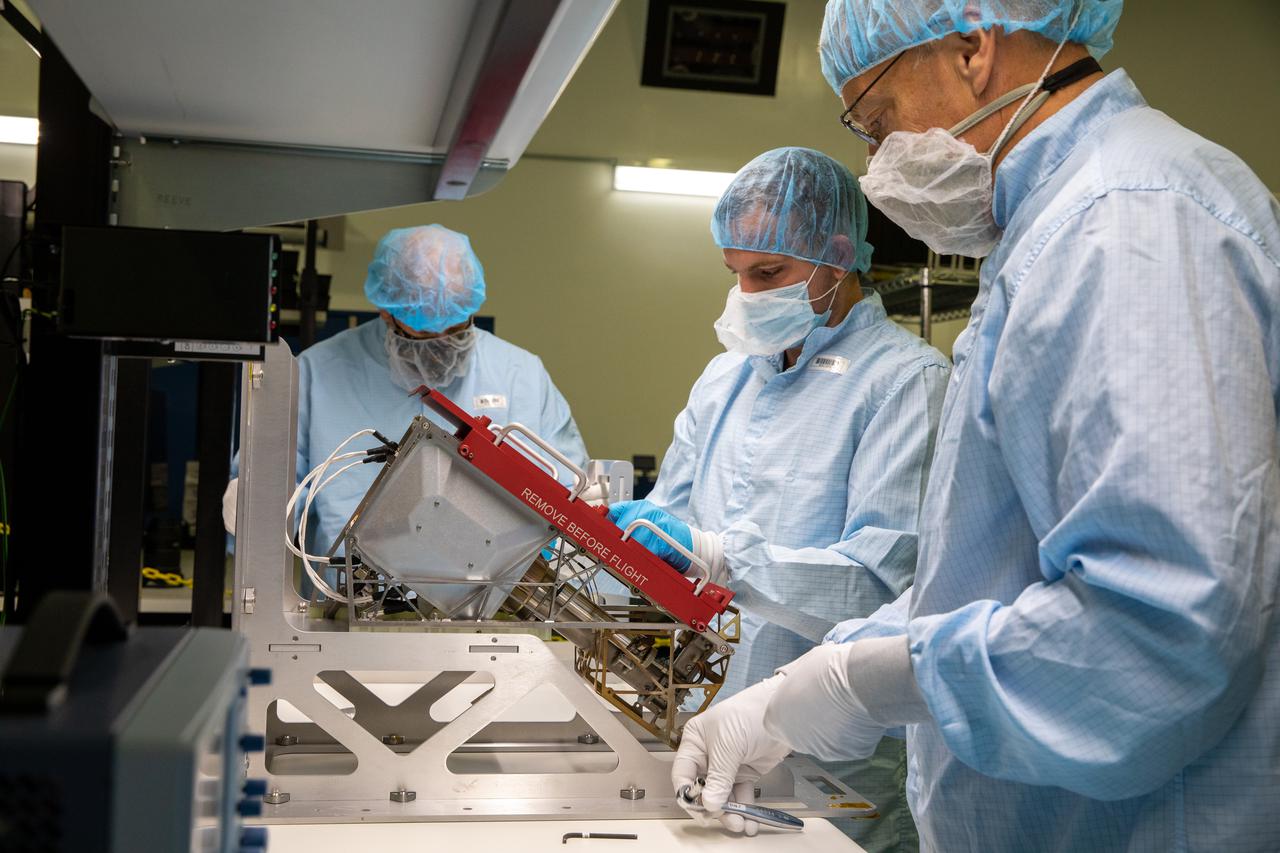
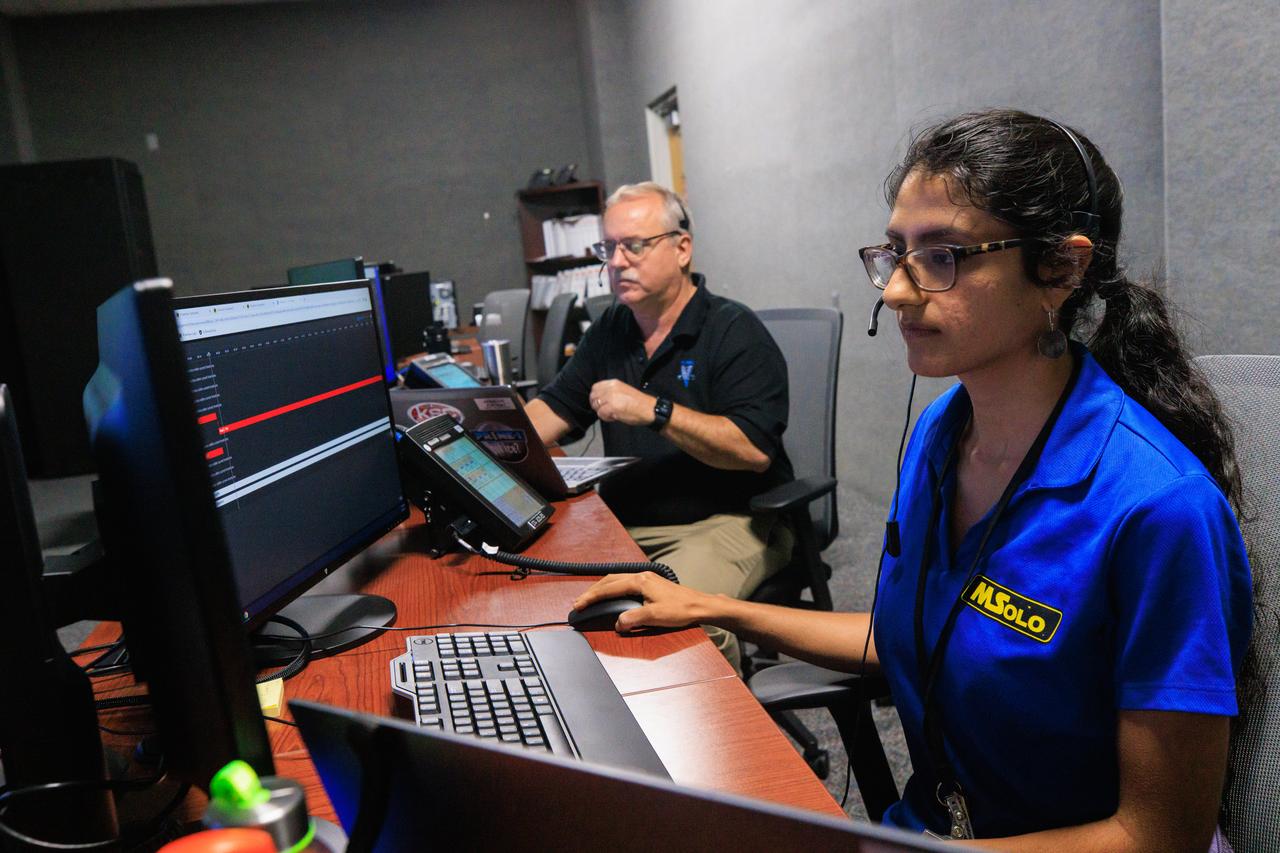
Inside the Space Station Processing Facility at NASA’s Kennedy Space Center in Florida, members of the Mass Spectrometer observing lunar operations (MSolo) team prepare MSolo flight hardware for shipment in preparation for launch in 2022. MSolo is a commercial off-the-shelf mass spectrometer modified to work in space and it will help analyze the chemical makeup of landing sites on the Moon, as well as study water on the lunar surface. MSolo is part of four of the agency’s Commercial Lunar Payload Delivery Service missions where under the Artemis program, commercial deliveries beginning in 2022 will perform science experiments, test technologies and demonstrate capabilities to help NASA explore the Moon and prepare for human missions.
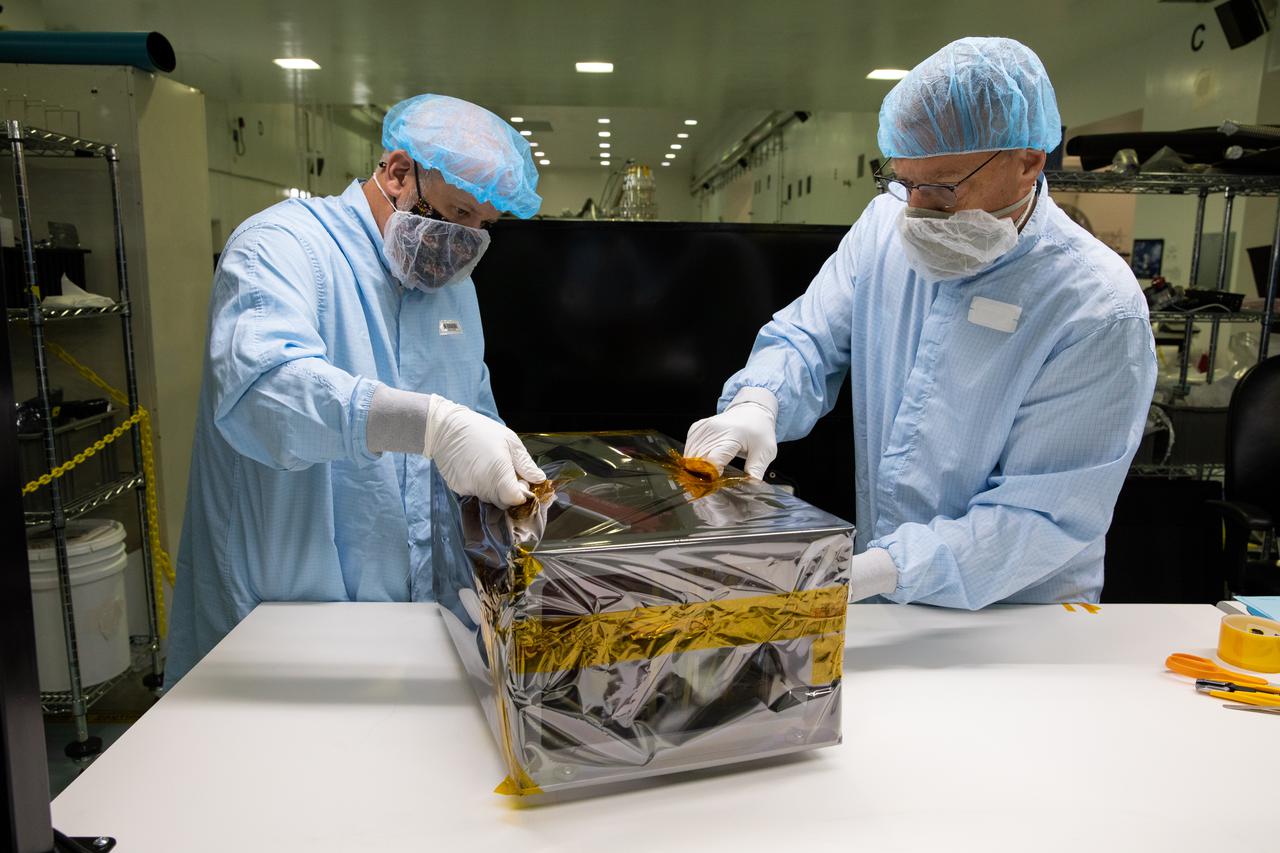
Inside the Space Station Processing Facility at NASA’s Kennedy Space Center in Florida, members of the Mass Spectrometer observing lunar operations (MSolo) team prepare MSolo flight hardware for shipment in preparation for launch in 2022. MSolo is a commercial off-the-shelf mass spectrometer modified to work in space and it will help analyze the chemical makeup of landing sites on the Moon, as well as study water on the lunar surface. MSolo is part of four of the agency’s Commercial Lunar Payload Delivery Service missions where under the Artemis program, commercial deliveries beginning in 2022 will perform science experiments, test technologies and demonstrate capabilities to help NASA explore the Moon and prepare for human missions.
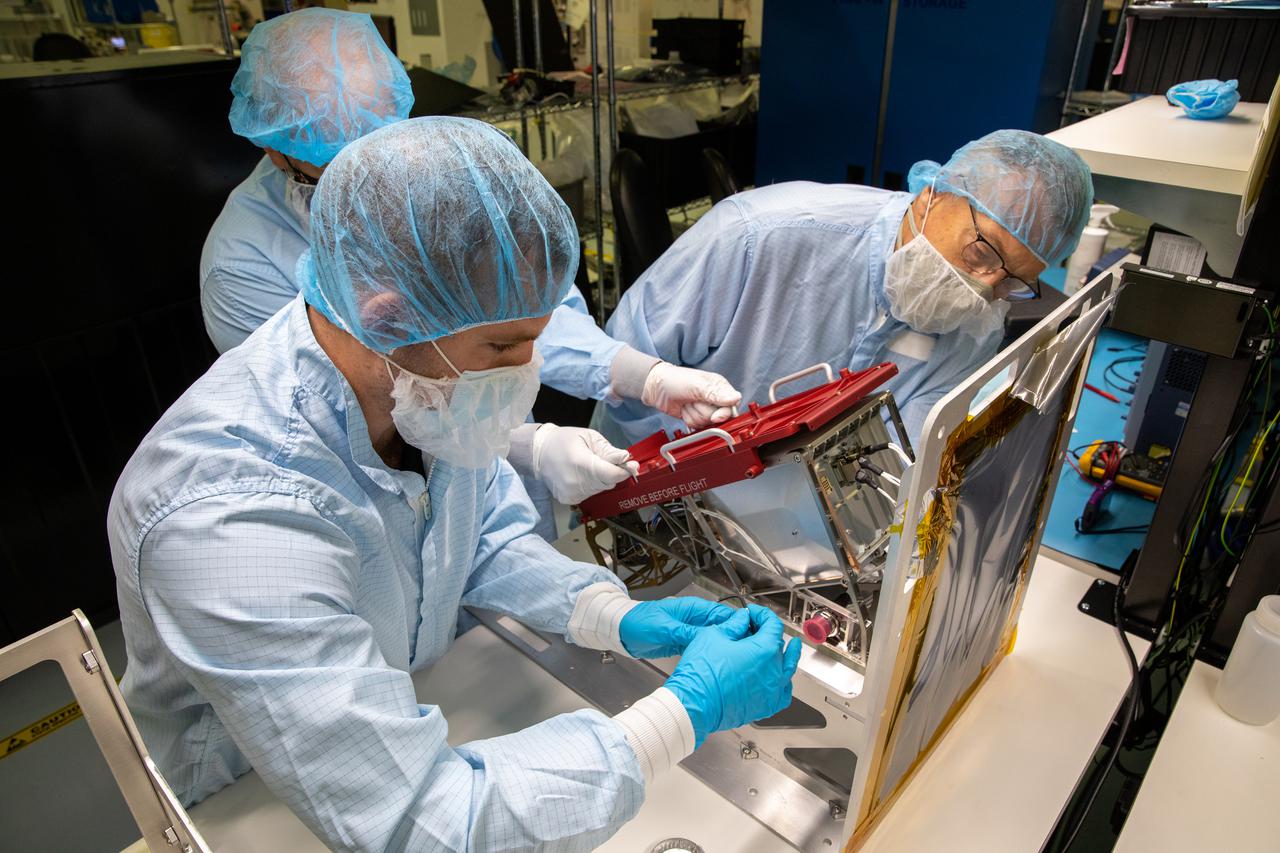
Inside the Space Station Processing Facility at NASA’s Kennedy Space Center in Florida, members of the Mass Spectrometer observing lunar operations (MSolo) team prepare MSolo flight hardware for shipment in preparation for launch in 2022. MSolo is a commercial off-the-shelf mass spectrometer modified to work in space and it will help analyze the chemical makeup of landing sites on the Moon, as well as study water on the lunar surface. MSolo is part of four of the agency’s Commercial Lunar Payload Delivery Service missions where under the Artemis program, commercial deliveries beginning in 2022 will perform science experiments, test technologies and demonstrate capabilities to help NASA explore the Moon and prepare for human missions.
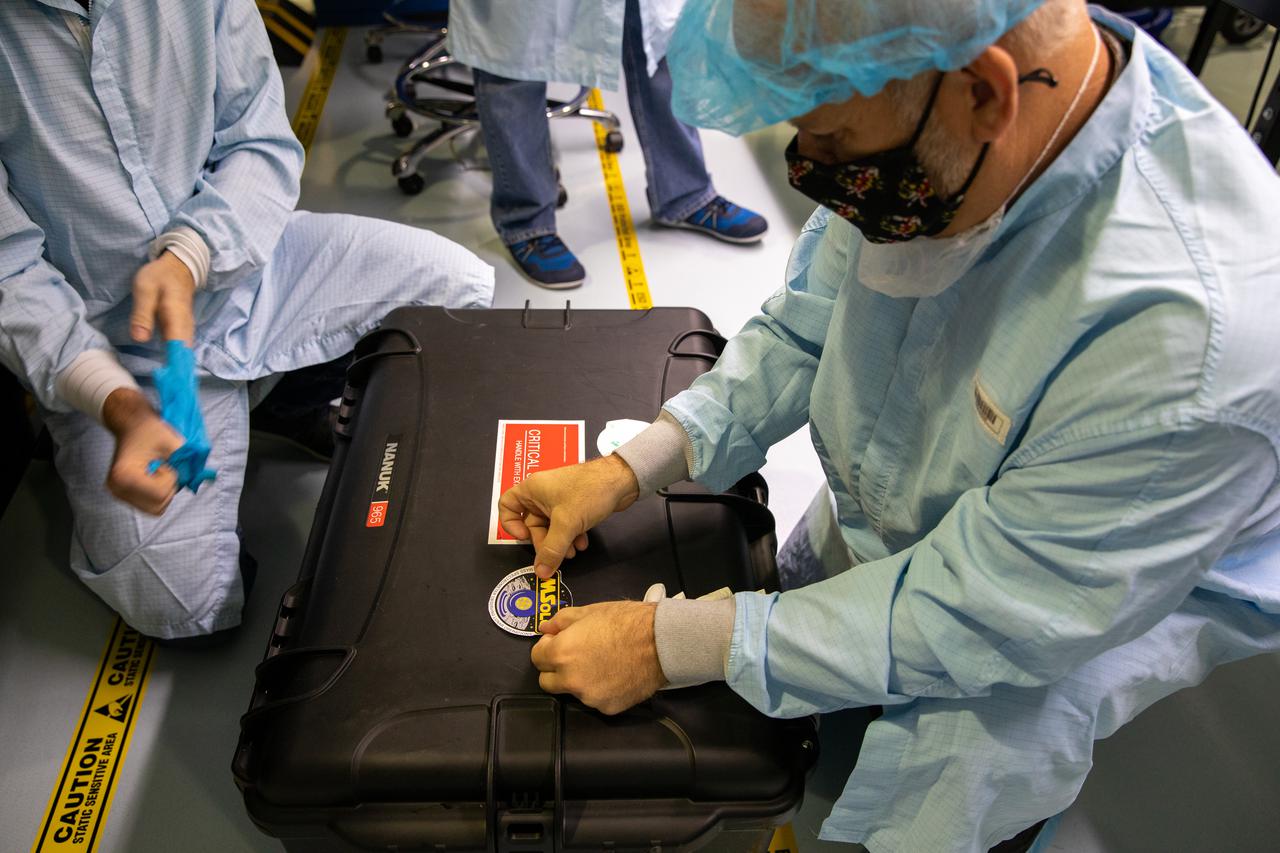
Inside the Space Station Processing Facility at NASA’s Kennedy Space Center in Florida, members of the Mass Spectrometer observing lunar operations (MSolo) team prepare MSolo flight hardware for shipment in preparation for launch in 2022. MSolo is a commercial off-the-shelf mass spectrometer modified to work in space and it will help analyze the chemical makeup of landing sites on the Moon, as well as study water on the lunar surface. MSolo is part of four of the agency’s Commercial Lunar Payload Delivery Service missions where under the Artemis program, commercial deliveries beginning in 2022 will perform science experiments, test technologies and demonstrate capabilities to help NASA explore the Moon and prepare for human missions.
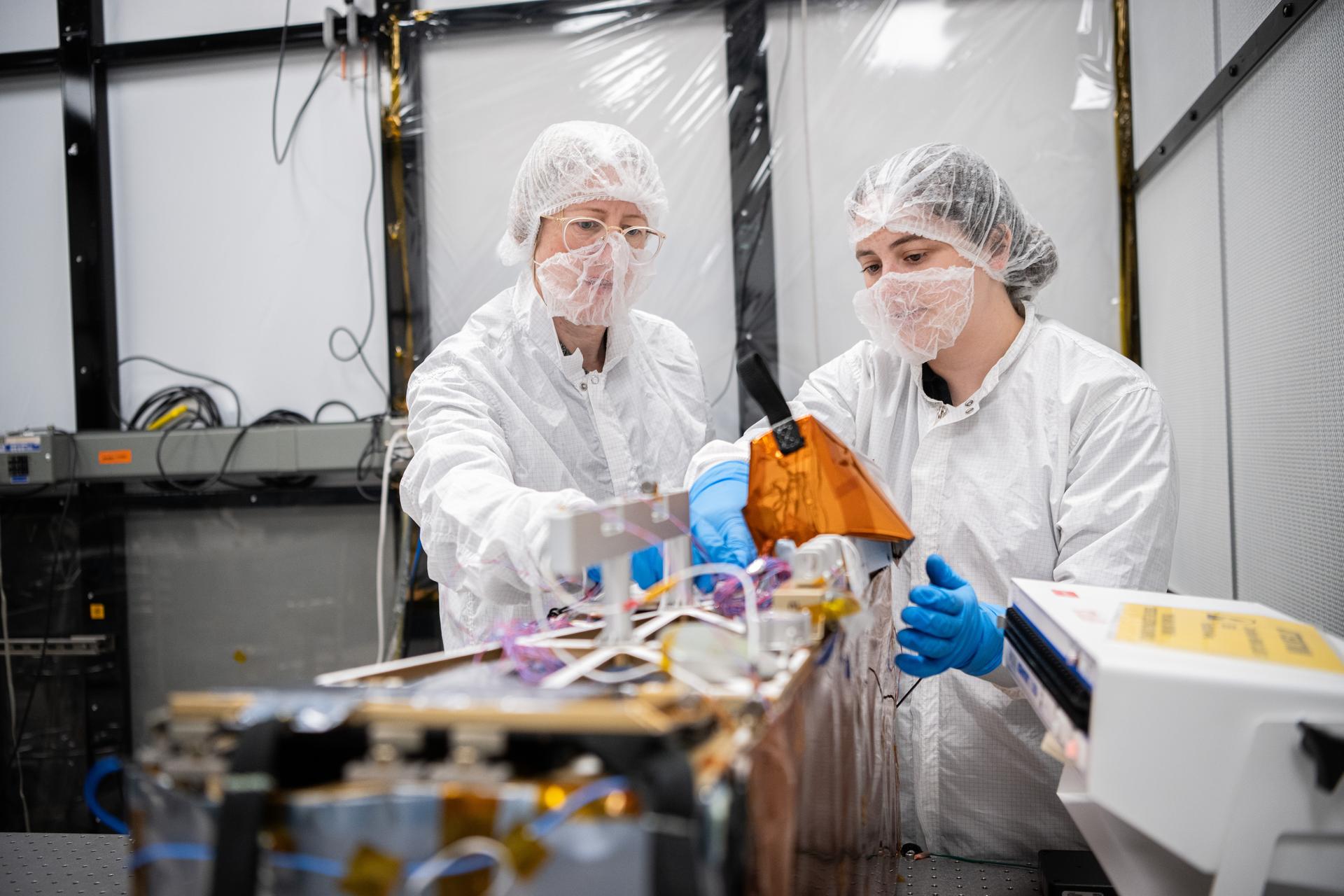
Naoma McCall (Left), Science Co-Investigator and deployment lead and Mechanical Engineer Brie Ludwig inspect the Lunar Environment Monitoring Station (LEMS) instrument in the cleanroom at Goddard Space Flight Center in Greenbelt Md. on February 5th, 2026. LEMS is a compact, autonomous, and self-sustaining seismometer suite designed to carry out continuous, long-term, monitoring of the lunar seismic environment at the South Polar region. Photo Credit: NASA/Denny Henry
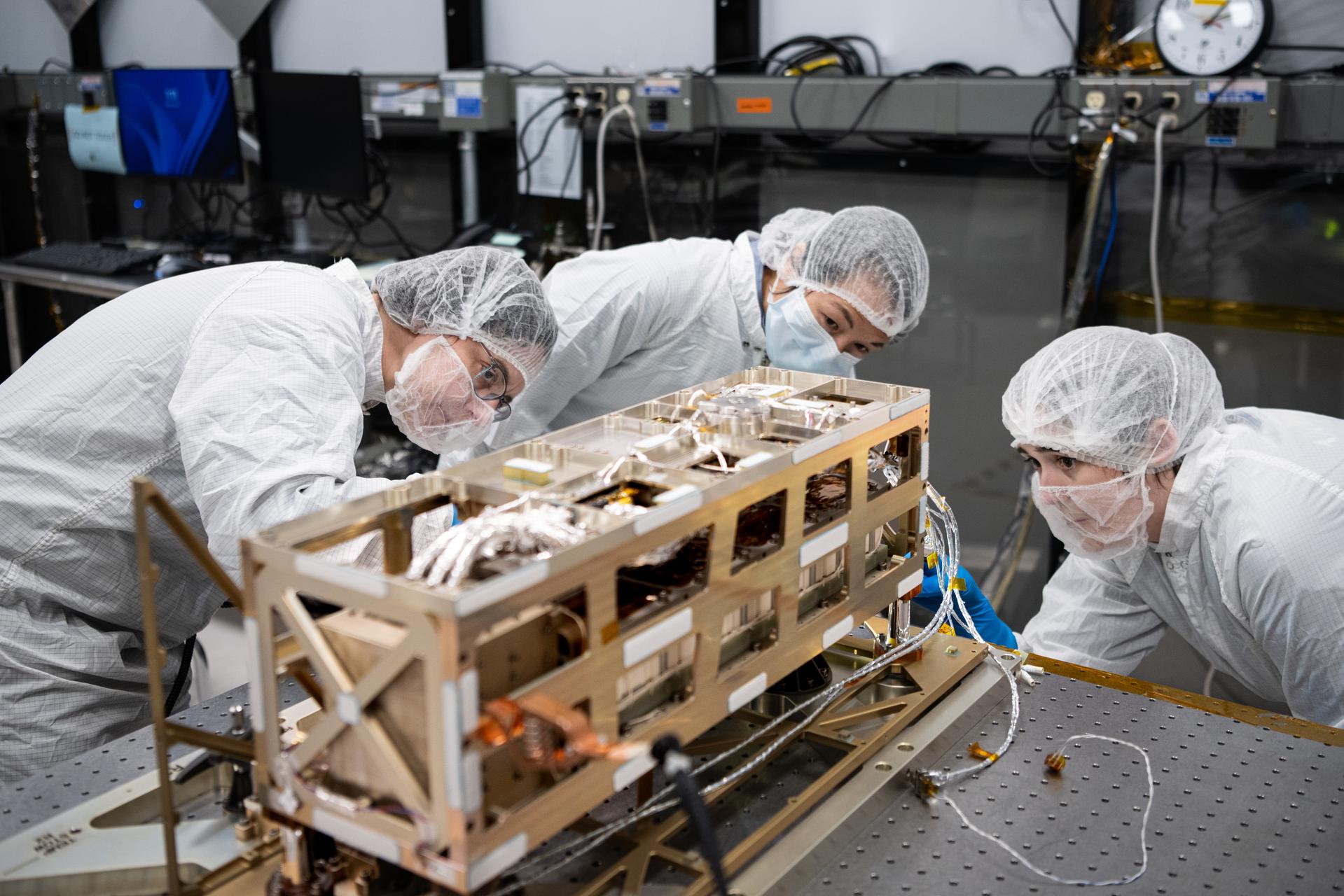
(L-R) Contamination Control Engineer Diane Briczinski, Acting Science Mission Directorate Chief Engineer Synthia Tonn, and Lead Payload Systems Engineer Sam Hicks inspect the Lunar Environment Monitoring Station (LEMS) instrument in the cleanroom at Goddard Space Flight Center in Greenbelt Md. on January 12th, 2026. LEMS is a compact, autonomous, and self-sustaining seismometer suite designed to carry out continuous, long-term, monitoring of the lunar seismic environment at the South Polar region. Photo Credit: NASA/Denny Henry
Preparations are underway to conduct a vibration test on the Mass Spectrometer Observing Lunar Operations (MSolo) for NASA’s VIPER mission inside a laboratory in the Neil Armstrong Operations and Checkout Building at NASA’s Kennedy Space Center in Florida on Nov. 8, 2022. Exposing the instrument to vibration environments that it might see during launch helps engineers to find issues prior to liftoff. MSolo is a commercial off-the-shelf mass spectrometer modified to work in space and it will help analyze the chemical makeup of landing sites on the Moon, as well as study water on the lunar surface. MSolo will be part of NASA’s first Commercial Lunar Payload Delivery Service (CLPS) mission where under the Artemis program, commercial deliveries will be used to perform science experiments, test technologies and demonstrate capabilities to help NASA explore the Moon and prepare for human missions.
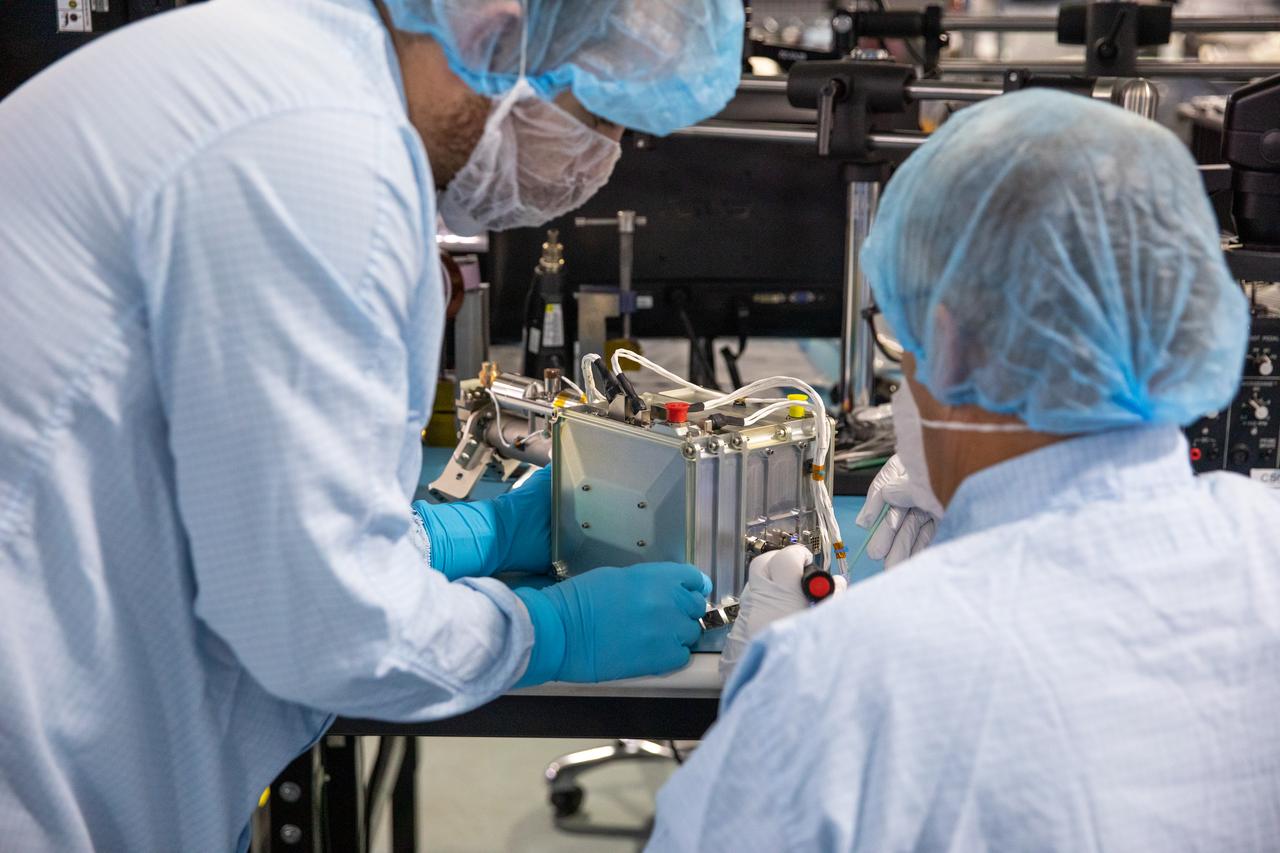
Technicians prepare the Mass Spectrometer Observing Lunar Operations (MSolo) for NASA’s Volatile Investigating Polar Exploration Rover (VIPER) mission for packing inside a laboratory in the Space Station Processing Facility at NASA’s Kennedy Space Center in Florida on Feb. 21, 2023. MSolo will be shipped to Johnson Space Center in Houston for integration into VIPER. MSolo is a commercial off-the-shelf mass spectrometer modified to work in space and it will help analyze the chemical makeup of landing sites on the Moon, as well as study water on the lunar surface. MSolo will be part of NASA’s first Commercial Lunar Payload Delivery Service (CLPS) mission where under the Artemis program, commercial deliveries will be used to perform science experiments, test technologies, and demonstrate capabilities to help NASA explore the Moon and prepare for human missions. VIPER is scheduled to be delivered to the Moon’s South Pole in late 2024 by Astrobotic’s Griffin lander as part of the CLPS initiative.
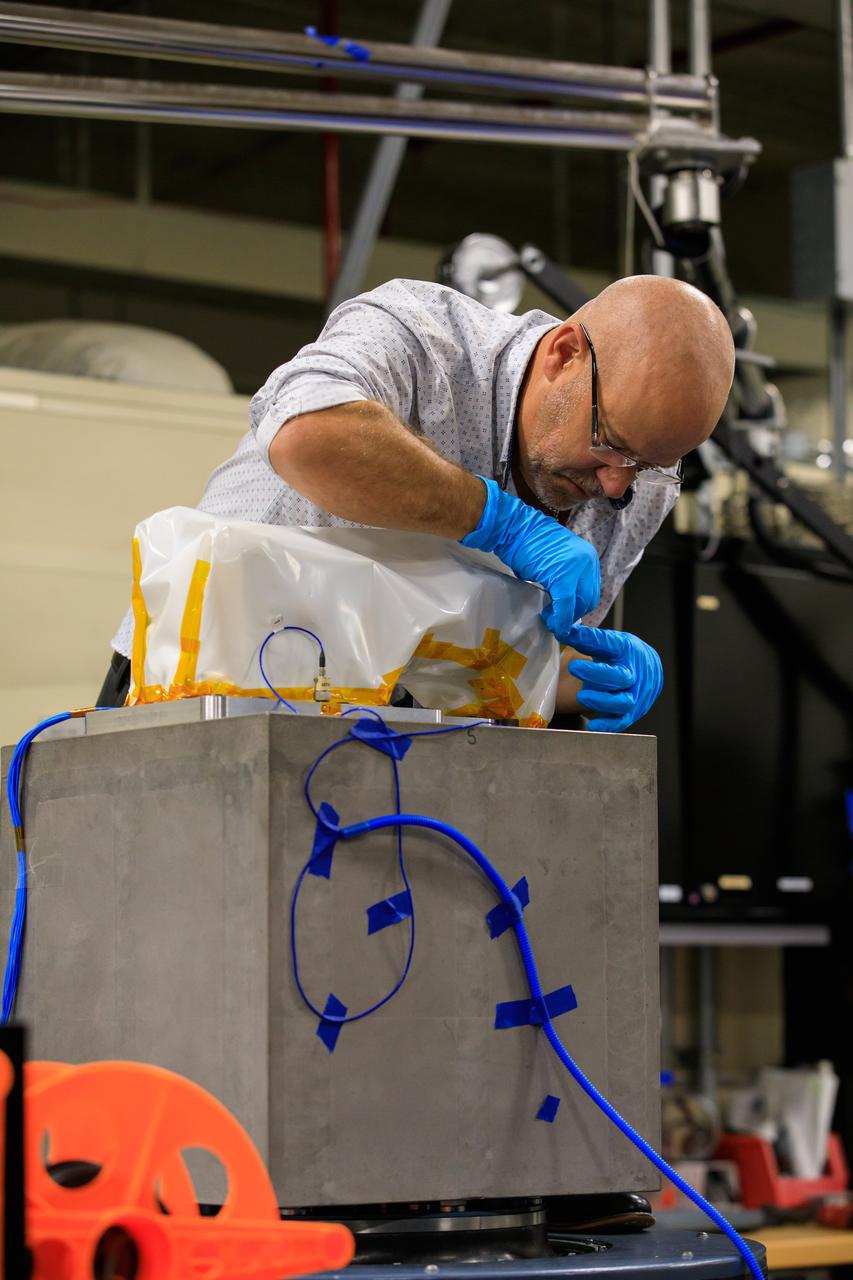
Preparations are underway to conduct a vibration test on the Mass Spectrometer Observing Lunar Operations (MSolo) for NASA’s VIPER mission inside a laboratory in the Neil Armstrong Operations and Checkout Building at NASA’s Kennedy Space Center in Florida on Nov. 8, 2022. Exposing the instrument to vibration environments that it might see during launch helps engineers to find issues prior to liftoff. MSolo is a commercial off-the-shelf mass spectrometer modified to work in space and it will help analyze the chemical makeup of landing sites on the Moon, as well as study water on the lunar surface. MSolo will be part of NASA’s first Commercial Lunar Payload Delivery Service (CLPS) mission where under the Artemis program, commercial deliveries will be used to perform science experiments, test technologies and demonstrate capabilities to help NASA explore the Moon and prepare for human missions.
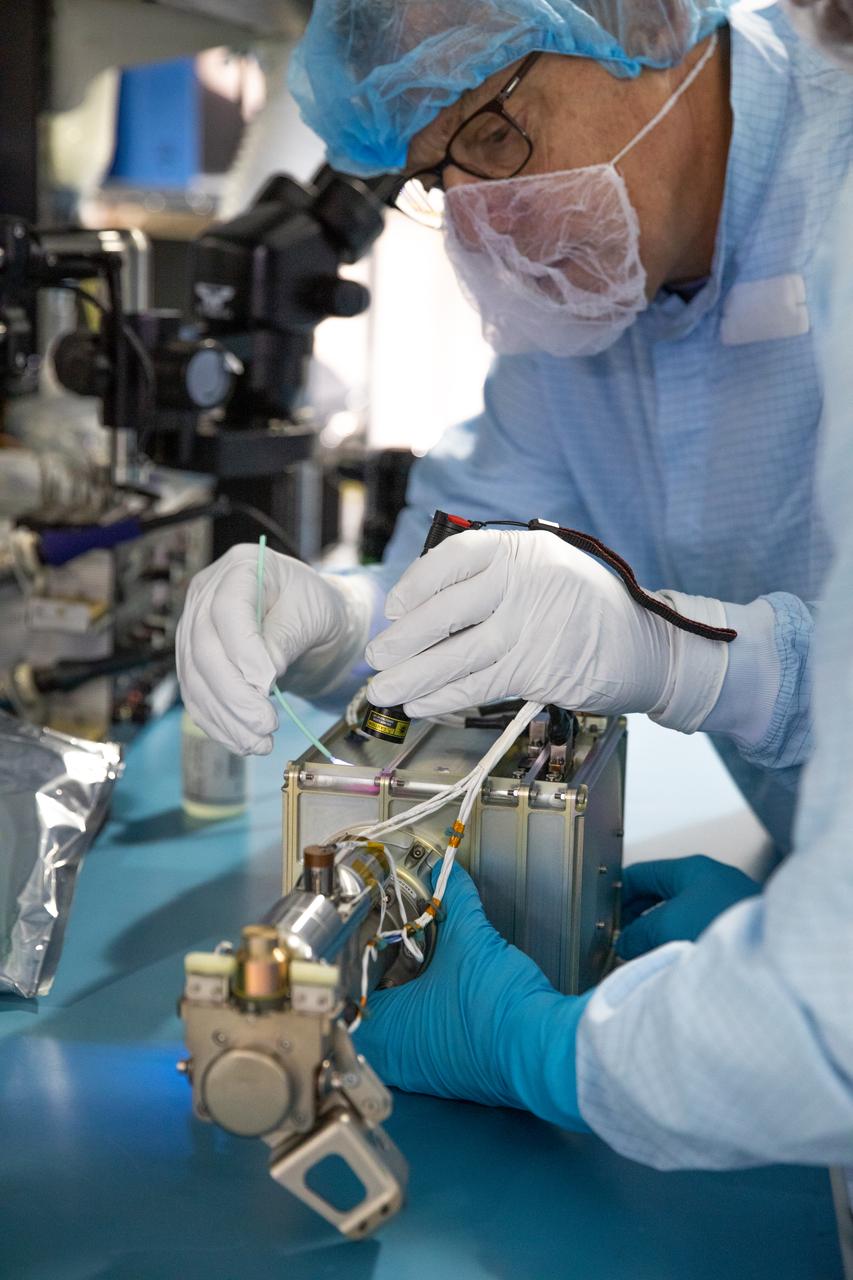
Technicians prepare the Mass Spectrometer Observing Lunar Operations (MSolo) for NASA’s Volatile Investigating Polar Exploration Rover (VIPER) mission for packing inside a laboratory in the Space Station Processing Facility at NASA’s Kennedy Space Center in Florida on Feb. 21, 2023. MSolo will be shipped to Johnson Space Center in Houston for integration into VIPER. MSolo is a commercial off-the-shelf mass spectrometer modified to work in space and it will help analyze the chemical makeup of landing sites on the Moon, as well as study water on the lunar surface. MSolo will be part of NASA’s first Commercial Lunar Payload Delivery Service (CLPS) mission where under the Artemis program, commercial deliveries will be used to perform science experiments, test technologies, and demonstrate capabilities to help NASA explore the Moon and prepare for human missions. VIPER is scheduled to be delivered to the Moon’s South Pole in late 2024 by Astrobotic’s Griffin lander as part of the CLPS initiative.
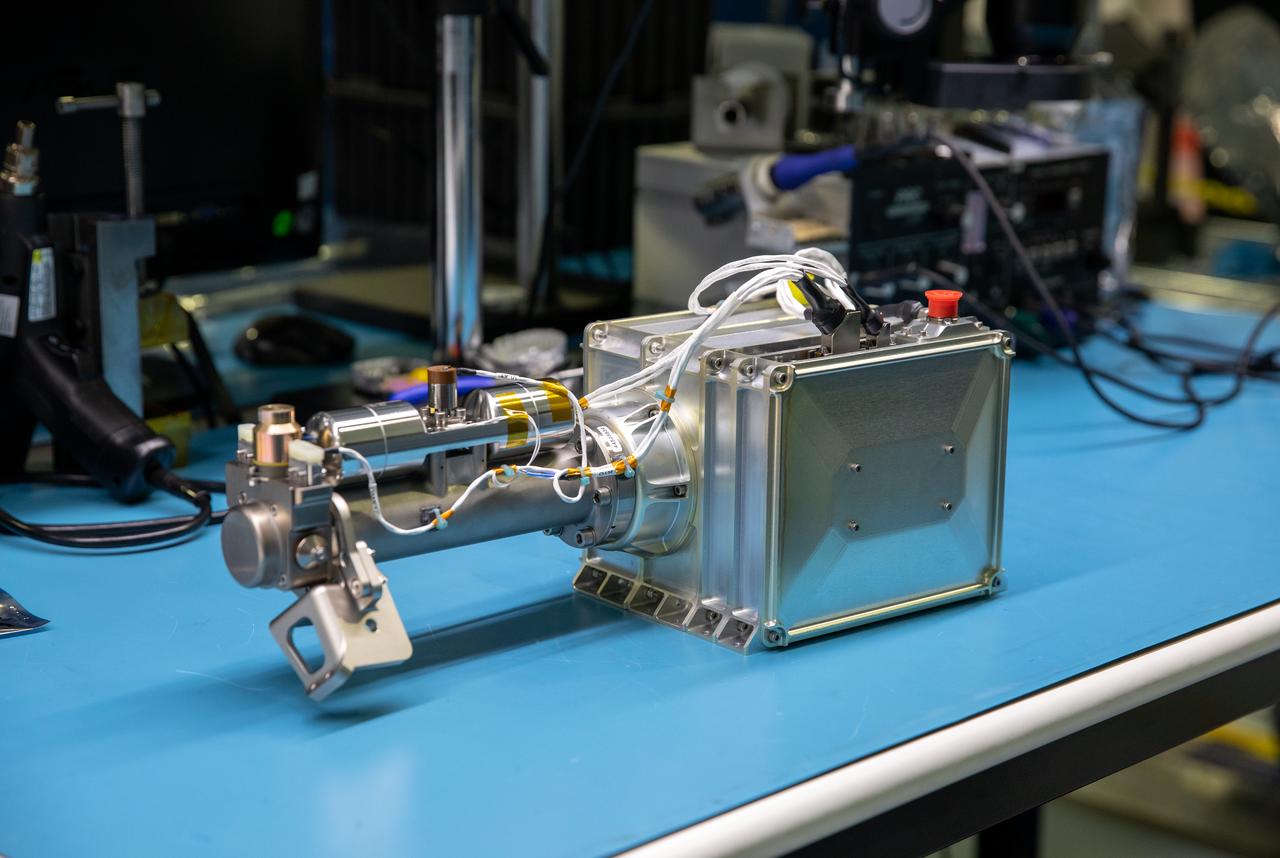
The Mass Spectrometer Observing Lunar Operations (MSolo) for NASA’s Volatile Investigating Polar Exploration Rover (VIPER) mission is prepared for packing inside a laboratory in the Space Station Processing Facility at NASA’s Kennedy Space Center in Florida on Feb. 21, 2023. MSolo will be shipped to Johnson Space Center in Houston for integration into VIPER. MSolo is a commercial off-the-shelf mass spectrometer modified to work in space and it will help analyze the chemical makeup of landing sites on the Moon, as well as study water on the lunar surface. MSolo will be part of NASA’s first Commercial Lunar Payload Delivery Service (CLPS) mission where under the Artemis program, commercial deliveries will be used to perform science experiments, test technologies, and demonstrate capabilities to help NASA explore the Moon and prepare for human missions. VIPER is scheduled to be delivered to the Moon’s South Pole in late 2024 by Astrobotic’s Griffin lander as part of the CLPS initiative.
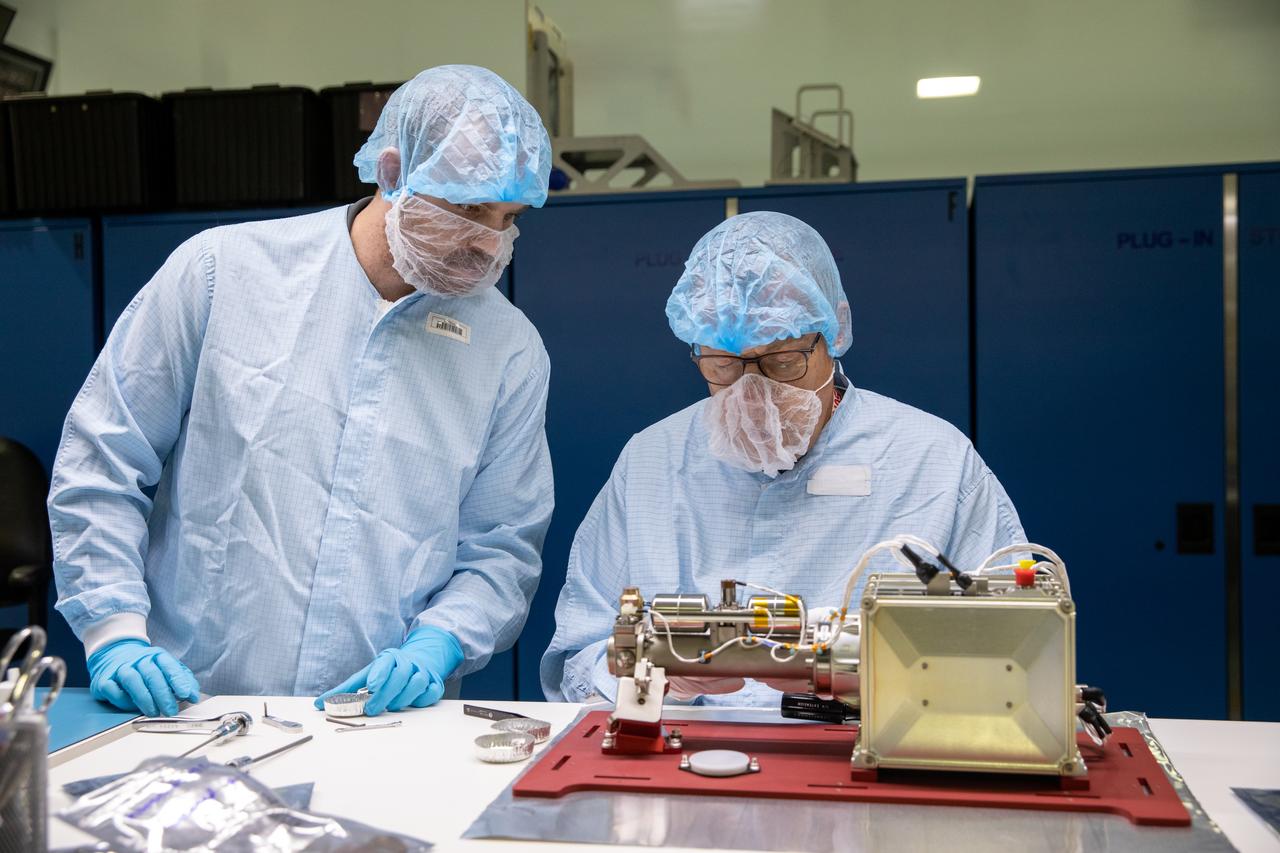
Technicians prepare the Mass Spectrometer Observing Lunar Operations (MSolo) for NASA’s Volatile Investigating Polar Exploration Rover (VIPER) mission for packing inside a laboratory in the Space Station Processing Facility at NASA’s Kennedy Space Center in Florida on Feb. 21, 2023. MSolo will be shipped to Johnson Space Center in Houston for integration into VIPER. MSolo is a commercial off-the-shelf mass spectrometer modified to work in space and it will help analyze the chemical makeup of landing sites on the Moon, as well as study water on the lunar surface. MSolo will be part of NASA’s first Commercial Lunar Payload Delivery Service (CLPS) mission where under the Artemis program, commercial deliveries will be used to perform science experiments, test technologies, and demonstrate capabilities to help NASA explore the Moon and prepare for human missions. VIPER is scheduled to be delivered to the Moon’s South Pole in late 2024 by Astrobotic’s Griffin lander as part of the CLPS initiative.
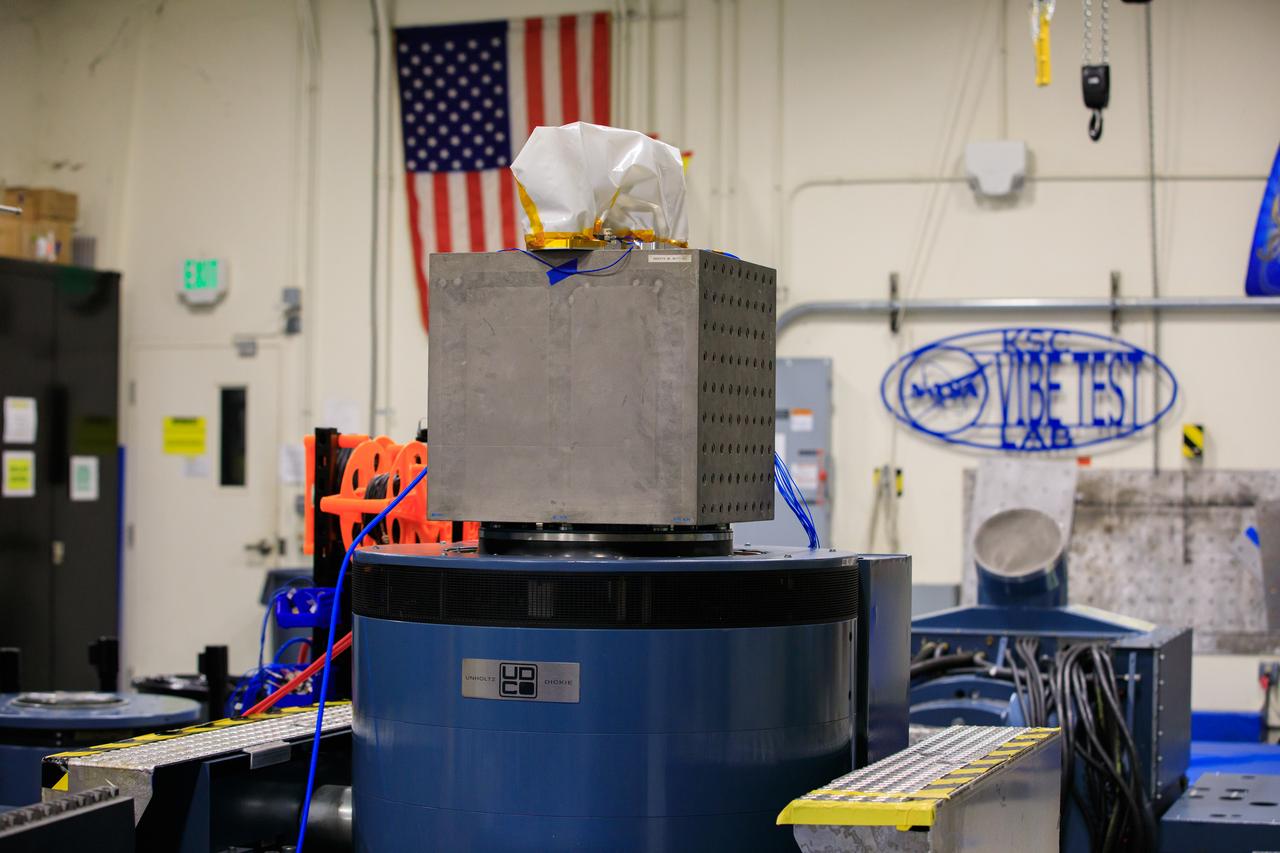
The Mass Spectrometer Observing Lunar Operations (MSolo) for NASA’s VIPER mission is being prepared for a vibration test inside a laboratory in the Neil Armstrong Operations and Checkout Building at NASA’s Kennedy Space Center in Florida on Nov. 8, 2022. Exposing the instrument to vibration environments that it might see during launch helps engineers to find issues prior to liftoff. MSolo is a commercial off-the-shelf mass spectrometer modified to work in space and it will help analyze the chemical makeup of landing sites on the Moon, as well as study water on the lunar surface. MSolo will be part of NASA’s first Commercial Lunar Payload Delivery Service (CLPS) mission where under the Artemis program, commercial deliveries will be used to perform science experiments, test technologies and demonstrate capabilities to help NASA explore the Moon and prepare for human missions.
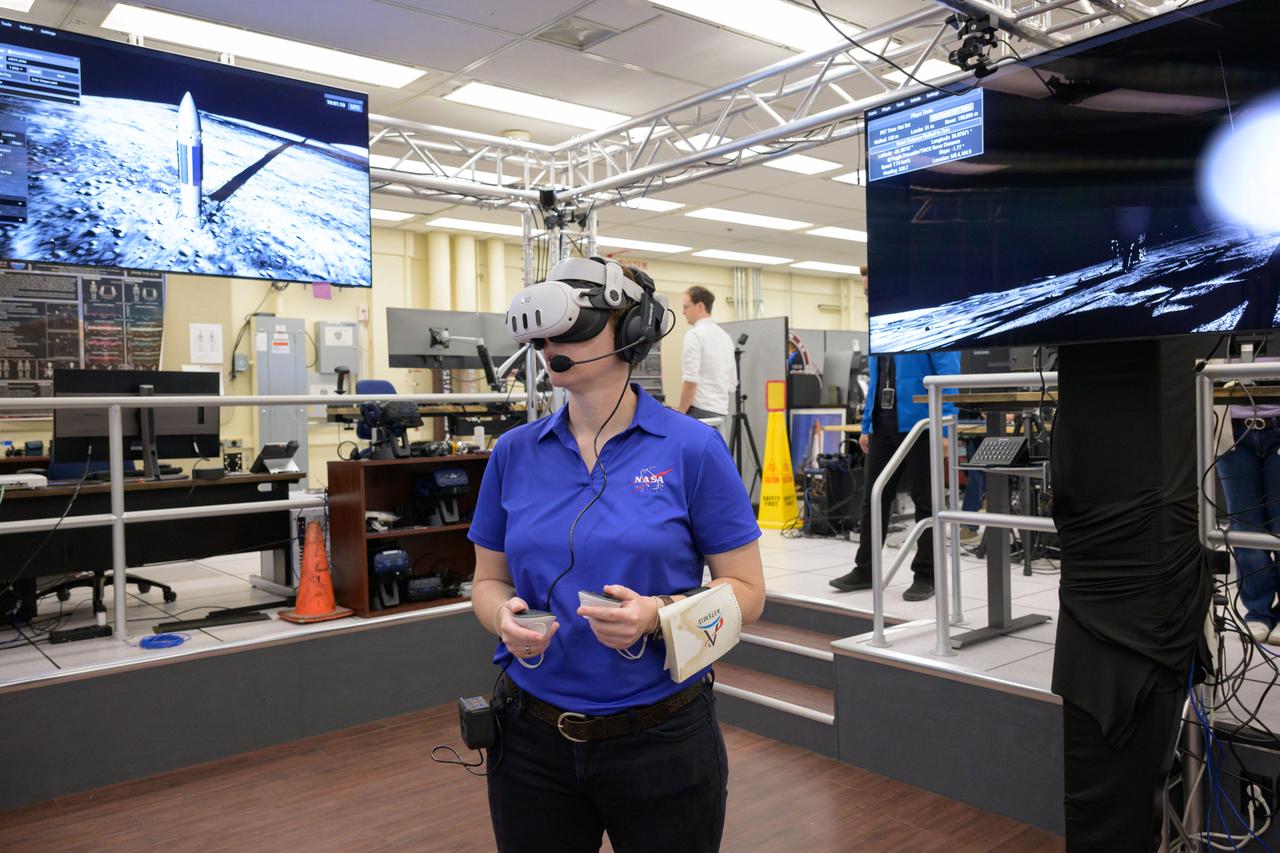
jsc2024e076628 – Tess Caswell, a crew stand-in for the Artemis III Virtual Reality Mini-Simulation, executes a moonwalk in the Prototype Immersive Technology (PIT) lab at NASA’s Johnson Space Center in Houston. The simulation was a test of using VR as a training method for flight controllers and science teams’ collaboration on science-focused traverses on the lunar surface. Credit: NASA/Robert Markowitz
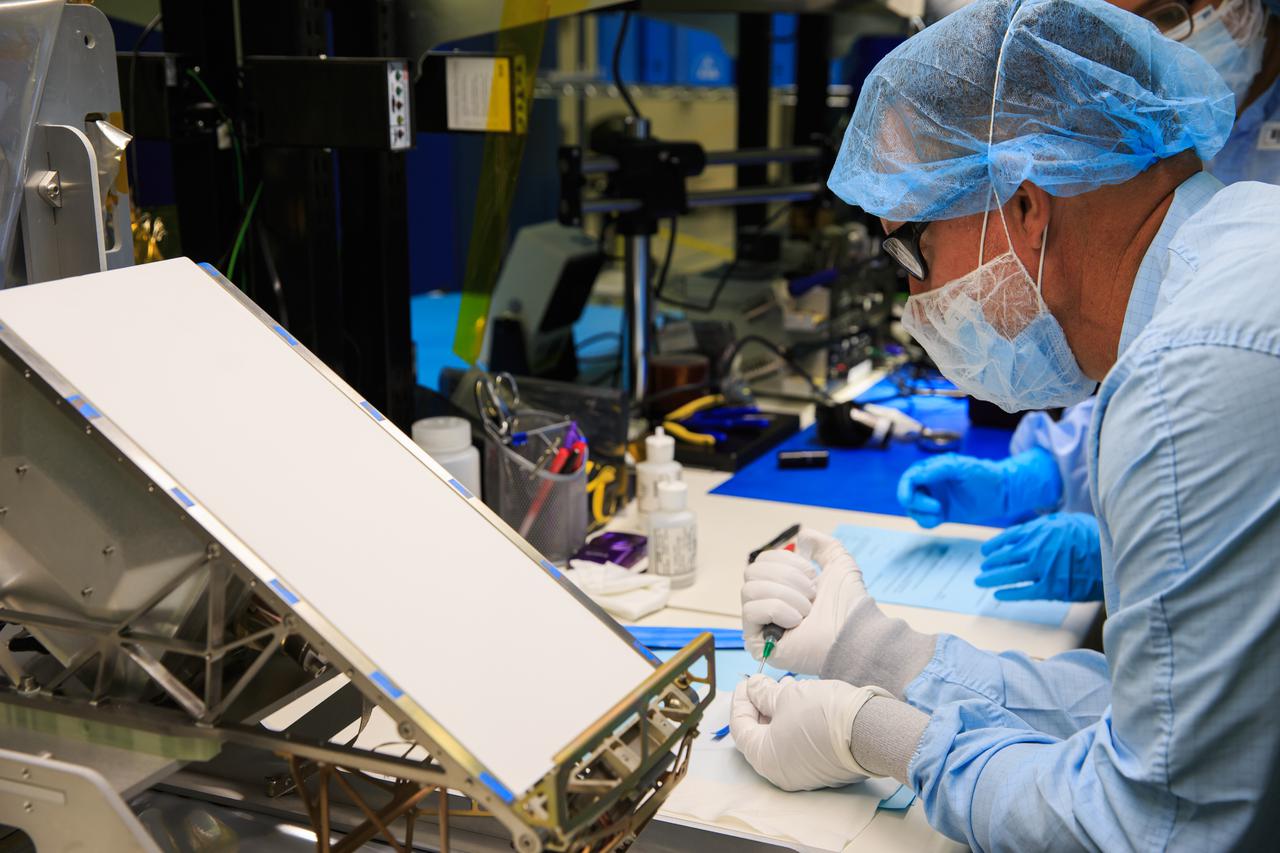
Team members working inside the Space Station Processing Facility at NASA’s Kennedy Space Center in Florida, on Sept. 23, 2021, meticulously assemble ground support equipment that will protect shipment of the Mass Spectrometer observing lunar operations (MSolo) flight hardware for preparations before it launches in 2022. MSolo is a commercial off-the-shelf mass spectrometer modified to work in space and it will help analyze the chemical makeup of landing sites on the Moon, as well as study water on the lunar surface. MSolo, scheduled to first launch in 2022, is part of four of the agency’s Commercial Lunar Payload Delivery Service missions where under the Artemis program, commercial deliveries will include science experiments, testing of technologies and demonstrations of capabilities to help NASA explore the Moon and prepare for human missions.
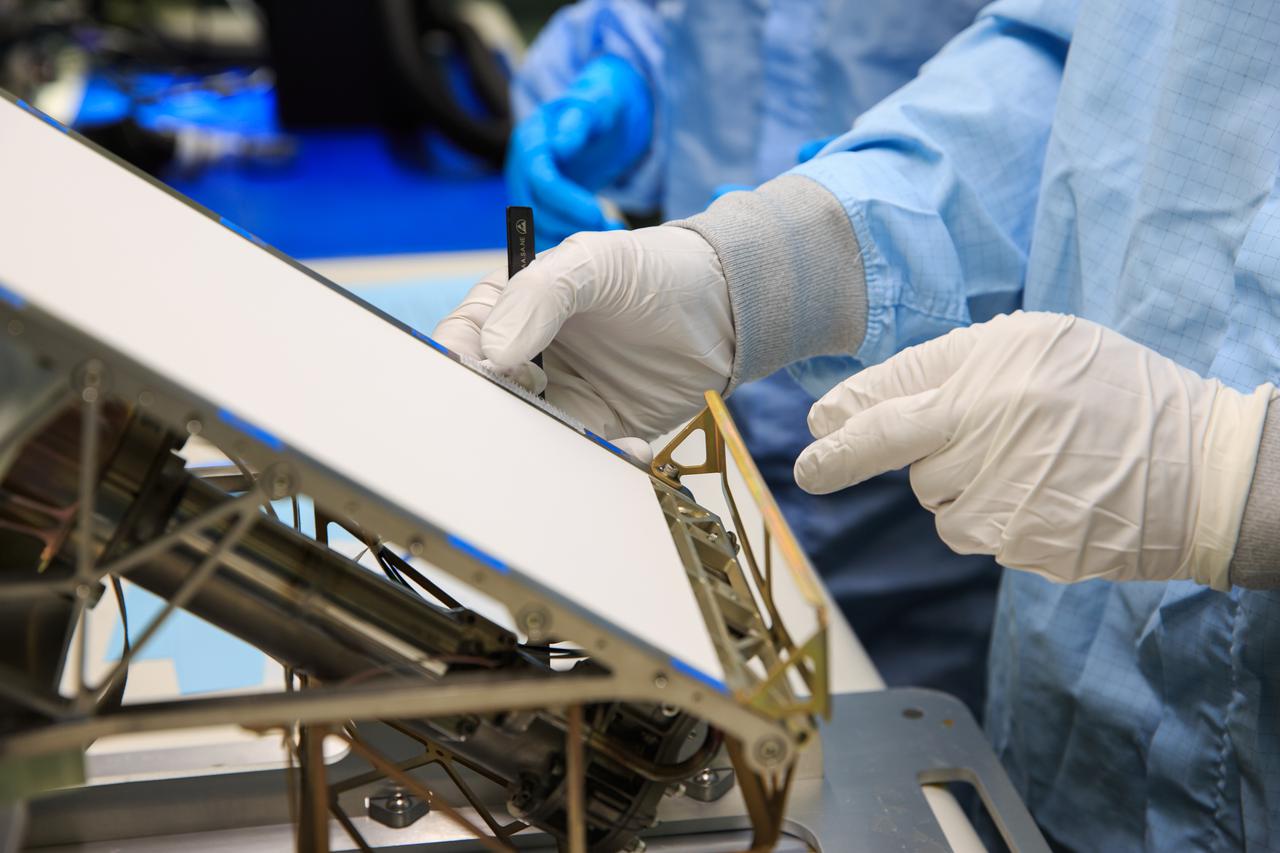
Team members working inside the Space Station Processing Facility at NASA’s Kennedy Space Center in Florida, on Sept. 23, 2021, meticulously assemble ground support equipment that will protect shipment of the Mass Spectrometer observing lunar operations (MSolo) flight hardware for preparations before it launches in 2022. MSolo is a commercial off-the-shelf mass spectrometer modified to work in space and it will help analyze the chemical makeup of landing sites on the Moon, as well as study water on the lunar surface. MSolo, scheduled to first launch in 2022, is part of four of the agency’s Commercial Lunar Payload Delivery Service missions where under the Artemis program, commercial deliveries will include science experiments, testing of technologies and demonstrations of capabilities to help NASA explore the Moon and prepare for human missions.
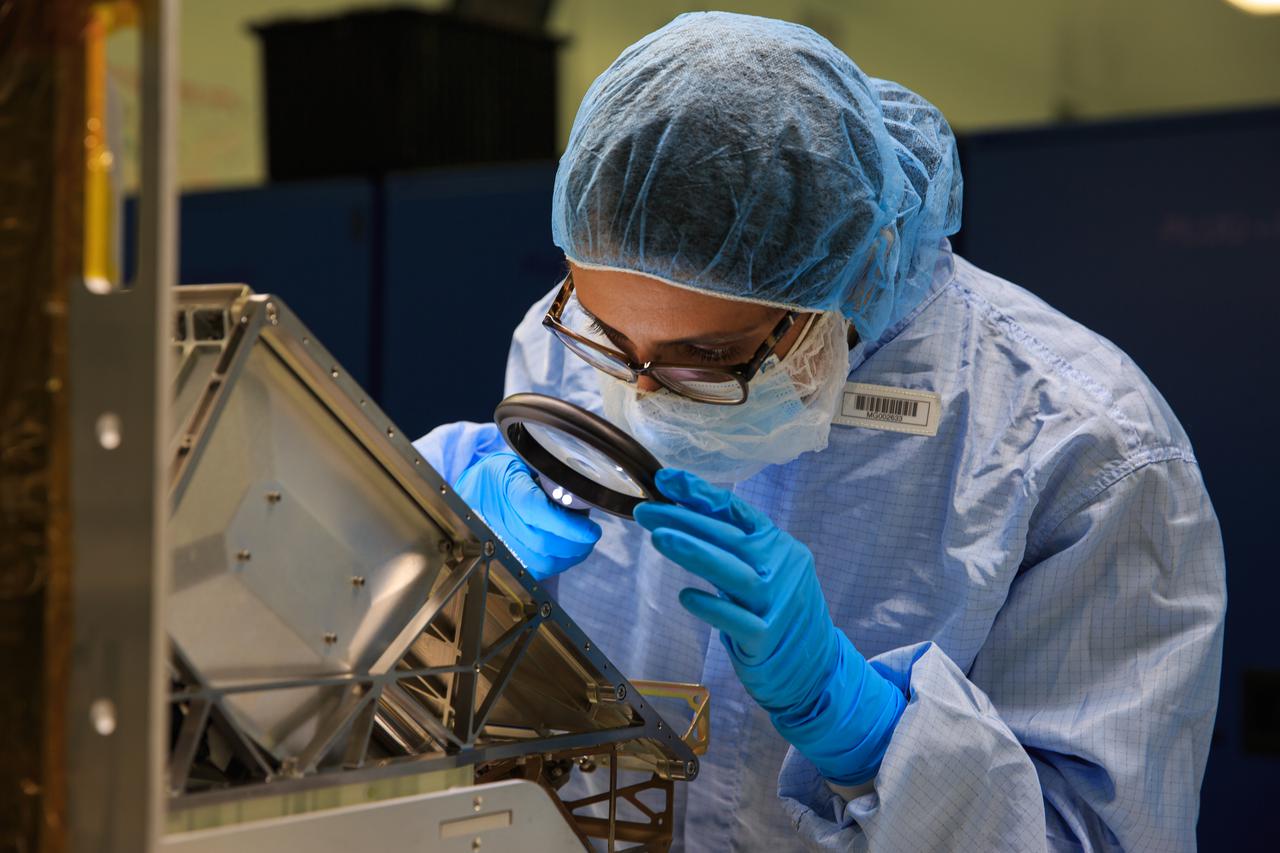
Team members working inside the Space Station Processing Facility at NASA’s Kennedy Space Center in Florida, on Sept. 23, 2021, meticulously assemble ground support equipment that will protect shipment of the Mass Spectrometer observing lunar operations (MSolo) flight hardware for preparations before it launches in 2022. MSolo is a commercial off-the-shelf mass spectrometer modified to work in space and it will help analyze the chemical makeup of landing sites on the Moon, as well as study water on the lunar surface. MSolo, scheduled to first launch in 2022, is part of four of the agency’s Commercial Lunar Payload Delivery Service missions where under the Artemis program, commercial deliveries will include science experiments, testing of technologies and demonstrations of capabilities to help NASA explore the Moon and prepare for human missions.
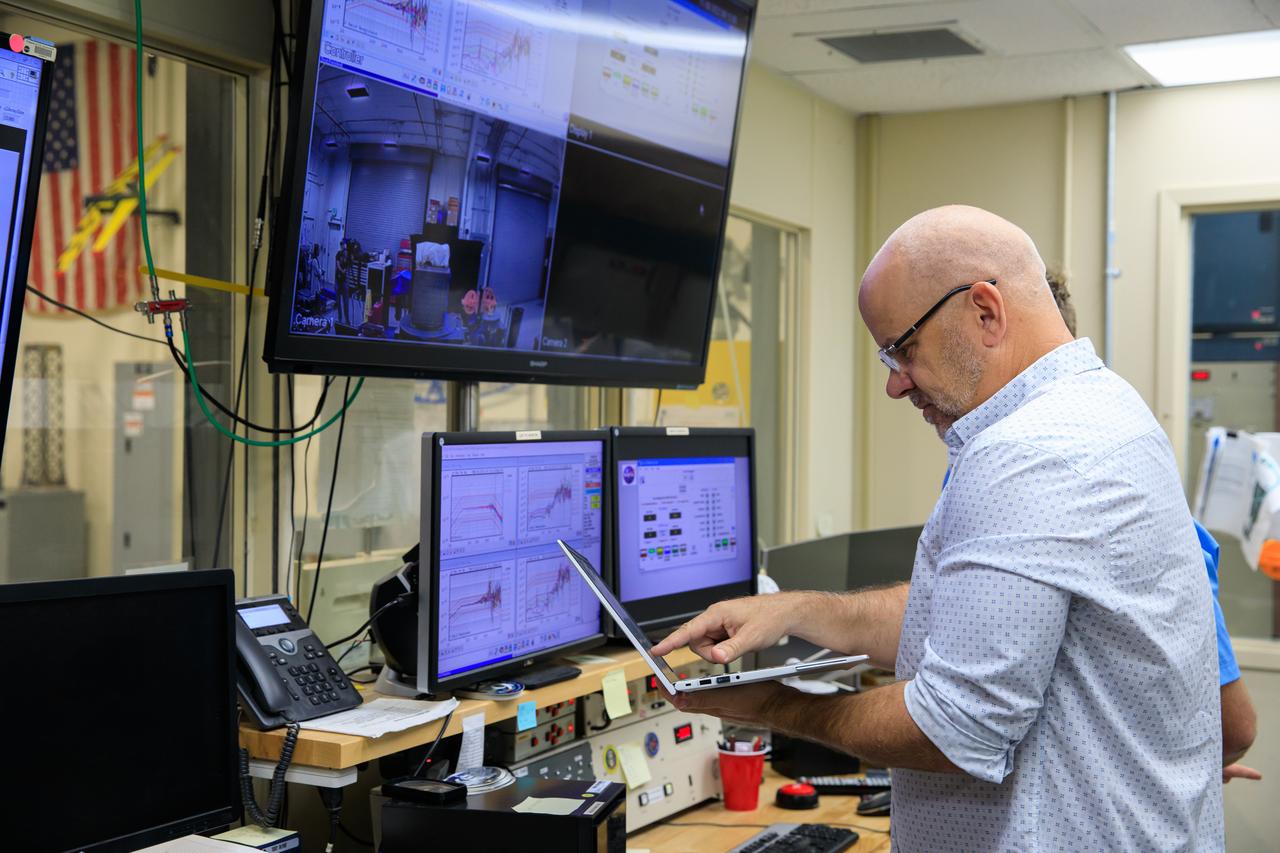
Mass Spectrometer Observing Lunar Operations (MSOLO) Systems Engineer Pri Johnson participates in simulation training at NASA’s Kennedy Space Center in Florida on May 25, 2023, in preparation for the agency’s Volatile Investigating Polar Exploration Rover (VIPER) mission. The purpose of the training was to get the integrated VIPER team – a mix of engineers from Kennedy and NASA’s Ames Research Center in California – accustomed to operating together during phases of the mission where the rover will be driving. MSOLO is a modified commercial off-the-shelf mass spectrometer that will help the agency analyze the chemical makeup of landing sites on the Moon and study water on the lunar surface. MSOLO, as part of VIPER, is scheduled to launch on a SpaceX Falcon Heavy rocket through NASA’s Commercial Lunar Payload Delivery Service (CLPS) initiative in late 2024, landing at the Moon’s South Pole aboard Astrobotic’s Griffin lander. Through Artemis missions, CLPS deliveries will be used to perform science experiments, test technologies, and demonstrate capabilities to help NASA explore the Moon and prepare for human deep space exploration missions.
Jim Kania (left), Mass Spectrometer Observing Lunar Operations (MSOLO) software engineering lead, and Pri Johnson, MSOLO systems engineer, participate in simulation training at NASA’s Kennedy Space Center in Florida on May 25, 2023, in preparation for the agency’s Volatile Investigating Polar Exploration Rover (VIPER) mission. The purpose of the training was to get the integrated VIPER team – a mix of engineers from Kennedy and NASA’s Ames Research Center in California – accustomed to operating together during phases of the mission where the rover will be driving. MSOLO is a modified commercial off-the-shelf mass spectrometer that will help the agency analyze the chemical makeup of landing sites on the Moon and study water on the lunar surface. MSOLO, as part of VIPER, is scheduled to launch on a SpaceX Falcon Heavy rocket through NASA’s Commercial Lunar Payload Delivery Service (CLPS) initiative in late 2024, landing at the Moon’s South Pole aboard Astrobotic’s Griffin lander. Through Artemis missions, CLPS deliveries will be used to perform science experiments, test technologies, and demonstrate capabilities to help NASA explore the Moon and prepare for human deep space exploration missions.
Jim Kania (left), Mass Spectrometer Observing Lunar Operations (MSOLO) software engineering lead, and Pri Johnson, MSOLO systems engineer, participate in simulation training at NASA’s Kennedy Space Center in Florida on May 25, 2023, in preparation for the agency’s Volatile Investigating Polar Exploration Rover (VIPER) mission. The purpose of the training was to get the integrated VIPER team – a mix of engineers from Kennedy and NASA’s Ames Research Center in California – accustomed to operating together during phases of the mission where the rover will be driving. MSOLO is a modified commercial off-the-shelf mass spectrometer that will help the agency analyze the chemical makeup of landing sites on the Moon and study water on the lunar surface. MSOLO, as part of VIPER, is scheduled to launch on a SpaceX Falcon Heavy rocket through NASA’s Commercial Lunar Payload Delivery Service (CLPS) initiative in late 2024, landing at the Moon’s South Pole aboard Astrobotic’s Griffin lander. Through Artemis missions, CLPS deliveries will be used to perform science experiments, test technologies, and demonstrate capabilities to help NASA explore the Moon and prepare for human deep space exploration missions.
Pri Johnson (left), Mass Spectrometer Observing Lunar Operations (MSOLO) systems engineer, and Jim Kania, MSOLO software engineering lead, participate in simulation training at NASA’s Kennedy Space Center in Florida on May 25, 2023, in preparation for the agency’s Volatile Investigating Polar Exploration Rover (VIPER) mission. The purpose of the training was to get the integrated VIPER team – a mix of engineers from Kennedy and NASA’s Ames Research Center in California – accustomed to operating together during phases of the mission where the rover will be driving. MSOLO is a modified commercial off-the-shelf mass spectrometer that will help the agency analyze the chemical makeup of landing sites on the Moon and study water on the lunar surface. MSOLO, as part of VIPER, is scheduled to launch on a SpaceX Falcon Heavy rocket through NASA’s Commercial Lunar Payload Delivery Service (CLPS) initiative in late 2024, landing at the Moon’s South Pole aboard Astrobotic’s Griffin lander. Through Artemis missions, CLPS deliveries will be used to perform science experiments, test technologies, and demonstrate capabilities to help NASA explore the Moon and prepare for human deep space exploration missions.
Mass Spectrometer Observing Lunar Operations (MSOLO) Software Engineering Lead Jim Kania participates in simulation training at NASA’s Kennedy Space Center in Florida on May 25, 2023, in preparation for the agency’s Volatile Investigating Polar Exploration Rover (VIPER) mission. The purpose of the training was to get the integrated VIPER team – a mix of engineers from Kennedy and NASA’s Ames Research Center in California – accustomed to operating together during phases of the mission where the rover will be driving. MSOLO is a modified commercial off-the-shelf mass spectrometer that will help the agency analyze the chemical makeup of landing sites on the Moon and study water on the lunar surface. MSOLO, as part of VIPER, is scheduled to launch on a SpaceX Falcon Heavy rocket through NASA’s Commercial Lunar Payload Delivery Service (CLPS) initiative in late 2024, landing at the Moon’s South Pole aboard Astrobotic’s Griffin lander. Through Artemis missions, CLPS deliveries will be used to perform science experiments, test technologies, and demonstrate capabilities to help NASA explore the Moon and prepare for human deep space exploration missions.
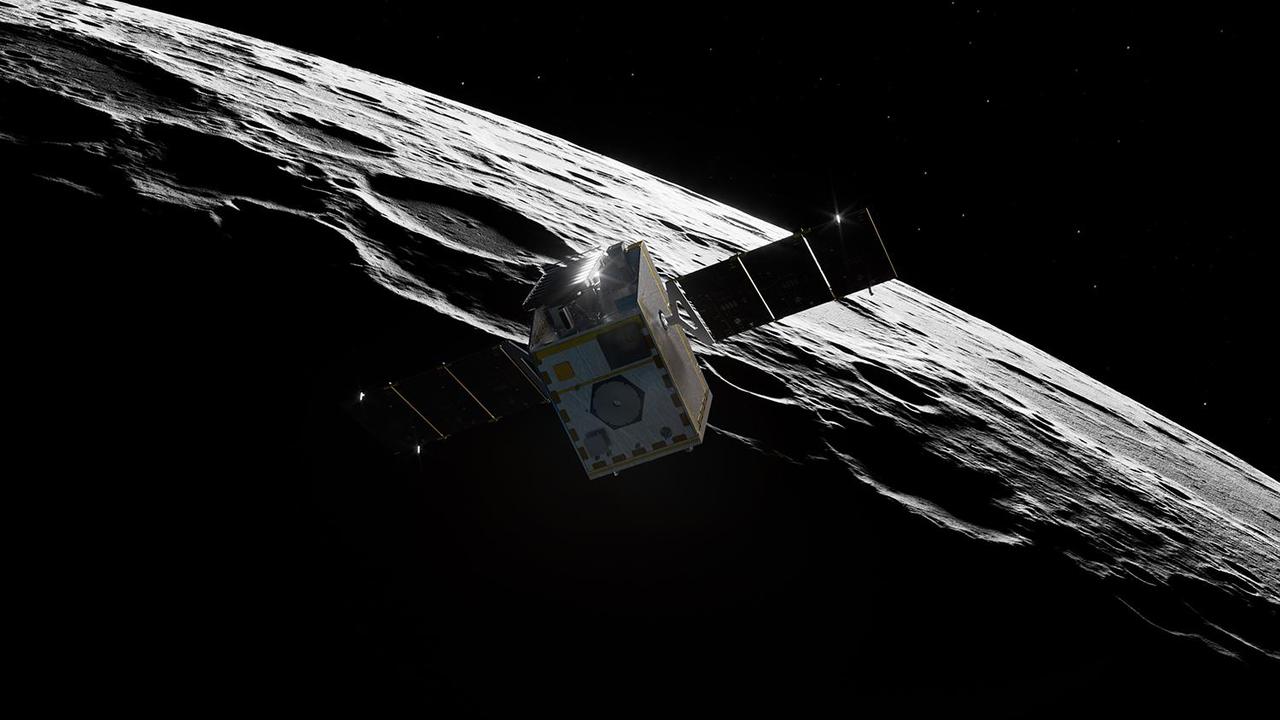
NASA's Lunar Trailblazer mission approaches the Moon as it enters its science orbit in this artist's concept. The small satellite will orbit about 60 miles (100 kilometers) above the lunar surface, producing the best-yet maps of water on the Moon. Lunar Trailblazer will discover where the Moon's water is, what form it is in, and how it changes over time. Observations gathered during the spacecraft's two-year prime mission will contribute to the understanding of water cycles on airless bodies throughout the solar system while also supporting future human and robotic missions to the Moon by identifying where water is located. Lunar Trailblazer was a selection of NASA's SIMPLEx (Small Innovative Missions for Planetary Exploration), which provides opportunities for low-cost science spacecraft to ride-share with selected primary missions. To maintain the lower overall cost, SIMPLEx missions have a higher risk posture and lighter requirements for oversight and management. This higher risk acceptance allows NASA to test pioneering technologies, and the definition of success for these missions includes the lessons learned from more experimental endeavors. https://photojournal.jpl.nasa.gov/catalog/PIA26457
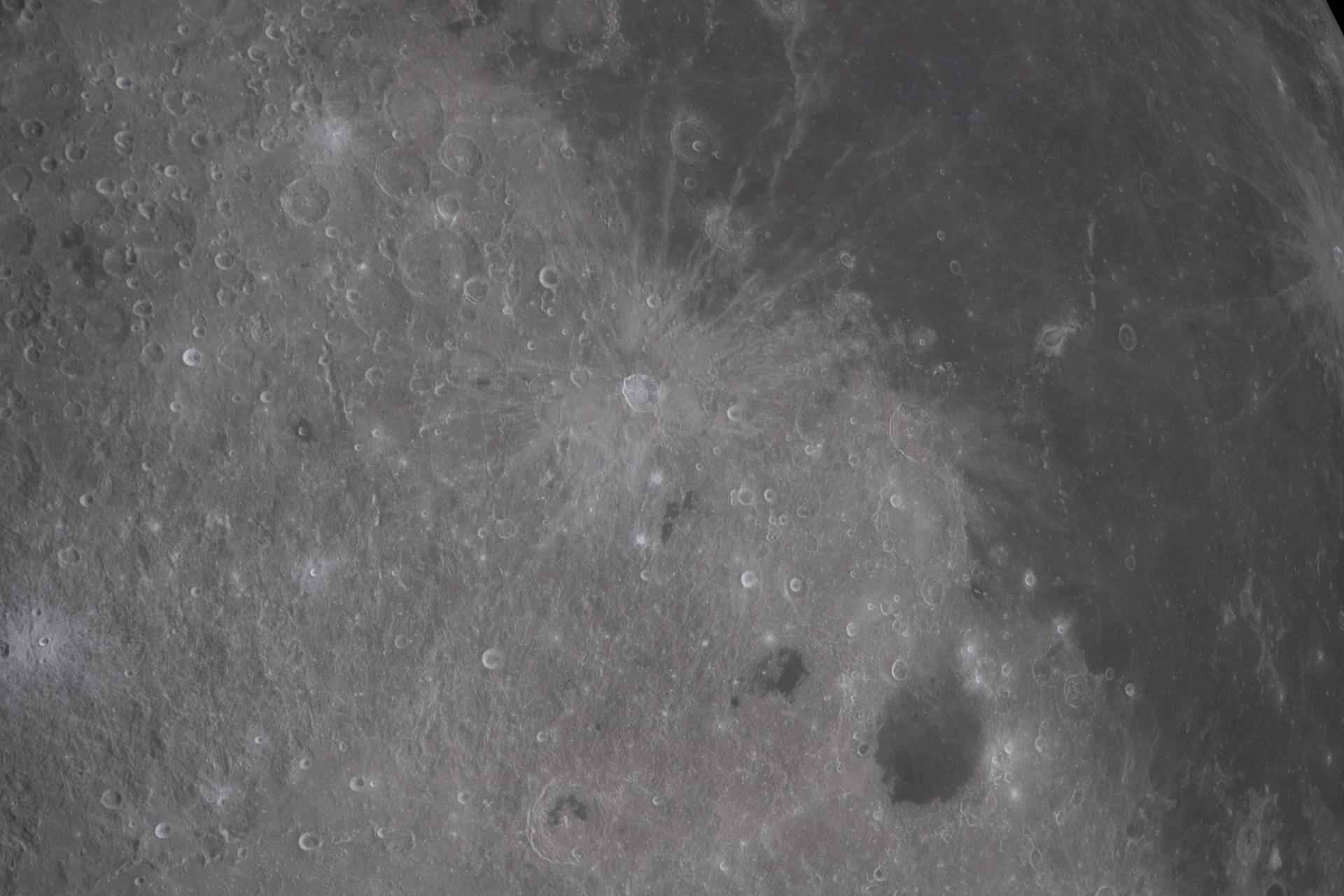
art002e012216 (April 6, 2026) – The Artemis II crew captured this view across the transition between the Moon’s near side and far side during their lunar flyby. Bright, densely cratered terrain contrasts with darker volcanic plains, while lighter streaks and markings extend across portions of the surface. The image includes the Reiner Gamma region, known for its distinctive bright, swirling surface patterns. Credit: NASA
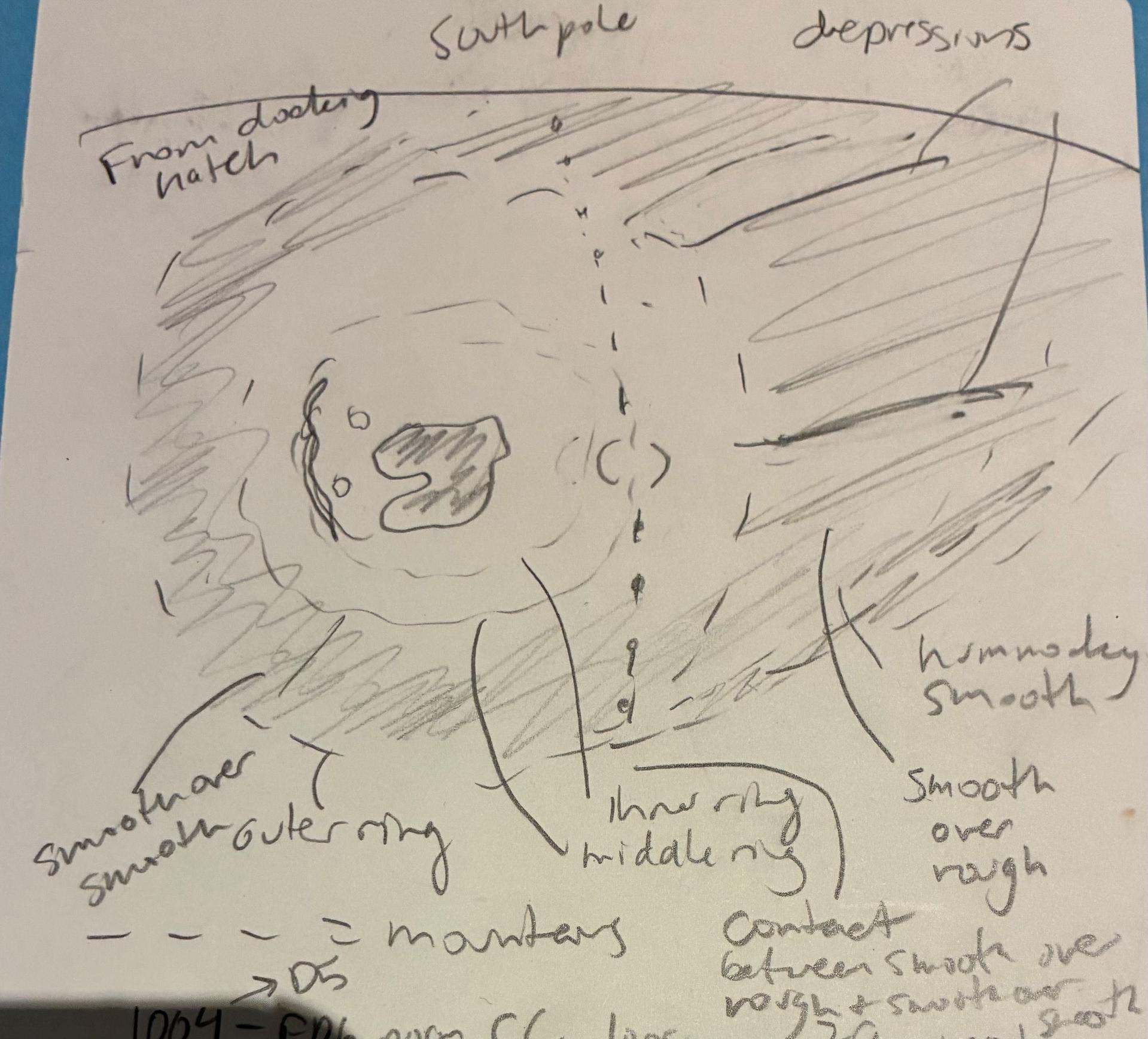
art002e050885 (April 6, 2026) – Artemis II crew member Christina Koch sketched the Orientale basin as observed through Orion’s docking hatch during the lunar flyby. Her in-flight annotation documents differences in texture across the basin and surrounding terrain, including areas she described as smooth and rough. The sketch is oriented with the Moon’s South Pole toward the top, an unconventional orientation that reflects the crew’s view from the spacecraft.
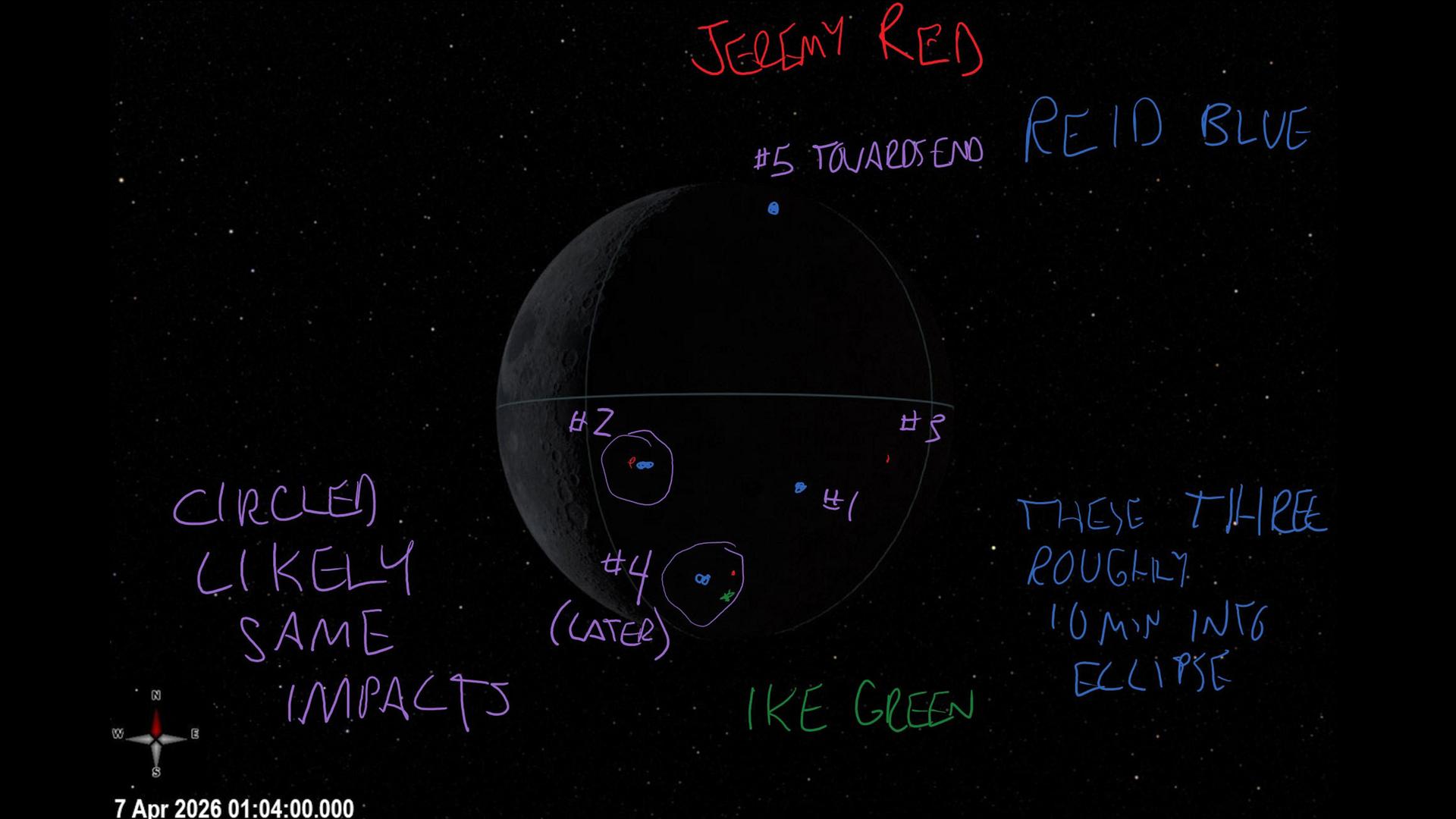
art002e016252 (April 7, 2026) –A screenshot from an Artemis II crew member’s tablet shows handwritten annotations made during the lunar flyby on April 6, 2026, atop a visualization of the dark Moon eclipsing the Sun. Three crew members, who signed their first names, noted impact flashes and their locations on the image. NASA astronauts Reid Wiseman and Victor “Ike” Glover wrote in blue and green, respectively, while CSA (Canadian Space Agency) astronaut Jeremy Hansen wrote in red. Credit: CSA/NASA
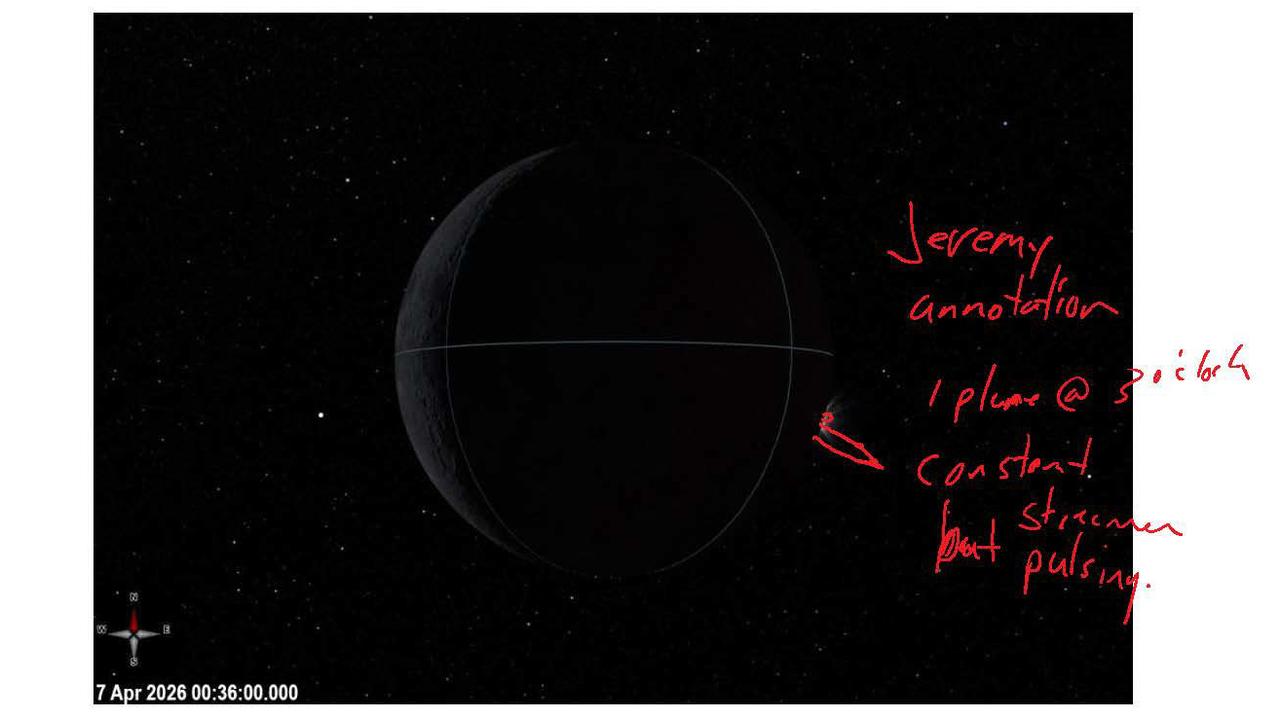
art002e009463 (April 7, 2026) – During the Artemis II lunar flyby, crew member Jeremy Hansen annotated this view to document a streamer that appeared to “pulsate” as the Sun moved behind the Moon. Hansen’s in-flight annotation marks the location of the observed feature and records the crew’s description in real time, providing additional context for post-mission analysis of the observation. Credit: CSA/NASA
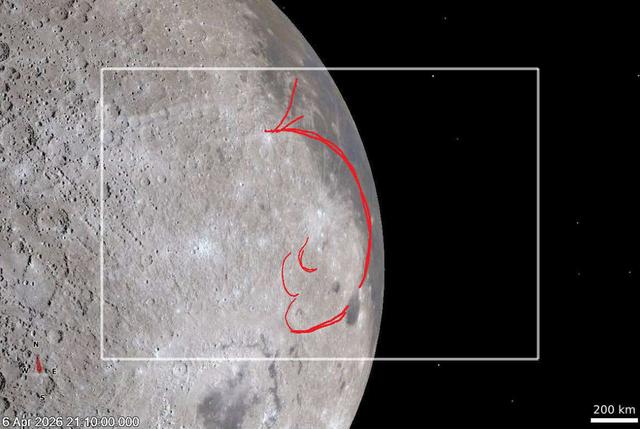
art002e009506 (April 6, 2026) – The Artemis II crew observed bright, curved features near the Moon’s limb during their lunar flyby. In an in-flight annotation, Artemis II commander Reid Wiseman marked the features in red to document their shape and location. The crew described the features as similar in brightness to rays extending from Glushko crater. Credit: CSA/NASA
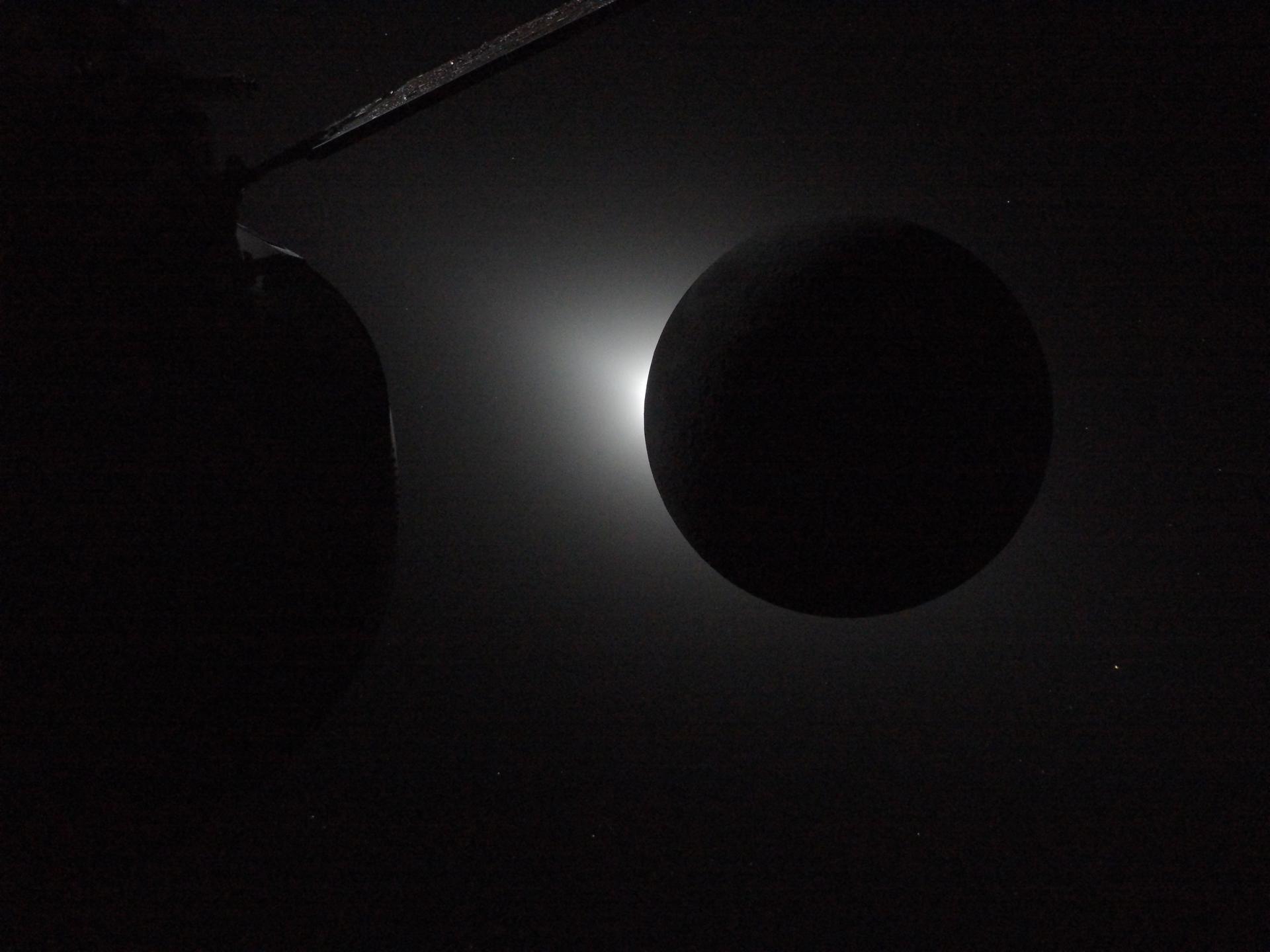
art002e016331 (April 7, 2026) – A vehicle camera mounted on NASA’s Orion spacecraft captured this view of sunset as the Sun slipped behind part of the spacecraft. The Sun’s bright glow outlines the spacecraft in silhouette, while the faint solar corona extends into the surrounding darkness. The image was captured as part of a multishot time-lapse sequence, with images taken every 30 seconds to document changing views during sunset.
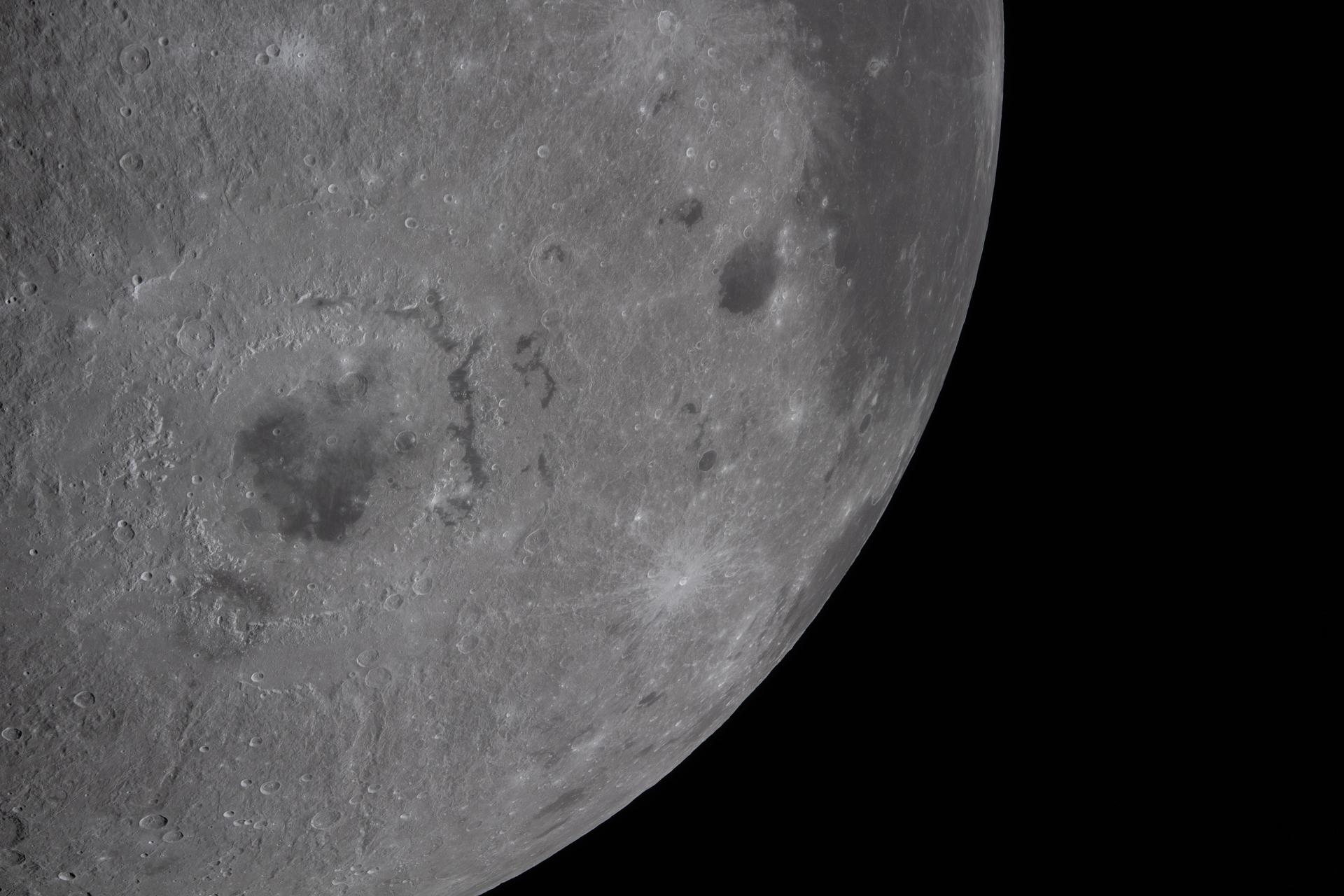
art002e019914 (April 6, 2026) – The Artemis II crew captured this close-up view of the Moon’s southwestern limb during lunar flyby observation operations. The view highlights variations in brightness across the lunar surface and features including Orientale basin, Grimaldi crater, Byrgius A crater, and the western edge of Oceanus Procellarum. Credit: NASA