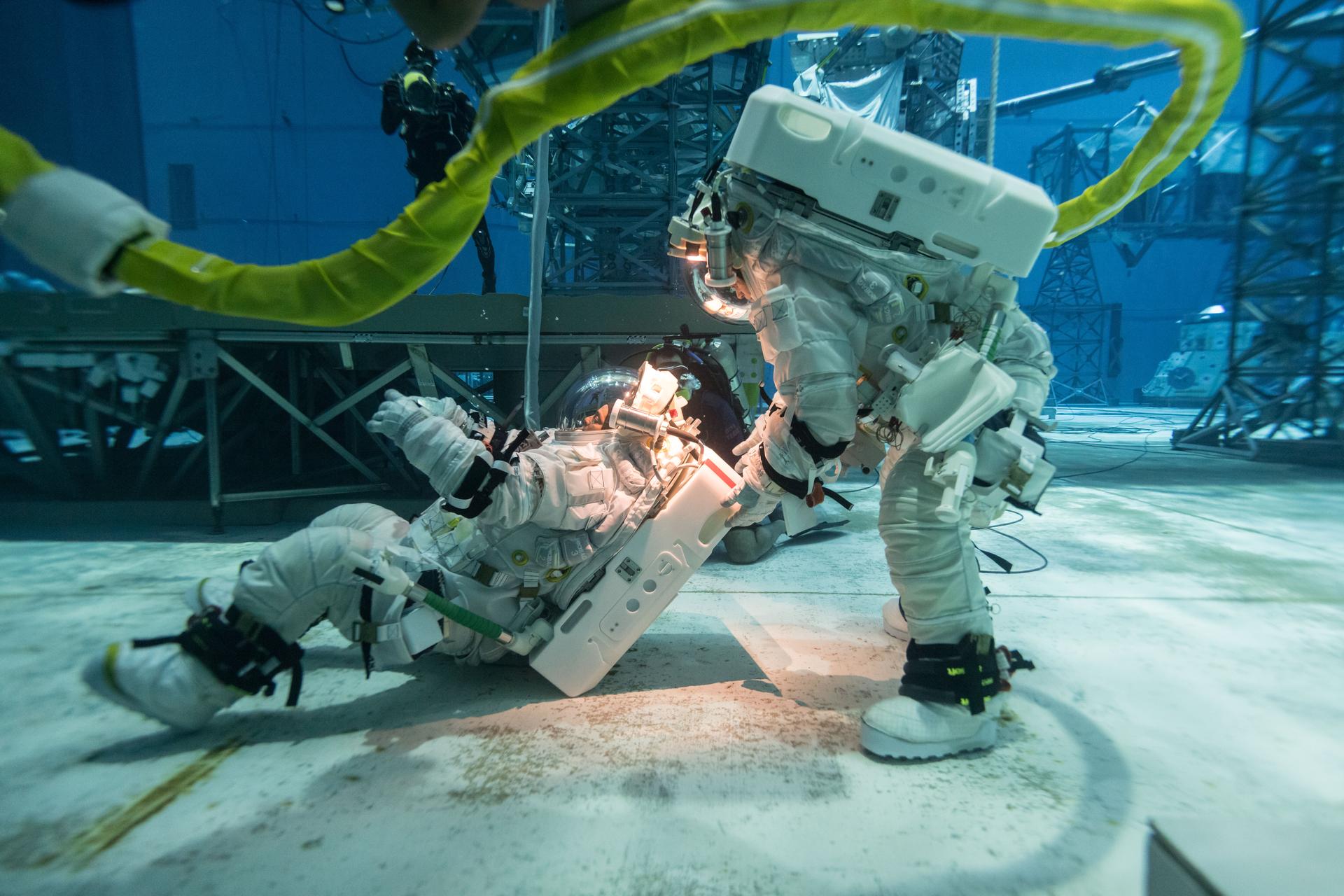
NASA crew members practice emergency rescue drills during simulated lunar surface operations at NASA’s Neutral Buoyancy Laboratory where teams evaluate how well crew perform tasks while wearing the Artemis III lunar spacesuit developed by Axiom Space called the AxEMU (Axiom Extravehicular Mobility Unit).
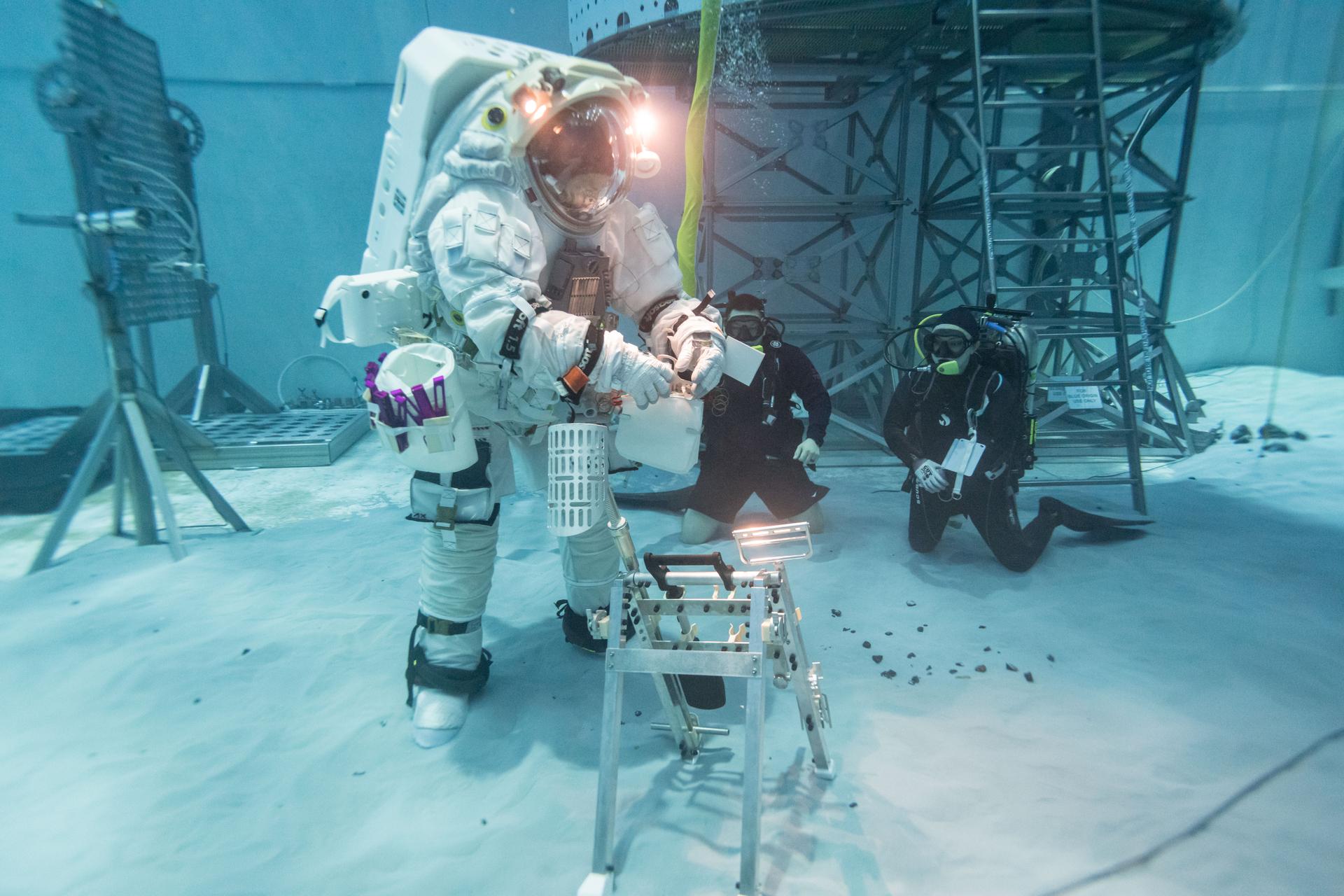
A NASA crew member practices simulated lunar surface operations at NASA’s Neutral Buoyancy Laboratory where teams evaluate how well crew perform tasks while wearing the Artemis III lunar spacesuit developed by Axiom Space called the AxEMU (Axiom Extravehicular Mobility Unit).
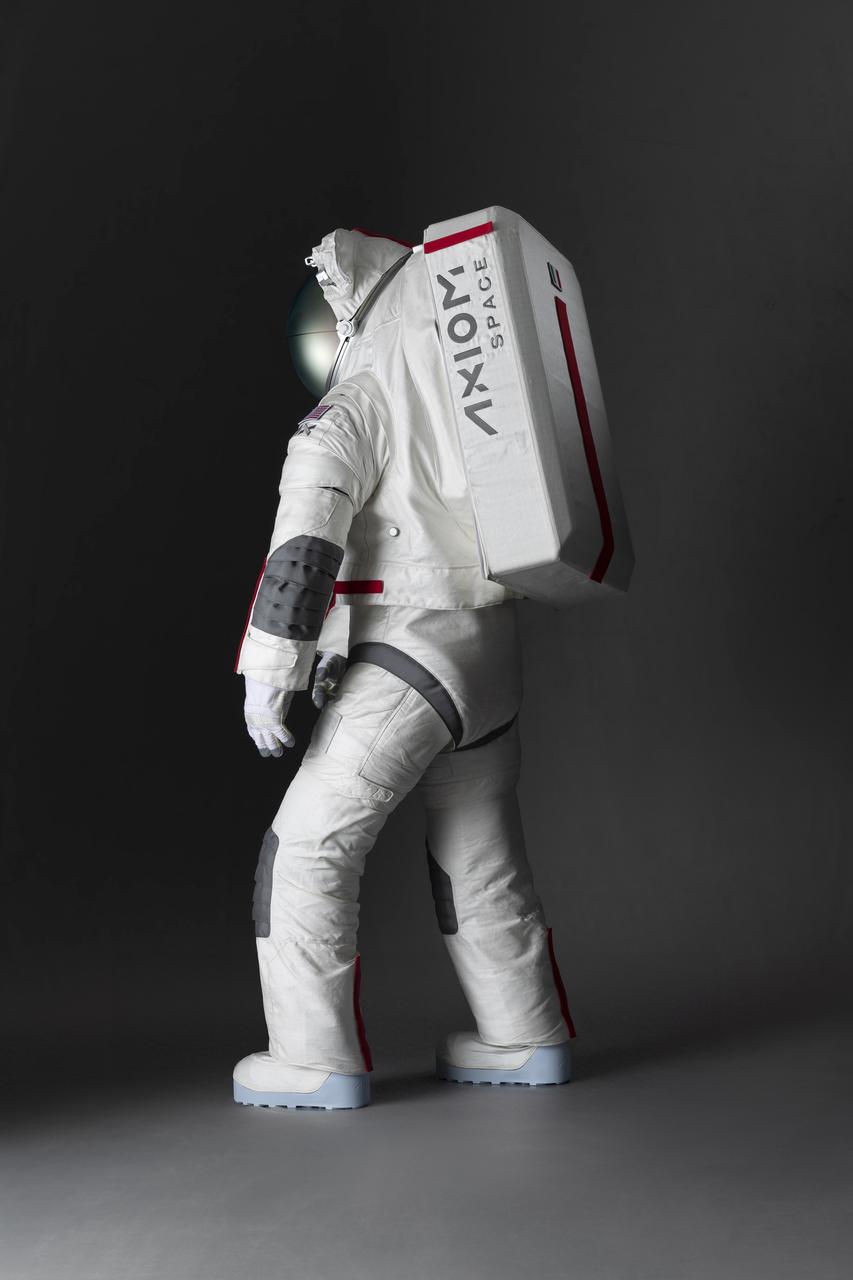
The flight design of Axiom Space's Axiom Extravehicular Mobility Unit (AxEMU) lunar spacesuit that NASA astronauts will wear during the Artemis III mission. Image Credit: Axiom Space
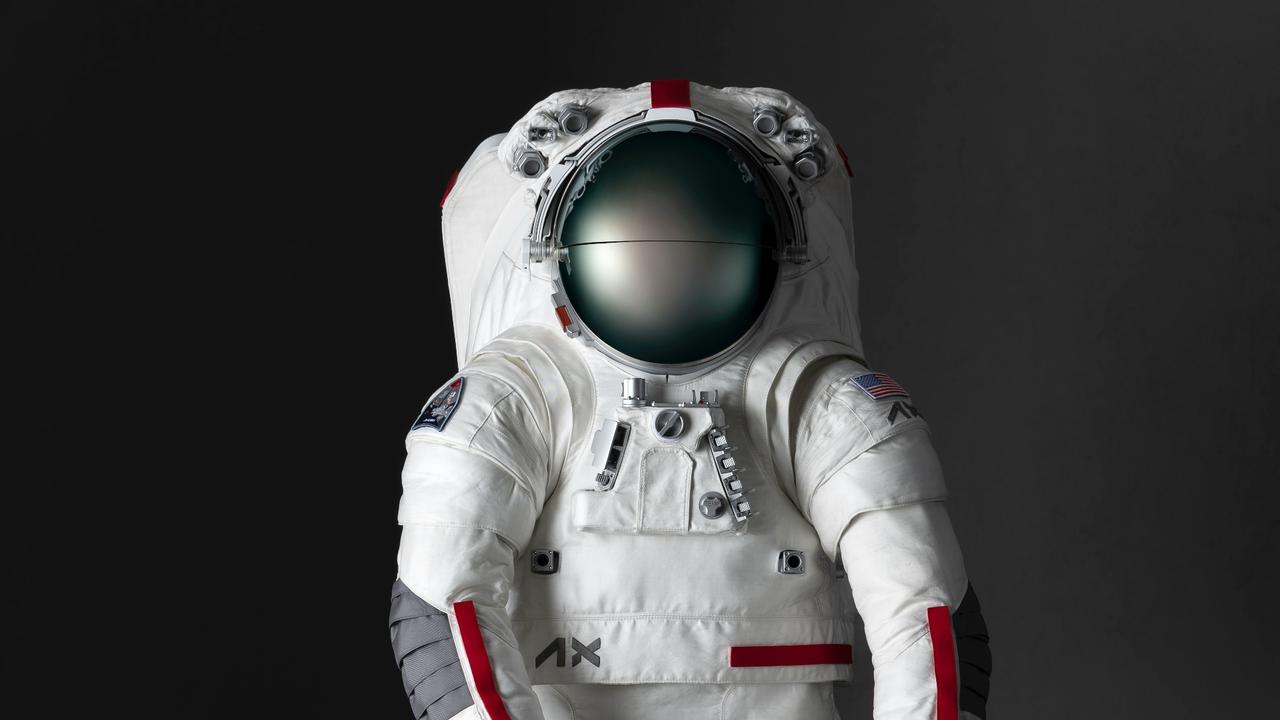
The flight design of Axiom Space's Axiom Extravehicular Mobility Unit (AxEMU) lunar spacesuit that NASA astronauts will wear during the Artemis III mission. Image Credit: Axiom Space
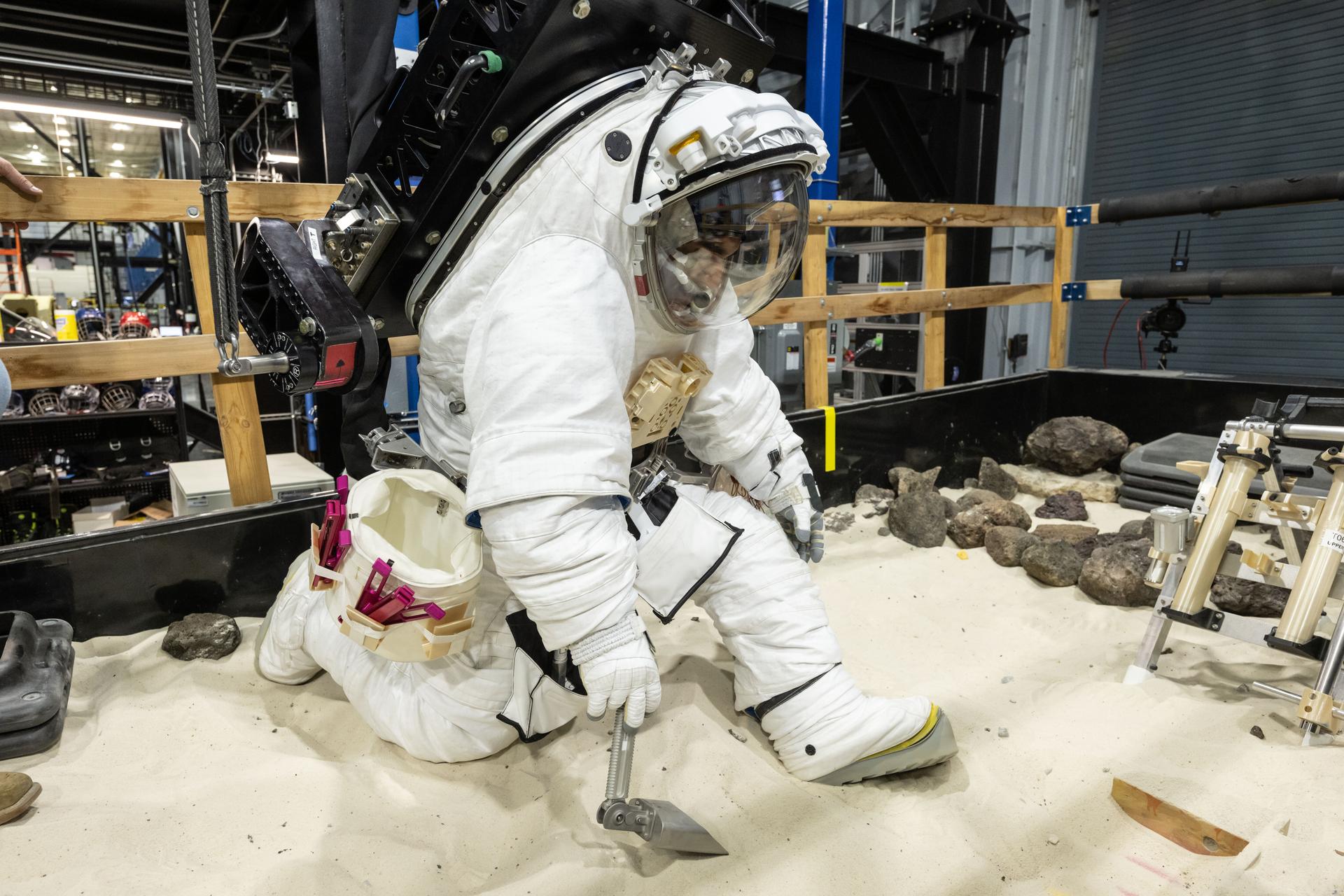
A NASA crew member practices using lunar tools to collect geology samples at NASA’s Johnson Space Center during an elevated suit pressure test where teams evaluate how well crew perform tasks in different suit pressure levels while wearing the Artemis III lunar spacesuit developed by Axiom Space called the AxEMU (Axiom Extravehicular Mobility Unit).
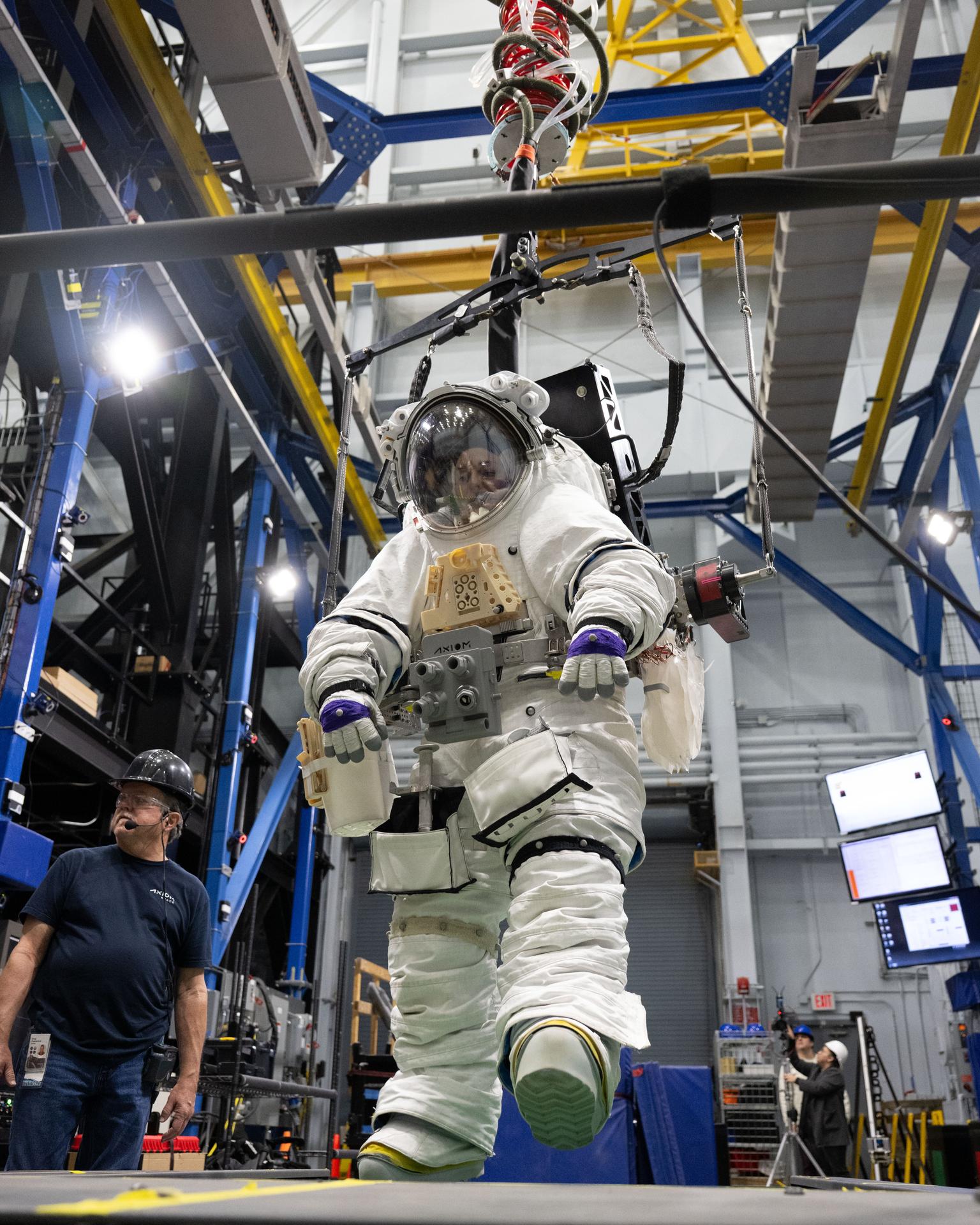
A NASA crew member practices simulated lunar surface operations at NASA’s Johnson Space Center during an elevated suit pressure test where teams evaluate how well crew perform tasks in different suit pressure levels while wearing the Artemis III lunar spacesuit developed by Axiom Space called the AxEMU (Axiom Extravehicular Mobility Unit).
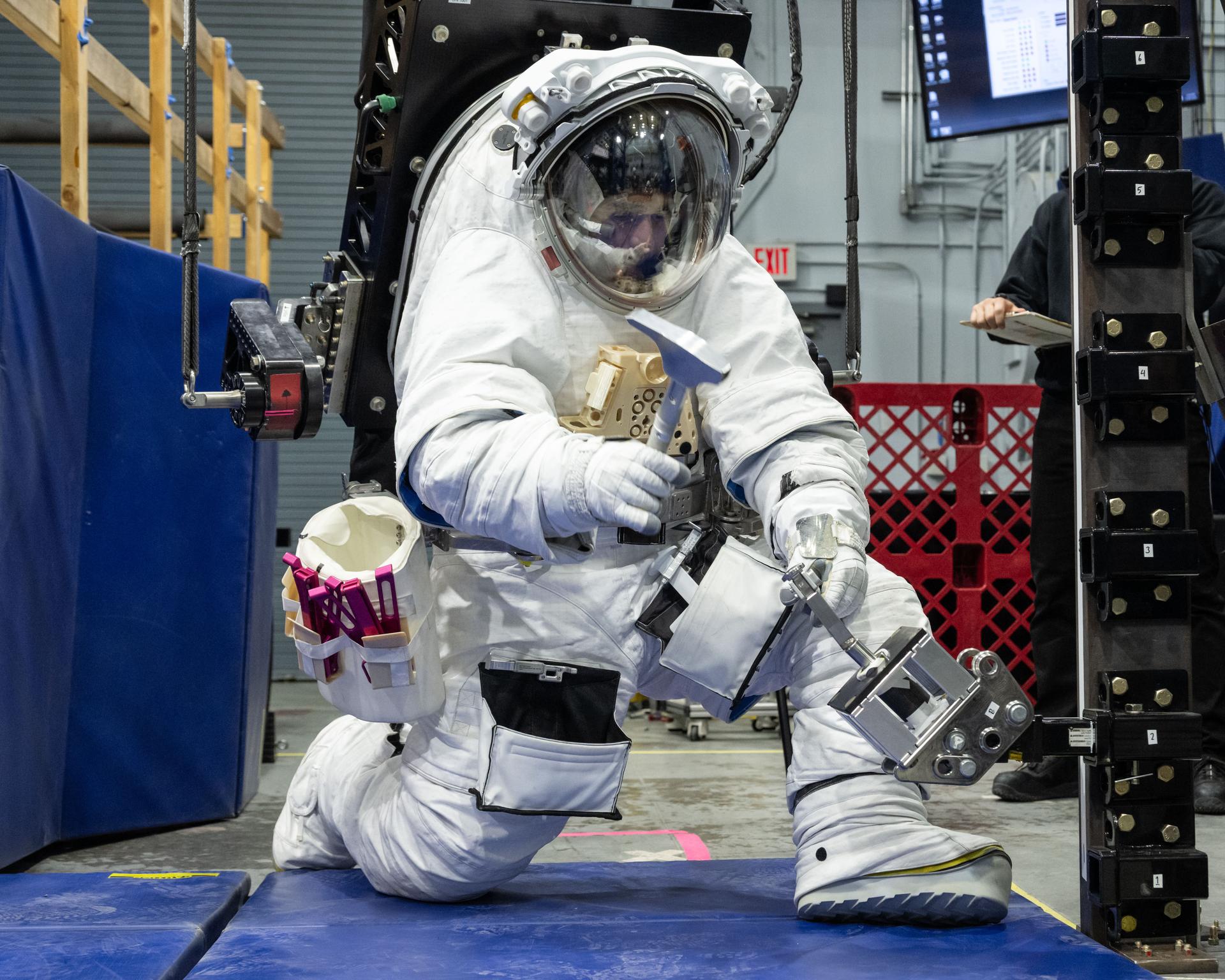
A NASA crew member practices simulated lunar surface operations at NASA’s Johnson Space Center during an elevated suit pressure test where teams evaluate how well crew perform tasks in different suit pressure levels while wearing the Artemis III lunar spacesuit developed by Axiom Space called the AxEMU (Axiom Extravehicular Mobility Unit).
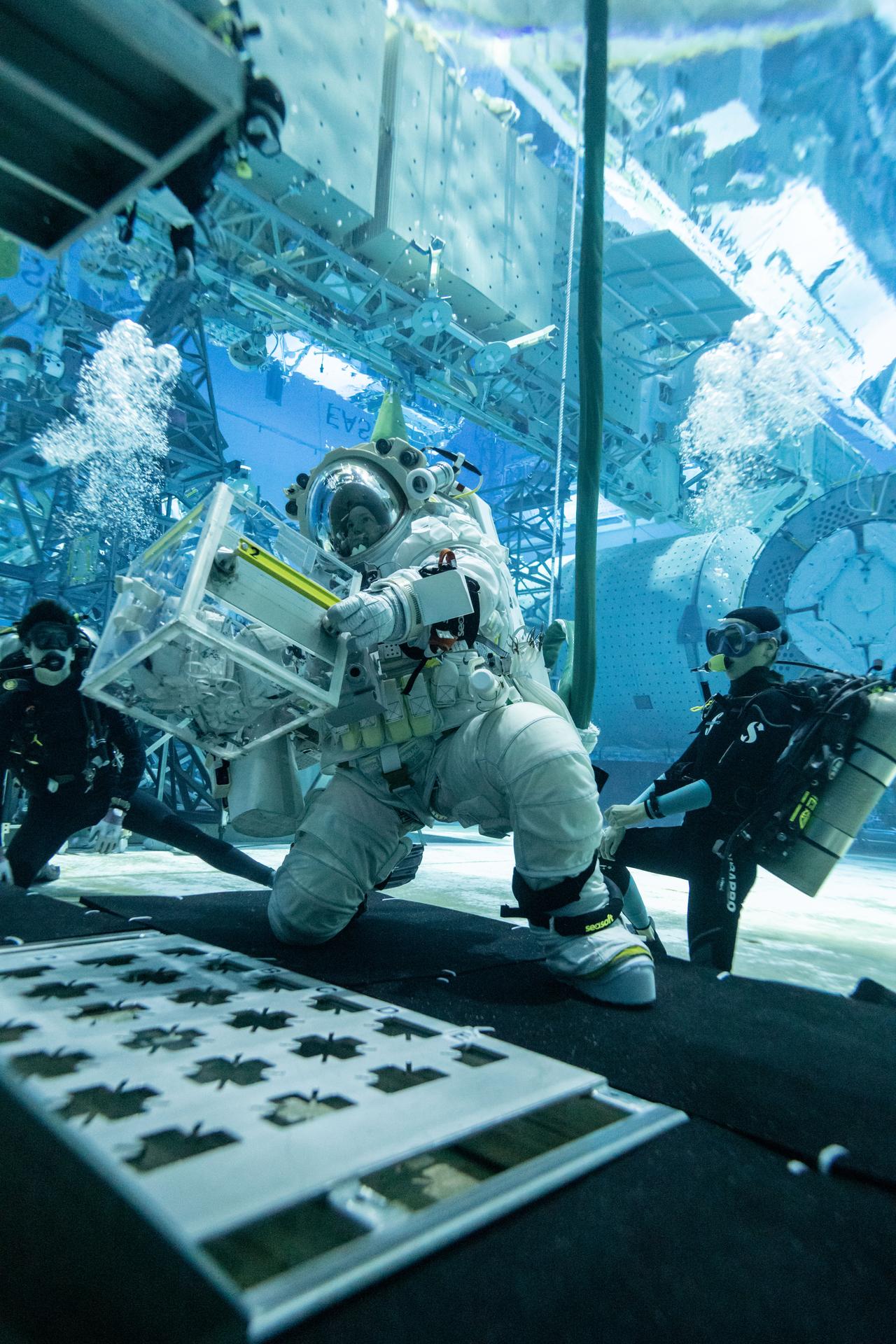
Canadian Space Agency astronaut Jenni Gibbons practices simulated lunar tasks under water while wearing Axiom Space’s lunar spacesuit at NASA’s Neutral Buoyancy Laboratory in Houston. During a recent test series, NASA engineers and crewmembers wore the lunar spacesuit under water and conducted numerous tasks during simulated lunar operations to test its mobility and functionality and ensure the spacesuit is prepped and ready for Artemis training.
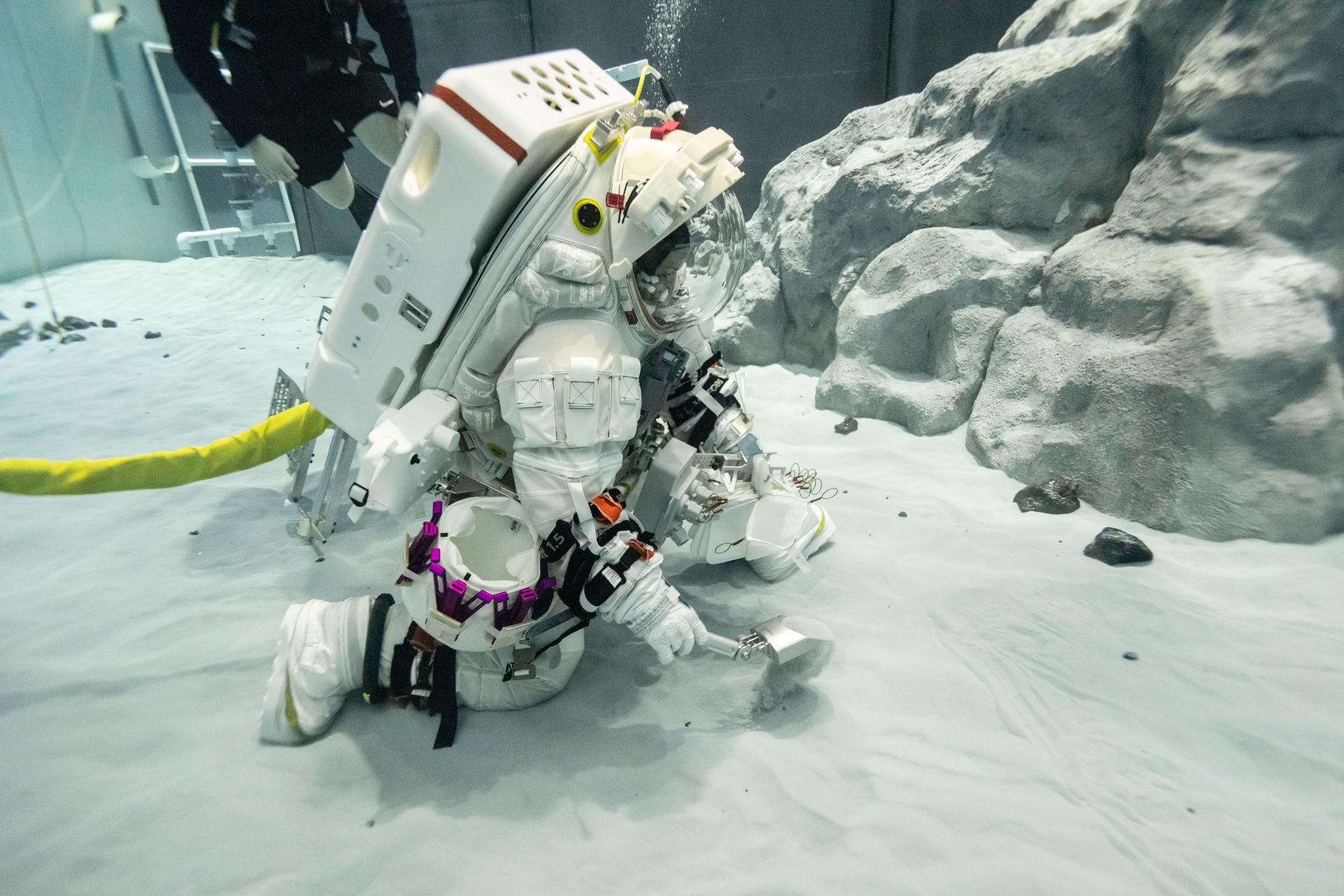
Canadian Space Agency astronaut Jenni Gibbons practices simulated lunar tasks under water while wearing Axiom Space’s lunar spacesuit at NASA’s Neutral Buoyancy Laboratory in Houston. During a recent test series, NASA engineers and crewmembers wore the lunar spacesuit under water and conducted numerous tasks during simulated lunar operations to test its mobility and functionality and ensure the spacesuit is prepped and ready for Artemis training.
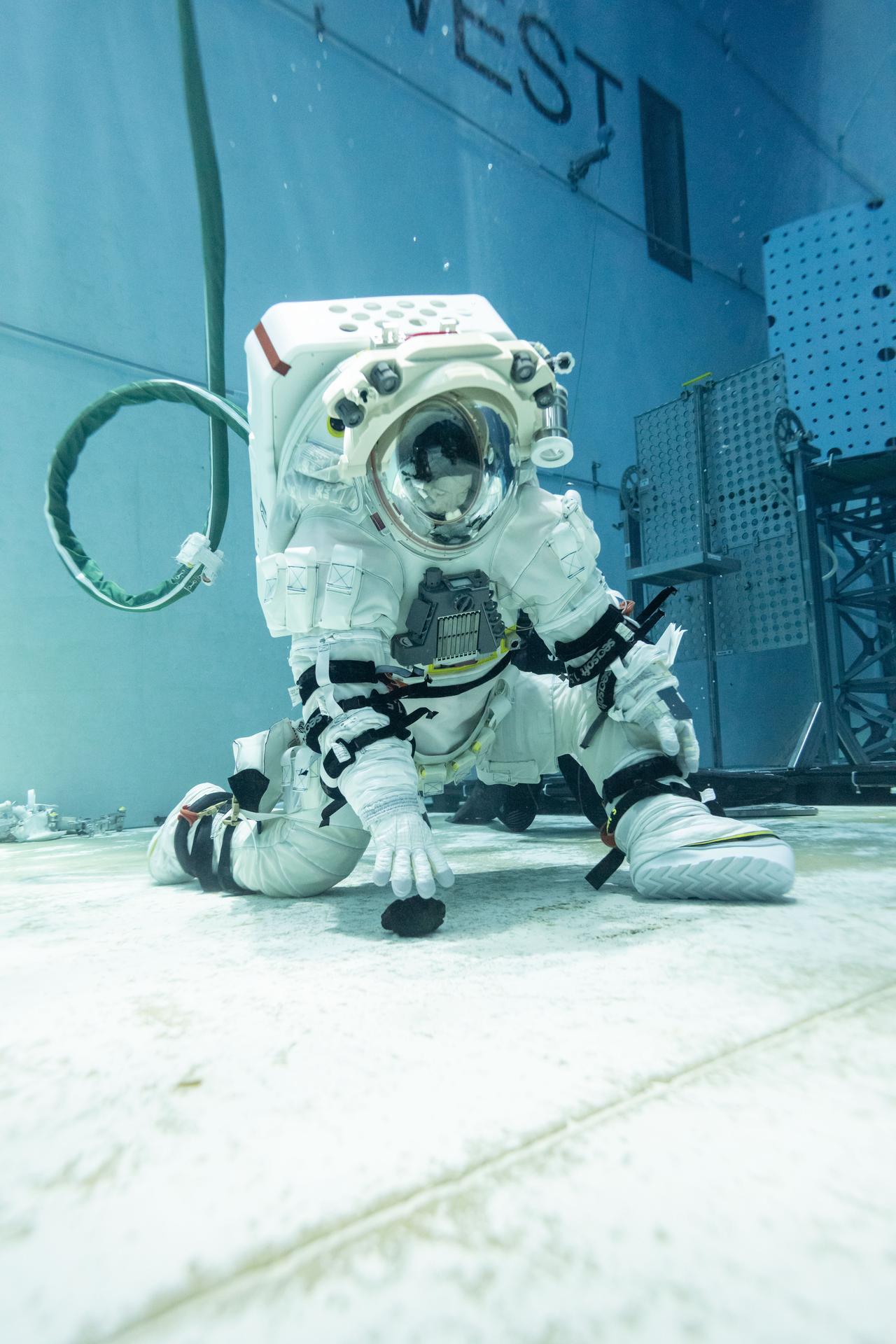
Canadian Space Agency astronaut Jenni Gibbons practices simulated lunar tasks under water while wearing Axiom Space’s lunar spacesuit at NASA’s Neutral Buoyancy Laboratory in Houston. During a recent test series, NASA engineers and crewmembers wore the lunar spacesuit under water and conducted numerous tasks during simulated lunar operations to test its mobility and functionality and ensure the spacesuit is prepped and ready for Artemis training.
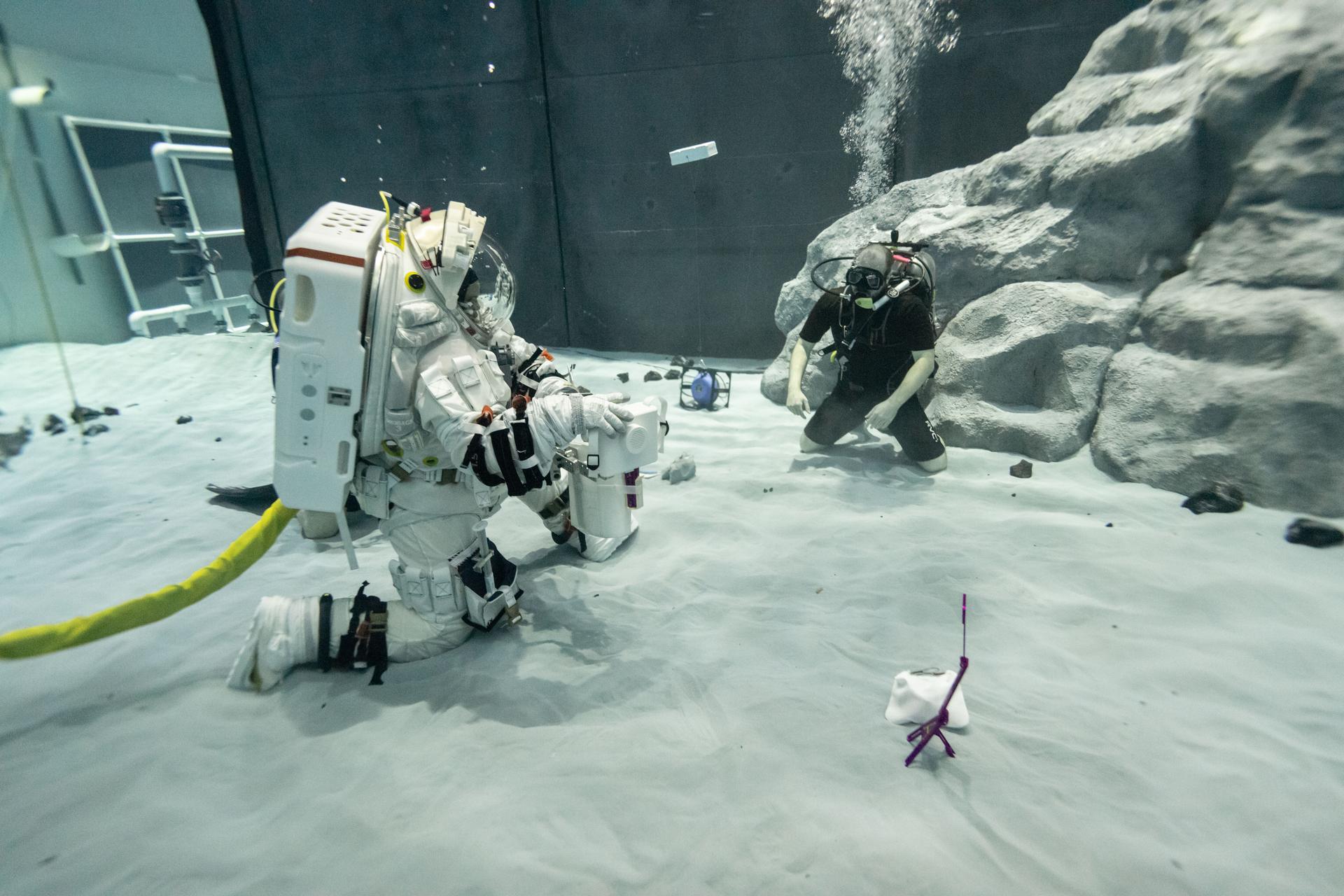
Canadian Space Agency astronaut Jenni Gibbons practices simulated lunar tasks under water while wearing Axiom Space’s lunar spacesuit at NASA’s Neutral Buoyancy Laboratory in Houston. During a recent test series, NASA engineers and crewmembers wore the lunar spacesuit under water and conducted numerous tasks during simulated lunar operations to test its mobility and functionality and ensure the spacesuit is prepped and ready for Artemis training.
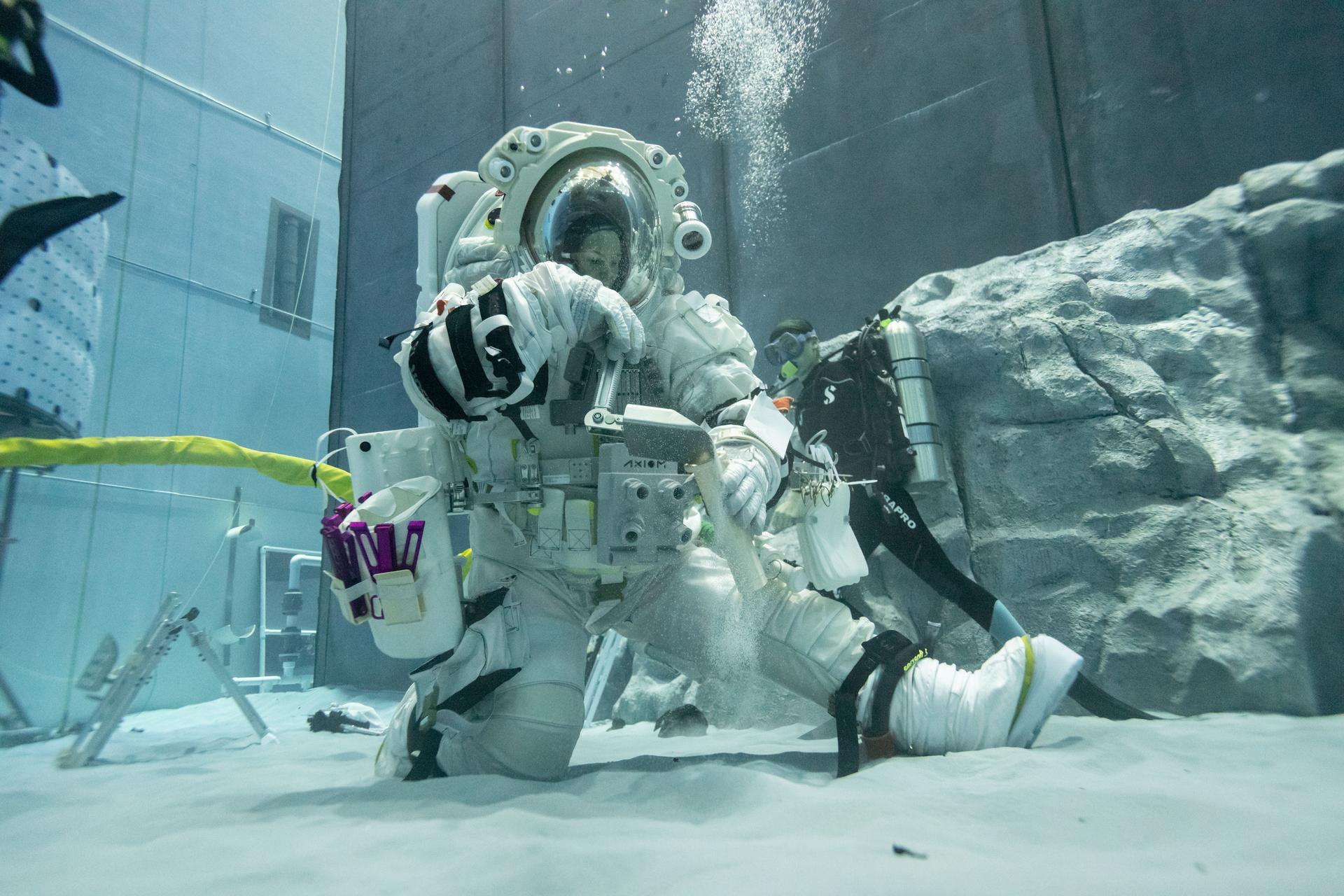
Canadian Space Agency astronaut Jenni Gibbons practices simulated lunar tasks under water while wearing Axiom Space’s lunar spacesuit at NASA’s Neutral Buoyancy Laboratory in Houston. During a recent test series, NASA engineers and crewmembers wore the lunar spacesuit under water and conducted numerous tasks during simulated lunar operations to test its mobility and functionality and ensure the spacesuit is prepped and ready for Artemis training.
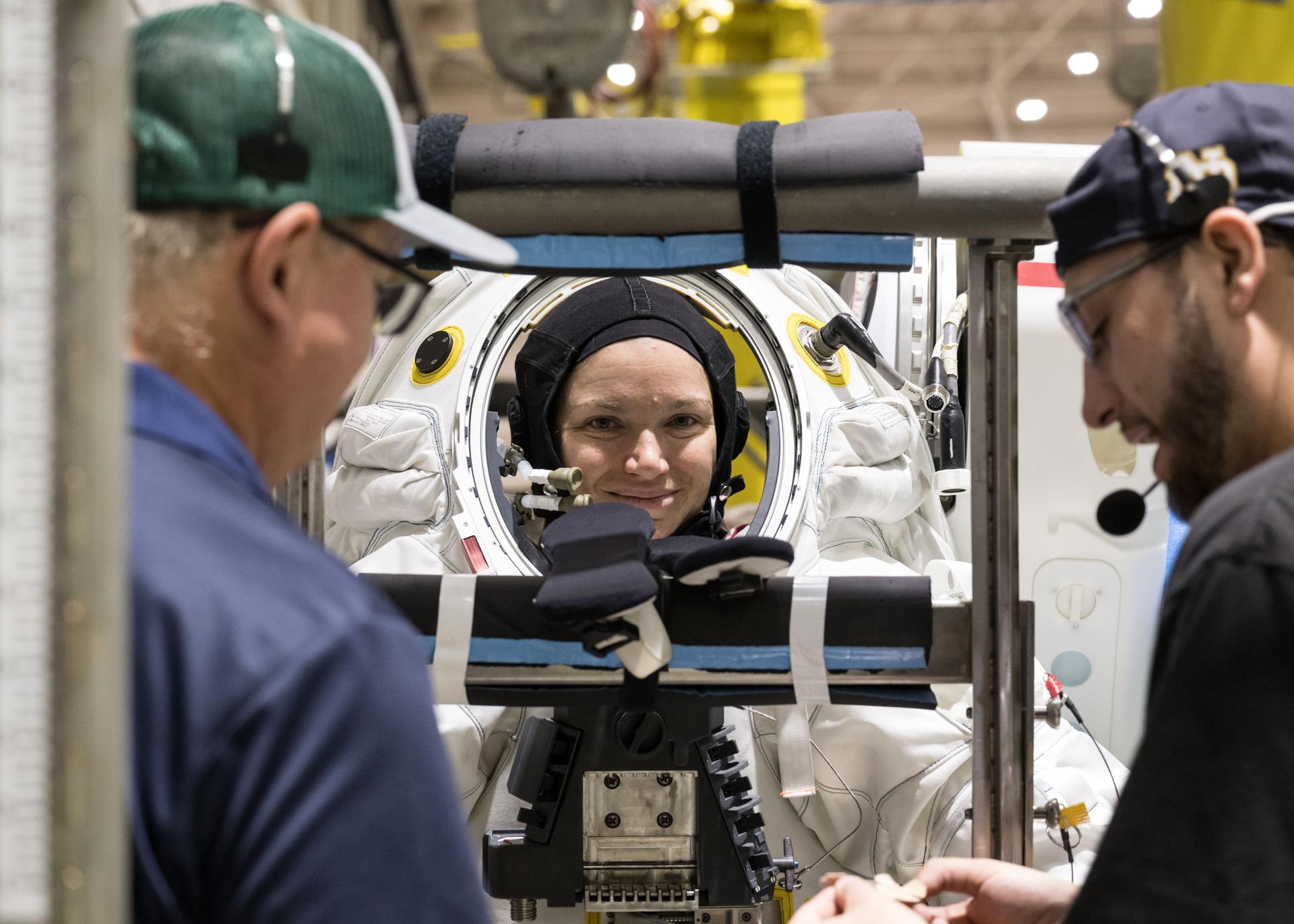
Canadian Space Agency astronaut Jenni Gibbons gets suited up in Axiom Space’s lunar spacesuit at NASA’s Neutral Buoyancy Laboratory in Houston. During a recent test series, NASA engineers and crewmembers wore the lunar spacesuit under water and conducted numerous tasks during simulated lunar operations to test its mobility and functionality and ensure the spacesuit is prepped and ready for Artemis training.
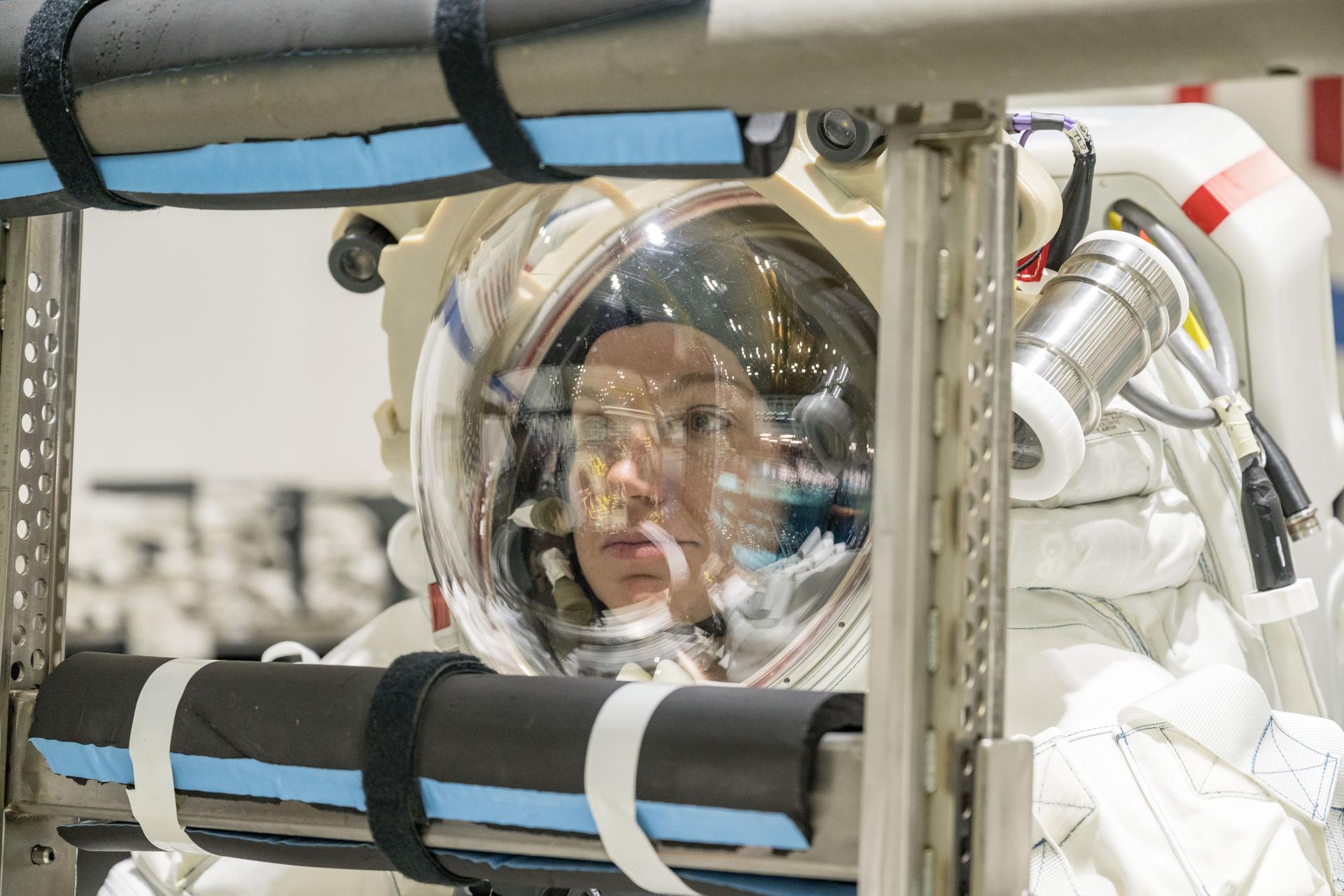
Canadian Space Agency astronaut Jenni Gibbons gets suited up in Axiom Space’s lunar spacesuit at NASA’s Neutral Buoyancy Laboratory in Houston. During a recent test series, NASA engineers and crewmembers wore the lunar spacesuit under water and conducted numerous tasks during simulated lunar operations to test its mobility and functionality and ensure the spacesuit is prepped and ready for Artemis training.
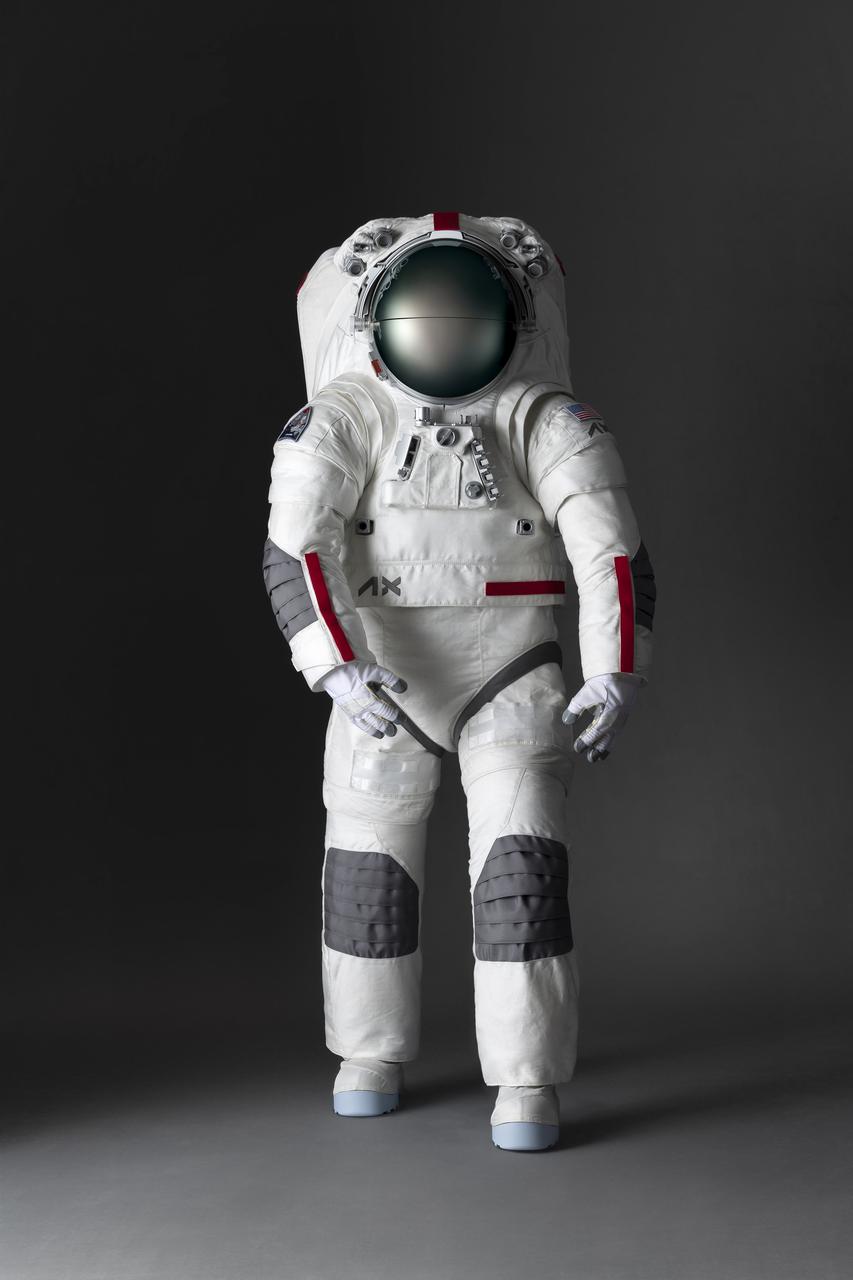
Artemis III Lunar Spacesuit The flight design of Axiom Space's Axiom Extravehicular Mobility Unit (AxEMU) lunar spacesuit that NASA astronauts will wear during the Artemis III mission. Image Credit: Axiom Space
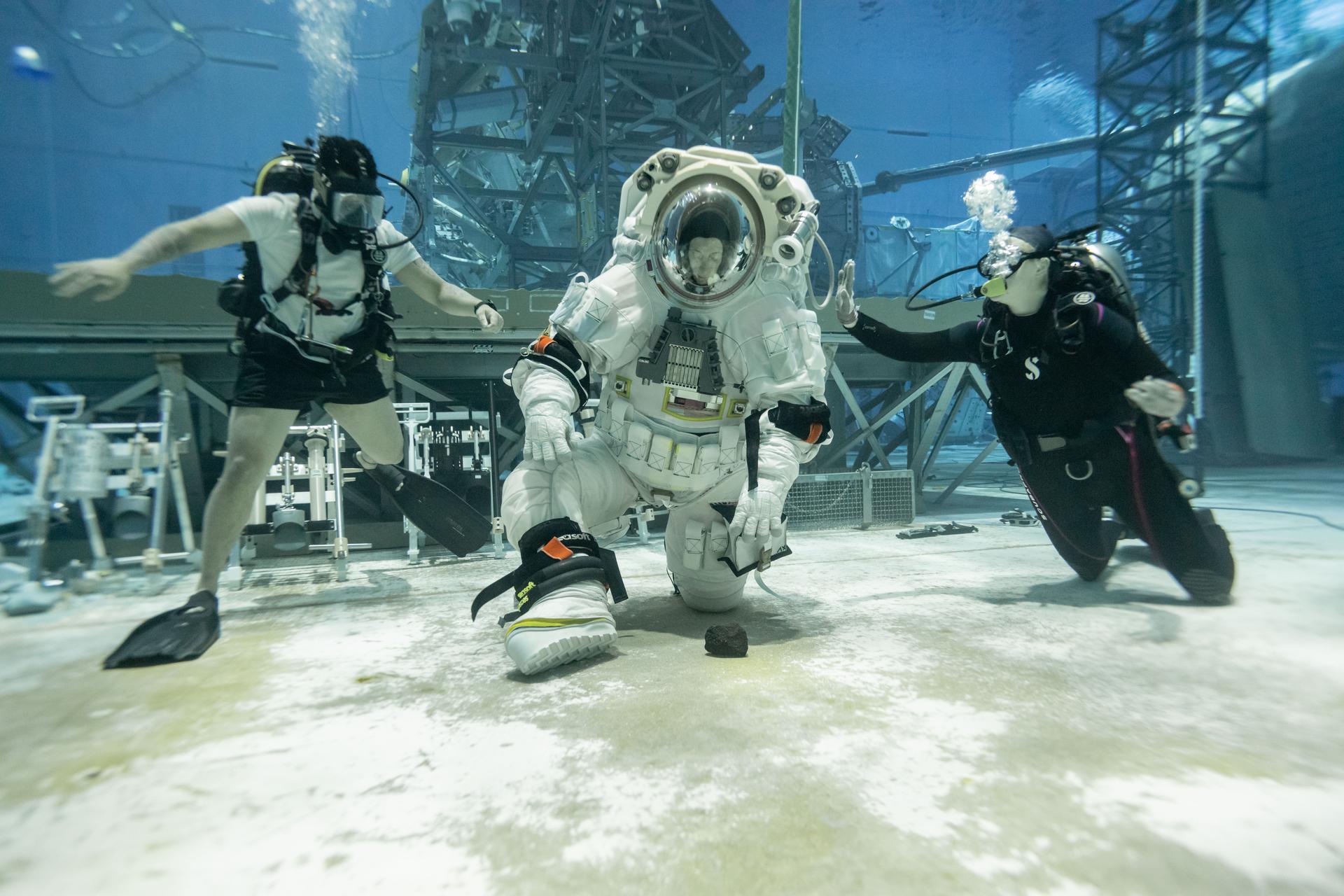
NASA astronaut Loral O’Hara kneels to pick up a rock while testing the mobility of Axiom Space’s lunar spacesuit. NASA and Axiom Space teams held the first dual spacesuit run at the Neutral Buoyancy Laboratory in Houston on September 24, 2025 with NASA Astronauts Stan Love and Loral O’Hara wearing Axiom Space’s lunar spacesuit, called the Axiom Extravehicular Mobility Unit (AxEMU). This was the final integration test in the pool, proving both the spacesuit and facility are prepped and ready for Artemis training.
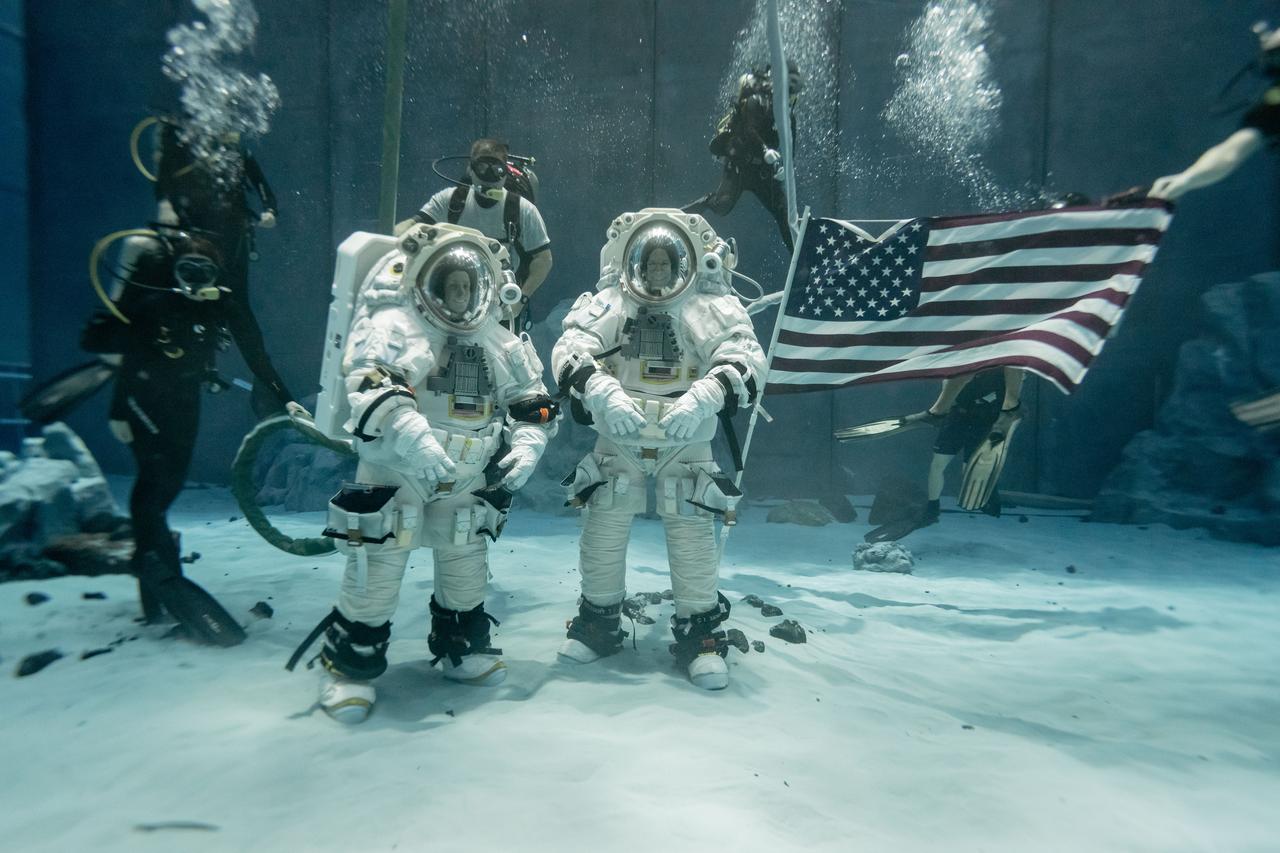
NASA astronauts Loral O’Hara (left) and Stan Love (right) pose for a photo during the first dual spacesuit run at NASA’s Neutral Buoyancy Laboratory while wearing Axiom Space’s lunar spacesuits. NASA and Axiom Space teams held the first dual spacesuit run at the Neutral Buoyancy Laboratory in Houston on September 24, 2025 with NASA Astronauts Stan Love and Loral O’Hara wearing Axiom Space’s lunar spacesuit, called the Axiom Extravehicular Mobility Unit (AxEMU). This was the final integration test in the pool, proving both the spacesuit and facility are prepped and ready for Artemis training.

Exploration geologists and Artemis science officers Trevor Graff, left, and Angela Garcia carry out a lunar training development run at NASA’s Neutral Buoyancy Laboratory (NBL) in Houston. The NBL is a 40-foot deep pool at NASA’s Johnson Space Center where astronauts train for spacewalks in a neutrally buoyant environment. During the session, Garcia and Graff conducted tests of Artemis geology tools and deployed a mock lunar payload under low-angle lighting conditions similar to what astronauts will encounter at the Moon’s south pole. A section of the NBL, which contains full-scale mockups of the International Space Station modules, has been transformed into a lunar training area with soil and rocks that mimic the Moon’s landscape. This testing run marked the first time in the Artemis program that two geologists were suited up simultaneously for lunar geology training in the NBL. The team is using insights from these tests to build the training program for astronauts assigned to future landed missions on the Moon. Credit: NASA
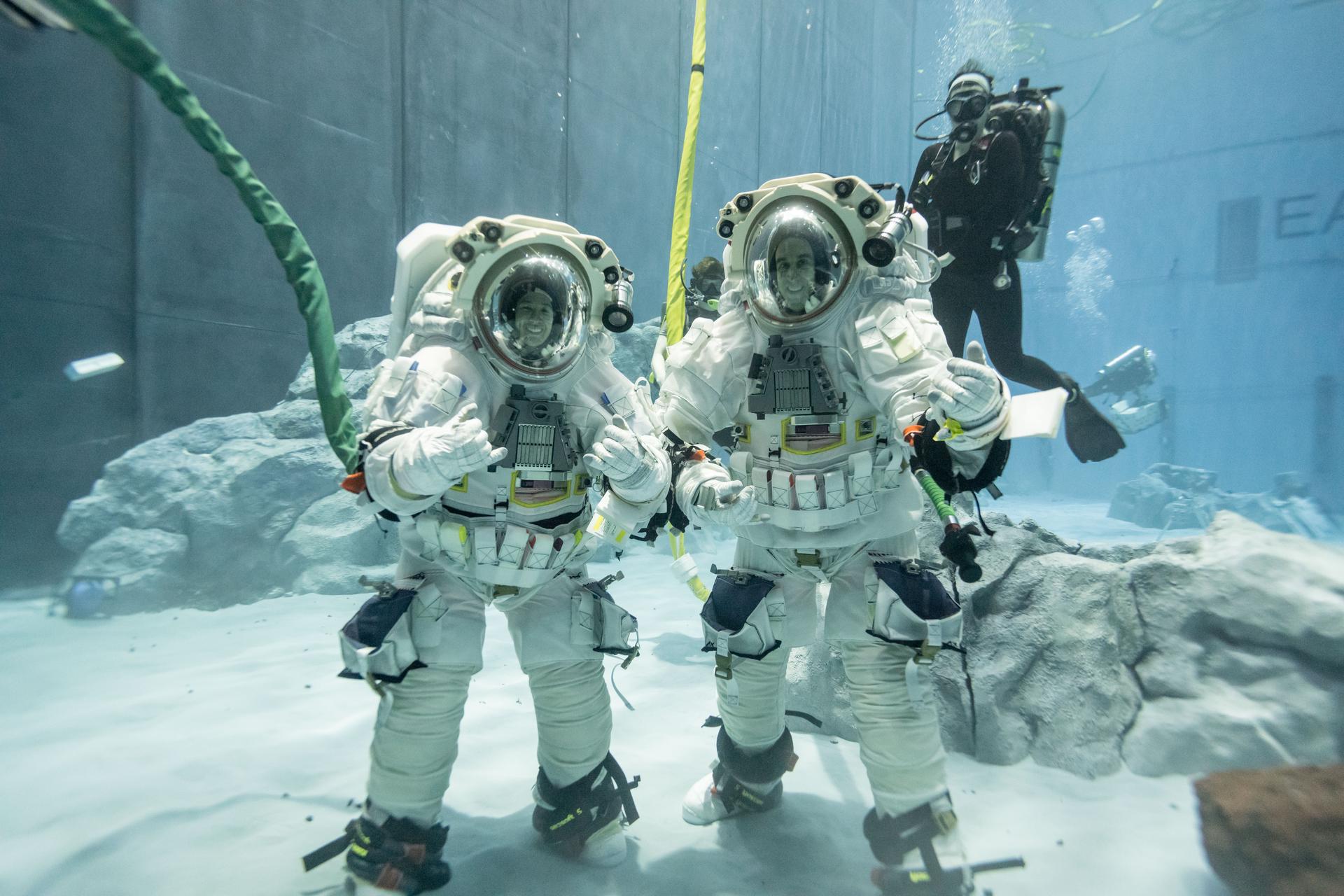
Exploration geologists and Artemis science officers Trevor Graff, left, and Angela Garcia carry out a lunar training development run at NASA’s Neutral Buoyancy Laboratory (NBL) in Houston. The NBL is a 40-foot deep pool at NASA’s Johnson Space Center where astronauts train for spacewalks in a neutrally buoyant environment. During the session, Garcia and Graff conducted tests of Artemis geology tools and deployed a mock lunar payload under low-angle lighting conditions similar to what astronauts will encounter at the Moon’s south pole. A section of the NBL, which contains full-scale mockups of the International Space Station modules, has been transformed into a lunar training area with soil and rocks that mimic the Moon’s landscape. This testing run marked the first time in the Artemis program that two geologists were suited up simultaneously for lunar geology training in the NBL. The team is using insights from these tests to build the training program for astronauts assigned to future landed missions on the Moon. Credit: NASA
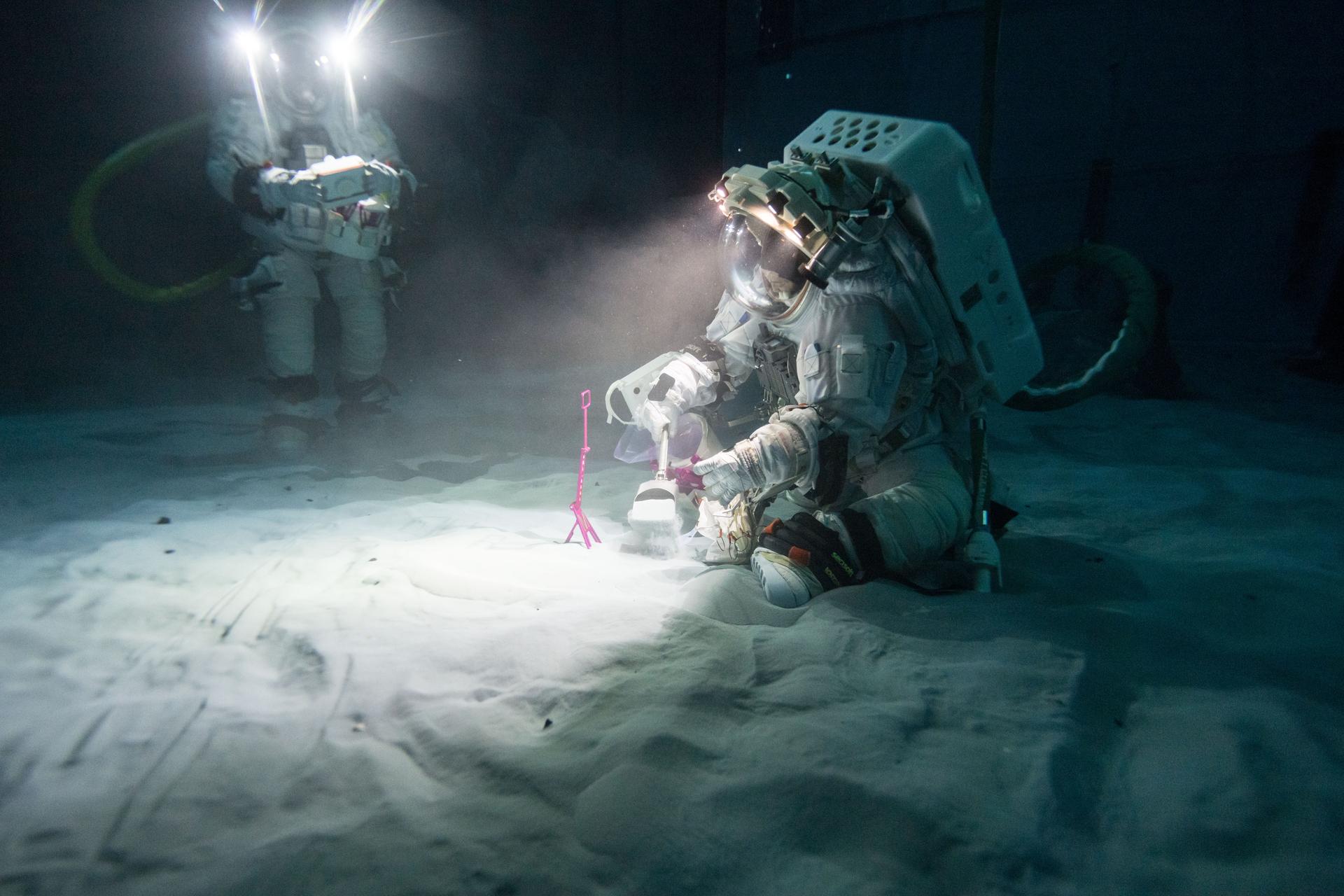
Exploration geologists and Artemis science officers Trevor Graff, left, and Angela Garcia carry out a lunar training development run at NASA’s Neutral Buoyancy Laboratory (NBL) in Houston. The NBL is a 40-foot deep pool at NASA’s Johnson Space Center where astronauts train for spacewalks in a neutrally buoyant environment. During the session, Garcia and Graff conducted tests of Artemis geology tools and deployed a mock lunar payload under low-angle lighting conditions similar to what astronauts will encounter at the Moon’s south pole. A section of the NBL, which contains full-scale mockups of the International Space Station modules, has been transformed into a lunar training area with soil and rocks that mimic the Moon’s landscape. This testing run marked the first time in the Artemis program that two geologists were suited up simultaneously for lunar geology training in the NBL. The team is using insights from these tests to build the training program for astronauts assigned to future landed missions on the Moon. Credit: NASA
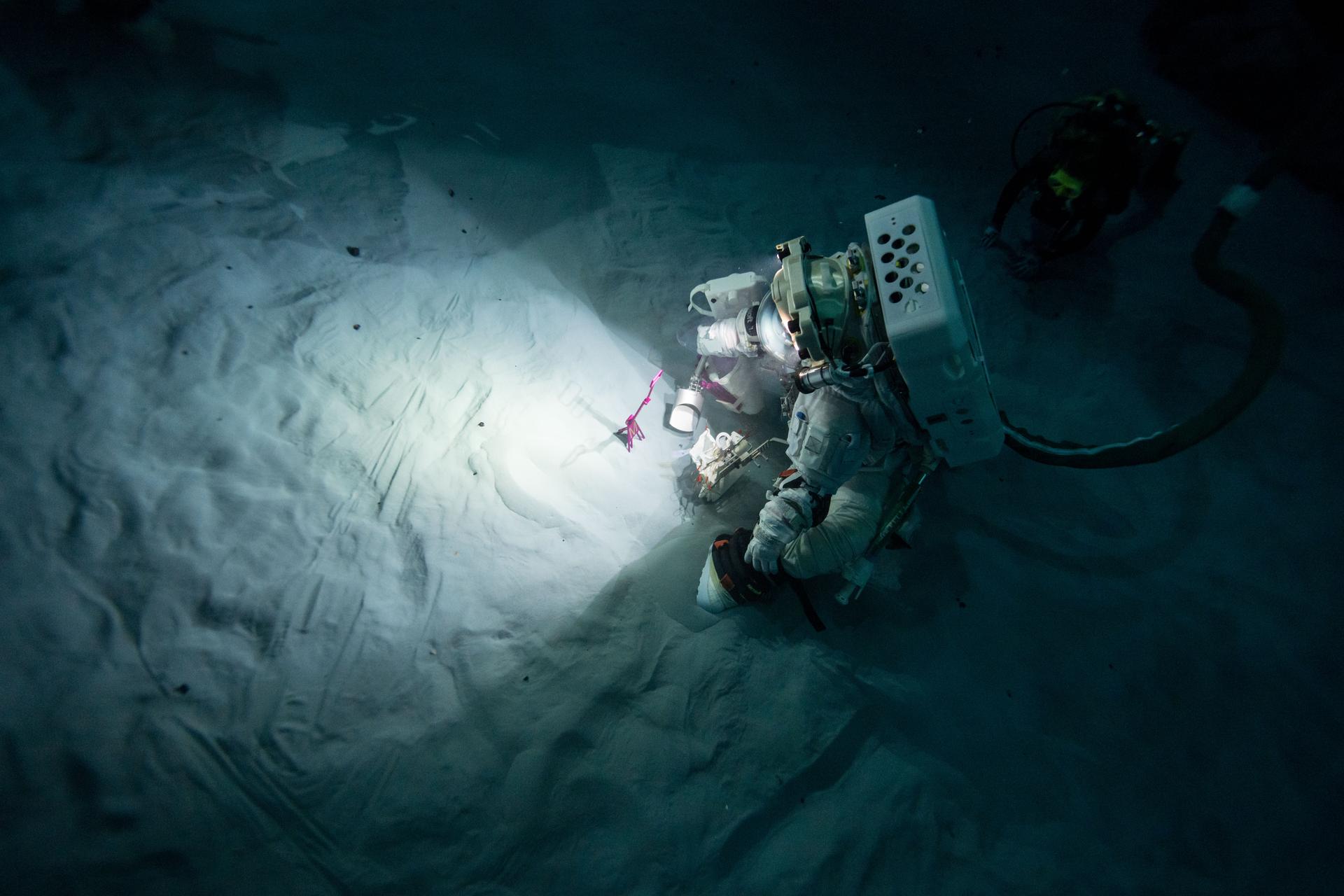
Exploration geologist and Artemis science officer Angela Garcia carries out a lunar training development run at NASA’s Neutral Buoyancy Laboratory (NBL) in Houston. The NBL is a 40-foot deep pool at NASA’s Johnson Space Center where astronauts train for spacewalks in a neutrally buoyant environment. During the session, Garcia and fellow exploration geologist and Artemis science officer Trevor Graff conducted tests of Artemis geology tools and deployed a mock lunar payload under low-angle lighting conditions similar to what astronauts will encounter at the Moon’s south pole. A section of the NBL, which contains full-scale mockups of the International Space Station modules, has been transformed into a lunar training area with soil and rocks that mimic the Moon’s landscape. This testing run marked the first time in the Artemis program that two geologists were suited up simultaneously for lunar geology training in the NBL. The team is using insights from these tests to build the training program for astronauts assigned to future landed missions on the Moon. Credit: NASA
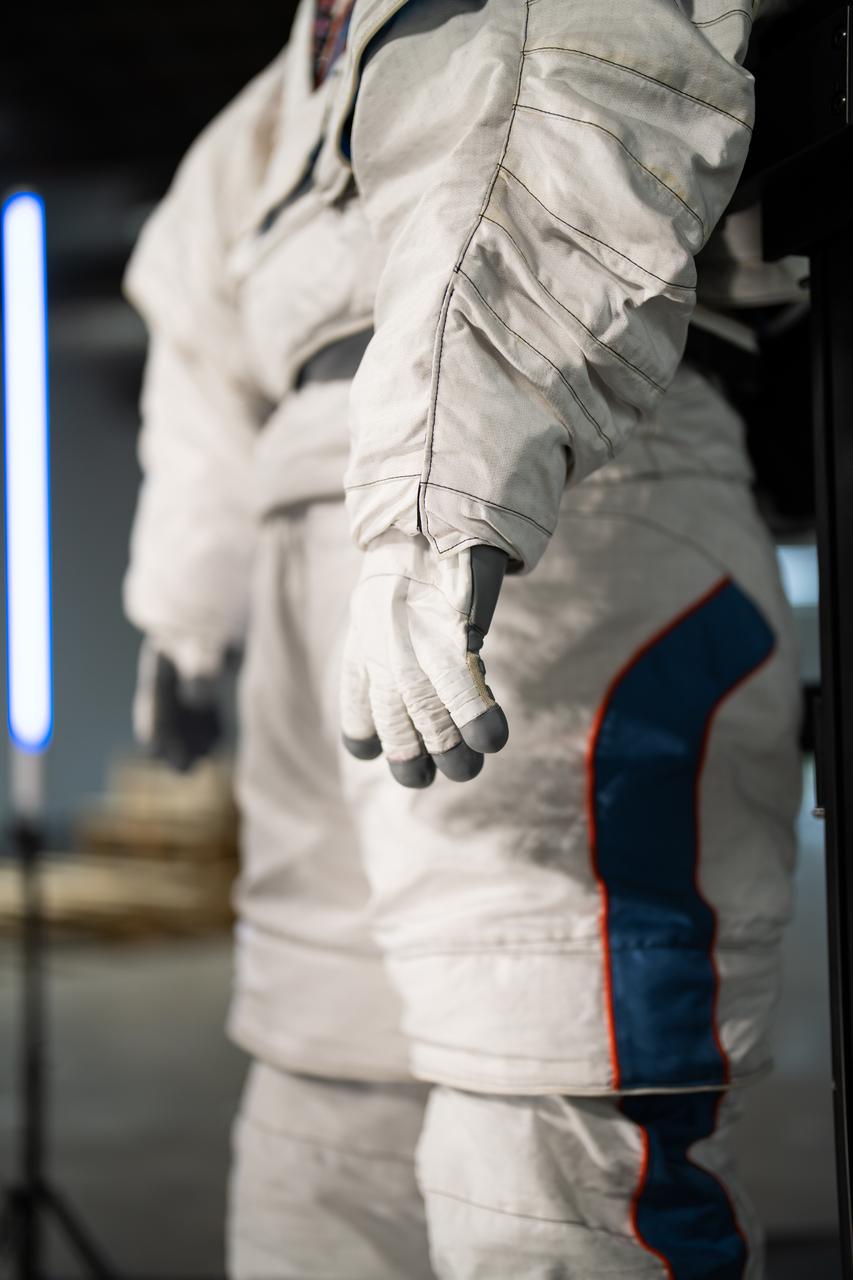
An up close image of a glove on Axiom Space's AxEMU (Axiom Extravehicular Mobility Unit) lunar spacesuit. Image Credit: Axiom Space
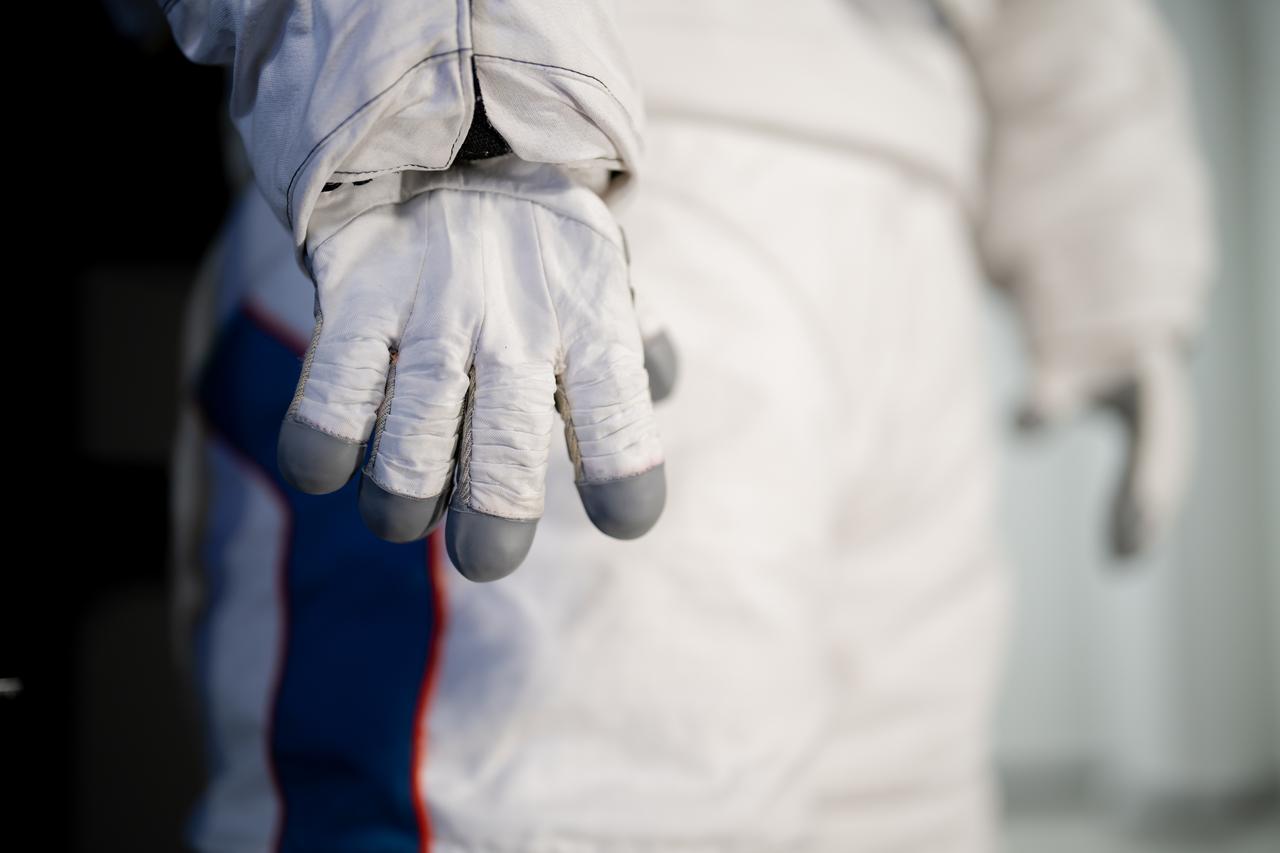
An up close image of a glove on Axiom Space's AxEMU (Axiom Extravehicular Mobility Unit) lunar spacesuit. Image Credit: Axiom Space
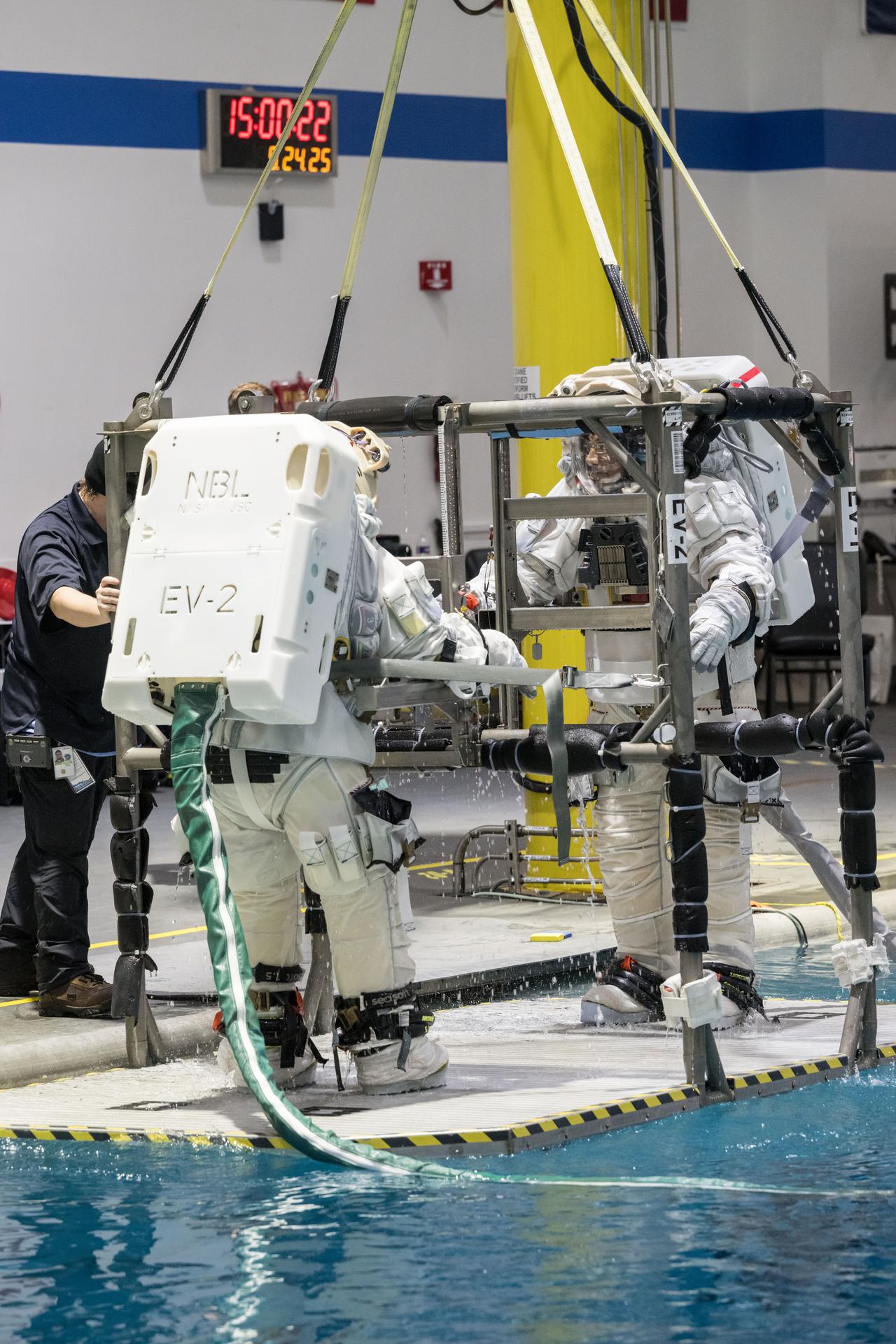
NASA and Axiom Space teams held the first dual spacesuit run at the Neutral Buoyancy Laboratory in Houston on September 24, 2025 with NASA Astronauts Stan Love and Loral O’Hara wearing Axiom Space’s lunar spacesuit, called the Axiom Extravehicular Mobility Unit (AxEMU). This was the final integration test in the pool, proving both the spacesuit and facility are prepped and ready for Artemis training.
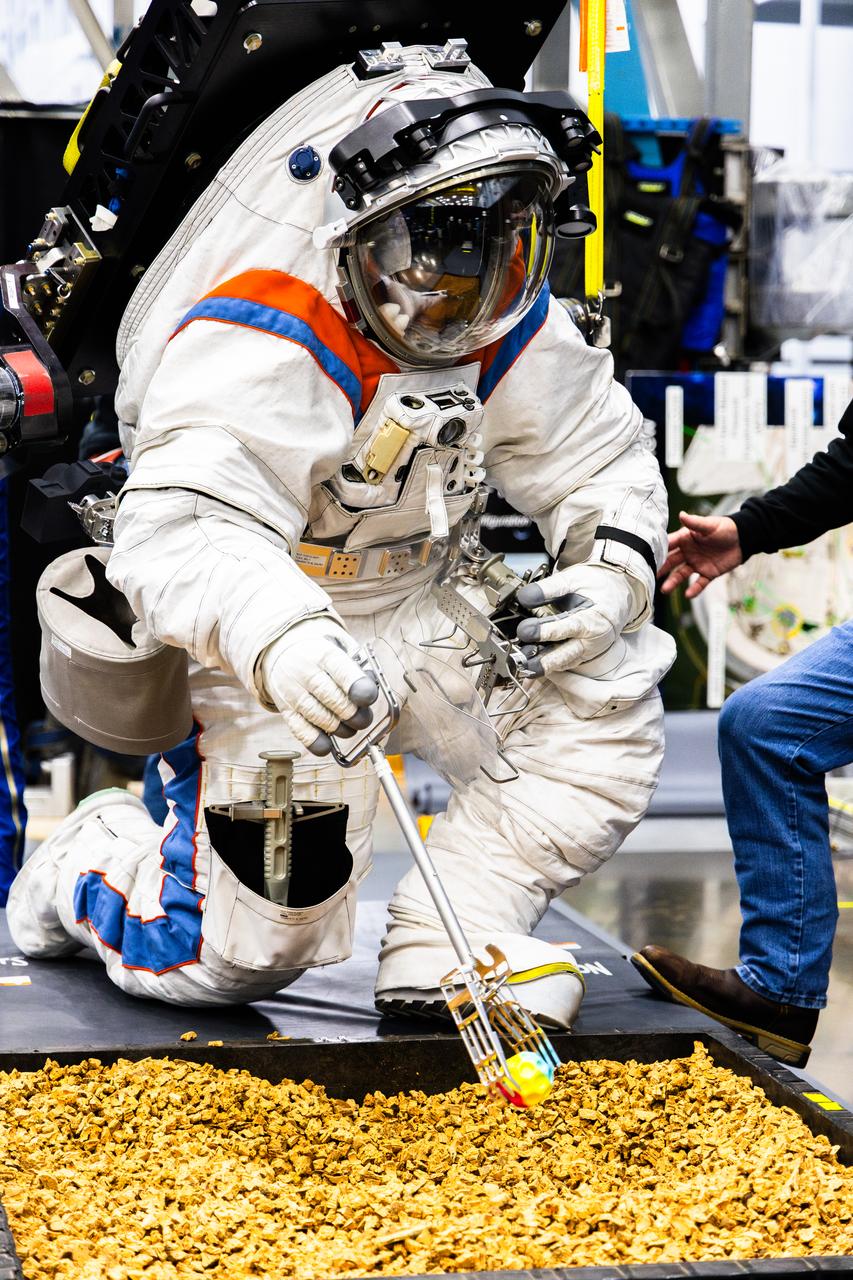
An Axiom Space engineer uses tongs to pick up a simulated lunar rock while wearing the AxEMU (Axiom Extravehicular Mobility Unit) spacesuit during testing at NASA’s Johnson Space Center. Image Credit: Axiom Space
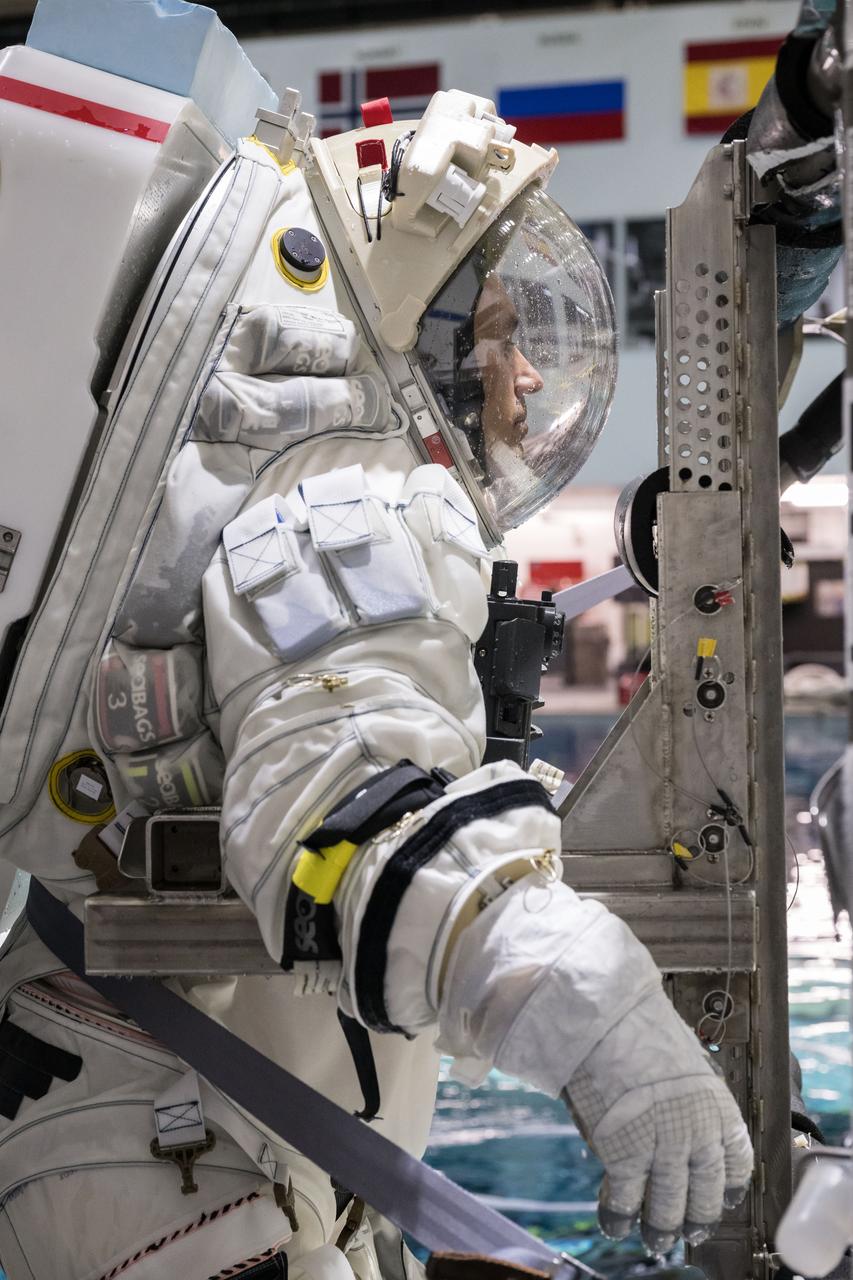
NASA spacesuit engineer Richard Rhodes suits up in Axiom Space's lunar spacesuit before going under water for testing at NASA's Neutral Buoyancy Laboratory. Image Credit: NASA/Robert Markowitz
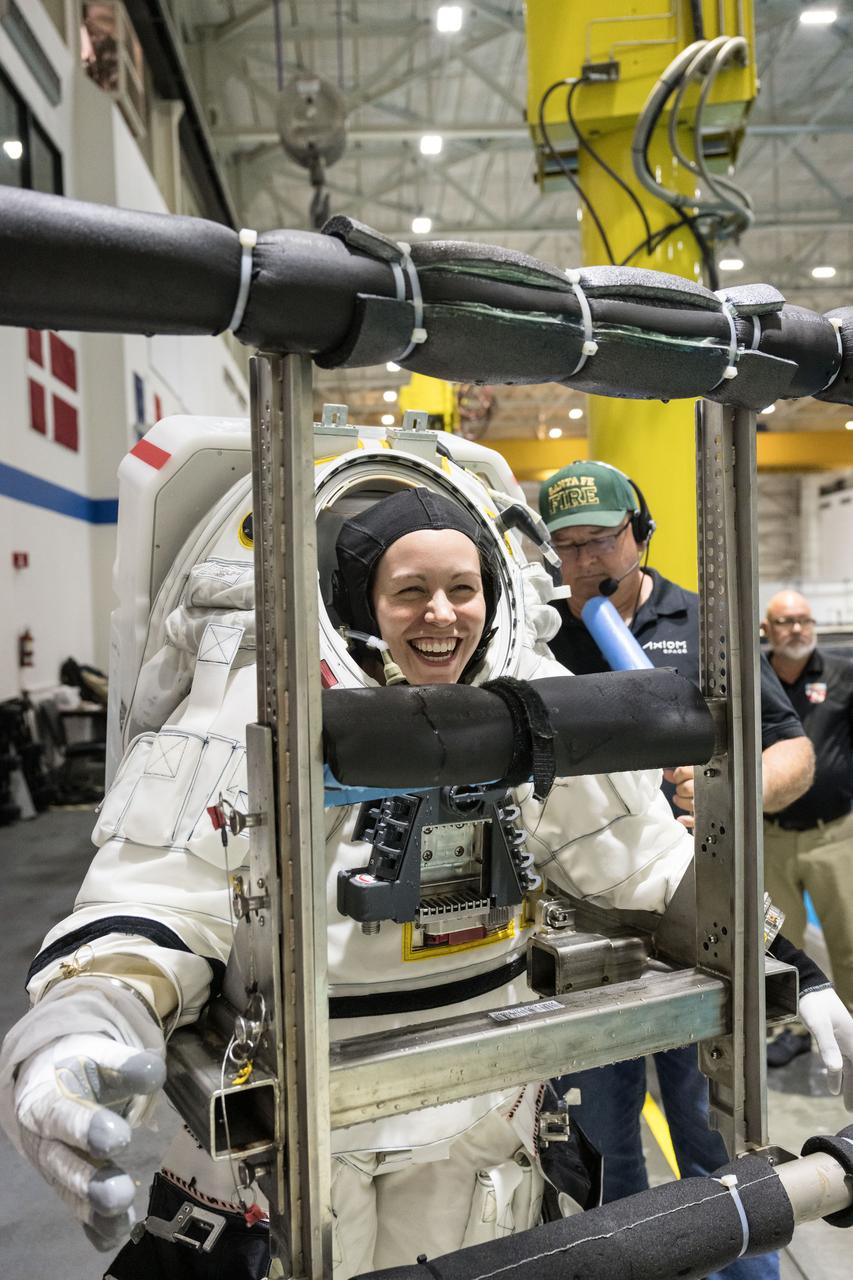
NASA spacesuit engineer Kristine Davis suits up in Axiom Space's lunar spacesuit before going under water for testing at NASA's Neutral Buoyancy Laboratory. Image Credit: NASA/James Blair
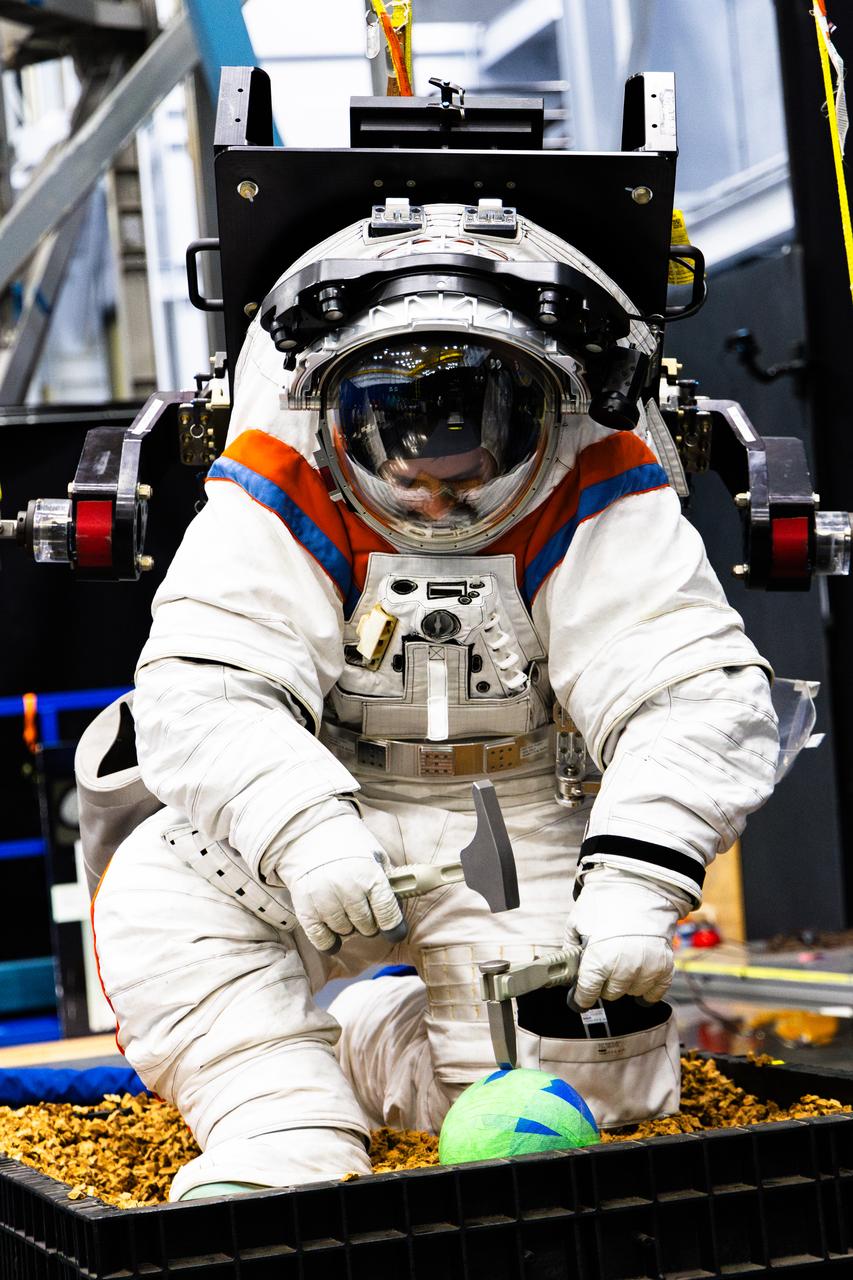
An Axiom Space engineer uses a hammer and chisel to chip off simulated lunar rocks while wearing the AxEMU (Axiom Extravehicular Mobility Unit) spacesuit during testing at NASA’s Johnson Space Center. Image Credit: Axiom Space
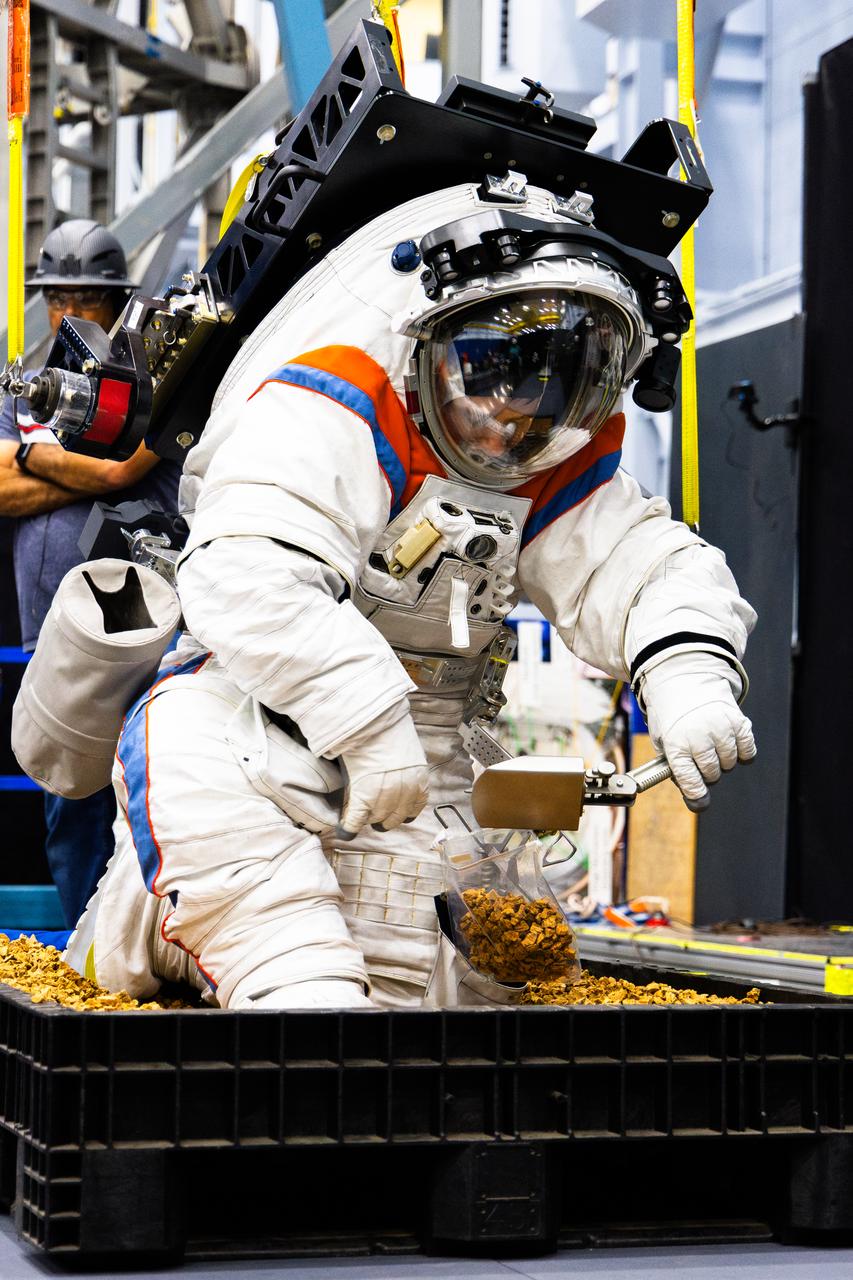
An Axiom Space engineer kneels down to collect simulated lunar samples using a geology tool while wearing the AxEMU (Axiom Extravehicular Mobility Unit) spacesuit during testing at NASA’s Johnson Space Center. Image Credit: Axiom Space
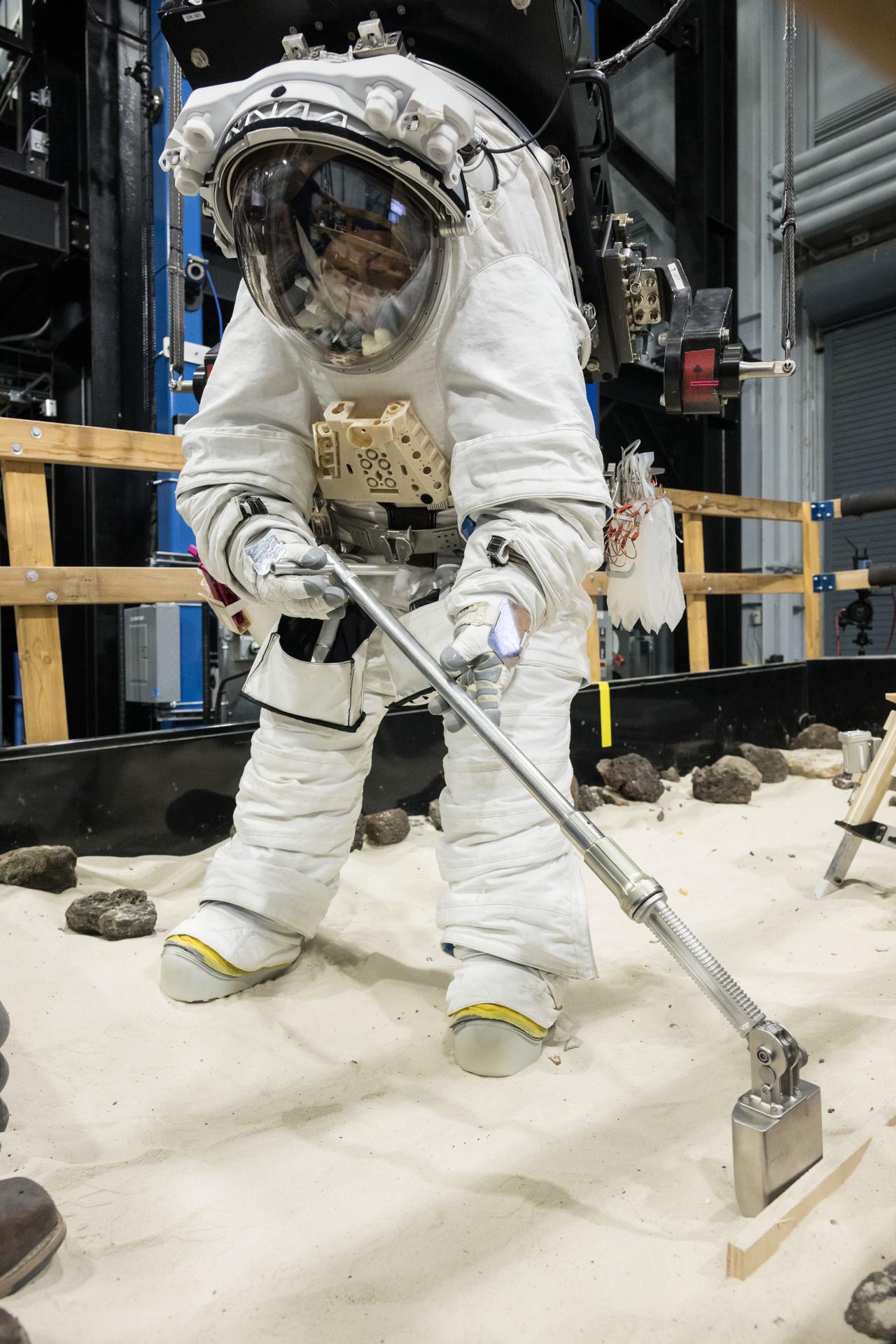
A NASA crew member practices using lunar tools to collect geology samples at NASA’s Johnson Space Center during an elevated suit pressure test where teams evaluate how well crew perform tasks in different suit pressure levels while wearing the Artemis III lunar spacesuit developed by Axiom Space called the AxEMU (Axiom Extravehicular Mobility Unit).
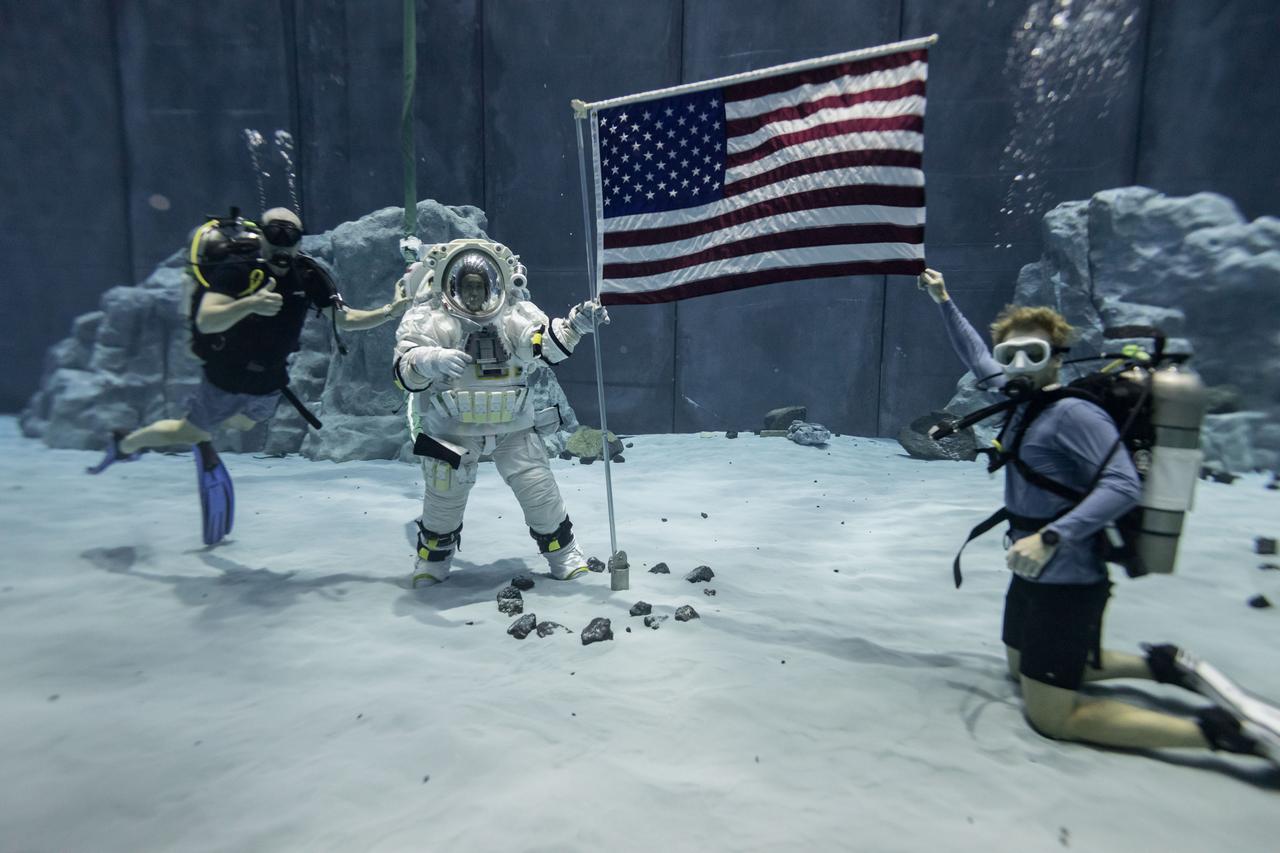
Axiom Space astronaut and Chief Technology Officer Koichi Wakata holds up an American flag in NASA's Neutral Buoyancy Laboratory during the first crewed underwater test of Axiom Space's lunar spacesuit. Image Credit: NASA
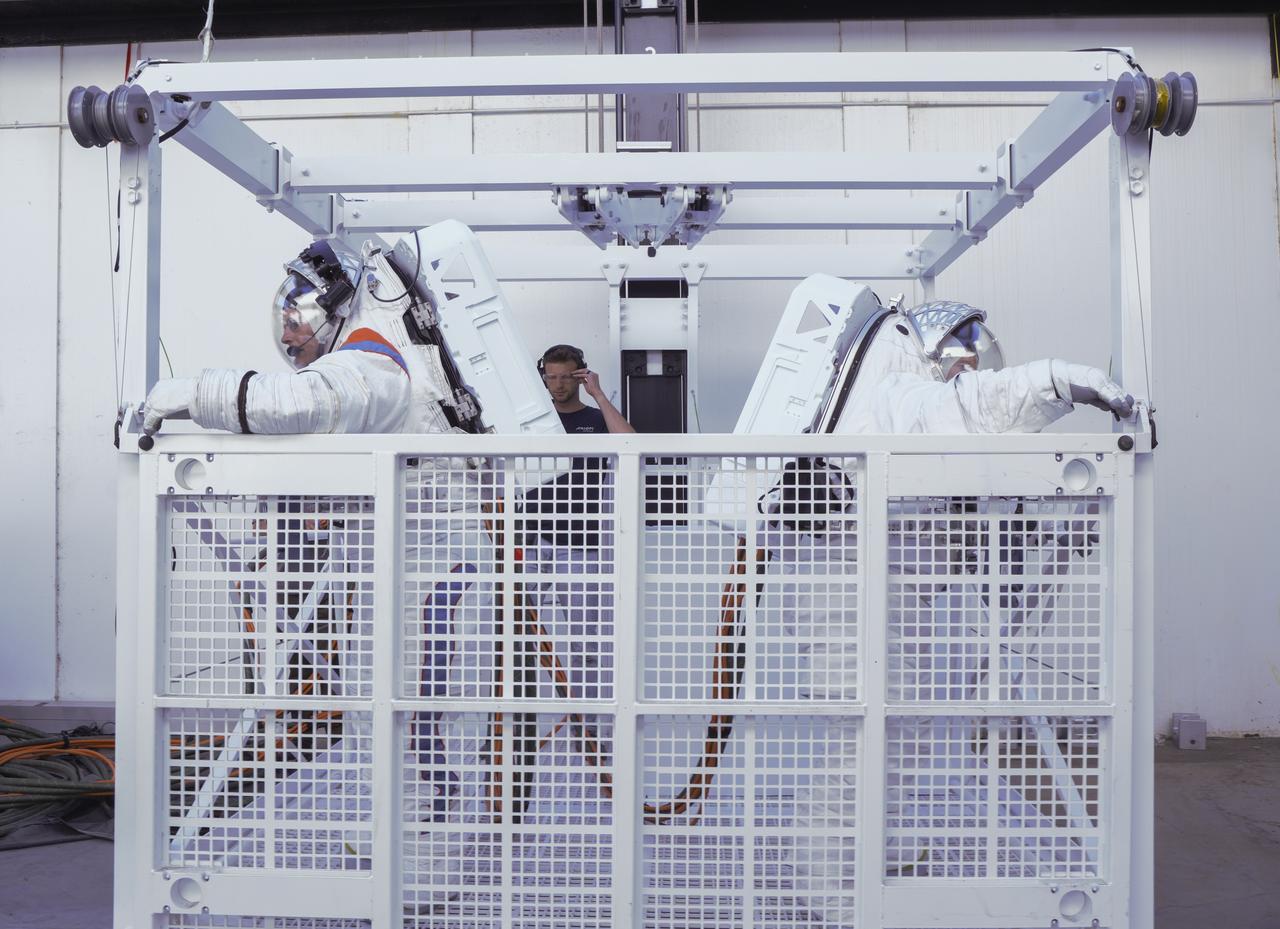
NASA astronaut Doug "Wheels" Wheelock and Axiom Space astronaut Peggy Whitson were able to test the agility of the spacesuits by conducting movements and tasks similar to those necessary during lunar surface exploration on Artemis missions, such as operating the full-scale mockup of Starship’s elevator gate. Image Credit: SpaceX
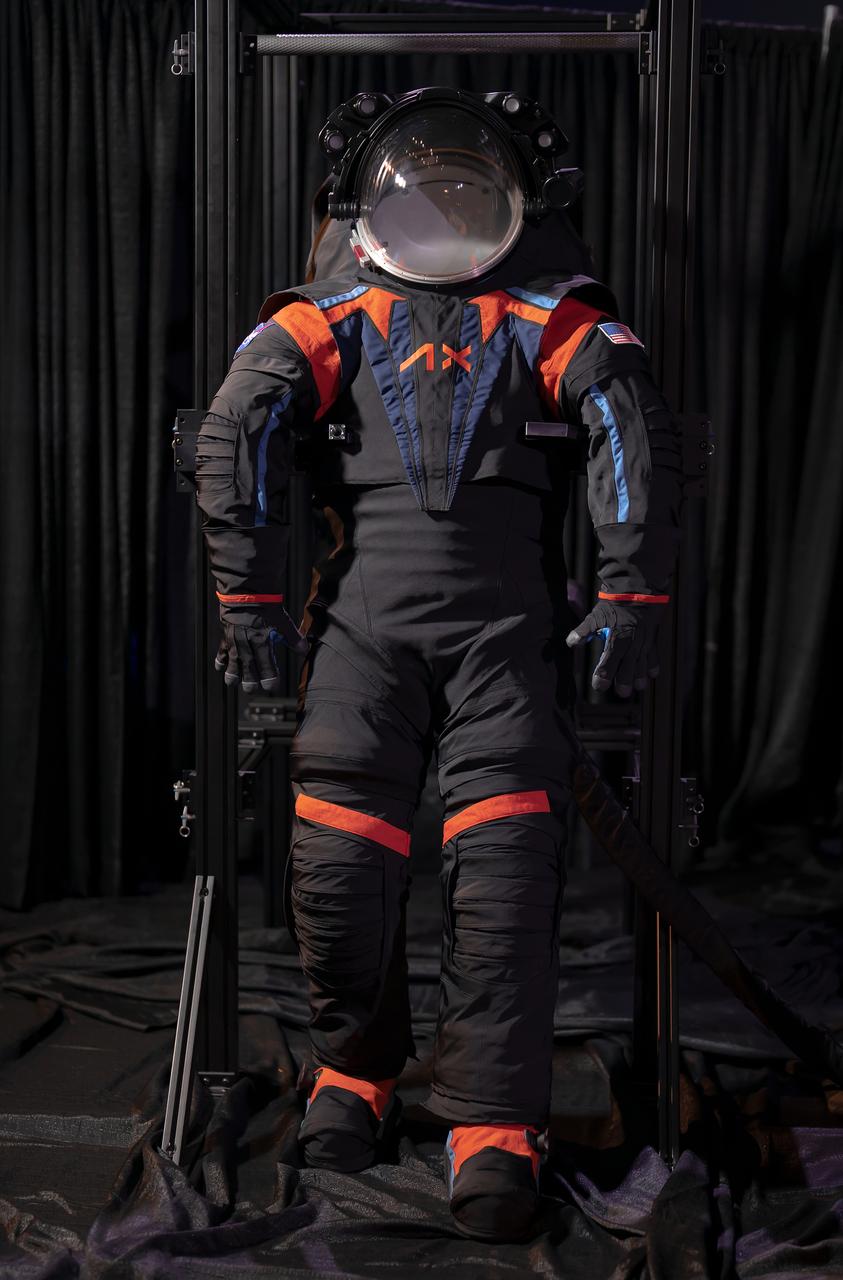
The Artemis III spacesuit prototype, the AxEMU. Though this prototype uses a dark gray cover material, the final version will likely be all-white when worn by NASA astronauts on the Moon’s surface, to help keep the astronauts safe and cool while working in the harsh environment of space. Image Credit: Axiom Space
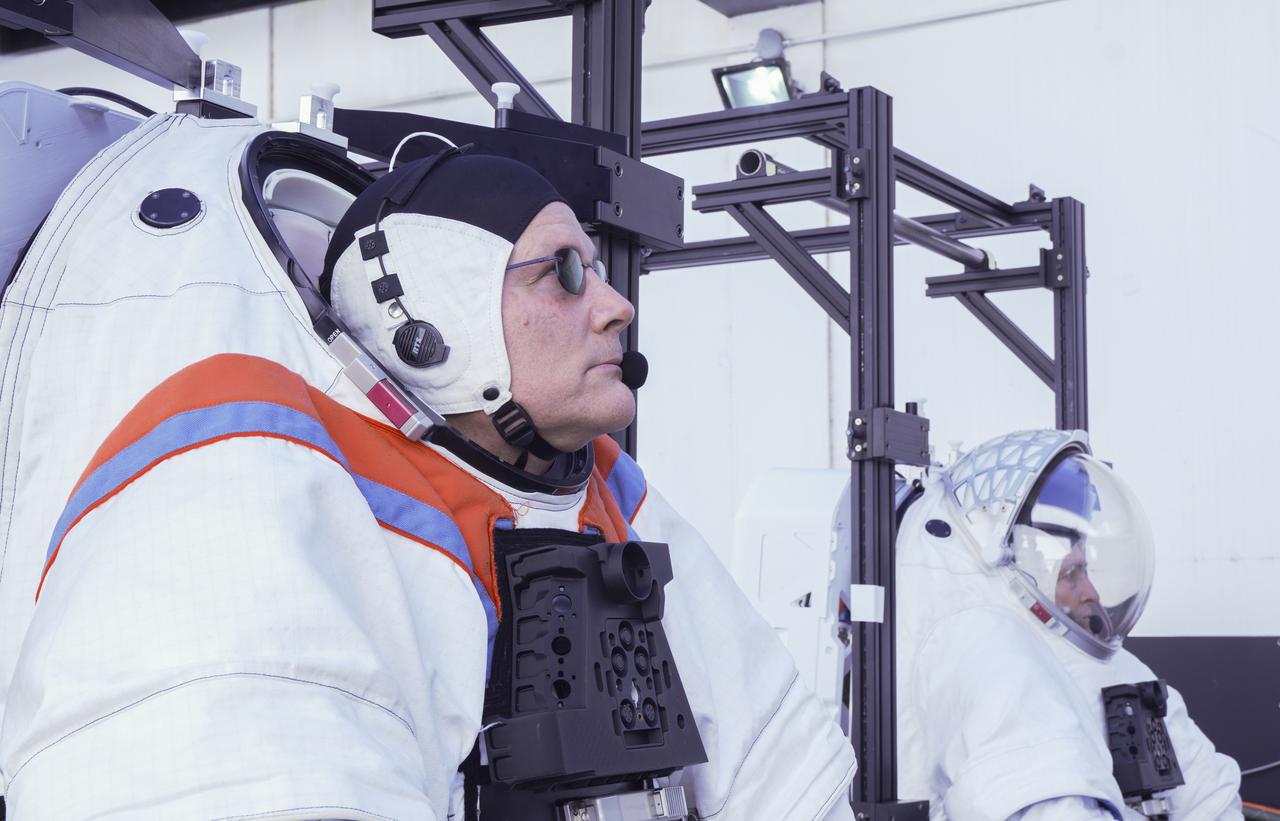
NASA astronaut Doug “Wheels” Wheelock and Axiom Space astronaut Peggy Whitson prepare for a test of full-scale mockups of spacesuits developed by Axiom Space and SpaceX’s Starship human landing system developed for NASA’s Artemis missions to the Moon. Image Credit: SpaceX
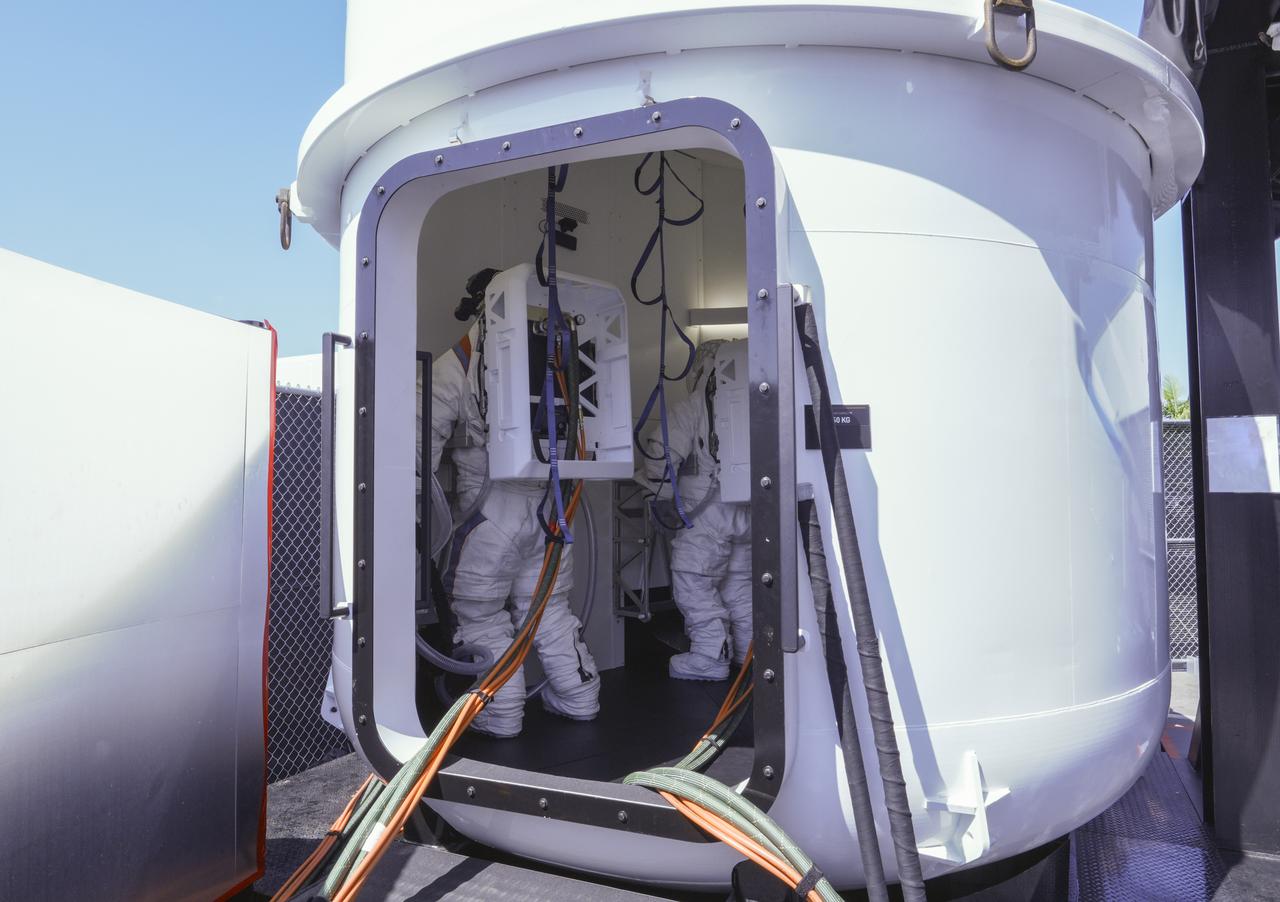
NASA astronaut Doug “Wheels” Wheelock and Axiom Space astronaut Peggy Whitson were fully suited while conducting mission-like maneuvers in the full-scale build of the Starship human landing system’s airlock which will be located inside Starship under the crew cabin. Image Credit: SpaceX
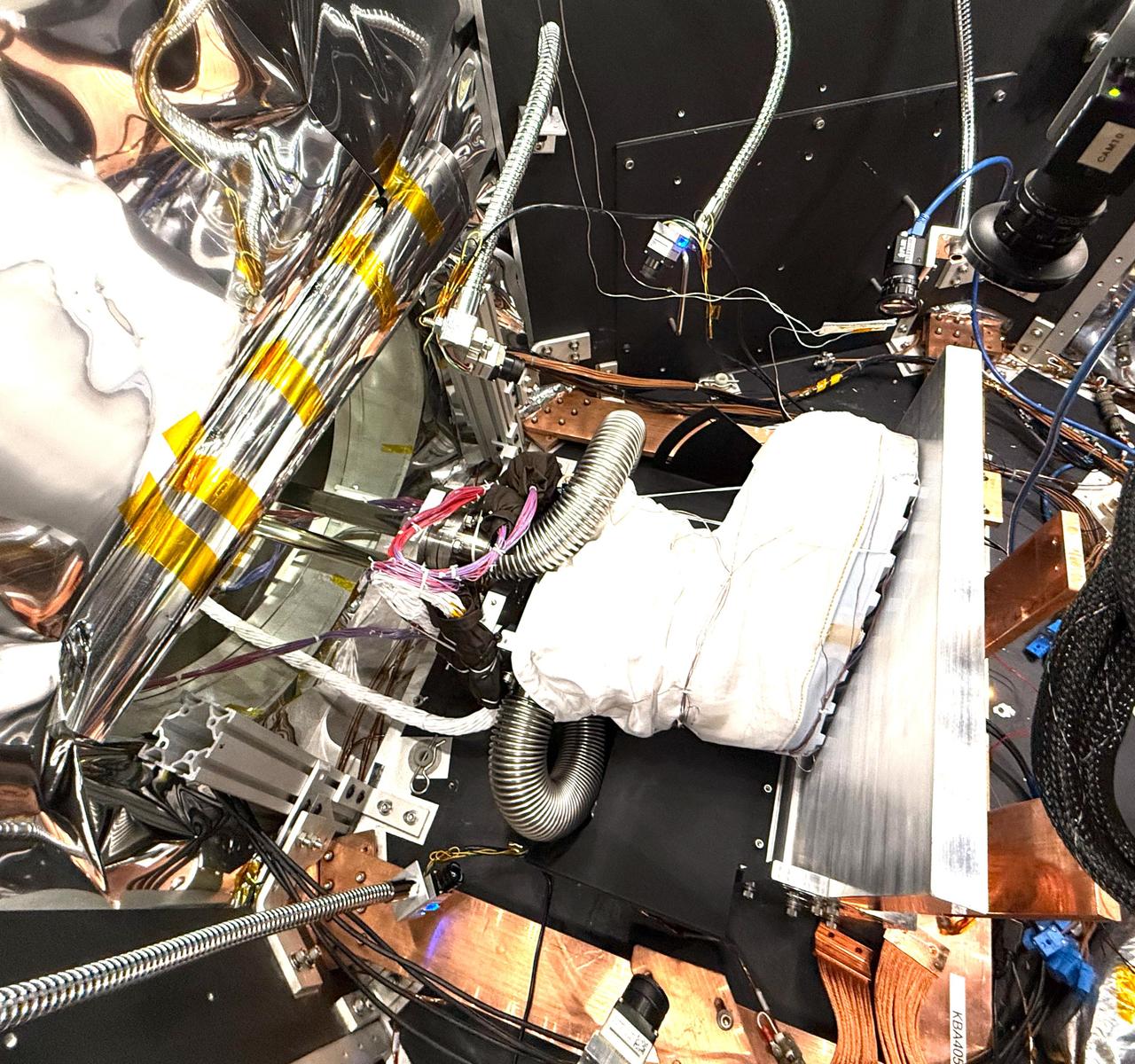
A boot that's part of a NASA lunar surface spacesuit prototype is readied for testing inside a thermal vacuum chamber called CITADEL at the agency's Jet Propulsion Laboratory in Southern California on Nov. 8, 2024. The thick aluminum plate at right stands in for the frigid surface of the lunar South Pole, where Artemis III astronauts will confront conditions more extreme than any previously experienced by humans. Built to prepare potential future robotic spacecraft for the frosty, low-pressure conditions on ocean worlds like Jupiter's frozen moon Europa, CITADEL (Cryogenic Ice Testing, Acquisition Development, and Excavation Laboratory) has also proven key to evaluating how astronaut gloves and boots hold up in extraordinary cold. It can reach temperatures as low as low as minus 370 degrees Fahrenheit (minus 223 degrees Celsius), approximating conditions in permanently shadowed regions that astronauts will explore. Figure A, showing the outer boot sole, was taken from inside CITADEL on Nov. 13, 2024. The boot is positioned in a load lock, one of four small drawer-like chambers through which test materials are inserted into the larger chamber. Initiated by the Extravehicular Activity and Human Surface Mobility Program at NASA's Johnson Space Center, the boot testing took place from October 2024 to January 2025. The boot is part of a NASA spacesuit called the Exploration Extravehicular Mobility Unit, or xEMU. Results haven't yet been fully analyzed. In addition to spotting vulnerabilities with existing suits, the experiments are intended to help NASA develop this unique test capability and prepare criteria for standardized, repeatable, and inexpensive test methods for the next-generation lunar suit being built by Axiom Space. https://photojournal.jpl.nasa.gov/catalog/PIA26592
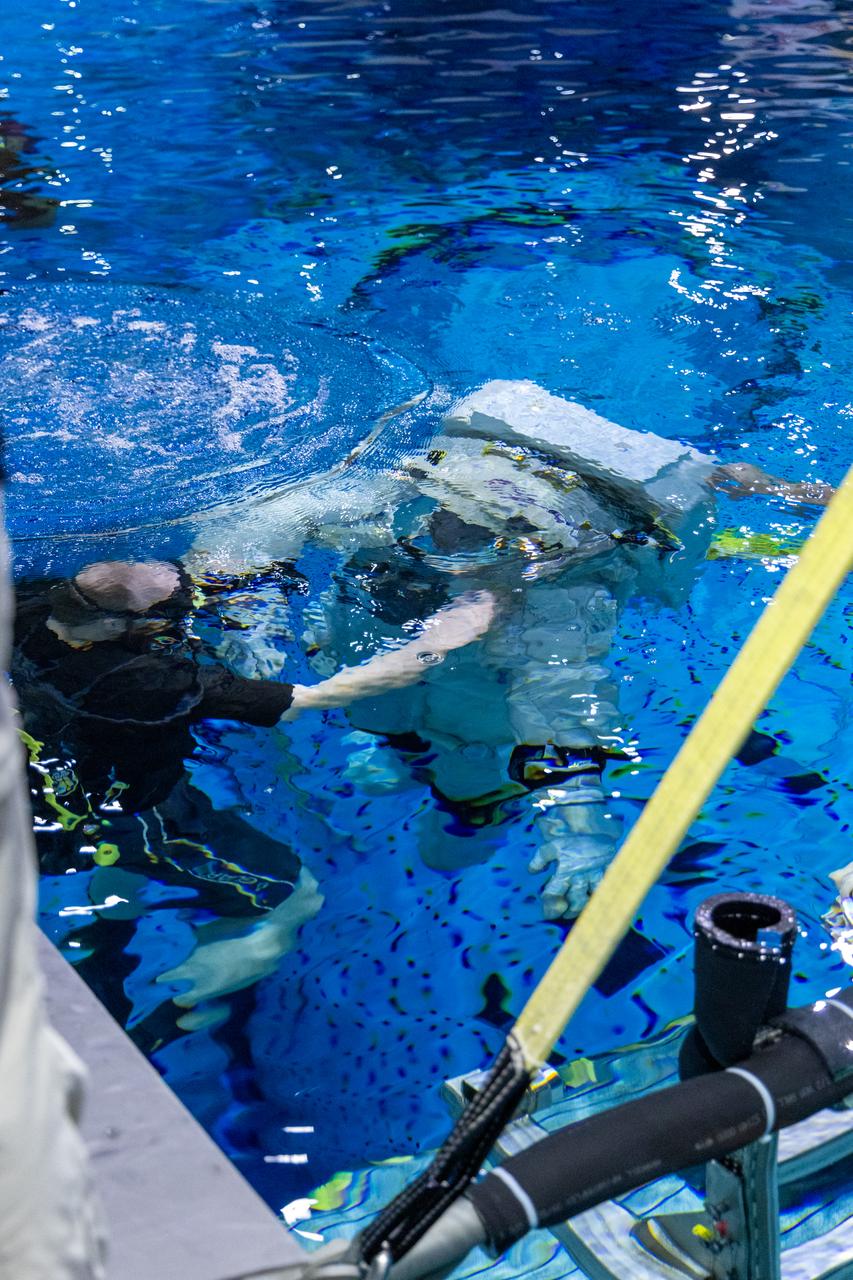
Axiom Space's AxEMU (Axiom Extravehicular Mobility Unit) spacesuit underwater during testing of its pressure garment system at NASA Johnson's Neutral Buoyancy Laboratory. Image Credit: Axiom Space
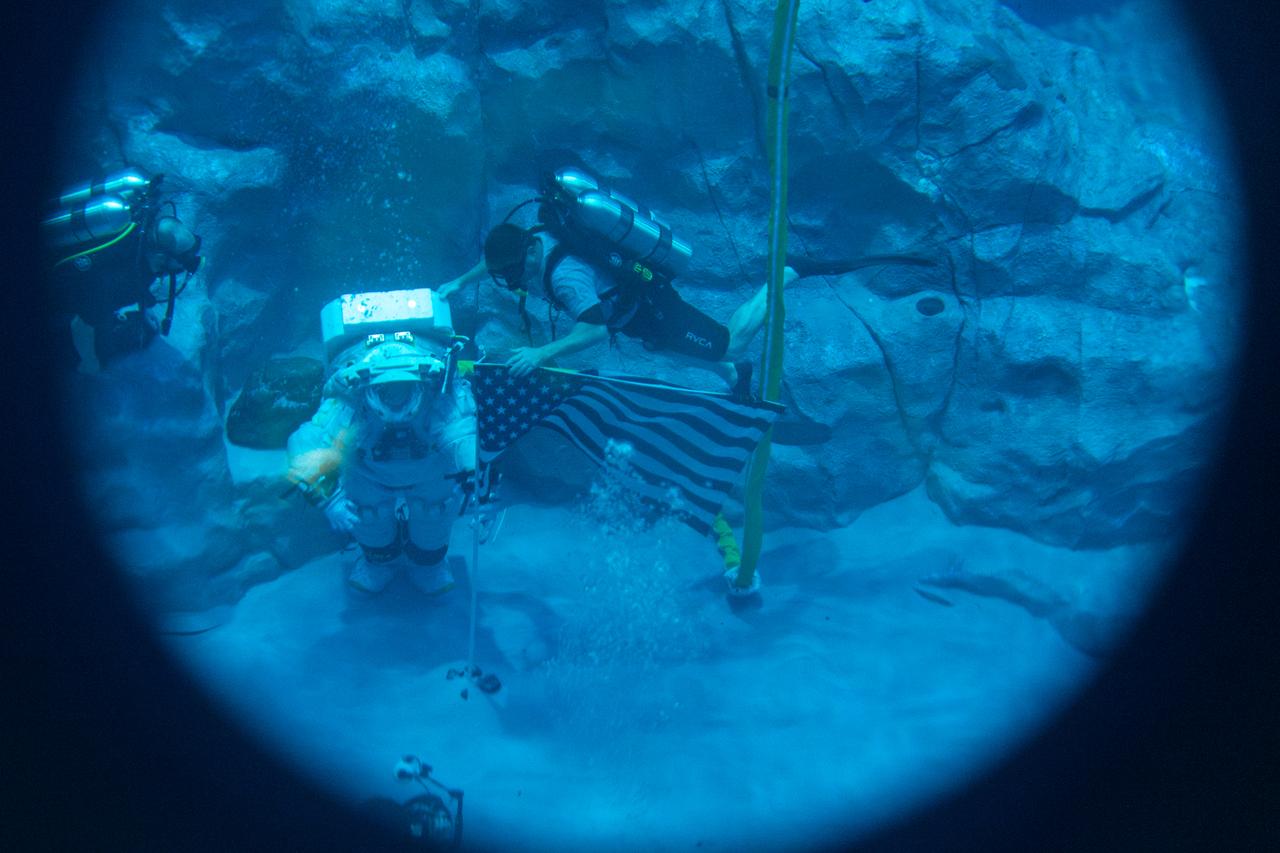
Axiom Space's AxEMU (Axiom Extravehicular Mobility Unit) spacesuit underwater during testing of its pressure garment system at NASA Johnson's Neutral Buoyancy Laboratory. Image Credit: Axiom Space
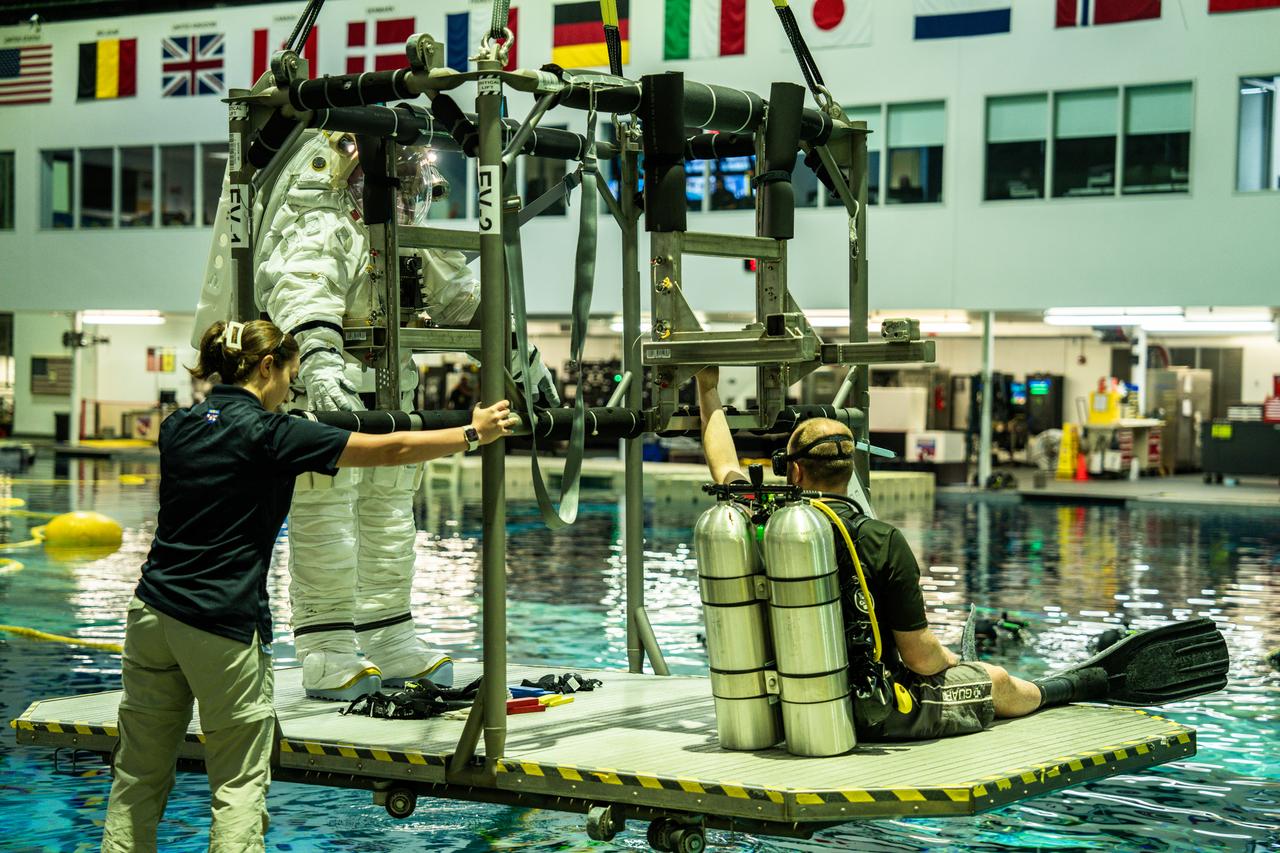
Axiom Space's AxEMU (Axiom Extravehicular Mobility Unit) spacesuit being tested at NASA Johnson's Neutral Buoyancy Laboratory. Image Credit: Axiom Space
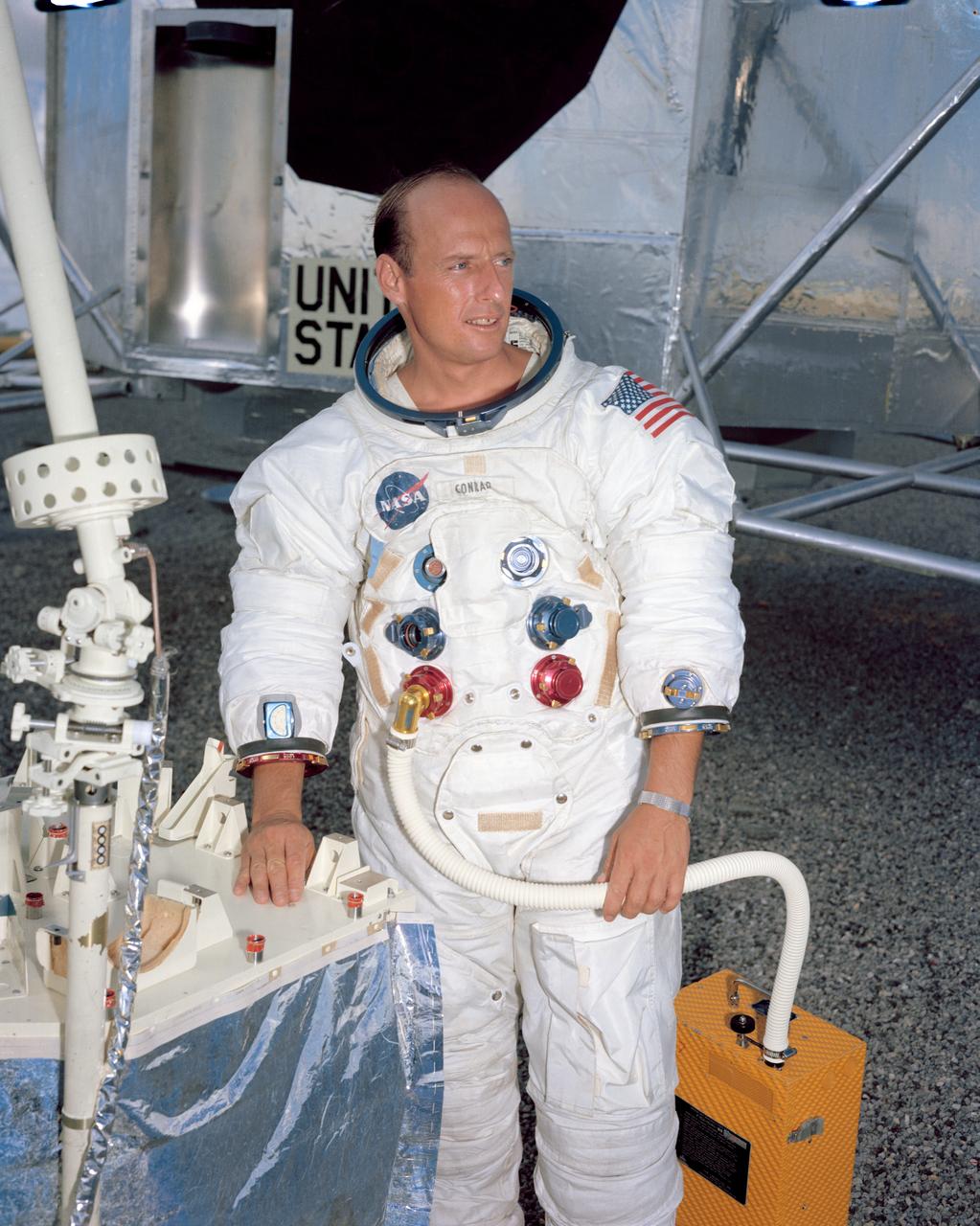
S69-38866 (22 Sept. 1969) --- Portrait of astronaut Charles Conrad Jr., prime crew commander of the Apollo 12 lunar landing mission, in his spacesuit minus the helmet. He is standing outside beside a mock-up of the Lunar Lander.
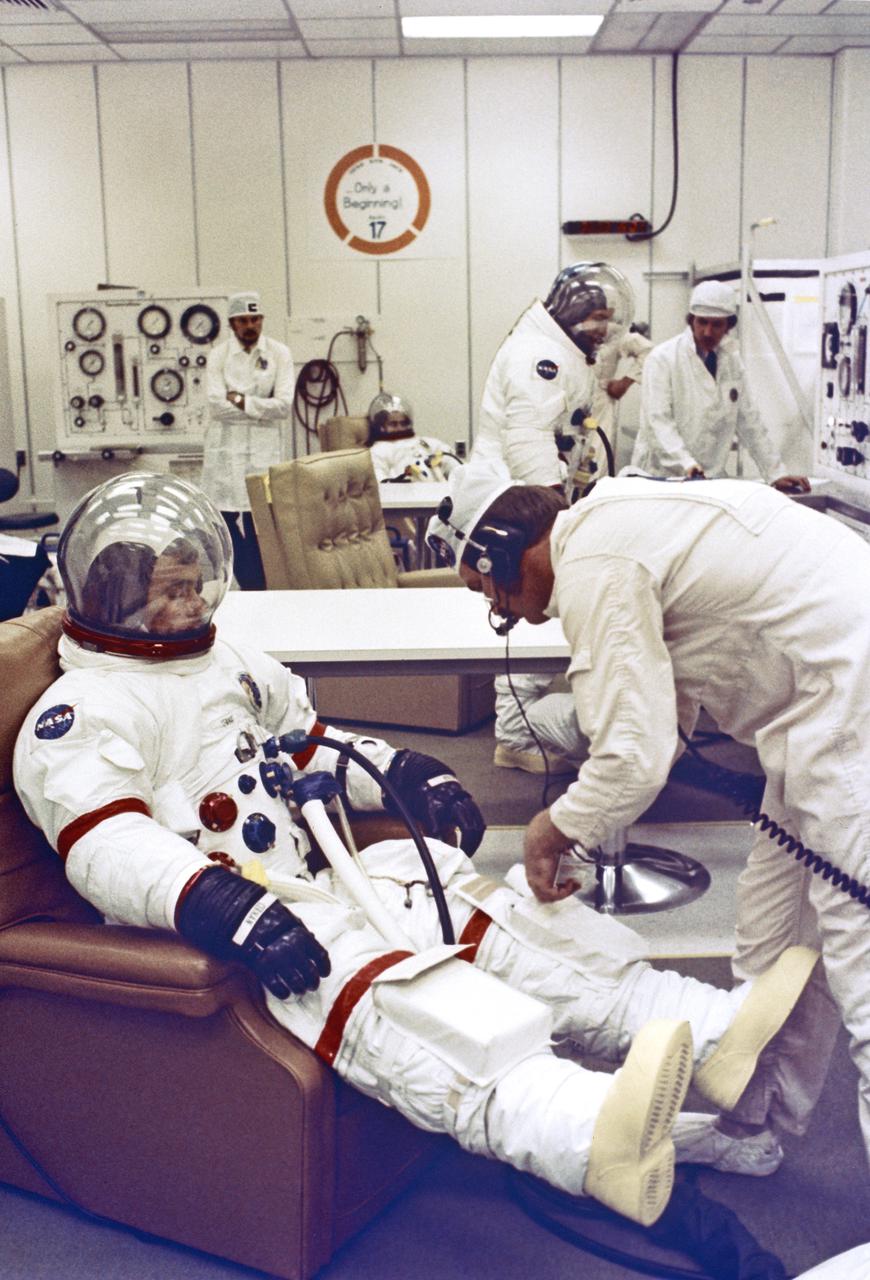
Apollo 17 Commander Eugene A. Cernan undergoes spacesuit Checkout prior to launch to the Moon tonight. In the background are Command Module Pilot Ronald E. Evans and Lunar Module Pilot Harrison H. Schmitt.
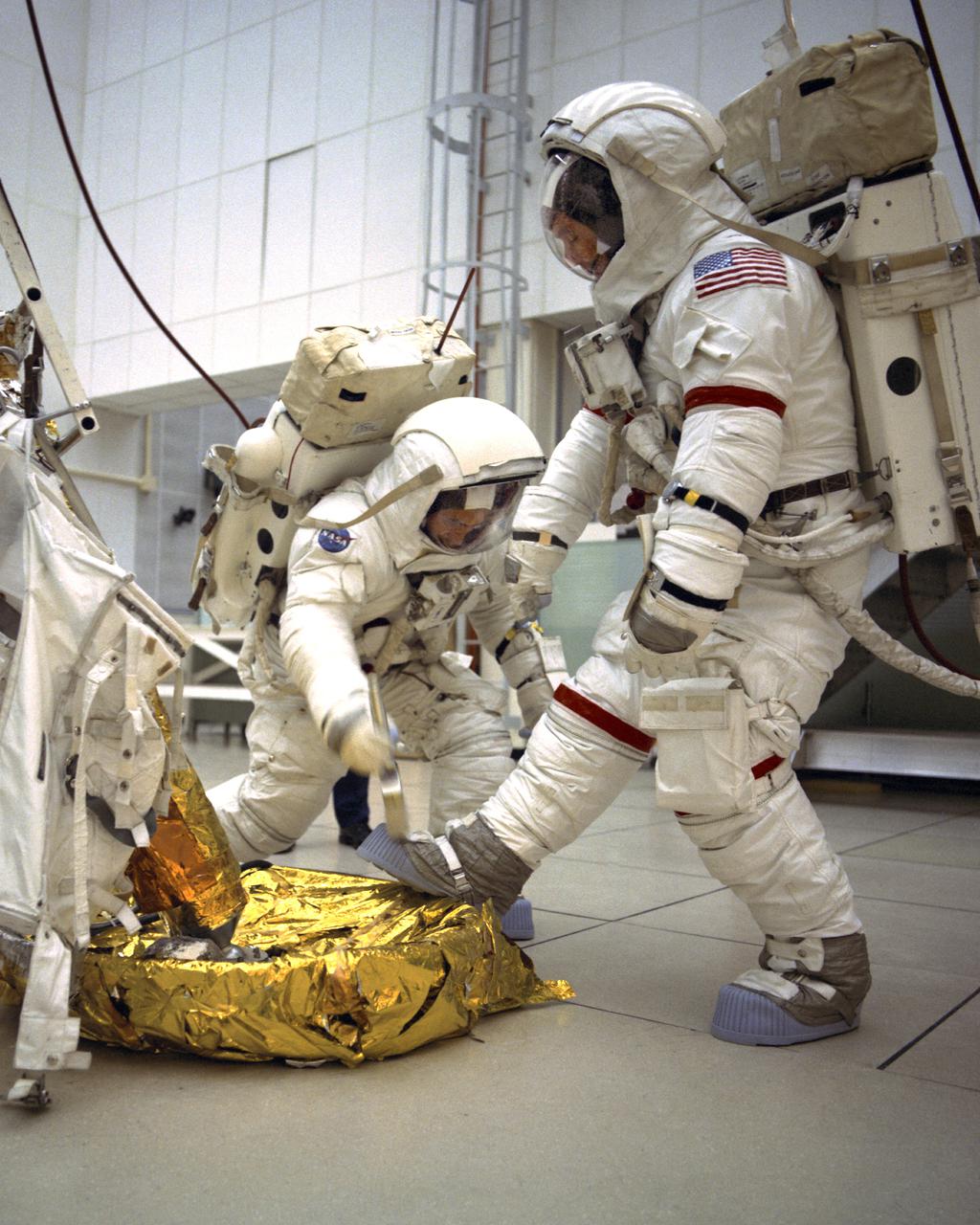
CAPE CANAVERAL, Fla. -- Apollo 17 Lunar Module Pilot Harrison H. Schmitt, left, brushes Mission Commander Eugene A. Cernan's spacesuit boot prior to entering the Lunar Module mock-up, at left, during lunar surface training exercise conducted at the Spaceport. This is the same procedure astronauts will follow on the Moon. Their Apollo 17 launch to the Moon's Taurus-Littrow region with Command Module Pilot Ronald E. Evans will take place no earlier than December 6, 1972. Photo credit: NASA
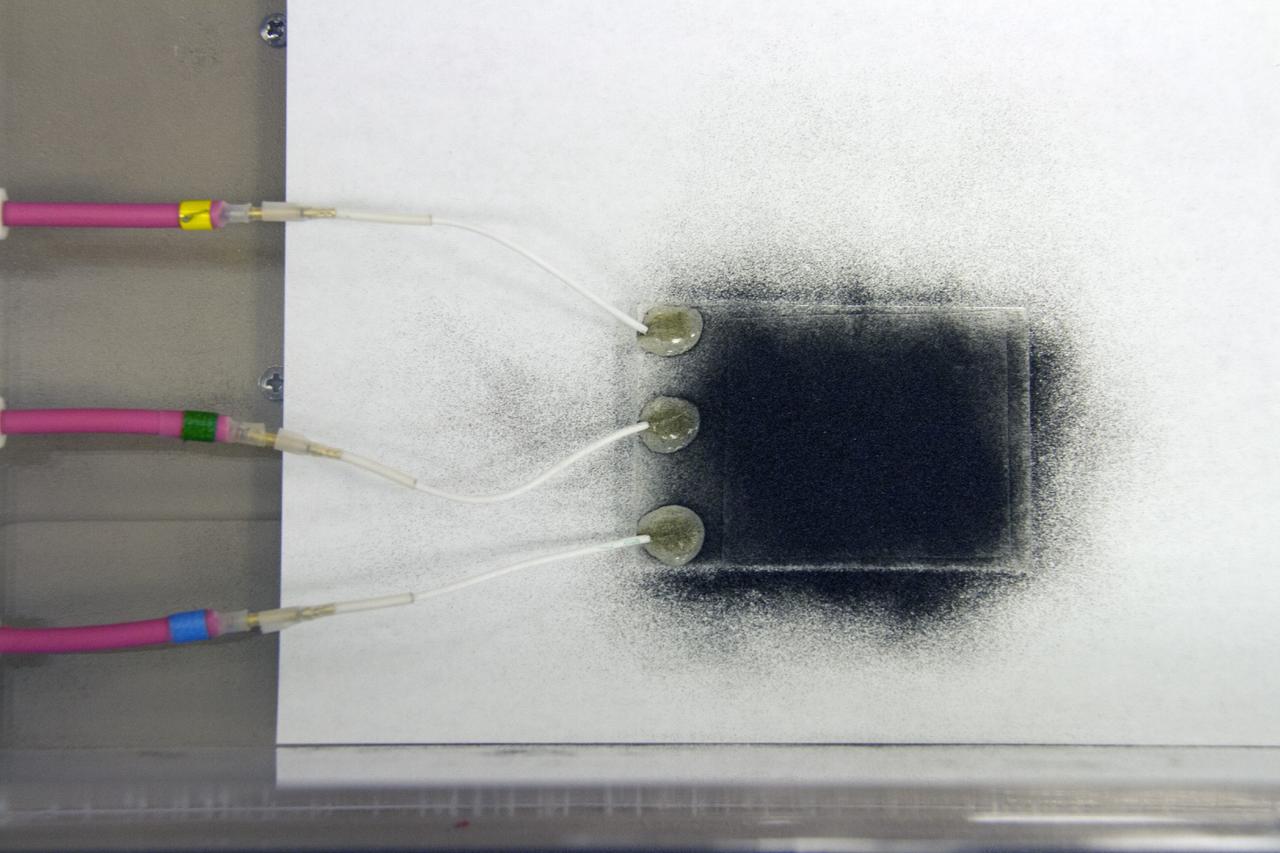
CAPE CANAVERAL, Fla. -- Dust particles are readied for an experiment for the Electrodynamic Dust Shield for Dust Mitigation project in the Electrostatics and Surface Physics Laboratory in the SwampWorks at NASA's Kennedy Space Center in Florida. The fabricated material is designed to mimic the dust on the lunar surface. The technology works by creating an electric field that propagates out like the ripples on a pond. This could prevent dust accumulation on spacesuits, thermal radiators, solar panels, optical instruments and view ports for future lunar and Mars exploration activities. CAPE CANAVERAL, Fla. -- Preparations are underway to conduct a dust particle experiment for the Electrodynamic Dust Shield for Dust Mitigation project in the Electrostatics and Surface Physics Laboratory in the SwampWorks at NASA's Kennedy Space Center in Florida. The technology works by creating an electric field that propagates out like the ripples on a pond. This could prevent dust accumulation on spacesuits, thermal radiators, solar panels, optical instruments and view ports for future lunar and Mars exploration activities.
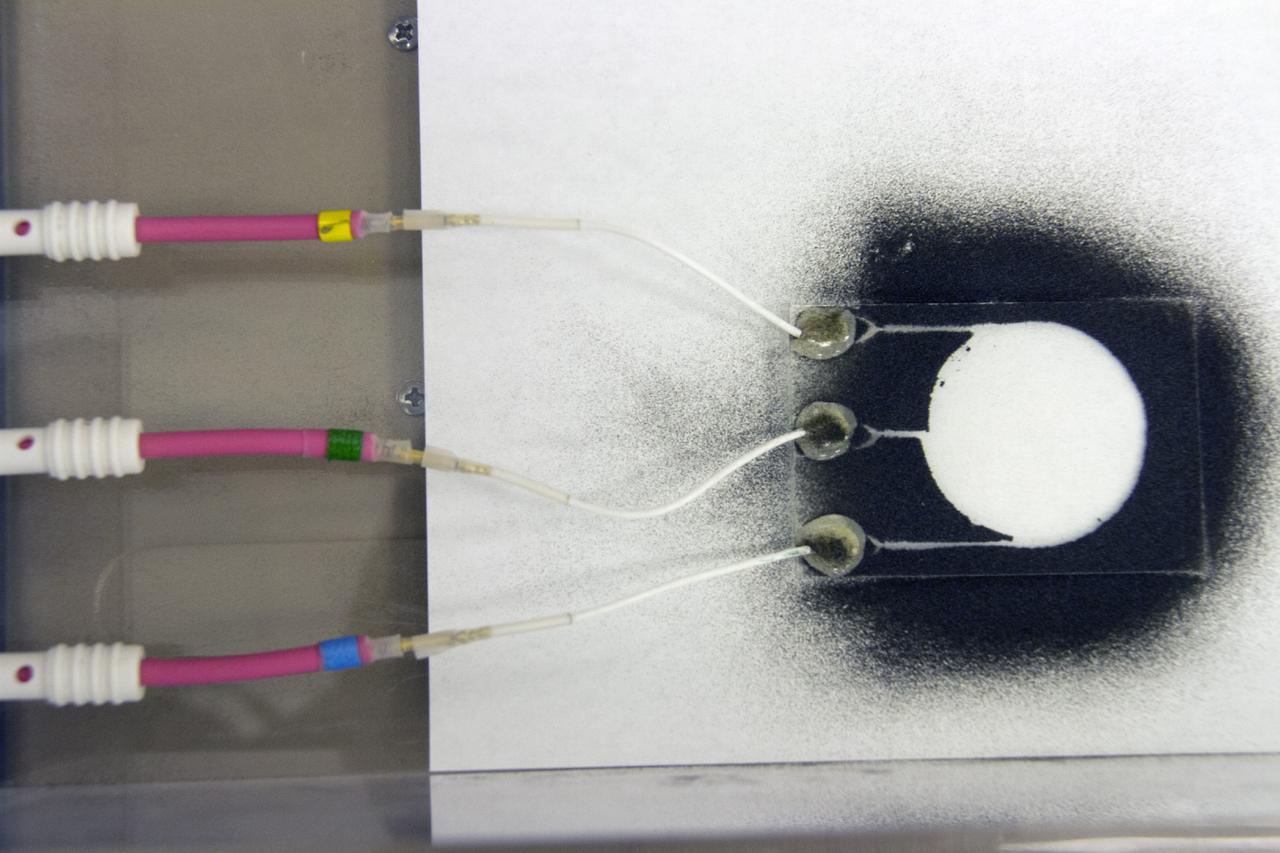
CAPE CANAVERAL, Fla. -- Dust particles scatter during an experiment for the Electrodynamic Dust Shield for Dust Mitigation project in the Electrostatics and Surface Physics Laboratory in the SwampWorks at NASA's Kennedy Space Center in Florida. The fabricated material is designed to mimic the dust on the lunar surface. The technology works by creating an electric field that propagates out like the ripples on a pond. This could prevent dust accumulation on spacesuits, thermal radiators, solar panels, optical instruments and view ports for future lunar and Mars exploration activities. CAPE CANAVERAL, Fla. -- Preparations are underway to conduct a dust particle experiment for the Electrodynamic Dust Shield for Dust Mitigation project in the Electrostatics and Surface Physics Laboratory in the SwampWorks at NASA's Kennedy Space Center in Florida. The technology works by creating an electric field that propagates out like the ripples on a pond. This could prevent dust accumulation on spacesuits, thermal radiators, solar panels, optical instruments and view ports for future lunar and Mars exploration activities.
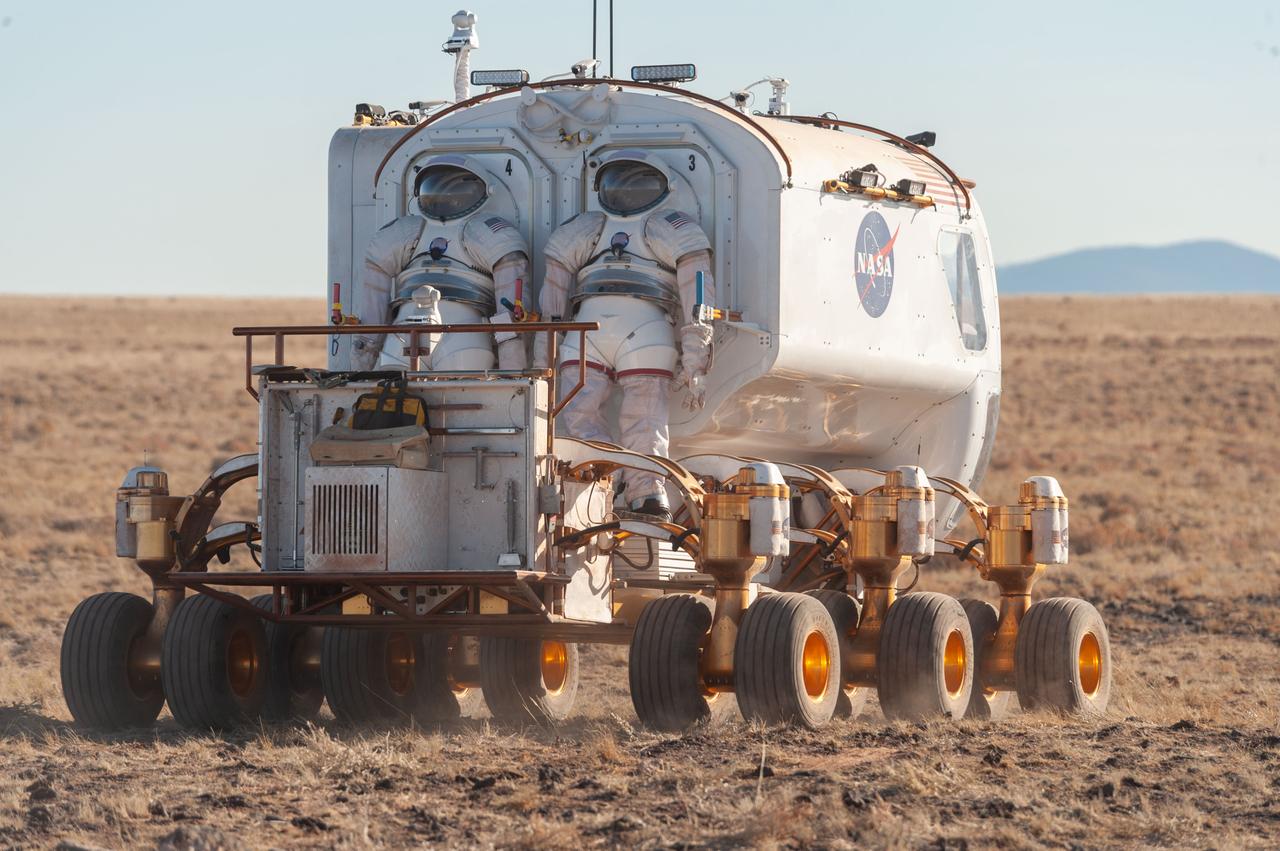
A back view of the Lunar Electric Rover (LER) during the Desert Research and Technology Studies (RATS) remote field test at Black Point Lava Flow, Arizona in 2008. Two Mark III spacesuits are visibly mounted on the LER suit port.
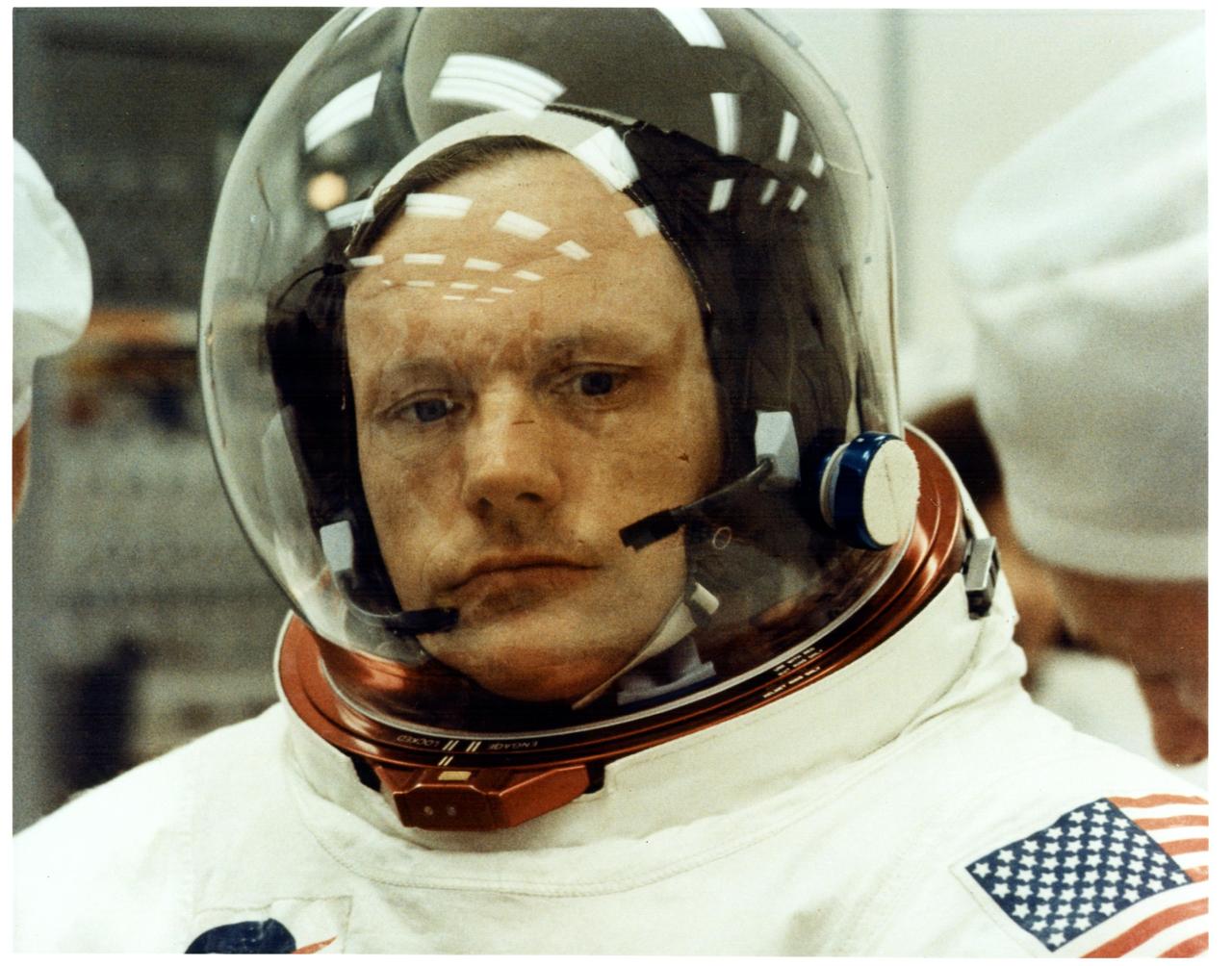
KENNEDY SPACE CENTER, FLA. - Technicians make the final adjustments to Apollo 11 Commander Neil A. Armstrong's spacesuit as he prepares to take part in a space vehicle Countdown Demonstration Test (CDDT). Astronauts Armstrong, Aldrin and Collins are practicing for ther mission, the first manned Lunar landing.
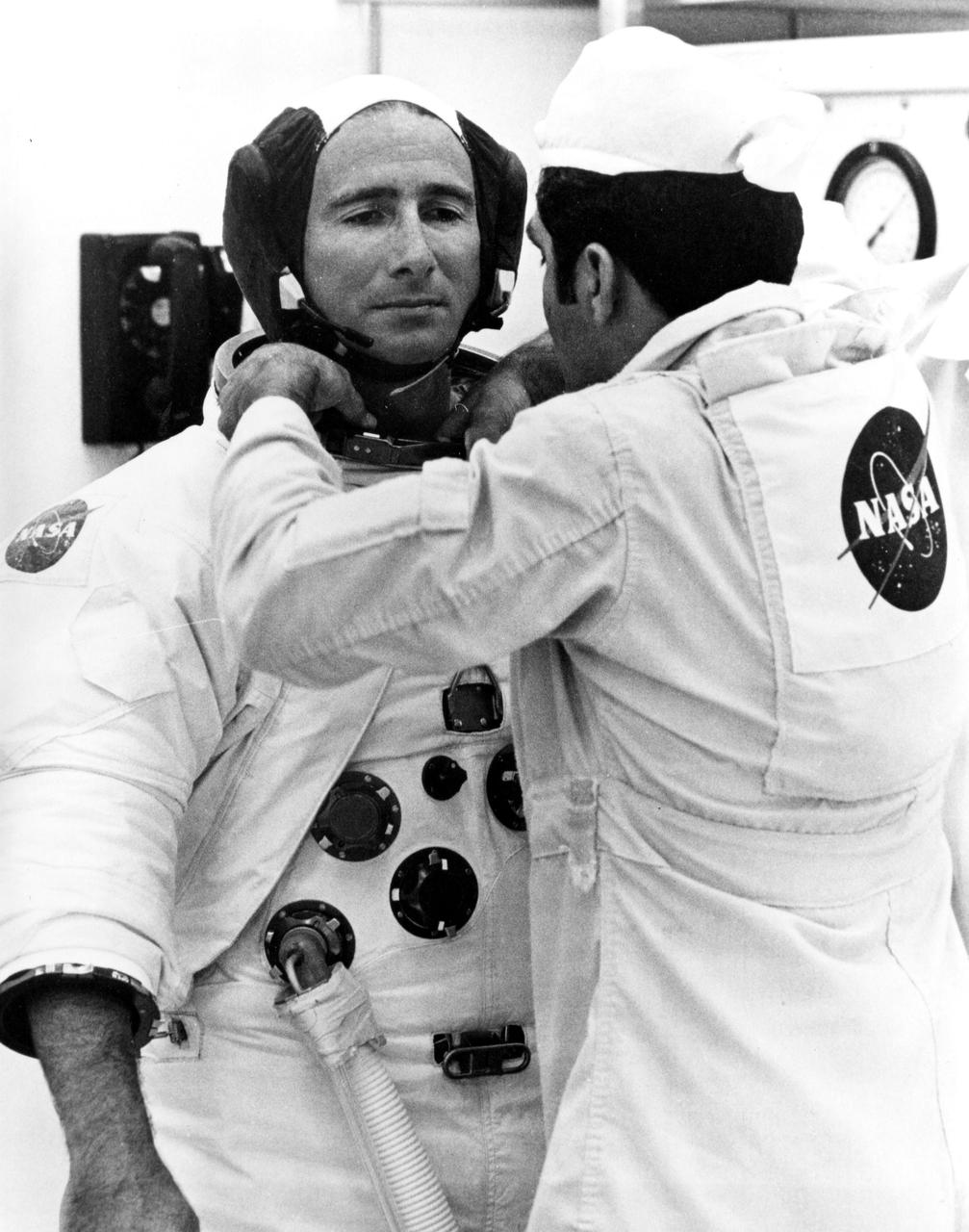
KENNEDY SPACE CENTER, FLA. -- A technician adjusts the spacesuit of Apollo 15 Lunar Module Pilot James B. Irwin prior to his launch to the Moon today with astronauts David R. Scott and Alfred N. Worden. The National Aeronautics and Space Administration directs the Apollo program.
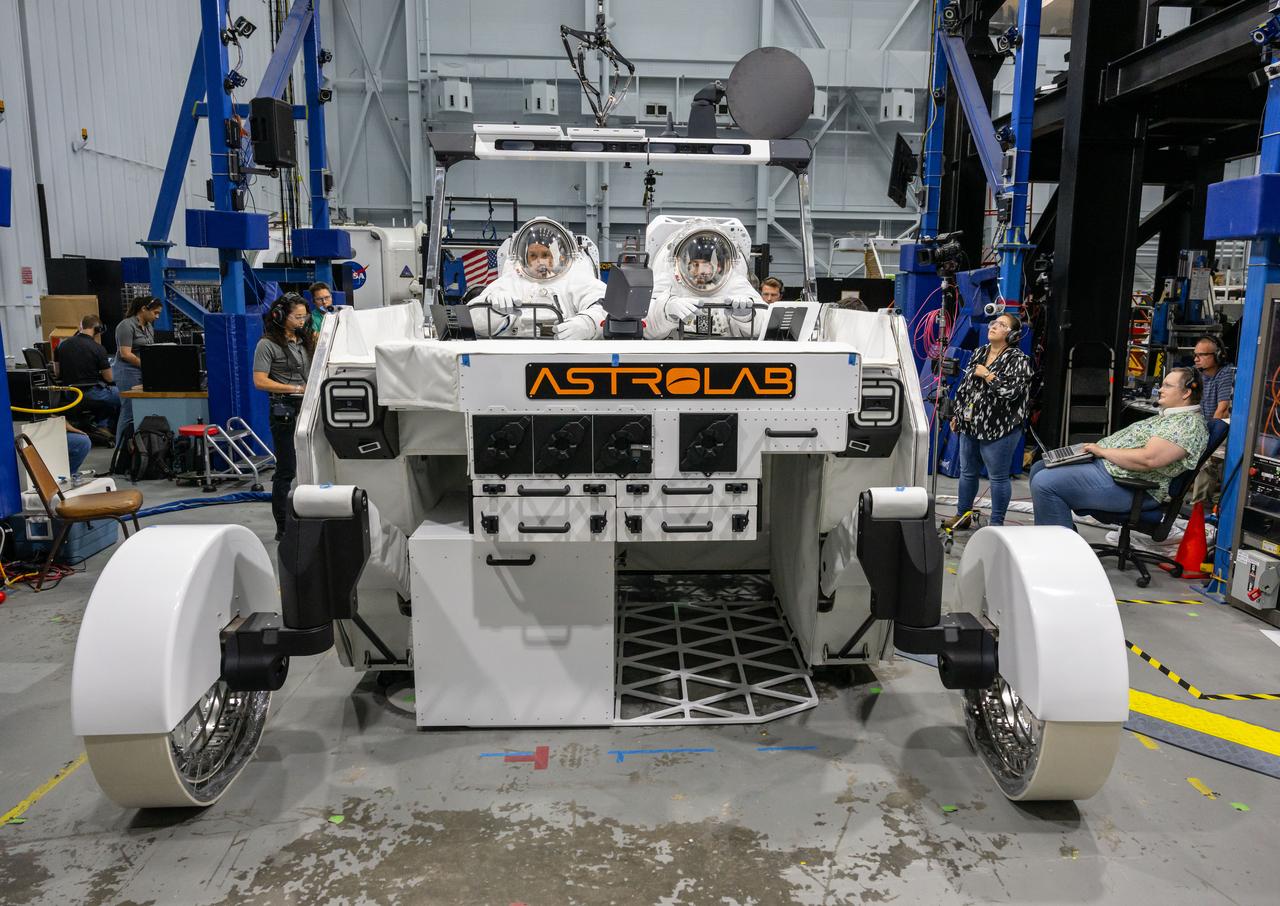
NASA astronaut Frank Rubio (left) and NASA spacesuit engineer Zach Tejral (right) sit inside Astrolab’s FLEX lunar terrain vehicle evaluating the display interfaces during testing at NASA’s Johnson Space Center. Image Credit: NASA/James Blair

KENNEDY SPACE CENTER, FLA. - Spacesuit technician Clyde Teague adjusts the gloves on Apollo 7 Commander Walter M. Schirra Jr., during suiting operations. Astronaut Schirra, along with Command Module Pilot Donn F. Eisele, and Lunar Module Pilot Walter Cunningham, after being suited up, will depart for Launch Pad 34 and board their Saturn 1B rocket for the first manned lunar orbital mission. .
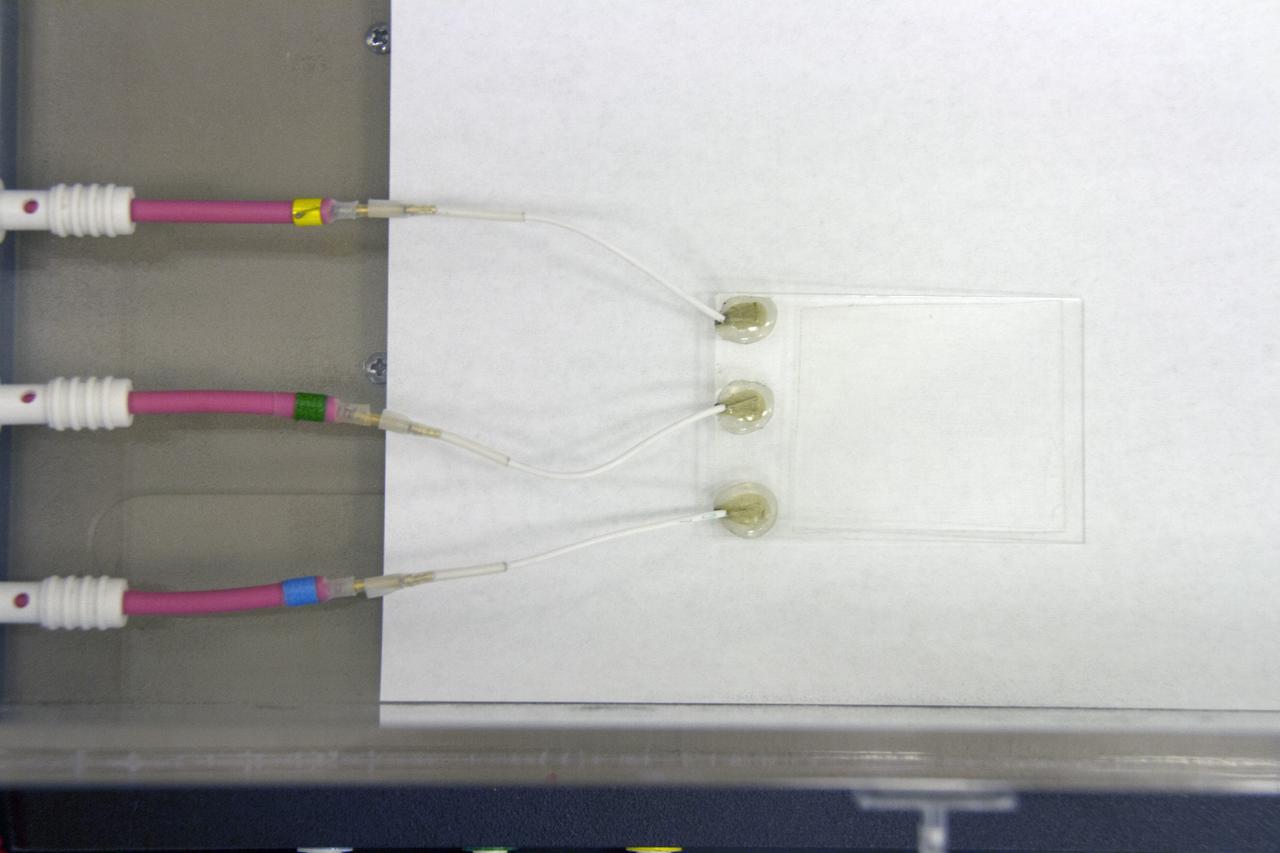
CAPE CANAVERAL, Fla. -- Preparations are underway to conduct a dust particle experiment for the Electrodynamic Dust Shield for Dust Mitigation project in the Electrostatics and Surface Physics Laboratory in the SwampWorks at NASA's Kennedy Space Center in Florida. The technology works by creating an electric field that propagates out like the ripples on a pond. This could prevent dust accumulation on spacesuits, thermal radiators, solar panels, optical instruments and view ports for future lunar and Mars exploration activities. CAPE CANAVERAL, Fla. -- Preparations are underway to conduct a dust particle experiment for the Electrodynamic Dust Shield for Dust Mitigation project in the Electrostatics and Surface Physics Laboratory in the SwampWorks at NASA's Kennedy Space Center in Florida. The technology works by creating an electric field that propagates out like the ripples on a pond. This could prevent dust accumulation on spacesuits, thermal radiators, solar panels, optical instruments and view ports for future lunar and Mars exploration activities.
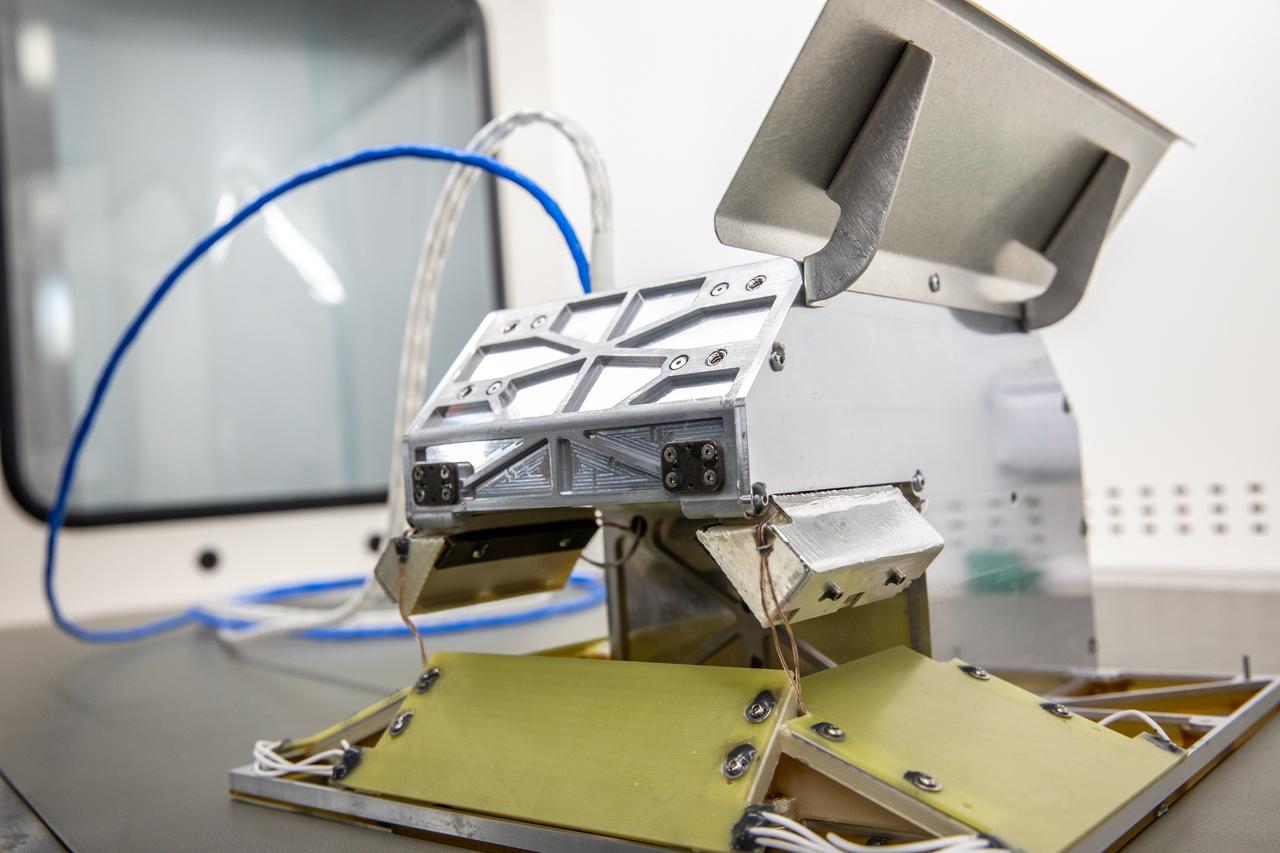
Inside of the Electrostatics and Surface Physics Laboratory at NASA’s Kennedy Space Center in Florida, an electrodynamic dust shield (EDS) is in view on Jan. 18, 2023. The dust shield is one of the payloads that will fly aboard Firefly Aerospace’s Blue Ghost lunar lander as part of NASA’s Commercial Lunar Payload Services (CLPS) initiative. During the mission, EDS will generate a non-uniform electric field using varying high voltage on multiple electrodes. This traveling field, in turn, carries away the particles and has potential applications in thermal radiators, spacesuit fabrics, visors, camera lenses, solar panels, and many other technologies. The CLPS initiative is a key part of NASA’s Artemis lunar exploration efforts. The science and technology payloads sent to the Moon’s surface as part of the initiative will help lay the foundation for human missions and a sustainable human presence on the lunar surface.
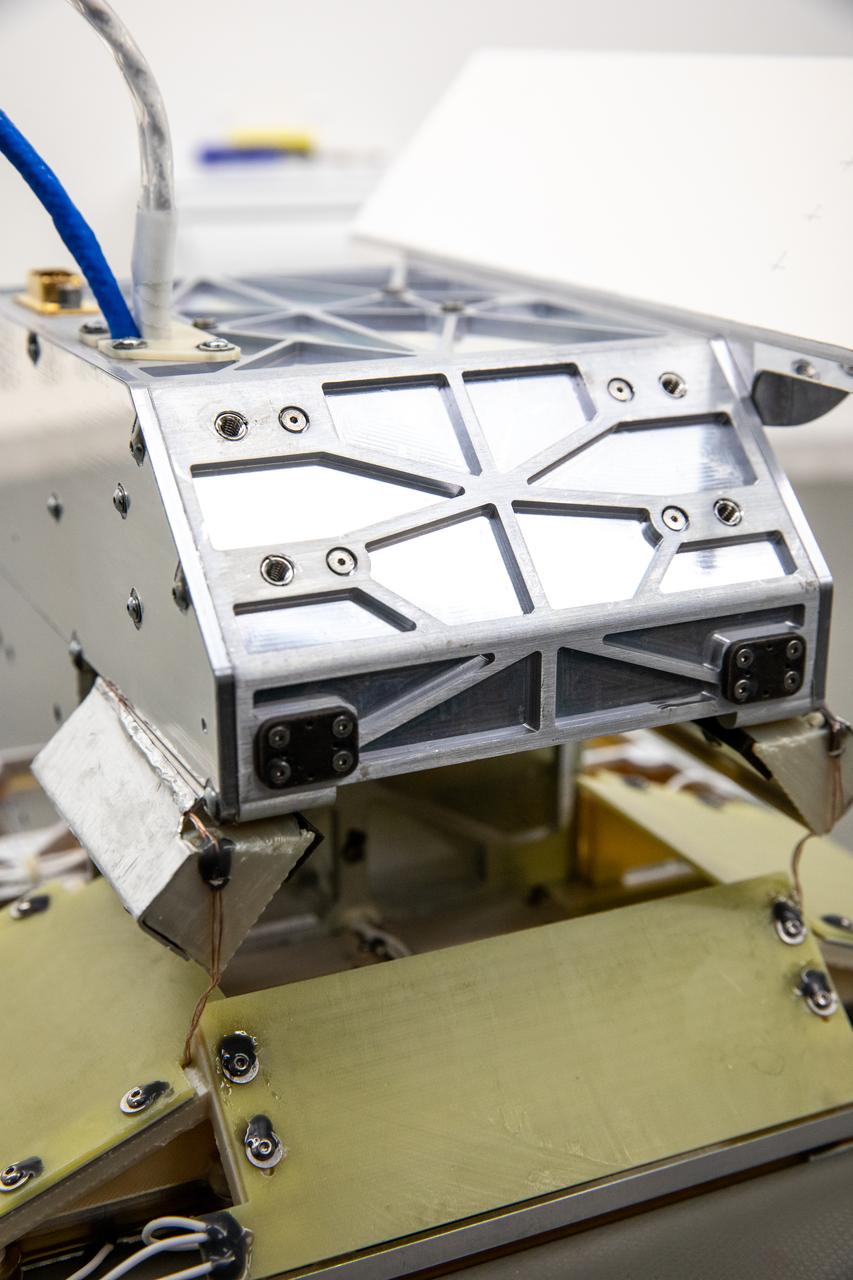
Inside of the Electrostatics and Surface Physics Laboratory at NASA’s Kennedy Space Center in Florida, an electrodynamic dust shield (EDS) is in view on Jan. 18, 2023. The dust shield is one of the payloads that will fly aboard Firefly Aerospace’s Blue Ghost lunar lander as part of NASA’s Commercial Lunar Payload Services (CLPS) initiative. During the mission, EDS will generate a non-uniform electric field using varying high voltage on multiple electrodes. This traveling field, in turn, carries away the particles and has potential applications in thermal radiators, spacesuit fabrics, visors, camera lenses, solar panels, and many other technologies. The CLPS initiative is a key part of NASA’s Artemis lunar exploration efforts. The science and technology payloads sent to the Moon’s surface as part of the initiative will help lay the foundation for human missions and a sustainable human presence on the lunar surface.
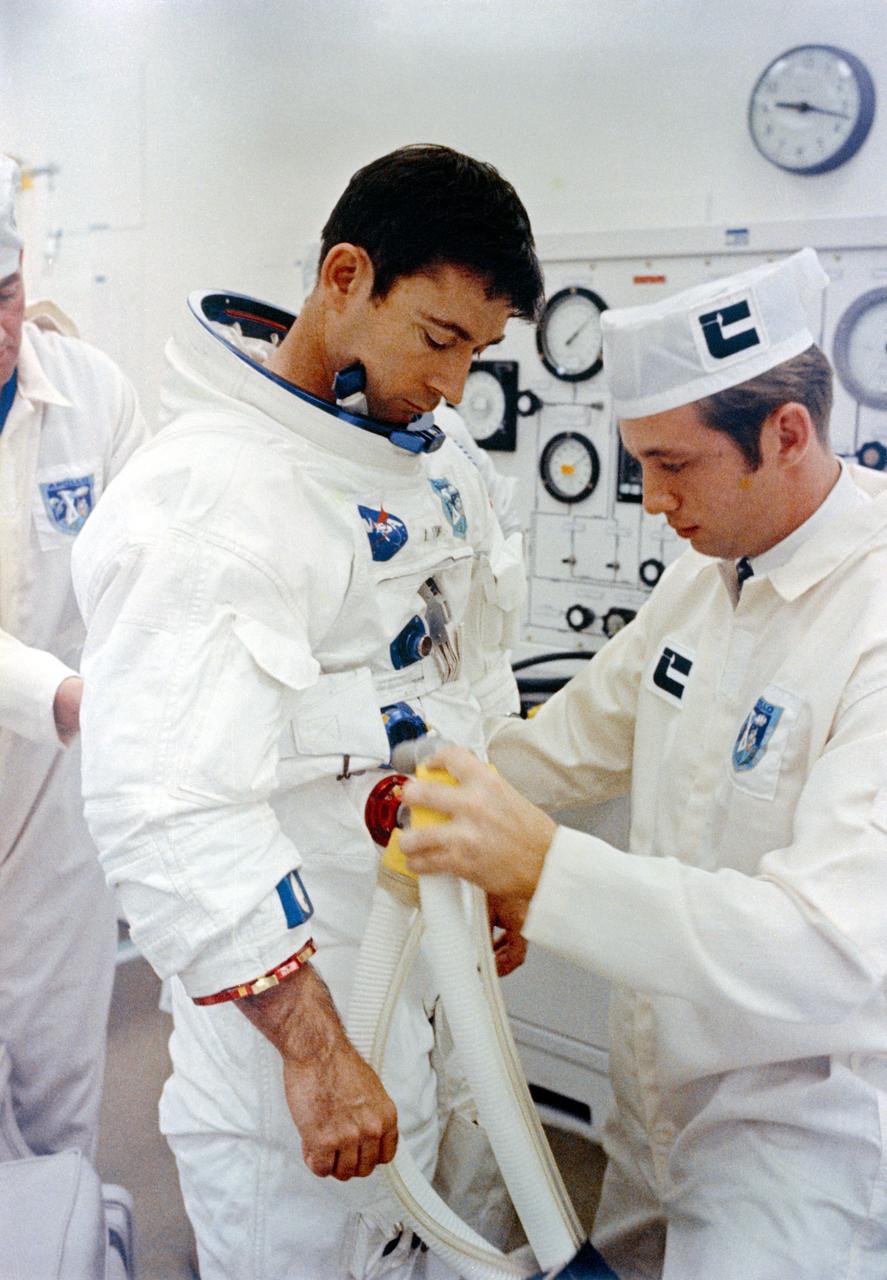
S69-34483 (18 May 1969) --- A technician attaches hose from test stand to spacesuit of astronaut John W. Young, Apollo 10 command module pilot, during final suiting operations for the Apollo 10 lunar orbit mission. Another technician makes adjustment behind Young. Minutes later astronauts Young; Thomas P. Stafford, commander; and Eugene A. Cernan, lunar module pilot, rode a transfer van from the Kennedy Space Center's Manned Spacecraft Operations Building over to Pad B, Launch Complex 39, where their spacecraft awaited them. Liftoff was at 12:49 p.m. (EDT), May 18, 1969.
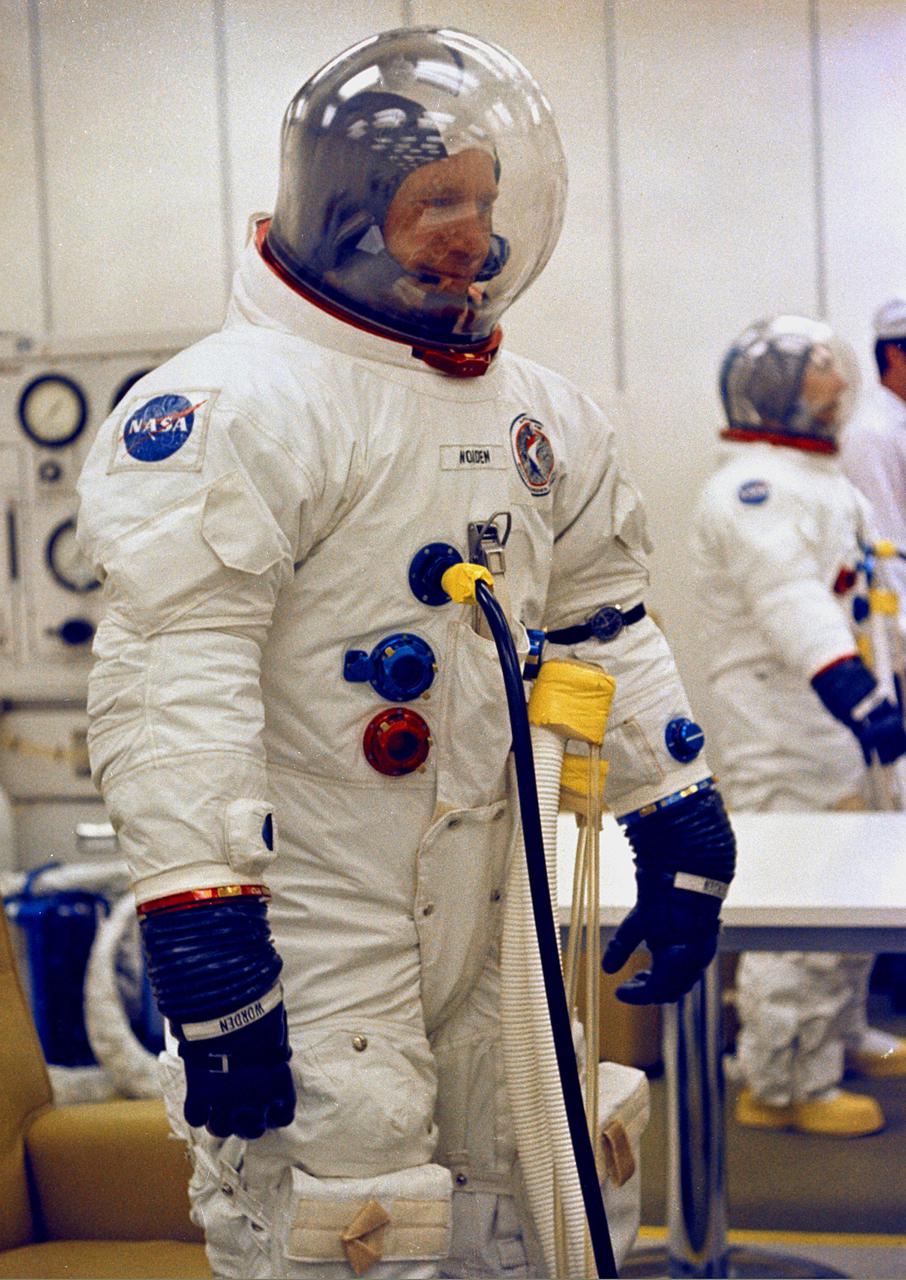
KENNEDY SPACE CENTER, FLA. - Apollo 15 Command Module Pilot Alfred M. Worden undergoes spacesuit pressure checks prior to participating in the space vehicle Countdown Demonstration Test. Lunar Module Pilot James B. Irwin is visible in the rear while David R. Scott, the Commander for Apollo 15, is not shown. The test is a rehearsal in preparation for the scheduled Moon mission, scheduled no earlier than July 26, 1971.
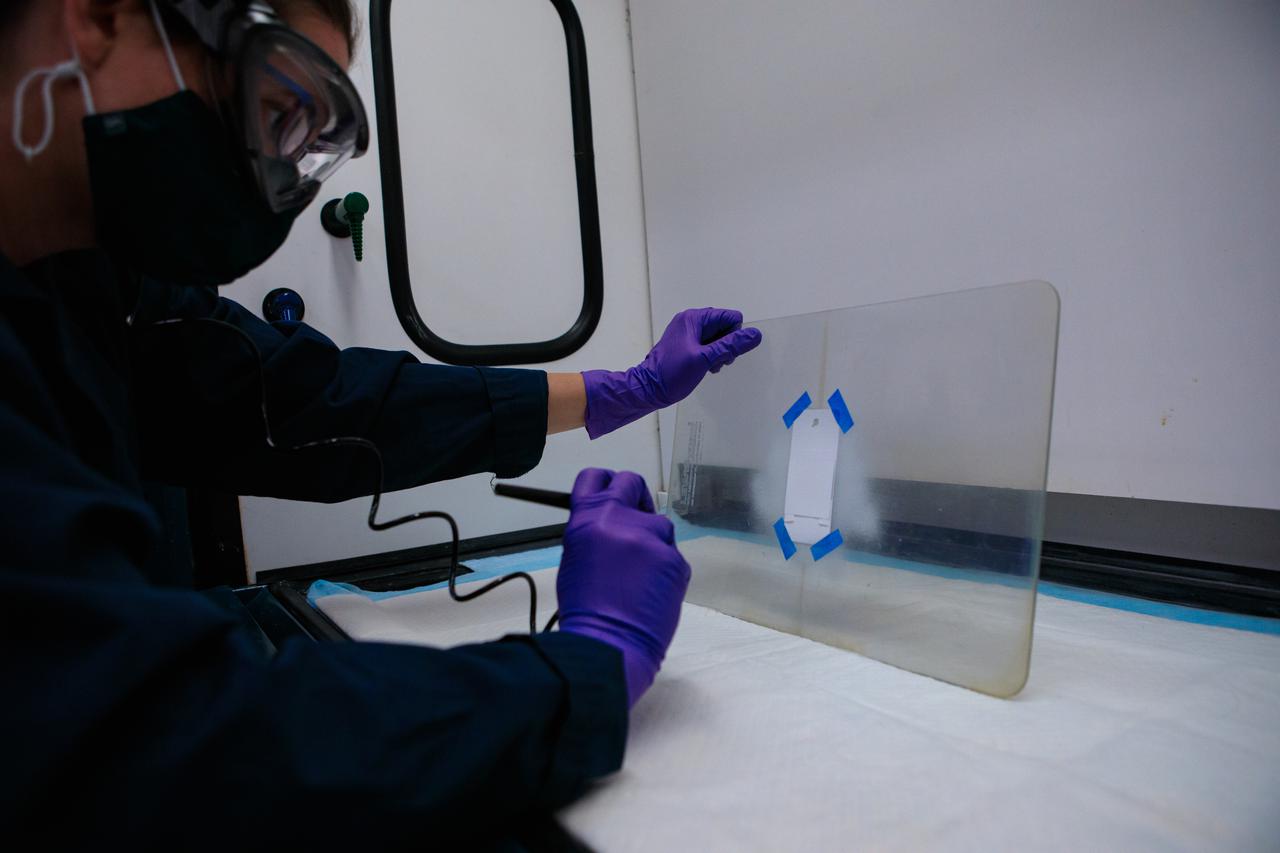
Inside a laboratory at the Neil Armstrong Operations and Checkout Building at NASA’s Kennedy Space Center in Florida, research scientist Sarah Snyder applies a selective surface coating to an Electrodynamic Dust Shield (EDS) on March 31, 2021. This is one of several concurrent activities preparing dust shield samples for testing in space. Dust mitigation technologies could one day be applied to diminish dust hazards on lunar surface systems such as cameras, solar panels, spacesuits, and instrumentation, enabling sustainable exploration of the Moon under the Artemis program.
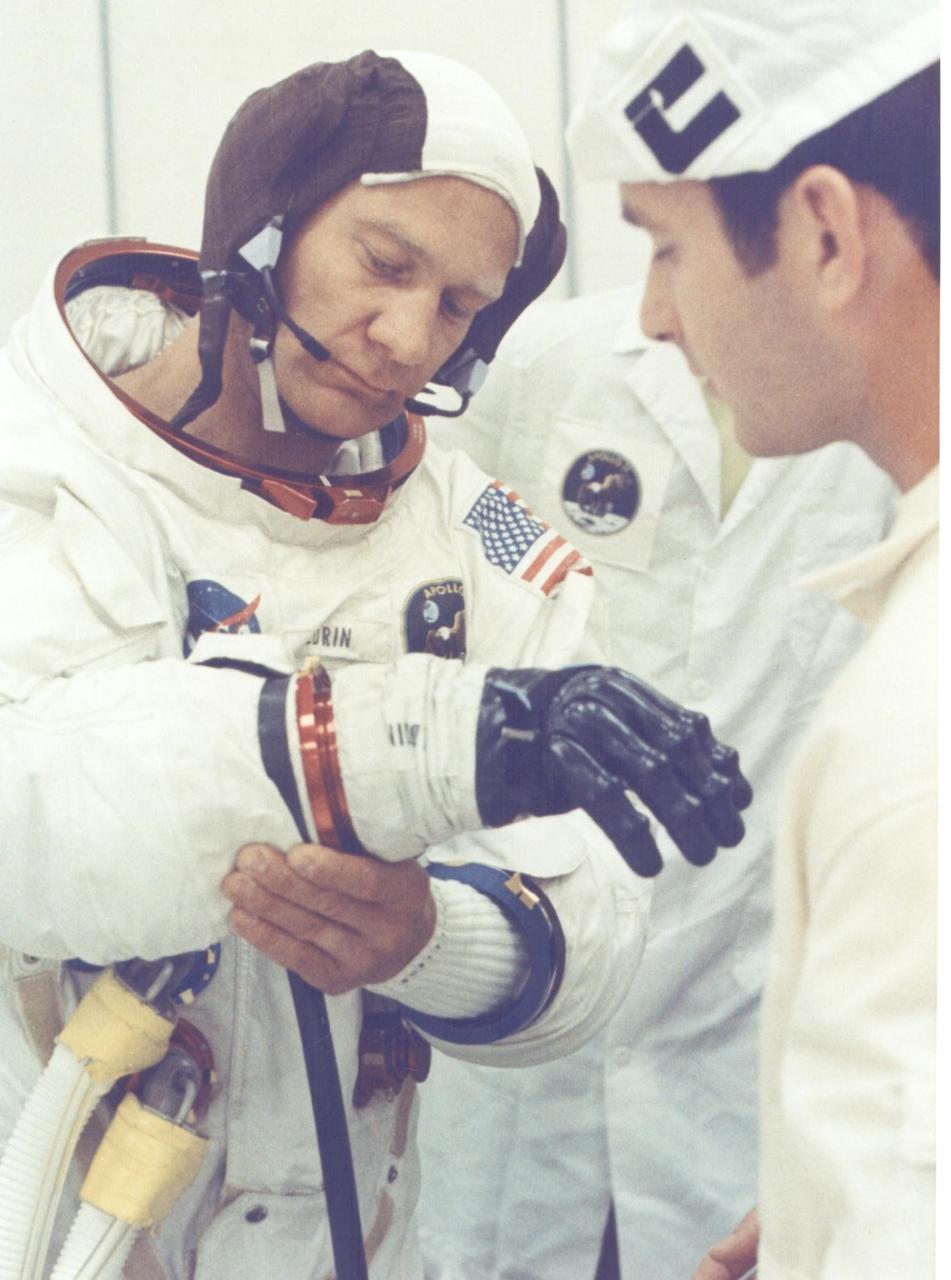
KENNEDY SPACE CENTER, FLA. - Apollo 11 astronaut Edwin E. Aldrin Jr. is being assisted by a spacesuit technician during suiting operations in the Manned Spacecraft Operations Building prior to the astronauts' departure to Launch Pad 39A. The three astronauts, Edwin E. Aldrin Jr., Neil A Armstrong and Michael Collins, will then board the Saturn V launch vehicle, scheduled for a 9:32 a.m. EDT liftoff for the first manned lunar landing mission.
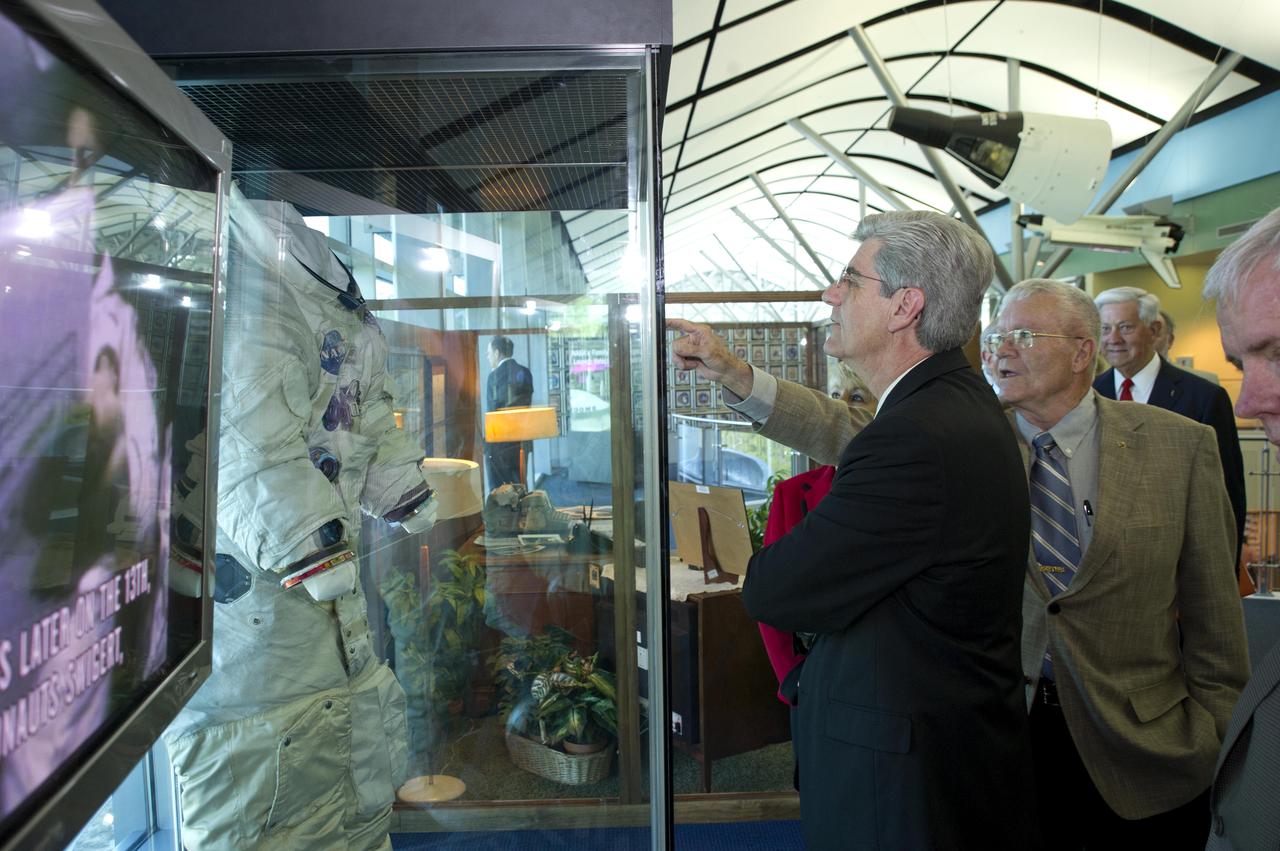
Mississippi Gov. Phil Bryant looks on as Apollo 13 astronaut and INFINITY Science Center Inc. Vice Chairman Fred Haise points out features of the spacesuit he wore on his lunar mission in 1970. The suit is on display at the INFINITY at NASA Stennis Space Center visitor center and museum. The two men toured the facility during ribbon-cutting activities April 11, 2012.
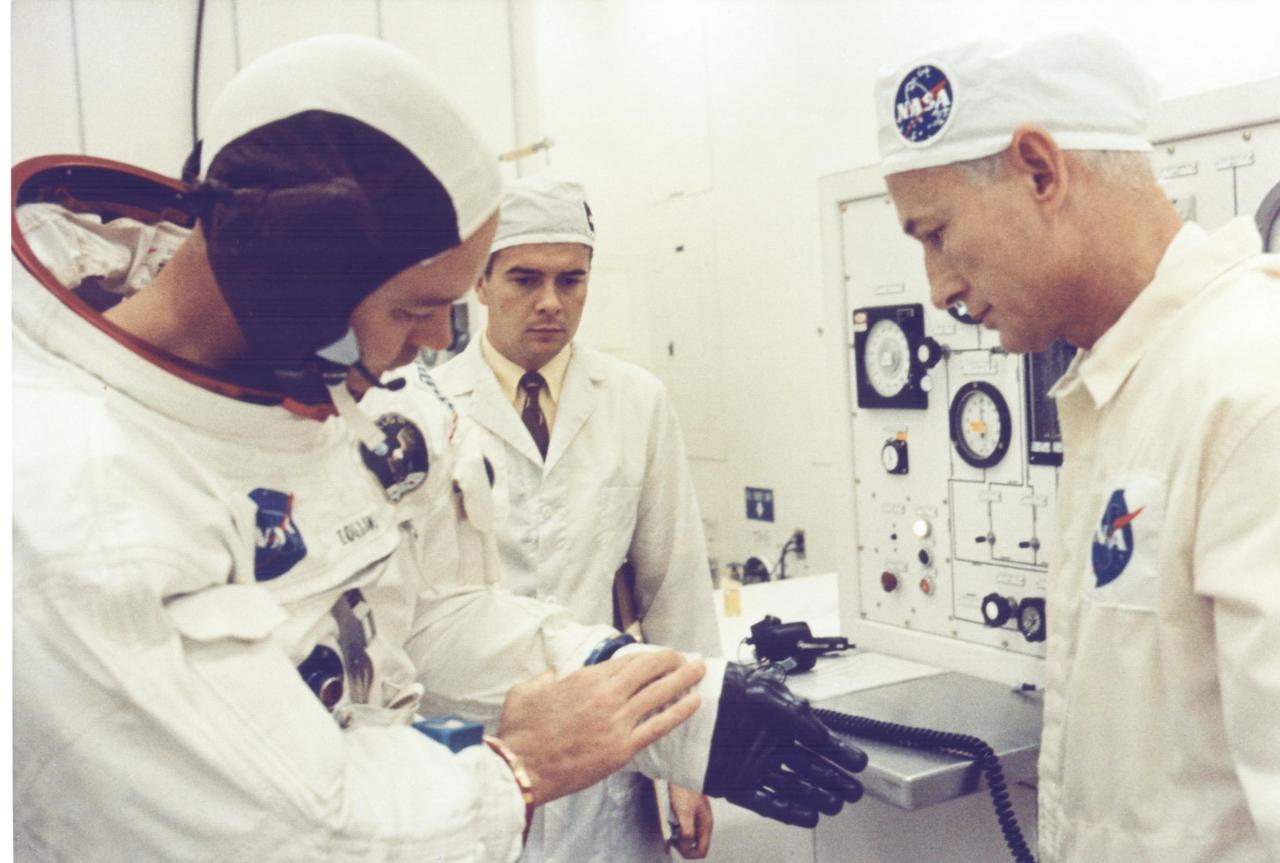
KENNEDY SPACE CENTER, FLA. - Apollo 11 Command Module Pilot Michael Collins appears to be explaining a point about his spacesuit glove to technician Joe Schmitt during suiting operations in the Manned Spacecraft Operations Building prior to the astronauts' departure to Launch Pad 39A. The three astronauts, Edwin E. Aldrin Jr., Neil A. Armstrong and Michael Collins will then board the Saturn V launch vehicle, scheduled for a 9:32 a.m. EDT liftoff for the first manned lunar landing.
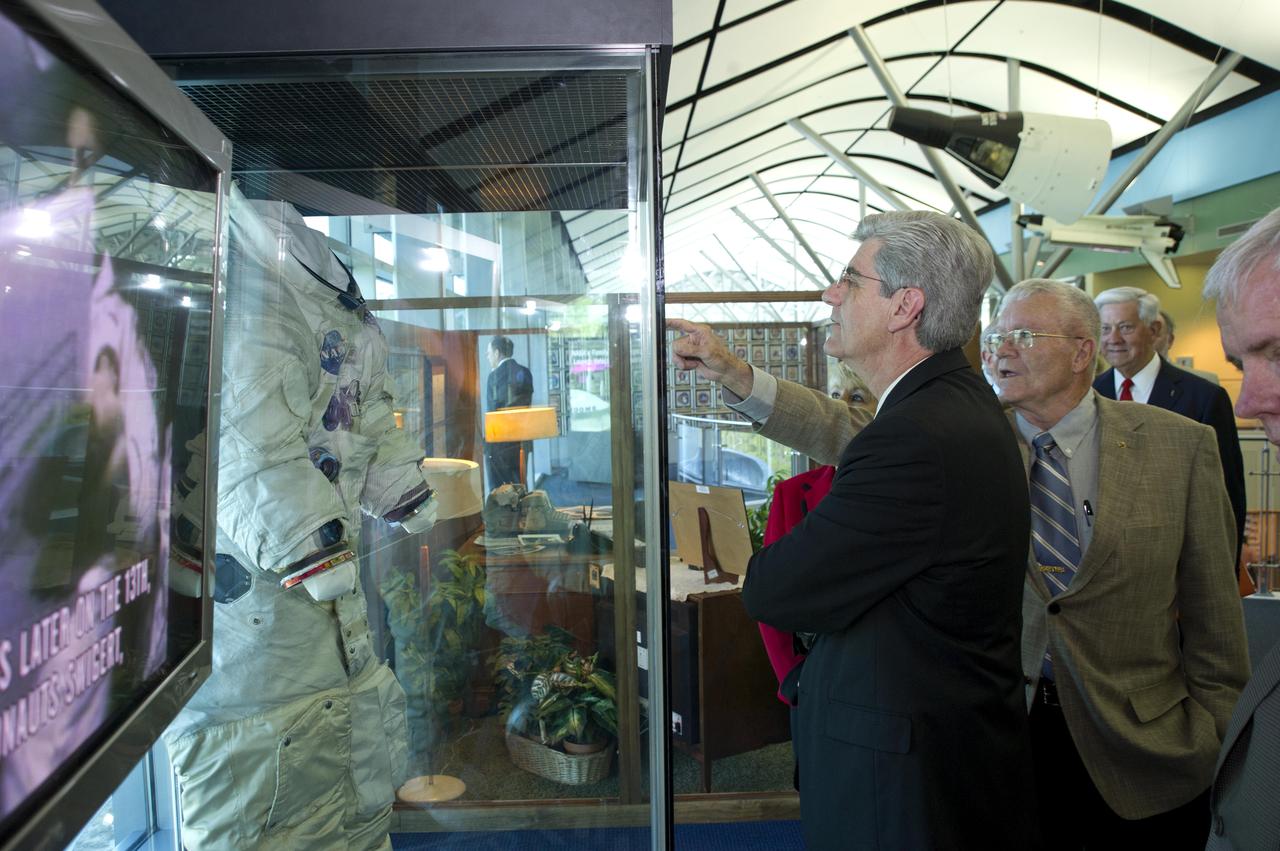
Mississippi Gov. Phil Bryant looks on as Apollo 13 astronaut and INFINITY Science Center Inc. Vice Chairman Fred Haise points out features of the spacesuit he wore on his lunar mission in 1970. The suit is on display at the INFINITY at NASA Stennis Space Center visitor center and museum. The two men toured the facility during ribbon-cutting activities April 11, 2012.
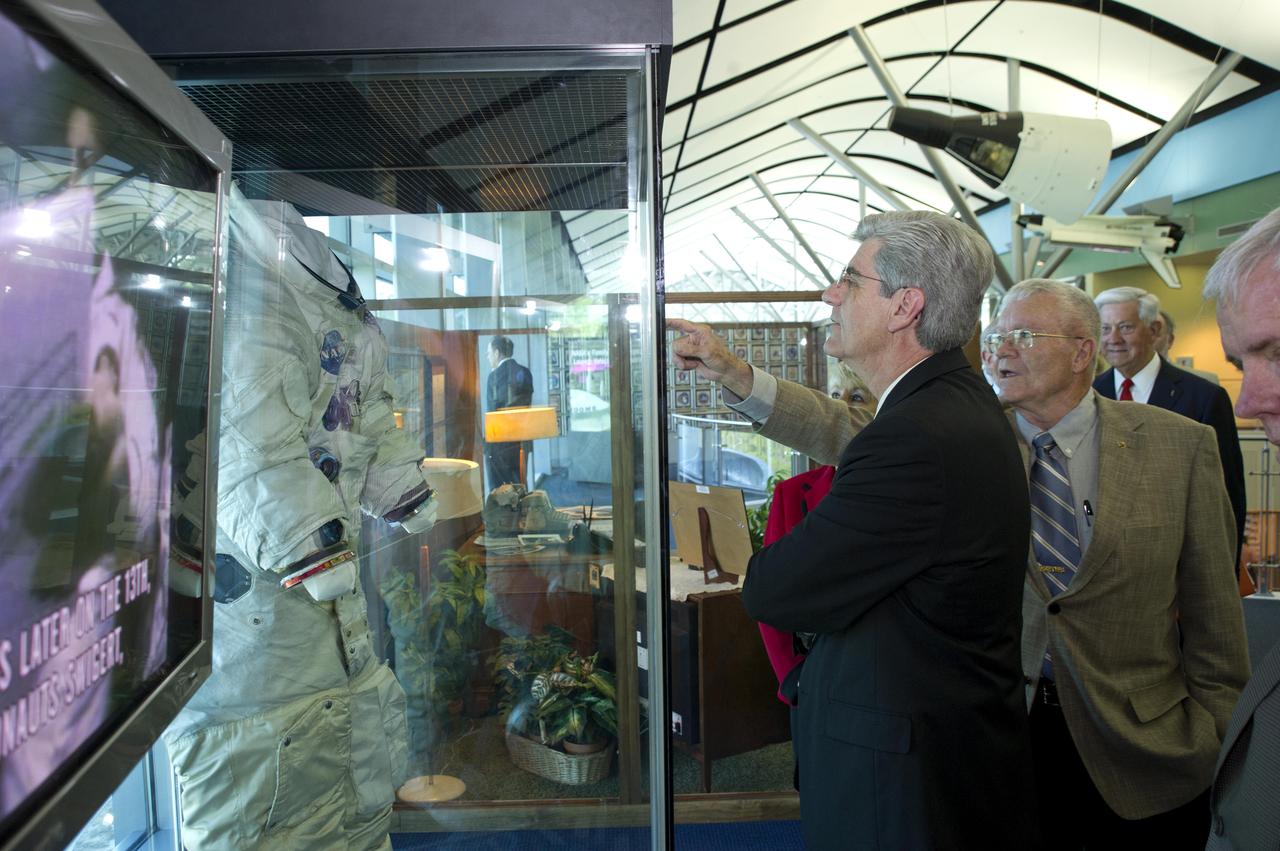
Mississippi Gov. Phil Bryant looks on as Apollo 13 astronaut and INFINITY Science Center Inc. Vice Chairman Fred Haise points out features of the spacesuit he wore on his lunar mission in 1970. The suit is on display at the INFINITY at NASA Stennis Space Center visitor center and museum. The two men toured the facility during ribbon-cutting activities April 11, 2012.
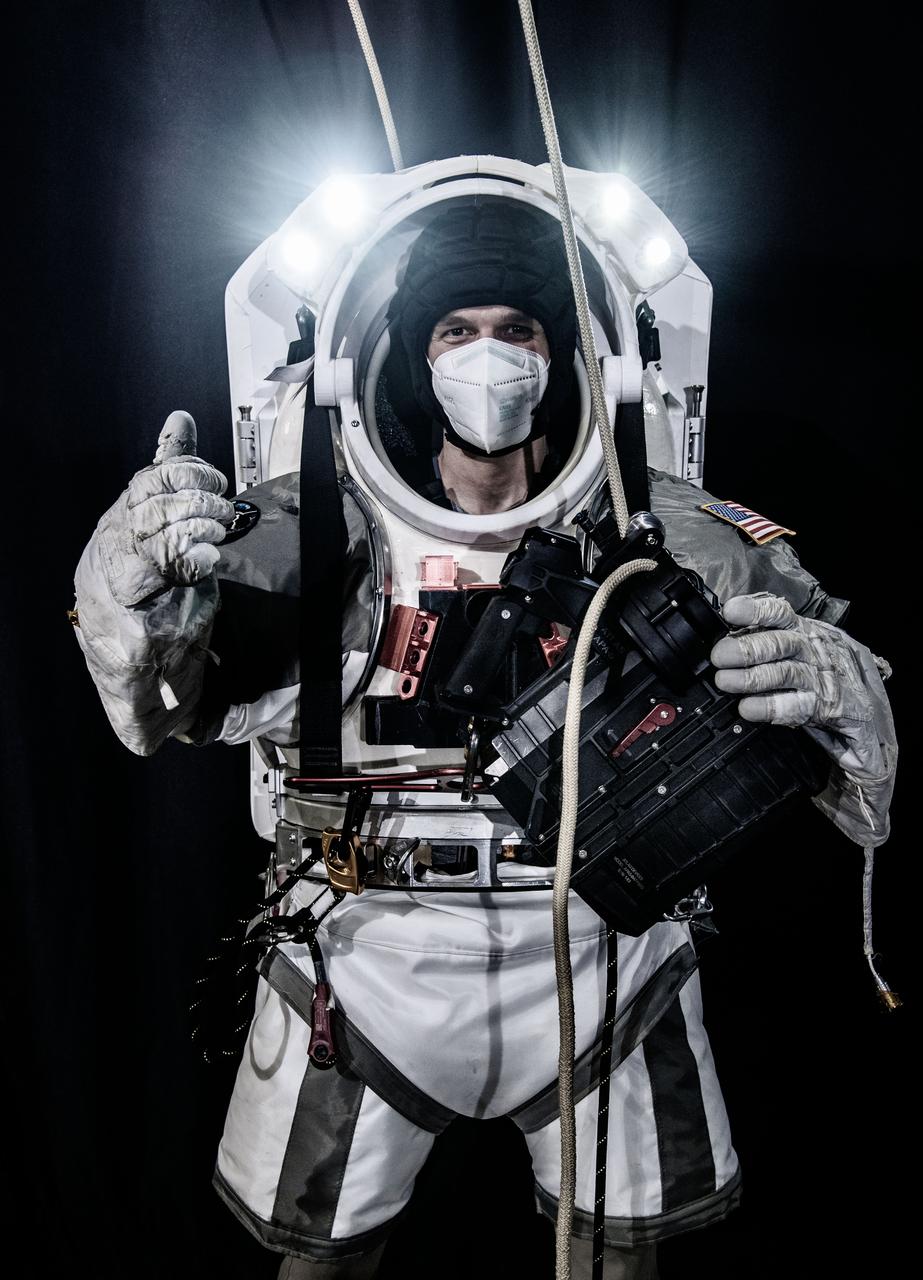
Nate Ball of Atlas Devices prepares to test an APA-5 powered rope ascender with the Exploration Conop (EXCON) Suit, a new xEMU spacesuit simulator. Atlas uses this device in terrestrial applications of powered ascenders including rescue and vertical mobility. This photo was taken when NASA began researching if these capabilities may have analogous applications for lunar surface operations. Photo Date: April 29, 2021. Location: Building 49 High Bay. Photographer: Robert Markowitz
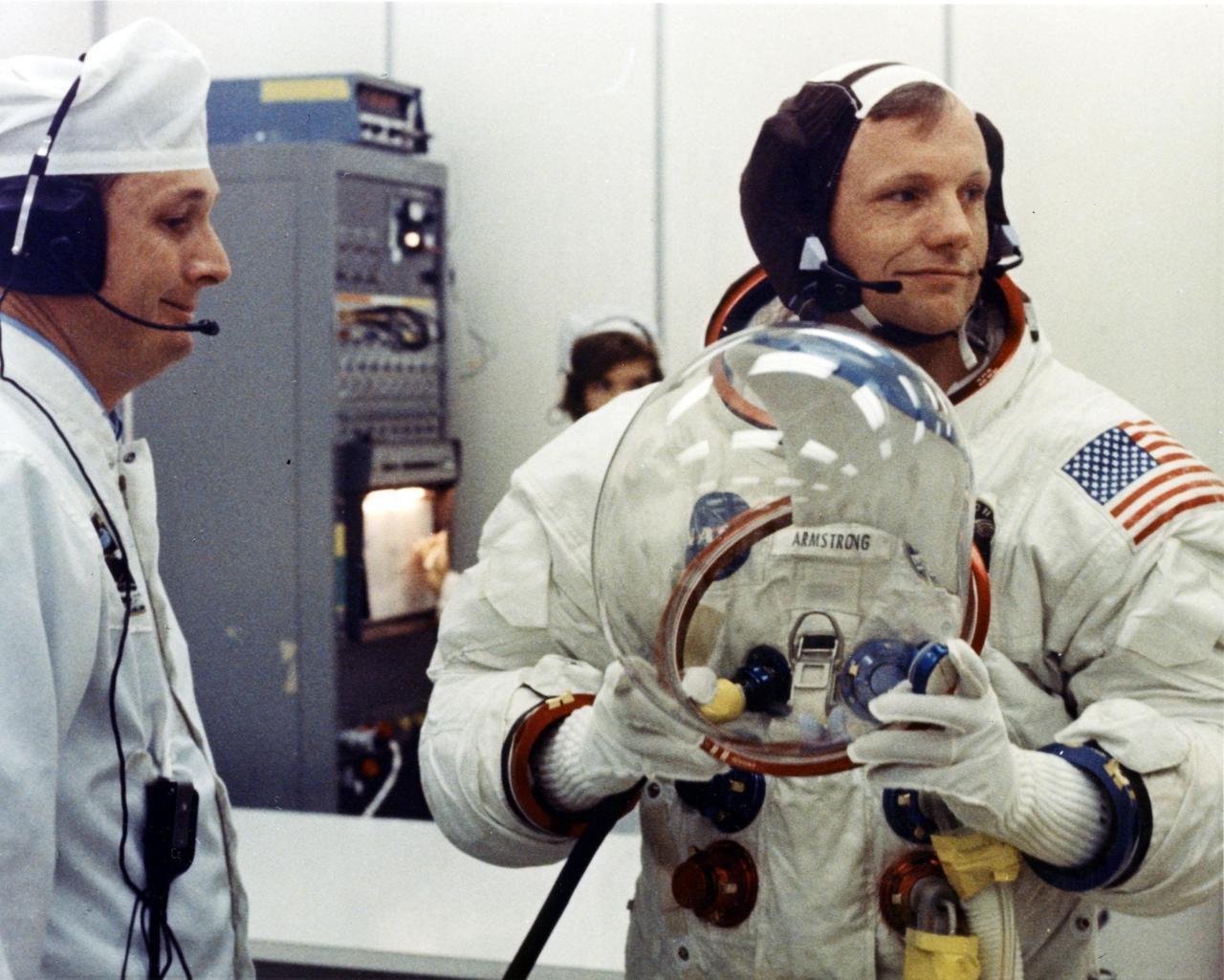
Apollo 11 Commander Neil Armstrong prepares to put on his helmet with the assistance of a spacesuit technician during suiting operations in the Manned Spacecraft Operations Building (MSOB) prior to the astronauts' departure to Launch Pad 39A. The three astronauts, Edwin E. Aldrin Jr., Neil A Armstrong and Michael Collins, will then board the Saturn V launch vehicle, scheduled for a 9:32 a.m. EDT liftoff, for the first manned lunar landing mission
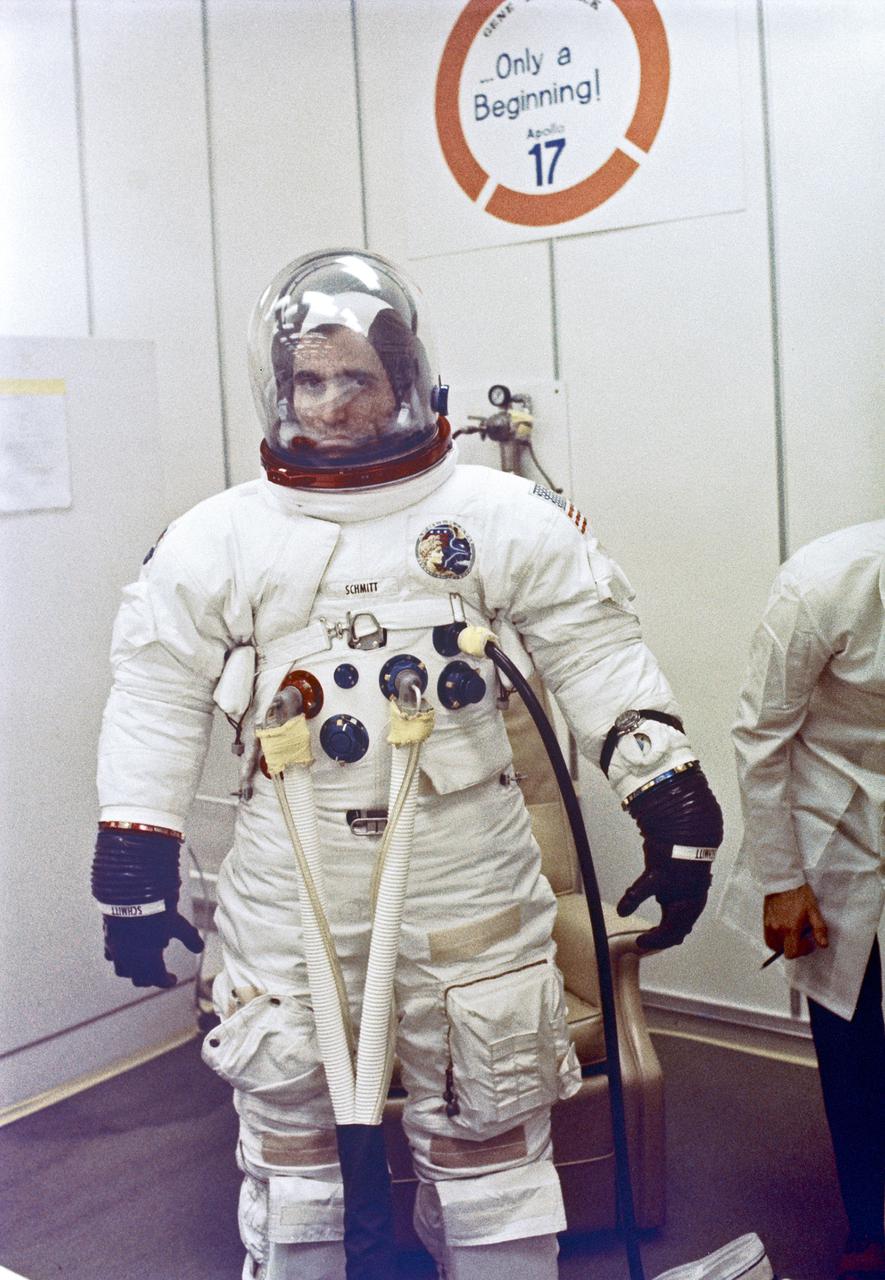
Standing in front of an encouraging sign on the wall, Apollo 17 Lunar Module Pilot Harrison H. Schmitt undergoes spacesuit checks prior to launch to the Moon tonight with astronauts Eugene A. Cernan and Ronald E. Evans. The wall poster points out that while Apollo 17 may be the last manned mission in the Apollo program NASA has additional on-going manned space flights planned for the future.
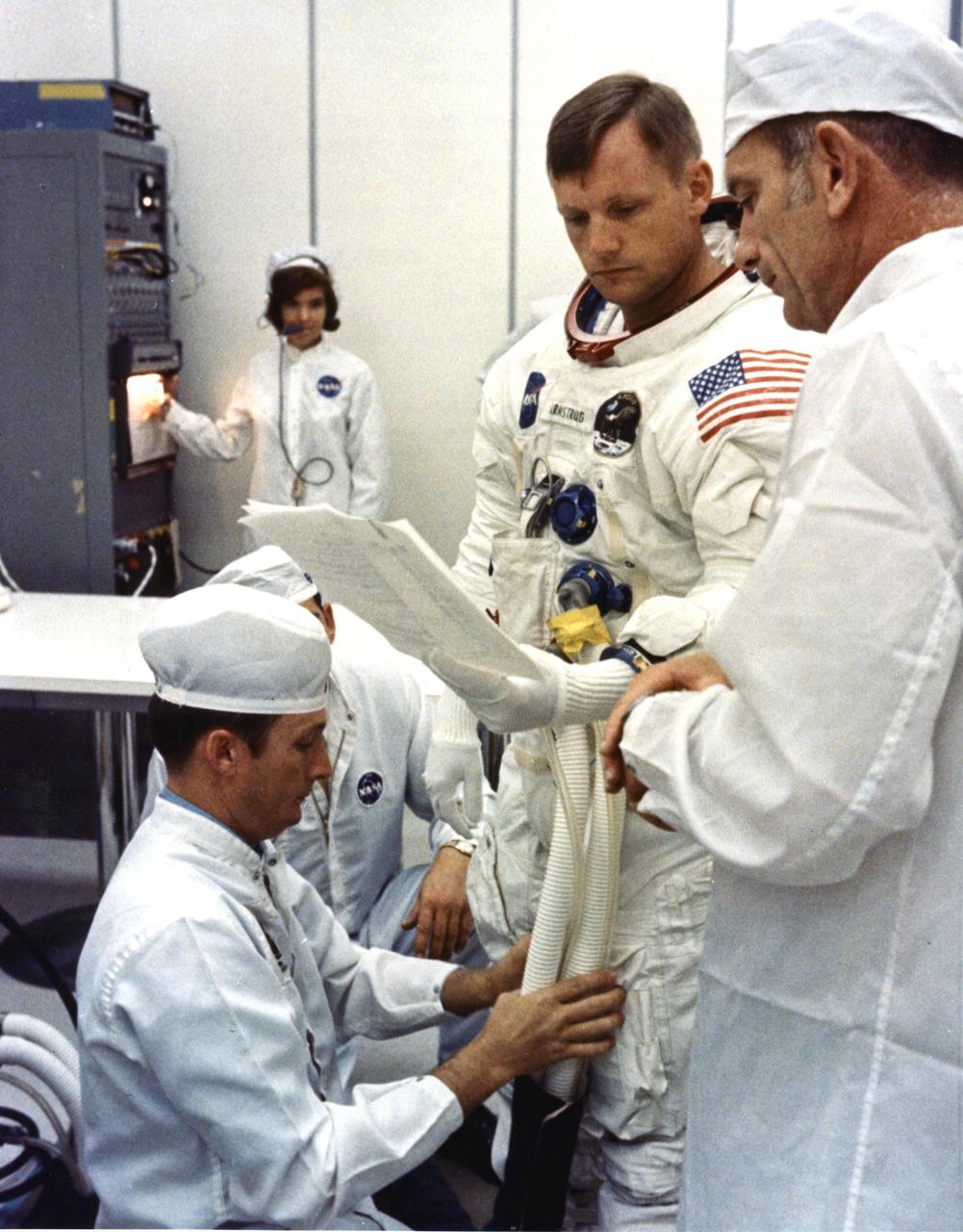
Apollo 11 Commander Neil Armstrong is looking over flight plans while being assisted by a spacesuit technician during suiting operations in the Manned Spacecraft Operations Building (MSOB) prior to the astronauts' departure to Launch Pad 39A. The three astronauts, Edwin E. Aldrin Jr., Neil A. Armstrong and Michael Collins will then board the Saturn V launch vehicle, scheduled for a 9:32 a.m. EDT liftoff, for the first manned lunar landing mission
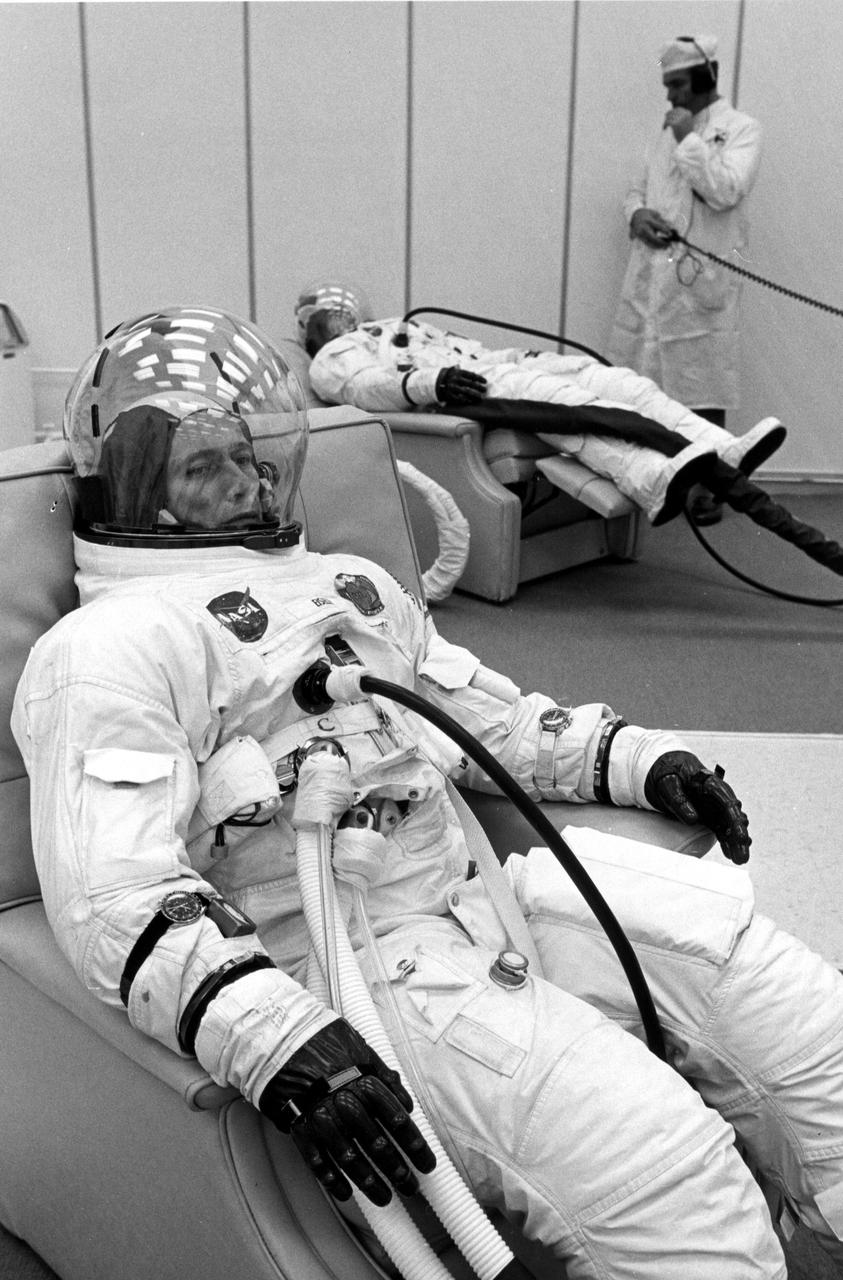
KENNEDY SPACE CENTER, FLA. -- Apollo 7 astronauts Donn F. Eisele, foreground, and Walter Cunningham, rear, undergo spacesuit checks today prior to their Earth orbital mission with Walter M. Schirra Jr., not shown. The three space pilots lifted off atop a Saturn 1B space vehicle from Cape Kennedy's Launch Complex 34 at 11:03 a.m. EDT, Oct. 11, 1968. The National Aeronautics and Space Administration's first manned Apollo flight is designed to verify spacecraft systems for future lunar voyages.
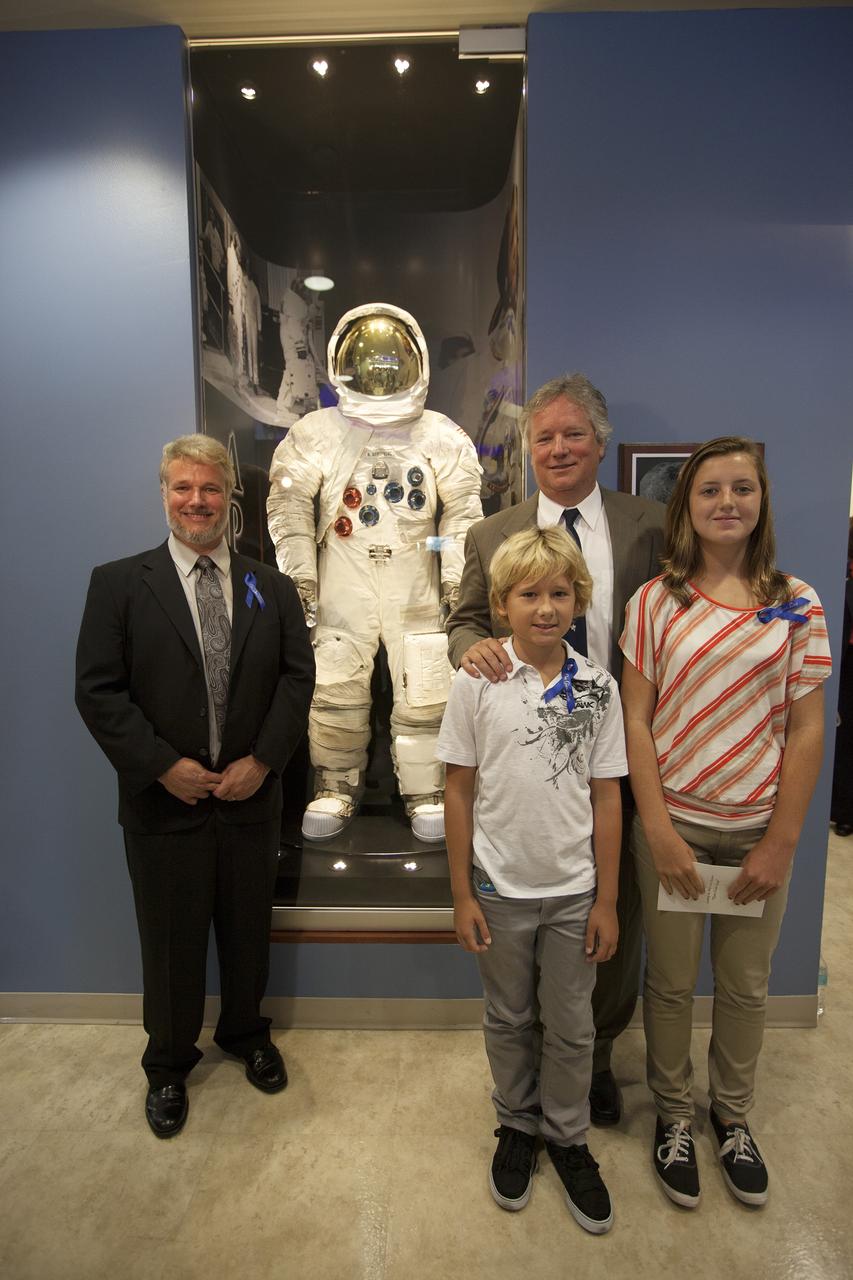
CAPE CANAVERAL, Fla. -- At the Kennedy Space Center in Florida, members of the Armstrong family pose for a portrait with an Apollo-era spacesuit following its unveiling in the lobby of the newly named Neil Armstrong Operations and Checkout Building. The facility has been renamed for Apollo 11 astronaut Neil Armstrong, the first person to set foot on the moon. From left are Armstrong's son Mark, his grandson Bryce, his son Rick and his granddaughter Lily. The building's high bay is being used to support the agency's new Orion spacecraft and is the same spaceport facility where the Apollo 11 command/service module and lunar module were prepped for the first lunar landing mission in 1969. Orion is designed to take humans farther than they’ve ever gone before, serving as the exploration vehicle that will carry astronauts to deep space and sustain the crew during travel to destinations such as an asteroid or Mars. The unveiling was part of NASA's 45th anniversary celebration of the Apollo 11 moon landing. As the world watched, Apollo 11 astronauts landed in the moon's Sea of Tranquility aboard the lunar module, Eagle, on July 20, 1969, as the command module, Columbia, orbited overhead. For more: http://www.nasa.gov/press/2014/july/nasa-honors-historic-first-moon-landing-eyes-first-mars-mission/ Photo credit: NASA/Kim Shiflett
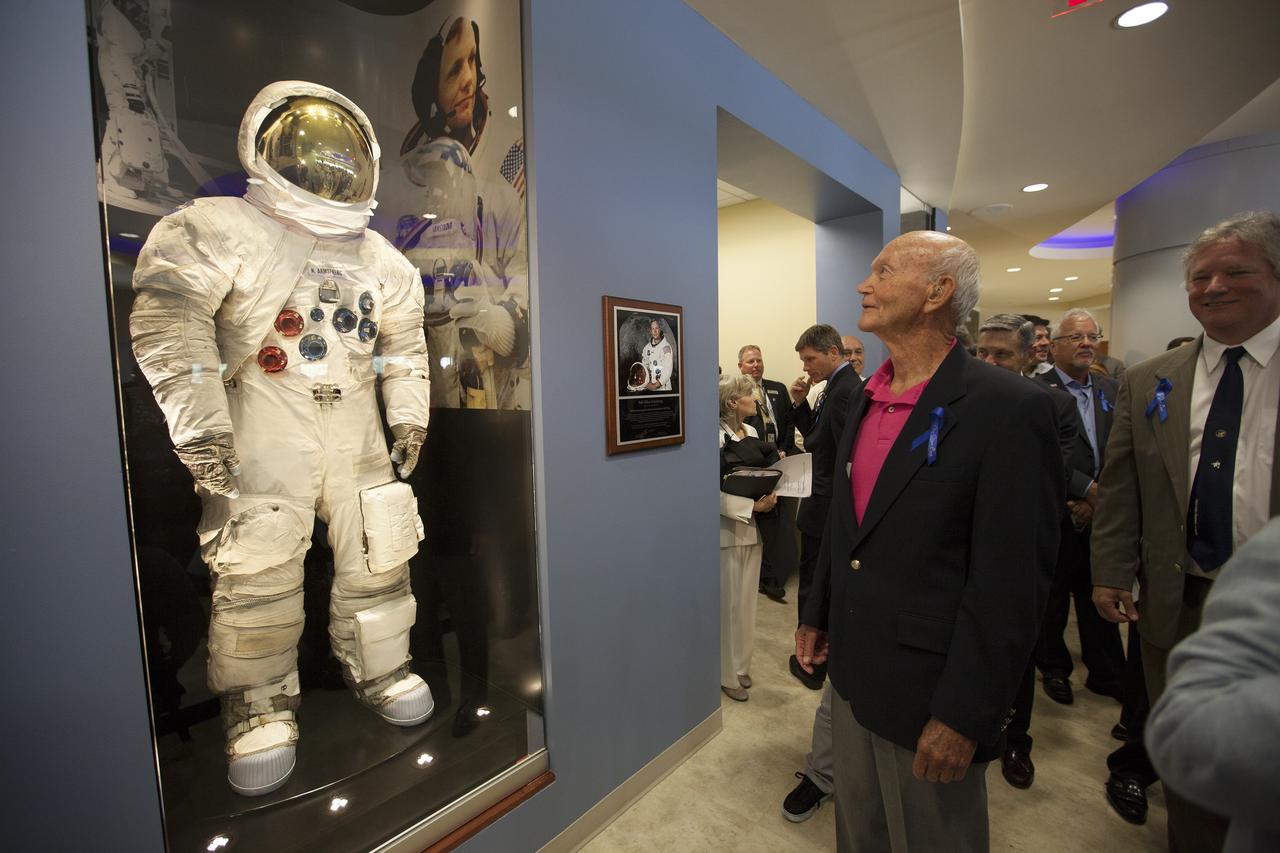
CAPE CANAVERAL, Fla. -- At the Kennedy Space Center in Florida, Apollo 11 astronaut Michael Collins gets a close look at an Apollo-era spacesuit following its unveiling in the lobby of the newly named Neil Armstrong Operations and Checkout Building. The facility has been renamed for Apollo 11 astronaut Neil Armstrong, the first person to set foot on the moon. The building's high bay is being used to support the agency's new Orion spacecraft and is the same spaceport facility where the Apollo 11 command/service module and lunar module were prepped for the first lunar landing mission in 1969. Orion is designed to take humans farther than they’ve ever gone before, serving as the exploration vehicle that will carry astronauts to deep space and sustain the crew during travel to destinations such as an asteroid or Mars. The unveiling was part of NASA's 45th anniversary celebration of the Apollo 11 moon landing. As the world watched, Apollo 11 astronauts landed in the moon's Sea of Tranquility aboard the lunar module, Eagle, on July 20, 1969, as the command module, Columbia, orbited overhead. For more: http://www.nasa.gov/press/2014/july/nasa-honors-historic-first-moon-landing-eyes-first-mars-mission/ Photo credit: NASA/Kim Shiflett
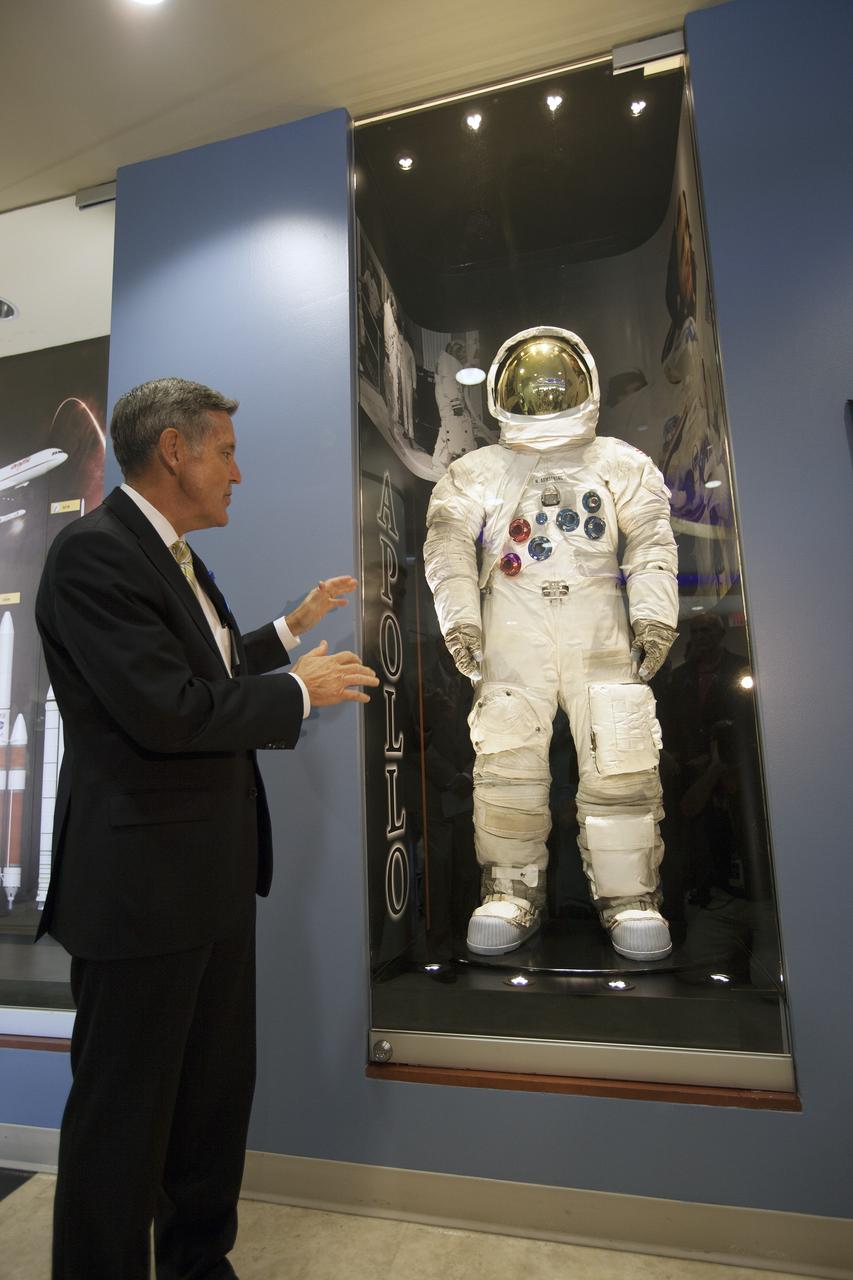
KSC-2014-3220 – CAPE CANAVERAL, Fla. -- At the Kennedy Space Center in Florida, Center Director Robert Cabana unveils an Apollo-era spacesuit on display in the lobby of the newly named Neil Armstrong Operations and Checkout Building. The facility has been renamed for Apollo 11 astronaut Neil Armstrong, the first person to set foot on the moon. The building's high bay is being used to support the agency's new Orion spacecraft and is the same spaceport facility where the Apollo 11 command/service module and lunar module were prepped for the first lunar landing mission in 1969. Orion is designed to take humans farther than they’ve ever gone before, serving as the exploration vehicle that will carry astronauts to deep space and sustain the crew during travel to destinations such as an asteroid or Mars. The unveiling was part of NASA's 45th anniversary celebration of the Apollo 11 moon landing. As the world watched, Apollo 11 astronauts landed in the moon's Sea of Tranquility aboard the lunar module, Eagle, on July 20, 1969, as the command module, Columbia, orbited overhead. For more: http://www.nasa.gov/press/2014/july/nasa-honors-historic-first-moon-landing-eyes-first-mars-mission/ Photo credit: NASA/Kim Shiflett
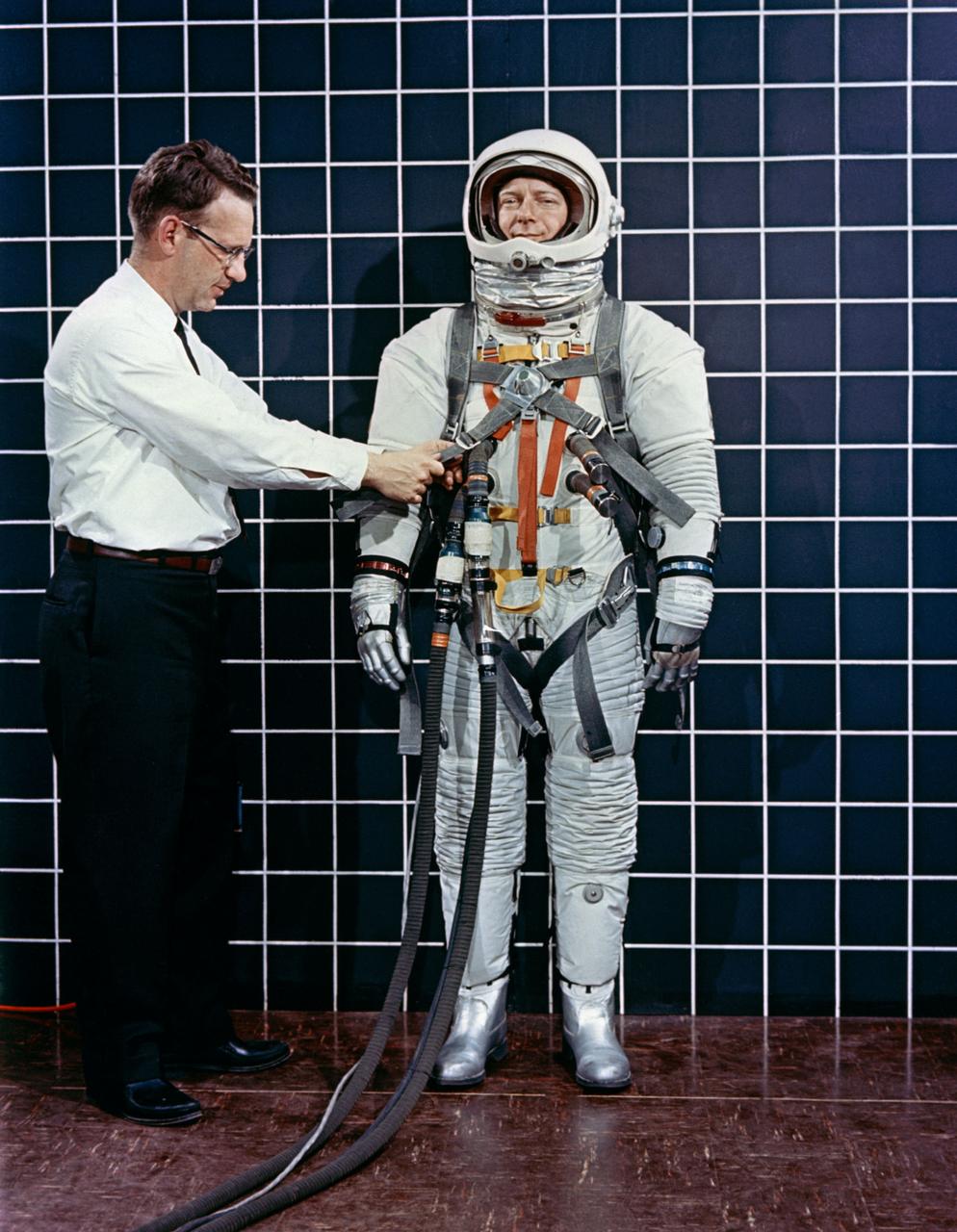
Engineer Bill Peterson fits test pilot Bob Smyth in spacesuit A-3H-024 with the LEM Astronaut restraint harness during suit evaluation study.
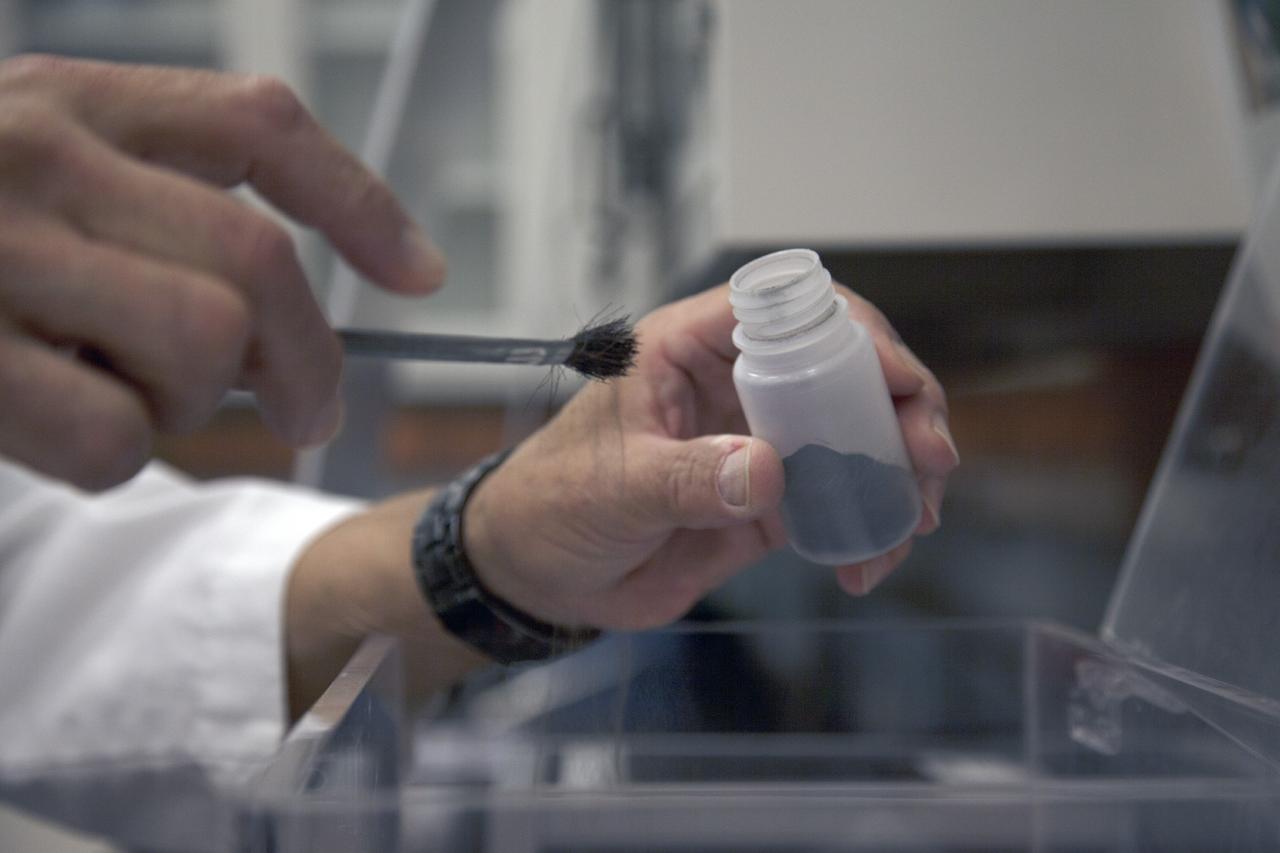
CAPE CANAVERAL, Fla. -- Dr. Carlos Calle, senior research scientist on the Electrodynamic Dust Shield for Dust Mitigation project, works with dust fabricated for use in his experiments in the Electrostatics and Surface Physics Laboratory in the SwampWorks at NASA's Kennedy Space Center in Florida. The fabricated material is designed to mimic the dust on the lunar surface. The technology works by creating an electric field that propagates out like the ripples on a pond. This could prevent dust accumulation on spacesuits, thermal radiators, solar panels, optical instruments and view ports for future lunar and Mars exploration activities. Electrodynamic dust shield, or EDS, technology is based on concepts originally developed by NASA as early as 1967 and later by the University of Tokyo. In 2003, NASA, in collaboration with the University of Arkansas at Little Rock, started development of the EDS for dust particle removal from solar panels to be used on future missions to the moon, an asteroid or Mars. A flight experiment to expose the dust shields to the space environment currently is under development. For more information, visit: http://www.nasa.gov/content/scientists-developing-ways-to-mitigate-dust-problem-for-explorers/ Photo credit: NASA/Dan Casper
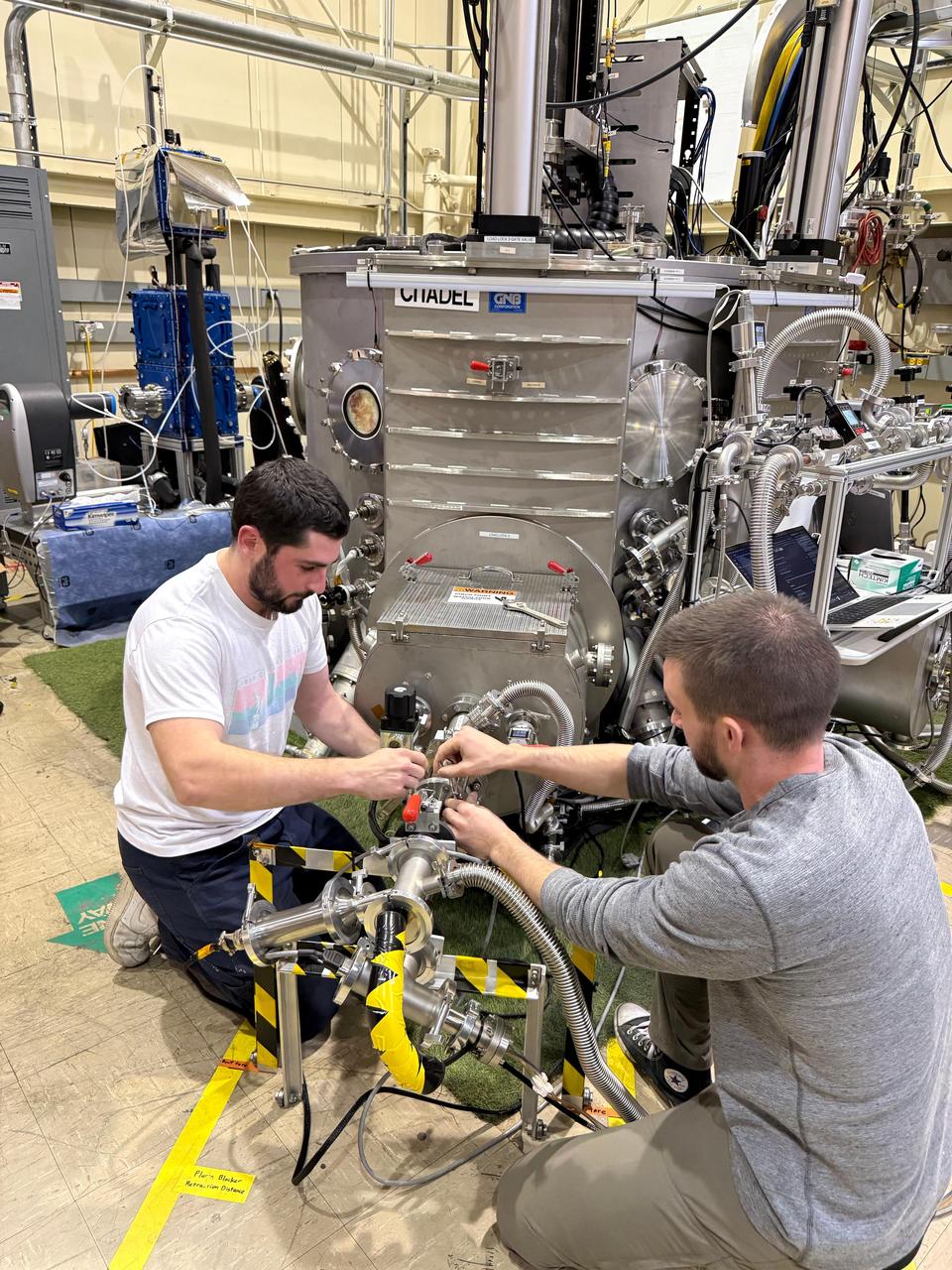
Robotics technologist Brendan Chamberlain-Simon, left, of NASA's Jet Propulsion Laboratory and spacesuit engineer Zach Fester of the agency's Johnson Space Center adjust a thermal vacuum chamber called CITADEL at JPL on Nov. 12, 2024, before testing an astronaut boot inside the chamber. Built to prepare potential robotic explorers for the frosty, low-pressure conditions on ocean worlds like Jupiter's frozen moon Europa, CITADEL (Cryogenic Ice Testing, Acquisition Development, and Excavation Laboratory) has also proven key to evaluating how astronaut gloves and boots hold up in extraordinary cold. It can reach temperatures as low as low as minus 370 degrees Fahrenheit (minus 223 degrees Celsius), approximating extreme conditions Artemis III astronauts will confront in permanently shadowed regions of the lunar South Pole. The boot testing was initiated by the Extravehicular Activity and Human Surface Mobility Program at NASA Johnson and took place from October 2024 to January 2025. The boot is part of a NASA spacesuit called the Exploration Extravehicular Mobility Unit, or xEMU. Test results haven't yet been fully analyzed. In addition to spotting vulnerabilities with existing suits, the experiments are intended to help NASA develop this unique test capability and prepare criteria for standardized, repeatable, and inexpensive test methods for the next-generation lunar suit being built by Axiom Space. https://photojournal.jpl.nasa.gov/catalog/PIA26593
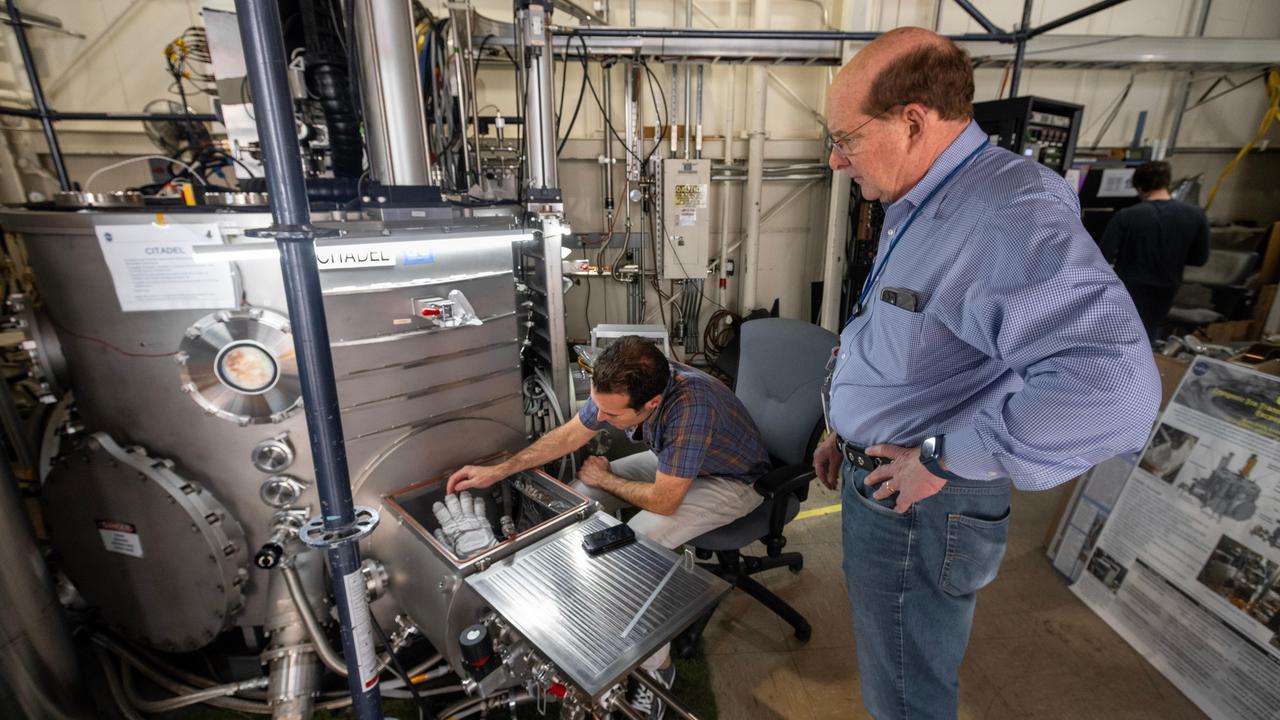
Spacesuit engineer Shane McFarland, left, of the Advanced Suit Team at NASA's Johnson Space Center prepares an astronaut glove for thermal vacuum testing inside a chamber at the agency's Jet Propulsion Laboratory in Southern California on Nov. 1, 2023. Tim Brady of the NASA Engineering and Safety Center (NESC), which spearheaded the glove testing campaign, looks on as McFarland positions the glove in a load lock – one of four small drawer-like chambers through which test materials are inserted into the larger main chamber of a facility called CITADEL (Cryogenic Ice Testing, Acquisition Development, and Excavation Laboratory). The glove was tested at vacuum and temperatures as low as minus 352 degrees Fahrenheit (minus 213 degrees Celsius) – temperatures as frigid as those Artemis III astronauts could experience on the Moon's South Pole. Built to prepare potential future robotic spacecraft for the frosty, low-pressure conditions on ocean worlds like Jupiter's frozen moon Europa, CITADEL has also proven key to evaluating how astronaut gloves and boots hold up in extraordinary cold. The NASA Engineering and Safety Center spearheaded a glove testing campaign in CITADEL from October 2023 to March 2024. Part of a spacesuit design called the Extravehicular Mobility Unit, the gloves tested in the chamber are the sixth version of a glove NASA began using in the 1980s. The testing in CITADEL showed that the legacy glove would not meet thermal requirements in the more challenging lunar South Pole environment. In addition to spotting vulnerabilities with existing suits, the CITADEL experiments will help NASA develop this unique test capability and prepare criteria for standardized, repeatable, and inexpensive test methods for the next-generation lunar suit being built by Axiom Space. https://photojournal.jpl.nasa.gov/catalog/PIA26591

These images show technicians at NASA’s Michoud Assembly Facility in New Orleans removing a weld-confidence article from a robotic welding tool in December 2023. This article features pieces of a liquid hydrogen tank dome that were welded as a test to make sure the dome used for flight will be welded correctly. The dome will be part of the new, four-engine EUS (exploration upper stage) for NASA’s SLS (Space Launch System) rocket. EUS will be used for the Artemis IV lunar mission, replacing the single-engine interim cryogenic propulsion stage (ICPS) used for the first three Artemis missions. The evolved in-space stage will use a combination of liquid oxygen and liquid hydrogen propellants to help power the engines to send large cargo and crew inside NASA’s Orion spacecraft to the Moon. The weld-confidence article pictured here will not be used for flight but is instead helping teams prepare and certify the procedures needed to manufacture flight hardware. NASA is working to land the first woman and person of color on the Moon under Artemis. SLS is part of NASA’s backbone for deep space exploration, along with the Orion spacecraft, advanced spacesuits and rovers, the Gateway in orbit around the Moon, and commercial human landing systems. SLS is the only rocket that can send Orion, astronauts, and supplies to the Moon in a single launch.

These images show technicians at NASA’s Michoud Assembly Facility in New Orleans removing a weld-confidence article from a robotic welding tool in December 2023. This article features pieces of a liquid hydrogen tank dome that were welded as a test to make sure the dome used for flight will be welded correctly. The dome will be part of the new, four-engine EUS (exploration upper stage) for NASA’s SLS (Space Launch System) rocket. EUS will be used for the Artemis IV lunar mission, replacing the single-engine interim cryogenic propulsion stage (ICPS) used for the first three Artemis missions. The evolved in-space stage will use a combination of liquid oxygen and liquid hydrogen propellants to help power the engines to send large cargo and crew inside NASA’s Orion spacecraft to the Moon. The weld-confidence article pictured here will not be used for flight but is instead helping teams prepare and certify the procedures needed to manufacture flight hardware. NASA is working to land the first woman and person of color on the Moon under Artemis. SLS is part of NASA’s backbone for deep space exploration, along with the Orion spacecraft, advanced spacesuits and rovers, the Gateway in orbit around the Moon, and commercial human landing systems. SLS is the only rocket that can send Orion, astronauts, and supplies to the Moon in a single launch.

These images show technicians at NASA’s Michoud Assembly Facility in New Orleans removing a weld-confidence article from a robotic welding tool in December 2023. This article features pieces of a liquid hydrogen tank dome that were welded as a test to make sure the dome used for flight will be welded correctly. The dome will be part of the new, four-engine EUS (exploration upper stage) for NASA’s SLS (Space Launch System) rocket. EUS will be used for the Artemis IV lunar mission, replacing the single-engine interim cryogenic propulsion stage (ICPS) used for the first three Artemis missions. The evolved in-space stage will use a combination of liquid oxygen and liquid hydrogen propellants to help power the engines to send large cargo and crew inside NASA’s Orion spacecraft to the Moon. The weld-confidence article pictured here will not be used for flight but is instead helping teams prepare and certify the procedures needed to manufacture flight hardware. NASA is working to land the first woman and person of color on the Moon under Artemis. SLS is part of NASA’s backbone for deep space exploration, along with the Orion spacecraft, advanced spacesuits and rovers, the Gateway in orbit around the Moon, and commercial human landing systems. SLS is the only rocket that can send Orion, astronauts, and supplies to the Moon in a single launch.

These images show technicians at NASA’s Michoud Assembly Facility in New Orleans removing a weld-confidence article from a robotic welding tool in December 2023. This article features pieces of a liquid hydrogen tank dome that were welded as a test to make sure the dome used for flight will be welded correctly. The dome will be part of the new, four-engine EUS (exploration upper stage) for NASA’s SLS (Space Launch System) rocket. EUS will be used for the Artemis IV lunar mission, replacing the single-engine interim cryogenic propulsion stage (ICPS) used for the first three Artemis missions. The evolved in-space stage will use a combination of liquid oxygen and liquid hydrogen propellants to help power the engines to send large cargo and crew inside NASA’s Orion spacecraft to the Moon. The weld-confidence article pictured here will not be used for flight but is instead helping teams prepare and certify the procedures needed to manufacture flight hardware. NASA is working to land the first woman and person of color on the Moon under Artemis. SLS is part of NASA’s backbone for deep space exploration, along with the Orion spacecraft, advanced spacesuits and rovers, the Gateway in orbit around the Moon, and commercial human landing systems. SLS is the only rocket that can send Orion, astronauts, and supplies to the Moon in a single launch.

These images show technicians at NASA’s Michoud Assembly Facility in New Orleans removing a weld-confidence article from a robotic welding tool in December 2023. This article features pieces of a liquid hydrogen tank dome that were welded as a test to make sure the dome used for flight will be welded correctly. The dome will be part of the new, four-engine EUS (exploration upper stage) for NASA’s SLS (Space Launch System) rocket. EUS will be used for the Artemis IV lunar mission, replacing the single-engine interim cryogenic propulsion stage (ICPS) used for the first three Artemis missions. The evolved in-space stage will use a combination of liquid oxygen and liquid hydrogen propellants to help power the engines to send large cargo and crew inside NASA’s Orion spacecraft to the Moon. The weld-confidence article pictured here will not be used for flight but is instead helping teams prepare and certify the procedures needed to manufacture flight hardware. NASA is working to land the first woman and person of color on the Moon under Artemis. SLS is part of NASA’s backbone for deep space exploration, along with the Orion spacecraft, advanced spacesuits and rovers, the Gateway in orbit around the Moon, and commercial human landing systems. SLS is the only rocket that can send Orion, astronauts, and supplies to the Moon in a single launch.
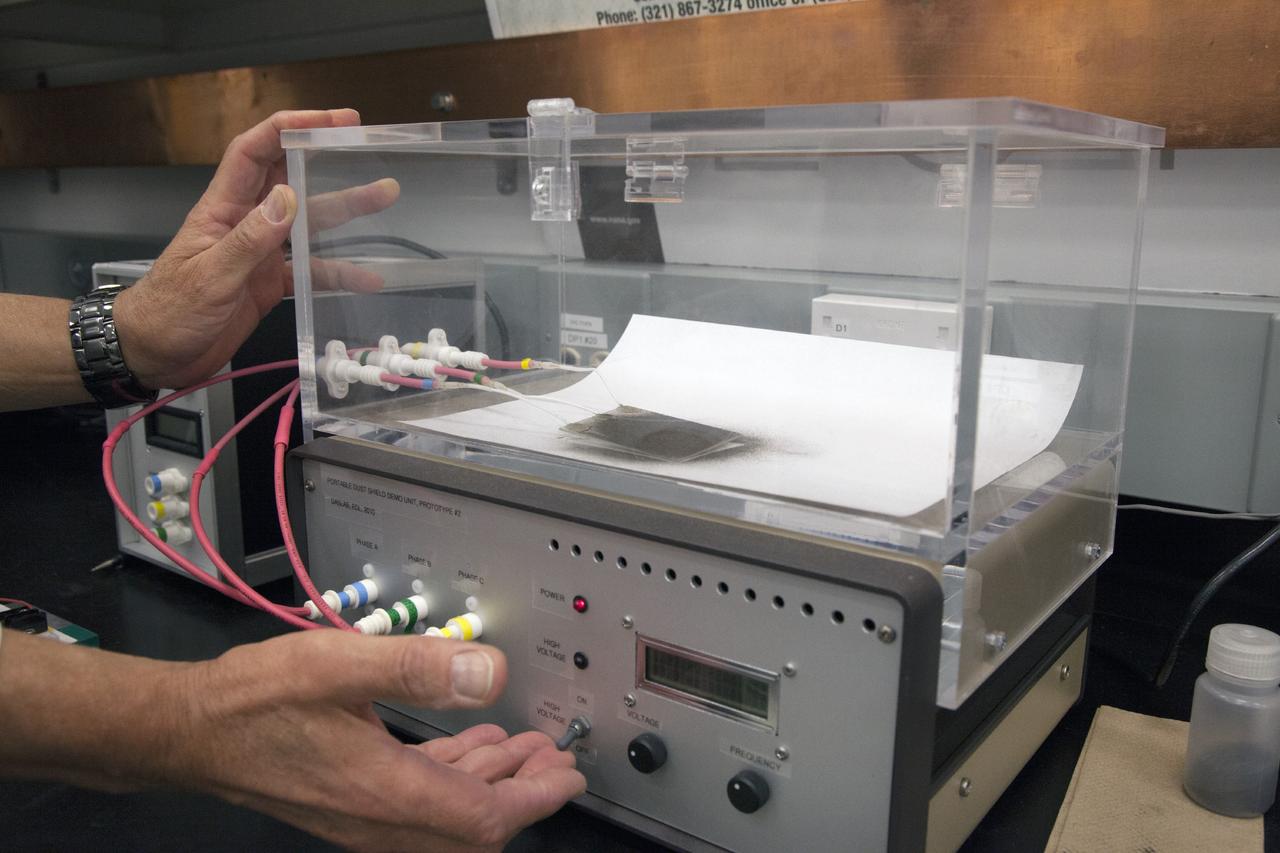
CAPE CANAVERAL, Fla. -- Dr. Carlos Calle, senior research scientist on the Electrodynamic Dust Shield for Dust Mitigation project, demonstrates a dust particle experiment in the Electrostatics and Surface Physics Laboratory in the SwampWorks at NASA's Kennedy Space Center in Florida. The technology works by creating an electric field that propagates out like the ripples on a pond. This could prevent dust accumulation on spacesuits, thermal radiators, solar panels, optical instruments and view ports for future lunar and Mars exploration activities. Electrodynamic dust shield, or EDS, technology is based on concepts originally developed by NASA as early as 1967 and later by the University of Tokyo. In 2003, NASA, in collaboration with the University of Arkansas at Little Rock, started development of the EDS for dust particle removal from solar panels to be used on future missions to the moon, an asteroid or Mars. A flight experiment to expose the dust shields to the space environment currently is under development. For more information, visit: http://www.nasa.gov/content/scientists-developing-ways-to-mitigate-dust-problem-for-explorers/ Photo credit: NASA/Dan Casper
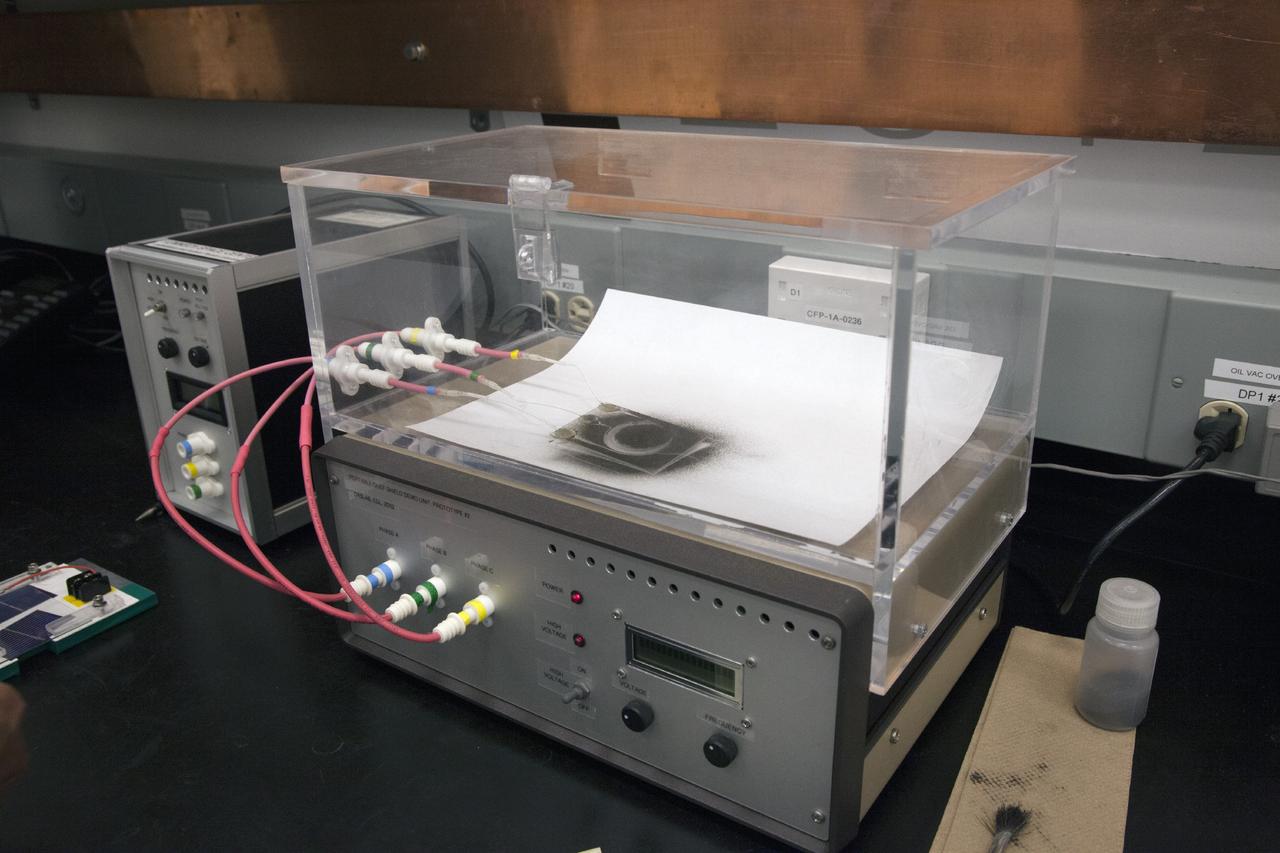
CAPE CANAVERAL, Fla. -- Dust particle experiments are conducted for Electrodynamic Dust Shield for Dust Mitigation project in the Electrostatics and Surface Physics Laboratory in the SwampWorks at NASA's Kennedy Space Center in Florida. The technology works by creating an electric field that propagates out like the ripples on a pond. This could prevent dust accumulation on spacesuits, thermal radiators, solar panels, optical instruments and view ports for future lunar and Mars exploration activities. Electrodynamic dust shield, or EDS, technology is based on concepts originally developed by NASA as early as 1967 and later by the University of Tokyo. In 2003, NASA, in collaboration with the University of Arkansas at Little Rock, started development of the EDS for dust particle removal from solar panels to be used on future missions to the moon, an asteroid or Mars. A flight experiment to expose the dust shields to the space environment currently is under development. For more information, visit: http://www.nasa.gov/content/scientists-developing-ways-to-mitigate-dust-problem-for-explorers/ Photo credit: NASA/Dan Casper
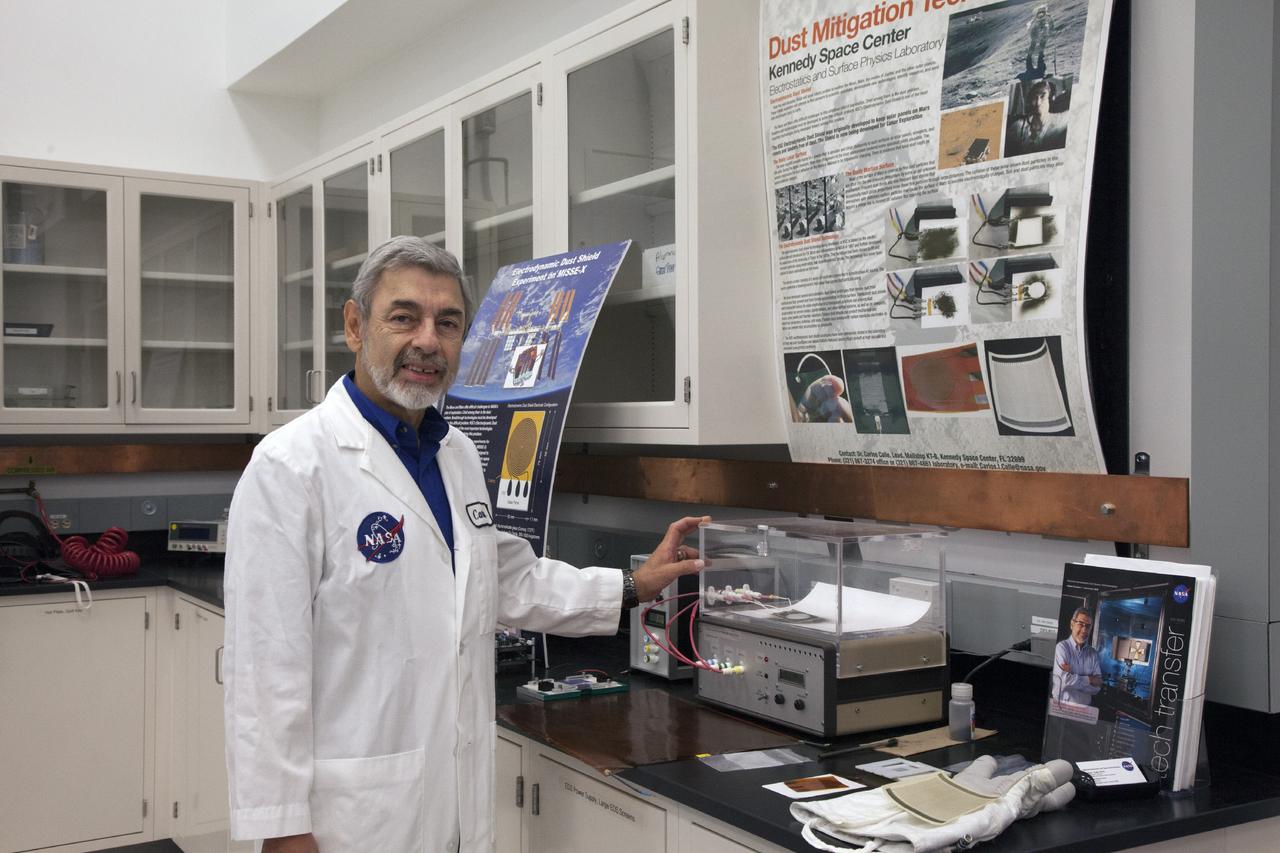
CAPE CANAVERAL, Fla. -- Dr. Carlos Calle, senior research scientist on the Electrodynamic Dust Shield for Dust Mitigation project, demonstrates a dust particle experiment in the Electrostatics and Surface Physics Laboratory in the SwampWorks at NASA's Kennedy Space Center in Florida. The technology works by creating an electric field that propagates out like the ripples on a pond. This could prevent dust accumulation on spacesuits, thermal radiators, solar panels, optical instruments and view ports for future lunar and Mars exploration activities. Electrodynamic dust shield, or EDS, technology is based on concepts originally developed by NASA as early as 1967 and later by the University of Tokyo. In 2003, NASA, in collaboration with the University of Arkansas at Little Rock, started development of the EDS for dust particle removal from solar panels to be used on future missions to the moon, an asteroid or Mars. A flight experiment to expose the dust shields to the space environment currently is under development. For more information, visit: http://www.nasa.gov/content/scientists-developing-ways-to-mitigate-dust-problem-for-explorers/ Photo credit: NASA/Dan Casper
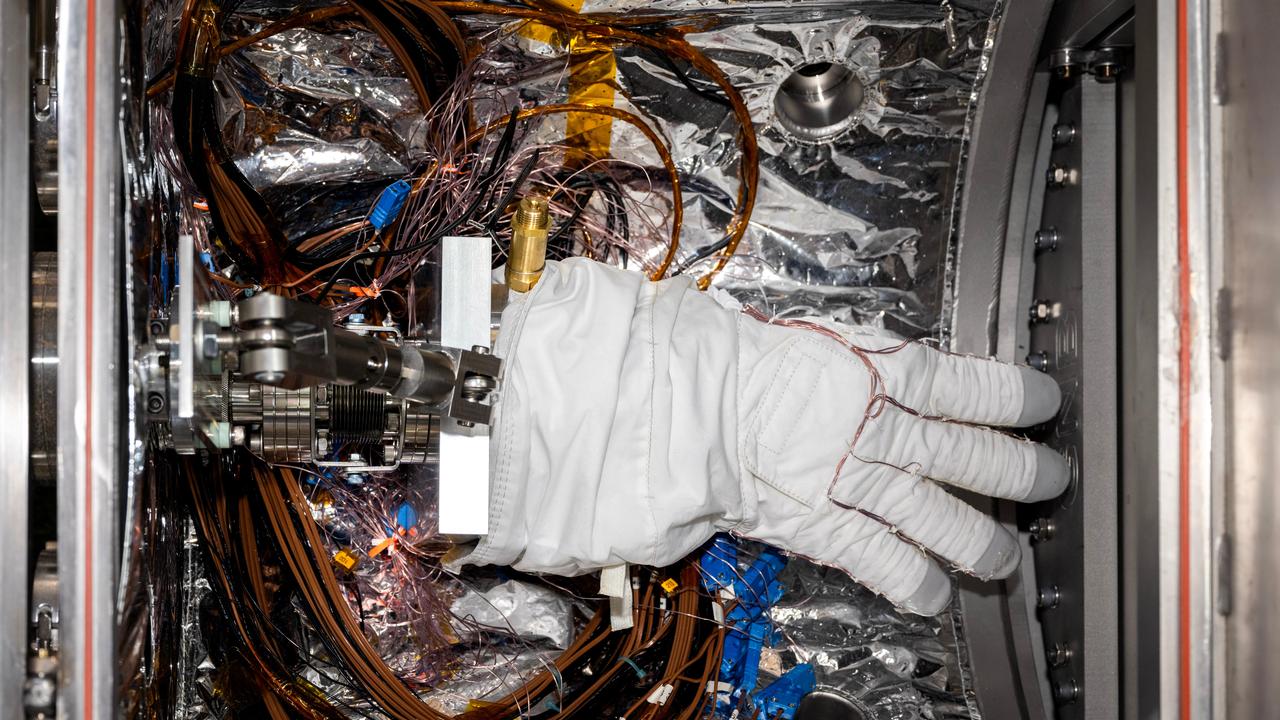
An astronaut glove designed for use during spacewalks on the International Space Station is prepared for thermal vacuum testing inside a chamber at NASA's Jet Propulsion Laboratory in Southern California on Nov. 1, 2023. The glove lies in a load lock, one of four small drawer-like chambers through which test materials are inserted into the larger main chamber of a facility called CITADEL (Cryogenic Ice Testing, Acquisition Development, and Excavation Laboratory). The glove was tested at vacuum and temperatures as low as minus 352 degrees Fahrenheit (minus 213 degrees Celsius) – temperatures as frigid as those Artemis III astronauts could experience on the Moon's South Pole. Built to prepare potential future robotic spacecraft for the frosty, low-pressure conditions on ocean worlds like Jupiter's frozen moon Europa, CITADEL has also proven key to evaluating how astronaut gloves and boots hold up in extraordinary cold. The NASA Engineering and Safety Center spearheaded a glove testing campaign in CITADEL from October 2023 to March 2024. Part of a spacesuit design called the Extravehicular Mobility Unit, the gloves tested in the chamber are the sixth version of a glove NASA began using in the 1980s. The testing in CITADEL showed that the legacy glove would not meet thermal requirements in the more challenging lunar South Pole environment. In addition to spotting vulnerabilities with existing suits, the CITADEL experiments will help NASA develop this unique test capability and prepare criteria for standardized, repeatable, and inexpensive test methods for the next-generation lunar suit being built by Axiom Space. https://photojournal.jpl.nasa.gov/catalog/PIA26430
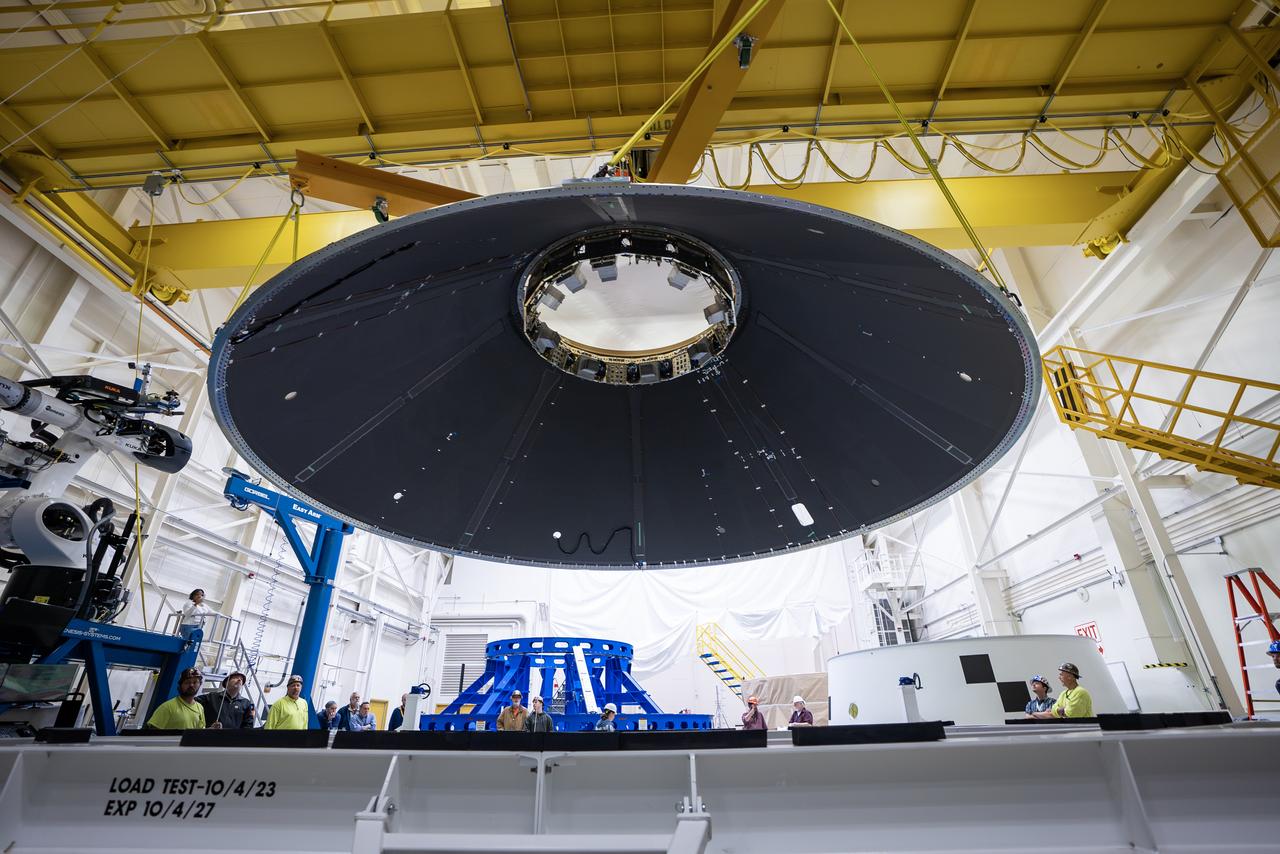
These photos and videos show how NASA manufactured and prepared to transport the payload adapter in February inside Building 4708 at NASA’s Marshall Space Flight Center in Huntsville, Alabama. Prior to moving the hardware for testing, teams installed the New Explorations Secondary Transport component, called the NEST, into the top of the engineering development unit. The NEST component will allow the hardware to hold a series of secondary payloads, or small satellites. The cone-shaped payload adapter is about 8.5 feet tall and features two metal rings and eight composite panels. The adapter, which will debut on NASA’s Artemis IV mission, is an evolution from the Orion stage adapter used in the Block 1 configuration of the rocket for the first three Artemis missions. It will be housed inside the universal stage adapter atop the rocket’s more powerful in-space stage, called the exploration upper stage. The payload adapter, like the launch vehicle stage adapter and the Orion stage adapter, is fully manufactured and tested at Marshall, which manages the SLS Program. NASA is working to land the first woman, first person of color, and its first international partner astronaut on the Moon under Artemis. SLS is part of NASA’s backbone for deep space exploration, along with the Orion spacecraft and Gateway in orbit around the Moon and commercial human landing systems, next-generational spacesuits, and rovers on the lunar surface. SLS is the only rocket that can send Orion, astronauts, and supplies to the Moon in a single launch.
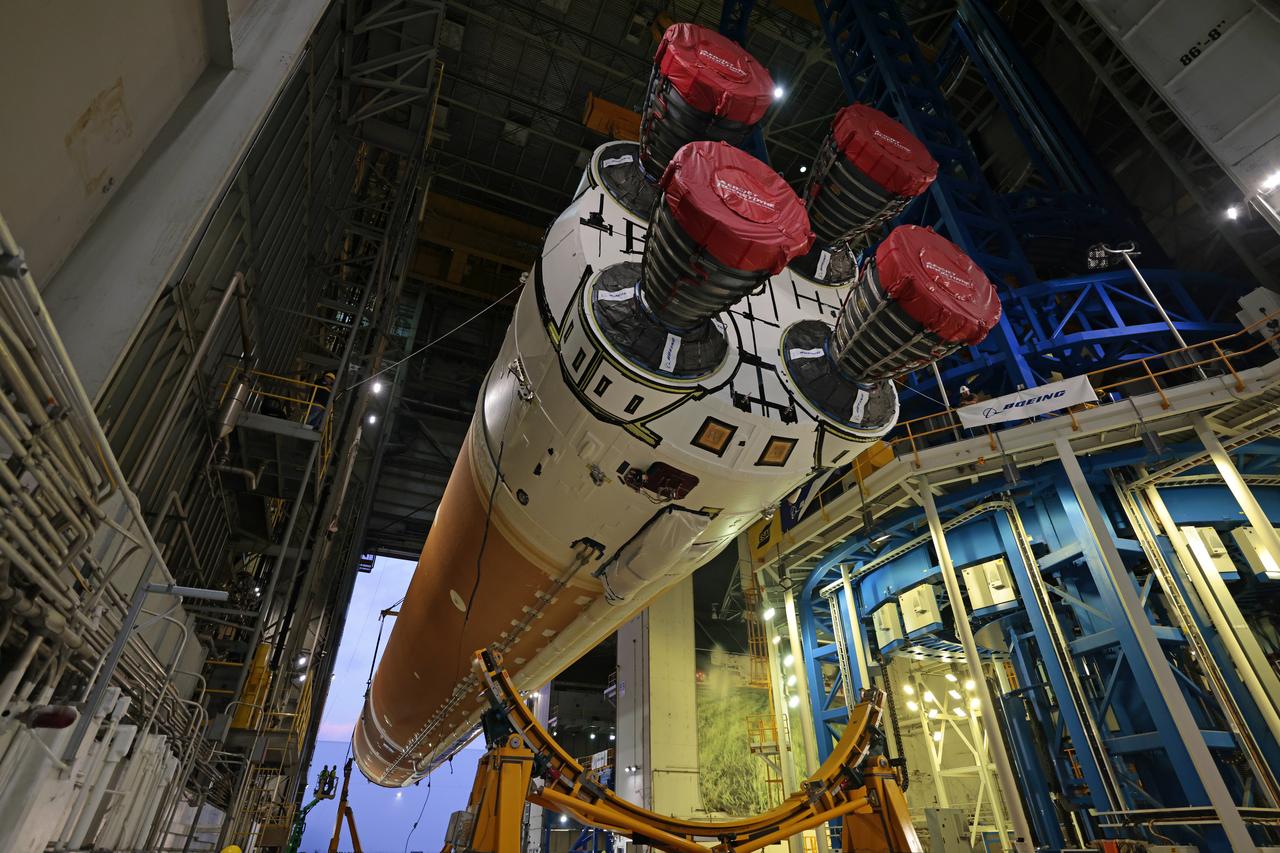
Technicians at Michoud Assembly Facility in New Orleans lift the core stage that will help launch the first crewed flight of NASA’s SLS (Space Launch System) rocket for the agency’s Artemis II mission. Teams at Michoud lifted the core stage on Thursday, July 11, 2024, onto NASA’s Multi-Purpose Transportation System, designed to transport SLS vehicle segments by waterway and roadway. It is tasked with transporting the vehicle from where it is manufactured to its intermediate test location and final launch destination. The core stage was lifted in preparation for its move onto the agency’s Pegasus barge, where it will be ferried to NASA’s Kennedy Space Center in Florida. Pegasus is maintained at Michoud. The core stage for the SLS mega rocket is the largest stage NASA has ever produced. At 212 feet tall, the stage consists of five major elements, including two huge propellant tanks that collectively hold more than 733,000 gallons of super chilled liquid propellant to feed four RS-25 engines at its base. During launch and flight, the stage will operate for just over eight minutes, producing more than 2 million pounds of thrust to help send a crew of four astronauts inside NASA’s Orion spacecraft onward to the Moon. All the major structures for every SLS core stage are fully manufactured at NASA Michoud. NASA is working to land the first woman, first person of color, and its first international partner astronaut on the Moon under Artemis. SLS is part of NASA’s backbone for deep space exploration, along with the Orion spacecraft and Gateway in orbit around the Moon and commercial human landing systems, next-generation space, next-generational spacesuits, and rovers on the lunar surface. SLS is the only rocket that can send Orion, astronauts, and supplies to the Moon in a single launch. Image credit: NASA/Michael DeMocker
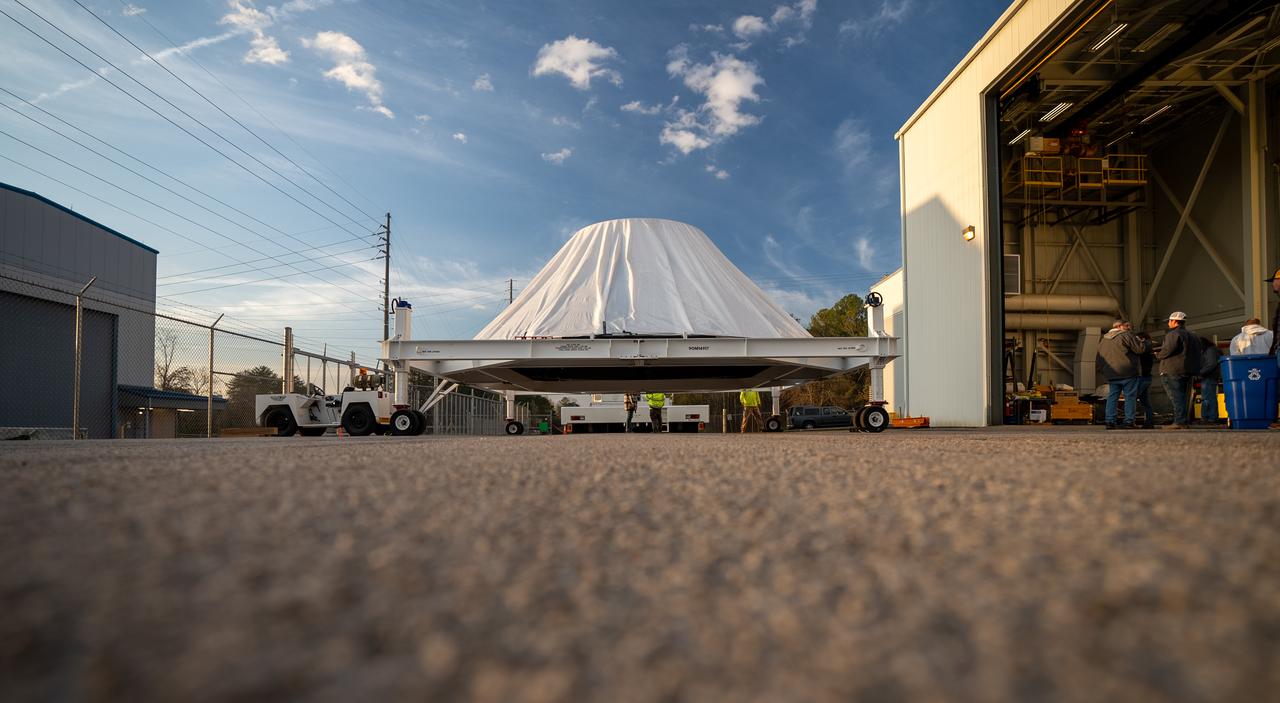
These photos and videos show how crews at NASA’s Marshall Space Flight Center in Huntsville, Alabama, moved and installed the payload adapter that will be used in the Block 1B configuration of the SLS (Space Launch System) rocket from Building 4708, where it was manufactured, into Structural Test Stand 4697 at NASA’s Marshall Space Flight Center on March 13. Teams at Marshall will begin structural testing the engineering development unit of the payload adapter – an exact replica of the flight version of the hardware – this spring. The cone-shaped payload adapter is about 8.5 feet tall and features two metal rings and eight composite panels. The adapter, which will debut on NASA’s Artemis IV mission, is an evolution from the Orion stage adapter used in the Block 1 configuration of the first three Artemis missions. It will be housed inside the universal stage adapter atop the rocket’s more powerful in-space stage, called the exploration upper stage. The payload adapter, like the launch vehicle stage adapter and the Orion stage adapter, is fully manufactured and tested at Marshall, which manages the SLS Program. NASA is working to land the first woman, first person of color, and its first international partner astronaut on the Moon under Artemis. SLS is part of NASA’s backbone for deep space exploration, along with the Orion spacecraft and Gateway in orbit around the Moon and commercial human landing systems, next-generational spacesuits, and rovers on the lunar surface. SLS is the only rocket that can send Orion, astronauts, and supplies to the Moon in a single launch.
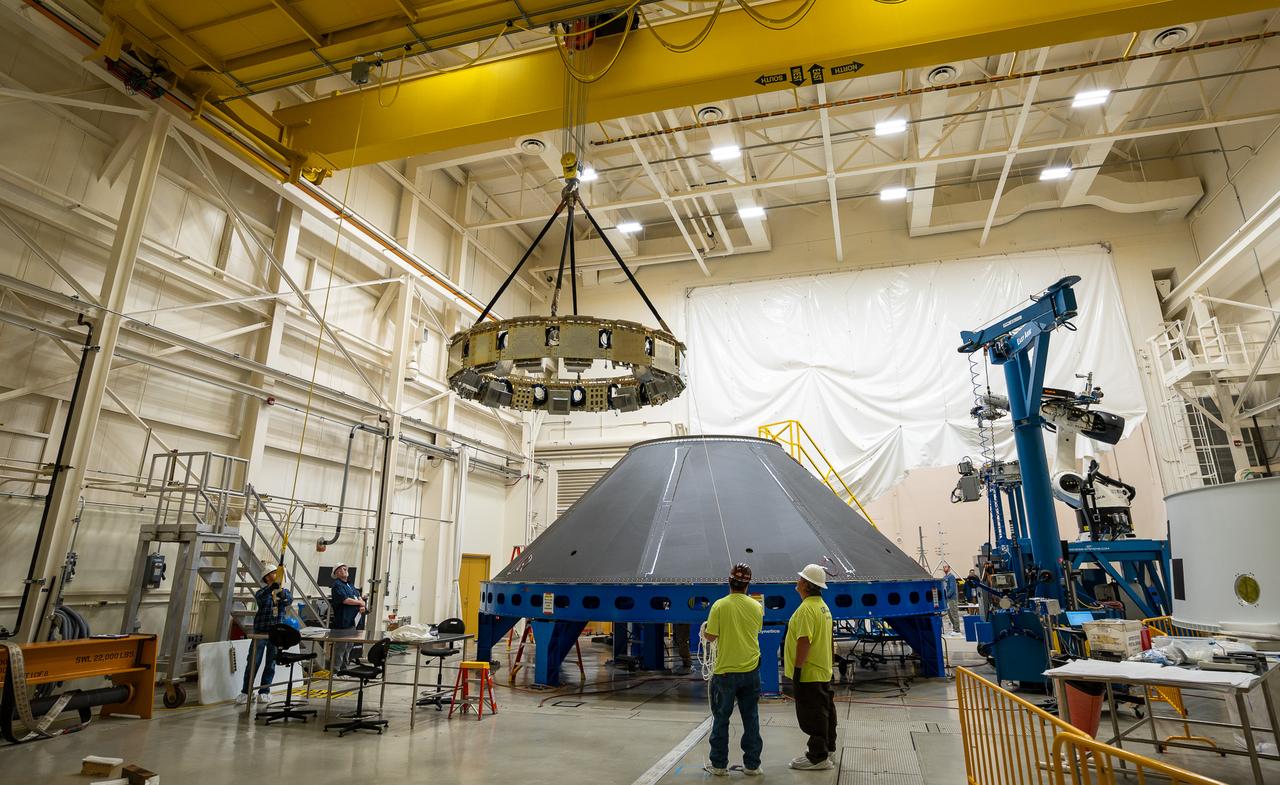
These photos and videos show how NASA manufactured and prepared to transport the payload adapter in February inside Building 4708 at NASA’s Marshall Space Flight Center in Huntsville, Alabama. Prior to moving the hardware for testing, teams installed the New Explorations Secondary Transport component, called the NEST, into the top of the engineering development unit. The NEST component will allow the hardware to hold a series of secondary payloads, or small satellites. The cone-shaped payload adapter is about 8.5 feet tall and features two metal rings and eight composite panels. The adapter, which will debut on NASA’s Artemis IV mission, is an evolution from the Orion stage adapter used in the Block 1 configuration of the rocket for the first three Artemis missions. It will be housed inside the universal stage adapter atop the rocket’s more powerful in-space stage, called the exploration upper stage. The payload adapter, like the launch vehicle stage adapter and the Orion stage adapter, is fully manufactured and tested at Marshall, which manages the SLS Program. NASA is working to land the first woman, first person of color, and its first international partner astronaut on the Moon under Artemis. SLS is part of NASA’s backbone for deep space exploration, along with the Orion spacecraft and Gateway in orbit around the Moon and commercial human landing systems, next-generational spacesuits, and rovers on the lunar surface. SLS is the only rocket that can send Orion, astronauts, and supplies to the Moon in a single launch.

These images and videos show team members at Michoud Assembly Facility loading the first core stage that will help launch the first crewed flight of NASA’s SLS (Space Launch System) rocket for the agency’s Artemis II mission onto the Pegasus barge on Tuesday, July 16, 2024. The barge will ferry the core stage on a 900-mile journey from the agency’s Michoud Assembly Facility in New Orleans to its Kennedy Space Center in Florida. The core stage for the SLS mega rocket is the largest stage NASA has ever produced. At 212 feet tall, the stage consists of five major elements, including two huge propellant tanks that collectively hold more than 733,000 gallons of super chilled liquid propellant to feed four RS-25 engines at its base. During launch and flight, the stage will operate for just over eight minutes, producing more than 2 million pounds of thrust to help send a crew of four astronauts inside NASA’s Orion spacecraft onward to the Moon. All the major structures for every SLS core stage are fully manufactured at NASA Michoud. NASA is working to land the first woman, first person of color, and its first international partner astronaut on the Moon under Artemis. SLS is part of NASA’s backbone for deep space exploration, along with the Orion spacecraft and Gateway in orbit around the Moon and commercial human landing systems, next-generation space, next-generational spacesuits, and rovers on the lunar surface. SLS is the only rocket that can send Orion, astronauts, and supplies to the Moon in a single launch.
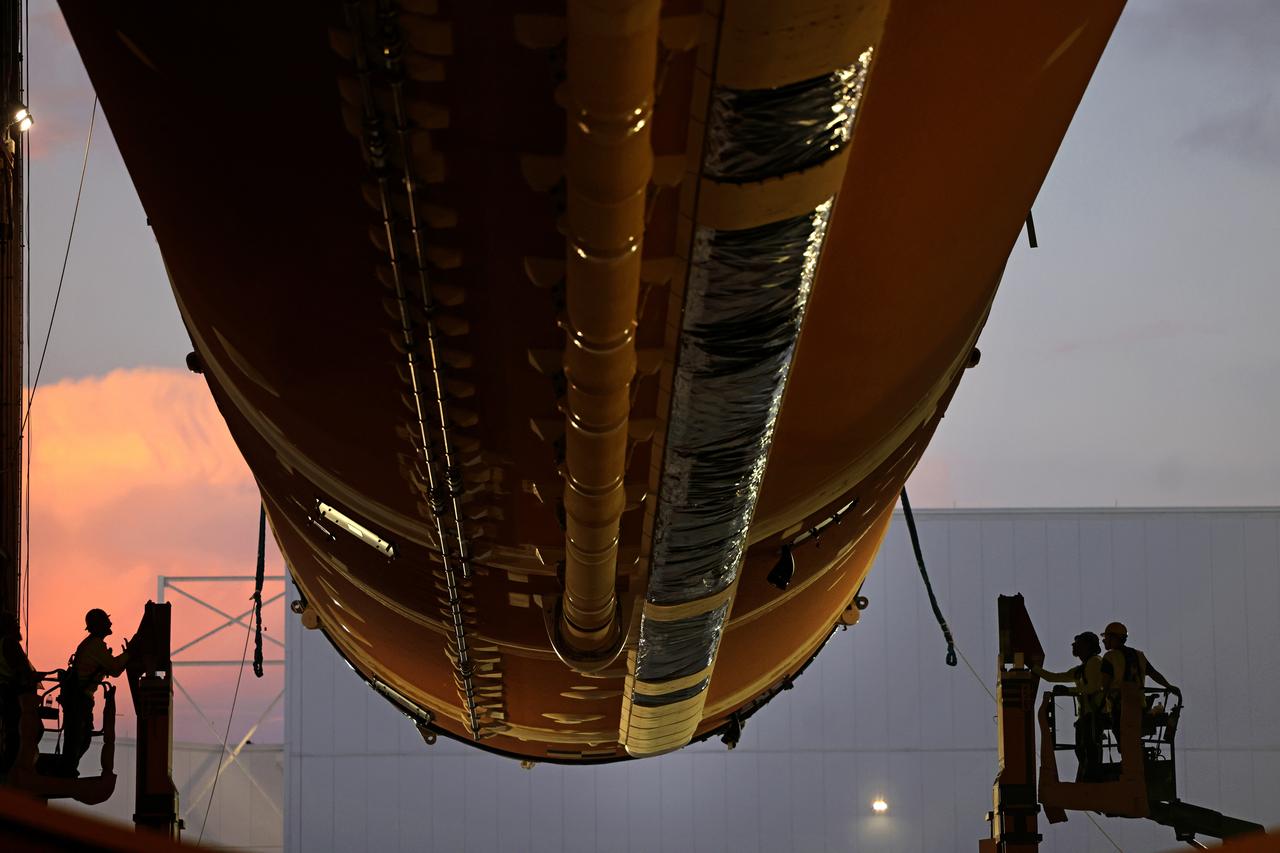
Technicians at Michoud Assembly Facility in New Orleans lift the core stage that will help launch the first crewed flight of NASA’s SLS (Space Launch System) rocket for the agency’s Artemis II mission. Teams at Michoud lifted the core stage on Thursday, July 11, 2024, onto NASA’s Multi-Purpose Transportation System, designed to transport SLS vehicle segments by waterway and roadway. It is tasked with transporting the vehicle from where it is manufactured to its intermediate test location and final launch destination. The core stage was lifted in preparation for its move onto the agency’s Pegasus barge, where it will be ferried to NASA’s Kennedy Space Center in Florida. Pegasus is maintained at Michoud. The core stage for the SLS mega rocket is the largest stage NASA has ever produced. At 212 feet tall, the stage consists of five major elements, including two huge propellant tanks that collectively hold more than 733,000 gallons of super chilled liquid propellant to feed four RS-25 engines at its base. During launch and flight, the stage will operate for just over eight minutes, producing more than 2 million pounds of thrust to help send a crew of four astronauts inside NASA’s Orion spacecraft onward to the Moon. All the major structures for every SLS core stage are fully manufactured at NASA Michoud. NASA is working to land the first woman, first person of color, and its first international partner astronaut on the Moon under Artemis. SLS is part of NASA’s backbone for deep space exploration, along with the Orion spacecraft and Gateway in orbit around the Moon and commercial human landing systems, next-generation space, next-generational spacesuits, and rovers on the lunar surface. SLS is the only rocket that can send Orion, astronauts, and supplies to the Moon in a single launch. Image credit: NASA/Michael DeMocker
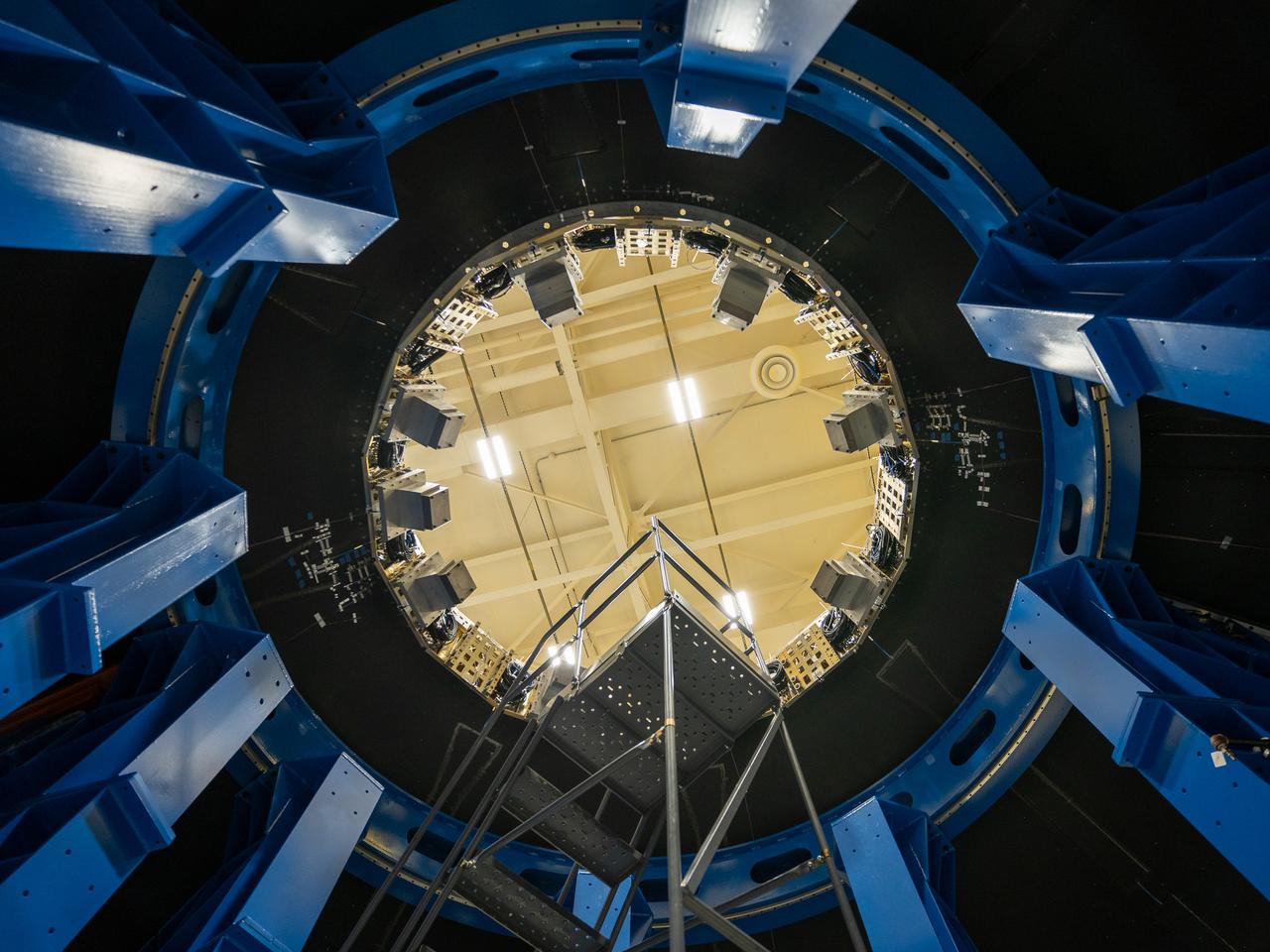
These photos and videos show how NASA manufactured and prepared to transport the payload adapter in February inside Building 4708 at NASA’s Marshall Space Flight Center in Huntsville, Alabama. Prior to moving the hardware for testing, teams installed the New Explorations Secondary Transport component, called the NEST, into the top of the engineering development unit. The NEST component will allow the hardware to hold a series of secondary payloads, or small satellites. The cone-shaped payload adapter is about 8.5 feet tall and features two metal rings and eight composite panels. The adapter, which will debut on NASA’s Artemis IV mission, is an evolution from the Orion stage adapter used in the Block 1 configuration of the rocket for the first three Artemis missions. It will be housed inside the universal stage adapter atop the rocket’s more powerful in-space stage, called the exploration upper stage. The payload adapter, like the launch vehicle stage adapter and the Orion stage adapter, is fully manufactured and tested at Marshall, which manages the SLS Program. NASA is working to land the first woman, first person of color, and its first international partner astronaut on the Moon under Artemis. SLS is part of NASA’s backbone for deep space exploration, along with the Orion spacecraft and Gateway in orbit around the Moon and commercial human landing systems, next-generational spacesuits, and rovers on the lunar surface. SLS is the only rocket that can send Orion, astronauts, and supplies to the Moon in a single launch.
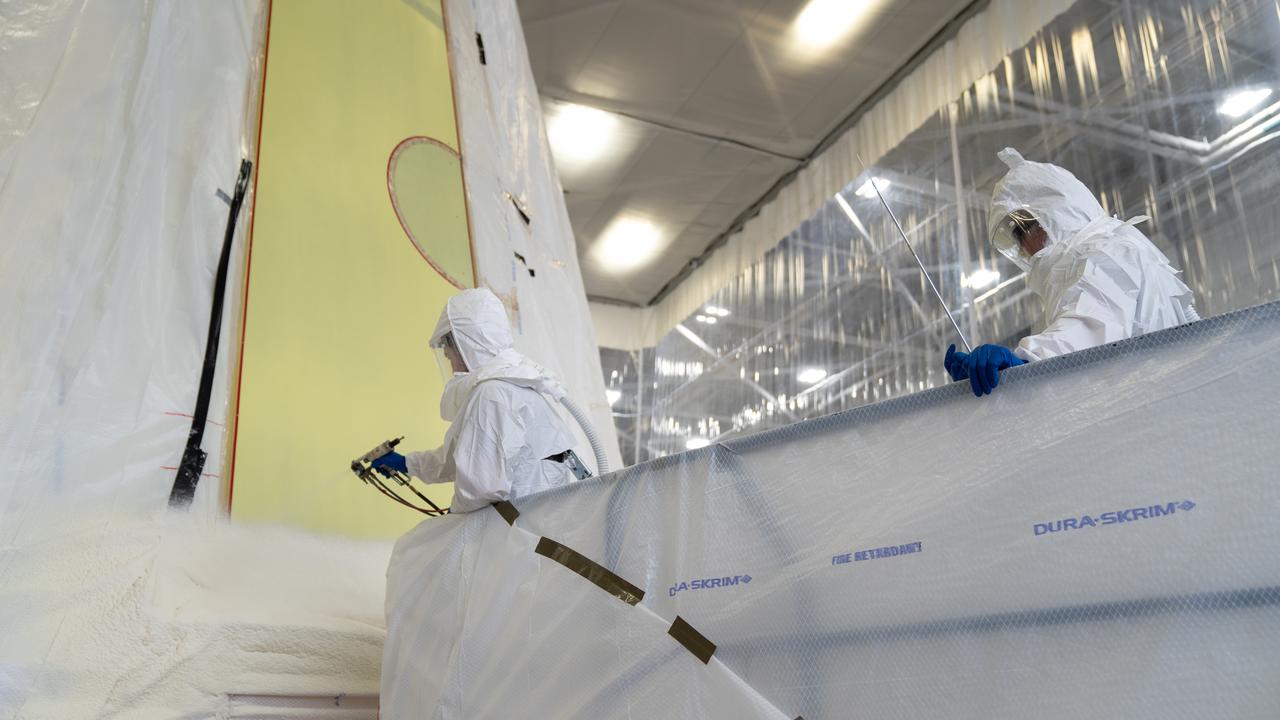
These photos show how technicians at NASA’s Marshall Space Flight Center in Huntsville, Alabama, have applied the thermal protection system material to the launch vehicle stage adapter (LVSA) of NASA’s SLS (Space Launch System) rocket for Artemis III, which will land astronauts on the Moon to advance long-term lunar exploration and scientific discovery and inspire the Artemis Generation. The LVSA is a cone-shaped element that connects the mega rocket’s core stage to its interim cryogenic propulsion stage (ICPS), partially enclosing it and protecting its avionics and electrical systems from the extreme pressures, sounds, and temperatures during launch and flight. Teams at Marshall began applying the thermal protection system material in the spring of 2023. Unlike other parts of the SLS rocket, the thermal protection system material for the LVSA is applied entirely by hand using a spray gun. During application, the technicians use a thin measuring rod to gauge the proper thickness. Once the thermal protection system has cured, certain areas are sanded down to meet parameters. The entire process takes several months. The LVSA is fully manufactured at Marshall by NASA, lead contractor Teledyne Brown Engineering, and the Jacobs Space Group’s ESSCA contract. The LVSA for Artemis III is the last of its kind as future SLS rockets will transition to its next, more powerful Block 1B configuration beginning with Artemis IV. NASA is working to land the first woman and first person of color on the Moon under Artemis. SLS is part of NASA’s backbone for deep space exploration, along with the Orion spacecraft, advanced spacesuits and rovers, the Gateway in orbit around the Moon, and commercial human landing systems. SLS is the only rocket that can send Orion, astronauts, and supplies to the Moon in a single mission.
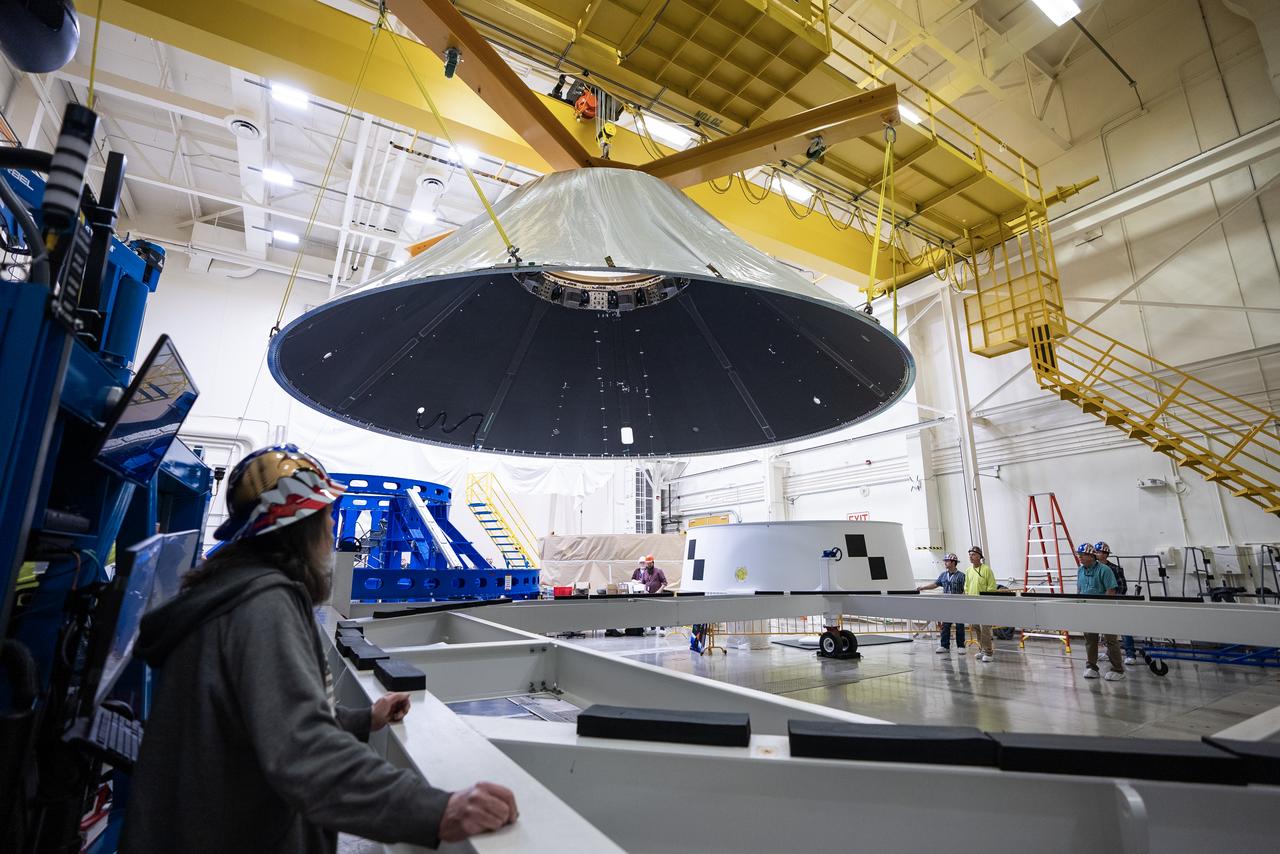
These photos and videos show how NASA manufactured and prepared to transport the payload adapter in February inside Building 4708 at NASA’s Marshall Space Flight Center in Huntsville, Alabama. Prior to moving the hardware for testing, teams installed the New Explorations Secondary Transport component, called the NEST, into the top of the engineering development unit. The NEST component will allow the hardware to hold a series of secondary payloads, or small satellites. The cone-shaped payload adapter is about 8.5 feet tall and features two metal rings and eight composite panels. The adapter, which will debut on NASA’s Artemis IV mission, is an evolution from the Orion stage adapter used in the Block 1 configuration of the rocket for the first three Artemis missions. It will be housed inside the universal stage adapter atop the rocket’s more powerful in-space stage, called the exploration upper stage. The payload adapter, like the launch vehicle stage adapter and the Orion stage adapter, is fully manufactured and tested at Marshall, which manages the SLS Program. NASA is working to land the first woman, first person of color, and its first international partner astronaut on the Moon under Artemis. SLS is part of NASA’s backbone for deep space exploration, along with the Orion spacecraft and Gateway in orbit around the Moon and commercial human landing systems, next-generational spacesuits, and rovers on the lunar surface. SLS is the only rocket that can send Orion, astronauts, and supplies to the Moon in a single launch.
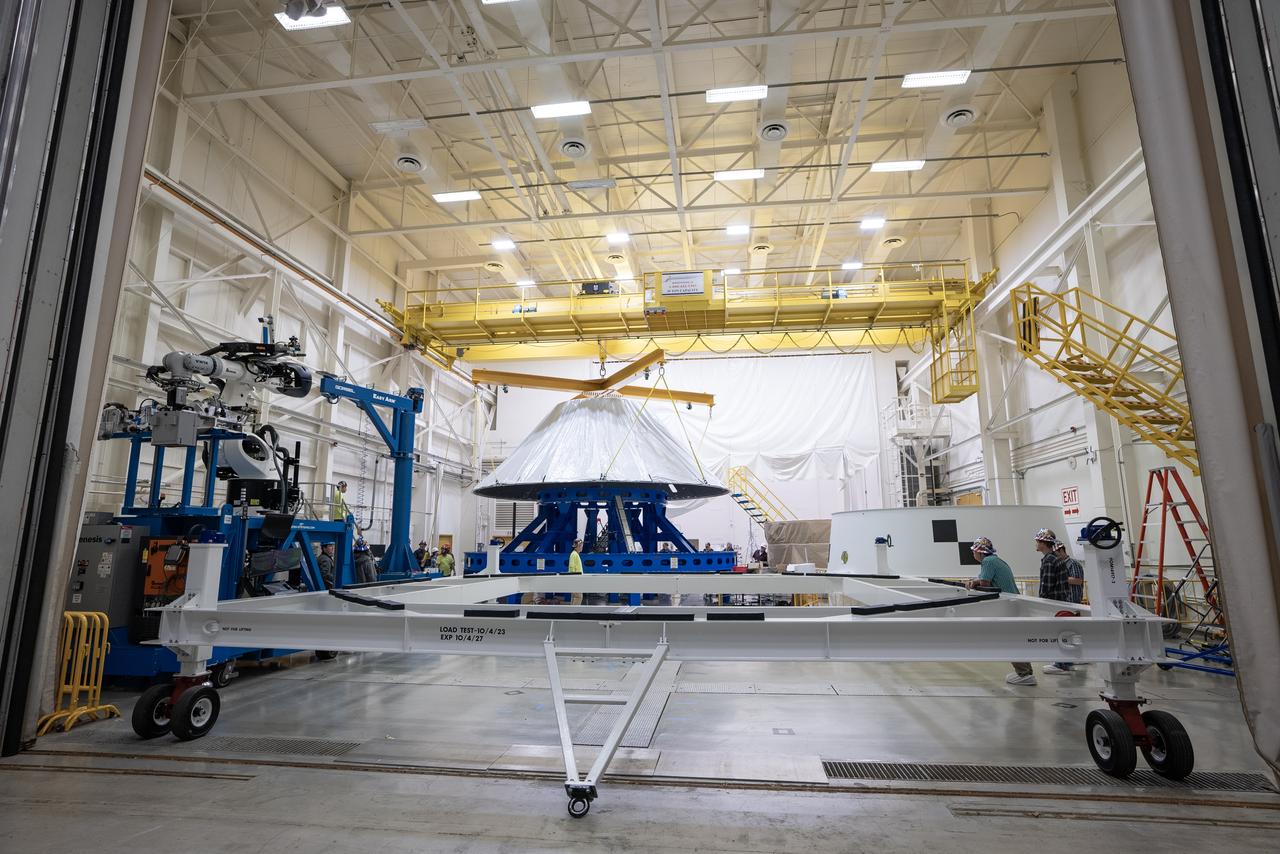
These photos and videos show how NASA manufactured and prepared to transport the payload adapter in February inside Building 4708 at NASA’s Marshall Space Flight Center in Huntsville, Alabama. Prior to moving the hardware for testing, teams installed the New Explorations Secondary Transport component, called the NEST, into the top of the engineering development unit. The NEST component will allow the hardware to hold a series of secondary payloads, or small satellites. The cone-shaped payload adapter is about 8.5 feet tall and features two metal rings and eight composite panels. The adapter, which will debut on NASA’s Artemis IV mission, is an evolution from the Orion stage adapter used in the Block 1 configuration of the rocket for the first three Artemis missions. It will be housed inside the universal stage adapter atop the rocket’s more powerful in-space stage, called the exploration upper stage. The payload adapter, like the launch vehicle stage adapter and the Orion stage adapter, is fully manufactured and tested at Marshall, which manages the SLS Program. NASA is working to land the first woman, first person of color, and its first international partner astronaut on the Moon under Artemis. SLS is part of NASA’s backbone for deep space exploration, along with the Orion spacecraft and Gateway in orbit around the Moon and commercial human landing systems, next-generational spacesuits, and rovers on the lunar surface. SLS is the only rocket that can send Orion, astronauts, and supplies to the Moon in a single launch.
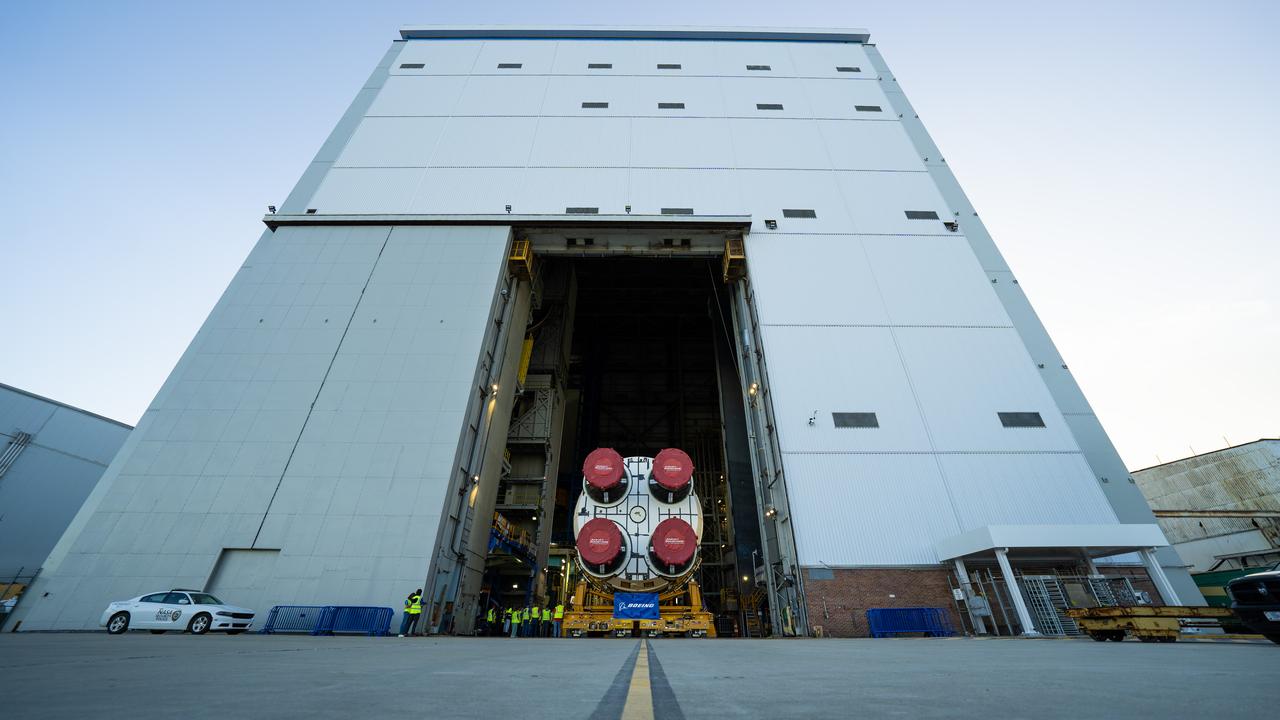
These images and videos show team members moving the first core stage that will help launch the first crewed flight of NASA’s SLS (Space Launch System) rocket for the agency’s Artemis II mission. The move marked the first time a fully assembled Moon rocket stage for a crewed mission has rolled out from NASA’s Michoud Assembly Facility in New Orleans since the Apollo Program, The core stage was moved onto the agency’s Pegasus barge, where it will be ferried to NASA’s Kennedy Space Center in Florida. The core stage for the SLS mega rocket is the largest stage NASA has ever produced. At 212 feet tall, the stage consists of five major elements, including two huge propellant tanks that collectively hold more than 733,000 gallons of super chilled liquid propellant to feed four RS-25 engines at its base. During launch and flight, the stage will operate for just over eight minutes, producing more than 2 million pounds of thrust to help send a crew of four astronauts inside NASA’s Orion spacecraft onward to the Moon. NASA is working to land the first woman, first person of color, and its first international partner astronaut on the Moon under Artemis. SLS is part of NASA’s backbone for deep space exploration, along with the Orion spacecraft and Gateway in orbit around the Moon and commercial human landing systems, next-generation space, next-generational spacesuits, and rovers on the lunar surface. SLS is the only rocket that can send Orion, astronauts, and supplies to the Moon in a single launch.
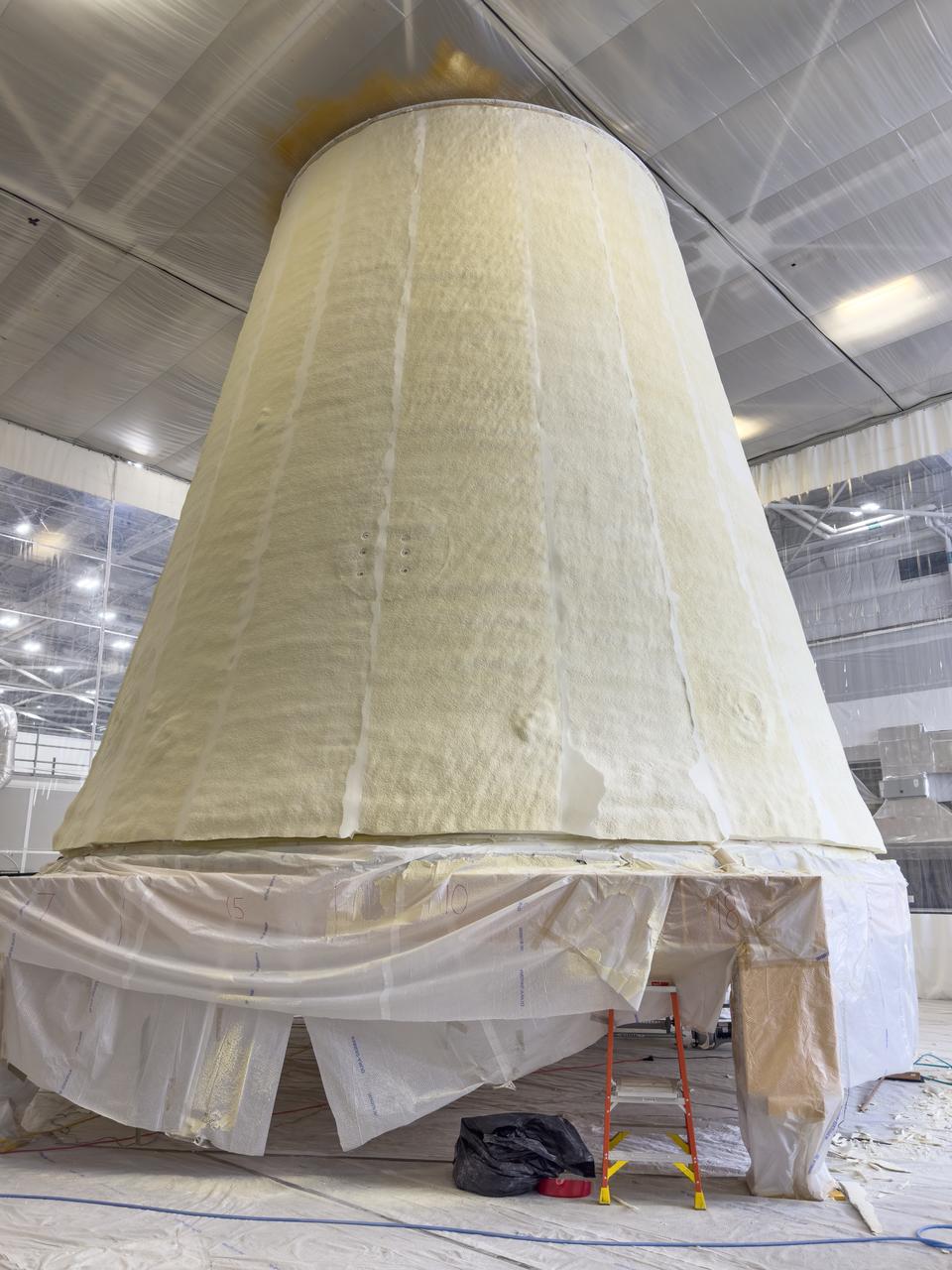
These photos show how technicians at NASA’s Marshall Space Flight Center in Huntsville, Alabama, have applied the thermal protection system material to the launch vehicle stage adapter (LVSA) of NASA’s SLS (Space Launch System) rocket for Artemis III, which will land astronauts on the Moon to advance long-term lunar exploration and scientific discovery and inspire the Artemis Generation. The LVSA is a cone-shaped element that connects the mega rocket’s core stage to its interim cryogenic propulsion stage (ICPS), partially enclosing it and protecting its avionics and electrical systems from the extreme pressures, sounds, and temperatures during launch and flight. Teams at Marshall began applying the thermal protection system material in the spring of 2023. Unlike other parts of the SLS rocket, the thermal protection system material for the LVSA is applied entirely by hand using a spray gun. During application, the technicians use a thin measuring rod to gauge the proper thickness. Once the thermal protection system has cured, certain areas are sanded down to meet parameters. The entire process takes several months. The LVSA is fully manufactured at Marshall by NASA, lead contractor Teledyne Brown Engineering, and the Jacobs Space Group’s ESSCA contract. The LVSA for Artemis III is the last of its kind as future SLS rockets will transition to its next, more powerful Block 1B configuration beginning with Artemis IV. NASA is working to land the first woman and first person of color on the Moon under Artemis. SLS is part of NASA’s backbone for deep space exploration, along with the Orion spacecraft, advanced spacesuits and rovers, the Gateway in orbit around the Moon, and commercial human landing systems. SLS is the only rocket that can send Orion, astronauts, and supplies to the Moon in a single mission.
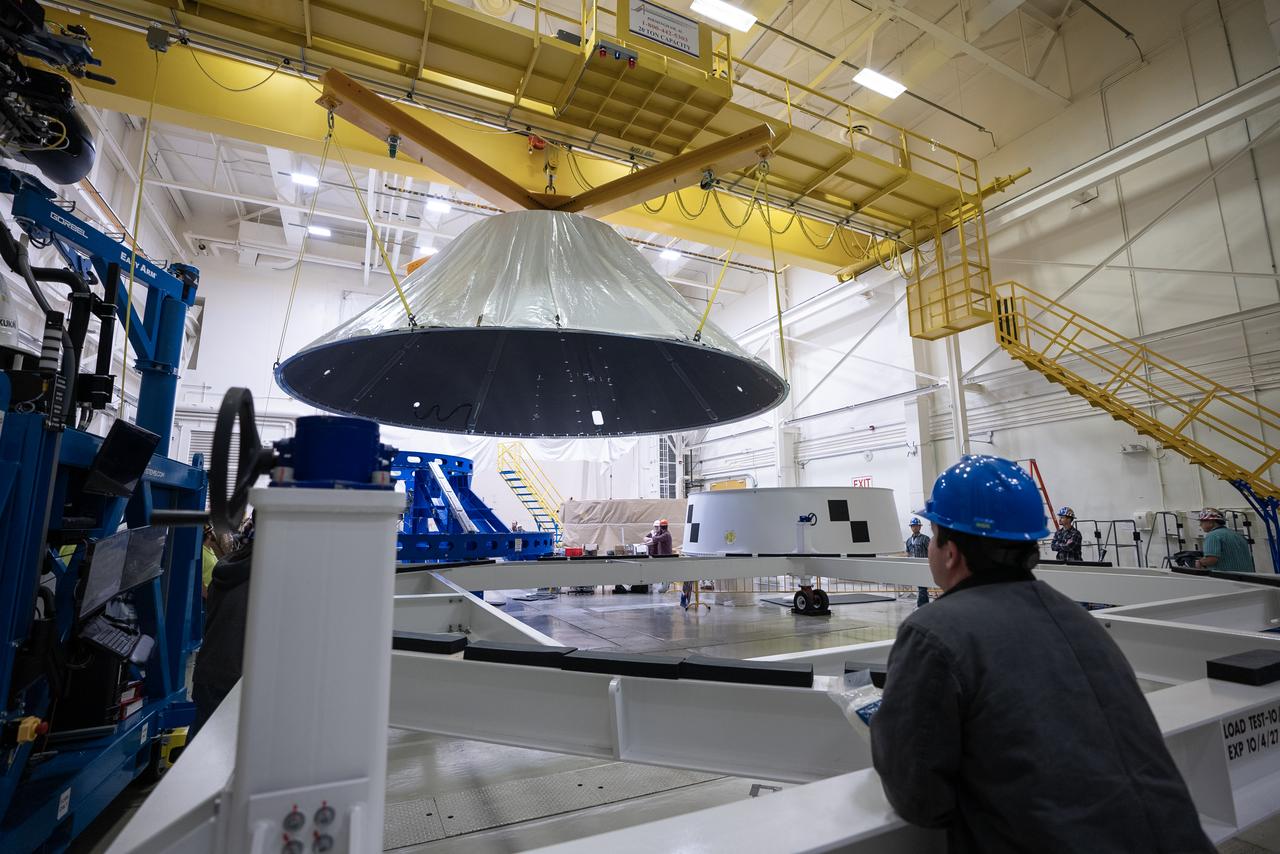
These photos and videos show how NASA manufactured and prepared to transport the payload adapter in February inside Building 4708 at NASA’s Marshall Space Flight Center in Huntsville, Alabama. Prior to moving the hardware for testing, teams installed the New Explorations Secondary Transport component, called the NEST, into the top of the engineering development unit. The NEST component will allow the hardware to hold a series of secondary payloads, or small satellites. The cone-shaped payload adapter is about 8.5 feet tall and features two metal rings and eight composite panels. The adapter, which will debut on NASA’s Artemis IV mission, is an evolution from the Orion stage adapter used in the Block 1 configuration of the rocket for the first three Artemis missions. It will be housed inside the universal stage adapter atop the rocket’s more powerful in-space stage, called the exploration upper stage. The payload adapter, like the launch vehicle stage adapter and the Orion stage adapter, is fully manufactured and tested at Marshall, which manages the SLS Program. NASA is working to land the first woman, first person of color, and its first international partner astronaut on the Moon under Artemis. SLS is part of NASA’s backbone for deep space exploration, along with the Orion spacecraft and Gateway in orbit around the Moon and commercial human landing systems, next-generational spacesuits, and rovers on the lunar surface. SLS is the only rocket that can send Orion, astronauts, and supplies to the Moon in a single launch.
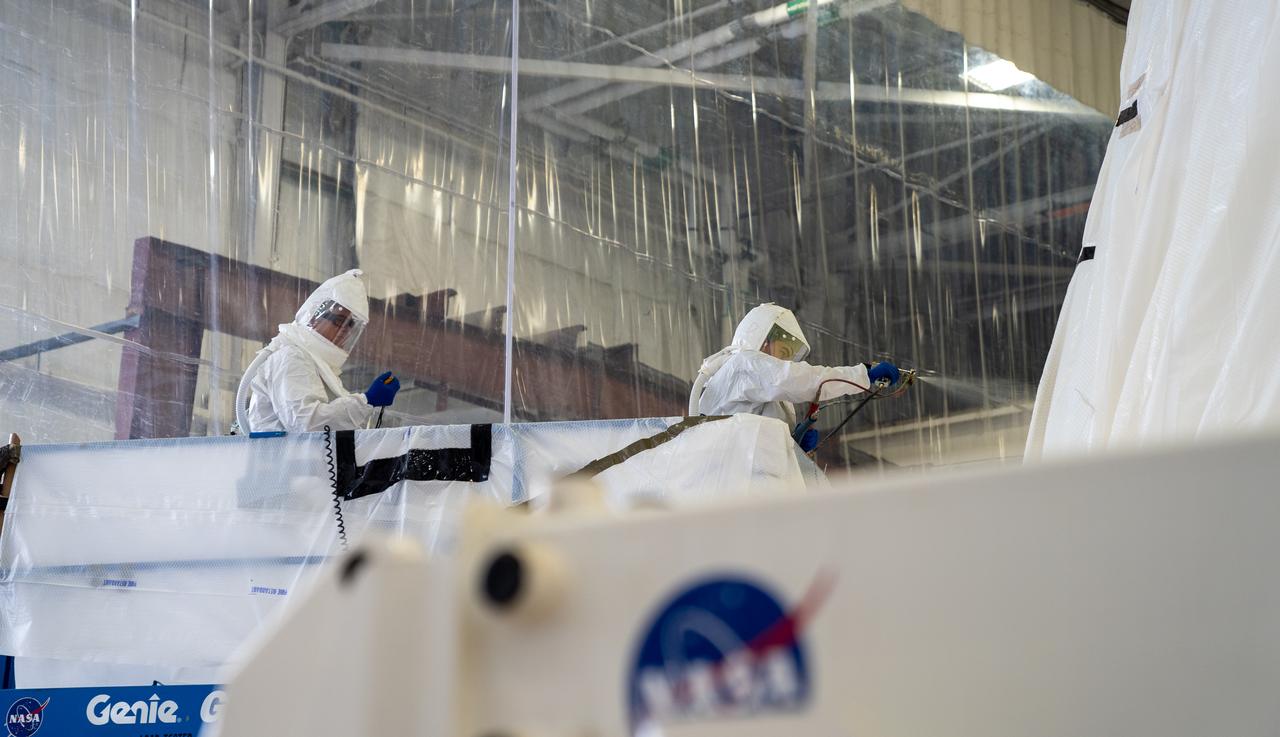
These photos show how technicians at NASA’s Marshall Space Flight Center in Huntsville, Alabama, have applied the thermal protection system material to the launch vehicle stage adapter (LVSA) of NASA’s SLS (Space Launch System) rocket for Artemis III, which will land astronauts on the Moon to advance long-term lunar exploration and scientific discovery and inspire the Artemis Generation. The LVSA is a cone-shaped element that connects the mega rocket’s core stage to its interim cryogenic propulsion stage (ICPS), partially enclosing it and protecting its avionics and electrical systems from the extreme pressures, sounds, and temperatures during launch and flight. Teams at Marshall began applying the thermal protection system material in the spring of 2023. Unlike other parts of the SLS rocket, the thermal protection system material for the LVSA is applied entirely by hand using a spray gun. During application, the technicians use a thin measuring rod to gauge the proper thickness. Once the thermal protection system has cured, certain areas are sanded down to meet parameters. The entire process takes several months. The LVSA is fully manufactured at Marshall by NASA, lead contractor Teledyne Brown Engineering, and the Jacobs Space Group’s ESSCA contract. The LVSA for Artemis III is the last of its kind as future SLS rockets will transition to its next, more powerful Block 1B configuration beginning with Artemis IV. NASA is working to land the first woman and first person of color on the Moon under Artemis. SLS is part of NASA’s backbone for deep space exploration, along with the Orion spacecraft, advanced spacesuits and rovers, the Gateway in orbit around the Moon, and commercial human landing systems. SLS is the only rocket that can send Orion, astronauts, and supplies to the Moon in a single mission.
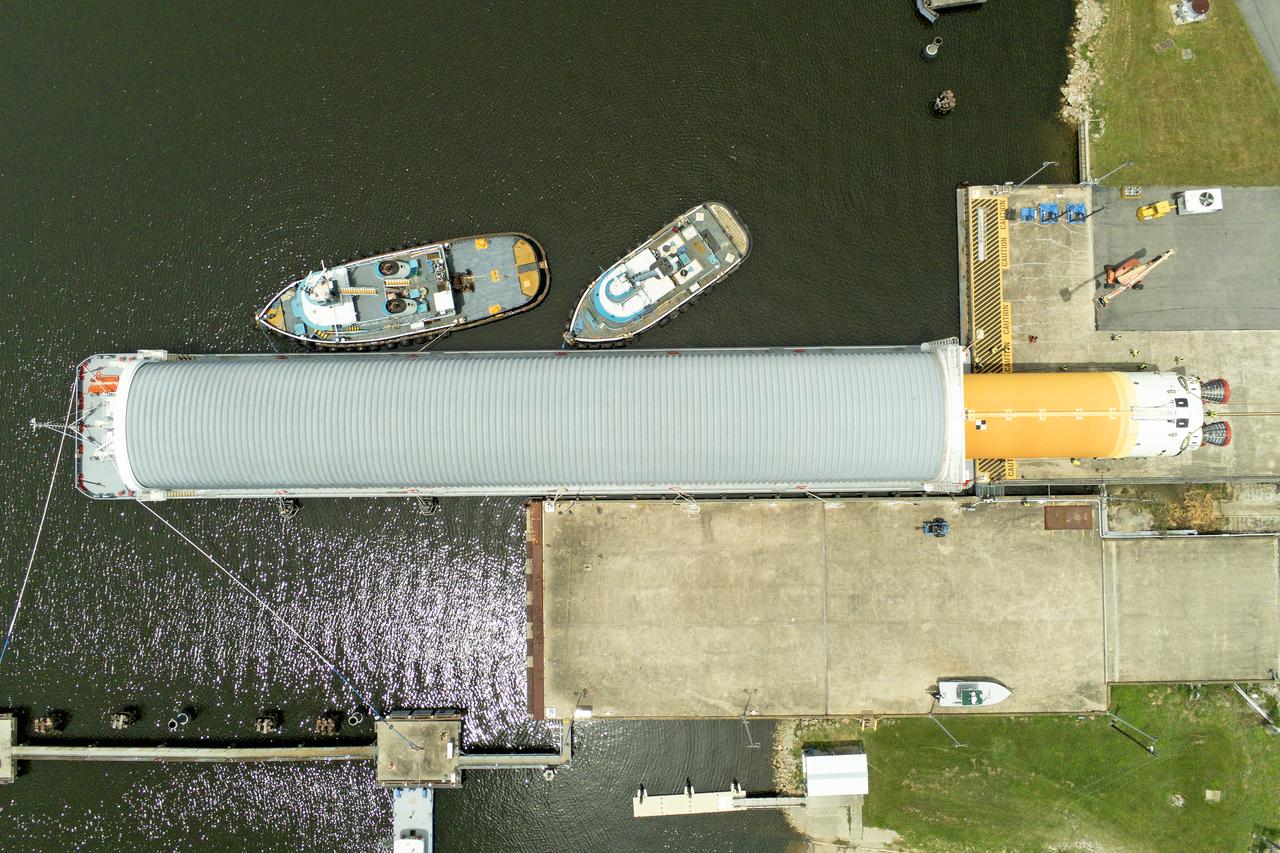
These images and videos show team members at Michoud Assembly Facility loading the first core stage that will help launch the first crewed flight of NASA’s SLS (Space Launch System) rocket for the agency’s Artemis II mission onto the Pegasus barge on Tuesday, July 16, 2024. The barge will ferry the core stage on a 900-mile journey from the agency’s Michoud Assembly Facility in New Orleans to its Kennedy Space Center in Florida. The core stage for the SLS mega rocket is the largest stage NASA has ever produced. At 212 feet tall, the stage consists of five major elements, including two huge propellant tanks that collectively hold more than 733,000 gallons of super chilled liquid propellant to feed four RS-25 engines at its base. During launch and flight, the stage will operate for just over eight minutes, producing more than 2 million pounds of thrust to help send a crew of four astronauts inside NASA’s Orion spacecraft onward to the Moon. All the major structures for every SLS core stage are fully manufactured at NASA Michoud. NASA is working to land the first woman, first person of color, and its first international partner astronaut on the Moon under Artemis. SLS is part of NASA’s backbone for deep space exploration, along with the Orion spacecraft and Gateway in orbit around the Moon and commercial human landing systems, next-generation space, next-generational spacesuits, and rovers on the lunar surface. SLS is the only rocket that can send Orion, astronauts, and supplies to the Moon in a single launch.
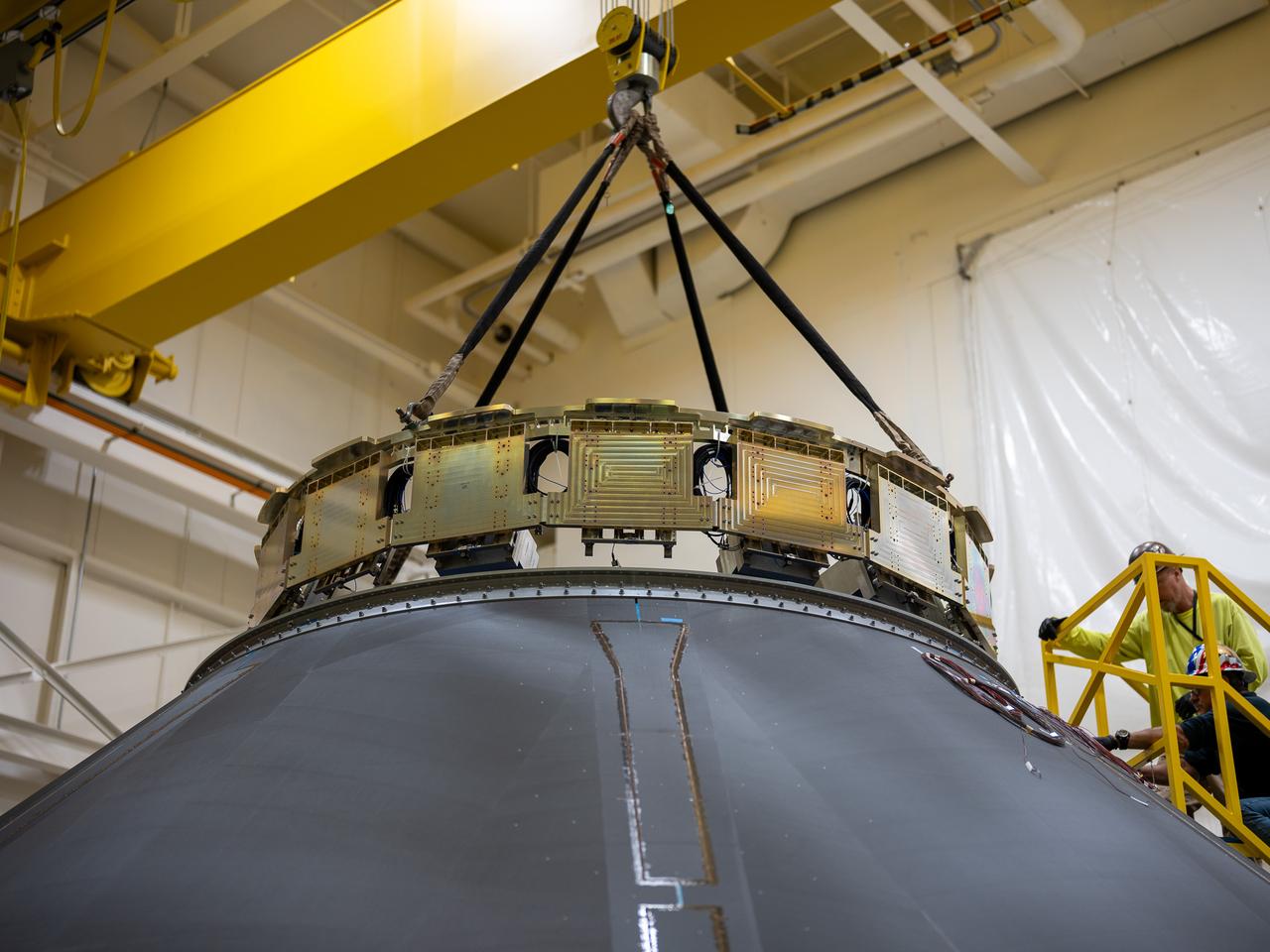
These photos and videos show how NASA manufactured and prepared to transport the payload adapter in February inside Building 4708 at NASA’s Marshall Space Flight Center in Huntsville, Alabama. Prior to moving the hardware for testing, teams installed the New Explorations Secondary Transport component, called the NEST, into the top of the engineering development unit. The NEST component will allow the hardware to hold a series of secondary payloads, or small satellites. The cone-shaped payload adapter is about 8.5 feet tall and features two metal rings and eight composite panels. The adapter, which will debut on NASA’s Artemis IV mission, is an evolution from the Orion stage adapter used in the Block 1 configuration of the rocket for the first three Artemis missions. It will be housed inside the universal stage adapter atop the rocket’s more powerful in-space stage, called the exploration upper stage. The payload adapter, like the launch vehicle stage adapter and the Orion stage adapter, is fully manufactured and tested at Marshall, which manages the SLS Program. NASA is working to land the first woman, first person of color, and its first international partner astronaut on the Moon under Artemis. SLS is part of NASA’s backbone for deep space exploration, along with the Orion spacecraft and Gateway in orbit around the Moon and commercial human landing systems, next-generational spacesuits, and rovers on the lunar surface. SLS is the only rocket that can send Orion, astronauts, and supplies to the Moon in a single launch.
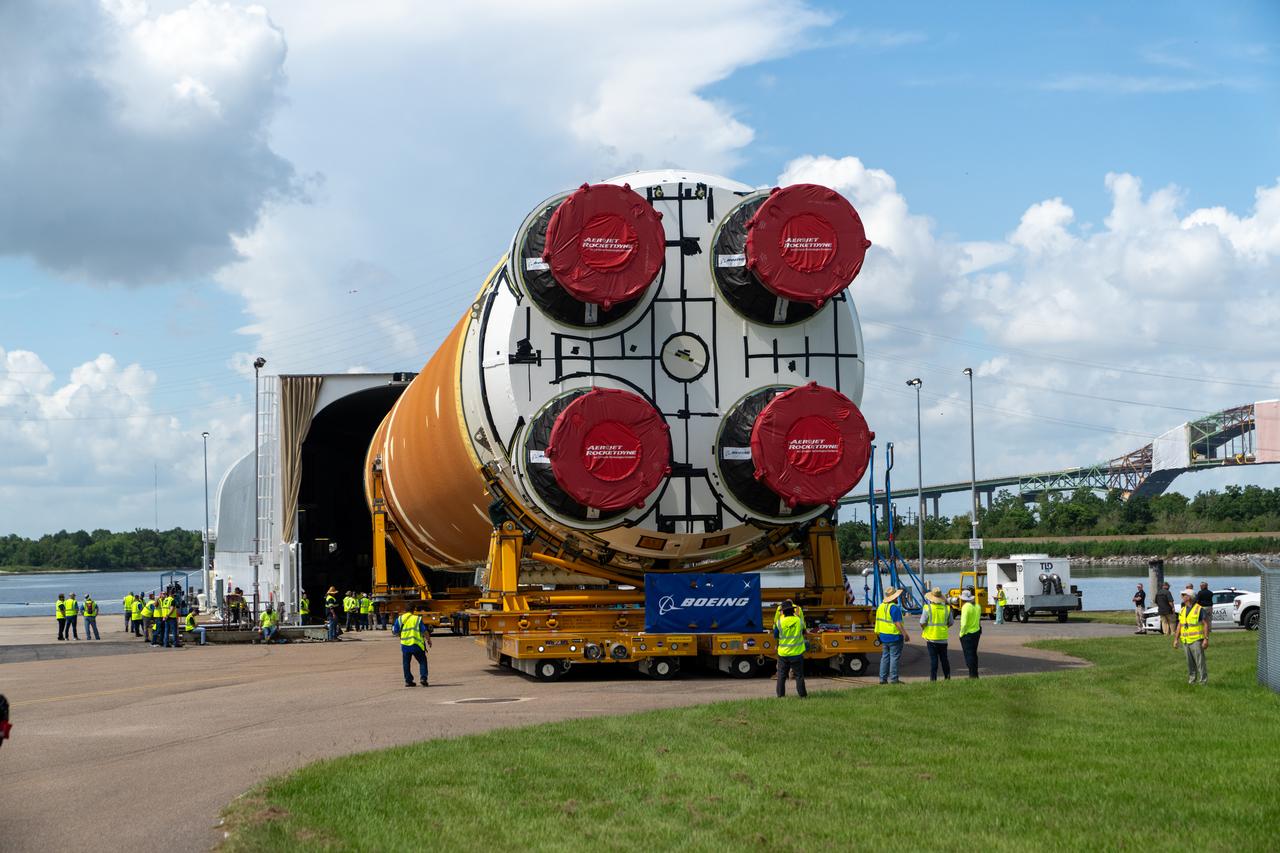
These images and videos show team members at Michoud Assembly Facility loading the first core stage that will help launch the first crewed flight of NASA’s SLS (Space Launch System) rocket for the agency’s Artemis II mission onto the Pegasus barge on Tuesday, July 16, 2024. The barge will ferry the core stage on a 900-mile journey from the agency’s Michoud Assembly Facility in New Orleans to its Kennedy Space Center in Florida. The core stage for the SLS mega rocket is the largest stage NASA has ever produced. At 212 feet tall, the stage consists of five major elements, including two huge propellant tanks that collectively hold more than 733,000 gallons of super chilled liquid propellant to feed four RS-25 engines at its base. During launch and flight, the stage will operate for just over eight minutes, producing more than 2 million pounds of thrust to help send a crew of four astronauts inside NASA’s Orion spacecraft onward to the Moon. All the major structures for every SLS core stage are fully manufactured at NASA Michoud. NASA is working to land the first woman, first person of color, and its first international partner astronaut on the Moon under Artemis. SLS is part of NASA’s backbone for deep space exploration, along with the Orion spacecraft and Gateway in orbit around the Moon and commercial human landing systems, next-generation space, next-generational spacesuits, and rovers on the lunar surface. SLS is the only rocket that can send Orion, astronauts, and supplies to the Moon in a single launch.
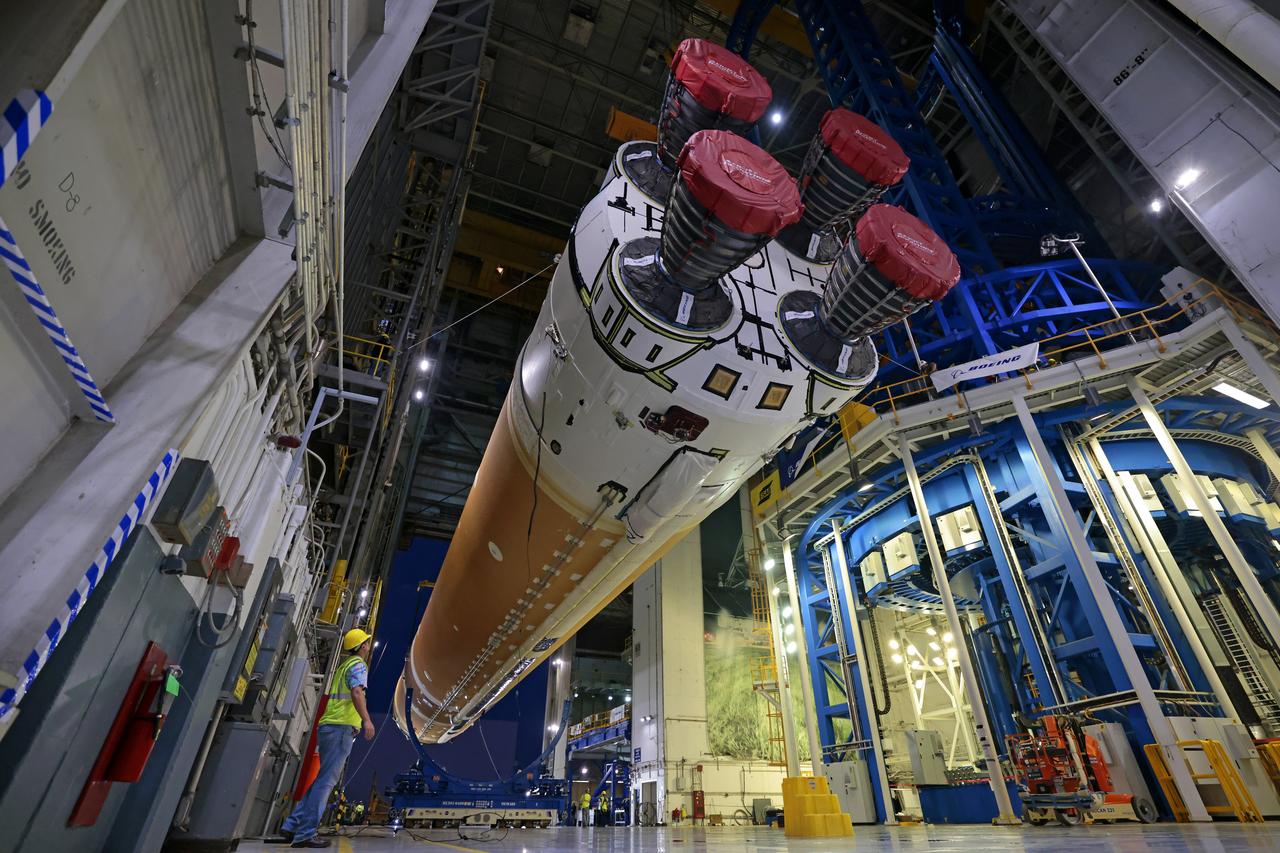
Technicians at Michoud Assembly Facility in New Orleans lift the core stage that will help launch the first crewed flight of NASA’s SLS (Space Launch System) rocket for the agency’s Artemis II mission. Teams at Michoud lifted the core stage on Thursday, July 11, 2024, onto NASA’s Multi-Purpose Transportation System, designed to transport SLS vehicle segments by waterway and roadway. It is tasked with transporting the vehicle from where it is manufactured to its intermediate test location and final launch destination. The core stage was lifted in preparation for its move onto the agency’s Pegasus barge, where it will be ferried to NASA’s Kennedy Space Center in Florida. Pegasus is maintained at Michoud. The core stage for the SLS mega rocket is the largest stage NASA has ever produced. At 212 feet tall, the stage consists of five major elements, including two huge propellant tanks that collectively hold more than 733,000 gallons of super chilled liquid propellant to feed four RS-25 engines at its base. During launch and flight, the stage will operate for just over eight minutes, producing more than 2 million pounds of thrust to help send a crew of four astronauts inside NASA’s Orion spacecraft onward to the Moon. All the major structures for every SLS core stage are fully manufactured at NASA Michoud. NASA is working to land the first woman, first person of color, and its first international partner astronaut on the Moon under Artemis. SLS is part of NASA’s backbone for deep space exploration, along with the Orion spacecraft and Gateway in orbit around the Moon and commercial human landing systems, next-generation space, next-generational spacesuits, and rovers on the lunar surface. SLS is the only rocket that can send Orion, astronauts, and supplies to the Moon in a single launch. Image credit: NASA/Michael DeMocker
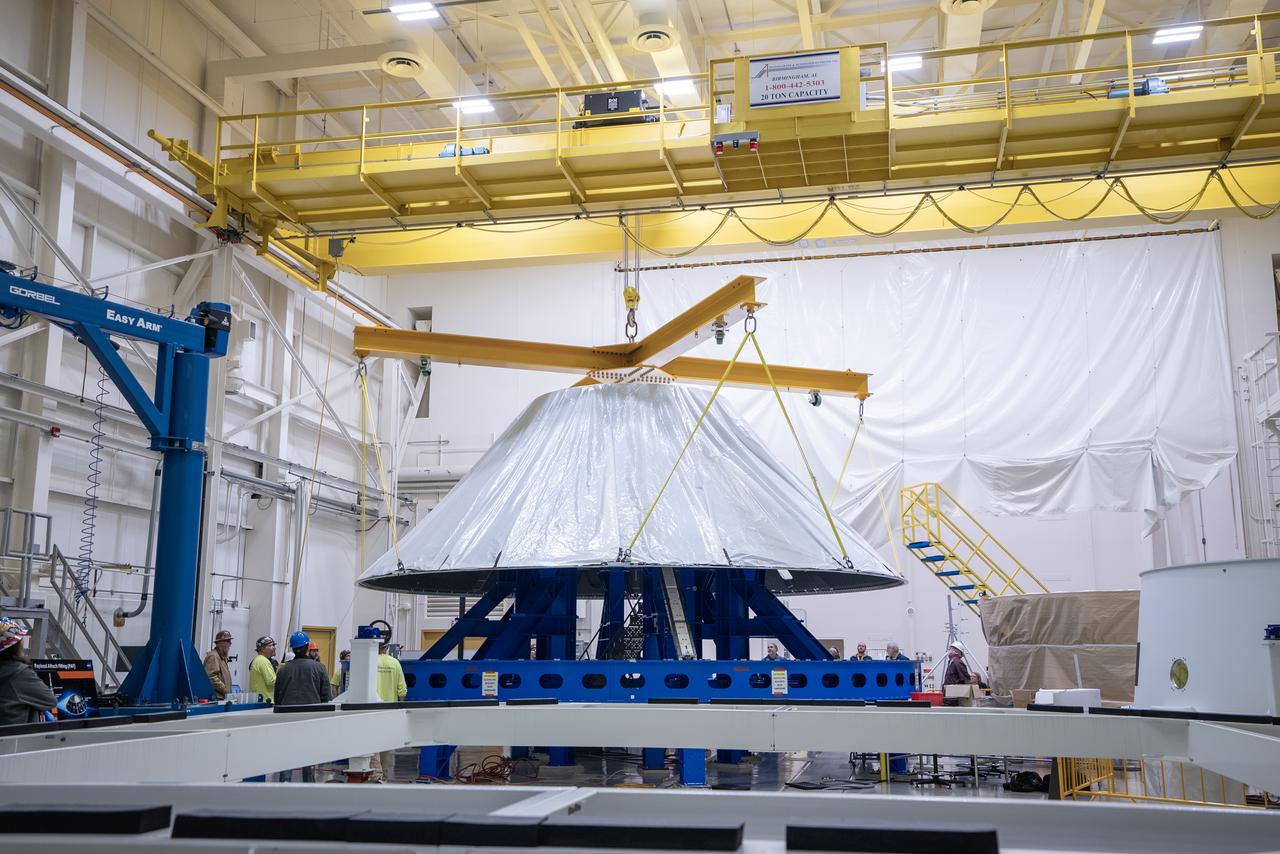
These photos and videos show how NASA manufactured and prepared to transport the payload adapter in February inside Building 4708 at NASA’s Marshall Space Flight Center in Huntsville, Alabama. Prior to moving the hardware for testing, teams installed the New Explorations Secondary Transport component, called the NEST, into the top of the engineering development unit. The NEST component will allow the hardware to hold a series of secondary payloads, or small satellites. The cone-shaped payload adapter is about 8.5 feet tall and features two metal rings and eight composite panels. The adapter, which will debut on NASA’s Artemis IV mission, is an evolution from the Orion stage adapter used in the Block 1 configuration of the rocket for the first three Artemis missions. It will be housed inside the universal stage adapter atop the rocket’s more powerful in-space stage, called the exploration upper stage. The payload adapter, like the launch vehicle stage adapter and the Orion stage adapter, is fully manufactured and tested at Marshall, which manages the SLS Program. NASA is working to land the first woman, first person of color, and its first international partner astronaut on the Moon under Artemis. SLS is part of NASA’s backbone for deep space exploration, along with the Orion spacecraft and Gateway in orbit around the Moon and commercial human landing systems, next-generational spacesuits, and rovers on the lunar surface. SLS is the only rocket that can send Orion, astronauts, and supplies to the Moon in a single launch.