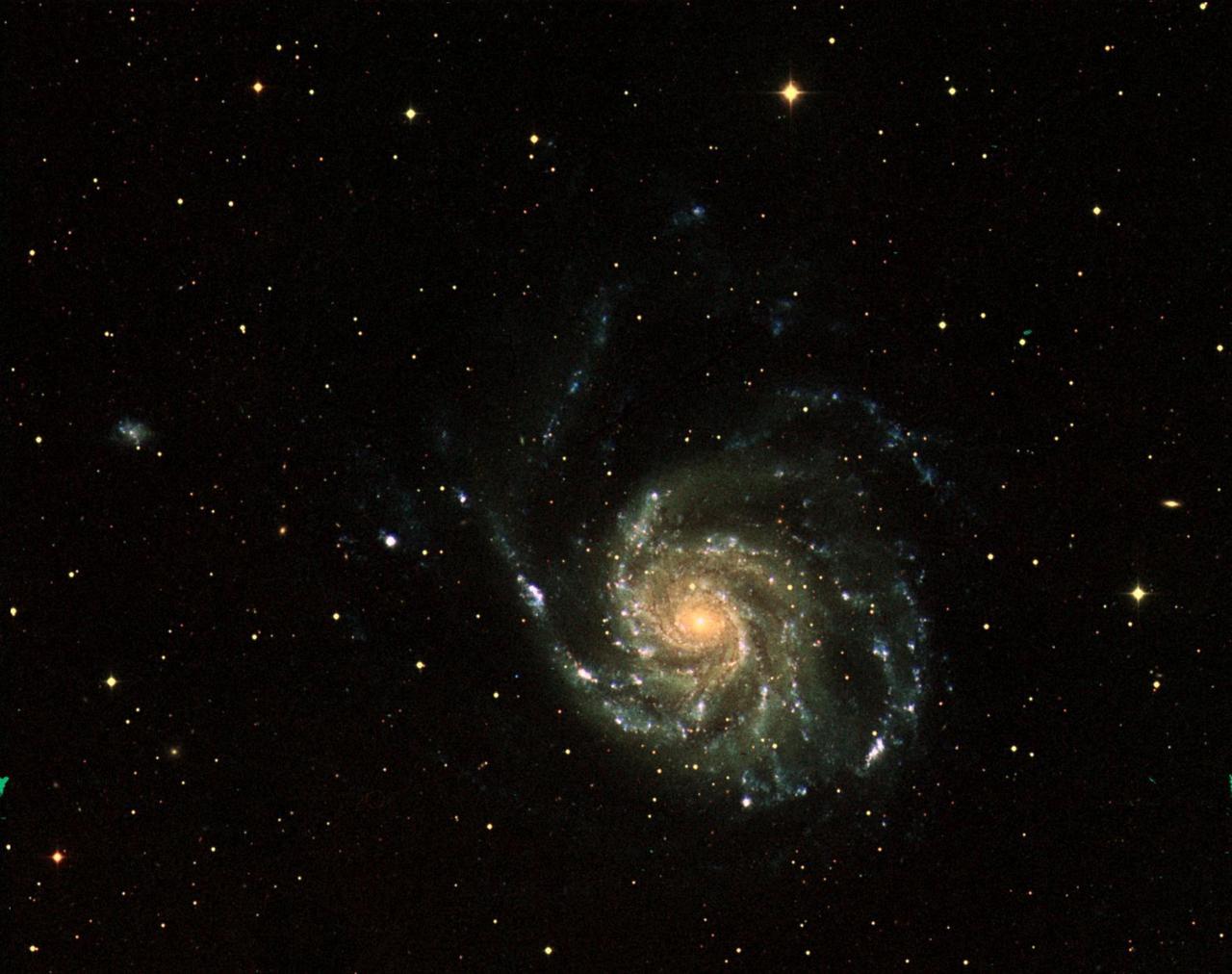
This three-color image of galaxy M101 was taken by NASA's Galaxy Evolution Explorer on June 20, 2003. The far ultraviolet emissions are shown in blue, the near ultraviolet emissions are green, and the red emissions, which were taken from NASA's Digital Sky Survey, represent visible light. This image combines short, medium, and long "exposure" pictures to best display the evolution of star formation in a spiral galaxy. http://photojournal.jpl.nasa.gov/catalog/PIA04630
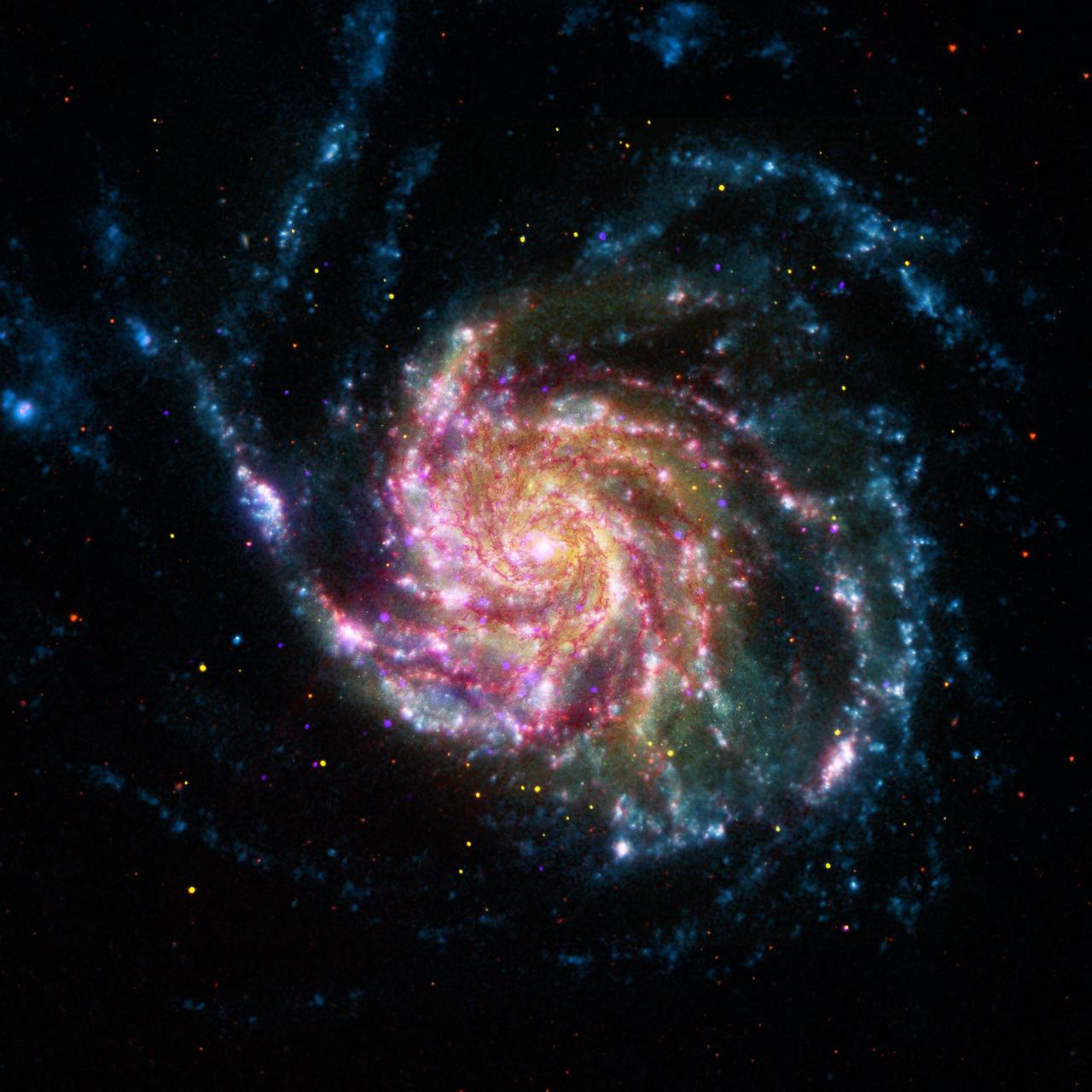
This image of the Pinwheel Galaxy, or M101, in the constellation of Ursa Major, combines data from four of NASA space telescopes. The view shows that both young and old stars are evenly distributed along M101 tightly wound spiral arms.
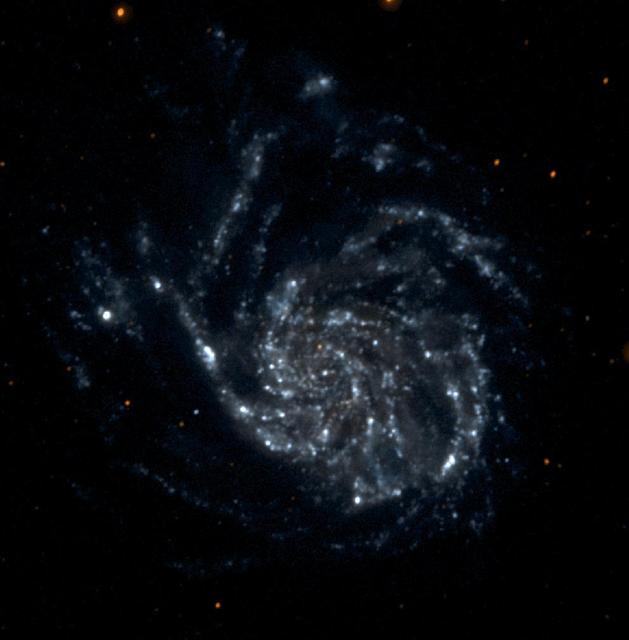
This single orbit exposure, ultraviolet color image of Messier 101 was taken by NASA's Galaxy Evolution Explorer on June 20, 2003. Messier 101 is a large spiral galaxy located 20 million light-years from Earth. This image is a short and medium "exposure" picture of the evolution of star formation in a spiral galaxy. The far ultraviolet emission detects the younger stars as concentrated in tight spiral arms, while the near ultraviolet emission, which traces stars living for more than 100 million years, displays the movement of the spiral pattern over a 100 million year period. The red stars in the foreground of the image are Milky Way stars. http://photojournal.jpl.nasa.gov/catalog/PIA04632
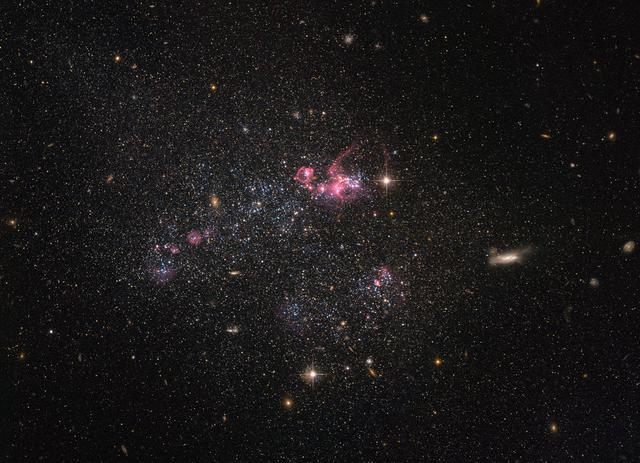
Despite being less famous than their elliptical and spiral galactic cousins, irregular dwarf galaxies, such as the one captured in this NASA/ESA Hubble Space Telescope image, are actually one of the most common types of galaxy in the Universe. Known as UGC 4459, this dwarf galaxy is located approximately 11 million light-years away in the constellation of Ursa Major (The Great Bear), a constellation that is also home to the Pinwheel Galaxy (M101), the Owl Nebula (M97), Messier 81, Messier 82 and several other galaxies all part of the M81 group. UGC 4459’s diffused and disorganised appearance is characteristic of an irregular dwarf galaxy. Lacking a distinctive structure or shape, irregular dwarf galaxies are often chaotic in appearance, with neither a nuclear bulge — a huge, tightly packed central group of stars — nor any trace of spiral arms — regions of stars extending from the centre of the galaxy. Astronomers suspect that some irregular dwarf galaxies were once spiral or elliptical galaxies, but were later deformed by the gravitational pull of nearby objects. Rich with young blue stars and older red stars, UGC 4459 has a stellar population of several billion. Though seemingly impressive, this is small when compared to the 200 to 400 billion stars in the Milky Way! Observations with Hubble have shown that because of their low masses, star formation is very low compared to larger galaxies. Only very little of their original gas has been turned into stars. Thus, these small galaxies are interesting to study to better understand primordial environments and the star formation process.
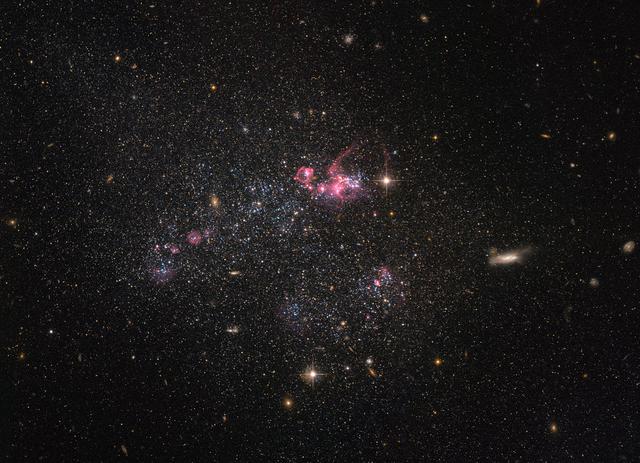
Despite being less famous than their elliptical and spiral galactic cousins, irregular dwarf galaxies, such as the one captured in this NASA/ESA Hubble Space Telescope image, are actually one of the most common types of galaxy in the universe. Known as UGC 4459, this dwarf galaxy is located approximately 11 million light-years away in the constellation of Ursa Major (The Great Bear), a constellation that is also home to the Pinwheel Galaxy (M101), the Owl Nebula (M97), Messier 81, Messier 82 and several other galaxies all part of the M81 group. UGC 4459’s diffused and disorganized appearance is characteristic of an irregular dwarf galaxy. Lacking a distinctive structure or shape, irregular dwarf galaxies are often chaotic in appearance, with neither a nuclear bulge — a huge, tightly packed central group of stars — nor any trace of spiral arms — regions of stars extending from the center of the galaxy. Astronomers suspect that some irregular dwarf galaxies were once spiral or elliptical galaxies, but were later deformed by the gravitational pull of nearby objects. Rich with young blue stars and older red stars, UGC 4459 has a stellar population of several billion. Though seemingly impressive, this is small when compared to the 200 to 400 billion stars in the Milky Way! Observations with Hubble have shown that because of their low masses of dwarf galaxies like UGC 4459, star formation is very low compared to larger galaxies. Only very little of their original gas has been turned into stars. Thus, these small galaxies are interesting to study to better understand primordial environments and the star formation process. Image Credit: ESA/Hubble and NASA; Acknowledgement: Judy Schmidt <b><a href="http://www.nasa.gov/audience/formedia/features/MP_Photo_Guidelines.html" rel="nofollow">NASA image use policy.</a></b> <b><a href="http://www.nasa.gov/centers/goddard/home/index.html" rel="nofollow">NASA Goddard Space Flight Center</a></b> enables NASA’s mission through four scientific endeavors: Earth Science, Heliophysics, Solar System Exploration, and Astrophysics. Goddard plays a leading role in NASA’s accomplishments by contributing compelling scientific knowledge to advance the Agency’s mission. <b>Follow us on <a href="http://twitter.com/NASAGoddardPix" rel="nofollow">Twitter</a></b> <b>Like us on <a href="http://www.facebook.com/pages/Greenbelt-MD/NASA-Goddard/395013845897?ref=tsd" rel="nofollow">Facebook</a></b> <b>Find us on <a href="http://instagrid.me/nasagoddard/?vm=grid" rel="nofollow">Instagram</a></b>