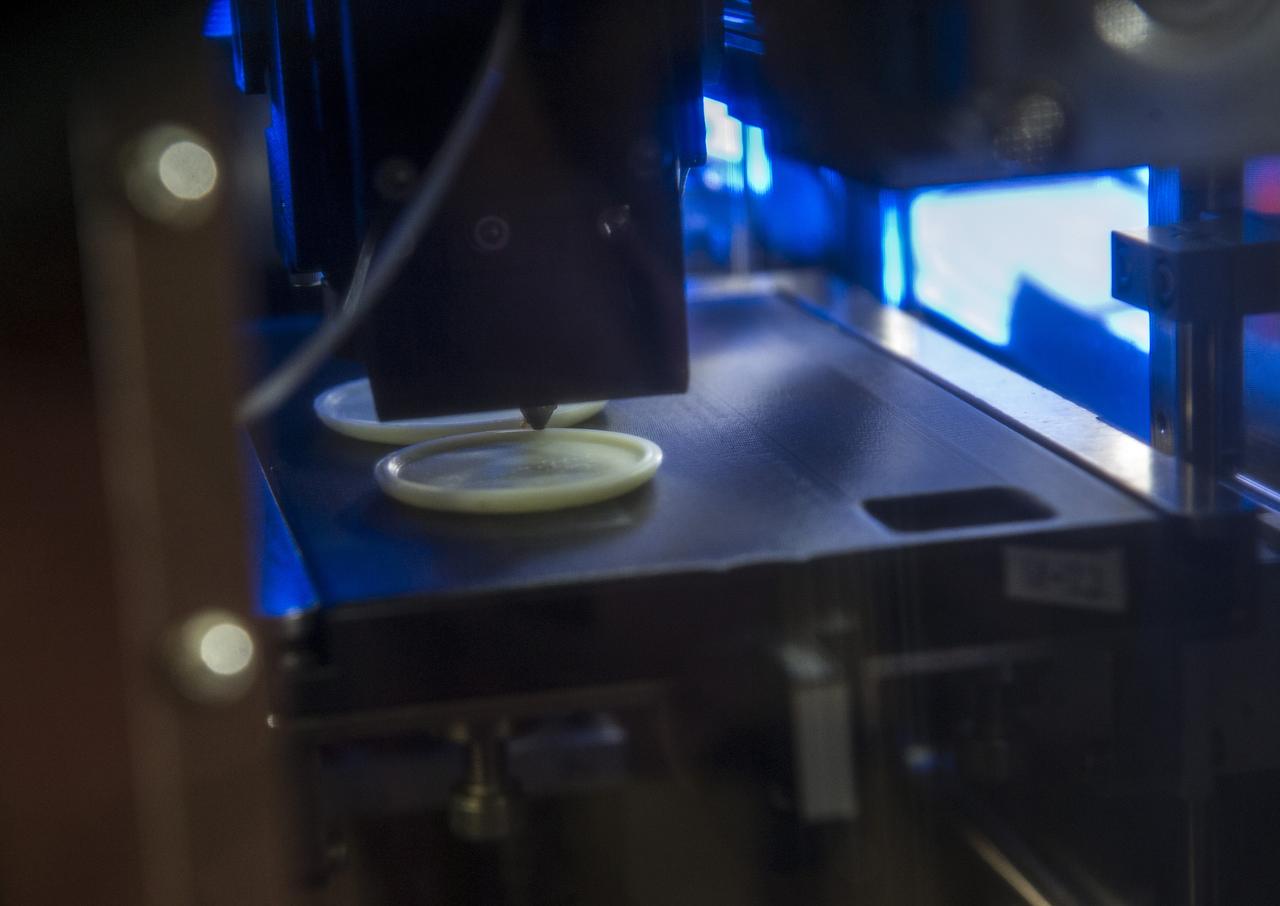
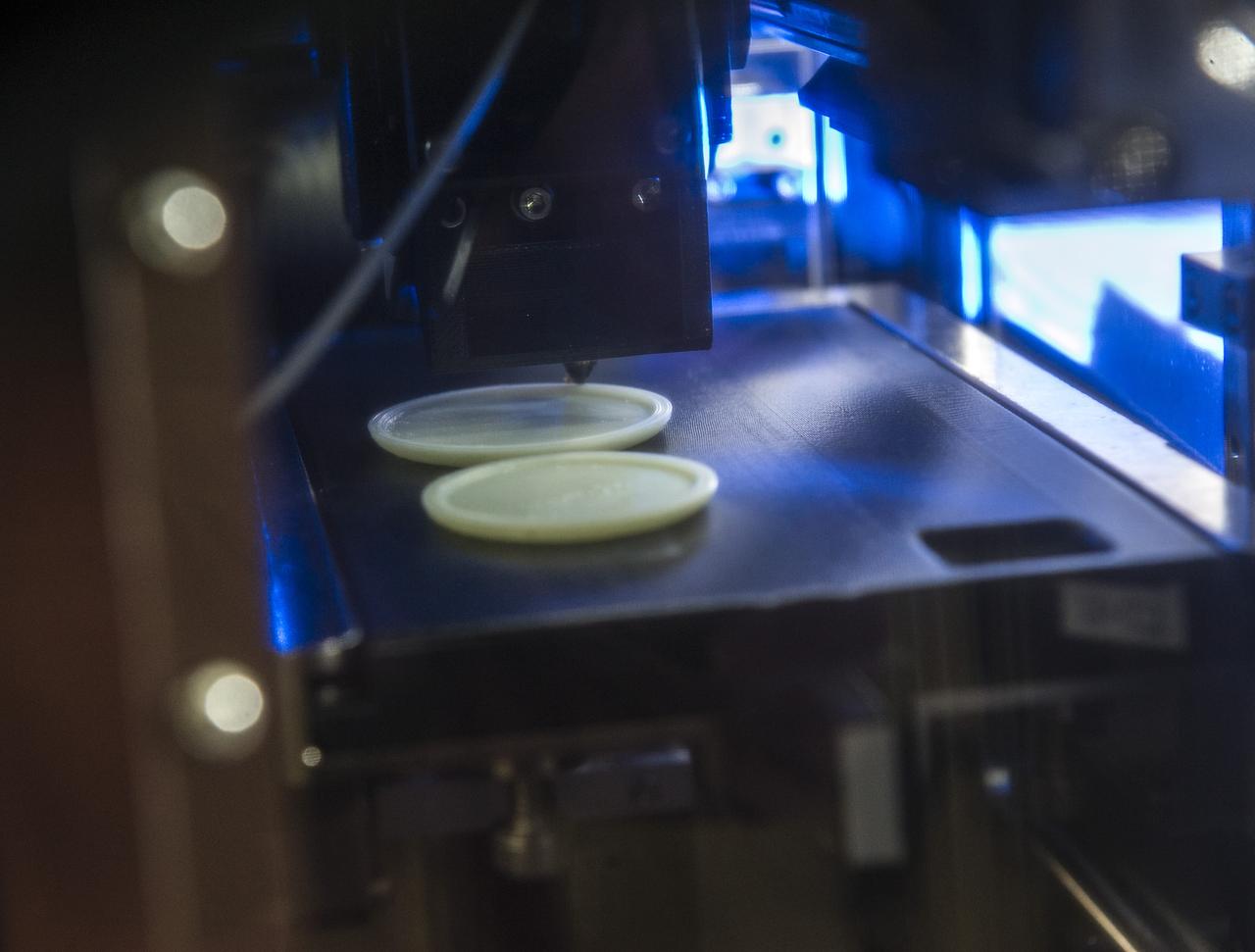
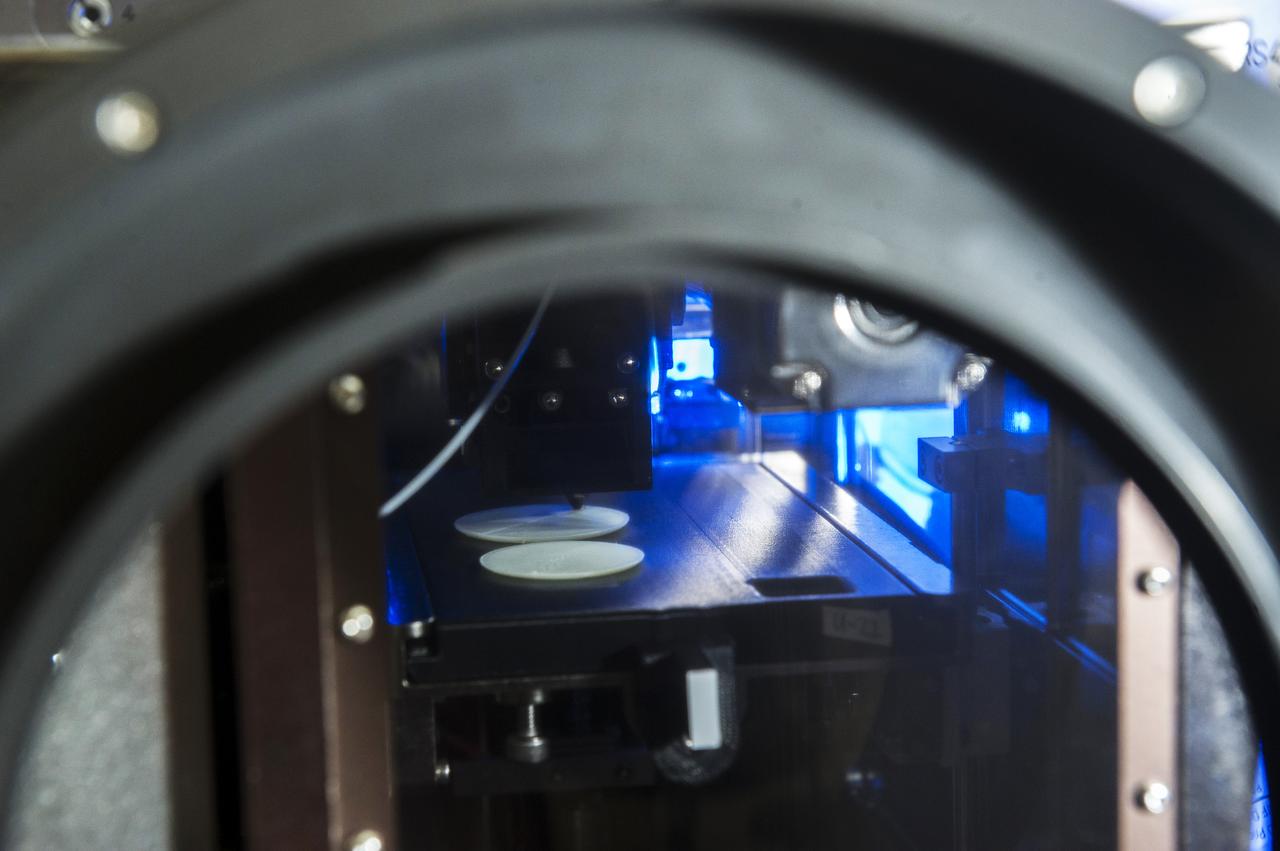
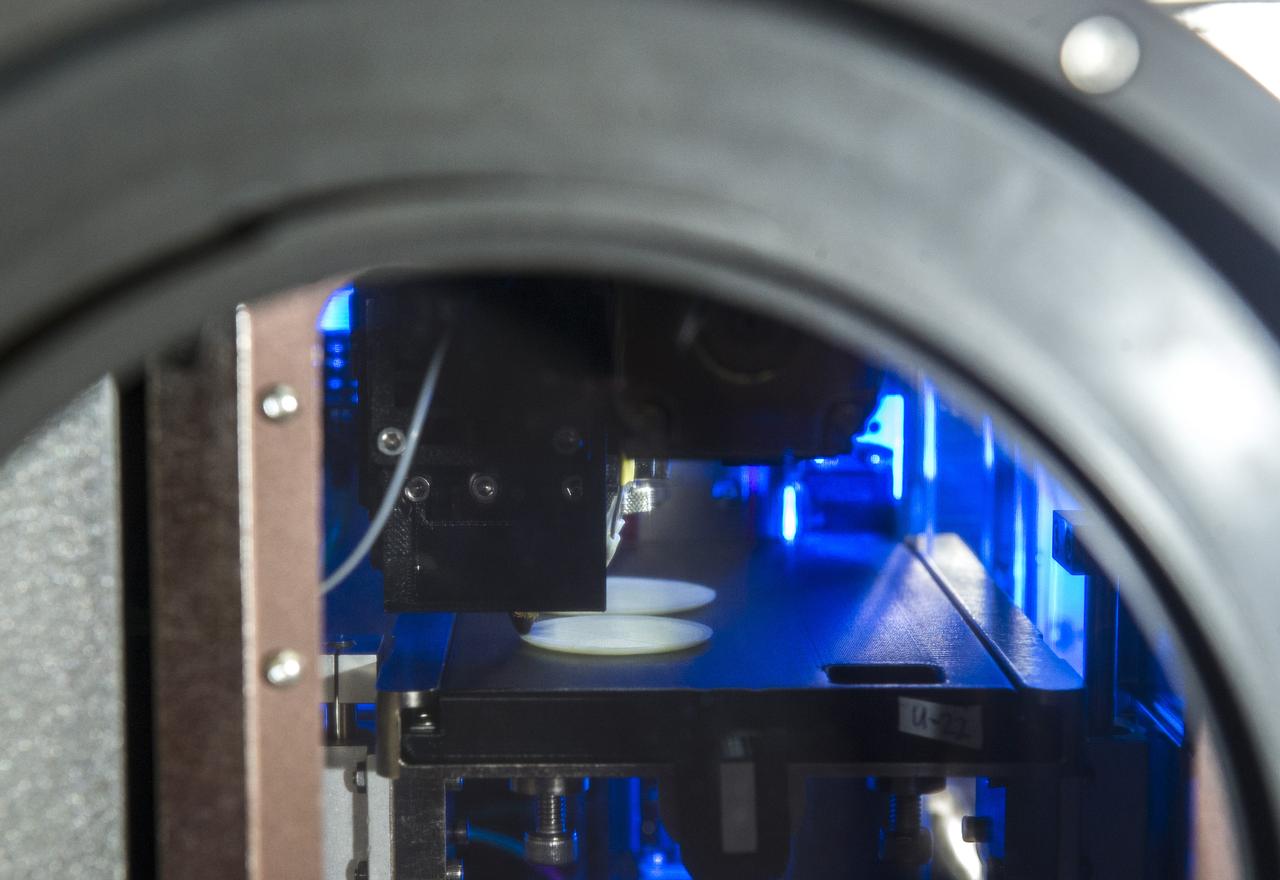
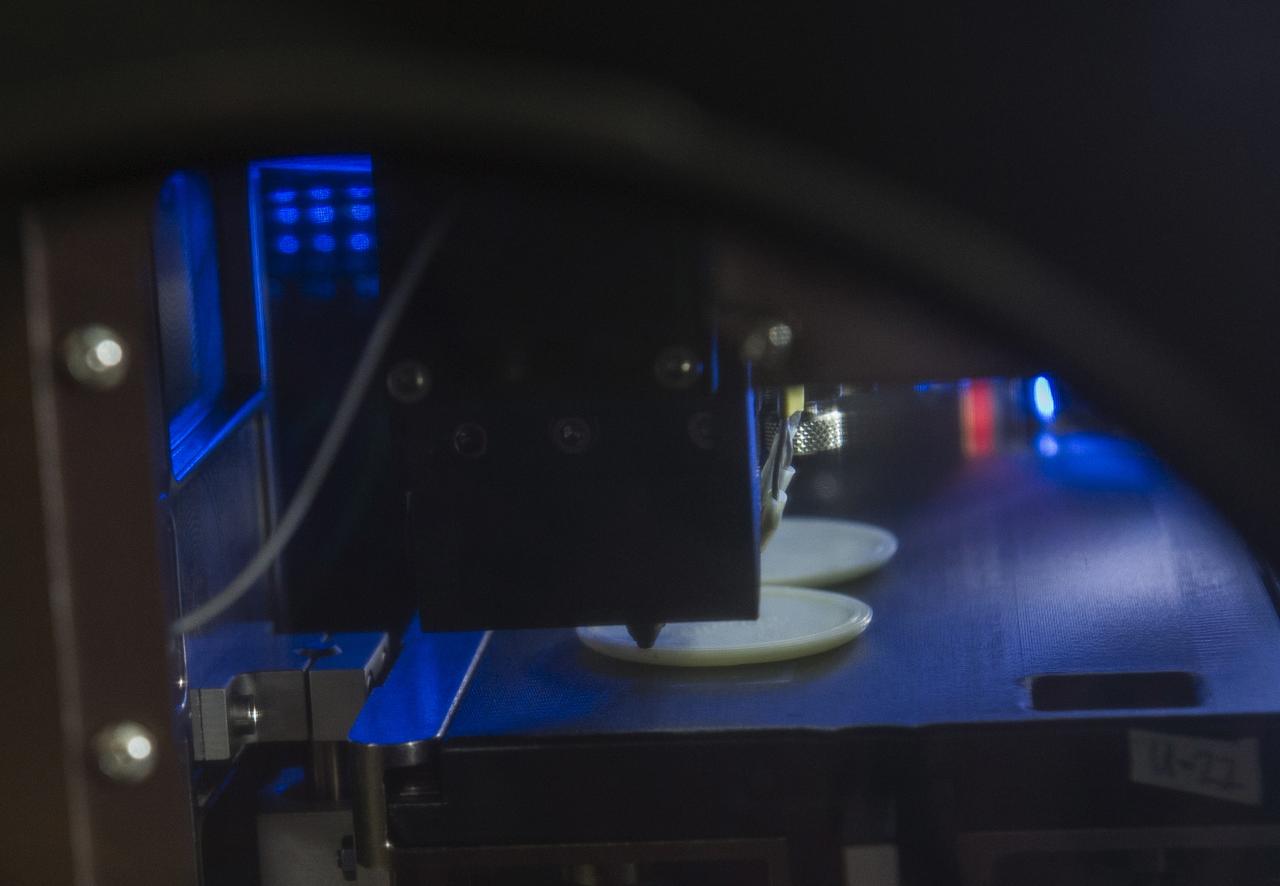
MADE IN SPACE” 3D PRINTER PRINTING TEST SAMPLES WHILE PRINTER IS IN MICROGRAVITY GLOVE BOX
1400501
MADE IN SPACE” 3D PRINTER PRINTING TEST SAMPLES WHILE PRINTER IS IN MICROGRAVITY GLOVE BOX
1400499
MADE IN SPACE” 3D PRINTER PRINTING TEST SAMPLES WHILE PRINTER IS IN MICROGRAVITY GLOVE BOX
1400500
MADE IN SPACE” 3D PRINTER PRINTING TEST SAMPLES WHILE PRINTER IS IN MICROGRAVITY GLOVE BOX
1400502
MADE IN SPACE” 3D PRINTER PRINTING TEST SAMPLES WHILE PRINTER IS IN MICROGRAVITY GLOVE BOX
1400503
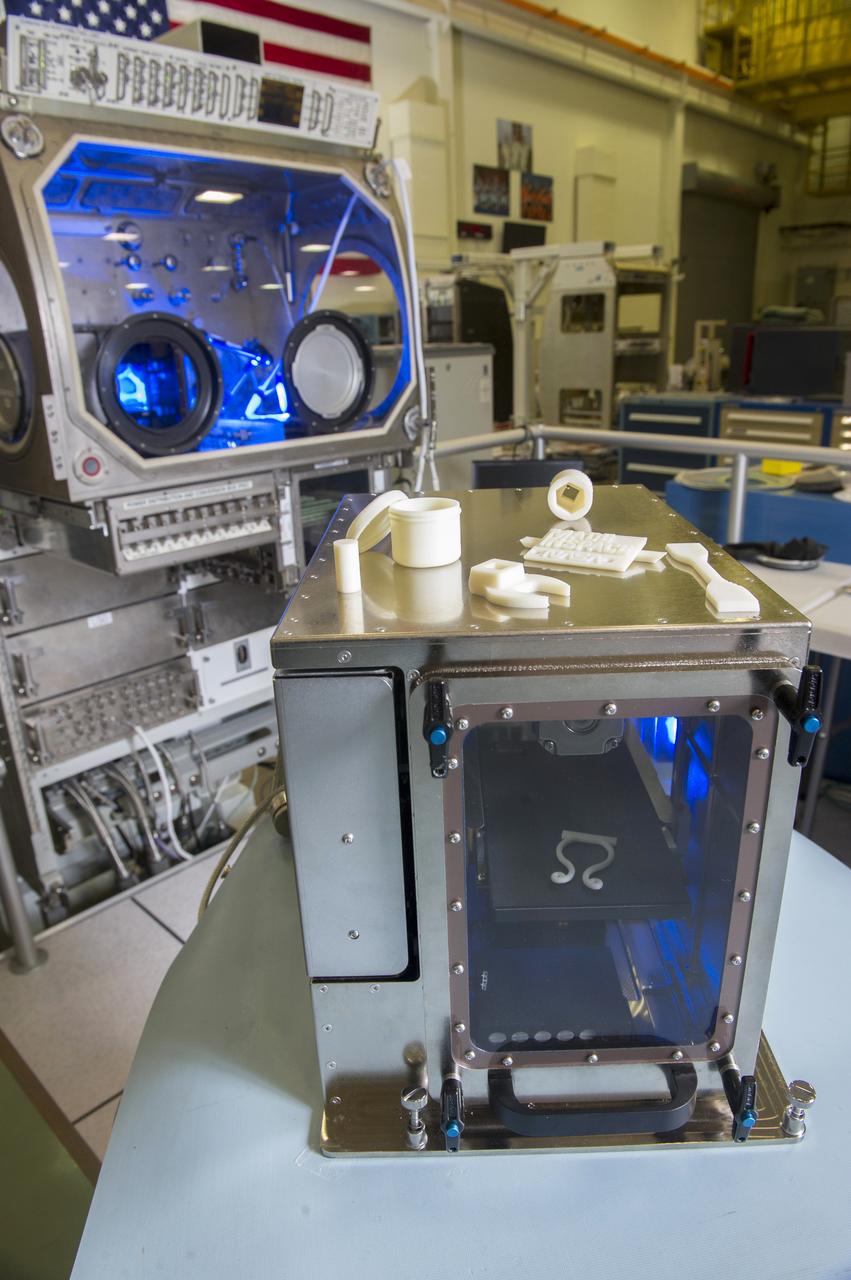
“MADE IS SPACE” 3D PRINTER IN FOREGROUND WITH MICROGRAVITY GLOVEBOX IN BACKGROUND, COVER PHOTO FOR NASA TECH BRIEFS MAGAZINE, JUNE 2014 ISSUE
1400494
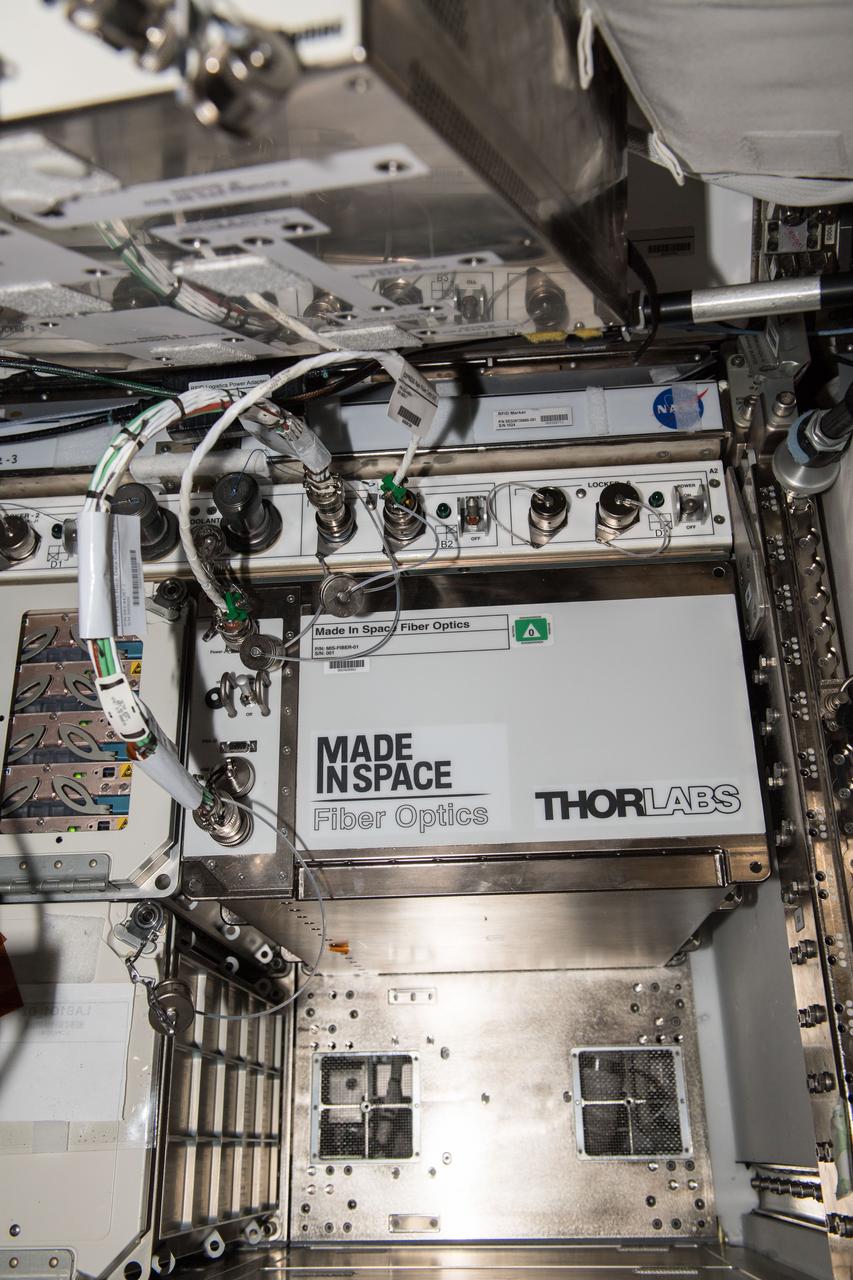
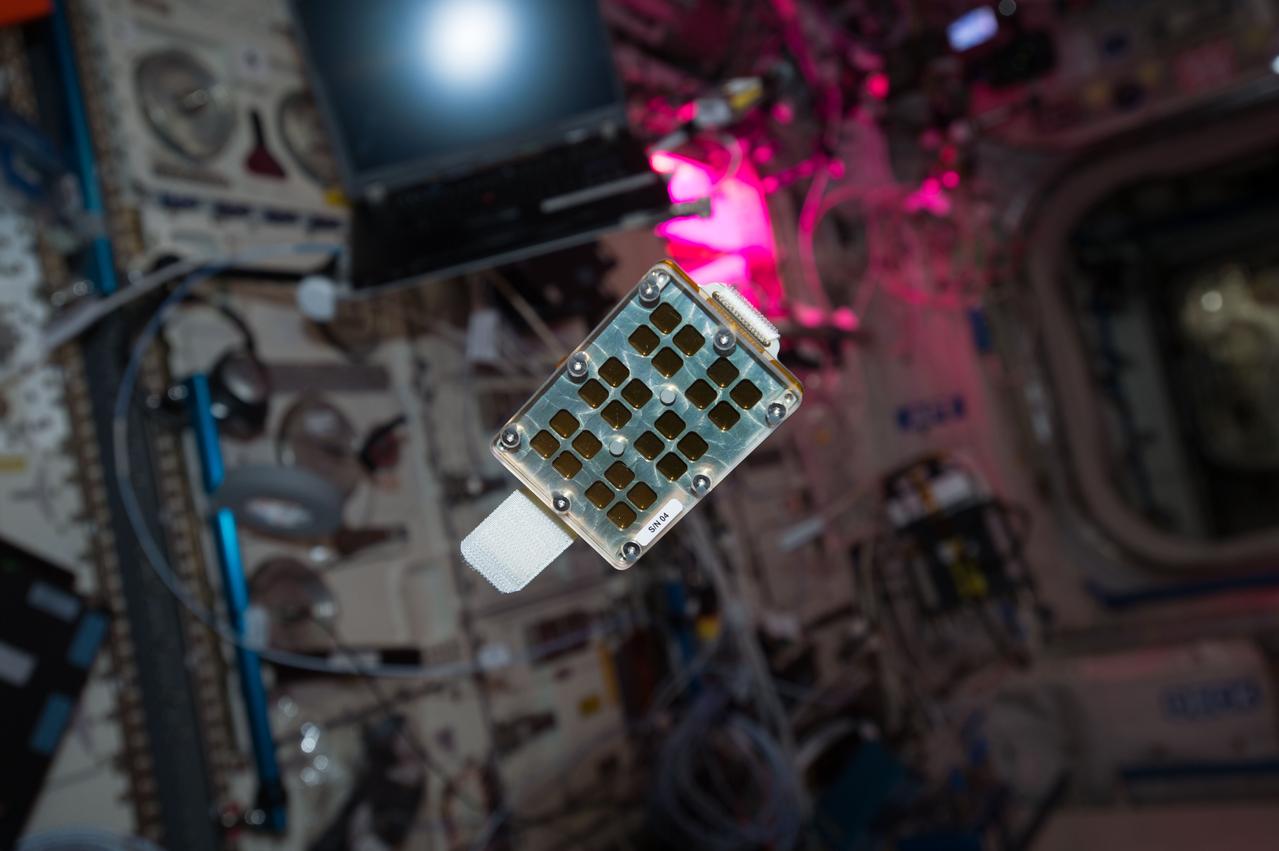
iss054e005568 (12-26-2017) --- View of the Made In Space Fiber Optics Locker installed in ExPRESS (Expedite the Processing of Experiments to Space Station) Rack 7. The Optical Fiber Production in Microgravity (Made In Space Fiber Optics) investigation demonstrates the merits of manufacturing fiber optic filaments in microgravity.
Made In Space Fiber Optics Locker Installation
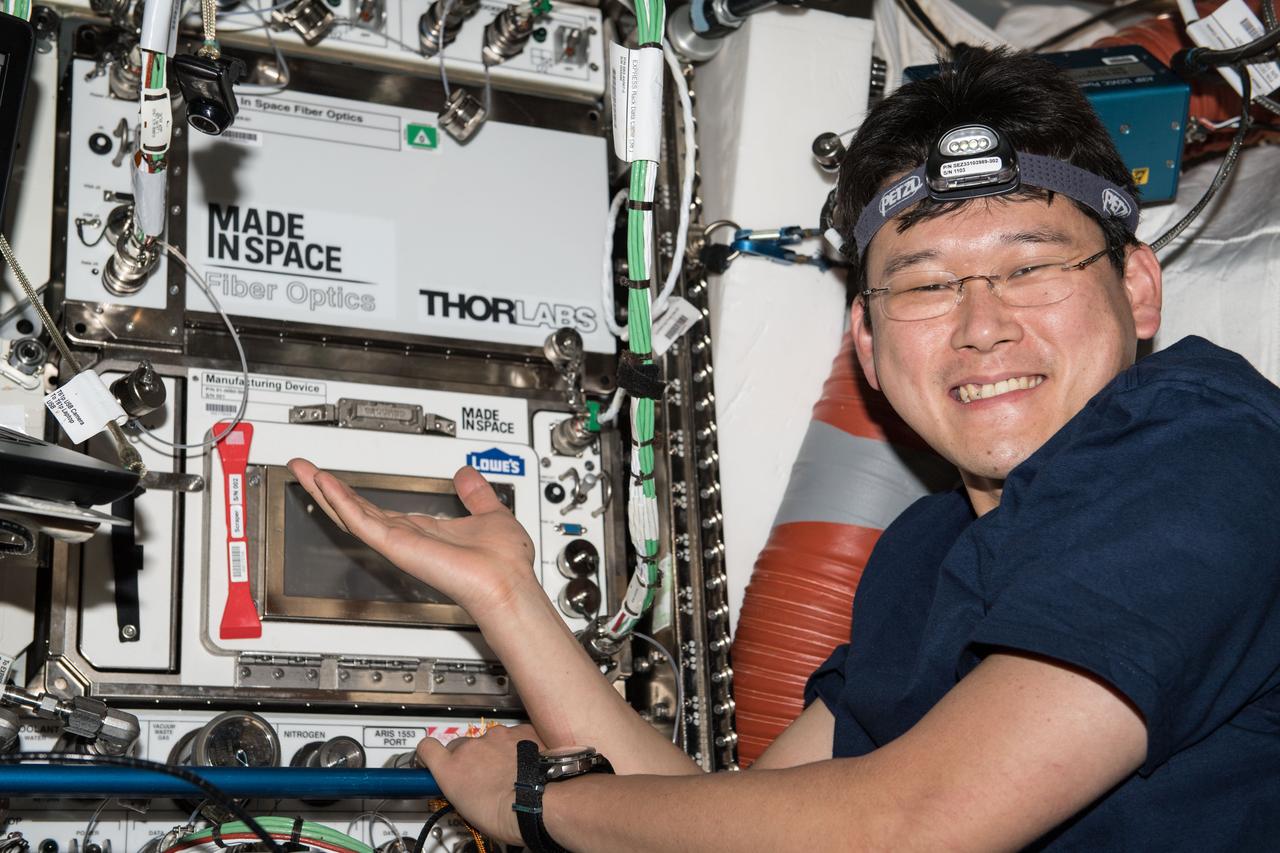
iss054e005575 (12-26-2017) --- Japan Aerospace Exploration Agency (JAXA) astronaut Norishige Kanai poses for a photo with the installed Made in Space Fiber Optics Locker and the re-installed Additive Manufacturing Facility (AMF) Manufacturing Device (ManD). Photo was taken in the Destiny U.S. Laboratory abord the International Space Station (ISS). The Optical Fiber Production in Microgravity (Made In Space Fiber Optics) investigation demonstrates the merits of manufacturing fiber optic filaments in microgravity.
Made In Space Fiber Optics Locker Installation
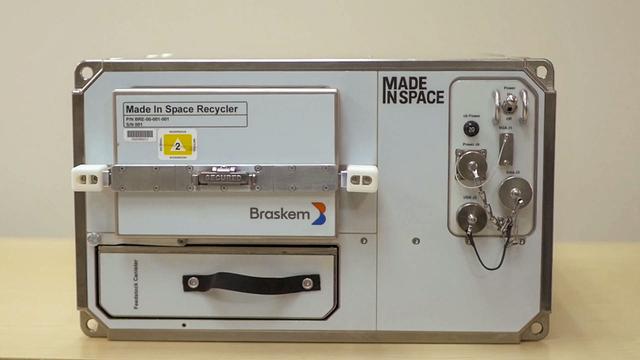
jsc2019e053733 (9/12/2019) --- Preflight imagery of the Made in Space - Recycler. The Made in Space - Recycler will utilize polymer materials to produce filament that is transferred to Manufacturing Device to perform printing operations. This experiment shows the value of closing the loop between the printer and recycling materials utilized by the printer. This has implications for space conservation and deep space missions. Image courtesy of: Made In Space, Inc.
jsc2019e053733
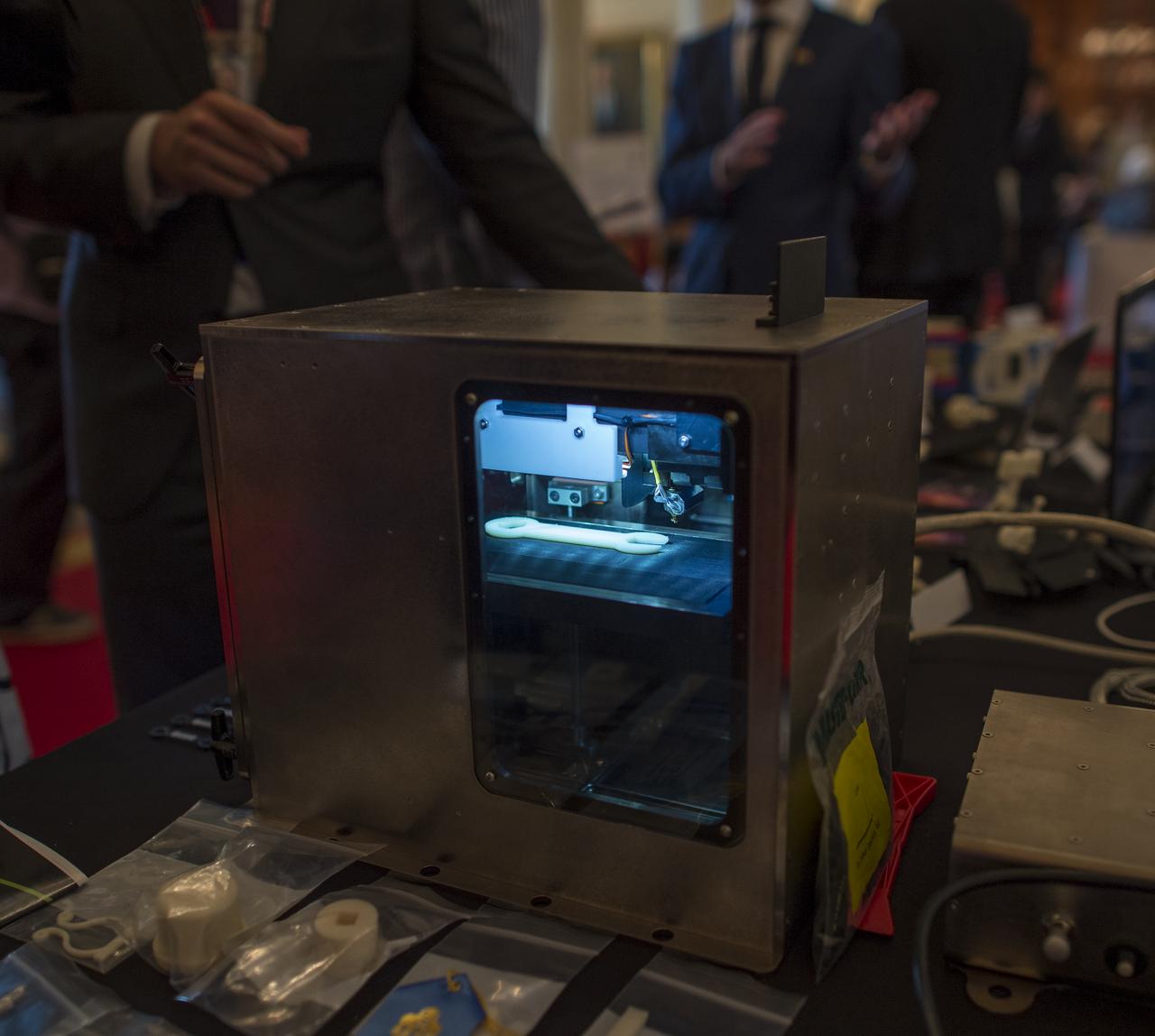
A prototype model of the Made In Space 3D printer is on display during the first ever White House Maker Faire which brings together students, entrepreneurs, and everyday citizens who are using new tools and techniques to launch new businesses, learn vital skills in science, technology, engineering, and math (STEM), and fuel the renaissance in American manufacturing, at the White House, Wednesday, June 18, 2014 in Washington. The Made In Space 3D printer was just approved by NASA to be tested onboard the International Space Station (ISS), and NASA announced a challenge for students to design items that would be printed by this first 3D printer to fly in space.  Photo Credit: (NASA/Bill Ingalls)
White House Maker Faire
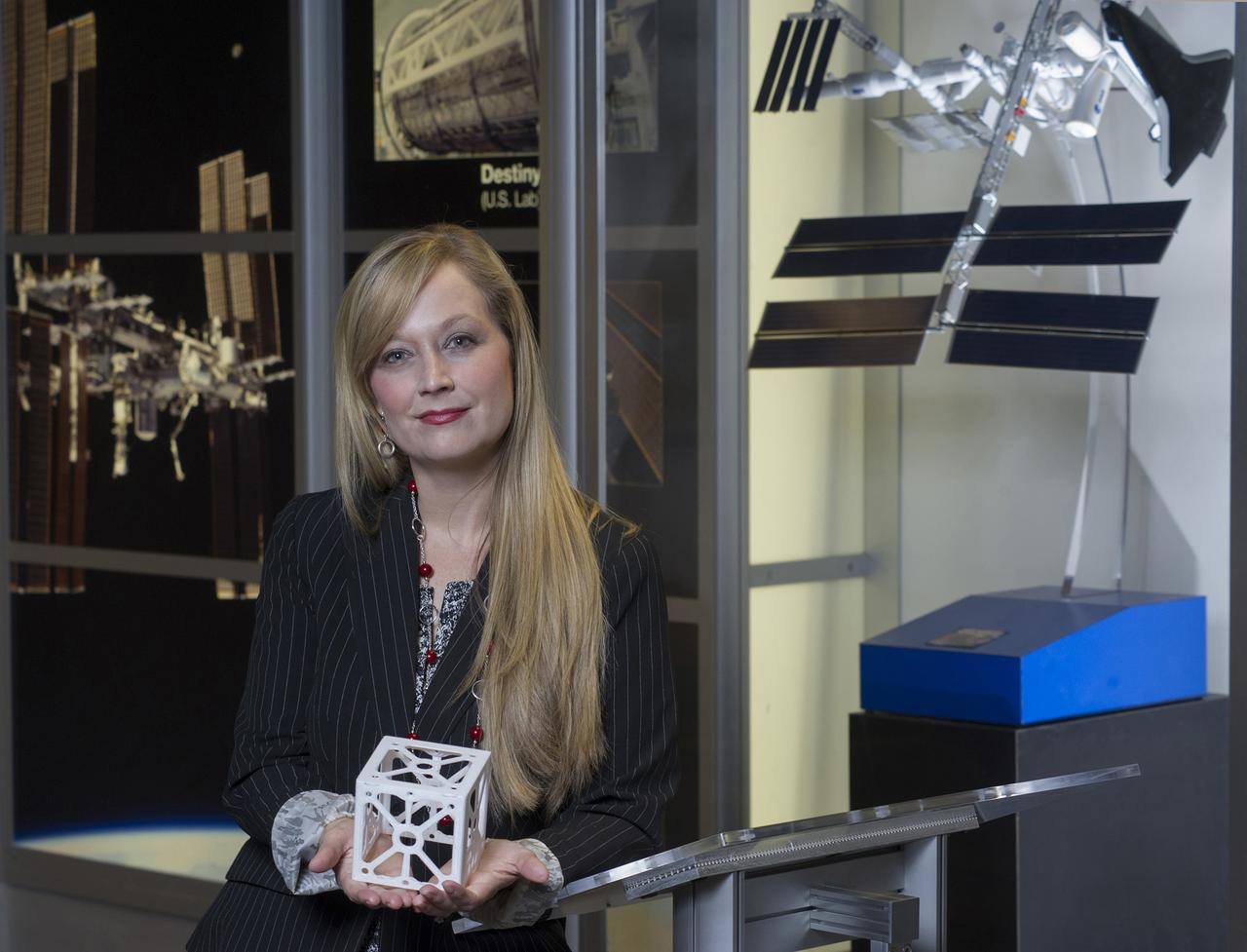
NIKI WERKHEISER, NASA'S 3D PRINTING IN ZERO-G PROJECT MANAGER, HOLDS A 3D PRINTED CUBESAT STRUCTURE WHICH IS JUST ONE OF THE MANY POTENTIAL APPLICATIONS THAT AN IN-SPACE MANUFACTURING CAPABILITY WILL PROVIDE
1400495
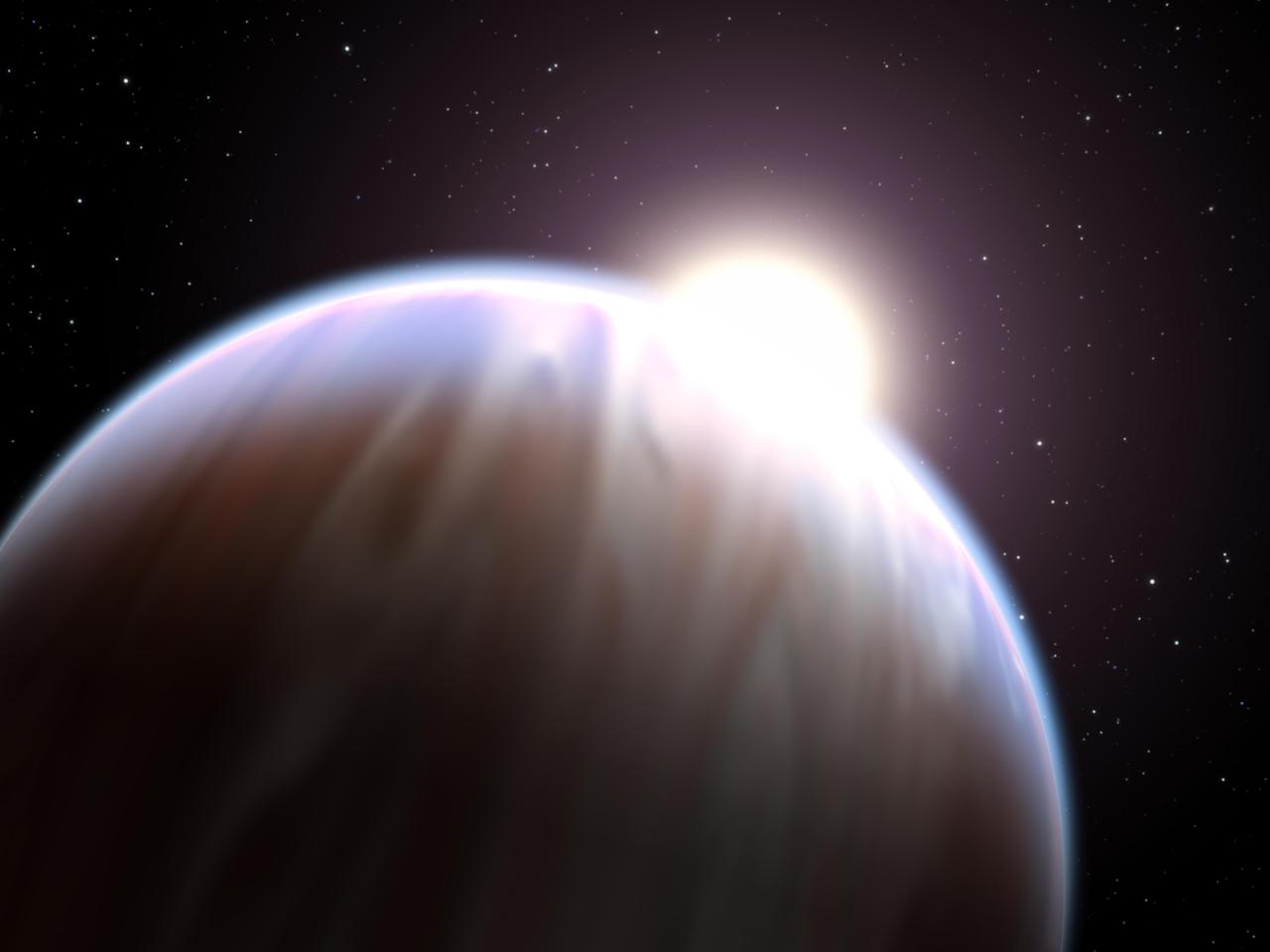
A team of astronomers has made the first detection ever of an organic molecule in the atmosphere of a Jupiter-sized planet orbiting another star. The breakthrough was made with NASA Hubble Space Telescope.
Astronomers Detect First Organic Molecule on an Exoplanet Artist Concept
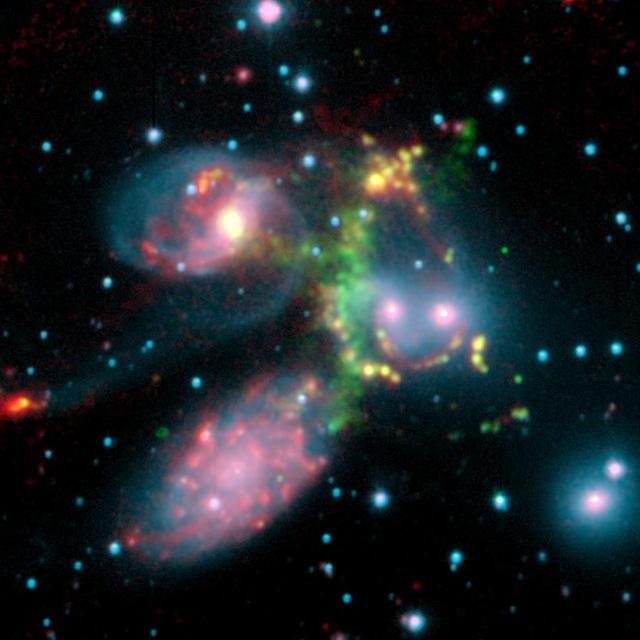
The false-color composite image of the Stephan’s Quintet galaxy cluster is made up of data from NASA Spitzer Space Telescope and a ground-based telescope in Spain.
A Shocking Surprise in Stephan Quintet
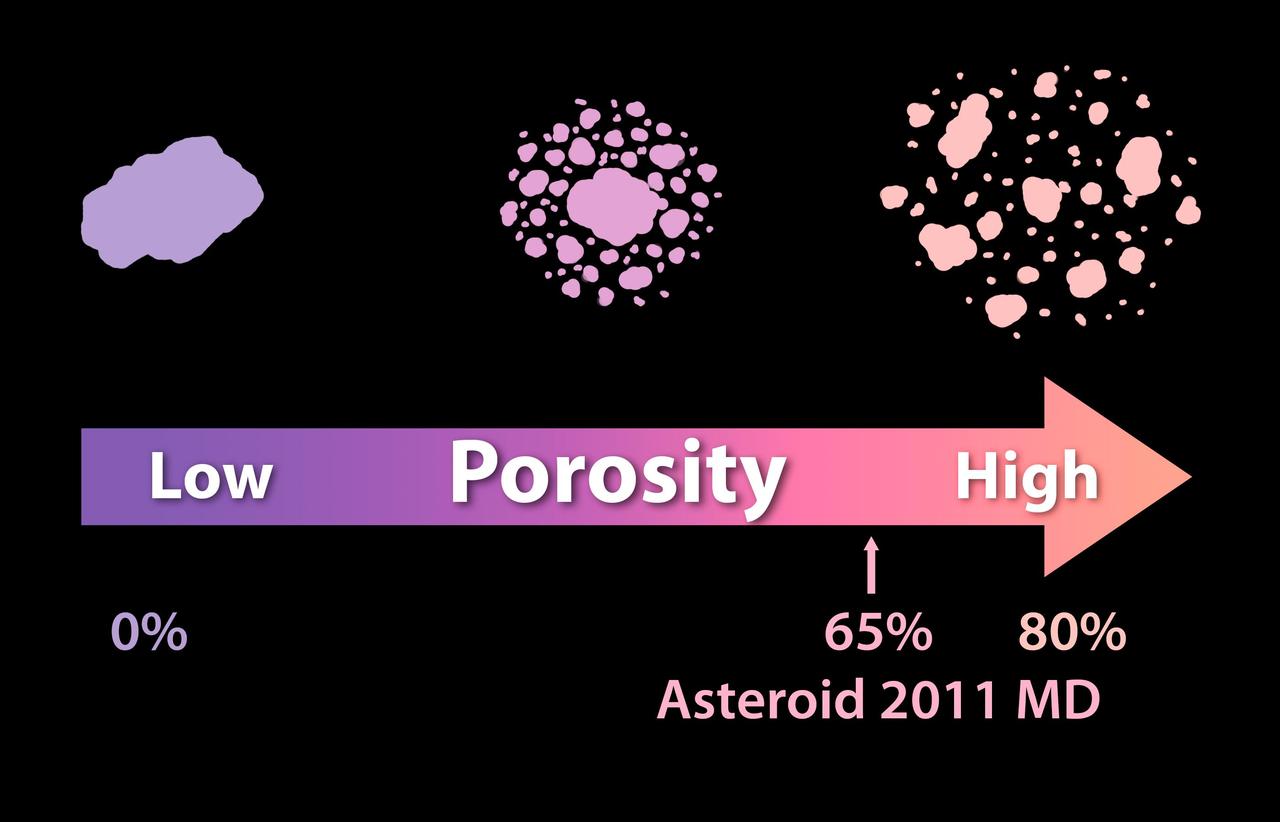
Observations from NASA Spitzer Space Telescope, taken in infrared light, have helped to reveal that a small asteroid called 2011 MD is made-up of two-thirds empty space.
Solid as a Rock? Porosity of Asteroids
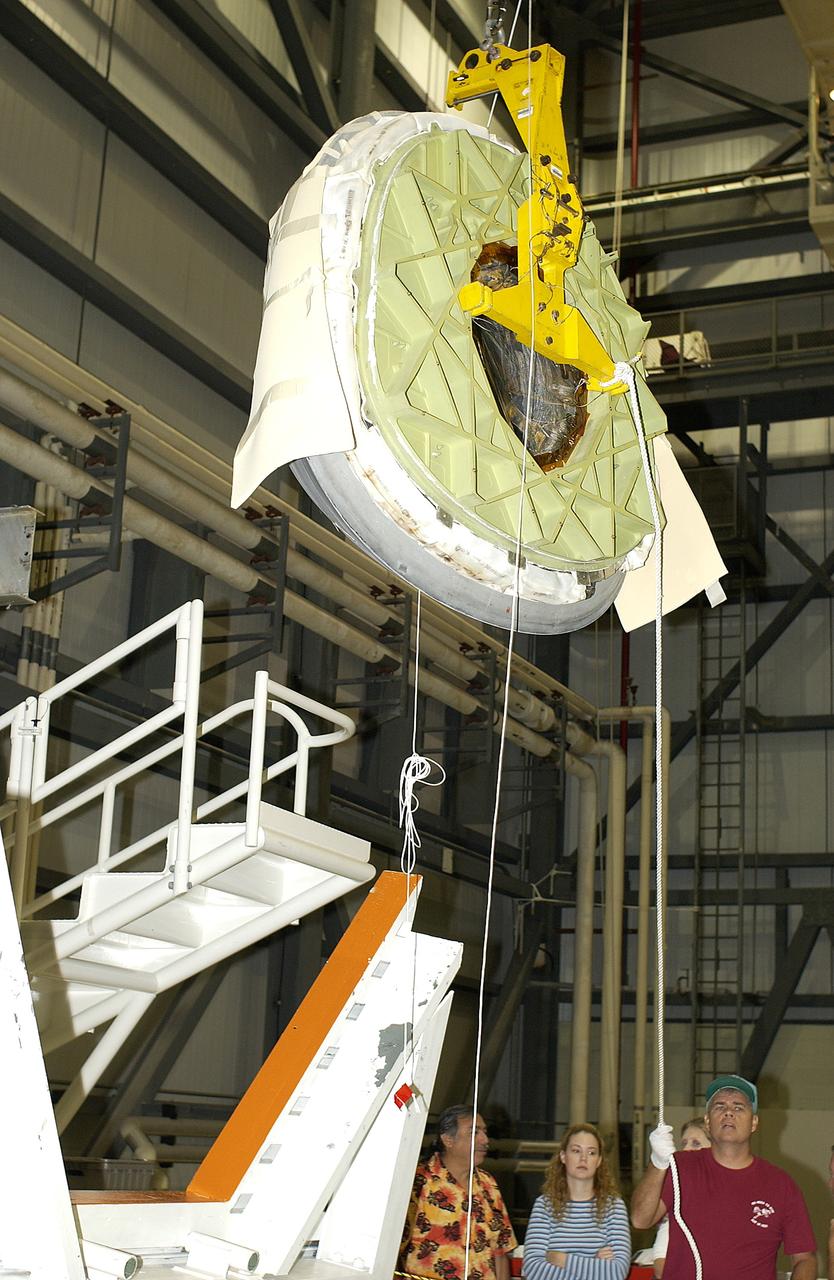
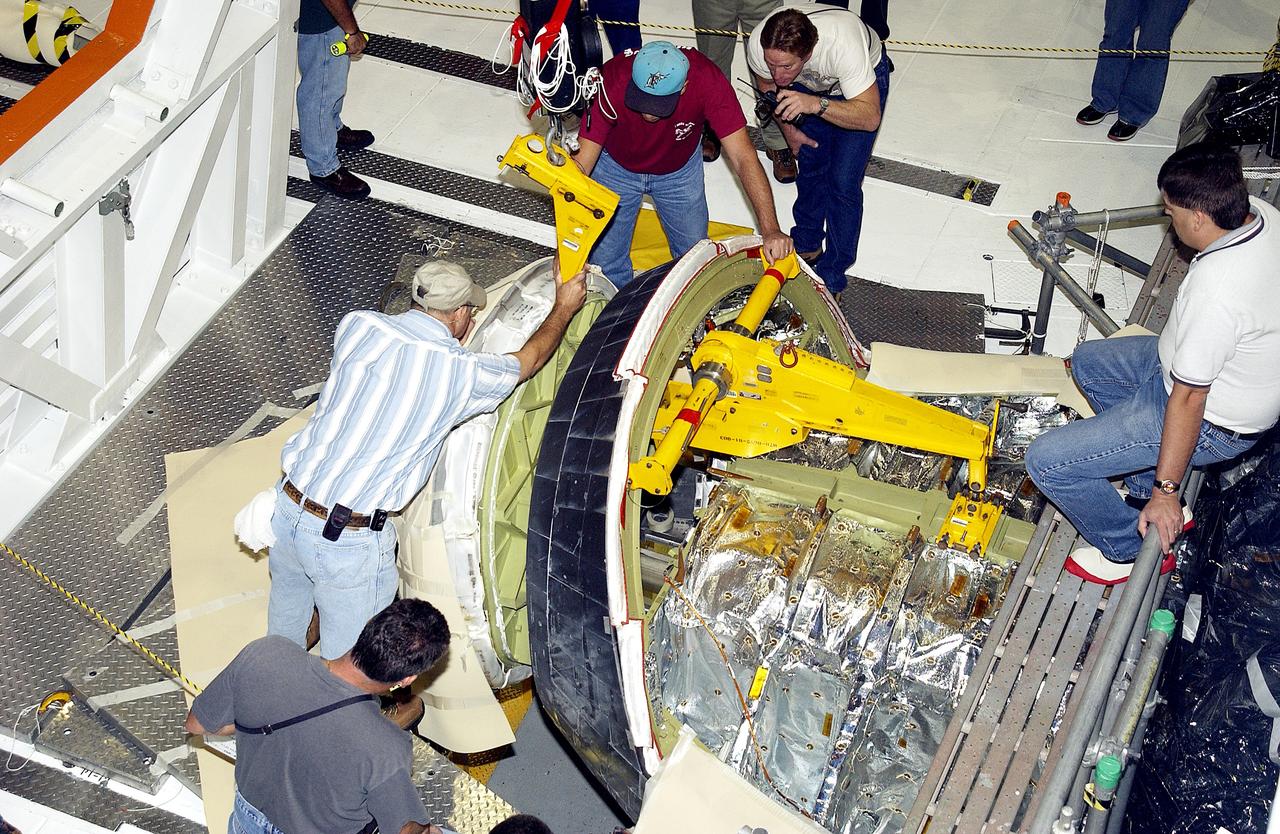
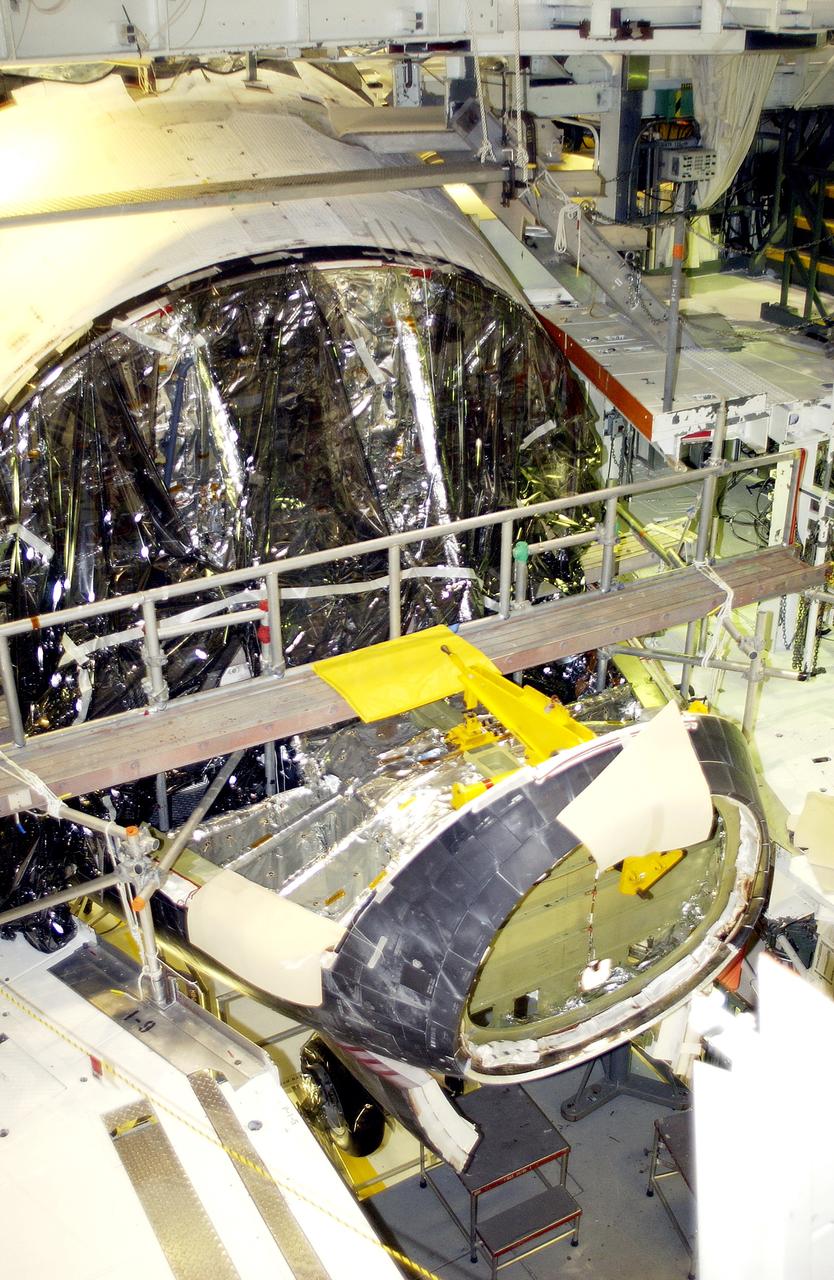
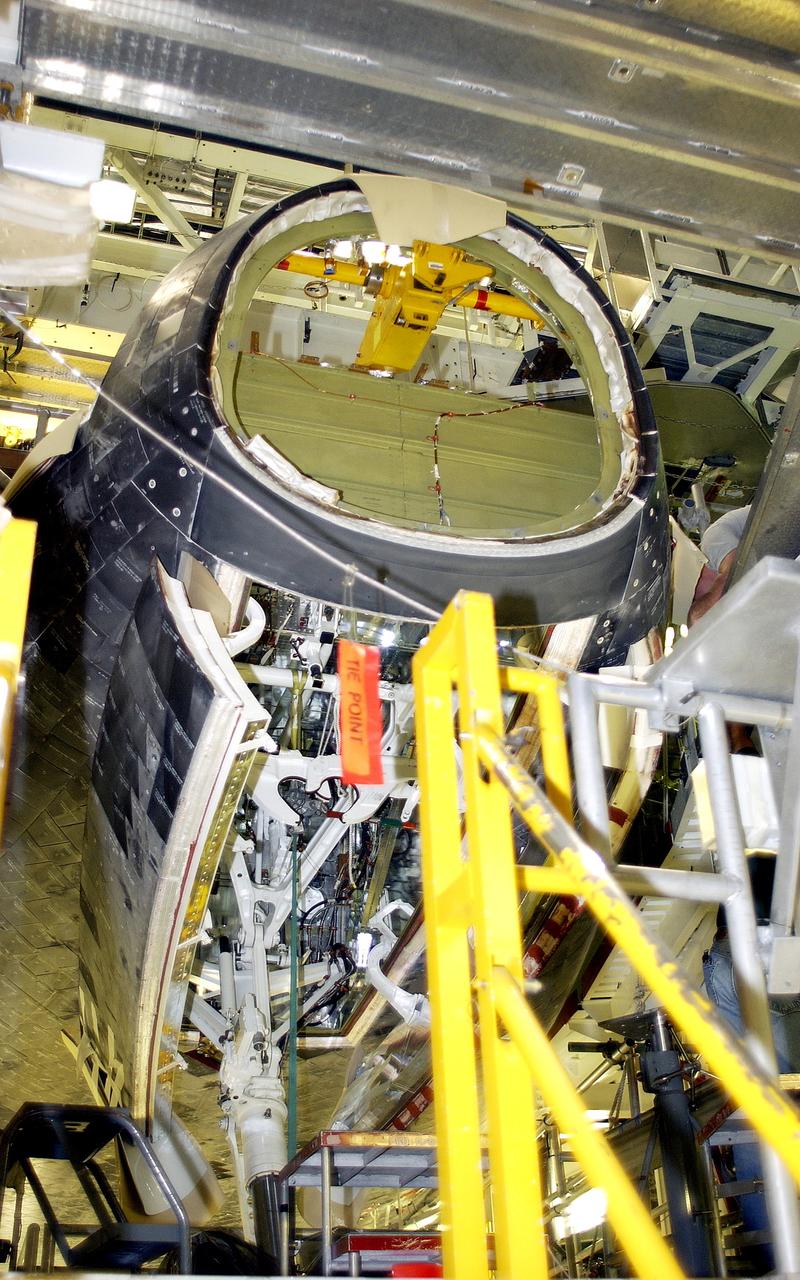
KENNEDY SPACE CENTER, FLA. - In the Orbiter Processing Facility, Atlantis is seen after its nose cap was removed for routine inspection. The nose cap is made of reinforced carbon-carbon (RCC), which has an operating range of minus 250° F to about 3,000° F.
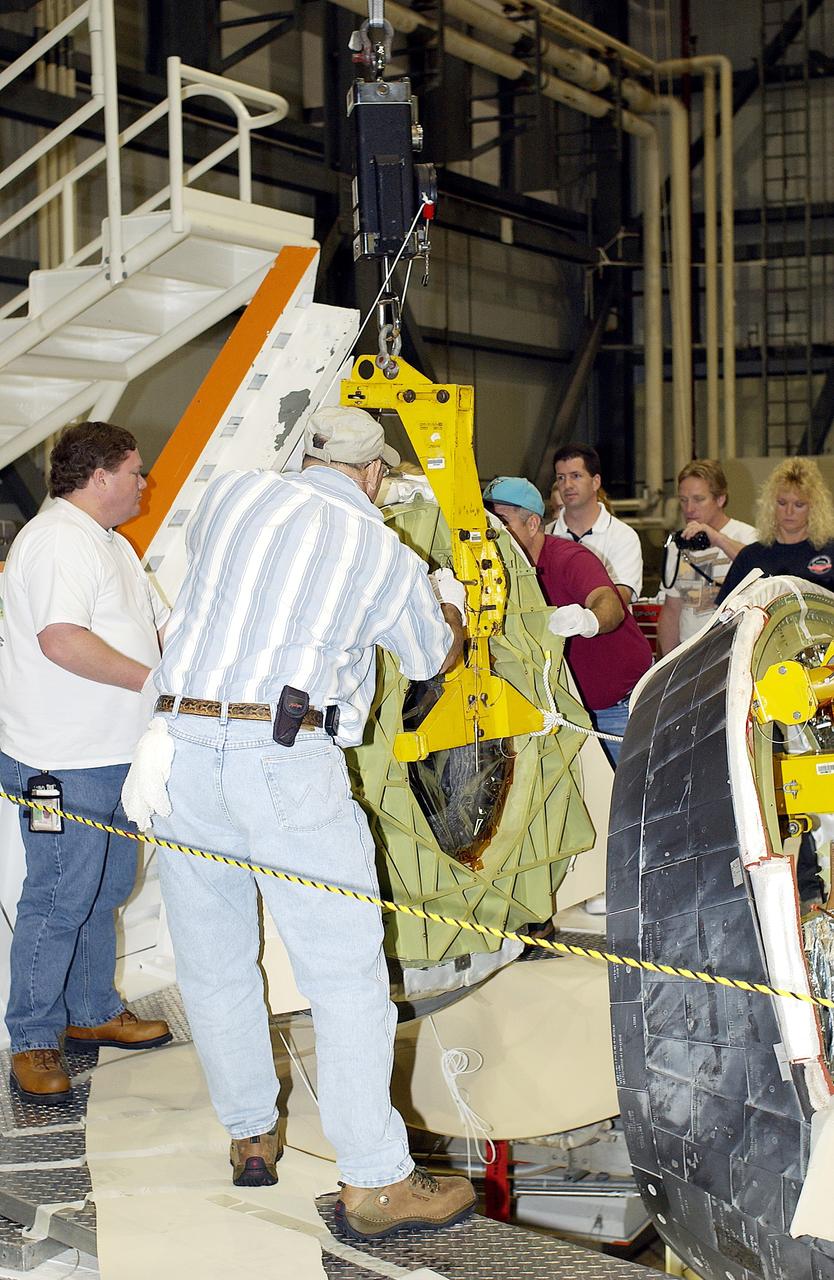
KENNEDY SPACE CENTER, FLA. - In the Orbiter Processing Facility, workers watch as the nose cap of the orbiter Atlantis is lowered toward the floor.   The cap was removed from the orbiter for routine inspection. The nose cap is made of reinforced carbon-carbon (RCC), which has an operating range of minus 250° F to about 3,000° F.
KENNEDY SPACE CENTER, FLA. - In the Orbiter Processing Facility, workers watch as the nose cap of the orbiter Atlantis is lowered toward the floor. The cap was removed from the orbiter for routine inspection. The nose cap is made of reinforced carbon-carbon (RCC), which has an operating range of minus 250° F to about 3,000° F.
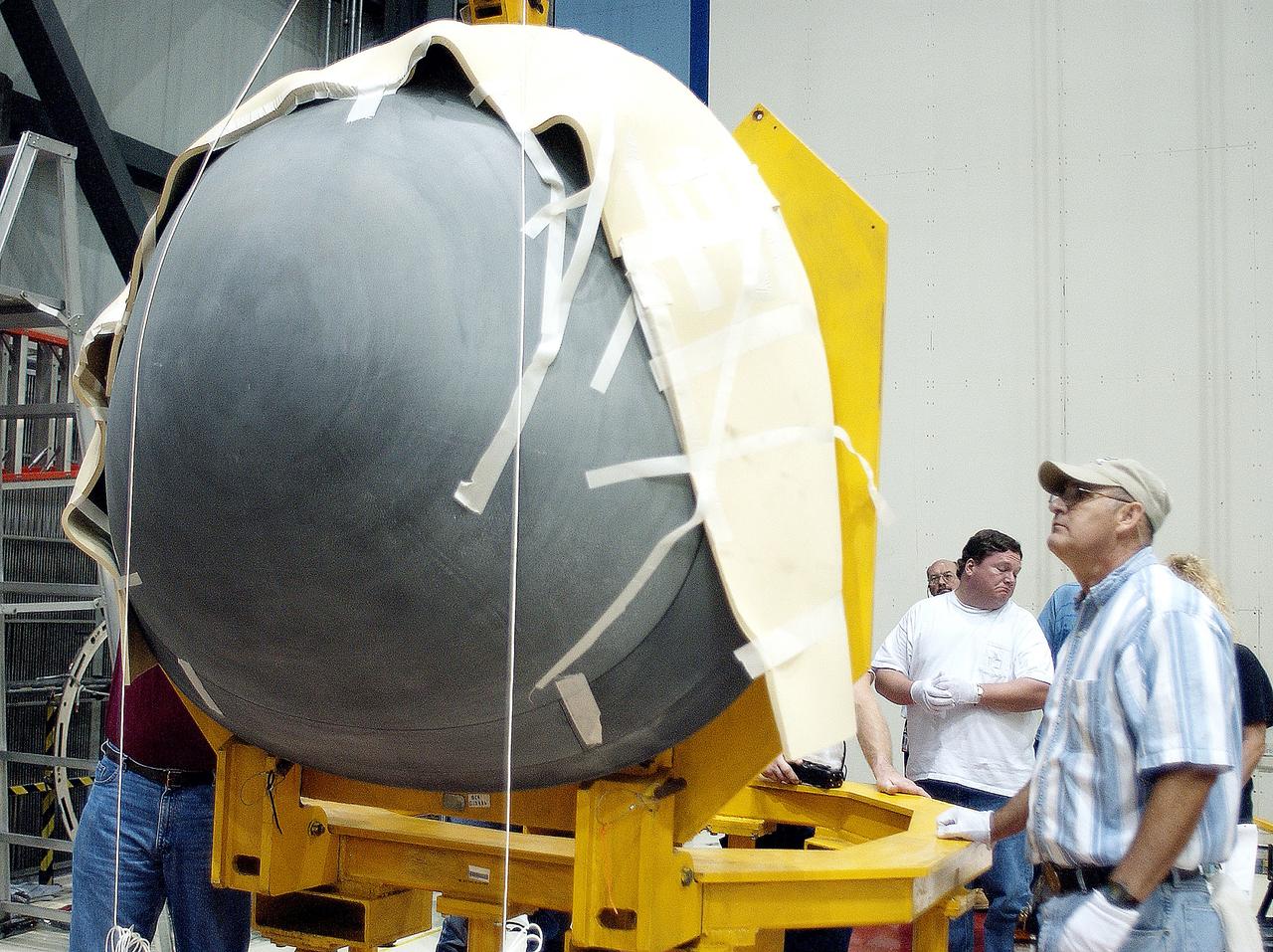
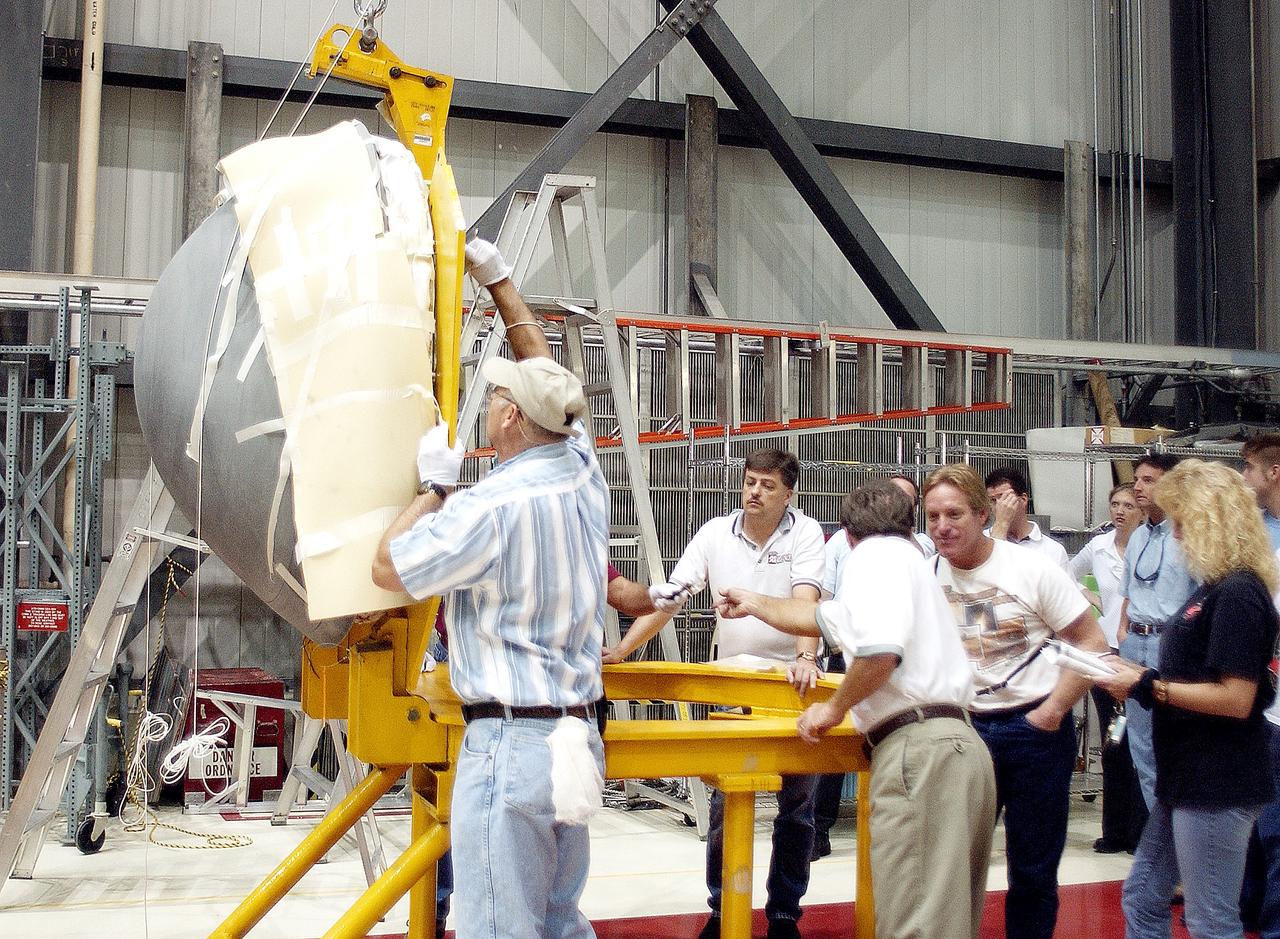
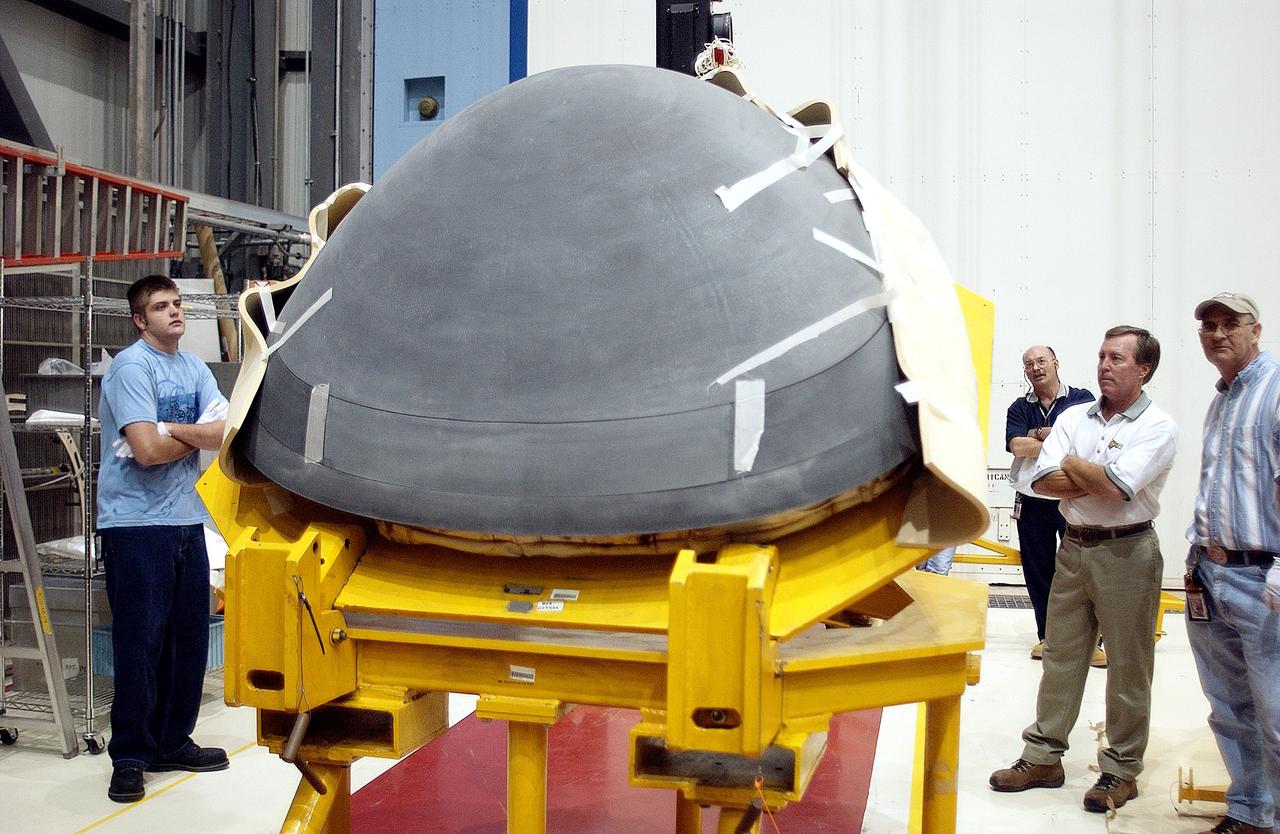
KENNEDY SPACE CENTER, FLA. -  In the Orbiter Processing Facility, the nose cap of the orbiter Atlantis rests on a stand after its removal from the orbiter for routine inspection. The nose cap is made of reinforced carbon-carbon (RCC), which has an operating range of minus 250° F to about 3,000° F.
KENNEDY SPACE CENTER, FLA. - In the Orbiter Processing Facility, the nose cap of the orbiter Atlantis rests on a stand after its removal from the orbiter for routine inspection. The nose cap is made of reinforced carbon-carbon (RCC), which has an operating range of minus 250° F to about 3,000° F.
KENNEDY SPACE CENTER, FLA. -  In the Orbiter Processing Facility, workers secure the nose cap of the orbiter Atlantis on a stand.   The cap was removed from the orbiter for routine inspection. The nose cap is made of reinforced carbon-carbon (RCC), which has an operating range of minus 250° F to about 3,000° F.
KENNEDY SPACE CENTER, FLA. - In the Orbiter Processing Facility, workers secure the nose cap of the orbiter Atlantis on a stand. The cap was removed from the orbiter for routine inspection. The nose cap is made of reinforced carbon-carbon (RCC), which has an operating range of minus 250° F to about 3,000° F.
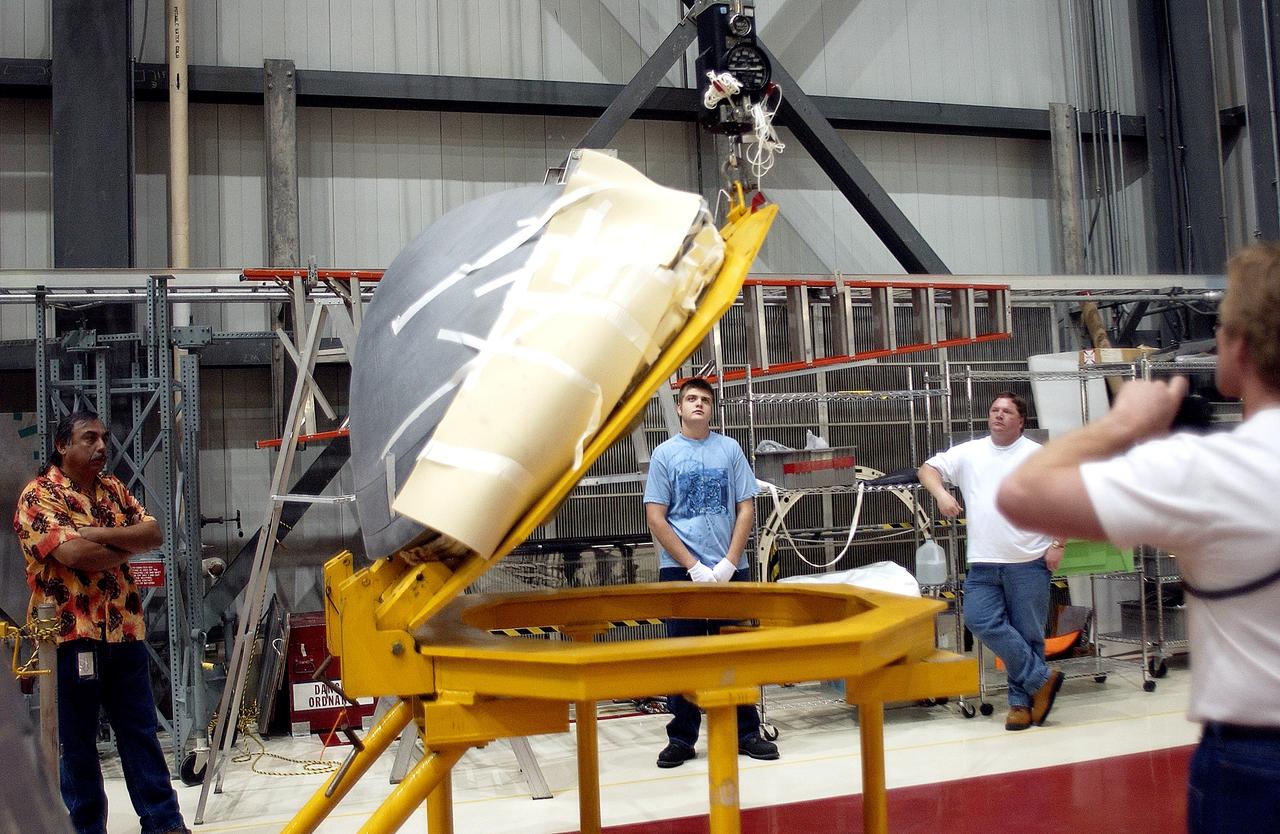
KENNEDY SPACE CENTER, FLA. - In the Orbiter Processing Facility, workers watch as the nose cap of the orbiter Atlantis is shifted to a horizontal position on a stand.  The cap was removed from the orbiter for routine inspection. The nose cap is made of reinforced carbon-carbon (RCC), which has an operating range of minus 250° F to about 3,000° F.
KENNEDY SPACE CENTER, FLA. - In the Orbiter Processing Facility, workers watch as the nose cap of the orbiter Atlantis is shifted to a horizontal position on a stand. The cap was removed from the orbiter for routine inspection. The nose cap is made of reinforced carbon-carbon (RCC), which has an operating range of minus 250° F to about 3,000° F.
KENNEDY SPACE CENTER, FLA. - In the Orbiter Processing Facility, Atlantis is seen after its nose cap was removed for routine inspection. The nose cap is made of reinforced carbon-carbon (RCC), which has an operating range of minus 250° F to about 3,000° F.
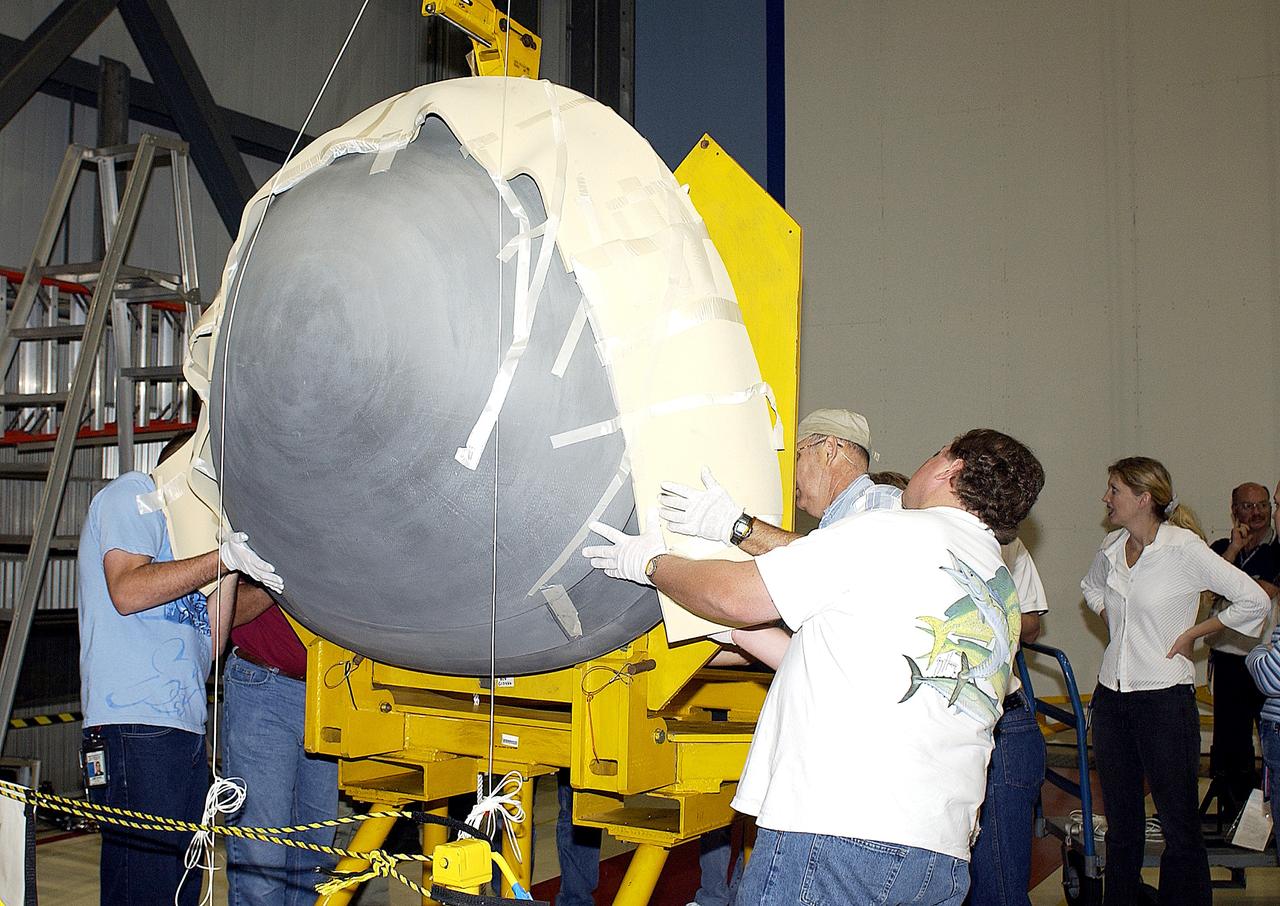
KENNEDY SPACE CENTER, FLA. - In the Orbiter Processing Facility, the nose cap of the orbiter Atlantis is lifted for its transfer to a stand.  The cap was removed for routine inspection. The nose cap is made of reinforced carbon-carbon (RCC), which has an operating range of minus 250° F to about 3,000° F.
KENNEDY SPACE CENTER, FLA. - In the Orbiter Processing Facility, the nose cap of the orbiter Atlantis is lifted for its transfer to a stand. The cap was removed for routine inspection. The nose cap is made of reinforced carbon-carbon (RCC), which has an operating range of minus 250° F to about 3,000° F.
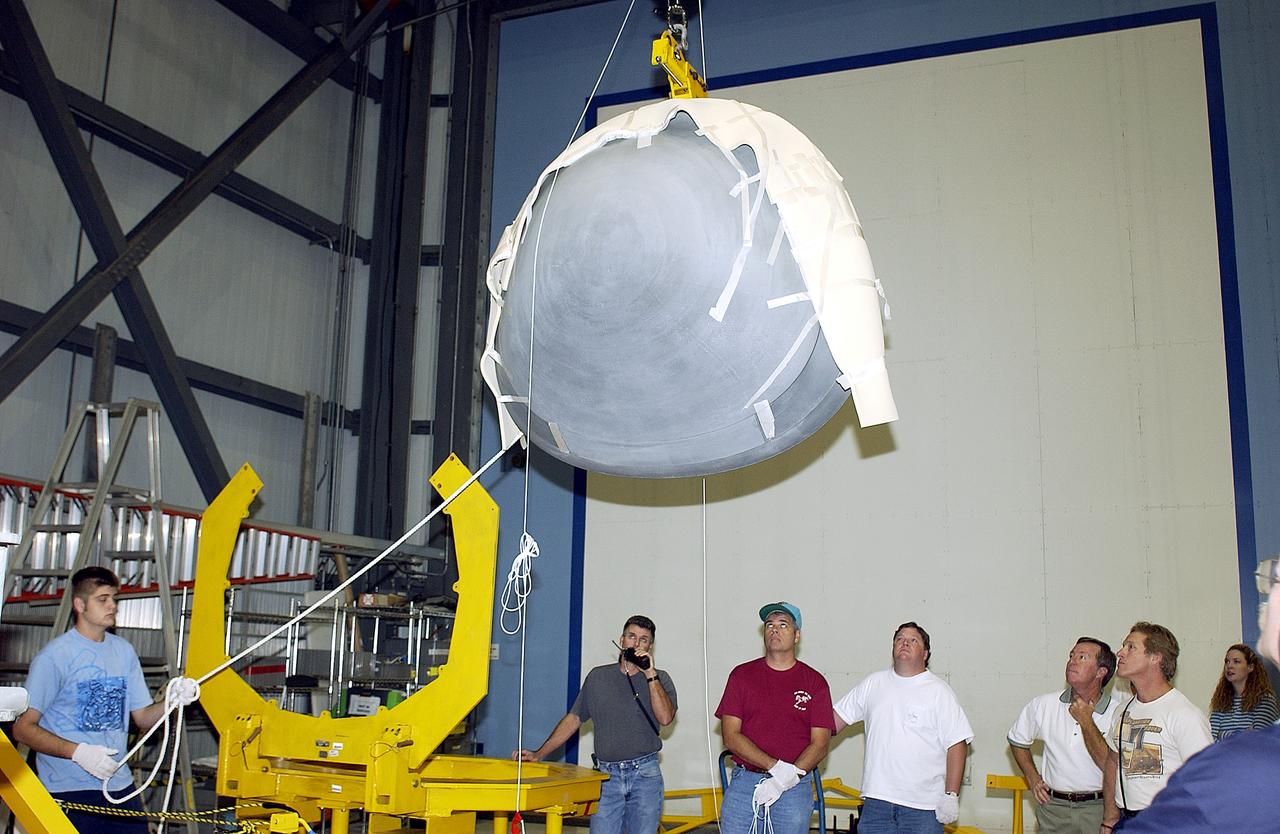
KENNEDY SPACE CENTER, FLA. -  In the Orbiter Processing Facility, workers help guide the nose cap of the orbiter Atlantis toward a stand.  The cap was removed from the orbiter for routine inspection. The nose cap is made of reinforced carbon-carbon (RCC), which has an operating range of minus 250° F to about 3,000° F.
KENNEDY SPACE CENTER, FLA. - In the Orbiter Processing Facility, workers help guide the nose cap of the orbiter Atlantis toward a stand. The cap was removed from the orbiter for routine inspection. The nose cap is made of reinforced carbon-carbon (RCC), which has an operating range of minus 250° F to about 3,000° F.
KENNEDY SPACE CENTER, FLA. - In the Orbiter Processing Facility, workers watch as the nose cap of the orbiter Atlantis is moved toward the stand at left.  The cap was removed from the orbiter for routine inspection. The nose cap is made of reinforced carbon-carbon (RCC), which has an operating range of minus 250° F to about 3,000° F.
KENNEDY SPACE CENTER, FLA. - In the Orbiter Processing Facility, workers watch as the nose cap of the orbiter Atlantis is moved toward the stand at left. The cap was removed from the orbiter for routine inspection. The nose cap is made of reinforced carbon-carbon (RCC), which has an operating range of minus 250° F to about 3,000° F.
KENNEDY SPACE CENTER, FLA. - In the Orbiter Processing Facility, workers remove the nose cone of the orbiter Atlantis for routine inspection. The nose cap is made of reinforced carbon-carbon (RCC), which has an operating range of minus 250° F to about 3,000° F.
KENNEDY SPACE CENTER, FLA. - In the Orbiter Processing Facility, the nose cap of the orbiter Atlantis is shifted to a horizontal position on a stand.  The cap was removed from the orbiter for routine inspection. The nose cap is made of reinforced carbon-carbon (RCC), which has an operating range of minus 250° F to about 3,000° F.
KENNEDY SPACE CENTER, FLA. - In the Orbiter Processing Facility, the nose cap of the orbiter Atlantis is shifted to a horizontal position on a stand. The cap was removed from the orbiter for routine inspection. The nose cap is made of reinforced carbon-carbon (RCC), which has an operating range of minus 250° F to about 3,000° F.
KENNEDY SPACE CENTER, FLA. - In the Orbiter Processing Facility, workers secure the nose cap of the orbiter Atlantis for its transfer to a stand.  The cap was removed for routine inspection. The nose cap is made of reinforced carbon-carbon (RCC), which has an operating range of minus 250° F to about 3,000° F.
KENNEDY SPACE CENTER, FLA. - In the Orbiter Processing Facility, workers secure the nose cap of the orbiter Atlantis for its transfer to a stand. The cap was removed for routine inspection. The nose cap is made of reinforced carbon-carbon (RCC), which has an operating range of minus 250° F to about 3,000° F.
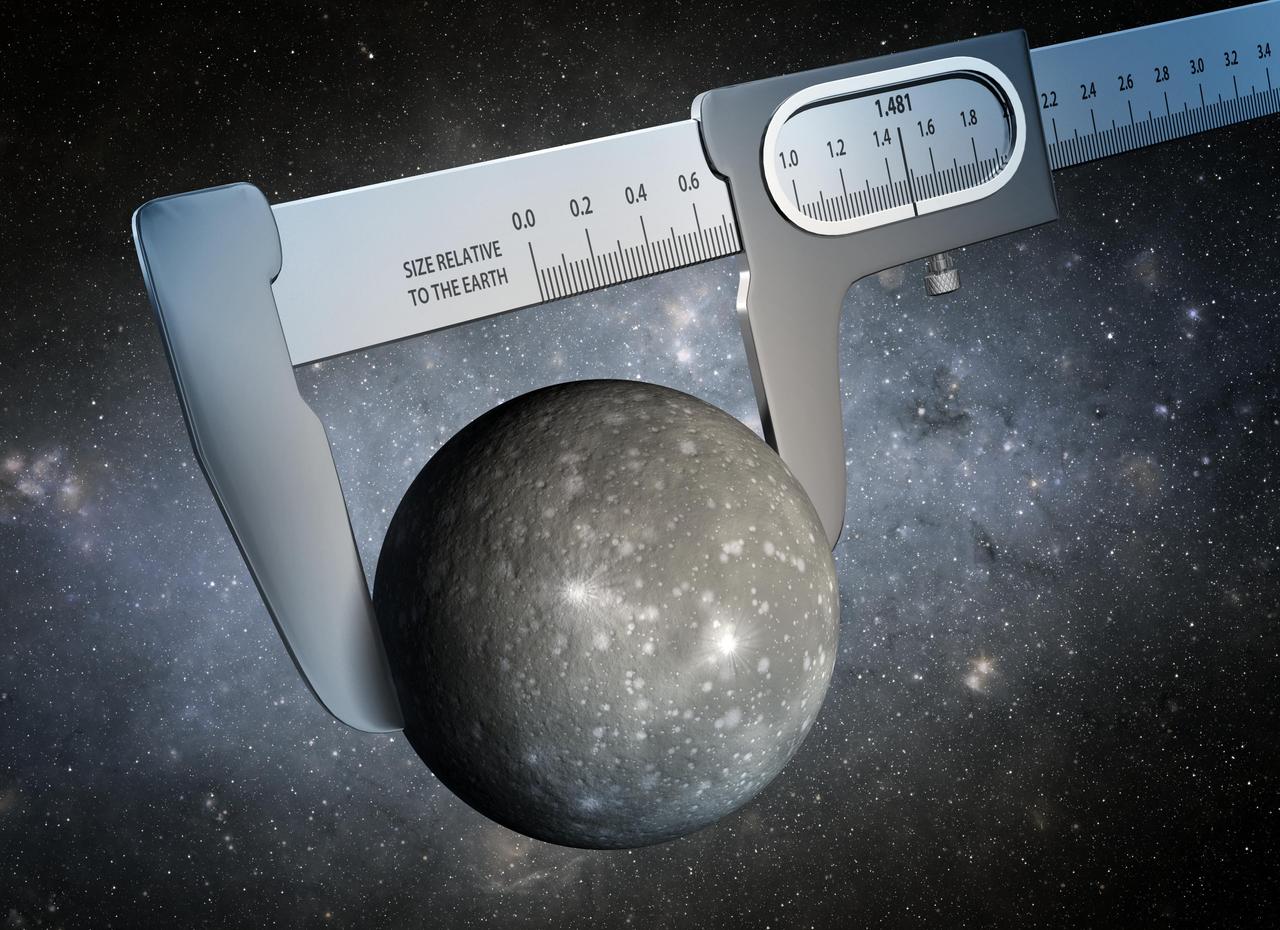
Using data from NASA Kepler and Spitzer Space Telescopes, scientists have made the most precise measurement ever of the size of a world outside our solar system, as illustrated in this artist conception.
Gauging an Alien World Size Artist Concept
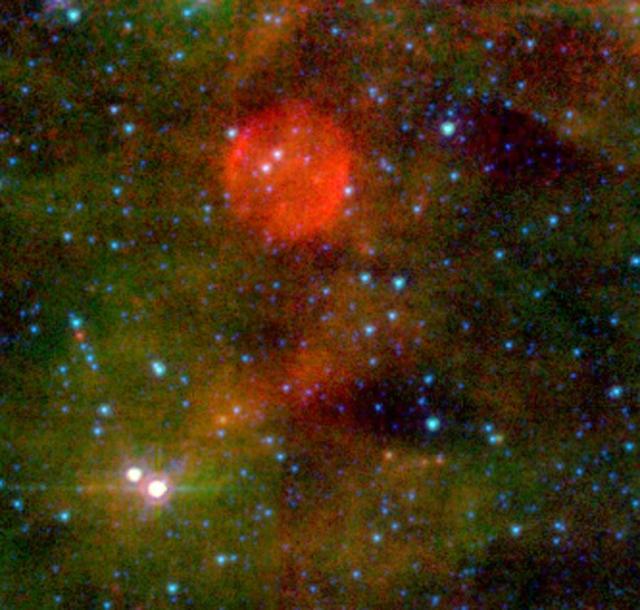
NASA Spitzer Space Telescope caught a glimpse of the Cepheus constellation, thirty thousand light-years away; astronomers think theyve found a massive star whose death barely made a peep.
The Almost Invisible Aftermath of a Massive Star Death
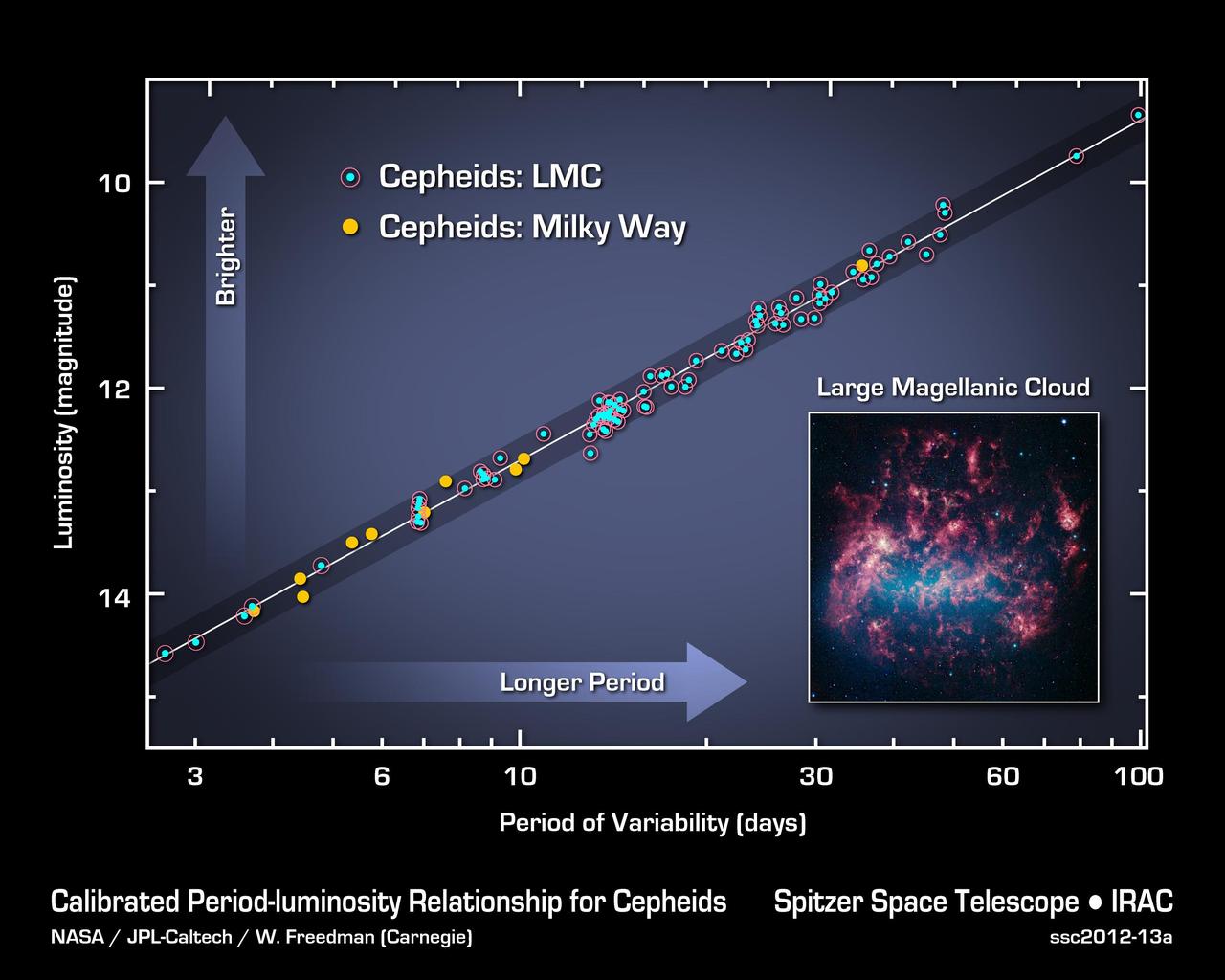
This graph illustrates the Cepheid period-luminosity relationship, used to calculate the size, age and expansion rate of the universe. The data shown are from NASA Spitzer Space Telescope which has made the most precise measurements yet.
Cepheids as Cosmology Tools
This long-exposure image from NASA Hubble Space Telescope of massive galaxy cluster Abell 2744 is the deepest ever made of any cluster of galaxies. Shown in the foreground is Abell 2744, located in the constellation Sculptor.
Hubble Frontier Field Abell 2744
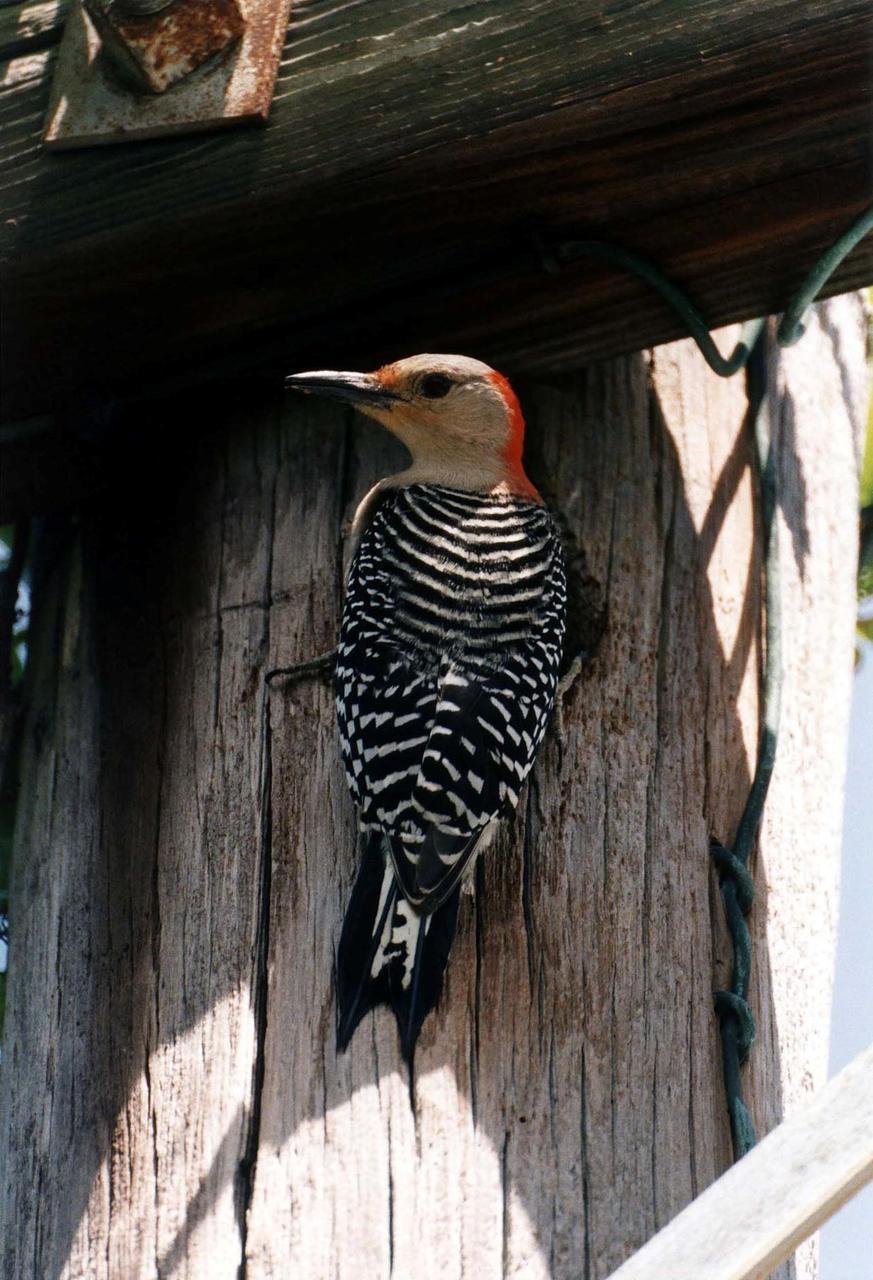
KENNEDY SPACE CENTER, FLA. - A female Red-bellied Woodpecker clings to a utility pole where it has made a home on Merritt Island Wildlife Refuge.  The most common type of woodpecker in the South, the "Zebraback" nests in the cavities of trees and consumes large quantities of wood-boring beetles, as well as other insect pests.  More than 280 species of birds make their homes on the 140,000-acre refuge, which lies within the boundaries of Kennedy Space Center.
KENNEDY SPACE CENTER, FLA. - A female Red-bellied Woodpecker clings to a utility pole where it has made a home on Merritt Island Wildlife Refuge. The most common type of woodpecker in the South, the "Zebraback" nests in the cavities of trees and consumes large quantities of wood-boring beetles, as well as other insect pests. More than 280 species of birds make their homes on the 140,000-acre refuge, which lies within the boundaries of Kennedy Space Center.
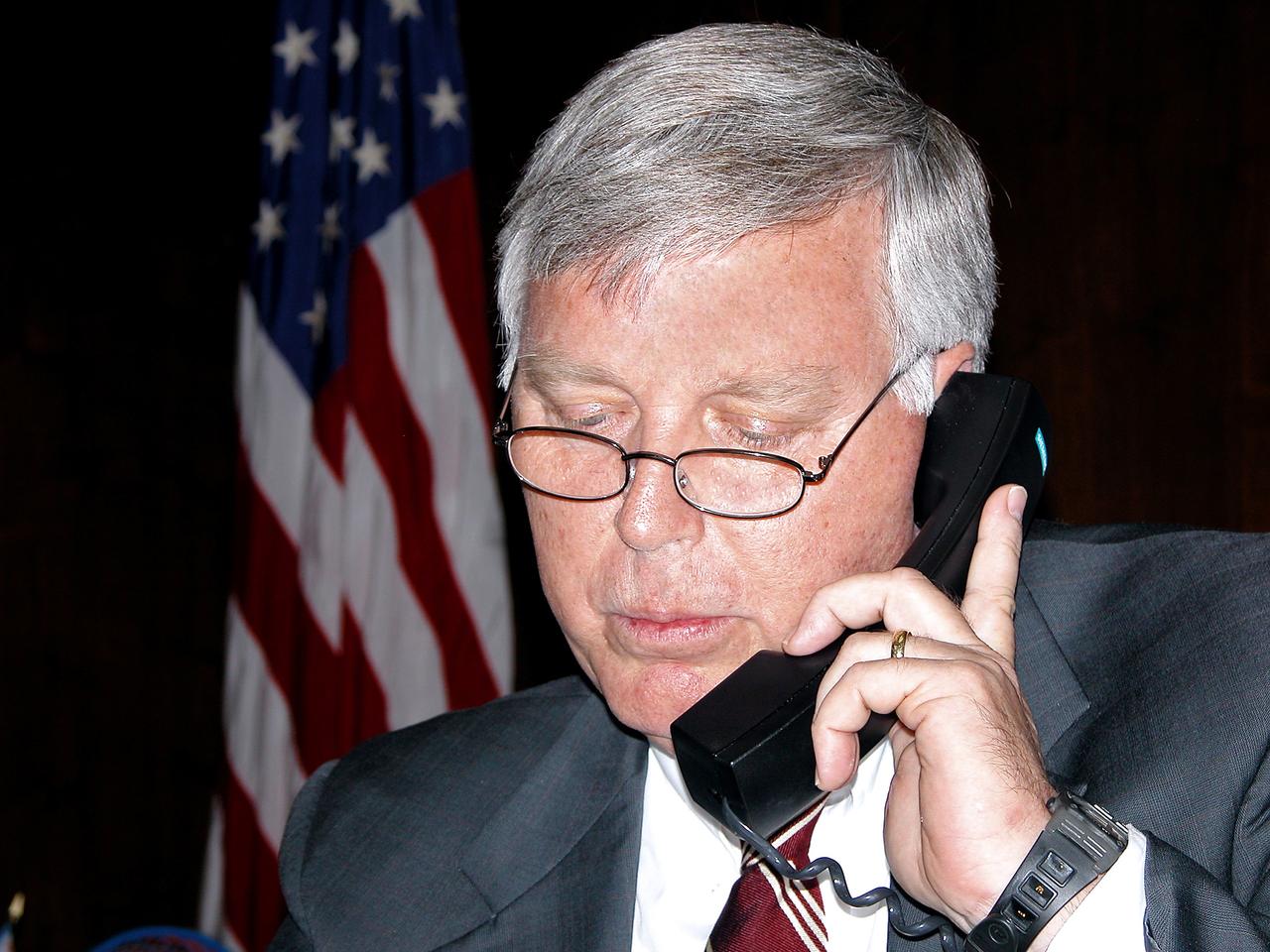
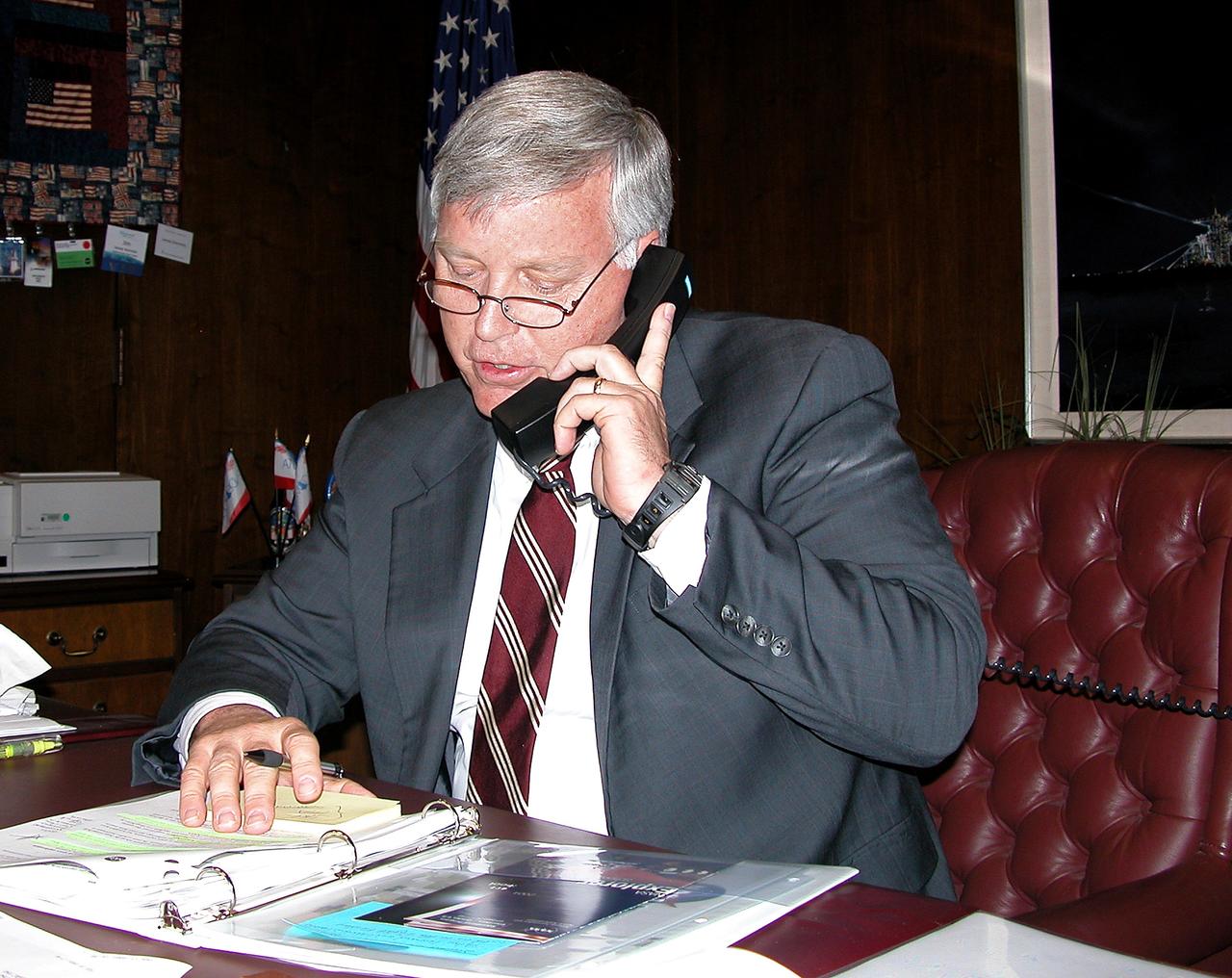
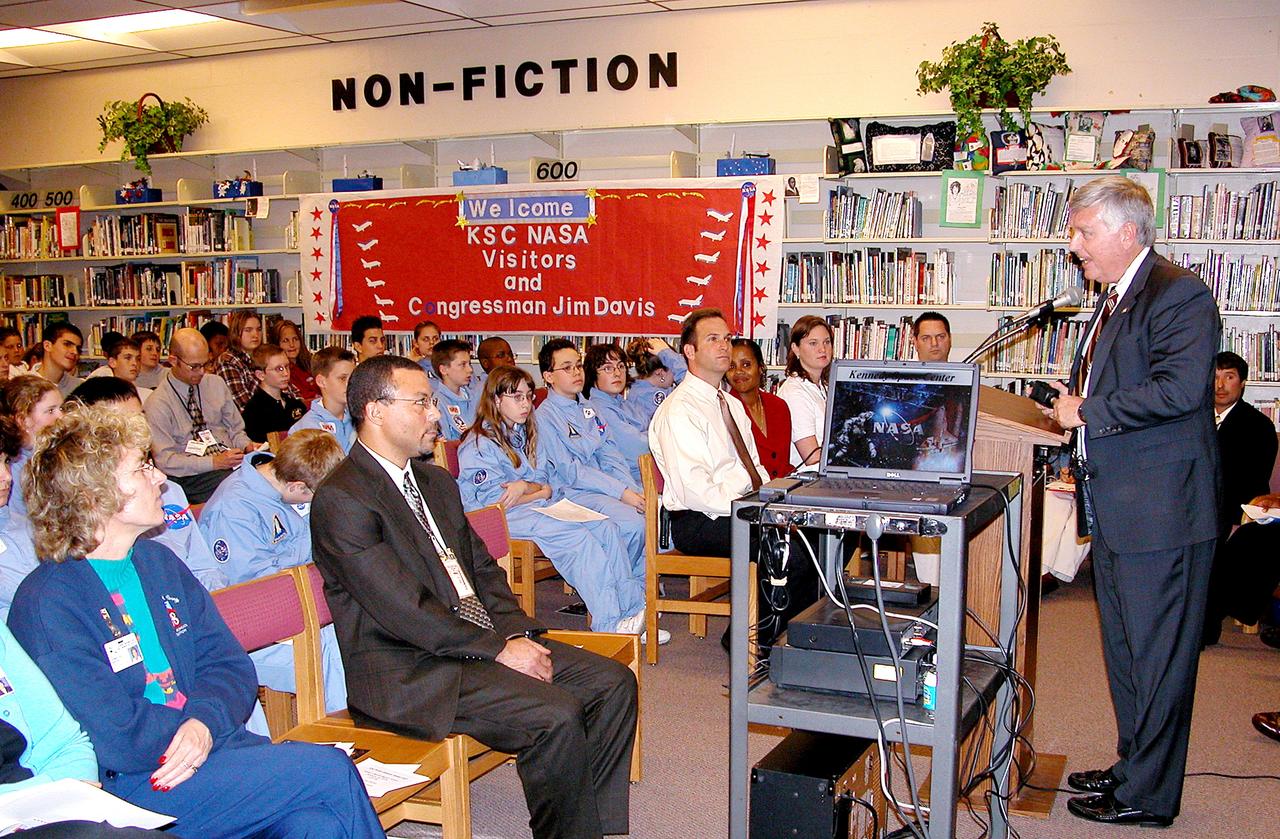
KENNEDY SPACE CENTER, FLA. - Center Director Jim Kennedy talks to students in Garland V. Stewart Magnet Middle School, a NASA Explorer School (NES) in Tampa, Fla.  Kennedy  made the trip with NASA astronaut Kay Hire to share the agency’s new vision for space exploration with the next generation of explorers. Kennedy is talking with students about our destiny as explorers, NASA’s stepping stone approach to exploring Earth, the Moon, Mars and beyond, how space impacts our lives, and how people and machines rely on each other in space.
KENNEDY SPACE CENTER, FLA. - Center Director Jim Kennedy talks to students in Garland V. Stewart Magnet Middle School, a NASA Explorer School (NES) in Tampa, Fla. Kennedy made the trip with NASA astronaut Kay Hire to share the agency’s new vision for space exploration with the next generation of explorers. Kennedy is talking with students about our destiny as explorers, NASA’s stepping stone approach to exploring Earth, the Moon, Mars and beyond, how space impacts our lives, and how people and machines rely on each other in space.
KENNEDY SPACE CENTER, FLA. - Center Director Jim Kennedy talks to radio station WFLA-AM and Florida Radio Network about his trip to Garland V. Stewart Magnet Middle School, a NASA Explorer School (NES) in Tampa, Fla.  Kennedy  made the trip with NASA astronaut Kay Hire to share the agency’s new vision for space exploration with the next generation of explorers. Kennedy is talking with students about our destiny as explorers, NASA’s stepping stone approach to exploring Earth, the Moon, Mars and beyond, how space impacts our lives, and how people and machines rely on each other in space.
KENNEDY SPACE CENTER, FLA. - Center Director Jim Kennedy talks to radio station WFLA-AM and Florida Radio Network about his trip to Garland V. Stewart Magnet Middle School, a NASA Explorer School (NES) in Tampa, Fla. Kennedy made the trip with NASA astronaut Kay Hire to share the agency’s new vision for space exploration with the next generation of explorers. Kennedy is talking with students about our destiny as explorers, NASA’s stepping stone approach to exploring Earth, the Moon, Mars and beyond, how space impacts our lives, and how people and machines rely on each other in space.
KENNEDY SPACE CENTER, FLA. - Center Director Jim Kennedy talks to WTSP-ABC News about his trip to Garland V. Stewart Magnet Middle School, a NASA Explorer School (NES) in Tampa, Fla.  Kennedy  made the trip with NASA astronaut Kay Hire to share the agency’s new vision for space exploration with the next generation of explorers. Kennedy is talking with students about our destiny as explorers, NASA’s stepping stone approach to exploring Earth, the Moon, Mars and beyond, how space impacts our lives, and how people and machines rely on each other in space.
KENNEDY SPACE CENTER, FLA. - Center Director Jim Kennedy talks to WTSP-ABC News about his trip to Garland V. Stewart Magnet Middle School, a NASA Explorer School (NES) in Tampa, Fla. Kennedy made the trip with NASA astronaut Kay Hire to share the agency’s new vision for space exploration with the next generation of explorers. Kennedy is talking with students about our destiny as explorers, NASA’s stepping stone approach to exploring Earth, the Moon, Mars and beyond, how space impacts our lives, and how people and machines rely on each other in space.
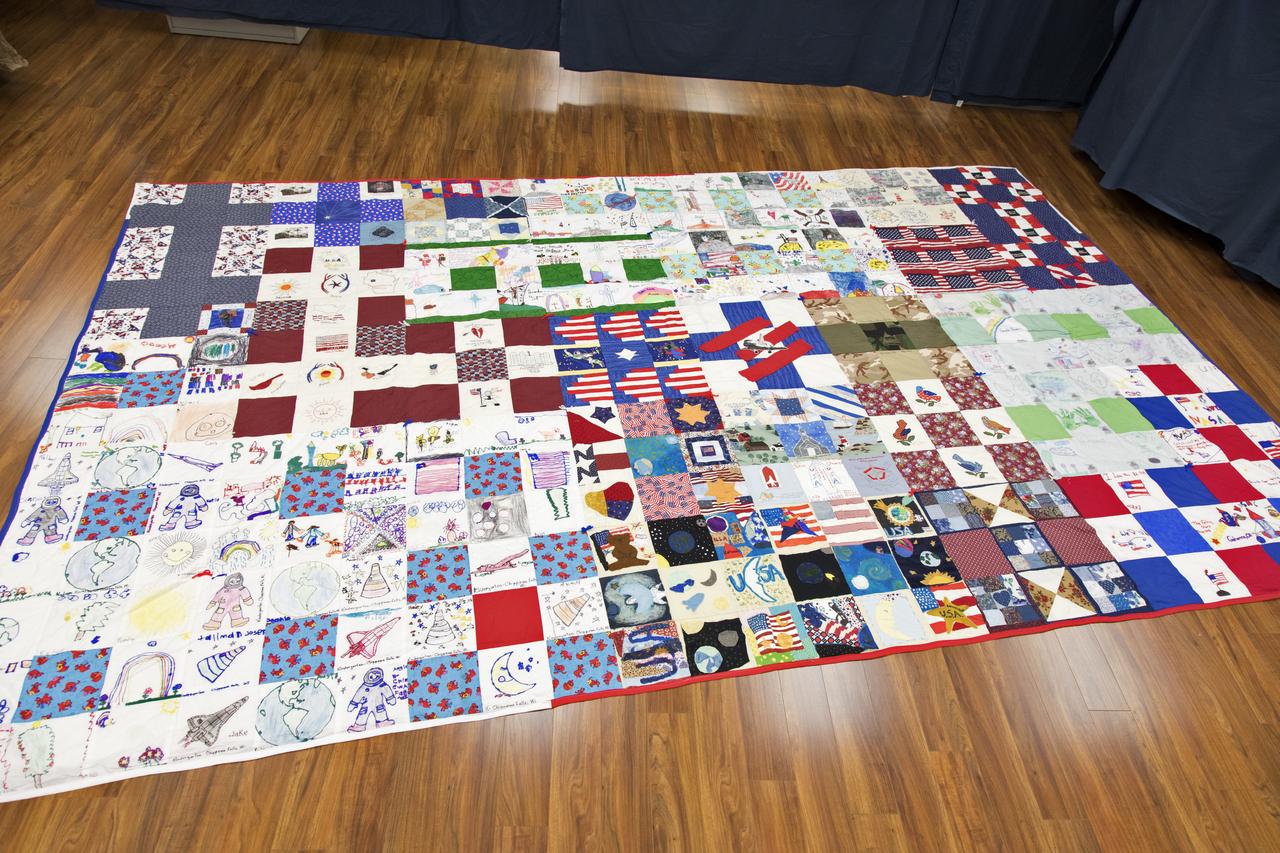
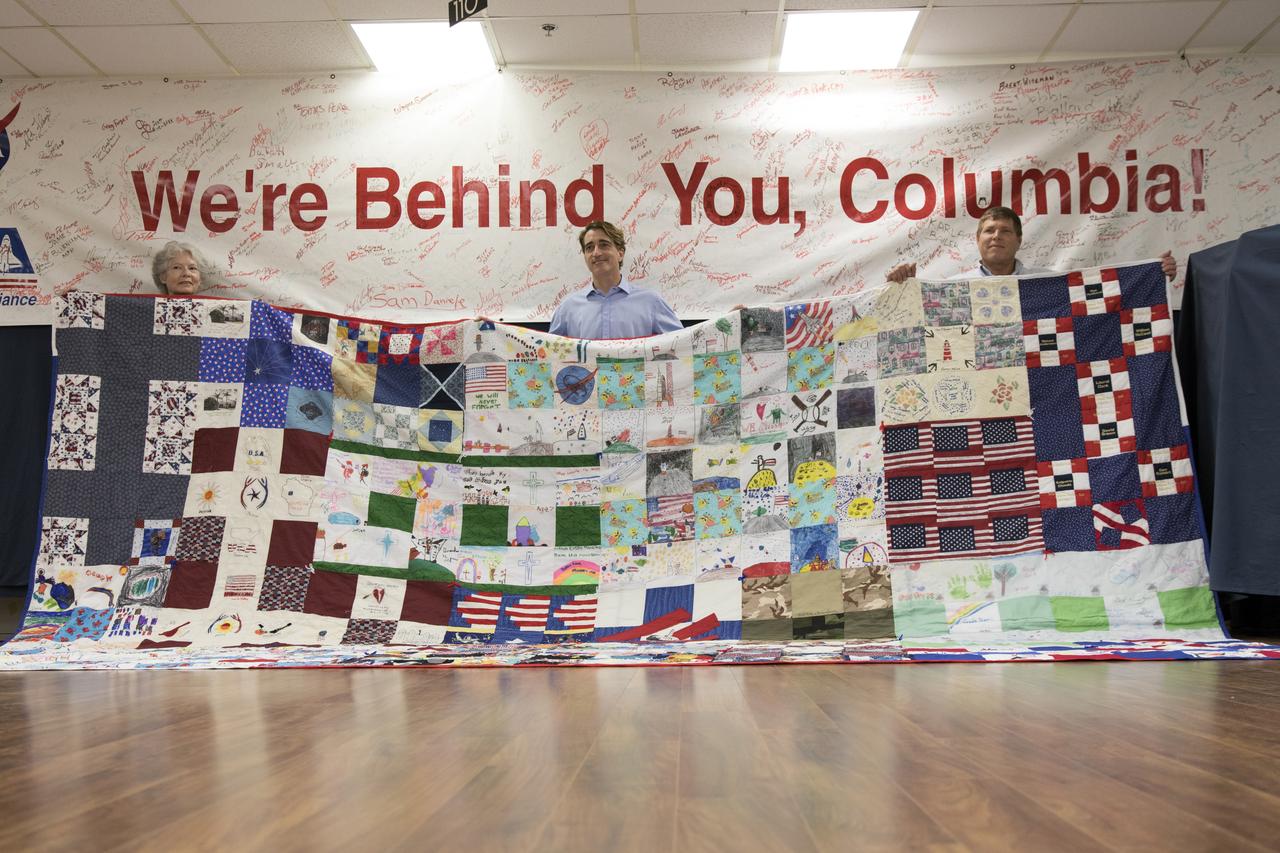
A giant hand-made quilt in honor of space shuttle Columbia and her crew was turned over to the Columbia Preservation Room inside the Vehicle Assembly Building at NASA's Kennedy Space Center in Florida. The quilt was made by Katherine Walsh, a lifelong NASA and space program fan originally from Kentucky.
Columbia Quilt
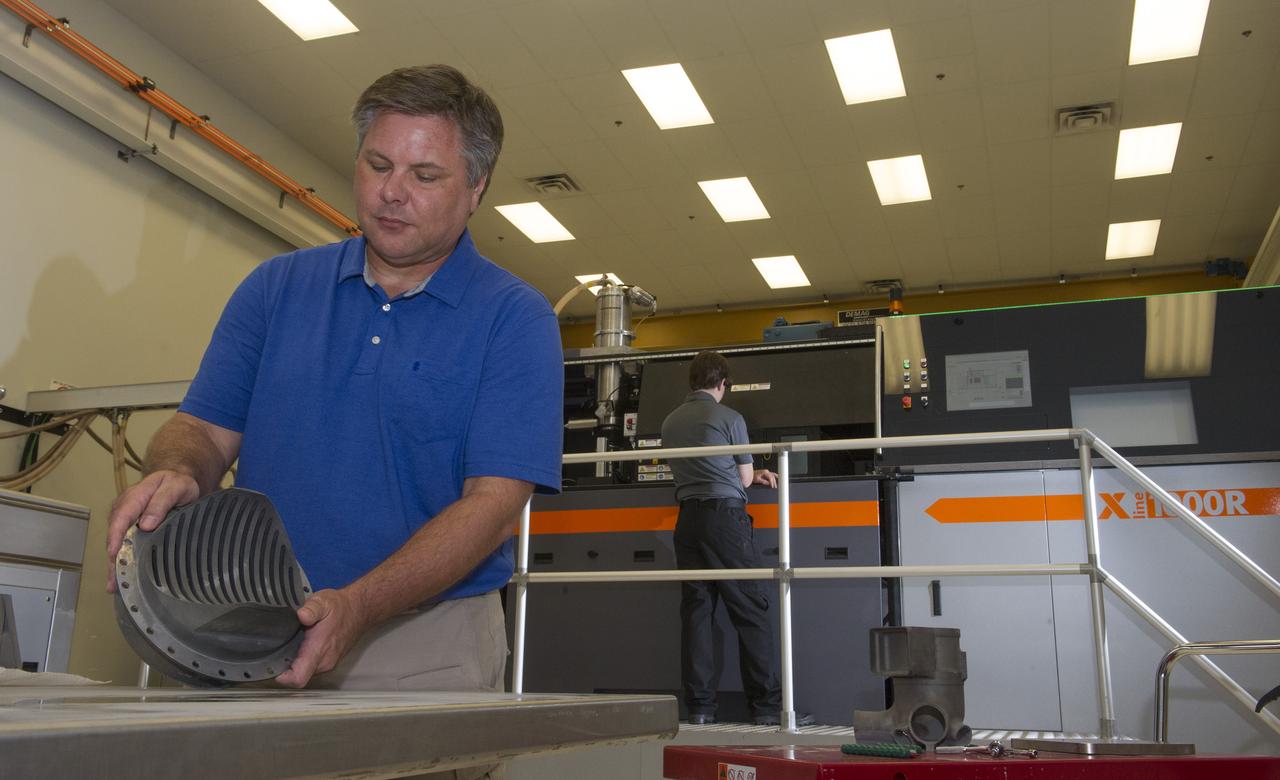
ANDY HARDIN, A PROPULSION ENGINEER AT NASA'S MARSHALL SPACE FLIGHT CENTER IN HUNTSVILLE, ALABAMA, SHOWS A 3-D PRINTED ROCKET PART MADE WITH A SELECTIVE LASER MELTING MACHINE. PARTS FOR THE SPACE LAUNCH SYSTEM'S RS-25 ROCKET ENGINE ARE BEING MADE WITH THE MACHINE IN THE BACKGROUND
Andy Hardin with 3-D printed engine part
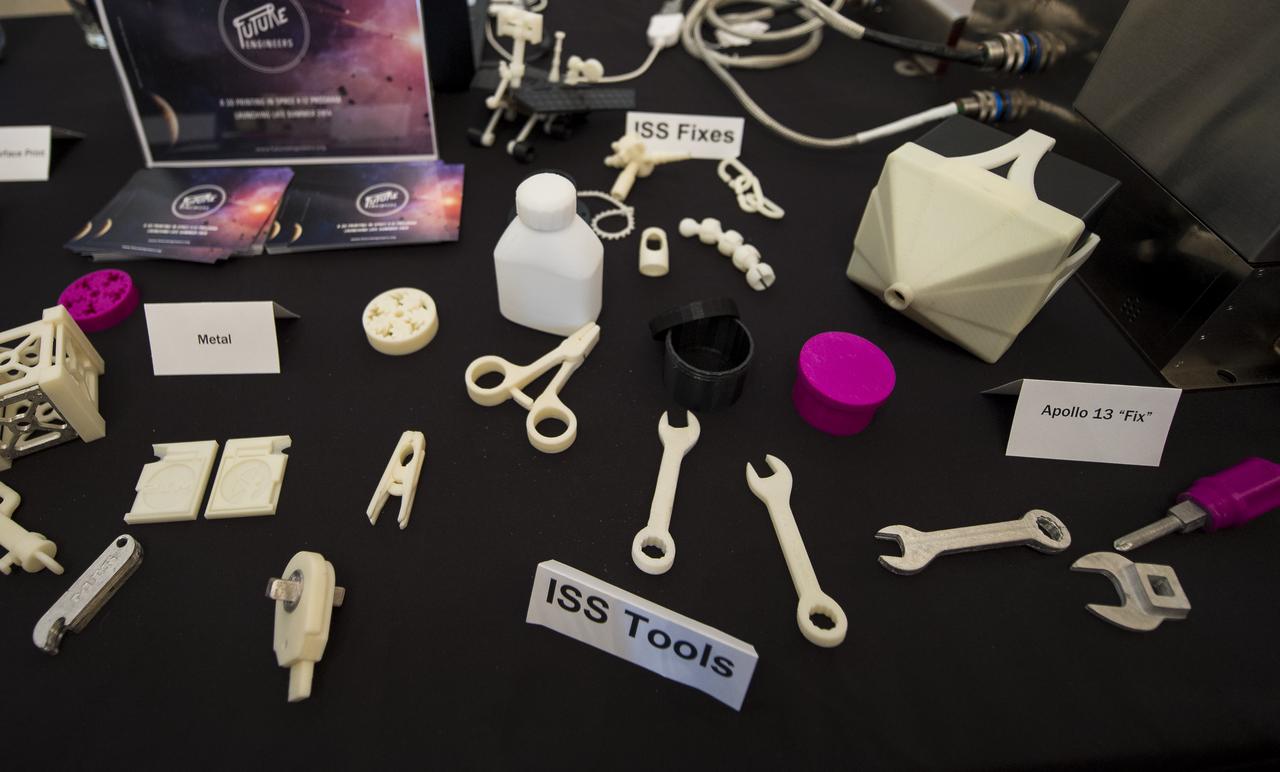
The Made In Space company displays some of the tools that can be made by their 3D printer during the first ever White House Maker Faire which brings together students, entrepreneurs, and everyday citizens who are using new tools and techniques to launch new businesses, learn vital skills in science, technology, engineering, and math (STEM), and fuel the renaissance in American manufacturing, at the White House, Wednesday, June 18, 2014 in Washington. The Made In Space 3D printer was just approved by NASA to be tested onboard the International Space Station (ISS), and NASA announced a challenge for students to design items that would be printed by this first 3D printer to fly in space.  Photo Credit: (NASA/Bill Ingalls)
White House Maker Faire
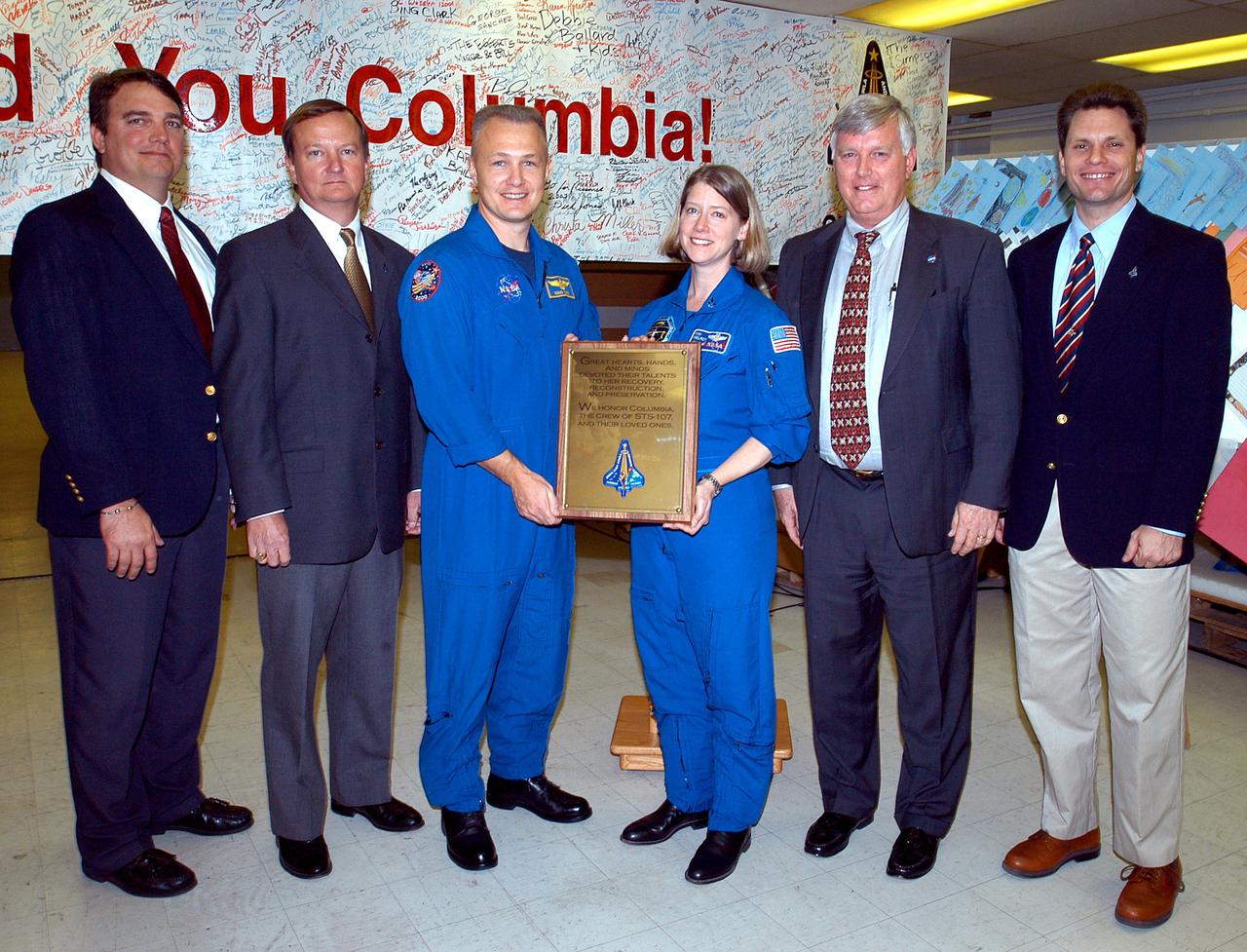
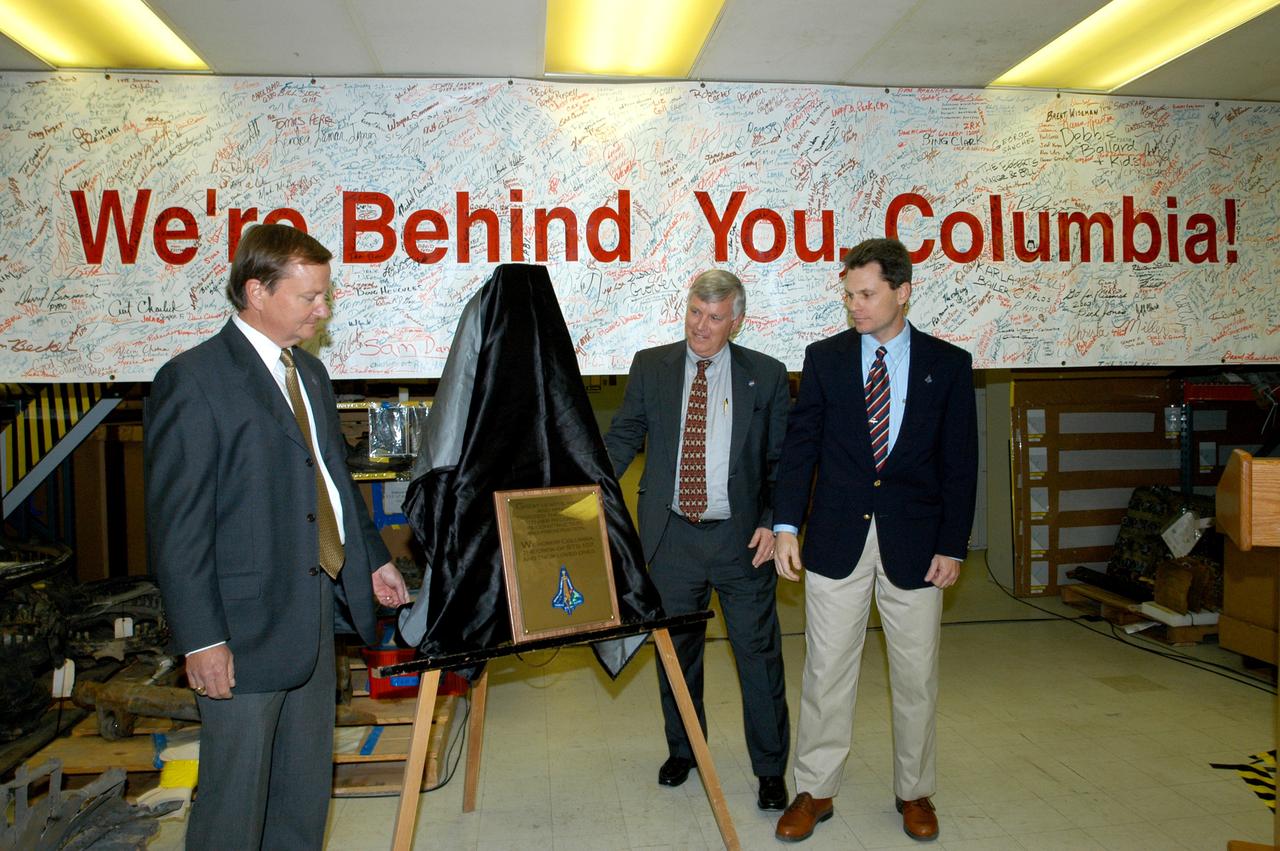
KENNEDY SPACE CENTER, FLA. -  In the Vehicle Assembly Building, Shuttle Launch Director Mike Leinbach, Center Director Jim Kennedy and NASA Vehicle Manager Scott Thurston unveil a plaque honoring “Columbia, the crew of STS-107, and their loved ones.”  The site is the “Columbia room,” a permanent repository of the debris collected in the aftermath of the tragic accident Feb. 1, 2003, that claimed the orbiter and lives of the seven-member crew.  The dedication of the plaque was made in front of the 40-member preservation team.
KENNEDY SPACE CENTER, FLA. - In the Vehicle Assembly Building, Shuttle Launch Director Mike Leinbach, Center Director Jim Kennedy and NASA Vehicle Manager Scott Thurston unveil a plaque honoring “Columbia, the crew of STS-107, and their loved ones.” The site is the “Columbia room,” a permanent repository of the debris collected in the aftermath of the tragic accident Feb. 1, 2003, that claimed the orbiter and lives of the seven-member crew. The dedication of the plaque was made in front of the 40-member preservation team.
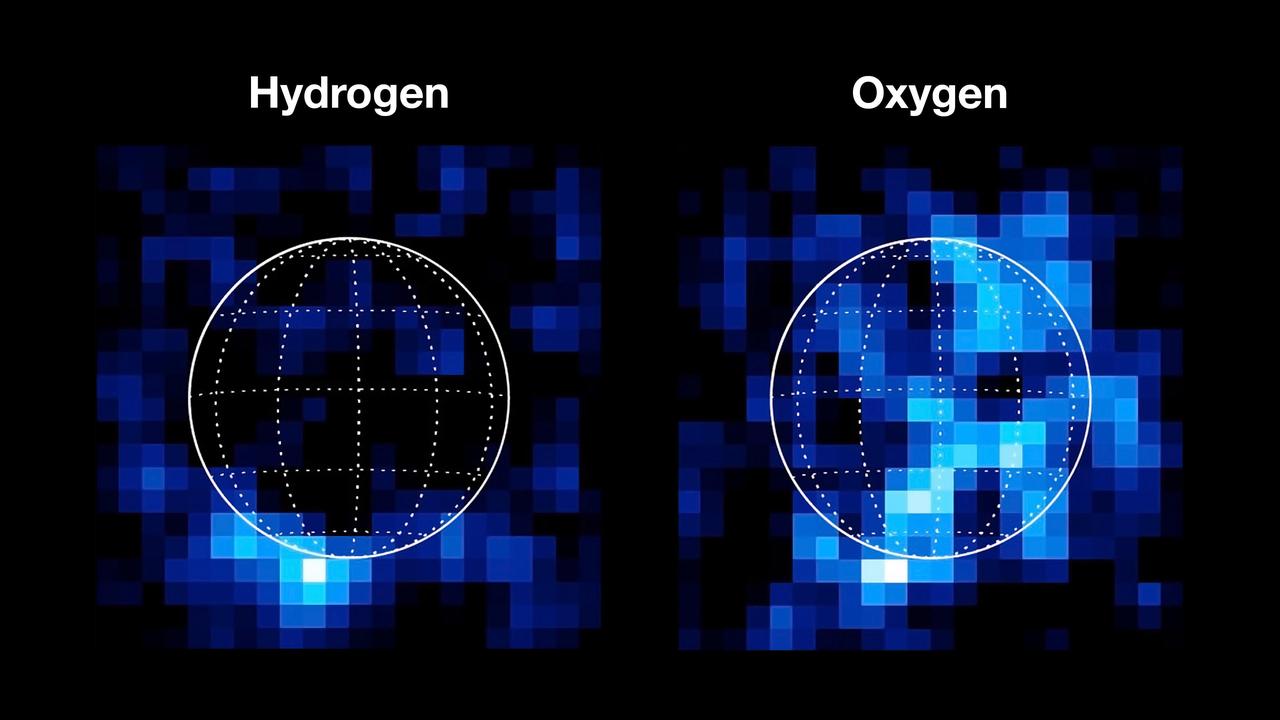
Ultraviolet observations made by NASA's Hubble Space Telescope in 2012 illustrate two key elements in the thin atmosphere of Jupiter's moon Europa: hydrogen and oxygen. A white circle indicates the outline of Europa. The hydrogen data could potentially be evidence of an active plume venting water from the ocean beneath Europa's icy crust. If plumes do exist at the Jovian moon, the ultraviolet spectrograph on NASA's Europa Clipper spacecraft (Europa-UVS) could detect their activity at much higher resolution.  Europa Clipper's three main science objectives are to determine the thickness of the moon's icy shell and its interactions with the ocean below, to investigate its composition, and to characterize its geology. The mission's detailed exploration of Europa will help scientists better understand the astrobiological potential for habitable worlds beyond our planet.  https://photojournal.jpl.nasa.gov/catalog/PIA26462
Hubble's Ultraviolet Observations Reveal Hydrogen and Oxygen at Europa
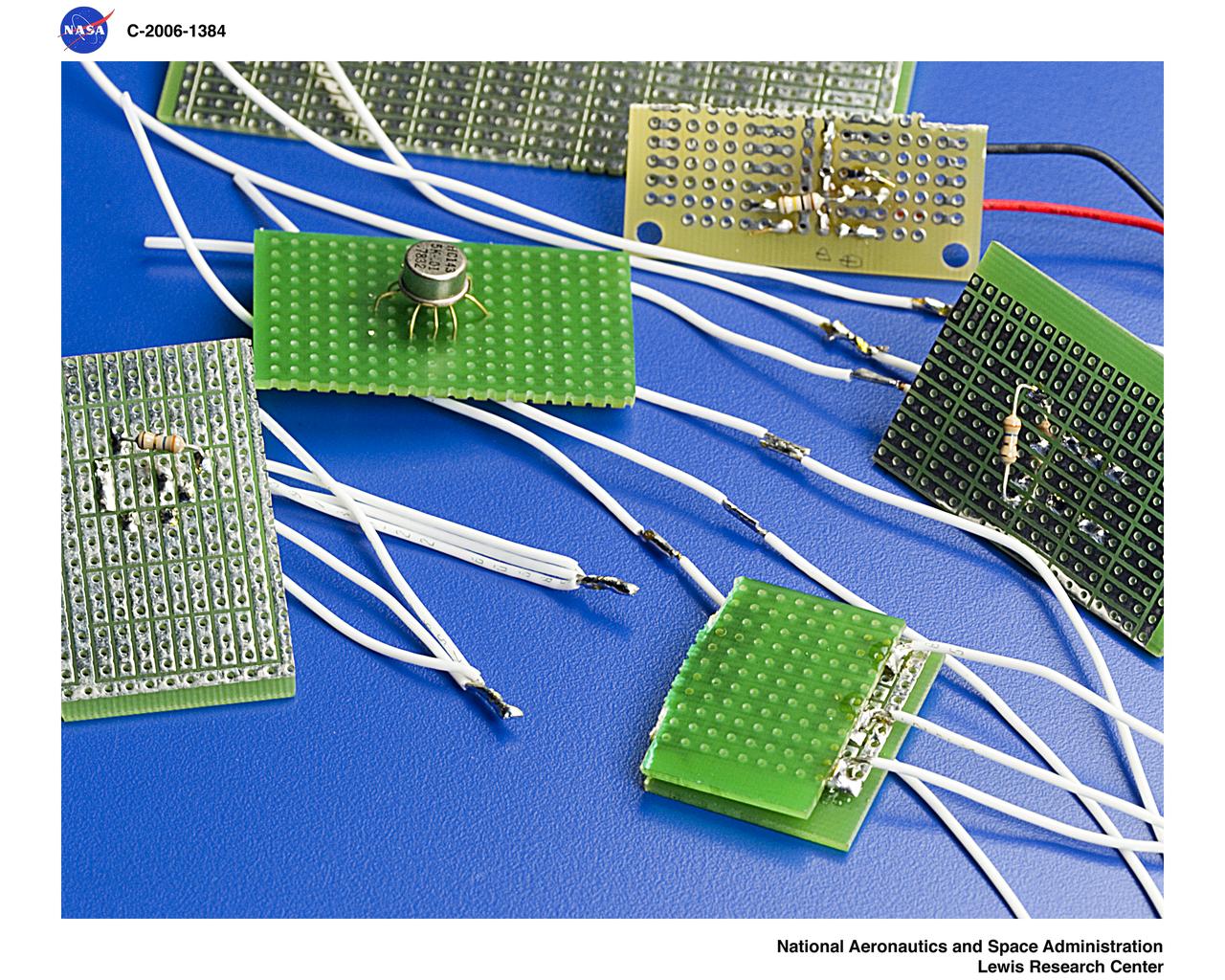
Component Level Electronic Assembly Repair (CLEAR).  Solder joints made by Astronauts in space
GRC-2006-C-01384
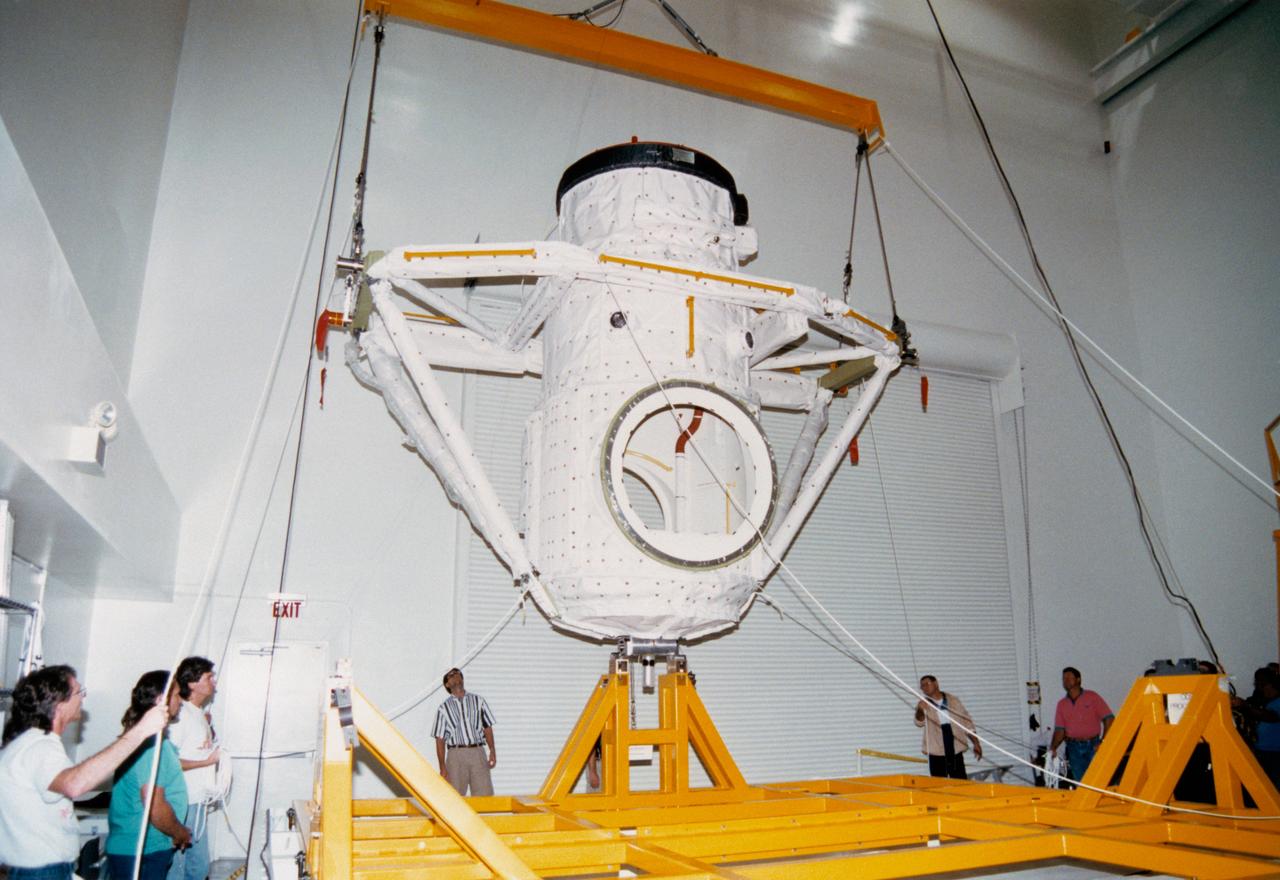
S94-47810 (2 Dec. 1994) --- Lockheed Space Operations Company workers in the Extended Duration Orbiter (EDO) Facility, located inside the Vehicle Assembly Building (VAB), carefully hoist the Orbiter Docking System (ODS) from its shipping container into a test stand. The ODS was shipped in a horizontal position to the Kennedy Space Center (KSC) from contractor Rockwell Aerospace's Downey plant.  Once the ODS is upright, work can continue to prepare the hardware for the first docking of the United States Space Shuttle and Russian Space Station MIR in 1995. The ODS contains both United States-made and Russian-made hardware. The black band is Russian-made thermal insulation protecting part of the docking mechanism, also Russian-made, called the Androgynous Peripheral Docking System (APDS). A red protective cap covers the APDS itself. Other elements of the ODS, most of it protected by white United States-made thermal insulation, were developed by Rockwell, which also integrated and checked out the assembled Russian-United States system.
STS-71 hardware assembly view
Mike Ciannilli, Apollo, Challenger, Columbia Lessons Learned Program manager, at right, accepts a certificate for turnover of a hand-made quilt in honor of space shuttle Columbia and her crew from Janet Phillips, property custodian in NASA Kennedy Space Center's Office of Procurement. Turnover of the quilt took place in the Columbia Preservation Room inside the Vehicle Assembly Building at Kennedy Space Center in Florida. The quilt was made by Katherine Walsh, a lifelong NASA and space program fan originally from Kentucky.
Columbia Quilt
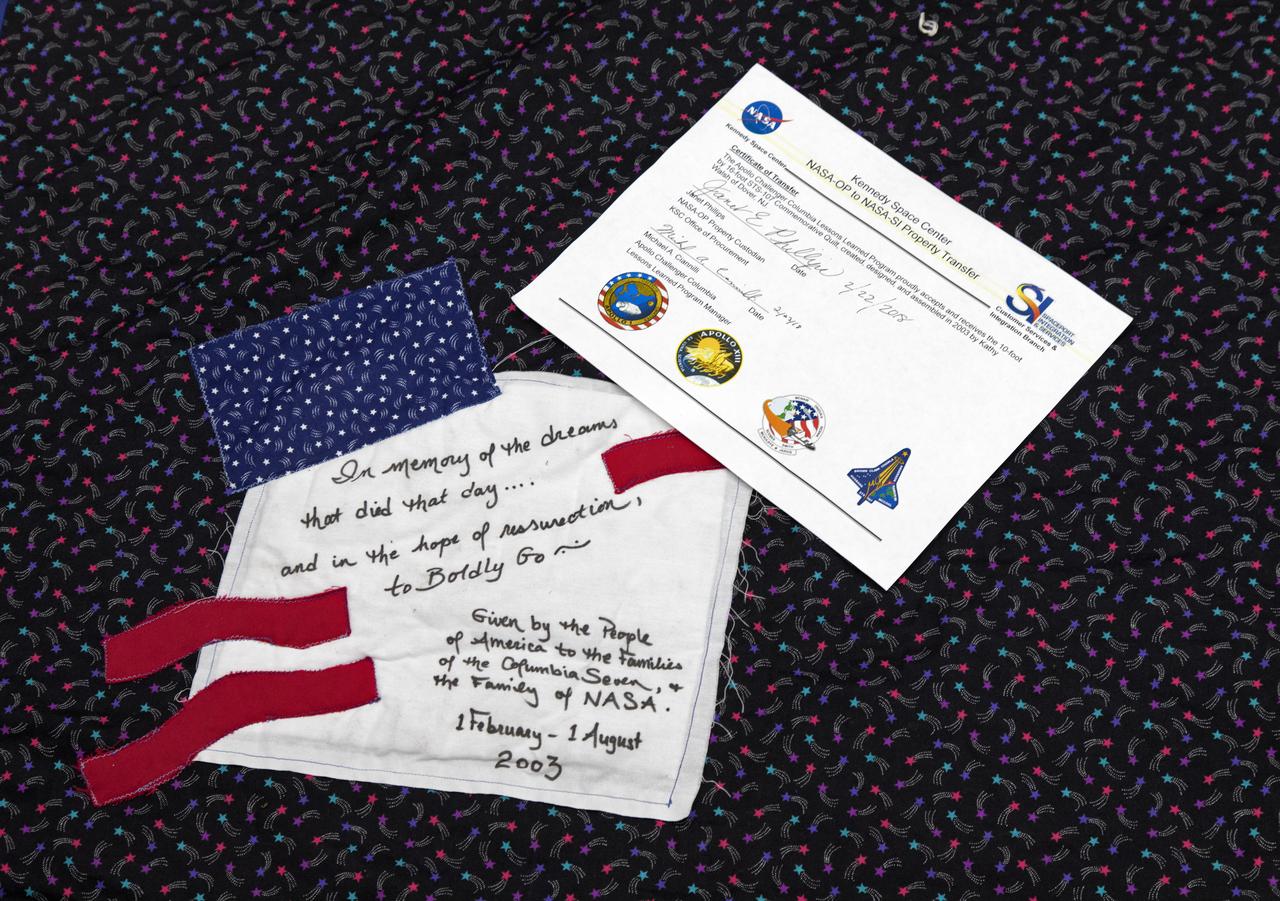
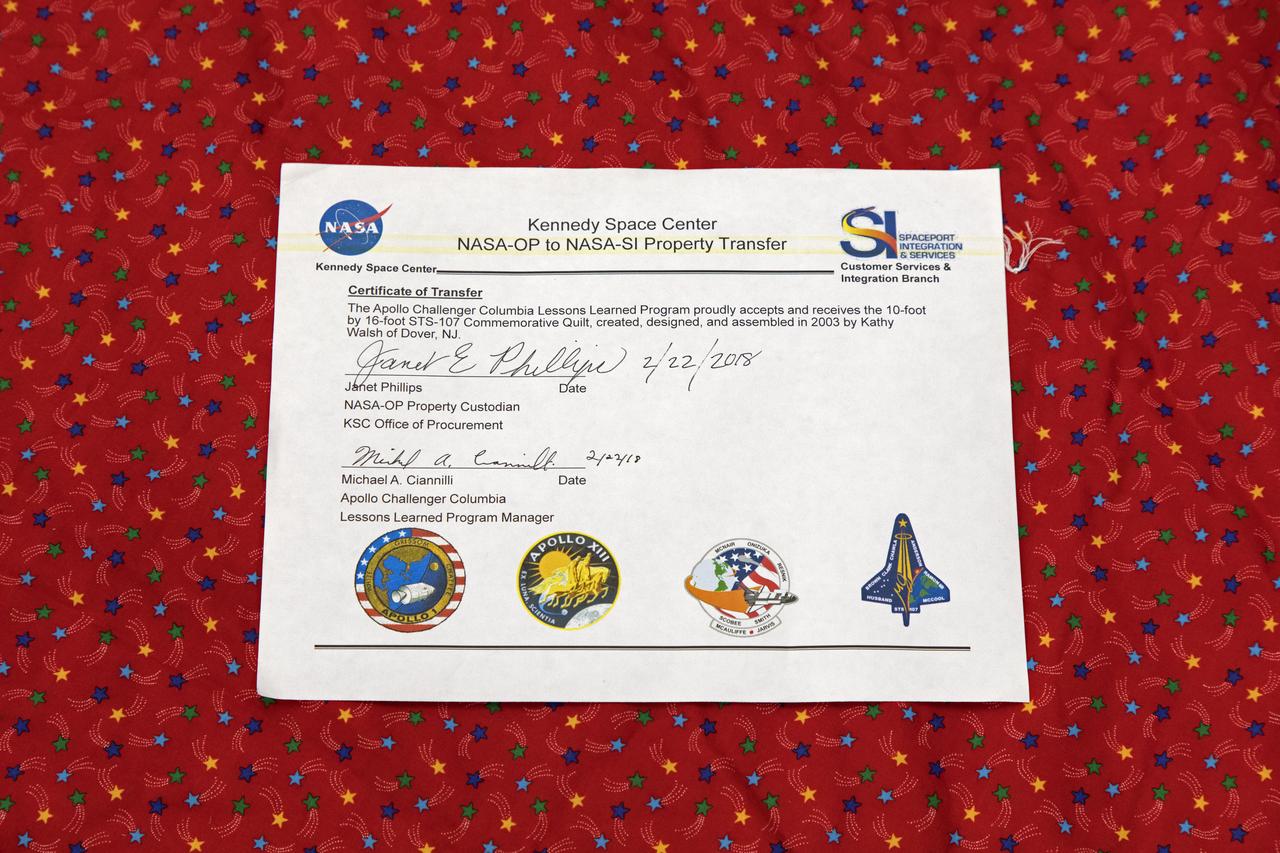
A certificate and quilt square are on display that confirms the transfer of a giant hand-made quilt in honor of space shuttle Columbia and her crew from the Office of Procurement to the Columbia Preservation Room inside the Vehicle Assembly Building at NASA's Kennedy Space Center in Florida. The quilt was made by Katherine Walsh, a lifelong NASA and space program fan originally from Kentucky. The quilt will be displayed in the preservation room with its certificate as part of NASA's Apollo, Challenger, Columbia Lessons Learned Program.
Columbia Quilt
A giant hand-made quilt in honor of space shuttle Columbia and her crew was turned over to the Columbia Preservation Room inside the Vehicle Assembly Building at NASA's Kennedy Space Center in Florida. The quilt was made by Katherine Walsh, a lifelong NASA and space program fan originally from Kentucky. From left, behind the quilt are Janet Phillips, property custodian in Kennedy's Office of Procurement; Mike Ciannilli, Apollo, Challenger, Columbia Lessons Learned Program manager; and Kevin Panik, customer advocate in  Spaceport Integration.
Columbia Quilt
A giant hand-made quilt in honor of space shuttle Columbia and her crew was turned over to the Columbia Preservation Room inside the Vehicle Assembly Building at NASA's Kennedy Space Center in Florida. The quilt was made by Katherine Walsh, a lifelong NASA and space program fan originally from Kentucky. From left, behind the quilt are Janet Phillips, property custodian in Kennedy's Office of Procurement; and Mike Ciannilli, Apollo, Challenger, Columbia Lessons Learned Program manager
Columbia Quilt
A certificate is on display that confirms the transfer of a giant hand-made quilt in honor of space shuttle Columbia and her crew from the Office of Procurement to the Columbia Preservation Room inside the Vehicle Assembly Building at NASA's Kennedy Space Center in Florida. The quilt was made by Katherine Walsh, a lifelong NASA and space program fan originally from Kentucky. The quilt will be displayed with its certificate in the preservation room as part of NASA's Apollo, Challenger, Columbia Lessons Learned Program.
Columbia Quilt
Several hundred never before seen galaxies are visible in this deepest-ever view of the universe, called the Hubble Deep Field, made with NASA Hubble Space Telescope.
Hubble Deep Field Image Unveils Myriad Galaxies Back to the Beginning of Time
KENNEDY SPACE CENTER, FLA. -  Posing with the plaque dedicated to Columbia Jan. 29, 2004,  are (left to right) United Space Alliance project leader for Columbia reconstruction Jim Comer, Shuttle Launch Director Mike Leinbach, astronauts Douglas Hurley and Pam Melroy, Center Director Jim Kennedy and NASA Vehicle Manager Scott Thurston.  The dedication of the plaque was made in front of the 40-member preservation team in the “Columbia room,” a permanent repository in the Vehicle Assembly Building of the debris collected in the aftermath of the tragic accident Feb. 1, 2003, that claimed the orbiter and lives of the seven-member crew.
KENNEDY SPACE CENTER, FLA. - Posing with the plaque dedicated to Columbia Jan. 29, 2004, are (left to right) United Space Alliance project leader for Columbia reconstruction Jim Comer, Shuttle Launch Director Mike Leinbach, astronauts Douglas Hurley and Pam Melroy, Center Director Jim Kennedy and NASA Vehicle Manager Scott Thurston. The dedication of the plaque was made in front of the 40-member preservation team in the “Columbia room,” a permanent repository in the Vehicle Assembly Building of the debris collected in the aftermath of the tragic accident Feb. 1, 2003, that claimed the orbiter and lives of the seven-member crew.
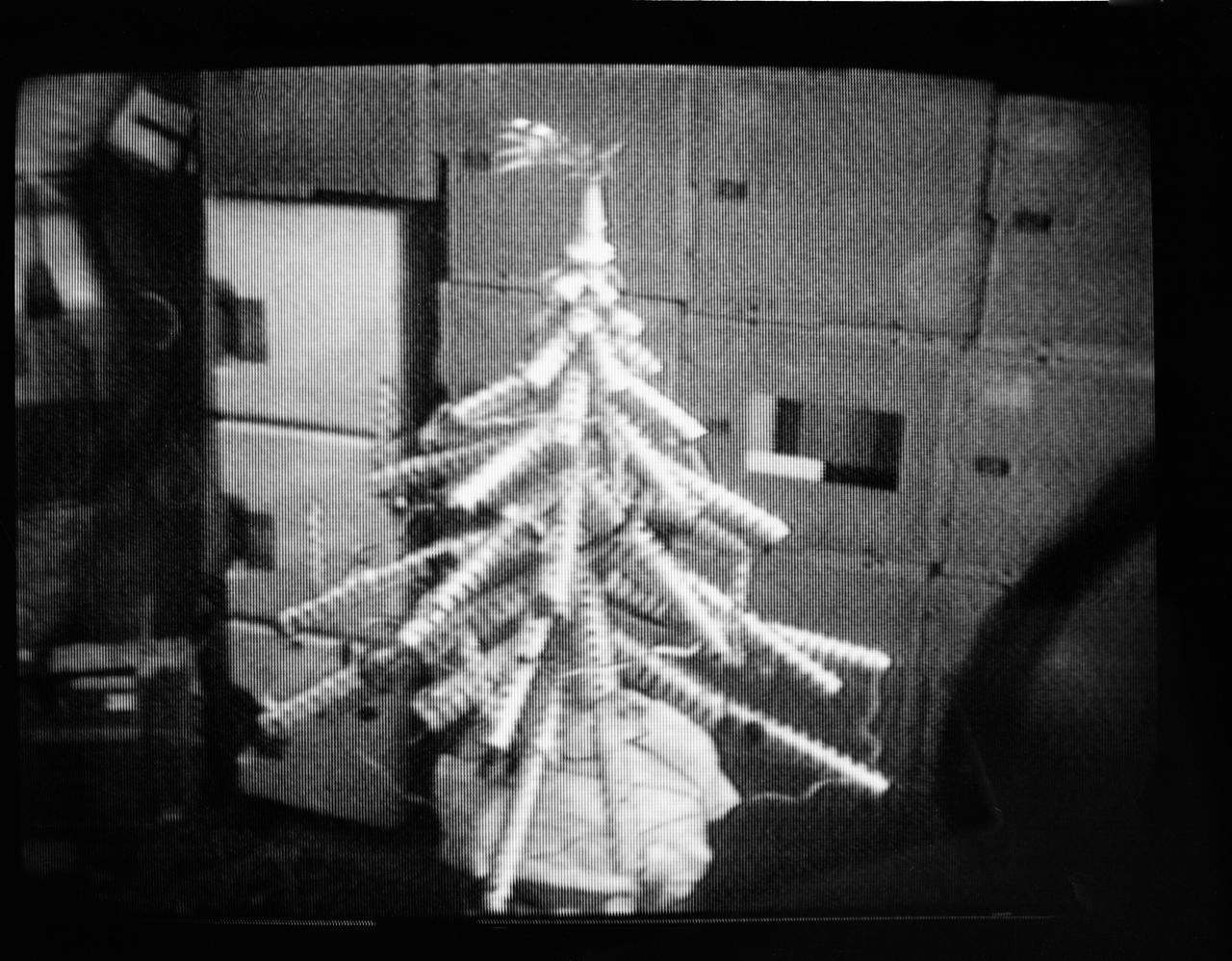
S73-38687 (24 Dec. 1973) --- This "Christmas tree" was created by the three crewmen of the third manned Skylab mission (Skylab 4) aboard the space station in Earth orbit. Food cans were used to fashion the tree. This photograph was made from a television transmission made from a video tape recording on Dec. 24, 1973. Photo credit: NASA
Skylab IV - Television
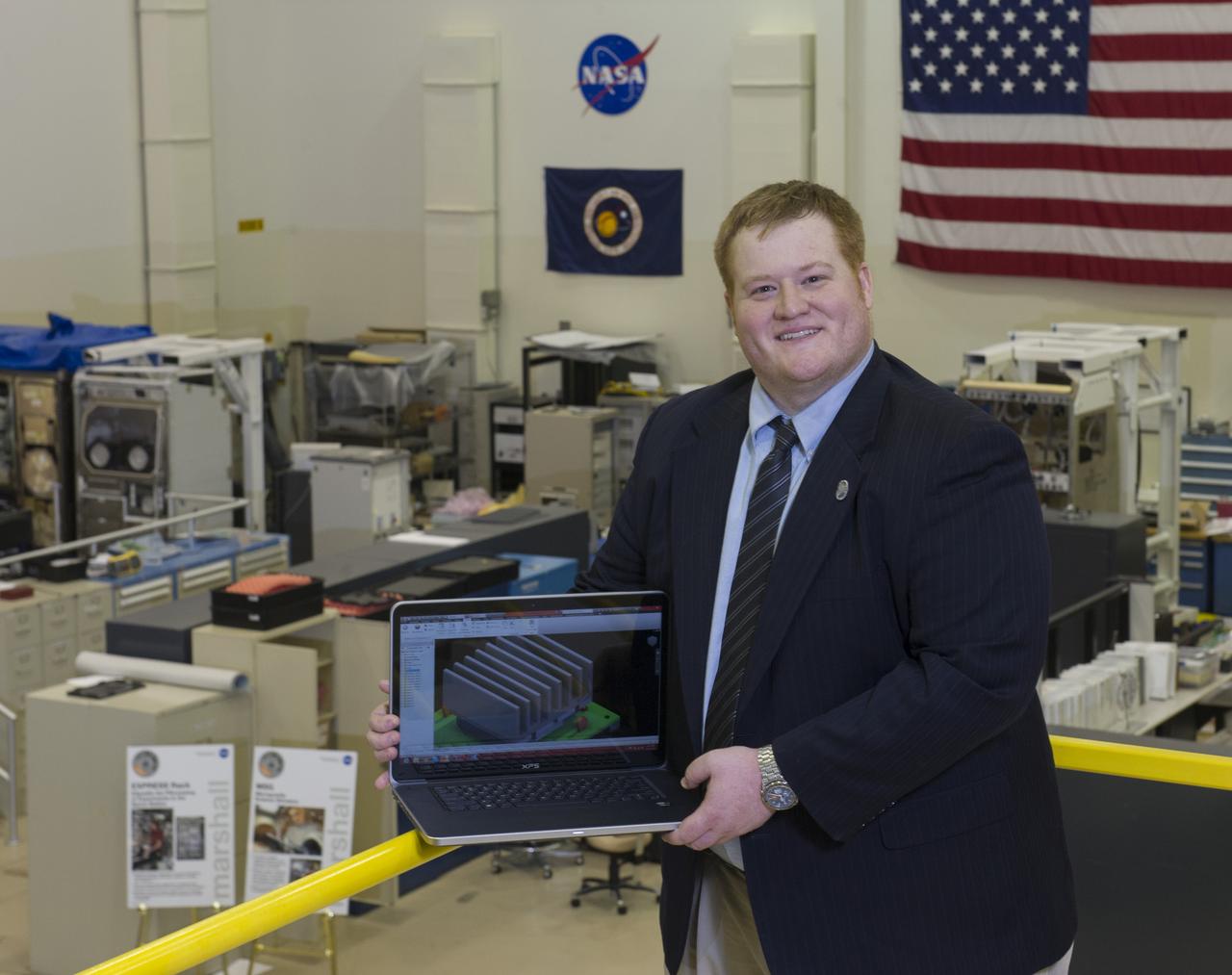
MICHAEL SNYDER, DIRECTOR OF R&D AND LEAD ENGINEER FOR MADE IN SPACE, SHOWS A CAD RENDERING OF A VITAL COMPONENT OF THE 3D PRINTER HEADED FOR THE ISS DURING TESTING AT MARSHALL SPACE FLIGHT CENTER.-
1400496
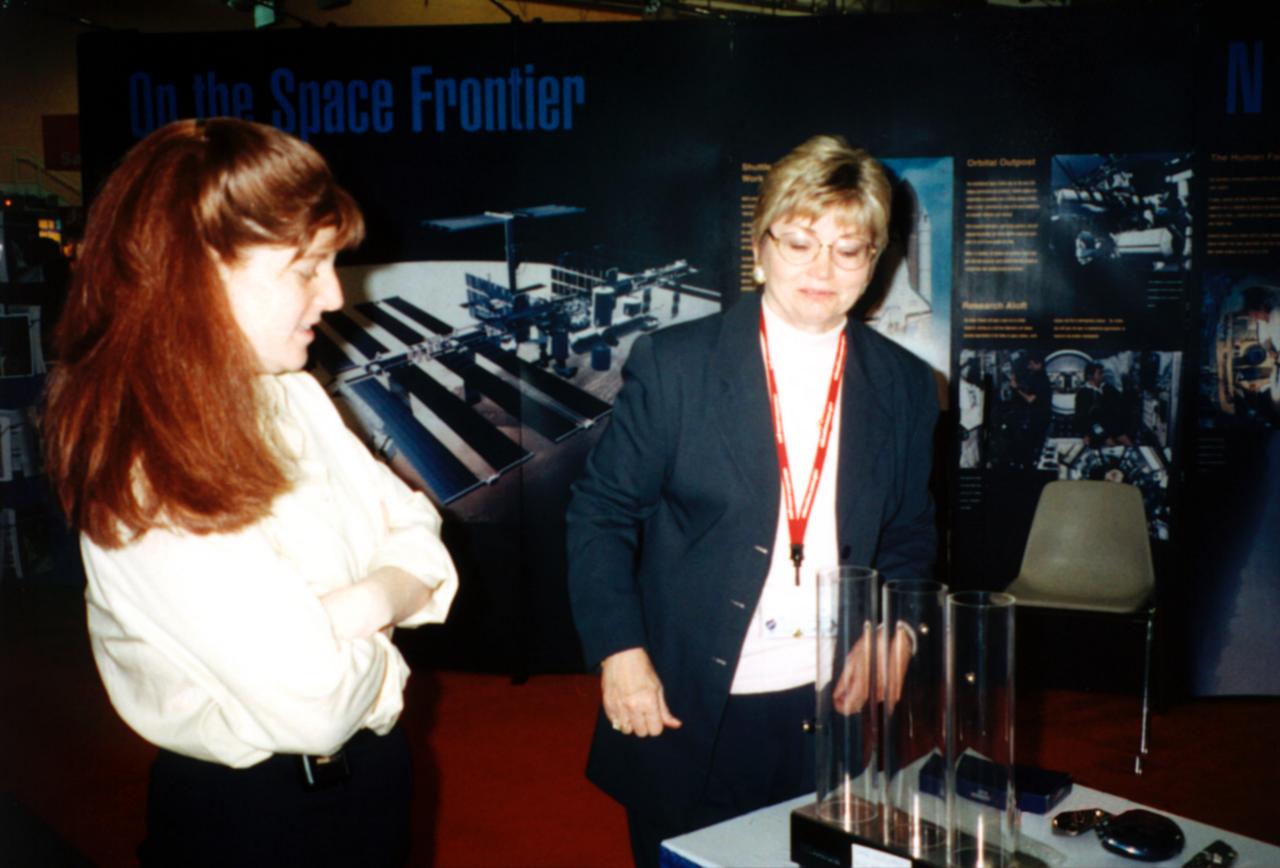
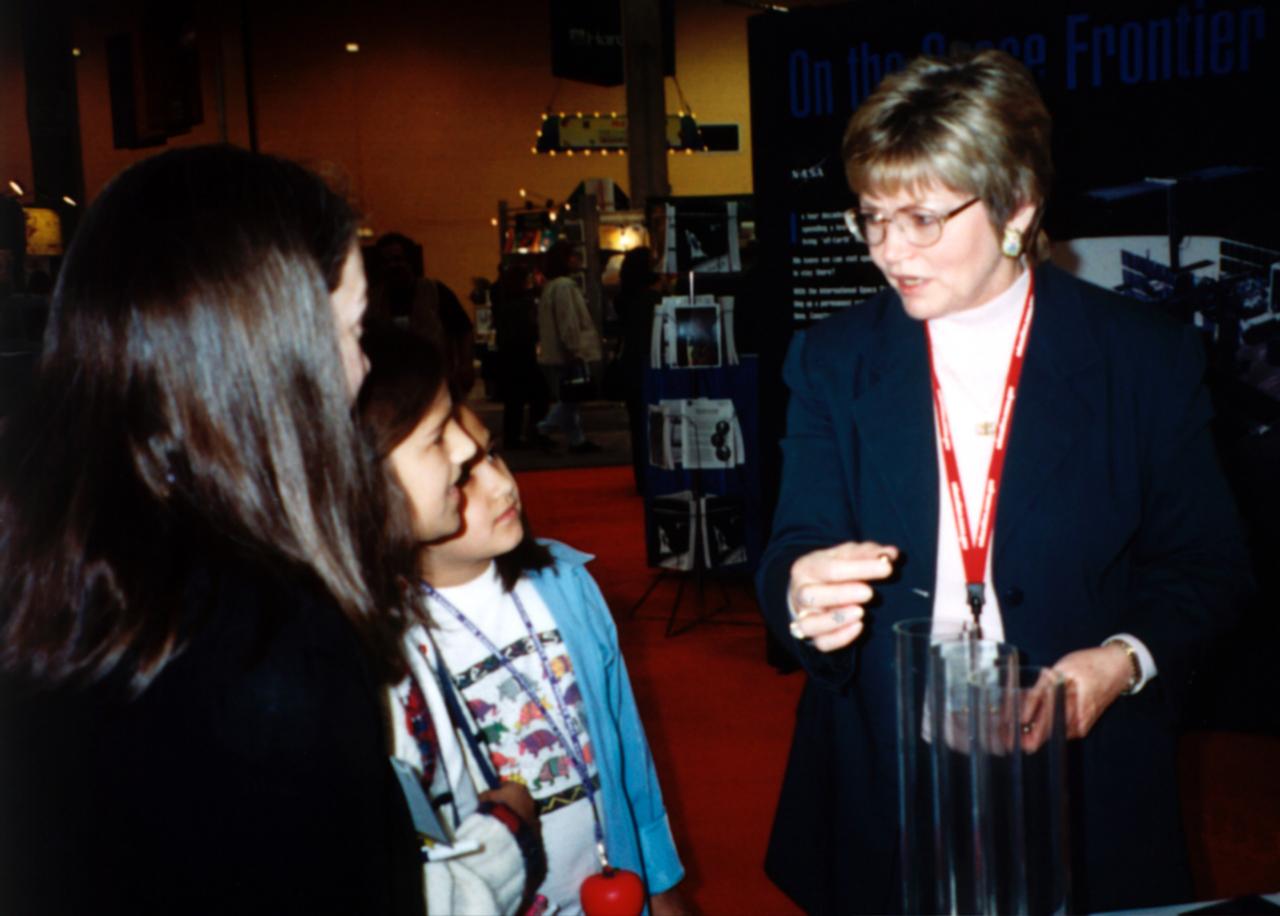
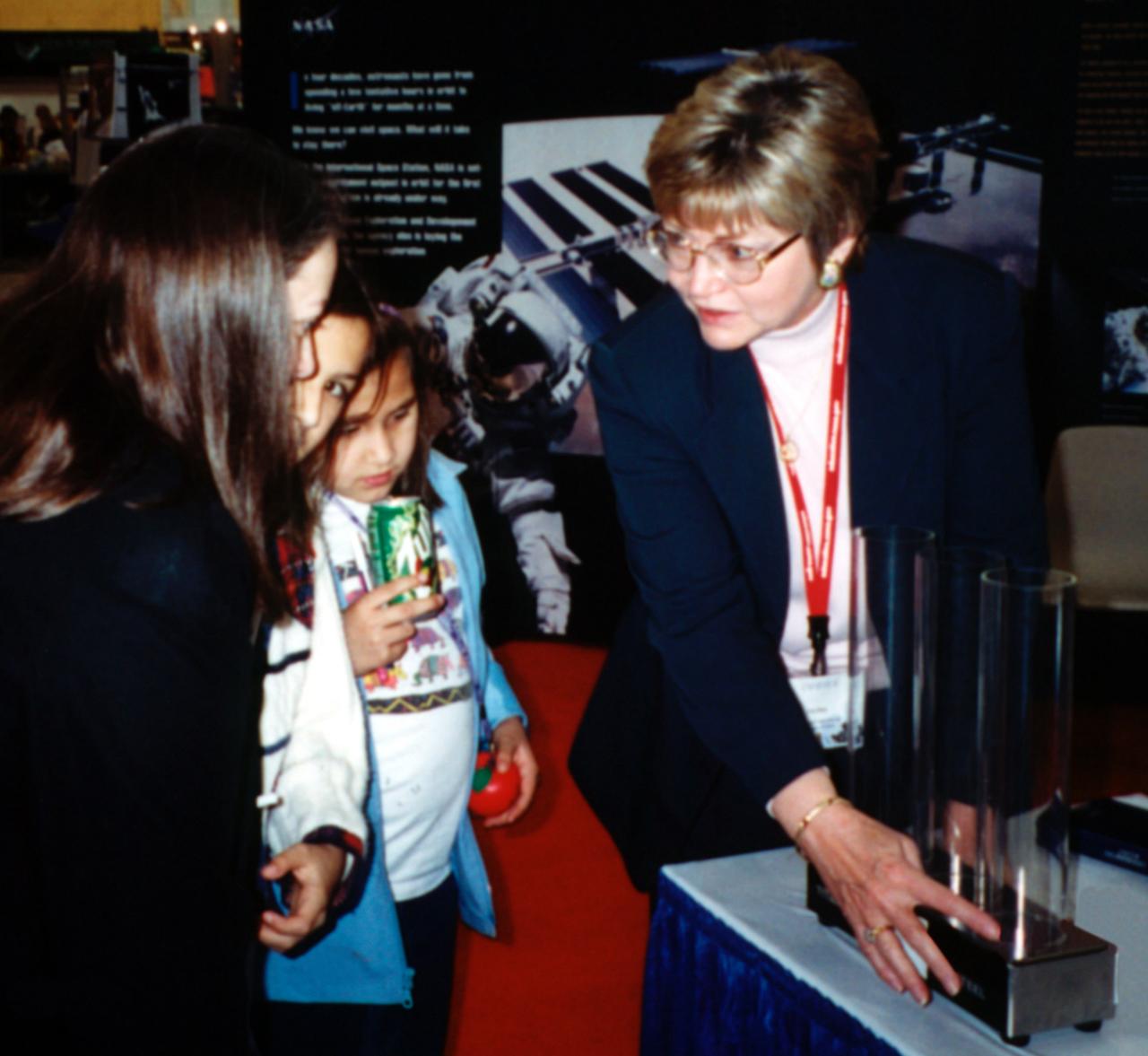
Pat Doty (right) of NASA/Marshall Space Flight Center (MSFC) demonstrates the greater bounce to the ounce of metal made from a supercooled bulk metallic glass alloy that NASA is studying in space experiments. The metal plates at the bottom of the plexiglass tubes are made of three different types of metal. Bulk metallic glass is more resilient and, as a result, the dropped ball bearing bounces higher. Experiments in space allow scientists to study fundamental properties that carnot be observed on Earth. This demonstration was at the April 200 conference of the National Council of Teachers of Mathematics (NCTM) in Chicago. photo credit: NASA/Marshall Space Flight Center (MSFC)
Microgravity
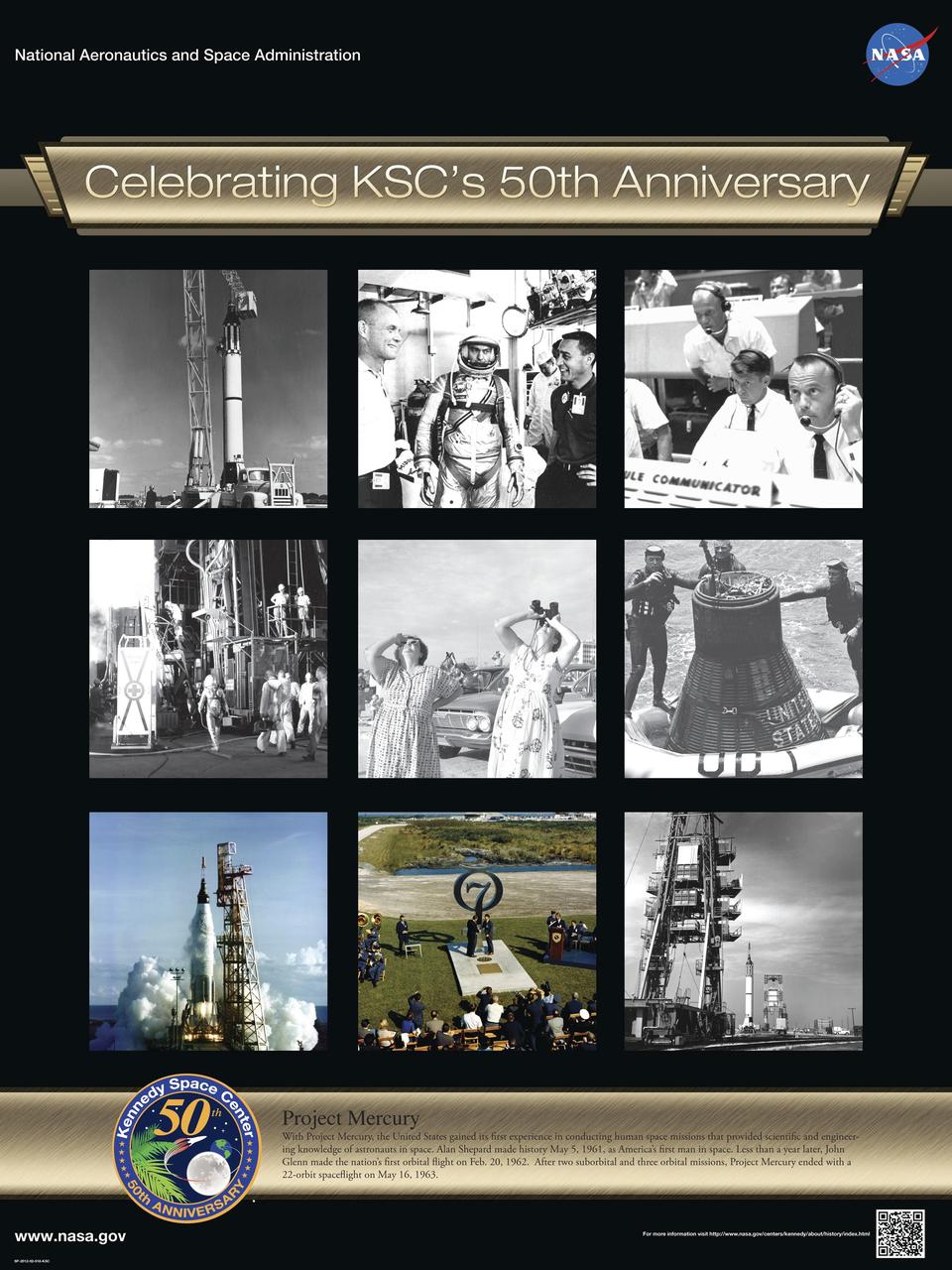
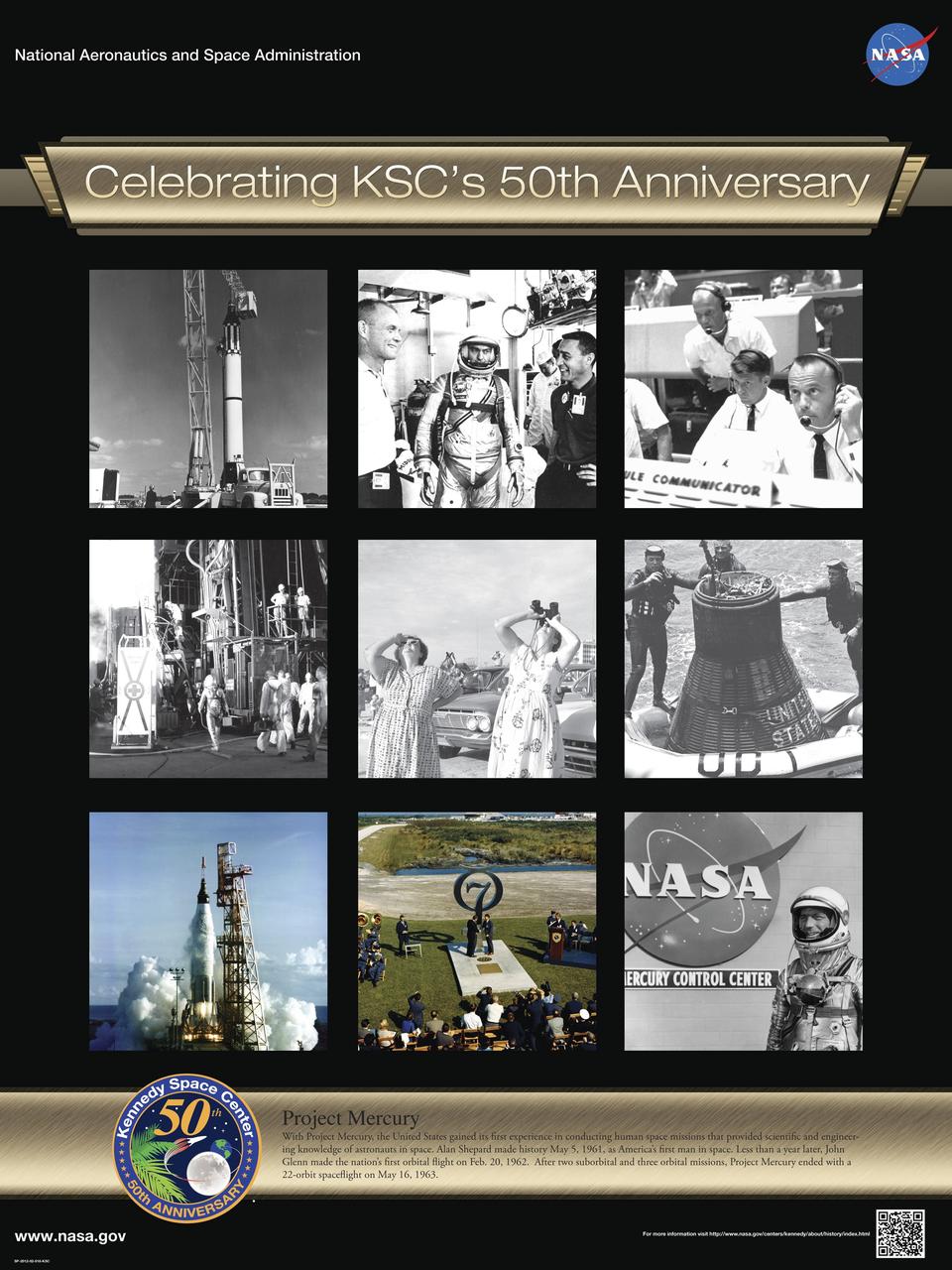
Project Mercury:  With Project Mercury, the United States gained its first experience in conducting human space missions that provided scientific and engineering knowledge of astronauts in space. Alan Shepard made history May 5, 1961, as America's first man in space. Less than a year later, John Glenn made the nation’s first orbital flight on Feb. 20, 1962.  After two suborbital and three orbital missions, Project Mercury ended with a 22-orbit spaceflight on May 16, 1963.    Poster designed by Kennedy Space Center Graphics Department/Greg Lee. Credit: NASA
KSC-2012-1858
Pat Doty (right) of NASA/Marshall Space Flight Center (MSFC) demonstrates the greater bounce to the ounce of metal made from a supercooled bulk metallic glass alloy that NASA is studying in space expepriments. The metal plates at the bottom of plexiglass tubes are made of three different types of metal. Bulk mettalic glass is more resilient and, as a result, the dropped ball bearing bounces higher. Experiments in space allow scientists to study fundamental properties that carnot be observed on Earth. This demonstration was at the April 2000 conference of the National Council of Teachers of Mathematics (NCTM) in Chicago. Photo credit: NASA/Marshall Space Flight Center (MSFC)
Microgravity
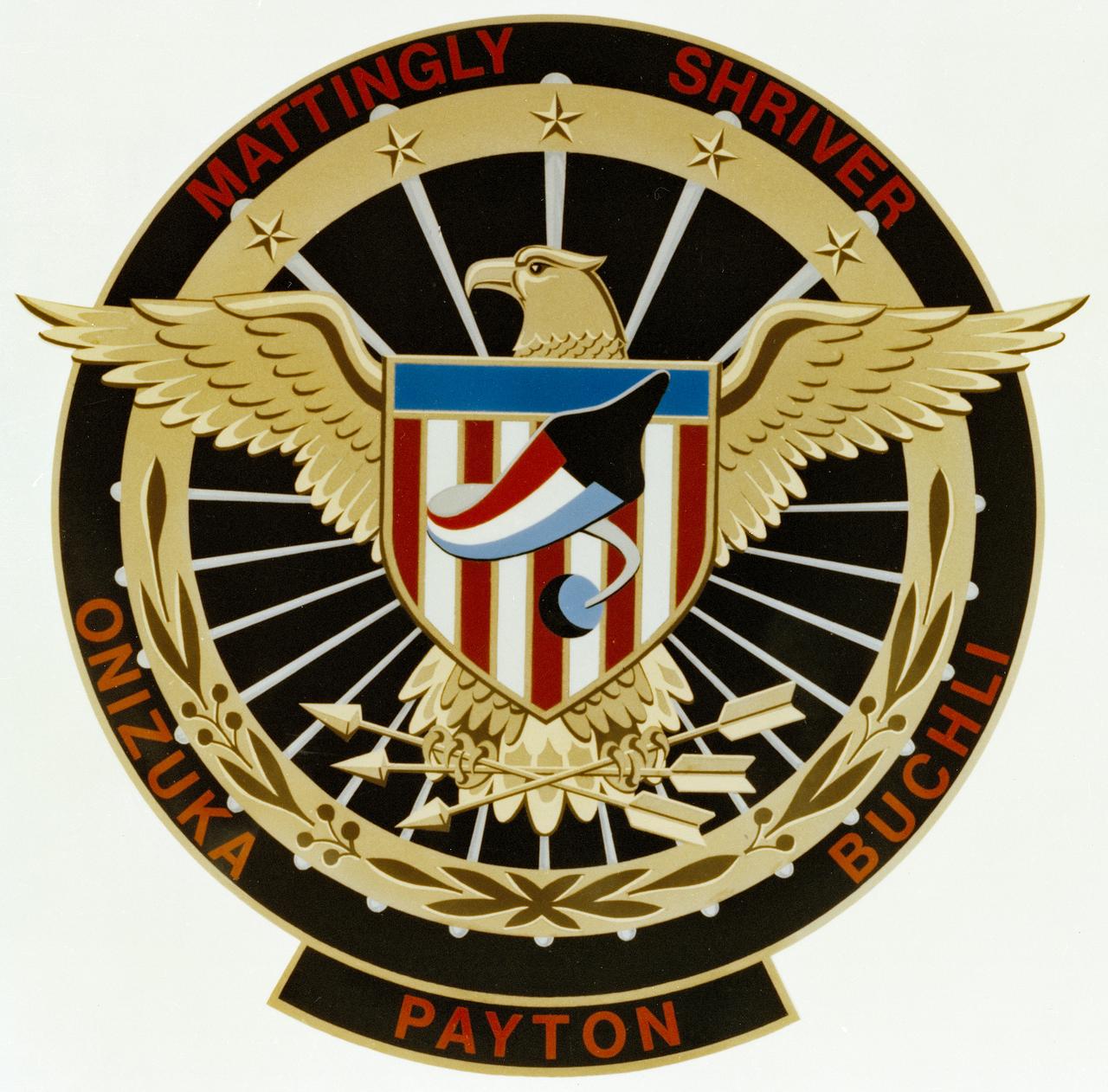
The crew insignia for STS Flight 51-C includes the names of its five crewmembers. The STS 51-C mission marked the third trip of the Space Shuttle Discovery into space. It was the first Space Shuttle mission totally dedicated to the Department of Defense. The U. S. Air Force Inertial Upper Stage Booster Rocket was successfully deployed. Due to the nature of the mission, few additional details of the flight were made available. Landing was made at the Kennedy Space Center, FL on January 27 at 4:23 PM EST. Mission duration was three days, one hour and 33 minutes.
Space Shuttle Projects
Pat Doty (right) of NASA/Marshall Space Flight Center (MSFC) demonstrates the greater bounce to the ounce of metal made from a supercooled bulk metallic glass alloy that NASA is studying in space experiments. The metal plates at the bottom of the plexiglass tubes are made of three different types of metal. Bulk metallic glass is more resilient and, as a result, the dropped ball bearing bounces higher. Experiments in space allow scientists to study fundamental properties that carnot be observed on Earth. This demonstration was at the April 2000 conference of the National Council of Teachers of Mathematics in Chicago. Photo credit: NASA/Marshall Space Flight Center (MSFC)
Microgravity
Project Mercury:  With Project Mercury, the United States gained its first experience in conducting human space missions that provided scientific and engineering knowledge of astronauts in space. Alan Shepard made history May 5, 1961, as America's first man in space. Less than a year later, John Glenn made the nation’s first orbital flight on Feb. 20, 1962.  After two suborbital and three orbital missions, Project Mercury ended with a 22-orbit spaceflight on May 16, 1963.      Poster designed by Kennedy Space Center Graphics Department/Greg Lee. Credit: NASA
KSC-2012-1857
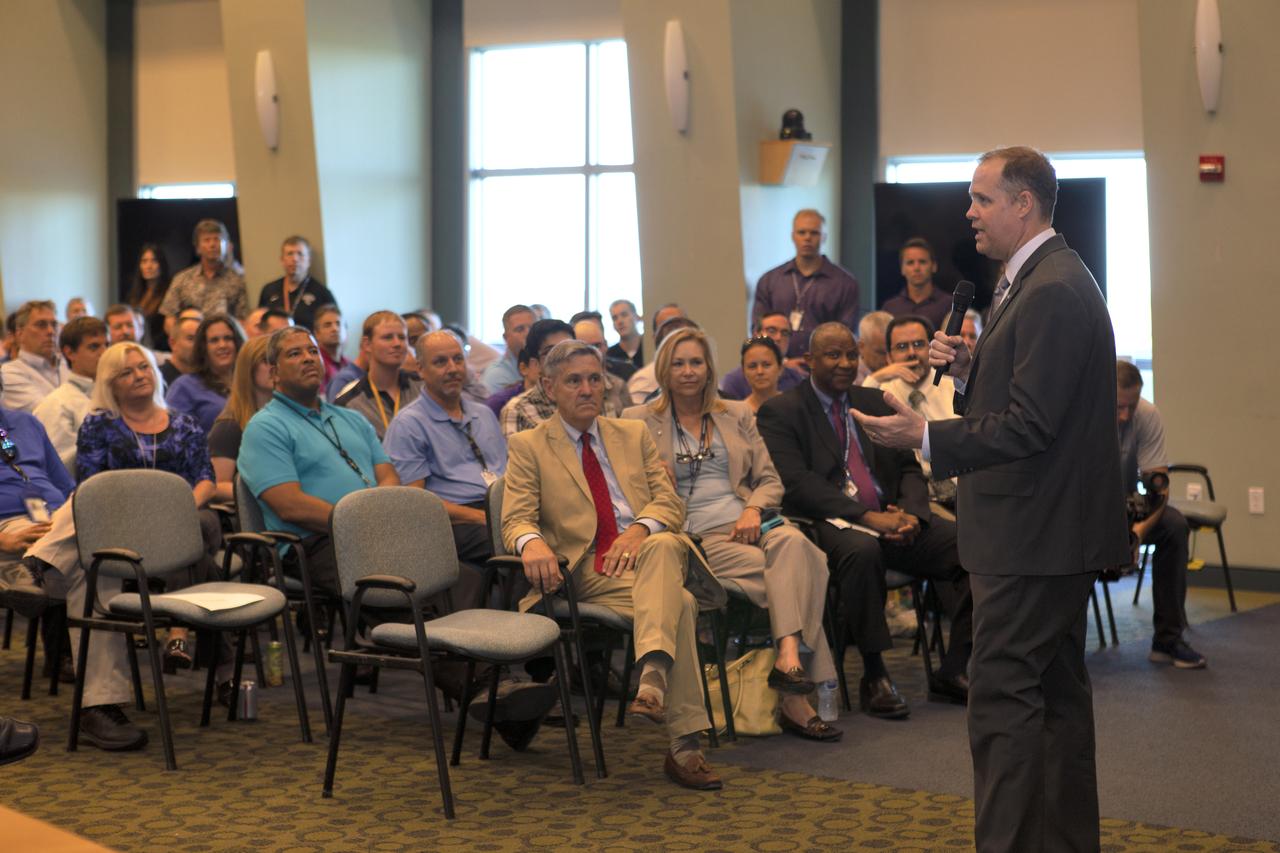
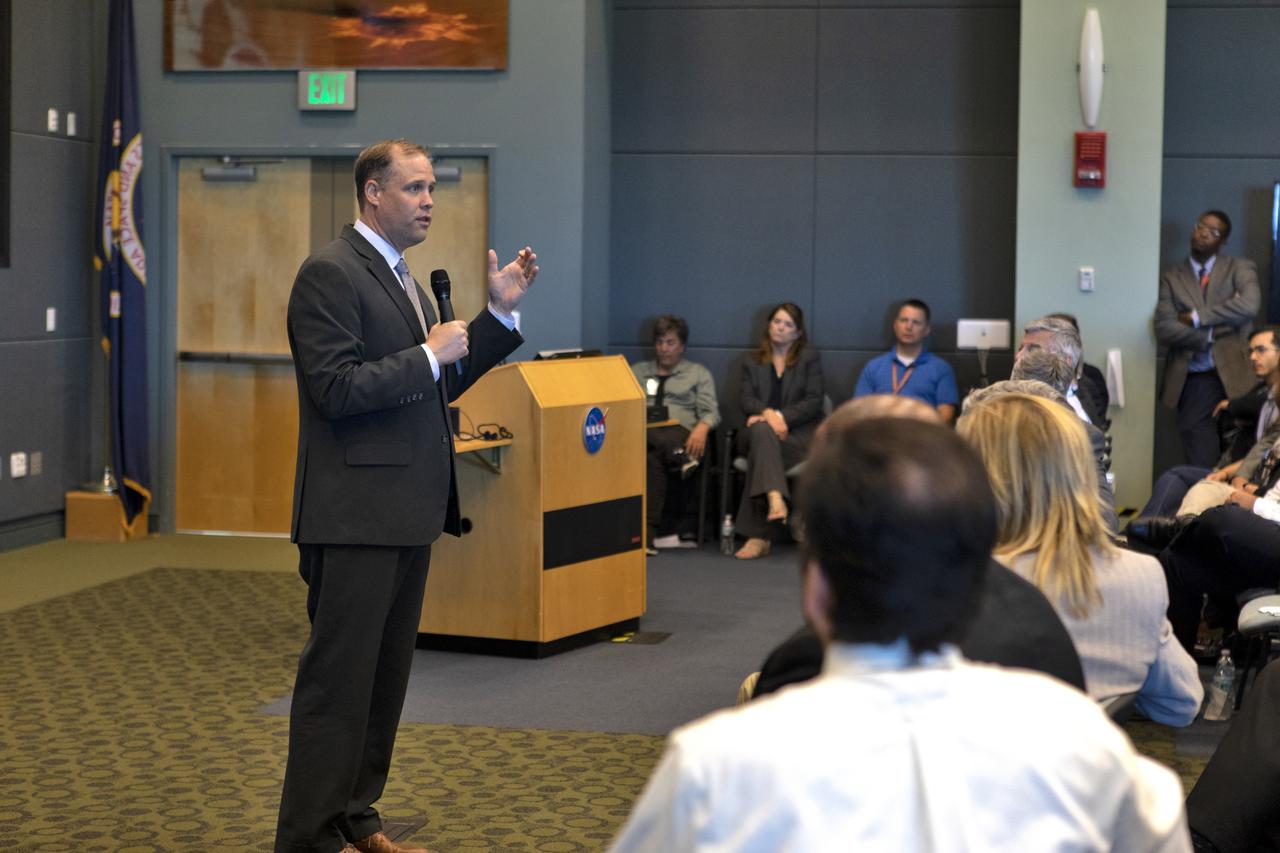
NASA Kennedy Space Center Engineering Directorate employees listen to a presentation by the agency's Administrator Jim Bridenstine. He made his first official visit to the Florida spaceport on Aug. 6 and 7, 2018.
NASA Administrator Jim Bridenstine Visits KSC - Operations Suppo
This is a photograph that was made on October 14, 1964 of Dr. von Braun while he toured the Marned Spacecraft Center, now the Johnson Space Center in Houston, Texas. He is shown inspecting a Gemini-Agena Docking Simulator.
Wernher von Braun
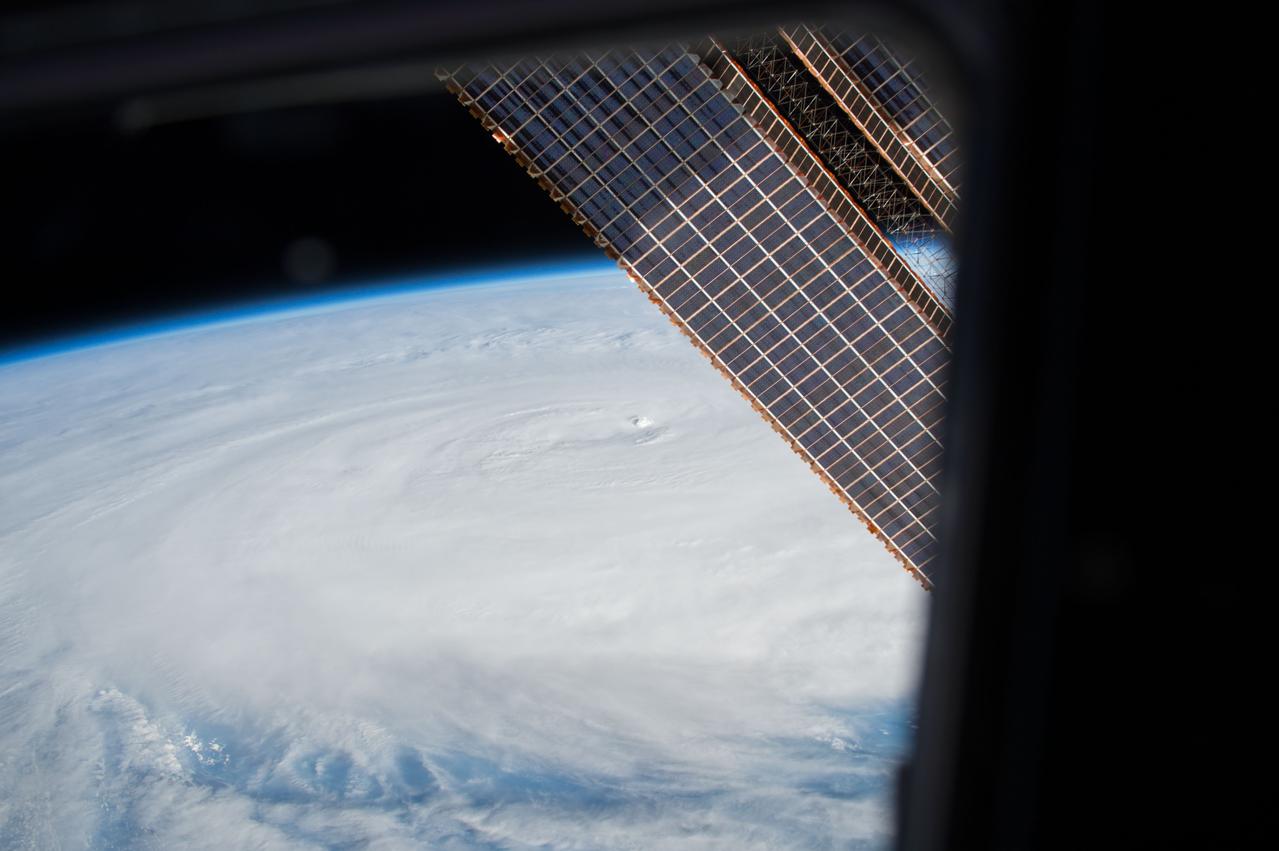
iss050e060444 (03/27/2017) --- Tropical Cyclone Debbie as photographed by crewmembers aboard the International Space Station on March 27, 2017. The large storm made landfall across the northeastern coast of Australia on March 28.
Tropical Storm Debbie
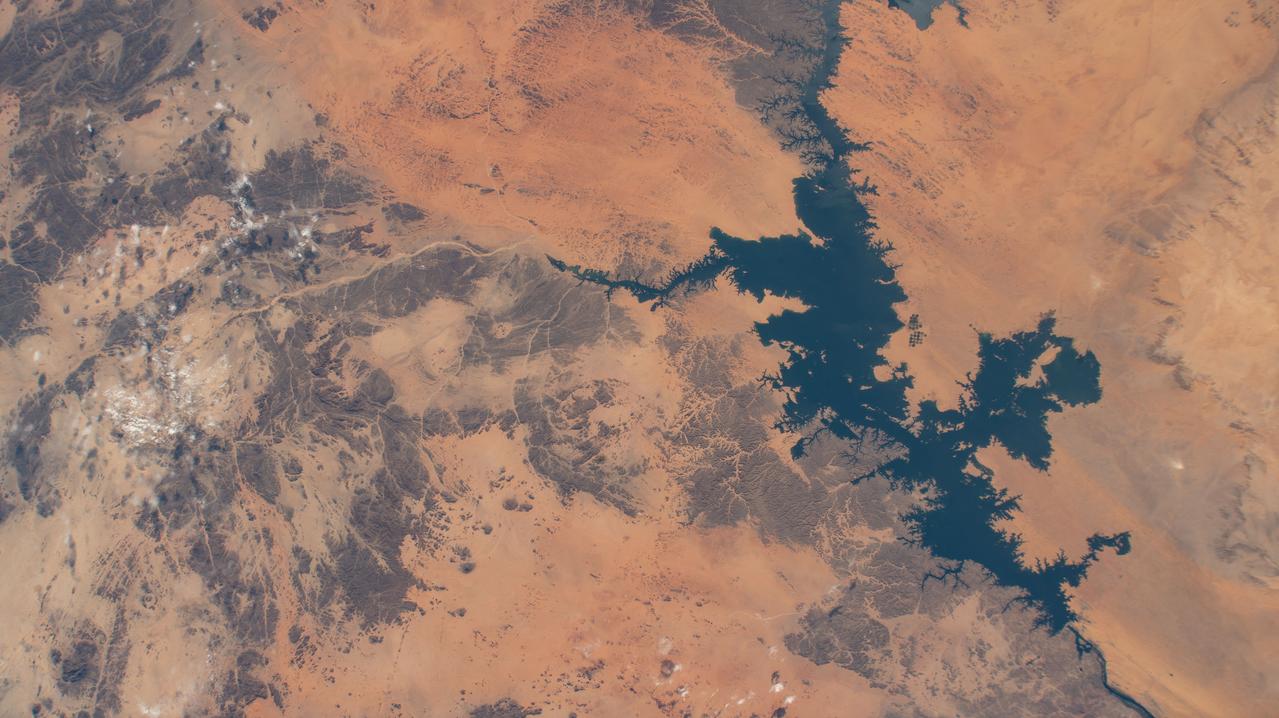
iss068e017658 (Oct. 20, 2022) --- Lake Nasser, one of the largest man-made lakes in the world, is pictured in southern Egypt from the International Space Station as it orbited 262 miles above.
iss068e017658
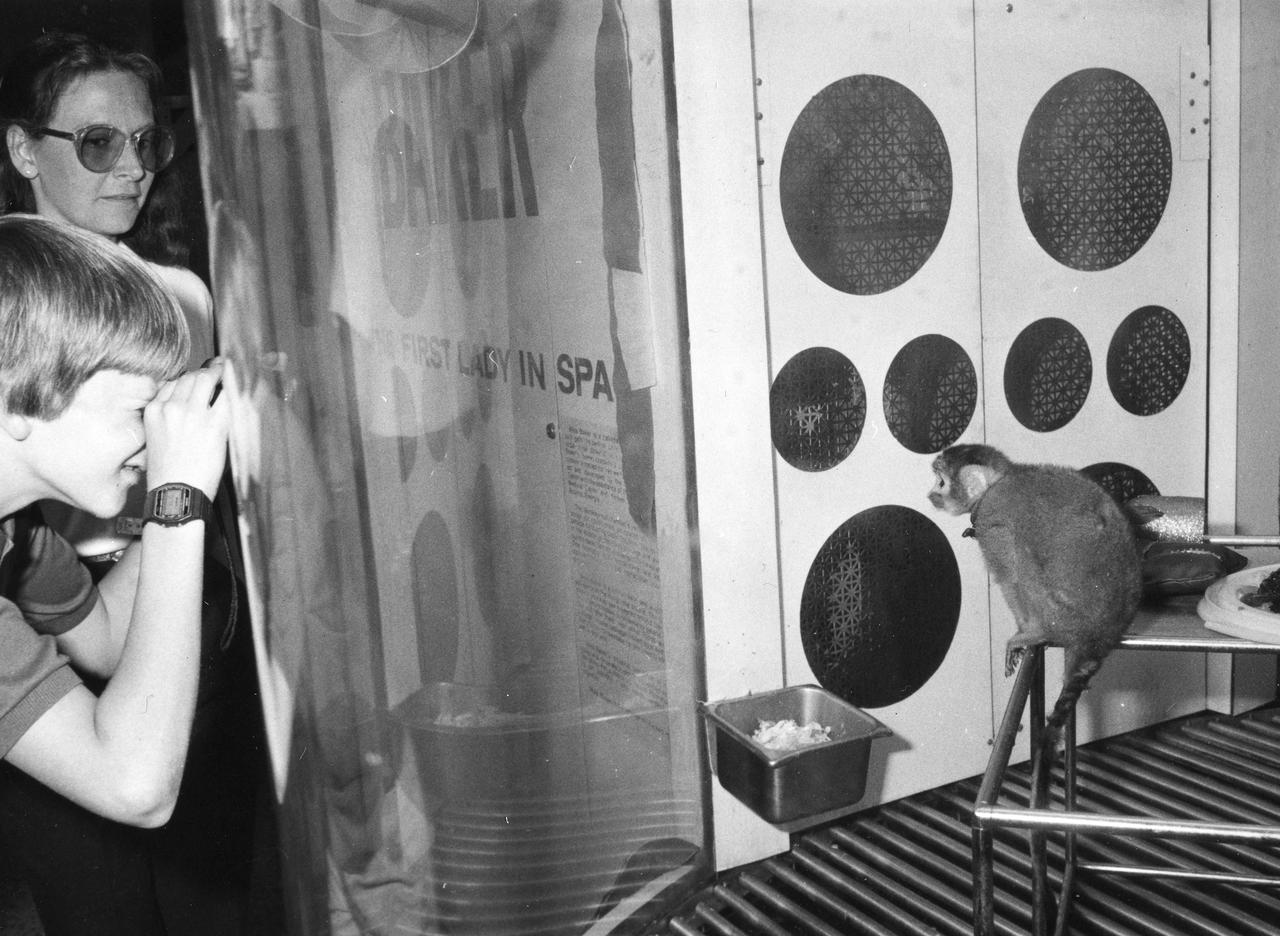
Miss Baker, a squirrel monkey who made a historical flight aboard the Jupiter (AM-18) in May 1959, is seen here in her viewing area where she resided at the U.S. Space and Rocket Center.
Early Rockets
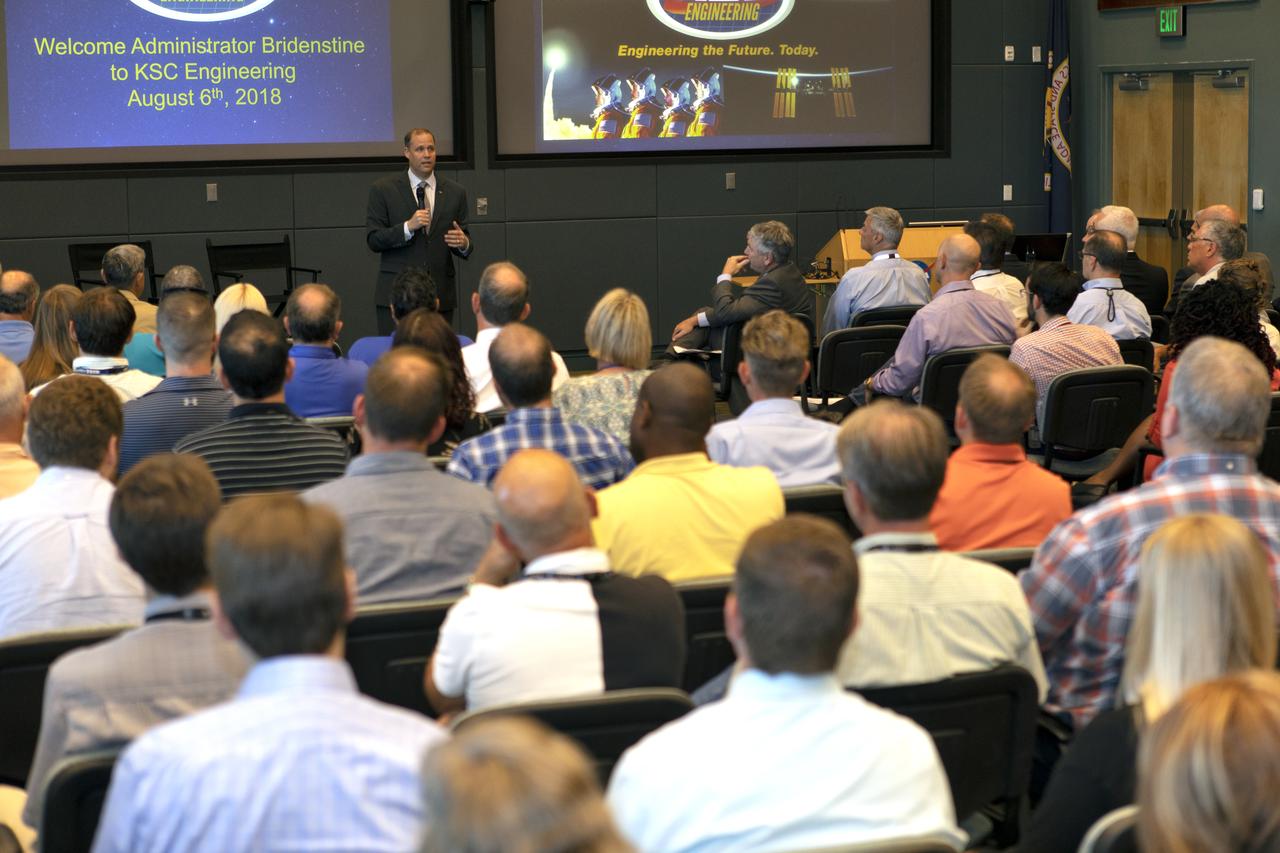
NASA Kennedy Space Center Engineering Directorate employees listen to a presentation by the agency's Administrator Jim Bridenstine. He made his first official visit to the Florida spaceport on Aug. 6 and 7, 2018.
NASA Administrator Jim Bridenstine Visits KSC - Operations Suppo
iss063e079157 (Aug. 28, 2020) --- The International Space Station was orbiting above Egypt when an Expedition 63 crew member photographed a portion of Lake Nasser, one of the largest man-made lakes in the world.
Earth Observations
NASA Kennedy Space Center Engineering Directorate employees listen to a presentation by the agency's Administrator Jim Bridenstine. He made his first official visit to the Florida spaceport on Aug. 6 and 7, 2018.
NASA Administrator Jim Bridenstine Visits KSC - Operations Suppo
iss066e126122 (Jan. 26, 2022) --- The United Arab Emirates city of Dubai, pictured from the International Space Station at an altitude of 258 miles, boasts the man-made islands of Palm Jebel Ali, Palm Jumeirah, and the World Islands.
iss066e126122
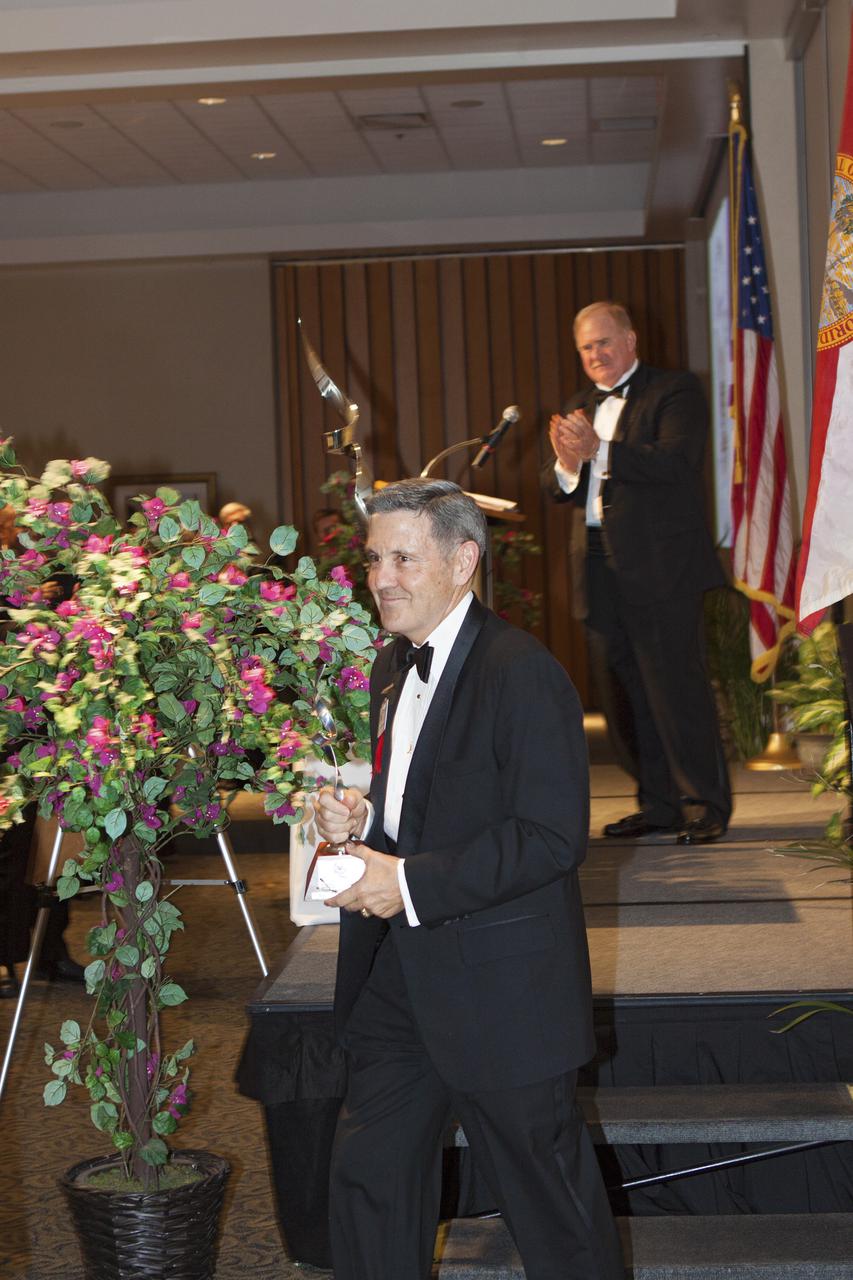
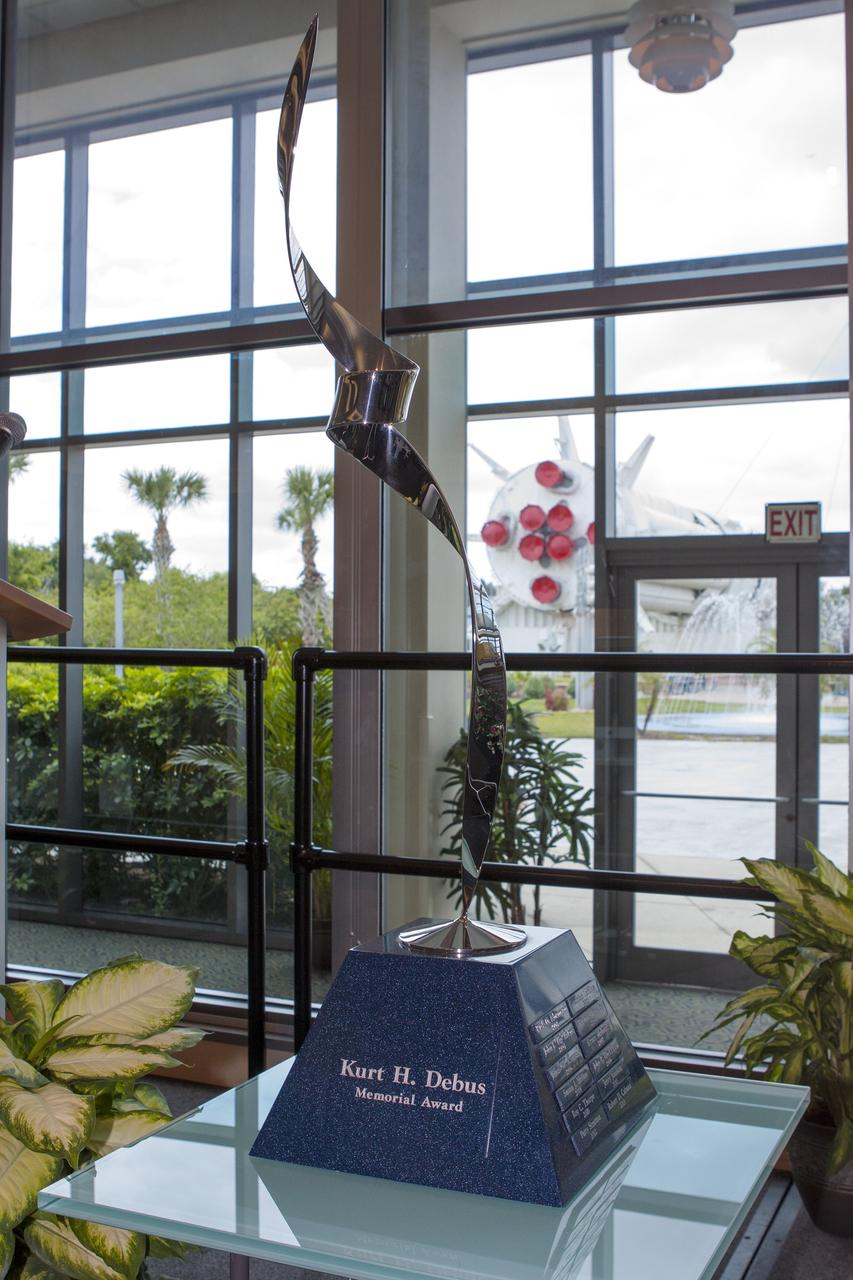
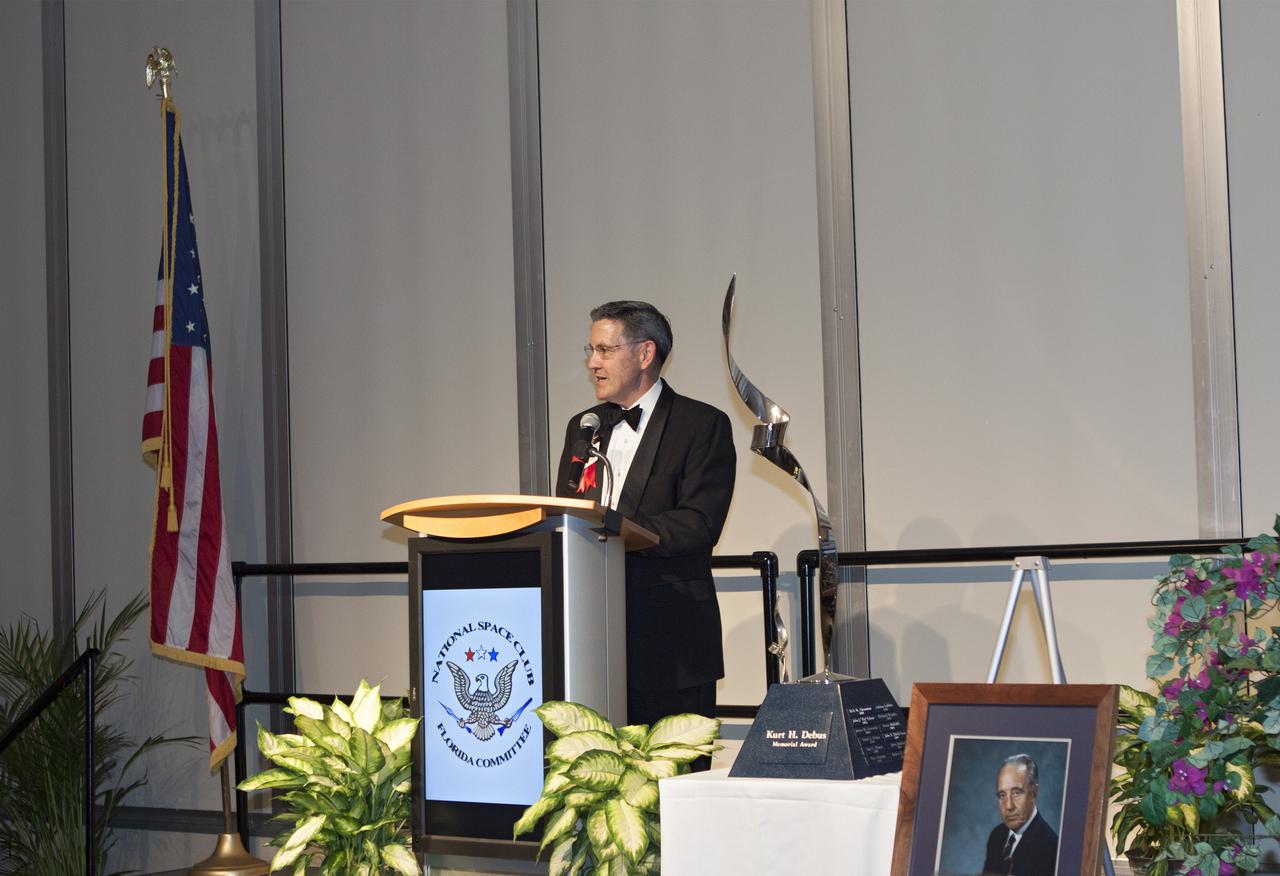
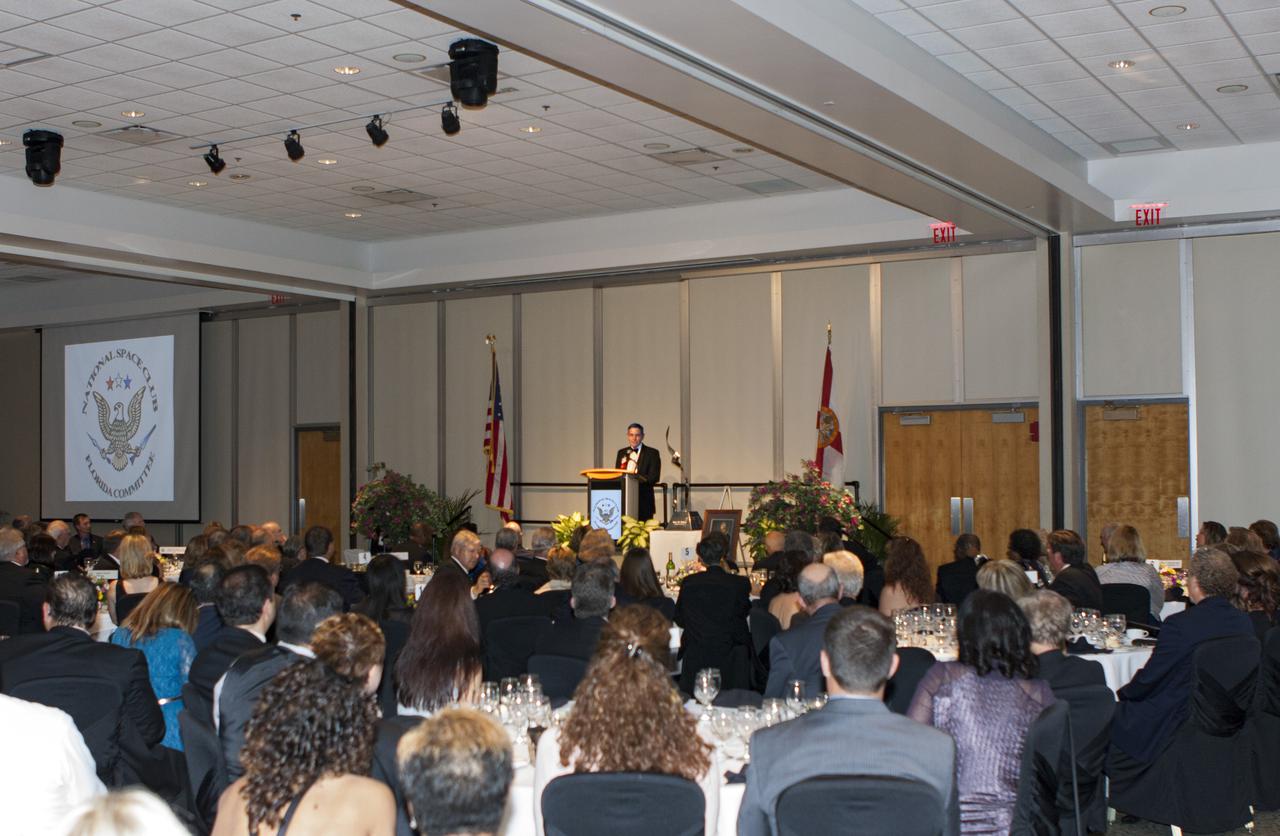
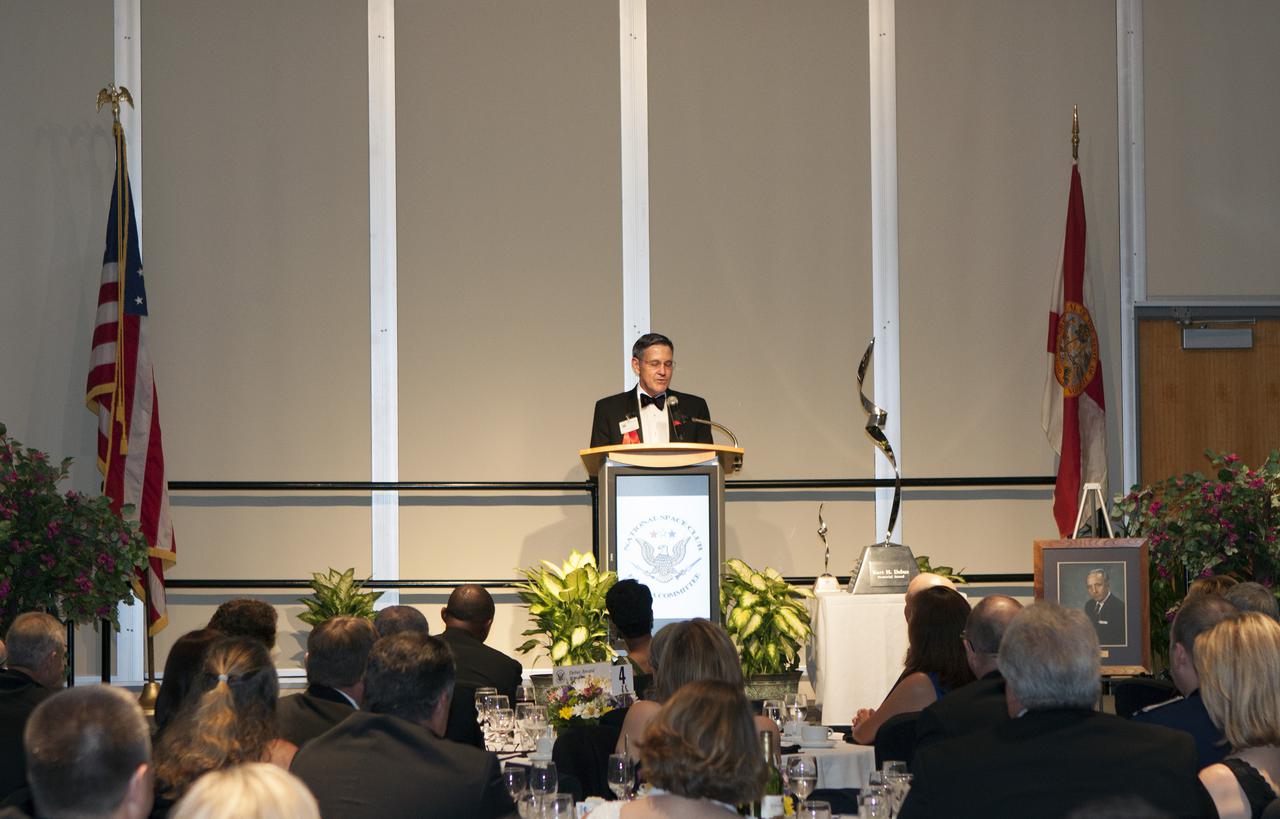
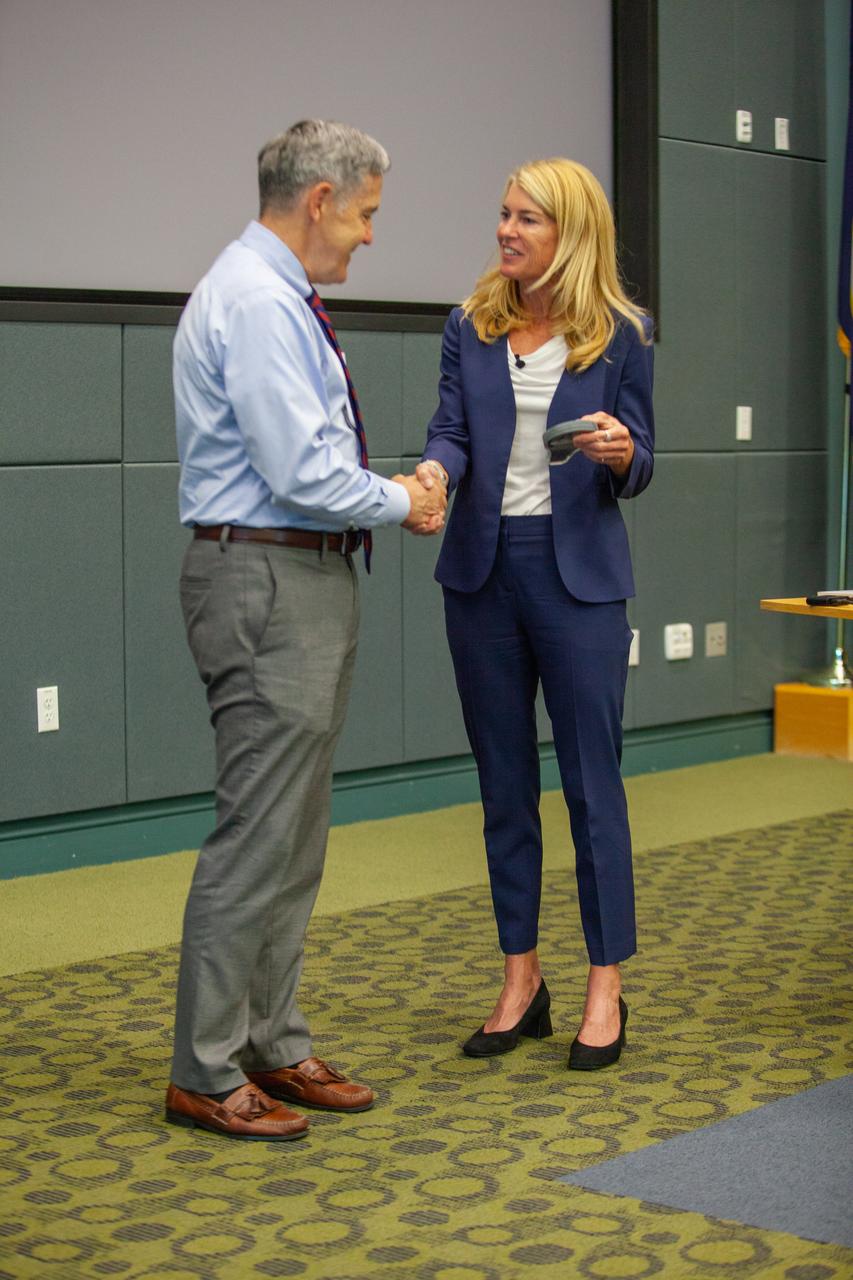
CAPE CANAVERAL, Fla. – At NASA’s Kennedy Space Center Visitor Complex in Florida, National Space Club Florida Committee Chairman Jim McCarthy, at the podium, has just presented the prestigious Dr. Kurt H. Debus Award to Kennedy's director, Bob Cabana.   A former U.S. Marine Corps aviator and NASA astronaut, Cabana was honored at the gala Debus Award Dinner. Named for the spaceport’s first director, the Debus Award was created to recognize significant achievements and contributions made in Florida to American aerospace efforts. The Debus Award was created by the space club's Florida committee to recognize significant achievements and contributions made in Florida to American aerospace efforts. Photo credit: NASA_Jim Grossmann
KSC-2013-2224
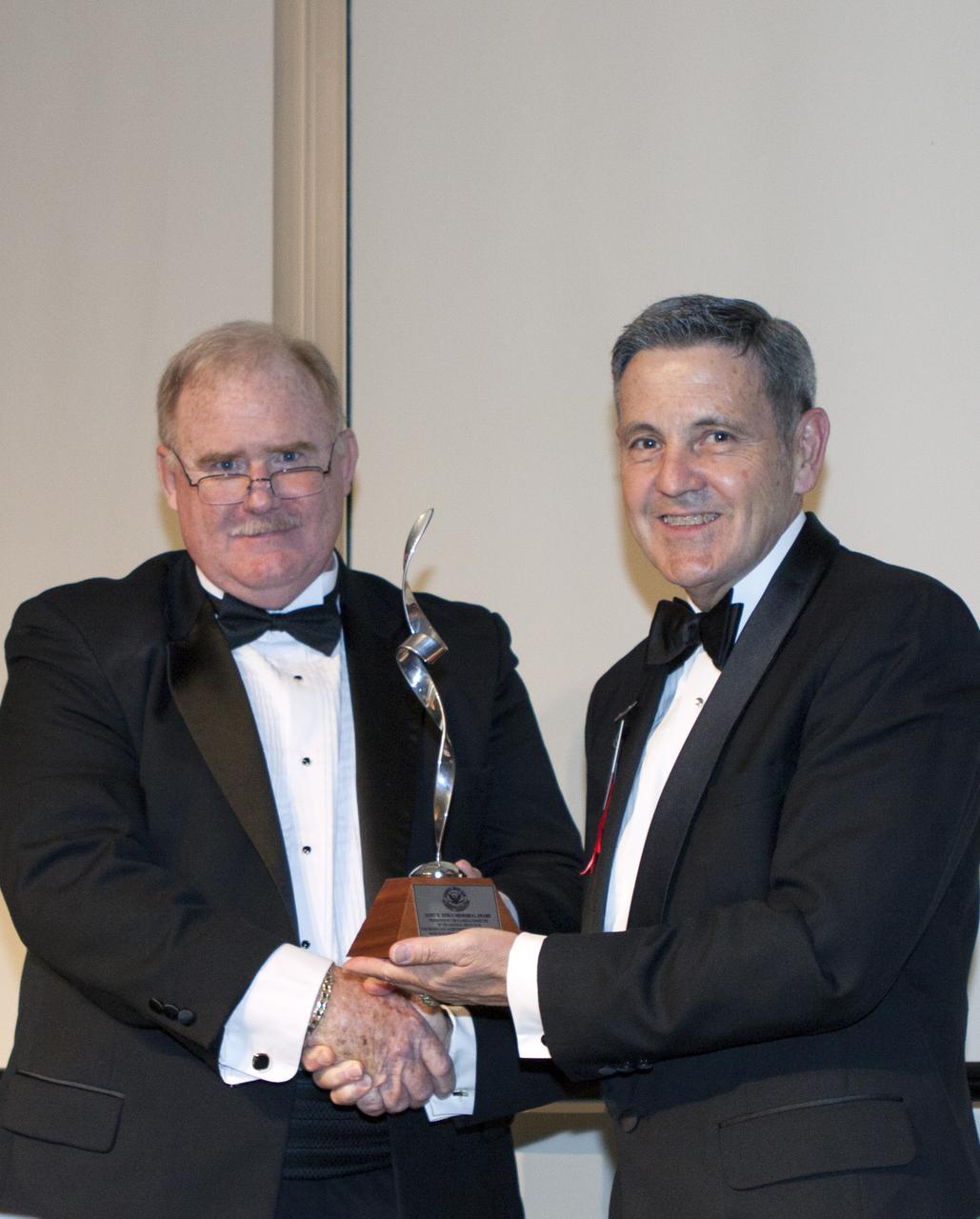
CAPE CANAVERAL, Fla. – At NASA’s Kennedy Space Center Visitor Complex in Florida, National Space Club Florida Committee Chairman Jim McCarthy, left, presents the Dr. Kurt H. Debus Award to Kennedy's director, Bob Cabana.   A former U.S. Marine Corps aviator and NASA astronaut, Cabana was honored at the gala Debus Award Dinner. Named for the spaceport’s first director, the Debus Award was created to recognize significant achievements and contributions made in Florida to American aerospace efforts. The Debus Award was created by the space club's Florida committee to recognize significant achievements and contributions made in Florida to American aerospace efforts. Photo credit: NASA_Jim Grossmann
KSC-2013-2220
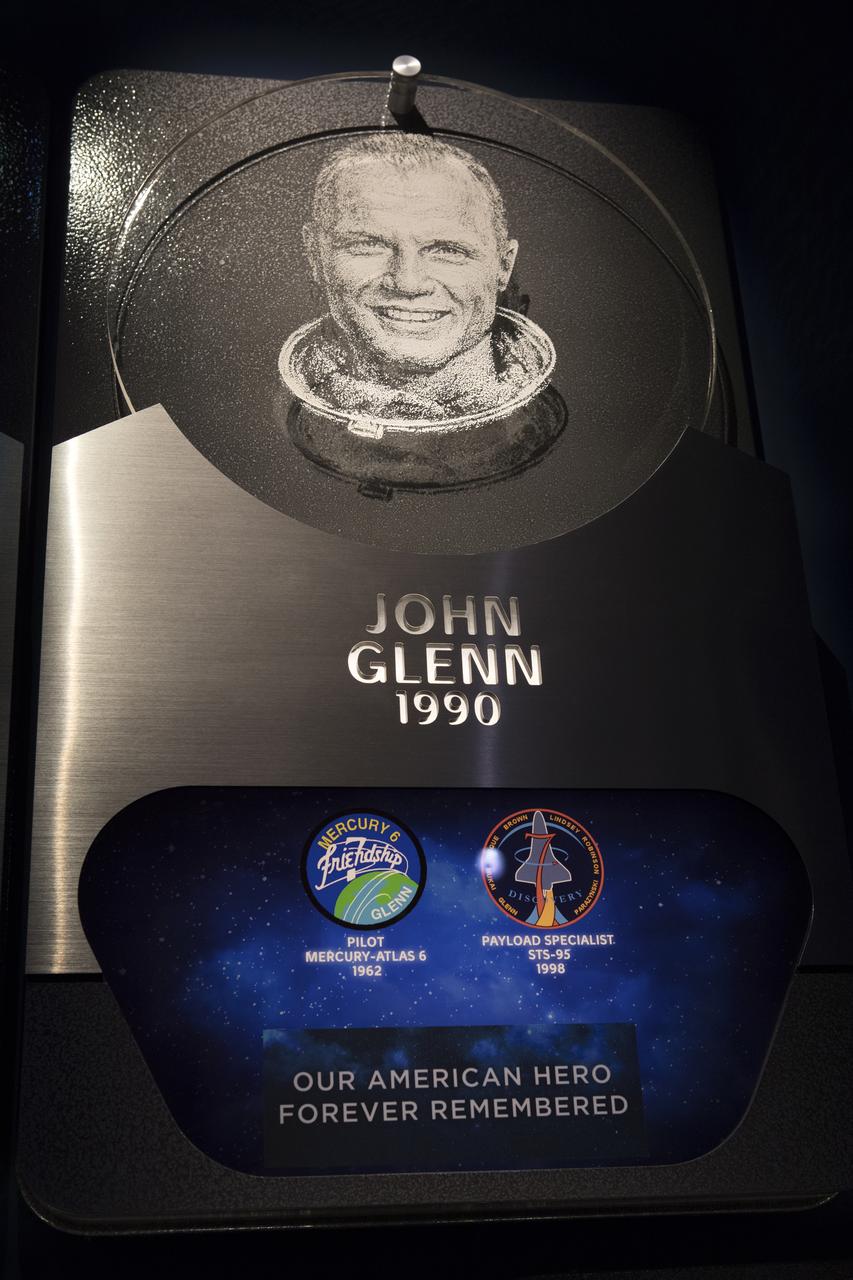
A plaque inside the Heroes and Legends exhibit hall at the Kennedy Space Center Visitor Complex shows astronaut Sen. John Glenn, along with his mission insignias for Friendship 7 and STS-95, the two flights he made into space. Glenn, who passed away Dec. 8, 2016 at age 95, was the last surviving member of NASA's original astronaut class. He gained worldwide acclaim during his Mercury mission that made him the first American to orbit the Earth. He flew again in 1998 aboard space shuttle Discovery at age 77.
John H Glenn Jr. Wreath Laying Ceremony - Inside Heroes and Lege
CAPE CANAVERAL, Fla. – At NASA’s Kennedy Space Center Visitor Complex in Florida, the Dr. Kurt H. Debus Award for 2013 was presented to director Bob Cabana by the National Space Club Florida Committee.     A former U.S. Marine Corps aviator and NASA astronaut, Cabana was honored at the gala Debus Award Dinner. Named for the spaceport’s first director, the Debus Award was created to recognize significant achievements and contributions made in Florida to American aerospace efforts. The Debus Award was created by the space club's Florida committee to recognize significant achievements and contributions made in Florida to American aerospace efforts. Photo credit: NASA/Jim Grossmann
KSC-2013-2214
Kennedy Space Center Director Bob Cabana, left, presents well-known documentary filmmaker Robin Hauser with a token of appreciation during the “KSC and Proud to Be” centerwide diversity event held at the Florida spaceport’s Operations Support Building II (OSB II) on Aug. 20, 2019. The plaque was made from glass that was a part of Kennedy’s Launch Control Center during the Apollo and Space Shuttle programs. Hauser, who has spoken at the White House and at conferences worldwide, addressed bias in artificial intelligence. A new employee video focusing on the importance of employee resource groups at the center made its debut showing at the event.
KSC and Proud to Be Center-Wide Diversity Event
CAPE CANAVERAL, Fla. – At NASA’s Kennedy Space Center Visitor Complex in Florida, center director Bob Cabana speaks after being presented the prestigious Dr. Kurt H. Debus Award.   A former U.S. Marine Corps aviator and NASA astronaut, Cabana was honored at the gala Debus Award Dinner. Named for the spaceport’s first director, the Debus Award was created to recognize significant achievements and contributions made in Florida to American aerospace efforts. The Debus Award was created by the space club's Florida committee to recognize significant achievements and contributions made in Florida to American aerospace efforts. Photo credit: NASA_Jim Grossmann
KSC-2013-2222
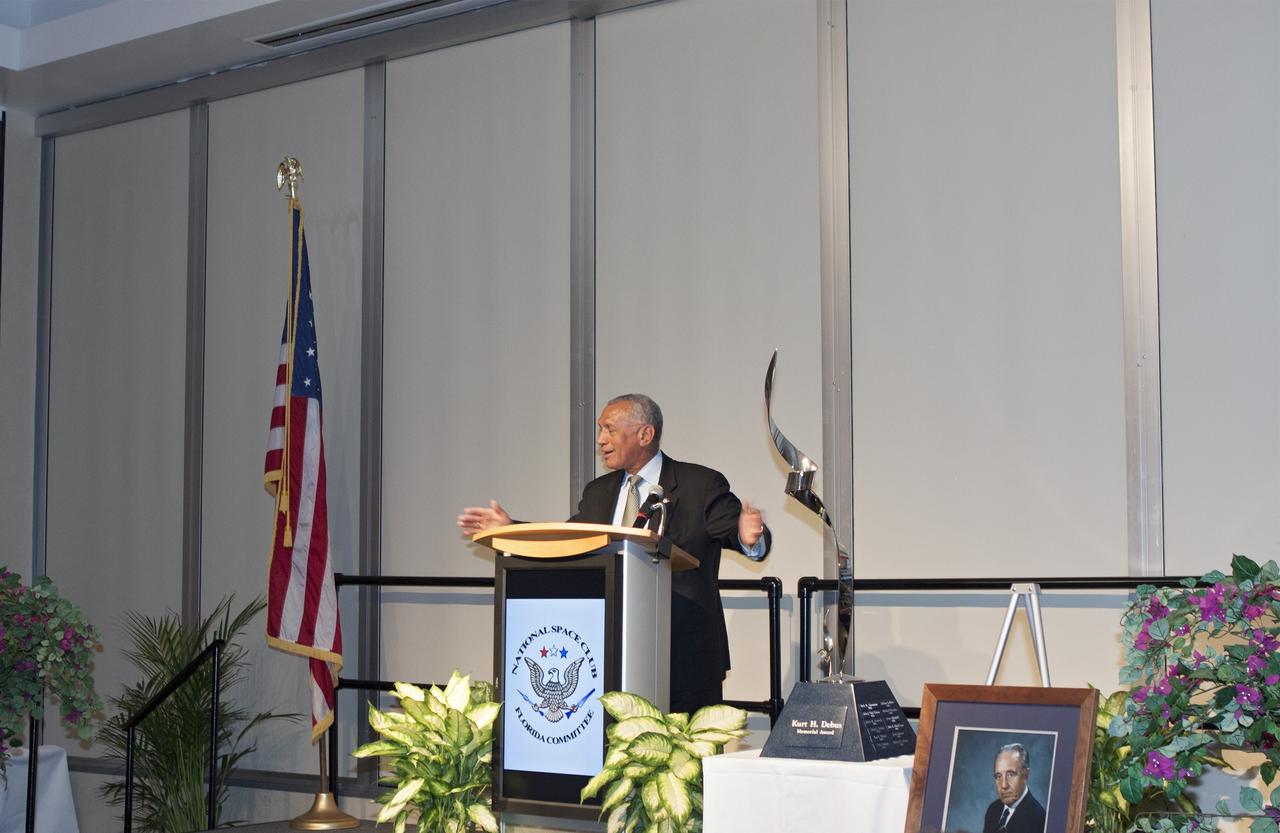
CAPE CANAVERAL, Fla. – At NASA’s Kennedy Space Center Visitor Complex in Florida, NASA Administrator Charles Bolden speaks at the annual the Dr. Kurt H. Debus Award gala in which the prestigious honor was presented to Kennedy's director, Bob Cabana.      A former U.S. Marine Corps aviator and NASA astronaut, Cabana was honored at the gala Debus Award Dinner. Named for the spaceport’s first director, the Debus Award was created to recognize significant achievements and contributions made in Florida to American aerospace efforts. The Debus Award was created by the space club's Florida committee to recognize significant achievements and contributions made in Florida to American aerospace efforts. Photo credit: NASA/Jim Grossmann
KSC-2013-2219
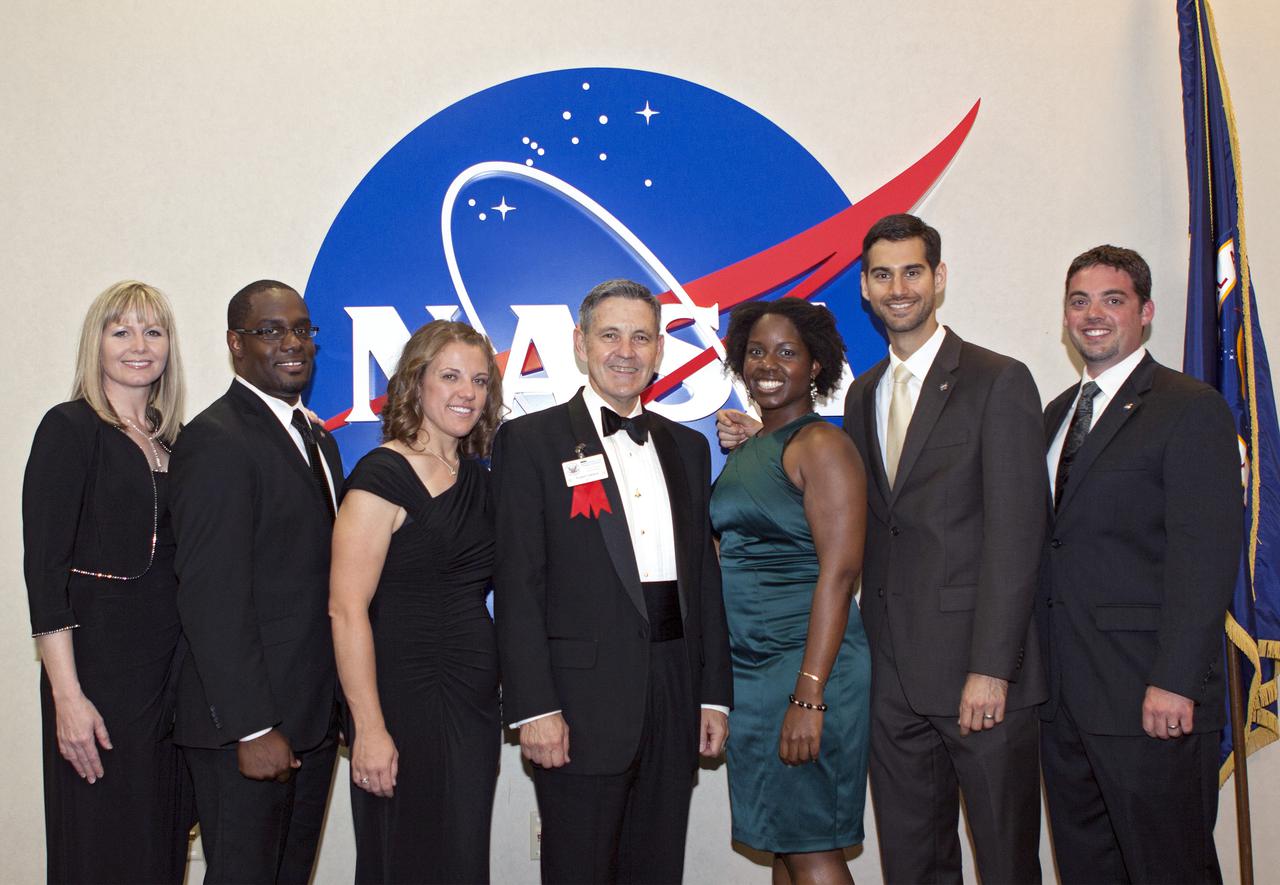
CAPE CANAVERAL, Fla. – At NASA’s Kennedy Space Center Visitor Complex in Florida, center director Bob Cabana poses with current and former interns. From the left are Joy Burkey, Robert Hubbard, Carla Koch, Cabana, LaKeesha Flowers, Michael Miller and Michael Masters.   A former U.S. Marine Corps aviator and NASA astronaut, Cabana was honored at the gala Debus Award Dinner. Named for the spaceport’s first director, the Debus Award was created to recognize significant achievements and contributions made in Florida to American aerospace efforts. The Debus Award was created by the space club's Florida committee to recognize significant achievements and contributions made in Florida to American aerospace efforts. Photo credit: NASA_Jim Grossmann
KSC-2013-2225
CAPE CANAVERAL, Fla. – At NASA’s Kennedy Space Center Visitor Complex in Florida, center director Bob Cabana speaks after being presented the prestigious Dr. Kurt H. Debus Award.   A former U.S. Marine Corps aviator and NASA astronaut, Cabana was honored at the gala Debus Award Dinner. Named for the spaceport’s first director, the Debus Award was created to recognize significant achievements and contributions made in Florida to American aerospace efforts. The Debus Award was created by the space club's Florida committee to recognize significant achievements and contributions made in Florida to American aerospace efforts. Photo credit: NASA_Jim Grossmann
KSC-2013-2223
CAPE CANAVERAL, Fla. – At NASA’s Kennedy Space Center Visitor Complex in Florida, center director Bob Cabana speaks after being presented the prestigious Dr. Kurt H. Debus Award.   A former U.S. Marine Corps aviator and NASA astronaut, Cabana was honored at the gala Debus Award Dinner. Named for the spaceport’s first director, the Debus Award was created to recognize significant achievements and contributions made in Florida to American aerospace efforts. The Debus Award was created by the space club's Florida committee to recognize significant achievements and contributions made in Florida to American aerospace efforts. Photo credit: NASA_Jim Grossmann
KSC-2013-2221
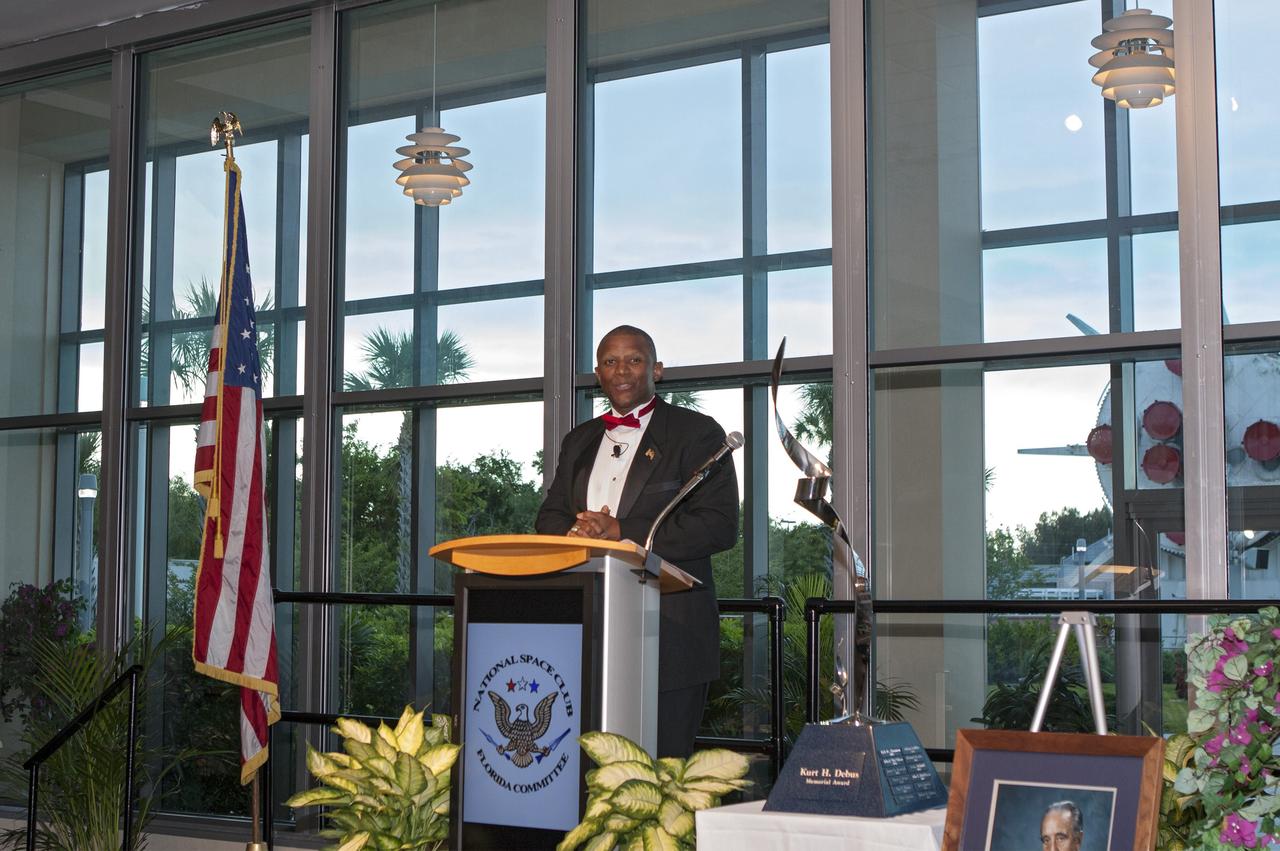
CAPE CANAVERAL, Fla. – At NASA’s Kennedy Space Center Visitor Complex in Florida, the center's associate director, Kelvin Manning, served as emcee for the Dr. Kurt H. Debus Award gala in which the prestigious honor was presented to Kennedy's director, Bob Cabana.      A former U.S. Marine Corps aviator and NASA astronaut, Cabana was honored at the gala Debus Award Dinner. Named for the spaceport’s first director, the Debus Award was created to recognize significant achievements and contributions made in Florida to American aerospace efforts. The Debus Award was created by the space club's Florida committee to recognize significant achievements and contributions made in Florida to American aerospace efforts. Photo credit: NASA/Jim Grossmann
KSC-2013-2216
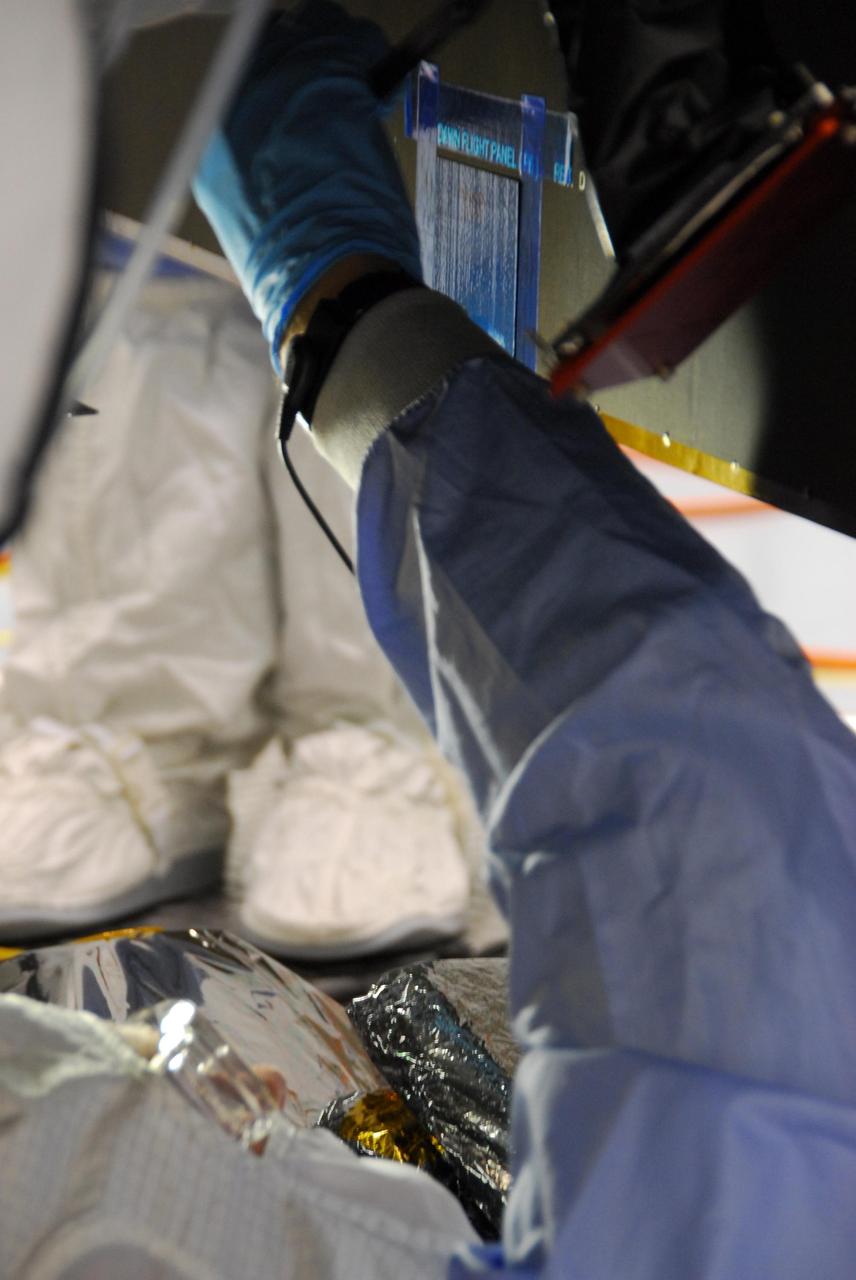
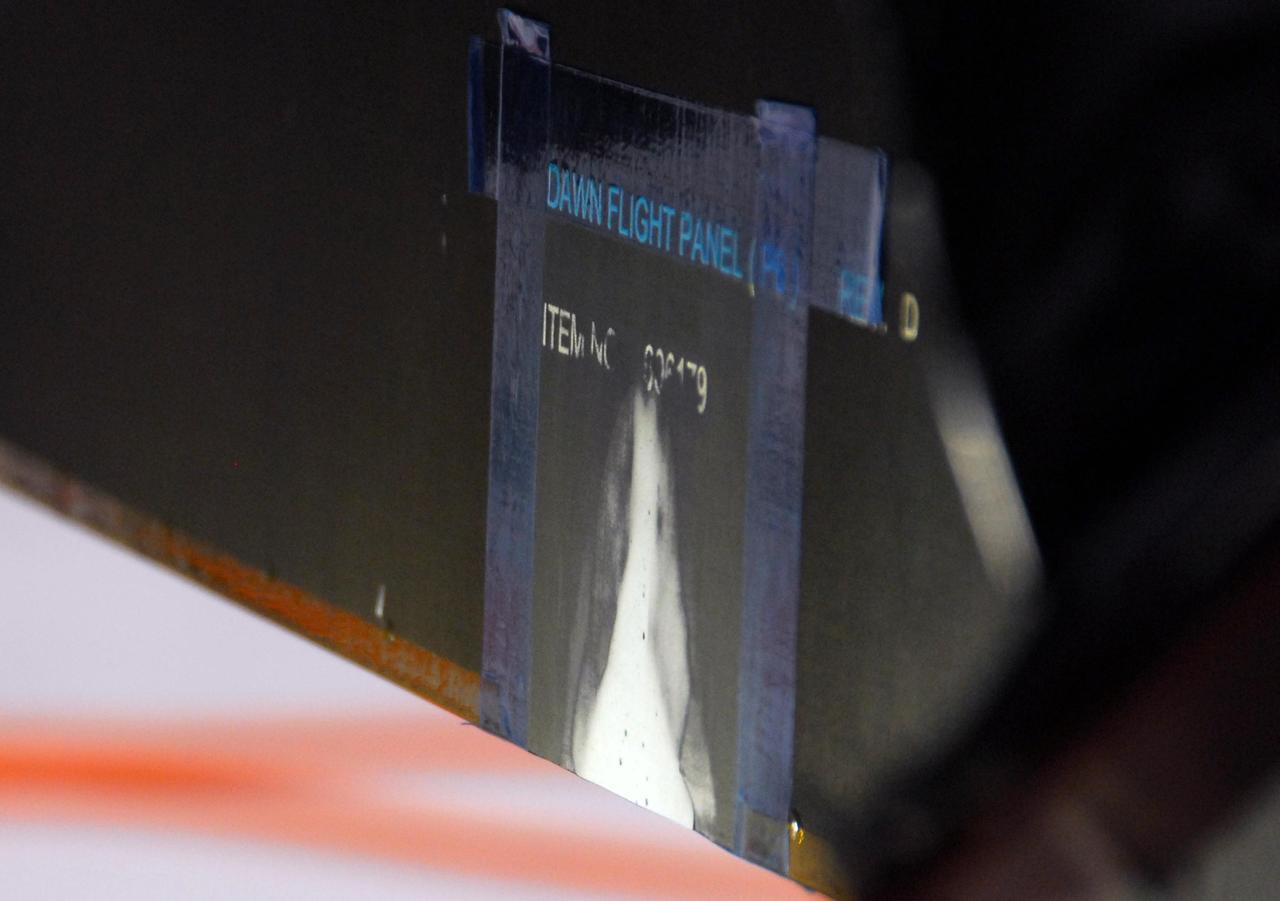
KENNEDY SPACE CENTER, FLA. --  At Astrotech, an engineer from Dutch Space makes a final check of repair made to the damage on a solar array panel on the Dawn spacecraft.   The damage, incurred on June 11, was made by a technician's tool during a procedure to prepare Dawn for spin-balance testing. The size of the affected area is about 2.5 inches by 2 inches. There was no impact to the launch date of July 7.  Dawn's goal is to characterize the conditions and processes of the solar system's earliest epoch 4.5 billion years ago by investigating in detail two of the largest asteroids, Ceres and Vesta. They reside between Mars and Jupiter in the asteroid belt  Photo credit: NASA/George Shelton
KSC-07pd1556
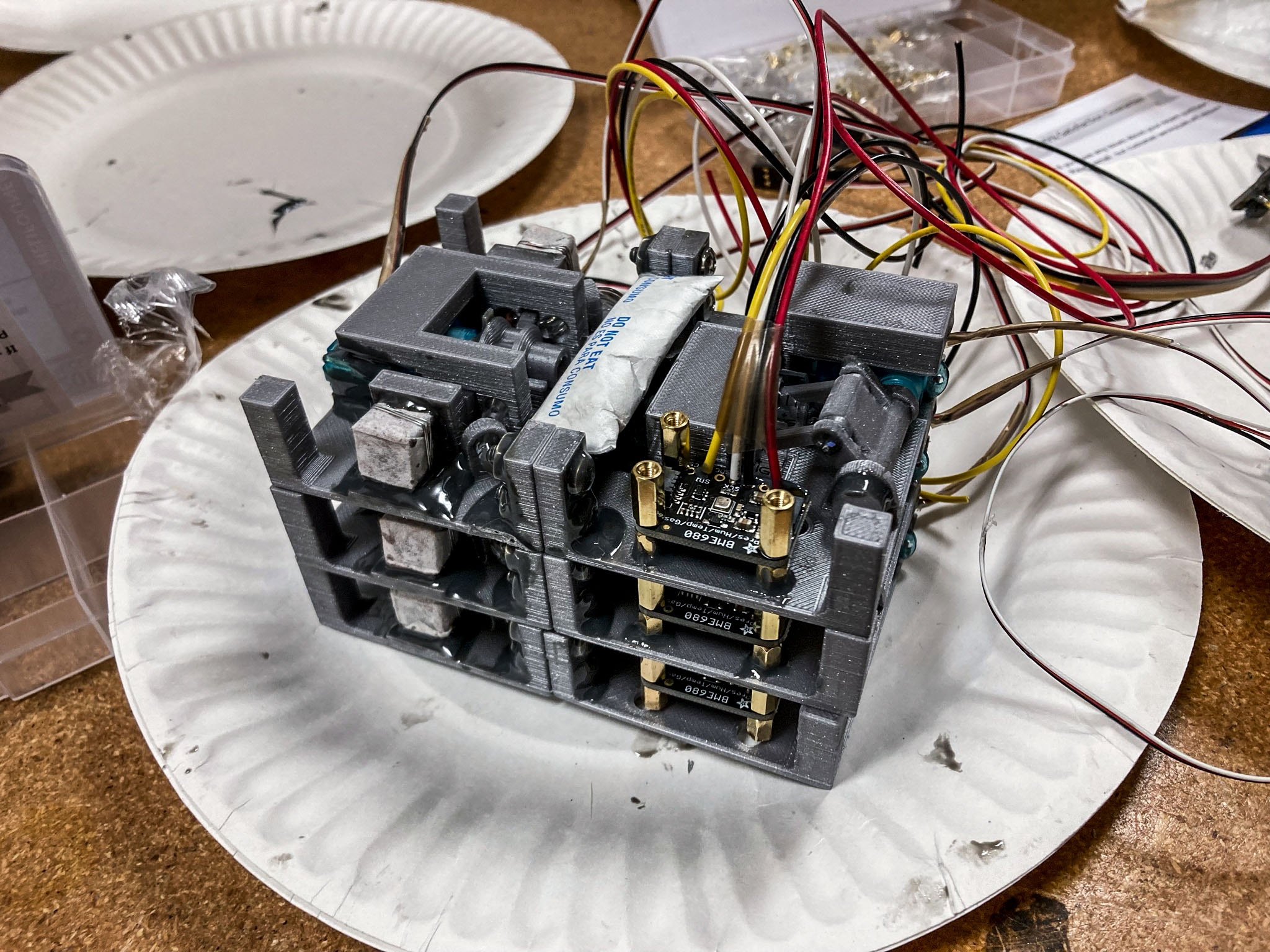
jsc2022e042479 (2/3/2022) --- This image shows three modules of flight hardware for the Biopolymer Research for In-Situ Capabilities investigation, launching aboard SpaceX’s 25th commercial resupply services mission to the International Space Station. The hardware is 3D printed in gray PLA, a desiccant packet is epoxied in the center of the module, and a pressure and humidity sensor is fastened to the left. Each module makes two bricks, for a total of six bricks that will be made in space. This investigation studies how microgravity affects the process of creating biopolymer soil composite (BSC), a concrete alternative that could be made with on-site material such as lunar or Martian dust. Image curtsey of James Wall.
Biopolymer Research for In-Situ Capabilities
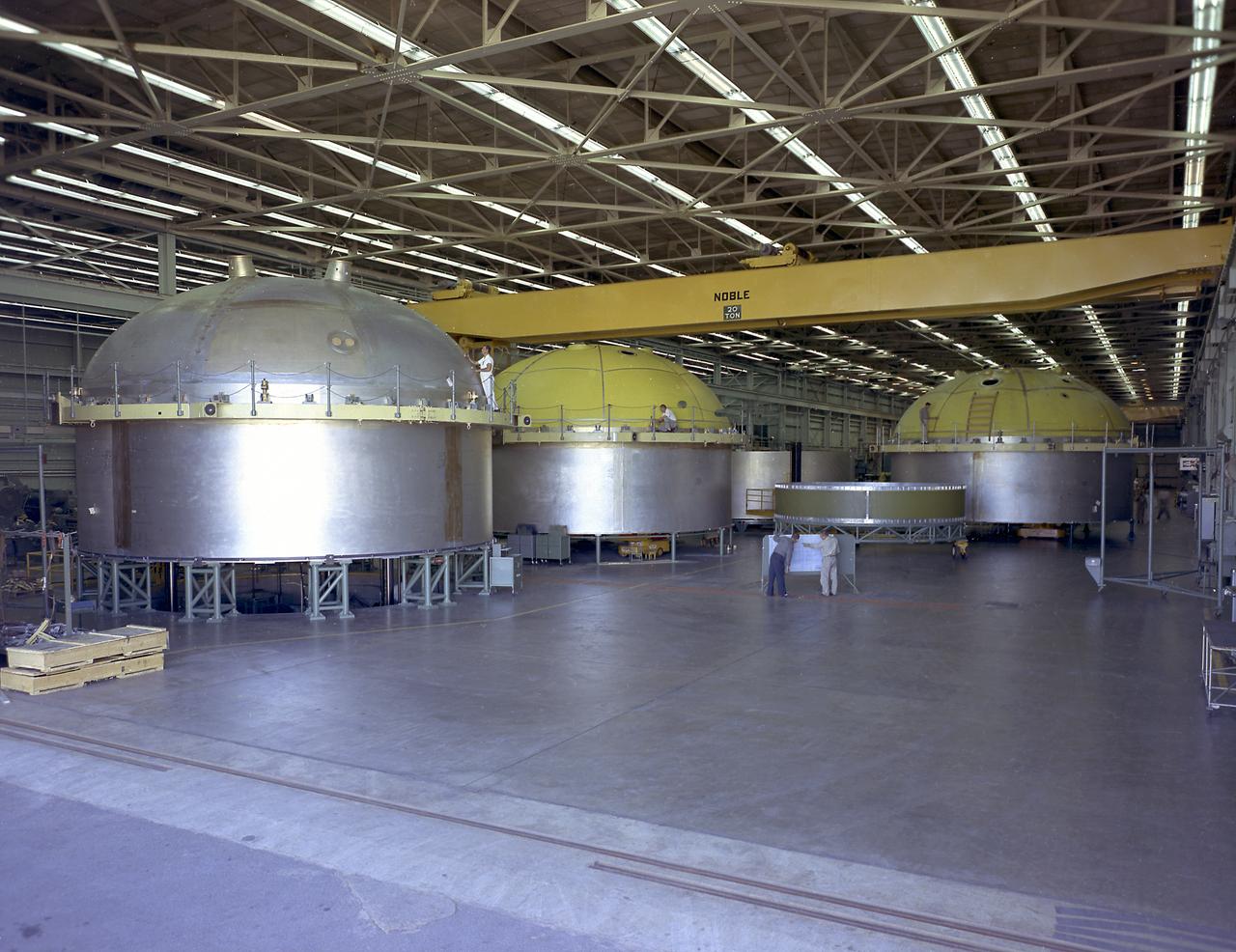
The components of the Saturn V booster (S-IC stage) fuel tank are shown in this photograph. The liquid oxygen tank bulkhead on the left and both halves of the fuel tank were in the Marshall Space Flight Center (MSFC) Manufacturing Engineering Laboratory, building 4707. These components were used at MSFC in structural testing to prove that they could withstand the forces to which they were subjected in flight. Each S-IC stage has two tanks, one for kerosene and one for liquid oxygen, made from such components as these. Thirty-three feet in diameter, they hold a total of 4,400,000 pounds of fuel. Although this tankage was assembled at MSFC, the elements were made by the Boeing Company at Wichita and the Michoud Operations at New Orleans.
Saturn Apollo Program
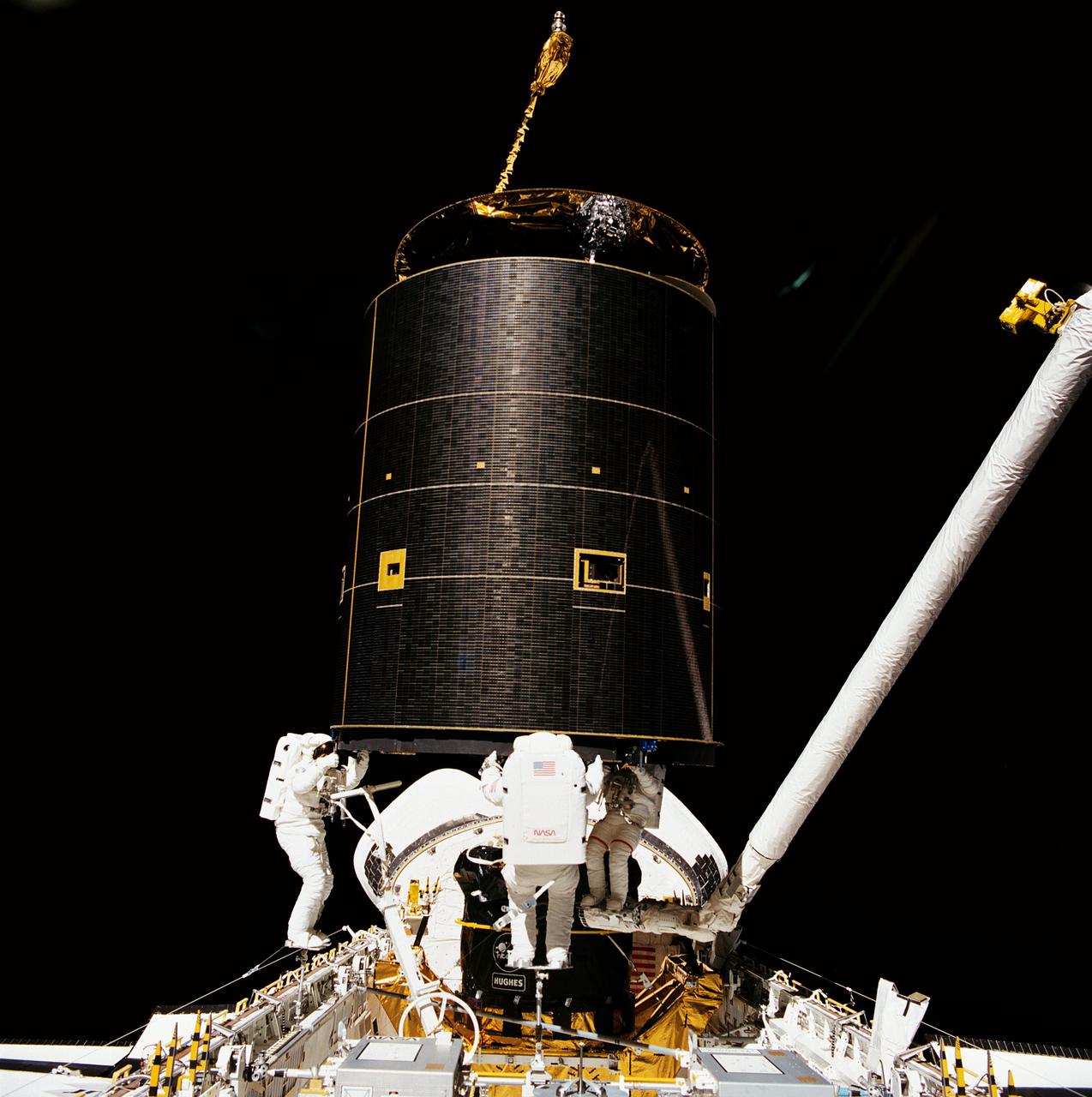
STS049-91-026 (13 May 1992) --- Three astronauts hold onto the 4.5-ton Intelsat VI satellite after a six-handed "capture" was made minutes earlier. Left to right are astronauts Richard J. Hieb, Thomas D. Akers and Pierre J. Thuot. Thuot stands on the end of the remote manipulator system arm, from which he had made two earlier unsuccessful grapple attempts on two-person extravehicular activity sessions. Ground controllers and crew members agreed that a third attempt, using three mission specialists in the cargo bay of the space shuttle Endeavour, was the effort needed to accomplish the capture feat.
STS-49 crew captures INTELSAT VI above OV-105's payload bay (PLB) during EVA
KENNEDY SPACE CENTER, FLA. --  This closeup reveals the repair made to the damage on a solar array panel on the Dawn spacecraft.   The damage, incurred on June 11, was made by a technician's tool during a procedure to prepare Dawn for spin-balance testing. The size of the affected area is about 2.5 inches by 2 inches. There was no impact to the launch date of July 7.  Dawn's goal is to characterize the conditions and processes of the solar system's earliest epoch 4.5 billion years ago by investigating in detail two of the largest asteroids, Ceres and Vesta. They reside between Mars and Jupiter in the asteroid belt  Photo credit: NASA/George Shelton
KSC-07pd1557
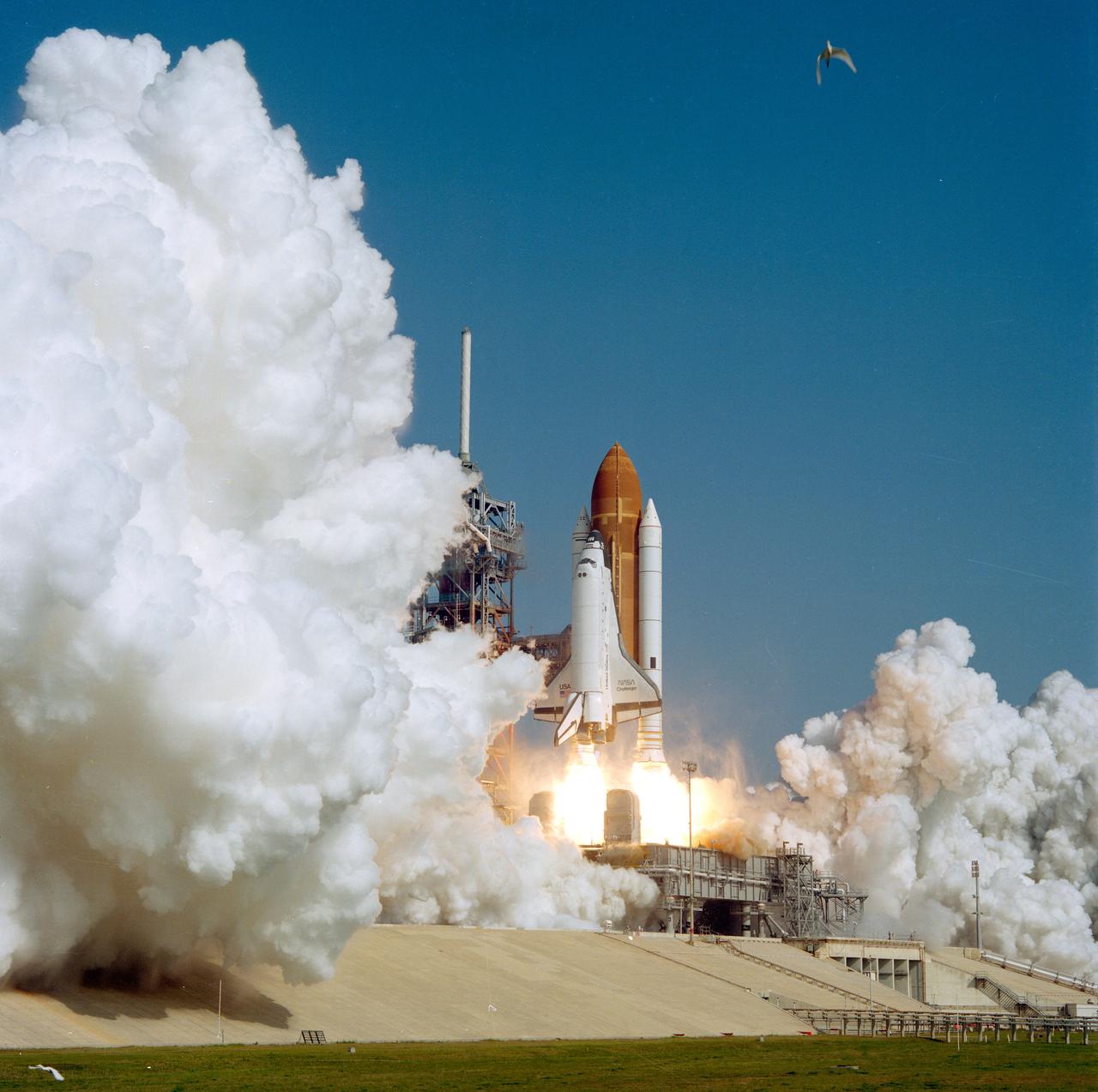
41C-3056 (6 April 1984) --- The Space Shuttle Challenger and its five-member astronaut crew leave the launch pad at the Kennedy Space Center (KSC) to begin a six-day stay in space.  The launch occurred at 8:58:00:03 a.m. (EST), April 6, 1984.  This photo was made with a 120 camera.
Launch of the Shuttle Challenger during STS 41-C mission
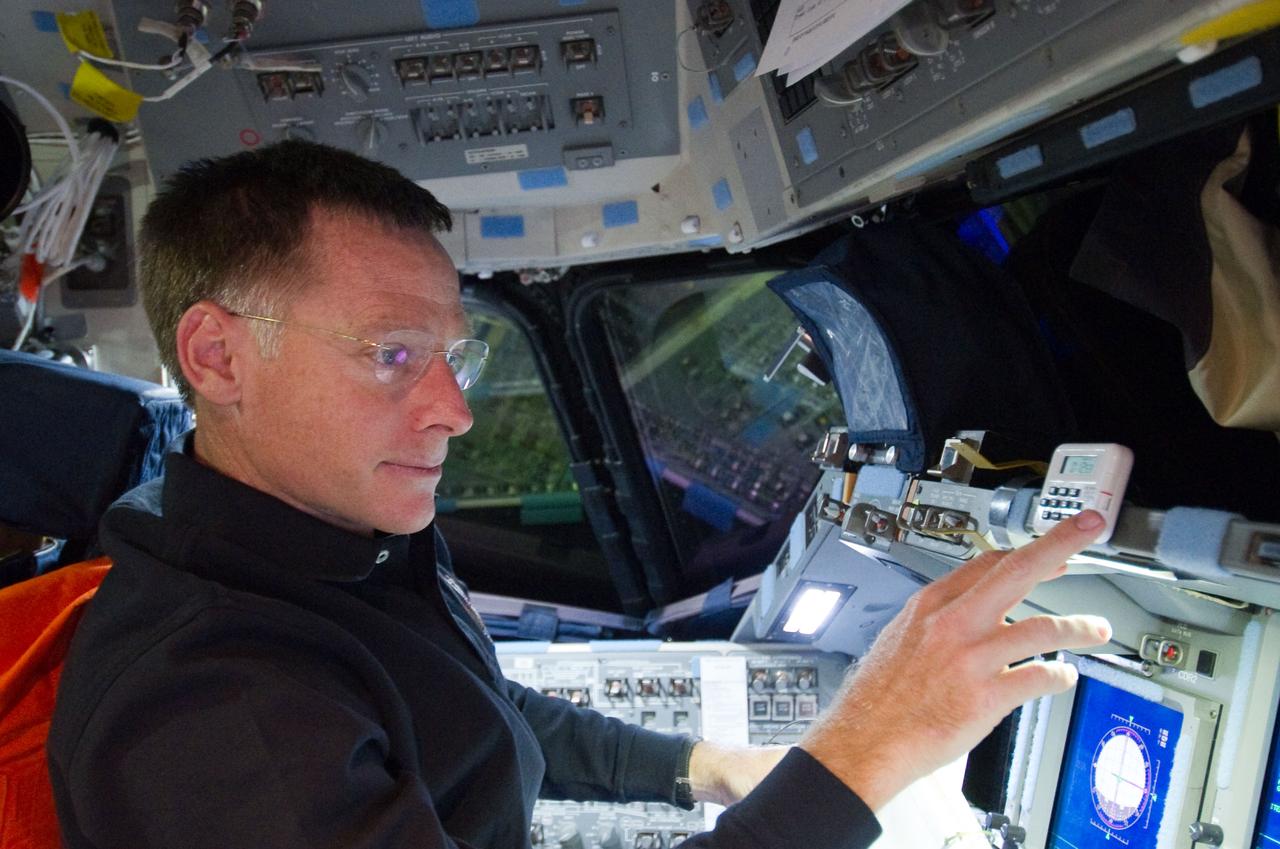
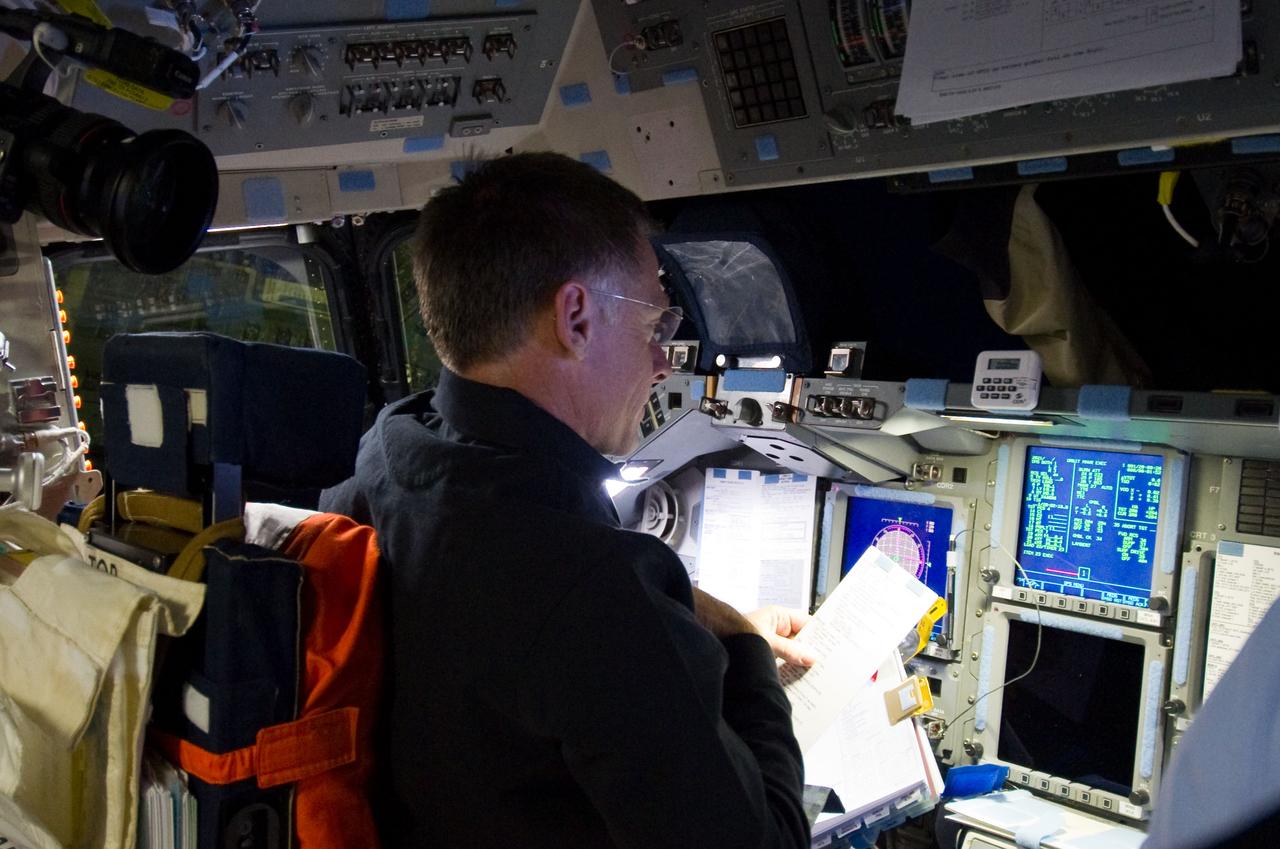
S135-E-007103 (10 July 2011) ? Astronaut Chris Ferguson, STS-135 commander, is pictured at the commander's station on the forward flight deck of the space shuttle Atlantis during the mission?s third day in space. The photo was made shortly before the shuttle and the International Space Station docked. Photo credit: NASA
Ferguson on FWD Flight Deck
S135-E-007091 (10 July 2011) ? Astronaut Chris Ferguson, STS-135 commander, is pictured at the commander's station on the forward flight deck of the space shuttle Atlantis during the mission?s third day in space. The photo was made shortly before the shuttle and the International Space Station docked. Photo credit: NASA
Ferguson on FWD Flight Deck
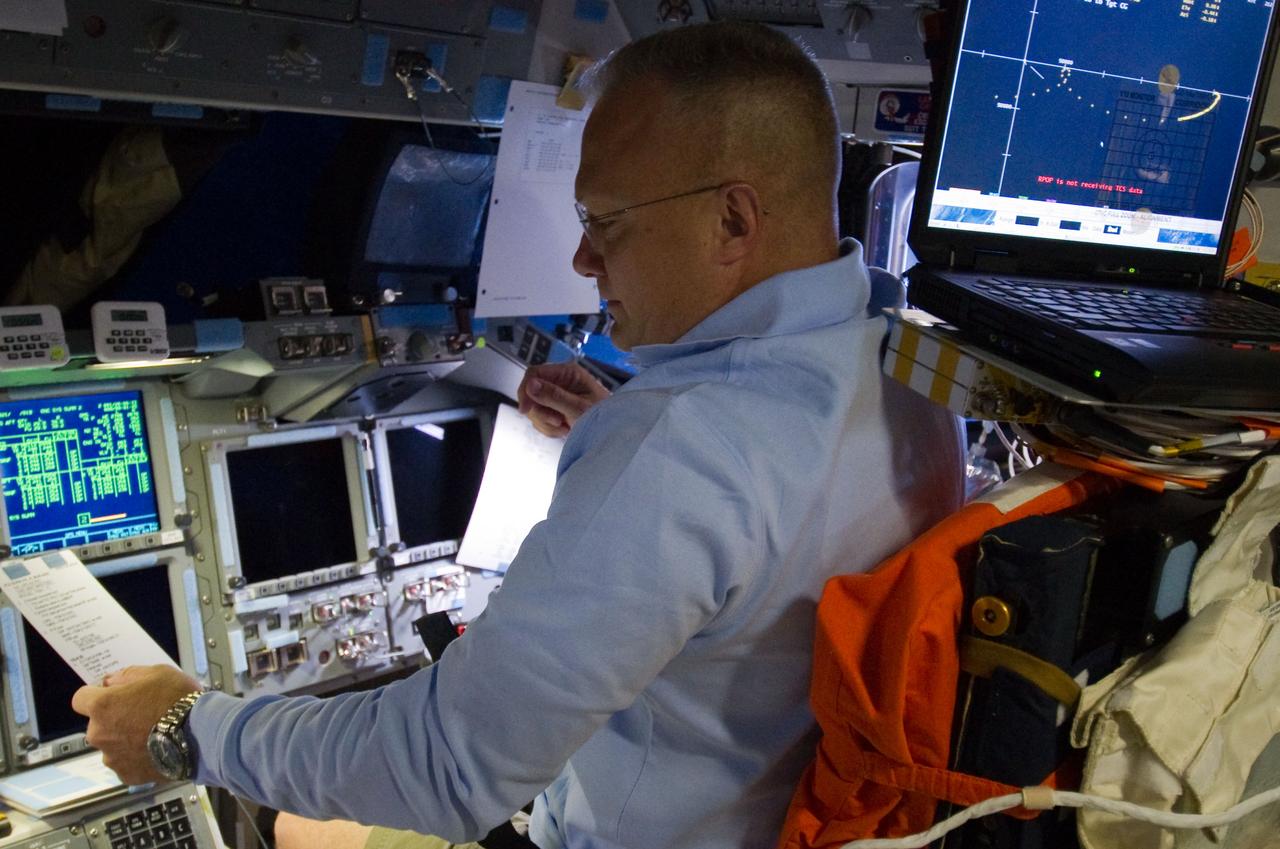
S135-E-007104 (10 July 2011) ? Astronaut Doug Hurley, STS-135 pilot, is pictured  at the pilot's station on the flight deck of the space shuttle Atlantis during the mission?s third day in space. The photo was made by a crewmate shortly before the shuttle and the International Space Station docked.  Photo credit: NASA
Hurley on FWD Flight Deck
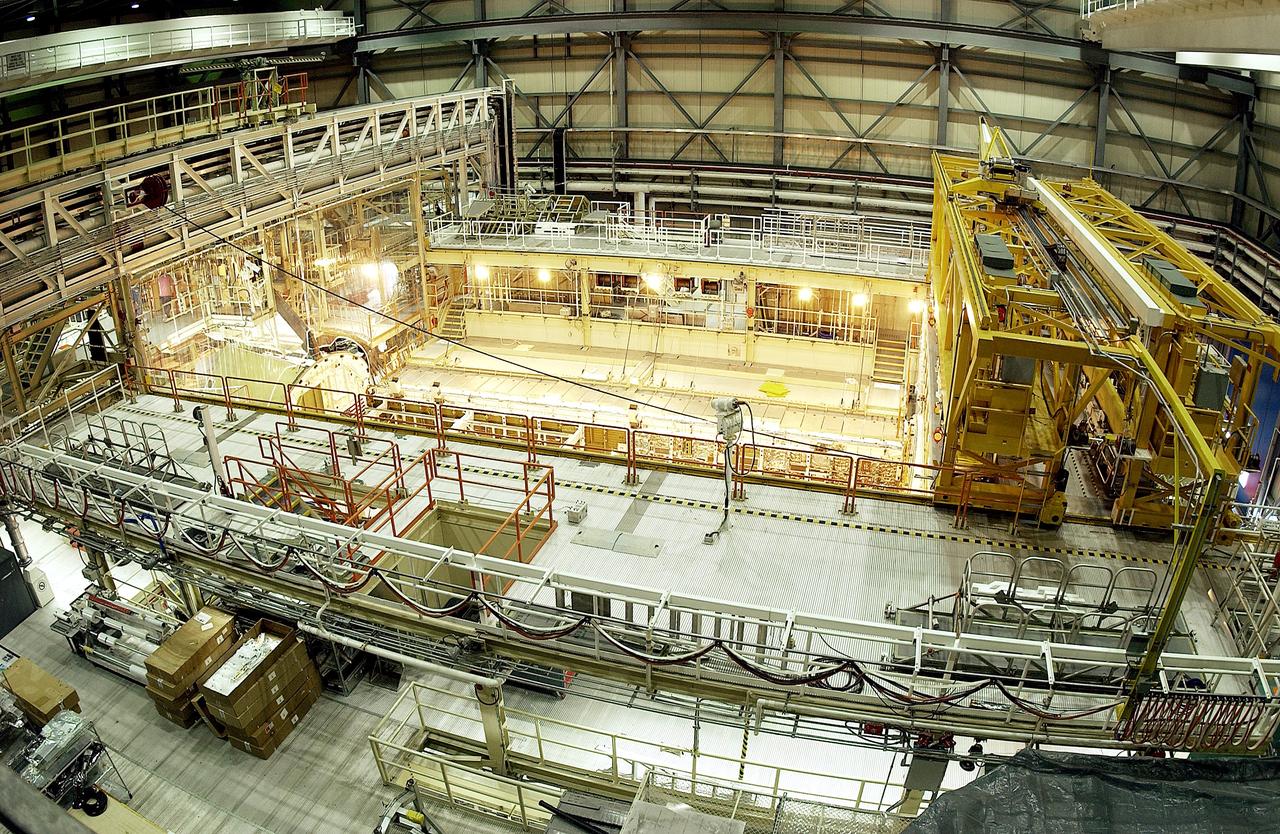
KENNEDY SPACE CENTER, FLA. -  This bird's-eye view of a high bay in the Orbiter Processing Facility (OPF) shows the open payload bay of Space Shuttle Discovery surrounded by the standard platforms and equipment required to process a Space Shuttle orbiter.  The high bay is 197 feet (60 meters) long, 150 feet (46 meters) wide, 95 feet (29 meters) high, and encompasses a 29,000-square-foot (2,694-meter) area.  The 30-ton (27-metric-ton) bridge crane (yellow device, right) has a hook height of approximately 66 feet (20 meters).  Platforms, a main access bridge, and two rolling bridges with trucks provide access to various parts of the orbiter.  In addition to routine servicing and checkout, the inspections and modifications made to enhance Discovery's performance and upgrade its systems were performed in the OPF during its recently completed Orbiter Major Modification (OMM) period.
KENNEDY SPACE CENTER, FLA. - This bird's-eye view of a high bay in the Orbiter Processing Facility (OPF) shows the open payload bay of Space Shuttle Discovery surrounded by the standard platforms and equipment required to process a Space Shuttle orbiter. The high bay is 197 feet (60 meters) long, 150 feet (46 meters) wide, 95 feet (29 meters) high, and encompasses a 29,000-square-foot (2,694-meter) area. The 30-ton (27-metric-ton) bridge crane (yellow device, right) has a hook height of approximately 66 feet (20 meters). Platforms, a main access bridge, and two rolling bridges with trucks provide access to various parts of the orbiter. In addition to routine servicing and checkout, the inspections and modifications made to enhance Discovery's performance and upgrade its systems were performed in the OPF during its recently completed Orbiter Major Modification (OMM) period.
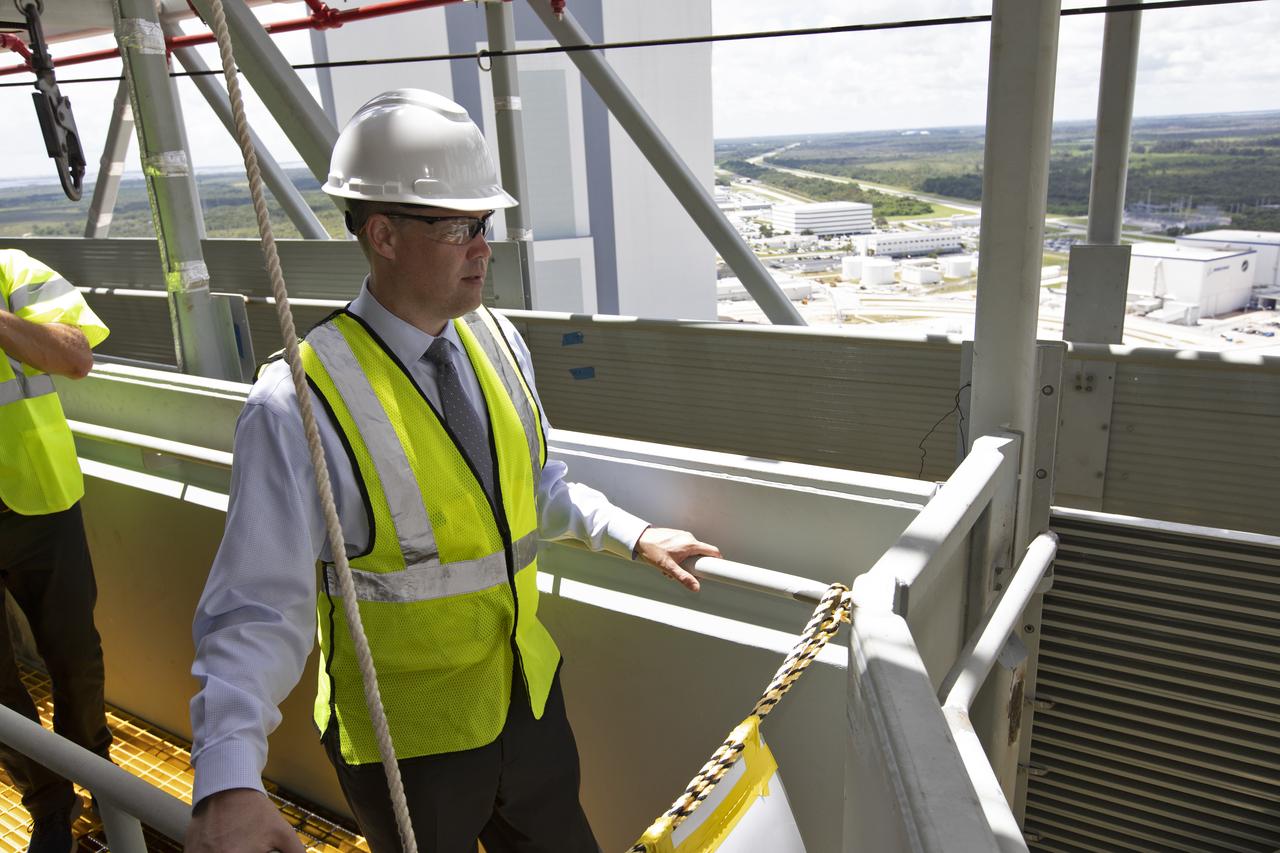
NASA Administrator Jim Bridenstine tours the mobile launcher that will support the agency's Space Launch System rocket and Orion spacecraft that will liftoff on trips to the Moon, Mars and deep space. Bridenstine made his first official visit to the NASA's Florida spaceport on Aug. 6 and 7, 2018.
NASA Administrator Jim Bridenstine Visits KSC - Mobile Launcher
iss050e010908 911/21/2016) --- A view of Matiss floating in the Columbus Module. The Microbial Aerosol Tethering on Innovative Surfaces in the International Space Station (MATISS) experiment investigates the antibacterial properties of materials in space to see if future spacecraft could be made easier to clean. The experiment aims to understand the mechanisms of attachment of biofilms in microgravity conditions.
MATISS Experiment
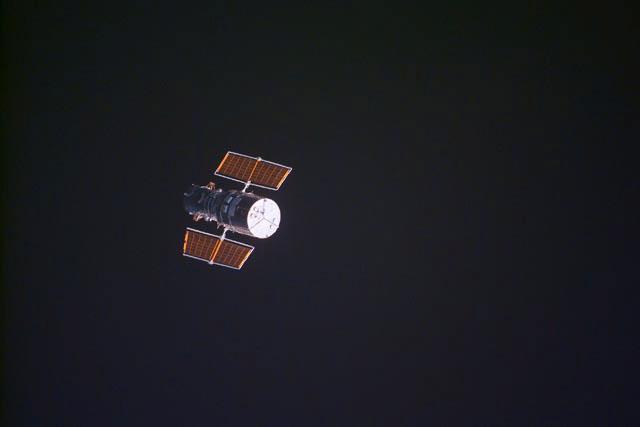
S125-E-007182 (14 May 2009) --- Astronauts John Grunsfeld (left) and Andrew Feustel, STS-125 mission specialists, made up the May 14 team of space walkers assigned to begin the final work on the Hubble Space Telescope. They will share two more sessions of extravehicular session later in the week.
STS-125 Feustel and Grunsfeld in the Airlock after EVA1
STS091-707-060 (2-12 June 1998) --- As photographed through a hatch window on the Space Shuttle Discovery, Russia's Mir space station is backdropped against Earth's horizon.  The photo was made during the final fly-around of the members of the fleet of NASA shuttles.
Survey views of the Mir Space Station during flyaround
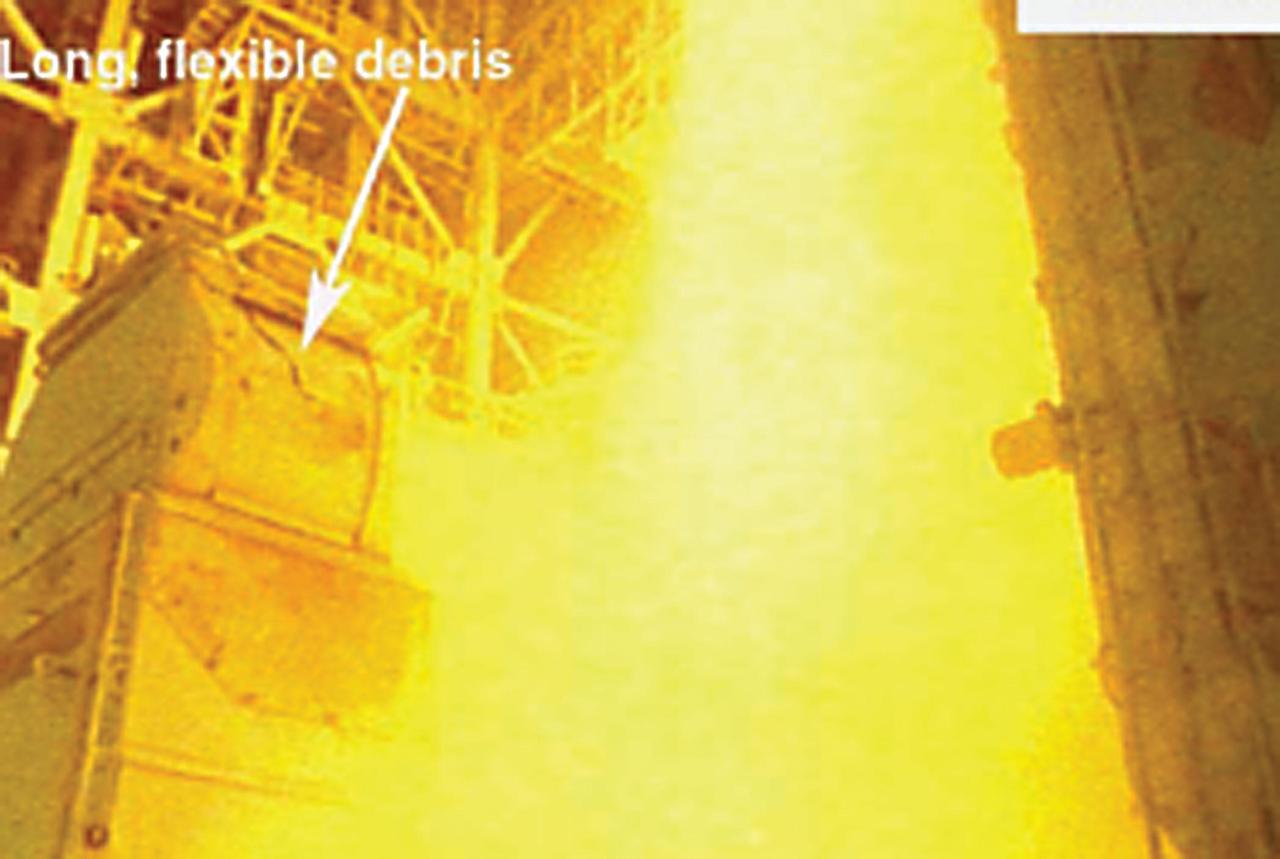
KENNEDY SPACE CENTER, FLA. - At the launch of Space Shuttle Columbia on mission STS-107, long, flexible debris comes out of the liquid helium 2 Tail Service Mast after the door closes.   Columbia and crew were lost in a tragic accident over Texas as they made their approach to landing at KSC.
KSC-03pd0251
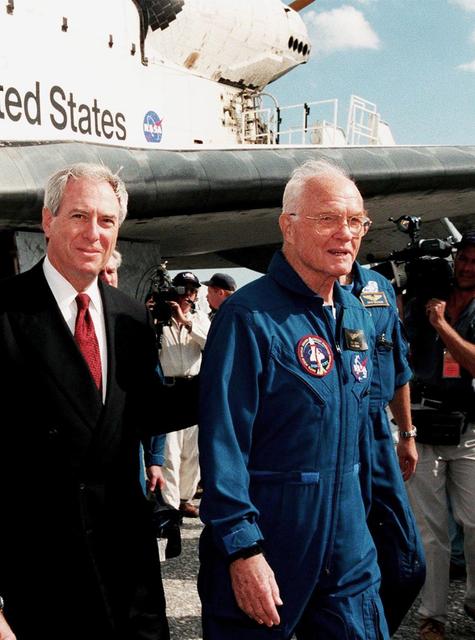
NASA Administrator Dan Goldin, left, walks with Sen. John Glenn (D-Ohio) on Nov. 7, 1998. Glenn had just returned to Earth following the STS-95 space shuttle mission. Glenn's initial trip into space on Feb. 20, 1962 aboard Mercury 6 made him the first American in orbit.
John H Glenn Jr.
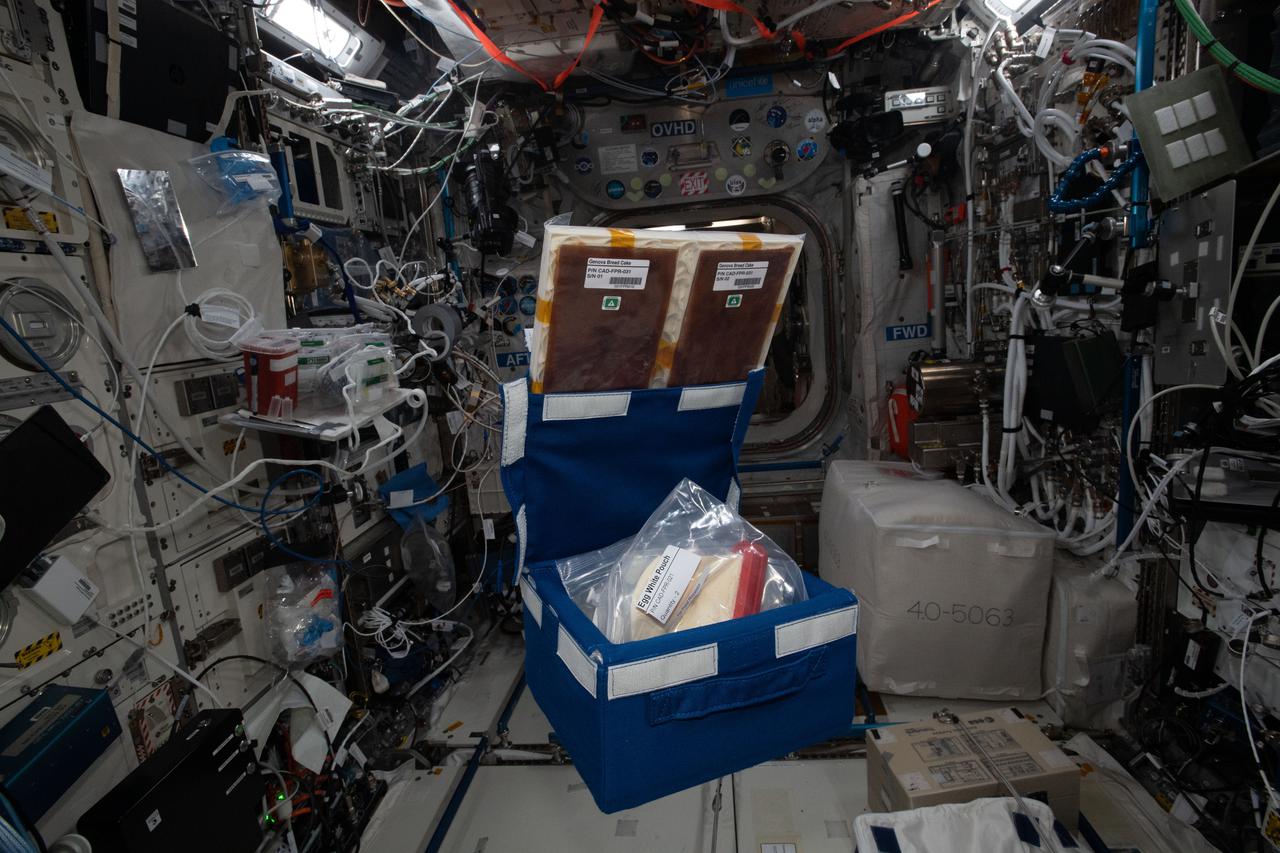
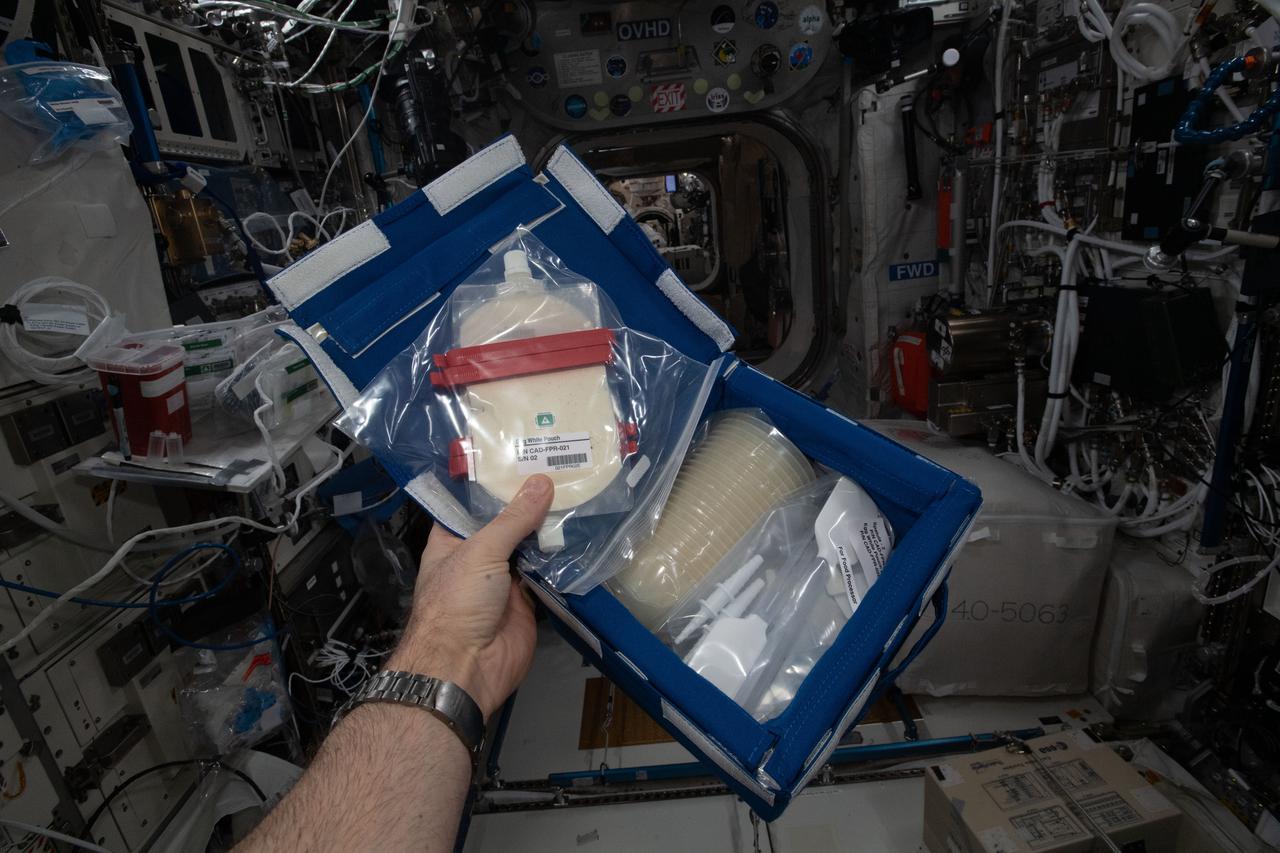
iss065e454862 (10/11/2021) --- A view of the Edible Foam in the Food Processor Consumables Kit aboard the International Space Station (ISS). Edible foam is made from PHA, a naturally occurring polymer synthesized by bacteria. It offers a high level of protection from isolated shocks and vibrations, which is particularly important during flights into space.
iss065e454862
iss065e454868 (10/11/2021) --- A view of the Edible Foam in the Food Processor Consumables Kit aboard the International Space Station (ISS). Edible foam is made from PHA, a naturally occurring polymer synthesized by bacteria. It offers a high level of protection from isolated shocks and vibrations, which is particularly important during flights into space.
iss065e454868
iss065e454902 (10/11/2021) --- A view of the Edible Foam in the Food Processor Consumables Kit aboard the International Space Station (ISS). Edible foam is made from PHA, a naturally occurring polymer synthesized by bacteria. It offers a high level of protection from isolated shocks and vibrations, which is particularly important during flights into space.
iss065e454902
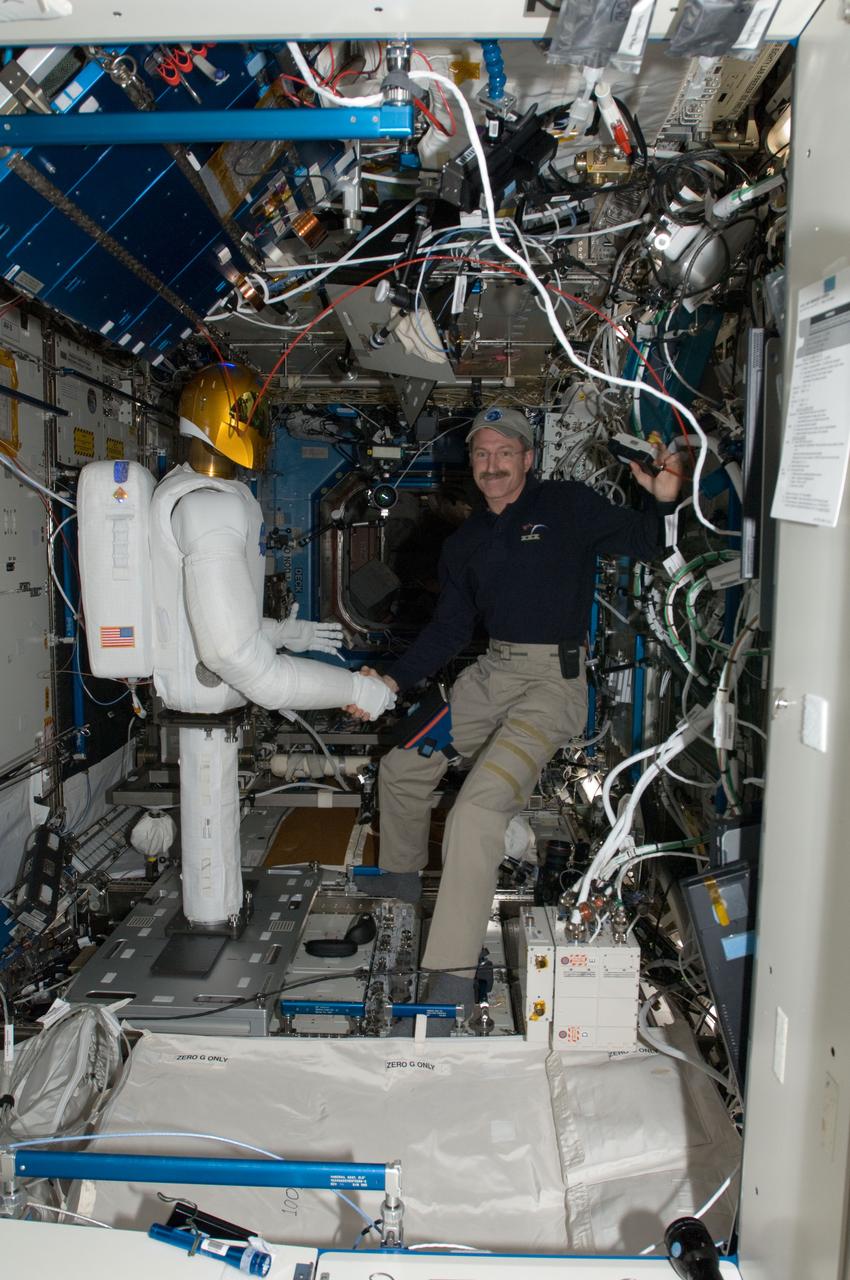
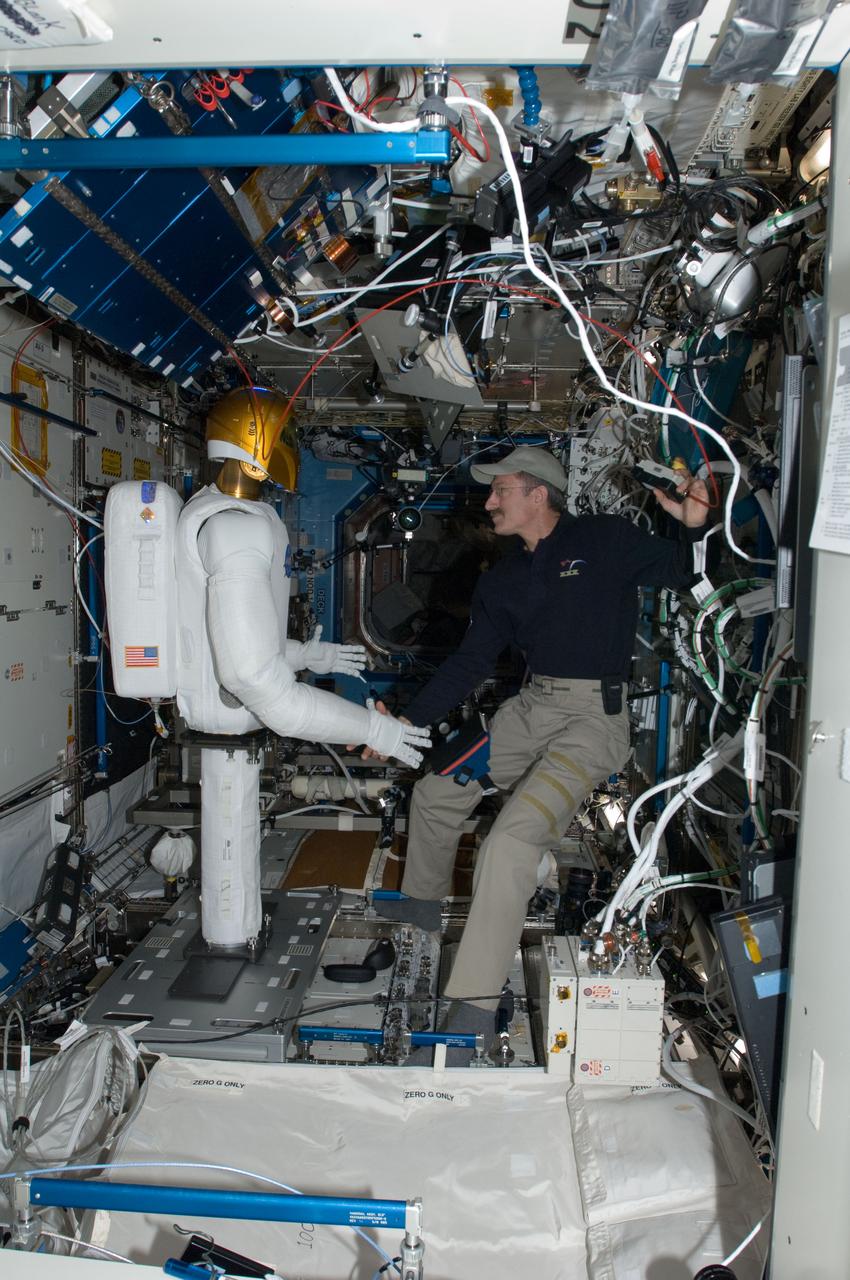
ISS030-E-074063 (15 Feb. 2012) --- Robonaut 2, nicknamed R2, shakes hands with NASA astronaut Dan Burbank, Expedition 30 commander, in the Destiny laboratory of the International Space Station. This event made history with the first human/robotic handshake to be performed in space.
Robonaut 2 in the U.S. Laboratory
iss065e454878 (10/11/2021) --- A view of the Edible Foam in the Food Processor Consumables Kit aboard the International Space Station (ISS). Edible foam is made from PHA, a naturally occurring polymer synthesized by bacteria. It offers a high level of protection from isolated shocks and vibrations, which is particularly important during flights into space.
iss065e454878
ISS030-E-074065 (15 Feb. 2012) --- Robonaut 2, nicknamed R2, shakes hands with NASA astronaut Dan Burbank, Expedition 30 commander, in the Destiny laboratory of the International Space Station. This event made history with the first human/robotic handshake to be performed in space.
Robonaut 2 in the U.S. Laboratory
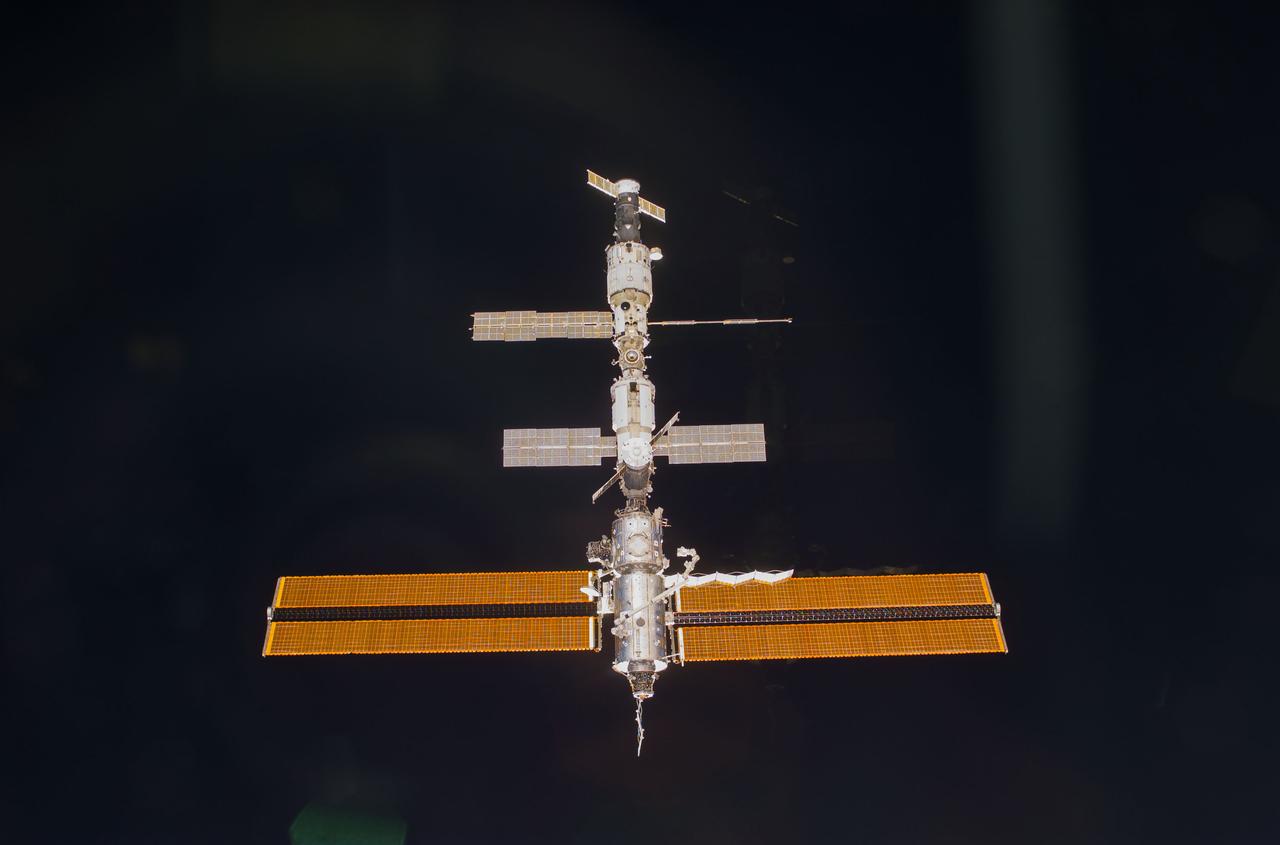
STS104-E-5027 (14 July 2001) --- The International Space Station (ISS), with the Expedition Two crew onboard, awaits its rendezvous with the Space Shuttle Atlantis.  The picture was made with a digital still camera from the shuttle's aft flight deck.
Approach view of the ISS
iss065e454854 (10/11/2021) --- A view of the Edible Foam in the Food Processor Consumables Kit aboard the International Space Station (ISS). Edible foam is made from PHA, a naturally occurring polymer synthesized by bacteria. It offers a high level of protection from isolated shocks and vibrations, which is particularly important during flights into space.
iss065e454854