
S65-05399 (1965) --- Composite drawing showing the vertical, lateral, forward and aft maneuvering control of the Gemini spacecraft.
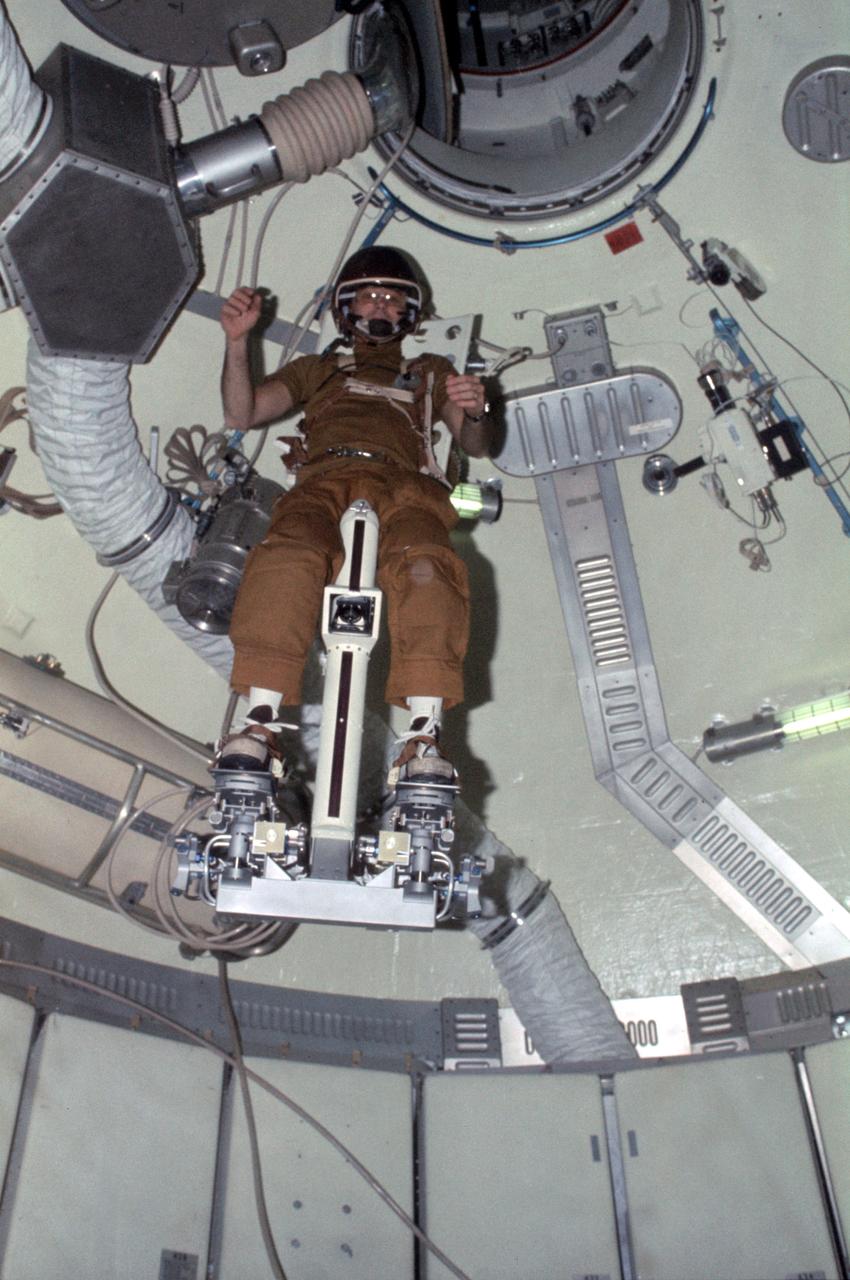
SL3-108-1304 (July-September 1973) --- Astronaut Alan L. Bean, Skylab 3 commander, flies the M509 Astronaut Maneuvering Equipment in the forward dome area of the Orbital Workshop (OWS) on the space station cluster in Earth orbit. Bean is strapped in to the back-mounted, hand-controlled Automatically Stabilized Maneuvering Unit (ASMU). This ASMU experiment is being done in shirt sleeves. The dome area where the experiment is conducted is about 22 feet in diameter and 19 feet from top to bottom. Photo credit: NASA
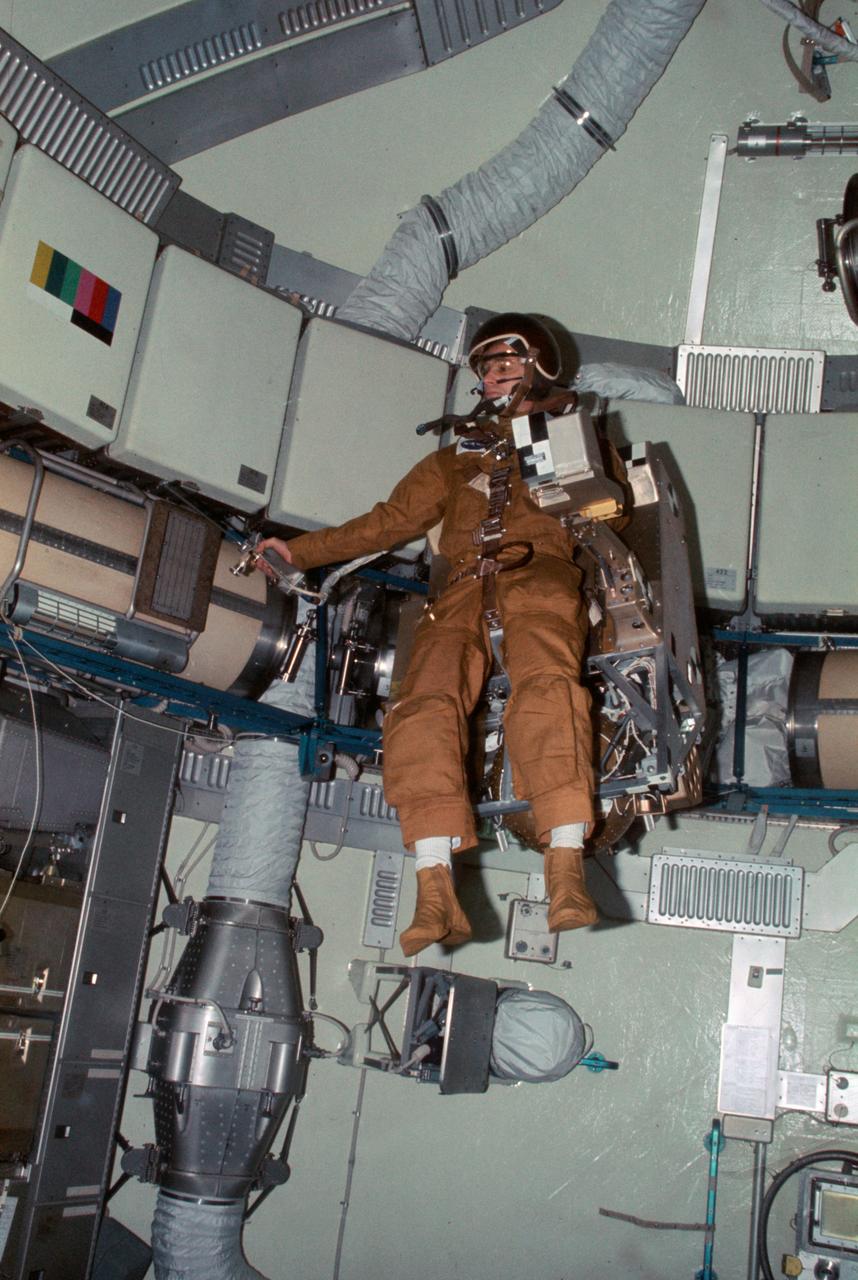
SL3-107-1215 (27 Aug. 1973) --- Astronaut Alan L. Bean, Skylab 3 commander, flies the M509 Astronaut Maneuvering Equipment in the forward dome area of the Orbital Workshop (OWS) on the space station cluster in Earth orbit. One of his fellow crewmen took this photograph with a 35mm Nikon camera. Bean is strapped into the back mounted, hand-controlled Automatically Stabilized Maneuvering Unit (ASMU). The dome area is about 22 feet in diameter and 19 feet from top to bottom. Photo credit: NASA
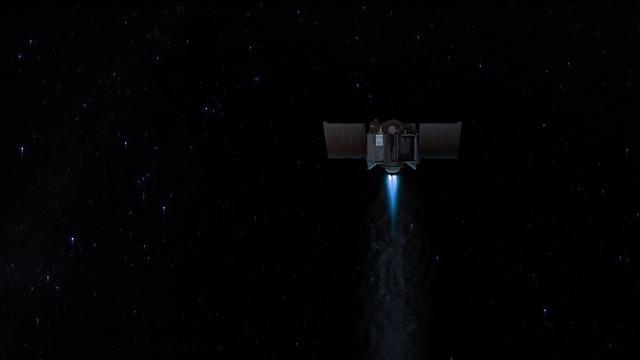
NASA's Origins, Spectral Interpretation, Resource Identification, and Security–Regolith Explorer, OSIRIS-REx, spacecraft executed its first deep space maneuver Dec. 28, 2016, putting it on course for an Earth flyby in September 2017. The team will continue to examine telemetry and tracking data as it becomes available at the current low data rate and will have more information in January. Image credit: University of Arizona <b><a href="http://www.nasa.gov/audience/formedia/features/MP_Photo_Guidelines.html" rel="nofollow">NASA image use policy.</a></b> <b><a href="http://www.nasa.gov/centers/goddard/home/index.html" rel="nofollow">NASA Goddard Space Flight Center</a></b> enables NASA’s mission through four scientific endeavors: Earth Science, Heliophysics, Solar System Exploration, and Astrophysics. Goddard plays a leading role in NASA’s accomplishments by contributing compelling scientific knowledge to advance the Agency’s mission. <b>Follow us on <a href="http://twitter.com/NASAGoddardPix" rel="nofollow">Twitter</a></b> <b>Like us on <a href="http://www.facebook.com/pages/Greenbelt-MD/NASA-Goddard/395013845897?ref=tsd" rel="nofollow">Facebook</a></b> <b>Find us on <a href="http://instagrid.me/nasagoddard/?vm=grid" rel="nofollow">Instagram</a></b>
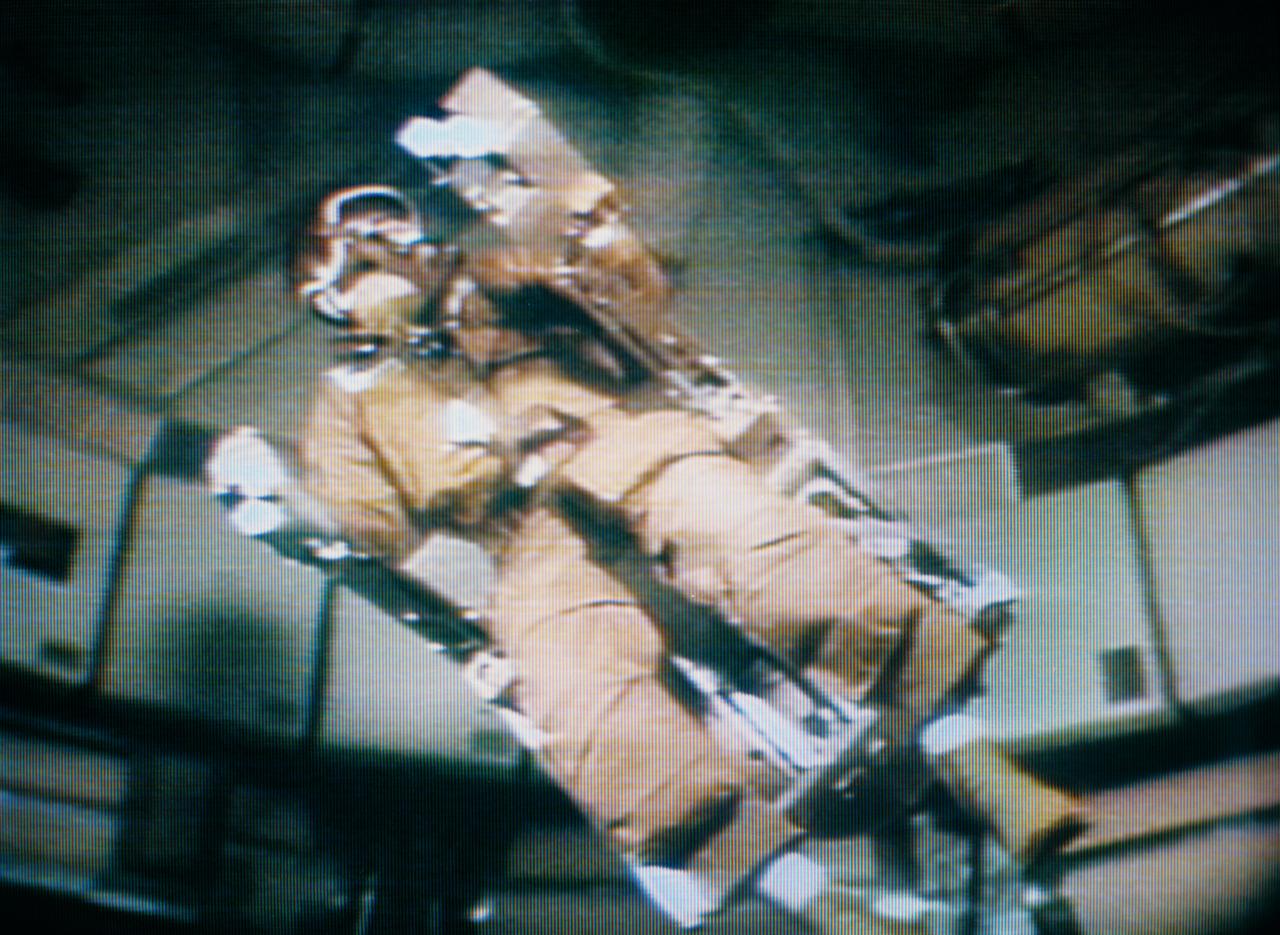
S73-34207 (28 Aug. 1973) --- Astronaut Alan L. Bean, Skylab 3 commander, flies the M509 astronaut Maneuvering Equipment, as seen in this photographic reproduction taken from a television transmission made by a color television camera in the Orbital Workshop (OWS) of the Skylab space station in Earth orbit. Bean is strapped into the back-mounted, hand-controlled Automatically Stabilized Maneuvering Unit (ASMU). The M509 exercise was in the forward dome area of the OWS. The dome area is about 22 feet in diameter and 19 feet from top to bottom. Photo credit: NASA
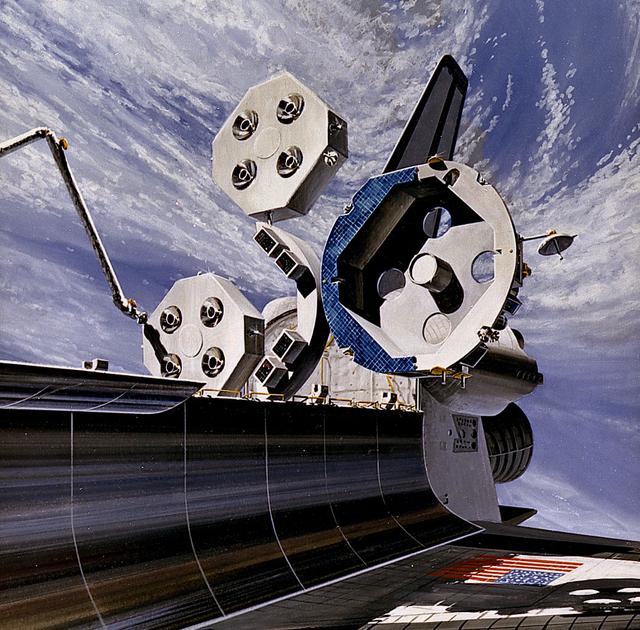
In this 1986 artist's concept, the Orbital Maneuvering Vehicle (OMV), undergoes changeout of the Propulsion Module outside the Space Shuttle Cargo Bay. As envisioned by Marshall Space Flight Center plarners, the OMV would be a remotely-controlled free-flying space tug which would place, rendezvous, dock, and retrieve orbital payloads.
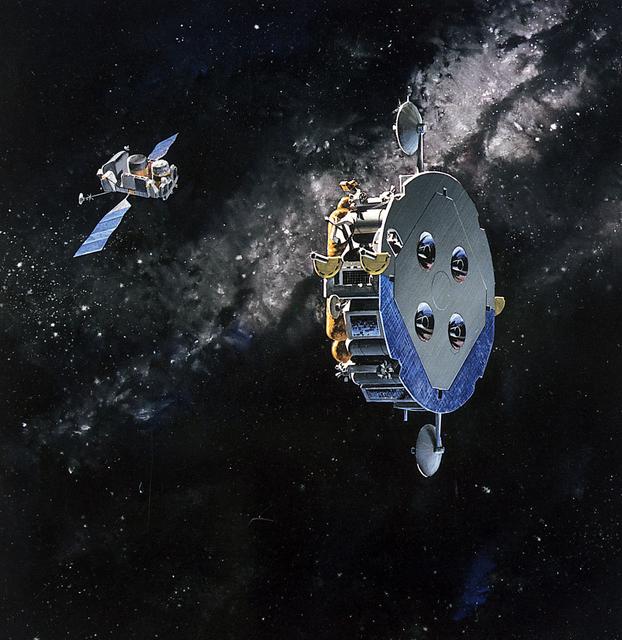
In this 1988 artist's concept, the Orbital Maneuvering Vehicle (OMV), closes in on a satellite. As envisioned by Marshall Space Flight plarners, the OMV would be a remotely-controlled free-flying space tug which would place, rendezvous, dock, and retrieve orbital payloads.
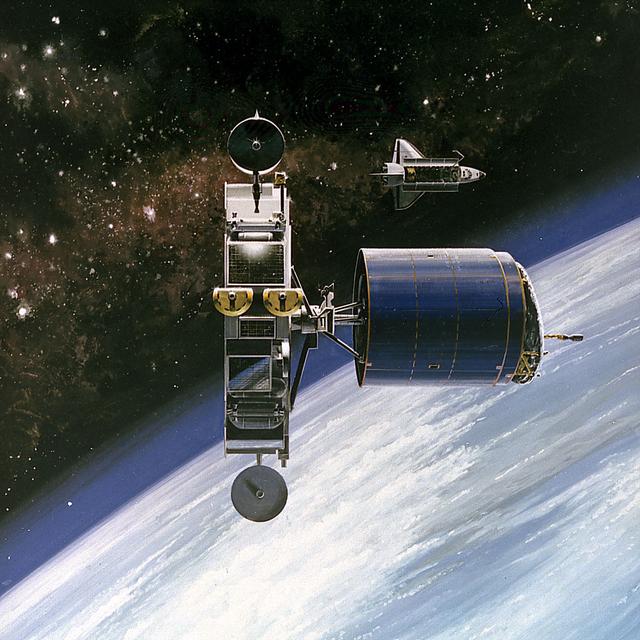
This 1986 artist's concept shows the Orbital Maneuvering Vehicle (OMV) towing a satellite. As envisioned by Marshall Space Flight Center plarners, the OMV would be a remotely-controlled free-flying space tug which would place, rendezvous, dock, and retrieve orbital payloads.
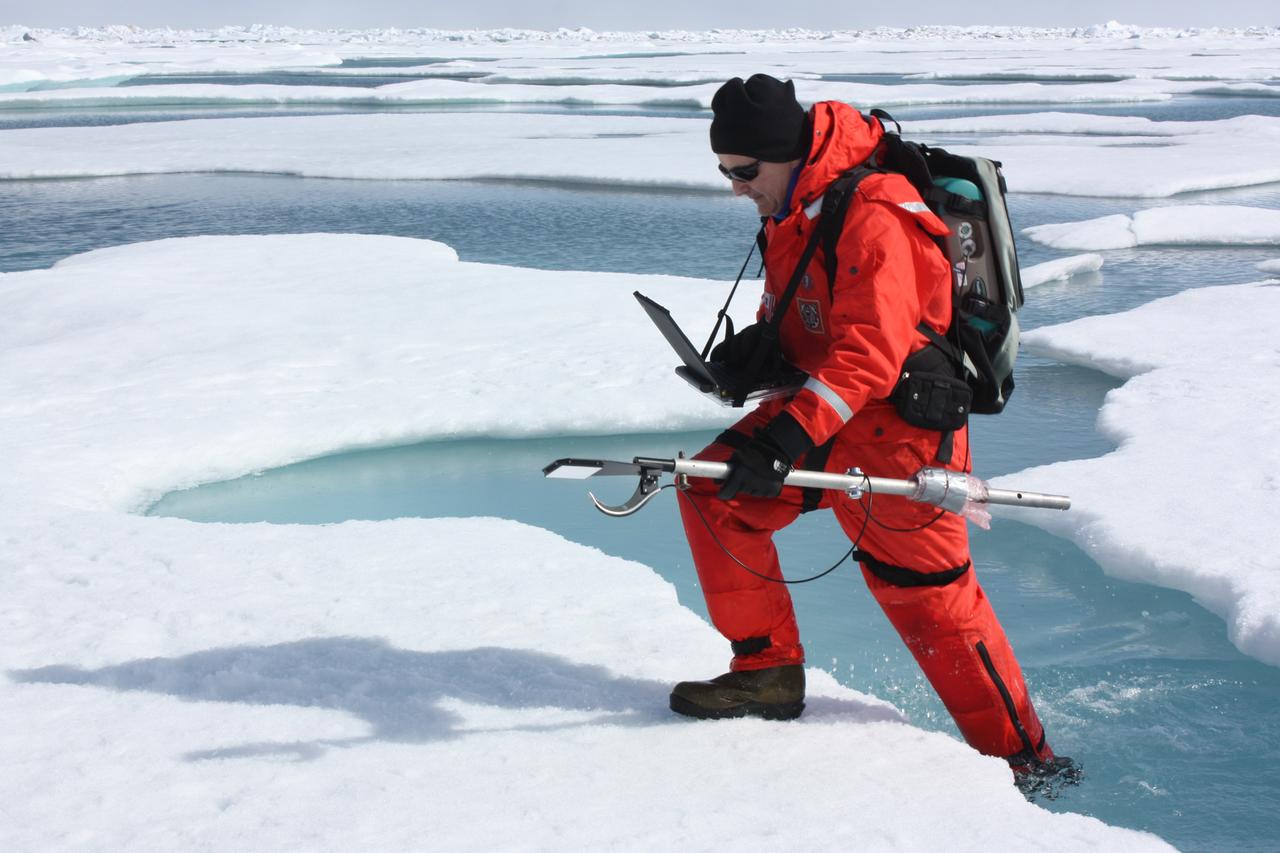
On July 10, 2011, Don Perovich, of Cold Regions Research and Engineering Laboratory, maneuvered through melt ponds collecting optical data along the way to get a sense of the amount of sunlight reflected from sea ice and melt ponds in the Chukchi Sea. The ICESCAPE mission, or "Impacts of Climate on Ecosystems and Chemistry of the Arctic Pacific Environment," is a NASA shipborne investigation to study how changing conditions in the Arctic affect the ocean's chemistry and ecosystems. The bulk of the research took place in the Beaufort and Chukchi seas in summer 2010 and 2011. Credit: NASA/Kathryn Hansen <b><a href="http://www.nasa.gov/audience/formedia/features/MP_Photo_Guidelines.html" rel="nofollow">NASA image use policy.</a></b> <b><a href="http://www.nasa.gov/centers/goddard/home/index.html" rel="nofollow">NASA Goddard Space Flight Center</a></b> enables NASA’s mission through four scientific endeavors: Earth Science, Heliophysics, Solar System Exploration, and Astrophysics. Goddard plays a leading role in NASA’s accomplishments by contributing compelling scientific knowledge to advance the Agency’s mission. <b>Follow us on <a href="http://twitter.com/NASA_GoddardPix" rel="nofollow">Twitter</a></b> <b>Like us on <a href="http://www.facebook.com/pages/Greenbelt-MD/NASA-Goddard/395013845897?ref=tsd" rel="nofollow">Facebook</a></b> <b>Find us on <a href="http://instagrid.me/nasagoddard/?vm=grid" rel="nofollow">Instagram</a></b>
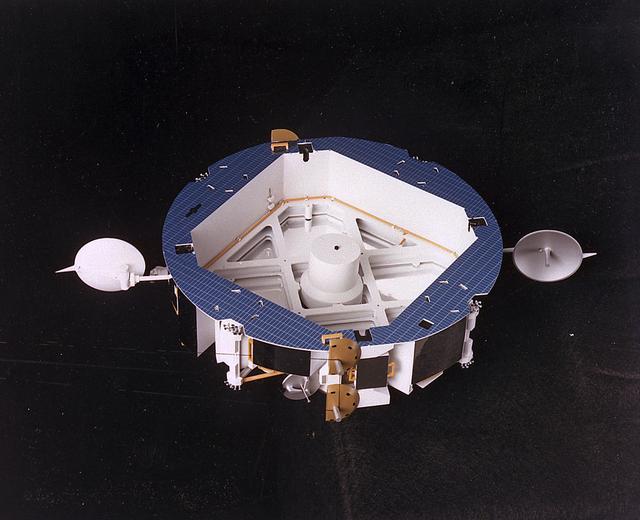
In this 1986 artist's concept, the Orbital Maneuvering Vehicle (OMV), is shown without its main propulsion module. Essentially two propulsion vehicles in one, the OMV could be powered by a main propulsion module , or, in its short range vehicle configuration shown here, use its own hydrazine and cold gas thrusters. As envisioned by Marshall Space Flight Center plarners, the OMV would be a remotely-controlled free-flying space tug which would place, rendezvous, dock, and retrieve orbital payloads.
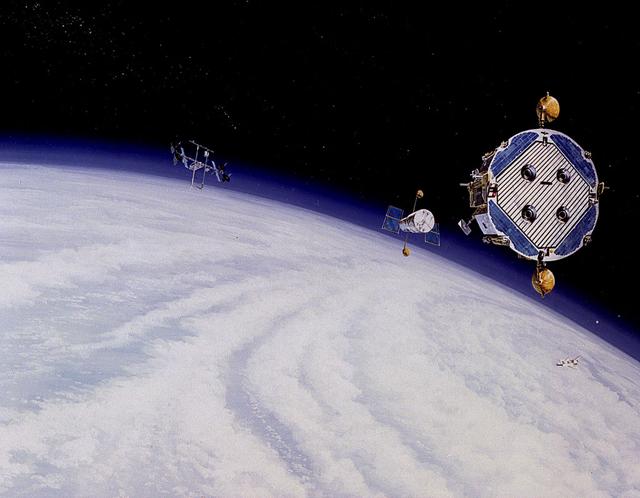
In this 1986 artist's concept, the Orbital Maneuvering Vehicle (OMV), at right, prepares to reboost the Hubble Space Telescope after being deployed from an early Space Station configuration (left). As envisioned by Marshall Space Flight Center plarners, the OMV would be a remotely-controlled free-flying space tug which would place, rendezvous, dock, and retrieve orbital payloads.
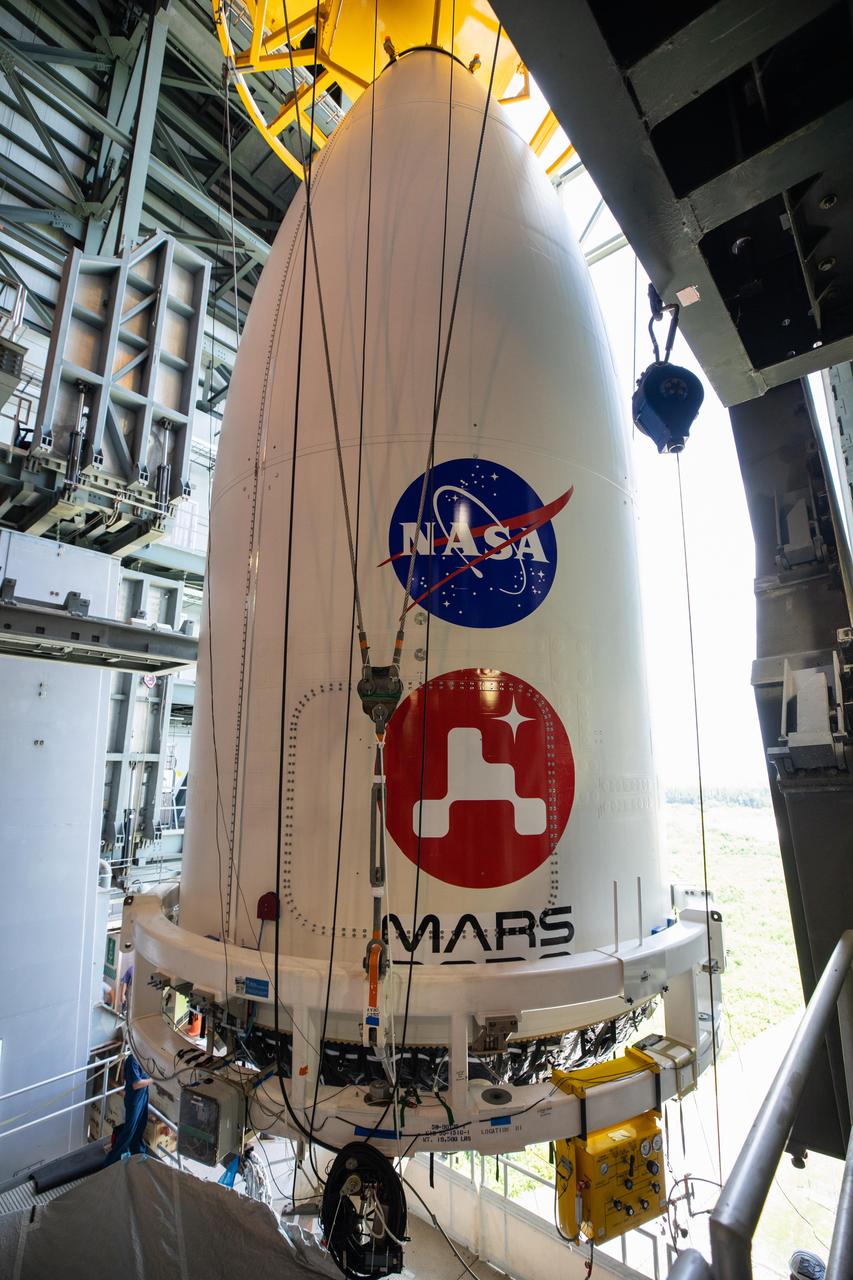
The payload fairing, or nose cone, containing NASA's Mars 2020 Perseverance rover is maneuvered into place atop the Atlas V rocket that will hurl it toward Mars. The image was taken on July 7, 2020, inside the Vertical Integration Facility at Cape Canaveral Air Force Station's Space Launch Complex 41 in Florida. https://photojournal.jpl.nasa.gov/catalog/PIA23986
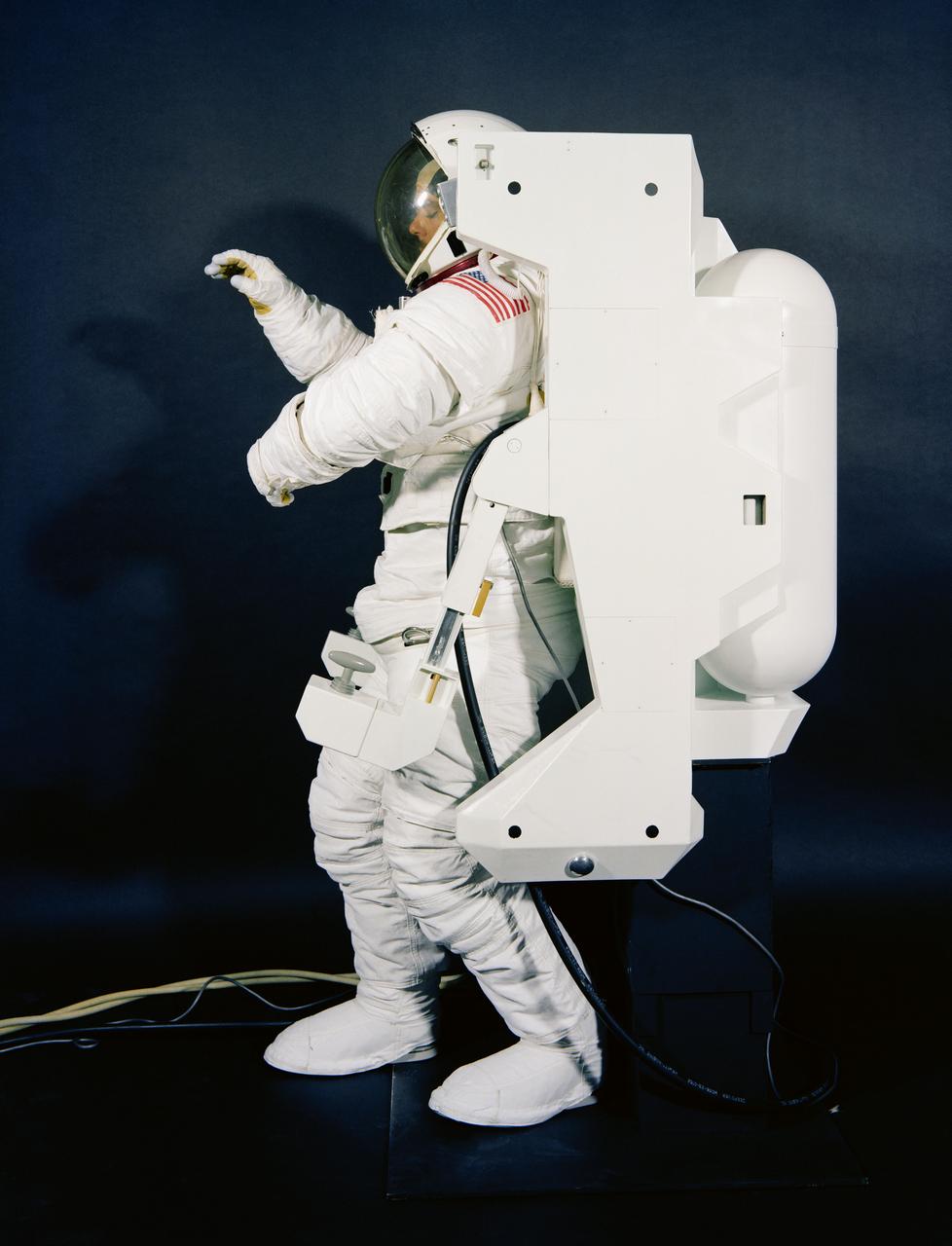
Side close-up view of crewman in high-fidelity Extravehicular Mobility Unit (EMU) / Manned Maneuvering Unit (MMU) mockup.
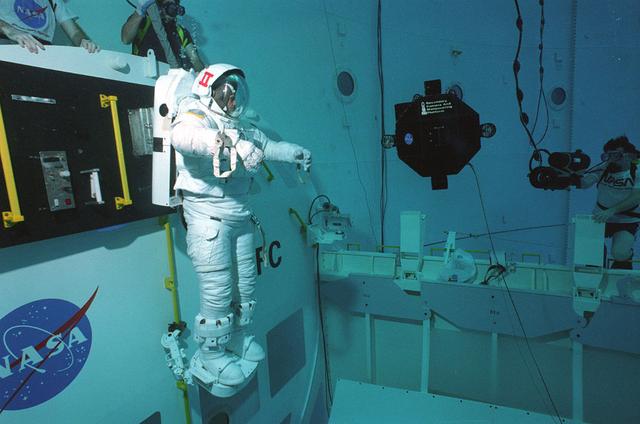
A diver tests a secondary camera and maneuvering platform in Marshall's Neutral Buoyancy Simulator (NBS).The secondary camera will be beneficial for recording repairs and other extra vehicular activities (EVA) the astronuats will perform while making repairs on the Hubble Space Telescope (HST). The maneuvering platform was developed to give the astronauts something to stand on while performing maintenance tasks. These platforms were developed to be mobile so that the astronauts could move them to accommadate different sites.
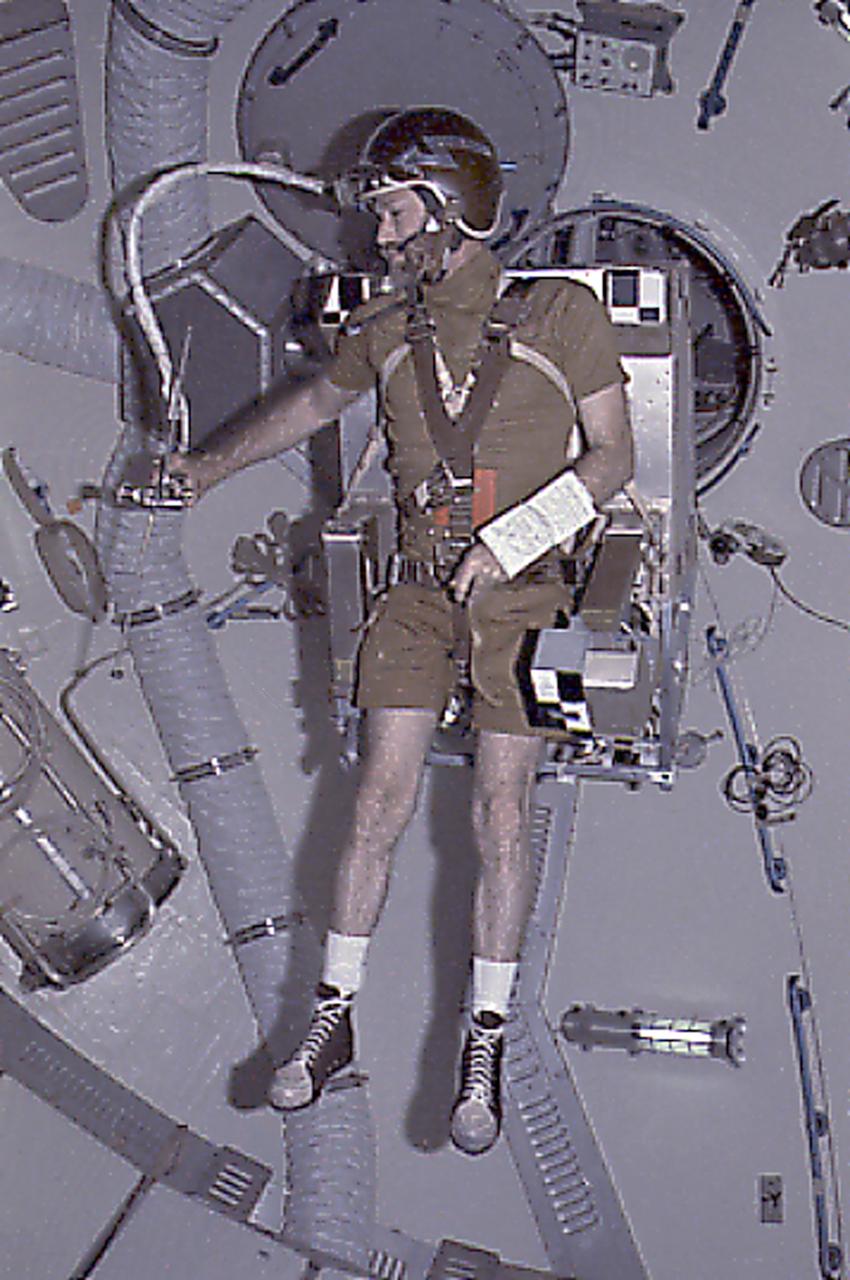
This Skylab-4 onboard photograph depicts Astronaut Gerald Carr testing Astronaut Maneuvering Equipment (M509) by flying it around under weightless conditions in the Orbital Workshop. The M509 experiment was an operational study to evaluate and conduct an in-orbit verification of the utility of various maneuvering techniques to assist astronauts in performing tasks that were representative of future extravehicular activity requirements.
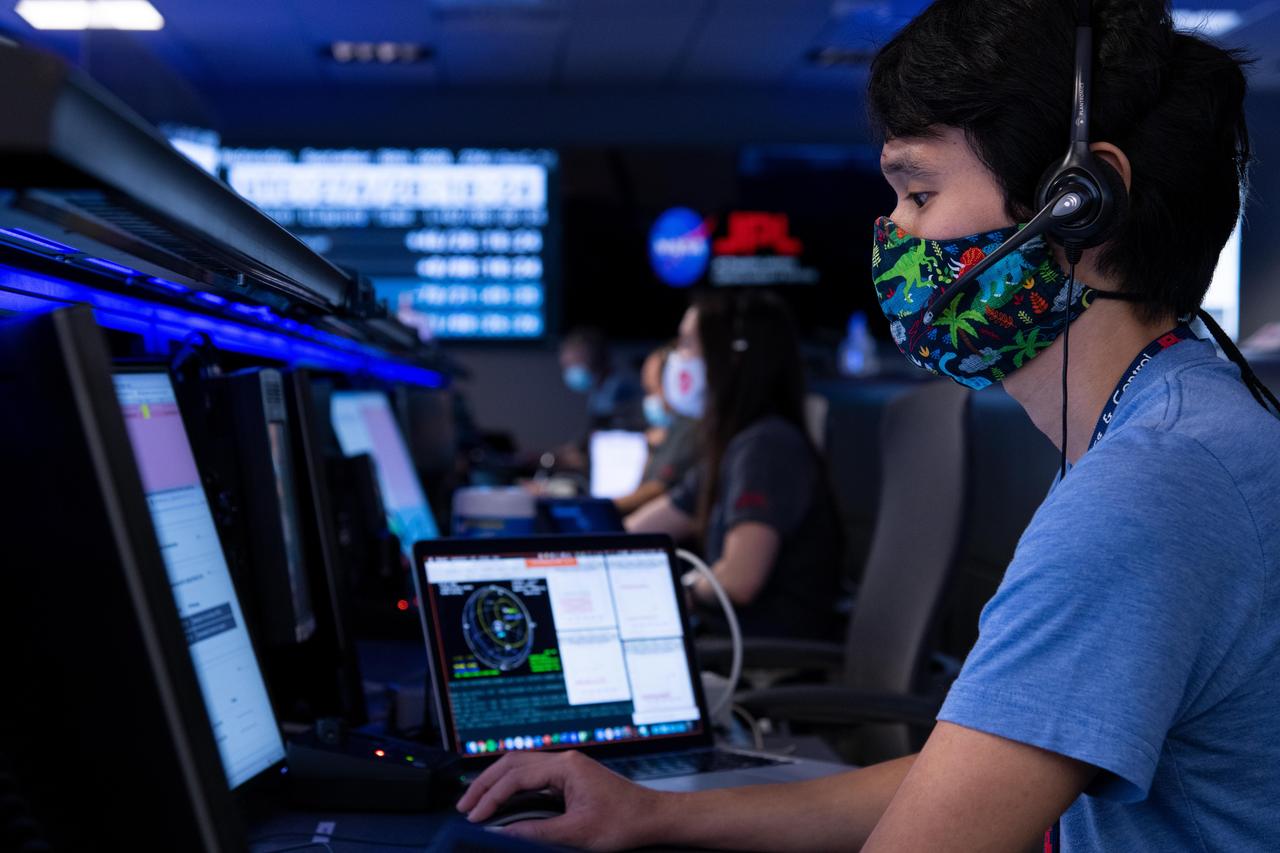
Attitude Control Systems lead Chris Pong donned a dinosaur-themed mask for his participation in the Mars 2020 mission's second trajectory correction maneuver at NASA's Jet Propulsion Laboratory in Southern California. The navigation team successfully sent commands to the spacecraft to adjust its flight path during its long cruise to Mars. https://photojournal.jpl.nasa.gov/catalog/PIA24191
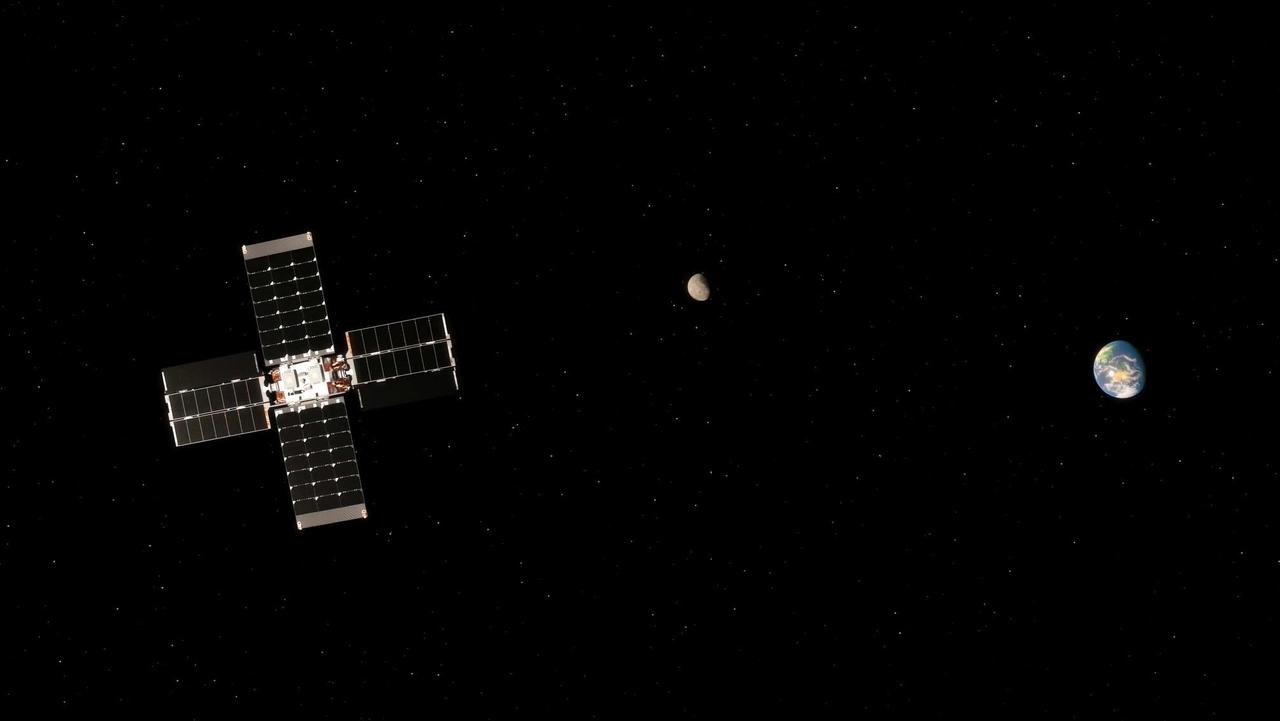
This illustration shows NASA's Lunar Flashlight carrying out a trajectory correction maneuver with the Moon and Earth in the background. Powered by the small satellite's four thrusters, the maneuver is needed to reach lunar orbit. Lunar Flashlight launched Nov. 30, 2022, and will take about four months to reach its science orbit to seek out surface water ice in the darkest craters of the Moon's South Pole. A technology demonstration, the small satellite, or SmallSat, will use a reflectometer equipped with four lasers that emit near-infrared light in wavelengths readily absorbed by surface water ice. To achieve the mission's goals with the satellite's limited amount of propellent, Lunar Flashlight will employ an energy-efficient near-rectilinear halo orbit, taking it within 9 miles (15 kilometers) of the lunar South Pole and 43,000 miles (70,000 kilometers) away at its farthest point. Only one other spacecraft has employed this type of orbit: NASA's Cislunar Autonomous Positioning System Technology Operations and Navigation Experiment (CAPSTONE) mission, which launched in June 2022. https://photojournal.jpl.nasa.gov/catalog/PIA25258
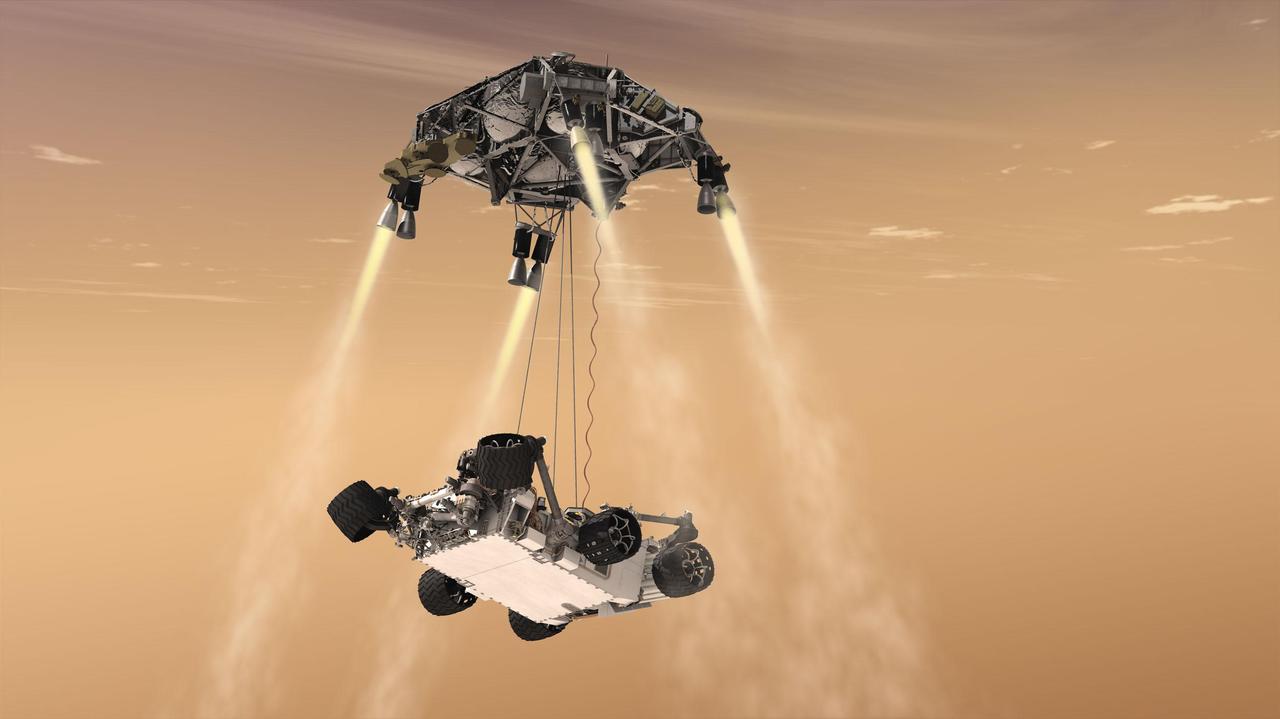
This artist concept shows the sky crane maneuver during the descent of NASA Curiosity rover to the Martian surface. The sheer size of the rover over one ton, or 900 kilograms would preclude it from taking advantage of an airbag-assisted landing.
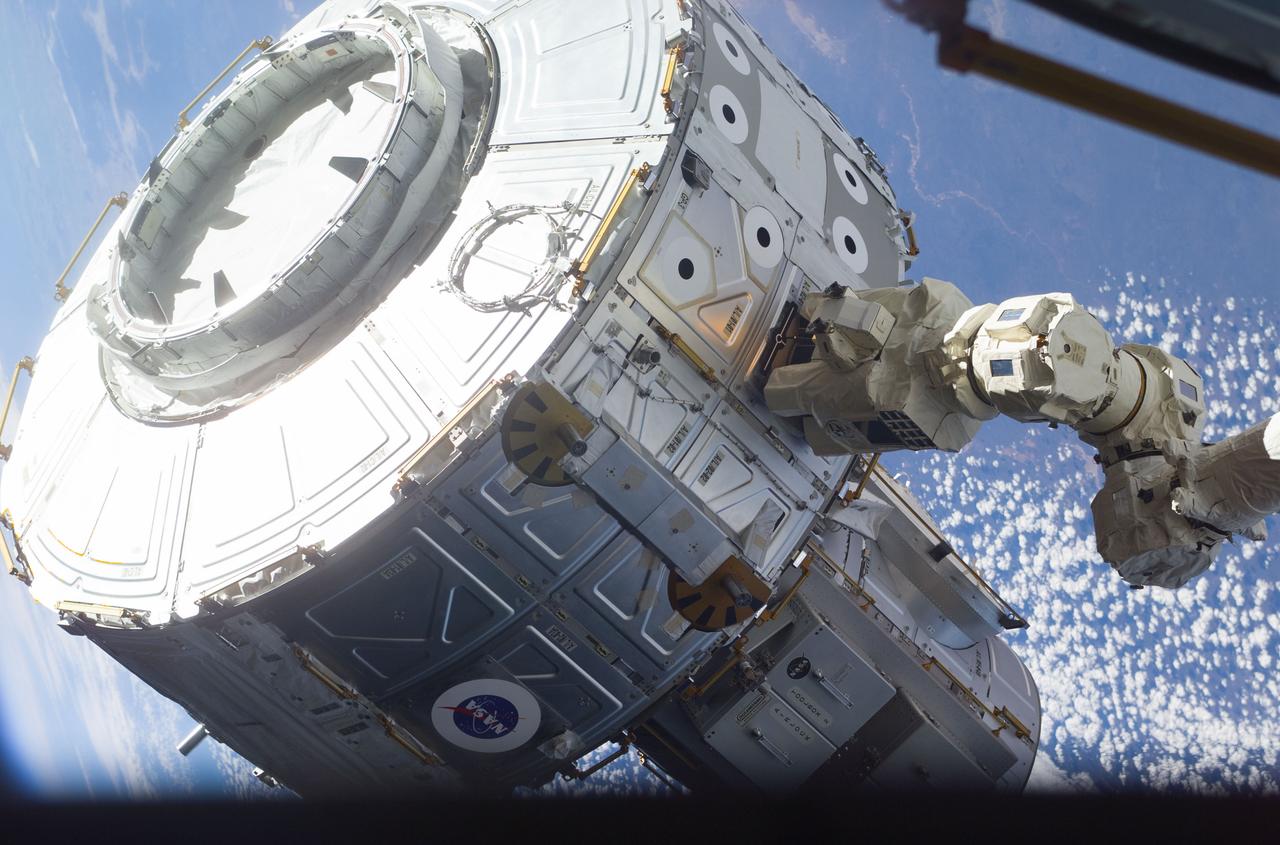
S104-E-5065 (15 July 2001) --- The newly-installed Candarm2, Space Station Remote Manipulator System (SSRMS), controlled by Susan J. Helms, Expedition Two flight engineer, maneuvers the Quest Airlock in the proper position to be mated onto the starboard side of Unity Node 1 during the first extravehicular activity (EVA) of the STS-104 mission. The Earth backdrops this image, exposed with a digital still camera.
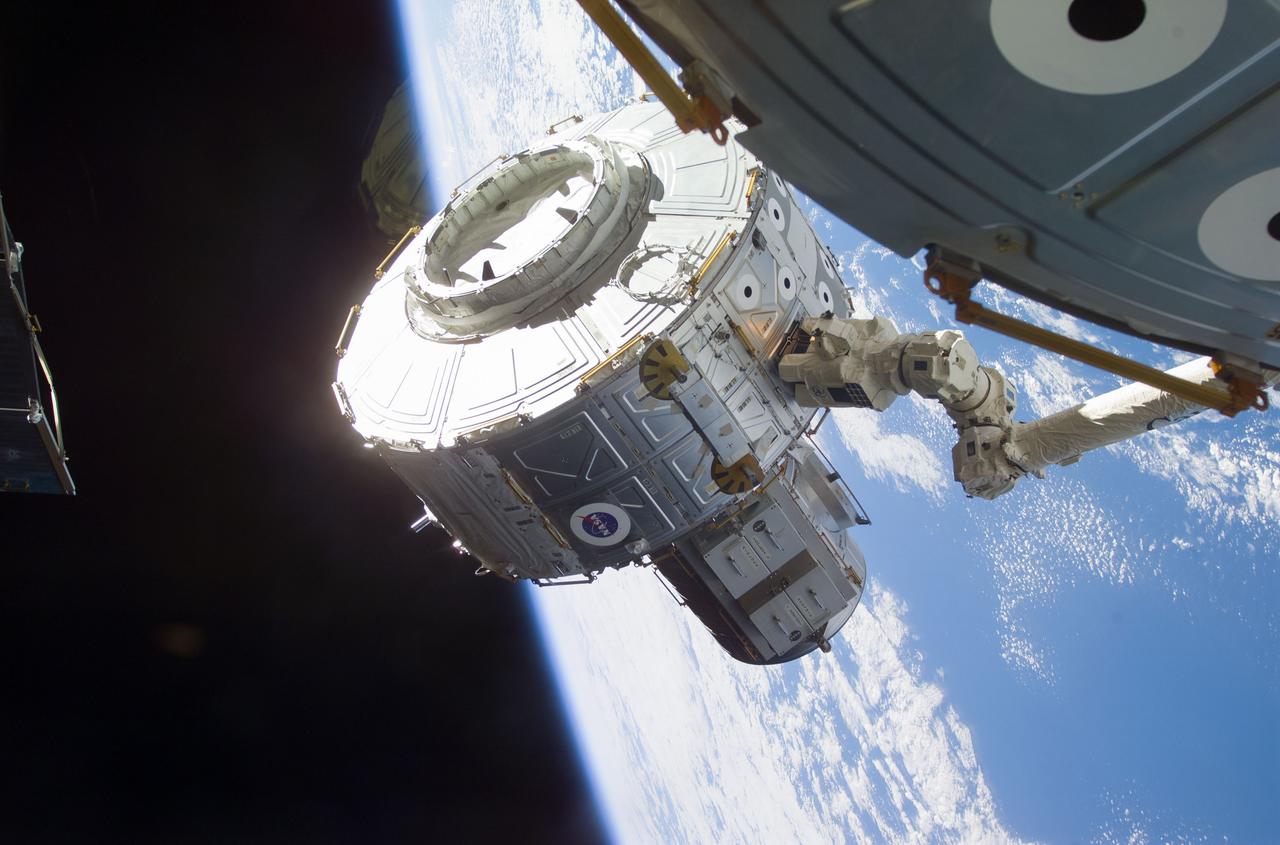
STS104-E-5068 (15 July 2001) --- Backdropped against a blue and white Earth, some 237 miles below, the Quest airlock is in the process of being installed onto the starboard side of Unity Node 1 of the International Space Station (ISS). Astronaut Susan J. Helms, Expedition Two flight engineer, used controls onboard the station to maneuver the Airlock into place with the Canadarm2 or Space Station Remote Manipulator System (SSRMS). This image was recorded with a digital still camera.
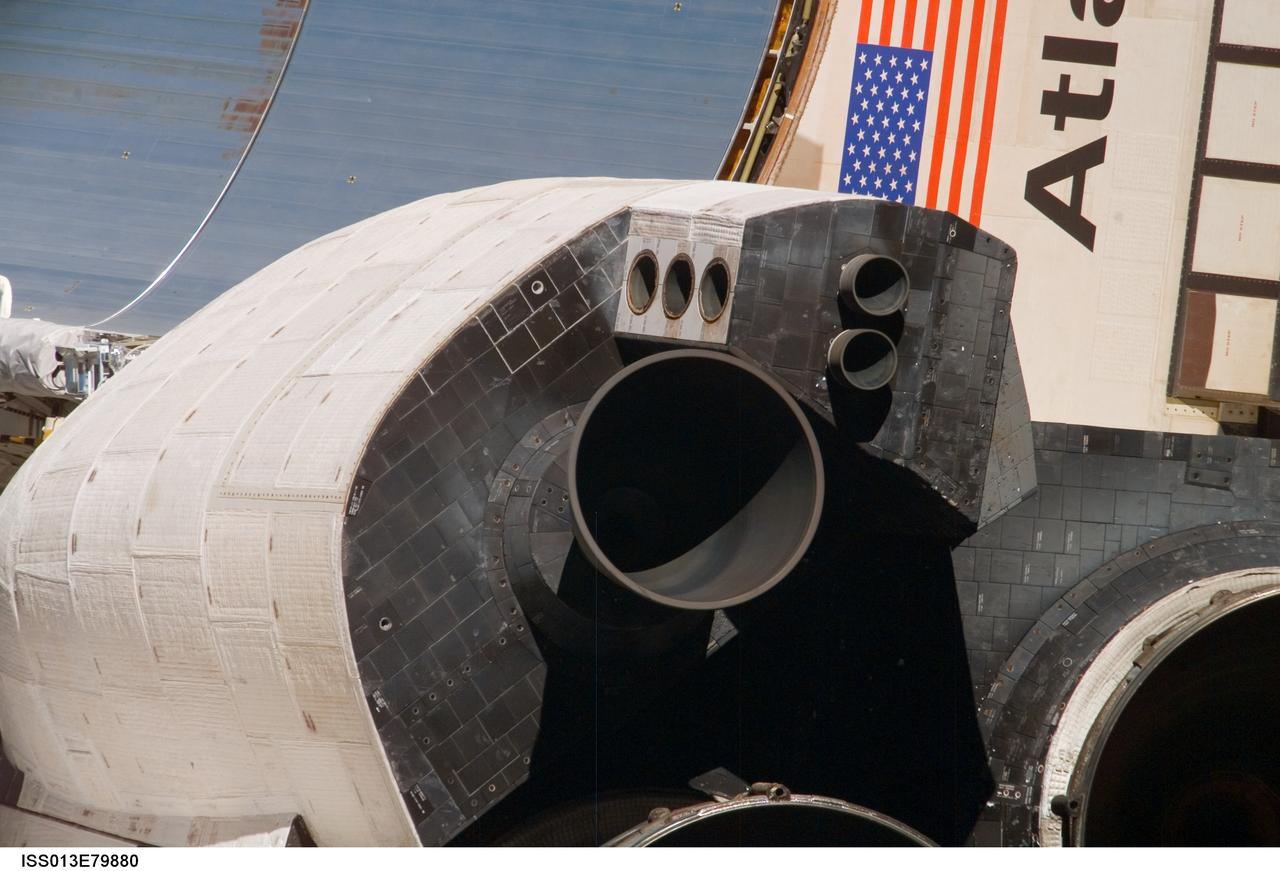
ISS013-E-79880 (11 Sept. 2006) --- This view of part of the starboard wing and one of the Orbital Maneuvering System (OMS) pods of the Space Shuttle Atlantis was provided by an Expedition 13 crew member during a backflip maneuver performed by the approaching visitors to the International Space Station.
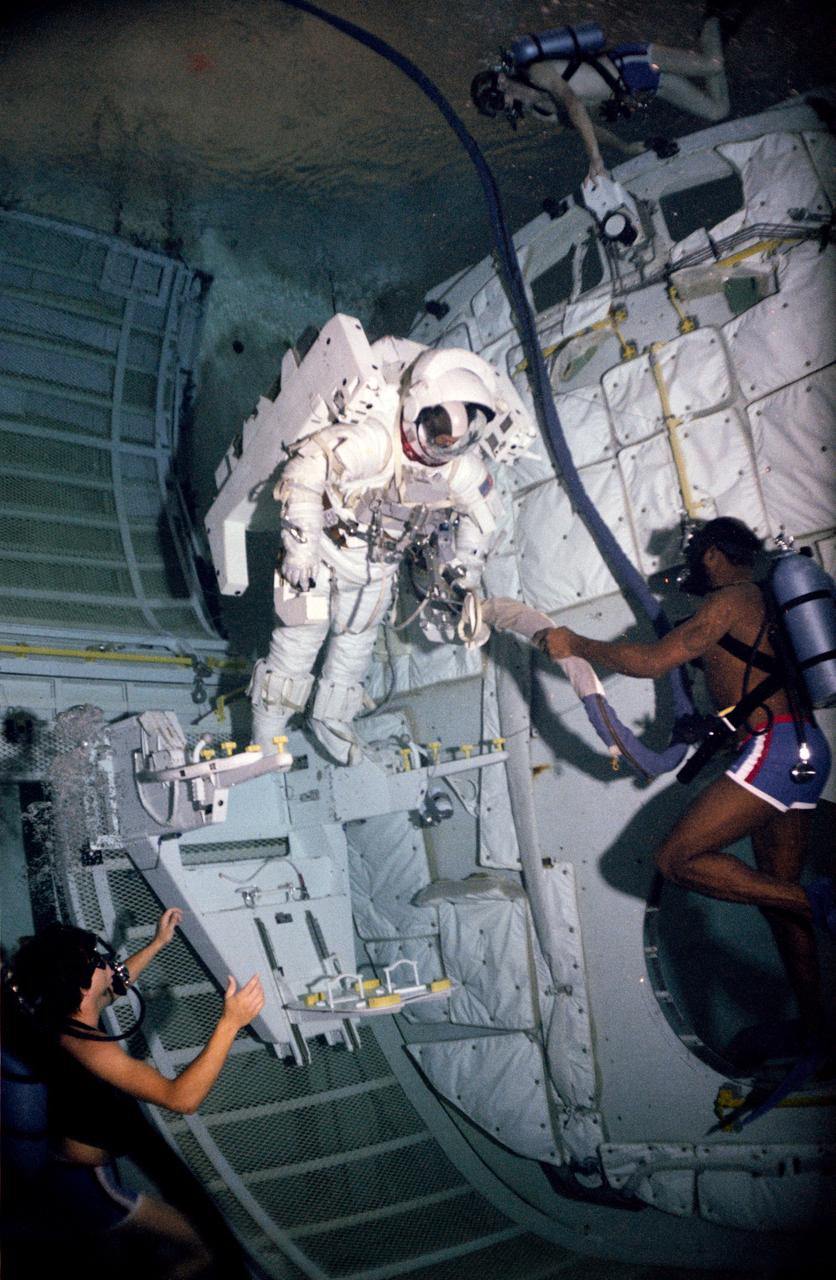
Astronaut Bruce McCandless during an underwater test of the Manned Maneuvering Unit (MMU) Flight Support Station (FSS) donning and doffing in the Bldg 29 Weightless Environment Training Facility (WETF). View is of McCandless wearing the extravehicular mobility unit (EMU), stepping into the MMU.
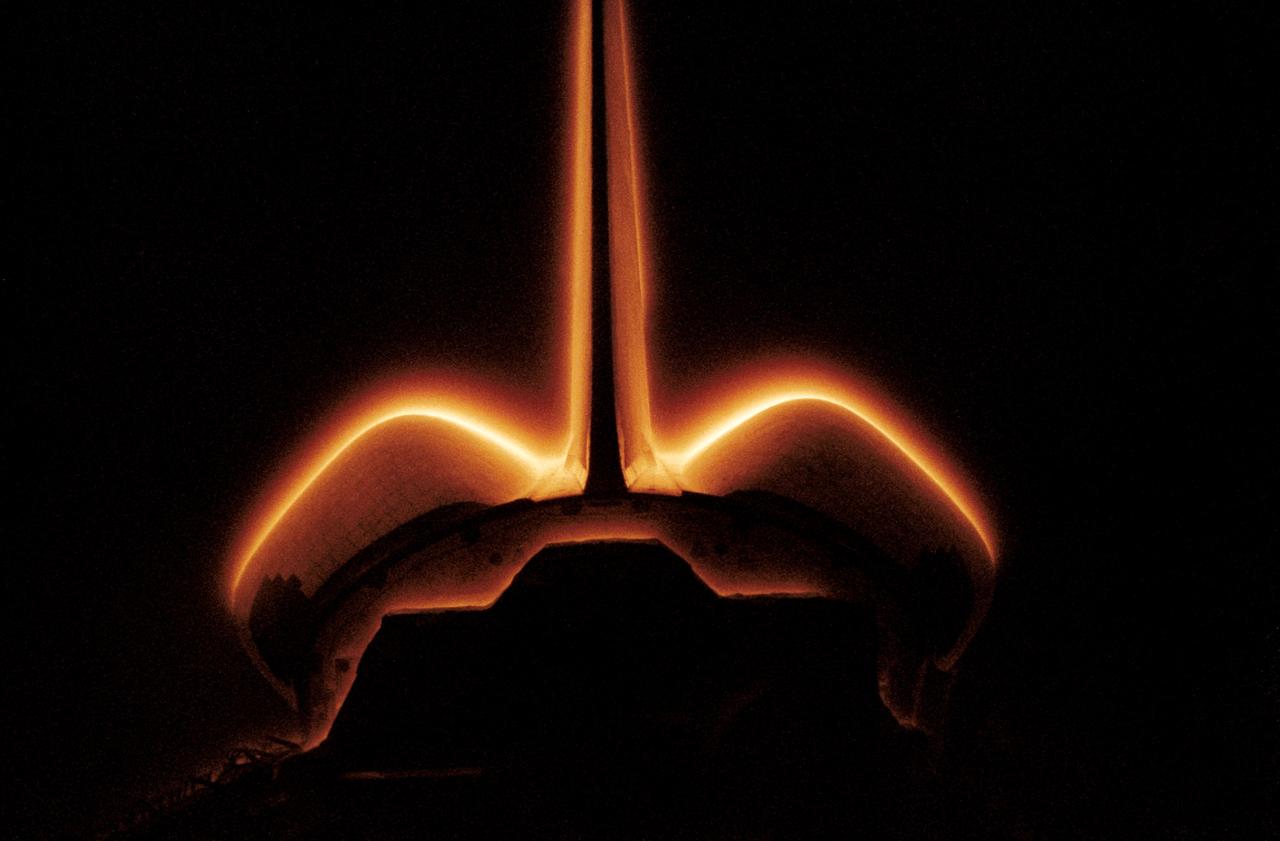
STS062-42-026 (4-18 March 1994) --- This 35mm frame, photographed as the Space Shuttle Columbia was orbiting Earth during a "night" pass, documents the glow phenomenon surrounding the vertical stabilizer and the Orbital Maneuvering System (OMS) pods of the spacecraft.
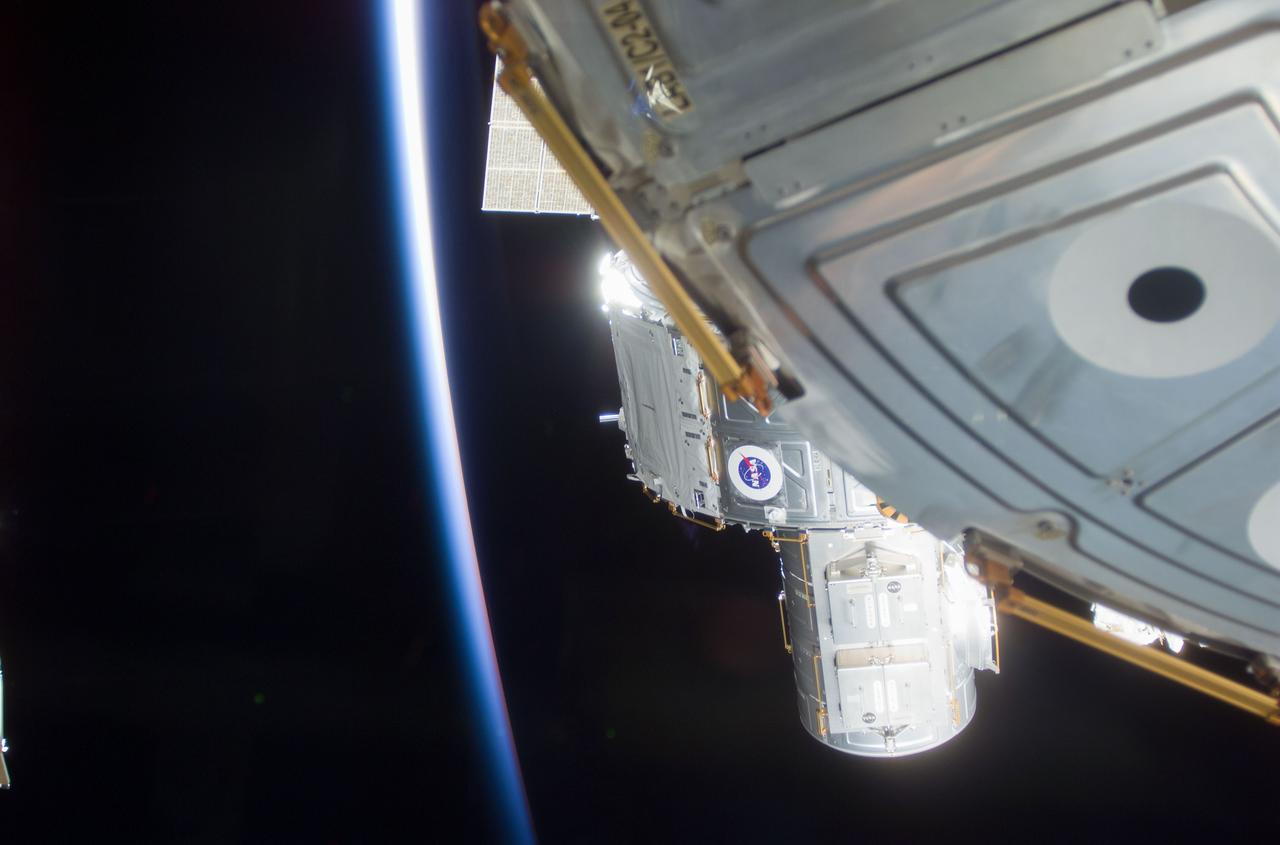
S104-E-5071 (15 July 2001) --- As the sun sets behind the Earth's horizon, the Expedition Two and STS-104 crews continue to install the Quest Airlock onto the starboard side of Unity Node 1. Susan J. Helms, Expedition Two flight engineer, working in the Destiny U.S. Laboratory, maneuvered the Airlock into place with the Canadarm2, Space Station Remote Manipulator System (SSRMS), while being assisted by Michael L. Gernhardt and James F. Reilly, STS-104 mission specialists, during their first extravehicular activity (EVA).
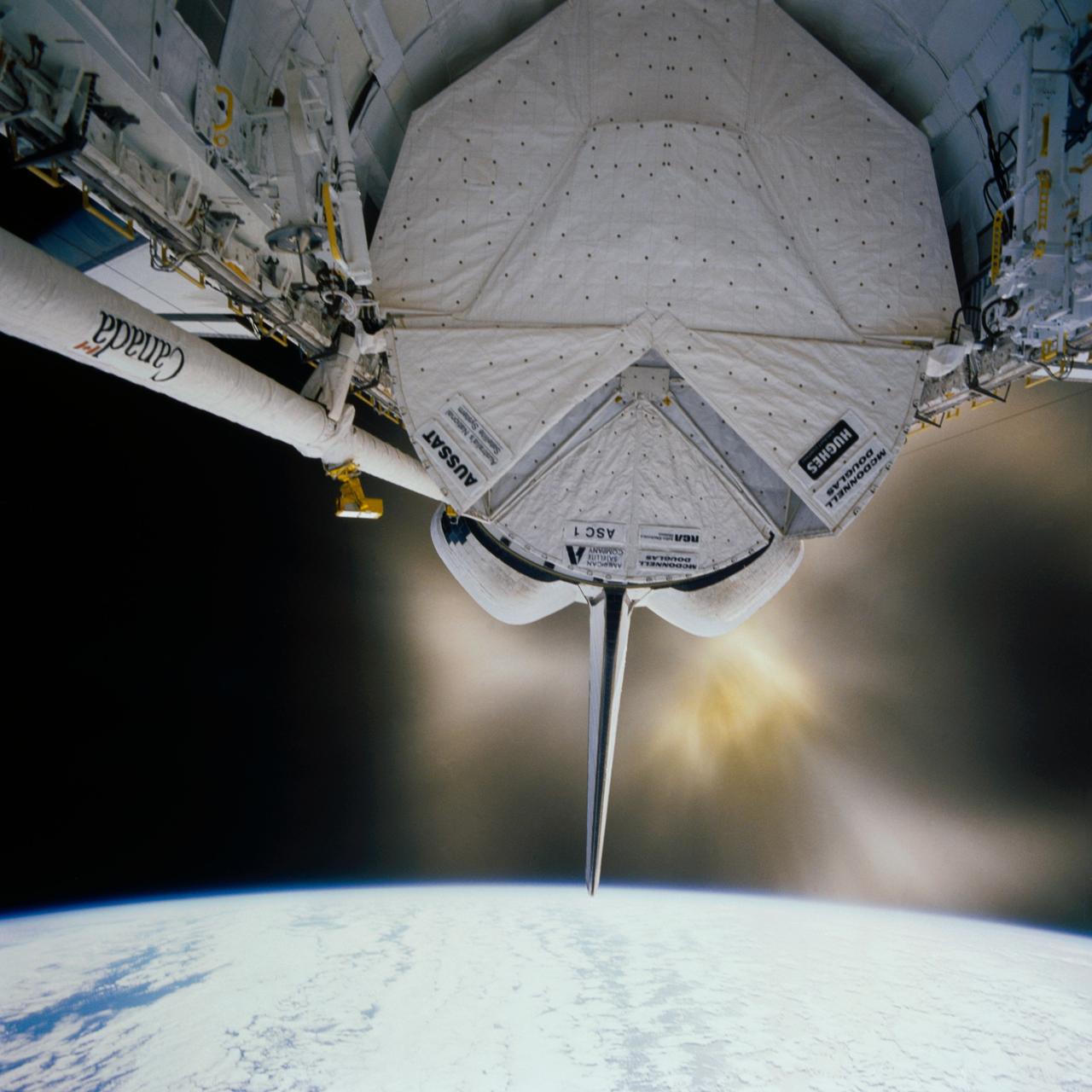
View of a single engine orbital maneuvering system (OMS) firing on the Discovery. The payload bay is open and the protective canisters for the AUSSAT communications satellite (open) and the ASC-1 are visible. A cloudy Earth's horizon can be seen above the orbiter.
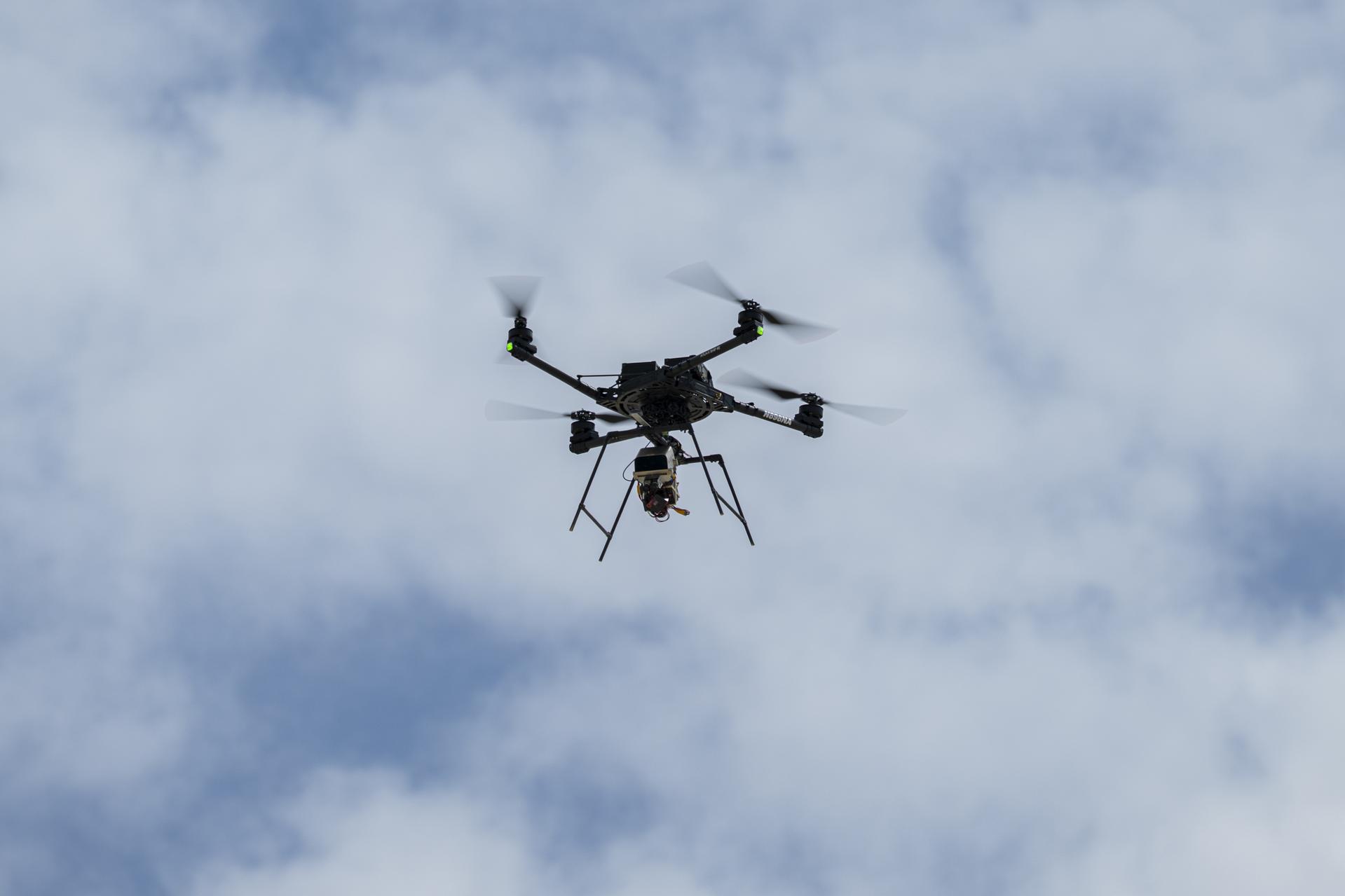
An Alta-X drone flies an advanced guidance and navigation system known as the Safe and Precise Landing – Integrated Capabilities Evolution (SPLICE) experiment near NASA’s Armstrong Flight Research Center in Edwards, California, on Thursday, Aug. 27, 2026. Researchers at NASA’s Johnson Space Center in Houston developed SPLICE, which successfully completed simulated lunar descent and landing maneuvers during recent testing. SPLICE will help spacecraft land precisely and detect and avoid potential hazards, which is critical for NASA missions to the Moon and to Mars.
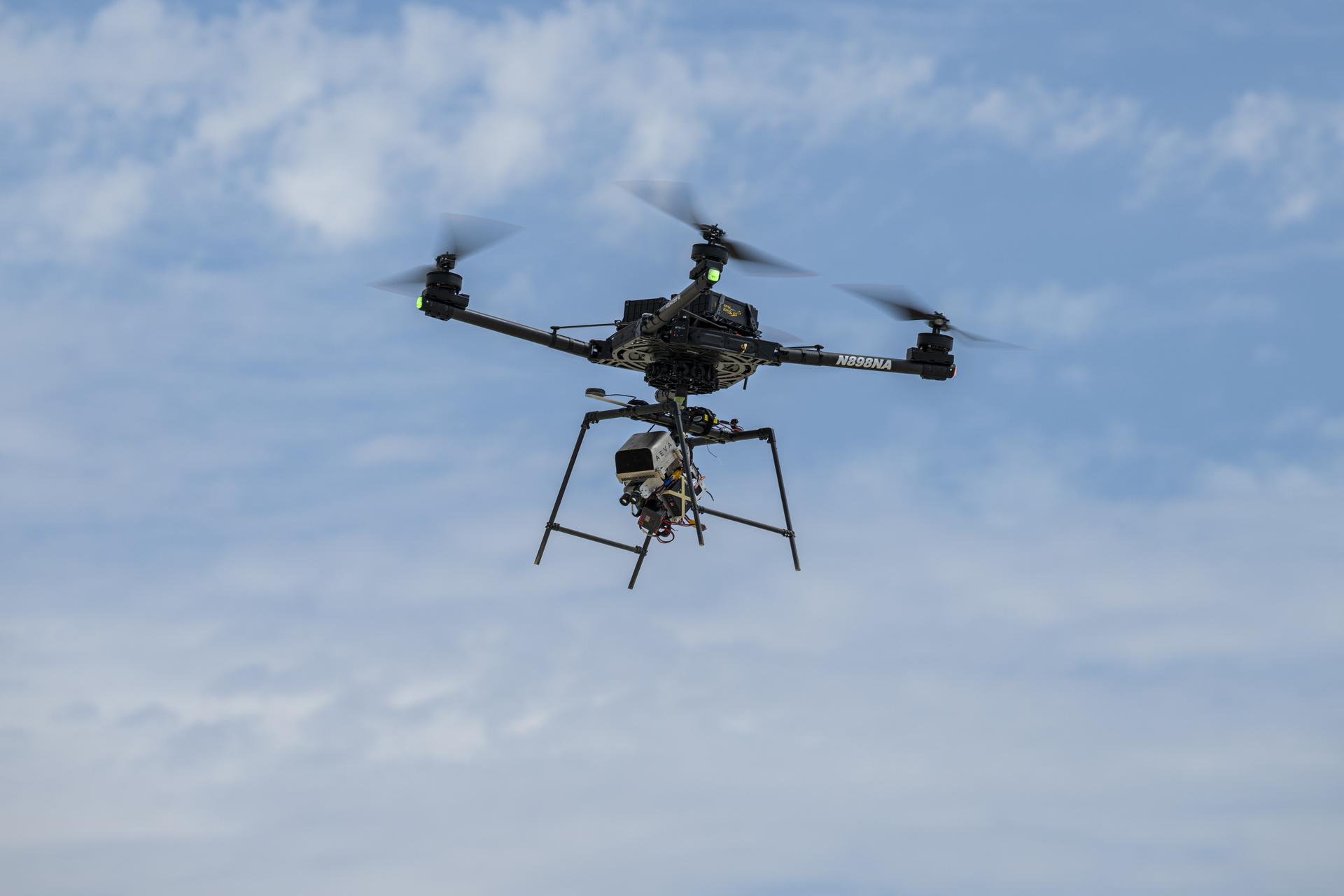
An Alta-X drone flies an advanced guidance and navigation system known as the Safe and Precise Landing – Integrated Capabilities Evolution (SPLICE) experiment near NASA’s Armstrong Flight Research Center in Edwards, California, on Thursday, Aug. 27, 2026. Researchers at NASA’s Johnson Space Center in Houston developed SPLICE, which successfully completed simulated lunar descent and landing maneuvers during recent testing. SPLICE will help spacecraft land precisely and detect and avoid potential hazards, which is critical for NASA missions to the Moon and to Mars.
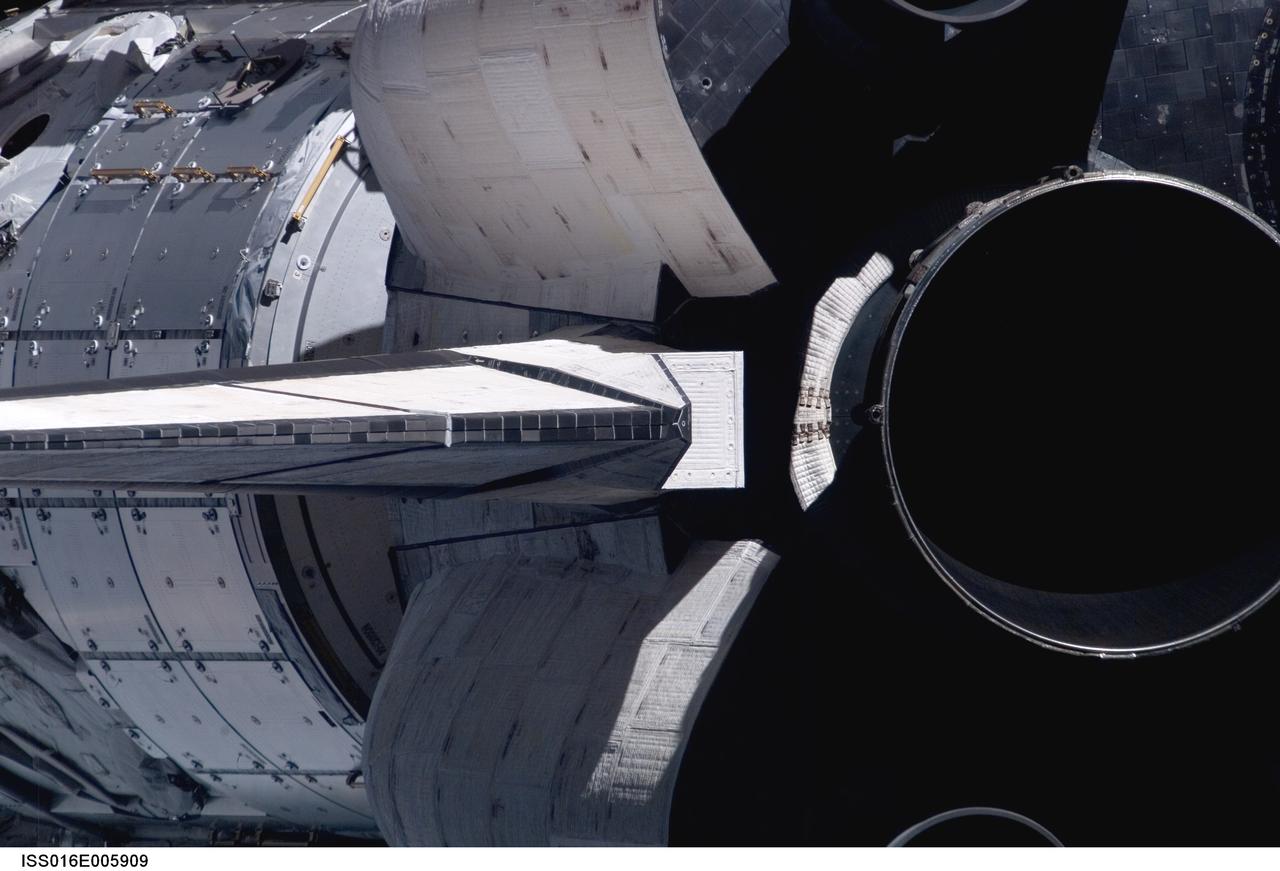
ISS016-E-005909 (25 Oct. 2007) --- A close-up view of Space Shuttle Discovery's tail section is featured in this image photographed by an Expedition 16 crewmember during a backflip maneuver performed by the approaching visitors (STS-120) to the International Space Station. The image provides partial views of the shuttle's main engines, orbital maneuvering system (OMS) pods, vertical stabilizer and the Harmony node in the payload bay.
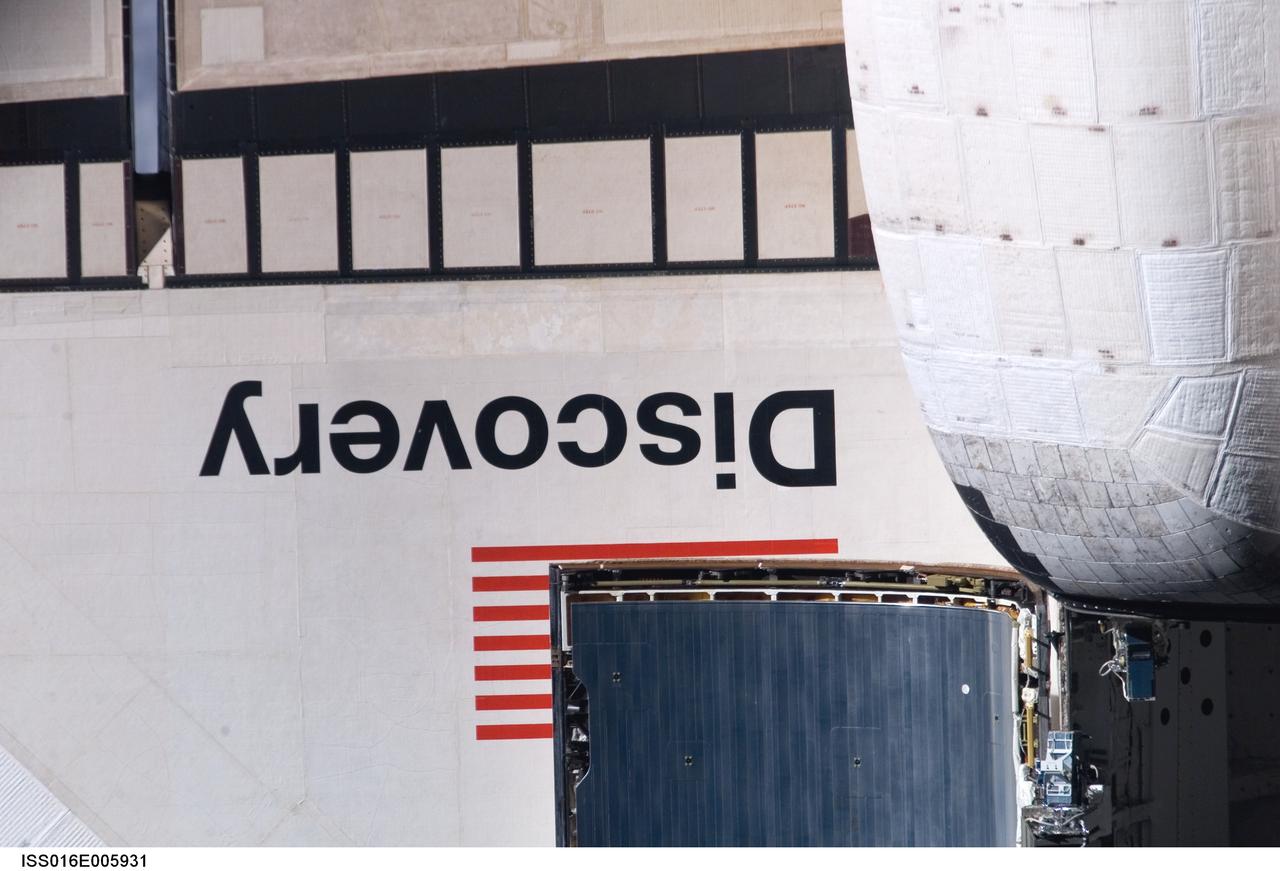
ISS016-E-005931 (25 Oct. 2007) --- A close-up view of Space Shuttle Discovery's wing section is provided by this image photographed by an Expedition 16 crewmember during a backflip maneuver performed by the approaching visitors (STS-120) to the International Space Station. Also visible are partial views of the orbital maneuvering system (OMS) pods and a portion of the payload bay door panels.
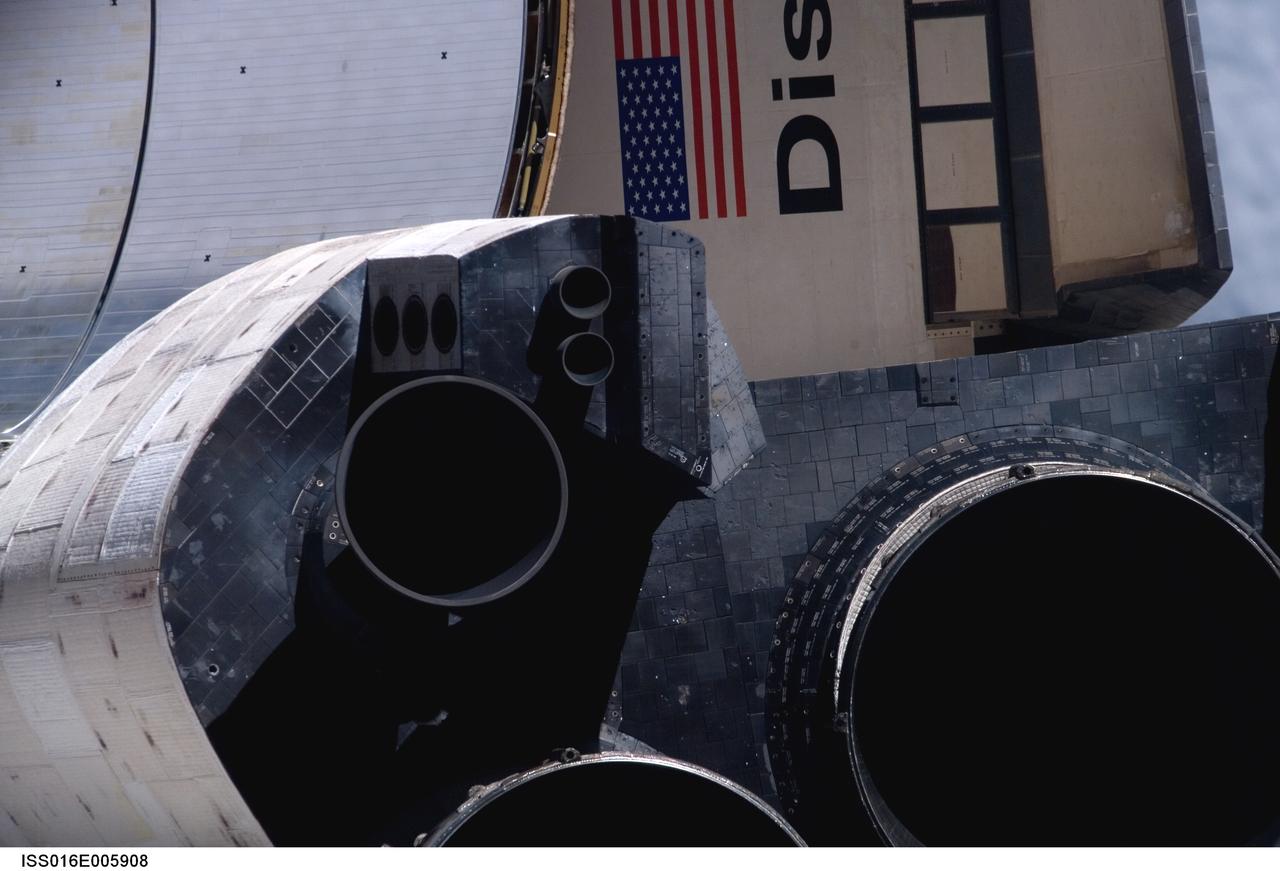
ISS016-E-005908 (25 Oct. 2007) --- A close-up view of Space Shuttle Discovery's tail section is featured in this image photographed by an Expedition 16 crewmember during a backflip maneuver performed by the approaching visitors (STS-120) to the International Space Station. The image provides partial views of the shuttle's main engines, orbital maneuvering system (OMS) pods, a portion of the payload bay door panels and the shuttle's wings.
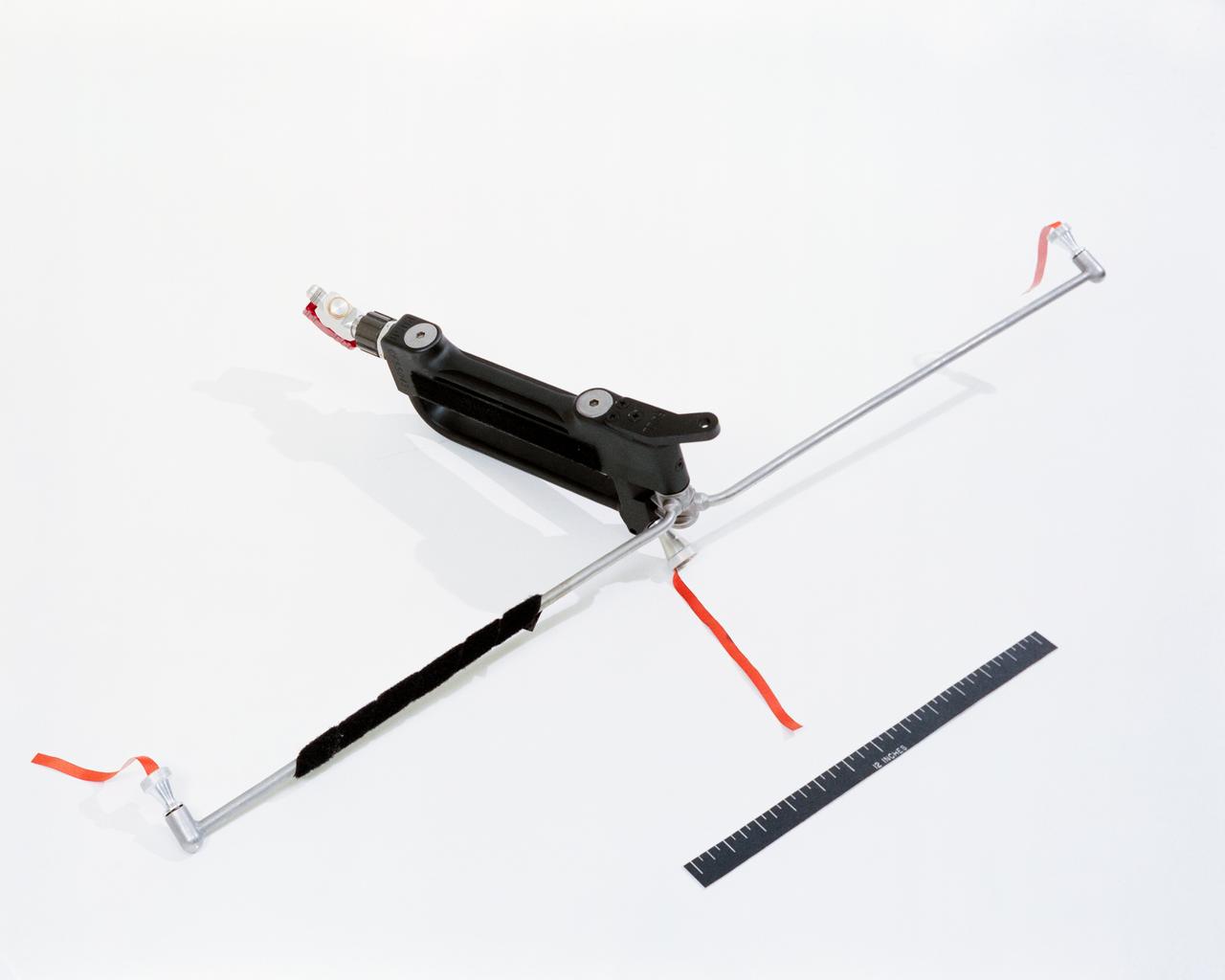
S66-19184 (1966) --- Close-up view of the Hand Held Maneuvering Unit which will be used by astronaut David R. Scott during the extravehicular activity on the Gemini-8 spaceflight. High pressure cold gas released through the unit's nozzles produces the required controlled thrust to maneuver in a zero-gravity environment. Photo credit: NASA
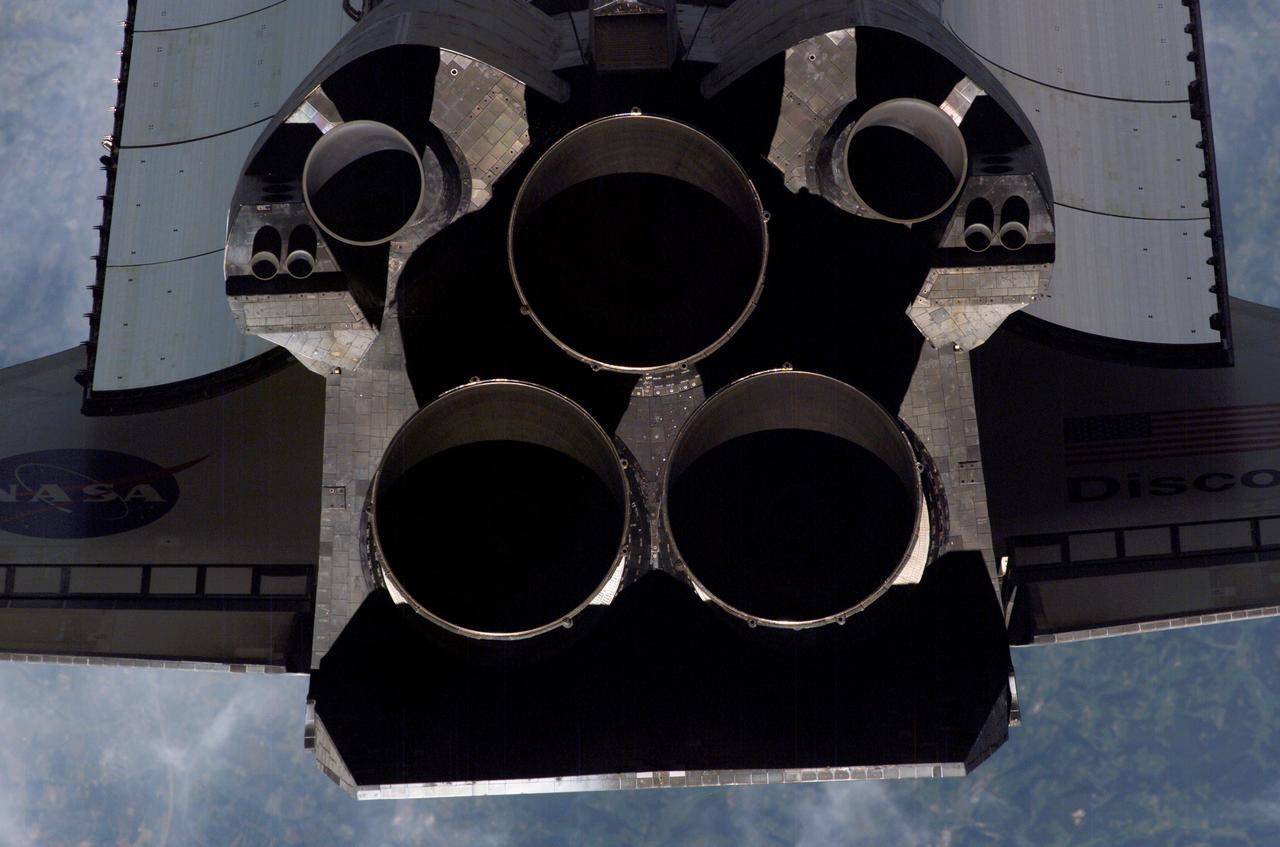
ISS013-E-47629 (6 July 2006) --- A close-up view of Space Shuttle Discovery's tail section is featured in this image photographed by an Expedition 13 crewmember on the International Space Station during STS-121 R-Pitch Maneuver survey on Flight Day 3. Visible are the shuttle's main engines, vertical stabilizer, orbital maneuvering system (OMS) pods, reaction control system (RCS) jets and a portion of payload bay door radiator and wings.
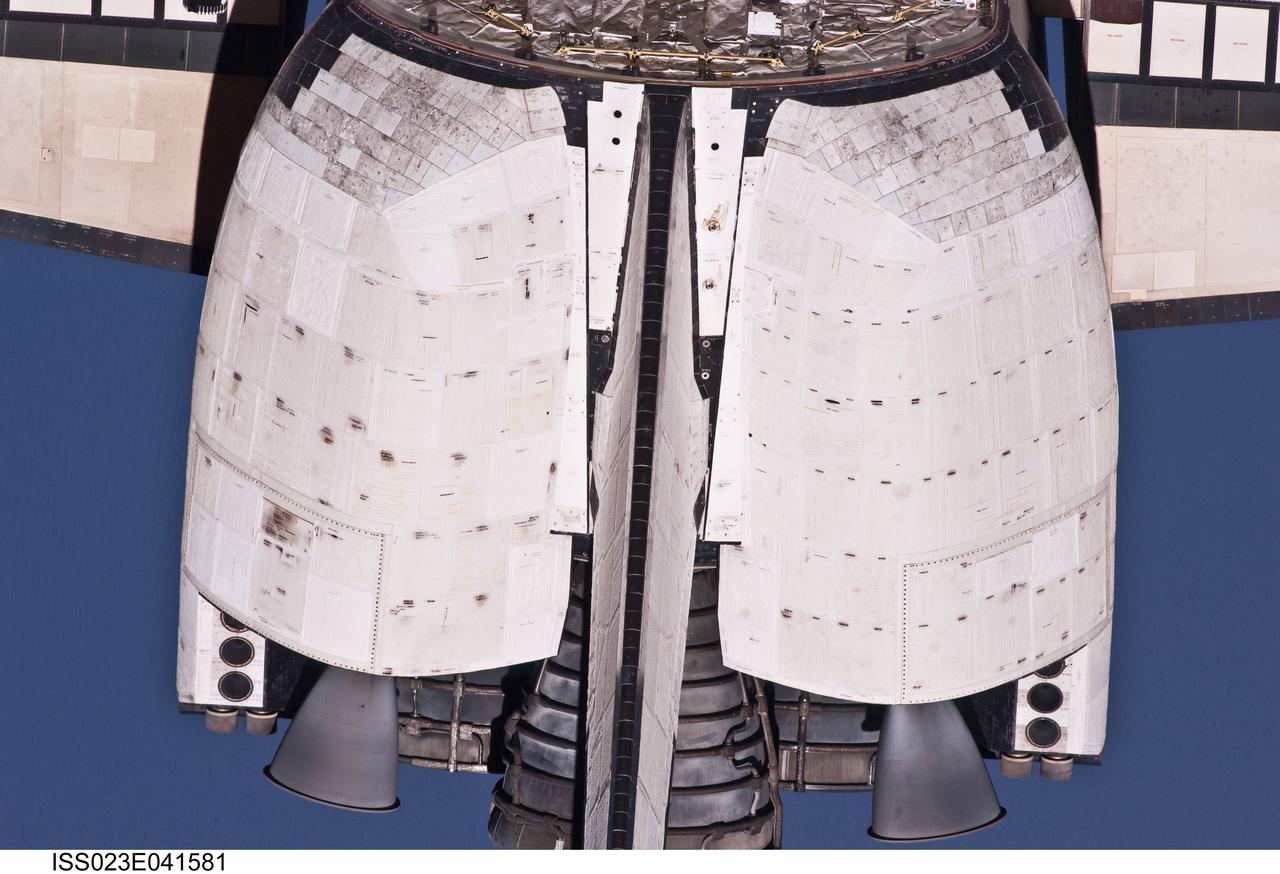
ISS023-E-041581 (16 May 2010) --- This close-up view of the vertical stabilizer and orbital maneuvering system (OMS) pods of the space shuttle Atlantis was provided by an Expedition 23 crew member during a survey of the approaching STS-132 vehicle prior to docking with the International Space Station. As part of the survey and part of every mission's activities, Atlantis performed a back-flip for the rendezvous pitch maneuver (RPM). The image was photographed with a digital still camera, using a 400mm lens at a distance of about 600 feet (180 meters).
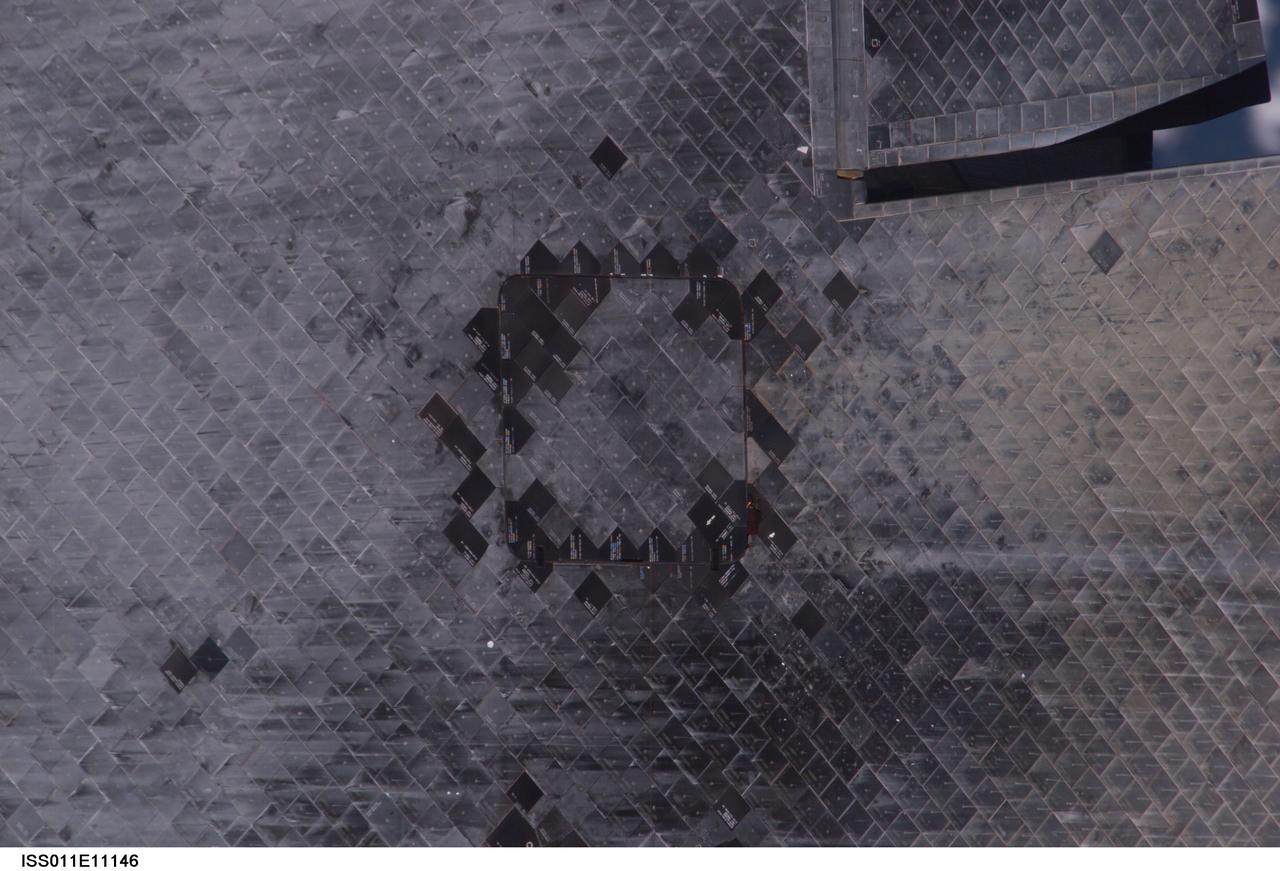
ISS011-E-11146 (28 July 2005) --- View of the Space Shuttle Discovery's underside (near Orbital Maneuvering System pod), photographed as part of the survey sequence performed by the Expedition 11 crew during the STS-114 R-Bar Pitch Maneuver on Flight Day 3. This picture was used by Steve M. Poulos, Jr. Manager, Space Shuttle Vehicle Engineering Office, as one of his visual aids in a July 28, 2005 press conference in the Teague Auditorium at the Johnson Space Center.
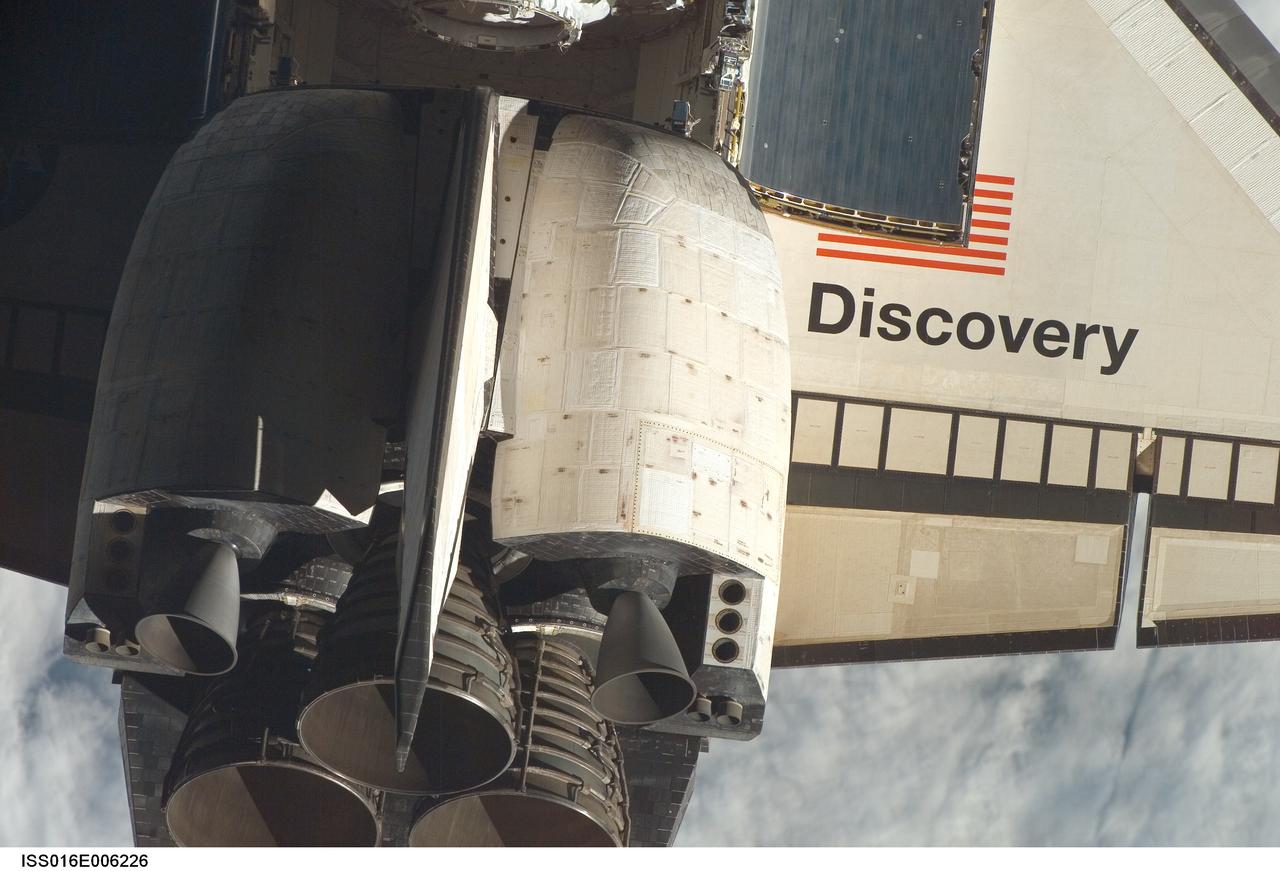
ISS016-E-006226 (25 Oct. 2007) --- Space Shuttle Discovery's tail section is featured in this close-up image photographed by an Expedition 16 crewmember during a backflip maneuver performed by the approaching visitors (STS-120) to the International Space Station. The image provides partial views of the shuttle's main engines, starboard wing section, orbital maneuvering system (OMS) pods, vertical stabilizer and payload bay door panels.
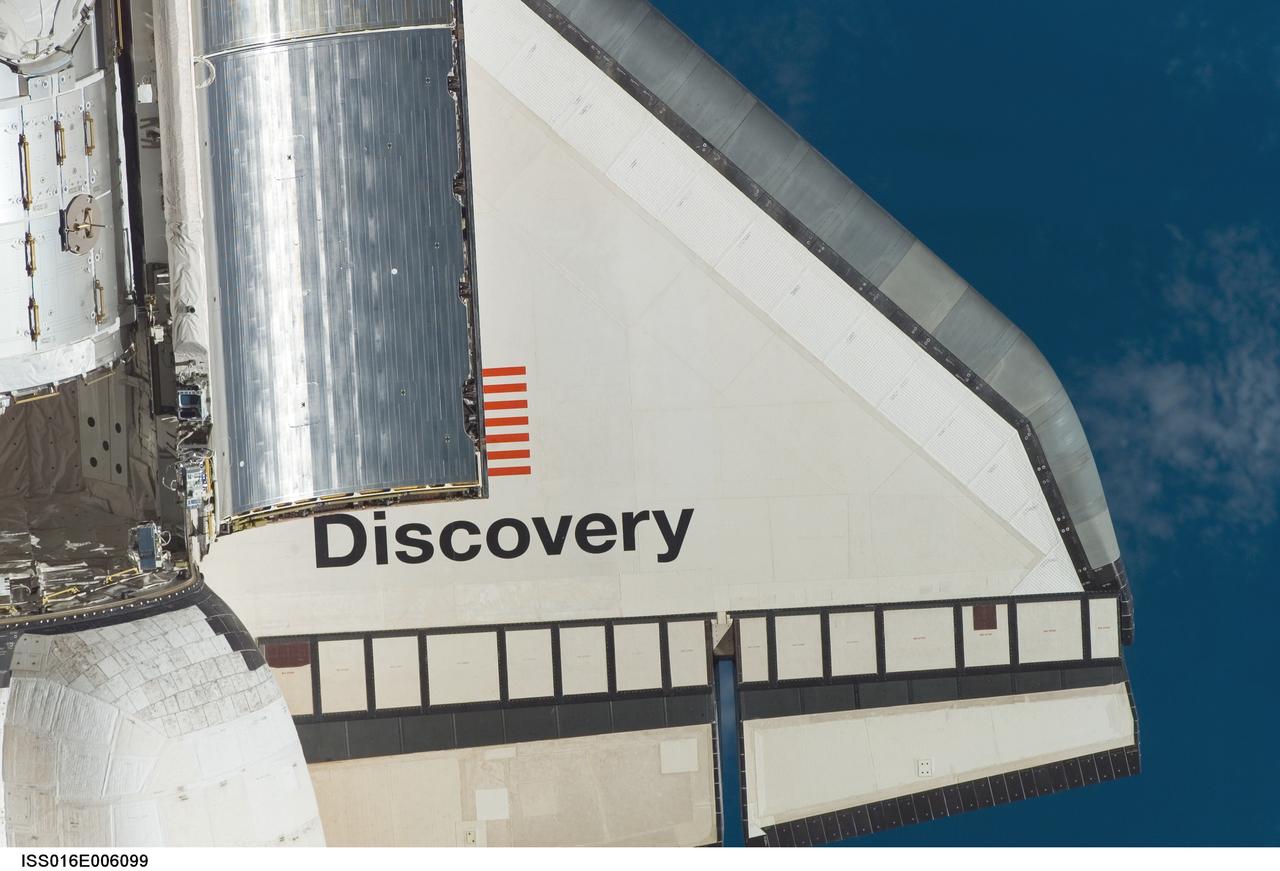
ISS016-E-006099 (25 Oct. 2007) --- Space Shuttle Discovery's starboard wing section is featured in this close-up image photographed by an Expedition 16 crewmember during a backflip maneuver performed by the approaching visitors (STS-120) to the International Space Station. Also visible are partial views of the orbital maneuvering system (OMS) pods and a portion of the Harmony node and payload bay door panels.
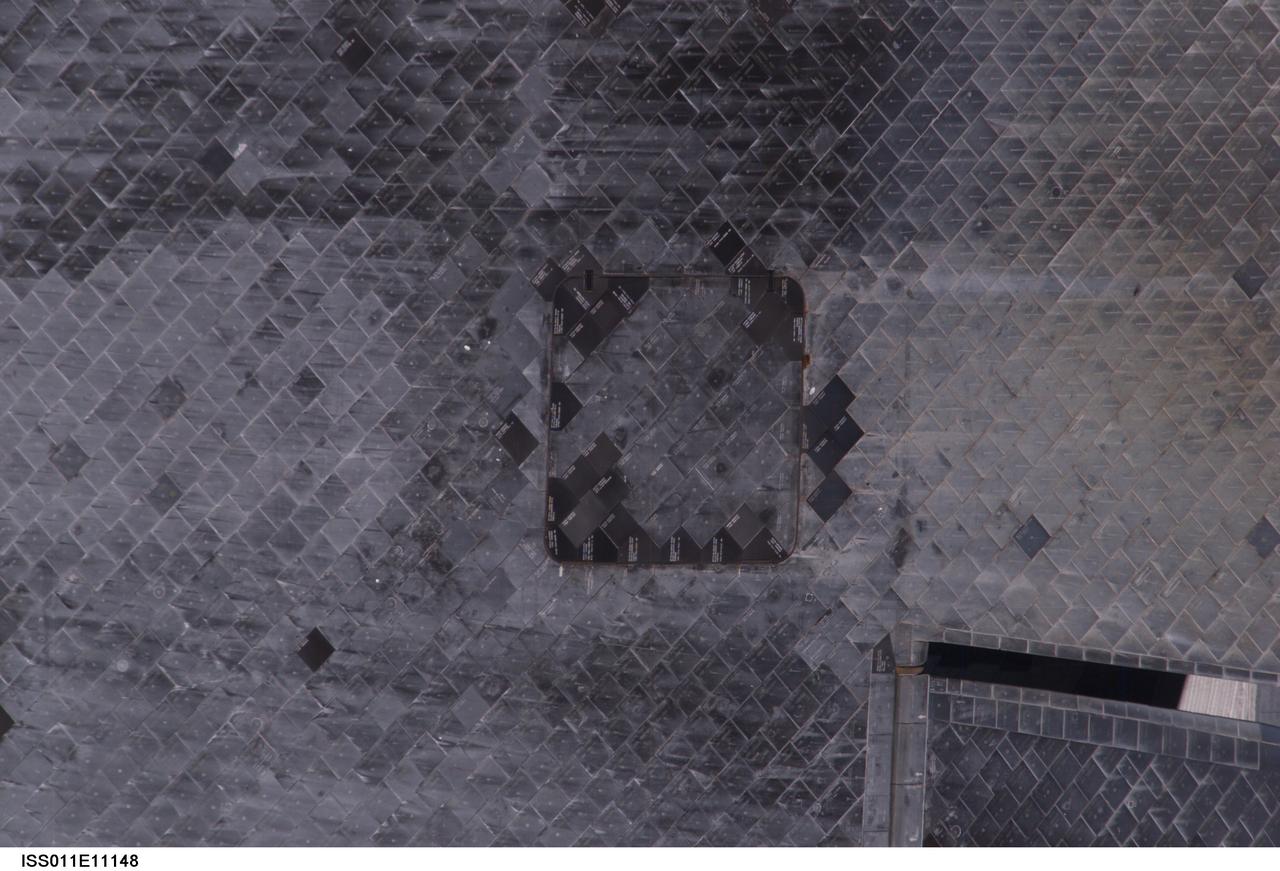
ISS011-E-11148 (28 July 2005) --- View of the Space Shuttle Discovery's underside (near the Orbital Maneuvering System pod), photographed as part of the survey sequence performed by the Expedition 11 crew during the STS-114 R-Bar Pitch Maneuver on Flight Day 3. This picture was used by Steve M. Poulos, Jr. Manager, Space Shuttle Vehicle Engineering Office, as one of his visual aids in a July 28, 2005 press conference in the Teague Auditorium at the Johnson Space Center.
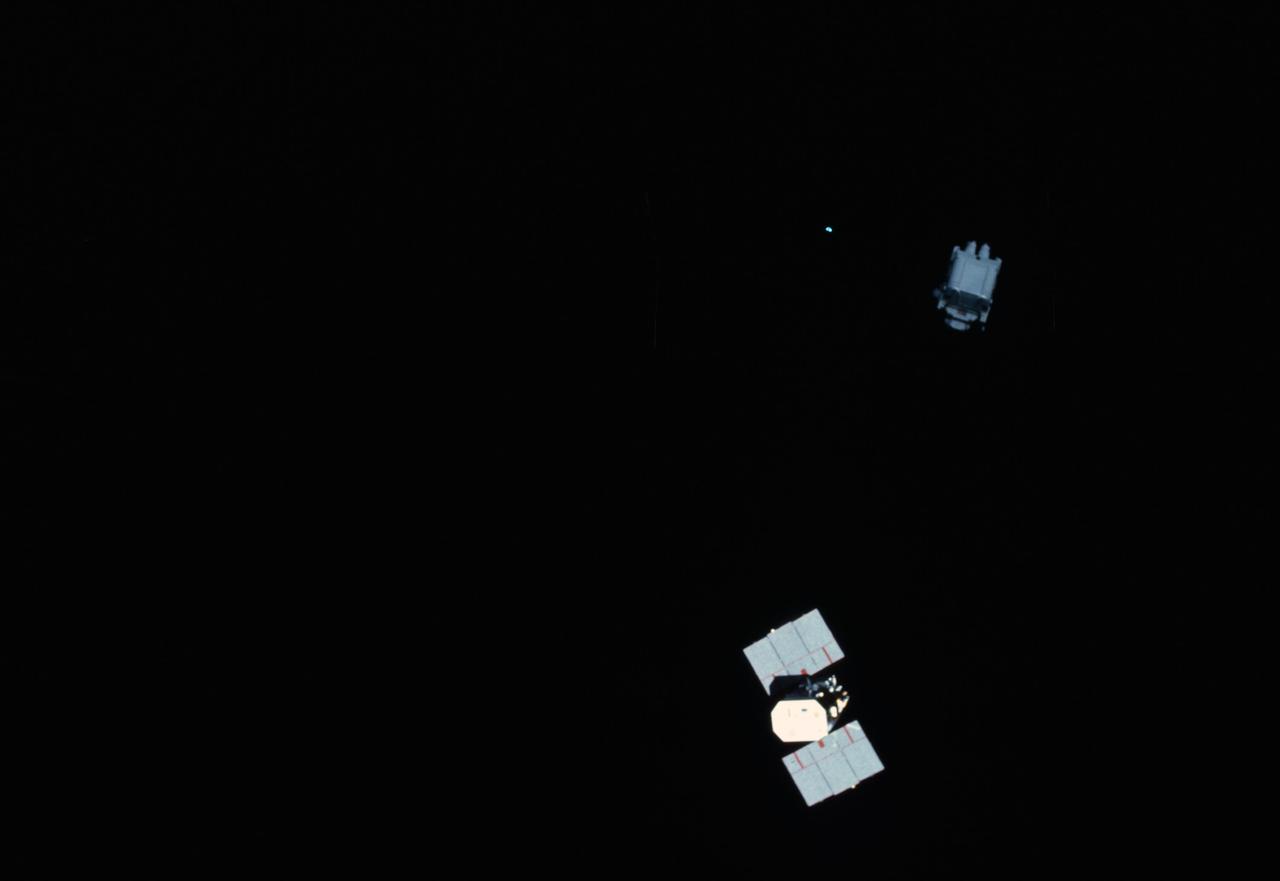
41C-22-885 (8 April 1984) --- The 35mm camera was used to photograph this scene of Astronaut George D. Nelson, STS-41C mission specialist, as he uses the manned maneuvering unit (MMU) to make an excursion to the plagued Solar Maximum, Mission Satellite (SMMS)._Astronaut James D. van Hoften remained in the Challenger's cargo bay during the April 8 extravehicular activity (EVA).
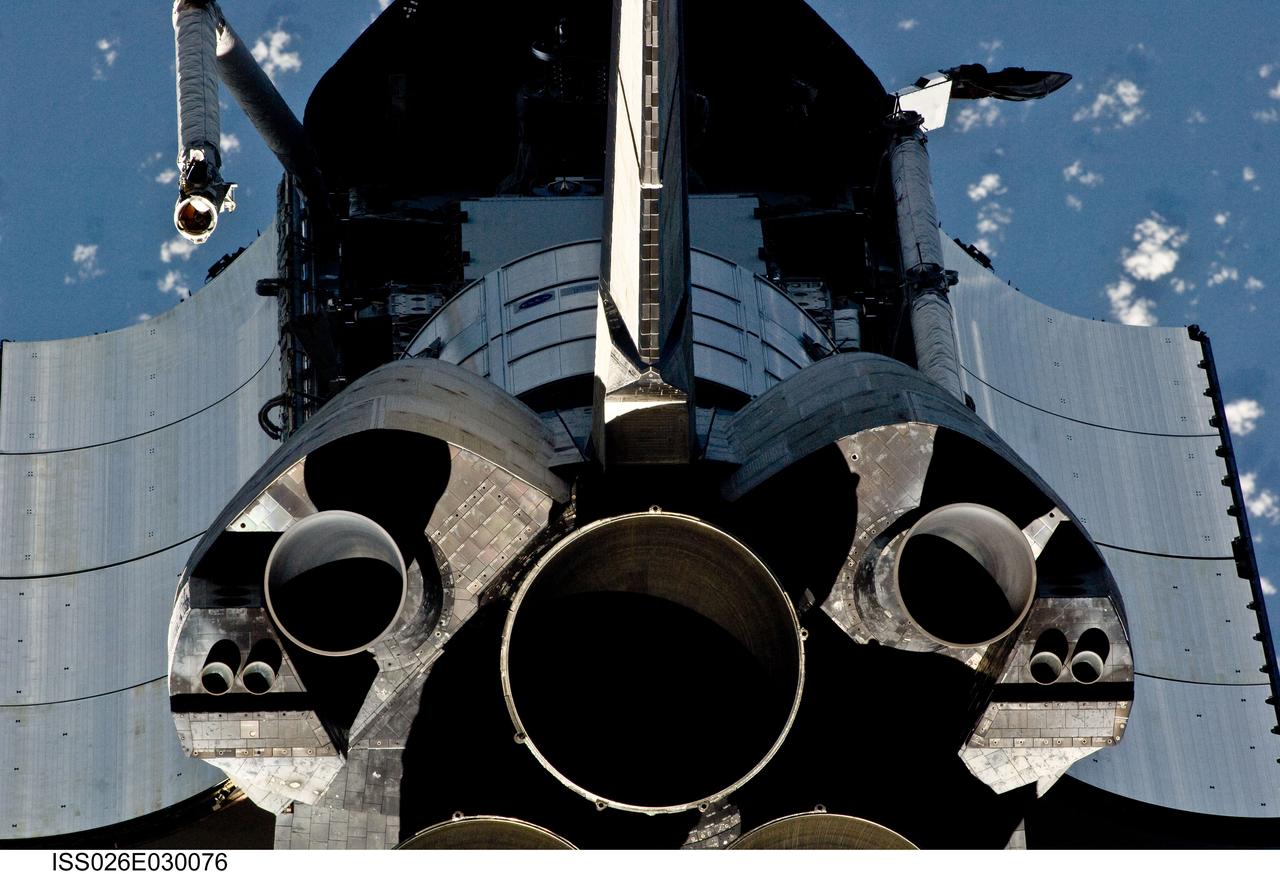
ISS026-E-030076 (26 Feb. 2011) --- This view of the aft portion of the space shuttle Discovery, including main engines, part of the cargo bay, vertical stabilizer and orbital maneuvering system (OMS) pods was provided by an Expedition 26 crew member during a survey of the approaching STS-133 vehicle prior to docking with the International Space Station. As part of the survey and part of every mission's activities, Discovery performed a back-flip for the rendezvous pitch maneuver (RPM). The image was photographed with a digital still camera, using a 400mm lens at a distance of about 600 feet (180 meters).
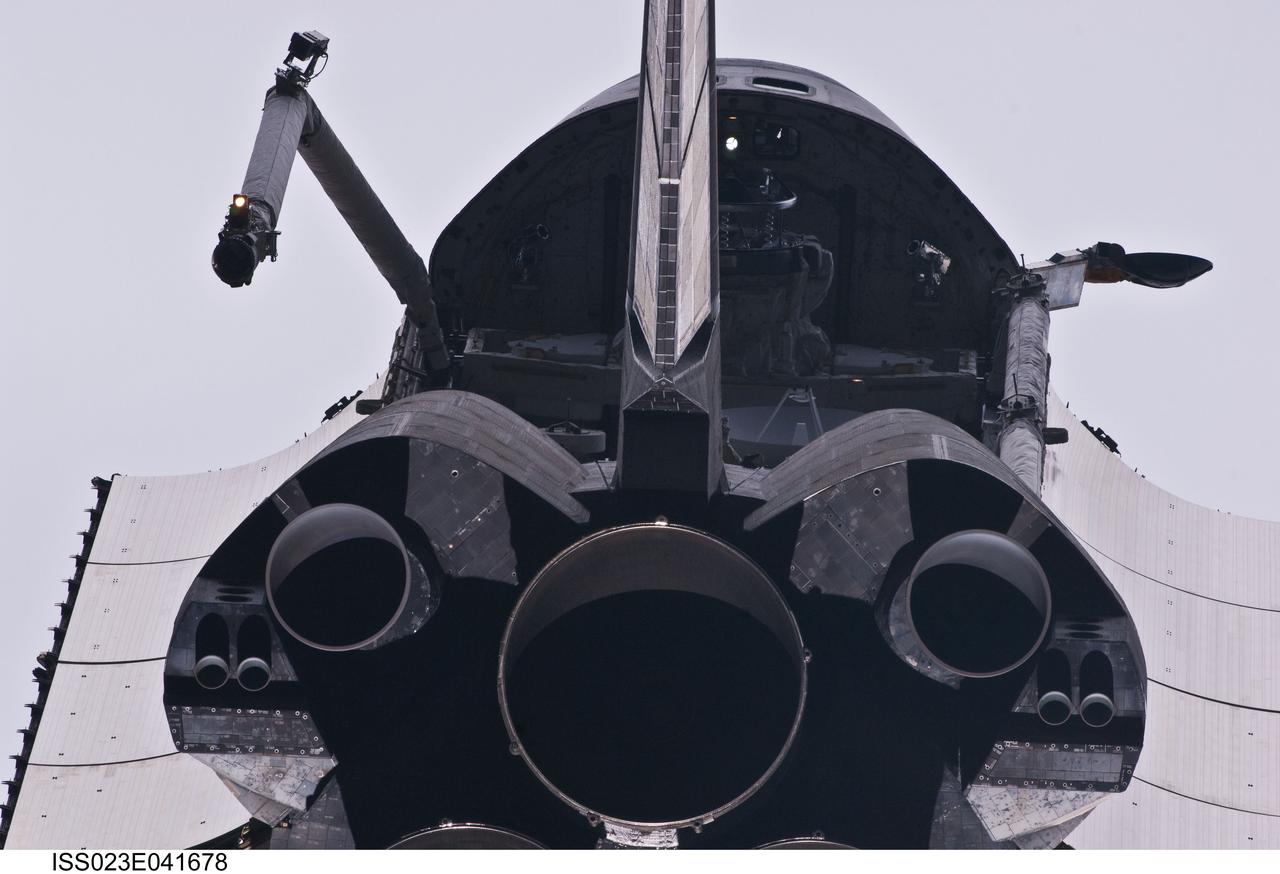
ISS023-E-041678 (16 May 2010) --- This view of the aft portion of the space shuttle Atlantis, including main engines, part of the cargo bay, vertical stabilizer and orbital maneuvering system (OMS) pods was provided by an Expedition 23 crew member during a survey of the approaching STS-132 vehicle prior to docking with the International Space Station. As part of the survey and part of every mission's activities, Atlantis performed a back-flip for the rendezvous pitch maneuver (RPM). The image was photographed with a digital still camera, using a 400mm lens at a distance of about 600 feet (180 meters).
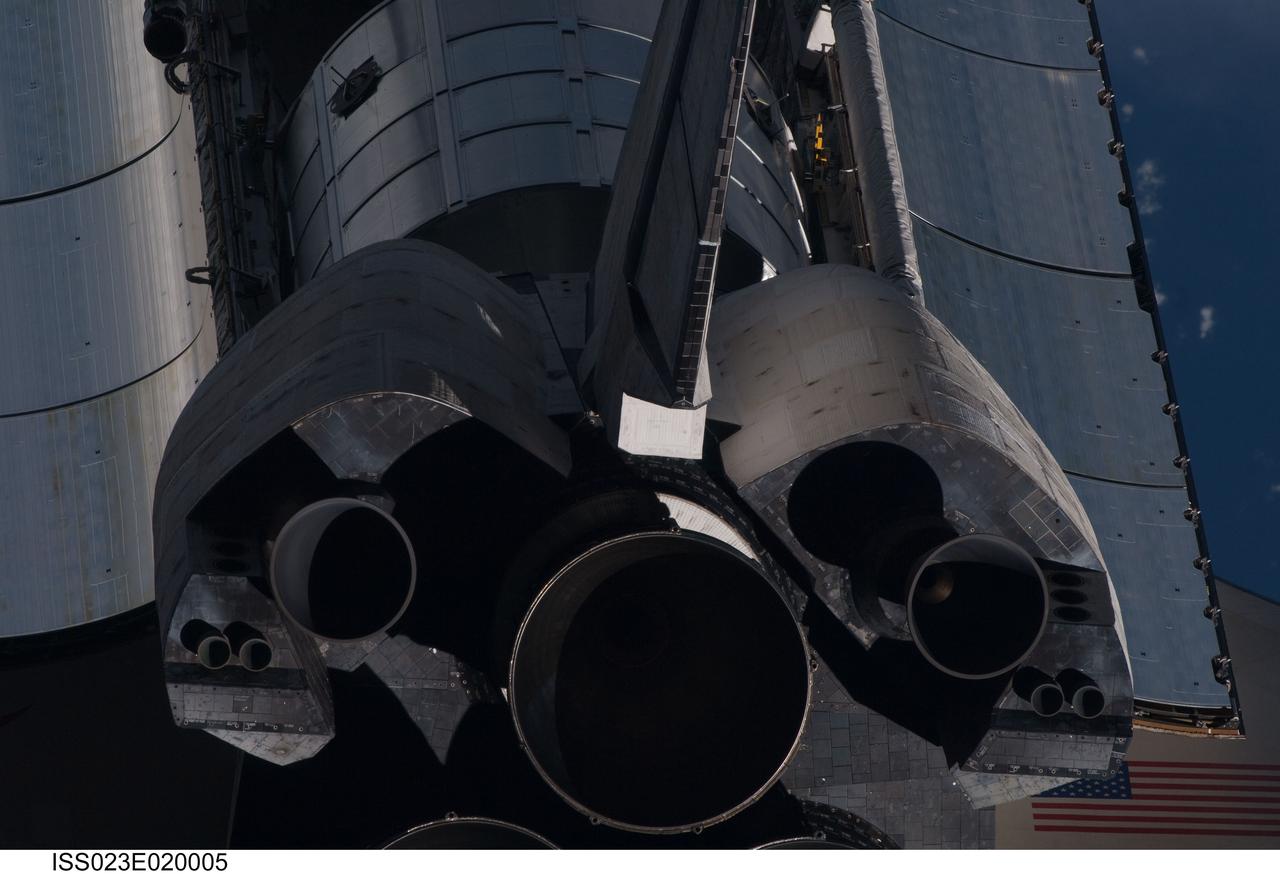
ISS023-E-020005 (7 April 2010) --- This view of the aft portion of the space shuttle Discovery, including the three main engines, part of the cargo bay, vertical stabilizer and orbital maneuvering system (OMS) pods, was provided by an Expedition 23 crew member during a survey of the approaching vehicle prior to docking with the International Space Station. As part of the survey and part of every mission's activities, the STS-131 Discovery crew performed a back-flip for the rendezvous pitch maneuver (RPM). The image was photographed with a digital still camera, using a 400mm lens at a distance of about 600 feet (180 meters). The multi-purpose logistics module Leonardo is visible in the cargo bay.
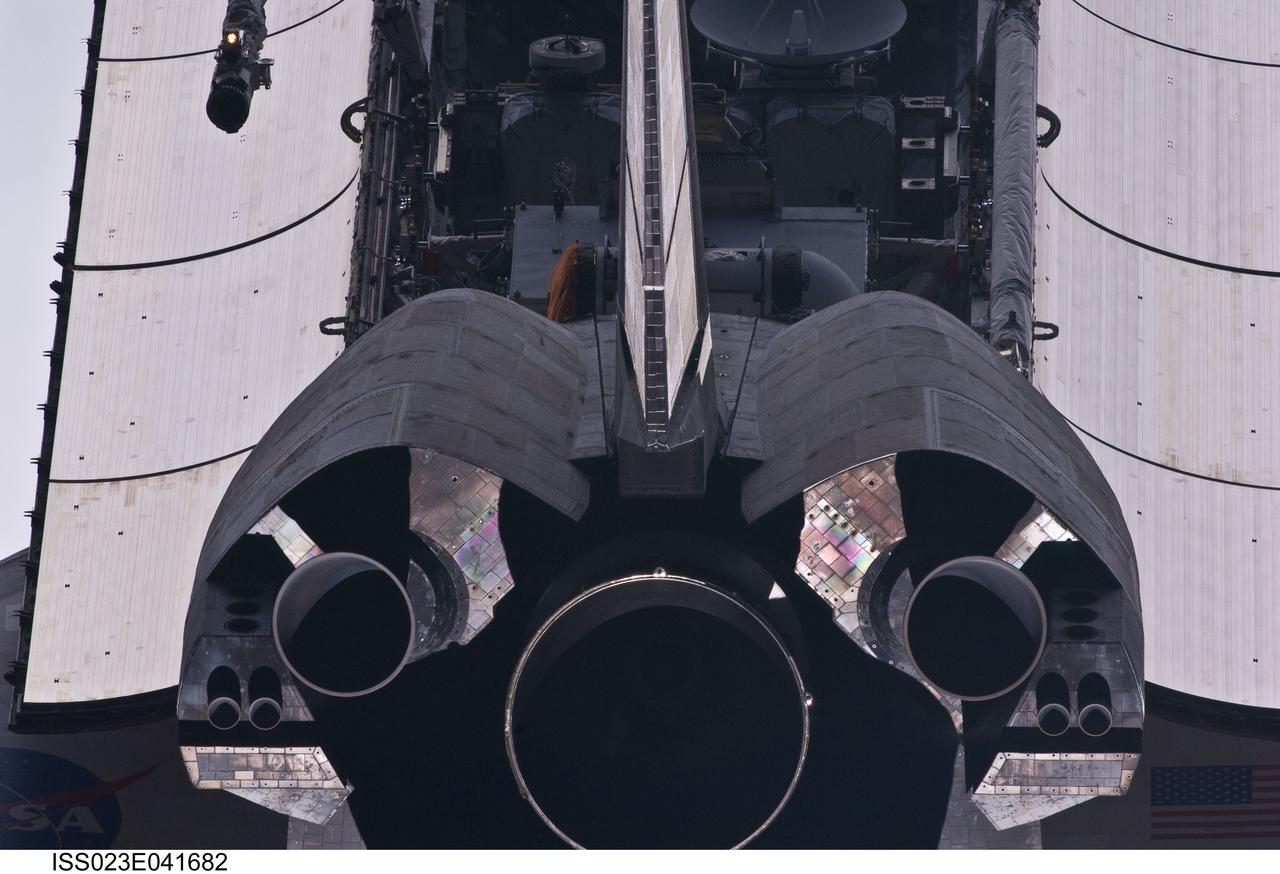
ISS023-E-041682 (16 May 2010) --- This view of the aft portion of the space shuttle Atlantis, including main engines, part of the cargo bay, vertical stabilizer and orbital maneuvering system (OMS) pods was provided by an Expedition 23 crew member during a survey of the approaching STS-132 vehicle prior to docking with the International Space Station. As part of the survey and part of every mission's activities, Atlantis performed a back-flip for the rendezvous pitch maneuver (RPM). The image was photographed with a digital still camera, using a 400mm lens at a distance of about 600 feet (180 meters).
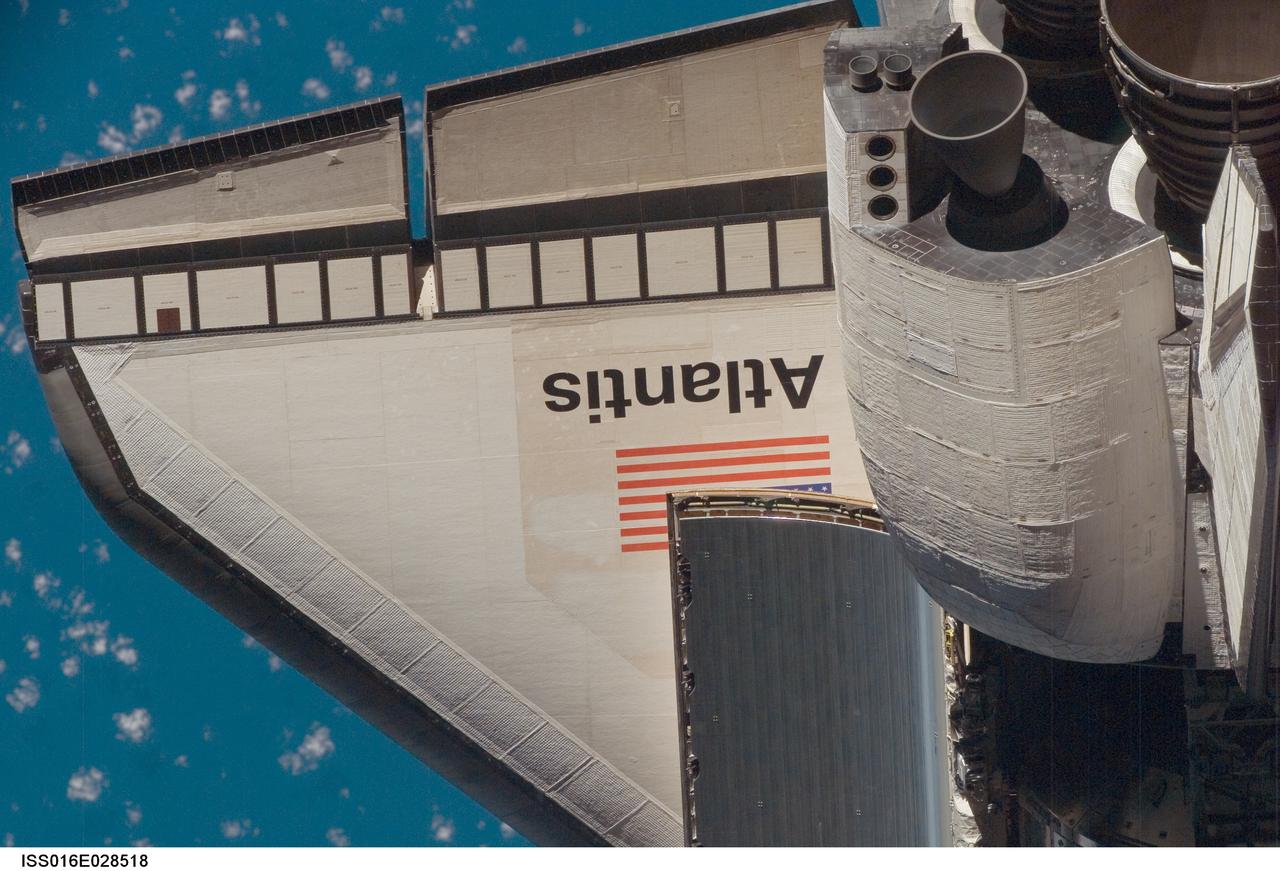
ISS016-E-028518 (9 Feb. 2008) --- An overhead view of part of the Space Shuttle Atlantis' starboard wing and part of its orbital maneuvering system pods was provided by Expedition 16 crewmembers. Before docking with the International Space Station, astronaut Steve Frick, STS-122 commander, flew the shuttle through a roll pitch maneuver or basically a backflip to allow the space station crew a good view of Atlantis' heat shield. Using digital still cameras equipped with both 400 and 800 millimeter lenses, the ISS crewmembers took a number of photos of the shuttle's thermal protection system and sent them down to teams on the ground for analysis. A 400 millimeter lens was used for this image.
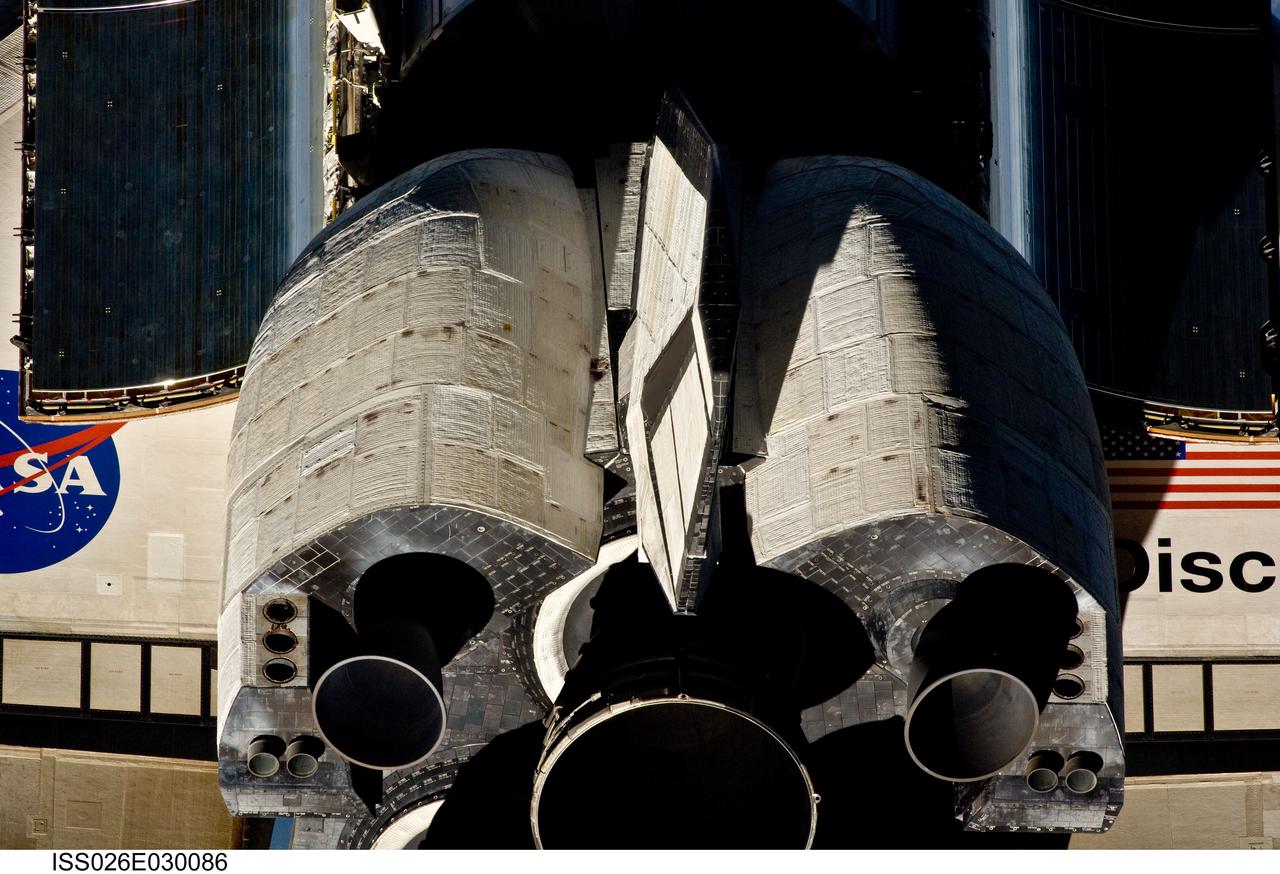
ISS026-E-030086 (26 Feb. 2011) --- This view of the aft portion of the space shuttle Discovery, including the three main engines and orbital maneuvering system (OMS) pods, was provided by an Expedition 26 crew member during a survey of the approaching STS-133 vehicle prior to docking with the International Space Station. As part of the survey and part of every mission's activities, Discovery performed a back-flip for the rendezvous pitch maneuver (RPM). The image was photographed with a digital still camera, using a 400mm lens at a distance of about 600 feet (180 meters).
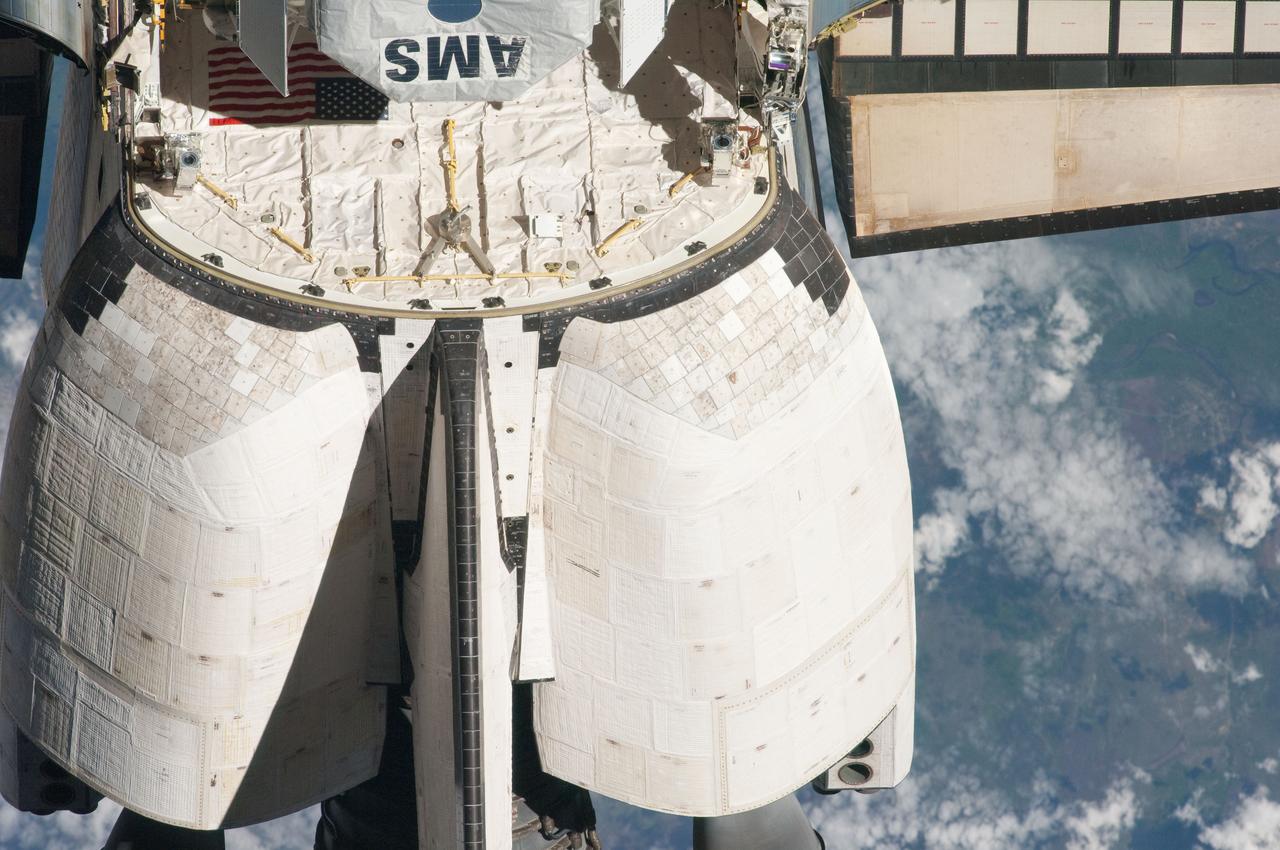
ISS027-E-032241 (18 May 2011) --- This view of the aft portion of the space shuttle Endeavour, including the orbital maneuvering system (OMS) pods and the Alpha Magnetic Spectrometer-2 (AMS) in the payload bay, was provided by an Expedition 27 crew member during a survey of the approaching STS-134 vehicle prior to docking with the International Space Station. As part of the survey and part of every mission's activities, Endeavour performed a back-flip for the rendezvous pitch maneuver (RPM). The image was photographed with a digital still camera, using a 400mm lens at a distance of about 600 feet (180 meters).
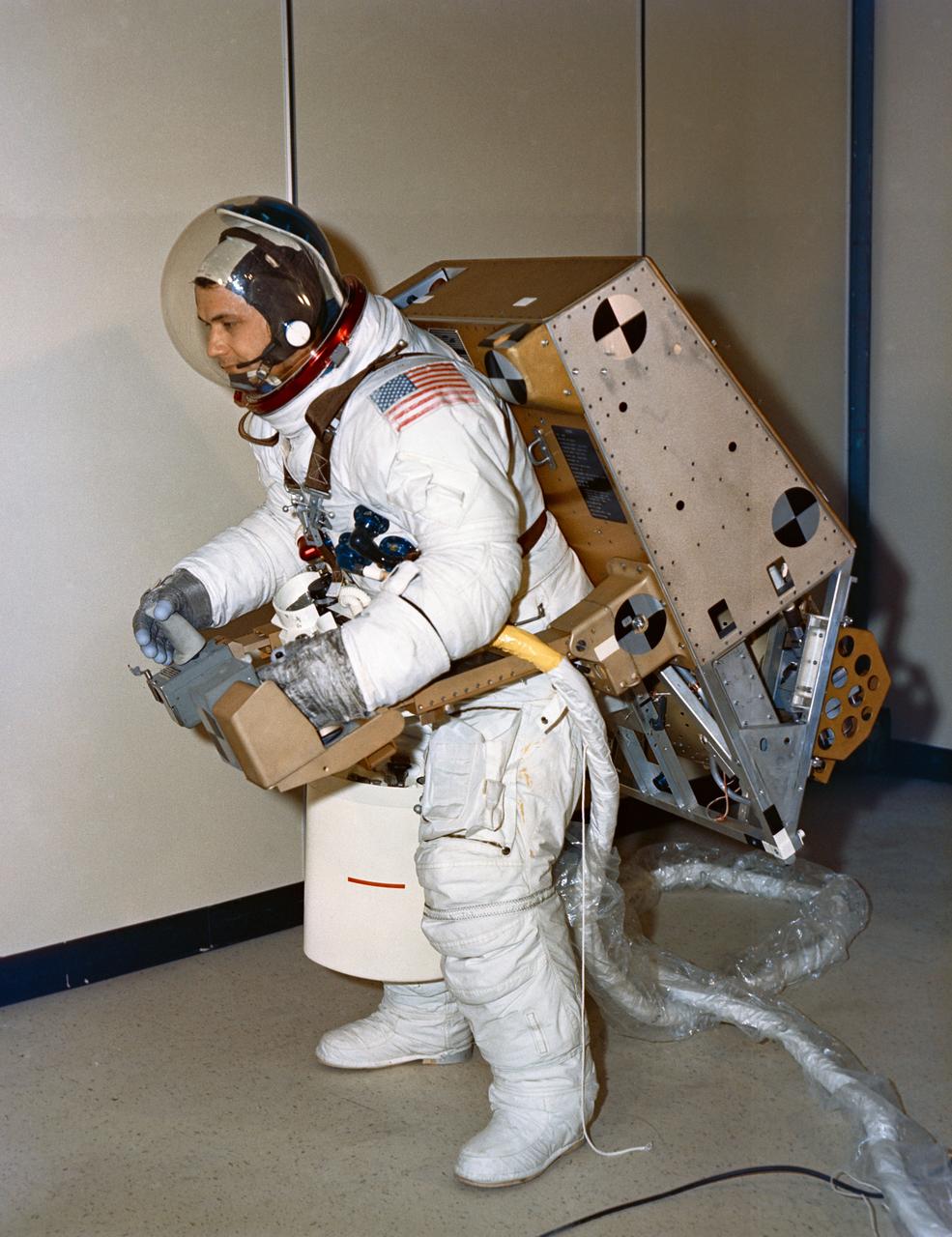
S72-30704 (1972) --- Astronaut Bruce McCandless II, backup pilot for Skylab 2, tests the balance and control of an astronaut maneuvering unit (AMU) test model at Martin Marietta Corporation's Denver division. The jet-powered backpack can fly for 30 minutes and can be worn over normal clothing or spacesuit. Photo credit: NASA
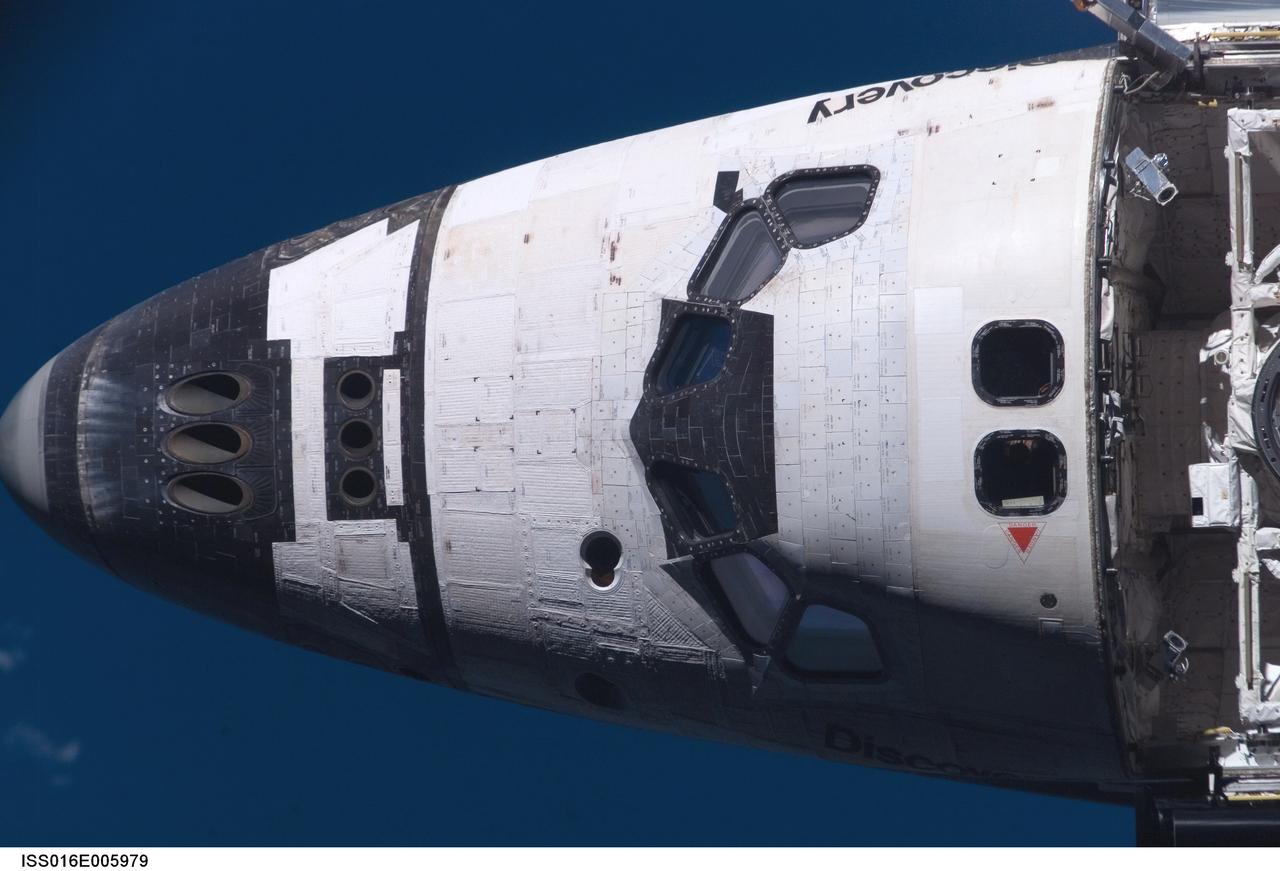
ISS016-E-005979 (25 Oct. 2007) --- Space Shuttle Discovery's crew cabin is featured in this close-up image photographed by an Expedition 16 crewmember during a backflip maneuver performed by the approaching visitors (STS-120) to the International Space Station.
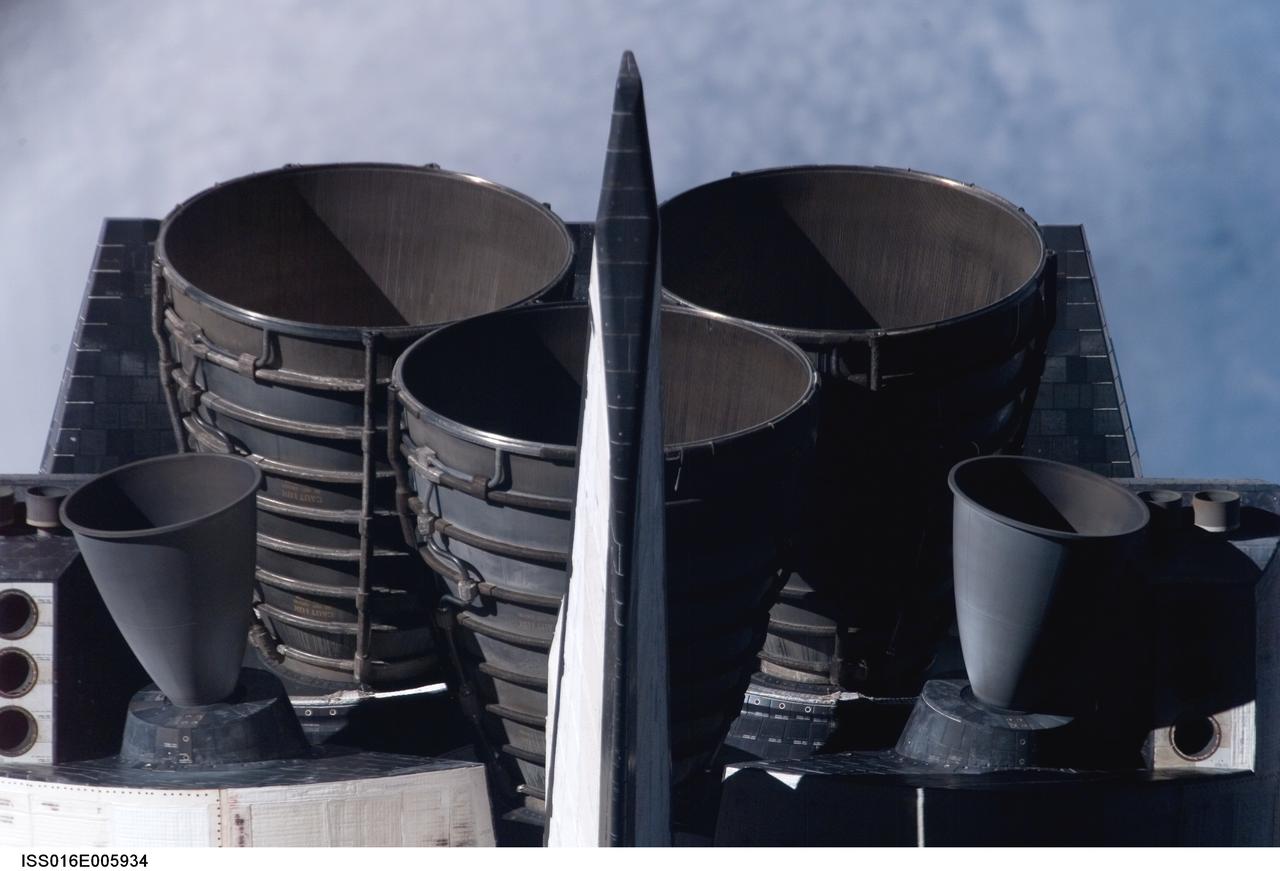
ISS016-E-005934 (25 Oct. 2007) --- The Space Shuttle Discovery's tail section is featured in this image photographed by an Expedition 16 crewmember during a backflip maneuver performed by the approaching visitors (STS-120) to the International Space Station. Visible are the shuttle's main engines and vertical stabilizer.
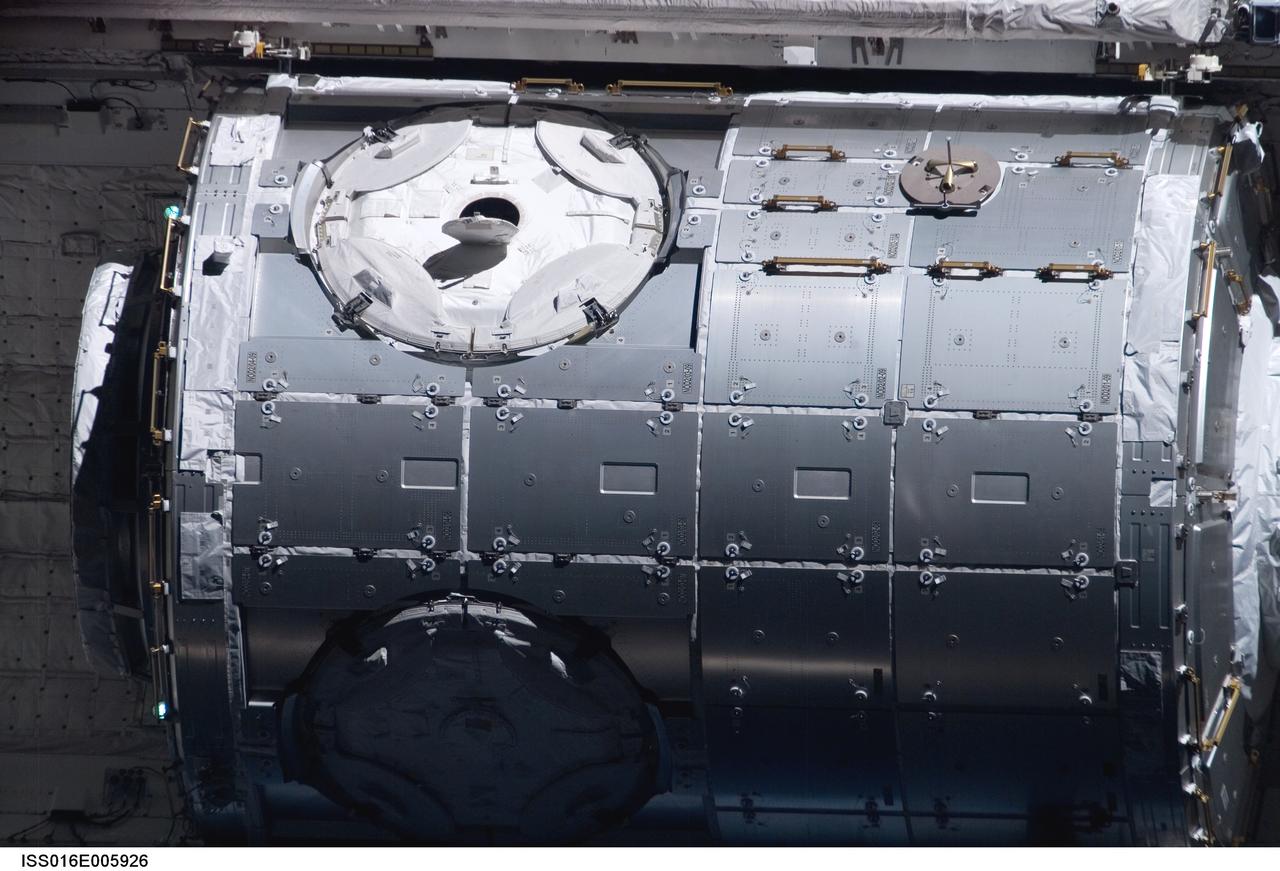
ISS016-E-005926 (25 Oct. 2007) --- A close-up view of the Harmony node in the payload bay of Space Shuttle Discovery is provided by this image photographed by an Expedition 16 crewmember during a backflip maneuver performed by the approaching visitors (STS-120) to the International Space Station.
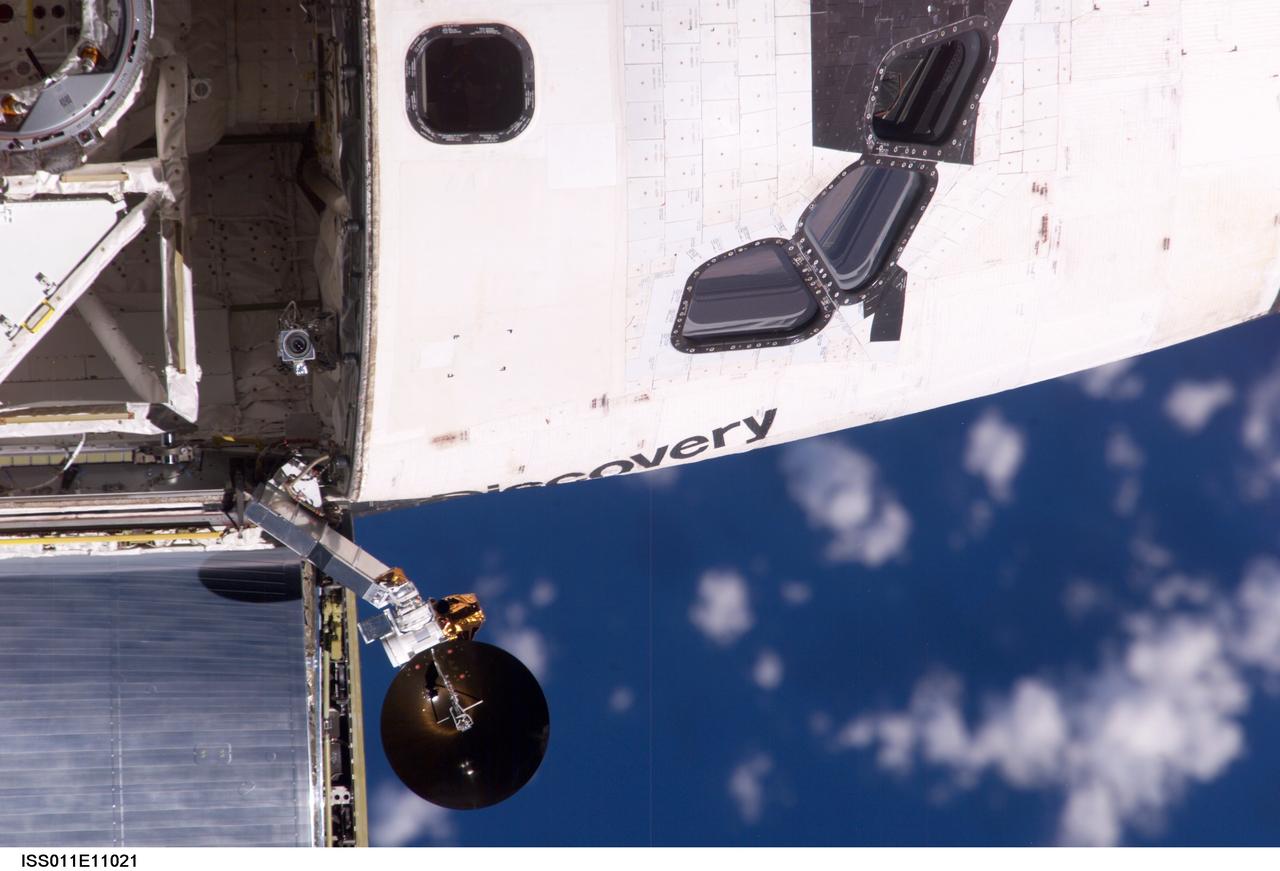
ISS011-E-11021 (28 July 2005) --- View of the Space Shuttle Discovery's crew cabin and Ku-band antenna photographed during the mapping sequence by the Expedition 11 crew on the International Space Station during the STS-114 R-Bar Pitch Maneuver on Flight Day 3.
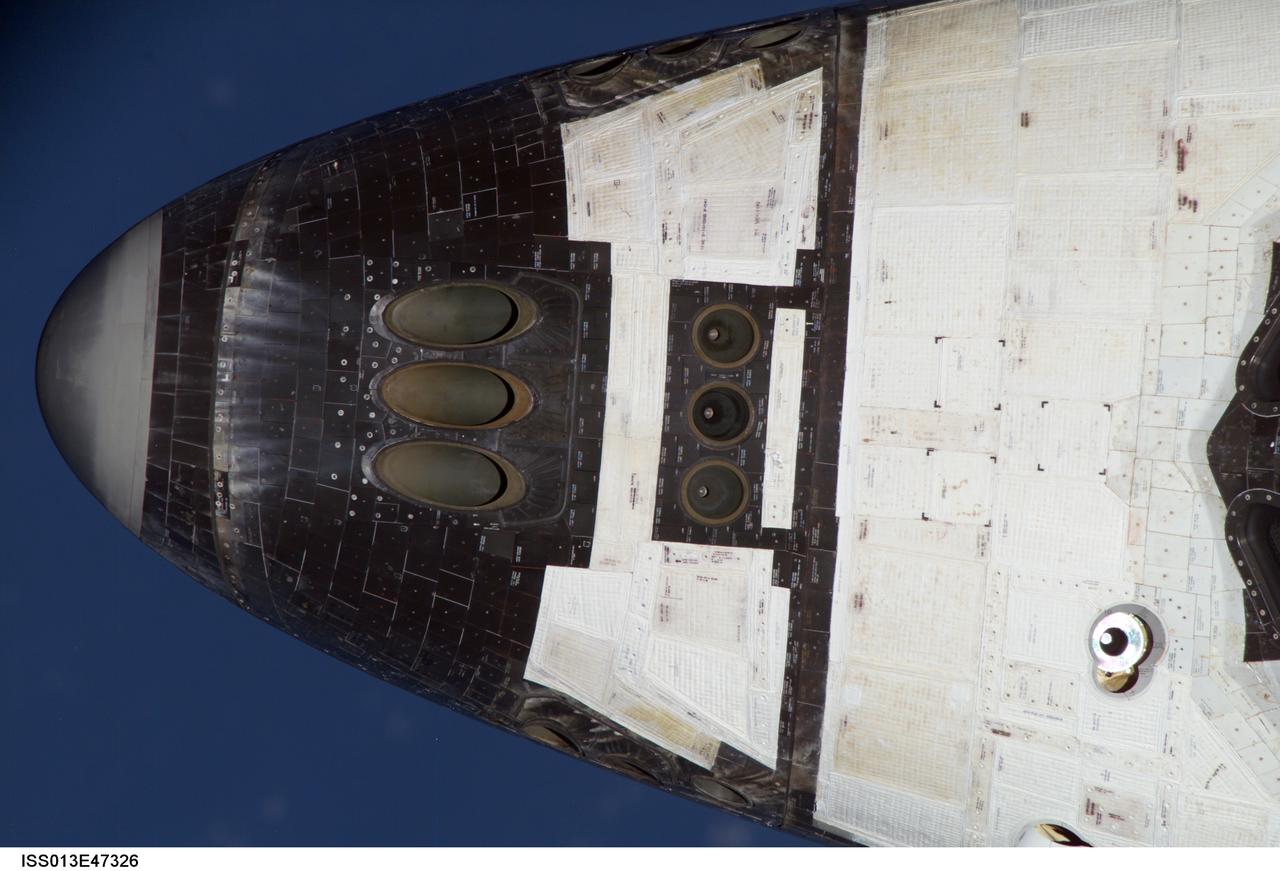
ISS013E47326 (06 July 2006) -- View of the Orbiter Discovery nosecap as imaged during the mapping sequence performed by Expedition 13 NASA Space Station crew during STS-121 R-Bar Pitch Maneuver on Flight Day 3. This image was taken with the 800mm lens prior to rendezvous and docking operations.
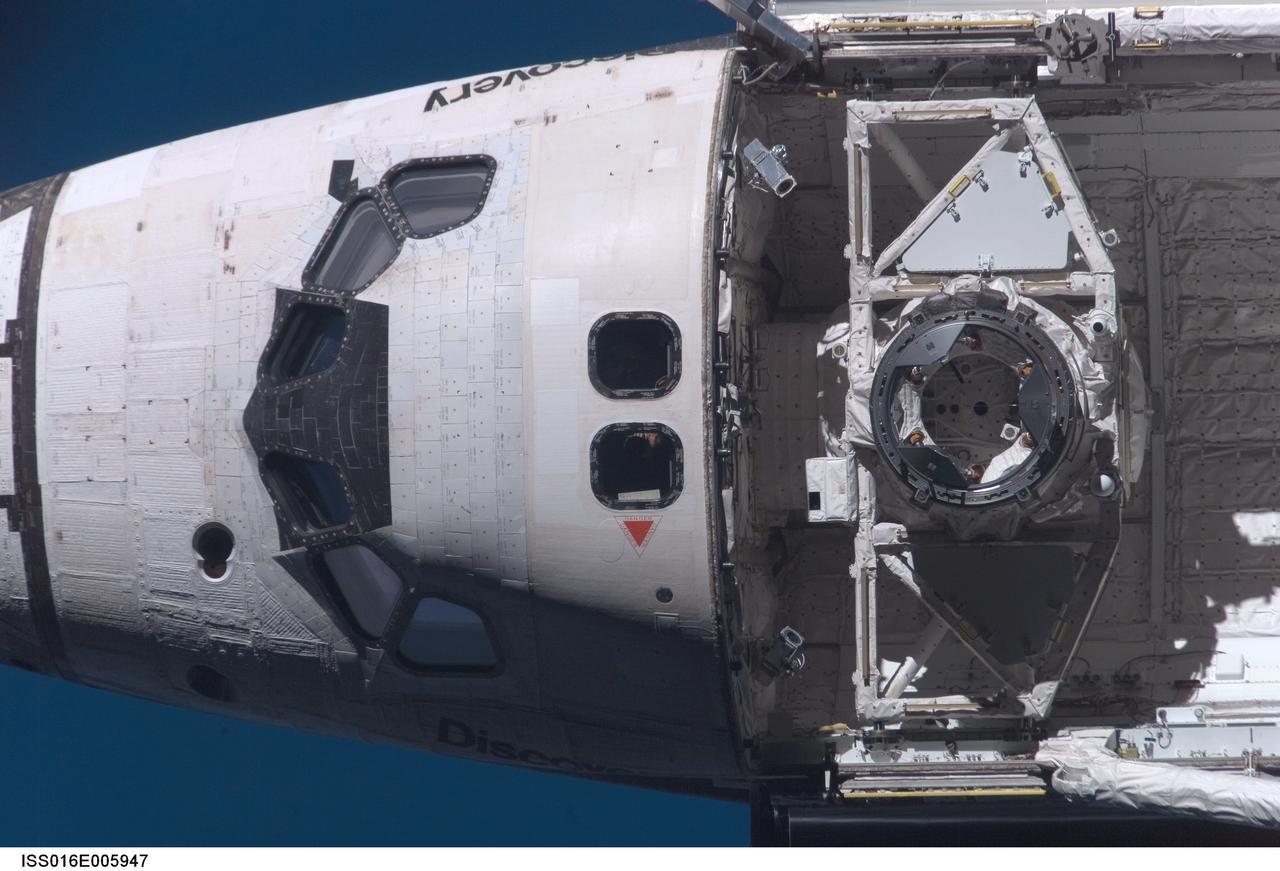
ISS016-E-005947 (25 Oct. 2007) --- Space Shuttle Discovery's crew cabin and docking apparatus in the forward payload bay are featured in this close-up image photographed by an Expedition 16 crewmember during a backflip maneuver performed by the approaching visitors (STS-120) to the International Space Station.

ISS013-E-79951 (11 Sept. 2006) --- This view of the nose and part of the underside of the Space Shuttle Atlantis was provided by an Expedition 13 crew member during a backflip maneuver performed by the approaching visitors to the International Space Station. The Ku-band antenna, very important in communications operations, is visible on the port side of the orbiter.
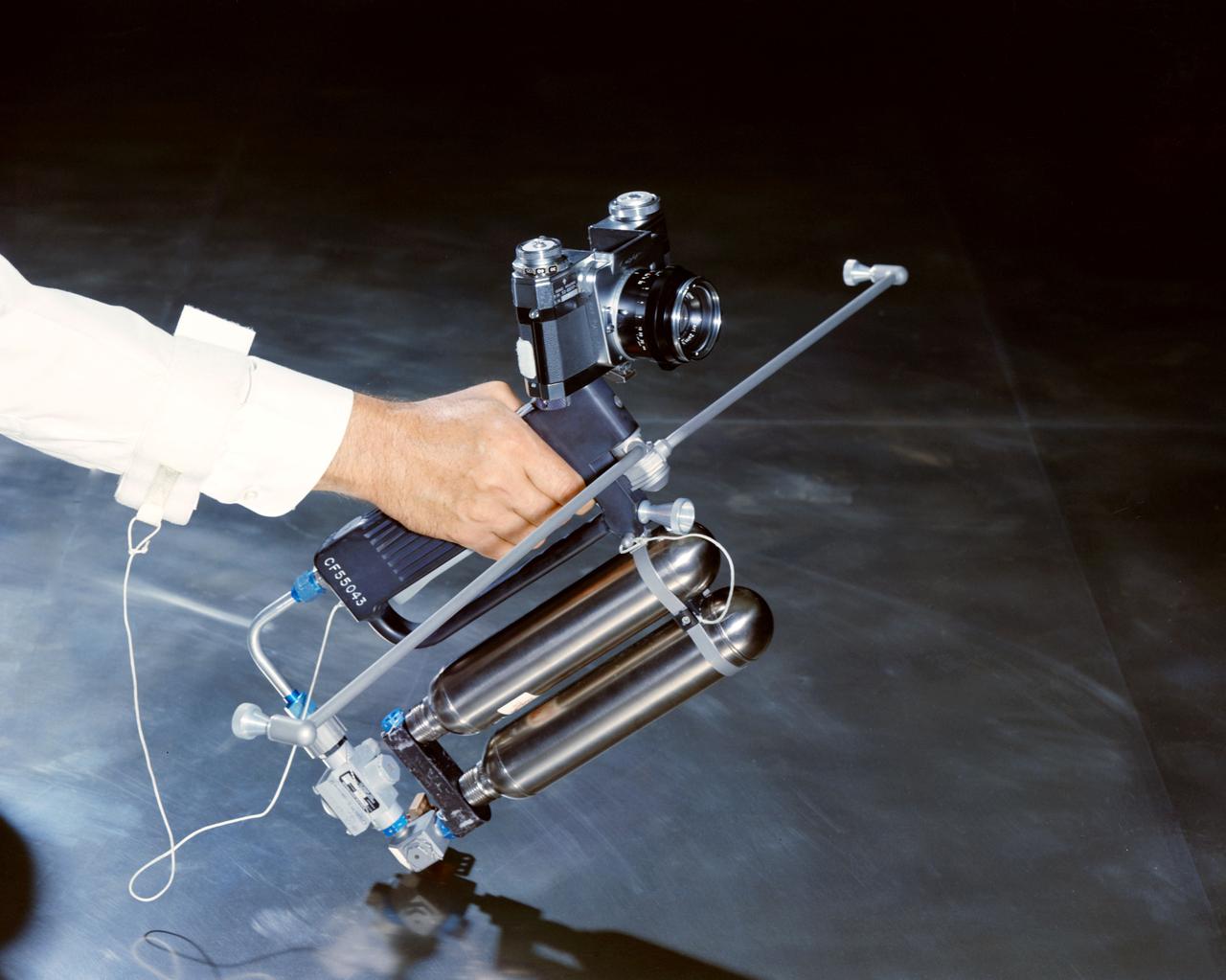
Hand-Held Self-Maneuvering Unit to be used during extravehicular activity (EVA) on Gemini 4 flight. It is an integral unit that contains its own high pressure metering valves and nozzles required to produce controlled thrust. A camera is mounted on the front of the unit.
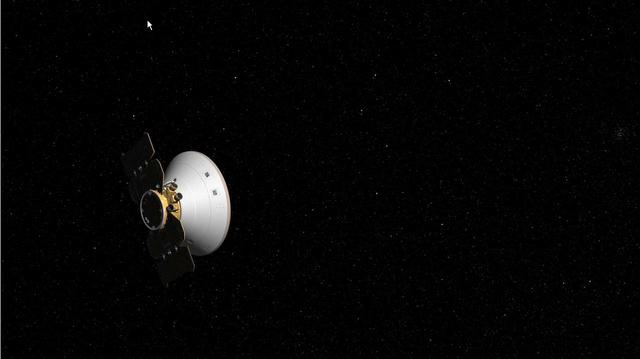
This artist animation shows NASA Phoenix Mars Lander adjusting its course to Mars, an event called a trajectory correction maneuver.
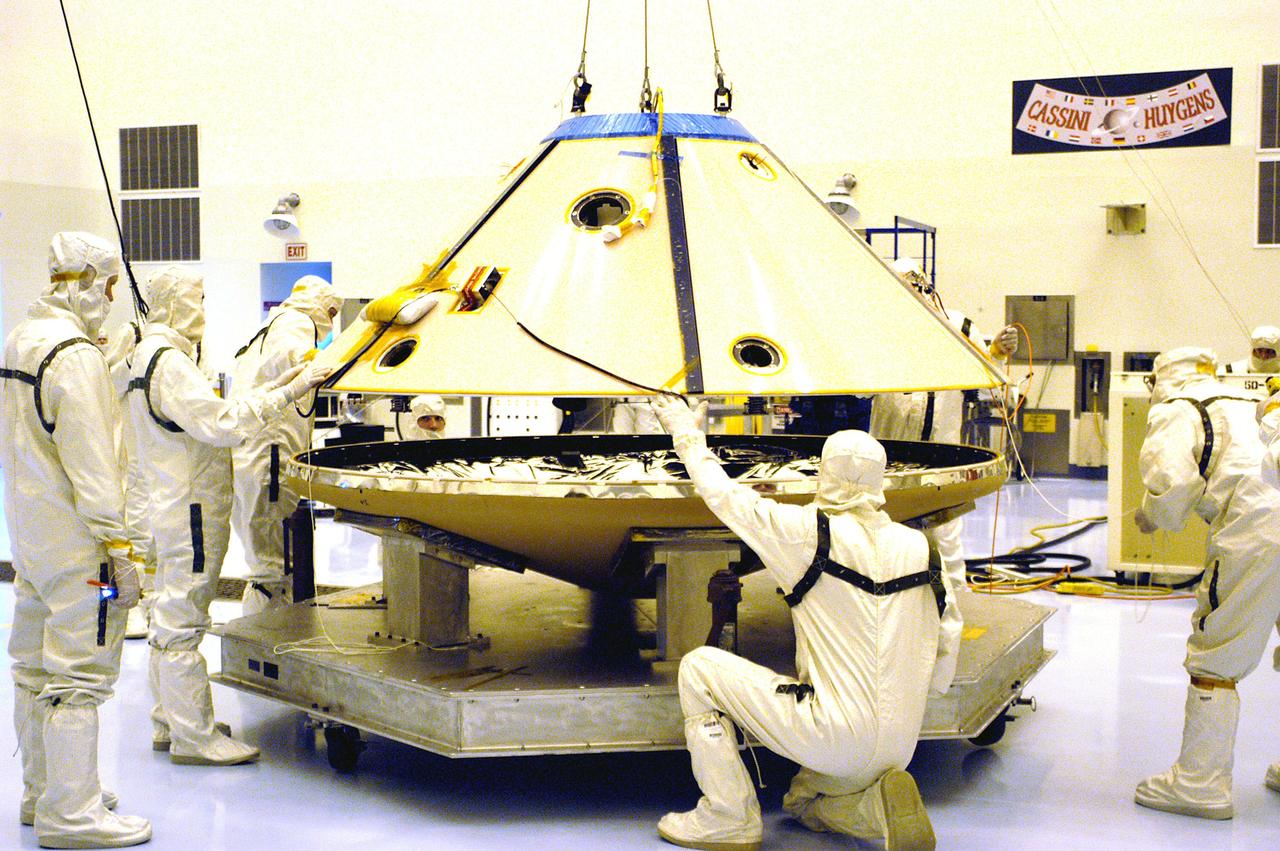
Technicians maneuver the aeroshell for Mars Exploration Rover 2 onto a workstand in the Payload Hazardous Servicing Facility.
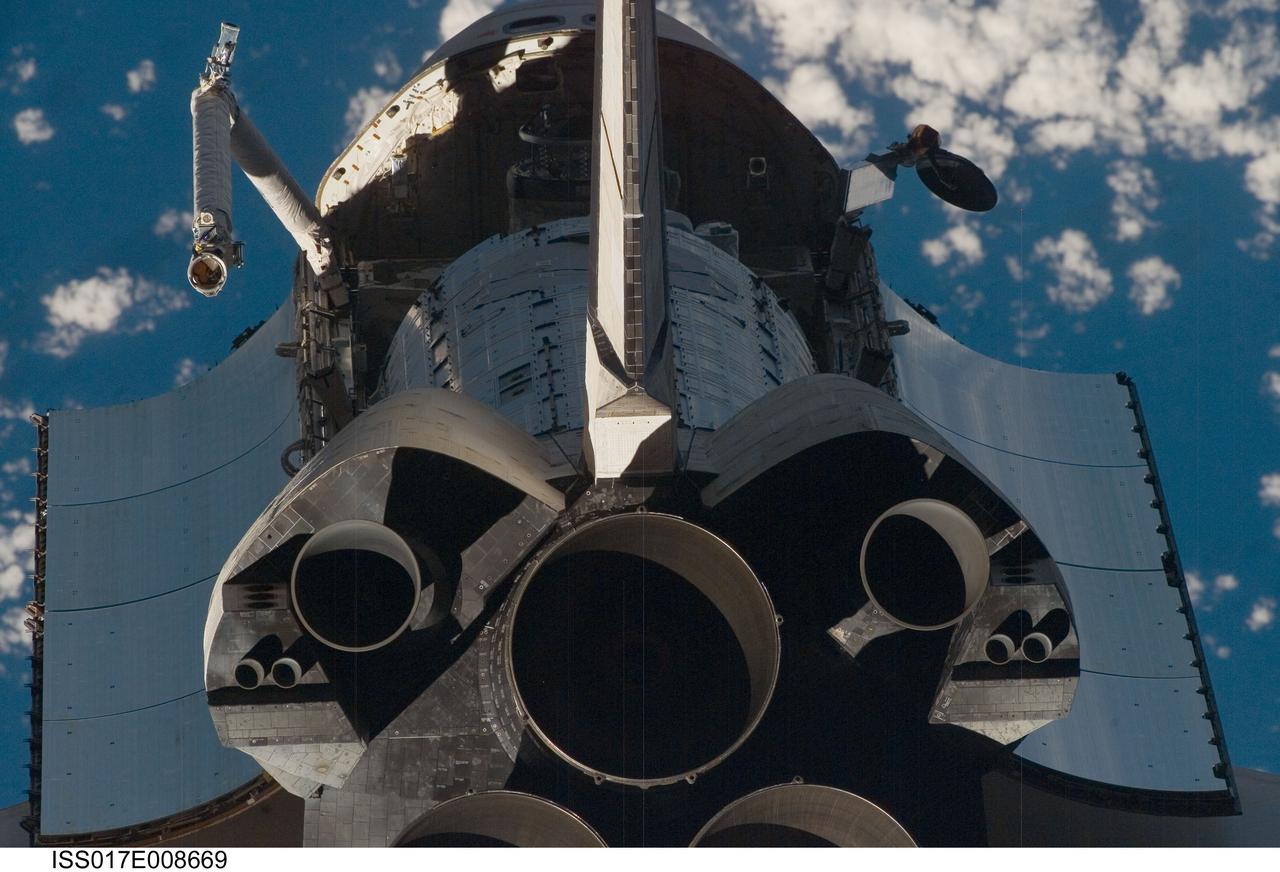
ISS017-E-008669 (2 June 2008) --- A close-up view of Space Shuttle Discovery's tail section was provided by Expedition 17 crewmembers on the International Space Station (ISS). The image provides partial views of the shuttle's main engines, orbital maneuvering system (OMS) pods, vertical stabilizer, the payload bay door panels and the second component of the Japan Aerospace Exploration Agency's Kibo laboratory, the Japanese Pressurized Module (JPM) located in the cargo bay. Before docking with the station, astronaut Mark Kelly, STS-124 commander, flew the shuttle through a roll pitch maneuver or basically a backflip to allow the space station crew a good view of Discovery's heat shield. Using digital still cameras equipped with both 400 and 800 millimeter lenses, the ISS crewmembers took a number of photos of the shuttle's thermal protection system and sent them down to teams on the ground for analysis. A 400 millimeter lens was used for this image.
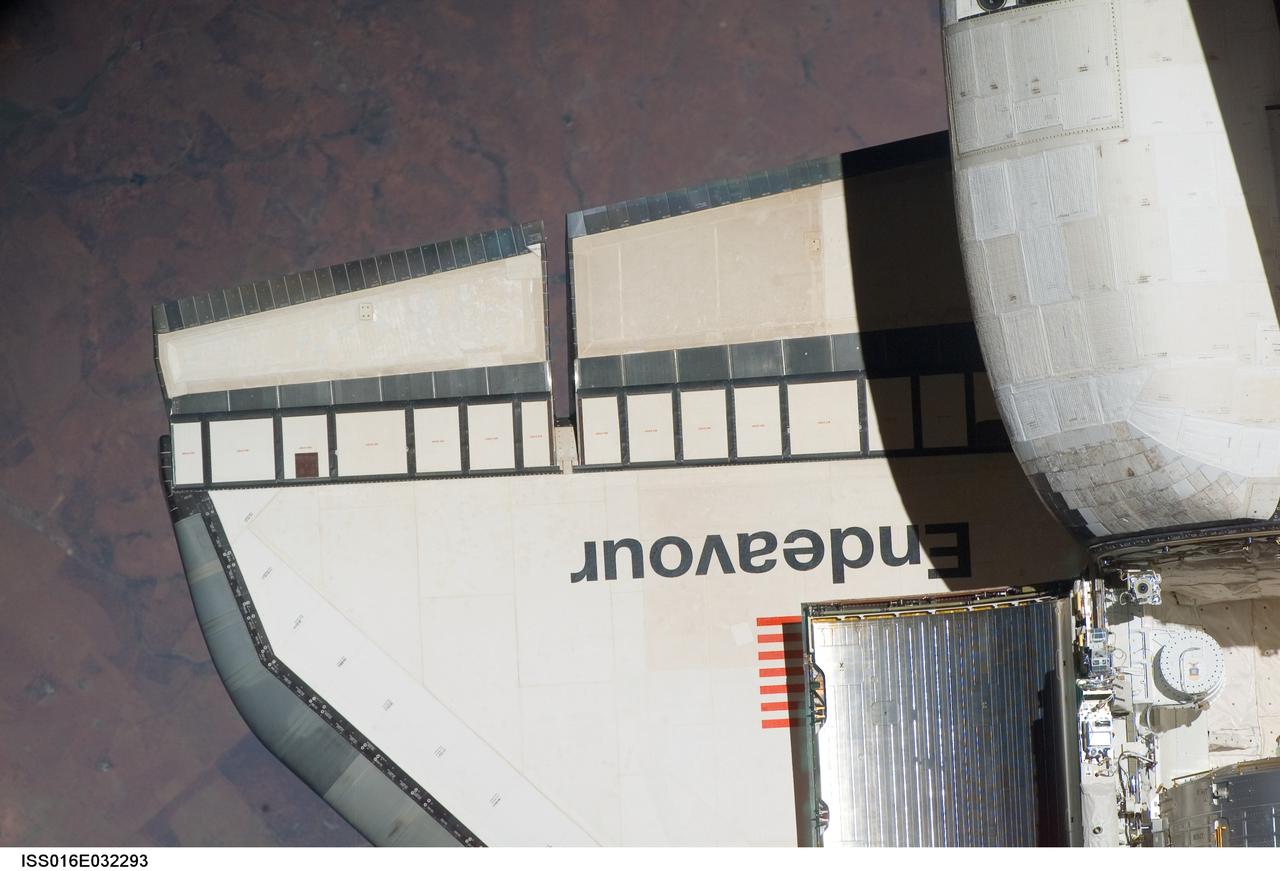
ISS016-E-032293 (12 March 2008) --- An overhead view of part of Space Shuttle Endeavour's starboard wing and part of its orbital maneuvering system (OMS) pods was provided by Expedition 16 crewmembers on the International Space Station (ISS). Before docking with the station, astronaut Dominic Gorie, STS-123 commander, flew the shuttle through a roll pitch maneuver or basically a backflip to allow the space station crew a good view of Endeavour's heat shield. Using digital still cameras equipped with both 400 and 800 millimeter lenses, the ISS crewmembers took a number of photos of the shuttle's thermal protection system and sent them down to teams on the ground for analysis. A 400 millimeter lens was used for this image.
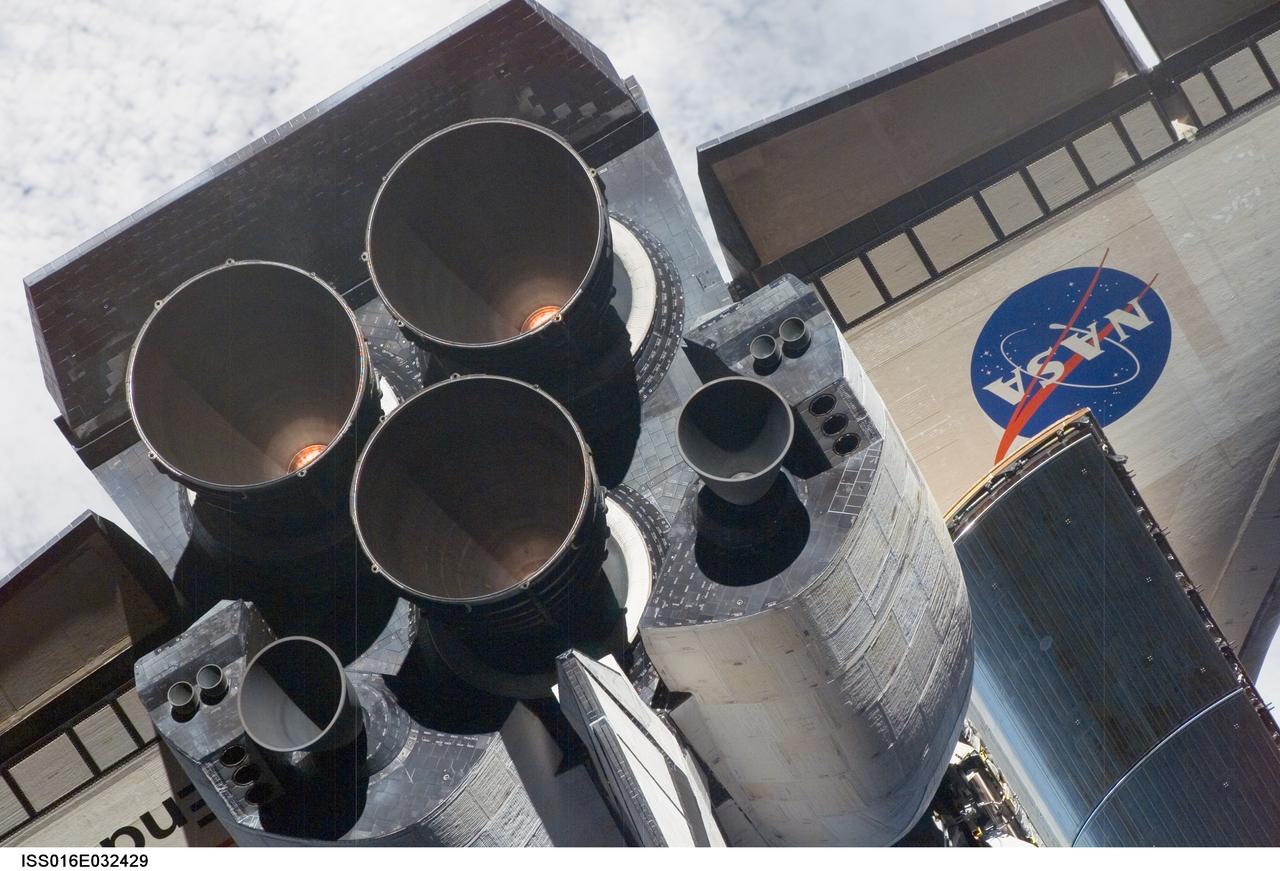
ISS016-E-032429 (12 March 2008) --- A close-up view of Space Shuttle Endeavour's tail section was provided by Expedition 16 crewmembers on the International Space Station (ISS). The image provides partial views of the shuttle's main engines, orbital maneuvering system (OMS) pods, a portion of the payload bay door panels and the shuttle's wings. Before docking with the station, astronaut Dominic Gorie, STS-123 commander, flew the shuttle through a roll pitch maneuver or basically a backflip to allow the space station crew a good view of Endeavour's heat shield. Using digital still cameras equipped with both 400 and 800 millimeter lenses, the ISS crewmembers took a number of photos of the shuttle's thermal protection system and sent them down to teams on the ground for analysis. A 400 millimeter lens was used for this image.
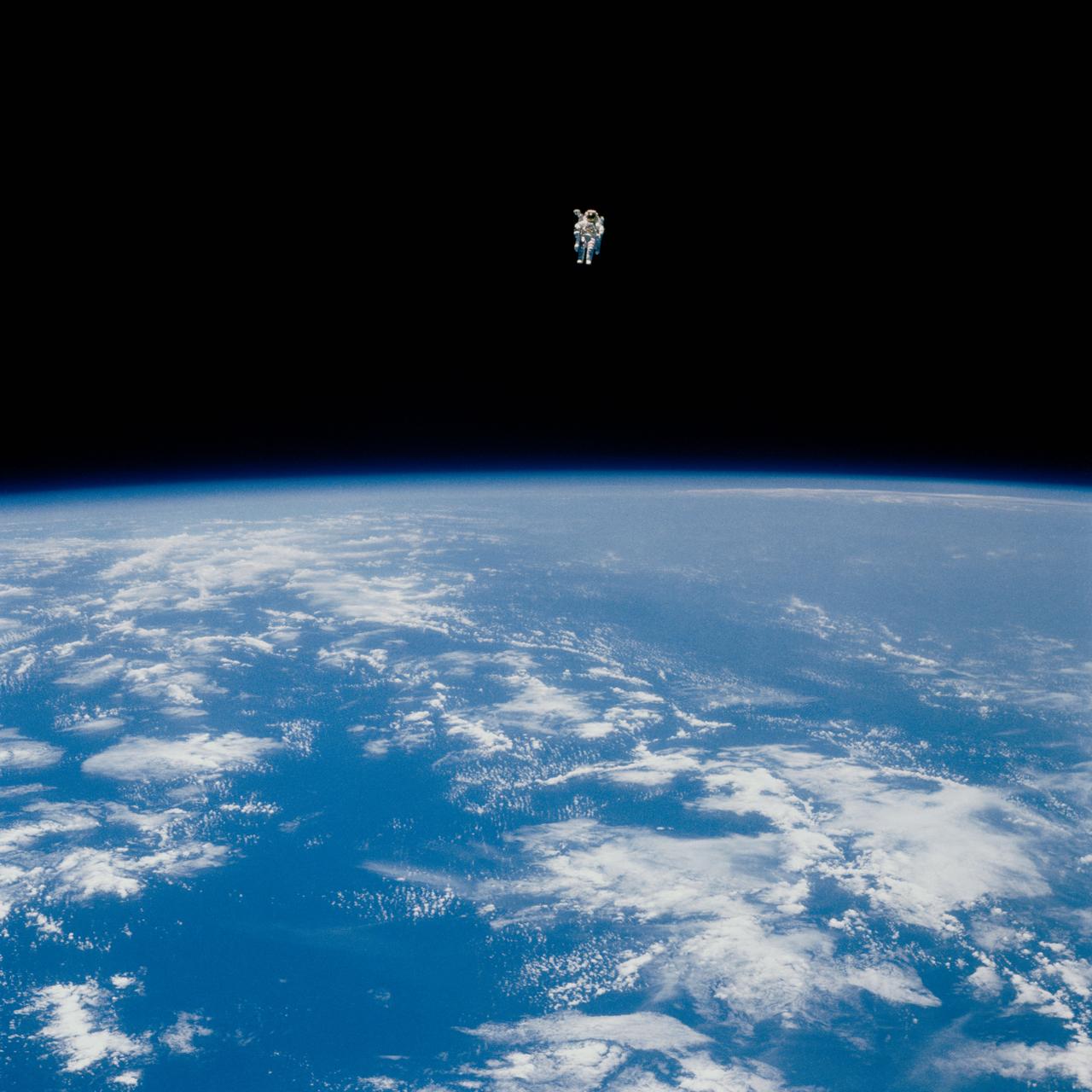
S84-27031 (7 Feb 1984) --- Astronaut Bruce McCandless II, 41-B mission specialist, reaches a maximum distance from the Challenger before reversing direction his manned maneuvering unit (MMU) and returning to the Challenger. A fellow crewmember inside the vehicle's cabin took this photograph with a 70mm camera. The untethered EVA marked the first such experience for astronauts.
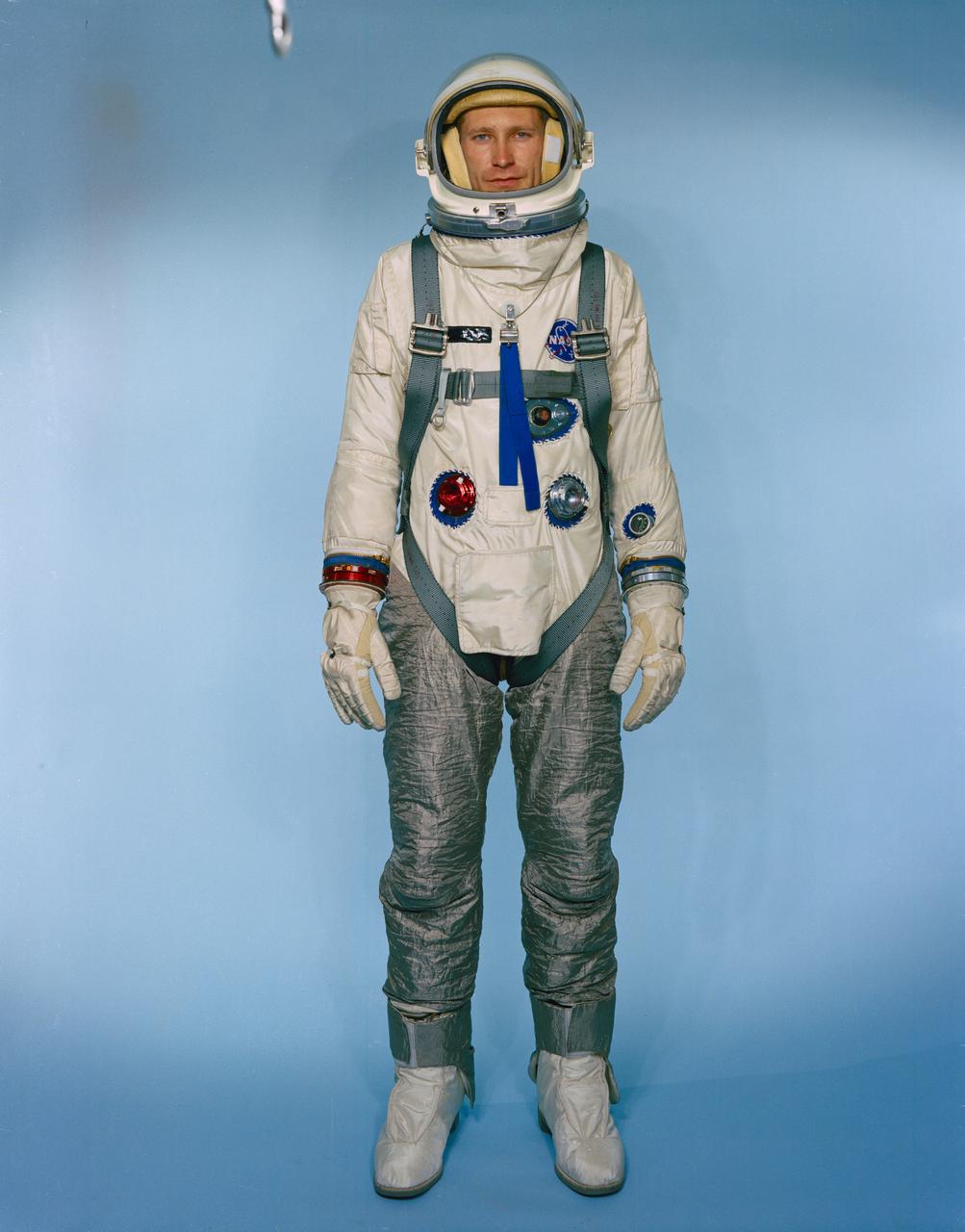
S66-31019 (May 1966) --- Test subject Fred Spross, Crew Systems Division, wears the Gemini-9 configured extravehicular spacesuit assembly. The legs are covered with Chromel R, which is a cloth woven from stainless steel fibers, used to protect the astronaut and suit from the hot exhaust thrust of the Astronaut Maneuvering Unit (AMU). Astronaut Eugene A. Cernan will wear this spacesuit during his Gemini-9A extravehicular activity (EVA). Photo credit: NASA

51A-104-008 (14 Nov 1984) --- Astronaut Dale A. Gardner appears to be under the remote manipulator system (RMS) end effector as he makes a turn in space and prepared to traverse, using the manned maneuvering unit (MMU) backpack, to the nearby Westar VI to "Sting" it with the device he carries. The stringer will enter the communications satellite through the nozzle of the spent motor. Gardner achieved a hard dock at 6:32 A.M. and this picture was photographed about five minutes earlier, on Nov. 14, 1984.
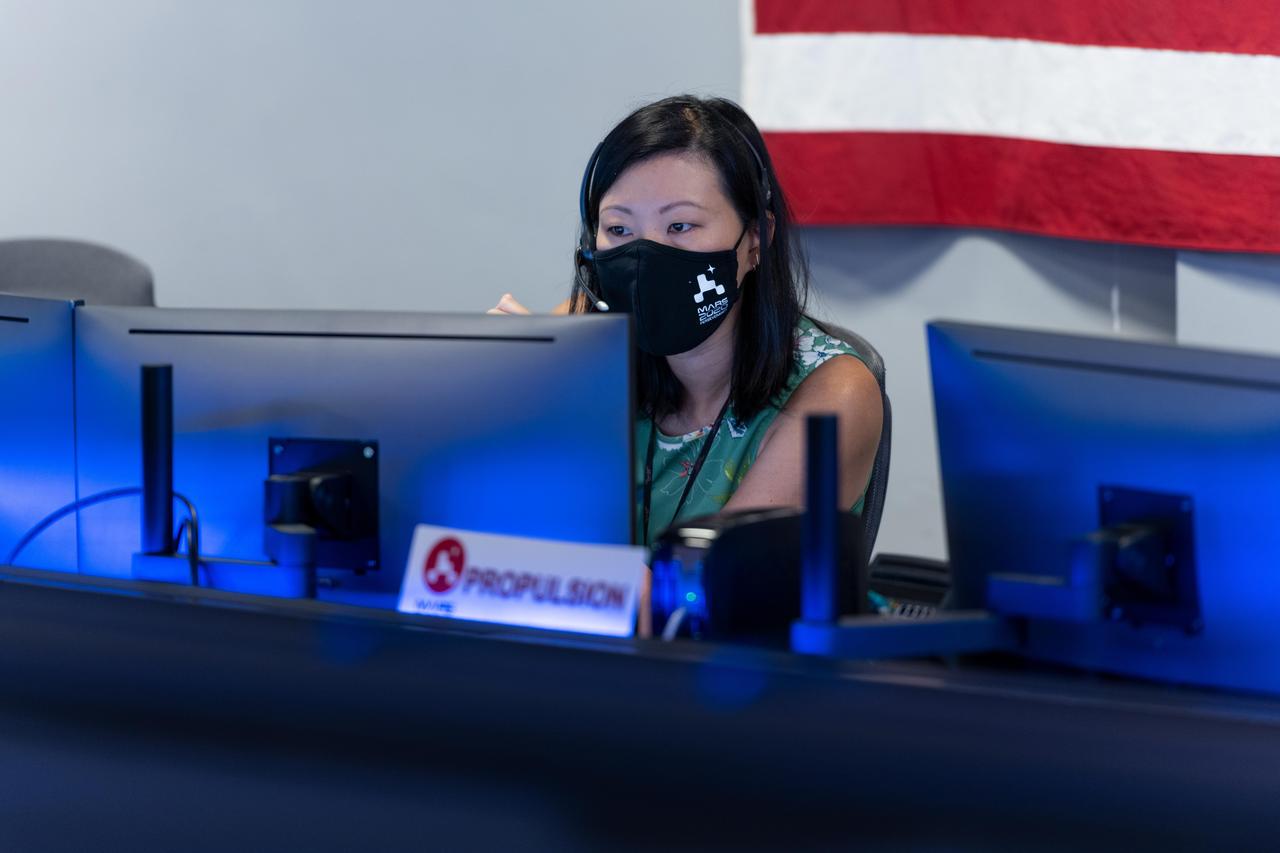
Propulsion Lead Rebekah Lam participates in Perseverance's second trajectory correction maneuver at NASA's Jet Propulsion Laboratory in Southern California. https://photojournal.jpl.nasa.gov/catalog/PIA24194
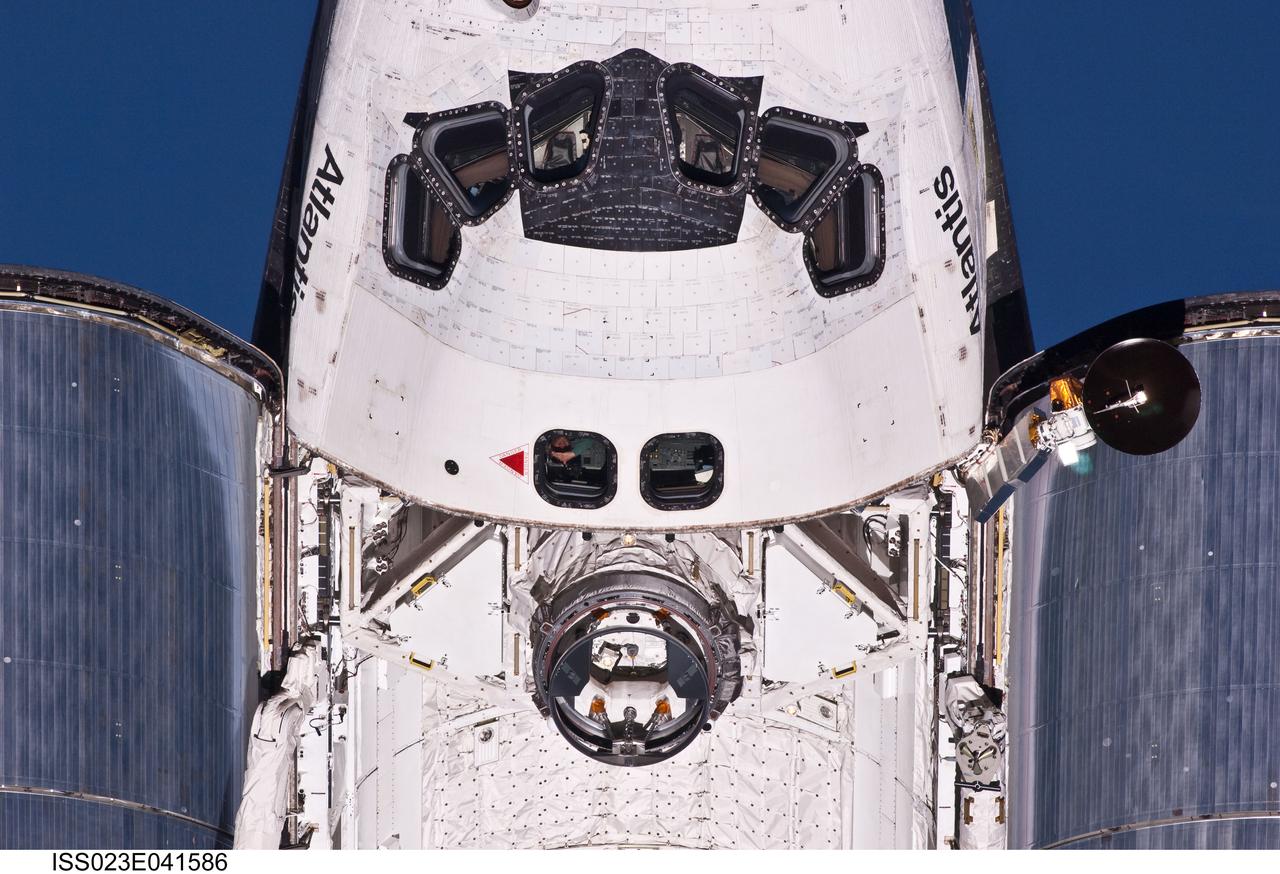
ISS023-E-041586 (16 May 2010) --- This view of crew cabin and forward payload bay of the space shuttle Atlantis was provided by an Expedition 23 crew member during a survey of the approaching STS-132 vehicle prior to docking with the International Space Station. As part of the survey and part of every mission's activities, Atlantis performed a back-flip for the rendezvous pitch maneuver (RPM). The image was photographed with a digital still camera, using a 400mm lens at a distance of about 600 feet (180 meters).
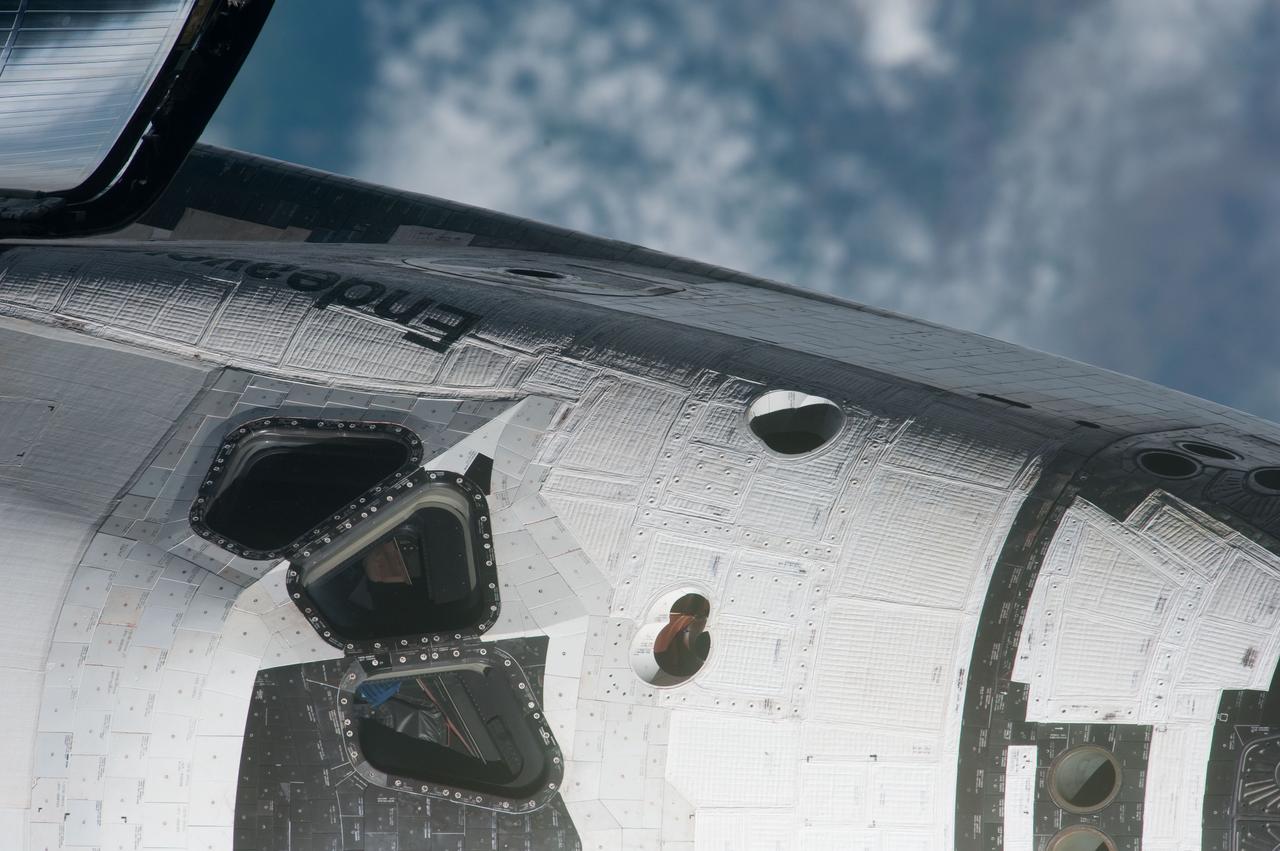
ISS027-E-032428 (18 May 2011) --- This high angle, partial view of the port side of the space shuttle Endeavour’s crew cabin was provided by an Expedition 27 crew member during a survey of the approaching STS-134 vehicle prior to docking with the International Space Station. As part of the survey and part of every mission's activities, Endeavour performed a back-flip for the rendezvous pitch maneuver (RPM). The image was photographed with a digital still camera, using a 1000mm lens.
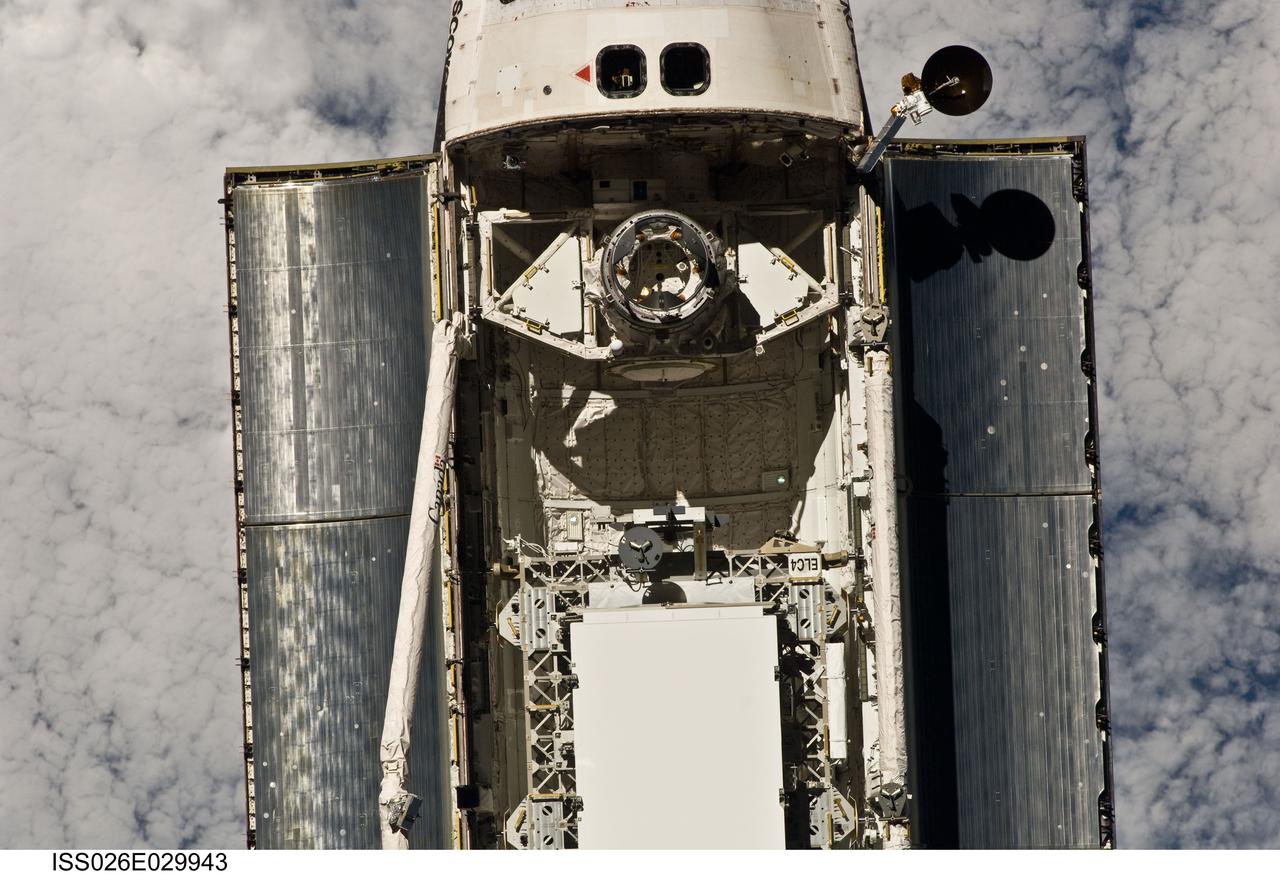
ISS026-E-029943 (26 Feb. 2011) --- This view of the crew cabin and forward payload bay of the space shuttle Discovery was provided by an Expedition 26 crew member during a survey of the approaching STS-133 vehicle prior to docking with the International Space Station. As part of the survey and part of every mission's activities, Discovery performed a back-flip for the rendezvous pitch maneuver (RPM). The image was photographed with a digital still camera, using a 400mm lens at a distance of about 600 feet (180 meters).
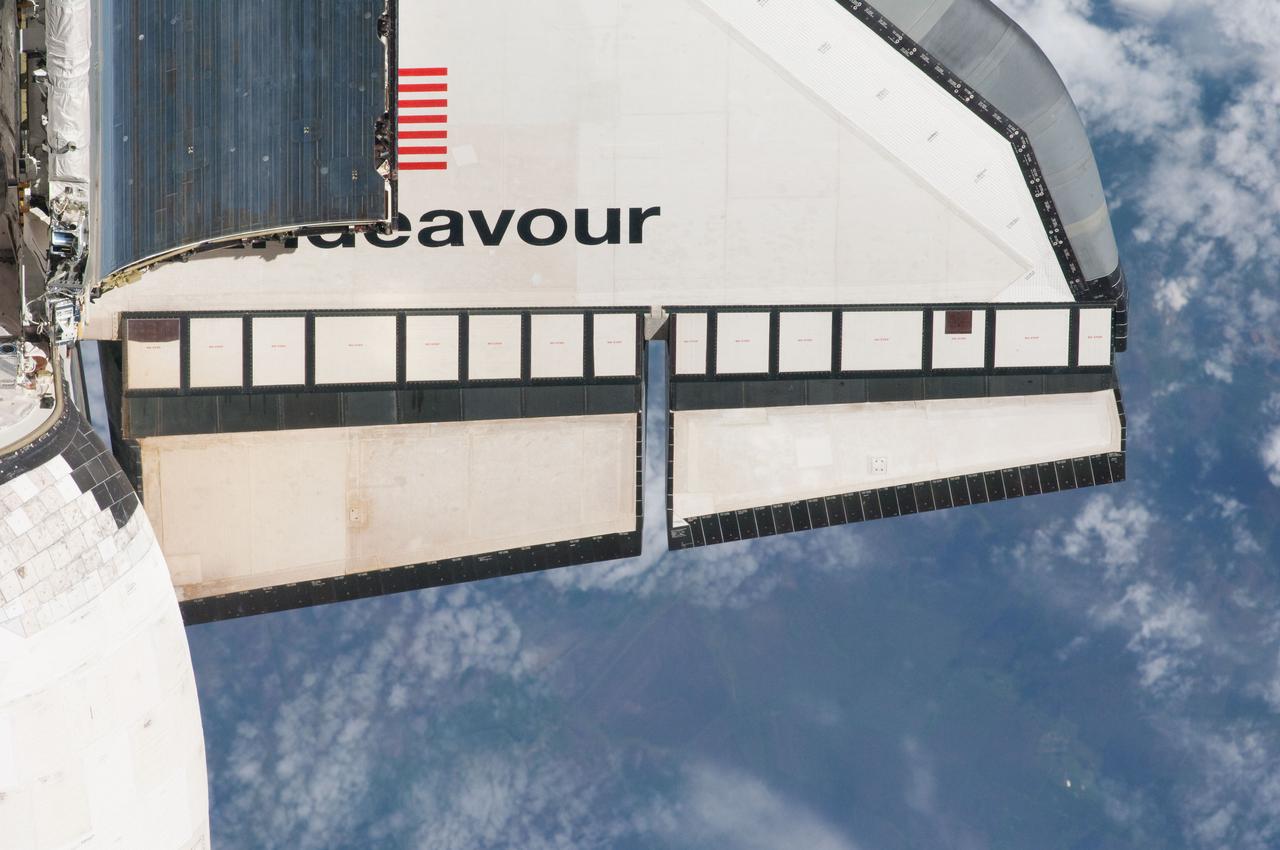
ISS027-E-032234 (18 May 2011) --- This partial view of the starboard wing of the space shuttle Endeavour was provided by an Expedition 27 crew member during a survey of the approaching STS-134 vehicle prior to docking with the International Space Station. As part of the survey and part of every mission's activities, Endeavour performed a back-flip for the rendezvous pitch maneuver (RPM). The image was photographed with a digital still camera, using a 400mm lens at a distance of about 600 feet (180 meters).
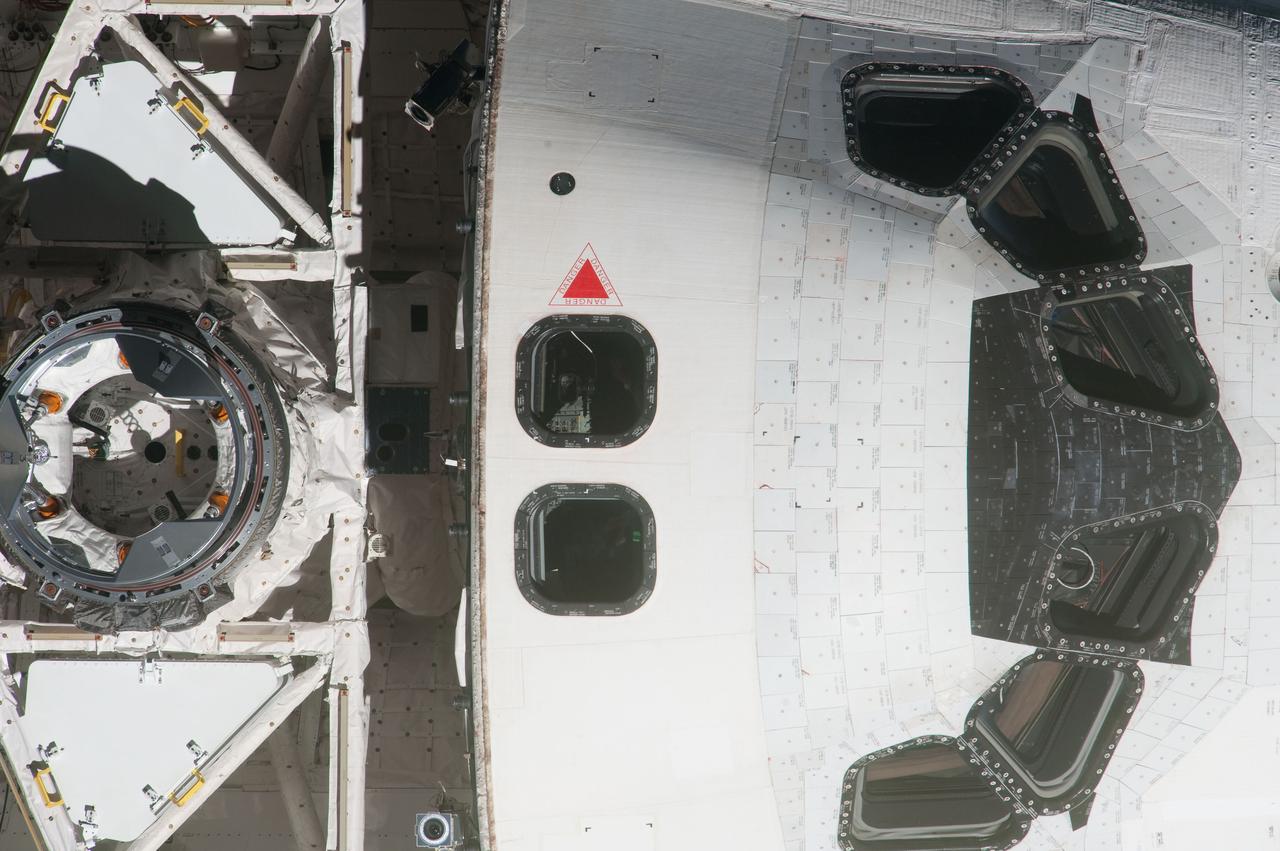
ISS027-E-032405 (18 May 2011) --- This high angle, partial view of the space shuttle Endeavour’s crew cabin and docking mechanism was provided by an Expedition 27 crew member during a survey of the approaching STS-134 vehicle prior to docking with the International Space Station. As part of the survey and part of every mission's activities, Endeavour performed a back-flip for the rendezvous pitch maneuver (RPM). The image was photographed with a digital still camera, using a 1000mm lens.
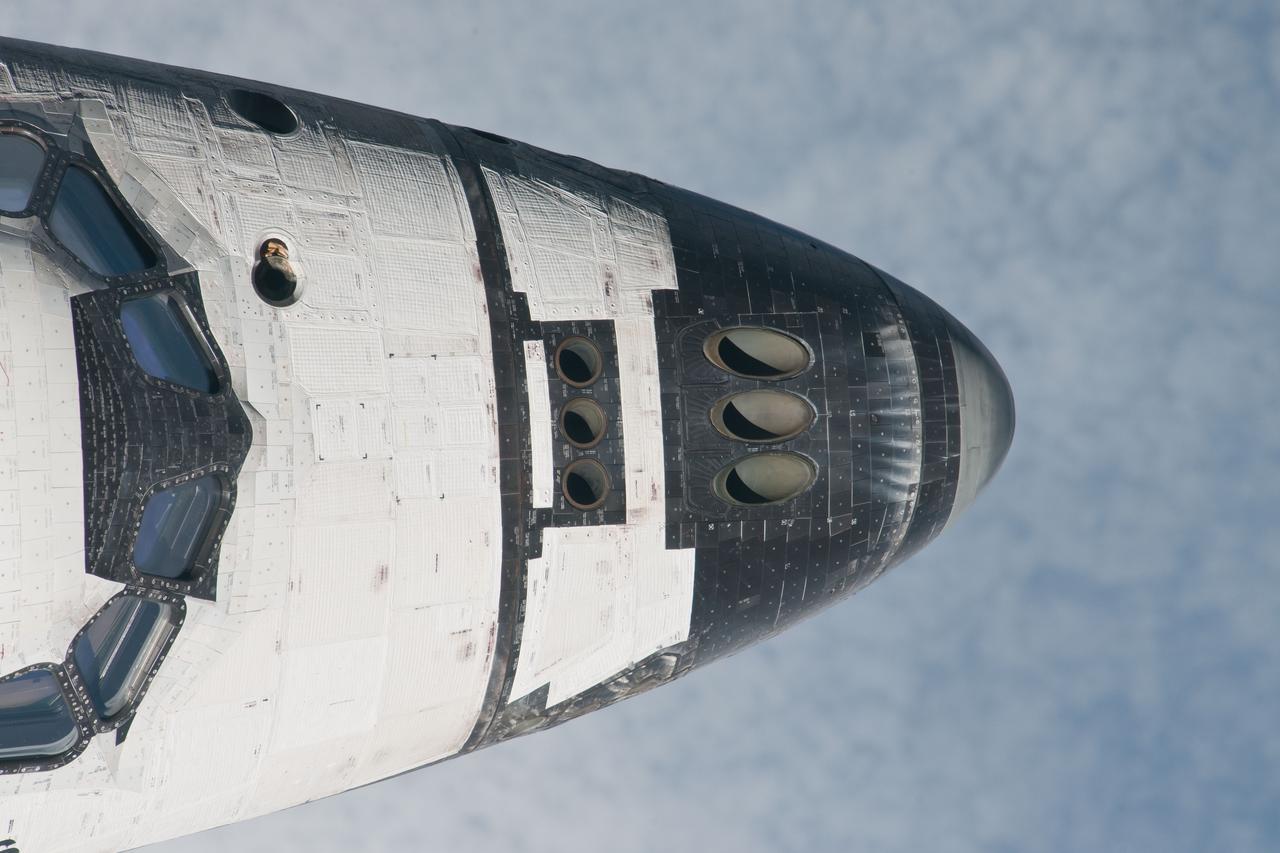
ISS028-E-015600 (10 July 2011) --- This is one of a series of images showing various parts of the space shuttle Atlantis in Earth orbit as photographed by one of three crew members -- half the station crew -- who were equipped with still cameras for this purpose on the International Space Station as the shuttle “posed” for photos and visual surveys and performed a back-flip for the rendezvous pitch maneuver (RPM). A 1000 millimeter lens was used to capture this particular series of images.
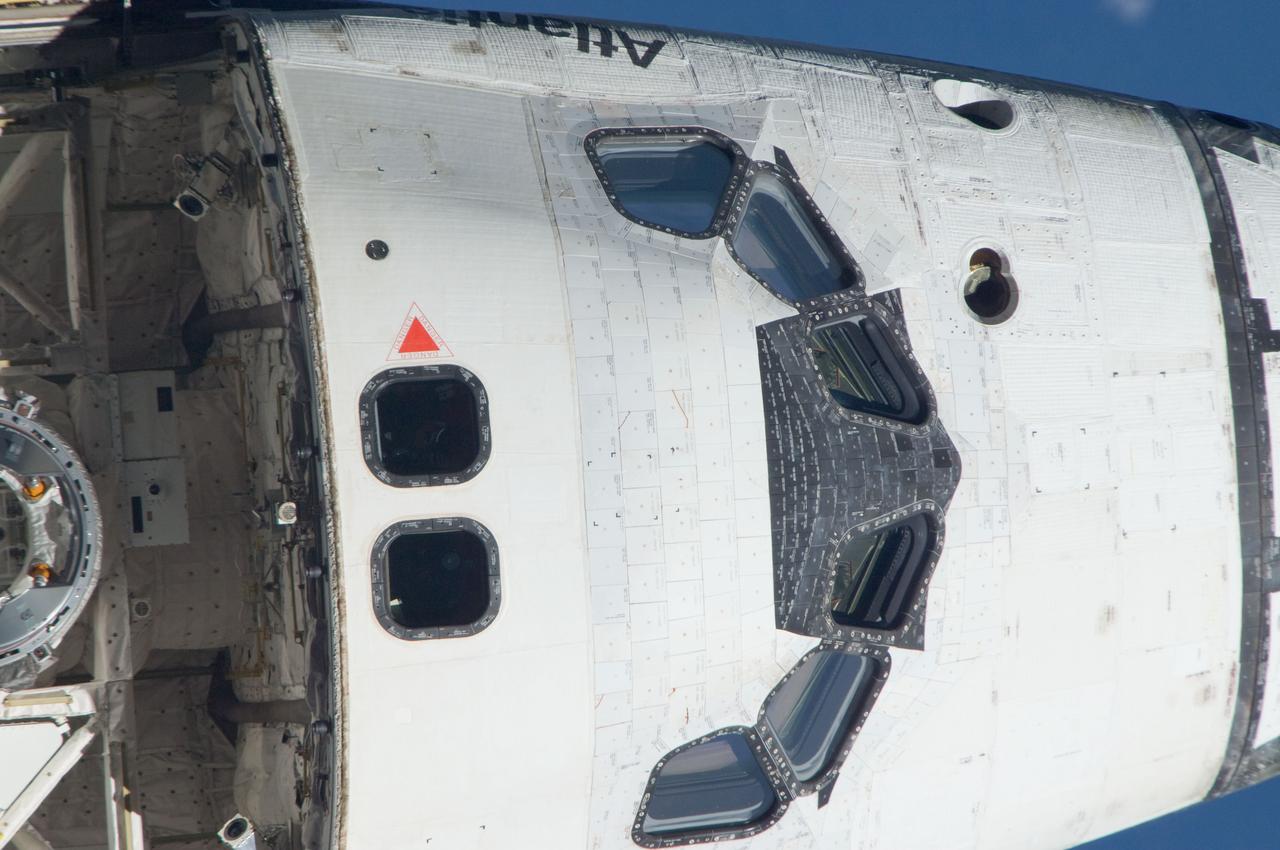
ISS028-E-015099 (10 July 2011) --- This is one of a series of images showing various parts of the space shuttle Atlantis in Earth orbit as photographed by one of the six crewmembers on the International Space Station as the shuttle “posed” for photo and visual surveys and performed a back-flip for the rendezvous pitch maneuver (RPM). An 800 millimeter lens was used to capture this particular series of images.
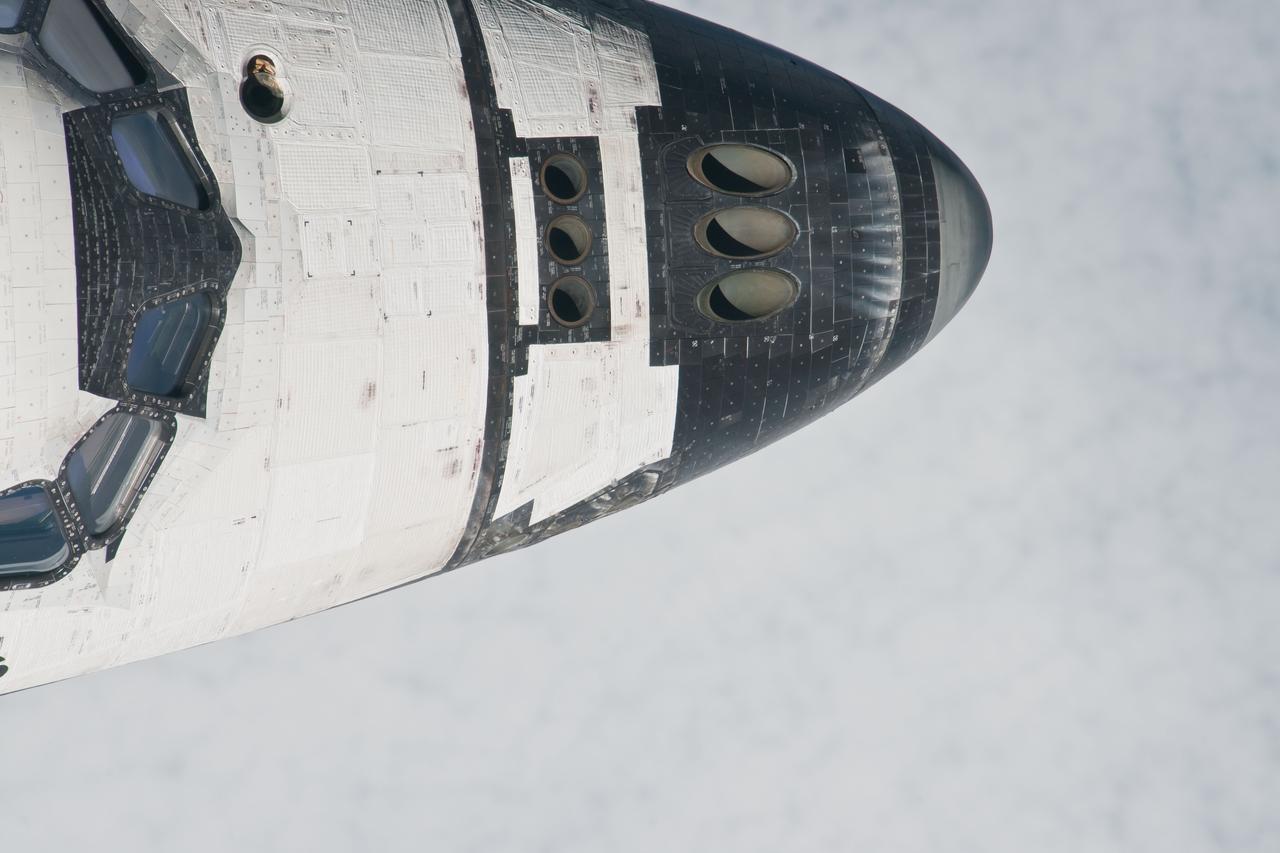
ISS028-E-015599 (10 July 2011) --- This is one of a series of images showing various parts of the space shuttle Atlantis in Earth orbit as photographed by one of three crew members -- half the station crew -- who were equipped with still cameras for this purpose on the International Space Station as the shuttle “posed” for photos and visual surveys and performed a back-flip for the rendezvous pitch maneuver (RPM). A 1000 millimeter lens was used to capture this particular series of images.
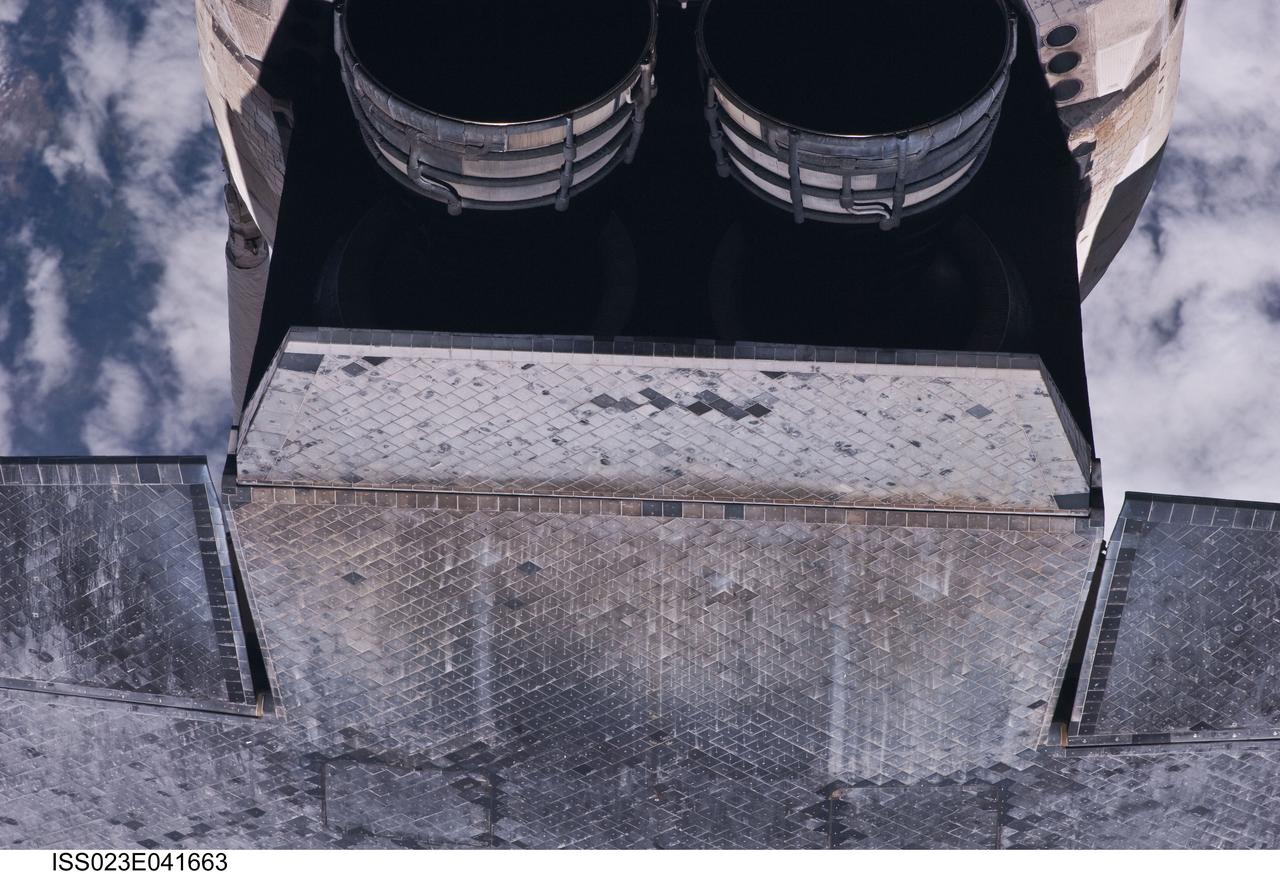
ISS023-E-041663 (16 May 2010) --- This view of the underside of the space shuttle Atlantis was provided by an Expedition 23 crew member during a survey of the approaching STS-132 vehicle prior to docking with the International Space Station. As part of the survey and part of every mission's activities, Atlantis performed a back-flip for the rendezvous pitch maneuver (RPM). The image was photographed with a digital still camera, using a 400mm lens at a distance of about 600 feet (180 meters).
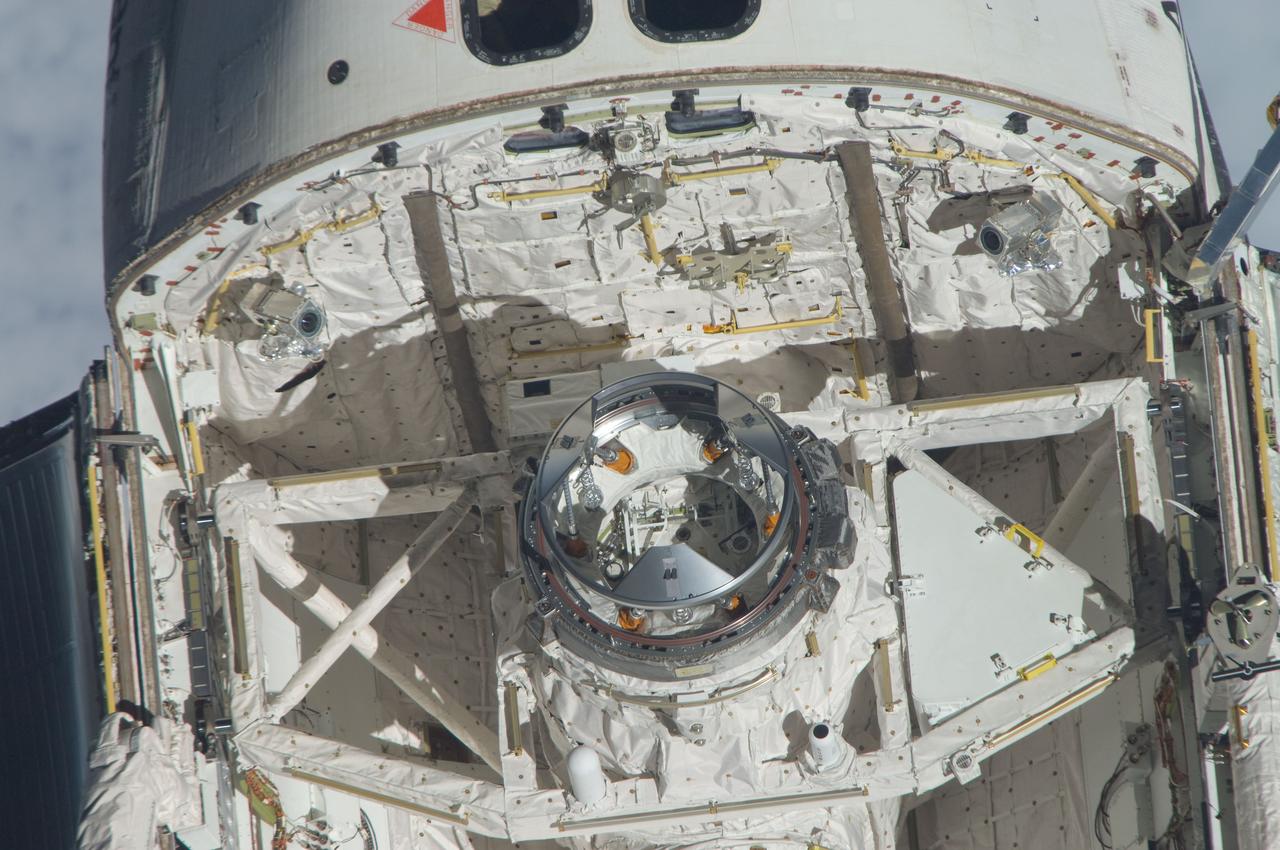
ISS028-E-015414 (10 July 2011) --- This is one of a series of images showing various parts of the space shuttle Atlantis in Earth orbit as photographed by one of the six crewmembers on the International Space Station as the shuttle “posed” for photo and visual surveys and performed a back-flip for the rendezvous pitch maneuver (RPM). An 800 millimeter lens was used to capture this particular series of images.
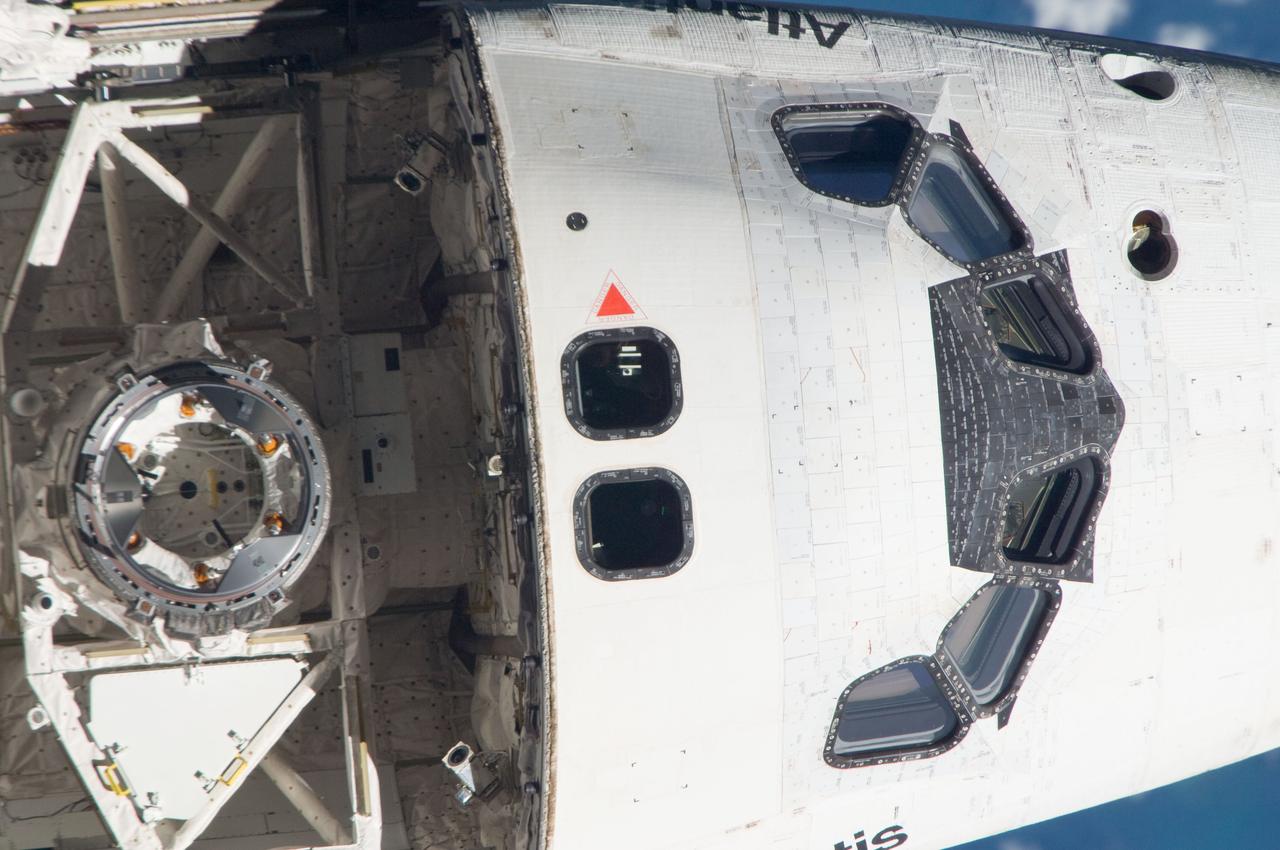
ISS028-E-015148 (10 July 2011) --- This is one of a series of images showing various parts of the space shuttle Atlantis in Earth orbit as photographed by one of the six crewmembers on the International Space Station as the shuttle “posed” for photo and visual surveys and performed a back-flip for the rendezvous pitch maneuver (RPM). An 800 millimeter lens was used to capture this particular series of images.
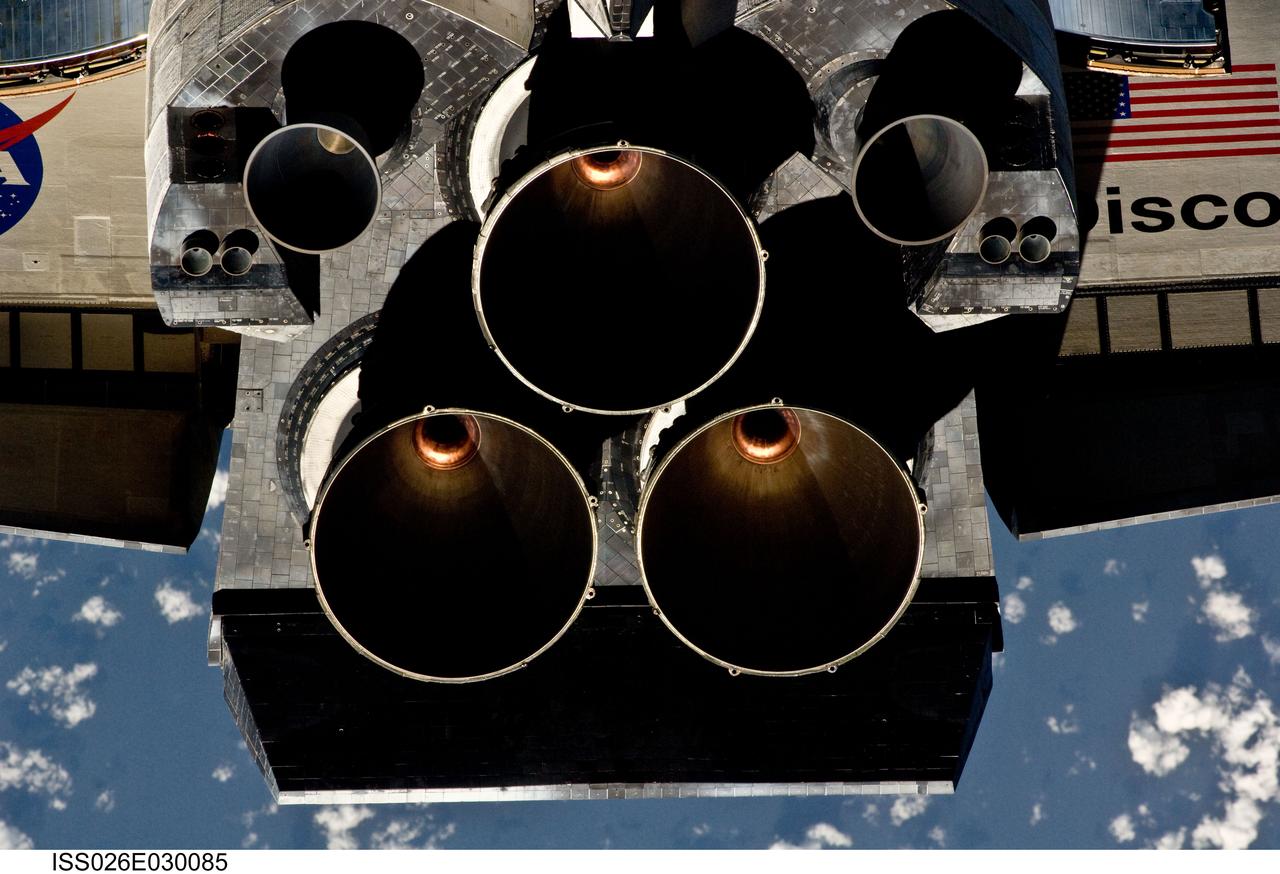
ISS026-E-030085 (26 Feb. 2011) --- This view of the aft portion of the space shuttle Discovery, including the three main engines and part of the wings, was provided by an Expedition 26 crew member during a survey of the approaching STS-133 vehicle prior to docking with the International Space Station. As part of the survey and part of every mission's activities, Discovery performed a back-flip for the rendezvous pitch maneuver (RPM). The image was photographed with a digital still camera, using a 400mm lens at a distance of about 600 feet (180 meters).
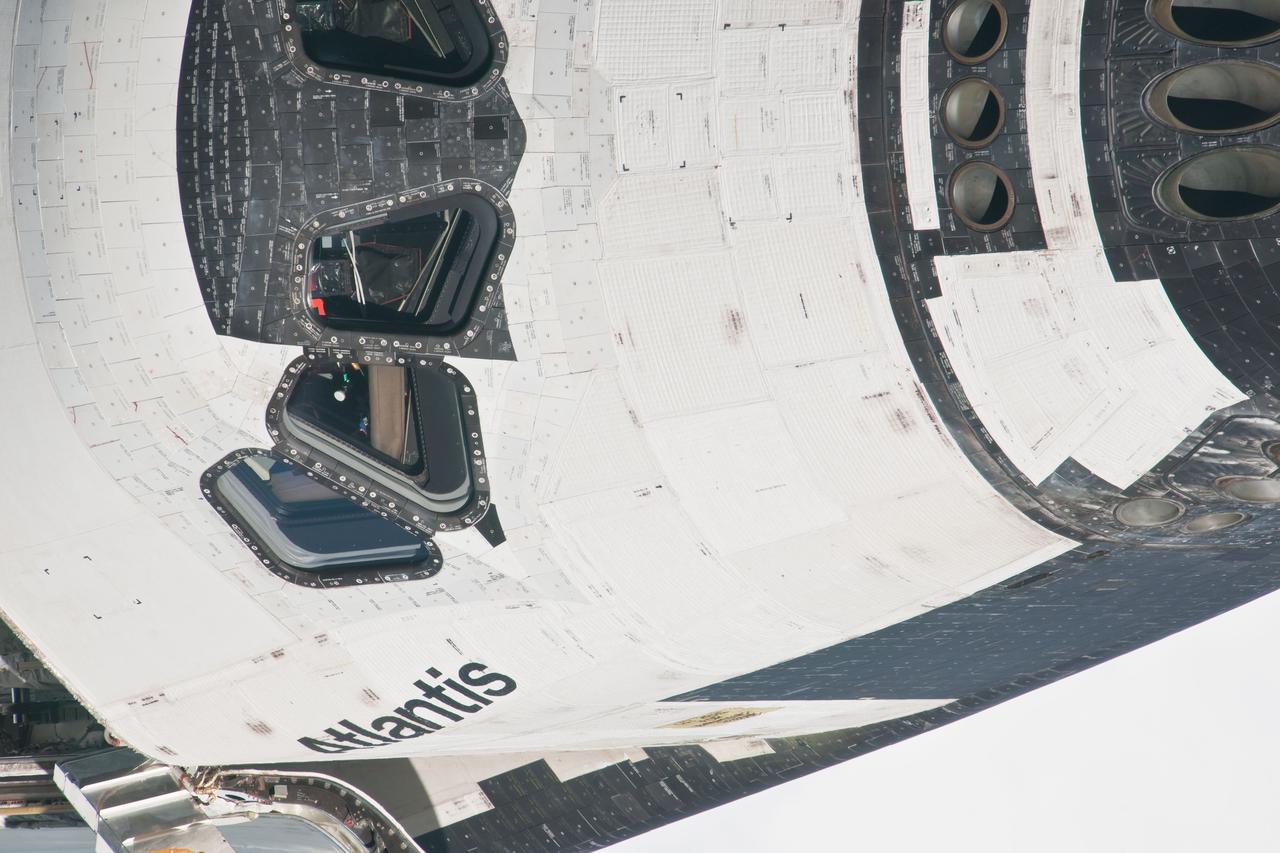
ISS028-E-015668 (10 July 2011) --- This is one of a series of images showing various parts of the space shuttle Atlantis in Earth orbit as photographed by one of three crew members -- half the station crew -- who were equipped with still cameras for this purpose on the International Space Station as the shuttle “posed” for photos and visual surveys and performed a back-flip for the rendezvous pitch maneuver (RPM). A 1000 millimeter lens was used to capture this particular series of images.
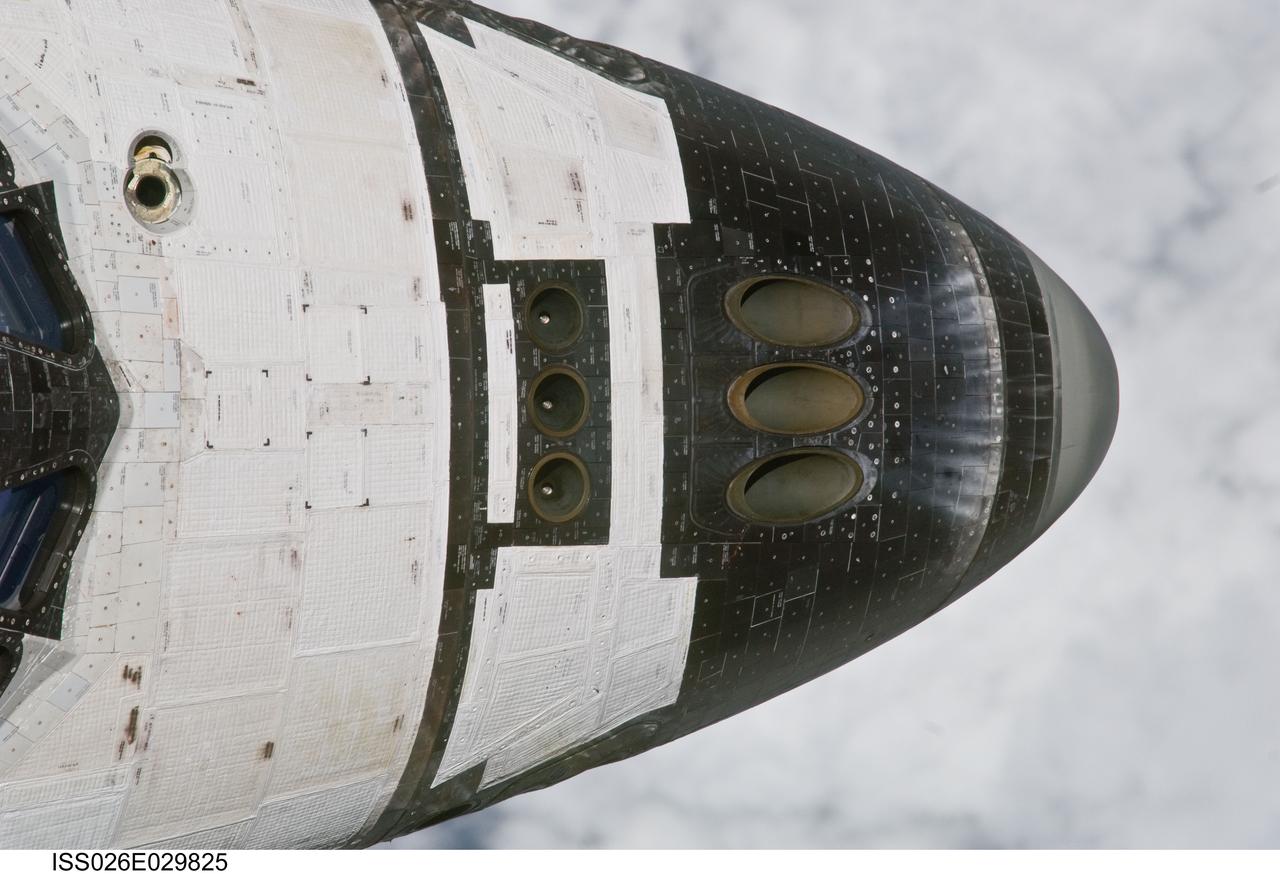
ISS026-E-029825 (26 Feb. 2011) --- This close-up view of the nose of space shuttle Discovery was provided by an Expedition 26 crew member during a survey of the approaching STS-133 vehicle prior to docking with the International Space Station. As part of the survey and part of every mission's activities, Discovery performed a back-flip for the rendezvous pitch maneuver (RPM). The station crew member used a digital still camera with an 800mm focal length, as the two spacecraft were approximately 600 feet (180 meters) apart.
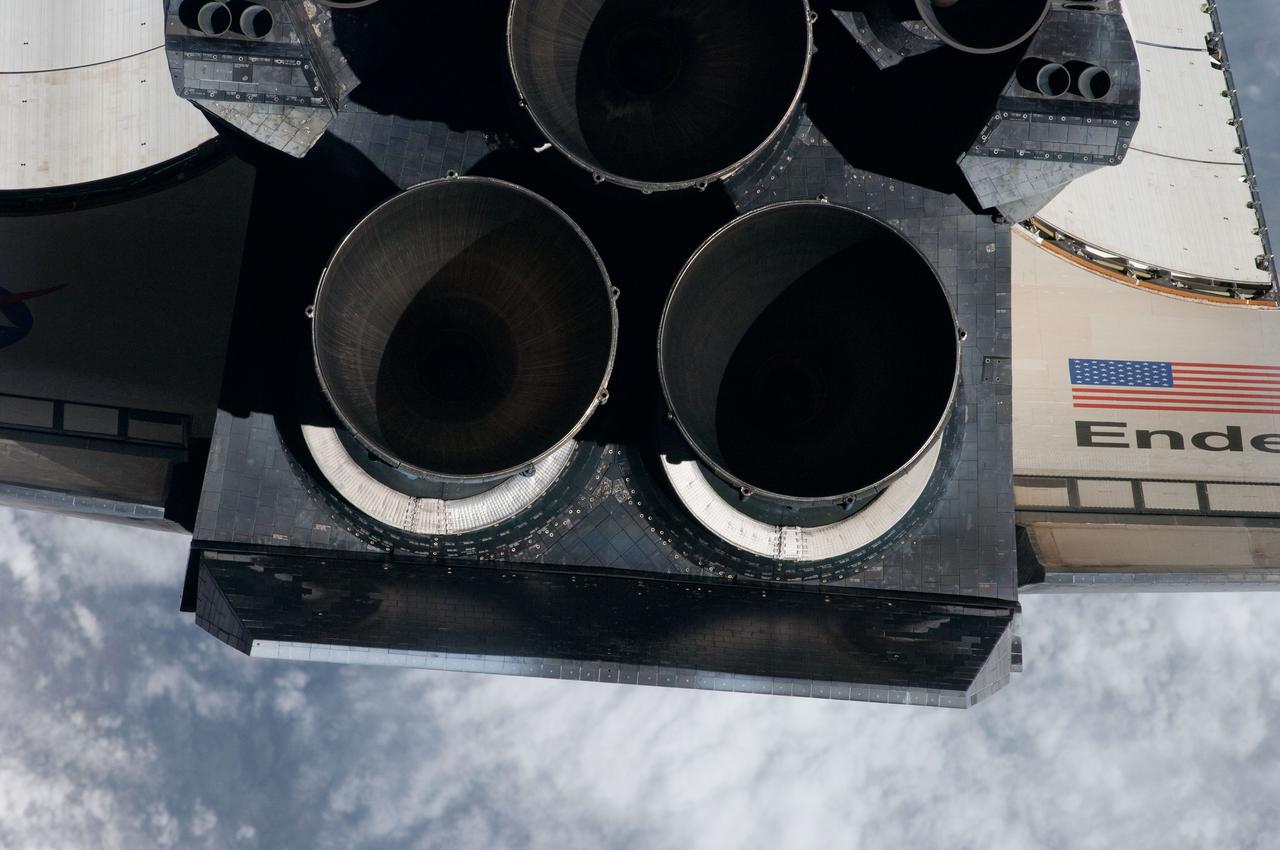
ISS027-E-032527 (18 May 2011) --- This view of the aft portion of the space shuttle Endeavour, including the three main engines and part of the wings, was provided by an Expedition 27 crew member during a survey of the approaching STS-134 vehicle prior to docking with the International Space Station. As part of the survey and part of every mission's activities, Endeavour performed a back-flip for the rendezvous pitch maneuver (RPM). The image was photographed with a digital still camera, using a 400mm lens at a distance of about 600 feet (180 meters).
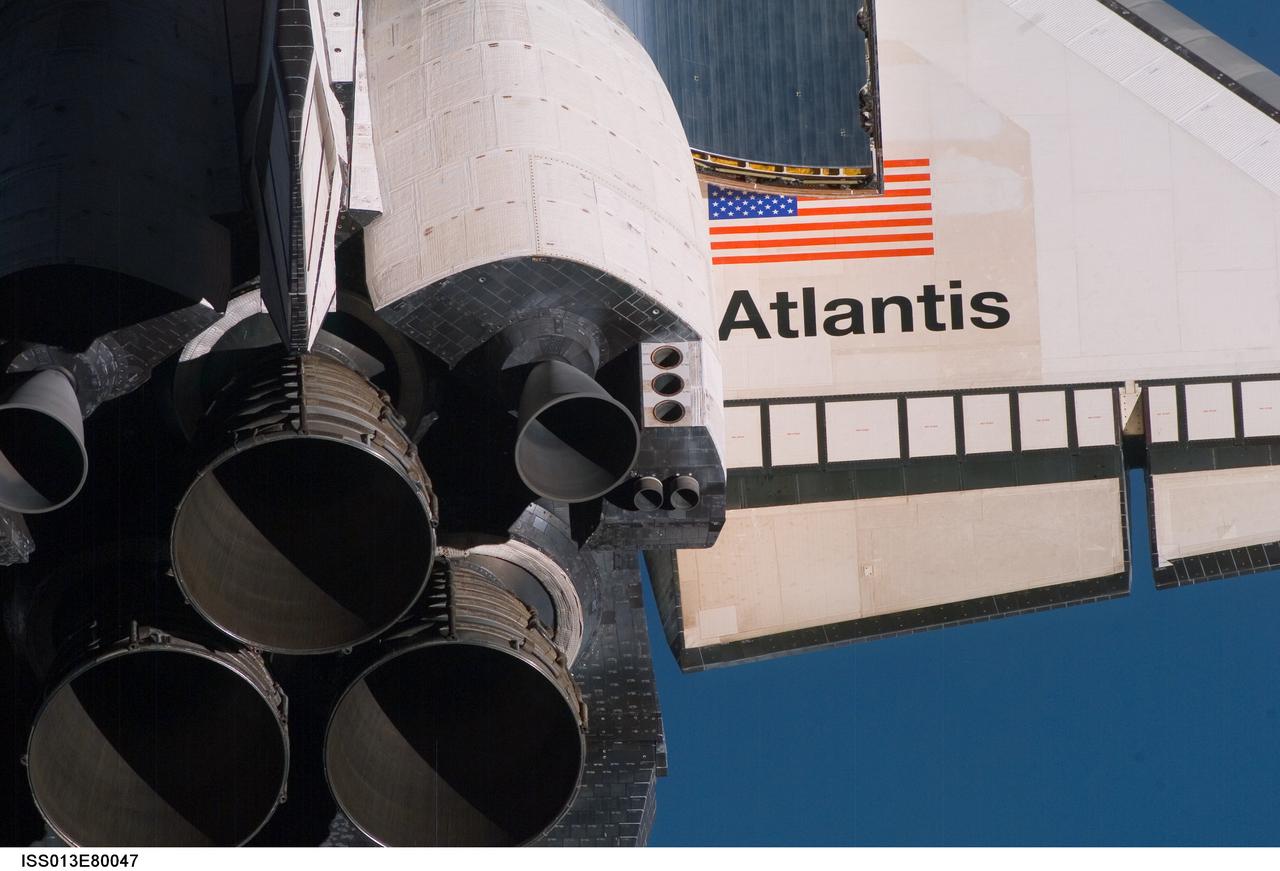
ISS013-E-80047 (11 Sept. 2006) --- A crewmember aboard the International Space Station took this picture with a handheld digital still camera as the Space Shuttle Atlantis performed a backflip while it was about 600 feet from the station during its approach. The flip, done on every shuttle mission, allows a full photographic survey of the shuttle heat shield to be taken by the station crew. This image from that survey shows the three the main engines, and part of the starboard wing and the starboard orbital maneuvering system (OMS) pod.
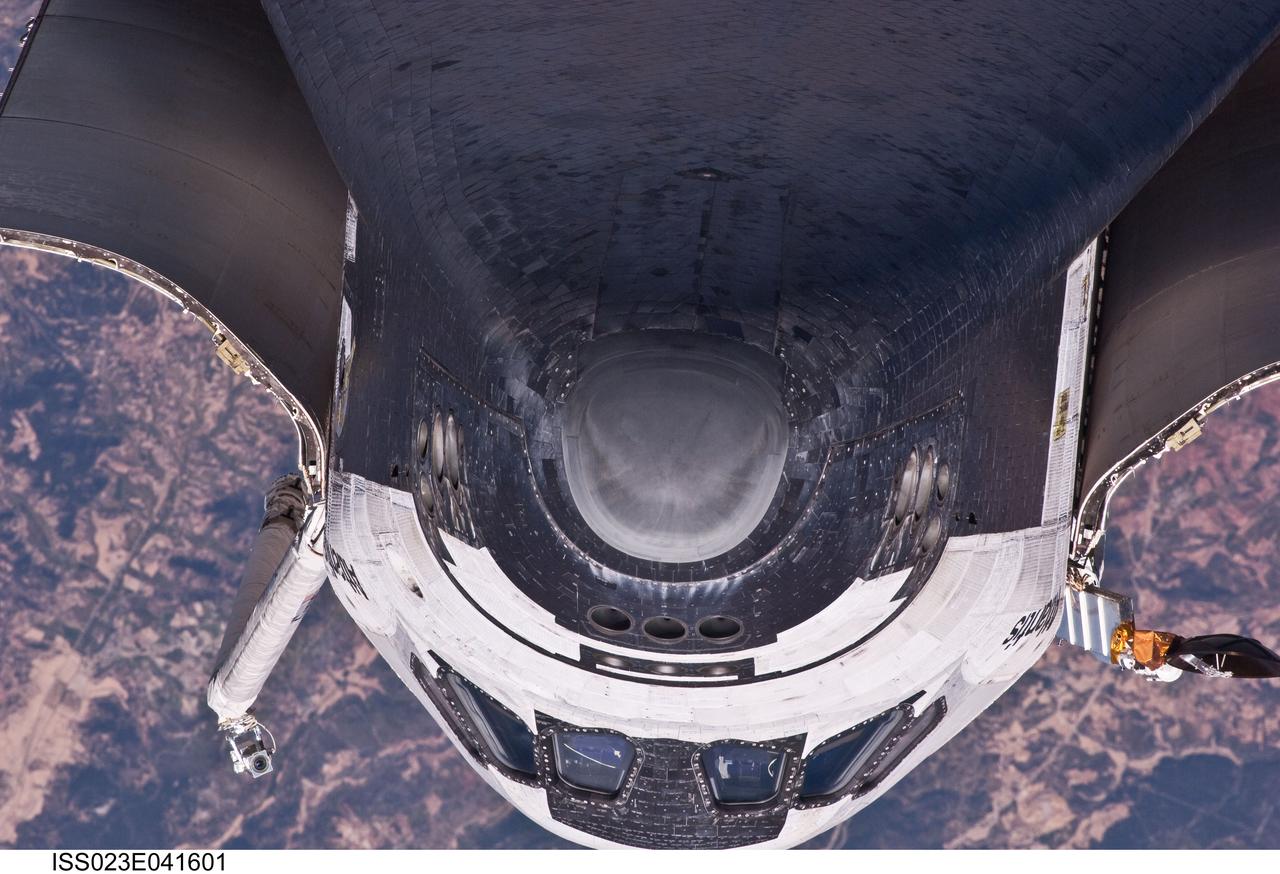
ISS023-E-041601 (16 May 2010) --- This view of the underside of the crew cabin of the space shuttle Atlantis was provided by an Expedition 23 crew member during a survey of the approaching STS-132 vehicle prior to docking with the International Space Station. As part of the survey and part of every mission's activities, Atlantis performed a back-flip for the rendezvous pitch maneuver (RPM). The image was photographed with a digital still camera, using a 400mm lens at a distance of about 600 feet (180 meters).
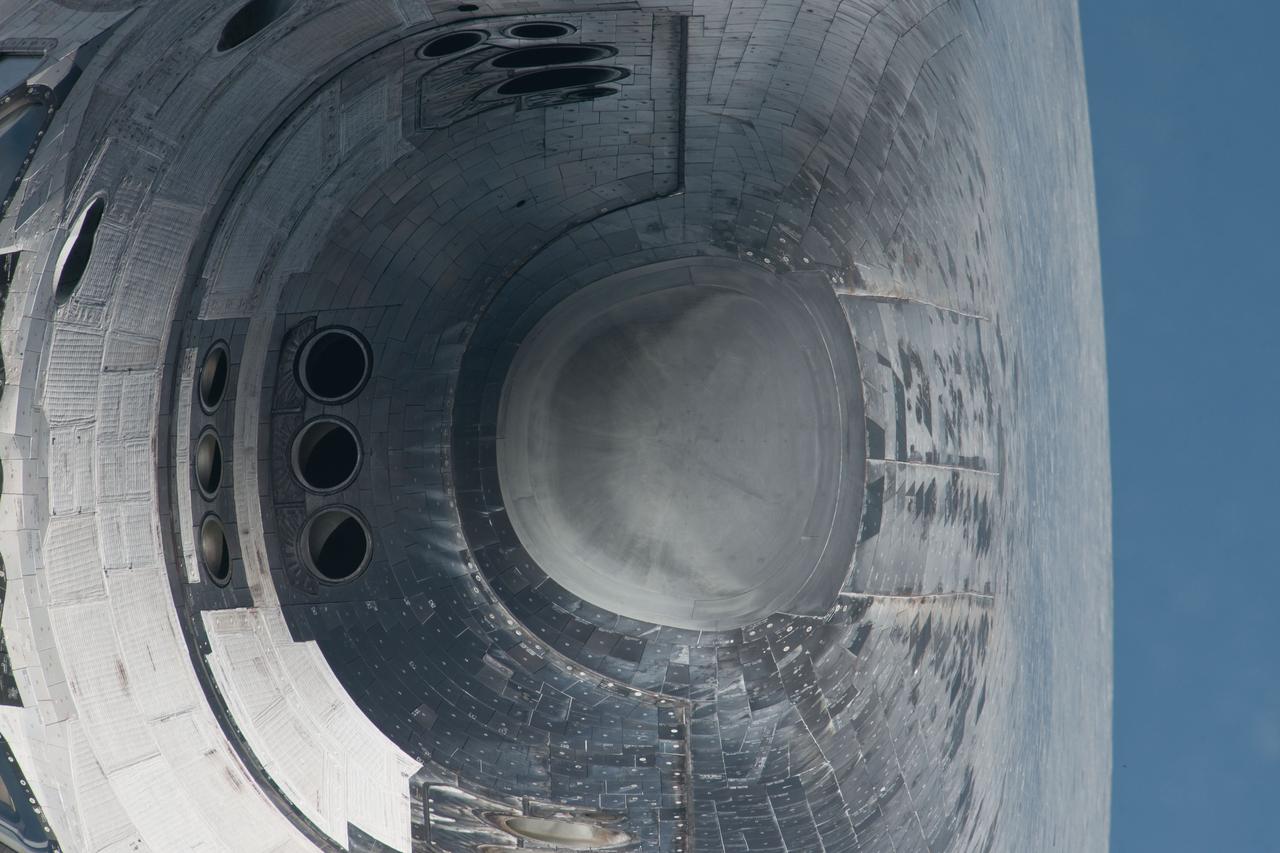
ISS028-E-015671 (10 July 2011) --- This head-on picture of Atlantis' nose and part of the underside's thermal protective system tiles is one of a series of images showing various parts of the shuttle in Earth orbit as photographed by one of three crew members -- half the station crew -- who were equipped with still cameras for this purpose on the International Space Station as the shuttle “posed” for photos and visual surveys and performed a back-flip for the rendezvous pitch maneuver (RPM). A 1000 millimeter lens was used to capture this particular series of images.
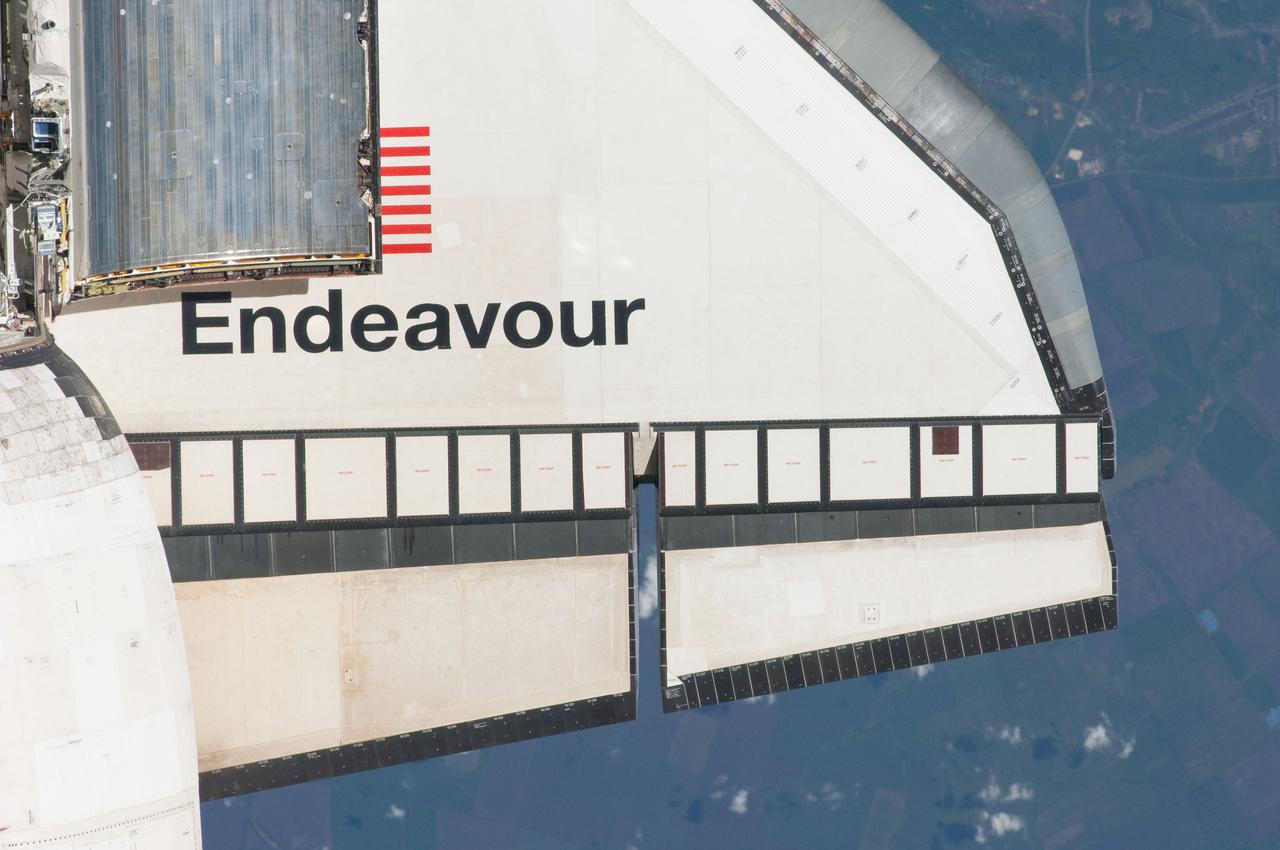
ISS027-E-032226 (18 May 2011) --- This partial view of the starboard wing of the space shuttle Endeavour was provided by an Expedition 27 crew member during a survey of the approaching STS-134 vehicle prior to docking with the International Space Station. As part of the survey and part of every mission's activities, Endeavour performed a back-flip for the rendezvous pitch maneuver (RPM). The image was photographed with a digital still camera, using a 400mm lens at a distance of about 600 feet (180 meters).
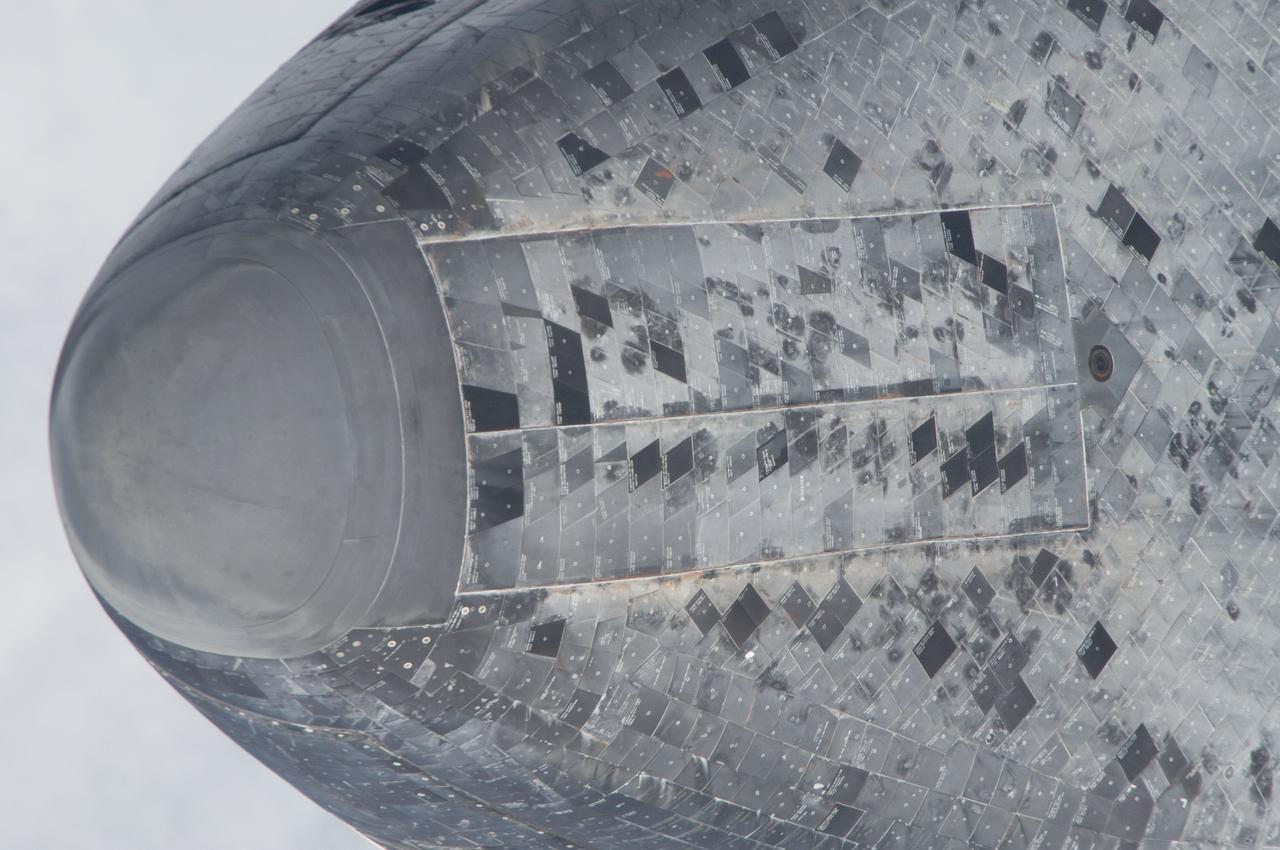
ISS028-E-015178 (10 July 2011) --- This is one of a series of images showing various parts of the space shuttle Atlantis in Earth orbit as photographed by one of the six crewmembers on the International Space Station as the shuttle “posed” for photo and visual surveys and performed a back-flip for the rendezvous pitch maneuver (RPM). An 800 millimeter lens was used to capture this particular series of images.
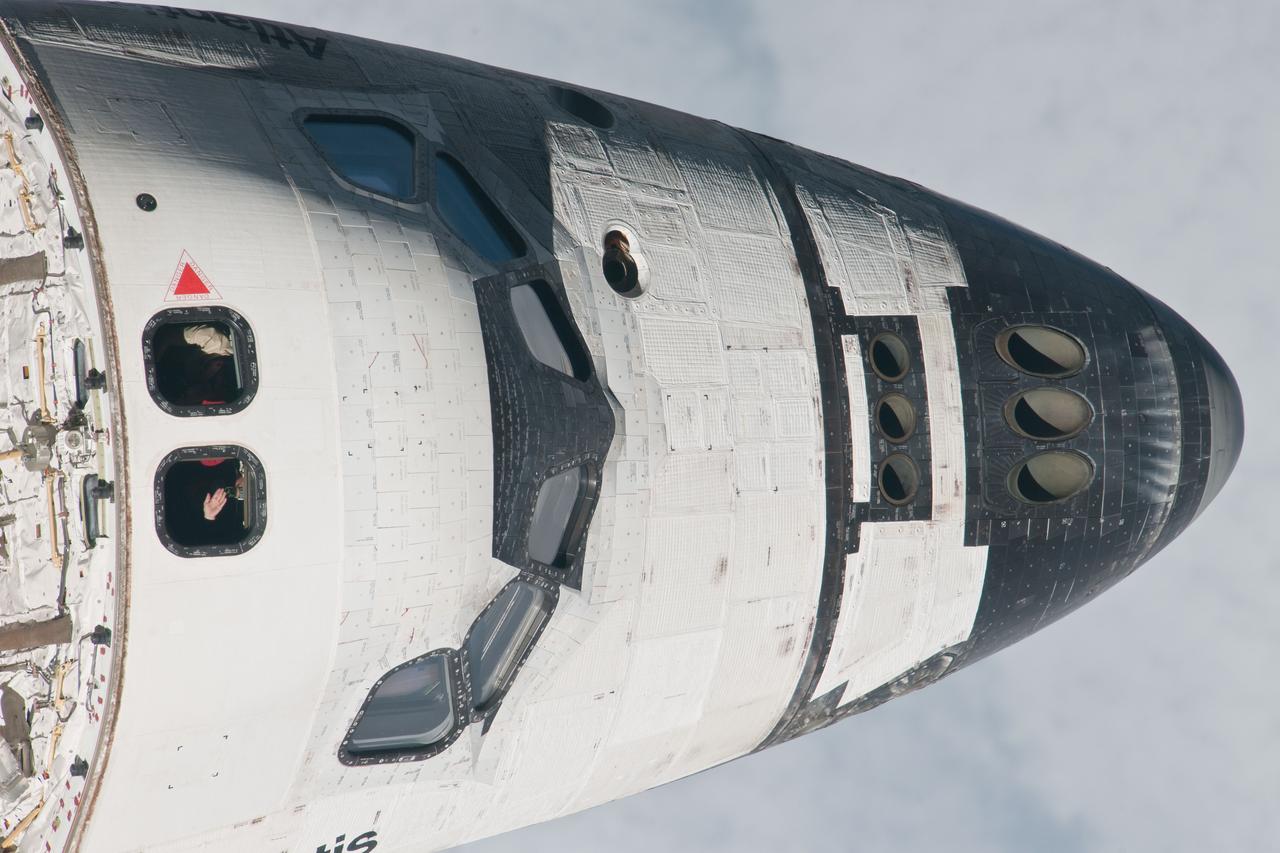
ISS028-E-015597 (10 July 2011) --- This is one of a series of images showing various parts of the space shuttle Atlantis in Earth orbit as photographed by one of three crew members -- half the station crew -- who were equipped with still cameras for this purpose on the International Space Station as the shuttle “posed” for photos and visual surveys and performed a back-flip for the rendezvous pitch maneuver (RPM). A 1000 millimeter lens was used to capture this particular series of images.
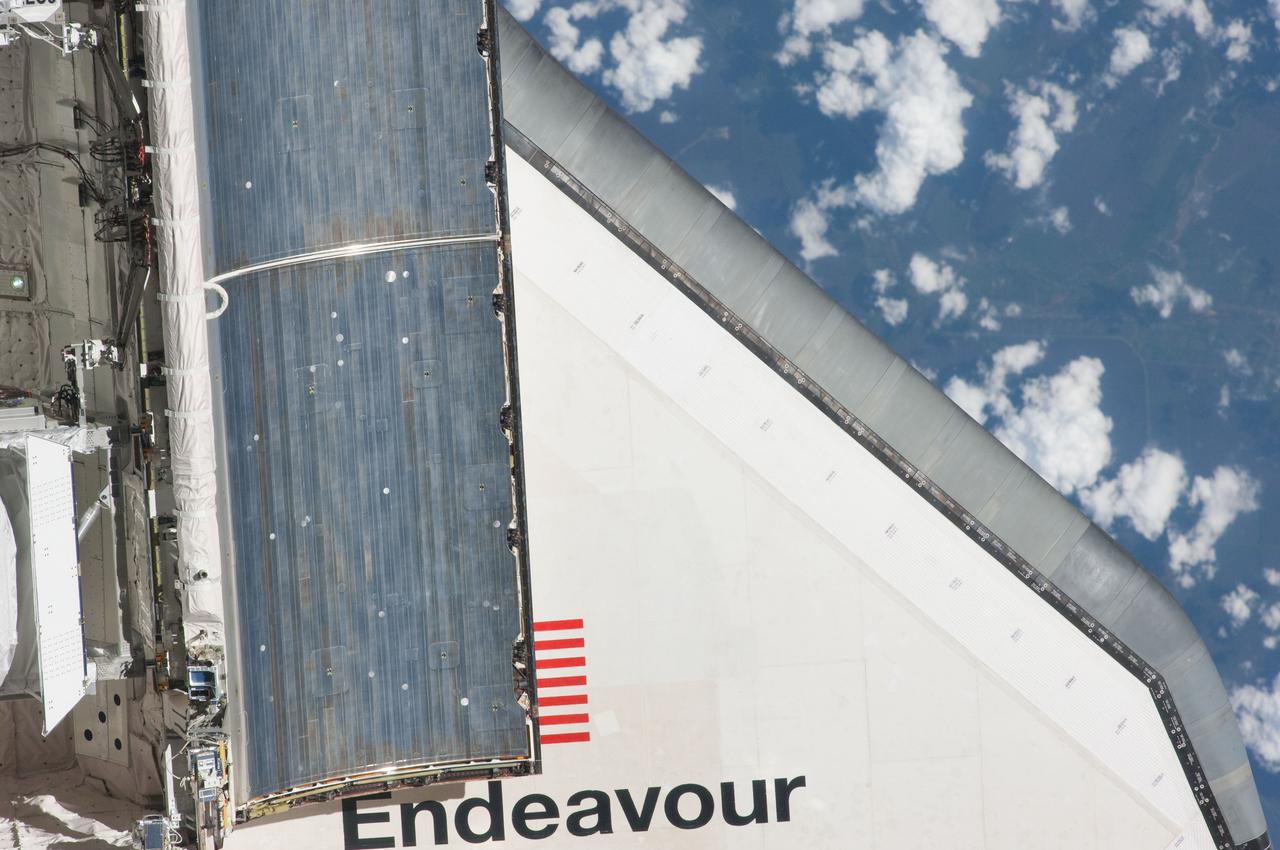
ISS027-E-032227 (18 May 2011) --- This partial view of the starboard wing of the space shuttle Endeavour was provided by an Expedition 27 crew member during a survey of the approaching STS-134 vehicle prior to docking with the International Space Station. As part of the survey and part of every mission's activities, Endeavour performed a back-flip for the rendezvous pitch maneuver (RPM). The image was photographed with a digital still camera, using a 400mm lens at a distance of about 600 feet (180 meters).
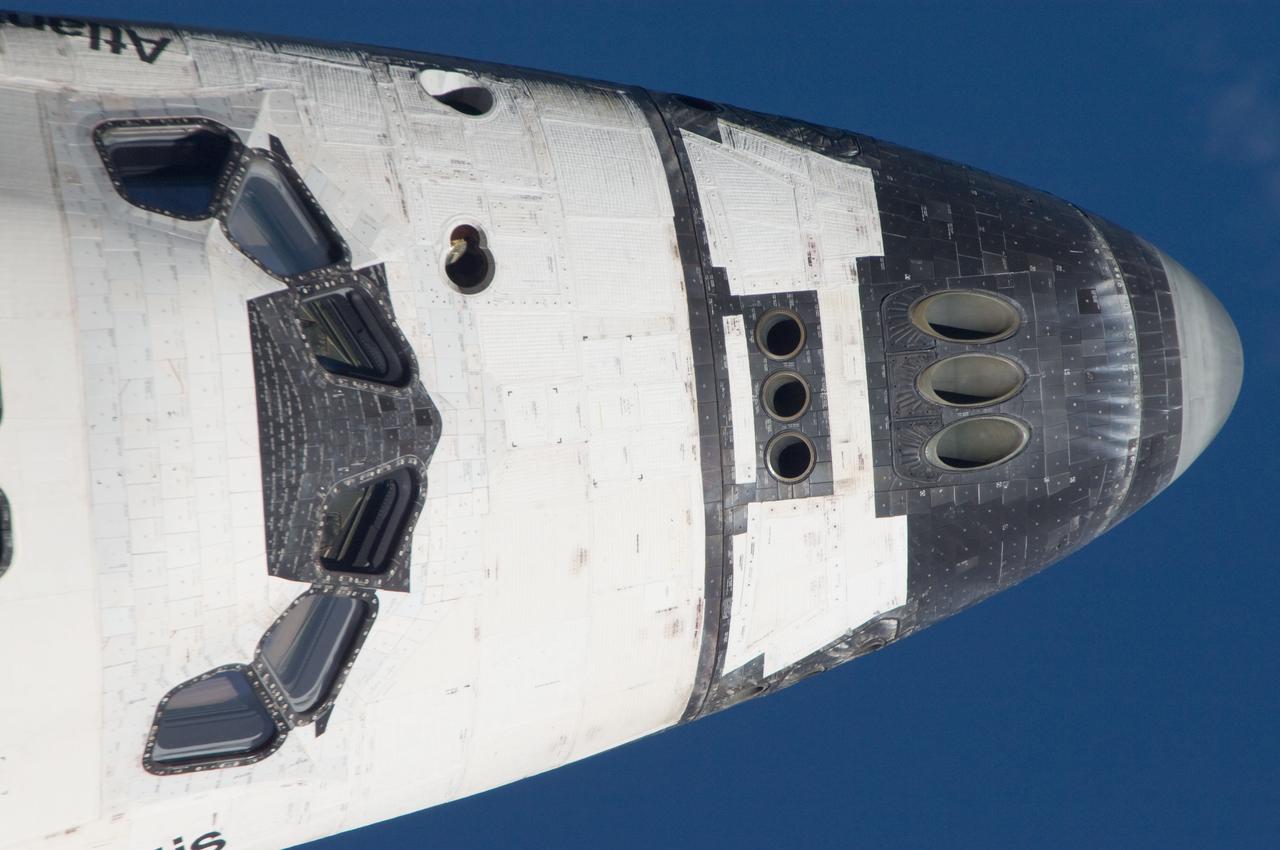
ISS028-E-015146 (10 July 2011) --- This is one of a series of images showing various parts of the space shuttle Atlantis in Earth orbit as photographed by one of the six crewmembers on the International Space Station as the shuttle “posed” for photo and visual surveys and performed a back-flip for the rendezvous pitch maneuver (RPM). An 800 millimeter lens was used to capture this particular series of images.
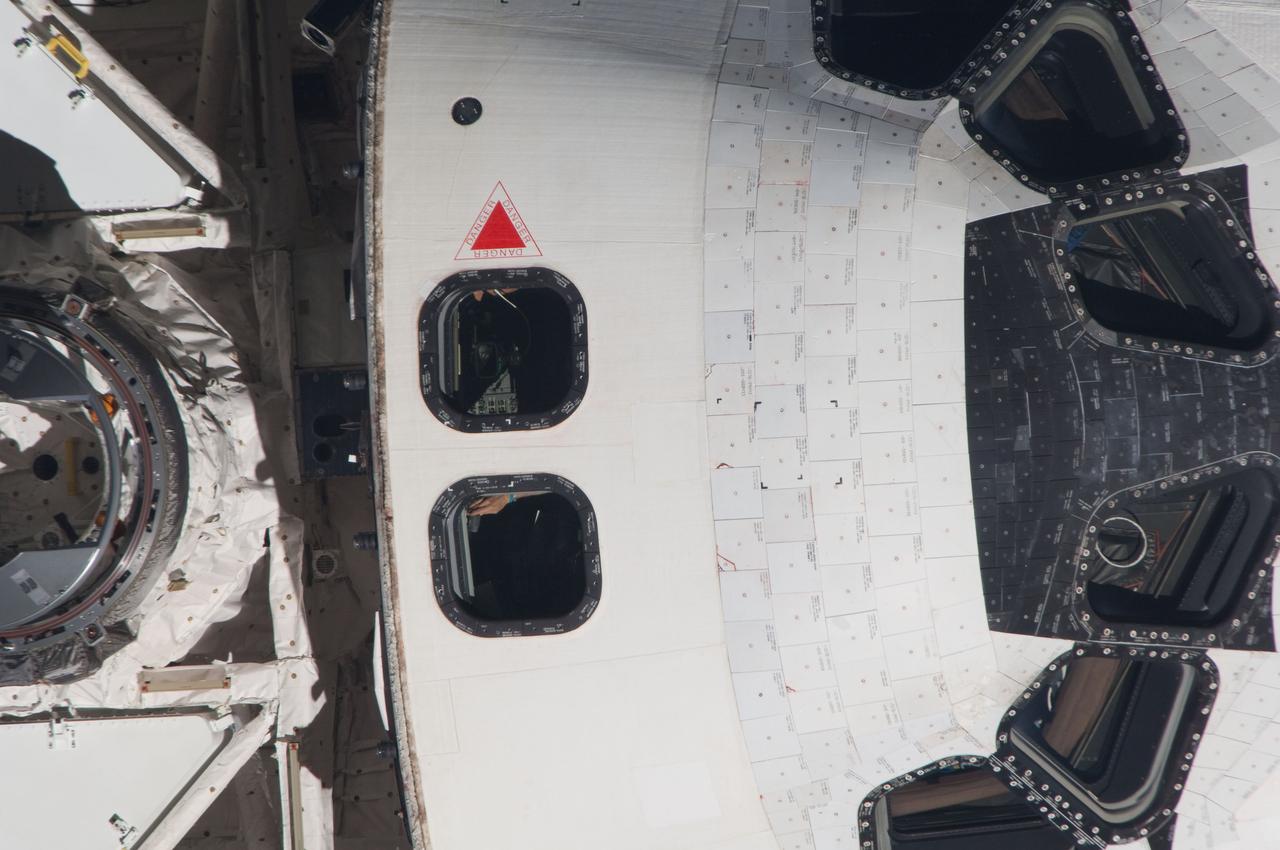
ISS027-E-032063 (18 May 2011) --- This close-up view of the crew cabin of space shuttle Endeavour was provided by an Expedition 27 crew member during a survey of the approaching STS-134 vehicle prior to docking with the International Space Station. As part of the survey and part of every mission's activities, Endeavour performed a back-flip for the rendezvous pitch maneuver (RPM). The station crew member used a digital still camera with an 800mm focal length, as the two spacecraft were approximately 600 feet (180 meters) apart.
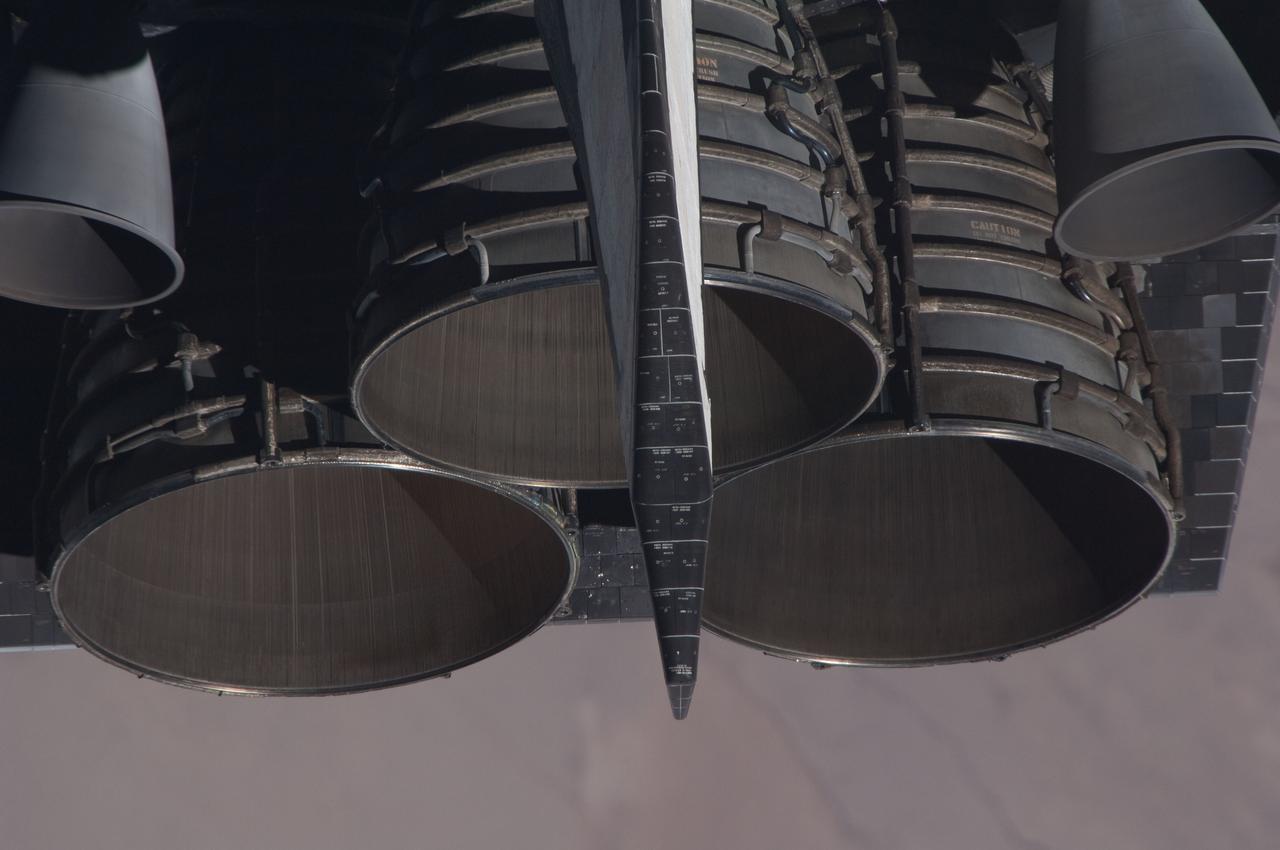
ISS027-E-032089 (18 May 2011) --- This close-up view of the space shuttle Endeavour’s three main engines was provided by an Expedition 27 crew member during a survey of the approaching STS-134 vehicle prior to docking with the International Space Station. As part of the survey and part of every mission's activities, Endeavour performed a back-flip for the rendezvous pitch maneuver (RPM). The station crew member used a digital still camera with an 800mm focal length, as the two spacecraft were approximately 600 feet (180 meters) apart.
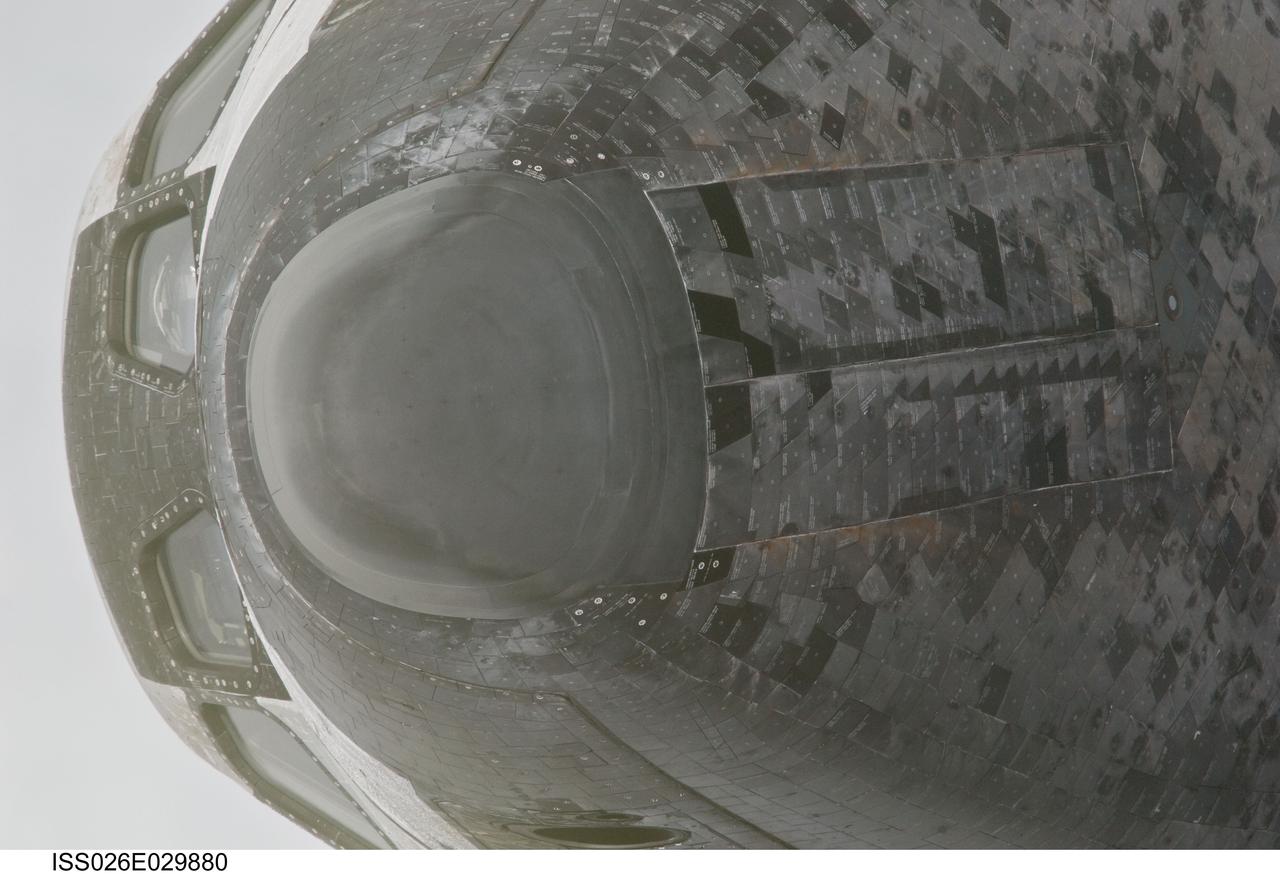
ISS026-E-029880 (26 Feb. 2011) --- This view of the nose, the forward underside and crew cabin of the space shuttle Discovery was provided by an Expedition 26 crew member during a survey of the approaching STS-133 vehicle prior to docking with the International Space Station. As part of the survey and part of every mission's activities, Discovery performed a back-flip for the rendezvous pitch maneuver (RPM). The station crew member used a digital still camera with an 800mm focal length, as the two spacecraft were approximately 600 feet (180 meters) apart.
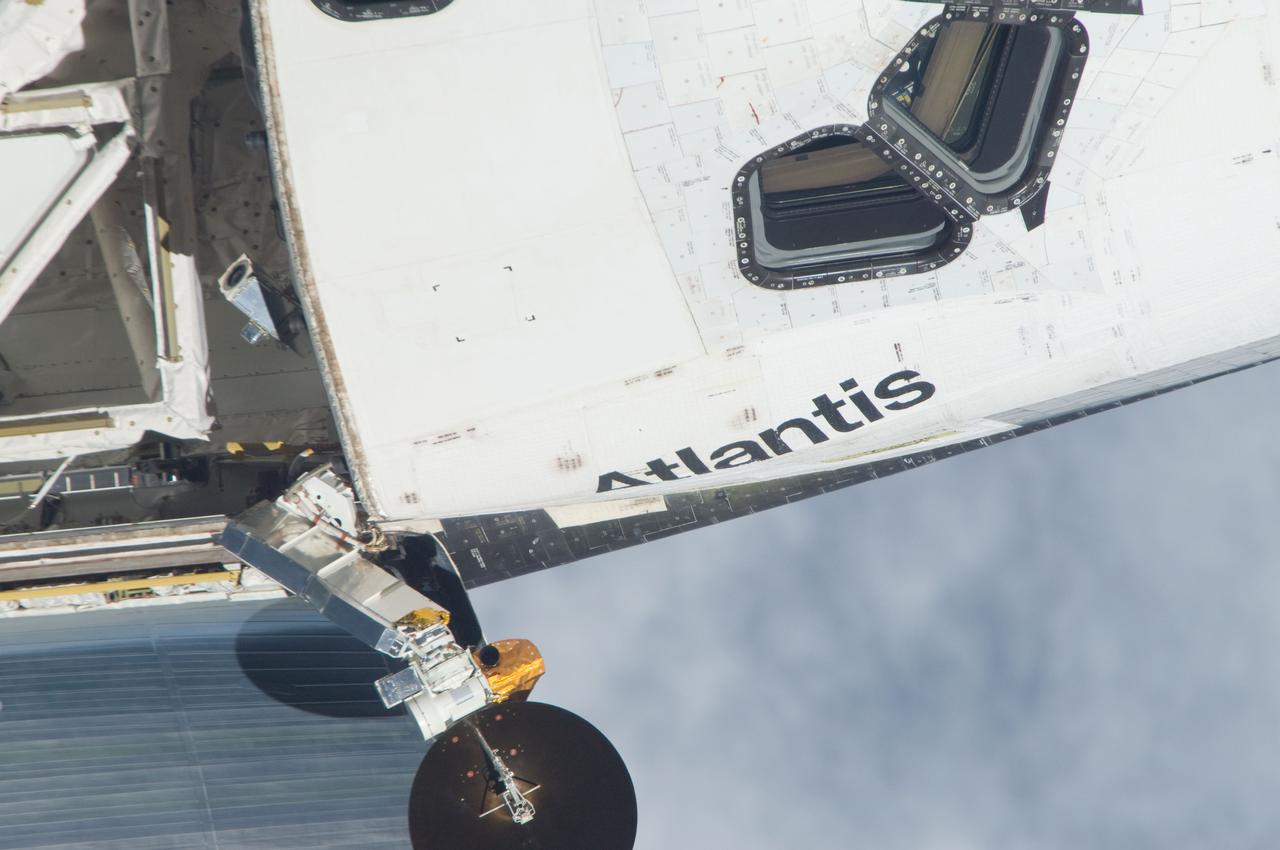
ISS028-E-015129 (10 July 2011) --- This is one of a series of images showing various parts of the space shuttle Atlantis in Earth orbit as photographed by one of the six crewmembers on the International Space Station as the shuttle “posed” for photo and visual surveys and performed a back-flip for the rendezvous pitch maneuver (RPM). An 800 millimeter lens was used to capture this particular series of images.
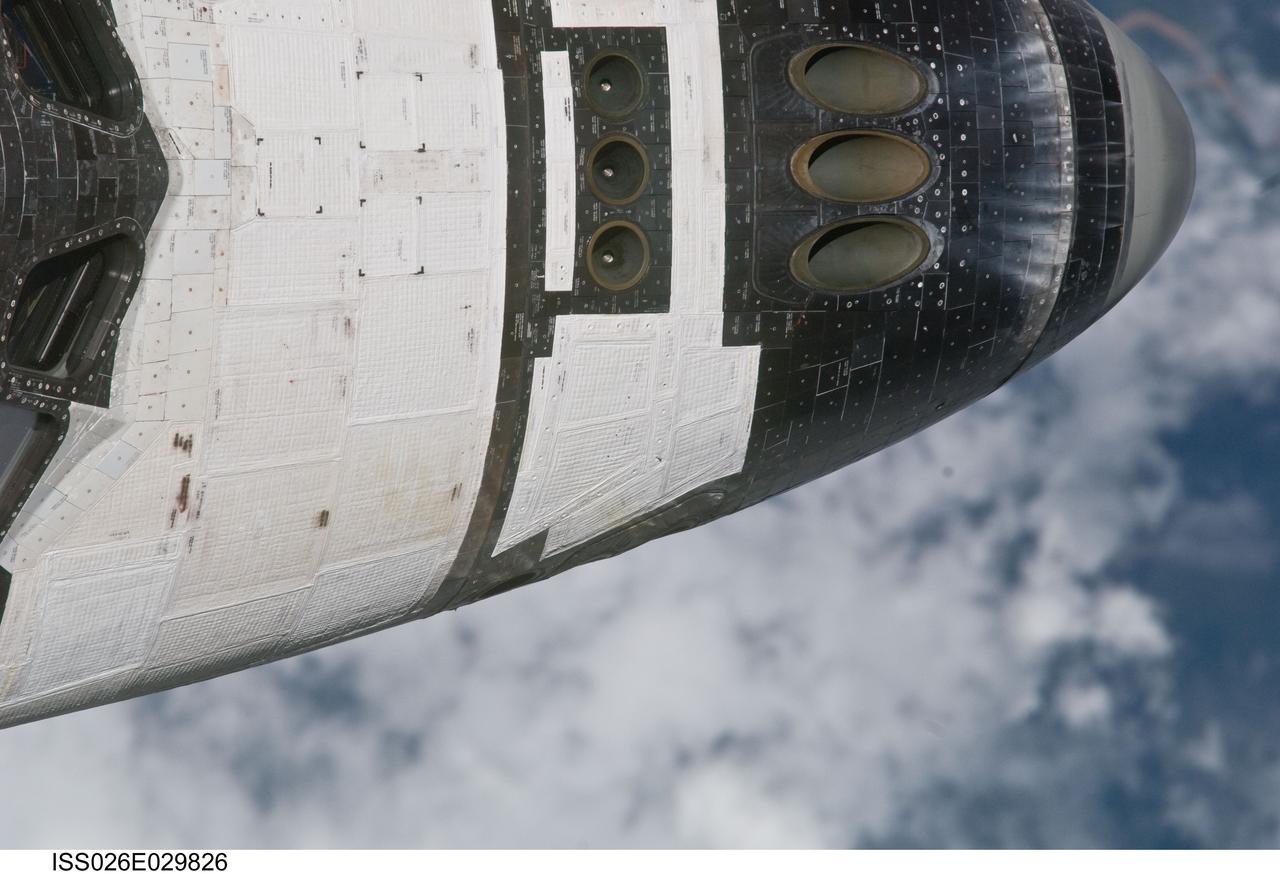
ISS026-E-029826 (26 Feb. 2011) --- This close-up view of the nose of space shuttle Discovery was provided by an Expedition 26 crew member during a survey of the approaching STS-133 vehicle prior to docking with the International Space Station. As part of the survey and part of every mission's activities, Discovery performed a back-flip for the rendezvous pitch maneuver (RPM). The station crew member used a digital still camera with an 800mm focal length, as the two spacecraft were approximately 600 feet (180 meters) apart.
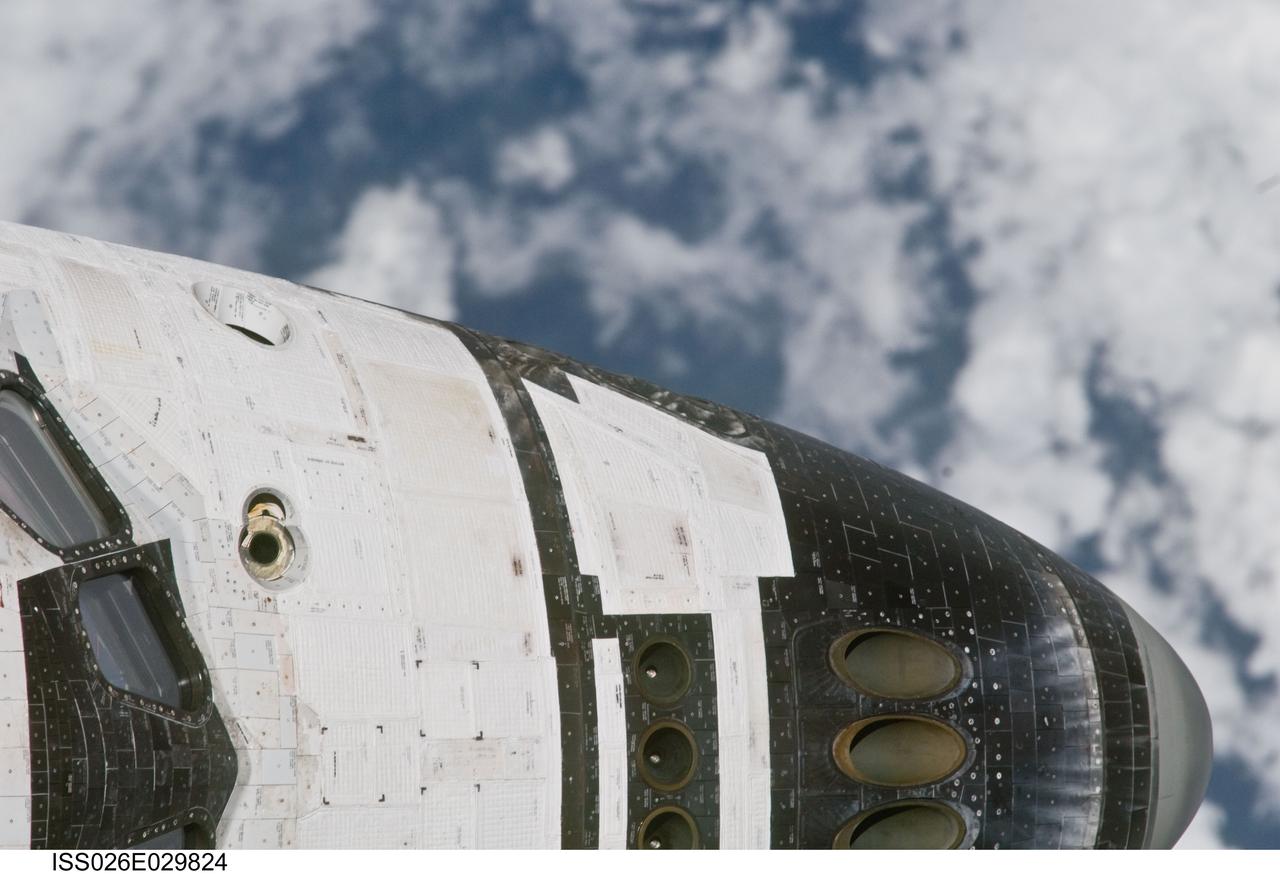
ISS026-E-029824 (26 Feb. 2011) --- This close-up view of the nose of space shuttle Discovery was provided by an Expedition 26 crew member during a survey of the approaching STS-133 vehicle prior to docking with the International Space Station. As part of the survey and part of every mission's activities, Discovery performed a back-flip for the rendezvous pitch maneuver (RPM). The station crew member used a digital still camera with an 800mm focal length, as the two spacecraft were approximately 600 feet (180 meters) apart.
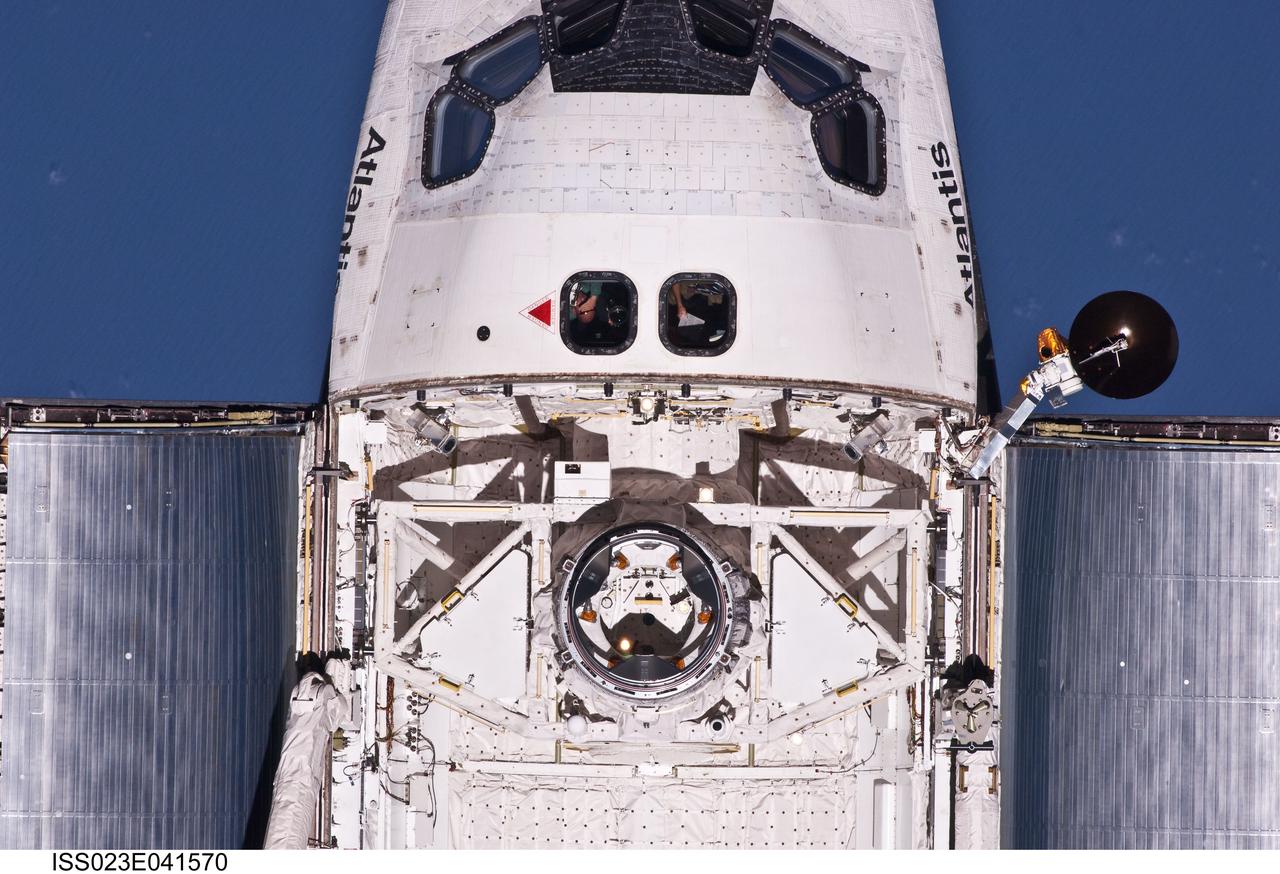
ISS023-E-041570 (16 May 2010) --- This view of crew cabin and forward payload bay of the space shuttle Atlantis was provided by an Expedition 23 crew member during a survey of the approaching STS-132 vehicle prior to docking with the International Space Station. As part of the survey and part of every mission's activities, Atlantis performed a back-flip for the rendezvous pitch maneuver (RPM). The image was photographed with a digital still camera, using a 400mm lens at a distance of about 600 feet (180 meters).
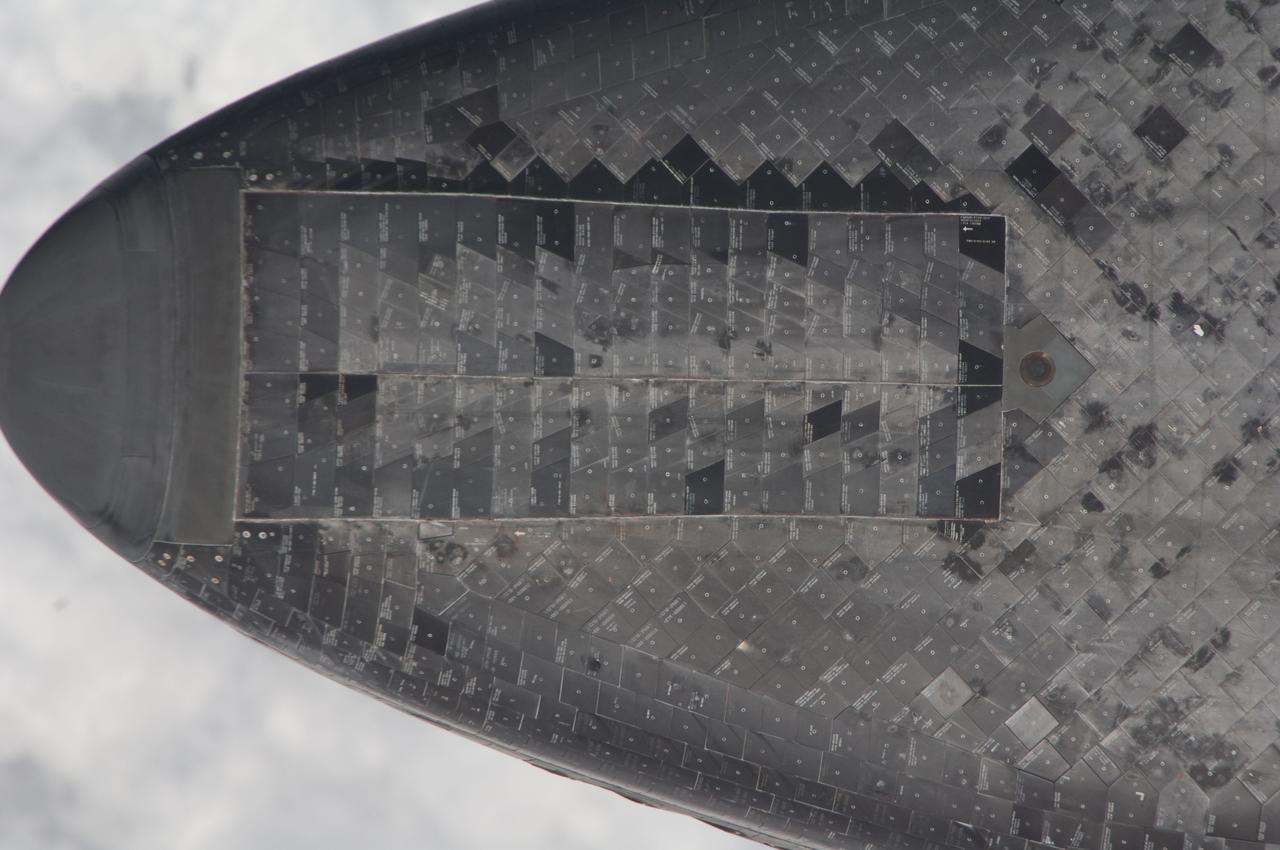
ISS027-E-032166 (18 May 2011) --- This underside view of the nose of space shuttle Endeavour was provided by an Expedition 27 crew member during a survey of the approaching STS-134 vehicle prior to docking with the International Space Station. As part of the survey and part of every mission's activities, Endeavour performed a back-flip for the rendezvous pitch maneuver (RPM). The station crew member used a digital still camera with an 800mm focal length, as the two spacecraft were approximately 600 feet (180 meters) apart.
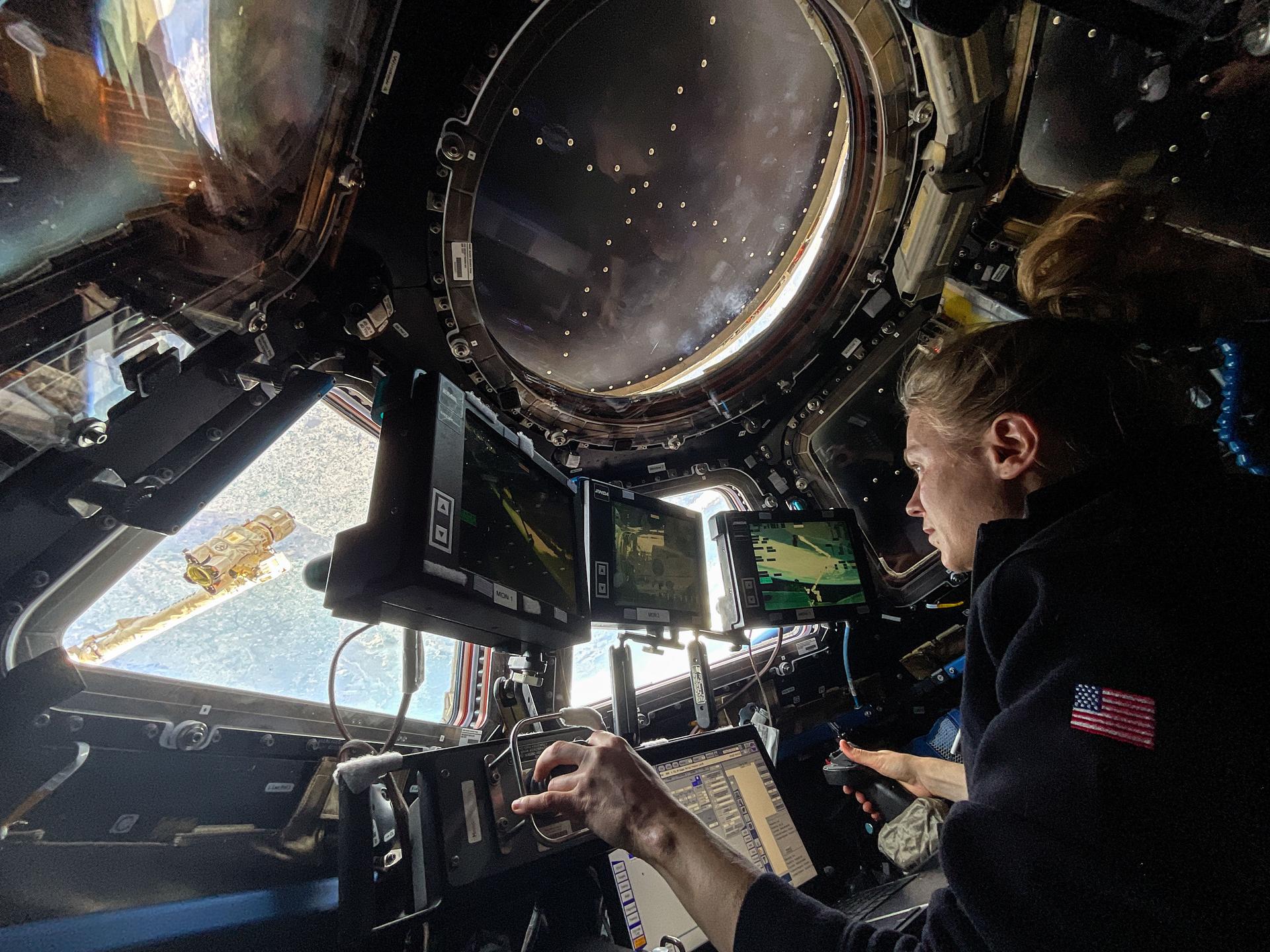
iss073e0981639 (Sept. 11, 2025) --- NASA astronaut and Expedition 73 Flight Engineer Zena Cardman practices Canadarm2 robotic maneuvers at the robotics workstation inside the International Space Station's cupola. Kim was preparing for the robotic capture of the Northrop Grumman Cygnus XL cargo spacecraft that launched on Sept. 14, 2025, and arrived on Sept. 18 delivering about 11,000 pounds of science, supplies, and hardware to the Expedition 73 crew.
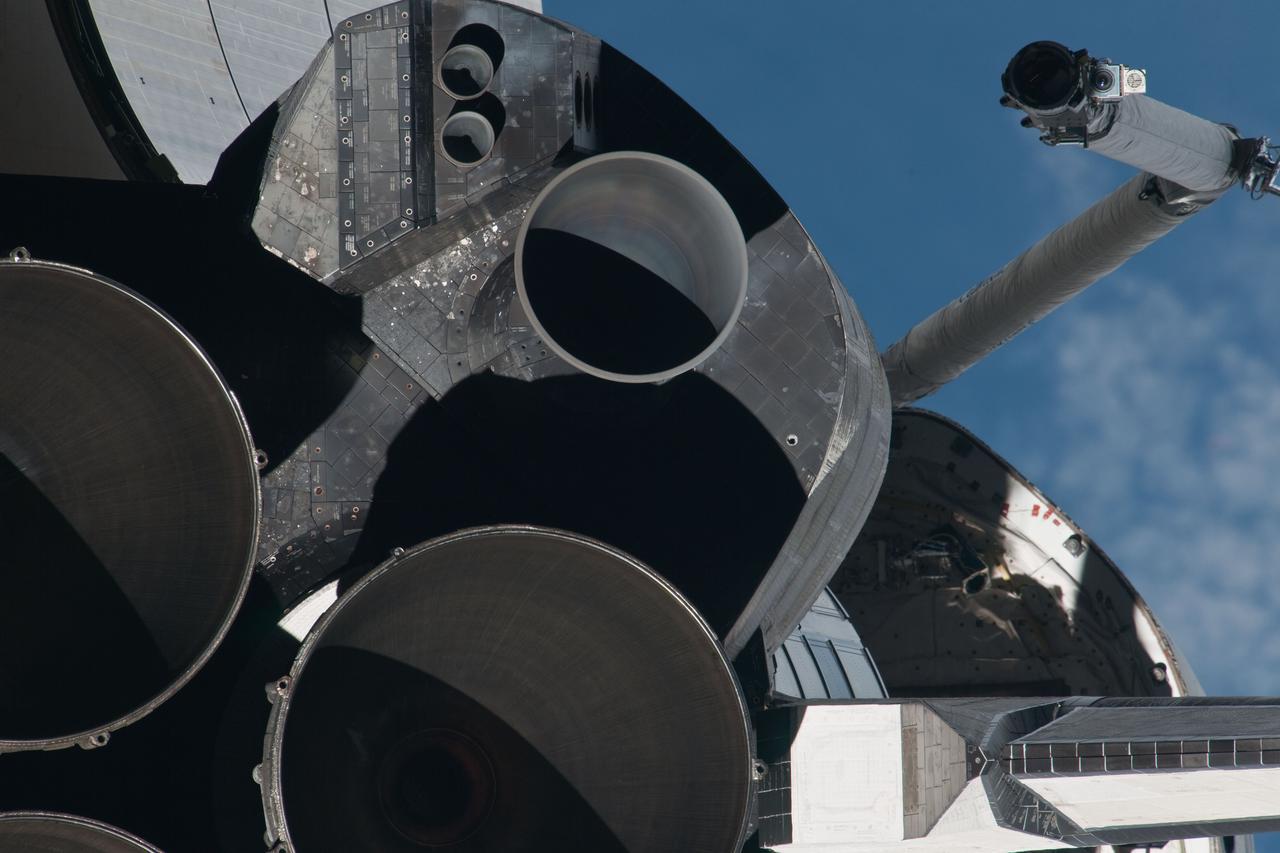
ISS028-E-015647 (10 July 2011) --- This picture of Atlantis' main and subsystem engines is one of a series of images showing various parts of the space shuttle Atlantis in Earth orbit as photographed by one of three crew members -- half the station crew -- who were equipped with still cameras for this purpose on the International Space Station as the shuttle “posed” for photos and visual surveys and performed a back-flip for the rendezvous pitch maneuver (RPM). A 1000 millimeter lens was used to capture this particular series of images.
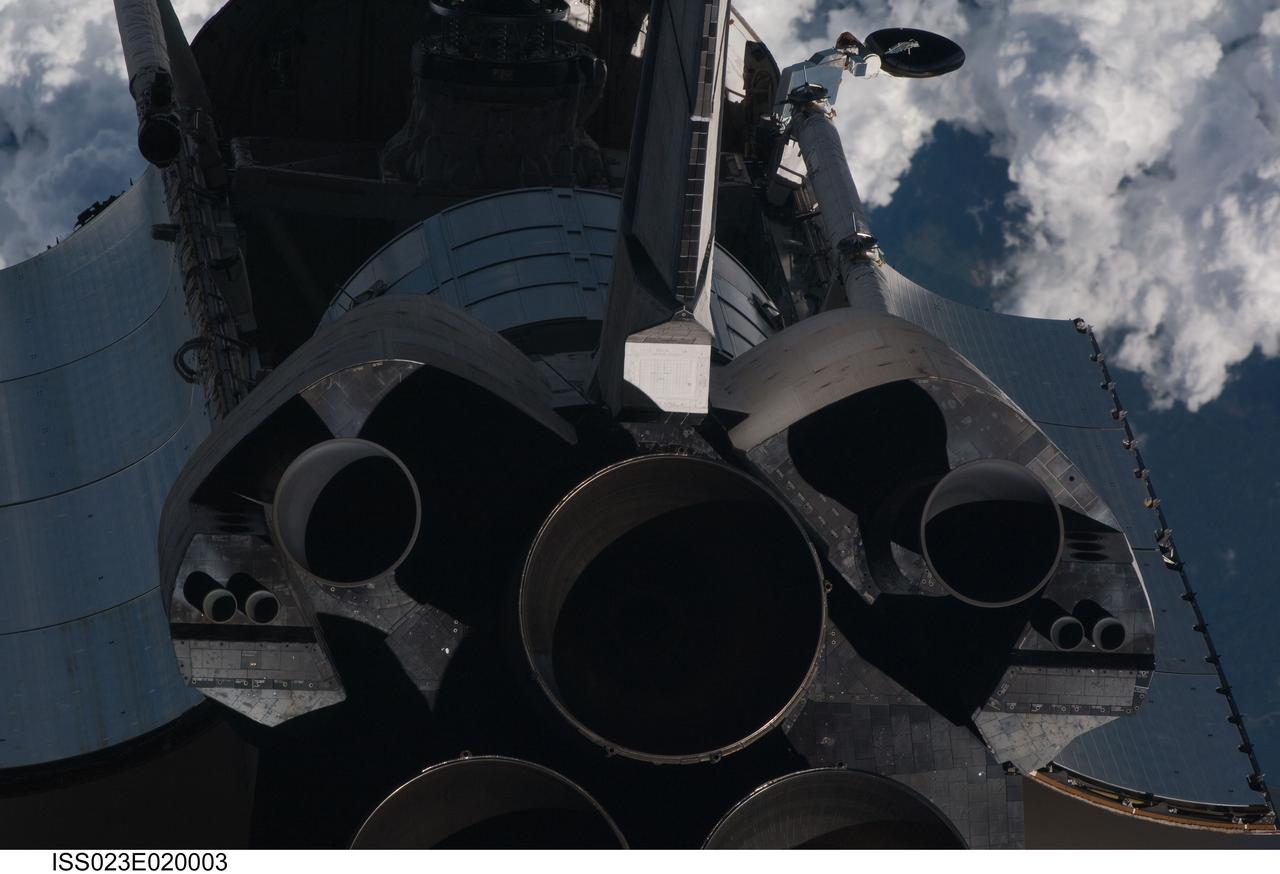
ISS023-E-020003 (7 April 2010) --- This view of the aft portion of the space shuttle Discovery, including the three main engines and part of the cargo bay, was provided by an Expedition 23 crew member during a survey of the approaching vehicle prior to docking with the International Space Station. As part of the survey and part of every mission's activities, the STS-131 Discovery crew performed a back-flip for the rendezvous pitch maneuver (RPM). The image was photographed with a digital still camera, using a 400mm lens at a distance of about 600 feet (180 meters).
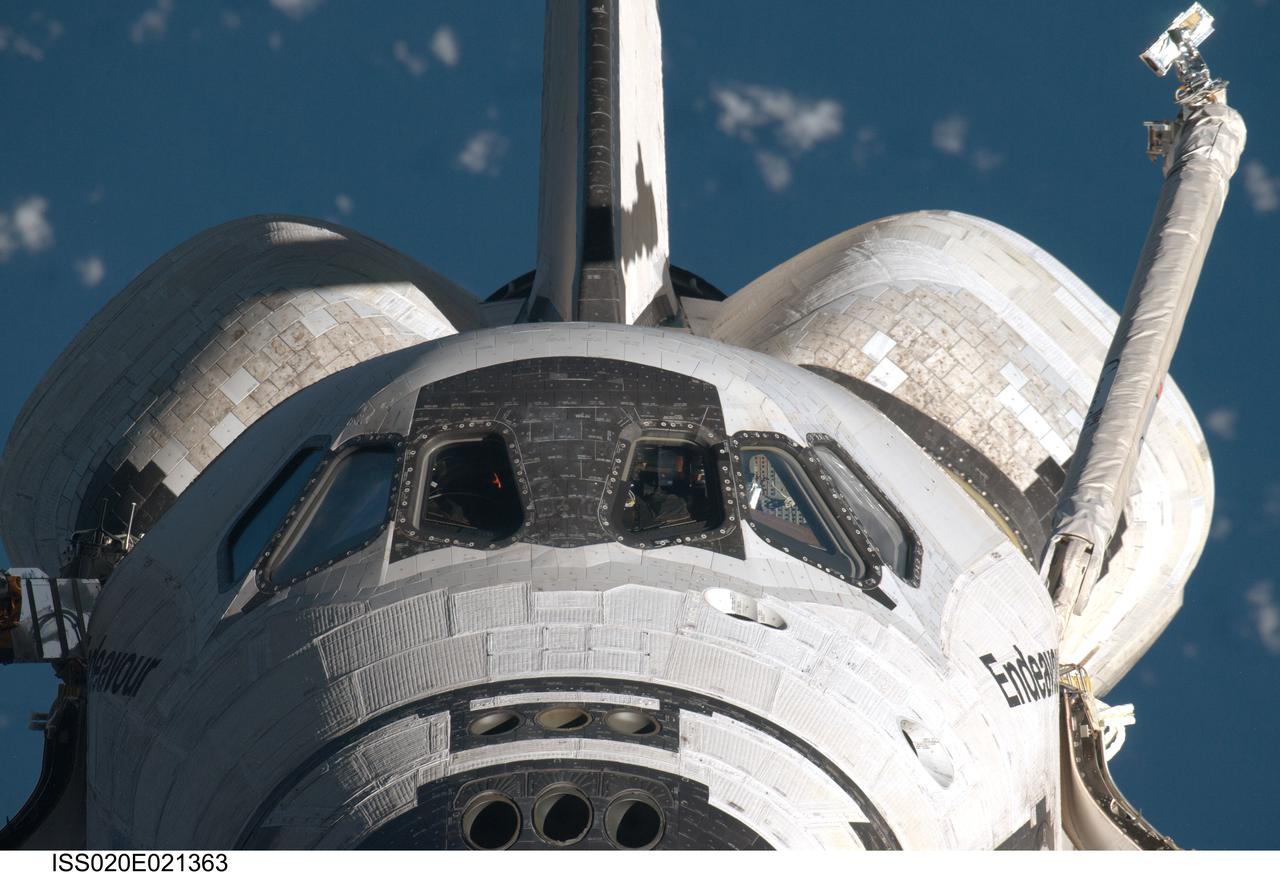
ISS20-E-021363 (17 July 2009) --- This head-on view of the Space Shuttle Endeavour was provided by an Expedition 20 crewmember during a survey of the approaching vehicle prior to docking with the International Space Station. As part of the survey and part of every mission's activities, Endeavour performed a back-flip for the rendezvous pitch maneuver (RPM). The image was photographed with a digital still camera, using a 800mm lens at a distance of about 600 feet (180 meters).
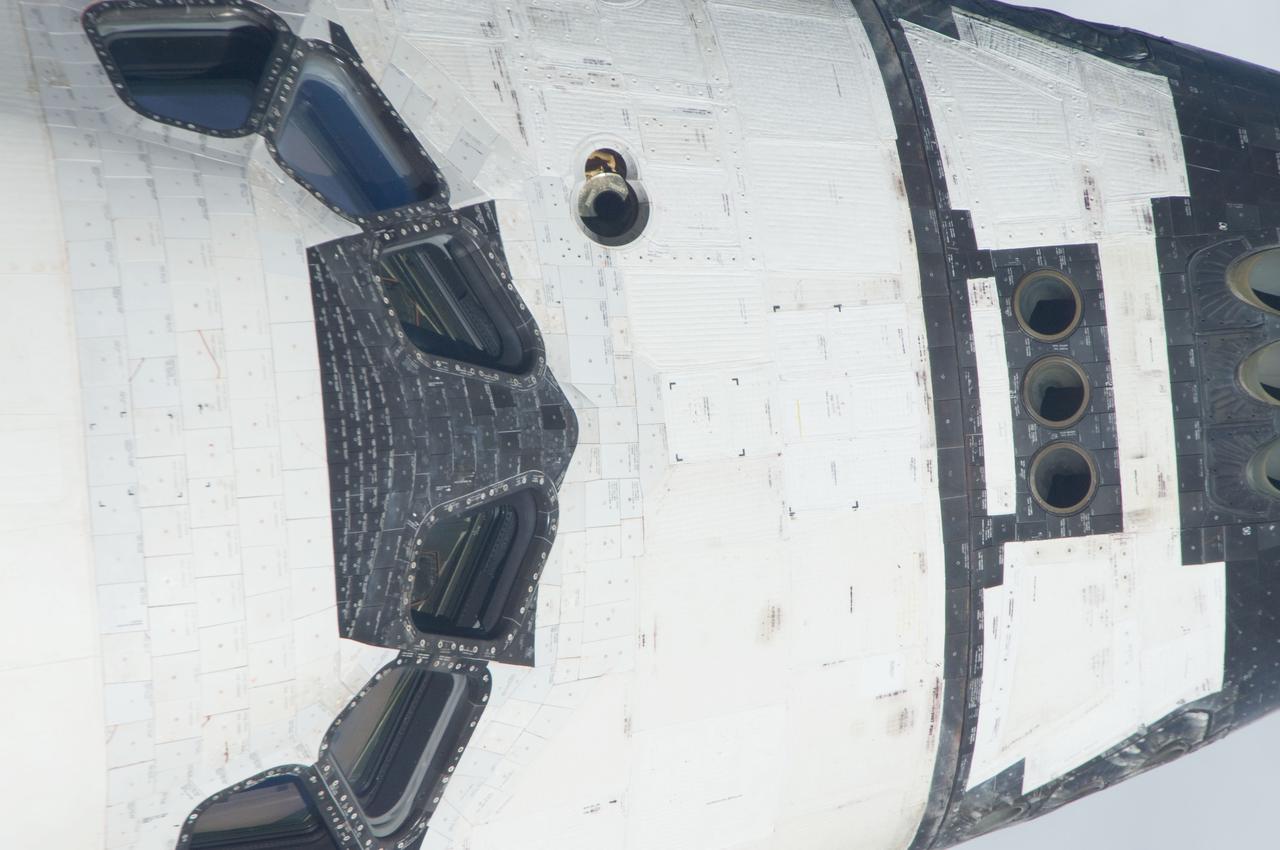
ISS028-E-015116 (10 July 2011) --- This is one of a series of images showing various parts of the space shuttle Atlantis in Earth orbit as photographed by one of the six crewmembers on the International Space Station as the shuttle “posed” for photo and visual surveys and performed a back-flip for the rendezvous pitch maneuver (RPM). An 800 millimeter lens was used to capture this particular series of images.

ISS026-E-030084 (26 Feb. 2011) --- This partial view of the port wing of the space shuttle Discovery was provided by an Expedition 26 crew member during a survey of the approaching STS-133 vehicle prior to docking with the International Space Station. As part of the survey and part of every mission's activities, Discovery performed a back-flip for the rendezvous pitch maneuver (RPM). The image was photographed with a digital still camera, using a 400mm lens at a distance of about 600 feet (180 meters).