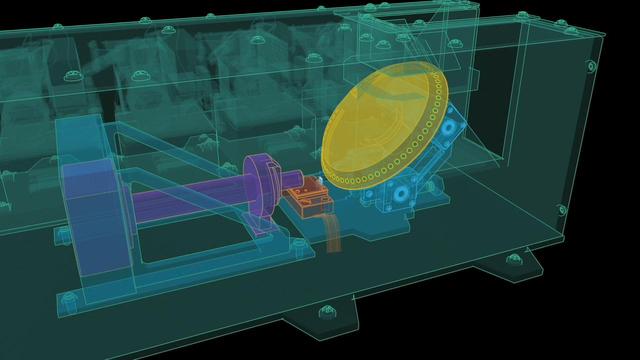
A scientific illustration of the operation of NASA Phoenix Mars Lander Atomic Force Microscope, or AFM. The AFM is part of Phoenix Microscopy, Electrochemistry, and Conductivity Analyzer, or MECA.
Atomic Force Microscope Operation
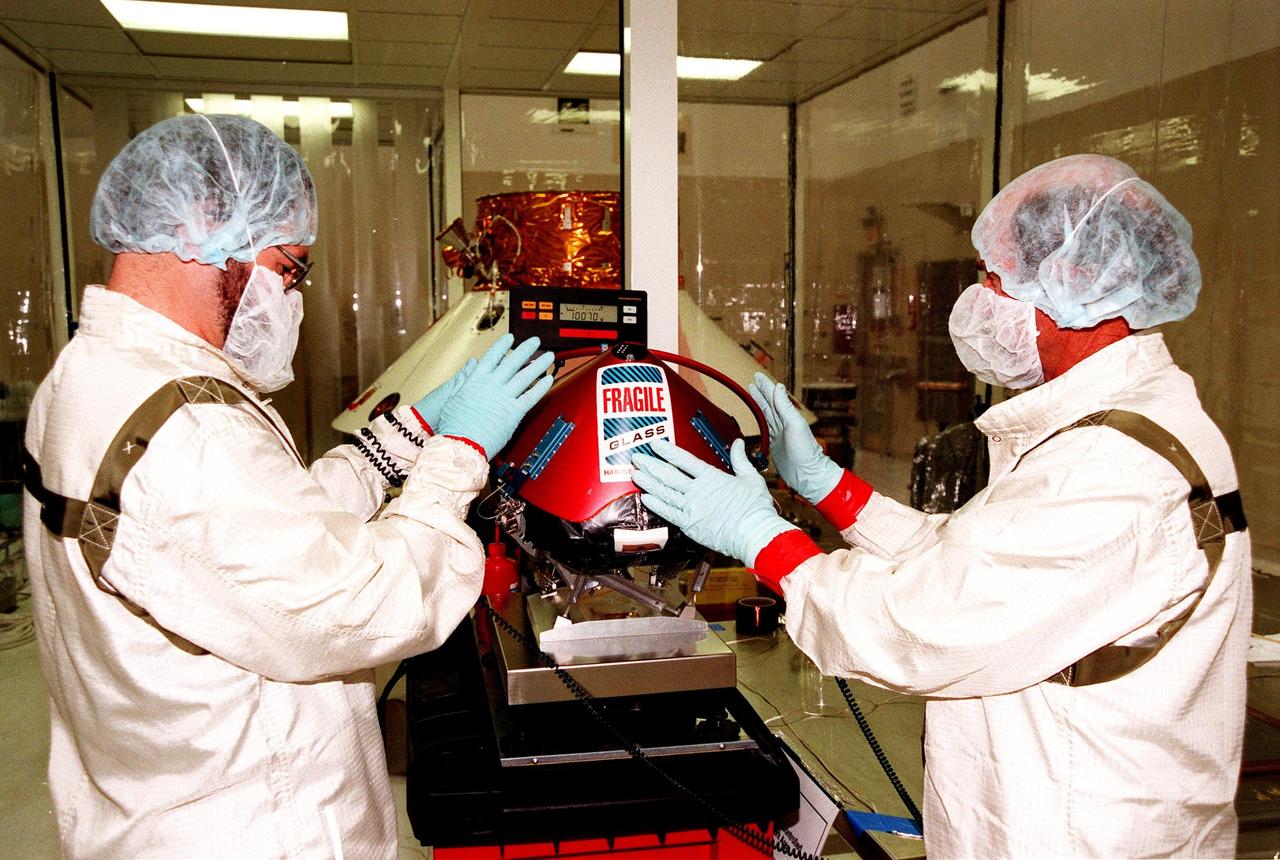
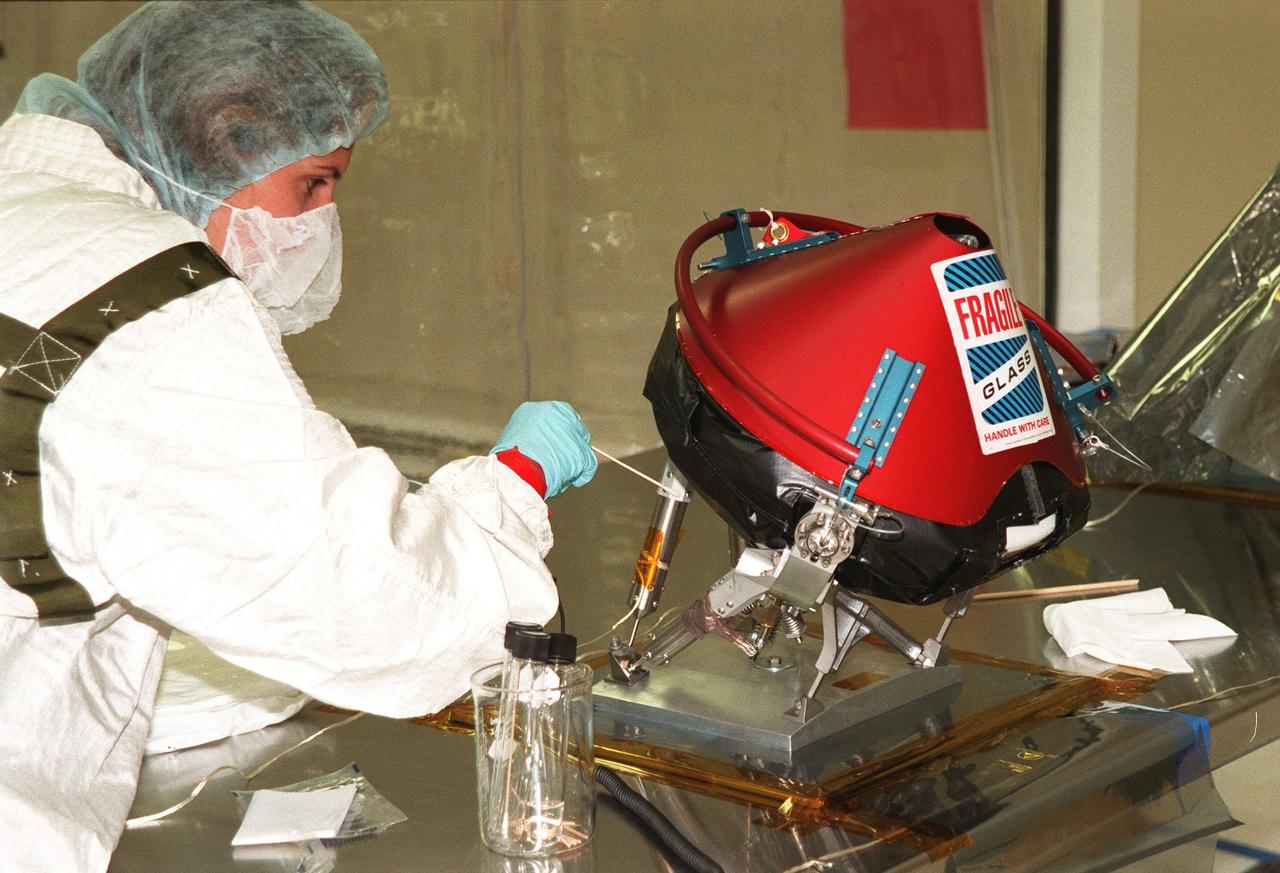
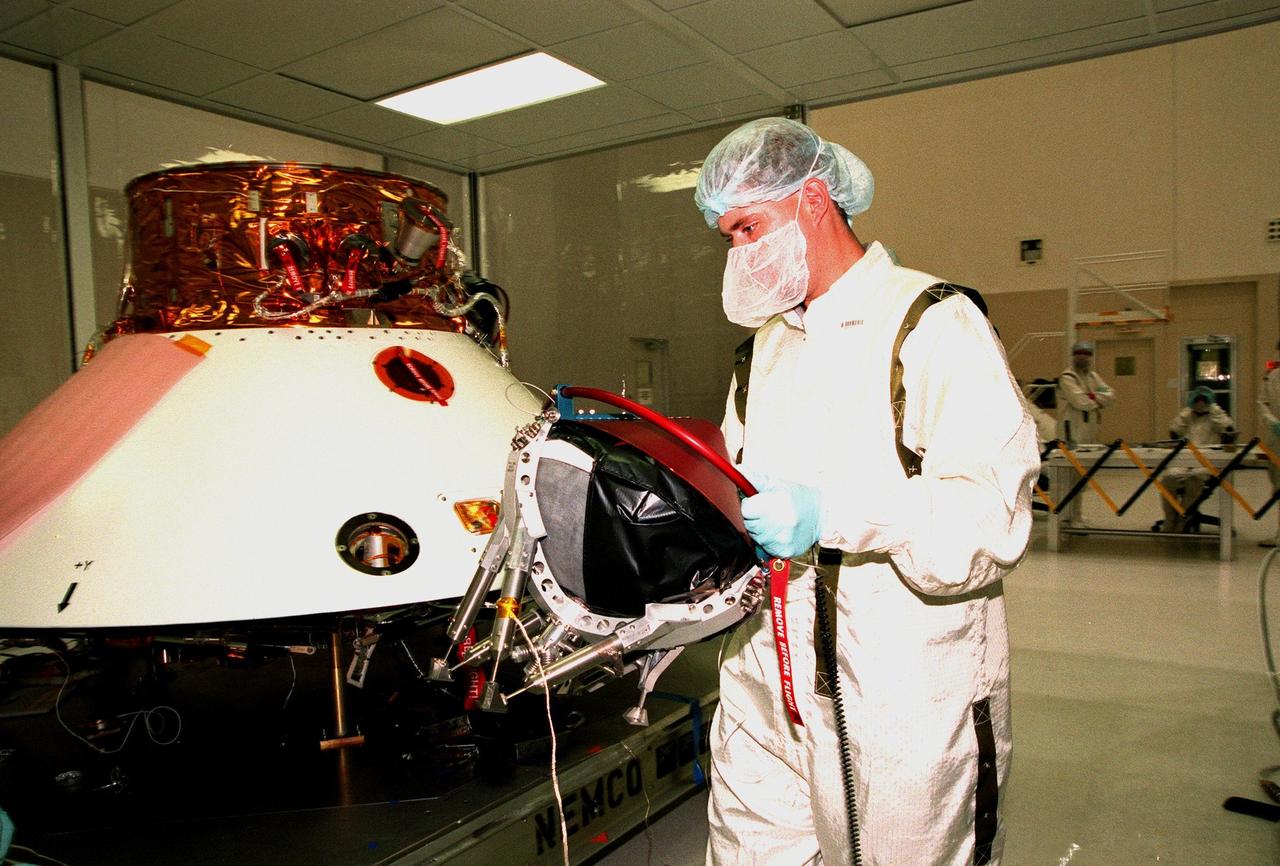
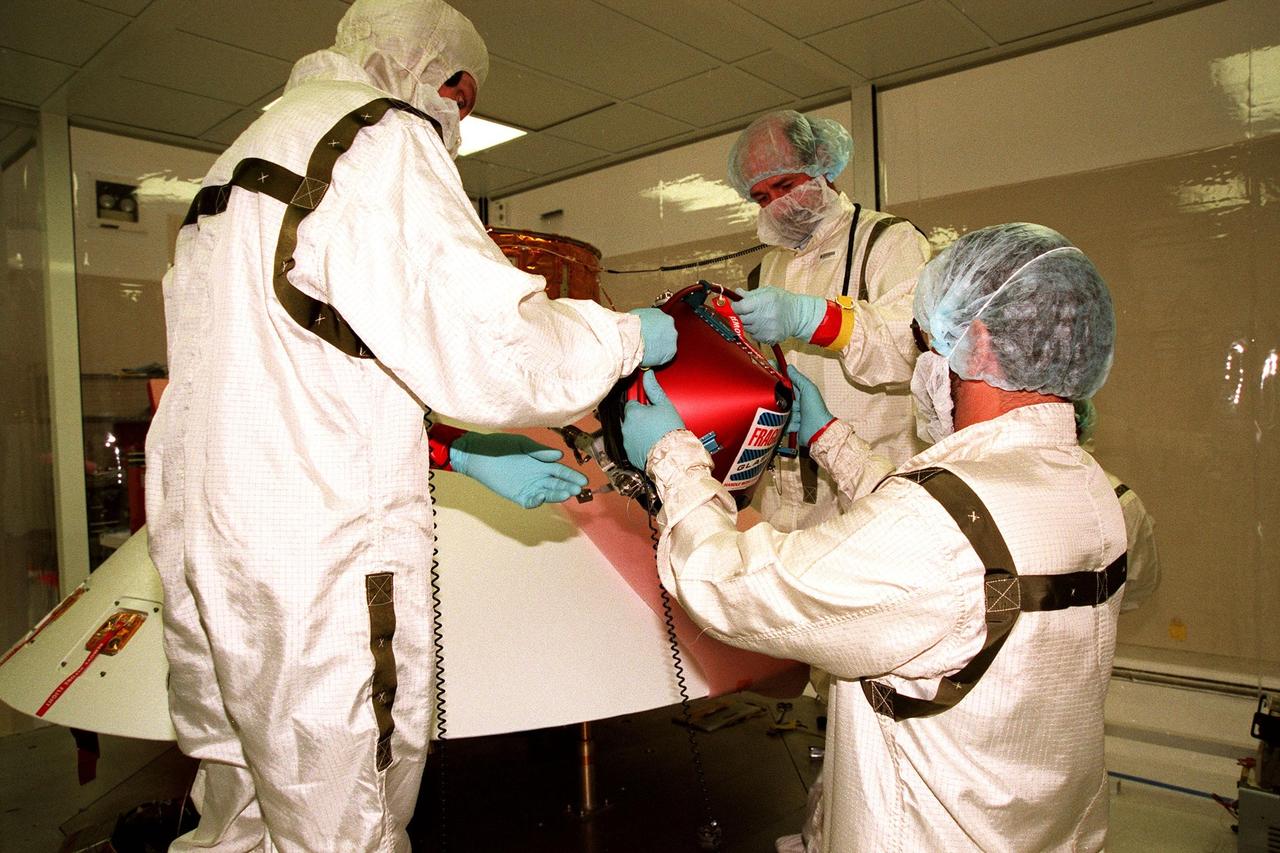
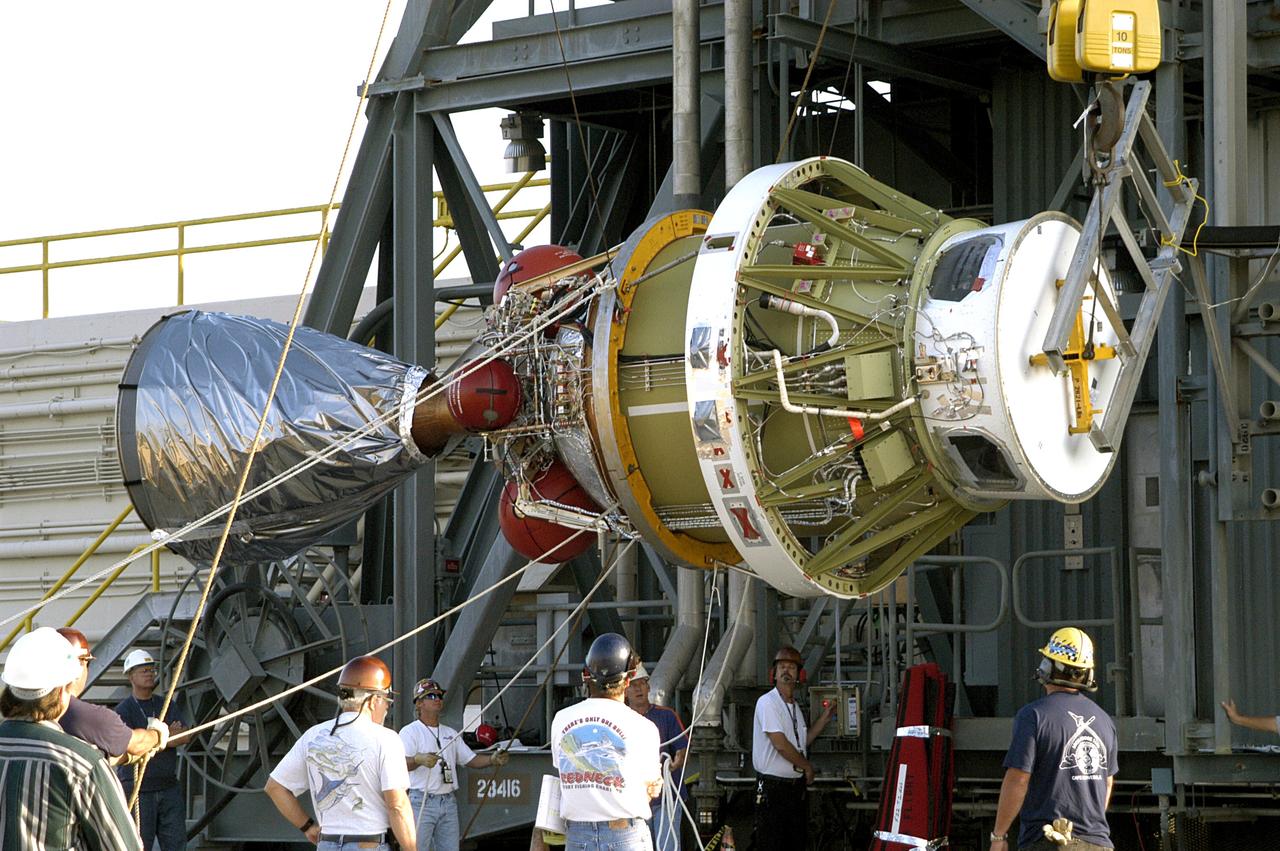
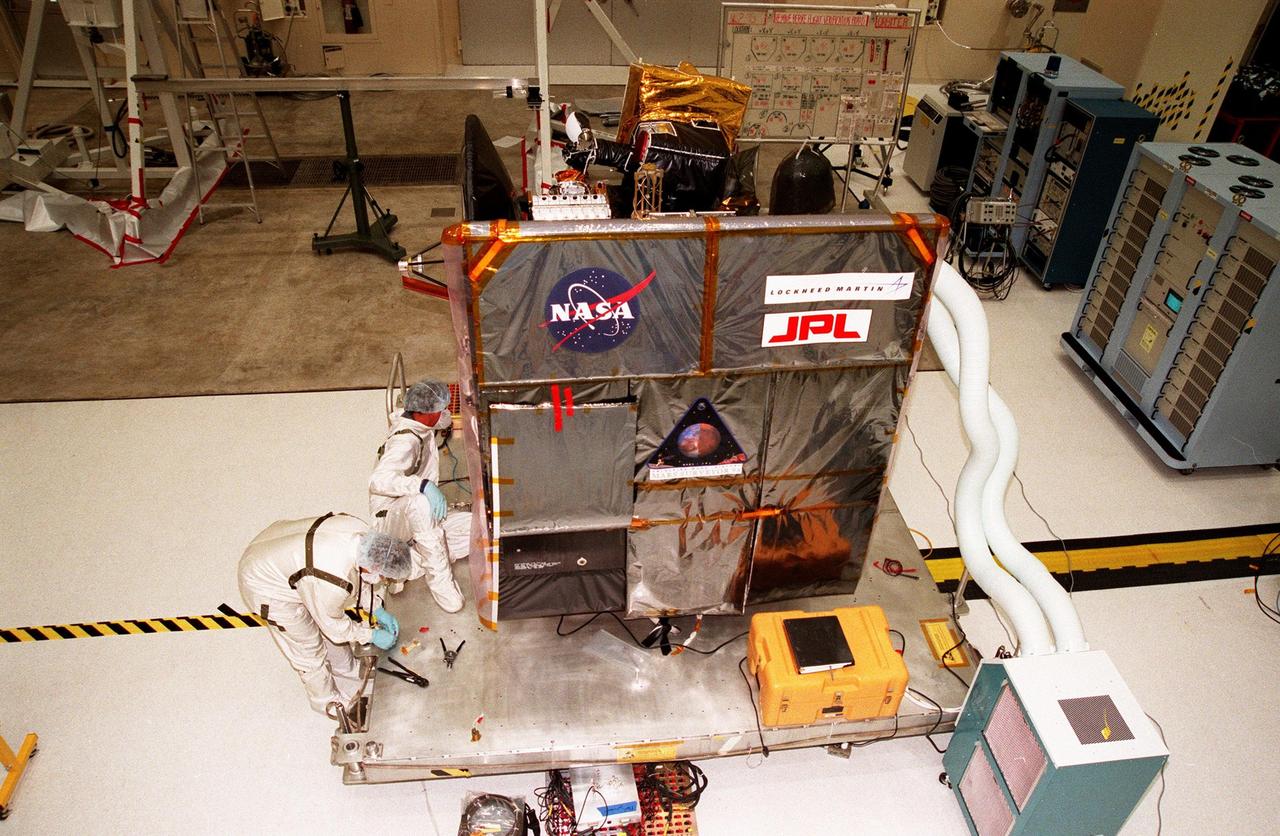
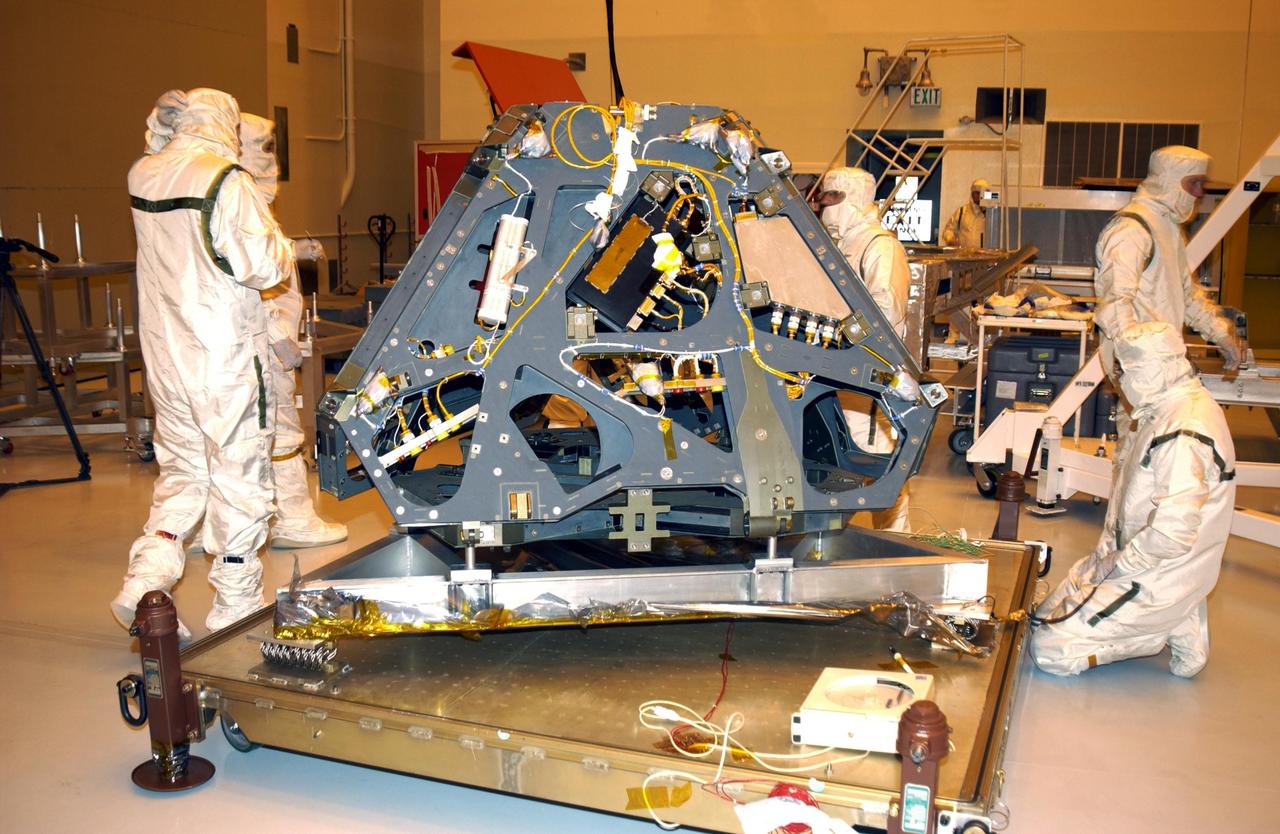
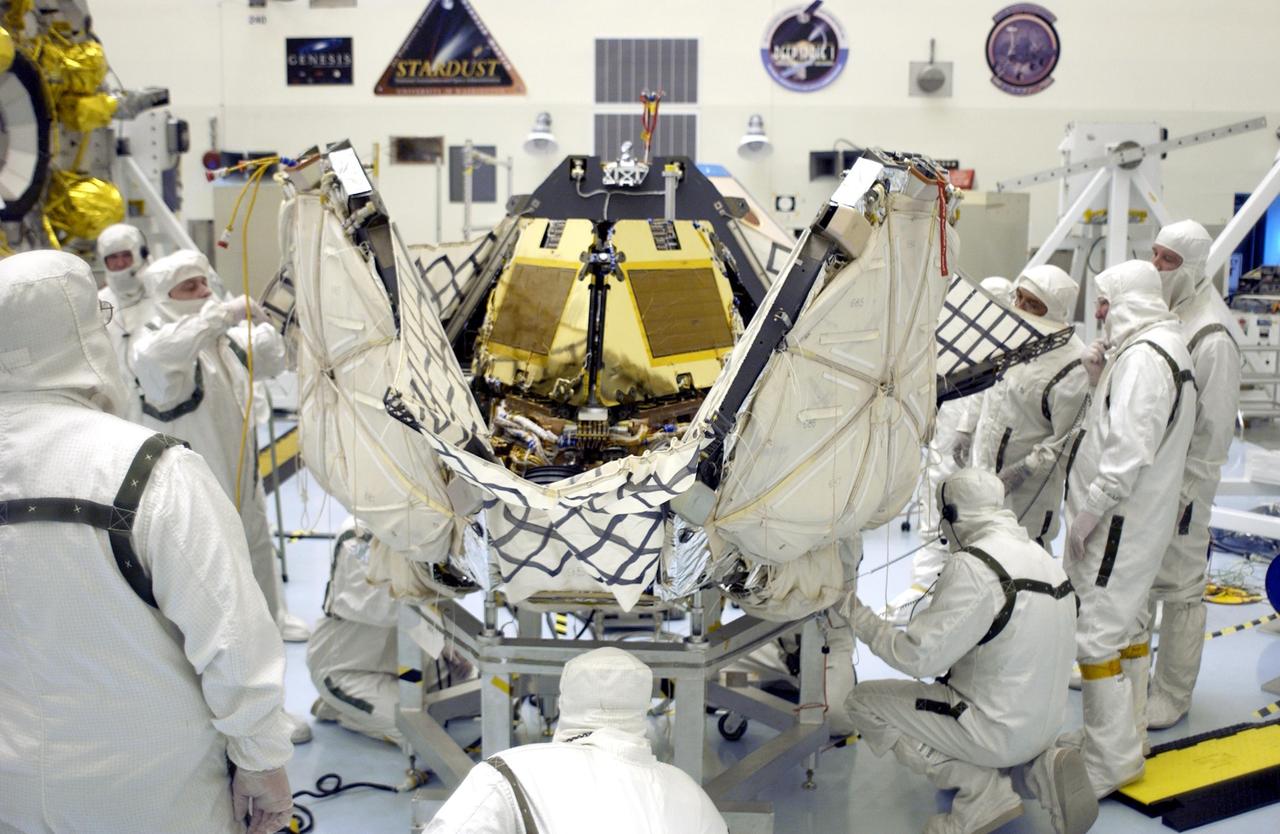
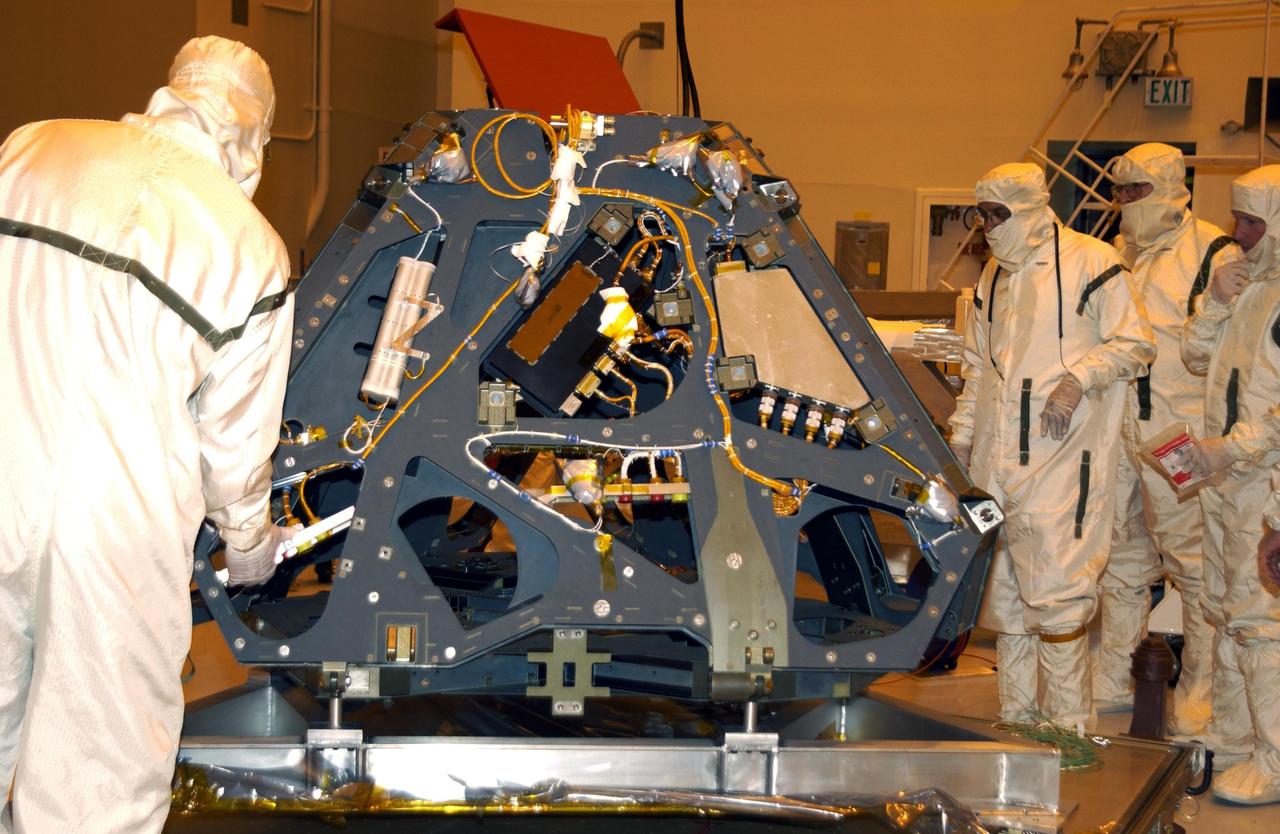
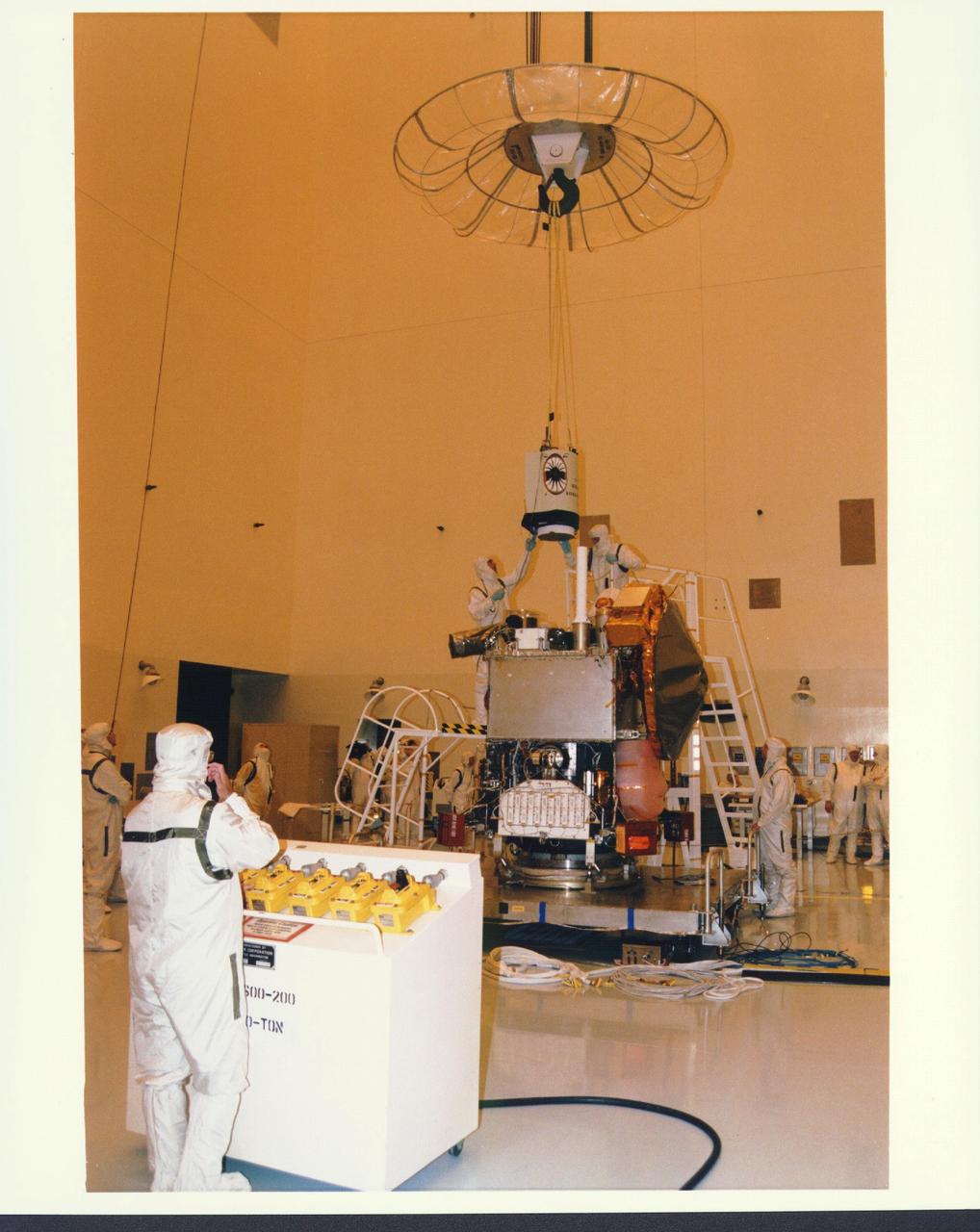
KENNEDY SPACE CENTER, FLA. -  In the Payload Hazardous Servicing Facility at KSC, installation is under way of the Mars Orbiter Camera (MOC) on the Mars Global Surveyor spacecraft.  The MOC is one of a suite of six scientific instruments that will gather data about Martian topography, mineral distribution and weather during a two-year period.  The Mars Global Surveyor is slated for launch aboard a Delta II expendable launch vehicle on Nov. 6, the beginning of a 20-day launch period.
KENNEDY SPACE CENTER, FLA. - In the Payload Hazardous Servicing Facility at KSC, installation is under way of the Mars Orbiter Camera (MOC) on the Mars Global Surveyor spacecraft. The MOC is one of a suite of six scientific instruments that will gather data about Martian topography, mineral distribution and weather during a two-year period. The Mars Global Surveyor is slated for launch aboard a Delta II expendable launch vehicle on Nov. 6, the beginning of a 20-day launch period.
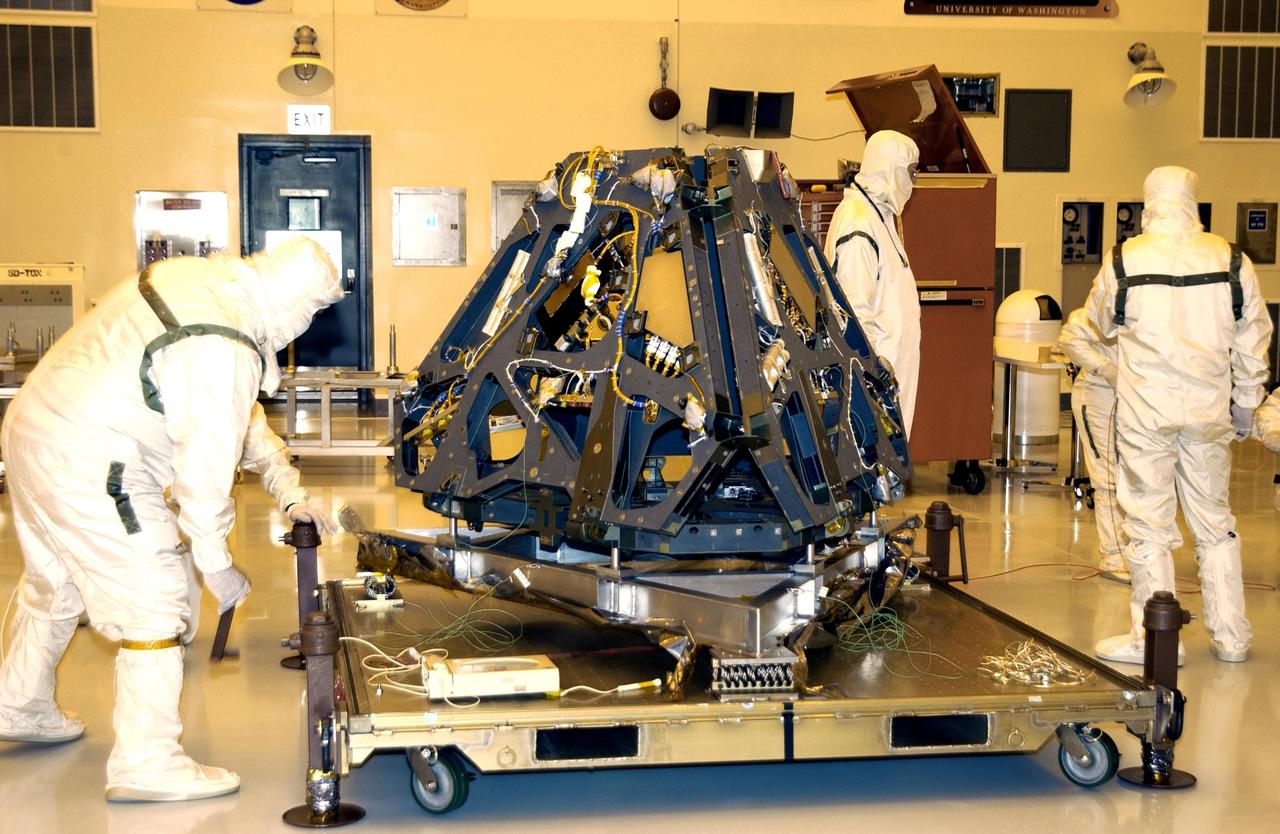
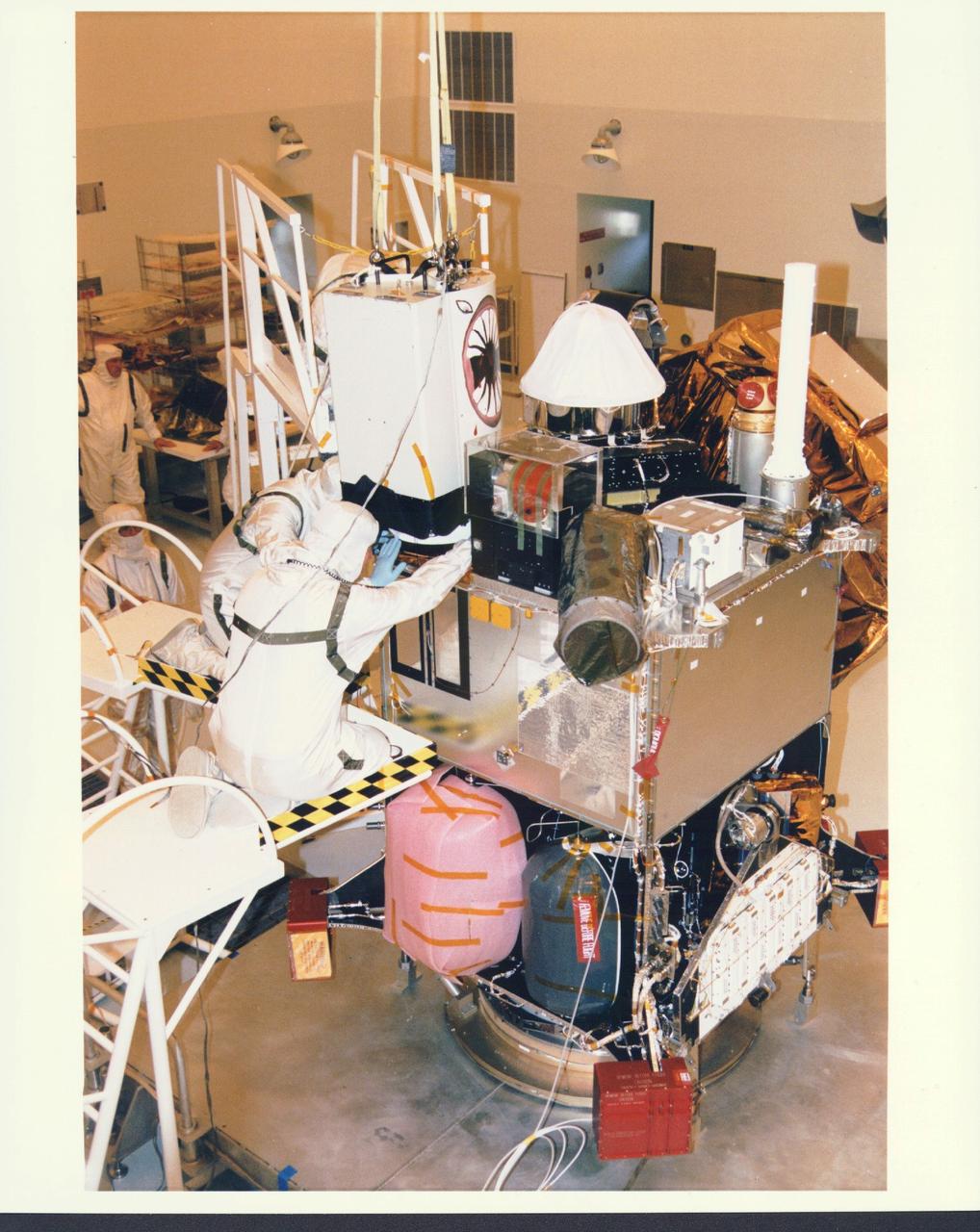
KENNEDY SPACE CENTER, FLA. -  In the Payload Hazardous Servicing Facility at KSC, installation is under way of the Mars Orbiter Camera (MOC) on the Mars Global Surveyor spacecraft.  The MOC is one of a suite of six scientific instruments that will gather data about Martian topography, mineral distribution and weather during a two-year period.  The Mars Global Surveyor is slated for launch aboard a Delta II expendable launch vehicle on Nov. 6, the beginning of a 20-day launch period.
KENNEDY SPACE CENTER, FLA. - In the Payload Hazardous Servicing Facility at KSC, installation is under way of the Mars Orbiter Camera (MOC) on the Mars Global Surveyor spacecraft. The MOC is one of a suite of six scientific instruments that will gather data about Martian topography, mineral distribution and weather during a two-year period. The Mars Global Surveyor is slated for launch aboard a Delta II expendable launch vehicle on Nov. 6, the beginning of a 20-day launch period.
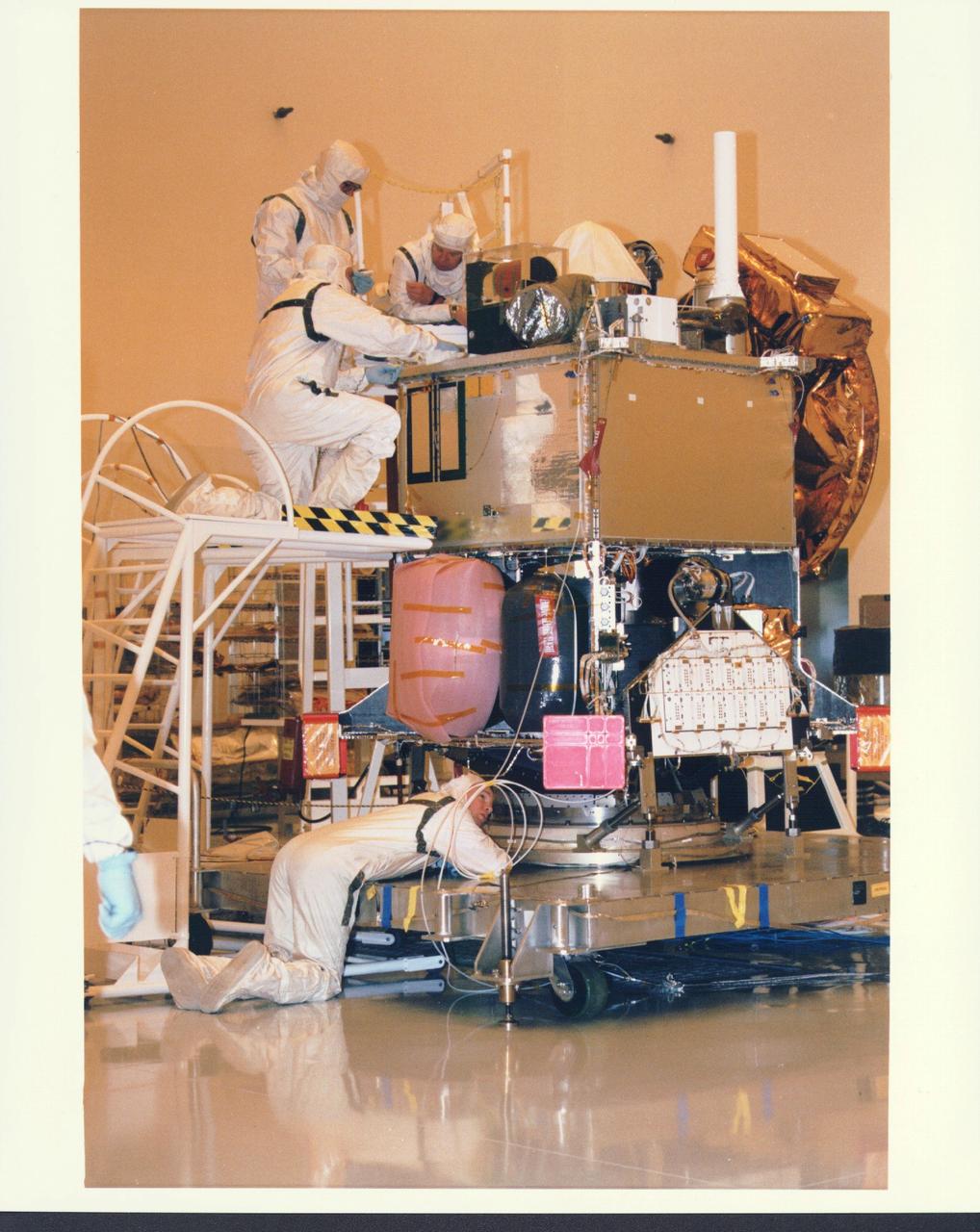
KENNEDY SPACE CENTER, FLA. -  In the Payload Hazardous Servicing Facility at KSC, installation is under way of the Mars Orbiter Camera (MOC) on the Mars Global Surveyor spacecraft.  The MOC is one of a suite of six scientific instruments that will gather data about Martian topography, mineral distribution and weather during a two-year period.  The Mars Global Surveyor is slated for launch aboard a Delta II expendable launch vehicle on Nov. 6, the beginning of a 20-day launch period.
KENNEDY SPACE CENTER, FLA. - In the Payload Hazardous Servicing Facility at KSC, installation is under way of the Mars Orbiter Camera (MOC) on the Mars Global Surveyor spacecraft. The MOC is one of a suite of six scientific instruments that will gather data about Martian topography, mineral distribution and weather during a two-year period. The Mars Global Surveyor is slated for launch aboard a Delta II expendable launch vehicle on Nov. 6, the beginning of a 20-day launch period.
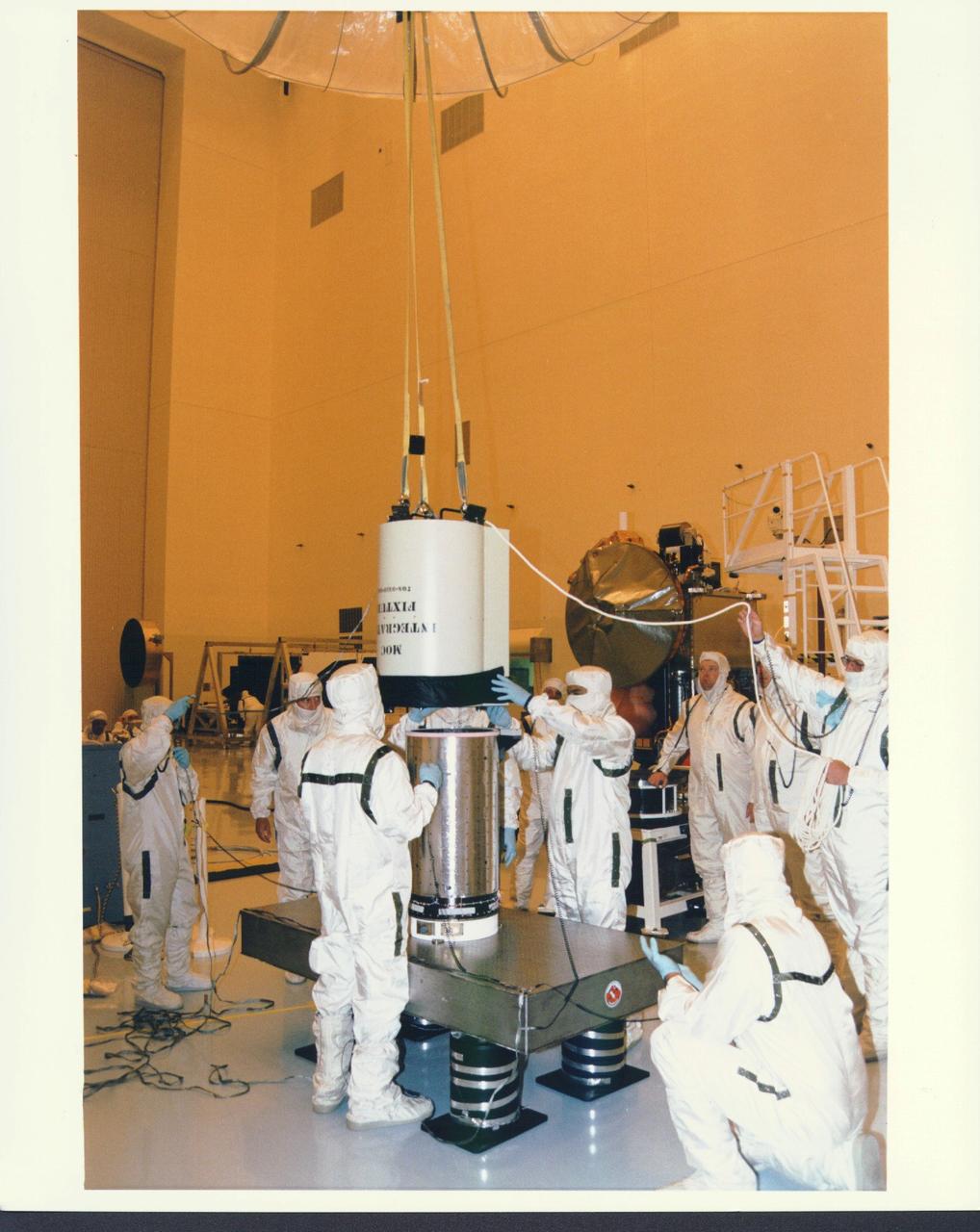
KENNEDY SPACE CENTER, FLA. -  In the Payload Hazardous Servicing Facility at KSC, installation is under way of the Mars Orbiter Camera (MOC) on the Mars Global Surveyor spacecraft.  The MOC is one of a suite of six scientific instruments that will gather data about Martian topography, mineral distribution and weather during a two-year period.  The Mars Global Surveyor is slated for launch aboard a Delta II expendable launch vehicle on Nov. 6, the beginning of a 20-day launch period.
KENNEDY SPACE CENTER, FLA. - In the Payload Hazardous Servicing Facility at KSC, installation is under way of the Mars Orbiter Camera (MOC) on the Mars Global Surveyor spacecraft. The MOC is one of a suite of six scientific instruments that will gather data about Martian topography, mineral distribution and weather during a two-year period. The Mars Global Surveyor is slated for launch aboard a Delta II expendable launch vehicle on Nov. 6, the beginning of a 20-day launch period.
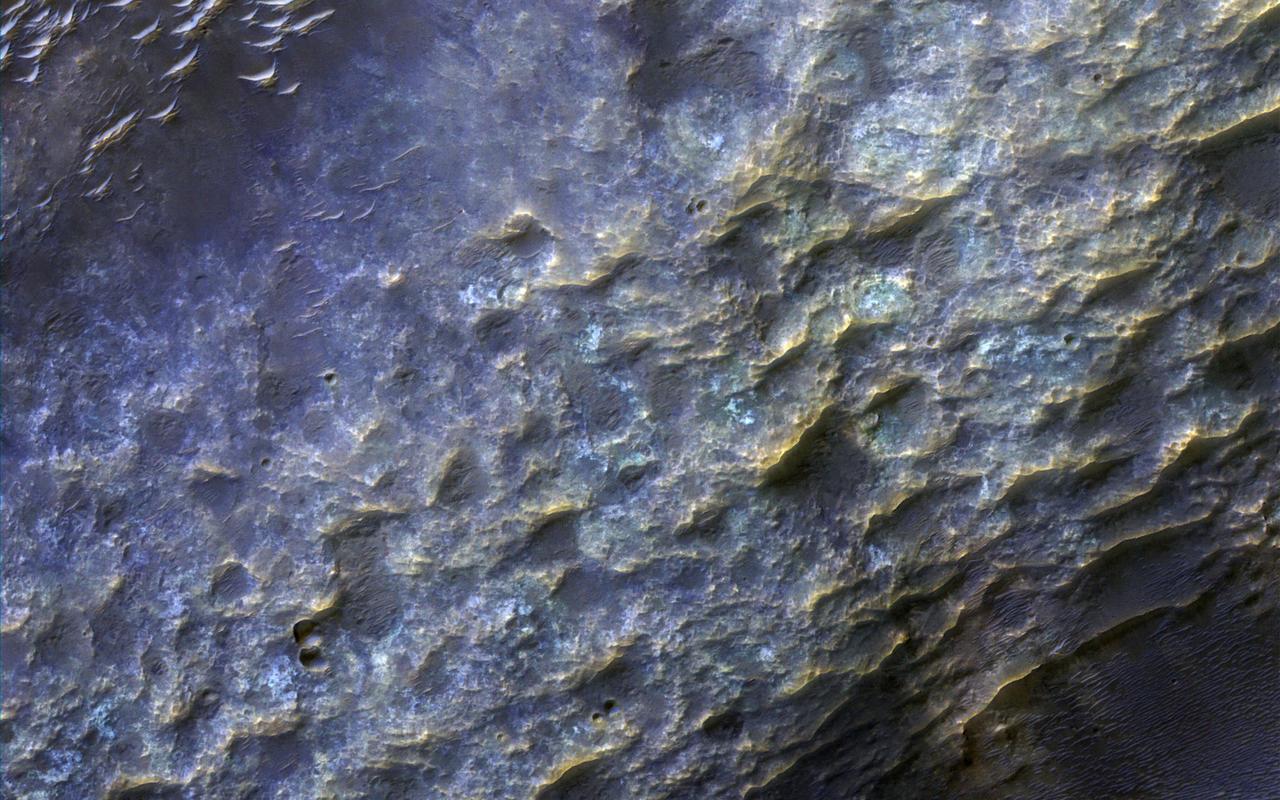
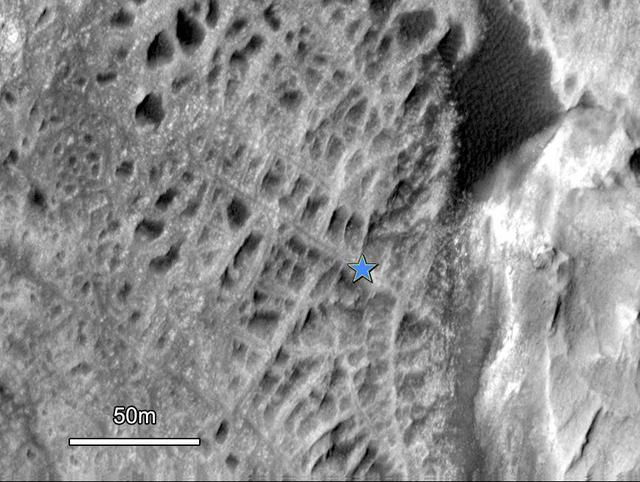
One type of feature of scientific interest on the mountain inside Gale crater is exposure of cemented fractures, evidence that groundwater once reached to at least that height of the mountain. This image is from NASA Mars Reconnaissance Orbiter.
Cemented Fractures in Mountain Inside Gale Crater on Mars
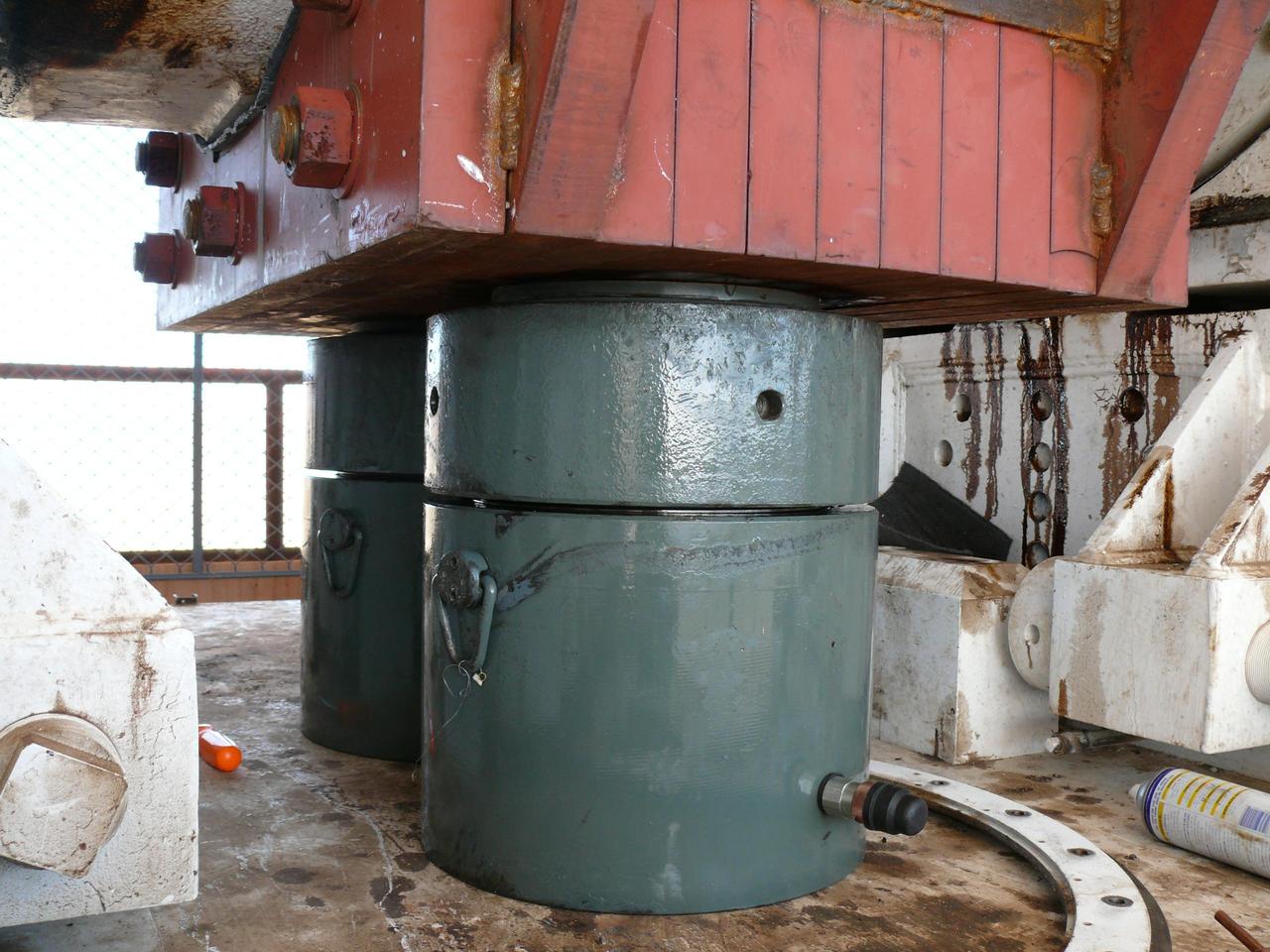
A major refurbishment of the giant Mars antenna at NASA Deep Space Network Goldstone Deep Space Communications Complex in California Mojave Desert required workers to jack up millions of pounds of delicate scientific equipment.
A Heavy-Duty Jack for a Giant Task
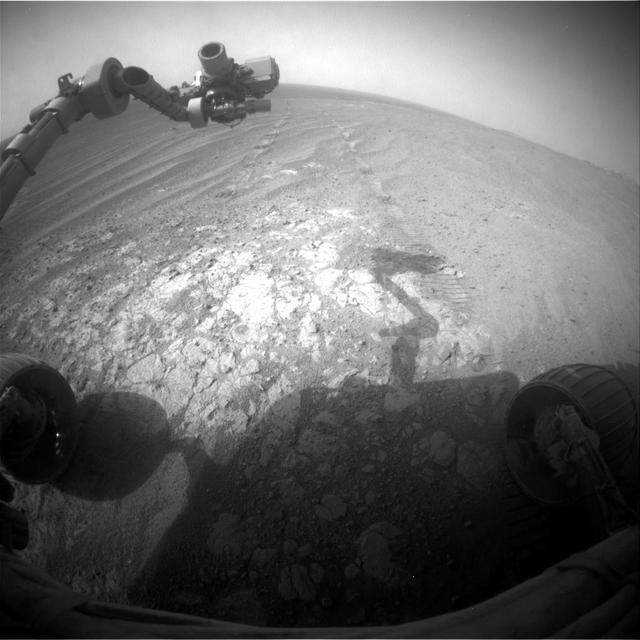
NASA Mars Exploration Rover Opportunity is continuing its traverse southward on the western rim of Endeavour Crater during the fall of 2014, stopping to investigate targets of scientific interest along way.
Opportunity Pausing at a Bright Outcrop on Endeavour Rim, Sol 3854
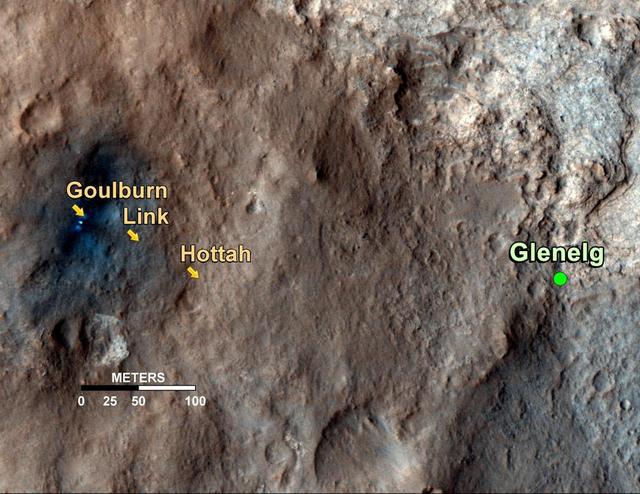
This map shows the path on Mars of NASA Curiosity rover toward Glenelg, an area where three terrains of scientific interest converge. Arrows mark what appears to be an ancient Martian streambed.
Curiosity Roadside Discoveries
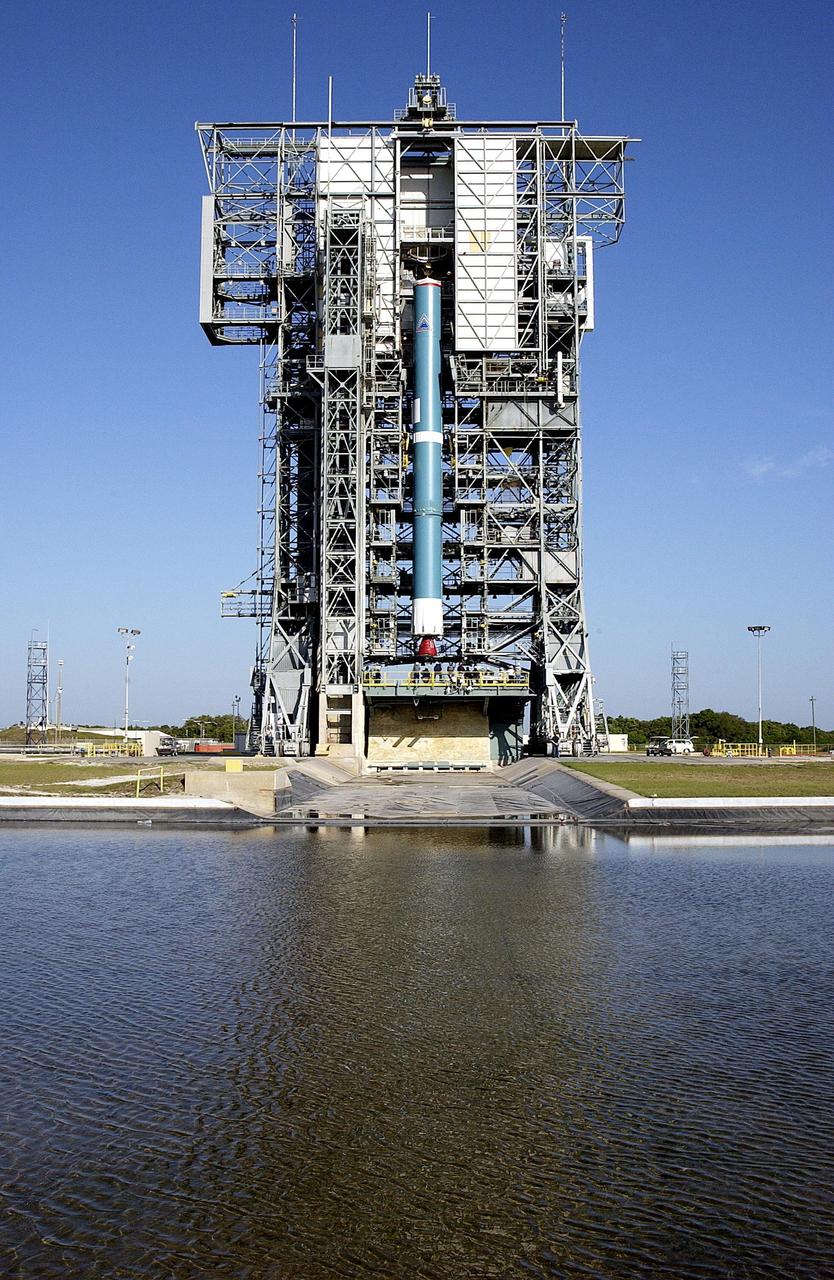
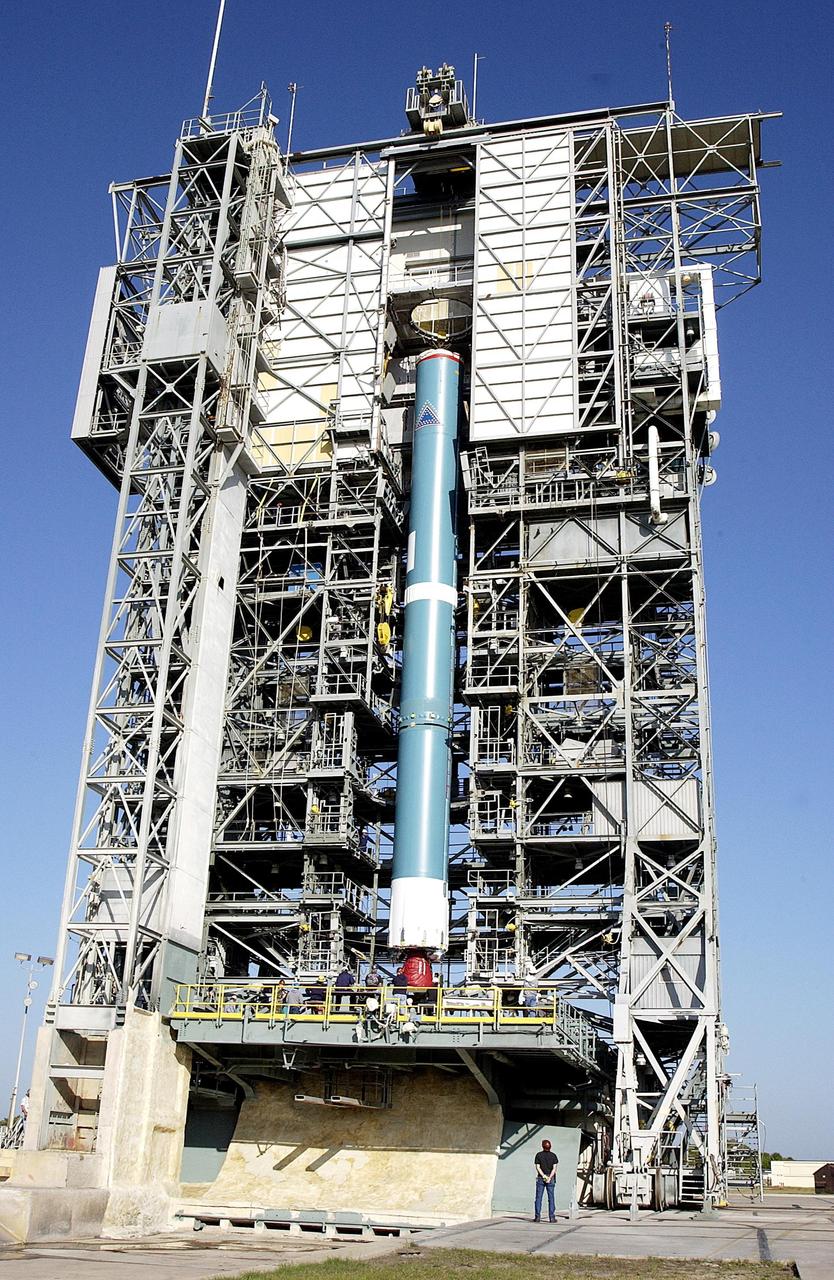
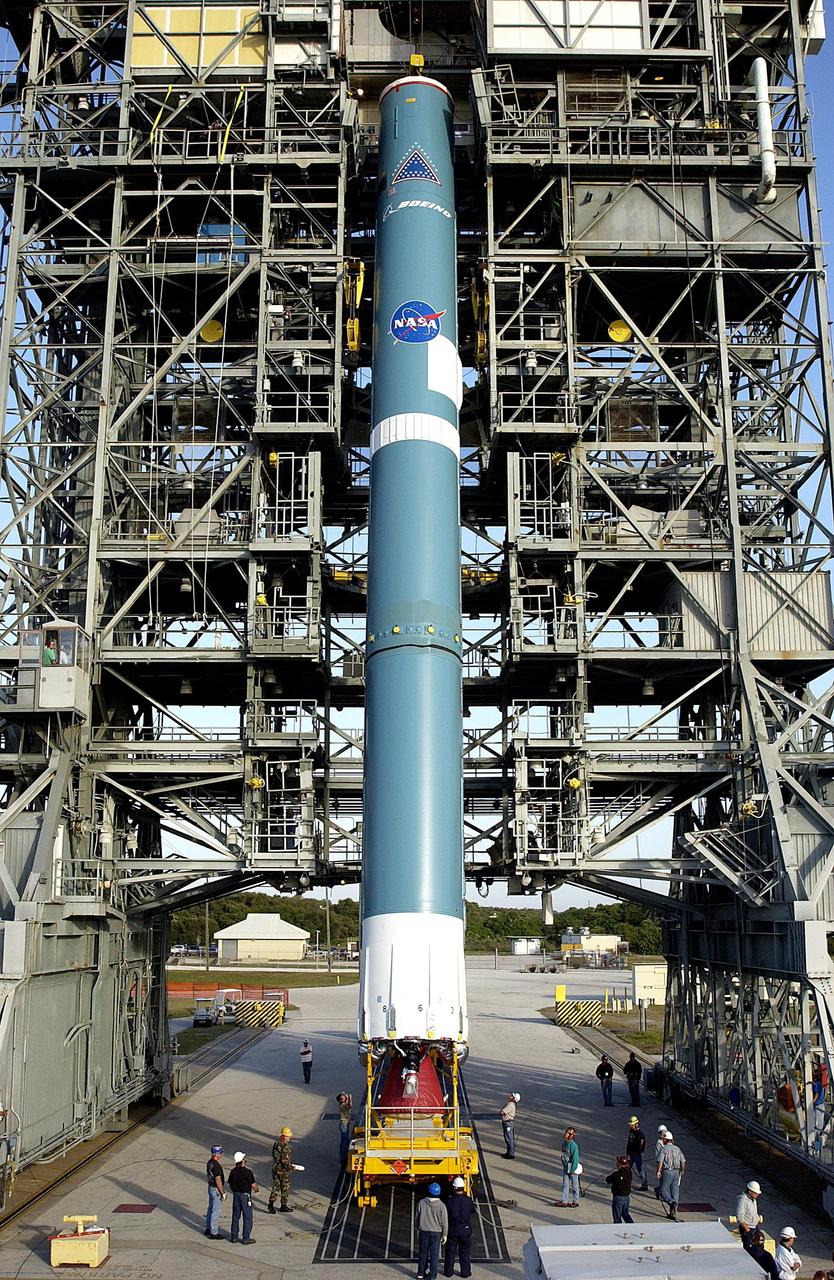
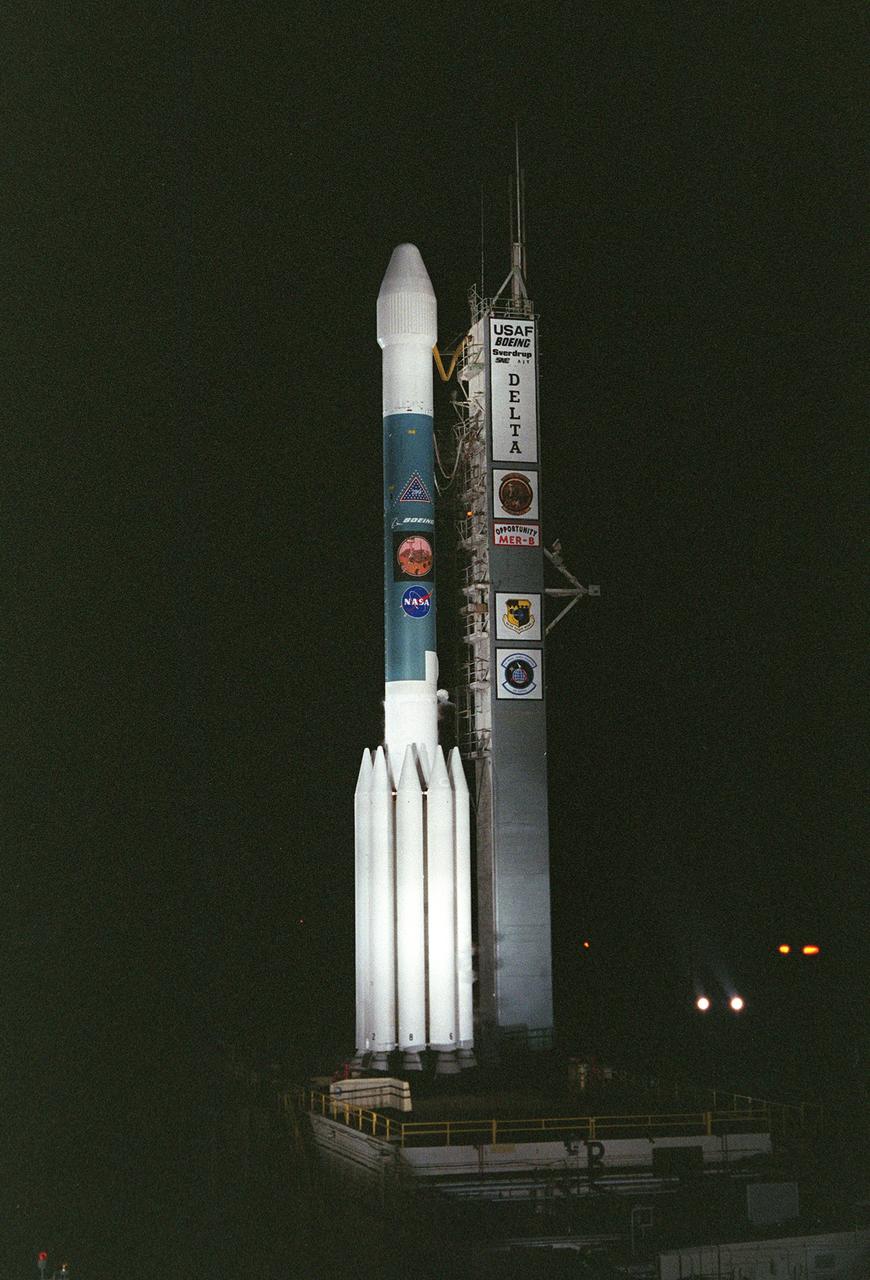
KENNEDY SPACE CENTER, FLA. - On Launch Complex 17-B, Cape Canaveral Air Force Station, the Delta II Heavy launch vehicle carrying the second Mars Exploration Rover, Opportunity, is poised for launch after rollback of the Mobile Service Tower.  Opportunity will reach Mars on Jan. 25, 2004. Together the two MER rovers, Spirit (launched June 10) and Opportunity, seek to determine the history of climate and water at two sites on Mars where conditions may once have been favorable to life. The rovers are identical. They will navigate themselves around obstacles as they drive across the Martian surface, traveling up to about 130 feet each Martian day.  Each rover carries five scientific instruments including a panoramic camera and microscope, plus a rock abrasion tool that will grind away the outer surfaces of rocks to expose their interiors for examination. Each rover’s prime mission is planned to last three months on Mars.
KENNEDY SPACE CENTER, FLA. - On Launch Complex 17-B, Cape Canaveral Air Force Station, the Delta II Heavy launch vehicle carrying the second Mars Exploration Rover, Opportunity, is poised for launch after rollback of the Mobile Service Tower. Opportunity will reach Mars on Jan. 25, 2004. Together the two MER rovers, Spirit (launched June 10) and Opportunity, seek to determine the history of climate and water at two sites on Mars where conditions may once have been favorable to life. The rovers are identical. They will navigate themselves around obstacles as they drive across the Martian surface, traveling up to about 130 feet each Martian day. Each rover carries five scientific instruments including a panoramic camera and microscope, plus a rock abrasion tool that will grind away the outer surfaces of rocks to expose their interiors for examination. Each rover’s prime mission is planned to last three months on Mars.
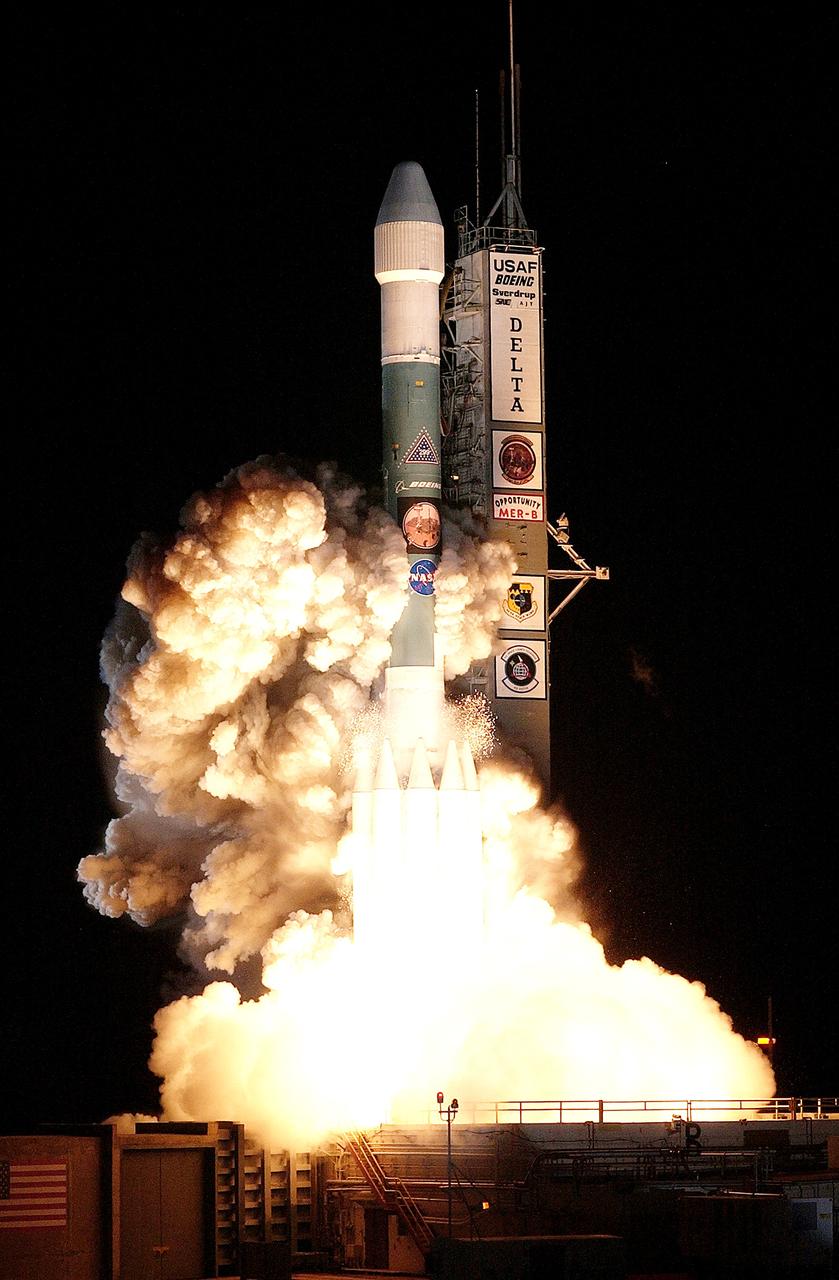
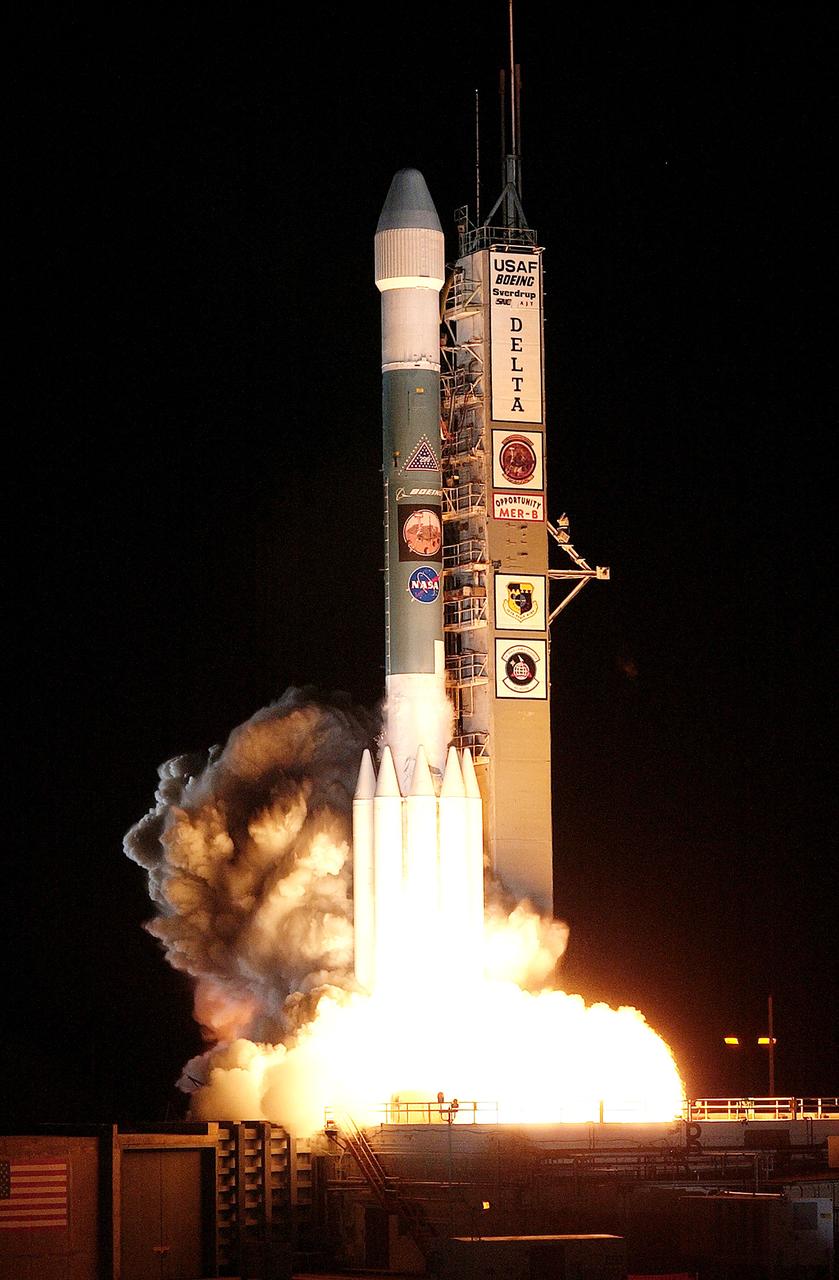
KENNEDY SPACE CENTER, FLA. - On Launch Complex 17-B, Cape Canaveral Air Force Station, the Delta II Heavy launch vehicle carrying the rover "Opportunity" for the second Mars Exploration Rover mission launches at 11:18:15 p.m. EDT.  Opportunity will reach Mars on Jan. 25, 2004. Together the two MER rovers, Spirit (launched June 10) and Opportunity, seek to determine the history of climate and water at two sites on Mars where conditions may once have been favorable to life. The rovers are identical. They will navigate themselves around obstacles as they drive across the Martian surface, traveling up to about 130 feet each Martian day.  Each rover carries five scientific instruments including a panoramic camera and microscope, plus a rock abrasion tool that will grind away the outer surfaces of rocks to expose their interiors for examination. Each rover’s prime mission is planned to last three months on Mars.
KENNEDY SPACE CENTER, FLA. - On Launch Complex 17-B, Cape Canaveral Air Force Station, the Delta II Heavy launch vehicle carrying the rover "Opportunity" for the second Mars Exploration Rover mission launches at 11:18:15 p.m. EDT. Opportunity will reach Mars on Jan. 25, 2004. Together the two MER rovers, Spirit (launched June 10) and Opportunity, seek to determine the history of climate and water at two sites on Mars where conditions may once have been favorable to life. The rovers are identical. They will navigate themselves around obstacles as they drive across the Martian surface, traveling up to about 130 feet each Martian day. Each rover carries five scientific instruments including a panoramic camera and microscope, plus a rock abrasion tool that will grind away the outer surfaces of rocks to expose their interiors for examination. Each rover’s prime mission is planned to last three months on Mars.
KENNEDY SPACE CENTER, FLA. - On Launch Complex 17-B, Cape Canaveral Air Force Station, the Delta II Heavy launch vehicle carrying the rover "Opportunity" for the second Mars Exploration Rover mission launches at 11:18:15 p.m. EDT.  Opportunity will reach Mars on Jan. 25, 2004. Together the two MER rovers, Spirit (launched June 10) and Opportunity, seek to determine the history of climate and water at two sites on Mars where conditions may once have been favorable to life. The rovers are identical. They will navigate themselves around obstacles as they drive across the Martian surface, traveling up to about 130 feet each Martian day.  Each rover carries five scientific instruments including a panoramic camera and microscope, plus a rock abrasion tool that will grind away the outer surfaces of rocks to expose their interiors for examination. Each rover’s prime mission is planned to last three months on Mars.
KENNEDY SPACE CENTER, FLA. - On Launch Complex 17-B, Cape Canaveral Air Force Station, the Delta II Heavy launch vehicle carrying the rover "Opportunity" for the second Mars Exploration Rover mission launches at 11:18:15 p.m. EDT. Opportunity will reach Mars on Jan. 25, 2004. Together the two MER rovers, Spirit (launched June 10) and Opportunity, seek to determine the history of climate and water at two sites on Mars where conditions may once have been favorable to life. The rovers are identical. They will navigate themselves around obstacles as they drive across the Martian surface, traveling up to about 130 feet each Martian day. Each rover carries five scientific instruments including a panoramic camera and microscope, plus a rock abrasion tool that will grind away the outer surfaces of rocks to expose their interiors for examination. Each rover’s prime mission is planned to last three months on Mars.
Dr. Stephen Petranek, MARS scientific advisor and co-executive producer speaks on a panel after a showing of the Project Mars Competition's short films and the Mars series, Monday, November 5, 2018 at National Geographic Society Headquarters in Washington. Photo Credit: (NASA/Aubrey Gemignani)
Project Mars at National Geographic
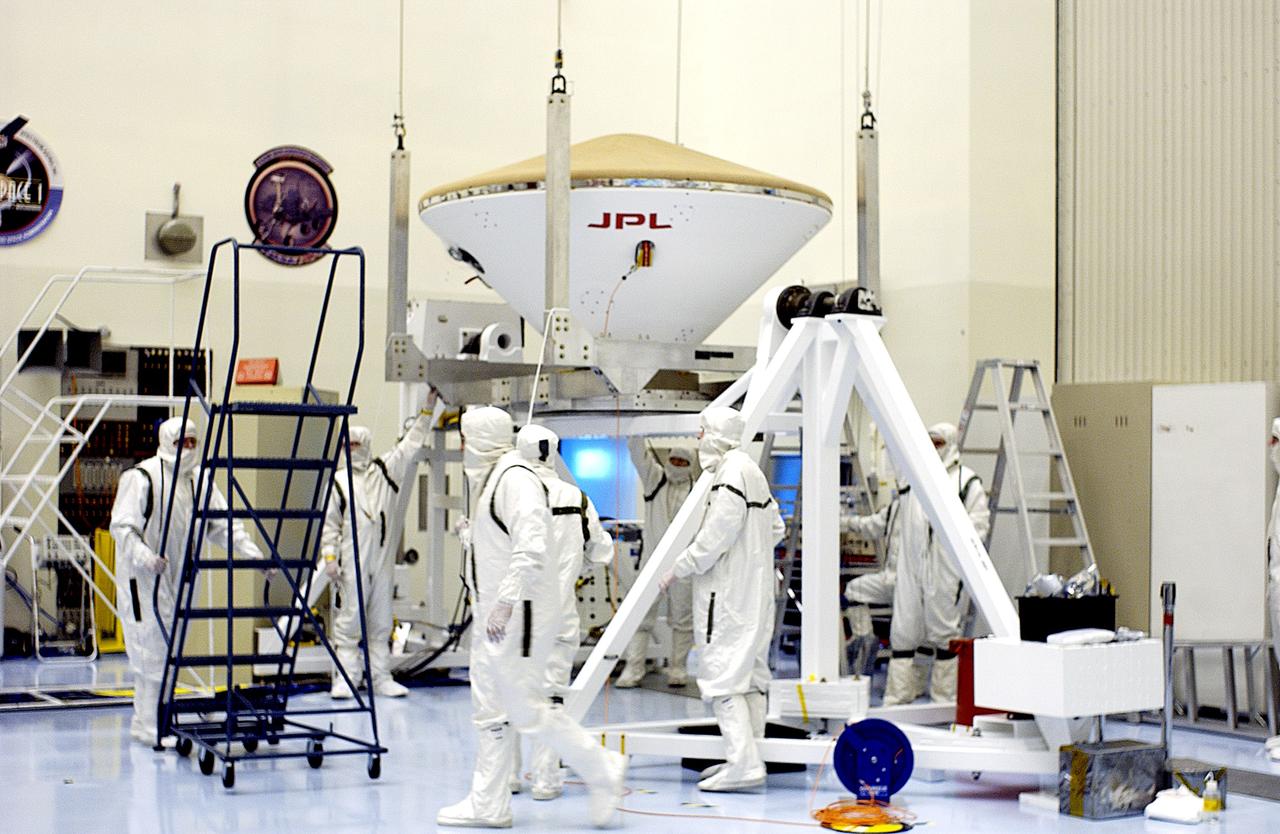
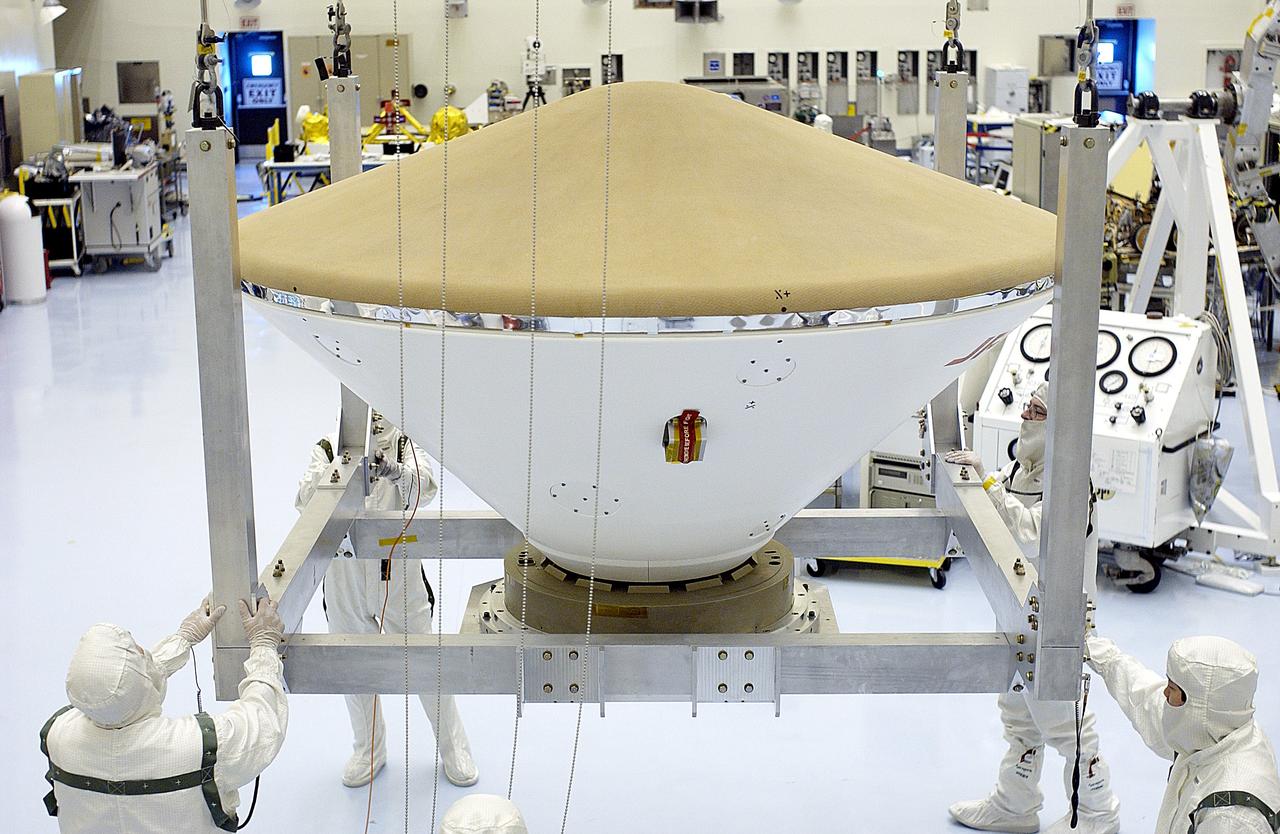
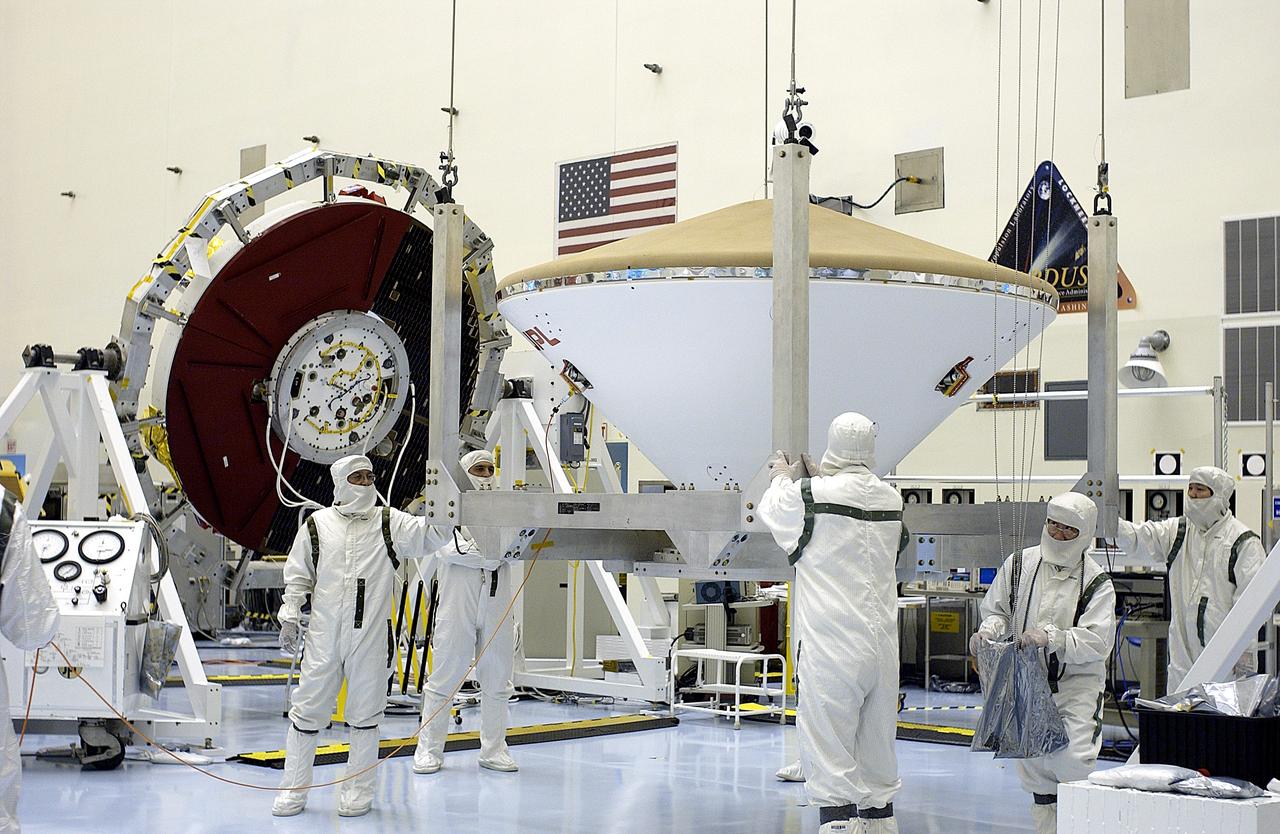
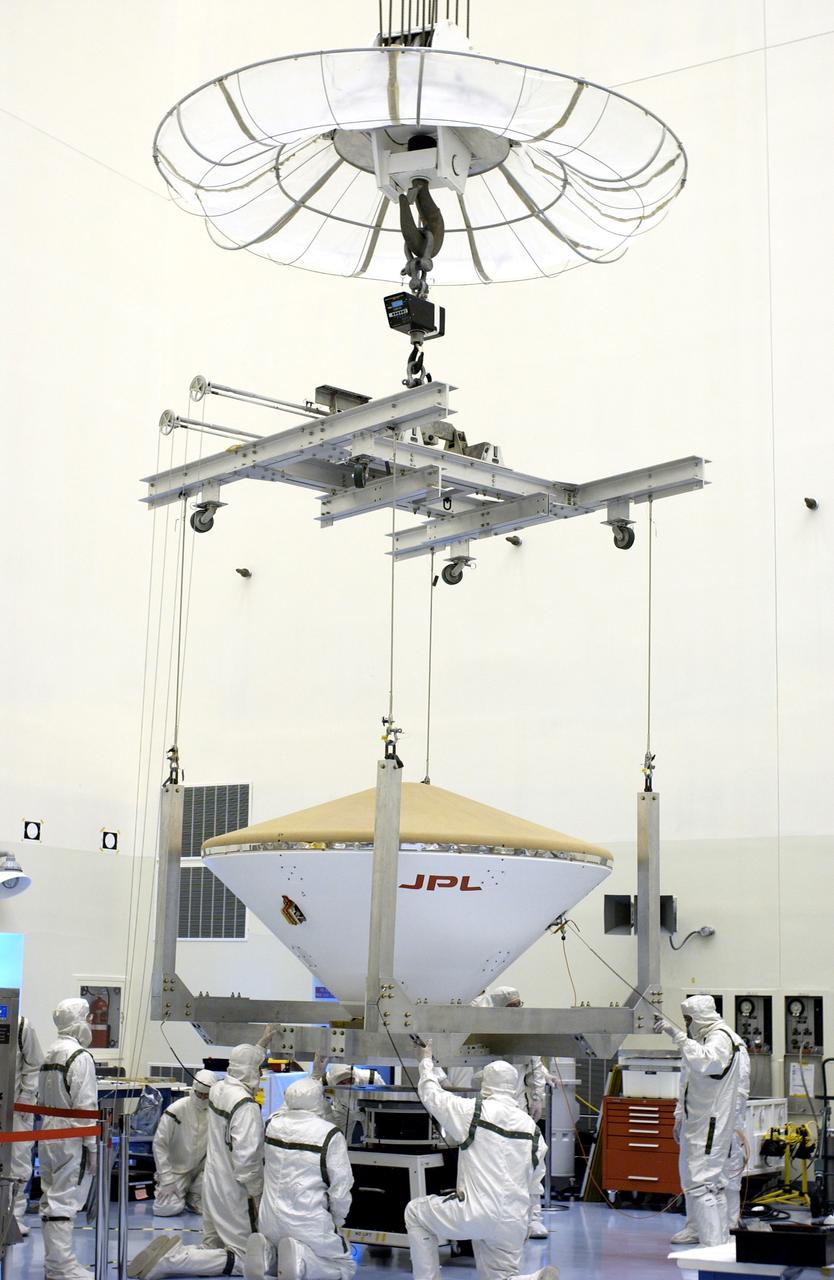
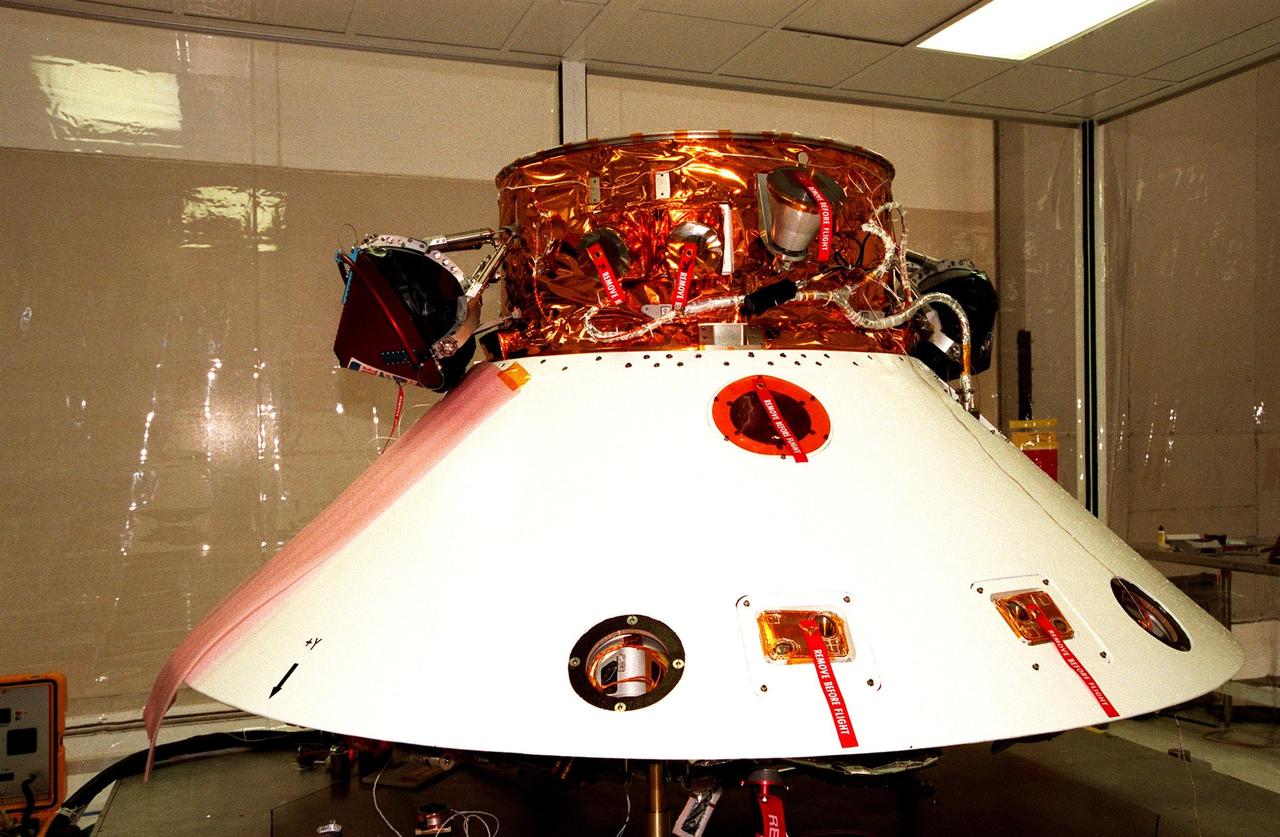
KENNEDY SPACE CENTER, FLA. - An overhead crane moves the Mars Exploration Rover 2 (MER-2) entry vehicle across the Payload Hazardous Servicing Facility toward a spin table for a dry-spin test.  The MER Mission consists of two identical rovers designed to cover roughly 110 yards each Martian day over various terrain. Each rover will carry five scientific instruments that will allow it to search for evidence of liquid water that may have been present in the planet's past.  Identical to each other, the rovers will land at different regions of Mars.  Launch for MER-2 (MER-A) is scheduled for June 5.
KENNEDY SPACE CENTER, FLA. - An overhead crane moves the Mars Exploration Rover 2 (MER-2) entry vehicle across the Payload Hazardous Servicing Facility toward a spin table for a dry-spin test. The MER Mission consists of two identical rovers designed to cover roughly 110 yards each Martian day over various terrain. Each rover will carry five scientific instruments that will allow it to search for evidence of liquid water that may have been present in the planet's past. Identical to each other, the rovers will land at different regions of Mars. Launch for MER-2 (MER-A) is scheduled for June 5.
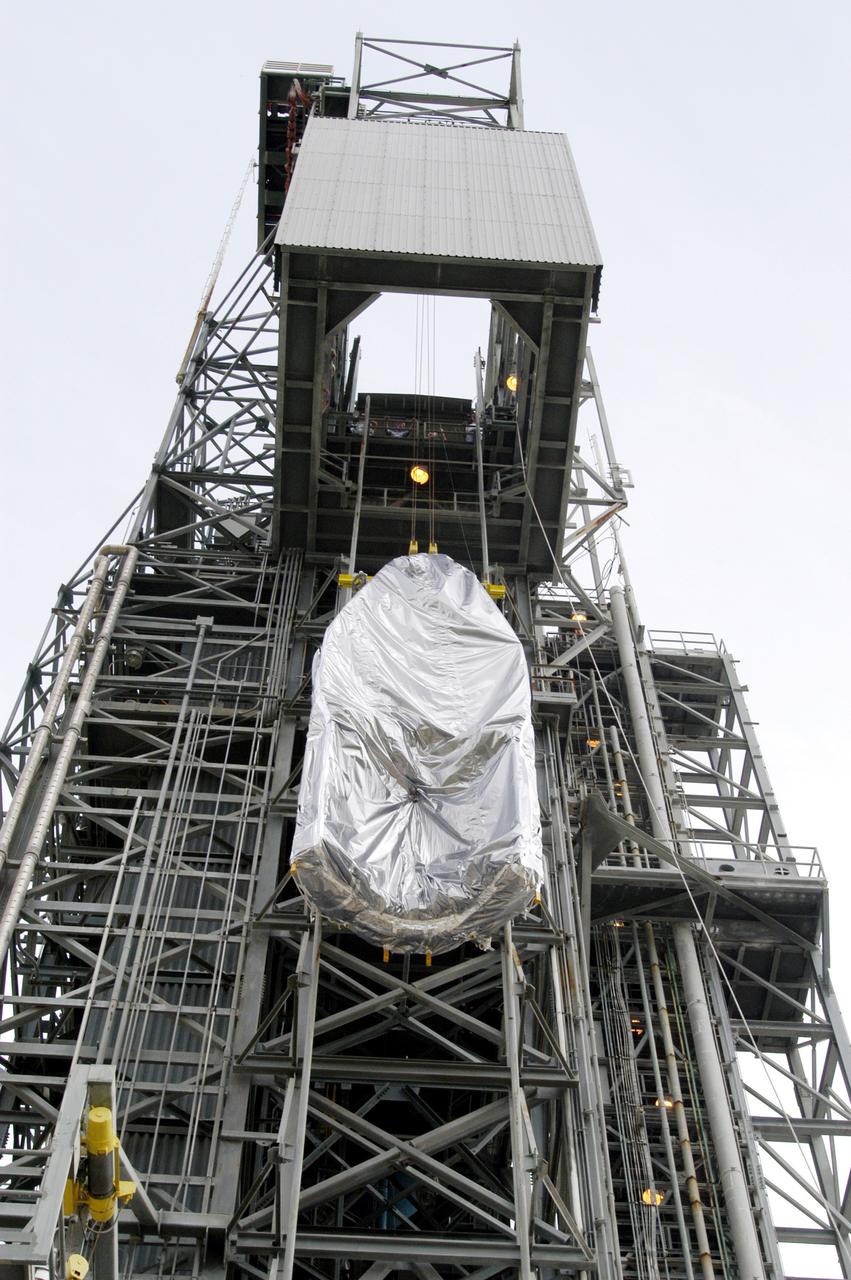
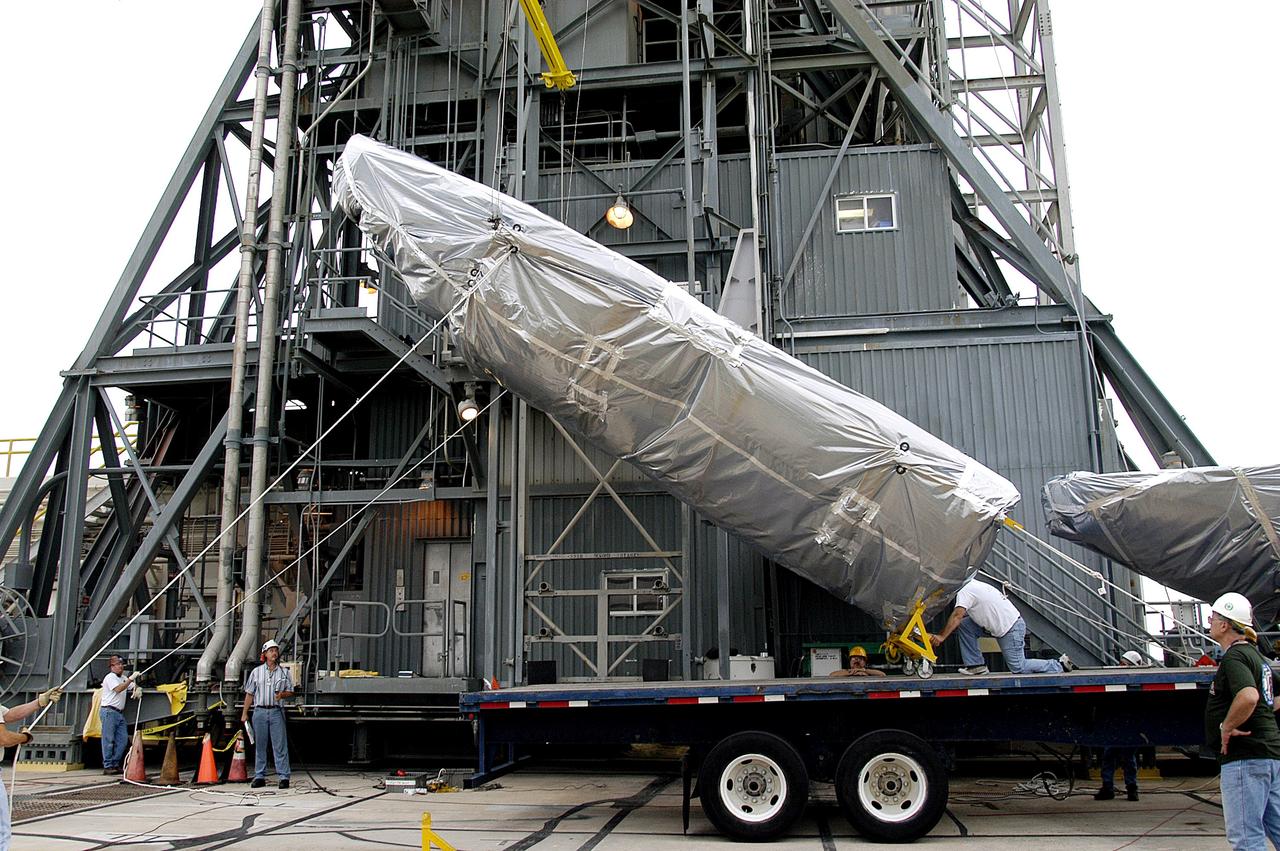
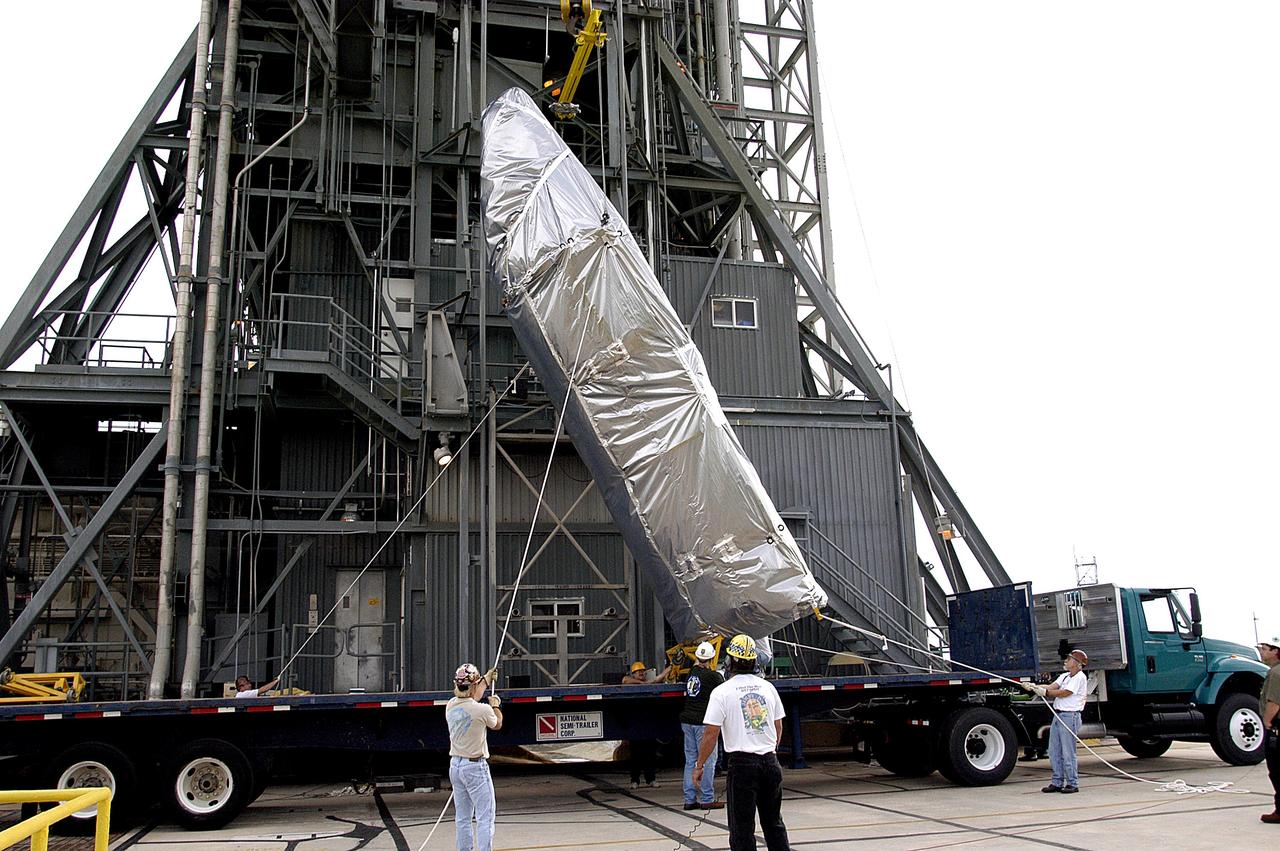
KENNEDY SPACE CENTER, FLA. - At Launch Complex 17-A, Cape Canaveral Air Force Station, the first half of the fairing for the Mars Exploration Rover 2 (MER-2/MER-A) is moved inside the launch tower.  The fairing will be installed around the payload for protection during launch.  The MER Mission consists of two identical rovers designed to cover roughly 110 yards each Martian day over various terrain. Each rover will carry five scientific instruments that will allow it to search for evidence of liquid water that may have been present in the planet's past.  Identical to each other, the rovers will land at different regions of Mars.  Launch date for MER-A  is scheduled for June 5..
KENNEDY SPACE CENTER, FLA. - At Launch Complex 17-A, Cape Canaveral Air Force Station, the first half of the fairing for the Mars Exploration Rover 2 (MER-2/MER-A) is moved inside the launch tower. The fairing will be installed around the payload for protection during launch. The MER Mission consists of two identical rovers designed to cover roughly 110 yards each Martian day over various terrain. Each rover will carry five scientific instruments that will allow it to search for evidence of liquid water that may have been present in the planet's past. Identical to each other, the rovers will land at different regions of Mars. Launch date for MER-A is scheduled for June 5..
KENNEDY SPACE CENTER, FLA. - At Launch Complex 17-A, Cape Canaveral Air Force Station, the first half of the fairing for the Mars Exploration Rover 2 (MER-2/MER-A) reaches the top of the launch tower.  The fairing will be installed around the payload for protection during launch.  The MER Mission consists of two identical rovers designed to cover roughly 110 yards each Martian day over various terrain. Each rover will carry five scientific instruments that will allow it to search for evidence of liquid water that may have been present in the planet's past.  Identical to each other, the rovers will land at different regions of Mars.  Launch date for MER-A  is scheduled for June 5.
KENNEDY SPACE CENTER, FLA. - At Launch Complex 17-A, Cape Canaveral Air Force Station, the first half of the fairing for the Mars Exploration Rover 2 (MER-2/MER-A) reaches the top of the launch tower. The fairing will be installed around the payload for protection during launch. The MER Mission consists of two identical rovers designed to cover roughly 110 yards each Martian day over various terrain. Each rover will carry five scientific instruments that will allow it to search for evidence of liquid water that may have been present in the planet's past. Identical to each other, the rovers will land at different regions of Mars. Launch date for MER-A is scheduled for June 5.
KENNEDY SPACE CENTER, FLA. - An overhead crane moves the Mars Exploration Rover 2 (MER-2) entry vehicle across the Payload Hazardous Servicing Facility toward a spin table for a dry-spin test.  The MER Mission consists of two identical rovers designed to cover roughly 110 yards each Martian day over various terrain. Each rover will carry five scientific instruments that will allow it to search for evidence of liquid water that may have been present in the planet's past.  Identical to each other, the rovers will land at different regions of Mars.  Launch for MER-2 (MER-A) is scheduled for June 5.
KENNEDY SPACE CENTER, FLA. - An overhead crane moves the Mars Exploration Rover 2 (MER-2) entry vehicle across the Payload Hazardous Servicing Facility toward a spin table for a dry-spin test. The MER Mission consists of two identical rovers designed to cover roughly 110 yards each Martian day over various terrain. Each rover will carry five scientific instruments that will allow it to search for evidence of liquid water that may have been present in the planet's past. Identical to each other, the rovers will land at different regions of Mars. Launch for MER-2 (MER-A) is scheduled for June 5.
KENNEDY SPACE CENTER, FLA. -  At Launch Complex 17-A, Cape Canaveral Air Force Station, the first half of the fairing for the Mars Exploration Rover 2 (MER-2/MER-A) is lifted up the launch tower.  The fairing will be installed around the payload for protection during launch.  The MER Mission consists of two identical rovers designed to cover roughly 110 yards each Martian day over various terrain. Each rover will carry five scientific instruments that will allow it to search for evidence of liquid water that may have been present in the planet's past.  Identical to each other, the rovers will land at different regions of Mars.  Launch date for MER-A  is scheduled for June 5.
KENNEDY SPACE CENTER, FLA. - At Launch Complex 17-A, Cape Canaveral Air Force Station, the first half of the fairing for the Mars Exploration Rover 2 (MER-2/MER-A) is lifted up the launch tower. The fairing will be installed around the payload for protection during launch. The MER Mission consists of two identical rovers designed to cover roughly 110 yards each Martian day over various terrain. Each rover will carry five scientific instruments that will allow it to search for evidence of liquid water that may have been present in the planet's past. Identical to each other, the rovers will land at different regions of Mars. Launch date for MER-A is scheduled for June 5.
KENNEDY SPACE CENTER, FLA. -  The fairing for the Mars Exploration Rover 2 (MER-2/MER-A) arrives at Launch Complex 17-A, Cape Canaveral Air Force Station.  It will be installed around the payload for protection during launch.  The MER Mission consists of two identical rovers designed to cover roughly 110 yards each Martian day over various terrain. Each rover will carry five scientific instruments that will allow it to search for evidence of liquid water that may have been present in the planet's past.  Identical to each other, the rovers will land at different regions of Mars.  Launch date for MER-A  is scheduled for June 5.
KENNEDY SPACE CENTER, FLA. - The fairing for the Mars Exploration Rover 2 (MER-2/MER-A) arrives at Launch Complex 17-A, Cape Canaveral Air Force Station. It will be installed around the payload for protection during launch. The MER Mission consists of two identical rovers designed to cover roughly 110 yards each Martian day over various terrain. Each rover will carry five scientific instruments that will allow it to search for evidence of liquid water that may have been present in the planet's past. Identical to each other, the rovers will land at different regions of Mars. Launch date for MER-A is scheduled for June 5.
KENNEDY SPACE CENTER, FLA. -  An overhead crane is in place to lift the Mars Exploration Rover 2 (MER-2) entry vehicle to move it to a spin table for a dry-spin test.  The MER Mission consists of two identical rovers designed to cover roughly 110 yards each Martian day over various terrain. Each rover will carry five scientific instruments that will allow it to search for evidence of liquid water that may have been present in the planet's past.  Identical to each other, the rovers will land at different regions of Mars.  Launch for MER-2 (MER-A) is scheduled for June 5.
KENNEDY SPACE CENTER, FLA. - An overhead crane is in place to lift the Mars Exploration Rover 2 (MER-2) entry vehicle to move it to a spin table for a dry-spin test. The MER Mission consists of two identical rovers designed to cover roughly 110 yards each Martian day over various terrain. Each rover will carry five scientific instruments that will allow it to search for evidence of liquid water that may have been present in the planet's past. Identical to each other, the rovers will land at different regions of Mars. Launch for MER-2 (MER-A) is scheduled for June 5.
KENNEDY SPACE CENTER, FLA. -  At Launch Complex 17-A, Cape Canaveral Air Force Station, the first half of the fairing for the Mars Exploration Rover 2 (MER-2/MER-A) is lifted up the launch tower.  The fairing will be installed around the payload for protection during launch.  The MER Mission consists of two identical rovers designed to cover roughly 110 yards each Martian day over various terrain. Each rover will carry five scientific instruments that will allow it to search for evidence of liquid water that may have been present in the planet's past.  Identical to each other, the rovers will land at different regions of Mars.  Launch date for MER-A  is scheduled for June 5.
KENNEDY SPACE CENTER, FLA. - At Launch Complex 17-A, Cape Canaveral Air Force Station, the first half of the fairing for the Mars Exploration Rover 2 (MER-2/MER-A) is lifted up the launch tower. The fairing will be installed around the payload for protection during launch. The MER Mission consists of two identical rovers designed to cover roughly 110 yards each Martian day over various terrain. Each rover will carry five scientific instruments that will allow it to search for evidence of liquid water that may have been present in the planet's past. Identical to each other, the rovers will land at different regions of Mars. Launch date for MER-A is scheduled for June 5.
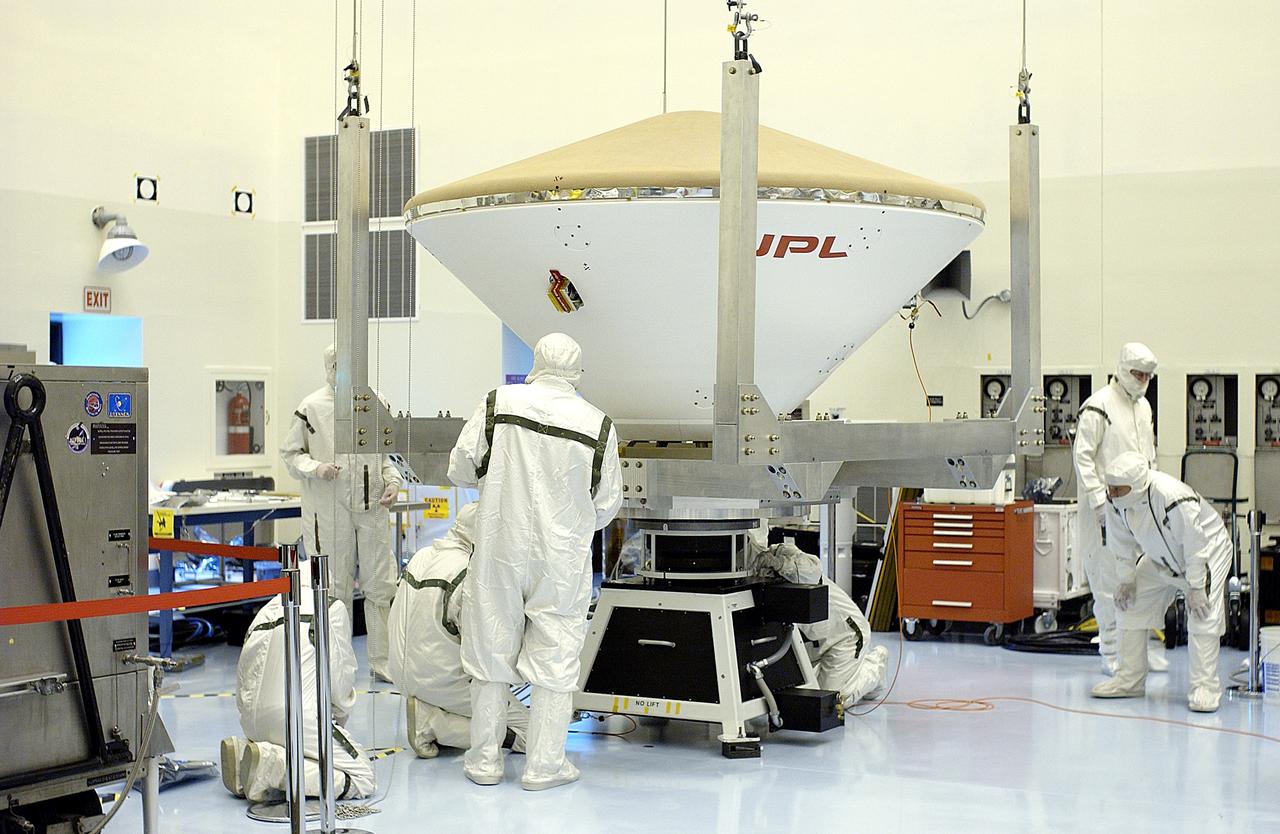
KENNEDY SPACE CENTER, FLA. - The overhead crane settles the Mars Exploration Rover 2 (MER-2) entry vehicle onto a spin table for a dry-spin test.  The MER Mission consists of two identical rovers designed to cover roughly 110 yards each Martian day over various terrain. Each rover will carry five scientific instruments that will allow it to search for evidence of liquid water that may have been present in the planet's past.  Identical to each other, the rovers will land at different regions of Mars.  Launch for MER-2 (MER-A) is scheduled for June 5.
KENNEDY SPACE CENTER, FLA. - The overhead crane settles the Mars Exploration Rover 2 (MER-2) entry vehicle onto a spin table for a dry-spin test. The MER Mission consists of two identical rovers designed to cover roughly 110 yards each Martian day over various terrain. Each rover will carry five scientific instruments that will allow it to search for evidence of liquid water that may have been present in the planet's past. Identical to each other, the rovers will land at different regions of Mars. Launch for MER-2 (MER-A) is scheduled for June 5.
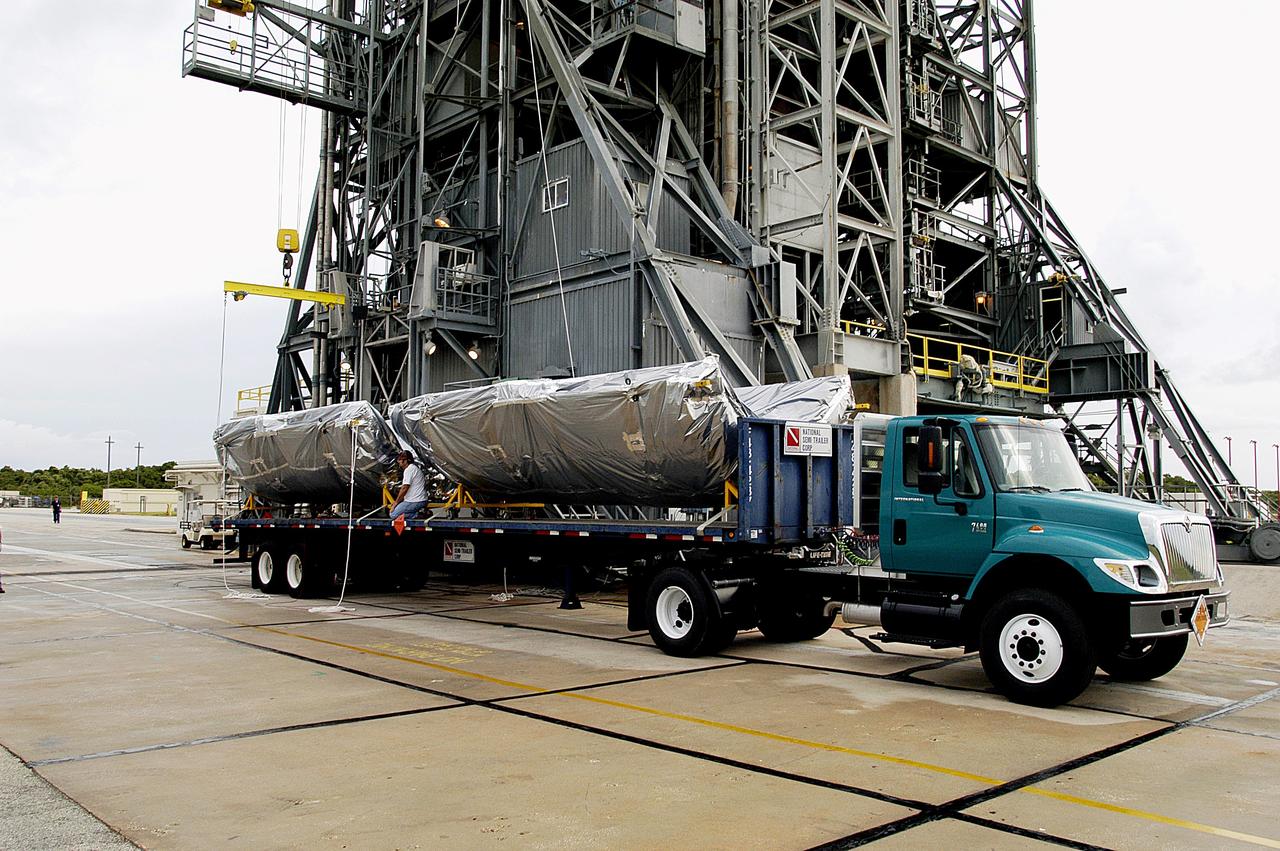
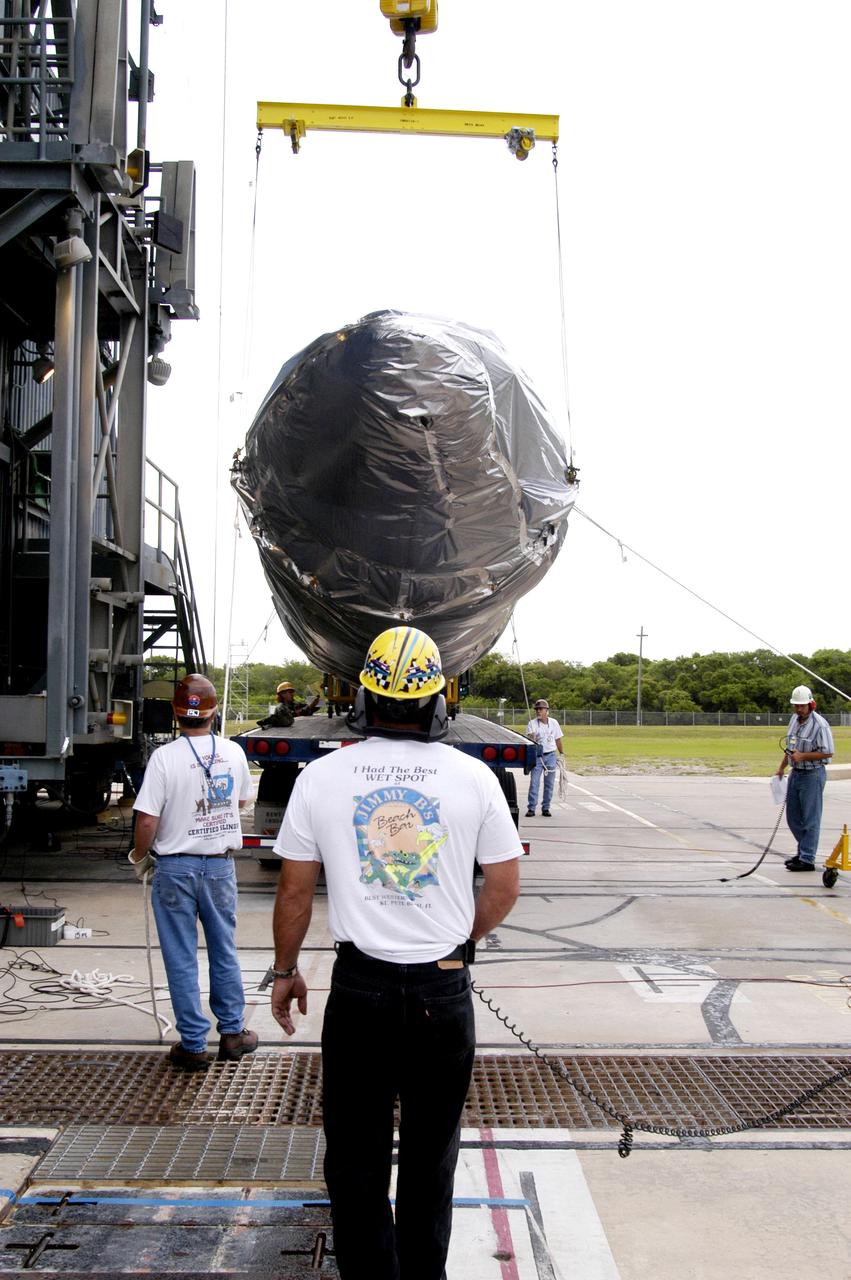
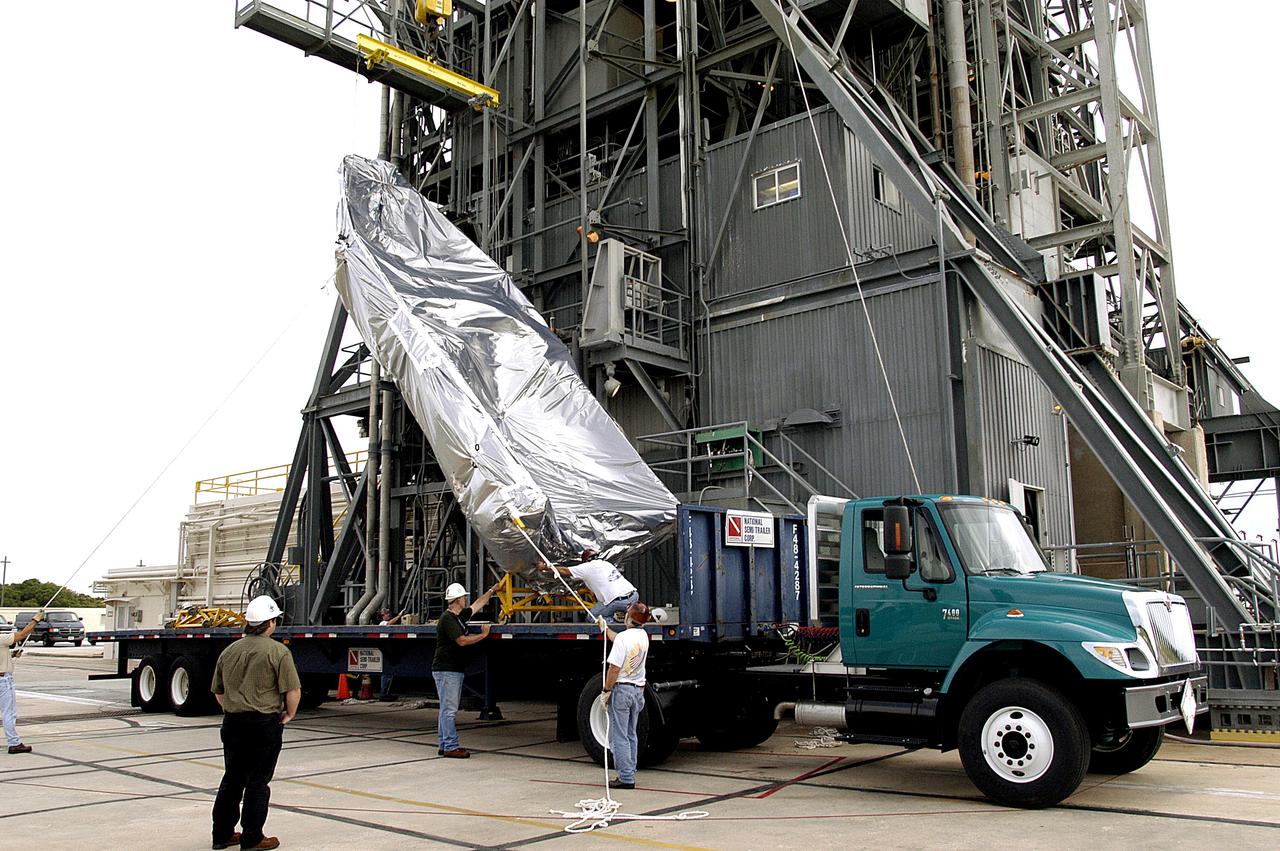
KENNEDY SPACE CENTER, FLA. - After arriving at Launch Complex 17-A, Cape Canaveral Air Force Station, the second half of the fairing for the Mars Exploration Rover 2 (MER-2/MER-A) is lifted off its transporter.  The fairing will be installed around the payload for protection during launch.  The MER Mission consists of two identical rovers designed to cover roughly 110 yards each Martian day over various terrain. Each rover will carry five scientific instruments that will allow it to search for evidence of liquid water that may have been present in the planet's past.  Identical to each other, the rovers will land at different regions of Mars.  Launch date for MER-A  is scheduled for June 5.
KENNEDY SPACE CENTER, FLA. - After arriving at Launch Complex 17-A, Cape Canaveral Air Force Station, the second half of the fairing for the Mars Exploration Rover 2 (MER-2/MER-A) is lifted off its transporter. The fairing will be installed around the payload for protection during launch. The MER Mission consists of two identical rovers designed to cover roughly 110 yards each Martian day over various terrain. Each rover will carry five scientific instruments that will allow it to search for evidence of liquid water that may have been present in the planet's past. Identical to each other, the rovers will land at different regions of Mars. Launch date for MER-A is scheduled for June 5.
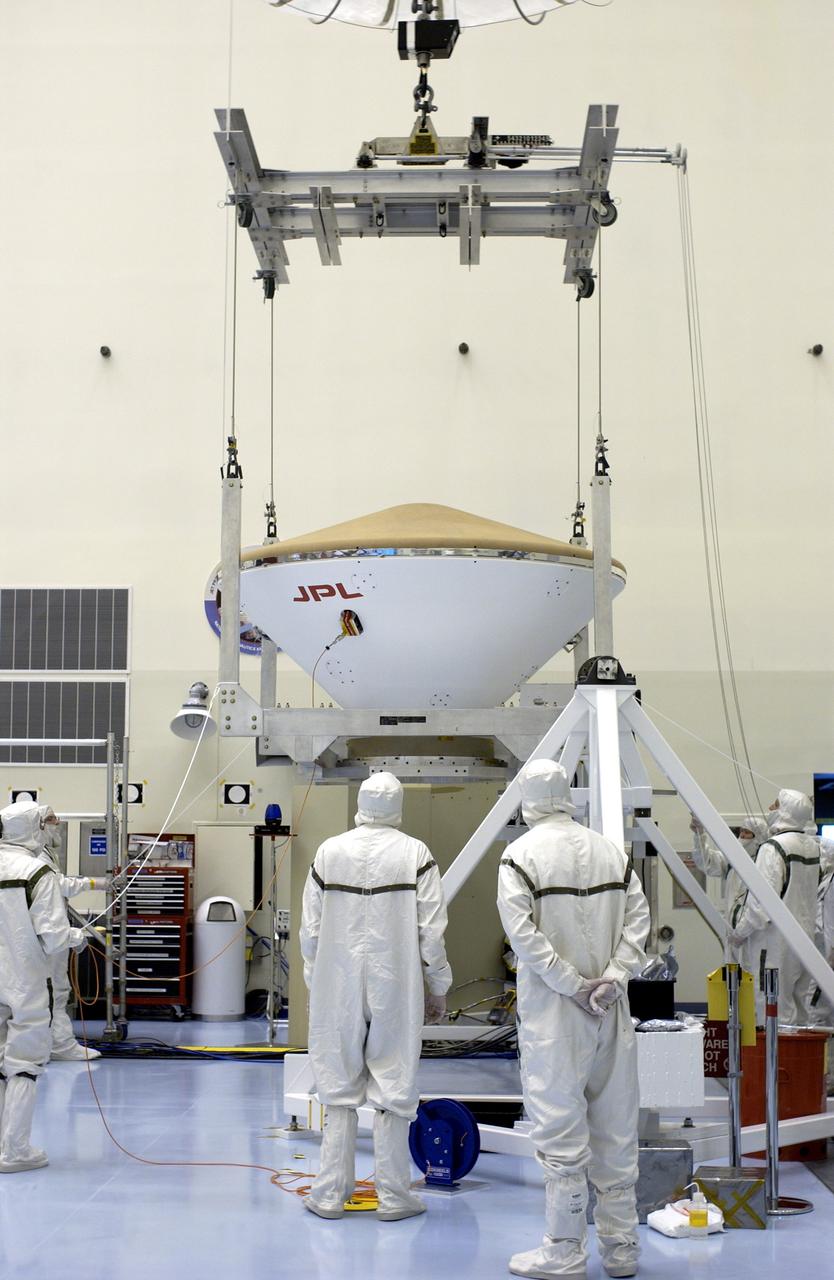
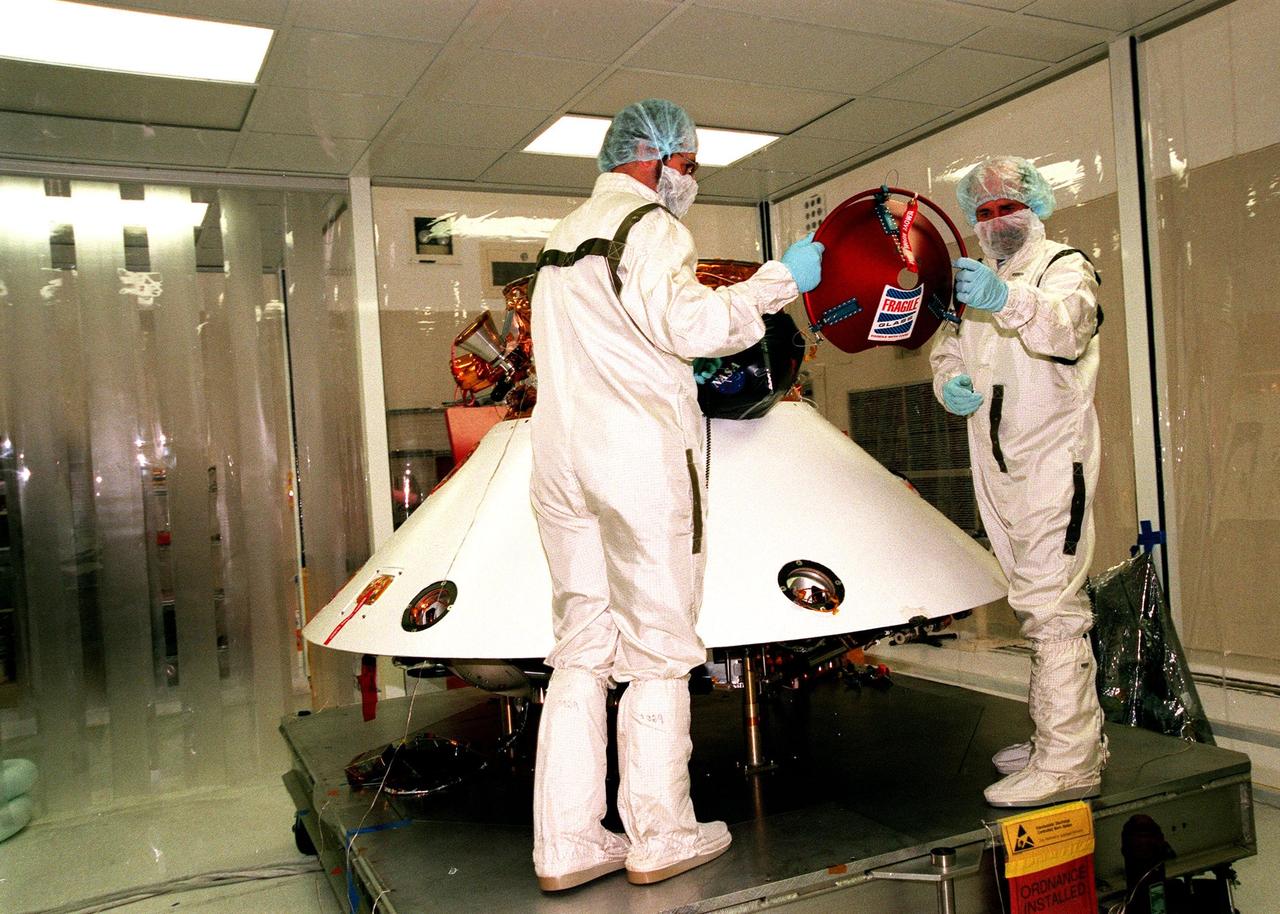
KENNEDY SPACE CENTER, FLA. - An overhead crane lifts the Mars Exploration Rover 2 (MER-2) entry vehicle from its stand to move it to a spin table for a dry-spin test.  The MER Mission consists of two identical rovers designed to cover roughly 110 yards each Martian day over various terrain. Each rover will carry five scientific instruments that will allow it to search for evidence of liquid water that may have been present in the planet's past.  Identical to each other, the rovers will land at different regions of Mars.  Launch for MER-2 (MER-A) is scheduled for June 5.
KENNEDY SPACE CENTER, FLA. - An overhead crane lifts the Mars Exploration Rover 2 (MER-2) entry vehicle from its stand to move it to a spin table for a dry-spin test. The MER Mission consists of two identical rovers designed to cover roughly 110 yards each Martian day over various terrain. Each rover will carry five scientific instruments that will allow it to search for evidence of liquid water that may have been present in the planet's past. Identical to each other, the rovers will land at different regions of Mars. Launch for MER-2 (MER-A) is scheduled for June 5.
KENNEDY SPACE CENTER, FLA. - At Launch Complex 17-A, Cape Canaveral Air Force Station, the first half of the fairing for the Mars Exploration Rover 2 (MER-2/MER-A) is lifted off the transporter.  The fairing will be installed around the payload for protection during launch.  The MER Mission consists of two identical rovers designed to cover roughly 110 yards each Martian day over various terrain. Each rover will carry five scientific instruments that will allow it to search for evidence of liquid water that may have been present in the planet's past.  Identical to each other, the rovers will land at different regions of Mars.  Launch date for MER-A  is scheduled for June 5.
KENNEDY SPACE CENTER, FLA. - At Launch Complex 17-A, Cape Canaveral Air Force Station, the first half of the fairing for the Mars Exploration Rover 2 (MER-2/MER-A) is lifted off the transporter. The fairing will be installed around the payload for protection during launch. The MER Mission consists of two identical rovers designed to cover roughly 110 yards each Martian day over various terrain. Each rover will carry five scientific instruments that will allow it to search for evidence of liquid water that may have been present in the planet's past. Identical to each other, the rovers will land at different regions of Mars. Launch date for MER-A is scheduled for June 5.
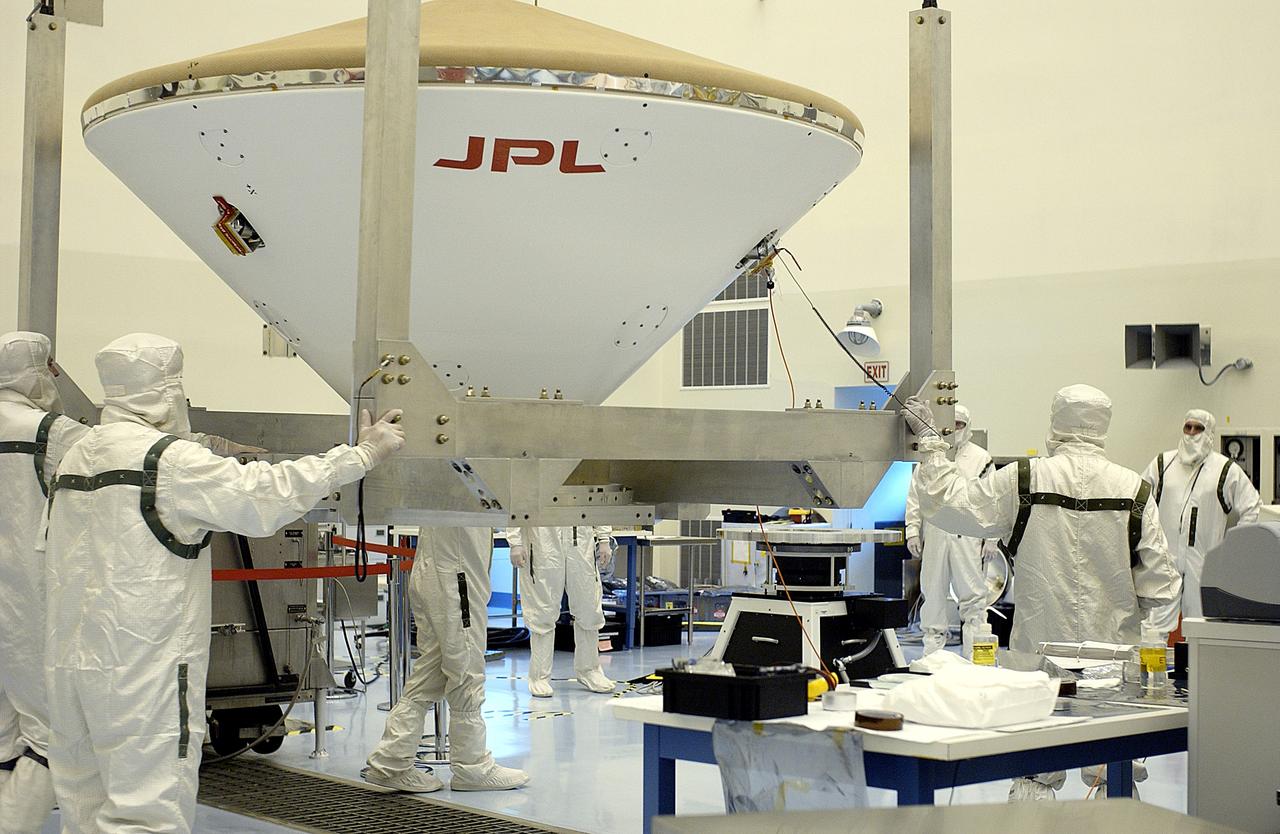
KENNEDY SPACE CENTER, FLA. - Workers in the Payload Hazardous Servicing Facility help guide the Mars Exploration Rover 2 (MER-2) entry vehicle toward a spin table for a dry-spin test.  The MER Mission consists of two identical rovers designed to cover roughly 110 yards each Martian day over various terrain. Each rover will carry five scientific instruments that will allow it to search for evidence of liquid water that may have been present in the planet's past.  Identical to each other, the rovers will land at different regions of Mars.  Launch for MER-2 (MER-A) is scheduled for June 5.
KENNEDY SPACE CENTER, FLA. - Workers in the Payload Hazardous Servicing Facility help guide the Mars Exploration Rover 2 (MER-2) entry vehicle toward a spin table for a dry-spin test. The MER Mission consists of two identical rovers designed to cover roughly 110 yards each Martian day over various terrain. Each rover will carry five scientific instruments that will allow it to search for evidence of liquid water that may have been present in the planet's past. Identical to each other, the rovers will land at different regions of Mars. Launch for MER-2 (MER-A) is scheduled for June 5.
KENNEDY SPACE CENTER, FLA. -  With help from workers, the overhead crane lowers the Mars Exploration Rover 2 (MER-2) entry vehicle onto a spin table for a dry-spin test.  The MER Mission consists of two identical rovers designed to cover roughly 110 yards each Martian day over various terrain. Each rover will carry five scientific instruments that will allow it to search for evidence of liquid water that may have been present in the planet's past.  Identical to each other, the rovers will land at different regions of Mars.  Launch for MER-2 (MER-A) is scheduled for June 5.
KENNEDY SPACE CENTER, FLA. - With help from workers, the overhead crane lowers the Mars Exploration Rover 2 (MER-2) entry vehicle onto a spin table for a dry-spin test. The MER Mission consists of two identical rovers designed to cover roughly 110 yards each Martian day over various terrain. Each rover will carry five scientific instruments that will allow it to search for evidence of liquid water that may have been present in the planet's past. Identical to each other, the rovers will land at different regions of Mars. Launch for MER-2 (MER-A) is scheduled for June 5.
KENNEDY SPACE CENTER, FLA. - At Launch Complex 17-A, Cape Canaveral Air Force Station, a crane is in place to lift the fairing for the Mars Exploration Rover 2 (MER-2/MER-A).  The fairing will be installed around the payload for protection during launch.  The MER Mission consists of two identical rovers designed to cover roughly 110 yards each Martian day over various terrain. Each rover will carry five scientific instruments that will allow it to search for evidence of liquid water that may have been present in the planet's past.  Identical to each other, the rovers will land at different regions of Mars.  Launch date for MER-A  is scheduled for June 5.
KENNEDY SPACE CENTER, FLA. - At Launch Complex 17-A, Cape Canaveral Air Force Station, a crane is in place to lift the fairing for the Mars Exploration Rover 2 (MER-2/MER-A). The fairing will be installed around the payload for protection during launch. The MER Mission consists of two identical rovers designed to cover roughly 110 yards each Martian day over various terrain. Each rover will carry five scientific instruments that will allow it to search for evidence of liquid water that may have been present in the planet's past. Identical to each other, the rovers will land at different regions of Mars. Launch date for MER-A is scheduled for June 5.
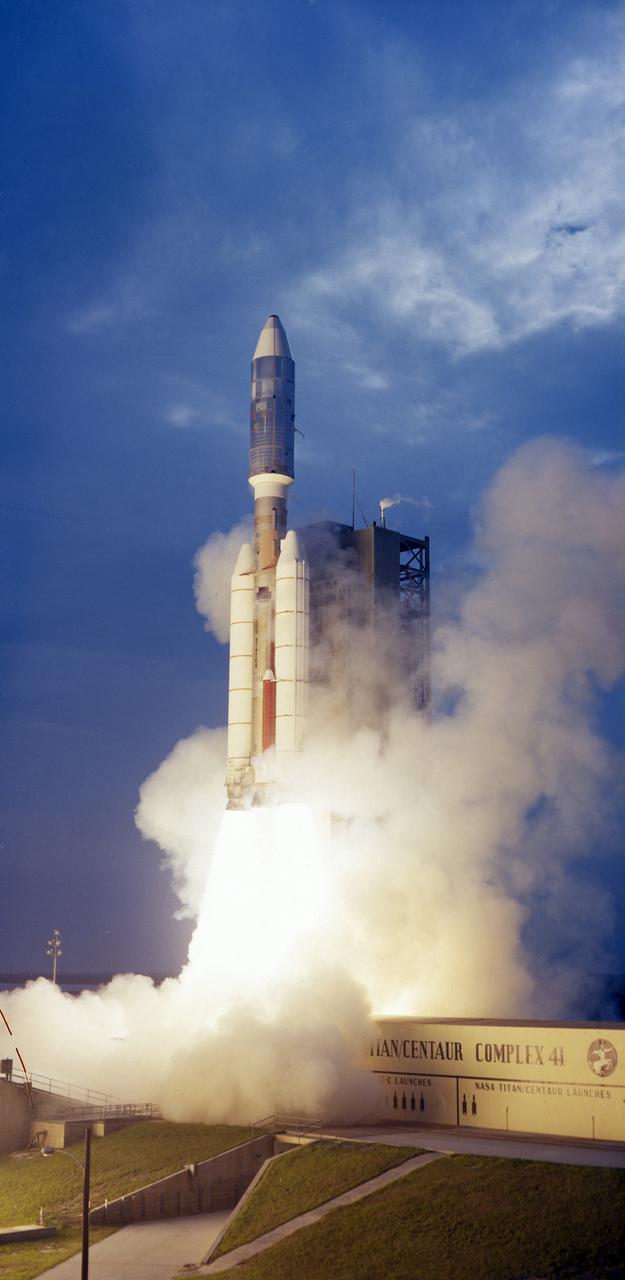
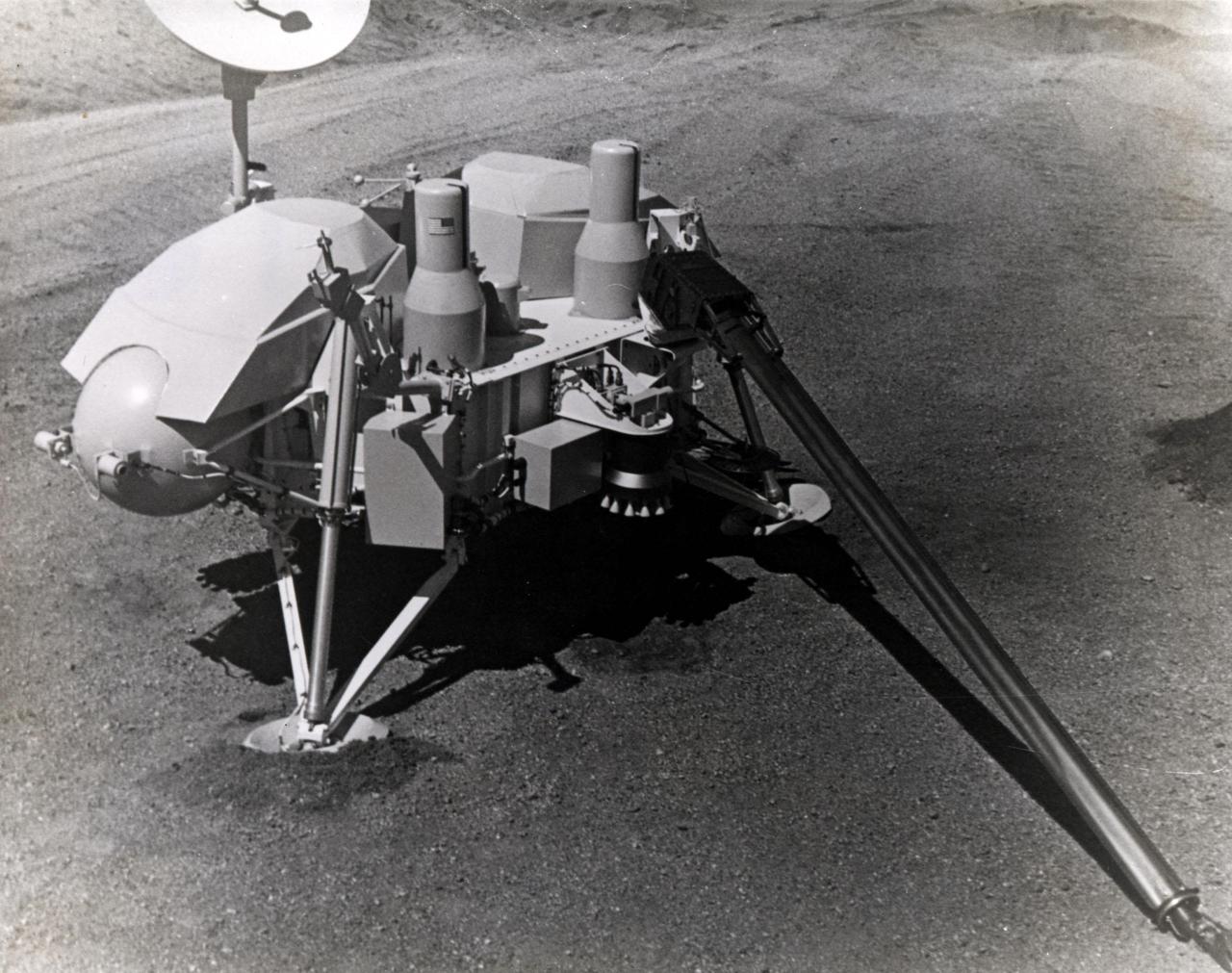
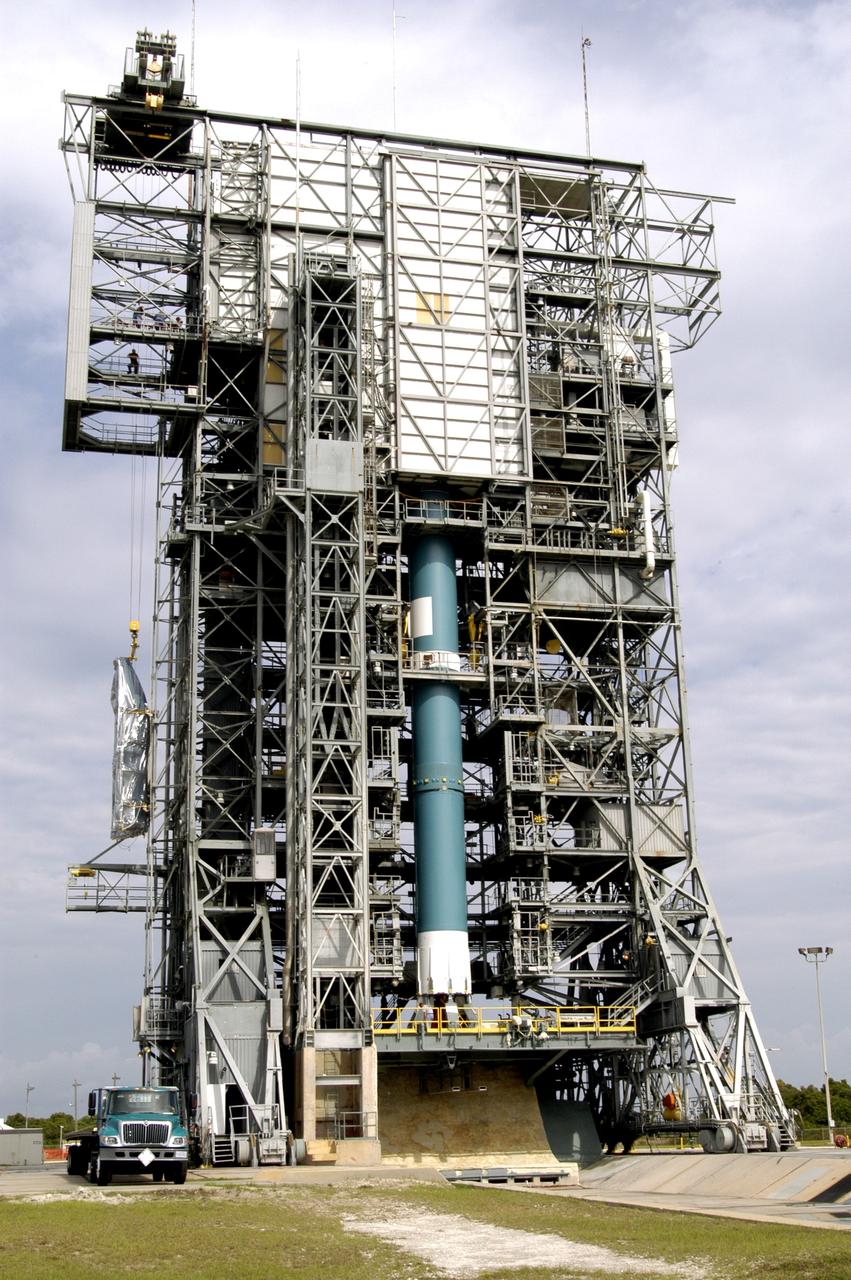
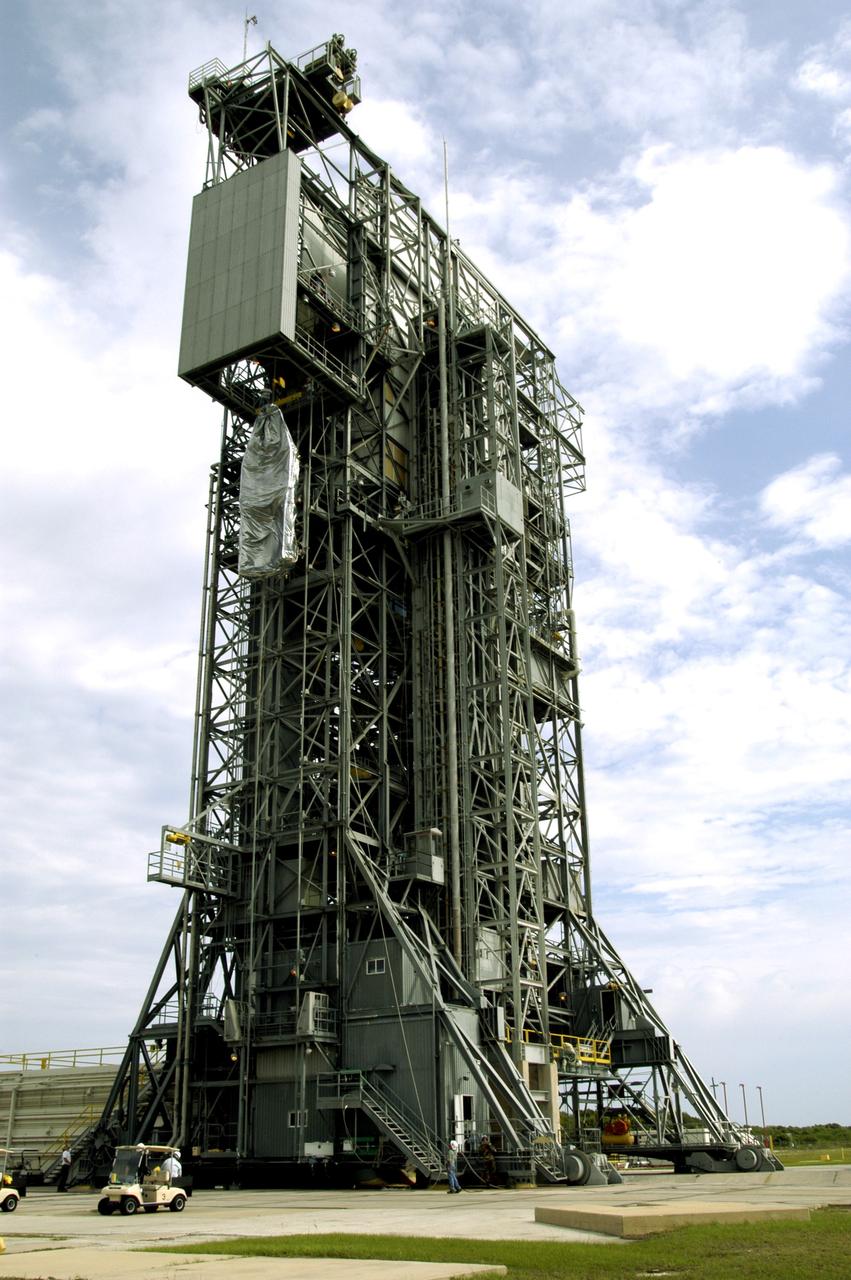
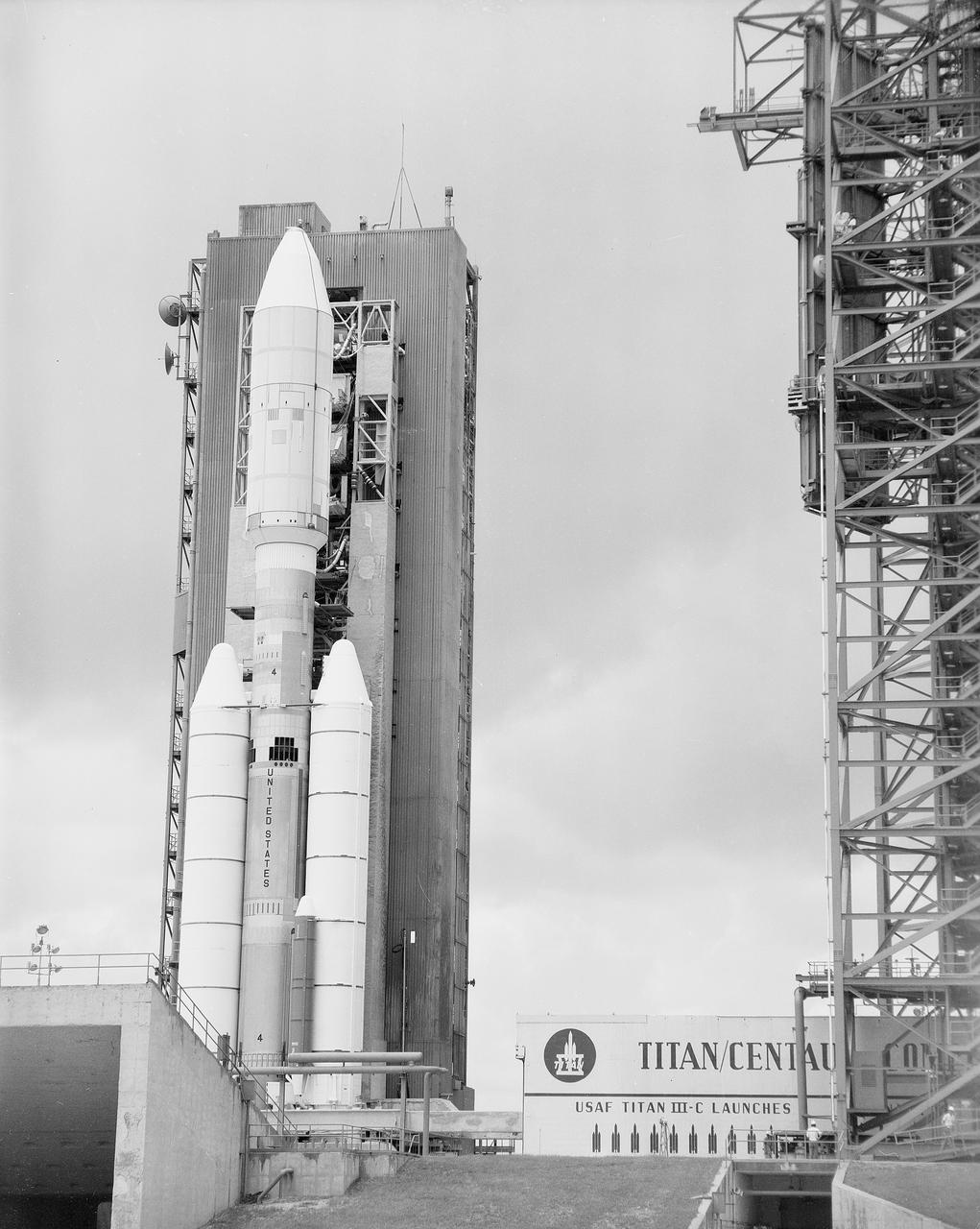
The Titan III-Centaur carrying the Viking 1 Lander lifted off on August 20, 1975. The Viking Lander conducted a detailed scientific investigation of the planet Mars.
Launch Vehicles
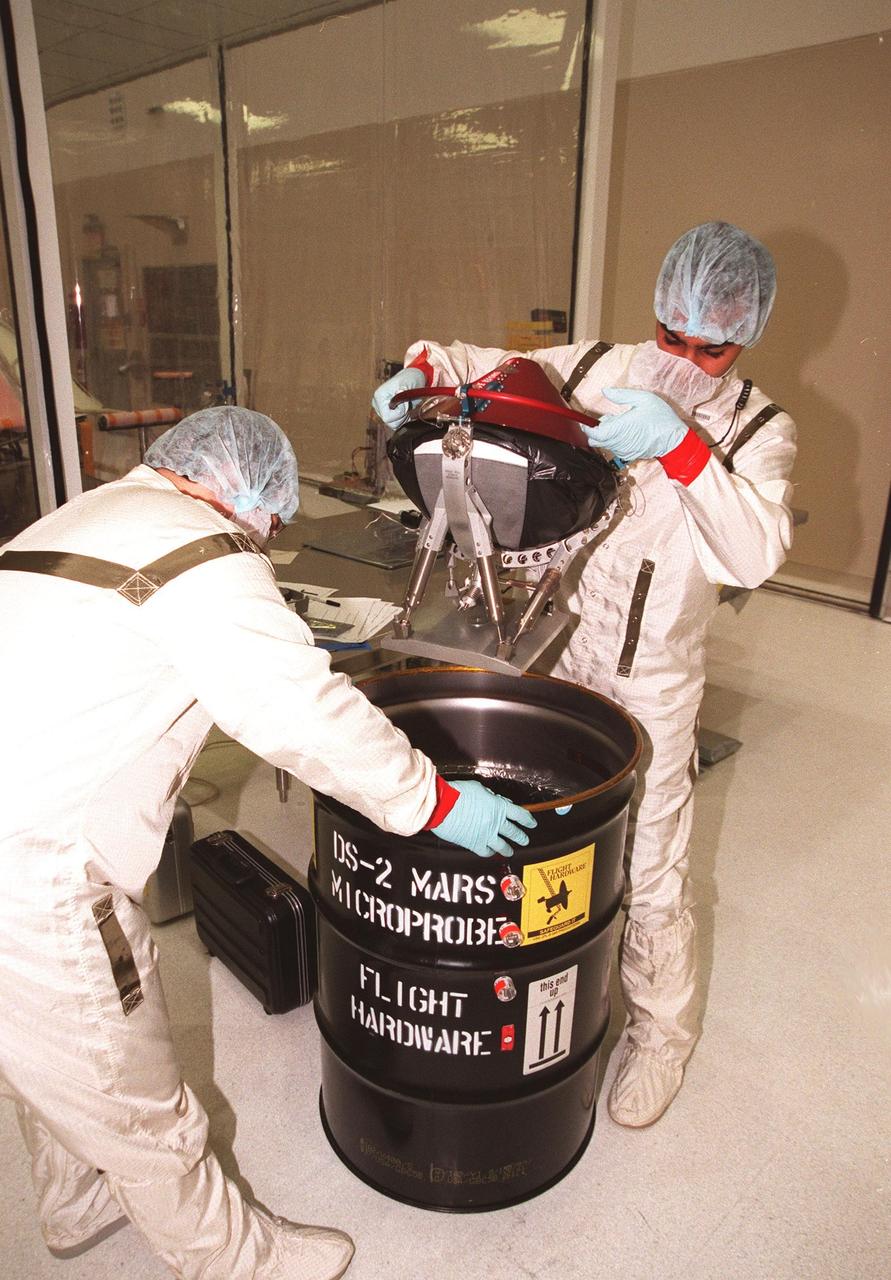
KENNEDY SPACE CENTER, FLA. -- In the Spacecraft Assembly and Encapsulation Facility -2 (SAEF-2), two JPL workers measure a Mars microprobe. Two microprobes will hitchhike on the Mars Polar Lander, scheduled to be launched Jan. 3, 1999, aboard a Delta II rocket. The solar-powered spacecraft is designed to touch down on the Martian surface near the northern-most boundary of the south pole in order to study the water cycle there. The lander also will help scientists learn more about climate change and current resources on Mars, studying such things as frost, dust, water vapor and condensates in the Martian atmosphere. The Mars microprobes, called Deep Space 2, are part of NASA's New Millennium Program. They will complement the climate-related scientific focus of the lander by demonstrating an advanced, rugged microlaser system for detecting subsurface water. Such data on polar subsurface water, in the form of ice, should help put limits on scientific projections for the global abundance of water on Mars
KSC-98pc1644
KENNEDY SPACE CENTER, FLA. -- In the Spacecraft Assembly and Encapsulation Facility -2 (SAEF-2), the two Mars microprobes are shown mounted on opposite sides of the Mars Polar Lander. The two microprobes and the lander are scheduled to be launched Jan. 3, 1999, aboard a Delta II rocket. The solar-powered spacecraft is designed to touch down on the Martian surface near the northern-most boundary of the south pole in order to study the water cycle there. The lander also will help scientists learn more about climate change and current resources on Mars, studying such things as frost, dust, water vapor and condensates in the Martian atmosphere. The Mars microprobes, called Deep Space 2, are part of NASA's New Millennium Program. They will complement the climate-related scientific focus of the lander by demonstrating an advanced, rugged microlaser system for detecting subsurface water. Such data on polar subsurface water, in the form of ice, should help put limits on scientific projections for the global abundance of water on Mars
KSC-98pc1648
KENNEDY SPACE CENTER, FLA. -- In the Spacecraft Assembly and Encapsulation Facility -2 (SAEF-2), JPL workers mount a Mars microprobe onto the Mars Polar Lander. Two microprobes will hitchhike on the lander, scheduled to be launched Jan. 3, 1999, aboard a Delta II rocket. The solar-powered spacecraft is designed to touch down on the Martian surface near the northern-most boundary of the south pole in order to study the water cycle there. The lander also will help scientists learn more about climate change and current resources on Mars, studying such things as frost, dust, water vapor and condensates in the Martian atmosphere. The Mars microprobes, called Deep Space 2, are part of NASA's New Millennium Program. They will complement the climate-related scientific focus of the lander by demonstrating an advanced, rugged microlaser system for detecting subsurface water. Such data on polar subsurface water, in the form of ice, should help put limits on scientific projections for the global abundance of water on Mars
KSC-98pc1645
KENNEDY SPACE CENTER, FLA. -- In the Spacecraft Assembly and Encapsulation Facility -2 (SAEF-2), a JPL worker checks the Mars microprobe. Two microprobes will hitchhike on the Mars Polar Lander, scheduled to be launched Jan. 3, 1999, aboard a Delta II rocket. The solar-powered spacecraft is designed to touch down on the Martian surface near the northern-most boundary of the south pole in order to study the water cycle there. The lander also will help scientists learn more about climate change and current resources on Mars, studying such things as frost, dust, water vapor and condensates in the Martian atmosphere. The Mars microprobes, called Deep Space 2, are part of NASA's New Millennium Program. They will complement the climate-related scientific focus of the lander by demonstrating an advanced, rugged microlaser system for detecting subsurface water. Such data on polar subsurface water, in the form of ice, should help put limits on scientific projections for the global abundance of water on Mars
KSC-98pc1643
KENNEDY SPACE CENTER, FLA. -- In the Spacecraft Assembly and Encapsulation Facility -2 (SAEF-2), a JPL worker carries a Mars microprobe to the Mars Polar Lander at left. Two microprobes will hitchhike on the lander, scheduled to be launched Jan. 3, 1999, aboard a Delta II rocket. The solar-powered spacecraft is designed to touch down on the Martian surface near the northern-most boundary of the south pole in order to study the water cycle there. The lander also will help scientists learn more about climate change and current resources on Mars, studying such things as frost, dust, water vapor and condensates in the Martian atmosphere. The Mars microprobes, called Deep Space 2, are part of NASA's New Millennium Program. They will complement the climate-related scientific focus of the lander by demonstrating an advanced, rugged microlaser system for detecting subsurface water. Such data on polar subsurface water, in the form of ice, should help put limits on scientific projections for the global abundance of water on Mars
KSC-98pc1646
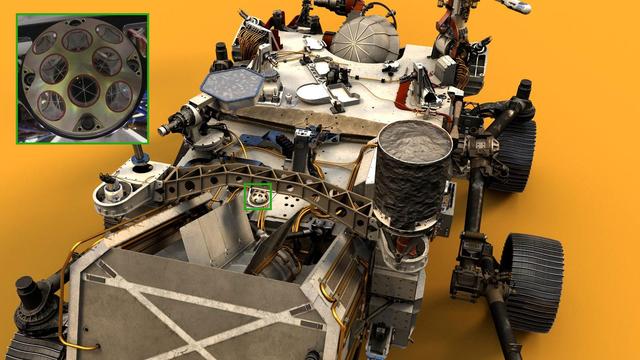
Visible near the center of NASA's Perseverance Mars rover in this illustration is the palm-size dome called the Laser Retroreflector Array (LaRA). In the distant future, laser-equipped Mars orbiters could use such a reflector for scientific studies.  https://photojournal.jpl.nasa.gov/catalog/PIA24097
Perseverance's Laser Retroreflector (Illustration)
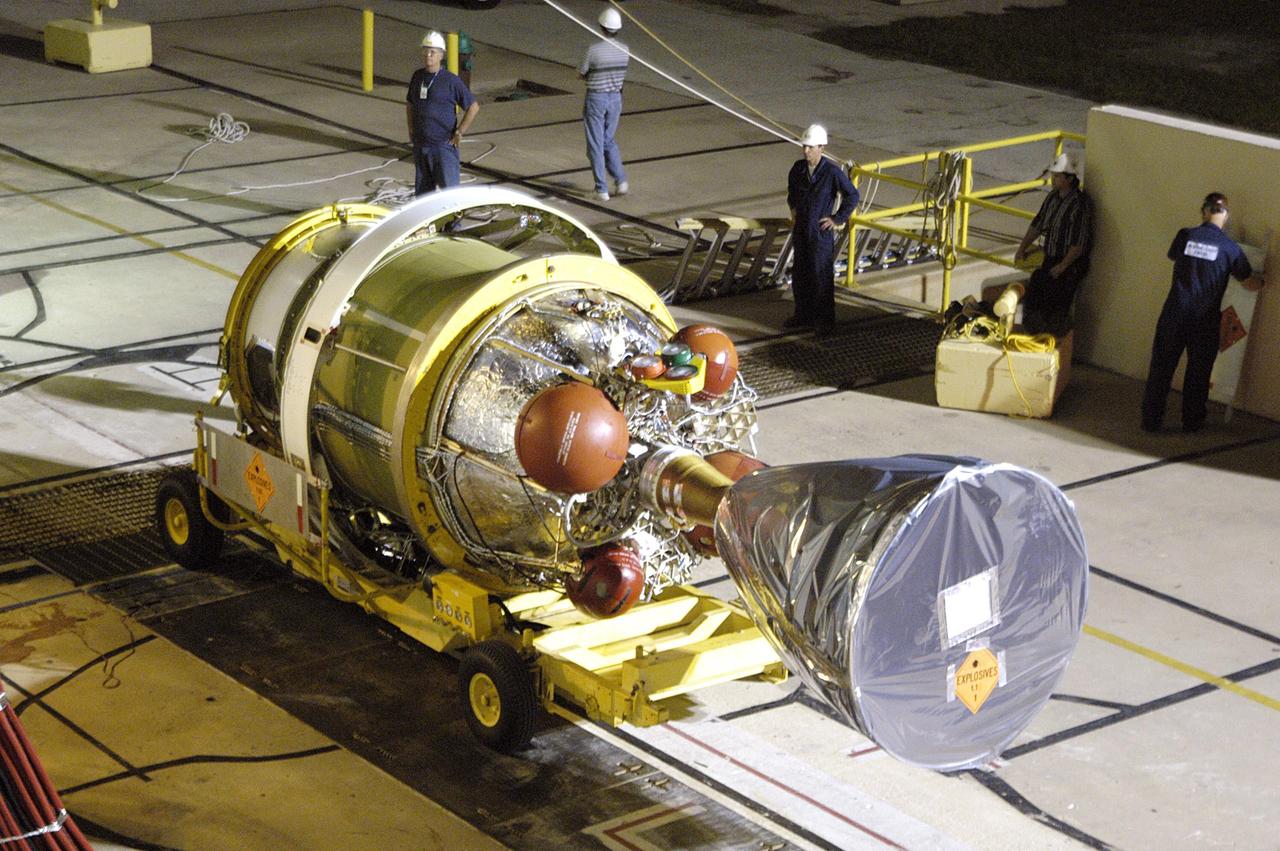
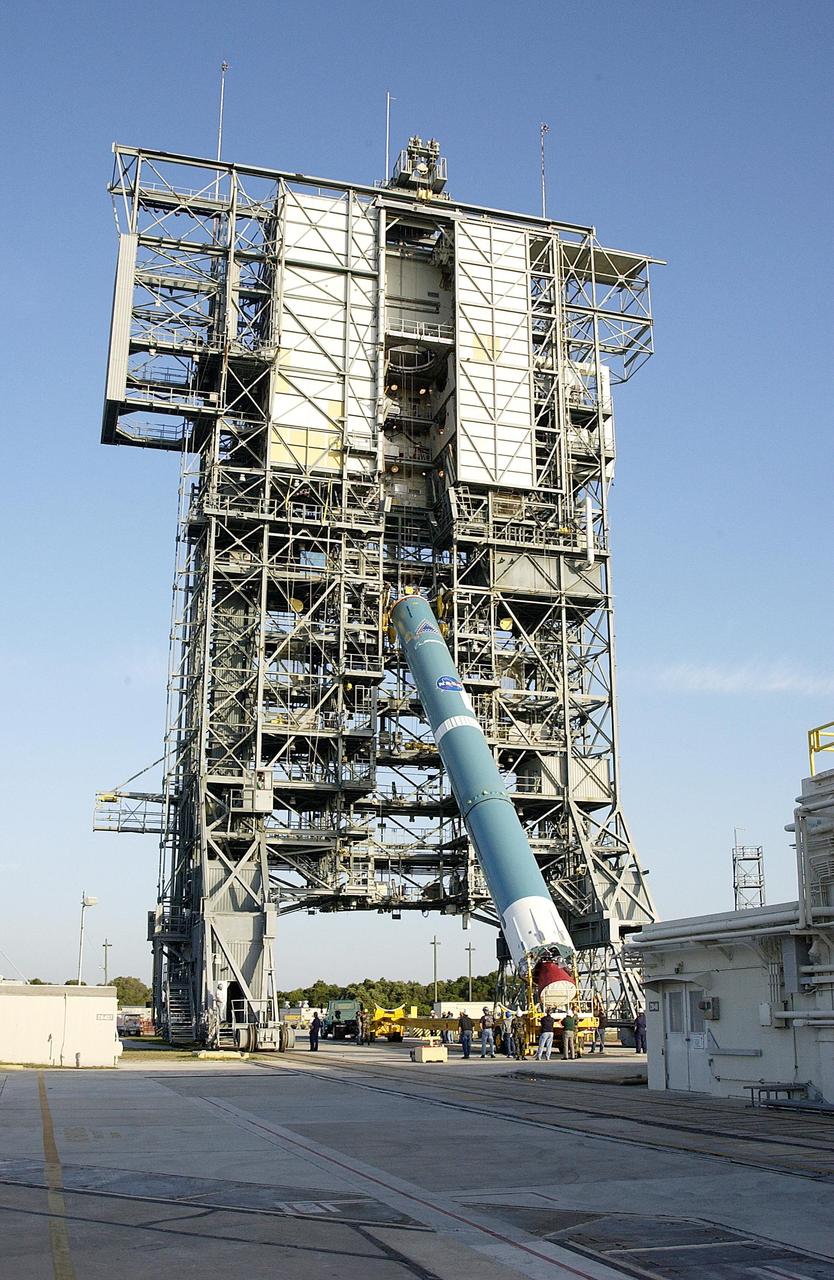
KENNEDY SPACE CENTER, FLA. - The second stage of the Delta II rocket is raised off the transporter for its lift up the launch tower on Pad 17-A, Cape Canaveral Air Force Station.  It will be mated to the first stage in preparation for the launch of the Mars Exploration Rover 2 (MER-A).  The MER Mission consists of two identical rovers designed to cover roughly 110 yards each Martian day over various terrain. Each rover will carry five scientific instruments that will allow it to search for evidence of liquid water that may have been present in the planet’s past.  Identical to each other, the rovers will land at different regions of Mars.  Launch date for this first of NASA’s two Mars Exploration Rover missions is scheduled June 5.
KENNEDY SPACE CENTER, FLA. - The second stage of the Delta II rocket is raised off the transporter for its lift up the launch tower on Pad 17-A, Cape Canaveral Air Force Station. It will be mated to the first stage in preparation for the launch of the Mars Exploration Rover 2 (MER-A). The MER Mission consists of two identical rovers designed to cover roughly 110 yards each Martian day over various terrain. Each rover will carry five scientific instruments that will allow it to search for evidence of liquid water that may have been present in the planet’s past. Identical to each other, the rovers will land at different regions of Mars. Launch date for this first of NASA’s two Mars Exploration Rover missions is scheduled June 5.
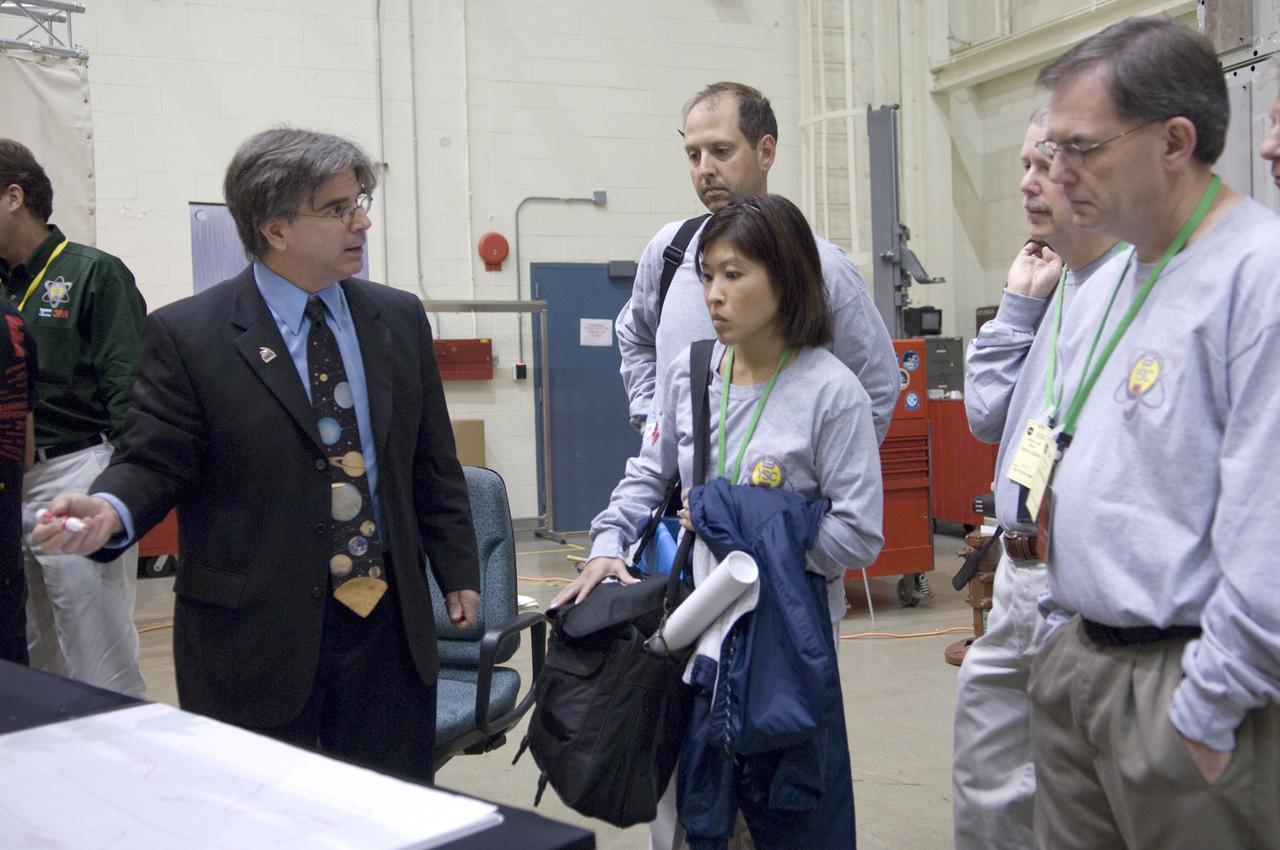
Young Scientist Challenge YSC was held at Goddard on October 5-6, 2008 sponsored by 3M.  It gave students the opportunity to demonstrate their scientific and engineering skills by participating in live demonstrations.  Jim Garvin explains Mars
G-2008-0813-024
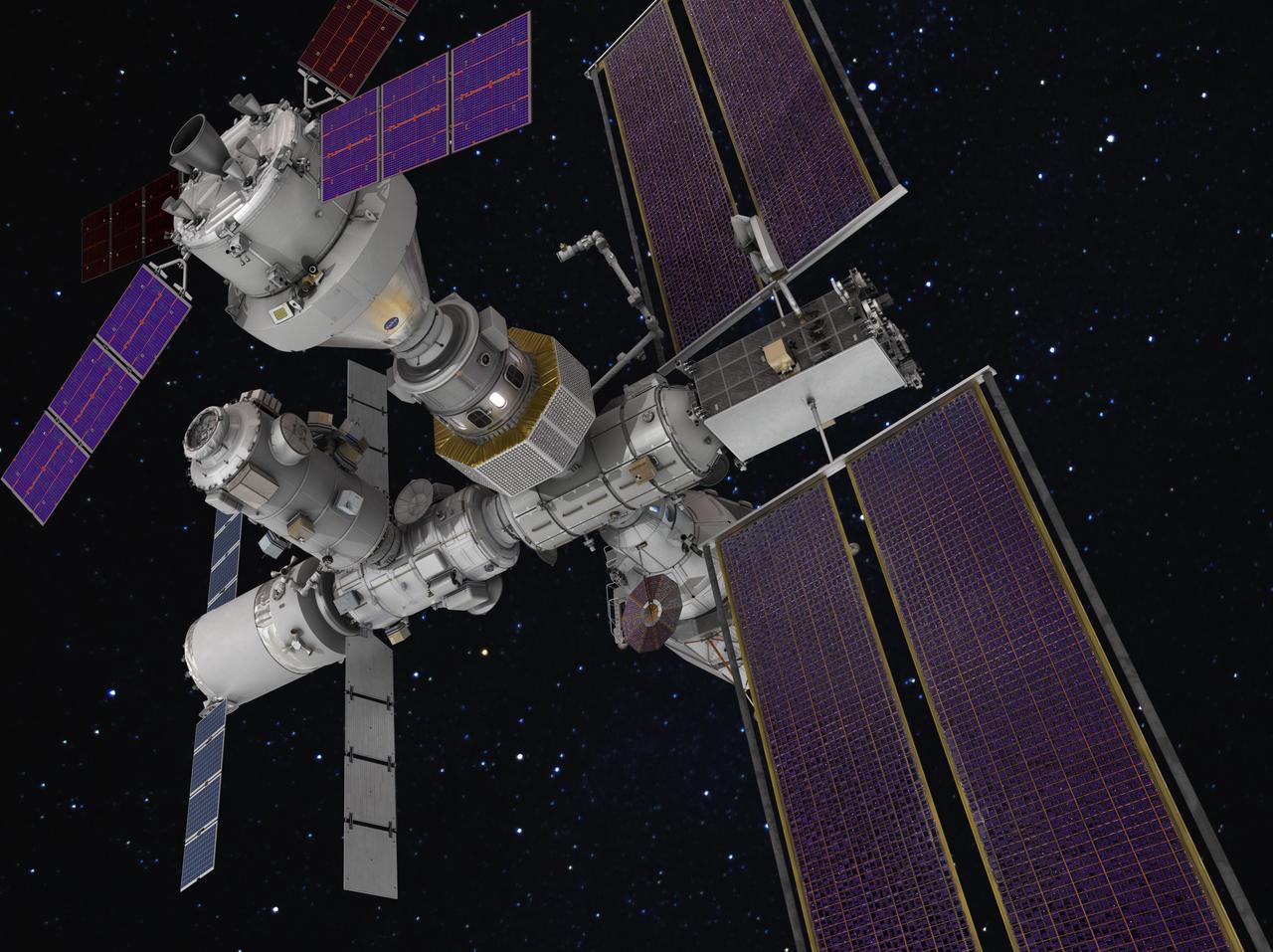
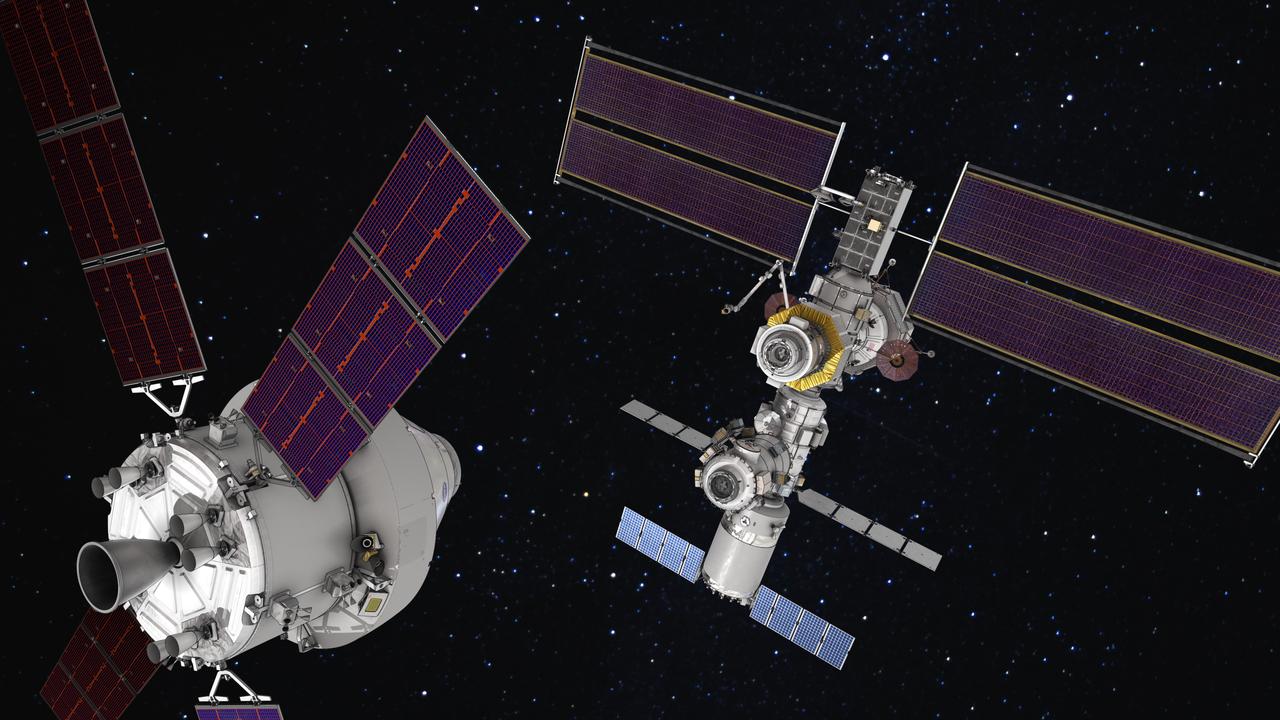
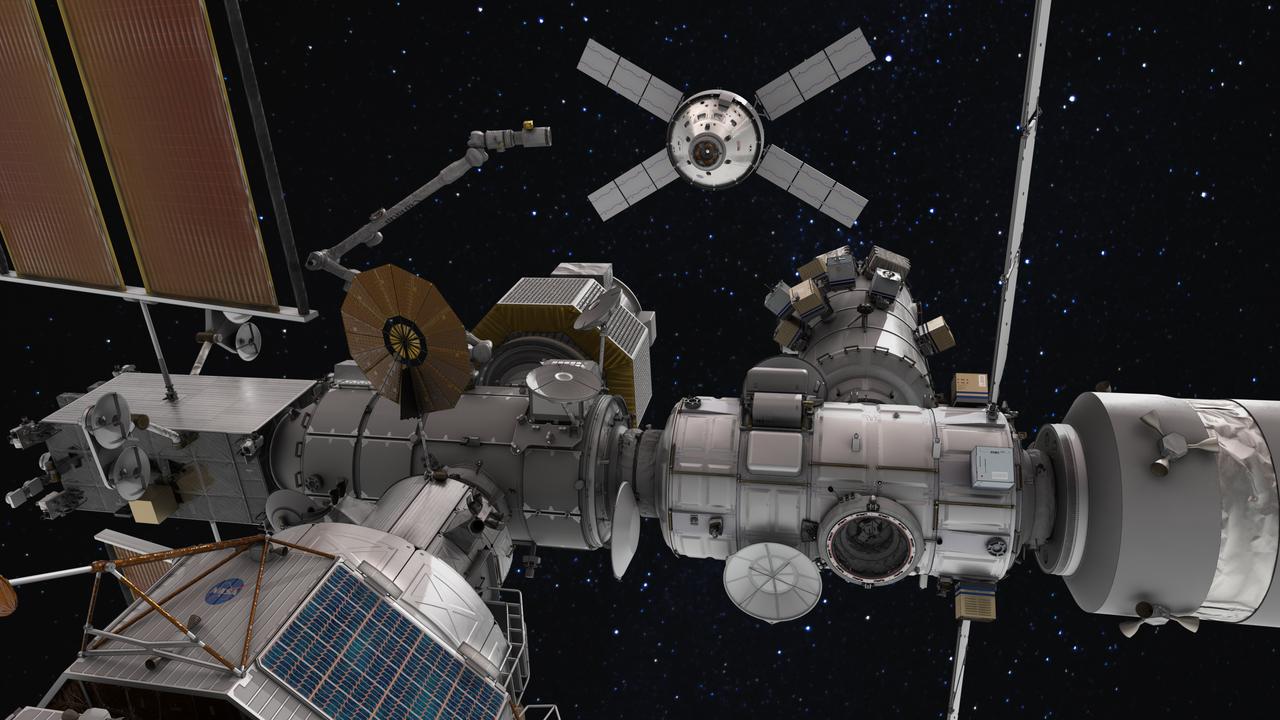
The Gateway space station will be humanity's first space station in lunar orbit as a vital component of the Artemis missions to return humans to the Moon for scientific discovery and chart a path for humans to Mars.
Gateway-Telephoto-IAC7-Set-4k-BG_4
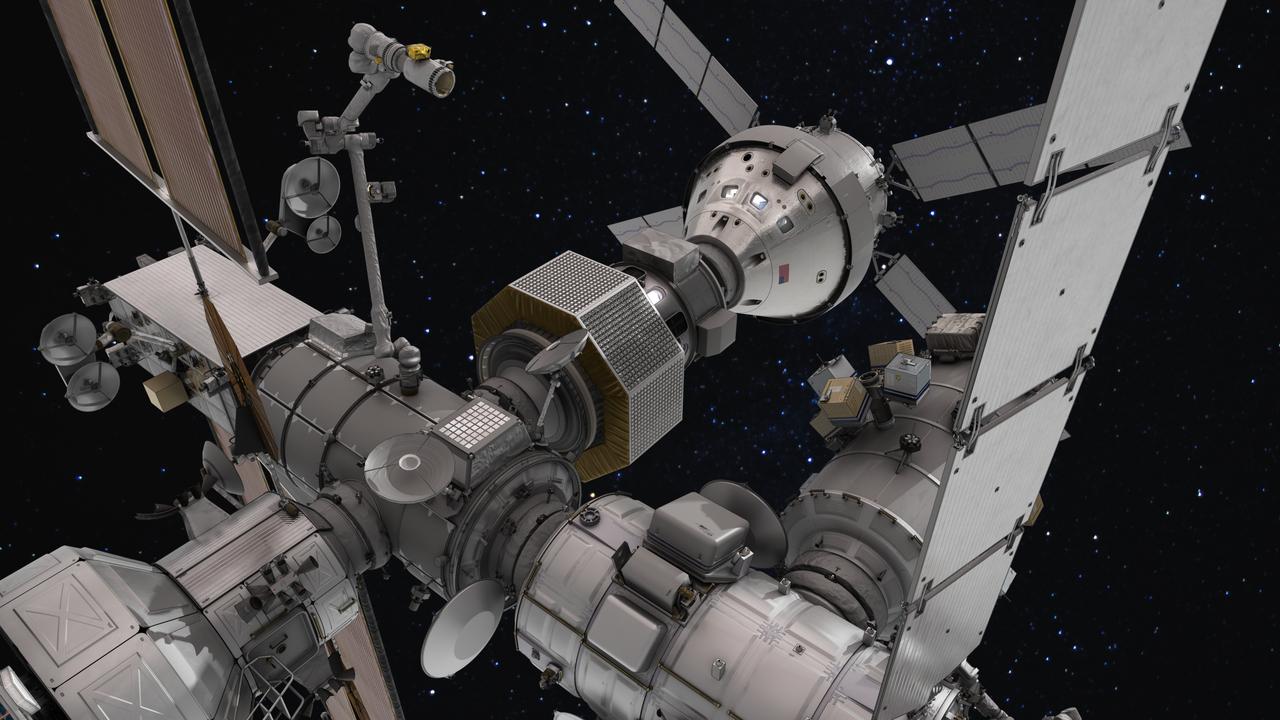
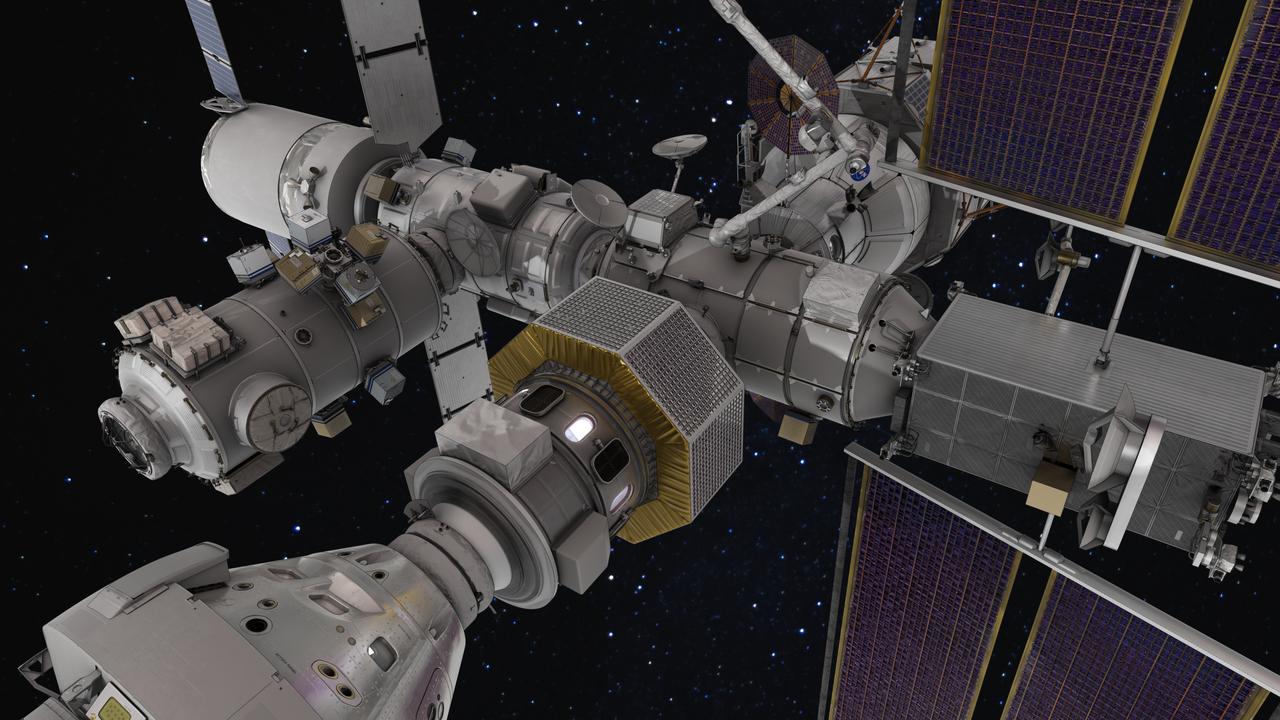
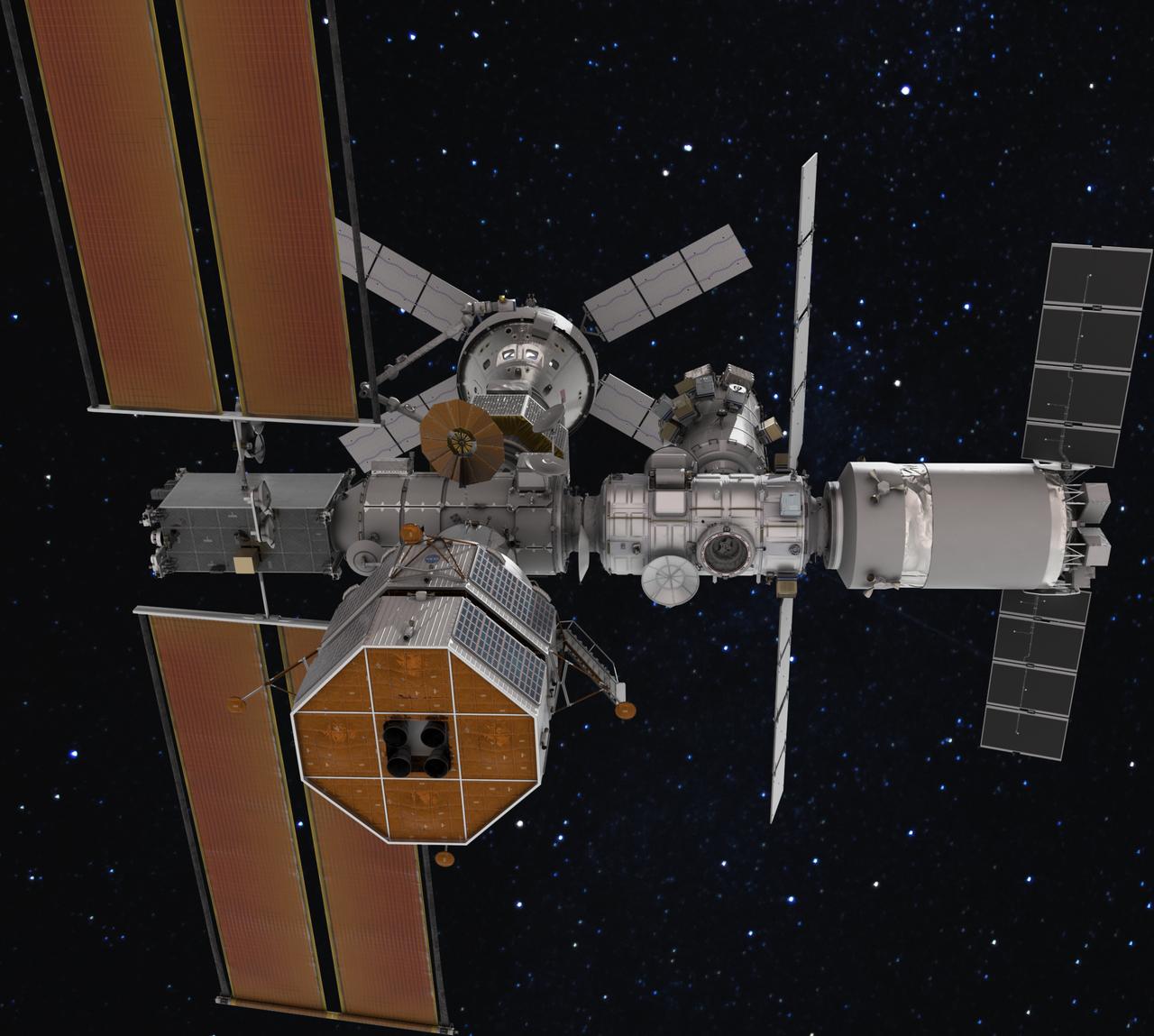
The Gateway space station will be humanity's first space station in lunar orbit as a vital component of the Artemis missions to return humans to the Moon for scientific discovery and chart a path for humans to Mars.
Gateway-Set-1-IAC7-4k-BG_8
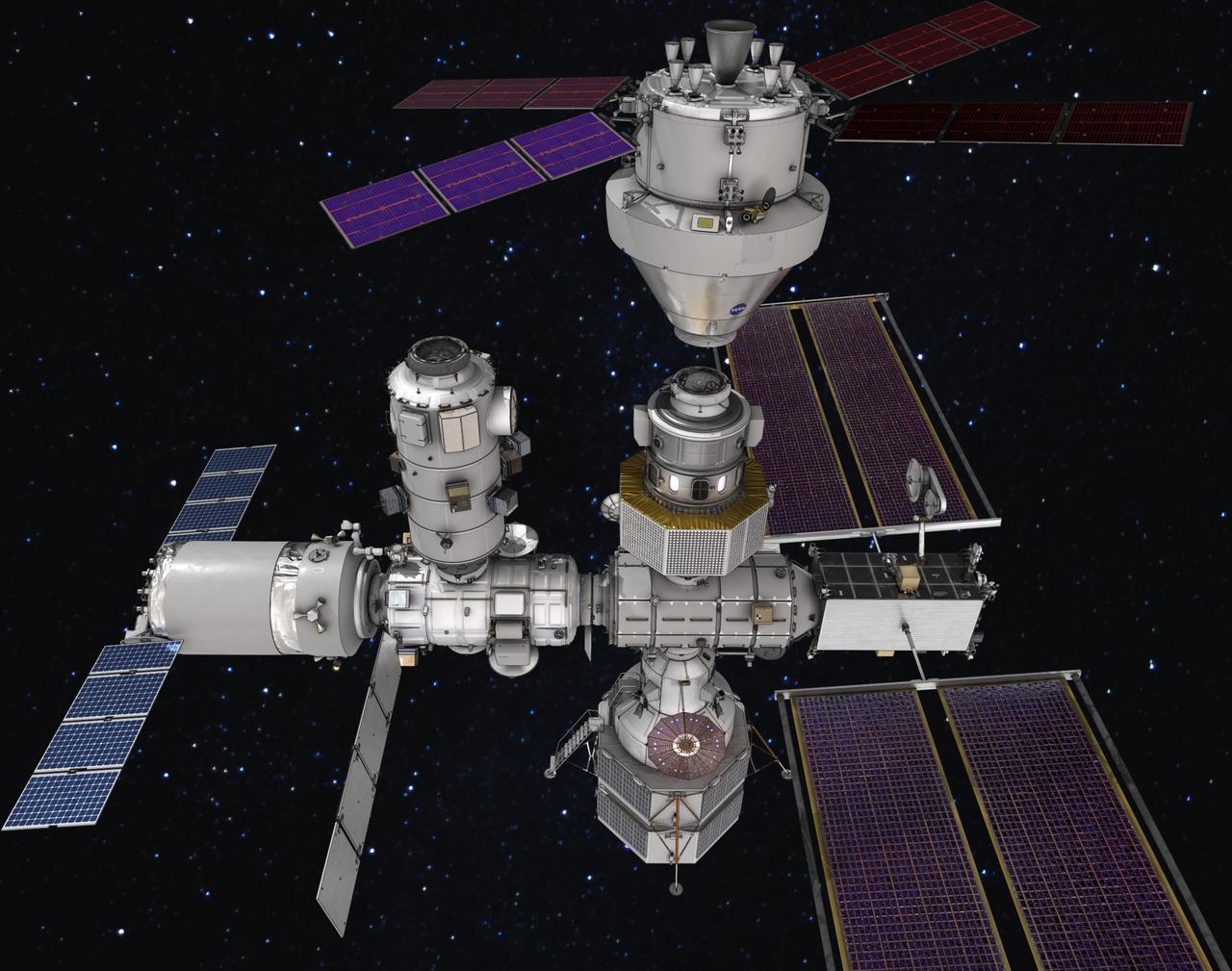
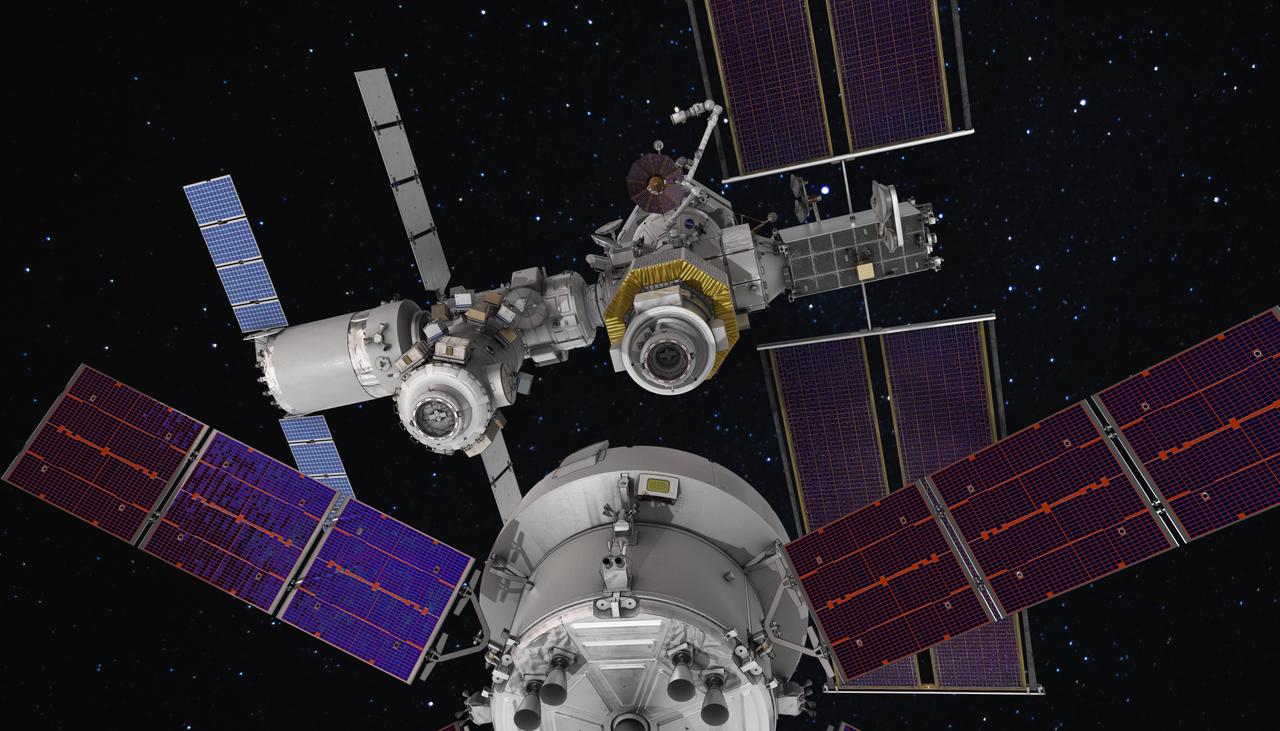
The Gateway space station will be humanity's first space station in lunar orbit as a vital component of the Artemis missions to return humans to the Moon for scientific discovery and chart a path for humans to Mars.
Gateway-Set-1-IAC7-4k-BG_10
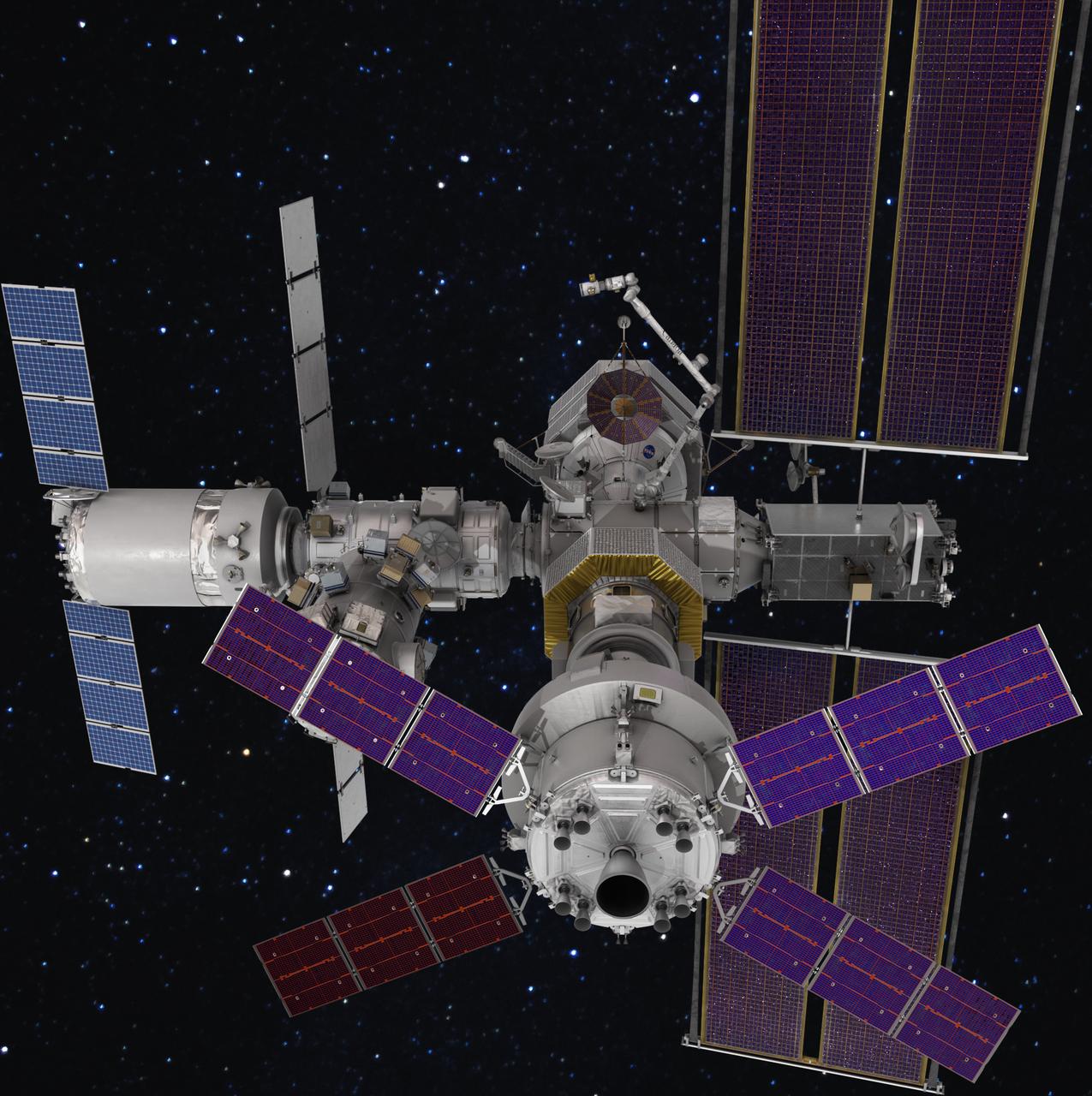
The Gateway space station will be humanity's first space station in lunar orbit as a vital component of the Artemis missions to return humans to the Moon for scientific discovery and chart a path for humans to Mars.
Gateway-Set-1-IAC7-4k-BG_11
The Gateway space station will be humanity's first space station in lunar orbit as a vital component of the Artemis missions to return humans to the Moon for scientific discovery and chart a path for humans to Mars.
Gateway-Set-1-IAC7-4k-BG_6
The Gateway space station will be humanity's first space station in lunar orbit as a vital component of the Artemis missions to return humans to the Moon for scientific discovery and chart a path for humans to Mars.
Gateway-Set-1-IAC7-4k-BG_12
The Gateway space station will be humanity's first space station in lunar orbit as a vital component of the Artemis missions to return humans to the Moon for scientific discovery and chart a path for humans to Mars.
Gateway-Set-1-IAC7-4k-BG_7
The Gateway space station will be humanity's first space station in lunar orbit as a vital component of the Artemis missions to return humans to the Moon for scientific discovery and chart a path for humans to Mars.
Gateway-Telephoto-IAC7-Set-4k-BG_5
The Gateway space station will be humanity's first space station in lunar orbit as a vital component of the Artemis missions to return humans to the Moon for scientific discovery and chart a path for humans to Mars.
Gateway-Set-1-IAC7-4k-BG_9
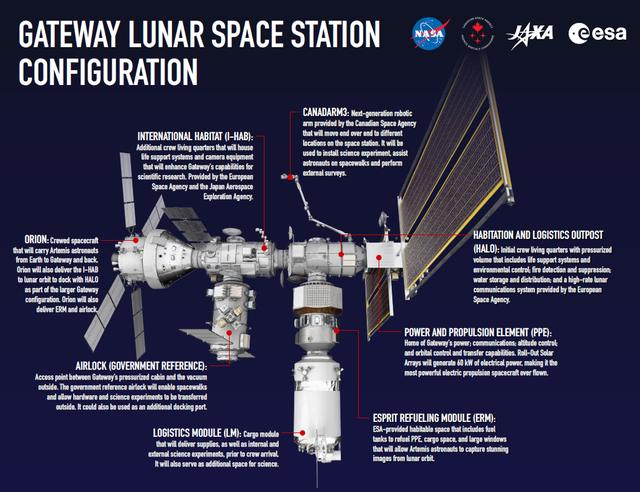
This infographic shows each element of Gateway, humanity's first space station in lunar orbit as a vital component of the Artemis missions to return to the Moon for scientific discovery and chart the path for the first human missions to Mars.
Gateway Space Station Configuration
KENNEDY SPACE CENTER, FLA. -- In the Spacecraft Assembly and Encapsulation Facility -2 (SAEF-2), the Mars Polar Lander is prepared to receive a number of microprobes being added to the spacecraft. Scheduled to be launched on Jan. 3, 1999, the solar-powered spacecraft is designed to touch down on the Martian surface near the northern-most boundary of the south pole in order to study the water cycle there. The lander also will help scientists learn more about climate change and current resources on Mars, studying such things as frost, dust, water vapor and condensates in the Martian atmosphere. The Mars microprobes will complement the climate-related scientific focus of the lander by demonstrating an advanced, rugged microlaser system for detecting subsurface water. Such data on polar subsurface water, in the form of ice, should help put limits on scientific projections for the global abundance of water on Mars
KSC-98pc1625
Most of the oldest terrains on Mars have eroded into branching valleys, as seen here in by NASA's Mars Reconnaisance Orbiter, much like many land regions of Earth are eroded by rain and snowmelt runoff. This is the primary evidence for major climate change on Mars billions of years ago.  How the climate of Mars could have supported a warmer and wetter environment has been the subject of scientific debates for 40 years. A full-resolution enhanced color closeup reveals details in the bedrock and dunes on the valley floor (upper left). The bedrock of ancient Mars has been hardened and cemented by groundwater.  https://photojournal.jpl.nasa.gov/catalog/PIA21630
An Ancient Valley Network
KENNEDY SPACE CENTER, FLA. -- Viking Project In 1976: NASA will land two automated scientific laboratories on the planet Mars. This pioneering effort to explore in detail the surface of another primary planet in our solar system will be identified by a name that exemplifies the spirit of historic exploration. To accomplish this goal, two spacecraft will be launched from the Kennedy Space Center within a month of another in mid-1975. These spacecraft, each including a lander and an orbiter, will hurtle nearly 460 million miles around the Sun before reaching the red planet. The descent will occur when Mars is about 225 million miles from Earth and nearly on the other side of the Sun. This requires a completely automated de-orbit and landing operation because, at that distance, two-way communication between Mars and Earth takes nearly 45 minutes. Surface science will then commence with principal scientific interest invested in biology, geology and meteorology.
101-KSC-73PC-630
The Titan III/Centaur, Viking 1, is sitting on the launch pad ready for blast off. The launch occurred on August 20, 1975. The mission was for the scientific investigation of Mars, and United States’ first attempt to soft land a spacecraft on another planet.
Early Rockets
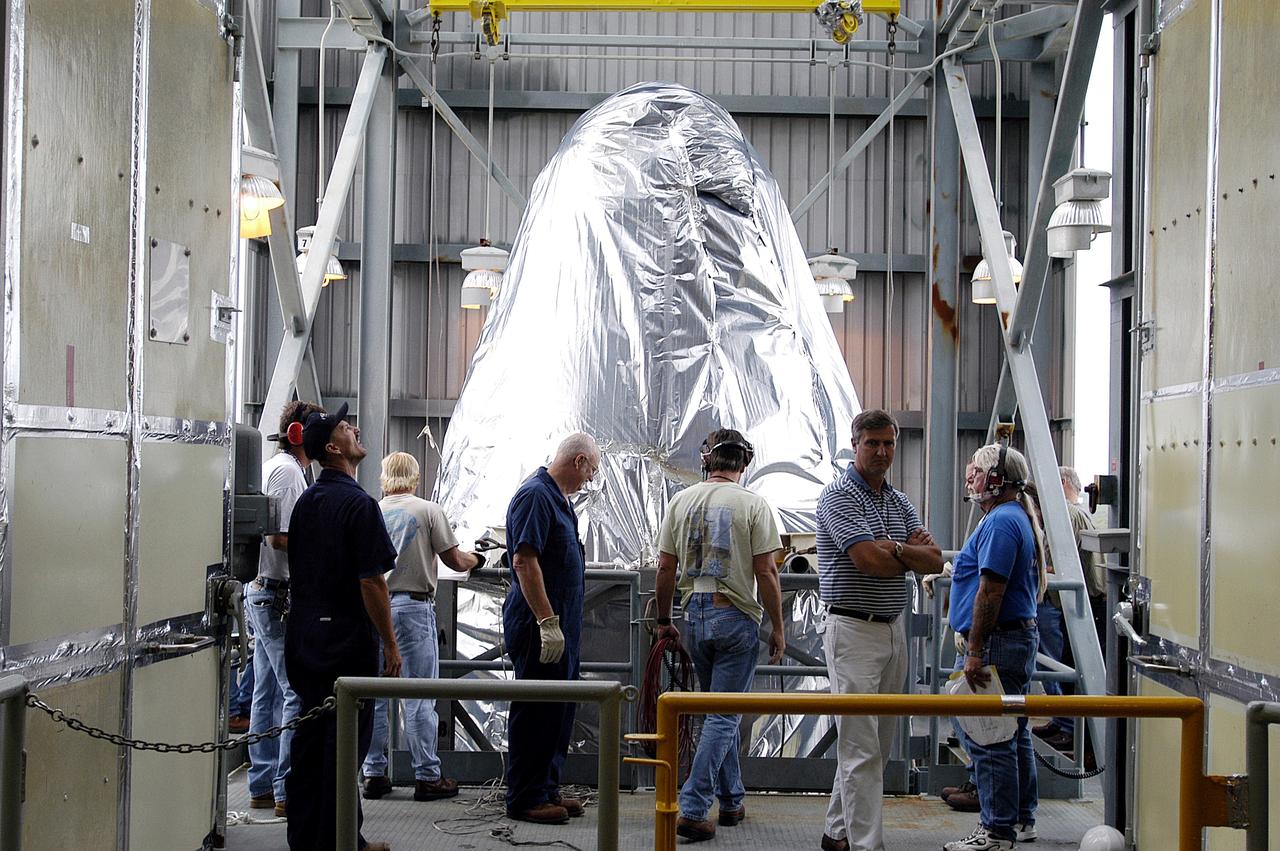
KENNEDY SPACE CENTER, FLA. - At Launch Complex 17-A, Cape Canaveral Air Force Station, the second half of the fairing for the Mars Exploration Rover 2 (MER-2/MER-A) is lifted up the outside of the launch tower.  Visible on another side is the Delta II rocket that will carry the payload into space.  The fairing will be installed around the payload for protection during launch.  The MER Mission consists of two identical rovers designed to cover roughly 110 yards each Martian day over various terrain. Each rover will carry five scientific instruments that will allow it to search for evidence of liquid water that may have been present in the planet's past.  Identical to each other, the rovers will land at different regions of Mars.  Launch date for MER-A  is scheduled for June 5.
KENNEDY SPACE CENTER, FLA. - At Launch Complex 17-A, Cape Canaveral Air Force Station, the second half of the fairing for the Mars Exploration Rover 2 (MER-2/MER-A) is lifted up the outside of the launch tower. Visible on another side is the Delta II rocket that will carry the payload into space. The fairing will be installed around the payload for protection during launch. The MER Mission consists of two identical rovers designed to cover roughly 110 yards each Martian day over various terrain. Each rover will carry five scientific instruments that will allow it to search for evidence of liquid water that may have been present in the planet's past. Identical to each other, the rovers will land at different regions of Mars. Launch date for MER-A is scheduled for June 5.
KENNEDY SPACE CENTER, FLA. - At Launch Complex 17-A, Cape Canaveral Air Force Station, the second half of the fairing for the Mars Exploration Rover 2 (MER-2/MER-A) is raised to a vertical position for its lift up the launch tower.  The fairing will be installed around the payload for protection during launch.  The MER Mission consists of two identical rovers designed to cover roughly 110 yards each Martian day over various terrain. Each rover will carry five scientific instruments that will allow it to search for evidence of liquid water that may have been present in the planet's past.  Identical to each other, the rovers will land at different regions of Mars.  Launch date for MER-A  is scheduled for June 5.
KENNEDY SPACE CENTER, FLA. - At Launch Complex 17-A, Cape Canaveral Air Force Station, the second half of the fairing for the Mars Exploration Rover 2 (MER-2/MER-A) is raised to a vertical position for its lift up the launch tower. The fairing will be installed around the payload for protection during launch. The MER Mission consists of two identical rovers designed to cover roughly 110 yards each Martian day over various terrain. Each rover will carry five scientific instruments that will allow it to search for evidence of liquid water that may have been present in the planet's past. Identical to each other, the rovers will land at different regions of Mars. Launch date for MER-A is scheduled for June 5.
KENNEDY SPACE CENTER, FLA. -  At Launch Complex 17-A, Cape Canaveral Air Force Station, the second half of the fairing for the Mars Exploration Rover 2 (MER-2/MER-A) nears the top of the launch tower.  The fairing will be installed around the payload for protection during launch on a Delta II rocket.  The MER Mission consists of two identical rovers designed to cover roughly 110 yards each Martian day over various terrain. Each rover will carry five scientific instruments that will allow it to search for evidence of liquid water that may have been present in the planet's past.  Identical to each other, the rovers will land at different regions of Mars.  Launch date for MER-A  is scheduled for June 5.
KENNEDY SPACE CENTER, FLA. - At Launch Complex 17-A, Cape Canaveral Air Force Station, the second half of the fairing for the Mars Exploration Rover 2 (MER-2/MER-A) nears the top of the launch tower. The fairing will be installed around the payload for protection during launch on a Delta II rocket. The MER Mission consists of two identical rovers designed to cover roughly 110 yards each Martian day over various terrain. Each rover will carry five scientific instruments that will allow it to search for evidence of liquid water that may have been present in the planet's past. Identical to each other, the rovers will land at different regions of Mars. Launch date for MER-A is scheduled for June 5.
KENNEDY SPACE CENTER, FLA. - At Launch Complex 17-A, Cape Canaveral Air Force Station, the first half of the fairing for the Mars Exploration Rover 2 (MER-2/MER-A) is raised to a vertical position for its lift up the launch tower.  The fairing will be installed around the payload for protection during launch.  The MER Mission consists of two identical rovers designed to cover roughly 110 yards each Martian day over various terrain. Each rover will carry five scientific instruments that will allow it to search for evidence of liquid water that may have been present in the planet's past.  Identical to each other, the rovers will land at different regions of Mars.  Launch date for MER-A  is scheduled for June 5.
KENNEDY SPACE CENTER, FLA. - At Launch Complex 17-A, Cape Canaveral Air Force Station, the first half of the fairing for the Mars Exploration Rover 2 (MER-2/MER-A) is raised to a vertical position for its lift up the launch tower. The fairing will be installed around the payload for protection during launch. The MER Mission consists of two identical rovers designed to cover roughly 110 yards each Martian day over various terrain. Each rover will carry five scientific instruments that will allow it to search for evidence of liquid water that may have been present in the planet's past. Identical to each other, the rovers will land at different regions of Mars. Launch date for MER-A is scheduled for June 5.
KENNEDY SPACE CENTER, FLA. -- In the Spacecraft Assembly and Encapsulation Facility -2 (SAEF-2), Chris Voorhees (left) and Satish Krishnan (right), from the Jet Propulsion Laboratory, remove the second Mars microprobe from a drum. Two microprobes will hitchhike on the Mars Polar Lander, scheduled to be launched Jan. 3, 1999, aboard a Delta II rocket. The solar-powered spacecraft is designed to touch down on the Martian surface near the northern-most boundary of the south pole in order to study the water cycle there. The lander also will help scientists learn more about climate change and current resources on Mars, studying such things as frost, dust, water vapor and condensates in the Martian atmosphere. The Mars microprobes, called Deep Space 2, are part of NASA's New Millennium Program. They will complement the climate-related scientific focus of the lander by demonstrating an advanced, rugged microlaser system for detecting subsurface water. Such data on polar subsurface water, in the form of ice, should help put limits on scientific projections for the global abundance of water on Mars
KSC-98pc1641
KENNEDY SPACE CENTER, FLA. -- In the Spacecraft Assembly and Encapsulation Facility -2 (SAEF-2), Satish Krishnan (right) from the Jet Propulsion Laboratory places a Mars microprobe on a workstand. In the background, Chris Voorhees watches. Two microprobes will hitchhike on the Mars Polar Lander, scheduled to be launched Jan. 3, 1999, aboard a Delta II rocket. The solar-powered spacecraft is designed to touch down on the Martian surface near the northern-most boundary of the south pole in order to study the water cycle there. The lander also will help scientists learn more about climate change and current resources on Mars, studying such things as frost, dust, water vapor and condensates in the Martian atmosphere. The Mars microprobes, called Deep Space 2, are part of NASA's New Millennium Program. They will complement the climate-related scientific focus of the lander by demonstrating an advanced, rugged microlaser system for detecting subsurface water. Such data on polar subsurface water, in the form of ice, should help put limits on scientific projections for the global abundance of water on Mars
KSC-98pc1628
KENNEDY SPACE CENTER, FLA. -- In the Spacecraft Assembly and Encapsulation Facility -2 (SAEF-2), Chris Voorhees (front) watches while Satish Krishnan (back) places a Mars microprobe on a workstand. Two microprobes will hitchhike on the Mars Polar Lander, scheduled to be launched Jan. 3, 1999, aboard a Delta II rocket. The solar-powered spacecraft is designed to touch down on the Martian surface near the northern-most boundary of the south pole in order to study the water cycle there. The lander also will help scientists learn more about climate change and current resources on Mars, studying such things as frost, dust, water vapor and condensates in the Martian atmosphere. The Mars microprobes, called Deep Space 2, are part of NASA's New Millennium Program. They will complement the climate-related scientific focus of the lander by demonstrating an advanced, rugged microlaser system for detecting subsurface water. Such data on polar subsurface water, in the form of ice, should help put limits on scientific projections for the global abundance of water on Mars
KSC-98pc1642
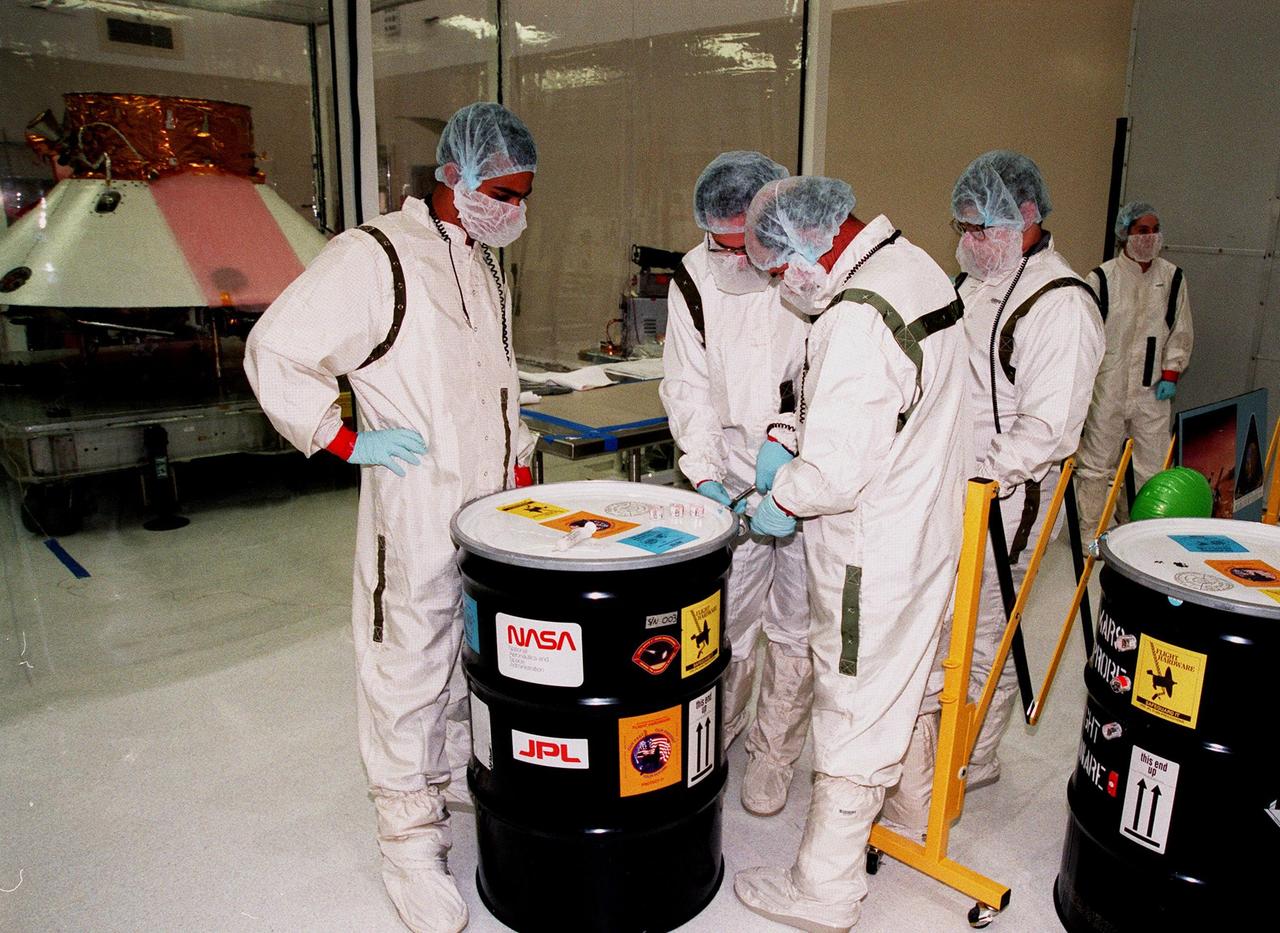
KENNEDY SPACE CENTER, FLA. -- In the Spacecraft Assembly and Encapsulation Facility -2 (SAEF-2), workers from the Jet Propulsion Laboratory open the drums containing the Mars microprobes that will hitchhike on the Mars Polar Lander. From left, they are Satish Krishnan, Charles Cruzan, Chris Voorhees and Arden Acord. Scheduled to be launched Jan. 3, 1999, aboard a Delta II rocket, the solar-powered spacecraft is designed to touch down on the Martian surface near the northern-most boundary of the south pole in order to study the water cycle there. The lander also will help scientists learn more about climate change and current resources on Mars, studying such things as frost, dust, water vapor and condensates in the Martian atmosphere. The Mars microprobes, called Deep Space 2, are part of NASA's New Millennium Program. They will complement the climate-related scientific focus of the lander by demonstrating an advanced, rugged microlaser system for detecting subsurface water. Such data on polar subsurface water, in the form of ice, should help put limits on scientific projections for the global abundance of water on Mars
KSC-98pc1626
KENNEDY SPACE CENTER, FLA. -- In the Spacecraft Assembly and Encapsulation Facility -2 (SAEF-2), JPL workers prepare to mount a Mars microprobe onto the Mars Polar Lander. Two microprobes will hitchhike on the lander, scheduled to be launched Jan. 3, 1999, aboard a Delta II rocket. The solar-powered spacecraft is designed to touch down on the Martian surface near the northern-most boundary of the south pole in order to study the water cycle there. The lander also will help scientists learn more about climate change and current resources on Mars, studying such things as frost, dust, water vapor and condensates in the Martian atmosphere. The Mars microprobes, called Deep Space 2, are part of NASA's New Millennium Program. They will complement the climate-related scientific focus of the lander by demonstrating an advanced, rugged microlaser system for detecting subsurface water. Such data on polar subsurface water, in the form of ice, should help put limits on scientific projections for the global abundance of water on Mars
KSC-98pc1647
KENNEDY SPACE CENTER, FLA. -- In the Spacecraft Assembly and Encapsulation Facility-2 (SAEF-2), Tandy Bianco, with Lockheed Martin, and Satish Krishnan (foreground) and Chris Voorhees (behind him), from the Jet Propulsion Laboratory, observe a Mars microprobe on the workstand. Two microprobes will hitchhike on the Mars Polar Lander, scheduled to be launched Jan. 3, 1999, aboard a Delta II rocket. The solar-powered spacecraft is designed to touch down on the Martian surface near the northern-most boundary of the south pole in order to study the water cycle there. The lander also will help scientists learn more about climate change and current resources on Mars, studying such things as frost, dust, water vapor and condensates in the Martian atmosphere. The Mars microprobes, called Deep Space 2, are part of NASA's New Millelnnium Program. They will complement the climate-related scientific focus of the lander by demonstrating an advanced, rugged microlaser system for detecting subsurface water. Such data on polar subsurface water, in the form of ice, should help put limits on scientific projections for the global abundance of water on Mars
KSC-98pc1629
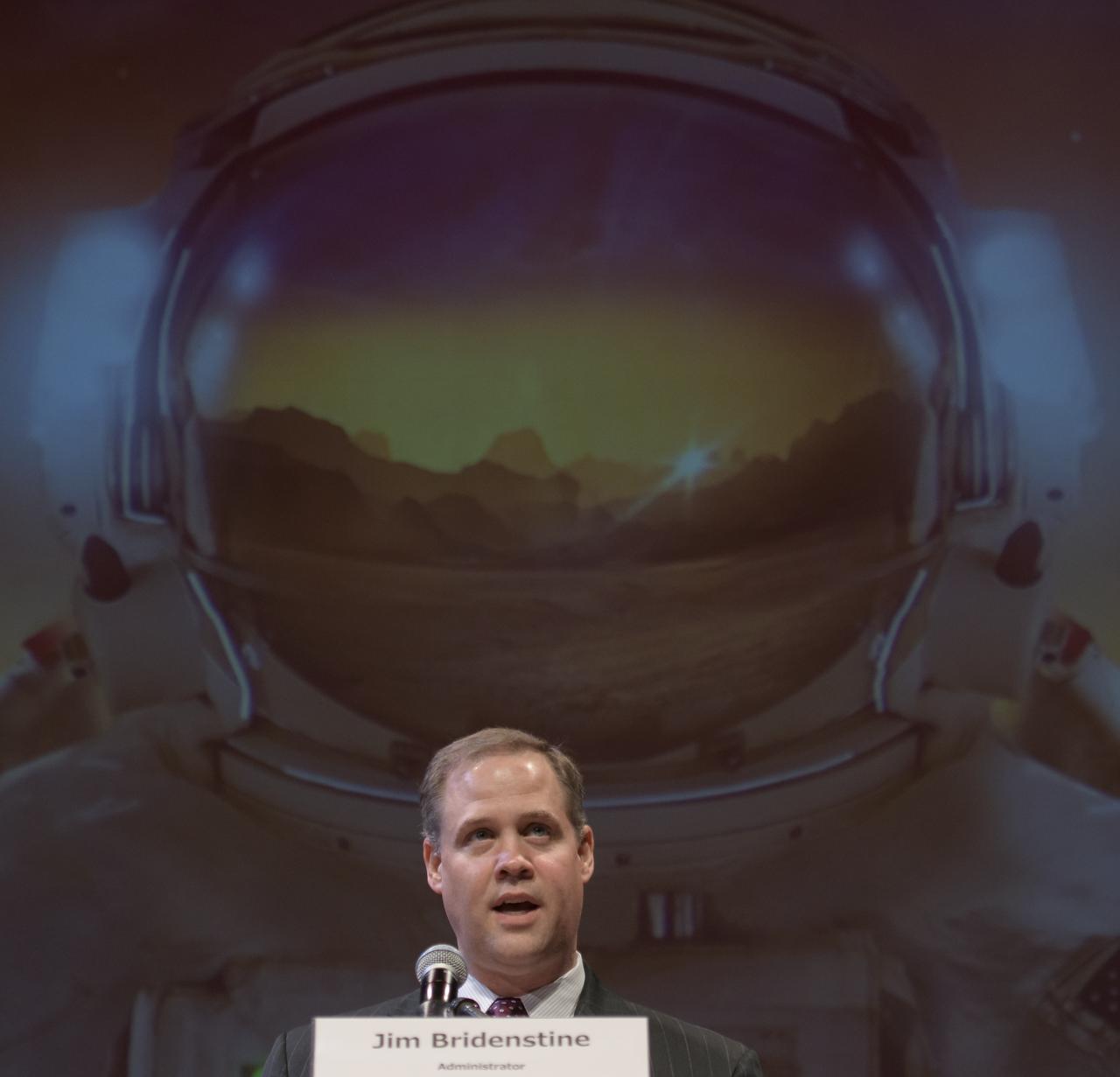
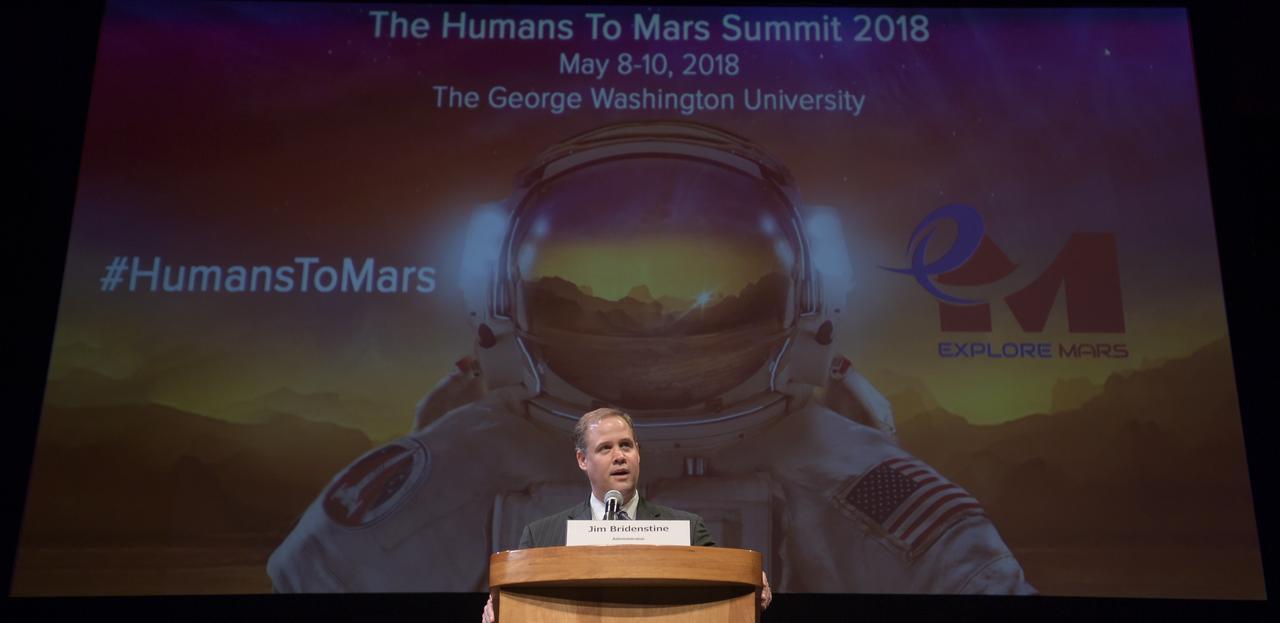
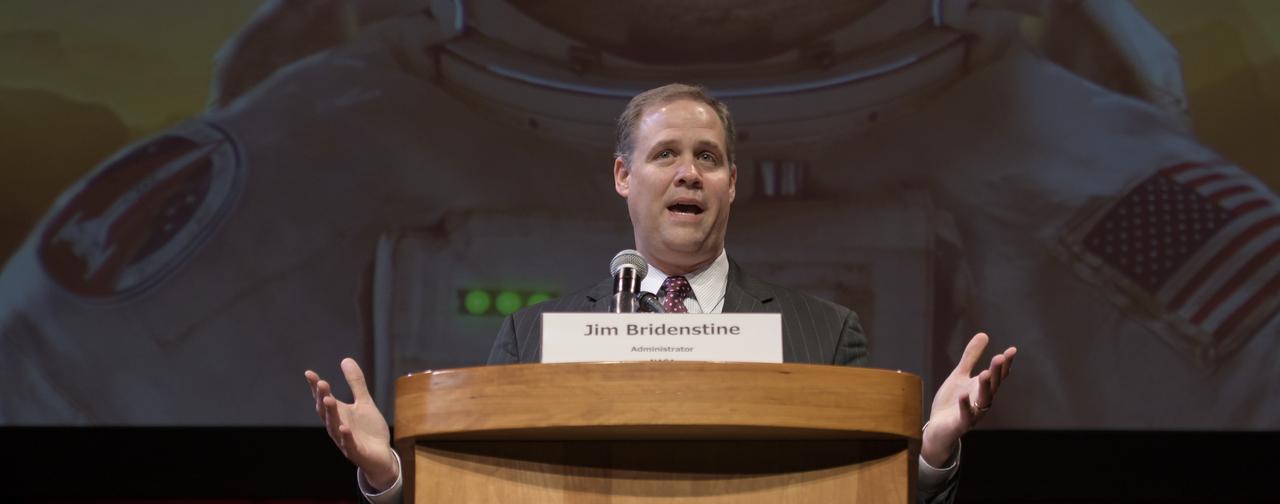
NASA Administrator Jim Bridenstine delivers the keynote speech at the Humans to Mars Summit (H2M), Wednesday, May 9, 2018 at George Washington University in Washington. Bridenstine joined more than 20 NASA scientists and technologists at the three-day event sponsored by Explore Mars Inc. It brought industry, government and the scientific, entertainment and academic communities together to discuss technology developments, foster partnerships, and encourage students to pursue STEAM careers. Photo Credit: (NASA/Bill Ingalls)
Administrator at Humans to Mars Summit
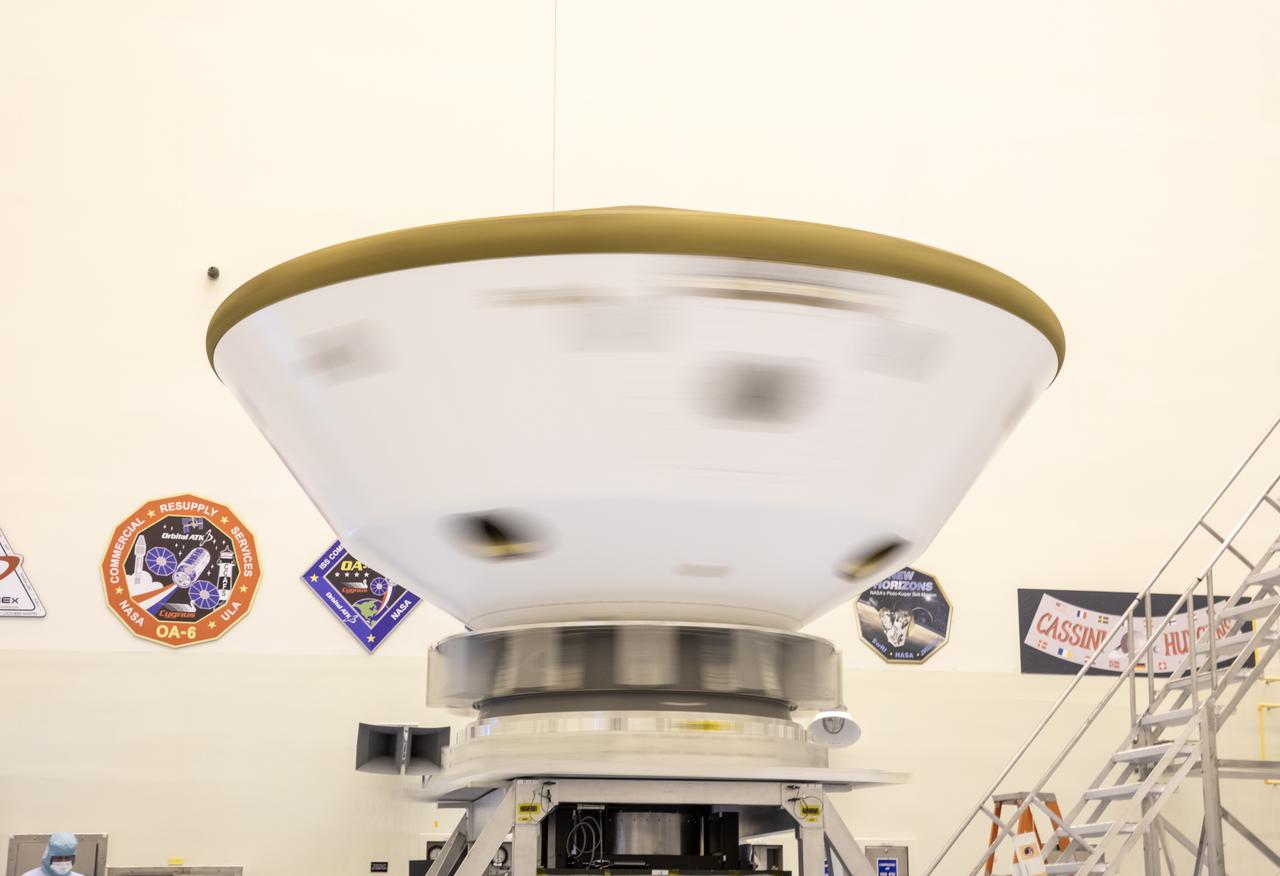
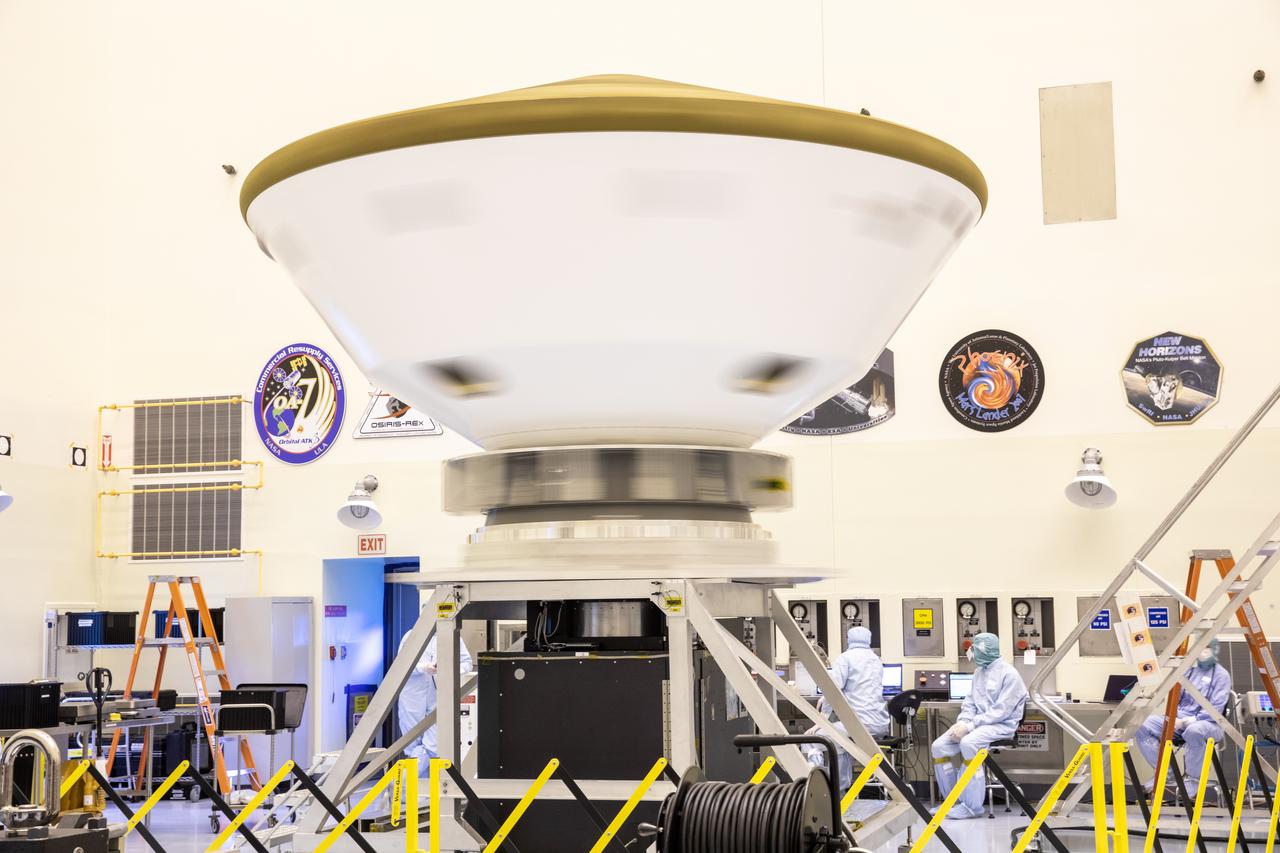
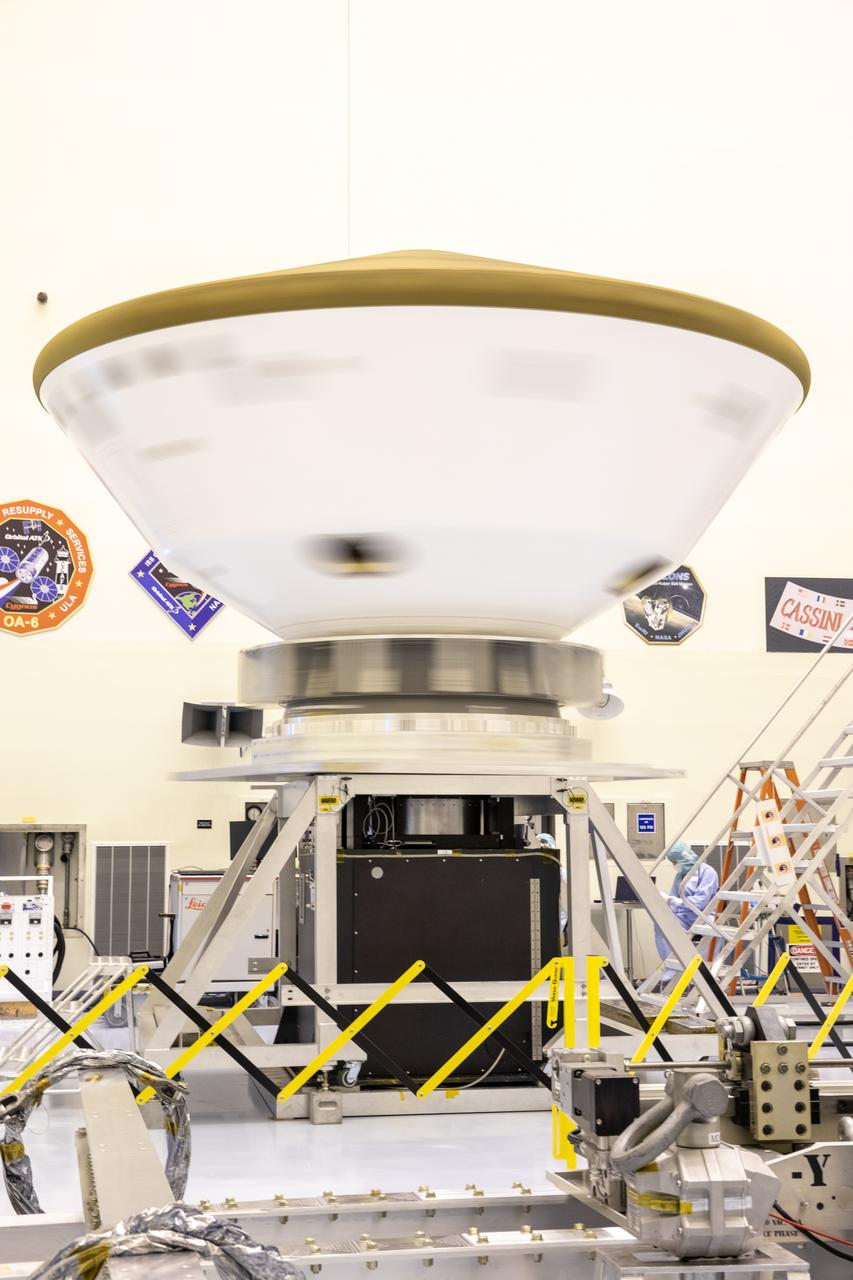
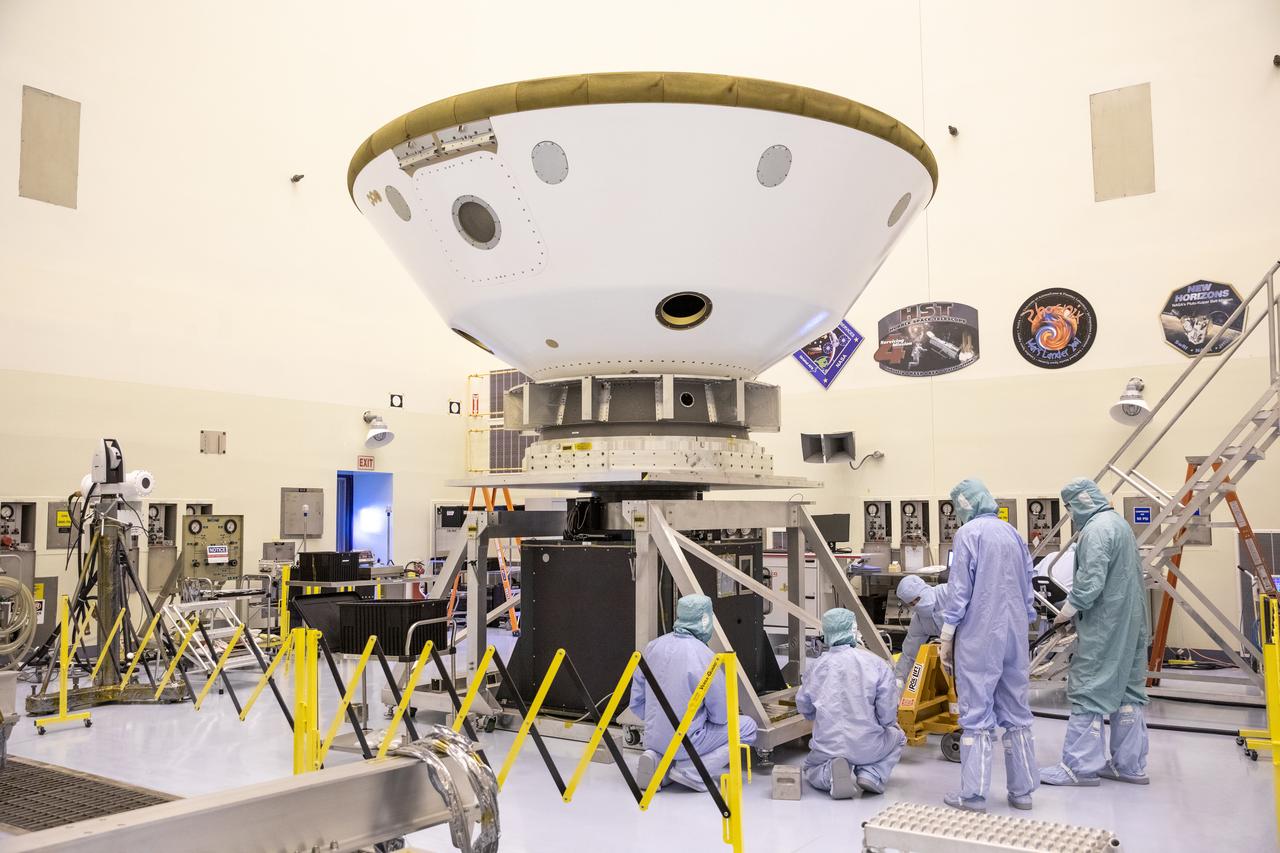
Tests to measure the center of gravity and moments of inertia for the Mars 2020 rover aeroshell are performed on the spin table inside Kennedy Space Center’s Payload Hazardous Servicing Facility on Jan. 15, 2020. The Mars 2020 rover will carry seven different scientific instruments, landing on the Red Planet on Feb. 18, 2021. It is scheduled to launch aboard a United Launch Alliance Atlas V 541 rocket, procured by NASA’s Launch Services Program, in the summer of 2020.
Mars 2020 Spin Table Activities in PHSF
NASA Administrator Jim Bridenstine delivers the keynote speech at the Humans to Mars Summit (H2M), Wednesday, May 9, 2018 at George Washington University in Washington. Bridenstine joined more than 20 NASA scientists and technologists at the three-day event sponsored by Explore Mars Inc. It brought industry, government and the scientific, entertainment and academic communities together to discuss technology developments, foster partnerships, and encourage students to pursue STEAM careers. Photo Credit: (NASA/Bill Ingalls)
Administrator at Humans to Mars Summit
NASA Administrator Jim Bridenstine delivers the keynote speech at the Humans to Mars Summit (H2M), Wednesday, May 9, 2018 at George Washington University in Washington. Bridenstine joined more than 20 NASA scientists and technologists at the three-day event sponsored by Explore Mars Inc. It brought industry, government and the scientific, entertainment and academic communities together to discuss technology developments, foster partnerships, and encourage students to pursue STEAM careers. Photo Credit: (NASA/Bill Ingalls)
Administrator at Humans to Mars Summit
NASA Administrator Jim Bridenstine delivers the keynote speech at the Humans to Mars Summit (H2M), Wednesday, May 9, 2018 at George Washington University in Washington. Bridenstine joined more than 20 NASA scientists and technologists at the three-day event sponsored by Explore Mars Inc. It brought industry, government and the scientific, entertainment and academic communities together to discuss technology developments, foster partnerships, and encourage students to pursue STEAM careers. Photo Credit: (NASA/Bill Ingalls)
Administrator at Humans to Mars Summit
NASA Administrator Jim Bridenstine delivers the keynote speech at the Humans to Mars Summit (H2M), Wednesday, May 9, 2018 at George Washington University in Washington. Bridenstine joined more than 20 NASA scientists and technologists at the three-day event sponsored by Explore Mars Inc. It brought industry, government and the scientific, entertainment and academic communities together to discuss technology developments, foster partnerships, and encourage students to pursue STEAM careers. Photo Credit: (NASA/Bill Ingalls)
Administrator at Humans to Mars Summit
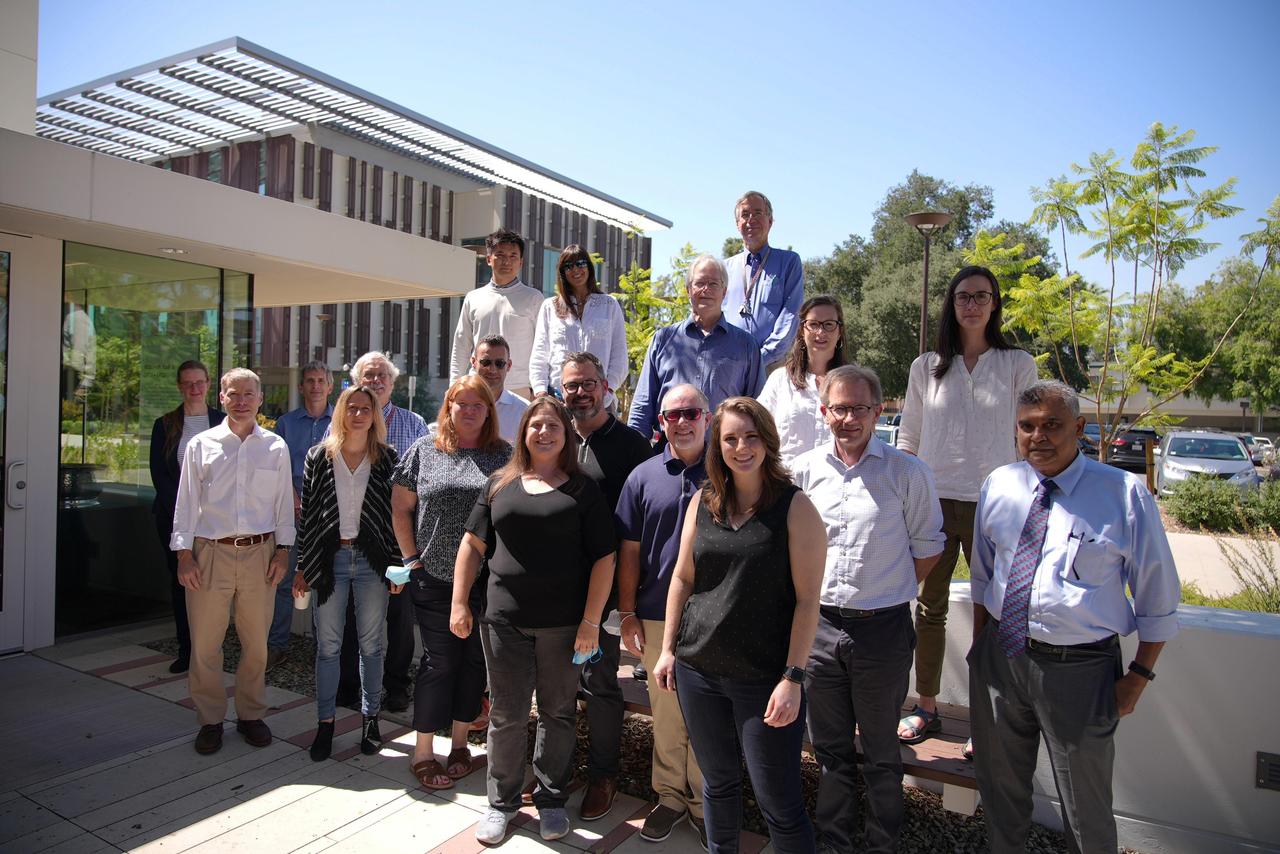
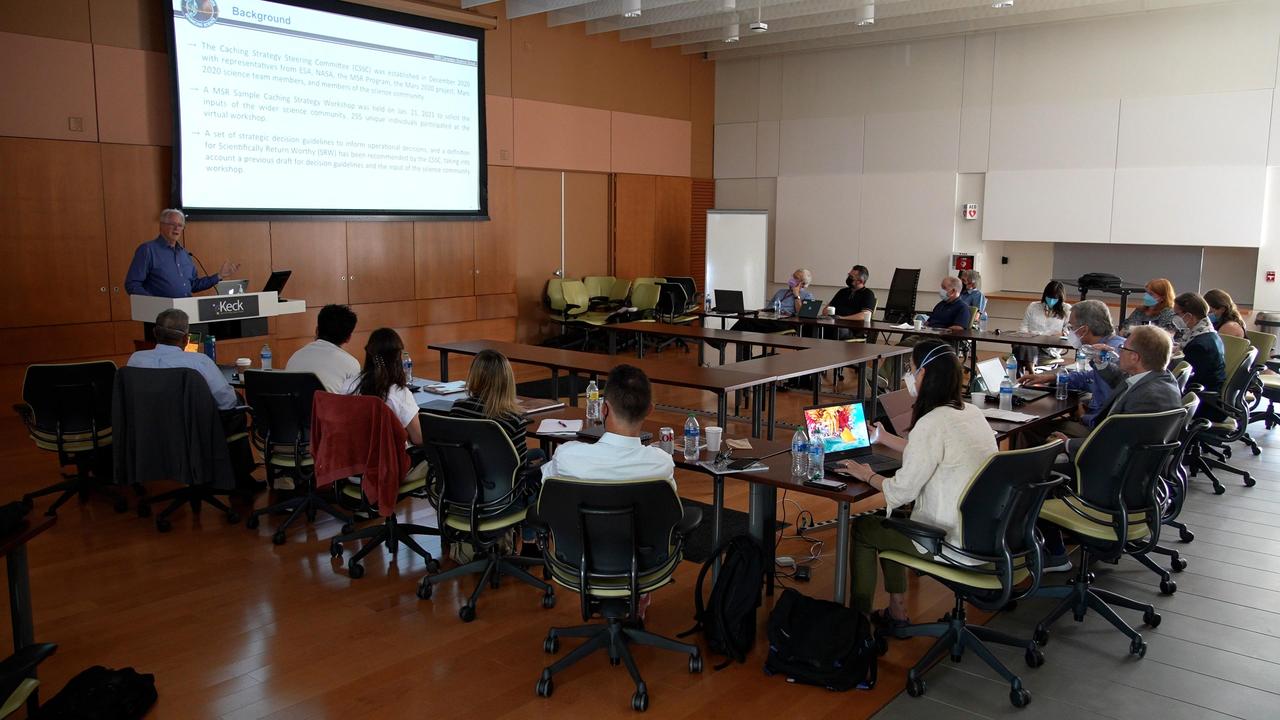
The Mars Sample Return Campaign Science Group gathered at the Keck Institute for Space Studies at Caltech for an initial meeting on June 28-29, 2022. This June 28 photo includes team members who attended in person; several others attended virtually or were not able to participate. The committee will provide oversight with the goal of maximizing the scientific potential of Mars rock and sediment samples that would be returned to Earth for in-depth analysis, as part of the Campaign.  https://photojournal.jpl.nasa.gov/catalog/PIA25442
Mars Sample Return Campaign Science Group Team Photo
Tests to measure the center of gravity and moments of inertia for the Mars 2020 rover aeroshell are performed on the spin table inside Kennedy Space Center’s Payload Hazardous Servicing Facility on Jan. 15, 2020. The Mars 2020 rover will carry seven different scientific instruments, landing on the Red Planet on Feb. 18, 2021. It is scheduled to launch aboard a United Launch Alliance Atlas V 541 rocket, procured by NASA’s Launch Services Program, in the summer of 2020.
Mars 2020 Spin Table Activities in PHSF
The Mars Sample Return Campaign Science Group gathered for their first meeting, at the Keck Institute for Space Studies at Caltech, and took a group photo. This June 28 photo includes team members who attended in person; several others attended virtually or were not able to participate. The committee will provide oversight with the goal of maximizing the scientific potential of Mars rock and sediment samples that would be returned to Earth for in-depth analysis, as part of the Campaign.  https://photojournal.jpl.nasa.gov/catalog/PIA25443
First Meeting of Mars Sample Return Campaign Science Group
Tests to measure the center of gravity and moments of inertia for the Mars 2020 rover aeroshell are performed on the spin table inside Kennedy Space Center’s Payload Hazardous Servicing Facility on Jan. 15, 2020. The Mars 2020 rover will carry seven different scientific instruments, landing on the Red Planet on Feb. 18, 2021. It is scheduled to launch aboard a United Launch Alliance Atlas V 541 rocket, procured by NASA’s Launch Services Program, in the summer of 2020.
Mars 2020 Spin Table Activities in PHSF
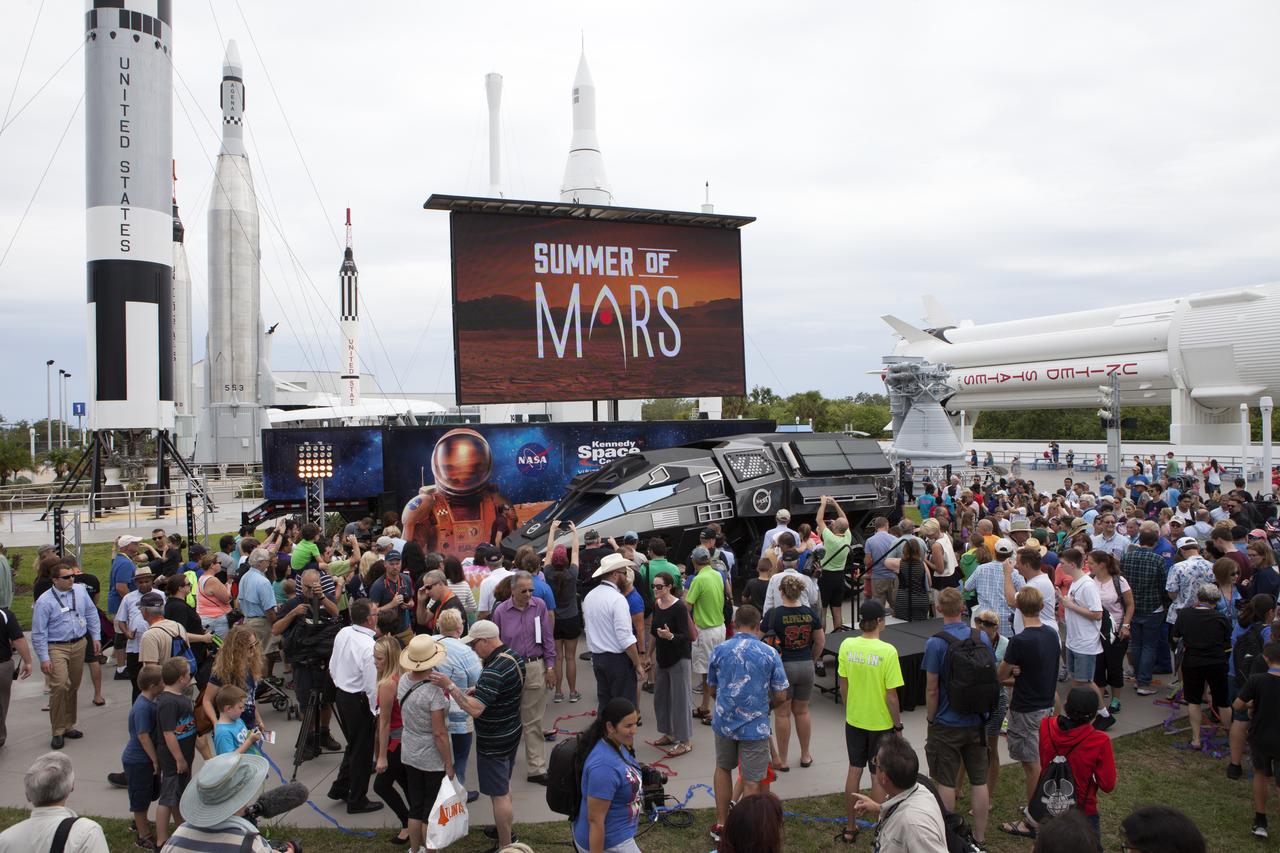
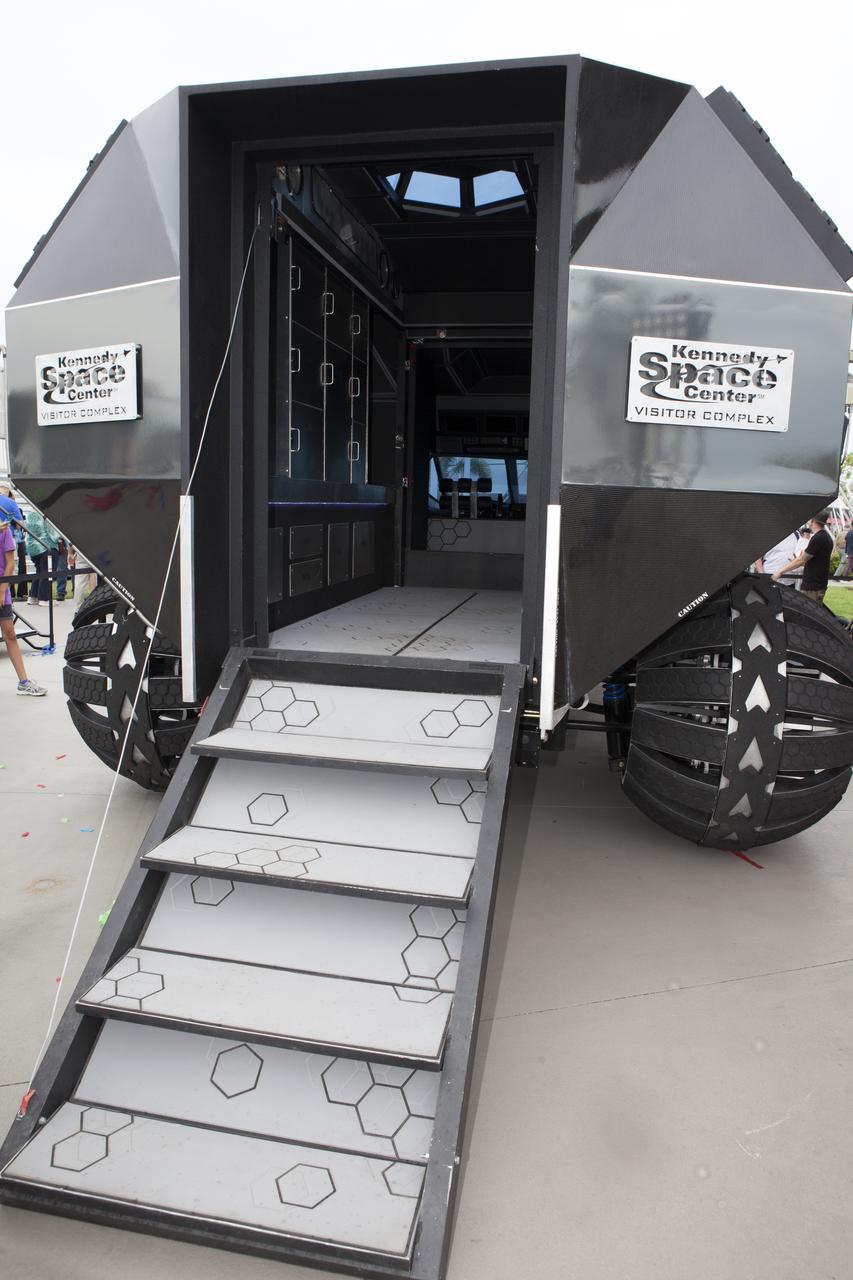
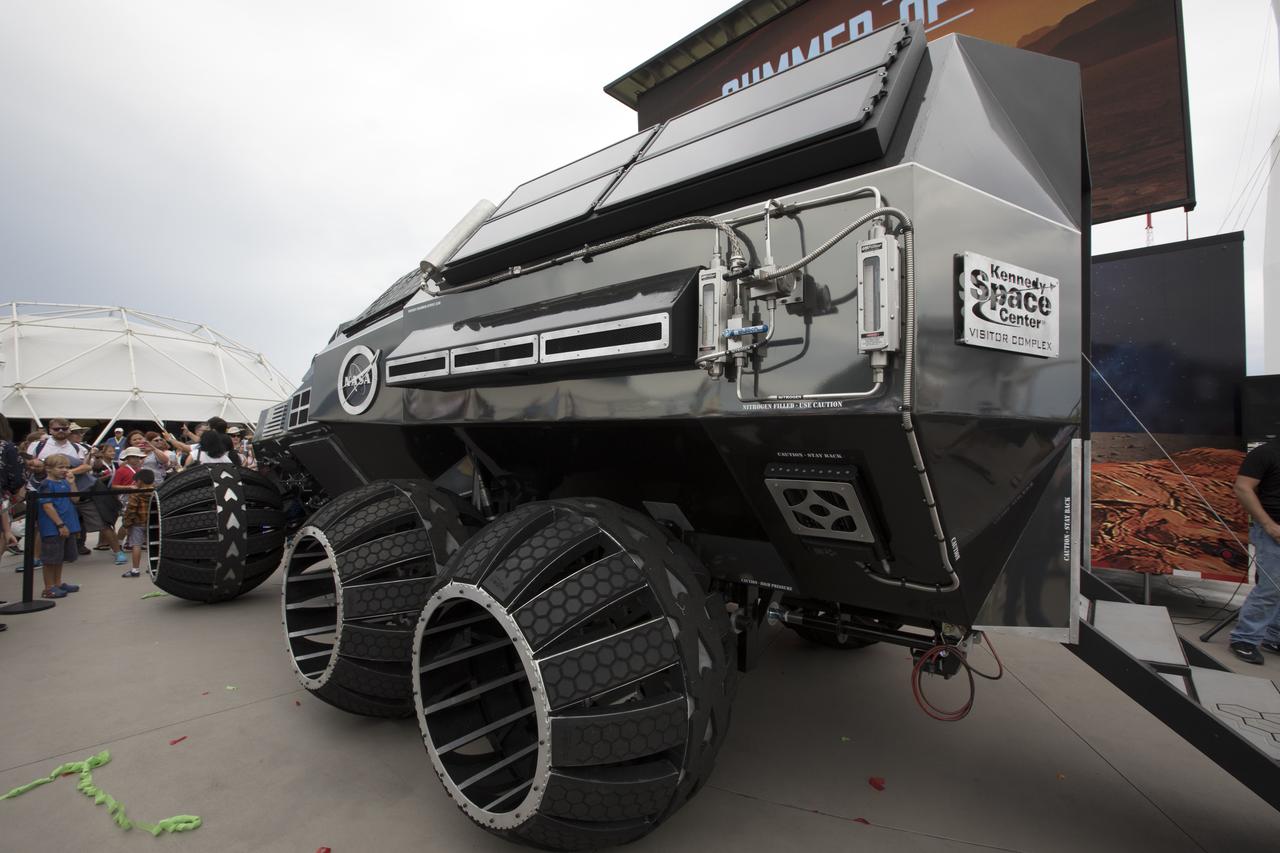
Crowds gather around the scientifically-themed Mars rover concept vehicle at the Kennedy Space Center Visitor Complex. It is a part of the "Summer of Mars" program designed to provide a survey of NASA's studies of the Red Planet. The builders of the rover, Parker Brothers Concepts of Port Canaveral, Florida, incorporated input into its design from NASA subject matter experts.
Mars Rover Concept Vehicle
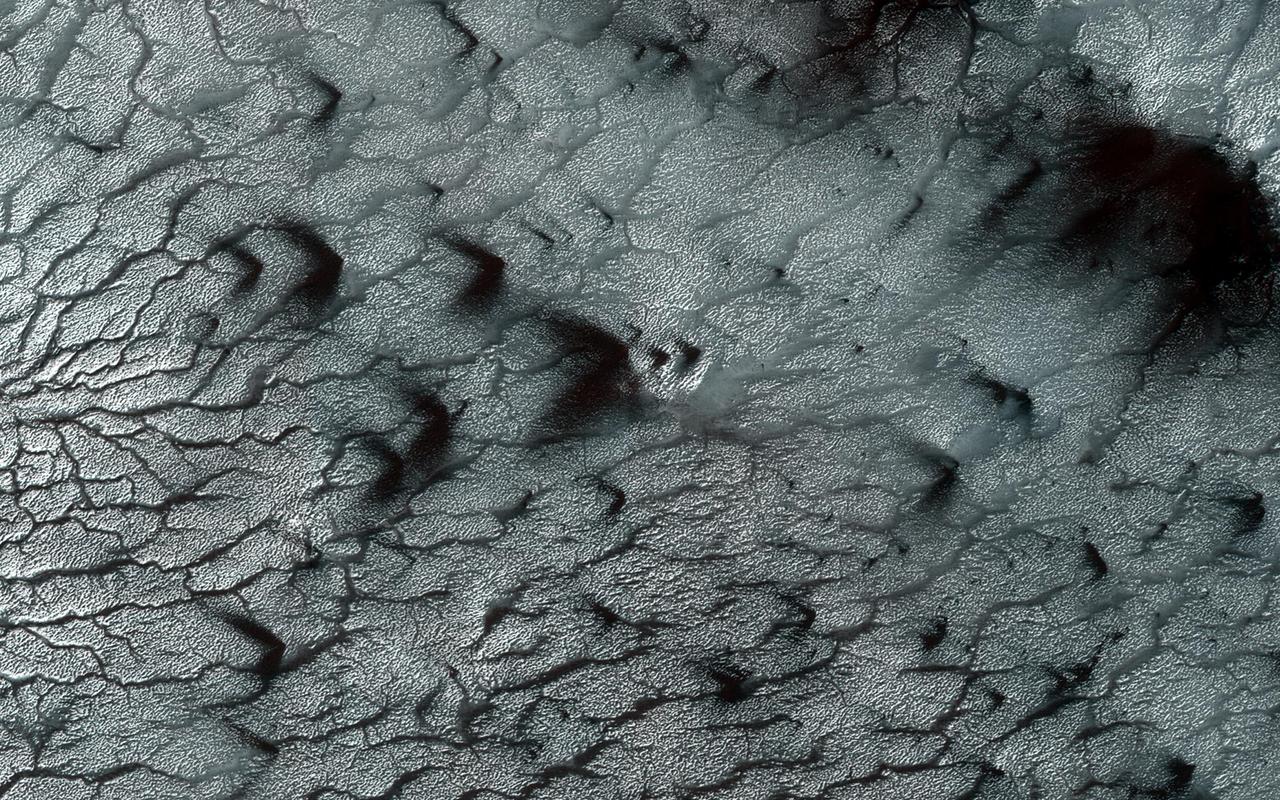
Southern spring on Mars brings sublimation of the seasonal dry ice polar cap. Gas trapped under the seasonal ice sheet carves channels on its way to escaping to the atmosphere.  At this site, the channels are wider than we see elsewhere on Mars, perhaps meaning that the spider-like (or more scientifically, "araneiform") terrain here is older, or that the surface is more easily eroded. Seasonal fans of eroded surface material, pointed in two different directions, are deposited on the remaining ice.  http://photojournal.jpl.nasa.gov/catalog/PIA13151
Wide, Branching Channels
NASA Administrator Jim Bridenstine delivers the keynote speech at the Humans to Mars Summit (H2M), Wednesday, May 9, 2018 at George Washington University in Washington. Bridenstine joined more than 20 NASA scientists and technologists at the three-day event sponsored by Explore Mars Inc. It brought industry, government and the scientific, entertainment and academic communities together to discuss technology developments, foster partnerships, and encourage students to pursue STEAM careers. Photo Credit: (NASA/Bill Ingalls)
Administrator at Humans to Mars Summit
Tests to measure the center of gravity and moments of inertia for the Mars 2020 rover aeroshell are performed on the spin table inside Kennedy Space Center’s Payload Hazardous Servicing Facility on Jan. 15, 2020. The Mars 2020 rover will carry seven different scientific instruments, landing on the Red Planet on Feb. 18, 2021. It is scheduled to launch aboard a United Launch Alliance Atlas V 541 rocket, procured by NASA’s Launch Services Program, in the summer of 2020.
Mars 2020 Spin Table Activities in PHSF
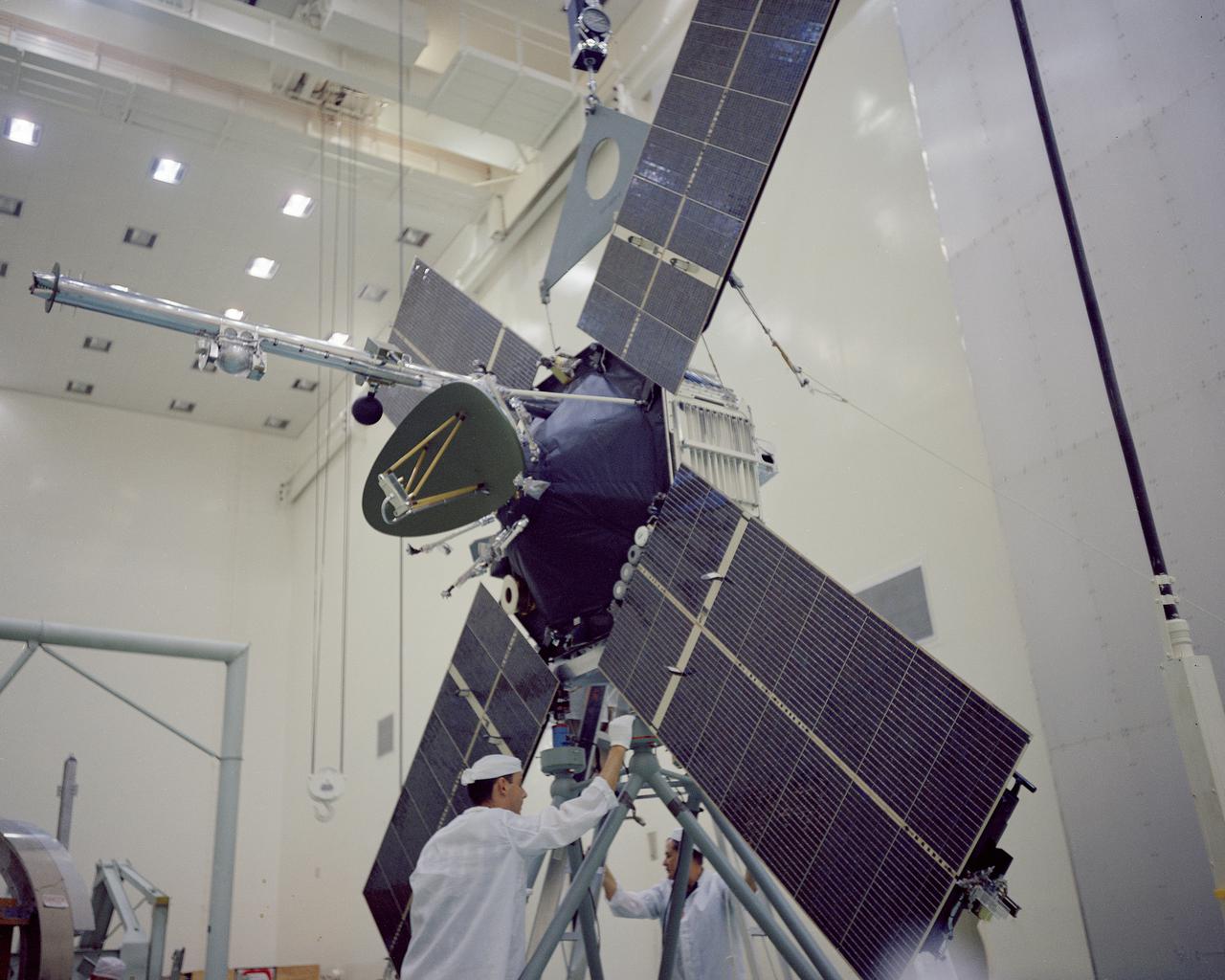
CAPE KENNEDY, Fla. -- In the AO Building at Cape Kennedy Air Force Station in Florida, the Mariner 3 spacecraft is processed prior to mating with its payload faring. Mariner is one of two identical deep-space probes designed and built by the Jet Propulsion Laboratory for NASA's Mariner Mars 1964 project. Mariner 3 is intended to conduct close-up scientific observations of Mars and transmit information back to Earth on interplanetary space and the space surrounding the Red Planet. Photo Credit: NASA
KSC-64C-4235
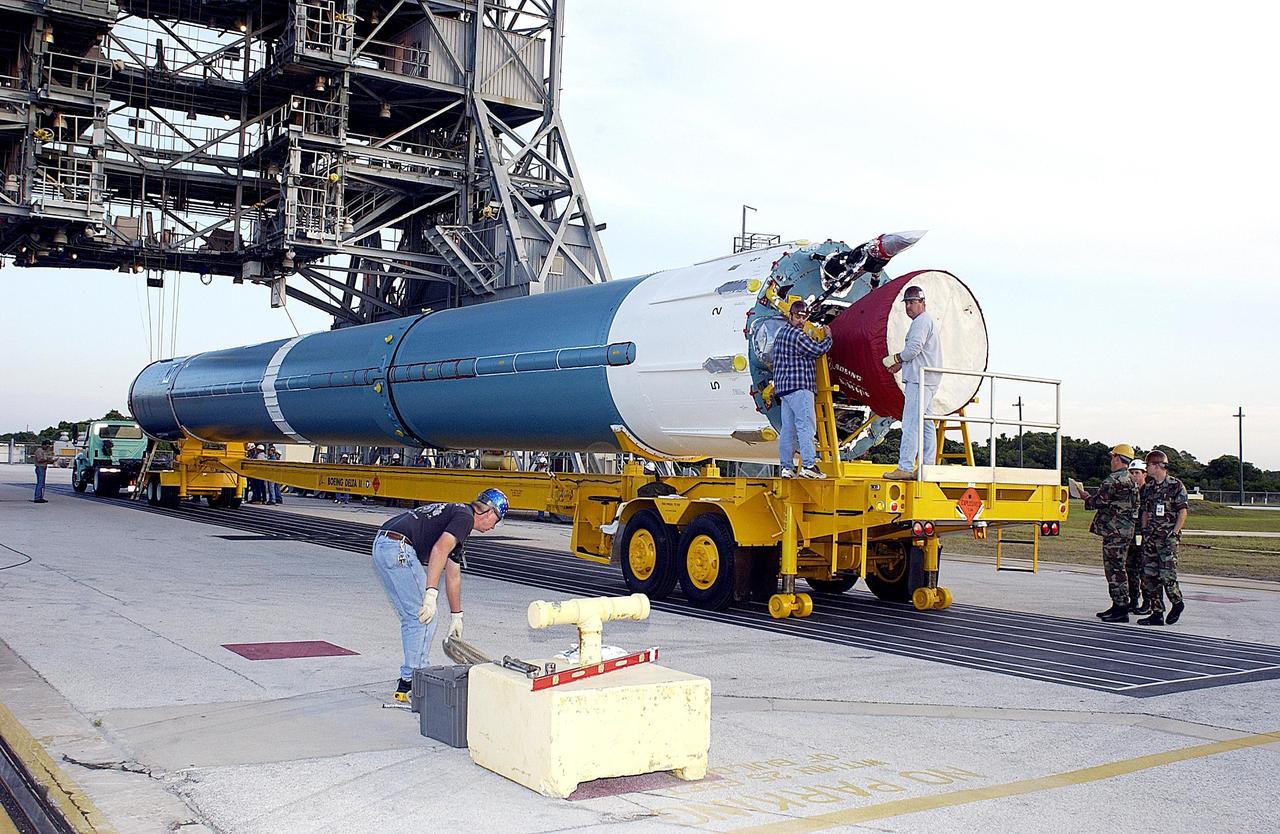
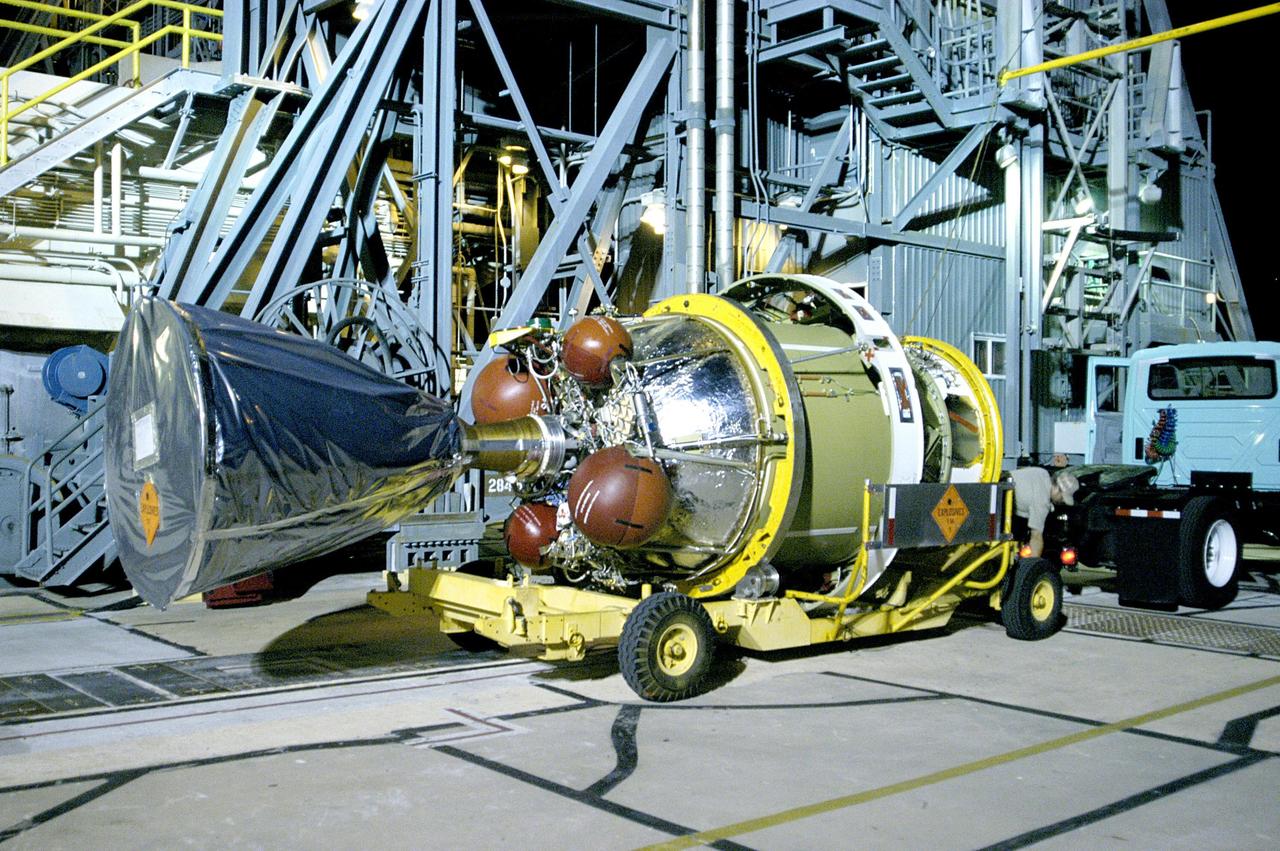
KENNEDY SPACE CENTER, FLA. -  The first stage of the Delta II rocket to launch the MER-A (Mars Exploration Rover) vehicle arrives at Pad 17-A on Cape Canaveral Air Force Station. The MER Mission consists of two identical rovers designed to cover roughly 110 yards each Martian day over various terrain. Each rover will carry five scientific instruments that will allow it to search for evidence of liquid water that may have been present in the planet's past.  Identical to each other, the rovers will land at different regions of Mars.  Launch date for this first of NASA's two Mars Exploration Rover missions is scheduled no earlier than June 6.
KSC-03pd1209
From left to right, Eric Fanning, AIA President and CEO; Christyl Johnson, deputy director for technology and research investments, NASA Goddard Space Flight Center; Dr. Stephen Petranek, MARS scientific advisor and co-executive producer; Ellen Stofan, director, Smithsonian's National Air and Space Museum; Gareth Edwards, film director, Rogue One: A Star Wars Story; and Chris Davenport, Washington Post space reporter pose for a photo before a showing of the Project Mars Competition's short films winners and the Mars series, Monday, November 5, 2018 at National Geographic Society Headquarters in Washington. Photo Credit: (NASA/Aubrey Gemignani)
Project Mars at National Geographic
KENNEDY SPACE CENTER, FLA. - On Pad 17-A, Cape Canaveral Air Force Station, the first stage of the Delta II rocket is lifted to vertical at the launch tower. The Delta will launch the Mars Exploration Rover (MER-A) vehicle. The MER Mission consists of two identical rovers designed to cover roughly 110 yards each Martian day over various terrain. Each rover will carry five scientific instruments that will allow it to search for evidence of liquid water that may have been present in the planet's past.  Identical to each other, the rovers will land at different regions of Mars.  Launch date for this first of NASA's two Mars Exploration Rover missions is scheduled no earlier than June 6.
KSC-03pd1214
KENNEDY SPACE CENTER, FLA. - The second stage of the Delta II rocket arrives at Pad 17-A, Cape Canaveral Air Force Station.  It will be mated to the first stage in preparation for the launch of the Mars Exploration Rover 2 (MER-A).  The MER Mission consists of two identical rovers designed to cover roughly 110 yards each Martian day over various terrain. Each rover will carry five scientific instruments that will allow it to search for evidence of liquid water that may have been present in the planet's past.  Identical to each other, the rovers will land at different regions of Mars.  Launch date for this first of NASA's two Mars Exploration Rover missions is scheduled June 5.
KSC-03pd1320
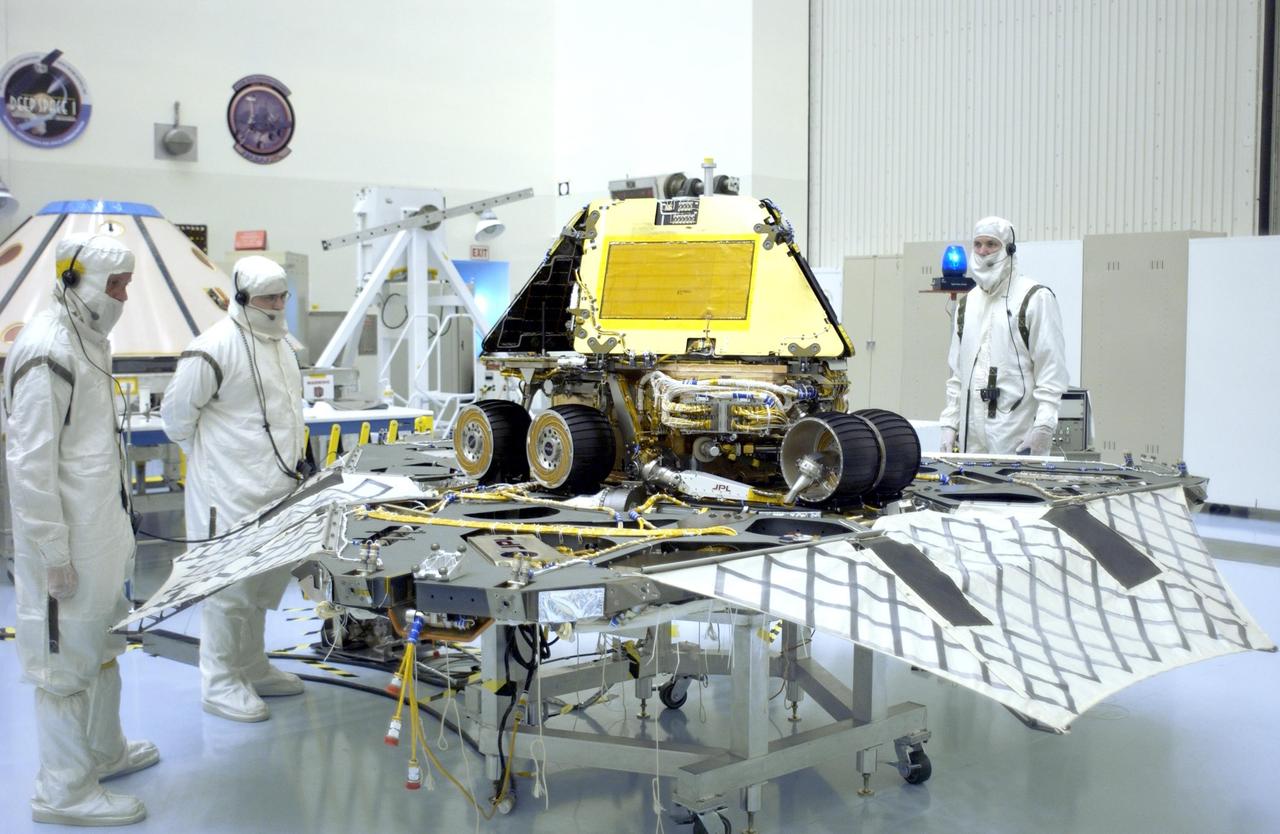
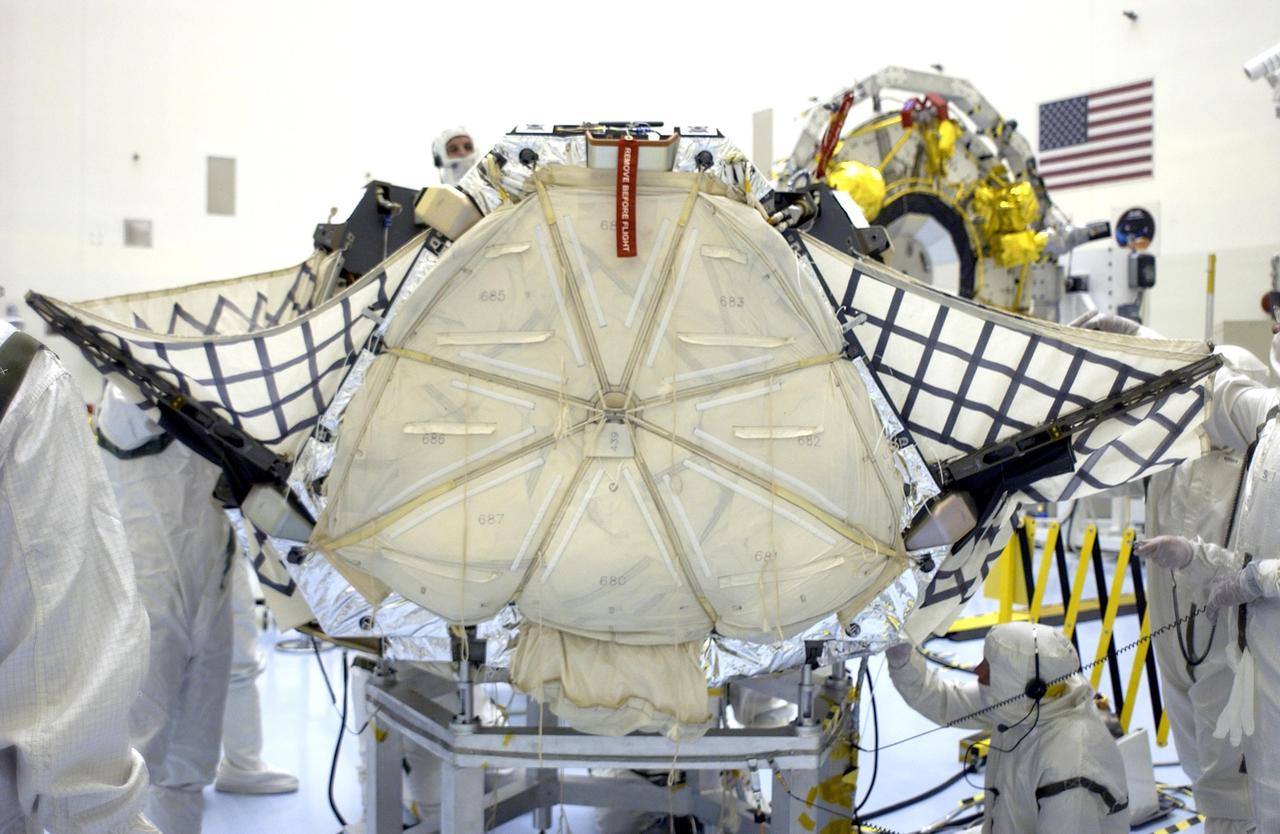
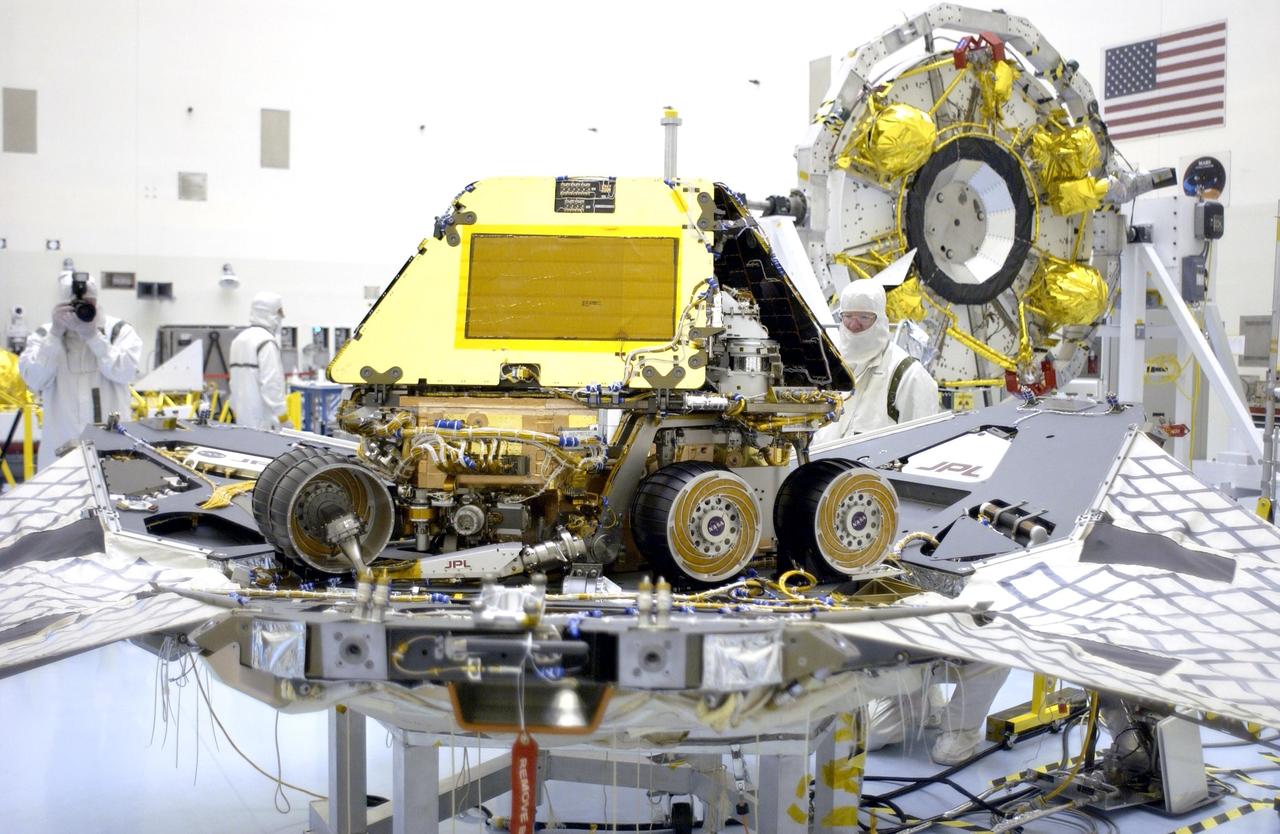
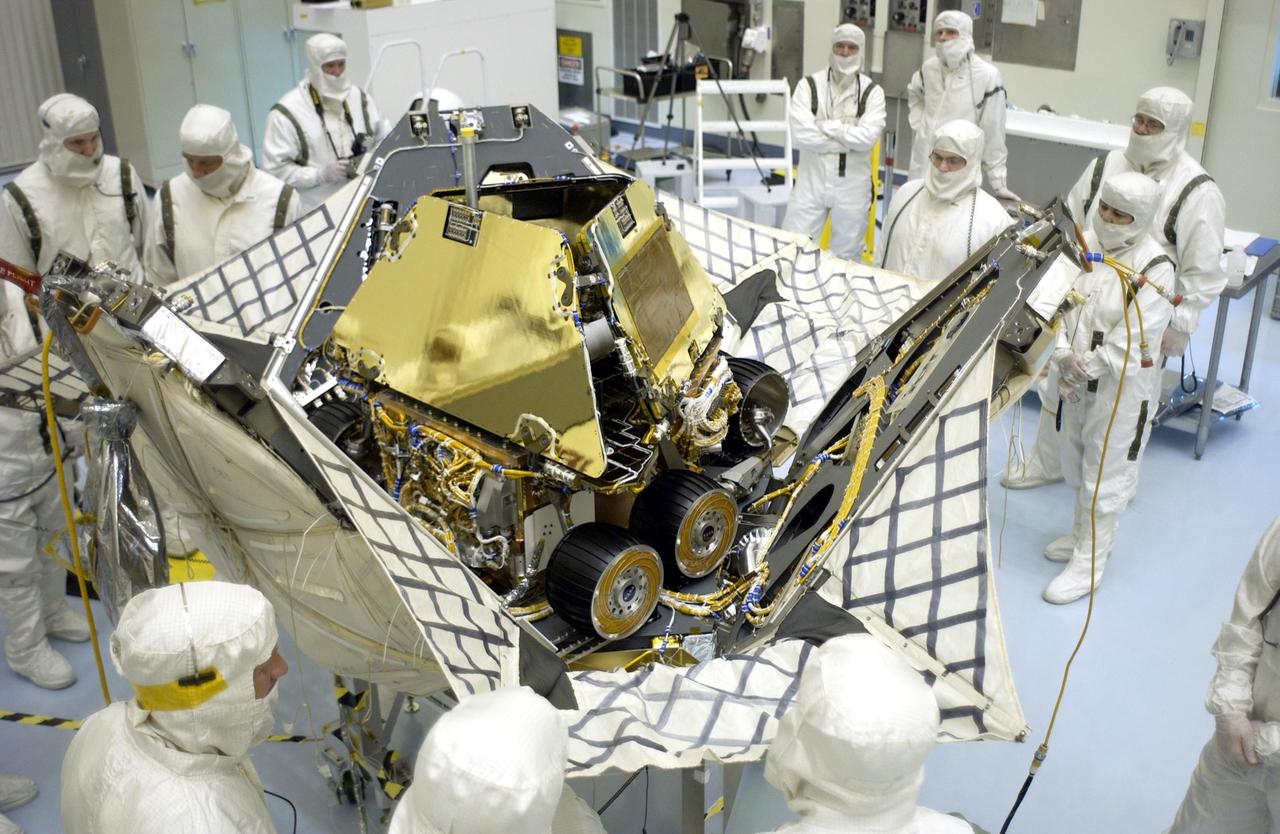
KENNEDY SPACE CENTER, FLA. - The Mars Exploration Rover 2 (MER-A) is ready for final closure of the petals on the lander.  The lander and rover will be enclosed within an aeroshell for launch.  The MER Mission consists of two identical rovers designed to cover roughly 110 yards each Martian day over various terrain. Each rover will carry five scientific instruments that will allow it to search for evidence of liquid water that may have been present in the planet's past.  Identical to each other, the rovers will land at different regions of Mars.  Launch date for this first of NASA's two Mars Exploration Rover missions is scheduled no earlier than June 6.
KSC-03pd1221
KENNEDY SPACE CENTER, FLA. - The Mars Exploration Rover 2 (MER-A) is ready for final closure of the petals on the lander.  The lander and rover will be enclosed within an aeroshell for launch.  The MER Mission consists of two identical rovers designed to cover roughly 110 yards each Martian day over various terrain. Each rover will carry five scientific instruments that will allow it to search for evidence of liquid water that may have been present in the planet's past.  Identical to each other, the rovers will land at different regions of Mars.  Launch date for this first of NASA's two Mars Exploration Rover missions is scheduled no earlier than June 6.
KSC-03pd1222
KENNEDY SPACE CENTER, FLA. - Workers check different areas of the lander as the petals close in around the Mars Exploration Rover 2 (MER-A).  The lander and rover will subsequently be enclosed within an aeroshell for launch.  The MER Mission consists of two identical rovers designed to cover roughly 110 yards each Martian day over various terrain. Each rover will carry five scientific instruments that will allow it to search for evidence of liquid water that may have been present in the planet's past.  Identical to each other, the rovers will land at different regions of Mars.  Launch date for this first of NASA's two Mars Exploration Rover missions is scheduled no earlier than June 6.
KSC-03pd1225
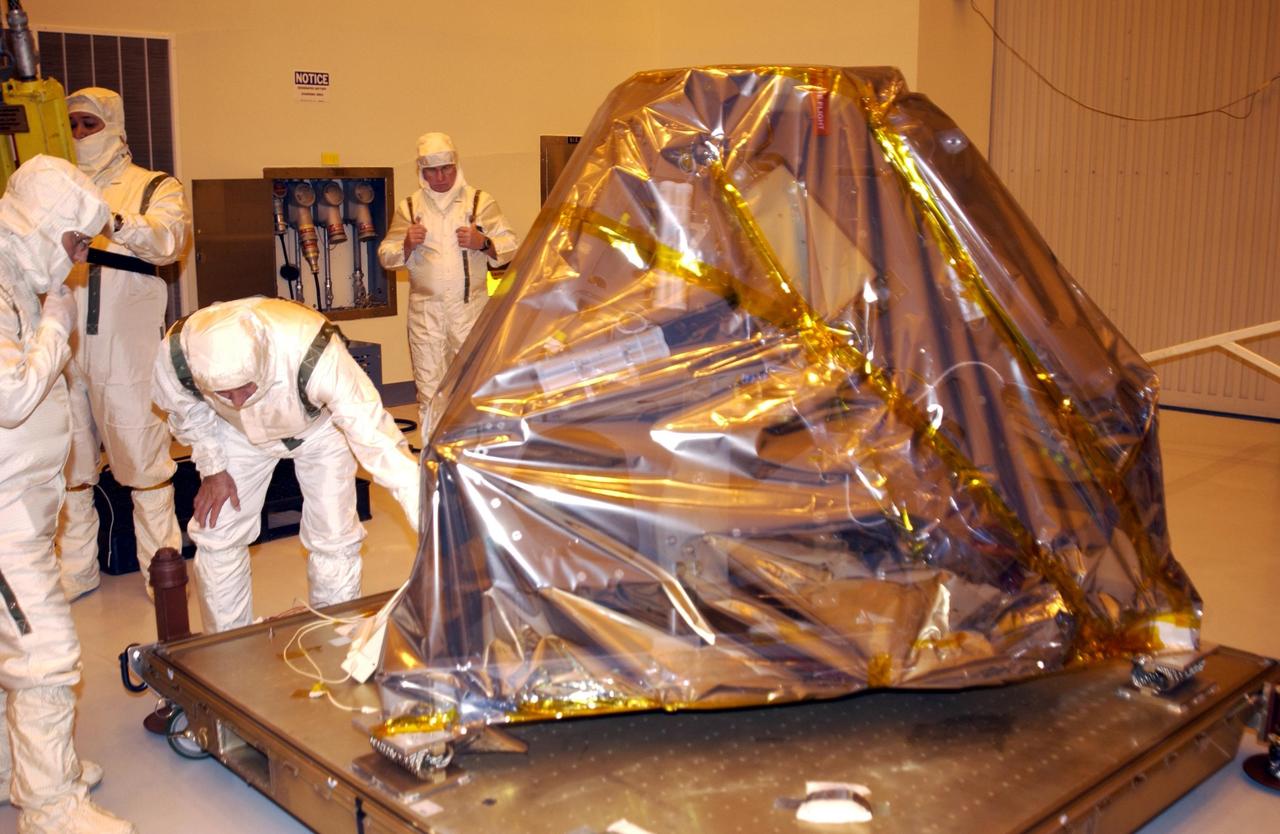
KENNEDY SPACE CENTER, FLA. -- In the Payload Hazardous Servicing Facility, workers get ready to remove the plastic covering from the Mars Exploration Rover -2. Set to launch in 2003, the Mars Exploration Rover Mission will consist of two identical rovers designed to cover roughly 110 yards (100 meters) each Martian day. Each rover will carry five scientific instruments that will allow it to search for evidence of liquid water that may have been present in the planet's past.  The rovers will be identical to each other, but will land at different regions of Mars.  The first rover has a launch window opening May 30, 2003, and the second rover a window opening June 25, 2003.
KSC-03pd0210
KENNEDY SPACE CENTER, FLA. - In the Payload Hazardous Servicing Facility, workers lift the cover from the Mars Exploration Rover -2. Set to launch in 2003, the Mars Exploration Rover Mission will consist of two identical rovers designed to cover roughly 110 yards (100 meters) each Martian day. Each rover will carry five scientific instruments that will allow it to search for evidence of liquid water that may have been present in the planet's past.  The rovers will be identical to each other, but will land at different regions of Mars.  The first rover has a launch window opening May 30, 2003, and the second rover a window opening June 25, 2003.
KSC-03pd0209
KENNEDY SPACE CENTER, FLA. - On Pad 17-A, Cape Canaveral Air Force Station, the first stage of the Delta II rocket is lifted up the launch tower. The Delta will launch the Mars Exploration Rover (MER-A) vehicle. The MER Mission consists of two identical rovers designed to cover roughly 110 yards each Martian day over various terrain. Each rover will carry five scientific instruments that will allow it to search for evidence of liquid water that may have been present in the planet's past.  Identical to each other, the rovers will land at different regions of Mars.  Launch date for this first of NASA's two Mars Exploration Rover missions is scheduled no earlier than June 6.
KSC-03pd1220
KENNEDY SPACE CENTER, FLA. - On Pad 17-A, Cape Canaveral Air Force Station, the first stage of the Delta II rocket is lifted up the launch tower. The Delta will launch the Mars Exploration Rover (MER-A) vehicle. The MER Mission consists of two identical rovers designed to cover roughly 110 yards each Martian day over various terrain. Each rover will carry five scientific instruments that will allow it to search for evidence of liquid water that may have been present in the planet's past.  Identical to each other, the rovers will land at different regions of Mars.  Launch date for this first of NASA's two Mars Exploration Rover missions is scheduled no earlier than June 6.
KSC-03pd1219
KENNEDY SPACE CENTER, FLA. - While workers watch the process, the petals on the lander close up around the Mars Exploration Rover 2 (MER-A).  The lander and rover will be enclosed within an aeroshell for launch.  The MER Mission consists of two identical rovers designed to cover roughly 110 yards each Martian day over various terrain. Each rover will carry five scientific instruments that will allow it to search for evidence of liquid water that may have been present in the planet's past.  Identical to each other, the rovers will land at different regions of Mars.  Launch date for this first of NASA's two Mars Exploration Rover missions is scheduled no earlier than June 6.
KSC-03pd1223
KENNEDY SPACE CENTER, FLA. - On Pad 17-A, Cape Canaveral Air Force Station, the first stage of the Delta II rocket is nearly vertical in the launch tower. The Delta will launch the Mars Exploration Rover (MER-A) vehicle. The MER Mission consists of two identical rovers designed to cover roughly 110 yards each Martian day over various terrain. Each rover will carry five scientific instruments that will allow it to search for evidence of liquid water that may have been present in the planet's past.  Identical to each other, the rovers will land at different regions of Mars.  Launch date for this first of NASA's two Mars Exploration Rover missions is scheduled no earlier than June 6.
KSC-03pd1215
KENNEDY SPACE CENTER, FLA. -  The second stage of the Delta II rocket arrives at Pad 17-A, Cape Canaveral Air Force Station.  It will be mated to the first stage in preparation for the launch of the Mars Exploration Rover 2 (MER-A).  The MER Mission consists of two identical rovers designed to cover roughly 110 yards each Martian day over various terrain. Each rover will carry five scientific instruments that will allow it to search for evidence of liquid water that may have been present in the planet's past.  Identical to each other, the rovers will land at different regions of Mars.  Launch date for this first of NASA's two Mars Exploration Rover missions is scheduled June 5.
KSC-03pd1319
KENNEDY SPACE CENTER, FLA. -  Workers check different areas of the lander as the petals close in around the Mars Exploration Rover 2 (MER-A).  The lander and rover will subsequently be enclosed within an aeroshell for launch.  The MER Mission consists of two identical rovers designed to cover roughly 110 yards each Martian day over various terrain. Each rover will carry five scientific instruments that will allow it to search for evidence of liquid water that may have been present in the planet's past.  Identical to each other, the rovers will land at different regions of Mars.  Launch date for this first of NASA's two Mars Exploration Rover missions is scheduled no earlier than June 6.
KSC-03pd1224
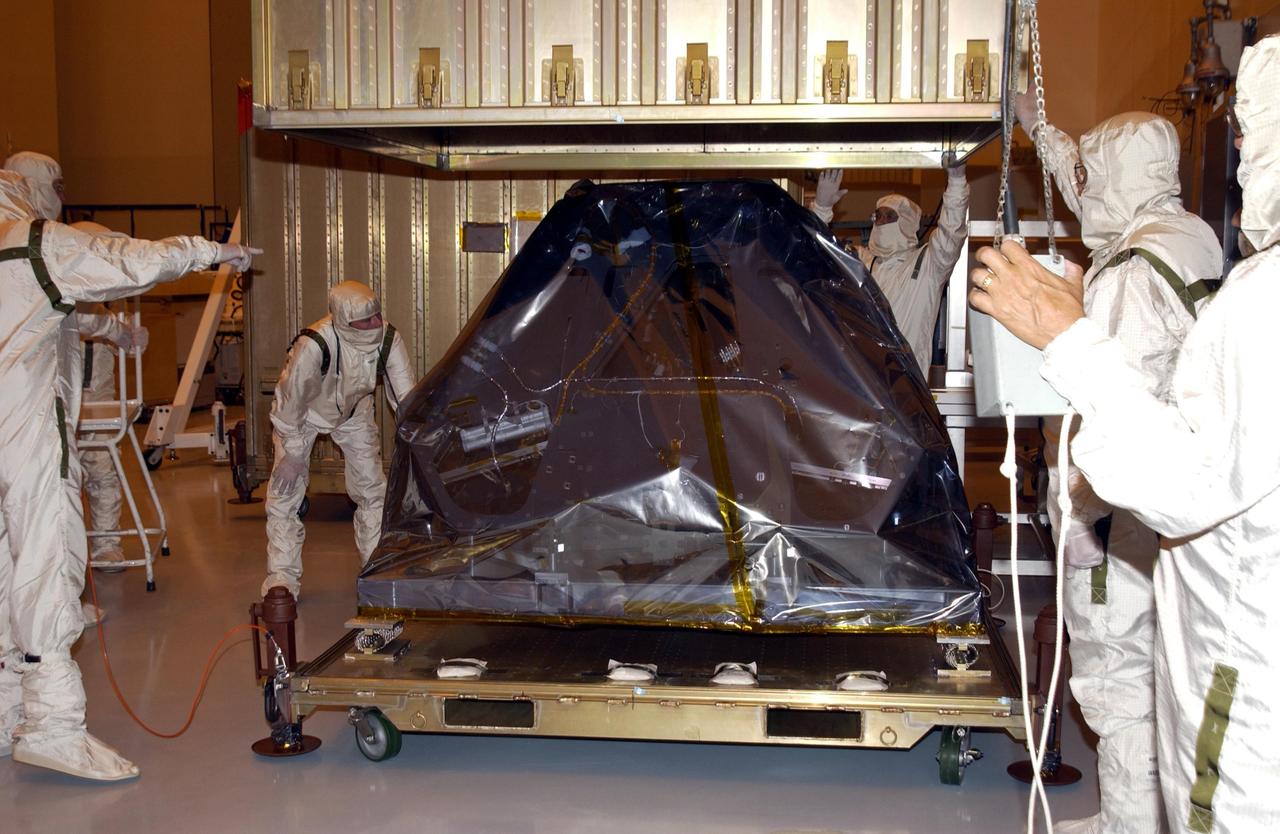
KENNEDY SPACE CENTER, FLA. -- The Mars Exploration Rover -2 is moved to a workstand in the Payload Hazardous Servicing Facility. Set to launch in 2003, the Mars Exploration Rover Mission will consist of two identical rovers designed to cover roughly 110 yards (100 meters) each Martian day. Each rover will carry five scientific instruments that will allow it to search for evidence of liquid water that may have been present in the planet's past.  The rovers will be identical to each other, but will land at different regions of Mars.  The first rover has a launch window opening May 30, 2003, and the second rover a window opening June 25, 2003.
KSC-03pd0212
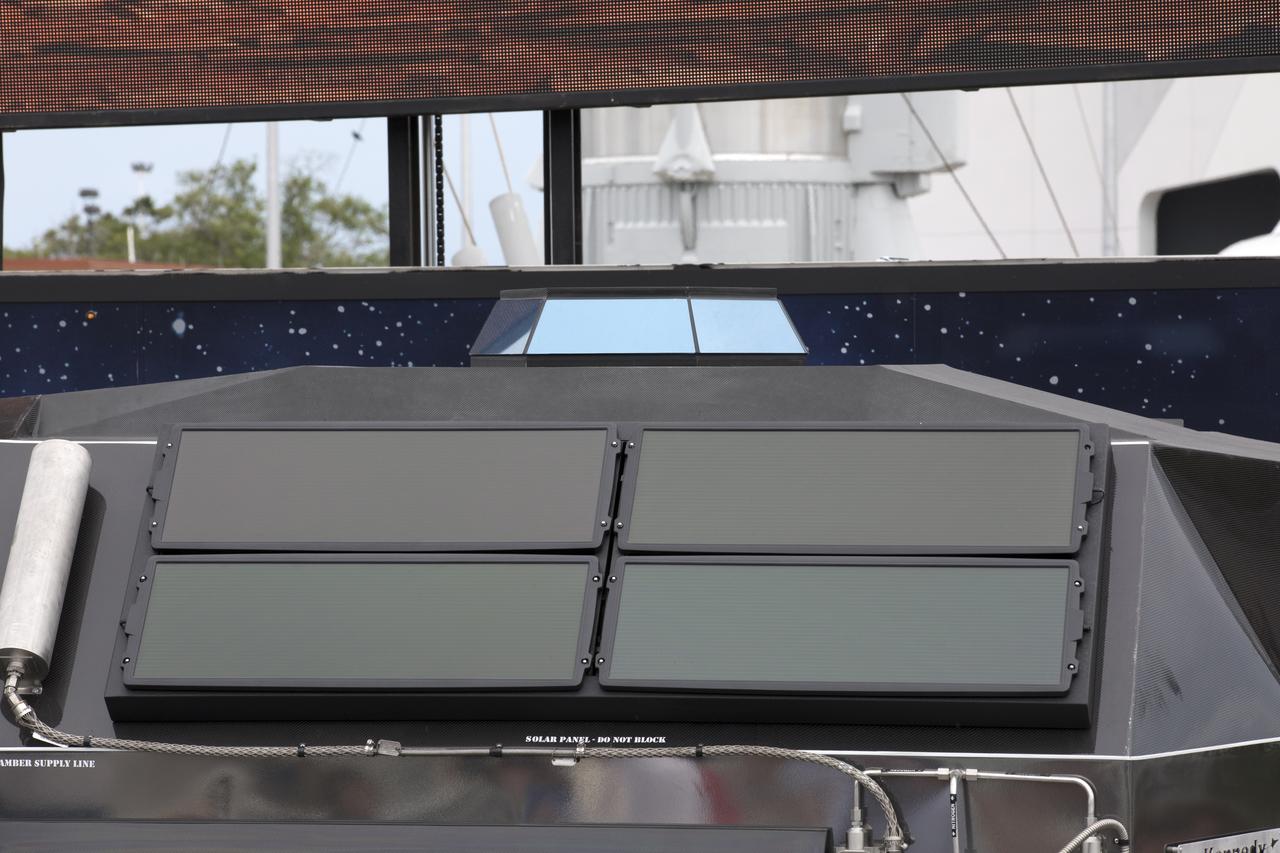
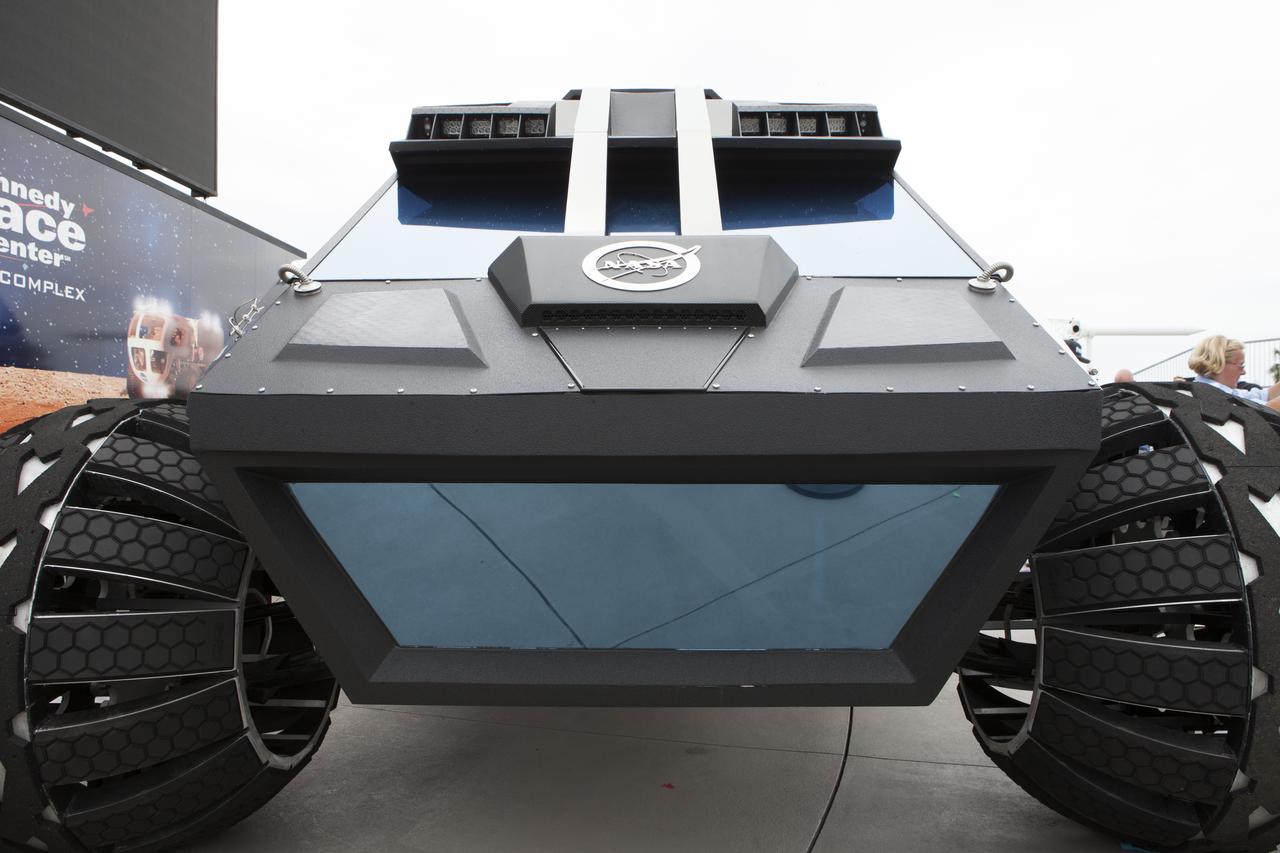
The scientifically-themed Mars rover concept vehicle operates on an electric motor, powered by solar panels and a 700-volt battery. The back section opens and serves as a laboratory which can disconnect for autonomous research. While this exact rover is not expected to operate on Mars, one or more of its elements could make its way into a rover astronauts will drive on the Red Planet. The "Summer of Mars" promotion is designed to provide guests with a better understanding of NASA's studies of the Red Planet. The builders of the rover, Parker Brothers Concepts of Port Canaveral, Florida, incorporated input into its design from NASA subject matter experts.
Mars Rover Concept Vehicle
The scientifically-themed Mars rover concept vehicle operates on an electric motor, powered by solar panels and a 700-volt battery. The back section opens and serves as a laboratory which can disconnect for autonomous research. While this exact rover is not expected to operate on Mars, one or more of its elements could make its way into a rover astronauts will drive on the Red Planet. The "Summer of Mars" promotion is designed to provide guests with a better understanding of NASA's studies of the Red Planet. The builders of the rover, Parker Brothers Concepts of Port Canaveral, Florida, incorporated input into its design from NASA subject matter experts.
Mars Rover Concept Vehicle
The scientifically-themed Mars rover concept vehicle operates on an electric motor, powered by solar panels and a 700-volt battery. The back section opens and serves as a laboratory which can disconnect for autonomous research. While this exact rover is not expected to operate on Mars, one or more of its elements could make its way into a rover astronauts will drive on the Red Planet. The "Summer of Mars" promotion is designed to provide guests with a better understanding of NASA's studies of the Red Planet. The builders of the rover, Parker Brothers Concepts of Port Canaveral, Florida, incorporated input into its design from NASA subject matter experts.
Mars Rover Concept Vehicle
KENNEDY SPACE CENTER, FLA. - On Pad 17-A, Cape Canaveral Air Force Station, the first stage of the Delta II rocket is lifted to vertical at the launch tower. The Delta will launch the Mars Exploration Rover (MER-A) vehicle. The MER Mission consists of two identical rovers designed to cover roughly 110 yards each Martian day over various terrain. Each rover will carry five scientific instruments that will allow it to search for evidence of liquid water that may have been present in the planet's past.  Identical to each other, the rovers will land at different regions of Mars.  Launch date for this first of NASA's two Mars Exploration Rover missions is scheduled no earlier than June 6.
KSC-03pd1213
KENNEDY SPACE CENTER, FLA. - After being cleaned up, the Mars Exploration Rover -2 is ready to be moved to a workstand in the Payload Hazardous Servicing Facility. Set to launch in 2003, the Mars Exploration Rover Mission will consist of two identical rovers designed to cover roughly 110 yards (100 meters) each Martian day. Each rover will carry five scientific instruments that will allow it to search for evidence of liquid water that may have been present in the planet's past.  The rovers will be identical to each other, but will land at different regions of Mars.  The first rover has a launch window opening May 30, 2003, and the second rover a window opening June 25, 2003.
KSC-03pd0211
KENNEDY SPACE CENTER, FLA. - Workers in the Payload Hazardous Servicing Facility move the Mars Exploration Rover -2 to a workstand in the high bay. Set to launch in 2003, the Mars Exploration Rover Mission will consist of two identical rovers designed to cover roughly 110 yards (100 meters) each Martian day. Each rover will carry five scientific instruments that will allow it to search for evidence of liquid water that may have been present in the planet's past.  The rovers will be identical to each other, but will land at different regions of Mars.  The first rover has a launch window opening May 30, 2003, and the second rover a window opening June 25, 2003.
KSC-03pd0213
The scientifically-themed Mars rover concept vehicle operates on an electric motor, powered by solar panels and a 700-volt battery. The back section opens and serves as a laboratory which can disconnect for autonomous research. While this exact rover is not expected to operate on Mars, one or more of its elements could make its way into a rover astronauts will drive on the Red Planet. The "Summer of Mars" promotion is designed to provide guests with a better understanding of NASA's studies of the Red Planet. The builders of the rover, Parker Brothers Concepts of Port Canaveral, Florida, incorporated input into its design from NASA subject matter experts.
Mars Rover Concept Vehicle
KENNEDY SPACE CENTER, FLA. -- In the Spacecraft Assembly and Encapsulation Facility -2 (SAEF-2), Chris Voorhees and Satish Krishnan from the Jet Propulsion Laboratory remove a microprobe which will hitchhike on the Mars Polar Lander. Scheduled to be launched Jan. 3, 1999, aboard a Delta II rocket, the solar-powered spacecraft is designed to touch down on the Martian surface near the northern-most boundary of the south pole in order to study the water cycle there. The lander also will help scientists learn more about climate change and current resources on Mars, studying such things as frost, dust, water vapor and condensates in the Martian atmosphere. The Mars microprobes, called Deep Space 2, are part of NASA's New Millennium Program. They will complement the climate-related scientific focus of the lander by demonstrating an advanced, rugged microlaser system for detecting subsurface water. Such data on polar subsurface water, in the form of ice, should help put limits on scientific projections for the global abundance of water on Mars
KSC-98pc1627