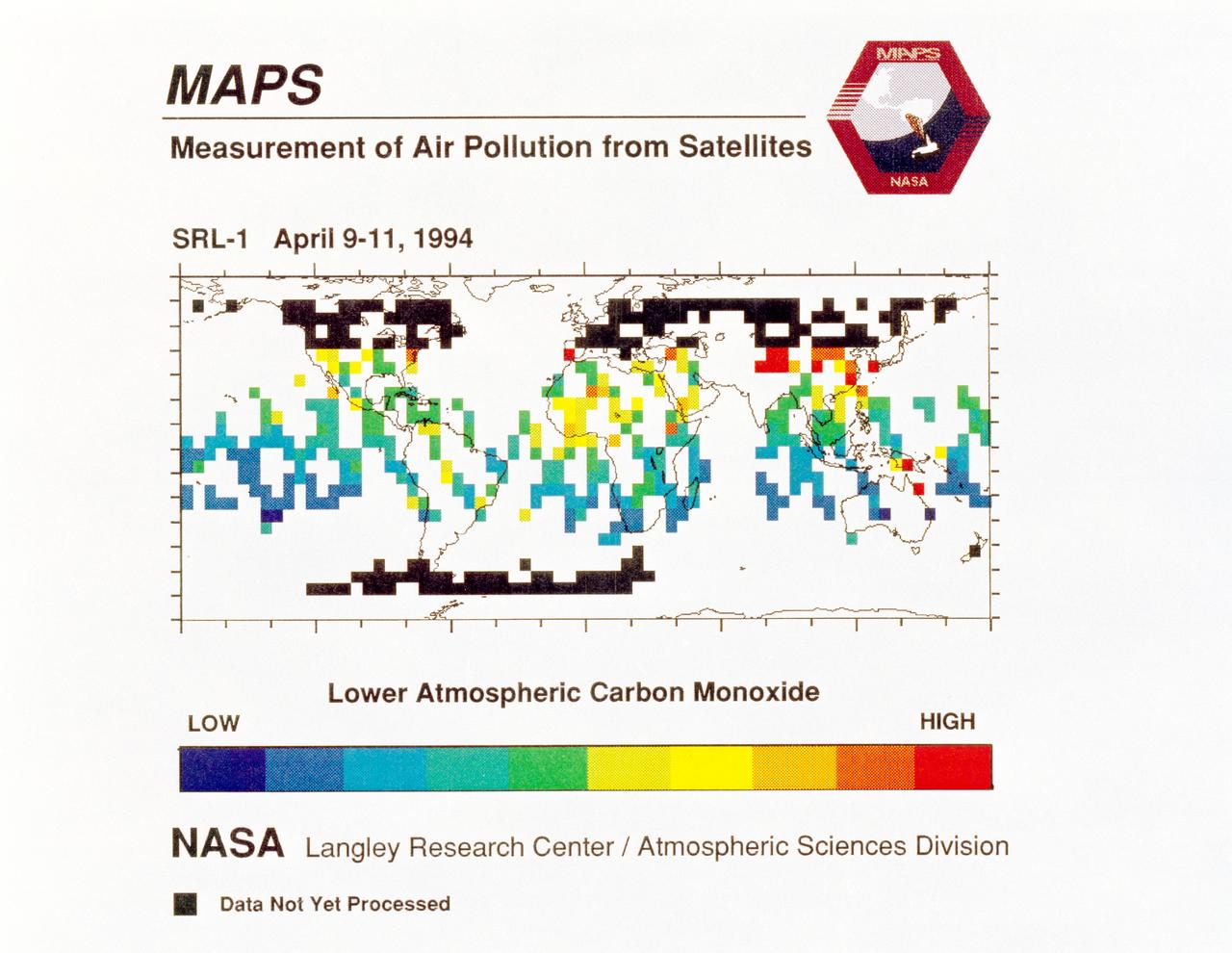
STS059-S-040 (12 April 1994) --- STS-59's MAPS (Measurement of Air Pollution from Satellites) experiment is sending real-time data that provides the most comprehensive view of carbon monoxide concentrations on Earth ever recorded. This computer image shows a summary of "quick look" data obtained by the MAPS instrument during its first days of operations as part of the Space Shuttle Endeavour's SRL-1 payload. This data will be processed using more sophisticated techniques following the flight. The color red indicates areas with the highest levels of carbon monoxide. These Northern Hemisphere springtime carbon monoxide values are generally significantly higher than the values found in the Southern Hemisphere. This is in direct contrast to the data obtained by the MAPS experiment during November 1981 and October 1984, i.e. during Northern Hemisphere fall. The astronauts aboard Endeavour have seen fires in most of the areas showing higher carbon monoxide values (China, Eastern Australia, and equatorial Africa). The relationship between the observed fires and the higher carbon monoxide values will be investigated following SRL-1 by combining the MAPS data with meteorological data, surface imagery, and Space Shuttle hand-held photographs. By the end of SRL-1, MAPS will have acquired data over most of the globe between 57 degrees north and 57 degrees south latitudes. The entire data set will be carefully analyzed using sophisticated post-flight data processing techniques. The data will then be applied in a variety of scientific studies concerning chemistry and transport processes in the atmosphere. The MAPS experiment measures the carbon monoxide in the lower atmosphere. This gas is produced both as a result of natural processes and as a result of human activities. The primary human resources of carbon monoxide are automobiles and industry and the burning of plant materials. The primary natural source is the interaction of sunlight with naturally occurring ozone and water vapor. The strength of all of these sources changes seasonally.
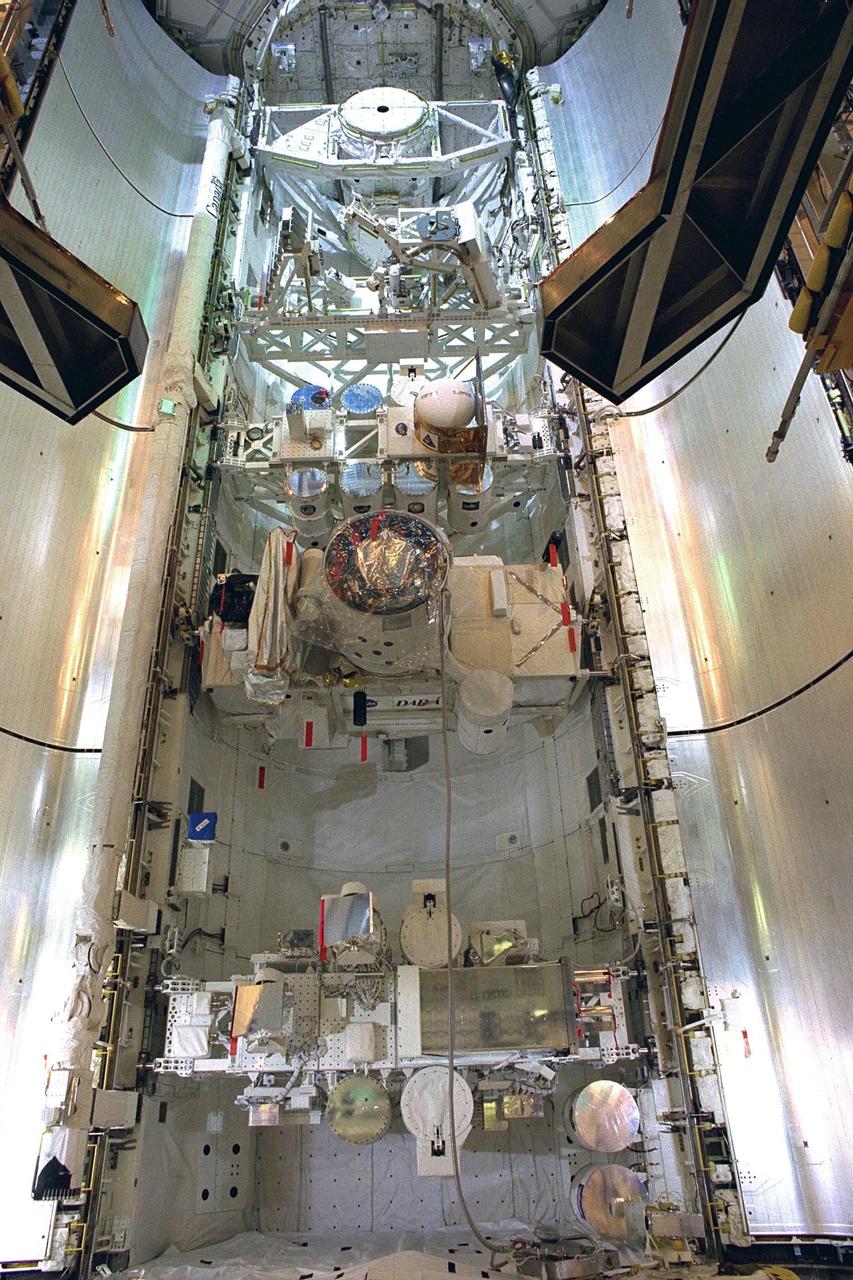
KENNEDY SPACE CENTER, FLA. -- Space Shuttle orbiter Discovery's payload bay doors are closed in preparation for the flight of mission STS-85. The payload includes the Cryogenic Infrared Spectrometers and Telescopes for the Atmosphere-Shuttle Pallet Satellite-2 (CRISTA-SPAS-2). The CRISTA is a system of three telescopes and four spectrometers to measure infrared radiation emitted by the Earth’s middle atmosphere. During the 11-day mission, the CRISTA-SPAS-2 free-flying satellite will be deployed from Discovery and retrieved later in the flight. Also onboard the satellite will be the Middle Atmosphere High Resolution Spectrograph Investigation (MAHRSI) to measure ultraviolet radiation emitted and scattered by the Earth’s atmosphere.
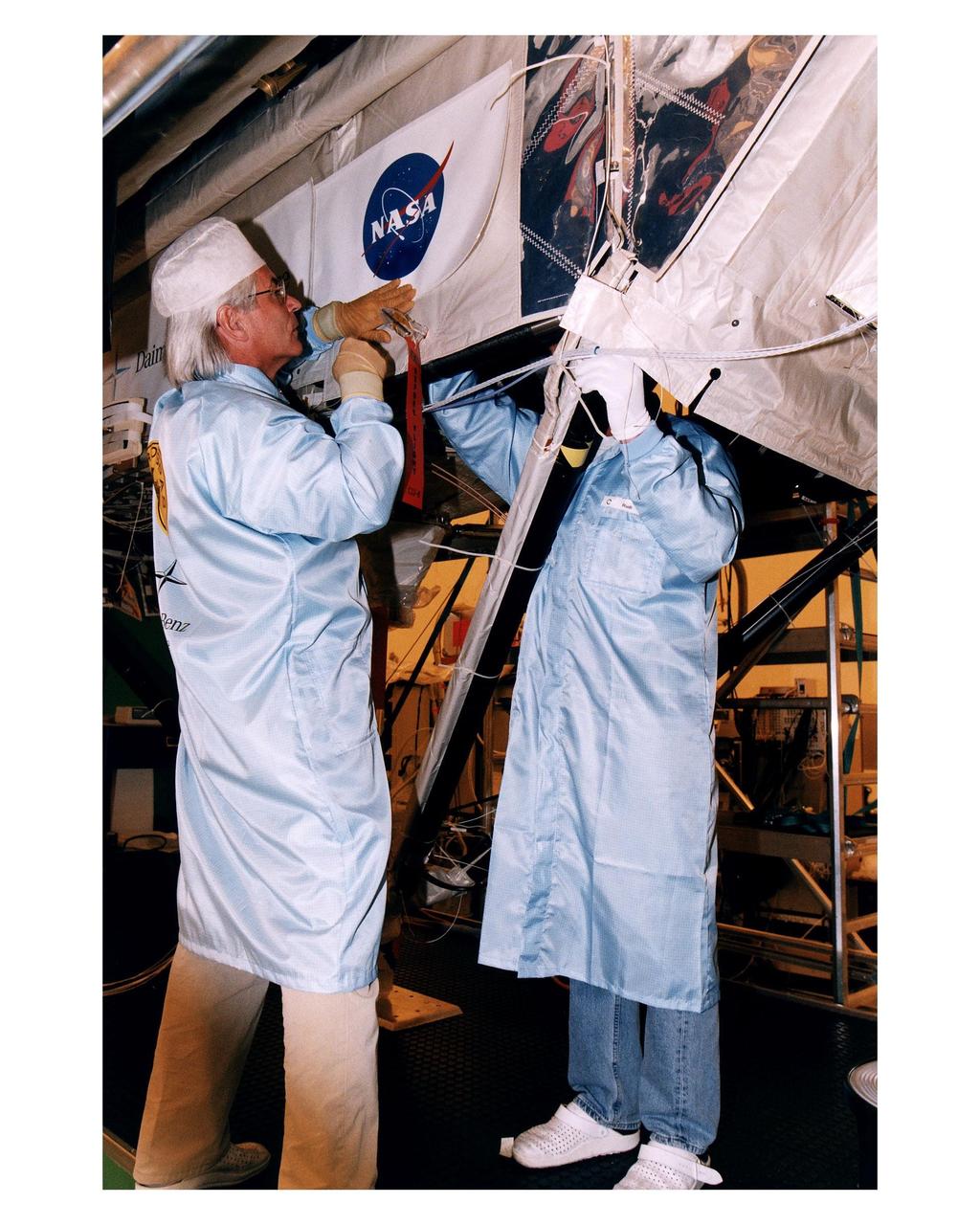
Employees of Daimler-Benz Aerospace in the Multi-Payload Processing Facility install insulation on the Cryogenic Infrared Spectro-meters and Telescopes for the Atmosphere-Shuttle Pallet Satellite-2 (CRISTA-SPAS-2) payload for the STS-85 mission. The CRISTA is a system of three telescopes and four spectrometers to measure infrared radiation emitted by the Earth’s middle atmosphere. During the 11- day mission, the CRISTA-SPAS-2 free-flying satellite will be deployed from the Space Shuttle Discovery and retrieved later in the flight. Also onboard the satellite will be the Middle Atmosphere High Resolution Spectrograph Investigation (MAHRSI) to measure ultraviolet radiation emitted and scattered by the Earth’s atmosphere
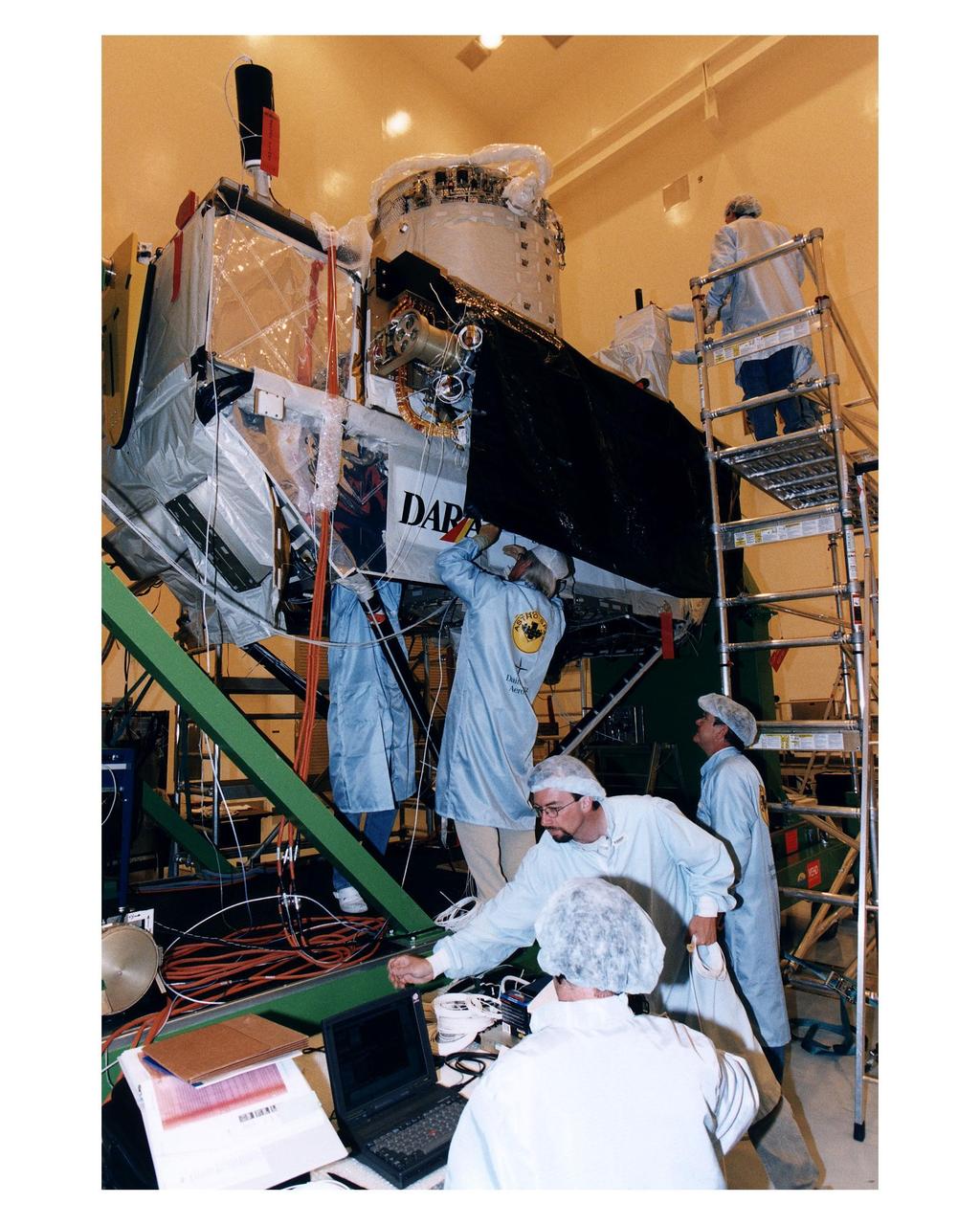
Employees of Daimler-Benz Aerospace in the Multi-Payload Processing Facility install insulation on the Cryogenic Infrared Spectro-meters and Telescopes for the Atmosphere-Shuttle Pallet Satellite-2 (CRISTA-SPAS-2) payload for the STS-85 mission. The CRISTA is a system of three telescopes and four spectrometers to measure infrared radiation emitted by the Earth’s middle atmosphere. During the 11- day mission, the CRISTA-SPAS-2 free-flying satellite will be deployed from the Space Shuttle Discovery and retrieved later in the flight. Also onboard the satellite will be the Middle Atmosphere High Resolution Spectrograph Investigation (MAHRSI) to measure ultraviolet radiation emitted and scattered by the Earth’s atmosphere
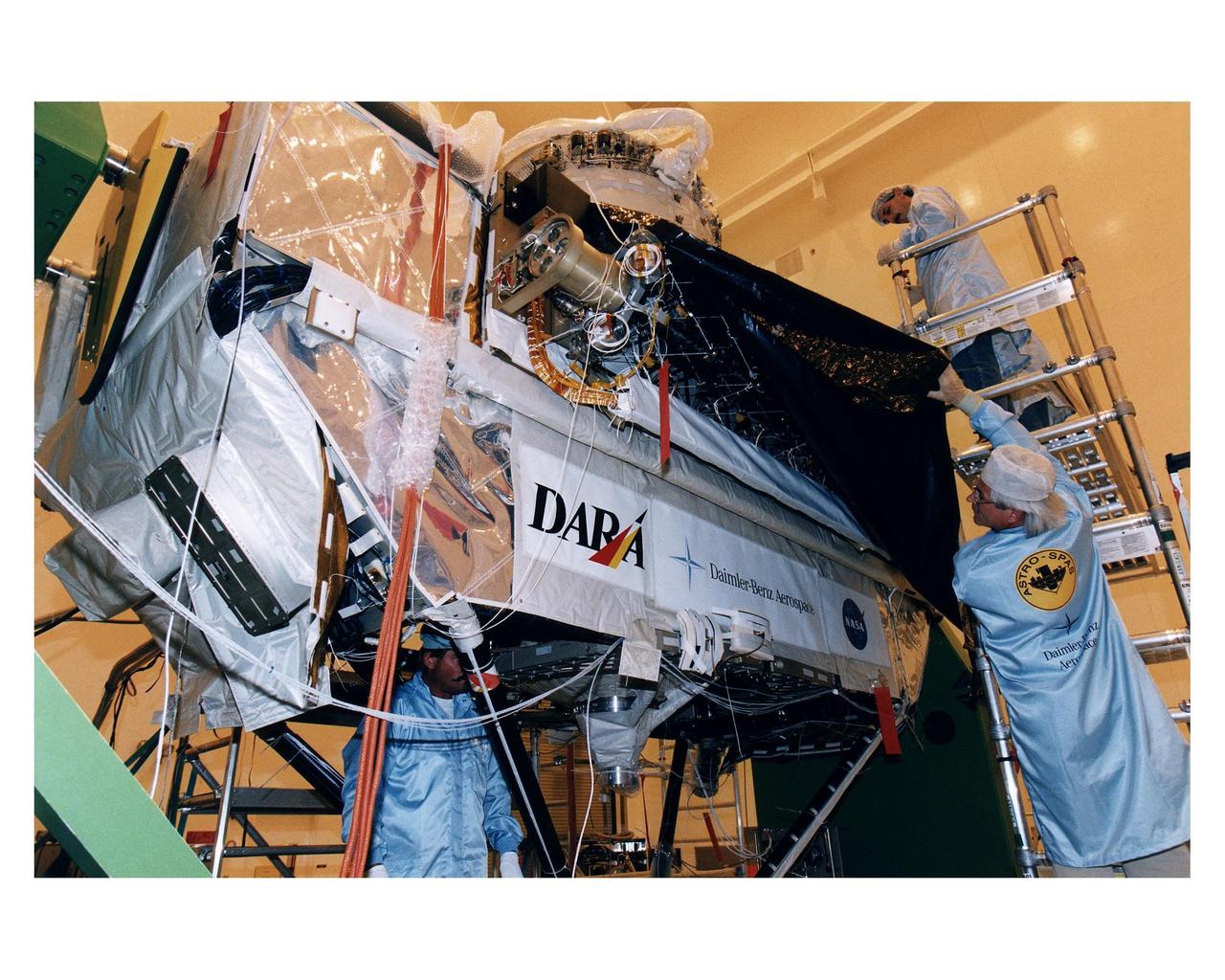
Employees of Daimler-Benz Aerospace in the Multi-Payload Processing Facility install insulation on the Cryogenic Infrared Spectro-meters and Telescopes for the Atmosphere-Shuttle Pallet Satellite-2 (CRISTA-SPAS-2) payload for the STS-85 mission. The CRISTA is a system of three telescopes and four spectrometers to measure infrared radiation emitted by the Earth’s middle atmosphere. During the 11- day mission, the CRISTA-SPAS-2 free-flying satellite will be deployed from the Space Shuttle Discovery and retrieved later in the flight. Also onboard the satellite will be the Middle Atmosphere High Resolution Spectrograph Investigation (MAHRSI) to measure ultraviolet radiation emitted and scattered by the Earth’s atmosphere
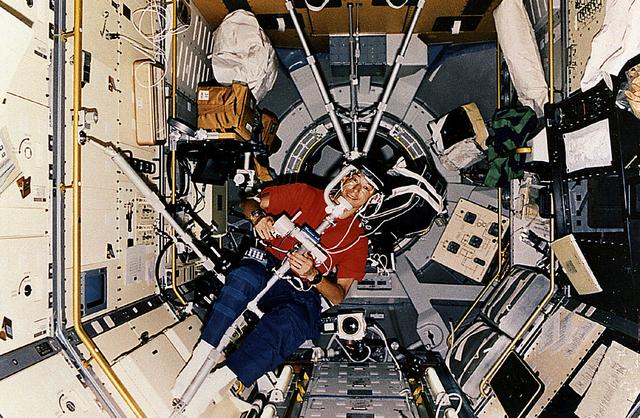
Space Shuttle Endeavour (STS-47) onboard photo of Japanese Payload Specialist Dr. Mamoru Mohri participating in Comparative Measurement of Visual Stability in Earth Cosmic Space experiment to learn more about Space Adaptation Syndrome (SAS).

At Launch Pad 39A, orbiter Endeavour's open payload bay doors, reflecting the surrounding light, reveal the payload on the Shuttle Radar Topography Mission, STS-99. The mission will chart a new course, using two antennae and a 200-foot-long section of space station-derived mast protruding from the payload bay to produce unrivaled 3-D images of the Earth's surface. The result of the Shuttle Radar Topography Mission could be close to 1 trillion measurements of the Earth's topography. Besides contributing to the production of better maps, these measurements could lead to improved water drainage modeling, more realistic flight simulators, better locations for cell phone towers, and enhanced navigation safety. Launch of Endeavour on the 11-day mission is scheduled for Jan. 31 at 12:47 p.m. EST

At Launch Pad 39A, orbiter Endeavour's open payload bay doors reveal the payload on the Shuttle Radar Topography Mission, STS-99. The mission will chart a new course, using two antennae and a 200-foot-long section of space station-derived mast protruding from the payload bay to produce unrivaled 3-D images of the Earth's surface. The result of the Shuttle Radar Topography Mission could be close to 1 trillion measurements of the Earth's topography. Besides contributing to the production of better maps, these measurements could lead to improved water drainage modeling, more realistic flight simulators, better locations for cell phone towers, and enhanced navigation safety. Launch of Endeavour on the 11-day mission is scheduled for Jan. 31 at 12:47 p.m. EST

At Launch Pad 39A, orbiter Endeavour's open payload bay doors, reflecting the surrounding lights, reveal the payload on the Shuttle Radar Topography Mission, STS-99. The mission will chart a new course, using two antennae and a 200-foot-long section of space station-derived mast protruding from the payload bay to produce unrivaled 3-D images of the Earth's surface. The result of the Shuttle Radar Topography Mission could be close to 1 trillion measurements of the Earth's topography. Besides contributing to the production of better maps, these measurements could lead to improved water drainage modeling, more realistic flight simulators, better locations for cell phone towers, and enhanced navigation safety. Launch of Endeavour on the 11-day mission is scheduled for Jan. 31 at 12:47 p.m. EST

At Launch Pad 39A, orbiter Endeavour's open payload bay doors reveal the payload on the Shuttle Radar Topography Mission, STS-99. The mission will chart a new course, using two antennae and a 200-foot-long section of space station-derived mast protruding from the payload bay to produce unrivaled 3-D images of the Earth's surface. The result of the Shuttle Radar Topography Mission could be close to 1 trillion measurements of the Earth's topography. Besides contributing to the production of better maps, these measurements could lead to improved water drainage modeling, more realistic flight simulators, better locations for cell phone towers, and enhanced navigation safety. Launch of Endeavour on the 11-day mission is scheduled for Jan. 31 at 12:47 p.m. EST
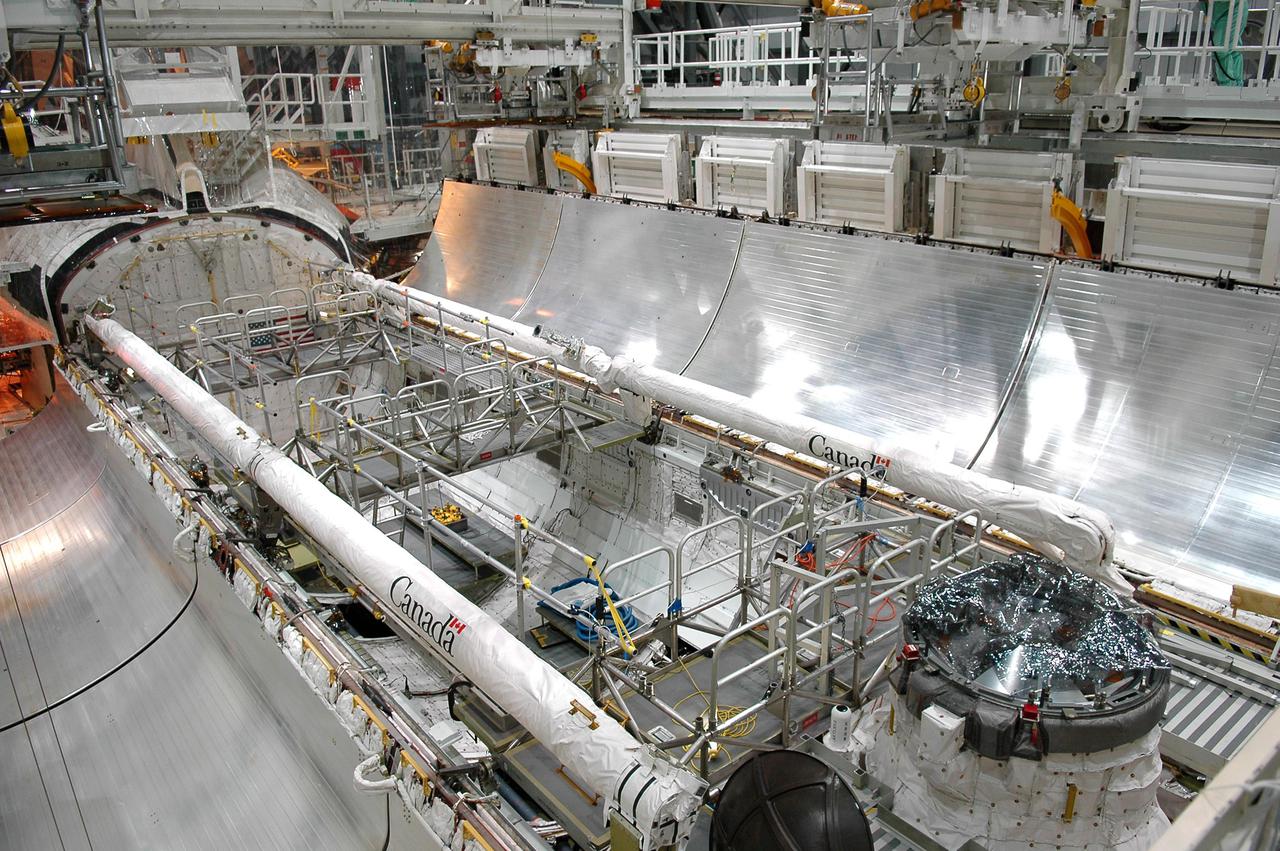
KENNEDY SPACE CENTER, FLA. - In Orbiter Processing Facility bay 1 at NASA’s Kennedy Space Center, Atlantis’ payload bay doors are fully open. The Remote Manipulator System, or Shuttle arm, is seen on the port side (top) and Orbiter Boom Sensor System (OBSS) is seen on the starboard side (lower) of the payload bay. The 50-foot-long OBSS attaches to the Shuttle arm and is one of the new safety measures for Return to Flight. It equips the orbiter with cameras and laser systems to inspect the Shuttle’s Thermal Protection System while in space. Mission STS-121 is targeted for launch in September. Once Atlantis' bay doors are open again, further work will be done in the bay.
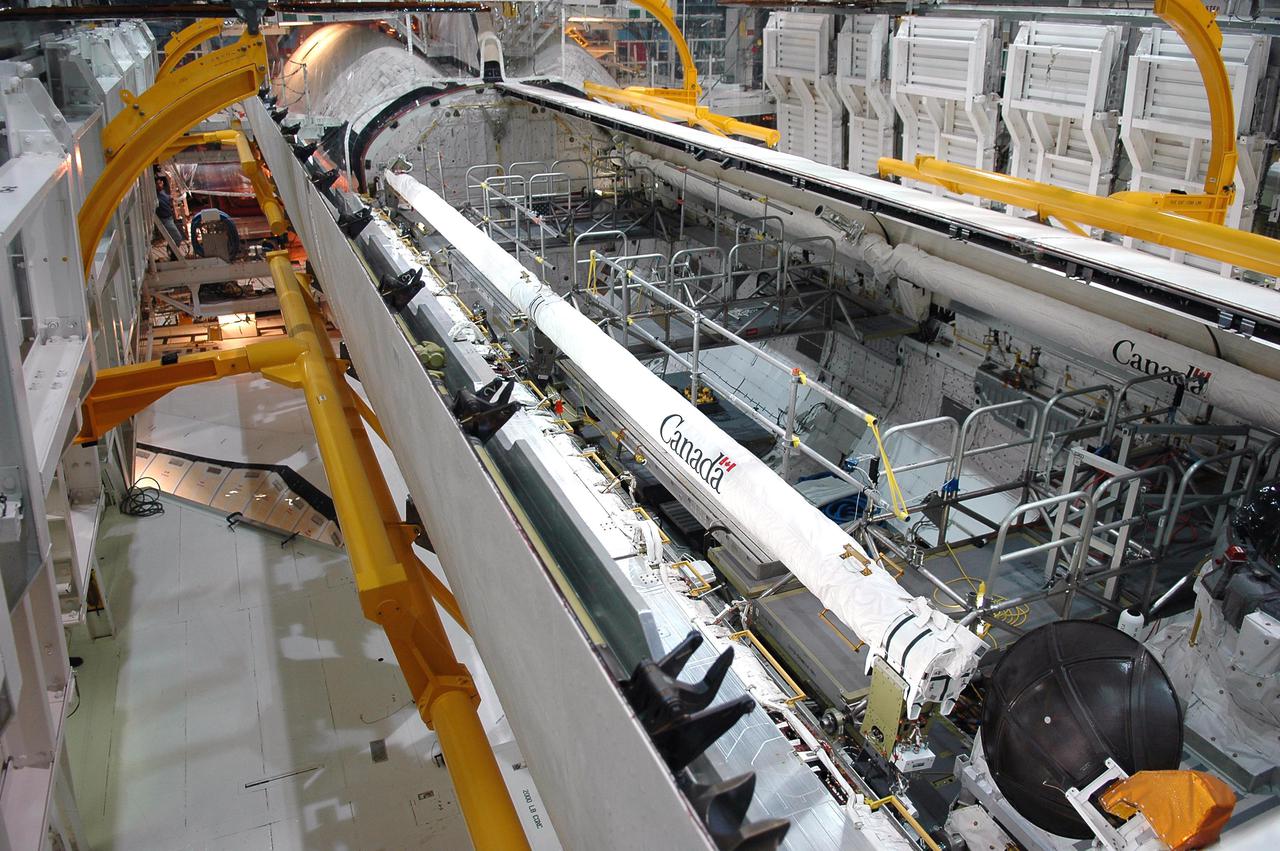
KENNEDY SPACE CENTER, FLA. - In Orbiter Processing Facility bay 1 at NASA’s Kennedy Space Center, Atlantis’ payload bay doors are open. The Remote Manipulator System, or Shuttle arm, is seen on the port side (top) and Orbiter Boom Sensor System (OBSS) is seen on the starboard side (lower) of the payload bay. The 50-foot-long OBSS attaches to the Shuttle arm and is one of the new safety measures for Return to Flight. It equips the orbiter with cameras and laser systems to inspect the Shuttle’s Thermal Protection System while in space. Mission STS-121 is targeted for launch in September. Once Atlantis' bay doors are open again, further work will be done in the bay.
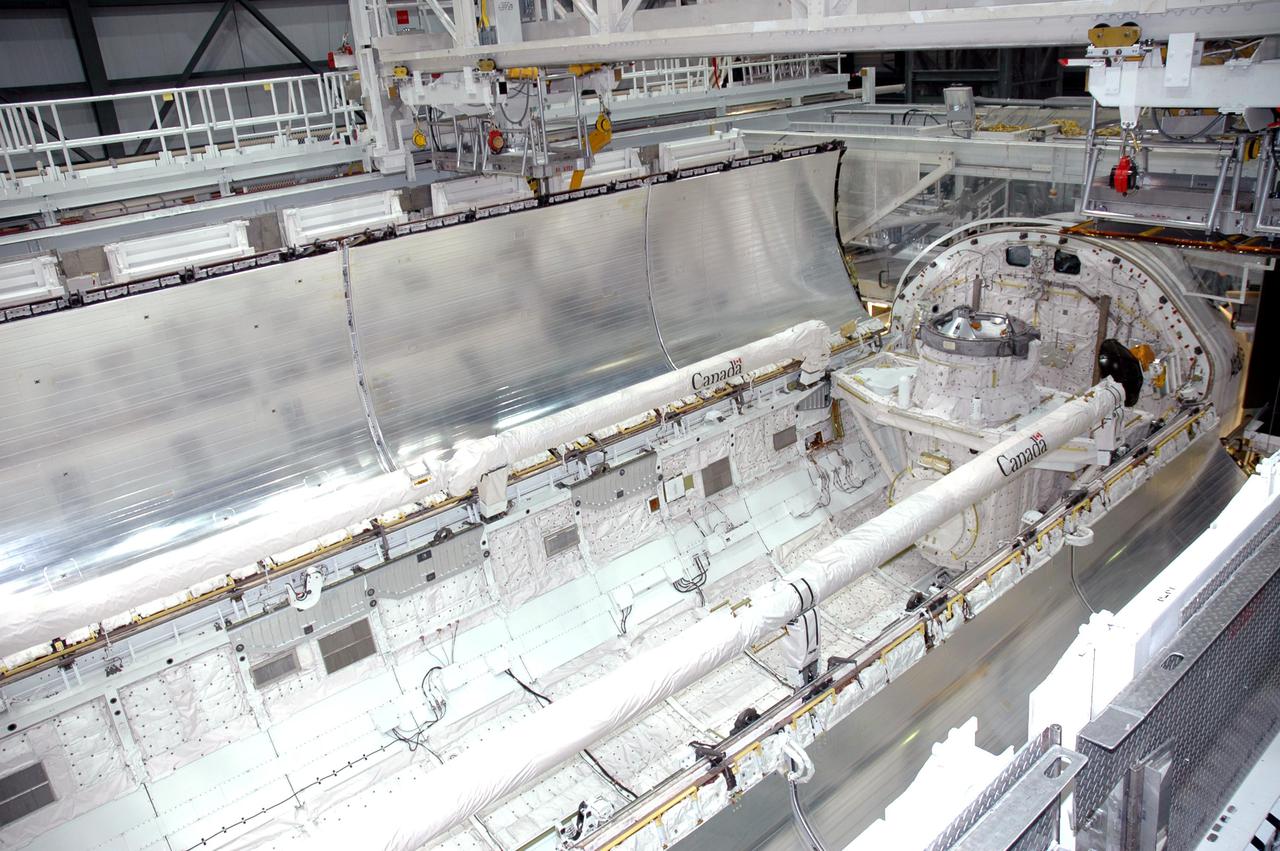
KENNEDY SPACE CENTER, FLA. - In the Orbiter Processing Facility at Kennedy Space Center in Florida, the payload bay doors of the orbiter Atlantis are being closed. The Remote Manipulator System, or Shuttle arm, is seen on the port side (top) and the Orbiter Boom Sensor System (OBSS) is seen on the starboard side (lower) of the payload bay. The 50-foot-long OBSS attaches to the Shuttle arm and is one of the new safety measures for Return to Flight. It equips the orbiter with cameras and laser systems to inspect the Shuttle’s Thermal Protection System while in space. Atlantis is scheduled to fly on the second Return to Flight mission, STS-121, targeted for launch in a window extending from Sept. 9 to Sept. 24.
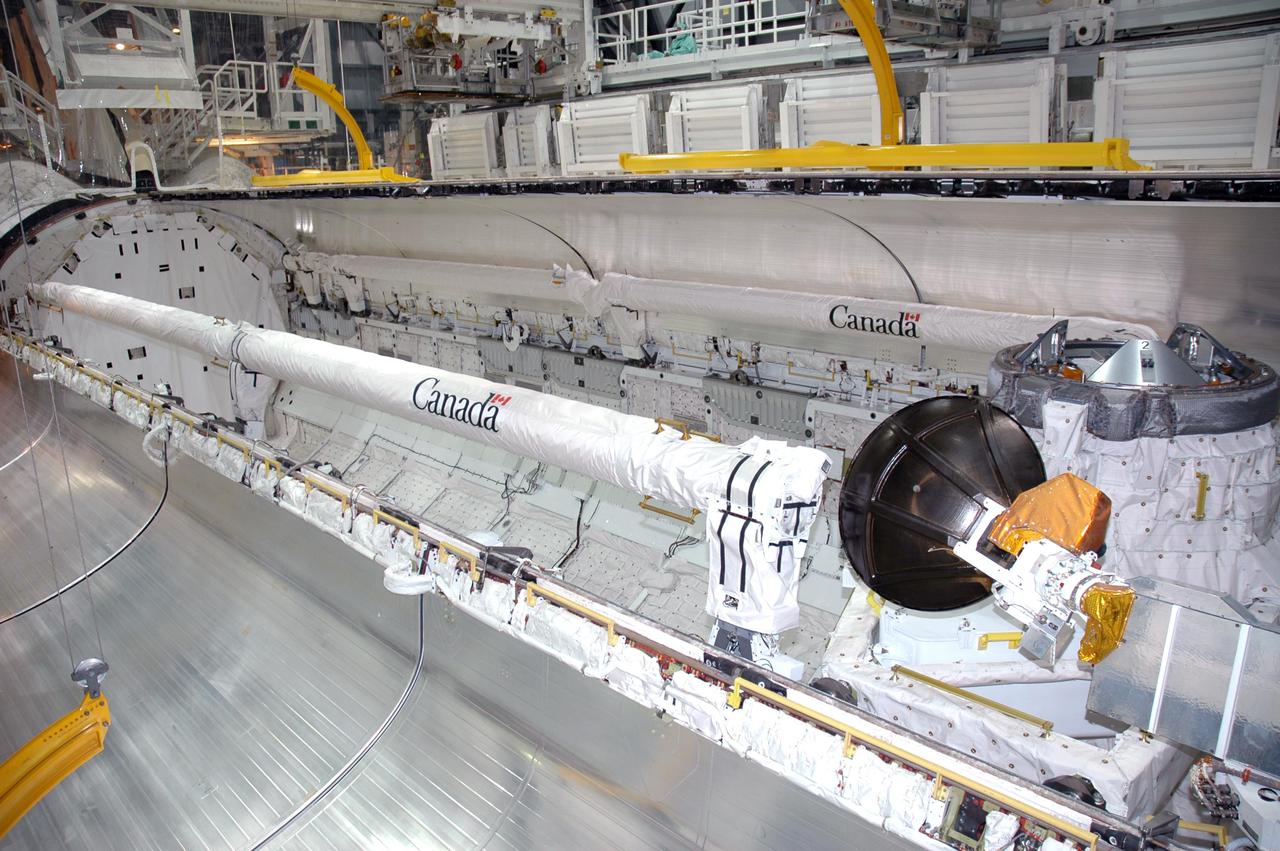
KENNEDY SPACE CENTER, FLA. - In the Orbiter Processing Facility at Kennedy Space Center in Florida, the payload bay doors of the orbiter Atlantis are being closed. The Remote Manipulator System, or Shuttle arm, is seen on the port side (top) and the Orbiter Boom Sensor System (OBSS) is seen on the starboard side (lower) of the payload bay. The 50-foot-long OBSS attaches to the Shuttle arm and is one of the new safety measures for Return to Flight. It equips the orbiter with cameras and laser systems to inspect the Shuttle’s Thermal Protection System while in space. Atlantis is scheduled to fly on the second Return to Flight mission, STS-121, targeted for launch in a window extending from Sept. 9 to Sept. 24.
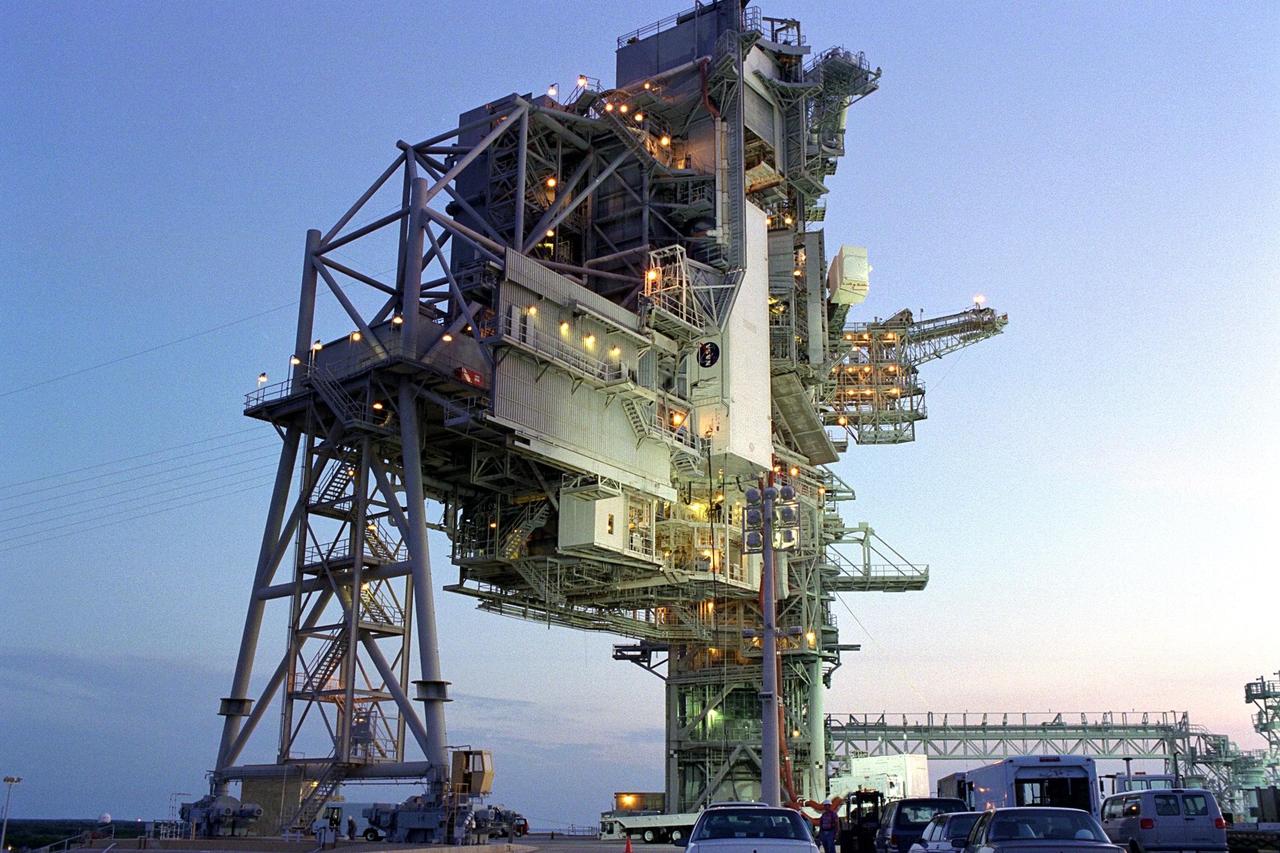
KENNEDY SPACE CENTER, Fla. -- The payload canister containing the Cryogenic Infrared Spectrometers and Telescopes for the Atmosphere-Shuttle Pallet Satellite-2 (CRISTA-SPAS-2) payload for the STS-85 mission is hoisted to the Payload Changeout Room (PCR) at Launch Pad 39A. Also in the canister are the Technology Applications and Science-1 (TAS-1) and International Extreme Ultraviolet Hitchhiker-2 (IEH-2) payloads. All three will be transferred from the PCR into the payload bay of the Space Shuttle Orbiter Discovery after the space vehicle arrives at the pad. The CRISTA is a system of three telescopes and four spectrometers to measure infrared radiation emitted by the Earth’s middle atmosphere. During the 11-day mission, the CRISTA-SPAS-2 free-flying satellite will be deployed from Discovery and retrieved later in the flight. Also onboard the satellite will be the Middle Atmosphere High Resolution Spectrograph Investigation (MAHRSI) to measure ultraviolet radiation emitted and scattered by the Earth’s atmosphere. The TAS-1 holds seven separate experiments that will provide data on the Earth’s topography and atmosphere, study the sun’s energy, and test new thermal control devices, as well as several student-developed experiments. The IEH-2 experiments will study ultraviolet radiation from stars, the sun and in the solar system
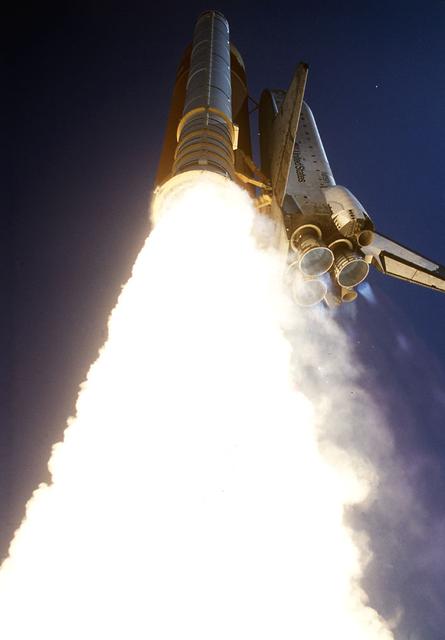
The Space Shuttle Columbia (STS-52) thunders off Launch Pad 39B, embarking on a 10-day flight and carrying a crew of six who will deploy the Laser Geodynamic Satellite II (LAGEOS). LAGEOS is a spherical passive satellite covered with reflectors which are illuminated by ground-based lasers to determine precise measurements of the Earth's crustal movements. The other major payload on this mission is the United States Microgravity Payload 1 (USMP-1), where experiments will be conducted by crew members while in low earth orbit (LEO).
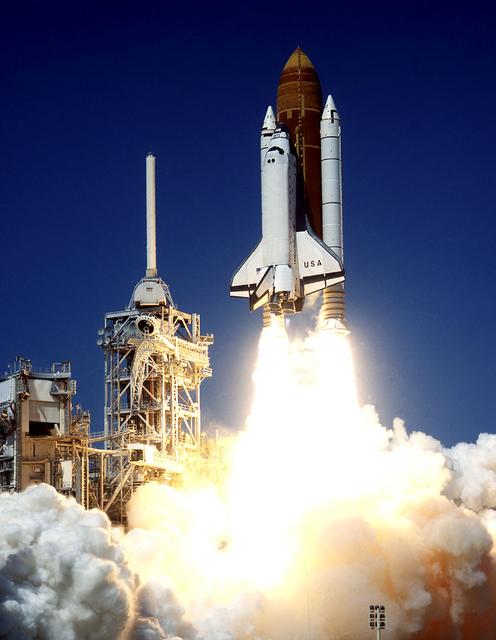
The Space Shuttle Columbia (STS-52) thunders off Launch Pad 39B, embarking on a 10-day flight and carrying a crew of six who will deploy the Laser Geodynamic Satellite II (LAGEOS). LAGEOS is a spherical passive satellite covered with reflectors which are illuminated by ground-based lasers to determine precise measurements of the Earth's crustal movements. The other major payload on this mission is the United States Microgravity Payload 1 (USMP-1), where experiments will be conducted by crew members while in low earth orbit (LEO).
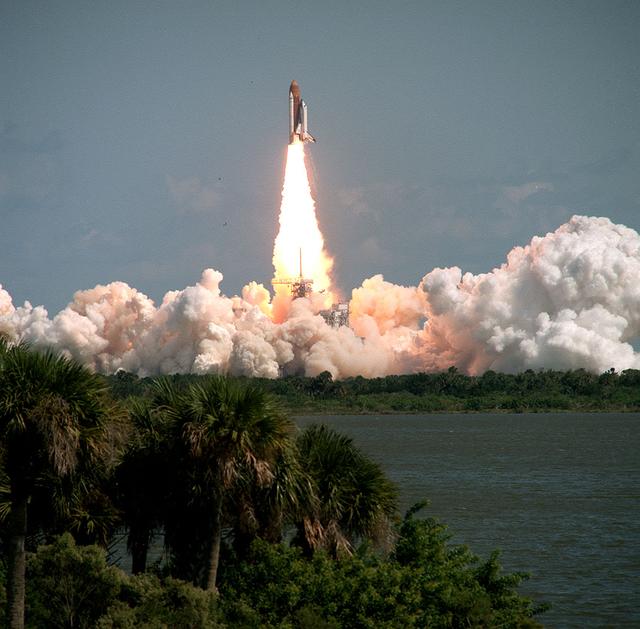
The Space Shuttle Columbia (STS-52) thunders off Launch Pad 39B, embarking on a 10-day flight and carrying a crew of six who will deploy the Laser Geodynamic Satellite II (LAGEOS). LAGEOS is a spherical passive satellite covered with reflectors which are illuminated by ground-based lasers to determine precise measurements of the Earth's crustal movements. The other major payload on this mission is the United States Microgravity Payload 1 (USMP-1), where experiments will be conducted by crew members while in low earth orbit (LEO).
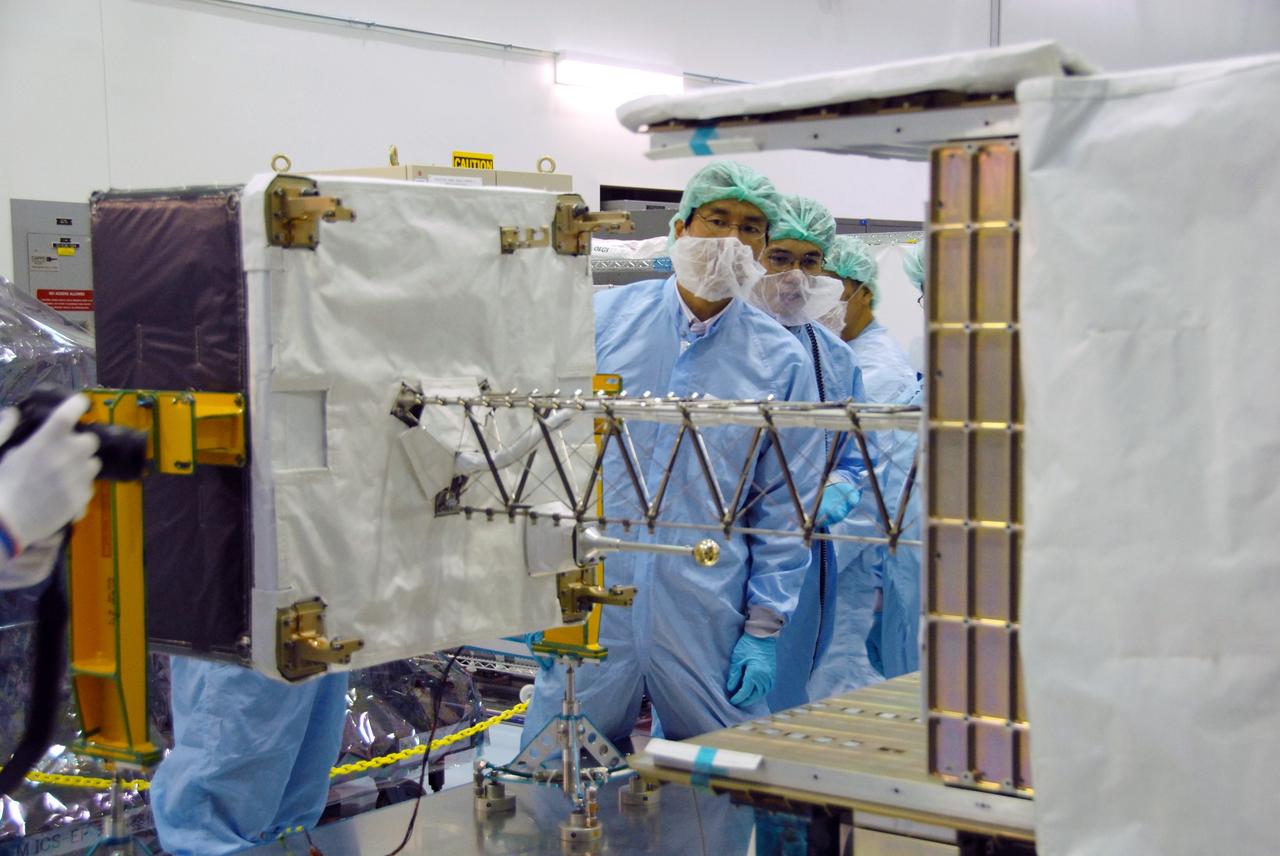
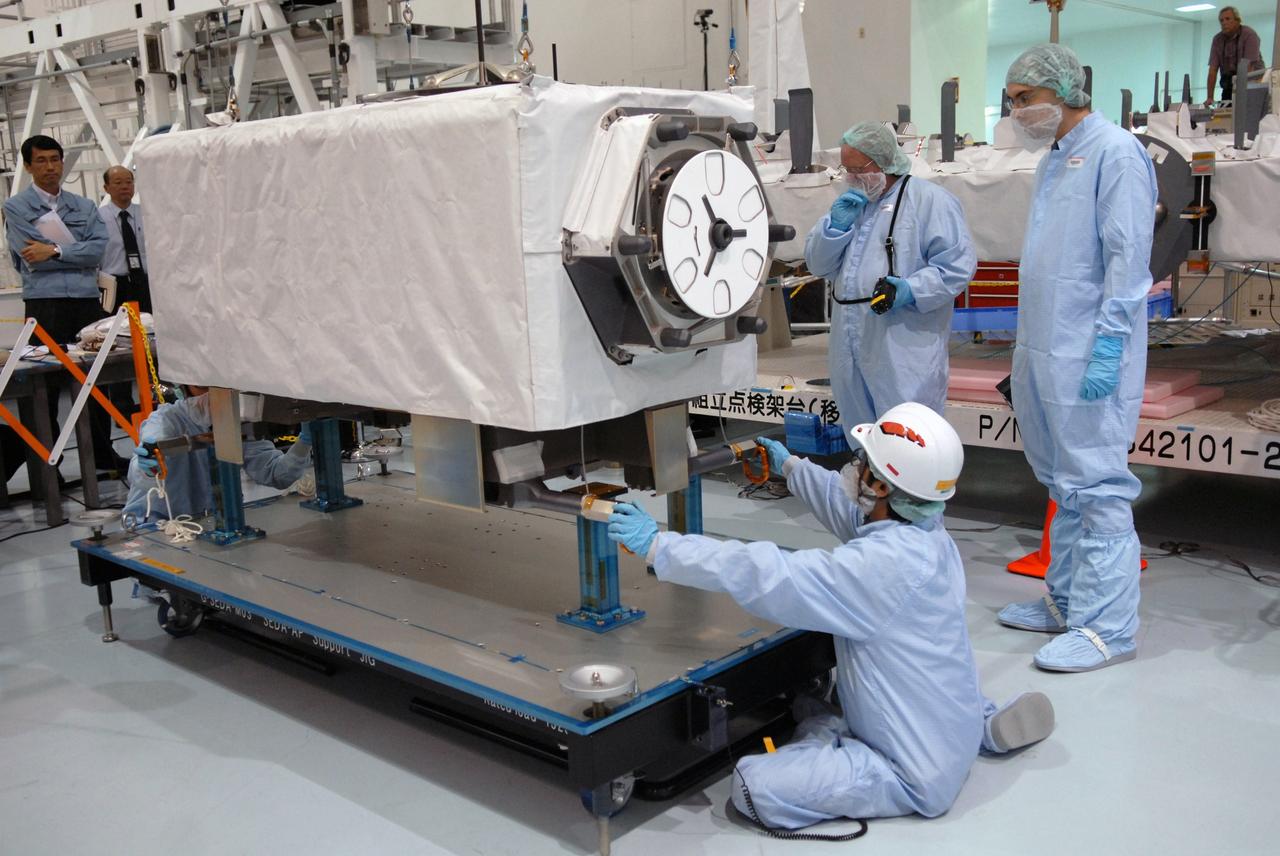
CAPE CANAVERAL, Fla. – In the Space Station Processing Facility at NASA's Kennedy Space Center in Florida, workers check the mast deployment on the SEDA-AP or Space Environment Data Acquisition equipment--Attached Payload. SEDA-AP will measure space environment in ISS orbit and environmental effects on materials and electronic devices to investigate the interaction with and from the environment at the Kibo exposed facility. The payload will be installed on the Japanese Experiment Module's Experiment Logistics Module-Exposed Section, or ELM-ES. The ELM-ES is one of the final components of the Japan Aerospace Exploration Agency's Kibo laboratory for the International Space Station. It can provide payload storage space and can carry up to three payloads at launch. In addition, the ELM-ES provides a logistics function where it can be returned to the ground aboard the space shuttle. The ELM-ES will be carried aboard space shuttle Endeavour on the STS-127 mission targeted for launch May 15. Photo credit: NASA/Cory Huston
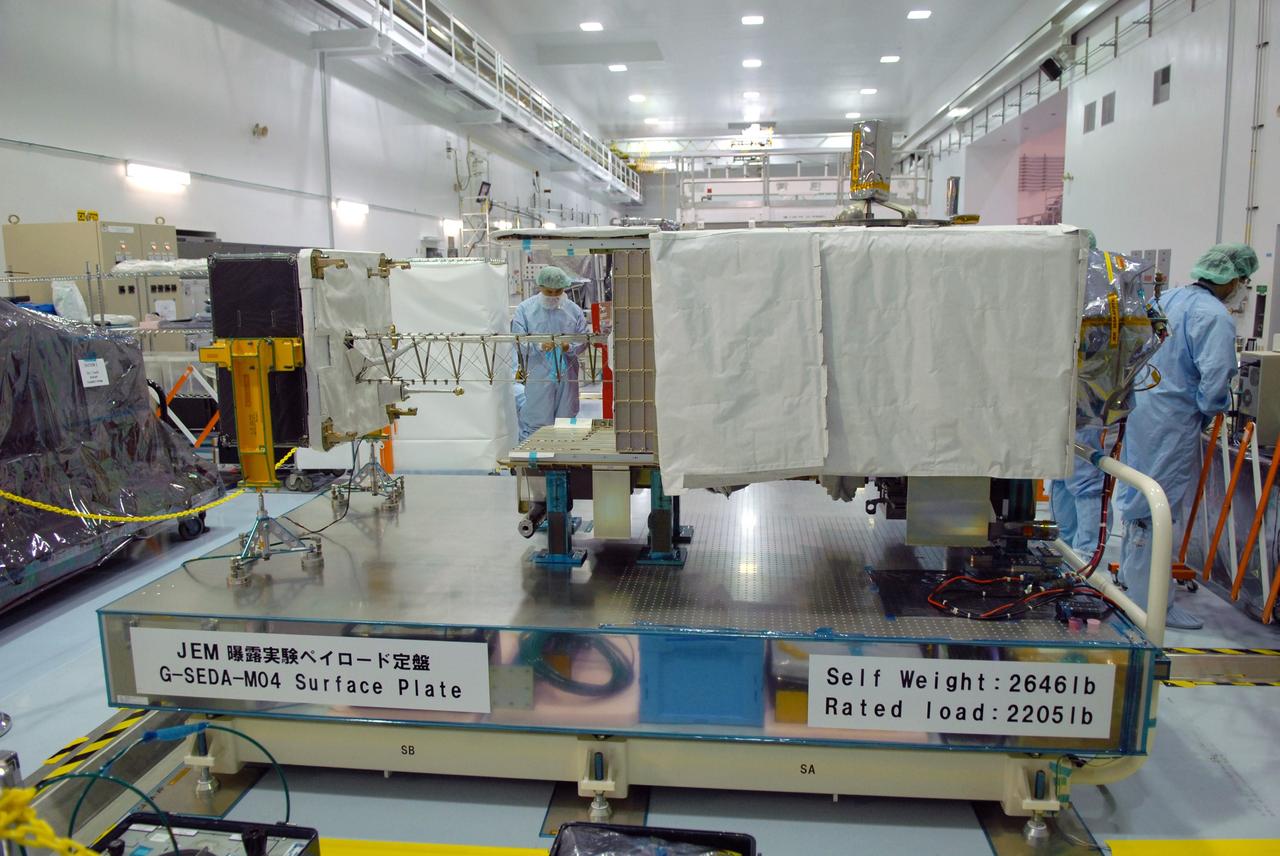
CAPE CANAVERAL, Fla. – In the Space Station Processing Facility at NASA's Kennedy Space Center in Florida, workers deploy the mast on the SEDA-AP or Space Environment Data Acquisition equipment--Attached Payload. SEDA-AP will measure space environment in ISS orbit and environmental effects on materials and electronic devices to investigate the interaction with and from the environment at the Kibo exposed facility. The payload will be installed on the Japanese Experiment Module's Experiment Logistics Module-Exposed Section, or ELM-ES. The ELM-ES is one of the final components of the Japan Aerospace Exploration Agency's Kibo laboratory for the International Space Station. It can provide payload storage space and can carry up to three payloads at launch. In addition, the ELM-ES provides a logistics function where it can be returned to the ground aboard the space shuttle. The ELM-ES will be carried aboard space shuttle Endeavour on the STS-127 mission targeted for launch May 15. Photo credit: NASA/Cory Huston
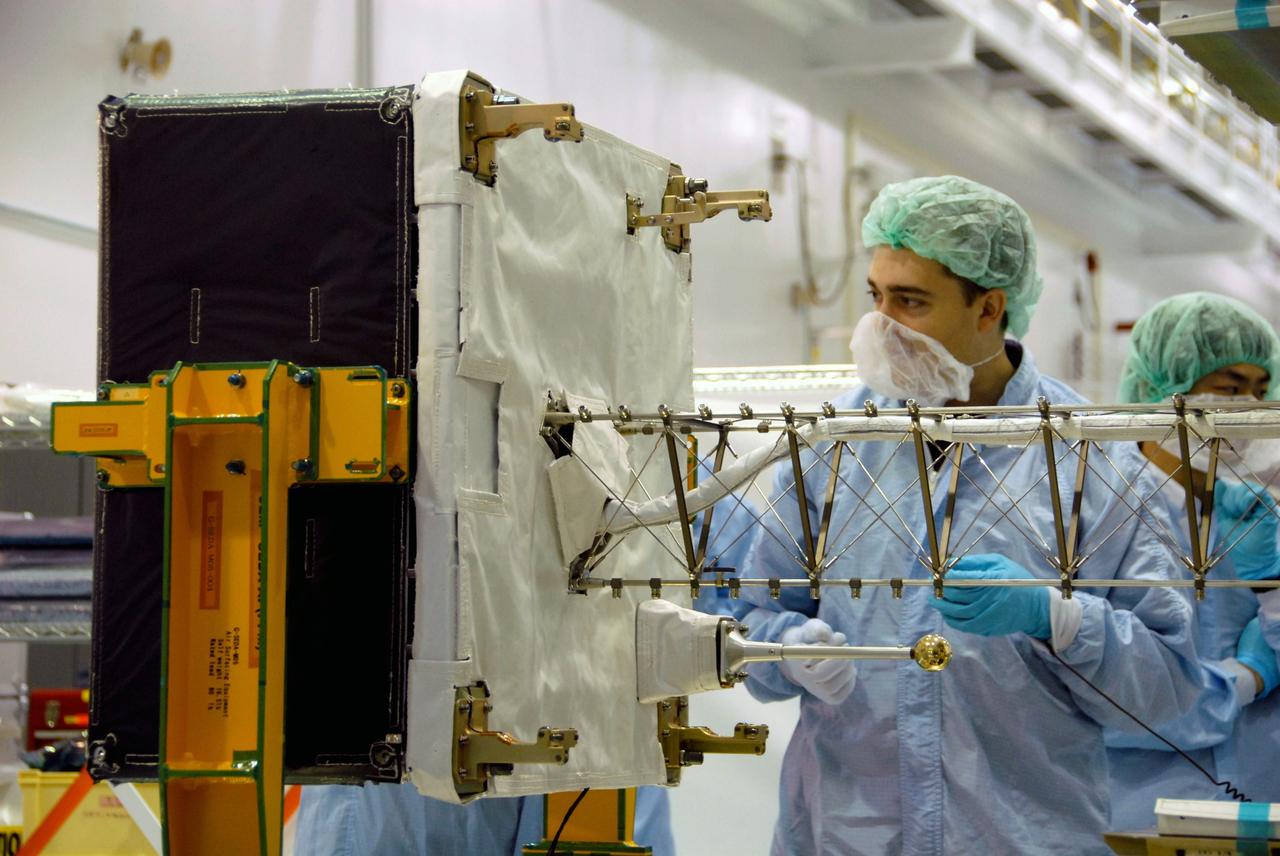
CAPE CANAVERAL, Fla. – In the Space Station Processing Facility at NASA's Kennedy Space Center in Florida, workers check the mast deployment on the SEDA-AP or Space Environment Data Acquisition equipment--Attached Payload. SEDA-AP will measure space environment in ISS orbit and environmental effects on materials and electronic devices to investigate the interaction with and from the environment at the Kibo exposed facility. The payload will be installed on the Japanese Experiment Module's Experiment Logistics Module-Exposed Section, or ELM-ES. The ELM-ES is one of the final components of the Japan Aerospace Exploration Agency's Kibo laboratory for the International Space Station. It can provide payload storage space and can carry up to three payloads at launch. In addition, the ELM-ES provides a logistics function where it can be returned to the ground aboard the space shuttle. The ELM-ES will be carried aboard space shuttle Endeavour on the STS-127 mission targeted for launch May 15. Photo credit: NASA/Cory Huston
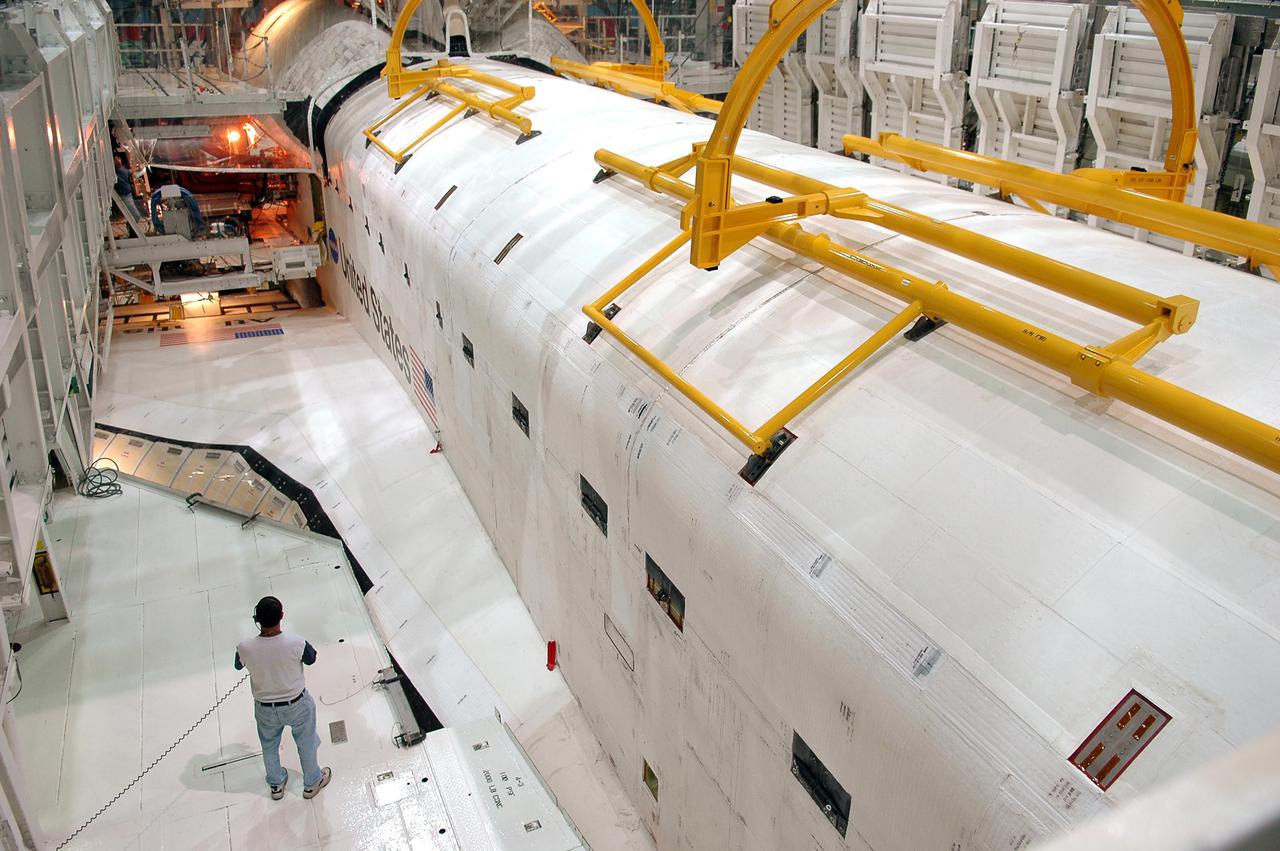
KENNEDY SPACE CENTER, FLA. - In Orbiter Processing Facility bay 1 at NASA’s Kennedy Space Center, Atlantis’ payload bay doors are being opened. The payload bay doors were closed for a clearance check on the Orbiter Boom Sensor System (OBSS), built in Canada. The 50-foot-long OBSS attaches to the Remote Manipulator System, or Shuttle arm, and is one of the new safety measures for Return to Flight. It equips the orbiter with cameras and laser systems to inspect the Shuttle’s Thermal Protection System while in space. Mission STS-121 is targeted for launch in September. Once the bay doors are open again, further work will be done in the bay.

KENNEDY SPACE CENTER, FLA. - In the Orbiter Processing Facility bay 1 at Kennedy Space Center in Florida, the payload bay doors of the orbiter Atlantis are being closed. The Orbiter Boom Sensor System (OBSS) is seen on the starboard side (lower) of the payload bay. The 50-foot-long OBSS attaches to the Shuttle arm and is one of the new safety measures for Return to Flight. It equips the orbiter with cameras and laser systems to inspect the Shuttle’s Thermal Protection System while in space. Atlantis is scheduled to fly on the second Return to Flight mission, STS-121, targeted for launch in a window extending from Sept. 9 to Sept. 24.
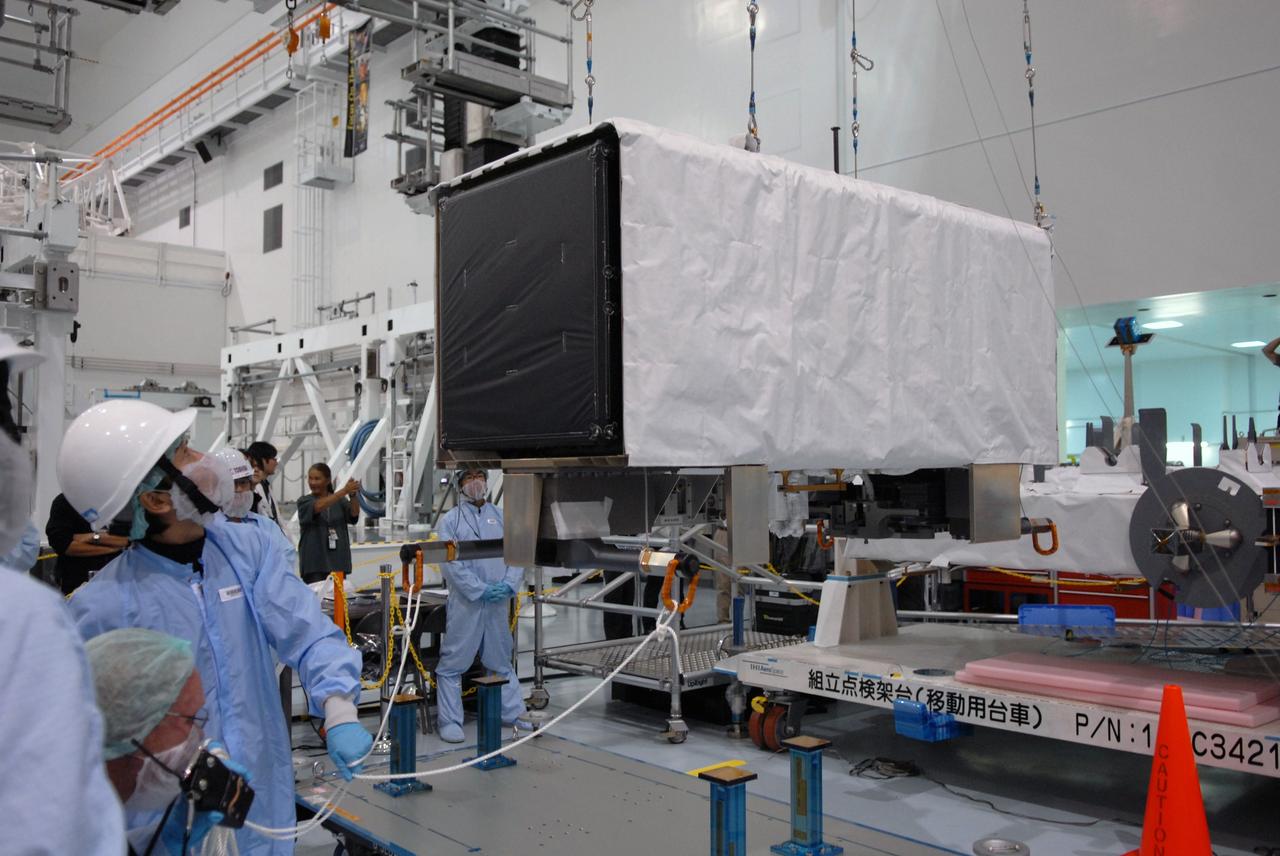
CAPE CANAVERAL, Fla. -- In the Space Station Processing Facility at NASA's Kennedy Space Center in Florida, an overhead crane lifts the SEDA-AP (Space Environment Data Acquisition Equipment-Attached Payload). The payload will be installed on the Japanese Experiment Module's Experiment Logistics Module-Exposed Section, or ELM-ES. The SEDA-AP and ELM-ES are part of space shuttle Endeavour's payload for the STS-127 mission. SEDA-AP will measure space environment in ISS orbit and environmental effects on materials and electronic devices to investigate the interaction with and from the environment at the Kibo exposed facility. Endeavour is targeted to launch May 15. Photo credit: NASA/Troy Cryder
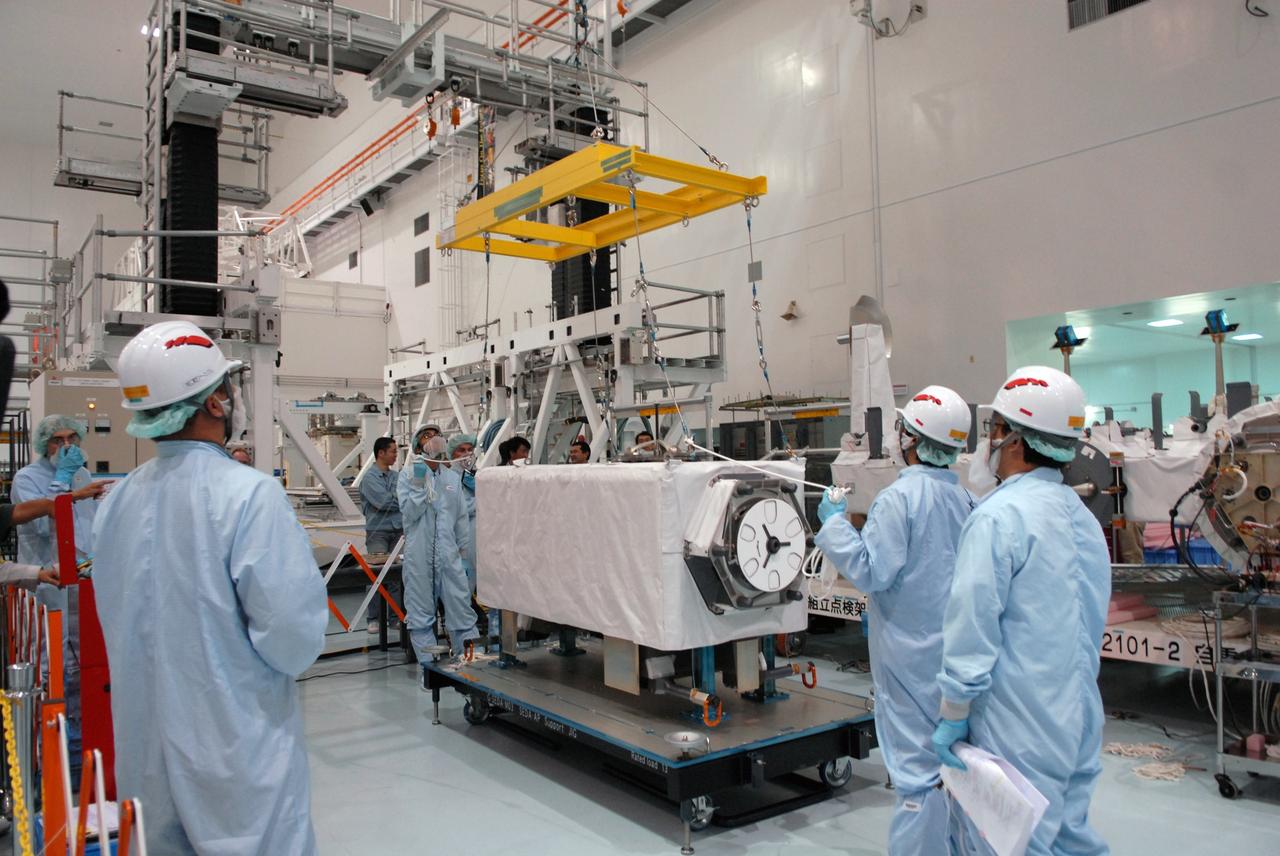
CAPE CANAVERAL, Fla. -- In the Space Station Processing Facility at NASA's Kennedy Space Center in Florida, an overhead crane is being lowered to attach to the SEDA-AP (Space Environment Data Acquisition Equipment-Attached Payload). The payload will be installed on the Japanese Experiment Module's Experiment Logistics Module-Exposed Section, or ELM-ES. The SEDA-AP and ELM-ES are part of space shuttle Endeavour's payload for the STS-127 mission. SEDA-AP will measure space environment in ISS orbit and environmental effects on materials and electronic devices to investigate the interaction with and from the environment at the Kibo exposed facility. Endeavour is targeted to launch May 15. Photo credit: NASA/Troy Cryder
CAPE CANAVERAL, Fla. -- In the Space Station Processing Facility at NASA's Kennedy Space Center in Florida, an overhead crane lifts the SEDA-AP (Space Environment Data Acquisition Equipment-Attached Payload). The payload will be installed on the Japanese Experiment Module's Experiment Logistics Module-Exposed Section, or ELM-ES. The SEDA-AP and ELM-ES are part of space shuttle Endeavour's payload for the STS-127 mission. SEDA-AP will measure space environment in ISS orbit and environmental effects on materials and electronic devices to investigate the interaction with and from the environment at the Kibo exposed facility. Endeavour is targeted to launch May 15. Photo credit: NASA/Troy Cryder
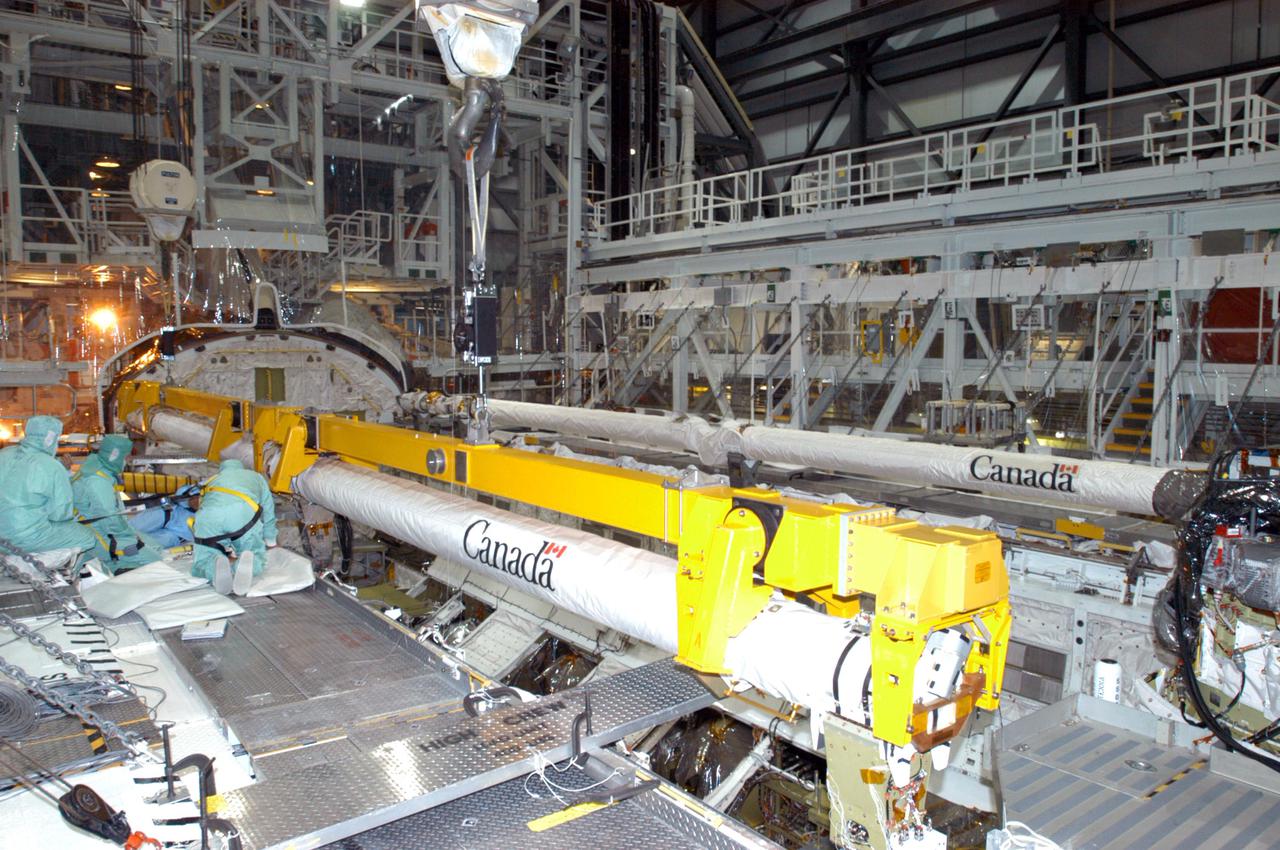
KENNEDY SPACE CENTER, FLA. - In the Orbiter Processing Facility bay 1 at NASA’s Kennedy Space Center, workers are installing the Orbital Boom Sensor System (foreground) in Atlantis’ payload bay. The 50-foot-long OBSS attaches to the Remote Manipulator System (background), or Shuttle robotic arm, and is one of the new safety measures for Return to Flight. It equips the orbiter with cameras and laser systems to inspect the Shuttle’s Thermal Protection System while in space. Mission STS-121 is targeted for launch in July.
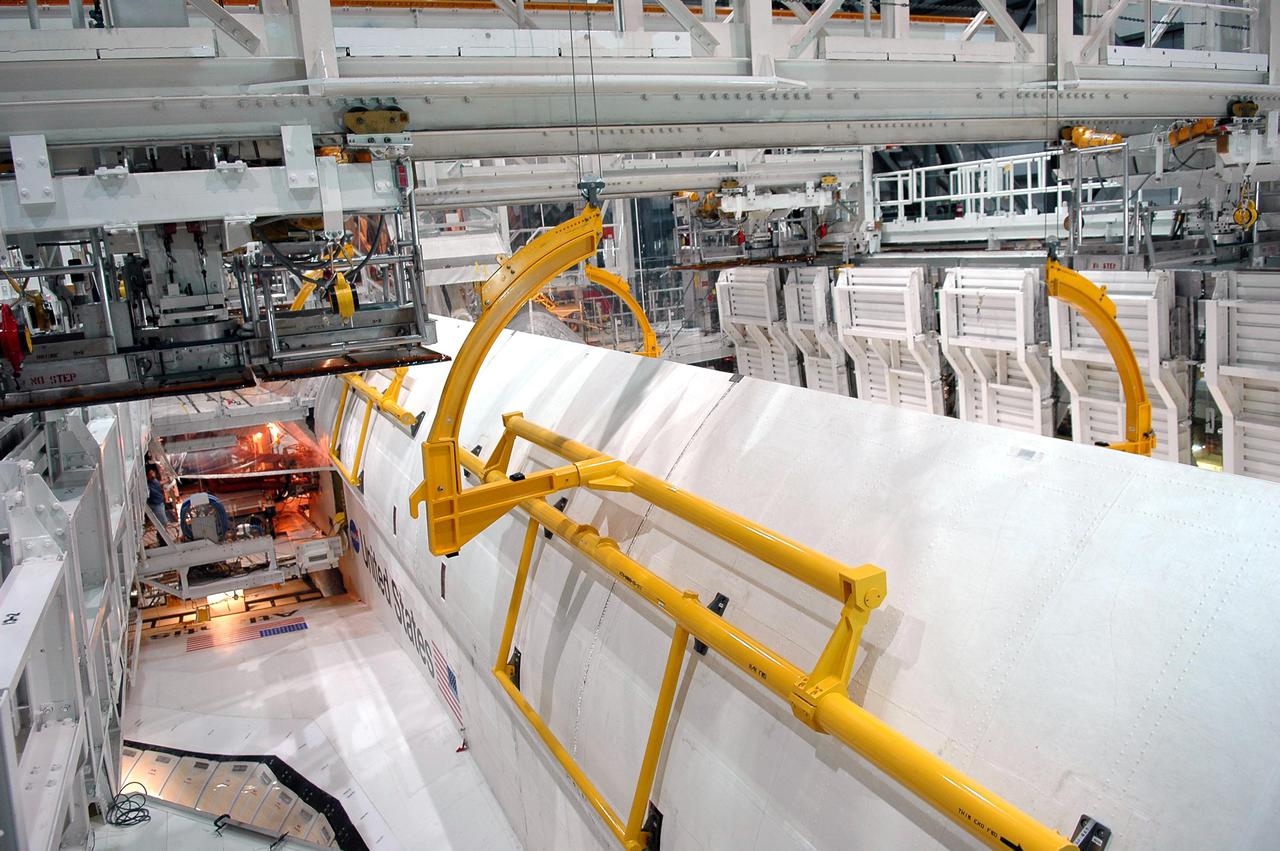
KENNEDY SPACE CENTER, FLA. - In Orbiter Processing Facility bay 1 at NASA’s Kennedy Space Center, Atlantis’ payload bay doors are partially opened. The 50-foot-long OBSS attaches to the Remote Manipulator System, or Shuttle arm, and is one of the new safety measures for Return to Flight. It equips the orbiter with cameras and laser systems to inspect the Shuttle’s Thermal Protection System while in space. Mission STS-121 is targeted for launch in September. Once Atlantis' bay doors are open again, further work will be done in the bay.
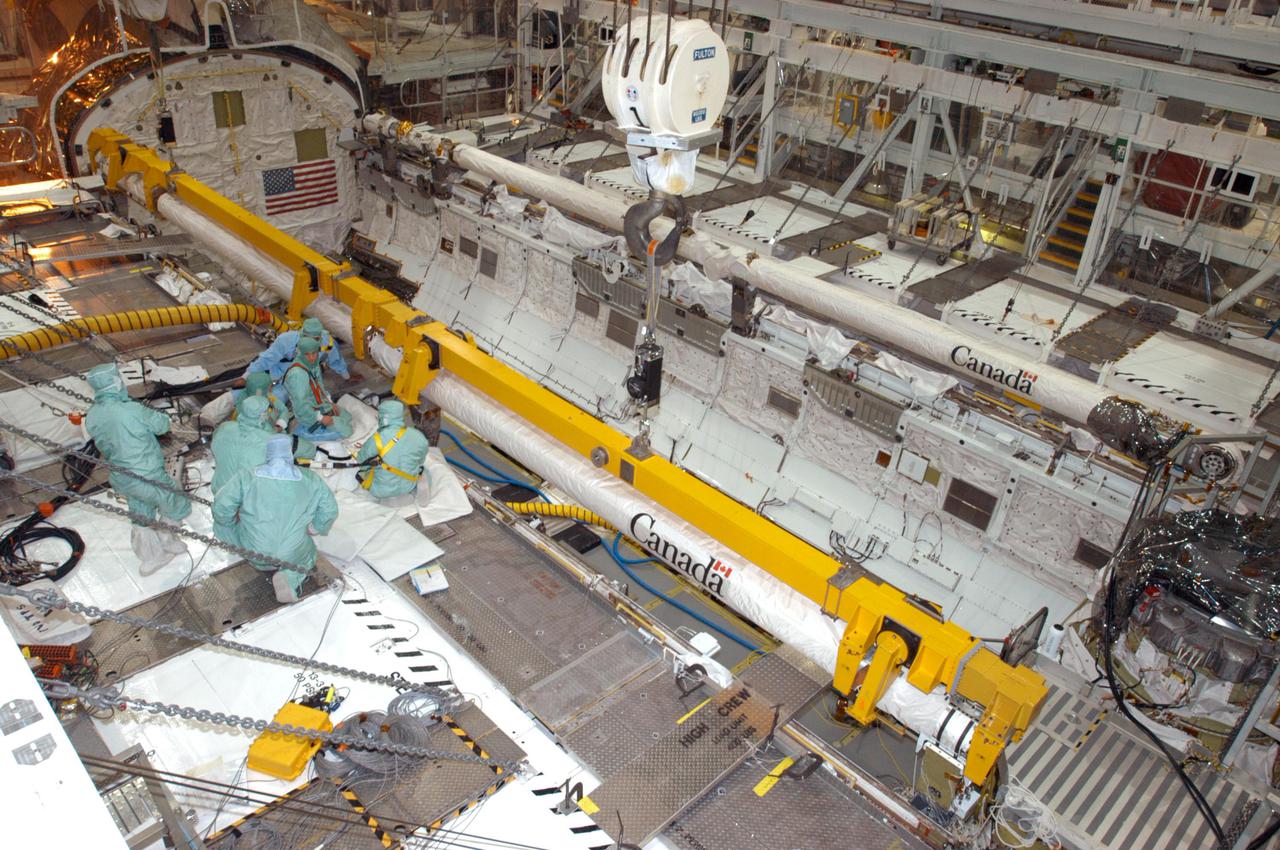
KENNEDY SPACE CENTER, FLA. - In the Orbiter Processing Facility bay 1 at NASA’s Kennedy Space Center, workers are installing the Orbital Boom Sensor System (foreground) in Atlantis’ payload bay. The 50-foot-long OBSS attaches to the Remote Manipulator System (background), or Shuttle robotic arm, and is one of the new safety measures for Return to Flight. It equips the orbiter with cameras and laser systems to inspect the Shuttle’s Thermal Protection System while in space. Mission STS-121 is targeted for launch in July.
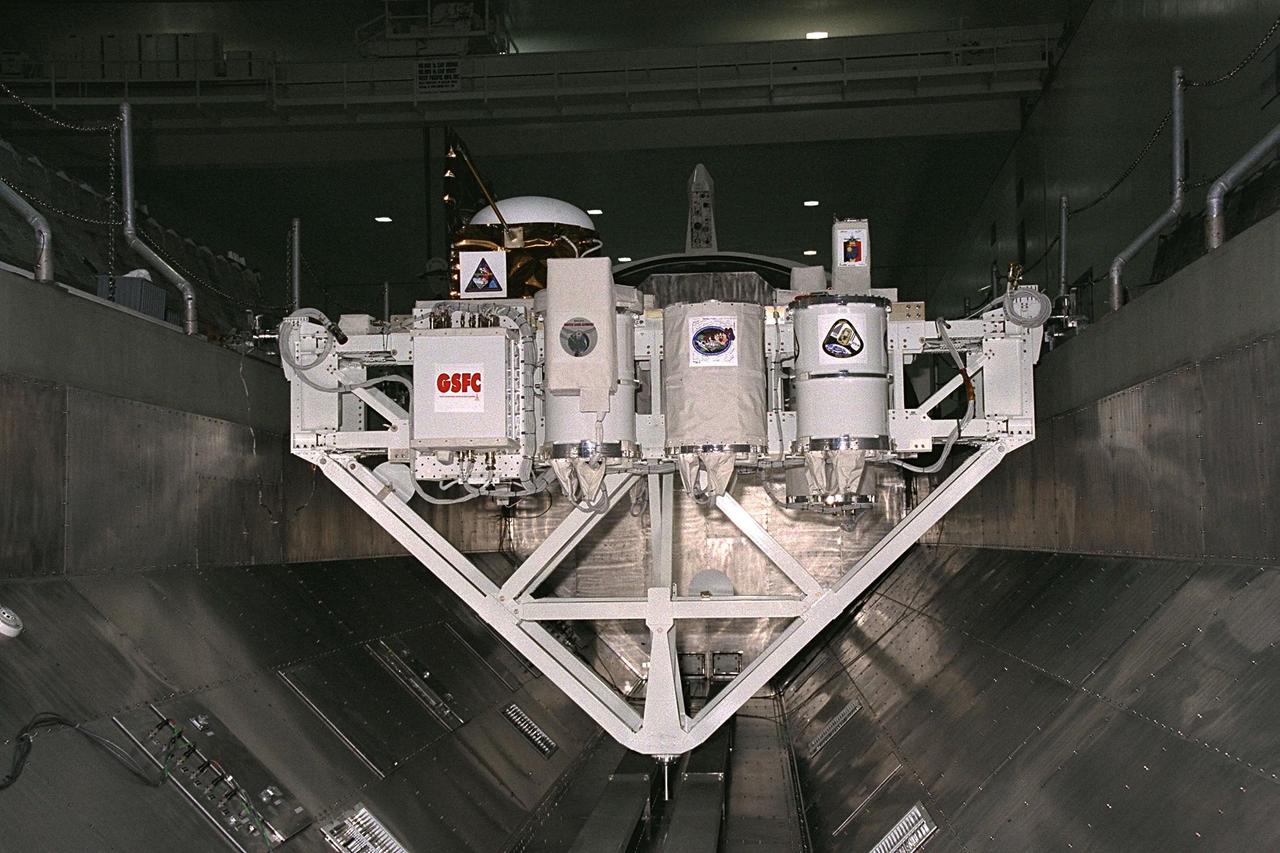
The Technology Applications and Science-1 (TAS-1) payload for the STS-85 mission rests in a payload canister in the Space Station Processing Facility prior to its trip out to Launch Pad 39A for installation into the payload bay of the Space Shuttle Orbiter Discovery. The TAS-1 holds seven separate experiments that will provide data on the Earth’s topography and atmosphere, study the sun’s energy, and test new thermal control devices, as well as several student-developed experiments. Other STS-85 payloads include the Cryogenic Infrared Spectrometers and Telescopes for the Atmosphere-Shuttle Pallet Satellite-2 (CRISTA-SPAS-2). The CRISTA is a system of three telescopes and four spectrometers to measure infrared radiation emitted by the Earth’s middle atmosphere. During the 11-day mission, the CRISTA-SPAS-2 free-flying satellite will be deployed from Discovery and retrieved later in the flight. Also onboard the satellite will be the Middle Atmosphere High Resolution Spectrograph Investigation (MAHRSI) to measure ultraviolet radiation emitted and scattered by the Earth’s atmosphere. The International Extreme Ultraviolet Hitchhiker-2 (IEH-2) will also be in the payload bay. The IEH-2 experiments will study ultraviolet radiation from stars, the sun and in the solar system
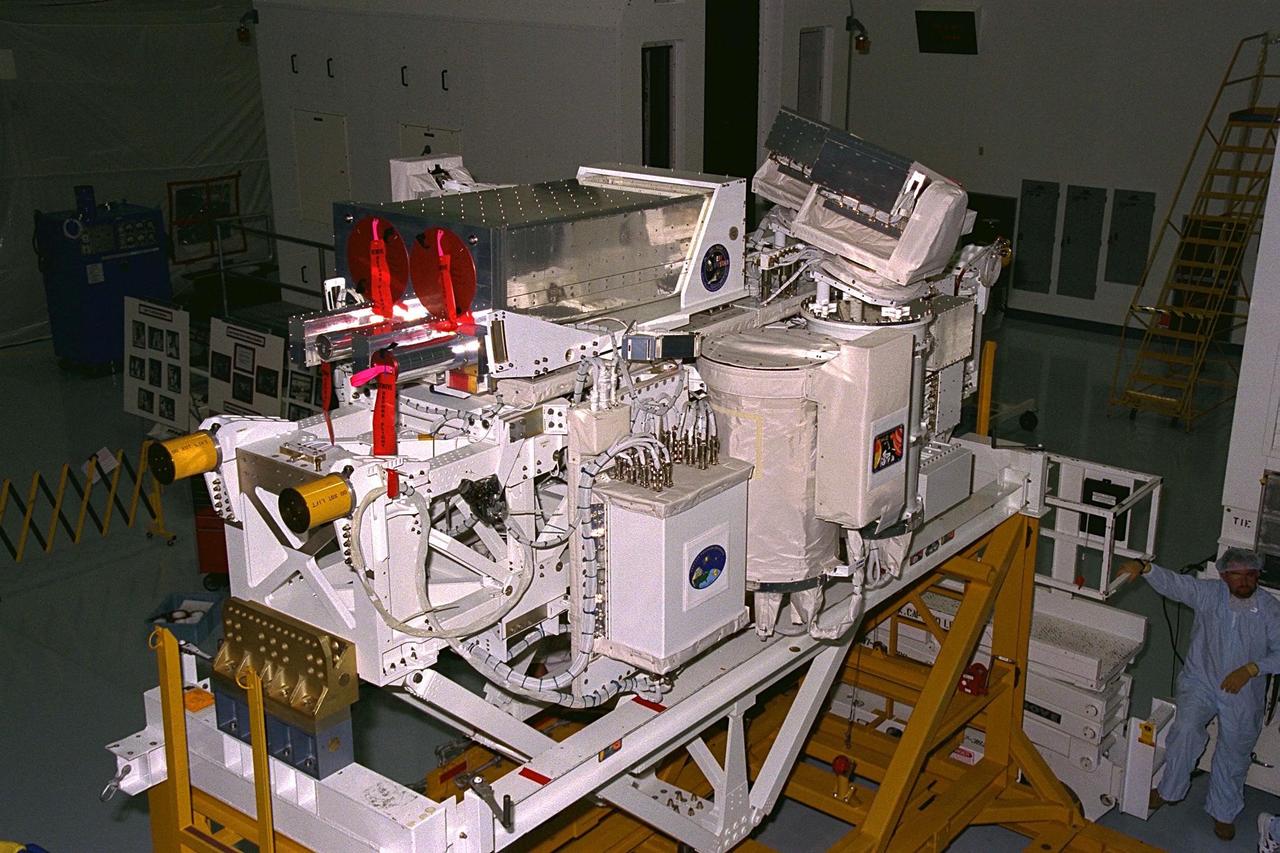
The International Extreme Ultraviolet Hitchhiker-2 (IEH-2) payload rests in a work stand in the Space Station Processing Facility prior to its trip out to Launch Pad 39A for installation into the payload bay of the Space Shuttle Orbiter Discovery for the STS-85 mission. The IEH-2 experiments will study ultraviolet radiation from stars, the sun and in the solar system. The Technology Applications and Science-1 (TAS-1) payload is another series of experiments that will be conducted during the 11-day mission in Discovery’s payload bay. The TAS-1 holds seven separate experiments that will provide data on the Earth’s topography and atmosphere, study the sun’s energy, and test new thermal control devices, as well as several student-developed experiments. Other STS-85 payloads include the Cryogenic Infrared Spectrometers and Telescopes for the Atmosphere-Shuttle Pallet Satellite-2 (CRISTA-SPAS-2). The CRISTA is a system of three telescopes and four spectrometers to measure infrared radiation emitted by the Earth’s middle atmosphere. The CRISTA-SPAS-2 free-flying satellite will be deployed from Discovery and retrieved later in the flight. Also onboard the satellite will be the Middle Atmosphere High Resolution Spectrograph Investigation (MAHRSI) to measure ultraviolet radiation emitted and scattered by the Earth’s atmosphere
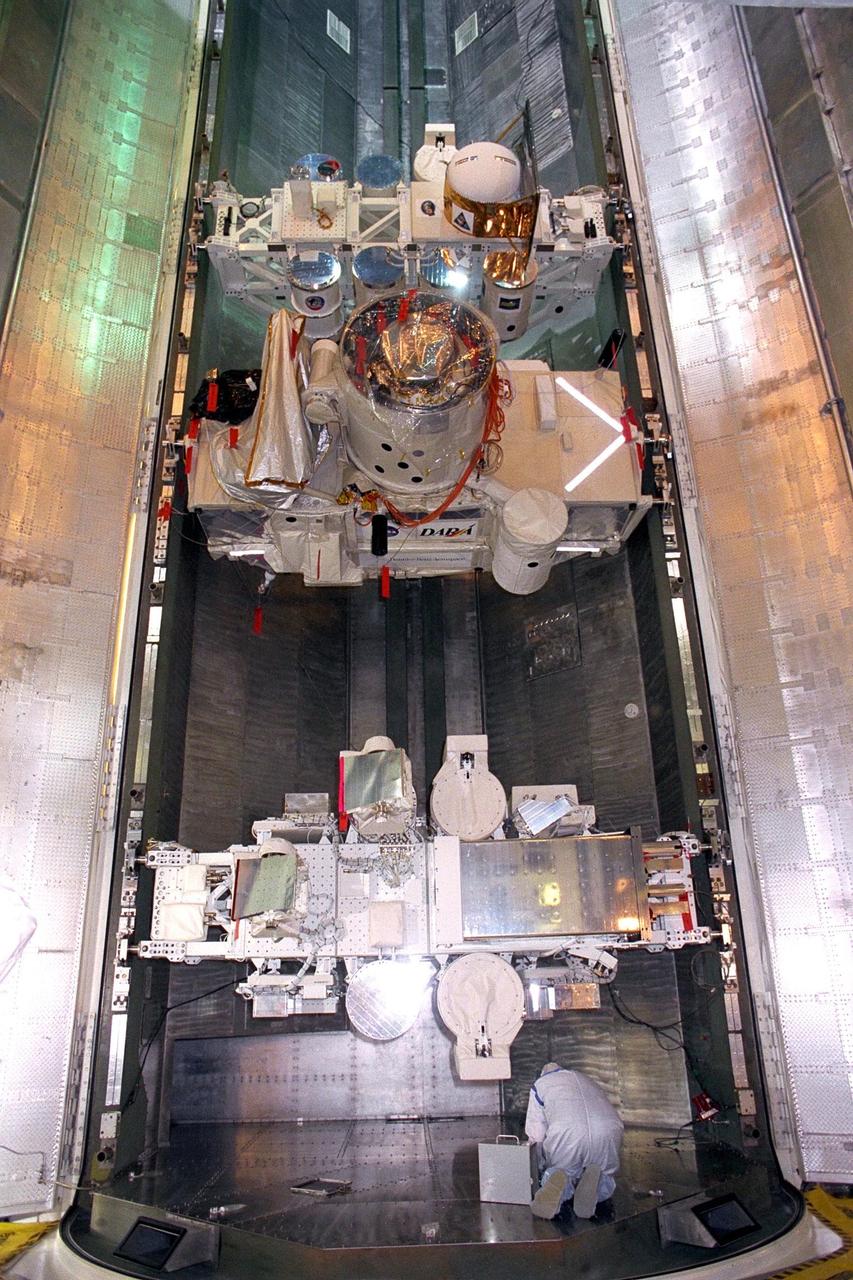
A payload canister in the Payload Changeout Room (PCR) at Launch Pad 39A holds the Cryogenic Infrared Spectrometers and Telescopes for the Atmosphere-Shuttle Pallet Satellite-2 (CRISTA-SPAS-2) payload for the STS-85 mission (center), as well as the Technology Applications and Science-1 (TAS-1) (top) and International Extreme Ultraviolet Hitchhiker-2 (IEH-2) (bottom) payloads. All three will be transferred from the PCR into the payload bay of the Space Shuttle Orbiter Discovery after the space vehicle arrives at the pad. The CRISTA is a system of three telescopes and four spectrometers to measure infrared radiation emitted by the Earth’s middle atmosphere. During the 11-day mission, the CRISTA-SPAS-2 free-flying satellite will be deployed from Discovery and retrieved later in the flight. Also onboard the satellite will be the Middle Atmosphere High Resolution Spectrograph Investigation (MAHRSI) to measure ultraviolet radiation emitted and scattered by the Earth’s atmosphere. The TAS-1 holds seven separate experiments that will provide data on the Earth’s topography and atmosphere, study the sun’s energy, and test new thermal control devices, as well as several student-developed experiments. The IEH-2 experiments will study ultraviolet radiation from stars, the sun and in the solar system
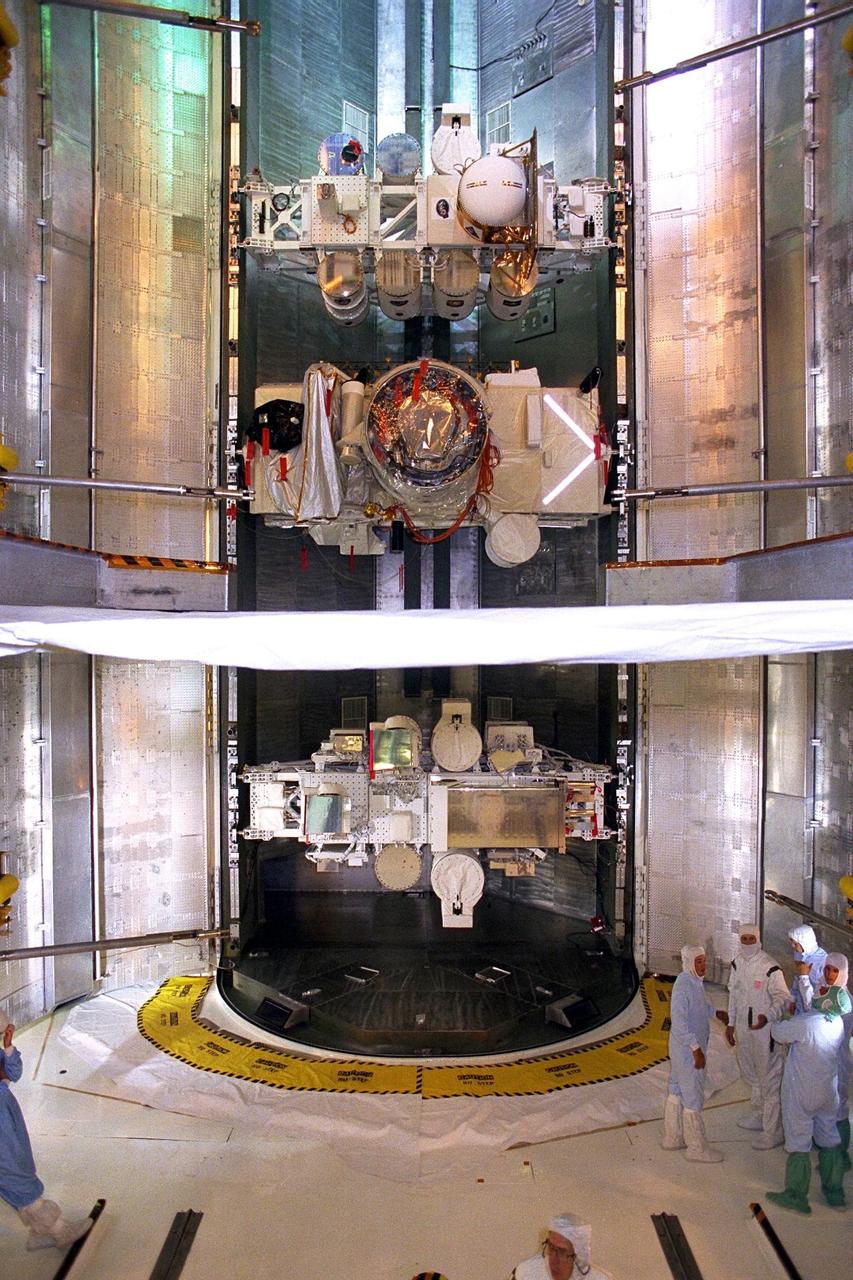
A payload canister in the Payload Changeout Room (PCR) at Launch Pad 39A holds the Cryogenic Infrared Spectrometers and Telescopes for the Atmosphere-Shuttle Pallet Satellite-2 (CRISTA-SPAS-2) payload for the STS-85 mission (center), as well as the Technology Applications and Science-1 (TAS-1) (top) and International Extreme Ultraviolet Hitchhiker-2 (IEH-2) (bottom) payloads. All three will be transferred from the PCR into the payload bay of the Space Shuttle Orbiter Discovery after the space vehicle arrives at the pad. The CRISTA is a system of three telescopes and four spectrometers to measure infrared radiation emitted by the Earth’s middle atmosphere. During the 11-day mission, the CRISTA-SPAS-2 free-flying satellite will be deployed from Discovery and retrieved later in the flight. Also onboard the satellite will be the Middle Atmosphere High Resolution Spectrograph Investigation (MAHRSI) to measure ultraviolet radiation emitted and scattered by the Earth’s atmosphere. The TAS-1 holds seven separate experiments that will provide data on the Earth’s topography and atmosphere, study the sun’s energy, and test new thermal control devices, as well as several student-developed experiments. The IEH-2 experiments will study ultraviolet radiation from stars, the sun and in the solar system
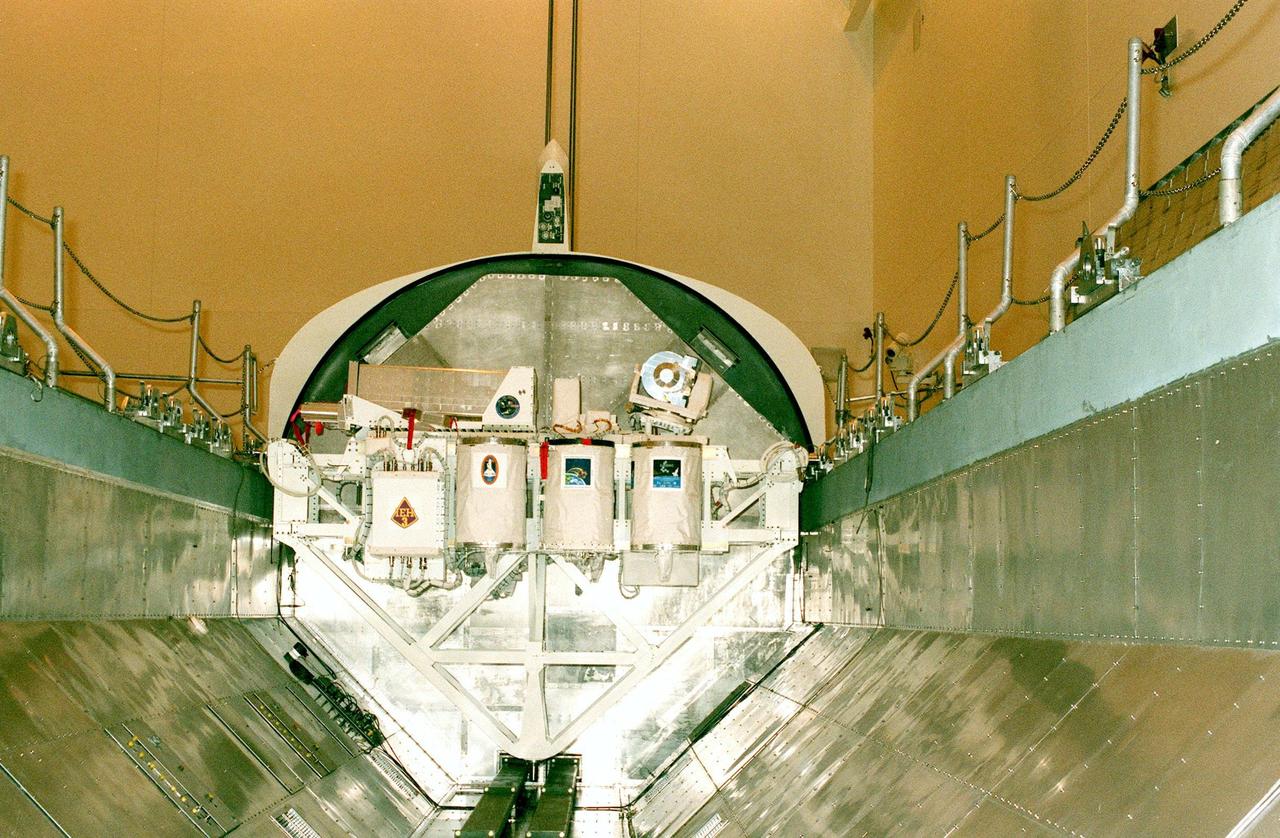
KENNEDY SPACE CENTER, FLA. -- The International Extreme Ultraviolet Hitchhiker (IEH-3), one of the payloads for the STS-95 mission, is moved to a payload canister in the Multi-Payload Processing Facility. The mission is scheduled for liftoff on Space Shuttle Discovery on Oct. 29. IEH-3 comprises several experiments that will study the Jovian planetary system, hot stars, planetary and reflection nebulae, other stellar objects and their environments through remote observation of EUV/FUV emissions; study spacecraft interactions, Shuttle glow, thruster firings, and contamination; and measure the solar constant and identify variations in the value during a solar cycle. Other research payloads include the Hubble Space Telescope Orbital Systems Test Platform, the Spartan solar-observing deployable spacecraft, and the SPACEHAB single module with experiments on space flight and the aging process
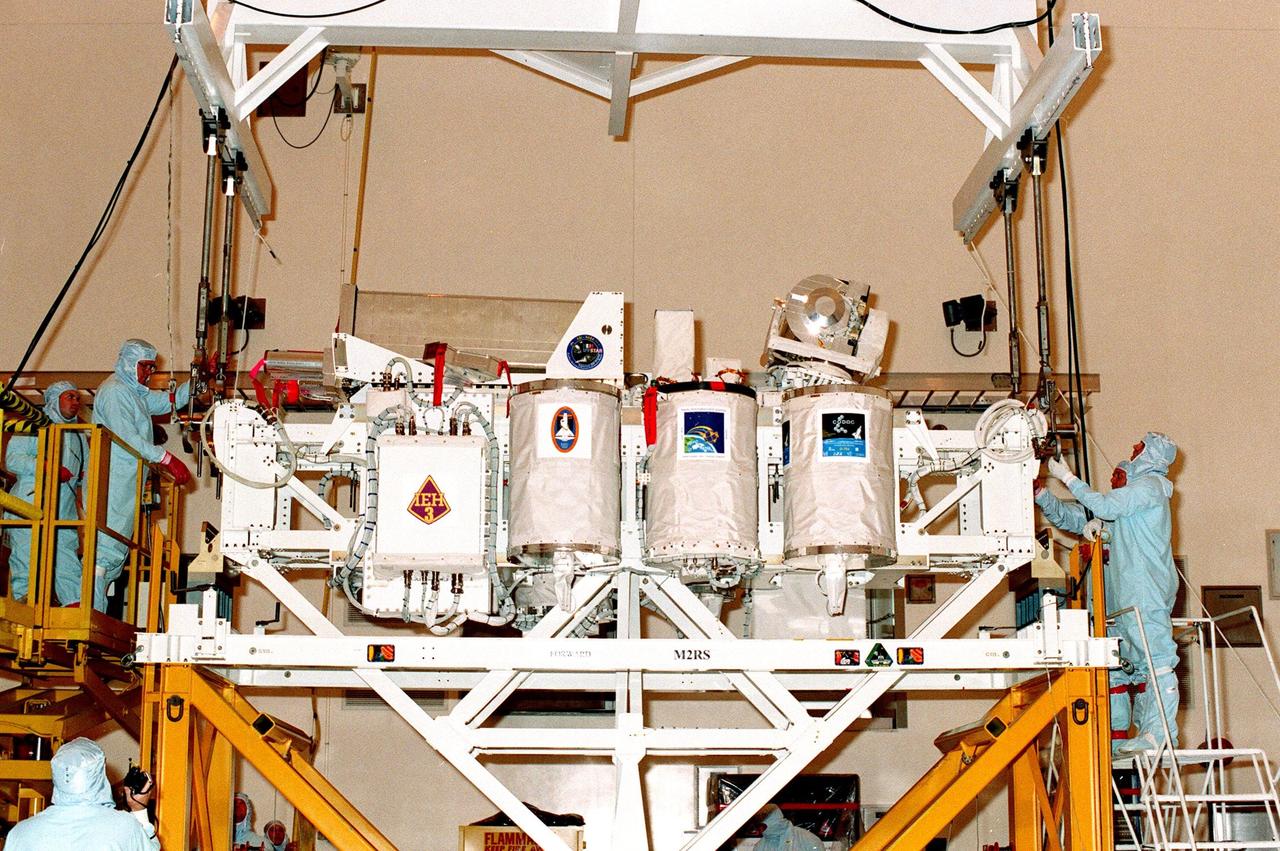
KENNEDY SPACE CENTER, FLA. -- The International Extreme Ultraviolet Hitchhiker (IEH-3), one of the payloads for the STS-95 mission, is prepared for its move to a payload canister in the Multi-Payload Processing Facility. The mission is scheduled for liftoff on Space Shuttle Discovery on Oct. 29. IEH-3 comprises several experiments that will study the Jovian planetary system, hot stars, planetary and reflection nebulae, other stellar objects and their environments through remote observation of EUV/FUV emissions; study spacecraft interactions, Shuttle glow, thruster firings, and contamination; and measure the solar constant and identify variations in the value during a solar cycle. Other research payloads include the Hubble Space Telescope Orbital Systems Test Platform, the Spartan solar-observing deployable spacecraft, and the SPACEHAB single module with experiments on space flight and the aging process
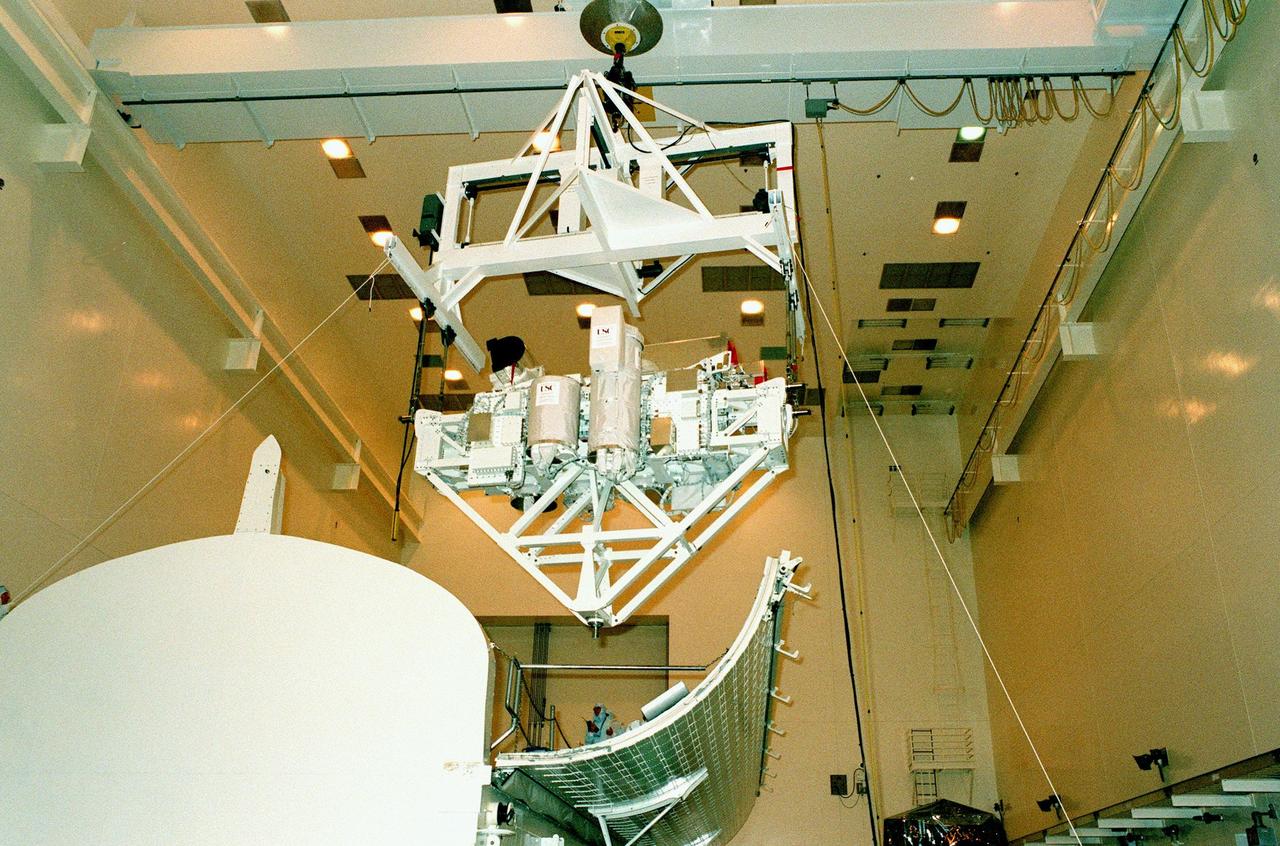
KENNEDY SPACE CENTER, FLA. -- The International Extreme Ultraviolet Hitchhiker (IEH-3), one of the payloads for the STS-95 mission, is suspended above its payload canister in the Multi-Payload Processing Facility. The mission is scheduled for liftoff on Space Shuttle Discovery on Oct. 29. IEH-3 comprises several experiments that will study the Jovian planetary system, hot stars, planetary and reflection nebulae, other stellar objects and their environments through remote observation of EUV/FUV emissions; study spacecraft interactions, Shuttle glow, thruster firings, and contamination; and measure the solar constant and identify variations in the value during a solar cycle. Other research payloads include the Hubble Space Telescope Orbital Systems Test Platform, the Spartan solar-observing deployable spacecraft, and the SPACEHAB single module with experiments on space flight and the aging process
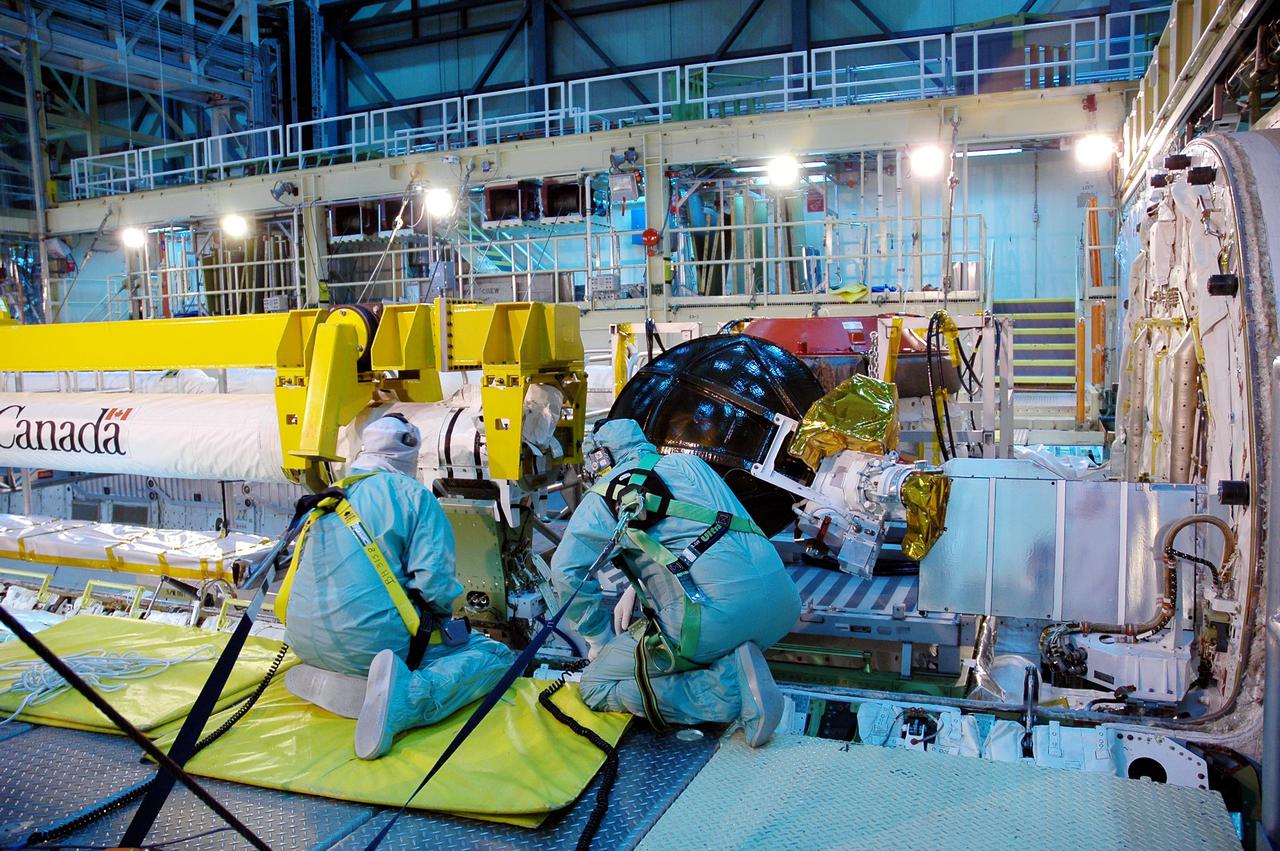
KENNEDY SPACE CENTER, FLA. - In the Orbiter Processing Facility bay 3, workers install the Orbiter Boom Sensor System (OBSS) onto the starboard side of Discovery’s payload bay. The 50-foot-long OBSS attaches to the Remote Manipulator System, or Shuttle robotic arm, and is one of the new safety measures for Return to Flight, equipping the orbiter with cameras and laser systems to inspect the Shuttle’s Thermal Protection System while in space. The Return to Flight mission, STS-114, has a launch window of May 12 to June 3, 2005.
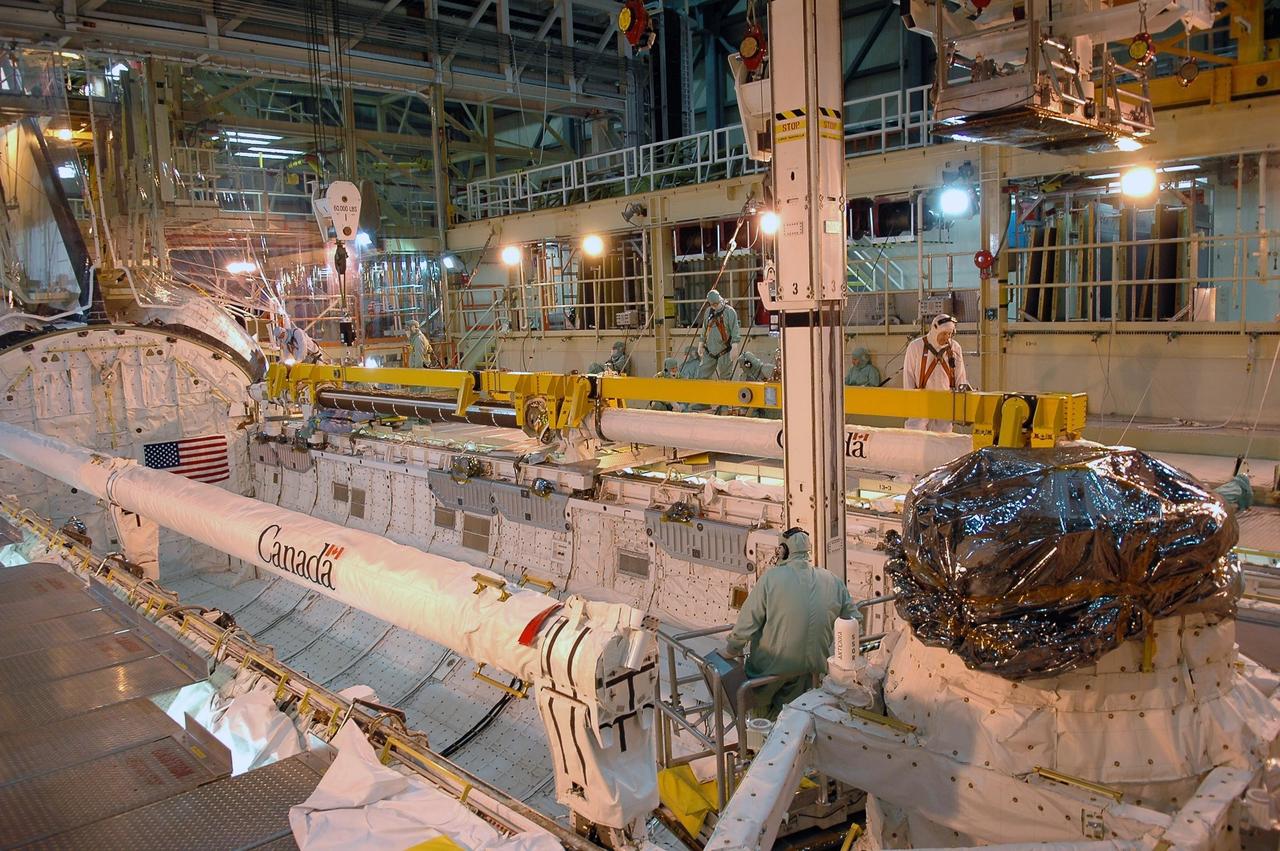
KENNEDY SPACE CENTER, FLA. - Inside the Orbiter Processing Facility bay 3 at NASA's Kennedy Space Center, workers attach an overhead crane to Discovery's robotic arm in the payload bay. The arm is being removed due to damage found on the arm after it was accidentally bumped by a bridge bucket in the payload bay. Ultrasound inspections revealed a small crack, measuring 1.25 inches by 0.015 inch deep. The arm will be sent back to the vendor for repair. The bucket was being used by technicians cleaning the area and was in the process of being stowed. A bridge bucket is a personnel transport device that is suspended from an overhead bridge that moves back and forth above the shuttle's mid-body. It allows workers to access the payload bay area without walking or standing on the payload bay floor or on the fixed platforms. Space Shuttle Discovery is scheduled for launch on mission STS-121 during a launch planning window of July 1-19. Photo credit: NASA/Kim Shiflett
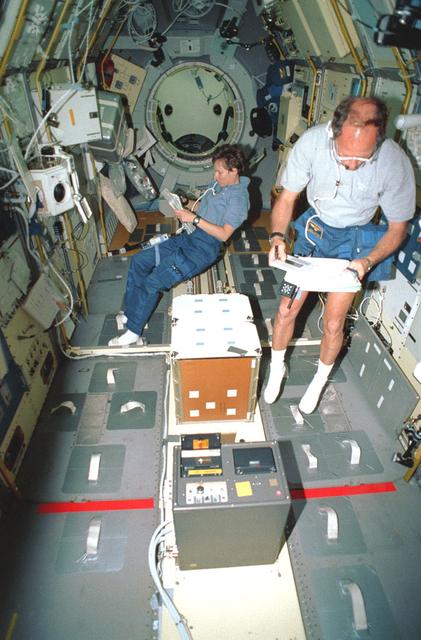
Onboard Space Shuttle Discovery (STS-42) Astronaut Norman E. Thagard, payload commander, and Canadian payload specialist Roberta L. Bondar are busily engaged with experiments in the International Microgravity Laboratory (IML-1) science module. Bondar reads a checklist near the Biorack while Thagard performs a VCR tape change-out. The two, along with four other NASA astronauts and a second IML-1 payload specialist spent more than eight days conducting experiments in Earth orbit. Part of the Space Acceleration Measurement System is in center foreground.
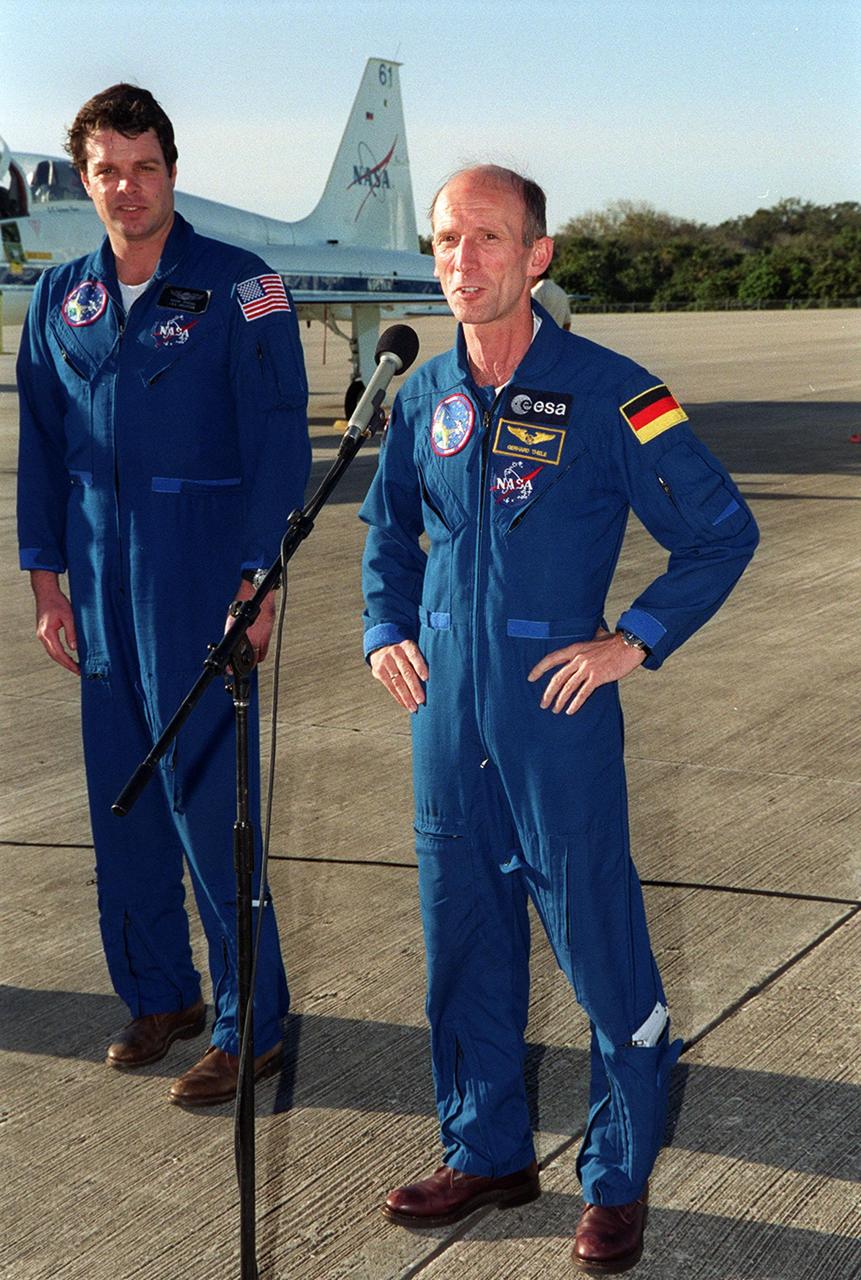
After their arrival at the Shuttle Landing Facility, the STS-99 crew talk to the media. At the microphone is Mission Specialist Gerhard Thiele, with the European Space Agency. At left is Commander Kevin Kregel. . The crew are here to take part in a Terminal Countdown Demonstration Test (TCDT), which provides simulated countdown exercises, emergency egress training, and opportunities to inspect the mission payloads in the orbiter's payload bay. Others taking part in the TCDT are Pilot Dominic Gorie and Mission Specialists Janice Voss (Ph.D.), Janet Lynn Kavandi (Ph.D.), Mamoru Mohri, who is with the National Space Development Agency (NASDA) of Japan. STS-99 is the Shuttle Radar Topography Mission, which will chart a new course, using two antennae and a 200-foot-long section of space station-derived mast protruding from the payload bay to produce unrivaled 3-D images of the Earth's surface. The result of the Shuttle Radar Topography Mission could be close to 1 trillion measurements of the Earth's topography. Besides contributing to the production of better maps, these measurements could lead to improved water drainage modeling, more realistic flight simulators, better locations for cell phone towers, and enhanced navigation safety. Launch of Endeavour on the 11-day mission is scheduled for Jan. 31 at 12:47 p.m. EST
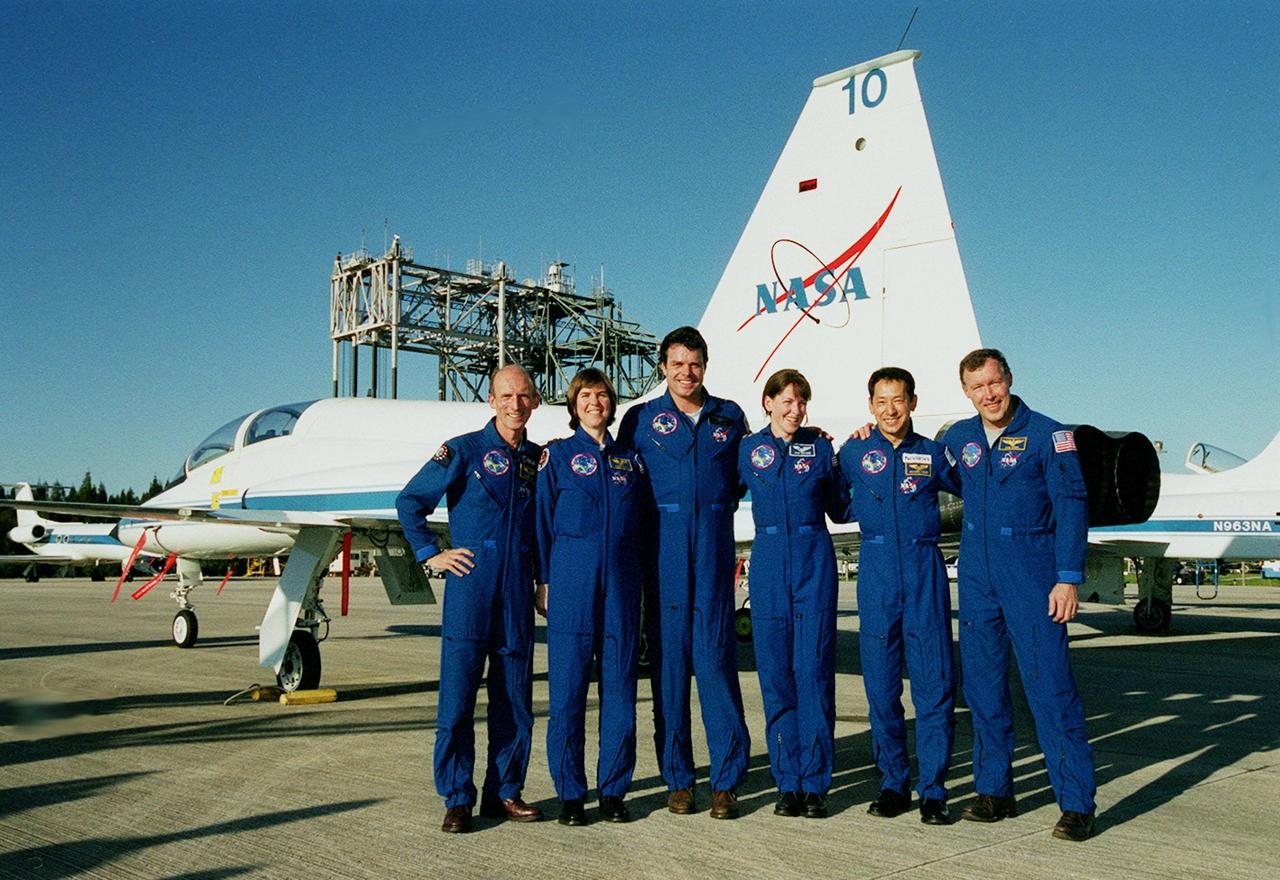
The STS-99 crew pose for a photo after their arrival at KSC's Shuttle Landing Facility. From left are Mission Specialists Gerhard Thiele, and Janice Voss (Ph.D.), Commander Kevin Kregel, Mission Specialists Janet Lynn Kavandi (Ph.D.) and Mamoru Mohri, and Pilot Dominic Gorie. Thiele is with the European Space Agency and Mohri is with the National Space Development Agency (NASDA) of Japan. The crew are here to take part in a Terminal Countdown Demonstration Test (TCDT), which provides simulated countdown exercises, emergency egress training, and opportunities to inspect the mission payloads in the orbiter's payload bay. STS-99 is the Shuttle Radar Topography Mission, which will chart a new course, using two antennae and a 200-foot-long section of space station-derived mast protruding from the payload bay to produce unrivaled 3-D images of the Earth's surface. The result of the Shuttle Radar Topography Mission could be close to 1 trillion measurements of the Earth's topography. Besides contributing to the production of better maps, these measurements could lead to improved water drainage modeling, more realistic flight simulators, better locations for cell phone towers, and enhanced navigation safety. Launch of Endeavour on the 11-day mission is scheduled for Jan. 31 at 12:47 p.m. EST
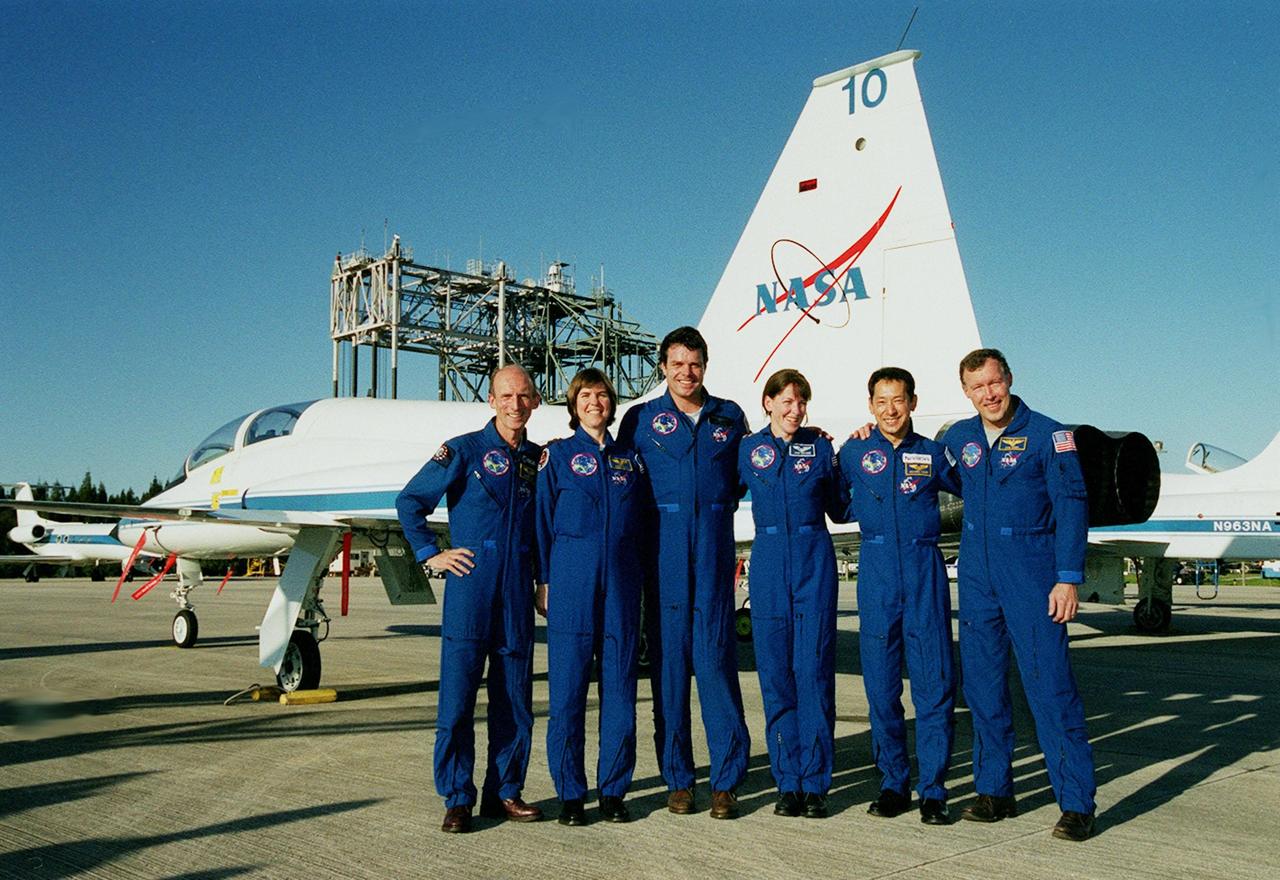
The STS-99 crew pose for a photo after their arrival at KSC's Shuttle Landing Facility. From left are Mission Specialists Gerhard Thiele, and Janice Voss (Ph.D.), Commander Kevin Kregel, Mission Specialists Janet Lynn Kavandi (Ph.D.) and Mamoru Mohri, and Pilot Dominic Gorie. Thiele is with the European Space Agency and Mohri is with the National Space Development Agency (NASDA) of Japan. The crew are here to take part in a Terminal Countdown Demonstration Test (TCDT), which provides simulated countdown exercises, emergency egress training, and opportunities to inspect the mission payloads in the orbiter's payload bay. STS-99 is the Shuttle Radar Topography Mission, which will chart a new course, using two antennae and a 200-foot-long section of space station-derived mast protruding from the payload bay to produce unrivaled 3-D images of the Earth's surface. The result of the Shuttle Radar Topography Mission could be close to 1 trillion measurements of the Earth's topography. Besides contributing to the production of better maps, these measurements could lead to improved water drainage modeling, more realistic flight simulators, better locations for cell phone towers, and enhanced navigation safety. Launch of Endeavour on the 11-day mission is scheduled for Jan. 31 at 12:47 p.m. EST
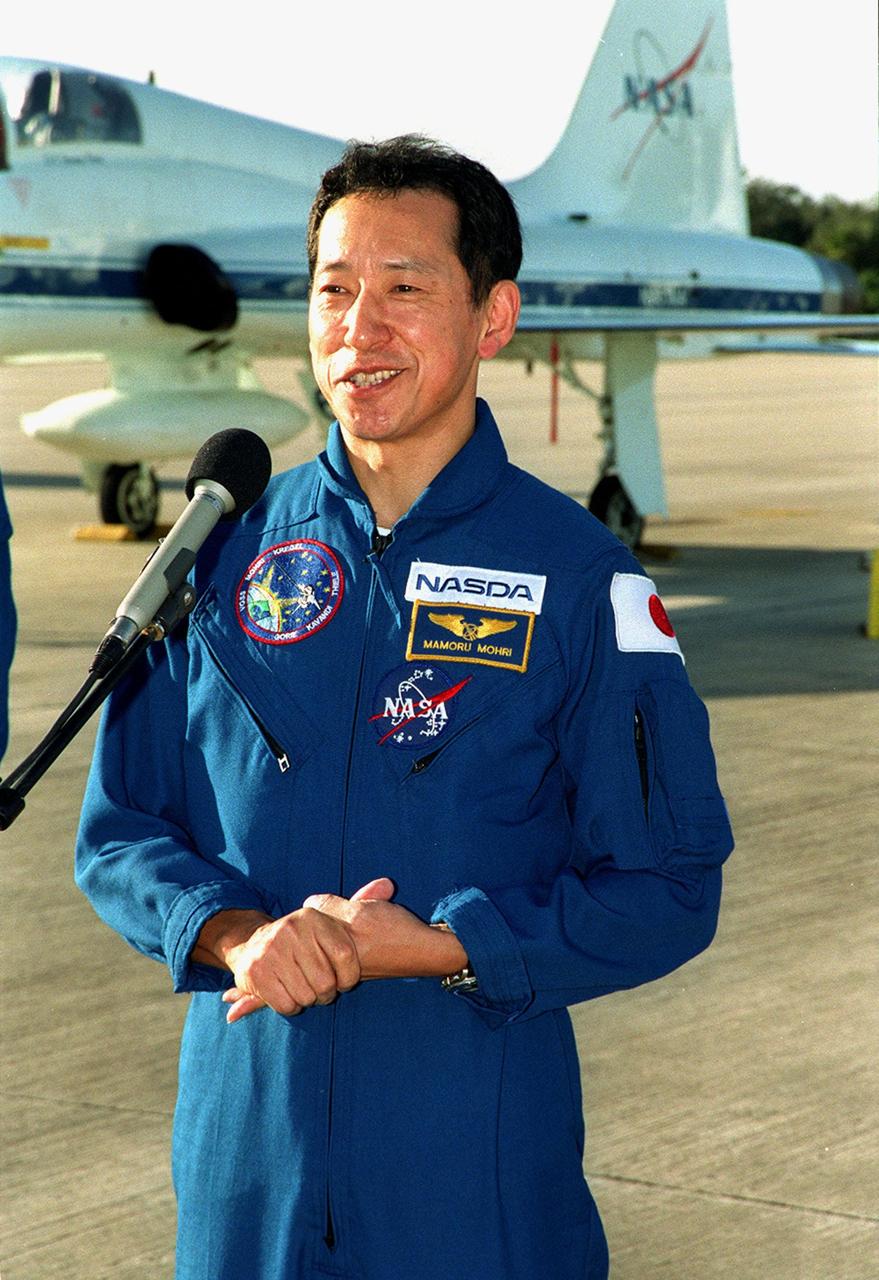
After their arrival at the Shuttle Landing Facility, the STS-99 crew talk to the media. At the microphone is Mission Specialist Mamoru Mohri, who is with the National Space Development Agency (NASDA) of Japan. The crew are here to take part in a Terminal Countdown Demonstration Test (TCDT), which provides simulated countdown exercises, emergency egress training, and opportunities to inspect the mission payloads in the orbiter's payload bay. Others taking part in the TCDT are Commander Kevin Kregel, Pilot Dominic Gorie and Mission Specialists Janice Voss (Ph.D.), Janet Lynn Kavandi (Ph.D.), and Gerhard Thiele, with the European Space Agency. STS-99 is the Shuttle Radar Topography Mission, which will chart a new course, using two antennae and a 200-foot-long section of space station-derived mast protruding from the payload bay to produce unrivaled 3-D images of the Earth's surface. The result of the Shuttle Radar Topography Mission could be close to 1 trillion measurements of the Earth's topography. Besides contributing to the production of better maps, these measurements could lead to improved water drainage modeling, more realistic flight simulators, better locations for cell phone towers, and enhanced navigation safety. Launch of Endeavour on the 11-day mission is scheduled for Jan. 31 at 12:47 p.m. EST

After their arrival at the Shuttle Landing Facility aboard T-38 training jet aircraft (background), the STS-99 crew talk to the media. From left are Mission Specialists Janice Voss (Ph.D.), Janet Lynn Kavandi (Ph.D.), Mamoru Mohri, who is with the National Space Development Agency (NASDA) of Japan, and Gerhard Thiele, with the European Space Agency, Commander Kevin Kregel (at microphone) and Pilot Dominic Gorie. The crew are here to take part in a Terminal Countdown Demonstration Test (TCDT), which provides simulated countdown exercises, emergency egress training, and opportunities to inspect the mission payloads in the orbiter's payload bay. STS-99 is the Shuttle Radar Topography Mission, which will chart a new course, using two antennae and a 200-foot-long section of space station-derived mast protruding from the payload bay to produce unrivaled 3-D images of the Earth's surface. The result of the Shuttle Radar Topography Mission could be close to 1 trillion measurements of the Earth's topography. Besides contributing to the production of better maps, these measurements could lead to improved water drainage modeling, more realistic flight simulators, better locations for cell phone towers, and enhanced navigation safety. Launch of Endeavour on the 11-day mission is scheduled for Jan. 31 at 12:47 p.m. EST
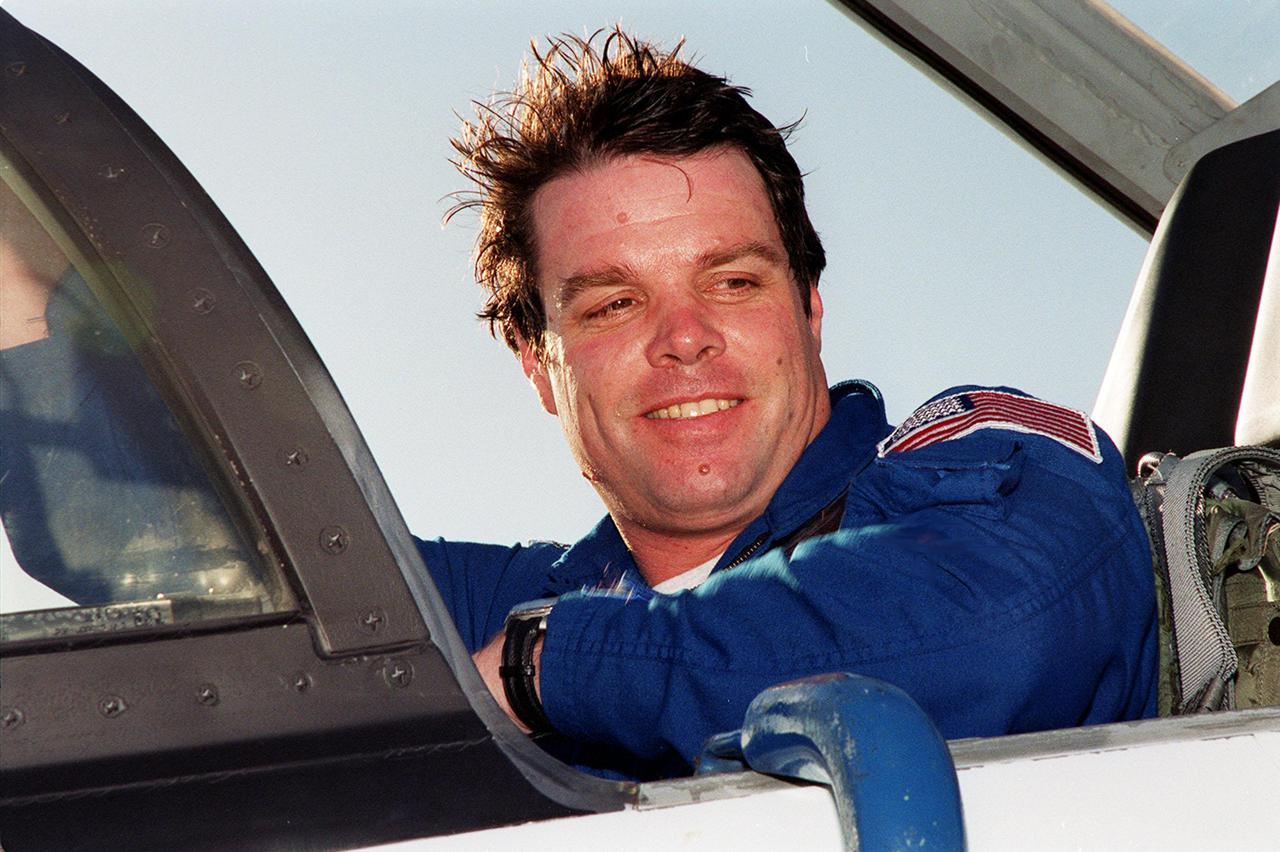
STS-99 Commander Kevin Kregel arrives at KSC's Shuttle Landing Facility aboard a T-38 training jet to take part in a Terminal Countdown Demonstration Test (TCDT). The TCDT provides the crew with simulated countdown exercises, emergency egress training, and opportunities to inspect the mission payloads in the orbiter's payload bay. Other crew members taking part are Pilot Dominic Gorie, and Mission Specialists Janet Lynn Kavandi (Ph.D.), Janice Voss (Ph.D.), Mamoru Mohri, who is with the National Space Development Agency (NASDA) of Japan, and Gerhard Thiele, who is with the European Space Agency. STS-99 is the Shuttle Radar Topography Mission, which will chart a new course, using two antennae and a 200-foot-long section of space station-derived mast protruding from the payload bay to produce unrivaled 3-D images of the Earth's surface. The result of the Shuttle Radar Topography Mission could be close to 1 trillion measurements of the Earth's topography. Besides contributing to the production of better maps, these measurements could lead to improved water drainage modeling, more realistic flight simulators, better locations for cell phone towers, and enhanced navigation safety. Launch of Endeavour on the 11-day mission is scheduled for Jan. 31 at 12:47 p.m. EST
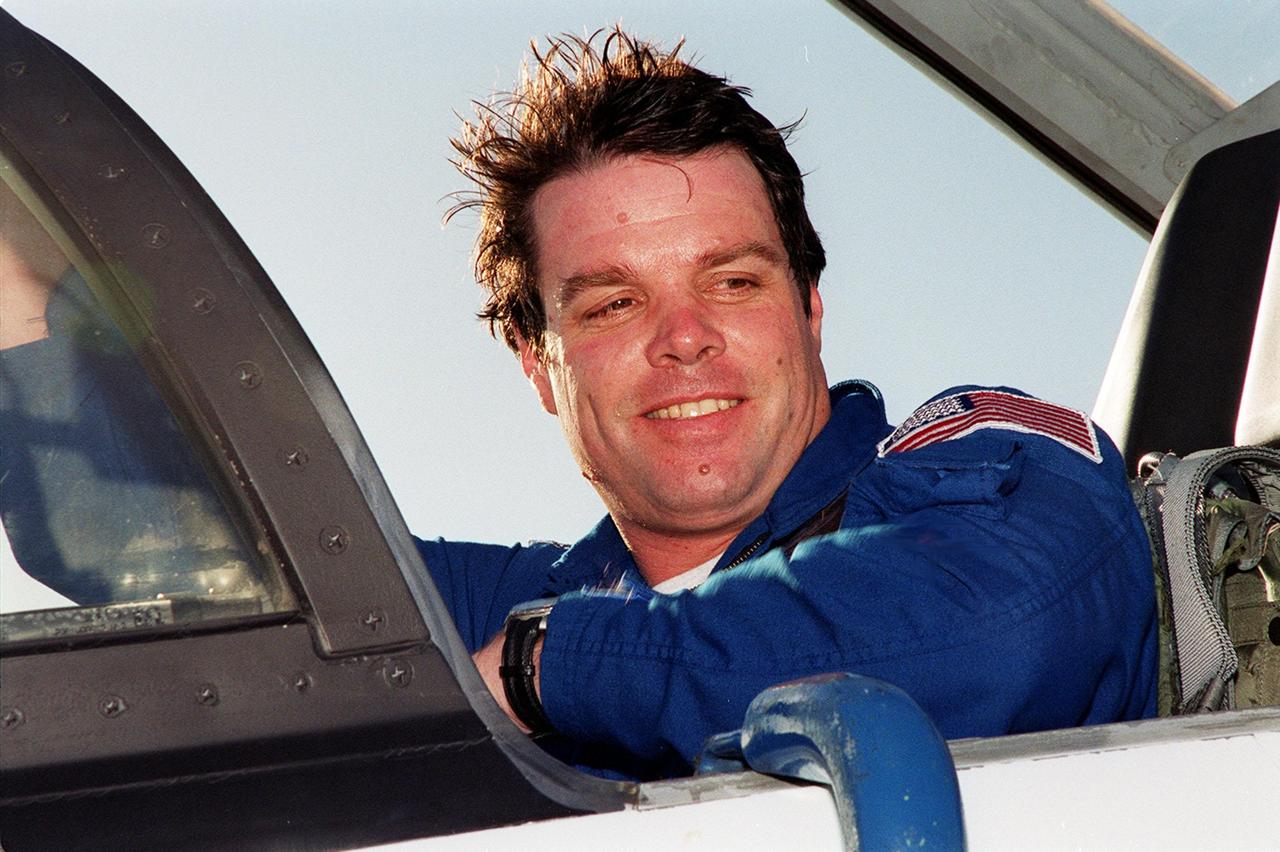
STS-99 Commander Kevin Kregel arrives at KSC's Shuttle Landing Facility aboard a T-38 training jet to take part in a Terminal Countdown Demonstration Test (TCDT). The TCDT provides the crew with simulated countdown exercises, emergency egress training, and opportunities to inspect the mission payloads in the orbiter's payload bay. Other crew members taking part are Pilot Dominic Gorie, and Mission Specialists Janet Lynn Kavandi (Ph.D.), Janice Voss (Ph.D.), Mamoru Mohri, who is with the National Space Development Agency (NASDA) of Japan, and Gerhard Thiele, who is with the European Space Agency. STS-99 is the Shuttle Radar Topography Mission, which will chart a new course, using two antennae and a 200-foot-long section of space station-derived mast protruding from the payload bay to produce unrivaled 3-D images of the Earth's surface. The result of the Shuttle Radar Topography Mission could be close to 1 trillion measurements of the Earth's topography. Besides contributing to the production of better maps, these measurements could lead to improved water drainage modeling, more realistic flight simulators, better locations for cell phone towers, and enhanced navigation safety. Launch of Endeavour on the 11-day mission is scheduled for Jan. 31 at 12:47 p.m. EST
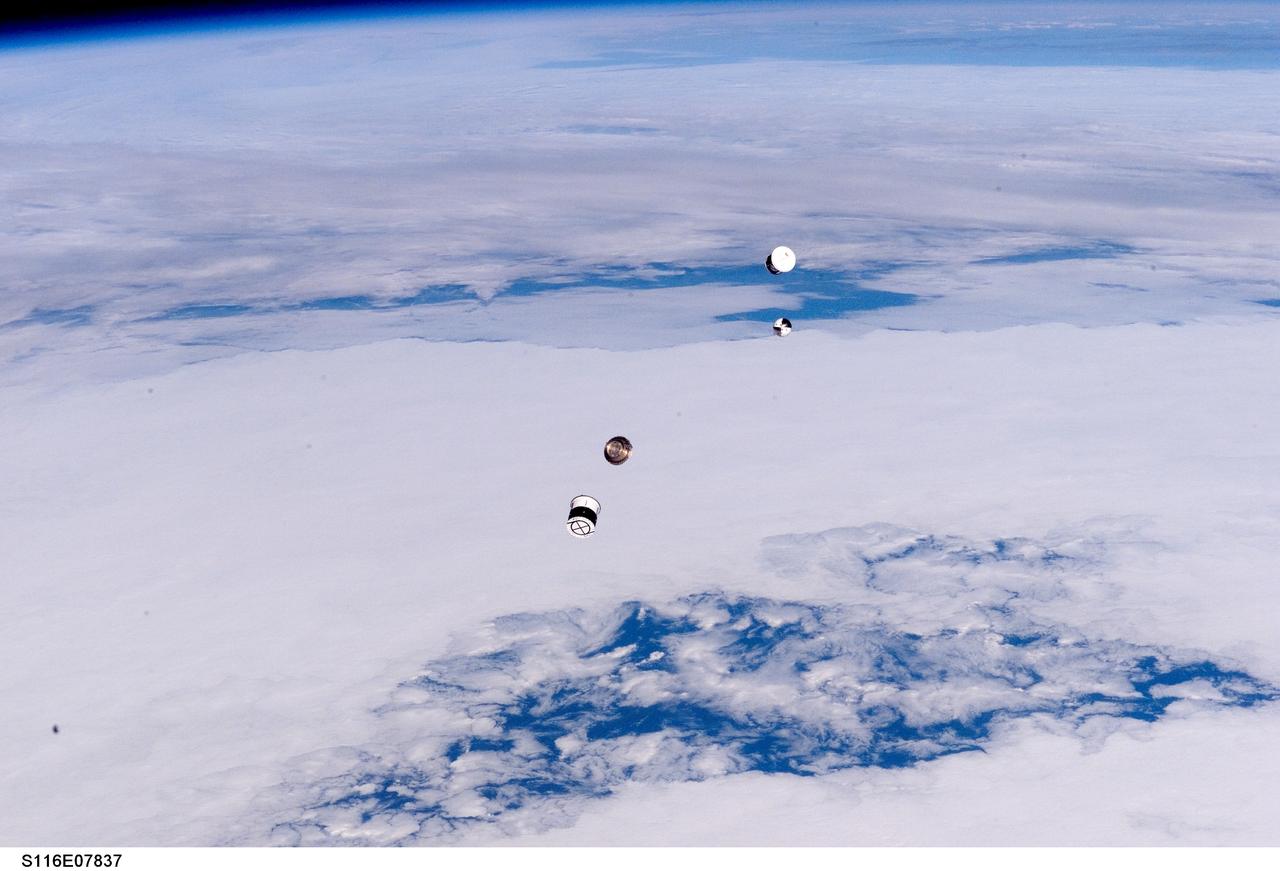
S116-E-07837 (21 Dec. 2006) --- As seen through windows on the aft flight deck of Space Shuttle Discovery, a Department of Defense pico-satellite known as Atmospheric Neutral Density Experiment (ANDE) is released from the shuttle's payload bay by STS-116 crewmembers. ANDE consists of two micro-satellites which will measure the density and composition of the low Earth orbit (LEO) atmosphere while being tracked from the ground. The data will be used to better predict the movement of objects in orbit.
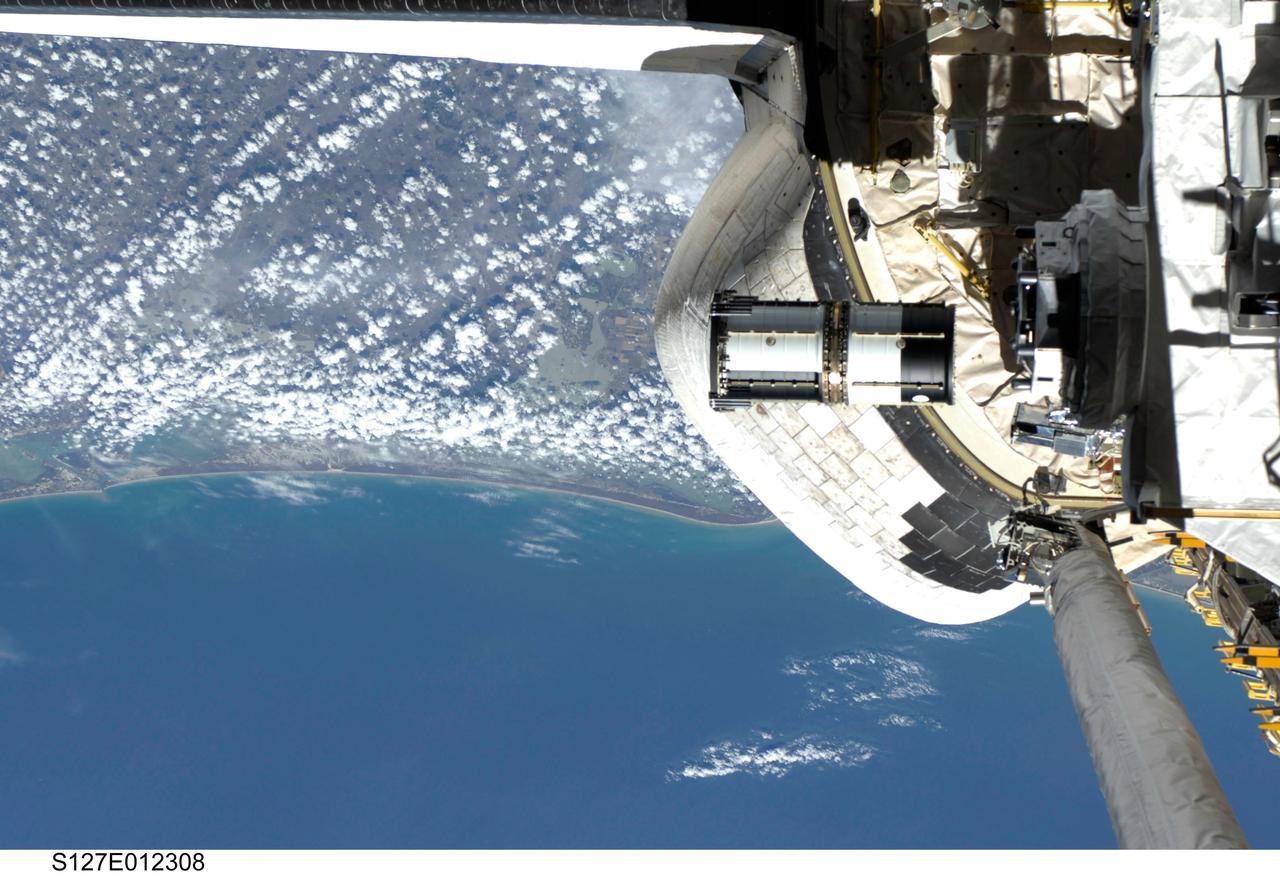
S127-E-012308 (30 July 2009) --- As seen through windows on the aft flight deck of Space Shuttle Endeavour, a Department of Defense pico-satellite known as Atmospheric Neutral Density Experiment 2 (ANDE-2) is released from the shuttle's payload bay by STS-127 crew members. ANDE-2 consists of two spherical micro-satellites which will measure the density and composition of the low-Earth orbit (LEO) atmosphere while being tracked from the ground. The data will be used to better predict the movement of objects in orbit.
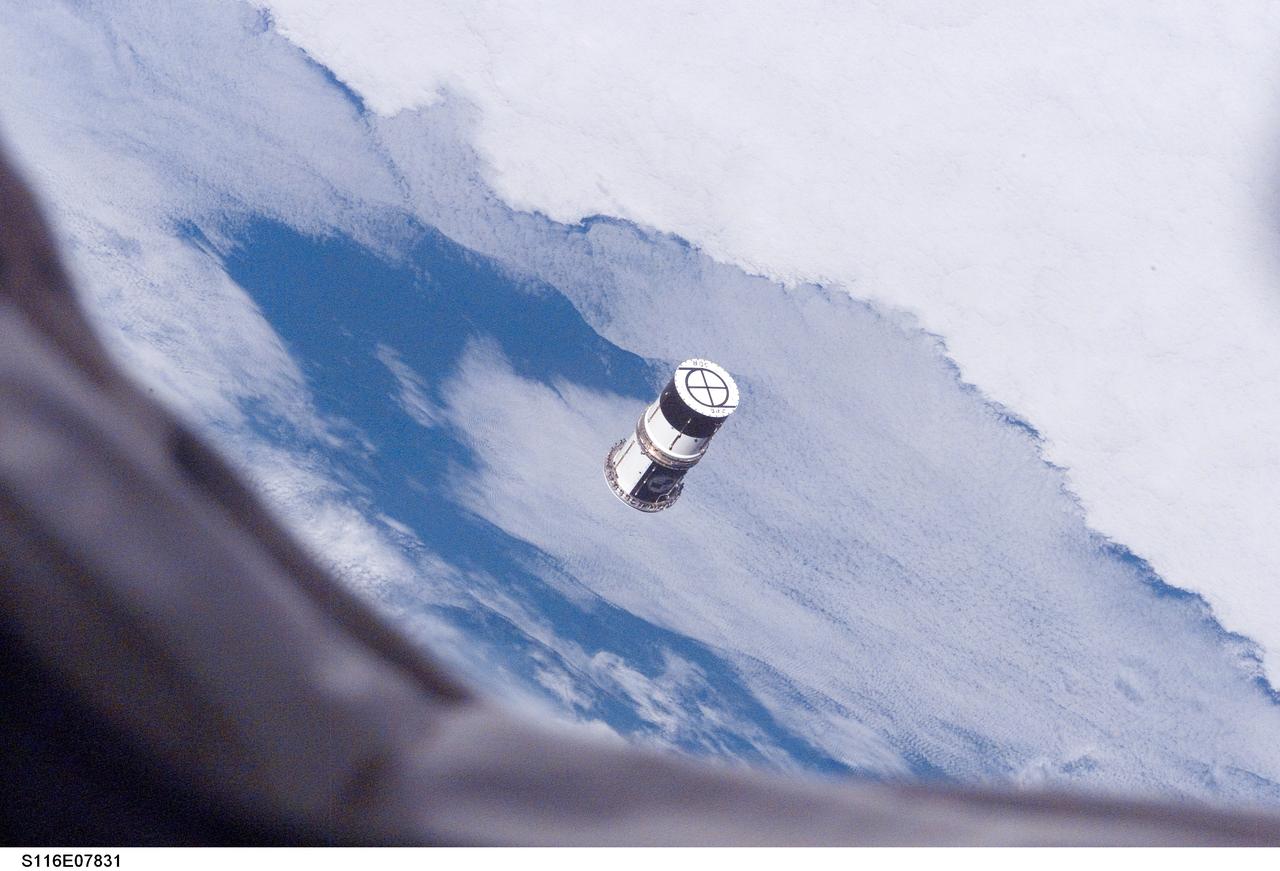
S116-E-07831 (21 Dec. 2006) --- As seen through windows on the aft flight deck of Space Shuttle Discovery, a Department of Defense pico-satellite known as Atmospheric Neutral Density Experiment (ANDE) is released from the shuttle's payload bay by STS-116 crewmembers. ANDE consists of two micro-satellites which will measure the density and composition of the low Earth orbit (LEO) atmosphere while being tracked from the ground. The data will be used to better predict the movement of objects in orbit.
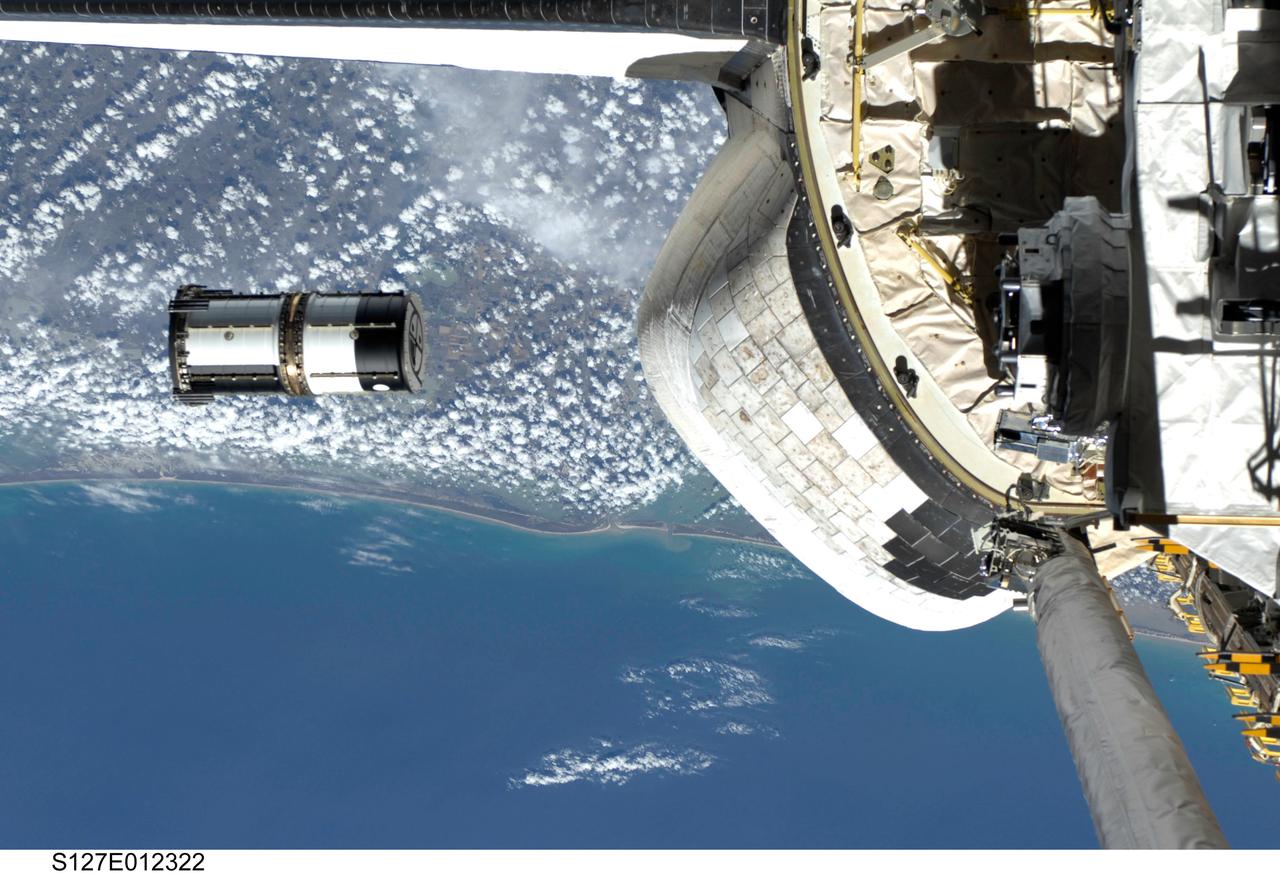
S127-E-012322 (30 July 2009) --- As seen through windows on the aft flight deck of Space Shuttle Endeavour, a Department of Defense pico-satellite known as Atmospheric Neutral Density Experiment 2 (ANDE-2) is released from the shuttle's payload bay by STS-127 crew members. ANDE-2 consists of two spherical micro-satellites which will measure the density and composition of the low-Earth orbit (LEO) atmosphere while being tracked from the ground. The data will be used to better predict the movement of objects in orbit.
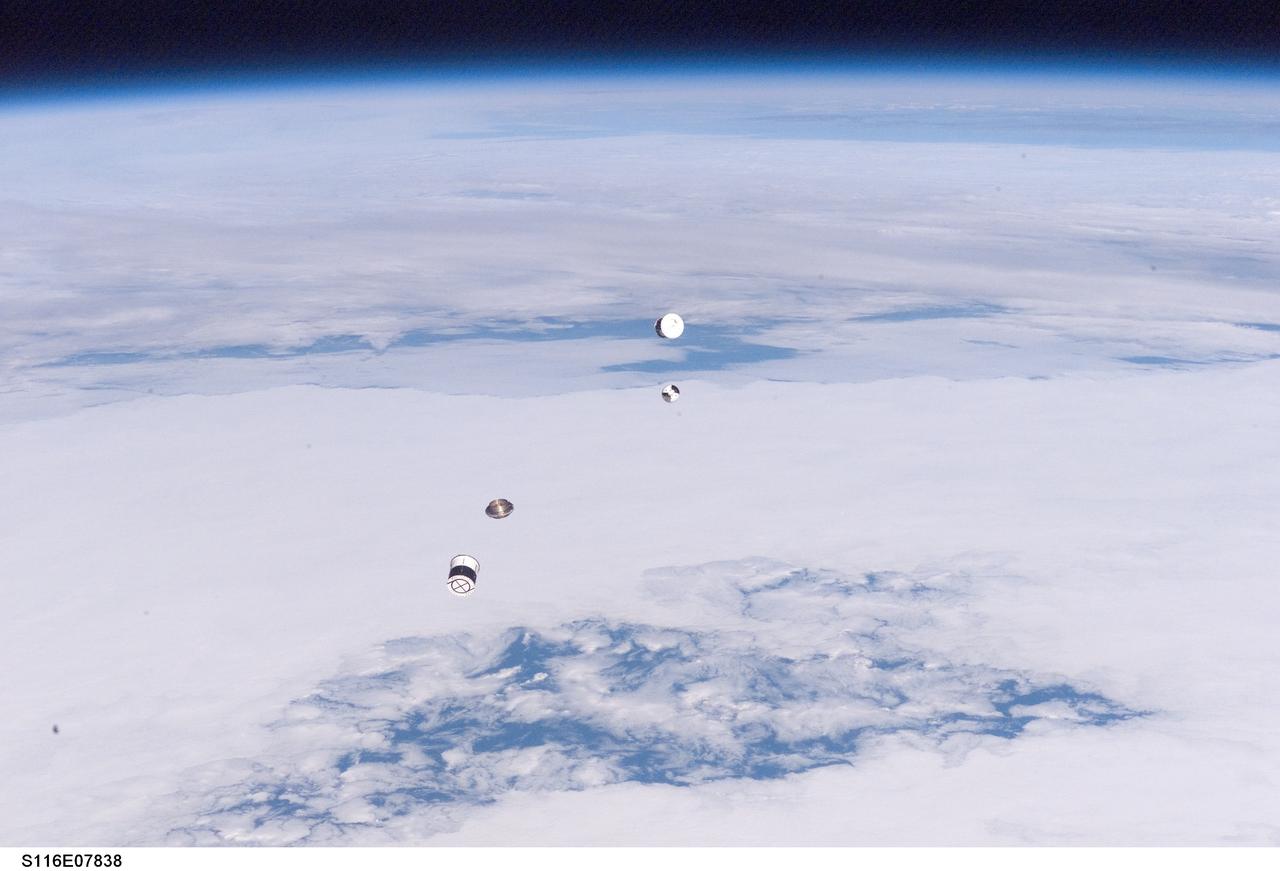
S116-E-07838 (21 Dec. 2006) --- As seen through windows on the aft flight deck of Space Shuttle Discovery, a Department of Defense pico-satellite known as Atmospheric Neutral Density Experiment (ANDE) is released from the shuttle's payload bay by STS-116 crewmembers. ANDE consists of two micro-satellites which will measure the density and composition of the low Earth orbit (LEO) atmosphere while being tracked from the ground. The data will be used to better predict the movement of objects in orbit.
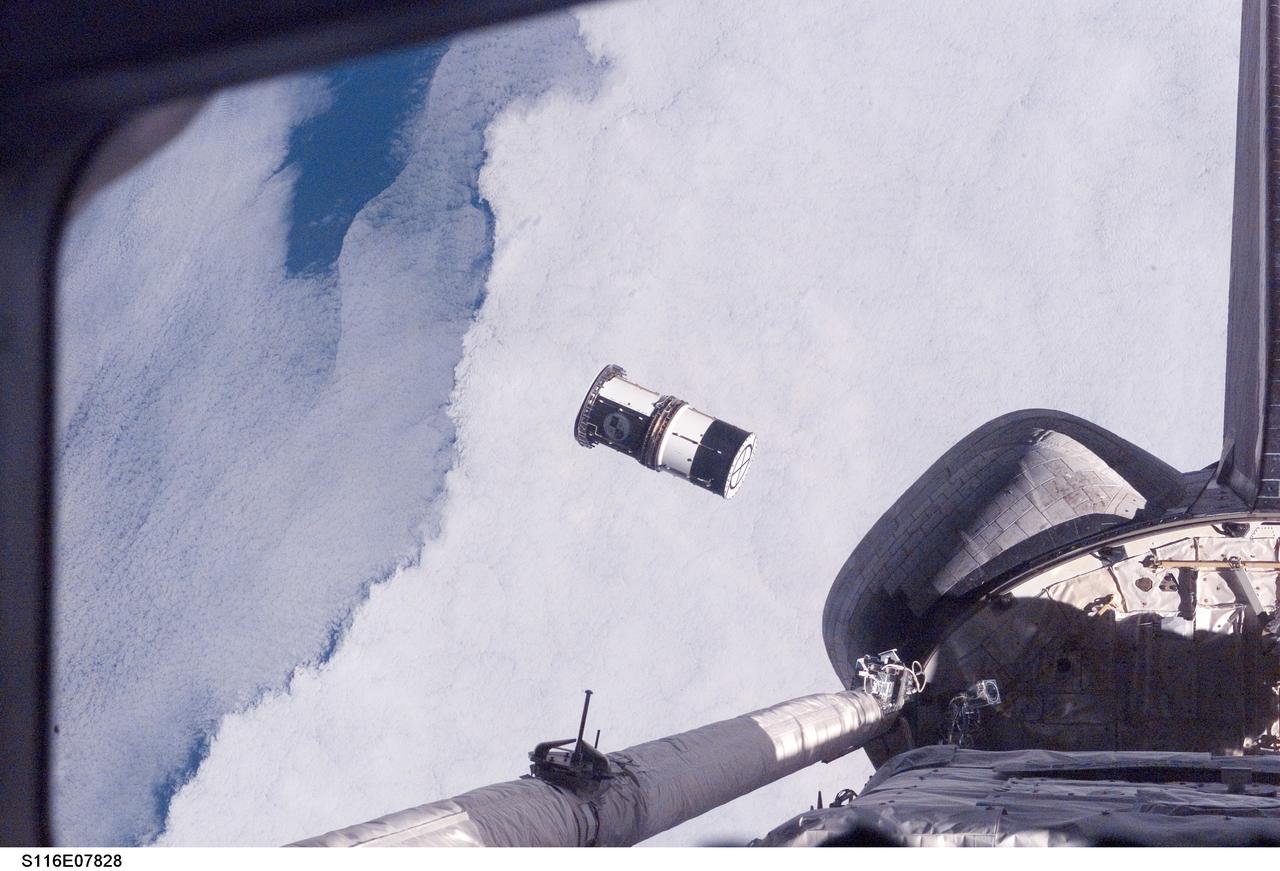
S116-E-07828 (21 Dec. 2006) --- As seen through windows on the aft flight deck of Space Shuttle Discovery, a Department of Defense pico-satellite known as Atmospheric Neutral Density Experiment (ANDE) is released from the shuttle's payload bay by STS-116 crewmembers. ANDE consists of two micro-satellites which will measure the density and composition of the low Earth orbit (LEO) atmosphere while being tracked from the ground. The data will be used to better predict the movement of objects in orbit.
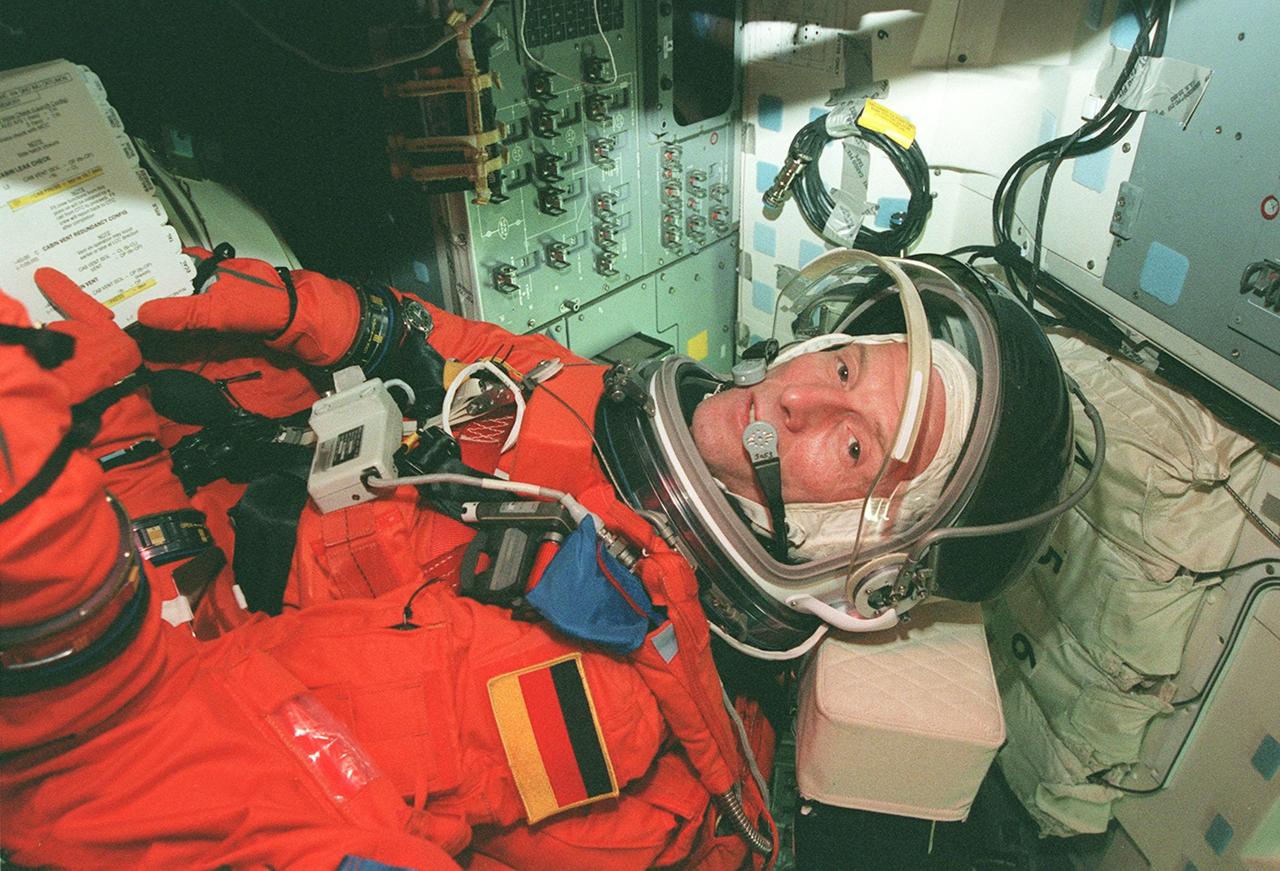
STS-99 Mission Specialist Gerhard Thiele, who is with the European Space Agency, goes through countdown procedures aboard the Space Shuttle Endeavour during Terminal Countdown Demonstration Test (TCDT) activities for the mission. The TCDT includes a simulation of the final launch countdown. STS-99 is the Shuttle Radar Topography Mission, which will chart a new course, using two antennae and a 200-foot-long section of space station-derived mast protruding from the payload bay to produce unrivaled 3-D images of the Earth's surface. The result of the Shuttle Radar Topography Mission could be close to 1 trillion measurements of the Earth's topography. Besides contributing to the production of better maps, these measurements could lead to improved water drainage modeling, more realistic flight simulators, better locations for cell phone towers, and enhanced navigation safety. Launch of Endeavour on the 11-day mission is scheduled for Jan. 31 at 12:47 p.m. EST
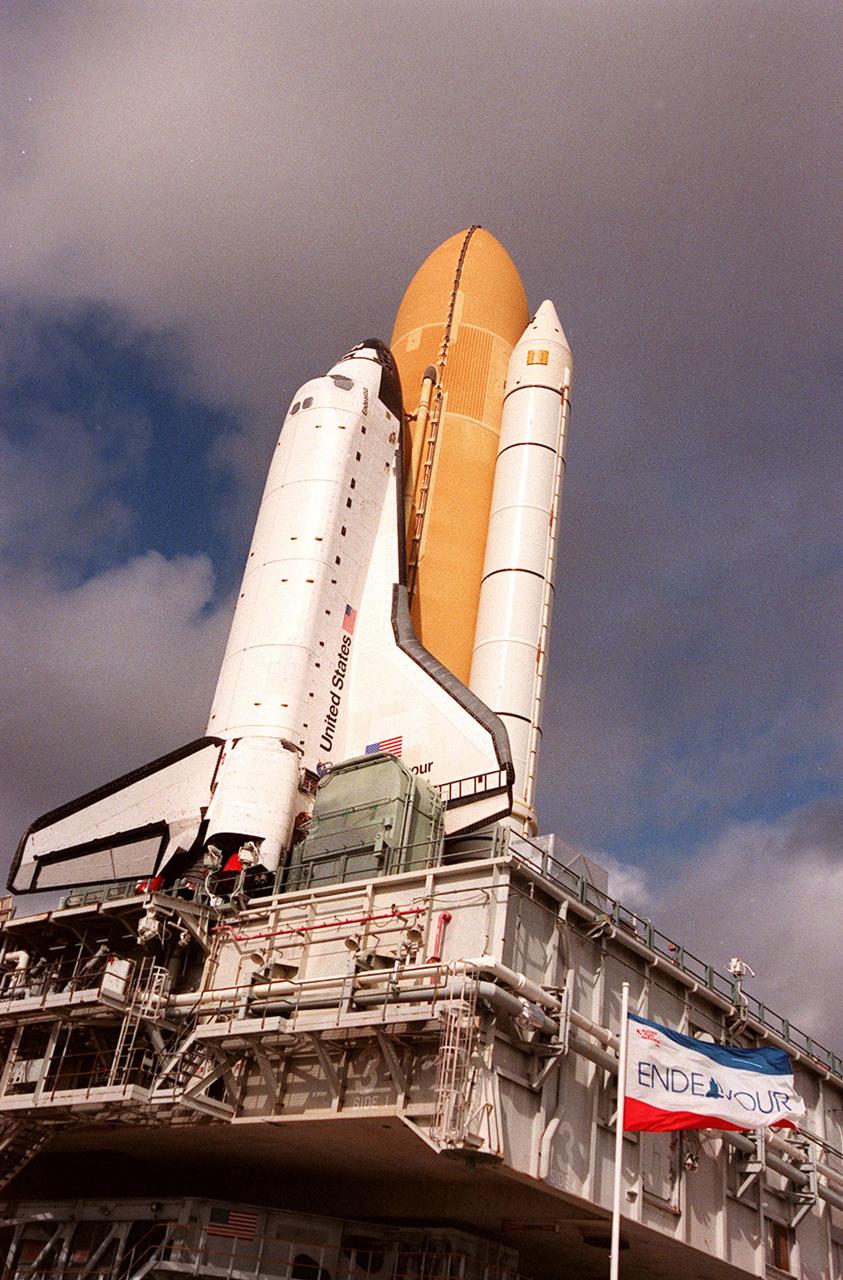
KENNEDY SPACE CENTER, Fla. -- Space Shuttle Endeavour is viewed atop the mobile launcher platform on its way to Launch Pad 39A for launch of mission STS-99. Named the Shuttle Radar Topography Mission (SRTM), STS-99 involves an international project spearheaded by the National Imagery and Mapping Agency and NASA, with participation of the German Aerospace Center DLR. SRTM will chart a new course, using two antennae and a 200-foot-long section of space station-derived mast protruding from its payload bay, to produce unrivaled 3-D images of the Earth's surface. The result of the Shuttle Radar Topography Mission could be close to 1 trillion measurements of the Earth's topography. Besides contributing to the production of better maps, these measurements could lead to improved water drainage modeling, more realistic flight simulators, better locations for cell phone towers, and enhanced navigation safety. STS-99 is scheduled for launch in January 2000
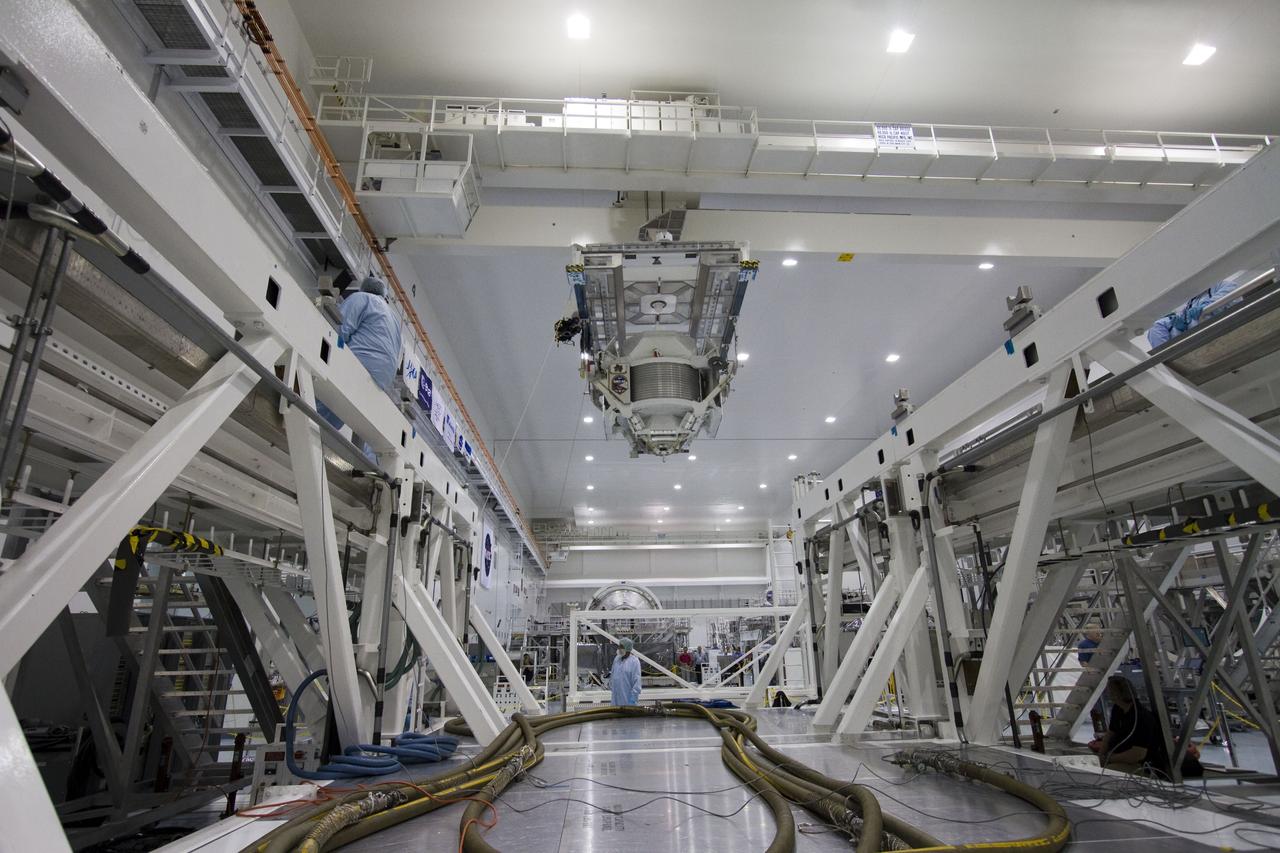
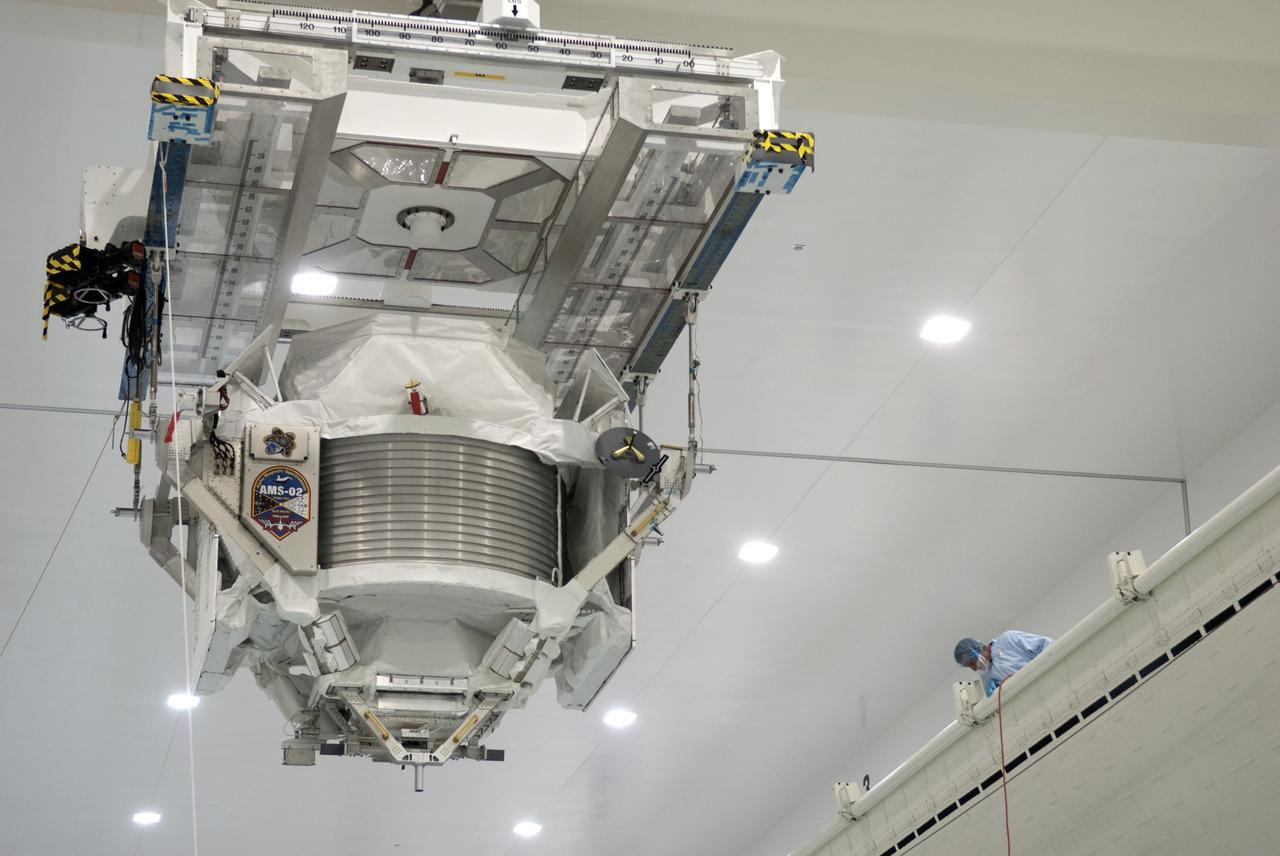
CAPE CANAVERAL, Fla. -- In the Space Station Processing Facility at NASA's Kennedy Space Center in Florida, the Alpha Magnetic Spectrometer-2 (AMS) moves from its primary work stand to the weight and center of gravity stand where final measurements will be taken before launch. Next, AMS will be moved into a payload canister. The canister will protect the space-bound payload on its journey to Launch Pad 39A, where it will later be installed into space shuttle Endeavour’s payload bay. AMS is a particle physics detector, designed to operate as an external experiment on the International Space Station. It will use the unique environment of space to study the universe and its origin by searching for dark matter. AMS-2 will fly to the station aboard Endeavour's STS-134 mission targeted to launch April 19 at 7:48 p.m. EDT. For more information visit, www.nasa.gov/mission_pages/shuttle/shuttlemissions/sts134/index.html. Photo credit: NASA/Jack Pfaller
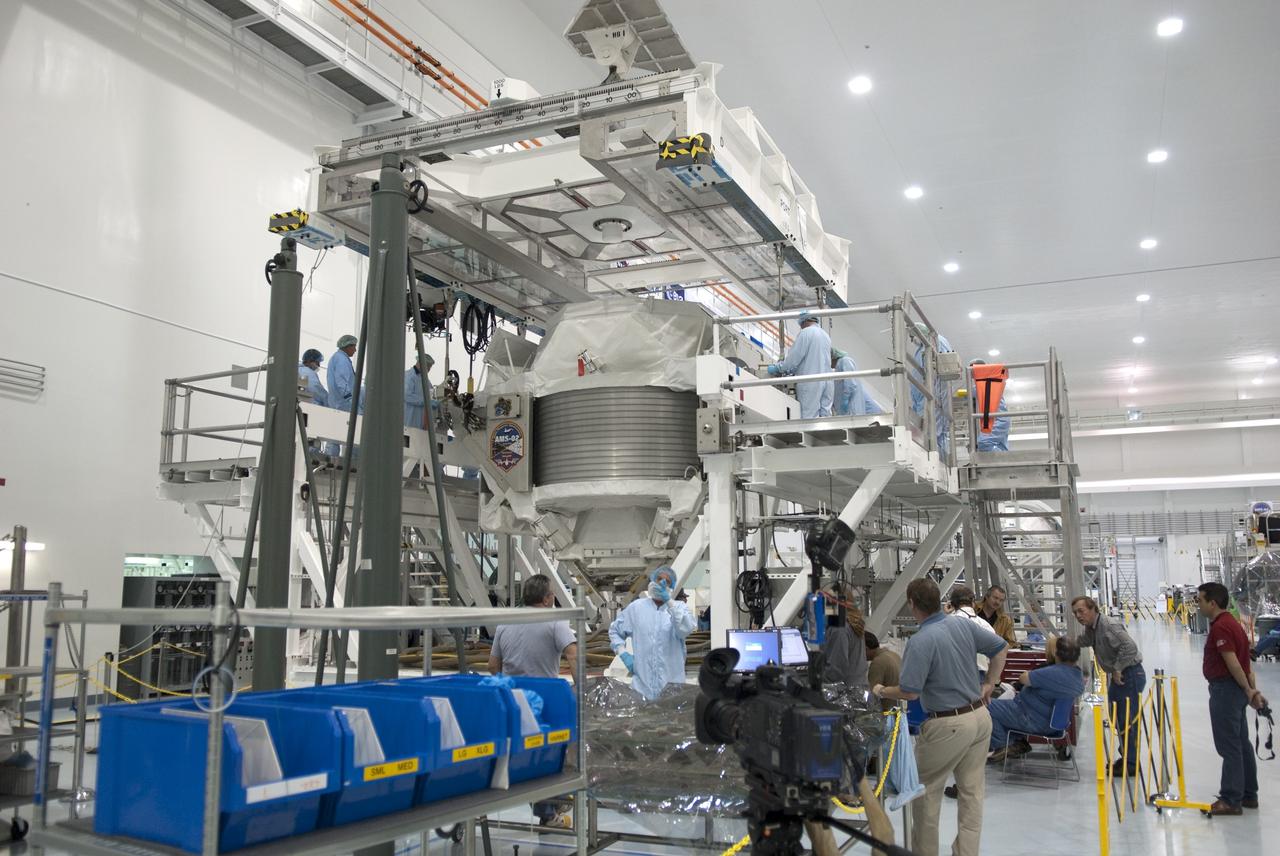
CAPE CANAVERAL, Fla. -- In the Space Station Processing Facility at NASA's Kennedy Space Center in Florida, the Alpha Magnetic Spectrometer-2 (AMS) is prepared for its move from the weight and center of gravity stand, where final measurements were taken before launch, to a payload canister. The canister will protect the space-bound payload on its journey to Launch Pad 39A, where it will later be installed into space shuttle Endeavour’s payload bay. AMS is a particle physics detector, designed to operate as an external experiment on the International Space Station. It will use the unique environment of space to study the universe and its origin by searching for dark matter. AMS-2 will fly to the station aboard Endeavour's STS-134 mission targeted to launch April 19 at 7:48 p.m. EDT. For more information visit, www.nasa.gov/mission_pages/shuttle/shuttlemissions/sts134/index.html. Photo credit: NASA/Jim Grossmann
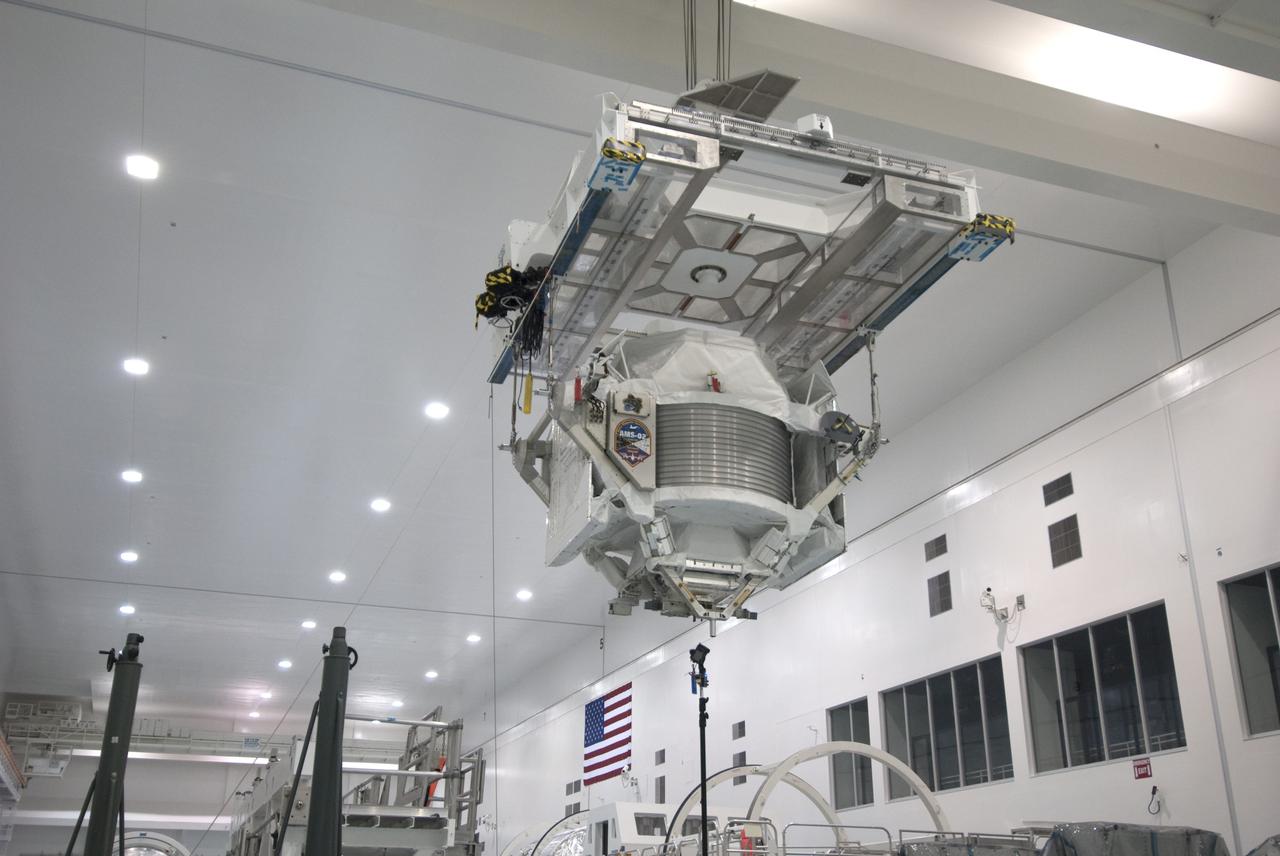
CAPE CANAVERAL, Fla. -- In the Space Station Processing Facility at NASA's Kennedy Space Center in Florida, the Alpha Magnetic Spectrometer-2 (AMS) is moved from the weight and center of gravity stand, where final measurements were taken before launch, to a payload canister. The canister will protect the space-bound payload on its journey to Launch Pad 39A, where it will later be installed into space shuttle Endeavour’s payload bay. AMS is a particle physics detector, designed to operate as an external experiment on the International Space Station. It will use the unique environment of space to study the universe and its origin by searching for dark matter. AMS-2 will fly to the station aboard Endeavour's STS-134 mission targeted to launch April 19 at 7:48 p.m. EDT. For more information visit, www.nasa.gov/mission_pages/shuttle/shuttlemissions/sts134/index.html. Photo credit: NASA/Jim Grossmann
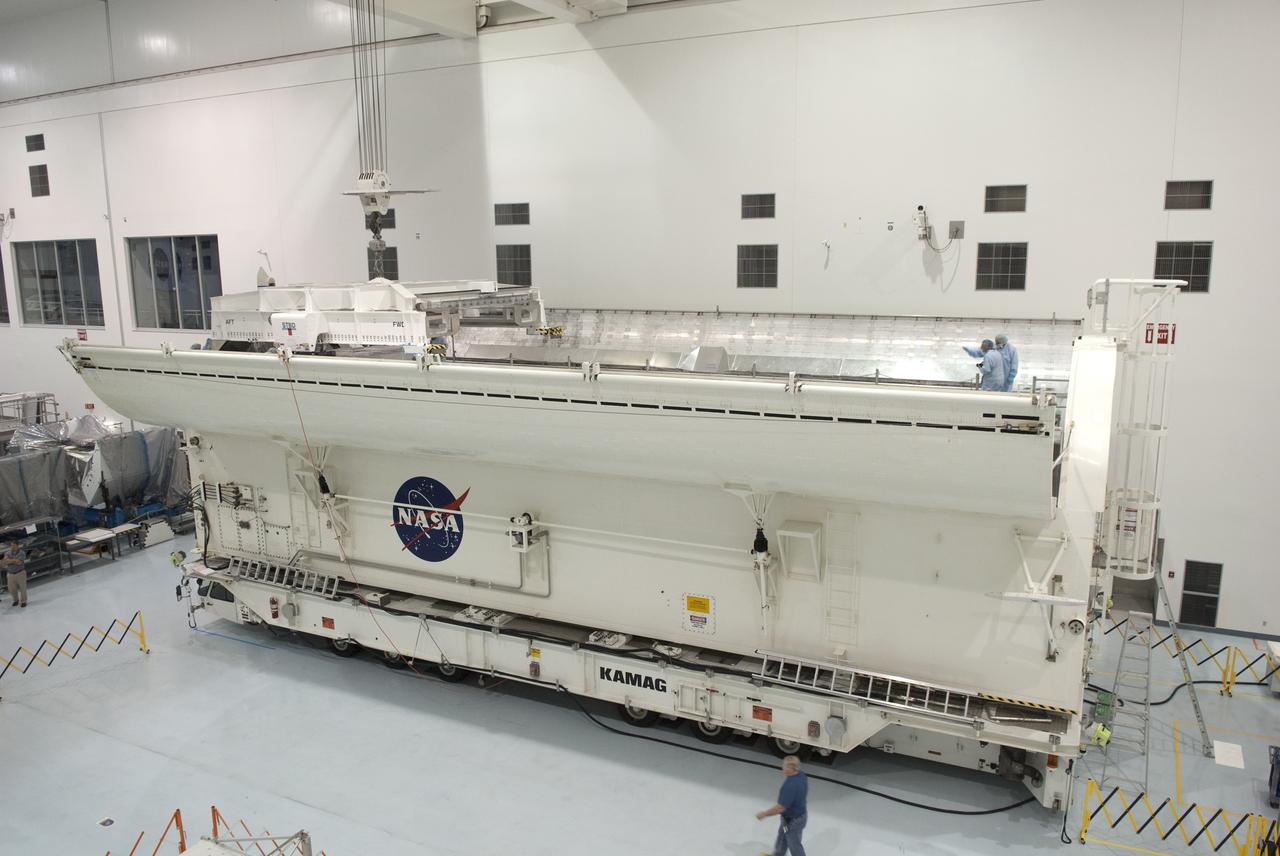
CAPE CANAVERAL, Fla. -- In the Space Station Processing Facility at NASA's Kennedy Space Center in Florida, the Alpha Magnetic Spectrometer-2 AMS is in a payload canister after technicians measured its weight and center of gravity. The canister will protect the space-bound payload on its journey to Launch Pad 39A, where it will later be installed into space shuttle Endeavour’s payload bay. AMS is a particle physics detector, designed to operate as an external experiment on the International Space Station. It will use the unique environment of space to study the universe and its origin by searching for dark matter. AMS-2 will fly to the station aboard Endeavour's STS-134 mission targeted to launch April 19 at 7:48 p.m. EDT. For more information visit, www.nasa.gov/mission_pages/shuttle/shuttlemissions/sts134/index.html. Photo credit: NASA/Jim Grossmann
CAPE CANAVERAL, Fla. -- In the Space Station Processing Facility at NASA's Kennedy Space Center in Florida, the Alpha Magnetic Spectrometer-2 (AMS) is moved from the weight and center of gravity stand, where final measurements were taken before launch, to a payload canister. The canister will protect the space-bound payload on its journey to Launch Pad 39A, where it will later be installed into space shuttle Endeavour’s payload bay. AMS is a particle physics detector, designed to operate as an external experiment on the International Space Station. It will use the unique environment of space to study the universe and its origin by searching for dark matter. AMS-2 will fly to the station aboard Endeavour's STS-134 mission targeted to launch April 19 at 7:48 p.m. EDT. For more information visit, www.nasa.gov/mission_pages/shuttle/shuttlemissions/sts134/index.html. Photo credit: NASA/Jim Grossmann
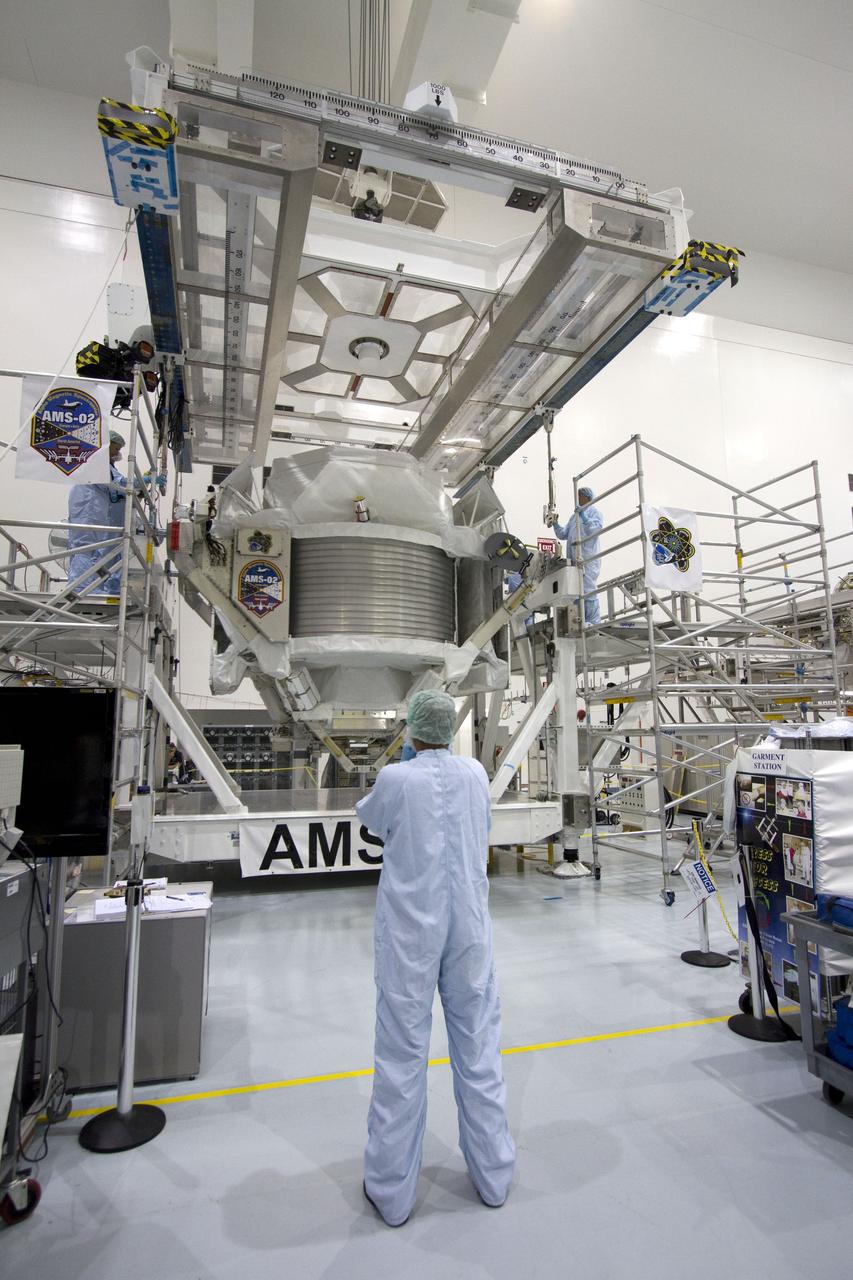
CAPE CANAVERAL, Fla. -- In the Space Station Processing Facility at NASA's Kennedy Space Center in Florida, the Alpha Magnetic Spectrometer-2 (AMS) begins to move from its primary work stand to the weight and center of gravity stand where final measurements will be taken before launch. Next, AMS will be moved into a payload canister. The canister will protect the space-bound payload on its journey to Launch Pad 39A, where it will later be installed into space shuttle Endeavour’s payload bay. AMS is a particle physics detector, designed to operate as an external experiment on the International Space Station. It will use the unique environment of space to study the universe and its origin by searching for dark matter. AMS-2 will fly to the station aboard Endeavour's STS-134 mission targeted to launch April 19 at 7:48 p.m. EDT. For more information visit, www.nasa.gov/mission_pages/shuttle/shuttlemissions/sts134/index.html. Photo credit: NASA/Jack Pfaller
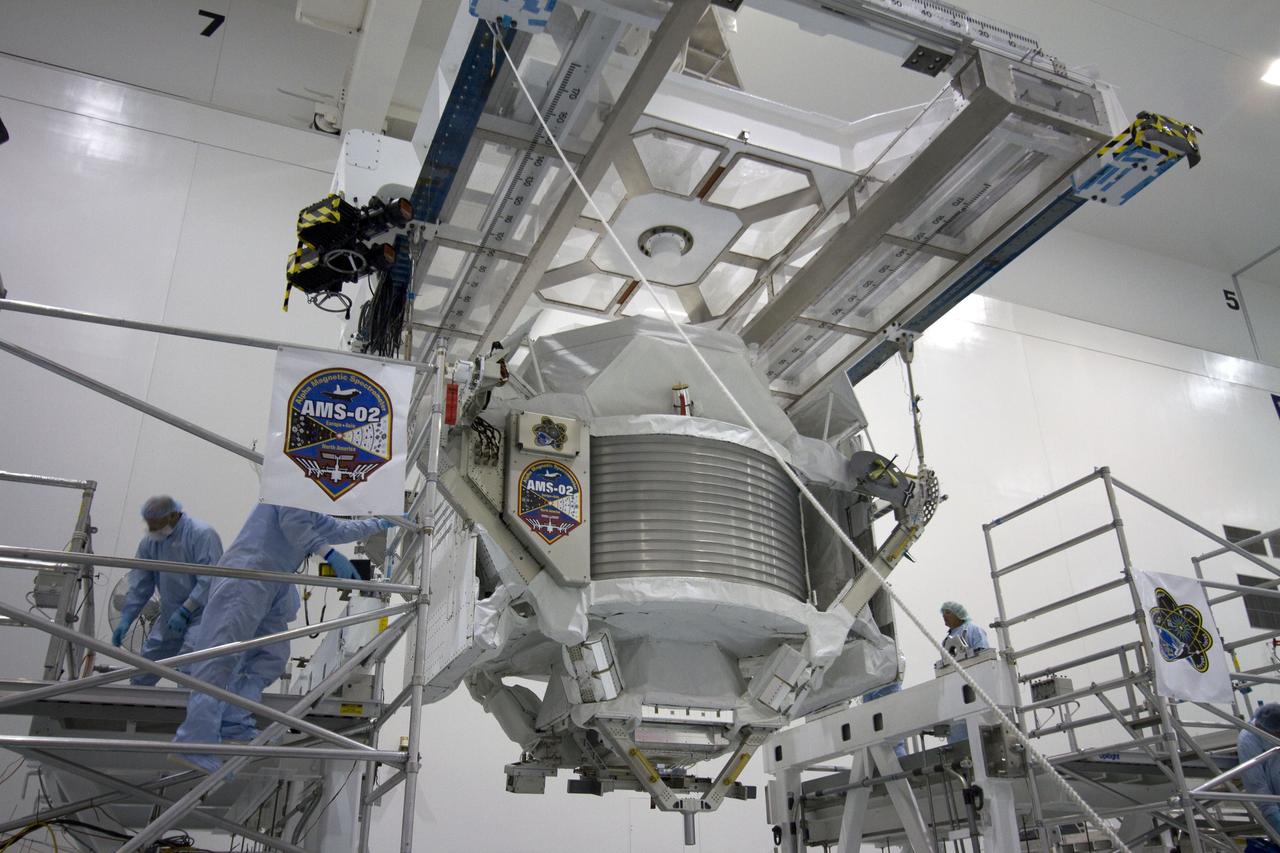
CAPE CANAVERAL, Fla. -- In the Space Station Processing Facility at NASA's Kennedy Space Center in Florida, the Alpha Magnetic Spectrometer-2 (AMS) moves from its primary work stand to the weight and center of gravity stand where final measurements will be taken before launch. Next, AMS will be moved into a payload canister. The canister will protect the space-bound payload on its journey to Launch Pad 39A, where it will later be installed into space shuttle Endeavour’s payload bay. AMS is a particle physics detector, designed to operate as an external experiment on the International Space Station. It will use the unique environment of space to study the universe and its origin by searching for dark matter. AMS-2 will fly to the station aboard Endeavour's STS-134 mission targeted to launch April 19 at 7:48 p.m. EDT. For more information visit, www.nasa.gov/mission_pages/shuttle/shuttlemissions/sts134/index.html. Photo credit: NASA/Jack Pfaller
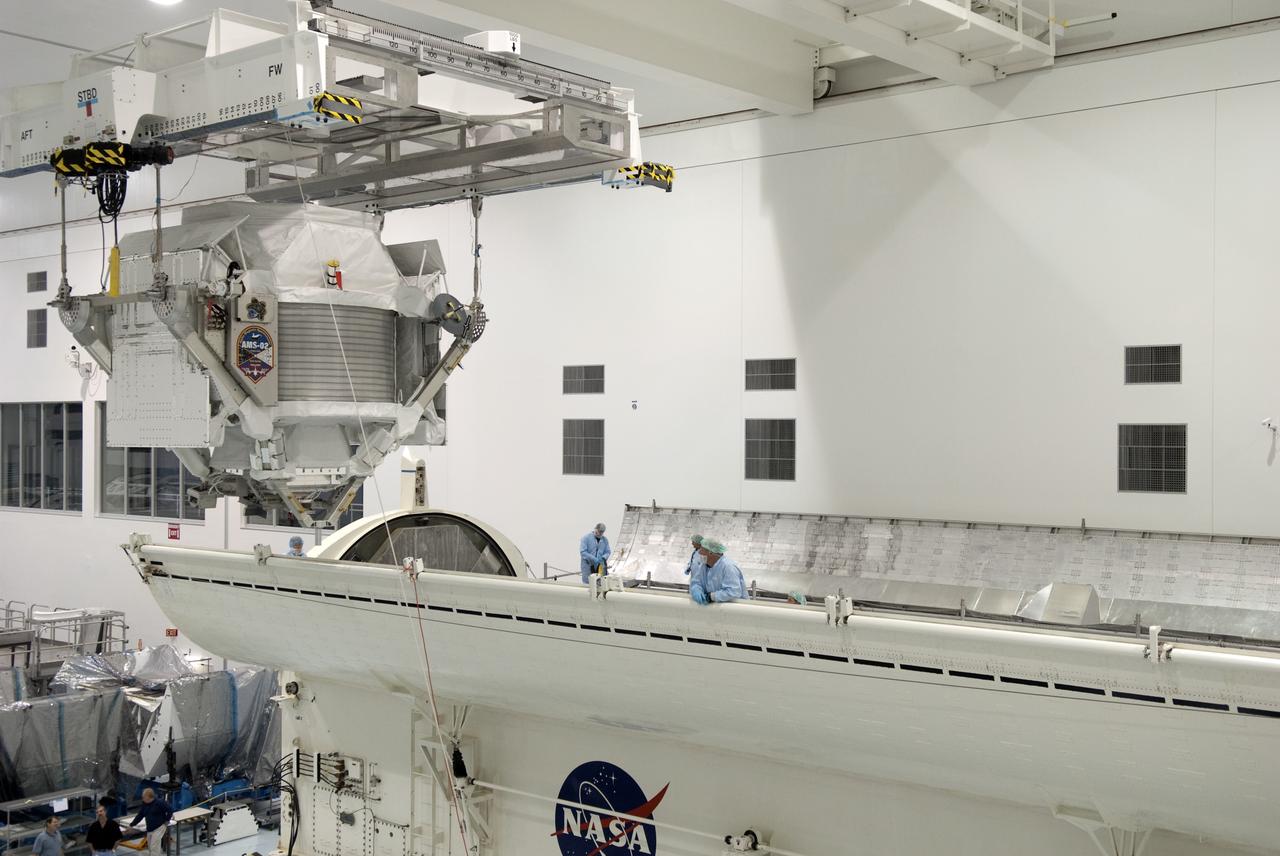
CAPE CANAVERAL, Fla. -- In the Space Station Processing Facility at NASA's Kennedy Space Center in Florida, the Alpha Magnetic Spectrometer-2 (AMS) is moved from the weight and center of gravity stand, where final measurements were taken before launch, to a payload canister. The canister will protect the space-bound payload on its journey to Launch Pad 39A, where it will later be installed into space shuttle Endeavour’s payload bay. AMS is a particle physics detector, designed to operate as an external experiment on the International Space Station. It will use the unique environment of space to study the universe and its origin by searching for dark matter. AMS-2 will fly to the station aboard Endeavour's STS-134 mission targeted to launch April 19 at 7:48 p.m. EDT. For more information visit, www.nasa.gov/mission_pages/shuttle/shuttlemissions/sts134/index.html. Photo credit: NASA/Jim Grossmann
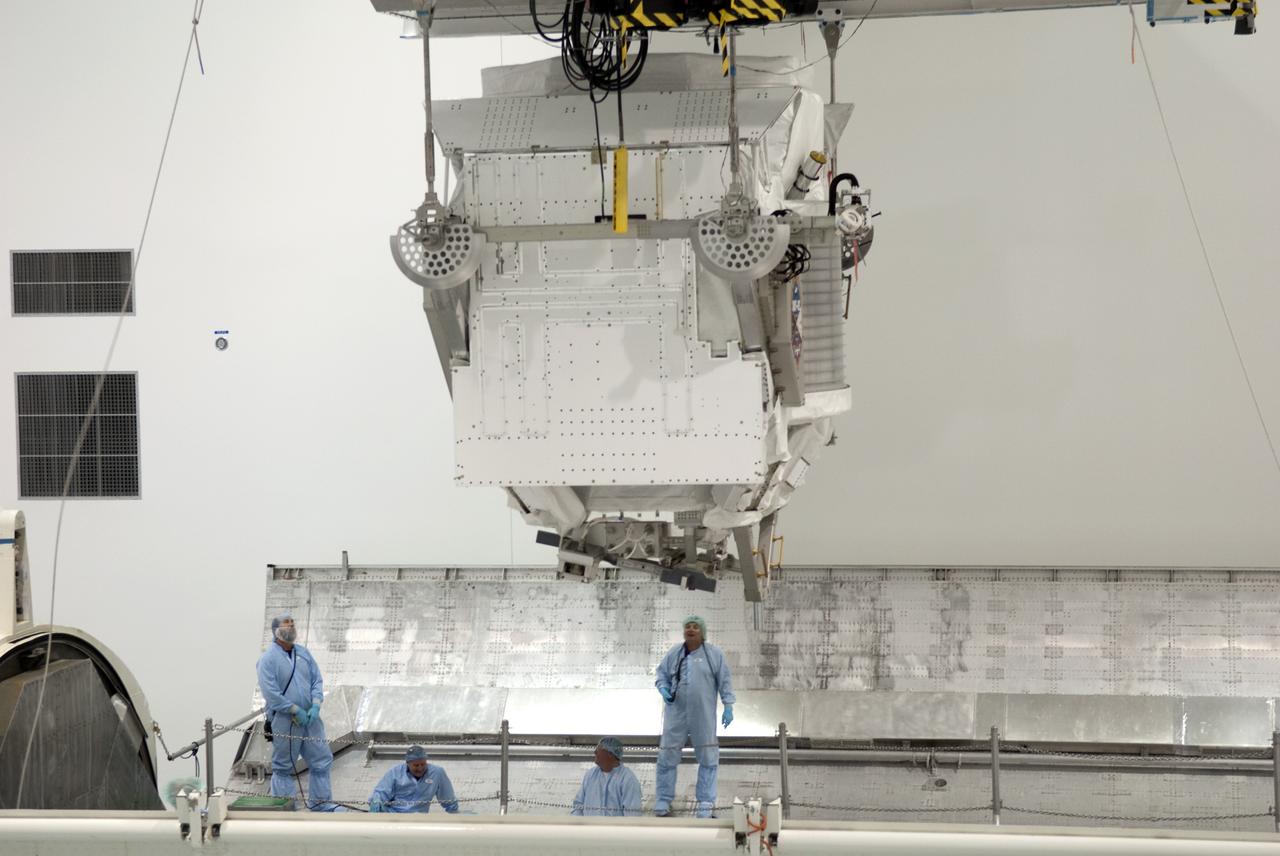
CAPE CANAVERAL, Fla. -- In the Space Station Processing Facility at NASA's Kennedy Space Center in Florida, the Alpha Magnetic Spectrometer-2 AMS is above a payload canister after technicians measured its weight and center of gravity. The canister will protect the space-bound payload on its journey to Launch Pad 39A, where it will later be installed into space shuttle Endeavour’s payload bay. AMS is a particle physics detector, designed to operate as an external experiment on the International Space Station. It will use the unique environment of space to study the universe and its origin by searching for dark matter. AMS-2 will fly to the station aboard Endeavour's STS-134 mission targeted to launch April 19 at 7:48 p.m. EDT. For more information visit, www.nasa.gov/mission_pages/shuttle/shuttlemissions/sts134/index.html. Photo credit: NASA/Jim Grossmann
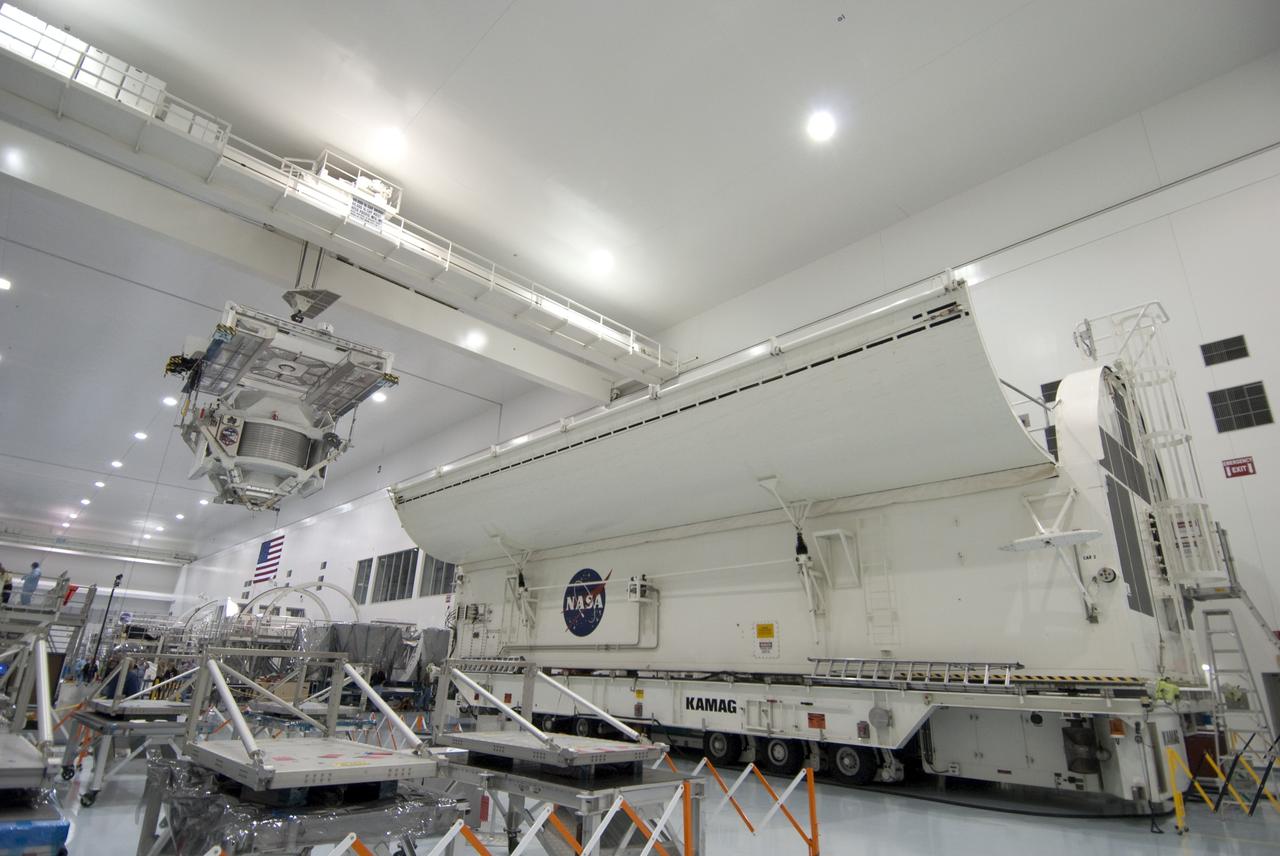
CAPE CANAVERAL, Fla. -- In the Space Station Processing Facility at NASA's Kennedy Space Center in Florida, the Alpha Magnetic Spectrometer-2 (AMS) is moved from the weight and center of gravity stand, where final measurements were taken before launch, to a payload canister. The canister will protect the space-bound payload on its journey to Launch Pad 39A, where it will later be installed into space shuttle Endeavour’s payload bay. AMS is a particle physics detector, designed to operate as an external experiment on the International Space Station. It will use the unique environment of space to study the universe and its origin by searching for dark matter. AMS-2 will fly to the station aboard Endeavour's STS-134 mission targeted to launch April 19 at 7:48 p.m. EDT. For more information visit, www.nasa.gov/mission_pages/shuttle/shuttlemissions/sts134/index.html. Photo credit: NASA/Jim Grossmann
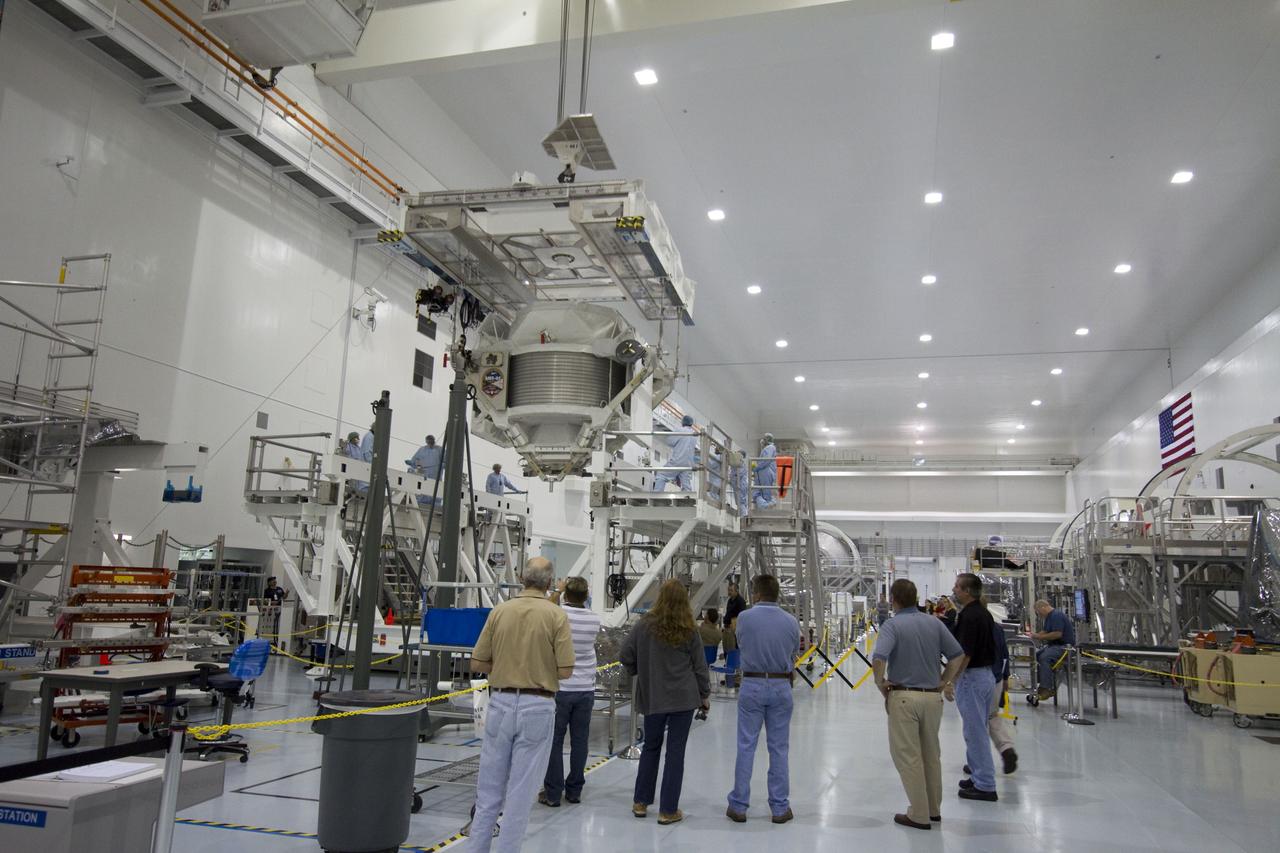
CAPE CANAVERAL, Fla. -- In the Space Station Processing Facility at NASA's Kennedy Space Center in Florida, the Alpha Magnetic Spectrometer-2 (AMS) moves from its primary work stand to the weight and center of gravity stand where final measurements will be taken before launch. Next, AMS will be moved into a payload canister. The canister will protect the space-bound payload on its journey to Launch Pad 39A, where it will later be installed into space shuttle Endeavour’s payload bay. AMS is a particle physics detector, designed to operate as an external experiment on the International Space Station. It will use the unique environment of space to study the universe and its origin by searching for dark matter. AMS-2 will fly to the station aboard Endeavour's STS-134 mission targeted to launch April 19 at 7:48 p.m. EDT. For more information visit, www.nasa.gov/mission_pages/shuttle/shuttlemissions/sts134/index.html. Photo credit: NASA/Jack Pfaller
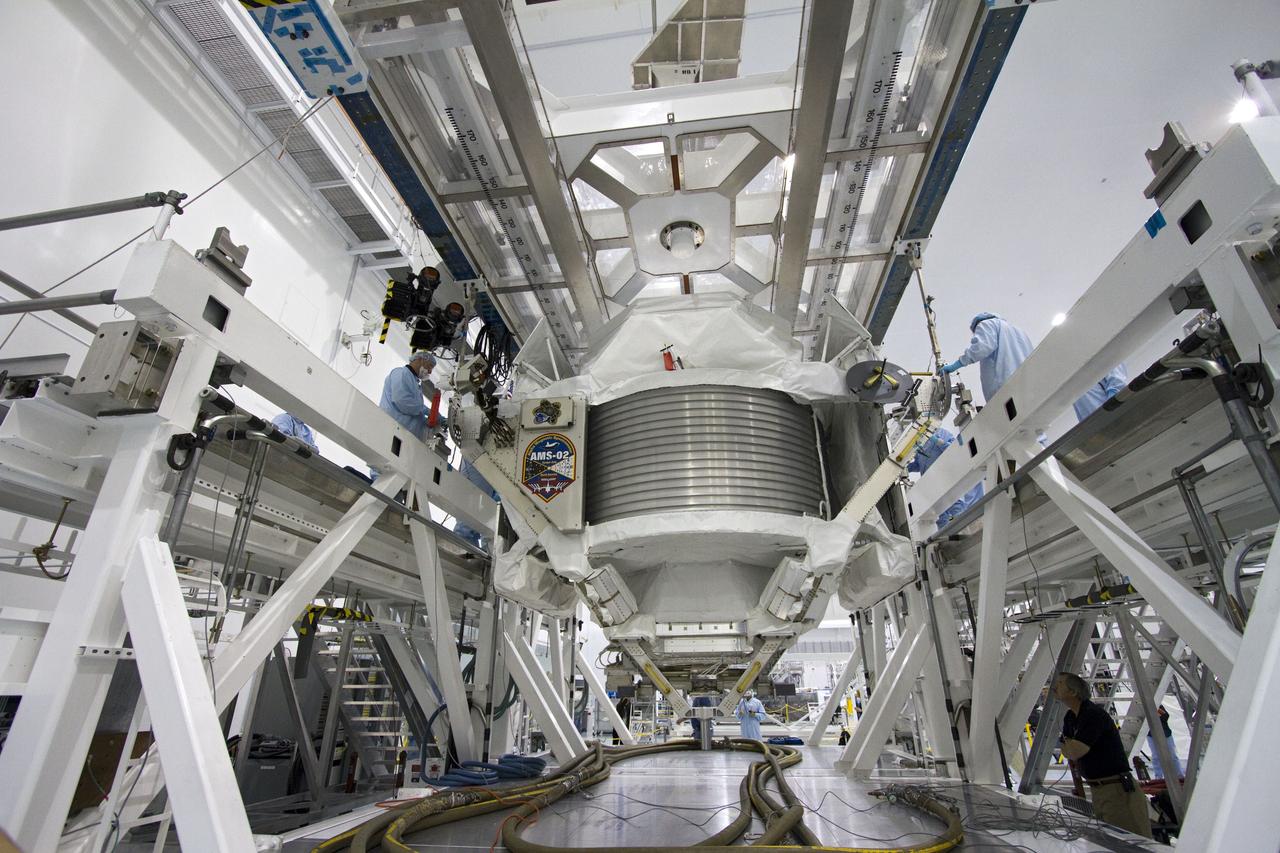
CAPE CANAVERAL, Fla. -- In the Space Station Processing Facility at NASA's Kennedy Space Center in Florida, the Alpha Magnetic Spectrometer-2 (AMS) was moved from its primary work stand to the weight and center of gravity stand where final measurements will be taken before launch. Next, AMS will be moved into a payload canister. The canister will protect the space-bound payload on its journey to Launch Pad 39A, where it will later be installed into space shuttle Endeavour’s payload bay. AMS is a particle physics detector, designed to operate as an external experiment on the International Space Station. It will use the unique environment of space to study the universe and its origin by searching for dark matter. AMS-2 will fly to the station aboard Endeavour's STS-134 mission targeted to launch April 19 at 7:48 p.m. EDT. For more information visit, www.nasa.gov/mission_pages/shuttle/shuttlemissions/sts134/index.html. Photo credit: NASA/Jack Pfaller
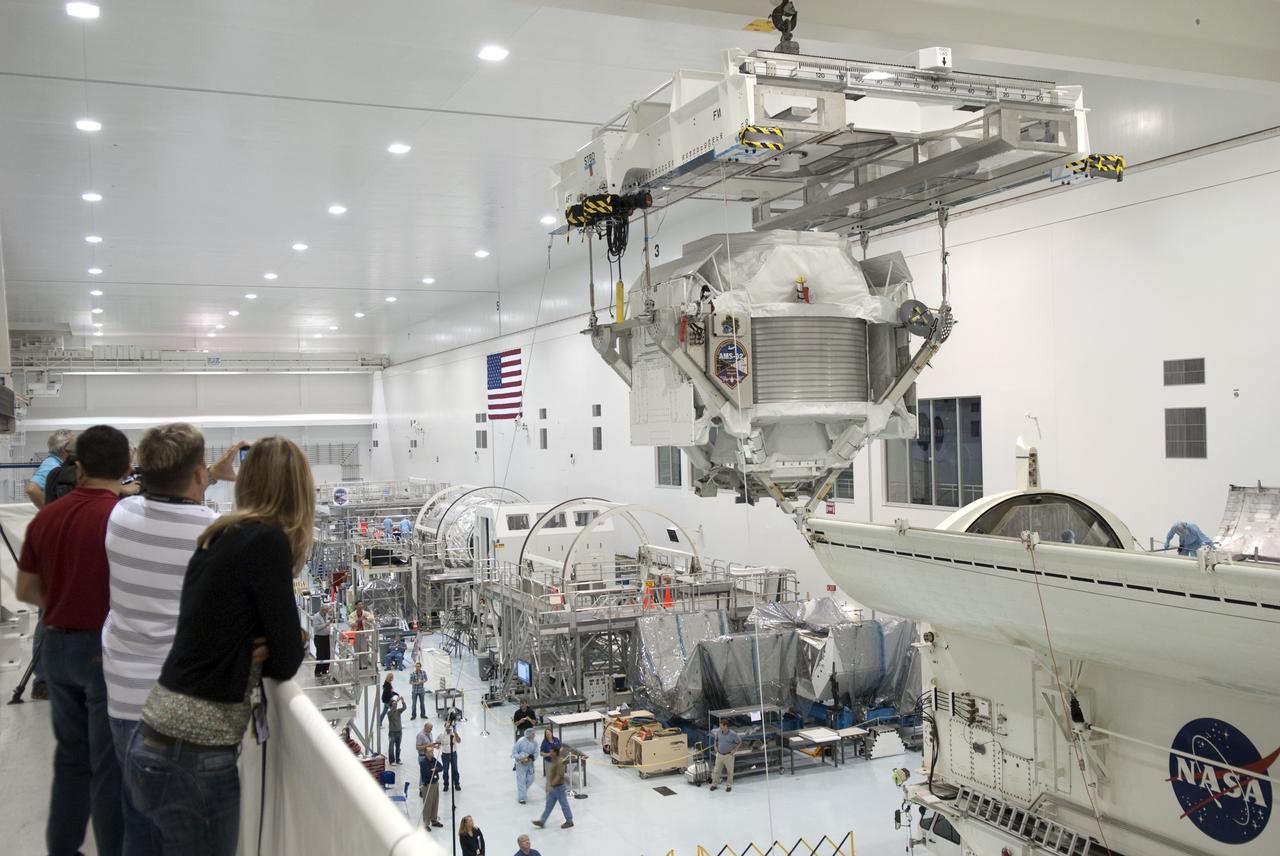
CAPE CANAVERAL, Fla. -- In the Space Station Processing Facility at NASA's Kennedy Space Center in Florida, the Alpha Magnetic Spectrometer-2 (AMS) is moved from the weight and center of gravity stand, where final measurements were taken before launch, to a payload canister. The canister will protect the space-bound payload on its journey to Launch Pad 39A, where it will later be installed into space shuttle Endeavour’s payload bay. AMS is a particle physics detector, designed to operate as an external experiment on the International Space Station. It will use the unique environment of space to study the universe and its origin by searching for dark matter. AMS-2 will fly to the station aboard Endeavour's STS-134 mission targeted to launch April 19 at 7:48 p.m. EDT. For more information visit, www.nasa.gov/mission_pages/shuttle/shuttlemissions/sts134/index.html. Photo credit: NASA/Jim Grossmann
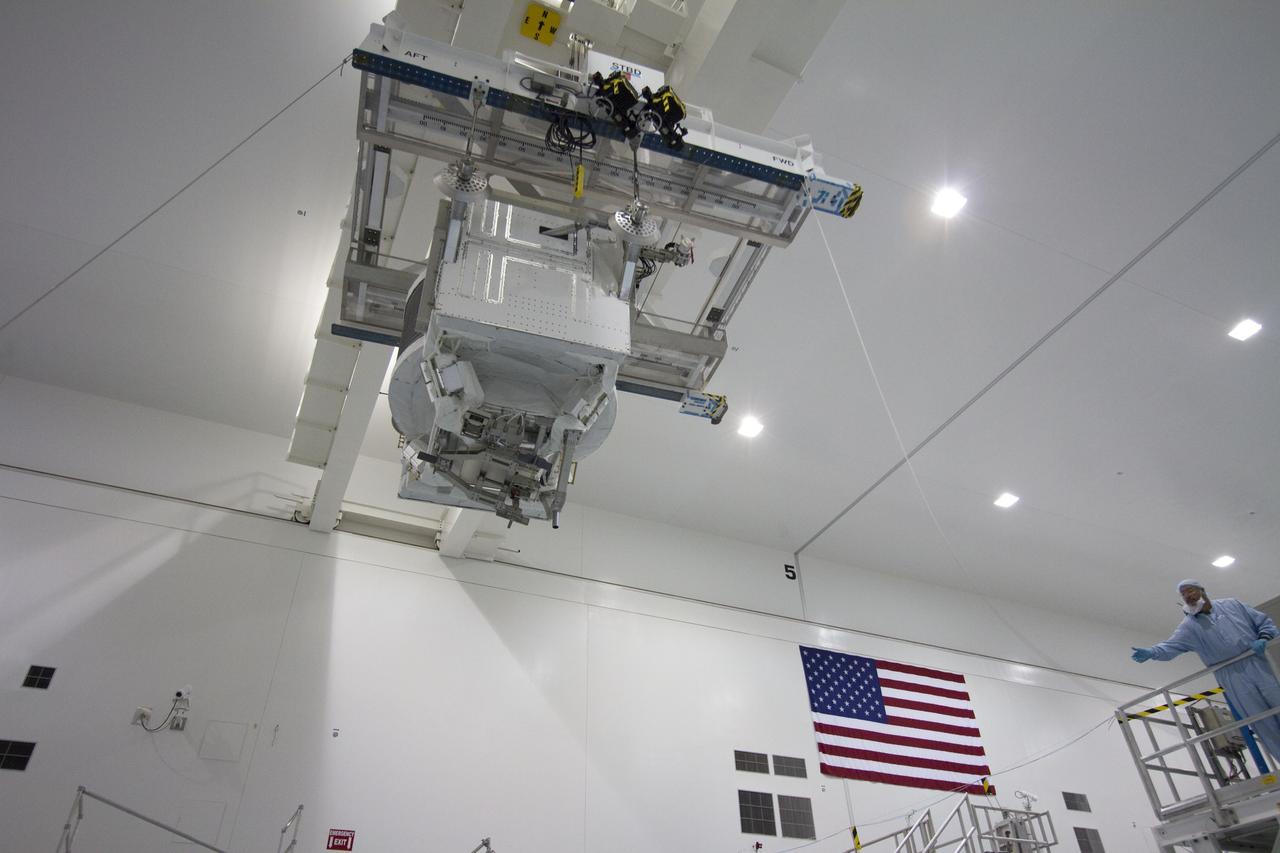
CAPE CANAVERAL, Fla. -- In the Space Station Processing Facility at NASA's Kennedy Space Center in Florida, the Alpha Magnetic Spectrometer-2 (AMS) moves from its primary work stand to the weight and center of gravity stand where final measurements will be taken before launch. Next, AMS will be moved into a payload canister. The canister will protect the space-bound payload on its journey to Launch Pad 39A, where it will later be installed into space shuttle Endeavour’s payload bay. AMS is a particle physics detector, designed to operate as an external experiment on the International Space Station. It will use the unique environment of space to study the universe and its origin by searching for dark matter. AMS-2 will fly to the station aboard Endeavour's STS-134 mission targeted to launch April 19 at 7:48 p.m. EDT. For more information visit, www.nasa.gov/mission_pages/shuttle/shuttlemissions/sts134/index.html. Photo credit: NASA/Jack Pfaller
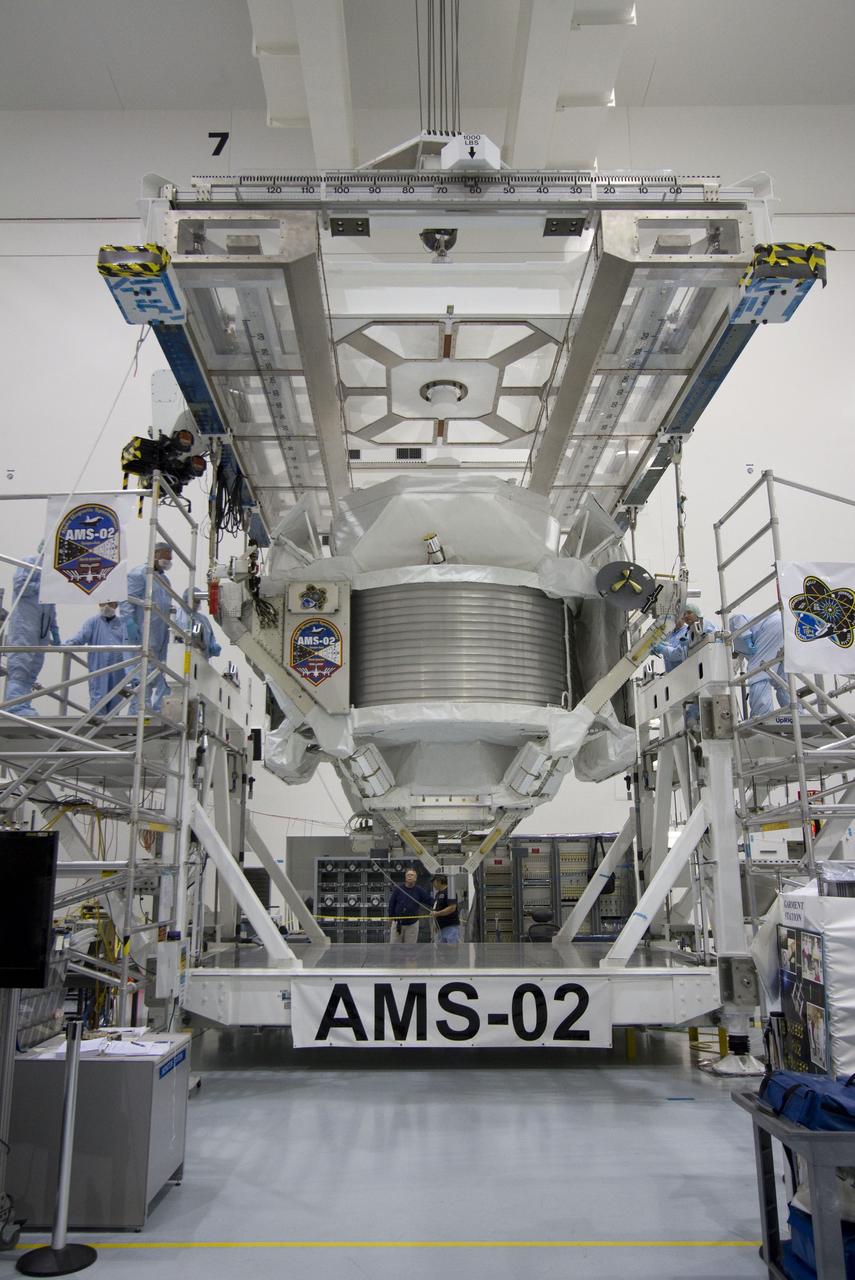
CAPE CANAVERAL, Fla. -- In the Space Station Processing Facility at NASA's Kennedy Space Center in Florida, the Alpha Magnetic Spectrometer-2 (AMS) begins to move from its primary work stand to the weight and center of gravity stand where final measurements will be taken before launch. Next, AMS will be moved into a payload canister. The canister will protect the space-bound payload on its journey to Launch Pad 39A, where it will later be installed into space shuttle Endeavour’s payload bay. AMS is a particle physics detector, designed to operate as an external experiment on the International Space Station. It will use the unique environment of space to study the universe and its origin by searching for dark matter. AMS-2 will fly to the station aboard Endeavour's STS-134 mission targeted to launch April 19 at 7:48 p.m. EDT. For more information visit, www.nasa.gov/mission_pages/shuttle/shuttlemissions/sts134/index.html. Photo credit: NASA/Jack Pfaller
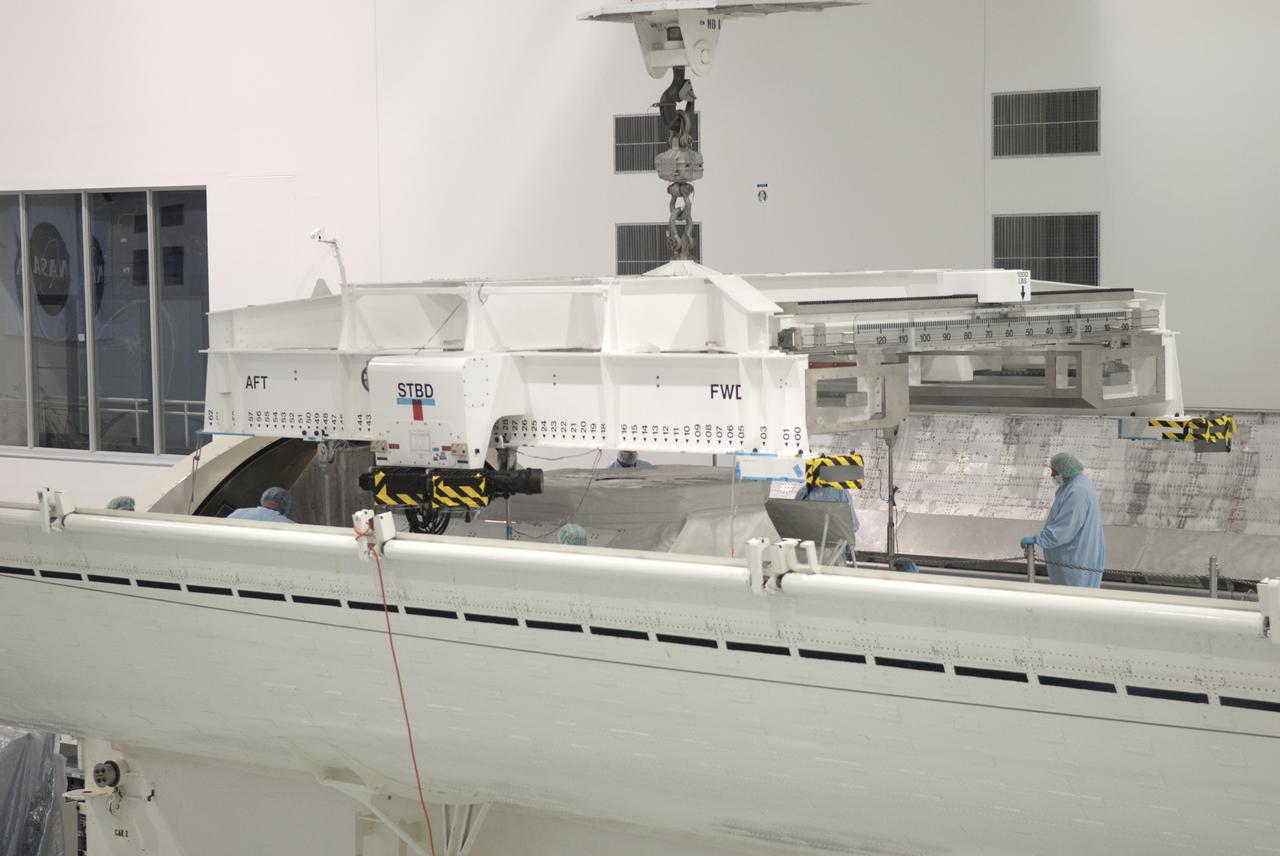
CAPE CANAVERAL, Fla. -- In the Space Station Processing Facility at NASA's Kennedy Space Center in Florida, the Alpha Magnetic Spectrometer-2 AMS is moved into a payload canister after technicians measured its weight and center of gravity. The canister will protect the space-bound payload on its journey to Launch Pad 39A, where it will later be installed into space shuttle Endeavour’s payload bay. AMS is a particle physics detector, designed to operate as an external experiment on the International Space Station. It will use the unique environment of space to study the universe and its origin by searching for dark matter. AMS-2 will fly to the station aboard Endeavour's STS-134 mission targeted to launch April 19 at 7:48 p.m. EDT. For more information visit, www.nasa.gov/mission_pages/shuttle/shuttlemissions/sts134/index.html. Photo credit: NASA/Jim Grossmann
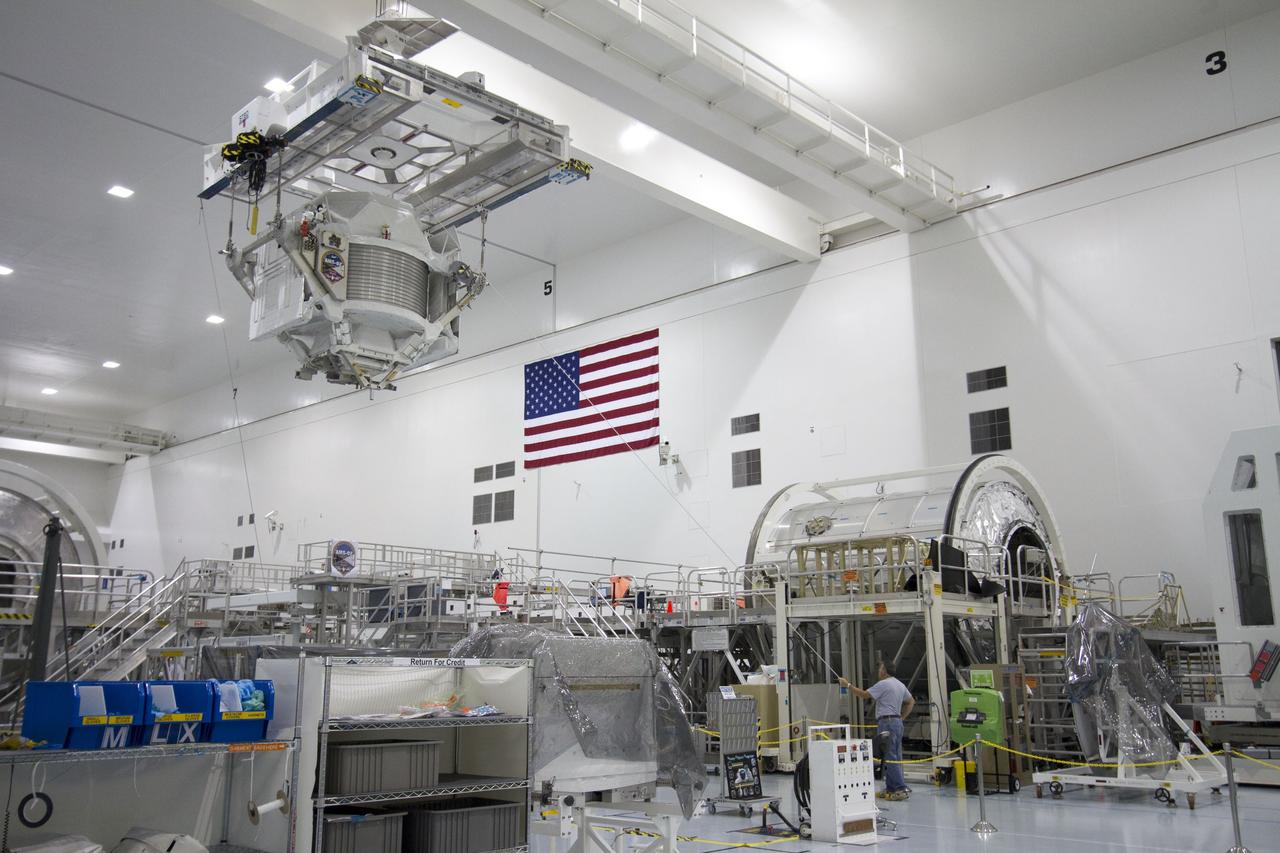
CAPE CANAVERAL, Fla. -- In the Space Station Processing Facility at NASA's Kennedy Space Center in Florida, the Alpha Magnetic Spectrometer-2 (AMS) moves from its primary work stand to the weight and center of gravity stand where final measurements will be taken before launch. Next, AMS will be moved into a payload canister. The canister will protect the space-bound payload on its journey to Launch Pad 39A, where it will later be installed into space shuttle Endeavour’s payload bay. AMS is a particle physics detector, designed to operate as an external experiment on the International Space Station. It will use the unique environment of space to study the universe and its origin by searching for dark matter. AMS-2 will fly to the station aboard Endeavour's STS-134 mission targeted to launch April 19 at 7:48 p.m. EDT. For more information visit, www.nasa.gov/mission_pages/shuttle/shuttlemissions/sts134/index.html. Photo credit: NASA/Jack Pfaller
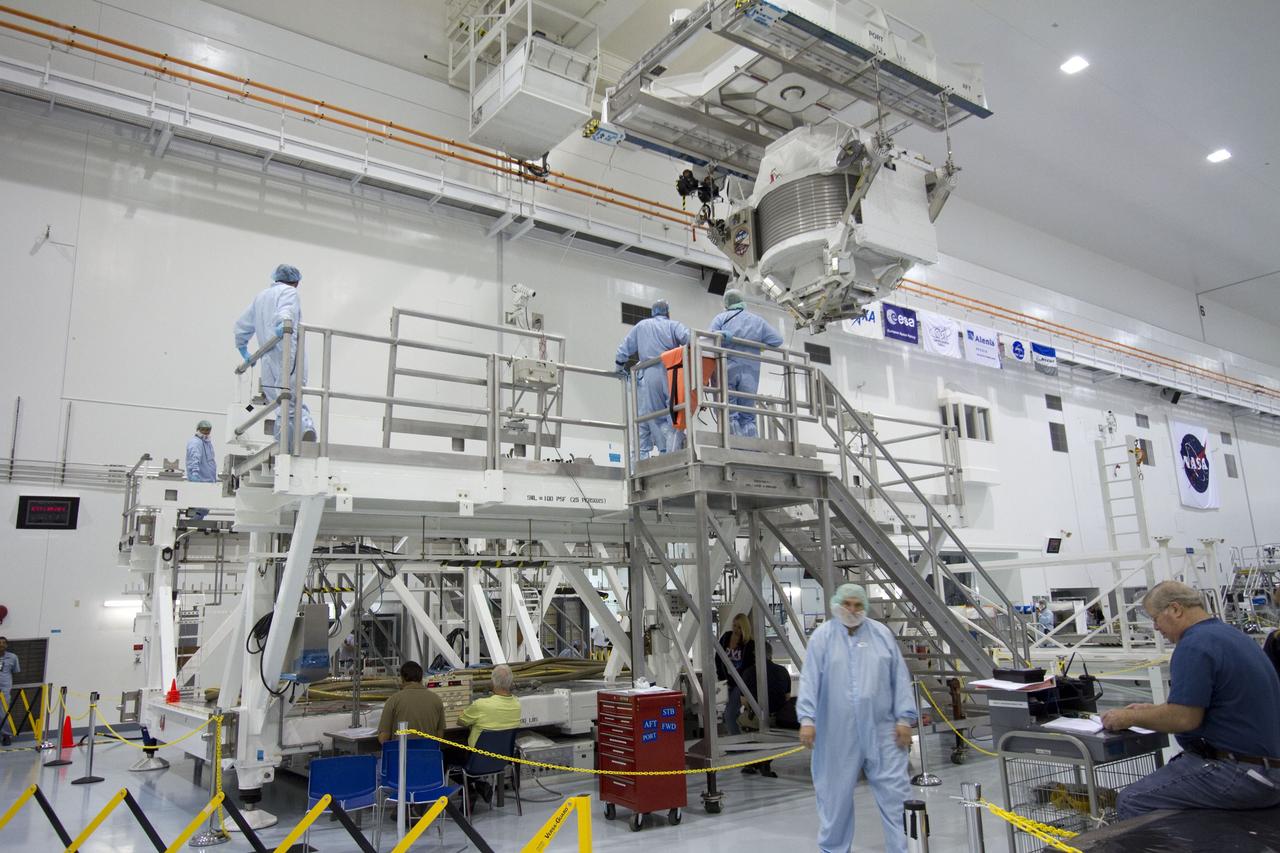
CAPE CANAVERAL, Fla. -- In the Space Station Processing Facility at NASA's Kennedy Space Center in Florida, the Alpha Magnetic Spectrometer-2 (AMS) moves from its primary work stand to the weight and center of gravity stand where final measurements will be taken before launch. Next, AMS will be moved into a payload canister. The canister will protect the space-bound payload on its journey to Launch Pad 39A, where it will later be installed into space shuttle Endeavour’s payload bay. AMS is a particle physics detector, designed to operate as an external experiment on the International Space Station. It will use the unique environment of space to study the universe and its origin by searching for dark matter. AMS-2 will fly to the station aboard Endeavour's STS-134 mission targeted to launch April 19 at 7:48 p.m. EDT. For more information visit, www.nasa.gov/mission_pages/shuttle/shuttlemissions/sts134/index.html. Photo credit: NASA/Jack Pfaller

KENNEDY SPACE CENTER, FLA. -- In the Space Station Processing Facility at NASA's Kennedy Space Center, workers maneuver a crane into place above the integrated cargo carrier-lite, or ICC-L. The carrier will be lifted and placed in the payload canister for mission STS-122. Joining the primary payload, the Columbus module, the ICC-L is an unpressurized cross-bay carrier providing launch and return transportation with the space shuttle. The ICC-L carries three elements: a nitrogen tank assembly that is part of the external active thermal control system on the International Space Station, the European technology Exposure Facility composed of nine science instruments and an autonomous temperature measurement unit, and the SOLAR payload designed for sun observation. The SOLAR will be transferred and stowed on the Columbus module during the third spacewalk of the mission. STS-122 is targeted for launch on Dec. 6 on space shuttle Atlantis. Photo credit: NASA/Amanda Diller
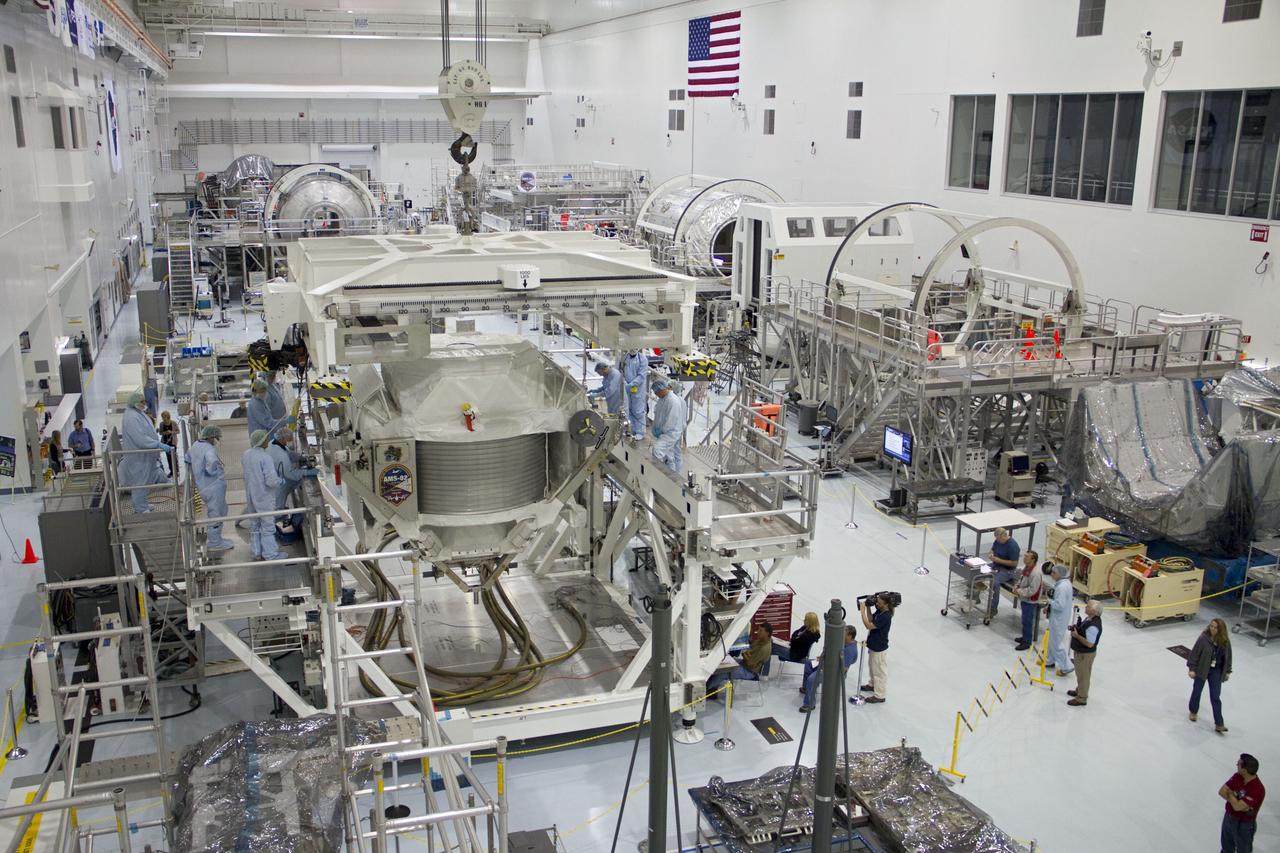
CAPE CANAVERAL, Fla. -- In the Space Station Processing Facility at NASA's Kennedy Space Center in Florida, the Alpha Magnetic Spectrometer-2 (AMS) was moved from its primary work stand to the weight and center of gravity stand where final measurements will be taken before launch. Next, AMS will be moved into a payload canister. The canister will protect the space-bound payload on its journey to Launch Pad 39A, where it will later be installed into space shuttle Endeavour’s payload bay. AMS is a particle physics detector, designed to operate as an external experiment on the International Space Station. It will use the unique environment of space to study the universe and its origin by searching for dark matter. AMS-2 will fly to the station aboard Endeavour's STS-134 mission targeted to launch April 19 at 7:48 p.m. EDT. For more information visit, www.nasa.gov/mission_pages/shuttle/shuttlemissions/sts134/index.html. Photo credit: NASA/Jack Pfaller
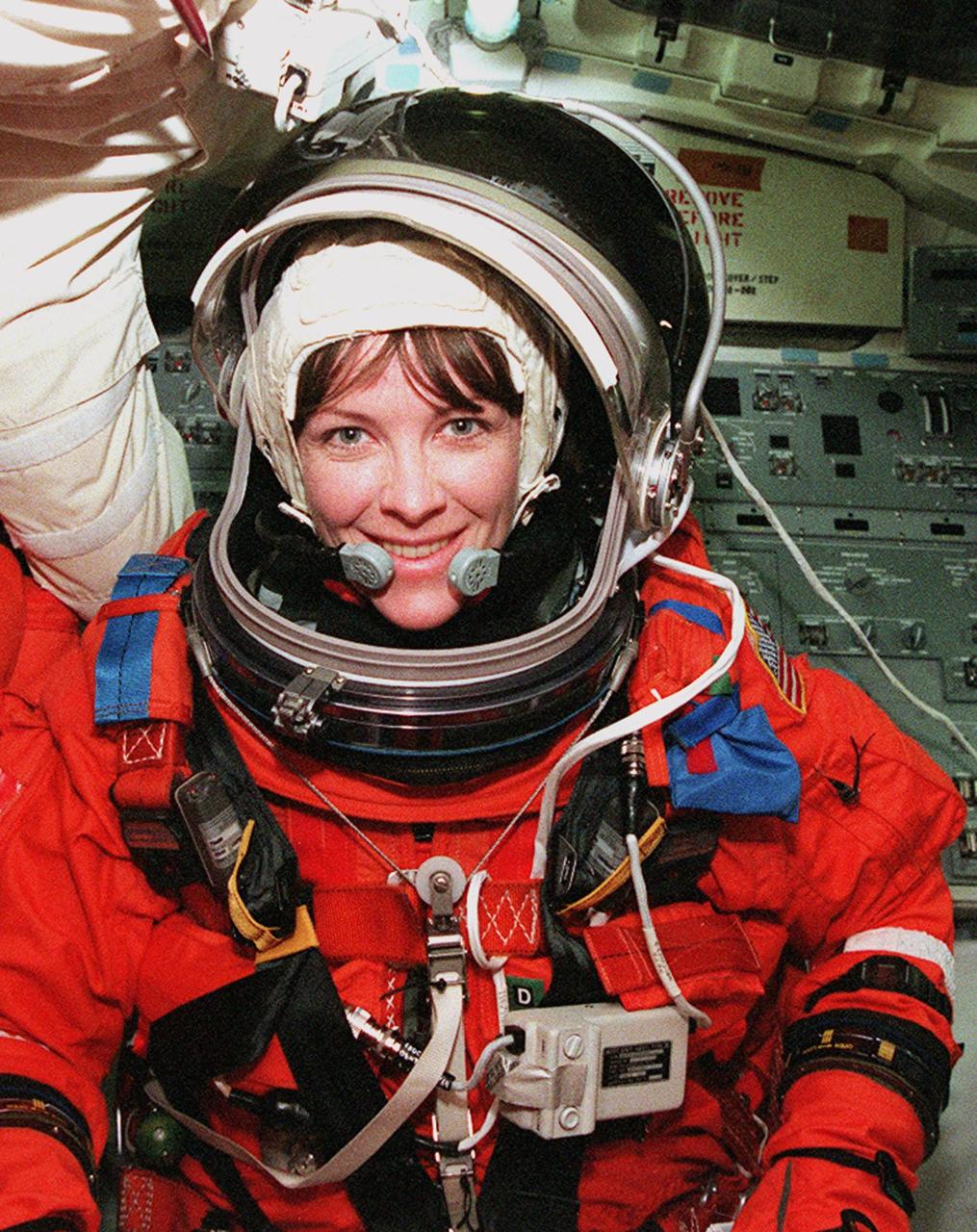
STS-99 Mission Specialist Janet Lynn Kavandi (Ph.D.) settles into her seat inside Space Shuttle Endeavour during Terminal Countdown Demonstration Test (TCDT) activities for the mission. The TCDT includes a simulation of the final launch countdown. STS-99 is the Shuttle Radar Topography Mission, which will chart a new course, using two antennae and a 200-foot-long section of space station-derived mast protruding from the payload bay to produce unrivaled 3-D images of the Earth's surface. The result of the Shuttle Radar Topography Mission could be close to 1 trillion measurements of the Earth's topography. Besides contributing to the production of better maps, these measurements could lead to improved water drainage modeling, more realistic flight simulators, better locations for cell phone towers, and enhanced navigation safety. Launch of Endeavour on the 11-day mission is scheduled for Jan. 31 at 12:47 p.m. EST
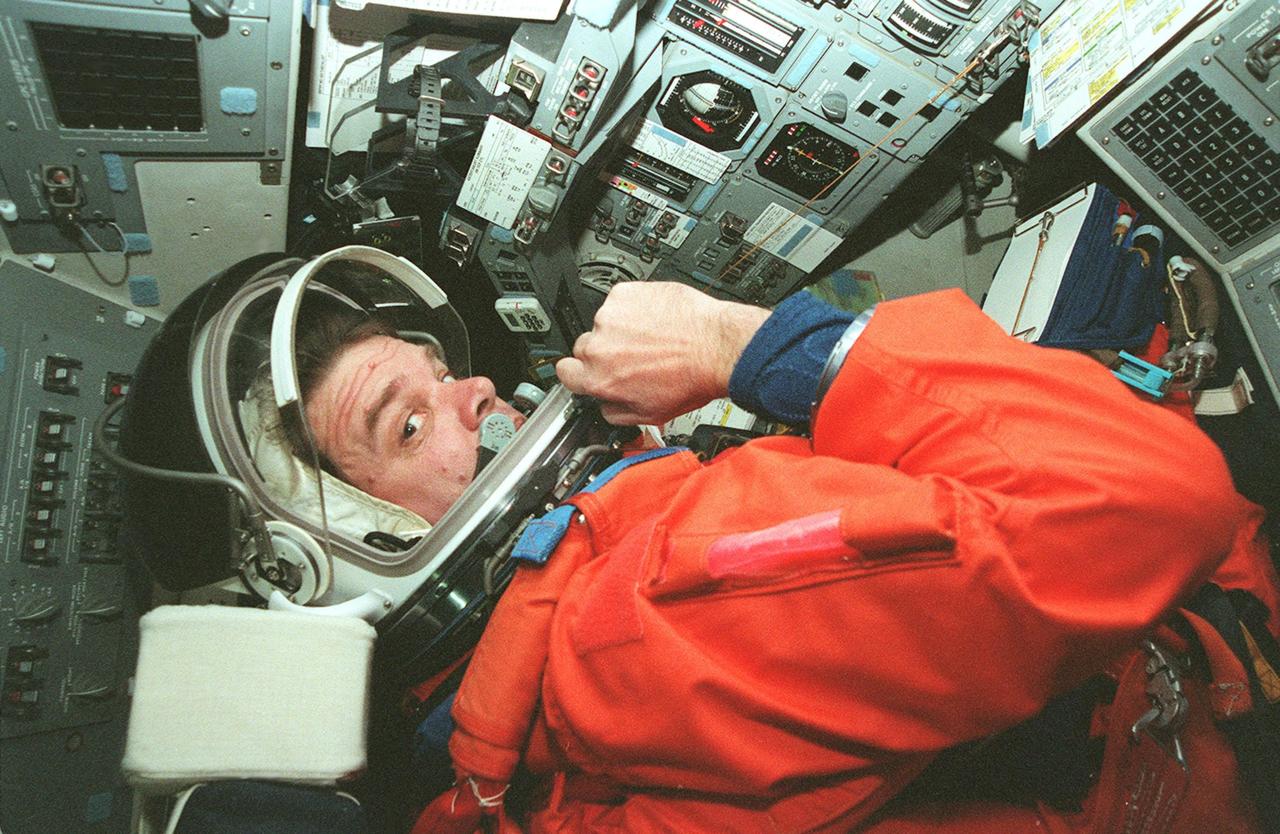
STS-99 Commander Kevin Kregel goes through countdown procedures on the flight deck aboard the Space Shuttle Endeavour during Terminal Countdown Demonstration Test (TCDT) activities for the mission. The TCDT includes a simulation of the final launch countdown. STS-99 is the Shuttle Radar Topography Mission, which will chart a new course, using two antennae and a 200-foot-long section of space station-derived mast protruding from the payload bay to produce unrivaled 3-D images of the Earth's surface. The result of the Shuttle Radar Topography Mission could be close to 1 trillion measurements of the Earth's topography. Besides contributing to the production of better maps, these measurements could lead to improved water drainage modeling, more realistic flight simulators, better locations for cell phone towers, and enhanced navigation safety. Launch of Endeavour on the 11-day mission is scheduled for Jan. 31 at 12:47 p.m. EST
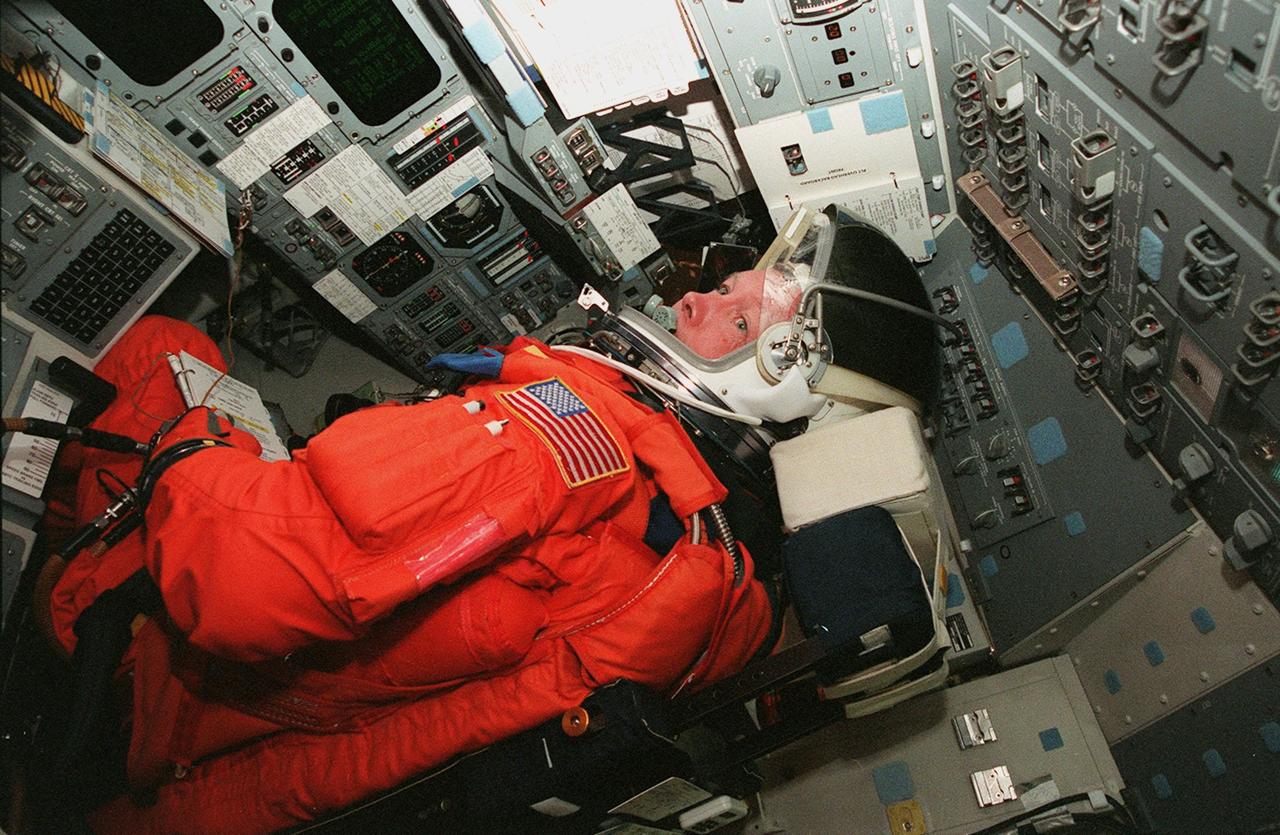
STS-99 Pilot Dominic Gorie goes through countdown procedures on the flight deck aboard the Space Shuttle Endeavour as part of Terminal Countdown Demonstration Test (TCDT) activities for the mission. The TCDT includes a simulation of the final launch countdown. STS-99 is the Shuttle Radar Topography Mission, which will chart a new course, using two antennae and a 200-foot-long section of space station-derived mast protruding from the payload bay to produce unrivaled 3-D images of the Earth's surface. The result of the Shuttle Radar Topography Mission could be close to 1 trillion measurements of the Earth's topography. Besides contributing to the production of better maps, these measurements could lead to improved water drainage modeling, more realistic flight simulators, better locations for cell phone towers, and enhanced navigation safety. Launch of Endeavour on the 11-day mission is scheduled for Jan. 31 at 12:47 p.m. EST
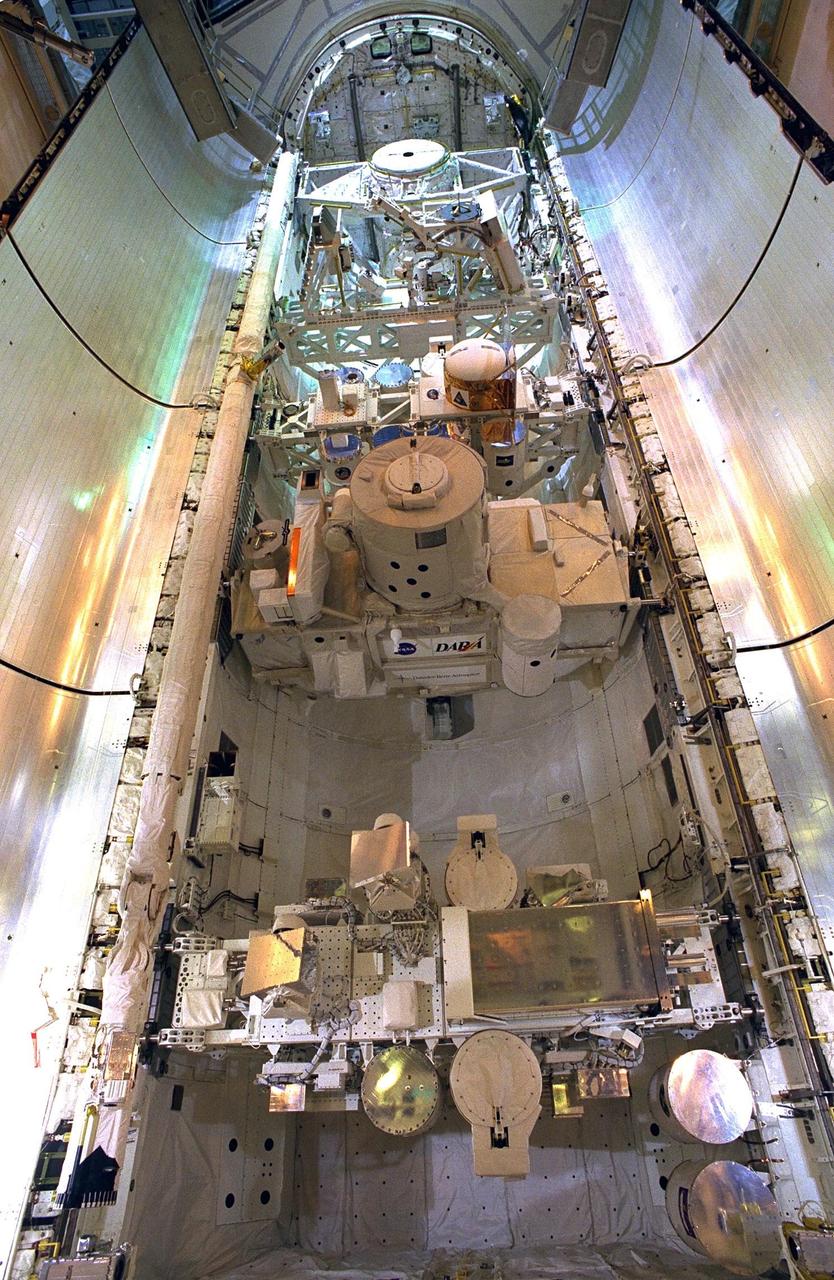
KENNEDY SPACE CENTER, FLA. -- The final tasks to prepare the Cryogenic Infrared Spectrometers and Telescopes for the Atmosphere-Shuttle Pallet Satellite-2 (CRISTA-SPAS-2) payload for the STS-85 mission are completed aboard Discovery at Launch Complex 39A. The CRISTA is a system of three telescopes and four spectrometers to measure infrared radiation emitted by the Earth’s middle atmosphere. During the 11-day mission, the CRISTA-SPAS-2 free-flying satellite will be deployed from Discovery and retrieved later in the flight. Also onboard the satellite will be the Middle Atmosphere High Resolution Spectrograph Investigation (MAHRSI) to measure ultraviolet radiation emitted and scattered by the Earth’s atmosphere.
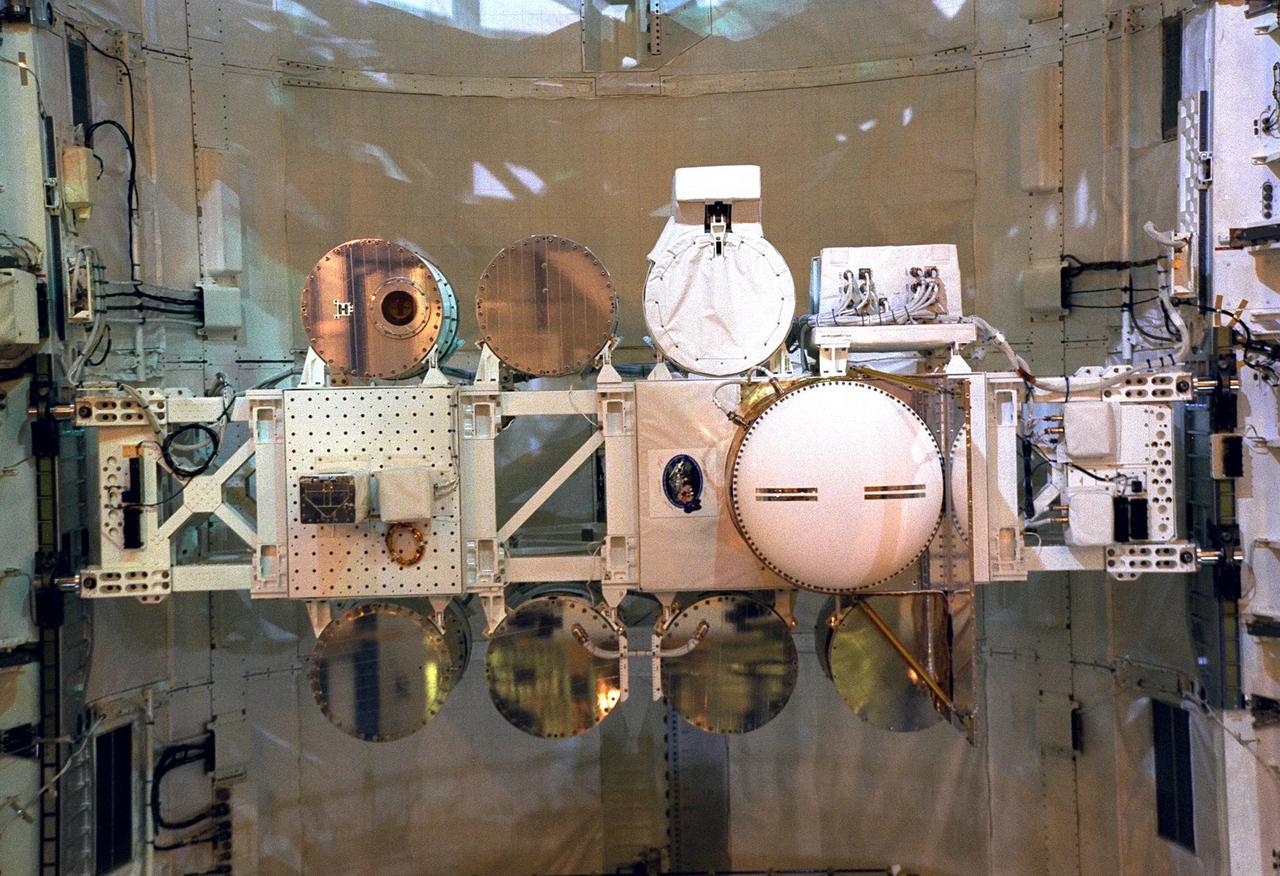
KENNEDY SPACE CENTER, FLA. -- The final tasks to prepare the Cryogenic Infrared Spectrometers and Telescopes for the Atmosphere-Shuttle Pallet Satellite-2 (CRISTA-SPAS-2) payload for the STS-85 mission are completed aboard Discovery at Launch Complex 39A. The CRISTA is a system of three telescopes and four spectrometers to measure infrared radiation emitted by the Earth’s middle atmosphere. During the 11-day mission, the CRISTA-SPAS-2 free-flying satellite will be deployed from Discovery and retrieved later in the flight. Also onboard the satellite will be the Middle Atmosphere High Resolution Spectrograph Investigation (MAHRSI) to measure ultraviolet radiation emitted and scattered by the Earth’s atmosphere.
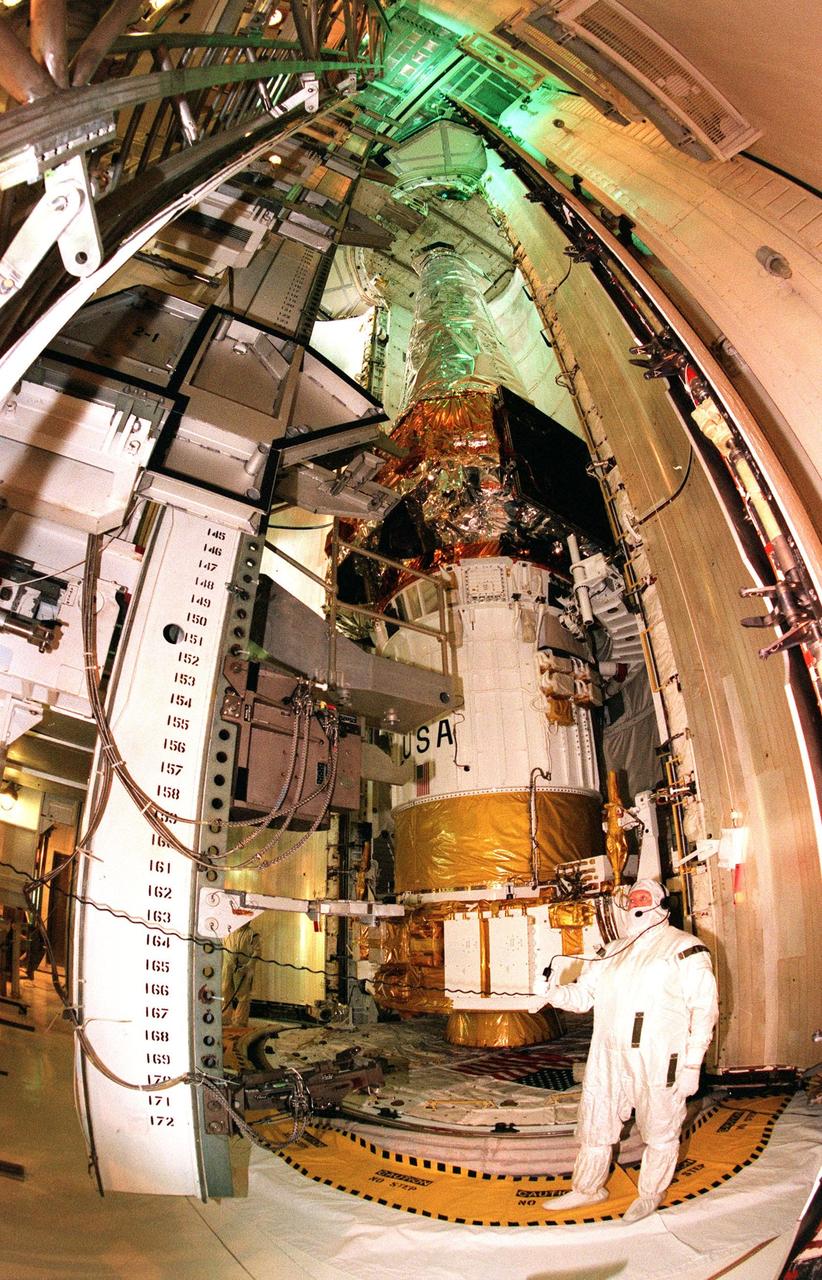
KENNEDY SPACE CENTER, FLA. -- At Launch Pad 39-B, a worker monitors the closing of Space Shuttle Columbia's payload bay doors around the Chandra X-ray Observatory. Chandra is the primary payload on mission STS-93, scheduled to launch aboard Columbia July 20 at 12:36 a.m. EDT. The combined Chandra/Inertial Upper Stage, seen here, measures 57 feet long and weighs 50,162 pounds. Fully deployed with solar arrays extended, the observatory measures 45.3 feet long and 64 feet wide. The world's most powerful X-ray telescope, Chandra will allow scientists from around the world to see previously invisible black holes and high-temperature gas clouds, giving the observatory the potential to rewrite the books on the structure and evolution of our universe
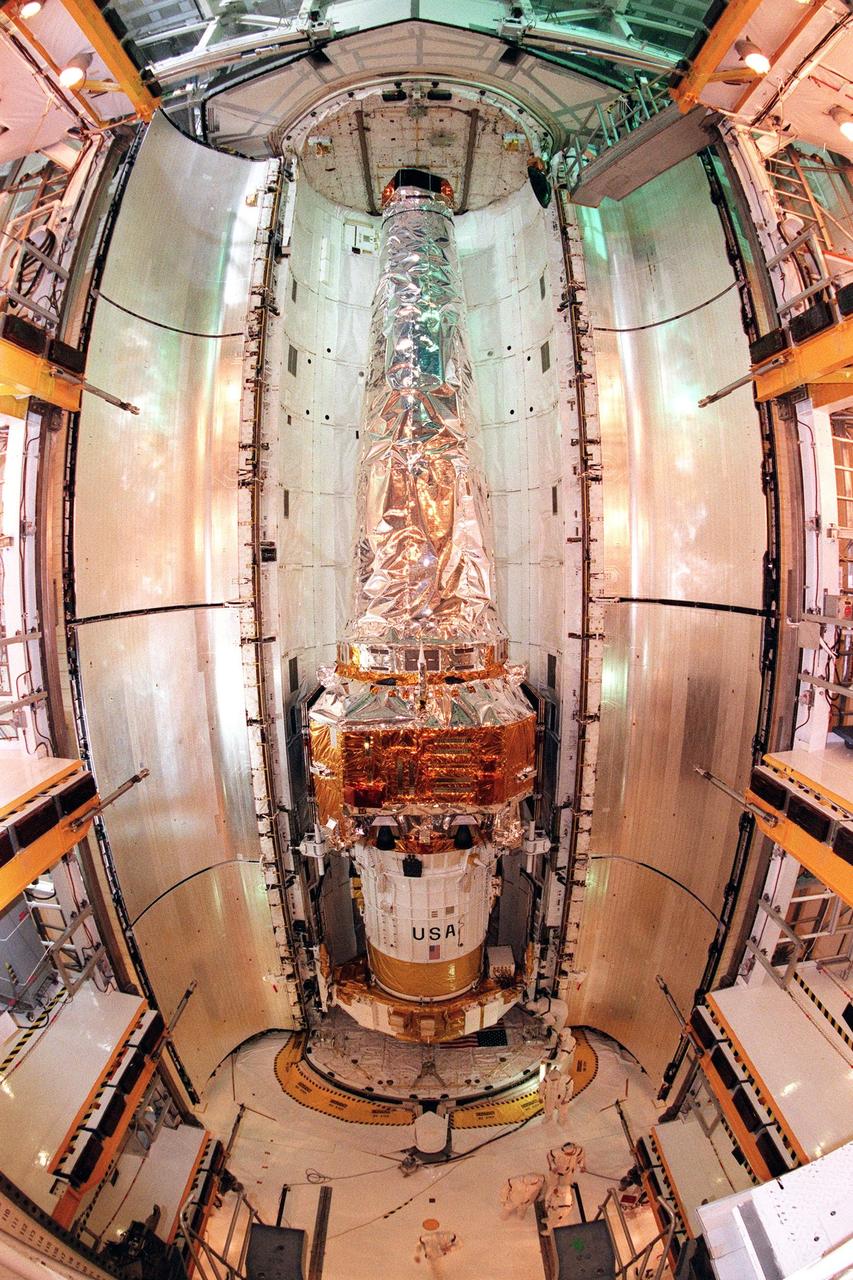
KENNEDY SPACE CENTER, FLA. -- At Launch Pad 39-B, the Chandra X-ray Observatory sits inside the payload bay on mission Space Shuttle Columbia, waiting for the doors to close. Chandra is the primary payload of STS-93, scheduled to launch aboard Columbia July 20 at 12:36 a.m. EDT. The combined Chandra/Inertial Upper Stage, seen here, measures 57 feet long and weighs 50,162 pounds. Fully deployed with solar arrays extended, the observatory measures 45.3 feet long and 64 feet wide. The world's most powerful X-ray telescope, Chandra will allow scientists from around the world to see previously invisible black holes and high-temperature gas clouds, giving the observatory the potential to rewrite the books on the structure and evolution of our universe

CAPE CANAVERAL, Fla. -- In the Space Station Processing Facility at NASA's Kennedy Space Center in Florida, an overhead crane moves the SEDA-AP (Space Environment Data Acquisition Equipment-Attached Payload) to install it on the Japanese Experiment Module's Experiment Logistics Module-Exposed Section, or ELM-ES. The SEDA-AP and ELM-ES are part of space shuttle Endeavour's payload for the STS-127 mission. SEDA-AP will measure space environment in ISS orbit and environmental effects on materials and electronic devices to investigate the interaction with and from the environment at the Kibo exposed facility. Endeavour is targeted to launch May 15. Photo credit: NASA/Troy Cryder
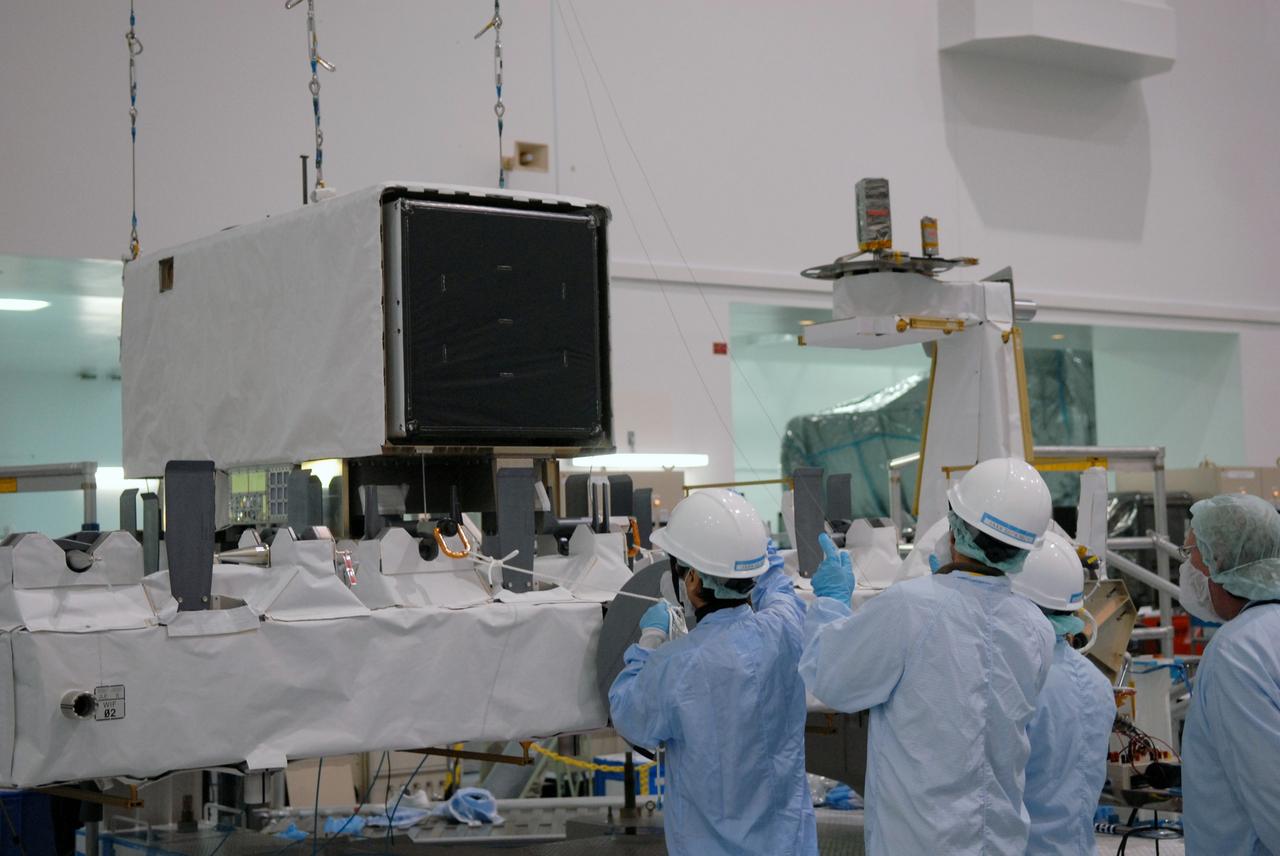
CAPE CANAVERAL, Fla. -- In the Space Station Processing Facility at NASA's Kennedy Space Center in Florida, the SEDA-AP (Space Environment Data Acquisition Equipment-Attached Payload) is lowered onto the Japanese Experiment Module's Experiment Logistics Module-Exposed Section, or ELM-ES for installation. The SEDA-AP and ELM-ES are part of space shuttle Endeavour's payload for the STS-127 mission. SEDA-AP will measure space environment in ISS orbit and environmental effects on materials and electronic devices to investigate the interaction with and from the environment at the Kibo exposed facility. Endeavour is targeted to launch May 15. Photo credit: NASA/Troy Cryder
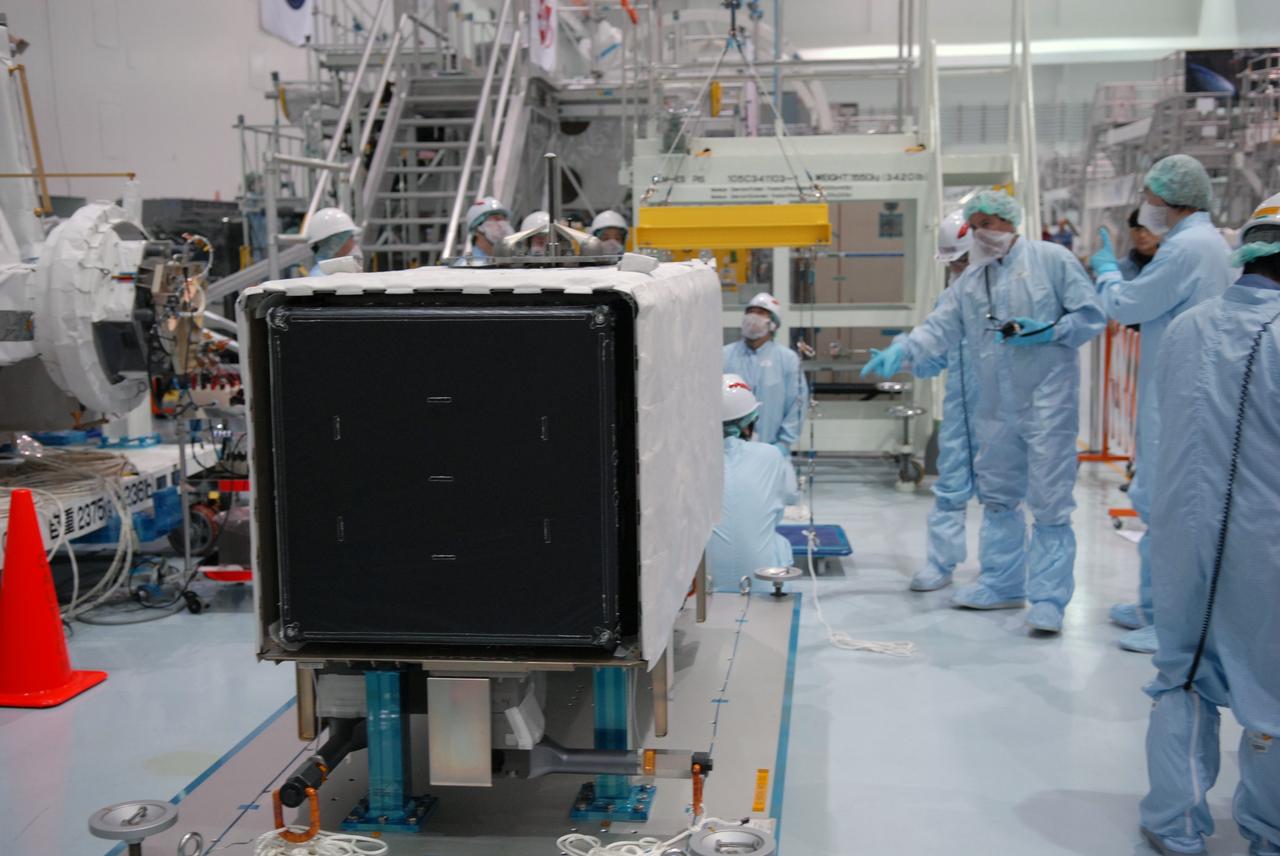
CAPE CANAVERAL, Fla. -- In the Space Station Processing Facility at NASA's Kennedy Space Center in Florida, the SEDA-AP (Space Environment Data Acquisition Equipment-Attached Payload) is waiting to be installed on the Japanese Experiment Module's Experiment Logistics Module-Exposed Section, or ELM-ES. The SEDA-AP and ELM-ES are part of space shuttle Endeavour's payload for the STS-127 mission. SEDA-AP will measure space environment in ISS orbit and environmental effects on materials and electronic devices to investigate the interaction with and from the environment at the Kibo exposed facility. Endeavour is targeted to launch May 15. Photo credit: NASA/Troy Cryder
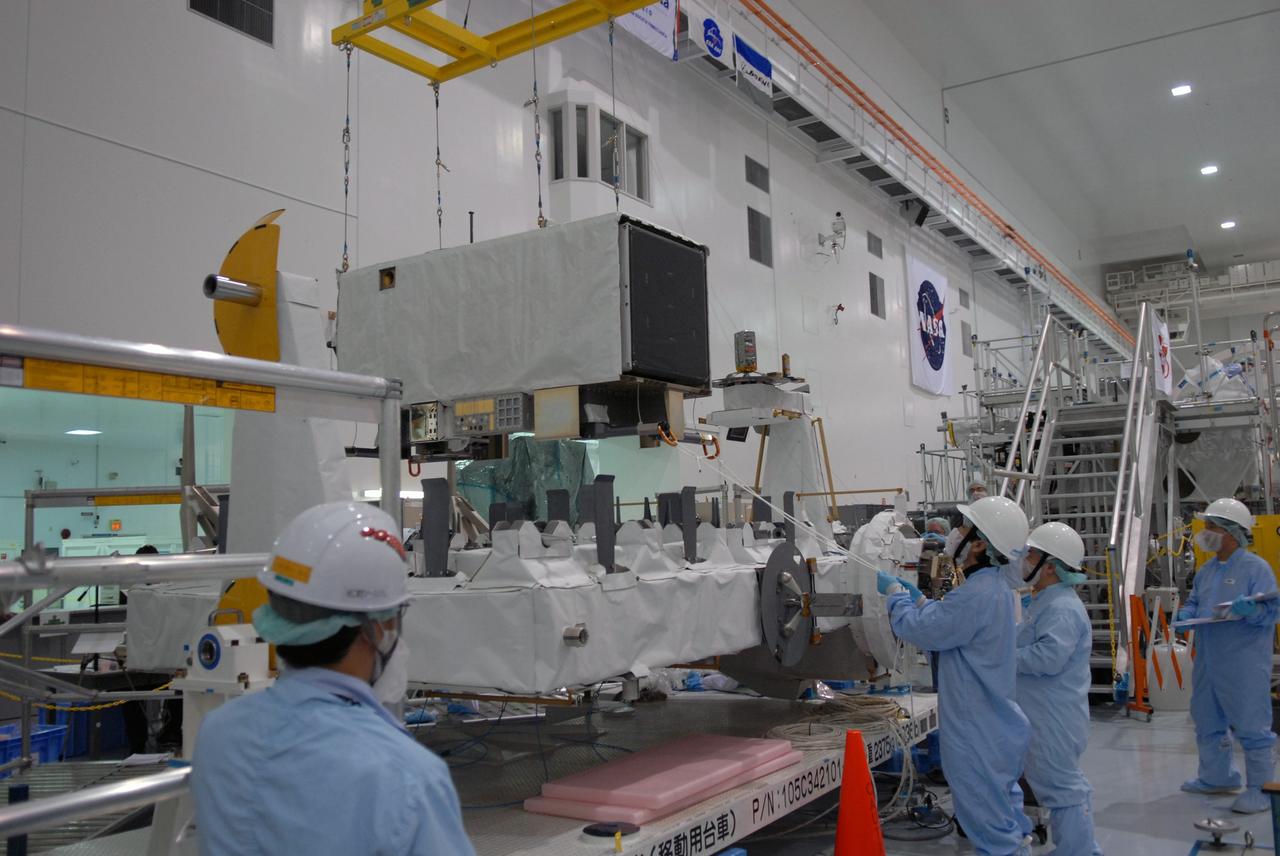
CAPE CANAVERAL, Fla. -- In the Space Station Processing Facility at NASA's Kennedy Space Center in Florida, the SEDA-AP (Space Environment Data Acquisition Equipment-Attached Payload) is lowered toward the Japanese Experiment Module's Experiment Logistics Module-Exposed Section, or ELM-ES for installation. The SEDA-AP and ELM-ES are part of space shuttle Endeavour's payload for the STS-127 mission. SEDA-AP will measure space environment in ISS orbit and environmental effects on materials and electronic devices to investigate the interaction with and from the environment at the Kibo exposed facility. Endeavour is targeted to launch May 15. Photo credit: NASA/Troy Cryder
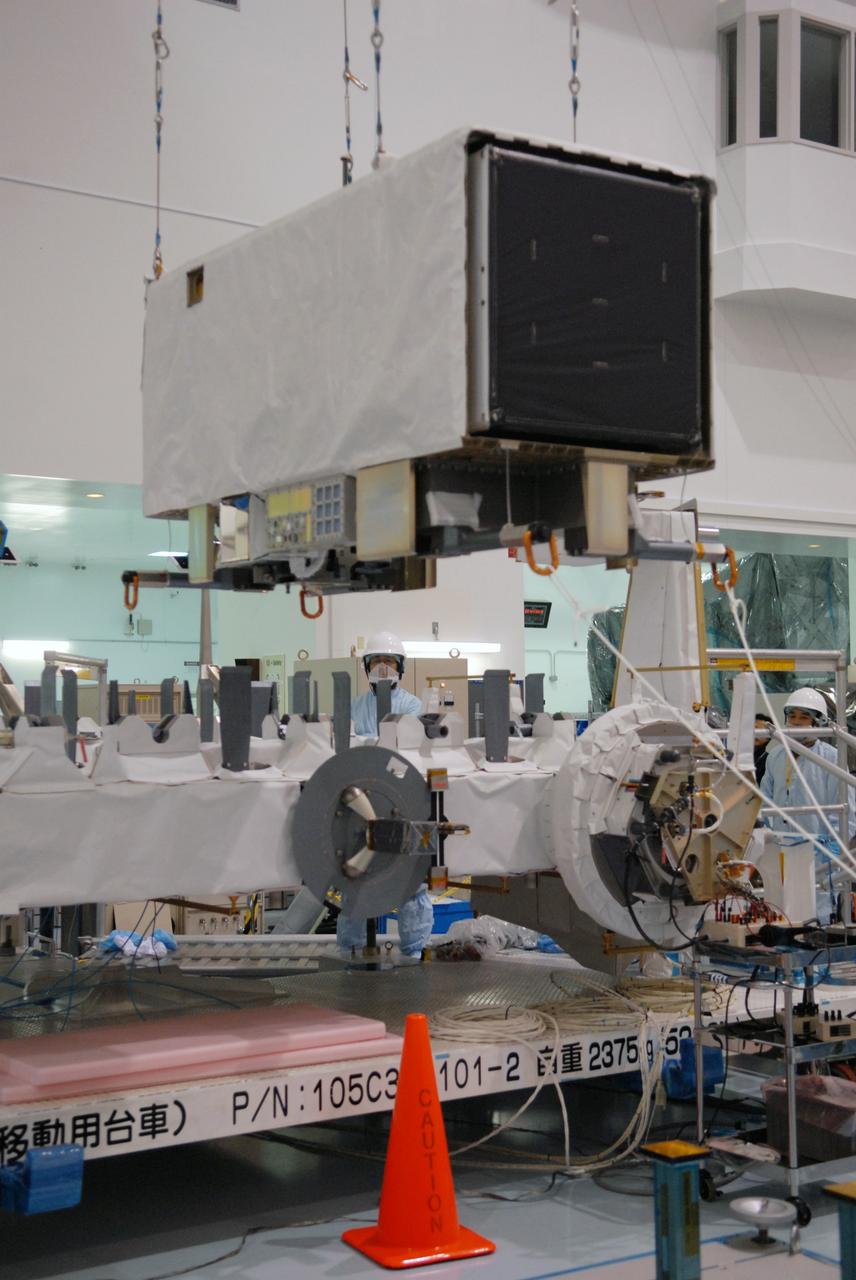
CAPE CANAVERAL, Fla. -- In the Space Station Processing Facility at NASA's Kennedy Space Center in Florida, the SEDA-AP (Space Environment Data Acquisition Equipment-Attached Payload) is lowered toward the Japanese Experiment Module's Experiment Logistics Module-Exposed Section, or ELM-ES for installation. The SEDA-AP and ELM-ES are part of space shuttle Endeavour's payload for the STS-127 mission. SEDA-AP will measure space environment in ISS orbit and environmental effects on materials and electronic devices to investigate the interaction with and from the environment at the Kibo exposed facility. Endeavour is targeted to launch May 15. Photo credit: NASA/Troy Cryder
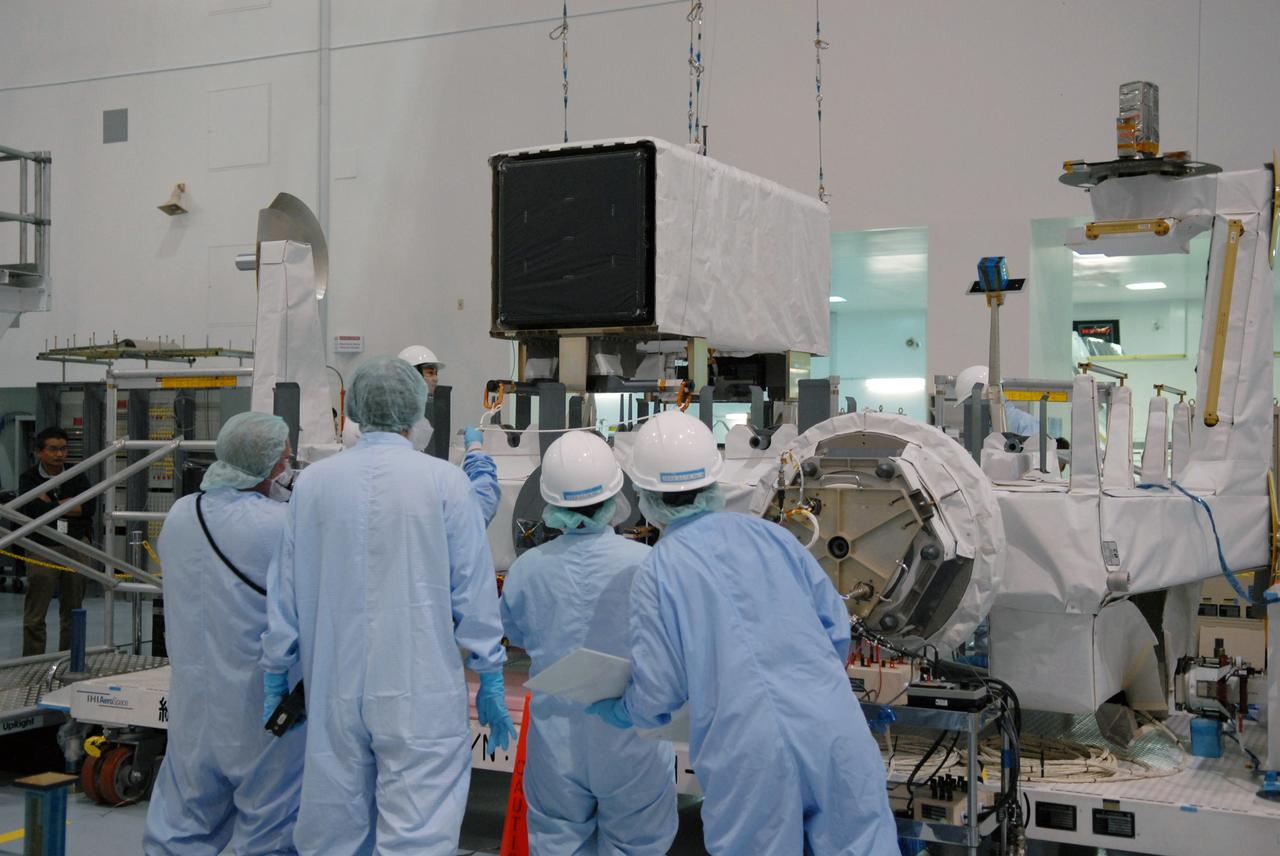
CAPE CANAVERAL, Fla. -- In the Space Station Processing Facility at NASA's Kennedy Space Center in Florida, the SEDA-AP (Space Environment Data Acquisition Equipment-Attached Payload) is lowered onto the Japanese Experiment Module's Experiment Logistics Module-Exposed Section, or ELM-ES for installation. The SEDA-AP and ELM-ES are part of space shuttle Endeavour's payload for the STS-127 mission. SEDA-AP will measure space environment in ISS orbit and environmental effects on materials and electronic devices to investigate the interaction with and from the environment at the Kibo exposed facility. Endeavour is targeted to launch May 15. Photo credit: NASA/Troy Cryder

KENNEDY SPACE CENTER, Fla. -- Near the bunker at Launch Pad 39A, STS-99 Mission Specialists Janice Voss (Ph.D.), Gerhard Thiele and Mamoru Mohri check out the slidewire basket used for emergency egress. The crew are taking part in Terminal Countdown Demonstration Test activities, which provide them with simulated countdown exercises, emergency egress training, and opportunities to inspect the mission payloads in the orbiter's payload bay. Thiele is with the European Space Agency and Mohri is with the National Space Development Agency (NASDA) of Japan. STS-99 is the Shuttle Radar Topography Mission, which will chart a new course, using two antennae and a 200-foot-long section of space station-derived mast protruding from the payload bay to produce unrivaled 3-D images of the Earth's surface. The result of the Shuttle Radar Topography Mission could be close to 1 trillion measurements of the Earth's topography. Besides contributing to the production of better maps, these measurements could lead to improved water drainage modeling, more realistic flight simulators, better locations for cell phone towers, and enhanced navigation safety. Launch of Endeavour on the 11-day mission is scheduled for Jan. 31 at 12:47 p.m. EST
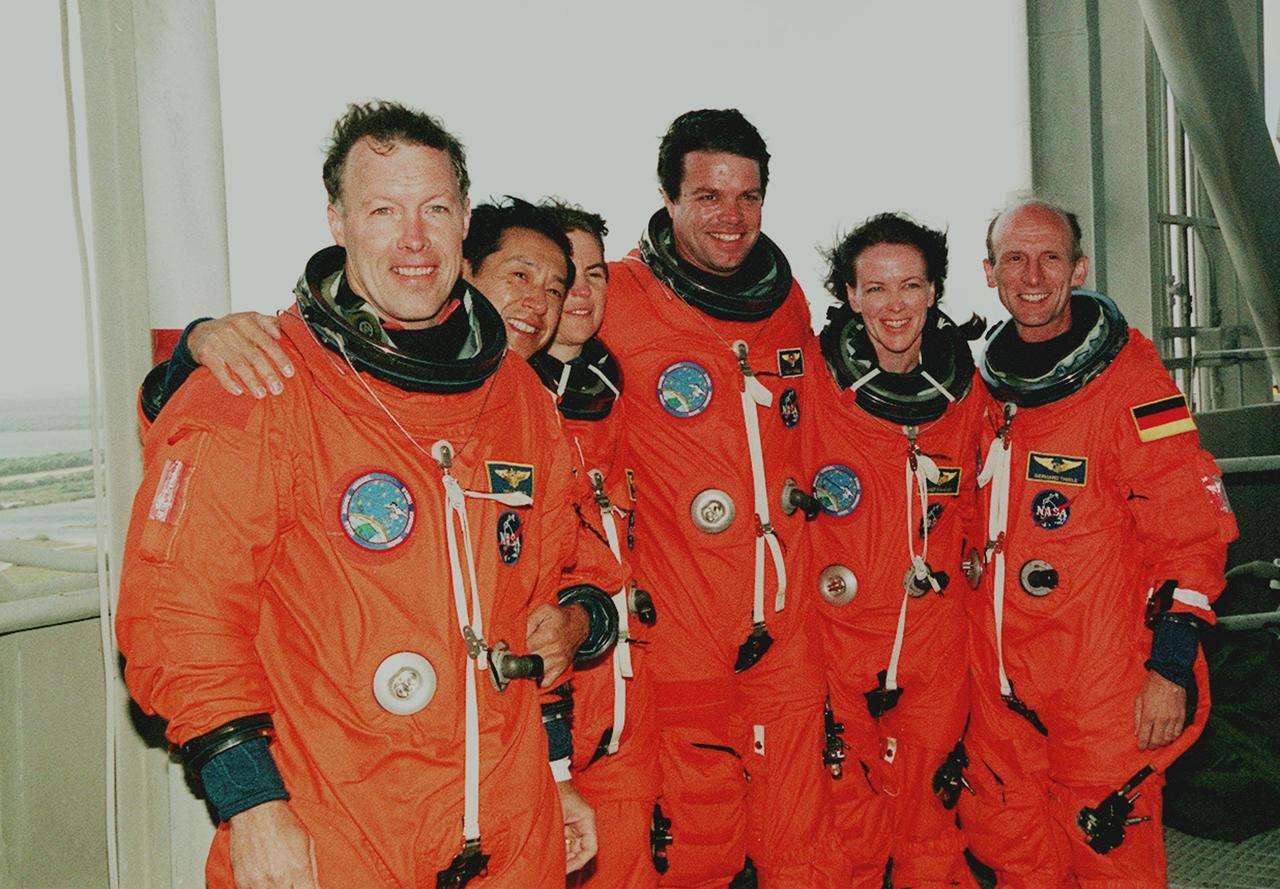
KENNEDY SPACE CENTER, Fla. -- At the 195-foot level of the Fixed Service Structure on Launch Pad 39A, the STS-99 crew pose for a photograph during Terminal Countdown Demonstration Test (TCDT) activities. Standing left to right are Pilot Dominic Gorie, Mission Specialist Mamoru Mohri (Ph.D.), Mission Specialist Janice Voss (Ph.D.), Commander Kevin Kregel, Mission Specialist Janet Lynn Kavandi (Ph.D.), and Mission Specialist Gerhard Thiele (Ph.D.). Thiele is with the European Space Agency and Mohri is with the National Space Development Agency (NASDA) of Japan. The TCDT provides the crew with simulated countdown exercises, emergency egress training, and opportunities to inspect the mission payloads in the orbiter's payload bay. STS-99 is the Shuttle Radar Topography Mission, which will chart a new course, using two antennae and a 200-foot-long section of space station-derived mast protruding from the payload bay to produce unrivaled 3-D images of the Earth's surface. The result of the Shuttle Radar Topography Mission could be close to 1 trillion measurements of the Earth's topography. Besides contributing to the production of better maps, these measurements could lead to improved water drainage modeling, more realistic flight simulators, better locations for cell phone towers, and enhanced navigation safety. Launch of Endeavour on the 11-day mission is scheduled for Jan. 31 at 12:47 p.m. EST
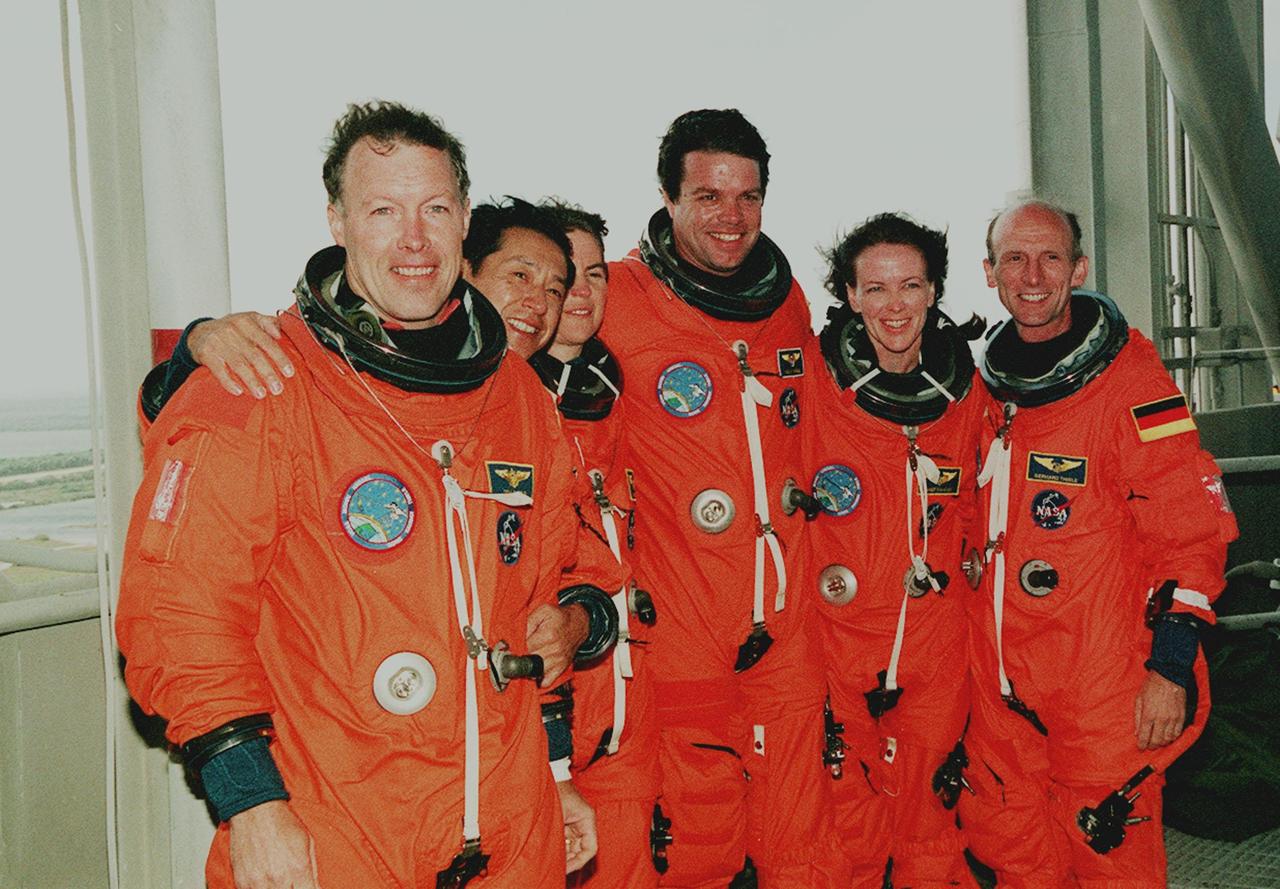
KENNEDY SPACE CENTER, Fla. -- At the 195-foot level of the Fixed Service Structure on Launch Pad 39A, the STS-99 crew pose for a photograph during Terminal Countdown Demonstration Test (TCDT) activities. Standing left to right are Pilot Dominic Gorie, Mission Specialist Mamoru Mohri (Ph.D.), Mission Specialist Janice Voss (Ph.D.), Commander Kevin Kregel, Mission Specialist Janet Lynn Kavandi (Ph.D.), and Mission Specialist Gerhard Thiele (Ph.D.). Thiele is with the European Space Agency and Mohri is with the National Space Development Agency (NASDA) of Japan. The TCDT provides the crew with simulated countdown exercises, emergency egress training, and opportunities to inspect the mission payloads in the orbiter's payload bay. STS-99 is the Shuttle Radar Topography Mission, which will chart a new course, using two antennae and a 200-foot-long section of space station-derived mast protruding from the payload bay to produce unrivaled 3-D images of the Earth's surface. The result of the Shuttle Radar Topography Mission could be close to 1 trillion measurements of the Earth's topography. Besides contributing to the production of better maps, these measurements could lead to improved water drainage modeling, more realistic flight simulators, better locations for cell phone towers, and enhanced navigation safety. Launch of Endeavour on the 11-day mission is scheduled for Jan. 31 at 12:47 p.m. EST
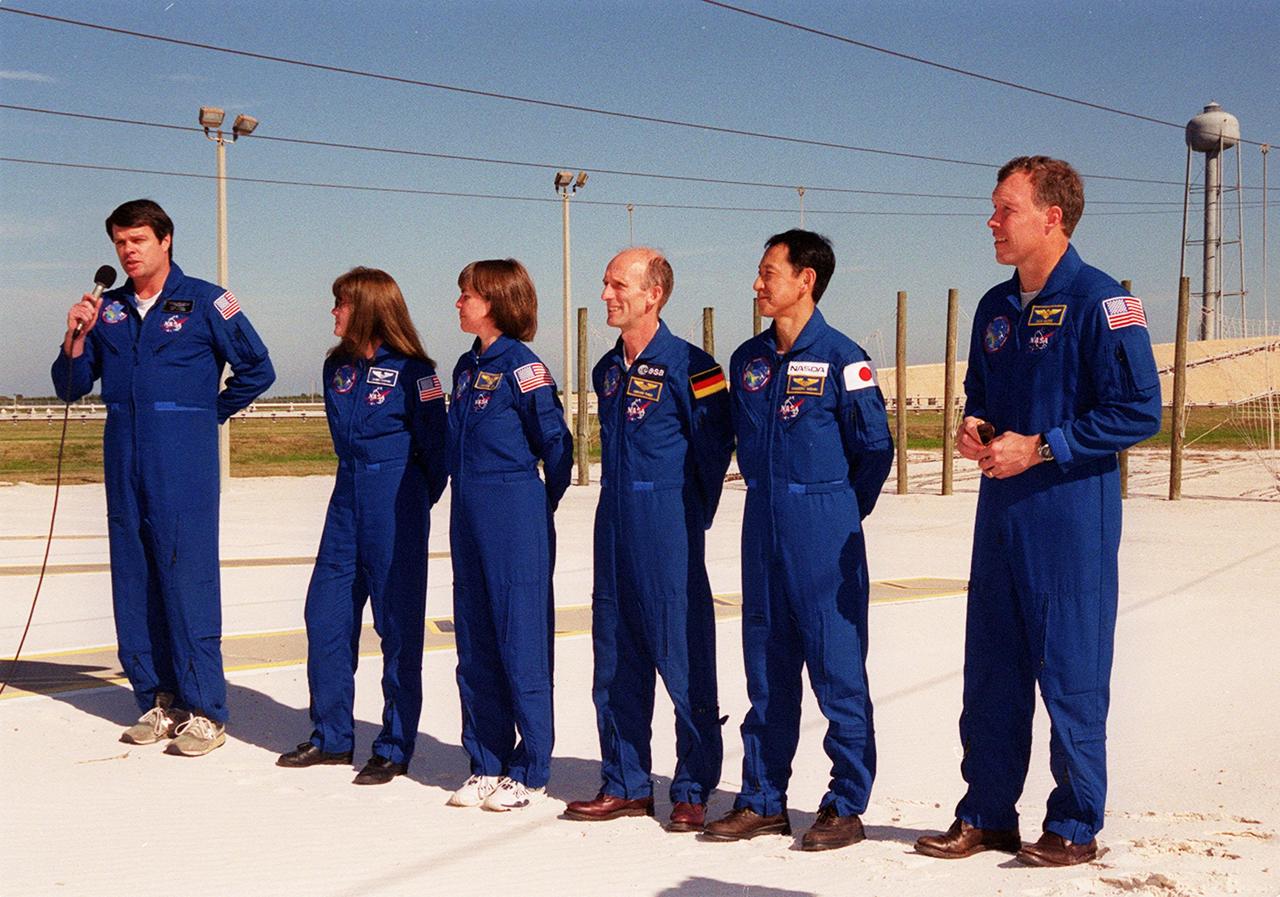
KENNEDY SPACE CENTER, Fla. -- The STS-99 crew take time out during Terminal Countdown Demonstration Test (TCDT) activities to talk to the media. From left to right are Commander Kevin Kregel, Mission Specialists Janet Lynn Kavandi (Ph.D.), Janice Voss (Ph.D.), Gerhard Thiele and Mamoru Mohri, and Pilot Dominic Gorie. Thiele is with the European Space Agency and Mohri is with the National Space Development Agency (NASDA) of Japan. The TCDT provides the crew with simulated countdown exercises, emergency egress training, and opportunities to inspect the mission payloads in the orbiter's payload bay. STS-99 is the Shuttle Radar Topography Mission, which will chart a new course, using two antennae and a 200-foot-long section of space station-derived mast protruding from the payload bay to produce unrivaled 3-D images of the Earth's surface. The result of the Shuttle Radar Topography Mission could be close to 1 trillion measurements of the Earth's topography. Besides contributing to the production of better maps, these measurements could lead to improved water drainage modeling, more realistic flight simulators, better locations for cell phone towers, and enhanced navigation safety. Launch of Endeavour on the 11-day mission is scheduled for Jan. 31 at 12:47 p.m. ES

KENNEDY SPACE CENTER, Fla. -- In the bunker at Launch Pad 39A, the STS-99 crew try on oxygen masks. From left are Pilot Dominic Gorie, Mission Specialist Janice Voss (Ph.D.), Commander Kevin Kregel, and Mission Specialists Mamoru Mohri, Janet Lynn Kavandi (Ph.D.) and Gerhard Thiele. Mohri is with the National Space Development Agency (NASDA) of Japan and Thiele is with the European Space Agency. The crew are taking part in Terminal Countdown Demonstration Test activities, which provide them with simulated countdown exercises, emergency egress training, and opportunities to inspect the mission payloads in the orbiter's payload bay. STS-99 is the Shuttle Radar Topography Mission, which will chart a new course, using two antennae and a 200-foot-long section of space station-derived mast protruding from the payload bay to produce unrivaled 3-D images of the Earth's surface. The result of the Shuttle Radar Topography Mission could be close to 1 trillion measurements of the Earth's topography. Besides contributing to the production of better maps, these measurements could lead to improved water drainage modeling, more realistic flight simulators, better locations for cell phone towers, and enhanced navigation safety. Launch of Endeavour on the 11-day mission is scheduled for Jan. 31 at 12:47 p.m. EST
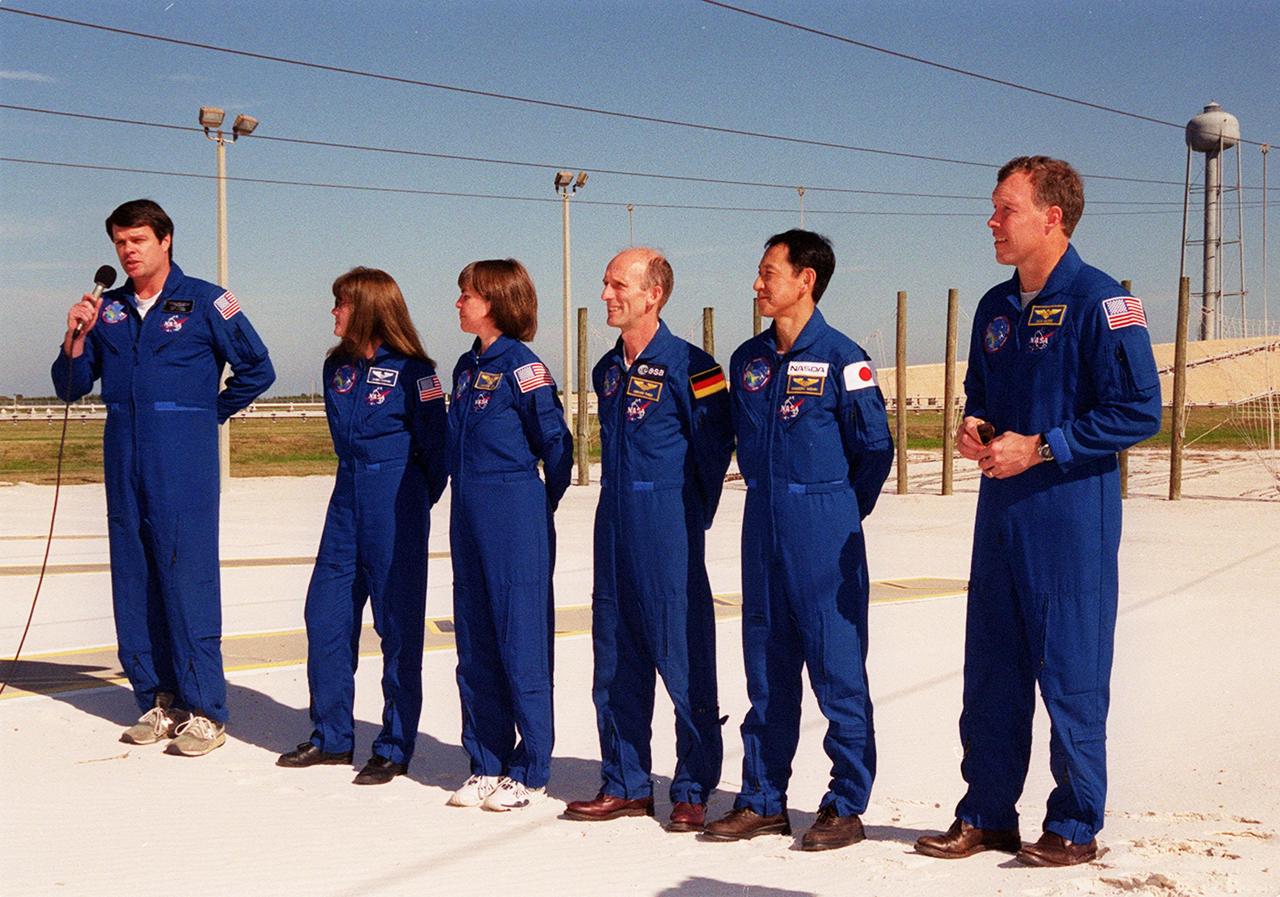
KENNEDY SPACE CENTER, Fla. -- The STS-99 crew take time out during Terminal Countdown Demonstration Test (TCDT) activities to talk to the media. From left to right are Commander Kevin Kregel, Mission Specialists Janet Lynn Kavandi (Ph.D.), Janice Voss (Ph.D.), Gerhard Thiele and Mamoru Mohri, and Pilot Dominic Gorie. Thiele is with the European Space Agency and Mohri is with the National Space Development Agency (NASDA) of Japan. The TCDT provides the crew with simulated countdown exercises, emergency egress training, and opportunities to inspect the mission payloads in the orbiter's payload bay. STS-99 is the Shuttle Radar Topography Mission, which will chart a new course, using two antennae and a 200-foot-long section of space station-derived mast protruding from the payload bay to produce unrivaled 3-D images of the Earth's surface. The result of the Shuttle Radar Topography Mission could be close to 1 trillion measurements of the Earth's topography. Besides contributing to the production of better maps, these measurements could lead to improved water drainage modeling, more realistic flight simulators, better locations for cell phone towers, and enhanced navigation safety. Launch of Endeavour on the 11-day mission is scheduled for Jan. 31 at 12:47 p.m. ES
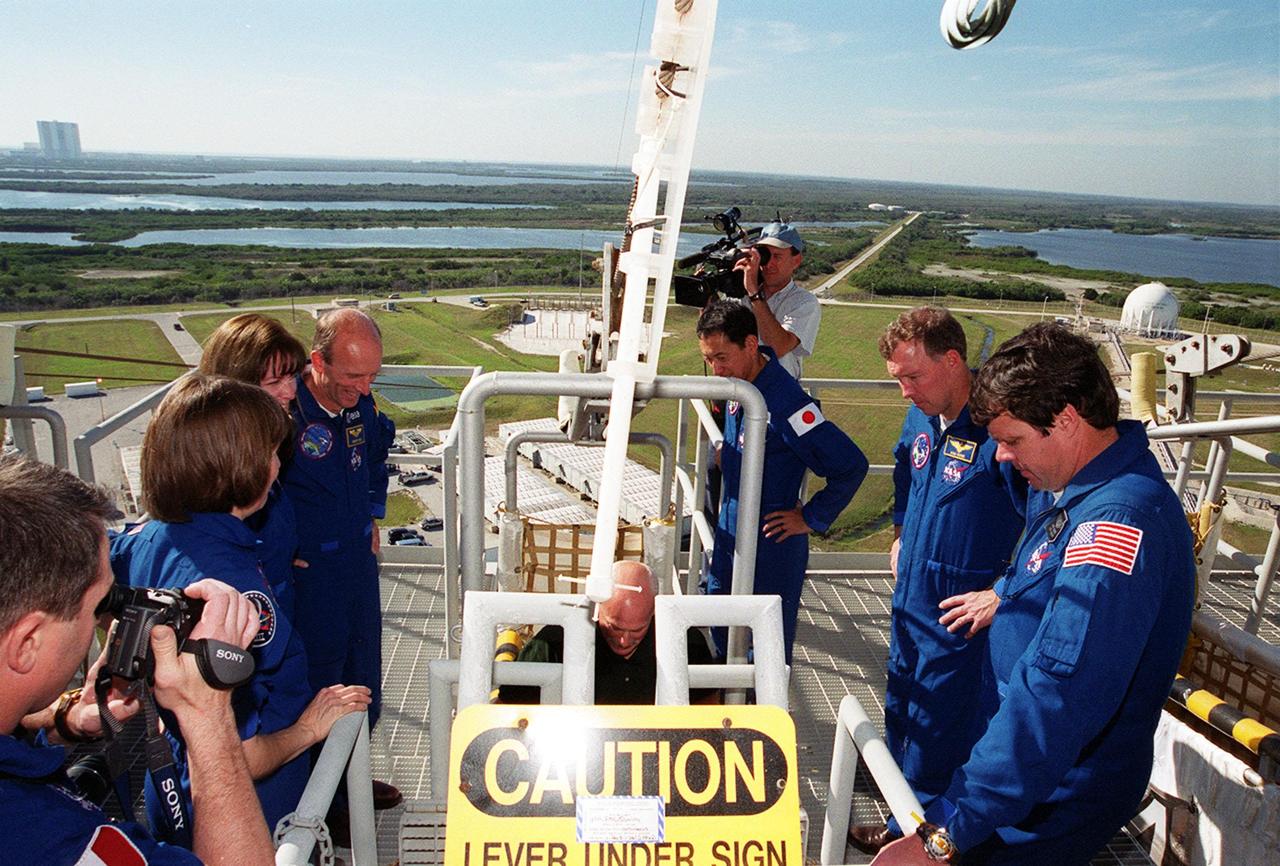
KENNEDY SPACE CENTER, Fla. -- Near the bunker at Launch Pad 39A, STS-99 Mission Specialists Janice Voss (Ph.D.), Gerhard Thiele and Mamoru Mohri check out the slidewire basket used for emergency egress. The crew are taking part in Terminal Countdown Demonstration Test activities, which provide them with simulated countdown exercises, emergency egress training, and opportunities to inspect the mission payloads in the orbiter's payload bay. Thiele is with the European Space Agency and Mohri is with the National Space Development Agency (NASDA) of Japan. STS-99 is the Shuttle Radar Topography Mission, which will chart a new course, using two antennae and a 200-foot-long section of space station-derived mast protruding from the payload bay to produce unrivaled 3-D images of the Earth's surface. The result of the Shuttle Radar Topography Mission could be close to 1 trillion measurements of the Earth's topography. Besides contributing to the production of better maps, these measurements could lead to improved water drainage modeling, more realistic flight simulators, better locations for cell phone towers, and enhanced navigation safety. Launch of Endeavour on the 11-day mission is scheduled for Jan. 31 at 12:47 p.m. EST
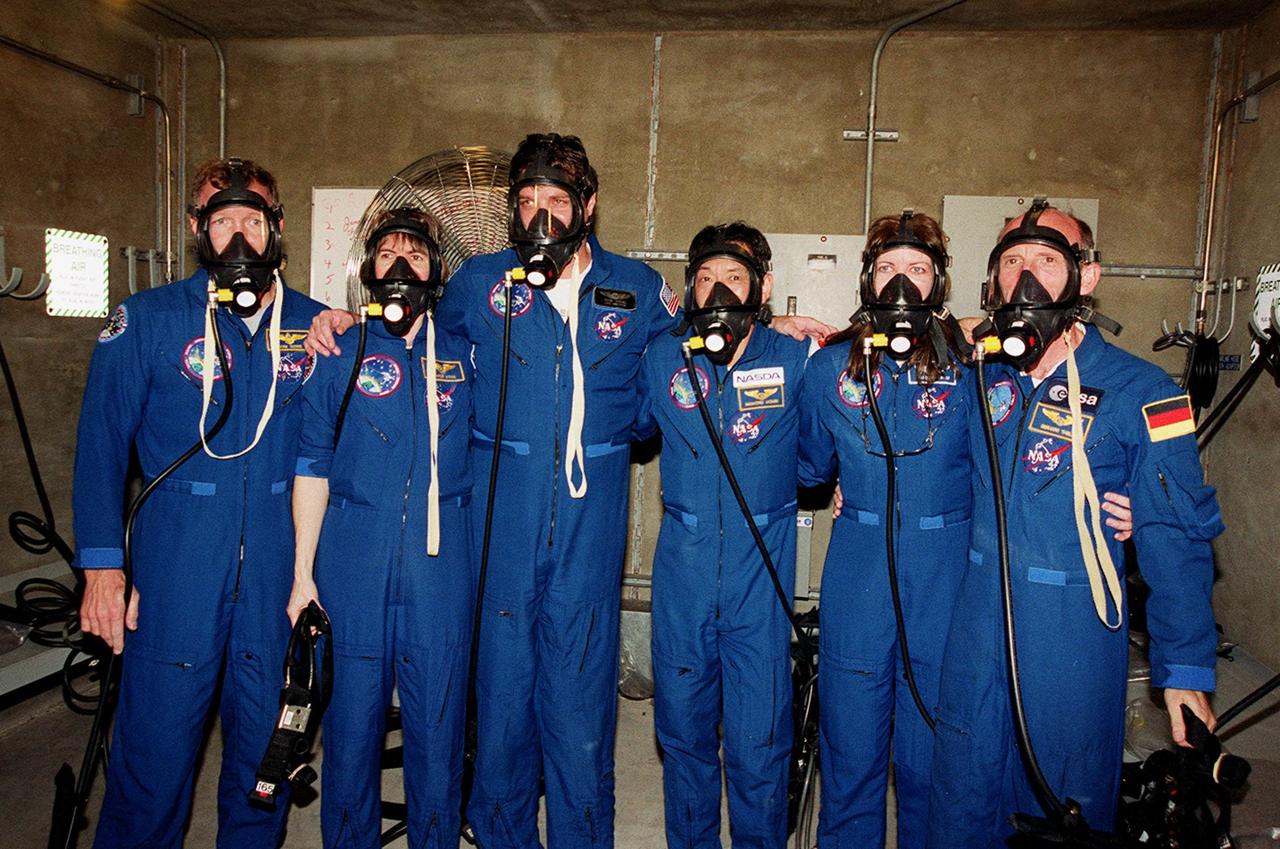
KENNEDY SPACE CENTER, Fla. -- In the bunker at Launch Pad 39A, the STS-99 crew try on oxygen masks. From left are Pilot Dominic Gorie, Mission Specialist Janice Voss (Ph.D.), Commander Kevin Kregel, and Mission Specialists Mamoru Mohri, Janet Lynn Kavandi (Ph.D.) and Gerhard Thiele. Mohri is with the National Space Development Agency (NASDA) of Japan and Thiele is with the European Space Agency. The crew are taking part in Terminal Countdown Demonstration Test activities, which provide them with simulated countdown exercises, emergency egress training, and opportunities to inspect the mission payloads in the orbiter's payload bay. STS-99 is the Shuttle Radar Topography Mission, which will chart a new course, using two antennae and a 200-foot-long section of space station-derived mast protruding from the payload bay to produce unrivaled 3-D images of the Earth's surface. The result of the Shuttle Radar Topography Mission could be close to 1 trillion measurements of the Earth's topography. Besides contributing to the production of better maps, these measurements could lead to improved water drainage modeling, more realistic flight simulators, better locations for cell phone towers, and enhanced navigation safety. Launch of Endeavour on the 11-day mission is scheduled for Jan. 31 at 12:47 p.m. EST

KENNEDY SPACE CENTER, FLA. -- In the Space Station Processing Facility at NASA's Kennedy Space Center, the integrated cargo carrier-lite, or ICC-L, is ready to be lifted and placed in the payload canister for mission STS-122. Seen here are two of the elements mounted on top: on the left, the European technology Exposure Facility composed of nine science instruments and an autonomous temperature measurement unit, and on the right, the SOLAR payload designed for sun observation. The SOLAR will be transferred and stowed on the Columbus module during the third spacewalk of the mission. STS-122 is targeted for launch on Dec. 6 on space shuttle Atlantis. Photo credit: NASA/Amanda Diller
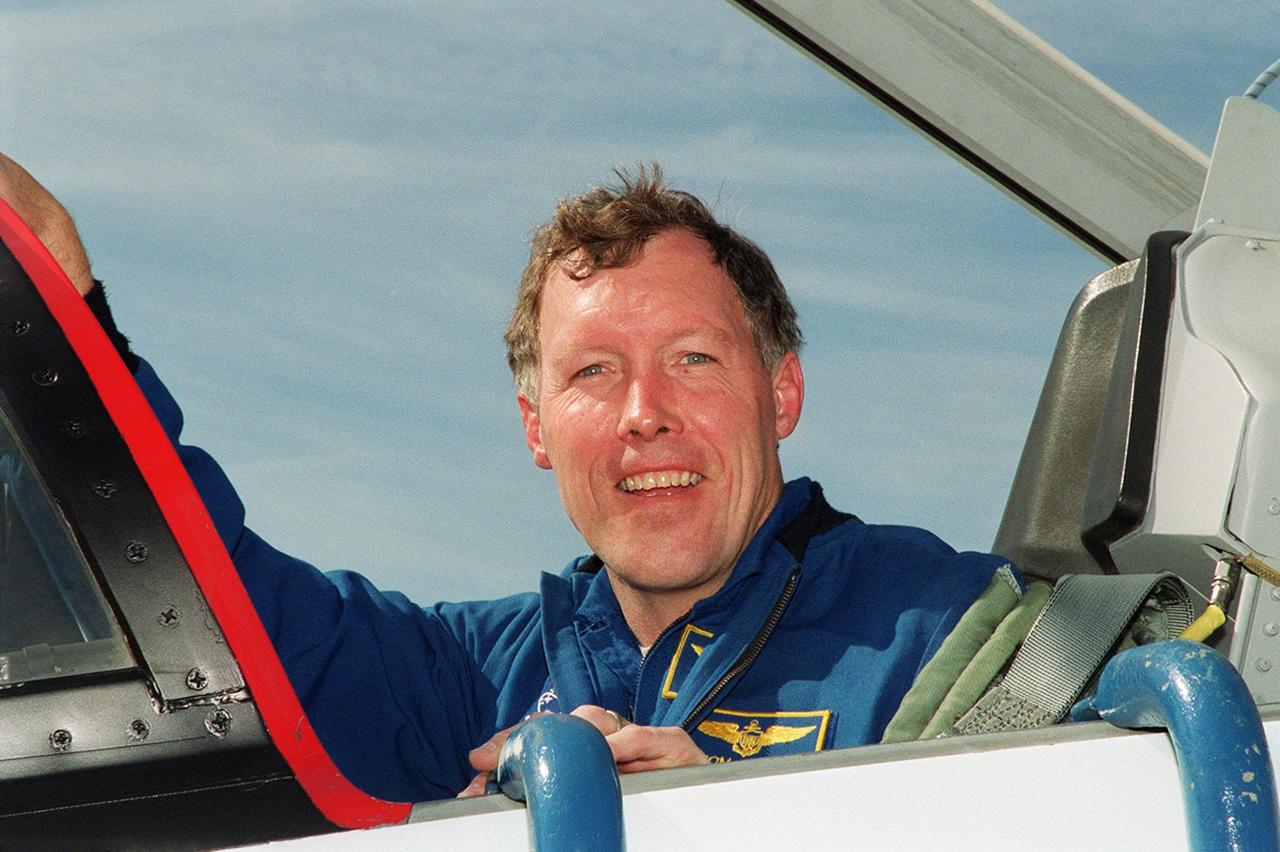
STS-99 Pilot Dominic Gorie arrives at KSC aboard a T-38 jet aircraft to prepare for launch of Endeavour Jan. 31 at 12:47 p.m. EST. Over the next few days, the crew will review mission procedures, conduct test flights in the Shuttle Training Aircraft and undergo routine preflight medical exams. STS-99 is the Shuttle Radar Topography Mission, which will chart a new course, using two antennae and a 200-foot-long section of space station-derived mast protruding from the payload bay to produce unrivaled 3-D images of the Earth's surface. The result of the Shuttle Radar Topography Mission could be close to 1 trillion measurements of the Earth's topography. Besides contributing to the production of better maps, these measurements could lead to improved water drainage modeling, more realistic flight simulators, better locations for cell phone towers, and enhanced navigation safety
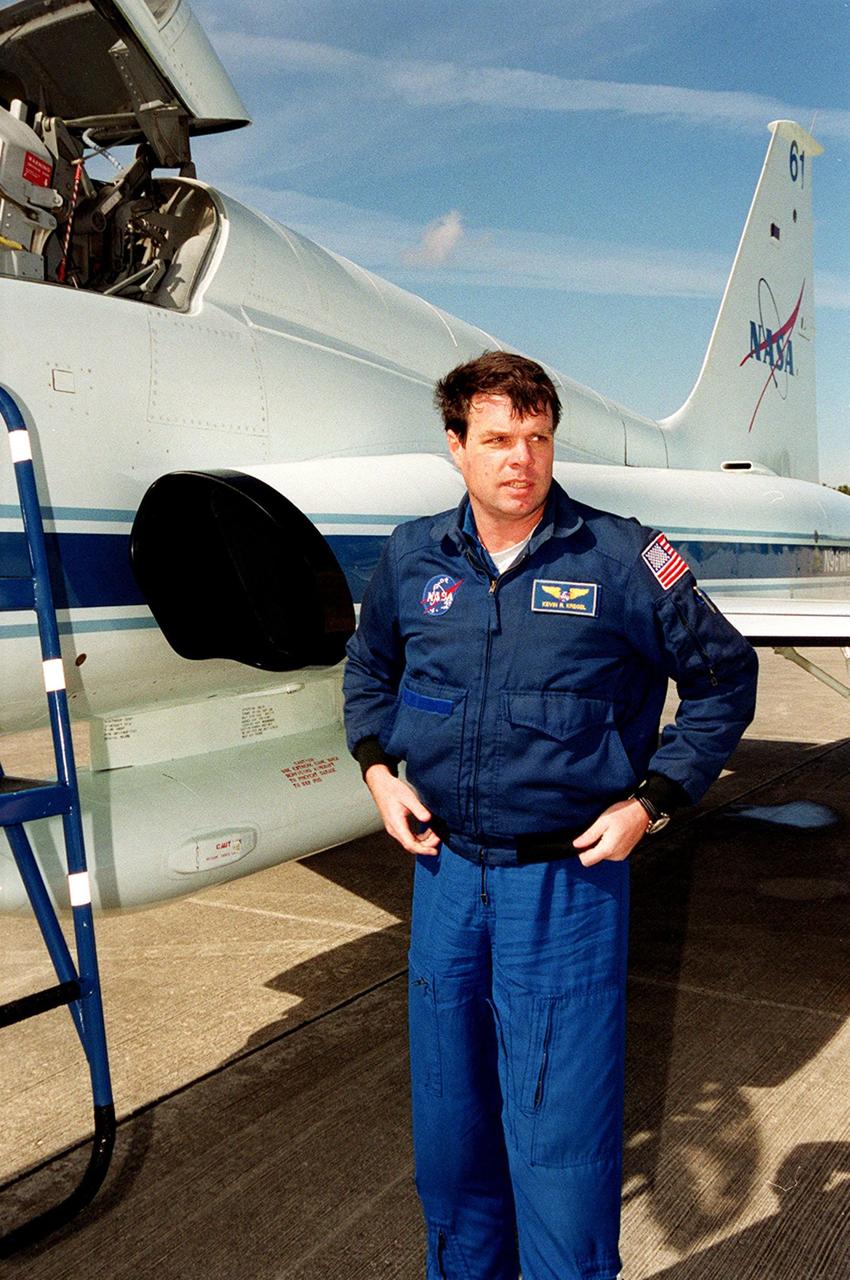
STS-99 Commander Kevin Kregel arrives at KSC aboard a T-38 jet aircraft to prepare for launch of Endeavour Jan. 31 at 12:47 p.m. EST. Over the next few days, the crew will review mission procedures, conduct test flights in the Shuttle Training Aircraft and undergo routine preflight medical exams. STS-99 is the Shuttle Radar Topography Mission, which will chart a new course, using two antennae and a 200-foot-long section of space station-derived mast protruding from the payload bay to produce unrivaled 3-D images of the Earth's surface. The result of the Shuttle Radar Topography Mission could be close to 1 trillion measurements of the Earth's topography. Besides contributing to the production of better maps, these measurements could lead to improved water drainage modeling, more realistic flight simulators, better locations for cell phone towers, and enhanced navigation safety
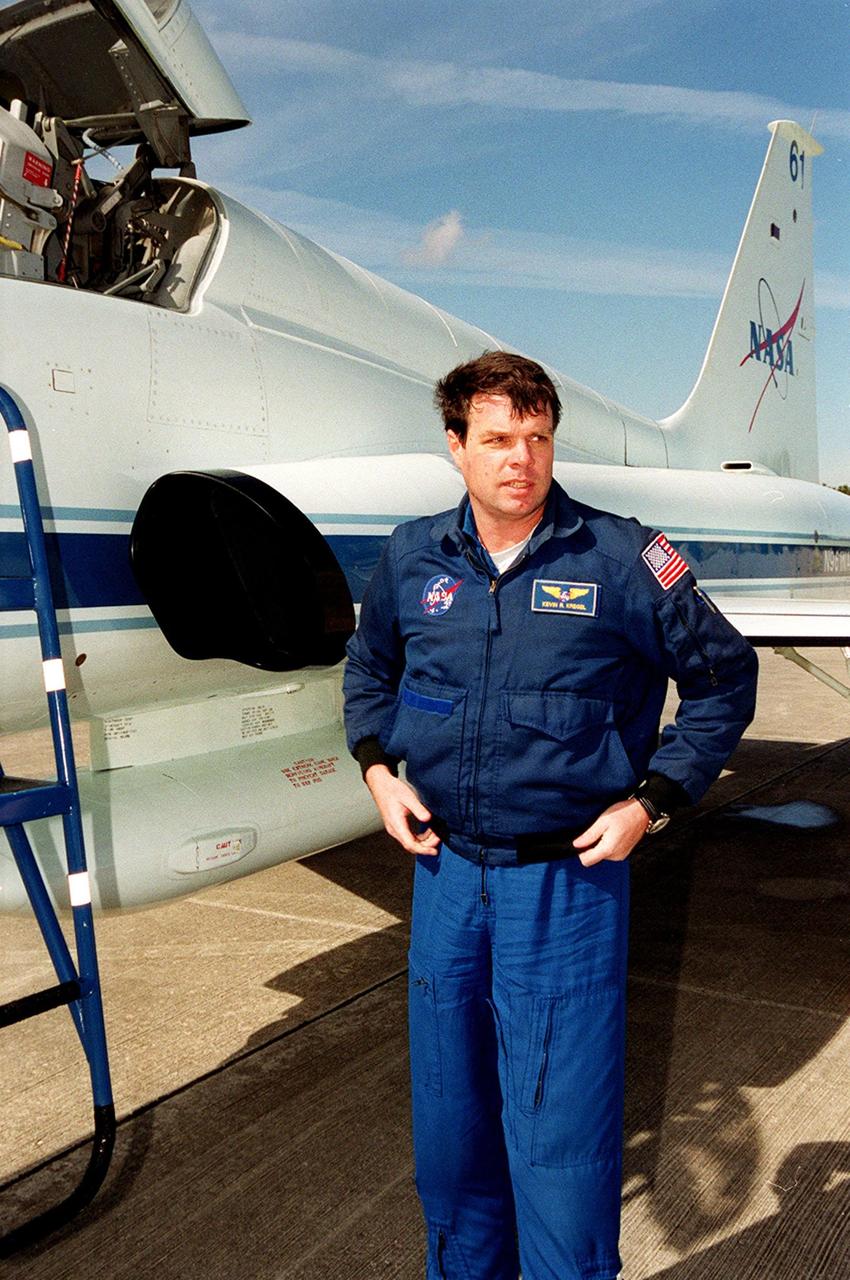
STS-99 Commander Kevin Kregel arrives at KSC aboard a T-38 jet aircraft to prepare for launch of Endeavour Jan. 31 at 12:47 p.m. EST. Over the next few days, the crew will review mission procedures, conduct test flights in the Shuttle Training Aircraft and undergo routine preflight medical exams. STS-99 is the Shuttle Radar Topography Mission, which will chart a new course, using two antennae and a 200-foot-long section of space station-derived mast protruding from the payload bay to produce unrivaled 3-D images of the Earth's surface. The result of the Shuttle Radar Topography Mission could be close to 1 trillion measurements of the Earth's topography. Besides contributing to the production of better maps, these measurements could lead to improved water drainage modeling, more realistic flight simulators, better locations for cell phone towers, and enhanced navigation safety
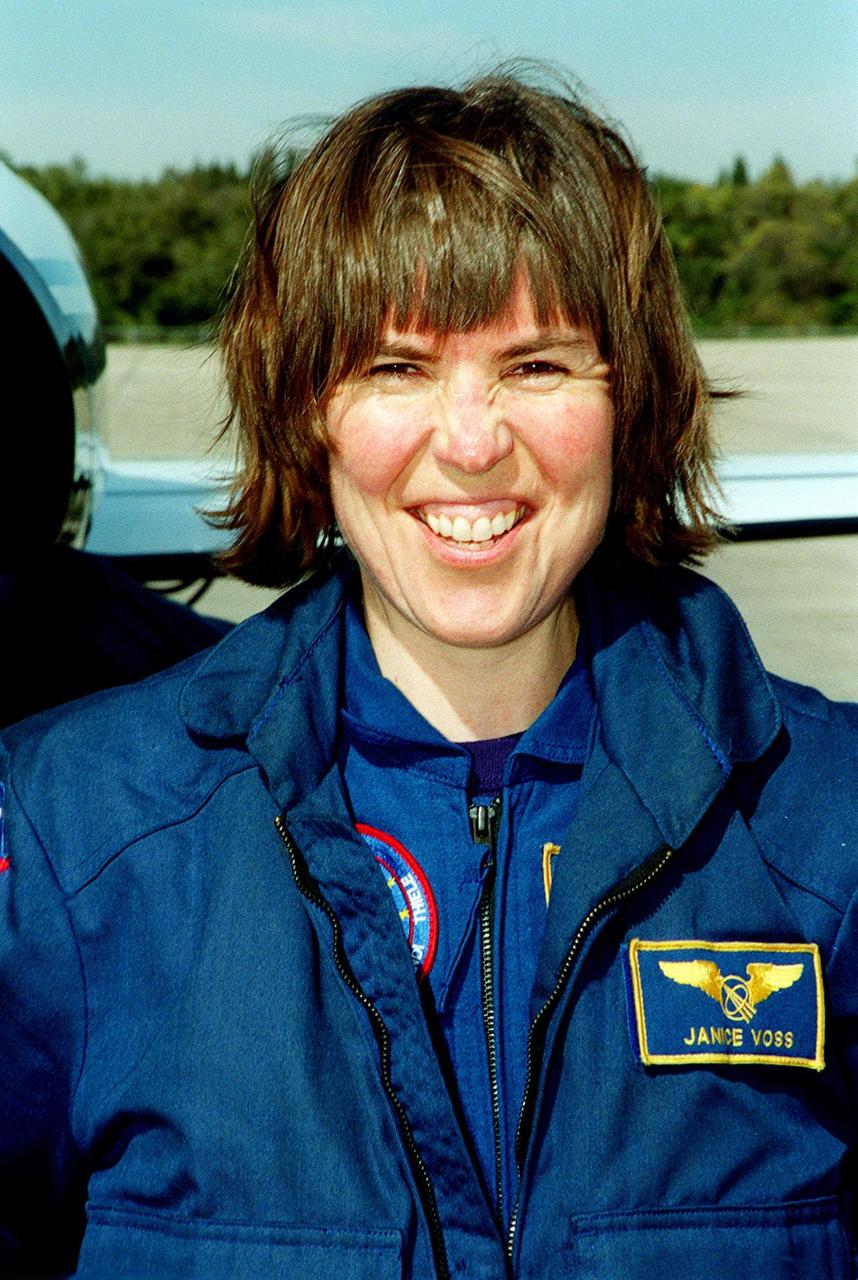
STS-99 Mission Specialist Janice Voss (Ph.D.) looks happy after landing at KSC aboard a T-38 jet aircraft to prepare for launch of Endeavour Jan. 31 at 12:47 p.m. EST. Over the next few days, the crew will review mission procedures, conduct test flights in the Shuttle Training Aircraft and undergo routine preflight medical exams. STS-99 is the Shuttle Radar Topography Mission, which will chart a new course, using two antennae and a 200-foot-long section of space station-derived mast protruding from the payload bay to produce unrivaled 3-D images of the Earth's surface. The result of the Shuttle Radar Topography Mission could be close to 1 trillion measurements of the Earth's topography. Besides contributing to the production of better maps, these measurements could lead to improved water drainage modeling, more realistic flight simulators, better locations for cell phone towers, and enhanced navigation safety