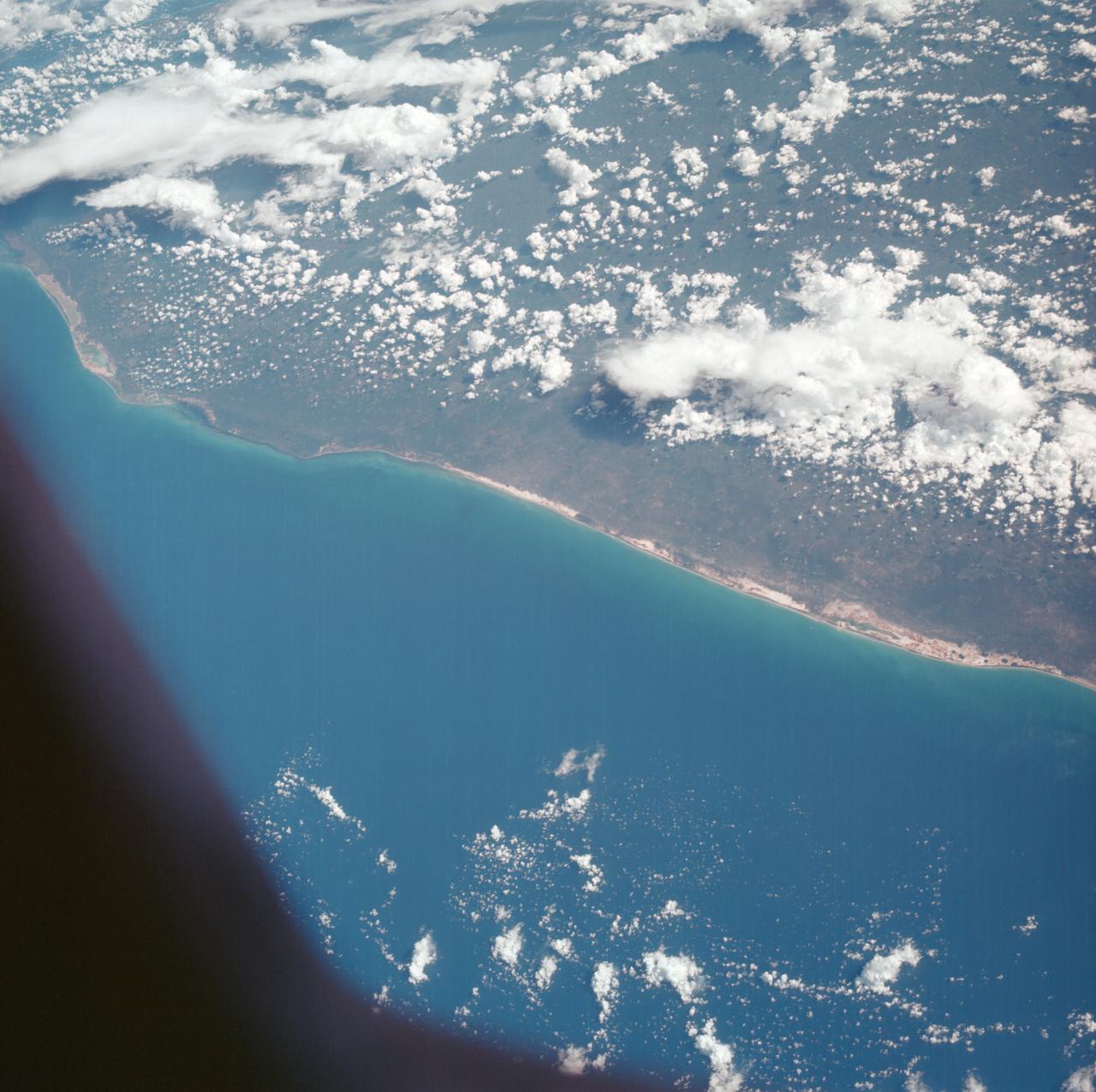
AS07-05-1635 (13 Oct. 1968) --- Gulf of Mexico, coast of Yucatan, Mexico, as seen from the Apollo 7 spacecraft during its 33rd revolution of Earth. Note road leading to city of Merida which is under cloud cover. Photographed from an altitude of 123 nautical miles, at ground elapsed time of 52 hours and 37 minutes.

AS07-05-1652 (13 Oct. 1968) --- Pacific coast area of southwestern Mexico, State of Guerrero, from Acapulco to Tecoanapa, as seen from the Apollo 7 spacecraft during its 34th revolution of Earth. Photographed from an altitude of 125 nautical miles, at ground elapsed time of 54 hours and 10 minutes. Much cloud cover in area.
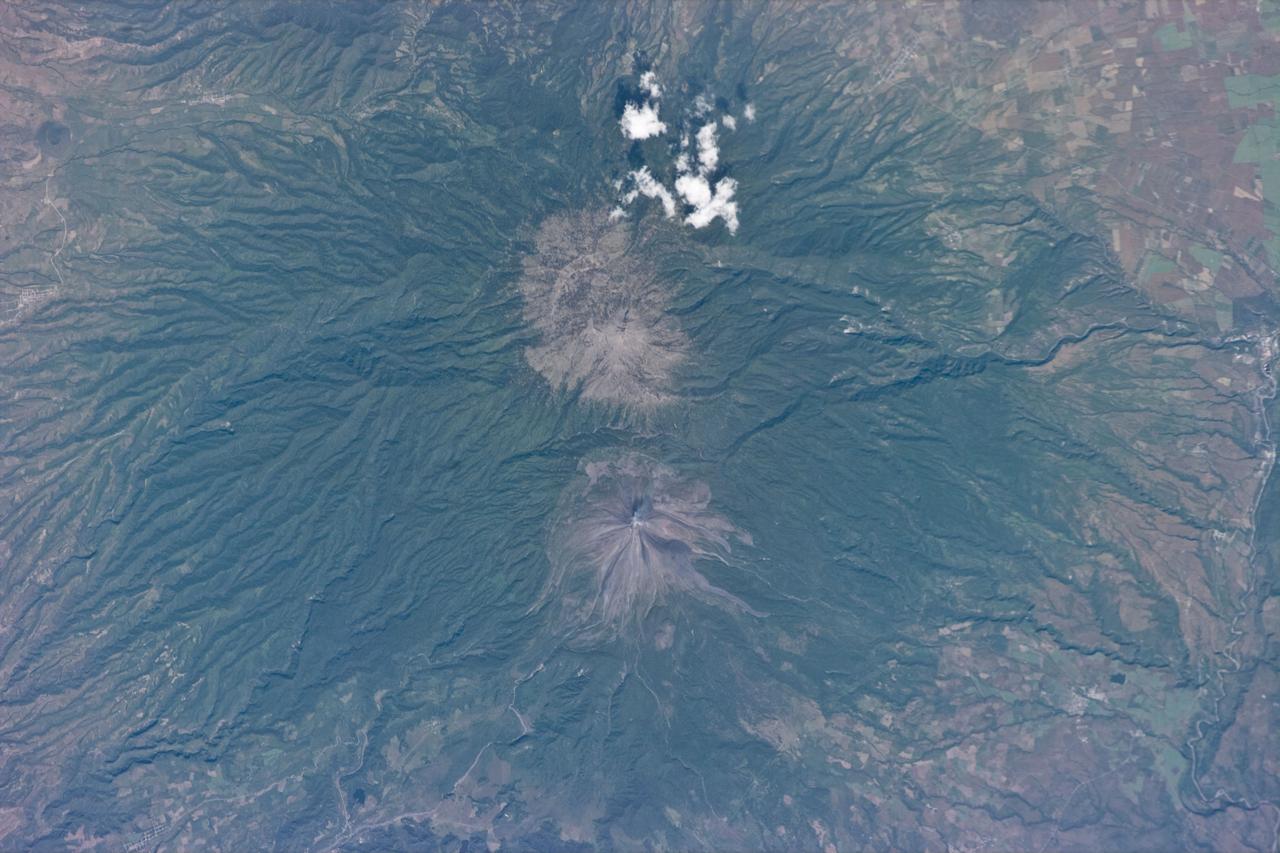
STS073-E-5274 (3 Nov. 1995) --- Colima was photographed with a color Electronic Still Camera (ESC) onboard the Earth-orbiting space shuttle Columbia. The volcano lies due south of Guadalajara and Lake Chapala. It is considered to be one of Mexico's most active and most dangerous volcanoes, lying not far from heavily populated areas.
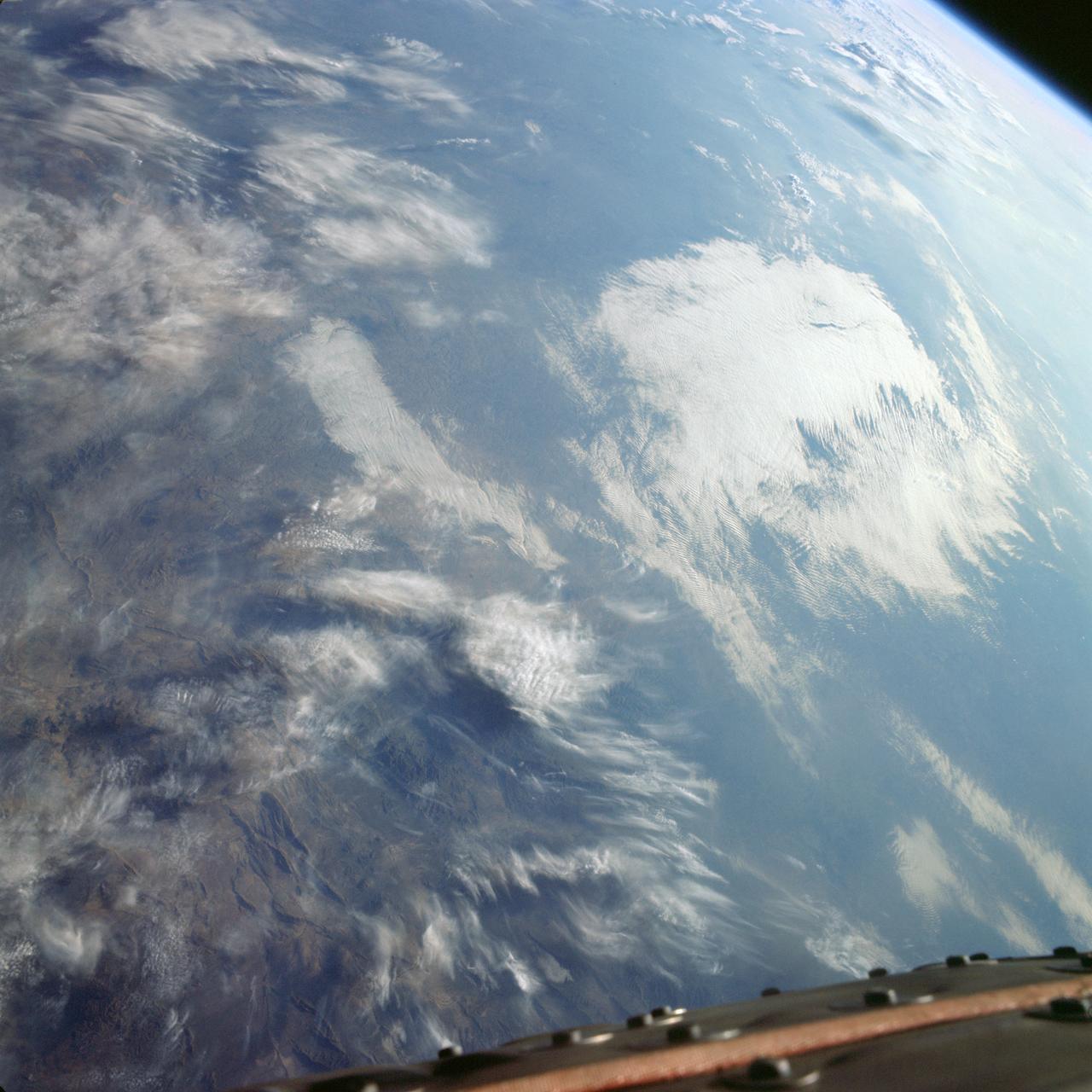
S66-54558 (14 Sept. 1966) --- Del Rio and Eagle Pass area of the Rio Grande Valley of Texas and Mexico as seen from the Gemini-11 spacecraft during its 29th revolution of Earth. Photo credit: NASA
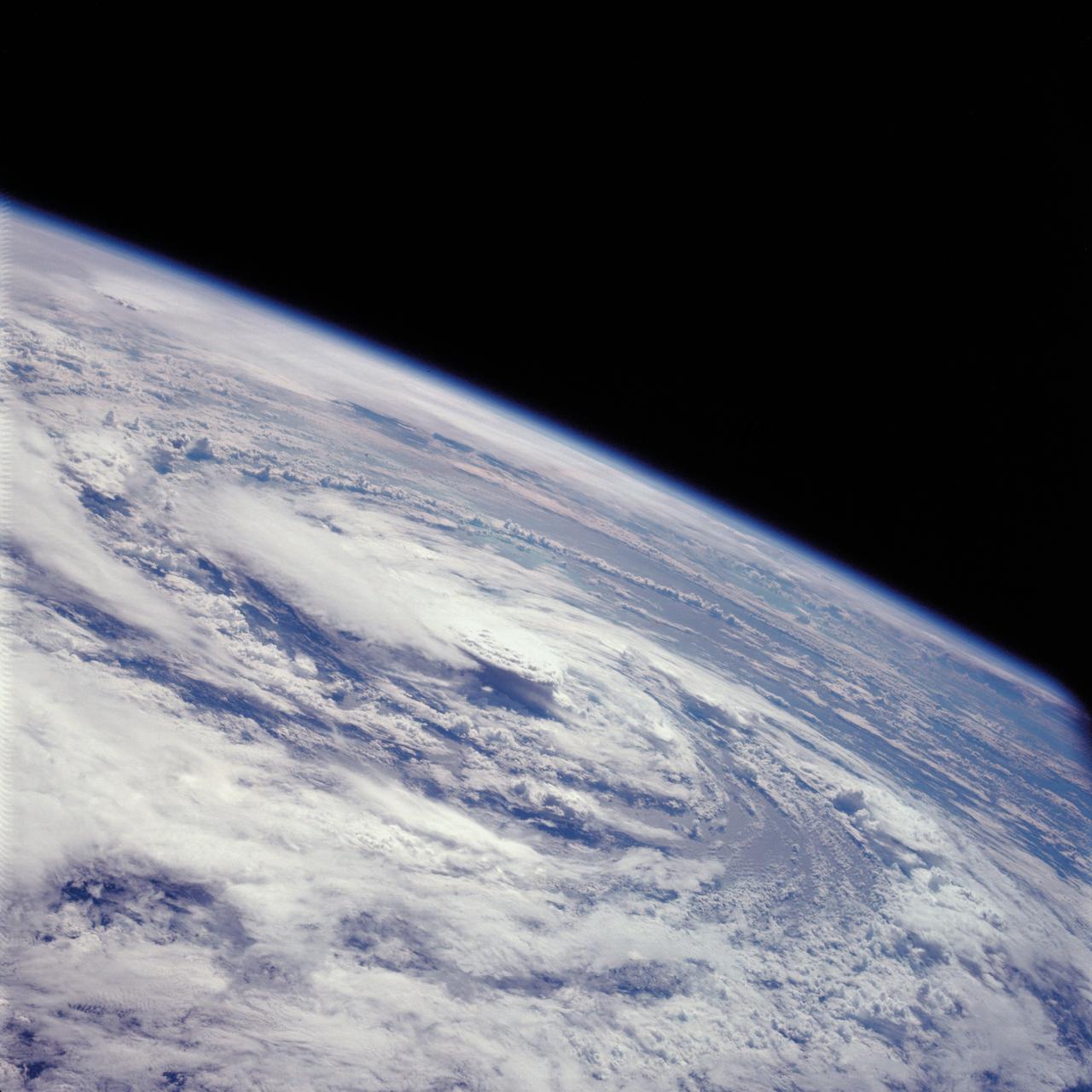
AS07-07-1877 (17 Oct. 1968) --- Hurricane Gladys, Gulf of Mexico, as seen from the Apollo 7 spacecraft during its 91st revolution of the earth. Photographed from an altitude of 99 nautical miles, at ground elapsed time of 144 hours and 27 minutes.
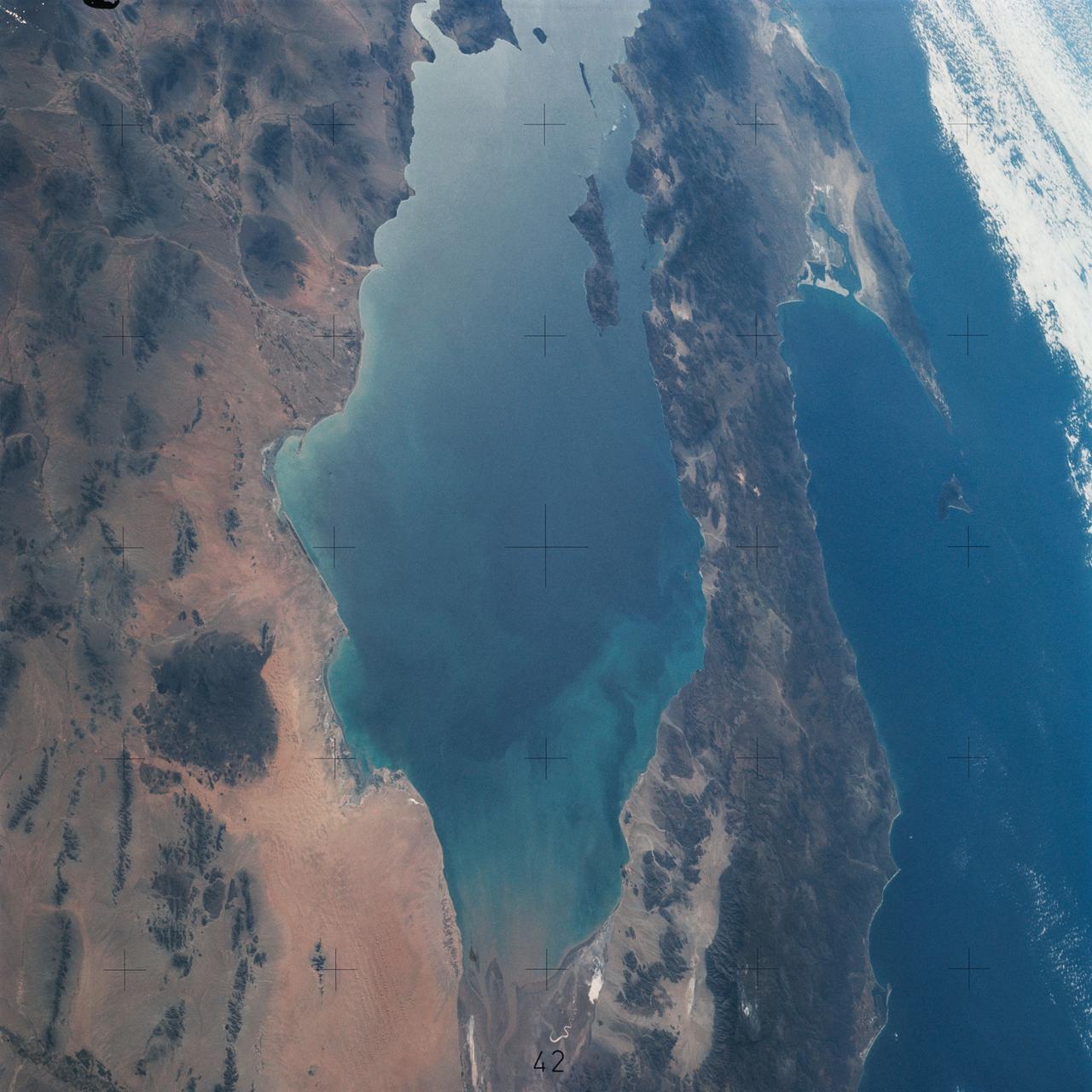
SL4-142-4548 (27 Jan. 1974) --- An oblique view of northwestern Mexico, as photographed from the Skylab space station in Earth orbit by one of the Skylab 4 crewmen. The camera used was a hand-held 70mm Hasselblad, with SO-368 medium-speed Ektachrome film. This photograph was taken on a sweep down the coast to document the fault patterns of southern California and northwest Mexico. SL4-142-4532 gives an excellent overview of the entire region. The specific reason for this picture was an attempt to see if the Agua Blanca Fault in Baja California extends to the east toward the Gulf of California. Several attempts were made by the Skylab 4 crew to visually detect such an extension, but none was found. The report was that the fault disappeared into an area of sand and heavily eroded material that obscured any feature that might be present deeper. This area of sand and loose material is the light-colored area in the center of Baja at the extreme north part of the photograph. In addition to this geology the Pinacate volcanic field in Sonora, the sand dunes in Sonora, and the sediment flow patterns of the Colorado River entering the Gulf are additional areas of study utilizing this photograph. Photo credit: NASA
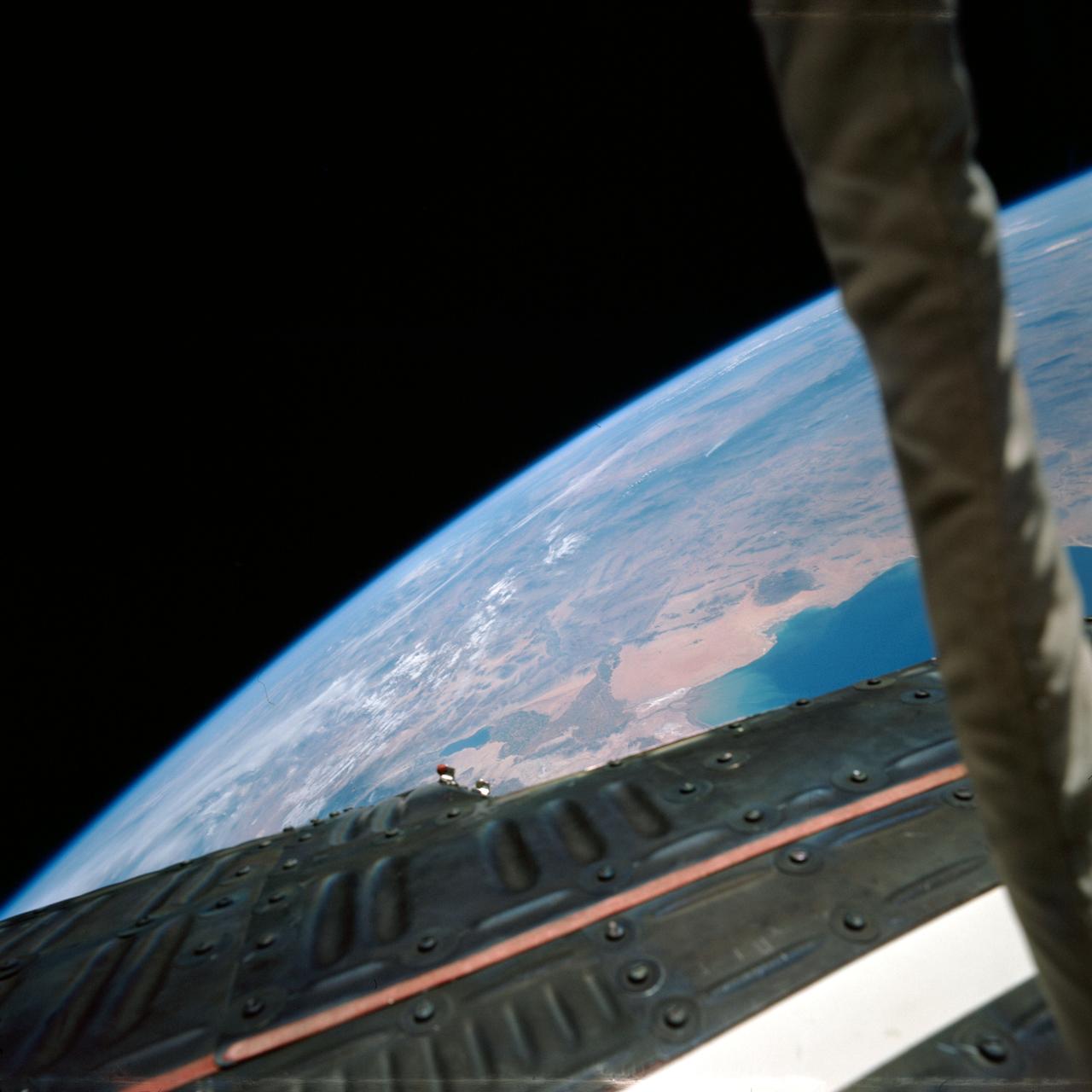
S66-38068 (5 June 1966) --- Astronaut Eugene A. Cernan took this view of the Gemini-9A spacecraft and his umbilical cord (right) over California, Arizona, and Sonora, Mexico, during his extravehicular activity (EVA) on the Gemini-9A mission. Taken during the 32nd revolution of the flight. Photo credit: NASA
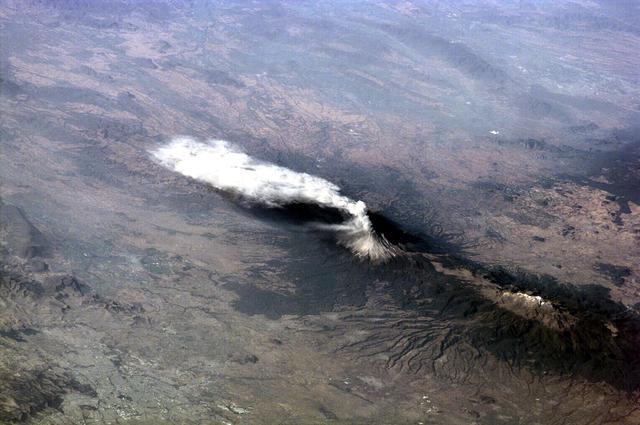
ISS01-E-5316 (23 January 2001) -- Popocatépetl, or Popo, the active volcano located about 70 kilometers southeast of Mexico City, sends a plume south on January 23, 2001. The Expedition One crew onboard the International Space Station (ISS) observed and recorded this image with a digital still camera as it orbited to the northeast of the volcano. Popo has been frequently active for six years. On this day, the eruption plume reportedly rose to more than 9 kilometers above sea level (for reference, Popo's summit elevation is 5426 meters). Note the smaller ash plume below the main plume. The perspective from the ISS allowed the crew members this unique three dimensional view. Popo is situated between two large population centers: Mexico City (more than 18 million people, and just out of this image at right) and Puebla (about 1.2 million people), partially visible at lower left.
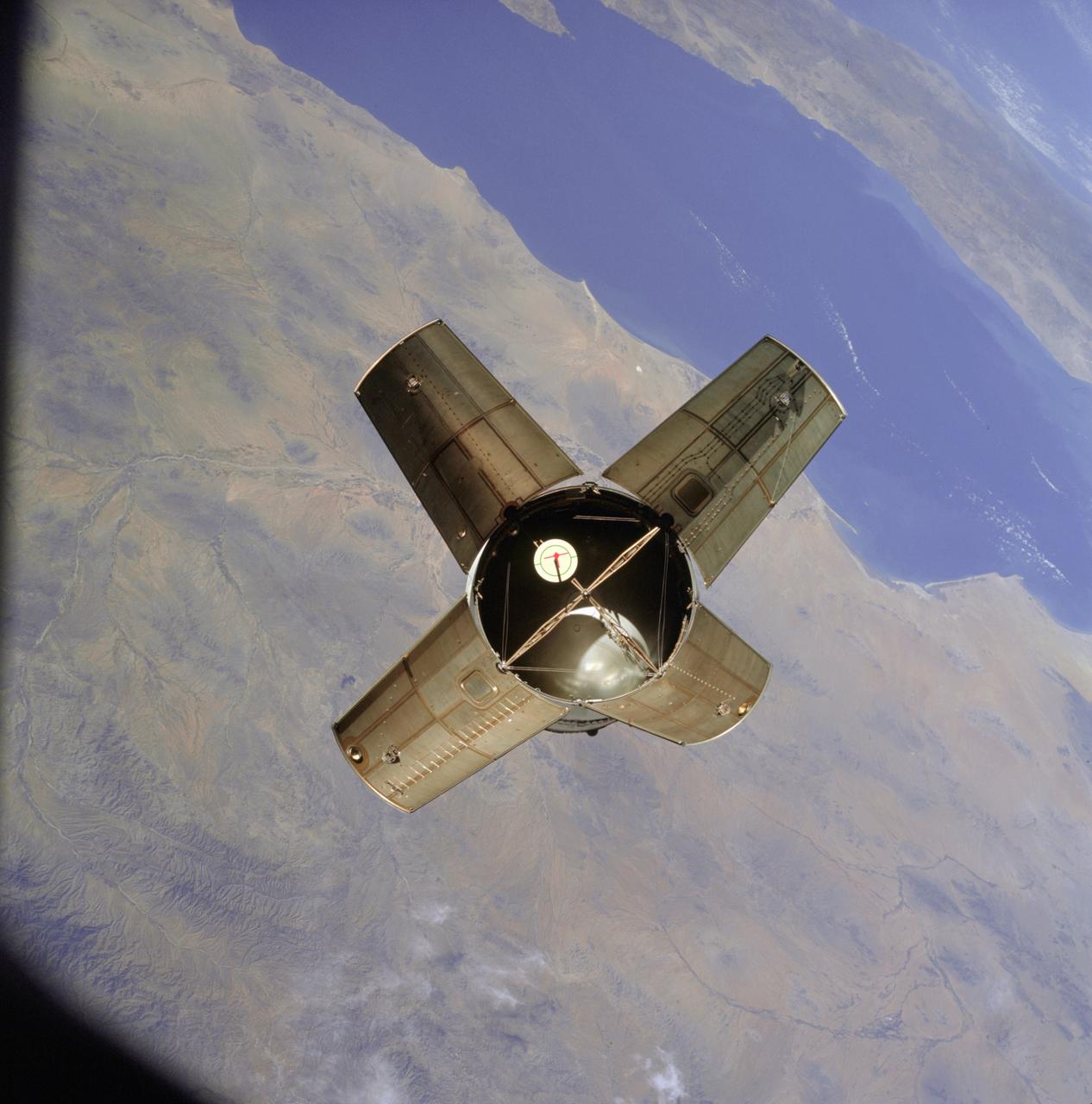
AS07-03-1531 (11 Oct. 1968) --- The expended Saturn IVB stage as photographed from the Apollo 7 spacecraft during transposition and docking maneuvers. This photograph was taken over Sonora, Mexico, during Apollo 7's second revolution of Earth. The round, white disc inside the open panels of the Saturn IVB is a simulated docking target similar to that used on the lunar module for docking during lunar missions.
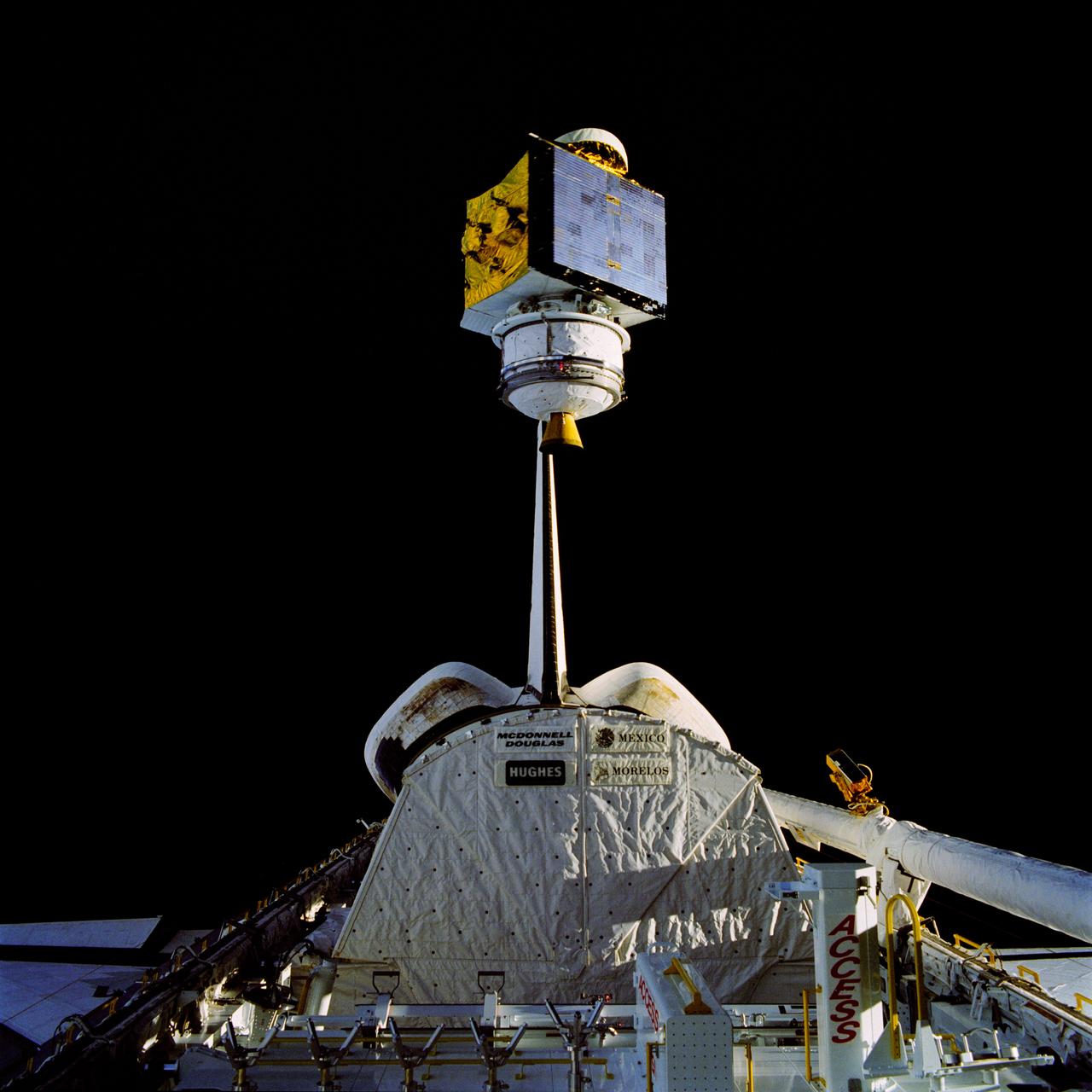
61B-38-36W (28 Nov 1985) --- The 4,144-pound RCA Satcom K-2 communications satellite is photographed as it spins from the cargo bay of the Earth-orbiting Atlantis. A TV camera at right records the deployment for a later playback to Earth. This frame was photographed with a handheld Hasselblad camera inside the spacecraft.
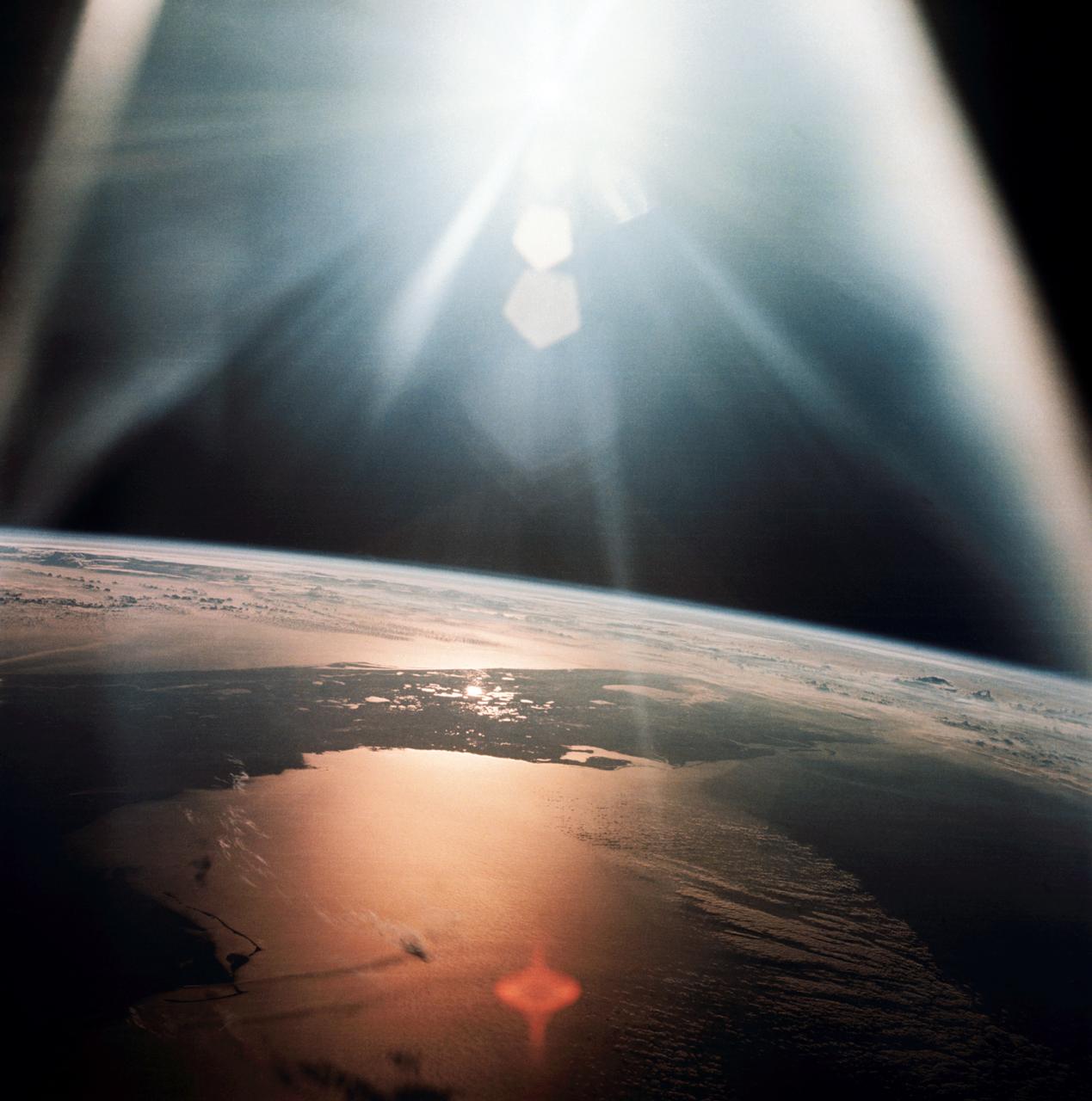
AS07-08-1933 (20 Oct. 1968) --- The morning sun reflects on the Gulf of Mexico and the Atlantic Ocean as seen from the Apollo 7 spacecraft at an altitude of 120 nautical miles above Earth. Most of Florida peninsula appears as a dark silhouette. This photograph was made during the spacecraft's 134th revolution of Earth, some 213 hours and 19 minutes after liftoff.
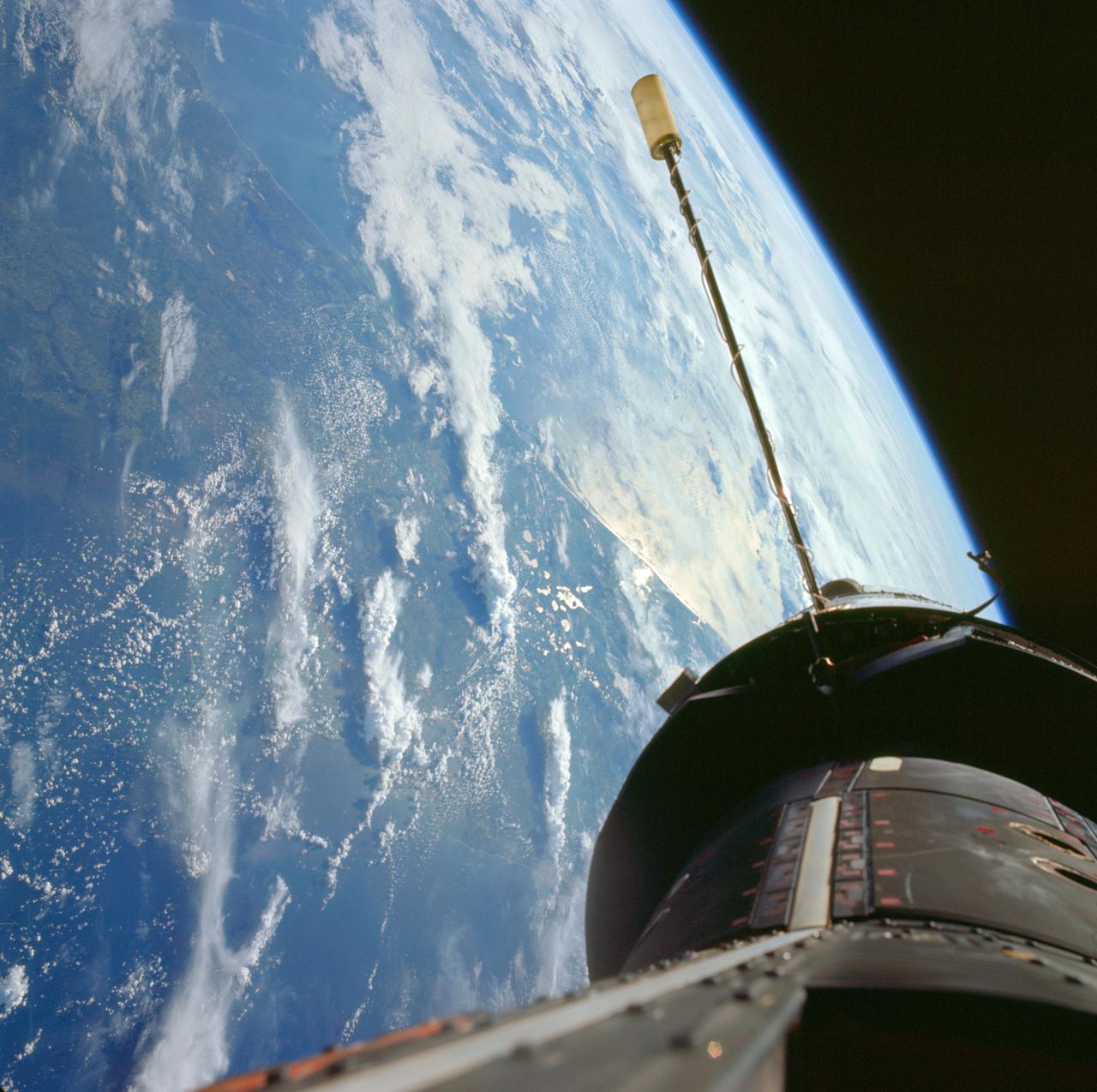
S66-54565 (14 Sept. 1966) --- Central portion of Florida, Gulf of Mexico to Atlantic Ocean, Cape Kennedy is at left center of photo, as seen from the Gemini-11 spacecraft during its 29th revolution of Earth. Photo lacks detail due to low sun angle. Sunglint on lakes is visible. Photo credit: NASA
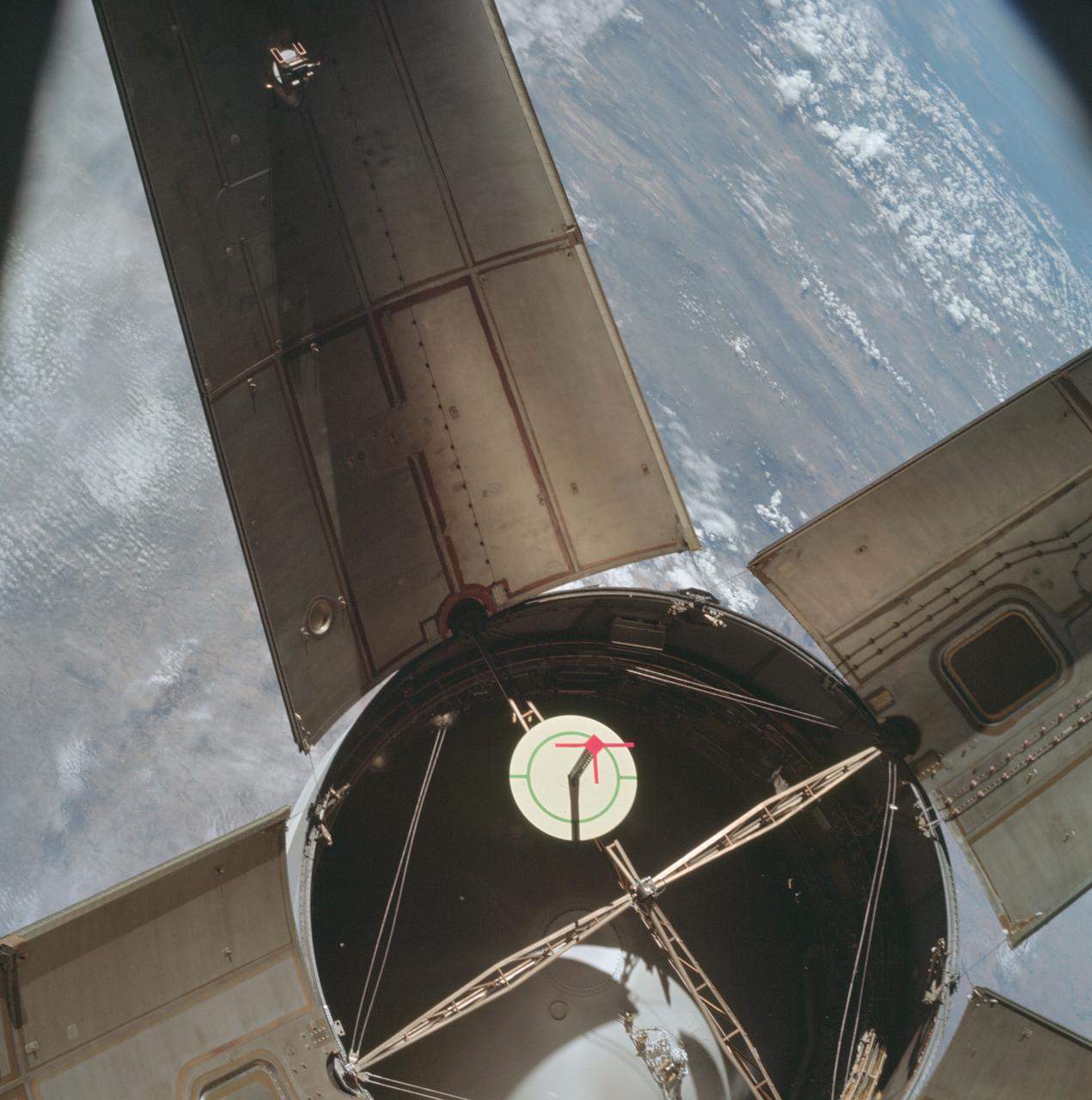
AS07-03-1535 (11 Oct. 1968) --- The expended Saturn IVB stage as photographed from the Apollo 7 spacecraft during transposition and docking maneuvers at an altitude of 126 nautical miles, at ground elapsed time of three hours, 11 minutes. The round, white disc inside the open panels of the Saturn IVB is a simulated docking target similar to that used on the lunar module for docking during lunar missions. The spacecraft is directly over Odessa-Midland, Texas. The view between the two panels (area of large puffy clouds) extends southwest across Texas into the Mexican State of Chihuahua. The distance between the Apollo 7 spacecraft and the S-IVB is approximately 50 feet.
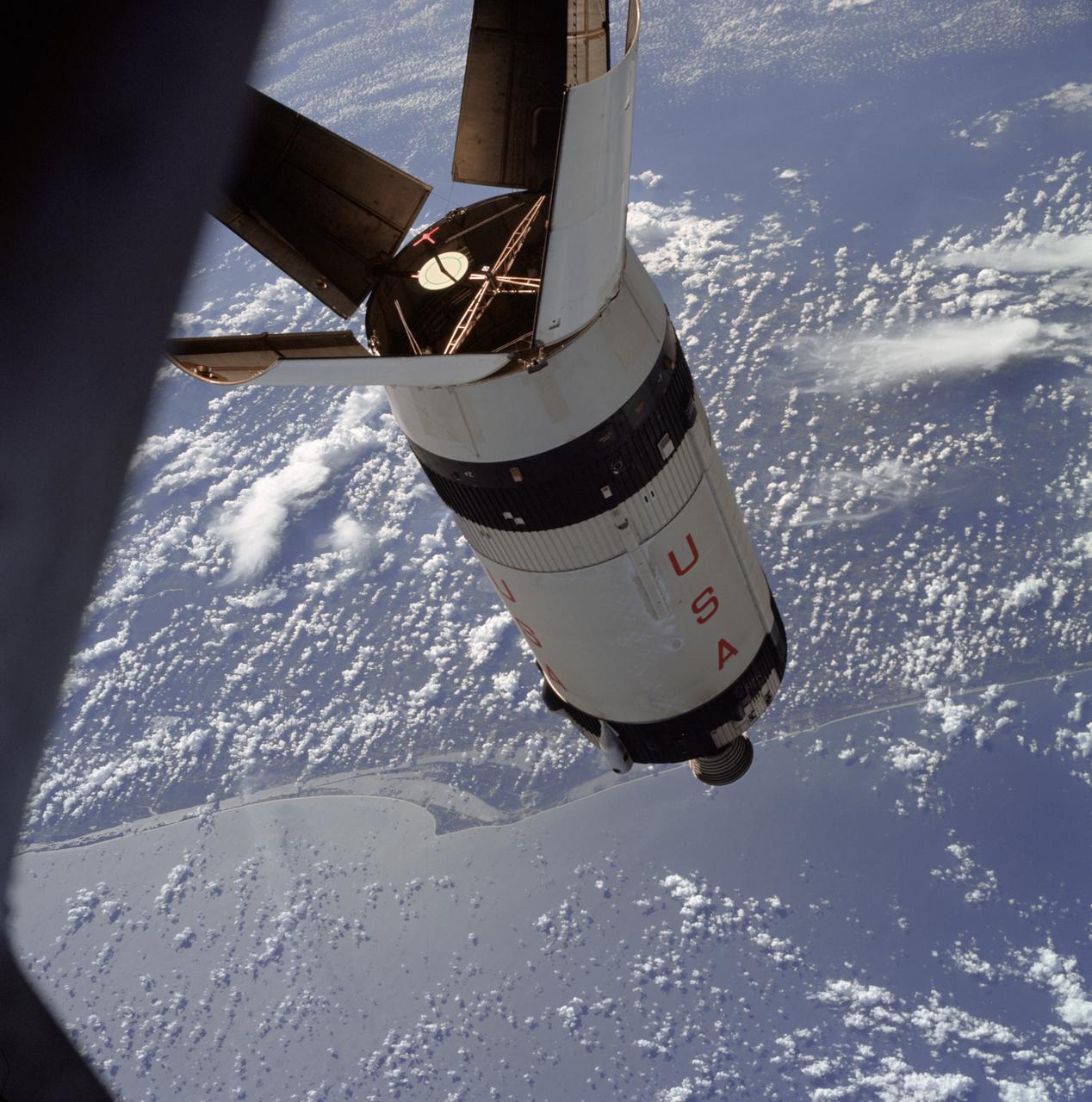
AS07-03-1545 (11 Oct. 1968) --- The expended Saturn S-IVB stage as photographed from the Apollo 7 spacecraft during transposition and docking maneuvers at an approximate altitude of 125 nautical miles, at ground elapsed time of three hours and 16 minutes (beginning of third revolution). This view is over the Atlantic Ocean off the coast of Cape Kennedy, Florida. The Florida coastline from Flagler Beach southward to Vero Beach is clearly visible in picture. Much of the Florida peninsula can be seen. Behind the open panels is the Gulf of Mexico. Distance between the Apollo 7 spacecraft and the S-IVB is approximately 100 feet. The round, white disc inside the open panels of the S-IVB is a simulated docking target similar to that used on the Lunar Module (LM) for docking during lunar missions.
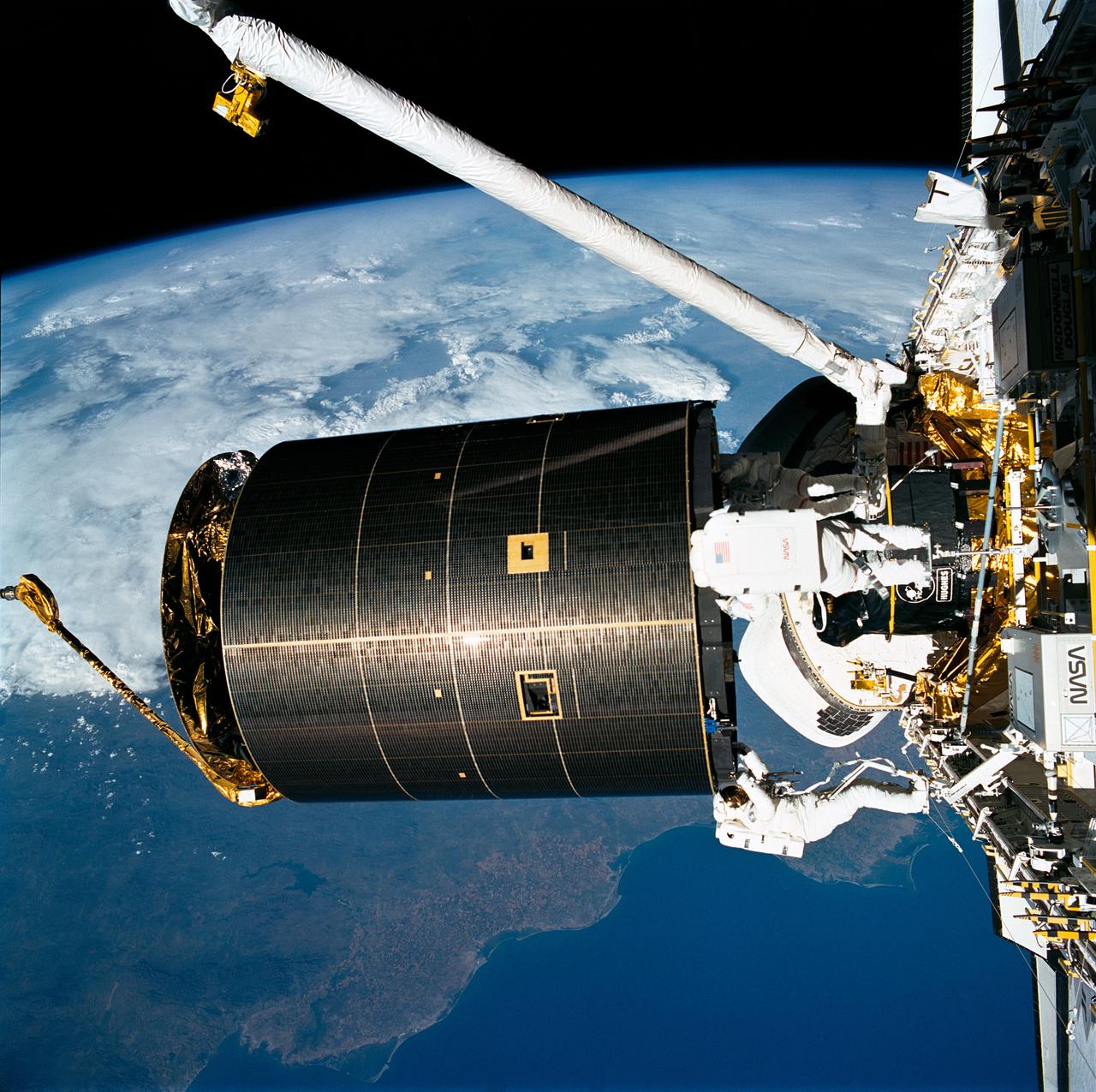
STS049-91-020 (13 May 1992) --- The successful capture of Intelsat VI satellite is recorded over Mexico on this 70mm frame, from inside the Space Shuttle Endeavour's cabin. Left to right, astronauts Richard J. Hieb, Thomas D. Akers and Pierre J. Thuot have handholds on the satellite. Ground coverage in the frame includes an area from Hermosillo, Sonara to Los Mochis in the state of Sinaloa. The nine-day mission accomplished the capture of the Intelsat, subsequent mating of the satellite to a booster and its eventual deployment, as well as a Space Station Freedom preview Extravehicular Activity (EVA). Endeavour's crew members were astronauts Daniel C. Brandenstein, mission commander; Kevin P. Chilton, pilot; and Thomas D. Akers, Richard J. Hieb, Bruce E. Melnick, Kathryn C. Thornton and Pierre J. Thuot, all mission specialists.
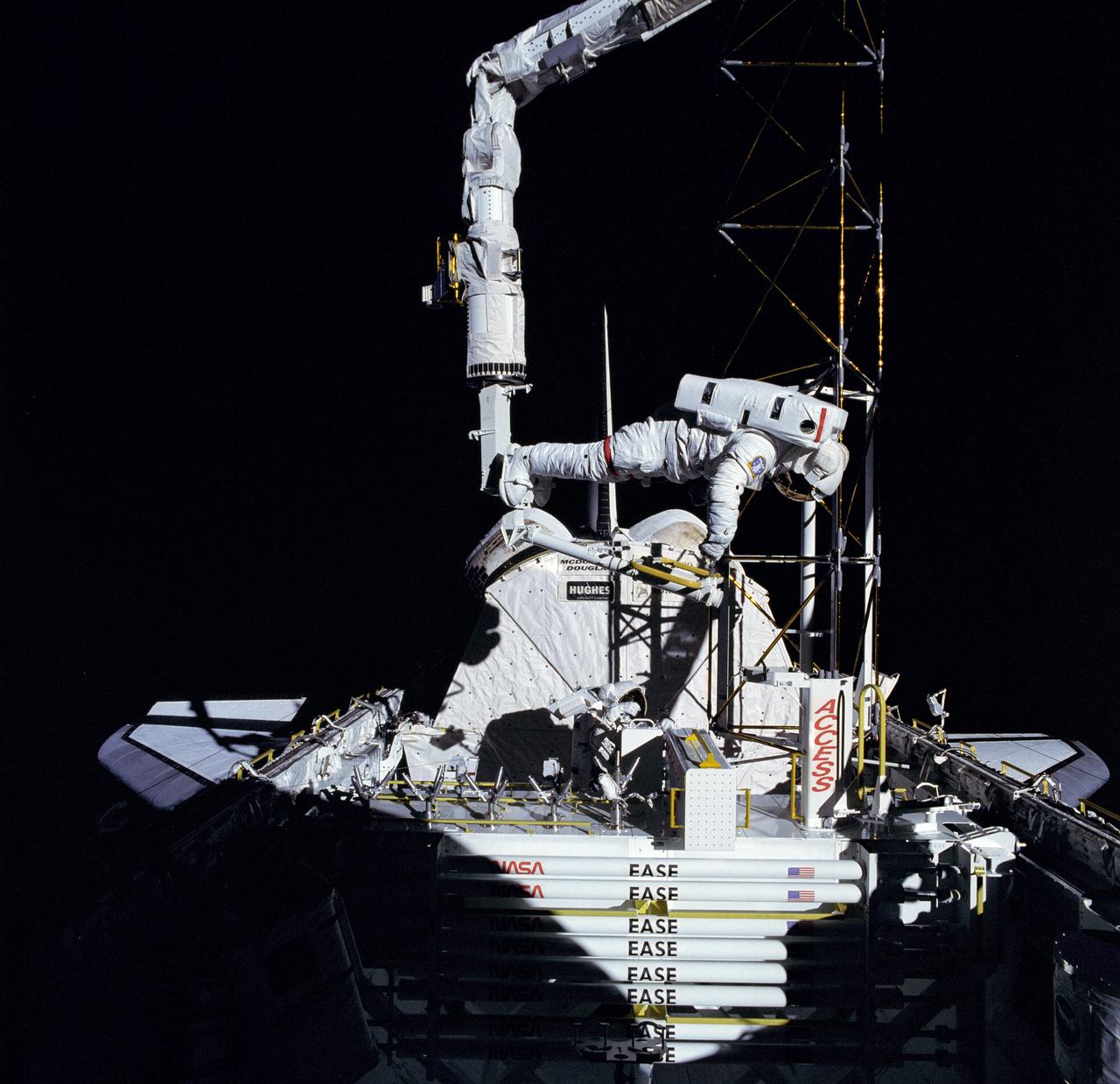
The crew assigned to the STS-61B mission included Bryan D. O’Conner, pilot; Brewster H. Shaw, commander; Charles D. Walker, payload specialist; mission specialists Jerry L. Ross, Mary L. Cleave, and Sherwood C. Spring; and Rodolpho Neri Vela, payload specialist. Launched aboard the Space Shuttle Atlantis November 28, 1985 at 7:29:00 pm (EST), the STS-61B mission’s primary payload included three communications satellites: MORELOS-B (Mexico); AUSSAT-2 (Australia); and SATCOM KU-2 (RCA Americom). Two experiments were conducted to test assembling erectable structures in space: EASE (Experimental Assembly of Structures in Extravehicular Activity), and ACCESS (Assembly Concept for Construction of Erectable Space Structure). In a joint venture between NASA/Langley Research Center in Hampton, Virginia and the Marshall Space Flight Center (MSFC), EASE and ACCESS were developed and demonstrated at MSFC's Neutral Buoyancy Simulator (NBS). The primary objective of this experiment was to test the structural assembly concepts for suitability as the framework for larger space structures and to identify ways to improve the productivity of space construction. In this STS-61B onboard photo, astronaut Ross was working on the ACCESS experiment during an Extravehicular Activity (EVA).
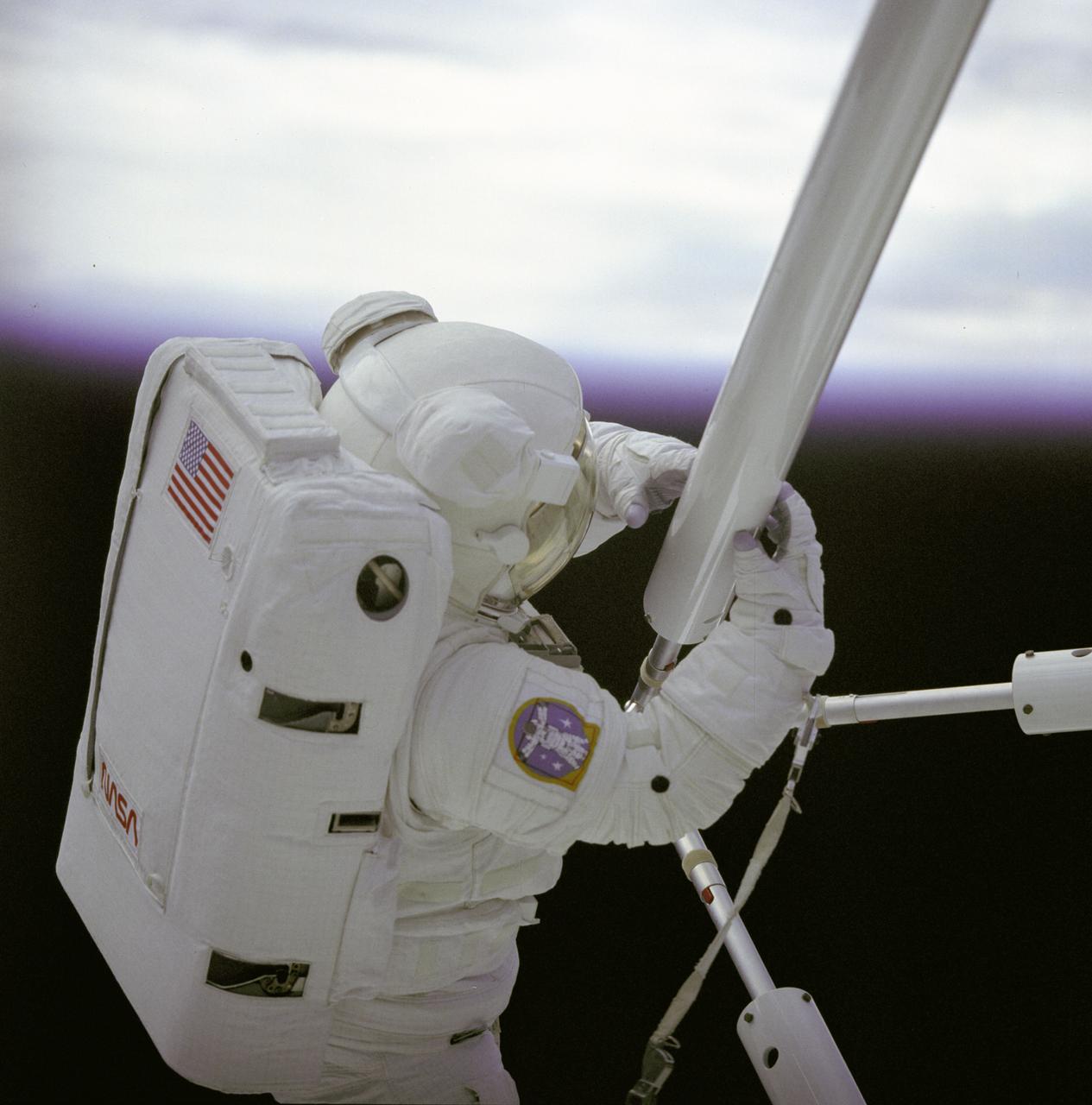
The crew assigned to the STS-61B mission included Bryan D. O’Conner, pilot; Brewster H. Shaw, commander; Charles D. Walker, payload specialist; mission specialists Jerry L. Ross, Mary L. Cleave, and Sherwood C. Spring; and Rodolpho Neri Vela, payload specialist. Launched aboard the Space Shuttle Atlantis November 28, 1985 at 7:29:00 pm (EST), the STS-61B mission’s primary payload included three communications satellites: MORELOS-B (Mexico); AUSSAT-2 (Australia); and SATCOM KU-2 (RCA Americom). Two experiments were conducted to test assembling erectable structures in space: EASE (Experimental Assembly of Structures in Extravehicular Activity), and ACCESS (Assembly Concept for Construction of Erectable Space Structure). In a joint venture between NASA/Langley Research Center in Hampton, Virginia, and the Marshall Space Flight Center (MSFC), the EASE and ACCESS were developed and demonstrated at MSFC's Neutral Buoyancy Simulator (NBS). In this STS-61B onboard photo, astronaut Spring was working on the EASE during an Extravehicular Activity (EVA). The primary objective of this experiment was to test the structural assembly concepts for suitability as the framework for larger space structures and to identify ways to improve the productivity of space construction.
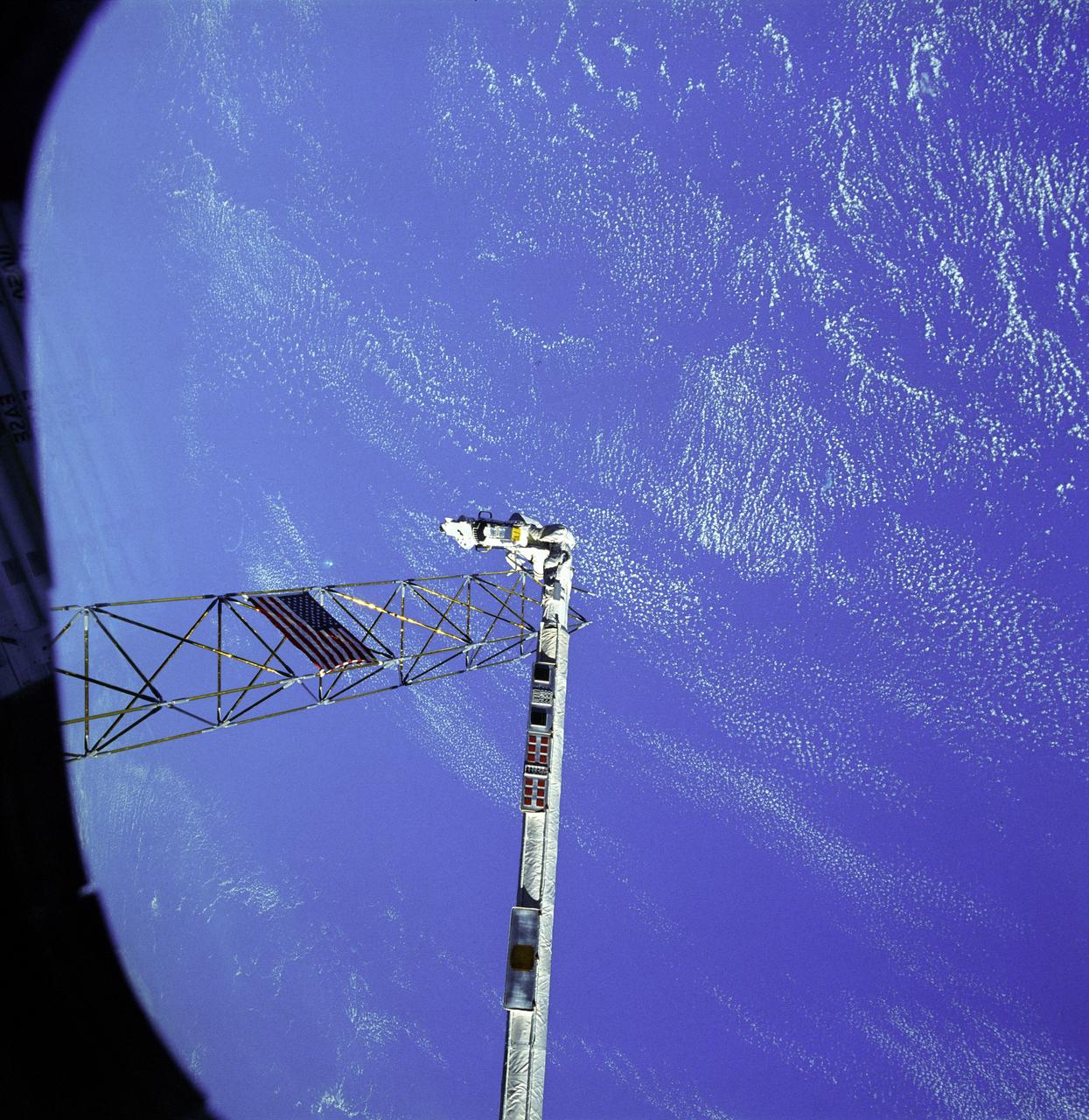
The crew assigned to the STS-61B mission included Bryan D. O’Conner, pilot; Brewster H. Shaw, commander; Charles D. Walker, payload specialist; mission specialists Jerry L. Ross, Mary L. Cleave, and Sherwood C. Spring; and Rodolpho Neri Vela, payload specialist. Launched aboard the Space Shuttle Atlantis November 28, 1985 at 7:29:00 pm (EST), the STS-61B mission’s primary payload included three communications satellites: MORELOS-B (Mexico); AUSSAT-2 (Australia); and SATCOM KU-2 (RCA Americom). Two experiments were conducted to test assembling erectable structures in space: EASE (Experimental Assembly of Structures in Extravehicular Activity), and ACCESS (Assembly Concept for Construction of Erectable Space Structure). In a joint venture between NASA/Langley Research Center in Hampton, Virginia, and the Marshall Space Flight Center (MSFC), EASE and ACCESS were developed and demonstrated at MSFC's Neutral Buoyancy Simulator (NBS). In this STS-61B onboard photo, astronaut Ross works on ACCESS high above the orbiter. The primary objective of these experiments was to test the structural assembly concepts for suitability as the framework for larger space structures and to identify ways to improve the productivity of space construction.
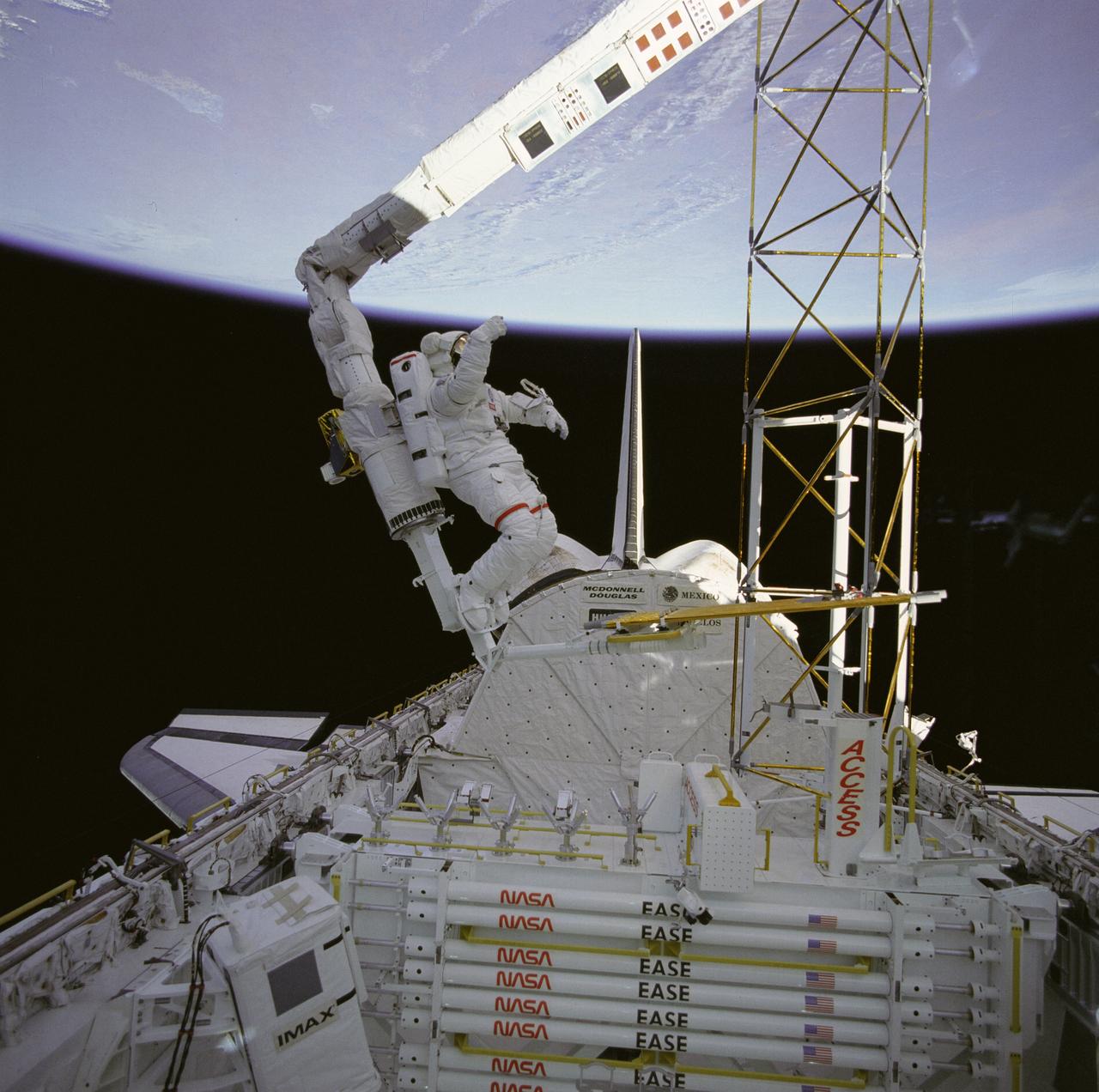
The crew assigned to the STS-61B mission included Bryan D. O’Conner, pilot; Brewster H. Shaw, commander; Charles D. Walker, payload specialist; mission specialists Jerry L. Ross, Mary L. Cleave, and Sherwood C. Spring; and Rodolpho Neri Vela, payload specialist. Launched aboard the Space Shuttle Atlantis November 28, 1985 at 7:29:00 pm (EST), the STS-61B mission’s primary payload included three communications satellites: MORELOS-B (Mexico); AUSSAT-2 (Australia); and SATCOM KU-2 (RCA Americom). Two experiments were conducted to test assembling erectable structures in space: EASE (Experimental Assembly of Structures in Extravehicular Activity), and ACCESS (Assembly Concept for Construction of Erectable Space Structure). In a joint venture between NASA/Langley Research Center in Hampton, Virginia and the Marshall Space Flight Center (MSFC), EASE and ACCESS were developed and demonstrated at MSFC's Neutral Buoyancy Simulator (NBS). In this STS-61B onboard photo astronaut Ross, located on the Manipulator Foot Restraint (MFR) over the cargo bay, erects ACCESS. The primary objective of this experiment was to test the structural assembly concepts for suitability as the framework for larger space structures and to identify ways to improve the productivity of space construction.