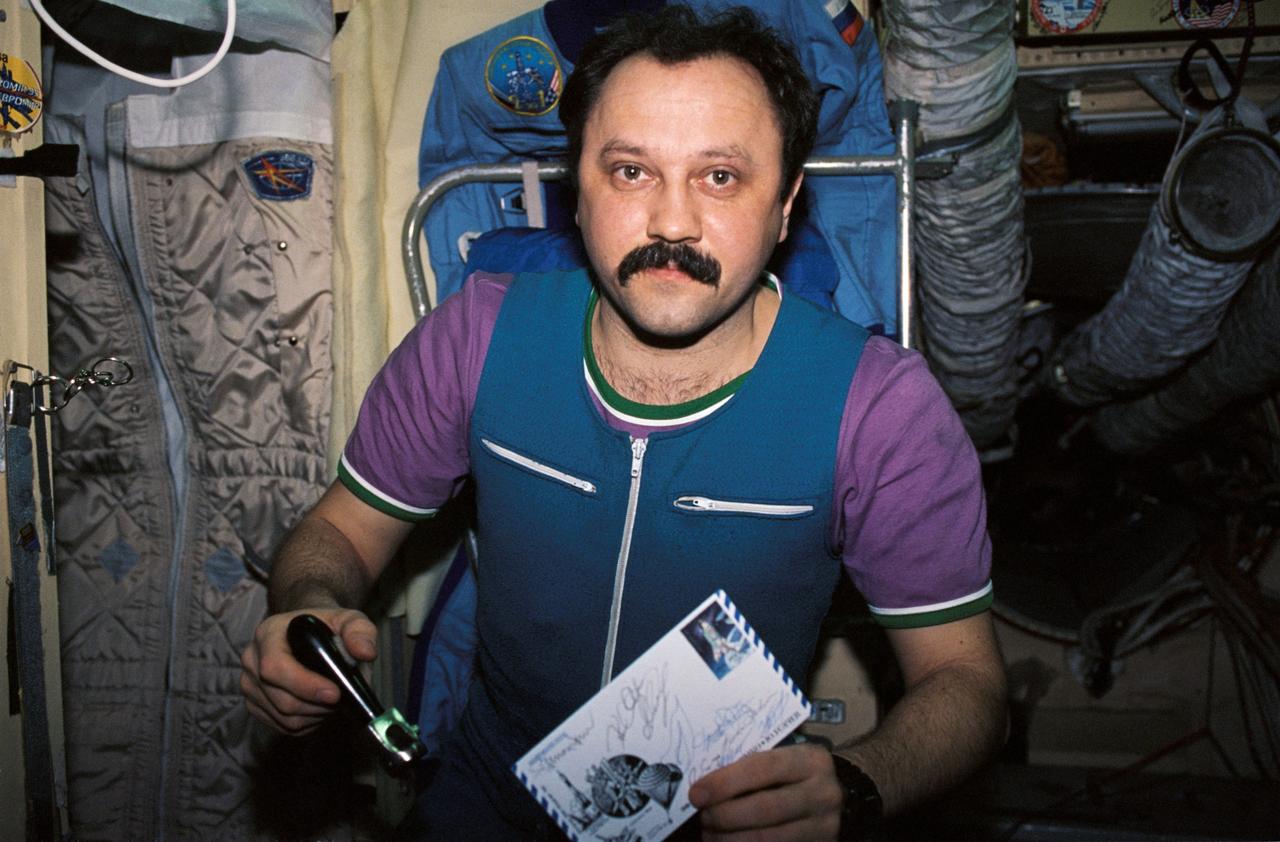
NM21-397-034 (For Release October 1996) --- Cosmonaut Yury V. Usachev, Mir 21 flight engineer, holds a peeler and a piece of mail received along with the food in the Base Block module of the Mir Space Station.
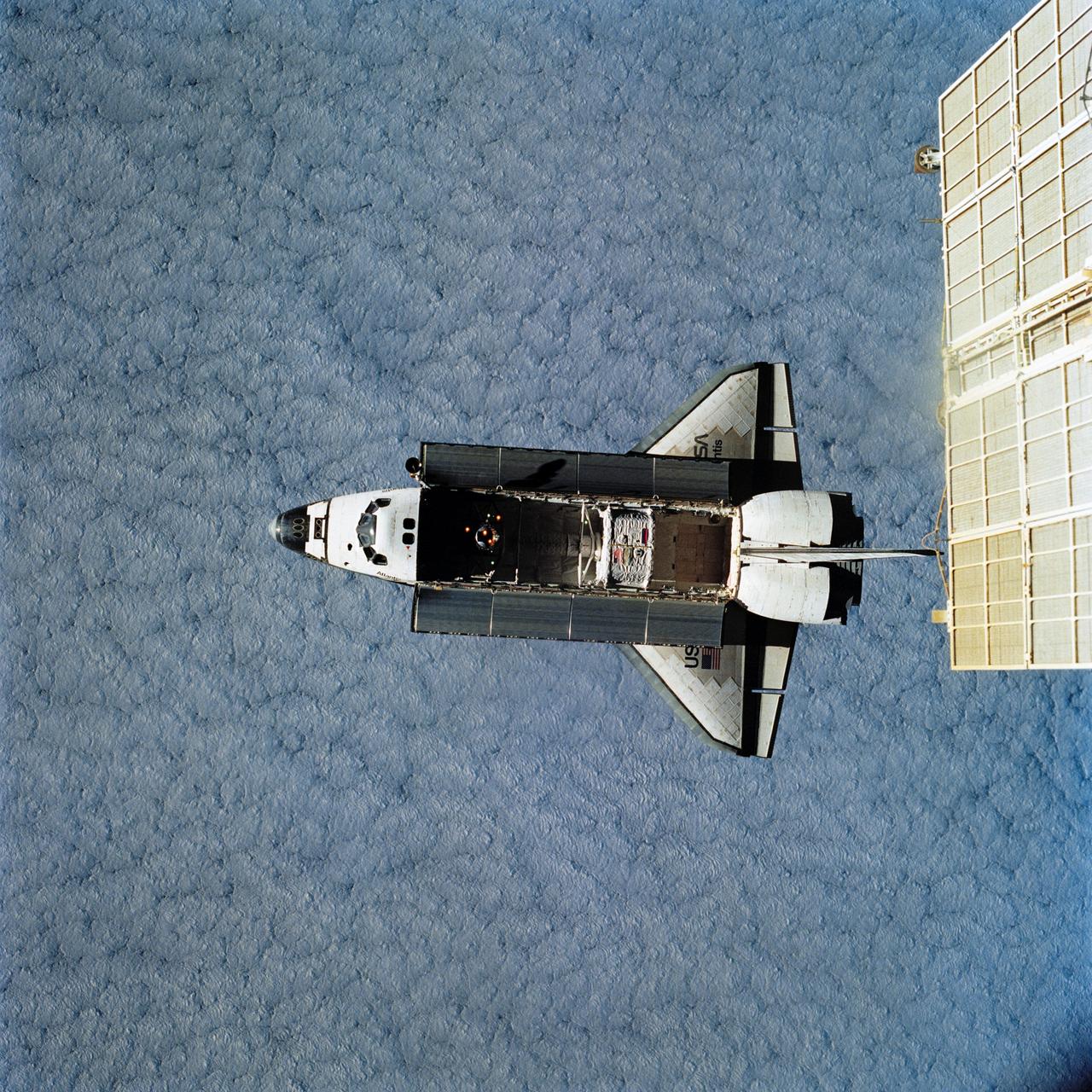
NM21-724-042 (23 March 1996) --- Backdropped against a "floor" of clouds, this view of the Space Shuttle Atlantis was taken by the two Mir-21 cosmonaut crew members onboard Russia's Mir Space Station, during rendezvous and docking operations on March 23, 1996. Part of a solar array panel connected to the Mir is seen in the foreground. The Orbiter Docking System (ODS), the connective tunnel and the Spacehab Module can be seen in Atlantis' cargo bay. With the subsequent delivery of astronaut Shannon W. Lucid to the Mir, the Mir-21 crew grew to three, as the mission specialist quickly becomes a cosmonaut guest researcher. She will spend approximately 140 days on Mir before returning to Earth.
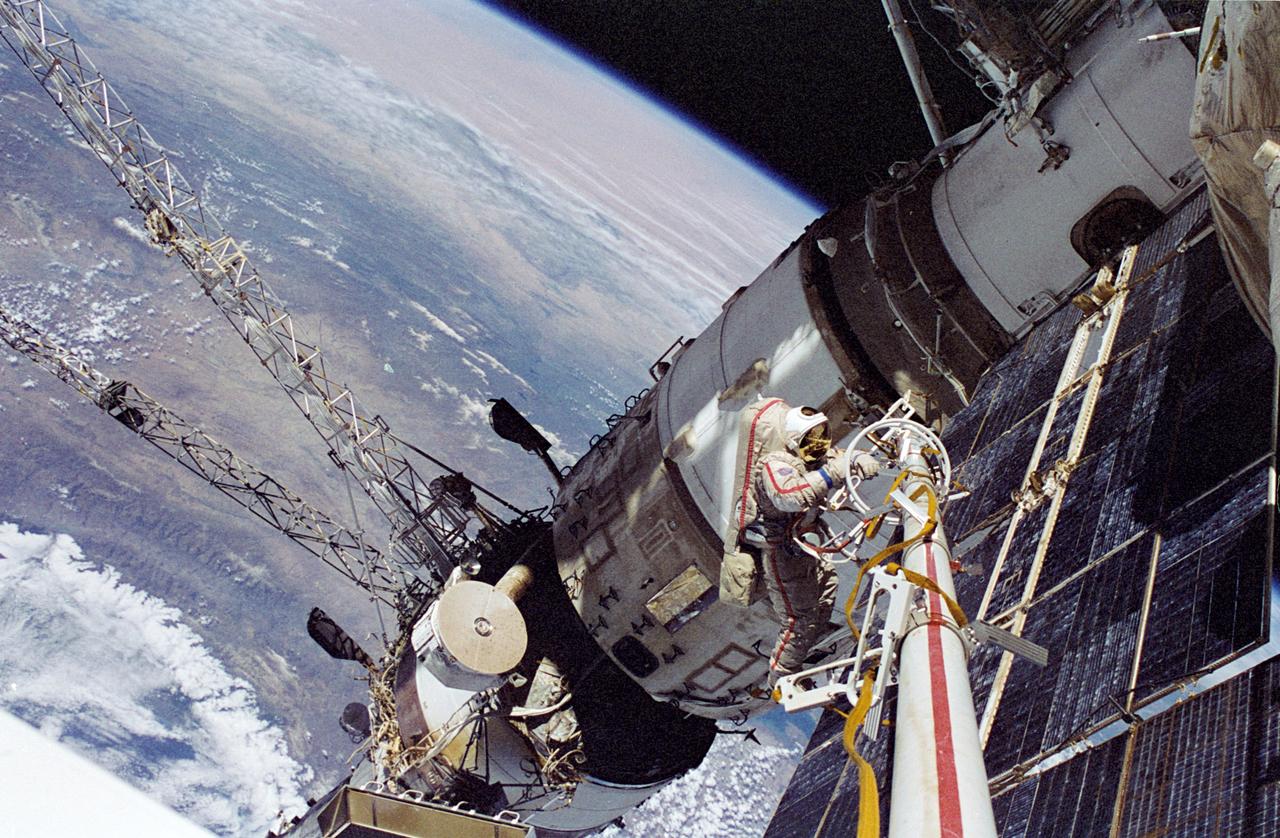
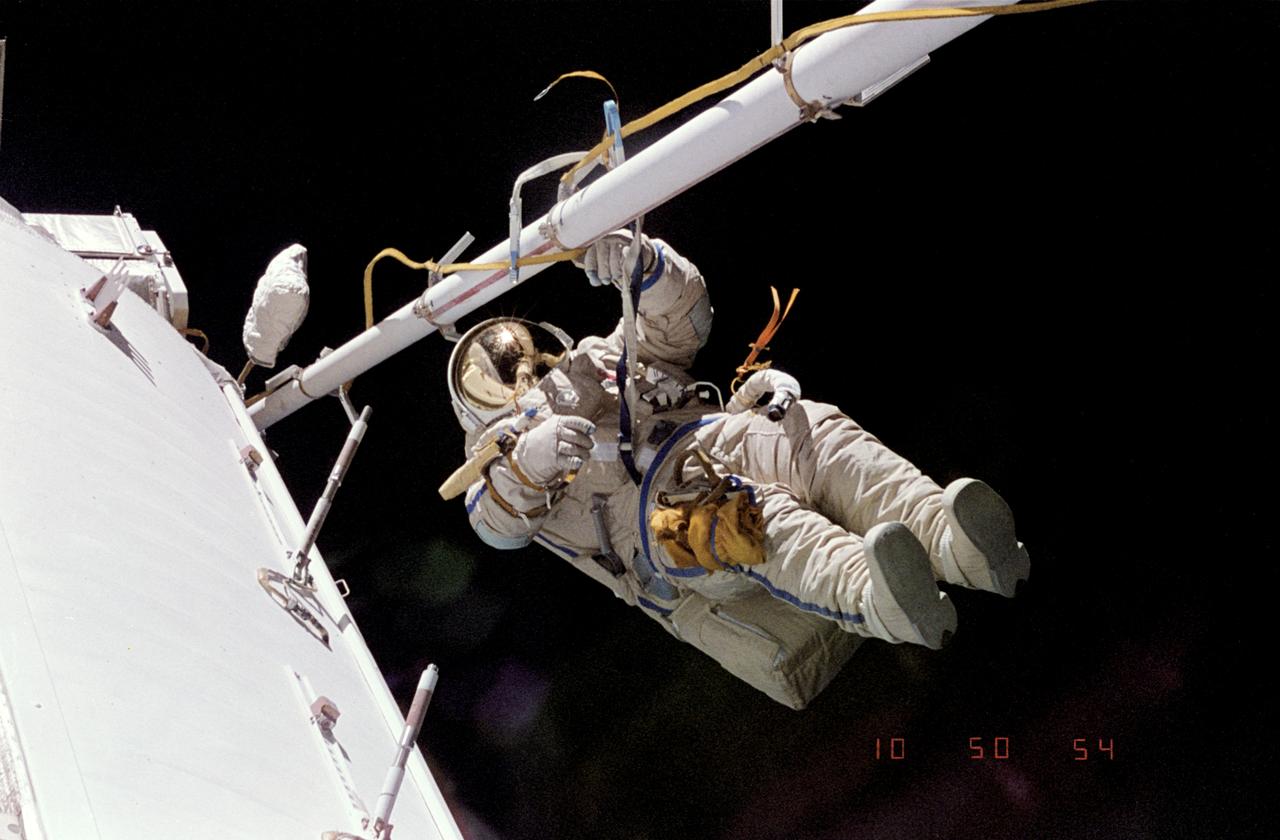
NM23-48-003 (29 April 1997) --- Cosmonaut Vasili V. Tsibliyev, Mir-23 commander, operates at the end of the Russian Mir Space Station’s STRELA boom during a space walk on April 29, 1997. He was joined by United States astronaut Jerry M. Linenger, cosmonaut guest researcher, in an effort to deploy scientific instruments and retrieve other science hardware. At the lower left of the picture is the Kvant-1 module. Hovering above it is the Sofora tower, which was once used for an experiment in attitude control of the Mir.
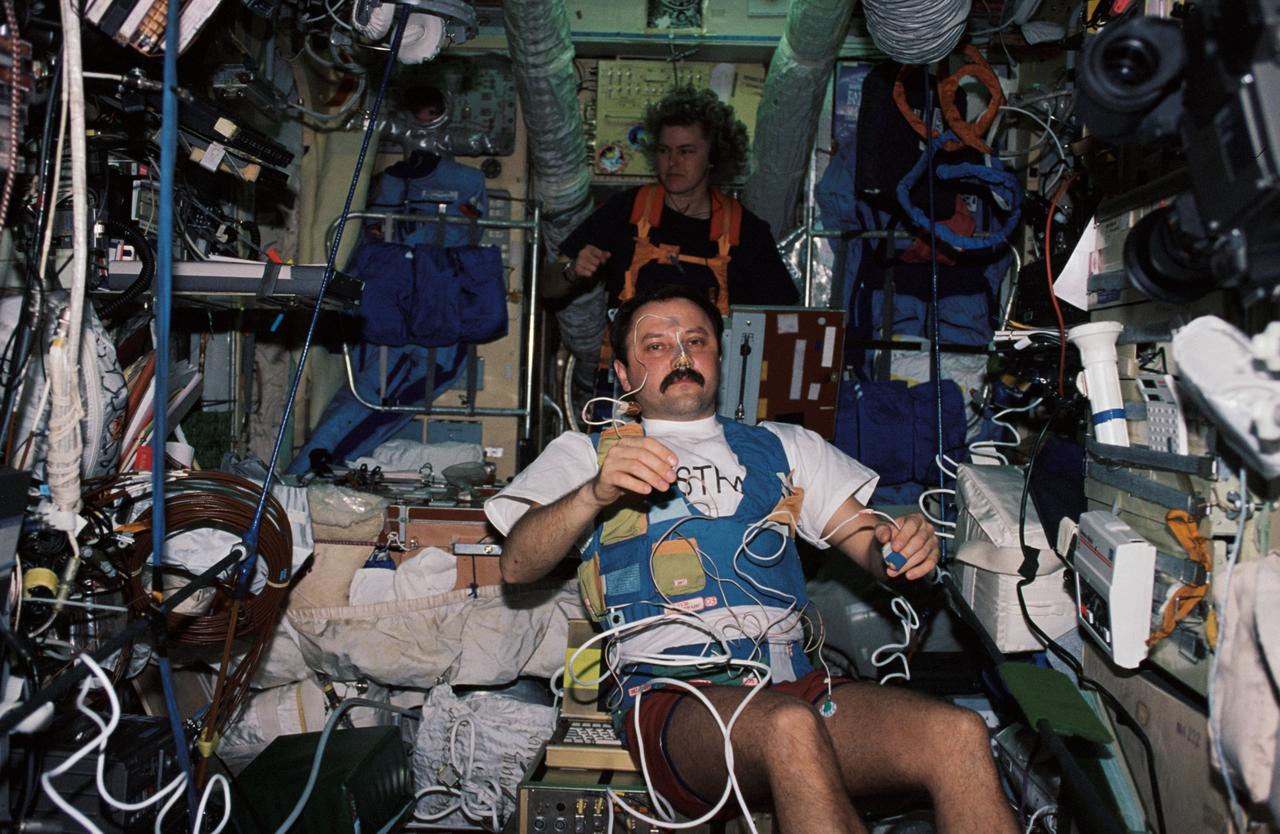
NM21-388-012 (For Release October 1996) --- Astronaut Shannon Lucid (background) exercises on the treadmill in the Mir space station Base Block while Mir 21 flight engineer Yury V. Usachev is wired for an experiment.

NM21-727-030 (23 March 1996) --- This view of the Space Shuttle Atlantis was taken by the two Mir-21 cosmonaut crew members onboard Russia's Mir Space Station, during rendezvous and docking operations on March 23, 1996. The Orbiter Docking System (ODS), the connective tunnel and the Spacehab Module can be seen in Atlantis' cargo bay. With the subsequent delivery of astronaut Shannon W. Lucid to the Mir, the Mir-21 crew grew to three, as the mission specialist quickly become a cosmonaut guest researcher. She will spend approximately 140 days on Mir before returning to Earth.
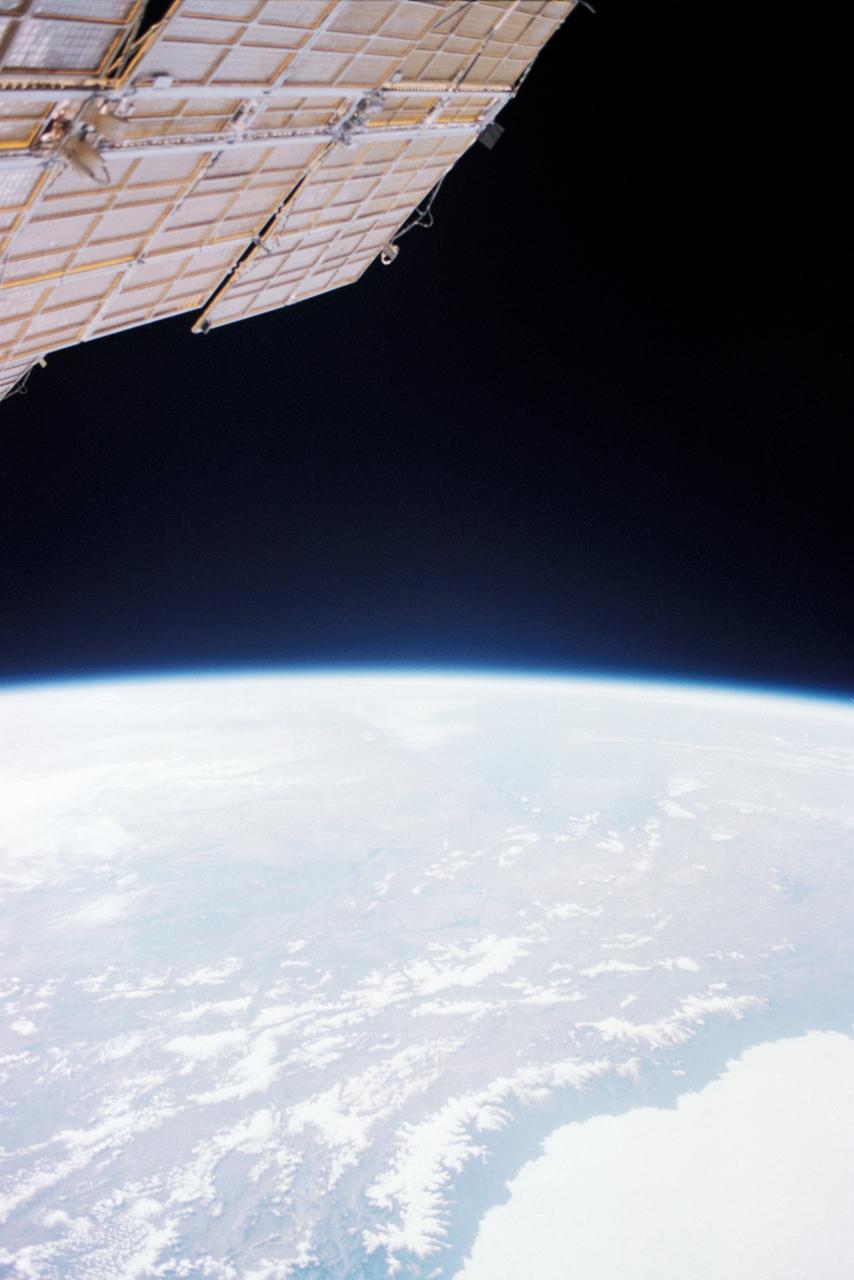
Overexposed earth observations taken during the NASA/Mir 21 mission from the Russian space station Mir by astronaut Shannon Lucid.
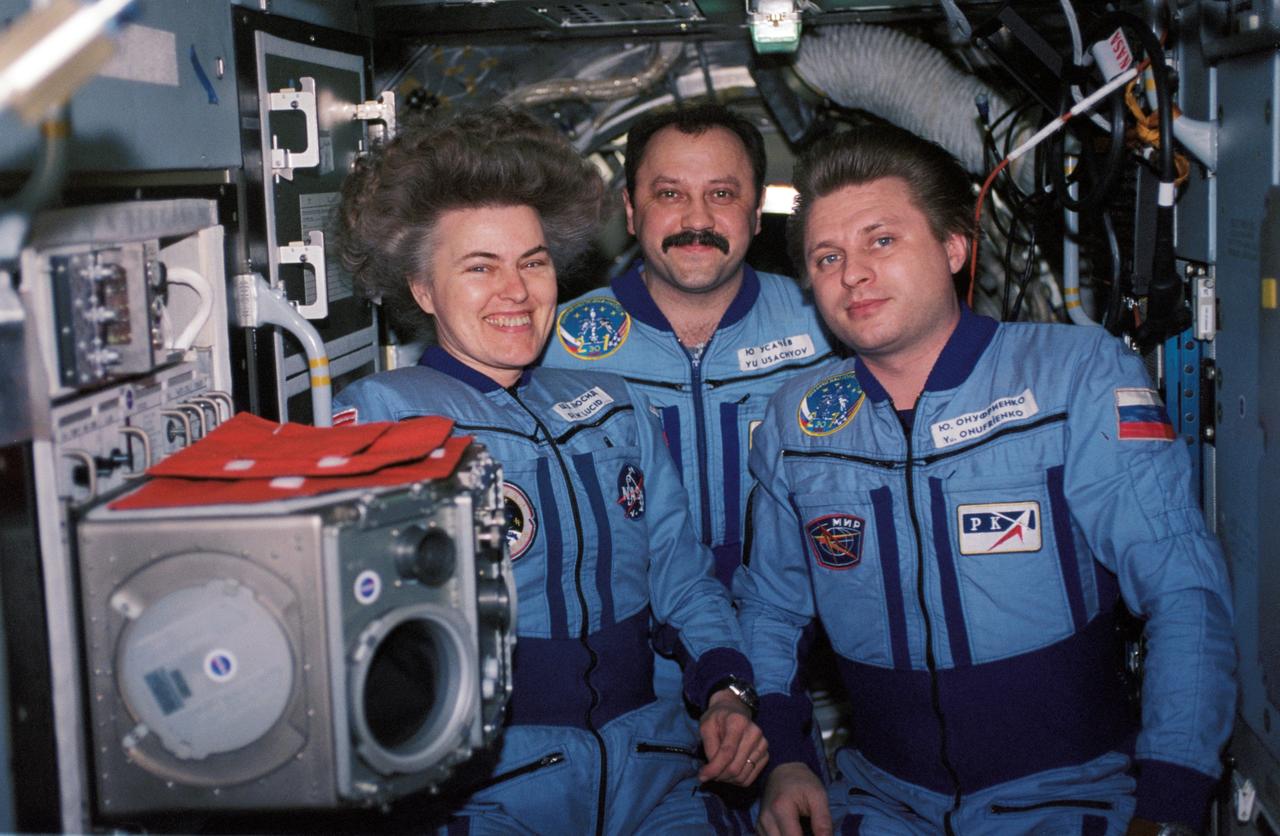
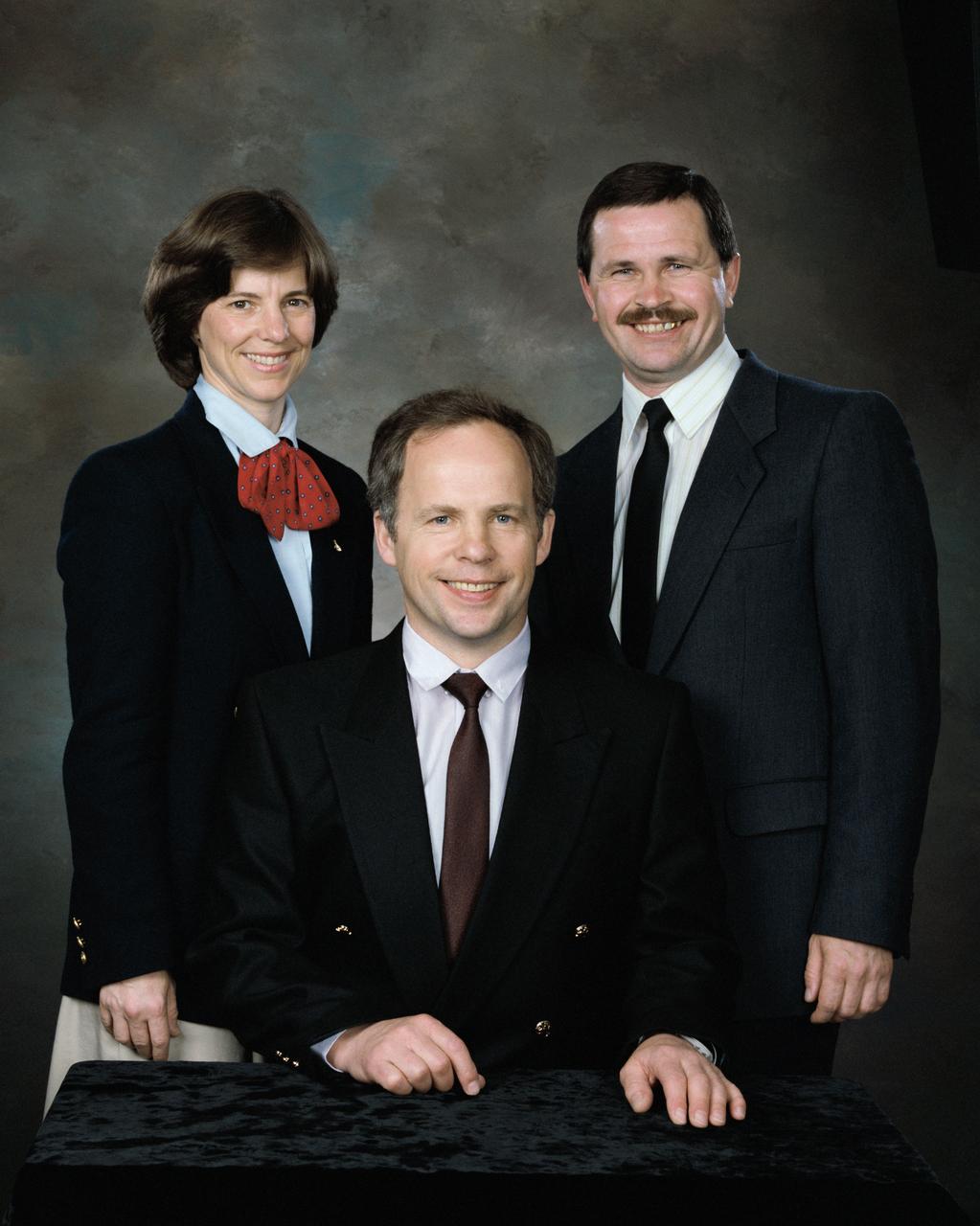
NM21-395-024 (March 1996) --- Posed near a microgravity glove box on the Priroda Module aboard Russia’s Mir Space Station are the Mir-21 crew members. From the left are astronaut Shannon W. Lucid, cosmonaut guest researcher; Yuriy V. Usachov, flight engineer; and Yuriy I. Onufriyenko, commander. Lucid went on to spend a total of 188 consecutive days in space before returning to Earth with the STS-79 crew.
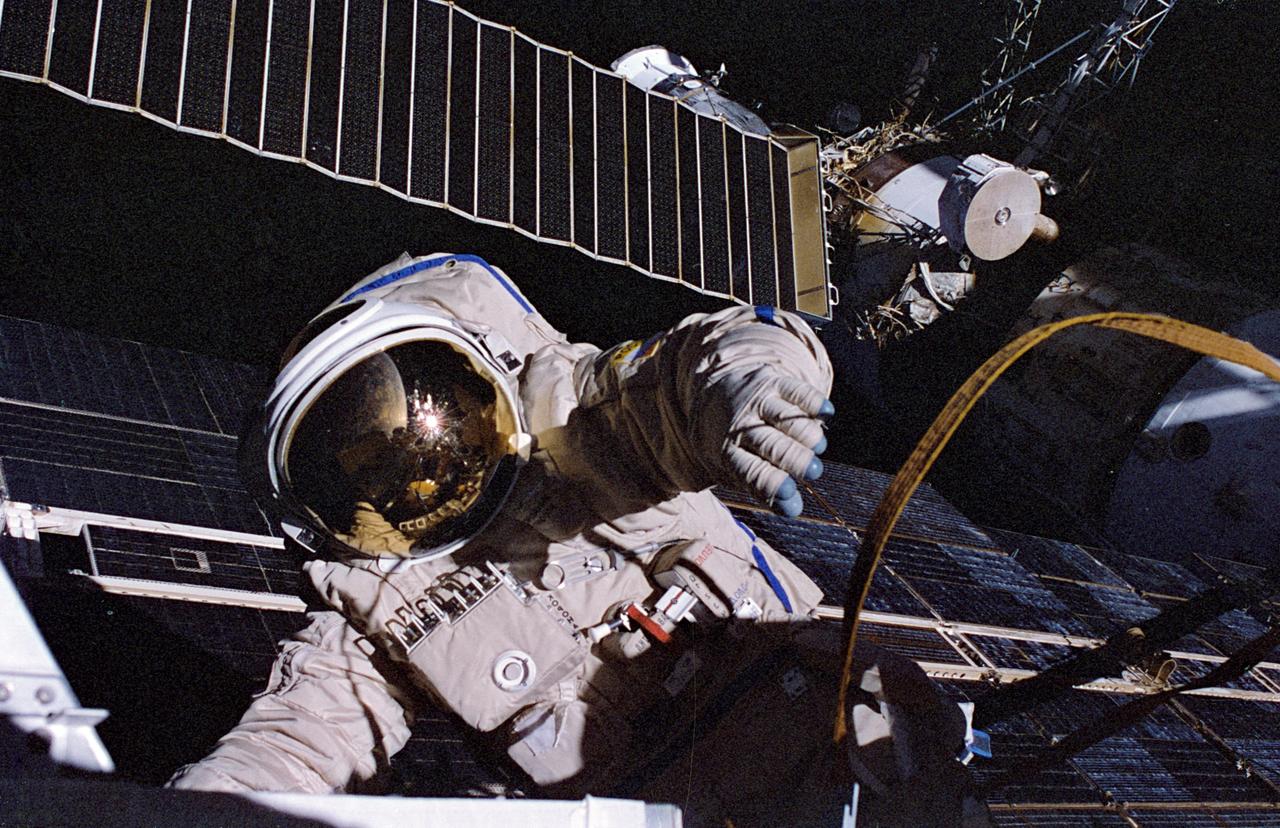
NM23-48-009 (29 April 1997) --- United States astronaut Jerry M. Linenger, cosmonaut guest researcher, works outside the Russian Mir Space Station during a joint United States-Russian space walk on April 29, 1997. He was joined by Mir-23 commander Vasili V. Tsibliyev (out of frame) for the five-hour Extravehicular Activity (EVA) designed to deploy scientific instruments and retrieve other science hardware. At the top of the frame is a Russian Progress re-supply capsule docked to the Mir’s Kvant-1 module.
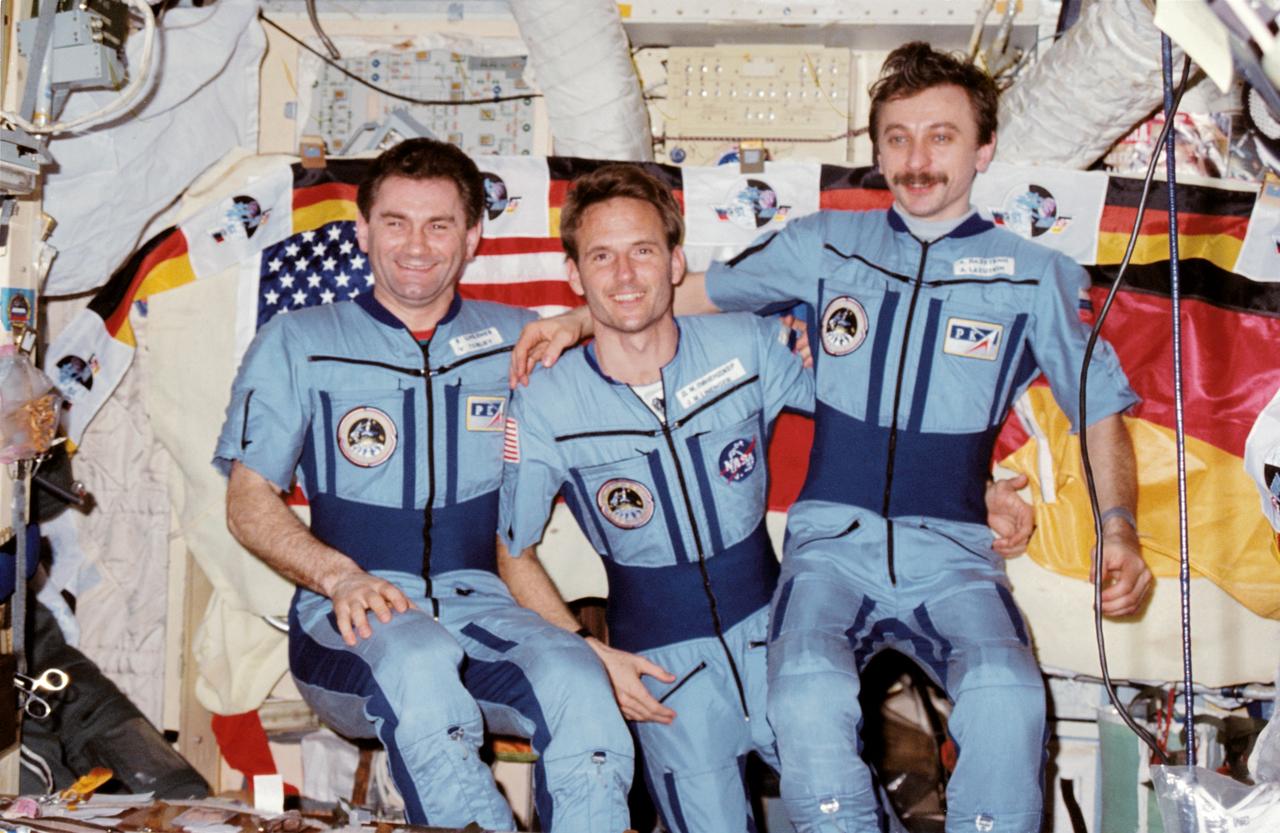
NM23-48-009 (29 April 1997) --- United States astronaut Jerry M. Linenger, cosmonaut guest researcher, works outside the Russian Mir Space Station during a joint United States-Russian space walk on April 29, 1997. He was joined by Mir-23 commander Vasili V. Tsibliyev (out of frame) for the five-hour Extravehicular Activity (EVA) designed to deploy scientific instruments and retrieve other science hardware. At the top of the frame is a Russian Progress re-supply capsule docked to the Mir’s Kvant-1 module.
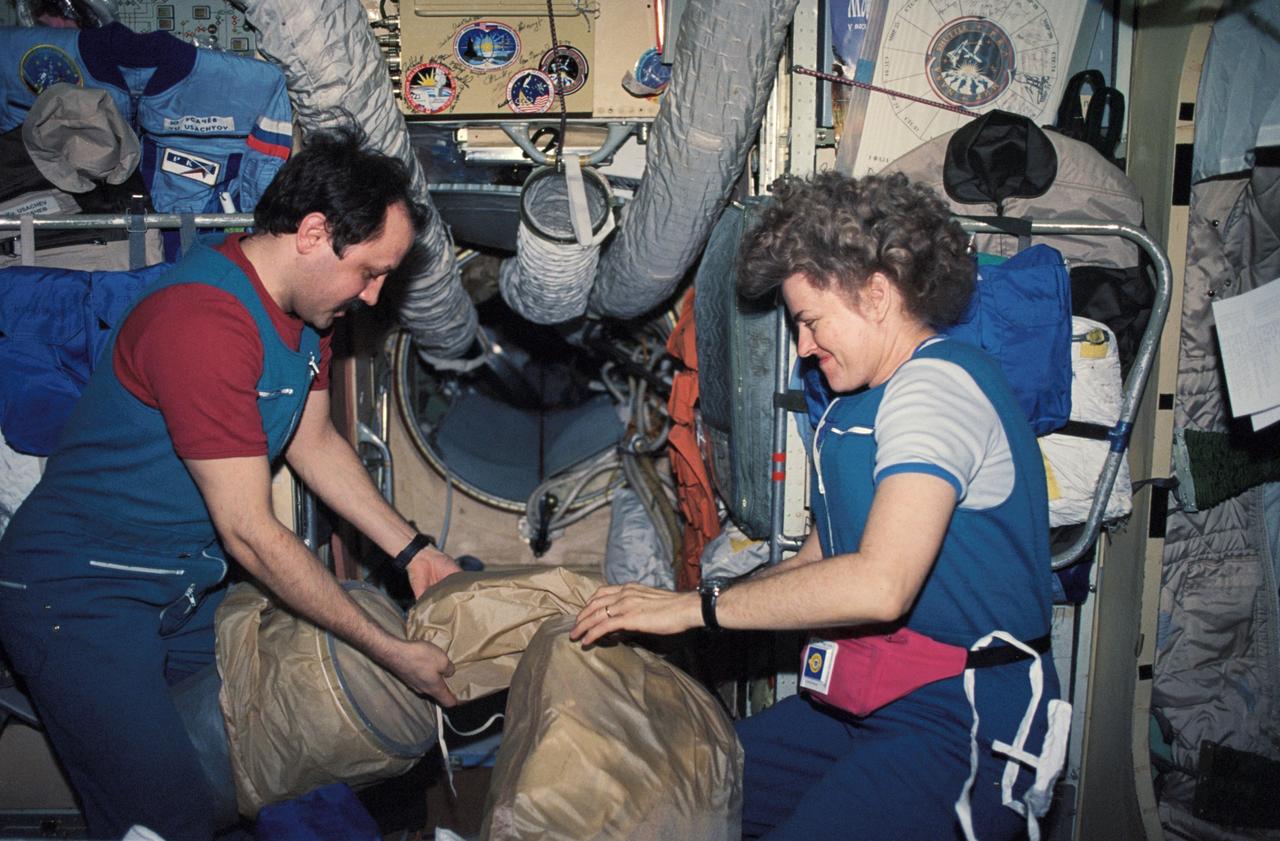
NM21-386-024 (March 1996) --- Onboard the Base Block Module of Russia’s Mir Space Station, as two members of the Mir-21 crew prepare to move supplies to their proper stowage places. Astronaut Shannon W. Lucid, recently dropped off by the STS-76 Space Shuttle Atlantis crew members and now serving as a cosmonaut guest researcher, works with Yury V. Usachev, flight engineer. She went on to spend a total of 188 consecutive days in space before returning to Earth with the STS-79 crew. She worked with a total of five cosmonauts at various times during that stay.
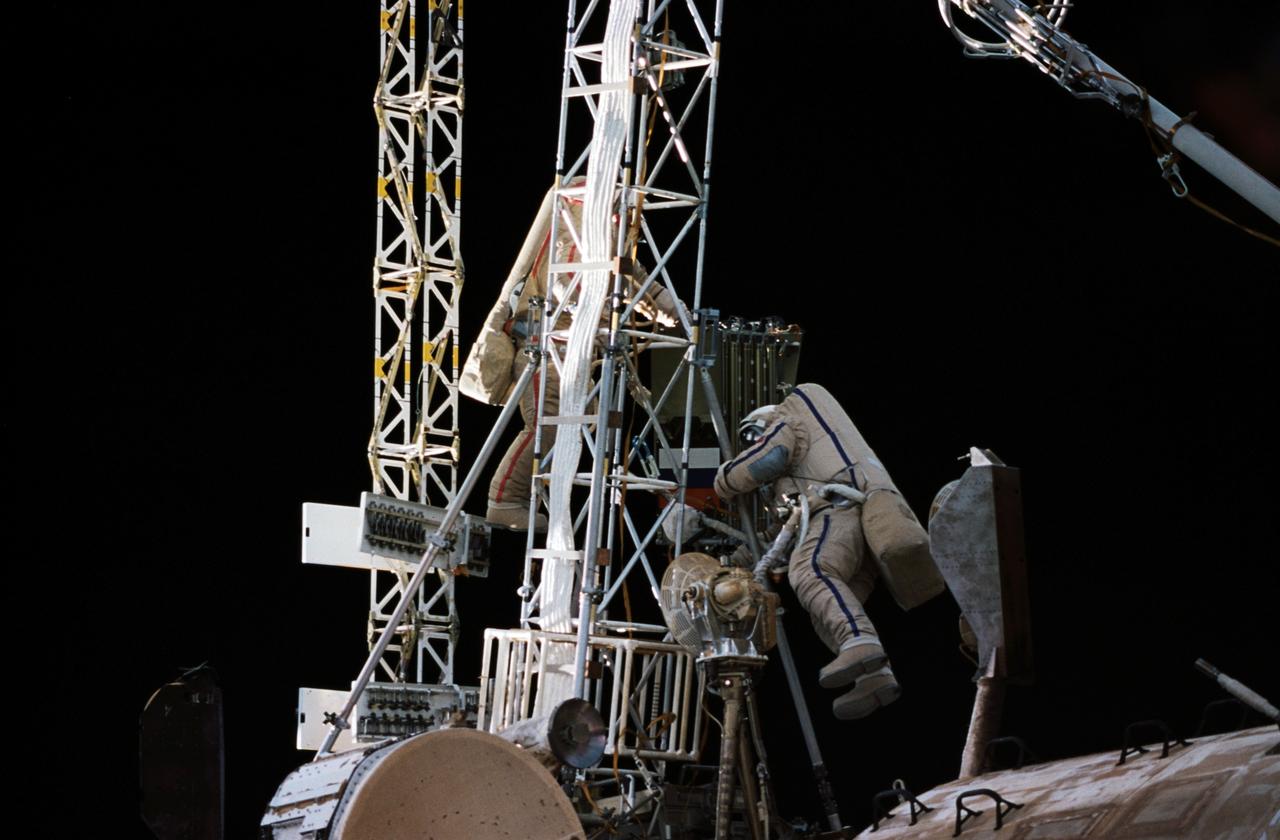
NM21-382-010 (For Release October 1996) --- Mir 21 commander Yury I. Onufrienko (left), wearing a red stripe on his Russian Orlan spacesuit, and Mir 21 flight engineer Yury V. Usachev (blue stripe on Orlan)traverse an existing truss on the Kvant module with a folded truss in tow.
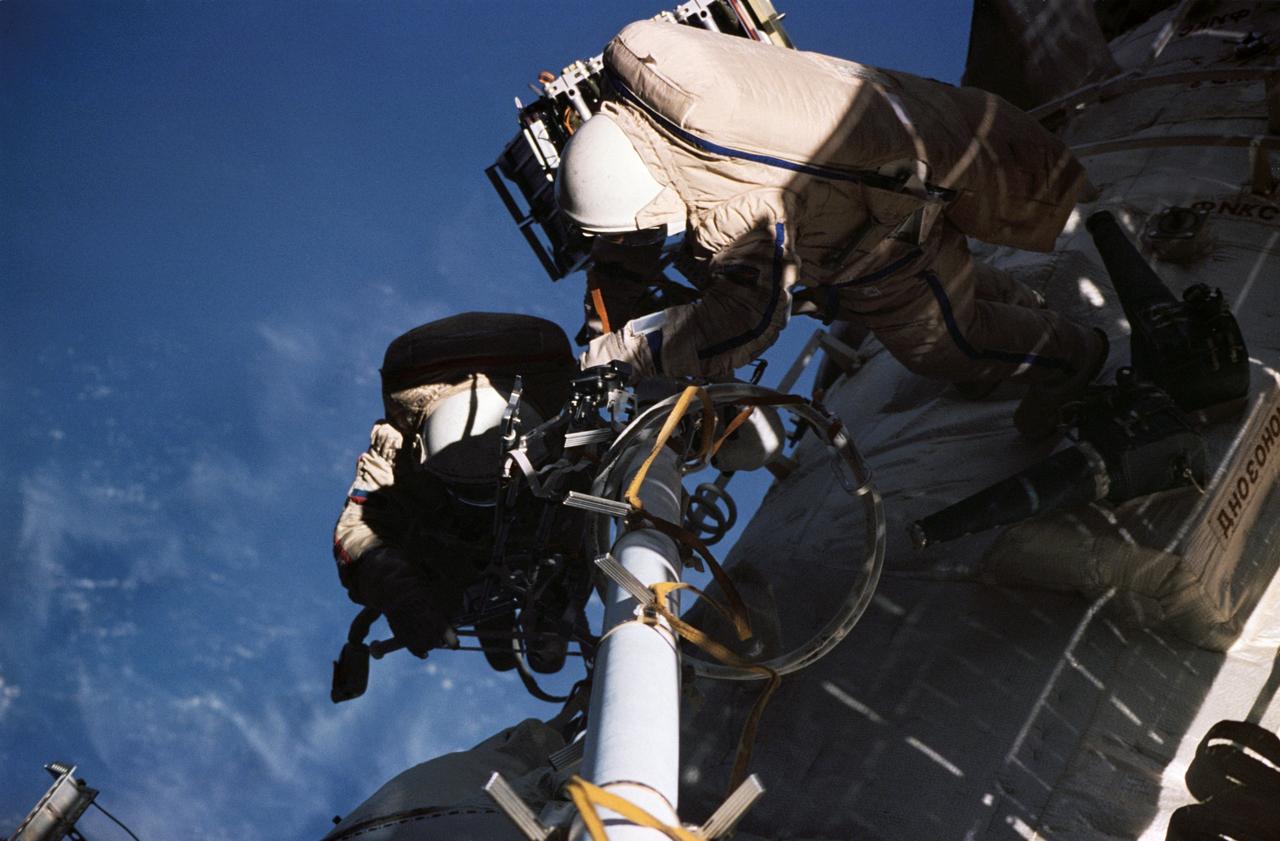
NM21-382-008 (For Release October 1996) --- Cosmonaut Yury I. Onufrienko, Mir 21 commander, wearing a red stripe on his Russian Orlan spacesuit, and Mir 21 flight engineer Yuri V. Usachev (blue stripe on Orlan) work to install the truss on the module.

NM21-401-012 (28 March 1996) --- The Space Shuttle Atlantis is backdropped over the darkness of space, and partially over clouds and open ocean waters on Earth, as it and Russia’s Mir Space Station begin their relative separation following several days of joint operations. This 35mm film was exposed by astronaut Shannon W. Lucid as she was beginning her record-setting stay aboard Mir, as a cosmonaut guest researcher. Onboard with Lucid were her Mir-21 crew mates, cosmonauts Yuriy I. Onufriyenko, commander; and Yuriy V. Usachov, flight engineer. Onboard Atlantis were Kevin P. Chilton, STS-76 mission commander; Richard A. Searfoss, pilot; along with Linda M. Godwin, Ronald M. Sega and Michael R. (Rich) Clifford, mission specialists.
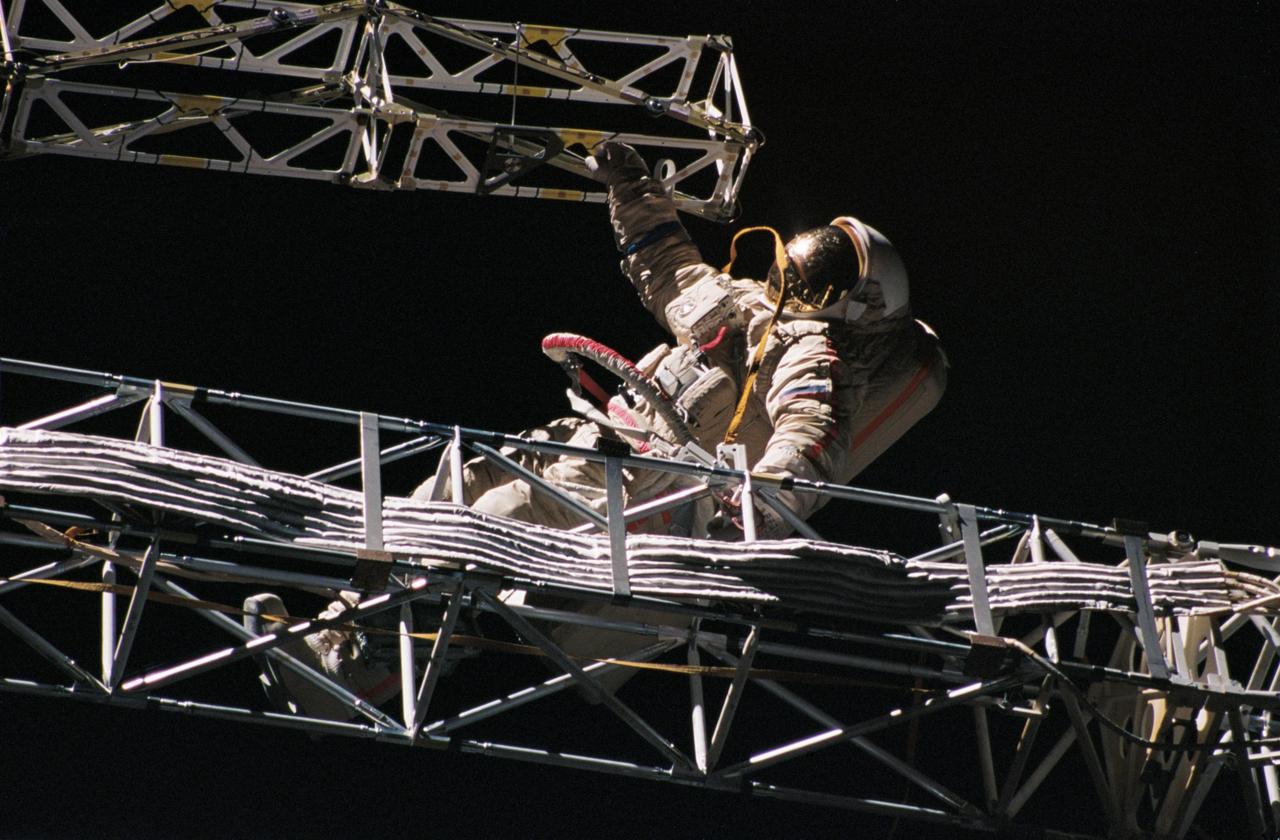
NM21-382-024 (For Release October 1996) --- Cosmonaut Yuriy I. Onufriyenko was photographed by astronaut and cosmonaut guest researcher Shannon W. Lucid as the Mir-21 commander performed a scheduled Extravehicular Activity (EVA) at a truss assembly in the early days of Lucid’s extended stay aboard Russia’s Mir Space Station.

NM22-427-023 (20 Sept. 1996) --- This photograph of the space shuttle Atlantis was taken from approximately 170 feet away by astronaut Shannon W. Lucid, winding up her duties as cosmonaut guest researcher onboard Russia?s Mir Space Station. Lucid was in Mir?s Base Block Module. The Spacehab double module, a first time space flyer, is seen in the aft payload bay. Its tunnel can be seen connecting to both Atlantis? crew cabin and the androgynous docking adapter. Also seen in the forward bay is the Ku-band antenna used for communications. Though not recognizable in this photo, several Atlantis crew members had their ?noses to the windows? as NASA was about to make its first crew member exchange with Mir. Astronaut John E. Blaha was onboard Atlantis as Lucid?s replacement.
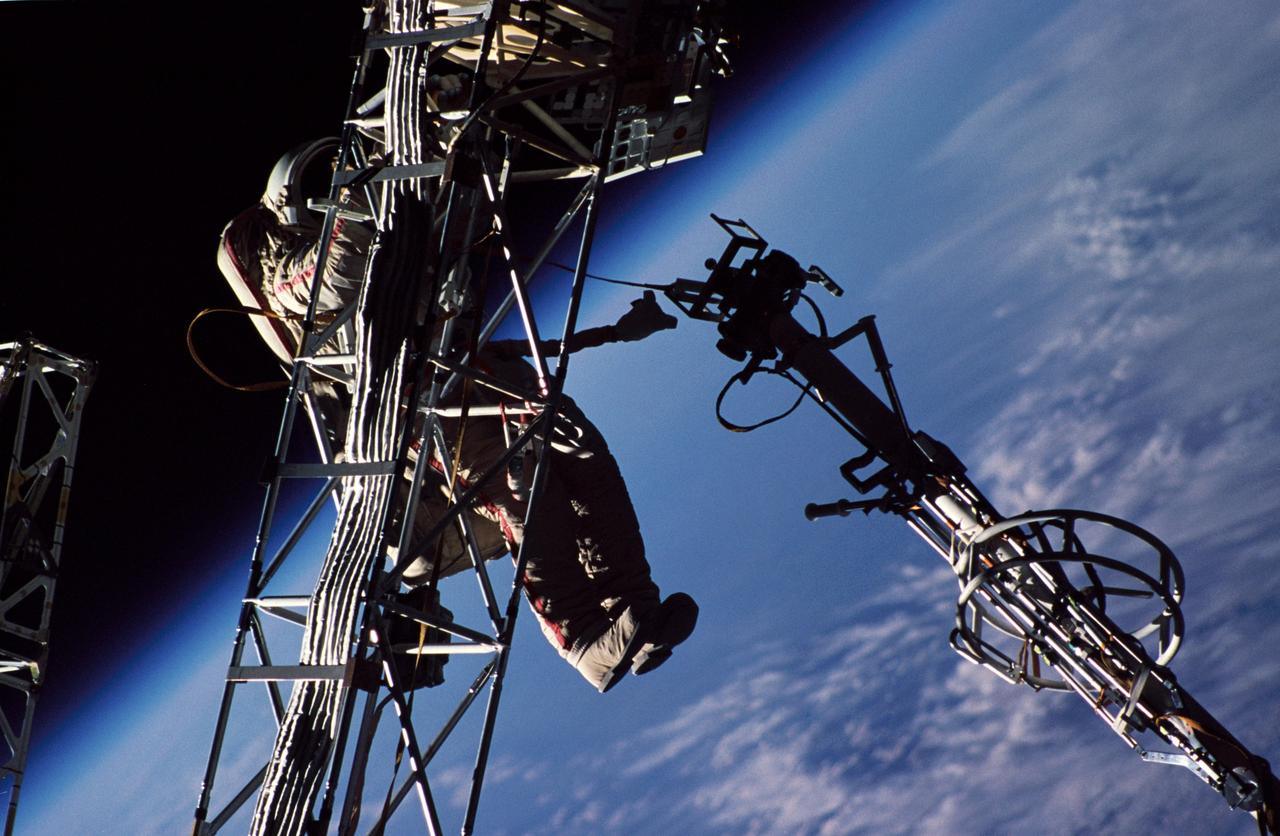
NM21-382-019 (For Release October 1996) --- Darkened view of cosmonaut Yury I. Onufrienko, Mir 21 commander, wearing a red stripe on his Russian Orlan spacesuit, traversing the the Sofora Truss, with the Strehla transfer aid beside it.
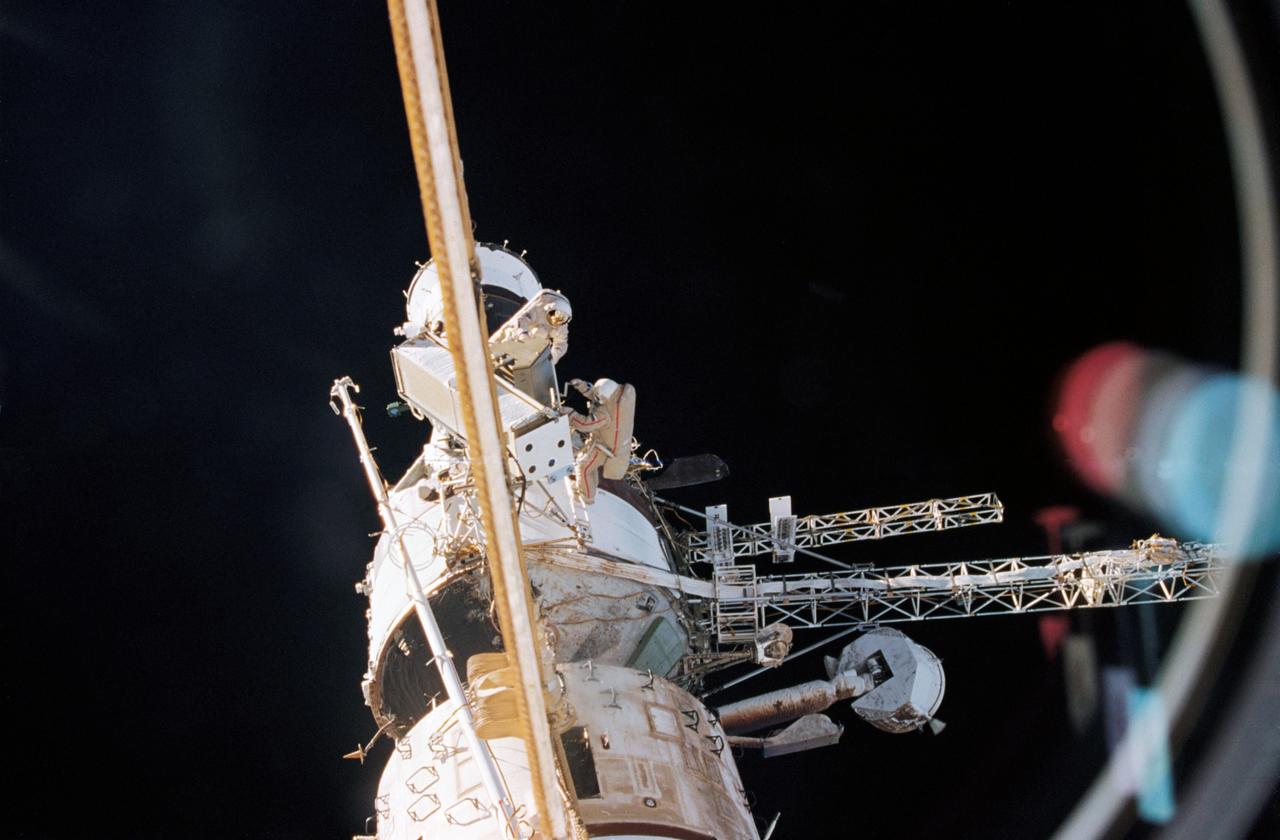
NM21-393-009 (For release October 1996) --- Cosmonauts Yuriy I. Onufriyenko (wearing red stripe on suit) and Yuriy V. Usachov were photographed by astronaut and cosmonaut guest researcher Shannon W. Lucid as the pair performed a scheduled Extravehicular Activity (EVA) in the early days of Lucid’s extended stay aboard Russia’s Mir Space Station.

NM21-396-024 (23 March 1996) --- Backdropped against the blackness of space the Space Shuttle Atlantis was taken by the two Mir-21 cosmonaut crew members onboard Russia’s Mir Space Station, during rendezvous and docking operations on March 23, 1996. The Orbiter Docking System (ODS), the connective tunnel and the Spacehab Module can be seen in Atlantis’ cargo bay. With the subsequent delivery of astronaut Shannon W. Lucid to the Mir, the Mir-21 crew grew to three, as the mission specialist quickly becomes a cosmonaut guest researcher. She will spend approximately 140 days on Mir before returning to Earth.
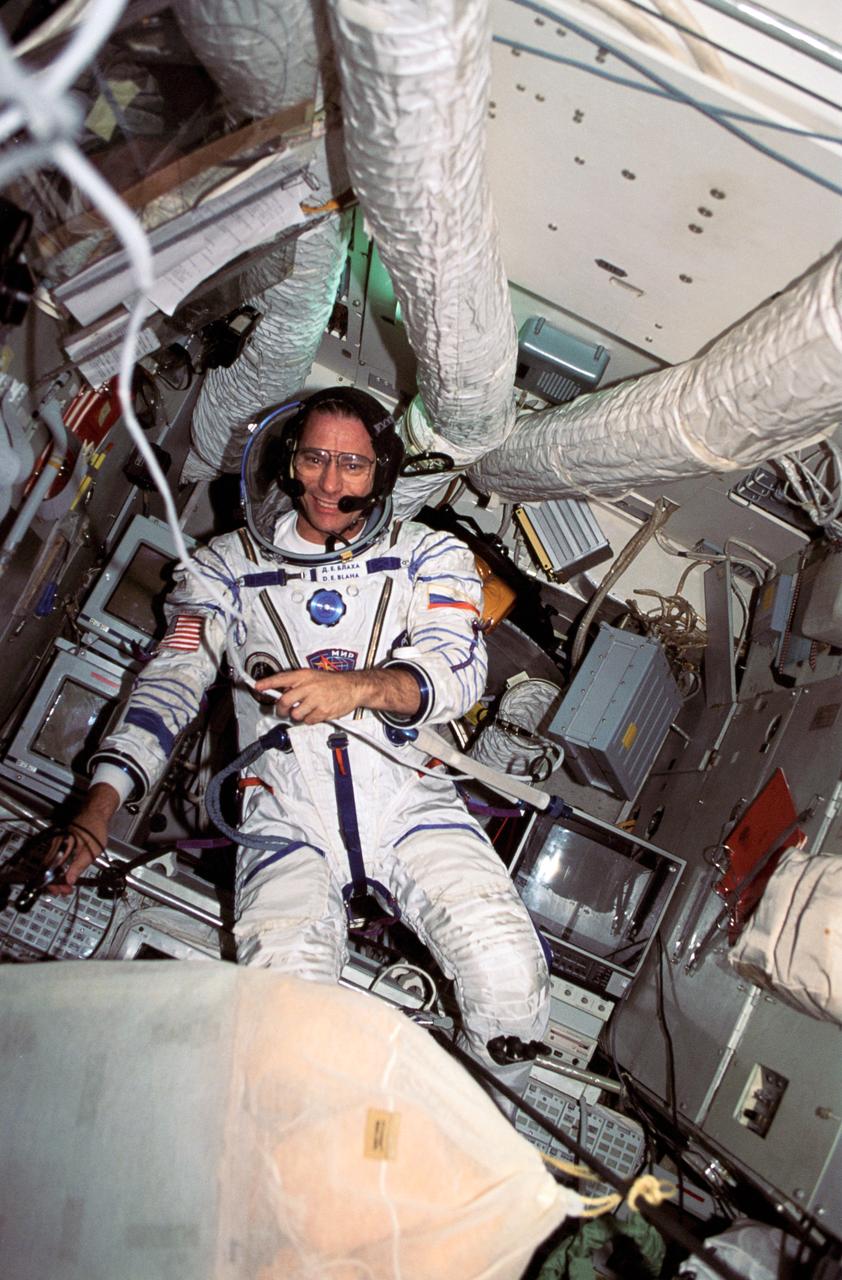
NM22-416-017 (20 Sept. 1996) --- One of the first priorities of astronaut John E. Blaha, mission specialist for STS-79 and soon to be cosmonaut guest researcher for Mir-22, was to get his Sokol space suit pressure-checked for the move aboard Russia’s Mir Space Station. On flight day four, Blaha and his STS-79 crew mates aboard the Space Shuttle Atlantis docked with Mir. Here, seen soon after hatch opening, Blaha prepares for the needed suit tests.

The rising sun signifies the dawn of a new era of human Spaceflight, the first phase of the United States/Russian space partnership, Shuttle-Mir. Mir is shown in its proposed final on orbit configuration. The Shuttle is shown in a generic tunnel/Spacehab configuration. The Shuttle/Mir combination, docked to acknowledge the union of the two space programs, orbits over an Earth devoid of any definable features or political borders to emphasize Earth as the home planet for all humanity. The individual stars near the Space Shuttle and the Russian Mir Space Station represent the previous individual accomplishments of Russia's space program and that of the United States. The binary star is a tribute to the previous United States-Russian joint human Spaceflight program, the Apollo-Soyuz Test Project (ASTP). The flags of the two nations are symbolized by flowing ribbons of the national colors interwoven in space to represent the two nations joint exploration of space. NASA SHUTTLE and PKA MNP are shown in the stylized logo fonts of the two agencies that are conducting this program.
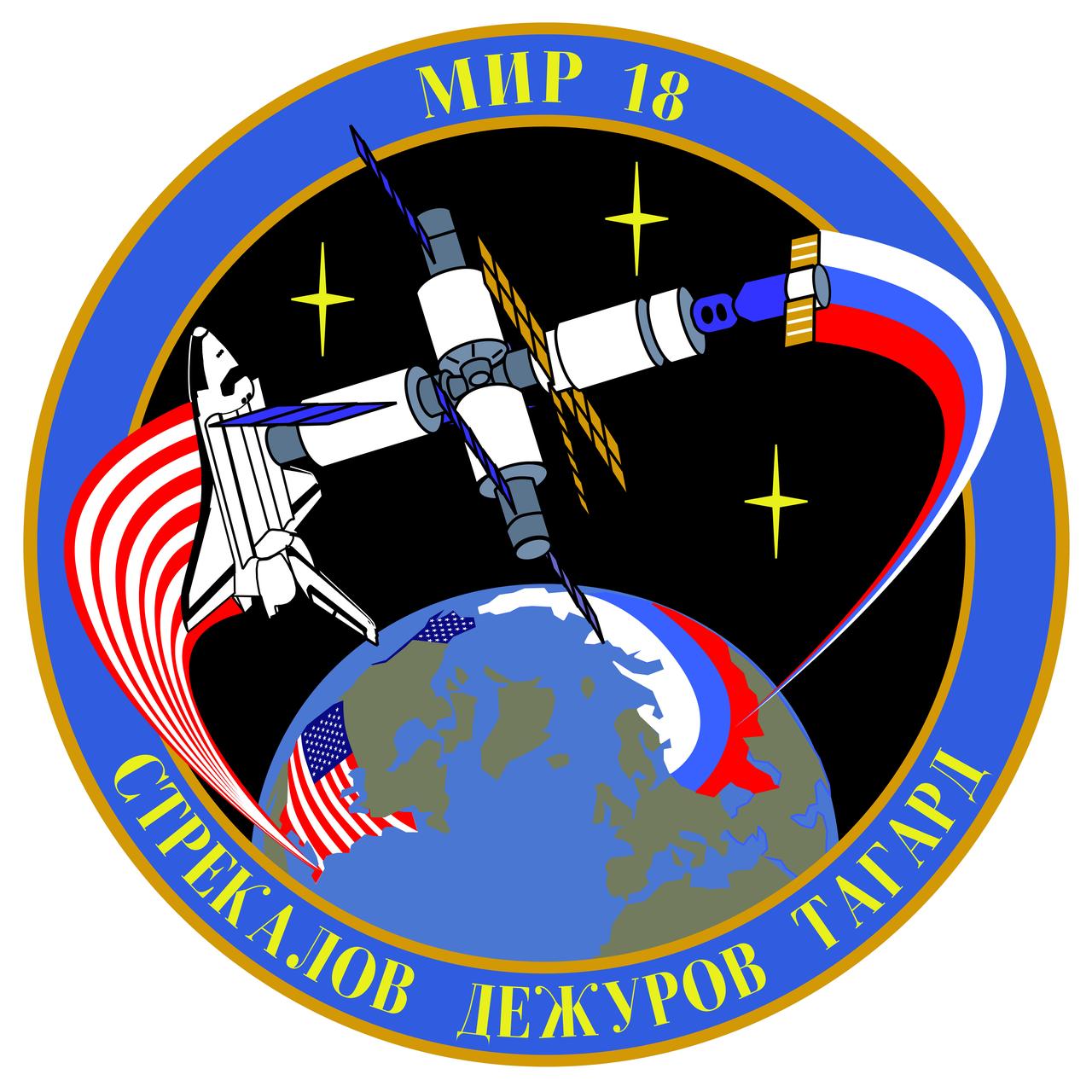
S94-36965 (20 Sept 1994) --- The rising sun signifies the dawn of a new era of human Spaceflight, the first phase of the U.S./Russian space partnership, Shuttle-Mir. Mir is shown in its proposed final on orbit configuration. The Shuttle is shown in a generic tunnel/Spacehab configuration. The Shuttle-Mir combination, docked to acknowledge the union of the two space programs, orbits over an Earth devoid of any definable features or political borders to emphasize Earth as the home planet for all humanity. The individual stars near the Shuttle and the Mir station represent the previous individual accomplishments of Russia's space program and that of the U.S. The binary star is a tribute to the previous U.S.-Russian joint human Spaceflight program, the Apollo-Soyuz Test Project. The flags of the two nations are symbolized by flowing ribbons of the national colors interwoven in space to represent the two nations joint exploration of space. NASA SHUTTLE and PKA MNP are shown in the stylized logo fonts of the two agencies that are conducting this program.
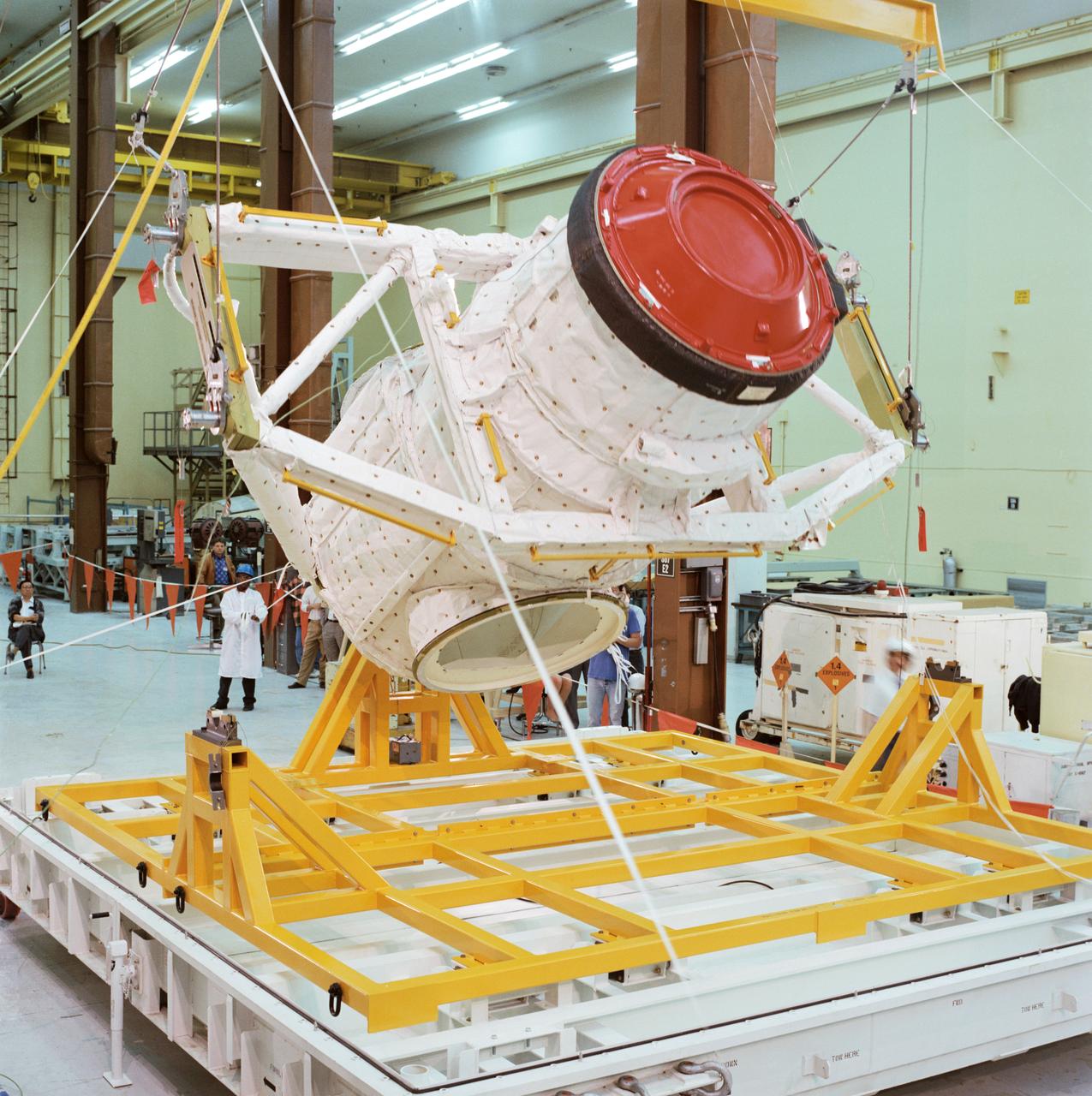
S95-00057 (15 Nov 1994) --- In Rockwell's Building 290 at Downey, California, the external airlock assembly/Mir docking system is rotated into position for crating up for shipment to the Kennedy Space Center (KSC) in Florida. Jointly developed by Rockwell and RSC Energia, the external airlock assembly and Mir docking system will be mounted in the cargo bay of the Space Shuttle Atlantis to enable the shuttle to link up to Russia's Mir space station. The docking system contains hooks and latches compatible with the system currently housed on the Mir's Krystall module, to which Atlantis will attach for the first time next spring. STS-71 will carry two Russian cosmonauts, who will replace a three-man crew aboard Mir including Norman E. Thagard, a NASA astronaut. The combined 10-person crew will conduct almost five days of joint life sciences investigations both aboard Mir and in the Space Shuttle Atlantis's Spacelab module.
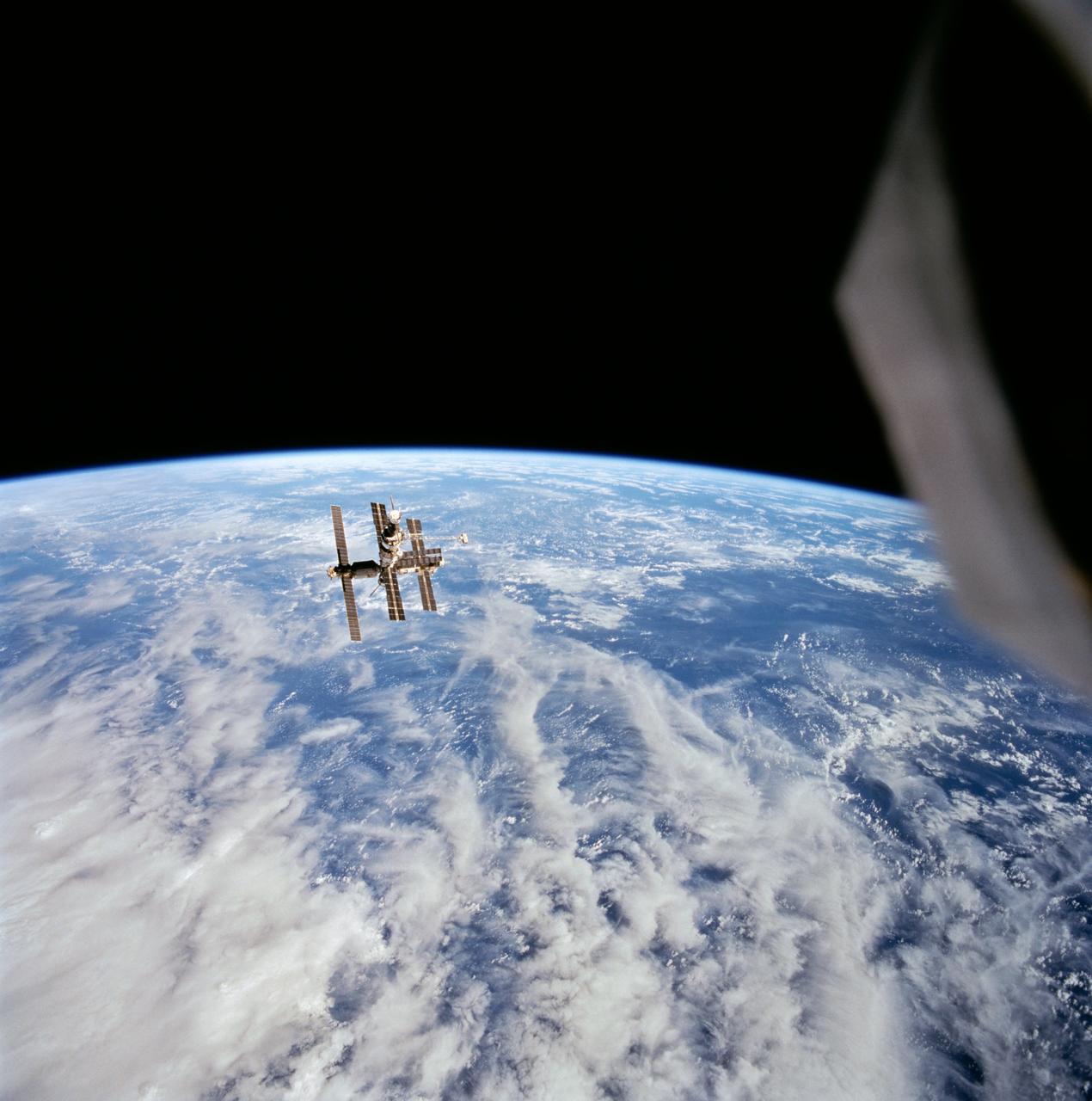
STS063-708-095 (6 Feb 1995) --- Cumulus and other clouds over the ocean form the backdrop for this scene of Russia's Mir space station during rendezvous operations by the Space Shuttle Discovery and Mir. This photograph was taken as the Discovery was firing its Reaction Control Subsystem (RCS) thrusters to separate from Mir's proximity. Onboard the Discovery were astronauts James D. Wetherbee, mission commander; Eileen M. Collins, pilot; Bernard A. Harris Jr., payload commander; mission specialists Janice Voss and C. Michael Foale; along with Russian cosmonaut Vladimir G. Titov. EDITOR'S NOTE: This 70mm handheld Hasselblad frame has been cropped to enlarge Mir.
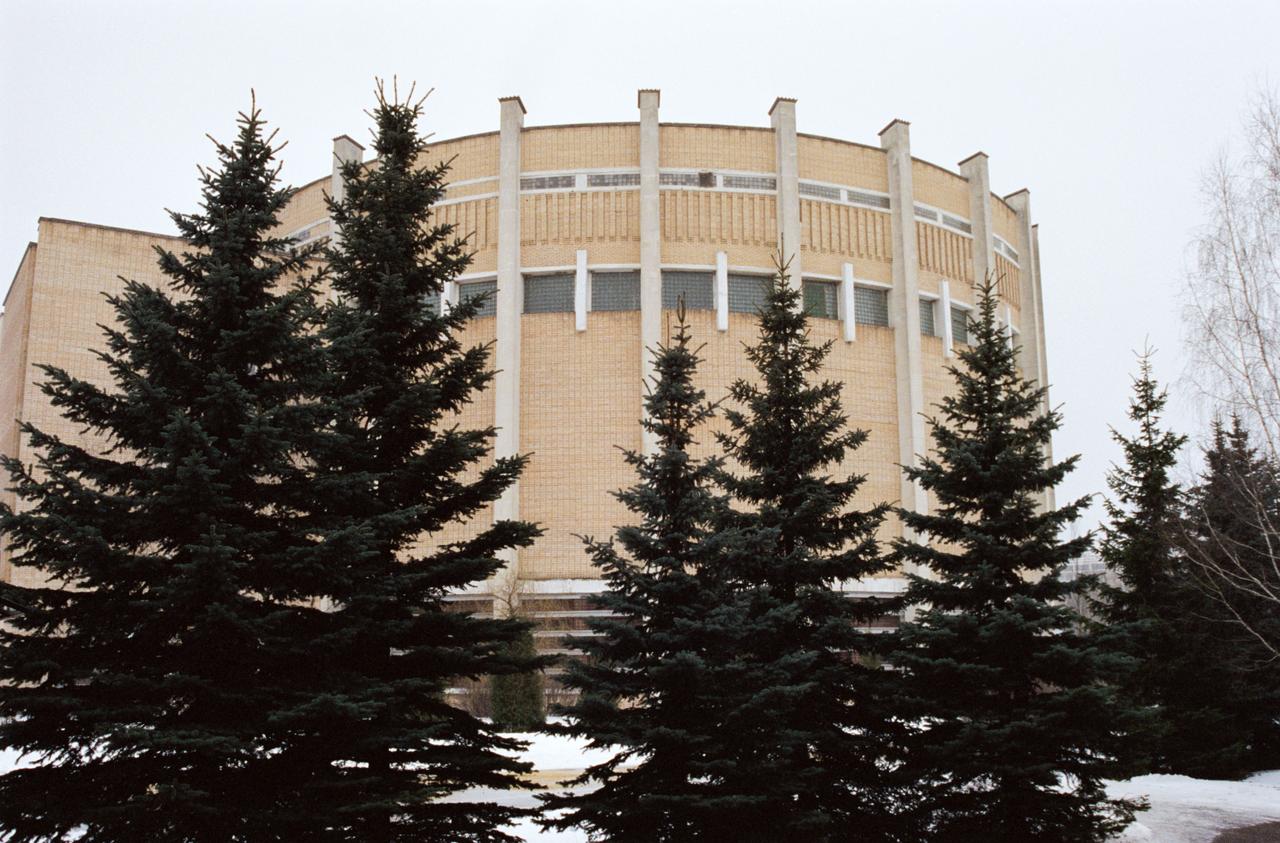
S95-04319 (22 Feb 1995) --- The neutral buoyancy facility at the Gagarin Cosmonaut Training Center in Star City, Russia, is used for underwater training for missions aboard the Russian Mir Space Station. The facility is similar to NASA's Weightless Environment Training Facility (WET-F) at the Johnson Space Center (JSC) in Houston, Texas, and the Neutral Buoyancy Simulator (NBS) at the Marshall Space Flight Center (MSFC) in Huntsville, Alabama.
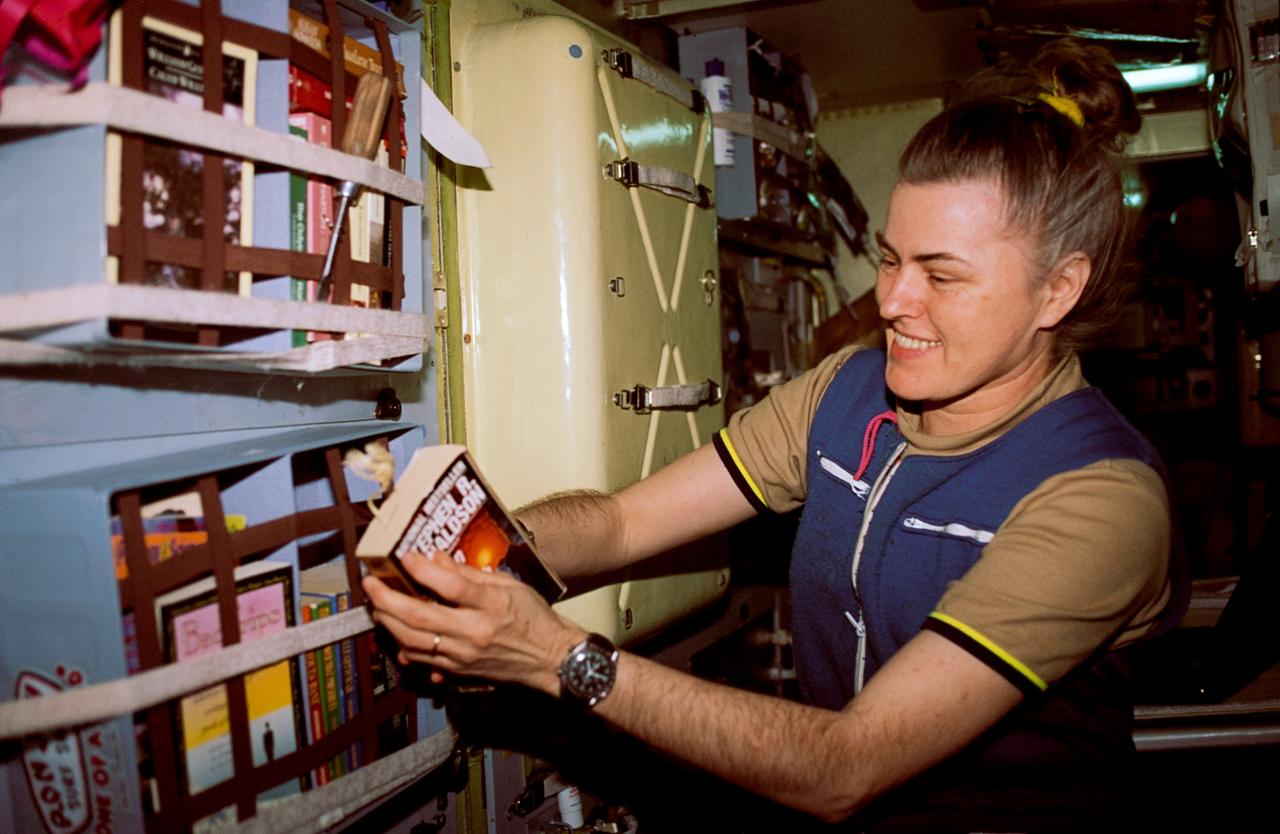
NM22-427-012 (16-26 Sept. 1996) --- During off-duty time on the Spektr Module aboard the Earth-orbiting Mir Space Station, astronaut Shannon W. Lucid, cosmonaut guest researcher, retrieves a book from her personal library. Lucid, dropped off in March by the STS-76 crew members, was nearing the end of 188 consecutive days in space before returning to Earth with the STS-79 crew. She worked with a total of five cosmonauts at various times during that stay.
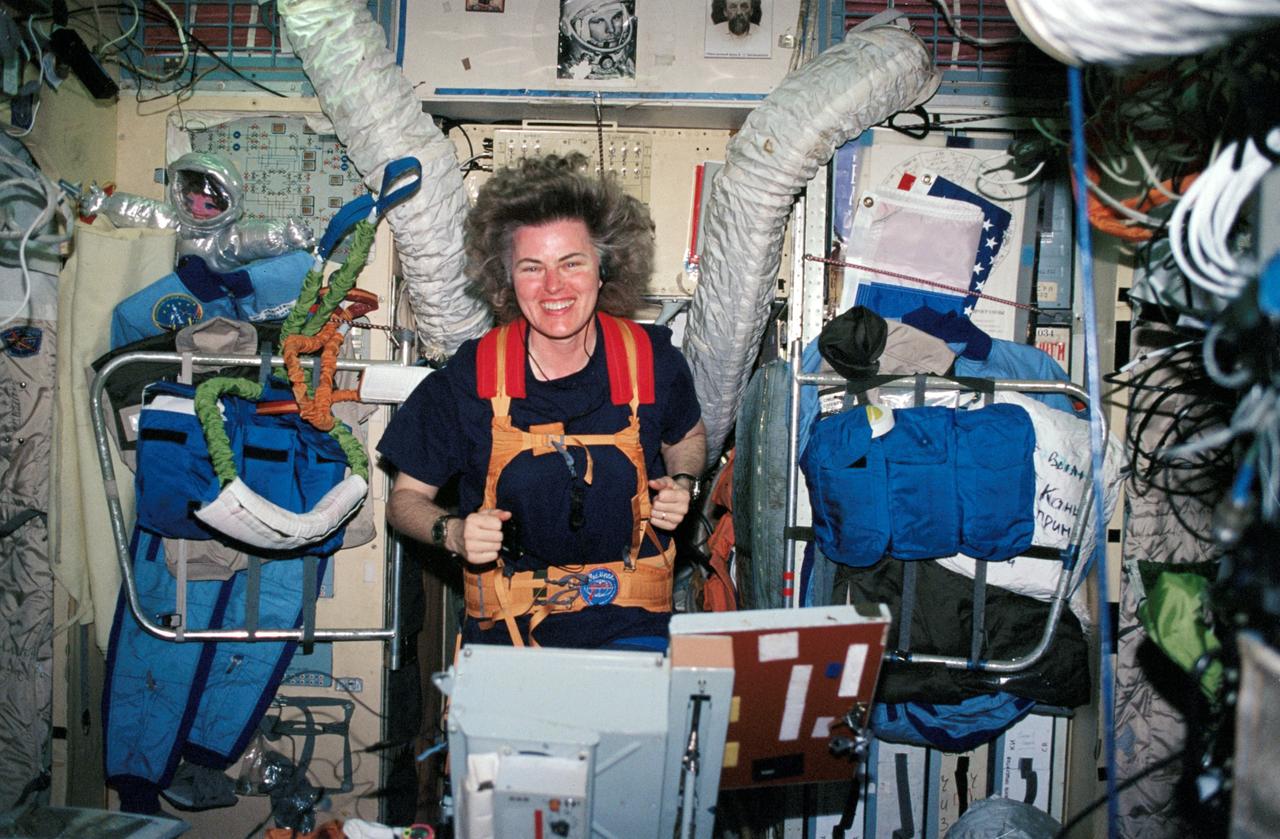
NM21-399-001 (March 1996) --- Aboard the Base Block Module on Russia’s Mir Space Station, astronaut and cosmonaut guest researcher Shannon W. Lucid works out on a treadmill device. With almost six months of a constant microgravity environment ahead of her, Lucid plans regular workouts on the device. Lucid was recently dropped off by NASA’s STS-76 crew of astronauts in the Space Shuttle Atlantis.
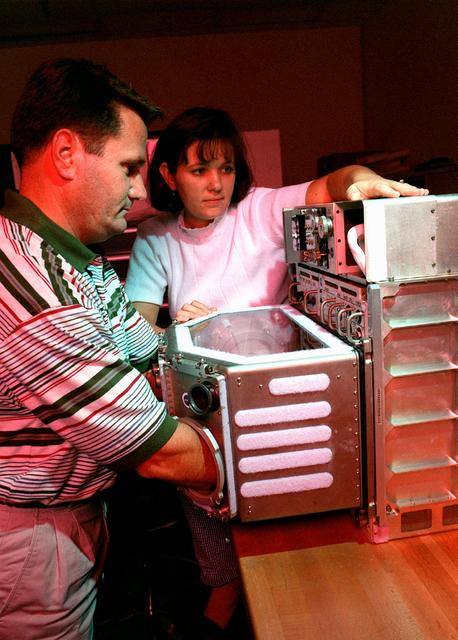
Mary-Etta Wright and Dornie McCaghren with Russia's Mir Flight Glovebox.
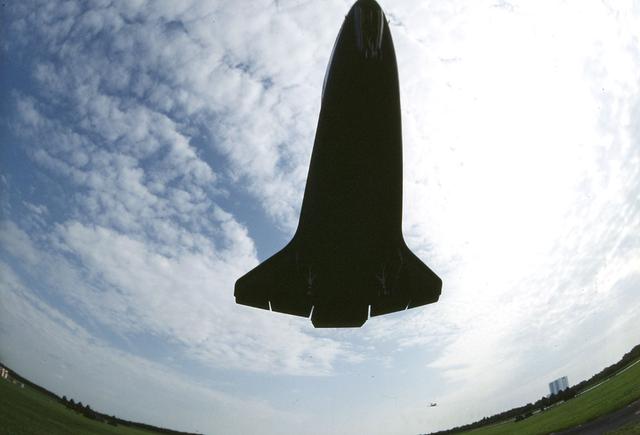
This unusual view of the underside of the Space Shuttle Orbiter Atlantis was taken by a fish-eye camera lens from Kennedy Space Center (KSC) Shuttle Landing Facility shortly before landing on May 24, 1997. Atlantis was wrapping up its nine-day mission, which was the sixth docking with the Mir space station. STS-84 Mission Specialist C. Michael Foale replaced astronaut and Mir 23 crew member Jerry M. Linenger, who had been on the Russian space station since January 15. Foale was scheduled to remain on Mir for approximately four months, until replaced by STS-86 crew member Wendy B. Lawrence in September 1997. Besides docking and crew exchange, this mission included the transfer of more than 7,300 pounds of water, logistics and science experiments, and hardware to and from Mir.
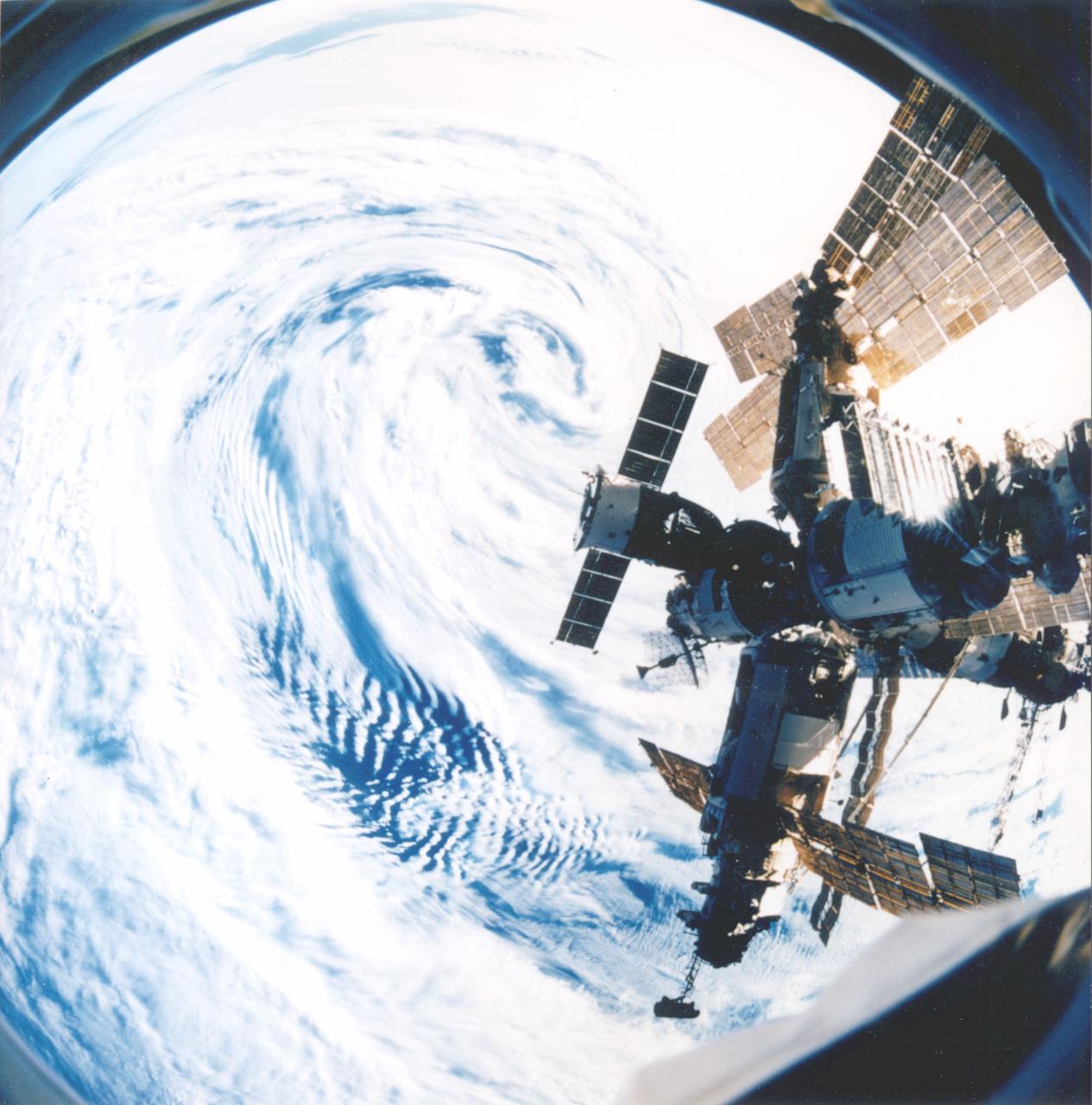
STS-79, Spacelab DM, Mir-docking-4, Shuttle and Mir Docking

STS-79 Shuttle/Mir docking to retrieve Astronaut Sharnon Lucid from Mir Space Station; full shot of Mir Space Station taken from Shuttle.
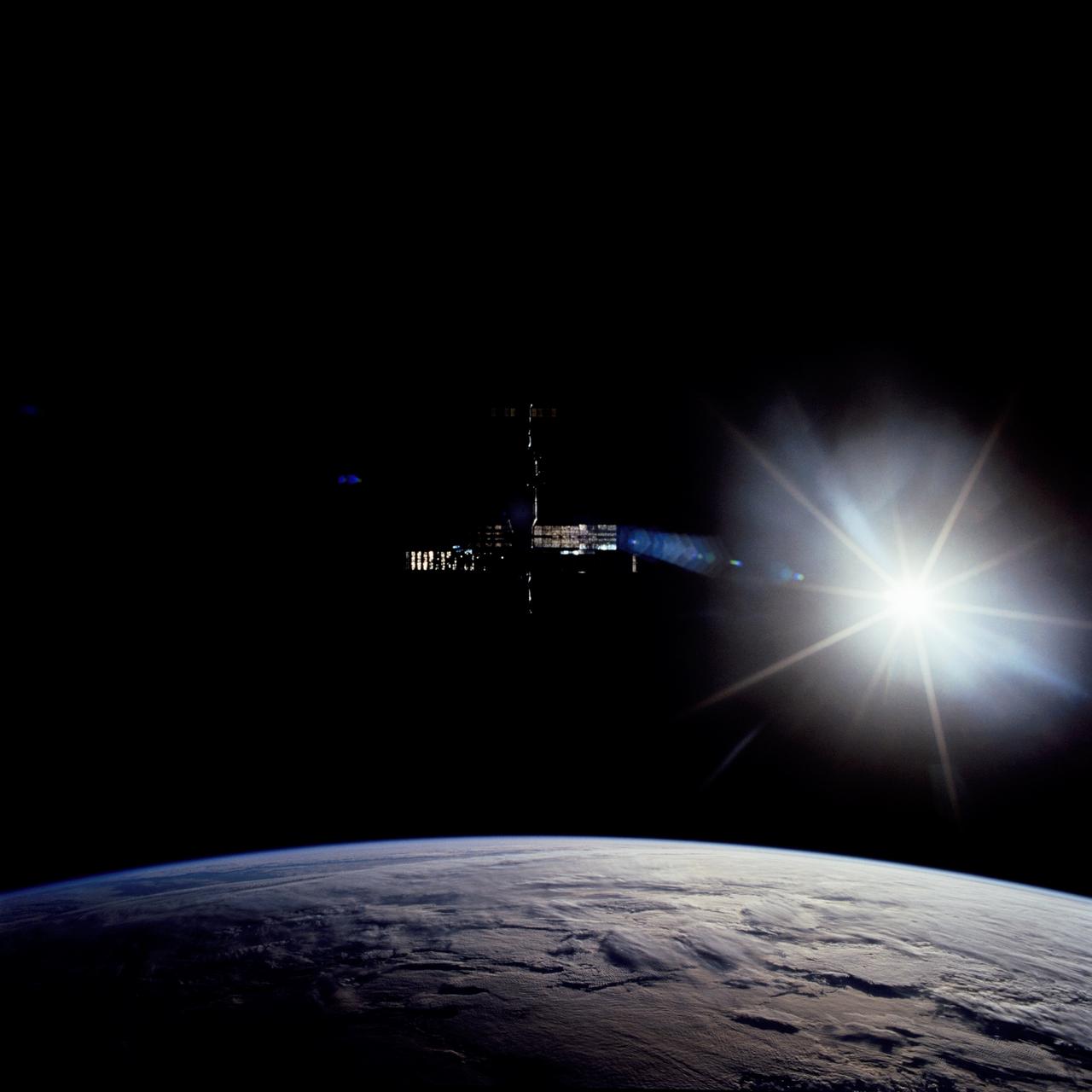
STS063-708-057 (6 Feb. 1995) --- Backdropped against the darkness of space, only the shiny part of Russia's Mir Space Station are clearly visible in this 70mm frame, photographed during rendezvous operations by the Space Shuttle Discovery and the Mir space station. Onboard the Discovery were astronauts James D. Wetherbee, mission commander; Eileen M. Collins, pilot; Bernard A. Harris Jr., payload commander; mission specialists Janice Voss, C. Michael Foale and Russian cosmonaut Vladimir G. Titov.
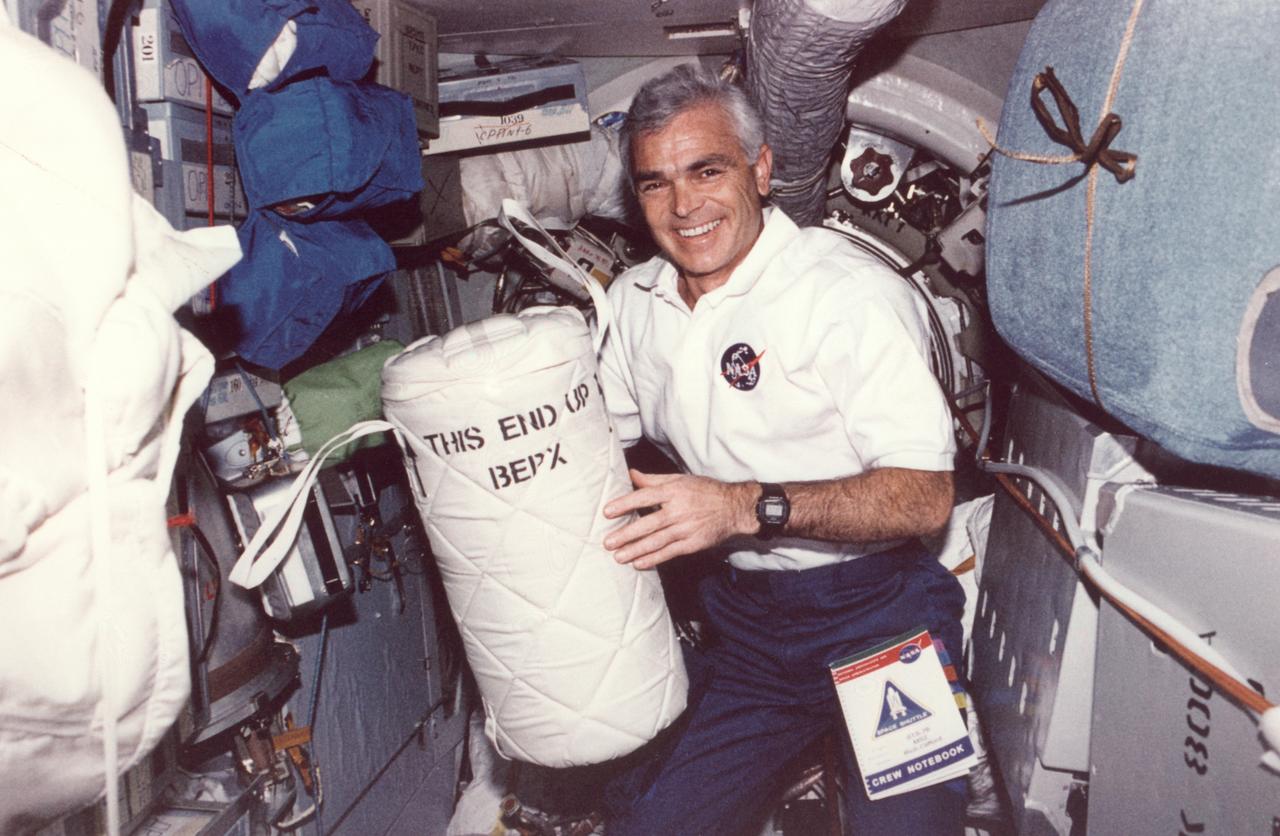
Astronaut Michael Clifford places a liquid nitrogen Dewar containing frozen protein solutions aboard Russia's space station Mir during a visit by the Space Shuttle (STS-76). The protein samples were flash-frozen on Earth and will be allowed to thaw and crystallize in the microgravity environment on Mir Space Station. A later crew will return the Dewar to Earth for sample analysis. Dr. Alexander McPherson of the University of California at Riverside is the principal investigator. Photo credit: NASA/Johnson Space Center.
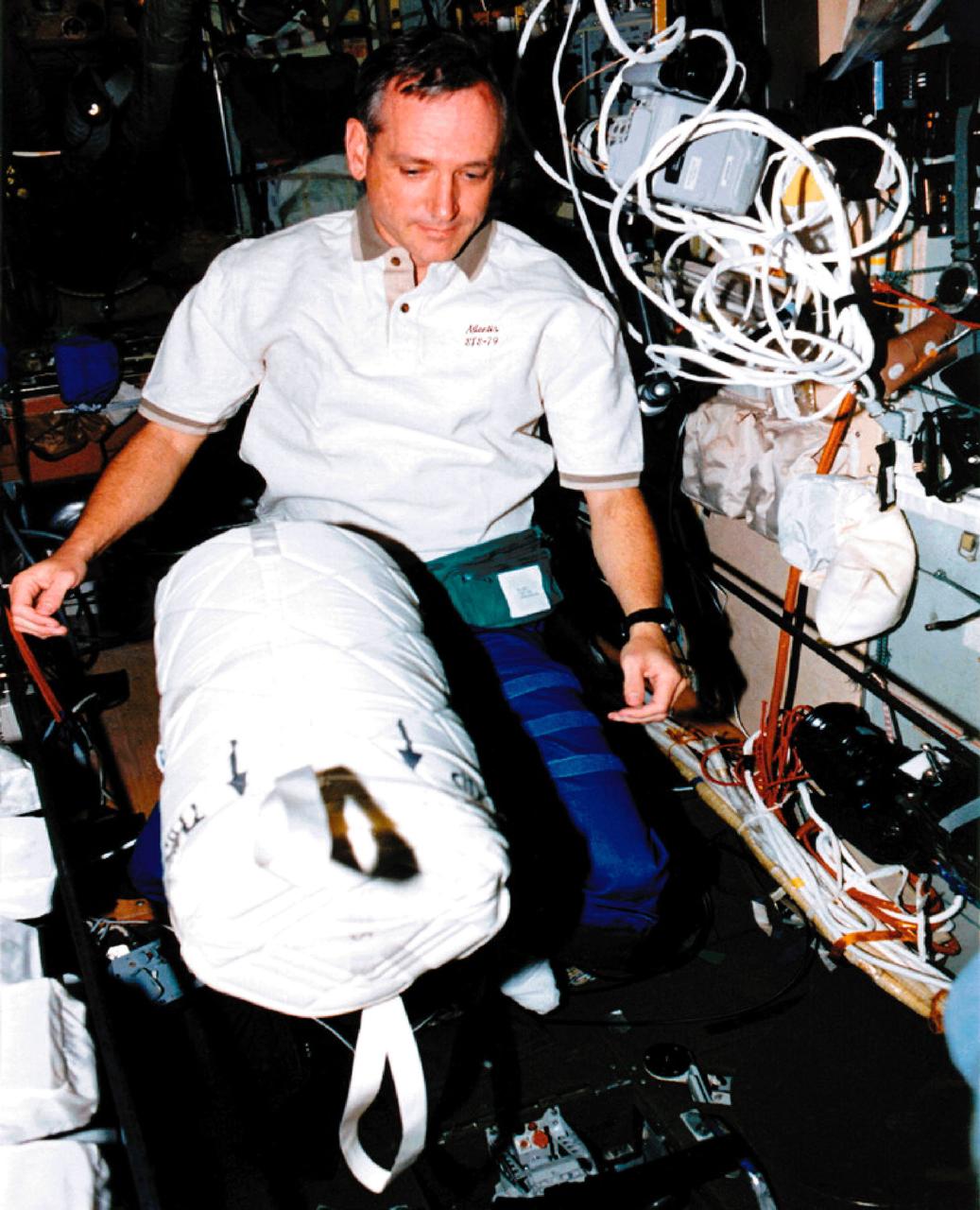
Astronaut Tom Akers places a liquid nitrogen Dewar containing frozen protein solutions aboard Russia's space Station Mir during a visit by the Space Shuttle (STS-79). The protein samples were flash-frozen on Earth and will be allowed to thaw and crystallize in the microgravity environment on Mir Space Station. A later crew will return the Dewar to Earth for sample analysis. Dr. Alexander McPherson of the University of California at Riverside is the principal investigator. Photo credit: NASA/Johnson Space Center.
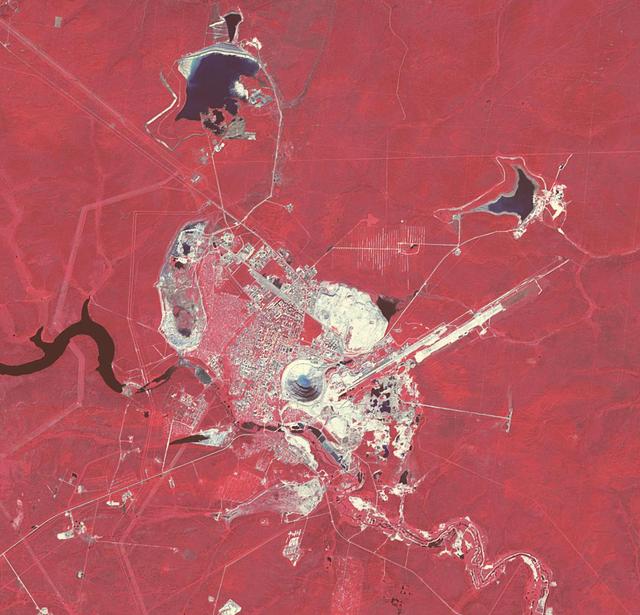
The Mir mine in Siberia is an open pit diamond mine, more than 525 m deep and 1200 m in diameter, making it one of the largest in the world. The diamond-bearing kimberlite pipe was discovered in 1955. With both pit mining and later underground mining, the Mir has produced over 200 million carats of diamonds, the largest weighing 342 carats. The image was acquired July 16, 2019, covers an area of 17 by 17.7 km, and is located at 62.5 degrees north, 114 degrees east. https://photojournal.jpl.nasa.gov/catalog/PIA25856
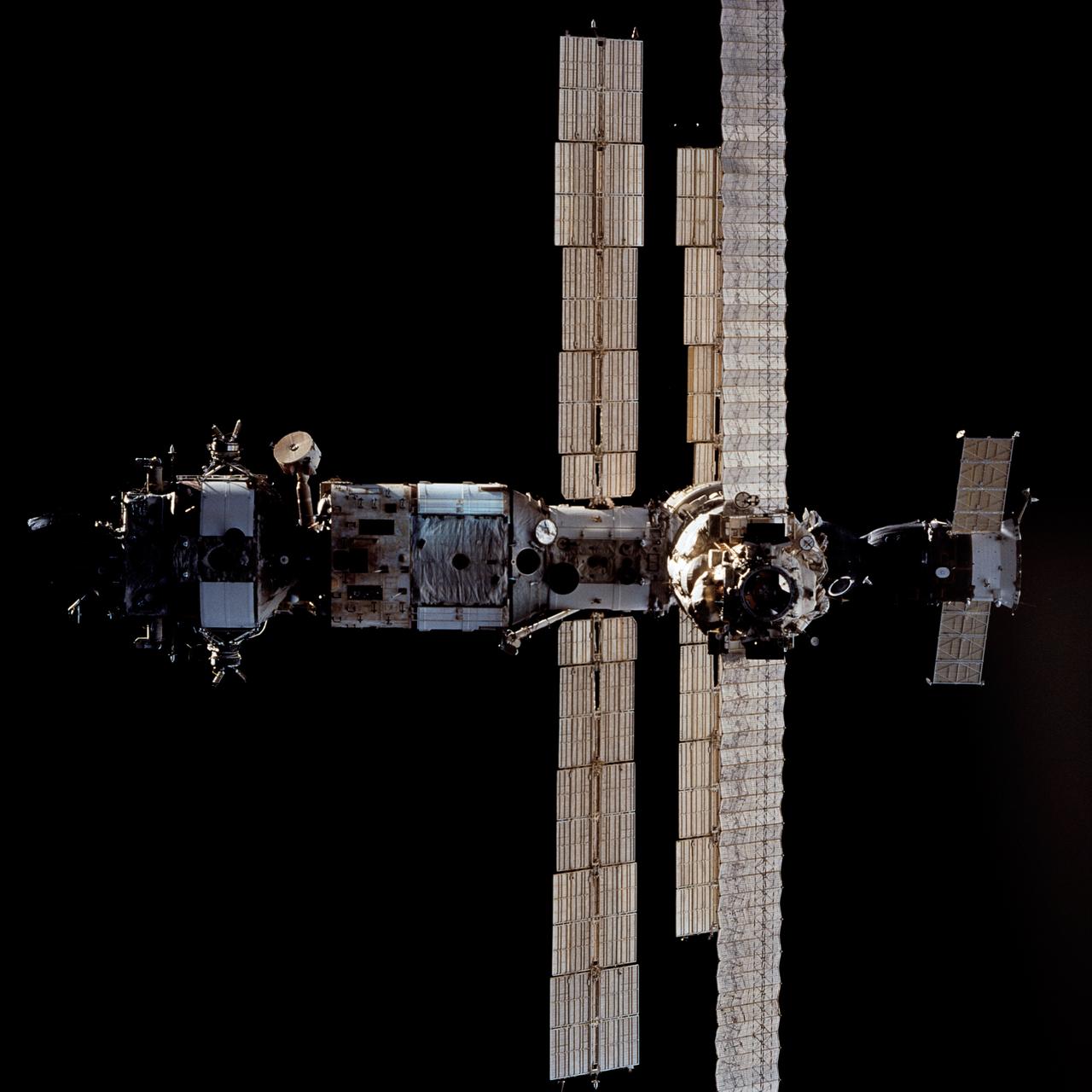
STS063-712-017 (6 Feb. 1995) --- Russia's Mir Space Station during rendezvous operations with the Space Shuttle Discovery. Docked at the bottom of the Mir facility is a Soyuz spacecraft. On the opposite end (almost cropped out of frame at top) is a Progress spacecraft. Onboard the Space Shuttle Discovery were astronauts James D. Wetherbee, mission commander; Eileen M. Collins, pilot; Bernard A. Harris, Jr., payload commander; C. Michael Foale and Janice E. Voss, mission specialists; along with cosmonaut Vladimir G. Titov, mission specialist.

STS063-711-080 (6 Feb. 1995) --- Cosmonaut Valeriy V. Polyakov, who boarded Russia's Mir Space Station on January 8, 1994, looks out Mir's window during rendezvous operations with the Space Shuttle Discovery. This is one of 16 still photographs released by the NASA Johnson Space Center (JSC) Public Affairs Office (PAO) on February 14, 1995. Onboard the Discovery were astronauts James D. Wetherbee, mission commander; Eileen M. Collins, pilot; Bernard A. Harris, Jr., payload commander; mission specialists C. Michael Foale, Janice E. Voss, and cosmonaut Vladimir G. Titov.
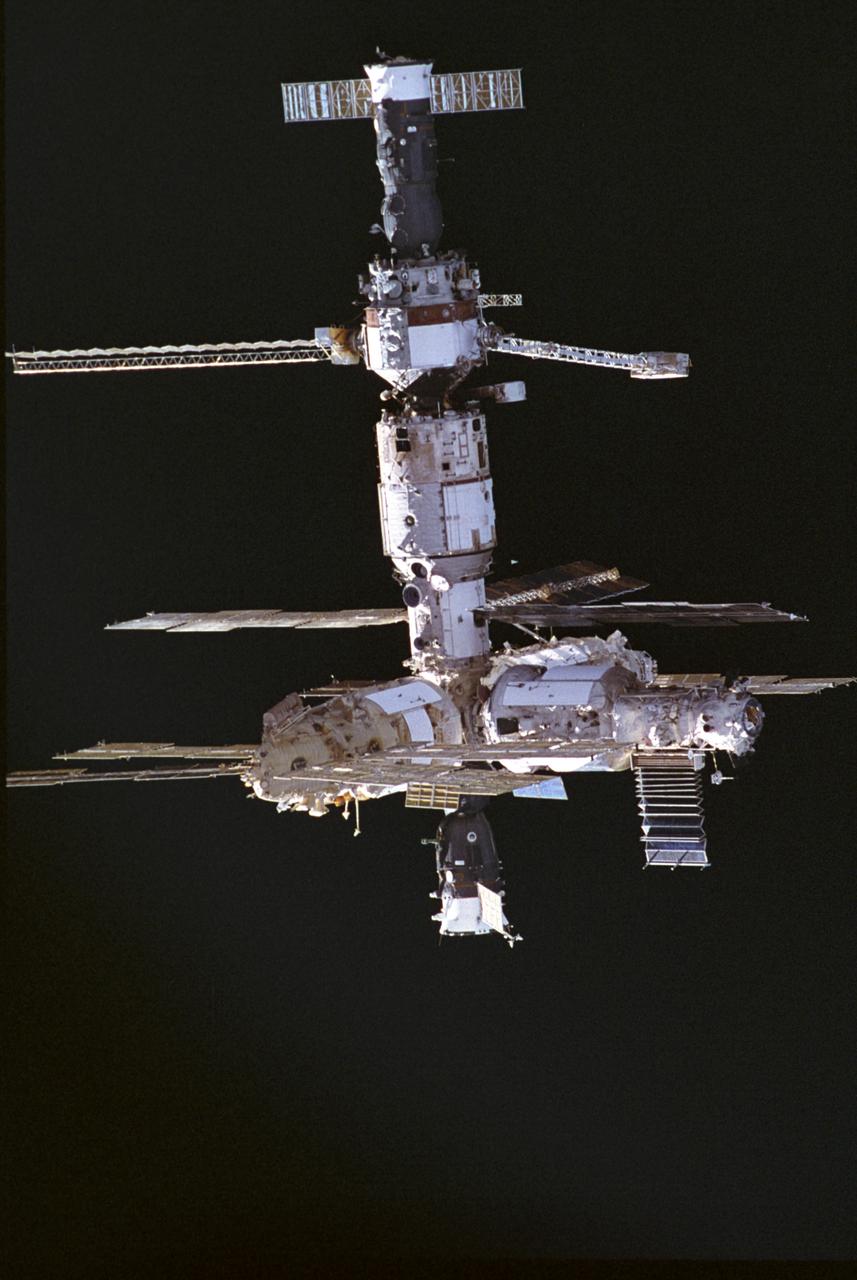
This image of the Russian Mir Space Station was photographed by a crewmember of the STS-74 mission when the Orbiter Atlantis was approaching the Mir Space Station. STS-74 was the second Space Shuttle/Mir docking mission. The Docking Module was delivered and installed, making it possible for the Space Shuttle to dock easily with Mir. The Orbiter Atlantis delivered water, supplies, and equipment, including two new solar arrays to upgrade the Mir, and returned to Earth with experiment samples, equipment for repair and analysis, and products manufactured on the Station. Mir was constructed in orbit by cornecting different modules, seperately launched from 1986 to 1996, providing a large and livable scientific laboratory in space. The 100-ton Mir was as big as six school buses and commonly housed three crewmembers. Mir was continuously occupied, except for two short periods, and hosted international scientists and American astronauts until August 1999. The journey of the 15-year-old Russian Mir Space Station ended March 23, 2001, as Mir re-entered the Earth's atmosphere and fell into the south Pacific ocean . STS-74 was launched on November 12, 1995, and landed at the Kennedy Space Center on November 20, 1995.
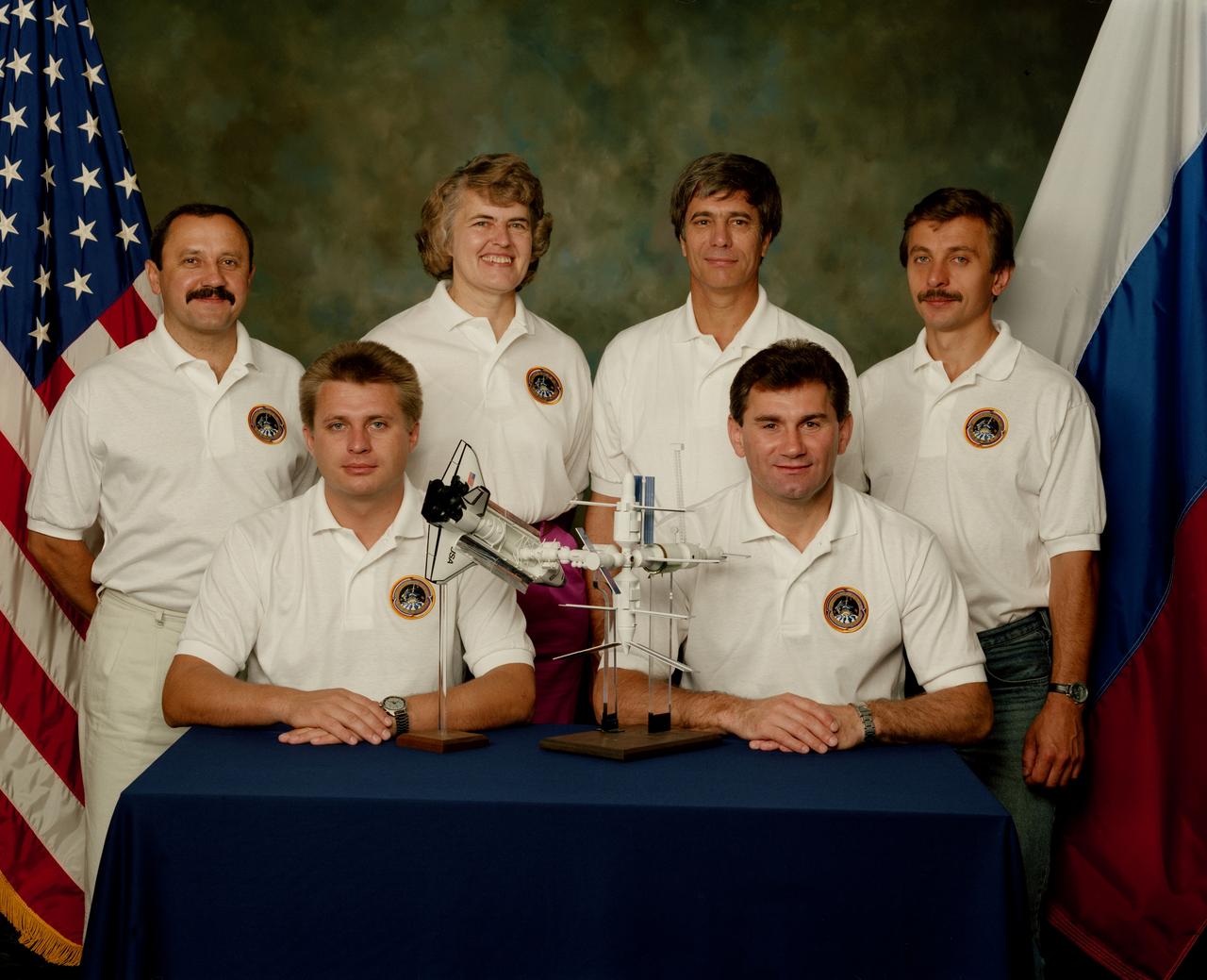
S95-16674 (14 July 1995) --- On the left is the Mir-21 crew consisting of cosmonaut Yuriy V. Usachov (standing), flight engineer; Yuriy I. Onufriyenko (seated), commander; and Shannon W. Lucid, cosmonaut guest researcher. On the right side is the Mir-23 crew consisting of John E. Blaha (standing), cosmonaut guest researcher; Vasili V. Tsibliyev (seated), commander; and Aleksandr I. Lazutkin, flight engineer. NASA astronauts Lucid and Blaha each will go into space to board Russia's Mir Space Station for lengthy research on their respective missions. Lucid will board the Mir during the STS-76 mission. Blaha will replace Lucid onboard the Mir during the STS-79 mission.

This image of the Space Shuttle Orbiter Atlantis, with cargo bay doors open showing Spacelab Module for the Spacelab Life Science and the docking port, was photographed from the Russian Mir Space Station during STS-71 mission. The STS-71 mission performed the first docking with the Russian Mir Space Station to exchange crews. The Mir 19 crew, cosmonauts Anatoly Solovyev and Nikolai Budarin, replaced the Mir 18 crew, cosmonauts Valdamir Dezhurov and Gernady Strekalov, and astronaut Norman Thagard. Astronaut Thagard was launched aboard a Soyuz spacecraft in March 1995 for a three-month stay on the Mir Space Station as part of the Mir 18 crew. The Orbiter Atlantis was modified to carry a docking system compatible with the Mir Space Station. The Orbiter also carried a Spacelab module for the Spacelab Life Science mission in the payload bay in which various life science experiments and data collection took place throughout the 10-day mission.
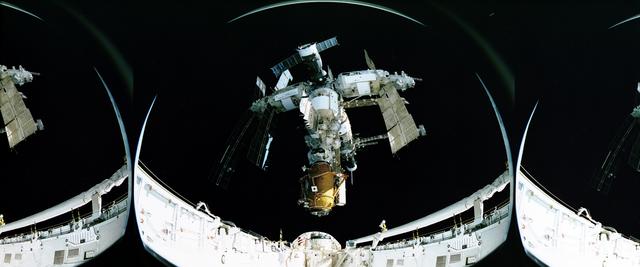
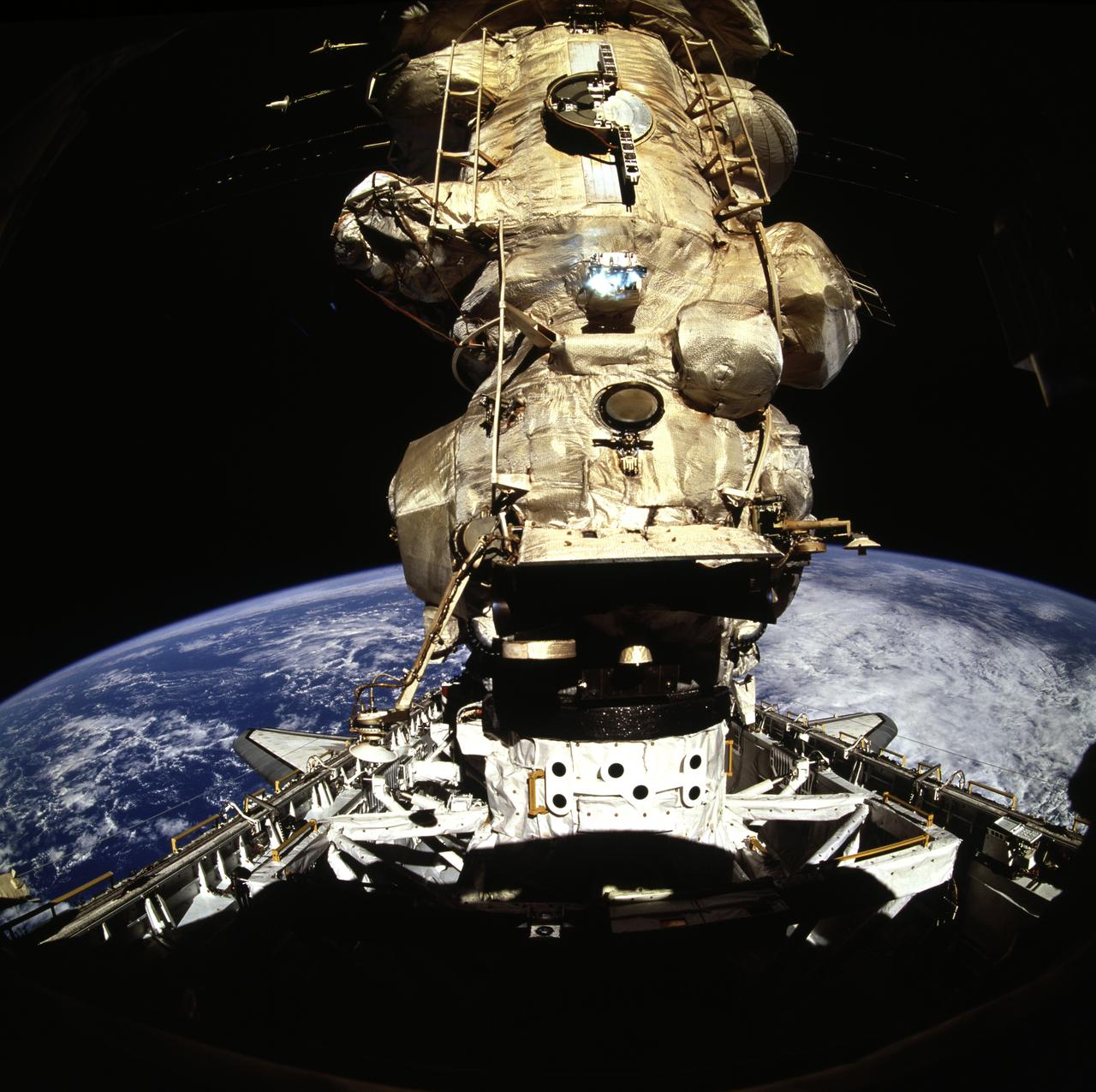
This fish-eye view of the Russian Mir Space Station was photographed by a crewmember of the STS-74 mission after the separation. The image shows the installed Docking Module at bottom. The Docking Module was delivered and installed, making it possible for the Space Shuttle to dock easily with Mir. The Orbiter Atlantis delivered water, supplies, and equipment, including two new solar arrays to upgrade the Mir; and returned to Earth with experiment samples, equipment for repair and analysis, and products manufactured on the Station. Mir was constructed in orbit by cornecting different modules, each launched separately from 1986 to 1996, providing a large and livable scientific laboratory in space. The 100-ton Mir was as big as six school buses and commonly housed three crewmembers. Mir was continuously occupied, except for two short periods, and hosted international scientists and American astronauts until August 1999. The journey of the 15-year-old Russian Mir Space Station ended March 23, 2001, as Mir re-entered the Earth's atmosphere and fell into the south Pacific ocean. STS-74 was the second Space Shuttle/Mir docking mission launched on November 12, 1995, and landed at the Kennedy Space Center on November 20, 1995.
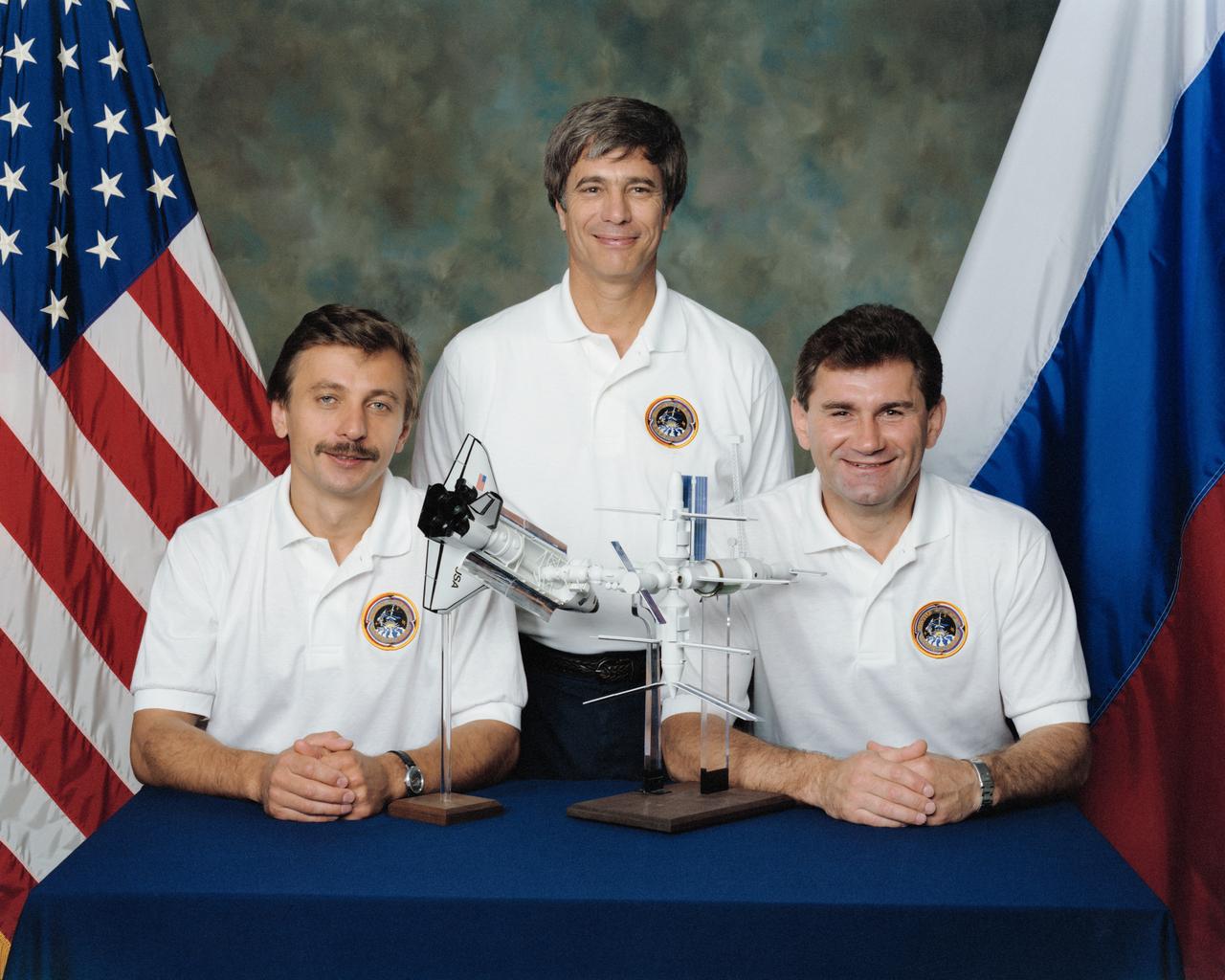
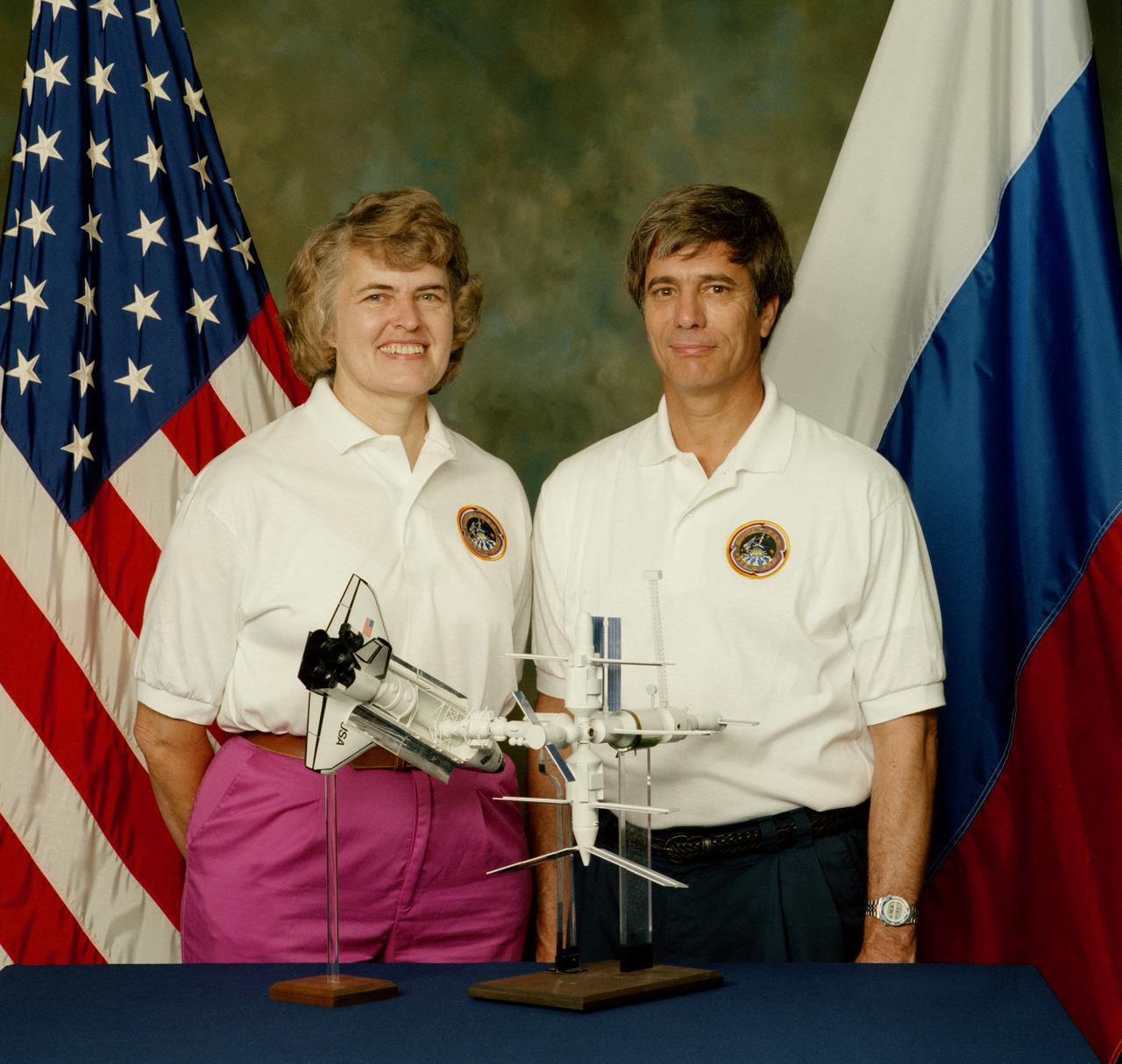
Mir 21 crew portraits. Group portrait of Mir 21 prime and backup crews with American and Russian flags and shuttle/Mir model, top from left: Yuri Usachev, Shannon Lucid, John Blaha and Alexandr Lazutkin, bottom from left: Yuri Onufrienko and Vasiliy Tsibliev (16674). Backup crew portrait: Lazutkin, Blaha and Tsibliev (16675). Group portrait of Mir 21 prime and backup crews with Donald Puddy, special assistant in Russian Project Office (16676). Prime crew portrait: Lucid, Usachev and Onufrienko (16677).
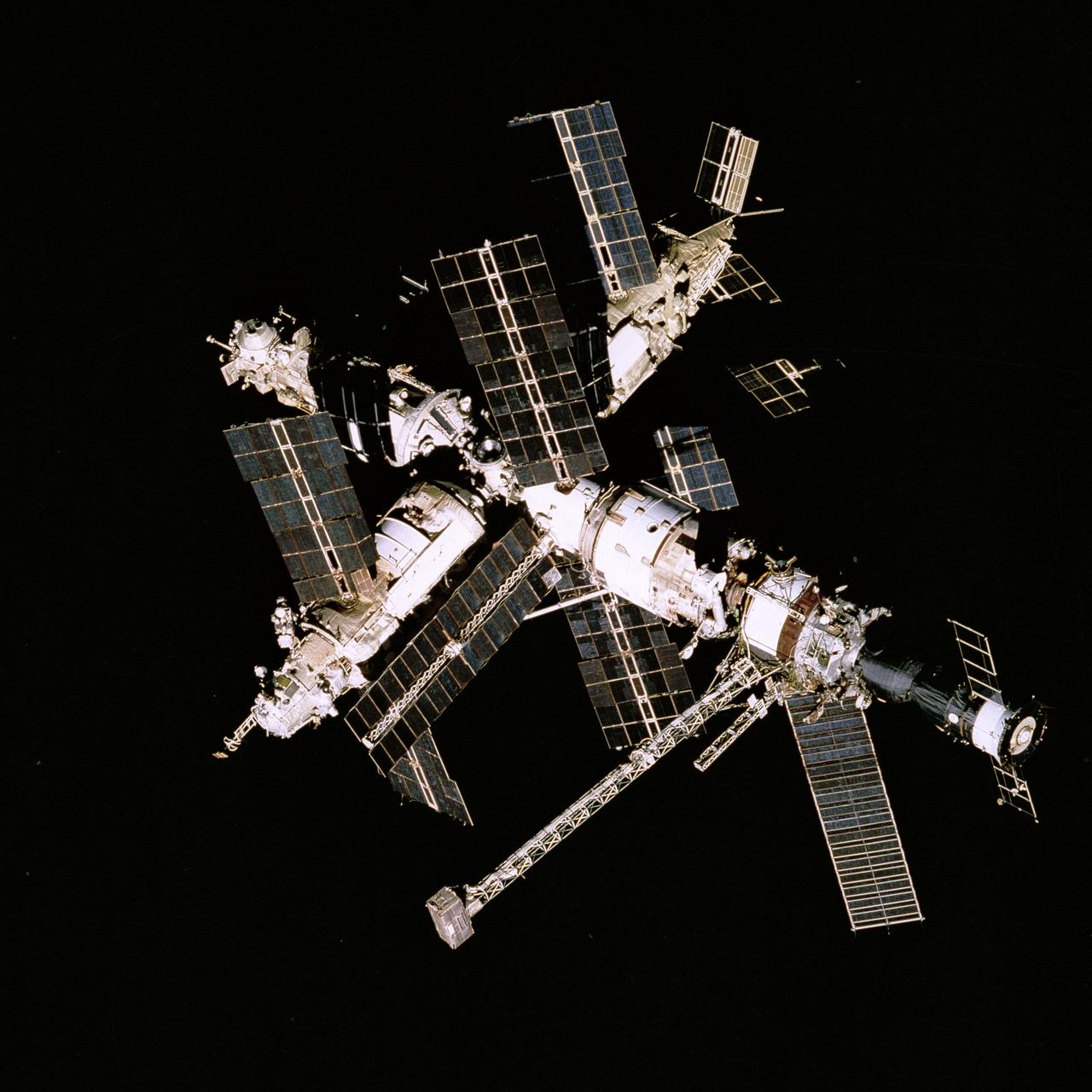
STS071-744-017 (29 June 1995) --- Russia's Mir Space Station is backdropped against the darkness of space, as photographed from the approaching space shuttle Atlantis on June 29, 1995. Five NASA astronauts and two cosmonauts were onboard Atlantis as it approached the Mir, which has been home for the three-member Mir-18 crew since March of this year.
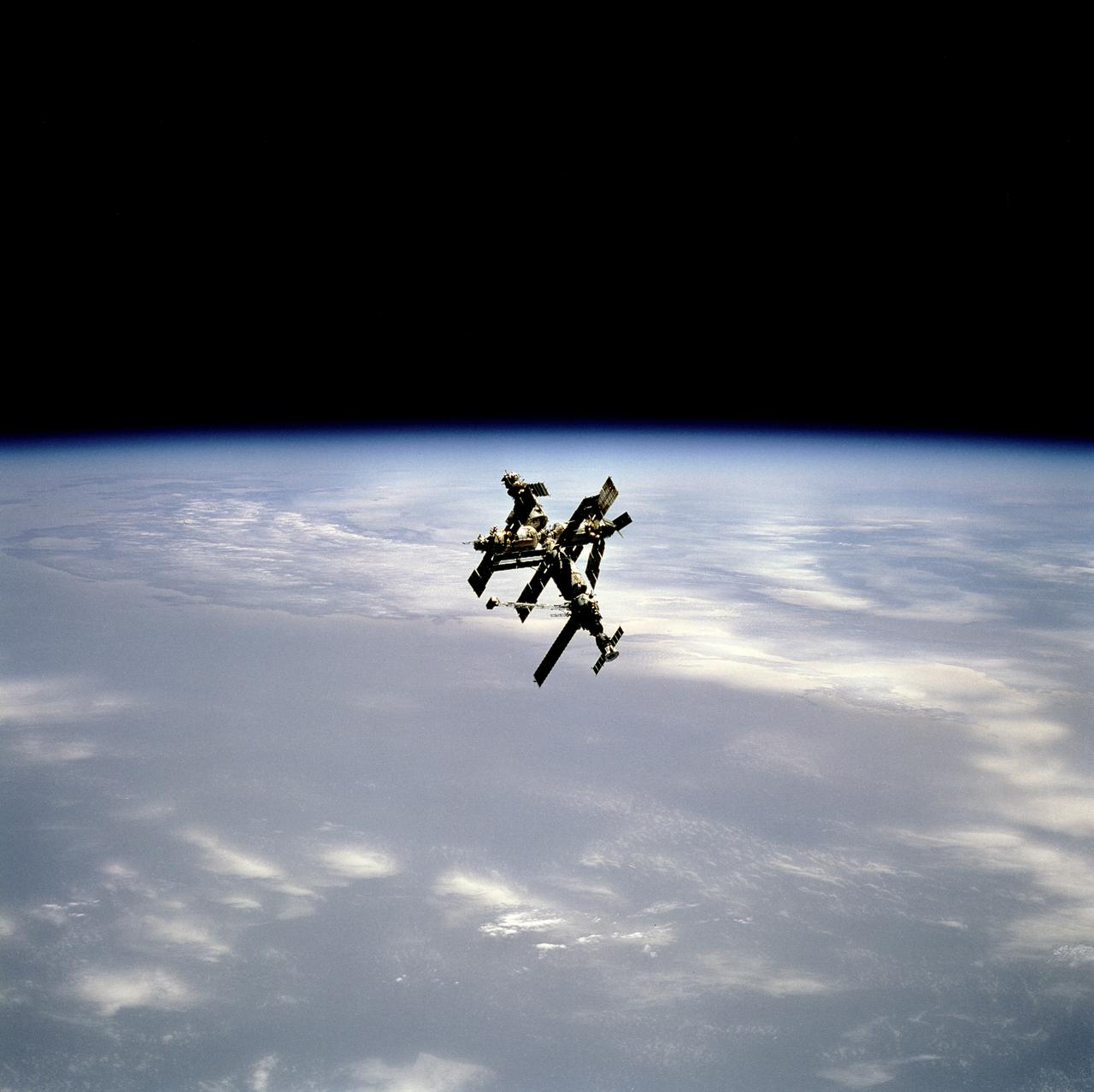
STS071-744-030 (29 June 1995) --- Russia's Mir Space Station is backdropped against blue and white Earth near its horizon, as photographed from the approaching space shuttle Atlantis on June 29, 1995. Five NASA astronauts and two cosmonauts were onboard Atlantis as it approached the Mir, which housed the three-member Mir-18 crew.
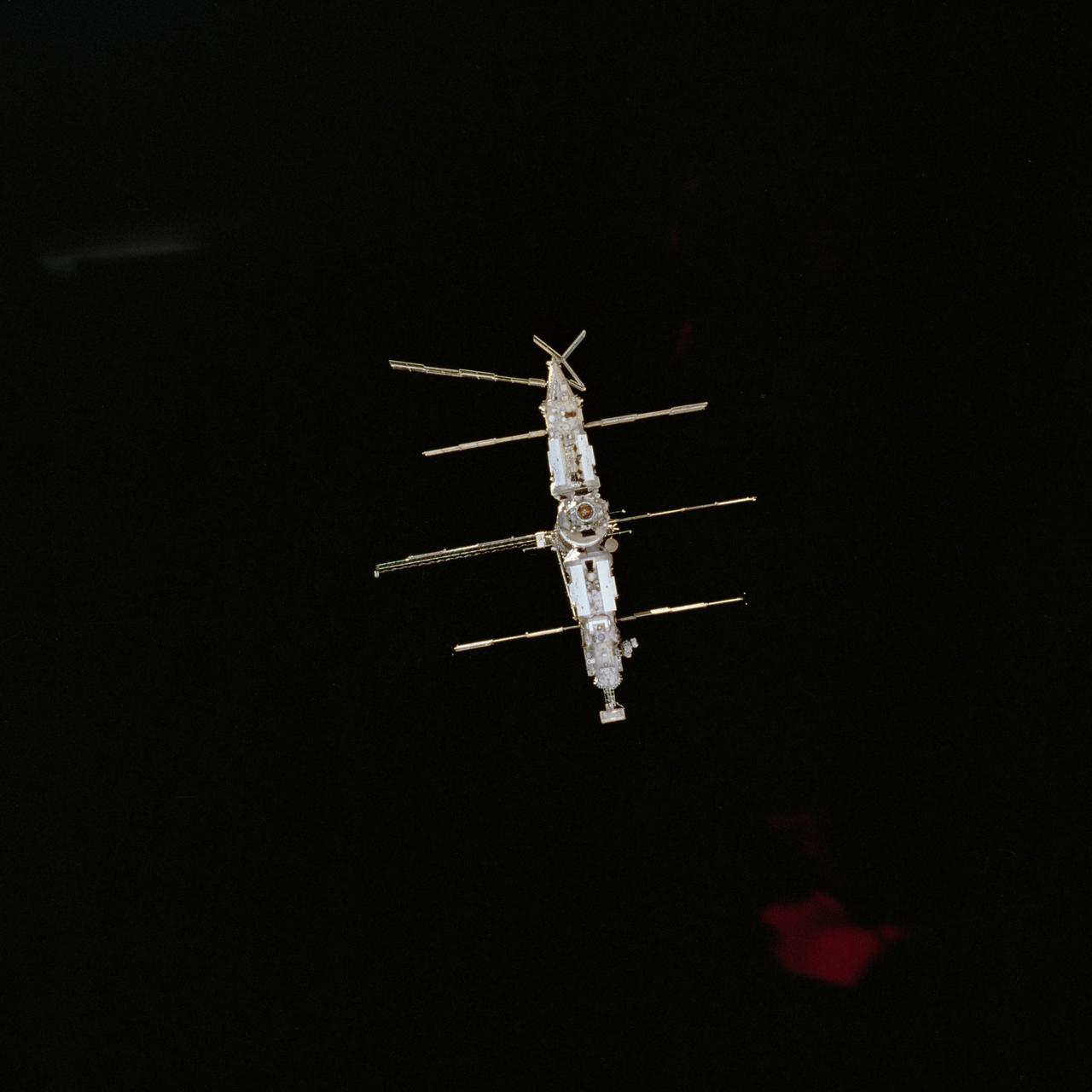
STS071-702-058 (29 June 1995) --- Russia's Mir Space Station is backdropped against the darkness of space, as photographed from the approaching space shuttle Atlantis on June 29, 1995. Five NASA astronauts and two cosmonauts were onboard Atlantis as it approached the Mir, which has been home for the three-member Mir-18 crew since March of this year.

STS089-333-015 (22-31 Jan. 1998) --- Onboard Russia's Mir Space Station, cosmonaut Pavel Vinogradov, Mir-24 flight engineer, tries to find room for supplies transferred from the space shuttle Endeavour during supply transfer operations, while currently docked with Mir. Photo credit: NASA
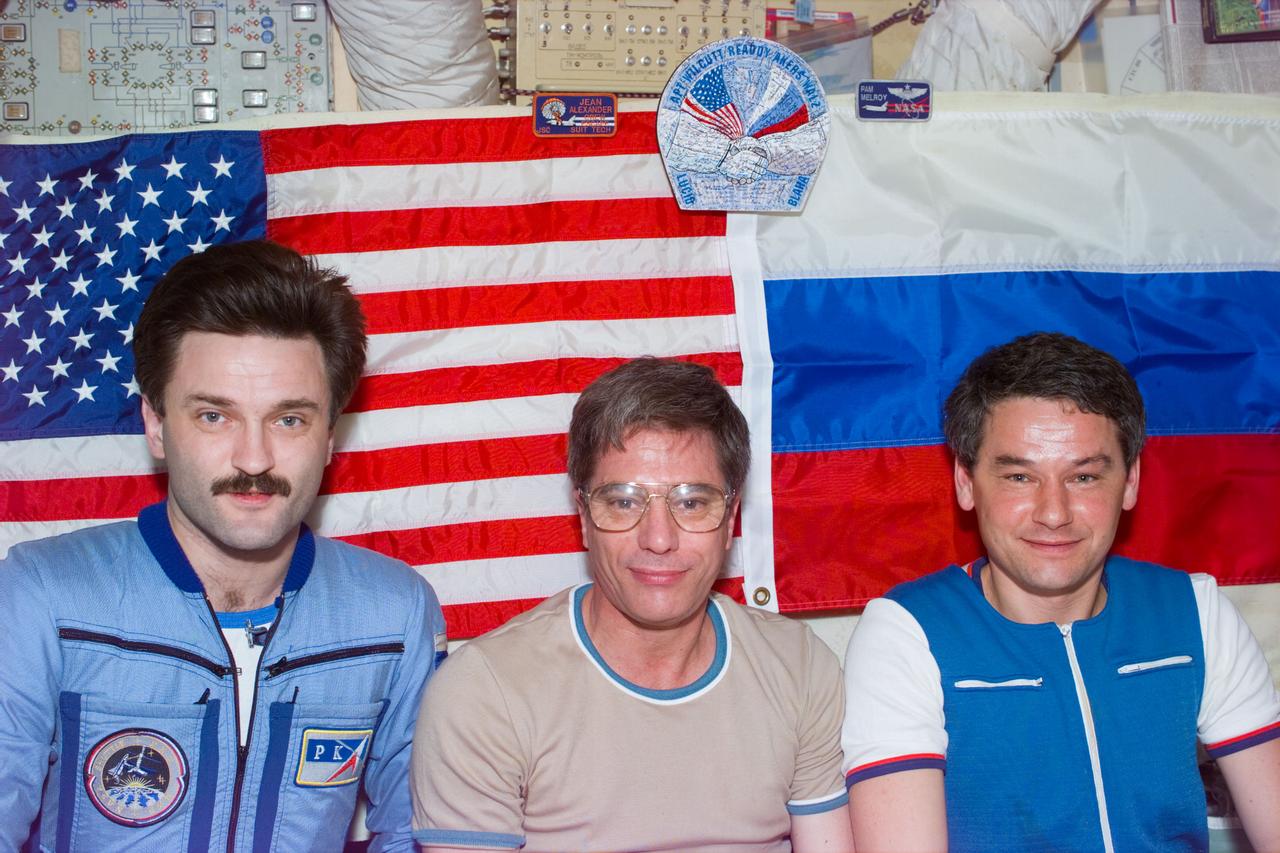
STS79-E-5294 (23 September 1996) --- Left to right, cosmonaut Aleksandr Y. Kaleri, Mir-22 flight engineer; astronaut John E. Blaha, cosmonaut guest researcher; and cosmonaut Valeri G. Korzun, Mir-22 commander, Mir-22 crew members in their final photo aboard Russia's Mir Space Station before bidding farewell to the STS-79 crew members, aboard the Space Shuttle Atlantis, during Flight Day 8. Soon after this Electronic Still Camera (ESC) view was recorded the STS-79 astronauts aboard Atlantis separated from the Mir.
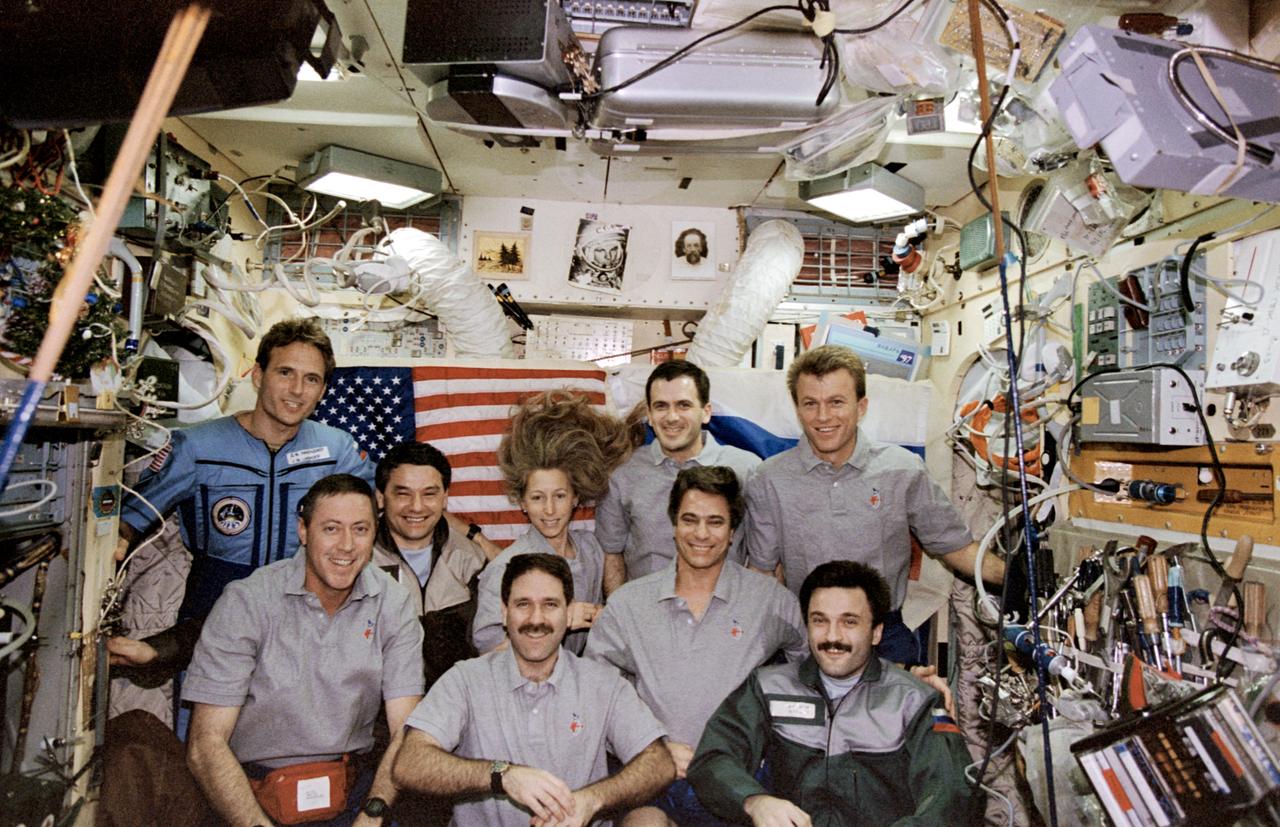
STS081-369-003 (12-22 Jan. 1997) --- Traditional inflight crew portrait of the combined Mir-22 and STS-81 crews in the Base Block Module aboard Russia's Mir Space Station. Front row: left to right, Michael A. Baker, commander; John M. Grunsfeld, mission specialist; and cosmonaut Aleksandr Y. Kaleri, Mir-22 flight engineer. Middle row: cosmonaut Valeri G. Korzun, Mir-22 commander; Marsha S. Ivins, mission specialist; and John E. Blaha, former cosmonaut guest researcher. Back row: Jerry M. Linenger, cosmonaut guest researcher; Peter J. K. (Jeff) Wisoff, mission specialist; and Brent W. Jett, Jr., pilot. Linenger is seen in a Russian jump suit, and Blaha now wears a Space Shuttle inflight garment as the two exchanged cosmonaut guest researcher roles on January 14, 1997, following the docking of the Atlantis and the Mir complex.
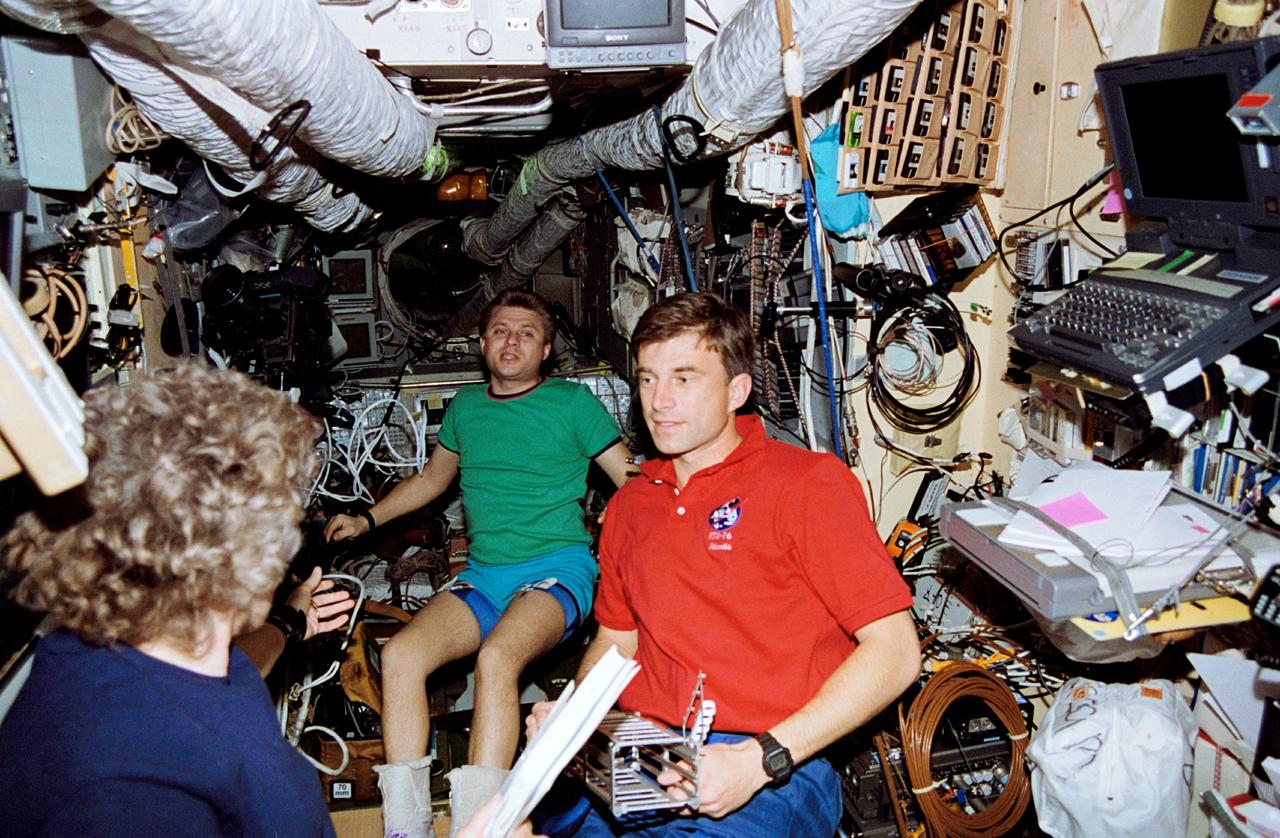
STS076-461-004 (22-31 March 1996) --- Onboard the Base Block Module of Russia's Mir Space Station, astronauts Shannon W. Lucid and Ronald M. Sega, payload commander, discuss final activities between the STS-76 and Mir-21 crews as cosmonaut Yury I. Onufrienko (center) listens. Yury V. Usachev (out of frame) is Mir-21 flight engineer. The Space Shuttle Atlantis docked with Mir on March 23, 1996, and remained linked until March 28, 1996. Lucid was in the process of transferring from STS-76 to the Mir-21 crew, which thereby grew from two to three members. She will remain aboard Mir for approximately 140 days.
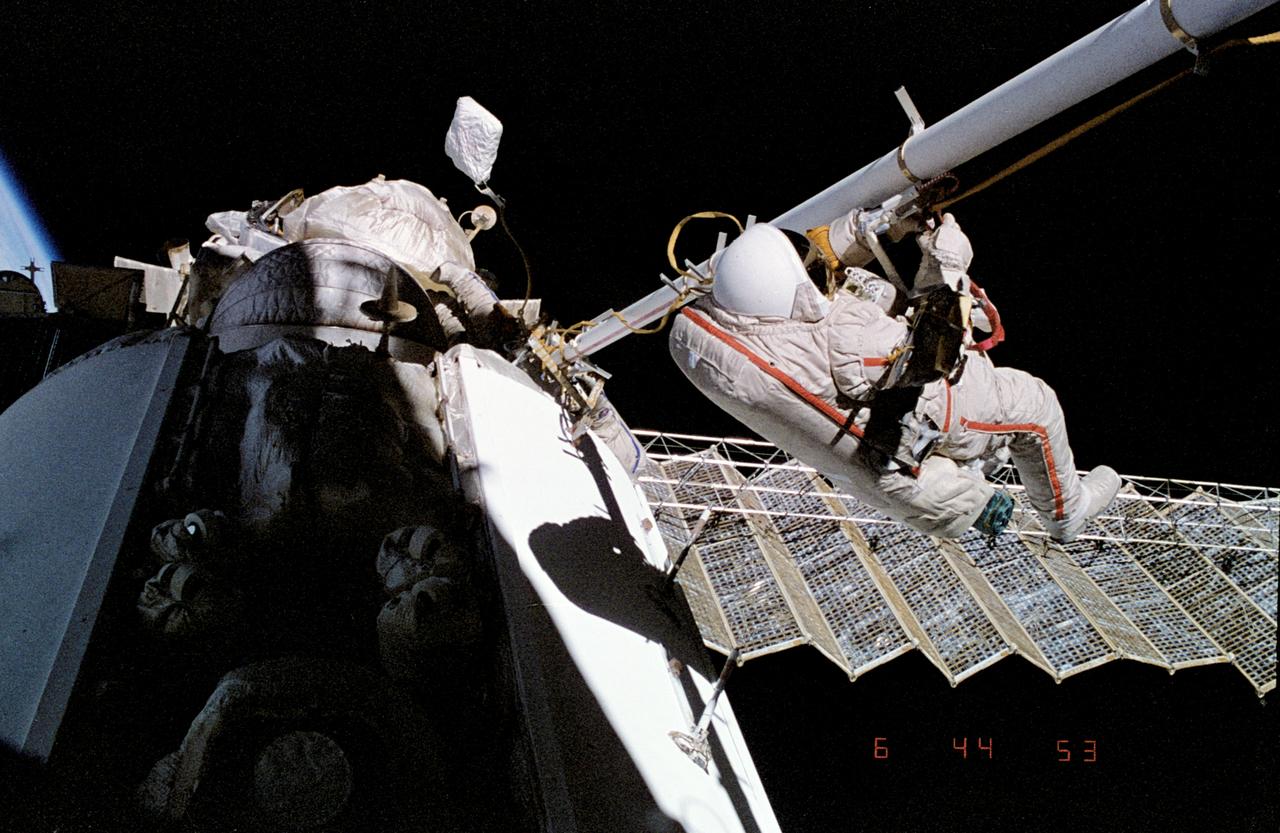
NM18-305-008 (March-July 1995) --- Cosmonaut Vladimir N. Dezhurov, Mir-18 mission commander, is photographed during one of five spacewalks conducted by the Mir-18 crew. Dezhurov is working with solar array panels. This is one of many visuals shown during a July 18 press conference in Houston.
NM18-305-023 (March-July 1995) --- Cosmonaut Gennadiy M. Strekalov, Mir-18 flight engineer, is photographed during one of five space walks conducted by the Mir-18 crew. This is one of many visuals shown during a July 18, 1995, press conference in Houston, Texas.
S94-34942 (27 May 1994) --- This is a portrait of (left to right) Bonnie J. Dunbar, Anatoliy Y. Solovyev, and Nikolai M. Budarin in civilian clothes. Dunbar is mission specialist for STS-71, and alternate crew member for Mir 18. Solovyev is commander for Mir 19, and Budarin is the flight engineer for that mission.
S95-16678 (September 1995) --- NASA astronauts Shannon W. Lucid and John E. Blaha next year will follow the lead of astronaut Norman E. Thagard's 1995 feat of extended stay aboard Russia's Mir Space Station. Lucid is to accompany the STS-76 crew in March and spend a little over four months aboard Mir before returning to Earth with the STS-79 crew. Blaha will go into space on the scheduled August mission of STS-79 and after four months aboard Mir will return to Earth with the STS-81 crew.
STS071-723-033 (29 June 1995) --- The hard dock finalizing the June 29, 1995, link-up of the Russian Mir Space Station and the space shuttle Atlantis was documented with a 70mm handheld camera from the aft flight deck of the Space Shuttle Atlantis. The Androgynous Peripheral Docking System (APDS) and the Kristall module on Mir are at center frame. Later, five NASA astronauts and two Russian cosmonauts boarded Mir. The occasion was just two and a half weeks prior to the 20th anniversary of the Apollo-Soyuz Test Project (ASTP) docking in Earth-orbit.
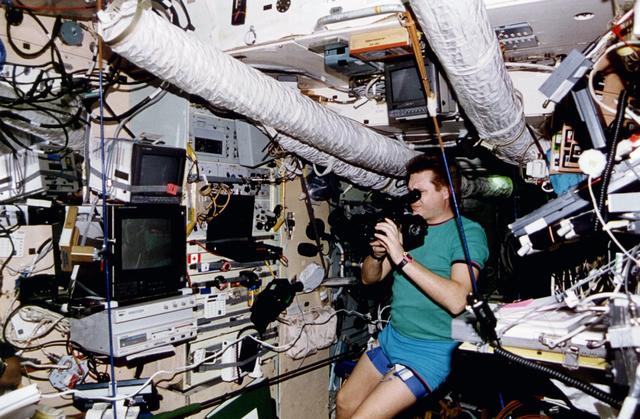
STS076-461-010 (22-31 March 1996) --- The STS-76 crew took this 70mm picture of Russia's Mir-21 mission commander Yury I. Onufrienko using a video camera on the Base Block Module of Russia's Mir Space Station. The STS-76 crew docked the Space Shuttle Atlantis with the Mir Space Station on March 23, 1996, at which time astronaut Shannon W. Lucid (out of frame) joined Onufrienko and the mission's flight engineer, Yury V. Usachev, to begin the first leg of a 140-day stay aboard Mir, as a cosmonaut guest researcher.
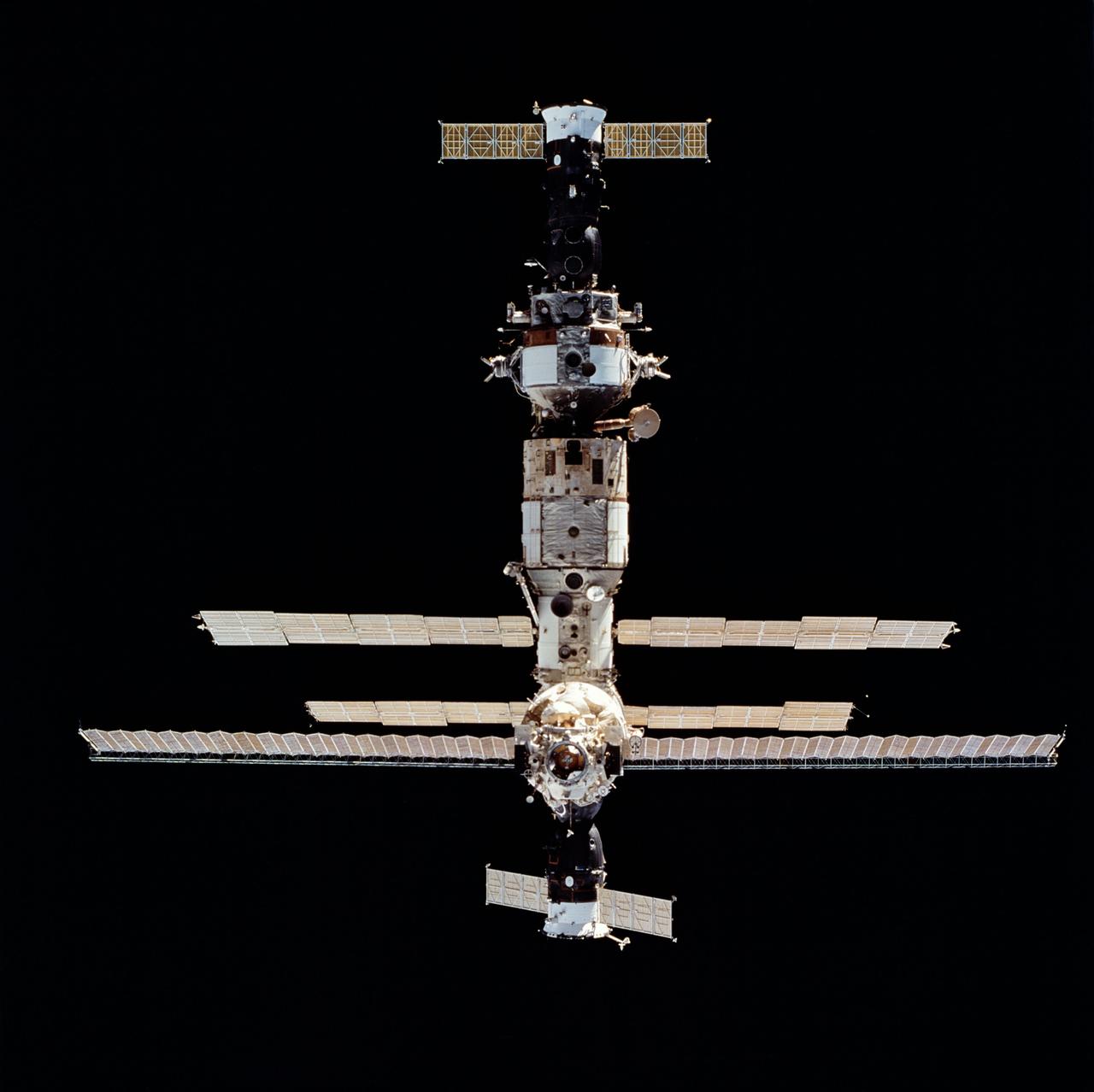
STS063-712-068 (6 Feb 1995) --- Russia's Mir Space Station during rendezvous operations with the Space Shuttle Discovery. Docked at bottom (nearest portion where longest solar array panel is visible) is a Soyuz space vehicle. On the opposite end is a Progress spacecraft. This is one of 16 still photographs released by the NASA Johnson Space Center (JSC) Public Affairs Office (PAO) on February 14, 1995. Onboard the Space Shuttle Discovery were astronauts James D. Wetherbee, mission commander; Eileen M. Collins, pilot; Bernard A. Harris, Jr., payload commander; mission specialists C. Michael Foale, Janice E. Voss, and cosmonaut Vladimir G. Titov.
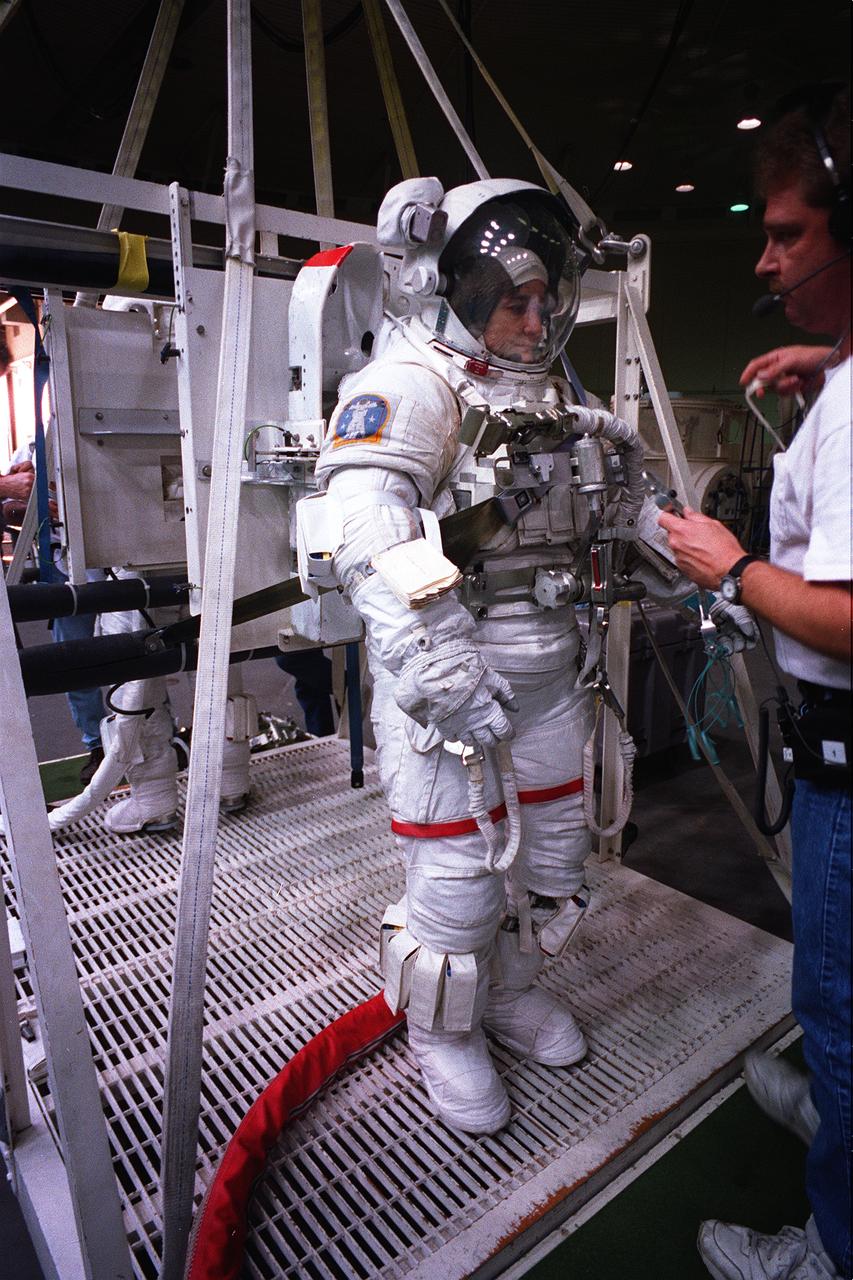
Astronaut and mission specialist, Linda Godwin, makes a final check of her respiration system before submersion into a 25 ft deep pool at the Johnson Space Center’s (JSC) Weightless Environment Training Facility (WET-F). Wearing a high fidelity training version of the Extravehicular Mobility Unit (EMU) space suit, Godwin simulated STS-76 Extravehicular Activity (EVA) chores in the pool. Launched aboard the Space Shuttle Atlantis in March of 1996, STS-76 marked the third U.S. Shuttle-Mir docking during which Godwin, along with astronaut and mission specialist Michael R. (Rich) Clifford, performed the first Extravehicular Activity (EVA) during Mir-Shuttle docked operations.
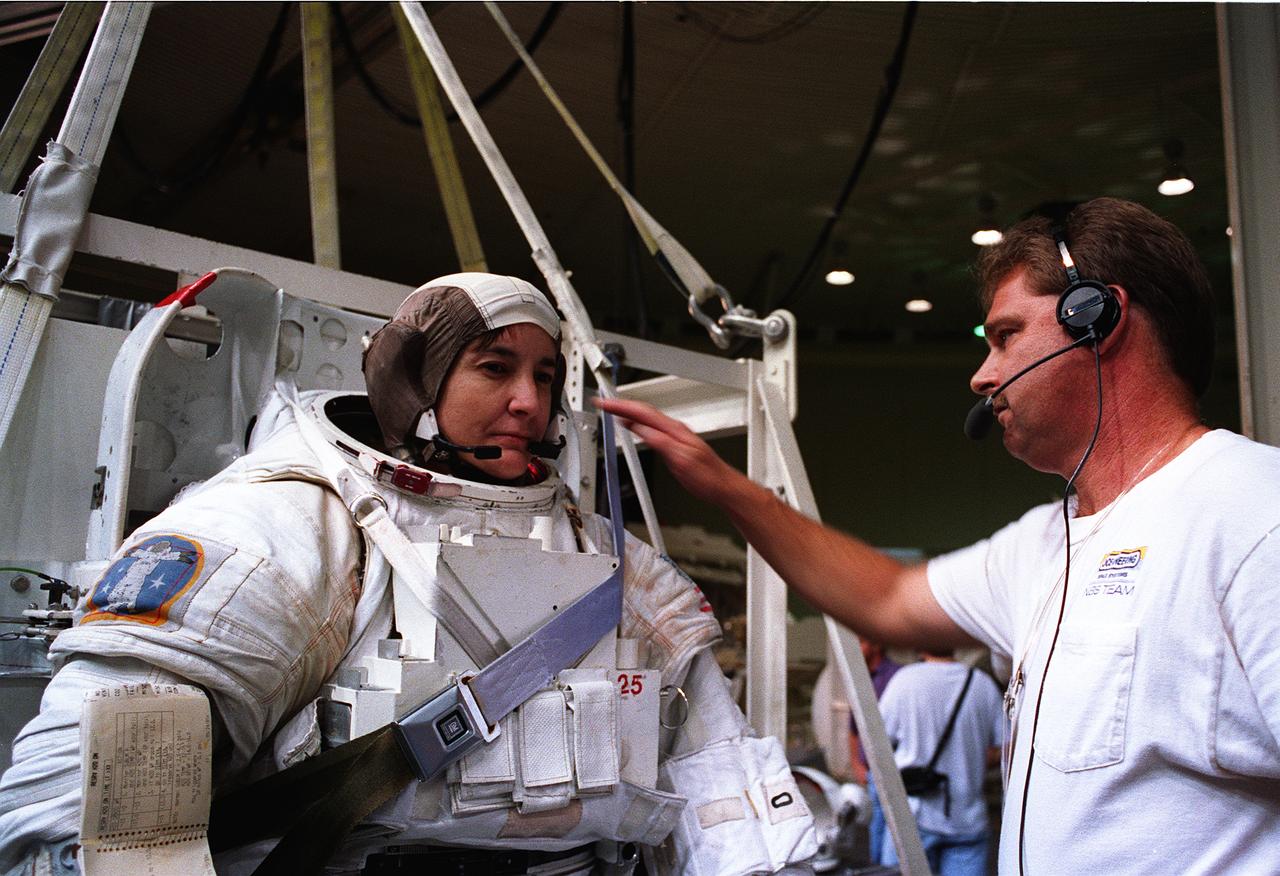
Astronaut and mission specialist, Linda Godwin, checks communications systems before submersion into a 25 ft deep pool at the Johnson Space Center’s (JSC) Weightless Environment Training Facility (WET-F). Wearing a high fidelity training version of the Extravehicular Mobility Unit (EMU) space suit, Godwin simulated STS-76 Extravehicular Activity (EVA) chores in the pool. Launched aboard the Space Shuttle Atlantis in March of 1996, STS-76 marked the third U.S. Shuttle-Mir docking during which Godwin, along with astronaut and mission specialist Michael R. ( Rich) Clifford, performed the first Extravehicular Activity (EVA) during Mir-Shuttle docked operations.
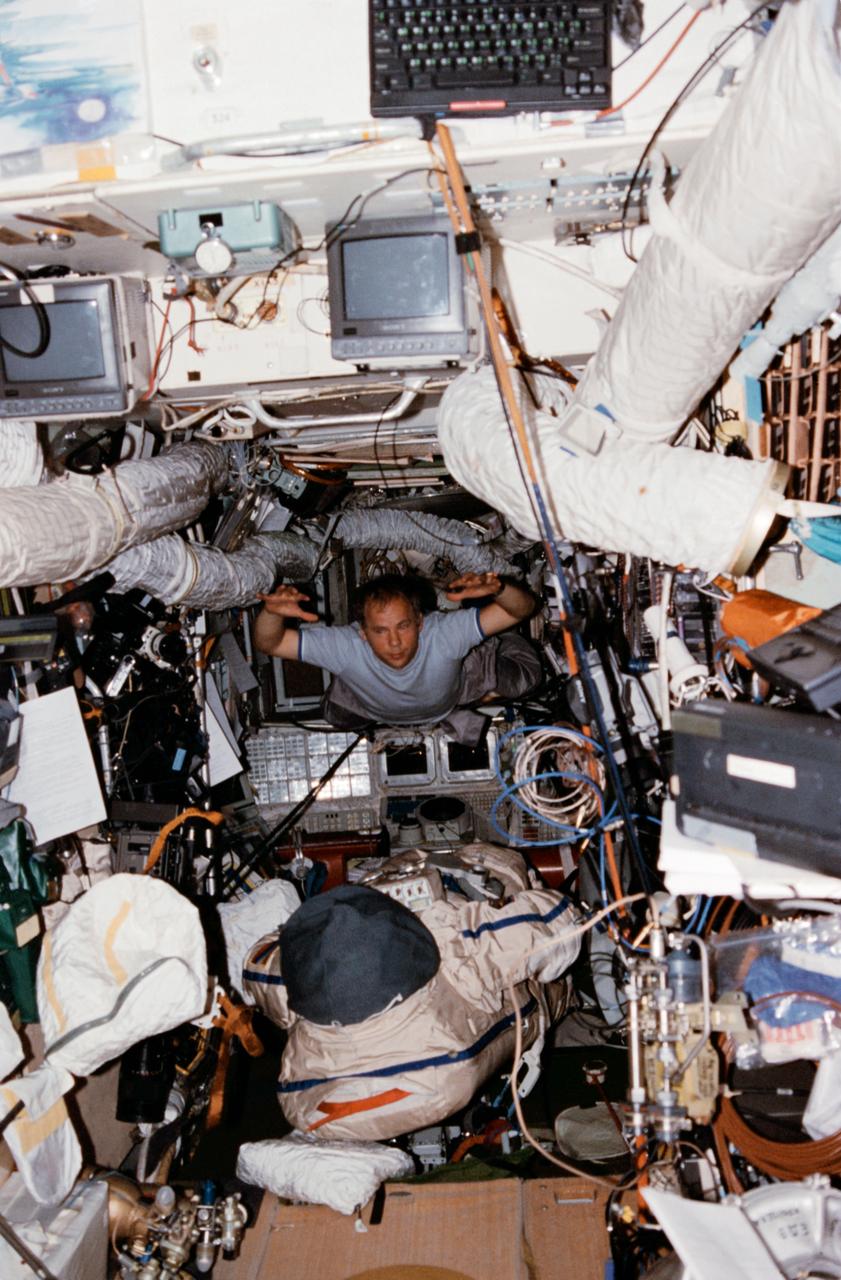
Various views of activities surrounding the Mir 24 crew's preparation for an intravehicular activity (IVA) in the Mir space station. Views include: Mir 24 crew in the Orlan suits in the Soyuz spacecraft (012-3,016). Commander Anatoly Solovyev climbs out of his suit in the Soyuz (014-5). Solovyev floats into the Base Block module (017). Underexposed views of Solovyev (left) and flight engineer Pavel Vinogradov in the Soyuz (018-20). Interior views of the airlock with IVA hardware (oxygen for suits) in view (021-2). Mir 24 crewmember climbing into his suit with his back to the camera (023). View 024 is blank. View 025 is of a Mir viewing portal. Portrait of Vinogradov in his suit, wearing his helmet (026). Guest researcher Michael Foale in the Soyuz, wearing his pressure suit (027-8). Interior views of the Soyuz (029-32). Solovyev and Vinogradov in the Base Block (033).
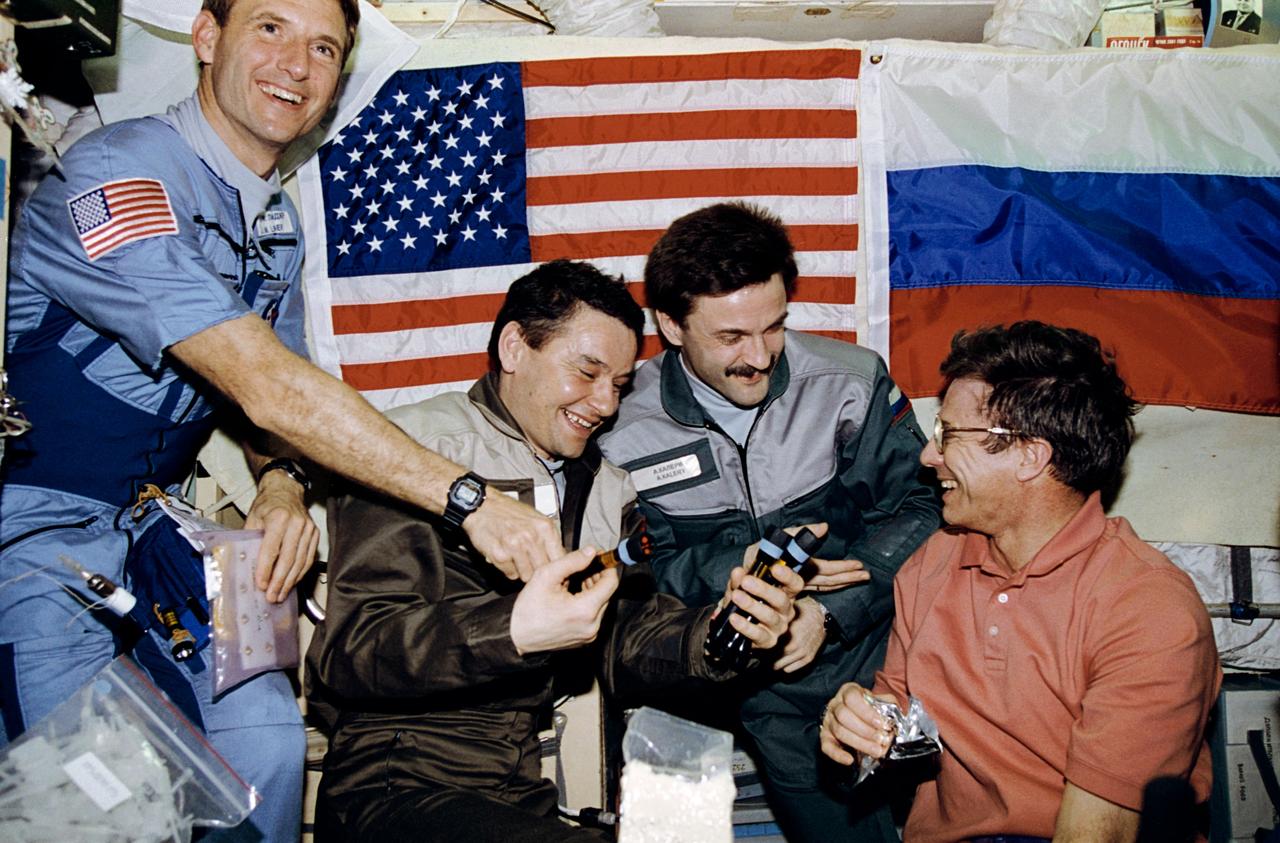
STS081-350-013 (12-22 Jan 1997) --- Members of Mir-22 crew show appreciation for small flash lights brought up by the STS-81 crew. Left to right, new cosmonaut guest researcher Jerry M. Linenger, cosmonauts Valeri G. Korzun, mission commander, and Aleksandr Y. Kaleri, flight engineer, along with former cosmonaut guest researcher John E. Blaha. The four are on the Base Block Module of Russia?s Mir Space Station on the eve of the Space Shuttle Atlantis and Mir undocking day.
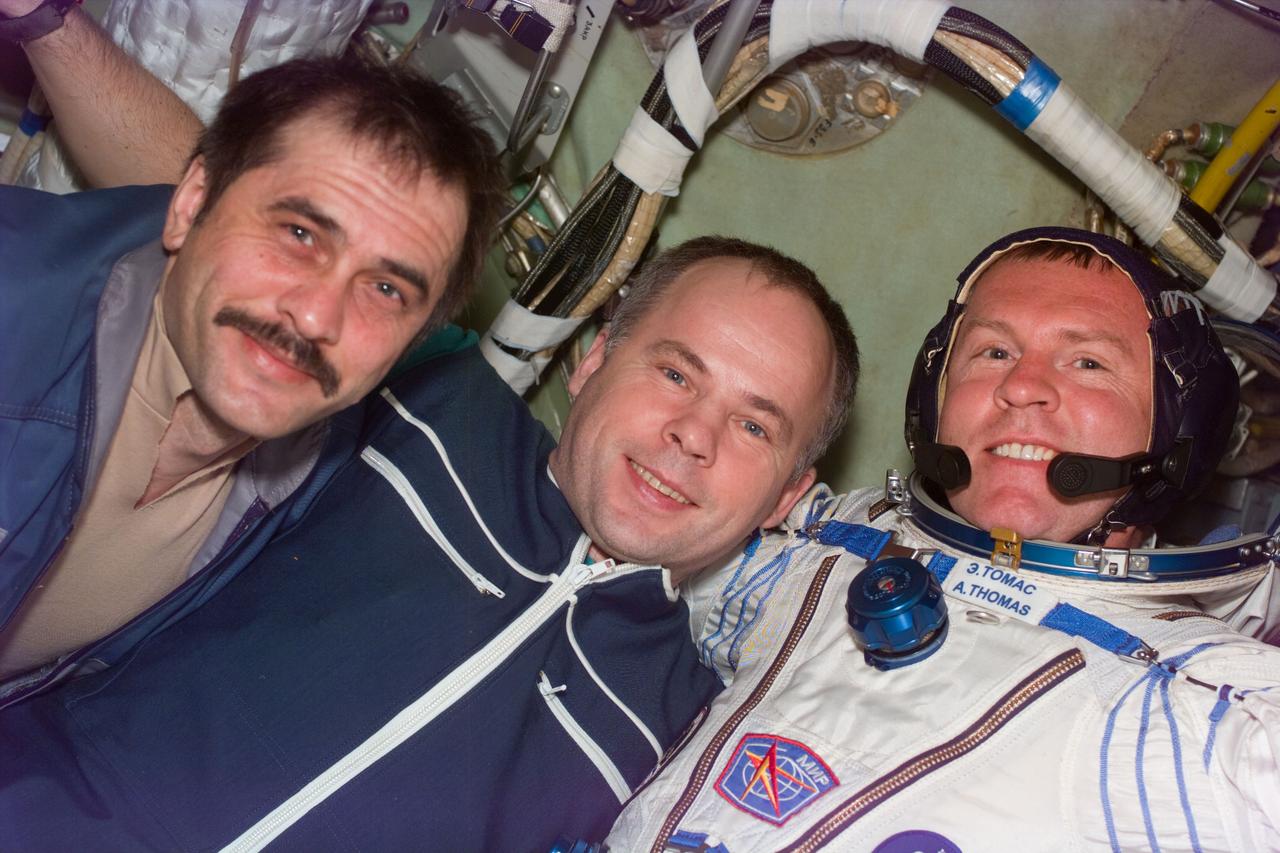
S89-E-5237 (26 Jan 1998) --- This Electronic Still Camera (ESC) image shows the new Mir-24 crew members posing onboard the Russian Mir Space Station. They are from left to right, cosmonaut Pavel V. Vinogradov, flight engineer; cosmonaut Anatoliy Y. Solovyev, commander; and astronaut Andrew S. W. Thomas, cosmonaut guest researcher. Thomas, replacing astronaut David A. Wolf as cosmonaut guest researcher, will be the last American to serve a tour onboard the Mir. This ESC view was taken on January 26th, 1998, at 12:55:31 MET.
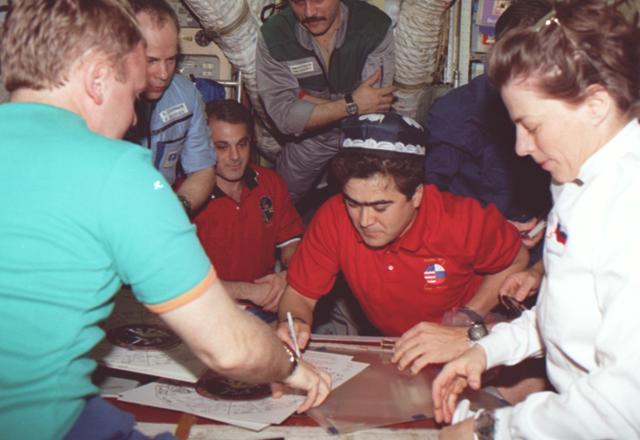
STS089-335-016 (22-31 Jan. 1998) --- Salizhan S. Sharipov (center) signs his name on a long-lived Mir roster on the Base Block of Russia's Mir Space Station, while Mir and shuttle crew members look on. From the left are Andrew S. W. Thomas (back to camera), Anatoliy Y. Solovyev, David A. Wolf, Pavel V. Vinogradov, Joe F. Edwards Jr., (partially obscured) and Bonnie J. Dunbar. Sharipov, representing the Russian Space Agency (RSA), is a mission specialist on the STS-89 crew. Photo credit: NASA
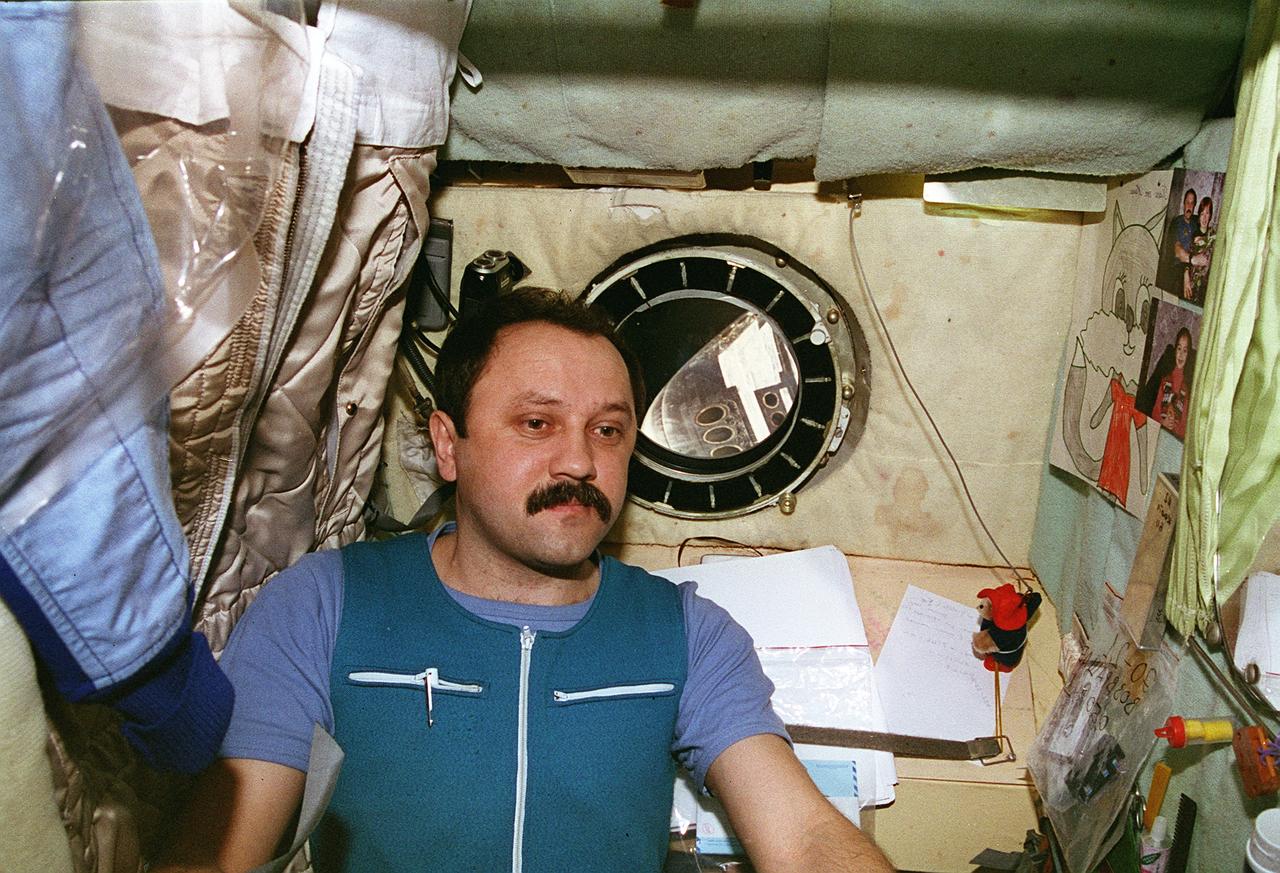
STS076-461-014 (22-31 March 1996) --- Cosmonaut Yury V. Usachev, Mir-21 flight engineer, reflects on his mission duties in his living quarters aboard Russia's Mir Space Station. His temporary out-the-window scenery is provided by the nose of the Space Shuttle Atlantis, which docked with Mir on March 23, 1996.
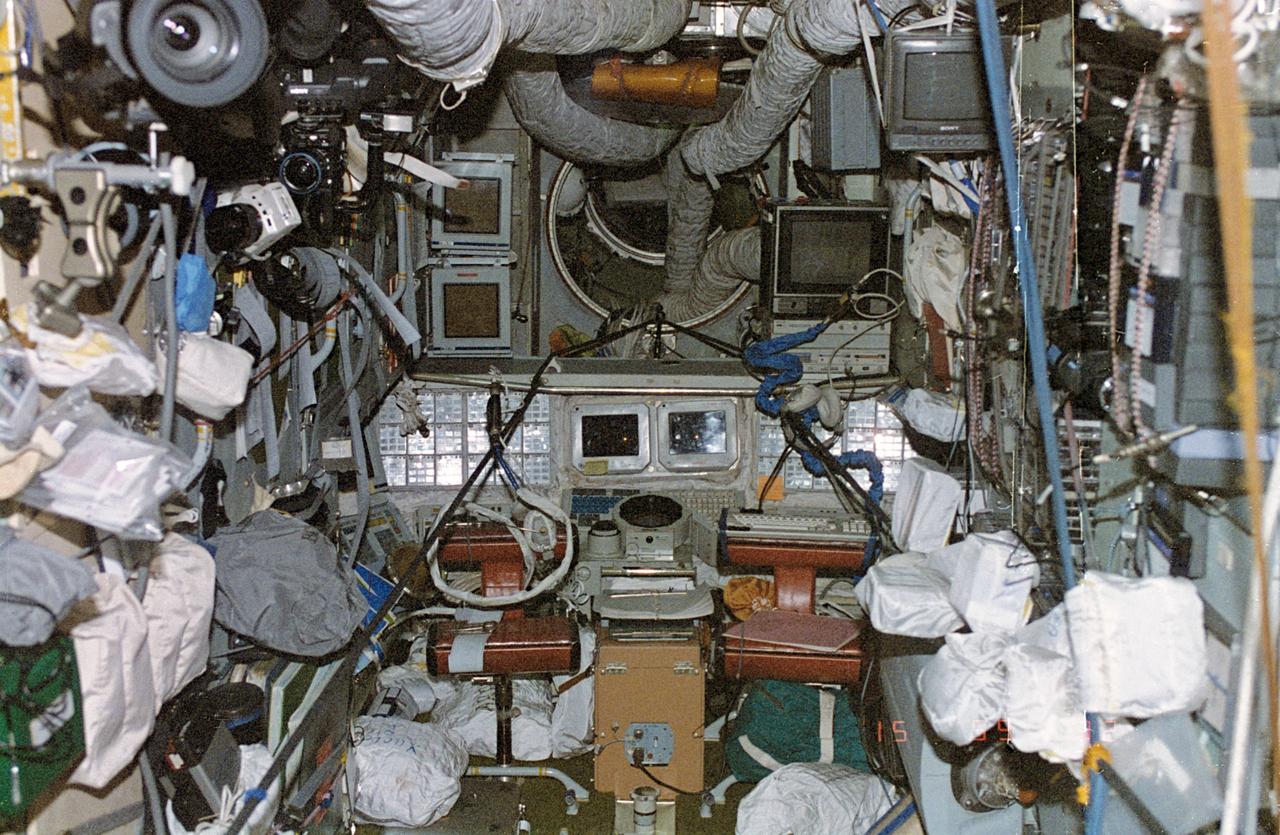
NM18-302-038 (28 June 1995) --- Astronaut Norman E. Thagard, Mir-18 cosmonaut researcher, took this picture aboard Mir on the eve of the targeted arrival day of Atlantis. Thagard told a July 18 press conference audience in Houston that he worked to clean the area prior to the Mir-19 crew and the STS-71 crew arrival and that his showing of this slide represented the first time the crew would have seen the area "in this condition."
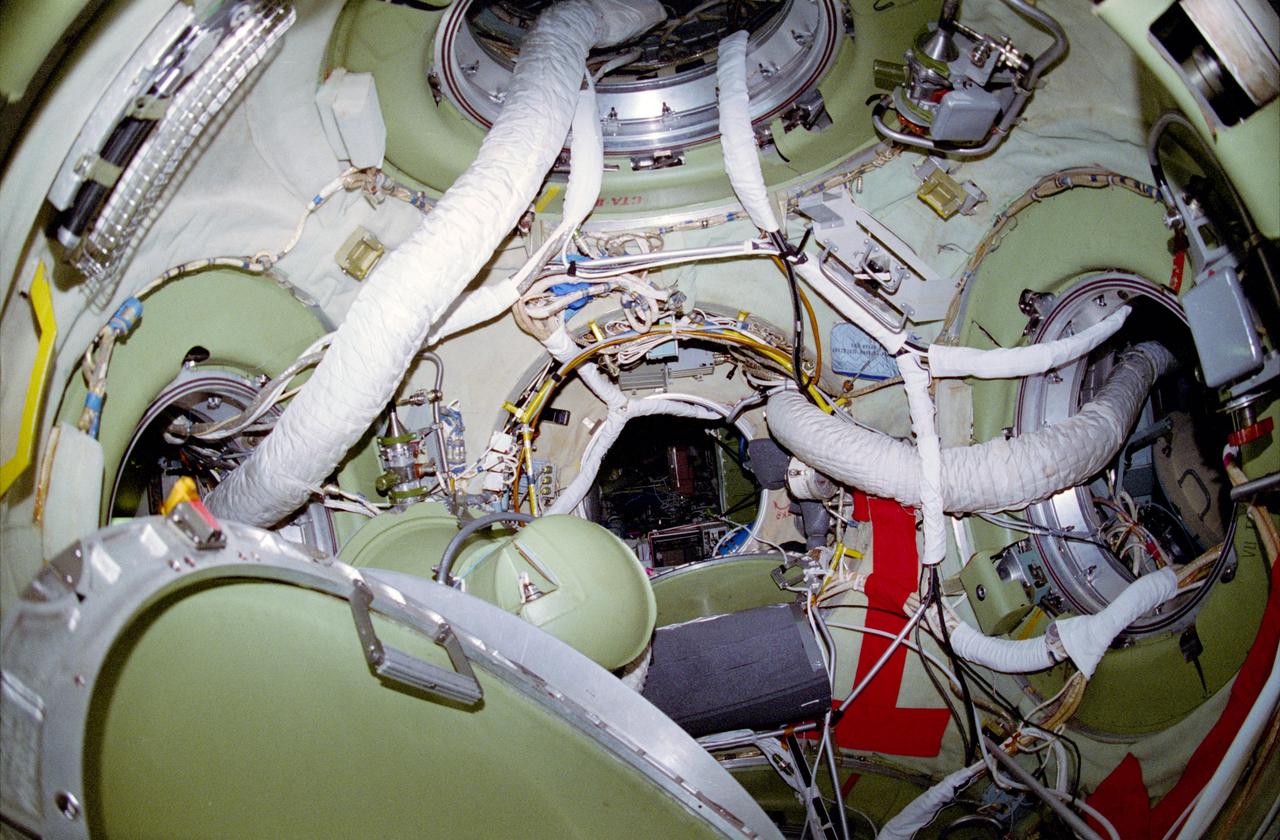
STS084-305-018 (15-24 May 1997) --- As seen from the docked Soyuz hatchway, this 35mm view shows the interior of a Russian Mir Space Station node connected to Kristall (bottom), Priroda (top), Mir Core Module (center), Kvant-2 (left) and Spektr (right). The Mir-23 and STS-84 crew members spent several days sharing joint activities in Earth-orbit as part of an ongoing cooperative program between the Russian Space Agency (RSA) and National Aeronautics and Space Administration (NASA).
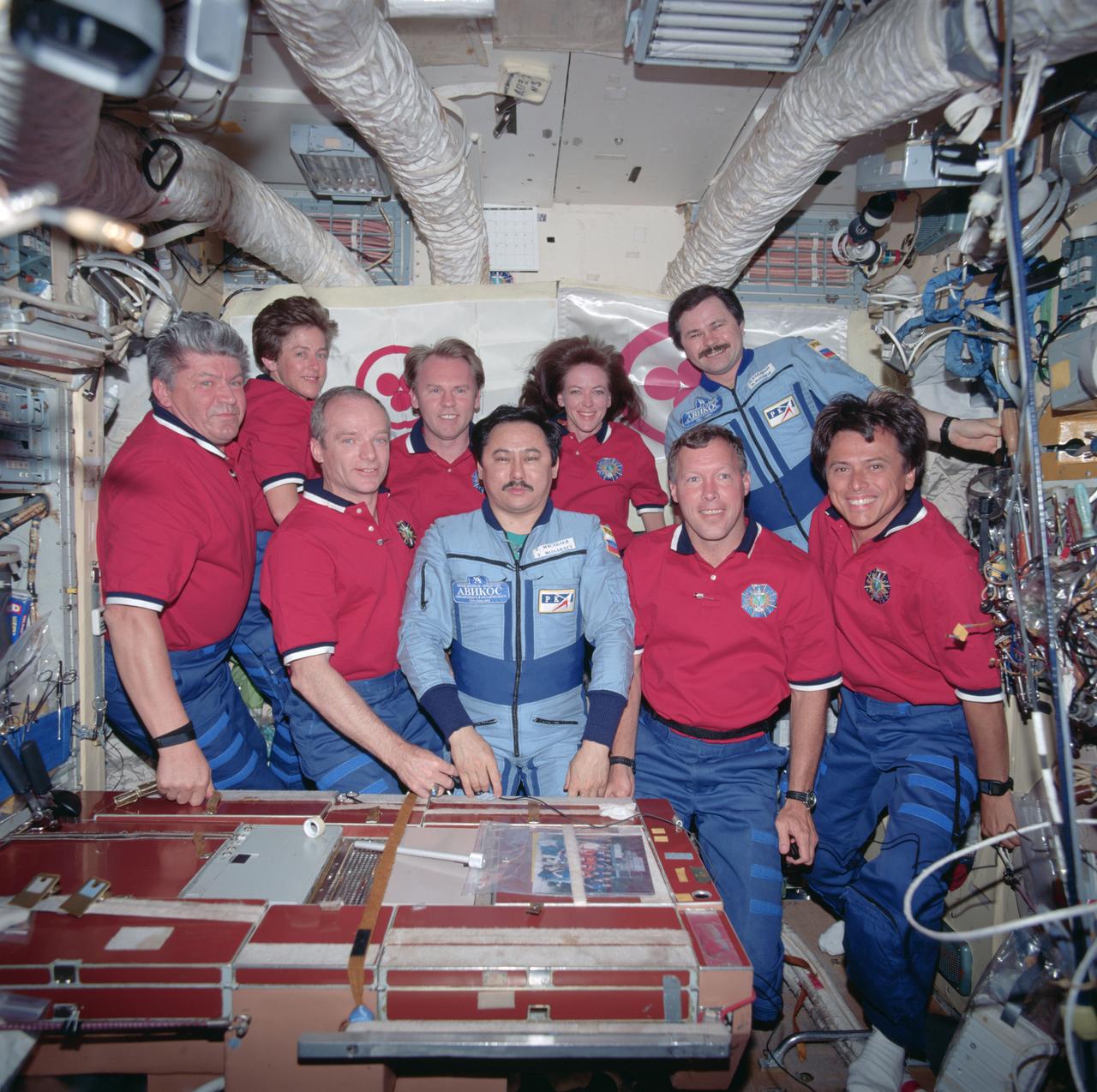
STS091-703-031 (2-12 June 1998) --- The STS-91 crew and the Mir-25 cosmonauts currently manning Russia's space station pose for the final joint inflight NASA-Mir portrait in the core module. Left to right are Valery V. Ryumin, Wendy B. Lawrence, Charles J. Precourt, Andrew S.W. Thomas, Talgat Musabayev, Janet L. Kavandi, Dominic C. Gorie, Nikolai Budarin and Franklin R. Chang-Diaz. Ryumin represents the Russian Aviation and Space Agency. Thomas ended up spending 141 days in space on this journey, including time aboard Endeavour and Discovery, which delivered and retrieved him to and from the Mir, respectively. Later the Discovery made the final undocking of an American Shuttle from the Mir complex, leaving Musabayev and Budarin, the current Mir crewmembers, behind. A pre-set 70-mm camera recorded the portrait. Photo Credit: National Aeronautics and Space Administration (NASA) and the Russian Aviation and Space Agency.

SPACE SHUTTLE STS-71 (MIR 18) SLM-1, FLIGHT FIXATIVE BAGS (FLOWN ONBOARD) QUAIL EGGS

SPACE SHUTTLE STS-71 (MIR 18) SLM-1, FLIGHT FIXATIVE BAGS (FLOWN ONBOARD) QUAIL EGGS

STS071-701-064 (29 June 1995) --- Russia's Kvant 2 portion of the Mir Space Station is backdropped against the darkness of space, as photographed from the approaching space shuttle Atlantis on June 29, 1995. Cosmonaut Vladimir N. Dezhurov, Mir-18 mission commander, can be seen aiming a camera through a port hole at center frame. Norman E. Thagard, Mir-18 cosmonaut researcher, aims a camera through a smaller window. Five NASA astronauts and two cosmonauts were onboard Atlantis as it approached the Mir, which has been home for the three-member Mir-18 crew since March of this year.

S76-E-5215 (28 March 1996) --- Astronaut Kevin P. Chilton, STS-76 mission commander, gets a warm good-bye from cosmonaut Yury V. Usachev, Mir-21 flight engineer, as the Space Shuttle Atlantis is about to be separated from its link with Russia's Mir Space Station.

S76-E-5229 (28 March 1996) --- As she floats from one spacecraft to another, astronaut Shannon W. Lucid, Mir-21 cosmonaut guest researcher, is surrounded by a large delivery of new supplies for the Mir Space Station. Today is the final day for Lucid's five STS-76 astronaut colleagues to spend time with the Mir-21 crew, as they are soon to undock the Space Shuttle Atlantis from Russia's Mir Space Station.
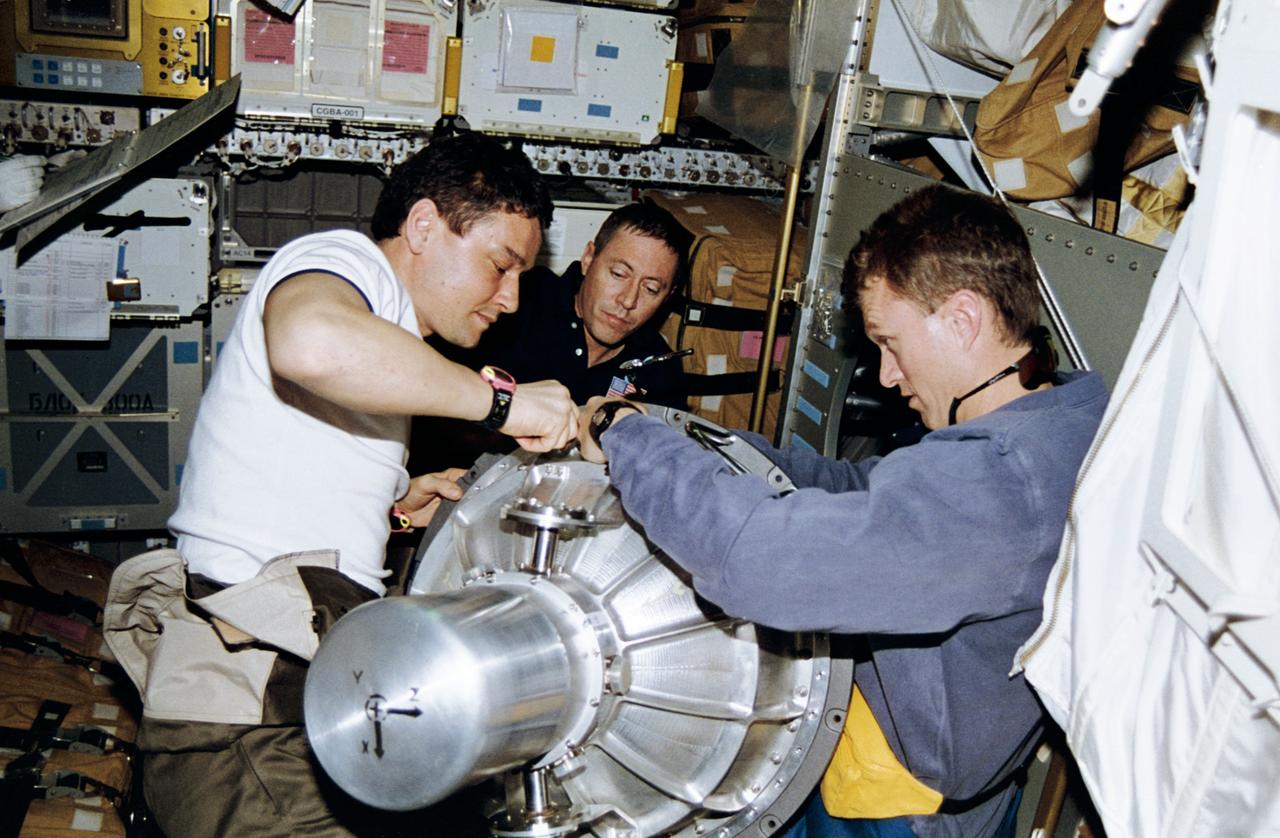
STS081-301-031 (12-22 Jan 1997) --- Shortly after docking of the Space Shuttle Atlantis and Russia's Mir Space Station, crew members from the respective spacecraft begin to transfer hardware from the Spacehab Double Module (DM) onto the Mir complex. Here, cosmonaut Valeri G. Korzun, Mir-22 commander, along with astronauts Michael A. Baker, commander, and Brent W. Jett, Jr., pilot, unstow a gyrodyne, device for attitude control, transfer to Mir.
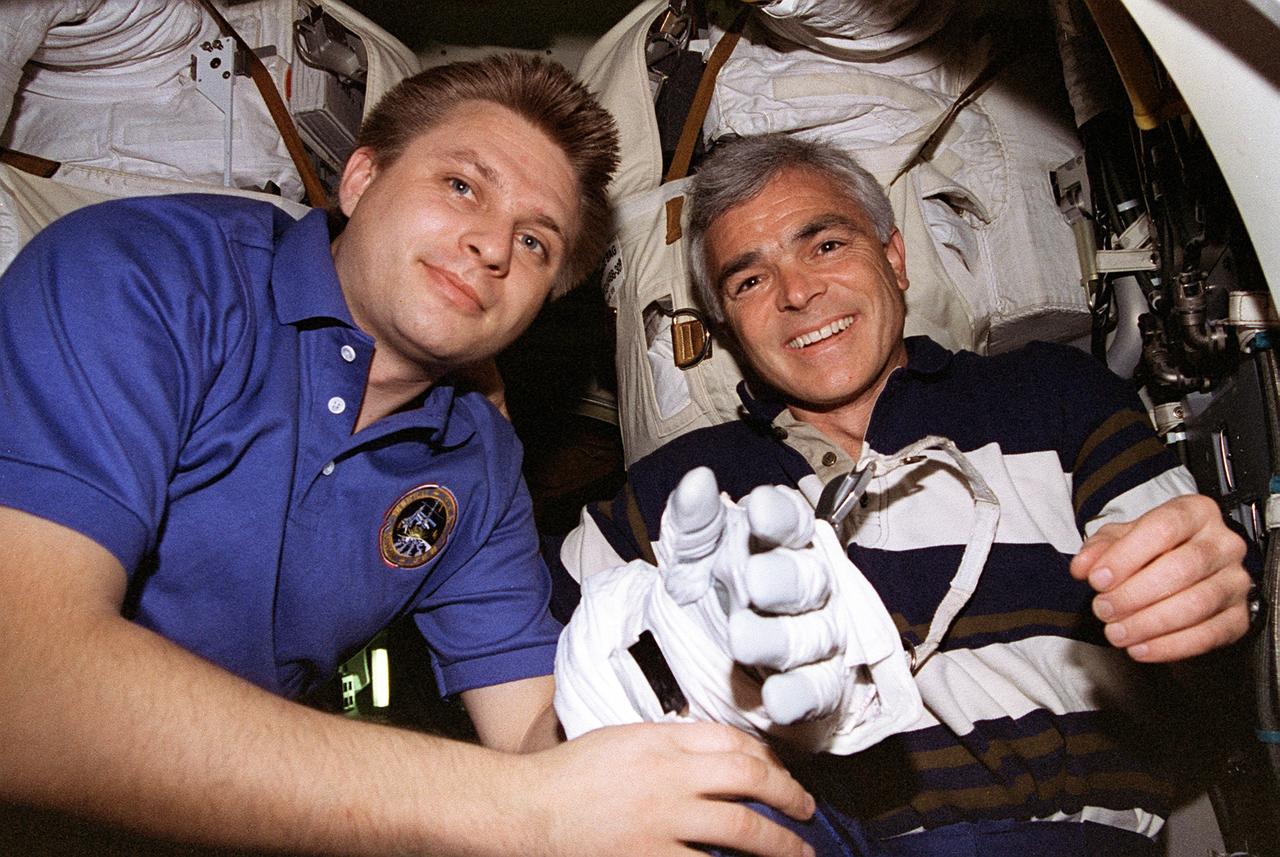
STS076-356-006 (26 March 1996) --- Backdropped against two space suits, a curious cosmonaut Yury I. Onufrienko, left, tries on a glove while visiting astronaut Michael R. (Rich) Clifford in the airlock aboard the Space Shuttle Atlantis. Clifford was in the airlock to check over his gear for tomorrow's Extravehicular Activity (EVA). Onufrienko is Mir-21 mission commander, and Clifford, a STS-76 mission specialist who will be joined by astronaut Linda M. Godwin for the EVA. The EVA of the two mission specialists marks the first EVA while Russia's Mir Space Station was docked with the Space Shuttle Atlantis. This is the third of a series of docking missions involving Mir and the Space Shuttle Atlantis.
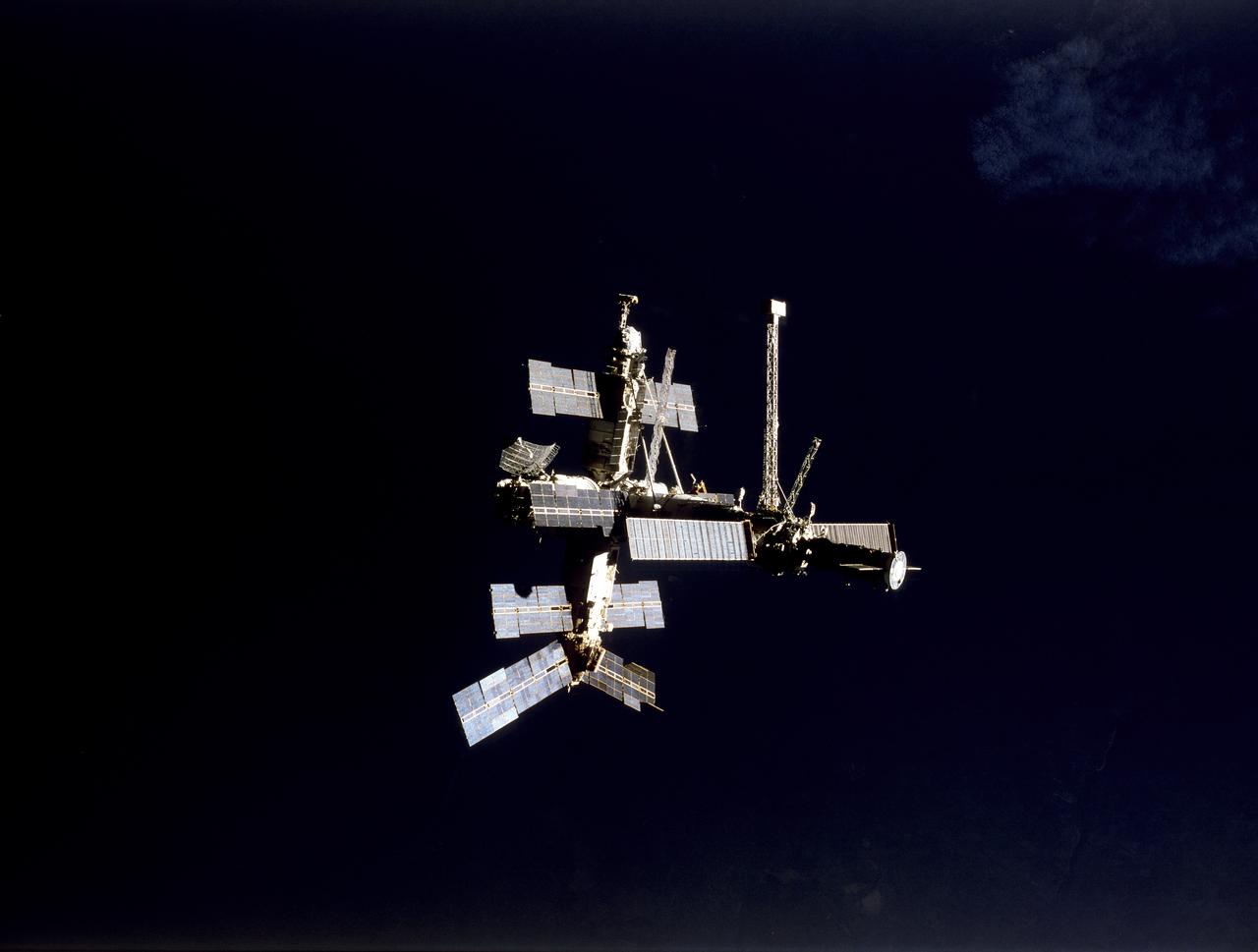
STS079-S-125 (16-26 Sept. 1996) --- Following undocking from the Space Shuttle Atlantis, Russia's Mir Space Station is backdropped against dark blue water on Earth, though it appears to be surrounded by the blackness of space. During the STS-79 mission, the crew used an IMAX camera to document Intravehicular Activities (IVA) aboard the Atlantis and the various Mir modules, as well as to record both docking and undocking activities through Atlantis' windows. NASA has flown IMAX camera systems on many Shuttle missions, including a special cargo bay camera's coverage of other recent Shuttle-Mir rendezvous and/or docking missions.
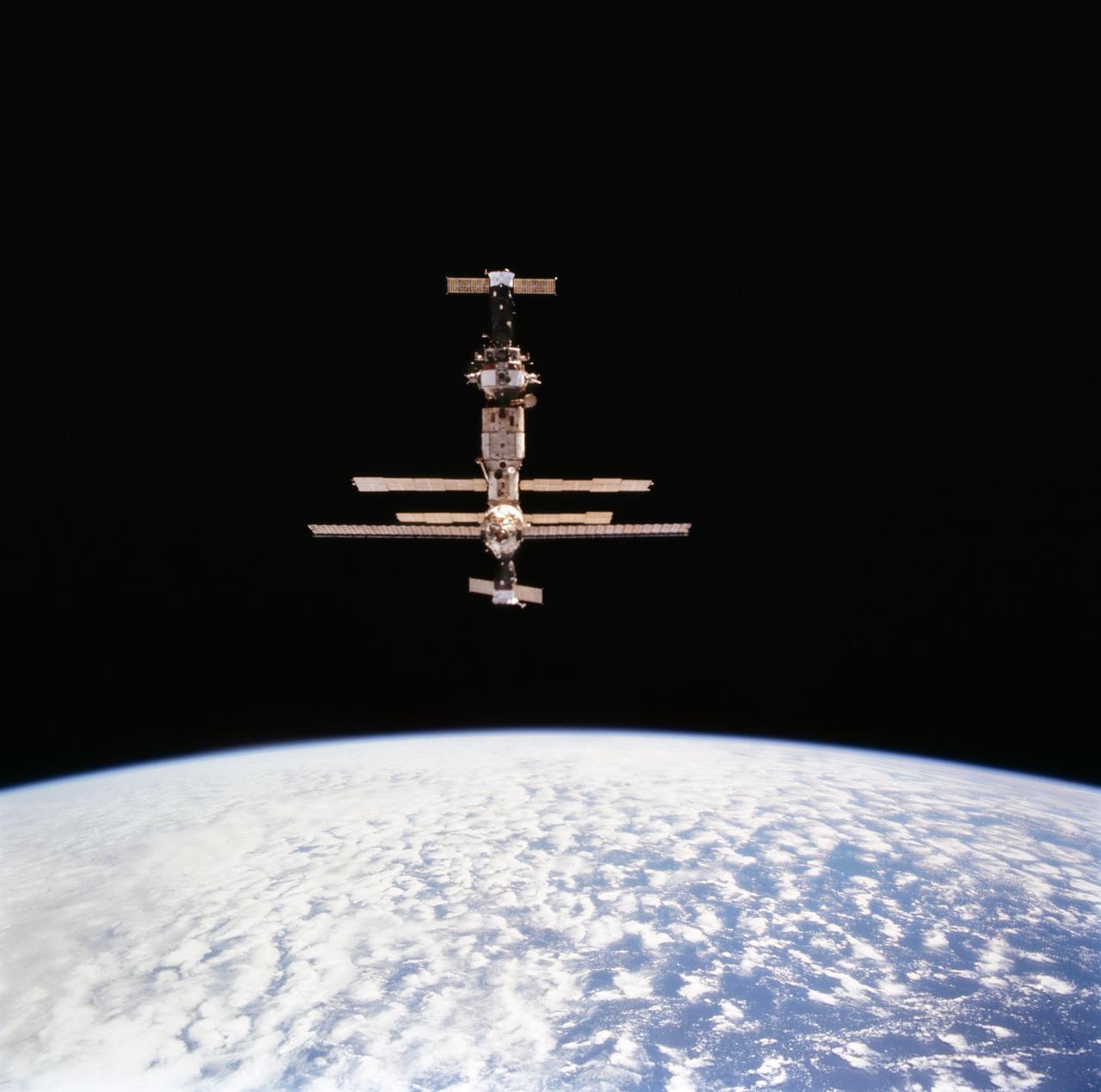
STS063-712-072 (6 Feb 1995) --- Russia's Mir Space Station over the blue and white Earth during initial approach for rendezvous operations with the Space Shuttle Discovery. Docked at bottom (nearest portion where longest solar array panel is visible) is a Soyuz space vehicle. On the opposite end is a Progress spacecraft. This is one of 16 still photographs released by the NASA Johnson Space Center (JSC) Public Affairs Office (PAO) on February 14, 1995. Onboard the Space Shuttle Discovery were astronauts James D. Wetherbee, mission commander; Eileen M. Collins, pilot; Bernard A. Harris Jr., payload commander; mission specialists C. Michael Foale, Janice E. Voss, and cosmonaut Vladimir G. Titov.
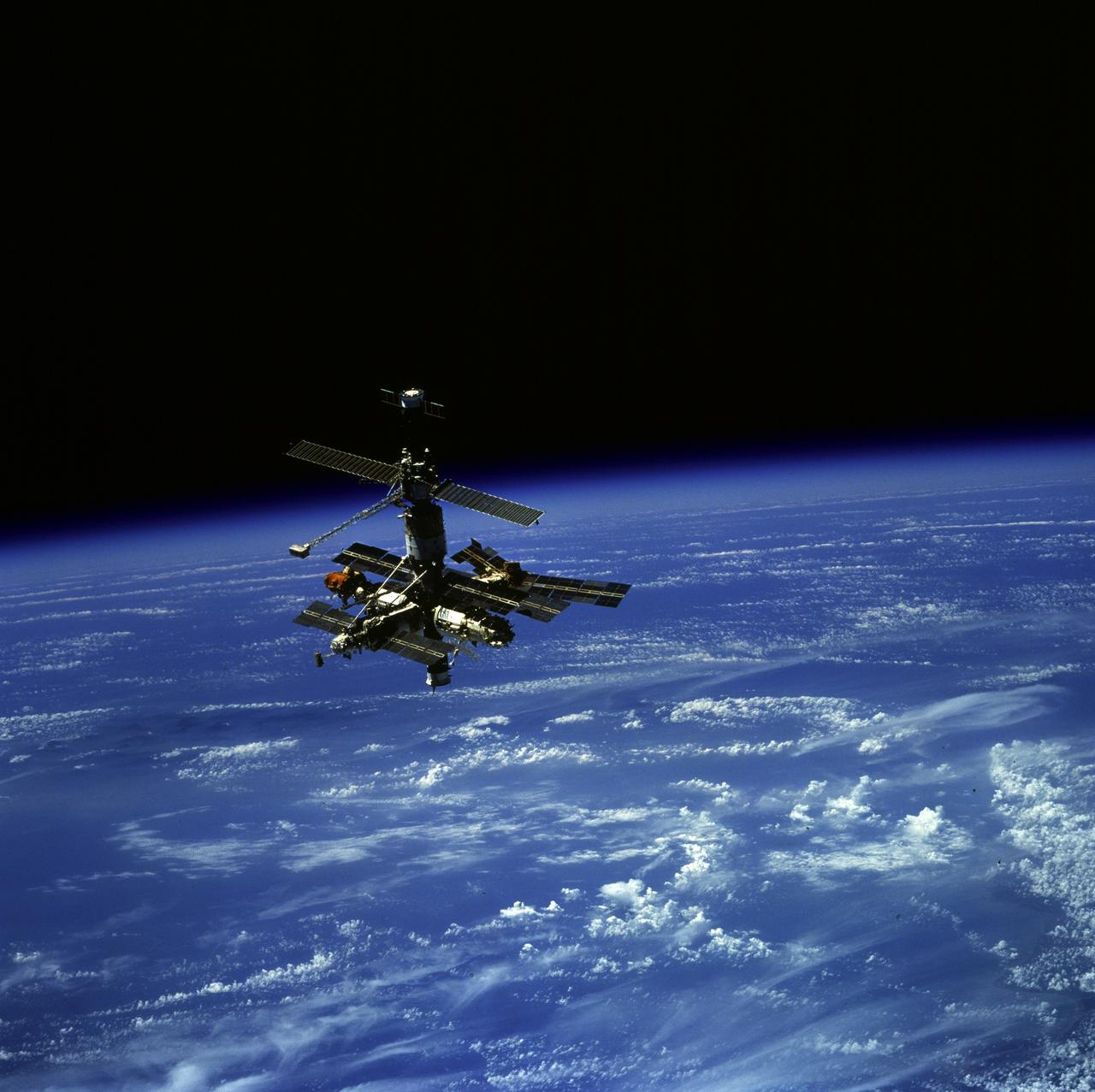
STS079-810-028 (24 Sept. 1996) --- Russia's Mir Space Station, backdropped over Earth's horizon, was photographed by one of the STS-79 crew members aboard the space shuttle Atlantis as it performed its final fly around following undocking operations. The STS-79 flight began with a Sept. 16, 1996, liftoff from Launch Pad 39A at the Kennedy Space Center and ended with a landing at KSC on Sept. 26, 1996. Onboard for the launch were astronauts William F. Readdy, commander; Terrence W. Wilcutt, pilot; John E. Blaha, Jerome (Jay) Apt, Thomas D. Akers and Carl E. Walz, all mission specialists. On flight day four, the crew docked with Mir. Shannon W. Lucid, who had spent six months aboard Mir, switched cosmonaut guest researcher roles with Blaha. The latter joined fellow Mir-22 crew members Valeri G. Korzun, commander, and Aleksandr Y. Kaleri, flight engineer. Photo credit: NASA
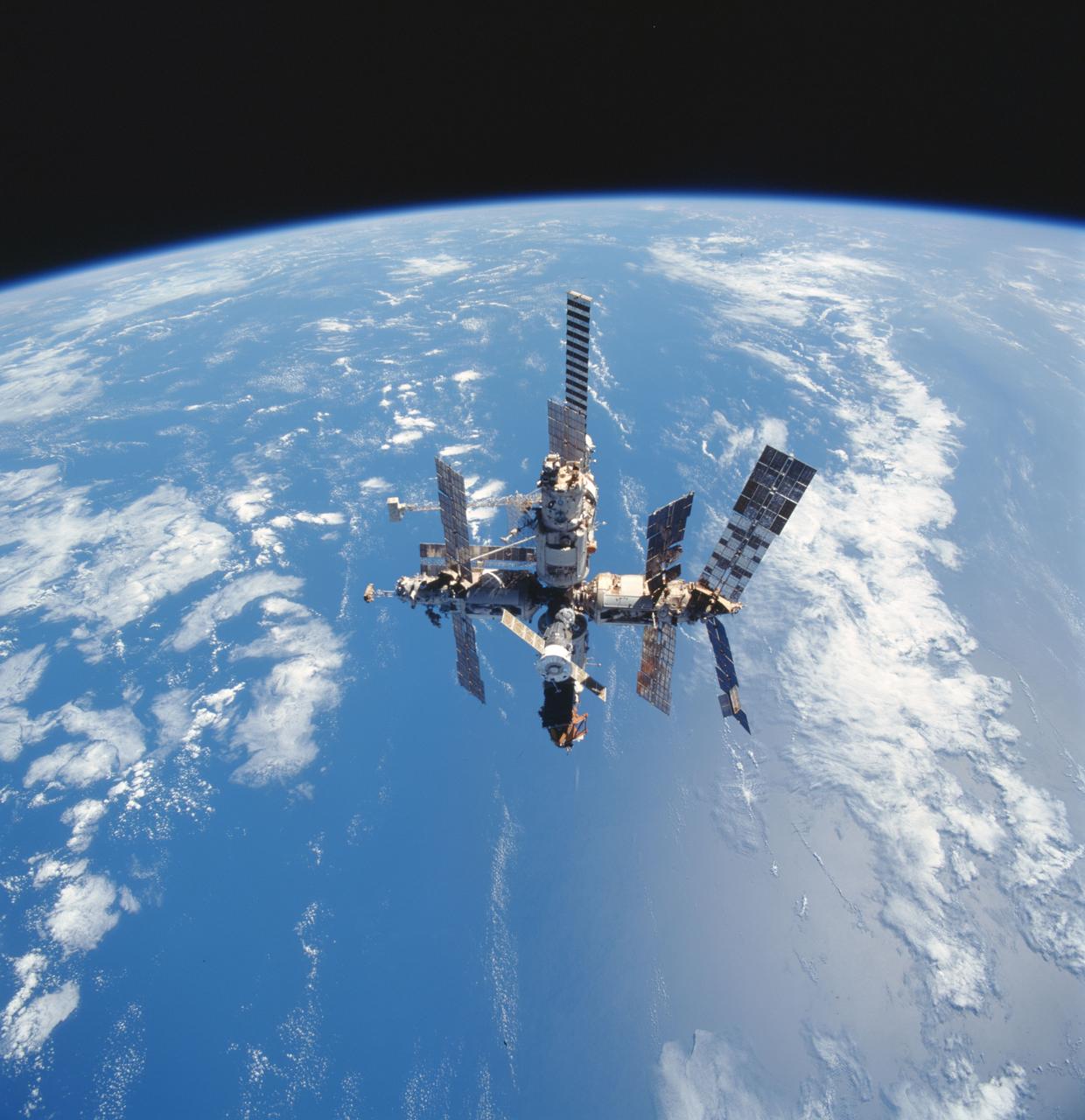
STS091-707-090 (2-12 June 1998) --- Russia's Mir space station is captured on film as it floats above the blue and white planet Earth during Shuttle-Mir final fly-around.
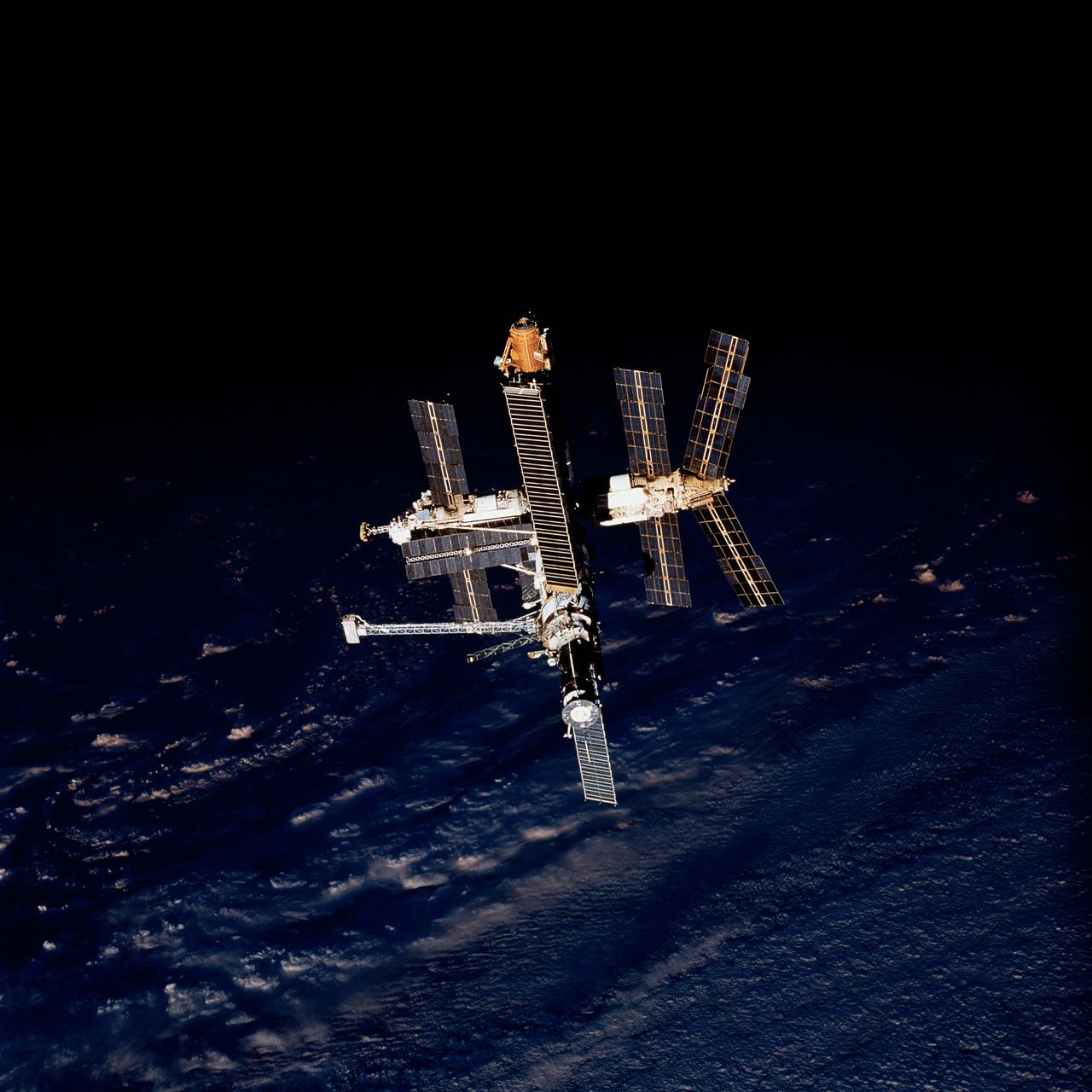
STS079-821-036 (16-26 Sept. 1996) --- Following the Space Shuttle Atlantis - Russian Mir Space Station undocking activities, a crew member captured this 70mm frame of Mir as the two crews shared their final common sunset scene. This photograph is one of four 70mm frames (along with fifteen 35mm frames) of still photography documenting the activities of NASA's STS-79 mission, which began with a September 16, 1996, liftoff from Launch Pad 39A the Kennedy Space Center (KSC) and ended with a landing at KSC on September 26, 1996. Onboard for the launch were astronauts William F. Readdy, commander; Terrence W. Wilcutt, pilot; John E. Blaha, Jerome (Jay) Apt, Thomas D. Akers and Carl E. Walz, all mission specialists. On flight day 4, the crew docked with Mir. Shannon W. Lucid, who had spent six months aboard Mir, switched cosmonaut guest researcher roles with Blaha. The latter joined fellow Mir-22 crew members Valeri G. Korzun, commander, and Aleksandr Y. Kaleri, flight engineer.
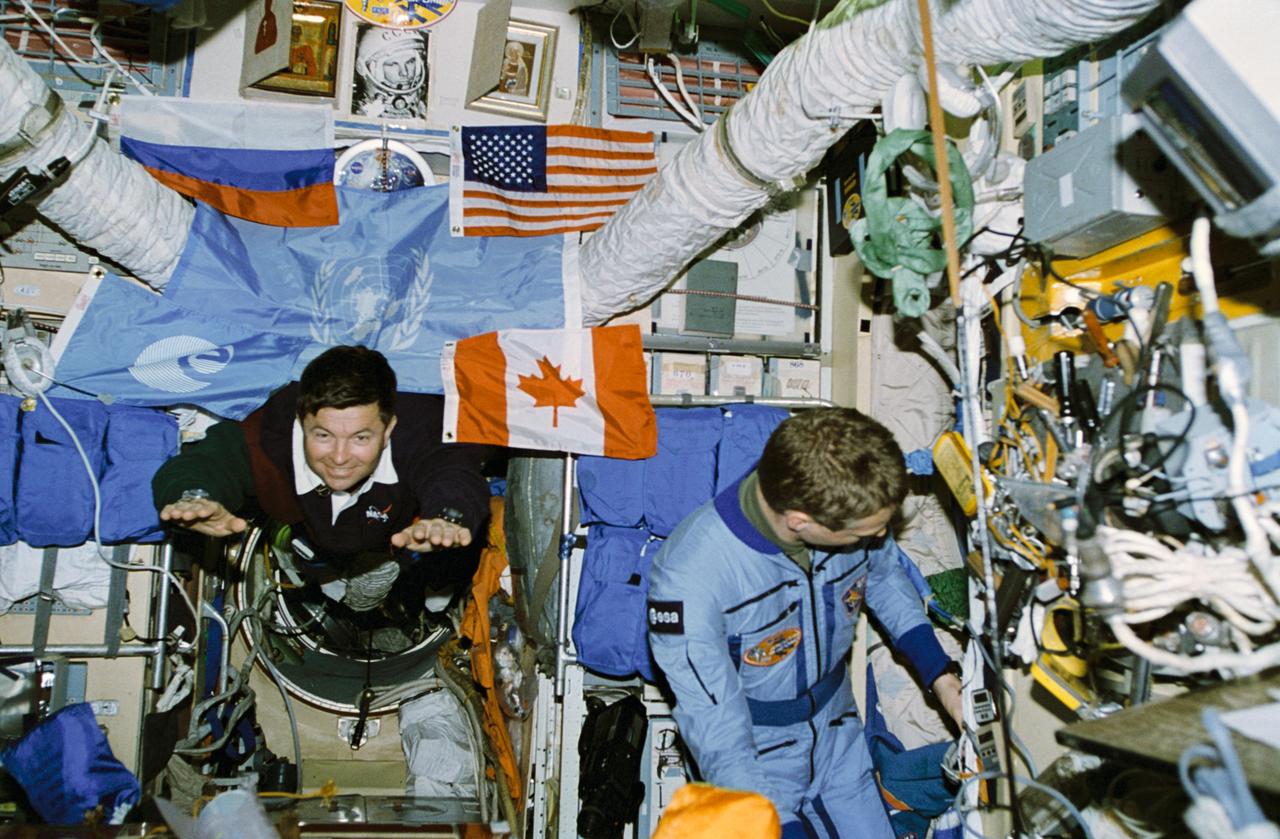
STS074-331-036 (12-20 Nov 1995) --- Astronaut Kenneth D. Cameron floats into the Core Module of Russia?s Mir Space Station. The European Space Agency?s (ESA) Thomas Reiter checks out an array of tools. With five NASA astronauts aboard the Space Shuttle Atlantis, the flight began with a November 12, 1995, launch from Kennedy Space Center (KSC) and ended with landing there on November 20, 1995. The crew members were astronauts Cameron, mission commander; James D. Halsell, Jr., pilot; William S. McArthur, Jr., Jerry L. Ross and Canadian astronaut Chris A. Hadfield, all mission specialists. On November 15, 1995, the Space Shuttle Atlantis docked with the Mir Space Station, on which the NASA astronauts joined the Mir-20 crew. The Mir-20 crew is composed of cosmonauts Yuriy P. Gidzenko, commander; and Sergei V. Avdeyev, engineer; along with Reiter, cosmonaut researcher. Joint activities on the Mir and the Space Shuttle Atlantis ended November 18, 1995, when the two spacecraft separated.
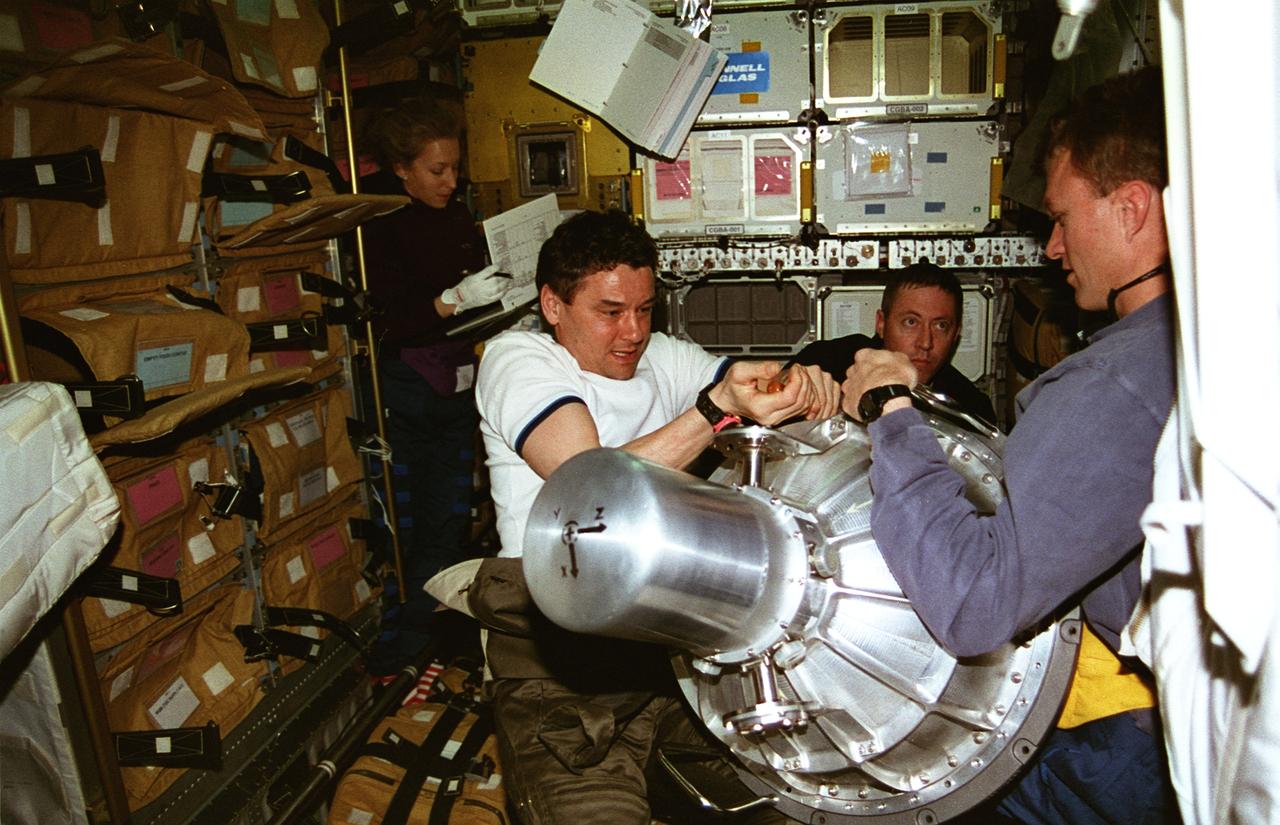
STS081-301-032 (12-22 Jan. 1997) --- Shortly after the docking of the Space Shuttle Atlantis and Russia's Mir Space Station, crewmembers from the respective spacecraft begin to transfer hardware from the Spacehab Double Module (DM) onto the Mir complex. In this scene, cosmonaut Valeri G. Korzun (second left) Mir-22 commander, along with astronauts Michael A. Baker (second right) commander, and Brent W. Jett, Jr., pilot, unstow a gyrodyne, a device used for attitude control, for transfer to Mir. Astronaut Marsha S. Ivins looks over a lengthy inventory of supplies to be transferred.
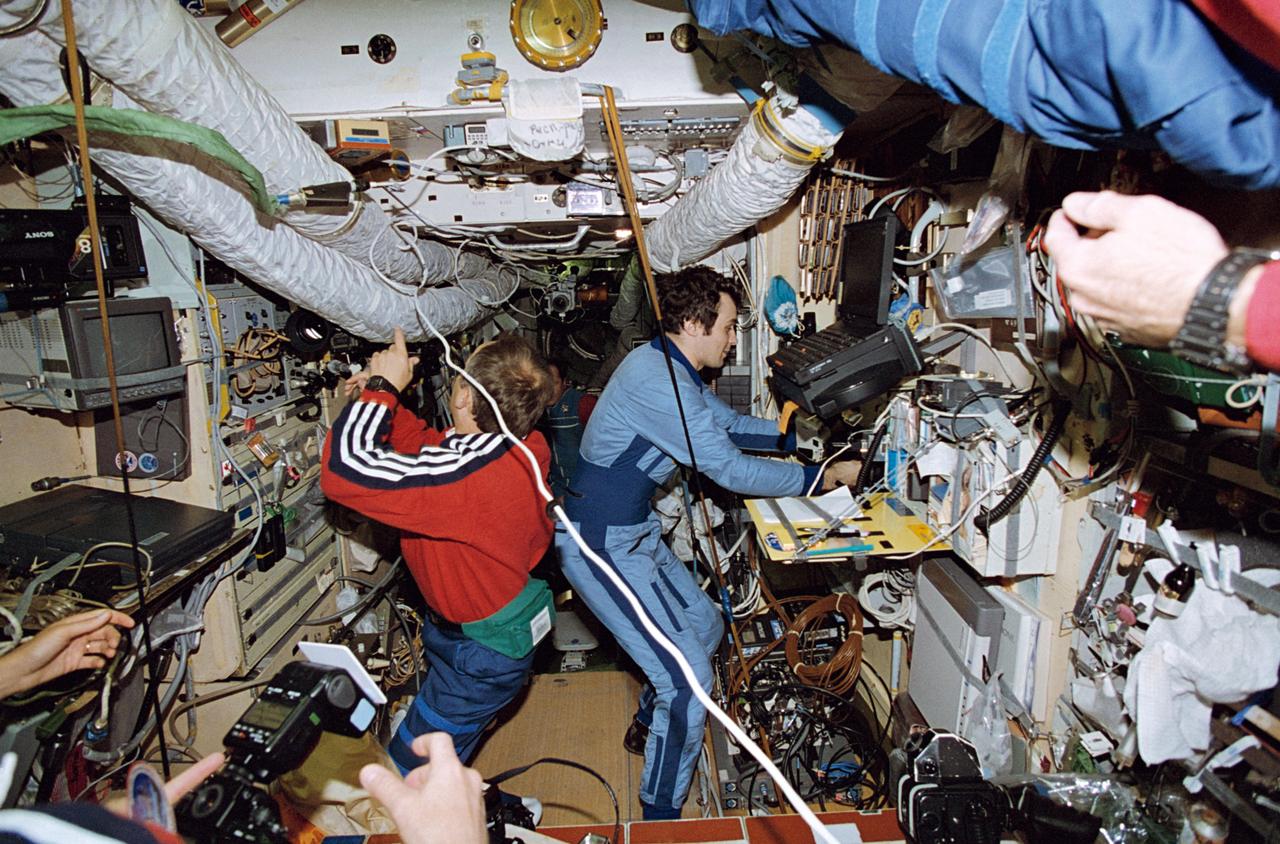
STS071-118-007 (27 June - 7 July 1995) --- Onboard the Russia?s Mir Space Station Mir Base Block, cosmonauts Anatoly Y. Solovyev (left) and Vladimir N. Dezhurov, Mir 19 and 18 commanders, respectively, exchange information about their research tasks. The two represent a change of guard aboard Mir, as Dezhurov prepares to come back to Earth with the STS-71 crew aboard Space Shuttle Atlantis. Nikolai M. Budarin and Gennadiy M. Strekalov - cosmonaut/flight engineers making the same exchange -- are out of frame.
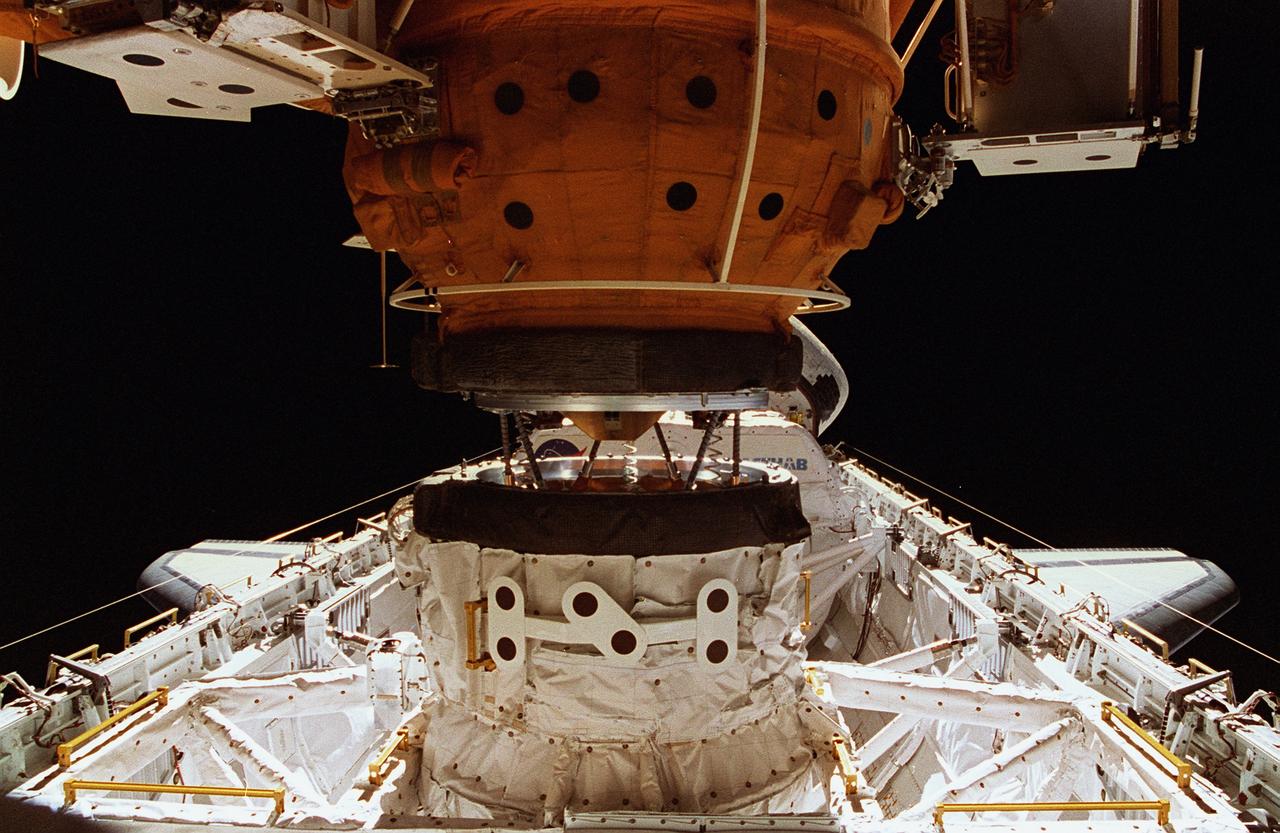
STS076-344-003 (24 March 1996) --- The Space Shuttle Atlantis Orbiter Docking System (ODS) and the Docking Module (DM) on Russia's Mir Space Station appear near the center of this frame, as the Atlantis and Mir link in Earth-orbit, at about 160 nautical miles altitude. The STS-76 crew later diminished by one and the Mir-21 crew grew by one, as astronaut Shannon W. Lucid, mission specialist, went aboard the Mir Space Station and became a cosmonaut guest researcher. She is scheduled to return to Earth in about 140 days.
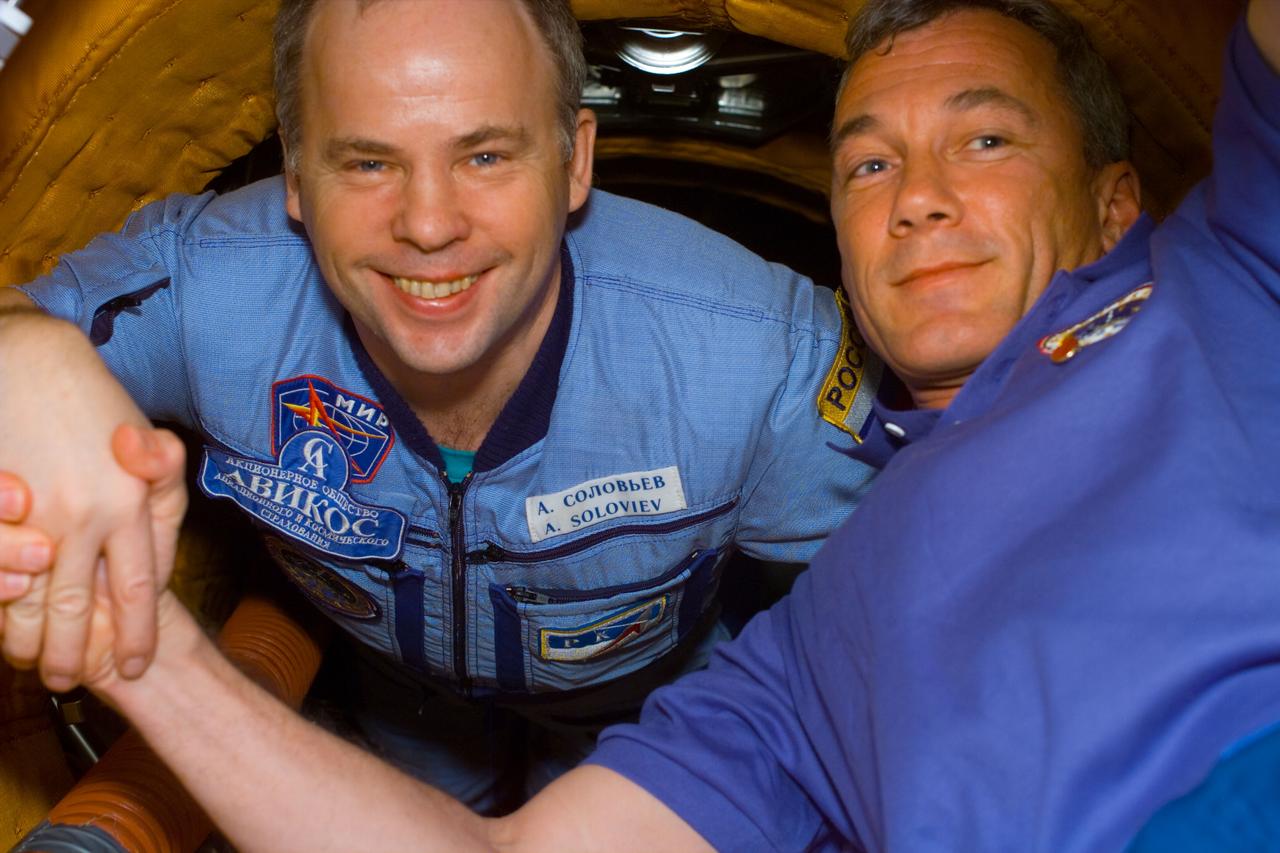
S89-E-5352 (28 Jan 1998) --- This Electronic Still Camera (ESC) image shows the commanders' farewell handshake, thus bringing the eighth Shuttle/Mir joint activities to an end. The commanders, cosmonaut Anatoliy Y. Solovyev, Mir-24 commander (on the left); and astronaut Terrence W. Wilcutt, STS-89 commander, are posing in the Docking Module (DM) between the Space Shuttle Endeavour and the Russian Mir Space Station. The Shuttle crew dropped off astronaut Andrew S. W. Thomas and picked up astronaut David A. Wolf, cosmonaut guest researcher onboard Mir since September 1997. Thomas will be the last American astronaut to serve a tour aboard the Mir as a cosmonaut guest researcher. This ESC view was taken on January 28, 1998, at 22:27:56 GMT.
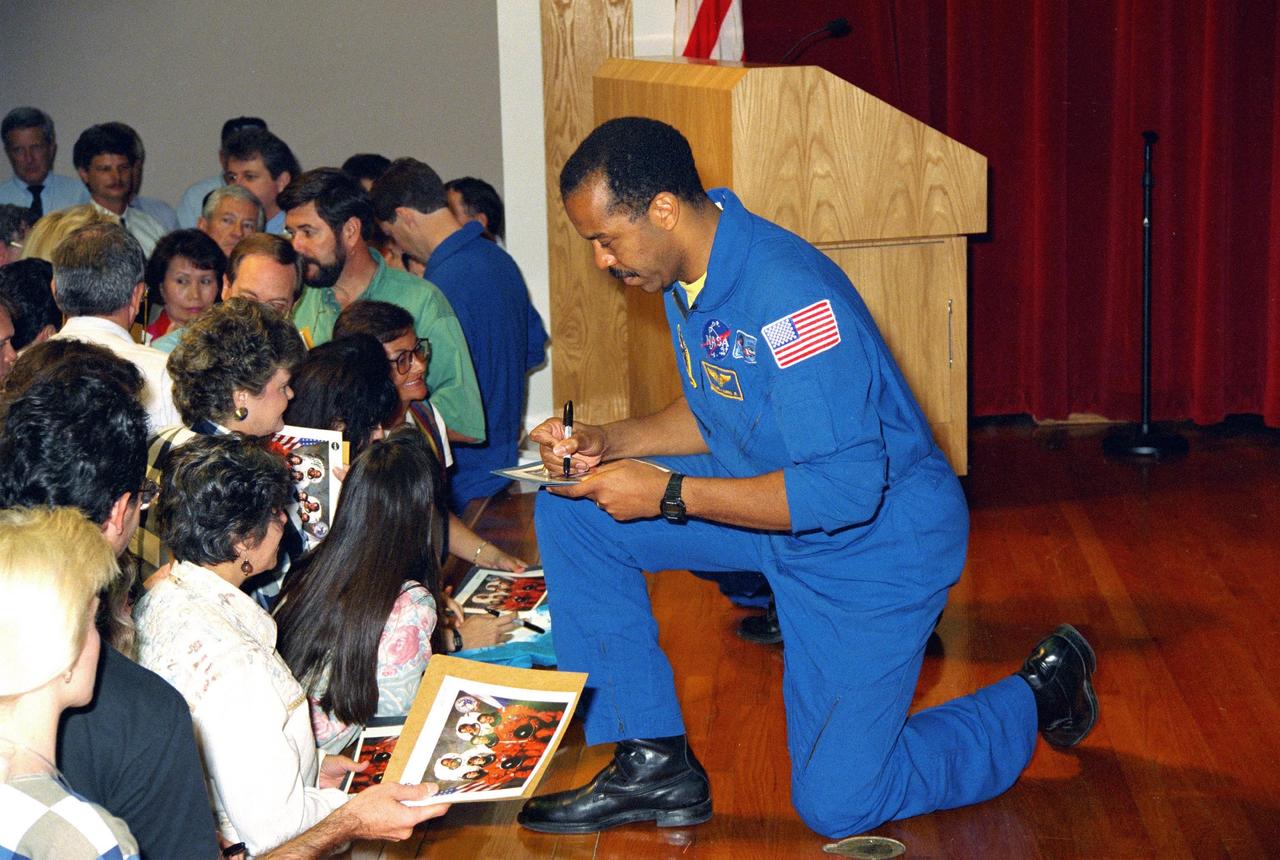
KENNEDY SPACE CENTER, FLA. -- STS-63 Mission Specialist Dr. Bernard Harris autographs copies of the crew photograph in the Training Auditorium during a March crew visit to thank employees for their help in ensuring a successful mission. The six-member crew on Discovery, who landed February 11 after an eight-day flight, included Mission Commander James Wetherbee, Pilot Eileen Collins (on the first flight of a female Shuttle pilot), and Mission Specialists Michael Foale, Janice Voss and Vladimir Titov. The mission featured another milestone, the first approach and flyaround of a Shuttle with Russian Space Station Mir. It was also the second flight of a russian cosmonaut on Shuttle and the third flight of the SPACEHAB module, which carried 20 experiments in biotechnology, advanced materials development, technology demonstrations and other measurements.
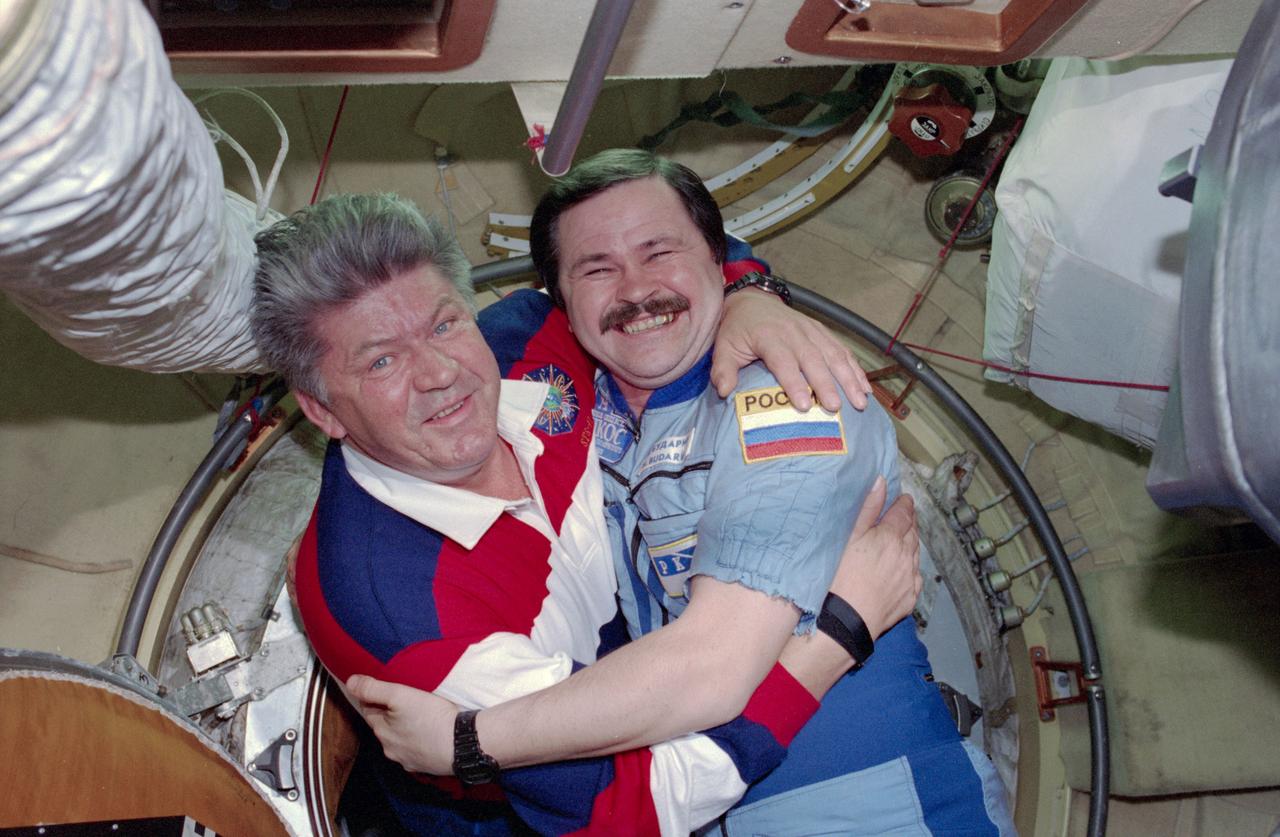
STS091-379-013 (2-12 June 1998) --- Cosmonauts Valery V. Ryumin (left)and Nikolai M. Budarin reunite moments after hatch opening, following docking of Mir and Discovery. Ryumin, mission specialist representing the Russian Aviation and Space Agency, came up to Mir along with five astronauts aboard the Space Shuttle Discovery. Budarin is Mir-25 flight engineer. Since 1992, Ryumin has been the Director of the Russian portion of the Shuttle-Mir and NASA-Mir program.
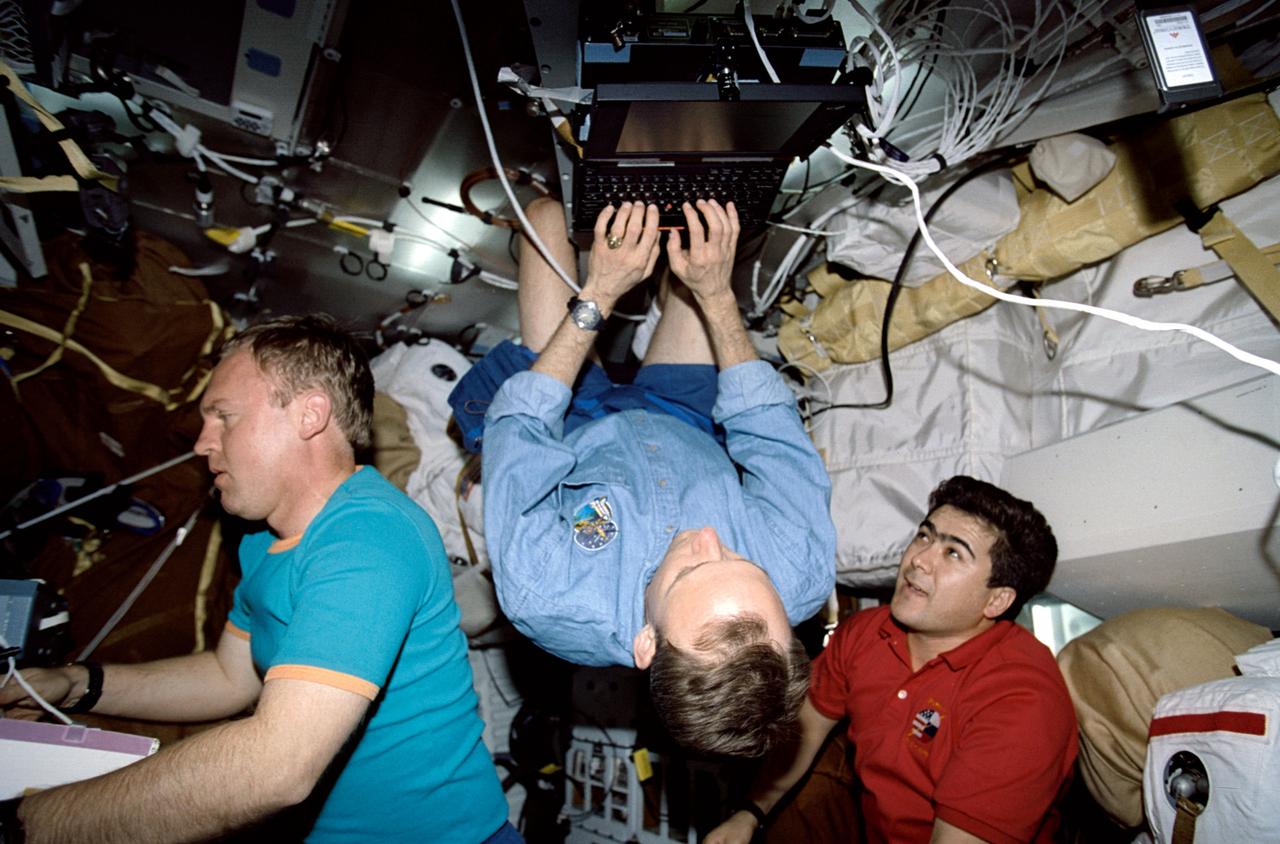
STS089-338-032 (22-31 Jan. 1998) --- The Mir-24 crew of Russia?s Mir Space Station and the space shuttle Endeavour STS-89 crew members work together to transfer supplies from the Spacehab Module onboard the Endeavour to Mir. Left to right are astronaut Andrew S. W. Thomas, new cosmonaut guest researcher; astronaut Joe F. Edwards Jr. pilot; and cosmonaut Salizhan S. Sharipov, mission specialist representing the Russian Space Agency (RSA). Photo credit: NASA
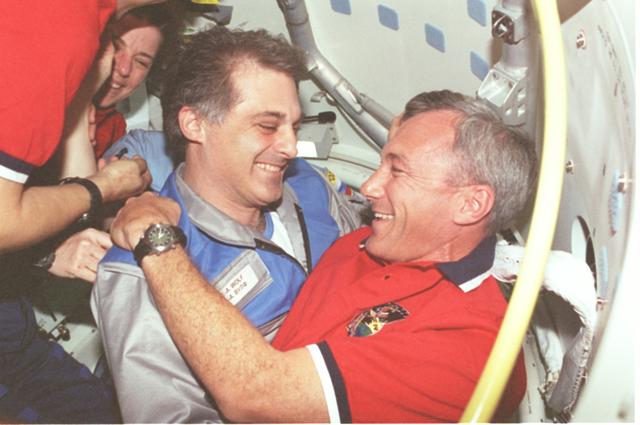
STS089-386-013 (22-31 Jan. 1998) --- Astronaut David A. Wolf, cosmonaut guest researcher, greets Terrence W. Wilcutt, STS-89 shuttle mission commander, and Bonnie J. Dunbar, payload commander, after hatch opening following Russia?s Mir Space Station's and the space shuttle Endeavour's docking. The greeting kicked off several days of joint activity between the NASA and Mir crew members, during the eighth shuttle/Mir docking mission. Photo credit: NASA
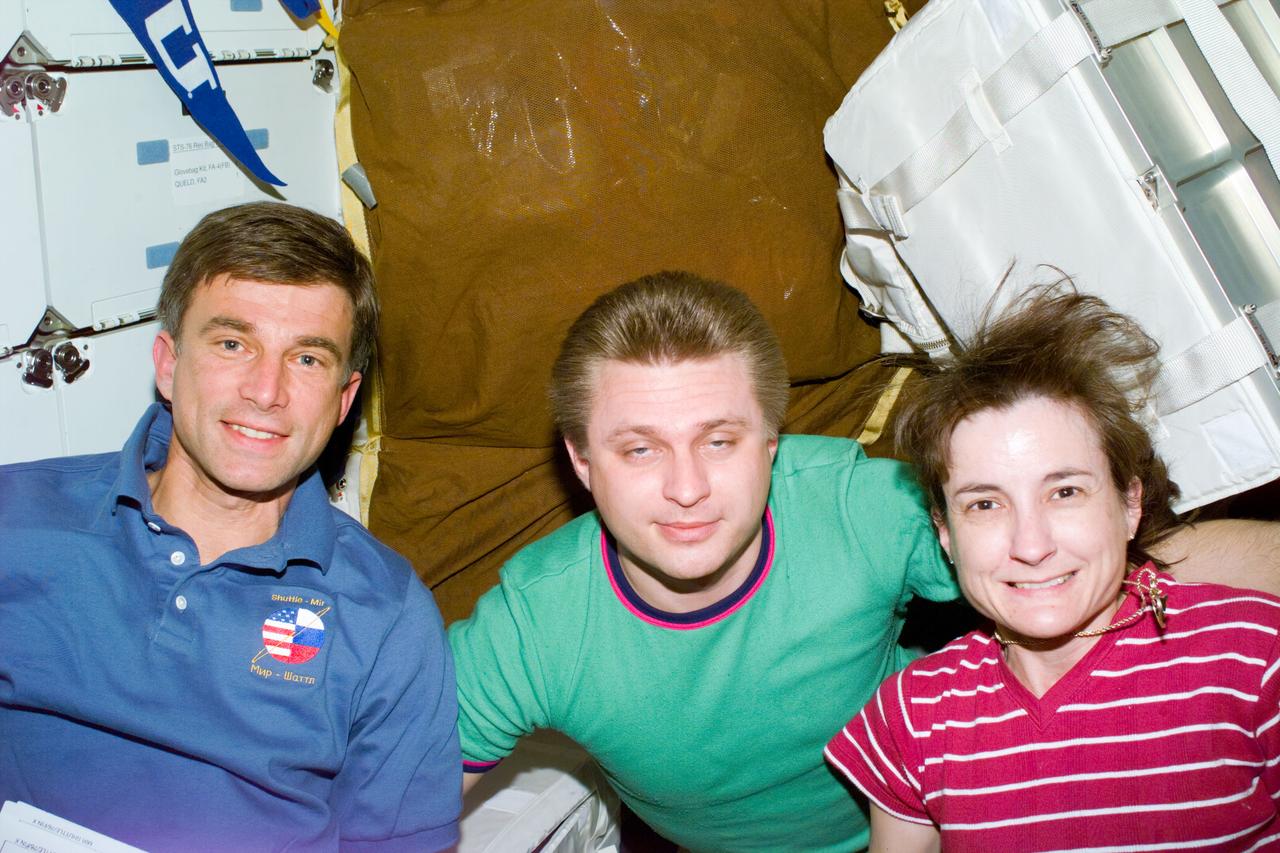
S76-E-5226 (28 March 1996) --- Astronauts Linda M. Godwin and Ronald M. Sega (left), mission specialists, pose for their final in-space photo with cosmonaut Yury I. Onufrienko, Mir-21 mission commander. The Space Shuttle Atlantis was within hours of its separation from its link with Russia's Mir Space Station. Onufrienko's crew has grown by one member, as the STS-76 crew leaves Shannon W. Lucid onboard Mir for the first leg of an almost-five-month stay.
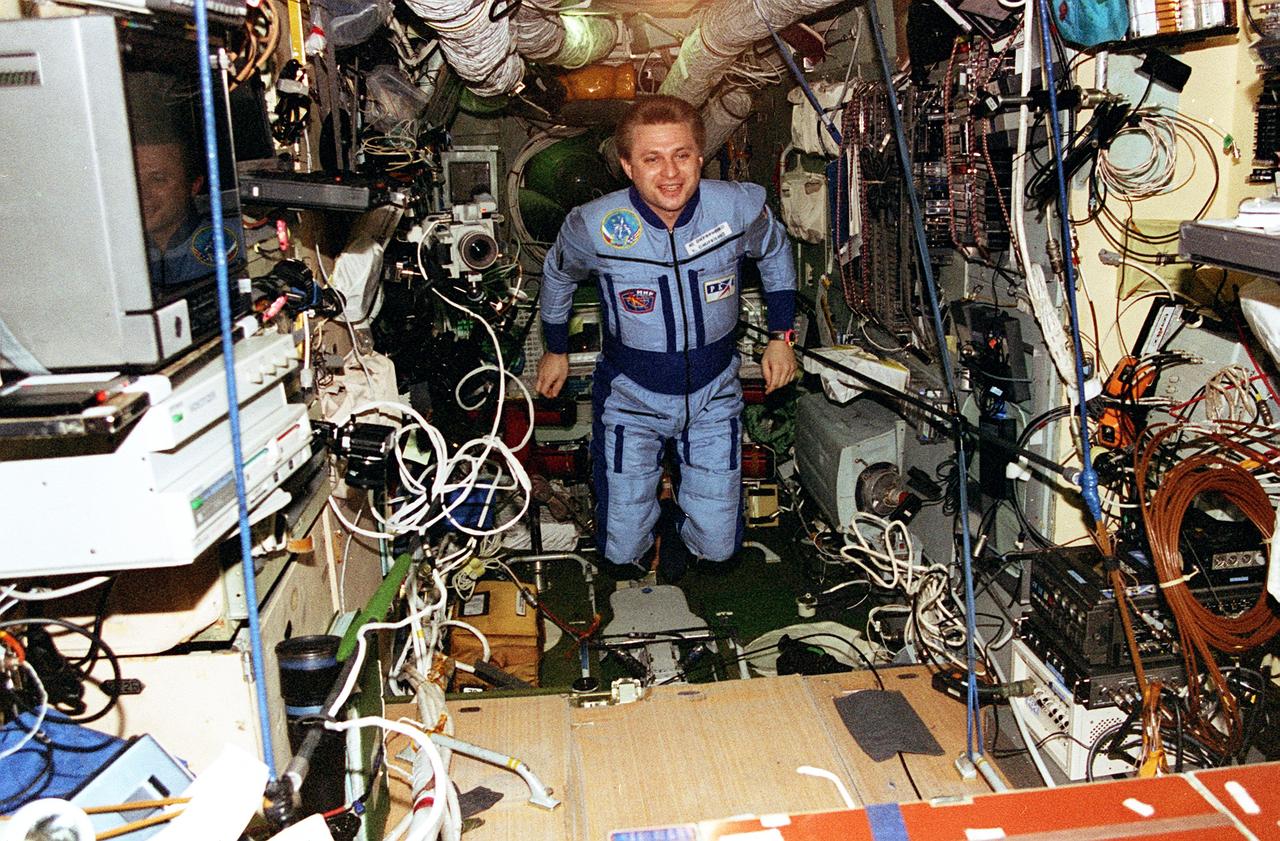
STS076-344-034 (22-31 March 1996) --- Cosmonaut Yury I. Onufrienko, commander for the Mir-21 mission, floats through the Base Block Module on Russia's Mir Space Station. The photograph was taken with a 35mm camera by one of the STS-76 Space Shuttle Atlantis crew members, aboard Mir for a brief visit following the delivery of astronaut Shannon W. Lucid, cosmonaut guest researcher, during the third docking mission.
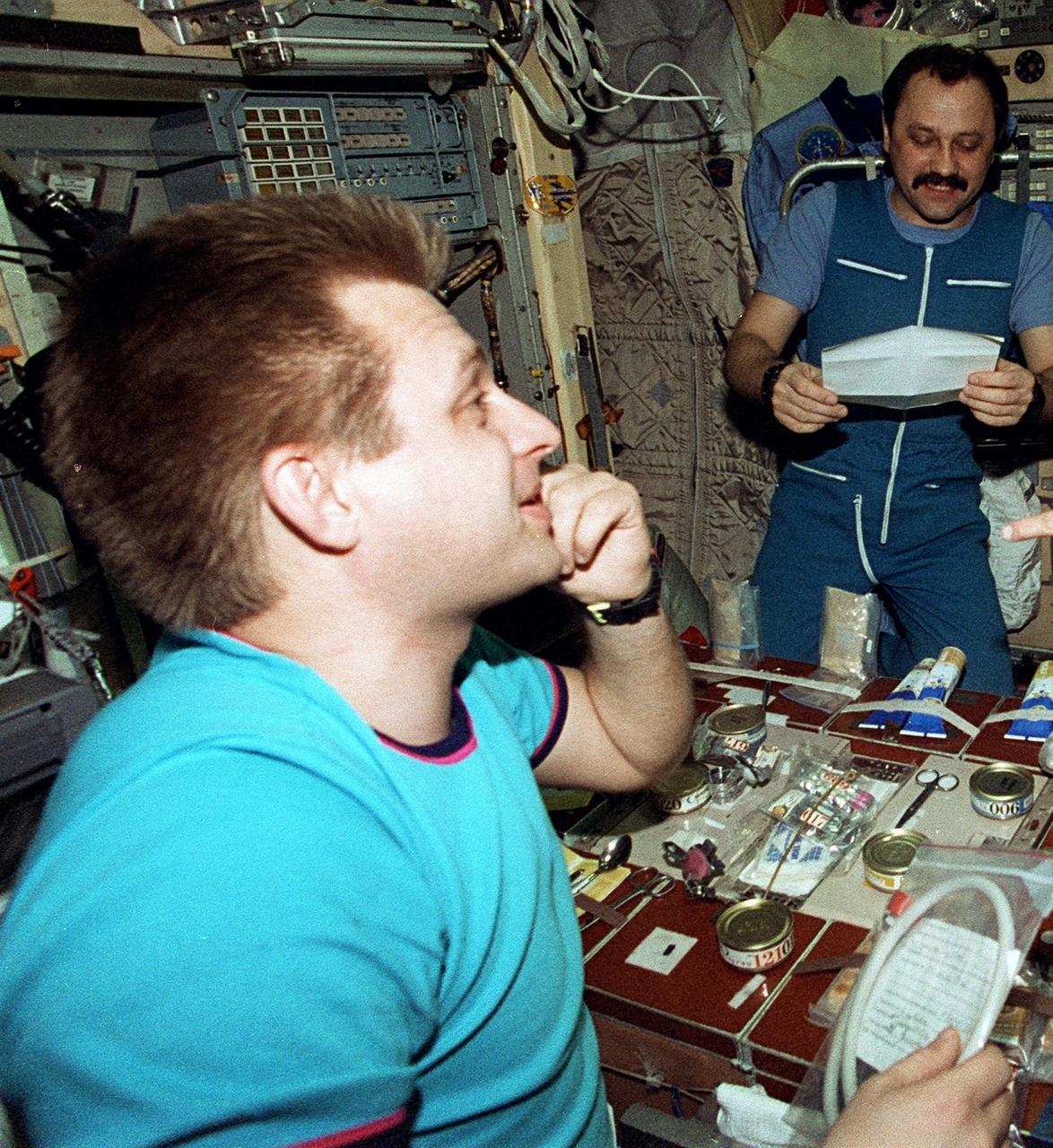
STS076-345-025 (22-31 March 1996) --- Joining her new cosmonaut crew mates, Shannon W. Lucid participates in an inventory of new food supplies in the Base Block Module of Russia's Mir Space Station. Yury I. Onufrienko, Mir-21 mission commander, is in the foreground; with Yury V. Usachev, flight engineer, pictured in the background. When this photo was taken, Mir was still docked with the Space Shuttle Atlantis.
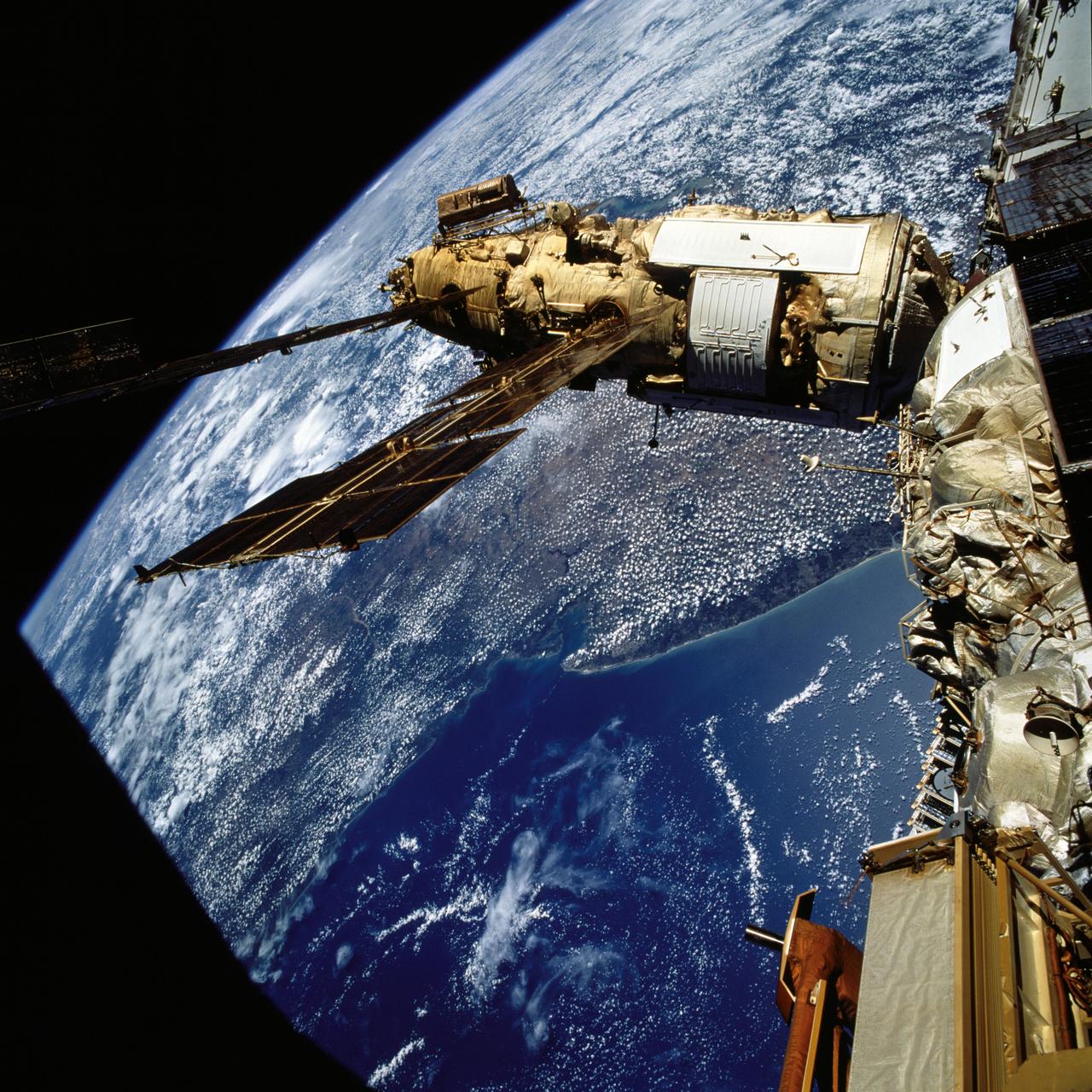
STS076-708-038 (22 - 31 March 1996) --- The crew took this 70mm picture of Russia's Mir Space Station over Australia. The crew docked the Space Shuttle Atlantis with the Mir Space Station on March 23, 1996, at which time astronaut Shannon W. Lucid joined the Mir-21 crew to begin the first leg of her 140-day stay aboard Mir, as a cosmonaut guest researcher. The Spacehab Module shared the cargo bay during part of the mission with the Docking Module (DM). The DM was connected to Mir, following a March 23, 1996, docking. The DM was delivered last year to Mir by the STS-74 crew.
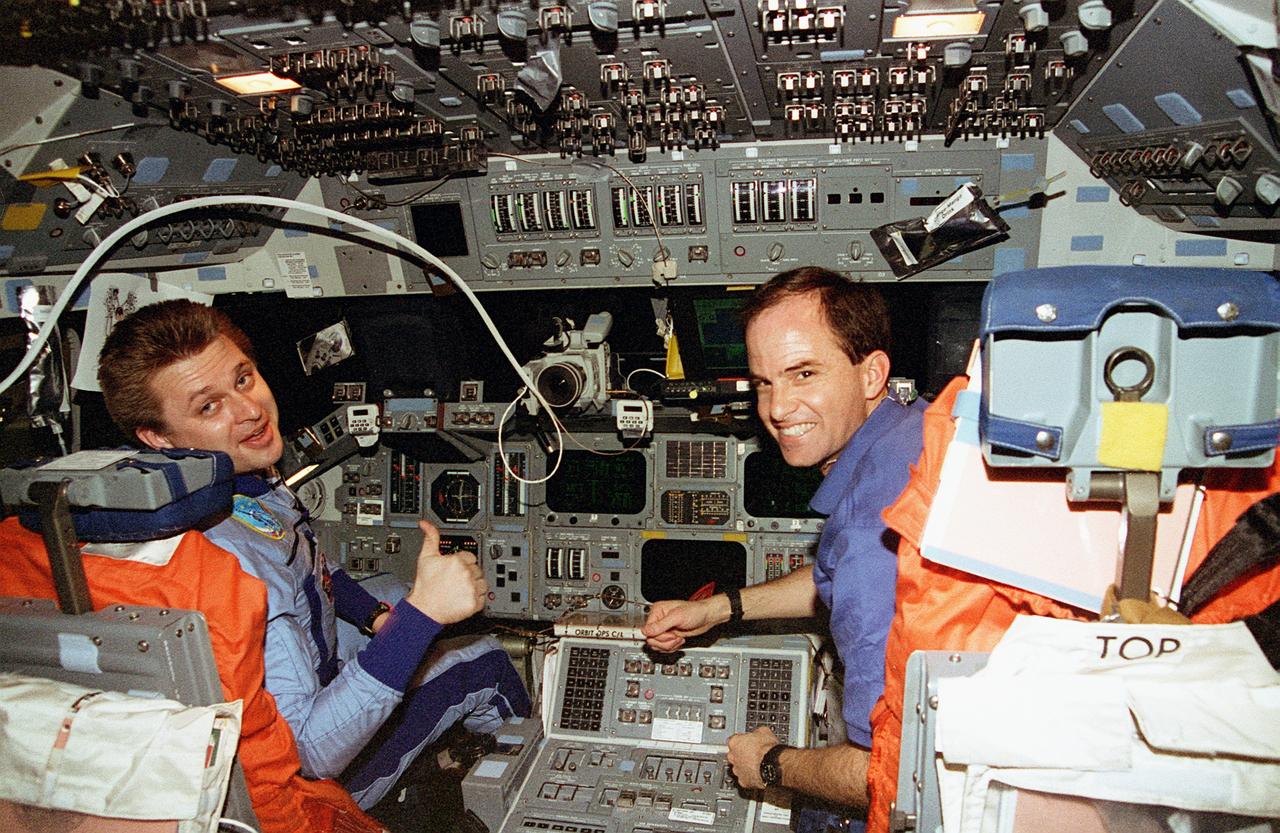
STS076-341-002 (22-31 March 1996)--- As astronaut Kevin P. Chilton looks on, cosmonaut Yury I. Onufrienko gives a thumbs up gesture, signifying successful docking operations between Russia's Mir Space Station and the Space Shuttle Atlantis. The Mir-21 and STS-76 commanders, respectively, earlier headed up the in-space effort which made possible the third link-up of Mir and Atlantis in Earth-orbit. With the delivery of astronaut Shannon W. Lucid to the Mir, the Mir-21 crew grew from two to three, as the mission specialist temporarily became a cosmonaut guest researcher. She is to spend approximately 140 days on Mir before returning to Earth.
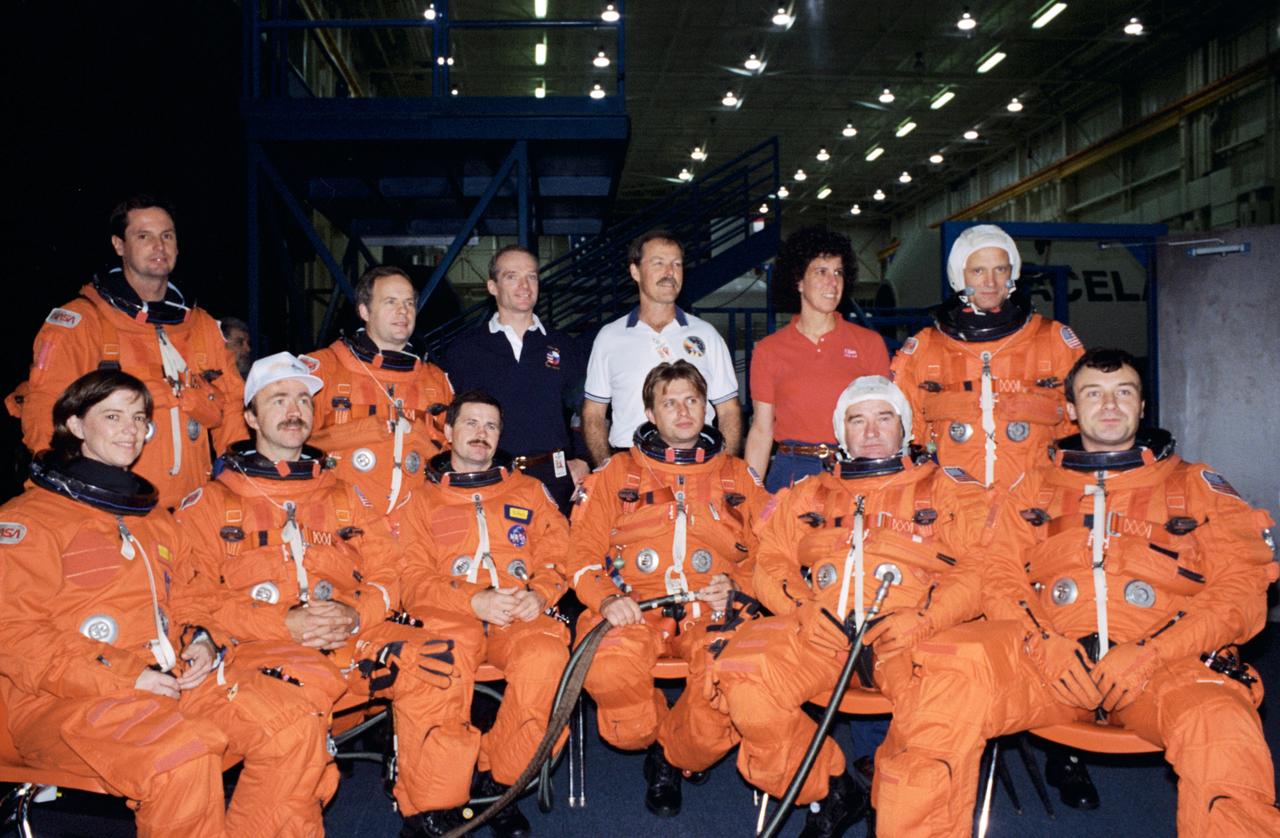
S94-47050 (28 Oct 1994) --- Crew members for the joint Space Shuttle/Russian Mir Space Station missions assemble for an informal portrait during a break in training in the Systems Integration Facility at the Johnson Space Center (JSC). In front (left to right) are astronaut Bonnie J. Dunbar; cosmonauts Aleksandr F. Poleshchuk, Yuriy I. Onufriyenko, Gennadiy M. Strekalov and Vladimir N. Dezhurov. In the rear are astronaut Gregory J. Harbaugh; cosmonaut Anatoliy Y. Solovyev, and astronauts Charles J. Precourt, Robert L. Gibson, Ellen S. Baker and Norman E. Thagard. In a precedent-setting flight, Thagard will be launched as a guest researcher along with Dezhurov, commander, and Strekalov, flight engineer, to Russia's Mir Space Station early next year for a three month mission, designated as Mir 18. Then in late spring, as the assignment of STS-71, the Space Shuttle Atlantis will rendezvous with Mir to pick up the Mir 18 crew and transfer cosmonauts Solovyov and Nikolai M. Budarin to the station for the Mir 19 mission. STS-71 mission specialist Dunbar is training as Thagard's backup.
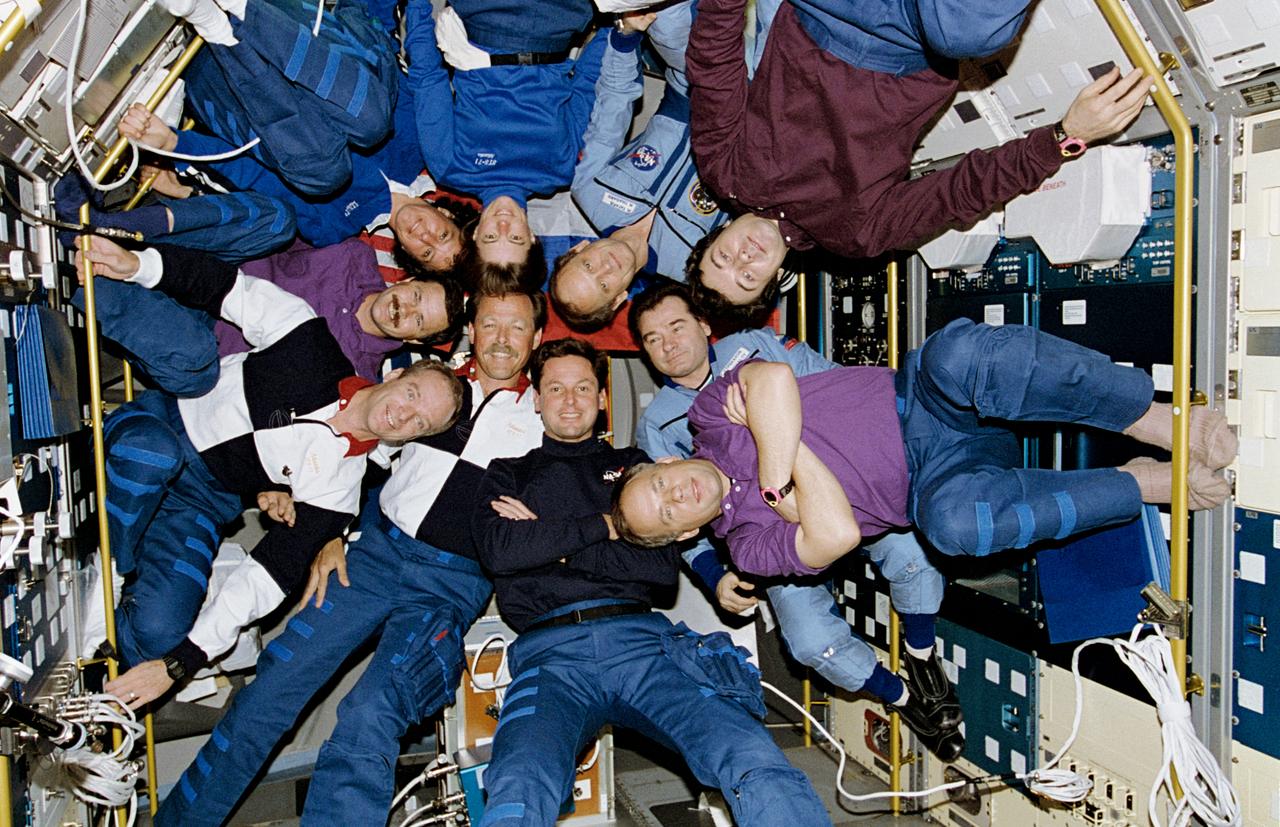
STS071-122-013 (27 June-7 July 1995) --- Inside the space shuttle Atlantis' Spacelab Science Module, the crewmembers of STS-71, Mir-18 and Mir-19 pose for the traditional inflight portrait. For individual identification, hold picture vertically with socked feet of Anatoly Y. Solovyev at bottom center. Clockwise from Solovyev are astronauts Gregory J. Harbaugh, Robert L. Gibson, Charles J. Precourt, Nikolai M. Budarin, Ellen S. Baker, Bonnie J. Dunbar, Norman E. Thagard, and cosmonauts Gennadiy M. Strekalov (at angle) and Vladimir N. Dezhurov.
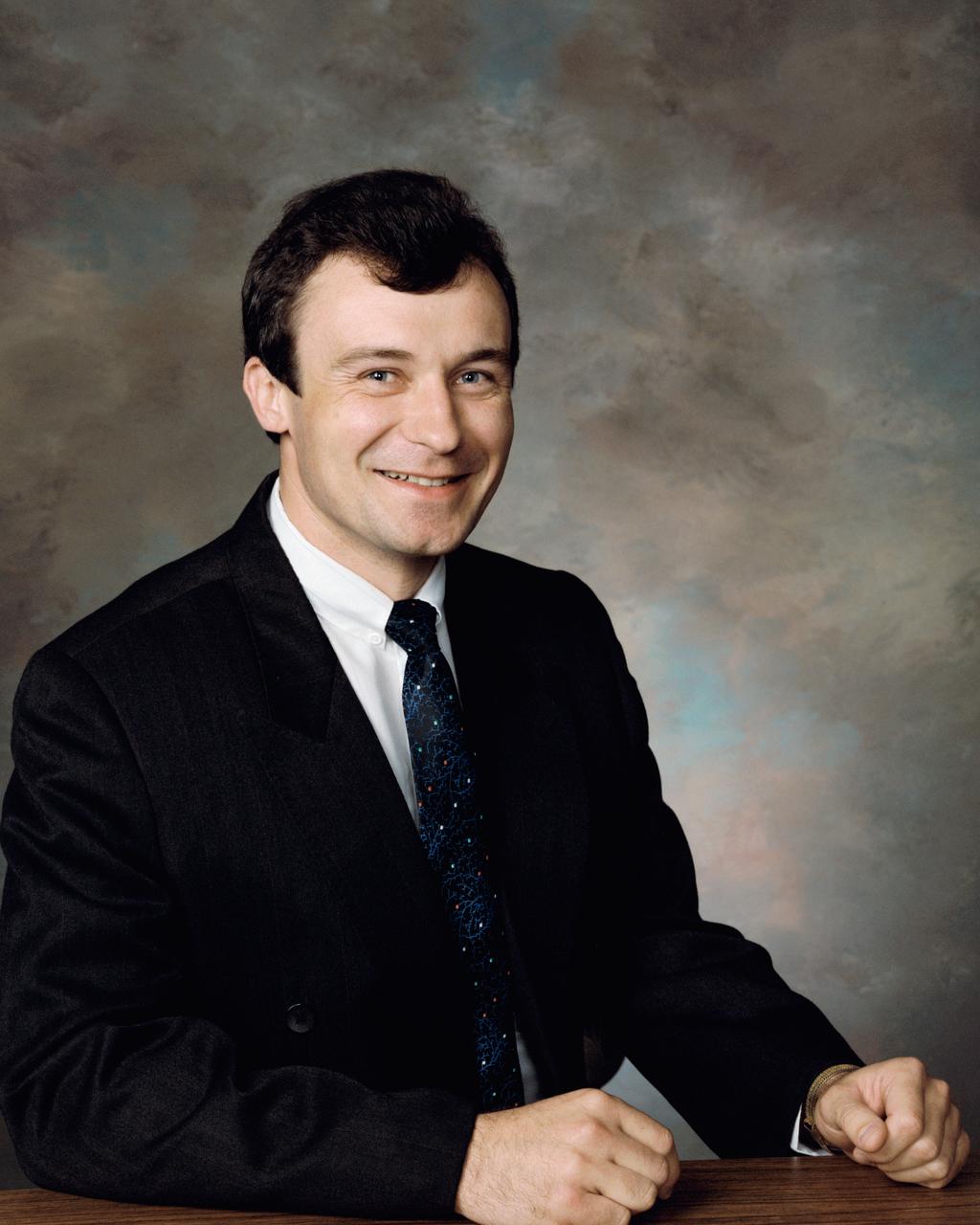
S94-34940 (June 1994) --- Vladimir N. Dezhurov, Russian cosmonaut Commander, Mir-18 EDITOR'S NOTE: Early next year, Dezhurov, along with NASA astronaut Norman E. Thagard and another cosmonaut, will be launched into Earth-orbit to spend three months aboard Russia's Mir space station.
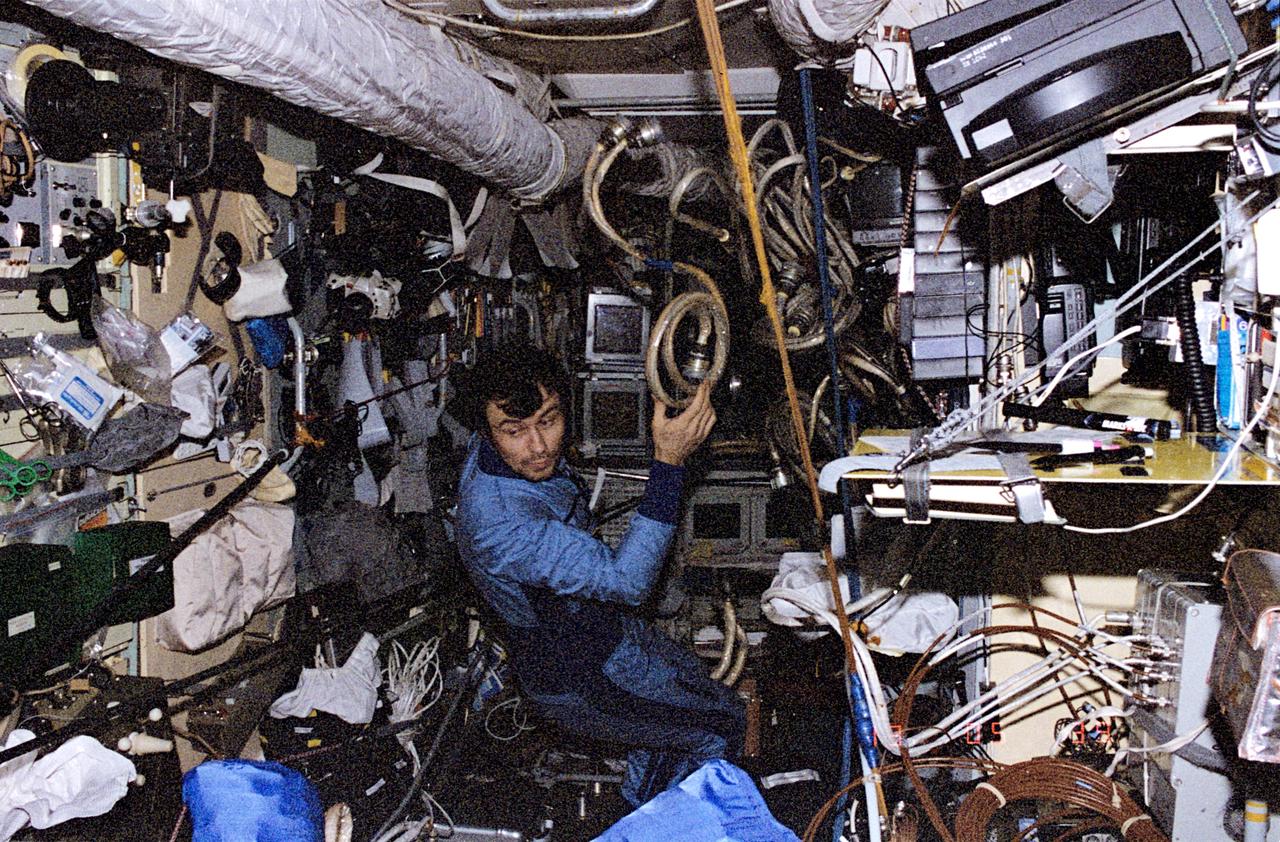
NM18-307-014 (March-July 1995) --- Onboard Mir's Spektr module, cosmonaut Vladimir N. Dezhurov re-routes cables as part of the module's activation process. This visual was one of many shown by the Mir-18 crew at a press conference on July 18 in Houston.
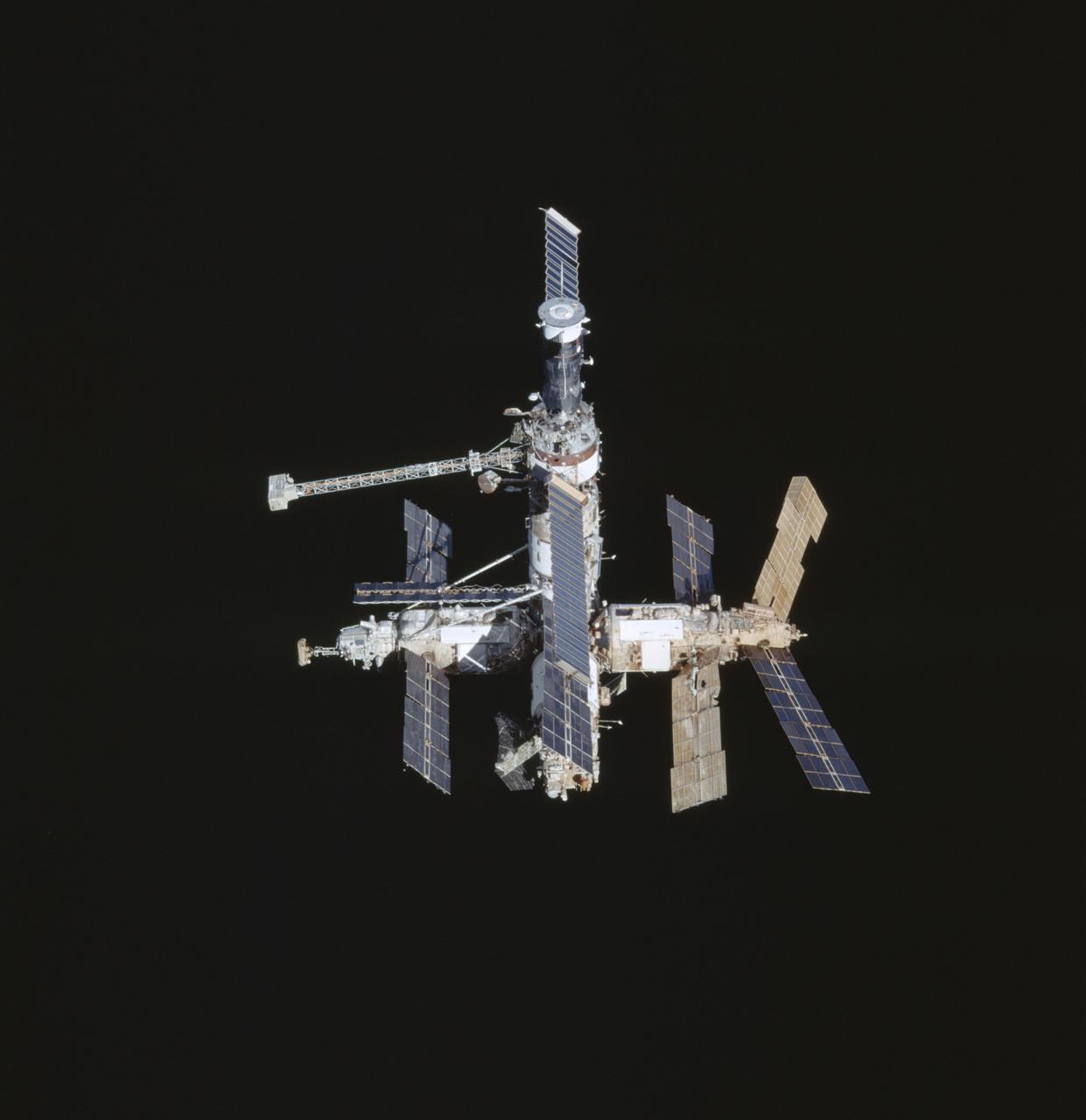
STS091-711-020 (2-12 June 1998) --- Backdropped against the darkness of space, Russia's Mir space station is captured on film as it moves away from the Space Shuttle Discovery during Shuttle-Mir final fly-around.
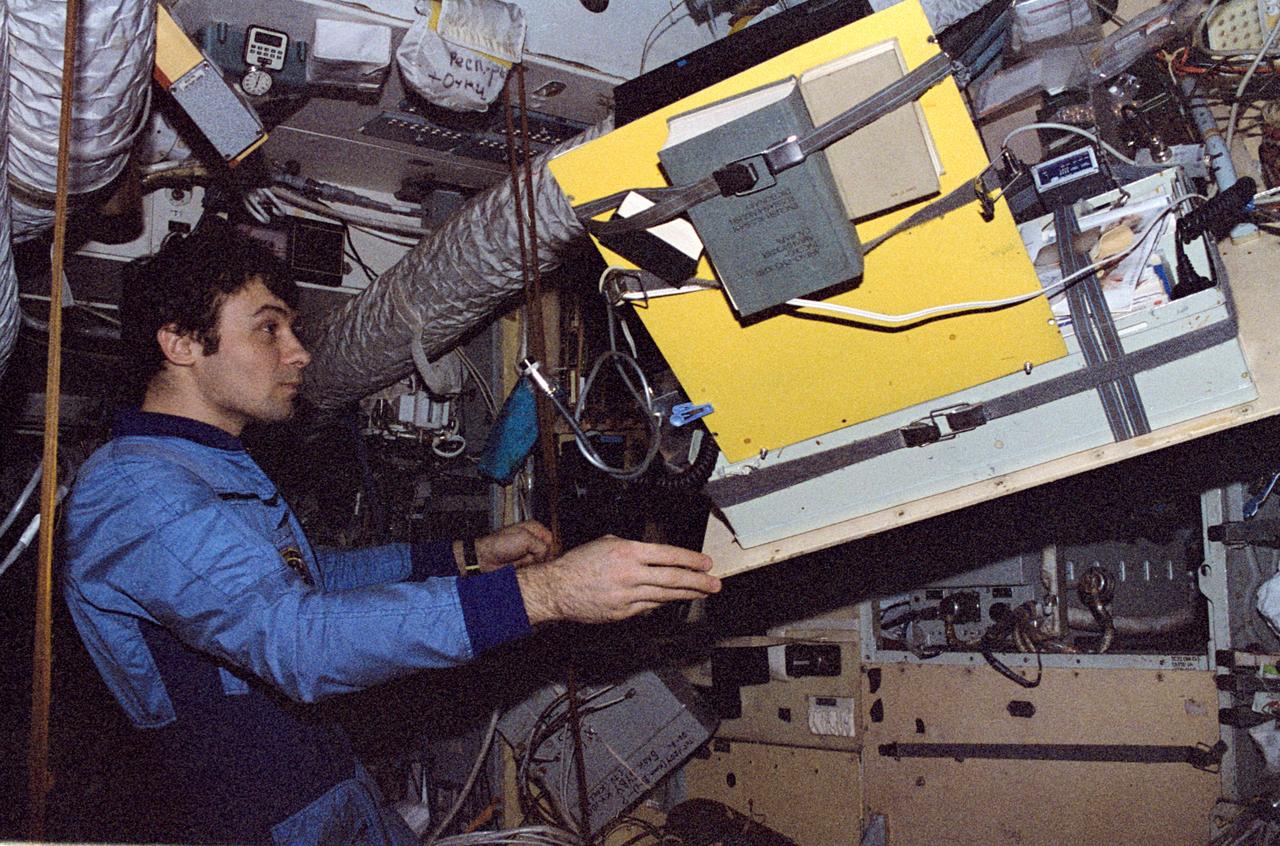
NM18-308-037 (28 June 1995) --- Onboard Mir, cosmonaut Vladimir N. Dezhurov prepares to change batteries at a power supply station as part of the preparation for the next day's scheduled docking with the Space Shuttle Atlantis. This visual was one of many shown by the Mir-18 crew at a press conference on July 18 in Houston.
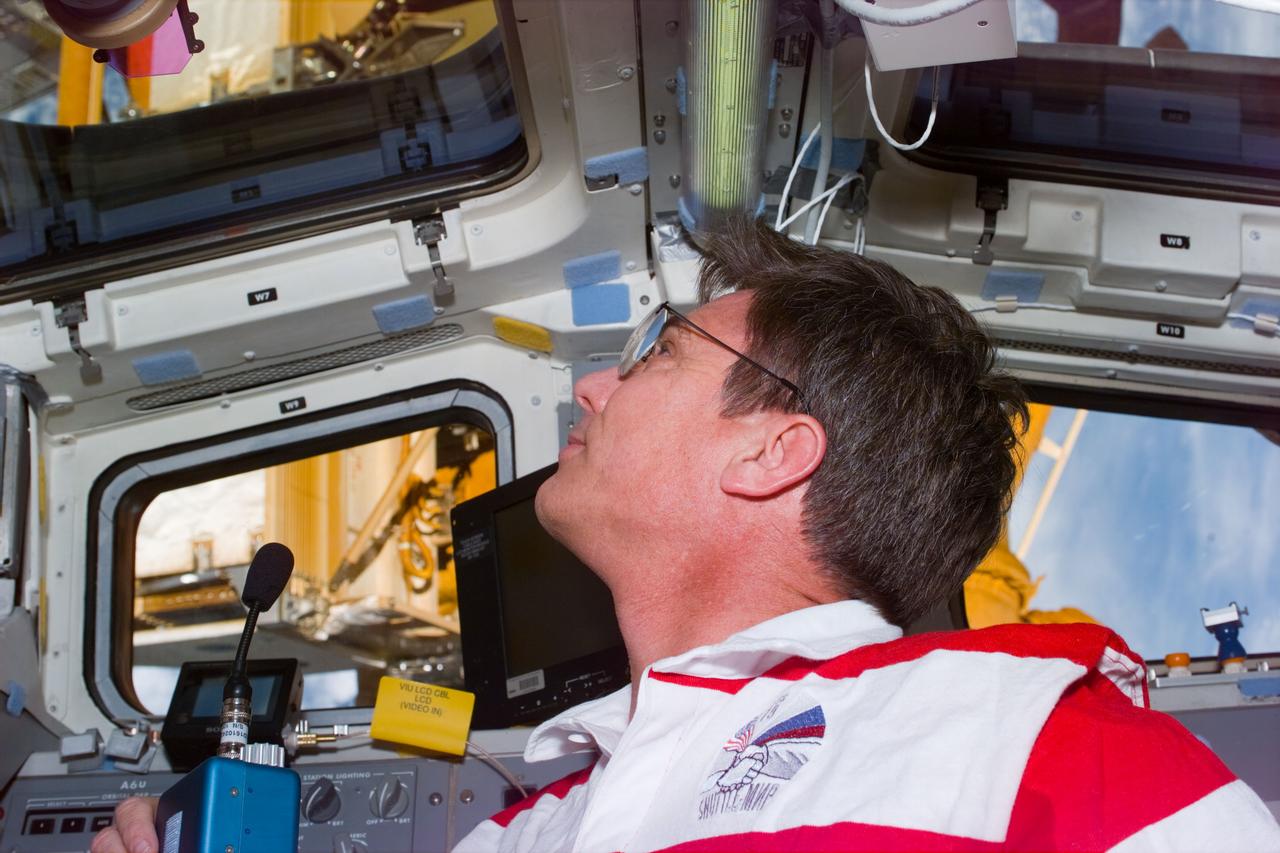
STS79-E-5059 (19 September 1996) --- Astronaut John E. Blaha, soon to join the Mir-22 crew aboard Russia's Mir Space Station as a cosmonaut guest researcher, looks through the Space Shuttle Atlantis' aft flight deck windows toward his new temporary home, on Flight Day 4.
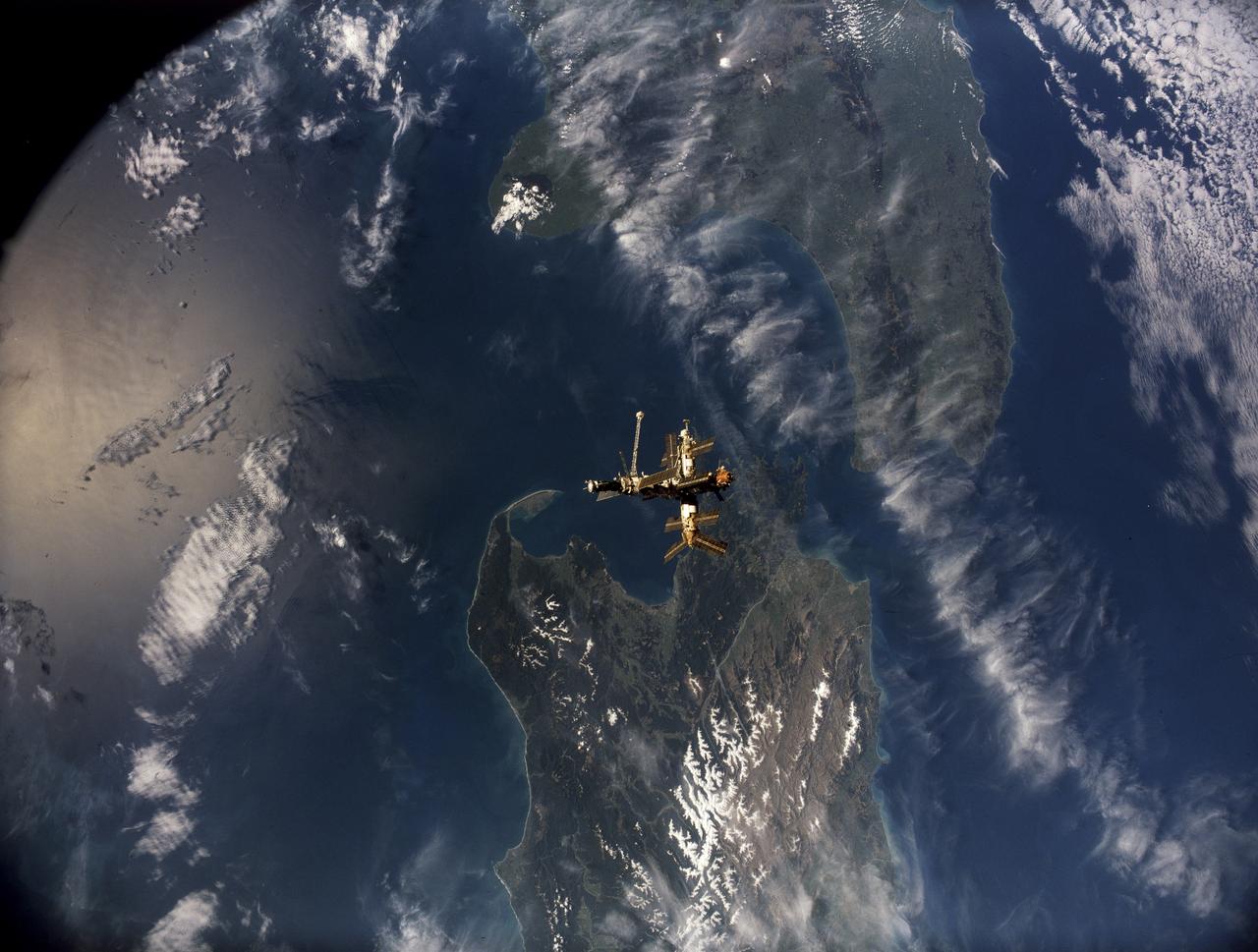
STS079-S-105 (16-26 Sept. 1996) --- Following undocking from the space shuttle Atlantis, Russia's Mir Space Station is backdropped over parts of both of New Zealand's main islands in this motion picture frame. Mt. Egmont and Cook Strait are geologic features that can be easily delineated in the image. During the STS-79 mission, the crew used an IMAX camera to document Intravehicular Activities (IVA) aboard the Space Shuttle Atlantis and the various Mir modules, as well as to record both docking and undocking activities through Atlantis' windows. NASA has flown IMAX camera systems on many Shuttle missions, including a special cargo bay camera's coverage of other recent Shuttle-Mir rendezvous and/or docking missions.
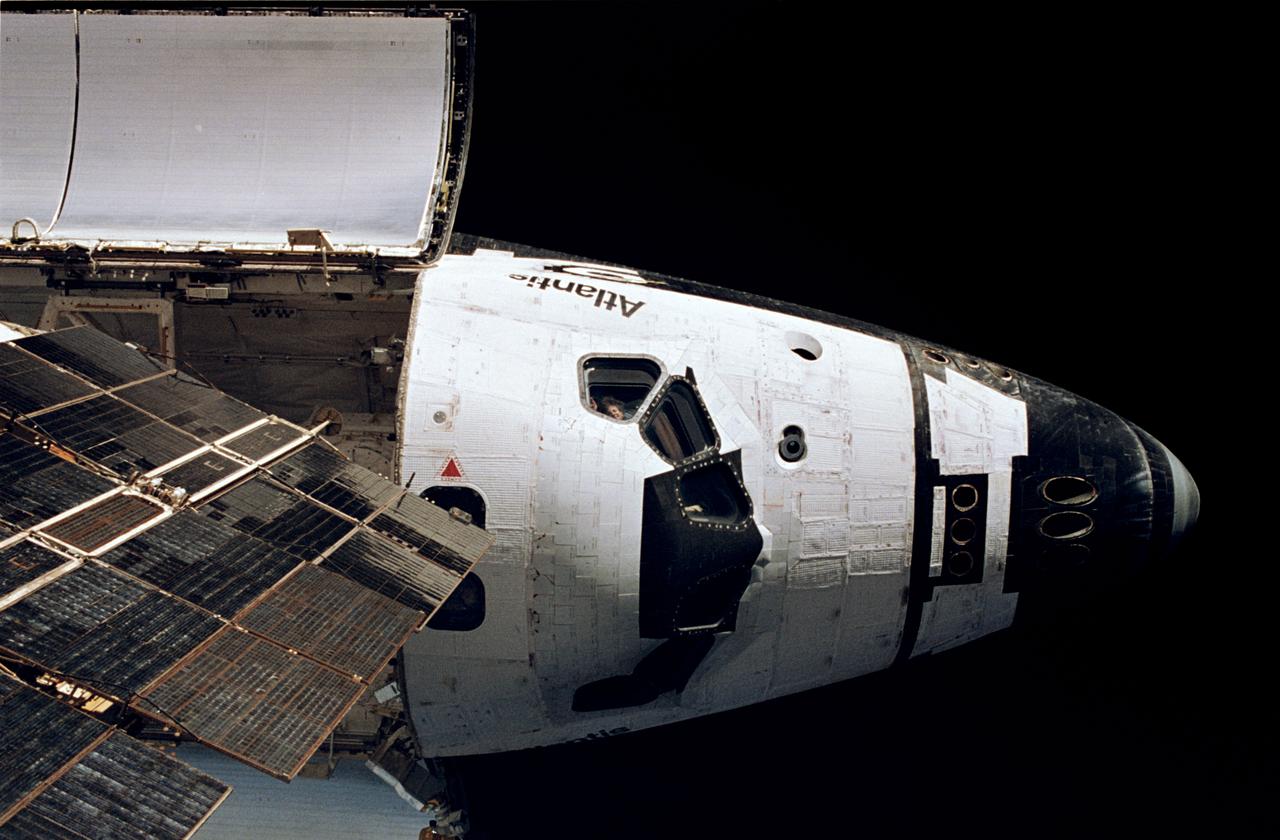
STS076-370-020 (22 - 31 March 1996) --- This photo of the forward part of the Space Shuttle Atlantis was taken from Russia's Mir Space Station as the two spacecraft jointly orbited Earth in late March 1996. The large rectangular object in the immediate foreground is one of the solar array panels for Mir. The two spacecraft were in the midst of their third link-up in Earth-orbit. With the subsequent delivery of astronaut Shannon W. Lucid to the Mir, the Mir-21 crew grew from two to three, as the mission specialist temporarily became a cosmonaut guest researcher. She is to spend approximately 140 days on Mir before returning to Earth.